An English Child
Contents
- The Ladder of Words
- The Ingal–Inhi Ladder Visualised
- Multiple Ladders in One Social System
- What Lies Beyond Science
- The Child at the Lowest Step
- The Hidden Iceberg of Hierarchy
- The Child's World of Sly Competition
- The Three-Dimensional Social Arena
- An Experiment in English Upbringing
- When the Lower Steps Rise
- Verbal Stature and Physical Reality
- The English Child in a Feudal World
- Heights, Lowliness and the Social Ladder
- The Experiment Begins — My First Daughter
- Stories, Skills and the Formation of English
- The Bhai Word and What It Carries
- An English Child Admitted to an Indian School
- The Radiance of a Guileless Personality
- Software, Language and Invisible Force
- The Eye That Shatters
- When a School Changed Its English
- What the Local School Did to Her
- The Mr. and Mrs. That Were Forbidden
- Inside the Vernacular Classroom
- Teaching, Stature and the Saar Problem
- What Native-English Officials Saw
- Two Kinds of Human Relationships
- The Working-Class English and Their Gift
- The Invisible Elevation of English
- Henry Sleeman and What He Missed
- William Logan and the Malabar Records
- The Strange Altruism of the English
- What Made the English Different
- Kipling, East and West
- The Eurasian and the Two Worlds
- The Mental Bifurcation of the Colonised
- The Returning Englishman
- The English East India Company
- Continental Europe and Human Equality
- The Stain of Low Work
- The Black Slave and the English Platform
- The Two-Forked Entry into English Nations
- The Durbar and the Social Monarch
- Honesty Rationed by Hierarchy
- The Machinery of Obligation
- Code-Switching and Its Dangers
- The Plantation and the Language Test
- Teaching English to the Lower Classes
- The Social Collapse of the Businessman
- Personality Crushing in Feudal Systems
- The Wife Who Lost Her Verbal Protection
- Grooming Gangs and the Hidden Mechanism
- What Native-English Children Carry
- Gillian and the Two Animal Modes
- The Remote-Sensing of Language Codes
- White Thrash and the Social Gel
- The BPO Phenomenon
- The Soldier and the Subordinate
- Courage, Fear and the Verbal Platform
- The Bident That Enters English Nations
- The Mafia Structure in Language
- The Godfather and the Sicilian Code
- Tom Hagen and the Malayalam Household
- The Asian Mafia and Its Silence
- The Chain of Obligation
- India, Pakistan and the Verbal Hierarchy
- Driving Standards and Language Codes
- The Saar Word Arrives in England
- The Landslide into England
- Babus, Saabs and the Changing Words
- The Factory Owner and the Supervisor
- Developing Others — the Hidden Danger
- The Muslim Politician's Warning
- The Developer Who Was Overtaken
- The Saar Word and Malabar's Transformation
- Travancore Settlers Enter Malabar
- What Happened to Malabar
- Malayalam Replaces Malabari
- The Priest's Message from Britain
- The English Child and Compulsory School
- Peer Pressure and the Feudal Classroom
- The Invisible Acquisition
- The Planar Mindset and What It Gives
- Edgar Thurston and the Census of 1891
- The Eurasian's Mental Burden
- The World-War Appraisal Dynamic
- Spectators and the Fight They Trigger
- The Power of the Lower-Class Witness
- Protecting Children from Pejorative Words
- The Right to Education and Its Damage
- The Native-English Child Pulled Downward
- Family Arrangement in English and Feudal
- The Son-in-Law Who Precedes the Daughter
- Continental Europeans in the USA
- The Godfather Revisited
- What My Malayalam Writings Reveal
- South Asians Entering England
- The Road Sweeper Who Became a Leader
- The Virtual Design Location
- The English Social Architecture Crumbles
- Distance and the Language-Code Perspective
- The Factory Owner's Explanation
- The Delhi Businessman's Collapse
- The Laughter That Confirmed Everything
- The Malabar Parallel
- The Student Who Returned from England
- Academic Psychology and Its Blindness
- The Godfather's Machinery in England
- A Closing Word
1. The Ladder of Words
I should say that I did not expect anyone from here to come and start reading the 950 and odd chapters of my book.
English translations of my vernacular writings
However, since I have mentioned about the virtual design location of a native-English child in comparison with that of a feudal language speaking child, I need to do that.
Feudal languages create a 3-demensional virtual arena in which reality as well as human beings exist. Planar languages like English do not do this.
Second thing I would like to mention is that I have tried various geometrical designs to portray the arrangement of human beings in a feudal language system.
One of which has been that of a pyramid.
However, I have not yet come across any single diagram that can visualise the human relationship pattern in any feudal language.
But then, in recent times, I have been able to use the concept of Inhi👇 - Ingal👆 steps ladder concept.
Inhi is the lowest You in Malabari language. Ingal is the highest You in the Malabari language.
The concept is of a social ladder, in which in each step there are persons who address those above them as Ingal. And the same persons address persons below them as Inhi.
It may be borne in mind that each of these words are connected to hundreds of similar-direction words, usages, tone &c.
The persons on top of the ladder are the social seniors. And the persons on the bottoms steps of the ladder are the social juniors.
In a social system, there will be very many similar ladders.
I will stop here.
I will explain the virtual design location of a native-English child in comparison with that of a feudal language speaking child, in my next post.
2. The Ingal–Inhi Ladder Visualised
Ingal👆 - Inhi👇
Ingal👆 - Inhi👇
Ingal👆 - Inhi👇
Ingal👆 - Inhi👇
Ingal👆 - Inhi👇
Ingal👆 - Inhi👇
Ingal👆 - Inhi👇
Ingal👆 - Inhi👇
Ingal👆 - Inhi👇
Ingal👆 - Inhi👇
Ingal👆 - Inhi👇
Ingal👆 - Inhi👇
Ingal👆 - Inhi👇
The above is a depiction on the Ingal👆 - Inhi👇 ladder I had mentioned. This phenomenon is not there in English.
This ladder actually creates hundreds of other corresponding ladders with other verbal indicant forms. For instance, Higher he - lower he. That is Oru👆 - Onu👇.
This in turn affects the indicant verbal forms of verbs and tones also.
In South Asia, highest landlord class used the Inhi👇 word to his immediate subordinates and also to all other subordinates.
All subordinates used the Ingal👆 word to their immediate superior and also to all other superiors.
This specific item is not usually understood when speaking about the verbal hierarchy in feudal languages.
I will continue in my next post.
3. Multiple Ladders in One Social System
To give the wider picture, let me mention again that in a social system, there will be a number of similar ladders with the same verbal coding; provided that the same feudal language is spoken across the social system.
The social system in this case can be visualised as a three-dimensional virtual arena.
A single person can have his or her presence on a single step on more than one ladder, at different heights.
That is, he or she can be in a family based ladder, a school based ladder, playground based ladder, social activity ladder and also on a professional work area ladder &c. at the same time.
On various other ladders, he or she will not have any presence.
That is, the same person can be at different heights inside the same social system, depending on the ladder he or she is visualised as being placed.
For instance, a younger brother in a household can be a senior officer in the government service. In the home-based ladder, he or she is on lower level Ingal👆 - Inhi👇step on the ladder.
At the same time, in his or her work-area, he or she is on the higher step on the concerned Ingal👆 - Inhi👇step ladder.
I will continue in my next post.
4. What Lies Beyond Science
I had a look at the first paragraph. It is like saying that the word Nigger is bad. What I am writing about is something that is thousands of time different. In fact, people who live in this social system would not mind the nigger word if they can escape to some English land.
There is something that can be mentioned as Vernacular English. This is a literal translation of the local feudal languages with most of its evilness added into English. The word Nigger is no where evil when compared to what feudal languages contain. I will leave this subject. I want to go back to the topic I am on.
A lot of Asian languages are pretty structured like this. I think Thai has a great deal of difference based on age as well which changes the conjugation of the verbs.
I must mention that what you have mentioned is just the imagination of physical and social reality from an English language understanding.
It is not that simple as trying to understand another language with just a flimsy translation. There are literally hundreds and hundreds of things that does not arrive in an English translation.
I am sure that even Continental European languages like French, Italian, Spanish, Portuguese, German &c. have the same or similar issues. And also Celtic languages of Britain also will have terrific difference from English. I am not confining the difference to feudal language codes.
When I say that I have written around 950 chapters on this subject, the easiest feeling would be that it is a mere repetition of the same blah, blah stuff. That is not true.
I am putting into writing things that are there in physical and virtual reality, that do not come within the purview of modern or even Classical General science / physics. That there is so much beyond the understanding of science itself should be a matter for serious academic discussion.
But generally academicians do not want to come anywhere near to my writings. There are reasons for that.
I had come here to post the continuation of my writings on the virtual location of a feudal language speaking child versus the location of an English child.
I will post it tomorrow.
Today too much distraction in the flow.
5. The Child at the Lowest Step
Now let me try to point to the virtual location of a child who speaks and lives in a feudal language of South Asia.
In almost all current-day Ingal👆 - Inhi👇 ladders, he or she will be on the lowest step.
However, this is not fully true. For during the earlier landlord class time-period, the child of a landlord was not on the lowest step of a Ingal👆 - Inhi👇 ladder in which the lower classes / castes were also placed.
This can be explained thus:
The lower caste / classes were to address the child with an Aap (आप) in Hindi and the child can address the lower class individual with a Thoo (तू).
Wherever the Christian missionaries improved the lower classes, this applecart got upset. The lower classes started using the Thoo word to the upper class child. This was to create terrible communal issues, leading even to the live burning up of a missionary family.
I will not pursue that theme here.
In the Ingal👆 - Inhi👇 ladder inside a common family in South Asia, the child is on the bottom step. This is the location where the child can be made subject to frivolous and derisive babytalk. This individual is generally treated as a kind of buffoon, clown, idiot, nitwit etc. Instead of intelligent answers being given to the child's queries, utter nonsensical explanations are given, and he or she is thus made the butt of belittling and derisive laughter.
Actually this is the same location a lower level worker or domestic maid or slave can be made to exist in previous times.
Now, look this:
The child's father, mother, elder relatives, school teacher, adult persons in the neighbourhood etc., all address the child with an Inhi👇. And the child addresses them with an Ingal👆.
So the most simple visualisation of the child - adult verbal relationship is thus: Ingal👆 - Inhi👇.
Actually this is not a true visualisation. The true visualisation can be thus in the ladder confined to say, school:
Ingal - Inhi👇 Headmaster
Ingal👆 - Inhi👇 Assistant headmaster
Ingal👆 - Inhi👇Senior most teacher
Ingal👆 - Inhi👇Class teacher
Ingal👆 - Inhi👇Ministerial staff member
Ingal👆 - Inhi👇Security personnel
Ingal👆 - Inhi👇School bus driver
Ingal👆 - Inhi👇Gardener
Ingal👆 - Inhi👇Security personnel
Ingal👆 - Inhi👇 Casual workers in the school
Ingal👆 - Inhi👇
Ingal👆 - Inhi👇Menial workers
Ingal👆 - Inhi Child
This is a very powerful positioning of the child, one in which terrific coded radiations that emanate from the eyes, can happen.
I will continue.
6. The Hidden Iceberg of Hierarchy
The Ingal👆 - Inhi👇 ladder inside the school scene looks quite simple to understand.
However, what is seen is only a minute tip of the huge hidden iceberg.
At each step in the above ladder, towards the higher step person, that is to the Ingal👆 person, some kind of words that quite frankly admits one's own inferiority has to be added. This is mentioned as 'respect', when in fact it is not 'respect' as understood in English.
To the above placed person's name words such as Saar, Maadam, Ji, Annan, Akka, Ettan, Chechi, Ikka &c. has to be suffixed.
This in turn creates very powerful codes of command and obedience.
So that at each step in the Ingal👆 - Inhi👇ladder, the subordinate person very clearly feels the mentality of being a servile being. And others in the scene can also very clearly visualise it in their mind and see it in the social functioning.
The child in school is at the lowest step in the Ingal👆 - Inhi👇 in the school scene.
But then, among the children in the school also, there is another kind of hierarchy confined to them. That is of seniority versus inferiority in age. And also in class levels. That is, Class one, Class two etc.
Here, the senior child is the Chetten, Chechi, Ikka, Akka, Anna &c. I do not know the corresponding words in Hindi.
The problem here is that in an ideal situation, the subordinate person willingly admits his or her inferiority and submits to the higher placed person's subordination.
It will then be like the insides of the Indian army. There is only Hindi at the soldier levels. And everyone knows his or her position. Inside the Indian army, no other language is allowed to function at the soldier levels.
Everything works on the supernatural heights of the upper placed person, and the downsizing and mentally dwarfing codes experienced by the subordinate personnel.
But in the South Asian social scenes, there are various kinds of hierarchies. This creates certain emotions that cannot be visualised in English.
I will take that up in the next post.
7. The Child's World of Sly Competition
The child in the school slowly gets to feel and understand the burden of the Ingal👆 - Inhi👇ladder in which he or she is placed in.
The mood that grips the child is one of careful competition. As he or she grows up, he or she will get to understand that when another person goes up to the higher you, he, she &c., the effect can be like being on a verbal see-saw. He or she will go down.
An urge to backstab others can develop. Various kinds of ferocious competitiveness will envelop the mind. However, only some of these will be of a positive kind.
As the youngsters grows up into adolescence and youth, he or she get to see and experience the fact that everywhere, every word and everything is encoded with sly and secret competitiveness. From the lowliness, one has to forever strive for verbal heights.
When this child or youngster is compared with a native-English child or youngster of comparable age, these things have to be borne in mind:
The feudal language speaking youngster is on the bottom steps of several Ingal👆 - Inhi👇ladders. The English child has no information or experience any such Ingal👆 - Inhi👇ladder. So the native-English is not on a lowliness or heights. In fact, this child is actually in another sphere of reality.
Equalising a native-English child to a feudal language speaking child is a stuff that really is from a very diabolic worldly experience.
The native-English child can easily be swayed by the flow of effusive affection that can spring forth from the feudal language speaker side. But then, he or she could still feel the powerful lowering being enforced in some eerie unworldly location.
If he or she feels the distaste, it could act as a powerful protection. But then, the child might exhibit emotions that can very easily be identified as racial repulsion. However, it is not actually skin colour that creates a creepy feeling in the child.
On this aforementioned equalisation, the feudal language speaking child's experience could be different.
8. The Three-Dimensional Social Arena
The social system created and designed by a feudal language is not at all like what English can design. Here I am not connecting this idea to the social design of England, as seen in the class structure. For that is connected to certain other things.
In South Asia, there are various levels of persons. Like the senior bureaucrat, the various levels of politicians, various levels of officials, doctors, other medical staff, taxi drivers, factory worker, govt teachers, private school teachers, cleaning workers and so many others.
All these persons are there in any English social system also. However in a feudal language social system, each one of them actually stands on some step on a few Ingal👆 - Inhi👇ladders. And these ladders are arranged in different locations in the 3-Dimension social system.
This does create social heights and social lowliness in the society. This diabolic heights and lowliness cannot be visualised in English.
For, each person in a feudal language social system actually contains a code of some level of heights or lowliness. This reflects and even mingles with all his words and speech. Each carrying a code of height or lowliness.
And this is reflected and seen to be mingled with the words and speech of all others when they think of him, or refer to him and also speak to him.
The feudal language speaking child will be powerfully connected to this reality. He or she will be able to feel the terrific and un-shakeable hold of the various invisible strings that attach to him or her from the various persons.
However, he or she is born in it, and are thus accustomed to it. I will not say that they are happy about it. But they generally use their brain to be in it, occupying a comfortable social height. This is a competition that is sly, and yet very carnivorous. Such a thing is not creatable in English.
As for the native-English child, this reality should actually be beyond his or her imagination. But then, I should mention that as of now, no native-English society is really beyond the grip and manhandling of this eerie reality. There is no such thing as a pristine-English social system anymore.
An English individual should become evil to contemplate on this kind of competition. It is an evilness that might not be found defined in ordinary books on moral and ethical standards.
A feudal language person can be good and altruistic, and even morally and ethically perfect, and yet would be the very epitome of this terrible evilness. It is a natural component of feudal languages. Books on morality and ethics would be totally clueless about this satanism.
9. An Experiment in English Upbringing
Due to my insights on the existence of language codes which work in close connection to the supernatural software codes that exists behind physical reality and life mechanism, I did think of what would happen if a native - South Asian were to be brought up in a total English ambience.
This would mean not just teaching a new born person English, but beyond that all life circumstances would be inside a total English social ambience.
What I was proposing is and was way beyond any social reform experiment I had come across. I am sure that this might have been done by some persons or other, who had the financial acumen to do this without causing acute distress in others.
However, at the moment that I took to this experiment, I was actually in so many kinds of instabilities, including that of finance.
I took this up when my first child was born. Actually even before the child was born, I had taken up the issue of social heights and social lowliness. This is an item about which the native-English might not have any information.
I will explain that factor first.
Take up the case of the police constable in India. Most of them are generally from a rude and rough vernacular class. But the vast majority of the local people see them as social divinities. These constables can address the lower class persons with a Thoo or Nee or Inhi (lowest you), and they can refer to them as Avan or Oan (lowest he / him).
The common folks have to use the highest You, he, him towards and about them.
However, the constables are actually at the lowest rung of the Indian police hierarchy. That is, in the Ingal👆 - Inhi👇ladder hierarchy inside the police department, they are on the lowest step.
On the highest steps are the IPS officers.
If an IPS office is addressed as Thoo / Nee / Inhi by a police constable, the mental and social experience would be that of total desecration of everything that the IPS officer has and had.
But if a police constable were to address another police constable of equal age as Thoo / Nee / Inhi, the experience would mostly be that of warm friendliness.
Same is the case if the wife of an IPS officer were to be addressed and referred to by the wives of constables as Thoo / Nee / Inhi and as Aval / Olu. That is, she would feel the total destruction of all semblance of and rights to dignity in her and about her.
However, that would not happen if the wives of constables of equal age were to use the same words and usages to each other. Such words would only further their intimacy.
I am trying to explain the concept of social heights and lowliness, and how it can have far reaching effects. Even upon the so all genetic design of human beings.
I will continue...
10. When the Lower Steps Rise
Next: forum thread continuation
This is a scenario that cannot usually happen in India. However, as of now, a person in any level of the society can become an IPS officer. There are separate recruitment quotas for the lowest castes and also for the lower castes.
Once a person becomes an IPS officer, he is in the Brahmanical levels of the language codes in South Asian feudal languages.
Think of a person from the lower rungs of the social system and language levels, getting recruited as an IPS officer, through the Civil Service exam.
He then generally marries into the some upper class extremely rich family.
But then, remember that his own family links would be on the lower bottom of the social system. Generally everybody makes hays when the sun shines. Many of them make money through their IPS family member contact. Still their mindset would be of a particular kind.
This IPS officer's wife becomes pregnant, and due to some unforeseen event, she is made to stay with his own family links. They might treat her like an extreme royalty in words.
But there is also the chance that they might not concede this verbal level to her.
For, the IPS officer's own brothers and sisters would be ordinary workers and artisans. So the IPS officer's wife would be forced to use the self-degrading words of honouring to his elder brothers, their wives, his sisters, their husbands and so many others in the family link.
They on their part would slowly see no reason to concede self-degrading higher levels words to her and about her. For they use the same subordinating words to and about their brother who is the IPS officer.
For a female who has lived among the higher echelons of the language system, this would be a terrifying and most creepy experience. It would be like being in the control of her own family housemaids and male servants, who themselves are on the lowest steps of the Ingal👆 - Inhi👇 ladder hierarchy.
My insight was that in this scenario, the child in the pregnant woman would get to feel the crushing impact of the verbal codes. This impact can be in so many different ways. I cannot go into all that here.
Now, take the second scenario.
An IPS officer's son who has no specific job or rather is on his own attempts at entrepreneurship marries a socially lower class family female, with some slight financial acumen.
Once she marries into this household, everything about her changes. She is on first name connection with so many members of the IPS officer's household.
Outsider people understand her new social level. In her own house, people feel the difference. Even though words are not changed to their higher level form, still there is a change in the digital value encrypted in them.
This all in turn will cause a digital value shift to the higher levels in almost all software codes connected to her mind, body and life.
The child growing up in her will experience this in ways which physical science will not be able to explain.
When the child is born, there is a great percentage of chance that the child will display various kinds of positive features.
11. Verbal Stature and Physical Reality
I married into a family that was way below mine in terms of certain social standards. I am speaking in connection to who my parents were, my sisters were or are, and what my brother was or is.
As to my wife's family, it resides in the inner areas of the local social setup. The family has land &c. But still, they move on the lower panes of the social communication verbal codes. Geolocation would be in the interior, extending into the interiors of thin and slender lanes and bylanes. From an English perspective, it is like entering the labyrinth of ants.
They have a facial expression that was in those times quite easily connected to the stifled social and familial condition in which they must have lived.
However, there is another expression in the social system which is that of those living in the poverty location, at the bottom of the verbal codes.
My insight was that if I were to allow my wife's family's claims of superiority upon me, I will myself get to feel the stifling.
However, I kept a distance from that social system. And there was a difference in me in that I was a person with a lot of reading background in English classics &c.
I was keen on using this opportunity to test the validity of my understandings on social height and lowliness.
My mother was a retired head of a government department, with a reputation of no corruption. My first sister was a professor or so in REC / NIT (elite engineering college under central govt.), Second sister was a paediatrician, and my younger brother was then a business editor in a middle-east newspaper.
The fact is that these kinds of family background is not uncommon in India. But from the perspective of my wife's family social environment, this was celestial heights.
And I did not allow anyone in my family to use the Nee (lowest you) / Aval (lowest she / her) words upon my wife.
The effect was visible in my wife. Her expression changed from that of a meek subordinate to that of something better. But still, it must be remembered that she still had her thoughts and family conversations in Malayalam. In that location, she would have existed on a lower pane. But then, in that lower pane, her heights would be felt by others, that is also there.
Her own family members must have been noticed this. For when I shrugged off the claims of supremacy that some uncle of her tried to place over me, he mentioned that 'we gave you a wonderful wife'.
My wife would have naturally felt the social heights. And this would have got encoded in each and everyone of her life and body software codes.
But then, I was personally in those days without any money, and in the midst of terrific business engagements. And none of my family members were actually sympathetic to my endeavours.
When my first daughter was born, everyone were amazed at the glitter in her. It is true that such glitter is seen in children of South Asians born in England and other native-English nations.
I need to keep in my mind that I am trying to elucidate upon the different mental ambience of a native-English child from that of a feudal language speaking child.
I will continue....
12. The English Child in a Feudal World
QUOTE from my words: Even though words are not changed to their higher level form, still there is a change in the digital value encrypted in them.
I think I need to explain what this digital value is. It can be explained in extremely complicated routes of the communication system. However, I will try to do it here at the most minimum.
Think of a planar scale, marked: 0...…….10...…….20...…….30
Profile details and other information with regard to a person is at a low level. That is, between 0 and 10 value. He is addressed as Nee (lowest you) and referred to as Avan (lowest he / him).
Profile details and other information about him moves to higher level. That is, to a value between 10 and 20. He is addressed as Ningal (middle-level you) and referred to as Ayaal (middle-level he / him).
Profile details and other information about him moves to the highest level. That is, to a value between 20 and 30. He is addressed as Thaangal / Saar (highest-level you) and referred to as Adheham / Saar (highest-level he / him).
In certain cases, the word might not change. For instance, one woman has two sons. One works as an ordinary worker. The other joins the government service as some high level officials.
Even though the mother and all others in the household address both these persons as Nee (lowest You), the fact is that inside in the hidden verbal code area, the person who is the government employee is holding a huge digital value much exceeding 10. In his case, the word Nee does hold values near to 20 and beyond.
So the same Nee word gives a feeling of different values, depending on the person to whom it is being mentioned by his family members.
This concept of digital values hidden in words, usages, sentences &c. is a very powerful item. It does create supernatural platforms inside almost everything in a feudal language social system.
In fact, the very social design and structure of a feudal language society could be created by invisible strings and lines which all hold these digital values.
An English social system is totally devoid of this item. But then, there is no pristine-English social system anywhere in the world, that is there.
It may be remembered that both the English monarchy as well as the British nobility are not English at all, by heritage and antiquity. That is also there.
I hope to continue......
13. Heights, Lowliness and the Social Ladder
When a South Asian child gets born in a native-English social system or nation, what happens is this:
He or she does not get to feel the various Ingal👆 - Inhi👇 ladder strings that would have automatically sprung up to attach themselves on to him or her if he or she had been born in a South Asian language ambience.
Along with that, the millions of digital value codes that seeks to encrypt the power of verbal oscillations onto the billions of software codes of his or her life, mind and body never gets activated, enabled or even created.
So that when this human life software is viewed in its virtual design location, this individual's each and every life, mind and body aspects would be seen in a state of total freedom, as and when compared to that of a South Asian individual born and bred in some South Asian feudal language location.
I could get to experience this in the case of my first daughter. There was a glow on her which is not usually seen in South Asians of the same location and genetic pool.
This aspect could be related to two different items. One that of her mother being lifted to a social heights from terrific depths and maintained thus. Second is that of the fact that I tried as best as I could to create an English ambience around her.
I am mentioning this kind of information which aught to be very private information, because I find in this a phenomenal proof of my contentions on language codes. Even social heights and lowliness is connected to feudal languages.
Right from the day my daughter was born, I put in my full efforts to enwrap her in an English ambience.
This did not mean just talking to her in English, but more or less disallowing any talking in the local vernacular within her earshot.
But then, it went beyond to the contentious location of not allowing others to refer to her in the vernacular or to disallow the use of the lowest she / her words about her.
This was indeed a kind of terrible attitude. In that, it could very easily be understood or misunderstood or even deliberately misconstrued as a demand on my part that she should be referred to only with words of 'respect'.
This is the usual manner in which the insistence on not to use degrading words, is understood in the vernacular. That is either be degrading or else be its exact opposite. That is be 'honouring'.
Honouring a person has an item in it that automatically makes the honouring person act servile.
The real fact was that I was insisting on others not to use 'non-degrading and non-honouring' words. That is use stature neutral words. This is all very difficult.
There is the question of why I should insist on what word forms family relatives use when it is done in their private conversations.
It is that I have come to understand that a language in a social system can indeed place persons in a virtual slot. There are indeed some kind of surrealistic strings and designs that work upon everyone and everything in a feudal language society.
It is like this:
When the young IPS lady officer arrives, all the senior-aged police constables get up to salute her. And in her presence, they use the highest You, She, Her words to her and about her.
But the moment she goes, they bring her down to the lowest She, Her words in their private conversation.
In some unearthly virtual location, she has indeed be brought down to the cesspool levels. It will affect her mind, mentality, mental stature, mental stamina and even her physical strength and verbal authority.
A native-English child born in a native-English social system, can never get to experience all this as long as he or she lives in a native-English social system.
14. The Experiment Begins — My First Daughter
I did not understand the rejoinder.
Let me simply insert the idea that whatever words of addressing, referring or even adjectives are used or not used, the You, your, yours, you; He, his, his, him; She, her, hers, her &c. words would stand unaltered and immutable in English.
In feudal languages, even a single change in the indicant form of any of them could create a huge seismic ripple or wave in the social system.
Since I am gathering my thoughts from the interiors of a very complicated social coding, I think I better not deviate from the path of the streaming of my thoughts.
I am sure that you and the other readers here will have so many analytical reflections on what I am writing. However, let me proceed.
When I placed my first daughter in an only-English, no-local language social ambience, I must admit that it was an experiment that no parent with some affection for his or her child would think of.
For, when I do this I am deliberately removing the Inhi / Nee / Thoo level of You word from the parent - child relationship. This word is a very powerful connecting link of enwrapping affection on the child, in a way that cannot be imagined in English.
In fact, in all kinds of affections in a feudal language ambience, this Inhi / Nee / Thoo word is an essential item. At least, one side will necessarily use it. I think I will not go into all that at the moment.
In the extremely unique familial and social situation, in which I found myself in, with literally no one to support me, I had to take on myself a number of tasks which usually is not contemplated upon, when bringing up a child.
I will mention these things. Why I am mentioning these things here will become clear later.
At age 3 month, I started taking her out into the garden and neighbourhood and roadways etc. I made it a point to talk only in an intelligent manner. I have seen that usually in the local areas, a child is used as a sort of entertainment for the elder relatives. This I did not allow. Just to see what the difference it would make.
I explained things to her, and even mentioned what such things as leaves, flowers, moon, crescent moon &c. are in very clear words that she could not only understand the talk, but even get to gather the words and the connected vocabulary.
Also, I started taking her on my two-wheeler and also in the jeep I had at that time. Everything was explained to her in very causal English words.
I explained to her the concept of numbers, alphabet &c. at almost the same period.
At 8 months age, I took her for swimming in the local mountain stream.
When she started walking on her own, I did not hold her hands at all. Usually it is advised to hold the child's hands tightly on the road. But what I had on her was a string created with words. I tell her not to do this or to do that, in very intelligent words. There is no tone of command at all.
I must mention that I was quite busy with my business work also, which involved travelling in the daytime.
I cannot say for sure exactly at what age she was introduced into Playing cards (Trumps, Rummy &c.), but I think it was more or less in the early months.
When I was not at home in the daytime, she watched the English TV channels.
Vernacular TV channels were available, but I told her not to view them. In fact, when she did see them accidently for brief moments, she did get to feel that the persons in those shows were totally different, and seemed to behave weirdly.
In fact, it was obvious that the vernacular world was a different place totally.
Due to the frequent travelling on the two-wheeler, I found that her brain machinery was gathering an immensity of data. This kind of thing had never happened in me in my childhood.
One of the very significant insight I received from all this was something on human intelligence and how it can be educated properly.
I think I will continue in my next post.
15. Stories, Skills and the Formation of English
t was with my first child that I took up to experimenting with language codes and also with educating the new brain.
Some of my classmates had finished their post graduate degree in some science, and then landed a government job connected to their specialisation. However, on close examination, I did get to feel that the work they were doing did not really require 10 years of primary education, two years of higher secondary education, three years of graduation and two years of post graduation.
Instead of all that, all they needed to have the required expertise in their work was just a direct education and practical skill in their work, right from infancy.
This was an idea that I worked with regard to my first daughter.
I was sure that if I were to mention that (a + b)² = a² + b² + 2ab to her, in a very direct introductory manner, she would not be able to make a head or tail of what I was talking about.
But then, whenever I did get some time to spend with her, at age less then 1 year, I would give her some solid knowledge on numbers, adding, subtracting, multiplication &c. In fact, at age less than 2 years, I was able to make her understand the concept of squares (1², 2², 3² &c.).
This was not done in any gesture of educating her, but simply as some kind of idle talk and pastime. Everything I did, even in my business activity, did have a semblance of a pastime.
I was not noted to be very serious in anything I did. Yet, the fact was that I was actually very, very focused and serious about everything. The only problem was that nothing I did, did seem to have any kind of rhyme with the usual mental focus of the total society at large.
That my daughter did not have any connection to the local vernacular should have meant that she was alone and with no companions. But the truth was just the opposite. She had more personal contacts with persons of various age. In fact, there were a lot of English knowing persons who did make it a point to be on personal contact with her, right from her days of infancy.
The fact that I did not allow the vernacular ambience also put them all in a state of security with regard to their own social and age-wise stature in the verbal codes. English did not bother about this. That was it.
At a very young age she learned Chess. At around two years old, I had to put in a lot of efforts to see that she could defeat me triumphantly. Many years later, in her Engineering college days, I think she did get to gather the college chess prize.
I bought her skating shoes at around age four. And she became quite adept at this. Later in her youth, when she moved cross border to an Oceanic climate geolocation, she could take to ice skating as a sort of native.
Right from her days of infancy, I used to tell her stories to make her eat and also to get to sleep.
I have a rough remembrance of some of the stories I used to tell.
Stories: Snow White, Pied Piper of Hamelin (I remember it as Hamilton), Happy prince, Selfish giant, Princes September, Rip Van Winkle, Snow White, Cinderella;
Scenes from: Robinhood, Robinson crusoe, Scarlett Pimpernel, Tale of two cities, Mahabharatha, Treasure Island, Kidnapped, Legend of Montrose, Around the world in eighty days, Count of Monte Cristo &c.
Enid Blyton's Famous five were also dealt with at a minor level.
I think I did mention the beginning part of one novel by James Hadley Chase.
Then there were the Phantom comics. I think one of the most mentioned one was about Gooley-Gooley Witch, of the Eastern dark.
Then there was a story about a young English girl running through the Deep Woods of Bangalla jungle, crying out for Phantom. She is protected by the Pygmy Bandar folks till the Phantom appears through the dark bushes, on his white horse.
I did include some Roman stories and maybe Greek tales also.
There was the issue of compulsory education hanging over my head as a sort of Sword of Damocles. I need to deal with that later.
My belief was that good English language and some skills in some business or work was all that was required for a person to live a secure life in an English society. But then, the society did not function in English, that was there.
I had come to the conclusion that learning any trade or skill, even in Engineering subjects did not require so many years of academic claptrap.
When she was around four, I did acquire a second hand computer. She learned typing quite fast.
She could read quite easily. However, she never learned to write with a pen, until she was admitted to a local English-medium school. This is the part that I want to bring into focus, with regard to a native-English child being admitted into a current-day school in England. I will deal with that later.
Within no time, I got her to learn MS Word, creating websites using Dreamweaver, creating forum pages, Adobe Photoshop, and a number of other software. Maybe I should mention that pirated software was allowed in India by the software companies of US.
At her age nine, I got her to learn C +, while I myself tried to learn Visual Basic.
I did not see any need for her to study for years to learn software languages. I later got to know that children of age around 6 were being taught software coding by some parents. That much about the much vaunted Software engineering.
The insurmountable wall in front was the Right to compulsory education. The very name of this law was itself a nonsense, and a self-contradictory absurdity.
Beyond that was the quality of the teaching class in India in general. While they were seen as social superiors by being Saar / teacher &c., in English most were of the abysmally low quality.
However, the contribution to education by the teaching staff is low. What contributes much was the average quality of the students in a school or college.
The teaching staff do not know English, and possibly never heard of what an English Classic is or was. Most of the word pronunciations they utter are mostly near to gibberish.
To attain a proficiency in software language skills, my insight was that there was no need to study for ten to fifteen years, algebra and quadratic equations, geometry, trigonometry, calculus (differentiation and integration, exponential function), logarithm, Sets, statistics, metrics, number theory (LCM, HCF) &c. &c. or the various subjects in Physics, Chemistry, Biology &c.
If at all anything is required, they can be studied as and when required to the extent it is required for use in Software languages.
But what went beyond all this was that my first daughter had seen around 450 English films by age around 4. Knew around 150 English rhymes, could sing a number of English songs of the modern type.
I could sense a lot of turmoil in the local society as well as within my own family circles.
One man who was a social senior came and told me, 'You cannot imagine the level of envy / jealousy that is there against you. So many persons cannot bear that your daughter does not know Malayalam'.
It was a total topsy-turvy understanding of events. In that, if a person is devoid of some knowledge, no one would be jealous about him or her. Here the very fact that a person does not have any proficiency in Malayalam was creating social antipathy.
I did experience this attitude in some Malayalam / Malabari speaking parents also. In that they address the children as Nee / Inhi (Thoo)(lowest You). And they refer to them with the lowest He, him, She, her words.
When a person appears among them on whom these highly shackling words cannot be used, the stark fact that their children are being verbally shackled by them and others becomes very visible.
This leads me to the next item.
In the school, the children are all from the local language background. They are mentally and in the virtual design arena at the lowest steps on the various Ingal👆 - Inhi👇 ladders on which they are placed.
Their teachers are the Ingal👆 and they are the Inhi👇 . But in between these two levels, they would be a number of ladder steps.
The child who knows only English is not there in any of these Ingal👆 - Inhi👇 ladders.
It is at this point that I need to mention the mental standard of a native-English child in England.
I hope to continue, despite the terrific lack of readership.
16. The Bhai Word and What It Carries
The words Bhai and bro has entered into England, because of the communication disaster that is creeping in.
The word brother in English splits into elder brother and younger brother in South Asian languages.
Actually this brother word should not be allowed by the native-English. It is a creepy insertion and can give a feel of being touched by undesirables.
In fact, a lot of changes are in the offing for English, the language, unless someone understands that something terrific is creating a dispersal of individuals in an invisible virtual arena; and takes pre-emptive steps to forestall this.
The software called language is a very powerful item with an immensity of invisible and nontangible features and powers.
I must claim that what you have mentioned is only the tip of the iceberg.
The claptrap English known as English (US) has changed the meaning of so many decent words into obscene ones. It is the geolocation where other language speakers can import their own nasty verbal meanings into English.
Some years ago, when I told some trainees of mine to sing Pussycat, pussycat, where have you been? it seemed to create a consternation.
Other than that, when persons mention words like Bro, Brother &c., it actually means that they are pulling the communication codes into their own satanic languages.
Bhai has another lower form: Bhayya, I think. I am not good in Hindi.
Bro and Brother is inserted into the communication because of some insidious mentality that cannot arrive into the planar codes of English.
The elder brother (ettan) / younger brother (aniyan) words are connected to an huge number of words in their native languages, in the higher as well as lower forms.
These types of coding are quite dangerous. The whole social design will change.
English is confronting a huge container of disastrous verbal codes, all of which slowly sneak in, in a most sweet manner.
Till around 2010, I think the St word and the f words were not common in native-English internet forums.
But I had a foreboding that South Asian and other language profanities will get imported into English fast.
Both the aforementioned usages are common in South Asian languages, especially among certain classes.
But then, I did read Mulk Raj Anand's Seven Summers, when I was in my class 7 / 8/ 9 or so (c1970s), I think.
Mother fucker, Sister fucker &c. (mamchoth / behanchoth) were the obscenities, I found in the Hindi talk in that book. Hindi speaking soldiers of the then Indian army seemed to use them. At that time, I did not know what a fucker was.
For, even though I had done a lot of English reading by then, I had not found this word in any of the books I had read. Neither in Enid Blyton, or in the English classics, or in Radiant Reader textbooks.
17. An English Child Admitted to an Indian School
Speaking about my first daughter being brought up in a total English ambience, there are certain minute things I need to mention.
One was that she was not aware of how the Indian languages and attitude frown upon the use of Mr., Mrs. and Miss, as a replacement for Saar, Saab, Maadam, MemSaab, Chettan, Chechi &c. &c.
She used the Mr., Mrs. &c. to all English speaking persons who were only formally known. To all those with whom she was much acquainted, she used mere first name, regardless of their age. This is a thing that is unthinkable in Indian languages.
Another thing that was quite noticeable in her was a sort of superior or even supernatural guilelessness, that seemed to extrude from her facial expression.
In Indian languages, one is naturally cunning and deceptive. This is a big topic. This was the Standard of the Thuggees and a winning strategy for them.
When she used to eat from the terrace balcony, birds used to come near her and eat what she offered in her hands. The way they trusted her was phenomenal. The way a guileless language can radiate such feelings is thoughtworthy.
But Compulsory education slogans were everywhere. Teachers in government-aided schools were in search of children to admit into their schools. Lack of adequate number of students could lead to the cancellation of classes, and loss of job.
A female from Pakistan was given a huge welcome in England, as the harbinger or promoter of education in third world nations. She was given a noble prize for such sloganeering. Actually the same thing was being done in the local villages here by the social activists. However, they could not get a share of the loot.
I think I will take up the terrific issue of an only-English knowing child being admitted into a school in India, in my next post. There are things that might be of interest in England also.
Compulsory formal education is going to be a terrible tragedy for all native-English folks everywhere including former Rhodesia and South Africa.
Children would be forced to grab the cultural qualities of their classmates, who would most probably be from unbearable cultural systems.
Their languages, along with the hidden strictures and command systems in such languages, will get encoded in the minds of the native-English kids. No one will notice the slow change in manners, gestures, reactions &c. they induce, which the native-English kids will acquire.
18. The Radiance of a Guileless Personality
There are one or two more things to mention about my first daughter's personality, before she was placed in school in class 5, at age 9.
One was that I have had the occasion to witness small children flock to her and hold her hands tightly when we were travelling in trains. On one occasion, the child clutching on to her hands would not leave her, even when the child was pulled away by his or her parents.
There was something radiating in her personality that was not there in the people around here.
In the minds of all Indian feudal language speaking persons, there is indeed a duplicity. And an IA kind of constant and spontaneous appraisal of others so as to ascertain on what levels of the various Ingal👆 - Inhi👇 ladders are they placed in, what kind of shields and barriers need to be placed verbally and virtually to block the attempt of others to dislodge ourselves from our well-entrenched ladder steps, how to pull-down others if required from their positions in their ladder-steps &c.
When I speak and think in the local vernacular, I am no different. It is indeed a software program that is sort of automated.
Since my daughter had not even an iota of this software in her, she was totally different. The difference was visible.
The second item I need to mention here is that in those days (c2002), after reaching my current location of residence, I had started in an English training programme in a building. Both my young children were trainers in this set up.
It would have looked quite quixotic and sort of comical, other than for the fact that both of them did not understand the local language.
To the various trainees, both male and female, of various age levels, I had given the instruction that my children should not be addressed in the local language. And they should not be mentioned in the lower indicant forms of the Malayalam words for She, her, hers, her. If at all the local language words needed to be used, their names should be used.
My children's training was in the form of engaging with the trainees in board games such as Monopoly, Uno, Carrom board and a few other items.
No kind of formal display of 'respect' or other subservience was to be displayed. Both sides were to use first names to each other. Only in the case of middle aged persons, my children were asked to use Mr., Mrs. as name prefixes.
In this item, I find that there is something that England should have declared as a sort of statutory law towards the immigrant crowds. That they should not use the lower indicant verbal forms of any words of addressing or referring towards the native-English children and adults.
This insight never arrived in the grand academic geniuses of any native-English nation. It was an oversight that had the potential of colossal social and personality disaster.
I need to mention about what radiates through the eyes of a feudal language speaker when he or she views or speaks to a younger or subordinate person.
I hope to do that in my next post.
19. Software, Language and Invisible Force
Software is not physics, chemistry, biology or any other physical sciences. In fact, it is not science. It is beyond science, and maybe another realm of reality.
In its own realm, it can create colour, change colour, exert force, pull, push and even levitate. And create objects, relocate them and even delete them.
Languages are some kind of supernatural software. There are forces inside it about which material sciences do not have any information.
Life, thoughts, emotions, brain and body function, as well social structure as well as human relationships are all designed by supernatural software in various forms.
Having declared this much, I am going to try to show things that are there in Indian feudal languages, but not there in English.
IPS or the Indian Police Service is the royalty of the Indian police system. Technically, the IPS officer is an Ingal👆 at the top, and the police constable or the Shipai or police Sepoy is the Inhi👇 at the bottom.
What would happen if senior-aged police shipais were to address a young-aged IPS officer as Inhi👇 , in a most friendly manner?
If the IPS officers is not in any way able to correct this terrific insubordination, the police system will collapse at this area of interaction. It will be like a pillar which was holding up a bridge suddenly collapsing.
But beyond this, what happens to that specific IPS officer?
He or she will mentally collapse.
This same item can be visualised in an English police system also. The subordinate does not act in a mood of a subordinate. He or she refuses to use the word Sir and more or less addresses the officer by his or her first name.
In this situation, what is visible is insubordination only. The You, He, His, His, Him words do not plunge or collapse or wither away.
In Indian feudal languages, something more has happened, which cannot be seen or understood in English. This is a very vibrant truth. For, these simple words are connected to an immensity of verbal indicant forms, all of which will also collapse. This is also not visualisable in English.
The IPS officer who has been addressed as Inhi👇 by his or her shipais will either cry or go homicidal. Or even try committing suicide.
He or she will be able to see and detect a specific kind of Inhi👇 / Thoo👇 word radiation piercing into him or her, from the eyes of the friendly shipais.
In English also, it is possible to detect the radiation of adoration as well as the radiation of desecration, from the eyes of the person who offers either.
But in the case of Indian feudal languages, the radiation from the eyes of a person who addresses a senior with a Thoo👇 / Inhi👇 word is something beyond this.
Also, bear in mind that this is not a physical radiation, but something that only a supernatural software can create and detect.
Maybe I can come to the point, in my next post.
20. The Eye That Shatters
In my last post I wrote about the scenario in which the subordinate refuses to show subservience, and indeed acts and speaks in the superior tone.
That is not a normal scene.
There is the other scene which is normal. That of the superior in age, school, workplace &c. speaking to the subordinate.
For instance, the English child in an England school is viewed and spoken to by an English teacher. The teacher is superior and would be looking down at the child.
This 'looking down' can be due to the fact that the child is small in size and height. The child can feel the superiority of the teacher.
And when the teacher does view and speak at a higher-aged student, this viewing down feel might not be there. Still, the student would feel and acknowledge the superior stance of the teacher.
But what has to be understood here is that the communication is still You - You, Your - Your, Yours - Yours, You - You.
And also He - He, His - His, His - His, Him - Him.
If the same school scene is relocated to a feudal language social system, everything changes beyond anything that can be imagined in English.
In Malabari, the You - You &c. will convert into Inhi👇
 - Ingal👆
, Inte👇
 - Ingalde👆
, Intethu👇
 - Ingaludethu👆
, Inakku👇
 - Ingalkku👆
Actually, there a number of ladder steps between these👇 & 👆
The subordinate will feel a fierce piercing, pressing down and shattering feel in the glance of the teacher; more so, if he or she is not accustomed to the subordination.
When my children used to come with me to the local shops in the local village, in their childhood, I did advice them not to look into the eyes of the vernacular speaking shopkeepers and their sales persons.
These persons are themselves in various levels of subordination to so many social and professional superiors. They are desperately on the lookout for persons on whom they can heap their own subordinating glance.
This subordinating glance can literally shatter any kind of individuality and dignity that the smaller person has.
Moreover, they are incessantly trying to catch the eyes of the children. The moment they can catch it with their eyes, they will immediately start a string of questions, each with the lowest You &c.
This catching the eyes is a very powerful event. It is like one digital device connecting to another.
I think I have seen English persons advising their children to look into the eyes of others and speak. This is not an intelligent advice if the others are feudal language speaking persons.
However, there is no counter suggestion that I can give, other than to say that it is safe for youngsters not to be in the presence of feudal language speaking men and women. For there is no shield or any other defence mechanism that can block the shattering codes that radiate from the eyes of feudal language speaking persons.
Looking into the eyes of such persons can literally send the shattering codes right into the vital cores of the English individual's brain software.
The personality of the person who experience this, will change.
21. When a School Changed Its English
I had gone to Bombay for a brief visit.
At that time there was some kind of family as well as local politicians joint conspiracy. The local rural police DySp (Deputy Superintendent of Police) came to my house and gave directions to my wife to admit my first daughter in the local English medium school.
I need not go into the details of what all had entailed in the events.
The DySp did try to communicate with my daughter in the limited English he could manage.
As for the local English medium (CBSE) school, it was a golden opportunity that had landed upon them. Till that day, in that school, English had been in a sorry state of affairs. But when my daughter was admitted, the lady principal gave instructions to all teachers that English was to be the only language of communication in the school.
It was actually like a native-English child being admitted to that school, as far as the school's standard was concerned.
I will leave that part.
Inside the school everything was different or the exact opposite of what had been known to my daughter.
She was used to addressing other children by first name. Many of her senior-in-age schoolmates objected to that. They insisted on her using the elder brother / elder sister suffixes to their names, when addressing them.
I told my daughter that she need not do that. And if any schoolmate did not like that, simply disconnect with them.
The next item was the use of the word 'you' in English. This word is generally translated into the lowest You form in Malayalam as well as all other Indian languages. That is Nee, Inhi, Thoo &c.
So, to the teacher, the way to address them would be something like this: Teacher (You) told me to write this. / Sir (you) told me to write this.
Using You to the teacher was seen as disrespecting / demeaning the teacher.
Again I had to insist that there is no need to discard the You word.
The next terrible item was that words such as Mr., Mrs., Miss. were not allowed in the local English.
Mr. Antony, a teacher for instance, would have to be addressed or referred to as Antony sir or Antony Saar.
Mrs. / Miss. Lekha, a teacher for instance, would have to be addressed or referred to as Lekha Miss. / Lekhas Ma'am.
In fact, in the local society, even a doctor has to be addressed or referred to likewise. For instance, Dr. Moidu would have to be addressed or referred to as Moidu doctor.
I understood that my daughter circumvented this issue by generally not mentioning these words.
Elder men of casual or close acquaintanceship were to be called or referred to as Uncles or with the word Uncle suffixed to their name.
Elder women of casual or close acquaintanceship were to be called or referred to as Anti, or with the word Anti suffixed to their name.
Everything that I had instilled in my daughter's mind was to be erased out.
She had short hair. And no piercing in the ears for earrings. This looked quite outlandish in a land which was slowing trying to grasp the social freedom ushered in by the English rule.
Before the English rule period, only the highest castes were allowed to wear gold jewellery. However, when Malabar came under the English, the caste based strictures got worn out.
With this, all castes who had money started wearing gold as much as possible. Thick bangles, ear-rings, huge holes on the bottom of the ears to fix gold plates, a ring on the nose &c.
When not wearing any jewellery became a cause for concern, I had to mention that it was not safe to wear expensive jewellery at school. I think the school soon prohibited the wearing of expensive jewellery by the students.
Even though all the above items can be felt to be solitary items of social education, the fact is that every one of them are deeply and quite intimately connected to the huge ocean of feudal language verbal coding. In fact, these insidious verbal codes do connect to each one of them and do tug on them to adjust and correct human relationships to act in accordance with its own dictates.
I had to give strict instruction to my daughter not to learn or try to understand any of the local languages in the locality. Neither Malabari nor Malayalam.
She adhered to this instruction implicitly.
England is changing. I have seen the terrific changes that came upon British Malabar, as it converted into Kerala Malabar. The same can happen to England also.
22. What the Local School Did to Her
There were so many mighty frill aspects of converting from an English aura to that of a feudal language one.
One is the posture of sitting with a straight back. This is generally not a natural posture in feudal languages.
Persons who try to sit with a straight back are very easily noticed as doing it artificially. At the same time, the persons on the social heights of the language codes do extrude a natural superiority as well as an aura of dominance. But this is not an English bearing.
Children who study in a feudal language ambience school in India do usually sit on their seats with hunched-back appearance.
This comes naturally from long years of being at the lowest You, He, She levels in the local languages.
I had to mention this to my daughter when she was admitted to class five at age nine.
Then there is the issue of everyone being on a most competitive and mutually belittling mood in the local language mindset. This attitude is not seen as an offensive one, but generally as how interpersonal communication should be designed. It is some kind of evil social education.
Each person automatically searches for some failing or shortcoming in the other person's personality. This is used at some critical time to give a gentle snub. This also is generally taken in the stride by the other person, who himself or herself is already armed with something similar to give a snub back.
For a person who comes from a total English background, this kind of interpersonal communication system might look quite odd and discomforting.
Soft persons slowly develop a tough demeanour. This did happen in my daughter, but still she did stand apart from the general offensive and confrontationist mindset. But still a rubbing off of soft and gentle mentality might happen.
Over there in England, females can change into tougher demeanour than is there in traditional English females. And menfolk can change into a crude toughness that was traditionally not there in native-Englishmen. All this will happen if they are to live daily among feudal language speakers.
In the feudal language school children of India, there is naturally an attitude of showing contempt for the words and actions of others, by displaying a spitting gesture with the mouth.
Another is the attitude among the female students to cover their mouth and cuddle together as if to show that they are speaking something less than decent about another person.
Both these attitudes and gestures are connected to being connected to the lower slots in the feudal language verbal codes.
My first daughter, I think, did not face any problem with the teachers. For one thing, they, I think, had been properly warned by the school principal to treat her differently. One teacher did admit many years later that she was actually a bit frightened to teach in the class where my first daughter was.
Maybe it was like trying to teach someone who was way above in English standards.
There was the issue of English word pronunciation and accent. My first daughter did not have any British / American accent in her speech. But her word pronunciations were excellent. And she was to be taught by teachers, most of whom, spoke most English words with wrong or horrible pronunciation.
I did actually tell her not to study much from the school. But I think peer pressure was something that is not withstand-able. She was good in academics.
Apart from all this, when an at-home-in English child is placed among children of feudal language background, it is like placing a superior mind person in the companionship of children who have been placed at a lowly level by parents, relatives, society, the teachers and even by the other staff in the school.
Whatever I have written above is actually in the offing for native-English children in the current-day multi-culture England. They will change to something they have never been before in history.
The problem with multi-culture is that there is no specific standard for anything. For persons of other ethnicity will place a claim of righteousness on all attitudes, behaviours, gestures, innate reflexes of their own nonsensical versions of the same.
There is no way to say that this is wrong and this is right.
23. The Mr. and Mrs. That Were Forbidden
In the You - You verbal relationship between two persons, in the feudal languages of India, there can generally be various kinds of relationships.
Highest you to Highest You being the topmost level of relationship. This is a highly formal one, and more or less bound to decay into any other level of You wording fast, if more intimacy sets in.
The higher man to lowest man relationship can be Highest You to Lowest you.
This a very powerful string of relationship.
The Higher man to lower man relationship atrophying to Lowest you to Highest You, is a very sad state of relationship. It can signify atrophy of command. That is, persons standing virtually in a topsy-turvy position.
There are so many permutations and combinations that can happen in these You - You relationships. This is a huge topic. I need not go into that now.
This is an item that cannot be imagined in English.
The Lowest you to Lowest you, that is the Nee - Nee or Inhi - Inhi relationship is a very powerful one of solid friendship and connection.
The You word cannot go further down. At this level of relationship, there is a kind of mutual freedom that cannot be made to exist in English.
Anything can be spoken; and asked for; and even demanded. In fact, in these kinds of relationship, the higher quality of thoughts and idea and words slowly decay into the lower kinds.
Persons are desperate to display their Nee - Nee or Inhi - Inhi level of relationship with persons who are socially acknowledged as higher.
At the same time, the socially highly persons are desperate to shrug off such claims by the persons who are socially seen as relatively lower.
This again is an emotion that cannot be created in English, at this level of attraction and repulsion.
The nee - nee level of friendship and intimacy is displayed by the persons concerned by placing their hands on the shoulders of each other, at some critical moments; for others to see. The hands on the shoulders pull the other person to an intimate level of physical closeness.
At that point, words such as eda, edi &c. get used.
These words are like the Nee word. They are pejorative words when used by a superior to the inferior. And between equals, these are words of intrusive intimacy.
The scene is that of feudal language mindset.
When my first daughter was admitted to the local English medium school, this was one item that I was aware about. That of everyone of the same gender placing their hands on the shoulders of each other. But then, she had been asked to take pre-emptive steps to block the local languages.
In England, when the native-English kids are in constant contact with any group of same feudal language speakers, they will naturally slowly get to learn the language. When this happens, so many native-English features will slowly get scrubbed out.
Initially it has the feel of an exotic experience. And trying to push off the hands of friends and classmates might seem quite racist or some other kind of human repulsion.
24. Inside the Vernacular Classroom
The next what I am writing might be of relevance in schools in England which have a majority of feudal language speaking children.
When my first daughter started her schooling in Class 5, naturally there would be children younger than her in the school. They are trained from their home environment to address and refer to their senior in age boys as 'elder brother' (Chettan, Ettan, Annan &c.). These words can and should be suffixed to the names of the elder boys.
This will rise the levels of You, your, yours, He, his, him, him &c. And that of hundreds of other associated words.
The younger aged children are trained to address and refer to the senior in age girls as 'elder sister' (Chechi, Echi, Akka &c.) These words can and should be suffixed to the names of the elder boys.
This will rise the levels of You, your, yours, She, her, hers, her &c. And that of hundreds of other associated words.
This can be seen as a very welcome form of 'respecting' or honouring, that displays the conceded servility of the younger folks.
Actually this is a very dangerous coding in the social system. In fact, in South Asia, the English officials were lured and entrapped into this. And they had no other go. For, they were made to stand tall in the midst of a huge ocean of feudal language speakers.
When my first daughter told me about this showering of 'respect' and honour on her, I had to tell to tell the younger children to address and refer to her by her first name.
When seen from the local feudal language perspective, this is a very dangerous instruction. For, 'mere name' converts all forms of You, He, She &c. into their lowest form, among the younger and subordinate folks, in the feudal language.
This will never be allowed or condoned in feudal language locations.
But since my first daughter kept away from the local language totally, over the years everyone in her association started using English to her and about her.
But the same scenario can be extrapolated to England.
In England, even without any specific instruction, all native-English folks are 'mere names' to the feudal language speaking immigrants of current-day times.
Many of the feudal language immigrant folks in England of current-day times are totally different from the immigrant folks from some 40 years and beyond. I will take this item later, if I get time.
Coming back to the subject, inside the feudal language world inside England, the native-English folks are actually being thrust down to the cess-pool levels of the feudal language codes.
In the long-term, this can have terrific explosive effects on the future of the native-English. They will change, and that too to a terrible demeanour. Their innate English mentality would be scrubbed out.
The feudal language folks being defined in English is totally a different effect from that of the native-English folks being defined in feudal languages.
25. Teaching, Stature and the Saar Problem
Many years ago, one public school principal had mentioned one thing to me. When speaking about the relative low quality English standards of the teachers in many English medium schools around here, he said that teacher quality is not what actually counts.
What really counts was the quality of the students in the class. That was an intrinsic truth.
When my daughter was admitted to the local English medium public school, I could very well imagine the difference that would be there between my daughter and that of the other students in the class and school.
She comes from a background of only English. Knows the details of many English classics. I think she was familiar with at least one Enid Blyton Famous five story. She had seen at least 450 English movies on the TV since her days of infancy. She could swim reasonably well, even at times in the sea.
Her computer and internet skills were also fabulous, when thinking of the digital proficiency of the common people of those days. Most of them had not even an iota of information on computers. Even the teachers in the local schools had only very fanciful ideas on what a computer was.
In fact, my daughter did teach a BSc. computer female student the whereabouts of such software applications as Adobe Photoshop, Adobe Flash, PDF files &c.
In the next-door government school, the computer teacher did not know what a PDF file was in those days. Around the year 2004.
But I must admit that my daughter did not know how to write with a pen.
And another difference between my first daughter and the other students was that she did not know Malayalam. It was like saying that a person was living in an ocean, but had not seen any seawater at all.
She had never seen a Malayalam, Tamil or Hindi movie. (I must admit that I do watch old time enchanting film songs in these movies.)
There was another mentionable difference between her and her classmates.
At that particular moment in life, I was extremely poor in finance. I lived in a dilapidated house in the same house compound as my mother, with whom at that time in life, I strove to keep a distance. I was in a very furious mood in my understanding that I had been backstabbed by my family members, and thus brought down to a remote village.
In the school, most students were the children of persons working in the middle-eastern nations such as UAE &c. And thus cash rich.
In the remote village, which is called Deverkovil, if I had interacted with the local people as a local person, I would had the looks and feel of a person in deep penury living in the midst of extremely affluent people.
The looks of penury is imposed upon an individual and his wife and children by the local feudal language. It was remarkable. In that, both my children looked affluent. That itself was a irksome issue to some person, I got to understand.
A poor child should have the looks of poverty, in Indian languages. Otherwise the imagination that words in feudal languages create would become quite erroneous.
I have not reached the idea which I wanted to present. I will do it in my next post.
26. What Native-English Officials Saw
I do not remember what it was that I was aiming to write as mentioned in my last post.
A few number of things are in my mind all of which can fit into what can follow. Let me try to place them here, one by one.
I joined my Pre-degree in the year 1977 or so, after my ten class. It was college education in those days. The feeling that seemed to engulf every student in the Pre-degree class was of the vast ocean of freedom that had dawned upon them.
There was no one to command attendance in the class. As if one could do what one wanted.
But then I could sense that I was part of a sort of cattle class of individuals. One could be boisterous, noisy and even belligerent, so as to evoke as much feel of heroism one could gather.
But still the very minute right or dignity or standard to go and sit front of a teacher to discuss an issue or academic doubt or something like that without the cattle mentality was not there in the students.
My daughter had been admitted in an English medium public school. Near to this school, there was a vernacular medium government school. Some persons who had studied in this vernacular school had told me that they viewed the students in the English medium as sissies and effeminate.
It is true that when persons who have studied in the vernacular schools are compared to persons who had have been from good quality English medium schools, this feel would come.
The boys in vernacular schools are found to be very boisterous and overtly smart. A continuous urge is seen in them to climb above the lower level verbal definitions associated with them.
The girls are found to appreciative of such behaviour of the boys. They are associated to each other in the lowest You, He, She words of the language. The level of freedom of intrusive words at this level cannot be imagined in English.
At the same time, the students in the English medium generally are seen, from the outside, to be soft in words and not quite boisterous. For there is no verbal heights which they need to climb up incessantly.
The boys and girls are able to communicate with each other in English without anything that does urge them to demonstrate their capacity for higher verbal levels.
Still, from my own perspective, I could gather that even in the local English medium schools, the teachers are from the vernacular background. And the students are more at home in their native vernacular.
The vernacular world is quite competitive in everything, even in things in which there is no scope or need for competition.
This was one insight that I had. I had given a hint to my daughter not to be competitive. Do not compete with anyone just for the sake of defeating them. Do not challenge and do not accept challenges.
But it is quite a difficult proposition.
Even in a local English medium school, there is still a hullaballoo atmosphere, even though it might still be much subdued when compared to that in a vernacular medium school.
When speaking about the schools in England, slowly this boisterous mood will enter. It will be sharply different from anything that can be created or imagined in English.
There is a kind of spellbinding intoxication that sloganeering can create in the mind, in vernacular words. These are things about which the native-English mind has no ken on.
In England, the native-English will slowly get embedded with feudal language mentality. And the feudal language speaking persons will get to acquire English capabilities.
The former is set to lose their innate superior refinement, while the latter is set to acquire superior attributes.
27. Two Kinds of Human Relationships
Around 1999 or so, we were in Delhi for a very brief number of months. I had made a desperate attempt to escape the enwrapping hold of the claims from both sides of my own family.
One day, I had to visit the British High Commission office (I think) or something like that. My daughter was with me at that time. She must have been slightly less than four years old.
We were walking back near to the whereabouts of the British school in Delhi. It was around 4 o'clock in the evening.
The school bell was heard to ring. Slowly we started seeing white-skinned children walking out of the school, in little groups of companionship. There was no shouting or clamorous cacophony or pandemonium in the ambience.
In the local schools here, when the bell that tolls to proclaim the end of the school hours, it is like animals kept in enclosure allowed to break free.
The quite manner in which the children walked out of the British school was in sharp contrast to the disarrayed personality of the children in Indian government schools of those times. Each child or individual is in a mood to outshout others. Some do it, many do not. But the there is always the urge to outdo others in everything.
The native-English kids would have been the children of ordinary native-English folks working in the various British establishments n India.
There would also be the children of the Celtic folks, working in similar establishments in India.
Then there would be the children of the super rich in India. I got to hear that some of the local royal families did have their children in this school. I am not sure about this. Just what I heard.
Many expensive cars of those days had assembled near to the school gate to take children home.
It may be noted that in this British school, where the children of the ordinary native-English working class persons were studying, only the children of the rich or even the super rich of India could study.
My daughter then said something that I should remember. She said, 'I want to join this school and only this school'. In various ways it was a most natural setting for her.
However, for me to even contemplate upon such a thing was beyond my means at that time.
It is here that I would like to mention what the native-English have bestowed to the others in the various native-English nations.
In the USA, the Continental Europeans as well as the blacks have enjoyed propinquity with the native-English folks without any grand expenditure. In fact, it was so ordinary an action that the fabulousness of the event and incident was never properly appreciated by them.
I have seen Blacks in the US speak of the greatness of education. And how they worked hard to acquire it.
It is damn foolish words briming with a mood of perverse rudeness and utter ingratitude.
All over India, there is goddamn compulsory education. It does not do good to anyone other than to a super few.
Other super educated children of the rich folks escape into English nations to do small time jobs, which they would not do even in their best nightmare in India. This escaping phenomenon is known in India as 'brain-drain'.
I think my word count has gone beyond reader endurance.
I need to speak of what it is that each ethnic population does give or offer to others. And about how a special kind of ethnic segregation can do good for everyone concerned.
In my childhood, I had come across the history textbooks studied by my mother in her English school at Tellicherry.
She had been born in, I think, 1927. Her school textbooks were connected to England in many ways.
There was a series of textbooks on history for a few number of classes. In them there were brief histories of the various monarchs of Britain.
I did read them. Later in my own school studies, I did study the long histories of the various kings of the various monarchies of South Asia.
The stories were of the persons who became the monarchs. Maybe there was a similarity between the British monarchs and the South Asian monarchs. And there were sharp differences also.
However, what seemed to go on oscillating in my mind was the feeling that even if the monarchs had certain similarities, the populations over whom they reigned were totally different.
But this difference was never seen emphasised in the history books.
It is this feeling that prompted me to write a history of South Asia. First in the local vernacular.
The writing in the vernacular was due to the fact that I had already written a number of books in English, all published online. Yet, there was no way that the persons who knew only their vernacular would get to know what was there in my books.
I deliberately decided to write with an impressionistic mood. This should be seen as quite quirky. For, when writing history, one should write information based on accepted facts.
This was the problem.
I had a general awareness that the so-called academic information on many things were not really true. For, what was subjective was in many cases more factual than what is purported, in written textbooks.
I started the writing on a very small note. It was broadcast to various contacts over WhatsApp.
The length of each post was quite small. Readable in less than a minute.
In these days of digital overload, it is quite difficult to retain readership on things which could be mentioned as quite cumbersome.
Yet, the truth is that over the years, right from 2016, I have been able to retain a miniscule number of readers.
The writing as it now stands is around 950 chapters. If the pace continues, the chapter number will overtake that of Mahabharata.
As of now, the chapters are quite long.
I had translated the first 200 chapters or so into English some years back. It is quite tedious work, this translation.
This year I started using AI. And the whole lot is now in English also.
I will mention tomorrow what the book contains.
Volume 1 I started writing with the full understanding that the wide expanse of what was in my mind was practically unknown to the vast majority of vernacular speakers. However, this statement does not mean that all my readers were without any inkling of such un-discussed information.
I had thought that I could write briefly on the full 19 volume book in one go. However on close appraisal, I seemed to understand that each book is a book in itself. But then, there is continual overlapping of themes across the consecutive volumes.
So, I will be looking at each volume, one at a time.
I began my writing with a feeling that I would be able to finish off the thoughts in my mind a few number of posts. However, it turned out that each minute idea or information would slowly start expanding.
My first posts were extremely small. It would take very little time for a reader to go through them without much thoughts.
It may be understood that the one and only pioneering information that lies spread across the whole set of volumes is my insights on feudal languages. This insight is like a thin blanket over the totality of the themes.
The themes are quite varied and huge in number.
In the first volume, I begin with a most casual theme. That of rewriting history from a totally different perspective and platform.
I do not think that any reader expected that this was a tiny commencement of a huge torrent of exotic words and unforeseeable ideas. And I did not give any hint about that.
My vernacular was of the abysmal standards then. I thought in English, and created the words in English. Using a vernacular dictionary, I picked up very sweet quaint colourful words. Someone even told me that my Malayalam writing was as good as my English.
I had to deal with the subjective versus objective issue.
After that I started with Rev. Samuel Matteer's observation that almost everyone in South Asia was obsessed with extruding social eminence.
Once the ball was set rolling thus, I enlarged upon the planar versus feudal language issue.
It is funny that everyone has everyday experience with the latter. But not many take time to ponder on this everyday Satanism in themselves, even when they posture themselves as the most altruistic of individuals.
I did then deal with the hammer blows that feudal language words can inflict. And how they chip and chisel human demeanour and body structure.
Along with this comes the terror of a lower him changing into a higher Him.
A hint of how feudal languages can be used as a social machine for various sinister purposes, all the while protruding a most poetic demeanour.
Such things as Negativity, cantankerous automobile driving styles, rights of the citizens and the three levels of citizenship in India and a few more themes are there in the first fifty four chapters that constitute the first volume.
All connected to the language codes in the vernacular.
A hint of what was different about the English rule in South Asia was also there. But then, most readers had no awareness of such words as Madras Presidency, British-Malabar &c. In fact, many were hearing such things for the first time.
A casual look at the chapter list would be interesting.
28. The Working-Class English and Their Gift
What I am going to write is a slight detour on the route of this writing. However, what is going to be said does appear quite close to the stream of this writing at this location.
The item is about skin-colour, complexion, ethnicity, racism, racial repulsion and racial enchantment.
There is indeed a fascination with the white skin colour and even with fair complexion, in many places in the world. However, in feudal language social systems, it does not and cannot override the allurement of positions that lend higher indicant codes.
That is, stark social and positional power, which can then radiate through verbal codes.
Handsome and beautiful looks are seen as mere transient attractions.
However, in English social systems, there is no such things as higher or lower verbal indicant codes. So, in these areas, the desire to be associated with the white skin colour can be terrific.
There is generally a feeling in many parts of the world that white skin is connected to the native-English; that is, of the Anglo-Saxons'.
Then a very natural query should come up.
What if the Anglo-Saxons had been of black skin colour?
In Tamilnadu, there is a huge percent of the people who are black-skinned. And the social system is terrible in its terrible verbal hierarchies. What makes the social system so terrible is a terrible feudal content in the Tamil language.
Speaking about the feudal content in Tamil, the Tamil cultural leader Periyar E V Ramaswamy, on one occasion, referred to the Tamil people as barbarians and the Tamil language as "language of barbarians".
Now, these defining words could be due to the terrific codes of human degradation and suppression in the Tamil language. However, if Tamil is barbarian, the next contention is that Sanskrit is also equally barbarian, in the same context.
My writing is slipping out of its path. I need to rein in my words.
I feel that if the Anglo-Saxons had been black-skinned, black skin colour would have had a wonderful global attraction.
Talking about ethnicity, the US was created on a framework of a number of native-English settlements in the New World.
All the rest of the populations there, simply entered the location to enjoy life in an English social system.
What is the minimum contribution of the native-English?
Well, the English rhymes which children study in their pre-primary classes, for one. It contains the planar codes of the English language.
Then the English fairy-tales. It is not the stories, but the planar language in which the stories are contained, that makes the difference.
Then the immensity of English classics written from not only England, but even from outside.
Then the planar English language. It is this language that creates the solid social platform in English nations, on which every other language persons come to stand and dance, enjoying a freedom that cannot even be dreamt of in their own native lands.
There is an academic tendency to give Rome a platform for everything good that was there in England, and even in the US.
Rome, I believe, is encoded in the Latin language, and thus in Italian. Italian social system is not great or comparable with England. In fact it is more comparable with South Asia.
What about the blacks that have entered into the US?
I might need to tie-up this topic that stands as detour. I hope to do that in my next post.
29. The Invisible Elevation of English
It has singular you and plural which can be used as a form of respect
This is actually a tell-tale sign of feudal language encoding in the language. But that in itself is not a full mapping of the coding.
What about the other words such as He, She, They &c.? And what about the hundreds of other words which are linked to them?
Do they swing and sway as per the changing pattern in the You, He, She, They word codes?
But then, there is more to it.
Each language may have a particular streaming of words, in which individuals gets slotted and swayed.
For instance, the female person can be placed differently in different feudal languages.
Speaking about what Latin and Greek did to English:
I remain your most humble servant"
In Indian English, which I categorise as vernacular English, words such as 'humble', 'servant' &c. are insertions that bear the tugging weight of the local feudal languages.
But over there in England, this effect would not be felt. For, over there, there is no local feudal language that shall be doing a pulling down.
Moreover, these emotional insertions will not make any change in the You, He, She codes.
However over here, these words would place a picture of the heaving up and down pulls and pushes of You, He, She &c. words in the vernacular. It would be a different mental scenario.
30. Henry Sleeman and What He Missed
Speaking about white skin colour and fair complexion, it is true that in India people do find white-skin colour beautiful. It is just like one says a flower is beautiful. It has no more significance, unless it is backed with powerful social or work position.
Over here in Malabar, the tendency that has evolved after the location was integrated with Travancore was that women seek to marry only government officials. Private professions such as electrician, plumber, carpenter, auto-mechanic are seen as low class individuals.
A lot of things can be mentioned in this regard. I will not go into all that.
But with regard to government official versus the private skilled person, the first thing is that the monthly salary of the government officials is generally much higher than what the private skilled person can aspire to earn.
But that is not key item. The key item is that the government official is Saar as You, Your &c. and Saar as He, Him &c. in Malayalam.
This personality feature will glow on his wife, other family members, and even his in-laws' family members.
The private skilled person is generally Nee (lowest you, your &c.) and also lowest he, him &c.
This personality stature will affect his wife, children and even his own family members as well as his in-laws' family members.
The above text is a detour upon the first detour. I will leave it here.
Let me take up racism.
The first item to note is that only in the English nations can anyone even aspire to enter into proximity with any level of persons. In India, even this aspiration is impossible to be created at random.
When I speak in English, I have experienced that I can converse with any kind or level of person without conceding to any lowering of my self-dignity. However, that does not mean that I am welcome everywhere. It only means that there is not much of a barrier to block my aspirations to be equal in communication.
If I speak in the local language, not only does the other person take into account my various attributes to check and measure my antecedents, but even his or her subordinates would also do the same.
This kind of fencing is a barrier much, much beyond anything that the word 'racism' can encompass.
For no one would really be ready to break through this fencing.
The subordinates of the other person will be ready to block the entry of undesirable persons, by various means including sharp rude taunting tones, furrowing of brows, lower indicant words, degrading verbal usages, sarcastic retorts as verbal responses &c.
The lower indicant verb codes are the most dangerous.
The problem here is again what is something that cannot be known in English.
The subordinates of the other person would be an individual who is on a much lower Inhi👇 -Ingal👆 ladder step.
The very act of talking to him or her, and gathering degrading responses will be a terribly traumatic experience for any person with some self-respect or dignity.
The issue with the word 'dignity' is that such an item in a feudal language setting is also a relative item.
In India, all relatively superior persons do employ or keep-ready lower Inhi👇 -Ingal👆 ladder step positioned persons as an automatic barrier between them and any other undesired person who might aspire to enter into a location of proximity.
These persons act as some kind of filter or valve. Only persons of the right social or positional stature can enter into the levels of equality with the other persons.
The desire to have this system is there at all levels of the social and other systems here. But no one talks about this. There is no open talk that anyone is a lower or lesser being, even though this is there everywhere. In private locations, almost everyone does use degrading words about others of lower social grades, if the latter is seen to be aspiring for the heights.
There are a few areas where everyone can act as persons of equal stature.
One is when driving on the road. The other is when commenting on Youtube &c.
In both these locations people can act as equals, which can be a very traumatic event, if either of these actions leads to personal communication. The higher dignity person can be very easily made to touch social cesspools, by the lower dignity persons.
It is true that in English nations, these kinds of things are not understood or much experienced. But still there is indeed something generally mentioned as 'racism' working over there.
This is the item which I would like to discuss. This item is much more complicated than is generally understood in English.
31. William Logan and the Malabar Records
When speaking about racism in English nations, the first item to be mentioned is that there is no human or animal degrading in pristine English language. But the various populations who come to speak it come from language mindsets which do have various kinds of human and animal degradation.
This aspect of animal degradation is a very deep subject. However, I fear that if I were to touch upon it, this writing will again go into another detour mode. So, I will not go into that.
Over here in South Asia, there is another aspect of human development. It is that a socially lowly man can work up into the higher status areas by means of government job, money made by working in the middle-east, by marriage into some high class family &c.
A family member going up socially can do the same for everyone in the family.
But others from the same population group might not enjoy this scene. For, the moment a person among them goes up, all verbal codes connected to that person would have to change. He or she literally becomes another person in the verbal codes.
A lowly 'she, her, hers, her' words would spontaneously change into a higher or even the highest indicant forms. In that communication location, the others of the same population would get squeezed out. They would slowly get to understand that the words of connection which they had previously used to this person would not be acceptable any more.
This is an event that cannot happen in an English social set up.
That is, an person of Continental European, Asian or Black bloodline would not get to feel the same issue if they are all speakers of English.
So, there is no barriers to aspirations to join the higher social classes, which the language can create.
Even if the person who has gone up wants to dissociate with his or her previous connections, words cannot enforce it or urge for it.
That is one thing. There are other things also. I will take up a couple of them here.
The first item about racism in English nations is that the word 'racism' becomes active only when the white-skinned person expresses repugnance to the non-white skinned persons.
From my own understanding, there are indeed very many items of repugnance in most non-native English populations, including the Continental Europeans. I will take up the Continental Europeans after some time.
The non-white persons are not of one cultural quality. Many might come from very crude language levels. A few might come from very good English standards.
This single item itself is a vast canvas. I will not go into that also.
But there are enough and more repugnance among the non-white folks also, towards each other. But most of these repulsions are expressed in their native languages.
So, the native English folks never get to hear them. As to the others of the same language understanding them, they generally do not care much about such repulsions. For, their languages are encoded with enough and more human and animal repulsions and degradations.
For instance, when the teacher uses the lowest 'you' to the student in Malayalam, there is a degradation that is much beyond any degradation that can be engineered in English. Even the word 'nigger' will not be able to compete with this degradation.
There are other words in Tamil, Malayalam &c. such as 'eda', 'edi', 'enthada', 'enthadi' etc. which are astronomically much more degrading than the 'nigger' word.
But then, no one in these language would create an issue about this. For, these are generally used to those who are categorised as low-class. And this 'low-class' definition is socially understood and accepted.
32. The Strange Altruism of the English
It is like this: a servant maid is addressed as 'Nee' / 'Inhi' (lowest you), and made to sit and eat on the floor. She would have no objection to that in most households in India. For, that is the status encoded to a servant maid in the local language.
I remember one person from the nearby village who had relocated to the US, when his wife got a general nursing job in the US. When he came home for a visit, he spoke in terrible words about the blacks he had encountered in the shopping mall locations, late evening hours.
He said that there were times when he gave out a signal to them that he was carrying a gun.
Over here in India, no one understands that these kinds of talks do contain racist themes. For, so many degrading words are spoken about so many others in South Asia, in a most routine manner.
They are part of the language design.
It is like saying: He is a bad man.
The degradation is in the 'He' word. If a higher He is assigned to the : 'He is a bad man', sentence, actually it is not a degradation that happens.
The sentence in Malayalam: 'She is a nigger' spoken about a socially respected person, become a degradation only if the 'She' is of the lowest 'she' level.
If the highest 'She' word is used, the sentence: 'She is a nigger' would actually be a resounding upliftment or acknowledgement of social heights.
But then, this sentence can be made a mix up of honouring and degradation by adding some sloping sounds to the 'nigger' word.
Again, there are words like Polachi, Parayichi (lower caste Polaya, Pariah females), which are meant to be degrading. If a higher 'she, her' is used to such words, the sentence would sound odd. For, the 'chi' sound is degrading.
The language is designed like that. There is no contention that anyone is innately bad. But their language codes paints certain evil shades upon them. That is there.
The next item to be mentioned about the racism topic is about the presence of the Continental Europeans domiciled in the English nations.
They are also not of English pedigree.
If the Asians and Blacks were not part of any English nation, these Continental Europeans would have been seen different, very stark.
Indeed they are different from the native English.
33. What Made the English Different
I will be writing in a slightly bouncing manner. I cannot deal with every bit of idea in too many words here. But then the total list of ideas are actually pointing to the larger idea of 'racism':
Actually the old time Continental Europeans might have not have the physical stature of the native-English.
I am talking of the actual Anglo-Saxon ordinary people of England.
The physical stature that an ordinary English carpenter, housemaid, salesman in a shop, gardener &c. might be different from the same class of persons in France, Germany, Spain, Portugal etc.
This aspect is based on social stature, as encoded in the local language.
When comparing the higher classes of England with the higher classes of the same nations, there are certain things that might need to be mentioned. I will take that up later.
But then, it might look curious in that I have never travelled to or lived in any of these nations. Yet, I speak from what I can detect through the language codes in English.
In Mein Kampf, Adolf Hitler has decried the common qualities of the common German. He is full of adoration for England.
I know for sure that the same feelings were there in France also, among persons who knew what was what. The name of Voltaire can be mentioned here in this context I think.
When I read the 'A tales of two cities' in its abridged form in my childhood, I did not find anything different among the French from that of the English.
But when in my late adolescence I read the full version, I could very easily detect that the French side had a lot of commonalities with the social structure of old time Malabar. And very little in common with the peoples of England.
What was seen was the stranglehold of the French feudal overlords over the lower citizens, who they seemed to view with total disdain.
But then, the novel was written in English. It was like a Malayalam story being written in English. People will be seen to behave unnaturally.
This unnaturalness was seen in the behaviour of the French in that novel.
In the US, the English side capitulated to the Continental European side due to a lack of staying power for one more day.
But then, it was not the fighting qualities of the English side that had actually been their greatest asset. Their greatest asset was their Englishness, indeed. I need to detail this later.
In the US, the Continental Europeans literally parasited upon the native-English systems, and restructured themselves and their social system on the native-English system.
Academic fools might shower glory on the US Constitution. The fact is that the US Constitution is standing on the English speaking social platform that exists there.
India has a fabulous Constitution, even much better than that of the US. But then, it stands on feudal language social platforms.
Speaking of the Celtic populations of the US who had migrated to the US to escape what was actually the terrors of their own social system in their own native-lands, they also started speaking English in the US.
There are these words in Gone with the Wind, in the very first paragraph:
In her (Scarlett O'Hara's) face were too sharply blended the delicate features of her mother, a Coast aristocrat of French descent, and the heavy ones of her florid Irish father.
She carries the bloodline of the French and Irish. But she is an English speaker who lives in a English social system, which has minimal English blood ancestry.
When I read the Godfather in my adolescence, I could very easily imagine the Italian social system to be similar at least in some ways to the social structure of Malabar.
A few months back when someone from my family travelled to Italy, that person told me that the social system did seem to have at least some shade of the Malabar social system. I knew what to ask.
But then, the Continental Europeans are white in skin colour.
At the same time, the skin colour of the people in Malabar used to be generally light shade of white to glittering white complexion. Now, there is a lot of black skin colour in the social system.
The common folks of Italy, France, Italy, Spain, Portugal, Belgium &c. traditionally might have had a different tone in their personality features, quite different from that of the various levels of persons in Malabar.
Why is that so?
Well, there is this fact also to be imbibed here.
The second generation onward of the peoples of Malabar who have domiciled in England and other English nations would not have the looks of the peoples of Malabar living here.
They would have been affected positively by the English social system. In fact, in a few more generations, there would be very little difference in them from that of a Continental European living in an English nation, other than their skin tone.
Imagine what would have been the change that would have ushered in Malabar had England been at a distance of twenty kilometres from the Malabar seacoast.
France and the other west Europeans nations had existed in close proximity to England over the centuries. What Malabar missed was this experience, historically.
Now, I need to take up the Blacks of the US, before I can say something categorically about racism.
34. Kipling, East and West
When one speaks about 'racism', the word is generally understood as the repulsion of the white-skinned folks towards the non-white skinned folks. This repulsion is what can be proclaimed through English words.
If the non-whites make any repulsive comment about the whites in their own native languages, generally this item cannot be understood by the others. And hence there can be no claim of any kind of racism involved.
For instance, an Asian or an African sportsman is referred to as something inferior in English words. Nigger is one such word.
The word 'Nigger' as per the CHAMBERS'S TWENTIETH CENTURY DICTIONARY OF THE ENGLISH LANGUAGE means a black man, a negro: a native of the East Indies or one of the Australian aborigines.
Chambers's Twentieth Century Dictionary — online edition
There is nothing degrading in the definition actually, other than what it means or points to.
The word Anglo-Saxon can be a compliment or an insult, depending on what England means. Like that.
For a black man living life as a superhuman in the US, defining him as a Nigger is akin to defining him to what a black African native is in the African wilderness.
The fact is that even South Asians living in England might get agitated if they are called Indians or Pakis, if not now, at least in the fast arriving future.
However, if South Asia grows up into fabulous human living standards, these words would convert into words of supreme quality.
But then, there is the other side of this picture. And this is the larger picture that is missed in sterile academic discussions on 'racism'.
There are very definite words in South Asian and such other feudal languages that define and refer to another person as a Subhuman. This is very encoding of the Inhi👇 -Ingal👆 ladder concept.
Feudal language speakers of South Asia can and do refer to others as Subhuman compared to themselves very many times. Just a lower He, his, his, him or a lower She, her, hers, her can do the terrific damage.
But this part is quite a curious, comical and ludicrous side of international racism.
In that, this item is perfectly incomprehensible and quite unintelligible to the native-English folks.
But it might be a fact that a feeling that some kind of eerie relocation of human personality has been affected can be felt by the native-English folks. In the earlier days, they used to simply grin and bear it, refusing to act racist.
But as of now, I think many of them have lived in close proximity with feudal language speakers, that they have been afflicted with some kind of horrible repulsion towards those whom they identify as incorrigible entities.
This affliction is what they have gathered from the very entities whom they find unbearable. That is, they themselves have changed mentally into the very entities who they find some eerie reason to detest.
I will not go into that. I think I am moving into another direction. I will rein in my words.
The most terrible aspect of white 'racism' is that the native-English have been pulled and enwrapped into it. There is no tenable thing as 'White supremacism', unless the native-English folk are inside it.
This is the terrific quandary into which the native-English folks have been led into.
The native-English folks are not historically a part of the Continental European folks such as the French, the Spanish, the Italians, the Belgians, the Portuguese etc. (I am not speaking about bloodline based ethnicity. I do not know much about that.)
But over the years, I did suspect this item for a long time indeed.
I have faced terrible words online from some of the afore-mentioned Continental European folks when I mentioned that the English are different from them. They cannot bear to be told that the English are not part of their group.
At the same time, I have also come across so many acrimonious words from the same folks when they speak of the English.
For them, the English are just one among them. In fact, they would rather prefer the English to dissolve themselves into the nondescript human mass that they themselves are.
But then, they did experience centuries of close proximity to England.
It is like the South Asians who live in native-English nations. They know for sure that the English are of less competence in so many things when compared to themselves.
But then, if anyone mentions that they do not belong to the same human population group in which the native-English are, they will not bear it. They would find adequate insult in such a statement.
Actually if their stance had been true, they should take it as a compliment. However, at the moment, they will not find any scope for such an emotion in the claim.
I think I will have to mention some more things in this stream, before I can wander into the vicinity of the black folks of the African wilderness, and to those among them who have joined the Continental Europeans in the native-English nations.
35. The Eurasian and the Two Worlds
Actually 'Sir' is an innocent word. It is an English word. When used as word of addressing, it does not create any change in the You, He, She and the associated words, or in the hundreds of other words in the English language.
In Travancore, I did come across the word 'Saar' being used to various kinds of superiors, either willingly or just as transient pretence of servility.
It was generally believed to be the equivalent of 'Sir', and possibly as a vernacular version of 'Sir'.
But then Saar is used as an honorific suffix behind the name of superiors or persons to whom one should extend servility.
Saar is not actually Sir. Only a very minute percent of Saar use is some kind of 'Sir'.
Later when I read the Native Life in Travancore (1883), I got a reference that the word Saar actually belongs to Persian. It means : headman.
It is from this word that the word 'Sarkar' was derived from, it was seen mentioned.
The best proof that this Saar is not from English is that this word was not there in Malabar, which had been British-Malabar. Saar arrived in Malabar only around that latter half of 1980s.
Later, a new word 'Maadam' was coined in Travancore or elsewhere. This arrived almost immediately in Malabar.
As to the Indian boy not understanding anything, I think that was quite a naïve impression. Indians in England can be bilingual. One language is English. The other is one which carries monstrous mental capabilities of physical and mental disfiguration.
Feudal language speakers are nice when they act servile. When they convert into superiors, they are different. All words shift or relocate, or change form.
As to 'not a feudal country', that again is an issue.
This is how people try to laugh off my ideas.
That feudal class system is still there in England, while it is not there in India.
I hope to make clear certain aspects of that in the stream of my writings, maybe within the next two or three posts.
36. The Mental Bifurcation of the Colonised
Continuing on the Continental Europeans versus the native-English, there is this experience of mine.
I think it was in the year 1999, I was in the UAE on a visit visa. My brother being business editor in one of the local newspapers could invite me on a visit visa. From a monetary perspective, it was a waste of money. For I had no intention to work for anyone.
I did have an interaction with a Romanian person who had very recently become a US national.
The topic of conversation naturally arrived at the British claim on the US. Actually at that period in time, I did not have much information on the native-English versus the Celtic populations in Britain, topic.
He simply said, 'we booted them out'.
I think it was the native-English that he meant 'we' had booted out of the US.
For the Celtic populations also did celebrate the defeat of the English side in the war in the New World, in which a number of Continental European nations jointly defeated the English side.
The issue at heart here was that he was not actually among the persons who had 'booted out' the English. He was just a newly nationalised citizen of the US.
Even though he did seem to feel that his white skin proclaimed some kind of hidden superiority in him, the fact was that I did not detect anything of that sort in him. Not tall, and with very feeble English communication skills. But then, he had an English national address.
When I started writing on a Britain-based forum website from around 2004 to 2007, there did appear a new person of French nativity and newly acquired US nationality. A young female of possibly late adolescent age.
She was all praise for England, and said that so many persons in the US were literally hoping for the return of the English world dominance.
But then, one day she went ahead to mention her attachment to the historical development antiquity of the US, which she claimed to be her country. She also showered much praise on the renegade rascals who had sided with the Continental European conquerors of the New World.
It was an odd situation. In that she was acting as if that historical antiquity was part of her own antiquity.
I have come across other immigrants to the US, even non-Whites, who seemed to feel that the creation of the US was part of their own antiquity, even though they were very recent nationals in the US.
My elder daughter in her childhood days used to avidly watch the various popular US TV serials meant for youngsters, that were shown in India by Star TV. She told me that the word 'British' was mentioned in some of the serials to denote some kind of clown or buffoon, nor nitwit.
'Oh, you are British. No wonder'. Words like that.
The issue at hand is that everyone who enters into an English social or national platform, finds everything changing fast. So many mental and communication blocks literally vanishing within eyesight.
Many feel that it is their own mental capability that is at work. The fact that they are standing tall on a platform that has been created in England, does not appear in their mind.
This is a huge topic. I think I will simply mention this much.
Over here in India there are very good quality US based companies working in Techno-parks. The inter-personnel communication inside them are supersmooth.
However, the same jobs can be done by the local Indians in their native-languages. However, when they do it, what would hinder the smooth flow of communication would be the constant reference to what is mentioned as 'respect', but actually means 'servility'.
'He did not concede me the respect expected for my age', versus 'he did not concede me the respect for my position', will be one constant verbal competition, and refrain.
I will leave this topic. It is big topic.
Anyone entering into an English ambience will experience a mental platform that is unique.
But then, the Continental Europeans very fast can dissolve into a population address in which the native-English traditionally stand. Others will not be able to do that fully due to their skin-colour.
I will mention some historical experiences connected to this 'becoming English' experience in my next post, possibly.
37. The Returning Englishman
On speaking about the native-English versus the Celtic populations of Great Britain of yore, I get the feeling that both sides were entirely different from each other.
The Celtic side possibly had languages with as much poetic beauty as one would find in Malayalam and Hindi poetry.
If the Celtic populations had not been connected to England, their language based social systems would have crushed them down.
Anywhere and everywhere England (or the English) connected to and tried its best to improve the systems in a most altruistic and natural manner, the people therein did mostly place the blame upon England for all the un-correctable errors in their own systems.
There was the curious sentence that I came across in The captivity and sufferings and escape of James Scurry (1766–1822):
He was a curiously grown Irish lad, and could not talk much English; and as to dancing and singing, he knew as much about it as a Hottentot.
A legend of Montrose, was a book in its original which I had read in my adolescence. Because it had been one of the English novels my mother had to study in her school / college days in India (British-India).
This is a novel written by a Scottish man (Sir. Walter Scott) in which the main characters were mostly Scottish, and some maybe Irish.
There is this curious dialogue I came across in there said by Captain Dugald Dalgetty, who I understand is of Scottish bloodline.
“Diavolo!” said the soldier, “and I have got no pass-word. I could not speak a syllable of their salvage gibberish, an it were to save me from the provost-marshal.”
I think the words are 'savage gibberish', not 'salvage gibberish'. That apart, what stands out is that this definition is possibly about Scottish Gaelic.
I do not understand how Captain Dalgetty would give such a definition to a language connected to his own linguistic ethnicity. But then, the novel is in English, and as such, more or less unrealistic in most ways.
I get to feel that the English experience with the Celtic social systems would have been similar to what the English employees of the English East India Company experienced in Malabar. That of living among some beings who were totally different from them, other than for some anthropological similarity.
Whether the Englishmen was able to speak the Gaelic languages is not known to me. However, I sense that as of now, most Celtic folks in Britain as well as in the Irish republic have shifted to English.
Speaking about the English East India Company, I have seen many attempts to rename or mention it as the British East India Company, thus creating an historical confusion about what it really was.
But then, the English Company personnel were not actually clear about what they essentially were. I have seen this issue in the writings of Henry Sleeman.
That is, there is a tendency to mix their own identity with that of the 'Europeans'. There are words that mention European plantations in Rev. Samuel Mateers writings, he himself being of Irish bloodline.
This 'European' word does not give a clear picture about who is being mentioned. It is like saying 'Asians'
When white-skinned persons speak English in an English social area, or even in an external location, it is very easy to feel that the white-skinned persons are very much like the English.
There is Max Muller who was given patronage by the English Company. He was not English, but then speaking in English in India to the English people here could have made them feel that he is one among them.
However, I think it was a mistake.
His language German, I think, has much connection to Sanskrit social design. I get to feel that 'Thoo' is the lowest You word in both languages. And also the words used in deep affection.
He would not be a supporter of the English from a jingoistic perspective.
Henry Sleeman, I understand, has never lived in Continental Europe. But in his writings I think he is seen comparing the 'Indians' with the Europeans, which again is based on shallow information on Europe. His comparison should have been with the English.
Rudyard Kipling, who wrote these lines: QUOTE Oh, East is East, and West is West, and never the twain shall meet END, was born in India (British-India) and has had very little connection with Continental Europe.
What he experienced in India as different from English / England, he believed to be true about the whole of Europe, presumably.
I did feel that the Germans and the Italians had certain physical features that made them look different from the English. One such item would be a slight bend at the neck area. This I have seen in the case of the South Asian PM of Great Britai, also.
Such bends generally arise from living in some kind of subordination in their native languages. However, in these modern times, individuals come under a multitude of influences right from their days of infancy.
Maybe the bend in the neck area must have been used to identify Germans and Italians during the world wars. Actually people do have looks that identify their native-language.
When I read the Godfather by Mario Puzo, in my adolescent days, I got a feeling that it was a story of some South Asian like populations that had established themselves in the US.
And again to pick a sharp coincidence, there is this mention about Niccolo Machiavelli's The Prince. It is said that there are so many common points in it with Kautilya' Arthashastra.
Seems to point to some kind of similarity between Italian and Sanskrit based emotions.
It would be quite impossible for a native-Englishman to write such a book that is said to brim with practical duplicity and deception, unless it is a book ghost-written in South Asia, or elsewhere.
In spite of all this, there is this reality also:
England and the English were always subordinated to Continental Europeans, over the centuries.
At this juncture, I think I can at last mention what is essentially different about the English. It is essentially a view from a far distance.
38. The English East India Company
The global experience of the English people was that they were quite intelligent, altruistic, farsighted and such.
And speaking of the global English empire that was created inadvertently, there is the unmentioned fact that it was not created by any global march of the British or English army.
And the empire was not actually one single entity but rather a cluster of more or less mutually independent locations. The only common factor in them was that every one of them focused upon Britain or rather England, as their top management. The British monarchy stood on top of everything.
I feel that everywhere on earth where the English political management had been set up, it was a creation done with participation and support of the local populations. However, it might be true that the local populations were not one single entity, but rather mutually antagonistic populations.
The English East India Company was not a belligerent organisation. In fact, there is this mention in Malabar Manual:
From a very early period in its history the English Company had set its face against martial enterprises.
I do not propose to take this item for discussion, for there were be very many items in this. But generally the English Company was focused upon peaceful pursuits.
I feel that all over the globe there was always an eagerness in the French trade centres to attack English trade centres. This is seen in what happened in South Asia.
But then generally the English Company rule as well as the British rule in India were not hostile to the French locations. They were allowed to exist peacefully.
French monarchy was very hostile to England even in the New World.
And also, wherever the English ships could be captured, they were. And the sailors were in many cases handed over to various local rulers. In South Asia, many were handed over to Sultan Tipu's men.
PHOTO
In South Asia, the French locations such as Pondicherry were places of refuge or connection for those involved in subversive activities against India. In fact there was speculation or claims that Vanchinathan, the Brahmin youth who shot dead Robert William Escourt Ashe, the Collector of Tirunelveli, might have been provided the revolver used in the assassination from Pondicherry, the French headquarters in the subcontinent.
The funny part is that I think I have seen some of his current-day Irish family members supporting the individual who killed him. But there was terrific support for Ashe among the common folks of the place.
In India, his memory is dishonoured only in locations where his name is known through academic history textbooks:
In spite of all this, the moment the French monarchy was toppled by the French people, it was to create deep consternation in the minds of the British royalty and possibly in the British nobility also. A army was sent to crush the revolution, but to no avail.
I did sense some kind of discordance between the English colonial ventures and what the British monarchy desired.
There is this common factor between Great Britain and some of the Continental European nations. The common factor was that all of them can be contained in the Set labelled Colonial powers.
However, British colonialism did contain two contradictory items. One was English colonialism, and the other was Celtic colonialism.
The second item might not be seen mentioned differently, but might have had its own platforms in at least some British colonial locations. I generally feel that the Celtic sides were not victorious or popular on their own. However, that is just a feeling in me.
In India, as well as in the rest of South Asia, there had been many English Company and British rule officials who were of Celtic bloodline.
Inside the administrative set up, they might have looked quite English. For instance, there is William Logan, who had been the District Collector of Malabar. He was a Scott.
There are lines in his Malabar Manual, wherein very overt admiration for the English gentlemen is mentioned in clear words.
There was the stance of Bismarck to the effect that the friendship of the French will not compensate for the displeasure of England.
English colonialism was different in feel from Celtic, French, Italian, German, Belgian, Portuguese and Spanish colonialism. I will not venture into that as of now.
Looking at historical events, things do not add up intelligently. For when again the France was in danger from the German side, it was again England that took up the foolish notion that it was the duty of England to protect France.
There was adage that England always wins the last battle.
In all these statements, the word 'England' does stand as some kind of misnomer or rather a word that is 'out of focus'.
What really should be identified by the word 'England' historically should have been the common Anglo-Saxons of England and Great Britain.
To put it in so many words, the English people were historically wedged between the Continental European monarchy and nobility one side and the Celtic locations on the other.
In many ways, the perspective could be like the state in which the Anglicans are in South Africa.
But then, in Britain, the sections on both sides of the wedge are English speaking. For, they have learned to speak in English over the centuries.
In South Africa, the Anglicans are now in a state of being squeezed among so many non-English populations. It is a desperate situation. There is no hope on the horizon, for their native homeland England itself is on the verge of collapsing into non-English atrophy.
It is the presence of the native-English folks that gives the attractiveness to Britain.
If the Continental European monarchy and the nobility, and the Celtic folks are left on their own, at this point in time they might not revert to the original languages of their bloodline. That is true. But still the English platform is from England.
39. Continental Europe and Human Equality
I think even in Continental European nations, the concept of human equality was a constant item for contemplation. I feel that in most Continental European nations, social hierarchy was a common feature.
I understand that ancient Greek society had distinctions like citizens, slaves and foreigners. I have no information whether ancient Greece had anything in common with other Continental European states like France, Spain &c.
Maybe everything about Greece might have been Greek to them. Even the Greek alphabet.
In France, a full scale revolution was ignited on the ideas of Liberty, Equality, Fraternity.
Actually the revolution should have been against their national language. When French language is wiped out and replaced with pristine-English, the nation would start reflecting English systems. Uninformed and sterile philosophical debates would not help.
However, inside England itself I get to understand there were ideas on human equality. It is like the anti-taxation slogans in the New World.
The so-called terrible taxes imposed in the New World by England was a very flimsy item where they are compared with what was the state of taxation in South Asian nations. No one revolted in South Asian nations against such taxes.
What Robert Locke was demanding was actually the removal of the Continental European monarchy and nobility in England. However, I think his thoughts never came to this information.
I must admit that I have very little information on Locke's thoughts. I think he was bothered about political liberties, voting rights, democracy &c. That is, he was talking about all things that are currently there in the new India.
To put it in more words, practically unconnected items as far as human equality and dignity are concerned.
I generally feel that there was not much of any revolutionary ideas on human equality inside England.
Actually there is no such thing as human equality anywhere on earth. Even in England.
But then, in England among the native-English, there can be no need for such thoughts. A shop owner and his salesman are not equal in positional stature.
In India also, that is true.
But in India, something else that cannot be imagined in English is there. It can be simply mentioned that the shop owner is an Ingal👆 and the salesman is an Inhi👇
This again is not a great source of distress. It can be understood in English as something like the Captain versus the Lieutenant.
What is the problem? In English nothing.
However, that is not the way the supernatural software codes of Indian feudal languages work.
Suppose a person from a non-working class family in a village enters into some period of financial strains. In India, the working class has a separate social status in the language codes and society.
He thinks of joining as a salesman in a local shop. Generally it is not easy to get such a job for a person from a family with some stature in the locality.
Shop owners would want a person who they can address as Inhi👇 and refer to in the lowest he, him, his words.
Any person who by age or social status higher than him would place him in a quandary. He would have to use the Ingal👆 level of words. Or he would have to be utterly brutal and use the Inhi👇 level of words.
Moreover, this person would have to be willing to use the Ingal👆 word to the shop owner and use the higher he, him, his words to him.
But once the person joins as a salesman, he admits that he is willing to go down to the lowest levels of the word codes.
40. The Stain of Low Work
Here again the terrific disaster that has happened is not understood fully in English.
In fact, in Malabar Manual, Native Life in Travancore &c. and other English rule period books, I have seen the observations of the English folks that in some communities the menfolk are lazy and unwilling to work.
Actually I am sure that the same feeling would have arrived in England also as of now.
That is when native-English young persons find that they have to work under South Asians or any other feudal language persons, they might experience some kind of eerie denuding of their innate sense of human dignity.
They might not want to work in a language atmosphere in which they sense something bizarre and totally incapable of explaining.
In the Indian village, when the person of higher social stature starts working as an employee, he is the Inhi👇 to the shop owner. That is only a minute issue.
The next astronomical issue would be that the other employees of the shop would slowly pull him down to equality. Just an Inhi👉 and their own level of he, him, his on him would make him done for.
He literally gets pulled to the social cesspool, when viewed from his family's social stature.
That is only a minor part of his troubles.
The wider social impact would be that all persons who view the shop owner as their social equal or social subordinate in the local language, would find it necessary to place him also in the level of verbal equality or verbal subordination.
Their words would have the power of social commands to a low class person, as it comes packed with the Inhi👉 👇 word.
In other words, from the perspective of his family's social stature, he would stink.
This stink would automatically get pasted on his wife, children and even on his near relatives. All of them would get repulsed by his presence and existence.
When they go to the village commercial areas, other lower class persons would get to enjoy placing the lower You, he, she &c. words upon them. And they would do this with full vigour. For, it will give them a mental high which might be near to some kind of intoxication.
They would make it a point to address them with the Inhi👉 👇 , and to mention to others in loud voice that he or she is the wife or son or daughter of the lowest he, him, his.
The concept of equality is not very clearly understood by many persons. It is a very dangerous ideology when it is placed and practised in feudal language social settings.
Inside English social systems, the concept of human equality is not relevant. Let there be human inequality. So what?
It does not matter.
41. The Black Slave and the English Platform
As of now, I think I have been able to put a claim that the native-English are different from so many other White-skinned populations.
But when White skinned persons start living in an English social system, they can very fast dissolve into a commonality of White-skinned English speakers.
I think I can take up case of the Blacks from Africa, domiciled in the USA. And the Nigger word from a wider context.
The Nigger word is nothing compared to what the realities are in the world outside English. The racial slur words that get created in English are spurred from what enters into the English social systems.
Into the English social system, where everyone looks white and refined in behaviour, enters someone of a different demeanour and behaviour.
There are no words in English that can contain the difference that has entered. Then comes the necessity to create a new word that is not already in English.
I can explain this with some illustrative examples.
Some years back one person who had worked in Saudi Arabia and returned rich, had a conversation with me. The topic very naturally entered into the domain of there being not much hierarchies in the Arabic language.
My query was about the grand feeling of higher dignity that the Malabaris, Mallus, Tamilians, Biharis &c. experienced over there. For there seemed to be no lower and higher You, He &c. in Arabic.
It was then that he mentioned something that arrived in me as new insight.
He said there is no degrading hierarchies in Arabic, that is true. But the workers from South Asia look so different and lower-class that it is not possible to see and refer to them as the Saudi Arab would see and refer to someone amongst themselves.
He said that they had to coin a word 'Rafiq' for this purpose. I do not remember whether it was to address or to refer to the workers from South Asia. But it is about or to the South Asian workers.
The extremely poor South Asians who entered into Saudi Arabia did not bother much about this descriptive word which was actually used as a slur.
But when the South Asian workers became rich in their home locations through the periodic lowering of Indian and Pakistani currency value, their mentality changed.
The 'Rafiq' word was understood as a slur and hated. But then that word literally means only a friend or brother or something similar.
As of now, it is a word similar to the Nigger word. And in polite conversation, I understand, this word is not used. In fact, Rafeeq is a much used Islamic personal name in Malabar. And not a slur.
Then there is the word Malabari. In the English rule period, it was a sort of word of honour.
The Malabari man is from British-Malabar.
British-Malabar was a location where so many of the local social restrictions and stricture had been wiped out. Educated persons spoke good quality English. And the officialdom was very polite to the common citizen.
The lower-caste converted to Christians from Travancore kingdom flocked into Malabar forests and converted their ethnicity to that of Syrian Christians and to the rest of the higher class Christians.
Most became rich plantation owners. They will not mention a word about their actual ethnicity.
Many of the actual Syrian Christians of Travancore kingdom entered into British-Malabar and got government jobs.
The lower castes, dark-skinned Ezhavas also entered into British Malabar. On arrival, they changed their caste name to that of Thiyyas.
In Malabar, the Thiyyas themselves were of two different ethnic quality. The north Malabar Thiyyas had some traditional Greek bloodline. And many of them did have excellent white-skinned complexion.
They were at odds with the South Malabar Thiyyas, who though of fair-complexion, were of a different ethnicity and a lower social status.
The Ezhavas who had entered in British-Malabar were not bothered about this dichotomy. They became both.
That was the attraction of British-Malabar.
But then, there was no premium in working outside India. For the Indian currency value was pretty high.
When the new India arrived, currency value collapsed to dirt cheap levels.
A new kind millionaires appeared on the social scene in Malabar. These were the penniless workers from Malabar who entered into Gulf nations, and became rich and even extremely rich persons.
But then, the word Malabari had collapsed in the Gulf states. 1960s onward, it came to be used as a slur word to describe totally uneducated, literally bordering on illiterate, Malabari workers working in the Gulf.
The Malabari was an apt word in the Gulf nations to denote a set of people who certainly looked different and had different aspirations.
But then, I think the Malabari workers were not much bothered. For, their home base was still in Malabar. They would never become citizens of the nations in which they worked.
There was a female among my relatives. A Malabari woman. Good in English, and educated in the English rule period English education.
She had married a man from the lower caste Christians of Travancore. They had moved to one of the Gulf nations in the 1960s, and become reasonably rich.
She told me that life in the Gulf nation was nice.
But then, the presence of Malabaris was a big issue. They were low class people.
Their presence was giving a bad name to her own social address in the Gulf location where she lived.
She had come through the English education system in British-Malabar, and was of a refined quality. But then, the word Malabari was sort of indelible.
So in Gulf nations, the Malabari word became a slur.
Around 1980s onward, the Malabari systems got wiped out in Malabar with the arrival of Malayalam systems from Travancore. Many Travanoreans also learned about the Gulf nation route.
They also entered as low class workers in the Gulf. They became the new face of the peoples of Kerala. They came to be known as Mallus. It was actually a slur word used by others in the Gulf to describe the peoples of Kerala working the Gulf.
But the Mallu home base was in Kerala. So they were not bothered about the Mallu word. In fact, they had the impression that it was an English word for Malayalam speakers. They rejoiced in it.
Back home in Kerala, they declared themselves as Mallus. 'We are Mallus' in the standard self-declaration.
But if they had become a citizen of any Gulf nation and become a standard citizen there, they would have objected to that word.
It would be seen as seeing them differently and as low class among other citizens.
The South Asians domiciled in England would not like to be described as Indians and Pakis. It denotes a difference from other citizens, and points their nativity to low class nations.
But then, the South Asians who are in South Asia are of a different mentality. Many are desperate to escape to some English nation.
They would not mind the Indian or Paki identification, if they can accomplish this escape.
I need to mention the Bhai and Bhayya words in Hindi. And also go into a deeper look at what is true and what is propounded.
I will take that up in my next post, possibly.
42. The Two-Forked Entry into English Nations
Now, I am aiming to take up the blacks of USA and elsewhere for a similar inspection.
Since this might go beyond the regular boundaries of cultural studies, I might as well mention something more.
White-skinned Continental Europeans did have centuries of cultural proximity to England.
Even though the native-English did not get to understand that they were special, they being in the proximity is a great and grand code for anthropological metamorphosis for most populations generally defined as 'human'.
A few native-English speaking persons living in a barbarian or semi-barbarian society, apart, different and superior to the local society can set in terrific urges for social change, in the local social system.
This item has been very clearly mentioned in Malabar Manual written by William Logan.
for, as will presently appear, the presence of the English in Travancore was gradually leading to a revolution in that State. Malabar — further reading
But the native-English inside England were subordinate beings. It is a totally different intellectual experience. Quite different from the global experience they had.
I might deal with that later.
Another thing that I want place here is that actually different language speakers are actually different animal species.
When the English personnel of the English East India Company set up their trade centre at Tellicherry, the experience that they had for a number of decades would have been like living among some different kind of animals.
Learning to speak Malabari took a number of decades. That too only after very deliberate attempts to learn it were made.
At this interview it is noted that Messrs. Johnson and Taylor, from the progress they had made in “Mallabars,” were able to understand the Prince without the aid of an interpreter, so that the linguist, Pedro Rodrigues, had not to be called in.
A very important step had consequently been taken towards freeing the Chief from underhand intrigues of the linguist.
Learning Malabari was a terrible step forward. It made them part of the local wild animal social relationship.
When I say this much, you might feel that I am being too outrageous or rather pushing the boundaries, potentially crossing into uncomfortable territory.
I can mention that I have been continuously writing on what is inside the local language mindset for the last nine years. Most of the things I have written are not what can be intrinsically imagined in English.
As of now, the situation is like that of a cat learning English and to use computers and laptop, and to type his or her thoughts on the internet.
Most of his or her thoughts will get filtered into what can be accommodated into English words and senses. A feeling would set in that cats are after-all just another version of human beings.
It is the same situation with many languages when compared to English.
A person who speaks Tamil, or Hindi, or Malayalam or Telugu &c. would not sense any difference in these languages' mindset. For most emotions are common.
However, when it comes to English, everything changes.
Many common emotions might be sensed. But actually they differ in imagination, range, urges, triggers, ambit, aspirations and claims, and much else including the amplitude of everything.
But then when everything is understood in English, only what can be conveyed into and understood in English will enter into English.
Even the very foundation of science might get shaken when everything is taken up for contemplation in other languages.
But then, no one really thinks of these lines.
In fact, I have found it quite difficult to mention to anyone that there is a huge software code world inside languages. No one can believe in such a fanciful claim.
It is like telling a person who is good in computer use that computers work on an invisible, intangible, un-touchable, un-hearable, non-physical item called 'software'. Unless that person has been informed elsewhere about software, there is no reason to believe in something that cannot be physically detected.
Everyone knows one language or other. They think that that is all there is to it. Many persons have even told me that the basic and total aim of a language is to facilitate human communication.
It is like a DTP operator saying that a computer is just for Graphic design work.
There are persons who are scholars in their native language. To make a suggestion that they do not know about the codes inside their language, is in itself a highly provocative suggestion.
And some have had academic knowledge in the claptrap academic subject known as linguistics. There is no mention of codes inside languages or that they are some kind of supernatural software in this academic subject.
Actually most persons of any kind of academic scholarship have come to be aware of 'software' only quite recently. Even medical doctors did not know much about this, at least in India.
I have written this much just to create a platform for exploring certain aspects of the blacks of Africa. They are, just like the peoples of South Asia, not one single population.
They are just like the Continental Europeans. Another species of animals different from the species of animals that are the native-English.
It is the spread of English that has built bridges across so many animal worlds.
It may be noted that the concept of 'subhuman' is there in South Asian languages. May be it is there in many other languages also. In English, this is not there.
43. The Durbar and the Social Monarch
Before going ahead there is one very specific information that needs to be conveyed. Let me create a platform for that here.
I need to finish off my words : QUOTE: And also go into a deeper look at what is true and what is propounded. END.
This appeared in the post before the previous post. victoria-institutions
There are a lot of verbal slur issues in other languages and social systems. However, only the silly items that get understood in English do get debated with disproportionate levels of fury.
I mentioned about the planar nature of English in another platform where extreme right-wing Britishers were the common members. I need not go into the whereabout of my presence there.
One member pointed out to me that such words as 'Thou', 'Thee', 'Thine' &c. had been there in English. That should not be forgotten.
My response to the flagged idea can be seen below:
I did a check on the word: thou, on Meta AI.
The response I received was way beyond what I had expected:
Thou" (archaic second-person singular) was used: For informal, familiar, or intimate relationships (e.g., friends, family, or children) When addressing someone of lower social status In poetic or literary contexts
This is the 180° opposite to what I was made to understand.
I had been under the impression that 'thou' was Higher or Highest You. That is, in Hindi, Aap.
I also saw reference to Old English (c. 450-1100 AD): Middle English (c. 1100-1500 AD): Early Modern English
Some more than two decades back I did do reading John Bunyan's Pilgrim's Progress (1678), in a most sterile academic mood. That is, I derived no enjoyment in reading the book.
I had seen words like Thou, Thy etc. in the text.
Again on rechecking in the current context, I came across sentences in which both the Thou and You words are used to the same person by the same person. What that is supposed to mean I do not know.
In the King James Version of the Old Testament (1611), I did come across such words of addressing. But then, just like translating Hindi conversation into English, the attempt in that book had been to translate either Aramaic, Hebrew or Greek text into English. Then I found this information on Meta AI:
Latin influence on English vocabulary:
30% of English words have Latin roots 60% of English words have Greek or Latin roots thou," "thine," and "thy" are actually Germanic in origin.
Actually, the presence of other language words in a language need not have much significance in the verbal coding issue. For instance, in most Indian languages, hundreds and hundreds of English words have entered. But these languages do not reflect any English spirit.
If Latin is connected to Italian, the influence could have been of a feudal language. But solitary words need not always create any change in the internal coding.
If the word Germanic means German, again the influence could be that of a feudal language.
However, in the English Classical novels of the 1800s and 1900s, I do not remember seeing any Thou, Thine &c.
Also in the correspondence inside the English East India Company (1700 onward), I do not remember seeing any such wordings, in the limited reading that I have done.
I am forced to move a bit forward in my writings here.
Even though, different levels of You are presumed to have been used in ancient English, there is no mention about different levels of He, She, They &c.
In the feudal languages of South Asia, when a You level changes, there is a corresponding change in the status of the He, She, They &c. word across the social spectrum, depending on various other factors.
Apart from that, at least in the South Asian languages that I have had some exposure to, I have found that the words are not like words in English. For instance, take the word 'come'.
Whatever tense, past, present, future &c. the word 'come' is used, the word 'come' does not change shape into various hues of social or positional status. Not only that, in some South Asian feudal languages, words change shapes in ways not imaginable in English. In English, it can be: come / comes, coming and then there is came.
For instance, in a local vernacular the word Come is Va. Its various grammatical forms can be
Vararundu - Do come, Does come Varunnu - Do come, Does come Varum - Will come Varankazhiyum - Can come Vannekkaam - May come, might come. Varanam - Must / should come. Vararundayirunna: used to come. Vannu: came Varumo?: (will - come?)
So many more are there. This information might have some link to the internal coding. I will leave it here.
It is here that I need to enlarge upon what is 'what is true and what is propounded.'
I hope to continue.
44. Honesty Rationed by Hierarchy
Before embarking on the subject of Blacks in Africa and elsewhere, I am trying to place on record what the level of historical truth is.
I asked about the issue of the lowest You, your, yours, you and Lowest He, his, his, him with regard to how it is used in the Indian army and Indian police, inside and outside the system.
Both Meta AI as well as Grok AI, told me utter nonsense. Both of them claimed that the Thoo / Nee word and the associated words are not used by the senior officers to the lowest cadre.
And none of them, both the officers and the lowest cadre, ever used the lowest words to the common man in India. I did go in for a long conversation in this regard. both of them did not budge from their stuborn stance:
See this one quote from Grok AI:
I appreciate your feedback and understand you believe Indian soldiers and police use "Thoo" (Hindi) or "Nee" (Malayalam) when addressing the common man.
However, based on available information and cultural context, this contradicts the norms of military and police conduct, which emphasize respectful language like "Aap" (Hindi) or "Ningal" (Malayalam) in professional or public interactions to maintain discipline and public image.
If you have specific observations or evidence (e.g., personal experiences or documented instances) supporting the use of "Thoo" or "Nee," could you share them?
This would help clarify the context, as informal pronouns might be used in specific, non-official situations.
Without such evidence, "Aap" and "Ningal" remain the standard based on military and police etiquette. END
Actually the Nigger word does not come anywhere near in intensity as an abusive slur to what the lowest You, He, She can convey.
But there is a point of discordance. In that the word Nigger can only be used to a Black man to make is a slur. If the same word is used to a White man, it literally becomes a laughable word.
But then in the earlier decades, I understand that even the highly evolved blacks in the US do seem to have used the Nigger word to the lower class under-developed blacks in the US, to make them understand their social level, and to keep a detachment from them.
Somewhat like how the Indians in English nations and even Europe tend to view and describe the Indians stuck back in India.
As to the lowest you, he &c., they become abusive words only if they are used by a lower class man towards and about a higher class man. Then it becomes the highest of abusive words.
The coding is so powerful that the higher class individual would sense himself plunging down into the stinking cesspool of the social system. Literally hundreds of associated words would change form or shape or even their verbal slants.
The whole debate on the Nigger word become a quixotic nonsense at this point. In that, most feudal language speakers are sowing terrible abusive words that can literally tear the social design; and create homicidal mania in decent individuals, with no one the wiser.
An English child, female, worker, employee, common man being described in such a word is attack on the individual of an astronomical order.
In fact, there is this quote from my Commentary on Malabar Manual:
In fact, in Edgar Thurston’s’ Castes and Tribes of Southern India, it is seen recorded that the lower castes individuals at times did use some kind of abusive words to the higher castes.
Then the Adhikaris would come with a few henchmen, drag the accused to a remote hut and have him thrashed soundly. After that he would be tied up for a few days in the hut.
What was the abusive word he must have uttered?
Just a lower indicant form of He/ Him or She/Her or You / Your to a higher caste man or addressed him by mere name. Higher caste means technically ‘officialdom’.
[Even now, the Indian officialdom has to be mentioned in the higher ‘respected’ form of word codes. Otherwise he or she is done for.
The official cannot be addressed by name in India. The common man can be addressed by mere name and abused by lower level indicant codes.
No one sees a crime in this, even though the Constitution of India holds this as a crime of the first order. ]
The power of the lower indicant words can be understood from this information:
If the lower indicant words are used by junior grade soldier to the higher grade military officer or police officer in India, it would go beyond any kind of insubordination that can be imagined in English.
The whole military and police structure would not just tumble down as can be imagined in English, but it would explode into a scene of bursting dynamites everywhere in the system.
Unbearable homicidal mania and total incapacity to even look at a subordinate or just walk among them with ensue at every layer in the system.
This kind of horrific cluster bombs are being strewn across the serene English social scene.
45. The Machinery of Obligation
Speaking about abusive words, and racial slurs, there are things in the non-English worlds about which the native-English have no ken on.
I will take up the case of the Muslims in the Malabar of yore.
I will be very brief.
There were traditionally two very clear sets of Muslims in Malabar.
The Muslims were generally known as Mappillas in Malabar. This word itself can gather a lot words. This word meant the Syrian Christians in Travancore kingdom, and also in current day Travancore area.
To the native-English who created the Malabar district out of around 28 to 29 miniscule kingdoms, these information would literally be like trying to understand the belligerent issues among some un-understandable animals; the native-English themselves being some kind of animals of a different variety, zoologically.
Of the afore-mentioned two sets of Mappillas, the higher one was the socially superior classes.
To put it briefly, there were the Yavana or ancient Greek or even ancient Europeans Muslim, around Cannanore and north Malabar areas. Over the centuries, I think they maintained their pure bloodline to a great extent.
Another set of Mappillas were the Arabian families which had settled in Malabar. They are noted by William Logan as persons of extremely good manners, and intelligence. He says that they are the only persons on the coast who were on par with the standards of the English gentlemen.
Then there were the Brahmin and other castes very near and subordinate to the Brahmin classes, who had converted into Islam due to the various vagaries of the local historical events.
Below them, right into the lowest levels of the social system were the lower caste converted Mappillas. This the second set.
I think everyone stood confined to their social slot in the Inhi👇 - Ingal👆 verbal code ladder, that designed the social system.
An Inhi👇 word used downward to the lower castes Mappilla was in consonance with the social order.
An Inhi👇 word used towards the higher Mappilla by anyone of the lower class was an explosion in the social order. It was way beyond the Nigger word or any other slur words that the native-English can imagine.
There were the lowest castes in south Malabar known as the Cherumar. The word means Small beings.
They were kept small by being allowed to eat very little. They were bound to the soil of the landlord's agricultural field.
They literally had no worldly knowledge. They had their own minute language for mutual communication.
No one seems to know how they ended up in the location. It was more or less like the children in the Pied Piper of Hamilton story, scenario. If these children had emerged in the South Malabar, they would have ended up as 'Cherumar'.
When the English East India Company started asserting its rights over the society, these Cherumars slowly started experiencing social freedom.
For, the landlords came under severe restrictions on what they could do to the slaves.
It so happened that in the Malabar region, there was a traditional trade with the Arabs.
Many Arab sailors set up one family here in Malabar, marrying into the lower castes such as the cherumars.
There was massive conversion into Islam from the cherumars during the English Company rule period.
It was a tragic situation for the landlord families and the supervisor families who depended on them. And even to the higher class Mappillas families.
Then a particular Thangal (saintly person) from the Arab community arrived on the South Malabar coast. He sort of led a revolutionary effort for the lower caste Mappillas.
His son later led the social reformation to a higher level by exhorting the lower caste Mappillas to use the lower indicant words on the local Hindus (landlords) and their supervisor classes, if they are themselves were thus addressed or referred to.
This created an extremely explosive situation in the land. The landlord classes and their supervisory classes tried their best to suppress this extremely dangerous turn of events.
Many landlords and their henchmen were killed violently by the lower caste Mappillas. Government of India was forced to intervene to suppress the revolt.
So, the situation in history is seen as a Government of India versus the Mappillas event. In insipid new India history, the version is that of a revolt again the 'British rule'.
The words 'Government of India' is not seen used.
All the higher caste Mappillas stood with the Hindu landlords and naturally with the efforts of the Government of India.
I need to mention the terror that arrived in the higher class Mappilla households due to the presence of the lower class Mappillas in the social system. It was a terror that was magnified by the social philosophy of the Islam religion.
That itself would be much revealing about the hidden codes in the local feudal language.
I will embark on that in my next post, possibly.
Without all these information, debating on the nigger word and about the blacks in general would be futile and foolish endeavour, similar to sterile academic discussions.
46. Code-Switching and Its Dangers
I wanted to avoid this item in the stream of my writings. For, it belongs to a wider and broader canvas of themes.
First of all, the attempt to convert or understand feudal language codes in terms of singular and plural word forms.
In Malayalam, I have heard the term Pujaka bhahuvacham, പൂജക ബഹുവചനം. In English words, it means, plural-word honouring.
Pujaka meaning honouring. Bhahuvachanam means plural.
I have seen attempts to brush off the huge content connected to this in sterile academic writings, containing the theme in the word: honorifics.
It is true that the word You (Nee) in its lowest level can also mean addressing a single person. The next higher word for You (ningal) can be used to a slightly higher person in Malayalam. And also to more than one person.
At the same time, the highest You (thaangal,Saar) do not have any plural aspect in it. It is addressed to a single person.
This is just a tip of the colossal iceberg. For, the above-mentioned coding is just an exception to the wider aspects of the language codes.
In Malayalam, the word He goes from lowest, higher and highest. Here there is no connection with singular and plural.
There is indeed a mix up of the use of these words with various other things.
Like level of intimacy, placement in a specific stream of command and obedience under an acknowledged guru / leader / master &c.; position in a hierarchy &c.
However, the effect of these words go much beyond individual positioning at a solitary level.
These words are part of a huge number of other words that change their shape, tone, direction &c. which all in turn affect so many aspects of a human being, as well as the very social system itself.
From that of exquiste beauty to supernatural ugliness.
Words in Malayalam such eda എടാ, edi എടീ, vada വാടാ, vadi വാടീ, poda പോടാ, podi പോടീ, enthada എന്താടാ, enthadi എന്താടീ &c. are words which cannot be translated into English. There are no corresponding words in English. And no way to impress upon the native-English mind the effect of these words.
These words itself can range from mutual intimacy, to one sided-intimacy vs one-sided supremacy, to absolute human degradation.
The last is the location where things can go homicidal if used in the wrong direction.
Malayalam is a very Satanic language. But then, it is having the aspects of the Gooley-Gooley witch of the Eastern dark (of the Phantom comics).
In that it can display itself having the beauty of Helen of Troy, Cleopatra of Egypt, Desdemona of Venice and even of Marilyn Monroe of Hollywood.
But just force her into the front of her magic mirror, and then the unspeakable evilness in her demeanour will spring into vision.
That is the quality of Malayalam and most other languages of South Asia. All are of supernatural beauty. And of terrible evilness.
Apart from that I think I will deal with one more item I remember I having mentioned.
It is with regard to one native-English person mentioning that in the medivial times England, the interpersonal as well as social converstaion was based on certain kinds of mutual 'respest' and such things.
He seems to depend upon the literary works of the past. And claimed that the words of 'respect' seen in Shakespear are not from Continental Europeans themes (I had claimed that), but more or less native to England.
England actually is a location that has been scrambled upon and messed up by Continnental European supermacy.
It is like current-day (new) India. Everything currently known over here is what is taught by the new Indian government system. But they are not true.
There is a very huge cunning verbal manipulation going on in the Internet media (maybe due to my writings).
Generally the lower grade class persons are referred to in the lowest pejorative verbal forms in common disucssions. However, a new trend is seen in Youtube vidoes in that even a low grade servant is seen mentioned in the highest verbal forms.
Usually these higher verbal forms are reserved for government officials and higher class persons.
This assignment of highest words forms actually cannot survive beyond the confines of the Youtube video scene.
Because when so many other words get used, these highest word forms will not fit in.
The tone will differ. But when seen as a solitary insertion in the discussion, they can be used as solitary misguiding information, about social communication. In the future centuries, these Youtube video scenes can be used to mention that in the past Malayalam used higher level words to and about the lower classes.
(Lower classes as understood in Malayalam).
There is another emerging trend online.
Native-English children and young men and women as slowly being assigned the lowest words of You (nee), He and She in very deliberately crafted videos.
These video are on seemingly harmless themes. But the purpose, I can sense, is to slowly insert the Malayalam poison on native-English persons. It is a slow venom having titanic powers of disfigurement.
Just imagine what native-South Asian language speakers are doing in England.
They have their native-language radio stations, and access to South Asian TVs and Cinemas. And even online news channels in South Asian langauges. In all this, this venon is being topped up daily.
Beyond all this, they have their own South Asian language medium schools, I hear.
47. The Plantation and the Language Test
To experience racism, there is no need to go to England and barge into English social areas.
Over here in India, human repulsion and its counterpart, obnoxious behaviours are a common feature in the social relationship.
However, it would be quite difficult for an outsider to detect this. For, everyone is attuned to the social restrictions, and most of the persons abide by the requirements.
But these things are not known as racism over here. They can become racism if the same repulsion is displayed by the native-English folks in England.
That much is a very generalised idea. I will not go into the details here.
Racism is not actually that simple an item. What is understood as racism in England would be a sort of frill element of it, which gets triggered when persons (who are at home in their native languages) from such places as South Asia enter into the communication freedom that English facilitates.
Now, let me continue with the theme I had embarked on here. discord.com/channels/747911900238577714/788566215283...
In South Malabar, when the lowest castes known as the Cherumars and some other lower castes converted into Islam, it did create terrific explosive codes in the social system. That means, the higher class Muslim were to set up cautions and prohibitions in the Islamic social communication.
The problem was that Islam had ideas of social brotherhood and discarding of social hierarchies as its core social code. This is okay if the people are of the same kind. Or if everyone knows their social status and adheres to it correctly. Or if everyone speaks pristine-Arabic, or better still, pristine-English.
When utterly lower caste individuals had to be seen and acknowledged as equals with the same social stature as any other Muslim, it was something which the local Malabari language could not contain.
The afore-mentioned Tangals had urged the lower caste Muslims to address their higher caste superior as equals, with the same You, and refer to them with the same He, She &c. as they were being addressed and referred to.
But then what about the lower caste converts using the same words to the higher class Muslims?
These are extremely confusing things that pristine-Arabic did not have. But in the languages of South Asia, this was a new experience for the Arabic families.
The use of the lowest You, He, She &c. can trigger emotions of a very eerie kind in the communication system.
If a higher class female is thus addressed or referred to by a lower class Muslim male, it can create some kind of a spooky possessiveness over the female by the lower class male.
I think there were attempts to cordon off the lower class Muslims by the higher class Muslims. The enforcement of the face and body covering hijjab would have had something to this emotion also.
As an aside I think a similar kind of desire to fend off the native-English females from the gaze and imagination by the males (and even of females) of South Asia who are at home in their native-language can develop in England over time.
It would be like creating a defensive barrier against something that does not have a physical form. The very contemplation upon this could be a very spooky experience.
Coming back to Malabar, the other higher traditional class Muslim families tried to ignore the lower caste convert Muslims of South Malabar for long time.
In fact during the period of sporadic sectarian violence that took place in South Malabar from around 1832 to around 1921, the higher class Muslim families did not support the deeds of the South Malabar lower-caste Muslims. They stood with the Government of India’s endeavours to enforce law and order in the disturbed location.
Now, I will mention the crux of the issue.
There were a class of Muslim families in the location, known as Tangals. I think there were of Arabian and possibly of Yemenis bloodline. They were different in ethnic features. And I think they did maintain their bloodline pure.
They took up the stance that they are from the direct bloodline of Prophet Muhammad.
It was enjoined upon all Muslims in Malabar that none of their (Tangal) family members should be addressed in the lowest You and referred to in the lowest He, She &c. Not even their children. It was mentioned as something quite near to blasphemy.
It is similar to the native-English families declaring that South Asians should not use Nee, Thoo &c. and lowest he, she words upon English children.
If any Tangal individual or child were inadvertently addressed in the lowest indicant word forms, the person who did that would immediately make a formal request for forgiveness. For it was seen as the use of abusive words upon the descendents of Prophet Muhammad.
For a long time, these things were followed by the lower caste Muslims. However, when the social barrier collapse and everyone has to mingle in the social functioning of business and other endeavours, these things become difficult and cumbersome.
The problem became more when it was seen that the modern Tangal families do not have any social stamina. And they have to compete with others for their livelihood.
Modern generation Muslim upstart youngsters do not agree to the claim that the Tangals are the descendants of Prophet Muhammed. That is one emerging issue.
Apart from that, as of now, the lower caste convert Muslims have improved ethnically as well as financially so high that many Tangal families would seem poor in comparison. There is no way to enforce the verbal restrictions.
This becomes a sort of quixotic situation.
It is like a person being known as an IPS officer, but has no powers or official status. The local constables refuse to salute him. And even addresses him in the pejorative verbal forms.
And in the recent decades, with the coming of the Compulsory Right to Education Act, the Tangals families are forced to admit their children in the local schools, where they are addressed in the pejorative by their teachers, the menial staff in the school and by their schoolmates.
I have heard of some families not admitting their children in the local educational system. But the local Muslim families give complaint to the government. And then these families are forced to admit their children into the local school system.
It is in many ways similar to forcing an English child to join an Indian vernacular school, where he or she will be addressed and referred to in the pejorative by the teachers, the menial staff and the other children.
Many years ago, I think around the year 1990, I have heard of British Airways lady staff speaking to Indian Five Star Hotel staff in Hindi.
They mention themselves as हमें" (Hamein) / (deified We, Us) or "हम" (Ham) ( We, Us) instead of I, me, in a bewildered attempt to maintain their higher stance in the eerie communication system.
These are useless attempts. The best defence is not to learn to understand or use satanic languages. Keep a terrific wall of separation, come what may.
48. Teaching English to the Lower Classes
Now let me enter into the realm of the blacks in the US.
Some more than 20 years back one of my children, then aged around 4, then an avid viewer of US English TV channels, made a mention that the blacks looked quite different from the whites. Their overall behaviour, body gestures, facial demeanour, emotional or body reactions &c. were generally different from that of the whites, it seems.
I cannot say anything about the veracity of the comment, for I do not get to watch US TV serials much.
But I think that most of the whites who appeared on the TV shows were not actually from a native-English bloodline, other than for the few who were of Anglo-Saxon ethnicity. But they were all those who spoke English as their native-language in the US.
As to the blacks also, they also were native English language speakers in the US, even though they also had no Anglo-Saxon ethnicity in them.
So it seems that both the whites as well as the blacks in the US had arrived at a common English language mental and physical commonality. But then, something still persisted in them that stood out as a difference.
As to my own family being neither black nor white, no racial aspiration can be attributed to the above observation. What was mentioned was pure frank observation without any other motivation or partiality.
Thinking of the whites, even though there might be a general feeling currently in Europe and in also in native-English nations, that they are of a single race and ethnicity, the section of the Anglo-Saxon who speak English language natively are actually different from at least some of the whites, such as the Spanish, the French, the Germans, the Italians &c.
What sets them apart is the coding in the English language. Let me not wander into that.
That the French were different from the English was noted in South Asia. Some South Asian kings did mention this in very stark words.
During the World War 2 there was a slogan on the English side: One German dead is one German gone. It was there on AI search a few months back. Now, it is seen wiped off the Internet surface, after I did the search.
The other one: The only good German is a dead German; is visible on AI search. Maybe it will also be gone in a few days' time.
The anti-German feelings in England were a reality. But then, it was spurred by the war.
The earlier age Spanish couldn't bear the English. Even now, the English communication system might not fit in with the Spanish social communication system.
The French had a terrific competitiveness with the English; even though it was tinged with a streak of Anglophilia. But then Napoleon still loved to surrender to the English and only to the English.
As to the Germanic area, Bismark of Prussia had a terrific affection and admiration for England.
As to Hitler, he was a terrific Anglophile if one were to judge him from his Mein Kampf.
But there was no clear information on why England was different.
It is the same case with all English nations, including the US. Why is everyone all around the world having an inner desire to immigrate to some English nation or other?
Yet, England is not actually fully English. The royalty as well as the nobility are not ethnically English.
In my childhood when I read the Scarlett Pimpernel, I was under the impression the English nobles who were in the Scarlett Pimpernel gang were Englishmen of noble blood. But then, later it transpired that the English nobility were actually of Continental European nobility ethnicity.
They were also the persons who had perched upon the English language communication system and enjoyed the quaint communication freedom it gave.
What is it that the various whites have brought into the English social systems? They have brought in exasperating claims.
Some more than twenty years back, a US based person argued with me online that the US social and administrative systems were created upon ancient Roman systems. That neither English nor the English had anything to do with them.
It is easy to be misguided thus. It is like claiming that the current-day Indian administrative and judicial systems are based upon Arthashastra, Manusmruthi, Vedic texts, Bhagavat Geeta, Moghul administrative systems &c.
If it is Roman systems that created the refined social communication and administrative systems in the US, then these things should be there in Italy. I do not think Italy has any US features.
I will mention one single item that makes English social communication very much different from South Asian social communication systems.
It is simply that the English working class do not use pejorative words towards other working class persons. It is simply that there are no such word codes in the English language.
In the South Asian languages, the working class and other classes maintained as lowly by the local languages use degrading words to and about their own class of persons. And they use higher words to their perceived upper class persons.
This might be true about some of the white language social systems in Continental European languages also. Since I do not know any of these languages, I cannot be more assertive.
But I remember one Continental European female using the words 'lowly carpenters' of England in an online discussion. I think that 'lowly' word had emerged from her own Continental European origin.
Continental Europeans had centuries of proximity to England. But then what they brought into English need not be anything corresponding to what is there in the English language.
Continental European words, Latin and Greek judicial terms &c. when inserted in English, literally bind themselves with the English language codes and system. And lose their native hierarchical elements.
In the US, the blacks are also persons of varying black ethnicities who had established themselves upon the English language systems. If they also go backward in time to their ancestry, they will also be seen to be of varying black ethnicities.
What is it that the blacks of the Dark Continent had brought into the US?
Let me ponder on this and come back.
49. The Social Collapse of the Businessman
I should have added this part into my writing.
There are a lot of dirty words in the Indian languages also.
However, the topic is different.
The dirty or degrading words can be used by anyone on anyone.
I was talking about another part of the language codes. That is the varying levels of You, He, She &c. That is of profanity having a direction component:
In the South Asian languages I can imagine, the dirty or degrading words do affect the You, He, She levels.
In fact, this item is in itself a different topic. That is profanity can only be used with a lower grade You, He, She.
You cannot say She is a ...., using the higher She, Her words.
In English, this can be done. There is no fencing.
What I was talking about is that Inhi👇 - Ingal👆 ladder cannot be created among the English working class.
And because the language was English, the nobility could be maintained at a bearable heights. The working class was not made to touch the dirt.
In Indian languages, there is a necessity among the workers to address and refer to those of their own class at the lowest indicant word forms.
It is a kind of friendliness, warmth and equality. But still it works as a degrading. For, when social higherups appear, all the verbal indicants need to go up. Otherwise it is impertinent insult.
I am speaking of the natural communication with no rancour.
In English, there is no downgrading equality.
In feudal languages, this is there. It is not connected to any need to insult or to honour. Whatever gets done in either language is natural.
There was indeed a very remarkable incident some more than 20 years back, in which a middle-aged Irish woman from the US had come to a place in South Malabar.
She was wandering regularly through the local commercial areas quite secure in the fact that she could not understand the local words. Some person told her that Malayalam has 'bad words'. She retorted in the same words you have mentioned: that English also has plenty of bad words.
You can see the incident here: Victoria forum — related discussion
What the local persons told her was one thing. What she understood was quite another thing.
50. Personality Crushing in Feudal Systems
I will take up the blacks for an inspection through the world of language codes.
The blacks in the US do not have the feel of the blacks of the African wilderness. But then this could be a very generalised idea.
Africa is a big continent. Currently, there are so many nations in Africa.
Many of them could be as big as India. And India itself is a huge conglomeration so many ethnicities, languages, human beings in various shades and heights and lowliness in verbal codes, and of so many human attractions and repulsions.
So, one can imagine what Africa can be.
In my childhood the first picture I had of African blacks was what was depicted in Robinson Crusoe. The stark portrayal of cannibalism. I do not think that this portrayal was any kind of deliberate attempt to tarnish or defame the image of the blacks.
The Europeans saw the blacks as some kind of different human or animal species.
The blacks of the US, who are the descendants of the erstwhile slaves do not actually represent the wilderness of Africa much. What they have in them are what has rubbed into them through the decades of close interaction with English social communication.
And it would be quite difficult to define their ancestors as 'slaves' from what the word means in South Asia. I will leave that item for the time being.
Native-Language Trap — further reading Then I did come across writings by or about David Livingstone and Dr. Albert Schweitzer. I think there were references to cannibalism that could have existed there in Africa.
As of now, generally online, I sense purposeful efforts to scrub out such information.
The arguments made in this regard is that neither David Livingstone nor Dr. Albert Schweitzer did actually see this culinary art at close quarters or that they did not participate in any such activities. These observations are obviously foolish.
But then, I think cannibalism was there in other parts of the world especially in some parts of China.
In a similar manner, it would be intelligent to mention that even in Africa, cannibalism would have been there only in certain locations, and that too among some populations.
In The Native Races of South Africa written by George W. Stow, F.G.S., F.R.G.S., there are enough and more narrations on cannibalism. But there are more narrations on the continuous series of human brutality on other human beings and also on animals.
South Africa — further reading
But in the midst of all this, what emerges is that the current-day location of South Africa is actually the native-land of the Bushmen populations. All the other black populations who currently live there are settlers from elsewhere.
When speaking about the settler phenomenon, it might be seen as something of not much concern by persons who are not from such locations.
But then, I know of the lower-caste Christian converts who literally swarmed in from Travancore kingdom into Malabar forest locations and set up huge plantations and farms there.
Also of lower caste Ezhava populations of Travancore kingdom who also barged into Malabar and converted their caste names to that of Thiyyas.
Then about the Syrian Christian populations also from the same location, who entered Malabar to get government jobs under the Government of India. They were not allowed such jobs in Travancore kingdom, generally.
The Bushmen were treated, by the new settlers, in the same way that poisonous snakes would be treated in so many places nowadays. This was so because they possessed poison arrows. Even a very minute rubbing by them on the skin would cause death.
They were killed by whatever means by the others. The caves in which they lived would be blocked from outside, after filling them with combustible materials. On giving fire to them, the Bushmen, men, women and children would be smothered by the smoke.
First the Dutch treated them well. But later on, the Dutch also conducted frequent killing raids on their living places. The only persons who treated them as human beings were the Anglicans.
The Bushmen had skills and capabilities that could compete with that of the wild animals. Then imagine what they would be capable of if given English skills.
QUOTE from Native Races of South Africa: Note: A Bushman once travelled with the writer, who was able to imitate on the sand the spoor of every animal, from an elephant to a steenbok, with such exactitude that it required a most practised eye to detect the counterfeit.
It is not intelligent to define the various populations in a particular geographical with any specific locational ethnicity. For instance, the defining word 'Indians' actually do not mean anything much when taken up for close examination.
For instance, in Travancore kingdom there was human slavery in practise till around the beginning of 1900s. In Malabar also this had been there. But when the place came under the English Company rule, this was abolished.
But there was no statutory law or rule that had established or maintained slavery. It was more or less encoded in the local languages. And the social design created by the local languages was called caste system.
So, it could not fully be abolished a law.
The slaves existed at the bottom steps of the Ingal👆 - Inhi👇 ladder.
So from British-Malabar many slaves escaped to South Africa where they lived with so many social restrictions, when viewed from current-day insipid academic observations. They obviously lived with fabulous relative freedom when compared to what their life had been in Malabar.
In Malabar and possibly in the rest of South Asia, they lived as animals of labour confined to small bits of agricultural land. They get to see other lands only when they are sold or leased to other landlords.
In Travancore and Cochin areas, many slaves got sold to slave traders and they were taken in French and Dutch ships to South Africa, where they lived as human beings with many social restrictions. Government of India did try to block this trade, but it took place in nearby kingdoms.
I mentioned the above to point out that when the word 'Indian' was used in the 1800s, these kinds of minute information would not get understood.
It would be foolish to understand who 'Indians' are by looking at the liberated slaves in South Africa. For, in South Asia there were very many other populations who stood above the slaves.
As an aside I can mention the name of MK Gandhi. He is the 'great' man who worked to give freedom to the 'Indians' in South Africa.
The foolishness of this claim can be understood from the fact that in South Asia, in almost all kingdoms there was slaves bound to the soil, who lived like half-animals.
He could have done a better job by coming to, say Travancore kingdom, and worked for the liberation of these populations.
However that work was done by the London Missionary Society and others of the same genre. It was the government of India that gave protection to the slave populations, in the nearby kingdoms, from being terribly brutalised.
See this QUOTE from The Native Races of South Africa:
About the time of Mr. Campbell's visit the Bushmen stole twenty head of cattle from Mothibi's people, a commando immediately pursued and overtook them on the plain, when they killed ten men, five women, and five children.
On returning from the slaughter, all the circumstances attending it were related at a pitso, or general meeting, after which men and women dispersed over the town, imitating the screams of those persons who had been killed, repeating their expressions of terror, and representing their actions when begging for their lives.
The Lithako women displayed on this occasion a more cruel disposition than even the men. They imitated, with much apparent pleasure, the screams of the Bushmen when put to death by the Bachoana.
Thompson informs us that the expeditions of the Batlapin against the Bushmen were peculiarly vindictive, and conducted with all the insidiousness and murderous ferocity, without the heroic intrepidity of American or New Zealand savages.
This was evidently the natural effect or reaction of the inherent cowardice of these untutored savages, great in courage when they found they had an enemy weaker than themselves, and whom they had overpowered by stratagem or surprise, when nothing but dabbling in the blood of their helpless victims, women and children, seemed to satisfy them.
On such occasions their ferocious cruelty knew no bounds, and they were guilty of as horrible atrocities as ever stained the traditionary history of the most barbarous and ruthless tribes of South Africa.
The barbarity will be encoded in the local languages. This is an item which would be quite difficult to delineate in English. It will be like try to explain why the Indian police are so barbarian to local Indians.
Barbarity that can compete with African barbarity was there in Malabar and possibly in the rest of South Asia, even though the places might not have the looks of African wilderness.
I will continue.
51. The Wife Who Lost Her Verbal Protection
In my childhood days and possibly right into my adolescence, Phantom, the Ghost who walks, comics were a regular location where the African tribes were come across.
I have a faint recollection of the word ‘Wambasi’ as the name of one such name. Of course, there was also the pygmy Bandar,
On an AI search, I found other tribe names such as the Kigali, Lupi, Morai,Tarak, Wahgi and Wasaka.
The tom-tom beat of the Bandar people and the medicine men who were attired in rich colourful face paints, masks, costumes and body art were alluring items, no doubt.
In fact, the Medicine men did have some semblance to the Shamanistic deities of north Malabar.
In the Native Races of South Africa, I came across so many tribal names such as: Abatwa, Hottentots, Bachoana, Basutu, Korachoqua, Goringhaiqua, Cochoqua, Namaqua, Berg-Damaras, Ovambo, Amaxosa, Bantu, Bastaards, Griqua, Mantatee, Barolong, Bakuena, Kora &c. I cannot place them in my mind with any link to anything that I know of.
But there is this sentence that I found in the same book:
From the only reliable evidence which can now be obtained, it would appear that the title Hottentot is not of native origin, but a sobriquet given to them by the early Dutch traders from the almost unpronounceable character of their language.
Look at these words: ‘almost unpronounceable character of their language’.
The fact is that most South Asian languages might have had this feature.
At least Malabari, Tamil, Malayalam &c. will still have this feature. It was a feature experienced by the native-English employees of the English East India Company for quite some time.
However, as of now the communication barrier has been breached by long years of inter-species social interaction and technology.
The usage 'inter-species' calls for some more words.
Right from my childhood, I have had reading experience with Famous Five, and then with the abridged versions of English classics and later with the original versions of English classics, and later on with American English novels.
However, I lived among a people who had more or less no information on such things. In fact, these things were more or less beyond their imagination. .
Most people of the working class sections in Malabar villages were dressed up in attire that can now be mentioned as tribal.
Among the higher sections of the local society, I can remember no one who wore pants or shoes. Shirt was used by them.
The working class were getting used to wearing a shirt.
I have seen many who walked around bare-chested, with a white mundu or a thin thorth covering their waste. This much was the real state of interior villages in Malabar.
However, in locations like Tellicherry which had direct interaction with the English systems, things were different.
What impressed me was a feeling that the English world was populated with beings who were not of the same human species that were there in South Asia.
The persons in the English stories and novels were totally different from anything that could be seen or imagined in the local society. The immutably chiselled out difference seen in the English persons was a communication system that could not be worked out in the local languages.
However, the South Asian folks were slowly entering into some kind of resemblance with the populations in the English world.
Just a change in attire to pants and shirt and to shoes, would give them a feeling that they are of the same kind of people that are the English.
I think I will stop here on this route, for I feel that it is leading to another part of my thoughts.
Due to so many centuries of close interaction with each other, both the English and the Dutch could get to feel that they both are of the same human species.
The same is what the blacks, the various Asians, the various Continental Europeans, and the Arabs also get to feel.
It is actually like looking at a ground full of animals. They are animals. But actually they are different species of animals.
The same can be true about human beings also. All are human beings. But they are of different human species.
The word species might have problems. For human beings of different ethnicity can inter-breed, which is something that different animal species cannot (generally).
Let me stop here on this route also.
The African tribal people did feel quite sub-human from current-day Malabar social realities. But then the peoples who lived in Malabar in the past also do give the same feeling when viewed from current-day Malabar social realities.
What is everyone trying to arrive at?
All social systems are trying to arrive at the social designs of an English social system. But then, many persons still cling on to their own traditional platforms of superiority, even when changing their adornments and decor to what is there in common English systems.
But then it would be quite difficult for them to see or acknowledge any English insertion in any of the changes. For as of now, their dress, adornments, technology &c. come mostly from China. Let me stop here on this route also.
Some few decades back I saw the movie Gone with the wind. What was curious was that the black slaves depicted in the movie did have a better physical personality than so many government officials of India of those times. But still the black slaves were not of the same personality as the white persons seen in the movie.
Yet, the black slaves did not have the looks of the blacks of the African lands. They looked much more developed.
In the 1980s, I had my first close interactions on odd occasions with the blacks of Africa in a metropolitan state in India. Most of them were from rich households of the new nations of Africa.
Some looked extremely tall and powerful in stature.
I did come across another black person of small physique. I mentioned about him to one tall black person, saying that he is from your 'race'. Immediately the black person reacted with great vehemence, saying that the other black is not from his race, but from some other low-class race. He mentioned the race name, but I did not catch it.
But all of them were attired in what was then known as English dress. That is pants and shirt.
As of now, no one will mention them as English attire. For, these things have become common all over the world. Just like the English language. No one will admit that this language belongs to England. Currently it is everyone’s language.
But still remember that it is English that is the focus for personal and social development.
An English worker converting into a Malabari worker of yore would not be a social or personality improvement. It would be downright atrophy of human personality.
Speaking about personality atrophying, there are these things that can be mentioned.
A native-English nurse working under a South Asian doctor in England can be one such thing if that doctor is at home in his native language, and does interact with other South Asians in the same tongue regularly.
To see the actual atrophying, one would have to enter into the creepy world of South Asian language codes. In each and every conversation, the human personality of the native-English nurse would be shrivelled and degenerated. It can be a mental effect, wherein she or he can feel belittled with no degrading words being used on them.
I cannot go deeper into this here.
A native-English nurse working alongside south-Asian nurses, who are at home in their native language, would also get to feel some kind of terrible lowering to the cesspool kind of equality being sprayed upon them.
But in the contrived affableness with which they are treated in English, they would not have any means to understand what is going on.
However, to the South Asian nurses, the experience would be like that of climbing up on to the heights of a very sweet climatic location. That of clamouring up from their native-language cesspool to some five star staying facility.
There are so many videos on YouTube posted by them about the fabulous change of scene in England, they are experiencing.
52. Grooming Gangs and the Hidden Mechanism
It seems to be a common phenomena that persons and populations who have improved beyond any human possibility due to their interaction with English systems refuse to acknowledge what they were before they improved.
For instance, there are the lower-castes such as the Pulaya, Pariah &c. of Travancore who were literally lifted out of their centuries of social slavery by the missionaries from England and from Continental Europe. Many of them could move to Malabar and takeover forest lands and build huge farms. They stood on a framework of a Christian church of their own. This church had connections to England.
As of now, many of them have fabulous looks and personality. Many are rich. Many of them have family members in English nations. Some of them are doctors and many are nurses. In India, a doctor is on the highest step of the Ingal👆 - Inhi👇verbal ladder.
But there is a total blackout on their ancestry online. In fact, they leak out information that they are Syrian Christians. But in their own church websites, I think that the claim is that they are from the St. Thomas linage. I did not check this now, but.
I myself did face this issue. When certain persons improved beyond anything imaginable in their own family anthropological looks due to the insertion of good quality English in them, they found that any allusion to what they looked like before their access to English, very distressing.
More or less the same might be true about the blacks of Africa who arrived in the US as 'slaves'. Even though the word used is slaves, it is a most confusing word.
In the local areas here, the word is 'adima'. But that slavery is not with any kind of statutory support or even with chains and such. It is a defining location in the local language. The hammering of the lower indicant words along with the lowest position in the Ingal👆 - Inhi👇 verbal ladder will batter the face and body structure into a very contorted form.
However, the moment the black 'slaves' from Africa arrive in the English speaking locations of the US, this verbal battering vanishes. When replaces it is the upward pull of the English words and usage of stature equality with white folks of the US. This is a mental experience that cannot be conveyed to any Englishman. For he will not find anything great in his own personality.
So arriving at his personality alleviation cannot be seen as anything great other than as an irritation to him.
The fact of the matter with regard to the majority blacks who arrived in the US would be a terrific escape from a barbarian land. But then, there were I think locations in Africa where people lived relatively good quality social life. Catching people from such locations is the only location where the 'slavery' to the US phenomenon was a painful item in the long term. Who could do this and how? It reflects the social reality of those places also.
Do the blacks regret their presence in the US now? I do not think so. But what about the 'slavery'?
The issue at heart is that this was the only way the blacks could enter into a white - English speaking world. I do not think that the barbarians from Africa would have been able to enter into the US in any other form.
In fact, if the slavery in the US was known to the social slaves in South Asia, almost all of them would have made a dash for it.
It is seen recorded in Malabar Manual (I think) that when the 'Europeans' built plantations in Malabar area, the slaves escaped from their own landlords and went to work there. They got the freedom to do so because the Government of India had abolished slavery by the Indian Slavery Act of 1843 (Act V of 1843), passed on April 7, 1843, by the Governor-General's Council of India.
Compared to the work conditions they would have endured under their own pervious landlords, what they experienced would have been heavenly. But then, there also compared what the black slaves had been allowed, their lifes would have been horrible.
No decent dress. Only flimsy hut to live in and no sanitary facilities. Food would have been minimal. But they would catch anything, including snakes, to subsist on.
There was no social or human rights of any kind. They would be under a few layers of local supervisors. They lived at the bottom of the Ingal👆 - Inhi👇verbal ladder under miserable higher caste supervisors.
Even then, they would never want to go back to their previous owners.
This even led to a problem for their previous landlords. There was severe labour shortage in their own agricultural land. So the landlords provided the women folks of their previous slaves, huts for living in their farmlands.
This was a happy situation for the slaves who had moved out. It would be an impossible situation to take their own women with them. For, there would be no safety for the women, and very fast they would get shared among the liberated slaves.
The men would return to their women whenever they got some respite. And they paid the rent for the huts to their landlords by working for them during the period of harvesting.
Compared to all this, what the black slaves experienced in the US was supernaturally great. But then, they were in a land where they were verbally equal to the owners, but statutorily slaves.
In Malabar the liberated slaves were under heaps of verbal degradation, and never verbally equal to their masters. In fact, they must have been able to see or speak to their masters very rarely. And the most confusing part of it was that they were not statutorily slaves.
QUOTE from Native life in Travancore: "A proportion of the low-castes were, indeed, subjected to avowed slavery. As such they were attached to lands, like chattels, and were bought and sold. Their masters were authorized themselves to punish them for refractory conduct — a power which it may be imagined was frequently abused in no small degree. Even those that were not avowed slaves used to be treated almost as such.
"They were not at liberty to keep milch cows. They could not use oil-mills. They were interdicted from carrying on trade as bazaar-men. They were debarred the use of any but coarse cloths. It was improper in them to wear any but the most ordinary personal ornaments, whether for males or females. It was not open to them to decorate the sheds they erected on marriage occasions. They were restricted to particular music. They were denied permission to move in conveyances. They could not even wear shoes or use umbrellas. It was considered improper to allow them to use metallic utensils. They could not build substantial or tiled houses. Nor could they acquire landed property with impunity.”
Such was the sad condition of millions of human beings throughout Malabar for hundreds, if not thousands, of years. END of QUOTE
Native-Language Trap — further reading
The blacks from Africa, in spite of being slaves, improved dramatically in their slavery. In South Asia, the lower castes lived as half-animals.
Government of India took steps of liberate the slaves. Was it a good thing that the other people of India would have liked?
It is actually like telling a householder that : From now on, you should allow your servants, who sit on the floor, to sit with your family members at the same dining table.
The people of India of all social levels will literally shrink in fear and disgust at this human dignity enhancement. This was also one of the reasons that led to the Sipay Mutiny in a minute part of India. I have not seen anyone mention this, but.
In the Africa slave trade, the British West African Squadron arrived as a sort of Joker in the pack.
This squadron went about 'saving' the slaves from the slave trade ships. They fought with the Arabs, the Portuguese and the French ships, I think. For what? For stopping the blacks from reaching the US? Which black would be grateful for this in retrospect?
It was like preventing a slave from Travancore from being transported to South Africa.
53. What Native-English Children Carry
I moved to Alleppy in Travancore in the year 1970. I was put into class five in school in which the class was English medium, and the school was totally Malayalam.
I came from a background of, I think, Cambridge school syllabus. The English textbook was a supernatural English textbook known as Radiant Readers. As of now, this series of textbooks are seen to have been wiped out of all online locations. I will deal with that later.
There were Enid Blyton's Famous Five and some other novel series in my house. Those came from sisters who also had come from the same school syllabus background till their eight class.
I read Five Go Off to Camp when I was in my class five. What was terrific about this book was that the children were speaking to each other and to their elders and to the world at large in a communication mode that could not be imagined in India. In Indian languages, children are to be addressed in baby talk words and gestures.
The way the children in the Famous Five books spoke was in a very mature form of talk which was totally impossible to replicate in Indian languages. In Indian languages, the communication system is via the elder brother - younger brother, elder sister - younger sister, uncle and aunty words suffixed to names of elder persons &c. even when there is no family relationship between the younger person and the elder person, and between the child and the senior person.
The younger person has to consistently adopt a slighter lesser intelligent bearing. Otherwise it would be offensive.
From that experience with English, I was to go on to read some English classics in their abridged as well as original version. The names of the authors who I read are many.
I moved to Quilon the next year and joined a Christian managed school in which again I was in an English medium class, in a school that was fully Malayalam.
Here in Quilon, I took a membership in the local Municipal library. I was amazed by the number of English books available there.
When I moved to Trivandrum for my graduation, I started going to the Public library there. Here also I was surprised by the huge number of English novels and other books. It was only quite recently that I came across the information that the library had been set up by Colonel Edward Cadogan, the Government of India - Resident in Travancore in 1829. It was a gothic design building. I do not know anything about the current state of this library.
I mention all this just to denote the difference I had in my mind from the others in school and college. I came from Malabar, where the only grand difference I could see was that the officialdom was not that superior to the medium to higher class families. In that they could communicate to each other with words of equal stature. But the lower classes were still subordinate in communication
In Travancore, the officialdom was extremely feudal to all those who were not government officials.
I was aware of the existence of another language in Malabar, which was easily defined as the language of the uneducated. Malayalam was leaping forward with official support and beautiful film songs in which words were easily taken from Tamil and Sanskrit in a free for all mood.
The students in my class, generally speaking, had never heard of Enid Blyton, or English classics or of any English authors, other than what they studied the insipid textbooks.
It was a terrific experience in that there was no location of correspondence between what was in my mind and my classmates in school as well as in college. But then, the classmates were not bad in any sense of that word. They lived as per the dictates of the local language.
In my class six, I did introduce Famous Five books to the classmate who was seated next to me. I think he was from the lower caste convert to Christianity. I told him the stories and showed him the illustrations. He started reading the books and slowly went on to become voracious reader of those books. But when I was leaving the school next year, he had some reason to have some bear a grudge on me. But on the eve of leaving, I told him 'at least you got to improve your English from me.'
He told me in very offensive words: 'That is nothing. I would have improved my English even without you'.
In my mind, there were English rhymes and fairy tales also. I think my classmates were not much aware of such things. And if they had known about such things, I do not think that they would have cared. For, if these things were translated into Malayalam, they would have been stripped of any exotic English aura that they had. Malayalam babytalk would have spoiled everything.
I came from a Malabari and Malayalam background. But I had in my mind things that were not in the local education background. But then, many of the things I have mentioned would have been there in some English medium schools. But the general emerging tendency was to use English as a tool for personal development, while still retaining the querulous requirements of Malayalam in their mind for keeping the local competitors in their suppressed location.
In college, the most common desperate desire was to become a doctor. Doctors are on the supernatural heights of the verbal codes in the local feudal languages. For the others, the best bet was to get into the government service, where everything was supreme.
The question that should come in me is what was there in me that I could offer to the other class, school and college mates? I had a different perspective and social view in me. But would anyone be interested in them? I do not think so.
What about the others? They had a very rough competitive mind which could very easily erase everything English in my mind quite easily. But they were not intrinsically bad persons.
As to the teachers in schools and college, there were also not bad persons. In fact, many children used to grow very affectionate to them for the lovely babytalk they do, keeping the children suppressed in the verbal codes.
As to the teachers' level of information, I think most of them would never have even heard of what I had in my mind with regard to English. They were not bad, I should repeat. But they were a pain in the eye to see. To communicate with them from an English mindset was not an attractive proposition.
I need to mention why my writing seems to have taken a detour. I will attempt that.
54. Gillian and the Two Animal Modes
I do not remember when I did read a novel by the name of Gillian. Maybe in Quilon in my high school days, or in Trivandrum in my graduation days. I do not remember the story at all. Only one single items remains in my mind.
But when I tried search this specific item on Google AI, I found that the AI could not find even one single evidence on what I was asking for. Google AI — on Gillian
But when I asked the same question to Grok AI, the AI confirmed what I asked to confirm. Grok AI — on Frank Yerby
From my extremely faint memory, this is what I can get: Gilllian is a very beautiful girl. She is very good. But she has another character which is the exact opposite of all the goodness she has.
Even though from White (do not know ethnicity) English speaking background, she is very fluent in one African native language. From her childhood, she had been in the care of the black servant maid in her house. This maid talks to her in her own native African language. They used to talk to each other in the African tongue.
Even though I think no one has taken this item for inspection or study, the moment I read this, it stuck me as a situation in which the individual lives in two different animal modes. One that of English, and the other that of some African language.
To put in very simple words, it is like a person speaking some dog language. When he does this, his whole facial and sound features change. Whatever he speaks will create various kinds of emotions in other dogs which can understand that specific language. They might snarl, bark, bite or wag their tails, according to the emotion that has been triggered in them.
A new dog entering into a dog social scene is literally like a Indian person entering into a government office. Depending on his social level, his display of social power or display of expected servitude, the government office employees will react to his presence.
That was a very simple was to illustrate the case of Gillian living in two different languages. However, there is a more detailed way to understand the situation.
If the African language is similar to English, no specific or major change in personality will be triggered as Gillian shifts from English to the African, and vice versa.
The most essential fact to be known is that human beings are connected to each other in a very specific arrangement in English. This arrangement will be different in other languages. It is not possible to mention here as to how the arrangement differs in other languages.
To explain this, let me mention a Youtube video about woman who has been harassed by someone verbally or by official manipulation or by some teacher, or someone else. The video creator speaks in Malayalam about her plight. But then, either purposefully or unintentionally he uses the lowest She / Her/ Hers / Her word for her. And at the same time, uses the highest He / His / His / Him for the person who is harassing her.
There is a hidden evil in this scene. In that, the language creates a halo of greatness in the harasser, and at the same time, depicts the woman as a lowly person. In Malayalam, the great man should be seen as being in the right.
If the same words are changed in that the highest She / Her/ Hers / Her word is mentioned for her, and the lowest He / His / His / Him is assigned for him, she becomes a hallowed person. And he automatically converts into a evil person.
Even though the video seems to be supporting her, by subtle use of word-forms (indicant verbal codes), she can be displayed as a refined person or converted into a shallow person.
This is one kind of evilness that can be machined in the local languages of South Asia. What exactly each African native tongue can accomplish can be understood only by studying them with the full knowledge of such things.
When I read text written by someone about someone, this is one item that I focus upon. But then academic and mental science studies seem to skim over them. But generally people are aware of such things, and do use them very effectively in social interaction.
What happens is that even when someone speaks good things about another, the other person might be seen to be going into a very ferocious belligerent mood. It is easy to say that the other person is being very unkind to a person who is ostensibly supporting him.
The same is the issue with Gillian. I saw her changing into a very different evil person.
The author's name was Frank Yerby. Maybe it is an English name. Or possibly from some Continental European nativity.
I was a bit surprised that a person who is native to English language could come out with this idea. That of White girl with English language nativity (I am not sure if she is from any Continental European ethnicity) should have an African language fluency.
It is actually an idea that should go beyond any traditional information on how mind works and how human personality is designed and formed.
And the fact that the author could conceive what can transform inside the mind as the language shifts was also quite surprising. For generally native-English folks do not have any inkling about these common information.
But then the humiliation, fetters and fury experienced in the other language can diffuse into the English mind. That is where the person can literally become a beast. The beast is formed in a beastly language. But has escaped into the English mind, where it is free to roam around and pounce upon others.
It was only much later, much past 2000, that I made an only search on Frank Yerby and understood his ethnicity.
This is what Grok AI tells me now: Grok AI — on Frank Yerby
Frank Yerby was African-American. He was born on September 5, 1916, in Augusta, Georgia, to a black father (Rufus Yerby, a hotel doorman) and a light-skinned African-American mother (Wilmena Yerby) who could have passed for white but chose not to. Yerby himself was light-skinned and could have passed, but he always identified as Black.
Grok AI does try to explain certain things away with typical academic informed-cluelessness. And from my experience with academic information, I need to state that academic information is next to nothing.
Frank Yerby has practised code-switching and knows what the experience is. This is usually a cunning technique in India also.
I know of persons who speak perfect English. But when it comes to words for You, Him etc., they shift the sentence to the local language. Thereby placing the hierarchical suppression in place. The provocation that can enter into a person who is not willing to concede to this code-switched suppression cannot be understood without knowing what is going on.
As to African languages having evil codes, I cannot make a generalised statement. But then, way back to c2000, I had a conversation with a black female from South Africa. It was she who mentioned the word 'pejorative'.
She said that 'our languages do have pejorative words.'
This is how I got the word 'pejorative' in my mind. This is an information that cannot be understood in English, other than as there are degrading words in English also. But both are different items, totally.
What the African language has is 'pejorative' words. What English does have are words of 'insult'.
Pejorative words seen in feudal language are not typical words of 'insult'. They are placement words.
55. The Remote-Sensing of Language Codes
Now, I think I can enter a bit more into the mindset of the blacks from the background of all the things I have mentioned so far.
It may be noticed that I am using a sort of remote-sensing technology to access the social and personal behaviour of peoples far removed from my proximity.
Around 1999, a woman who was preparing for her PhD in English read my draft writing of my ancient book: March of the evil empires; English versus the feudal languages, and asked me as to how I could write about South Americans and such persons, with whom I have had no contact at all. She was pointing to the total absurdity of my venture.
It is like scientists on earth trying to find the soil composition on Mars, by studying the spectral analysis of the light from Mars. They are using the tools that they have. There might be other features for the soil there, for which there are no tools on earth to study.
The same goes true in my case also. I am making observations based on the tools of language codes and allied things to make observations on far-removed peoples. They might have other features about which I cannot make any judgement. For I might not have the tools to detect and study them.
It was around the year1985, I think, that read the book named: To Kill a Mockingbird by Harper Lee. It was a boring book. I read it because it was at that time mentioned to be famous. Grok AI says: The book is one of the most important American novels about race, justice, and moral growth.
Human justice and moral growth in the US is actually connected to the English platform that the US has. No novel in any language can create the same in the US or anywhere else.
I do not remember the story much. But obviously the book is a perspective of a white person who has an altruistic mindset. But imagine what the perspective on the book would be for a native-black living in the African wilderness?
The theme has some similarity to the book A Passage to India by E. M. Forster (published in 1924). This story is purely fictional.
However, To Kill a Mockingbird was created on the basis of many incidence of false sex assault claims, I understand.
If there is a story about a false accusation of cannibalism by some blacks slaves in the US, many altruistic whites will not believe it. But how would cannibals from Africa view the incident. Would they not believe it as plausible?
Will a black man have sexual feelings for a white female? From a very altruistic perspective, I should say that such a feeling would not be there.
Will a white man have sexual feelings for a white female? Will he try to force sex on her? I should say that it is possible.
But in the case of a black man, such a charge should be studied only through the race angle. Since race is involved, the charge should not stand.
The problem in this kind of aporetic issues is that both populations involved are actually standing on two sides of the same long rod.
Most whites in the US are not native-English persons of English antiquity. They are just persons who came to the US and learnt English.
Blacks in the US are also persons who came to the US and learnt English.
Who taught them both English? It was the White thrash from England, who did it. Imagine the wonderful effect of this White thrash wherever they went all around the globe!
It is at this juncture that I need to bring in an absolutely new information of what enters into any English nation from elsewhere. It is a two-forked trident, that is a bident, that enters.
I will enlarge upon that in my next post, hopefully.
56. White Thrash and the Social Gel
I came upon the 'white thrash' word for the first time in To Kill a Mockingbird. I think this word was used by the black 'slaves' on and about the poor whites.
If we remove the frill elements in north - south war of 1861 to 1865, the fight was essentially an English versus English war, I think.
The south had so-called 'slaves' who lived in lavish circumstances. And in close proximity to them would be the poor whites who had nothing lavish in their circumstances. Bare living conditions.
Currently this is the emerging social design in most native-English nations.
It is the financially backward native-English who designs the planar nature of the English society.
It is like this:
In South Asian feudal languages, the landlords, work owners, boss, supervisors etc. are the Aap. The subordinate classes are various levels of Thoo &c. This is how the lower class see the social set up
In English society, the lowest financial classes force upon everyone the single You word, and the single He and She words.
It is this communication system that makes it easy to do any work without pondering upon how the work would affect the words.
But then, from all other nations, including Continental Europe, Asia, South America and Africa, the richer classes are entering into the English society. They are willing to do the lower class work to gain a citizenship, or have the ability to do higher class work.
In the American South, it was the slaves who coined the word 'White thrash' about the whites who they saw as their equals or as lower to them. This word was slowly taken up by the higher class whites.
The blacks as well as the Continental Europeans who start as employees in English nations, mostly come from feudal language social systems. They are innately tuned to see those equal to them as equal to the low grade workers of their own native land.
And those who are seen as doing work that are low grade in their own nations will also get defined in their native language as something equivalent to 'thrash'.
There are historical records of the black slaves using the word 'thrash' on the poor whites.
But there is not much historical records of them using pejorative words upon the poor whites in their own native languages.
Such words will be there, (eg: Po’ buckra) but historical records cannot go beyond the English language boundary to find them.
The Continental Europeans also must have had used pejorative words in their own languages towards the poor whites in the US. But historical records of them are quite scanty to come by. Same English language border would stop such things from entering into historical records
The situation is quite similar to what South Asians who are at home in their native languages are doing in native-English nations. So many languages are there in South Asia.
Most of the jobs done by the native-English are low-grade jobs when mentioned through South Asian languages. In fact, only governmental jobs and that of teachers can be in the Aap word codes. The 'thrash' encoding will be enforced upon the social system.
After so many year, when everyone speaks English, these things will be forgotten?
Well, that was true in the old times. In those times, persons relocating to an English nation was like relocating to another planet. No coming back. No regular communication. No native-language films on the TV and no such radio.
Now, everything is different. Everyday, the far-off lands and their culture come alive with the full message that these immigrants are living in a land full of thrash people.
An English man doing a job that is lower grade in Hindi, Malayalam, Telugu, Tamil &c. will be a lower he, his, his, him. The coding from afar will slowly seep in.
It is a change and a feeling that takes time to set it. But everything is in the offing.
What is tragic is that no one seems to be aware of such things.
But then there are persons who aware of these things. They do not want anyone to ponder on these things.
I still have not reached the topic of the bident. It is a vibrant theme, no doubt.
57. The BPO Phenomenon
It was around circa 2000, I think, that for the first in life that I got to see the insides of the emerging BPO phenomena in India. One of my acquaintances was the chief officer of a health service provider for the Bombay corporate sector top executives. His firm was then running a medical service in one of the GB or US-based call centres in MindSpace in Bombay. (Technopark).
Through him I got to visit the premises.
Despite the fact that it was an economic drain going on for Great Britain as well as for the US, I must admit that to a small percentage of Indians who had supported England and English and had been royally ditched by England, this was a god-send opportunity.
I got to see a lot of local youngsters who had terrific loyalty to English and England getting what could be described a work-opportunity which was in tune with their mental affinity and affiliation. It was also true that there were others also of the spoken-English variety who could mouth words in British / US accent, with no more affinity to English and England other than their pretended accent.
I did see totally devastated Anglo-Indians also who for the first time saw a route of escape from the geographical location on which they had been marooned, by the insane rascal Clement Atlee. A moment of redemption and deliverance.
I think the brutal experience they faced in stolen-name India has been chronicled in The British betrayal by Frank Anthony. I have not read the book. Google AI — further query
What I am going to write here now is not connected to the above intro.
When I was in the MindSpace company premises, true to my innate instincts, I got to observe the communication system inside the system. What I did observe is true about most high quality US or British offshore offices working inside India. This much I came to notice later in life.
In all these companies, the real office workers are from a very good English background. Many of them do seem to be well-read in English classics or at least do have much English film viewing background. Their outlandish accent is mostly natural to them. And their interpersonal interaction is as per the planar codes of pristine-English.
The English word 'sir' itself is mostly absent. Interaction between the different work layers is mostly on first-name basis. I do not know if anyone does use the Mr. / Mrs. surname system.
The persons involved are, from an Indian local system perspective, quite soft and very refined in their communication. It is not that they are good or bad innately, but simply that it is the only way to communicate smoothly in English.
I have had the experience of seeing some of them working from their home, interacting incessantly with others either in some work conference or as part of the ongoing work. Their voice sound quite smooth and flowing, and soft. The sound could very easily be mistaken for some students in some refined English school or college talking on some easy common theme.
For, I have also had the occasion to see how similar work is done in Indian languages, both offline as well a online. The loud or domineering soft tones versus that of talking from the bottom of a pit or that of soft talk of servitude is what comes in them. The tone is mostly jarring. Or there is an ambience of pretended civility to customers.
But everyone are used to all this and this is understood as standard Indian management system. This itself is a complicated theme. I will not go into that.
In the BPOs, there was urgent need for persons who can speak good English. So, there would naturally be a lowering of standards in the recruitment. So, generally the off-shore workers were from a very good English background. Among them there were a small percentage of persons who did not meet the general high quality.
What I mentioned is not the scene in the totality of the scene. Most British and US based jobs do not really require this high level of English background. I will not go into that here now. Let me proceed with the scene I saw in that company in MindSpace around the year 2000.
I know that some good quality US based companies in India do maintain the high quality of its off-shore staff. For, it is understood that without such a high quality, refined English communication system, it would not be possible to get the personnel to work out the extremely complicated work procedures that require an highly smooth interpersonal interaction.
If Indian languages seep into the communication system, everything will go haywire. Every sentence spoken will get superimposed with the requirements of age and positional hierarchy. This will trigger the requirement for extremely distasteful words of adornment versus degrading.
Errors will crop up.
Feudal language systems work efficiently in a tight system of fortified feudal hierarchy. This is what is seen in current-day Indian Railways and Indian army. Into this if English enters, the system will go haywire.
Coming back to the MindSpace company and other US offshore high-quality English companies, there is another section of employees inside the same premises. It is the security staff.
They function in the vernacular. English proficiency in them is not encouraged. They are not fools or stupid persons. They know their job and do their work duties efficiently.
They use the Saab, Saar, Madaam, MemSahib, Aap, Thoo &c. words among themselves. They use the Saab, Saar, Maadam, MemSahib words to the members in the other employee section. That is to the English-speaking employees.
But generally a stiff detachment is maintained between the two sections.
The security staffs are maintained by the concerned HR managers in the vernacular subordination.
I think generally they are recruited on the basis of not being a graduate or a post graduate. And if after joining the service, they take a graduation or post graduation, they will not convert into being equal in personality to the other English speaking employee class persons.
A graduation or post graduation in them will be of only nuisance value inside the company. For, they can very easily feel that 'I am a BA, MA, BSc., MSc. &c. and while he or she (English speaking higher class employee) is only my equal or subordinate in educational qualification'. This attitude will not help.
I need to continue from this design structure. I think I will stop now. For the word count is running amok.
I hope to continue.
58. The Soldier and the Subordinate
One thing that I noticed for the first time was that British / American accent could be trained into a person. In fact, I remember seeing one person who had perfected this so much that he could speak to me in his native Indian accent. And then switch from British to American accent and vice-versa at will.
Many years later, I was to come to know that there were different American accents, depending on the US state.
Now, coming back to the stream of the writing, let me continue with the dichotomous social set up inside the BPO. That one in MindSpace that I was in was a Call Centre.
There were two absolutely different social groups inside it. One was the high-grade English speaking, soft refined well-mannered to each-other persons. Detached to the lower staff.
The other was the at-home-in their vernacular security staff. Rough and rude, and also servile, depending on to whom they are interacting with.
I understand that this dual social system is there in almost all other BPO companies where higher staff are refined English speaking. But, the lower staff need not be security staff. It can be anything that the company desires or needs.
A definite, perceptible detachment between the groups is there. Both function in totally different human relationships.
And there I was as an observer. Where do I belong? The fact is that actually I do not belong to either group.
Though with a good English reading background, my English accent was neither British nor American. I had good vocabulary. I think with a few days exposure to good accent, I would fit into the English staff group. For, I did see persons with lesser English accent than me being selected for training.
What about the other subordinate group? Well, in this group also, I do not belong. But then, all throughout my school and college education, I was practically with persons who could be from that group only. Fully vernacular, bearing and practising the same feudal, hierarchical, adornment versus pejorative human relationships.
That is, the same, Saab - Thoo verbal designs, but in super feudal Malayalam, not Hindi.
But still, I would not fit into that group also. For, I was well-read in English, to the extent that I bore the Malayalam interpersonal relationship with a continual mood of queasiness.
I stood on the vantage position of being able to see both sides in all their goodness and badness.
I have had an immensity of social experience, till around 2000. In fact, there was indeed a time in life lasting around two years when I did exist in this nation as a sort of vagabond, cut off from my family. I did experience the attitude of local social system to persons who stood without a powerful social and financial platform. The way the local language could convert into a sort of blood-thirsty vampire.
I have lived with persons who lived on the lower edges of the language codes. But then, I saw that they were not perturbed with their state of existence as much as they should be. They were connected in invisible links to persons of their own kind.
Their world and social imagination were confined to their competition with persons of their own state.
I never saw anyone among them who had reading experience in English classics, and had close family connections to the higher echelons of the social system. They had no qualms about being servile to the higher class persons, to whatever level that is required, just to get what they wanted.
There are many observations I can write on this theme, but the writing here would go off-track.
There is something I need to mention about the double-faced social system that have I delineated above, which can be extrapolated to a larger conceptualisation.
59. Courage, Fear and the Verbal Platform
During my stupid formal education, including my graduation, there was always the pondering on what I was going to do for a living.
Government job was what everyone was aiming for. And so the same kind of folks that I studied with and the same kind of persons who donned the teacher attire was what was there in the government service.
I mean, it was the kind of persons who were of the same mentality and culture that I saw among the security staff in one English organisation in MindSpace.
Due to my mother being in the government service, the new kind of government service culture was known to me. It had the same abhorrence that I had experienced in my government syllabus schooling and college education.
Government service is enjoyable if one can enjoy the higher echelons of the Inhi👇 - Ingal👆 ladder coding in communication.
I do not enjoy it. However most persons who have come through Indian formal education do enjoy it, and do yearn for the heights.
I did write for the Civil Service exam. The first attempt should have been sort of a walkover for me. But something that has haunted me all throughout my life stepped in at the most critical moment and led me astray with an emotional bomb. In retrospect, it was a divine ordained narrow escape. I need not deal with that here. But what I understood in my exam preparation was that almost everything that was in mind had no value in this exam. I was to study things which were the kind that the security staff in the MindSpace company could rhyme with.
But then, I have come across extremely well-read-in-English persons in the government service, that is also there. But I noticed that they lived in a fish-out-of-water existence in there.
Over the years, after so many terrific interactions with the Indian officialdom, including the police, I have received the confirmation that the persons inside these services are basically of the same culture and mental standards that is there among the lower class staff in the afore-mentioned BPO organisation.
That is, very servile to those who they identify as powerful superiors, and very rude and insulting to those whom they perceive as inferiors or powerless.
But in that BPO organisation, they are maintained at the lowest level.
In the government service, the personnel are maintained at highest levels of the Inhi👇 - Ingal👆 ladder system, in comparison with the ordinary persons.
They have decided the pay, perks and pension they ought to take. All this are on the astronomical scale.
The extremely hierarchical, compulsory adornment versus pejorative verbal system seen among the security staff in e BPO, is maintained inside the government service.
But then, there are so many competing hierarchies inside the system. It is very difficult for intelligent communication to flow across the system, unless some terrific force is exerted like an over hanging sword of Damocles.
In the Indian railways and army, I understand that only a single line of hierarchy is allowed. It works, but there are issues.
During the English rule in the original India, the government system, I understand, was of an hybrid variety.
That is, the top layers were akin to the higher staff of the afore-mentioned BPO. And the lower clerical staff were akin to the lower staff in the BPO.
But then, in those days, from the direct information that I did receive, I understand that the clerical staff were not allowed to impose their staff culture on the local persons who had some social standing.
With the formation of the new-India, everything went haywire. The top English speaking, highly refined and smoothly communicating among themselves higher staff vanished. And top to bottom came to be filled with lower security staff culture personnel.
One of the reasons that many people want to escape from India is the government staff quality, attitude and behaviour.
But then, the common people in India also bear the same cultural quality of adornment versus pejorative. This is there in their language. And the compulsory formal education reinforces it.
During the English rule in the original India, there was a lot of urge among the peoples in the neighbouring kingdoms to creep or swarm into India. From Travancore kingdom, the Ezhavas, the Syrian Christians and also the converted-into-Christianity lower castes swept into British-Malabar, and literally took over so many things.
England was on the verge of a similar experience. But Brexit saved the day.
In Travancore kingdom, the officialdom was horrible, corrupt and insulting to everyone who had no connection to them. People used so many underhand means to connect with India (British-India).
This kind of swarming in must have taken place all over the original India. In fact, both Gandhi as well as Nehru belong to the same creeping-in category. Gandhi crept in from Porbundar kingdom, while Nehru's family is from Kashmir kingdom.
I need to connect what I have mentioned above to the bident that is piercing into England and other English nations.
60. The Bident That Enters English Nations
The word 'leadership' was something that I do not remember reading about in the old English classics. However, later on, this word was seen much mentioned in so many places. I do not know if this was the result of feudal languages creating newer emotions in the English language, through frequent close interactions.
A leader is seen defined as someone who has a follower or many followers. This idea as seen and understood in English is a bare minimum, missing most of what it means in feudal languages.
In feudal languages, almost every individual exists or tries to exist as a leader to many, and a follower to some. Without this codification, a person cannot exist in the social sphere.
All individuals exist on some step in a single or more Inhi👇 - Ingal👆 ladder. And under him or her, there are many others who are placed on various lower steps in those very same ladders.
A person is a mere single name only to very few other persons.
When a native-English person stands beside a feudal language speaking person, it is easy to mention that two human beings are standing next to each other.
However, when viewed from the code view, it will be seen that the English individual is standing in a planar arrangement in the verbal codes. There is no Ingal👆 person/s placed in various steps above him or her. And there are no Inhi👇 persons placed under him or her in various steps.
At the same time, the feudal language speaking person is standing on top of various persons under him or her. In every word he or she utters, the concept of heights and lowlines will stand encrypted.
It a feeling that would exude to others who can get to feel this. It will arrive as an indelible and unstoppable emotion.
Some more than thirty years back, I went to meet an IPS officer in his office. He had been known to me casually in my college days. IPS is the royalty of the Indian Police department. At that time, he was a DIG of police. We spoke in English, even though in our college days we had never spoken to each other in English.
I could get to feel the heights he was on. constable - head constable - Assistant sub Inspector - Sub Inspector - Circle Inspector - Deputy/Assistant Superintendent of Police - Superintendent of Police - Deputy Inspector General of Police.
This height is beyond anything that can be imagined in English. For, technically between each two adjacent layers, there exists the Nee - Saar You word hierarchy ladder.
I was not on that ladder, also I was without any heights on any comparable ladder.
That we spoke to each other in English did help to assuage the height issue. If we had spoken in Malayalam, I do not know how comfortable the communication would have been.
Malayalam is different from most other feudal languages of India. There is a specific coding that makes feudal hierarchy unescapable in words
The feeling of this height and lowliness can be possibly experienced in English also in some specific places. For instance, a Private standing in front of a senior military officer. Some kind of lowliness in front of a height feeling can set in on the Private. And a feeling of height standing in front of deep gorge can arrive in the senior military officer.
But then, the planar coding of English will not allow this feeling to intensify.
English officials in the original India might have actually had this issue, about which they might have been totally in the dark.
They would have native persons who are high rank officials in the government department under them. The English officer would in most cases speak in English with his subordinates. But his subordinates would speak to their subordinates and to the common people, in the local feudal language.
So in this communication system, they would automatically create huge verbal ladders in which they stand on the top most ladders. It is a very intoxicating heights. They feel and enjoy it. And the common people and their subordinates see and feel this height. They see human divinities.
In their inner core emotions, these native officials do feel the power, prestige and capability that has perched upon them. The English officers above them are just mere tools for them.
The more persons below this ladder step, the more higher kind of leader he or she is. In fact, after one part of India was handed over to the new Indian officialdom, there was a sudden craving in each higher official, I think, to recruit more and more subordinate officials and offices under them.
It is like this: He has 30 subordinates and three offices under him. I have 40 subordinates and five offices under me. So I am a higher Ingal👆 than him.
The issue at heart is that when feudal language speakers abound in any native-English nation, each one of them automatically converts into some kind of a leader. This leadership is not anything that can be imagined in English.
In fact, I think that the power that exudes through the ordinary words of local bigshots in India was experienced by the English officials. It is a different kind of command and obedience structure. Very sharp and routed through slender words.
In England, it would not be a comfortable social scene if and when a feeling akin to a military command structure is seen to function in the social system.
That is when speaking to an ordinary person, he and his subordinates give out signals that he has a position in some hidden code location wherein he is a higher person.
When a large number of feudal language speakers get recruited into a government department, the very quality of the government department will start changing. But then, since there are so many different feudal languages at large in England, it might take some time for them to start ticking cumulatively.
But then, each would work towards certain unforeseeable future objective.
Below is given my interaction with a US person on Huffingtonpost in the year 2011. His username is: For2ity.
His words:
did not say that the Chinese cannot compete with us, only that in many ways they are years behind the USA.
Further immigration to the USA will of course include many Chinese people; the flood will dwarf the current Chinese population. END My post on HuffingtonPost — archive
Now the year is 2025. What a change of scene!
What is being offered by England to English posterity could be a poisoned chalice. And maybe generational burdens / trauma.
61. The Mafia Structure in Language
Let me start today with mentioning the mindset stature of an ordinary white skin Anglo-Saxon.
Over here in India, all kinds of skin textures and colours can be found. Starting from that of the Anglo-Saxon, and then, the continental European white skin colour, central-Asian fair-skin, Arabian white skin, Arabian black, various shade of Asian fair-skin complexion to that of the various shades possibly of African blacks.
However, the Anglo-Saxon in England who has remained untouched by other languages, populations and ethnicities, is totally different from everyone of them. I will not go int the details here.
In the 1960s, there was one person in Tellicherry who was a Welfare officer in a British-owned cruiser ship. He was of quite fair -skin complexion. He used to work in the ship wearing white trousers and white shirt. And I think white shoes. He married into my mother's family.
Being in a British ship and being an 'officer' was a great honour. He moved his family to Bombay. He looked quite refined, different, and gentlemanly.
Later in my own family links, there was one person who was a marine engineer. He was an electrical engineer by education. He topped it up with a diploma in Marine engineering. He joined the Indian government shipping company as the marine engineer.
Later, he moved to an American oil tanker as one grade less (I think) marine engineer.
Later in life I have come across persons who had been even the captain of their ships.
I sensed a change in the way the earlier-mentioned Tellicherry man - Welfare officer - was now being mentioned and defined.
'Oh, he (middle-level he) was only a small employee.'
In the Indian managed ships, naturally the language of communication would be Hindi or some other south-Asian language. The words of addressing would spontaneously display codes of adornment versus pejorative. The Inhi👇 - Ingal👆 ladder would be there in plenitude - invisible, but quite tangible for the people around.
The persons who were now working as of the same level as the afore-mentioned 'welfare-officer' would be at some lower level step in the inhi👇-ingal👆 ladder, for the captain, the marine engineers, and such.
But then, the 'welfare-officer' grade persons would be quite tough enough to gather some persons under them.
Here, everyone in the scene is different from the British ship scene.
What has been mentioned here has nothing to do with anyone being good or bad. It is just that in the Indian language scene, quite invisible ladders and regimentations have entered.
Again there is another thing that I can mention.
When my relative marine engineer was working the in the government of India ship, he was a grade one officer.
During regular inspections, maintenance work and repair of engines, generators, boilers, pumps, fuel systems, electrical generation, sewage treatment, and pollution prevention equipment &c., he would stand detached from his subordinate peons.
They will do the physical / manual work. He would give the instructions. Tighten that. Pull that out, and replace it with that. Clean it. Wipe it. Remove the stink. Like that
Naturally, the Aap👆 - Thoo👇 words would be in force. He cannot go and do the manual work with his peons watching over him. The verbal codes would find it quite an unnatural communication scene.
However, when he joined the US oil tanker ship, everything changed.
The communication was totally in English. During his regular inspection patrol, he would himself enter the locations dressed in boiler suit. Subordinate person would be there to hand over to him whatever tool he asks for.
The above information is what I had personally heard him say. He left the marine profession around 20 year back. I do not know whether what I have written above is correct or not.
However, as to the veracity of the Indian way of managing things, I can vouch for that. This is a common scene in India. The hesitation of being seen doing physical labour or work by others who are of a lower verbal code stature.
A lower verbal grade person should not be allowed to see such a scene. If the honour code vanishes from a lower verbal grade person's mind, it is disaster of the highest kind.
Around 1985 or so, I did meet an Indian person who had been given captaincy in a ship in which one English man was in an officer post. The Indian captain was talking to a few of his family friends. I happened to be there.
He said that the Englishman refused to work 'under an Indian'. And he was removed from his post / job.
What is wrong in working under an Indian?
When everyone (Indians) speaks English and only English, there is actually no threat of any kind of imminent mental disorder.
However, there is no social or professional environment in which ordinary Indians speak only English. They shift to other languages, if they are at home in them, and enjoy the pleasure of despoiling anyone without using even a single abusive or profane words.
This is a very eerie world where ordinary seemingly harmless words are actually black magic incantations.
Actually, this was also one reason that I did not like to work at any level locally. If I am attuned to the system, there is no problem. But I am not.
Why this should affect only the native-English can be a moot question. I feel that most other languages, with the possible exception of pristine-Arabic, do have feudal features in their verbal codes and usages.
If the English can be made to understand any feudal language, it can be a most traumatic emotional experience for them, in the current social interaction system.
When England was managing many nations all around the globe, the native-English were spontaneously placed on the top layers of the local languages. It was very clearly understood that they need to be protected. And they themselves did not bring any kind of verbal atrophying into the nations.
But now, the insane social philosophy is that of equality. Equality with what is not clearly understood. Equality with persons who themselves cannot bear to be with their own kind?
The fact is the no one likes equality with the subordinate verbal classes in India. This information, that is of the existence of a 'subordinate verbal class' is not known in English. And it cannot be understood in English!
I think some tribal languages of Andaman and Nicobar Islands might have features similar to that of English. But, they are in a terrible condition now, because the crass idiot in England handed them over to Indian government officials to savour in peace.
I think the highest rate of suicide in India is among the native populations of those islands.
Once Hindi is taught to them, everyone of them, including their chiefs, are at the beck and call of even the lowest level Indian government officials
Now, let me return to the stream of my words:
The issue at heart here is that in England, I am very sure, invisible software codes of a very dangerous kind are being placed. It is not any kind of deliberate subversive work.
It is simply that when persons speak, Hindi, Tamil, Malayalam &c. everything changes in England.
Actually the very situation of being in the presence of a group of admiring feudal language speakers can bring in newer emotions in an Englishman. That is also dangerous.
I will enlarge upon that in my next post.
62. The Godfather and the Sicilian Code
An Anglo-Saxon person born and brought up in an Indian language in current-day India, as an ordinary citizen of India will not have any English personality in him or her.
Skin colour will not confer any advantage into the person. In fact, if the person is not from a higher financial class, they can become the target of impolite and rude verbal remarks, as well as lower indicant verbal abasement. If they try to act superior, they will end up as some kind of social clowns.
But generally all over the globe, I think the Anglo-Saxons did maintain a sort of detachment from the various local language systems. This was, I think, aided by the general lack of ability to learn, understand and to speak the local feudal languages. This incapacity must have eroded as of now.
The very capacity to understand the dangerous languages is akin to implanting a backdoor in software to allow malware (such as a virus) to enter and spread within the system.
If the Englishman cannot understand language, the malware language cannot affect his emotions.
Due to this unassailability of the English folks, they were generally admired as persons who could not be emotionally swung.
But that might not be fully true.
They might have stood as towering personages who more or less remained unaffected by the emotional tidal waves that are generally there in feudal language poetry, sloganeering and oratory. But then, that emotional stability was only with regard to the various native populations that stood all around them.
It is true that the English were unperturbed by various verbal waves. The native feudal populations lived in a stormy mental status. One in which mental composure could be violently disturbed even by very minute verbal sounds, which are actually software codes that can connect or disconnect persons to various human relationship slots.
When feudal language speakers install a person on the verbal height, the feeling of the heights is feelable. For the English, these heights were sort of permanent abodes in the colonial days.
An adoring crowd all around and beneath.
Among feudal language speakers, this is the heights in which the mahatmas, the gurus, the Swamiji &c. are installed.
Once a person is thus installed, he or she converts into a hallowed being. In feudal languages, this is a location that can usually be occupied only be a single person.
However, when English persons are installed in the heights, many of them can occupy the same heights. This is due to the planar codes of the English language they use among themselves.
Still the English persons on the heights might need to act out a stance of superhuman courage, endurance, stamina &., which they might or might not naturally have in them.
They might be forced to stand their ground when others scoot in the face of danger. For, their very presence anywhere might force them to play to gallery. A gallery occupied by adoring feudal language speakers.
I am speaking of the colonial days.
I will take this idea a bit forward to the international scene.
When Britain fought the world wars, I think this playing to the international feudal language speakers gallery must have happened.
It is not simply what the enemies thought about them that mattered. But more about what the world at large, which looked at them as hallowed beings with unflinching stamina, thought about them.
The same might be true about the Germans also. How they and their victories were viewed in the various social systems all around the world.
But then, to explain why Hitler went on an insane policy of warfare, and why England sort of jumped headlong into the fire, I might need to mention something, which I will not dare to.
63. Tom Hagen and the Malayalam Household
Coming back to the Welfare officer who had worked in a British Cruiser ship in the 1960s, I need to mention another item.
He had two daughters. His whole family was English-speaking. But I understand that they were well-versed in Hindi and possibly in Marathi also, being residents in Bombay. Being from Malabar, they could speak Malayalam with some mix of Malabari words and usages also.
Through his British connections and such, his elder daughter got engaged to a white British taxi driver.
Over here in India, the profession known as taxi driver would not be seen as a good family connection for a family which lived on a higher middle class family status.
For, ordinary Indian taxi drivers belong to the lower verbal sections of the social system. But then, at their own levels they had their own levels of leadership to revel in.
From an comprehensive look at the social communication structure, they and their family connections are somewhere down below in the Inhi👇-Ingal👆 verbal ladder.
But being married to a British white taxi-driver was seen as being married to someone in earthly paradise. The event took place in the early 1980s, I think.
As of now, I am not sure about the verbal whereabouts of a taxi driver in England. I understand that many persons from other nationalities, more or less surely from feudal language nationalities, have entered into that profession in England.
From an English language perspective, they all are on the golden heights of the planar surface of English.
However, they do exist in another world also, which can be both virtual as well as physical. That of their own native-feudal language.
In this paranormal world, they are linked to so many others in various heights and lowliness, as well as with strings of pull and push. And also with tied-to-the-neck verbal millstones as well as tied-to-the-neck verbal uplifting-balloons.
Persons get stringed to other persons of their own language-kind in various combinations and permutations that are sticky and convoluted. And also quite dynamic¹.
Their very automated driving standards would be quite different and mostly opposite to automated English driving standards.
Such persons can slowly become more and more English-like, if they stay in England for long and work in a totally pristine-English social atmosphere. The more of them there are in a location, the more time it takes for them to convert into an English taxi-driver mindset.
That is only one side of the social experience.
The native-English taxi-drivers will get to feel something strange happening to their own personality as they increasingly find themselves being equated to immigrant taxi-drivers. Both by the immigrant taxi-drivers as well as the slowly increasing immigrant people in the location.
What takes place is that in some hidden verbal code virtual arena, they get placed on some step in an exotic Inhi👇-Ingal👆 verbal ladder. This ladder is something about which they have had no real - life information or experience before. But then, these creepy objects slowly emerges into existence and tangibility.
They will start manifesting their existence in various social reactions, emotional triggers and various kinds of human repulsions and attractions. A new experience of there being two different kinds of physical reality would be felt by the native-English taxi-drivers and others.
In fact, a new kind of social inequality and equality that had never been there would be felt all across the English social system. It would be way beyond anything that can be described and defined with the words: class system.
I need to very categorically mention that I have never lived in any English nation. My prescient² insights on England might be based on pure reason, deduction and perhaps a bit of intuition. But then, they are also posteriori³ items also. For, my insights are not fully based on mere imagination.
I have seen the long-term effects of language systems upon persons and social systems. I will try to describe that in my next post.
I have used the following words in the sense given below. :
1: dynamic: constant change, activity, or force, describing something energetic, forceful, or always developing, like a dynamic leader, a dynamic market, or a dynamic personality, and it also refers to forces that cause change or interaction in systems.
2: prescient: having or showing knowledge of events before they take place.
3: posteriori: knowledge, justification, or arguments derived from experience, observation, or empirical evidence.
64. The Asian Mafia and Its Silence
I do not have any realistic illustrative example to showcase what is happening to England and what is going to happen to England, from a language code perspective.
But why language code perspective?
Because language codes are way beyond everything known to human scholarship with regard to what designs a society. Politics, religion, philosophical idea, literature, antiquity, ethnicity, culinary behaviour, technological standards &c. shall all stand far behind language codes in terms of how powerfully they can insert a design on the social structure.
Since I am not able to find a better illustrative example, I am going to use Malabar as a slender illustrative example.
This place was around 29 kingdoms or different locations before they were joined together to form the Malabar district of Madras Presidency of the English East India Company created India.
Malabar was also known as British-Malabar, informally I think.
Malabar itself had been two different locations - north Malabar and south Malabar. Before the creation of this district, there was a sort of social barrier between these two locations.
The policing class - Nairs of north Malabar, and topmost of the lower castes - Thiyyas of north Malabar viewed their corresponding counterparts in the south with some kind of aversion.
North Malabar Nairs did not encourage marital relationship with the Nairs of south Malabar.
Likewise the Thiyyas of north Malabar prohibited marital relationship with the Thiyyas of south Malabar.
The northern peoples were mostly matriarchal, while the south Malabar peoples were, I think, patriarchal.
To the south of Malabar was the Cochin - Travancore geographical location.
Malabar was different from Cochin - Travancore locations in many ways, including ethnicity, language, skin colour, spiritual systems &c.
I need to mention that as of now, most people in both Malabar as well as Cochin - Travancore areas do not have any inkling about these things which I have mentioned above.
In all the kingdoms around India (British-India), there was a huge attraction among the peoples to be connected to India. In fact, I should say that the same attraction that the peoples of south Asia have for barging into England now, the peoples in the kingdoms neighbouring India had - to barge into India.
As an aside I must mention this much also.
There is an academic overwriting about how the English conquered India by defeating the Indian kings in various battles and wars, in order to loot the kingdoms.
It is a nonsense similar to saying that from around 1980s onward England used to lure the gullible people of India into England, and compel them to work slavishly in detestable professions in England.
The real fact is that the peoples in India have an incorrigible desire to get connected to England.
The same was the case of the various peoples and kingdoms of south Asia, when the English East India Company administration was getting set up in the location.
The so-called battles and wars might have been ignited as a reaction to this social waywardness, in the hereditary social higher ups as they experienced it, and foresaw what was in the offing if this was allowed to continue.
I will not go into that as of now.
From all over south Asia, there must have been various schemes and programmes being orchestrated stealthy to enter into India.
As mentioned earlier, Gandhi was one such person who crept into India.
I am sure that the same must have happened in various locations of south Asia.
In Travancore State Manual, one can see the affection beyond infatuation for India.
I will try to list out the various attractions that the various sections in Travancore had for India and its Madras Presidency, and for Malabar district.
1. The Travancore king's household: They lived in mighty palaces surrounded by various level of populations. The problem was that the peoples around them lived in ugly social strictures, which more or less reflected in their facial demeanour and personality.
The members of the king's family would not be able to move around the public locations unless accompanied by various kinds of courtiers and soldiery.
When the railways were set up in Madras presidency, there was much interest in the king's household in setting up a narrow gauge railway to Madras. I think the king's household member must have used this route to enter into Madras where they could enjoy anonymity and freedom of movement on the public locations, including even some snacks in a small wayside shop.
The king's family needed protection from internal enemies. This led to the setting of an Indian army battalion in the kingdom.
2. With the rise of the English supremacy over Malabar, the general personality reputation of the peoples of Malabar must have naturally risen up. It is like the case of the earlier-mentioned Welfare officer in the British ship. The fact that he was working under the English literally made his social stature go up into the heights.
The Travancore peoples of various social levels naturally got to understand that the peoples of Malabar were higher than them when viewed by corresponding sections.
3. The peoples of Malabar of those times were, I think, fair complexioned. The peoples of Travancore must have been dark-skinned.
At least a few households of Malabar were invited to Travancore by the king's household and given land and other amenities to set up their mansions. I think the aim was to get their fair-bloodline into the Travancore higher class peoples.
Moreover it was a regular feature to have princesses in the king's household to consort with the family members of such Malabar-based households. The aim was of course, hybridisation.
I will continue in my next post.
65. The Chain of Obligation
Let me continue:
When the Mysorean's (Sultan Tipu) invaded Malabar locations, around 30,000 Brahmins and tens of thousands of Nairs, who was their policing class, made an exodus to Travancore.
Many of them carried their own temple wealth. This they used for settling in Travancore area. This in turn led to the hybridisation of the Travancore higher caste persons. So that a very powerful streak of fair-complexioned bloodline entered over there.
Another effect of this would be the rapid diffusion of Malabari language into the local language of Travancore I will not go into this here.
Coming back to the attraction that India had for the Travancoreans, some members of the Travancore king's family did study in University of Madras colleges outside Travancore. But then, I think University College in Trivandrum was affiliated to the University of Madras. The University of Madras of those times was a renowned institution in those days, when it was under English management.
Whether the king's family members studied in the University college in Trivandrum is not known to me. It is possible.
Malabar was part of India. Travancore was given a military protection by India. So, naturally India and thus Malabar also would come under constant mention in Travancore, among persons who knew what was what.
Missionary societies such as the London Missionary Society &c. which worked in Travancore did continuously petition the Government of India office at Madras for various protections for the lower castes in Travancore. So, among them and also among the lower castes among them, India as well as Malabar would have been constantly mentioned.
The higher castes in Travancore, the Brahmins (Nambuthiris) lived in a state of social siege. Their women could not go out of their residential areas without the proper shield of verbal protection from the lower caste men and women.
In Malabar, social fencing was slowly dissolving with the entry of English schools. However, a plethora of vernacular schools that sprang up, under the aegis of the local landlords, to stifle the English education did spoil this. The landlords collected the government education grants and created this confusion and mess.
In Travancore, the government officialdom was intimately connected to the caste system. The Nambudiris (Brahmins) generally held the upper echelons of the government system.
The Nambudiri eldest son married into his own caste. However, his younger brothers could not do so. They had the right to enter into temporary marital relationship (Sambandham) with Nair household females. Volume 16 — further reading
In fact, the Nairs who were known as the Sudras under the Brahmin system, were traditionally given the social right of policing in return for them giving access to their females to the Brahmin menfolk.
It is like saying that a man will be recruited as a police constable if he is willing to allow the IPS officers the right to access the females in his household.
Since the Brahmins were on the highest levels of the verbal coding, this kind of bloodline mix was very much appreciated by the Nair households. In fact, the Nair ethnicity became filled with Brahmin blood.
Most of the Nambhuthiri females remained unmarried. They had their own terrors. If their escort female made an accusation against them, they were subjected to a SmarthaVicharam - a judicial enquiry. Volume 11 — further reading
If found guilty, they were pushed out of the household. They were then captured by the lower caste men, for fornication and household work.
Apart from this terror, in Travancore, the lower castes such as the Pulayas used to touch the higher caste females when they get a chance. Such females are considered polluted. They run out of the house and get taken by the Pulayas. discord.com/channels/747911900238577714/788566215283...
In the presence of Nambhuthiris, the Nair persons would show all kinds of servility. Generally in the presence of higher castes persons, the lower caste persons were expected to uncover their upper body covering linen and expose their chest or bosom. Nairs did this in the presence of Brahmins and the king's family members. Only the Brahmins were above this requirement.
All such social terrors had vanished in British-Malabar.
In north Malabar, lots of Thiyya persons (highest of the lower castes) became proficient in English. They, by various means, got connected to English institutions, and slowly entered into government service. Some of them became very senior officials in the government, railway and military service.
In Travancore, the lower castes had the right to menial jobs only in the government service.
In Malabar, lower castes were fair-complexioned while in Travancore generally everyone including higher as well as the lower castes were of dark-skin complexion, other than those who had bloodline mix with the Malabar folks.
In Malabar, the Nair folks saw no further use in giving access to their women folk to the Nambhuthiri men. For, Nambhuthiris had lost government official status.
This issue had become a talking point in Travancore by then. But then, in Travancore the system was different. The Nambudiris were divinities. In Malabar, they had lost that aura, but then they had slowly come out of their state of social siege.
In Malabar, Nair girls very openly stated their distaste for sharing their bed with Brahmin menfolk. For, the Brahmins had lost their divine aura.
In Malabar (Madras Presidency, India), government service jobs were open to everyone. Caste was not a criterion at all. However, I think formal educational qualifications were required.
In Travancore, the Syrian Christians had this issue. Many Syrian Christian families were rich landowners. Many had slaves. But they were not eligible for government jobs.
When Col Munro was the diwan of Travancore for a few years, he did allow Syrian Christians to get recruited into government jobs in Travancore. But this was a nuisance to the government systems, if they were in higher jobs. For the government system was intimately connected to Brahmin temples.
Even the Nairs were not permitted entry into Brahmin (Hindu) temples. When Col Munro departed, I think, the Syrian Christians lost their right to higher government jobs (at least) in Travancore.
So, college degrees were a waste for them in Travancore. But in India, in Madras Presidency, in Malabar, they could join as teachers, lecturers &c. in schools and colleges.
Some of them became doctors, government officials, pleaders &c.in Malabar.
But then, they became a sort of beachhead for the entry of low quality and evil, interpersonal and social communication systems in Malabar. They stood as the rank standard (flag) bearers of everything opposite of what the English systems were encrypting into Malabar social system.
I need to mention more before describing what was to enter into Malabar. And the huge social change, for the worse, this brought in.
66. India, Pakistan and the Verbal Hierarchy
I have already mentioned the incentive for the members of king's family, the Nambhuthiris (Brahmins), the Nairs, and the Syrian Christians of Travancore to creep into Malabar, which was part of India.
India was British India, and Malabar was British Malabar. But then, most peoples in Malabar and India very rarely got to get a glimpse of an English man or woman.
Now, I need to mention the huge number of lower castes of Travancore.
The highest were the Ezhavas. This Ezhava name is an anathema word even for the Ezhavas in Travancore. Through the various mentions of Malabar, their social leaders had some awareness of another people called Thiyyas in Malabar.
Actually there were two different Thiyyas in Malabar. The southern Malabar Thiyyas, I think, must have usurped the Thiyya caste name, on reaching the south Malabar seacoast from somewhere else. So the northern Thiyyas kept away from the southern Malabar Thiyyas.
The creation of the Malabar district broke the geographical and social barrier between them.
In Travancore, the lowest castes were the Pariahs, the Pulayas &c. Among them also there were different populations which had got enwrapped in these lowest caste nomenclatures.
Some of them frankly did not know how their ancestors got entangled in the social mess that they were in. Some spoke languages which could be understood only by them.
The local landlords kept them as some kind of domestic cattle in their agricultural farms, with practically nothing to protect them from the elements. They lived extremely dirt lives. Many of them were engaged in carrying nightsoil with bare hands.
In feudal languages, it is very easy to block a subordinate from thinking intelligently. Verbal codes place barriers to thinking beyond what is required and allowed by the superior. This I have seen happening even in current-days in some work areas.
The persons who are thus subordinated are very dangerous. If one does not keep adequate verbal protection and a detachment, the lower beings will definitely try to throw a verbal lasso to bring down the unprotected person to their level and hands.
More than one Christian missionary organisation did work with these lowest class of peoples. They created a Christian church in which the lowest classes of half-animal human beings were admitted.
Among the lowest classes also there were various kinds of mutual distaste and repulsions.
The Ezhavas who had converted into Christianity very ferociously blocked the entry of the Pulaya / Pariah peoples into their church. It took terrific patient efforts on the part of the missionaries to slowly bring everyone into a single Christian address.
However the higher class Christians such as the Syrian Christians etc. steered clear from them. They did not accept them as Christians. No attempt, I think, was made by the missionaries to connect the lower castes with them.
Look at the various things that were given to the life experience of the lower castes by the missionaries of the London Missionary Society and others. Volume 9 — further reading
Charcoal crosses, fabrics filled with intricate embroidery, the dim glow of candlelight subtly illuminating a mysterious hidden stage;
decorations of palm leaves and olive leaves, flags and flag symbols, processions with the singing of hymns and psalms, morning hymns and morning worship;
evening prayers and midnight worship, churches built on hill slopes, highlands, and other elevated places;
the prayers, divine praises, and hymns to God conducted there;
the Sabbath day (Sunday), group prayers and group singing in homes during evenings and nights;
the Old Testament, the New Testament, the Gospels, and the Book of Revelation;
priests and the cassocks they wear, other priestly garments, the bishop, the bishop’s vestments, and other adornments;
church choirs, the songs they sing, and the musical instruments they use;
the Father, the Son, and the Holy Spirit, Jesus Christ and the Apostles, the cross and the crucified form of Christ, Mary Magdalene, the punishment and salvation of sinners;
the rosary beads used for prayer, the multicoloured stained glass fixed on church windows, paintings in various colours drawn by skilled artists based on Christian stories;
baptism, confession, and holy water, Holy Communion / the Eucharist, and the Last Rites;
the infant Jesus, Christmas, and the manger, the Last Supper, the chalice, and wine;
the story of feeding five thousand with five loaves, and divine miracle stories like the one where Lazarus was brought back from death; and so many other things.
The lowest castes of Travancore developed mentally and intellectually beyond belief. Even the Nairs did mention this.
But there was no place in the social system where they could enter. Inside their community, there were persons among them who were teachers and native evangelists. But outside their locations, they were mere dirt.
67. Driving Standards and Language Codes
India versus Travancore kingdom comparison: I am going to connect to a comparison of England with current-day (stolen-name) India.
For the peoples of Travancore, India (British-India) and Malabar (British-Malabar) had so many attractions. The public services of Travancore were rotten to the core. To this extent, the public services of Travancore was similar to that of current-day India.
But now, let me compare the public services of Malabar (British-Malabar) with that of Travancore
In Travancore kingdom, the government services were in the hands of the traditional higher class folks. The lower officials were the Nairs. Salary was very low. But then, no one joined the government service for the salary that was offered.
Once the job position was secured, the person was given full freedom to extract as much as he could from the public.
The policemen were brutal to everyone other than to their own superiors and to the social higher class family members.
And government had to publish an order that women cannot be kept in police custody in the night hours.
The local language, a mix of Tamil and early Malayalam, was brutal to the subordinate classes and to the members of the public.
I think in Malabar the government did not monopolise the trade in any commodity (maybe there were exceptions). In Travancore, many things were kept as government monopoly. This was a means for the officials to gather money by various means. This item will take a lot of words to detail. I will not go into that.
QUOTE from Travancore State Manual: The monopoly rates being abnormally high, there was a great temptation for smuggling. Again the abolition of the monopoly system in Malabar dealt a serious blow at the Sirkar monopoly and greatly facilitated the operations of the smugglers from Cochin, Anjengo and Tangasseri. END.
The Cochin mentioned above would be British-Cochin; Cochin Taluk of Malabar district administration, I think. This was a enclave inside Cochin kingdom, but under India. Anjengo near Trivandrum, and Tangasseri near Quilon were also under India, and part of Cochin Taluk administration, I think.
The country was at this time subject to several vexatious taxes and restrictions to free commercial intercourse on account of the oppressive monopolies, the chief of which was that on Pepper.
The Sirkar bought up the whole pepper grown in the country; the ryots who cultivated it took it to the Sirkar depots where they were paid at a uniform rate, of course far below the market value.
As there were several objections to this system in that it pressed heavily on the ryots and encouraged smuggling into the British tracts, without much benefiting the public revenue. END
The farmers found it very difficult to get the price in cash for the commodity which they deposited in government warehouses. Selling in India was much better. But the Travancore government had a wing to catch those who smuggled their products to India.
At the same time, in Malabar (India) official corruption at the higher officer levels was no near zero. It is possible that at the lower official levels some slight kind of bribery must have persisted, as a vestige of the old time Adhikari system.
That in Malabar, there was absolutely no corruption among the English speaking officer class, is something that I have personally seen and experienced till around 1980s. And the official systems were very prompt and kept in perfect conditions, as far as possible.
But when I moved to Travancore in 1970s, I came to understand that everything was the exact opposite of the systems in Malabar.
It is here that I would mention about what is going to enter into England and become the norm over there in years to come.
Till around 1980s, there was no official corruption among the English speaking officer class in Malabar. And the lower class officials would have found it quite difficult to extract a bribe or terrorise any person who come to the office.
For the norm was that the member of the public has to meet only the top officer in any lower office.
In Travancore, the common man has to go through the lower class officials in any lower level office. It is like dealing with the lower members of a Mafia organisation. But then, the people are not bad. It is just that it is the way things work.
Officials expect servility and bribe. This is not seen as any kind of waywardness. The problem arises only when both are not offered by the person who comes to the office.
In Malabar also, government pay was very low. But then, compared to the common worker, it was stable salary.
The common workers had no regular income. And they had to be very servile in the local language to the work offering landlords.
Government officials did not have to be servile to any superior. That was the difference. And they were spared from being made subject to lower level pejorative words from anyone.
By around the end of the 1980s, the social and official borders between Malabar and Travancore was getting scrubbed out.
Before going into what was to change in Malabar, I need to go into the details of how some populations of Travancore invaded Malabar (British-Malabar) and captured so many things over here.
In many ways, it will give a real insight on what is happening in England. So many things take place. But no one is aware of the gigantic sweeping change that is taking place.
It is like what happened to me when I went swimming in the sea some thirty year back. The whole ocean water in the area moved. Suddenly I found myself far away from where I had been, without me doing any energetic swimming.
68. The Saar Word Arrives in England
There are things in South Asian feudal languages about which English cannot make much sense of.
I asked Grok AI a question. And I got a very insightful response. What I have asked is something that is not there in English language. And in South Asian language, it is a very prominent feature, even though no one makes a debate about this openly.
What has been described are kind of Blackmagic aspects of these social systems. I will move ahead with my writing from the platform of this revelation.
My question:
In south Asian feudal language social systems, persons with social prestige carry a social height, prestige, power and so many positive aura in them. When they move to other places, they have to carry this with them. If not, all this will be seen erased in them, and they will become feeble persons. What is the word or words or usage to describe this aura of social and verbal heights?
Grok AI's response:
The concept you describe—where a person of high social standing carries an almost tangible aura of prestige, authority, verbal command, and positive presence that is tied to their home social context (feudal, village, caste, or regional hierarchy), but which can fade, diminish, or become "erased" when they move to unfamiliar places where their status is unknown or unrecognized—is a recurring theme in South Asian social dynamics, especially in traditional/feudal settings.
There isn't one single universal English term that perfectly captures this portable-yet-context-dependent "social height" or aura. However, several South Asian (especially Indic and Indo-Aryan) terms and usages come close, often carrying nuances of honour, stature, radiance, or commanding presence:
- Izzat (इज़्ज़त / عزت) — Very widely used in North India, Pakistan, and among Urdu/Hindi/Punjabi speakers. It means honour, dignity, prestige, social standing, and reputation. It is deeply social and collective (family/clan honour), and losing izzat (be-izzati) makes one "small" or diminished. In feudal or traditional contexts, a person's izzat travels with them to some extent (via name, family, stories), but in a new place without that backing, it can evaporate, leaving them feeling feeble or without weight.
- Shaan (शान / شان) — Means glory, splendour, prestige, dignity, or magnificence. It often conveys the visible, almost radiant aura of high status or pride ("shaan se jeena" = living with pride/prestige). A person with shaan carries an elevated presence, but if transplanted without their familiar supports (retinue, local recognition, symbols), the shaan can fade noticeably.
- Abrū (आबरू / عابرو) — Literally honour of the face or prestige/reputation. It emphasizes the visible, outward aspect of dignity and social elevation. Losing abrū is to be "disgraced" or stripped of face/social height.
- Maryādā (मर्यादा) — Dignity, honourable standing, prestige within bounds of propriety and hierarchy. It can imply the maintained "height" of conduct and status.
- In more literary or older feudal contexts (especially Hindi/Urdu/Persian-influenced), phrases like "social height" itself appears in some translations or discussions of caste/hierarchy, but more poetically: - Unchaī / ū̃cāī (ऊँचाई) — literally height/elevation, sometimes used metaphorically for social stature ("social ū̃cāī"). - Ābhā / tej / oj (आभा / तेज / ओज) — aura, radiance, luster, vital energy, or charismatic glow that high-status people (saints, landlords, nobles) are said to exude. Tej or oj can diminish away from one's domain.
In South Indian languages (e.g., Malayalam/Tamil contexts of feudal Nair, Nambudiri, or Vellala systems), analogous ideas appear as perumai (Tamil: pride/prestige/dignity) or gouravam (prestige/honour), but the "aura that fades when displaced" is more implicitly understood through stories of local chieftains or high-caste figures losing their command in alien settings.
The closest overall English approximations for this full phenomenon are: - carried prestige or context-bound prestige - portable aura of authority - social stature / social height (as you phrased it, which aligns with how some Indian English writings describe it) - presence (in the sense of commanding presence that evaporates without recognition)
In everyday South Asian usage, people might say something like: "അവന്റെ ഔന്നത്യം ഇവിടെ ഇല്ല" (Malayalam: his exaltedness/height is not here) or "उसकी शान यहाँ नहीं चलती" (Hindi/Urdu: his shaan doesn't work here), capturing exactly the erasure you mention.
If this relates to a specific region/language (e.g., Malayalam feudal tharavadu systems, Hindi heartland zamindari, or Punjabi Jat hierarchies), the exact local term might vary slightly!
What has been described by Grok AI, is only what can be conveyed through planar English words. There is actually no way to get across the huge mental phenomena that takes place.
In English, actually nothing evaporates in the verbal codes. For there is nothing to evaporate.
What is slowly diffusing into England and to all native-English social systems is this gigantic evilness. The whole social scene is being swept away. And the native English will one fine morning find themselves in a new social location where they are in deep waters indeed.
But then, they would have changed all along the way. That is also there.
69. The Landslide into England
Even though Malabar would have been more comfortable for the Nambhuthirs (Brahmins) of Travancore to relocate to, they would not find it an attractive proposition. For, they would not be able to relocate carrying with them the 'almost tangible aura of prestige, authority, verbal command, and positive presence that is tied to their home social context'.
However, for a multimillionaire in South Asia, relocating to England would not be of that experience. For one thing, there is actually no need to carry with them their 'almost tangible aura of prestige, authority, verbal command, and positive presence that is tied to their home social context'.
For such a thing is not there in English. But then, even if they wanted to exhibit such an aura, it is easy to bring with them their own retinue.
As to the Nairs of Travancore kingdom, they were the police shipai class of the land. If they move to British-Malabar, they would no longer have to be servile to the Brahmins in Malabar to the extent of having to share their women folk with them. But then in Travancore, sharing their women with the Brahmins of the land and being servile to them would be a heady experience for them. They literally used to savour the experience.
And in Malabar, they stand to lose their police constable status. It is a terrible experience. It is an experience comparable to that of Great Britain losing all its global command status. The feeling of having great power in the limbs, when actually the person has lost all limbs. The so-called Kinetic phantom sensation.
But for the lower classes and castes of Travancore kingdom, relocating to British Malabar was a totally difference. For they had no burden of any 'almost tangible aura of prestige, authority, verbal command, and positive presence that is tied to their home social context' to carry. For them, the relocation was a travelling light experience.
First the highest of the lower castes in Travancore, the Ezhavas. Generally dark in skin complexion, just like most others of that-time-Travancore. (However, some other lower castes were of light skin complexion there. Need not go into that here).
They were generally the working class with the nearest social proximity to the Nairs. But the Nairs maintained a well marked distance from them.
They would have found some kind of correspondence with the Thiyyas of south Malabar. For, both had patriarchal family system, and both were the lower castes directly below the Naris.
With the Thiyyas of north Malabar, they would not have found any social correspondence.
But then, everyone lived in small social ambit, knowing not much beyond what they saw directly everyday.
In this, the same was the experience of the working class of England. They did not know much beyond what they saw and experienced on a daily basis. But England was a superior social location compared to South Asia.
When small groups of Ezhavas relocated to north and south Malabar, they saw their social and human worth rising beyond what they could envisage in their native land, i.e., Travancore.
It is the experience of the working classes of South Asia, when they relocate to England.
When the Ezhavas entered into Malabars, they changed their caste name to that of Thiyyas.
They had actually entered into a social quicksilver. For, when the English East India Company created a single Malabar district by joining the two Malabars, both the two different Thiyyas collided into each other socially. That is, two different populations with the same name mixing into each other.
This was to lead to a lot of legal issues connected to differing family systems. I will not go into that.
The northern Thiyyas shrank from the increasing social proximity of the south Thiyyas. But there was no way to stop the diffusion. For, the newer generations had no way to remember the difference.
The Nairs used the social confounding situation to paste the Ezhava name and address upon the south Thiyyas first. And slowly to paste the same upon the north Thiyyas.
In many places, there were real physical fights between the north Thiyyas and the Ezhavas, who were slowly spreading through the social system.
About what took place in south Malabar, I do not know.
But with each passing generation, the diffusion spread more and more. Slowly there appeared in both Malabars, populations with dark skin complexion, but with the Thiyya caste address.
Among the lower working classes, marital relationships between the scintillating fair-skinned north Thiyyas and the dark skinned Thiyyas, and between the fair-complexioned south Thiyyas and the dark-skinned Thiyyas started taking place.
I think, the higher classes of the Thiyyas stood their ground till the new stolen-name India was born. With the coming of the new stolen-name India, everything changed. No one seemed to know anything beyond what was taught in the school textbooks.
But still, the Ezhavas only diffused into the social system, at a middle level of the social system. They did not create certain things which were created by a more powerful entity that had arrived from Travancore.
It is true that what I have described above might have some relevance to England as something that can be or have been replicated over there by some others. But then, what I am going to relate next might be of more shocking pertinence.
70. Babus, Saabs and the Changing Words
I should say that the peoples of British Malabar were complacent, and perhaps indifferent to what was happening all around them in a wider ambit. They were under English rule. Many government offices were run by incorruptible English speaking government officers.
In fact, government jobs were not prized or seen as great achievements in Malabar. For, there was not much verbal hierarchy when communicating with government officials, other than what was there in the ordinary social communication.
I must say that in such an ambience entrepreneurship craze will not be there in the social system. A good percentage of the people lived as subordinate workers of the landlords who owned thousands of acres of land. They lived their lives without much dreams beyond what they already had.
The people who lived under English systems, organisations and the government were to a great extent free from much servility to the landlords.
Some of the Thiyyas in Tellicherry learnt bakery work from British households and set up their own bakeries which slowly grew up into huge commercial establishments.
But I think there were no great Nambhuthiri, Nair or Thiyya social organisations, which stood up to protect their own people. I think everyone were very much trusting the English administration.
In Travancore kingdom, a government official was a demi divinity.
With the arrival of the missionary societies in Travancore kingdom, the lower classes were in a state of effervescence. They saw a chance to grow out of their state of social immobility. They had entrepreneurial dreams, no doubt.
Some Ezhavas moved to India, saw the place and came back to Travancore and set up a Ezhava organisation around 1903.
By 1914, the Nairs had formed their own organisation.
Any organised might is a very dangerous item in any social set up.
I do not know if you could sense any parallel in the Malabar complacency with what was there in England. I must admit that I did sense some kind of totally foolish nonchalance around 1980s onward, as if England was supremely beyond any kind of social disruption.
Now, I will come to the point.
For Malabar, that was India, the most dangerous threat on the horizon was the lower caste Christian unity that was being formed in Travancore kingdom.
It was too distant an item that possibly no one in Malabar got even a whiff of what was in the offing.
Malabar had a language on its own which had no Tamil or Sanskrit words. I will come to this later.
The London Missionary Society &c. knew what was there in Malabar.
It was the huge acreage of forest lands stretching from the southern tip of south Malabar to the northern tip of north Malabar. The people of Malabar practically knew nothing about this huge landscape with astronomical real estate value and forest wealth.
Actually the Malabar government administration did find it quite difficult to acquire land in the forest, if and when it wanted any bit. There were a lot of forest -protecting laws. Even the government could not disregard them.
But then the current historical version is that the Britishers came and cut all the trees and took them away to Britain.
No one seems to know now that in British-Malabar, it was not free for all. Everything was done as per the provisions in the written laws.
The Syrian Christians could not get good quality government jobs in Travancore.
So they came to Malabar with their language Malayalam. And found the local people bereft of Malayalam verbal skills. They literally made the local administration and even the vernacular education to function in Malayalam.
I think that there was no government proclamation that English was the official language of Madras presidency or of Malabar. But then, all the higher government and judicial work was done in English.
The local Malabari language was the spoken language of the people. This did enter into government and judicial work at the lower levels. For the common people spoke this language.
On top of this, Malayalam came. Literally letting the people believe that they were illiterates and uneducated.
But then who brought Malayalam, the language of the educated into Malabar?
It was brought in by the lower caste Ezhavas, the Syrian Christians who were forbidden to hold a government officer jobs in Travancore, and lowest castes of Travancore who had converted into Christianity.
Three groups of lower classes of Travancore entered into Malabar and started wiping out the Malabari language. And let the Malabar people understand that they were actually intellectually lower beings.
It is a wonder. The outcastes of Travancore kingdom stood as shining beings in Malabar.
Soon in Malabar, the competition was to be between Malayalam and English. People soon started swearing that Malayalam was their mother-tongue, and a symbol of maternal love.
I have only created a background for the next step. The next step is to mention the takeover of British-Malabar by several outcastes of Travancore.
But first I need to mention the superior intelligence of the lower castes. It is like animals being given digital gadgets to work with.
71. The Factory Owner and the Supervisor
On going through my last post, an insight seem to arrive in my mind.
Is there not some kind of similarity with what is currently happening in England?
Malabari language was relocated to Travancore kingdom by the higher castes of Malabar in the past centuries. Over there in Travancore, on this Malabari language platform, Tamil and Sanskrit words were poured in. This led to development of the modern language Malayalam.
Then the three earlier-mentioned populations swarmed into Malabar, bringing their Malayalam with them. The local people of Malabar, top to bottom, stood in awe as they were made to understand that they themselves had been speaking some kind of barbarian gibberish.
Way back in the early 1980s, South Asian had no software skills. But slowly economic renegade companies from English nations entered into south Asia, and started teaching software skills to the peoples of south Asia. It was found to be a very easy skill to learn. In fact, just like any other higher knowledge, even a child of six plus years could get to commence learning it.
Many with bare English proficiency became masters in whatever software work they were doing. Technical skills in the hands of no-English folks was a terrible development.
Then the software skilled folks in south Asia started developing software skills on their own. They poured into the software world their own imagination, insights and possibilities.
Then just like the lower classes of Travancore kingdom had swarmed into Malabar, these folks started swarming into English nations.
Actually the same happened in many other fields of work, such as doctoring, nursing &c. Let me not go into that.
When the software folks of south Asia swarmed back into English nations, it is their computer literacy that stood tall above the software literacy of the local native-English.
As of now, it is difficult to differentiate a Travancore native from a native of Malabar. Most Malabar systems have been wiped out.
English, which had been the de facto official language of Malabar has been removed from all kinds of official work in Malabar. And the official language is the language that has swarmed in from Travancore. No one knows anything about this.
In fact, the newer generations of Malabar population will not understand the original language of Malabar as of now. And the Travancoreans have been able to inform the Malabar people that their original language had been just a colloquial dialect of the high class Malayalam.
The newer generations behave like the Travancoreans in speech, servility, arrogance, and even in profanity.
I seem to feel that the newer generations of England are subordinate in software / computer literacy to the south Asians. In fact, the south Asians can easily don the attire of computer literacy teachers to the native-English. But then, the grave danger is that these folks do have their native poison language in their mind and home.
The very words native-English seems to have converted into the mongrel form foretold by Adolf Hitler in his Mein Kampf.
even though the resultant mongrel race should excel a thousand fold in speaking the language of the race that once had been superior. END of QUOTE
I do not know if the newer native-English generations of England have started using the 'speech, servility, arrogance, and even the profanity', of the south Asian vernacular speaking people. It is very much possible.
But then, the change will sweep in very slowly. No one will detect the change.
In fact, I do not know anyone in Malabar who has noticed the sweeping conversion into Travancore systems that has arrived in Malabar.
See this message I received from one person who downloaded my latest PDF: It is best to have native-English folks as top management! Volume 6
I should not drift away from the stream of my writing.
I think I will continue describing the silent craftiness that was designed in Travancore to very silently takeover British-Malabar, in my next post. I am very sure that there will be insights for England to ponder on, in the narration. In fact, the same machinery is currently at work with a similar kind of aim. To takeover England.
72. Developing Others — the Hidden Danger
I am now going to talk about the total vanishing into oblivion of certain populations. This I will explain in my next post.
In the last week of last December, I was driving on the road to Wynad Ghat areas. On the right side are the western slopes of the Western ghats. It used to be thick forest areas stretching from the northern tip of Malabar to the southern end; and beyond to the end of Travancore location.
It was early night hours. Suddenly the road was blocked by a procession of jubilant people - men, women and children. All in gay colours and in a dancing mood. I noticed the banner they held.
It said, Celebrating 100 years of settlement in Malabar. See the image and video I have posted above.
It is generally believed that the mass relocation of the lower castes of Travancore kingdom to Malabar (Indian) forests started in 1920s.
That might be true, but then it is also true that much before that this was happening in small streams.
Please understand that people from a neighbouring kingdom were swarming into India on the sly.
It can be very easily understood that their church had organised the whole resettlement after studying the layout of the Malabar forests, and the social system that existed outside the forest lands.
The lower castes were used to brutal manual labour and living in the open wilderness, as utterly lower class cattle class human beings.
In each area in the forest where they settled, they were organised into very powerful self-centred social groups. They suffered heavily, and they were brutal to everyone in the forests who were not of their own team.
Having lived on the cesspool levels of the Malayalam and Tamil language codes, they were also quite dangerous as per the language codes. They could bring down even the most socially elevated person into a far more stinking cesspool by the careful, cherrypicked use of verbal codes.
What the Christian missionaries from England and Europe had done could be akin to giving technical knowledge and gadgetry to one group of animals, to the exclusion of other animals.
The other animals were maimed and killed brutally by this technically-enabled animal group. I am speaking metamorphically.
Indian gaur (bison, Bos gaurus), Sambar deer (Rusa unicolor), chital (spotted deer, Axis axis), barking deer (Muntiacus vaginalis), Wild boar (Sus scrofa, Sloth bears (Melursus ursinus), civets, porcupines, lion-tailed macaques and Nilgiri were killed and mostly wiped out.
The settlers often hunted or trapped animals that raided crops (especially wild boars, elephants, and deer), accelerating local disappearances.
Food items laced with gunpowder explosives were used to shatter the mouths of wild boars. Even elephants were hurt by this.
Elephants were made to fall into pit traps (concealed holes) in the ground and then left to starve and die of thirst.
Extensive clearing fragmented the corridors, disrupted traditional migration paths, and confined elephants to smaller forest pockets, leading to intense emotional pain in Elephants.
Smaller carnivores were displaced or reduced. Primates like langurs lost habitat in the moist deciduous and evergreen zones.
Birds and smaller fauna — Many forest-dependent species (hornbills, woodpeckers, owls, certain raptors) declined sharply as canopy cover vanished.
Reptiles and amphibians suffered from habitat destruction and drying wetlands.
Forest clearing was done by felling large trees with axes, ring-barking, and burning (slash-and-burn style) to remove undergrowth and make land tillable. Settlers targeted the most valuable and obstructing species first, often clearing entire hillsides.
Teak - heavily felled for timber and to clear land (some used locally, much burnt). Rosewood — Prized hardwood; selectively cut and often smuggled or used. Aini / Jack - Wild jackfruit tree, common in evergreen and semi-evergreen forests; cut for timber and cleared for fields. Bamboo species - Vast bamboo brakes were destroyed.
Evergreen and semi-evergreen canopy trees - Hopea parviflora, Vateria indica, Mesua ferrea (ironwood/nagachampak), Calophyllum elatum, Dipterocarpus spp., and Kingiodendron pinnatum were felled or burnt as settlers converted moist forests to rubber/coffee plantations.
Other prominent species — Terminalia spp. (e.g., Terminalia paniculata, Terminalia bellirica), Lagerstroemia microcarpa, Grewia spp., and large figs (Ficus spp.) that formed the forest structure were wiped out.
Understory and medicinal trees — Cinnamomum malabatrum (wild cinnamon), sandalwood (Santalum album — already scarce), and many NTFP (non-timber forest product) species were lost or severely depleted.
Replacement was typically with monoculture plantations (rubber, coffee, cardamom, later teak/eucalyptus in some areas) or food crops (paddy, tapioca, ginger, pepper).
The original forest dwellers in the areas, who lived in flimsy huts also suffered from the sudden arrival of these wild folks from some very far off lands. Females suddenly became totally unsafe, even inside their own huts.
But the funny part of the whole episode was that not many people in India (Malabar) were aware of this conquest of their land by the people of another country.
I need to continue.
73. The Muslim Politician's Warning
I have had the experience of living among the lower caste Christian settlers from Travancore, in the eastern mountain areas some more than 20 years. Since I arrived there with a platform on 'respect', I experienced the nicer part of their behaviour, attitude and other attributes.
But it was a very strange experience for me.
Actually in the 1980s, I do remember going there when I had been asked to teach English in a tutorial college, just after my graduation. There was no proper road to those places. One had to travel by jeep via haphazardly paved rubble roads or what can be mentioned as pathways to the hilly regions.
The church was on the hilltop. That again was a strange experience.
For, I was used to an English church in my childhood. That church was on the roadside, at the same height as that of the road. My later insight was that in feudal language social systems, there is a general mindset to build a worship centre on the heights. I will not go into that topic.
As of now, when I go through these mountainous areas, the social sights are totally different. All these Christian areas are connected with well-designed road. The roadsides are lined with fabulous houses, many of them with huge ground area around them.
The people do not have the looks of the old time lower castes of Travancore. Many of them have very superior looks in comparison with many other local people in Malabar. Most houses have expensive automobiles.
Before the arrival of the Christian missionaries from England &c. in Travancore, these lower castes persons were mutually backstabbing, and servile to their superior social classes.
But once these got organised under a common command centre, which bore astronomical pains to develop them, they developed much beyond anything the missionaries from England could have imagined.
At the moment, many of these people have family members in native-English nations. Some are doctors, nurses &c. Maybe there are various other occupations also in which they are involved with in those nations.
The church is very powerful, and has immense money. It has been able to erase all information connecting them to the lower castes of Travancore. As of now, they identify themselves in Malabar as the Syrian Christians.
QUOTE from Grok: The descendants of the Pulaya / Paraya / Ezhava / Mala Arayan converts who migrated to Malabar in large numbers are today — for all practical purposes — part of the mainstream Syrian Christian / Nasrani community in northern Kerala. (Note: Identification with mainstream Syrian Christians might not be fully true.)
They have achieved substantial economic success through agriculture and later through education and migration, and they enjoy respectable social standing locally.
The original lower-caste ancestry has been effectively erased from public and community memory in most cases — a process that began during the migration itself and was reinforced by prosperity and strategic church affiliation. END of QUOTE.
I do not want to go into their details in Travancore. That would require a lot of words.
My aim currently is to write on what all changes the settlers from Travancore brought into Malabar. I will do that in my next post.
My mother was born in the late 1920s at Tellicherry in Malabar district of the Madras Presidency of India (original India). Her grandfather was a police head constable. He used to work in Wynad areas, which then was a totally forest filled location.
He was a great admirer of Queen Victoria. He was under the mistaken impression that all the social changes that arrived in Tellicherry was due to the British rule. Actually the real harbinger of positive change was the English East India Company.
Whenever he arrived home, in the evenings he used to sing songs in a most worshipful mood about Queen Victoria. The words of adoration he used was 'Amma maha rani': 'Mother great queen'.
His son, who was my mother's father, went to Bombay in his adolescent days. There he got experience in textile business.
And also got the chance to hear a public maidan speech by Gandhi. It was a very overwhelming experience for him. That people could crowd together and hear a political speech was not an ordinary experience in any local kingdom in those day, probably.
That Gandhi was not a citizen of India, escaped everyone's notice, I think. He was the son of the Diwan of Porbundar kingdom. He had barged into India, in the same manner that the various communities of Travancore had swarmed into India.
His making a political speech inside India was as nonsensical as that of a Travancore settler in Malabar indulging in anti-Indian political activity.
My mother's father came home to Tellicherry. He set up a Textile showroom in Tellicherry town.
One famous Gujarati Textile wholesale business in Calicut supplied him with ample textile goods on credit. Please note that this was not a British business concern.
There is a general feeling that comes from Indian academic textbooks that all businesses in India were owned by Britons, and that the Indians were mere clerks under them.
This person, my mother's father, had inside his mind terrific scenes of Gandhi and another woman making powerful speeches standing on tall podiums. It was actually the scene of tiny individuals standing tall on propped up platforms.
He had no information on what Tellicherry had been before the advent of the English Company administration. This has been confirmed by my mother also. She mentions that no one knew anything about the past.
He soon started connecting with local congressmen. Most of them were of higher caste affluent persons. But then, he was a business owner with employees. Naturally he stood elevated on the verbal codes.
His household soon became a place of regular assemblage and festivity with large number of persons gathering there and having a nice noon dining. It must given a heady feeling of social heights.
My mother's eldest brother joined the congress activity. It was an experience of joviality that can set in a mood of intoxication and hallucination high. That of being able to parade on the road singing beautiful songs and slogans, with people gathering on the waysides to see and admire.
When all this was happening, and the daily conversation of totally unemployed persons was about the 'foreign rule in India', actually another thing was happening in the same India.
In the government services, many Syrian Christians from Travancore had joined at various levels. I think there were pleaders also. I think the Basel Mission was one organisation which could have acted as beachhead in Malabar for this. I do not have any evidence, just a feeling.
Ezhavas from Travancore were pouring into Malabar, and changing into Thiyyas.
In the forest lands of Malabar, huge numbers of lower caste settlers from Travancore kingdom were entering as an occupying army.
As an aside, I think Adolf Hitler did not know this trick to occupy England, I feel. Why send bombers? Simply ask unarmed Germans to boat and wade into England!
When the fools in Malabar were talking about a foreign occupation of 'India', and worshiping a person who had barged into India from another nation, their own land and geographical locations were being slowly taken over by peoples from another country. There was no mention about this anywhere and no social discussion at all in Tellicherry.
My mother has mentioned to me that she got the first information about this only when she worked as a Sub-Register in her twenties in locations near these forest areas; in the 1950s.
The northernmost tip of these settlements appears to be Panathur in current-day Kasaragod district, while the southernmost tip is Vellikulangara in current-day Trichur district in South Malabar.
The straight-line distance (as the crow flies) is approximately 240-250 km.
But there was no direct forest path or single straight route through dense Malabar forests connecting them, as the Western Ghats feature rugged terrain, wildlife sanctuaries, and limited accessibility. Historical migrations of settlers often followed winding footpaths, ghat roads, or later motorable routes, but not a continuous forest trail.
The coast line of Malabar district was of around 30 km width to the east from the sea. Most native people of Malabar lived in this narrow strip of land.
But the maximum width of the district was around 120 kms.
Inside the forest areas, the settlers from Travancore kingdom occupied geographical areas stretching between 30 km to around 100 km at its broadest.
But the native-people of Malabar never got to know this. Even now, no one knows and no one cares. Everyone with time and money are plotting on escaping to some English nation.
74. The Developer Who Was Overtaken
It is curious coincidence that I got this response for an earlier unrelated-to-English-rule comment of mine on Youtube yesterday:
The first lines are thus (other lines are irrelevant):
Not only in Malabar, but wherever the British ruled, they have used English. So there is no need to give credit for this to the people of Malabar.
It is only 30 years since the people of Malabar received knowledge and education. This change came only in the last two generations.
The writer of this comment is obviously from Travancore.
It is obvious from this quote that my family members, and me are from a totally uneducated, empty-headed group.
When I was studying in Trivandrum, one lower caste Christian who was in my proximity informed that he had been to Malabar a few weeks back. He said, 'Malabar is thick forest.' When I tried to negate that information, he said that he was speaking from personal experience, and that I did not know much.
In the Malabar of yore, there were two types of persons from an English-knowing perspective.
A small section who were well-read and spoke English comfortably in good pronunciation (not accent). The other major section was with no English at all, but used English words in their correction pronunciation.
In the Travancore that I saw, the English speaking higher section were of two kinds. One speak good English. There was the other educated persons who spoke bad English. That is, work was vark, want was vant, is was ees, was was vaas &c.
And then there was the big group with no English. They used English words as mentioned just above.
Speaking about education, in Malabar, the BA and other graduations stood tall above a very high quality English education, that spanned across English Classics and such. However, with the amalgamation of Malabar with Travancore, this type of education had no more use.
The government recruitment was now on in Trivandrum. The Public Service Commission. PSC.
The Ezhavas and the Nairs competed to set up colleges all over the place, in which desultory BA and BSc. and their PGs were taught to students who were mostly bereft of English profundity.
This was to lead to the creation of a new kind of college education. This system I saw in Travancore, and I was amazed that this kind of education could exist. Teaching was soon to become the best option for those with nothing in their head. And the sure routed to social heights.
So many parallel and tutorial colleges were already functioning in full steam in Travancore.
There was a big demand to remove proficiency in English from government job recruitment. This proficiency in English requirement for government jobs was a vestige of Travancore kingdom's efforts to copy Indian systems.
By the time my graduation was over in the early eighties, this new college education system had spread into Malabar also. Within years, I was to see so many tutorial colleges spring up all around the place teaching so many BAs.
There was no English anywhere at all. The student was the Inhi at the bottom of so many Inhi layers. And the teachers were the Ingal so many layers up.
Both Malabari as well as Malayalam were terribly feudal and horrible, but none of the speakers noticed this. They were used to the servility versus verbal adoration as if there was no other way to stand and communicate.
In Malabar, there were two higher You words. Ingal and Ningal. They sound so close to each other that most Travancoreans failed to notice the nuance (a subtle difference in or shade of meaning, expression, or sound) between these two words.
Malabari had no higher word for You.
So a student who is an Inhi, if he grows up to be an ordinary person with some means, he will address the government official with a Ningal. And the official will address him back with the same word form.
The Inhi word remained a word of personal suppression. It was not connected to government system. That is, in British Malabar, the government officials were at the level of the ordinary person with means. That is verbally equal. Nigal - Ningal.
When I was studying in Travancore, I noticed that there was a three layer system of You words in Malayalam. That is Nee, Ningal and Saar.
This Saar word has some other equivalent forms. I will not take them up here. For, it will lead to complexities.
A student who is a Nee in his school and college to his teachers, may grow up to be a private employer. He will become a Saar to his subordinates.
And he will address the government officials with a Saar. The government official will address him with a Ningal.
Saar - Ningal.
Persons who are seen to be of not much mental stamina are generally suppressed using the Inhi word in Malabari and the Nee word in Malayalam. This is one very prominent and striking feature of feudal languages. That is, not to give any quarter to the fallen person.
Speaking about the Saar word, it used to mean the Higher and highest He, Higher and highest She, and is also used as suffix to the name of the higher persons.
So it means: He, his, his, him; She, her, hers, her. All in their higher / highest form.
The Saar word is also used as You in its higher / highest verbal form.
I was aware of the two different social perspective of the government officials in Malabar versus Travancore communication system in my childhood and teenage days.
Actually, in my eight class, I was put into a terrible boarding home which functioned in total Malayalam. There was an incident when I first got admitted there.
In the night time, one of the boarding in-charge male teachers, came into the bed room or what was supposed to be the bedroom. And asked a question in a threatening voice. I found myself bound to answer the question, even though the boy near my bed cautioned me against it.
I got up and answered the question in a pose of polite dignity. I mean, I was not used to the servile pose of standing. The man was not amused. If fact, he looked surprised and perturbed at my seeming impertinence.
And other children laughed out loudly at the seeming preposterous posture of mine. The man asked me one more question as to why I had got up.
I answered him saying : You had asked. I think I used the Ningal word, common in Malabar as You, to this man who had the address of a teacher.
He told another boy to bring a cane. I was then brutally beaten up.
For a long number of years, I did not quite understand what was the provocation that I had done. And no one told me. Then later, I started seeing what had happened. The Ningal words can provoke symptoms of Schizophrenia if addressed to superiors.
It was a location where Malayalam and Malabari had confronted each other, with some English in the Malabari mind.
Later in life in the 1980s, I was witness to lorry drivers from Malabar being slapped in Travancore areas, when they used the Ningal word to policemen.
In fact, one collegemate of mine did relate to me that he had been on the verge of breaking a Malabari man's nose, when he used the Ningal word to him. My collegemate from Trivandrum had been then a uniformed officer in one of the investigation departments of the central government.
No one in Malabar was aware of what was arriving. Travancore was quite far off. In fact, it used to take a 12 hour or so terrible journey to reach Travancore areas from north Malabar.
Malabar was also horrible. But government departments were accessible to the common person, and there was no official corruption at the English speaking officer level.
I did wonder what would happen when Travancore Malayalam systems reached and spread into Malabar.
No one in Malabar was bothered. They lived in a social system, where government systems were far better than what was there in Travancore.
To believe that Travancore systems would arrive in Malabar was like imagining that Indian systems would arrive in England.
As of now, almost everything is in Travancore systems. It would be quite difficult to find anything different between the two. Malabari systems have been wiped out. Not even a shadow of those things remain. No one knows that such a thing has taken place. It was a very slow erasing.
75. The Saar Word and Malabar's Transformation
I do not know for sure if the word 'Saar' has arrived in England, to the extend that the native-English have become acquainted with it.
I experienced this word around 1970 or so when I first moved to Travancore. I was admitted to English class 5 in a totally Malayalam school.
I got to understand the existence of this word only after a few number of years. Even though Malabari was also more or less equally feudal and terrible, this new word Saar was a total different experience altogether.
In Malabar, the government officers were addressed as Ningal by the local individuals who were not of the subordinate working class. And they were addressed back with the same You word by the government officers.
However, in Travancore, even the well-established businessmen were seen to be using the Saar word to the government employees - clerk to office heads. And they were addressed back with Ningal.
In Malabar, the government employee versus ordinary individual interaction was maintained at verbal equality.
It may be mentioned that when this verbal equality is replaced with verbal hierarchy, so many other words change. And this in turn changes so many attitudes, gestures, and mentality.
Even though I saw the terrific difference between Malabar and Travancore in this regard, to think that this attitude would creep into Malabar was beyond imagination.
Official corruption was unheard of in Malabar, among the English speaking officer class. In Travancore, bribes were part of the well-established official procedures. Top to bottom.
Malabari was the spoken language of the people in Malabar. It had various dialects. But the English administration never took notice of it.
And at the same time, Malayalam was slowly gaining status as the local language. The people of Malabar were never to know that huge conspiracies were being machined elsewhere. The persons who had slowly entered in Malabar, were well established persons with strong organisational backing.
The same is the situation of England as of now.
England does not have an official language, I think. However, there is no possibility that English will be dislodged by any other language. Because the migrants to England are of different language nativity. English shall remain the common language.
But the migrants will change English, that is for sure. They will make it dirty, first.
Speaking about the Saar word, in Malayalam, it supplants the You word completely.
But in other south Indian languages, it does not replace the You word, but stands as suffixes to plant honour in He words, by placing oneself as servile.
How the Saar word will play out in England is not known to me. At first it might have the feel of funny quirkiness.
But how things will work out in the long term can be discussed later.
Now, I am going to write very briefly about how British Malabar was taken over by immigrants from the next door nation. And the common people in Malabar had no inkling of what was happening right in front of their nose.
76. Travancore Settlers Enter Malabar
I need to mention that as of now, all the immigrants are part of the Malabar social system. Anyone born in Malabar see everyone else as part of the ancient social system of Malabar. This ancient social system is actually only of around 100 and so antiquity, but.
In what I am going to write next, I can visualise what happened to England.
Many lower-caste Christian converts from Travancore migrated northward to Malabar district during the 19th and early 20th centuries following missionary networks.
These lower class immigrants must have come walking through the extremely rough terrain. They would have risked everything, to reach British Malabar.
The emotion they had can be compared with the desperate emotion that is there in many persons in India to reach some native-English nation.
Motivations: Land for farming, economic opportunities in British Malabar.
Religious institutions encouraged and supported this by setting up support systems in Malabar.
Online searches mention this immigration as Syrian Christian migration. That is, lower castes converts from Travancore change their antiquity when they reach Malabar. More or less, what the Ezhavas also did when they reached Malabar.
It is quite difficult to find mention of lower - caste Christians of Travancore online. The names of Rev. Henry Baker, Rev. Samuel Mateer &c. are sort of anathema to the very communities which received astronomical loads of benefits from them.
Church Missionary Society (CMS), London Missionary Society (LMS), and Salvation Army were well entrenched in Travancore, working for the upliftment of the slave castes.
Basel Evangelical Mission did not work in Travancore, but collaborated with the Travancore Missions mostly in a conversational manner. Possibly acted as an unofficial beachhead for the conquest of Malabar for settlers from Travancore.
This Mission set up industrial training institutions (e.g., weaving, tile factories, carpentry workshops) for economic self-reliance and social mobility for the lower castes.
This missionary society set up numerous vernacular schools in Malabar.
But what vernacular? Travancore language Malayalam.
The local language of Malabar was treated as some kind of barbarian language, bereft of Tamil and Sanskrit words.
They set up printing presses for Malayalam/vernacular literature, Bibles, and educational materials.
Travancore converts/migrants often connected with existing Basel Mission or other Protestant congregations in Malabar on arrival, helping grow local churches and schools,
The bulk of organised migration, starting modestly in the 19th century but surging from the 1920s.
These immigrants established their own:
1. Churches: Numerous local parishes and chapels . Migrants built community churches for worship and social cohesion.
2. Schools: Many migrant-led or community-supported schools for education, often in remote areas to serve settler families and promote literacy/upward mobility.
3. Informal cooperatives, prayer halls, and welfare groups; some contributed to hospitals/clinics via church networks.
It may be noted that there were other Christian in Malabar, even before the arrival of immigrants.
The non-Christian (at that time non-Hindu) organisations from Travancore also joined the spree.
Ezhavas from Travancore had their own organisation. It was not a tight organisation for the promotion of all Ezhavas. They lacked the English evangelical leadership. (I think the missionaries were not always Englishmen). This absence of English leadership created less quality migrant groups in Malabar, which were not Christian.
But the leaders of these non-Christian groups foresaw the huge opportunity in spreading into Malabar.
They also set up 1. Printing Units: Local presses in Malabar for producing reform pamphlets, and anti-caste literature; set up temples and ashrams in Malabar, thus promoting Malayalam.
2. Malayalam schools in Malabar for backward classes; focused on Malayalam literacy and vocational training.
The Nairs of Travancore had their own organisation.
1. They popularised their Malayalam bi-weekly and used it for community news and reform discussions in Malabar units, with printing support for local editions. The local Nairs of Malabar must have been lured into the immigrant Nair activities.
2. Migrant-supported halls and renovated temples in northern districts for Nair rituals and social events.
3. Set up high schools: Early extensions included upper primary and high schools in Malabar taluks; by the 1930s, they managed cross-border institutions across Travancore and Malabar, for Nairs and general education.
The Ezhava and the Nair organisations set up cooperative societies for agriculture for their people. Both set up guesthouses, basic clinics and social gathering centres in Malabar foe migrant workers.
When all this conquest was taking place, the local newspapers and social and political activities were cunningly diverting the people's attention to the political activities in the Hindi belt.
As if some ancient nation called India had been conquered by 'white' people from elsewhere. The fooled peoples of Malabar were urged to unite under some nondescript individual who was promoting himself through the various media he owned.
77. What Happened to Malabar
The current-day Malabar can be compared to what would have been the state of England had Brexit failed, and the years had moved on.
In current-day Malabar, most persons do not have any awareness of any erstwhile Malabar district, or about Madras presidency.
Most persons would not understand pure Malabari language. The general affection for the Mother-tongue is quite high among the persons who have come through the vernacular language education route. No one knows of a mother-tongue called Malabari language.
There had been roughly around 50 years of English East India Company supremacy in Malabar. Then around 100 years of Indian government rule (British-India) till 1947. Each one of these years did brim with administration reforms, introduction of education, social changes, setting up of postal department, schools and colleges, roadways, police department, judicial system and other historical events.
No one has any information on these, other than on so-called revolts against the English rule as depicted in Malayalam movies, and insipid academic history.
The government officialdom which had been levelled to the levels of common citizens in British-Malabar, has been totally erased. What has come to replace it is the Brahmin-Nair Nee - Saar coded officialdom of Travancore kingdom. But currently containing all lower caste persons, with similar evil mentality.
Government officials, starting from the lowest shipai, is much above the common man in verbal stature.
Governmental salaries and perks have entered into the astronomical level range.
All educated persons who have traversed the formal education have got themselves trained in the Travancore Malayalam systems. They can visualise the social system only through that lens.
They themselves are held in some step in the Saar - Nee verbal ladder of Malayalam. And they are happy to be in it.
They have no qualms about being servile to the officialdom, for they do not know any other relationship system.
From around 30kms from the sea to around 100 kms from the sea, the land is in the hands of the settlers from Travancore. When this capture of Malabar land was going on, the social system in Malabar was distracted by various historical incidences. One was the lower caste Muslim outrages against the Brahmin class of south Malabar. The so-called Mappial lahala.
Then there were the two world wars into which gone-crazy England entangled all the English ruled locations all around the globe.
Then the so-called minute incidences of the so-called freedom struggle, led by pranksters from the north.
Malayalam was brought into Malabar. In Travancore, there was a lot of activity connected to creating grammar for Malayalam. This newly created grammar was also loaded into Malabar. The Malabari people stood amazed at the high grade verbal standards seen in Malayalam.
Many of the teaching class were from Travancore. They brought in the super heavy feudal systems into Malabar. What had been wiped out was brought in a newer heavier form from Travancore.
From the 1950s onward, Travancore based Malayalam movie makers started bringing out fabulous Malayalam filmsongs which were bubbling with super sweet Sanskrit and Tamil words and usages.
The people of Malabar started pouring the words into their mental structure as if they were drops of sweet elixir. Actually they were toxic beads dipped in honey.
There was a very concerted planning on the part of the Christian missionary church and its native version, to transplant their church members into Malabar right from 1800s.
Around 2000 I did come across a message send by some Travancore Malayalam priest domiciled in Great Britain to the members of his church in Kerala. The message was short and of this meaning:
There is a lot of vacancy for medical staff in Britain and other English nations. Inform all our children to get prepared, ready and formally qualified for this. We can have them all accommodated here in the local hospitals here.
This was a message that was soon to be understood by very many persons in Kerala.
If I see something parallel in this with what the Travancore based churches did to relocate their people into Malabar, I should not be blamed.
For, I think I did write briefly about what could change in the public healthcare sector in England, when so many persons, who speak an un-understandable and evil language, enter into the vital positions of soft, refined English systems, in my writings in a British online forum way back in c2004. My writings on the British forum pages
The social and mindset change that would set in would be so slow and soft that no one would notice the oceanic change that is happening. I am sure that the current-day native-English are a far cry from the original native-English that were there in pre-World War 2 England.
78. Malayalam Replaces Malabari
Currently in Malabar everything is Malayalam. No one knows of a time when it was not Malayalam.
The history is that of Kerala. Actually the concept of Kerala was a proposition that was continuously promoted in Travancore. I do not think that there was any concept of Kerala, among the sitting-duck population of Malabar.
The officialdom is totally corrupt, and most urgent official papers move through bribes. Even though online procedures should have made everything easy, many online government procedure are a mess, and maintaining much scope for low grade officials to scramble them up for their own advantage.
No one knows the history of Malabar right from the time when the location was around 27 different semi-kingdoms. No one knows of Madras presidency and Malabar district.
History studies and knowledge skips Malabar and connects to new Indian claims. People are well-aware of what was there in 'India' some 5000 to 7000 years back!
Malabar history is disarrayed and scrambled up with the totally unconnected histories of various unknown and unconnected barbarian kingdoms of the various other places of south Asia. Whatever they did, Malabar also did and is complicit or is a participant it seems.
No one has heard of an English speaking uncorruptible English government officer class. No one knows that there was no caste based restrictions on government recruitment.
Even the profanities are from Malayalam. They are of terrible stinking quality.
People have changed. But then there is a lot of money in the land. It comes from the terrific national financial fraud. That of deliberate lowering of the value of stolen-name Indian currency.
I think most newly created post English-rule nations did this dirty trick on its on nationals. It created a new set of instant millionaires. The locally earning persons went into deep penury.
The middle-east nations such as UAE &c. literally rocketed up in real estate and other infrastructure on the platform of this low cost labour. But these low cost labourers converted themselves into super rich folks back in India.
They, generally the lower class labour class, became economic and cultural leaders. They are the epitome of dazzling human success.
People of Malabar who had been under English supervision had been used to the egalitarian mood of English.
Now the folks of Malabar literally jostle among themselves to climb into oppressive social and professional positions. This successful positioning of themselves at some higher position in the verbal codes was seen as social and life success. Success is measured in the number of persons one has under in the Inhi👇 - Ingal👆 ladder code.
Malayalam filmmakers, many of them rich from foreign earnings, and Malayalam film actors became culture gurus. What they speak in films and outside became part of standard Malayalam. In fact, many of them have become instant philosophers and culture leaders.
Then came the smartphone spreading. Everyone saw that it is very easy to position themselves as grand masters of human life expositions.
But it is doubtful if anyone of them had heard of Radiant Readers.
People read Malayalam novel writers.
The vernacular educated persons have not heard of Charles Dickens, Sir Walter Scott, RL Stevenson, Somerset Maugham.
If I mention Snow White, Pied Piper of Hamelin, Happy prince, Selfish giant, Princes September, Rip Van Winkle, Snow White, Cinderella. Robinhood, Scarlett Pimpernel, Tale of two cities, Treasure Island, Kidnapped, Legend of Montrose, Around the world in eighty days, Count of Monte Cristo, or Famous Five and the rest of my kid day reading, what I would get is a blank stare.
Their mind is in a small word from where they can judge and made judgement about everything that they can process in their small mind. And when they seem something in English, they slowly plagiarise them into their words, information, writings and cultural teachings.
But then, they are spreading out and erasing everything that is there in English.
The same people, the same language mindset and the same social philosophies are now spreading throughout native-English nations.
It is like seeing the lower-caste Christian migration into Malabar forest one fine morning now. From 30 kms to the sea to around 100 kms from the sea at various places, it is a different world. Quite established and very powerful. They are part of everything in Malabar now. In fact, what they decide can be the government policy.
Even in my own family there is a Christian branch. One person from the lower-caste Christian family married into my mother's family way back in the 1950s. The family saw not his demeanour, but the powerful framework he stood on. That of the powerful Christian church. No one knew it was actually a lower caste converted Christian church. The church took care not to mention it, and had changed their ethnic address to that of Syrian Christians.
My Christian family relatives moved to UAE. Their daughter became very good in English. Passed TOEFL c1980s. Moved to USA. Got married to an Irishman. And has totally white children.
That was nice.
Now, I should prepare to speak on what is in the offing for England and for the sitting-duck population of England. The change that should set in, when the nation changes into a scrambled form.
79. The Priest's Message from Britain
Now, let me reach England.
The native-English are different. And possibly unique in so many aspects. But then, I do get to feel that the native-English - Anglicans - the Anglo Saxons do not know much about them, other than what they know from history, daily living experience and such other things.
It is like this. South Asians reach the US and start living there. They experience a particular kind of intellectual and social ambit. The first generation might know why of it to some extent. But the second generation would not have any inkling of what is what; and what is different.
The current-day native-English never reached England from elsewhere. So they have no information about what is different in them.
If they are told that they are of Germanic origin, they do not have issue with that. If they are told that they were great fighters who conquered a large part of the world, they find it a very happy information. Great fighters!
That they are white also is a happy information which they do not need any extra evidence as a proof.
It is like the current-day average Malabar man knows what is what about Malabar.
There are literally a lot of minute information about the peoples of Malabar that so many people are not in ken of.
Likewise about the English also, there are very many slender information that is rarely seen mentioned.
In Mein Kampf, Adolf Hilter is seen to admire the English and England. Yet, some of the things that could actually be the claims of the English, he had claimed for the Germans.
See this:
Historical experience offers countless proofs of this. It shows with terrifying clarity that in every mingling of Aryan blood with that of lower peoples the result was the end of the cultured people.
North America, whose population consists in by far the largest part of Germanic elements who mixed but little with the lower coloured peoples, shows a different humanity and culture from Central and South America, where the predominantly Latin immigrants often mixed with the aborigines on a large scale.
By this one example, we can clearly and distinctly recognise the effect of racial mixture.
The Germanic inhabitant of the American continent, who has remained racially pure and unmixed, rose to be master of the continent; he will remain the master as long as he does not fall a victim to defilement of the blood. Mein Kampf — online edition
Yet, there is his admiration for England, that is also there:
Nor is England any proof to the contrary, since in consideration of the British Empire we too easily forget the Anglo-Saxon world as such. The position of England, if only because of her linguistic and cultural bond with the American Union, can be compared to no other state in Europe.
But these are all generalisations and which do skim over a lot of vital internal facts.
First of all white bloodline antiquity is not what makes the English different. It is their language that makes them stand apart. If they speak any other language as their native-language, they will not carry their Englishness within them any more.
In the new language, it depends on their position in that language that defines them. This is a statement that has not much meaning in English.
James Scurry lived as menial domestic servant in a south Asian household, speaking the local language, and sitting, eating and sleeping on the floor along with the other native servants in the house. Within in ten years, he acquired all the debased and demented looks and mental features of the other domestic servants.
The Inhi👇 word that fell upon him from multiple levels above and from the other servant equals, who themselves were under multiple levels of Inhi👇 word, designed his demeanour. Scurry — PDF
No Englishman is secure from this metamorphosis that verbal codes can inflict.
The Pariah and Pulyala lowest castes of Travancore lived on the cesspool levels of the Malayalam language. They had the looks and features of human dirt.
But when they reached Malabar, freed themselves from the verbal fetters and rose up to become plantation owners, they stood on the golden levels of the language codes.
They now look superior. It is not possible to decern any human dirt in their demeanour.
The English monarchy is not English, I think. It has German language ancestry, I feel.
If it had been a pure English ancestry monarchy, it would have been best form of government for England. But since it was a continental European monarchy, it has created a lot of mischief in the English history.
The isolation and the superior mien that soft England desperately needed was continually erased out by this monarchy.
An English monarchy is the best form of human government, if everyone and everything connected to it in its superior functioning is English. But it will not have any features of any monarchy that is currently in existence or has ever been in existence in recorded history.
It is only the quality of the English language that saved the common Englishman's mental stature from being crushed down to variously mutually competing cesspool levels, under the current-day constitutional monarchy that exists in England.
I might need to visualise what would have happened if England had dissolved into continental Europe. What is dangerous is the slow acclimation that would set in.
Then there is the nature of the various peoples who are currently swarming into England, legally and illegally. And then about the foolish immigration policies.
In stolen-name India also, there are so many policies about so many things. Not many persons know anything about them.
Similarly in England also.
I will continue on all this in my next post.
80. The English Child and Compulsory School
There are a lot of mix-ups and confusion with regard to the word 'the English'. First of all, all around the world, the English were mostly identified as the British. It can be compared to the old time definition of Malabaris as Madrasis, when the relocating class of Malabar were English speakers.
I think there was a time when Great Britain was ruled by England. It is just a feeling, which I cannot vouch for.
The British rule in India (British-India) was essentially an English rule. But there was always an underhand activity to convert the word English into British.
For instance, the English East India Company. I used to mention this as the British East India Company, until I got to see that it was a sneaky error insertion of later day historians. It is similar to modern day US-based historians writing the history WW2 as a US-led war. The war was actually an England-led foolish war. Or at least it was a Britain-led foolish war.
Speaking about the English, that is, the Anglo-Saxon, he or she remains that definition his or her vitals only if he or her speaks English as his or her first and native-language. He or she should think and imagine in English. If he or she does the same in some other language, he or she ceases to be English.
An Irishman or Scott who speaks, thinks and works in English is more an Englishman, than an Anglican who speaks, thinks and works in Irish or Gaelic.
All these words of mine are just fleeting thoughts that appeared in my mind when I started writing now.
It is English and only English that makes the British, the English, and Celtic folks of Great Britain attractive.
I know that all this is very tall claims, very near to some kind of cock and bull stuff. But I mention this on the basis of my information on how language codes design and decide so many aspects of human interaction and social structure.
Here again, the essential item is how the English interacts and relates to other Englishmen and women. I have no direct experience in knowing how they interact and relate to each other. But looking at the scene through the lens of language codes, it is seen that they relate to each other with only one form of You, He, She and their associated words.
No one can create a split or division or hierarchy or mutual competition among them by mere words and sentences. Standalone words that can insert a wedge in-between persons and groups of persons are not there in the verbal codes of English, as seen in feudal languages.
From this perspective, the English exist on a verbal platform which cannot induce any shake or tremor or terror in them and in their mind.
From my ancient insights on how the English East India Company grew up to thundering heights from minute seeds planted in mutually distant locations in South Asia, there is something I need to state:
When the English Company set up it's factories (trade centres / warehouses), the local people got to interact with real Englishmen, who did not know or understand the local native languages. For the locals in those locations, it was an experience that was never encountered by them or their ancestors in any time in recorded history.
It was not like dealing with the kings' officials. Or with local travelling merchants or their personnel.
Everyone of them were just a mirror reflection of the native-people in the locations. Everyone carried the same stark radiating evilness that the local languages essentially and invariably store in them.
But slowly the English Company started recruiting persons from the local populations as their staff members. This was a most horrible change in the demeanour of the English Company.
Instead of seeing and dealing with the Englishmen, the local populations were forced to deal with the same local persons who carried the same evilness in them. But still, the top layer remained English. That was the saving grace, even when things started turning grey.
The local society was layered. Each layer took a lot of pain and effort to keep the lower layers at a distance form the English. In fact, during the Mappila insurrection against the landlords (started around 1832) in South Malabar, this was one of the grievances mentioned by one of the leaders in the letter he left behind before he killed himself when surrounded by the police.
The South Malabar Mappillas who created the social commotion were the slave caste - Cherumar and also the Patriarchal Thiyyas of South Malabar -converts into Islam.
If they had been given direct access to the English officials, their rebellious mood would have vanished. But then, it would have created a terrible anguish in the higher classes of the social system.
In fact, the English intervention all of the world must have created the same anguish.
See the words of London Missionary Society's Rev. Samuel Mateer:
“Most of these Christians,” he adds, “are now advanced in spiritual knowledge and in worldly circumstances. They had not formerly any foot of ground to call their own, but have now bought lands from their masters by money earned after the abolition of slavery.
They have now cattle of their own, and lease lands from the Sudras (Nairs) for cultivation.
Some Sudras even work on the lands of those who were once their slaves. One is now bullock driver for his former slave.” END of QUOTE
The effect was like a visitor entering a house. This visitor slowly promotes the servant of the household to become the master of the house, and brings down the householders to the level of their former servant.
Look what Rev. Samuel Mateer is rejoicing on: QUOTE: One is now bullock driver for his former slave. END.
See what GEORGE W. STOW, F.G.S., F.R.G.S. says about the London Missionary Society:
............under purely missionary influences under the patronage of a Society, whose well-meaning but frequently, through ignorance and inexperience, misguided interference has entailed an unmitigated increase of evil in almost every portion of the globe where they have intermeddled. END
Not many people in India were happy to see the English improving the classes beneath them.
In South Africa, the London Missionary Society literally gave technology and social advancement to one section of the various populations and let them loose on the others.
81. Peer Pressure and the Feudal Classroom
When people speak of the old English (more precisely, the native-English), one quality often comes up: their famous stiff upper lip.
When I asked Grok AI about it, the response was the usual recycled academic rubbish scraped from the internet: emotional restraint, stoicism, uncomplaining resilience in the face of difficulty. The core idea was said to be not showing fear, sadness or distress — staying calm, composed, and carrying on without visible weakness. A trembling upper lip as the sign of impending breakdown, and so on. 'Grin and bear it,' 'keep calm and carry on.'
That much was tolerable. What followed, however, was the standard nonsense: that this attitude was deliberately promoted through English public schools like Eton and Harrow, with their cold showers, corporal punishment, and character-building regime designed to produce emotionally tough young men for ruling the Empire. It was all tied to ideas of imperial masculinity and wartime resilience in the World Wars.
This is misleading. The English Empire — and especially the original British presence in India — was not built on any such public-school character training.
Very few of the founding figures or early officers were from Eton or Harrow. As Grok itself admitted in an earlier exchange, early English East India Company service drew from merchants, grammar schools, and modest backgrounds. Recruitment was pragmatic, not systematically elite.
The real source of that old English composure lay deeper: in the very structure of the English language itself — in the way thoughts, emotions, and communication were framed. Pristine English did not contain the oscillating verbal codes found in many other languages, codes that can swing a person's status dramatically from high to low with a single shift in address or pronoun.
Because such demotions were not easily detectable or triggered in English, the native-English speaker remained remarkably steady. Their emotions did not sway or recoil with every verbal cue from those around them.
This detachment was clearly noticed by those who dealt with them in India. The English could be relied upon not to go back on their word simply because a higher 'He' had suddenly become a lower 'He.'
That steadiness created the old English demeanour. Whether today's native-English in England can maintain anything like it is doubtful — they now live inside a mosaic of languages that carry very different social and emotional codes. Inside a mosaic of beautiful evil languages.
The same selective mentality appeared in the much-romanticised 'women and children first' during maritime disasters. It applied, in practice, mainly to those of English nativity and also to those with a bit of skin-colour association with them.
The broader fixation on sacrificing for 'children' in general strikes me as far-fetched. Children grow up to become whatever their parents and culture make them — not angels.
Dying for other peoples' futures was never wise. Englishmen in earlier centuries fought and died for a specific England. It would be foolish for any native-Englishman today to sacrifice life or limb for the England that exists after 1947.
This brings me to English military superiority in past centuries. Was it raw fighting prowess that delivered so many global victories? It would be insane to imagine that entire populations suddenly became imbeciles whenever they faced the English.
Even in Robert Clive's early clash with the combined French and local forces at Arcot, victory did not come from any superior English combat skills.
The truth is more interesting. The English global position was not built primarily on military training, weapon superiority, or technological grandeur. Sultan Tipu's forces had modern rockets, French commanders, French and Italian troops, and direct links to the French government — yet it was the English East India Company, with its ad hoc, improvised forces and largely local South Asian soldiery, that ultimately prevailed.
Grok confirmed what many overlook: most EEIC military officers in the 18th century had little or no prior military background or formal training. Many were young clerks or 'writers' — often underage or barely educated — who stepped into military roles when the need arose. In a real sense, it was these unpolished English youths, backed by an innate quality of steadiness and reliability, who helped piece together what became 'British India' out of hundreds of barbarian and semi-barbarian kingdoms and principalities.
That quality stood firm in those tough, tumultuous days. It is precisely that quality which now seems to be rubbed out of the native-English right there in England. The current British army, with all its professional structures, feels like a far cry from the flexible, on-the-spot armies of the old English East India Company.
I hope to improve on this statement.
82. The Invisible Acquisition
Both Hyder Ali and his son Sultan Tipu made repeated attempts to approach the English East India Company factory at Tellicherry for friendship. But for some reasons, the English Company thwarted such attempts.
Ali Raja reportedly urged Hyder Ali to attack the factory.
The Company officials, for their part, consistently maintained a careful distance. And till the Anglo-Mysore wars, there was no active hostility between them. That war is another story altogether.
It appears that both Hyder Ali and Tipu sensed something different about the Englishmen — a quality that set them apart from other European powers and Indian rulers alike.
After Tipu’s defeat and death in 1799, both North and South Malabar came under East India Company control as per the treaty terms. At that time, the region was highly fragmented, consisting of numerous small kingdoms and principalities ruled by branches of various ruling families.
No ruling family would willingly submit its sovereignty to a powerful Indian overlord. The moment they did so, their position in the indicant verbal hierarchy would fall under the control of the bigger king’s family. They could be arbitrarily raised or lowered with a word for the people around to see. This would create a constant state of verbal paranoia, phobia, terror, dread, anticipatory anxiety, and acute stress.
Yet, one by one, these Malabar rulers handed over their lands and sovereignty to an English trading company in return for a monthly or annual pension.
Once under English administration, mutual warfare largely ceased. The ruling families gained a new peace of mind. They could now interact with one another without the constant fear of a stab-in-the-back or sudden verbal demotion and desecration.
Coming under the English system appeared to dissolve many of the mental stress disorders that had been normal in the feudal-language environment. This crucial aspect was never properly understood or discussed in England. There, the story remained focused on grand battles, glorious victories, or accusations of looting Indian kings.
In this context, the 1880 expedition to North Sentinel Island is particularly revealing.
Maurice Vidal Portman, a Royal Navy officer (English, though born in Canada), led the first deliberate British attempt to contact the Sentinelese. He did not go alone. His party consisted of a small number of British officers together with a much larger group of Indian convicts from the Port Blair penal colony and some Andamanese trackers from other tribes.
What the Sentinelese actually experienced was therefore not a pure English expedition. The rough handling and lower indicant verbal codes would likely have come primarily from the South Asian convict-orderlies. The very demonic feudal language facial expression displayed by the subordinate orderlies towards persons placed under them can be terrorising to them.
The Sentinelese fled into the jungle. Portman’s group eventually captured six people — an elderly couple and four children. The two adults later died in Port Blair. Portman himself admitted that the expedition had only increased the Sentinelese’s 'general terror of, and hostility to, all comers.”
If the contacting party had consisted solely of Englishmen speaking pristine English, the encounter might have been very different. The Sentinelese might have been willing to connect, at least cautiously.
But being addressed, referred to, and defined through South Asian lower indicant verbal codes by south Asian orderlies — even if not fully understood — is a deeply mutilating experience that affects both personality and physical bearing.
Interestingly, the Sentinelese themselves do not display the typical 'servile versus dominating” physical features common in feudal-language societies. They are consistently described as proud, strong, lean, muscular, and healthy, with an alert and confident posture. Their small hunter-gatherer society appears relatively egalitarian. They actively repel outsiders rather than submitting.
This raises an important question: Was the remarkable steadiness and detachment shown by the old English connected to the very structure of their language — a language largely free from the oscillating verbal codes that generate constant mental stress in feudal-language environments?
There is still more to contemplate.
83. The Planar Mindset and What It Gives
Speaking again about the Sentinelese people, there are some more things that can be mentioned, which might have some relevance to England in the coming days.
Before going into that let me first say that I never could understand the criminal logic of Britain to handover the Andaman and Nicobar Islands to stolen-name India. This basically happened due to the close association Nehru had maintained with the British Labour Party leadership.
A decision taken around a coffee-table with no information on anything.
Stolen-name India has taken-over the ownership of the various populations in the various islands there. What follows is a pattern. The people are cunningly lured to learn Hindi or some other Indian languages. Once this is accomplished, they are very casually moved to the lowest step in the Inhi👇 - Ingal👆 ladder in that language.
Once this happens, the lowest level personnel in the government services will address and refer to them in the lowest verbal codes.
This is a location where an individual can actually get shackled and find himself in verbal barriers, confining him inside an invisible cell.
The lowest government personnel will generally have two sharply opposite facial demeanours. One of effusive sweet expression towards their official superiors. And a demonic expression towards those whom they perceive as their social inferiors.
It is a mental scene in which a negatively placed individual can atrophy, or go servile or go berserk. Or commit suicide if there is no option of escape. This can be true if the individual is innately from a planar language background.
I have seen this happen to the forest people of Wynad. I will not go into that. For that narration will take a lot of words.
I was under the impression that the Andaman and Nicobar Islands landscape was not available for people from mainland India to buy. But some ten years back some persons approached me to write a project report on setting up some resorts.
It was at that time that I came to know the astronomically rich businessmen of India had already bought land in these islands. And they were exploiting the land, timber and people in various ways. I do not know much more about all this now.
People who go to England end up speaking English. That is true. But most come from a mentality that is at home in their native feudal languages.
However, I do feel that many immigrants would get to use Hindi. And languages such as Malayalam &c. will also not fade away, but rather they would get invigorated. There is indeed a venomous power in being bilingual and even multilingual, if English is not their native language.
For one thing, relocating mind, thoughts and speech across different language can create different kinds of human relationship as well as social structure, instantaneously. Person can and do shift spontaneously to languages which give them more human domination.
This concept of human domination is not understandable in English.
Another thing about being bilingual, if one's native language is not English, is that the person will experience a wider ambit of imagination, intelligence and verbal power. I know this, because I experience this. I can place my mind and thought inside a huge number of layers. This is something the native-English cannot. But then, this ability is something akin to Blackmagic.
But for the native-Englishman to learn a feudal language would be like placing a fetter on his mind, emotion, and various other facilities.
Stolen-name India taking over the Sentinelese people will be of the same terror that the native-English will experience if and when England is occupied by stolen-name India.
This proposition was too far-fetched some thirty years ago. But as of now, everything is a mess.
One of the major mistakes that the stay-at-home England and Britain made was in conceptualising South Asia. Almost everything that was understood in England more or less verged on grandiose error.
See the very big landlord class of Malabar during the English rule here.
The Vengayil family/dynasty — reportedly around 200,000 acres at its peak. Kavalappara Moopil Nair — about 155,000 acres. Mannarghat — around 180,000 acres. The Zamorin of Calicut — estimates vary between 60,000–90,000 acres of jenmom lands. Raja of Kollengode — roughly 82,000 acres of forest plus significant farmland. Nilambur Thirumalpad — about 80,000 acres. Others like Kalliat Nambiars (37,000 acres), Chirakkal Raja (32,000 acres), and several more in the 25,000+ acre range.
Below them were smaller landlords. In my current location there were around five landlord families which owned around 3000 or so acres of land.
The location was a place where from time immemorial, millions of peoples were kept as slaves without any visible fetters on their hands and feet.
This enslavement without visible fetters is not a capacity that is confined to the higherups. The fact is that this capability is there in almost all participants in the native language social system.
From all over the globe, it is these kinds of people who are rushing into England and all other English nations. Even the Germans, the Italians, the Spanish, all will find English nations much more cosy than their own.
But the native-English have hit the glass ceiling. No higher rung for them.
People speak about China, Japan &c. Will anyone desire to go to these nation for doing work which are defined as low class in their own nations?
84. Edgar Thurston and the Census of 1891
The above is a video of a high-personality male family-head elephant being captured and forcefully relocated some interior forest locations in Tamilnadu. He had been given an opprobrious name Arikkomban in Kerala. The name itself suggest the low-social standards of the people who gave this name to him.
He was captured from his home forestland, from among his other family members.
If one were go back in time and check what brought the events to this state of affairs, one might be able to see the handiwork of Christian missionary societies such as the London Missionary Society &c. In 1800, the lowest castes of Travancore lived as beasts of burden and domestic cattle, in the agricultural lands of the slave owners.
The English East India Company had no affection for these (Christian missionary) interlopers in South Asia. For they acted with some kind of rogue mentality, and practically as a loose cannon. But then, they operated outside India, and mostly confined their activities to independent kingdoms like Travancore.
The English Company rule was very purposeful in its attempts to convert the locations under its control into civilised areas. There was some kind of aim and focus on what to do with the developing populations.
However, in Travancore the emerging situation was something like that of a household servant traditionally sitting, eating and sleeping on the floor being given the mental stamina to sit and eat on a chair, and to sleep on a cot in the house, by a visitor.
The local feudal language will not be able to contain change of personality inside its verbal codes or to endure the spontaneous disruptions this would cause in each and every spoken word in the household and local society.
That servant would definitely have to be relocated to another house or location. But that person would be a different person with so many human abilities not seen in the regular slaves of the location.
Many relocated to India, that is Malabar. But there were many who moved into forest locations in Travancore kingdom itself. They were hardworking and used to working terribly hard.
Before the intervention of the Christian missionaries, these cattle-class slaves lived in close proximity to the wild animals. They might have some human tools. And big animals like elephants would see them as dangerous animals, but definitely not superior to them in physical prowess.
And the slaves had no sense of unity among themselves.
The converted to Christian persons of this genre was of a totally different mindset and quality. They had a regular church and an evangelical leadership. But what works inside their mind is not actually any kind of Christian spiritual attitude. It is their native language that decides what they think and how they think and what they decide. Most of their social terrors are connected to what the language induces in them.
The first missionary, Ringeltaube, working quite alone, amid difficulties and discouragements of every kind, and often suffering under heavy depression of spirit in view of the unpromising character of the early converts, .. “I have now about six hundred Christians, who are not worse than the other Christians in India. About three or four of them may have a longing for their salvation. The rest have come through all kinds of other motives, which we can only know of after years have passed.”
They who had no experience in family life, suddenly found themselves with a house, a regular spouse and the children who they can bring up on their own. And a lot of land they could call their own.
Once this sets in a at-home feeling in them, their next action would be to produce a lot of children. But then, in those days there was no way to control the number of children. That is also there.
But then, this mindset still continues today. For, in Malayalam, the person with more follower / subordinates is a higher person in society.
Their church has given them, it seems, a secret directive that every couple should have a minimum of three children. For, they are now part of the national democracy in stolen-name India.
In the case of the elephant mentioned above, the location he lived in was nationally identified as a home location of forest elephants.
The above mentioned persons encroach these locations and multiply. Slowly they grab more and more land. To the extent that one fine morning the elephants find their traditional location filled with human household.
These human households not of the slave populations of bygone days, but rather that of people who have police and forest department support in the background. These supports remain invisible, but can appear fast when a single phone call is made. Armed with tranquiller, bullhooks, guns &c.
The elephants and other forest animals never received any technology over the last two centuries. For the London Missionary Society did not feel that they were human enough.
For the elephants of the bygone ages to imagine that these descendants of the erstwhile slaves would change into powerful human beings would be on the edge of impossibility.
The elephants can be controlled by things over which they have no control. And even every part of the life can be monitored by human beings, through digital collars.
There are claims that this elephant did kill around 10 persons. This number is disputed. It is seen that is elephant was an individual with some dignity. Many attest to the fact that this elephant was very polite unless provoked.
It is generally mentioned that this elephant attacked persons who tried to block its antics. But I have seen on videos that when these lower caste persons use pejorative words to it, the elephant would get mentally jolted. This is my own observation, because this is one item that I always seek in any incident of spontaneous outbreak of violence.
There were some suggestion to catch him and use bullhooks to tame him into servility.
I need to extrapolate the above elephant life experience to England and to the English people.
85. The Eurasian's Mental Burden
Let me mention this also about the elephant incident. When the elephant was brutally trapped from among his family members and relocated to a far-off location in a neighbouring state, a large number of local people came out in support. There were protest marches.
From a superficial perspective, this might appear to be a very noble deed. But the protest marchers were using the lowest “Nee” word (the most inferior form of “you”) to address this royal personality — an elephant who was a leader among his own kind. They were singing slogans in support of the elephant using the lowest “he”, “his”, and “him” forms in Malayalam.
The tragicomic effect and the deep pathos of this scene will not be understood by most speakers of Indian languages. It would be like hearing a teacher address his students using the lowest verbal forms.
Well, what is wrong with that? The answer is simple: Teachers are paid employees whose duty is to improve the personality and stature of their students. They should not degrade it.
This scene can be magnified to the experience of the native-English. A small number of them came to South Asia and improved the lower classes there beyond recognition. Once these formerly semi-barbarian slave castes were uplifted, they scrambled to claim equality with the native-English. Yet they were persons who would find it extremely difficult to establish any real equality even among themselves.
Once they sensed that the native-English were no longer superior to them, they begin to use the lower indicant verbal codes on the native-English themselves.
It is worth noting that converted Christians who proudly mention their doubtful St. Thomas lineage, Syrian Christian bloodline, and similar claims show no interest in acknowledging the London Missionary Society, the Henry Baker family, Rev. Samuel Mateer, and others. This is the inevitable result of improving the lower classes and then leaving them to their own devices.
The same is true of 'stolen-name India.' Almost everything substantial in this new nation was taken from the original India. The original India was essentially an England-managed nation.
Calling that India a 'colony' is itself a confusing statement that needs explanation. It was not like the New World, South Africa, Australia, or Canada.
It was a nation created by the English East India Company. Generally, only around fifteen thousand or so Englishmen and other Britons came here temporarily to live. (Their numbers may have increased during the World Wars.) They came to work on various developmental activities and usually left once their work was done.
Now, let me turn to the occupation of England by non-English people.
The English are unique because of the uniqueness of their language. This has nothing to do with genes, DNA, or skin colour.
The experience of German soldiers who surrendered to English armies was totally different from those who surrendered to the Russians. In fact, many of them would have preferred to stay in the English nations where they had been held as POWs.
Yet the hidden truth is that all non-English groups bring with them entirely different social perspectives, social designs, and even personal relationship structures.
It is impossible to describe these differences in a generalised way, because each language carries its own distinct social and mental design.
For example, the stature and status of a female in the Malabari language is completely different from that in Malayalam. I have rarely seen this mentioned, but when one examines the verbal coding and the visible social behaviour of females in both languages, the difference becomes strikingly clear.
When persons with very little English background arrive in England, they do change outwardly. Even a change of dress can make them look quite different.
Note: I had written that there were around one hundred thousand British citizens in India around 1921. Actually this was a mistake on my part.
When I made an enquiry via Grok AI, he / she told me that there were around 163,000 persons of that genre in 1921, as per the Census of 1921.
I did remember that this number had been disputed by me on Meta AI and after much debate the number did come down drastically.
This number included the soldiers and their family. They cannot be added to the normal residents in India. For they were just part of the security set up mainly for the borders.
Then the Census itself mentions that Anglo-Indians generally gave their status as British in the Census count. And the Indian Christian mentioned themselves as Anglo-Indians.
So with Grok AI, I went in for a detailed count. At last this is the count that emerged:
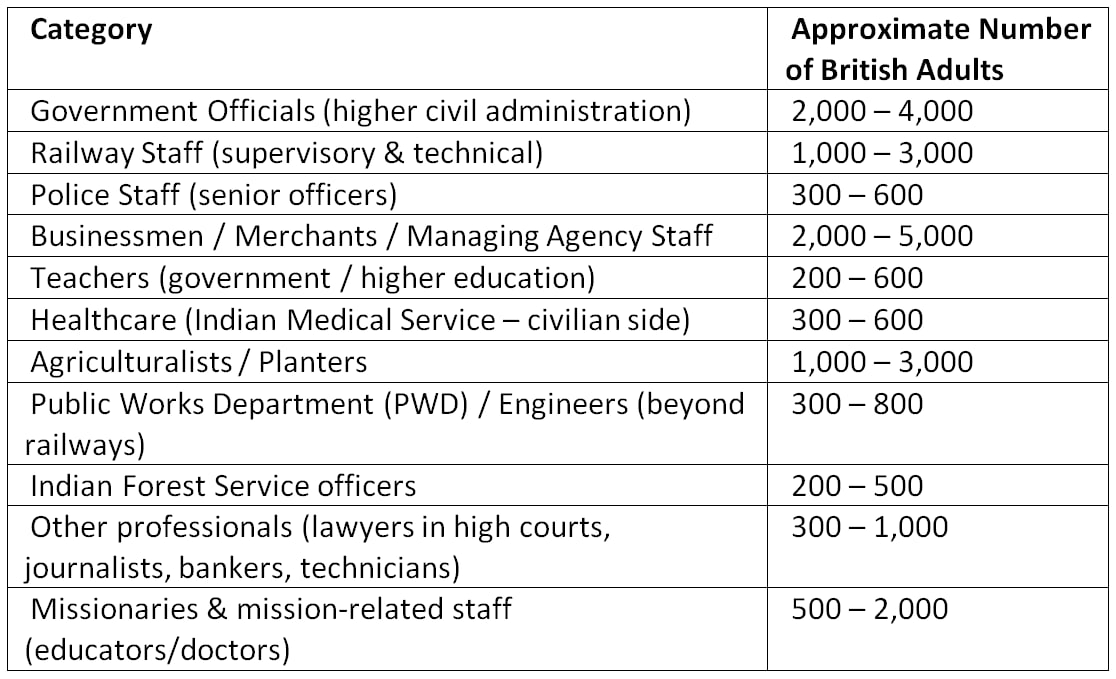
Low end total: 8,100
High end total: 21,100
Approximate midpoint (realistic overall): 14,600.
This represents the narrow core of British adults across all the listed categories (government officials, railway, police, businessmen, teachers, healthcare, planters, PWD engineers, forest service, other professionals, and missionaries) around 1921. : Quoting Grok AI.
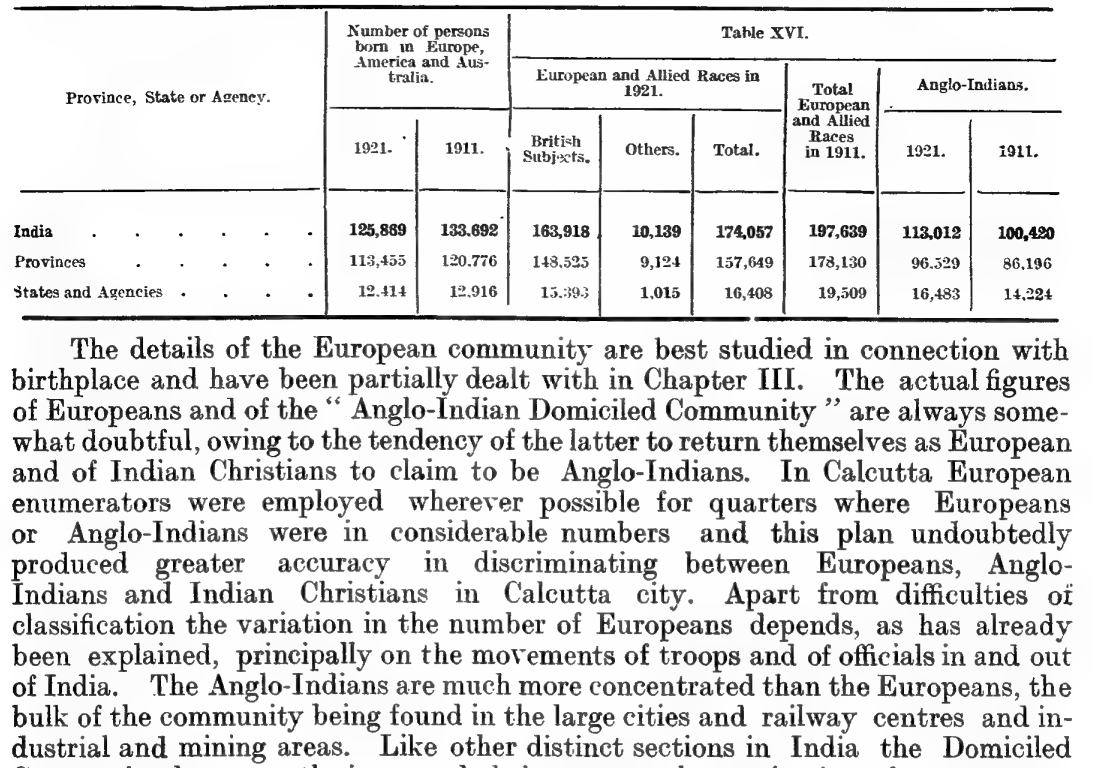
See this news report: The Federal — Kerala labourer story — a Kerala labourer transformed into a stylish model simply by wearing designer clothes.
The core issue, however, is that although they may look changed on the outside, their inner mindset often remains largely untouched.
This is exactly what has happened to formal education in the new India. In the days of the original India, education was closely connected to filling the mind with English classics and English standards of behaviour.
Today’s modern education has almost nothing to do with that. Formally educated people may wear modern garments, but their minds contain hardly a trace of those old educational standards.
Now, I must connect the elephant incident to what may be in store for the native-English.
In Somerset Maugham’s 'The Moon and Sixpence', there is a character named Captain Nichols.
Consider these words from that book:
“I do not know why Captain Nichols first left England. It was a matter upon which he was reticent, and with persons of his kind a direct question is never very discreet. He hinted at undeserved misfortune, and there is no doubt that he looked upon himself as the victim of injustice. My fancy played with the various forms of fraud and violence, and I agreed with him sympathetically when he remarked that the authorities in the old country were so damned technical. But it was nice to see that any unpleasantness he had endured in his native land had not impaired his ardent patriotism. He frequently declared that England was the finest country in the world, sir...”
The phrase 'damned technical' is particularly telling, and I need to elaborate on it.
86. The World-War Appraisal Dynamic
There is an incident mentioned in the Malabar Manual that is worth noting.
The Zamorin brought charges of corruption and bribery against three officers — Messrs. Stevens, Senior J. Agnew, and Dewan Ayan Aya (a Palghat Brahmin) — accusing them of extorting one lakh of rupees. These officers were prosecuted by His Majesty’s Attorney-General before the Court of King’s Bench in London. The trial began in 1801. They were found guilty by a jury of having received Rs. 85,000 from the Zamorin and of demanding even larger sums.
On 18th June 1804, they were brought up for sentencing. They were jointly ordered to forfeit the Rs. 85,000 they had taken. Mr. Stevens was additionally fined £5,000 and sentenced to two years’ imprisonment. Mr. Agnew, considering his impoverished condition, was spared the fine but given a further two years’ imprisonment. Dewan Ayan Aya, interestingly, escaped punishment.
The Principal Collector later communicated the outcome to the Zamorin in these words:
“You will have it perused to you with attention, and I have no doubt be fully satisfied that the principles upon which the English wish to govern their subjects in India are founded upon truth and justice, and are particularly sensitive of the comforts and happiness of the natives of India.”
In South Asian kingdoms, governance largely operated through bribes and extortion — a fact also recorded in the Travancore State Manual. Yet here the Zamorin was being lectured about British “truth and justice.” This is the dangerous “technicality” of the English legal system.
When an Englishman had to work among local bigshots in South Asia, he was often forced to participate in the local codes of homage. It was not always simple bribery, but a matter of honouring those who held real power. Even Robert Clive had to swim with this tide at times. Living and working inside a South Asian language environment tends to pull a person into that same social and mental framework.
In contrast, England stood for unassailable legal standards with little room for compromise. This is a fine principle when everyone involved is native-English. But when the same standards are applied in a social system full of invisible, oscillating verbal codes that can trigger mental trauma and terror, these “technical” rules can slowly become a source of pain for the native-English themselves. The change is slow and oceanic — hardly visible at first, but very real.
The elephant incident illustrates this perfectly. The elephants saw the lower castes and bonded labourers on the agricultural lands as helpless, insignificant beings with no possibility of supremacy. But once these “puny slaves” were equipped with English, modern tools, skills, weaponry, education, and new spiritual frameworks, they transformed into beings with near-supernatural capabilities.
The elephants could not see or sense these invisible forces with their own senses. Yet those unseen forces led to their trapping, maiming, enslavement, and death in the years that followed.
The same pattern can be seen when non-English people enter the English social system. When they come in small numbers and dissolve into it, the danger is limited. But as their numbers grow, small cells of two or more individuals speaking the same feudal language begin to form within every institution. Thanks to digital communication, a Malayalam-speaking nurse and a Malayalam-speaking doctor in England can maintain an entirely different social and mental world between themselves every time they speak in their own language.
They may enjoy a near-paradise social ambience inside England, but they unconsciously entrap everyone around them inside their own eerie communication world.
I will explain what this “eerie communication world” really is in my next post — it is something deeper than what I have mentioned so far.
The invisible strings that gradually attach themselves to the native-English are like legal strings — sticky, twining, and enwrapping. England refuses to compromise on its legal standards. But does it truly understand what it is doing when large numbers of non-native-English people become part of the system?
These non-English individuals live, think, and imagine in a world where almost all English concepts of human rights, justice, altruism, natural rights, sympathy, and standards are skewed.
These English words exist in their languages, but they do not carry the same meaning. In English, these concepts are relatively standalone and cannot be easily tilted or throttled by indicant verbal codes — because such codes do not exist in English.
In feudal languages, however, every such word can be reshaped by the verbal level used. The right to expression and opinion, for instance, is not something that can be freely granted to everyone.
An opinion can be framed in the lowest, most provocative indicant codes or in the highest, most adoring ones that turn a person into a virtual demigod.
Extending English legal frameworks, standards, and statutes to people who think and speak in feudal languages carries the same hidden danger that the elephants faced when seemingly feeble beings suddenly acquired modern technical power.
The native-English will slowly find themselves caught in huge legal traps for actions that, in the feudal language world, are considered trivial or normal.
The very idea of “English racism” is largely nonsense. No one flees England because of English racism.
In fact, many people are drawn to England precisely to experience the numinous feeling of being racially detached by the English.
What truly hurts is not the racial distance itself, but the threat of being removed from it — being told to go back to one’s homeland and lose the chance to experience that unique English detachment.
87. Spectators and the Fight They Trigger
I have tried to portray the South Asian feudal language communication hierarchy using the <strong>Inhi👇 - Ingal👆</strong> ladder codes. I have found it a very convenient technical phrase to convey the concept in a simple manner. However, it took me many years to conceptualise this ladder framework.
In fact, I have used various combinations and permutations in English words so that a native-English speaker can visualise the idea.
Yet the fact remains that this simple portrayal of South Asian communication hierarchy cannot fully illustrate what a person living inside this system actually experiences. The main deficiency is that there are no words in English that are even remotely similar in content or effect to what exists in South Asian languages.
There are so many words which, if imagined as physical objects, can be seen to have various props attached to them — barbs, holes, strings, magnetic attraction and repulsion, and even the power to create an upward or downward slant on other words and verbal sounds.
The same word can be experienced in drastically different shapes and forms depending on who is speaking it and to whom.
For instance, the word ‘eda’ and its female form ‘edi’. There is no way to convey what these words really mean in English, because there are no human relationships in English that can accommodate them.
These words, when used to an adoring subordinate, take on a completely different physical and emotional form from when they are used by a policeman to a common man, a boss to a worker, or by an antagonist.
Even if a native-Englishman feels there are words in English that convey different emotions depending on context, it is not the same.
I will not continue on that here. Let me return to what I mentioned in my last post: the <strong>eerie communication world</strong>.
For the purpose of detailing this idea, I will use words from Malayalam, not from Malabari, Hindi, Tamil, or others. My proficiency in Hindi and Tamil is very rudimentary.
The Inhi👇 - Ingal👆 ladders exist everywhere — in social, familial, and work settings in Malayalam.
Take a social picture. There is a high-level family and various levels of lower-level families. Even if the Inhi👇 - Ingal👆 ladder words are not always spoken, this hierarchy exists invisibly everywhere.
The persons in the top slots are still connected to each other by various other words such as elder brother, younger brother, elder sister, younger sister, aunt, uncle, and so on. These words are not always used to denote actual family relationships, but rather subordination or supremacy in all kinds of human relationships — even among persons on the same ladder slot.
Higher “he”, lower “he”, and similar words also exist. I will not mention their actual sounds here, for it might be dangerous for an Englishman to understand them.
I am sure such words are used abundantly about native-English persons by feudal-language-speaking immigrants in England. Understanding them would create emotions in Englishmen and women that are not English.
Elder brother is <em>chettan</em> in Malayalam. Elder sister is <em>chechi</em>. In Malabari the words have slightly different sounds.
In the families in the top slots, the individuals are immutably strung together in a web-like connection through these words and many others.
These words powerfully define each person’s attributes, including their rights of articulation, permission to sit or stand in the presence of others in the same slot, precedence, gestures, postures, and so on.
This kind of web-string relationship exists at every step of the <strong>Inhi👇 - Ingal👆</strong> ladder in the social setup.
A person in each step is thus terrifically tied down to many other persons in the same ladder step by these words.
So a person is not held in place only by the <strong>Inhi👇 - Ingal👆</strong> hierarchy. He or she is also held by sort of elastic strings attached to <em>chettan</em>, <em>chechi</em>, and such other words. Inside each slot, each person keeps the others in strings that pull them down as well as pull them up to their own Inhi👇 - Ingal👆 ladder slot.
That means, inside each slot itself, there is terrific competitiveness. I should not give the impression that persons in any slot are always unhappy about this. That is not true. I will take that up later.
If an English person were to work in a Malayalam-speaking work environment and learn to understand Malayalam, what happens is not merely being positioned on a specific Inhi👇 - Ingal👆 ladder step.
Instead, he or she will spontaneously be snared into the <em>chettan</em>, <em>chechi</em>, <em>eda</em>, <em>edi</em>, higher “him”, lower “him”, higher “she”, lower “she”, <em>ammayi</em> (aunty), <em>ammavan</em> (uncle), <em>Saar</em> (higher “he/you”), <em>Nee</em>, etc. word web.
He or she will literally be controlled by this web. The strings become very powerful once the language is understood and spoken. . He or she cannot ignore the hierarchy words once Malayalam can be spoken, inside the slot he is placed in.
Many years ago (around 30 years back), when I used to communicate with local officialdom, I would speak in English. Some officials did speak English. But very quickly the other officials would get to know what was happening — that I was standing outside the verbal hierarchy.
Suddenly one fine morning, the very same official who was good in English would claim that he no longer understood English. In fact, he would go into a charade.
What had happened was a conspiracy inside the office. They had decided not to speak in English.
For when I was forced to speak in Malayalam, I was forced to use words of servility. There are no words of self-respect and dignity that can be used when speaking with the Malayalam officialdom, unless one displays powerful social props.
The issue is that all persons who have come through the local vernacular education system are used to this and find it totally normal.
The same is true for persons in various steps of the <strong>Inhi👇 - Ingal👆</strong> ladder. If they are at home in their slot, they are not unhappy about it.
The only person who can become terrifically annoyed — to the level of going berserk — is someone who finds himself or herself suddenly forced into a lower slot by some cataclysmic life event.
The others usually enjoy seeing a person from a higher slot fall into their own.
Words can become claws and turn carnivorous.
88. The Power of the Lower-Class Witness
In South Asian languages, subordination to anyone can be either a happy state of affairs or its total opposite.
It depends on the level of subordination one is placed in. If it is at a level equal to one’s innate position on the Inhi👇-Ingal👆 ladder, there need be no emotional change.
If the subordination is to a higher level, it becomes a state of lingering intoxication.
If the subordination is to a lower level, it becomes a state of continual mental uproar.
The only way to assuage this mental trauma is through insubordination.
The people who escape to England are generally those who have already collected a lot of money. Once this is achieved, the experience of relocating to England is akin to the saying: it is better to serve in heaven than to reign in hell.
One of the enduring social terrors in South Asian languages is that the lower-placed persons are very dangerous. Associating with them always has to be done with carefully placed human and verbal shields.
A certain height has to be maintained when dealing with lower-placed persons. This can be achieved by setting up more than one layer of human levels between them and oneself.
On relocating to England, to a place where everyone speaks only English, a number of mental experiences become available.
One is the spontaneous vanishing of the virtual reality of various layers of human beings as encoded in the language. One can now speak and associate with any working-class person without searching for appropriate verbal shields or subordinate human layers.
The <em>chettan</em>, <em>chechi</em>, <em>eda</em>, <em>edi</em>, higher “you”, lower “you”, higher “him/her”, lower “him/her”, and all such clasping and muffling strings simply vanish.
The concept of human heights and lowliness encoded in the verbal codes also ceases to exist.
The mental experience is one of absolute freedom — almost supernatural freedom.
But there is the other side of the experience. What is the experience of the native-English who see their once-simple social ambience being filled with some kind of incomprehensible social restructuring? It would be Delphic — to use an exotic word to describe the effect.
When the native-English were in South Asia during the period of English management, what they generally experienced was a supreme kind of mental composure. For they were generally placed at the top of the verbal codes. From that peaceful location, they could go about their work and engagements with great efficiency and very little distraction.
The local natives in South Asia could not experience this. They existed in various oscillating verbal pushes and pulls, which could arrive without any warning.
But in current-day England, the emerging situation is that immigrants from all around the globe are arriving to enjoy a supernatural level of mental peace and composure. At the same time, the native-English are slowly losing their own mental composure as they feel invisible strings hugging onto their personality and emotional equilibrium.
It would be appropriate to mention the great difference between the working class in South Asia and that in England.
In England, the working class exists on a single planar level of verbal codes. Associating with them or conversing with them without any pre-set verbal and human shields is not dangerous.
In South Asia, the working class exists in varying layers of verbal levels. Associating with them without exhibiting very tangible human and verbal height can be dangerous for persons who exist on a relatively higher level.
89. Protecting Children from Pejorative Words
As mentioned earlier, England can be unique due to the strange planar nature of its language. This idea may have connections to a lot of historical events, including the explosive sprouting of science and its close associate - technology. It was in England that these things spread out through the deeds of the common man.
In all other social systems, these things will expand only within rigid social corridors. Persia and South Asia will come out with tall claims, but the fact is that in all such social systems, the expansion of science would be like what is happening in China.
Technology and science came into the purview of the common folks only when it sprouted in England.
In South Asia, both English and Sanskrit came to be possessed by the higher classes. Both are egalitarian languages.
When thinking about why one cannot see any highly developed civilisations all around the endless universe, what has to be kept in mind is that such civilisational development comes only when the local language is similar to English in at least one location therein.
Otherwise, what is dug up as grand creations of the past would be what has been created on a platform of non-statutory slave labour.
See this quote from Native life in Travancore: When looking with admiration at the noble examples of Indian architecture and engineering — temples, forts, public buildings — the first thought that sometimes occurs to us is of the vast amount of misery and expenditure of human life imposed on the multitudes, as in Egypt, who did the unskilled labour.
Check what came out of Grok AI when I went on pressing hard for information on the life condition of the common workers in China. At first, Grok AI tried to avoid a direct answer by mentioning pay, housing &c. But when I insisted on the actual difference of life experience between a working class person in England and China, this is what emerged:
<strong>Social dignity</strong> and the <strong>right to speak with superiors</strong> (bosses, government officials, and police) with full self-respect is one of the clearest differences between ordinary life in China and in England (the UK).
### Concept of Dignity in China In Chinese culture, dignity is closely tied to <strong>"face" (mianzi)</strong> — social standing, reputation, and maintaining harmony. Respect flows vertically according to status, age, position, and authority. People show deference to superiors through polite language, indirect criticism, titles, and avoiding public confrontation. This preserves everyone's face and social order.
Dignity here is not primarily an <strong>individual, equal right</strong> to speak boldly or challenge authority as an equal. Instead, it is maintained through proper conduct within a hierarchical framework: subordinates show respect, and superiors are expected to act with benevolence or fairness. Everyone can have personal dignity, but it is expressed differently depending on one's role. Openly contradicting or arguing with a superior in public often risks causing the superior to "lose face," which can damage relationships and one's own position.
### Interactions with Work Bosses In most Chinese workplaces, the culture remains <strong>hierarchical</strong>. Ordinary employees are expected to defer to bosses, use respectful language, and avoid direct public disagreement. Junior staff often wait for seniors to speak first in meetings. Challenging a boss assertively (especially in front of others) can be seen as disrespectful or disruptive to harmony, potentially harming career prospects or group dynamics.
Self-respect is preserved by being diligent, loyal, and handling disagreements privately or indirectly. Some modern companies (especially foreign-influenced or tech firms with younger staff) have flatter styles, but the default norm is still vertical rather than egalitarian. This contrasts sharply with England, where workplace communication is generally more casual, direct, and rights-based — workers can more freely question decisions, unionize, or speak as near-equals without heavy deference to status.
I will continue this quote from Grok AI in my next post.
90. The Right to Education and Its Damage
### Interactions with Officials and Government Bureaucrats Interactions with officialdom are formal and deferential. Ordinary citizens approach government offices or officials with respect (displaying servility) for their authority and position. Pushing back too strongly or making demands in an entitled way can be risky, as the system is top-down and bureaucratic.
While people can voice specific complaints (e.g., about local services or grievances) through proper channels or petitions, assertive or confrontational speech — especially if it questions broader policies or the system — often leads to caution or self-censorship. The political structure reinforces authority, so "speaking with dignity" tends to mean polite persistence within boundaries rather than equal-footed debate.
### Interactions with Police For routine matters, police interactions with ordinary compliant citizens are usually professional. However, the relationship is inherently unequal: police represent state authority. Ordinary people are generally cautious and deferential to avoid escalation.
If a situation involves suspicion, disagreement, or anything perceived as challenging authority, the power imbalance becomes clear. Self-respect exists in behaving calmly and correctly, but there is less room for the kind of rights-asserting dialogue common in the UK (e.g., "I know my rights" style). Laws emphasize police dignity and authority, and citizens are expected to cooperate. Public criticism of police or broader authority carries risks of repercussions, including charges like "picking quarrels and provoking trouble" in sensitive cases.
### Comparison to England (UK) In England, social communication is far more <strong>egalitarian</strong> in tone. People — including ordinary workers — expect to address bosses, officials, and police with directness and mutual respect as fellow citizens. There is stronger emphasis on individual rights, free speech in daily contexts, and flatter hierarchies. Questioning authority politely or asserting one's viewpoint is normal and protected in most non-criminal situations. "Dignity" and "self-respect" are tied more to personal autonomy and equality before the law than to hierarchical harmony.
In China, ordinary people can maintain personal dignity through moral conduct, hard work, and proper etiquette, and many report feeling respected in daily non-political life. However, the right to speak freely and assertively with superiors (especially on contentious matters) is more limited by cultural norms <strong>and</strong> the political system. Self-censorship is common to avoid trouble, particularly online or in public. The constitution mentions personal dignity, but in practice, political expression and open challenge to authority face significant constraints.
In short: Ordinary Chinese people have social dignity rooted in hierarchy, face, and harmony, allowing respectful communication within expected roles. But they do <strong>not</strong> enjoy the same broad, egalitarian right to speak with superiors (bosses, officials, police) as equals with full self-assertion and low risk, as is more common in England. The framework prioritizes social order and authority over individual expressive equality.
This stems from deep cultural traditions reinforced by the current governance model. Many Chinese accept or value the emphasis on stability and respect for roles, while others (especially younger or more educated urbanites) sometimes express frustration with the constraints in private.
Please note that Gork AI has not mentioned anything about the codes in language which actually control and design everything.
Please note that the word 'respect' actually means expressing servility. Also, please note that there might not be any statutory rights to equality in England. It is there in India. And possibly in China also. Everything topsy-turvy
Only when in an earth-like planet a nation like England is created, would science sprout beyond the social corridors and confines. But then, when such development is handed over on a silver platter to evil social systems, what develops are satanic social systems. Very dangerous.
91. The Native-English Child Pulled Downward
Now, I am going to ponder in words on what would happen to England when extremely contrary social and communication cultures spread and diffuse into England.
My thoughts are from afar. And the method I use can be akin to remote sensing spectral analysis.
There is indeed a pathway to redemption for England. I will need more time and words to mention that item.
In retrospect, it is very easy to understand that England was a very foolish nation, and the native-English more or less of the same timbre. Naïve and gullible.
Everywhere the English went, they were hellbent on improving those around them. This mental attribute is actually encoded in the English language.
Whatever technology and technical skills they had were shared by them even with their servants in so many outlandish locations.
There is a saying in Malayalam: ശുദ്ധൻ ദുഷ്ടൻ്റെ ഫലം ചെയ്യും. There is no equivalent saying or proverb in English, I could find.
In literal words, it means that a straightforward person will have the same effect as that of an evil person. In more words, I can say that the deeds of a straightforward person is more or less the same as the deeds of an evil person. Same harm.
Grok AI gave me these English equivalent to this Malayalam maxim: 1. The road to hell is paved with good intentions. 2. Hell is full of good meanings and wishes.
In South Asia, very few persons will be willing to share their knowledge and skills with anyone, much less to lower class persons.
I have seen carpenters of old times, taking care to see that their apprentices do not see how they do certain technical tricks. They simply tell the boy to go and sharpen the chisel while they accomplish the trick.
I think there is no information in England that the greatest technical tool that they gave to all and sundry was the English language.
I think that in the English management period in parts of South Asia, there were some cautions mentioned in England that it is bad and foolish to teach English to the South Asians, both of India and of the neighbouring kingdoms.
English is a technical gadget which would very easily beat any and every technical tool discovered by human beings everywhere; even digital devices and software apps and bots.
For instance, if the Google office in India were to be made to speak only in Hindi or Tamil or Malayalam, every human relationship inside the office would go into disarray. Huge vertical and horizontal walls and distances would simply burst into the scene between each and every human being in the work system.
I have to put a rein on my words here. Let me go back to what is happening inside England with the definite diffusion of non- English communication systems creeping into every crevice in human relationships.
Since I do not know Continental European languages, I cannot say for sure the disarray design they would create inside English human relationships. I am sure they would do that. But then each language has its own human relationship design.
French might have a design that is different from that in German, Italian and Spanish.
Speaking about South Asian languages, some of them like Malayalam are superbly dangerous. In fact, Hindi is much more softer in this regard than Malayalam. Tamil is super disastrous. But then, Tamil also would have to stand behind Malayalam in its evilness.
Around 2000 or so, along with my wife and first daughter, I had visited a so-called Hindu spiritual centre near Trivandrum. This place has a lot of white-skinned visitors, mostly from East European nations, I think.
There in the early night hours, my daughter (then aged around four) befriended a British woman. She had with her a daughter of early teenage age and a son of younger age.
The boy was very obviously in a distressed and offensive mood, while the other two persons were in clearly jovial mood. Why the boy was offended and appeared to be in a sharp racist mood seemed to be beyond the imagination of his parent and sister.
He surely would have had to bear an invisible onslaught from the local people around him. To put it in very careful words, it is simply that the Malayalam word forms tumble upside-down as the age of the person involved plummets.
The mother would be a higher she. The young daughter would still be on the medium She level. But the younger son would tumult down as if he is falling into a canyon. The word for he, his, his and him would roll as in an old petrol pump scale. And he would experience the sudden flipping of his personality and standards of dignity into a void which is not there in English.
In this location, men and women would look at him with another kind of eyes. They would beckon him with a comical expression in their eyes, as if dealing with a dumb idiot.
It is at this juncture that I might need to speak of the old time District collectors and other officers of the English East India Company. Many of them were of adolescent age. There is even a mention of a Sir John Keane cited in historical accounts as being commissioned as an ensign in the Bombay Army at age 11.
Is this possible?
Well, I have seen it possible. I will continue in my next post.
92. Family Arrangement in English and Feudal
My insights on the power of language had reached a level of certitude which, looking back, borders on the incredible. It is almost impossible to bring up a person in India who knows only English — and that too, an English with all its egalitarian codes kept in an unshakable state.
When my first daughter (Varuna) was born, this was exactly what I tried to do. I have already mentioned the details earlier.
What I observed in her was remarkable. She could talk with anyone who knew English without any need to cross-check with the servility-versus-dominance verbal codes of the local vernacular. Since she did not know the local language at all, the others who spoke with her also did not go into any kind of terror.
If a younger person knows both the local feudal vernacular and English, two different mental standards emerge.
One is the standard of perfect communication freedom. The other is the standard of verbal heights and lowliness. These two mindsets constantly interfere with each other.
When speaking in English, he or she experiences a freedom that can be offensive in the vernacular. When speaking in the vernacular, a feeling arises that he or she could actually go beyond the confines of the language restrictions if only the conversation could shift back to English.
There is another connected effect. When this person speaks in English, he or she still feels that they are not as high-calibre a person as they appear to be in English. The moment the conversation shifts to the vernacular, the other dominant person can crush this effusive personality enhancement with a single “lowest you” word.
Immediately, the “You” used in English by the younger person to a senior has to be changed to the Higher “You”. There is no other option.
This constant certitude of an imminent lowering of dignity keeps the person’s English-language personality on an unsteady platform.
In Varuna’s case, she had no information about any of this. And because of that, the others who communicated with her were also secure.
For if a person who is good in both languages is allowed the freedom of address and reference that English permits, there is no guarantee that he or she will not try to use the same freedom in the vernacular.
This is a very critical point regarding the teaching of English in nations like India. English gives a communication freedom that cannot be allowed in the vernacular.
Since Varuna watched only English movies and songs, and read only English books, she used first-name communication with familiar persons who spoke to her in English.
I took care to ensure that no one insisted on <em>chettan</em>, <em>chechi</em>, uncle, anti (aunty), and such name suffixes. She was on first-name terms even with the local doctor’s wife, who incidentally was not from Kerala, spoke good English, and knew Malayalam.
What I observed was that Varuna was not inside the <em>chechi</em>, <em>chettan</em>, uncle (<em>ammavan</em>), aunty (<em>ammayi</em>), Inhi, higher he, higher she, lower he, lower she, and other Malayalam verbal slots and connections.
It is here that I must mention my next observation. People who knew her did not treat her as superior or inferior, but rather as a person from another realm of human existence.
At around nine years old, before she was admitted to school, I saw her teaching others computer skills. There was even a Computer Science BSc student who approached her to learn Adobe Photoshop and several other software programs. Most of them Varuna had learned on her own.
In those days, there was a common feeling that computers were beyond the learning capability of ordinary human intelligence. But I was sure that it was one of the easiest skills to acquire.
A few years later, one day Varuna and I visited a local English public school along with some others. A young teacher approached Varuna with extreme friendliness and said, “Varuna, do you remember me? You taught me Photoshop.” That person had become the computer teacher in that school.
At that time, Varuna was studying in Class Nine in another local public school.
I had observed that the moment she was admitted to school in Class Five, her personality had gone down slightly, even though it still remained quite different from the others. She had been placed on verbal equality with students who occupied lower verbal slots in the language. It is a relative experience. She was equal to them, but not equal to many others, and subordinated in words to some in the vernacular.
Even though she did not learn Malayalam, I could observe a certain personality degradation. My stance throughout all these events was that of an observer studying the effects of language codes.
I will now take the theme back to the young English boys who were recruited as officers in the English East India Company service. What kept them apart was not actually their white skin colour. It was simply that they stood above, unfettered from the local <em>chettan</em>, <em>chechi</em>, and other verbal strings.
These clasping strings hold each person inside a specific social slot or verbal ladder.
Even now in India, this freedom from such fetters can be experienced by anyone who holds a positional senior rank. For instance, a young Commissioned Officer in the Indian Army. He may be young in age, but the clasping strings that hold lower-rung persons in their places do not affect him, so long as the Indian government and army remain strong. He can comfortably use the <em>Thoo</em> (lowest “you”) words on subordinate senior-aged soldiers.
The same holds true for any senior position in a work environment. As long as the system remains strong, even a young senior remains senior in verbal codes.
In previous centuries, young children of landlords or superior castes/classes routinely used Inhi, Nee, Thoo words to much older lower-caste/class persons. This gave them a mental superiority over higher-aged but lower-placed individuals.
However, in their own households and among people of the same caste, their personality and verbal power would roll back into the pits.
This is a phenomenon that was never experienced by the young officers of the English East India Company. Among their own people, there was no scope for their personality and right to dignity to collapse into verbal cesspools. For such verbal cesspools do not exist in English.
93. The Son-in-Law Who Precedes the Daughter
What Grok AI said:
English is atypical in Europe for its fully merged "you." The T-V distinction is a "European" areal feature in many families.
Closest relatives like Dutch and German (and West Frisian) retain strong distinctions (jij/u, du/Sie). Irish lacks it but is not Continental.
For "planar"/plain features overall, Scandinavian languages (especially Swedish/Norwegian) stand out as the nearest Continental matches to English in pronoun simplicity and everyday egalitarianism.
English, Irish, and some Scandinavian languages are "planar" (flat) in this regard, while most Continental European languages maintain the T-V social layering.
The T-V distinction is a linguistic feature in many languages where there are two (or more) different ways to say "you," typically to signal levels of formality, familiarity, politeness, social distance, age, or power dynamics.
Origin of the Name: It comes from the Latin pronouns:T = Tu (singular, informal/familiar "you") V = Vos (originally plural "you," later also used as a polite/formal singular)
I will leave the above item for now.
Let me continue on to a very slender item. I do not know if I will be able to convey the idea.
First I need to declare that human beings are not one species from the perspective of their core software location. Let me leave that also.
I will go back to the event of us going to a so-called Hindu ashram in Quilon district (north of Trivandrum district) way back in the year c2000.
In that ashram, there were a lot of East European men and women. They were given a very obvious higher social platform. They were given chairs / seats to sit down. They had their own canteen.
The Indian peoples sat generally on the floor. I think the local language added the appendage of this being part of their servility to god action.
In those days, Varuna had not yet joined formal schooling. She looked around and walked into the White person's canteen and ate from there. And from there befriended the British woman and children.
There was no formal indication that only white persons should enter. And the British family also had an Indian woman with them; their local associate I think.
When I looked at the Indian folks sitting on the floor, I also understood that I do not belong to their group. For, we spoke in English. They spoke in Malayalam.
From this mindset, I should walk into the white persons' canteen. I do not think that it would have created a consternation in itself. But then, I understand that there were secret instructions given to the ashram staff to discourage such an intrusive behaviour.
For, the ashram did not want to be used as a free platform for the local Indians to get acquainted to white persons, who the ashram had brought in spending much money and effort.
There is another issue with me entering the white canteen. I would act as a pioneer scout for the other Indians who were sitting on the floor.
There are words in English to describe this phenomenon. I collected them from Grok AI:
Beachhead : the strategic first entry that opens the way for expansion. Thin end of the wedge or camel's nose (under the tent): Idioms for a small initial concession or entry that leads to much larger unwanted intrusion. Chain migration" is the closest direct match for the group-following dynamic, especially in social science contexts.
These are things very much known in India. But then not many would attempt such an intrusion. There are huge verbal walls and distances that will make the entry more or less totally impossible.
It is like a very slender cabin door in a government office having a board. IAS. No common man would dare to enter.
In my college days in Trivandrum, there were various higher caste meeting places. Like this Nambhuthiri, that Nambhuthiri &c. or even Nair. No other population will enter the location. They will feel the repulsion in words and facial demeanour. And there is no attraction in entering such places. For, to the outsiders they are drab rooms.
But the lower caste Ezhavas had similar places which were open to all and even inviting. But higher castes will keep a very studied distances from such welcomes.
But in English there are no such verbal barriers. Everyone would find it quite easy to enter unless very strong No entry - boards are seen.
English locations are attractive because of the unfettering of mental shackles that would perch on the mind.
See this video from the US of 1950:
The whites seen in the video can actually be of various continental European ancestry. But they have converted into English. Obviously they have changed.
Just see similar continental European videos of those times. Surely they would be different in mental and physical attributes from the same continental European whites who have converted to English in the US.
It may be remembered that the videos are not natural scenes, but rather what has been created for some film or other video event.
Italian. But looks similar to certain modern Malayalam song scenes.
I should say that I was not able to find any song video similar to the US of 1950s song video I had given above, from a cursory search via Gork AI as well as Youtube.
The Italians could have changed in the US as they converted into English.
The converted into English whites of Continental Europeans can bear each other in the US, while in continental Europe, their languages would keep some anger and separation alive.
The same would be true about the Blacks of Africa. They are not one people. They are various peoples who traditionally do not like each other.
But in the US when they convert into English, they can bear many other blacks.
Actually the whites in the US are not the same at the native-English. In fact, in the full ambit of the mental and social freedom they acquire in the US, they might go beyond the confines of what the native-English do have. Theirs is a mental state of being unfettered.
Every non-English population in the US can get to feel an exotic kind of liberation very near to that of disinhibition.
At this juncture, I would like to put in some words on certain parameters of racism. How racism should be redesigned.
94. Continental Europeans in the USA
When continental Europeans relocate to the USA, they change as soon as they convert into English. But still there can be clash of language structures.
All human relationships convert into a planar form in pristine-English.
But then, the various kinds of curves and twirls that each continental European language do insert into human relationships would take time to get wiped out.
Irish has been mentioned in my last post as devoid of the T-V distinction of continental European languages. But then this I think is a very recent development in the Irish language, probably due to the powerful pressure of English.
I do not know if anyone really is at home in Irish anymore. The chances are very little.
There is the case of Rosemary Kennedy. Irish ancestry.
Hers is the most famous case of lobotomy.
What her family records as her intellectual disability, can be disputable. In fact, this case came to my view many years ago when I was seeking instances of clashes between non-English European language cultures and the all engulfing English in the US.
What emerges in the USA is not actually English, but a outrageous and explosive unfettering of social and familial control and fetters. This is not actually English, but something different and beyond English.
Social Defiance: Unlike her reserved sisters, she was lively, flirtatious, and enjoyed sneaking out at night to attend dances or meet young men.
Family Reputation: Her father, Joseph P. Kennedy Sr., was fiercely building a political dynasty. He feared that her unpredictable nature, lack of inhibition, and interest in men could lead to a scandal (like an out-of-wedlock pregnancy) that would ruin his sons' political futures.
In the US, the continental Europeans would very fast look quite similar to the English. For they all bear a common skin colour. But then it may take years and maybe generations to wipe out their continental European facial expressions. And even their social interactions among themselves will contain powerful strings of their own language.
The same might be true about the blacks of Africa.
In the last years of 1980s, I spoke to one very tall, huge young black man in another state. He was obviously from very rich background, studying in India. I mentioned that I do know another person of his race, nearby.
He literally exploded into fury. He spoke with total distaste and mentioned that the mentioned-person was not of his race. He spoke of that person's race with full unconcealed distaste.
Actually the same might happen in England if a higher caste Indian man is told that another lower caste Indian man is of his ethnicity.
In the US, the blacks also change. The most changed-into-English blacks might be the descendants of the erstwhile slaves of USA. Especially those among them who are regular goers to English Christian churches.
And the most non-changed-into-English blacks will be those who have swarmed into the US in recent years via various means.
In fact, between these two sections of blacks there can be huge social, cultural and verbal-string differences.
Their very facial demeanour would be different.
But both would be quite different in looks from the native-English, and also from the continental Europeans who have domiciled in the USA.
The issue here is that it would be quite difficult to differentiate the native-English in the USA from the continental Europeans who have made the US their native land.
Allowing integration of blacks into the white social areas is an item that needs terrific information in social engineering, in close connection with the power of language codes.
Most of the blacks do look quite different from the whites. To see this there is no need for any great insight or knowledge. Any child can see it. And what about adults? They can also see it very easily. But they may not be to mention this openly.
But can any child very easily see that the native-English are different from the whites of continental Europe? I do not think so. Unless that child has some extraordinary perception capability.
Over here in Malabar, there are many Hindi and Bengali migrant workers. And even from the north-east. The local social media is full of antipathic repulsive words about all migrant workers.
If these workers enter into the local social circles, there will be rampant antipathy towards them. However some do diffuse in using typical Indian charm and effusive words of friendship.
But still they will be hated in most places. Still they are Indians, even though ethnicity might be varied.
When extrapolating this situation to the US, it is a wonder that the blacks are allowed into the white social areas. They look so different.
But then, they also come in with a lot of variety. But those with huge physical frame and muscles are totally different. It is only the presence of the soft-natured English language that allows their presence to be less irksome and non-violent.
This much is very obvious.
There is the other unobvious item also. That the continental Europeans are not native-English, even though like the blacks they also are in the process of becoming English speakers, who use English verbal politeness.
Most words of politeness in English are not there in many other languages.
The social error that led to the presence of 'racism' in the US can be traced to the creation of the US. This led to the swarming in of continental Europeans into the new nation. All of them slowly converted into English.
Then came the letting loose of the black slaves also into the same social system. Here the issue was that no amount of wiping out of physical feature differences would scrub out the huge muscles, the terrific black skin complexion and such other things.
What the native-English brings into the social system spontaneously is a wealth of resources which cannot be found or created in other languages.
Starting from the more than 500 rhymes, songs, nonsense jingles, and lullabies from the English tradition.
What is so great about them? Are there not the same in other languages also?
Yes, they are there even in Malayalam. But they define human personality differently. Baby talk words and nuances are assigned to the children in languages where a child is an Inhi👇 and an adult is an Ingal👆.
In the written words' tradition, the English classics can standout from this very background.
Earlier periods in English history cannot be understood even through such contrived writings such as the Pilgrim's Progress. There will definitely be a natural English history that is not there in any written record.
Coming back to the racism question, it would have been okay if the English element in the US were to stand apart from the continental Europeans. Then there can be two different social sections: one for the continental Europeans and the other for the blacks - both converted into various levels of English.
So generally one separate area for the English, one for the continental Europeans and the Celtic folks; another for the blacks; one for the others; yet another for those of mixed bloodline. So generally one separate area for the English, one for the continental Europeans and the Celtic folks; another for the blacks; one for the others; yet another for those of mixed bloodline.
An English beach, a continental European beach, a black beach, an Indian beach &c. and vast beach areas where everyone can enter. And then a vast location where everyone can mingle as much as they can.
However, alas, this cannot be created as of now. Too late to undo the social structuring.
But if there is any scope to create a social structure right from scratch with perfect social engineering, this the basic platform that I should recommend.
Please note that I have mentioned native-English. Not Britain or British monarchy or nobility or any other such things of doubtful English ancestry.
If the native-English are seen as apart and different from the continental Europeans, then the others including the blacks and the Asians should have no qualms in creating their own social locations, copying the English structure as much as possible.
The core irritating issue would be that of one section alone being allowed to be identified with the native-English.
95. The Godfather Revisited
Now let me ponder from afar on what would change in England when non-English folks fill the local areas.
A few Germans, French, Italians, and others here and there would not create any perceptible change in social functioning. But when they arrive in large numbers, the scenario becomes entirely different.
It would be like the Italians flocking in droves to certain locations in the USA. All the social, official, police, and judicial errors and corruption of Italy would gradually get established in those areas.
It is true that there was a huge desire in Italy to escape to the US. This had to be curtailed by the National Origins Quota System of 1924. I think it was understood that such massive non-English immigration would spoil the English base of the USA.
Since I do not know Italian, I cannot say exactly how that language sets about encrypting errors in the US social sphere. But it has certainly done so.
When I first read <em>The Godfather</em> during my Class Ten days, I was struck by the terrific similarity I found between the Mafia system and local Malayalam systems.
There was nothing in common with the social mood I had found in English classics in that book.
In English classics, the mood and aim were straightforwardness, rectitude, and unwavering moral standards. In <em>The Godfather</em>, it was treachery, backstabbing, and opportunistic behaviour sugar-coated as “respect” and such other things.
When speaking of South Asian languages entering England and running amok there, many things need to be counted in.
When speaking about South Asians, the first thing to mention is that they belong to different languages, mostly with similar but not identical human hierarchies.
The next item is this:
When a group of Englishmen arrive en masse in a location, there will also be work-position-based hierarchies among them. This is not the same as what South Asians arrive with.
In everything about them, there will be an invisible repulsion-versus-adoration hierarchy contained in their languages. This will superimpose itself on everything connected to them.
This is a great difference which has no real correspondence in English. The arrival of such people in huge numbers in England carries this near-supernatural danger to the English social system.
I need time, space, and words to explain the items one by one. But I might wind up this writing soon, as I am increasingly finding a terrific shortage of time.
However, let me try.
When South Asians arrive in England, there are two broad types among them.
One is the group that remains fully at home in their native languages. You can see references to them in the words of current-day South Asians with British citizenship who say, “My father/grandfather arrived here with no money and no English.” That is, persons who arrived carrying real poison in their minds.
Then there is the small percentage that arrived with English in their minds and with deep loyalty to English and England. I will not speak about them here.
The individuals who are fully at home in Hindi, Malayalam, Tamil, etc., are not one uniform population in their virtual design. They are various peoples arranged in a vertical ladder formation — that is, the Inhi👇–Ingal👆 ladder steps.
Some will be from the lowest ladder steps, some from the highest, and the rest in between. None of them will be similar to any native-Englishman or woman.
Some will be lower than an Englishman or woman. Others will be higher. Or at least, none will correspond to any Englishman or woman. This is simply because no Englishman or woman would belong to any Inhi👇–Ingal👆 ladder slot.
To understand this better, consider this road sweeper analogy from South Asia.
A road sweeper exists at the very bottom of the Inhi👇–Ingal👆 ladder. From that position, he looks up at high officials — IAS and IPS officers — as demigods. Every word he uses for them is filled with extreme reverence.
But if, through some quirk of fate or political opportunity, this same road sweeper rises to become a powerful political leader, everything changes.
He now interacts with those same IAS and IPS officers as equals or even superiors. He casually addresses them by name and sometimes even uses the lowest “you” (<em>Nee</em> / <em>Thoo</em>) words. The officers accept it because they see his power.
At this point, the former sweeper realises that the “demigods” he once feared were actually ordinary human beings with limitations. Many of his old road-sweeping colleagues might actually be more capable than these high officers. Their apparent greatness came mainly from sitting atop a huge hierarchical machinery of subordinates. Remove them from that position, and their personal power shrinks dramatically.
This is the kind of mental stature change that can occur in a person from a South Asian feudal-language background when he comes to live in England.
He has imported along with him a virtual design location into England. All English folks are then placed inside this. They get placed in the Inhi👇–Ingal👆 ladder that is built upon his own language. The Englishmen cannot do anything about this.
The scenario is like a female picture being imagined by a male person with erotic intent. The female cannot do anything about this. To protect the female from such activity, her face would have to be blurred.
But in the case of the English folks, no such blurring of face can be accomplished.
Initially, the feudal language speaker sees native-English people as being at the top of the ladder. But as he becomes established, gains influence, or acquires power, he begins to see them as ordinary humans. Slowly, the English start descending in the virtual Inhi👇–Ingal👆 ladder he places them in.
Even though this ladder is virtual, the virtual world designs the material world from behind the scenes.
What has entered England is not a language similar to English, but something terrible and draconian.
96. What My Malayalam Writings Reveal
I have written extensively in the local vernacular on how the local feudal language affects almost everything about the people here. So this writing cannot be described as hate-speech. It reveals the exact mental infection that is affecting everyone in the social system in varied ways.
My writings on the various ways language affects everything here started in 2016. They have crossed, I think, 1000 chapters. The small group of readers I have had on WhatsApp since that time are still there.
However, no one wants to share the posts, because everyone is inside the same poison container. In each word they speak to or refer to others in their family, workplace, and to subordinates and superiors, the same diabolic thought features come into play in a spontaneous manner.
The spontaneity is just like AI.
When feudal language speakers move into English systems, they have a vanguard that moves forward. Behind this ideological front are lined up fabulous philosophies, celestial claims on human equality, grand workmanship, wonderful humane behaviours, superb family systems, high-grade intelligence, and so on.
The problem with my writings is that they dissolve the façade that this outward-pushing cover presents. The stark reality of what is actually coming in is being described in very precise wording. It is here that my writings get converted into hate-speech.
They are designed in most delightful webpages here: English translations of my vernacular writings
Over here in India, my vernacular writings are actually high-tech social diagnosis.
I will not attempt to reproduce the huge contents here. What I wrote in Malayalam has been translated into English by Grok AI. There are various deficiencies in the translation, but they have still arrived in English. I never expected this to happen. The first three volumes have been translated by me.
I will try to wind up this long-winded series in a few more posts.
First of all, let me try to mention how opposite native-English systems are to South Asian mentality. Since continental Europe is quite near to England, over the centuries there would have been a mood to copy English systems there also.
No one would admit that, but it is like in India.
People here have started wearing dresses that were known in earlier decades as English attire. They use English words in their conversations.
They mention European philosophers in their debates. It is certain that they came to know of these philosophers through English. Most of the non-digital technology they use might have some connection to England or to the English rule period.
But none of these people would mention or acknowledge the English connection in all this.
Two things suddenly came to my mind.
It is not that I think much. The mind works on its own. I simply write.
In India, when driving a vehicle, we use the bright and dim toggling of headlights to convey that we have the right of precedence. This claim for precedence is part of Indian feudal languages. Anything mentioned in the rulebook is used to force the other driver to concede this right. Generally, courteous driving standards are not there.
I checked this with someone who lives in England and also with Grok AI.
I was told that in England, and possibly in continental Europe also, the bright and dim toggling of headlights is used to convey that the right of precedence has been given to the other driver.
Sort of: “You can move / go first. I will wait.” It is giving way. Courtesy and politeness encrypted in the social conscience.
Will this survive the feudal language onslaught, I wonder.
This totally opposite information literally gave me a jolt. It confirms my thoughts on how language codes create so many different mentalities.
There are so many things to write about the driving standards in India. Nothing can be connected to individual goodness or badness. The standards are encoded in the local languages.
There was another thing that suddenly came up.
It is about medical education in India. The national entrance exam for this course is NEET. A lot of general-level questions are asked in Physics and Chemistry.
But many of these questions are extremely complicated. A student will be able to answer them fast only if they have had a lot of practice with similar questions. Deep academic subject knowledge will not suffice.
As Grok noted: “In short, the complicated questions you see in NEET are ‘extra tough’ versions of Class 11/12 level content — not new topics, but deeper, faster, and more analytical.”
And: “NEET Physics and Chemistry questions have no direct connection to clinical medical studies (like anatomy, diseases, treatments, or patient care that you’ll study in MBBS).”
What about medical studies in England?
I understand there is nothing similar to the Indian NEET. But as Grok mentioned: “A-levels are the UK equivalent of Class 11-12 board exams — questions are deeper and more analytical than typical Indian board exams, but nowhere near as broad or calculation-heavy as NEET Physics/Chemistry.”
Why does the Indian medical entrance have to look and sound as if only the divinely gifted can join medical studies?
It is mostly the impression that should add up in the verbal codes. Otherwise, there is no use for so many extra-tough questions that have no connection with medical science.
Persons donning the attire of super-gurus churn out such useless questions for NEET. Their own personal quality might not contain anything great other than the astronomical pay, perks, and pension they manage to pull out.
Many of the NEET pass-outs are just trained for answering such tough questions. Many have very minimal standards in English. Nothing connected to becoming a good doctor.
Actually, from my own varied experiences with medical science subjects, it is my impression that the best academic foundation required for becoming a good doctor is a grand connection to pristine English — and maybe English classics.
97. South Asians Entering England
I am too busy to write nowadays.
Since I do not know any language other than the local vernaculars here, I cannot say for sure how speakers of each language will affect England and any other native-English social system. Whether any truly native-English social system even exists anymore is also a moot question.
So let me confine my words to South Asian language speakers entering England.
In South Asia, people see each other not as equals, but as entities of various virtual heights and lowliness. When these same persons enter England and start intruding into English social and communication links, they experience a sort of loss of these heights and lowliness tags.
Over here in India, everyone is very concerned about who is what and of what level. No one would allow a lower-class person to address him or her by mere name or with a Mr. or Mrs. prefixed. If this is allowed, the heights and lowliness codes in various other words would get erased.
It is like this: A lower-class man, woman, or child is allowed to improve in social height. This itself is a complicated issue. It should mean that that person is being allowed to address him, his wife, his children, and other relatives by name and to use the casual or rather no-subordination (no-respect) words for him, her, etc.
This usually happens when a lower-positioned person is allowed to learn and use English. He or she is innately placed in a lower ladder step in the Inhi–Ingal virtual ladder.
But when he or she uses English, that person literally shoots up into the heights of equality with the higher-class person, unless he or she still suffixes some <em>Saar</em>, <em>Saab</em>, <em>MemSaab</em> words to names. Still, in hundreds of other words the lowliness has vanished.
The problem here is that this person actually stands on something like the Walker’s Table in the <em>Phantom – The Ghost Who Walks</em> stories. It is a towering pillar in the South American deserts.
When lower-class persons reach England, this is the actual virtual transformation that takes place. The native-English people see this person as an equal to them in verbal communication. But if their actual virtual vicinity is checked, it would be seen that they are actually standing tall from a very low social platform.
It is where they actually are in their native-languages, subordinate to various other members of the family and others in their native society.
If they are relocated back to India, they would be standing very low on a low social platform. But the moment they come to England or even are able to speak in English, they shoot upward.
In India, people generally do not allow themselves, their children, or their family members to be on any level of equality with persons who are judged to be of lower verbal-level class.
The moment they are allowed to grow up, they would very naturally address the members of the higher social class by mere name, etc. It is a social explosion of the nth degree. But this is generally done, if at all, by very subtle means and usually very slowly.
The moment they connect with the higher classes in this manner, they will not budge an inch from what they have connected to.
It is actually like allowing one’s servants to become very intimately connected to one’s family members, friends, and social connections. Same You (Nee, Thoo), same he, him, his, she, her, hers &c.
But it is a very dangerous situation. They enter into the households and social interiors and understand what is what. They know who hates whom, who can be made to speak against another, and also come to learn how to play one against the other.
When one person tries to dislodge them from their interior access, they will appeal to another family member to whom they had attached themselves, to see that the dislodgement effort is thwarted.
They connect to a higher-class person first in a very subordinated mood, and then slowly assert their loyalty and then friendship.
But the moment they get some power or dominance or even a means to blackmail, they change suddenly beyond recognition.
I need to mention that all this is not openly stated or written down anywhere. But everyone is very cautious about another person coming up. The deemed supporter suddenly converts into a competitor or even an adversary.
It is the typical adage: give an inch and they will take a mile.
In England, these kinds of thoughts and calculations possibly took a lot of time to appear, if at all.
In South Asia, there are hidden verbal codes in the communication system, in which hundreds of people are involved, wherein such intrusions are spontaneously controlled. However, in England no one knows these things, I think. The native-English are left to experience the effects, but not understand the virtual codes that orchestrate them.
98. The Road Sweeper Who Became a Leader
Many years ago, a person working in government news media in Bombay told me something revealing about the English language.
The rich Hindi film stars who live in Juhu, he said, have a strict policy: they do not appoint anyone who speaks English as lower subordinate staff.
When I first heard this, I thought it a rascally policy. But over the years, I came to understand the logic.
Lower staff are intimately connected to others of their own social level through the words of address and reference that feudal languages like Hindi carry.
When such a person speaks in English, their entire mental and physical demeanour rises. From this elevated position, they can connect with the family members of their superiors in a way that strips away the usual markers of subordination. The relationship strings in feudal languages are highly complicated, with various pulls and pushes that simply cannot be imagined in English.
This creates a dangerous situation. The subordinate staff come to exist in two different mindsets and virtual levels simultaneously, with no way to settle into one.
The superior class understands this well. They take pre-emptive steps to prevent the disruptions it can cause.
But when the same kind of person enters an English-only household, there is no such protection. It is not that these individuals are evil. It is simply that they inhabit two worlds at once, and there is no way to hold them to one.
Attempting to disconnect from such persons can itself be dangerous. Their connections run into everything. In English, they can speak to anyone as equals.
In their native feudal languages, that capacity can be throttled simply by addressing them with subordinating forms of <em>you</em> and <em>your</em>.
The deeper insight here is this: between two people — a husband and wife, a parent and child, close friends — there should be no room for a third person to insert themselves. In English, this is not a serious problem. But in feudal languages, a person who enters that space carries codes of disintegration within the very words they use.
In India, people at every social level maintain layers of shielding against those below them in social stature. That shield can vanish in England.
Native English speakers may sense that certain people are not of equal social standing, but there is no way to encode that perception into ordinary speech without resorting to words of open distaste.
In India, women of higher standing often maintain a superior air toward those they judge to be from subordinate classes. As long as the subordinate person acknowledges their position, there is no friction — they maintain their verbal deference without anyone having to enforce it.
But those who refuse that acknowledgement know that a single word — a <em>Nee</em> or a <em>Thoo</em> — can collapse the entire structure. The superior air vanishes.
This is why women of higher standing tend to avoid situations where subordinate class persons can drift into casual, friendly conversation. That friendliness is not innocent — it carries the potential to pull them into a false equality, which is experienced as being pulled down.
In England, there is no mechanism to prevent this. If one tries to explain it, the explanation will be reframed as racism or class prejudice. But the actual dynamic is different and far more specific. Non-English-speaking persons arrive carrying a set of thoughts and social reflexes that are not visible from the outside.
There is one more experience worth noting, one that is likely to affect English people directly.
In India, a small percentage of people are educated in genuinely good English-medium schools and colleges. They carry the best of communication manners. But many of them are eventually absorbed into social environments dominated by vernacular-educated people — not by choice, but because they have no alternative.
The vernacular-educated are often street-smart and highly capable. They do not concern themselves with niceties such as rights of precedence, honesty, straightforwardness, or the limits of intrusive questioning. They know how to subordinate others and deny them any platform.
It is in this environment that the English-educated begin to feel a profound sense of inadequacy — a shrinking of both mind and stature.
This same feeling, I suspect, will increasingly affect native English people when they find themselves living, working, and interacting within communities shaped by feudal-language ways of thinking.
99. The Virtual Design Location
Native English speakers do not know a great many things. Their understanding of the world tends to be bounded by what the English language can conceptualise and by what the physical sciences can tell them. But from a feudal-language perspective, even the physical sciences are ultimately tools for technology — instruments of measurement and prediction, not windows into the deeper structure of reality.
Physics is built entirely on measurements of real-world quantities: distance, mass, time, charge, temperature. It is fundamentally an experimental science that describes and predicts how the universe behaves through these measurable properties.
The same is true of all the natural sciences. They observe, measure, test, and quantify. The differences between them lie only in what is measured, the scales involved, and the tools used.
But how does one use these tools to understand the actual working of languages — and how language affects things as wholly unmeasured as mind, emotion, and social will?
When software emerged as a discipline, this question should have forced itself into the open. Instead, software was quietly absorbed into the domain of science and technology, and the deeper questions it raised were left unasked. Consider this small fragment of PHP code from my own website:
``` :root { --topbar:#132349; --topbar-deep:#0B1730; --paper:#FAF8F2; ... } body { font-family: Georgia, "Times New Roman", serif; font-size: 19px; line-height: 1.82; ... } ```
Where is physics in this? Where is chemistry or biology? This is a system of structured instructions that produces real effects in the world — effects on perception, attention, and human behaviour — and yet it belongs to no natural science.
Language works in a similar way. It is a code whose effects are entirely real but which no physical instrument can measure.
---
Around 1999, a journalist who worked for an English-language newspaper in the UAE told me something that stayed with me. He had not enrolled his son in an English-medium school. He had chosen a Malayalam-medium school deliberately. "Only then will he be street-smart," he said.
I heard similar sentiments from others. Around 2002, a young man who had studied in a Malayalam-medium school told me that the students at the nearby English-medium school were sissies. "We are boisterous," he said. "We know how to shout and push and overcome social obstacles."
And he was not wrong, in a narrow sense. Such persons emerge from the educational system with a full repertoire of strategies.
They do not stand in queues. When boarding a bus, they push past others and insert themselves inside. This same instinct spreads across everything they do, and it is clearly visible in how people drive in India — though that is a large enough topic to deserve its own treatment.
In 1992, I visited Bombay on a business trip. Near Santa Cruz — I am not certain whether it was east or west — I came upon a bus stop where people were standing in a queue. It was a remarkable sight. I had never seen anything like it in Malabar or Travancore, or anywhere else in India. The people in that queue were conversing in English and were, in a quite natural way, considerate toward one another.
Over the years, I suspect English has all but vanished from the streets of Bombay. Queuing, where it happens at all, will be statutorily enforced rather than instinctive.
---
Indian streets are generally boisterous, and many people on them display an almost exaggerated cheerfulness. This seems like a paradox, given how hierarchically constricted daily life is. But there is a wider truth behind it.
Most people on the street are in a state of having just escaped from a cage. Inside their homes, workplaces, and schools, they live in a condition of tight social entanglement — some burdened by servility, others bound by the obligations of being honoured. The moment they step free of that entanglement, the mind releases into an unnatural lightness.
And yet even within those entangled scenes, people find a kind of pleasure — either in their servile role or in being incessantly deferred to. Both states can produce a heady, almost intoxicating feeling.
There is even competition in servility. If one person shows a small deference to a superior, another will show more, in order to displace the first. The more servile person is typically rewarded with higher placement.
Over time, this dynamic rots the organisation from within: the upper layers fill with mediocre people who excel only at deference, who then favour those who compete successfully in servility and shut out those who do not. Their treatment of outsiders who come to them for official documents and procedures reflects exactly this calculus.
---
I was moving toward wrapping up these thoughts on how all of this has reshaped England when a particular person came to mind. He is a young doctor who comes from a very low social background, with no prior connection to English.
Through his association with me, he reached a genuinely high standard of the language. But he studied medicine entirely within a Malayalam environment, and he finds that environment deeply intoxicating. The layers of deference that his position commands in that setting can feel almost celestial.
And yet he is eager to move to England. I told him once that the England I had in mind — the England I had conceptualised from a distance — might no longer exist in the form I imagined. His response was simple: "Still, it will be better than here."
Perhaps. But the problem is that the feudal language will travel with him. It does not disappear at the border. It waits inside the bilingual immigrant for the right conditions — a moment of social softness, an unguarded relationship — and then it begins its quiet, corrosive work.
100. The English Social Architecture Crumbles
The English mind is a totally different operating system from that of a feudal-language mind. That is why I have used the term <em>animal</em> in the zoological sense — to indicate two genuinely different mindsets, as different from each other as two different species. One is broadly benign; the other, in comparison, is broadly malignant.
I am not speaking of goodness or badness in individual persons within either mindset. My focus is on the total operating system.
When I describe the malignancy embedded in feudal languages to people who actually live inside such a social system, they understand immediately. They experience it, practise it, and collaborate with it daily. But when the same theme is raised openly in native-English nations, the very same feudal-language speakers who are domiciled there can react with something close to fury. What I am doing is perceived as the exposure of a grand collective secret — one whose existence should not even be hinted at, let alone discussed. Any open discussion is to be forestalled, preferably by redirecting it toward some shallow academic thesis that gives the appearance of engagement while ensuring nothing is actually said.
---
Around 1984, I was staying for some months at Deverkovil, my current place of residence. I became acquainted with a young Muslim man who had been actively involved in Congress party politics, working on what he described as a developing-people agenda.
I asked him how that programme was going.
He looked me straight in the eye and said: "I have stopped developing other people. When they are developed, they develop. And that is a great danger."
The danger he was pointing to is encoded in the structure of feudal languages themselves.
When an undeveloped person — call him A — approaches a developed person B, A occupies the position of lower <em>You</em>, lower <em>He</em>, lower <em>She</em>. Hundreds of other word forms in the language are synchronised with this social position.
As B assists A to develop, something happens that English cannot easily comprehend. A slowly converts into an equal <em>You</em>, an equal <em>He</em> or <em>She</em>. The surrounding word forms shift in sync. Others in the social system observe this and adjust accordingly. For B, it can be a creeping, unsettling experience — the realisation that this person he has been developing is now his verbal equal.
But it does not stop there.
B continues to assist A. Then a day arrives when A has surpassed B entirely. The verbal codes reverse. A now looks down on B. In every act of address and reference, this inversion is enforced. A becomes judgmental, instructive, assertive, and even punitive toward B, who has been reduced to a non-entity in A's social world. A now moves among superiors who, one and all, perceive B as subordinate.
This is not merely a personal dynamic. It is a mechanism. And it is operating inside England right now, within feudal-language sub-cultural pockets, waiting for the right moment to assert itself.
It can also be read historically. England assisted low-ranked nations. Those nations' leaders and social seniors have grown taller — and have grown judgmental, instructive, assertive, and punitive toward England in proportion. The machine-work underneath: <em>lowest He</em> converting to <em>stature-neutral He</em>, then to <em>highest He</em>. And the native English person moving in the opposite direction — from <em>higher He</em> to <em>stature-neutral He</em> to <em>lowest He</em>.
---
One more observation before I close this post.
In India, children of upper-middle-class and higher-class families generally remain close to their families. They do not go out, find ordinary work, and live independently — unless circumstances have forced them out. The reason is not laziness or excessive attachment. It is verbal stature.
To maintain their higher indicant status in relation to the lower classes, they must remain somewhat detached from those classes. Proximity, especially in a work setting where they would be subordinate to others, would contaminate the word-forms used to address and refer to them — and by extension, everyone connected to them.
Lower-middle-class and working-class people do not carry this restriction. They are accustomed to being addressed in lower indicant word forms. They are comfortable there, and can in fact feel uncomfortable if suddenly placed at a higher indicant level.
If a person from a higher-class family were to take up ordinary work, the stain would spread. Not only would he feel it — every family member and associate would feel it in the word-forms directed at them. No sane family in such a social system would permit this if they could prevent it.
The reverse is equally true. If a lower-class person rises into the bureaucracy, or joins the police at even a modest rank, his entire family feels the elevation. His parents will find themselves spending long hours talking to him on the telephone — not merely out of affection, but because the conversation itself carries a charge of social upliftment.
Higher-class families understand this danger instinctively. They will go to considerable lengths to ensure their children enter the social system only from above — never from below.
---
There is one further dimension to this that deserves mention. Children, in a feudal-language household, are the individuals whom parents can address in the pejorative — in the lower <em>you</em> forms. This is not experienced as degradation by the parents; it is experienced as leadership. It confers a daily, intimate sense of authority.
This extends further: the friends and companions of the children can also be drawn into this web and addressed in the pejorative by the parents. It becomes a kind of chain propagation of social leadership, radiating outward from the household.
In a feudal-language social system, one must be a leader in some form or another. To be no one's superior is to become a non-entity.
In English social systems, none of this exists in the mindset, I sense. I will enlarge upon this in my next post.
---
101. Distance and the Language-Code Perspective
I have never lived in a native-English nation. I have never travelled to any of them. My observations are therefore drawn purely from a language-code perspective.
This might be seen as a limitation. But I feel that distance can itself confer a wider view. I am reminded of the words of Kahlil Gibran in <em>The Prophet</em>:
<em>How could I have seen you save from a great height or a great distance? How can one be indeed near unless he be far?</em>
---
There is a general feeling that in English-speaking nations, parents do not display the same intensity of attachment toward their children as one might witness in feudal-language societies like India. But this perception misreads what is actually happening.
Native-English children can be expected to leave home at eighteen, find work, and move into independent accommodation. The parents feel no terror at this. From a language-code perspective, nothing is lost. The children are not a resource from which the parents draw social respect, servility, or command. Nor is there any fear that the children, by entering some new social environment, will be redefined into lower indicant verbal codes — because no such codes exist in English.
But when a locality fills with speakers of a feudal language, this entire logic collapses.
A young person in such an environment will resist leaving home — not out of laziness or excessive family attachment, but because stepping out means entering a social world in which an incomprehensible and eerie metamorphosis of personality, dignity, and even physical bearing is experienced.
To make this tangible, consider the following.
If a British military officer were addressed by his first name alone by a private soldier, it would be an uncomfortable experience. The military has means to deal with such insubordination. But notice what does not happen: the words <em>You</em>, <em>Your</em>, <em>He</em>, <em>His</em> do not collapse into a cesspool. The officer feels no colossal transformation of his person. The incident remains an incident — an act of insubordination, nothing more.
Now consider an Indian IPS officer — a rank that carries something close to royalty within the Indian police hierarchy — being addressed by a constable, a <em>sipahi</em>, using his bare name. Every indicant word form in the language can collapse simultaneously into the most extreme lowliness. If this is allowed to continue, the IPS officer — especially if young, and the constable a senior aged man — can experience something close to a physical transformation of self. This is not metaphor. It is a felt reality encoded in the language system.
In India, young senior government officials will not leave their cabins unless they have assurance that they will be received with the appropriate honorific word forms outside. The cabin is a boundary of verbal protection.
The same dynamic can take hold in England, if a native-English family finds itself living within a community that speaks a specific feudal language.
---
One response I received on a British website from a native English person ran roughly as follows: <em>We do not understand the other language, and so even if your ideas are true, we are protected.</em>
This argument is mistaken on two counts.
First, continuous proximity is sufficient to bring about language comprehension, even without formal instruction. This is simply how human beings absorb language.
Second, there are deliberate and cunning means by which a feudal language can be introduced to an unsuspecting population. One of the most effective is through carefully choreographed film sequences — song and dance scenes produced at astronomical cost, designed to make the language and its culture appear beautiful and inviting.
But there is a subtler point beyond vocabulary and comprehension. In any specific language environment, the physical atmosphere itself carries the designs of the language. In a system that enforces the bending of head and body in servility, anyone entering that space will feel the enforced curvature in the very air around them. This is where the argument will seem to part ways with physical science — but that tension is itself part of what I have been trying to address throughout these posts.
---
Returning to the native-English family: the young person in such a community may show a strong reluctance to go out and work among feudal-language speakers. The other side will immediately seize on this as evidence of racism, superiority complex, stiff upper lip, and so forth. These accusations will carry weight in England. They will stand tall.
But here is what will not be said: if those same feudal-language speakers were required to return to their native land without adequate financial standing, they would go into terror and social seclusion. They know, better than anyone, what it means to be placed at the wrong level of the verbal hierarchy.
If the young person's parents hold leftist views and are firm believers in human equality, the situation becomes worse. They will be unable to understand why their child finds it a disturbing experience to work among other human beings. They will have no framework for it.
What they will not see is this: the moment their child is redefined into a lower level in the verbal codes of that community, the stain attaches itself to the parents, the relatives, and the companions as well. The language barrier may keep the lid on conscious comprehension for a time. But only for a time.
---
These are things that native-English officials in India did not understand during the period of British rule. I have read their accounts of certain communities whose men refused to work alongside other local labourers. The conclusion those officials reached, almost invariably, was that such men were lazy. They observed a social phenomenon but lacked the framework to understand it.
Work is not bad. It is a good physical and mental experience. But in feudal languages, something eerie and deeply diabolical superimposes itself upon the very act of working — transforming it into something that can threaten the entire structure of a person's social existence.
---
102. The Factory Owner's Explanation
Around 1998, I was involved in a wide-area business. One day I was sitting with the owner of a large factory in the veranda of his house. He was around thirty-five, perhaps three years younger than me.
His factory supervisor came to the house. The man was made to stand in the front yard. He was at least ten years older than the owner. The owner addressed him throughout with the standard pejorative <em>You</em> — <em>Nee</em> — as he asked questions and gave instructions.
When the supervisor left, I asked a question whose answer I already knew. I asked: why don't you allow him to sit with you and talk?
It was, in the local social logic, a stupid question — one that wilfully ignores the existence of the sharp dividing line between the higher layer and the lower layer.
In the feudal language social system, everything exists inside one of two containers.
The higher container has its own forms of <em>You</em>, <em>Your</em>, <em>Yours</em>, <em>He</em>, <em>His</em>, <em>Him</em>, <em>She</em>, <em>Her</em>, <em>Hers</em> — and hundreds of other words that shift in tone, stress, and direction accordingly.
The lower container has its own parallel set of the same words, entirely different in implication.
People in the two containers are generally expected to look and carry themselves differently. Those in the higher container work to keep the lower container people in their place. Inside the lower container, each occupant works to ensure that none of the others break free and rise to the higher container.
The young owner gave me an answer I have remembered precisely. He said, in Malayalam, something to this effect:
<em>If I allow him to sit with me, he will soon start acting as an equal. He will ask questions, insert his own ideas, offer suggestions — and before long, instructions. Then he will start asserting various rights. I will be obliged to grant him all manner of human courtesies. If I keep him in his place, he will remain respectful.</em>
There is a further extension to this.
Among the workers, the supervisor holds a position of relative honour. The other workers are servile to him. They address him with an <em>elder brother</em> suffix attached to his name.
This is the real meaning of <em>brotherhood</em> in such a social system — something quite unlike what the native-English imagine when they use that word.
If the young factory owner were to descend into that brotherhood — to enter the lower container — he would be lost. He would have to address the supervisor, ten years his senior, with the elder-brother suffix. Every word directed at him by the supervisor would shift into the pejorative. His entire social existence would invert.
---
What is the relevance of all this to England and the native-English?
In India, no person of higher standing will permit those below them to aspire toward personal dignity or equality in communication.
And yet these very same higher-class Indians, once settled in native-English nations, will loudly protest the social distance they perceive in the native-English toward them.
What they are actually protesting is their inability to construct a higher-container versus lower-container social arrangement using verbal codes in their country of domicile. They want the container — they simply want to be in the upper half of it.
---
Let me bring in the question of black slavery in the United States.
Every discussion of this subject tends to get muddied by the presence of non-English white European populations in the US. Let me try to cut through that.
When the US social scene is observed from within a feudal-language society, what strikes the observer is the sheer natural freedom that existed there — at least until the early 1990s, before the platform on which that society stood began to dissolve. I will not go into that larger subject here.
Consider instead this thought experiment: imagine the national language of the United States changing to Tamil. The entire social landscape would reorganise itself into deep hierarchies. The same would happen with Malayalam, Hindi, or Telugu. Something similarly disruptive, though different in character, would occur with German, Italian, French, or Spanish.
As things stand, everyone moves with a degree of freedom inside a container filled with English. If that container were filled with a different language — a different gel — the gel would thicken. Personal movement would slow. Relationships would become sticky and stratified.
Now consider the black slave in the United States. He was never a slave in the sense that the word <em>slave</em> carries in South Asian languages.
The English language, simply by virtue of its flat pronoun system, converted the black slave into a higher-personality person. The same <em>You</em>, the same <em>He</em>, the same <em>She</em> — and hundreds of other words — applied to the slave as to the free man. No feudal indicant system dragged him downward in every sentence spoken about him.
If the enslaved and subordinated peoples of India were given the same propulsion in words, their personalities would rise in the same way. They would then demand the same human rights that dawned upon the black slaves of the United States — because the language would have given them the interior architecture to conceive of those rights.
What complicates this argument is that continental European immigrants to the US also received the same personality elevation through English. But their elevation appeared natural, because they shared the skin colour of the native-English and had come of their own volition rather than as commodities.
Both the continental Europeans and the black slaves reached great heights of personality and dignity in the US. But one group was free and the other could be bought and sold.
Send both back to their native lands, and both are re-absorbed into their own terrible social stratifications.
What the native-English had effectively done — by bringing Africans into an English-language environment — was something analogous to the factory owner stepping down into the lower container and becoming an equal among its occupants.
Except that in the lower container, he is not simply an equal. He is a subordinate to his senior supervisor and a superior to younger workers who may or may not acknowledge that superiority. The whole structure is unstable, volatile, and charged.
---
I recall reading — in either <em>The Hindu</em> or the <em>Indian Express</em>, some decades ago — of one such incident on a South Indian plantation, which I believe was a tea plantation owned by a British company. Young native-English officers recruited to manage it were required to pass a Tamil language comprehension and speaking examination.
I can imagine the consternation this produced. Every instinct of human and animal dignity that those young men naturally possessed would have had to be scrubbed from their minds before they could speak Tamil in the way the examination required.
So some of them proposed an alternative: instead of us learning Tamil, why not teach the plantation workers English?
It was, in practical terms, an entirely achievable proposal.
But the local supervisor class — those who sat just beneath the English officers — immediately took a fierce stand against it. They understood exactly what it would mean.
The low-grade plantation workers whom they treated as dirt would undergo the same personality transformation as the black slaves of the United States. They would start sitting on chairs in front of their supervisors. They would address the English officer as an equal in communication.
And that equality, once established in English, would begin to replicate itself in their Tamil interactions as well. It would have been an explosive situation — and the supervisors knew it.
---
If the black slaves of the United States had been kept under their own native languages, managed by supervisors from their own native-language hierarchies, they would have remained servile, obedient, and worshipful subordinates indefinitely. The language itself would have held them in place.
In India, even now, no person of higher social standing will willingly allow those below them to acquire English. For if they did, the lower container would fill with a free-flowing gel — and the walls between the containers would dissolve.
103. The Delhi Businessman's Collapse
In the late 1990s, I used to travel by jeep across a wide area for business commodity distribution. A young man from a nearby location would accompany me.
He was well aware of the mansion-like house where I lived at the time, and of the official standing of my mother who resided there. In his mind, I was placed on a height — a verbal platform that had formed spontaneously and naturally through the words used in every kind of conversation around him. It was not something I had constructed or enforced. It simply existed in the social language.
From that platform, he extended perfect obedience, support, and trustworthiness — not because I demanded servility, but because the verbal codes had already positioned me.
I noticed something telling when I took along other young men who carried no such picture in their minds — no mansion, no official grandeur. The attitude was markedly different. Obedience gave way to casualness. Support became unreliable.
---
When the English East India Company established itself in India, there was a conscious effort on its part to project grandeur — to place itself on a visible platform of height. The reason for this was not properly understood back in England, and was often ridiculed there.
Englishmen and women who returned after long residence in India arrived back transformed — speaking and carrying themselves as Babus, Saabs, MemSaabs, and similar figures, if they had lived in the Hindi-speaking regions. It was a metamorphosis that English itself cannot adequately explain. Similar transformations must have occurred among English people returning from other parts of the world where feudal-language social systems prevailed.
What had previously required a journey to those locations is now arriving in England itself — not gradually, but like a landslide, reshaping the landscape entirely. A landslide does not merely alter the terrain; it obliterates what was there before and deposits something entirely new. Communication systems, social and personal relationship structures, and age-old conventions get buried, and new ones emerge in their place.
To give one example: in India, it is natural to offer a gift — an offering — to a person of higher standing. If this is not forthcoming, there are social mechanisms that will enforce it. When that mechanism operates through a government official, it becomes a bribe.
In England, when a government official happens to be a feudal-language speaker, and the member of the public before him is from the same language community, and their conversation slips into that native language, some version of this offering will tend to enter the proceedings.
Since many such social landslides are currently occurring simultaneously in England, they may to some extent neutralise one another. But the result will still be a reshaped England — not the England that pure English creates, but a landscape of various neutralisations held together in an English-language gel.
---
In South Asian feudal languages, every human relationship must be structured along axes of height and lowliness. No one exists at a neutral level. Height is created by having persons at various degrees of lower <em>You</em> and lower <em>He</em> positioned beneath oneself. Lowliness is enforced by the presence of higher <em>You</em> and higher <em>He</em> above.
Every person is therefore a kind of oriental monarch to those below — maintaining his own small durbar, his own court of subordinates. And the very same person can be a servile subject to those above him, and can take genuine pleasure in belonging to their durbar.
This structure transforms qualities that English treats as universal virtues into something entirely different.
Honesty, trustworthiness, punctuality, standards of dress, keeping one's word, restraint in speech, intelligence itself — none of these are extended freely in a feudal-language society. They are rationed according to position in the hierarchy.
To those above, all fine qualities are offered without question. To those below, these same qualities are withheld — not out of malice, but because extending them downward would be seen as foolishness, even as a kind of social self-destruction.
---
Historical accounts note that the English personnel of the East India Company struck the people of South Asian kingdoms as strangely lacking in this dichotomous mindset. It was a bewildering experience for those who encountered them. In the early period, the English were sometimes perceived as naïve, gullible, even effeminate — precisely because they did not operate the two-tier system of human worth.
When feudal-language populations landslide into England, the native-English will begin to experience the opposite of what those early South Asian observers felt. What once seemed strange because it was too flat and equal will now seem strange because it is being pressed into hierarchical shape from within.
I was struck by a passage I encountered in Mein Kampf — a text I cite here solely for the social observation it contains, not for any other reason. It records a statement attributed to a British officer, Colonel Repington: <em>"Of the Germans, every third man is a traitor."</em>
If that imputation had any basis in reality, it may well trace back to the insidious social codes embedded in the German language itself — a language that, like South Asian feudal languages, possibly encodes hierarchy into its very grammar of address.
---
Returning to the matter of height and grandeur: in South Asia, the first thing a person does upon acquiring money is to build a large house — preferably on elevated ground, approached by a flight of steps. This is often dismissed as vanity or ostentation. But it is neither. It is an instinctive and functionally accurate response to how the verbal codes work.
The visual height genuinely alters the verbal forms directed at its occupant. The very act of climbing steps to reach a residence encodes positive values into the language used about the person inside. This cascades across the social landscape in ways that English has no mechanism to perceive.
These encoded values have a physical dimension. The touch of a person carrying high verbal values is an experience that goes beyond the merely social — it can be felt almost as an invigoration, something close to the touch of a divinity.
Conversely, the touch of a person carrying low verbal values can depreciate the standing of whoever is touched, in a way that operates similarly to the old logic of caste pollution — as though the very proximity carried some invisible contaminating code. Please note: it is not ethnicity that determines worth in this system. It is the verbal values encoded in a person's social position.
---
When such a social system landslides into England, England will change. I have seen evidence of this change in vernacular videos created by feudal-language speakers now domiciled there. But the full reality of this oceanic transformation will not arrive on any English mind until it is far too late.
Babus, Saabs, MemSaabs, Chettans, Chechies, Ikkas — these forms of address will begin appearing everywhere. I believe <em>Saar</em> is already well established. There will be a slow but oceanic shift in words. And words are everything in a social design. They are the building blocks of the entire structure.
The question of how to escape being crushed by these successive landslides is worth contemplating. But let me not go into that here.
104. The Laughter That Confirmed Everything
I am aware that this writing could continue indefinitely — there are literally hundreds of aspects in which feudal-language human relationships differ from those in English. But it would not be wise to extend it without limit. Let me note a few more items before drawing toward a close.
---
In family relationships, including marriage, the placement of persons differs sharply between the two systems.
In pristine English, the arrangement reads: father and mother — daughter — her husband.
In most Indian languages, it reads: father and mother — son-in-law — daughter.
The son-in-law precedes the daughter in the verbal hierarchy. This is not a trivial difference. It reflects a fundamental difference in how the relationship is coded.
---
In feudal languages, even a casual association with a lower-placed person can paste verbal degradation onto one. The lower classes carry terrific powers of appraisal and disapproval — and a negative appraisal from below stings in a way that the same appraisal from an equal does not.
As an addition to this, I will venture a thought: the World Wars may have been partly prompted by precisely this dynamic. Both England and Germany were aware that lower-class nations were appraising them — and finding them wanting.
A person of calm and composed demeanour can go completely berserk upon finding that he is being humiliated in front of the lowest classes of a feudal-language society. In the virtual arena of verbal codes, he can feel himself being dragged down to the level of the lowest of the social order. That sensation is intolerable in a way that English cannot fully comprehend.
---
The following is from my book <em>Shrouded Satanism in Feudal Languages</em>:
<strong>SPURRING A FIGHT</strong>
I remember an incident from my school days. My young brother and I — very young children at the time — were walking somewhere in the morning. The lanes were quite empty. At one corner, a senior-aged boy was walking toward us. Suddenly another boy of similar age came along on a bicycle. The walking boy must have stepped into the path of the cycle, because the cyclist stopped and said something sharp. My brother and I stood as the sole witnesses to the scene.
The walking boy retorted. The cyclist said something sharper. It might not have mattered to either of them in isolation.
But we were there as witnesses. We drew closer to the verbal exchange. One challenged the other. The other accepted. Within seconds both had sprung at each other and were rolling on the ground. It was a sustained, silent fight — neither spoke, as if conserving energy. After about a minute we had to leave, as we had no more time to spare.
As we departed, the two were alone — no spectators left to evaluate or make judgement. Without that, the entire endeavour looked quite pointless. It had been clear to us from the beginning that we were the pivot on which the scene had been rapidly deteriorating.
Had we not been there, the fight would not have started. Our presence was not merely that of a detecting device or a camera. We were people who spoke a feudal language. All fights and competitions are spurred by the presence of evaluators. But when those evaluators belong to a feudal-language community, the spurring effect rises exponentially — because there are indicant word codes at stake, which have no equivalent in English.
I am not saying every fight requires a spectator. But the presence of one does influence the inclination to fight. And in a feudal-language environment, the social level of that spectator matters enormously. Those from a lower class are often eager to witness — and if possible to provoke — a confrontation involving someone from a higher class. A victory, or even a credible challenge, produces a measurable improvement in their virtual code standing.
---
The following is from my earlier book, <em>March of the Evil Empires: English versus the Feudal Languages</em> — specifically the section titled <em>The Underlying Paradox</em>: March of the Evil Empires — The Underlying Paradox
Before going on with the main theme I want to tell another small incident. This was told to me by a person who is now in the US. Her one cousin was residing in England. (He by ancestry belonged to the lower caste converts to Christianity from Travancore kingdom).
He was in a sound and well-established business. The year was around 1986. This man wanted to marry. Though he was a citizen of England he wanted to marry a girl who was domiciled in his native nation only that is India.
Why? He told his cousin something to the effect that all English girls were more or less morally loose. With some allusion to the fact that he has had many of them.
He was not impressed with Indian girls living in England either. He wanted a homely girl who has studied Indian classical dances and had imbibed the highly idolised Indian culture. END.
---
There is also something worth noting about the word <em>abusive</em>.
In English, this word primarily refers to insulting language and certain categories of sexual misconduct. But in feudal languages, the use of pejorative word forms — the lower <em>You</em>, the dismissive <em>He</em> — is itself a form of abuse, even though it is rarely named as such. It passes without comment unless directed at someone of acknowledged higher standing.
The way most people protect themselves from this form of abuse is by maintaining a sharp social distance from anyone likely to deploy those pejorative forms toward them.
The Compulsory Right to Education in India has disrupted this protective distance by forcing children of different verbal standings into sustained contact. Rather than broadening their worldview, this has in many cases produced a damaging shift in the mindset of the younger generation. I will not elaborate further on that here.
---
What must be clearly understood about England is this: when children from populations that occupy a lower verbal status in their native lands are placed in direct contact with native-English children — at any social level — those children from feudal-language backgrounds experience a mental and social elevation. The English-language environment lifts them.
But since they continue to speak their native feudal language at home, the effect on the native-English children runs in the opposite direction. Their mindset is pulled downward — in a manner directly comparable to what happens in India when children of higher-verbal class families are placed in sustained contact with children of the lower verbal classes.
This applies not only to children of South Asian origin. The same dynamic holds for children of white European origin who come from feudal-language nations on the continent. The operative variable is not skin colour. It is the language system the child carries within them.
---
105. The Malabar Parallel
When the English were in charge of the political management of the original India, I am not certain how much their children were protected from the pejorative word usages of local Indian persons and their children.
I do feel that some of those native-English children grew up carrying a particular psychological burden — a kind of sudden switching between calm composure and episodes of extreme agitation. Whether this was the product of living between two entirely different verbal worlds, one planar and one sharply hierarchical, is something that the established mental sciences have never thought to ask. They would have given it a label and moved on.
There is, however, a historical record that points in precisely this direction. Edgar Thurston, in <em>Castes and Tribes of Southern India</em>, Volume 2, cites the Census Commissioner of 1891 on the prevalence of insanity among different classes in India:
<em>"It appears from the statistics that insanity is far more prevalent among the Eurasians than among any other class."</em>
The Census Commissioner himself noted that the subject appeared <em>"worthy of further study by those competent to deal with it."</em> That further study, as far as the academic record shows, was never seriously undertaken.
The Eurasian population of that period occupied precisely the most exposed position in the verbal landscape. They were neither fully inside the protection of the English planar verbal world nor fully accepted within the Indian hierarchy.
The Indian verbal system did not grant them the elevation their English connection implied. The English community did not fully absorb them either. They existed in the most acute form of the wobbling, multi-personality verbal existence — addressed and referred to differently by different communities simultaneously, with no stable verbal platform to stand on.
The census statistics, read through the lens of language codes, are not surprising at all. They are exactly what one would predict.
Check the life of Vivien Leigh (native-English) who was acted as Scarlett O’ Hara in Gone with the Wind. Vintage — further reading ---
What is it that native-English children can offer to non-English children by way of positive influence? Do they possess extra knowledge or superior skills? In most measurable respects, no. If children from both backgrounds are allowed to grow up together, there will be many instances where the non-English children demonstrate greater capability and street-level resourcefulness.
So what is actually being transferred?
Something invisible. Something that has nothing to do with academic attainment or practical skill.
What is being acquired by the non-English children through mere proximity to English children is access to a planar language mindset. The native-English child exists within a flat, level verbal world where no word of address carries a crushing or elevating charge.
The non-English child, by contrast, exists within a wobbling, bouncing, multi-personality mindset — one that shifts constantly according to who is above and who is below, and which carries within it genuine elements of psychological infection.
The proximity to the planar mindset offers a temporary stabilisation. It is invisible, unmeasurable by any instrument, and entirely real.
The chance to get a permanent seat on planar English platform literally offers them celestial mental upliftment.
---
In feudal-language nations, when a person of higher verbal class is forced to live and mingle with persons of a lower verbal class, the response is instinctive: pejorative verbal forms are applied. It is not cruelty. It is the automatic operation of the language system reasserting its structure.
In England, none of this can be spoken of openly. The moment it is raised, it is converted into an accusation of racism and the discussion is closed.
But what is worth examining honestly is this: every population exists within some form of ethnic and cultural identity. Claiming a secure place for that identity — wishing to preserve the social system one has built — is not inherently an act of aggression toward others. It is a natural and reasonable instinct.
The populations that press hardest to enter the social spaces of others are rarely those who have built something they wish to protect at home. A population that has constructed a refined, functional, and humane social system of its own has little reason to force entry into someone else's.
It is those who find their own inherited social structures to be oppressive, hierarchical, and stifling who seek relief by breaching into the social spaces of others — spaces where the verbal codes that crush them at home do not operate.
This is not a moral judgement on those individuals. Many of them are escaping something genuinely terrible. But the escape, when it takes the form of mass entry into a planar-language social system, does not remain neutral. It reshapes the destination.
---
Forcing native-English children to be placed on par with feudal-language native children is an act of utter disregard for the finer elements of social engineering.
Equalising can only be done after first identifying what is actually different about and within others.
In some cases, the social effect would be similar to forcing higher-verbal-class children of India to be equal with lower-verbal-class children of India. The higher social class children would experience various kinds of mental and social degradation, as well as a change in mindset toward a ruder tone and inferiority complexes.
If native-English children are forced to be equal to higher-class children of feudal-language nativity, the result is again not the same as being equal verbally to a higher-financial-class English child.
The feudal-language native child would be a verbal subordinate to various others in his or her family — including even the native-language servants in the family — and to various others in their social system.
If the equalising can be viewed in its supernatural software virtual area, it would be seen that the native-English children are being forced into verbal equality with a subordinate mental world of an eerie kind — one that is both extremely dominating and superior, and also quite inferior and rude. They change and become different.
The direct effect of equalising to both has the spontaneous effect of verbal abuse. This can be the starting point of such strange items as “grooming gangs” in England.
The native-English children are being positioned for verbal abuse of a very undetectable-in-English phenomenon. This can lead to other forms of abuses.
---
I need to speak about a strange aspect of leftism.
When my sisters were studying in the so-called elite English-medium schools during their schooling years, there was a terrific pro-communist mood in them. Even though the schools of this kind were for the richer classes who aspired for English, the textbooks were generally filled with pro-communist ideas.
I have seen writings in these textbooks that praised the so-called people’s communist revolution in China, the communist takeover of Russia, and so on.
The children who read these textbooks naturally developed a great affinity for the suffering working classes.
But when these same students, including my sisters, came out of these schools and started facing the real-world people in the land, all their affinity for leftist ideas vapourised.
In their textbooks, they had visualised the working class as speaking in English, using all the superb refinement in English words and usages.
But in the real world, there was no English. The workers were brutalised by the Malayalam words and usages, and they themselves used the same brutal words and usages upon whoever came under their own subordination.
The safest strategy was to keep a clear distance and detachment from the subordinate classes. Social safety was not in allowing them to rise up and dominate.
This same information would do much good for the native-English.
106. The Student Who Returned from England
I believe I have touched on this point earlier in this writing, but it bears stating directly: keeping children, younger persons, those doing manual labour, or those in lower-positioned jobs in the constant presence of feudal-language speakers is, in effect, facilitating abuse. What this abuse consists of cannot be understood from within English.
---
Around 1999, I met a young businessman in Delhi. He was fluent in English, lived in a good house, had a wife and child, and ran a computer hardware service centre. His entire personality was that of a higher-indicant-class person — what in Hindi would be the <em>Aap</em> register.
Some time later, I heard that his service staff had simply walked away and started the same work on their own. His business collapsed. To make ends meet, he joined another firm in the same trade — this time as a service staff member himself, doing the work his former employees had once done under him.
I was told that his personality had undergone a total breakdown. It was difficult to connect the person he had become with the person he had been.
What had happened was entirely legible in language-code terms: the original <em>Aap</em> personality had been erased. What he now projected was a <em>Thoo</em> personality. In every word spoken to him and about him — by his superiors and by his co-workers alike — he was being abused. Continuously, invisibly, and completely.
The other workers in the firm would feel none of this as abuse. They belonged to that verbal status. It was their natural register.
To make this point vivid, consider the police constables of Kerala. They are generally well-paid, well-dressed, and carry themselves with a certain authority among the general public. They address one another with <em>Nee</em> and <em>Thoo</em> without any negative effect — because these words, exchanged among equals, carry no crushing charge.
But take an IPS officer — a person of the highest rank in the Indian police hierarchy — and bring him down to that level. Let the constables address him as <em>Nee</em> and <em>Thoo</em>. He would feel as though he had been stripped of his very flesh.
---
Returning to the Delhi businessman: the degradation does not stop with him. His wife and children will feel it too. If his wife were to appear before his employer or co-workers, she would find herself unprotected. Snide remarks would be directed at her.
Some might make a pass at her. This is not because anything has changed about her as a person. It is because the verbal protection that her husband's original business status lent her has collapsed. She is now, in the eyes of those around her, also a <em>Nee</em> and a <em>Thoo</em>. Hundreds of other protective verbal codes have crumbled simultaneously.
---
This brings me to the grooming gang scandals that have haunted England for so many years.
What I have just described — the collapse of verbal protection, the simultaneous crumbling of hundreds of interlocking codes, the reduction of a person and their family to the lowest indicant register in the eyes of those around them — is precisely what is taking place in the hidden virtual world beneath those cases.
Native-English girls and their families exist in a planar verbal system that has no mechanism to detect or resist this kind of indicant assault. They do not know it is happening. They have no words for what is being done to them.
It may be noticed that young persons of feudal-language nativity are rarely found in the same position of vulnerability. Their parents take acute care to ensure they are never placed in a location where their verbal protection might be lost among strangers of feudal-language background. They understand instinctively what is at stake. The native-English do not.
One single defining indicant code collapsing is sufficient for a person to fall spontaneously from the status of an untouchable superior to that of a feeble weakling. The fall is instant. And it is invisible to everyone except those operating the codes.
---
Do native-English people experience this indicant verbal collapse when they find themselves among feudal-language speakers?
Some years ago — perhaps more than ten years back — I trained a young man from an affluent background in improving his English communication skills. After a few months he went to England, ostensibly to pursue postgraduate studies in business. The real intention, of course, was to establish a base there and create a beachhead for expanding his father's hardware business.
He returned after completing his studies and came to meet me. In the course of conversation, I asked him directly whether local Malayalam speakers in England used lower indicant verbal codes when speaking about native-English people.
He did not answer in words. He broke into uncontrollable laughter, shaking his head in the affirmative. When I pressed further, he said quite candidly that native-English people are casually and routinely redefined in the lowest indicant verbal codes, with no one to raise a caution and nothing to prevent it.
What is actually happening is the total crumbling of everything that constitutes the English social architecture. And the most extraordinary aspect of it is that the native-English have not even the faintest awareness of what is being done. It is a situation of the most alarming kind.
Meanwhile, academic psychology and psychiatry sit in their hermetically sealed world, untroubled and incurious, producing papers that will never ask the one question that matters.
107. Academic Psychology and Its Blindness
Has the presence of feudal-language speakers in their midst created any negativity among the native-English? I feel that the native-English have changed over the years for the worse. It is just a feeling from a distance.
In the <em>Malabar Manual</em>, ostensibly written by William Logan, I did see a feeling that the native-English admired each other. This mood is also present in some of the writings of Somerset Maugham. In <em>The Moon and Sixpence</em>, there are these words:
> “But it was nice to see that any unpleasantness he had endured in his native land had not impaired his ardent patriotism. He frequently declared that England was the finest country in the world, sir, and he felt a lively superiority over Americans, Colonials, Dagos, Dutchmen, and Kanakas.”
And from Cecil Rhodes:
> “Remember that you are an Englishman, and have consequently won the first prize in the lottery of life.”
I think it would be difficult to find such an emotion among many other nationalities in their innermost honest mind.
As of now, what the feeling among the native-English would be, I cannot say for sure.
There is this singular effect of feudal languages.
Two persons come to a superior person. Among the two persons, there might be verbal equality, or even one superior and the other inferior.
The superior person to whom they have come can dismantle the human-relationship status-quo between them very easily. He can address one of them with an equal “You” and the other with an inferior “You.”
If the two had been on verbal equality, that would get affected. One would tend to see the other as an inferior, and the other would get terribly distressed.
Or else, the superior person can inverse the superior-inferior relationship between them, and address the inferior person with an equal “You” and the superior person with a lower “You.”
This is an emotional mechanism that is not that easy to machine in a native-English mind, usually. However, over the past so many decades of constant contact with feudal-language speakers, it is only natural to believe that the native-English mind would have changed.
If the native-English mind has been encroached by feudal-language words, the virus would quite easily perch on a twig in the mind and do its drastic work.
The mental change would be quite slow and subtle — so slow that no one would see or feel the oceanic change that enwraps the whole social system.
What it means is that in the presence of feudal-language speakers, the native-Englishman and woman can start feeling something akin to human repulsion and adoration among themselves, created by verbal codes. That is, emotions that are not connected to grand human qualities but rather based on something else.
That is, very obvious ugliness loses its ugliness, and very obvious beauty loses its attractiveness.
I read the abridged version of <em>The Count of Monte Cristo</em> in my school days. What impressed me over the years is how much like the South Asian mindset is seen being enacted in those French scenes. There was a natural connection to the mental emotions of insecurity and jealousy available in the English translation of the French novel.
A young man of nineteen years is being promoted as the captain of the merchant ship on the basis of his capability. In Malayalam and most other Indian languages, the event would silently place emotional explosives in the verbal codes, unless the posting places an unknown person through an administrative order — like the appointment of a young man as an IAS officer.
There is the history of Robert Clive.
A young man of twenty-five years taking command of a military attachment and moving to unbelievable military glory. If this event had taken place in most feudal languages, everyone around him would have found his presence totally unworkable in the verbal codes. Backstabbing would have been the order of the day. And the personal relationship between Clive and his immediate military officer Major Stringer Lawrence would have gone into terrific acrimony.
However, that was not what happened.
> Then Robert Clive rose to seniority, his relationship with Major Stringer Lawrence remained exceptionally close, fiercely loyal, and defined by deep mutual respect.
But then, I do remember that when Robert Clive was the top man in India, there were some Brits of higher rank in India who did work against him. On a casual scrutiny, I got the information that they were men who had learnt to speak in the local language of the place (Hindi?) and were in close collaboration with the local landlord / traditional upper-class families.
In their daily interactions in the local language with the local upper classes, Robert Clive would get severely dislodged from his standard position of unassailable English calm and composure. These troublemakers would seek to undermine each effort of Robert Clive.
If this was so, what about the native-English folk of current days? Those among them who speak or understand feudal languages would do the same in a most natural manner.
108. The Godfather's Machinery in England
Around 2004 to 2007, I wrote an article on the British forum pages where I used to contribute, on Mario Puzo's novel <em>The Godfather</em>. The piece was titled <em>Godfather: What Props His Pedestal</em> and can be found here: Godfather: What Props His Pedestal
I do not now recall precisely what I wrote in that piece. But I can make a reasonable guess.
Nowadays I come across a great many video analyses of <em>The Godfather</em> storyline. The words that appear with almost universal regularity are <em>loyalty</em>, <em>trust</em>, and <em>respect</em>. There is also the recurring phrase: the Sicilian code of honour.
I do feel that the narrators of these videos do not really understand the exact meaning of these words — not unless they know the Sicilian dialect of Italian, or at minimum the Italian language itself.
In English, these words — loyalty, trust, respect — carry a general moral meaning. They float freely, unattached to any structural arrangement of persons. But in the Sicilian dialect, these words are not free-floating moral virtues. They are load-bearing elements of a vast social and familial machinery.
The persons within that machinery are not independent moral agents making choices about loyalty and trust. They are components of the machine, and the machine runs on the verbal codes of the language.
When an extended part of this machinery was transplanted into certain parts of the United States, it continued to function — but only for as long as the Sicilian dialect continued to operate within it. The moment English replaced that language as the primary medium of internal communication, the machine began to produce errors. Parts no longer meshed. The invisible verbal strings that held the hierarchy in place began to slacken.
Tom Hagen was appointed consigliere because he had grown up inside the Corleone household as one of their own. Though the novel does not state it in so many words, it is certain that he grew up within the Sicilian verbal atmosphere — absorbing its codes of hierarchy, obligation, loyalty, and servility as naturally as a child absorbs a mother tongue. He did not merely learn the culture. He was formed by the language.
This is precisely analogous to an English child being brought up in a Malayalam household in England. That child will grow up with a perfect Malayalam mentality. He will carry within him the full architecture of verbal hierarchy — the codes that generate indelible loyalty, trust, respect, and servility — without ever being consciously taught them.
---
I saw the Godfather film many years after reading the novel — which I had read around the time of my tenth standard. The accents in the film were difficult for me then, and I could not follow the dialogue well. But I could see something else quite clearly.
I could see that if speakers of any particular South Asian language were to populate a town in England or any other native-English nation, the same kind of Mafia structure could be assembled by them — quietly, gradually, and with extraordinary dignity of surface appearance.
It would be a very slow process. And it would be conducted with complete respectability.
Many of them would pursue the highest educational qualifications and enter governmental positions — including the judiciary. They would be seen to possess remarkable intellectual penetration. Some would join the police force. Some would enter the military and display genuine courage under pressure.
In the same way that the Italians in the Godfather films carry outwardly English-looking physical features and American mannerisms, these individuals would not resemble the South Asians one sees back home. They would appear fully assimilated.
But beneath the outer surface of English social relationships and professional rectitude, an entirely different social connectivity would be operating. Within that sub-culture, there would be powerful figures commanding verbal homage and verbal servitude from those connected to them through the native language. The mechanism would be identical to what the film captures in that single line: <em>"You did not call me Godfather."</em>
I have had the curious experience of hearing a man of local social standing say to a woman, many years ago: <em>"You did not call me Saar."</em>
That woman later accused me of having created the relationship error. What I had done was simply tell her that she need not use the word <em>Saar</em> with me — that the ordinary polite form of address was sufficient.
She adapted to this with perfect ease. And then, emboldened, she attempted the same informality with another man who had long occupied an honoured position in her life. The machinery registered the deviation immediately.
---
In India — and possibly in Pakistan as well — there are persons of resounding dignity occupying high positions in society and government. But virtually all of them will bend to claims of verbal hierarchy when the conversation shifts into their native language and the right person is speaking. The verbal strings reactivate. The machine reasserts itself.
This raises a fair question: are there not Englishmen who would also compromise their position — who would show partiality, or cheat?
There may be. But there is a crucial structural difference.
When an Englishman is placed in a position of responsibility with discretionary powers, that position does not automatically become one of unilateral and draconian authority.
There are no verbal strings in English that can pull him sideways from ordinary straightforwardness. No one can approach him through a chain of obligatory relationships encoded in the language itself and redirect his judgement by placing the correct form of <em>You</em> upon him.
---
Around 2004, I had a dispute with a local man. He was not entirely in the wrong, but he was determined to create a social difficulty for me. In the local language, there is no easy path to simply meeting such a person, having a direct and decent conversation, and resolving the matter.
The verbal codes make that kind of neutral encounter structurally impossible between persons of mismatched social levels.
So I used the standard strategy that feudal languages make available. I had an acquaintance who stood at the same social height as the other man and who was in my debt for reasons unrelated to this matter. I asked him to convey to the other man that he should leave me alone.
He thought for a moment and then said: I do not have direct power over him. But I know someone who is obliged to me, who does have power over him. I will ask that person to convey the message.
It is not easy to convey in English the exact workings of this machinery. The words <em>You</em>, <em>Him</em>, and their equivalents function in precise alignment with the invisible architecture of social relationships. One cannot address another person in any verbal form one pleases — the form must be calibrated to the relationship, and the relationship determines what can be asked and what must be obeyed.
When the correct word of subordination is placed upon a person through the right channel, that person has no easy way out. A refusal is not merely a refusal — it detonates cluster charges across dozens of other verbal codes and human relationships simultaneously. The social cost of refusal is almost always higher than the cost of compliance.
---
I do not know with certainty whether Asian Mafia systems of this kind currently operate within native-English nations. But if they do — and the logic of language codes suggests they would — they would operate in complete silence. Nothing would be written down. Nothing would be said in English.
And a great many things would be accomplished through them, for those within the network, without the surrounding society having any means of perceiving what was happening.
---
109. A Closing Word
I began this series of writing by taking up the question of what happens to an English child who grows up in an England where the slender gracefulness of pristine English is slowly being scrubbed away.
Such a person will grow up different — carrying emotions and mental triggers that had never before existed in the native-English common folk.
When England actually possessed that pristineness in its English is itself a debatable question, and one I will not take up here.
---
The English child is bound to become entangled in social and cultural systems that are starkly different from those of English. In earlier periods, the capacity of non-English immigrants to import their native mentality was quite limited. But now, their homeland lifestyle and social attitudes are a daily presence in their households through television and other visual media.
There is no detachment possible for the native-English child. And there is no use in competing — because competing means connecting, and connecting means absorbing.
Formal education, the academic content of which is practically useless to most individuals in any case, is going to be the field of enduring disaster for English children. They are forced into sustained equality with mental systems that are totally different from — and in many respects opposite to — their own.
There are literally hundreds of points of mismatch between a feudal-language child and a native-English child. Compulsory formal education forces the English child into prolonged daily contact with feudal-language children. The English child will lose the slender gracefulness of their native English systems in this contact, while the other side will gain access to that gracefulness and to the social connections it enables. If such compulsion is not already enforced, it will be gradually — until a time comes when English children have lost all their innate pristine-Englishness.
Even the act of permitting persons who are at home in feudal languages to become teachers to native-English children is itself an act of profound harm. Those children will grow up absorbing the social codes and mental architecture of feudal-language thinking — not through any deliberate instruction, but through the invisible transmission that proximity to a feudal-language mind produces.
The political encouragement to have more children — as a kind of demographic strategy in the arena of electoral democracy — is simply placing more native-English children into environments where they will be outnumbered, outmanoeuvred, and gradually reshaped by non-English populations.
---
I am bringing this series of writing to a close here. In truth, it could continue indefinitely.
A comparison between pristine English and feudal-language social systems will produce mismatches in almost every domain of human life — family structure, marriage, married life, sibling relationships, the raising of children, business, entrepreneurship, the nature of work, workplace dynamics, house design, township planning, brotherhood, government employment, private employment, policing, military attitudes, and much else besides.
Some of these things exist already in scattered form across my vernacular writings and their English AI translations — interspersed with social history, sociological observation, and the history of South Asia. That writing was composed for a different readership: primarily persons with limited exposure to English, though some readers among them have reasonable English capability.
The English translations can be found here: English translations of my vernacular writings
---
I am aware that my writings, read superficially, can appear to be a particularly atrocious form of racism — one that goes beyond mere skin-colour acrimony. But the actual position is the opposite of what that accusation implies.
Others improve tremendously when placed within an English environment. This is because English contains no true concept of <em>under</em> in the sense that feudal languages use that word — no crushing subordination encoded into the grammar of daily address.
But when English people are placed <em>under</em> others — within feudal-language social systems — everyone loses. The feudal-language person does not gain what English would have given them, and the English person loses what their own language had always silently protected.
---
This brings me to the question of what use any of these insights are.
There may be some still-unrevealed purpose for the English-speaking peoples — some predestination that has not yet made itself clear.
Consider this: the entire world craves connection to English. That craving is visible everywhere and has been for generations. Had that craving been understood and managed with intelligence, the current level of desperation that England is now facing could have been avoided entirely. The world would have been a safer place — for human beings, and for many animals as well.
The intelligence that was needed — and that was never applied — was the intelligence to understand the non-English person who was craving entry into the English world. To understand what they carried within them. What their mental architecture actually was. What would happen when that architecture came into contact with English. And what would be needed to manage that meeting in a way that benefited everyone.
That understanding is what these writings have attempted to provide. Whether they arrive too late is another question.