¢ The text of Malabar Manual is in the Public domain. The commentary is not.
© This website is not in the public domain. It should not be reproduced on any other online or offline location/s.
This web edition published on the 18st of June 2026.
First published as a digital book in 2018. The newer version of this digital book can be downloaded from here.

VICTORIA INSTITUTIONS
Aaradhana, Wynad road, Deverkovil 673508
India
www.victoria.org.in
admn@victoria.org.in
victoriainstitutions.com
admn@victoriainstitutions.com
Telegram: https://t.me/VICTORIA_INSTITUTIONS
Printed versions of all books are available here.
All books in webpage versions are available here.
MALABAR (MANUAL)
By William Logan
Along with a Commentary by
VED from VICTORIA INSTITUTIONS
Go to
Contents
-
What was missed or unmentioned, or even fallaciously defined
-
Mappilla outrages against the Nayars, Ambalavasis and the Hindus (Brahmins)
-
Sultan Tippu, generally known in the vernacular as Tippu Sulthaan or Tippu Saib.
-
18. Various statutory councils, civial aviation, rules, decorums &c.
-
Section B.—Towns, Villages, Dwellings and Rural Organisation.
-
(3) THE ENGLISH SETTLEMENT AT TELLICHERRY AND DARMAPATTAM ISLAND
-
(8) Payyormala ; (9) Payanad ; (10) Kurumbranad ; (11) Tamarasseri
-
(15) Southern Parappanad ; (16) Ramnad; (17) Chernad ; (18) Ernad.
-
(19) Vellattri (Walluvanad Proper); (20) Walluvanad; (21) Nedunganad ; (22) Kavalappara.
-
(23) PALGHAT OR VADAMALAPURAM ; (24) TEMMALAPURAM ; (25) NADUVATTAM
-
SUB-SECTION III.- RETROSPECTIVE SUMMARY AS FOR THE YEAR 1805-6 IN THE LOW COUNTRY.
-
Sub-Section IV.—The System of Land Revenue Management ADOPTED IN MALABAR, 1805-18,
-
SUB-SECTION V. -SUBSEQUENT LAND REVENUE HISTORY OF THE LOW COUNTRY DOWN TO THE PRESENT TIME.
Commentary
on William Logan’s ‘Malabar Manual’
Written by
VED from VICTORIA INSTITUTIONS
William Logan's Malabar is popularly known as ‘Malabar Manual’. It is a huge book of more than 500,000 words. It might not be possible for a casual reader to imbibe all the minute bits of information from this book.
However, in this commentary of mine, I have tried to insert a lot of such bits and pieces of information, by directly quoting the lines from ‘Malabar’. On these quoted lines, I have built up a lot of arguments, and also added a lot of explanations and interpretations. I do think that it is much easy to go through my Commentary than to read the whole of William Logan's book 'Malabar'. However, the book, Malabar, contains much more items, than what this Commentary can aspire to contain.
This book, Malabar, will give very detailed information on how a small group of native-Englishmen built up a great nation, by joining up extremely minute bits of barbarian and semi-barbarian geopolitical areas in the South Asian Subcontinent.
This Commentary of mine is of more than 240,000 words. I have changed the erroneous US-English spelling seen in the text, into Englander-English (English-UK). It seemed quite incongruous that an English book should have such an erroneous spelling. Maybe it is part of the doctoring done around 1950.
At the end of each chapter, if there is space, a picture depicting the real looks of the ordinary peoples of this subcontinent is placed. Most of them do not represent the social leaders of the place of those times. Just the oppressed peoples of the land.
Quotes
“We can only say, stupidity is an illness for which there is no cure. They (the peoples of south-Asia) believe that there is no country as great as theirs, no nation like theirs, no kings like theirs, no religion like theirs, no science like theirs. They are arrogant, foolish and vain, self-conceited, and indifferent. They are by nature miserly in sharing their knowledge, and they take the greatest of efforts to hide it from men of another caste among their own people, and also, of course, from foreigners. According to their firm belief, there is no other country on earth but theirs, no other race of man but theirs, and no human being besides them have any knowledge or science and such other things. Their conceit is such that, if you inform them of any science or scholar in Khurasan and Persia, they will define you as an idiot and a liar. If they travel and mix with other people in other nations, they would change their mind fast. ....”
Al-Biruni (Circa: 4 September 973 – 9 December 1048)
... and even in genuinely ancient deeds it is frequently found that the facts to be gathered from them are unreliable owing to the deeds themselves having been forged at periods long subsequent to the facts which they pretend to state.
Quote from Malabar by William Logan, on the quality of historical records of the South Asian Subcontinent.
"Give not that which is holy unto the dogs, neither cast ye your pearls before swine, lest they trample them under their feet, and turn again and rend you."
_Matthew 7:6 Bible - King James Version
MALABAR MANUAL VOL 1
MALABAR MANUAL VOL 2
1. My aim
2. The information divide
3. The layout of the book
4. My own insertions
5. The first impressions about the contents
6. India and Indians
7. An acute sense of not understanding
8. Entering a terrible social system
9. The doctoring and the manipulations
10. Missed or unmentioned, or fallacious
11. NONSENSE
12. Nairs / Nayars
13. A digression to Thiyyas
14. Designing the background
15. Content of current-day populations
16. Nairs / Nayars
17. The Thiyya quandary
18. The terror that perched upon the Nayars
19. The entry of the Ezhavas
20. Converted Christian Church exertions
21. Ezhava-side interests
22. The takeover of Malabar
23. Keralolpathi
24. About the language Malayalam
25. Superstitions
26. Misconnecting with English
27. Feudal language
28. Claims to great antiquity
29. Piracy
30. CASTE SYSTEM
31. Slavery
32. The Portuguese
33. The DUTCH
34. The French
35. The ENGLISH
36. Kottayam
37. Mappillas
38. Mappilla outrages on Nayars & Hindus
39. Mappilla outrage list
40. What is repulsive about the Muslims?
41. Hyder Ali
42. Sultan Tippu
43. Women
44. Laccadive Islands
45. Ali Raja
46. Kolathiri
47. Kadathanad
48. The Zamorin and other apparitions
49. The Jews
50. SOCIAL CUSTOMS
51. Hinduism
52. Christianity
53. Pestilence, famine etc.
54. British Malabar vs. Travancore kingdom
55. Judicial
56. Revenue and administrative changes
57. Rajas
58. Forests
59. Henry Valentine Conolly
60. Miscellaneous notes
61. Culture of the land
62. The English efforts
63. Famines
64. Oft-mentioned objections
65. Photos and picture of the Colonial times
66. Payment for the Colonial deeds
67. Calculating the compensation
a. Bringing in peace and civility
b. Emancipation of slaves
c. Educating the peoples
d. A huge egalitarian administrative system
e. Postal Department
f. Railways
g. Hospitals and public healthcare
h. Judiciary
i. Land Registration Department
j. Police department
k. Public Service Commissions
l. Free trade routes
m. Sanitation
n. Public Conveniences
o. Forest Department
p. Indian army
q. Miscellaneous
r. Statutory councils, rules, decorum &c.
s. Now, let us speak about concepts.
t. Roadside trees
u. Freedom of press
v. Overrunning independent kingdoms
w. People quality enhancement
Complete list of Compensation dues
My aim
First of all, I would like to place on record what my interest in this book is. I do not have any great interest in the minor details of Malabar or Travancore. Nor about the various castes and their aspirations, claims and counterclaims.
My interest is basically connected to my interest in the English colonial rule in the South Asian Subcontinent and elsewhere. I would quite categorically mention that it is ‘English colonialism’ and not British Colonialism (which has a slight connection to Irish, Gaelic and Welsh (Celtic language) populations).
Even though I am not sure about this, I think the book Malabar was made as part of the Madras Presidency government’s endeavour to create a district manual for each of the districts of Madras Presidency. William Logan was a District Collector of the Malabar district of Madras Presidency. The time period of his work in the district is given in this book as:
6th June 1875 to 20th March 1876 (around 9 months) as Ag. Collector. From 9th May 1878 to 21st April 1879 (around 11 months) as Collector. From 23rd November 1880 to 3rd February 1881 (around 2 months) as Collector. Then from 23rd January 1883 to 17th April 1883 (around 3 months) as Collector. After all this, he is again posted as the Collector from 22nd November 1884.
In this book, the termination date of his appointment is not given. Moreover, I have no idea as to why he had a number of breaks within his tenure as the district Collector of Malabar district.
Since this book is seen as published on the 7th of January 1887, it can safely be assumed that he was working on this book during his last appointment as Collector on the 22nd of November 1884.
From this book no personal information about William Logan, Esq. can be found out or arrived at.
It is seen mentioned in a low-quality content website that he is a ‘Scottish officer’ working for the British government. Even though this categorisation of him as being different from British subjects / citizens has its own deficiencies, there are some positive points that can be attached to it also.
He has claimed the authorship of this book. There are locations where other persons are attributed as the authors of those specific locations. Also, there is this statement: QUOTE: The foot-notes to Mr. Græmo’s text are by an experienced Native Revenue Officer, Mr. P. Karunakara Menon. END OF QUOTE.
The tidy fact is that the whole book has been tampered with or doctored by many others who were the natives of this subcontinent. Their mood and mental inclinations are found in various locations of the book. The only exception might be the location where Logan himself has dealt with the history writing. More or less connected to the part where the written records from the English Factory at Tellicherry are dealt with.
His claim, asserted or hinted at, of being the author of the text wherein he is mentioned as the author is in many parts possibly a lie. In that sense, his being a ‘Scottish officer’, and not an ‘English officer’ might have some value.
The book Malabar ostensibly written by William Logan does not seem to have been written by him. It is true that there is a very specific location where it is evident that it is Logan who has written the text. However, in the vast locations of the textual matter, there are locations where it can be felt that he is not the author at all.
There are many other issues with this book. I will come to them presently. Let me first take up my own background with regard to this kind of books and scholarly writings.
I need to mention very categorically that I am not a historian or any other kind of person with any sort of academic scholarship or profundity. My own interest in this theme is basically connected to my interest in the English colonial administration and the various incidences connected to it.
I have made a similar kind of work with regard to a few other famous books. I am giving the list of them here:
-
Travancore State Nanual by V Nagam Aiya
-
Native Life in Travancore by Rev. Samuel Nateer F.L.S
-
Castes & Tribes of Southern India Vol 1 by Edgar Thurston
-
Omens and superstitions of southern India by Edgar Thurston
-
The Native races of South Africa by George W. Stow, F.G.S., F.R.G.S.
-
Oscar Wilde and Myself by Alfred Bruce Douglas
-
Mein Mampf by Adolf Hitler – a demystification!
Of the above books, the first six I have recreated into much readable digital books. After that I added a commentary on the contents of each book.
For the fifth book, I have only written a commentary. No attempt was made to recreate it into a more readable digital book. For, the book is available elsewhere in many formats in very highly readable forms. Both digital as well as print version.
Why I have mentioned this much about the way I work on these books is to convey the idea that when I work on a book to create a readable digital version, I get to read the text, invariably.
In the case of this book, Malabar, I have gone through each line and paragraph. It is possible that I have missed a lot of errors in my edited version. For, I did not get ample time to proofread. For, taking out the text from very faint, scanned versions of the original book was a very time-taking work. The work was tedious. And apart from that, getting to reformat the text is an extremely slow-paced work.
But the word-by-word working on the text gave me the opportunity to go through the text in a manner which no casual reader might do. I could enter in almost every nook and corner of the textual matter. And many minor, and yet significant information have come into my notice.
Since I have done a similar work on Travancore State Manual by V Nagam Aiya and on Native Life in Travancore by Rev. Samuel Mateer, I have had the opportunity to understand the contemporary happenings of those times in the next door native-king ruled kingdom of Travancore.
Apart from all that, I do personally have a lot of information on this landscape and how it experienced and reacted to the English rule. It goes without saying that the current-day formal history assertions about the English colonial rule are totally misleading and more or less absolute lies. Even the geographical frame on which this history has been built upon is wrong and erroneous.
I have been hearing the words to the effect: Logan said this or that in his Malabar Manual, on many things concerning the history and culture of Malabar. However, it was only in this year, that is, 2017, that I got a full page copy of his Two volume book.
Even though this book is named Malabar, it is generally known as the Malabar Manual in common parlance. I think this is due to the fact that this book must have been a part of the District Manuals of Madras (circa 1880), which were written about the various districts, which were part of the Madras Presidency of the English-rule period in the Subcontinent. In fact, this is the understanding one gets from reading a reference to this book in Travancore State Manual written by V Nagam Aiya. In fact, Nagam Aiya says thus about his own book: ‘I was appointed to it with the simple instruction that the book was to be after the model of the District Manuals of Madras’.
I initiated my work on this book without having any idea as to what it contained, other than a general idea that it was a book about the Malabar district of Madras Presidency.
However, as I progressed with the work and the reading, a very ferocious feeling entered into me that this is a very contrived and doctored version of events and social realities. In the various sections of the book, wherein there is no written indication that it is not written by Logan, I have very clearly found inclinations and directions of leanings shifting. In certain areas, they are totally opposite to what had been the direction of leaning in a previous writing area.
It is very easily understood that words do have direction codes not only in their code area, but also in the real world location. A slight change of adjective can shift the direction of loyalty, fidelity and fealty from one entity to another. A hue of a hint or suggestion can shift this direction. With a single word or adjective or usage, placed in an appropriate location with meticulous precision, an individual’s bearing and aspirations can be differently defined. An explanation for an action can be changed from a grand action to a gratuitous deed.
Only a very minor part of this book could be the exact textual input of William Logan. Other parts of the book which are not mentioned as of others can actually be the writings of a few others.
This book has been written for the English administrators. From that perspective, there would be no attempt on the part of William Logan to fool or deceive the English administrators, with regard to the realities of the inputs of English administration. This is the only location in this book, where everything is honest.
In all the other parts, half-truths, partial truths, partial lies, total lies and total suppression of information are very rampant. Moreover, there might even be total misrepresentation of events and populations. The natives of the subcontinent who have very obviously participated in the creation of this book have made use of the opportunity presented to them to insert their own native-land mutual jealousies, repulsions, antipathies etc. in a most subtle manner. This very understated and very fine and slender manner of inserting errors into the textual content has been resorted to, just to be in sync with the general gentleness of all English colonial stances.
That was the first attempt at doctoring the contents of this book.
There was again a second attempt at doctoring the contents of this book. That was in 1951. On reading the text itself I had a terrific feeling that some terrible manipulation and doctoring had been accomplished on this book much after it had been first published in 1887. For, this book was actually an official publication of the British colonial administration in the Madras Presidency. However, the flavour of a British / English colonial book was not there in the digital copy of the book which I had in my hands. This copy had been a re-edited and reprinted work, published in 1951.
Some very fine aura of an English colonial book was seen to have been wiped out. Even though it could be quite intriguing as to why an original book had to be edited and various minor but quite critical changes had been inserted into this book, there are very many reason that why such malicious actions have been done. In fact, after the formation of three nations inside the South Asian Subcontinent, there have been many kinds of manipulations on the recorded history of the location. This has been done to suit the policy aims of the low-class nations that have sprung up in the region.
On checking the beginning part of the book, I found this writing:
QUOTE: In the year 1948, in view of the importance of the book, the Government ordered that it should be reprinted. The work of reprinting was however delayed, to some extent, owing to the pressure of work in the Government Press. While reprinting the spelling of the place names have, in some cases, been modernized.
Egmore, B. S. BALIGA,
17th September 1951 Curator, Madras Record Office
END OF QUOTE
So, that much admission from a government employee is there.
A few decades back, I was staying in a metropolitan city of India. This city had been the headquarters of one of the Presidencies of British-India. I need to explain what a Presidency is. For there might be readers who do not understand this word.
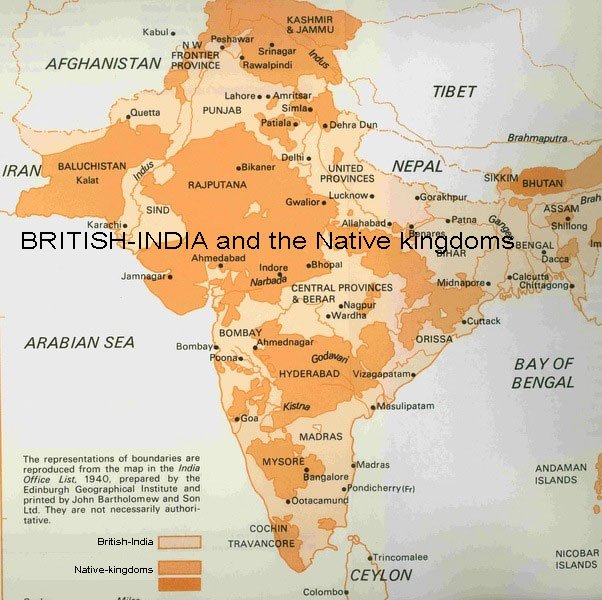
The English colonial rule in the South Asian Subcontinent actually was centred on three major cities. Bombay, Madras and Calcutta. Even though the colonial rule is generally known as British-rule and the location as British-India, there are certain basic truths to be understood. The so-called British-rule was more or less an English-rule, centred on a rule by England. It was not a Celtic language or Celtic population rule.
William Logan, who purports to be the author of this book, is not an Englishman. So to that extent, he is removed from the actual fabulous content of the English-rule in the subcontinent.
The second point to mention is that even though there is a general misunderstanding that the whole of the subcontinent was part of British-India and British-Indian administration, the rough truth is that most of the locations outside the afore-mentioned three Presidencies were not part of British-India or British-Indian administration.
However, due to the extremely fabulous content quality of the British-Indian administration, as well as the quaint refined quality, dignified way of behaviour, honourableness, sense of commitment and dependability of the English administration, all the other native-kingdoms which existed in the near proximity of the Presidencies inside the subcontinent, more or less adhered intimately to British-India without any qualms. For, there are no self-depreciating verbal usages of servitude in English. In the native feudal-languages of the location, such a connection would have affected their stature very adversely in the verbal codes. [Please read the chapter on Feudal Languages in this Commentary)
In the local culture, the exact traditional history is that of backstabbing, treachery, usurping of power, going back on word, double-crossing &c. When a very powerful political entity appeared on the scene, which was seen quite bereft of all these sinister qualities, everyone understood that it was best to connect to this entity.
However, this was to lead these kingdoms to their disaster and doom later on. For, a general feeling spread that all these kingdoms were part of British-India. Even in England this was the general feeling. An extremely disparaging usages such as ‘Princely state’ and ‘Indian Prince’ came to be used in English language to define them, due to this misunderstanding.
Actually the independent kingdoms were not ‘Princely states’. Nor were their kings mere ‘Indian princes’. They were kings. For instance, Travancore was not a Princely State. It was an independent kingdom. It was true that it was in alliance with British-India. To use this term ‘alliance’ to mention Travancore as bereft of its own sovereignty, is utter nonsense.
For, it is like saying that Kuwait is part of USA just because it is under the US protection. Or Japan, and many other similar low-class nations, which have made use of a close contact with the US to bolster up their own nations.
Travancore did mention its own stature as an independent kingdom very forcefully in a legal dispute with the Madras government.
Dewan Madava Row wrote thus to the government of the Madras Presidency in 1867: QUOTE:
(1 The jurisdiction in question is an inherent right of sovereignty
(2 The Travancore State being one ruled by its own Ruler possesses that right
(3 It has not been shown on behalf of the British Government that the Travancore State ever ceded this right because it was never ceded, and
END OF QUOTE
However, for the independent kingdoms in the subcontinent, this close connection with British-India later turned out to be a suicidal stranglehold. For, in the immediate aftermath of World War 2, a total madman and insane criminal became the Prime Minister of Britain. In his totally reckless administration that lasted around five years, he tumbled down the English Empire, all over the world.
In the South Asian subcontinent, the British-Indian army was divided into two and handed over to two politicians who had very good connection to the British Labour Party leaders.
These two leaders used the might of the British-Indian army which had come into their own hands to more or less run roughshod over all the native-kingdoms of the subcontinent. They were all forcefully added to the two newly-created nations, Pakistan and India. This action might need to be discussed from a very variety of perspectives. However, this book does not aim to go into that detail.
However, the dismantling of the English-rule was disastrous to the people. In the northern parts of the subcontinent, which is mainly the Hindi hinterland, a communal confrontation took place between the Muslims and the non-Muslim populations. Around 10 lakh (1 million) people were slaughtered. Burned, and hacked. Towns and villages which had lived in total peace and prosperity under the English-rule became battlegrounds. No house or household was safe. People had the heartbreaking experience of seeing their youngsters broken down physically.
This was how the two nations of Pakistan and India were founded. Compared to the other parts of the subcontinent, the average social-quality of Hindi-speakers is low. This itself is a very fabulous illustrative point. For, on seeing Hindi films one might get a feeling that the Hindi-speakers are of a very resounding quality. Even native-English nations are being befooled by the Bombay (Hindi) film world, with the cunning use of fabulous Hindi films.
However, the truth remains that all over the subcontinent, including Pakistan, India and Bangladesh, the lower-placed sections of the feudal-language speaking sections of the populations do suffer from a mental and social suppression that cannot be seen or understood in English.
Now coming back to the madman who dismantled the English-Empire in the subcontinent and elsewhere, I personally do not know what retribution he received from providence. However, for the terrible suffering he let loose all around the world in general and in the South Asian Subcontinent in particular, he deserves to rot in hell till eternity. Not only him, but all those who support his evil deed also deserve just retribution from Nemesis.
Let me go back to the point I left. I was staying in a Metropolitan city in India which had been a headquarters city of one British-Indian Presidency, a few decades back. I was quite young. I had a casual conversation with an old man who had been a contemporary of the English-rule period in the city.
I asked him about the general quality of the Englishmen who had been officers in the administration. He said, they were all quite nice. But then, they were cut-off from the people. They had around them a coterie of natives of the subcontinent. These persons were generally the Hindus (Brahmins &c.) and other higher castes. There were lower castes also. However, all of them kept the native-English officers inside a social corridor which they controlled. They acted quite nice and coy to the native-English officers. But actually they were very cunning, and self-centred and had very obvious selfish interests.
This much this man told me. However, the vast amplitude of the information is like this:
The gullible native-English officers acted as per the advice of this cunning coterie. These cunning local vested-interest groups literally fed the native-English officials with their own native-land repulsions, caste hatred, antipathies and religious hatred. And also colluded with the native business interests to influence policy decisions in the sphere of economic and fiscal matters.
Even though, it is true that the native-English officers did in many instances see through their cunning intentions, it is not easy to detach completely from its snares. For, the most powerful weapon of luring and snaring an unwary adversary used in all feudal languages nations, is the weapon of hospitality, and effusive and quite overt friendliness.
In many cases, the native-English officials understood that a native of the subcontinent is at his most dangerous stance, when he acts most friendly and helpful. This is actually a part of the code-work inside feudal languages. I will deal with that later.
Now, why did I mention this idea here?
On reading the ‘Malabar’ written by William Logan, the impression that can spring spontaneously to my mind is of a very gullible native-English administration doing its best and giving its best to a population group which they cannot understand. Actually it is not one population group that they are dealing with. They are actually dealing with a series of population groups, each one them having its own aims and ambitions, which are totally different and antagonistic to various other groups. Even though the native-English go on insisting and try to define the native populations as belonging to one nation, there is no such an idea of a Nation-state in the minds of the populace.
In fact, the very idea of a nation-state is a mad insertion by the native-English.
William Logan was authorised to write this book. He had at his command a lot of native-officials up to the level of the Deputy District Collector to help him. He allowed them to write many notes and articles, which even though he must have edited, have all messed-up the quality of the information.
Logan has the feel of having been taken for a ride. But then, it can be understood that a lot of persons have worked on this book. For, there are a lot of tables and lists. All these can be understood to have been done by other persons. The book is quite huge. It has more than five hundred thousand words (more than 5 lakh words).
It contains a number of footnotes. Many of these foot-notes alludes to or point to or quotes from many ancient or scholarly books. Some of these books are the works of other language writers or travellers.
It is practically impossible for William Logan to have taken up these various books for reading and referring. Travelling in those days was quite a cumbersome action. There were many places where one could go only in a bullock cart.
Beyond all this, this book was written in a manuscript form in those days. There were no computers or any other digital gadgets available. Writing with a quill pen in itself is a very tedious work compared to current-day computer typing. Then comes the need to read and edit and correct. These are all huge labours. A few other people are necessary to do all this.
In addition to all this, William Logan was the District Collector in a district which was incessantly disturbed by communal confrontations between the Hindus and their subordinated populations on one side and Mappillas on the other.
Beyond all this, proper roadways, means of communications, waterway and boating services, administrative set-ups, policing, education, healthcare, drinking water facilities, sanitation, railways, postal services, written codes of laws and judiciary and much else were being set up for the first time in the known history of the location and population. It is only natural to bear in mind that Logan’s mind and time would be required to go into all this also.
So, from all this also it can be presumed that William Logan is not the only person who has written into the text which purports to be his writings. There is very ample indication that even the ‘PREFACE TO VOLUME I’ which purports to be his personal writing was actually some other person’s words. This ‘some other person’ is very clearly a native of the subcontinent.
But then, this action of someone else writing a Foreword or Preface is a common occurrence in the world of book publishing. However, what makes this issue mentionable here is that even in this specific Preface, the same sinister insertion of the vested-interest ideas of a particular section of the population has entered as a sort of an eerie apparition. Actually this ghostly apparition is a ubiquitous presence in almost the entirety of the book, with only one particular section alone being secluded from its presence.
Now, let me mention the words I found on the low-quality content website, to which I had alluded to earlier.
QUOTE: He was conversant in Malayalam, Tamil and Telugu. He is remembered for his 1887 guide to the Malabar District, popularly known as the Malabar Manual. Logan had a special liking for Kerala and its people. END OF QUOTE
It is quite possible that he did know Malayalam, Tamil and Telugu. However, there is no indication in this book that does substantiate this, other than a slight mention of a few Malayalam words. (The location where this is written does not seem to be Logan’s writing). That point does not matter. However, the claim that he was conversant in Malayalam has a major issue. I will take it up later.
The next point is: QUOTE: special liking for Kerala and its people END OF QUOTE
There is nothing in this book that can support a claim of his ‘special liking for the Kerala and its people’. Again, the word ‘Kerala’ has a major issue.
In fact, both the words ‘Malayalam’ and ‘Kerala’ are also part of the sinister doctoring I had mentioned earlier.
The information divide
There is a huge information divide between native-English speakers and feudal-language speakers. It is possible for feudal-language speakers to understand the very simple social logic of native-English speakers. However, the reverse is not true.
Feudal-language social systems are quite complicated. What is seen on the surface has no connection with reality. Why this is so has to be explained in detail.
The layout of the book
The original book was published in two volumes. Volume One contains the following Chapters: The District, The people, History and This Land.
The first chapter, The District deals with the physical features, rivers, mountains, the Fauna and Flora, Road, passes, railway, Port facilities etc. The Fauna and Flora section has been written by Rhodes Morgan, F.Z.S., Member of the British Ornithologists Union, District Forest Officer, Malabar.
The second chapter is about the people, population, villages, towns, habitation, rural organisation, language, literature and state of awareness of the people, caste issue and occupation, manners and customs, religions, famines, diseases and treatment.
The third chapter is about History of the location. Commencing from the traditions that gives a hint of the antiquity of the place, it moves on to time when Portuguese traders tried to set up a trading centre here. Then came the Dutch and after them the arrival of the English traders.
The fourth chapter is This Land. In this location, the attempts to understand the land tenures and land revenue systems are seen. The focus is on the English Factory at Tellicherry. The writing moves through the various minor historical incidences that slowly lead to the establishment of an English administrative system in Malabar.
With the exception of the Flora and Fauna section, I think that whole book has ostensibly been written by William Logan. That is the impression that comes out.
The contents of Volume Two are different. It is basically a book of Appendices. Most of them are in the form of tables and lists. However, there are a number of detailed writings also, wherein it is seen that some natives-of-the-subcontinent officials have written narratives, under their own names. The tabular lists include information about Statistics, Animals, Fishes, Birds, Butterflies, Timbre trees, Roads, Port rules, Malayalam proverbs, Mahl vocabulary, and a Collection of deeds. Next is a Glossary with notes and etymological headings attributed to Mr. Græme who was one of the English East India Company officials in Malabar.
After this comes a list of names of the Chief Officers, Residents and Principal Collectors and Collectors who served in Malabar.
Next there are a lot of writings and chapters connected to agriculture and governmental income.
After this there is a List of Malikhana Recipients in Malabar. This more or less means that persons or families or religious institutions that received a sort of monthly or annual pension or some similar kind of monetary support from the English administration. The amount given to each entity is also given.
At the far end of all this comes a number of writings on the various Taluks in Malabar district. It includes the details of some of the Laccadive Islands also. These writings are reasonably descriptive enough.
From the perspective of pure statistical and chronological details, this book could be of very good contents. However, when seen from the underlying spirit that moves throughout the book, there are issues.
The book is clearly not the work or viewpoint one single person. As such to quote from this book, saying William Logan said this or that in his Malabar Manual, might not convey an honest information on what was Logan’s own version of understanding on any particular location.
The only location wherein he (or whoever has written this part) has written in a style, pose and gesture which is quite very steady and not much influenced by the native-land vested interests, in the location where he writes about the history by focusing on the dairy or logbook of the English East India Company Factory at Tellicherry.
If this book is taken up for reading, it would be quite candidly seen that the history of modern Malabar that existed as social mood till around 1975, is connected to Tellicherry. And not to Calicut.
As for Trivandrum having any historical or social connections to Malabar is a theme fit for the understanding of the birdbrains.
My own insertions
I did get to have a very rudimentary reading when I was placing the text on the MS Word document file. After that I went to place around 180 or more images. These images were mostly taken from online sources. Their image usage licence has been given along with them. This time also I got to read the text.
After these two readings the general layout of the book and its contents are in my head now. However, the details have vanished from my head. But then, I am aware of the various and varying mentalities, spirit and urges that have done their work in this book.
So I will have to take the items one by one. It is definitely going to be a long haul. However, I am used to slow-paced work.
The first impressions about the contents
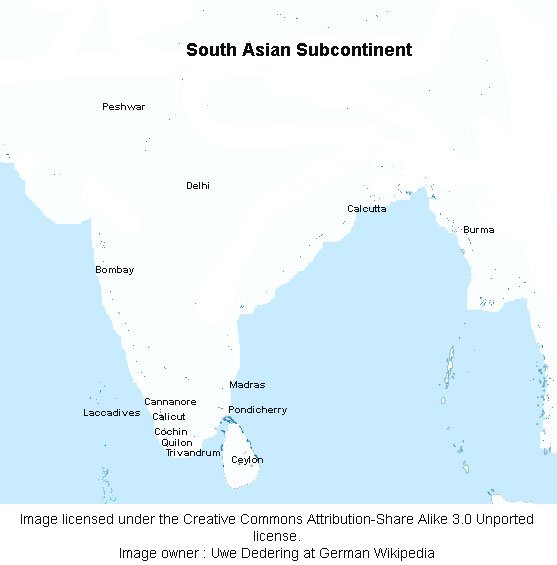
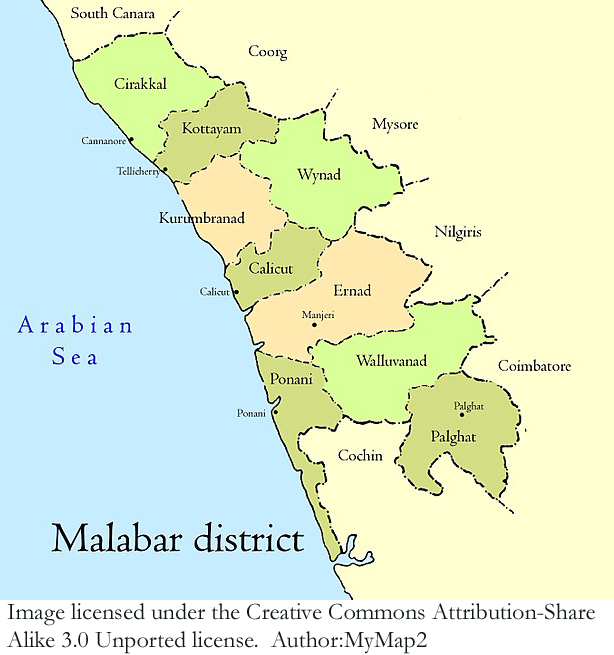
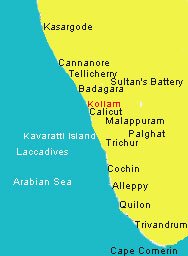
The contents of this book (Malabar by William Logan) are about a very miniscule geographical location inside the South Asian Subcontinent. The current-day geopolitical location of this place is the northern parts of the State of Kerala in South India. Even though the place was made into a single district by the English East India Company administration, as of now, the location has been divided into a number of small districts.
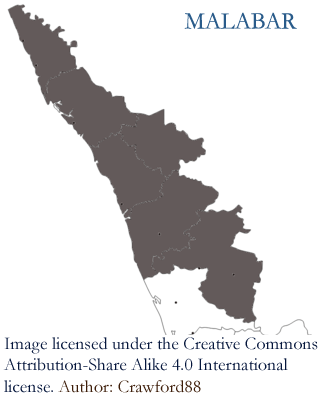 Beyond that, till around 1957, this location was a part of the Madras Presidency and then later on after the formation of India, a district of the Madras State. This location had only very minimal connection with the southern parts of current-day Kerala. However, on reading this book, one may not feel so. This book seems to have attempted to create a Kerala-feeling right from the middle of the 1800s. How this could come about should remain a mystery. However, on reading the book with some insights, one might be able to smell a rat. Actually there is more than one item in this book that gives a feeling that there is indeed something fishy about this book, and it’s very aspirations.
 The digital copy of this book that came into my possession is the government of India printed version of 1951. It does claim to have made changes into place names to make them to be in sync with the modern names of the places. It seems a silly logic to doctor critical elements in a book of historical importance. Names are like the DNA codes in a genetic code string. A change in them can create so many changes in what the names stands for and what they signify. Connections and directions change.
It would be extremely silly to rename ancient cities with their modern names in history books. However, generally there is an attitude among formal academic historians to do as they please to please the modern political leaders of India. In fact, one can find words like India, Indians etc. cropping up in ancient and medieval histories of the subcontinent. Instead of saying the Moguls or the Rajputs had a fight with some other population group, words like: ‘Then the Indians attacked the Europeans’ &c. are frequently seen.
India and Indians
Since I have mentioned the words ‘India’ and ‘Indians’, I think I will say a few things about these words:
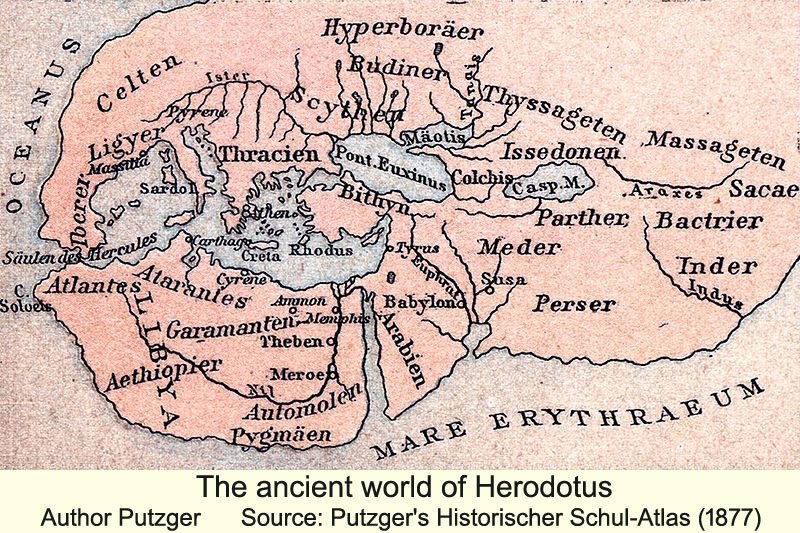 There was indeed a mention of a land which was commonly identified by the maritime traders and others from other locations as Indic, Inder, Indus, Indies etc. May be more.
Even in the works of Herodotus the word Inder (Indus) is seen to come. It was some kind of remote location in the east from where certain merchandise like Pepper, spices, and many other things were bartered by the traders.
There was no historically known nation as 'India' inside the subcontinent. Even the joining up of the various kingdoms (some 2000 of them, small and big) as subordinates of the Hindi-speaking populations took place only in 1947. Pakistan also took a part of the Indus area and captured the various locations to form Pakistan.
In fact, Indus is in Pakistan and has not much to do with the south, east, or north-eastern parts of the subcontinent.
I do not know if the word 'India' is used in the Puranas, or epics such as Mahabharatha or Ramayana, or if either Sri Rama or Yudhishtar have claimed to be Indian kings. Also, whether such kings as Marthanda Varma, Akbar, Krishna Deva Raya, Karikala or Ashoka have claimed to the Indian kings.
The word 'India' and the location 'India' could be a creation mainly of Continental Europeans. May be the Arab traders, and the Phoenicians also must have used it to denote a trade location.
I feel that Continental Europeans did create four ‘Indias’.
But actually it is Indies; not Indias.
QUOTE: India, however, in those days and long afterwards meant a very large portion of the globe, and which of the Indies it was that Pantænus visited it is impossible to say with certainty ; for, about the fourth century, there were two Indias, Major and Minor. India Minor adjoined Persia. Sometime later there were three Indies — Major, Minor and Tertia. The first, India Major extended from Malabar indefinitely eastward. The second, India Minor embraced the Western Coast of India as far as, but not including, Malabar, and probably Sind, and possibly the Mekran Coast, India Tertia was Zanzibar in Africa. END OF QUOTE.
I think the author is actually talking about ‘Indies’ and not about ‘India’.
‘Major’, ‘Minor’ and ‘Tertia’ Indies had some connection to the subcontinent in parts. As to the fourth one they created, it was in the American continent. In the US, till around 1990, the word 'Indian' was found to connected to the native Red Indians.
The word ‘India’ I feel is like the Jana Gana Mana. Not pointing or focusing on to native-subcontinent origin. [Jana Gana Mana actually points to the Monarch of England in the sense that it had been first used to felicitate the King and Queen of England by none other than the Congress party, when it had been a party of England lovers.]
However, the historical nation connected to the word India is 'British-India' (not any of the ‘Indias’ mentioned above), and is a creation of England and not of Continental Europeans.
However, it did not contain the whole subcontinent. At best only the three Presidencies (Madras, Bombay and Calcutta) and a few other locations were inside it. The rest of the locations which are currently inside India, such as Kashmir, Travancore &c. were taken over under military intimidation or occupation.
As to the word Bharat, Hindustan &c. I am not aware of it being mentioned in world history. Even if they are, well, they are what others use. The pertinent point is, did anyone inside the subcontinent, which includes current-day Pakistan, India and Bangladesh claim that they are Indians, Bharatiyans or Hindustanis in historic days?
I do not have any quarrel with anyone using such words.
However, the joining of the immense kingdoms into a quality nation was the deed of the English East India Company. Before that, there was no India, Pakistan or Bangladesh.
QUOTE: Rufinus, who went to Syria in 371 A.D. and lived at Edessa for 25 years, attested that St. Thomas’ body was brought from India to Edessa and there interred ; but from which of the “Indies” was the body brought, presuming that the relics were still in existence ? END OF QUOTE.
So here there is an admission that word used was actually ‘Indies’ and not ‘India’.
QUOTE: It seems doubtful whether he himself ever visited “Hind” which, among Arabs, was the name applied to Southern India exclusively END OF QUOTE.
Oh, this seems to make a mess of the contention that the word ‘Hind’ was connected to River Indus which was called Sindhu and is currently in Pakistan. It does really look odd that the etymological origin of ‘Hind’ is ‘Sindhu’. But then, scholars know more, and should not be disputed.
QUOTE: About 600 B.C. Scylax, a Greek sent by Darius, had voyaged home by sea from the mouth of the Indus END OF QUOTE.
There would have been others.
QUOTE: Herodotus mentions that the Red Sea trade in frankincense and myrrh, and cinnamon and cassia (the two latter being Malabar products), was in the hands of the Egyptians and Phoenicians, but these traders do not appear to have proceeded beyond the port in Arabia Felix (Aden probably) where these goods were procurable. END OF QUOTE.
The problem in these kinds of understandings is the visualisation of maritime and other trade as one would visualise the English East India Company trade. In most cases, the traders who took goods from Malabar coast would be small traders who did the trader without maintaining any records. It is like the fact that the forest products of Wynad were available in far-off markets, many years ago. The forest dwellers collect them and come down the mountains and sell their wares in crowed oriental market places in Palghat and such other places. These presence of Malabar products in far-off locations should not used to make an understanding that Malabar was a place of high class living standards.
QUOTE: Of India proper Herodotus’ information is scanty, END OF QUOTE.
It should not be acceptable to the Indian academic history. For, there is resounding information in the sterile academic textbooks of ‘India’ being one of the greatest civilisations the world has ever seen. In fact, the students in the Indian schools know that when the people of England were monkeys, there were great cities in ‘India’!
QUOTE: In the end of the fourth century B.C. the Greek writer Ktesias probably alluded to cinnamon, a common product of Malabar, as karpion, a name which seems to have been derived from the Tam. Mai. karuppu or karppu END OF QUOTE.
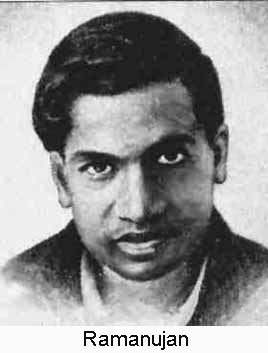 Actually, this should not prove anything other than that some people did collect these things from their own forest dwelling areas and sell them to maritime traders. And they traders need not have the looks of the characters in the English movie ‘Pirates of the Caribbean’. They can even have the looks of the local fishermen of South Asia. However, if the looks of the local fishermen are promoted, as the traditional looks of the ‘great’ maritime traders of ‘India’, the jingoist of India will not like it.
They have even changed the very looks of Ramanujam, the mathematical genius to something more comparable with the native-Englishman.
QUOTE: It was not till about 120 B.C. that an attempt was made to go direct from Egypt to India. A Hindu said to have been, wrecked in the Red Sea volunteered to take a ship to India. END OF QUOTE.
The above is a highly cantankerous writing. A Hindu? That means a ‘Brahmin’? But then, it is said that the Brahmins did not venture out into the sea, probably being afraid of having to converse with a lower caste person.
The non-Muslim and non-Christian fishermen of the coastal areas of the subcontinent are categorised as Hindus as of now. However, they were actually not Hindus, if Brahmins are ‘Hindus’. Then who could it be?
The errors commence from a jingoistic error. The subcontinent is a huge place with a lot of different populations. A very accurate way of mentioning the event would be as a Tamilians, a Malabari, a Gujarati, or any other word of more substance. I am not sure what the populations were, then living in the subcontinent. And much more precise record would be the name of the specific population, which currently is mentioned as ‘caste’. The name of hundreds of castes in the southern parts of the subcontinent are mentioned in Castes and Tribes of Southern India by Edgar Thurston.
QUOTE: Aden was probably the port in which the Arabian and Indian merchants met the Greeks and exchanged their goods END OF QUOTE.
There are so many statements of the same kind. It is like mentioning a Mayan ship as an American Ship, or a South American ship. There was no ‘India’ in the mentioned period. And the term ‘Indian merchant’ definitely has to be rephrased into something more meaningful.
There are a lot of passages in the book aiming to prove that there was indeed a Malabar or ‘Kerala’ and ‘India’ by mentioning the proof seen in the various trades.
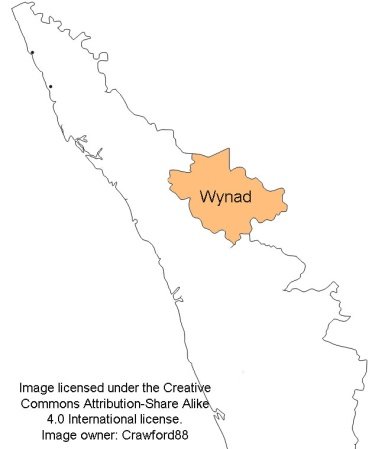
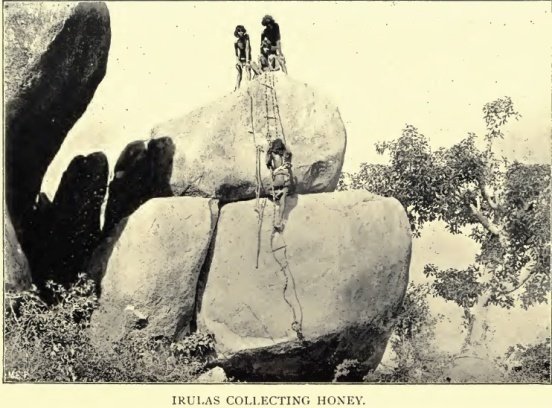 I can only say that the existence of even the remote forest areas of Wynad can be thus proved by mentioning that a lot of trade in the forest commodities of Wynad were in vogue in an old time. However, the fact still remains that despite the huge trade, the place still remained a forest region with a huge percent of the population dwelling as forest people, more or less the slaves of the landlords.
This was also the state of Malabar as well as in Travancore, and also in the whole of the subcontinent, till the advent of the English colonialisms.
QUOTE: the first Hindu embassy from King Porus, or, as others say, from the King of Pandya, proceeded to Europe and followed the Roman Emperor Augustus to Spain END OF QUOTE.
This is another nonsensical statement. King Porus was not the king ruling the subcontinent at any time in history. He was a king of some kingdom in the north-western parts of the subcontinent. What is his relevance in a book on Malabar might be a moot point. The populations were different, the languages were different and everything was different.
As to naming the embassy as a Hindu embassy, well this also seems some kind of cheap writing. Any man from the subcontinent going out can be defined as a Hindu (Brahmin) traveller. It might be true or may be not true. However, that is not the way to define a traveller.
QUOTE: As regards Muhammadan progress in Malabar, writing in the middle of the ninth century A.D., a Muhammadan has left on record “I know not that there is any one of either nation” (Chinese and Indian) “that has embraced Muhammadanism or speaks Arabic.” (Renaudot’s “Ancient Accounts of India, etc” London, 1733). END OF QUOTE.
The point here is that one might be able to find quotes from other travellers of yore, who give a different assertion. It is all at best the individual impressions of travellers. The subcontinent was too huge a place for solitary travellers to give an all-encompassing description.
See this description by Mis’ar bin Muhalhil about ‘Kulam’ or Quilon: QUOTE: When their king dies the people of the place choose another from China. There is no physician in India except in this city. The buildings are curious, for the pillars are (covered with) shells from the backs of fishes. The inhabitants do not eat fish, nor do they slaughter animals, but they eat carrion”, END OF QUOTE.
These types of traveller’s impressions are limited by time and space to very narrow perspectives.
See Ibn Bututa description of the location:
QUOTE: No one travels in these parts upon beasts of burden ; nor is there any horse found, except with the king, who is therefore the only person who rides. END OF QUOTE .
This could give the impression of a very poor locality.
However, it might be quite unwise to gather a lot interpretations from unconnected information. The most fundamental thing to understanding a population is information on the codes in their language.
QUOTE: The true ancient history of Southern India, almost unrecorded by its own people in anything worthy of the name of history, appears as yet only as a faint outline on canvas. END OF QUOTE.
Well, everything has a history. Even ants will have a history. It is like the Chinese. China has a history. But outside world did not know. It was a very primitive nation till around 1990. Then the fools in England gave up Hong Kong to China, more or less giving the society there a platform to converse as equal to the English nations. Then the Chinese government used cunning and shrewd and organised a Tiananmen Square shooting. This event was used by the Chinese government to send Chinese students directly into the world of US technological secrets.
As of now, the varied components of Chinese history are emerging out. Likewise, a time will come when the ants and many other animals will get to learn English and to use modern gadgetry. Then their histories will come out.
QUOTE: In 500-504 A.D. it is recorded by Chinese writers that a king of India sent an ambassador as far as China, taking with him presents consisting of pepper, ginger, sugar, sandalwood, tortoise-shell, etc., and it was said that this Indian nation traded to the West with the Romans and Parthians, and to the east as far as Siam and Tonquin. END OF QUOTE.
The wording has an error. It is not a king of ‘India’. It should have been a ‘king from India’. The former is like saying ‘King of Britain’. There was no ‘king of India’. And no ‘India’. As to the record, there would be rulers inside the Wynad forests who might have sent ‘ambassadors’ to the various kingdoms with presents.
What is the contention trying to prove? That this subcontinent was in existence? That is not a point that require a historical proof. But then interjecting the words ‘India’, ‘king of India’, ‘ambassador’ etc. might need more scrutiny.
QUOTE: The produce sent as presents, the trade to East and West, and the manner of wearing the hair, are all so essentially Malayali, that it is difficult to resist the conclusion that the ambassador must have been sent from some place on the Malabar Coast. END OF QUOTE.
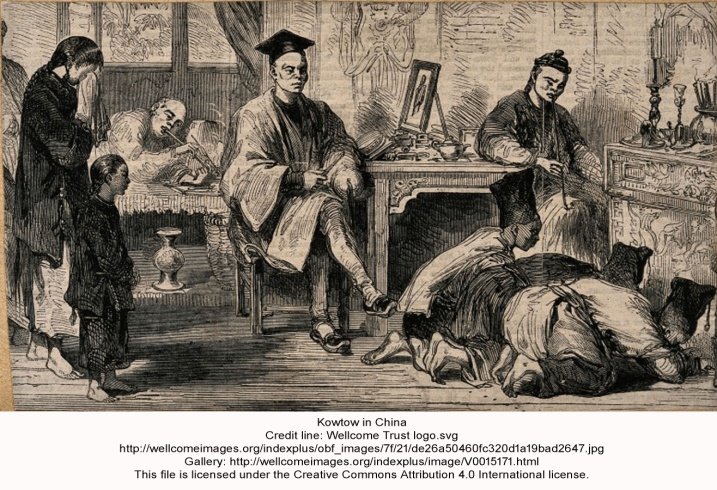 The word ‘Malayali’ is a problem, for it is an insertion that might have an aim to mislead. Then comes the issue of having to depend upon the certification of others to prove one’s own worth. It is a terrible way to prove one’s worth. As to persons going to China, where only the English traders refused to do the kowtow, the fact of the matter would be that the ‘ambassador’ would be acting like a mere servant to the Chinese king. The modern dignity of stature assigned to persons holding diplomatic assignments is something that came from English systems. It cannot be envisaged in the case of any Malabari or Chinese.
An acute sense of not understanding
The very first item that comes to notice is that the native-English side does not understand the peoples of Malabar or of the south-Asia. They see a lot of social and personal behaviours. They see people and individuals acting bizarrely, reacting to un-understandable triggers, and oscillating between totally opposite character features. Persons, who can be defined as gentlemen and quite refined and well-mannered, suddenly turning into brutes of the highest order.
A lot of similar behaviour attributes can be mentioned and listed here. However, I hope to mention them contextually in this writing.
Now, what is this un-see-able and non-tangible item that seems to be infecting everything and everyone here?
What is the real logic behind the so-called caste-based repulsions that literally makes a very good quality person cringe from the presence of individuals who are defined as of the base standards?
There are a huge number of English-colonial writings about the various facets of the subcontinent and its peoples. However, none of them seems to have even focused on this issue with the importance it deserves. Even though I would like to say that no native-Englishman or native-Brit of those times have detected the real cause of this social negativity, I cannot do so.
For, I have seen Lord Macaulay, in his Minutes on Indian Education, make a very solitary word allusion to this issue. He has detected the visible features of this issue. But did not go deeper.
In this book, Malabar, there is a very significant mention of William Logan also detecting the issue, but more or less leaving it at that point. And not taking any effort to go beyond and find the inner contents of this information.
The hidden issue is a simple item. The languages of the sub-continent are feudal languages. The term ‘feudal language’ I have used over the years since around 1990, to define languages which do not have planar codes. However this verbal usage (feudal language) can be outdated. For, I have as of now, come to have a deeper information on this item.
Pristine-English is a planar language. I stress the word ‘pristine’.
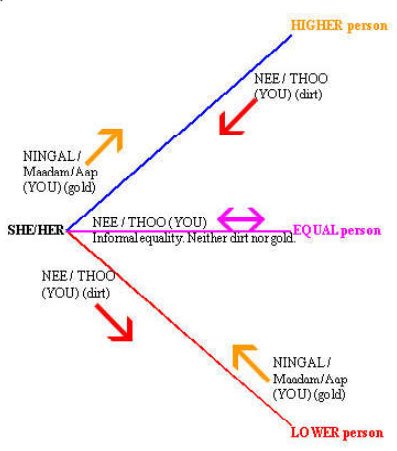 In pristine-English, in common communication, there is only one You, Your, Yours. Only one He, His, Him, She, Her, Hers &c.
In languages which I mention as ‘feudal languages’, there are an array of words for these basic words of addressing and referring. These array of words are not synonyms as understood in English. The array of words stands in a vertical hierarchy. Each level connects to a lot of other words and hierarchies, routes and direction of command, and also to levels of positional or social honour or nondescript-ness.
Each form of word is terrifically important. For, language is the software that designs a social system. An individual can get terrifically pulled and pushed apart when word forms are changed.
In fact, the whole content of acrimonious behaviour inside feudal language nations is due to the terrific competition to acquire a comfortable word-code in the social sphere.
This is an information that native-English nations do not have. In fact, when immigrants from other social systems arrive, the event should actually be treated more seriously than when an astronaut returns from a space journey. The astronauts used to be kept in a quarantine for a few days to check if they had come back infected by any extraterrestrial disease.
In the same manner, the immigrants to native-English nations have to be studied for dangerous language codes inside their mind. For, mind is a very powerful machine. And if the brain-software runs on a feudal language software, then it would infect the native-English nation. The native-English can go berserk and become homicidal.
I have personally tried to inform the terrors connected to feudal languages both inside India as well as in the native-English nations. However in both locations, there have been terrific efforts to block my efforts.
Inside India, the effort has been to block all attempts at anyone discussing this issue. As to native-English nations, since the IT world is literally filled up by persons from the feudal language social systems, they simply delete my words or block me from writing. If at all I do make a comment, it is deleted in such a manner that I get to see my comment, but it is invisible to others.
Moreover, my writings have been generally defined as ‘hate-speech’ in my online locations inside the US, GB and Australia. For it seems to bring out an information that is least liked by the population groups who claim to be the victims of native-English racism. I have had incidences wherein even the Continental Europeans do not want to have this item mentioned.
A couple of days back, I made the following comment from another UserName of mine in a Youtube comment.
https://www.youtube.com/watch?v=eG7a7h5fmUg&t=3s
It was about a lady film makeup artist mentioning that she had been abused verbally in a resort in a hill-station in the local state. The exact trigger point was not abusive words as understood in English. It was words such as Nee, Edi, Ninthe, Aval, Avalude etc. Nee is the lowest level of You. Using that word to a customer who is residing in the resort by the resort staff can be of the highest order of abuse. But then, in an English translation of the dialogue, the astronomically dangerous levels of abuse will not get translated.
My comment was this:
ഇവിടെ പ്രത്യേകമായി കാണുന്ന കാര്യം തരംതാഴ്ന്ന വാക്ക് പ്രയോഗങ്ങളാണ്.
നീ, എടീ, അവൾ, അവൻ തുടങ്ങിയ വാക്കുകൾ.
ഈ വിധ കാര്യങ്ങൾ ഫ്യൂഡൽ ഭാഷകളുടെ സവിശേഷതകളാണ് എന്ന് വായിച്ച് കാണുന്നു. വളരെ പ്രകോപനം നൽകുന്ന വാക്കുകളാണ് ഇവ. പറഞ്ഞ് തുടങ്ങിയാൽ പിന്നെ എന്തും പറയാം.
archive dot orgൽ ഫ്യൂഡൽ ഭാഷയെപ്പറ്റി ഉള്ള ഒരു മലയാളം എഴുത്ത് ശ്രദ്ധയിൽ പെട്ടിരുന്നു.
മാത്രവുമല്ല, പോലീസുകാരെ വിളിക്കേണം എന്നെല്ലാം പറയുന്നത് തനി വഡ്ഢിത്തമാണ്. പോലീസുകാരുടെ പെരുമാറ്റവും വാക്കുകളും തറനിലവാലത്തിലുള്ളതായിരിക്കും.
വനിതാ പോലീസുകാർ നീ, എടീ എന്നൊക്കെ വിളിച്ചാൽ യാതോരു രീതിയിലും പ്രതികരിക്കാൻ ആവില്ല. പ്രതികരിച്ചാൽ, മഖത്ത് അടിവീഴും.
Translation:
Here what is very clearly seen is the use of lower grade word-forms: Nee, Edi, Aval, Avan etc.
These kinds of words are seen mentioned as the special features of the language. These are words which can create terrific provocations. Once these words are assigned to an individual, then literally any abusive words can be used about the individual.
A specific writing in Malayalam about this issue is seen on archive dot org.
Beyond that the lady is seen here as mentioning that she had asked to call the police. This can be a totally stupid and dangerous action. The verbal codes used by the police can be more terrible and abusive.
If the female constables come, they would most naturally use the words 'Nee', 'Edi' etc.
There would be no scope to react to this in a decent manner. If she tries to react or retort to this abusive words from the Indian police, she will be given solid slaps. End of translation
The comment section of the Youtube video was literally littered with totally abusive words in Malayalam. Some commenters addressed her as Nee and Edi. There are persons referring to her as Aval and some do even mention her as some kind of loose and wanton woman.
Some persons focus on the black colour of her skin and mention abusive words. The issue here is that she understands Malayalam. If the black-skinned former president of the US’ daughters can understand Malayalam, there is no doubt that they will also be defined in similar mean words and definitions. Literally calling her a monster because of her black skin colour.
There are comments that have posted links to other videos and sites. All these things are there.
However, my comment was seen deleted almost immediately that I had posted it. These kinds of experiences are there in plenty in India.
Now before moving ahead I would like to mention a small part of the huge verbal machinery that actually has worked.
Since it is a huge framework, I cannot go into the very beginning of the machine work.
This woman artist has been abused verbally, that is lower-grade You, She etc. used upon her, because her film world seniors would have given the go-ahead to the hotel staff in most subtle manner. They would not have to go and tell them to be disrespectful to her. All that they have to do is to mention her and refer to her as Aval (lowest grade She/Her/Hers), along with a body-language and facial expression to emphasis her lower stature, to the hotel staff. They will pick up from there.
Now, why should her film world staff want her to be snubbed? That is the exact crucial focal point that has to be understood. For, on this stands a huge understanding on why the local native kings and other rulers of this subcontinent loved to be under the English rule, and not under any other native-rulers. I will explain that point later in a more clear manner.
In the context of this female mentioned above, there would be always tugs of war between others in the verbal codes in Malayalam. As to who is ‘Nee’ and who is ‘Ningal’ and who is ‘Maadam’. These are the various levels of You in Malayalam for a female. In almost all communication, one side can get snubbed. However, many persons take this in their stride if it is from an acknowledged senior or someone who can help.
In the case of others, they carry a grudge. They moment they get a chance to snub or degrade the other, they will use it. The social system is literally strewn with such boiling grudges.
I had experienced a lot of acrimonious and quite sly blocks when my writings mention ‘feudal languages’ in British, US and Australian media websites. Many have blocked me forever.
In the last thirty years or so, the entry of feudal-language speakers from Continental Europe, South America, Asia and Africa into native-English nations have become a sort of torrent. People who experience native-English social systems find their own social systems quite abhorrent. However, their entry into native-English social systems has brought in the problems inherent in feudal languages.
However no one mentions what this is. Instead these cunning immigrants who speak feudal languages write huge articles on what is wrong with their new nations of domicile and mention so many corrective measures. However, the fact remains that it they themselves who are problem inside the native-English nation.
A couple of weeks or so back, I found one such article. There were so many ravishing comments literally applauding the contents, which gave so many corrective measures.
I simply posted this comment:
QUOTE: The nation is dealing with an unknown and un-understood item.
And that is the entry and spread of feudal languages, in the soft planar language (English) social system.
Even though inside feudal language nations, there are well-understood social and mental barriers and corridors to protect oneself from the sharp poking effects of feudal language word codes, inside GB, USA, Australia etc. there are practically no such protective shields. People, especially the younger aged and the persons who are defined as doing lower jobs, will be terribly affected.
People can go berserk or mentally ill.
Actually this issue had been observed by Edgar Thurston way back in the 1800s. However, he did not understand the machinery that created the inclination to insanity. END OF QUOTE
After some time, when I checked, I found that the comment was visible to me, when I log into the website. However, when I enter the website from any other location, my comment is invisible.
This much for the great inputs of these immigrant folks into native-English nations. They, who cannot bear to live in their own nations as a ordinary citizen, are giving great ideas to improve native-English nations, which by their very presence and speech, they are atrophying.
Entering a terrible social system
The social system in South Asia, as in all other feudal language locations, was and is a most cantankerous one. Into this terrible feudal language social system, the English East India Company entered. For the sake of merely buying pepper and other locally available goods, and selling them in Europe. There was enough profit in it. I will have to mention the various events.
However, before moving to the events, let me first list out the fabulous sinister capacities of feudal languages. I cannot explain each of the items mentioned in the list here. For it is a long route to that. However, persons who are interested in knowing them can open this digital book titled: An impressionistic history of the South Asian Subcontinent. Part 1 & 2. This is in Malayalam. The English translation is also given for the Part 1. The English translation of Part 2 and the rest can be had from VICTORIA INSTITUTIONS’ Website, when it is ready.
Since I have been mentioning the term ‘feudal languages’, it is befitting that I give a brief enumeration of its varied features.
I have been writing a daily text broadcast in Whatsapp under the heading: An impressionistic history of the South Asian Subcontinent.
The below given points are from around the 200th post in that broadcast. So it may be understood that there has been a huge built up to reach this point.
I am trying to give an insight on the interiors of many non-English social systems, which have a specific coding inside their languages. This might not be true for all feudal languages or for all non-English languages.
Pristine-English is a planar language, in that there are only one You, Your, Yours, He, His, Him, She, Her, Hers &c. If human languages can be understood as some kind of software application with varied features, it would be quite easy to understand that a change in the coding can bring about very many changes in so many items.
I do not really think that many of the readers would get to understand the points given below much. And I must admit that there is indeed a real Code-View as well as Design-view background to the features given below. For knowing more about this concept, the reader may need to check: PRISTINE-English; What is different about it?
It goes without saying that modern mental sciences such as psychiatry as well as psychology might not have any understanding of these things.
Languages do contain the design structure of human relationships, communication and even that of the design features of the society.
The main feature of a feudal language is the dichotomy or trichotomy that it has for words mentioned above. That is, two or three or more word forms for You, Your, Yours, He, His, Him, She, Her, Hers &c. Each form connecting to a series of word forms that define a lot of things about a particular person. His rights, abilities, and much else are defined in these word codes.
They connect to hundreds of other words, and bring about huge variations, and pull and push in all kinds of communication links.
Now, see the enumerated things that feudal language can do without seeming to be doing anything specifically malicious.
Feudal languages can:
1. act like a wedge between human beings.
2. can literally throw human beings apart in different angles and directions, from their planar position that is there in English.
3. can view and position different persons with various kinds of discriminations.
4. can sort of bite human beings in a manner akin to how carnivorous animals do. Not in a physical manner, but in a way that can be felt emotionally. People get frightened and are wary of others who might bite verbally.
5. can hold individuals in a manner akin to how carnivorous animals hold their prey with their claws. The prey is stuck immobile socially and position-wise, and totally inarticulate with regard to his or her pain.
6. can pierce and deliver pain deep inside a human being as if with sharp needles.
7. can very easily bring in mutual antipathy and hatred between persons who had been quite united and affectionate. Verbal codes can be disruptive.
8. can create a very evil phenomenon of when one persons goes up, the other man has to necessarily go down. That is, it can act like a See-saw.
9. can create a mental experience of being on a carousal or merry-go-round placed on a pivot, and made to revolve in an up and down spin. That is, verbal codes can act like a pivot.
10. can flip a person on top to the bottom and the person in the bottom to the top, with a single word. That is verbal codes can flip vertically.
11. by allowing a person to be ‘respected’ by some persons, and made bereft of ‘respect’ by others in words of addressing or referring, in the same location, the person can be made to feel as if he is being twisted and squeezed.
12. by continually or intermittingly changing the verbal levels of ‘respect’, a feeling of vibrating or bouncing, or of going up and down can be induced in an individual.
13. can create a feeling of slanting, relocating, being pulled or pushed, inside a human relationship by the mere using of verbal codes. Verbal codes have a vector (direction) component. So, it can create a shift in the focus of many things by a mere change of verbal codes.
14. When feudal languages spread into the interiors of planar-language nations, social disruption will spread throughout the society, many kinds of individual relationships will get damaged, deeply held social conventions will go into atrophy, and an invisible and non-tangible evilness would be felt to be slowly spreading throughout the nation / society. [for God’s sake, Check the Adam Purinton shooting incident]
15. In the case of human relationships which are understood as Guru-shikya (teacher-disciple in feudal languages), leader-follower &c., verbal codes can be used as one would use the two different poles of a magnet. One position leading to sticking together, and the other positioning leading to repulsion.
16. Verbal codes can replicate or slash the same physical scene into two or three from a mental perspective.
17. Verbal codes can act like a prism on a group of human beings, in that they can be splintered as one would see white light getting splintered into varying colours.
18. Beyond all this, the persons who speak feudal languages can use verbal codes as a sort of Concave or Convex lens or mirrors. That is bringing in the concept of magnification. They can use verbal codes as many other kinds of visual items like Prism etc.
19. Feudal languages can deliver hammer blows to a person’s individuality. The power of the impact increases dramatically as his social goes relatively lower.
20. Compared to English ambiance, the work area becomes repulsive to the lower positioned persons, and attractive to the higher positioned persons. So that the more wages are given to the lower-positioned persons, the more lazy and less dependable they become. Native-English individuals working in jobs defined as ‘lower’ in feudal languages would find the work area sort of stifling.
There are other features also. The above is just a bare-frame enumeration. The descriptive explanation would require a lot of words. For that, the reader needs to check the An Impressionistic History of the South Asian Subcontinent.
Trying to understand feudal language nations, understanding such things as ‘slavery’, immigrants’ reasons for running out of their home nations, etc. without any information on the above can be a futile effort. Moreover, entering into warfare between such nations can be a dangerous item. For, there is no way for a native-Englishman to really understand what the exact provocations are or were.
The doctoring and the manipulations
It is quite evident that this book, Malabar, does represent the thoughts, ideas and knowledge of William Logon only to a very specific percent, which is definitely less than 50 percent.
At the time this book was first written, three very powerful groups did exert their influence, access and power to make this book, a book that suits their future aims and purposes.
Before mentioning who these three entities are, I need to place on record here that I do not personally have any kind of affiliation or partiality or inclination to any caste or religion or political philosophy. My total inclination and affection slants towards the English East India Company rule and to the pristine-England that existed till the end of the 2nd World War.
However, I do understand things which the native-English cannot understand or imagine existing in this world. This is because they do not have any idea about the existence of feudal-languages and of the incredible force and power feudal language codes can exert on the physical world and on the human and animal thought processes. I personally find the native-English of yore to be extremely soft, refined, fair, naive and gullible.
These are all extremely power-erasing personality features. They could reduce any human population to positions of extreme vulnerability, when facing the onslaught of barbarian populations. However, instead of caving in, the native-English created a most formidable global nation. There is indeed a secret as to why historical events look quite paradoxical. I will explain this very clearly in this book.
Since I have placed on record my affiliation and affection, I need to mention that I do not have any rancour or malice towards any caste or religion of this subcontinent. So when I take up each item for meticulous examination, even if it seems that I am being inimical towards that entity that is not really the case. I am merely looking at the reaction of the local populations towards each other. How each one of them strove to manipulate each other in their desperation to come on top, or to establish a detachment or to claim an association.
All these mental reflexes are the handiwork of the sinister codes inside feudal languages. I will need to explain this point in great detail. Let me see how much I can do this.
Now, I am going to mention the three entities that had very specific interest in adding manipulations in the general layout and inputs in this book.
The very first entity is the Nair caste population. Their efforts in this regard are quite obvious, if one can understand that that has done this.
The second is the Christian Church representing the converted into Christianity from lower castes, who arrived into Malabar from the Travancore kingdom area. The individual known as Gundert could also be a participant on their side, either knowingly or even inadvertently.
The direct power-exertion of these two groups is more or less quite overt in this book, and detectable without much effort, if one does look for them.
The third entity is the leadership of the Ezhava caste of Travancore kingdom. They had their fifth columnists inside Malabar; particularly north Malabar, who acted like some kind of fools to arrange a platform for a population group which was desperately on the lookout for a place to raise their socially submerged heads.
From this perspective, both the above-mentioned Christian church as well as the Ezhava leadership had more or less concurrent aims.
What was missed or unmentioned, or even fallaciously defined
There are very many population groups who came below the Nair caste which were more or less given a go-by. As per this book, the human populations of any significance or worth are from the Brahmins to the Nairs. Below the Nairs, all others are mere nonentities.
There might be some level of correctness in this. Especially if a Travancore kingdom perspective is made to be borne upon the Malabar location. For in Travancore, almost all castes below the Nairs were maintained at varying subhuman levels. Even the Ezhavas were terribly subordinated.
It is true that there is mention of the Ezhavas having their own deities such as Madan, Marutha &c. in the Native Life in Travancore written by Rev. Samuel Mateers. I do not personally have much information about this caste which is actually native to the Travancore kingdom. I do not know if they had a spiritual religion of their own in their own antiquity.
Beyond that I am not sure as to whether the Ezhavas did affix their loyalty to their traditional gods. Or whether they, in their desperation to get connected to the Brahmanical spiritual religions, ditched their traditional gods, and deities; and jumped the fence.
The actual fact that get diluted when reading this book, the Malabar, is that there was not much of a traditional connection between Malabar and Travancore, before the conjoining of the locations after the formation of India. The political connection that the English rule in Madras established with the Travancore kingdom also helped. But then, north of Cochin, socially there was not much of a connection or intermingling with Travancore. This much had been my personal observation from about 1975, when I first moved to Alleppy from Malabar.
I will speak more about the disconnection later.
Before moving ahead, let me make one more quite categorical statement. It is about the languages of Malabar and Travancore. Both were different. The language of Malabar was more different from the language of Travancore that current-day Malayalam is from Tamil.
This is also a theme that would have to be taken up for inspection in close proximity with the discussion on at least the latter two entities. That is, the Christian Church representing the lower castes from Travancore and the Ezhava leadership, also from Travancore.
The language issue could be quite confusing. The term ‘Malayalam’ has some issues. It is about which language this usage represented earlier, and what it represents now. Also there are items to be mentioned about the real traditional language of Travancore.
There is one specific item that has been oft taken up for substantiating very many curious assertion. That is the book, Keralolpathi. This book is suspect in many ways, in what it aims to assert. Who wrote it is not clearly known, I think. But then the reason why such a book has been written might be taken up for inspection, in close connection with the other items being discussed.
I will now take up each of the issues. Before commencing, I need to remind the reader that the social system functioned in terrible feudal languages. Every man was quite terrorised of being associated with an individual or institution, who or which, was a lower entity. Generally the whole idea is casually mentioned in a most wayward manner as ‘Caste system’. This is a very shallow way to see the issue. In fact, this wanton verbal usage, ‘caste system’ does not explain anything. It literally skims over the real tumultuous depth of the whirling social twirls.
Caste system is not actually based on social or mental indoctrination. There is indeed real positive and negative, non-tangible forces at work that creates the forces of repulsion and attraction. Attachment, association and proximity to lower-positioned man can induce powerful negative forces inside a human being. These forces can exert their power not only at an emotional level, but even at a physical level.
At the same time, the opposite is also true. Attachment, association and proximity to a higher positioned person or entity can induce positive forces.
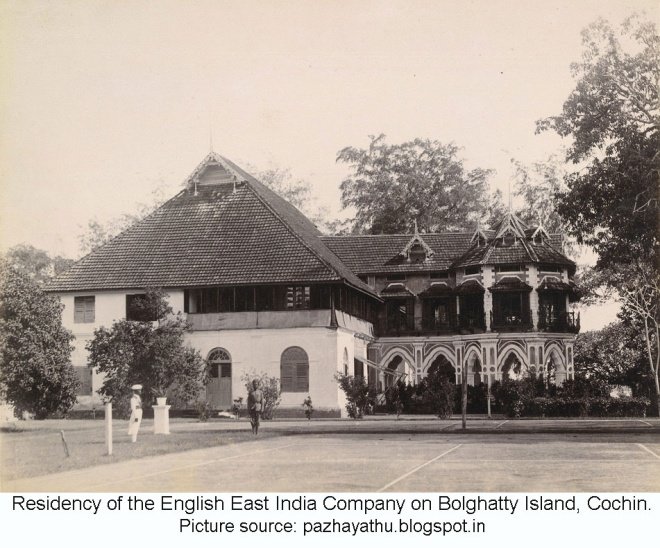 In this book, I will try to explain this quite cantankerous issue which literally can move the discussion beyond the very periphery of the realm of physical sciences. However, readers can also read the earlier mentioned book, An Impressionistic History of the South Asian Subcontinent. Quite candid information on this issue has been delineated in that book.
It is this terror of the pull and push of an all encompassing and overpowering negativity that has literally defined the history and historical events of this location, which is positioned at the south-western edge of the South Asian Subcontinent; north of Travancore.
The English East India Company’s aims and urges and attitude were of the sublime levels. However, they did not really understand the society into which they were inducing powerful corrections. In fact, they were correcting errors without understanding what actually created the errors in the first place. They had literally no idea about feudal languages. In fact, way back in England, there was a feeling that all nations and populations were innately similar to English populations in human emotions. It was an understanding bereft of a very powerful knowledge. That of the existence of feudal languages.
There is another general idea which I would like place here. It is about the general quality of formal history on India. Most of the various inputs about the quality of the populations, peoples and social system which existed in this subcontinent are more or less half-truth, or carefully cherry-picked items. The total aim is to give an impression of very resoundingly high-quality population groups who were allegedly pushed into destitution by the English rulers. This idea is not only half-truth or half-lie, but total lies and fabricated information.
What is usually compared in these kinds of comparisons is imageries of fabulous looking native-Englishmen and women living in good quality houses in the midst of totally destitute lower-castes. The immediate impression that springs into the minds of easily deluded persons is that it is the Englishmen who have brought in this destitution and desultory looks in the lower castes of the subcontinent.
The actual fact would be the exact opposite. The lower castes and subordinated classes of the subcontinent were held in tight hold by their own upper classes and castes. It was the English rulers who brought in the light of liberty to these desolate human beings who had lived for centuries in miserable surroundings.
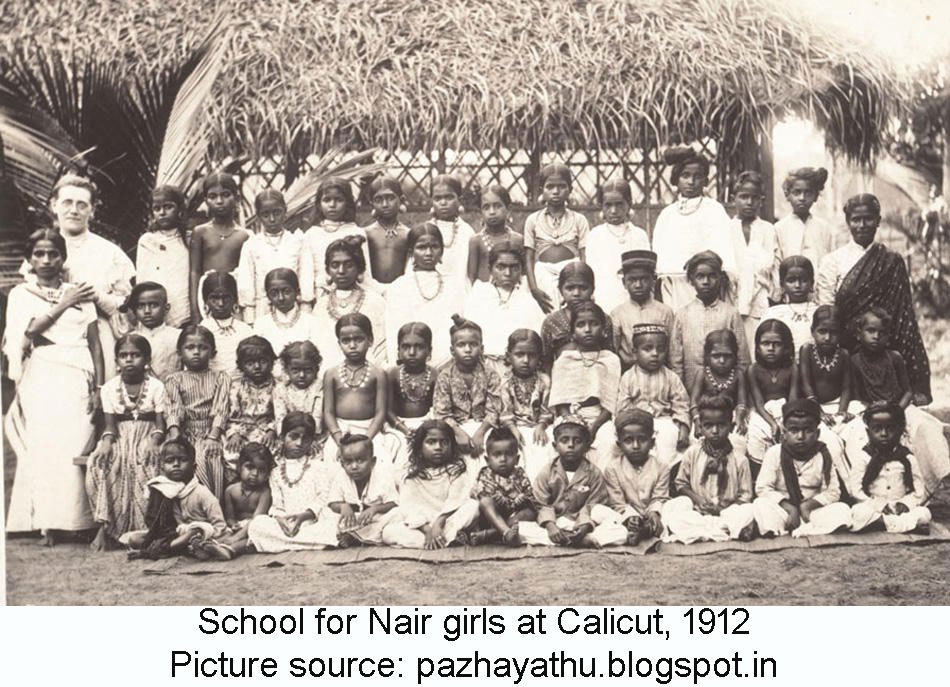
However, it is not easy to save or improve or pull out the lower classes from their subordinated stature. For, the situation is like a multi-storey building that has collapsed in an earthquake. The human beings are alive in the lowest floor. But how to pull them out? Above them is the mountainous weight of several floors of the building, crushing down on their collapsed floor.
This was the exact issue in pulling up the lower castes and classes. They were tied to their upper classes in very tights knots of subordination in verbal and dress codes. Even their body postures cannot be changed into an English body posture. For, if they do such a thing, it would amount to the greatest of impertinence. Their upper classes would quite casually impale them with iron nails or do something worse.
In formal history writing of this subcontinent, carefully filtered items are arranged to give a very false impression of this subcontinent.
South Asia, which is currently occupied by Pakistan, India and Bangladesh, was never a single nation or a single population. It was never a nation. There was actually no sense of a nation even inside a miniscule kingdom here. Even inside a miniscule kingdom, it was a feverish struggle between competing populations to subdue others. And among the hundreds of kingdoms, it was a messy time of continual fights and overrunning and molesting and raiding into each other’s locality.
The major issue that I find in formal history writing currently going on in India is that it is being done with a very specific aim. The aim is not write a correct version of history, but to write a contrived version which proposes the antiquity of a nation here which was astoundingly rich, technologically high, with high levels of scientific knowledge etc.
The writers of these kinds of silly history most probably do not know what the actualities were just fifty years back. In spite of this terrific shallowness of information, they propose to know what the state of the subcontinent was some 2000 to 7000 years back. The continuously mention an ‘India’ which most probably did not exist inside the subcontinent, but literally was a purposefully distorted version of a ‘Inder’, ‘Indus’, ‘Indies’, ‘Hind’ etc. words, which were known in the global maritime commercial centres. However, how much these words can be connected to the current-day India is a confusing point. River Indus itself is not in current-day India.
Such historians take quotes from ancient travellers who give brief descriptions about isolated locations and incidences with some kind of superlative exclamations and adjectives. But then they also give more detailed descriptions about other realities, which are more mundane and terrible. These items are quite cunningly avoided. The other superlative expressions of taken up as authentic descriptions of the state of the land.
Travellers make great comparisons and mention great things about cities and kings and certain isolated issues. However, the great fact that most of the people were enslaved and they were a generally not given much importance. They express great appreciation for the great hospitality they received from the rich merchants and the royal personages. Some of the writers do also mention the other reality of the tragic conditions of the people. However, formal Indian historian would not be eager to focus on them.
They focus on quite ridiculous sentences such as ‘this city had the most famous harbour in the world’. ‘Merchants from all over the world came here’. ‘This was a great commercial centre’ etc.
Merchants come to all locations where they understand that there is some commodity that can be sold elsewhere for a profit. However, that does not transpire that that particular location is fabulous. For instance, some decades back I used to frequent a literally forest-like district in south India, for buying agricultural produces, fruits and bananas and plantains. Actually so many other merchants did frequent that locality for similar purposes. Lorries used to come even from north Indian locations.
QUOTE: To the kingdom under the sway of Keprobotras, Tundis is subject, a village of great note situate near the sea. Mouziris, which pertains to the same realm, is a city at the height of prosperity frequented as it is by ships from Ariake and Greek ships from Egypt. END OF QUOTE
However all this cannot be mentioned to convey an understanding that the people in the location were socially high-class. In fact, the reality was that most the people were crude and lower class, in the forest location I had frequented. There were a few higher class financially rich persons and families. They were generally soft and well-mannered to visitors like me. However, to their own subordinated populations, they were nice but quite suppressing. But then, the lower classes were quite well-mannered to their superior classes, who they understood to have some kind of social power over them. However to visitors and other nonentities in the location, they had no qualms in being rude and ill-mannered, if they measure them to be of not of high financial stature.
These are the issues that need to be understood when cherry-picking from the writings of ancient travellers. Traveller writings can rarely be correct unless that particular writer knows what to look for.
QUOTE: For everybody has here a garden and his house is placed in the middle of it ; and round the whole of this them is a fence of wood, up to which the ground of each inhabitant comes.” END OF QUOTE
The above is a quote from Shaikh Ibn Batuta’s travelogue. However, that is only from a very slender perspective of a solitary traveller.
See these QUOTEs from this book, Malabar:
QUOTE: 1. The walls are generally of latorite to bricks set in mud, for lime is expensive and scarce, and till recent years the roof was invariably of thatch.
2. and it was not till after the Honourable East India Company had had settlements on the coast for nearly a century that they were at last permitted, as a special favour, in 1759 fill to put tiles on their factory at Calicut. Palaces and temples alone were tiled in former days.
3. The house itself is called by different names according to the occupant’s caste. The house of a Pariah is a cheri, while the agrestic slave—the Cheraman— lives in a chala. The blacksmith, the goldsmith, the carpenter, the weaver, etc., and the toddy-drawer (Tiyan) inhabit houses styled pura or kudi ; the temple servant resides in a variyan or pisharam or pumatham, the ordinary Nayar in a vidu or bhavanam, while the man in authority of this caste dwells in an idam ; the Raja lives in a kovilakam or kottaram, the indigenous Brahman (Nambutiri) in an illam, while his fellow of higher rank calls his house a mana or manakhal.
4. The Nambutiri’s character for Hospitality stands high, but only among those of his own caste.
END OF QUOTEs.
This is the reality as different from the miniscule impression of solitary travellers.
Social communication is very powerfully designed by the language codes. Without this knowledge, no traveller or sociologist can claim to understand a people or population or society or nation.
NONSENSE
It must be admitted that the book does have lot of nonsensical claims which are very evidently not the ideas or writings of William Logan. These insertion are the writing of the various native-officials who worked under William Logan, or of some other native scholars who collaborated and helped him in this work.
The nonsensical claims are basically spurred by some kind of inferiority complex in the writers in that they can understand that they have much more information about the social system than the native-Englishman has. Many of them are quite well-read. And almost all of them would posses much more leadership qualities than the average native-Englishman, when the various sections of populations who arrange themselves under them are counted. For the native languages are feudal. If properly enforced, they offer a leadership to the native-official, over the subordinated human beings, which the native-Englishman cannot dream of or even contemplate.
Yet, in spite of all this, the native-English side is to be more refined and attractive. It is basically not an individual deposition. For, as mentioned just now, the local native higher caste official might be able to compete with an Englishman at an individual level. However, when the native-Englishman is connected to his own native-Englishmen group, and the native of the subcontinent higher caste man is connected to his own native group, a very powerful difference will emerge. This is basically connected to the feudal content in the languages of the subcontinent.
Even though the skin-colour is different, that is not really the issue here. For if a single native-English white-skin colour man is born and bred in the subcontinent in the subordinate section of the local feudal language, he would not have any superior mien at all. At the same time, a native of the subcontinent born and bred in England would very definitely have personality and physical features shifting towards the native-English. However, it might take time and generations to display the huge difference that are in the offing in both cases.
See this quote from my own Commentary to the Travancore State Manual:
QUOTE: The tragedy that befell the life of the next king Rama Varma otherwise known as Swati Tirunal is there in these lines written by Col. Welsh who made it a point to observe the educational development of the young prince, who was being tutored by a Maharashtra Brahmin:
He then took up a book of mathematics, and selecting the 47th proposition of Euclid, sketched the figure on a country slate but what astonished me most, was his telling us in English, that Geometry was derived from the Sanscrit, which was Ja** ***ter to measure the earth, and that many of our mathematical terms, were also derived from the same source, such as hexagon, heptagon, octagon, decagon, duo-decagon, &c. END OF QUOTE.
It is possible that there are so many knowledge and information in the ancient cultures, including that of Egypt, Mayan, Inca, Hellenistic &c. However, even the Vedic culture has not much to do with the subcontinent, other than that some of the books have been found in certain households in the land. I am not sure if any evidence of any direct route to the ancient scripture is there in the populations here. Most of them come from various locations in the world.
The afore-mentioned Swathi Tirunal’s personal life seems to have been a failure due to some kind of personal inferiority complex. The Maharshtran Brahman teacher must have induced the idea in him that every knowledge in the world came from ‘India’. The basic information that there was no such ‘India’ as a nation or even as an interconnected geographical area was not mentioned to him. And that the Travancore kingdom had not much to do with these ancient information was also not much mentioned. This statement can be true with regard to all the castes including the Nayars, the Ezhavas, the Shanars, the Pulayas, the Pariahs &c.
As has been mentioned by certain travellers who came to the subcontinent, the ‘scholars’ of the land seems to have had the habit of forging old books to present totally fabricated idea. Even now such things are going on.
QOUTE: and even in genuinely ancient deeds it is frequently found that the facts to be gathered from them are unreliable owing to the deeds themselves having been forged at periods long subsequent to the facts which they pretend to state. END OF QUOTE.
For instance, it is known in current-day India that the British rule was literally driven out by Gandhi & co. However, the fact is that Gandhi had nothing to with this. It was just a foolish policy implementation of the British Labour Party.
There are claims that the Indian Navy is a continuation of the ancient Navies of old time kingdoms of the subcontinent, such as the Chola, Shivaji etc. These are all total lies. The Indian Navy is just a continuation of the Royal Indian Navy of British-India.
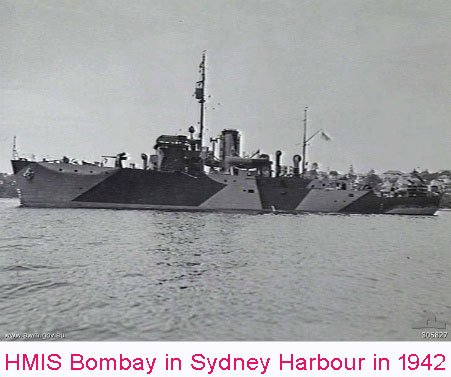 QUOTE: It is certain that Indian ideas and practices contributed largely to the form which orthodox Christianity in the West finally adopted. END OF QUOTE.
The above quote is certainly not the writing of William Logan. For, in the locations where it is certain that he has written the text there is no such emotion evident. Western Orthodox Christianity would have been affected and designed by the language of each nation where it spread. In England, the planar codes of the English language would have created a Christianity which is starkly different from that in Continental Europe. Even though the blame or the praise for disconnecting the English Christian Church from the Continental controls would be placed on King Henry the VIII, the underlying factor which led to it would be there in the English language itself.
Even the Kerala Christianity is totally against the system of human interactions as could be visualised in an English Christian area. However, that is a different area of discussion and cannot be taken up here. Readers who are interested in pursuing that logic can read the An Impressionistic History of the South Asian Subcontinent.
The above-quote seems to claim of a well-developed ‘India’ from where all kinds of information and culture, diffused to other nations or geographical locations. These kinds of claims are mere imaginations without any basis. Very few of the social, familial or public cultures of the subcontinent are worthy of being emulated by anyone. Culture is not what one read about in books. It is how people interact with each other and maintain quality relationships. There is no evidence in this book itself of any such thing in the subcontinent.
Even many of the family systems mentioned in this book, Malabar, are totally devoid of supporting a good family life. The relationships are more or less controlled by the feudal language of the place. Many things are quite contrary to what might appear through low-class logic.
For instance, the claim that the Marumakkathaya women had more liberty and social rights. This is not true. Most of them of the higher castes could not come out of their houses unless they had someone with them to display or disseminate their higher caste attributes. The profane glances and the profane words of the lower castes males and females would literally have the effect of a carnivorous animal bite.
QUOTE: And in return, the West seems to have given to the East arts and sciences, architecture, the art of coining money, and in particular the high ideal of religion contained in Christianity, as St. Chrysostom (who died A.D. 407) wrote: “The Syrians too, and Egyptians, and Indians, and Persians, and Ethiopians, and innumerable other nations, translating into their own tongues the doctrines derived from this man, barbarians though they were, learnt to philosophise.” END OF QUOTE.
The use of the word ‘Indian’ in the above quote is a misuse. There was no such a thing as an ‘Indian’. I am not sure if any other ancient books such as the Ramayana or Mahabharatha does mention that they are ‘Indians’. However, the probability that someone might insert this word in newly printed books is quite strong.
The word West also has many problems. If it is meant to mean Continental Europe, it might be good to say that it does not include England. For, the most powerful human designing tool, that is the language, in England was planar.
As to anyone giving anything to anyone is also a very much debatable point. None of the things mentioned, ‘sciences, architecture, the art of coining money’ seems to have come to the possession of the huge content of lower castes in the subcontinent. As to the others having all that, well, these things get diffused from various locations to various locations.
For instance, if one were go to the Amazon forests, one might see the forest-dwelling populations using bow and arrow. It would be quite a ludicrous claim that they got the art of archery from ‘Indians’ of the South Asian Subcontinent.
Another instance is the fact of people all over the world using dairy products, such as milk, buttermilk, curd, butter, yogurt, cheese &c. In a terrific fit of jingoistic fervour a current-day Indian can claim that these ideas all came from India. However, the fact remains that to the majority populations of the subcontinent, such things as yogurt, cheese etc. came into their purview only in very recent times.
There is a general tendency to be absolutely astounded by anything that is seen in the antiquity of the subcontinent. For instance, there is the martial arts known as Kalari which was part of the antiquity of north Malabar. I think that Travancore did not have the tradition of this very same martial arts, even though there was something known as Thekkan Kalari (southern Kalari) there.
In the neighbouring Tamilnadu, there are another martial arts known as Adithada and Silambam. Adithada was seen mentioned in Travancore area some thirty to forty years back. However, the Kalaripayattu of north Malabar was not generally known to the local people in Travancore.
Now, the northern Kalaripayattu is generally mentioned as the martial arts of Kerala, which itself is very cunning distortion of tradition.
Here what can be mentioned is that the northern Kalaripayattu is a very sophisticated martial arts form. However, this art form is in the stranglehold of the local feudal vernacular. This is its main defect. If this art form can be plucked out from the possession of the local feudal vernacular and relocated into English, it will be a very sophisticated martial arts form.
The problem when dealing with this martial arts from a historical perspective is that the moment anything is mentioned about this arts, the local people including its own exponents would start making tall claims. The very first claim would be that this martial arts originated here in Malabar. This is a very curious claim.
Being an expert in the arts and being the founder of the arts are entirely two different propositions. It is not known who brought this art into Malabar. This information is lost to antiquity in the same manner the arrival of Nayars and the two different castes of Thiyyas have been lost. If the locations from where the various different populations came to Malabar can be traced out, the location from where it came here might also come out. However, that alone would not reveal who founded this art system.
However, the general tendency in the subcontinent, as elsewhere in all feudal language social systems is to lay claims upon anything and everything that can add to one’s verbal code value.
In Keralolpathi, there is a mention, I understand, that Parasurama brought Kalari system to this geo-location. Keralolpathi can be a fake history book, written with some malicious interests. However, it might have picked up the tradition of Kalaripayattu from some place. If Parasurama had brought it, he must have come from some location where it was practised. It is not clear if it would be right to claim that he came and founded the martial arts system on his own.
QUOTE: 1. These quarrels arose from private feuds and were meant to wipe off stains cast upon an individual's honour.
2. Women were the chief origin of the quarrels which occasioned these combats. They were confined to the Nayars. END OF QUOTE
The true working area of the Kalari exponents. They remained the henchmen of the local landlords. They would not be the great ‘maharajas’, but merely the Inhi -ഇഞ്ഞി (lowest grade you) and oan ഓൻ (lowest grade he/him).
QUOTE: The subdivision and re-subdivision of the authority of government were perfectly marvellous and probably unparalleled in the history of any country in the world. The great families—the Zamorin, Kolattiri, Walluvanad, Palghat, Kottayam, Kadattanad, Kurumbranad, etc.—were petty suzerains, each with numbers of vassals, more or less independent, and more or less fluctuating in numbers, who again were suzerains to still pettier chiefs, also more or less independent and more or less fluctuating in numbers. The subdivisions of authority did not cease till the lowest stratum of agricultural society was reached END OF QUOTE.
The above-statement is some kind of extreme jingoism gone berserk. The utter nonsensical claims of a super low-quality land. The whole content of oppressive regimentation can be explained as the handiwork of the local feudal languages. If the reader has any doubt about the oppressiveness of the subcontinent, check the book: Slavery in the South Asian subcontinent.
QUOTE: The society thus constituted was on a thoroughly sound basis, for the strongest men had opportunities of coming to the front (so to speak). END OF QUOTE.
And the mention is about the Nayars. However in the actual factual history part in this book, Malabar, there is no evidence that substantiate the Nayars as the strongest, bravest or intellectually the best. The best thing about them was they were subservient to their overlords and oppressive to the subordinate populations.
The above quote can be nonsense in Malabar.
QUOTE: In this way numberless petty chieftains arose, and the great families waxed or waned END OF QUOTE.
It is the shallow claims of a very minute landscape with practically nothing great to offer other than a history of various shackled populations. What ‘great families’ are being mentioned, other than the higher castes? Their greatness should be evident in their action of improving the other populations. There is no such evidence. Other than their right to use rude and outright impolite verbal usages such as Inhi / Nee, Ane, Ale, Eda, Edi etc. It is the English rule that saved the lower populations from the hammering of these verbal codes.
QUOTE: But with these material objects it will be observed were conveyed such things as “authority in the Desam,” “Battle wager” and “Rank” and “Customs” which are clearly outside the idea of dominium as understood by Roman lawyers. END OF QUOTE.
A very vain attempt to connect to Rome, in the mistaken belief that it was Rome that brought in greatness to human populations. It is a very wrong notion. The greatness in human beings was brought out by the native-English nation, and not by the Romans. Even animals got the relatively best deal in native-English systems.
Actually the very use of English words like Admiral, Commander, General, Officer, Soldier, King, Queen, County, Baron, Customs duties and such other words used with regard to seemingly corresponding items in the subcontinent stand on the very periphery of nonsense. None of these things in the feudal-language speaking subcontinent comes near to what is visualised or imagined in English. It is the like the fake Gandhi movie made by one irresponsible British film director. The Gandhi in that movie has English body features of those times, and English body-language. However, Gandhi really was a feudal language speaker, who was not liked inside the Congress.
Take the word ‘officer’ for instance. An officer is a Gentleman. However, in the feudal language ambience, what is translated as an ‘officer’ is literally a brute who uses terrible degrading lower indicant words to many others, with a solid feeling of right.
QUOTE: The chief things conveyed were the different kinds of authority attaching to a Desam, a Temple and a Tara, and not merely the lands and slaves END OF QUOTE.
It is just because English is a planar language this concept was not clearly understood. All authority is connected to verbal codes that encode honour and ‘respect’ on the person who has authority. All those who have to bear the thraldom of the persons in authority are necessarily assigned degrading verbal code definitions. This is the core issue. It cannot be understood in English, for there is such a concept of ‘indicant words’ in English.
QUOTE: The system was admirably conceived for binding the two classes together in harmonious interdependence. This excellent arrangement necessarily fell to pieces at once when the Civil Courts began to recognise the force of contract—the Western or European law— as superior to the force of custom—the Eastern or Indian law. END OF QUOTE
This is a theme I have oft heard in my childhood from those who saw the breaking down of age-old dominating-class – subordinate-class relationship. It is true that if this relationship is not replaced by quality English social relationship, the society does not have the exact feel of a culturally developed society. Yet, from the perspective of the traditionally lower classes, they have come out of their subordination.
These themes are highly complicated. For instance, I have seen students who have studied in reasonably good quality English schools moving into the government vernacular schools / colleges after completing their tenth class. The first feeling they get is that they are along with a more liberated students. For, they generally get to experience boisterous shouting, moving around in clusters, roaming around etc.
However, it takes time to understand that they are literally like a cattle-class gone under a more subordinating teacher-class. However, the oppressiveness will not be felt, even when they are addressed in the pejorative forms of You, and referred to in the pejorative forms of He, Him, His, She, Her, Hers etc. For, this is an experience that is commonly felt by all students.
It is like this: A common man in England goes to the police station on his own and sits down and narratives his problems to the concerned police official without any demur or subservience.
At the same time, a common in India goes to the police station along with some of his relatives or even with the support of his local political leaders, stands in a pose of subservience and gets addressed and referred in the pejorative. He has on complaints, for that is how every common man he knows are dealt with by the police.
However, to a person who has seen both the English systems as well as the Indian system, the latter would be seen as quite satanic and degrading.
QUOTE: This system—another necessary result of the Hindu social organisation— was evidently conceived in much wisdom for protecting the interests of the cultivating castes. Here again however ideas borrowed from the European law of property in the soil have come in to upset the well-conceived customary law of Malabar. END OF QUOTE.
The above statement is very obviously not the words of Logan. And the words ‘Hindu social organisation’ is highly mischievous. There is no such thing as a ‘Hindu social organisation’ if the Hindu religion is the context. The Hindu religion is actually the Brahmin religion. As to the social set-up in which the Brahmins are on top in a state of perpetual dominance, then there is nothing to praise in it. It is not like saying that the Lords of the England are perpetually on top. The difference is that the English language is planar, while the languages of the subcontinent are more or less terribly feudal. Without understanding what that is, it is more or less a waste of time to discuss this point.
Again, the words ‘European law of property in the soil’ is also a very foolish statement. The native-English administration was not trying to bring in the property system of England, let alone that of Continental Europe. There is indeed difference between the feudal systems of Continental Europe and that of England. Why such a difference is there can be understood only by understanding the basic coding difference between that of the Continental European languages and that of pristine-English.
For instance, the French feudal system was quite a tragic item, while the feudal system of England was not tragic for the social system, if that feudalism is compared with that of Asian, African and Continental European feudal systems.
The feudal systems of South Asia might not have any corresponding items with that of English or Continental European feudal systems.
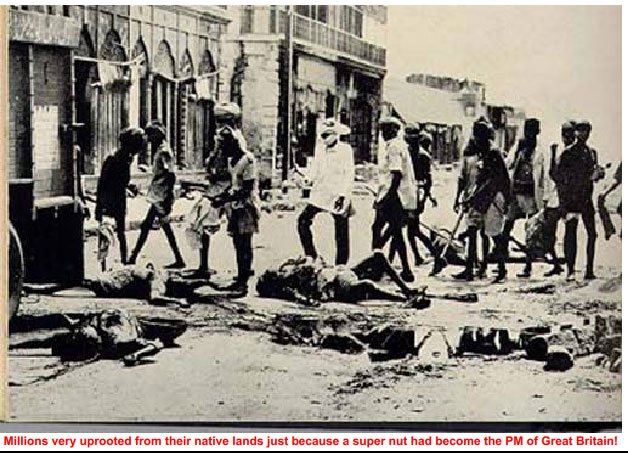
As to the local customary laws going into disarray, well it was a good thing. However, what was bad was that English administration suddenly dropped everything and vanished, before a perfectly egalitarian social and communication systems had been enforced. That was due to the handiwork of the satan Clement Alee.
I can only say that each member of the British Labour Party who endeavoured to destroy the English Empire should suffer till eternity for the great sufferings they brought all around the world. In the subcontinent alone, in the northern parts, around 1million persons were killed in the immediate aftermath of the stopping of the English rule, and handing over the location to stark selfish low-class politicians.
QUOTE: The insecurity to the ryots thus occasioned has resulted in fanatical outrages by Mappillas and in a great increase of crime END OF QUOTE.
The writer of the above statement is trying to place the blame of the Mappilla outrages on the higher castes, on the English administration. All this fool has to do is to check the communication codes between the traditional higher castes and the newly socially improved Mappillas to find out the root cause of these outrages. Even in the US, at times native-Englishmen have gone berserk when these kinds of Satanic verbal codes are inflicted on them. Check what Adam Purinton did!
QUOTE: thinking that the idea hitherto generally received that in ancient times there was no such thing as a land assessment in Malabar is, after all, a mistaken one. Knowledge on this subject is at present extremely limited, and it is now doubtful whether the point, if it is eventually cleared up, will hereafter be of any other than antiquarian interest END OF QUOTE.
This is part of the tall claims that every modern items conceived and brought into the subcontinent was already there in the subcontinent. Even the current-day Indian navy is now being taught as being the development of the ancient naives of Cholas and other small-time kingdoms of South Asia. If this be so, what will Pakistan and Bangladesh teach in their schools could be a item for pondering.
It is possible that in some remote historical period, there might have been some kind of land assessment in the location currently mentioned as Malabar at some time or other. History does date backwards to millions of year. However, that kind of historical events do not have any connection with what was seen in Malabar by the English Company officials.
QUOTE: It will be seen from the paper on Tenures that custom - and not, as in these modern days, competition—ruled everything END OF QUOTE.
This is a very cunning complicated statement. There is no competition possible in a feudal-language based feudal social system. That is true. For, the slave cannot compete with his next higher caste. He will be crushed down, and even hacked into pieces, if he were to do something like that. And his demeanour will be terrible, due to the fact that he exists in a lower code area. His words will be of terrible degrading quality, if he is allowed any leeway to address the higher castes without ‘respect’.
However, when we look upon native-English systems, there is a totally different ambience that cannot be compared with the native systems of the subcontinent. The basic difference is that English entrepreneurship does not have any satanic aim of arriving at a higher verbal code location above the workers or labourers. This very concept is unknown in English. So, there is no way to compare an English entrepreneurship with that of an entrepreneurship of India, Pakistan or Bangladesh.
Because this factor is there in the subcontinent, everything has a satanic quality in them. When I say Satanic, I mean it. The people arrive at various levels of human degradation or ennoblement, just by the work they do. There is no such thing in English. The native-Englishman cannot understand how by doing any work, a human being can get differently defined as a dirty or gold, in every communication code.
QUOTE: From that date forward the land disputes and troubles began, and the views above described of the Joint Commissioners were not the only causes contributing to the anarchy which ensued. END OF QUOTE.
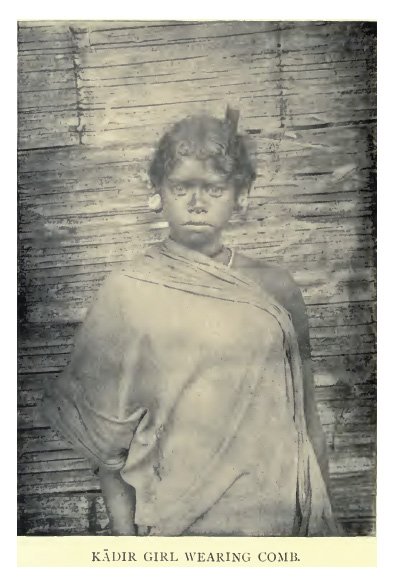 The rascality of the above statement is that this is being mentioned about a land in which almost all throughout history there was incessant fighting, killing, hacking and demonization of human beings. Just before the period in context here, Muslim raider came from Mysore and all the higher castes ran off for their lives. If the English administration was not there in Tellicherry, all the higher castes would have been made the lowest of the castes and made the servants of the lowest castes. The higher castes females would have been taken up by the lowest castes as their concubines or literally shared by the lowest caste males.
The anarchy that the fool has mentioned above was felt because of the relative serenity that had arrived in the social scene. Otherwise, there would be no time to think of these things. Every week there would be plans for attacking others, or for resisting the attacks of the others.
See this QUOTE from Travancore State Manual:
The Sivarathri was not good day for a Hindu to die in and the Maharajah, it is said, told his doctor and attendants on his death-bed: “Yes I know that to-day is Chuturdasi, but it is unavoidable considering the sins of war I have committed with Rama Iyan when we both conquered and annexed several petty States to Travancore. Going to hell is unavoidable under the circumstances. I can never forget the horrors to which we have been parties during those wars. How then do you expect me to die on a better day than Chaturdasi? May God forgive me all my sins” END OF QUOTES.
This quote is from a book which was an official document of the Travancore kingdom’s government. Just imagine what happened in all the small kingdoms around Travancore. Changacherry, Chengannur, Kayamkulam, Ambalapuzha, Attingal, Quilon, Kottayam and many more minute kingdoms?
QUOTE: But the Civil Courts, acting on the idea that the janmi was a dominus and as such entitled to take what he could get out of the land, viewed his pledges as pledges of the soil itself, and in this way they have almost completely upset the native system of customary sharing of the produce. END OF QUOTE.
This again is the words of some higher caste writer. That the bringing in of written codes of law in civil and property disputes was retrograde step! In a land where there was no conventions or systems worth mentioning, other than that of ‘might is right’, actually the coming in of the written laws were a great step forward. However, the whole thing was still in a mess due to the fact that all these things had to be filled into a feudal language ambience. Where every communication and human relationship was in varying routes and strings.
Nothing was straight forward.
QUOTE: This excellent arrangement necessarily fell to pieces at once when the Civil Courts began to recognise the force of contract—the Western or European law— as superior to the force of custom—the Eastern or Indian law. END OF QUOTE.
These are all very malicious lies. For, at hand is not a confrontation between Western or European and ‘Indian’ systems. It was a confrontation between what the native-English (not Western or European as is mentioned here) officials try to bring in and the attitude of the higher castes (Hindus and Nayars) to resist it. The force of custom in the subcontinent (not ‘India’. India was not yet born) was that of hierarchy in all relationship, which, if everyone in the hierarchy concedes to it, becomes a regimentation that accepts what the higher castes said or demanded. With the coming of the native-English rule, this oppressive hold on everyone was broken. However, it would take time to build up an egalitarian social system based on English. However, this route was stopped in 1947 by the crooks in the British Labour Party.
QUOTE: Under the native customary law the cultivator could not be ousted except by a decree of the tara, for the janmi was powerless unless be acted in strict accordance with the Nayar guild whose function was “to prevent the rights from being curtailed or suffered to fall into disuse” as the Keralolpatti expressly says. END OF QUOTE.
What a foolish writing! Nayar guilds are there to protect Hindu and Nayar interests from the competition of the lower castes. As to quoting from Keralolpathi, it is another foolish idea. It has been more or less proved in this very book, Malabar, that Keralolpathi is a forged document written with some sinister interests.
QUOTE: Mr. Graeme's proposals in regard to wet lands and diverted his attention away from points in regard to the position of subtenants, to which the Court of Directors had turned their earnest attention, but precipitated the collision between the parties interested in the land, and indirectly led to the Mappilla fanatical outrages and other evils END OF QUOTE.
It is true that the English administration was misled many times by their own native-officialdom, which was dominated by the Hindus (Brahmins) and Nayars. However to place the blame of the Mappilla outrages on the English administration is a deed of the devil. The Mappilla outrages were caused by various factors, and the land reforms of the English could be the least of the causes.
Check this QUOTE: There is no doubt whatever that Oodhut Roy, a Mysorean Mahratta Revenue officer, misled the Joint Commissioners END OF QUOTE.
This is one thing that the native-English could not understand. That people will look into the face and tell lies with total nonchalance.
QUOTE: Egypt then became not only the centre of literary cultivation and learning for the Hellenic world, but an emporium of trade and the centre of great commercial enterprises END OF QUOTE.
The above is just the kind of nonsense that was written by some native of the subcontinent scholar. He must be totally blind to the reality of what was happening all around him. The social system was changing for the better. But then, the higher castes did have much to grieve about it.
For in Tellicherry area, it was the lower caste Marumakkathaya Thiyyas who improved much due to English education. It had its tragic sides.
Now, with all this great changes in knowledge, dressing standards, social mobility, education, human rights etc. happening right in front of him, the writer is extolling some nonsense connecting to the Hellenic world and Egypt. The very profound mistake in these kinds of scholarly writings is the sterile understanding about trade and commerce. Trade and commerce are actually very dangerous things. In fact, they can bring in various problems to the people.
As a person who has had enough and more varied experiences in business, I can categorically mention that in a commercial location in a feudal language social ambience, only the bosses and their companions enjoy all the benefits. The others literally suffer.
Even for England and the US, unbridled entry of outsider businessmen can do damage to their own native citizens. Only in the case of English colonialism, did the entry of outsiders bring in goodness to the social environment. And again this was not due to trade, but due to the entry of various other social goodness. Including the egalitarian English language.
The positive benefits of English colonialisms cannot be replicated by any feudal language systems.
Nairs / Nayars
Now, that I have created the framework on which to work on, let me first start with the population group mentioned in the book as Nairs or Nayars.
I will be mentioning items about this population which might seem quite mean. However there is no antipathy that I bear upon this population. In fact, I can understand their urges and their terrors and claims and their aspirations. And also their desperation to create a corridor of distance, when a new entity called the English East India Company was slowly diffusing into the social system and literally erasing a lot of carefully placed social-fences. Beyond all this I am aware of a very resounding quality-feature expression from their side. Something not many other populations groups in this irascible nation would dare to do. What that is, I will mention later.
However as of now, I will go through items which definitely will sound dreary to the Nairs. But before commencing on this, I will make another quite drastic mention.
In a feudal language social ambience, the lower placed persons and populations naturally acquire a demeaning quality. Their very presence, touch, stare, seeing, commenting, association etc. convey a most debasing emotion. Why this is so, can be made clear only by explaining the whereabouts and the ways and manners of feudal language verbal codes. I cannot go into them here.
First let me give a description of the Nair caste as understood locally and from the various books such as the Travancore State Manual, Native Life in Travancore, Castes and Tribes of Southern India etc.
Nair caste in its pristine form was the Sudra caste. The word Sudra connects to the Aryan four Caste (Chaturvarnya system of division). It is the lower-most caste in that system. In which case, they should be of Sanskrit ancestry and antiquity. It is quite doubtful if they have any known Sanskrit ancestry of antiquity.
I have found this quote in Travancore State Manual: QUOTE: These Nagas became the Kiriathu Nayars of later Malabar claiming superiority in rank and status over the rest of the Malayali Sudras of the west coast. END OF QUOTE
I do not know how to understand this statement. It is presumably taken from Keralolpathi, which is a book with a lot unmentioned issues.
In the Malabar region, the dominating religious group was the Brahmin religion. This is what actually can be mentioned as the local version of the Hindu religion. But then, how much content of the Sanskrit antiquity and ancestry is there in the Brahmins of Malabar is not known to me. I presume it to be quite feeble. But then, they do have a religious heritage which is different from that of the others.
Then there are populations known as the Ambalavasis. They are an array of population groups who can be defined as those allowed entry into Brahmin places of worship, like the temples. They, by vocation, are those who can do the various kinds of work inside a temple. Such as sweeping, gathering flowers, cleaning, cooking etc. How much they belong to the Brahmin religion is not known to me. However, Brahmin religion is the religion of the Brahmins. This is what should be known as Hinduism.
Then comes the population group known as the Nairs or Sudras. Looking at the words Nairs and Sudras, it should be felt that there is some dichotomy in the sense they convey. For ‘Nair’ is a word that is understood to mean the ‘higher caste’, by the population groups who identify themselves as lower to them.
At the same time, the word ‘Sudra’ can mean that they themselves are the lowest population group among another set of population. Now, this is a point that has to be very clearly and delicately discussed with a razor sharp precision.
If the old caste-hierarchy of Malabar region is compared with the modern police hierarchy in Kerala, the corresponding layers are thus:
The various layers inside the Brahmin group can be compared to the IPS officers’ cadre (Indian Police Service cadre). This is the royalty of the police administration in India.
Below them come the Ambalavasi (Temple worker) population groups. They can be compared to the below-IPS officer cadre. This would include the DySp., Circle Inspectors and Sub Inspectors.
Below them would come the Nairs / Nayars. They would correspond with the Head Constables and the Constables.
This is one point for more inspection with regard to claims in the book.
It is quite easily understandable that the Nairs were quite comfortable with the extremely low-level populations of the social order. That is the lower castes such as the Pulaya, Pariah, Malayan, Kurichiyan, Kurumban, Cherumar etc. For, they were so lowly in every aspect that they would not pose any kind of immediate threat to the Nair layer.
However, the Thiyya group of population was a different proposition altogether. They came just below the Nair layer. They had to display a verbal and body posture subordination to the Nairs and above. However, they themselves acted superior and touch-me-not to the various population groups below them.
In a feudal-language social set-up, having some layers of people below is a great personality-enhancing experience. This was one querulous plus-point that the Thiyyas experienced in north Malabar.
A digression to Thiyyas
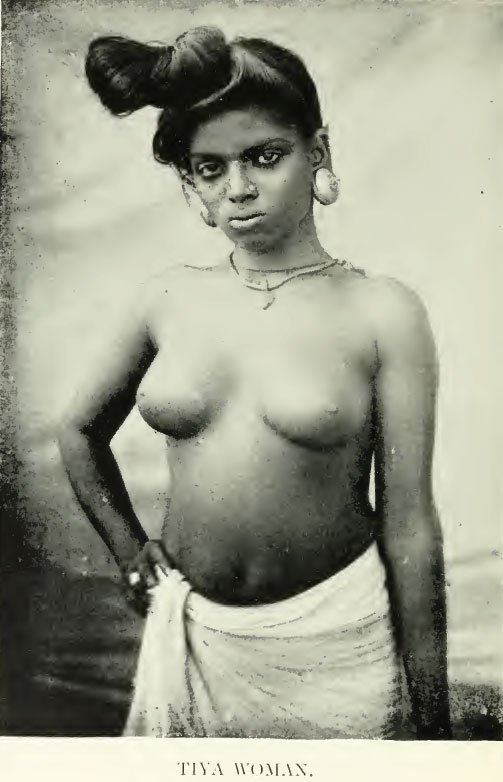 Before going ahead with the information on Thiyyas, there is something more to be mentioned about them. When the English administration set up its legal and judicial process in Malabar, they were confronted with one confusing issue. The word Thiyyas was seen to define two entirely different population groups.
One was the Thiyyas of north Malabar. That is north of Korapuzha. Then there was the Thiyyas of south Malabar. These two population groups were mutually different and distant. The former was following Matriarchal family system. That is, the family property moved to the heirs through the female children. The children of the male members did not inherit the family property. These children received their ancestral property from their mother’s family.
The Thiyyas of south Malabar followed the Patriarchal family system. That is, the children of the male members inherited the family property.
Between these two castes with the same name, there existed some kind of caste-based repulsion. The north Malabar Thiyyas, especially the socially higher class Thiyyas of Malabar, did not allow any matriarchal relationship with the Thiyyas of south Malabar.
Why this was so, is not known to me. However, it is possible that this might point to two different origins for these two different population groups.
Generally there was a tendency among non-Thiyya castes, especially the Ezhavas, when they reside in Malabar to identify themselves as Thiyyas.
Moreover, it has been observed by such writers as Rev. Samuel Mateers and I think by Thurston also, that there was a tendency to jump into a higher caste when any family relocate to a different location. This automatically places them at a greater social advantage.
It is like head constable in one state in India, when he moves to another state for a temporary residence, informing others that he is a police Circle Inspector in his own state. Off course, nowadays this is not much possible, due to technology making all such distances quite near. However, in a situation wherein there is no means to check the antecedents of a person, it is quite easy to jump up.
However, Rev. Samuel Mateers does mention the following: QUOTE: Pretences are sometimes made by individuals to higher than their real caste. During a festival at Trivandrum, several goldsmiths putting on the dress and ornaments of a superior caste, walked boldly into the temple. We have known one or two apostates from Christianity, well-educated in English, who assumed Sudra names, and passed in distant parts of the country as such. But impostors are detected by very simple means. A Shanar youth who took the high-caste seat at a public cook-shop was discovered by his mode of eating rice, picking it up with the fingers, while a Brahman scoops it up gently with the side of the hand lest he should tear with his nails the leaves which they are accustomed to use as plates. Strangers at feasts are therefore closely scrutinised and watched. Still, changes in caste do, in odd instances, succeed. END OF QUOTE
It is possible that the two different populations having the common name ‘Thiyya’ are of two different origins. There is some claim in the northern version Thiyyas, that is, the Marumakkathaya Thiyyas, that they are from the Tian-Sang Mountain-range regions of north-central Asia. If this be so, what could be the origin of the southern-version Thiyyas, I am not sure.
However, it is possible that the Marumakkathaya Thiyya arrived on the Malabar shore in some century in the distant past. Since they did not know the hidden treachery in the language codes, some of them took up the extremely terrifying and daring occupation of coconut-tree climbing. The physical capacity to do this is an accomplishment, which few people have.
In the feudal-language codes of the local language, this action acts like a switch. The person, his associates, his family members and even his complete group can get placed very forcefully in a degraded verbal slot. Once placed inside this slot, the doors shut and the population literally gets subordinated to the level assigned for them. This subordination is not something that can be understood in English. Everything that can give any sense of dignity and self-confidence is erased out. This becomes so powerful an emotion that the affected person/s would not even sit in the presence of their superior. They will be addressed and referred to in the most degrading forms of the word-forms for You ഇഞ്ഞി, ഇനക്ക്, Your ഇൻ്റെ, Yours ഇന്റേത്, He ഓൻ, His ഓന്റെ, Him ഓന്, She ഓള്, Her ഓടെ, Hers ഓൾടേത്, They ഐറ്റിങ്ങൾ, Their ഐറ്റിങ്ങടെ, Theirs ഐറ്റിങ്ങടത്, Them ഐറ്റിങ്ങക്ക് etc.
The working of the social machine is a bit complicated. Nairs are also addressed by similar verbal usages by the Brahmins. However, they do not feel the terrorising degradation. Instead they feel the placing of them into their supervisor slot, when thus addressed and referred to by the Brahmins.
However, in the case of the Thiyyas who went in for the degrading physical labour, the cunning technique used to place them down powerfully is to use similar level and also lower-level populations groups to address them by these degrading words. Then it is a powerful pushing-down and pulling-down effect.
Incidentally, I may mention here that this is now an ongoing social phenomenon in England. The native-English speaking population of England are slowly being placed in a like-manner into a hideous slot by the immigrant crowds who speak feudal-languages. Once a sizable number of native-English speakers are thus defined and confined in the slots, all that the immigrant groups need to do is to forcefully shift the spoken-language to their native language. The trap-door shuts and then there is no escape. At that point the native-English future generations will become the repulsive lower-castes.
Not all of the north Malabar Thiyyas who arrived on the north Malabar coast went in for these coconut-tree connected professions. That much is evident from the population’s social demeanour. Many must have remained as land owners and some as land lessees. However there is a total blackout on them inside this book, Malabar, purported to have been written by William Logan.
Then there are certain families who are by hereditary, practitioners of a local herbal medical system. This is in some ways connected to the herbal treatment systems found all over India, and also in the other geographical locations including Continental Europe. So, it does seem that the original immigrants in all nations did include various kinds of professionals. In the South Asian peninsular region, they might have rearranged themselves as per the designs in the language codes.
Among the north Malabar Thiyyas, there is indeed a group who calls themselves as Vaishyar, more or less connecting to Vaidyas (professional herbalists). They are the practitioners of the herbal treatment system. As of now, this is locally known as Ayurvaidyam. I do not know what the root source of this treatment is. It does seem to have global connections in the ancient world. These Vaishyars in the interior location of north Malabar did try to mention a distance from the local labour class Thiyyan/Thiyyathi. That they are from a different and higher population group.
However, it is true that among the land-owning rich Thiyyas, there is an innate tendency to declare a distance from the labour class Thiyyas. This again is powerfully connected to the feudal codes in the local language.
Designing the background
Now coming back to the Nairs, if the Nairs are accepted to be from the Sudra caste antiquity, then there comes the issue of how they acquired a higher-caste physical-demeanour and social status.
Here again the feudal language-codes act in a very peculiar manner in the social machinery, in more than one way. The Brahmins are in social command. How they acquired it is not known. There are some quotes from the Keralolpathi, given in this book (Malabar), whereby it seems to promote the idea that the Brahmins were handed over the social power by Parasurama. However, Keralolpathi is a book with serious credibility problems, apart from certain other more terrific issues. I will deal with those items later.
From whatever is quoted from Keralolpathi, there is nothing to suggest how the Brahmins continued to hold on to the social heights. However, if one does know the codes inside the local feudal languages, one can very easily identify the codes that assign divine aura to certain groups of people. Along with this, certain other codes deny dignity to other sections of the population. This can also be known.
In a feudal-language social ambience, it is not the higher-calibre persons who are assigned positions of responsibility and power by those on the heights. Instead, they give the power and position to persons who cringe and obey and exhibit obeisance and servitude. Those who are ready to offer almost anything that is asked for by the higher-placed persons, get the posts. Those who stand out in a pose of dignity are very cunningly denied any social status. They slowly go down in the social set up.
Look at the stature of the Indian police constables, both male and female. It may be seen that in India, where extremely high-quality persons are available, those who get posted as police constables are quite obviously the totally low-quality persons. In feudal languages, the officers would find most it most convenient to have extremely low-class subordinates. If the police constables are generally of a very high intellectual and personal quality, the officers would find it quite difficult to have them as handymen and women.
It is seen mentioned that the Sudra households of the distant past, set up a tradition of allowing entry into their houses for certain higher-class Brahmins. They could have temporary alliance with the women-folk therein. From a planar social set-up, if this procedure is viewed, it might seem quite an irregular and immoral system. However, from a feudal-language social ambience, wherein verbal codes are strictly enforced, no one would find any fault in this. For, a close contact with a Brahmin would only convey a divine aura to the household and to the female.
However, if the same female were to be viewed or mentioned or addressed in a profane manner or even called by name by a lower-caste male or female, that woman would feel the degradation. These are things that cannot be understood in English.
There is a huge difference in associating with a lower individual from that with a higher individual. The whole verbal codes change. This is a phenomenon that cannot be understood in English.
From a low-population perspective, the whole affair would be described as despicable. However, that is very much connected to the envy and hatred to populations who act superior. The lower castes see a breach in the cloak of superiority of the Nayars which they take up for sneering comments.
See this QUOTE from Sultan Tipu’s when he had over-run Malabar command:
QUOTE: and since it is a practice with you for one woman to associate with ten men, and you leave your mothers and sisters unconstrained in their obscene practices, and are thence all born in adultery, and are more shameless in your connexions than the beasts of the field : I hereby inquire you to forsake those sinful practices, and live like the rest of mankind. END OF QUOTE.
Females with social stature, offering themselves to the Brahmin, was a very wonderful experience for the Brahmins. Such a level of devotedness and servitude would naturally be rewarded. This could be one of the main items which promoted the Brahmins to uphold the Sudras up.
It is like a low-class man being appointed as a police constable. There would be other population groups who are of higher quality than this constable. But then what is the use? They all have to cringe and bow and exhibit servitude to the constable. Otherwise, they would get to feel the terrible wrath and fury of the whole police force.
Now, this is slightly what could have happened to the Thiyyas. Their first mistake was in doing a work which in the feudal languages would very powerfully assign them a lower slot in the social order. The second item that could have made them go down is the issue of body language which might not be that of obeisance. An English-type of body-language is seen to be the body-language of impertinence. In current-day India, when the police force is slowly changing into that of total feudal language communication, a pose of dignity would get the person end-up first in an hospital and then in the jail.
However, in the case of the Thiyyas of north Malabar, they were slowly swindled into a social location wherein they were dirt. However, the more intransigent castes and populations were totally degraded into subhuman levels. They remained as the Paraiah, Pulaya, Vedan, Malayan etc. in the varying locations at the bottom dirt levels.
However, Edgar Thurston does mention that the Thiyyas of north Malabar, especially those of Tellicherry and nearby places were quite fair in skin-complexion to the extent that some of them could quite easily pass off as Europeans. This was also true. I have personally seen such persons in my own childhood in Tellicherry area. However, I have also seen that in the case of many of them, their next generation went into total loss of this feature. Why this happened also can be very easily explained. However, I am leaving that issue.
I had found the following quote in Castes and Tribes of Southern India, Volume I, written by Edgar Thurston.
QUOTE: Concerning the Dikshitars, Mr. W. Francis writes as follows* :—"...............is the property of a class of Brahmans peculiar to the town, who are held in far more respect than the generality of the temple-priest Brahmans, are called Dikshitars (those who make oblations), marry only among themselves, and in appearance somewhat resemble the Nayars or Tiyans of Malabar, bringing their top-knot round to the front of their foreheads. END OF QUOTE.
I mentioned the above quote to pick out a very casual observation by a disinterested third party. That, there is some kind of physical resemblance between the Nayars and Thiyyas of Malabar in physical stature. And the words ‘of Malabar’ may also be noted.
However, the disinterested party, that is a native-Brit made an observation based on some isolated social scene he had seen. Nayar and Thiyyas did not have the same physical stature in many locations of north Malabar. However, in certain locations where the Thiyyas were not totally suppressed into a physical labour class, some of the Thiyya families did have looks which was as mentioned by Edgar Thurston. Quite fair and tall.
At the same time, it might be mentionable that there are Nayars who do not have the same physical features mentioned above.
The reader may notice the specific mention of ‘north’ Malabar in my words. It is because ‘south’ Malabar was different with a different population group. The higher classes of the Marumakkathaya Thiyyas of north Malabar exhibited a disdain for the south Malabar Makkathaya Thiyyas. However, this is not the end of the issue. The Nairs of north Malabar also had a similar kind of repulsion for the Nairs of South Malabar.
See this quote from this book, Malabar: QUOTE: but this is rendered doubtful by the fact that down to the present day Nayar women from North Malabar may not pass to the south of the Ellattur river END OF QUOTE
I do not have much information about south Malabar. If I am to refer to some book and write, it would take a lot of time to filter out a lot of false information in this. For, almost all current-day writings in India on these kinds of things are full of lies and slanted versions of events. Almost everyone suppresses information that is not supportive of their side. And glorifies their population side. Or anything or anyone who does the same thing. Words like ‘greatest in the world’ is a very commonly found adjective.
The social repulsion exhibited by both the Nayars as well as the Thiyyas of north Malabar to the corresponding castes in south Malabar, seems to be too much to be casually mentioned off as a coincidence. There was indeed something specifically in the history of the various populations that encoded these kinds of things. However, the book Malabar, does not mention these things. In fact, many of the information given in the book, which most probably is the inputs of the native-officials, are barren in this regard. Almost all these writings purposefully aim at glorifying their own caste populations; and degrading the others. All other finer details are simply wiped off.
This attitude is in sync with what Rev. Samuel Mateer has mentioned in his book Native Life in Travancore: QUOTE:— the amount of research bestowed by each to discover local traditions, verbal derivations, analogies in ceremonies or usages, or anything whatever that might enable them to out-vie rival castes — the contempt felt for the boasting of others — and the age-long memories of reported or imagined honours once enjoyed by them. END OF QUOTE
There is this quite curious bit of information that came to my notice in this book:
-
“I cannot offer even a plausible conjecture how, or at what time, a connection existed between Nepal and Tibet, and Canara, but I cannot doubt that such was the case.”
-
Mr. Forgusson has the following suggestive remarks in his work on the “History of Indian and Eastern Architecture” : ‘that it is remarkable enough that the Newar women, like those among the Nayars, may, in fact, have as many husbands as they please, being at liberty to divorce them continually on the slightest pretence.’
-
In fact, there are no two tribes in India, except the Nayars and Newars, who are known to have the same strange notions as to female chastity, and that coupled with the architecture and other peculiarities, seems to point to a similarity of race which is both curious and interesting.
The point here seems to indicate that Nayars have some ancestral connection with some population known as Newars in the Nepal area. How farfetched this idea is not known to me.
One possibility might be that one or the other Nairs (north or south Malabar) and the north Malabar Thiyyas might be of the same origin. They separated after becoming connected to the native feudal languages, which have the capacity to splinter up human populations into one-sided repulsion and one-sided attraction population groups. There are two points of correspondence between the Nayars and north Malabar Thiyyas. That is, both are following Marumakkathaya family traditions.
Yet, still it is also plausible that the Marumakkathaya Thiyyas are from the north-central Asian region as mentioned earlier.
As to there being any kind of cultural commonness between the Nayars and the Marumakkathaya Thiyyas, well, this is actually designed over the years by the level in the feudal languages. Persons and populations assigned a lower grade in the verbal codes are different from those assigned a higher stature. Genetic designs can be over-written by language codes. That is a fact.
It is the same level of stature in the language codes that actually creates a common population group. Caste is only a solidification of this levelling. Once this verbal levelling is changed, the caste-based grouping would also change over the years.
For instance, if one brother becomes a small-time coolie and the other brother becomes an IAS / IPS officer, in such a way that both of them do not have any connection with each other, the language codes would change their physical and mental demeanour very much. Within a generation or two, there would be little visible signs to show that there was some kind of commonness, other than some facial feature similarity.
Now, if the two brothers knew each other, there would be a certain amount of repulsion towards the coolie brother for the IPS brother. He would in most probability not even like to mention his coolie brother. However, the Coolie brother, in spite of feeling bad that his IPS brother is giving him a wide berth, would be quite attracted to his IPS brother, and would most probably mention his relationship to him.
It is possible that the Nayar and Thiyyas of north Malabar could be one population group that got separated by the language codes. However, this contention cannot hold much water. For, the Nayars do have a Sudra ancestry, which the Thiyyas do not have. So, it is more probable that the Nayars emerged to higher stature through a Brahmin link, while the Thiyyas went down through a verbal degrading route.
What is the situation between the Nayars of South Malabar and Makkathaya Thiyyas of South Malabar is not known to me.
However, there is a lot of purported information mentioned as from Keralolpathi. That book seems to promote the idea of a single Kerala in the days of antiquity, and that the whole of the geography was under one single dynasty. This may or may not be true. Most probably, if true, only for a very brief period. History of the world does not commence from the period mentioned in Keralolpathi.
If there is such a population-repulsion between those in North Malabar and South Malabar, how could a single kingdom be there which is supposed to encompass even the Travancore region? Keralolpathi is a useless book of historical records, possibly. Since I have not read it, I cannot say anything for sure.
The common points among the common people of north Malabar of yesteryears is the general fair complexion of their skin. This has slightly gone down in recent years, I feel. Second is the Matriarchal family system seen among both the Nayars as well as the Thiyyas there. Some Muslims groups also did have this, I think.
Third is the general repulsion for the populations of South Malabar. Travancore did not actually come into the picture at all, maybe till Gundert and party appeared on the Malabar scene and came out with a Keralolpathi.
It is curious that there is no reasonable information on why this population-repulsion came about.
There is another fanciful commonness found among the Nairs and the Thiyyas of North Malabar. Both of them have their own hereditary deities which are more or less Shamanistic in form. They may not have any real antique connection with the Brahmanical religion of the Vedic culture. However, the Shamanistic deities of the Nairs seems to be different from the Shamanistic deities of the Marumakkathaya Thiyyas.
The most mentioned deity of the Thiyyas is the Muthappan. There are others also. As for the Nairs, one deity named Mavan is seen mentioned in the footnotes, in the book Malabar, as a deity of the Nairs. There are others such as: Kuttichathan, Paradevatha, Asuraputhran, Gulikan, Chamundi &c. However, I am not sure if these deities are solely Nayar deities, or deities common with other lower castes such as Marumakkathaya Thiyyas, Makkathaya Thiyyas, Malayans &c.
There is some sameness. And yet, in the earlier days at least, the Nair common folks used to keep a distance from the Thiyya deities and worship systems. For the Thiyya deities were the gods of the populations they saw as low-grade.
Now, this idea would more or less disconnect to the Sudra ancestry of the Nayars. However, there is a lot of confusion. It is only to be understood that in a single generation of people, with an average life-span of around 45 to 60 years, so many things happen. So many mixings happen. So many warfare, fights, relocation etc.
The people of Travancore are mentioned to have a Tamil heritage. While the north Malabar region has had a language which had not much content of either Sanskrit or Tamil. Now, how do one go about with this information?
With regard to the Travancore history this is seen mentioned: QUOTE: were in turn brought under subjection by an irruption of the Tamil race (Nayars) under Kshatriya leaders from the East Coast. END OF QUOTE.
Here it seems that the Nayars of Travancore were Tamilians. Then how come there is a single Nayar caste? Well, that is not a error-free question. For there is a hierarchy of castes inside the Nayars itself.
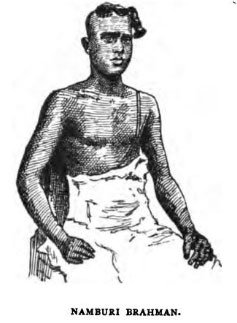 But then, are the Nayars all the same in some way? The only sameness must be similar to the sameness one would see in the immigrants to England from various nations. After all of them live under the English systems for a few generations, there would not be any difference left in them, other than skin-colour, and certain traces of facial features.
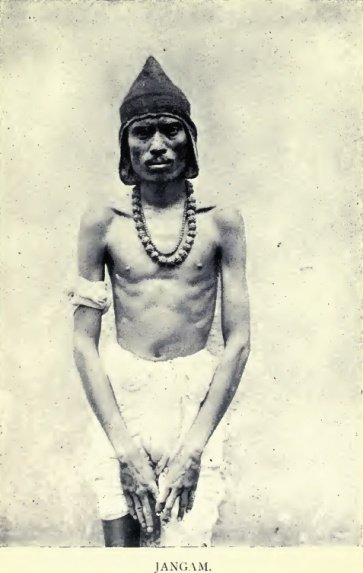 Like that those populations who were placed in the rank of the Nayars, as supervisors by the Brahmin populations would slowly seem to be one population. The population groups who placed their women-folks at the beck and call of the Brahman folks are those who come to the fore.
What is the reason for allowing such terrific rights to the Brahmins? It needs to be understood that to arrive at a higher language-code level above the so-many terrible populations who would want to crush them down, the general attitude would be to concede to this. For, it is much better to go up above the lower-placed populations, who would be more crude, rough, ill-mannered and totally uncouth. Their very eye-language would be Inhi / Nee /Thoo to those who they have no ‘respect’.
Over the centuries, all the different population groups who got placed in the Nayar level would slowly evolve out of their own ancestral bloodline and would reflect both the Brahmanical bloodline as well as the higher-position they have in the language codes.
South Asia is a land in which in many locations, a fair skin-complexion is seen as quite attractive and of a superior social mien. This is a point to be noted. For, it does give an impetus to dark-skinned populations groups to get connected to fair-skinned population groups.
Now, speaking about the Thiyyas, there is something more to be mentioned. It is that among the Thiyyas themselves, there is severe grading depending on the stature of the household and also connected to the occupation. Many Thiyyas were by ancestry connected to the job of plucking coconuts. This naturally connects them to the other allied profession. That is of Toddy-tapping on the coconut trees.
From an English perspective, there is nothing wrong in these professions. However, in the local feudal vernacular, this profession has been assigned the low-grade stature words. Words for He, Him, His, and You, Your and Yours would be that of the dirt level, from their own caste higher persons. This dirt-level-ing of words is in itself a complicated social machine process. I cannot explain it here. Interested readers can peruse the book I mentioned earlier.
The association to this low-graded professional did give a pull and tug towards the bottom levels of the social order. It affects the communication codes to a disadvantage. Especially when viewed from the perspective of the higher classes.
So among the Marumakkathaya Thiyyas themselves, there came into being a sort of caste-divide inside their own caste. There were the Thiyyan and Thiyyathi, who were literally treated as dirt in the verbal codes. They were the labour class of people. Devoid of all rights to dignified verbal codes from the higher castes and from their own caste land-owners. The other more prominent Thiyyas owned lands and also had administration over their own centres of worship. This information I am more or less writing from an impressionistic understanding of history.
This higher-level Thiyyas were the Thiyyars. Not the Thiyyan or Thiyyathi. This difference in verbal designation is what is derived from the feudal codes of the local language. The Thiyyar individuals would address the Thiyyan and Thiyyathi as Inhi ഇഞ്ഞി, and refer to them as Oan ഓൻ and Oal ഓള്. They in reverse would address and refer to the Thiyyars as Ingal ഇങ്ങള് and Oar ഓര്.
In effect the local feudal language has created very powerful disintegration and split inside the same population group. The higher-class Thiyyars would quite frankly show their distance and repulsion to the Thiyyans and Thiyyathi. This information I am adding from my own observations. It may not be possible to find any written records or evidence for this.
In between I should mention that this kind of terrific splintering in the social fabric is happening right now in England, as the feudal-language speakers slowly spread out inside the soft belly of the native-English society over there.
The newly-arrived-in-Malabar native-English administrators were more or less impervious to these issues. This was the first danger that the Nairs noted. That they can be quite easily dislodged by the Thiyyas. For, in English, there is not much of a premium value in displaying extreme servitude and obeisance. In fact, if they tried to offer or exhibit any of the kind of obeisance they practised towards the native-English officials, at best they would go down in stature.
The larger issue can be seen in the fact that many Englishmen who went in for long-stay here took Thiyya lower-class females as their woman / wife here. This is something no native higher-class man would dare to do. It would simply pull his stature down into the gutters. It would reflect in everyone’s verbal codes, even in his own wife’s family members’. However, the English to a long extent remain aloof from all this, even though it might be true that a slight quality degradation would set in, the moment they get defined by their local family connections, in the native languages. This highly explosive information never seems to have entered into the heads of the native-English. Even now, they do not know anything about this.
The commencement of an Anglo-Thiyya blood population groups in Tellicherry and surrounding areas must have created terrific dins of dissonance in the higher caste social web. It would be most keenly felt by the Nairs. For they stood on the location which shared its boundary with the Marumakkathaya Thiyyas.
Being on the lower-grade of the language-codes does bring in terrific quality deficiency. Not only does the intellectual quality in ordinary conversation go down, but even their words of referring can be terrible demeaning for others. Entry of one single Thiyya into the officer cadre of the English administration would go a long way to spray the codes of degradation on to all other higher castes in the work area of the same officer.
This degradation is caused by the bridge that this single individual has created to all his lower-social grade companions and relatives to converse about the higher caste individuals with the least of ‘respect’ and ‘reverence’. In fact, all Nairs in the officer cadre can easily do down to the levels of the labour class Thiyya relatives of the officer Thiyya. They would very easily get converted into Oan ഓൻ and Oal ഓള്, in the conversations of the low-grade populations. Their rightful position is actually that of Oar ഓര്.
Before going ahead with the book commentary, I would like to insert this much here. Allowing the lower-grade people to address a higher standard population with such words as Inhi/ Nee ഇഞ്ഞി/നീ, Oan/Avan ഓൻ/അവൻ, Oal/Aval ഓള്/അവൾ etc. (all lowest grade verbal codes for You, he, she etc.) is a very demeaning work. The person or the persons who get addressed, if they are of higher personality quality will get degraded into a level of stinking excrement. Others of quality will try to keep away from their proximity.
Affected persons may go into mental agony, paranoia and even epileptic seizures. I mention this much to denote that they are all very powerful language codes.
Now, this is a common experience in India. The lower-grade police constables are allowed the freedom to use these words on any individual who are accosted by them, and appear to them as socially vulnerable. This idea may be understood in a further manner. That, in the newly-formed nation of India, a small percentage of the population is of golden standards. They possess the right to higher grade verbal codes. The main group who have come to hold this right in a sort of hereditary manner is the Indian government officials.
That does not mean that all the other Indians are stinking excrement. Most of the higher social classes are also in the higher bracket. But a huge section of the population are stinking dirt, who can be addressed in the most meanest of verbal usages by the police constables. From this information, the reason why the people who live in India are generally defined as some kind of dirt by the Indians who have relocated to the English west and to Continental Europe, can be understood.
There is some truth in their assertion. The degraded populations of India cannot even address a government office worker as an equal or subordinate. If the requisite ‘respect’ is not given to the government office worker, he or she is done for.
This is the real fact about the so-called independent nation of India. When the English administration ditched the people of India, Pakistan and Bangladesh and handed them over to the government employees, the people quality went into decay.
However, the real training of the people into a excrement mentality is done in the vernacular schools of the nation. The teachers, most of them totally of the very low intellectual class, use the lower indicant word form of You, Your, Yours, He, His, Him, She, Her, Hers etc. to the students. And also differentiate the parents into Adhehams അദ്ദേഹം (gold) and Avans അവൻ (dirt). The former consists of the government officials, doctor, and big business owners etc. The latter consists of ordinary workers and such.
This is a huge topic. I do not want to go into that. Interested readers are again requested to read the ‘An Impressionistic History of South Asian Subcontinent’.
It is quite curious that two individuals from the subcontinent got Noble Prize for supporting ‘education’. One escaped to England. The tragedy of England! I will leave that topic here.
Now, I am going to take up the ‘Nair’ mention in this book, Malabar purported to have been written by William Logan. The reader must bear in mind that I am giving frank impressions. If the Nairs or Thiyyars or any other population group feels insulted, it had not been my aim to do so. Moreover, people react to the language codes. When they feel that any association with anyone else can degrade their defining verbal codes, they will make all desperate attempts to negate it. If they feel that another person or groups of persons are going to outwit them or to go above them, they will get terrorised. Because all such events can create cataclysmic changes in the language codes.
In a feudal language system, language codes are everything. Just like codes are very powerful inside a software.
Content of current-day populations
Each individual has two parents. Father and mother. Each of these individuals have their own parents. If we go backward like this, it is easily seen that each person currently living would be connected to 1024 individuals some ten generations back. And to 32,768 individuals some 15 generations back. And to 1,048,576 individuals living some 20 generations back. From this point backwards, the numbers simply expand exponentially astronomically. For instance, at the time of the 21st generation back, a man currently alive would be would be connected to around 21 lakhs individuals (i.e. around 2,097,152).
So it is easily seen that any individual of any caste currently alive would more or less have a bloodline connecting him to almost all castes and populations groups that had come to the South Asian subcontinent at anytime in the past.
So there is no need for any individual to feel elated or disgraced when any particular detail is mentioned about any caste or population group of yore. And a twenty-generation back is not such a far-off time. There are individuals alive now who have seen their ancestors to around four to five generations back.
The book, Malabar, is about people and population groups some 100 to 400 years back.
Nairs / Nayars
It was the establishment of the English rule that brought in peace in the subcontinent. Even inside this miniscule Malabar region, there were many small-time and relatively bigger kingdoms. Each and every one of them was incessantly in a state of perpetual warfare. And inside each of the ruling families, individual members staked their claims based on various connections, to the kingship. No one experienced any length of time of peace.
Nagam Aiya has mentioned this point very frankly in his Travancore State Manual.
QUOTE: “It is the power of the British sword, “as has been well observed,” which secures to the people of India the great blessings of peace and order which were unknown through many weary centuries of turmoil, bloodshed and pillage before the advent of the Briton in India”. END OF QUOTE
About the Malabar location and nearby areas he mentions this much also:
QUOTE: It is quite possible that in the never-ending wars of those days between neighbouring powers, Chera, Chola and Pandya Kings might have by turns appointed Viceroys of their own to rule over the different divisions of Chera, one of whom might have stuck to the southernmost portion, called differently at different times, by the names of Mushika- Khandom, Kupa-Khandom, Venad, Tiruppapur, Tiru-adi-desam or Tiruvitancode, at first as an ally or tributary of the senior Cheraman Perumal — titular emperor of the whole of Chera — but subsequently as an independent ruler himself. This is the history of the whole of India during the time of the early Hindu kings or under the Moghul Empire. The history of every district in Southern India bears testimony to a similar state of affairs.
QUOTE: The Nawab of Tinnevelly was nominally the agent of the Nawab of Arcot, who was himself ruling the Carnatic in the name of the Delhi Padisha; but beyond a mere name there was nothing in the relationship showing real obedience to a graded or central Imperial authority.
QUOTE: The Nawab of Tinnevelly himself co-existed with scores of independent Poligai’s all over the District, collecting their own taxes, building their own forts, levying and drilling their own troops of war, their chief recreation consisting in the plundering of innocent ryots all over the country or molesting their neighbouring Poligars.
QUOTE: The same story was repeated throughout all the States under the Great Moghul. In fact never before in the history of India has there been one dominion for the whole of the Indian continent from the Himalayas to the Cape, guided by one policy, owing allegiance to one sovereign-power and animated by one feeling of patriotism to a common country, as has been seen since the consolidation of the British power in India a hundred years ago. END OF QUOTE
This was a fact of life in the subcontinent since times immemorial. Beyond all this was the fact that people were simply caught and taken as slaves or sold off as slaves. There were many problems with the life of women.
Then, English rule came. There was peace. However, in the settled social life, another danger started poking its head. It was the imminent rise of the lower castes and classes. For the Nairs, the most dangerous content was the Thiyyas.
It is like a team of police constables in a police station. The local taxi-drivers are their subordinate lower-castes. They can address them as any kind of dirt. They are the Nee / Inhi and Avan / Oan.
Suddenly all of a sudden, there comes a change of scene. On the social front, there emerges a small group of taxi-drivers who come with a higher demeanour than the others. They do not accept the lower-grading assigned to them by the constables and the government. Due to the fact that these taxi-drivers are of a superior mien, the constables somehow bear the terribleness of an equality and dignity in the taxi-drivers.
Now, comes the next issue. Seeing the higher demeanour and rights of these superior class taxi-drivers, the other taxi-drivers also start acting in a pose beyond their traditional stance of inferiority. This is too much for the constables. For, they are used to seeing the taxi-drivers as a cringing lot. (In fact, I have seen commercial lorry drivers being made to beg holding on the legs of peon-level officials of the sales tax in a border check-post in a middle-Indian state).
But then what can the constables do? In the new system, they can’t beat or slap the taxi-drivers into submission. So what do they do? The go around writing their superior stance wherever they get a chance. They see to it that the taxi-drivers are not mentioned at all. Or if at all mentioned, connect them to some other taxi-drivers in another state where the taxi-drivers are treated as dirt.
Whenever a mention of the local village taxi-drivers is made, simply add a reference to the taxi-drivers of the other state where they still are treated as obnoxious objects.
Beyond that in places where they would not be disputed they would claim to be officers. The bare fact the Indian policemen were traditionally termed as ‘shipai’ would be given the go-by. Why? Because it is nowadays heard by them that in the US, the police constable is called an ‘officer’. So by going that roundabout route, they arrive at the officer grade.
However, it might also be mentioned that this issue will crop up only when the taxi-drivers get a feeling that the constables are their equals. Other-wise they do not think about these things and are perfectly happy with what they have, if they are otherwise happy.
Now, let us look into what has been the claims of the Nair folks in this book. Even though these things are ostensibly written by William Logan, they are not.
One of the very evident points is that in the location where William Logan has directly written, that is the location of history writing, especially where the records of the English Factory in Tellicherry is taken up, the Nairs are quite differently defined and mentioned. There is not anything spectacular or courageous in the Nair quality. In fact, even the word ‘peon’ is mentioned about them. The word ‘Kolkar’ is also mentioned as a peon.
In the Travancore areas, which is far south of Malabar, I had noticed a very frantic desperation on the part of the Nairs there to mention and define themselves as Kshatriyas. Various kinds of logic and historical incidences are mentioned by them to define themselves as Kshatriyas, far removed from the Ezhavas who exist just below them; and who try their level best to equate them downwards. The Nairs used to assign verbal comparisons on Ezhavas, which the latter find derogatory.
The Ezhavas take pain to mention them as Sudras. Thereby giving a hint that the Nairs are actually low-castes. However, the truth remains that the Nairs are not low-caste, if one were to go by the route of bloodline. And by mental demeanour also, they refuse to be low-caste. I will leave that there. My interest here is to illuminate the terrors that the feudal language codes have inspired in the people.
It is not easy to very categorically mention which all parts of the book are the direct writings of William Logan, which are more or less the inputs of the natives of the subcontinent. Some of the names of the native individuals who have made writing contributions are given in the book. Two names are mentioned by him in the Preface to Volume 1. They are: Messrs. O. Cannan, ex-Deputy Collector and Kunju Menon, Subordinate Judge.
The reader may note that in the 1800, these officials were not native-Brits, but more or less the natives of the subcontinent. Even though this might seem a very powerful plus point, in actual fact, the quality of the native-English administration goes down at the locations where the relatively senior officials are from the cantankerous native-population groups. However, that is another point, not of context here.
The descriptive notes on the various Taluks are seen to have been done by Messrs. Chappu Menon, B.A., C. Kunhi Kannan and P. Karunakara Menon. Of these three, both the Menons are obviously from the Nayar caste. As to the previously mentioned O. Cannan, ex-Deputy Collector and C Kunhi Kannan, there is nothing to denote their caste. Both the names are seen to be used by both the Nayars as well as by the Thiyyas, in the 1900s.
Why this pointed seeking of caste is done is that in a feudal language social ambience, persons are not actually individual entities. They are simply part and parcel of huge strings and webs of associations and hierarchies. It is quite difficult to be a free-thinker in the way an Englishman can be. Most or many words in the native feudal-language have a direction code of affiliation, loyalty, hierarchical position, command and obedience. More detailed examination of this point has been done in the afore-mentioned An Impressionistic History of the South Asian Subcontinent.
I think this might be the right occasion to mention a few words about individual names in the Malabar region (especially the north Malabar region, for south Malabar antiquity is relatively more obscure for me). Thiyya individual names traditionally are like this: Pokkan, Nanu, Koman, Chathu, Kittan &c. for males. For females, it is Chirutha, Chirutheyi, Pokki, Pirukku, Cheeru, Mathu etc.
It is possible that some of these names were used by the Nairs also. What that is supposed to hint at is not known to me. However, speaking about names, there is this bit to be mentioned. On a very casual reading of the various Deeds given in this book, a lot of individual names of the Nairs and the castes above them were seen. It was quite obvious that very few of them had any deep connection with the Sanskrit or Brahmanical names, that are currently used in great abundance by everyone.
I am giving a few of the names* I found in the various deeds. Quite obviously none of them are of the castes below the Nairs:
Achatt അച്ചത്ത്, Appunni അപ്പുണ്ണി, Candan കണ്ടൻ, Chadayan ചടയൻ, Chakkan ചക്കൻ, Chandu ചന്തു, Chattan ചട്ടൻ, Chatta Raman ചട്ട രാമൻ, Chattu ചാത്തു, Chekkunni ചേക്കുണ്ണി, Chennan ചേനൻ, Cherunni ചെറുണ്ണി, Chingan ചിങ്കൻ, Chiraman ചിരമൻ, Chokkanathan ചൊക്കനാധൻ, Chumaran ചുമരൻ, Cotei കോട്ടായി, Ellappa ഇള്ളപ്പ, Iluvan ഇലുവൻ, Iravi Corttan ഇരവികോർട്ടൻ, Itti ഇട്ടി, Ittikombi ഇട്ടിക്കൊമ്പി, Kammal കമ്മൾ, Kammaran കമ്മരൻ, Kanakkam കനക്കം, Kannan കണ്ണൻ, Kandan കണ്ടൻ, Kandu കണ്ടു, Karunnukki കരുനുക്കി, Kelan കേളൻ, Kelappa കേളപ്പ, Kelu കേളു, Kittanan കിട്ടണൻ, Kokka കൊക്ക, Kondu കൊണ്ടു, Kora കോര, Koran കൊരൻ, Korappen കോരപ്പൻ, Korissan കൊരിസൻ, Kunchiamma കുഞ്ചിയമ്മ, Kunhan കുഞ്ഞൻ, Kunka കുങ്ക, Manichan മണിച്ചൻ, Makkachar മക്കച്ചാർ, Murkhan മൂർഖൻ, Mutta മുട്ട / മൂത്ത, Muttatu മൂത്തത്, Nakan നകൻ, Nambi** നമ്പി, Nanganeli നങ്കനല്ലി, Nangayya നങ്കയ്യ, Nangeli നങ്കേലി, Nantiyarvalli നാട്ടിയാർവള്ളി, Okki ഒക്കി, Pachchi പച്ചി, Paman പമൻ, Panku പങ്കു, Pangi പങ്കി, Pappu പപ്പു, Patteri പട്ടേരി (ഭട്ടതിരി), Raru രാരു, Rayaran രയരൻ, Rayiru രയിരു, Teyyan തെയ്യൻ, Thoppu തൊപ്പു, Valli വള്ളി, Velu വേലു, Viyatan വിതയൻ, Yamma യമ്മ.
* In the Malayalam transliteration given of the names, there can be errors.
** Nambi is a caste title also, commonly seen in Travancore. However, in Malabar, it seems to have been used as a name also.
Some of these names are seen suffixed with such names as Nair, Menon, Kurup, Nambiyar etc. in the case of the Nayar-level people. Some of the higher castes above them were seen to have family names and other titles added either as suffixes or prefixes. Some the Nair level individuals also might have them.
Inside the historical section also, the names of the Nairs are found to be of similar content. For instance, there is the name one Yemen Nair mentioned in the history of the minute Kottayam kingdom. Yemen literally means the God of Death. I do not know if there is any error in the name’s meaning given, that entered through a erroneous transliteration of the word ‘Yemen’.
Now, it may be mentioned here that Nairs / Nayars are not actually one single caste. There is a hierarchy among them also. It is more or less a hierarchy of population groups holding on to a solid frame, that holds them all above the swirling waters in which the lower castes are submerged. They have to hold tightly to the frame, in such a way the each layers does not kick the lower down into the water. For this, they should not try to fight for a higher step among the various Nair layers. For, if they lose their grip, the lower castes would immediately pull them down among them or even push them down below them.
This action of pulling down is a physical action. It simply consists of changing the words of addressing and referring to a lower indicant word. Simply put, if the lower caste man or woman or child changes the higher He/Him (i.e. Oar ഓര്) to a lower level he / him (i.e. Oan ഓൻ), the person would come crashing down into the lower caste swirling waters.
Since I have mentioned the various Deeds, there is one thing that comes to my mind now. It is that Deeds can actually be a rich source of social communication and feudal language hierarchy information. However William Logan does not seem to be very keenly interested in pursuing this idea, even though there are hints in this book that he did feel its presence, without understanding what it is.
It is like this: To around the 1970s, in Malabar land registration documents, there was a very specific communication direction found to be enforced. It is that in sale deed between a Nair and a Thiyya man, for instance, the Thiyya man is invariably addressed as a Nee (lowest You) while the Nair man is addressed as a Ningal / Ingal (Ingal ഇങ്ങൾ is the highest You in Malabari – not in Malayalam).
It goes without saying that the words for He and Him and also for She and Her would also be likewise arranged as per caste hierarchy. This topic is quite a huge one and I do not propose to pursue it here. However, even though in this book a lot of Deeds of yore have been placed for inspection, the book writers do seem to have only a very shallow information on what all things need to be looked for. In fact, they are totally unaware of the deeper content that designs the social structure and human relationships.
From this perspective, this book has a lot of shallowness. However, it must also be said that there is a lot of very good information also in this book. The only thing is that the reader needs to know what to look for; and to be aware of what all things might be totally missed, or laid bare without explanations.
A lot of information is lying in a scattered manner all around the book. If possible, I will try to assemble the information in very logical groupings.
It is quite possible that the main persons who interfered and influenced the writings in this book were from the Nair caste. It is only natural that they would be quite apprehensive about what inputs are there about the Nairs. In this book, almost everywhere, the Nairs are described in the superlative. Only in the specific areas where Logan himself more or less wrote the text, they are differently described. In fact, in this particular location, the descriptions about the Nairs are of the negative kind.
One thing that might be noticed in this book is that there are certain very specific ideas or information that is tried to be emphasised as true. To this end, almost all historical information are filtered out. Moreover many words from antiquity are mentioned as having changed to certain other words, which then seems to help prove the contentions. I can mention a few. However, let me focus on the word ‘Nair’ here.
See these quotes:
-
The Nayars (so styled from a Sanskrit word signifying leader, in the honorific plural lord, and in ordinary sense soldier) were the “protectors” of the country, and, as such, crystallised readily into the existing caste of Nayars, with numerous branches.
-
Aryans ................... had perforce to acknowledge as “protectors” the aboriginal ruling race,- the Nayars — whom they designated as “Sudras” but in reality treated as Kshatriyas. END OF QUOTES
There is the word ‘Chera’, which is mentioned many times in connection with a ruling family of this land. This word has been mentioned in many ways. One is that it is another pronunciation of Kera. Which more or less, then authenticates the name Kerala. This is the way the argument goes.
However, the very elemental idea that could be picked up from this word is that Chera in the native languages of the area, means the Rat Snake. Why this very first impression is avoided is not known.
However, there is the mention of this land being full of serpents. See these quotes from Malabar State Manual written by Nagam Aiya.
It is actually based on the Keralolpathi, I think:
QUOTE:.....the land newly reclaimed from the sea was a most inhospitable region to live in, being already occupied by fearful Nagas, a race of hill-tribes who drove the Brahmins back to their own lands. Parasurama persevered again and again bringing hosts of Brahmins more from every part of India to settle in and colonise his new land; the Nagas were propitiated under his orders by a portion of the land being given to them and thus his own Brahmin colonists and the Nagas lived side by side without molesting each other. And by way of conciliation and concession to the old settlers (Nagas who were serpent-worshippers), Parasurama ordered his own colonists to adopt their form of worship, and thus serpent-worship on this coast early received Parasurama’s sanction. These Nagas became the Kiriathu Nayars of later Malabar claiming superiority in rank and status over the rest of the Malayali Sudras of the west coast.
Parasurama also brought other Sudras, to whom he assigned the duty of cultivating the land and otherwise serving the Brahmin colonists. These Sudras were in addition to the Nayars, the early settlers, who had been conciliated and won over as servants and tenants as shown above. He also brought cattle and other animals for agricultural purposes. END OF QUOTE
This is one point. So for the sake of an intellectual point, it might be mentioned that the word Nayar actually originates from Naganmar. That is, the Naga people. The word Naga means Serpents, which actually is connected to Cobra. The word ‘nayar’ then might not have the celestial standard meaning of social leadership and control and patrolling and protection of the people that is simply mentioned all over the book, Malabar, purportedly written by William Logan.
Beyond that, there is also the mention of them being Sudras and also not Sudras. For they were Nagas. However, they were the serving classes of the Brahmins. Similar to the police shipais of Kerala police. This was the designation of the police constables in the state. Shipai means peon. However, as of now, they have been redefined as the ‘officers’. Then, who are the ‘officers’ of the police department might become a debatable point in the near future.
Not many persons would dare to stake up such a point. For, mentioning such a think about the police constables can be very, very dangerous.
There is this information which I saw in Native Life in Travancore: QUOTE: The last-named place (Nagpore) is said by Sir W. Elliott to be called after the Nags, a race of Scythian lineage, who invaded India about 600 B.C., and had the figure of a snake as their national emblem and standard. END OF QUOTE
Whether the Nagas of Malabar had anything to do with the above people, also is not debated here.
Connecting back to the Nayars, there is enough and more mention that they are the Barons of the land! That is another nonsensical claim. The nonsense is in the idea that the entities in the subcontinent can be compared to anything in a native-English land.
There is again this quote from Travancore State Manual:
QUOTE: The serpent figures are most common in Travancore and the ‘Kavu’ or abode of serpents, where images of serpents are set up and worshipped, is to be invariably seen in the garden of every Nayar house. END OF QUOTE.
Now, going ahead on the Serpent worship route, there is this quote again from the Travancore State Manual:
QUOTE:
But these Dravidians themselves had already come under the influence of the serpent-worshippers of the north. END OF QUOTE.
There is some discrepancy in this statement. First of all the Serpent worship is earlier mentioned as native to this land. Then why an influence from the northern parts of the subcontinent?
Then this statement does seem to hint that the Hindu religion, the Brahmanical religion or the Vedic religion does have an antiquity of Serpent worship. I am not sure if this claim, if it is there, is true. Or could it be mentioning the Naga worshippers who are not really from the Brahmanical religion?
Lord Siva is seen to have a Serpent or a Cobra on his head. But then, I think Lord Siva is not a major God of the Vedic religion. The major gods of the Vedic religion seems to be Indra, Varuna, Agni &c. I am not an expert in these things. It does however, seem to delineate an idea that Vedic Hinduism is different from popular Hinduism, in which the divine Trinity consists of Brahma, Vishnu and Shiva. I will leave it at this point.
It is true that in the Nair / Nayar households, serpent worship or rather Cobra worship was quite rampant. In fact, it is seen mentioned in such book as Native-life in Travancore that the various land or house-sale deeds do include the mention of the cobra family living inside the household or in the compound or Sarpakkavu (Serpent shrine) in the transfer.
In some of the Deeds copies given in this book, there is mention of Cobras being transferred.
QUOTE from Deed no.13 in this book, Malabar: In this way (ഇന്മാർക്കമെ) the good and bad stones (കല്ലും കരടു), stump of nux vomica (കാഞ്ഞിരകുറ്റി) the front side and back side (മുമ്പുംപിമ്പും) ? thorns (മുള്ളു), cobras (മൂർക്കൻപാമ്പു്), hidden treasure and the vessel in which it is secured (വെപ്പും ചെപ്പു), and water included in the four boundaries of the said house (വീടു്) are granted as Attipper and water by settling the price. END OF QUOTE
Beyond that Rev. Samuel Mateer mentions that the Cobras are quite tame in the households and do not attack anyone other than when trodden upon.
It may be noted that in the traditional names of Nayars, there is a name Murkhan. I find it in the first Deed given in this book. The Deed is connected to the assigning of many liberties to the Jews, by Bhaskara Ravi Varman, (wielding the sceptre and ruling for many 100,000 years). The name is Murkhan Chattan. The line is thus: Thus do I know Murkhan Chattan, commanding the Eastern Army.
It is quite inconceivable that anyone would assume the name of Murkhan (Cobra) nowadays, other than as some fancy tile. However, there is indeed a great tradition of reverence to the Cobras in the Nayar family antiquity.
Moving on the name issue route, I just remembered a curious film in Malayalam. It is a story on the prisoners kept in Andaman & Nicobar Island’s Cellular jail. The main character of the film is a doctor by name Govardhan Menon. It is a Malayalam Superstar who acts as this protagonist. The people in the film including the hero do not have the real looks and personality of the people of Malabar or Travancore of those times.
The name of the hero itself is terrific. Dr. Govardan Menon. Not any of the names I have placed above. The film depicts the British as terrible rulers. Every terrible torture methods that are used by the Indian police and other uniformed forces nowadays are placed on the British.
The next point is the Cellular Jail’s terrible administer is an Irishman. Not an Englishman. The problem in this is that when speaking about the British cruelty all over the world, one of the most invariable contentions is about the British cruelty to the Irish. The shooting done by the British army commander in Amritsar, the Jallianwalabagh shooting was the handiwork of an Irish officer. Not an Englishman. However, it must be admitted that he saved the lives of at least one million people by his pre-emptive shooting. For more on this, check Shrouded Satanism in feudal languages – Chapter Seventy Four.
Then there is the issue of the doctor being from the Menon caste. There was actually a huge rebellion going on in Travancore against the Nairs and higher castes. Actually the lower castes and the Nairs literally took to streetfighting which had to be brought into control by the Travancore police by crushing down the lower castes. Menons come under the Nair caste.
QUOTE from Travancore State Manual: During the administration of Col. Munro, a Circular order was issued permitting the women referred to, to cover their bodies with jackets (kuppayam) like the women of Syrian Christians, Moplas, and such others, but the Native (lower-caste converted) Christian females would not have anything less than the apparel of the highest castes. So they took the liberty of appearing in public not only with the kuppayam already sanctioned, but with an additional cloth or scarf over the shoulders as worn by the women of the higher castes. These pretensions of the Shanar convert women were resented by the high-caste Nayars and other Sudras who took the law into their own hands and used violence to those who infringed long-standing custom and caste distinctions. END OF QUOTE
Actually around 1820, something quite similar to the Mappilla revolt against the Hindus (Brahmins) and the Nayars in South Malabar, took place in Travancore. It is generally called the Channar Lahala or Channar revolt. The lower castes including their women took to the streets demanding more freedom. This sense of freedom was due to the entry of the English Missionaries in the kingdom.
This mood for demanding more rights continued in a forked manner. The converted-to-Christian lower-castes more or less had the Christian Church to lead them to a more placid living condition. The non-converted lower castes remained under the Hindus, who were not very keen that their slave castes and semi-slave castes should improve. Their fury ultimately boiled over at Punnapra and Vayalar villages, where they beat to death a Travancore kingdom police Inspector who had gone to mediate with them. The feudal language codes literally triggered the homicidal mania. This killing more or less created a mood for vengeance among the policemen and they went berserk. They came and shot dead whoever they could find in those areas, who was a lower caste.
The next point that comes into my mind is a terrific scene in the film. One local slave-man of the native feudal lords being commanded by the local landlord to bend and show his back for an English official to step on. I am yet know about this kind of customs among the Englishmen.
The last point is the doctor’s assertion that an ‘Indian’s back is not for an English / British man to step on. Giving the ample hint that the slaves of the subcontinent, since times immemorial, are for the local feudal classes to manhandle and kick.
Persons with some understanding of what really took place during the English rule will not believe such nonsense stories brought out in Indian films.
However, a few hours back one of my readers sent me a Whatsapp message with a quote from someone in some online chat:
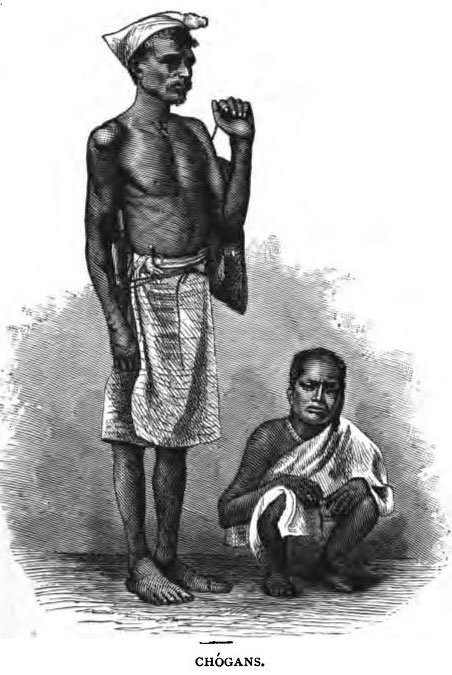 QUOTE: ... don't u see the movie, Kala pani ,about the life of people who lived at the time of British India. Please see and do react.it has a fantastic story line and has been made amazingly which reveals the atrocities being faced during the reign of british END OF QUOTE. No attempt has been made to correct the erroneous spelling and grammar in the English text in the comment.
I am placing an pixelated image of the Doctor and his companions in that movie. For, it might not be good to use the original picture of the film stars in a book that mention their story as false.
Now, look at the lower castes who were escaping hundreds of years of terror under these higher castes. The Doctor? Who gave him the infrastructure to become a doctor? In Travancore, a Ezhava man was given the opportunity to learn Medicine by the London Missionary Society members. He even lived in England. However, when he came back and tried to get a government job as a doctor, he was hounded out. He had to get a job in British-India as a doctor.
Then what nonsense was this fake ‘Dr. Govardan Menon’ whining about? That he could no longer use pejoratives on his slaves?
Now coming back to the stream of the writing:
There is another thing to be mentioned about the Nair / Nayar connection. The caste is generally connected to the word Malayali in this book. Actually the word Malayali has a number of problems. For, there are actually three different locations in the subcontinent that has been mixed up to mean this word Malayali. I will have to take up that later.
Look at this QUOTE:
The Hindu Malayali is not a lover of towns and villages. His austere habits of caste purity and impurity made him in former days flee from places where pollution in the shape of men and women of low caste met him at every corner ; and even now the feeling is strong upon him and he loves not to dwell in cities. END OF QUOTE.
By context, the word ‘Malayali’ is used here in this book, Malabar, in the sense of Nayar. The deeper intent is to promote the idea that they are a very superior caste. However, that is true of the police constables also. They derive a lot of terror and fear and ‘respect’ from the people. They constables do not like the common people to be on a terms of equality with them. However, the constables are sill low-down in the police hierarchy.
There is over-statement in the various texts in the book that the Nayars were a sort of political (tara) organisation, with some kind of democratic features. Moreover, that they were the sort of guardians of the various freedoms of the people which they protected from being encroached by the rulers.
QUOTES:
-
And probably the frantic fanatical rush of the Mappillas on British bayonets, which is not even yet a thing of the past, is the latest development of this ancient custom of the Nayars The influence of the tara organisation cannot be overrated in a political system tending always to despotism.
[My notes: Here the Mappilla daring is being connected to a purported valorous attitude of the Nayars in the Mahamakkam festival at Tirunavaya. The problem with this comparison is that the Nayar behaviour in that festival more or less display a lack of individuality. In that, the persons are prodded on to suicide as part of a senseless push of social codes. In the case of the Mappillas, it is something more personal. The triggers are switched on by some personal animosity. Beyond all that, the very mention of the British bayonets is a very cunning misleading statement. It would give an impression that the Mappilla anger was towards the English administration. It was not. It was directed towards the Nayars and the higher castes above them. The English administration was the scene as mere law and order enforcers.
The claim that the fanatical courage generally seen displayed by Islamic fighters in an attempt to achieve ‘martydom’ has been learned from Nayar ‘antiquity of valour’, is a foolish one.
-
when necessity existed, set at naught the authority of the Raja and punished his ministers when they did “unwarrantable acts.”
-
Each amsam or parish has now besides the Adhikari or man of authority, headman, an accountant or writer styled a Menon (literally, superior man), and two or more Kolkars (club men or peons), who between them manage the public affairs of the parish and are the local representatives of the Government.
[My notes: The quote no. 3 will look fine in English. However, when the essential content of the local feudal languages is understood, the above quote could very easily be seen as of some kind of terrific Satanic content. There is a huge number of suppressed populations who literarily are confined to the levels of cattle under these ‘administrators’.]
-
The Jews and Syrians were by other deeds incorporated in the Malayali nation, and in the second of the Syrians’ deeds it is clear that the position assigned to them was that of equality with the Six Hundred” of the nad (that is, of the county).
[My notes: This is obviously another cunning statement of a different sort. The constable class has a very lot of power over the ‘cattle-class’ people under them. The Jews being a population from another location in Asia, were quite well aware about the dangers inherent in the local languages. They took very pre-emptive steps to see that they were not subordinated to the various lower placed populations here. Jews, I presume were quite cunning and intelligent everywhere)
I personally feel that both the Thiyyas immigrants to north Malabar and also the native-English officials from England who arrived in the subcontinent did not have any information about this very dangerous item. The Thiyyas simply tried to assimilate into a social system, which very cunningly assigned them the lower positions. The higher castes alerted the other population groups, especially the lower-positions groups about this. This did them (the Thiyyas) in.
As to the native-English, they had no information on this. They went around trying to ‘improve’ the populations without any information that in the local languages, there is no slot of equal dignity. When the lower-placed man goes up, the higher-placed man goes down. This terror is slowly getting enacted in England as of now. The gullible native-English are surely done for, unless all the feudal language speakers are send out.
-
They had no sufficient body of "protectors” of their own race to fall back upon, so they had perforce to acknowledge as “protectors” the aboriginal ruling race,- the Nayars — whom they designated as “Sudras” but in reality treated as Kshatriyas.
[My notes: This is in lieu with the constant anguish of the Nayars’ that they are Kshatriyas. Actually, this ‘Kshatriyas’ designation might not really mean much. If it is royal blood, they are alluding to, it might be a false hope. For, there cannot be a lot of ‘kings’ and royalty. In this book there are many locations where the Nair / Nayar numbers are mentioned in thousands and tens of thousands. See these quote:
-
A force of fifty thousand Nayars, joined by many Cochin malcontents, marched to Repelim (Eddapalli in Cochin State) on the 31st March
-
The evidence of the Honourable East India Company’s linguist (interpreter, agent) at Calicut, which appears in the Diary of the Tellicherry Factory under date 28th May 1746, and which has already boon quoted (ante p. 80), deserves to be here reproduced. He wrote as follows :
“These Nayars, being heads of the Calicut people, resemble the parliament, and do not obey the king’s dictates in all things, but chastise his ministers when they do unwarrantable acts.”
In so far as Malabar itself was concerned the system seems to have remained in an efficient state down to the time of the British occupation, and the power of the Rajas was strictly limited. END OF QUOTE
[My notes: The above-words have too many problems. The first issue is that the English East India Company did face a numbers of problems, due to their linguist (interpreter, agent) not giving them the real or intended translation what the natives of Malabar said. Much of the translation would contain a lot of personal interests and that of the so-many local vested interests. This issue actually became a very big problem for the English East India Company. And it may even be mentioned that some of the bitter feelings that some of the native small-time ruler had for the Company was due to this deliberate mistranslations.
This was actually a huge issue. I will deal with that later.
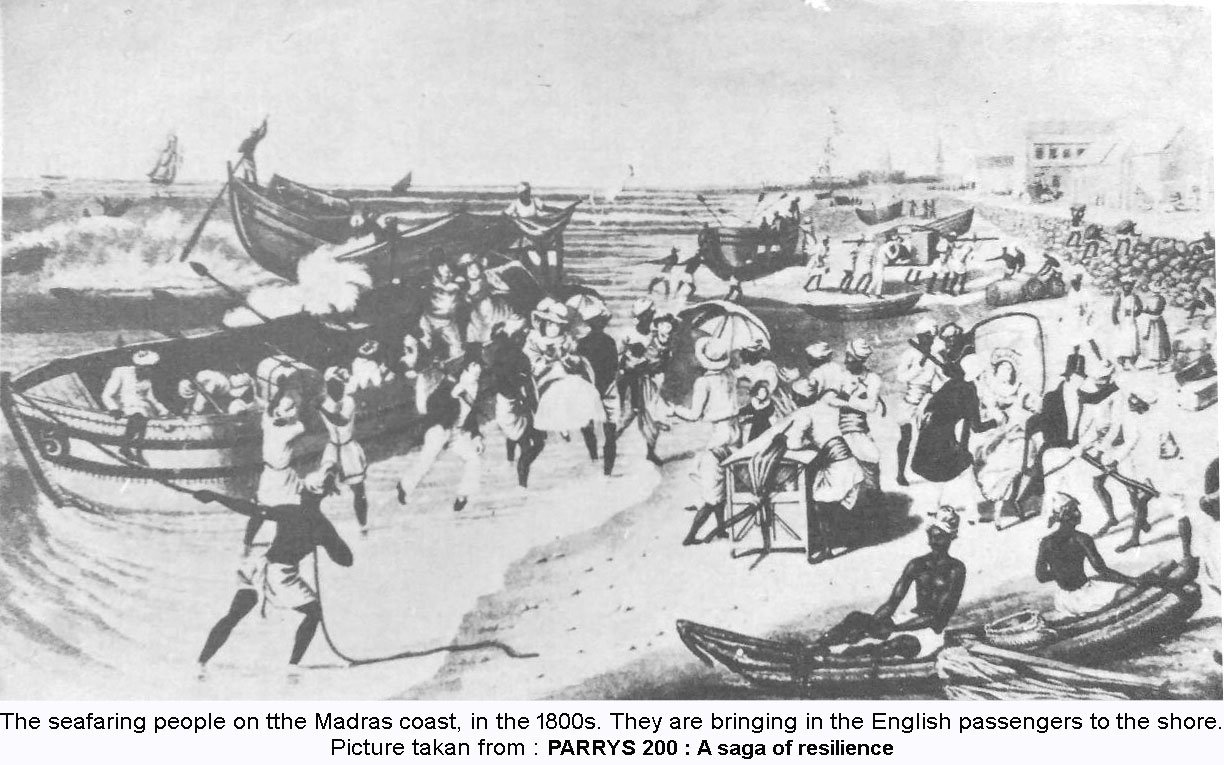 The second issue is that the claim that Nayars are the head of the Calicut people. The Nayars were a caste of people, in the levels comparable with the modern-day constables. However, even the various kings of Malabar, even though they claim to be Kshatriya, seem to have been from the Nair / Nayar caste with some ancestral difference.
The kings of Malabar seem to have a lot of connection with the Tamil country as per the various quotes from the history section. Moreover, when Vasco da Gama came to Calicut, the king of Calicut was seen thus: he was a very dark man, half-naked, and clothed with white cloths from the middle to the knees. From a general viewpoint, the people of Malabar, are fair in complexion. So, it might be true that this king had a Tamil land ancestry to some extent. The average Tamilian is dark. And seeing that the king of Calicut was quite close to the seafaring people, could it be possible that his family had some ancestral connection with the fishermen folks? They are also generally seen as dark in complexion.
Then about the Nayars not obeying their king, well, to some extent this would be true. For, the king had to depend upon them for various things. He had no department of his own. In fact, he had no social welfare aim in his kingdom, like providing for the education of the children, hospitals for the public, arranging for proper policing, or judiciary or anything. His soul duty was to act in concert with the various higher castes to see that the lower castes were strictly kept in their subordinated position.
Beyond that the king of Calicut was very much dependent on the Mappilla maritime businessmen. Some of the Mappilla maritime households were literally the agents and supporters of Arabian trade interests. To a great extent they provided for his security. That is the impression that one gets when one comes to read that part of the history which deals with the Muslim / Arab traders.]
-
From the earliest times therefore down to the end of the eighteenth century the Nayar tara and nad organisation kept the country from oppression and tyranny on the part of the rulers, and to this fact more than to any other is due the comparative prosperity which the Malayali country so long enjoyed, and which made of Calicut at one time the great emporium of trade between the East and the West.
[My notes: The above quote is total nonsense. For, nowhere in the book can one find the Malabar area in a state of peace and prosperity at any time. The history of the place is constant backstabbing, treachery and warfare between the higher castes. As to the lower castes, they had to bear the periodic molesting that happen when huge number of people move around with arms for the fight. They will molest the lower castes on any side of the fight. The men, they will catch for adding to their slaves. The women would be caught for fornication and for various menial work.
As to the Calicut being a great trade emporium of the East and West, it is just pipe-dream talk. International maritime traders would assemble in various locations in the world, Asia and Africa to take goods to Europe. It does not mean that the places where the traders came to are great centres of human living.
For instance, I used to frequent a very under-developed forest-like area in the local state. This was for collecting various kinds of fruits and vegetables in bulk quantity. Many other traders from various vegetable and fruits wholesale markets from the neighbouring states also would come there. There was one big-time trader in the locality itself who monopolised the ginger trade. His lorries would collect the raw ginger from the farmers and take it to far-off vegetable markets in the far north, some three thousand kilometres away. However, all this activity could not be translated to mean that the people or the place was highly sophisticated or that the common people were rich or that there existed a high quality civilised social living. Everything over there was then in the exact opposite.
See this QUOTE from Abdu-r-Razzak: —“Although the Samuri (king of Calicut) is not under his (Raja of Vijayanagar) authority, nevertheless he is in great alarm and apprehension from him, for it is said that the king of Bijanagar has 300 sea-ports, every one of which is equal to Kalikot, and that inland his cities and provinces extend over a journey of three months.” END OF QUOTE
There is bluff and counterbluff of the lowly rulers. However, the modern readers need not fall for them.]
-
Parasu Raman (so the tradition preserved in the Keralolpatti runs) “separated the Nayars into Taras and ordered that to them belonged the duty of supervision (lit. kan = the eye), the executive power (lit. kei = the hand, as the emblem of power), and the giving of orders (lit. kalpana — order, command) so as to prevent the rights from being curtailed or suffered to fall into disuse.”
[My notes: Here the Keralolpathi seems to be a book trying to promote Nair interests. However, Keralolpathi had much more cunning aim. I will try to hint what it was later.]
-
Menon or Menavan (mel — above, and avan — third personal pronoun ; superior N., generally writers, accountants).
Ore (for plural third personal pronoun avar, honorific title of N.).
[My notes: There is very obvious aim to assert a Superior mien for the Menons. However, the fact remains that in Travancore, the word Menon was designated as a Sudra when it came for appointing a Menon man for the post of a Dewan. And it was not allowed. So again that superiority is relative. The constable’s superiority is only at the local village or street corner level or above the menial workers. There are higher beings in the social setup who have a wider ambit and a higher stature.
See this QUOTE from Travancore State Manual: There was Raman Menon, the Senior Dewan Peishcar, a man of considerable revenue experience and energy, and there was T. Madava Row, a young officer of character and ability and possessed of high educational qualifications,........................................ but the Senior one Raman Menoven was in the north of Travancore and being a Soodra could not have conducted the great religious festival then celebrating at Trivandrum ................. . His Highness has since proposed to me that Madava Row should for the present be placed in chair of the administration as Acting Dewan END OF QUOTE]
-
by custom the Nayar women go uncovered from the waist; upper garments indicate lower caste, or sometimes, by a strange reversal of western notions, immodesty.
[My notes: This is another stark nonsense, written in the general free-for-all freedom to write anything that can be used to mention one more point of Nair superiority. Lower castes are identified by their nude upper part. Nairs also had this issue when they moved in front of the higher castes, the Brahmins. However, every point is simply used and misused to promote the idea that the Nairs are a superior caste. There is desperation in all these attempts. The Nairs were about to face a terrible calamity. ]
-
Both men and women are extremely neat, and scrupulously particular as to their cleanliness and personal appearance. The women in particular enjoy a large measure of liberty, and mix freely in public assemblies.
[My notes: The words on cleanliness might be true only in the case of a few well-placed higher stature females in a joint household. Others would literally have many problems of their own stature in the feudal languages.
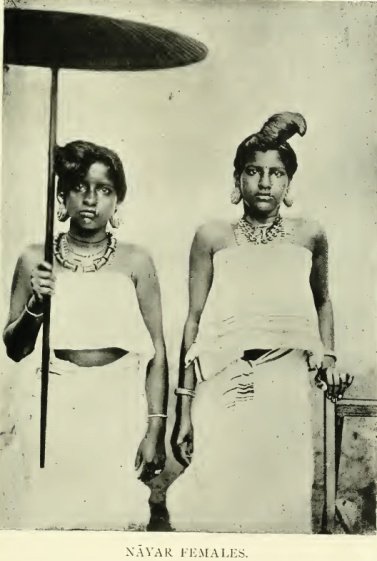 As to the issue of these females having a lot of social freedom and right to mix in public assemblies, there are hidden parameters to this. Only the females who get to be addressed with a suffix of ‘respect’ and words of ‘respect’ denoting the words She, Her, Hers &c. will find the freedom to move around. Others would not find any physical shackles. That is true. But, the word-codes would hold them in terrific terror. In fact, the Ola kuda, the palm-leave umbrella is a very necessity item for them to have with them when they go out. For, otherwise the lower castes both male and females would use profane glances and lower-indicant words about them. They will shrivel away.
It is like one particular IPS lady officer going around where the male constables can see her. This particular lady has nothing in her dress to denote that she is an IPS officer (very senior police officer). The police constables would use only the most profane and lower-indicant words about her. If she chances to hear them, it would give her a terrific emotional shock.
It may be mentioned that all these kinds of issues are slowly spreading around England. It is tragic.
There is a Proverbs section in this book. Among the proverbs given there, there is one that states: QUOTE: A god will be recognised only if clad accordingly. END OF QUOTE. There is a book in Malayalam purported to have been written by Gundert. The proverbs mentioned in Malabar, might have been taken from that book. The above quote is stated thus in that book: അണിയലംകെട്ടിയെ ദൈവമാവു. (Corrected translation: A divinity can be identified only if attired in the right stature costume.) The unyielding power of the word-codes is very amply seen here. The attire can decide the word-codes.
Even though some persons might say that these things are there in English also, the truth is that they are not there in English. Only in certain locations like the armed forced &c. the insignia of an officer is an essential item to identify his rank. However, the verbal codes for You, He, She &c. will not change, even if the rank is not clear or misidentified.
Incidentally it may be mentioned here that many of the proverbs in the book are in total sync with the verbal code of the location. That of each individual having a stature in the language-code. That there is no gain in giving a wrong status to any person.
QUOTE: അട്ടക്ക് പൊട്ടക്കുളം. END OF QUOTE The translation given in this book is: A miry pit suits a leech. However a better translation would be: A dirty pond for the leech. These kinds of proverbs are actually used to categorise human being. The animals very rarely come into the picture.
Look at this one: അട്ടയെപിടിച്ച് മെത്തയിൽ കിടത്തിയാലോ. The translation given in the book is: Would you catch a leech and put it abed? A more apt translation would be: What if the leech/bug is allowed to sleep on a bed?
Now, this is what actually the English administration did. They picked up the population groups which had been placed in the dirt, and had been made to stink over the centuries, and they improved them beyond recognition. It was a glorious deed. Never before seen anywhere in recorded history. Yet, it is very difficult to hear one word of appreciation from even the population groups who benefitted. There are specific reasons for this stark ingratitude.]
-
He said that each woman had two or four men who cohabited with her, and the men, he said “seldom” quarrelled, the woman distributing her time among her husbands just as a Muhammadan distributes his time among his women.
[My notes: Even though this statement might seem that the Nair women were having freedom of a kind not even seen in the most modern societies, there are hidden truths behind all these kinds of nonsensical dialogue.
The reader may note that nowhere in the history section are women seen to be coming out into the open for policymaking or discussions, anything like that. There is ample mention of a Beebi of Cannanore. In fact, a number of females would have been in this position over the years mentioned in the history section. Yet, it is also seen that her name is only of namesake status. Actually there are men who decide. Even there seems to be some fancy in mentioning the Beebi among small population around a miniscule part of Cannanore.
It is seen from other writings wherein this issue of Nair females having a lot of sexual rights, the fact is that they have literally no say in these matters. A Nair woman’s ‘husband’ remain as ‘husband’ only on the pleasure of her bothers’ wish. If they have any issue with her ‘husband’, he is very frankly informed that she has another husband now, and that his services are no longer required.
See this quote from Native Life in Travancore. Even though the Nairs of Travancore might be different from the Nairs of Malabar in some ways, including language, they both have the same matriarchal family system: QUOTE: Rev. J. Abbs, in his “Twenty-two Years in Travancore,” gives the following narrative, related to him by a Sudran, which well illustrates the subject in hand : — “Being a tall, handsome man of respectable family, although poor, I was engaged several years ago by two rich men of my own caste to be the husband of their sister. As they did not wish to give me a dowry, or to let their sister leave them, it was agreed that I should have a monthly allowance, go whenever I pleased to see my wife, and when at the house of her brothers, eat in common with the males of the family. This I expected would be permanent. But a few days ago, when I went to the house, I was told by the elder brother that I could not be admitted, as another husband had been chosen for his sister. Her brothers have taken the two children to train them up as the heirs of the family property.” END OF QUOTE]
-
In Johnston’s “Relations of the most famous Kingdom in the world” (1611 Edition) there occurs the following quaintly written account of this protector guild : “It is strange to see how ready the Souldiour of this Country is at his Weapons : they are all gentile men, and tearmed Naires. At seven Years of Age they are put to School to learn the Use of their Weapons, where, to make them nimble and active, their Sinnewes and Joints are stretched by skilful Fellows, and annointed with the Oyle Sesamus : By this annointing they become so light and nimble that they will winde and turn their Bodies as if they had no Bones, casting them forward, backward, high and low, even to the Astonishment of the Beholders. Their continual Delight is in their Weapon, persuading themselves that no Nation goeth beyond them in Skill and Dexterity.”
[My notes: The problem with these kinds of quotes is that the reality behind this quote would be limited to some specific location, in a specific time. The mention of the martial activity is more or less that of the local martial arts, Kalari. A lot of people being exponents in Kalari is not a necessary proof of the high quality content in the population. It just shows that they are incessantly in a mood for fight. Words like: 'put to School' do not mean much in a location where public education is more or less zero.
There is this quote from Native Life in Travancore: QUOTE “To-day, when passing by your schoolroom, I heard the children sing their sweet and instructive lyrics with great delight. We Sudras, regarded as of high caste, are now becoming comparatively lower; while you, who were once so low, are being exalted through Christianity. I fear,” he added, “Sudra children in the rural districts will soon be fit for nothing better than feeding cattle.” END of QUOTE]
In the above quote, the contention that the Sudras considered themselves as high caste is similar to an Indian police constable considering himself or herself as a high ‘officer’. There are millions of Indians who are placed below peon-level ‘officers’.
As to the general use the Nairs make use of with their weapons, and who they ‘protect’ can be seen from this information given in the Native Life in Travancore: QUOTE: If the Pulayar did not speedily move out of the way, instant death was the penalty : the low-caste man in former times would be at once cut down by the sword of the Nair. END OF QUOTE. Actually, on reading the real history part in this book, the Nayar valour seems to confined to cutting down insubordinate lower castes. When the Mysorean invasion came, they literally scooted. But then not only the Nayars, almost everyone ran for their lives. Only the English Company stood its ground.]
Beyond that there is this also: 'persuading themselves that no Nation goeth beyond them in Skill and Dexterity.' This quote more or less identifies the population. It is as what Al Biruni has mentioned. The shallow feeling that they are the 'greatest' people in the world. This kind of mood is there in most school textbooks of current-day India. May be all low-class nations do have this boasting emotion. There is a proverb in English to define this character: 'Empty vessels make the most sound'. Curiously in Malayalam also, there is an exact translation of this: നിറകുടം തുളുമ്പില്ല.
There is a curious information that I found in Travancore State Manual, with regard to the time Col. Munro had official authority over there. It is this from Travancore State Manual: QUOTE: The restriction put on the Sudras and others regarding the wearing of gold and silver ornaments was removed. END OF QUOTE. In spite of all contentions to the contrary, the Nairs also did face many restrictions due to the relative lower status in relation to the Ambalavasis and the Brahmans].
-
Finally the only British General of any note—Sir Hector Munro who had ever to face the Nayars in the field thus wrote of their modes of fighting :- “One may as well look for a needle in a Bottle of Hay as any of them in the daytime, they being lurking behind sand-banks and bushes, except when we are marching towards the fort, and then they appear like bees out in the month of June.” “Besides which,” he continued, “they point their guns well and fire them well also.” (Tellicherry Factory Diary, March, 1701.) They were, in short, brave light troops, excelling in skirmishing, but their organisation into small bodies with discordant interests unfitted them to repel any serious invasion by all enemy even moderately well organised.”
[My notes: Look at these words: QUOTE: the only British General of any note END OF QUOTE. They do not seem to be the words of a British writer. There are many quotes and hints and writings in various locations inside this book, where Nair fighting qualities have been mentioned in highly exalted words. However, in the location where William Logan has clearly done the writing, that is, in the history part, the exact opposite features of the Nair population is given. They are mentioned as quite cowardly, brutish and without any commitment to their own words of promise.
Even though, as I mentioned earlier that the Nairs / Nayars of Malabar and that of Travancore need not be one and the same people, in current-day newly-formed state of Kerala, both are treated as one. So it might be illuminative to know what was the exact state of courage and valour of the Travancore Nayars. For the above quote by Col Munro is about the Nayars of Travancore.
The following are some of the quotes from Travancore State Manual:
-
The armies of the chieftains consisted of Madampis (big landlords) and Nayars who were more a rabble of the cowardly proletariat than well-disciplined fighting men.
-
But Rodriguez not minding raised one wall and apprehending a fight the next day mounted two of his big guns. The sight of these guns frightened the Nayars and they retreated;
-
Meanwhile the subsidiary force at Quilon was engaged in several actions with the Nayar troops. But as soon as they heard of the fall of the Aramboly lines, the Nayars losing all hopes of success dispersed in various directions.
Why I am illuminating such incidences is just to show the real quality of certain sections of this book, which certainly are not the words of William Logan. These kinds of self-praise words are a common feature in most of the writings and words of the people/s of this subcontinent. As such these words need not be given much value. The various quotes of other persons that these people mention to show the grand antiquity of their own ancestors are actually very carefully cherry-picked items. For instance, one might see a lot of quotes from Ibn Batuta’s writings, that seem to mention the subcontinent as a great place. The fact is that these quotes are taken from the midst of writings in which various terrible attributes of the subcontinent have already been mentioned.
There is this mention in his writing about his viewing of a Sati. That is the live burning up of a woman whose husband had died. She is first shielded from fire by others blocking the view. She seems to have some belief that her faith would protect her from pain. She jumps inside the fire with her hands clasped in a pose of prayer. The moment she jumps in, the men and women around push down upon her heavy wood to crush her inside and she has no scope for escape. There is terrific drumming and loud clamour. So the wailing of the burning woman is drowned in the sound. Ibn Batuta, on seeing this incident, loses his sense of equilibrium and would have fallen off his horse, had not his companions caught him and poured water upon his face.
In the Delhi Sultan's kingdom, he found the king extremely cruel. He mentions of : Every day hundreds of people, chained, pinioned and fettered, are brought to his hall and those who are for execution are executed, those for torture tortured, and those for beating beaten.
In another location, he mentions about women and little children being butchered and the women being tied to the pales by their hair.
The fact of the matter is that Col.Munro had very poor opinion of the officials of Travancore. The officials were more or less the Nairs. This is what he speaks about them: QUOTE: “No description can produce an adequate impression of the tyranny, corruption and abuses of the system, full of activity and energy in everything mischievous, oppressive and infamous, but slow and dilatory to effect any purpose of humanity, mercy and justice. This body of public officers, united with each other on fixed principles of combination and mutual support, resented a complaint against one of their number, as an attack upon the whole. Their pay was very small, and never issued from the treasury, but supplied from several authorised exactions made by themselves. END OF QUOTE
In passing, I may also mention that the above description more or less is the perfect description of the Indian officialdom. The only difference is that the pay of the Indian official is of astronomical content. Clement Atlee will definitely have to answer to providence for the most terrible deed he did. That of handing over a huge set of populations to the Indian officialdom.
-
“By eating of this rice they all engage to burn themselves on the day the king dies, or is slain, and they punctually fulfil their promise.”
[My notes: This is another dubious quote taken from some solitary location. It is true that at times people can be made indoctrinated to be quite insane. However, it is quite intelligent to understand that these things do not last. Also, the claim that they will burn themselves to death. Well, people are known to do that. However, even in the case of Sati, the women have to be restrained by ropes or heavy logs of wood or by pushing them down back into the fire with bamboo poles, when they come realise the pain of the burning.]
-
... for the Nayar militia were very fickle, and flocked to the standard of the man who was fittest to command and who treated them the most considerately.
[My notes: This quote is from the location dealing with insane fighting tradition connected to the Mamangam festival at Tirunavaya. Actually this undependability and fickleness and tendency to ditch one side and jump to a seemingly better side is part of the population character of the subcontinent. It is not a Nayar alone feature. It has its roots in the verbal codes in the local language. This character will be seen in other locations which have same or similar verbal codes in their native languages.]
-
Two spears’ length apart the palisades are placed, and the armed crowd on either hand, consisting on this occasion of the thirty thousand Ernad Nayars, it is seen, are all carrying spears.
[My notes: This is again from Mamangam festival at Tirunavaya. What is mentionable here is the number ‘thirty thousand’. It is true that in days when there is nothing else to do by way of entertainment, people would flocks to such locations. For they practically have nothing much to do. For their slaves and other lower castes would do the daily work. Yet, the contention that all these thirty thousand people are going there with a military ambition might be farfetched. For, an assemblage of thirty thousand human beings brings in the issues of food preparation, drinking water, toileting etc. The whole place would literally stink. These kinds of huge numbers are seen mentioned in various places. However, in the locations where it is quite sure that the writer is Logan the numbers of individuals involved in any war or fight are more or less mentioned in more believable numbers. I will mention them when I reach those lines in the book.]
-
On this occasion, however, a large portion of the body-guard seems to have been displeased, for they left without fulfilling this duty, and this story corroborates in a marked way the fact already set forth (p. 132) regarding the independence and important political influence possessed by the Nayars as a body.
[This is an example of how any incident or event can be mentioned in whatever manner one wants to present it. The above incident is connected to one of the Mamamgam festival at Tirunavaya. The sudden mood of discordance that come up and a sizable number of people breaking of, is just that they are the followers of one or a few individuals. They do not have any independent mental stature. When their leaders breakout from an association, they also do likewise. Again, this need not be understood as some kind of great fidelity and loyalty. It is just that in feudal languages, there is a hugging hold on individuals who are connected upwards.
Beyond all this, the above kinds of incidences of leaders suddenly breaking off were and are quite common in the subcontinent. The feudal language codes are quite terrific in their power for creating discordance. A simple change of the indicant level for the words You, Your, Yours, He, His, Him, She, Her, Hers &c. can literally create cataclysmic mood changes in an individual.
The fact is that it is this issue that is really spreading civil gun and other violence in traditionally peaceful native-English social systems. However, there is no way to inform them of this issue. For, it is an issue that cannot be detected in English.
-
The martial spirit of the Nayars was in former days kept alive by such desperate enterprises as the above, but in every day life the Nayar used to be prepared and ready to take vengeance on any who affronted him, for he invariably carried his weapons,
[The martial spirit that is alluded to is this: QUOTE:...current tradition says that the corpses of the slain were customarily kicked by elephants as far as the brink of the fine well, of which mention has been made, and into which they were tumbled promiscuously. END OF QUOTE.
What has to be understood is that these things do not display any kind of quality civilised behaviour. Moreover the spirit of vengeances towards anyone and everyone who has affronted ‘him’, is directly connected to the feudal language trigger-codes. A single unacceptable indicant word form for You, He, She etc. is enough to make a human mind to go into a very brooding mood of anguish and craving for vengeance. Only persons who do not understand these things would find anything worthwhile in these emotions and culture.]
-
A preparation and training (it is said) for twelve years preceded the battle in order to qualify the combatants in the use of their weapons. The men who fought were not necessarily the principals in the quarrel—they were generally their champions. It was essential that one should fall,
[My notes: Even though this information is given in the form of some kind of great tradition, the actual fact reflected is the tragic situation of this people. They are simply trained to be the henchmen of the ruling classes and the affluent landlords. The disputes among the higher classes with regard to so many things including that of the ubiquitous issue of conceding rightful ‘respect’ and not conceding rightful ‘respect’, is ultimately settled through the death or maiming of these individuals. Only totally insane persons would find anything of quality in this tradition. ]
-
from the fact that the Tamil and Malayalam languages were in those days practically identical, it may be inferred that the ruling caste of Nayar were already settled in Malabar in the early centuries A.D.
[My notes: The fact is that there is a huge content of lies in the above lines. It is about the languages of Malabar and Travancore. I will have to discuss this issue later. However, there is some hint to be derived from the above that the Nayars of Travancore were Tamil speakers, who were slowly changing over the centuries, through their constant proximity with the Brahmans and the lower castes.]
-
The nad (country) was the territorial organisation of the ruling caste (Nayars), and, in two instances at least (Venad and Cheranad), it was the territory of the “Six hundred.”
[My notes: This Six hundred is another curious item that is seen repeated all around the book. The feeling that is be radiated is that there was a sort of parliament or assembly-like structure with Nayar families from all the four corners of the geographical location that consisted of North Malabar, South Malabar and Travancore. It might be indeed a very tall claim, when the geography and the time period is taken into account. Since I am person who has more or less frequently travelled to most of the locations inside this geographical area, it is my conviction that such an organisation is very difficult to maintain in a time-period when means of travel were quite cumbersome and time-taking. Moreover, travelling beyond one’s own location was quite difficult and dangerous.
It is true that travel by sea would be easier when trying to come to coastal areas. However, sea-travel was dominated more or less by the fishermen folks. Their companionship without them conceding due ‘respect’ and ‘reverence’ in words and body postures would be quite terrible to bear. This issue itself would make sea-travel quite a prohibited item for the higher castes.
The next cunning entry is the statement: QUOTE: of the ruling caste (Nayars) END OF QUOTE. It is true that the police constables are quite powerful in their own local areas. But then, they are not the IPS officers. Above the police constables, there are head-constables, Assistant Sub Inspectors, Circle Inspectors, DySp, Sp, DIG, IG and DGP. Similarly above the Nairs there were the various levels of Ambalavasis, and then the layers of Brahmins.
Nayars were not the ruling caste in this sense, other than in the sense that in their local areas, they held terrific powers for even maiming and killing a lower-caste individual. There could be slight confusion as to who were the ruling classes. If the Brahmins could be compared to the IAS (civil administration royalty of current-day India), then the Raja families could be compared to the IPS (police administration royalty of current-day India). The raja families seem to have stood apart from the Nayar / Sudras castes to a great extent.
It is true that some Nayars individually were of great status. Same is true about some police constable/head-constables. However, still they are not IPS. It is seen in this book, Malabar that some Nair peons / Kolkars at least were rich landlords in South Malabar.
See this QUOTE from Travancore State Manual
QUOTE: ‘Besides the village associations already noticed, Venad, it would appear, had an important public body under the name of the ‘Six Hundred’  to supervise the working of temples and charities connected therewith. What other powers and privileges this remarkable corporation of “Six Hundred” was in possession of, future investigation can alone determine. But a number so large, nearly as large as the British House of Commons, could not have been meant, in so small a state as Venad was in the 12th Century, for the single function of temple supervision END OF QUOTE
This Six hundred is connected to the miniscule kingdom of Venad. When the population of Travancore spread out in the world, this miniscule ‘Six hundred’ will also expand to great heights, as has been seen in the case of China. See the reference to the ‘Six hundred’ is in Tamil, and not in Malayalam or Malabari (then possibly known as Malayalam).
-
The curved sword or dagger, that is, probably, the right to make war armed with the distinctive Nayar weapon, the ayudha katti (war-knife), or as it is sometimes called, the kodunga katti (curved knife).
[My notes: This contention does not make the Nayars look a cultured group. It is more or less the verbal claims of all low-quality ruffians in the subcontinent. In fact, the English administration had to prohibit the use of the ayudha katti by the Act XXXV of 1854, due to it being used in the Mappilla attack on the Nayars and Brahmins.
-
In this connection, there is this QUOTE from Travancore State Manual about the Nairs of Travancore: Moreover the habits and character of these people have undergone a complete change within the last twenty years. That warlike, refractory and turbulent temper for which the Nairs of Travancore were once so remarkable has totally disappeared, and they must now be regarded as a population of pacific habits placing the most implicit confidence in our protection and well convinced that their safety entirely depends on the stability, support and friendship of the British Government. END OF QUOTE.
The notable issue here is that even when the Nairs went soft, the lower castes did not. The latter became more ferocious and this led to the Nair / Sudra street-fights in the 1800s, and this later culminated in the Travancore kingdom’s police firing on the lower castes in Punnapra and Vayalar villages around the year 1946. However, the larger context of this incident was the unfettering of the lower castes in Travancore, the Pulaya, Pariah, Ezhava, Shanar etc. by the Missionaries of the London Missionary Society.
-
The Soodra (Sudra) or Nair (Nayar) part, of the community were more to be depended upon ; there was an honest frankness about them which you could not but admire, and which is a surety that in proportion to our increasing influence, these people will prove themselves worthy of the confidence of Government.
[My Notes: This quote is from this book, Malabar. The point to be stressed here is the very naivety and gullibility of the English folks. In feudal languages, a very affable manner, pleasant smile, friendliness are all weapons of conquest. They are used to subdue an unwary and wary prey. The above quote is seen mentioned in connection with the Pazhassi raja insurgency. Actually, in this very episode, a Yemen Nayar did use this very same technique to trick the English side. The point here is that all these kinds of good and bad description found in book are similar to the story of the four blind persons touching an elephant and trying to describe what it is. These persons seem to believe what they experienced is the total experience. None of the feudal-language speaking persons has a demeanour or character or behaviour feature that is stable and can describe a person’s innate attribute. Everything changes as per the verbal codes used in any particular context.]
-
One tradition says that for forty-eight years he warred with the chief of Polanad, the Porlattiri Raja, and in the end succeeded by winning over his opponent’s troops, the Ten Thousand, and by bribing his opponent’s minister and mistress.
[My notes: In feudal languages, bluffing is an essential component of social living and stature. So, the words Ten Thousands can be accepted with this due understanding. However, beyond this there is hint of the ancient culture of this location. This is: bribing his opponent’s minister and mistress. Well, truth is that natives of this land are used to bribing as a very effective form of defence, offence, overtaking and getting things done. There are other equally effective weapons in use here. It is quite good to understand that these weapons are used by the businessmen of this location when they want to take over the economy of native-English nations like England, USA, Australia, Canada &c.
-
After this, it is said, “the men of the port began to make voyages to Mecca in ships, and Calicut became the most famous (port) in the world for its extensive commerce, wealth, country, town, and king.”
[My notes: This incident relates to an incident of testing the king of Calicut for honesty by a Chetty maritime merchant. That particular king happened to be quite honest. So, the merchant decided that this port was the safest port around. However, the next contention of Calicut being the most famous port in the world has a taste of the academic writing of current-day India. Calicut was just a port a in a semi-barbarian land, where a honest king was found. This information does not transpire to mean the people of Calicut were in any way great. Incidentally, it may be mentioned that the people living inland at some distance from the sea-coast simply do not connect with the seafaring populations. They feel that they are different, rough, uncouth and low-class. The roughness is connected to the issue of how to mix without losing one’s ‘respect’.
-
“Being apprehensive lest their enemies the Moors might attempt to massacre them, the Raja had even lodged them in his own palace and had provided them with a guard of Nayars to protect them when they went into the town
[My notes: This is a quote about the Portuguese experience in Cochin. Why the sentence has been taken is to focus on the words ‘a guard of Nayars’. It simply corresponds to a modern sentence: a guard by a team of constables. It does not give the impression that the guards were a team of IPS officers.
-
“These Nayars are gentlemen by lineage, and by their law they are bound to die for whoever gives them pay, they and all their lineage.”
“And even if they are of the same lineage and serving different masters, they are bound all the same to kill each other if need be, “and when the struggle is finished, they will speak and communicate with one another as if they had never fought.”
[My notes: The above two-quotes are actually quite fanciful statements. Nowhere in the history section of this book does the Nayars appear to be especially brave or committed to their word of honour. Like everyone else in this land, they are also quite opportunistic. The feudal languages design the human personality features.
The following quotes are from the Travancore State Manual. Even though the Nairs of Travancore could have been different from the Nairs of both North as well as South Malabar, the following quotes can be illuminating:
-
Kayangulam Rajah had anticipated the fate of his army. He knew that his ill-trained Nayars were no match to the Travancore forces which had the advantage of European discipline and superior arms.
-
The armies of the chieftains consisted of Madampis (big landlords) and Nayars who were more a rabble of the cowardly proletariat than well-disciplined fighting men.
-
But Rodriguez not minding raised one wall and apprehending a fight the next day mounted two of his big guns. The sight of these guns frightened the Nayars and they retreated; the Moplahs too lost courage and looked on.
-
Meanwhile the subsidiary force at Quilon was engaged in several actions with the Nayar troops. But as soon as they heard of the fall of the Aramboly lines, the Nayars losing all hopes of success dispersed in various directions.
-
In 1817 the Rani represented to the Resident Col. Munro her desire to increase the strength and efficiency of the army and to have it commanded by a European officer, as the existing force was of little use being undisciplined and un-provided with arms.
-
But the Portuguese artillery again proved completely effective, and the enemy was driven back with heavy loss notwithstanding that the Cochin Nayers (five hundred men) had fled at the first alarm.
-
it was with the utmost difficulty repulsed, the Cochin Nayars having again proved faithless.
-
The fort was accordingly abandoned and it is said that the last man to leave it set fire to a train of gunpowder which killed many of the Nayars and Moors, who in hopes of plunder flocked into the fort directly it was abandoned.
[My notes: This is not an unbelievable incident. See the next quote:]
-
The Nayars and other Malayalis suffered in their eagerness for plunder, for a magazine blew up and killed 100 of them
-
Such family quarrels were not infrequent in the Kolattiri Chief’s house, and the reasons therefore are in operation in all Malayali families down to the present day and more especially in North Malabar.
[My notes: This continual mood for mutiny and mutual fights and quarrels are caused by the feudal language codes in the native languages. ]
-
The result was that the two settlements began to interchange friendly visits, and much gunpowder was spent in salutes, much to the chagrin of the Kurangoth Nayar, who tried various plans to prevent the respective factors from coming to an amicable understanding.
-
If attempts were made to sow dissensions by showing forged letters, etc. (as had already happened), inter-communication between the factories was to be free in order to get rid of the distrust thereby caused. The Nayars in the pay of the respective companies were to be kept quiet, and the factories were to take joint action in case of dissensions among them and also in protecting them against other people.
[My notes: The above two items are illustrative of what the local vested interests continually did. The Nairs had their own vested interest in seeing that the English and French trading groups fought against each-other. There is indeed a saying in Malayalam: കലക്ക് വെള്ളത്തിൽ മീൻപിടിക്കുക. It means the art of catching fish in muddied waters. (Fish in troubled waters).They would strive to create a state of uneasy distrust between two higher placed groups. The lower-placed groups would make use of this scenario to make the best profit for themselves.
-
From the position of his Nad, the Nayar was early brought into relations with both the English and French Companies, and he tried his best, to play off one against the other, not without loss to himself.
-
The English force secured an eminence with the Nayars on their right, but the latter fled when attacked by the Canarese.
[My notes: The following are illustrative of the Nayar courage or fright]:
-
Then a crisis occurred. The Nayars and Tiyars at Ponolla Malta deserted, and the sepoys refused to sacrifice themselves.
-
Fullarton applied for and received four battalions of Travancore sepoys, which he despatched to the place to help the Zamorin to hold it till further assistance could arrive, but before the succour arrived, the Zamorin’s force despairing of support had abandoned the place and retired into the mountains. Tippu’s forces, thereupon, speedily re-occupied all the south of Malabar as far as the Kota river,
-
Nayres were busied in attempting to oppose the infantry, who pretended to be on the point of passing over. They were frightened at the sudden appearance of the cavalry and fled with the utmost precipitation and disorder without making any other defence but that of discharging a few cannon which they were too much intimidated to point properly.
[My notes: This incident is connected to the attempts to block Hyder Ali’s troops. The Nair soldiery in Malabar were simply next to nothing in organising a strong defence. In the ultimate reckoning, it was the timely intervention of the English that saved the Nairs. Otherwise the Nairs would currently be at the state of the lowest castes of Malabar and Travancore.]
-
The whole army in consequence moved to attack the retrenchment ; but the enemy perceiving that Hyder’s troops had stormed their outpost, and catching the affright of the fugitives, fled from their camp with disorder and precipitation.
-
The Travancore commander had arranged that the Raja’s force should reassemble upon the Vypeen Island, but the extreme consternation caused by the loss of their vaunted lines had upset this arrangement, and the whole of the force had dispersed for refuge into the jungles or had retreated to the south.
-
The consternation of the (Travancore) Raja's people was so great that they could not be trusted to procure supplies.
-
On this application Hyder Ali sent a force under his brother-in-law, Muckh doom Sahib, who drove back the Zamorin’s Nayars
-
The Nayars, in their despair, defended such small posts as they possessed most bravely.
-
The Nayars defended themselves until they were tired of the confinement, and then leaping over the abbatis and cutting through the three lines with astonishing rapidity, they gained the woods before the enemy had recovered from their surprise.” (Wilks’ History, I, 201.) [My notes: However, the above two quote do show that the Nairs were capable of bravery when there was no other option.]
-
Captain Lane reported, “cruelly—shamefully— and in violation of all laws divine and humane, most barbarously butchered” by the Nayars, notwithstanding the exertions of the English officers to save them.
[My notes: These incidence lend light on the barbarous culture of the people/s in the subcontinent. See the next quote also:]
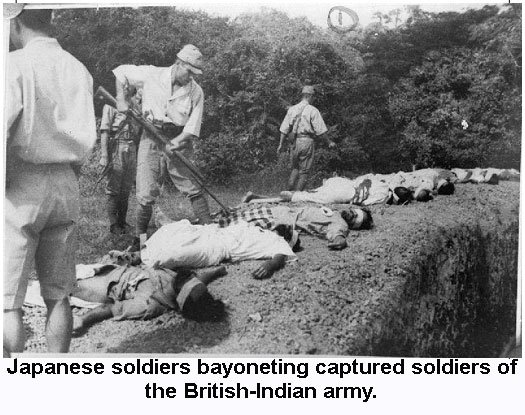
-
A large body (300) of the enemy, after giving up their arms and while proceeding to Cannanore, were barbarously massacred by the Nayars.
[My notes: These kind of incidences were common in the location. Once an enemy surrenders, the other side would give two-pence value to them. They would be beaten-up into pulp. In the above incident, they are slaughtered.
In fact, a similar thing happened at the end of the 2nd World War. When the Japanese side surrendered in Singapore, a small number of British-Indian soldiers who had shifted loyalty to the Japanese side were among those who had surrendered. Many of them did this to avoid the terrors of a Japanese prison-camp, where many of them were simply bayoneted to death. (Subash Chandran was standing with the Japanese side at the time). When these soldiers were being kept under the British-Indian troops, the latter started butchering them. They called them ‘blacklegs’ and traitors. Then the British side had to take off the British-Indian troops. The surrendered troops were then kept under the direct supervision of the British troops. This kind of lingering mood for vengeance is also connected to the feudal languages.]
-
This arrangement did not much disconcert the Tellicherry factors, who shrewdly recorded in their diary that even if the Dutch did their part, the prince would not do his because of his avarice, which prevented him from paying even for the few Nayars the Company had entertained at Ayconny fort (Alikkunuu opposite Kavayi), and which would certainly, they concluded, prevent him from paying the market price for pepper and selling it at a loss to the Dutch.
[My notes: This is an information that sheds light on the real social status of the majority Nairs. They were the serving class of the royalty and the Brahmins. Many of them depended on the salary given out to them by their employers. However, the employers were not that liberal in paying the wages.]
-
“Before he quitted the country, Hyder by a solemn edict, declared the Nayars deprived of all their privileges ; and ordained that their caste, which was the first after the Brahmans, should thereafter be the lowest of all the castes, subjecting them to salute the Parias and others of the lowest castes by ranging themselves before them as the other Mallabars had been obliged to do before the Nayars ; permitting all the other caste to bear arms and forbidding them to the Nayars, who till then had enjoyed the sole right of carrying them; at the same time allowing and commanding all persons to kill such Nayars as were found bearing arms. By this rigorous edict, Hyder expected to make all the other castes enemies of the Nayars, and that they would rejoice in the occasion of revenging themselves for the tyrannic oppression this nobility had till then exerted over them.
[My notes: This is the apt answer to a native-of-the-subcontinent person who is at the moment standing on the pedestal of native-English nations and trying to fix up an idea that if the English rule had not come to the Subcontinent, the place would have been great. What would have happened if the native-English force was not there in Malabar? The above paragraph gives one answer. Now, look at the following quotes: ]
-
Sultan Tipu dictates: Hereafter you must proceed in an opposite manner ; dwell quietly, and pay your dues like good subjects : and since it is a practice with you for one woman to associate with ten men, and you leave your mothers and sisters unconstrained in their obscene practices, and are thence all born in adultery, and are more shameless in your connexions than the beasts of the field : I hereby inquire you to forsake those sinful practices, and live like the rest of mankind.
-
The unhappy captives gave a forced assent, and on the next day the rite of circumcision was performed on all the males, every individual of both sexes being compelled to close the ceremony by eating beef.”
-
Parappanad, also "Tichera Terupar, a principal Nayar of Nelemboor” and many other persons, who had been carried off to Coimbatore, were circumcised and forced to eat beef.
-
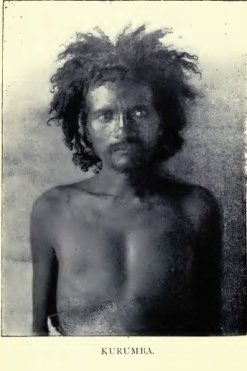 Another conquering race had appeared on the scene, and there is not the slightest doubt that, but for the intervention of a still stronger foreign race, the Nayars would now be denizens of the jungles like the Kurumbar and other jungle races whom they themselves had supplanted in similar fashion.
[My notes: The English East India Company was only a protecting force for all kinds of people here. In fact, in many locations where the English force vacated the location, people went into terror. See this quote:]
-
The news of his (Colonel Hartley's) force being on its way had greatly quieted the inhabitants, and “the consternation which had seized all ranks of the people ’’ had considerably abated.
-
“Colonel Stuart arrived before Palghaut, with two day’s provisions, and without a shilling in his military chest ; the sympathy which he evinced for the sufferings of the Nayars and the rigid enforcement of a protecting discipline had caused his bazaar to assume the appearance of a provincial granary ;
-
The district had been in a disturbed state owing to the mutual animosities and jealousies of the Nambiars themselves and to the confused method in which they conducted the administration. It was very necessary to protect the lower classes of the people from the exactions of the Nambiars, who now freed by the strong arm of the Company from dependence on those beneath them, would have taken the opportunity, if it had been afforded them, of enriching themselves at the expense of their poorer neighbours and subjects.
[My notes: This item is about the mutual animosities among the various layers of the Nairs and also inside each layer and also with the kings. See these quotes:]
-
His demand for the restoration of Pulavayi was left in suspense to be settled by the Supravisor as its Nayar chiefs were openly resisting the attempts of the Zamorin to interfere in the concerns of their country.
-
Subsequently, too, they were joined by Kunhi Achehan of the Palghat family, who fled to them after having murdered a Nayar
-
Moreover in Darogha Sahib's time (paragraph 175) Itti Kombi Achan established a Parbutti Menon (Accountant) and two or three Kolkars (Peons) in each Desam to collect the revenue,
[My notes: Here, I am mentioning the so-called Kolkars, who have been mentioned as Nairs / Nayars in some other writings. It is more or less sure that they are Nayars. If they were some lower castes, it would have been very carefully mentioned. Even though, there are Nayar caste persons in higher posts like the Accountant, by and large, the Nayar posts were of the peon-kind. Actually this issue had a great bearing upon how the Mappilla rebels were dealt with in South Malabar. That I will deal with later. However, see the quotes given below:]
-
Moreover, in addition to the regular troops, Captain Watson had by this time thoroughly organised his famous “Kolkars” or police, a body of 1,200 men,
-
The rebels were dispersed by the Kolkars, supported by the regular troops under Colonel Montresor.
-
The effect of this, coupled with the vigilance of the Kolkars, was to drive the rebels from the low country into the woods and fastnesses of Wynad, and
-
Mr. Warden returned to Calicut and Colonel Macleod to Cannanore in May for the rains, leaving 2,1523 non-commissioned rank and file and Captain Watson with 800 of his Kolkars in the district, all under the orders of Lieutenant-Colonel Innes of the 2nd battalion 1st Regiment
-
On June 11th Mr. Baber reported (with much satisfaction at the good results of his policy) the arrest of three rebel leaders and eight of their followers, by the Kolkars and people of Chirakkal acting in concert.
-
And the Palassi (Pychy) Raja himself narrowly escaped on 6th September from falling into the hands of a party of Kolkars despatched from below the ghats
-
The Kolkaras marched all night through the ghats amid rain and leeches, and at 7 a.m. completely surprised the rebel party.
-
Out of 1,500 Kolkars who had been in Wynad only five weeks before, only 170 were on the roll for duty on October 18th
-
The Nayars were no doubt spread over the whole face of the country (as they still are) protecting all rights, suffering none to fall into disuse, and at the same time supervising the cultivation of the land and collecting the kon or king’s share of the produce - the public land revenue in fact.
[My notes: These are self-eulogising descriptions made by the Nayar writers. It cannot be by Logan, for Logan does make at times very distasteful comments about their behaviour. See the following self-praising words:]
-
but to the great bulk of the people—the Nayars, the Six Hundreds — with whom, in their corporate capacities all power rested.
-
The Nayar protector guild was distributed over the length and breadth of the land exercising their State functions of ....
-
unless he acted in strict accordance with the Nayar guild whose function was “to prevent the rights from being curtailed or suffered to fall into disuse” as the Keralolpatti expressly says.
-
The duty of the Kanakkars (Nayar headmen) was protection.
-
The number of Nayars or fighting men attached to a Desavali was from 25 to 100 ; if it exceeded the latter number, he ranked as Naduvali.
-
He was the military chief, not the civil chief of the Desam
[My notes: It is possible that ‘He’ is in fighting man in the small village or town or town and villages around it, and has some kind of subordinates, and that he and his subordinates are Nayars. However, the word ‘military chief’ would give out a feel of an English army chief, which would be quite a ridiculous imagination. After all, the whole of Malabar, north and south was quite a small place. Inside this small place, there are very many desams. The subordinates are Nayars, meaning that they are like the ordinary constables and soldiers of India. Rough, rude and totally impolite to those who are suppressed by them. They are still not ‘officers’, for can one can mention the rude and crude type of dominating people in the subcontinent as ‘officers’?]
-
...the share of produce due to him did not pass to those (the present Rajas) who supplied in some measures his place, but to the great bulk of the people—the Nayars, the Six Hundreds — with whom, in their corporate capacities all power rested.
-
SUDRAN, plural SUDRANMAR. (Sanskrit) = the fourth caste in the Hindu system. Who according, to the Sastram, are the fourth class of Hindus, are a particular caste of Nayars in Malabar, whose duty it is to perform ceremonies or Karmam in Brahman families on the birth of a child, etc.
Note.—Nayars generally do now style themselves as Sudras.
-
MENAVAN or Menon: From Dravidian mel (= above), and Dravidian avan (= he).
-
NAYAN, plural Nayar. (Sanskrit) = leader, in honorific plural, lord ; in ordinary sense, soldiers, militia.
-
The word Nayar has much resemblance to the Gentoo word Nayadu, to the Canarese and Tamil Nayakkan, and to the Hindustani Naig ; all titles of respect, applied in the manner that Sahib is at the end of a name.
-
At the time of Parasurama’s gift of the country to the Brahmans, 64 Gramams were established from Goa to Cape Comorin, 32 from Kanyirote (or Cassergode north to Comorin south) ; to these were attached all the Sudra villages.
[My notes: These are quotes that mention the state of servitude to the Brahman folks. However, it may be re-mentioned here again, the Parasurama story itself has to be imbibed with a spoon of free-flowing salt.
-
CHANGNGATAM: Is also a kind of vassalage, and is applied particularly to Nayars who have placed themselves in a state of dependency upon some Desavali, Naduvali or Raja. The word Adiyan would, with respect to them, be degrading and improperly used. Nayars have often agreed to give Changngatam or protection money to some chief of authority, and to make yearly presents in consequence from 4 to 34 fanams to individual patrons, and as high as 120 to the church.
Now, I would like to move into the location of why the Nairs were so desperate to show themselves to be high and above, to the English administrators. The English administrators were in most cases, quite naive, gullible and good-hearted. In most occasions, they strived to see the better side of things, when actually there was no better side worthy of praise.
The most dangerous content in the subcontinent was the language. When I say that it is feudal, a native-Englishman will not understand it. For, if he is to take up imageries from the feudal system of England, nothing terrible or monstrous will appears in his mind.
For, the English feudal system has nothing in it, which can be compared with the gruesome beastly quality of the feudal systems of Asia and possibly Africa. In my ancient book titled March of the Evil Empires; English versus the feudal languages, I had mentioned that languages are software or software applications or software codes that do contain the design-codes of a social system.
The codes of beastliness in the social system of the South Asian Subcontinent lie encoded in the feudal language of the location. There is no corresponding items in English by which I can convey this idea to an Englishman.
If the reader is interested in knowing more in detail about this, I have mentioned that he or she can read my daily broadcast text. The first two parts have come out as books named: An impressionistic history of the South Asian Subcontinent. Part 1 & 2.
See the words in Malayalam, for You. Nee, Thaan, Ningal, Saar. (There are others also). These words if translated into English means just ‘You’. However, they are actually not synonyms. There are powerful coding inside each of these words, which inflict or convey very powerful placing of individuals in certain slots.
I will leave the theme here, for it has been very clearly described in the book I have mentioned. As of now, the book is in Malayalam. The English translation of the Part One is available.
When the English rule stabilised in the Malabar region, the caste or population group or even religion that got terrorised was the Nayars. Actually, the Nayars should be quite grateful to the English rule For, if the English rule had not appeared in the location, Hyder Ali or his son Sultan Tipu (Tipu Sulthaan) would have re-installed them as the lowest of the castes. All that takes to inflict the hammering blow on their physical and mental demeanour would be just an addressing of them by a Pulaya or Pariah (lowest castes) as a Inhi/Nee, and referring to them as Oan/Avan. They are literally finished. In a generation or two, they will look like the lowest castes.
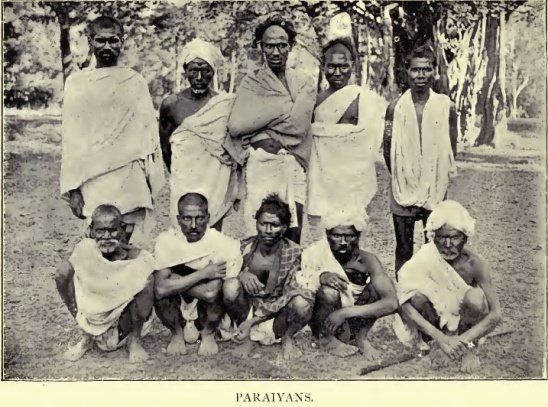
Moreover the Pulayas and Pariah will fornicate all their women folks with no qualms. For, even without any statutory permission, these lower caste males used to pouch on solitary women folks of the higher castes in Travancore area. This is mentioned in the Native Life in Travancore.
QUOTE 1: A curious custom also existed, which is said to have added to the number of the enslaved. The various castes met at fighting grounds at Pallam, Ochira, &c.; and at this season it was supposed that low-caste men were at liberty to seize high-caste women if they could manage it, and to retain them. Perhaps this practice took its origin in some kind of faction fights. A certain woman at Mundakayam, with fair Syrian features, is said to have been carried off thus. Hence arose a popular terror that during the months of Kumbha and Meena (February and March), if a Pulayan meets a Sudra woman alone he may seize her, Unless she is accompanied by a Shanar boy. This time of year was called Pula pidi kalam, Gundert says that this time of terror was in “the month Karkadam (15th July to 15th August), during which high caste women may lose caste if a slave happen to throw a stone at them after sunset.” So the slave owners had their own troubles to bear from this institution.
QUOTE 2: The Pariahs in North Travancore formerly kidnapped females of high caste, whom they were said to treat afterwards in a brutal manner.
QUOTE 3: Their custom was to turn robbers in the month of February, just after the ingathering of the harvest, when they were free from field work, and at the same time excited by demon worship, dancing, and drink. They broke into the houses of Brahmans and Nayars, carrying away their children and property, in excuse for which they pretended motives of revenge rather than interest, urging a tradition that they were once a division of the Brahmans, but entrapped into a breach of caste rules by their enemies making them eat beef. These crimes were once committed almost with impunity in some parts, but have now disappeared. Once having lost caste, even by no fault of their own, restoration to home and friends is impossible to Hindus.
QUOTE 4: Barbosa, writing about A.D. 1516, refers to this strange custom as practised by the polcas (Pulayars). “These low people during certain months of the year try as hard as they can to touch some of the Nayr women, as best they may be able to manage it, and secretly by night, to do them harm. So they go by night amongst the houses of the Nayrs to touch women; and these take many precautions against this injury during this season. And if they touch any woman, even though no one see it, and though there should be no witnesses, she, the Nayr woman herself, publishes it immediately, crying out, and leaves her house without choosing to enter it again to damage her lineage. And what she most thinks of doing is to run to the house of some low people to hide herself, that her relations may not kill her as a remedy for what has happened, or sell her to some strangers, as they are accustomed to do. END OF QUOTE.
Even though the above-mentioned items might seem quite unbelievable, they are mostly true. The terror associated with being accosted by or being touched by a lower caste man, is actually encoded in the feudal language. It is not possible to deal with the issue here.
If an incident of the following kind can be imagined, the idea might be understandable to a person from the subcontinent:
A female IPS officer is taken into hands by a group of male or female constables. They address her as Nee, and Edi and refer to her as Aval. And make her live with them. The mentioned words are quite heavy. It has a hammering effect when delivered by the lowly constables on an IPS officer.
This is a scenario that is not imaginable in India, Pakistan or Bangladesh. However it is now more or less enacted everyday in native-English nations. Some of the native-Englishmen or women might go berserk. The idiots who claims to be psychologists and psychiatrist would then give out some utterly idiotic logic as to why the person went berserk. They speak without the barest of information on what has taken place. Any normal person in the Sub-continent would go homicidal if such a thing happens over here. But these things do not happen here. For, all social communications are generally done along very carefully built-up pathways. When some persons do not follow the pathways, other simply avoids him or her. They sort of practise apartheid on the person. However, in native-English nations, the foolish natives there cannot do this. For, they will end up in prisons for practising ‘racism’.
That is the truth.
When the English Company was protecting them in times of acute danger, it was okay. However, when the English Company took over the administration of the various small-time kingdoms, there was a new understanding that things are going to be quite dangerous. It was not that the English administration was dangerous or that they were knaves or that they would loot their temples, or molest their women. No. Actually the English administration did none of these things.
What was the greatest danger that arose on the horizon was another thing totally. It was that the English administration was good, honest, efficient, humane and stood for the common welfare of all human beings here. This was a most terrible item.
For the social structure would collapse. And the English officials had no idea about the terrible anguish they were going to give the Nayar caste or Nayar population or Nayar religious group. For, it was the Nayar who stood on the borderline as a sort of wall between the higher castes (Brahmins and the Ambalavasis) and the lower castes.
The lower castes which stood just below them were the Marumakkathaya Thiyyas of North Malabar and the Makkathaya Thiyyas of South Malabar. I personally think that it was the Marumakkathaya Thiyyas of North Malabar who intimidated them most in the newly emerging social scenario. One of the main reasons for this was that the English East India Company Factory was located in Tellicherry, which was in north Malabar.
The second item was that in South Malabar, the major fear that caught them was the rising of the Mappilla population. However, the Mappilla populations there were actually the lower castes, mainly the Cherumar (very low caste) and the Makkathaya Thiyyas who had converted into Islam. This Mappilla outrages against the Nayars and the Brahmins have to be taken up separately.
The terrorising factor from the Marumakkathaya Thiyyas of North Malabar was mainly connected to a few common features of Malabar.
One was that the lower castes did not have dark-skin complexion in Malabar. In fact, many of them had very fair skin features. (Some ancient claims to Greek bloodline is seen mentioned. However, as of now, the vast majority are of mixed-blood descent).
Another connected factor was that there were at least a few Englishmen taking lower-class Thiyya women as their wife. Even though, many of the others of the local society, including the higher class Thiyyas would object to the use of the word ‘wife’ for them, the truth stands that these people to a great extent lived a family life raising good quality households and children. No one, not even the Thiyyas would like to see higher quality individuals sprouting up from amongst themselves. For, the language is totally hierarchical. It would be like in a modern Indian administration set up, finding a small percent of the peons have IAS level qualities, contacts and capacity for communication. This issue had a sad side to it. However, that is not in context here.
The third utterly incorrigible item was the stark madness displayed by the English administration to spread ‘education’ and English skills in the newer generation of youngsters. From all perspectives, this was an utter foolish activity. From their own national interest point of view, it was an act of utter treachery towards their own country and countrymen. It was a rascal act of sponging out all the traditional knowledges, sciences, mathematics, skills, technical knowhow, technical terminologies, all kinds of experiences including that of maritime skills and trade-secrets and much else of England, and scattering it out into a number of population groups, whose real and innate mental disposition was not fully known or understood. The heights of these foolish were that of giving away their national language English to populations, who the moment they get the upper hand would show not even one iota of gratitude or remembrance of what had been given to them.
Here there is need for some information to be mentioned. Learning English is not like learning any feudal language. Learning English will liberate a person from various kinds of shackles, confinements and controls.
However, learning a language like Malayalam, Tamil, Hindi, Telugu etc. would be equivalent to allowing others to tie up oneself and hand over rights of control and command to them, if one is in a lower position. This is a terrific information that is currently being withheld from all native-English nations. If this information is not discussed in native-English nations, the native populations of those nations will be in enslavement before long.
Fourth point is that the moment any Thiyya man or woman rises up in stature, above their own Thiyya others, there is no way to keep them down. The Nairs would find that they have to accept the risen-up Thiyya man as an equal first, and then later on as a superior. The terror in this total up-side-downing of roles cannot be understood in English.
When this happens, there is a terrible change of words, which connect to so many other verbal usages inside the feudal language. Since words are actually software code buttons or switches, this change can effect almost everyone in the connected social system. At every nook and corner, the relative stature and status of an immense number of persons will get affected.
The innumerable family relatives of the Thiyya man who has risen up would very quietly mention their connection to this man. The moment they mention this, the relative verbal codes for You, Your, Yours, He, His, Him, She, Her, Hers will change. The commander can very fast change into the commanded. And vice versa.
It is like this. Two young men are accosted by an Indian police constable, on the roadside. The latter asks one of them a few questions. It is quite possible that he would use the lower indicant words for You, Your, Yours etc. And he would refer to his company with the lower indicant words for He, His, Him etc. (Eda, Inhi/Nee, Oan/Avan &c.)
Instead of answering the questions, one of the young men simply mentions that his father’s brother is the Police SP (District head of police) of the district. It is a very powerful input. Immediately the constable would have no other go other than to shift the verbal codes for You &c. and He &c. to a higher indicant word stature. (Ingal / Ningal / Saar).
In fact, he might even act a bit subservient and ‘respectful’.
Now, this is the kind of horrendous social restructuring that was in the offing.
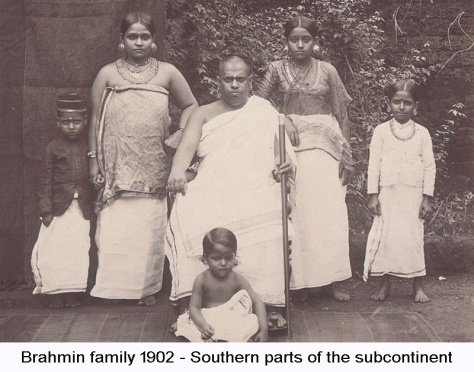 A single Thiyya man entering into the administrative positions as an officer could literally strew the social scene with an array of disorder and disorderly disconnections and connections.
The fifth issue was actually of more terror in content. It was the opening up of English schools in the Tellicherry area, and in some other locations in Malabar. In these places, some of the Thiyyas were able to admit their children. That more or less foreclosed the entry of Nair children in these schools. It might be true that some Nair children did join them. However, many kept away. The Nayar families which could afford it, sent their children to Calicut, to attend the school run by the erstwhile king of Calicut, meant only Hindu (Brahmin), Ambalavasi and Nayar children.
The issue that faced the Nayars would not be clearly understood by the English officials, who were under the foolish understanding that they knew everything better. That they understood the real calibre of the lower castes &c. The fact is that the higher castes were also quite aware that the lower castes had enough and more brains and skills for everything. And that exactly was the reason that the lower castes were put down terribly.
For instance, there is ample proof that the carpenters of the subcontinent were brilliant. However, to allow them any leeway to rise up in the social order to the extent that they can address the Nayar by name and by Inhi/Nee (lower or intimate level of You) would be suicidal. These kinds of freedoms are given to others only in foolish native-English nations. And that is why the native-English nations are heading for mass suicides.
It is good to improve lowly-placed populations and individuals. However, before doing that there is need to understand why these populations have been placed in lowly positions by their own native-land upper classes. Social Engineering has to be attempted only by those who know what is what.
Others like Abe Lincoln etc. enter like a fool into a location where only persons with extreme levels of information have the right to enter. And they create issues which the posterity will have to bear in terrible anguish.
There was an array of problems in allowing the lower-caste Thiyya children with the relatively higher-caste Nayar children. First and foremost was that a good percent of the Thiyyas were from the lower professional groups, like coconut climbers, agricultural workers, household servants etc. Even though their children would not be able to afford English education, the Thiyyas who could afford it would be connected to them.
A lower stature in caste hierarchy naturally has its affect on various human quality, including that of the quality of conversation, quality of words, quality of the human connections that frequently gets mentioned in conversations, the way other persons see the lower-caste children etc. The terror of the Nayars would be that everything that they can imagine as negative would be loaded on to their children if their children were to study in the same class and school as the Thiyya children.
Actually this is not a Hindu (Brahmin), upper-caste and Nayar caste mentality alone. In fact, the Muslims also did not want to send their children to school, where they would be forced to imbibe non-Islamic cultural items from their school-mates.
See this QUOTE: The scruples of the parents prevent them from permitting their children to attend the vernacular schools of the Hindus. A fairly successful attempt has however been made to reach them by giving grants to their own teachers on condition that they must show results END OF QUOTE
If one were to go into the interiors of this emotion, it would be seen that this terror is not connected actually to caste. For even now, parents who can afford a more expensive education for their children would strive to keep their children away from children whom they perceive as lower to them. The reader is requested not to immediately try to think that similar emotions are there in native-English nations. The reality in English nations cannot be taken up for any kind of comparison here. However, I will not go into the details of that here.
There is another emotional issue. The moment the Thiyyas get to feel a sort of equality with their immediate upper caste, the emotion that would spring forth from them would not be any kind of gratitude. Instead, the emotion would be for terrific vengeance and antipathy and competition and a desperation to show that they are better than the Nayars in everything.
At the same time, these Thiyyas would also try to keep the undeveloped Thiyyas at a distance as some kind of despicable beings. Nothing would be done in quite obvious ways. Everything would be by sly verbal codes, for which the local feudal language could give much facility.
The English-educated Thiyyas (high quality English education was dispensed at that time) would be of a softer mien. But then, as they improve, they would naturally and inadvertently be pulling up the other educated-in-vernacular Thiyyas. For even an uncle in the government service as an officer would give a huge social boost to a lower-level Thiyya. For even land-owner Nayars were working as Peons in the government sector.
And there is the fact mentioned by Edgar Thurston that there were many Marumakkathaya Thiyyas families in North Malabar and Makkathaya Thiyya families in South Malabar who were of sound social standing. I cannot mention more about this. However, he has mentioned something like Eight illams of the Thiyyas. What this is supposed to actually mean, I am unable to gather. However, in the Native Life in Travancore, it is seen that there is mention of the Ezhavas also claiming some kind of Illams. However, Pulayars and the Mukkuvars also are mentioned as having this verbal usage, ‘Illam’ (Source: Native Life in Travancore). At best, all this might be a desperate attempt to connect to the Brahmins, which is an emotion generally seen in many lower castes in the subcontinent.
See this quote from Native Life in Travancore: QUOTE: They broke into the houses of Brahmans and Nayars, carrying away their children and property, in excuse for which they pretended motives of revenge rather than interest, urging a tradition that they were once a division of the Brahmans, but entrapped into a breach of caste rules by their enemies making them eat beef. END OF QUOTE
With the setting up a reasonably stable social living, good quality administration, security to individuals, everyone getting the right to do business and to move goods to distant place, and judiciary to adjudicate civil disputes without giving any extra premium to any caste status, the social system was simply changing. As seen in this book itself, and very clearly mentioned in such books as Travancore State Manual etc., the period of continual warfare, battles, raiding, molesting, looting, plundering, enslaving and such other things had come to an end.
In the earlier periods, all towns and villages would turn into battlefield or areas through which totally uncontrolled fighters of some side would walk through. It goes without saying when such things happen, the peoples of the various castes tries to run off. However, many are caught and butchered. Many are taken as slaves to push the carts and make food and wash clothes etc. for the fighting persons. Women are generally forcibly fornicated in their houses. Some of them are taken as slaves or as woman to be kept as concubines by the individuals who are the leaders of the soldiers.
There was no one to appeal to.
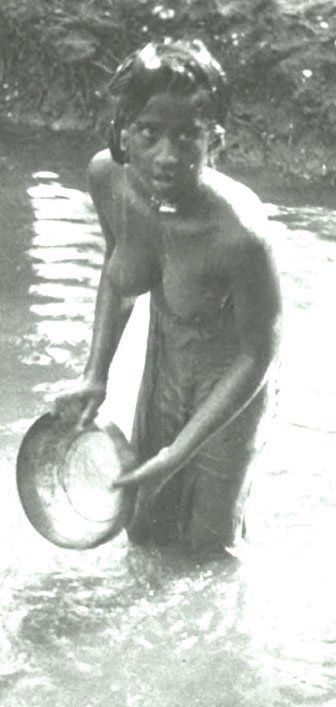 However, as of now, everything had changed. There was quietude and time to ponder on a new terror for the Nayars. The higher castes like the Ambalavasis and the Brahmins would also be perturbed. But then, they were not the castes which were on direct competition with the Marumakkathaya Thiyyas.
The book, Malabar, is not a book written with an aim at misguiding the natives of the subcontinent. Such books are now published by the Indian and Pakistani governments. This book was written as a guide book for the English administrators to understand the land they were administering. It was here that the Nayars had to work strenuously to give an erroneous idea about the land. For, they had much interests to protect and many populations to keep down.
All over the book, they have mentioned that they are some kind of genteel people, yet, courageous fighters, whose families had the antiquity of great traditions, and that they were the protectors of the land and that they were in charge of some kind of law and order machinery.
Even though there might be some element of truth in some of these assertions, it would be quite a lie to say that they stood for any kind of social welfare activity. Their best intentions would be to see that the subordinated castes and classes remained suppressed.
However, they could not simply continue this system. For, the English rule had prospered. The only thing that they could do in North Malabar was to insist that the Thiyyas were more low-class than they actually were.
In fact, as seen in a quote from Travancore State Manual, with the establishment of the English rule in Travancore, the mental and cultural quality of the Nayars had improved from that of a rowdy population. They had become more softer and cultured.
The same thing must have been experienced by the Nayars of Malabar also. Especially those in North Malabar. In fact, it is a very obvious thing that people who live in close proximity with the native-English improve in quality and culture. [The reader should be very careful to note that the native-English are totally different from Continental Europeans. Please do not mix up these two totally different people groups into one group. Moreover, pristine-English population of yore was a totally different population from the current-day Multi-culture English.]
However, in Malabar this quality enhancement was not confined to the Nayars alone. It arrived into the households of a few Thiyyas also. Especially those around Tellicherry areas.
In fact, there would not be much to differentiate a Thiyya and a Nayar who are both well-educated in the high quality English schools of Tellicherry of those times. The difference would be felt only if the Nayar’s and Thiyya person’s traditional family relatives are brought into the comparison.
Even though, a Thiyya individual who had developed culturally via means of the English education he had received would not personally appear to be an intimidating entity, on the social horizon, this man’s existence would be giving a total uplift-ment to all the crass low-class Thiyya families who were from the labourer classes. The main content of this ‘crass low-class’ quality would be the lower indicant verbal definitions meant for them. However, the moment they rise up relatively, they would very forcefully assault and harass the Nayars with a simple flipping of the verbal codes. The Nayars who do feel or experience this flipping action would feel himself or herself or their own family members going for vertical flip-flop.
What the English administration was giving was equivalent to giving a gun to a team of mice, to accost the cats.
Till date the Thiyyas were like the herbivorous animals like the deer, wild-buffalos etc. They can be pounced upon by the carnivorous animals like the cheetah, tiger etc. Their horns which point in more or less useless directions were of no use against the wild beasts. However one fine morning they find that they have been given a very suitable weapon of offense. It goes without saying that they would become more or less trigger-happy when they see a wild beast, even if the beast has no inimical intentions.
Actually the wildest beastliness are in the language codes of the local languages. It is not an individual quality. All persons who get the ability to inflict harm on another competing entity or human will inflict the harm. That is the way the language codes of feudal language are designed.
Gullible native-Englishmen had no way to understand this inglorious secret, which is currently turning their own native-nations into wastelands.
This book, Malabar, is full of cunning verbal attacks on the Thiyyas. Nothing direct. And that is the wonderful part of it. Where these sly attacks have been done, even Logan would have simply shrugged his shoulders. However, in the areas where he has directly made the inputs, that is, in the history part connected to the records from the English East India Company’s Factory at Tellicherry, the hue and tone is different. The perspective is different. If one knows that there is something wrong with the book, then one would put one’s mind on noting these things. Then they would appear very clearly.
Others, who read this book as some kind of old history, will simply gulp down the sterile facts as if they are of resounding quality.
When speaking about knowing history or what took place, there are immense information that do not come inside formal textbooks. For one thing, academic history that comes out from 3rd world historians who reside inside their home nations are literally the mouthpieces of their national policy indoctrinations. As to those from these nations who have relocated themselves into native-English nations, a good percentage of them simply retell the lies that they have been taught at home.
I can give several instances of information that might not appear in formal histories of India.
Take this instance: When speaking about the modern state of Kerala, there is not enough importance given to the ideas that Malabar and Travancore were totally disconnected political entities. English-ruled-Malabar had a bureaucratic apparatus which was run by officials who were quite good in English. The officialdom at the level of the officers were honest to a fault. This information I know personally, because one of my own family members was an officer in this Service. This Service was part of the Madras Presidency Civil Service and later of the Madras State Civil Service. In the earlier period of this Service, Travancore was a foreign kingdom. And later a neighbouring state called Travancore-Cochin State.
The Travancore officialdom was not run on English systems, even though at the top-levels English might have been used. The officials including the ‘officers’ were literally thieves. Beyond that they were most ruffians and rogues in all ways. The standard definition that they gave for the common man was ‘a donkey’.
In Malabar officialdom, everything was different. For instance, the members of the public were not to approach the peons and clerks for any office dealing. They had to approach the officers, who would assign their papers to the various clerks. The clerks would process the files and hand it over to the officer. The finished file/paper would be handed over back to the individual on the appointed day.
If a particular clerk is absent on any day, the officer would hand-over the file to another clerk. Or if that is not possible, the officer himself or herself would go through the file and have it ready for giving to the member of the public who had submitted the application.
Even in Malabar officialdom, the clerks and peons were not very good in English communication. If and when the member of the public approaches the clerk or the peon, they would most naturally try to dominate or distress the individual. For, that is the way the language codes are designed.
It was most probably for this very reason that the officers were made duty-bound to deal with the members of the public. The clerks and peons were merely workers inside the office, and had no power to take any decisions or to harass the public.
These kind of information do not usually come in formal histories, currently written by feebly-informed formal academicians.
The system of conducting a Civil Service exam by which youngsters, who were good in English but not necessarily from the high social-status families, could become officers was a novel idea in Malabar. However, there was a great pitfall in this. But then, the English officials foresaw the pitfall and took evasive action in a very intelligent manner, even though it is doubtful if they fully understood the pitfall.
One of the major issues of this kind of recruiting of individuals to position of officiating public offices is that the languages are feudal. The content of verbal ‘respect’ is required for that person to be able to manage the office and the subordinate clerks and peons. And to make the members of public feel that the government is of quality standards and has power and authority.
The respect in the local vernacular is connected to two basic items. One is ‘age’. The relatively younger individual has no right to claim ‘respect’ unless he or she is a higher-caste person. That means his words and actions are seen as of no consequence. Such an individual cannot run an office.
The reader has to bear in mind that the English rule was creating a new system of administration based on written codes of law. If the officers were seen as totally useless people, the administration would collapse.
The second item that was connected to spontaneous ‘respect’ was family status. Naturally this would mean that the highest posts should go to the Brahmins and then the next to the Ambalavasis and then to the Nayars.
The English-rule was trying to create something that had no likeness or sync to this system which had been the standards for centuries.
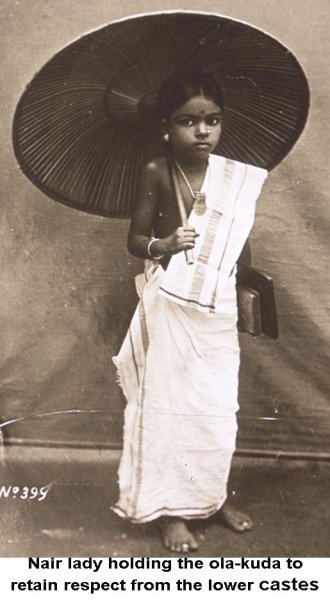 It must be mentioned here that the second item would override the first item, when both these items come to compete with each other. That is, if a higher-aged lower-caste man were to come in front of a lower-aged higher-caste man, the ‘respect’ is for the higher-caste younger-aged individual. The higher-aged lower-caste person would be addressed and also mentioned in the lower indicant words by the younger higher-caste person.
For instance, a higher caste 12 year old boy or girl would address a forty years old Thiyya man with a Inhi (Nee in Malayalam), and refer to him as an Oan (Avan in Malayalam).
A tumbling down of this system would not improve the situation. It would only change the individual positions. The higher-aged lower-caste man would address the younger-aged higher-caste boy with an ‘Inhi and refer to him as an Oan. This is not actually an improvement in the social order. Only a reversal of roles.
That is, the young-aged Nayar female in the image here would move from Ingal to Inhi, to a lower caste man, when the social structure tumbles. This is a terrifying event, for it connects to an immensity of other locations. Persons who thus find their ‘respect’ withdrawn will not come out of their residence.
However, what the English-rule attempted was the total abrogation and nullification of these satanic language systems. The satanic language in the location was something I would like to mention as Malabari. However, another satanic language called Malayalam was also entering into the location, desperately trying to replace Malabari and takeover. I will go into the competition between languages later.
When creating an administrative apparatus with youngsters getting recruited via means of an government recruitment Civil Service exam, the English administration did take quite efficient steps to see that only quality persons became Officers. This content of ‘Officers’ is something that has come to be missed in current-day India. No one seems to know the basic ideas of what it is to recruit ‘Officers’.
The major item is that Officers are Gentlemen. The word Gentlemen is not what it means in the native languages of the subcontinent. The word Gentlemen as understood in English is connected to a lot of sublime human qualities as seen in pristine-English. His behaviour to others should be gentlemanly and he should be chivalrous. A person who uses lower indicant words to the common man is not a gentleman. Nor can he be mentioned as an ‘Officer’. From this perspective, not many of the current-day ‘officers’ of India are actually ‘officers’. They are mere brutes in the attire of ‘officers’.
Good quality companies recruit their staff, based on individual quality. So that inside their office and working areas, the individuals in a particular work-location would have similar or same individual dispositions.
However, in current-day India, the ‘officer’ exam is simply like a marathon race. Anyone with some stamina can get in. There is no need for any ‘Officer’ quality. Even an individual fit for rowdy-work can get in, if he or she has the stamina. However, the system is quite rude within itself and individuals cannot be blamed.
When a youngster of around 23 years, with no outstanding family background is positioned as an Officer, with a number of subordinates under him or her, who could be from higher status families or castes, and possibly of more age, the system will not work in the feudal language and the prevalent social system. The subordinates would very spontaneously use the word ‘Oan’ (Avan in Malayalam – lowest ‘he’) or ‘Oal’ (Aval in Malayalam – lowest ‘she’) when referring to their officer. That itself will spell doom to the system.
Beyond this, the members of the public will also look down at the young man or woman from a feeble family status sitting at the officer’s table. They too would not get to feel any hallowed feeling with regard to government functioning. In a feudal language system this is an essential item for the machinery to work. The way then to gather respect is to terrorise and create hurdles of the person who comes to the office. However that would not be an English administration then.
However, the English administration did understand the issue. The solution they found out was this. The officers would be quite good in English. The administration and the office functioning would be in English.
I have personally seen in my childhood young Officers of the erstwhile Madras State Civil Service, after being moved into Kerala Service with the formation of Kerala, functioning in an English communication mode. They would address their senior-in-age subordinate clerks with a Mr. or Mrs. prefixed to their names. So that the local language issue of senior-in-age becoming a Chettan or Chechi to the officers was circumvented. If this had been allowed, a sort of double, mutually opposite hierarchies in communication would exist inside the office.
The second thing that the English administration did was to keep a pedestal-like platform for the chief officer in an office to place his or her seat. This more or less lifted them up above the others. Yet, this was not to add to the feudalism in communication. For, it was pristine-English in its most stern form that was upholding the government office functioning.
This wooden stage for the young officers to sit could be seen in such places as Sub Registrars office, Tahsildar’s office etc. As of now, in Malabar, this stage like seating arrangement was adding to the feudal hierarchy of feudal language officialdom that is now in vogue in Malabar.
I am not sure how it was in the government offices in Travancore Kingdom. I do not think this kind of physical lifting was necessary. For, the ‘officers’ there were recruited on the basis of their family stature. So a government office was just a mere reflection of the various terrible hierarchies already there in the kingdom.
In English-ruled Malabar, the offices were locations where the social feudalism and hierarchies went into disarray. This was one major difference between English ruled-Malabar and Travancore. It may be correct to say that this would have been the correct difference between the English-ruled locations everywhere in the subcontinent and where the local rajas ruled.
Formal history writers may not know much about these slender and yet quite powerful items.
Actually in the book, Malabar, there is not much information on the various Civil Service exams that had been initiated by the English rule. As to what it consisted of, I can base on only from my own family member’s exam.
I had found that the officer classes of the Malabar district of those days were extremely well-read in English Classics, good in English speaking, and stood as a group which was incorruptible. Moreover, they were not ready to use lower indicant words about or to a member of the public. However, when I came to interact with the members of the Travancore officials way back in 1970s onwards, I saw that the ‘officers’ there were low-class individuals who used totally bad indicant words about the common man. Most of them used words like Avan (lowest he/ him), Aval (lowest she/her) about them, with no qualms at all.
These words do contain the power of hammering, and the sharpness of a poking spear.
The Thiyya quandary
Let me now take up a very intriguing feature seen all around the book, Malabar, where the text has been evidently written or edited or doctored by the Nayars and certain others.
This feature element is this: In almost all locations, where the Thiyyas are mentioned, very evident interest has been shown to mix them up with the Ezhavas of Travancore, and also with many of the very low-castes of Malabar.
Before moving ahead on this route, I would like to mention a few things about Ezhavas. The fact is that until around 1975, when my family moved to Travancore area, I do not think anyone in our family had any information on a caste known as Ezhava. This does not mean that no one in Malabar was ignorant of them. For, there is an Ezhava temple at Tellicherry known as the Jagadnath Temple. Beyond that there are several SN Colleges and other institutions run by the SNDP, which is the leadership organisation of the Ezhavas of Travancore.
The first impression of the Ezhavas of Alleppy was the terrific darkness of their skin complexion. I think it was a very conspicuous item for the individuals who came from Malabar then. As of now, this skin complexion difference has vanished much due to the mixing of populations.
Later on, on getting to know more about the Travancore, it was found that the Ezhavas were in themselves a mixed population, with many individuals fair, some of mixed complexion and some quite dark complexioned. However, they were not at all similar to the Thiyyas of Malabar, especially of north Malabar.
The north Malabar Thiyyas were generally fair, if they were not from the labour class. Labour class persons generally had a darker skin complexion that they had acquired due to constant exposure to the sun. Or maybe they did have Ezhava bloodline mix in them. However, it would be clearly noticeable that skin-colour did not have much connection to intellectual and cultural content.
A mental quality known as ‘inferiority complex’ or a mood to retract from it using powerful props, was seen in the Thiyyas of the lower classes in north Malabar. I cannot say much about the Thiyyas of South Malabar, who actually were a different population group different from the North Malabar Thiyyas. I do not have much personal experience with them. The higher class north Malabar Thiyyas were quite developed and fashionable. However they also had the same repulsive feelings for the lower-class Thiyyas, as had the higher castes. These repulsions are encoded in the word-codes.
 The person in the picture was not a socially high-class individual. That was the intriguing part.
Thiyyas themselves used derogatory words about other Thiyyas. That is, words like Chekkan (lower grade male), Pennu (lower grade female), etc. The point here is that there had been occasions when the Thiyya working class had mentioned objection to the use of these words about them by the richer classes / castes or by the Mappilla rich.
From the inferiority complex sense, the Ezhavas did have more reason for that. For, till 1947, they were more or less kept out of so many statutory rights and functions which were then available to the Thiyyas of Malabar. However, that was due to the English rule in Malabar.
As to the skin complexion issue, it is true that in the Subcontinent, in many locations, a dark skin colour is seen as a negative attribute. However, in Tamilnadu, the people are mostly quite dark. They do not seem to have any inferiority complex due to this, unless they are purposefully compared with a fair-complexioned person. Yet, there also, film starts and successful political leaders have tried to don a fair-skin complexion.
Maybe if the Englishmen had been dark-complexioned, there would have been more appreciation for this skin-colour. For, then, higher quality human attributes like fair-play, honesty, rectitude, sense of commitment, chivalrous mental attribute, English Classics &c. which are generally seen as associated with native-English common standards would have been connected to dark-skin.
However, as of now, in most themes connected to all kinds of heritage and antiquity of the land, the dark-skin complexion is seen mentioned as connected to diabolic and wicked entities. Even in the puranas (epics) of the northern parts of the subcontinent, the heroes (such as Sri Rama) are seen shown as fair in colour. There is another divinity Sri Krishna. By various descriptions, this divine personage should be of dark skin-complexion. However, in almost all pictorial depictions, Sri Krishna is seen as of blue-skin colour. The dark-skin element is avoided.
Speaking about the Thiyyas, there is this thing also to be mentioned. In the Tellicherry location, due to the close connection with English administration and also due to the terrific sense of freedom and social eminence that perched upon the Thiyyas there, corresponding higher features appeared on their personality.
It is simply a matter of a person who had been in the lower indicant word definition suddenly rising up to the higher indicant word definition. It is a social machinery work. That of an ‘Oan ഓൻ’ (Avan അവൻ in Malayalam) population rising to a ‘Oar ഓര്’ (Avar അവര്/ Adheham അദ്ദേഹം in Malayalam) population.
Persons who rise higher in the verbal codes generally display a more softer demeanour and a fairer (or less dark) skin complexion. Learning English also makes a person much softer. It gets reflected in the next generation.
However, this is a comparison of two different population groups, for which actually there is no need for any kind of comparison. For, historically there is no connection between them. There would be practically no family connection other than those achieved by the means of caste-jumping. Caste-jumping is done by any lower caste to a higher or more attractive caste, the moment they relocated to a new location. I have mention about this earlier.
For instance, I have found Ezhavas in Malabar who go about mentioning that they are Thiyyas. However, generally their dark-skin complexion will lend a clue that they have simply changed their caste.
The word Ezhava is used as a cunning perjorative by those who want to insult, it seems.
Now, how the Ezhavas came to get connected to the Thiyyas and vice versa might be a very interesting bit of information.
This book, Malabar, in all its positions, other than in the history part written directly by Logan (connected to the written Log book records of the English Factory at Tellicherry), has tried to establish a total connection between the Ezhavas and Thiyyas. However, there is no evidence of any direct intervention by the Ezhava vested-interests in this regard. In fact, there is ample feeling that the Nayars did the work, which the Ezhava leadership sort of desired, on their own.
Since I do not have any historical records with me regarding the origin of the Ezhavas population in Travancore, I will have to take as much as possible from such books as Travancore State Manual, Native Life in Travancore, Castes and Tribes of Southern India, Omens and Superstitions of Southern India etc.
The general talk is that the Ezhava came from the Ceylon Island (current-day Sri Lanka). If that is true, then their ancestors are Sinhalese. Traces of Sinhalese language might be found in the Ezhava ancestry. However, the general feeling of Travancore way back in 1970s onward that I personally felt was that the place had a linguistic antiquity of Tamil. The discussion on the languages of the three components of current-day Kerala has to be taken up separately. I will leave that here.
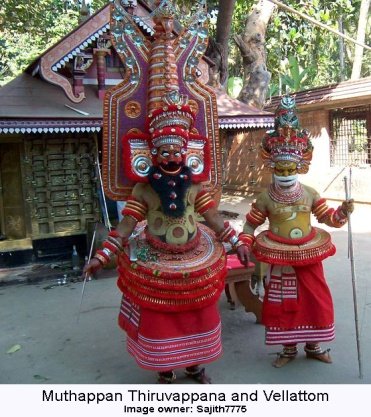 However, it must be mentioned that the Thiyyas of north Malabar did have a language right from the ancient times. This is seen reflected in the Thottam chollal (ritualistic chanting) (തോറ്റം ചൊല്ലൽ) of the Muthappan Theyyams, Vellattaam and Thiruvappana.
Now, if the ancestry mentioned above is correct, Ezhavas are not connected to the Brahmanical religion. They are not any kind of Hindus, as understood by the Brahmanical spiritual belief systems.
QUOTE: The residents about the Guruvayur temple are chiefly the higher classes of Hindus, viz.. Brahmans and Nayars END OF QUOTE.
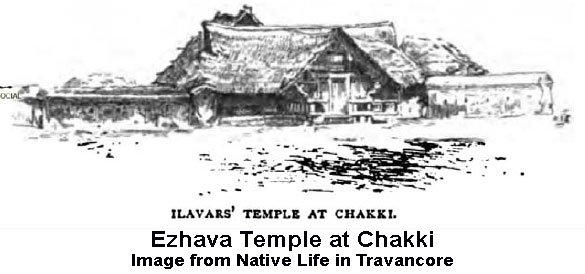 The reality of Hindu religion is that it is basically the religion of the Brahmans.
In Native Life in Travancore, there is mention of two of their deities or entities to whom they do worship. That is the Madan and Marutha. And also of Bhadrakali, Shastavu and Veerabhadran. There might be others also. There is no mention of any Thiyya deity in their worship system mentioned anywhere.
In the Castes and Tribes of Southern India by E Thurston, I have found it mentioned or hinted at that many of the subordinated castes did try their level best to claim some kind of connection to the Brahmans. This is not a surprising thing. In fact, even now all persons try to mention some connection to a higher-placed government official or doctor or political leader. If there are nondescript persons in their relationships, they conveniently forget or refuse to mention them. Word codes would get pulled to the heights or lowliness, depending on who it is that one mentions as a relative.
The same is the case with mentioning antiquity. No caste or population would mention any hint of a connection to a lower-placed population. For, a mere mention is enough to degrade the individual in the verbal codes. This is the location where the Ezhavas admits their lowliness compared to the Thiyyas. It might not be real. However, position-wise the Thiyyas were under the English in the 1800s. While the Ezhavas were still under the Nayars.
The Ezhavas were not directly under the Brahmins. They were under the Nayars who were themselves under a number of levels of Ambalavasis, who were under a number of levels of Brahmins.
Being under the English was like standing on the mountain-top. Being under the Nayars, defined by them as Nee, Avan, Aval, Cherukkan, Pennu, Chovvan, Kotti etc. was like standing under some abominable dirt. This was the desperation that possibly made the Ezhavas to claim that they are Thiyyas in north Malabar.
A claim to sameness and similarity between the Ezhavas and the Thiyyas was done due to the fact that both were under the same-name caste; that is ‘Nayars’. However the former was under the Travancore Nayars, and the Marumakkathaya Thiyyas were under the North Malabar Nayars. I have no idea about the social standing between the Nayars and the Thiyyas of North Malabar, traditionally. However, it is seen mentioned that in the Panappayatt (പണപ്പയറ്റ്) programmes, there was interaction between the Nayars and the Thiyyas in North Malabar. I have no information about this in South Malabar.
This is the way this Panappayatt has been mentioned in this book, Malabar: QUOTE: CHANGHGATIKKURI KALYANAM - It is not, it appears, confined to people of the same caste, but the association was often composed of Nayers, Tiyars and Mappilas END OF QUOTE
I do not know what the standing between the Ezhavas of Travancore and the Nayars there, was. It is seen mentioned in Native Life in Travancore that: QUOTE: In some temples and ceremonies, as at Paroor, Sarkarei, &c., they closely associate with the Sudras (Nayars). END OF QUOTE
In North Malabar also, in the various interior Nair household temple, their dependent Thiyyas and other castes like the Malayans are known to have collaborated in the temple rituals. However, I feel these Thiyyas and Malayans would be those who stood as the dependents of those households.
One of the main differences between the North Malabar Thiyyas and the Ezhavas of Travancore mentioned very much is that the former was following Marumakkathaya (matriarchal) family system, while the latter was following Makkathaya (patriarchal) family system. However, in the case of the Ezhavas, it is found that this has not always been the case. There was some kind of influence of matriarchal system among a few of their families also.
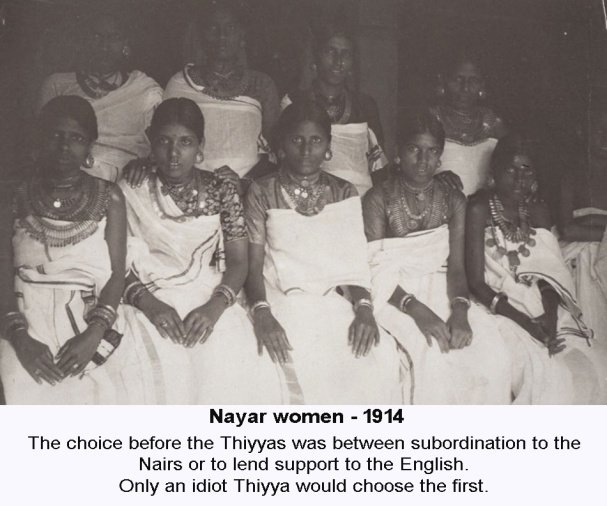
It might be possible that some kind of matriarchal influence has entered into the social stream of certain populations. There is no historical record seen mentioned in any other books I have mentioned as to how this entered.
As to there being similarities and differences between any particular caste or population group, well, if one were to go through the Castes and Tribes of Southern India by E. Thurston, it is seen that there are a lot of similarities and common heritages among so many different population groups who lived in the various locations of the Subcontinent. The most powerful common string that connected all of them was the more or less similar kind of feudal content or hierarchy in most of the local languages of the subcontinent.
Language is a powerful society designing factor. It has the power to design both human behaviour pattern as well as human relationship strings.
However, the issue remains that the Thiyya of north Malabar had no social or traditional connections with the Ezhavas of Travancore. It is the Ezhavas who insists on this connection. Why they should insist this during the English rule time might have been a desperation to place themselves at a higher plane. For in the English-ruled Malabar, the Thiyyas were higher placed. But then, that is not the reason why the Ezhava insists on such a connection now.
As of now, it is a big political leadership issue. The Ezhava leadership has spread its tentacles all throughout the Malabar region. A disconnection from the Thiyya population would mean the erasing up of this leadership and the loss of followers.
Otherwise, there is no conceivable reason to claim an attachment. For currently the Ezhavas do not have any need for any kind of inferiority vis-a-vis the Thiyyas. In fact, in many locations in Malabar, it is the Thiyya populations who are desperately in need of social enhancement. This is slightly connected to the fact that with the formation of Kerala, there was a complete shift of focus to Travancore. The Malabar systems created by the English-rule went into disarray and oblivion. However, that is another theme which would need a lot of words to describe.
Now, coming back to the English-rule period in Malabar, and to the period of the Travancore kingdom, it is true that the Ezhava populations of Travancore were quite a suppressed lot.
Now, let me look at the Thiyya population of Malabar. The English administration had a tough time to understand the Thiyya populations, when the two Malabars, north and south, were amalgamated to form a single district. The young English / British officials, who came to work in the judiciary as judicial officers, or as administrators, were at first quite confused about this Thiyya content.
It took them some time to understand the issue. With the setting-up of a formal judiciary, all kinds of populations who had been traditionally dependent on the thraldom of their village / panchayat headmen or higher castes were suddenly liberated. A terrific feeling came about that everyone were equal in the eyes of the law.
It is true that the novelty soon wore off. For, the succeeding generations did not quite appreciate the fact that just one generation back, their parents were mere nonentities with bare right to any kind of social or personal dignity.
The social changes as well as the connection between two distinct geographical regions which had totally different family systems as well as population groups led to so many new enterprises and relationships, as well as to financial connections between individuals.
In many of the administrative and judicial codes, the English rule did not want to upset any applecart. Actually, they more or less only codified the social codes of inheritance and such things already in existence in the land. However, when judicial cases went into adjudication, there was terrific confusion, in the case of the Thiyyas. It was seen that the Thiyyas had two mutually opposite customs with regard to inheritance and to family relationship. And then a more profound information arrived that the two Thiyyas were different from each other. One of them, actually declaring some sort of a repulsion for the other.
Now, it may seem that the Marumakkathaya Thiyyas were presuming some kind of superiority over the Makkathaya Thiyyas. However, in a deeper analysis, the Makkathaya family system was a more stable and sensible kind of family system. Then why the Marumakkathaya Thiyyas acted superior is not known. Or is it possible that the Makkathaya Thiyyas also had a superiority complex, but were not bothered much about the Marumakkathaya aversion to them?
Whatever it is, the English officials were soon forced to understand the term ‘Thiyya’ represented two different castes or population groups.
Now, there was another complication in the social system. That was the entry of Ezhavas into many locations in Malabar via various routes.
It is quite obvious that the Nayars were totally unnerved by the possibility that the Thiyyas would soon occupy much of their positions, in the newly emerging English rule. Even the Calicut king’s family members must have been terrified. For, they had been reduced to mere pensioners of the English East India Company. Actually the English Company came to take-over the power of the king due to the fact that the different members of the king’s family were continually in a mood for fights against each other and mutiny against the king.
It is seen mentioned that even the Calicut king’s officials (must be Nayars) used to designate the Thiyyas as Ezhavas in their official record. Even though Calicut was in south Malabar, with the unification of both North Malabar and South Malabar, the official records of Calicut seems to have had its bearing upon North Malabar also.
Edgar Thurston does mention that whatever way the Thiyyas object to being defined as Ezhavas, the king’s officials would not change the description. This was their way to sort of control an emerging population. That is, by identifying them with a population which was seen as outcastes in nextdoor Travancore Kingdom.
However, I have to mention that Edgar Thurston’s writings have been doctored then and there itself. I could feel this same issue with the Thiyya identity in the different parts of his huge 7-volume book. There is sharp difference in the way the Thiyya identity is mentioned in different parts of the book. So as to give a feel that the different parts of the books have been filled by information from different and mutually antagonistic sources.
In some locations, for instance, the Volume 7 of Castes and Tribes of Southern India, the plight of the Thiyyas of north Malabar is mentioned in that they do not accept that they are Ezhavas or that the Ezhavas are Thiyyas. However, the officials of the king of Calicut, which is in South Malabar would go on insisting that they are Ezhavas. And they have no way out of this quandary. May be the king’s officials are focusing on the Makkathaya Thiyyas of South Malabar, but in the newly emerging confusion, there is no way out of this false identification.
But then, from my personal instinct, I feel that the South Malabar Thiyyas are also not Ezhavas. Who they are I do not know.
There is a book of ‘history’ that is seen quoted all over this book, Malabar. That is Keralolpathi. It is a book written with certain meticulously planned aims. The history it provides could be false, but then a lot of historical incidences have been placed inside the book to give it a feel of authenticity.
The history of this subcontinent till the advent of the English is similar to a history of a colony of ants. This leader fought with that. Then another leader fought from the west. Then the south and east joined together and entered the location and massacred the ants therein, and took many as slaves. Then a religious leader came and converted some to his religion. Then communal fights. There is nothing more to record or write.
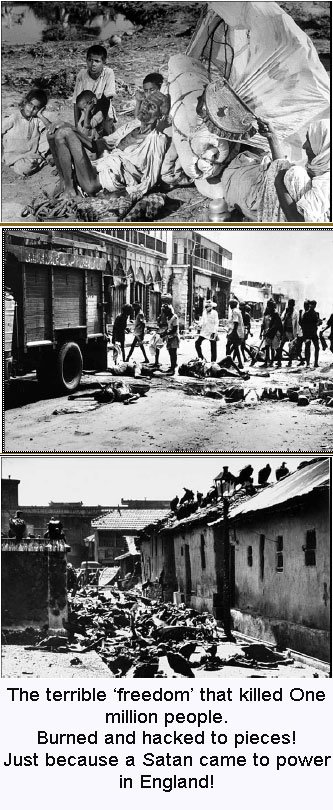 Actually in those times, events practically repeated. But then there are slow changes in the population groups. Yet, everything changed totally with the advent of the English rule. It is from here that actually the history of Malabar starts. But this is also the part of formal history that is simply dismissed by dismal words like English colonialism, English looting, Freedom fights etc.
There is enough content in the English rule period to write volumes. On how innumerable populations groups living in mutual terror, antipathy and frequent fights and massacres were rearranged into a decent social system and nation. And how a bloody idiot in England again handed the whole location to a group of low-quality self-serving politicians, who literally overran the subcontinent and occupied all the independent kingdoms. 10 lakh (1 million) people died almost within weeks or months of this monstrous treachery).
I have seen young people speak in great admiration for the so-called great freedom fighters who killed the Englishmen. The truth of the matter is that these youngsters like the looks of the ‘freedom fighters’ in the books and films. However, they would not go anywhere near a group of common people in their own nation. They detest the common Indians, who appear on the roads in real life. However, in the virtual world of fake story films, the great fighters look quite a splendid group.
These young persons, who have great admiration for their own nation and nationals, would all love to run off to native-English nations.
Now, I think I have given enough background to take quotes from the book, Malabar from which one can sense out the antipathy the Nayars seems to have had towards the Thiyyas, especially of North Malabar.
But before going into that there are certain things that have to be mentioned about what has been deliberately missed out in this book.
As an keen observer on human reactions to feudal language codes, I have sort of developed an idea as to what to look for in all descriptions on human interactions and social links. The moment a social system speaks a particular language, there are certain very clearly predictable manners in which the individuals behave. For, they are all infected with certain specific terrors or relief from terrors.
The setting up of a very placid state of social system under an egalitarian language, under the English administration would create a lot of heartburns, in many layers of the social system. If the society was in a condition of continual fights and killings and hacking and such things, there would not be much time to ponder on these things. People simply endure the terror and the time passes on.
However, when the society becomes quite peaceful, and an egalitarian language is slowly changing the landscape of the social system into a planar form, there is time for everyone in every layer to ponder on what would be the outcome. Their most terrible terror is the possibility of individuals who had been considered as their inferiors coming up on top. Even though the egalitarian language English is what makes this happen, the social system and social communication is still in the feudal language.
When the relative stature of each individual changes, the words form for You, Your, Yours, He, His, Her, She, Her, Hers, They, Their, Theirs &c. will change in the case of each individual human-link. Persons who cannot be addressed by name by someone may arrive at a location where he can be very casual called by name by this very person. There are terrors, which cannot be imagined by a native-English person, in feudal languages.
This is the information that makes me look deeper into descriptions. I had an overwhelming hunch that something of this sort would be there in this book, as I slowly started moving through the book.
I did find many things. I will deal with them one by one. However, here I would like to mention what was missing.
In this whole book, there is a complete blackout of the Thiyya population. It need not be that curious in that the Thiyyas come below the Nayars, and were more or less a lower caste.
However, Edgar Thurston does give some very glorifying words about at least a section of the Thiyyas of north Malabar. One is that some of them were extremely fair in skin complexion. This is a high premium statement in a land that prizes fair skin-complexion. (Greek bloodline?)
There is another quote of William Logan, which I found in Edgar Thurston’s Castes and Tribes of Southern India:
QUOTE: There are, in North Malabar, many individuals, whose fathers were European. Writing, in 1887, concerning the Tiyan (Thiyya) community, Mr. Logan states * that ** the women are not as a rule excommunicated if they live with Europeans, and the consequence is that there has been among them a large admixture of European blood, and the caste itself has been materially raised in the social scale. In appearance some of the women are almost as fair as Europeans.”
On this point, the Report of the Malabar Marriage Commission, 1894, states that “ in the early days of British rule, the Tiyan women incurred no social disgrace by consorting with Europeans, and, up to the last generation, if the Sudra girl could boast of her Brahmin lover, the Tiyan girl could show more substantial benefits from her alliance with a white man of the ruling race. END OF QUOTE.
The above is also another terror looming ahead on the social horizon for the Nayars. For, they are the caste just above the Thiyyas. The Brahmins were on top and more or less the landed gentry. The Nayars were the supervisor castes for the higher castes. It goes without saying that if the Thiyyas rise up, they would most probably replace them in many official positions.
As to the English officials, they were going ahead with a social egalitarian policy without any keen understanding of how it is going to hurt the Nayar caste individuals. For, the language is terribly feudal. It is so terrible a thing, that in the native-English nations, many local citizens who can barely understand these languages have gone berserk and committed Gun Violence crimes in a mood of unexplainable insanity, when effected by the negative codes of feudal languages.
What the Nayars feared did happen. From the latter part of the 1800s, the Thiyyas started appearing inside the administrative set up, with some of them becoming sub-magistrates and Deputy District Collectors inside Madras Presidency.
English education was lifting up a small percentage of the Thiyyas.
There is a wider information that can be mentioned about this eventuality. However, it is out of context here.
But then, there is another bit of information that can be mentioned here. That is, this social enhancement of a small section of the Thiyya caste was not a welcome event for at least some of the Thiyya caste leadership. This contention I am mentioning without any record or evidence in my possession. I simply rely here on my impressionistic approach to history, based on my understanding as to how individuals react to social changes in a feudal language social system.
This is a theme I will take up later.
It may be true that in the subcontinent, many of the lower castes are not actually Hindus, even though they all are categorised as such. This does not matter for most persons. For, everyone is more or less totally engrossed in keeping the various terrors of living in India at bay. Every individual is now totally focused on his or her own social or political leadership or in his or her job. Losing out to others can be dangerous.
There was and is an understated spiritual culture of Shamanism in this subcontinent. However, all these shamanistic spiritual system may not be from the same route or focus. Nayars have their own traditional temples wherein Shamanistic practises are going on. Their Shamanistic deities might include Kuttichathan, Gulikan, Paradevatha, Asuraputra and Chamundi.
The Thiyyas have Muthappan and some other deities. The lower castes like the Pulaya, Pariah etc. also might have had them. However, the lowest castes were literally kept like cattle as slaves in the households of the landlords till the advent of the English rule. So, in most cases of such populations, their ancient traditions have been wiped out.
Still, Edgar Thurston has made very detailed study about most of these castes. In Rev. Samuel Mateer’s Native Life in Travancore, the deities and worship systems of the Ezhavas are mentioned in detail.
None of them, if examined detail are actually from the Brahmanical spiritual systems. However, over the centuries there have been very ferocious attempts to attach their spiritual system to the Brahmanical religion. This is mainly due to the feudal content in the local languages. A proximity to the Brahmanical religion would add ‘respect’ to their gods. A detachment would make their deities have a feel of a semi-barbarian god. The words would change.
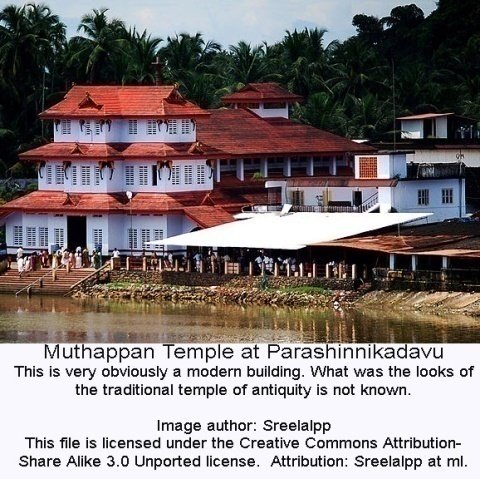 In fact, I have heard directly from some Nayar individuals that in their childhood, they would not go near a Muthappan Shamanistic ritual. They looked upon the Muthappan ritualistic dance as some ritual of a lower class population. However, from a very local vested-interest perspective, there would have been Thiyya higher classes who would have wanted a closer connection with their higher castes. If that had been allowed, the Muthappan worship would have been very quietly mentioned as some kind of lower form of the Hindu Trinities.
Due to a very particular aspect inside the local feudal languages, people generally get trained to lean on something. The physical posture of standing without leaning on something like a doorframe, tree, another person’s shoulder &c. are connected to a deeper need aroused by the language codes. I cannot go into it here. However, it may be noted that in pristine-English social system, individuals are trained to stand erect without leaning on anything.
The mental craving for something to lean on is there in almost everything. People would need to have some support. It can be a higher placed man, a connection to a higher status family, a link to a more respected religion and thus. These are basic things that are totally different from what is natural in pristine-English.
 This book, Malabar, seems to simply allow the Thiyyas of those times to vanish into a nonentity stature. There was indeed a huge population of Thiyyas in north Malabar. The Muthappan temple at Parashinikadavu and the hilltop shrine at Kunnathurpadi are not at all found mentioned in this book. This is quite a curious item. For even the small-time Brahmanical temples in the various locations are mentioned. Mappilla mosques are mentioned. The various Christian religious sects are also given detailed writing.
However, the fact is that the Thiyyas of north Malabar had a spiritual worship system which was quite wide-spread throughout North Malabar. (I am not mentioning the south Malabar Thiyyas, because I do not have much information on them and I think that they are another population totally.) This string of worship system was none other than the Muthappan shrines. I did not find one single mention of Muthappan in this book of records on Malabar, purportedly written by a Collector of the Malabar District. It should be quite curious.
This item become more curious and intriguing when it is seen that there is some kind of a historical association between the English-rule built Railway Stations in North Malabar and Muthappan worship. In fact, there seems to be a Muthappan temple in close proximity to many a railway station in north Malabar stretching up to Mangalore in the erstwhile Mysore State. The most famous in this regard is the Railway Muthappan Shrine at Thavakkara in Cannanore, which I think was the first to be built in close connection with the railway stations.
The more curious issue is that some rogue has mentioned Muthappan worship as a Hindu worship system in one internationally known low content-quality web-portal. It is totally curious in that a temple and worship system that had been totally avoided by those persons connected to the traditional Hindu and Brahmanical worship systems is now being connected to it. However, I do not have enough knowledge to say more about this. It might be possible that some higher caste links might be mentioned in the Muthappan tradition also. That is how the local languages generally tend to gather power and admiration.
There is a much-mentioned story of how the Muthappan shrines came to be connected to the Railway stations of north Malabar. However, I am not taking that up here. For, I am not sure how authentic the popular version is. But then, in the North Malabar Railway Archives, the real history of this connection might still be there on the records. If it was English rule here, I could have approached the officials to make an enquiry about this. However, since the administration has changed into feudal language systems, it would be quite difficult to go an make an enquiry in a government office, unless one goes there with some official supremacy. The ordinary man in India can literally get shooed out of an Indian government office.
There are traditions and folklore and other stories connected to the Muthappan heritage. However, the stories are quite insipid when compared to the Shamanistic phenomenon that gets enacted during the ritualistic procedures. The person who gets possessed by the Muthappan entity or supernatural software or some indefinable being or entity, literally become a different persona. In bearing, tone, faculty and competence, the individual is different.
Actually the Muthappan phenomenon could very well go beyond the current parameters of physical knowledge, in that it is like Muthappan can look into some kind of a software application of life and reality, and see the past, the present and future. My most formidable experiences with this phenomenon had been with the Muthappan phenomenon at the Railway Muthappan Shrine at Thavakkara, Cannanore.
Interested readers can check my book: Software codes of mantra, tantra, witchcraft, black magic, evil eye, evil tongue &c.
The phenomenon seems to be a Shamanistic spiritual phenomenon connected the Marumakkathaya Thiyyas of North Malabar. However, some other castes are also seen mentioned in close association with this religion. I have no idea if a similar Shamanistic spiritual religion was there among the Makkathaya Thiyyas of South Malabar. However, it is true that some kind of Shamanistic spiritual religion was there in practise in various locations of the subcontinent. However, it is also a reality in so many other locations all around the world. I have no idea as to whether they all have any mutual connections and if they all do focus on the same central point of focus.
But then there is zero mention of this in this book, Malabar. As to the Keralolpathi, which has been mentioned with a sort of clockwork periodicity in this book, I wonder if this religion has been mentioned.
It is quite curious that the English and European historical researchers in this location of those period simply skips all historical enquiry on the origin of the north Malabar Thiyyas. It is possible that all of them had native helpers from the higher castes, who must have led them away from this topic. Actually there is evidence that this kind of fooling by the native section had been practised on the officials of the English Company. I will mention that later.
These researchers mention Jain, Buddhist, Tamil, Arabic, Phoenician, Roman, Ceylonese, Far-eastern, Chinese &c. population entry. However, what was patently visible right in front of them, they seemed to have missed seeing. It is quite curious. But then, if one knows the mentality of the populations of the location, one can understand how the native-Englishmen had been made to go blind. In the feudal languages, a single mention and a single glorifying adjective will work wonders on the verbal codes. These are things unknown to the native-English mind. No mention is the way to kill a competing entity.
However, the Thottam chollal or the ritualistic chanting that leads to the conversion of an individual to a supernatural entity is in a language which seems to be part of the heritage of this phenomenon. If this be so, then there is an error somewhere in mentioning that the Travancore part and the Malabar part of the geography had a common or same heritage. For the antiquity of Travancore is Tamil. While the actual traditional language of North Malabar was a language quite different from modern Malayalam, in that it might not have any influence of both Tamil and Sanskrit. These words of mine are not a studied one. However, it might be good to look at this information from a disinterested perspective.
The traditional language of North Malabar was Malayalam, but that Malayalam is not the Malayalam that was seen promoted by the Christian evangelical groups and Gundert. However, that is another issue. I will deal with it later.
There is this quote from this book: QUOTE: The only exception to this rule is that which forms the most characteristic feature of Malayalam—a language which appears to have been originally identical with Tamil, but which, in so far as its conjugational system is concerned, has fallen back from the inflexional development reached by both tongues whilst they were still one, to what appears to have been the primitive condition of both—a condition nearly resembling the Mongolian, the Manchu, and the other rude primitive tongue of High Asia. END OF QUOTE
See the words: nearly resembling the Mongolian, the Manchu, and the other rude primitive tongue of High Asia. It is quite curious. Does the original language of Malabar have features or similarities in any kind with the Mongolian, Manchu and other rude primitive tongues of High Asia? It is quite curious in that the Nayars have been mentioned as possibly having some connection to the northern parts of Asia.
See the words of Mr. F. W. Ellis’ essay mentioned in this book QUOTE: — “.................. and establish etymology on the firm basis of truth and reason, will suggest to the philosopher new and important speculations on mankind, and open to the historian views of the origin and connection of nations which he can derive from no other source.” END OF QUOTE
NOTEs: etymology: a chronological account of the birth and development of a particular word or element of a word, often delineating its spread from one language to another and its evolving changes in form and meaning. END OF NOTEs
The word rude is also quite a surprise. The word ‘rude’ is an adjective that Lord Macaulay had used to describe the languages of the subcontinent. Why they are rude, he did not explain. However, they are rude due to the feudal content in them. These languages are extremely impolite to the subordinated classes and to the vanquished.
Now, there are two things to be mentioned with regard to the Thiyya caste-mention in this book. The first item is about the various insertions that tend to connect the Thiyyas to other castes with a sort of meticulous maliciousness.
The second is about the successful attempts by the Ezhava leadership in Travancore to encroach into north Malabar and assert the claims that the Marumakkathaya Thiyyas are actually Ezhavas. As to the Makkathaya Thiyyas, I am not sure. For, that location and that caste seemed to have gone into another terrific historical experience. That of the so-called Mappilla lahala, the Mappilla (Malabar Muslim) revolt. In which the Mappillas attacked the Brahmins and associates, and the Nayars with a vehemence that cannot be understood in English.
Makkathaya Thiyyas will have to be studied on their own. It is a different population, I think. Where they came from is not seen mentioned in the books.
However, I have to place on record here that I personally feel that the Makkathaya Thiyya family system was more modern, sensible and stable. But then, they were the caste, from which a lot of persons converted into Islam, to escape some terrible kind of social enslavement. There will be quite profound explanations for that. However I will not take up that issue in this book, because I fear that the book will become too lengthy, and I will have to put in more time to study that population group.
It is true that Dr. Gundert does have the feel of an active agent of certain extra-national interests in Malabar. That is a different issue. However, what is quite intriguing is that he is also quite active in connecting the Thiyyas of Malabar to the Ezhavas of Travancore.
However of more interest is the interest shown by the authors of this book, Malabar, to bring in his words to assert the claim that the Thiyyas of Malabar are Ezhavas of Travancore. There is this quote in which he mentions the castes in Malabar and Travancore which follow the Marumakkathayam family system. He says: QUOTE: ..... (26) Tiyan in north, and in Travancore. (Marumakkathayam) END OF QUOTE. Thiyyas are not the natives of Travancore. Ezhavas of Travancore are given a Thiyya identity here.
Look at a similar quote about the communities that followed the Makkathaya Family system: QUOTE: (26) Tiyar in Kadattunad and Travancore (Makkathayam). END OF QUOTE.
In both the full text of the quotes, the word ‘Ezhava’ is not mentioned. Instead, the word Thiyyan is used for Ezhavas. This type of mixing-up actually follows a very well-planned pattern in this book. Also, there is a slight issue of the word ‘Tiyan’ being used in the first quote, and ‘Tiyar’ used in the second quote. There are actually quite powerful differences in the two words, when seen through the querulous codes of the local feudal languages. Whether this difference is an inadvertent entry or something denoting some other more malicious intent is not known.
In most locations of the book, where it is more or less certain that native vested interests have written the text or added insertions, there is a continuing pattern. It is that whenever the words Tiyar is mentioned, a very consistent insertion is also given therein. That is ‘Islander’, ‘Ilavar’, ‘Islander’ etc. Actually all these words are for defining the Ezhavas. But then, there is a very malicious intention felt all over the book in these kinds of sections, to connect the word ‘Tiyar’ with ‘Illavar’ (Ezhavar).
See the following:
-
and fully described by Cosmas Indicopleustes, the islanders [Tiyar) must have been settled in the country before the middle of the sixth century A.D.
[My note: The context could be about Ezhavas, and the word ‘Tiyar’ should be an extra entry by the persons who inserted text into this book.]
-
another of them may have been the Islanders or Cingalese (Dvipar, Divar, Tiyar, and Simhalar, Sihalar, Ilavar) ;
[My note: Again similar kind of entry inside brackets]
-
Tiyar or Islanders who, it is said, came from the south (Ceylon),
[My note: Here these is very obvious mixing up of populations]
-
one-third for the expenses of the Tiyars, Cherumars or other cultivators attached to the soil,
[My note: Here the Tiyars are connected to the Cherumars and other indentured slaves attached to the soil. However, it is quite doubtful if this definition could be applicable to the Thiyyas. There is desperation in the minds of the upper castes to inform the English officialdom that the Thiyyas are mere slaves attached to the soil. Do not give any higher official rank to them. The administration will stink!]
-
The Tiyar or Ilavar caste is the numerically strongest section of the Hindu population, numbering in all 559,717.
[My note: See the way the Ilavar caste of Travancore is mixed up with the Tiyar caste of Malabar. Moreover the mentioning of them as Hindus can also be part of a wider conspiracy.]
-
One of their caste names (Tiyan) denotes that they came originally from an *island, while the other caste name (Ilavan) denotes that that island was Ceylon. Tiyan is a corruption of the Sanskrit Dvipan passing through Tivan, a name which is even now sometimes applied to the caste. In the records of the Tellicherry Factory the caste is generally alluded to “Tivee.” Simhala was the ancient name for Ceylon, and the other caste name of the planters must have passed through Simhalam to Sihalan and Ihalan and finally to Ilavan.
[My note: It is quite obvious that the words Tiyan and Illavan have nothing in common. However, a connection is built up through a roundabout manner, by going through Sanskrit. The main problem here is that Malabar location does not have much Sanskrit influence in its antique communication system.
As to the Tellicherry Factor using the word ‘Tivee’, it could be just because it was the way the word was understood by the native-English officials, or it must be the cunning way it was introduced to them by the higher castes starting from Nayar upwards. Actually, there is no context in the text to even mention Ilavan or Simhalan or Ceylon. But no opportunity to buttress this totally fabricated idea is missed. ]
-
And I also (one of the above lords of Maruwan Sapir Iso or the church, vide n), who formerly had the possession of the share staff (வாரககொல், feudal tenure ?) of the four families of Ilawar (Simhalese, also Tiyar, Dwipar, Islanders,” now palm-tree cultivators),
[My note: This quote is from one of the Deeds connected to the Travancore kingdom. What is the meaning of adding Tiyar, Dwipar, Islander &c. into a translation of an ancient deed? And at the end adding palm-tree cultivators. This palm-tree cultivator usage is also a deliberate attempt to added the adjective Toddy-tapper, which in the local language could have connected the individuals to a lower verbal status. It is very clear that there was some terrific meticulously planned idea to demark the Thiyyas of north Malabar to destruction through ignominy and connection to a population in another country with which actually Malabar had very little connection, linguistically, population-wise and history.]
-
p. Those Ilawar are permitted to follow out their occupations (?) in the bazar and on the wall.
q. Nor have the Island ruler (or Tiyar headman) and the Wall office or whoever it be, any power to stop them on any charges whatsoever.
NOTEs: 1. See Glossary under Tiyan, &c.
[My note: The above three sentences have one basic problem. The Ilawar has permission. And the Island ruler has no power to stop them. But then what is the words in bracket ‘or Tiyar headman’ doing here. The point is that these are insertions into the original text translation done by someone with some malicious intentions.]
-
ILAVAN. From ilam, from Chingngalam, Simhala, Sihala = Ceylon. The name of the Tiyan in the Palghat and Temmalapuram Districts in parlance, who are aborigines of Malabar ; in other places they are only so named in writings. Note—The Tiyar or Tivar (from tivu, corruption of Sanskrit divpu = an island) are believed not to have been the aborigines of Malabar, but to have come from an island (Ceylon), bringing with them the southern tree (tengngkay), the cocoanut. See Tiyan, Shanar, Mukkuvar. [My note: The above is a glossary listing on Ilavan. However, instead of focusing on Ezhavas, the writing more or less puts it full force to connect to Thiyyas. Actually there is much that can be written about Ezhavas without any mention of Thiyyas.
And the Note given above is also taking full strain to emphasis the point, ‘don’t you know Tivu means Island, and that island, don’t you know is Ceylon, and don’t you know Tiyan, Shanar, Mukkuvar &c. all came from that island. It is a most rascal act in which there is no one to put a restrain. Simply connecting a population who themselves proclaim that they have no connection, to a population in another country. The basic aim is clearly to connect the Thiyya population to a population group that was then clearly seen as menial in their native country. The Thiyyas were showing all abilities to move up with the advent of the English rule in north Malabar. However, the fact remains that a huge percent of them would bring up their lower social qualities to disturb the Nayars.
The reader should not understand that the Thiyyas or any other lower castes are soft and polite. The fact remains that every lower population given a upper hand would be like the much mentioned behaviour of the Negro slave population that was let loose in the USA. The attitude would be that of ‘taking a mile when an inch is offered’. A bit of leeway would only add to a feeling of supremacy and an urge to overtake. There would be no sense of gratitude on being allowed the chance to improve. See the quote below:]
-
A caste of Vellalars or cultivating Sudras residing in certain Hobalis of the Palghat Taluk, who are said to have come from Kangayam in the Coimbatore province, and who are now so intermixed with the Nayars as not to be distinguished from them except when a Tiyan addresses them and gives them this appellation instead of Nayar. In Kangayam they are called Mannadi.
[My note: There is a bit of a problem here, in that the so-called Thiyars of Palghat seems mentioned as a Ezhava population donning the name of Thiyyas. This is a general attitude seen in Malabar in earlier days. That of Ezhavas mentioning themselves as Thiyyas. And in Travancore the Ezhavas do have a tradition of mentioning the Nayars as Sudras, to give a pierce.]
-
Tiyar or Islanders who, it is said, came from the south (Ceylon), [where was it said that the Thiyyas are Islanders and that they came from the south (Ceylon).
-
MUKKUVAR. From Dravidian mukkuka
Note.—“Said to be immigrants from Ceylon with Ilavar” (q.v.) —Gundert.
[My note: Attempts are there in this book to identify the Thiyyas as Mukkuvars. The point here is that in the subcontinent, despite all its high-sounding historical claims of seafaring &c., the fact remains that the toilers of the seas are considered as a lowly group by the people living in the interiors. ]
-
The Melacheris are apparently the descendants of Tiyyars and Mukkuvars (fishermen) of the coast.
[My note: Even though this might seem to be quite an innocuous statement of facts, actually there is more to it when viewed from the feudal language perspective. In feudal languages, a verbal link mentioned to anyone has a very powerful meaning and content. For instance, suppose an individual has a distant uncle who is an IPS officer and another distant uncle who is a menial worker. Depending on whose link is mentioned, the word codes for ‘You’, ‘Your’, ‘Yours’, ‘He’, ‘His’, ‘Him’, ‘She’, ‘Her’, ‘Hers’, ‘They’, ‘Their’, ‘Them’ &c. would change powerfully. It would be like flinging a person from the heights to the ditch or from the ditch to the heights.
There is a wider issue here. There are many other populations also in the subcontinent. For instance, there are immense incidences of higher caste Brahmin, Ambalavasi as well as Nayar females being taken over or sold to lower castes. This has really created a mixed blood people among the lower castes. However, the higher castes literally forget them and no mention about them is made anymore. For a simple mention of a family relationship to a lower caste person can pull down a person’s complete social attributes.
The cunningness here is that the Thiyyas are very quietly connected to a population that in those days were considered as the seafarers, who were looked down. It is quite a funny scene. There is fabulous claims about ‘Indians’ being great maritime traders. However, the nearest seafarer is still kept at a distance by their great ‘patriots. In Trivandrum, I have very plainly heard the local people, both Nayars as well as the Ehavas making verbal usages that try to distance themselves from the fishermen folks. As for the fishermen folk, there are indeed a different group with a lot of rough verbal usages and facial demeanour. However, this does not mean that they are bad or good.
I think generally even the Indian navy tries to keep a distance from them. Even though it is quite possible that the British navy would not.]
-
SHANAR. The name by which Tiyars or toddy-drawers are called in the Temmalapuram and Palghat Districts, who are not aborigines of Malabar, but come from the districts to the east of the ghats. Note.—See Iluvar and Tiyar.
[My note: There is terrible malice in the above writing. Actually the Shanars are not mentioned in Malabar. They are generally mentioned in Travancore. They might be toddy-tappers. Ezhavas do have Toddy-tappers among them. So do the Thiyyas. That does not mean that all of them are the same people. They are actually different people who traditionally spoke different languages and looked different. Moreover, the text seems to give an idea that all the people in these castes are toddy-tappers, which is not true. Among the Thiyyas only a few were doing that. Others were agricultural workers. Still others were traditional medicine men, practising herbal medicine. There would also have been land owner and rich persons. However, in the above text, there is absolute callousness in the way the populations are clubbed together and given the status connected to a particular profession.
Apart from that Toddy-tapping actually does require a lot of physical and mental abilities. ]
-
TIYAN: Formerly written Tivan, that is islander (from Sanskrit dvipam).
[My note: In this book, Malabar, for so many cunning fallacious, false, inaccurate, inappropriate, malapropos, unacceptable, unseemly and defective connections given to so many words, many quotes from various books are given. However, some of the very obvious ones are simply ignored. All quotes and connections are filtered out from books and traditions to propose what the authors want to present. Dipu means Island in Sanskrit. What is that to do with Marumakkathaya Thiyyas?]
-
The most probable view is that the Vedic Brahman immigration into Malabar put a stop to the development of Malayalam as a language just at the time when the literary activity of the Jains in the Tamil country was commencing.
[My note: This is supposed to present a part of the history of Malabar. Where is the entry of the Thiyyas mentioned in this or anywhere else? Is there any Sanskrit book that mentions with clear citations that the Thiyyas are from Ceylon and are Ezhavas? There is obviously no mention about the entry of Thiyyas in the fake history writing in Keralolpathi. For no such thing is seen quoted.
In fact, the so-called histories of the location do not mention the majority population/s of the place. They mention only the castes who could insert their own presence in the writings that were created during the English rule. Before the English rule, there was no history writing other than certain forgeries like the Keralolpathi, which itself seems to have been written quite recently.]
-
If, as tradition says, the islanders brought with them the coconut tree-—the “southern tree” as it is still called — then, judging from the facts stated in the footnote to page 79, this must have happened some time after the beginning of the Christian era ; and, judging from the fact that the tree was well known to, and fully described by Cosmas Indicopleustes, the islanders (Tiyar) must have been settled in the country before the middle of the sixth century A.D.
[My note: This is actually a historical description of the Ezhavas, which has been simply superimposed upon the Thiyyas. First of all using the word ‘Islander’ itself is a suspicious item. Second, adding ‘Tiyar’ in brackets in most indiscriminate manner. The problem is much connected to the local feudal languages, which assign very specific lower indicant verbal codes for physical labour. So, mentioning a connection to a profession that is considered menial in the local languages is a very powerful way to introduce the population to the new people who had arrived in the subcontinent from England.]
In almost all the areas where the writings have been doctored or done directly by others, there is no mention of Thiyyas in any English endeavour. In those locations, Nayars are presented as great people, valorous, brave, intelligent, genteel etc. However, in the location where the writings are very clearly done possibly by W. Logan himself, the whole tone changes. Nayars are presented or hinted as cowards, undependable, traitorous, selfish, and oppressive.
Moreover, in the locations where the others have written the text, the Nayars are presented as both great ‘barons’ of the lands as well as the foot-soldiers. However, there is no mention of Thiyyas also being part of the English native-army. See the below quote.
-
Captains Slaughter and Mendonza and Ensign Adams with 120 soldiers, 140 Nayars and 60 Tiyars, and others, mustering altogether 400 men, accordingly took possession of the fortress that same forenoon, and the Canarese general received notice to quit, with which he feigned compliance ; but he did not actually go.
[My note: Thiyya soldiery is seen very clearly mentioned. However, the terror this eventually must have created for the Nayar folks might not have been understood by the English. For, it is like appointing a master class and their servant class in the same professional position. For, the feudal language verbal codes would wreak havoc on the Nayar people, when they have to treat the Thiyya folks on par with them. The issue would be that both the Nayars as well as the Thiyyas who joined as the soldiery would be from the financially lower social positions. It is inconceivable that the financially and land-owning Thiyyas would join this job. However, for the Nayars, their caste would have given them a detachment from the Thiyya labour classes. However, the amalgamation of both these groups would be a terrible imposition on the Nayars, and the social enhancement for the Thiyya labour classes.
Even though one might see social reformation and such high-sounding ideas in such events, the real truth is that in feudal language ambience, what has occurred is a very painful occurrences to the higher side. For, it is the language codes that have created the level differences. The English endeavours of removing the detachment without erasing the local languages, was at best a foolish endeavour.]
-
On the 27th the native levies from Tellicherry—all Narangapuratta Nayar’s men, the corps of Tiyar, and 231 Mappillas, 450 men in all—proceeded to join the Prince’s and Kottayam Raja's forces at Edakkad.
[My note: Here we see that the Thiyya population did work in the same location that the Nayars had worked. As ‘protectors’, if that word is supposed to mean anything. Actually foot-soldiers (cooliepada) do not mean much in the subcontinent, other than that they can induce terror in the people if they are let loose in an area.]
-
Then a crisis occurred. The Nayars and Tiyars at Ponolla Malta deserted, and the sepoys refused to sacrifice themselves.
[My note: Both Nayars as well as Thiyyas do not seem much different when it comes to courage, valour and commitment. After-all both of them are designed by the same language codes, even though at different levels.]
-
After this the Mappilla picked a quarrel with a Nayar and was subsequently shot by the Tiyar guard.
[My note: Here it is seen that there was an official Thiyya Guard. Beyond that they did come to the help of a Nayar. Quite interesting stuff. What is their enmity to the Mappilla who after all was not their traditional oppressor? Well, it is here a very powerful social content comes out. In feudal languages, when one is oppressed, there is love and ‘respect’ for the oppressor. However, if one is liberated and allowed equality by a superior, one does not have love or ‘respect’ for the liberator. Instead, envy and jealousy is what comes out for the liberator. This is a very powerful information that the native-English did not get. Almost all the populations whom they improved are envious of them and speak only bad things about them. However, to those who suppress them by means of verbal codes, they show respect. They address and refer to them as ‘Mahatma’, ‘Ji’, ‘Bhai’, ‘Chettan’, ‘Chechi’, ‘Akka’, ‘Ikka’ etc.
-
ADIYAN. Is literally slave both in Tamil and Malayalam, and in the Northern Division of Malabar it is applied to the real slaves, but in South Malabar it means generally vassals. Under the old system, where every Tiyan was under a kind of vassalage to some superior, to some patron, to a Tamburan as he is commonly called, the patron was bound to protect him and to redress any petty wrongs he might sustain, and the client or vassal acknowledged his dependent state by yearly presents, and was to be ready with his personal services upon any private quarrel of his patron. This kind of dependency gave the patron no right of disposal of the person of his vassal as a slave, nor did it acquit the dependent individual of a superior obligation to the Raja or his representatives, the Desavali, and Neduvali, upon a public emergency.
[My note: To a limited extent, the above might state the social status of the labour class Thiyyas in Malabar. Here, again there is difference in the social status of the Marumakkathaya Thiyyas from that of Makkathaya Thiyyas. It may be connected to the different kind of Nayars above them. Being under a lower quality Nayar is worse than being under a higher quality Nayar.
But then again, this might not be the actual picture. For, it is a known thing to me that there were Thiyya families which were not traditionally from the labour class. For, among the Thiyyas themselves, there is great repulsion for the labour class Thiyyas. This mental repulsion for the labour class is encoded in the local languages. ]
-
There is a celebrated pagoda known as Totikalam (തൊടിക്കളം) temple about one mile northwest of Kannoth, where, in the month of Vrischigam, Tiyyars bring tender coconuts as offerings to the deity.
[My note: I simply quote this to mention something. I do not know anything about this temple. However, it is a fact that the Thiyyas were not allowed into Hindu Temples till around some time in the early part of the 1900s. They had their own shrines for worship to their traditional gods. Yet, there was still an innate attraction for the Brahmin temples. I have been told that in the Tiruvangad temple at Tellicherry, the Thiyyas used to stand outside, with tender coconut offerings. This tendency to get attracted to a seeming superior, who keeps one at a distance is also part of the feudal language codes. It more or less reflects the mental standard of low self-esteem. This low self-esteem is again a creation of the feudal language codes.
This mental mood can be equated to the craving in such places as South Africa among the blacks to encroach Whites-only beaches. There are hundreds of places where the blacks can go. But their total mental focus is on occupying Whites-only beaches. The simple fact they can create blacks-only beaches seems quite insulting and nonsense to them. Therein lies the issue of innate quality in a population. If the black populations had quality, then there is no need to get attracted to the Whites-only beaches. Native-black languages of South Africa would need to be examined in detail to understand the core codes that induces a feeling of inferiority in them. When inferior people are given a chance to dominate, they become oppressive. Their attitude would be to encroach upon everyone who they feel are soft. They don’t want a distance. They want a stranglehold.]
-
Upon asking a number of Brahmans and Nayars assembled at Calicut whether Tiyars were included among the Sudras of the Sastra they professed ignorance, and said they must refer to the Sastra.
[My note: This again seems to suggest that at least a section of the Thiyyas did improve very fast in personality features, with the advent of the English rule. It is like a lower-class family from the subcontinent going to England and living there for some time. They all will show remarkable positive personality changes.
The Brahmins and the Nayar would have been in a quandary to mention very fabulous looking Thiyyas as some kind of lower castes. Yet, there is some confusion with regard to this. There were two different populations that went with the name Thiyya.
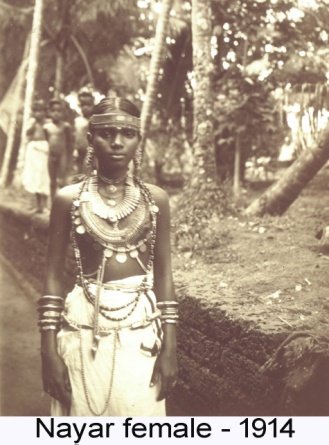 The second point is that the lower section of the Thiyya population, which lived at places distant from the English education systems still retained their lower caste demeanour. See this quote about what still lingered on in attire:
QUOTE: The Tiyan woman (Tiyatti) wears no cholee, or any cloth thrown over her shoulders and neck. Her body down to the waist is entirely exposed END OF QUOTE.
However the fact remains that the Nayar females also were more or less in the same attire when they moved in the proximity of their senior castes. As to the Brahmin and other similar higher caste females, their plight was more terrible. They could not come out of their residential areas. Due to the fear of the lower indicant verbal codes and profane glances of the lower castes. They were like the people who lived at a distance from the sea. These persons would not venture much into the sea. For the seashore was in the hands of the fishermen (Mukkuva people). They were the lower castes, but were actually living a life of full freedom in the seas. The Brahmins cannot even think of being addressed by them. A fisherman coming and addressing Brahmin or Nayar as an equal would be worse than being taken hostage by the Somali pirates of current-days.
Therein lies the great lie of the great mercantile history of the subcontinent. The people who dominated the seashores and the ports and harbour were slightly or greatly different from the high-class people/s of the subcontinent. However, the only population that had not much of a concern in this were the Mappillas in Malabar and other Muslims in other countries in the subcontinent.
Why the Mappillas were different has to dealt separately. ]
The terror that perched upon the Nayars
Now about the terror that the Nayars had with regard to mentioning the Marumakkathaya Thiyyas of north Malabar.
The language of the land is feudal. That means, the lower-placed persons are differently defined in the verbal codes. They then exist as different kind of human beings. Their very words can cause harm. They do not have to even touch. If they look at a ‘respected’ persons with a disdainful eye, then that person will be negatively affected.
It is like this: An IPS women officer. She suddenly understands that the police constables are referring to her as Aval അവൾ (Oal ഓള് in Malabari). This information is enough to make her confined to her cabin. When the constables view her as an Aval, literally she is molested by them by means of profane usages.
This is a terrific information. But then how to convey this to a native-Englishman?
This is more or less the same terrifying issue before the Nayars. The moment the Marumakkathaya Thiyyas develop socially, their far-distant links in the social system (their relatives) would also go up. They are the persons whose profane words and looks can wither up a upper-caste individual’s personality features.
Historically this kind of scenarios would not happen. It is like saying that constables would never address an IPS officer as a Nee or refer to him or her as an Avan or Aval. But then, the entry of the English Company rule made this totally impossible situation to happen. It was like a new administration taking over the country and ordering the constables to address the IPS officers as Nee and refer to them as Avan and Aval.
Even though the Nayars generally collaborated with the English rule, the above-mentioned topsy-turvying of the social equations was one thing that still hurts some of them. There is one person from this caste, who literally received an immensity of glorious content from English. He is on a campaign to make England pay a compensation for improving the subcontinent. Even though he does not mention this in so many words, it is quite evident that many of his household members cannot still forgive the English for giving the Thiyyas and other lower castes, an escape route from their subordinated positions.
If a calculation is done on the hundreds of years of slavery his household must have inflicted on the various lower castes here, it is possible that all his wealth would not be enough to pay the rightful compensation that the erstwhile slave families have a right to.
Before concluding this chapter on Nayars, I think that it would be correct on my part to mention a very positive input about them. It is simply their attitude that they are not ‘low-class’ or ‘low-caste’. This is actually a wonderful mental stamina, which most of the populations in the subcontinent does not seem to have.
This being a low-caste is a big business in India as of now. Once a low-caste tag has been taken possession of, all kinds of shady reserved seats become available for these ‘low-castes’. There is reservation for all professional college seats, including the much-desired Medical colleges. There is reservation for the much-dreamed of government jobs.
In fact, when Kerala was formed by amalgamating Malabar with Travancore-Cochin state, a section of the Thiyyas took up the stance that they were low-caste like the Ezhavas, who had already been given reservation in such things. A particular percentage of the Thiyyas took up the stance that the Thiyyas are not low-castes. However, the ‘we are low-caste’ lobby won the day, and the Thiyyas were given the same reservation that had already been given to Ezhavas.
With this, the standard demeanour of the Thiyya officer class of Malabar went in for drastic change. From a personality of extreme standards, it changed to an personality of the exact opposite. The change was so powerful that if anyone had taken the care to observe it, it would have felt that a golden goose was changing into a dry rat.
The daring of the Nayar folks to take a stand that they are not low-caste, but would demand reservation on the basis of being precluded out by the rabid imposition of reservations on everything was most exemplary.
However, it is tragic that the birdbrain who is campaigning in England for ‘reparations for English colonial rule’ happens to be from this caste. It is most tragic that his ancestors escaped the notice of the Mysorean invaders. Possibly they must have run to the English Company for protection.
I need to say that the third quote given in beginning of this book is apt to connect with them.
The entry of the Ezhavas
Now we come to the entry of Ezhava leadership from Travancore. Some very indelible facts need to be mentioned here. There is a very strong indoctrination being promoted that it is Sree Narayana Guru or an association connected to him, the SNDP that is responsible for the social reformation in Travancore kingdom. This claims does not seem to have much basis. For, the social reformation in Travancore was connected to entirely different two items.
The first was the Missionaries of the London Missionary Society who literally entered into the social system, interacting and living with lower castes such as the Ezhavas, Shanar, Pulayas, Pariah &c. They gave them education, and made them learn many trades and skills by which they could eke a livelihood.
The second terrific influence was the English rule in the neighbouring Madras Presidency. This administration went on forcing the Travancore king’s family to give more social rights to the lower castes. Due to this, a lot of proclamations that led to more freedom to the lower castes came up.
Slavery was banned and the slaves liberated. When Col Munro was appointed as the Diwan of Travancore, the lower castes were given right to wear certain dresses which had been prohibited to them till then. However they went beyond what was allowed. This created terrible social issues that the Sudras (Nayars) tried to block them on the streets. There were literally street fights between the Sudras and the lower castes.
What actually happened in the Travancore kingdom can be taken from the Travancore kingdom’s own Manual, the Travancore State Manual, written by V Nagam Aiya.
QUOTEs:
1. In 1833 A.D., there was a disturbance raised by the Shanars of South Travancore, but the riot was easily put down without military aid.
2. Shanar converts and Hindus — Disturbances in South Travancore. Reference has already been made to the establishment of the London Mission Society in South Travancore and the great toleration afforded to the Christian Missions by the Travancore Government that led to the rapid spread of Christianity in Nanjanad.
3. The result was that the Shanar converts (it may be observed here that the Mission work of conversion was mostly if not exclusively confined to the Shanars, Pariahs and other lowcaste people), who were looked down upon by the high-caste Hindus, relying on the support of the missionaries, caused great annoyance to them.
4. The casus belli in this case arose from the Shanar Christian females assuming the costume of high-caste women. By longstanding custom, the inferior classes of the population were forbidden to wear an upper cloth of the kind used by the higher classes.
5. During the administration of Col. Munro, a Circular order was issued permitting the women referred to, to cover their bodies with jackets (kuppayam) like the women of Syrian Christians, Moplas, and such others, but the Native Christian females would not have anything less than the apparel of the highest castes. So they took the liberty of appearing in public not only with the kuppayam already sanctioned, but with an additional cloth or scarf over the shoulders as worn by the women of the higher castes. These pretensions of the Shanar-convert women were resented by the high-caste Nayars and other Sudras who took the law into their own hands and used violence to those who infringed long-standing custom and caste distinctions.
6. The women of the Shanars or toddy-drawers who abound in South Travancore and from among whom the Protestant Missionaries have for the last sixty years reaped the richest harvest, had been prevented from covering the upper part of their person.
7. The mutual jealousies between the Sahanars and the Sudras were dormant for some time, but the Queen’s Proclamation of November 1858 on the assumption of the direct Government of India renovated these feelings. The Shanars imagined that it permitted them to infringe existing rules while the Sudras equally considered it as sanctioning their taking the law into their own hands to repress what they took as an aggression into their caste domains. Serious affrays ensued, and these were aggravated by the gratuitous interference of petty Sirkar officials whose general standard of capacity and moral worth we have already alluded to. Public peace was imperilled.
8. In December 1858 A.D., the two communities had assumed hostile positions against each other and troubles of a serious nature broke out. The Sudras openly attacked the Shanar women who dared to appear in public in high-caste costume and the Shanars duly retaliated.
9. Sir Charles Trevelyan, as Governor of Madras wrote to the Resident in these strong terms: “I have seldom met with a case, in which not only truth and justice, but every feeling of our common humanity are so entirely on one side. The whole civilised world would cry shame upon us, if we did not make a firm stand on such an occasion.
[My note: The English administration in Madras did not really understand the issue of the dress-codes. It was essentially connected to the feudal language codes of Malayalam and Tamil, which were the local languages. Dress-codes are essential to understand the social level of an individual. It is like an Indian police constable and his family members desiring to wear a clothing usually seen dressed on by an IPS officer and his family members. In the local society of Travancore, the hierarchy in verbal codes on who has the right to use the Nee word on whom and the Avan / Aval word on whom; and who has the duty to use the ‘respectful’ words for You, He/She etc. can be very readily understood by the dress-codes. It is similar to the police hierarchy. By seeing the uniform, the various ranks in the hierarchy arrange their words of addressing and referring as per proper protocol.]
10. Dewan’s reply to English Governor in Madras: As the Shanars took it upon themselves to infringe the Proclamation of 1004 M.E., so the Soodras took it upon themselves to punish such infringement. The Shanar women were attacked when they openly appeared with what was considered the high caste costume. The Shanars on the other hand did not confine themselves to a bare defence. They too retaliated the outrages on Soodra women.
11. “The decree of interference which for many years past has been exercised by the representative of the British Government in the Affairs greatly rests with the British Government and it has thereby become their duty to insist upon the observance of a system of toleration, in a more decided manner, than they would be at liberty to adopt, if they had merely to bring their influence to bear on an independent State.”
12. A Royal Proclamation was accordingly issued on the 26th July 1859 abolishing all restrictions in the matter of the covering of the upper parts of Shanar women and granting them perfect liberty to meet the requirements of decency any way they might deem proper with the simple reservation, however, that they should not imitate the dress of the women of high castes.
END OF QUOTEs.
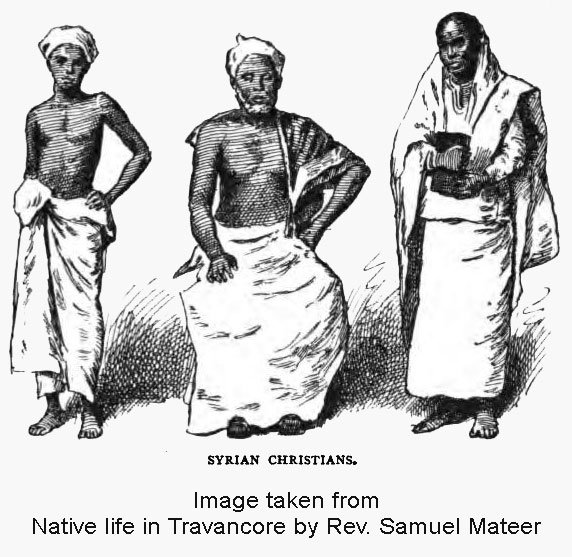 A very detailed information on the way in which the missionaries of the London Missionary Society worked to improve the lower castes can be seen in the book Native Life in Travancore by Rev. Samuel Mateer. However, their improvement was focused on those who converted to Christianity. Actually this was a deed that literally created havoc and nightmare in the upper crust of the social system.
It was like giving the menial house servants the right to sit with the householders at the eating table in current-day India. Not only the Nayars, but even the traditional Christians were terrified. The Syrian Christians very categorically disallowed these converted-Christians from entering their places of worship.
And among the converted-Christians, the Ezhava converts refused to pray in the same church were the Paraiah, Pulaya &c. converts came for worship. Even though all this looks like pure madness, they were not insane human reactions. Very powerful verbal codes can be seen in the native feudal languages that can more or less ratify the reactions. The native-English do not have any means to understand these things. That is why they have allowed their nations to be overrun by outsiders who speak feudal languages.
The Ezhavas were quite perturbed to be on a platform of equality with the Pulayas and Pariahs inside the newly built churches. For, an equality thus created would get encoded as a Nee-Nee, Avan-Avan, Aval-Aval &c. communication code relationship. Once this is established, the Ezhavas would find it quite difficult to maintain their social connection with the Nayars. The Nayars would definitely get perturbed to find themselves at close proximity with persons who are addressed as Nee or referred to as Avan/Aval by a Pulaya or Pariah.
However, the converted-into-Christian lower castes were very much controlled and developed by the evangelists of the London Missionary Society. However, the other lower castes who also received the benefits of the social reforms literally had no one to control them. This is one of the reasons that the lower castes who remained in their own castes under the Hindus had a terrible fight with the Travancore police at Punnapra and Vayalar. The lower castes killed a police inspector who had come for a compromise talk.
Even the reason for the killing of the police inspector might be traceable to the feudal language codes. In a feudal language social ambience, if the lower side refuses to be treated as lower, then the very talks would inflame into an outburst. The police inspector would find it quite difficult to address the lower castes leaders with ‘respect’. In most probability, he would have used the words ‘Nee’ (lowest You) and ‘Avan’ (lowest he) to and about the lower caste leaders.
The lower castes who had assembled in strength would find it most distressing to see their leaders whom they addressed as ‘Chettan’, ‘Annan’, etc. being thus addressed and referred to. As if they are abominable dirt. They would react with profanities like ‘Pundachimone’, ‘Poorimone’, ‘Thayoli’ etc. which are terrible profanities, with a very jarring verbal sounds. (As of now, most of these profanities have been exported into English by the immigrant crowds from all over the globe). The lower castes would have used the Nee word also on the police inspector.
In this book, Malabar, there is this quote about the English effect on Travancore society: QUOTE: ... the presence of the English in Travancore was gradually leading to a revolution in that State. END OF QUOTE.
However, it is quite curious that Logan and the others who inserted their own ideas into this book, missed seeing what was happening under their own nose. The Mappilla attacks on the Nayars in Malappuram was also kindled by the English rule in south Malabar. The lower castes, especially the Cherumars were converting into Islam in large numbers in the general social freedom that had arrived in the location. Makkathaya Thiyyas also converted into Islam. Once converted to Islam, almost all social restraints got erased.
However, there was a difference here. Here the administration was run by the English Company and later on by the British government. They were under compulsion to support the maintenance of status co. The Nayars were attacked by the Muslims for issues which the English officials could not understand. This is a very deep verbal code issue. It might not be good if I skipped explaining the issue. However, I will do that in the location where I take up the Mappilla attacks on the Nayars and higher castes like the Brahmins.
Now, coming back to the Ezhava issue, it is true that though just under the Nairs, the Travancore government did not allow them to enter into government service at any level other than as a menial worker. I do not have any information on how Sree Narayana Guru improved them, beyond what was on offer from the English side and from the Travancore Government.
It is possible that his biography would also contain bits of connection to Brahmins and such other higher castes. This is how the ‘respect’ codes of yore worked. If he has a Brahmin disciple, then it would be a point to be mentioned in a hundred locations. However, I do not know anything about him.
He is said to have build Hindu temples. I am not sure why he went around building Hindu temples. He could have very well created places of worship which are connected to the traditional deities of Ezhavas.
It is true that the SNDP, which is the organisation that is connected to him has created a lot of educational institutions all over the state. However, the quality of education in these institutions, I understand, were in sharp contrast to the high-quality English educational systems that had prospered in the Tellicherry location under the auspicious of the English rule. Generally the SNDP educational institutions were of a very Malayalam (extreme feudal language) version of education. However, it might be true that their anti group, the NSS (the Nayars’ organisation) would also be of a similar kind. However, I do not have any records to substantiate these claims. They are mere feelings.
Talking about Sree Narayana Guru himself, there is something quite curious about his name. This is a point that is quite easily noticed by me because of my constant observations on language codes. It is possible that his name is Narayanan or something like that. I do not know exactly what it is. Usually in the feudal languages of the subcontinent, a mere ‘name’ is a very uninspiring entity. Usually a suffix is required that stands as a sort of bulwark to hold up a person’s ‘respect’.
Usually in the local feudal languages like Tamil, Malabari, Malayalam etc., words like ‘Chettan, Chetti, Akka, Ikka, Saar, Maadam, Mash, Teacher, Avarkal or anything else that comes handy is used. In the English-rule time in Malabar, words like ‘Butler’ were used as ‘respect’ suffix for persons working inside English households. Working inside an English household was a great social status inducing item. It is not like what is now being promoted. That the Englishmen were exploiting or enslaving them. Working in an English establishment would give that man a chance to converse in English with the English individuals. It more or less removes a lot of socially degrading content that had been placed upon the individual by the local languages.
In fact, any work that connected a person with the native-English was not an experience of enslavement, but a personality enhancing item. Only total birdbrains would go around saying that working under the English was a degrading item. Actually working under the local bosses who speak feudal languages was the real degrading item and experience.
Now coming back to Sree Narayana Guru, his name Narayanan was kept inside two words of ‘respect’. Birdbrain academicians have used a term, ‘honorific’ for such usages. However, it is a much more complicated item than is understood or delineated by birdbrains.
However, there is something more intriguing. Many persons feel that even enwrapping his name with two words of ‘respect’ on both sides is not enough to prop him up. It is seen that in many locations they add one more word of ‘respect’. That is, his name is then mentioned as Sree Narayana Guru Devan.
When seen from an English perspective, it is a very singular situation. Native English individuals who are connected perfectly to pristine-English do not want any suffixes or prefixes of respect. For instance, Robert Clive, if mentioned as a mere Clive still does retain his stature in his native language. However, in the case of most ‘great’ personages of the subcontinent, some suffix or prefix is required. If it is removed, then it becomes a terrible issue. The ‘greatness’ of the personage will go into oblivion.
There was on incidence with regard to the so-called ‘father of the nation’ (actually there is no such father of nation in any statutory records). When he was once, mentioned with as a Mr. by a political leader of those times, the followers of the ‘great’ personage ran on to the podium and started attacking him physically. The ‘great’ personage, who was present there at that time, did nothing to stop it. For, it was quite clear that his followers were trying to protect his ‘respect’.
This incident went on to the creation of a communal party, and this in turn led to the creation of Pakistan, when India was created.
This adding of ‘respect’ to hold up the stature of a personage is a deed that should seem to suggest that without these words of ‘respect’, the personage would not have any stature. In fact, if the various ‘Ji’, ‘Mahatma’, ‘Swami’, ‘Amma’, ‘Chettan’, ‘Anna’, ‘Saar’, ‘Maadam’ etc. words are removed from the names of various ‘great’ Indians, they would immediately appear in their stark human quality, as mere nondescript persons.
Usually, in the local areas, people who cannot find any such props, usually use their place name behind their name. It acts as a barricade that holds them up from tumbling down the gorge of ‘no-respect’. It acts in the verbal code area. It is a way to hold a person as an ‘Adheham’ / ‘Avar’ (Highest He/ Him) from falling down to the ‘Avan’ (lowest he / him) level.
Now, the next question would as to why the Sree Narayana Guru and his team tried to extend their influence to the Malabar region. Actually none of the problems that the Ezhavas were facing in Travancore was faced by the Thiyyas in locations like Tellicherry. There was no block to the Thiyyas joining the Civil Service even at the highest levels. In fact, they were eligible for competing for the ICS (Imperial Civil Service) officer cadre posts and for the highest officers’ posts in the British-Indian Railways.
The Marumakkathaya Thiyyas had their own traditional worship systems which had not gone into oblivion. Many of them were in the government service with some of them appointed as Tahsildars, Sub-Magistrates and a few even as Deputy Collectors. They were part of the Madras Presidency Civil Service.
There is one more thing to ponder upon. In the Travancore kingdom, it was the members of the London Missionary Society who inspired a lot of social reforms. The English East India Company and later the British administration both did exert their pressure to speed up this process.
However, the Christian Missionaries were not really interested in promoting pristine-English. They were more interested in developing a native language, for which they used the name ‘Malayalam’, thus more or less giving it a mixed up and confusing identity. The issue here is the local degrading and subordinating lower indicant words of ‘Nee’, ‘Avan’, ‘Aval’ etc. from Tamil could be retained and used effectively as a regimenting tool.
In the case of Sree Narayana Guru also, there would be no difference in the use of these verbal tools. The SNDP, the organisation which was to promote him and spread his name would also use the same things for regimentation and promotion of ‘respect’.
The promotion is like this: Our leader is the Swami, Avarkal, Adheham, Avar etc. (all highest He/ Him). You are Nee (lowest you), Avan (lowest he / him), Aval (lowest she / her). This kind of population stature improvement is directly opposite to the population stature enhancement done by the native-English administrators.
The very interesting item about the use of these verbal regimenting tools is that the more a person is suppressed, the more that individual becomes ‘respectful’ and obsequious. The mentionable items about these kinds of sinister languages is that if the lower person is extended any kind of ‘respect’ or consideration, the more he or she will become disrespectful and disobedient. Things do not work as they do in pristine-English.
The wider idea in this is that persons who fall in line to the regimentation induced by their verbal codes incessantly try to bring other persons under them using the same verbal codes. This creates a sort of satanic brotherhood of persons, all of them focused on to a single command centre, connected upwards and downwards with the same satanic verbal codes.
The still wider issue is that a lot of similar mutually competing brotherhoods form in the social system. Each would find the other one intolerable. For, the command codes downwards and ‘respect’ codes upwards in one brotherhood would have no relevance or acceptability in the other.
At the same time, for the people of North Malabar near to places like Tellicherry (about South Malabar I have no information), the English administration did support the spread of English. In a way, this was a direction away from the grip of the feudal languages. That is, persons who worked with them or associated with them naturally escaped from the thraldom of these sinister verbal codes.
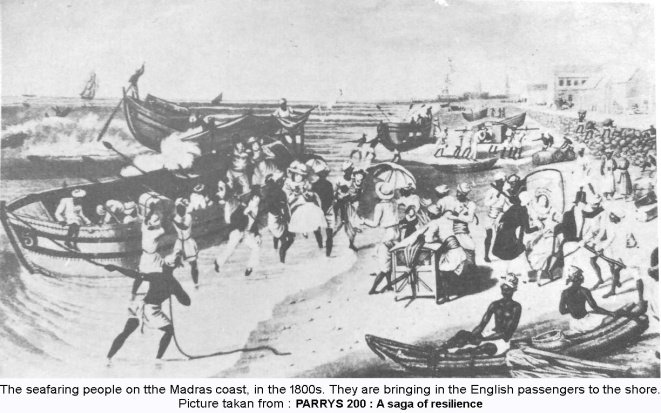 Now, we arrive at the location for enquiring on how the Marumakkathaya Thiyyas became connected to the Ezhavas of Travancore. In the present-day times, North Malabar and Travancore are quite nearby due to the advances in technology, roads, railways and air travel. However, way back in the 1960s, when I was born in Malabar, the interior locations had very few roads. The travel time would take hours, days and weeks. I have heard from old people that a travel from Wynad to Tellicherry would take a few days by bullock carts. As of now, this is a distance easily traversed in a few hours.
In such a situation, Travancore was literally a very far-off location. It is quite possible that many persons who lived in the interiors from the seacoasts would have heard of Travancore only very briefly. However, it is true that the fishermen and other seafaring populations would be quite familiar with the seacoasts of Cochin, Alleppy, Quilon, Trivandrum etc. For that was the way they saw the land. However, the seafaring populations were seen as despicable by the people who lived in the interiors.
The above idea itself is a very curious bit of information. For instance, there are many highly jingoist persons who write about the ‘great’ Indian maritime-traders and other sea travellers. However, even now, these great jingoists would not find it interesting to be connected with the fishermen folks and populations who traditionally are associated with the sea in the subcontinent.
Off course, they would be quite happy to be connected to the Indian Navy officers. However, they are not the traditional people here. They are the part of the population who imbibed the English systems, and not the traditional systems. Even the uniform of the Indian Navy is what has been designed and copied from the English heritage. The native seafaring heritage looks are as given below:
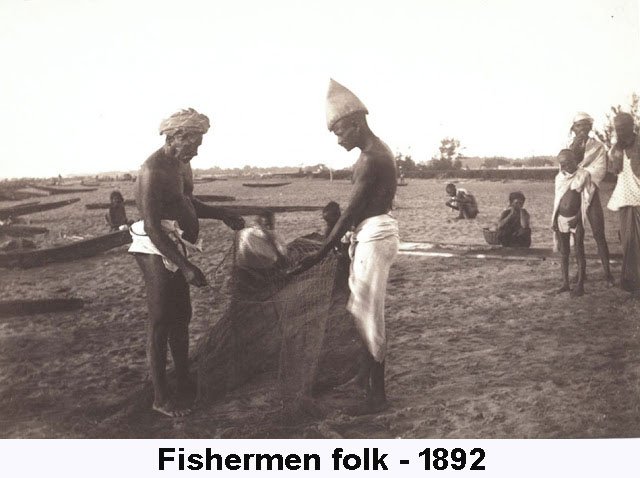 The culprits who worked to connect the Marumakkathaya Thiyyas with the Ezhavas need not be Ezhavas or Ezhava leaders. It is here that one needs to understand the terrific aspirations for social leadership that grips everyone the moment they get a feeble right to leadership.
I can view the Thiyya condition of those times only from an impressionistic perspective. For, I was not the present at that time. As to trying to understand or gather information from local writings, it is for most parts a waste of time. Most persons who write such things write from a Fan-version mode. Words like ‘great’, ‘world-famous’, ‘it is in Roman records’ etc. are seen used to prop up a person or institution.
I remember many years ago sitting in the Kerala House in Delhi. This is the official office of the Kerala government in Delhi. A group of people had come from an interior village in Kerala. They were speaking about the coconuts of their area. They mentioned the coconut name, which was connected to their village. Their query was: ‘Don’t you know the ....Coconuts?’ and ‘Haven’t you heard of the ...Coconuts?’. The official had obviously not heard of them.
The other side continued: ‘They are world famous!’
The curious item in this was that if it was ‘world famous’, how come this information officer of the Kerala state government had not heard of it before?
In many ways, this is the condition of many items in current-day Indian history writings. “ ‘India’ is mentioned in Roman history. The word ‘India’ is there in that famous travellers’ writings. It is seen mentioned on that rock inscription. &c. ‘
The same is the case with Kerala also. “‘Kerala’ is mentioned in this and that, and in the rock inscription of Asoka” etc.
The foolishness of all these claims would come out if a similar history studies are done in England. To prove the greatness of England, if the English were go searching other lands and their literature and rock inscriptions, it would be a very foolish level of greatness.
The larger truth never comes out from these kinds of wild-goose chase with regard to both ‘India’ as well as ‘Kerala’. There was no India before British-India and there was no ‘Kerala’, as understood now, before 1956.
As to the word ‘Kerala’, mentioned as seen mentioned on the Asoka rock inscription at Gaya, in this book, Malabar, it is seen mentioned that actually the transliteration of the original word is Ketala and not Kerala.
The presence of the English population in Tellicherry and in Cannanore did give a huge boost to certain Thiyya individuals and families. Some of them served in the English houses as butlers. Some became lawyers in the local courts. Many got government employment even as officers. Some of them learned the art of baking confectionary and pastry items from English households and went on to build up huge bakery businesses. Even though I am not sure about the case of the fabled Circus companies of Tellicherry, it is quite sure that these all improved fabulously due to the presence of the English population in near proximity.
For the Thiyyas who connected with the English households, it was simply a location where their traditional subordination in the local feudal languages stood erased. Those who had been Inhi (lowest ‘you’), Oan (lowest ‘he’ /’him’), Oal (lowest ‘she’ / ‘her’), Iyttingal (lowest ‘them’), Chekkan (degrading word for young man but generally used on all-age lower castes male labourers), Pennu (degrading word for young woman but generally used on all-age lower castes female labourers), etc. could simply jump above all these personality slicing social codes when they entered into the native-English locations.
It would be quite unwise to think that those who emerged out of the strangling holds of the social system would be interested in their own ancestry or in improving others who had not yet escaped.
It is a totally different social scene that is emerging. The individuals who improved would go on to set up businesses, hotels, bakeries, circus companies, join the higher cadres of the British-Indian railways, and of the British-Indian Civil Service (ICS – Imperial Civil Service), and of the British-Indian Army.
The more they improved, the more cut-off they would become from their traditional systems. They would have more disgust with their higher castes, especially the Nayars, who they would like to treat with disdain. They would have more complaints about the native-English also, who in the ultimate count would not treat them as one among them.
Even though these suddenly-improved Thiyya individuals would like to distance themselves from their own, lower-level, caste populations, their ire would be on the native-English also to a limited extent due to the above-mentioned fact.
I need to quote from Castes and Tribes of Southern India Vol 7 by Edgar Thurston:
QUOTE: In the pre- British days, a few of the well-to-do families of Tiyans lived in houses of the kind called nalapura (four houses), having an open quadrangle in the centre.
QUOTE: But, for the most part, the Tiyans — slaves of the Nayars and Nambutiris — lived in a one-roomed thatched hut. Nowadays, the kala pura usually consists of two rooms, east and west. Toddy-drawing, and every thing connected with the manufacture and sale of arrack (country liquor) and unrefined sugar, form the orthodox occupation of the Tiyan.
QUOTE: But members of the community are to be found in all classes of society, and in practically all professions and walks of life. It is interesting to find that the head of a Tiyan family in North Malabar bears the title Cherayi Panikar, conferred on the family in the old days by a former Zamorin. A title of this kind was given only to one specially proficient in arms. Even in those days there were Tiyan physicians, bone-setters, astrologers, diviners, and sorcerers. END OF QUOTE.
From the above quote, one can take a little bit of information, without being too enthusiastic about any claims. It is seen that there were Thiyyas who were land owners. It is seen that there were Thiyyas who were in all kinds of professions including that of martial arts. As to the mention of the Zamorin, one need not become too spirited. For Zamorin was the king of a small kingdom called Calicut. This king’s authority was not too widespread and in his own household, there was constant rebellion and mutiny against the person who occupied the title of king.
As to the claim that the Thiyyas were some kind of slaves of the Nayars, it can be a very partial view. It might be true that in some locations, the Thiyya families would be sort of totally suppressed servants of the Nayars. However, there were other castes which were much below the Thiyyas and some were acknowledged as slaves. But then the more a Thiyya family is suppressed by the Nayars, the more they would have to display disdain and suppression to populations and individuals lower than them. In fact, they would have to use verbal hammering to display that they are above them and not connected to them.
This display of disconnection to a lower positioned individual/s is a very important requirement in the feudal languages.
The newly-developed Thiyyas in the wake of the English rule need not be the traditional Thiyyas who were traditional land-owners and who may have been from the households which continued the ancient traditions of the Thiyya traditional worships, like that of the Muthappan.
In fact, I have heard directly from persons who had lived in the early 1900s that some of the newly-empowered Thiyyas were quite disdainful of Muthappan worship.
There might have been a competition between various social groups within the Thiyya community. However, the Thiyyas who had official positions and such persons as lawyers (vakil), lawyer clerks (gumasthans), English household staff (butlers), Nouveau riche Thiyya businessmen etc. would be yearning to convert their money and official power into a social leadership.
This could be the real inspiration for inviting Sree Narayana Guru and his team to North Malabar. It is possible that these persons did not have any information on what was the state of affairs in Travancore then (Readers who are interested in that information can check Travancore State Manual by V. Nagam Aiya; and Native Life in Travancore by Rev. Samuel Mateer).
Connecting to a totally unconnected population group was not going to do any kind of positive inputs to the Thiyyas actually. For, the amount of liberation that the English rule had bestowed on them was of a most supernatural level when compared to what the Ezhavas of those times were enduring.
However, a good percentage of the Thiyyas population was still disconnected to the English systems. They would be burning with anger and ire at their Thiyya brethrens who had improved.
The other tumultuous emotions among some of the Thiyya social leaders would be to somehow get-back the social leadership in the emerging situation wherein many lower-class Thiyyas were simply escaping their verbal stranglehold by learning English.
Even today, the non-English populations in India cannot bear to see the freedom of movement and articulation that the English-speaking populations get.
If a scrutiny is done of who all took part in bringing in Sree Narayana Guru and his team to North Malabar, it might be seen that it was a group that mostly consisted of the newly emerged Nouveau riche and newly become officials from the Thiyya Community.
It is seen that there were certain traditional households among the Thiyyas who were continuing the Muthappan worship over the centuries. It is not known if they participated in connecting the Thiyya worship systems with the Hindu (Brahmanical) gods and temples. As it is, only the Brahmins had the right to their own worship systems and to build their temples. No other castes, not Pulaya, Pariah, Malayan, Ezhava, Thiyya or any other caste in the subcontinent or elsewhere had the right to build temples for Brahmanical gods.
Doing such an action would be an irascible act and not a social reformation.
However, the Nouveau riche and the persons holding the official positions might not have any leadership over the Muthappan worship systems.
Now about the Nayars contribution in this act. It is possible that the Nayars also would have greatly supported the idea. For, it is seen in this book, written around this period that the Nayars are simply promoting the idea that the Thiyyas are Ezhavas, and toddy-tappers, toddy-tappers, toddy-tappers .......... .
So it is possible that the Nair side would have whole-heartedly given the support to connect the Marumakkathaya Thiyyas to Ezhavas.
Exertions of the converted-Christian Church
However, beyond all the above groups there was another totally encompassing and overwhelming group which would have stood behind some veil and more or less promoted the connecting of Marumakkathaya Thiyyas to Ezhavas, to happen. This group who stood behind without showing its face or connection to this event would be the Christian Church of the converted to Christian populations in Travancore.
I have not read anything about them in this regard or about certain other claims I am going to make about this entity. This entity was not an evil one. Instead it was a most altruistic one. However, it represented the interests of a huge number of people who were its members.
The total of my impressionistic perspectives on why the Christian Church of the converted to Christians from Travancore supported the Ezhava entry into North Malabar will be mentioned later. However, it may be stated here itself that they were also from Travancore and more or less connected to the Ezhava populations.
I will have to make some quite daring statements with regard to Travancore. However it has to wait.
So the entry of the Ezhava leadership to hoodwink the Marumakkathaya Thiyya population was supported by one section of the Marumakkathaya Thiyya population, who had their own vested interests.
Second welcome support came from the Nayars who must have watched the proceeding with sly and drooling delight.
The third support must have come from the Christian Church of the converted to Christians from Travancore.
As to the ordinary Marumakkathaya Thiyyas, most would be quite lowly in social stature that they would be in a mood of showing total subservience to the newly emerged Thiyya - Tahsildars, Deputy Tahsildars, Deputy Collectors, Vakils, Sub magistrates, Gumasthans, Compounders, Butlers, Masters, Gurukkals, Bhagavathars, Mesthiris, Adhikaris, Royal Indian Air Force officers and all others who had somehow scrambled high on the social ladder in the newly emerging scenario.
The unmentioned issue is that all these wise guys would attach the above-mentioned professional titles behind their names. These professional titles become some sort of a social title like that of the Nayars, Nambhoodhiris etc. However, the lowly-positioned Thiyyas would be mere name and Inhi and Oan and Oal and Thiyyan and Thiyyathi to their clever Thiyya brethrens who had jumped to the higher platform. These higher-class Thiyyas’ main aim would be to see that the lower-positioned Thiyya remained struck there in their lowly positions.
If a historical examination of the persons who sponsored the Sree Narayana Guru and team entry into North Malabar is done, it would be seen that it was not the Thiyyas who were under the caste suppression who did it. Instead it was the higher social class Thiyyas who did this. Actually these people who sponsored this entry were not suffering from any kind of social suppression, during the English rule. If temple entry was what they wanted, the traditional Muthappan temples were their own places of worship. It is quite interesting to note they who had such temples and shrines were not happy with what they had. They wanted only the Brahmanical temple. It is quite curious.
The whole verbal-code scenario of the subcontinent is one of sly cunning using the feudal language codes. A slight addition or removal of an information or title is enough to change the total social stature of an individual. These are things that the gullible and naive native-English never got to understand. As to the cunning folks of the subcontinent, they are too cunning to reveal it. They simply would not even promote a discussion on these things.
In fact, when a Writ petition was filed in the Hon’ble High Court of Kerala against the compulsory imposition of a feudal language (Malayalam) in the schools, there was a very concerted effort on the part of the self-appointed ‘cultural leaders’ to see that this event was not discussed in the news media. When I personally tried to get it posted in the Wikinews through the efforts of one person, a very funny reply came. It said something to the effect that the evidence produced (copy of the High Courts’ order) had the looks of some nondescript old document.
Ezhava-side interests
Now, let me take up the Ezhava-side interests.
Even though there seems to be no documentary evidence mentioned in the book, Malabar, it is seen mentioned that the Ezhavas came from Ceylon. It is again seen asserted that they brought in the coconut tree from Ceylon. Since Ceylon and Travancore are quite nearby locations, it is possible that it was a common tree in both the locations. In fact, Ceylon is much nearer to Travancore than is Cannanore. As to anyone bringing the coconut tree to Travancore and from there to Malabar, there might not be any specific need to identify it with any one particular caste or population unless there is some documentary evidence to that effect. For, history literally goes backward indefinitely.
Since the traditional language of Travancore is seen being mentioned as being Tamil, it is quite possible that the Ezhavas also had some close Tamil links. However, as of now, there might be different populations who might be identified as Ezhavas. I do not personally have much information on Ezhavas, other than what is seen written in such books as Travancore State Manual, Native Life in Travancore, Castes and tribes of Southern India etc.
In the last two mentioned books, there are locations where some attempt to identify the Ezhavas with the Thiyyas is seen. In the Native Life in Travancore, there is this line:
QUOTE: In the far south on both coasts they are known as Shanars; in Central Travancore as Ilavars; from Quilon to Paravoor, Chogans; in Malabar, as far as Calicut, they are called Teers, or Tiyars; and still farther north Billavars, which appears to be a slightly altered form of Ilavar. END OF QUOTE
What was Rev. Samuel Mateer’s source of information that made him mention the Makkathaya Thiyyas of South Malabar as Ezhavas is not known. However, as I had mentioned earlier, the Converted Christian Church had its own self-centred aim in promoting an idea that the Travancore and Malabar were one single geo-political unit. However, it is again curious that Mateer has not mentioned the Marumakkathaya Thiyyas of North Malabar.
As mentioned earlier, the Ezhavas of Travancore had their own deities. Not necessarily that of the Brahmanical religion. However, being under the Nayars, as the both the two Thiyyas were in Malabar, there would naturally be a lot of worship systems wherein they collaborated with the Nayars.
It is similar to any kind of hierarchical systems. For instance, see the case of the Kerala police now. The DySp (deputy district police officer) is conducting a function. In that function, the Circle Inspector, the Sub Inspector, the Head Constable and the Constables would have different and certain definite roles to play. In a similar manner, in any sacramental function conducted by a Nair household, there would be many lower-placed populations who would willingly and joyously participate.
In a manner similar to the police constable being placed at the down-below fag end of the hierarchy, the lowest class populations would stand at the lowest levels. However, they would also participate. There would not be any antipathy towards the Nair household. For, this is the social system everyone is accustomed to.
[Incidentally the antipathy arises only when the lower-placed populations are allowed to rise up in social standing. Then they would start having terrible and vexatious memories of how they had been low-level servants of persons who they now perceive as equals. Generally in feudal language social systems, the lower-placed populations are never allowed to improve. Only utterly foolish English social systems allow the slave populations from elsewhere to rise up in social standing to their own levels. These populations later carry a lot of grudge towards the same people who helped them improve. As to the lower-placed populations in feudal language systems, they have a lot of gratitude and affection towards the higher castes who throw a few crumbs to them.]
The second item is that the Ezhavas are generally dark-skinned. As mentioned earlier, there were many Ezhavas who were fair-complexioned also. So, it is evident that there has been a lot of mixing up of population among the Ezhavas.
At the same time, it must also be admitted that in those days, the total population of Travancore had a darker hue to their skin. In Malabar, in those days, the dark-skin was more or less confined to the labourers who worked in the sun.
In Travancore, it was possible to find Nayars and even some Brahmin folks with dark-skin complexion. All this generally point to a genetically different population mix in Travancore.
The wider theme with regard to the skin-complexion is that dark-skin complexion is less liked by many people in the subcontinent. It is not that the dark-skinned persons are inferior or something like that. It is simply that dark-skin is seen as less lovely. However, beyond that, dark-skinned is slightly connected to lower-placed population groups in Travancore. However, in Malabar, since the lower-castes are also fair in skin complexion, this identification is not absolute. But then again in Malabar also, dark-skin is mentally connected to a lower class population.
The problem with the dark-skin complexion is that the dark-skinned populations themselves do not appreciate their skin colour. It is at this point that the dark-skin goes down. However, from a personal experience, it is generally seen that the dark-skinned people are capable of bearing the sun-heat much more than the fair-skinned.
There is some other observation that I have had that seems to connect the skin-colour with certain language-code effects. However, I cannot go into that here.
The second terrific problem that confronted the Ezhavas and all the lower castes in Travancore was them being kept out of all kinds of government jobs in the kingdom, other than menial jobs. Ezhavas would naturally try to stick close to the Nayar community, and at the same time try to keep all the castes below them at a distance. This more or less proves that they were willing collaborators of the social system. Their only complaint being that they are not allowed to move up. They were not keen that the castes below them should come up.
The social system and the various kinds of repulsions and attractions were designed by the feudal languages of the location. The language is seen mentioned as Tamil. How it became Malayalam might be a very curious story.
The Ezhavas in Travancore were under the Nayars as were both the two different populations known as Thiyyas in Malabar. However, it is quite doubtful if the common Ezhava in Travancore or common Thiyya in Malabar would be aware of each other. In fact, way back in 1970s, I did understand that not many common persons in Malabar had heard of a caste called Ezhava. At the same time, in 1982, when I mentioned Thiyya in my college in Trivandrum, not even one person could understand what that caste was. In fact, it was a very curious incident that one of my college-mates understood it as some kind of Brahmin caste (something like Elayathu), seeing the casual manner in which I had mentioned the word Thiyya.
With the establishment of the English-rule in Malabar and the establishment of a close relationship between the Travancore kingdom’s government and the English administrators in Madras, the detachment and disconnection that Malabar and Travancore had between each other broke down at the official levels. It is possible that the Malabar district higher officials would have immense chance to meet and interact with the Travancore government higher officials in some common meeting place in Madras meant for the senior civil servants.
It might be true that at among the seafaring and fishermen folks from Malabar and Travancore, there would be much contact. However, it is seen that generally the fishermen folks and such other traditional seafaring populations seem to be from a common population group. Even though they were good at their work, they were generally kept at a distance by the people who live and work in the land areas. As of now, all these distance and disconnections are melting down.
Even though these kinds of melting-downs of social barriers are very easily understood as some kind of great social reformation, the fact remains that unless these kinds of changes are forcefully directed by some higher-quality people like the native-English, what ultimately comes out is a highly profanity-filled communication group. In fact, the worst qualities of the mixing groups get diffused into everyone. The good qualities simply fade out.
The knowledge of Malabar and its people and location would be slowly filtering into the Travancore region by way of the Christian Church also. When mentioning the Christian Church, it must be very carefully mentioned that a huge majority of the traditional Christian populations in Travancore and Malabar had nothing to do with the establishment of the English rule in the subcontinent. I will take up that point later.
When the English administration in Madras exerted pressure upon the Travancore government, the lower castes were given a lot of liberties for the first time in centuries. It is sure that it is this freedom that gave the social condition for persons like Sree Narayana Guru etc. to come up. Otherwise it is quite conceivable that if any Ezhava man were to set up a Brahmanical temple and make a totally cantankerous statement that it was an Ezhava Sivan that he was consecrating, he would have been beaten to a pulp then and there, along with huge stream of profanities to add insult to injury.
Generally there was a punishment used by most ruling kings and other small-time and big-time royals in the Subcontinent. That is impalement. If the higher classes feel that they had been slighted, they would complain to their rulers who would catch the miscreant and impale him. In fact, there is the incident of the so-called Pazhassi raja (he was not actually a raja, but just a family member of the ruler of Kottayam, who had the chance to occupy the title of raja during the melee caused by Sultan Tippu’s rumpus in Malabar.) of Kottayam near Tellicherry, impaling certain Mappillas because of some ‘respect’ issue. This was the first cause of consternation for the English administration with regard to him. Impaling means, hammering iron nails through the body to sort of fix it to a wooden pole or board.
Velu Tampi who occupied the post of Dalawa of Travancore for quite short period had this habit. He would also impale persons as a sort of quick punishment. In many cases, it was seen as quite effective. The Muslims in Travancore also had this experience from him. There might be need to study why there is so much antipathy for the Muslims in the subcontinent. It is due to a range of issue. Each different in different locations. I will try to take that up later.
Even though the Ezhavas were experiencing a lot more freedom, still they were a lower-placed population who could not get a government job. The issue of a government job in the subcontinent is that it is not at all like a government job in England. A government job in the subcontinent is not really a job, but a social position. All the lower grade words will get deleted with regard to the person who gets a government job. An ‘avan’ will become an ‘Adheham’ in Malayalam. An ‘aval’ will become an ‘Avar’ in Malayalam. This is something not understood or known in English. Naturally no sane individual from the higher caste would allow such a change to come upon a lower caste man.
It would be like household servant in the subcontinent being allowed to sit on the dining table and eat along with the members of the household. It would be a terrible infliction on the householders. The language codes insist that the servant maid has to sit on the floor and eat. She has to be addressed as a ‘Nee’ and she has to use ‘respectful’ words to the householders. If she is allowed more freedom and allowed to sit on the dining table, she would start addressing the householders with a Nee. And she would refer to the landlady as an ‘Aval’.
Without understanding all this, it would be quite unwise to define the terror that the Nayars felt in allowing the Ezhavas and other lower castes to come up. It was this perfectly mischievous deed that the Christian missionaries from the London Missionary Society were doing in Travancore kingdom. They were interfering into a social system they did not understand. And the more terrible part of their deed in Travancore was that they were developing a new language called Malayalam. This new language was to contain all the local feudal codes. So, in that sense the Christian Church was doing a social interference in Travancore, which was totally opposite to what the English administration was doing in Malabar. In Malabar, as elsewhere in the subcontinent, the English administration was trying hard to crush down the native feudal languages. More so, after the Minutes on Indian education was ratified by the English East India Company administration. Macaulay had clearly mentioned that the native languages here were ‘rude’.
The fact that the Thiyyas of Malabar, who by caste hierarchy were on the same pedestal as the Ezhavas, as being just below the Nayars, were in a social system where there was no statutory restrains on them would have been a most painful information to the Ezhava leadership and other Ezhavas who knew about this. There is no doubt that these people who came to know about this would be discussing this most ‘terrible’ information. That, over there in Malabar, ‘we’ are able to get high ranking government jobs.
It is like a menial servant finding that his friend’s son is an IAS or IPS officer.
It goes without saying that for the Ezhavas, it was just a matter of moving into Malabar, and they become a ‘forward caste’ population. This would be a great information. For, the path to salvation was a ‘relocation to Malabar’. Or to somehow connect with the Thiyyas of Malabar, especially of North Malabar.
This point would be quite clearly understood by the Ezhava leadership also. For, over there in Travancore, they are mere dirt to the officialdom. At the same time, in Malabar, they become the leaders of the officialdom!
It might be true that there would be a lot Ezhava families which were not poor or of the labour class. In fact, there might be herbal medical men, astrologers and many other professionals among them.
Financially, in the newer social situation, they would be not poor. All they wanted would be political and social freedom.
There was one Ezhava person who had become a medical doctor. He had studied in England. I am not sure as to who sponsored his studies. It is possible that it was the English Missionaries. Whatever it is, when he came back, he was not allowed to join the Travancore kingdom’s Health Service. For, he was an Ezhava. He then got a job in the British-Indian health service at Mysore.
It is possible that persons like him could also coax or influence event in Tellicherry and Cannanore. For, he was an England-returned person. The very address of an ‘England-returned’ would do wonders in the subcontinent. For, it was sure that such persons could talk in good English and address the English officials as equals. The other native leaders here had to go step-by-step towards the higher positions of the local officialdom. In most cases, they would have to stop at the level of the deputy tahsildar or deputy Collector. It is not that that the English officials will not deal with them. It is more due to the fact that the native officials will not allow them to deal with a level higher to them.
This England-connection was made use of many others like Nehru, SubashChandran, Gandhi etc. Even now, so many persons who get to stay in native-English nations like England, USA, Australia, Canada etc. make use of this verbal code liberty when they come back home. This more or less could make the local man seem like an imbecile compared to them. At the same time, the fact remains that if the Indians who is currently domiciled in native-English nations, are brought back to India, they will get to know the reality of their native land, which they had been praising in the English land. They would go into a bout of social paranoia, if they were to find themselves addressed as Thoo / Nee, and referred to as USS / Avan/Aval. They will not come out of their houses.
When the Thiyya delegation from North Malabar came to meet Sree Narayana Guru, it is possible that the others in the Ezhava leadership must have been already apprised of the idea. It was too good an idea to go waste. For, there was the whole landmass of Malabar to be occupied. And that too an escape to an English rule location from their traditional social system, wherein they had ‘deep love and respect’ of their higher classes. From this level of ‘deep love and respect’, they would be moving to a level of ‘equality and disdain’.
I did get one message in my Whatsapp on what happened in Malabar as the next part of the events. I do not know the source or correctness of this information. I am posting it here (no corrections are added):
QUOTE: How Thiyya's associated with Ezhava's ? --- A glance in to History. For centuries, Thiyyars used to worship in their own "Kavu's". Most of the Kavu's were not in organised way. For making an organised way of community rituals, some prominent Thiyyas of Thalassery formed a committee. It was decided by the committee to start an organised Temple with annual feast like Sri Rama Temple of Thiruvangad. Unfortunately, nobody could be identified within the community to do the planning / establishing & sanctifying the Project, as they did not want to involve Brahmins. Suggestion came that a person named Sree Narayana Guru from South Kerala established couple of temples for non-Brahmins.
As the committee did not want to involve Brahmins for establishing the Temple, they entrusted Sri. Varadur Kaniyil Kunhi Kannan to visit Sree Narayana Guru at Varkala and submitted the idea that Thiyya Community should have a Temple at Thalassery, in the year 1904. Narayana Guru permitted the celebrated poet Kumaran Asan, as his representative and to convene meetings to ascertain the reaction of the people about the feasibility of a Temple for the community.
Kumaranaasan who was staying with Dr. Palpu in Bangalore accepted the invitation and consequent on his arrival the first meeting was convened at ‘Parambath House’ of Sri. Cheruvari Govindan Shirastadar on 9th July 1905.
The report given by Kumaranaasan to Narayana Guru was - "Thiyyars are Socially and Economically forward community but they lack sound leadership". As Sree Narayana Guru was busy in awakening Ezhavas in South Kerala, he was not much keen into going Thalassery. So the committee again visited Narayana Guru and invited him to Thalassery.
Subsequently, Sri Narayana Guru arrived at Thalassery on 17th March 1906. The instruction of Narayana Guru was "his arrival would be kept secret" was strictly adhered to. On 23rd March Sri Narayana Guru drove the pile for the temple construction at an auspicious moment.
The foundation stone was laid on 21st April 1906 by Sri. Kottiyath Ramunni Vakil in the presence of the great poet Kumaran Asan. It was on 13 February 1908 that Narayana Guru consecrated the Temple and named it Sri Jagannath Temple and the administrating committee was named as "Gnanodaya Yogam". (Though Narayana Guru was the President and Kumaranaasan was the Secretary of SNDP, they were not interested to add the temple or Thiyya community in the clutches of SNDP !!! )
After this function, Thiyyas became followers of Sri Narayana Guru. This was the first relation between Thiyya and Ezhava. After independence, during compiling the constituency the then Government clubbed Thiyya and Ezhava together. END OF QUOTE
Actually, the deed done by some of members of the Thiyya community was not something asked for by the majority members of the community. A few persons who had the financial acumen and official power and status, joined together to organise the community under their leadership. That was all.
Now, let me check the above quote: QUOTE: Most of the Kavu's were not in organised way. END OF QUOTE. I think this is true. Due to the feudal nature of the language, it could be very difficult to arrange different worship centres to arrange themselves under any specific organisation with a specific leadership. It is like the Indian administrative system. It is totally inconceivable that the native population of the subcontinent would be able to organise such a thing on their own. However, once such a thing is organised, the various hierarchies would arrange into something like a caste system and would endure on.
QUOTE: For making an organised way of community rituals, some prominent Thiyyas of Thalassery formed a committee. END OF QUOTE. Even though the idea can seem innocuous, the aim was not so. The aim was to completely delete the traditional rituals and worship systems of the Thiyyas and commit them en masse to Brahmanical deities and temples as worshippers.
QUOTE: It was decided by the committee to start an organised Temple with annual feast like Sri Rama Temple of Thiruvangad. END OF QUOTE. I have heard it said that even though a Ezhava temple was built at Temple Gate Tellicherry, the common Thiyya person had more faith and devotedness towards Sri Rama Temple of Thiruvangad. However, it was again a location where they traditionally had no right to enter. The issue was something akin to the adage: ‘distance lends enchantment’.
QUOTE: Unfortunately, nobody could be identified within the community to do the planning / establishing & sanctifying the Project END OF QUOTE. It is partially the traditional attitude of not finding anything great in a local man. The greatness was seen in an individual from afar. It was actually a totally foolish situation. The native-English rulers have given all kinds of liberties and improvements for the Thiyyas. And yet, they could not find anyone amongst themselves who they could mention as having quality.
In fact, the social improvement in the Marumakkathaya Thiyyas has only spurred the mutual jealousies in them.
QUOTE: Suggestion came that a person named Sree Narayana Guru from South Kerala established couple of temples for non-Brahmins. END OF QUOTE. There is a problem here. Sree Narayana Guru was not from South Kerala. He was from the Travancore kingdom. The newly formed Thiyya leadership was trying to bring in an individual from a foreign nation. When I use the term ‘foreign’, the reader might find it quite cantankerous. However, in Travancore State Manual, the words ‘foreign’ and ‘foreign country’ has been repeatedly used to denote people from outside Travancore kingdom. From that perspective, it would be correct to mention that Sree Narayana Guru was from another country. For, the events happened in the same period that the Travancore State Manual was written.
Second thing was, under what sacramental authority was Sree Narayana Guru establishing Brahmanical temples for non-Brahmans? Simply hearing such a thing and inviting him to do the same thing in North Malabar, has some kind of social error that can be smelt out. The issue was: were the newly self-appointed Marumakkathaya Thiyya leaders given the go-ahead by the households that had till then continued the traditional Marumakkathaya worship systems over the centuries, right from the hoary days of the hazy past?
If such a traditional worship system was in vogue, who were these newly formed busybodies to bring in something that would override those traditional systems?
QUOTE: Kumaranaasan who was staying with Dr. Palpu in Bangalore accepted the invitation END OF QUOTE.
It is a very revealing statement. Both of them had taken up residence in Bangalore, where it is possible that they would enjoy the egalitarian social ambience that the English administration had showered. And yet, it is these persons who are mentioned as the reformers of the social system. Is it very difficult to see that the egalitarian and liberal social reforms were the handiwork of the English administration? And that all these so-called ‘great’ social liberators were merely basking in its shining halo?
The English administration sort of removed the feudal content in the native languages. The Nee, Avan, Aval, Avattakal, Avarkal, Adheham, Avar forms of human personality was removed by the English language? Could these ‘great’ social reformers do anything like that? Or did they ever even attempt to do anything like that?
QUOTE: The report given by Kumaranaasan to Narayana Guru was - "Thiyyars are Socially and Economically forward community but they lack sound leadership". END OF QUOTE. It is an extremely interesting report. The Thiyyas are socially and economically forward? That was only in the areas where they existed in close proximity to the English administration. Elsewhere in the distant villages, they were still at the beck and call of the Nayars. As to the Ezhava leadership providing a social leadership for the ‘socially and economically forward’ Thiyyas, it was a sort of nonsensical claim and ambition. The Ezhavas were in terrible situations. To invite a group that claimed leadership over them to come and take over the leadership of Marumakkathaya Thiyyas has all the contents of some kind of unbelievable nonsense.
As to Sree Narayana Guru being the accepted leader of all the Ezhavas also might be a debatable point. It could be like the various rich folks from the South Asian subcontinent, both from inside British-India as well as from the independent kingdoms near it, going to Europe or England, and then organising Indian freedom movement conventions and debates. The moot question was who gave them the authority to act as the leaders or representative of the people/s of the Subcontinent?
QUOTE: After this function, Thiyyas became followers of Sri Narayana Guru. END OF QUOTE. Marumakkathaya Thiyyas who were the traditional devotees of Muthappan and other shamanistic deities then became the followers of Sree Narayana Guru? Could be true to a certain extent.
Now before moving off from this location, it must be mentioned that Sree Narayana Guru has been mentioned as a great Vedic scholar. It is seen said that his writings are of great scholarship and profundity. These claims might be true. And as a person, he would have many charms. However, making his name and individuality mixed up in a different location where he and his ideas did not have much relevance, can be the issue. There has been no greater social reforming force in the subcontinent other than the English rule. All other ‘great’ social reform movements have been mere minor ingredients that survived due to the superb protection and security provided by the English administration.
In no way could the SN Colleges run by the SNDP be compared to the colleges of the English rule time in Tellicherry. Institutions like the Brennen College of those times, in Tellicherry were repositories of great English atmosphere. Out of which student came out who were extremely good in English and English systems. The officer class of the Madras Presidency Civil Service and later of the Madras State Civil Service were many populated by students from such institutions. They were to create an incorruptible and high elegant officer class. The students who came out of SN Colleges and NSS colleges were rarely of this mental stamina. In fact, there has been mention that these colleges taught the students the tougher and rougher sides of social living, including that of the calibre to use Malayalam profanities with rare equanimity. Even though, this is a very formidable training that is received by the students, the issue is that there is no need to go into a college to get trained in such rough and uncouth social standards.
Beyond all this, it was rank nonsense to attempt to replace the Muthappan worship with an idol of Sree Narayana Guru.
QUOTE: Though Narayana Guru was the President and Kumaranaasan was the Secretary of SNDP, they were not interested to add the temple or Thiyya community in the clutches of SNDP !! END OF QUOTE.
It might correct to state that it was not really the interest of either Sree Narayana Guru or of Kumaranashan to connect the Thiyyas with the Ezhavas. It might be the subversive elements in the Thiyya community who might have wished to establish this connection.
When speaking of the Muthappan and such other Shamanistic deity worships, which include such entities such as Kuttichathan, Gulikan, Paradevatha, Asuraputra, Chamundi, Vettakkorumakan &c., the fact is that there is something as yet un-deciphered in these phenomena. Even though the traditional stories connected to these spiritual entities seem quite stale and insipid, the phenomenon in itself is superb and well-worthy of preserving. May be a time might come when more information on such things can be had. Interested readers are requested to read this book of mine: Software codes of mantra, tantra, witchcraft, black magic, evil eye, evil tongue &c.
The takeover of Malabar
Now coming back to the book, Malabar, it can be mentioned that the following groups of persons were hell-bent on connecting the Marumakkathaya Thiyyas of north Malabar as well as the Makkathaya Thiyyas of south Malabar to the Ezhavas of Travancore kingdom:
-
Nayars of Malabar
-
Subversive elements in the Thiyya Community
-
The Christian Church of the converted Christians of Travancore, operating in Malabar.
To understand the aspirations of the Christian Church of the converted Christians of Travancore, there are basic ideas that have to be understood. It requires some bit of foundation building. For, it would require the visualisation of the local history from new framework.
As of now, everyone speaks of ‘Kerala’ as if it was the original conceptualisation of all ‘Malayalis’ who lived in a location commencing from Manjeshwar in the northern tip of Kerala to somewhere around Balaramapuram, at the southern tip of Trivandrum district. However, the fact is that this visualisation of a geopolitical area is just the creation of a concerted education and indoctrination. Actually when I first moved to Alleppy in the year 1975 from Malabar, it was literally like going to a neighbouring state. The people looked totally different. They spoke a different language. And for the same words in Malabar language, there was a totally different meaning in Malayalam.
In fact, I remember having a very heated argument with one person with regard to the word ‘Mappilla’. He very categorically said that it meant ‘Christian’. However, to me this mention seemed quite unacceptable. For, in Malabar, a ‘Mappilla’ was a Muslim (of Malabar).
As of now, the population has mixed and the newspapers, the cinemas and the radio broadcast etc. have established a Malayalam state called Kerala.
When the book Malabar was being written, there was no Kerala. However in the various textual wordings, one can see someone’s hand inserting ‘Kerala’ all over the location. It was as if someone wanted to change everything and create a state called Kerala. There is no historical evidence that can categorically state that such a kingdom had existed in any time in history, that was positioned right from Manjeshwar to Balaramapuram.
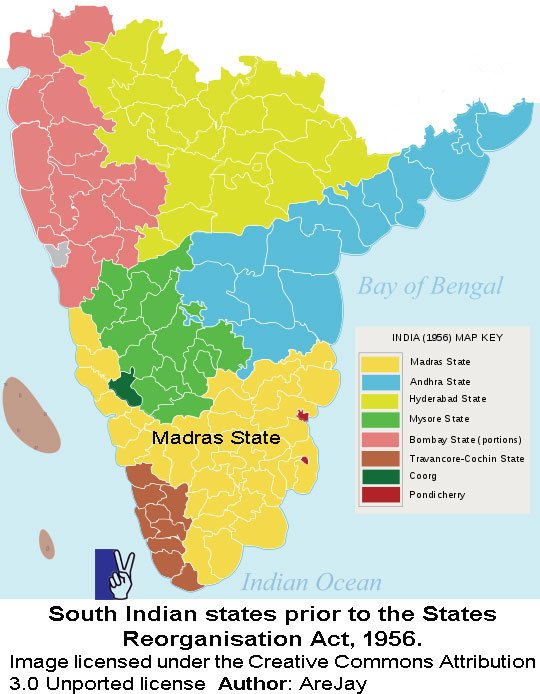 It is historically a impossibility. For, the Travancore antiquity is Tamil. While that in Malabar, it was a language that I would like to call as Malabari now. For, actually the name of that language could have been Malayalam. And it might have had a script, which is currently taken over by the new language of Malayalam. These inputs of mine are mere impressionistic ideas, for which I do not have any documentary evidences. However, from my acute understanding of how the people of this location manipulate history to accommodate their own interests, I think there might be some veracity in what I mention.
Just to understand what I am trying to convey, look at this map of the States of India, just after the nation was created.
The brown location at the south-western end is the Travancore-Cochin State. All around it is the Madras State. Just north of the Travancore-Cochin state was the Malabar district of the Madras state.
To come up with a fake history that the Travancore kingdom was close to the Malabar location is some sort of nonsense. In those days, travel was quite difficult. Malabar was thick jungle in most places. Even in the place where I am currently residing, that is Deverkovil, way back in 1966, when we first came there, there was no proper road. The place was sparsely populated. The terrain was not plain. It was totally uneven landscape with all kinds of blocks to travel; thorns, huge stones, varying levels of land &c. See these image here. The place was somewhat like this.
 However as of now, everywhere good roads have come. The place is filled with people and houses.
In the Native Life in Travancore, Rev. Samuel Mateer does very graphically mention the problems faced by the lower castes like the Pariahs, Pulayas, Shanar, Ezhavas etc. who had converted into Christianity. It would be quite an erroneous idea that they converted due to any love or understanding of Christ or Christianity. The most fundamental attraction was that the evangelists were speakers of English. That itself was a very powerful allurement. For, when speaking with persons who speak English, it is a very commonly felt issue that the issue of degrading of human personality is not there in the verbal content.
This point is not known to native-Englishmen. However, on the contrary, they would get to feel the tremulous splintering and degrading of human personality that the feudal language speakers convey in words, facial demeanour and eye-language. If they, the native-English, are not properly shielded from its negative effects, they would literally try to keep a distance from the speakers of such satanic languages. However, this is again a problem. For, the satanic language speakers can quite easily define their action as ‘racist’. The whole scenario is quite curious and funny. The villains appear in the attire of great humanists! And the people of innate refinement appear as villains.
The local Sudra / Nayar people had given proper warning to the evangelistic that the lower castes, especially the slave castes were not fully human being, and more or less only semi-humans or half animals, or human beings with their mental facilities not fully developed. However, the evangelistic went ahead with their work. Actually in certain totally interior areas like that of Kottayam (north of Trivandrum), persons like Henry Baker and his wife, I am told, did stay there and set up schools for the despised classes.
The missionaries improved the status of the individuals who had converted to Christianity. They were made to learn to read and write the local language. I think, it was then that the missionaries started improving the local language or creating a new language. From Native Life in Travancore, it is understood that there were many languages which the lower castes used. Some of them were not understood by the higher castes. However, the slave populations had been maintained over the centuries as sort of cattle.
These lower castes soon improved in their personality aspect quite remarkably. However, due to the severe feudal content in the language/s, it was not quite easy to erase the various non-tangible social communication boundaries. The Ezhava converts absolutely refused entry to the pulaya, pariah &c. lower caste converts into their churches. They were frightened that if they went down to the levels of the lower castes, their social equation with the Nayars would be dismantled.
This is not a very difficult issue to understand. Look at this illustration:
Among the clerks in an office, there is much fellowship. The menial workers in the office address the clerks as Saar and refer to them as Saar. One of the clerks starts moving with the menial workers to the extent that they start calling him by his name, and he starts addressing the senior-aged persons of the menial workers as Chettan (respected elder-brother). They start treating him as one among them and address him with Nee and refers to him as Avan. It goes without saying that the other clerks would soon like to distance themselves from him.
Some of the converts soon became teachers amongst themselves, in the schools started by the Missionaries. This is a very great social elevation. For, they become some kind of Saar or Chettan (both titles of ‘respect’). It is a very curious situation. Persons who would have been treated like dirt are now in charge of establishments which were qualitatively better than most establishments run by the higher classes. For what was reflected in these lower caste establishments were a minor reflection of the England, in its native-Travancore form.
Here again, there is nothing for others to rejoice. For, these ‘teachers’ would set-up feudal hierarchical set-ups, in which they were the ‘Saars’ and ‘Ichayans’. And the others would arrange themselves below them in a ladder-step manner as Saar (highest You) – Nee (lowest you) arrangement. If any outsider tried to up-set this hierarchy, they would be treated with an immensity of rudeness. This rudeness would be of terrific content, because the population was innately lower caste.
A lower caste man using the word Nee word would have a terrific hammering effect, much more powerful than when a higher caste man uses it.
If the protective umbrella of the English administration from Madras Presidency was not there over them, it is quite easy to understand that all these great ‘teachers’ and ‘Ichayans’ would have been caught by their collars, addressed as Poorimone, Pundachyimone etc. (or some other profanity that would be effective on the lower castes – for many of the profanities that could hurt a higher class man might not have any effect on a lower caste man), tied up in bullock cart and taken to the public square. They would be nailed to the trees in the location. That was a usual practice done to the lower castes who tried to be too smart. In fact, Velu Tampi, who had been a Dalawa for a short period of time used to practise this art quite frequently during his tenure. Pazhassiraja in Malabar also was a practioner of this art.
The next point is that the lower castes were still the slave populations of the upper classes. They were not allowed to walk on the public roads. See this quote from Native Life in Travancore:
QOUTE:
The children of slaves do not belong to the father’s master, but are the property of the mother’s owner. In some places, however, the father is allowed a right to one child, which, of course, is the property of his master. This succession is by the female line, in accordance with the custom of the Nayars, the principal slaveholders of the country.
“A great landlord in a village near Mallapally has nearly 200 of them daily employed on his farm, while three times that number are let out on rent to inferior farmers. The slaves are chiefly composed of two races — the Pariahs and the Puliahs— of whom the latter form the more numerous class.”
Further interesting details are supplied in the same periodical for February, 1854, in the form, of questions and answers, as follows : —
“Why do you not learn?”
“We have no time — must attend to work by day, and watch at night, — but our children teach us some prayers and lessons.”
“What are your wages ?”
“Three-quarters of an edungaly of paddy for adults over fifteen years of age, men and women alike.”
“What are the wages of slaves in other districts ?”
“Half an edungaly, with a trifling present once a year at Onam.”
“In sickness, is relief given by the masters ?”
“At first a little medicine, but this is soon discontinued. No food is supplied.”
“What is your usual food ?”
“Besides rice when able to work, often only the leaves of a plant called tagara (Cassia tora) boiled; and for six months the roots of wild yams are dug from the jungle.”
“How do you get salt?”
“We exchange one-sixth of our daily wages in paddy for a day’s supply of salt”
“And for tobacco ?”
“We give the same quantity for tobacco.”
“How do you do for extra expenses as weddings, &c. ?”
“We borrow, and re-pay at harvest time, when we get extra gleanings.”
“Are slaves sold and transferred to other countries, or to distant districts?”
“Four days ago we saw a man and woman and two children brought for sale.”
“In your neighbourhood, are wives and children separated from the father by these sales?”
“This sometimes occurs — the Wattacherry Syrian Christian family have four slave women, who had been married, but were compelled to separate from their husbands and to take others chosen for them by their masters.”
“Are slave children brought for sale?”
“About six months ago two children were brought and sold to T. Narayanan : the relatives afterwards came to take them away, but the master would not suffer it.”
“Are slaves sometimes chained and beaten?”
“Not now chained, but sometimes beaten and disabled for work for months.”
“In old age when disabled for work what support is given?”
“No pension or support of any kind.”
“How are children paid?”
“Not having proper food, the children are weak and unable to do hard work, therefore they are not paid any wages until they are fifteen years of age; they are not even allowed to attend the mission school, if their masters can hinder it.” END OF QUOTE.
There is something that is missed out in the above quote. A slave cannot answer such queries at this level of intelligence usually. The word Nee (lowest you), will erase much of his or her human qualities; because at his or her level of existence, this word Nee has the power of a terrific hammer.
The above scenario is not actually connected to the caste system. It is part and parcel of the feudal language social design.
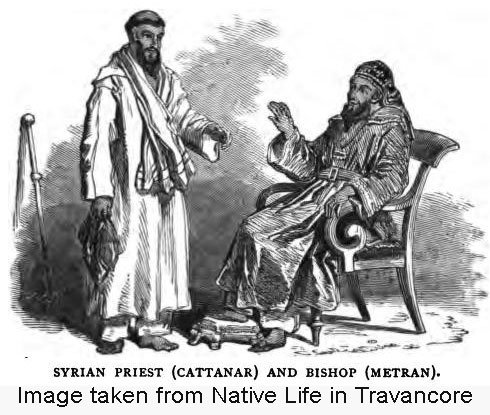
Now, the question is when the lower castes are given education and made to improve, what is to be done with them? This was the actual crucial point that led to the takeover of Malabar by Travancore population.
The Christian Church of the converted Christians does seem to have a number of representative establishments or supporting establishment in the English-ruled Malabar. The English East India Company had prohibited all kinds of Christian evangelical missionary work inside the locations under its administration. Due to this, there was no conversion work anywhere in British-India. However, in Travancore, London Mission Society was able to conduct its work, with proper authorisation from the king’s / queen’s family.
However, the traditional Christians, the Syrian Christians, who had their own versions of claims to fabulous social status in yesteryears, were not quite happy with this new development which could really test the fundamental tenets of the Christian faith in them. In the feudal language situation, it is inconceivable that they would allow the lower castes to come on par with them socially. The solid fact is that no sane person from the subcontinent would dare to uplift a downtrodden population or person. For, the moment he or she gets a upper hand, the word codes would change.
It is a matter of ‘Avan’ (lowest he /him) becoming ‘Adheham’ (highest He / Him) and the traditional ‘Adheham’ turning into an ‘Avan’. This terrible information is not known to any native-Englishman even now. That is why England is slowly rotting.
With the establishment of Christian schools and other things there under the auspices of the various Christian churches in Malabar, it is possible that at least some of the converted Christians relocated to Malabar. Some could have become pleaders in the courts of Malabar. In fact, they would have sort of become included in the ‘educated’ folks of Malabar. I have no direct information on this. The issue is that a solitary converted Christian in Malabar was not actually alone. He had behind him a huge framework of the Christian establishment where he was at home.
This would have given a real personality enhancing experience for populations which were treated as despicable dirt in Travancore. Just cross over to Malabar and then they are in formidable positions.
However, there is this information from my own ancestral family in Tellicherry way back in the 1950s. A midget-sized, dark and grotesque looking young Christian from Travancore got connected to the household. He managed to infatuate one of the young females who was quite fair and of discernible beauty. From a very solitary perspective of human looks, it is quite inconceivable how he could manage this.
However, from a wider perspective, there are certain information that comes into my mind. The female was an educated Marumakkathaya Thiyya individual. What can an educated Thiyya female do in the social set-up? She cannot work in any of the local native establishment without losing the quality she had acquired via the English education. For, if she ventured for that, she would be quite easily addressed as Inhi and referred to as an Oal.
This is a very vital information. If the right codes of verbal respect are not forthcoming, individuals will refuse to come out of their houses, if they feel that they are of some kind of refinement. In fact, this information could explain the phenomenon mentioned as White Flight in areas in England occupied by feudal language speakers. The very eyes of feudal language speakers, if devoid of ‘respect’ have a very atrophying affect on the ‘not respected’ person.
Now, coming back to the Christian man, even though he was known as Christian, there was no information that his ancestral links could be to some Pulaya or Pariah population in Travancore. This was a wonderful blackout. Actually even now, not many people in Malabar are aware of this. I should mention that this looks quite mean on my part to reveal it.
However, there is another much wider meanness that can be discerned on the Christian Church side of this group. They have kept this as a seal-secret, thereby more or less pushing the English endeavours to oblivion. Even when a birdbrain is currently creating a ruckus online claiming that Britain owes a huge reparation to India for ‘looting India’, this group keeps silence. This is a kind of unforgivable unkindness and ingratitude.
As to my own ancestral family, they did not seem to have much information on the ‘Nasrani’ from Travancore. In fact, they do not seem to have any information that there are various kinds of Christians in Malabar and Travancore. And the converted Christians are not very keen on mentioning their ancestry. There is no pride in their development from utter miserable conditions.
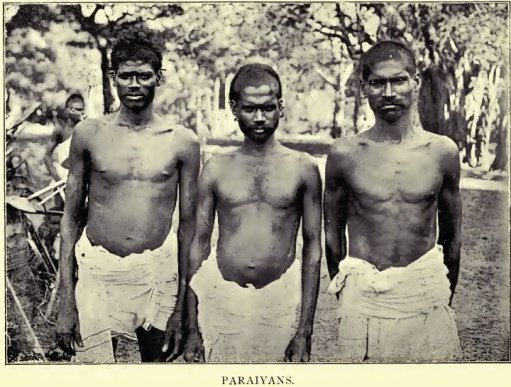 To know the real state of the misery, I need to quote from Native Life in Travancore:
QUOTE 1: The low-caste people who wish to present petitions are thus kept away from the court, and are made to stand day after day in the hot sun, their heads not being permitted to be covered, or they are exposed to merciless rain until by some chance they come to be discovered, or the Tahsildar is pleased to call for the petition.
QUOTE 2: At Karundgapally there is a new cutcherry; but the officials are mostly Brahmans, so that low castes, and even Chogan Christians, must stand at a distance. The Cottayam cutcherry is an old building and very inconvenient, Chogans being unable to enter, or Pulayans to approach very near. The distance required is about sixty yards. Changanacherry standing close to a temple, is worst of all, as Pulayars are not allowed to approach within about 200 yards, and cannot give their evidence with convenience.
QUOTE 3: and that the most oppressive and degrading of caste rules should still be in force, the lower orders being compelled to leave the public roads and retire to the jungle to allow high caste men to pass unmolested.
QUOTE 4: While some masters treated their slaves with consideration, others greatly oppressed them. If a cow gave them milk they must take it to the house of the master. When bought and sold, the agreement specified “tie and beat, but do not destroy either legs or eyes.” For faults or crimes they were cruelly confined in stocks or cages, and beaten. For not attending work very early in the morning, they were tied up and flogged severely. Awful cruelties were sometimes perpetrated. Cases are known in which slaves have been blinded by lime cast into their eyes. The teeth of one were extracted by his master as a punishment for eating his sugar cane. A poor woman has been known, after severe torture and beating, to kill her own child in order to accuse her master of the murder and get revenge. Even the Syrian Christians were sometimes most cruel in their treatment of their slaves. Rev. H. Baker, fils was acquainted with a case in which a slave ran away from his master, but afterwards returned with presents, begging forgiveness. He was beaten severely, covered with hot ashes, and starved till he died.
QUOTE 5: The social circumstances and daily life of the poor low-caste or slave women, who are obliged to labour for their daily support, and sometimes have nothing to eat on any day on which they remain idle, present a direct contrast to the comfort of these just described, as might be expected from the condition of extreme and enforced degradation in which they have been so long kept, and the contempt and abhorrence with which they are universally regarded. Yet they are human as well as their superiors. They work hard, suffer much from sickness and often from want of food, and generally, like all slaves, also form evil habits of thieving, sensuality, drunkenness, and vice, which increase or produce disease and suffering.
QUOTE: 6: A Zemindar was endeavouring to build up a bund, which the waters carried away as often as he made the attempt. Some Brahmans told him he would never succeed till he had offered up on the bund three young girls. Three, of the age of fourteen or fifteen were selected; the dreadful sacrifice was made, and the ground was stained by the blood of these innocent victims. Mr. Chapman showed me a place where some very large earthen vases have been recently discovered buried in a hollow in the laterite. All the natives without hesitation declare that they must have been the receptacles of human victims when this awful practice prevailed. Near each was another and minor vase, in which, it is said, the knife used in the sacrifice was buried.”
QUOTE 7: Slaves were so little valued by the higher classes, that in cases of repeated and destructive breaches in banks of rivers and tanks they ascribed the catastrophe to the displeasure of some deity or devil; and propitiated his anger by throwing a slave into the breach and quickly heaping earth on him.
QUOTE 8: Rajah Vurmah Kulaskhara barbarously buried alive fifteen infants to ensure success in his wars with his neighbours.
If the reader in interested in getting more details of the slavery in Travancore, he can simply search for the word ‘Slave’ in the PDF digital book : Native Life in Travancore.
When these persons improved tremendously due to the English protection and security given to them, and through the concerted efforts of the London Missionary Society, many moved to Malabar. What they saw in Malabar was a huge stretch of land that could provide the much required solace for the totally dismembered lower-castes of Travancore.
Once they arrive here, their traditional names as well as caste connections get erased. They are entirely new individuals. Since they have had many centuries of experience in real hardships (not the hardships faked on Hindi films by rich actors acting as poor individuals), they had the mental and physical stamina to withstand the ordeal. However, compared to what they traditionally experienced, it was not any kind of ordeal. They were literally in a blissful location, even when they were in a forest land in Malabar.
However, it must be admitted that the English administration in Madras did not give them any leeway to occupy the Malabar forests, which were under quite effective forest administration.
But then the information was with the Christian church that there was land ready for occupation. This would be the ultimate solution for their followers. It might seem quite surprising that an ecclesiastical organisation would stoop to cunning. The answer is that in this subcontinent, everyone are cunning. This is an information that the English officials in the subcontinent took a lot of time to imbibe. And way back in England, this information has not entered into the thick-skulls of the native-English politicians.
There is one historical event that seems to point to a cunning endeavour of this Christian Church. When I say ‘this Christian Church’, what is being conveyed is that there are actually a number of different Christian Churches in the location. I am not sure how they fare with each other.
And I must admit that I do not know much about any of the Christian Churches other than things which are quite positive about them. However, in this book, I am not taking that route. Instead I am going through the impressionistic path of understanding what took place.
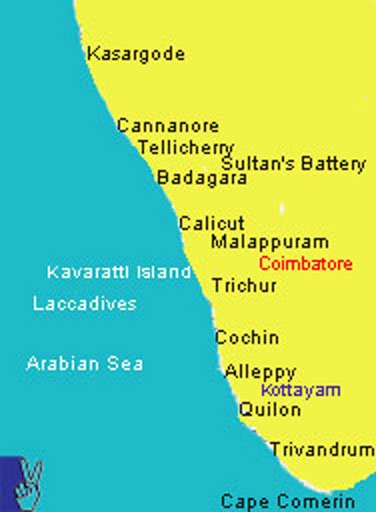 Many years ago, that is around 1975, when we first moved to Alleppy from Calicut district in Malabar, a very quirky anomaly was noticed by me. I was then just around 10 years of age. The peculiar anomaly was in the railway route. There was no direct rail link to Travancore areas. The trains from Malabar went to Mattancherry Railway Terminus. From there another Railway engine was attached to rear of the train and it was pulled by that engine into another route to Trivandrum.
This itself should have look curious in a small state. However, I was too young to understand the issue. The real reason was that two entirely different geopolitical locations had been conjoined. Hence this anomaly.
However, the quirky anomaly that I have mentioned above was not this. It was that the train did not go through Alleppy. From some other station we got down and went by bus to Alleppy. In those days, the coastal areas of Alleppy were full of closed-down huge warehouses. I used to wonder how such huge business concerns could have closed down.
After a few years, on looking at the map of Kerala, I found that a very devious deviation has been designed on the rail route. From Ernakulum, the railway route turned inwards towards the East and moved through Kottayam. And then after touching Kottayam, the route moved back to the coast and reached Quilon. It is a wonder that even to this day no one in the state has even noticed this anomaly.
With this event, the commercial prominence of Alleppy went into oblivion.
Looking back from an impressionistic perspective, the events are very simple to behold. The Kottayam area has a lot of converted Christians. I am not sure if they are the only Christians there. Whether their exact antagonists the Syrian Christians are also there, I am not sure. However, there should have been very meticulously planned endeavour to make the newly planned railway route to wind eastward to touch Kottayam.
Even though these kinds of manipulations look quite difficult to accomplish, the actual fact is different. The railway planning would be done in some office in Delhi. The officials are generally the usual low-class Indian officials. They are ‘Saar’, ‘Adheham’, ‘Avar’ (all great level He / Him) to the common man. Yet, to their own political or religious or social leaders they are just cringing low-guys. A simple mention of this request to the planning office’s clerk, or section officer, or his higher boss would actually be enough to get the manipulation in action. However, it is quite sure that the Church would have higher officials also in its pocket.
In fact, the Church does sponsor political leaders from its own community. It is not the grand and great quality persons who are sponsored. Instead, cringing sycophants and such persons who are willing to offer their great subordination and subservience to the higher echelons of the religious hierarchy are selected for political leadership. The Church would then spend huge amount for concerted people indoctrination via various media including that of the newspapers and radio, and later the TV and films &c. This much I mentioned without any real evidence. However, I have heard occasional private talks from persons who seem to know these things directly. It is from certain inadvertent chance remarks that such information spurts out.
If the above visualisation of what had happened is true, then it can be said that the Church had very cunningly manipulated the whole planning of the newly-created state of Kerala to accommodate the interests of its members. And no one seems to be the wiser.
Even though the members of the Converted Christian Church are the lower castes, it is a foolish information that they were devoid of intelligence. Actually, in most probably, they were kept in social shackles due to the fact they were too intelligent to be let loose. It is like the issue of the immigrant populations from the subcontinent in England not liking to allow native-English men as their lower employees. The Englishmen and women have too much of an individuality to extend subservience to the feudal-language speakers of the subcontinent. So naturally, they will have to be crushed down.
If these immigrant populations are allowed to grow in economic power, in a century or two, they will have the native Englishmen and women treated like dirt and repulsive beings. If all goes well, in a five or six centuries, the descendents of the native-English populations would have the same looks and physical features of the most lower castes of the subcontinent.
It is the population group that extends the most obvious subservience that will be given a position of power and authority. The one which does not do this will be kept on the floor. It is like the case of the Nayars. They, who offered their everything to the Brahmins, were accorded the supervisory ranks. Those who did not make such offers were kept down. This is how the social hierarchy works in feudal languages.
The Converted-Christian Church seems to have promoted an idea that the whole of Malabar was actually a continuation of the Travancore geopolitical location. It had a sort of agent in Gundert who, I am told, stayed at Tellicherry. He and many others with him must have served as its willing agents.
As to the native-English folks, they were more or less gullible in everything they did. For one thing, Gundert was not an Englishman or even a Briton. He was a German. Germans are the exact antithesis of Englishmen. They and many other (not all) Continental Europeans have piggy-back ridden on the England address all over the world during the colonial times. It is seen mentioned that many Germans when they travelled in the African continent in the colonial times, used to carry a Union Jack with them. This was so due to the formidable reputation that the Union Jack had in the continent.
From various sources, including the Mein Kampf by Adolf Hitler, I have come to understand that the German language is feudal. If Mein Kampf is read, the German society that it pictures of those times looks quite similar to the Indian societies of current-day times. Please check my book: MEIN KAMPF by Adolf Hitler - A demystification!
There is a lot of mix-up in almost all the colonial times writings. The word European is seen used many times. It sort of confuses the information. When this word is used to include the native people of England and Britain, the word becomes quite mischievous. For this inclusion of the native-English into this word only enhances the quality of the word ‘European’ and atrophies the words ‘Britain’ and ‘English’.
I think Gundert was given some official authority by the English East India Company / British administration in British-India. This was off course a very foolish item to do. That of diluting English refinement content by inserting others, whose only right to be inside this system seems to be their skin colour. Gullible England took a long time to get a hint that White skin colour does not make anyone an Englishman.
The Converted Christian Church in Malabar had to contend with the local languages. The first was the languages of Travancore. It is seen mentioned that certain lower-caste spoken-languages which were not comprehensible to the others. This issue was there in many locations of the subcontinent. Moreover, their level of competence in Malayalam was also quite low. The above two bits of information has been mentioned in Native Life in Travancore.
However, as of now, it is seen that the best Malayalam is available in the locations where the majority populations might be the descendents of these lower castes. Some kind of inconsistency should be noted in this. The location of the populations which had the worst quality of language competence displaying the best language quality.
Here we should come to a location for enquiring about the language history. It would be quite foolish to take up most of the ‘scholarly’ writings of the current-day academic geniuses. For, many of their writings are in the style of ‘We were the greatest’; ‘We were the highest’; ‘We were the best’; ‘We were the most ancient’; etc., just like Al Biruni had mentioned.
Way back in 1977, when I moved to Quilon, and in 1982 when I moved to Trivandrum, I found that the local language had a lot of Tamil influence, which was not there in the academic textbooks. I did come across families where the ‘respect’ word for ‘respected elder’ brother was the Tamil ‘Annan’ and not the Malayalam ‘Chettan’. With regard to this word, I have found two different Christian groups using two different words for this. The Converted Christians were known to use the word ‘Chettan’ / ‘Chettayi’. While certain others were found to use ‘Ichayan’. In fact, I have found that the Converted Christians who relocated to Malabar area being referred to as ‘Chettans / Chettammaar’.
It is my conviction that words in a language can be studied to trace the routes of ancestral movement of a relocated population. I had mentioned this in some of my earlier writings. However, I have found the same idea having been already mentioned a couple of centuries earlier. I think I have mentioned this somewhere in this commentary.
My first query would be how did the lower castes of Travancore come to possess a language called Malayalam, which was actually not the traditional language of Travancore? How did this language become of so huge verbal content in their hands that it is their locations in Travancore that is known to have the correct quality Malayalam.
However, this question would go into a lot of other confusing elements. For instance, there is the word Mappilla. This word in Malayalam means ‘Syrian Christians’. While in Malabari / Malabar, it means Malabari Muslims.
The Malayalam from Kottayam was strongly promoted by a Christian Newsmedia group. However, this group does not seem to be from the Converted Christian group. For the word Mappilla is there in their family name.
Even though I do not have any information, I feel that English evangelists who lived in the Kottayam areas worked hard to create a content-rich language for the lower caste converts. They had their agent in Gundert. He was there in Malabar, more or less transferring whatever could be had from Malabar to this endeavour.
This issue of language has to be dealt in a slightly more detail, depending soley on the books I have mentioned earlier and on this book, Malabar.
That there had been a traditional language in north Malabar quite different from Malayalam is known to me. Even the words mentioned as Malayalam of Malabar are not the traditional words of Malabar.
The traditional language of north Malabar can be detected in the Tottam chollal (sacramental chanting) done in Muthappan and other connected ancient Shamanistic worships. However, it is mentioned in Travancore State Manual that the traditional language of Travancore was Tamil. Almost all the stone inscriptions in Travancore are mentioned as in Tamil and some in Sanskrit. Even the information on ancient Onam celebration was found in a Tamil inscription. Travancore people did have a slightly darker hue to their skin complexion. This might denote a Tamil population link.
Now, comes the issue of the script used in Malayalam. It does not look like it is a new creation, other than the fact that there have been recent changes inserted into it to suit the conveniences of the typography of the letter-press times. Could this script have been taken from Malabar and inserted in the language which they developed and then named it as Malayalam? Actually the word Malayalam seems to have been the name of the language of Malabar.
It is a very curious suggestion. That the name ‘Malayalam’ was actually the name of the language of Malabar. However, could this name have been taken away to Travancore and made the name of the language that was developed with the active support and endeavour of the Christian church.
The actual Malayalam that was spoken in Trivandrum streets in the 1980s was a very crude one with a lot of Tamil words interspersed inside it. However, these words were not seen in the filtered-out written Malayalam language of Travancore.
The next point that comes to my mind is that there is absolutely no mention of the fact that the language of north Malabar (I do not know about south Malabar) was absolutely different. This sounds quite curious. For, even now, when Travancore people come to interior Malabar areas, they find that there are many spoken words which they do not understand. These things can be brushed off as dialect difference. However, that would simply be sidestepping the issue.
For, there is much more in common between Malayalam and Tamil than there is between Malabari and Malayalam. However, as of now, pure Malabari has vanished. Almost everywhere, the traditional Malabari language has been pushed out by Malayalam, through the daily onslaught of TV, Newspapers, Cinema, school education etc. In fact, when people speak Malabari, others seem to guess that they are uneducated low-class people.
This is a very curious turn of events. For, the language of Malayalam is seen to have been developed for the lower castes of Travancore. How this language seems to have become the language of Malayali higher cultural quality seeks many answers.
However, since I am not an expert in any scholarly academic studies, I have to confine my thoughts to what I have seen in the books mentioned before.
But then it is like the case of the dark-skinned, short-statured, a bit English-knowing, Converted Christian man coming to a household in Tellicherry and infatuating a beautiful female. The framework of a powerful church that had its tentacles all over the land, and beyond was a very powerful platform. He stood on that platform. It is a like a Gandhi standing on a stage / platform and promoting himself in newspapers. It makes even a midget look like a giant.
If all the Sanskrit words that have been inserted artificially or inadvertently into Malayalam are removed, the language of Malayalam would look quite slender. And if Tamil words are also removed from Malayalam, what would remain remains to be checked.
However, if Sanskrit and Tamil words are removed from Malabari language (the original language that must have represented the word Malayalam), it is possible that there would not be much content loss in it. But then, there are Arabic words in Malabari. If these are removed, then the original language that subsisted right from the hoary past would remain. If this language can be studied, then the location from where some of the population groups of North Malabar, i.e., the Marumakkathaya Thiyyas, north Malabar Nayars etc. might be arrived at.
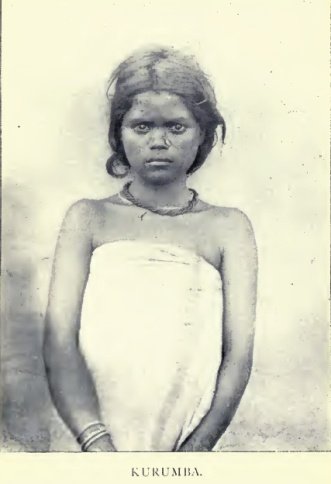 There is another curious item that might be mentioned here. It is about the tribal populations of Wynad. In the year around 1982, when I visited a settler-house in Wynad, I found that the tribal females working there as domestic servants there. When seen from a native-English perspective, the profession of a domestic servant might not seem terrible. However, in the ambience of the local feudal languages, they are addressed as the Nee (lowest level you), and referred to as the Aval (lowest level she). The domestic servant has to consistently address the householder with ‘respectful’ You and He, and She. The problem is that if this oppression is not practised by the householders, the servant-maid might use the degrading words to and about them.
This leads to a social climate wherein the servants are to sit on the floor and eat; Sleep on the floor; and use all the untidy parts of the household and attire.
The wider issue about this kind of social pattern is that this is how the Indian officialdom sees the people. They do not like to offer a seat to the common Indian. As to the common Indian, he is innately trained to accept this kind of behaviour from his government and vernacular school classrooms. If such persons are offered a seat, they would literally be uncontrollable. That is the common understanding.
Now, coming back to the tribals of Wynad, I noticed that they had a language of their own which I could not understand. I think that language has withered away and Malayalam has replaced it. Here the issue is that Malayalam is a very feudal and personality-atrophying language, for the lower-placed persons. The government officials who were sent to ‘develop’ the tribals, invariably used the lower-indicant words of You, He, She etc. to the tribal people. This invariably led to the loss of stature among them. Their male populations literally were treated like animals by the officials.
One official of those times mentioned that they used the method of ‘hybridisation’ to improve them. He was laughing out boisterously. Here again there is a problem. The officials of the state government are not fully higher caste persons. There are many of them from the erstwhile lower caste populations who had converted into Christians. There is nothing to prove that these persons were nicer to the tribal populations, who actually were quite similar to their own ancestors (converted Christians).
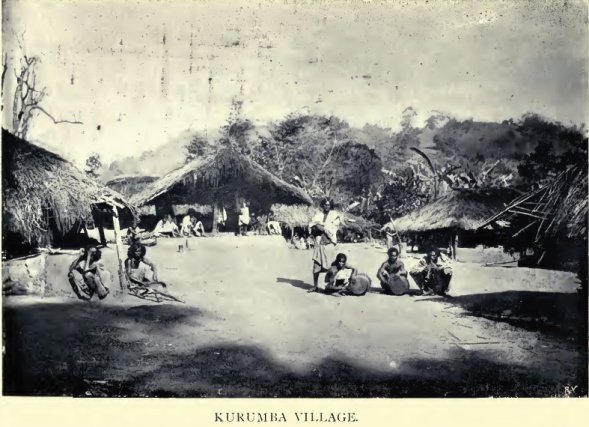 There are a lot of simplistic ideas on class and class affinity. The truth is that there is no such thing. Every organised group, which speaks feudal languages, are dangerous to other un-united populations. For instance, I was told by an old Converted Christian settler in Malabar forest areas (it was by then filled with grand plantations) that in the early years of the mass migration to the Malabar forests (just after the departure of the English rule from the subcontinent), youths among them would organise in the night hours to converge on isolated tribal hamlets. They would poke their hands through the thatched walls of the huts, catch hold of the female legs and pull the females out.
The issue that these kinds of information brings out is that no political philosophy can explain these things in the light of grand ideas of socialism or revolution or class conflict. For, the settler populations were literally the same tribal kind of populations in Travancore who were improved by the London Missionary Society. However, the wider fact is that with the departure of the English rule in the subcontinent, the administration and concepts of rule of law were a mess in Malabar.
In the Madras State, the incorruptible officialdom (officer-level) collapsed and withered away into desolation. The newer officialdoms were what diffused into the English-ruled areas from the various independent kingdoms. This collapse of a grand and efficient administration led to a state of free for all. The Malabar forests were literally taken over by the Converted Christian populations from Travancore State. The newly formed Kerala administration was more or less designed by the fully corrupt to the core barbarian officialdom of Travancore kingdom. The incorruptible Malabar officialdom literally was pushed into oblivion when British-Malabar became Indian-Malabar. It was some kind of satanic alchemy at work. Gold turning into stinking dirt.
However, the converted Christian’s Church had been quite far-sighted. It had been patiently working on a very detailed manipulation of history.
They had to be ready for an eventuality wherein the forest lands had to be taken-over with impunity. For this, a few fake historical settings had to be indoctrinated in a very casual manner.
That Travancore and Malabar historically were one single geopolitical location.
That the languages of both Malabar as well as Travancore were one, and that it was Malayalam.
That the corresponding castes above the Nayar levels and those below the Nayar levels were one and the same.
It is possible that the takeover of the forest lands of Malabar could have been accomplished without the formation or creation of India. For, even before the creation of India, this occupation of forest lands was taking places in a quite manner in certain locations.
Keralolpathi
Now, we come to the book known as Keralolpathi. I do not know much about this other than what has been mentioned in the various books I had mentioned. Viz. Travancore State Manual, Native Life in Travancore and this book, Malabar &c.
Various claims are there that it is a fraudulent book. However, who could have taken so much trouble to write such a book which seems to mention many authentic historical items?
There is a story of Parasurama creating the land of Kerala in this book. However, it is seen mentioned elsewhere that there is no mention of this story in the ancient Hindu writings of the northern parts of the subcontinent. Then who could have conjured up such a story from thin air and for what purpose? What is the wider aim of this story?
The aim is simple. That the land mass of Kerala was one, and that Malabar and Travancore were one.
However, it might be true that a lot of local realities and traditions usually mentioned in higher caste households could have been collected and inserted into this story.
It does seem that the story has been written with serious deliberation. A lot of places have been mentioned. Only a person or groups of persons who have wide and far-reaching links to the various nook and corner of the landscape could have known about these wide-spread and not at all easy-to-travel-to locations. The only organised group which had the resource, man-power and literally acumen to accomplish this deed would be the trained members of the Converted Christian Church.
However, this would lead us to a very perilous location. For, it is said that it was Gundert, the German, who found and transcribed this book. I am not sure what this is supposed to mean. Could it be that he himself personally wrote the manuscript of this book? Or that he had the trained lower-caste Converted Christian members of the church to do the writing for him, which he dictated? If he had done either of this, then it is possible that the original palm-leaf book could have been in the possession of the Church at Tellicherry. If the original is with the Church, then it would be a good idea to make a thorough study of the same.
If there is no original, then it could mean that the book is the handiwork of the members of the mentioned Church. They, in their desperation, would literally do anything to escape from the hell on earth in which they were living in Travancore, till the advent of the evangelists from England.
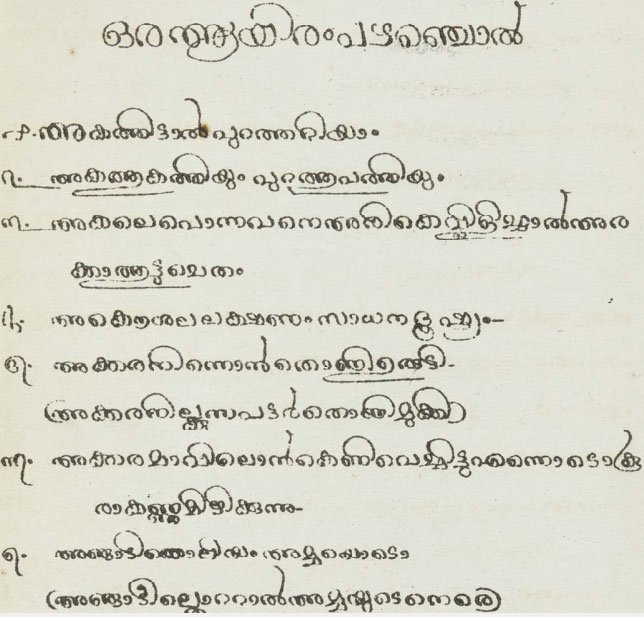 I have a pdf copy of two books purported to have been written in manuscript by Gundert (archive.org). I do not know why they are in the manuscript form. For, they must have been printed.
One of the books is the Keralolpathi. The other is a book titled ഒരആയിരം പഴഞ്ചൊൽ (A thousand proverbs). I have noticed that at least some of the proverbs found in Malabar by William Logan have been taken from this book. See the Chapter on Proverbs.
On a casual observation, I find that the hand writing of Gundert in the two books seem different from each other. Whether this has any significant meaning I do not know.
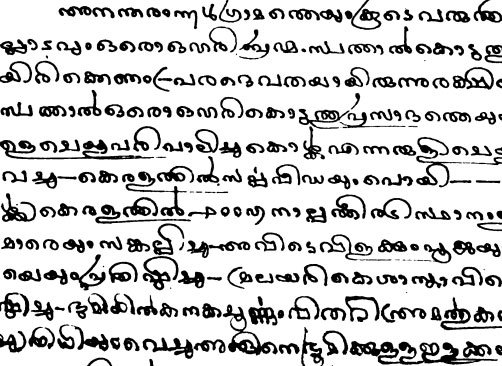 There are a lot of unmentioned problems with regard to Keralolpathi. It is kind of promoting a ‘Kerala’. Even though a word ‘Kerala’ is a mentioned in some historical records, there is no scope to believe that it included the whole of current-day Kerala.
There is no way to know if the word ‘Kerala’ has been used in various period of history to denote absolutely different and unconnected geographical locations in South Asia.
As to finding out the historical existence of Kerala from various other places all around the world, there is an item of silliness in it. It is, as I had mentioned earlier, like trying to prove the existence of England by studying the various inscriptions, rock-pillar writings, maritime writings etc. The height of absurdity is that in spite of all this striving to find the ‘Kerala’ word recorded elsewhere, there seems to be no such record anywhere in the location that claims to be Kerala. Even in the various stone-inscriptions in stone mentioned in Travancore State Manual, there seems to be no mention of a ‘Kerala’ which extended from Trivandrum to Manjeshwar.
However, in Keralolpathi, the word ‘Kerala’ seems to have been used an umpteen times. The stories of the kings and kingdoms of the various locations, I think are splattered with little regard for any chronological order or historical logic. Whatever had been heard must have been inserted. All to prove that there was a single country called Kerala.
A lot of credibility has been inserted into the book, by mentioning the Brahmin supremacy in a very contorted manner. However, I think, the history of the location does not give much mention of them. It simply moves into the location of various kings. It might be true that the writers of this book had taken pain to collect as much traditional information as possible from various sources. There must have been very concerted efforts in this regard with at least a small group of persons participating in the endeavour.
There are a number of things that could be gathered from Keralolpathi. One is that a lot of gramams of Malabar, Cochin and Travancore are mentioned. It is obvious that some of the place names have been written from inaccurate hearing. For, the names cannot be made to correspond with any known location. Moreover, even though there might have been some attempt to arrange the names in a north to south manner, the writers obviously did not have enough knowledge about the exact geographical continuity of the locations.
There is a mention of an Anakundi Krishna Rayar. As per this book, Malabar, this name is mentioned in an absolutely wrong historical period.
Keralolpathi is seen mentioned as being written in modern Malayalam. This is a very curious bit of information. The so-called modern Malayalam was then in a evolving form in the hands of the Christian converts of Travancore. Such a thing was not there in Malabar.
However, see this QUOTE: The Kerala Brahmans are said to use Malayalam. END OF QUOTE.
Where did this ‘Kerala’ come from? And what language is this ‘Malayalam’ referring to? The traditional language of Malabar or the newly designed language of Central Travancore?
Mahamakham festival in Tirunavaya Temple is mentioned. However, it is a very well-known function. However, it is seen mentioned that Parasurama had performed the Hiranyagarbham and Tulapurushadanam ceremonies before he celebrated the Mahamakham.
There are various locations in the book Malabar, wherein even when seeming to question the veracity of Keralolpathi, it takes points from it to emphasise the point that there was indeed a country called Kerala which occupied the geopolitical location from north to south.
There is also a continuing jarring note in certain words like: ‘country inhabited by the Malayalam-speaking race of Dravidians’ which is sort of emphasised by this book Malabar in the locations wherein it is very clear that the writings are not the original writings of Logan, or are doctored version of the same. For, the word Malayalam-speaking is mischievous. Travancore was Tamil-speaking area. However, if it was ‘Malayalam’, the original name of Malabari that is being mentioned, then the Travancore part does not come into the picture at all.
There are locations where in Chera or Cheram or Keram are tried to be from the same source. And then the Keram is connected to coconut tree. It is some kind verbal jumbling. The very clear connection of the word Chera has been mentioned earlier. It is an unmentionable connection.
There is a mention of a king called Keralan. And then there is a still more fabulous claim. QUOTE: on account of his good qualities, it is said, the land received the name of Kerala. END OF QUOTE
It does seem that Keralolpathi did influence the thinking pattern of all the people who came to know of it after Gundert made it famous. The three different geopolitical locations, Malabar, Cochin and Travancore seemed to be emerging from a single focal point. For, the natural question and assertion would be, “isn’t it what Keralolpathi says?” This tone is there in many locations in the book, Malabar.
It was one of the greatest kinds of deceptions made possible in the three minuscule geographical locations. Knowledge of this book might have seemed the singular essence of profundity and scholarship. It is clear that the object of the writers had been accomplished.
As to the claim that the land received the name Kerala, it is just fanciful writing. There was no consciousness of a Kerala, in any of the locations, unless this idea was inserted into the mind via education and indoctrination.
The tradition of one Perumal king converting into Islam is there in Keralolpathi. What does it prove? It simply proves that the writers copied the information from the local traditions that must have remained in the upper class households in Malabar.
In one location, there is this QUOTE: This Muhammadan Perumal must have lived subsequently to the seventh century A.D. when the Muhammadan religion was founded, and if, as the text says, Cheraman Perumal was the fifth of his successors, it follows that Cheraman Perumal must have lived after the seventh century A.D., whereas further on it will be seen, the text says, he went to heaven in the fourth or fifth century A.D. All the specific dates mentioned in the text are worthless. END OF QUOTE.
And again, QUOTE: Considering that Muhammad himself was born only in the 7th century A.D., the date mentioned is obviously incorrect, if, as stated, this Perumal organised the country against the Mappillas. END OF QUOTE.
Now does this above assertion stand to uproot the Keralolpathi? No, it simply tries to avoid the pitfalls of the book. By keeping this distance, the fraudulent book can still be made mentioned in a manner that the idea of a single Kerala can still be promoted into the mind of the readers. And through them to the immensity of people.
It is a known thing that even a very brief mention can promote a book, an idea and a person. There is no need to categorically praise a book, an idea or a person in very candid terms. A mere mention at an appropriate location will add to its grandeur.
Look at these QUOTEs: 1. The Brahmans, it is said, next sent for Valabhan Perumal “from the eastern country” and made him king of Kerala. He is said to have consecrated gods and built a fort on the banks of the Neytara river (Valarpattanam river). The fort received the name of Valarbhattu Kotta, and he appointed this as the hereditary residence of the future kings of Kerala.
2. Kerala, it will be noted, had now, according to the text, the restricted meaning of the territory lying between the Perumpula river and Putuppatlanam, that is, the dominion of the Northern Kolatiiris, North Malabar in fact. END OF QUOTEs
The second quote above declares the ‘Kerala’ as being confined to north Malabar. Second point is that, the whole textual description is like reading the doings of the ‘great freedom fighters’ of ‘India’ in the nonsensical pages of the Wikipedia India pages. Every one of them seems to be more or less doing things on which the whole nation seems to be hinging. However, the fact remains that not even a miniscule percentage of the people/s of the subcontinent were aware of their doings or had ratified or given them the due authorisation to represent them anywhere.
In the same way, when this great book is mentioning these great semi-barbarian kings, the fact that goes unmentioned is that there were many other locations which were populated by populations which had nothing to do with them. No mention seems to be there in Keralolpathi about the entry of the Marumakkathaya Thiyyas in north Malabar, the Makkathaya Thiyyas in south Malabar, the reason for them having the same name, the reason why the Marumakkathaya Thiyyas had a disdain for another population bearing their same caste name.
There is no mention about why two different sects of Nayars appeared, one in north Malabar and one in south Malabar. Why there was a repulsion for the south Malabar Nayars among the north Malabar Nayars. There is no mention as to why the Travancore side had a Tamil heritage. There is no mention of the various Shamanistic spiritual worship systems in the north Malabar region. There is no mention of similar shamanistic spiritual worships elsewhere in the subcontinent. There is no mention of the existence of a separate language in north Malabar, quite different from the Tamil traditions and modern Malayalam.
There is no way to understand why the Travancore people had a darker skin complexion, while the northern people/s including many lower castes had a fairer complexion.
As to proving that there was a landmass in the location of current-day Kerala, from times immemorial, there is no need for any such historical studies for that. It is most probable that the at least the north Malabar location had existed from very long past. The oft mentioned history of sea-moving-out and land-forming, could be more about Travancore coastal areas, than about north Malabar.
South Malabar could be of either geological histories. However, I do not have the information to mention anything categorically about these things.
As to Onam and Vishu etc., no mention about them seems to be quoted from Keralolpathi about them in this book Malabar. I do not know more about this.
QUOTE: It is a noteworthy circumstance in this connection that even now-a-days the Travancore Maharajas on receiving the sword at their coronations have still to declare;—“I will keep this sword until the uncle who has gone to Mecca returns.” END OF QUOTE.
It is quite funny that the above claim in this book Malabar has been denied by Nagam Aiya in his book Travancore State Manual:
QUOTE: This statement, founded as it is on Mateer’s Native life in Travancore, is clearly incorrect. The Travancore Maharajahs have never made any such declaration at their coronations, when they received the sword of State from God Sri Padmanabha. The Valia Koil Tampuran (M. R. Ry. Kerala Varma Avl., C. S. I). writing to His Highness the present Maharajah some years ago received the following reply dated 10th April 1891: — “I do not know where Mr. Logan got this information; but no such declaration as mentioned in the Malabar Manual was made by me when I received the State Sword at Sri Padmanabha Swamy’s Pagoda. I have not heard of any such declaration having been made by former Maharajahs.” END OF QUOTE.
Then there is the issue of a Perumal king converting to Islam. It is given in this book, as understood from Keralolpathi, with very powerful supporting evidences. It is quite possible the persons who had compiled the Keralolpathi did collect a lot of local traditions in the upper class households of Malabar. However, there were other sides to the story which they did not hear:
I quote from Travancore State Manual:
QUOTE: Mr. K. P. Padmanabha Menon in a recent article in the Malabar Quarterly Review, denies the statement that the last of the Cheraman Perumals became a convert to Islam or undertook a pilgrimage to Mecca, but believes that he lived and died a devout Hindu. The legend is evidently the result of the mixing up of the early Buddhistic conversion of Bana, one of the Perumals, and of the much later Mahomedan conversion of one of the Zamorin Rajahs of Calicut, who claimed to have derived his authority from the last Perumal. The Hindu account simply states that Cheraman Perumal after the distribution of the Empire among his friends, vassals and dependants, went to Mecca on a pilgrimage and died there a Mahomedan saint. The Mahomedan account embodied in the Keralolpatti narrates that after the distribution of his kingdom, the Perumal secretly embarked on board a Moorish vessel from Cranganore, and cleverly eluding his pursuers landed at Sahar Mukhal in the Arabian coast, that he had an interview with the Prophet then in his 57th year, and was ordained by him under the name of Thia-uj-uddien — ‘the crown of the faith’, that he married Regiat the sister of the Arabian king and after having lived happily for five years, undertook a journey to Malabar for the spread of Islam, but died of ague at Sahar Mukhal where his remains were interred in a mosque he had himself erected. END OF QUOTE.
However, in Travancore State Manual, there is more about this:
QUOTE: Sheikh Zinuddin, the author of the Tahafat-ul-Mujahidin, says that there is but little truth in the account of the Perumal’s conversion to Islam. The Arab merchant, Suliman (851 A.D), ‘who wrote with knowledge as he evidently visited the countries he wrote about’, says expressly that in Malabar he did not know any one of either nation (Chinese or Indian) that had embraced Mahomadanism or spoken Arabic. None of the early travellers or geographers whether Mahomadan, Christian or Jew have left us any record of the legend. Abdur Kazzak who was sent in 1442 A.D. by the Shah of Persia failed in his mission of converting the Zamorin. He too does not mention the legend at all. END OF QUOTE
QUOTE: The Muhammadan was called Ali Raja, that is, lord of the deep, or of the sea. END OF QUOTE.
The above quote seems to contain a terrific error. It sure seems that the information was taken from a European / English version of events and inserted into the Keralolpathi. The word Ali is a Muslim name. However, does it mean the ‘sea’ or ‘deep’ or ‘ocean’?
The original Arabic meaning of Ali is seen mentioned as ‘high’ or ‘exalted’. How then did this ‘sea’ and ‘ocean’ and ‘deep’ come into the picture to an extent that even the persons who very fraudulently writing the Keralolpathi fell for this wrong meaning?
There is transliteration error seen all over this book. The verbal sound ‘zha’ ‘ഴ’ cannot be written in English. Even the ‘zha’ cannot mention this sound. So, wherever this sound comes, it is seen that ‘l’ is used. In the case of the above Ali word, the actual word might be Aazhi (ആഴി) if one has to accept the meaning as ‘lord of the deep, or of the sea’. Aazhi (ആഴി) does mean sea, deep sea, ocean etc. Since I have not read the Keralolpathi, I cannot say what the exact name is that is given in that book. However, if the word is Aazhi, then it might mean that the writers of Keralolpathi depended on some English or European text.
If one presumes that one can check up with Arakkal kings of Cannanore (Ali rajas), the fact is that usually no family member really knows anything about their ancestors other than after the English administration arrived and started keeping written records. In my own parental families, paternal as well as maternal, there is no information among the current generation about who their ancestors were beyond their great grand families. (It has to be mentioned here that the Arakkal kings were not the rulers of the whole extent of Cannanore district. They held power only in small segment of the Cannanore town. Actually at best they were small feudal lords, who somehow got authority over certain Laccadive Islands. As to the word Raja etc., the fact is that everyone who gets some authority immediately takes up some form of royal title. It is a very effective tool for spreading a feel of dominance over the populace.)
I have even enquired with a certain Nayar family who has a family run temple, which conducts an annual shamanistic festival (Thira and Vellattam). The current-day members of the family have no information about the ancestors who had conducted the temple festivals. There are various complications which more or less makes everything quite hazy.
This ഴ, ഴി being written as ‘la’ and ‘li’ is there almost all over this book, Malabar. This more or less puts all ‘la’ and ‘li’ words suspect. Even the Kolathiri, could very well be Kozhathiri (കോഴത്തിരി). There is the instance of Ezhimala being named as Mount Deli. And there is a discussion in this book with connecting the name of the place to rats. ‘Eli’ means ‘rat’ in Malabari.
See this QUOTE: which the people of the country in their language call the Mountain Delielly, and they call it of the rat, and they call it Mount Dely, because in this mountain them were so many rats that they never could make a village there.” END OF QUOTE.
And then there is this QUOTE: like that which conferred on it likewise the sounding title of sapta-shaila or seven hills, because elu means in Malayalam seven, and elu mala means the seven hills, of which sapta-shaila is the Sanskrit equivalent. END OF QUOTE.
The local word for Seven is Ezhu, and the Tamil word is Elu. The reader can make his or her own understandings of the above ambivalent information.
QUOTE: So the expedition was organised and despatched under the Puntura youths. It is unnecessary to relate the events of the campaign, as they are all more or less of a mythical character and include the mention of the use of fire-arms and cartridges ! ! END OF QUOTE.
It does seem that the persons who wrote the fake history in the Keralolpathi had no information on when fire-arms and cartridges had come to the subcontinent.
QUOTE: This account of Samkaracharyar, which makes him a contemporary of the last of the Purumals, is interesting, because, as a matter of fact, the tradition on the point is probably correct. END OF QUOTE.
It could point to the fact that the writers did get certain things in sync with other historical beliefs.
QUOTE: it is probably an interpolation to suit subsequently existing facts END OF QUOTE. This is actually a very pertinent point. That a fake history book that purports to know ancient history was written by very cunningly drafting the event to arrive at certain later day actualities so as to make the writing seem authentic.
See the effect of this book. See this QUOTE: It cannot be doubted that the first half of the ninth century A.D, was an important epoch in the history of Malabar and of the Malayalis. END OF QUOTE
Even when the book is mentioned as of a dubious nature, it has been able to very quaintly insert the idea of a Malayali population. The word Malabar also is of very confusing content. There is a general tendency to extend the boundaries of Malabar to include Travancore. The cunningness of this idea is then to go back and make Malabar a part of Travancore. The reality that the location of Malabar (north Malabar and south Malabar) was not populated by Malayalis (Travancore people), but by different populations which are connected to each other by various kinds of antipathies, subservience or respect, is not mentioned.
QUOTE: The chief event was the termination of the reign of the last of the Kerala or Chera Perumals or Emperors END OF QUOTE. There is a very definite misuse of the word ‘Emperor’.
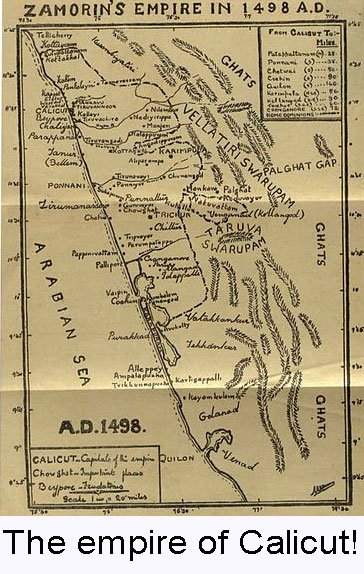 Actually the use of the word ‘Emperor’ with regard to many kings of the subcontinent is a misuse of the word. There seems to be not even one king who deserves to be mentioned as an Emperor. Simply overrunning and then handing over the power over the people in many locations to their henchmen is not the quality of an entity that can be called an Emperor.
There are many things a king can do. Like setting up a great administrative set up based on public service exams. A police system with written parameters of authority. A judicial system based on written codes of law. A public healthcare system for the common man. A basic educational system for the common children. A department of roads. A postal system which can be utilised by the common man. Like that there are so many things a monarchy can build. None of the kings in the subcontinent seems to have had any sense about these things. All they had was the terrible duty to enforce the hierarchies. Well, that is true. The languages enforce the hierarchies.
How does one compare a native king of the subcontinent with a monarch of England? Well, there it is not the capacity of the monarch, that really runs the systems. The language is so smooth that all systems run smoothly. Over here, the moment anyone speaks, various kinds of terrors, anxieties, reflexes, urge to backstab etc. get provoked.
When this is the condition of the kings in the subcontinent, what can one say about the Emperors? That they are worse than kings?
It is curious that the monarch of England who literally ruled a global empire was only a Queen of England. However, when her name got associated with the subcontinent, nothing less than the title of an Empress would do. That was the training the subcontinent gave to the native-Englishmen. That a mere ‘Queen’ will not do. There should be an Empress. Otherwise no one would listen to her.
This brings us to another most interesting thing about the history of location here. It is seen that persons who came to acquire some royal power immediately changed their name to some Varma or Veera or something similar. So, it does seem that the title Varma is not actually a hereditary title in many cases, but simply a title artificially adopted by the person to add to his right to rule some small location.
QUOTE: The Brahmans are notoriously careless of history and of the lessons which it teaches. Their lives are bound hard and fast by rigid chains of customs. The long line of Chera kings, dating back to the “Son of Kerala”, mentioned in the third century B.C., in King Asoka’s rock-out inscriptions, had for them no interest and no instruction ; and it is not to be wondered, at that the mention of them finds in the Keralolpatti no place. END OF QUOTE.
The above is a quote with more than one concern. Even though the Keralolpathi has been mentioned somewhere in book as promoting Brahmans, the truth seems to be elsewhere. There is no promotion of Brahmins seen other than in the very beginning of the fake history. The whole history is a silly listing of various rulers, who had nothing to do other than to ‘rule’. This is what I gather from the other books which I have mentioned and from this book, Malabar.
The next point is the use of the words ‘Son of Kerala’. It has been mentioned in another location in this book that the transliteration of the word found in the Ashoka edict is Ketalaputra and not Keralaputra. It is curious that the word Chera’s real meaning ‘rat snake’ is not detected by the writers of this book. But in the case of Ketalaputra, they can detect a ‘Kerala’ inside it.
The reason why Keralolpathi moves into a location where no Brahmins are mentioned could be due to the fact that the writers did not have any information about the Brahmin traditions. After all, the Brahmin caste was quite high for the lower-caste converted Christians, who presumably did the writing.
QUOTE: What is substituted for the real history of this period in these traditions is a farrago of legendary nonsense, having for definite aim the securing to the Brahman caste of unbounded power and influence in the country. END OF QUOTE.
Here again, there is an ambivalent stance. For here the statement is contrary to what has been said before. Here the contention is that Keralolpathi was written with the aim of securing unbounded power and influence for the Brahman caste. There is no hint that the book could have been a totally different invention with a totally different aim.
QUOTE: Parashurama is not found in Vedic literature, and the earliest mention of his character is found in the Mahabharata but with different names. There he is represented as an accomplished warrior-Brahmin, a sage and teacher of martial arts, but there is no mention of him being an avatar of Vishnu. He evolves into an avatar in the Puranas. According to Adalbert Gail, the word Parasurama is also missing in the Indian epics and Kalidasa's works, and appears for the first time in Indian literature around 500 CE. Before then, he is known by other names such as Rama Jamadagnya END OF QUOTE.
No comments.
It is seen that this book was in great demand in the years around 1950. What could be the reason for that?
This is the book that must have been heavily used by the Converted Christian Church to force the creation of Kerala by amalgamating the Malabar District of Madras State with the Travancore-Cochin State.
Why should they do that? The reason is quite simple. The forest lands of the Malabar District of the Madras State had been encroached by the hordes of Converted Christian Settlers from the neighbouring state. It is only a matter of little time before the Madras government would take stringent action for their removal. It was a matter of life and death for these settlers that a new state is formed in which they had greater political say. Once this new state is formed, there is no issue of an encroachment from another state.
QUOTE: The Mahratta account states that Parasu Raman turned the Boyijati (fisherman caste) into Brahmans in order to people Keralam. END OF QUOTE
The Mahratta accounts and such other accounts traditional elsewhere seem to corroborate some of the things in the Keralolpathi. However the above contention is mentioned as not seen in Keralolpathi. Apart from that, the fact that many traditions of elsewhere do corroborate what is there in Keralolpathi does not prove its authenticity. It simply would prove that the writers of Keralolpathi were depending on various contemporary traditions and stories.
The contention that the Brahmins of Malabar and Travancore are the fishermen folks of elsewhere is a contention that cannot be acceptable to many. For, in which case, many peoples in Malabar and Travancore go under the fishermen folks!
QUOTE: They summoned him unnecessarily and he cursed them and “condemned them to lose the power of assembling together in council, and to become servile. They accordingly mingle with Sudra females and became a degraded race.” END OF QUOTE.
I am not going to pick anything out of this tradition, with regard to Brahmins or Sudras. However, the contention of becoming a degraded race by mixing with Sudra families is a very vital point about certain other things. It is related to the social and human design that language codes can arrange. A wrong connection or being placed in a wrong location in a link, would create havoc, if the language is feudal. This is an idea that no one seems in a hurry to deal with. The native-English populations have no information about this.
As to the feudal language speakers, they are aware of this issue in at least a vague manner. But no one is happy to mention this. For everyone are part and parcel of these evil codes. There is no escape visible in sight.
QUOTE: this, it is said, “the men of the port began to make voyages to Mecca in ships, and Calicut became the most famous (port) in the world for its extensive commerce, wealth, country, town, and king.” END OF QUOTE.
This is mentioned in the Keralolpathi with regard to the honesty of the king of Calicut. It is a most insipid statement. There is honesty in many locations in the subcontinent. Many things design it. One is the general attitude of a person not to cheat, whatever be the outcome. That is not very much possible to adopt if the honesty can lead a person to penury. For, along with penury, come the lower indicant verbal code definitions on the person.
However, the king of Calicut has no such concern.
Generally in a feudal language system, people are generally very honest to those who they treat as superior and respected. To those whom they do not feel this emotion, they are dishonest and they do cheat and go back on their word.
Beyond this, there is the general ‘frog-in-the-well’ tone in this claim. That ‘Calicut became the most famous (port) in the world for its extensive commerce, wealth, country, town, and king’.
A small king more or less a dependant on the Arabic seafaring populations. What kind of fame did this port have that the Continental Europeans and the English traders had to search hard to find it? They came not for its fame, but due to the fact that this was where pepper could be bought from. Pepper was an important food ingredient in England and Europe. For, it is the best preservative for keeping meat in an unspoiled condition during the winter months.
The adjective of ‘most famous’ is in sync with the words of Al Biruni, quoted in the beginning of this book.
Now, there a few brief queries in my mind. From where did Gundert get Keralolpathi from? Is the copy with the Church or with anyone else? If so, can the date of its creation be found out using scientific methods?
Then about the language of Keralolpathi. Is it the Malabari language (the original Malayalam) or is it in a language that was developed by the Christian evangelists in Central Travancore?
Then again about who actually did the writing? Was it written directly by Gundert himself, or did he get some scribe to do it?
What about the book of proverbs in Malayalam? Did he write it himself or did he use some scribes? Both the books do not seem to be written by the same person, even though the author names are given as Gundert.
Or could it be that the manuscript copies (in PDF) which I downloaded from archive.org are later day copies?
About the language Malayalam
See this QUOTE: The name by which the district is known to Europeans is not in general use in the district itself, except among foreigners and English-speaking’ natives. The ordinary name is Malayalam, or, in its shorter form, Malayam (the hill country). END OF QUOTE
As per this statement, the name Malabar was not known to the natives of the land. It is similar to the word ‘India’. There is nothing to suggest that the word ‘India’ was known to the natives of the subcontinent.
The words ‘Malayalam’ and ‘Malayam’ are mentioned as the name known to the people of Malabar about their own land.
The question then comes about Travancore and Cochin. Cochin being a small location does not matter much. However, what about Travancore? There might be some confusion about in the minds of the traders from afar about these locations. For, pepper could be procured from all the three locations. However, in the case of Malabar, there were two prominent locations. One was Cannanore in north Malabar, and Calicut in south Malabar.
But then the whole of the coastal areas that included north Malabar, south Malabar, Cochin and Travancore, there were a number of small ports from where pepper could be procured. If the nationality of a location can be fixed by the availability of pepper, then all these locations are quite easily mentioned as one and the same, from afar.
However, this is not way to fix a nationality. And seafaring traders’ opinion is not what creates a nation.
Now, look at this QUOTE: ....Malayalam uses in these and all similar cases the verbal participle adichu, having beaten, with the prefixed pronouns I, thou, he, etc. (e.g., nyan adichu, I beat ; ni adichu, thou didst beat ; avan adichu he beat). END OF QUOTE
From a very casual perspective, nothing amiss would be noticed in the above statement. But then, there are actually a few errors in what the statement purports to state. In fact, the statement points in a wrong direction. And the very attempt to connect the hidden verbal codes into the planar language English is also very questionable efficiency. In this regard, it might be mentioned that the writer of the statement is actually groping in the dark.
The first error is that the word adichu is not the word of have beaten or did beat in the native language of Malabar. It is true that in those contemporary periods, the language of Malabar was known as Malayalam. In that Malayalam, the word for have beaten or did beat might be thachu / thach . This is a claim which I cannot confirm with regard to the whole areas of north Malabar or of south Malabar.
Next is the word: thou. Actually there is no equivalent of thou in either newly-created Malayalam or Malabari (earlier name: Malayalam). This claim is a huge content to explain. I can mention it simply here that the word thou does not affect other words like he, him, his, she, her, hers etc. In this sense, it is a sort of standalone word. Any word form in feudal languages, if mentioned as equal to thou will look erroneous in that the change of indicant levels for ‘You’ will affect all other indicant word forms and much more.
There are other unmentioned items.
Like Avan അവൻ (he) in newly-created Malayalam is Oan ഓൻ in Malabari.
Aval അവൾ (she) in newly-created Malayalam is Olu ഓള് in Malabari.
Njangal ഞങ്ങൾ (we) in newly-created Malayalam is Njaalu ഞാള് in Malabari.
Avattakal അവറ്റകൾ (They) in newly-created Malayalam is Ittingal ഐറ്റിങ്ങൾ in Malabari.
It is true that some kind of similarity can be found in the words. However, since the Malabari language seems to have been more traditional, how come a newly-created language can claim to be more right and correct? But then, there is the other side also. That the newly-created language of Malayalam did absorb words from Tamil. In fact, all these words mentioned in the newly created Malayalam are from Tamil.
Here the incredible bit of information is that the lowest castes of Travancore become the repositories and propagators of the newly-created Malayalam, which obviously is much more refined than the traditional language of Malabar.
In all the books, which I have mentioned, including Travancore State Manual, Native Life in Travancore, Malabar (this book) &c. there is no mention of how this creation of a new language was accomplished. It remains a fact that the lower castes who converted into Christianity did possess the newly created Malayalam.
And it remained their dedicated purpose to promote and propagate this language into Malabar. It gave rise to a very curious social mood. The traditional Malabari speakers of Malabar slowly were made to understand that they were an un-educated low-quality population group. While the people of Travancore were much developed because they spoke the ‘educated-version of Malayalam’. The people of Malabar were understood to speak the ‘uneducated version of Malayalam’.
The Malabari language of Malabar was quite rude and crude, especially to those positioned lower. In Malabari, there was a tendency that I had noticed in around 1970s. It was that any youngsters of any age would invariably be addressed as an Inhi ഇഞ്ഞി (lowest you in Malabari), and referred to as Oan ഓൻ (lowest he/him) or Oalu ഓള് (lowest she / her), even if the person is a stranger or unknown person.
It may be due to the influence of the English evangelists who might have helped develop the newly-created Malayalam, that this kind of crudeness was not there in the newly created Malayalam. The more acceptable Ningal നിങ്ങൾ (middle-level You) and Ayaal അയാൾ (middle level he/she) was more in usage in Malayalam.
However, at the higher levels of communication, Malabari had comfortable word. That of Ningal നിങ്ങൾ or Ingal ഇങ്ങൾ (there is a slight code difference between them). There is no other higher word in Malabari. However, in the newly-created Malayalam, the Ningal നിങ്ങൾ word is highly objectionable, if used to a senior person.
I will leave all this now. For it is leading to another location. Readers interested in this subject can pursue it in my writing : An Impressionistic History of South Asian Subcontinent.
In this book, Malabar, there is a general tendency to impose the language name Malayalam and the population name Malayali. However the urge behind this endeavour is connected to the vested interests of the groups I had mentioned earlier.
QUOTE: Kollam .—This is the Northern Quilon, as distinguished from Quilon proper in Travancore, which is styled Southern Kollam by Malayalis. END OF QUOTE.
What is this ‘Malayalis’? People of Travancore or the people of Malabar? Both did not have much information on the other, other than those who had official powers and travelled here and there beyond the boundaries of the locations.
QUOTE: The Hindu Malayali is not a lover of towns and villages. END OF QUOTE
Here again, the word Malayali is a very cunning insertion. The actual people mentioned in the context is mainly Nayars of Malabar and to some extent the Brahmins and such. However, using this word can again enforce the idea of a Malayali population that existed in Malabar, Cochin and Travancore, in a time when Malabar was part of another country. In fact, in Travancore State Manual, people who came from the Madras Presidency areas are mentioned as from ‘foreign country’.
See the character of this Malayali: QUOTE: His austere habits of caste purity and impurity made him in former days flee from places where pollution in the shape of men and women of low caste met him at every corner ; and even now the feeling is strong upon him and he loves not to dwell in cities. END OF QUOTE.
QUOTE: The chief difference between them, and indeed between Malayalam and all the other Dravidian tongues, lies in the absence in Malayalam of the personal terminations of the verbs. END OF QUOTE.
It is more or less obvious that the Malayalam that is mentioned in this book ‘Malabar’ is not the language of Malabar, but the language of the Converted Christian populations who were slowly entering into the Malabar location. They would have created a feeling that they were creating education by setting up vernacular schools wherein this new language was taught. This would give an enormous boost to their social image. For, they would exist as the ‘educated’ persons in a land filled with persons who did not know their own language.
QUOTE: both—a condition nearly resembling the Mongolian, the Manchu, and the other rude primitive tongue of High Asia. END OF QUOTE.
Could this statement be about Malabari? Or is it a reference of the general rudeness in almost all the established languages of the subcontinent?
QUOTE: it being admitted that verbs in all Dravidian languages were originally uninflected—is derived from ancient poetry and ancient inscriptions, and these did not necessarily correspond with the spoken language. END OF QUOTE
This statement is a very fabulous information about the language of the subcontinent. The poetry and the film songs are of wonderful content and beauty. However, there is no such beauty or content in everyday spoken language.
This is a grand issue. I have discussed this in my book An Impressionistic History of South Asian Subcontinent Part 1 – Chapter 83. The mystical beauty in feudal languages
I will give a very brief idea about this. The everyday spoken language is feudal and degrading to the lower positioned persons. The words do have a jarring effect as they rub on a human being’s psyche to intimidate and crush him down to a midget personality.
However, in poetry, the words are in a filtered form. The presence of the varying indicant word codes does give a lot of words to create a 3-dimensional virtual-world effect in the human mind. Such an effect cannot be created easily by planar-coded English words.
Beyond this the very presence of higher indicant words can induce a sort of Brahmanical effect. That of inducing a kind of divine aura on emotions, words, feelings, persons, and incidences. Actually, a very studied mixing up of the varying levels of indicant words can create an effect that cannot be contemplated in pristine-English.
QUOTE: The most probable view is that the Vedic Brahman immigration into Malabar put a stop to the development of Malayalam as a language just at the time when the literary activity of the Jains in the Tamil country was commencing. END OF NOTES.
This could be some kind of nonsensical contention to confuse the issues. That there was no Malayalam of Travancore (current-day Malayalam) in existence in the ancient world. What existed then in Malabar could be the Malabari languages (which is seen to have been actually called Malayalam in those days. The ancient language of Malabar was the real Malayalam). In Travancore, the traditional language is seen mentioned as Tamil.
QUOTE: It was no less than a revolution when in the seventeenth century one Tunjatta Eluttachchan, a man of the Sudra (Nayar) caste, boldly made an alphabet—the existing Malayalam one—-derived chiefly from the Grantha— END OF QUOTE
This is a location I have no information about. However, could Ezhuthchachan be from Malabar? Could he have simply picked up the script from what was already there in Malabar? But then there is the issue of how he came to be well-versed in the newly-created language of Malayalam of Central Travancore. Or could he have contributed to the commencement of this language by importing certain contents of Malabari languages, and mixed it with Sanskrit and Tamil I do not have specific arguments with regard to all this, other than the fact the there was a language in Malabar, which seems to have escaped the attention of almost all writers who had some connection to the Christian Church. If the Nayar officials of Malabar also missed mentioning it, it might that they also felt the local language of lower castes was some kind of barbarian tongue, while the language promoted by the converted Christians was a more noble one. For, the newly created Malayalam simply brims with Sanskrit words, if used for poetic and other literary compositions.
As to studying about Ezhuthachchan from writings in Wikipedia and such other sources is simply a waste of time, if deeper contents are aimed for. For, all these kind of ‘scholarly’ writing have the tone mentioned by Al Biruni. That, the protagonist is a superhuman.
The next point in the above-quote to be noted is the rabid caste claim. It more or less lends credence to the idea that the Nayar writers who must have written many of the text parts in this book were actually not seeing a nation-state, but a mix of populations, each one of which had its own claims and repulsions.
QUOTE: Mr. F. W. Ellis : "The language of Malayalam poetry is in fact a mixture of Sanskrit, generally pure, with Sen and Kodun Tamil ; END OF QUOTE.
I think this quote actually is relevant only about the newly created language of Malayalam. It might be totally wrong when it is mentioned about Malabari (the original language of Malabar).
QUOTE: This remark, however, applies more to Keralam proper than to Mushikam or Travancore END OF QUOTE.
I do not know what to make of the above statement. In an age when the conceptualisation of a land called Kerala is basically the vested interest of people from Travancore, what is this ‘Keralam proper’, and how come Mushikam and Travancore are not inside it? The writings inside this book seems to go into different directions, depending on who wrote the specific text. Maybe Logan did not get time to go through the immense pages of manuscripts and correct the incongruities.
QUOTE: Mr. Ellis: “There exists in Malayalam, as far as my information extends, no work or language, no grammar, no dictionary, commentaries on the Sanskrit Amarakosha excepted. The principal work in prose is the Keralutpati, which is also said to be translated from the Sanskrit, though the original is now nowhere to be found.”
NOTEs: This was written some time before 1819, the year in which Mr. Ellis died. These complaints exist no longer, thanks to the research of Dr. Gundert. END OF NOTES.
It seems that the Sanskrit original of Keralolpathi is available. If so, it might be interesting to know more about its antiquity. For, Parasurama’s creation of Kerala is mentioned elsewhere as not mentioned in the Sanskrit works of the northern parts of the peninsula.
QUOTE: Dr. Burnell styles the Vatteluttu “the original Tamil alphabet which was once used in all that part of the peninsula south of Tanjore, and also in South Malabar and Travancore.”
The Vattelultu alphabet “remained in use” in Malabar, Dr. Burnell wrote, “up to the end of the seventeenth century among the Hindus, END OF QUOTE.
The above again is quite an interesting observation. In that, South Malabar and Travancore are clubbed together as being of Tamil linguistic heritage. This seems to keep north Malabar separate.
There is another hint that might be missed. See this: “among the Hindus”. What is this supposed to mean? Who were the Hindus? Naturally the lower castes did not most probably have any writing experience or learning. The ‘Hindus’ might mean the Nayars and higher castes possibly. Then what about the others like the Syrian Christians, and Jews and Muslims of Travancore? What was their script?
QUOTE: It will be seen from the above account that there is but little of interest or of importance in Malayalam literature, and the scholars who have of late years studied the language have been attracted to it rather by the philological interest attached to it than by anything else. END OF QUOTE.
The quote is ostensibly about the newly-created language of Malayalam. And not about the Malabari. But then, it is a quite a curious assertion. For, a few years back, the Malayalam lobby in the state of Kerala has very successfully claimed and acquired a Classical Language status for Malayalam. It would be most interesting to know what the great classical literary creations that could be attributed to a newly created language, were.
Or it be that Malayalam would try to simply jump upon the ancient heritage of Malabari to assert its claims to Classical Status. For, it is very much possible that Malabari had a history dating far back, at least, to the times when the Shamanistic spiritual worship systems arrived in north Malabar.
QUOTE: There is hardly a page in this present work which in one way or other does not derive authority or enlightenment from Dr. Gundert’s labours and scholarship. END OF QUOTE.
The above-quote is quite curious. In that, it more or less substantiate the doubt that I had. That this book had been influenced by the Converted Christian interests. I have not much information on Dr. Gundert, as to how he collected the various word and verbal information about Malayalam. It is an intuitive feeling that he was very vigorously helped by the converted Christians of Travancore, who had arrived in Malabar. For staying on in Travancore after acquiring good intellectual abilities would be experiencing the heights of abomination for the lower castes. In Travancore, they cannot walk on the road. In Malabar, these very persons can hold responsible and respectable positions as heads of institutions, be teachers, be doctors, be judicial pleaders, be lawyer’s clerks, be government officials &c.
Due to this very issue, the fact that there was another language in Malabar would have been quite conveniently kept aside. Many of the Malabari words could be very casually taken into Malayalam as it went on grabbing words to become a language. Even now, the people of Travancore find that Malabari words as some kind of barbarian sounds.
However the wider fact is that each feudal language creates a very powerful web of hierarchical connections. Outsiders to these links would find an entry into it irksome and a pain. Only in planar languages like English can anyone enter at any point and link to anyone they want. In feudal languages, all links and relationships have a vector component and there are direction valves in all communication. It is like this: A particular person can speak to another man with a lot of freedom. However, the other man cannot do it back. There are codes of ‘respect’ and ‘degradation’ that decides all kinds of links and directions.
QUOTE: Besides Malayalam there is one other territorial language in Malabar—Mahl to wit—the language of the Minicoy Islanders END OF QUOTE.
The above statement is a very cunning dialogue. Even now many Travancoreans when they come to interior parts of north Malabar, find it quite difficult to understand the language. As of now, there is no perfect Malabari even in north Malabar. Almost all persons know Malayalam. For, it is the language of education, newspapers, Cinemas, TV shows, and public speeches. Even this Malabari-Malayalam mixed language, the Travancoreans find it difficult to understand. If this be the case, just imagine the cunningness in simply refusing to mention the local language of the population by a group of people who had entered from outside.
QUOTE: The Jews and Syrians were by other deeds incorporated in the Malayali nation END OF QUOTE.
This ‘Malayali-nation’ mention is again a deliberate attempt at creating a confusion. It is an event not connected to North Malabar or even to South Malabar. It is simply superimposing a historical event in another country on Malabar antiquity.
QUOTE: It will be noted in the historical chapter that a more or less successful resistance, probably with Brahman aid, was made by the Malayalis against the aggressions of the Western Chalukya dynasty, END OF QUOTE.
What is the context of using the word ‘Malayalis’ here? It is like the writings in Wikipedia and elsewhere about ‘Indians’ fighting against the outsiders in the medieval ages. The simple fact there was no ‘Indians’ at the time is simply kept un-understood, in the deliberate attempt to insert an ‘India’ word across the historical ages.
A similar kind of insertion of the ‘Malayali’ word in all sort of ancient incidences is there in this book; suggesting a very concerted effort at promoting a ‘Malayali’ heritage, where there is none.
QUOTE: the idea of an exclusive personal right to hunting privileges in certain limits is entirely foreign to the Malayali customary law. END OF QUOTE.
Here again a misuse of the ‘Malayali’ word. In a land where the place is a continual attempt to keep various populations subordinated, there was presumably no such thing as a ‘Malayali customary law’. As to the Malayali, if a Malabari man is a Malayali, then the Travancore man would be something else, possibly some kind of Tamilian. If a Travancore man is a Malayali, then the Malabari man is something else. In this book, both these different individuals are being desperately clubbed together.
And as the reader can sense in the history section of this book, there was no long period of peace for any steady customary law to get practised. What could have existed is merely very local village customs of rights and privileges, which varies from place to place.
Peace is not an endurable thing in a social system which runs on feudal languages. Unless the various hierarchical levels are very clearly understood and maintained.
QUOTE: Kerala was probably stripped of its northern province by the power and influence of the Western Chalukyas, END OF QUOTE.
The use of the word ‘Kerala’ here is some kind of deliberate doctoring. I can even think that this was inserted in 1951 when the book was reprinted. For, it is quite possible that this was the book that was pushed forward to claim that the Malabar district of Madras State had to be amalgamated with the Travancore-Cochin state. May be if anyone can make an enquiry, it would be found that in all discussions on State reorganisation, this book must have been very prominently used by the Christian Church as well as the SNDP or some other Ezhava leadership. Both stood to gain when Malabar is connected with Travancore.
QUOTE: Here Keralaputra, or as sometimes transliterated Ketalaputra, refers undoubtedly to the king of ancient Chera, END OF QUOTE.
How can a word which is transliterated as something different be corrected to another word to prove something?
QUOTE: The thirty-two Tulu gramams (north of the Perumpula) were it is said, “cut off from all connection (or perhaps intermarriage)” with the thirty-two pure Malayali gramams lying to the south of that river, and a fresh distribution of the Malayali gramams themselves took place. END OF QUOTE
Why should the term Malayali gramams be used in an age when there was no Malayalam or Malayali? Could it not be a very obvious attempt at inserting historical inaccuracies?
QUOTE: Kerala, from Perumpula to Puluppalanam END OF QUOTE
Again a Kerala, before Kerala is born!
QUOTE: This Province was in the previous distribution called Kerala. END OF QUOTE.
It is quite funny. In this book itself, the writer/s had to wander into various locations in the globe to prove the existence of Kerala in the ancient days. The above are all categorical statements meant to stamp into the reader’s mind of a place called Kerala, which had to be recreated.
QUOTE: The name “Kerala" even undergo a change, and instead of meaning the whole of the land between Gokarnam and Cape Comorin it comes at this time to signify merely North Malabar, i.e., Kolattunad, the kingdom of the Northern Kolattiris. END OF QUOTE.
These are all quite funny statements. It is quite doubtful if the word ‘Kerala’ is there in any of the historical record connected to these events. Kolathunad does not mean Kerala. It means Cannanore and beyond to the north, I guess. It is a curious situation that Cannanore and thereabouts had been called Kerala. Even if at any single or more time in history, a place has been named anything does not really mean anything beyond that.
QUOTE: From thence they sail with the wind called Hippalos in forty days to the first commercial station of India named Muziris END OF QUOTE.
Here two different items have to be noticed. One is the use of the word ‘India’. The question would be this: Did Pliny (A.D. 23-79) actually use the word ‘India’? Or some other similar sounding word like ‘Inder’?
The second is the other item. That the first commercial station of ‘India’ was Muziris. These kind of writings are obviously from a very small perspective. There is actually such a tendency all over the subcontinent, even now, to mention local great things as the ‘greatest’ in Asia or ‘greatest’ in the world. After all Al Biruni had noticed this centuries ago. May this Pliny was informed via this kind of reporting.
QUOTE: In one manuscript it is written Celobotras. It is clearly intended for Keraputran or Cheraputran ~ king of Chera. END OF QUOTE
Whether there is an clarity about this not the only issue. The wider issue would be that there would be so many rulers in the location, extending all over the south-western coast. For instance, in the 1700s there were rulers in Trivandrum, Attingal, Quilon, Kayamkulam, Chengannur, Changanasherri, Kottayam (near Quilon), Cochin, Palghat, Beypore, Badagara, Kottayam (near Tellicherry), Cannanore &c. Each one of them could have ancestors with all kinds of names.
If the reader can simply ponder for a few seconds, he or she will be able to know (if it is not already known) that if a person’s parents and ancestors are counted backwards, within a matter of 300 years backwards, this person would be connected to around 20 lakh (2 Million) and more person alive then. The numbers would simply grow exponentially as one goes backwards.
The wider point here is that it would be quite difficult for a current-day person living in Kerala to connect himself or herself to any particular bloodline. For, each person would be connected to an immensity of bloodlines, extending to all parts of the world.
QUOTE: wrote the title of the Chera king as Kerobothros and stated the fact that the capital of the kingdom was at Karoura, which name has been very generally accepted as identical with that of the modern town of Karur in the Coimbatore district END OF QUOTE.
This quote messes up everything again. The mythical ‘Kerala’ is here seen as outside current-day Kerala. It is in Tamilnadu.
QUOTE: Malayalis themselves call the country east of the Palghat gap the Kongunad or country of the Kongus. The Kongu language seems to have been Canarese, and not Tamil or Malayalam, END OF QUOTE.
The mischievous insertion of the word ‘Malayalis’ is again found. Beyond that, there is a sort of mention of Malayalam. Which Malayalam, is again the question. The idea here is simply to mention Malayalam. That is enough. A mere mention has its definite power in indoctrination and publicity.
QUOTE: .... but it is clear in the light of the writings of Pliny and Ptolemy and of the Periplus that the Tenkasi eastern boundary, which describes pretty accurately the Malayali limits now, is of later date than the first to third centuries A.D. The Malayalis have since those dates encroached considerably to the south on the ancient Pandya dominions. END OF NOTES
See the way a local kingdom boundary over here is found out. From some records in some far away locations. And see the mischievous insertion of the ‘Malayalis’ word. There is no basic consistency in the claims. In this book, first the Nayars and possibly the Brahmins are identified as the ‘Malayalis’. Then there is a lot of debate on from where the Nayars might have arrived. Even Nepal location is mentioned.
However, at the same time, when the historical location around 2000 years back of the kingdom here is mentioned, the word ‘Malayalis’ is mentioned. The terribleness of this kind of writing is that at this time Travancore definitely had no ‘Malayalis’. As to Malabar having ‘Malayalis’, the local language of Maabar is not the same as the Malayalam as understood currently.
The wider question is, why is the word ‘Malayalis’ inappropriately used? There is definitely an agenda to promote the idea of a kingdom of Kerala existing from times immemorial. Whatever gimmickry has been done in this book, such a claim has no basis.
QUOTE: After the Ceylon embassy to Claudius in A.D. 44, further embassies from India continued at long intervals to reach the Roman world. END OF QUOTE.
The ‘India’ word is another similar insertion. The subcontinent was never a single nation. Being conquered by various rulers from hither and thither does not make various clusters of populations a single nation or kingdom. The people are different. The languages are different. There was never a single focus of sovereignty, until the English rule came and established a single nation. Even this single nation did not comprise the whole of the subcontinent, even though all the local independent kingdoms wanted to have a close connection with this nation.
QUOTE: The true ancient history of Southern India, almost unrecorded by its own people in anything worthy of the name of history, appears as yet only as a faint outline on canvas. Thanks to the untiring labours of European scholars and of one or two native scholars these faint outlines are gradually assuming more distinct lines, but it is impossible as yet to offer anything even approaching to a picture in full detail of any period or of any state, for the sources of information contained in inscriptions and deeds are extremely scanty, and even in genuinely ancient deeds it is frequently found that the facts to be gathered from them are unreliable owing to the deeds themselves having been forged at periods long subsequent to the facts which they pretend to state. END OF QUOTE.
The above quote is quite interesting. First see the last line. Whatever historical records are in existence, have been ‘forged at periods long subsequent to the facts’. Indeed, this very book is an example of this.
See the words: ‘ancient history of Southern India’. The word Southern India is mentioned in a very casual manner, without taking into account the confusion it ought to create in later days. The southern India mentioned here are the southern parts of the South Asian subcontinent. It can also be mentioned as the southern parts of the South Asian peninsula. How this ‘India’ word came in has to be checked. There is a slight possibility that it is an insertion done in 1951.
But then, it is true that there was a foolish manner of understanding in Great Britain that the whole of the subcontinent was British-India, which it was not.
Now look at the words: ‘untiring labours of European scholars’. This is another total foolishness committed by the native-English and also by the native-British in the subcontinent. The word ‘European’ and the word ‘British’ are not synonyms. They are actually antonyms; especially if the word ‘British’ is taken as ‘native-English’.
Pristine-English is a planar language. And hence pristine-England is a planar language nation. While many nations in Continental Europe, including France, Germany, Spain, Portugal etc. could be slightly or terribly feudal language nations. This is a very crucial point. The way the people react and act in certain crucial situations differ in total opposite manners, in a planar versus feudal language comparison.
In this very book, there are powerful instances that show this difference. And indeed why the English side always prospered while the Continental side withered away when they could actually have won the day, can be connected to this information. I will deal with that later.
QUOTE: from the fact that the Tamil and Malayalam languages were in those days practically identical, it may be inferred that the ruling caste of Nayar were already settled in Malabar in the early centuries A.D. END OF NOTES
There is more than one problem in the above lines. If Tamil and Malayalam were a single language, then it simply means that there was no Malayalam here. And the word to define the population is not ‘Malayalis’, but ‘Tamilians’. However, the basic issue in this cantankerous writing is that there is a basic erroneous foundation that is simply taken as true. That the Travancore and Malabar regions were one and the same. It was not.
That Travancorean heritage in Tamil is okay. However, whether the antiquity of Malabar was Tamil is not established anywhere other than in these kinds of writing with ulterior motives. Two different regions and totally different populations are very cunning being packaged as one and the same.
The second cunning insertion is the words: ‘ruling caste of Nayar’. The Nayars are not seen as the ‘ruling caste’ anywhere in this book itself other than in such baseless assertions. It might be true that some of the kings were from this caste; even though this might be a point of dispute. However, the vast majority might be sort of village level supervisors of the Brahmanical landlords and the henchmen of the ruling families.
QUOTE: It will be seen presently that in the ancient deeds a dear distinction is drawn between the Keralas and the Pallavas. END OF QUOTE.
Was there any ‘Keralas’ in the history of Malabar? Or in the history of Travancore? It might be true that some of the kings might have borne such a name. However, the insertion of this ‘word’ in this book is quite clearly with a definite aim. That is to promote a unification of two unconnected geopolitical locations. The fact is that when the English rule appeared on the subcontinent, a lot of unconnected people and populations found it quite easy to establish a connection. For in the language English, it is very easy for populations of different levels of stature to communicate without any feelings of rancour being aroused.
QUOTE: The Tamil race seems to have spread over the whole of the peninsula and to have split up into three kingdoms — Chera, Chola and Pandya—corresponding to those very ancient and well-known divisions of the Peninsula. END OF QUOTE.
The writing seems to go in circles. It does give the impression that the different pages have been at times written by different persons. Here, in the above quote, the Cheras are Tamilians. Then how come the word ‘Malayalis’ and ‘Malayali kingdom’ is being used for those periods in history in this very book?
QUOTE: it was said that this Indian nation traded to the West with the Romans and Parthians, and to the east as far as Siam and Tonquin. Their sovereign was said to wear a small lock of hair dressed spirally on the crown of his head, and to wear the rest of his hair very short. The people, it is also said, wrote on palm leaves and were excellent astronomers. The produce sent as presents, the trade to East and West, and the manner of wearing the hair, are all so essentially Malayali, that it is difficult to resist the conclusion that the ambassador must have been sent from some place on the Malabar Coast. END OF QUOTE.
‘Indian nation?’ There was no Indian nation at that time. It could have been any of the mutually competing kingdoms consisting of mutually different populations; and inside each kingdom, mutually antagonistic populations.
‘small lock of hair’ is the Kudumi of which Rev. Samuel Mateer had done a detailed chapter in his book Native Life in Travancore. The Kudumi was a mark of caste distinction. Higher caste symbol. So again the word ‘Malayali’ can be mentioned as being used to denote the higher castes.
As to writing on palm leaves, well, that was a general norm in many locations in the subcontinent and may be elsewhere also. For there was no paper available then.
‘conclusion that the ambassador must have been sent from some place on the Malabar Coast’. This is literally the signature glow of self-importance being sort in any and every incident. That, it is us who were the people! The actual fact is that there could have been many similar persons from various locations in the subcontinent. Or it might be true that only one single person managed to do this in the whole of the history of the subcontinent!
The quirkiness will be better understood if a similar type of sentence-making is done by the native-English. ‘Oh, that was us, this was us, only we the English could have done it, &c.’
QUOTE: Contemporary grants do not record that Kerala became at this time tributary to the Western Chalukya king, but in a forged grant of about the tenth century it is recorded END OF QUOTE.
The word ‘Kerala’ is the mischievous insertion, done quite obviously with malicious planning. As to the word ‘forged’, it is like the kettle calling the pot black. This book ostensibly written by William Logan is a classic example of such a record. The only location where it has some elevated standards are the locations where Logan himself did the writing. However, why he did not mention that fact very frankly might be due to him being not a native-English gentleman. He was a Scottish gentleman. May be if one were to study the verbal codes inside Gaelic, more information in this regard might be forthcoming.
QUOTE: It is not improbable that the Chalukyas entered into separate tributary relations with the Kerala ruler at this time. END OF QUOTE
QUOTE: And the isolated position of the Keralas behind their mountains would render it easier to detach them than any of the other combined powers. END OF QUOTE.
QUOTE: The Gangas or Kongus (as Malayalis call them) must have followed their suzerain in his southern raid, and not improbably drove the Keralas inside their mountain limits at this time (c . A.D. 680-96). END OF QUOTE.
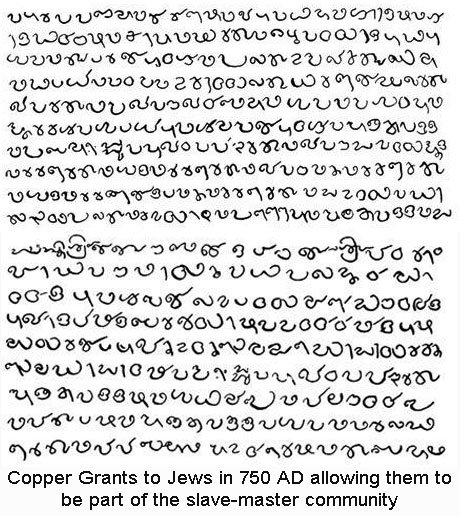 QUOTE: It is doubtful whether after this time (early part of the ninth century A.D.) the Rashtrakuta dynasty had any dealings directly with Kerala. The invaders were probably driven back, as Malayali tradition indeed asserts. END OF QUOTE.
QUOTE: There are three ancient Malayali deeds which have excited much interest, not only because of their antiquity, but because of the interesting fact that by them the ancient kings of Kerala conferred on the Jewish and Christian colonies certain privileges which those colonies, to a certain extent, do still possess. END OF QUOTE.
At the time of writing this book, the words ‘Malayali deeds’ and ‘ancient kings of Kerala’ are more or less the version of history that was being superimposed upon Malabar from the Travancore side. And that side had a wonderful agent right inside Malabar: QUOTE: most erudite of Malayalam scholars, Dr. H. Gundert. END OF QUOTE.
Dr. H. Gundert was so erudite a Malayalam scholar that he simply could not sense that there was a language in Malabar which did not need any artificial creation or the inputs from Sanskrit and Tamil. Indeed it is possible that the ancient script of the Malabari language was slyly relocated to Central Travancore with the help of people like him. Otherwise, the Malayalam script must have been created by the Central Travancore Converted Christians, which seems more impossible.
QUOTE: Chera, or to use its better known Canarese equivalent Kerala, was at this time (end of seventh to first quarter of ninth century) a petty empire extending in a southerly direction at least as far as Quilon, and in a northerly direction at least as far as Calicut. END OF QUOTE.
It is an interesting contention that the word Chera was mentioned as Kerala by the Canarese. Could it be true?
And the next item is more perplexing. That the Canarese had no geographical connection with Kerala. For, this Chera kingdom is mentioned as from Calicut to Quilon. That means, it did not include north Malabar.
The wider issue with all these minute histories is that there is practically nothing worth studying in these histories, other than periodic battles and takeovers, and the names of a number of minute rulers. There is no instance of any real administrative set ups, or welfare or education or infrastructural developments mentioned. Similar histories in millions would come out when technology makes a breakthrough and human beings become able to communicate with ants.
For instance, see what all things are coming out of Chinese history nowadays. Some thirty years back, China was like an unknown land. Now that it is connected to native-English nations, (Hong Kong was handed over to China in a bout of absolute idiotism by England, for one), hundreds of minutes information are coming out. Just like in the case of the ants, I just mentioned. If BPO work can then be assigned to ants, they will for sure take away a huge percentage of human wealth.
QUOTE: These three names are, so far as investigations have yet proceeded, the only really authentic names known of the kings or Perumals of ancient Chera or Kerala. And the last named of them is probably identical with the Cheraman Perumal (a title meaning literally the bigman of the Cheras), whose name is in the mouth of every child on the coast. END OF QUOTE.
It takes a lot of verbal power to mention ‘Chera or Kerala’. However, the individuals who conspired to doctor the writings in this book were not persons with mean mental capability. They were literally experts in this art.
Then about the claim: ‘whose name is in the mouth of every child on the coast’. Does not this claim seem to be quite insipid?
QUOTE: Under such circumstances it becomes easy to understand how institutions existed unchanged for centuries, and how some of the influential families (continued when necessary by adoptions from allied families) who ruled the nads in the eighth and ninth centimes A.D. still continued to rule them when the British acquired the country in 1792. END OF QUOTE
This assertion actually points to an ignorance. In a feudal language social ambience, people try to connect to family names and verbal titles that connect them to powerful locations. It helps in dominating others in a feudal language communication.
Apart from that, the various incidences in the history as mentioned in this book itself stands as testimony that in each generation and even inside each family, feuds, mutinies, backstabbing, treachery, usurping of power, forming antagonistic groups etc. are the norm than the exception. However, with the arrival of the English rule, all traditional royal families more or less went into oblivion and the rest of the populations came to the fore, in a very slow and steady pace. This pace turned into a rumble only when the location was handed over to Hindi-India.
QUOTE: Lord William Bentinck wrote in 1804 that there was one point in regard to the character of the inhabitants of Malabar, on which all authorities, however diametrically opposed to each other on other points, agreed, and that was with regard to the “independence of mind” of the inhabitants., This “independence of mind” was “generally diffused through the minds of the people. They are described as being extremely sensible of good treatment, and impatient of oppression; to entertain a high respect for courts of judicature, and to be extremely attached to their customs END OF QUOTE.
This so-called independence of mind is not actually an independence of mind as understood in English. It is simply that people who do not fall in line as obsequious followers, display this tendency. Generally when people learn English they fall out of line. That is only one part of them. The other part is that where the language is very feudal to a particular section of the society, those affected persons are seen as quite reliable, honest, dependable and ‘respecting’ towards those who suppress them. To those who do not suppress them, they do not concede ‘respect’. To such persons, they are not reliable, honest, dependable or ‘respecting’.
There is also a more complicated code work in this. I cannot go into that here.
As to Lord William Bentinck mentioning anything, it is quite possible that many similar wordings can be influenced by their subordinates who are natives of this subcontinent. Some of the writings even may be written by these official subordinates of theirs.
QUOTE: The Kerala Brahmans are said to use Malayalam. END OF QUOTE.
What was that? Malabar Brahmans or Travancore Brahmans? How could the Travancore Brahmans have used Malayalam in the days of yore when the native-language therein was Tamil? If it is Malabar Brahmans, then they might be using what can now be called Malabari.
QUOTE: There can be little doubt that it was at this time (first half of the ninth century A.D.) that the Malayalam-speaking races became consolidated within the limits which they occupy down to the present day. At the time mentioned, as these deeds show, Malayalam and Tamil were practically one language, at least in their written form. From that time forward Malayalam and the Malayalam races began to draw apart from Tamil and the races east of the ghats. Shut in by their mountain walls except at the Palghat gap, the Malayalis became in time a distinct race, and, owing to their excellent political constitution, which on the one hand kept them free from the aggressions of their neighbours, and on the other hand maintained steadfastly among themselves the ancient order of things, there is little wonder that they presented through many succeeding centuries the example of a Hindu community of the purest and most characteristic type. END OF QUOTE.
The term ‘Malayalam-speaking races’ is a very cunning insertion. Which more or less strives to erase the existence of Malabari people.
Again, the assertion that ‘Malayalam and Tamil were practically one language’ actually is about Travancore. There is no evidence that the Shamanistic spiritual chanting of north Malabar that moved across the centuries was in Tamil language.
The sentence that ‘they presented through many succeeding centuries the example of a Hindu community of the purest and most characteristic type’ could be utter nonsense. For inside north Malabar, there was the Marumakkathaya Thiyyas who were at loggerheads with the Makkathaya Thiyyas of south Malabar.
Furthermore there was the north Malabar Nayars who could not bear the Nayars of south Malabar.
Then there were the Brahmins and the Ambalavasis above them, who had their own reason to keep the others at definite social distances.
There were the lower castes who came under both the Thiyyas who the Thiyyas could not bear. This much is about Malabar.
About Travancore there would be corresponding items with regard to the populations therein. This much is a standard attitude all over the subcontinent and in all locations which have feudal languages.
QUOTE: Both Pandyans and Cholas apparently struggled for the mastery, and the latter appear to have driven back the Kongus or Gangas and so freed Kerala, END OF QUOTE
So it appears that the Cholas were to appear as a sort of freedom fighters of ‘Kerala’. What all wonderful claims about a nation or state or kingdom that was yet to be created!
QUOTE: an expedition (probably of Kongus or Gangas) from Mysore was driven back when attempting an invasion of Kerala via the Palghat gap. END OF QUOTE.
The idea of the silliness of this ‘Kerala’ word can be understood if the national attitude of renaming historical place names can be seen being done even now.
For instance, in this book, the place names are like this: Calicut, Cannanore, Trivandrum, Cochin, Quilon, Tellicherry, Badagara, Sultan’s Battery, Manantody etc.
If one were to view the insipid India pages on Wikipedia, it would be seen that all these names are fast vanishing. For instance, Logan is seen connected to Thalasherry, and not Tellicherry. In the case of other names, local vernacular names such as Kozhikode, Kannur, Tiruvanandapuram, Kochi, Kollam, Thalasherry, Vadakara, Sulthaan Batheri, Mananthavady etc. are being seen.
There is always the question as to who gave these modern ‘geniuses’ the right to make changes into words and names that have existed for almost a thousand years, and more, in use all over the world?
It is like the trees in the forests of Wynad district in Kerala. Every day, lorry loads of trees are being felled and stolen. Till the place came into the hands of the ‘Indians’, the trees and the forest have survived. The moment the place was in the hands of the ‘Indian geniuses’, the trees and forests have been ‘changed’. Who gave them the right to make these changes on forest lands that have existed for thousands of years is the moot point.
QUOTE: although the Ballalas took Canara which they called Kerala it does not yet appear that they had anything to do with Kerala proper, that is, Malabar. END OF QUOTE.
Look at the issues here: Canara location is mentioned as Kerala. Then the connecting of the word ‘Kerala proper’ with Malabar. As if it is a foregone conclusion that there was a Kerala, and it was Malabar. And if so, what about Travancore?
QUOTE: Somesekhara Nayakha, the thirteenth of this line of Bednur Rajas, pushed his forces across the Malayali frontier END OF QUOTE
What kind of frontier was that, in an age when the new language of Malayalam was yet to be born? Or could it simply mean the other Malayalam, which can now only be mentioned as Malabari?
QUOTE: The European looks to the soil, and nothing but the soil. The Malayali on the contrary looks chiefly to the people located on the soil. END OF QUOTE.
There are evident attempts to mix up the English with Continental Europeans of whom Gundert was one. And the Malayali of Malabar was the Nayar of Malabar. Or it can be the Brahman and the Ambalavasis. Coule the above statement mean that the Nayar of Malabar were egalitarian? For these people are looking at the people.
It is all quite laughable content. If the comparison is between the native-English and the Brahmans and their supervisor castes, the fact is that the latter were terrible oppressors of human beings. Their very language could hammer down a lower caste person. However, there is also the other side to it. If the lower castes are allowed the upper hand, they would hammer down the upper castes.
In this scenario, the above-quoted statement is just a very insidious attempt to cast some kind of halo on a very sinister social system and claim it to be in some ways superior. The statement has no meaning beyond a very limited context.
QUOTE: This essential difference between a Roman dominus and a Malayali janmi was unfortunately not perceived or not, understood at the commencement of the British administration. END OF QUOTE.
What a perfectly cunning idea to insert a Roman link into the discussion. The issue at stake is the entry of a planar-language social system and it taking command of the social system. This was inserting changes in whole social communication. The old system of human suppression was slowly getting erased. There is no need to compare a Roman dominus and a feudal-language-speaking janmi. However, the native-English side did not understand this point. Their official subordinates were quite cunning. They misrepresent almost all the items which they were asked to explain.
The basic idea that the administration was run by native-English speakers does not seem to have entered the thick skull of the cunning person who wrote the above quote. It was not a Roman colony that was being built.
QUOTE: First, as to the Malayali mode of determining, or rather of stating, the extent of grain-crop lands END OF QUOTE.
The word Malayali and the impression that there was some great system of determining the grain-crop lands. It is most possible that in the centuries of continual strife no great system was evolved other than the quite easy item of keeping a great part of the population as slaves.
QUOTE: It is suggested in the text that Keralam was at this time more or less under the Western Chalukya kings END OF QUOTE.
The word ‘Keralam’ has thus been used everywhere, without any trace of this kingdom Keralam in existence. However, the desperation to promote a ‘Keralam’ is felt all throughout.
QUOTE: In the year that runs for the Kolavalan (or Keralavalan ?) END OF QUOTE
There is haste to connect anything to Kerala.
See these three QUOTEs:
In Malayalam the tree = pilavu ; its fruit == chakka, whence Jack.
after it has been dug by the mamutty or spade
( == custody, protection) and Sanskrit phalam (? Dravidian palam). END OF QUOTES.
Pilavu is the Malabari words for Jacktree. The Malayalam word is Plavu. It is possible that Malayalam picked up this word from Malabari, or some other language and made a change in it. Or vice versa.
Mamutty might be the Mannuvetty മണ്ണുവെട്ടി in Malayalam. In Malabari, it is generally Padanna പടന്ന and Kaikkottu കൈക്കോട്ട്.
QUOTE: There is still extant a poem entitled the Payyannur Pattola, described by Doctor Gundert as "certainly the oldest specimen of Malayalam composition which I have seen” END OF QUOTE.
Since Gundert cannot be a disinterested person in promoting Malayalam, it is good to consider this information from this perspective.
For it is QUOTE: replete with obscure terms free from any anachronisms END OF QUOTE
Obscure from the perspective of Travancore Malayalam.
And there is this also: QUOTE: The son grows up and is instructed by his father in all the arts of trade and shipbuilding (given in interesting detail, full of obsolete words) END OF QUOTE.
Obsolete words from the Travancore Malayalam perspective, possibly. Even now, many Malabari words are totally incomprehensible in Travancore Malayalam. Even though, vested interests might try to use the term ‘dialect’ to explain away this, the fact is that if the word ‘dialect’ is justifiable, then Tamil can be claimed as a lower quality dialect of Travancore Malayalam. However, that might not be the exact truth.
I am posting here a few quotes from this book, Malabar. It is about the various locations where un-deciphered language / scripts had been located. It may be mentioned that nothing of an extremely grand quality is seen mentioned. Almost all are of very low technological standards from a physical point of view.
Beyond that, the items mentioned here as un-deciphered or un-understood in this book might have changed from that definition over the years. However, the rough idea here is to insert a thought that the history of this location is not so simple as mentioned in Keralolpathi. What is complicated is Keralolpathi itself. As to who wrote it, for what sinister purpose, is an item worthy of intelligent pondering.
QUOTEs:
-
Kunhimangalam - Ramathali narayam Kannur temple - Contains Vatteluttu inscriptions which have not yet been deciphered
-
Kuttiyattur temple - In the gate of the temple is a stone bearing an inscription not as yet read—in characters stated to be unknown
-
Their language is Malayalam, which is usually written in the Arabic character, except in Minicoy where Mahl with a mixture of corrupt Malayalam is spoken.
[My note: There might be more to it. The Malayalam which is mentioned to use Arabic script might be the Malabari language mixed up with Arabic. It is quite curious that the writers of this book are ready to acknowledge the existence of Mahl. However, they act blind to the existence of a language in Malabar which was quite distinct from both the newly created Malayalam of Central Travancore as well as Tamil.]
-
In Edacheri, 5 miles from Badagara, Bhagavati temple called Kaliyampalli temple - There is an inscription on a slab in unknown characters.
-
In Muttungal amsam, Vellikulangara desam, 4 miles north of Badagara, there is a Siva temple. Outside the temple, there is a slab with inscription in an unknown language
-
In Karayad amsam, Tiruvangur desam, 6 miles from Quilandi, there is a Siva temple called Tiruvangur - on a granite rock at the temple there is an inscription in unknown characters
-
Panangod. A ruined and deserted temple, on the eastern wall of the porch of which is an inscription in unknown characters.
-
Ponmeri. In the Siva temple is an ancient inscription on a broken slab in unknown characters.
-
There is a temple said to exist in the Brahmagiri mountains. There are some old copper plate grants in this temple in the Vatteluthu (വട്ടെഴുത്തു) character which have not yet been deciphered.
-
At Putati is a temple known as Arimula Ayyappan temple, on the east wall of the mandapam of which is an inscription, dated K.A. 922 (A.D. 1746), in a mixture of four languages.
-
On the hill known as Nalapat chala kunnu is a stone having an inscription in old Tamil on two sides. It has not yet been read.
-
In Nagaram amsam, in Machchinde mosque, is a slab let into the wall, having an inscription in Arabic, Canarese and an unknown language.
-
Two miles above the Mammalli ferry on the Ernad or south bank of the river lies Chattamparamba. There are many tombs here. The pottery, which is found in abundance in these tombs, is of a very varied character and quite different to anything manufactured in recent times.
-
Walluvanad: The language spoken is Malayalam, except in the case of foreigners. In the Attappadi valley, however, the inhabitants, who are quite ignorant and without any education, speak a form, of Canarese.
[My note: Which Malayalam? Malabari or the newly created Malayalam from Central Travancore?]
-
Pudiyangadi jamath mosque at Tanur: A granite slab on one of the steps of the northern gate bears an inscription. The writing has not yet been read.
-
Deed no. 27 (AD. 1723) -The original is in Vatteluttu character. The copy from which this translation was made was obtained from Kilepatt Teyyan Menon of Walluvanad Taluk, Malabar.
-
Edappal: In front of the temple there are some granite sculptures and also a slab of the same material bearing an inscription in Vattezuthu characters, some of which having now become indistinct, the writing has not been deciphered.
-
Kodakkal: The Triprangod temple - The raised stone foundation of a pillar of the building consecrated to Krishna here bears a long inscription. The writing cannot be deciphered locally.
It may be mentioned that the Keralolpathi might be a fake history book written with some much focused ulterior aims. That of creating a false history, which promotes a ‘Kerala’ image in the minds of the peoples in Travancore and Malabar.
There are other things that come to the mind. One is the fact that there were actually two different astrology versions. One for Malabar and the other for Travancore. Then there is the issue of the KollaVarsham calendars. The name of the Calendar is seen attributed to the Quilon Kollam (south of Travancore) by some. However, it could very well have been connected to the Kollam, north of Calicut. Beyond all this, there is another anomaly. The Kollavarsham calendar year commences from the first of Chingam in the Travancore version. In the Malabar version, it commences from the first of Kanni.
The effect of the imposition of ‘Kerala’ on Malabar had been so effective, that the Malabar Calendar has been pushed into oblivion.
As to the astrological calendar, it would only be intelligent to understand that the signs of the zodiac are actually all mere translation version of some global astrological repository. The names of the Zodiac as seen in both the Malabari as well as the Travancore versions might be the same. It would be interesting to know what is the year-commencing months in the Canara and Tamil astrological systems.
Whether the Keralolpathi does give any explanations for this commencing month dichotomy, between the Malabar Calendar and the Travancore Calendar, is not known to me.
I have not read the Keralolpathi, even though I do have a pdf version with me. I have not had the time to go through it. However, from the general comments I have seen about it, it would not surprise me if it is found that it is the handiwork of the converted to Christian groups. Most probably managed by some Church authorities. Gundert himself might be a collaborator. After all, his aim was to enrich and promote the newly-created language of Malayalam of Travancore. And it would have been a very satisfying event for him to see that the newly converted to Christians from Travancore at last got their richly deserved private lands; after so many centuries of terror, starvation and enslavement under the higher castes of Travancore. They who had been treated as cattle ultimately came to posses land.
However, only the gods can save those they suppressed under them! After all, in a feudal language system, everyone tries to suppress others.
As is evident from what came forth from this book, it may safely be mentioned that this book, Malabar, did not augur good for Malabar. It was indeed this very book that might have been used for the ultimate destruction and demise of Malabar. William Logan was at best quite gullible and also a bit egoistic. For, he has not anywhere categorically mentioned the amount of inputs others had inserted into the book, for which he has taken the credit. However, there is one location where he had great misgiving about the contents. But then, he stops short of admitting the reality, and tries to hide behind another statement:
QUOTE: These views are not to be taken as an authoritative exposition of this most difficult subject, which requires further study and a more detailed elucidation than the author has been able to give to it. END OF QUOTE.
The contents in that chapter are quite obviously belittling the English endeavours. There are statements which categorically mention that the ‘ancient systems of the Malayalis’ were better than what the English administration bestowed.
QUOTE: Mahe was at first a place of considerable importance and trade, but after wards, having fallen so frequently into the hands of the English, the settlement and its trade suffered ; END OF QUOTE
This is a nonsensical writing. Falling into the English hands was much better than falling into the hands of any of the other contenders for power, both native as well as outsiders. It is stated that the town was burnt and the fortification razed to the ground. Actually, this kind of understatements that give a totally anti-English mood is there in this book. It is not a book which William Logan seems to have had much control on. It might be true to say that he was literally taken for a ride by his native officials, who inserted their own insidious agenda into the book.
Superstitions
As a book on Malabar, there should be some information on the superstitions and belief systems of Malabar. Moreover, there should be some information on the widely practised Shamanistic spiritual worship systems in vogue. However, only very little is mentioned on these lines. It again points to the stranglehold the Nayar caste officials had on this book. There seems to be an aims to simply avoid items in which they had not much leadership on.
The evil-eye is mentioned, off course. The wider side of this phenomenon is that it might not be a simple superstition at all. For, the evil-eye can actually be a fact. For, the language is feudal. There is either dichotomy or trichotomy in the verbal codes. These verbal codes do act and react with the codes of reality in manners which are quite different from how the English verbal codes act with it. For more information on this, the reader is requested to check this book: Software codes of mantra, tantra, witchcraft, black magic, evil eye, evil tongue &c.
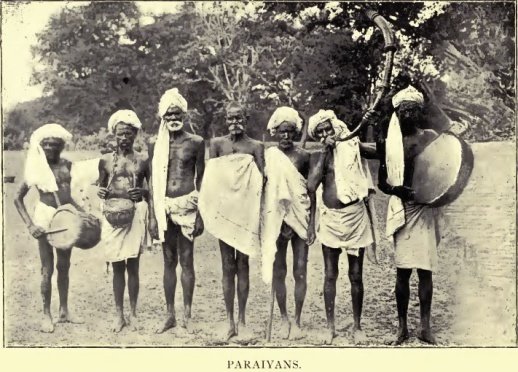 Talking about superstitions of Malabar, there was a very striking wizardry ritual in practise in the land. It is the phenomenon of Odiyan.
I am quoting from Edgar Thurston’s
Omens and Superstitions of Southern India.
QUOTE:
A detailed account of the odi cult, from which the following information was obtained, is given by Mr Anantha Krishna Iyer. The disciple is taught how to procure pilla thilum (foetus oil) from the six or seven months foetus of a young woman in her first pregnancy.
He (the Paraiyan magician) sets out at midnight from his hut to the house of the woman he has selected, round which he walks several times, shaking a cocoanut containing gurasi (a compound of water, lime, and turmeric), and muttering some mantrams to invoke the aid of his deity. He also draws a yantram (cabalistic figure) on the earth, taking special care to observe the omens as he starts. Should they be unfavourable, he puts it off for a more favourable opportunity.
By the potency of his cult, the woman is made to come out. Even if the door of the room in which she might sleep be under lock and key, she would knock her head against it until she found her way out. She thus comes out, and yields herself to the influence of the magician, who leads her to a retired spot either in the compound (grounds), or elsewhere in the neighbourhood, strips her naked, and tells her to lie fiat. She does so, and a chora kindi (gourd, Lagenaria) is placed close to the uterus. The foetus comes out in a moment. A few leaves of some plant are applied, and the uterus contracts.
Sometimes the womb is filled with rubbish, and the woman instantly dies. Care is taken that the foetus does not touch the ground, lest the purpose be defeated, and the efficacy of the medicine completely lost. It is cut into pieces, dried, and afterwards exposed to the smoke above a fireplace. It is then placed in a vessel provided with a hole or two, below which there is another vessel. The two together are placed in a larger vessel filled with water, and heated over a bright fire. The heat must be so intense as to affect the foetus, from which a kind of liquid drops, and collects in the second vessel in an hour and a half.
The magician then takes a human skull, and reduces it to a fine powder. This is mixed with a portion of the liquid. A mark is made on the forehead with this mixture, and the oil is rubbed on certain parts of the body, and he drinks some cow-dung water. He then thinks that he can assume the figure of any animal he likes, and successfully achieves the object in view, which is generally to murder or maim a person.
A magic oil, called angola thilum, is extracted from the angola tree (Alangium Lamarckii), which bears a very large number of fruits. One of these is believed to be capable of descending and returning to its position on dark nights. Its possession can be secured by demons, or by an expert watching at the foot of the tree. When it has been secured, the extraction of the oil involves the same operations as those for extracting the pilla thilum, and they must be carried out within seven hours.
END OF QUOTE.
QUOTE from Edgar Thurston’s Omens and Superstitions of Southern India:
"There are," Mr Govinda Nambiar writes, “certain specialists among mantravadis (dealers in magical spells), who are known as Odiyans. Conviction is deep-rooted that they have the power of destroying whomever they please, and that, by means of a powerful bewitching matter called pilla thilum (oil extracted from the body of an infant), they are enabled to transform themselves into any shape or form, or even to vanish into air, as their fancy may suggest.
When an Odiyan is hired to cause the death of a man, he waits during the night at the gate of his intended victim's house, usually in the form of a bullock. If, however, the person is inside the house, the Odiyan assumes the shape of a cat, enters the house, and induces him to come out. He is subsequently knocked down and strangled.
The Odiyan is also credited with the power, by means of certain medicines, of inducing sleeping persons to open the doors, and come out of their houses as somnambulists do. Pregnant women are sometimes induced to come out of their houses in this way, and they are murdered, and the foetus extracted from them. Murder of both sexes by Odiyans was a crime of frequent occurrence before the British occupation of the country." END OF QUOTE.
In the book Malabar, there is this hint that certain lower castes do inspire terror and fear among the higher castes. However, there are two items in this fear. One is directly connected to the feudal verbal codes, which actually have very powerful destructive power.
However, when speaking from the perspective of superstitions, this is what is there in this book, Malabar:
QUOTE: and some individuals of the lower classes have a powerful superstitious influence over the higher castes owing to their supposed efficiency in creating enchantments and spoils and in bringing misfortunes. END OF QUOTE.
Rev. Samuel Mateer also has made similar mention of how certain lower castes use this intimidation tactic to ward off the terrible suppression let loose by the higher castes.
There is this QUOTE: It may be added that the best educated native gentlemen have even yet hardly got over their objections to photography on the ground that their enemies may obtain possession of their photographs, and may by piercing with needles the eyes and other organs, and by powerful incantations, work them serious mischief. END OF QUOTE.
Actually the above quote is very closely connected to witchcraft, voodoo, tantra etc. Do these things really work?
There is the wider issue that such British writers as Edgar Thurston, Samuel Mateer, William Logan etc. have all missed the core element of the local social systems in the subcontinent. This very core element is that the social system is encompassed by feudal languages. These languages do have powers beyond that of mere conveying of ideas and thoughts.
This is where feudal language might have actual powers quite akin to that of voodoo and such. It is another topic altogether. Readers can refer to the book I mentioned.
Misconnecting with English
 There are a number of locations wherein English words are used as seeming translations for local usages.
See these:
-
Of the hero of the original Tachcholi pat—the Robin Hood of North Malabar— many traditions are extant.
[My note: Actually the Tachcholi pat or possibly the Vadakkan pattukal cannot be compared with the native-English stories of Robin Hood. There is a qualitative difference. In fact, no individual or entity in a feudal language social system can be compared with anything in a planar language social system. Both are in totally different frameworks which have no corresponding elements between them.]
-
This designation may be exactly reproduced by the phrase from the *English wedding service in which the mutual contract of the parties is “for better for worse, for richer for poorer.”
[My note: This is another instance of trying to find commonality between two items which cannot be equated to each other.]
-
probably Commissioner of the Perumal
[My note: The use of the word Commissioner to define a subordinate of a semi-barbarian ruler has its problems. The word ‘semi-barbarian’ is taken from Travancore State Manual, in which V Nagam Aiya has very categorically mentioned the peoples and cultures of the subcontinent pervious to the advent of the English rule as ‘semi-barbarian’.]
-
his officers and ministers
[My note: The use of the word ‘officer’ to define any official in the ancient and medieval kingdoms in the subcontinent as an ‘officer’ is just a display of the stark ignorance of what the word ‘officer’ stands for. In English, an officer is a gentleman. An official in the subcontinent and in the three current-day nations formed in the subcontinent, viz. Pakistan, India and Bangladesh, who uses words like Thoo/Nee, USS / Avan / Aval, Eda / Edi etc. to a citizen of the nation cannot be mentioned as an officer and a gentleman. Mentioning them as officer is a stark misuse of the word. From this perspective, the above-mentioned nations do not have any officers at all in their service, other than for the exceptions to prove the rule.]
-
Ordered with the sanction of the Palace-major Vyaraka Devar,
-
either the hereditary military commandant of the Desam
-
Pandarappad, treasury officials
-
he was, in short, chairman.
-
Hydros Kutti who was, it is said, the Commissioner appointed by Hyder Ali
[My note: 5 to 9 are other examples of this misuse of English words.]
-
I have heard well authenticated cases of Englishmen, who have shot three and four cow bison of a day and have left them to rot where they fell.
This is a very curious location. For, the point is that the Englishmen are seen as having acted quite un-English. However, there is a wider explanation to all this, that is rarely noted down.
Imagine a person from the subcontinent going to England and doing the same. Will it be allowed in England? It is most preposterous idea that such an attempt would be allowed or condoned. Off course, there are items over there that can be mentioned to say that in that nation also such things occur. I will not go into those items here. For, it will only confuse the issues.
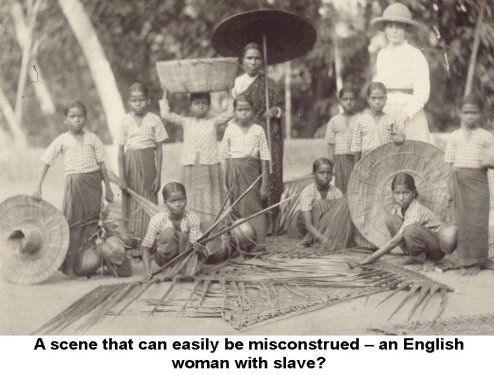
The point is that when a native-Englishman comes to the subcontinent, it is the others here who tell them what to do, what is allowed and how they should act. In almost all these cases, the natives of the subcontinent give advices which are in sync with their own mentality.
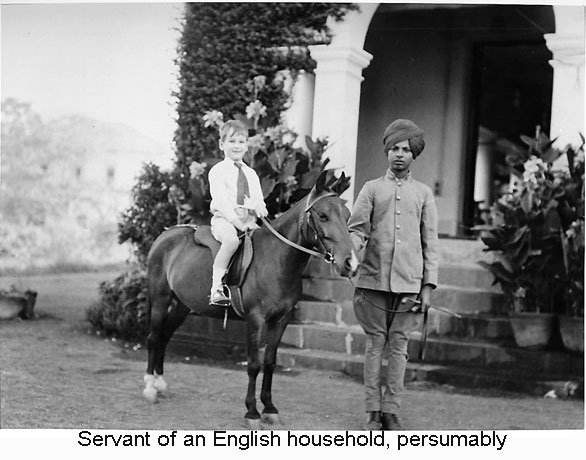 For instance, there are many photos on display nowadays showing white-skinned persons in circumstances which look quite at odds with an English attitude. That of them, standing along with a tiger they had shot. Or them going in a hand-pulled cycle-rickshaw pulled by a very dried-up person. That of well-dressed English men and women in the midst of very poor looking natives of the subcontinent. There are photos of the poor natives of the subcontinent bowing before Englishmen who are sitting on a very comfortable leaning chair, with the legs stretched out.
If a person looks at these pictures and start creating a huge understanding of how the Englishmen and women behaved in the subcontinent based on these images, he or she will be making a grievous mistake.
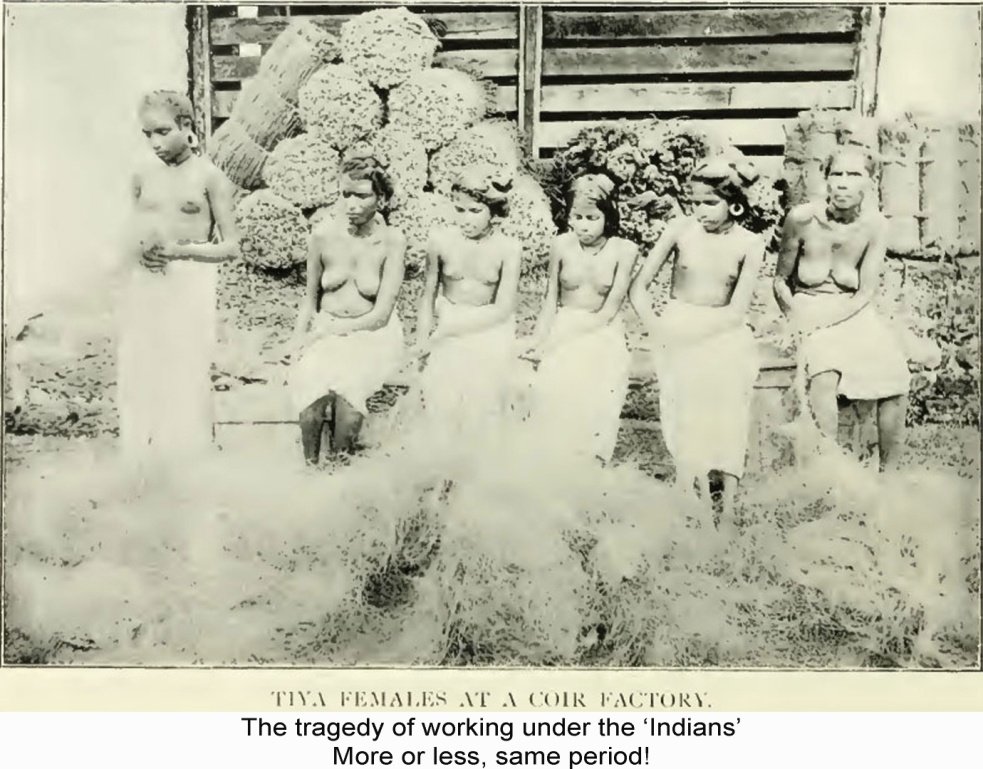
These are pictures that actually picture the actual state of the land, into which the Englishmen and women are mere momentary insertions. I will explain this statement.
One of my parents was an officer of the Madras State Civil Service which had been an immediate continuation of the Madras Presidency Civil Service. All the officers of this service then in the 1950s were quite good in English. My parent worked in the Malabar district. The very noticeable difference that these officers had from the later-day Kerala government ‘officers’, was that they generally communicated to each other in English. As to referring to or talking about a common man, who had come to the office or to the officer’s house with any help request was that, the words in English ‘he / him/ she/ her etc. were used. If the Malabari or Malayalam word had to be used, the word of reference would usually be ‘Ayaal’.
Yet, in the case of a lower stature common man, like a labourer, agricultural labourer, financially low agriculturalist etc., even though they are addressed with a decent word like ‘Ningal’, they invariably bent and bow and show all kinds of obeisance and servitude. Even though at times, they are told not to exhibit these kinds of servile behaviours, it is not possible to do a personality enhancement training upon each person. So, in general, the officers do not take much efforts to tell them to stand straight.
For the social training in subservience is part of the feudal language training that is automatically there in the social system.
Now, look at this picture.
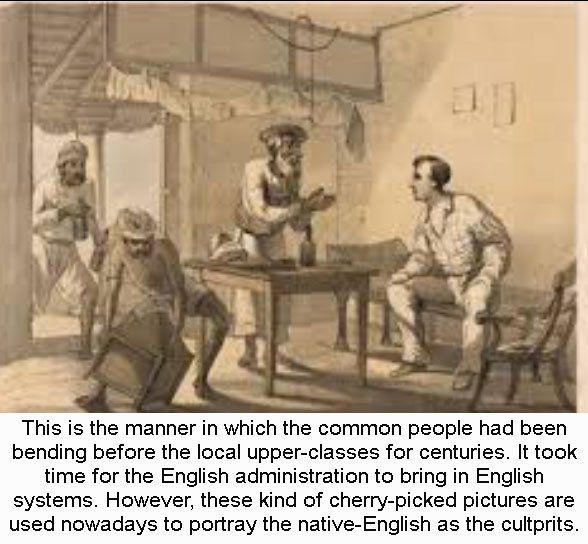
It is quite easy to think that it is the English officials who are oppressing them. Actually the truth would be that these people approach the English officials with the full understanding that they would get help without any strings attached only from them. When they display any kind of worshipful-ness, it is actually their expression of pleading for help, in a terrible social system in which each individual is out to suppress another. That is how feudal languages are designed.
In many contrived history books, one might see refined-looking English colonial residences. And along with them, are shown terribly shoddy residences of the poverty-stricken natives of the subcontinent. These kind of picture combinations are deliberate attempts at misguiding.
For, the subcontinent was full of extremely rich and affluent landlords. Their residences are literally unapproachable for the lower classes and castes of the land. The cunning history textbooks never attempt to showcase the terrible differences between the residences of the native rich and the native poor. Actually the native poor are not actually ‘poor’. They are various levels of slaves.
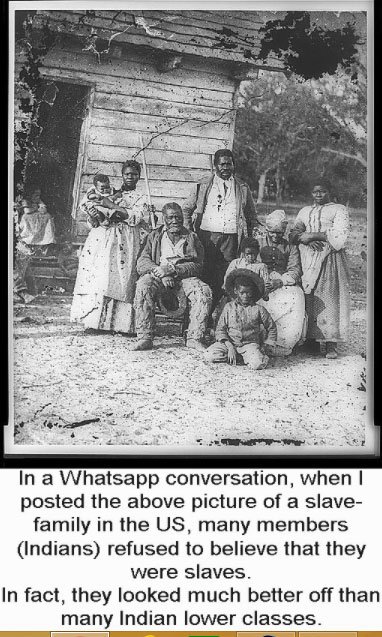
And even the word ‘slave’ would not suffice. For, if the negro slaves of the USA are taken into account, from all perspectives, they are very much higher than the ordinary lower class and lower caste individuals of the subcontinent.
The lower caste / class individuals of the subcontinent are addressed and referred to in the pejorative word level of verbal codes. That is, they are addressed with the lowest You, and referred to with the lowest he/him, she/her. Once a person is thus defined at the bottom end of a hierarchical social ladder, their very sight, touch, seeing etc. become items of acute repulsion and inauspicious.
They are not allowed to sit on a chair or to eat at a table. In all reference to them, a verbal code adjective of ‘despicable dirt’ would get encoded. In fact, if anyone arrives at this level of subordination under a feudal-language speaker from the subcontinent, within a few generations, the individuals would look terribly degraded. (Let the native-English population of England beware, and take appropriate pre-emptive steps to forestall this eventuality!)
However, each level would strive to get someone under them. For, that would provide an upward thrust in social buoyancy.
Apart from all this, when viewing the old colonial pictures, there are certain more information that have to be borne in mind.
One is that inside British-India, everything was perfectly administered as per written codes of law. However, only around half of the subcontinent was British-India. The rest were independent kingdoms. These independent kingdoms stuck close to British-India due to the fabulous connection to England it provided. Most had alliance treaties with the British-Indian government. A British-Indian resident was posted in many of the kingdoms to advice the kings on various items. It was as a sort of a representative of the British-Indian government in a semi-barbarian kingdom.
Yet, the kingdoms were independent. They had their own traditional customs, social systems, officialdom (most of them corrupt to the core), police, judiciary etc. They allowed many things which would not be allowed inside British-India.
In fact, inside British-India, even Christian missionary work was prohibited. Inside Travancore, this was allowed.
Apart from all this, there is this fact also. British-Indian government was an English government. Yet, there were people from Irish, Scottish, Welsh nativity and even Continental Europeans working in the government apart from a huge percent of natives of the subcontinent.
To that extent, the government was not English fully.
To add to this error, all White-skinned persons inside the subcontinent were very easily identified as British. And the British were very cunningly identified as Europeans. However, the fact remains that in most of the big battles fought against the British inside the subcontinent, a major chunk of the soldiery were Continental Europeans. In fact, it might be very easy to mention that most of the ‘freedom fights’ inside the subcontinent against the British rule, were fought by Continental Europeans. Not only in the Battle of Plassey, but even in the fights by the Mysorean rulers Hyder Ali and Sultan Tippu, there were a lot of Continental Europeans.
Why these Continental European ‘freedom fighters’ are not mentioned or celebrated inside Pakistan and India is a very funny query, that can be asked. For they antedate most of the current-day mentioned ‘great freedom fighters of India’. If this point looks quite odd, then it might be mentioned that most of the so-called ‘freedom-fighters’ were not from British-India. Hyder Ali was from Morocco. So naturally his son Tippu was also not Indian or British-Indian. Gandhi was not from British-India. Travancoreans cannot be mentioned as freedom fighters, against the British-rule. For, their kingdom was not ruled by the British.
Arab supporter Mappillas of Malabar were not fighting for the ‘freedom of India’. Their actual loyalty was to the king of Egypt.
See this QUOTE about how Hyder Ali made use of the European regiment which fought on his side :
QUOTE: The Europeans inspired the Malabars with a new terror by this exploit ; and Hyder, to increase it, spread a report that he expected many thousand men from Europe ; he added that they were a cruel people and devourers of human flesh, and that his intention was to deliver all the coast to their outrages. The rage and fury by which his small handful of French were urged on to revenge their murdered countrymen gave much force to the belief the wretched inhabitants were disposed to afford to his reports. Wherever he turned he found no opponent, nor even any human creature ; every inhabited place was forsaken ; and the poor inhabitants, who fled to the woods and mountains in the most inclement season, had the anguish to behold their houses in flames, their fruit-trees cut down, their cattle destroyed, and their temples burnt. END OF QUOTE
The above is a sample of the ‘great’ ‘Indian freedom fights’.
Many persons from Continental Europe did piggy-back ride on England inside the subcontinent. And the British officials were quite foolish not to pick them out and throw them out of their areas of administration. In fact, Gundert who is celebrated by many academic scholars was a German. He should not have been allowed to be anywhere near to any English administrative systems.
When viewing pictures showing White people in very cantankerous postures, where is the evidence that they are British or English? And if they are British or English, what of the location where the photo was taken? Was it in British-India or in an independent kingdom in the subcontinent? And if they are from British-India, what about the possibility that they were being misguided into such awkward behaviour by their own staff-members from the sub-continent and by other local chiefs?
A very powerful example can be mentioned in making many of them Saabs and Memsaabs. These are feudal ennobling words used in Hindi. It is not something brought from England. I have seen many local rascals use this example to mention that the English were feudal oppressive people. Actually, these words are pressed upon the local people by the local staff members of the English administration. However, when the administration is in such lousy feudal language like Hindi, this is the only way to communicate with a government officials. As of now, the common Indian is a Thoo while the Government official is an Aap. And no one dares to complain!
English administration was pro-English language. Not supportive of any low-class human degrading language like Hindi &c. of the sub-continent.
Feudal language
As I have mentioned a few times earlier, the native-English officials did not understand the trigger-codes inside the local feudal languages. The very concept of feudal languages is very difficult for a native-Englishman to grasp. Actually the whole lot of terrors, repulsions, negativities &c. and such other more obscure items like evil-eye etc. are very intimately connected to the verbal codes inside feudal language. I have already done some writing on this in this book.
The problem that the native-English faced without knowing it, was that even their most loyal and reliable native-of-the-subcontinent subordinate would be having his own mental repulsions and terrors, which could influence what suggestions and information he can provide them. A single word can change a person’s demeanour. This is actually what the native-Englishmen face here.
It is not a change of word from ‘good’ to ‘bad’ or anything like that. It is simply changing a word like ‘You’ from the highest one to the next level down or even to the lowest level. Like changing ‘Saar / Thaangal (highest you) to Ningal (middle level you ) or to Nee (lowest level you).
The native-English would make a deal or a contract or a commitment with someone from the subcontinent. He is found to be reliable and honest. But then, on his way back somewhere, someone uses a different form of He / Him or You / Your etc. The moment this indicant word level changes, he is a different man.
It is simply like this: A man addressed as a Ningal is suddenly addressed as a Nee. He is different person with different mental trigger points. These are things on which the shallow subjects called Psychology and Psychiatry have very little information.
QUOTE taken from elsewhere: Hwen Thsang’s first impressions of the people inhabiting northwest of the subcontinent were recorded as follows, “The people are accustomed to a life of ease and prosperity and they like to sing. However, they are weak-minded and cowardly, and they are given to deceit and treachery. In their relations with each other, there is much trickery and the little courtesy. These people are small in size and unpredictable in their movements. END OF QUOTE.
Actually, the very opposite of these observations would also be true. It depends on the frame on which the person is connected to, his own personal stature relative to others, and the relative stability of the indicant words attached to him.
Now, let me take some quote from this book, Malabar.
QUOTE: It was, in fact, not a village establishment at all, and instead of "bringing the Collector more immediately into contact with the people, it only served to lengthen the chain, already too long, of officials between them. END OF QUOTE.
Establishing an English administration in a feudal language society is a very tough job. It is like this: An ordinary labourer goes into the local revenue office and says to the revenue officer: “Mr. Rajan, Can you please tell me when I can get my tax papers?”
From an English perspective, this statement is quite decent and polite. However, if an ordinary worker were to say these words in the same spirit of personal dignity, either the revenue official will go unconscious or he will go off his rocker.
QUOTE: Sthana Mana avakasam END OF QUOTE (Rights connected to social stature and position).
Actually, there is no right to equal status before the law in the feudal languages of the land. This right to equality before the law is there only in the Constitution of India written in English. When this Constitution of India is translated into the language of India, the Constitution itself is degraded. For everything it professes goes illogical.
How can an Avan /Aval (lowest he / she) be equal to an Adheham /Avar (highest He / Him)? This very simple question cannot be answered by the Constitution, the moment it gets translated into the human-degrading feudal languages of India.
Sthanam means position. Manam means status. Avakasam means rights.
This connects to the Rights or privileges that accrue to one, as per one’s Status connected to one’s Position in society or officialdom.
QUOTE: Each amsam or parish has now besides the Adhikari or man of authority, headman, an accountant or writer styled a Menon (literally, superior man), and two or more Kolkars (club men or peons), END OF QUOTE.
It was actually a misdeed to give powers to these native Adhikaris. They were the repositories of feudal suppression using verbal codes. In fact, in Edgar Thurston’s’ Castes and Tribes of Southern India, it is seen recorded that the lower castes individuals at times did use some kind of abusive words to the higher castes. Then the Adhikaris would come with a few henchmen, drag the accused to a remote hut and have him thrashed soundly. After that he would be tied up for a few days in the hut.
What was the abusive word he must have uttered? Just a lower indicant form of He/ Him or She/Her or You / Your to a higher caste man or addressed him by mere name. Higher caste means technically ‘officialdom’.
[Even now, the Indian officialdom has to be mentioned in the higher ‘respected’ form of word codes. Otherwise he or she is done for. The official cannot be addressed by name in India. The common man can be addressed by mere name and abused by lower level indicant codes. No one sees a crime in this, even though the Constitution of India holds this as a crime of the first order. ]
When the English rule was getting stronger, it is true that the lower castes took it as a sign that they were becoming more free. It was a very dangerous idea. And the English administrators did not really understand what was happening.
QUOTE: Even in modern English some persons of the verb retain archaic fragments of the pronominal signs (e.g. lovest, loveth) ; but in modern Malayalam every trace of these signs has disappeared. END OF QUOTE.
This is the level of utter nonsensical language study that was going on. The Nayars and their higher castes never informed the native-English that there were more deeper things in the local languages than silly grammar rule issues.
QUOTE: The Vedic Brahmans (Nambutiris) were, of and are still it may be added, the last persons in the world to approve of educating the commonalty, for that would have tended to take from themselves the monopoly of learning they so long possessed. END OF QUOTE.
This is a very powerful statement. However, it is not a revelation about the Vedic Brahmans or any other higher castes. This is the general character of all persons who live in feudal languages. It is a well-known item that if the lower-placed populations are allowed to get the knowledge and skills of the higher placed people, the lower-placed populations will improve beyond any level that they can naturally arrive at. Once they reach the top, a vertical flipping will occur in the verbal codes. The Avan will become Adheham. Then this new Adheham will fling the old Adheham down to the dirty ditch where other ‘Avans’ are stuck.
This is the currently seen attitude of the newly financially improved classes of India. They are full of words degrading the English and the British. For, they think that they have arrived at the Adheham levels above their countrymen. They naturally want to try the same verbal trick over the native-English also.
QUOTE: For indigenous Brahmans there are three Sanskrit colleges, two of which — Tirunavayi in Ponnani taluk and Pulayi in Kurumbranad taluk—are in Malabar, and the third is at Trichchur (Tirusivapperur) in the Cochin Native State. END OF QUOTE
The issue of there being such exclusive institutions need not be taken as some kind of apartheid. There are other connected issues. Like the fact that even if the other castes are allowed in, they would not have much interest in the studies from scholastic point of view. They would only study from a very materialistic view of getting some money-earning job from this studies.
Beyond that, there is the issue of lower-caste persons generally being more prone to be demeaning in words, ideas, usages etc. if they are allowed a position of equality. For, there is no way a position of equality can be created in a feudal language society.
This is due to the fact that each person is either on a tower or a hole, in the verbal codes. A person in the hole cannot be placed on top of the tower. For, it is not an issue of a single entity being pushed up. A huge number of individuals, words, strings, and many other heavy web of nets would all be connected to this person. It is a complicated scenario. Please read : An impressionistic history of the South Asian Subcontinent for more information on this.
QUOTE: as usual among Malayalis when a man has risen a bit above his fellows in good or in bad qualities, something of superstitious awe attaches to the place of his dwelling. END OF QUOTE.
It is quite curious that the native-English administrators did not get this information that the higher man is the man who has been conceded the divine-level verbal codes. In Malayalam, even Prophet Muhammad is mentioned as Nabi Thirumeni. Does pristine-Islam allow that?
QUOTE: “The subject of caste divisions among the Hindus is one that would take a lifetime of labour to elucidate. It is a subject on which no two divisions or subdivisions of the people themselves are agreed, and upon which European authorities who have paid any attention to it differ hopelessly. The operation of the caste system is to isolate completely the members of each caste or sub-caste ; and whatever a native may know of his own peculiar branch, he is, as a rule, grossly ignorant of the habits and customs, or the origin, of those outside the pale of his own section of the community.” END OF QUOTE
The observations are great and very profound. However, the machinery that works this human repulsion was not understood. The explanation can be seen in the feudal language codes.
QUOTE: “The later Aryan colonists evidently saw that if they were to preserve their individuality and supremacy, they must draw a hard-and-fast line between themselves, the earlier and partly degenerated Aryans, and the brown and black races of the country, and hence probably we get a natural explanation of the origin of caste.” END OF QUOTE.
Though the above contention does have the feel of profundity, it is actually nonsense. The caste system is actually the solidification of social layers created by the repulsions and attractions created by feudal language codes.
QUOTE: Jati itself, like all other Malayalam words beginning with “j”, is a foreign word and expresses a foreign and not a Dravidian idea. The root of the word is the Sanskrit “jan” and it simply means “ birth.” END OF QUOTE.
May be this is a curious observation about Malayalam words that begin with ‘j’. After all Travancore Malayalam was created using Sanskrit words in abundance. However, the other part that connects the creation of caste with the entry Sanskrit can be nonsense. Caste-based layer formation is encoded in almost all the feudal languages of the subcontinent. Sanskrit is a feudal language. These codes will be there. However, Tamil is also a feudal language.
May be if one were to check Japan, one might be able to find some kind of caste system there also. If the language is feudal, then mutually repulsive and highly demarked social layers will form automatically.
Speaking about the feudal content in Tamil, the Tamil cultural leader Periyar E V Ramaswamy, on one occasion, referred to the Tamil people as barbarians and the Tamil language as "language of barbarians". Now, these defining words could be due to the terrific codes of human degradation and suppression in the Tamil language. However, if Tamil is barbarian, the next contention is that Sanskrit is also equally barbarian.
If Sanskrit is beautiful, Tamil is also beautiful. However, beauty is not the issue here. What is being focused upon is what these languages do to the social system and the people therein.
These languages splinter up the social system into a vertical array of populations. Each one of the layers would try to keep the lower castes at a lower distance, and would look upon all their endeavours to improve, with terror.
QUOTE: And first it may be noticed that the Malayalis distinguished two kinds of pollutions, viz,., by people whose very approach within certain defined distances causes atmospheric pollution to those of the higher castes, and by people who only pollute by actual contact. END OF QUOTE
There is more to this information. Actually in feudal language social systems, there is no need even to approach or touch. A simple calling by name of a higher person by a lower person is enough to finish off the higher person.
A simple mention of an IPS (Indian Police Service –royalty of the police administration in India) female officer by an Indian police constable (in Indian languages, they are known as police shipai) as an Aval, can literally erase a lot many superior features in the IPS female. If she comes to know of this, she could go homicidal if she is mentally fit.
QUOTE: But it must be remembered that of individual freedom there was very little as every person from his cradle to his grave was hemmed in by unyielding chains of customary observance. END OF QUOTE.
These customary observances are encoded in the verbal codes inside the feudal languages.
QUOTE: The people must have been a very law-abiding and docile race if such simple formalities sufficed to govern them END OF QUOTE.
This is again some crank nonsense by some native-writer. The people in the subcontinent are neither law-abiding or docile. The historical events mentioned in this very book stands testimony for that. However, there are terrific command codes and routes of communication encoded in the languages. Only the most impertinent person would dare to disobey them.
For instance, there is an IAS officer’s cabin, with a notice No Entry. No sane ordinary man would dare to disobey this restriction. For, the IAS is part of a huge structure of human hierarchies. It is foolish to think that a simple No Entry is the exact code that works. There are more powerful ones in the background.
QUOTE: But indeed custom, when once it has become law, arrays the whole community in arms against the law-breaker, and is perhaps the safest form of law for a semi-civilised State. END OF QUOTE.
These are all writings by or influenced by the native-man of the subcontinent. There is first of all no written law before the advent of the English rule. As to custom, well, it is true that a single wrong indicant word by a lower class man can ignite the wrath of the higher castes. They will literally beat him into a pulp, even if he is claims to be a great Swami or Guru of the lower castes. Unless there the English rule is there to protect that man.
QUOTE: Accordingly, when Da Gama sent Nicholas Coelho on shore with a message to the Zamorin asking him to sanction trade, the authorities tried his temper by making him wait, thinking this to cause a break with the Portuguese; but being warned by a Castilian whom they found in the place, he exercised patience. END OF QUOTE.
Actually this is a very visible character of human behaviour in a feudal language set-up. It off course, depends on many factors. This is also a typical character displayed by the Indian officialdom. However, this mental character is not limited to the officials. Almost all persons who think and speak in feudal languages in the subcontinent do display this feature. That of delaying things to impose a feel of power and majestic demeanour. The other side or individual is literally made to suffer the delay and thus forced to plead.
QUOTE: On 15th March, one Kunhi Ahamad, a nephew of the pirate chief of Kottakal, who was generally known as “Cota Marcar,” was captured with a boat’s crew of his men by the English boats employed in stopping the exportation of pepper from Cannanore to Calicut. It did not appear that he was piratically engaged at the time, so he resented the treatment and taking opium, ran amuck. END OF QUOTE.
Here the English officials may not have actually understood what really happened. The crew of the English boats involved in patrolling against pepper smuggling, would most probably be the Nayars. There would be a slight possibility of them being Thiyyas labour class also. Either of them, when they get someone in their custody would very naturally use the Inhi (Nee) word (lowest You). The other side leader would find it quite an uneasy and unsettling scenario. Actually anyone with some prominence would go berserk if questioned with the Nee word and referred to with an Oan (lowest he / him in Malabari).
Even though the terrific contents of this issue is there even now, the native-English have no information on this. When some native-English youngster goes berserk on being subjected to such verbal codes, instead of investigating the exact signal that created the terror, the native-English youngster is send to jail. The other side which actually placed the bomb is let loose to place more explosive on the native-English soil.
QUOTE: but from an official neglect to send the order to a picquet of 150 men stationed at, the extraordinary distance of three miles, five hours were lost END OF QUOTE.
This is about a major error that entered into Sultan Tipu’s strategy. In many ways, these kinds of errors will be enacted in plenty on the side of any feudal language army. For, minute instructions will not move to the right point in time. Everywhere there is the incessant checking for verbal and physical ‘respect’. If an individual on the route of the passage of this information is not of the right lower or higher stature, there will be slowing down or total block of flow information. This is one of the reasons why the native-English side always won the last battle in every war.
Even the Scots or the Irish or the Welsh side will not be error free. In fact, in all these feudal language speaking sides, there will be an accumulation of errors.
QUOTE: Warren Hastings pertinently remarked that the proper place for the plenipotentiaries to have arranged terms with Tippu would have been at the head of Colonel Fullarton’s force instead of which they went as suppliants to Tippu’s camp at Mangalore. END OF QUOTE.
There is an astronomically huge content in the above quote. In feudal language social systems, it is very dangerous to go to the other side for conversation or fixing an agreement etc. For, the other side will have the verbal advantage.
Moreover, there is something more. Extremely affable hospitality is used to lure the other side to come and see this side’s prowess. The visiting side is made to get extremely impressed.
This is the way the French side fooled George Washington to become a traitor to his country and his king. But then this George Washington was a silly person, with a lot of personal animosities and ambitions. A dullard at best.
There is another similar fooling I can remember. It happened when the Japan surrendered to the US forces. It was a very sound action for the Japanese. If they had surrendered to the Russians, there would have been mass molestation and mass slaughter of people in Japan. However, when the surrender was to the US, it was managed very cunningly.
Usually feudal language nations like China, Japan, Russia, Germany, Spain, Sri Lanka, India, Pakistan, Bangladesh, Burma etc. would care nothing about the enemy’s stature. They would be treated like dirt.
If it was any of the feudal language nations capturing Japan, the Japanese royal family would have been molested first and foremost. Then they would have been tied up and displayed like some animals, if they are allowed to live.
However, in the case of the US, it did not do anything like that. US officials simply went to Japan and were offered the best of the royal hospitality of the Japanese Royal family. The US officials would be exposed to the very powerful ‘respect’ code hierarchy there. It would impress them.
And they were impressed just like the fool Washington. The whole of the US economy was literally handed over to Japan to nibble away at ease. And even now, no one in the US is aware of this grand cunning.
QUOTE: Tippu had, unfortunately for himself, by his insolent letters to the Nizam in 1784 after the conclusion of peace with the English at Mangalore, shown that he contemplated the early subjugation of the Nizam himself. END OF QUOTE.
If a native-Englishman were to read the above lines, he would not understand its contents. The word ‘insolent’ would not make much of an exact sense to him. Actually the whole history of the subcontinent is contained in this word and a few others.
It is the matter of addressing. You could be Aap in Hindi or Thoo. It can be Ingal in Malabari or Inhi. It can be Thaangal in Malayalam or Nee.
The word-form which is selected declares a lot of other things, like who is the superior and who is the inferior. The real terror is in the subordinates of the addressed king being keenly interested in the word used. For, as per this word, their loyalty can also shift.
Do any of the formal histories mention these things? Actually even the minute event called the Opium War between the foolish Chinese king and a few English trading ships was ignited by this issue. I think I have very clearly explained this issue in my book: SHROUDED SATANISM in FEUDAL LANGUAGES!
QUOTE: On July 23rd Major Petrie, under orders from Colonel Robert Bowles, commanding the troops in Malabar, marched from Calicut to the Dutch frontier with a small force of infantry to obtain a peaceable surrender of the Dutch settlement. But the Governor refused to give up the place, and Major Petrie had then to wait till a siege train could be brought up. The Supervisor (Mr. Stevens) proceeded in person to Cochin in the beginning of September to endeavour to arrange matters with Mr. Vanspall, and a conference ensued, at which it was agreed that the surrender should take place. But next day the Governor changed his mind and the negotiations were suspended. END OF QUOTE
It is about a very curious situation. The Dutch government gives an order to give up the Dutch fort to the English. But the Dutch governor in Cochin refuses to do so. Why?
The Dutch governor presumably can understand the local language. It is an extreme defect. He will know that the moment he relinquishes his leadership, the word ‘He’ in the local language would shift from Adheham to Ayaal and even to Avan, if there are no appropriate props to hold it up. It is a terror. For when the word-code changes, everything changes, everywhere. He would not budge, unless terrorised by something of more gravity.
QUOTE: The reason assigned by the criminal for attacking the inspector was that his wife’s gingelly-oil crop had been over- assessed. END OF QUOTE.
Not really. The ‘inspector’ is the actual criminal. He is having official power and is a native-man of the place. The moment a bit of power is given to a native-man here, his first endeavour would be to address anyone who he can terrorise or torment with the Inhi / Nee word. Even in front of others, including wife and children, he would do it. Only an insane man would remain unconcerned. Sane men would go berserk if they are of refinement and dignity. Check what Adam Purinton did in the USA.
QUOTE: Mr. Thomas Lumsden Strange, a Judge of the Sadar Adalat, “whose former long service in Malabar and intimate acquaintance with the people and their peculiar habits and feelings eminently qualify him for the task, while his employment in a different sphere of late years saves him from the influence of any prejudice or bias,” was accordingly selected “to be Special Commissioner for enquiring into the Mappilla disturbances, their causes and remedies.” END OF QUOTE.
The actual fact is that this Mr. Strange has not even an iota of clue on the hidden verbal codes which get erased when translated into English. It is not surprising that most of his assertions were half-baked. He did not understand anything.
QUOTE: but fourteen for whom any personal cause of provocation was discoverable. In seven instances land has afforded the presumed ground of quarrel,” and in the other seven cases the provocatives “were mostly of an equally unreal nature.” END OF QUOTE
The solid fact is that this Mr. Strange did not get even the smallest idea of what the provocations were. All his profound ‘discoveries’ were totally bereft of information on the exact verbal codes that triggered the terrible anger. The verbal codes would be just a very minute inappropriate or unacceptable indicant level form for words like You, Your, Yours, He, His, Him, She, Her, Hers &c. These tiny sounds are connected to a huge content of other verbal codes which more or less design the social structure and routes and valves of communication.
QUOTE: I have given the subject every attention, and am convinced that though instances may and do arise of individual hardship to a tenant, the general character of the dealings of the Hindu landlords towards their tenantry, whether Mappilla or Hindu, is mild, equitable and forbearing. END OF QUOTE.
This is the kind of foolishness that was arrived at. In feudal languages, the suppression is not by rude sounds or terrorising words. It can be delivered by very soft sounds and affectionate tones. A mere Inhi / Nee, and eda /edi is enough to maintain the catching hold. However, no one will have complaints until the English social restructuring arrived. Once a docile subordinate gets to know that in another language system he is not an excrement, things change.
It is like the conversation I had with an ex-Indian soldier. He was a respectable man in his native village, of around 45 years old. He mentioned great things about the Indian army. I simply asked him if he had any occasion to see the British army at close quarters. He said, he had been part of the Indian UN peace-keeping contingent in Sudan in Africa. There had been a British regiment nearby.
I asked him what his impression was about the English Officer-Soldier relationship. He pondered on it for a few moments. Then he face turned terribly contorted. He first said that the English army world was completely different. But within a few more moments, his words became quite bitter. He started using expletives about Indian army officers.
This is the issue. The Indian soldiers are very obedient and disciplined; until they chance to see the English army at close quarters. Then they find that they had been treated at the excrement part of the Indian languages.
These are things which this Mr. Strange had no idea about. No one from his subordinates would inform him all this.
QUOTE: started for the house of a Cheraman (slave caste) lad who had some years previously become a converted to Islam and had subsequently, much to the disgust of the Mappillas of the neighbourhood, reverted to Hinduism END OF QUOTE
This is an incident that has direct links to the feudal language codes. Look at this illustration:
A police constable writes for the Civil Service exam and gets selected for the IPS (India Police Service officer). He is posted far-away from his home state, where everything is different.
He now has a lot of IPS friends. He addresses them with Nee / Thoo etc. (lowest and most intimate level of you).
However, after a couple of years working in the far-off location, he finds that he cannot bear the mental stress anymore. He resigns. And comes home. He appears in an exam for a constable’s job in the local Fire Force. He gets the job.
Now, there is a huge and colossal issue in the language codes. He can address the IPS officers who were his friends with a Nee. For he has build up a friendship with them. However, he is now at the bottom of the hierarchy. Literally a peon-level (Shipai-level) man.
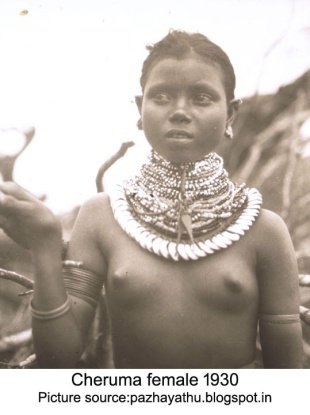 His continued existence becomes a source of sheer mental trauma for the IPS folks who had been his former friends. In fact, if he were to exhibit his companionship in front of others, they would be on the verge of homicide. These are things beyond the ken of a common native-Englishman.
[The reader must note this kind of events do not happen at all. It is like the entry of the English rule. It is not something that would happen in the subcontinent, in a usual circumstance.]
The same is what happened in the case of the Cheruman (very lower castes, diminutive individuals) who converted to Islam. The moment he is a Muslim, he rises up to the top of the social system. For, there is no higher layer in Islam. His companionship now is at that level. However, he does the unthinkable. He goes back to this slave-level. Naturally in the verbal codes, he might continue his fleeting moments of higher status. For instance, standing in his slave level, he might use the word Avan or Aval about the Muslims. It is a case of verbally dragging the others to his stinking level. Actually in the virtual code vision and design vision that exists behind reality, the other persons would be relocated to such stinking depths. It can be felt emotionally.
The real provocation can be seen in this information:
QUOTE: The Mappillas of the neighbourhood had been in the habit of taunting him with his lapse from Islam, and he in his turn had made free use of his tongue in returning their taunts. END OF QUOTE.
May be the slave-cheruman would have said ഇഞ്ഞി പോടാ! It is now a very lower placed person who is making free use of his tongue. This is an issue that cannot be understood in English. It is that, a senior police officer degrading a socially high stature man with a Nee (lowest You) is one thing. It is a totally different proposition if the senior police officer’s menial servant also uses the Nee word to the socially high stature man. The affected man will go totally homicidal, if he has any bit of self-dignity left in him.
QUOTE: Socially the cultivators are subjected (particularly if they are Hindus) to many humiliations and much tyrannical usage by their landlord. END OF QUOTE.
The exact tyrannical humiliations are encoded in the verbal codes.
QUOTE: With settled homesteads and an assured income to all who are thrifty and industrious—and in these respects the Mappillas surpass all other classes—it is certain that fanaticism would die a natural death. END OF QUOTE.
It is a very foolish observation. First of all it is not fanaticism that is provocative. Fanaticism is only the rallying ideology used for accruing inspiration. The provocation is in the language codes. When the provoked side becomes more affluent, they use better strategy to avenge the insults that would be boiling within them.
QUOTE: Without comfort, and with education, discontent would only be increased. END OF QUOTE.
This is a slightly more intelligent observation. In that, simply improving the internal mental stature of a person without a corresponding elevation from the subordination to others, will only induce more hatred. In fact, the degrading verbal codes inside a feudal language are very terrifically repugnant to anyone who improves in mental stature.
QUOTE: The unit of the Hindu social system was the family, not the individual END OF QUOTE.
This is a correct observation made without any profound understanding. However, it is not about a Hindu family. It is about all families which are structured upon feudal languages. All individuals are made to fall in line with a particular regimentation of ‘respect’ focused on certain individuals upwards. Downwards, there are powerful words of degrading positioning. However, if the system is mentally acceptable, then there is no issue. It becomes a string of honouring the persons above and showing affection to those below. To the docile lower-positioned person, it is a cosy location of subordination. However, to a person whose mental stature is higher than his assigned position, it can be position of revolt and mutiny.
It is a complicated scenario. For, in each level of subordination, other persons who are not necessarily inside the regimented hierarchy might try to dominate by degrading verbal codes. This is one of the reasons for the ambience of continual infightings within these families.
Even in the case of the much-mentioned Pazhassiraja, this was the real provocation. He was made subordinate to a henchman of his uncle who was the real king. This is an incident that requires more words to explain. I will do it in the relevant section where this man is discussed.
QUOTE: a time when, looking at the high prices obtained for their produce, the cultivators one would have thought had every reason to be satisfied—there occurred the first of the Mappila outrages reported on by Special Commissioner Strange in 1852. END OF QUOTE.
This was definitely a very erroneous understanding of events as mentioned earlier. The provocation for Mappila outrages against the Nayar and Brahmin sections of the population had more to do with feudal languages, than with any religious issues. The converts to Islam were from the Cheruman caste and such other very low castes and also from Makkathaya Thiyyas. The Brahmins, the Ambalavasis and the Nayars would be used to addressing them as Nee/ Inhi and referring to them as Avan/ Oan and Aval / Oal (all of the lowest indicant word level).
This itself would be a terrible provocation for the Muslims. However, when these Muslims address the other side by mere name, or address them as Avan/ Oan and Aval / Oal, it would have an explosive effect on the higher castes. They will react with vehemence. These two triggers are what set-off the Mappila outrages in south Malabar and to some minor extent in north Malabar.
QUOTE: The men are the laziest, and it was with great difficulty that they were got to do some cooly work during the periodical visits of the officers to the island. END OF QUOTE
This is another terrific information that is misunderstood. In a feudal language social ambience, persons who have some kind of self-respect will not be willing to work under others, in such kinds of work in which they might be addressed in the pejorative forms of words for You, Your, Yours, He, His, Him, She, Her, Hers &c.
However, their wives can be made to work. For, they are used to a lower profile in the verbal codes.
There is absolute lack of information on the wider aspects of this issue. When feudal-language speakers set up businesses inside Great Britain, the native-English people will definitely feel the shudder that lower indicant words evoke. In fact, these words will literally rework and erode all the higher human qualities that the native-English have gathered over the centuries.
There is a specific information on feudal language entrepreneurism that is not known to the native-English side. In almost all feudal language business enterprises, the boss wants someone who can be addressed and referred to in the lower indicant word level, as his subordinate. This is a very crucial bit of information that is not known in England and in all other native-English nations. And it is a very significant issue, which can literally reshape the social landscape of all native-English into terrible levels.
Native-Englishmen and women will display signs of mental trauma and instability if this is allowed to proliferate inside the nation.
QUOTE: The sailor class arrogate to themselves the reputation of being the best malumis (pilots), but this pretension is ridiculed by the other islanders. END OF QUOTE
This is another refection of feudal language social design. Individuals are under stress to promote themselves through some kind of bluff and lies. This is a simple means of improving their vital indicant word status in the society. However, others might be able to see through it.
QUOTE: The generality of the people are poor, all the wealth and influence being confined to a few of Karanavar class who keep the others well under subjection END OF QUOTE
This is the standard social design in all feudal language nations. However, in certain nations like Japan etc., the abundance of wealth that the nation has accrued by a cunning close connection with the US, this poverty might not be visible in the general dressing standards. For all kinds of infrastructural sophistication would be there. Yet, the social divide and suppression will be there, in a non-tangible manner.
As to the conditions in the newly-created nation of India, the above-statement is illustrative of the current-day realities. The officialdom has cornered all the wealth and facilities of the nation. The ordinary man is maintained as a lowly individual. He cannot even address a government official as an equal or with a pose of self-dignity.
QUOTE: The men exact great reverence from the low-caste people whom they address, and are most punctilious in this respect. They in everything endeavour to make it appear in their conduct and conversation that all the excellences are the birthright of the Nambutiris, and that whatever is low and mean is the portion of the lower orders of society END OF QUOTE.
This wonderful observation might be Logan’s own words. However, the wider fact that this is how feudal languages arrange ‘respect’ and loyalty does seem missed. In fact, in feudal languages, the more the lowly-placed individual is oppressed, the more would be his reverence and love to the ‘respected’ higher person. The depth of this observation is not there in this book. For instance, in the location where the outrages of Pazhassiraja, there is a mention of how the lower-class followers of his mentioned his name in deep reverence. The secret of this ‘reverence’ is in the feudal language codes. If the lower-order had been given some ‘respect’ in return, their ‘reverence’ would vanish.
See this QUOTE: I observed a decided interest for the Pyche (Palassi) Rajah, towards whom the inhabitants entertained a regard and respect bordering on veneration, which not even his death can efface. END OF QUOTE.
This is the error that the native-English did in the subcontinent. The more they improved the lower classes and all classes, the more was the loss of ‘reverence’ towards them.
QUOTE: Mr. A. MacGregor. the British Resident in Travancore and Cochin, who had been for several years Collector of Malabar: “First, as to the essential nature of Malabar Mappilla outrages, I am perfectly satisfied that they are agrarian. Fanaticism is merely the instrument through which the terrorism of the landed classes is aimed at.”END OF QUOTE.
It is a terrible foolishness. For, it is already stated that Mappillas were becoming more rich. See this QUOTE: “The land is with the Hindus, the money with the Mappillas," observed3 Mr. Strange END OF QUOTE.
If anyone had mentioned that the error is in the language codes, it is doubtful if anyone would have believed it. For example, in my own very old book March of the Evil Empires; English versus the feudal languages, I have mentioned thus about what would come to happen in the US when feudal languages spread inside it.
QUOTE: Ordinary, peaceful persons would react violently to alien disturbing cultural signals, which are disturbing, and at the same time difficult to understand...............and cause much distress to the individual persons; and can in a matter of time, cause domino effect on many other areas, causing strange happenings of technological failure, inefficiency, conflict, hatred, events that may be described with shallow understanding as racially motivated, decent and peaceful persons acting with unnatural violence etc. END OF QUOTE
Yet, even now, there is no takers for this very profound foretelling.
QUOTE: With settled homesteads and an assured income to all who are thrifty and industrious—and in these respects the Mappillas surpass all other classes—it is certain that fanaticism would die a natural death. END OF QUOTE.
Actually when a lowly-placed person who has been bearing the hammering of the verbal codes for long, slowly improves his social status, a new brooding emotion would start boiling in him. That of seeking vengeance for the long years of brutal verbal assaults he and his family had suffered. These kinds of emotions are not there at all in pristine-English.
Claims to great antiquity
The tone and timbre of this book in various locations is not that of any British man, English or Celtic. In most of the locations, it is the voice of the Nayar population/s in their desperation. It is evidently a very terrible time for them. In that, they do understand the higher quality of the English administration. But have deep misgiving about what is going to happen.
The age-old social structure which had been designed by a feudal language system is going into disarray. However, what is going to take its place is not necessarily a planar-language English social system. The old system will breakdown and allow the total tumbling down of hierarchies. However, the social design will not change into that of England, as designed by a planar language. What will come about would be a levelled-up social structure in which all kinds of hierarchies and lowliness would exists in a hidden form, inside the communication code, with newer persons or groups of persons on top.
This is the total opposite of what was there in England. In England, there were class hierarchies in a statutory form. But still the language codes did not define anyone as a stinking dirt. That is there is no lesser-You than an ordinary-You.
Before going ahead, let me just have a look at the claims of the Nayar folks.
QUOTE: this “Parliament ”.....—-this all powerful influence tending always to the maintenance of customary observances—....... END OF QUOTE
Oh, the great Nayar Parliament which existed from times immemorial! The claims if accepted should re-route all Political Science studies to Malabar in seeking out how democracy was discovered in Malabar, much before Magna Carta was even contemplated upon.
QUOTE: But Mr. Graeme made the great mistake of thinking that the desam and the tara were synonymous, and so in his scheme of amsam establishments, the real civil organisation by the Karanavar or elders of the people was ignored, and in its place authority of various kinds was conferred on some only of the men who had been the local representatives of the ruling chieftains of Malabar. The mistake was of importance because it diverted attention away from, what had been the ancient organisation, and placed the real power in the hands of only one man out of several who had previously acted together in a body in the kuttam or assembly of the tara. END OF QUOTE.
The whole paragraph above is a pack of lies. No group of persons in the subcontinent were or are interested in the welfare of the sections which come under them. In fact the very concept of improving a lower section population means allowing them displace the population or individuals above them. That is the way the language codes are placed. When an Avan (lowest he /him) develops into the level of an Adheham (highest he / him), the Adheham goes down into the level of an Avan. This is the most dangerous information that has been very cunningly secluded from the native-English.
It was only the native-English rule that had no qualms about enhancing the mental and physical quality of the lower populations. However, they were foolish. They frankly did not know what they were doing. As of now, the very population/s which have improved through their intervention have no qualms about mentioning ideas to displace them, even from England.
Off course, it is a land where history is forged. There is this much mentioned opinion about Al Biruni:
QUOTE from elsewhere: Al-Biruni was critical of Indian scribes who he believed carelessly corrupted Indian documents while making copies of older documents. END OF QUOTE.
The word ‘Indian’ itself is some kind of a corruption inserted by some ingenious genius. It would have been more appropriate to mention the exact word which Al Biruni mentioned. And even if the word ‘Indian’ is actually there, it is not about a nation or a country or even of a geopolitical region actually. It is only about a particular population/s, who existed in the midst of a number of populations inside the subcontinent. Brahmins do not represent any other population. In the same way, each caste of people represents only themselves.
QUOTE: Nothing strikes the fancy more strongly in the old Hindu world stories than the picture presented of fighting men killing each other in one field, while the husbandman peacefully tilled the one adjoining, and the Brahman sat silently contemplating creation under a neighbouring sacred tree. Busy each in their own spheres, it mattered very little to them how it fared with others having other and distinct functions. END OF QUOTE.
The words ‘Indian’, ‘India’, Indians’ &c. do not have any meaning, if the above quote is ratified. For, each population is not bothered about others, inside the subcontinent.
QUOTE: On the other hand, of course, the sharing system in a pure Hindu State is well known and exists to the present day, and extends to all classes of the community, no matter how humble or how despised their callings may be. END OF QUOTE.
This is a very cunning statement. There is no sharing of any goodness in the subcontinent or in any other feudal language society. Simply check the state of the people in Travancore. Check Slavery in the Indian Subcontinent (chapter excerpt from Native Life in Travancore by Rev. Samuel Mateer.
QUOTE: “By eating of this rice they all engage to burn themselves on the day the king dies, or is slain, and they punctually fulfil their promise.” END OF QUOTE.
These are claims which cannot withstand any kind of scrutiny. Check the Nayar courage in the various battles. Even in Travancore State Manual, it is mentioned as of dubious quality. It is quite obvious that all these words are not from Logan.
QUOTE: This festival was called the Mamakham or Maha Makham which means literally big sacrifice. It seems to have been originally the occasion for a kuttam or assembly of all Keralam, at which public affairs were discussed and settled. END OF QUOTE.
The above statement is an extremely ridiculous one. The Mamankam is seen described in detail as a very foolish amassing of people to witness some kind of barbarian ritual. Only utterly foolish people would indulge in these kinds of activity in which many people are simply hacked to pieces.
What kind of discussion of public affairs is supposed to take place there? The amassing of such a huge number of people (around 30,000 Nayars, it is claimed) would test the meagre infrastructural facilities at the temple premises. The place would stink due to the issue of low-quality toileting and sanitary facilities. Beyond that there would be huge issues of drinking water and food preparation. Beyond that there would issues connected to accommodation and sleeping. Apart from all this, there would be issue of security of the individual households in the locality and on the routes to this place.
And what about the hundreds of wounded persons?
Armed persons in groups moving through a path is generally considered totally dangerous to the household and females in households. These are known items. And there are locations in this book, Malabar, where such terrors are hinted at. However, it is quite funny that there is no direct mention of these things. The general atmosphere of molesting that happens during a raid or a pillaging party entering a village is mentioned in Travancore State Manual. The dying words of King Rama Rajah, the Dharma Rajah, who died on a believed to be inauspicious day. The barbarianism of wars, all wars is clear in them. Imagine a land that moves one war to another, with regular periodicity.
QUOTE from Travancore State Manual:
“Yes I know that to-day is Chuturdasi, but it is unavoidable considering the sins of war I have committed with Rama Iyan when we both conquered and annexed several petty States to Travancore. Going to hell is unavoidable under the circumstances. I can never forget the horrors to which we have been parties during those wars. How then do you expect me to die on a better day than Chaturdasi? May God forgive me all my sins” END OF QUOTE.
It might be true that all wars are horrible. However, think of the state of living in a land where these kinds of insecurities were frequent events over periodic intervals.
QUOTE: He is also credited with having introduced the study of sciences into the Malayali country, for the Malayali Brahmans were, it is said, ignorant of sciences up to this time. In this, he was assisted by a person styled Udkayatungan, also called the Chetty (foreign merchant), who endowed the teacher of science, Prabhakara Gurukkal, with land sowing 5,000 kalams (bushels) of seed. END OF QUOTE.
The wider problem with this claim is that there are very many information in the Shamanistic spiritual traditions (which the Brahmins abhor) and in the Vedic texts. Both these traditions are not native to Malabar or Travancore or even to the subcontinent. The Vedic scriptures are connected to some geographical locations in the north-central Asia. Whether it is owned by the north-Indian ‘Aaryans’ or by the German ‘Aryans’ is not known to me.
As to the Brahmins of Malabar, Tamilnadu, Canara, Travancore etc., it is quite doubtful if they also have any deep information on what the exact technological ideas are therein. Simply having the ability to chant a mantra does not mean that the chanting population created the technology or understands it’s working. It is simply like someone knowing to use a computer.
As to the bloodlines to the Vedic people, it would be very negligible and slim. If one calculates backwards, every living human being in Malabar or Tamilnadu or Travancore will be connected to literally millions of people who were alive some 7 to 8 thousand years back on this globe. Those people naturally, if they are technically skilled, would be connected to all the ancient populations in Asia, Africa, Continental Europe, South American Continent, North American Continent and even to Great Britain.
As to South Asia having special link to Sanskrit, it is actually very much less than the link this location has to English. In fact, in my own childhood, I do not remember knowing or hearing about anyone who was well-versed in Sanskrit. Naturally there would be such persons, but they were not the common crowd. Simply some scholars or others who strove to learn the language. That does not give them any Sanskrit antiquity.
Now, the claim in the above quote has certain other implications. The land is known for inserting claims into ancient documents. Even the Keralolpathi is very apparently a forgery. So, it is only a matter of time before all modern scientific knowledge would be very quaintly ‘found’ in ancient palm-leaf books! Just imagine a population who could not create a writable paper claiming various scientific skills and information.
However, in this regard there is this much also to be mentioned. Ancient knowledge is actually seen to be a diffused version of some grand knowledge repository. For instance, see the Zodiac sign names in Malabari and Travancore astrology. Both might be using the same names. And these names would in many cases be quite near in meaning to what is used in Western Astrology.
Kanni – Virgo
Thulam – Libra (Common balance is the symbol) etc.
May be if one were to check the astrology of the ancient Mayans also, there might be some similarities. Simply knowing astrology does not mean that it is the ancestor of that person who created the knowledge. These kind of senseless claims are those of total insipid low-quality populations. There is actually a very sensible caricaturing given to this attitude by a famous Malayalam writer, Vaikom Muhammad Basheer. One of his book characters had the name Ettukaali Mammoonhju. He had been featured as placing a claim on everything that he can.
Another thing worth mentioning is that it took a great lot of effort on the part of the English officials of the English East India Company to find out the various ancient textbooks in Sanskrit. They went on noting down books which had been hinted at or mentioned or referred to other ancient books. Most of these books were found out from various nook locations in the subcontinent in some ancient landlord household. In fact, if this endeavour had not been undertaken, the books would have been lost to posterity.
And now the cantankerous claim is that all these books are part of the antiquity of various populations who actually had not even an iota of connection with these.
QUOTE: In the country of Malabar are twelve kings, the greatest of whom has fifty thousand troops at his command ; the least five thousand or thereabouts END OF QUOTE.
Twelve kings in the minute geographical location of Malabar! Well, that itself should show that incessant daily confrontations between these tiny rulers.
And fifty thousand soldiers? Well, these kinds of claims from ancient records of some writers have been collected and prominently mentioned. However in all the wars and battles inside Malabar that the English Company has very carefully recorded, most of the fights had only a few hundred or thousand fighters on each side. Only when Hyder Ali and Sultan Tippu came into the picture did the attacking side seem to have higher number. Even then, they were confronted not by tens of thousands of Nayars! Tens of thousands of Nayars simply fled at the sight of the enemy.
QUOTE: "Just as Cabral was preparing to leave Cochin on 10th January 1501, a fleet belonging to the Zamorin, carrying one thousand five hundred men was descried off the harbour. END OF QUOTE.
See just one thousand five hundred men. Even this figure can be doubted. People tend to exaggerate. It is like this. Many years ago, one man told me, “Some five hundred women are working there.’ This is ‘five hundred’ is a usage to convey the meaning of ‘immense’. In my total naivety, I asked him, ‘Five hundred women?’
He then told me, ‘We simply say thus just to convey the idea that a lot of women are working there. There must be some thirty or thirty five women working there.’
QUOTE: “Now when the season for setting out had arrived, the Emperor of Hindustan appointed one of the junks of the thirteen that were in the port for our voyage. END OF QUOTE
lbn Batuta’s writings are generally very local information more or less what his mind was impressed with. As to an Emperor of Hindustan being there has to be taken with a pinch of salt. It is like the claim of an Emperor of Calicut. As a solitary traveller, his impressions are what he directly saw in a locality, I should presume.
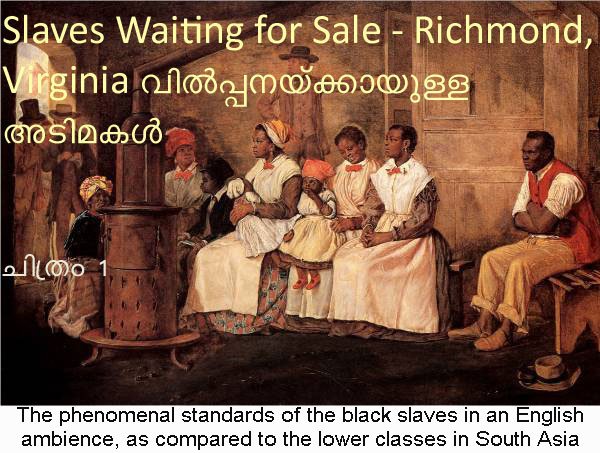 See his words: QUOTE: Every vessel, therefore, is like an independent city. Of such ships as these, Chinese individuals will sometimes have large numbers; and, generally, the Chinese are the richest people in the world END OF QUOTE.
For the above statement to be of any credibility, he must have seen the world. I get a slight feeling from a cursory perusal of his book that he is a just a solitary traveller who made fabulous historical recordings. However, his adjectives should be taken from his background as a solitary traveller, who faced a lot of hardship on most of his journey.
As to the Chinese being the richest in the world, it is only about the rich Chinese man he is referring to. Not to the immensity of Chinese servants who worked for this rich man. Since China is presumably a feudal language nation of a very terrible kind, it is possible that even now, there would be a huge percent of population over then who live like the slaves of south Asia. Not like the Negro slaves of USA, who in those days, more or less, had the looks of the super rich of Asia.
Even lbn Batuta, despite his great wanderings, do not seem to be aware of the terrific issue of feudal languages, as opposed to planar languages. After all, he had never visited England, in spite of all the claims of his having great world knowledge and experience.
QUOTE: The greatest part of the Muhammadan merchants of this place are so wealthy, that one of them can purchase the whole freightage of such vessels as put in here, and fit out others like them. END OF QUOTE.
Even though there is no way to check the veracity of the above statement, it could be true. In feudal language social system, the rich are super-rich and the poor super poor. Apart from that, the statement seems to prove that the trading wares inside each ship were not of such fabulous value. For a single rich man is seen to be able to buy everything in all the ships in port.
QUOTE: “No one becomes king by force of arms,” he observed, and seemed astonished at the fact. END OF QUOTE.
It is all very local information connected to tiny locations and very small bits of time-period. All feudal language nations do have problems with setting up placid conventions, if there is a multitude of population groups. In a homogenous population, feudal languages will arrange all members in a very tight and immovable slots in varying layers.
QUOTE: The Raja exacted tribute from Ceylon, kept a corps of three hundred female archers, and it is said he had not hesitated to challenge to battle the Raja of Vijayanagar. END OF QUOTE.
Even though these female archers might look grand in both Hollywood as well as Bombay Film world films, what their exact demeanour would be depending on the level in the feudal languages codes. And what is the purpose they would serve which a set of male archers could not do is also a moot question.
It is like claiming that a woman can climb coconut trees. What is it that would be proved if this statement is mentioned as some kind of achievement? For, the men-folk who dared to do this endeavour ended up in depleted social status.
Usually in current-day India, females with some personal quality will not go and join as a police constable. An Englishman or woman would not really understand why this is so. It is something to do with the language codes which define not only men and women in any particular profession, but would also define their verbal relationships.
As to his daring to fight the kind of Vijayanagar, it is again a local bluff to impress his own people. In a different location in this book, Malabar, there is a QUOTE thus:
for it is said that the king of Bijanagar has 300 sea-ports, every one of which is equal to Kalikot, and that inland his cities and provinces extend over a journey of three months.”
The question here is how would the bluff be called? Only if the Vijayanagar king marches to Travancore, which he would only do if he is so egoistic and foolish. For Travancore is a small place at a considerable distance. As to Travancore marching to Vijayanagar, it would be a march with no prospects of return. For at that time, the English East India Company was not there to lend support to Travancore.
See this QUOTE: After that its decline was rapid owing to the interference of the Portuguese with the Muhammadan trade, and it has never since then recovered its position, as Cochin, its rival, under Portuguese and Dutch influence, has, with its greater natural facilities, always hitherto had an advantage. END OF QUOTE
Tiny Calicut was propped up by the Egyptian king. When the Egyptian trade was demolished by the Portuguese, Cochin went on to higher levels. However, it is funny that after the arrival of the English, there is no grand historical nonsense such as this one:
QUOTE: the Chinese even came from the far East in their gigantic floating hulks. END OF QUOTE.
May be the Chinese took fright!
These kind of insipid statements will be swallowed hook, line and sinker by many. However, the fact remains that a few shiploads of English sailors could defeat a city army in China, within a matter of a few hours, in what is now known as the Opium War. Technically China was very big compared to miniscule England and also much more powerful. Yet, when it came to human interaction, the Chinese ditched their own side. After all, who would like to be subordinated to feudal-language-speaking barbarians?
QUOTE: ! In the time (literally, year) of Perumal (Cō, king, or Gō) Sthanu Ravi Gupta, who now rules gloriously for many 100,000 years, treading under foot hostile heads, END OF QUOTE.
This is from a Deed connected to Travancore kingdom. Why a Travancore Deed has been mentioned in a book on Malabar has its own answers. I will not move into that. The claim that this king Sthanu Ravi Gupta, now rules gloriously for many 100,000 years is more or less quite evocative of the real standards of the local antiquity.
QUOTE: For, coming fresh from the country east of the ghats, where the ryots had been accustomed for generations to be a down-trodden race, he seems to have mistaken altogether the character of the people with whom he had to deal. END OF QUOTE.
This statement is meant to convey that the people of Madras area (current-day Tamilnadu) are quite docile and meek. It is all half-baked information. The fact is that Tamil is a very feudal language. People who get subordinated generally are made to exist as some kind of docile subservient persons. For, that is the way to manage the social communication issues.
In Malabar, the Nayars have a number of populations under them. So, they are not the subordinated population here. In the language codes, this will be a major factor for deciding various verbal codes in regard to both the populations.
QUOTE: There must have been considerable intercourse between Persia and India, for in the middle of the sixth century a learned Persian —perhaps a Christian—came to India to get a copy of the Panchatantram. END OF QUOTE.
There is a cunning insertion here. It is not an innocent one. A Christian came and collected a great book from ‘India’. Many persons would later on add on to it, and say the Christians, the Jesuits, the Missionaries etc. came and took out ‘our’ great ‘knowledges’ to the West.
The fact might remain that it was the English officials who worked hard to find the lost books of the subcontinent. It is doubtful if the present day populations have any historical link to the ancient books.
Piracy
It is true that there have been pirates who had been Englishmen. It is just that when English ships move to long distances, they come across enterprises that are not English in character. But then, when they become part of that world, they change.
However, an Englishman doing any such thing would be quite noticed and mentioned many times in many locations. In fact, there is a mention of one Englishman running an arrack trading business in the interior location of Madras Presidency, seen mentioned. His name is mentioned. However, there would be many other local people who did the same kind of peddling. But that would not evoke the same level of notice. And, it would be quite unwise to try to define pristine-English native character based on this information.
As to current-day England, the native-English population are living amongst feudal-language speakers. They are like the old good quality Anglo-Indian populations of in various locations in the subcontinent. Their easy affability was misinterpreted by the others, after the departure of the English rule. During the English rule, their easy affability had a sound logic. For, they were displaying a quality of refinement in the midst of a semi-barbarian feudal-language population. However, the moment the English rule departed, their easy affability became the definition of low class softness. Their women folk were quite easy defined with the lower indicant word ‘Oal ഓൾ’ / Aval അവൾ. From this word platform, it is easy to address them as Inhi ഇഞ്ഞി / Nee നീ. Their refinement was mentioned as the affability of sluts.
The same thing is currently happening to the native-English population, and they are not aware of it. That is the grand tragedy. In a spontaneous way to shield themselves, the men folk will become tougher and rude, and the women folk would turn masculine. The traditional grace of the native-English would get wiped out.
Now coming back to the pirates, there is this QUOTE in this book, Malabar.
QUOTE: He then sailed for the West Indies, was arrested in America by one of the noblemen (Lord Bellamont) who had helped to fit him out, was tried, condemned, and hanged in chains at Tilbury (23rd May 1701), and his property becoming forfeit, was presented by Queen Anne to Greenwich Hospital. This severe example did not, however, prevent others from following in his footsteps, END OF QUOTE.
The issue with this kind of quotes is that in modern times, there is a tendency to define England from the deeds of the misanthropes there. These deeds do not define England.
However, when we come to the South Asian Subcontinent, the scenario changes. This is due to the total roughness of the language codes and the rudeness it induces on the people.
QUOTE: Kottakkal.—At the mouth of the Kotta river, was a famous resort for pirates in former days. They made prizes of all vessels not carrying the pass of the Kadattunad Rajah, their sovereign, who was styled the lord of the seas END OF QUOTE.
QUOTE: Then, again; ships which came ashore were annexed by the chieftain of the locality. Moreover, a more piratical custom than this even was observed, in ancient times at least, for thus wrote Marco Polo respecting the kingdom of “Eli” (ante, p. 7) : “And you must know that if any ship enters their estuary and anchors there, having been bound for some other port, they seize her and plunder the cargo. For they say, ‘you were bound for somewhere else, and ‘its God has sent you hither to us, so we have a right to all your goods.’ END OF QUOTE.
These kinds of behaviour are the standard behaviour of the upper classes of the subcontinent. Their lower classes also join them in their spirited endeavour. It is part a display of loyalty, and part a chance to get a share of the booty. Imagine the plight of the women who had travel from Calicut to Tellicherry via sea! Travelling by sea was easier than by land, in those days due to the fact that there were no proper roadways across the huge number of mutually competing ‘rulers’ on the pathways.
QUOTE: And they think it no sin to act thus. And this naughty custom prevails all over these provinces of India, to wit, that if a ship be driven by stress of weather into some other port than that to which it was bound, it is sure to be plundered. But if a ship come bound originally to the place they receive it with all honour and give it due protection.” (Yule’s Marco Polo, II, 374.) END OF QUOTE.
The concept of Sin is not much there in the spirituality of the subcontinent, I think. Even the most pious person who is a government official has no qualms about taking a bribe or extracting a bribe by terrorising a man. Telling lies to a subordinated man or cheating him or breaking a word of honour given to him, is not an item of any special consideration. It is just a plane fact of life.
Only in English would these things seem like dishonourable acts.
QUOTE: The custom of taking ships and cargoes wrecked on the coast continued down to recent times, for the English factors at Tellicherry entered into engagements with three of the country powers for exempting English vessels from such seizure. But it was a custom which the Malayali chieftains broke through with extreme reluctance. The kings of Bednur were the first to grant immunity in 1736- 37, and thrice afterwards ratified it ; then followed the Kolattiri prince, on 8th May 1749, ratified in 1760; and finally the Kadattunad Raja granted similar immunity in 1761. END OF QUOTE.
The English Company was slowly changing the landscape from a semi-barbarian one to a better civil society. However, it took a lot of time. And at the end of it all, an insane idiot in England gave the land back to the same people, to make it semi-barbarian and then totally barbarian.
When speaking about piracy which was done with the total cooperation of the local small-time rulers, there is a wider matter being missed. It was the total helplessness of the common populations, mainly the lower castes. A simple lower-most You, He, She, (ഇഞ്ഞ്, ഓൻ, ഓള്) is enough to erase all rights to dignity, self-respect and right to social stature. For these people, the very movement from one place to another in a secure ambience would have arrived only when the English Company brought down the powers of the lower thugs, who were the higher castes and classes.
But then, if the truth be mentioned, the higher castes also suffered from terrible problems. For the lower castes were not angels. They, if not properly subordinated, were rude and insulting. Their very glance at the higher caste women would be totally profane and degrading, if they do not acknowledge their subservience. The Brahmin women would not budge out of their agraharams (Brahmins’ only villages).
QUOTE: From thence they sail with the wind called Hippalos in forty days to the first commercial station of India named Muziris (ante, p. 78), which is not much to be recommended on account of the neighbouring pirates, who occupy a place called Nitrias nor does it furnish any abundance of merchandise. END OF QUOTE.
What a way to praise a location! India’s first commercial station is unapproachable, due to pirates. And what about the word ‘India’? Could it really be ‘India’ or something like ‘Inder’, ‘Indies’ &c. In the 1950s, when the whole administrative systems founded by the native-English came into the hands of the Indian / Pakistani bureaucrats, they must have felt a huge freedom to do what they wanted with anything in their hands. For, they had no qualms about anything going spoilt. They had got everything free.
QUOTE: He then proceeds to describe the pirates of Melibar and of Gozurat, and their tactics in forming sea cordons with a large number of vessels, each five or six miles apart, communicating news to each other by means of fire or smoke, thereby enabling all the corsairs to concentrate on the point where a prize was to be found. END OF QUOTE.
What a wonderful leadership and purposefulness! Maybe some Indian professor in some US University would be able to prove that it was actually these ‘Indian’ pirates who had discovered Morse code and other Telegraphic codes. It is possible that he would pull out of his pocket some palm-leaf book, in which Morse code is very clearly written in ancient Sanskrit. Well, off course, Samuel Morse stole it from this ‘great’ ‘Kerala’ scientific book!!!
QUOTE: Meanwhile the coast pirates were busy, and in 1566 and again in 1568 those of Ponnani under Kutti Poker made prize of two large Portuguese vessels. In one of these ships it is said no less than a thousand Portuguese soldiers, “many of them approved veterans,’’ perished either by the sword or by drowning. Kutti Poker’s adventurous career was however cut short in 1569, for after having made a successful raid on the Portuguese fort at Mangalore, he fell in with a Portuguese fleet as he was returning south off Cannanore, and he and all his company “received martyrdom.” END OF QUOTE.
The above incident would be piracy only partially. For, a fight between the Arab side and the Portuguese side for the monopoly of the pepper trade was an ongoing event. Even though Kutti Poker might be mentioned as a sort of great ‘Indian freedom fighter’ for the nation that was going to be created much later, the fact remains that he was only fighting for the interests of his own team and that of the Egyptian King.
QUOTE: “And he (the Zamorin) and his country are the nest and resting place for stranger thieves, and those be called ‘Moors of Carposa,’ because they wear on their heads long red hats ; and thieves part the spoils that they take on the sea with the King of Calicut, for he giveth leave unto all that will go a roving liberally to go ; in such wise that all along that coast there is such a number of thieves, that there is no sailing in those seas, but with great ships, and very well armed ; or else they must go in company with the army of the Portugals.” — (Eng. Translation. END OF QUOTE.
The hint that the king of tiny Calicut was in partnership with Muslim pirates can be taken to be true to some extent. However, that was the way the subcontinent was before the arrival of the English rule. It is seen that the King of Badagara was actually a sort of king of pirates. It was all terrible times. Woe to the women folks who got into the hands of a group which did not have ‘respect’ for them!
For ‘respect’ in feudal languages is a shield. Oru ഓര് is protected. Olu ഓള് is molested.
Even King Marthanda Varma of Travancore, when he wanted to go on a pilgrimage to Rameshwar, asked for a Sepoy regiment of the English Company to accompany him and lend him and his family security. That was the land and the times.
QUOTE from Travancore State Manual by V Nagam Aiya: In 1784 the Maharajah proposed a pilgrimage to the holy island of Ramesvaram not only as a piece of religious duty but also to acquaint himself with the manners and customs and the methods of administration followed in the neighbouring countries. His Highness was accompanied by a large retinue and was escorted by a few companies of sepoys belonging to the English and some officers of the Nawab, as he had to travel through the countries of the Poligars, a set of rude and lawless chieftains. END OF QUOTE
If this be the case of a king, imagine the terrors that lay upon an ordinary family. If they are of low caste, they cannot even travel on the road.
QUOTE: and in the half way is Cottica, which was famous formerly for privateering on all Ships and Vessels that traded without their Lord’s Pass.” END OF QUOTE.
That was about the Raja of Kadathnad (Badagara).
QUOTE: and two English vessels driven ashore in Canara had been seized and plundered and no redress had been given END OF QUOTE.
That was the deed of the Bednur Raja of Canara. Anyone in distress is not helped but looted and physically attacked.
QUOTE: Labourdonnais had despatched one of his ships to Goa for provisions, etc., and on 10th December news arrived that the Mahratta pirate, Angria of Gheria, with seven grabs and thirteen gallivats, had surrounded and after a long day’s fighting, from 7 a.m. till 6 p.m., had taken her, although she had 200 European soldiers and mariners on board. She was deeply laden with rice, wheat flour, and arrack, and she had besides between 300 and 400 slaves on board intended for the French Islands. END OF QUOTE.
Even though, any insipid local historian might feel that this attack on French ships were some kind of freedom fight, the fact is that there was no one to do any policing on the High Seas.
Beyond that there is another fact that might be seen. That the French did continue with the slave-employment even when Great Britain had categorically demanded that slave-trade should be stopped. As to the French catching the ‘Indians’ as slaves, it might not be true. For there were millions of people in the subcontinent who were defined as slaves. They were the commodity of the local landlords who would sell them to anyone they wanted. The lucky ones were bought by the French.
QUOTE: This important capture seems to have inflamed the imaginations of the coast pirates generally and to have incited them to renewed activity, for the records during the next two years are full of notices of them and of their exploits END OF QUOTE.
It is true that in current-day India, there is a general tendency for everyone to try the same business which was found to be quite profitable. So, it is not a surprise that a lot of people entered into the business of piracy. Almost all the coastal kings would give their support to this enterprise. Yet, it must be mentioned that generally the seafaring folks are kept at a distance by the higher castes. This might be due to the general lower caste quality of the seafarers. The only exception to this might be the Muslims. This was because there was no caste division among them, even though there are slight repulsion in the case of marriages, with certain professions like the barber, the butcher &c.
The second item for remark is the way the English Company maintained a record of everything in their Log books. This Log book becomes an extremely accurate history. Because it is not written with any clandestine aim of befooling the later people. The Company officials were writing them for their own use as a diary of events.
QUOTE: After the monsoon of 1742 the pirates were again busy. Coompta was looted by Kempsant. In January 1743 Angria with 7 grabs and 11 gallivats appeared at Calicut and fired about 100 rounds at the shipping, driving some of them ashore. On the 13th this piratical fleet was off Mahe. In February the Company’s armed gallivat “Tiger” under Richard Richards, succeeded in capturing one of Kempsant’s gallivats and three small vessels. END OF QUOTE.
Here we see the fabulous record of the native-English when England was pristine-England. That Britannia rules the waves!
QUOTE: Angria also took another French ship, and appeared off Calicut in March, causing a great panic there and causing people to desert the place with their families and valuables. END OF QUOTE
See the funny part. When the great ‘Indian freedom fighters’, after capturing a French ship arrived on the Calicut coast, the people of Calicut ran for their lives.
QUOTE: In April several encounters occurred between the pirates and various English ships and the “Tiger” gallivat on the voyage between Bombay and Tellicherry. The “Tiger” was kept busy in looking after the Kottakal pirates to the south likewise. END OF QUOTE.
In the current-day Indian history, the ‘Kottakal pirates’ are mentioned as ‘freedom fighters’. Their location is near to Badagara. They are Mappilla seafaring people. The actual fact would be that they are local supporters of the Egyptian pepper trade, supporting the Calicut king. How much the Nayars and other non-Muslim populations liked them is a debatable point. In all trade issues, a very antagonistic attitude has been there between the Nayars and the Mappillas. In fact, this was what actually spoiled what could have been the beginning of a great trade relationship with Portugal for Calicut. For, it was very clearly evident that the Calicut king had been reduced to some kind of an imbecile by the mutually competing attitude of the two separate power centres under him. His words of commitment had no value.
In fact, it was quite obvious that he was not in command.
QUOTE: In January 1744 a Portuguese frigate was engaged for two days and two nights off “Pigeon Island” with 7 of Angria’s grabs and 17 gallivats. She would likely have fallen a prize, for all her masts had been shot away, had not the Company’s vessels above named, under Commodore Freeman, come to her rescue ; two of the piratical grabs were hauled off from this encounter in a sinking state. END OF QUOTE
Continental Europeans literally have piggy-backed ridden on native-English accomplishments and reputation. Here it is seen that the English ship had to come to the rescue of a Portuguese ship under attack of the pirates.
QUOTE: In July the Kadattunad Raja (the King of the pirates) asserted his right to the wreck of a French brigantine, which went ashore to the south of Mahe. END OF QUOTE.
No comments!
Caste System
There is a general talk about the caste system prevalent in the South Asian Subcontinent. Actually it is a very clever technique to deflect all focus from a terrible content in the subcontinent. This terrible content is the feudal language codes in the communication software (language) over here. This is an open secret which is maintained in a huge bit of secrecy.
If this information comes out, then it would become very difficult to mention anything about the native-English racism. For, it would soon evolve that the native-English are still being gullible idiots. For, they are being degraded into some kind of abominable dirt by the immigrant sections, and still they are none the wiser.
There was a shooting of a Telugu speaker in the USA. I did try to explain the provocation. However, the Telugu side over there went on ridiculing my explanations. Some of the words they used were pure profanity and expletives. However, by the next morning their association had made a declaration that the Telugu people in the US should refrain from speaking in Telugu in the open areas. Yet, still the idea was not mentioned in detail. So that the understanding that came out was that the ‘racists’ in the US will not like another language there. However, that was not the real issue.
See my words in the comment: QUOTE: I think this move was provoked by my own conversation on Youtube with the Telugu people in the US.
My last posts was thus:
QUOTE:
Since you have used a lot of insulting words, I am replying ignoring all them. I know you would feign not to understand what I am saying. However, may be some others might get to read the information.
A person in a feudal language, goes to a police station, and uses a lower grade You, Your, Yours, He, Him, His &s. to the police official therein. In Hindi, I understand it is Thoo, and in South Indian languages it is some kind of Nee word.
As far as I can understand the situation, the man who came in and used such words would be beaten to a pulp by the policemen. Not many persons in India would find fault with the policemen, for it is colloquially understood that other man had used provocations that cannot be humanly borne.
I am only saying that all the civil provocations in the US might need to be re-investigated from this angle.
When such provocative triggers are pulled, the persons who do it should understand that they are capable for igniting homicidal mania.
However, the excuse that the other side (Native-English) cannot understand the degrading would be a lame excuse. It is like saying that one can commit a bank robbery if one is not found out. END OF QUOTE
However, it is not correct to finish off the matter with a one-sided slyness. The issue of feudal languages spreading disarraying in a refined native-English nation has to be properly investigated.
All similar violence in the past in the US has to re-checked. If the feudal language speakers have actually pulled the verbal trigger in their hands, then the other side cannot be blamed for the violence they are seen to have done.
QUOTE: The Hindu Malayali is not a lover of towns and villages. His austere habits of caste purity and impurity made him in former days flee from places where pollution in the shape of men and women of low caste met him at every corner ; and even now the feeling is strong upon him and he loves not to dwell in cities. END OF QUOTE.
This pollution is connected to the feudal languages. And it is real. It is like a constable addressing an IPS officer as a Nee. There is no need to touch or come near. The harm is done.
QUOTE: Inferior castes, however, cannot thus speak of their houses in the presence of the autocratic Nambutiri. In lowliness and self-abasement they have, when talking to such an one, to style their houses “dungheaps,” and they and their doings can only be alluded to in phrases every one of which is an abasement and an insult END OF QUOTE
It is the English rule that brought in dignity to the lower castes. If the English rule had not come, there are many possibilities that could have happened. I will deal with that later.
QUOTE: Length of time has fossilised minute changes, and new castes have grown up. These also, from an ethnic and social point of view, remain one and the same caste.” END OF QUOTE.
Actually what has been fossilised is not caste per se. It is the fossilisation of the slots and layers designed and created by the feudal language codes. It is the fossilisation of verbal slots.
QUOTE: The committee (Madras Town Census Committee) accepted, without question, the divisions of the Hindu community into (1) Brahmans, (2) Kshairiyas, (3) Vaisyas, (4) Sudras, and (5) Out-castes END OF QUOTE.
May be this is the beginning point of the error. May be not. The first four castes might be from the Brahmanical religion.
However, the outcastes are what is what matters here in Malabar. The Sudras or the Nayars in Malabar might not also really be from the Brahmanical religion. However, in the case of Marumakkathaya Thiyyas of north Malabar, Makkathaya Thiyyas of south Malabar, Malayan, Vannaan, and such other lower castes, and Pariah, Pulaya etc. very low castes, they are definitely not from the Brahmanical religion. In most probability, they might be the populations enslaved by means of verbal codes by the Hindus.
The English Company naturally made a grievous error. They clubbed the enslaved populations along with the enslavers. However, the words enslaved and enslavers also do have problems. In many case, it might not be a case of enslavement. Instead it would be shackling of populations who if let loose would push out the others and occupy the commanding locations. This again is an information that has not arrived in England. The immigrant populations who are feudal language speakers have been let loose in England. It is a most dangerous situation over there.
QUOTE: These Brahmans had a monopoly of learning for many centuries, and doubtless this was one of the ways in which they managed to secure such commanding influence in the country. END OF QUOTE.
The above is also a foolish statement. It is not learning actually that helps maintain the commanding layer. It is the cunning use of verbal codes in such a way that the other side has no other go other than to go under. These are very powerful information, which all native-English nations have to bear in mind.
QUOTE: But it must not be supposed that the teaching which the Nambutiri Brahmans receive is wholly religious. The study of the different sciences seems to have descended in particular families, and astronomy in particular has had great attention paid to it, and the knowledge of it is fairly exact. END OF QUOTE
It might be true that the Brahmins might have had learning in the Sanskrit-based knowledge of yore. What exactly are there in the Sanskrit text is not known to me. It is possible that it might contain some hints of ancient mathematics etc. However, whether a complete construction of mathematics starting right from the fundamentals has reached into our times seems doubtful.
After-all, the Brahmins themselves do not seem have been the discovers of any of the ancient knowledge systems. At best, they were the people who had some ancient ancestral links with the people who created the Vedic textbooks. How who made it or the machineries they used, are not known as of now, I think. And whether these ancestors were the discoverers or the servants of the discoverers is also a moot point. For the staff members in any scientific organisation would naturally pick up a lot of information on what is going on in the organisation.
The Brahmins are merely the chanters of ancient verbal codes and software codes. It is like a computer professional using a Computer or writing a codes in any software language. He is not the creator of the computer or the software language. He can merely work on them. That is all.
QUOTE: There can hardly be a doubt that the high degree of civilisation to which the country had advanced at a comparatively early period was due to Aryan immigrants from the north, and these immigrants brought with them Aryan ideas of method and order in civil government which became the law of the land. END OF QUOTE.
This is an utter nonsensical statement. In this book, in the history section there is no location that can stand testimony to this nonsensical statement. Aaryan ideas, if at all they are great, have not sowed any kind of fabulous method and order in civil government. The state of the subcontinent till the advent of the English rule has been categorically mentioned by V Nagam Aiya in his Travancore State Manual.
QUOTE from Travancore State Manual: “It is the power of the British sword,” as has been well observed, “which secures to the people of India the great blessings of peace and order which were unknown through many weary centuries of turmoil, bloodshed and pillage before the advent of the Briton in India”. END OF QUOTE.
QUOTE: If this reasoning and the facts on which it is founded are correct, then it follows that the origin of the caste system is to be sought, not so much in any ethnic circumstances of blood connection as Dr. Cornish suggests, as in the ordinary every-day system of civil government imported into the country by Aryan immigrants, and readily adopted by the alien peoples among whom the immigrants came, not as conquerors, but as peaceful citizens, able by their extensive influence elsewhere to assist the people among whom they settled. END OF QUOTE.
This is a very cunning misrepresentation of events. The entry of feudal language speakers would be quite a peaceful one, if seen from the perspective of physical arms and munitions. However, they have one terrible powerful concealed weapon. That is the dangerous feudal language codes. Once they ensnare another human being inside these codes, he or she is as good as enslaved or imprisoned, with no other person seeing the chains that lock him or her. And when he or she dares to fight it out, his or her very countrymen will catch him or her as a criminal and put him or her in jail. It is a most perplexing and paradoxical situation. This is exactly what is happening in native-English nations.
QUOTE: There they saw each member of it told off to perform certain clear and distinct functions. END OF QUOTE.
It is a very foolish understanding of events. These kind of nonsensical statements come forth due to the fact that the native-English do not know what is inside feudal languages. The writer of the above statement is most probably a higher caste man of Malabar. Feudal languages see to it that a person enslaved as a toilet cleaner gets his whole soul, body and family tainted in dirt as defined by verbal codes. He cannot get rid of this enwrapping dirt, unless the native language changes to pristine-English.
This is the vital information that is not mentioned at all. This book Malabar is a repository of cunning misrepresentations and misinformation. Some of them are deliberate. Some are inadvertent. And yet, some are due to lack of understanding.
QUOTE: It is unfortunate, however, that such an essentially European classification of occupations has been adopted in the census returns, for it is only confusing to suppose (as the Madras Town Census Committee supposed) that castes naturally ranged themselves at first under the heads adopted in the census tables of Professional, Personal Service, Commercial, Agricultural, Industrial, and Non-productive.
Some of these divisions are right, but others are not merely wrong, but misleading. What ought to have been done was to have adopted the four great divisions into which the Hindus themselves say they were originally divided, viz.
(1) The sacrificers (God-compellers) and Men of Learning ;
(2) The protectors and governing classes ;
(3) The traders and agriculturists ;
(4) The servile classes ; and to have added to this a fifth class of apparently later origin— -
(5) The mechanics and handicraftsmen ; and all other classes now existing would have fallen under a separate class of—
(G) Miscellaneous. END OF QUOTE.
There is cunning mischief in the above words. And it is clear that the words are from the vested interests of the higher castes. For they were seeing in front of their eyes a new kind of classification of human beings, that did not connect or shackle them to their traditional castes. Beyond that the words ‘European’ is another attempt at creating confusion. What was being brought in were the social ideas of English. Not of Irish or Gaelic or Welsh. Or of Continental Europe.
QUOTE: In approaching a Nambutiri; low-caste people, male and female, must uncover to the waist as a token of respect. END OF QUOTE
Here comes the real power of the a social set-up designed by feudal languages. As of now, there other similar enforcements connected to current-day dressing standards.
QUOTE: And first it may be noticed that the Malayalis distinguished two kinds of pollutions, viz,., by people whose very approach within certain defined distances causes atmospheric pollution to those of the higher castes, and by people who only pollute by actual contact. END OF QUOTE.
There is nothing ‘Malayali’ about this. Modern Malayalis had not yet connected fully to Malabar. As to the pollution that is caused by proximity and contact, it is there in the feudal language codes. Even a mere seeing can cause dangerous shift in codes connected to reality and to human body, depending on the social level of the person who beholds.
QUOTE: Of the Malayali castes the most exclusive, and the most conservative, and in the European sense, nearly the most unenlightened is that of the indigenous Malayali Brahmans called Numbuthiris, If they did not introduce caste, as a political institution, into the country, they at least seem to have given to it its most recent development, and they are its staunchest upholders now. They seem to have embodied in the Sanskrit language rules of life regulating their most trivial actions, and at every step their conduct is hampered and restrained by what, appear to European eyes absurd customs. END OF QUOTE.
There is a cunningness that might easily escape notice. It is the word ‘European’. There is no ‘European eye’ here in this. It is only the English or British eye. Even the French language is feudal. While English is planar. It is from the English perspective that there are absurdities here. Not from French or German.
QUOTE: It is only the poorest of them who will consent to act as priests, and of these the highest functionary in a large temple is condemned to three years of celibacy while holding office END OF QUOTE
There evidently are many unsavoury items connected to being or installed on the top.
QUOTE: Nambutiri females conceal themselves from prying eyes in their walks abroad is usually styled the “mask umbrella” and is with them the outward sign of chastity. END OF QUOTE.
It is like a young lady IPS officer who walks on the streets in her civil dress. Even they constables, without knowing who it is can mention her as an Oal or Aval (lowest she / her). At this level of referring, their glances will be quite profane, and their words quite degrading. Here, again, the word ‘degrading’ cannot be understood in English. For, there is nothing in English by which one can find a corresponding levels of degrading.
QUOTE: In the latter also, in outlying parts, both men and women are still afraid to avail themselves of the privilege of using the public roads. In passing from one part of the country to another they tramp along through the marshes in mud, and wet often up to their waists, rather than risk the displeasure of their lords and masters by accidentally polluting them while using the public roads. They work very hard for the pittance they receive; in fact nearly all the rice-land cultivation used to be in former days carried on by them. The influx of European planters, who offer good wages, END OF QUOTE.
This is the real fact of the caste system which was crushed by the English administration in a very slow and steady manner. In Rev. Samuel Mateer’s Native Life in Travancore, there is a very detailed discussion on the slavery in Travancore. The slavery in Malabar and other locations in the subcontinent will not be much different.
As to the use of the word ‘European’, it is a mischievous use. In Native Life in Travancore, and such other books also, this erroneous usage is there. It might be true that the presence of such persons as Gundert etc. might have caused this. For, when the English administration became strong in the subcontinent, many Continental Europeans did sneak in, using their white-skin colour to establish a collaboration and equal status, which was actually just skin-deep.
QUOTE: It is said that the difficulty of providing for their woman is the chief obstacle to their complete release from their shackles. The women must have dwellings of some sort somewhere, and the masters provide the women with huts and allow their men to go to work on plantations on condition that they return in good time for the rice cultivation and hand over a considerable portion of their earnings. END OF QUOTE
It is a strategic technique used for shackling the lower caste males. They need a secure place to keep their women folk. However, there is no escape from this shackling. The moment they try to break free, their household becomes insecure. There is nothing to compare in this with the Negro slavery in the US. For, there the language is planar English. Here is it is feudal languages of the most terrible kind.
QUOTE: Conversion to Muhammadanism has also had a most marked effect in freeing the slave caste from their former burthens. By conversion, a Cheruman obtains a distinct rise in the social scale, and if he is in consequence bullied or beaten the influence of the whole Muhammadan community comes to his aid. With fanaticism still rampant, the most powerful of landlords dares not to disregard the possible consequences of making a martyr of his slave END OF QUOTE.
This is very significant statement. This statement contains more than one bit of information. Among the Muslims, there are no layers similar to that of castes. So the moment a Cheruman converts, he is on the one and only layer available. So the hammering effect of the lower indicant words is lessened to a very feeble level. It shows in his personality development.
Moreover the Islamic brotherhood that he has joined into would come to his protection when he is in need of it.
The other item is that this conversion would be a terrible item for the Nayars and their higher castes. For, individuals who traditionally had to display very visible ‘respect’ and reverence would be seen to be acting as if they are equals. The indicant words they use for You, He, She &c. would show marked lowering in ‘respect’. The higher caste would find it difficult to communicate with them without being hard and rough. There is enough inputs for the Mappilla outrages in South Malabar.
QUOTE: On this, nothing more was done just then, except that the Government issued orders on 12th March 1839 “to watch the subject of the improvement of the condition of the Cherumar with that interest which it evidently merits, and leave no available means untried for effecting that object.” END OF QUOTE.
The unmentioned greatness of the native-English rule.
QUOTE: The appointment of a Protector of the Cherumar was sanctioned but never carried out, and various industrial and educational schemes organised for their benefit failed because of their lack of industry in the one case, and their lack of application and adaptability in the other. END OF QUOTE.
Social engineering is not that easy as such. Improving the lower classes and castes is like trying to pull out people trapped in the lowest floors of a building that had fallen down in an earthquake.
Even though they are alive and healthy, pulling them would not be easy due to the huge weight of the various other floors above them. What is required is a lot of patience, effort and perseverance. Only the native-English had this. However, the pulled out persons were not of the kind who bore any gratitude.
QUOTE: But a partial crossing was effected at another point, and a curious incident, possible only in Indian warfare, occurred, for a band of Cherumar, who were there busy working in the fields, plucked up courage, seized their spades and attacked the men who had crossed.
These being, more afraid of being polluted by the too near approach of the low-caste men than by death at the hands of Pacheco’s men, fled precipitately.
Pacheco expressed strong admiration of the Cherumars’ courage and wished to have them raised to the rank of Nayars. He was much astonished when told that this could not be done. END OF QUOTE.
It is not easy to understand the hidden codes in the communication system which hold everything in tight containers. The non-tangible links and relationships encoded in the verbal codes can be disturbed only by very powerful and cataclysmic events, which are very difficult to happen. Like for instance, an IPS officer being demoted to a peon or police constable.
QUOTE: “Before he quitted the country, Hyder by a solemn edict, declared the Nayars deprived of all their privileges ; and ordained that their caste, which was the first after the Brahmans, should thereafter be the lowest of all the castes, subjecting them to salute the Parias and others of the lowest castes by ranging themselves before them as the other Mallabars had been obliged to do before the Nayars ; permitting all the other caste to bear arms and forbidding them to the Nayars, who till then had enjoyed the sole right of carrying them; at the same time allowing and commanding all persons to kill such Nayars as were found bearing arms. By this rigorous edict, Hyder expected to make all the other castes enemies of the Nayars, and that they would rejoice in the occasion of revenging themselves for the tyrannic oppression this nobility had till then exerted over them. END OF QUOTE.
This is a part of history which the birdbrain who is now in England campaigning for a reparation from Britain for ‘looting India’ should bear in mind. The question of what would have happened if England had not ruled ‘India’ is the query that is being asked. The simple answer to this birdbrain is that he and his family members would have been reduced to the lowest of the castes in the location. Pushing down a population is easily accomplished by the forced change of words of addressing and referring. This is a phenomenon about which the native-English have no idea at all.
See this illustration:
The Nayar man says to his slave caste man: You come here.
The slave caste man says: Why do you want me?
In this above conversation, there is nothing to note in English.
However, in Malabari (the original Malayalam), ‘You came here’ will be ‘Inhi come here’. Inhi is the lowest you.
The slave man ask: ‘Why do Ingal want me?’ Ingal is the highest You.
However, when the castes are flipped, the conversation would become:
You come here: Ingal come here. (Highest You come here.)
The slave caste man asks: Why do Inhi want me? (Inhi is the lowest you).
When the You word forms change, there is a full-scale flipping of positions. The lowest You would crush the other person. The highest You would make the other person exalted and powerful.
The birdbrain and his household would have been converted into some kind of stinking dirt.
QUOTE: About this time a hill tribe called Malasars (Mala—hill, and arasar - lords) in Palghat having inopportunely disturbed a Brahman festival by intruding into the circle for the relics of the feast, the Palghat Achchan caused the headman of the tribe to be decapitated. END OF QUOTE.
This was one of the terrible issues that the English administration faced. That of higher castes people taking law into their own hands, when it came to punishing the lower castes. They claimed it to be their traditional rights.
QUOTE: The second class or Malumis are sailors and are engaged in exporting the produce of the island to the mainland in the Karnavar's odams ; some of them also possess fishing boats and small odams of their own, in which they make voyages to the coast, and this has excited the jealousy of the Karnavar class, who look upon them as interlopers and rebels. There is thus ill-feeling between the two classes END OF QUOTE
This is with regard to one of the Laccadive Islands. The economic empowerment of the lower castes is a terror. Because it can lead to them becoming less ‘respectful’ and more rude in their use of verbal codes.
QUOTE: The upper classes do not seem to be wanting in intelligence, but they are very indifferent to education, whilst the lower classes from the state of the subjection in which they are held are rude and ignorant. END OF QUOTE.
This is again from the Laccadive Islands. Education per se has no meaning in this social system. What is essential is the higher position in the verbal codes. Technical skills and knowledge will not give this higher position. For instance, the carpenters are technically highly skilled. However, it is best to keep them in the lower slots in the verbal slots. Otherwise, they would overtake their social higher-ups.
QUOTE from
Forbes, once an Angengo official, documented some of the local practices in his Oriental Memoirs. He writes that one Attingal queen ordered the breasts of a female servant be cut off because the woman had appeared before her dressed in a bodice given her by her English mistress, in defiance of the local custom. This was common on the entire Malabar coast. END OF QUOTE.
Actually in the verbal codes, it is like an Indian police constable wearing the uniform of the IPS officers. A great degrading in attire is good for imposing the lower grade words on the lower positioned persons. It helps in enforcing command and discipline in a feudal language. If the servant looks like a high quality person, it would be quite cumbersome to use the degrading verbal codes Inhi / Nee on him. Without this degrading, he cannot be allowed to continue as a servant.
Slavery
Now we arrive at the location of slavery in the subcontinent. It is a very curious situation. The whole social system worked on a foundation on indentured or bound-to-the-soil slaves. It was so common an issue that it was not seen as noteworthy at all. In many ancient traveller writings, there is mention of slaves in a most casual manner, as if they are part of the furniture.
The state of being a slave is not a statutory one as one would understand how it was treated in the US southern states. Over here it is more or less maintained by the language system, which in turn created the powerful layers and slots of the caste system. So that each downward layer or caste is a sort of slave to the higher layer/ layers.
From this perspective, the Brahmins are the highest slave-masters. However, that is not the full truth. In that many of the downwards layers would not have any complaint on being in subservience to the Brahmins. For instance, the Nayars were totally willing to allow their women folk for the cohabitation of the Brahmins, if and when they came home. The Nayar male would exhibit all kinds of reverences to the Brahmin Nambhuthiri. And the Brahmin in turn would bless him.
The Brahmins gave the Nayars the rights over the many lower castes under them. So, it was not an enslavement totally for the Nayars. For, they were to become the supervisors and the masters of the lower castes. They had full rights over them to the extent of even maiming or killing them.
This social consciousness in the Nayars continued till the advent and empowerment of the English rule in Malabar, both in north Malabar as well as in south Malabar. In the kingdom of Travancore, also there were Nayars. However, they continued it for much longer, because that kingdom continued to exist as an independent kingdom till it was taken over under military intimidation by India.
See this QUOTE from Native Life in Travancore: A good deal of controversy has taken place on the subject in the public prints, and a society for the reform of the Malabar laws of marriage (and inheritance) has been formed at Calicut by the leaders of the Nayar community, especially those educated in English. END of QUOTE
It might be true that there was no such corresponding event in Travancore. For there, subservience to the Brahmins was part of the system which gave the Nayars the authority over the lower castes. However, in Malabar, subservience to the Brahmins was a wasteful attitude which was not going to give any more returns. It is like being obsequious to an IPS officer by a constable, after the demise of India.
QUOTE: The questions of slavery and the slave trade attracted the early attention of the Honourable Company’s Government. So early as 1702, the year in which British rule commenced, a proclamation was issued by the Commissioners against dealing in slaves. A person offering a slave for sale was to be considered as a thief. The slave was to be forfeited and the person offering him for sale was to be fined five times his value. The purchaser was to be similarly treated. The houses of suspected slave traders were to be well watched and entered and searched on the smallest suspicion, and the traders caught in flagrante delicto were to be handed over to the Rajas to be dealt with.
This proclamation was, however, directed chiefly against the practice, then prevalent, of bands of robbers carrying off by force from their houses the children of “the most useful inhabitants, the Tiyars and other cultivators.” END OF QUOTE.
The most valid truth is that the English rule crushed slavery and the practise of slave selling in the subcontinent. However, there are many writings that try to prove that the English rule did sell slaves. It is all nonsense. Beyond that there are attempts to confuse the issue with mixing up the theme to the deeds of Continental European groups such as the French, Dutch &c. and then cast the blame on the English rule.
QUOTE: on the 23rd December of that year the Principal Collector received orders desiring “that the practice of selling slaves for arrears of revenue may be immediately discontinued.” END OF QUOTE.
The English rule took time to slowly remove slavery. And who is there to appreciate the actions? The people of current-day India would find it very awkward if they were asked not to use the pejorative form of addressing and referring to and about their house servants. If they are asked to allow them to sit on a chair and eat from the household dining table, they would go wild with anger. To explain the actions of the English rule to these kinds of people would be a waste of effort. For, they have no interest in the lower classes improving. However, to place a blame on the English colonial rule, they would not miss an opportunity.
QUOTE: The matter in this and other ways reached the ears of the Court of Directors, and in their despatch of 12th December 1821 they expressed considerable dissatisfaction at the lack of precise information which had been vouchsafed to them regarding the cultivators in general, and in particular said : We are told, indeed, that part of them (an article of very unwelcome intelligence) are held as slaves ; that they are attached to the soil and marketable property.
You are directed to obtain and to communicate to us all the useful information with respect to this latter class of persons which you possibly can; the treatment to which they are liable, the habits of their masters with respect to them, the kind of life to which they are doomed, the sort of title by which the property of them is claimed, the price which they bear and more especially the surest and safest means of ultimately effecting their emancipation.
We also desire to know whether those occupants, 150,000 in number, cultivate immediately the whole of the lands by their slaves and hired servants, or whether there is a class of inferior tenants to whom they let or sub-let a portion of their lands. If there is such an interior class of lessees, you will inform us under what conditions they cultivate, what are their circumstances, and what measures, if any, have been employed for their protection END OF QUOTE.
A most wonderful attitude!
QUOTE: On 16th November 1836, the Government ordered the remission in the Collector’s accounts of Rs. 927-13-0, which was the “annual revenue” from slaves on the Government lands in Malabar, and the Government was at the same time “pleased to accede to the recommendation in favour of emancipating the slaves on the Government lands in Malabar.” END OF QUOTE.
QUOTE: Government issued orders on 12th March 1839 “to watch the subject of the improvement of the condition of the Cherumar with that interest which it evidently merits, and leave no available means untried for effecting that object.” END OF QUOTE
QUOTE: Their freedom was not, however, to be proclaimed, and the measure was to be carried out in such manner “as not to create any unnecessary alarm or aversion to it on the part of other proprietors, or premature hopes of emancipation on that of other slaves.” END OF QUOTE.
QUOTE: The Directors on learning what had been done "entirely approved” of the measures adopted, and requested the Government to consider how to extend similar measures to the slaves of private owners, and urged the necessity of carrying out the measures with "extreme caution”. This was contained in the Directors’ despatch of 17th August 1838, and in penning it they evidently had before their eyes the fear of being heavily mulcted after the West Indian fashion in compensation to owners if any overt act was taken towards publicly recognising a general emancipation of slaves. END OF QUOTE.
The above are some of the quotes that stand testimony to what a private trading company was doing for the emancipation of a huge number of slaves in a far-off land. Actually if they had not even bothered nothing would have gone wrong from their trade. On the other hand, there was the brooding fear that if they acted too fast, the Nayars and their higher castes would unite to crush down the foreign power which was enforcing egalitarianism in a land where the language codes do not support egalitarian ideas.
QUOTE: Women in some taluks fetched higher prices in order to breed slaves. END OF QUOTE.
Actually in the new nation of India, no one is really bothered if anyone is sold or bought. Almost all persons are quite selfish. There are immense locations in India where people do not even bother to notice the terrible poverty all around. It is not possible to interfere. For the languages are hierarchical. They cannot go and simply converse as it would be possible in English. There are verbal hierarchies to be enforced in all conversations, if one should not get bruised by indicant word forms.
QUOTE: “Any person claiming a slave as janmam, kanam or panayam, the right of such claim or claims will not be investigated into at any of the public offices or courts.” END OF QUOTE.
This was one more step to saving the slaves from the ‘Indians’.
QUOTE: there is reason to think that they are still, even now, with their full consent, bought and sold and hired out, although, of course, the transaction must be kept secret for fear of the penalties of sections 370, 371, etc., of the Indian Penal Code, which came into force on 1st January 1802 and which was the real final blow at slavery in India. END OF QUOTE
English government made slave-trade a prohibited item. However, from the above-statement it is hinted at that the ‘Indians’ did try to continue their slave-trade in a clandestine manner. That of dealing in contraband.
QUOTE: It was apparently these letters of Mr. E. B. Thomas which eventually decided the Board of Directors to send out orders to legislate in the matter, for in their despatch of 27th July 1842 they first sent orders “for the entire abolition of slavery”, and in a second despatch of 15th March 1843 they called the special attention of the Government of India to the question of slavery in Malabar where the evils, as described by Mr. E. B. Thomas, were so aggravated “as compared with other portions of India”. END OF QUOTE
The reader has to note that the evilness of slavery in Malabar is mentioned as more terrible than other parts of the subcontinent. If the birdbrain who is demanding reparation from England is asked to compensate for the thousand of slaves his ancestral household had kept in confinement, it might wipe out the entire financial acumen of his entire family members. That is the truth.
QUOTE: The Government of India thereupon passed Act V of 1843. On the passing of the Act, its provisions were widely published throughout Malabar by Mr.Conolly, the Collector, and he explained to the Cherumar that it was their interest as well as their duty to remain with their masters if treated kindly. END OF QUOTE.
There is terrible pathos in the above statement in the offing. For this very Mr. Conolly, much beloved Collector of Malabar was hacked to death by a few Mappillas in their rage at the government interference when the Mappillas were wreaking vengeance on the Nayar and Brahmin overlords. This is the typical issue. The English rule did its best for the peoples of the subcontinent. However, the people learn from schools and colleges that they were ‘looters’ and other evil deed doers.
The same way, the Mappilla murderers had no other way to understand the government deeds to control the communal clashes. It is noteworthy that a lot of enlightened Muslims stood by the English administration and lend support to catch the Mappilla miscreants.
See these QUOTEs:
and Major Dow was deputed to the Mappilla districts, and a cowl of protection was issued in favour of the Kundotti section of the Mappilla class, who had been oppressed by the Nayar landholders. END OF QUOTE.
QUOTE: The Mappillas of this latter district undertook to assist the British to maintain their hold of the province, but when it came to the push their hearts failed them. END OF QUOTE
Now back to Mr. Conolly.
QUOTE: He proclaimed “The Government will not order a slave who is in the employ of an individual to forsake him and go to the service of another claimant; nor will the Government interfere with the slave’s inclination as to where he wishes to work. END OF QUOTE.
It was not wise to create a totally destruction of the social system. Changes had to be brought in slowly. There was the issue of a person’s wish also.
QUOTE: The number of days in this case is fourteen, but as they cannot at certain seasons afford to be idle for fourteen days together—for fourteen days’ idleness very often with them means fourteen days’ starvation END OF QUOTE.
QUOTE: The Cherumar are supposed to be so styled because of their low stature ((Cheru = small) but low feeding produces low stature, and it is very possible that the slave caste constituted the aborigines of the ancient Chera kingdom (vide p. 147 ). END OF QUOTE.
Even though food is a very important ingredient for body growth, the suppression via feudal-language pejorative codes does induce certain suppression in the physical growth. It is a complicated issue and cannot be dealt with here. However, there is a wider issue in that in a feudal language ambience, it is best to see that the under-classes are under-fed. It is then easier to manage them. For it might be more easier to extract ‘respect’ from midget-size human beings than from individuals with very good physique.
QUOTE: With one merchant you will see one or two hundred of these carriers, the merchant himself walking. But when the nobles pass from place to place, they ride in a dula made of wood, something like a box, and which is carried upon the shoulders of slaves and hirelings. END OF QUOTE.
This is the richness of ancient ‘India’ that is proclaimed by the modern day jingoist of the subcontinent.
QUOTE: The Commissioners likewise prohibited the slave trade carried on extensively in children by Mappilla merchants with the French and Dutch ports of Mahe and Cochin respectively. END OF QUOTE
It appears that some of the Mappillas had trade connections with the Dutch and the French. And that was in slave trade. But in these kinds of information, it need to be noted that only a few Mappillas would be involved in this. Not all.
QUOTE: They also framed regulations for the custom house collections, prohibited the export slave trade and dealing in gunpowder, warlike weapons and stores END OF TRADE
English attempts at bringing in a civil administration in the semi-barbarian land.
QUOTE: and the breaking up of the system of serfdom since the assessments were fixed must have had a much greater influence on agriculture in Wynad than it had elsewhere, because in Wynad there was but a limited class to take the places of the slaves who chose to leave their ancient masters and work for hire on the European coffee-estates. END OF QUOTE
The serf system was broken by the arrival of the English rule. There are issues here. One is the pain and anguish of the landlord class when they find that their ‘respectful’ and subservient class of slaves turning into rude competitors with no more ‘respect’.
Second is the new right that the serfs had gained to choose their employers. The wider item to mention here is that as the serf moved out and their next generations came, they were very cunningly told that it was the English administrators who had enslaved them. This was made possible with the entry of the earlier feudal classes into the business of ‘communist revolutions’.
It would not be surprising to see that the so-called ‘communist’ ‘revolutions’ and even ‘freedom fighters’ are from the class of feudal lords and enslavers. Many of them are so cunning that they have pasted the whole tragic content of the history of the location on the English rule. And they, who were the original oppressors, from whose hands the English administration saved the lower classes, have become ‘great leaders’. At least a few of them have very quietly sent their children into the native-English nations.
QUOTE:
ADIYAN. Is literally slave both in Tamil and Malayalam, and in the Northern Division of Malabar it is applied to the real slaves, but in South Malabar it means generally vassals. Under the old system, where every Tiyan was under a kind of vassalage to some superior, to some patron, to a Tamburan as he is commonly called, the patron was bound to protect him and to redress any petty wrongs he might sustain, and the client or vassal acknowledged his dependent state by yearly presents, and was to be ready with his personal services upon any private quarrel of his patron. This kind of dependency gave the patron no right of disposal of the person of his vassal as a slave, nor did it acquit the dependent individual of a superior obligation to the Raja or his representatives, the Desavali, and Neduvali, upon a public emergency. END OF QUOTE
Whatever right is mentioned or not mentioned, the fact is that due to the hammering power of the pejorative word codes in the local feudal languages, the Adiyan and his family members were literally living on the whims of their landlord. They could be beaten to a pulp and even hacked to pieces and killed. There was no law or policing mechanism in the land to prevent all this, until the advent of the English rule.
QUOTE: Cherumar: Slaves in general. It is supposed to be derived from cheru = soil, and makkal children : children of the soil, or sons of the earth. Others say from cheru, small, and makkal, children, indicating that they are to be treated as young children by their masters. END OF QUOTE.
From an English perspective, the feeling that might come forth on hearing that they are being treated by the master as his own children, might be that of some kind of affection. However, the greater lie in this sentence is that the Cherumar are placed at the lowest indicant word codes. So that a Cheruman adult would be treated like an infant in terms of intelligence. It is a very powerful degradation. However, no one in the subcontinent is really bothered. That is the solid fact. After all, it is another person. Who cares if he is ill-treated?
Even the ‘great’ ‘social reformers’ of the land do address and refer to their menial staff with the most degrading pejorative codes of addressing and referring. No one sees any problem in this. They treat them like dirt. No one is bothered. They make them sit on the floor. No one is bothered.
And when cinemas produce fake story films of the English rulers who had ‘treated the people like dirt’, these very individuals understand that it is the Englishmen who had ill-treated them. So much is the fraudulent nature of history studies in this nation of India.
QUOTE: Is a fee which is given to a kind of headman among slaves for watching a large tract of rice-land and protecting it from cattle. END OF THE QUOTE.
It then becomes the headman-slave to see that all the other slaves do exhibit their subservience to the landlord.
QUOTE:
KANAM. I think, is generally supposed to mean mortgage or pledge, must be construed to be the thing or consideration for which the mortgage or pledge is given, and it seems applicable only to lands, timber trees, and slaves. END OF QUOTE
See the connection and the grouping. Land, timber trees and slaves. All sellable commodities. And the wonder is that formal history does not even take time to detect the slaves of the subcontinent, who literally lived like dust on the soil. The focus of formal history is on the cunning Negro slaves of the US, who have improved beyond the wildest dreams of their ancestor barbarians of Africa. Still they have only complaints. However, there are some complications in this understanding also. I cannot go into that here.
QUOTE: KUDI. A pair ; applied to a slave and his wife in speaking of their price. END OF QUOTE.
It would be quite funny to see that in the modern age, it is the landlord class of yore who have transformed into the revolutionary leader class in Malabar.
QUOTE:
KUDICHILLARA: Tax on houses, shops, warehouses, and implements of the profession of blacksmiths &c. END OF QUOTE.
No comment other than that even taxation had discriminatory terms in the local feudal language.
QUOTE:
PANDAKKAVAL. A watching fee, consisting of the crop of a certain portion of the field, which a slave receives from his master for his trouble. Kaval is watching and Pandal is the awning or cover under which the slave sets to watch. END OF QUOTE
The slaves were literally left to bear the rain and the wind. It was just a like a watch dog kept outside the house. What it suffered and experienced was not given any thoughts. If other dogs bite it also, it is treated as an issue among animals.
QUOTE: Adimappanam was the yearly payment of 1 and 2 fanams which every Adiyan was obliged to pay to his Tamburan or patron, END OF QUOTE
Even the slaves had to pay a tax it seems. However, this might not be the bound-to-the-soil slaves, but the slaves who had been entrusted with some land, I think.
QUOTE: Dried fish and hides are occasionally exported to Ceylon, where the majority of Anjengo Christians go to work on coffee estates. END OF QUOTE.
The above-event is an illustration of how the slaves escaped from the hands of their traditional tormenters. However, in modern Indian history study, the description might be thus: ‘The British used to sell slaves into their plantations in Ceylon and elsewhere. One can see such Indian people in many such places all over the world, including South Africa.’
The minute understanding that these people were the slaves under the ‘Indians’ who escaped to other lands when the English administration was set up, never appears in the minds of the geniuses who write formal history in India.
QUOTE: We also have given to him (the right of) the feast-cloth, house-pillars, all the, revenue, the curved sword (or dagger), and in (or with) the sword the sovereign merchant-ship, the right of proclamation, the privilege of having forerunners, the five musical instruments, the conch, the light (or torch burning) by day, the spreading cloth, litter, royal umbrella, Vaduca drum, the gateway with seats and ornamental arches, and the sovereign merchant-ship over the four classes (or streets), also the oil-makers and the five kinds of artificers we have subjected to him (or given as slaves to him). END OF QUOTE.
This is a sample of the rights given by the small-time rulers to people from outside who come as rich merchants and other powerful entities. What it means in the feudal languages, is the right to address and refer to a huge percentage of the local population in the pejorative word forms. This is an idea not at all understood by the native-English.
The Portuguese
Before looking at the events connected to the Portuguese attempts at consolidating their power in the subcontinent, there is need to understand what went wrong in the very beginning itself.
Calicut was a small kingdom with a harbour facility. What made it important for the Arabian merchants who came across the Arabian Sea from the Middle-east locations was pepper. This pepper they transported through the north African trade routes to the Mediterranean Sea. From there it was taken to the Venetian trade centres. The Venetian merchant took over the cargo from there and sold it in Continental European markets and those in Great Britain.
I am not sure if the Arab traders were allowed to directly sell their wares inside Europe. In most probability not. It is basically common sense. That if these traders are allowed inside, they would take-over the internal trade also. However, as of now, native-English nations seem to have lost all common sense. Their nations are in the direct hands of ingenious feudal-language speaking businessmen. It is only a matter of time before they takeover everything. For they come to posses both ends of the trade and commerce. The only hope for native-English nations is to suppress the democracies which have run totally amok and get rid of all feudal-language speakers from inside their nations.
Calicut more or less subsisted on the trade and support of the Arabian merchants. Calicut as a kingdom would be only a small place with a king who would be more or less a strongman who can keep at bay the various rebellions against him from various nook and corner of the place, including that from inside his own household.
QUOTE: indeed there exists a tradition that in 1489 or 1490 a rich Muhammadan came to Malabar, ingratiated, himself with the Zamorin, and obtained leave to build additional Muhammadan mosques. The country would no doubt have soon been converted to Islam either by force or by conviction, but the nations of Europe were in the meantime busy endeavouring to find a direct road to the pepper country of the East. The arrival of this Portuguese expedition aroused at once the greatest jealousy in the Moors or Muhammadans, who had the Red Sea and Persian Gulf trade with Europe in their hands, and they immediately began to intrigue with the authorities for the destruction of the expedition. END OF QUOTE.
It cannot be said for sure if a compulsory mass conversion to Islam would be conducted. It is possible that the local Muslims would not like to do that. For, if that is done, they would be more or less giving up their own advantage to the others, including to their own serving slave castes. But then it is possible that higher castes would have been taken down and made some kind of very lower castes, if such a thing were to happen. Luckily for them the Portuguese from Continental Europe arrived.
QUOTE: Accordingly, when Da Gama sent Nicholas Coelho on shore with a message to the Zamorin asking him to sanction trade, the authorities tried his temper by making him wait, thinking this to cause a break with the Portuguese; but being warned by a Castilian whom they found in the place, he exercised patience END OF QUOTE.
This was the culture and efficiency of the kingdom. More or less like the current-day Indian officialdom.
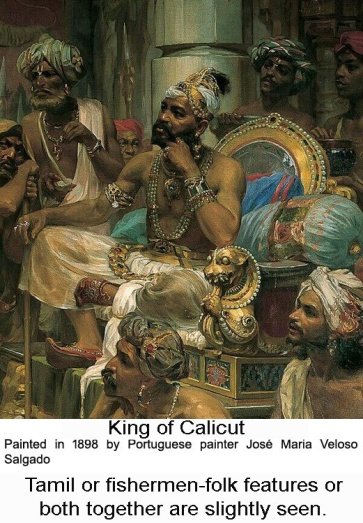 QUOTE: The king (of Calicut) was sitting in his chair which the factor” (who had preceded Da Grama with the presents) “had got him to sit upon: he was a very dark man, half-naked, and clothed with white cloths from the middle to the knees ; END OF QUOTE
It does seem that the ‘factor’ had compelled him to sit on a chair. Though the ‘very dark man, half-naked and clothed’ to the middle of his knees’ description would look quite a bit let-down description, the real power of the man would be in the terrific hammering content in the words in the native-language.
QUOTE: The interview would probably have had the desired result, but the Moors had meanwhile been busy bribing the Chief Officer of the Palace Guard, an official of great power, END OF QUOTE.
This is a typical behaviour pattern in the subcontinent. Things are worked from elsewhere. The direct approach actually hides a lot of hidden approaches. It might be good for native-English nations to know these things. When feudal language speakers arrive in native-English nations, this is the ways things are accomplished. Be they are from Italy or Germany or Japan, or Spain or India, or Pakistan or Sri Lanka or Bangladesh or Korea.
Beyond all this, the term ‘Chief Officer of the Palace Guard’ does not really reflect the semi-barbarian quality of the people. It is like mentioning an Indian government official as an ‘officer’.
QUOTE: the Chief Officer went before the king, charged Da Gama with breaking faith, and suggested that the Moors should be permitted to take the ships and appropriate the goods for the king’s use. The king agreed to this, but the jealousy of the king’s Brahman and of his Treasurer had been aroused at the Chief Officer’s having it all his own way. and first the one and then the other interfered and pointed out that the Portuguese had so far done no harm, and great discussions thereupon arose. END OF QUOTE.
This is the typical manner in which things work out, unless one comes in with power. Decent and logical level of conversing and getting things done is not possible with feudal language speakers. However, at the other end the Portuguese side also might be feudal language speakers.
QUOTE: The hostages demanded to be put to death by the king if Da Gama were to be slain, and their demands were backed up by both the Treasurer and the king’s Justice out of envy at the rich presents offered by the Moors to the Chief Officer of the Palace Guard. END OF QUOTE.
A trade negotiation becomes a mess of intrigues. However, for the Arabian side, who were supported by the local Mappilla traders, this was a life or death battle to retain their precious trade. They could foresee the disaster in the offing. A route to a very remote, semi-barbarian geographical location had been discovered by competing business entities.
QUOTE: Having thus revenged himself, Cabral sailed for Cochin, protesting that in Calicut the people could not be trusted, and that truth and honour were alike unknown, it appears, on the other hand, that Cabral was hasty and perfectly regardless of the sacrifice of human life, being quite ready to slaughter Moors and Nayars indiscriminately, with or without provocation, and with no expectation, of doing any good. END OF QUOTE
There is something to be said about the above claims. The people of Calicut cannot be trusted, but then the people of Cochin can be trusted? Well, the way the social machinery works inside feudal language societies is like this: If honoured and ‘respected’, (i.e. Adheham, Avar, Saar, Anugunnu &c. all highest He / Him) the others are generally quite truthful, trustworthy and honourable in commitments. If a person is placed in a location of no respect (i.e., Avan / Oan), he can expect no honesty, and no commitment from others. That is the truth.
QUOTE: Meanwhile extraordinary preparations were being made in Egypt to equip a fleet to drive away the Portuguese, whose interference with the overland trade had deprived the Egyptian ruler of his chief source of revenue. END OF QUOTE.
So it is the Egyptian ruler who stood behind the scenes. Then, it would be good deed to declare him as the first freedom fighter of India. For, just behind him is the Moroccan, Hyder Ali who might like to place a claim on this. Then comes the French, who more or less fought in many of the ‘freedom fights in India’ against the British! They were there in the Battle of Plassey, actually the only fighting side that really fought against Robert Clive’s natives of Madras. So, it seems that the French were the freedom fighters of India, while the soldiers who arrived to fight for Robert Clive from Madras were the foreigners. This the real insights of modern Indian academic history.
QUOTE: The Portuguese spared the Christian houses, shops and churches, but they looted those of the Jews and Moors. END OF QUOTE.
This is a very curious twist of international history. The Jews and the Muslims on one side, while a Continental European nation against them. However, look at this:
QUOTE: About the time of Da Gama’s death, the Moors, with the Zamorin’s approval, made an onslaught on the Cannanore Jews and Christians, the reason alleged being that the Moors had resorted to various tricks for adulterating the pepper, etc., brought to market, and some Jews and Christians had been specially selected to discover such tricks and mete out justice to the offenders END OF QUOTE.
There is this also at another location:
QUOTE: “As the Jews had favoured their enemies the Dutch, the Portuguese considered it necessary to punish them to prevent the recurrence of such conduct, and therefore immediately on the siege being raised, they plundered Jews’ Town of almost all it contained, attempted to destroy the synagogue, END OF QUOTE.
QUOTE: But the Portuguese captains had obstructed the carrying out of the order, and, perhaps, they had some excuse for doing so, as several Calicut Moors under cover of this permission used to carry on trade. END OF QUOTE.
The issue at hand was that of the Mappilla traders from Calicut running a prohibited trade using the permission. But then there is more to it. The Portuguese side also was running on feudal languages. In such languages systems, unless there is a very powerful and very clearly understood regimentation, people would tend to step on each others’ toes. Each endeavour would end up with individual tripping on others, so to say.
QUOTE: The combined fleets then returned to Cannanore and quarrels immediately ensued between the two viceroys. END OF QUOTE.
This is a very typical sign of feudal language presence.
QUOTE: To his sorrow, however, he found that his countrymen had in the interval been associating indiscriminately with the natives, and had abandoned themselves to vice and crime. END OF QUOTE.
No comment.
QUOTE: His zeal was, however, disparaged by slanderers among his own officers, and the King of Portugal began to take alarm at his increasing renown. END OF QUOTE.
QUOTE: But meanwhile the slanderers’ tales had been listened to and Albuquerque’s supersession had been decreed END OF QUOTE.
Ah! Here we come to exact exhibition of what a feudal language does. When Robert Clive became world famous, his immediate superior did not get the creeps. The monarch did not get disturbed. However, the Portugal experience seems to be apparently different.
I do not know Portuguese language. So I am writing from presumptions.
In the native feudal language of the Malabar, there is the He word. It can change from Oan (Avan) (lowest he / him) to Ayaal (higher he / Him) and then to Oar (Adheham) (highest He / Him). When a lower positioned person’s fame grows, this verbal change would happen. It would then go on reaching a heights that one by one each level of his superiors would stand demolished in the verbal codes. These verbal codes actually contain the codes of command and obeisance.
It is a very creepy experience for the superiors. That a good quality subordinate becomes a terrible foe, the moment he displays his calibre and quality. The others in the social system, by merely changing the ‘he/him’ word form can tumble down his superior into a state of nonentity. Even the king seems to have got the creeps when Albuquerque became successful. This is the exact way the feudal language machinery works. England had a different machinery.
QUOTE: From this time forward the Home Government displayed great jealousy and suspicion in regard to the acts of its Indian administrators, and frequently cancelled their orders. This treatment naturally produced indifference in public affairs, and resulted in every one connected with the administration striving to amass wealth without caring much how it was obtained. END OF QUOTE
The people back at home not understanding the social culture, the feudal language issues, and the exigencies of administrating a small location in South Asia was a problem which the English administration in British-India also faced. However, the planar nature of pristine-English made a serene ambience wherever the native-English set up colonies. In the case of the Portuguese, the feudal content in their language would create havoc, instead of a placid mood.
QUOTE: Sailing to Goa, Sampayo there seized him, put him in chains, and sent him to Cannanore, where, in turn, the garrison honourably received him END OF QUOTE.
QUOTE: In October 1529, Sampayo’s successor (Nunho D'Acunha) arrived with orders to send Sampayo in custody to Europe, and this was at once done when Sampayo boarded the Viceroy's ship at Cannanore on the 18th November. END OF QUOTE.
See what a feudal language is creating. The Portuguese are again at each other’s throat.
QUOTE: Moors in North Malabar began hostilities, and these continued till, in 1559, they made the usual submission and agreed to take out the hateful passes. END OF QUOTE.
The problem in understanding the ‘hate’ is there in English. The issue is that the work of dispensing the passes would be most probably by some low-level native-of-the-subcontinent employee. The moment a local man gets some power, he would immediately start using the lower grade indicant words to the traders and others who approach him for the passes. It then becomes a real torment to get a pass. It is like going to a government office in current-day India, for the majority population.
QUOTE: and it is alleged they were utterly unscrupulous as to what became of the crews. END OF QUOTE
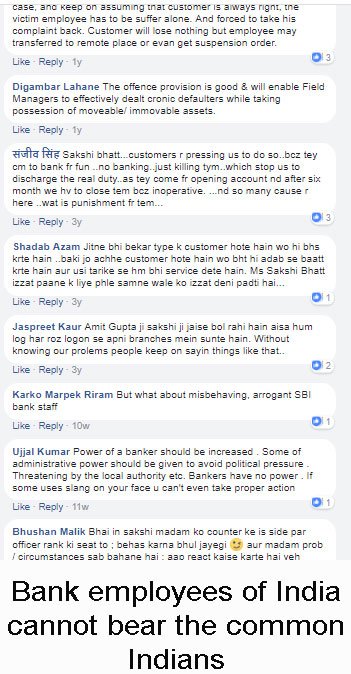 In many ways, this is reminiscent of the attitude of current-day Indian officials. However, there is another side to this feeling. It is that they also cannot bear the torment of insolent behaviour from the common public, when they try to be nice and refined. The Portuguese would have had the same bad opinion of the common person of the subcontinent, as the current-day Indian officials have. In fact, most of the Indian officials hate the common man in India.
QUOTE: Zein-ud-din, who is, however, a not altogether disinterested witness, says that they massacred the crews by cutting their throats, or tying them up with ropes or in nets and throwing them overboard END OF QUOTE.
It was trade at its very basics. That is, trade is war, when there are feudal-language speaking participants in the trade. This understanding seems to have escaped the notice of all native-English nations, as they go around promoting Japan, China, Korea etc.
The DUTCH
It is possible that the Dutch language is comparatively of a lesser feudal content than German, Italian, Portuguese and Spanish. This is my own summarisation based slightly on the fact that they were more sane and soft in many of their historical activities when compared to that of the German, Italian, Portuguese and Spanish. It must be admitted that I do not know much about the Dutch, or even about the mentioned other four nations, here.
It is just a gut feeling, that this is so. May be it is due to the fact that they could collaborate with the English people to create a wonderful nation in South Africa. But off course, the totally insane political philosophy of democracy has literally given it back to the barbarians of Africa. It is not that all the blacks of Africa are barbarians. But that, the languages there might be quite barbarian and feudal. So, only those who are totally barbarians will come up on top of those social systems, which use those languages.
The Portuguese attempt at creating a favourable trading relationship with the tiny, semi-barbarian Calicut failed due to the innate feudal language issues of the land. No commitment was worth anything here. The moment another personage with some social weight comes and speaks to the person who has given the promise, everything changes. The man who is a Saab / Saar/ Thamburan, in one location, the moment he is an Avan / Nee in another location, becomes a totally different man there.
By the time the Dutch arrived, the codes of interaction had already been decided. It was treachery that was the code that was in place. Each of the tiny semi-barbarian kingdoms vied against each other.
QUOTE: This event was almost contemporaneous with another which influenced the fate of India in general and of Malabar in particular, for in 1580-81 Holland, one of the seven “Northern United Provinces,” declared its independence of Spain. END OF QUOTE
Events in faraway Continental Europe were affecting event in a remote location on the globe.
QUOTE: In 1597 two Dutch ships succeeded in reaching India, but the one was destroyed off Malacca by a fleet of six Portuguese ships END OF QUOTE.
There was desperation to find a route to the semi-barbarian land where pepper was being grown. Yet, the Continental Europeans were also semi-barbarian, in that many had some kind of erroneous languages. However, a long-time proximity to England did give them an aura of glow and difference.
QUOTE: It was this protection of the Cochin Raja against the Zamorin which involved the Dutch in so much profitless expenditure in Malabar. END OF QUOTE.
It is undeniable that the Dutch did their best to protect the Cochin kingdom from being overrun and occupied by both the Calicut king as well as the Travancore king.
QUOTE: directly he arrived he saw the necessity of curbing the rising power of Travancore if the Dutch were to retain their hold of the trade of the country and not allow it to pass into the hands of the English, who were backing up the Travancore Raja. END OF QUOTE.
There were totally insane activities all around. It was only the English Company that took up the stance that it is best to avoid warfare and try to get on without a fight. This remained their policy till the last. However, the greatest paradox was with regard to this policy. They were forced to fight to protect the kingdoms that allied with them. And ultimately, one by one, the kingdoms came into their control, through the falling down of their attackers.
The French government policy that commanded all French trade divisions to attack English trading locations in all locations all around the world also led to this. For, whenever the French coaxed a local king to attack the English-side, the king and his supporters, the French, invariably lost the fight. This led to the taking over of the land by the English Company. It is true that the French were one of the greatest ‘freedom fighters’ of ‘India’.
QUOTE: “Without sufficient troops to hold their own by force, surrounded by native states outwardly friendly but secretly hostile, attacked by the Mysoreans, and awaiting instructions from Batavia, Moens’ position was a very difficult one. A common danger, it was true, bound the Cochin and Travancore States to the Dutch, END OF QUOTE.
The backstabbing cunningness of the native kings was a feature of the land, since times immemorial. In a feudal language social system, a person is most dangerous when he is displaying most affable friendliness and hospitality. That is how they stab in the back. This point seems to have escaped the attention of all the policymakers in all native-English nations.
QUOTE:
The Muhammadans had invested Chetwai, the garrison of which place sent a message to Cochin, representing that they could not hold it much longer, so Governor Moens now determined to attempt its relief. Provisions and ammunitions having been packed in casks, 189 men embarked in the ship Hoolwerf, having some small boats in tow for the purpose of landing the men and stores. On the same afternoon, November 11th, they arrived before Chetwai, but the surf being high, the wary Muhammadans had the satisfaction of perceiving that they delayed landing until the next day.
“A chosen band of Sirdar Khan’s troops was told off, and in the dead of the night placed in ambuscade close to the beach where the landing was most likely to be effected, and in silence awaited the disembarkation of their prey.
“The morning dawned, and the Dutch having examined the shore, could see no vestige of an enemy, all appeared perfectly quiet, and they congratulated themselves on surprising Hyder's troops. The landing commenced, the first boat upset, but the troops waded to the beach with their loaded muskets wet, and their ammunition of course spoilt. Suddenly the ambuscade rushed out, and finding advance impossible, the Dutch retreated in good order to the beach ; but their boats were gone, and the terrified native boatmen were pulling quickly away from the scene of strife. Some of the detachment were killed, and the remainder obliged to surrender themselves prisoners of war.
"The Europeans were disheartened and abandoned the attempted relief whilst the Muhammadans were greatly elated and the fort of Chetwai was compelled to capitulate on the 13th, one condition being that the garrison should be permitted to retreat to Cranganore, a promise which was of course broken. The prisoners were plundered of everything, even to their very clothes, and with the women, children and slaves, were sent to Calicut. END OF QUOTE.
The Dutch were dealing with a population that they could not understand. There is treachery in the very air of the land. The verbal codes are terribly treacherous. However, how this is so, and what it is supposed to mean, are not easy to convey to them.
There is no sense of commitment among the native populations, unless they are bound by powerful codes of ‘respect’ versus ‘degradation’. The degraded populations will show deep loyalty to their higher man who they ‘respect’.
Another thing that must be noted here is that there is no honour in any commitment given to a fallen man. The moment he surrenders, he is questioned with the Nee word and referred to with the Avan word. That means he can be literally beaten up into a pulp. This attitude is sharply in contrast to the native-English style of treating the surrendered team with dignity.
QUOTE: The French Republican army entered Holland. The Stadtholder fled to England , and thence in February 1795, after the proclamation of the Batavian Republic in alliance with France, he addressed a circular to all the Dutch Governors and Commandants to admit British troops into all the Dutch “Settlements, Plantations, Colonies and Factories in the East Indies” to prevent them from falling into the hands of the French.
Mr. Vanspall was at this time Governor of Cochin, began laying in provisions with a view to standing a siege, and he invited the Cochin Raja to help him. On July 23rd Major Petrie, under orders from Colonel Robert Bowles, commanding the troops in Malabar, marched from Calicut to the Dutch frontier with a small force of infantry to obtain a peaceable surrender of the Dutch settlement. But the Governor refused to give up the place, and Major Petrie had then to wait till a siege train could be brought up. The Supervisor (Mr. Stevens) proceeded in person to Cochin in the beginning of September to endeavour to arrange matters with Mr. Vanspall, and a conference ensued, at which it was agreed that the surrender should take place. But next day the Governor changed his mind and the negotiations were suspended. END OF QUOTE
It is a very funny situation. The Dutch (Holland) government ordered the Dutch fort to give it up to the English side, to prevent it from falling into the hands of the French. However, the Dutch Governor in Cochin refused to give it up. Why?
The answer has to be sort in the feudal language codes of the land. The moment he gives up his platform, he will go down the verbal codes. The ‘he’, ‘him’, ‘his’ &c. words would more or less spontaneously come down from the ‘Adheham’ level to ‘Ayaal’ and then even to that of ‘Avan’. This terror will be understood only the governor knows the local language, which could a mix of Tamil and Malabari. The question is ‘Could he understand the local language?’
QUOTE: shortly after the treaty was signed, and after the Travancore frontiers had advanced as far as Cochin, the Travancore Raja of course turned on them and repudiated his obligations, telling the Dutch, factors at Cochin they were no longer a sovereign power, but merely a number of petty merchants, and if they required spices they should go to the bazaars and purchase them at the market rates. They had eventually to pay market prices for the pepper they wanted. END OF QUOTE.
This is generally a typical feudal language attitude. Once a powerful individual loses his power or status, then he will changed from Adheham (highest he / him) to Avan (lowest he / him). At this level, no one would keep their word of honour or commitment to him. He is just mere dirt in the local feudal languages. This is an information that the native-English does not seem have had.
The French
In many ways, one might say that it was the insidious endeavours of the sneaky French governments that led to the slow and steady creation of British-India in the subcontinent. There seems have been a continual attitude among the French governments to encourage their traders all around the world to attack all English trade centres.
This is what led to the attack on the English trade centre in Arcot near Madras. This is what led to the attack on the English trade centre in Calcutta by Siraj-ul-dawlah. This is what led to so many minor and major skirmishes between so many small-time kings and rulers in the subcontinent and the English trading Company. Even Hyder Ali and Sultan Tipu (both Moroccans), had the full support of the French and even other Europeans in their endeavour to try to crush the English Company.
However, each one of these endeavours failed. And with each failure, the Company was forced to take up the administration of more and more locations.
What created the terrible animosity for England among the Frenchmen was that the Englishmen and women lived in a planar language ambience, while the French lived in some kind of a feudal language social system. What was most confounding was that formally both the nations have similar statutory social design. Both had the common people as well as the lords and ladies and the monarchy. Yet, the French common man had a terrible time, while the English common man was not living in a crushed social ambience.
France and other Continental European nations conspired and seduced the idiot George Washington and others to revolt against their own king and kingdom. And yet, they could not form a Continental European nation in the USA location. What came out ultimately was still an English nation. The French soldiers, after seeing the English soldier at close quarters, had the same mental emotion, which the current-day Indian soldiers who see the English soldiers at close quarters, had. They could not bear their officers and their degraded status. They inspired a revolution in France. Their king, who had also asked for an attack on English trade centres, had his head cut off by his own countrymen.
QUOTE: On the 20th the factors heard with dismay of the activity of their quondam friend Labourdonnais on the Coromandel Coast. On the 24th the French at Mahe began to make warlike preparations, giving out they would soon be saying mass in Tellicherry as their fleet was expected in October. END OF QUOTE
Even though the French are of white-skin colour, they are actually like the natives of the South Asian Subcontinent, innately. This is due to their language having some kind of feudal content. However, long years of proximity to England would have added to their stature. It is like an individual from India living in England. Within a few years, he would start having English features. However, in the case of the French, they still remained embedded in their own language.
QUOTE: Nor was the foresight thus displayed long in being justified, for, notwithstanding the indecisive naval action off Point Calimere, in which Labourdonnais was wounded, that indefatigable officer with his customary promptitude and decision brought matters speedily to a crisis by capturing Port St. George at Madras. END OF QUOTE.
Individual calibre has no meaning in a feudal language system. In fact, it is a negative attribute. Other would get disturbed. Labourdonnais also faced the same fate that befell Albuquerque.
See this QUOTE:
The French fleet had gone ; the factors knew not whither. They heard it was at Goa and awaiting Labourdonnais’ return from the islands with another squadron. They were still in daily dread of being besieged. It was with no little satisfaction therefore that, about July 1747, they received the welcome news that the dreaded Labourdonnais had been sent an unhappy prisoner to France. END OF QUOTE.
The French were winning. At that very moment, he is derailed by his own countrymen.
However, there was a similar thing that was in the fate of Robert Clive also. That is a different issue. I will take it up here.
When Robert Clive went back home after setting up the foundation of a nation in the subcontinent, many of the people in England were deeply perturbed. For, Clive had lived on the top of the verbal codes in the subcontinent. It will automatically induce a royal attitude in him. This is a natural effect of the feudal languages of the subcontinent.
When the native-English in England see this physical and mental demeanour at close quarters, they will naturally get a creepy feeling. English effect had done a positive personality enhancement for the people of the subcontinent. At the same time, the effect of the feudal languages of the subcontinent had induced a negativity in the interior codes of the native-Englishmen who had lived and worked in the subcontinent.
QUOTE: The Prince Regent intervened in their (that of the French) favour, and arranged that if Mattalye fort were restored to them they would evacuate Nilesvaram and some other small places, and the Prince Regent in return for his services was to have his bond for Rs. 60,000, advanced to him in the war with the Tellicherry factors, returned to him and cancelled. Moreover the Prince Regent guaranteed on oath that the French would perform their part of the contract and surrender Nilesvaram and the other places.
END OF QUOTE
QUOTE: The French fired a salute of 15 guns at Mahe on being repossessed, on 22nd July 1756, of Mattalye ; but they deliberately broke their promises of evacuating Nilesvaram and other places and of returning the Prince Regent's bond to him. END OF QUOTE
What really always made the England side always win the last crucial battle was their reputation of being honest and committed to their word. There have been at least one incident which is oft-quoted to mentioned that the English side did not keep their word. However, that was a word extracted in a sort of blackmail.
QUOTE: they were led on by fifty of the French Hussars lately arrived from Pondicherry. END OF QUOTE.
That was about the French support to Hyder Ali. After all, France was also a great fighter for ‘Indian freedom’. For, if Hyder Ali and Sultan Tipu had fought for the freedom of ‘India’, then the French also had done their part!
QUOTE: 1. On the 1st of February war was declared by the French Republic against England and Holland, and for the third time in its history the French settlement at Mahe had to open its gates to a hostile English force under Colonel Hurtley on the 16th July 1793. The garrison, after surrendering, was allowed to march out with all the honours of war.
2. Chimbrah and Fort St. George were handed over next morning under a salute of 21 guns, and the British colours were flying in Mahe itself at 6 p.m. on the evening of the 20th. The garrison marched out with the honours of war, but all arms, stores, etc., were surrendered, and the forts, etc., were placed at the disposal of the Honourable Company END OF QUOTE
This allowing the surrendered side to march out in dignity or sit down in a chair in dignity is something quite alien to the feudal language military codes of the subcontinent. No deal or agreement made as terms of surrender are honoured by the winning side. The moment the other side lays down their arms, the lowest of the soldiery of the winning side will batter up everyone on the other side, be it their leader, their officers or their women folk.
 I think this is more or less what happened with Mr. Prabhakaran, the Tamil leader in North Ceylon surrendered. In the case of current-day India also, as the Indian army slowly distances itself from the English-led British-Indian army’s disposition, the ancient semi-barbarian attitude is come back to the fore.
I am told that when the Indian navy captured the Somali Pirates, they were literally tied up like animals. This attitude cannot be blamed. For, the location is Asia and Africa, where the antique mood is slightly or formidably wild. It is more or less a wild animal-to-animal confrontation. The words and languages have carnivorous quality.
See this QUOTE: A large body (300) of the enemy, after giving up their arms and while proceeding to Cannanore, were barbarously massacred by the Nayars END OF QUOTE. These kinds of incidences stand testimony to the above contentions.
The ENGLISH
QUOTE: But it very soon transpired that all that the Zamorin wanted was to get assistance against the Portuguese for the conquest of Cranganore and Cochin, and when the English ships left without assisting him, very scant courtesy was shown to the ten persons left behind, who were to have founded a factory at Calicut END OF QUOTE
The fact of the matter was that there was a general feeling among the various small-time rulers and those who mutinied against them, that a new set of mutually competing mercenaries had arrived from Continental Europe. However, when it came to connecting to the English, they were found to be of a very different mettle. First of all, they were not from Continental Europe. Second, their native language was planar. In every aspect they stood apart from the Continental Europeans, other than in their skin colour. However, on the English side, there were the Celtic language speakers also. Those who remained loyal to their Celtic tongue remained a chink in the English armour. Even William Logan was from this Celtic language group. Possibly Gaelic. However, it is not known as to how much he remained at home in this language.
QUOTE: From a very early period in its history the English Company had set its face against martial enterprises. END OF QUOTE
This is a very important information, which is totally ignored by formal historians. The English Company did not go develop a policy of belligerence.
QUOTE: So far indeed did the English Company carry this policy that they even forbade at times an appeal to arms by the factors for their own defence ; and the annoyances experienced in consequence of this were occasionally almost intolerable. But the strength of the Company lay in the admirable arrangements whereby they encouraged trade at their fortified settlements. END OF QUOTE
As a policy inside a semi-barbarian land which functioned on feudal languages, a soft approach was a very vulnerable one. For, in this language system, there is no premium value attached to politeness and good manners. For rude, cantankerous and ill-mannered behaviour was considered as of high social value. The pejorative forms of all words for You, He, She &c. were used to those who were seen as weak or polite. In fact, politeness itself was seen as weakness.
QUOTE: They established manufactures ; they attracted spinners and weavers and wealthy men to settle in their limits ; the settlers were liberally treated and their religious prejudices were tolerated ; the privacy of houses were respected by all classes and creeds; settlers were allowed to burn their dead and to observe their peculiar wedding ceremonies ; no compulsory efforts were made to spread Christianity, nor were the settlers set to uncongenial tasks ; shipping facilities were afforded ; armed vessels protected the shipping ; all manufactured goods were at first exempted from payment of duty ; the Company coined their own money ; and courts of justice were established ; security for life and property in short reigned within their limits END OF QUOTE
The above words more or less denote what was some of the major differences that the English Company had from the others who were seen as from the same genre. But then the greatest of difference was that the English language was planar.
QUOTE: for the factors had perforce to study native character and to adapt themselves to it ; and in doing this they were unconsciously fitting themselves to become the future rulers of the empire. END OF QUOTE.
There is great foolishness in the above statement. And it is historically inaccurate. The English Company, to a great extent, did not compromise its standards to make it in sync with the local native character and systems. The native systems were connected to feudal languages, which view the whole social system in a hierarchical design. The native character was treachery, back-stabbing, rudeness, cheating, breaking of words etc. to those who were defined as lower in the verbal codes of the feudal languages.
The English Company took a most opposite standards in everything. In fact, as the Company became more established as a sovereign power in a major part of the subcontinent, it strove to make English the language of commerce, administration and education. The greatness of this attitude was that it naturally and spontaneously aims for the erasing of the rudeness in the native social cultures. These are things that formal historians miss out altogether.
QUOTE: Louis XIV had to publish an edict telling his courtiers it was not derogatory for a man of noble birth to trade to India. Men who had thus to be reminded of what "was or was not fitting to their position were not the men to push French interests successfully, and the English Company’s servants soon saw that the French men were poor men of business and not likely to prove successful rivals in trade. END OF TRADE
There is a great information in the above statement. It first of all gives an evidence that the French language was feudal. This is a great hindrance to the higher classes to interact with the lower classes. For, it would make them vulnerable to the insidious degrading the lower classes would force upon them.
However, in the case of the English also, the nobility would have some slight issues. But then, there is only one single You, Your, Yours, He, His, Him, She, Her, Hers etc. in English. So at this level of functioning there would be not much of a traumatic problem.
But then, when dealing with the natives of the South Asian subcontinent, the French would become more conscious of these issues than would the English. However, the Celtic persons in the English Company would be conscious of this. However, since the English Company was in supreme command of the subcontinent, they would exist as the personnel of the ‘honourable’ Company. So the chance of being attacked by the lower indicant words would be negligible.
However, there is a wider perspective to be mentioned. When the people from the subcontinent arrive inside England, they would set up an attack on the native-English system by using these very evil codes. They would splinter up the social system and all relationships by these verbal codes. Actually just looking into the eyes of a person who has degraded him or her by verbal codes can create terrible mutations inside the codes of human body and personality designs. [Check my books: 1. Codes of reality; What is language? 2. Software codes of mantra, tantra, witchcraft, black magic, evil eye, evil tongue &c.].
Actually even a minor conversation with a feudal language speaker who does not concede the adequate forms of verbal ‘respect’ can be a degrading experience. England currently has no information on these things. Instead of taking very concrete steps to push out these extremely dangerous language-speaking populations from their land, they are made to reel under the accusations of being ‘racist’.
QUOTE: The English system of sending factors to various points on the coast to test the value of the trade at those places seems to have enabled the Company to decide where it would be best for their interests to plant factories for the defence of the trade END OF QUOTE
No Comment.
QUOTE: the presence of the English in Travancore was gradually leading to a revolution in that State. END OF QUOTE
The truth is that wherever the native-English system was experienced in feudal language social systems, great social changes and reformation would spring forth. However, if this change is set-off without an entry of the English language, it would be a most painful experience for the higher classes. For, the rude lower classes would become overbearing and snubbing towards them. In fact, the higher classes would find it difficult to come out of their houses, once the lower classes are allowed the freedom to move anywhere they wanted. It would be like the Indian soldier and his family and relatives being allowed entry into the exclusive areas of the Indian army officers. And the right and freedom to address them in the pejorative word forms. That is, words such as Thoo / Nee, Avan/ Aval/ Uss etc. all of which are the lowest of the word forms for the words You, He, She &c.
QUOTE: It would be out of place here to set forth the grounds of quarrel between the rival East India Companies, but in passing it requires to be noted that, English interests suffered severely in consequence of the disputes, whereby piracy was encouraged. The Mogul made the Surat factors pay heavy damages, and even went the length of ordering the factories to be destroyed. END OF QUOTE.
There is indeed a very saying in the Malayalam language that says thus: ‘If you cannot catch the person who actually robbed, then make the person who you could catch, the robber.’ [കട്ടവനെ കിട്ടിയില്ലെങ്കിൽ, കിട്ടിയവനെ കള്ളനാക്കുക.]
The northern parts of the subcontinent were in the hands of the mogul kings for quite some time. They, as in the case of all others, simply ‘ruled’ the land. It is doubtful if any people quality enhancement programme was done by them other than enslaving many of them for labouring on their grandiose architectural agenda, including the Taj Mahal.
The other point worth mentioning here is that there were a few English companies doing trading activities inside the subcontinent. They were naturally on business rivalry. However, it is a testimony of the quality of the English land that all these mutual rivalries could be brought to a halt. See this QUOTE:
It took a year or two more, however, to adjust all their differences ; and it was not till September 29, 1708, that the Earl of Godolphin, Lord High Treasurer of England, who had been appointed arbiter in the disputes, made his famous award, and from that date the style of the association was altered to that of “The United Company of Merchants of England trading to the East Indies.” END OF QUOTE
QUOTE: And, it is said, that one of the rival Kolattiri princes of the Udayamangalam branch, in combination with the neighbouring Nayar chieftain of Iruvalinad, the Kurangoth Nayar, entered the Company’s warehouse one day about 1704-05 and committed certain regularities, which were duly reported to the Northern Regent, and it was at the same time pointed out to him that such events would recur unless the place were fortified. END OF QUOTE.
This could be a major turning point in the history of English colonialism in Malabar. There was no policing mechanism, no security and no courts of justice in the semi-barbarian land.
QUOTE: Jealousies between the Kolattiri chiefs had probably more to do with it than the reasons assigned by Hamilton. END OF QUOTE.
It would be quite well to mention that Hamilton literally did not understand anything. All human logic was controlled by the various trigger switches inside the native feudal-languages. And yet, there is nothing to denote that he did even sense that there is anything amiss in the language codes.
QUOTE: It appears they (English Company) also had the privilege of protecting debtors who took refuge in their Calicut factory, to the disadvantage occasionally of interlopers like Hamilton. END OF QUOTE.
No Comment.
QUOTE: early Tellicherry records show that the Company took great exception to the loans which Mr. Adams had made out of their money to the Zamorin, the Punnattur Raja, the Prince Regent of the Kolattiri dominions and others END OF QUOTE.
The native kingdoms did actually parasite on the English trading company for quite some time.
QUOTE: In April 1721 the Anjengo factors were applied to for their usual annual present due to the Rani of Attingal, of the Travancore family. “Those who demanded it assured him (the Chief of the Factory) that they came to demand it by the Queen’s order, and offered their Receit of it in her Name.”
The chief appears to have had reason to expect that if the present were sent it would never reach Her Highness as the Ettuvittil Pillamar were just then in the ascendant, so he refused to pay it into any hands but those of the Rani. On this the Rani invited him to bring it to Attingal himself.
“And he to appear great there, carried two of his Council, and some others of the Factory with most Part off the Military belonging to the Garrison, and by Stratagem they were all cut off, except a few black Servants whose heels and language saved them from the Massacre, and they brought the sad news of the tragedy.” END OF QUOTE
This was actually the handiwork of the Nayars and other higher castes in Travancore. They had to deal with a new terror that was been set loose in Travancore. The lower castes were seeing the English ways and manners of dealing with them, and were slowly escaping from their age-old shackles. Naturally the lower castes would be very, very rude and ill-mannered in all ways, including words, actions, posture, eye language &c.
It is a very funny situation in Travancore, that recently some persons have made a demand that this barbarian action of killing the Englishmen should be declared as the first fight for ‘Indian’ freedom. What a lot of nonsense! Travancore was not even part of British-India. And to support cunning barbarians!
The second part of the issue is this: ‘he to appear great there’. It is obviously the words of the interloper Hamilton. The fact is that in the subcontinent, everyone takes someone as an attendant to introduce him or her with a higher indicant value. However, neither this interloper nor the English side really understood what is supposed to happen with the presence of supporters. However, someone must have advised them to use this technique without carefully explaining what the supporters are supposed to do.
QUOTE: Secondly, of the English Company’s resolution in 1723 to “subject the country to the king” and so facilitate their trade ; END OF QUOTE.
There is an information in the above sentence. The English Company did face a terrible issue in the subcontinent. In almost all locations, there was no great law and order. In Travancore, the king was powerless to control the various Madampis (landlords) and other powerful people who had money and social status. The English Company decided to support the king and to help him crush all kinds of lawlessness. This policy led to the creation of an enduring kingdom of Travancore, with King Marthanda Varma more or less setting up the foundations of modern Travancore.
If the English Company had not supported him, Travancore would have remained as one of the many small-time kingdoms in the locations, same as Kayamkulam, Attingal, Quilon, Ambalapuzha, Kottayam, Chengannur, Changanacherry &c.
The creation of one single kingdom help the English Company to do their trade with more ease as they had to negotiate with only one entity, instead of a lot many others. However, it must be remembered here that Travancore was not Malabar. It was a different kingdom in the far south, approachable conveniently by sea.
QUOTE: The Kottayam Raja shortly after this gave in his adhesion to the Chief’s project. But jealousies were rife and the others all held aloof. The French too had professed their willingness to strike in, but when the Chief visited Mahe on 31st March to arrange the matter, the French, much to the disgust of the country powers, backed out of it. The negotiations for a combination did not make much progress under such circumstances. END OF QUOTE.
QUOTE:
the Chief set himself to the still more difficult task of trying to form a combination of the petty country chieftains against the Canarese. END OF QUOTE
It was not easy at all to unite the small-time kingdoms of the subcontinent. Each one of them were insecure about the others’ intentions. Moreover, each relationship of others were viewed with envy and terror.
As to the French, they had the history of going back on their word. That is mainly due to the fact that their language had feudal features. So, they could very easily get emotionally distracted when the indicant word-levels shifted.
See these words of King Marthanda Varma about his opinion of the French QUOTE from Travancore State Manual:
QUOTE: In the next year the Rajah of Travancore wrote to the King of Colastria ‘advising him not to put any confidence in the French, but to assist the English as much as he could’. END OF QUOTE.
QUOTE: 6 soldiers and 1 sepoy were killed, 13 soldiers and 12 sepoys were wounded END OF QUOTE.
Here an item which the modern Indian patriot would find as ‘racist’ would be there. It is ‘racism’ which the sepoys of the English Company did not feel. However the modern India who has improved much beyond the wildest dreams of this people of yore of this subcontinent will find the word ‘Sepoy’ totally unwelcome. For, the English or British soldiers are mentioned as soldiers, while the natives of the subcontinent soldiers are mentioned as Shipai.
Actually the problem is not in the word Shipai, but in what the Shipai represents. If the English soldiers of those time are mentioned as Shipais, and the subcontinent soldiers of those times are mentioned as Soldiers, the word Shipai would have more stature. And the word ‘soldier’ would have been seen as a ‘pejorative’ now.
QUOTE: 1st January 1738 the Chief received a peremptory order from him to proceed forthwith to the camp to talk of important matters, whereupon the diary records the following remarks : “The Board naturally remark the haughtiness of the precited Ragonatt and how base is his disposition. END OF QUOTE.
Ragonatt is the new Canarese Governor Mangalore. There is an information in the above statement which might escape the notice of the native-English. It is the word ‘haughtiness’. What is this ‘haughtiness’? Well, the new native-land Governor would see himself as a high official and the English Company as a team of employees of a merchant group of England. His addressing will most probably be with the ‘Nee’ word. That is the lowest You in the native languages here. In fact, this local tradition has been enduring in the nation, when the English administrative systems fell into disuse with the creation of a very people-degrading nation called India.
The officialdom and the police generally use the lowest indicant words for the common people, and the small-time traders. For them, the people are the Nee, Avan, Avan &c. In the low-quality language of Hindi, the common man is the Thoo and the Uss. The common man is trained to bear this degrading by the vernacular schools, where they are invariable addressed and referred to by these lower grade words. At the same time, the officials and the teachers are to be consistently addressed and referred to with the highest of the verbal codes.
The wider issue is that these kind of dangerous verbal codes are being exported to native-English nations as of now. The native-English populations have no information on what is entering into the vital locations.
QUOTE: 4th January the deputation returned and reported that the Canarese wished the Company to remain neutral in the war about to be commenced against “the Mallabars”. END OF QUOTE.
It was by now an established fact that the English Company was a sort of protective force for the small-time kingdoms, which had been incessantly in a state of warfare from times immemorial.
QUOTE: In October 1738 the Prince Regent appears to have been so far pressed that he actually delivered Rs. 30,000 to the factors to prosecute the war, and the agreement come to with the factors at this juncture “to make war against the insolence of Canara” and “to drive out Canara” is still on record END OF QUOTE.
The small-time kingdom has not a bit of chance to withstand the might of larger armies, which literally came on a pillaging and plunder agenda.
QUOTE: To keep down the price of pepper “which rises daily” the merchants of the respective factories were not to be permitted to monopolise the product and the factors were to consult how to keep it down. END OF QUOTE.
Even though the English Company did give much freedom of trade to the native-traders, the native-traders were quite cunning. They could speak among themselves and plan things which could not be understood by the English Company officials.
QUOTE: “The intent of the above ola is to give the Honourable Company authority over the Achanmars as also, to interpose with the prince if he should oppress them by extravagant taxes, which has heretofore happened.”
But the temples had not been taken into account in the bond, and it became necessary to include them formally. This did not, however, work well, and the Brahmans appear to have been jealous of English interference in their affairs. END OF QUOTE.
Even when the English Company acted in the best interest of everyone, the issue was that the population was not one group. It was a hierarchical layers of populations. Each layer had it own selfish interests to see that certain other layers do not gather any benefit.
QUOTE: On March 23rd, 1765, after a period of disturbance during which the management of the district was conducted by the Kolattiri, the Prince Regent finally ceded the protection of Randattara to the Honourable Company, and from that year the Honourable Company became the virtual sovereigns of that district and began to levy a regular land revenue from it. END OF QUOTE.
Even though shallow-minded jingoists can always say that this was how the nation was slowly taken up by the English Company, the truth was not fully that. The English Company had honourable intentions which cannot be understood from a native feudal-language perspective.
The basic issue is that all entrepreneurship in feudal-languages do have a factor that is not know in English. That is all businessmen aim at gathering a lot of subordinates who they can address as Nee or Thoo. This is a very powerful gathering of social leadership. It affects everything about everyone concerned. There is even an affect of words acting as aphrodisiacs, when such words can be hammered on the subordinates and they in turn are forced to mention deeply reverential words back.
The English Company did not have any such intentions of suppression or oppression or even gathering reverences other than what was necessary to function in a land which runs on the terrible codes of feudal languages.
However, in the above case there was another reason that the Company took up the administration of the location. See the Quote below:
QUOTE: Hyder’s impending invasion of Malabar at this latter time also weighed with the factors in accepting this charge. Hyder at first respected the Honourable Company’s rights in the district. END OF QUOTE
It was not very easy to unite the various small-time petty kingdoms, whose rulers were all very easily affected and perturbed by minutes variations in the verbal codes. A very minute sound difference in the native language words would set them on a very dangerous homicidal frenzy.
QUOTE: The French at Mahe enlisted 1,500 Mappillas, and the Mudaliyar (chief man) of the Valarpattanam Mappillas joined the English. END OF QUOTE.
In the earlier days, locations which are now seen as quite small were great distances. The same caste or religious groups would be seen to be supporting mutually antagonistic sides in different locations. Such was the state of even minute Malabar. Then imagine the complexity of the whole subcontinent.
QUOTE: In August and September 1748 matters came to a crisis by the Prince Regent “laying an impediment” on one of the Company’s merchants, on mulcting him heavily. On being remonstrated with for this and other similar behaviour, he strenuously asserted his right to take the half of every man’s property, and the whole of it if he committed a fault. END OF QUOTE.
Actually the attitude of the various small-time rulers was quite similar to the small-time officials of current-day India, such as the peons and the clerks in the government service. However, in recent times, even some of the higher officials also are similar to the peons and the clerks. This is due to the fact that as of now, all government officials learn the same indoctrinated stuff and as such there is not much difference intellectually between a peon and an ‘officer’ in the government service.
QUOTE: In November 1748 he had, it seems, portioned out his country to certain headmen in order that they might plunder his subjects, and the Commandant at Madakkara reported that soon the country would be ruined END OF QUOTE.
This is the typical callousness of the person in power in current-day India. However, this trait is what has been inherited from olden days, it is seen here.
QUOTE: He was present at an affecting interview with a very old and bed-ridden lady, described as the prince’s mother ; she expressed her satisfaction on being informed that everything had been amicably accommodated, and enjoined her son as her last parental counsel and advice never to give umbrage to the Chiefs of Tellicherry, who had protected the Palli branch of their family in its utmost distress. END OF QUOTE.
It is very, very curious that almost the very same command was give by Raja Marthanda Varma of Travancore kingdom as his last words from his deathbed to the heir to the throne.
See this QUOTE from Travancore State Manual:
Marthanda Varma’s words: “That, above all, the friendship existing between the English East India Company and Travancore should be maintained at any risk, and that full confidence should always be placed in the support and aid of that honourable association.” END OF QUOTE.
QUOTE: The Chief was warned from the Presidency not to allow the Company to be dragged in as principals in any of the country quarrels, but he blindly took the steps best calculated to bring this about END OF QUOTE.
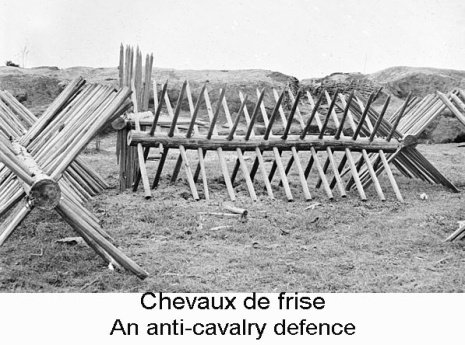 There were at times, senior officials in the English Company who did really understand realities of the social system. It was best to keep a distance and a detachment from social systems which cannot be understood in English. This is the reality now also, as native-English nations have entered into belligerences inside low-quality nations, wherein such things are part of the local social psyche. And the English nations have ended up as the principals in the fights. What a foolish situation!
QUOTE: On 21st October Tirimalla, another outpost on the Tellicherry limits was taken by surprise, and (it was alleged) treachery. The garrison resisted, bravely headed by their corporal, but being taken unawares, they had not time to fix their bayonets and were all slain and their bodies placed on the chevaux de frise. Ponolla Malla was also hotly attacked. A panic ensued among the inhabitants, who all flocked into the limits commanded by the Tellicherry fort. END OF QUOTE.
It was very carefully understood that some kind of security of life and person was available in a location which was administered by the native-English. In all other locations, there is no guarantee as to how the leaders would react or behave at the very next moment.
QUOTE: Next day came the crisis, and it fortunately took a favourable turn, for Captain Cameron, in command at Mailan fort, succeeded in destroying the opposing battery on Putinha hill, END OF QUOTE.
Even though these kinds of English victories were increasingly natural and more numerous, it was not always due to any English ingenuity that the English side invariably won the critical battle. It was more to the dissipation that would set inside the opposite side due to issues connected to ‘respect’, both in the verbal form as well as in the physical posture form. These minute codes would go on terrorising many persons into a state of mental disarray.
QUOTE: And finally the Tellicherry linguist (Pedro Rodrigues) and his family were not to be employed in any transactions between the parties END OF QUOTE.
This dependence on a translator was a terrible thing that the English-side always faced all over the world. In fact, the translator could literally decide on which side the native-English lent support. They could manage and mismanage any situation as per their own internal animosities, repulsions and partialities.
However, there is the other side to this. When a native-Englishman gets to learn the barbarian languages of the subcontinent, he will be invariably affected to some extent by the varying ‘respect’ versus degrading codes inside the language.
QUOTE: The records for some time after this are full of the charges brought against, the Company’s linguist, Pedro Rodrigues. Mr. Dorril and the factors endeavoured to make a scapegoat of him, but although he fled to Mahe and the factors gave out that, his property was going to be seized, no serious steps were really taken against him, and on 16th September 1752 the Bombay President and Council sent orders forbidding the seizure of his effects, “this family having been so remarkably distinguished by the Honourable Company.” And the despatch continued : “We peremptorily order you not to do it.” END OF QUOTE.
In the above case, it does appear that the local Company officials at Tellicherry were in the error. However the above statement is illustrative of how the Company administration was controlled from Bombay. It had its good points.
QUOTE: At this interview it is noted that Messrs. Johnson and Taylor, from the progress they had made in “Mallabars,” were able to understand the Prince without the aid of an interpreter, so that the linguist, Pedro Rodrigues, had not to be called in. A very important step had consequently been taken towards freeing the Chief from underhand intrigues of the linguist. END OF QUOTE.
Even though the capacity to understand and speak the native feudal language is mentioned here as a great positive step, it had its own negativities. For one, the Company officials would slowly change into the people whose language they speak. It is always better to keep a corridor or wall between a feudal language and planar English.
QUOTE: This was followed up on 8th February 1758 by a formal examination, the first of its kind no doubt ever held in Malabar, conducted by the Chief in person, in which Messrs. Johnson, Taylor, and Samuel Crocs were tested as to their proficiency “in Mallabars." END OF QUOTE.
The hidden dangers in this action are not easy to explain. It is like installing a virus program into a nicely running computer. Feudal languages are virus programs when attached to Pristine-English. And vice versa.
QUOTE: For on 19th August 1757 the diary records that “Cotiote (Kottayam) demised of a bile in his arm” and of course the agreement with him became mere waste paper unless ratified by his successor. END OF QUOTE.
This was the state of the location. There was nothing to enforce an agreement. Even the concept of word of honour does not work, when the other side goes down in social stature. No word of honour or commitment is honoured by the higher stature group, when it is seen that it is towards an entity that has no ‘respect’ or honour in the social system. Only the native-English side viewed the various levels of populations as human beings with equal rights to dignity.
QUOTE: The Chief even found time to devote to such petty matters as the “cloathing of our irregulars.” The sepoys had “scarlet coats faced with green perpets” and a belt “covered with green perpets.” The Calli-Quiloners (Mappillas) had “blue coats faced with green perpets ” and thin bolts like those of the sepoys. The artillery lascars had blue coats faced and bound with red, and no belts. The coats were made to reach just below the knees. END OF QUOTE.
These were minor beginnings that slowly led to the current-day dressing standards of Indian, Pakistani and Bangladeshi armies.
See this QUOTE from the Travancore State Manual:
The visit of His Excellency the Governor gave the Maharajah an opportunity to see the British forces in full parade. He was struck with their dress and drill and made arrangements for the improvement of his own forces after the British model. New accoutrements were ordered and the commanding officer was asked to train the sepoys after the model of the British troops. The dress of the mounted troopers was improved and fresh horses were got down; and the appellation of the “Nayar Brigade” was first given to the Travancore forces. The Tovala stables were removed to Trivandrum and improved. On the advice of the Court of Directors, the European officers of the Nayar Brigade were relieved from attendance at the Hindu religious ceremonies END OF QUOTE.
However, if one were to see current-day patriotic films depicting fake stories connected to the English rule in the subcontinent, it is possible that the old time native land soldiers might be seen in attires which might match that of the Roman soldiers as depicted in Hollywood films!
QUOTE: the Court of Directors’ orders were peremptory and forbade the factors from interfering, except as mediators, in the disputes among the country powers END OF QUOTE
It is too bad that there is no one to give such a sound advice to the current-day administrators of Native-English nations.
QUOTE: After this the Mappilla picked a quarrel with a Nayar and was subsequently shot by the Tiyar guard. His body was “spitted” along with those of the others, and then thrown into the sea, to prevent their caste men from worshipping them as saints for killing Christians. Such outrages became frequent, and on July 9th 1765 the Chief was obliged to issue a stringent order to disarm them within factory limits. END OF QUOTE.
The Mappilla outrages were against the Nayars and higher castes. However the English Company inadvertently got connected due to the fact that they were in charge and committed to enforce law and order.
There are a few curious issues here. The first and the foremost is that the lower castes such as the Cherumar and also castes little bit above them, the Makkathaya Thiyyas of South Malabar received the social freedom to convert to Islam due to the spread of the English rule in the locality.
This more or less improved the stature of these converted persons. These kinds of sudden uplifting of certain individuals will not go easy with the language codes.
Apart from all that, in the very Codes of reality, which more or less stands behind the scenes of both in the worldly life as well as in the human mind and body, there will be drastic changes. These all will spread terror in the higher castes and hatred in the lower castes who had converted to Islam.
The English Company administration more or less stood as naive individuals who really did not understand the provocations in the verbal codes.
QUOTE: The Resident at Tellicherry had in August 1782 submitted to Bombay proposals from Kottayam and Kaddattanud and the Iruvalinad Nambiars to pay annual tribute to the extent of Rs. 1,00,000, Rs. 50,000, and Rs. 25,000, respectively, in “consideration of the countenance and protection” of the Honourable Company END OF QUOTE.
In fact, they wanted protection not only from other enemies, but also from each other. The question of why the English Company became more powerful was due to two powerful reasons. One was that they were functioning in Planar language English. The second was that they were not connected to the various nefarious links in the feudal language social system.
Now, the same issue can be taken up for discussion about business enterprises in England and other native-English nations. How do they fare? Well, the answer is that they are functioning in the wonderful soft social and administrative ambience of native-English nations. Second, among themselves, they would use their native land feudal languages to regiment their own folks and to belittle and degrade the native-English.
When the English Company became powerful in the subcontinent, a lot of social negativities were erased. When the enterprises owned by the feudal language speakers spread inside England, a lot of outlandish negativities would be unloaded into the placid English social systems.
QUOTE: But the Bombay Government were not yet prepared to undertake such responsibilities, and on the 30th September of the same year the Resident was informed that “we do not think it advisable to enter into engagements for taking them (Malabar powers) under our protection." The country powers had fully realised by this time that the traders could fight as well as trade, and were eager to have their protection as tributaries. The empire of India was being forced on the acceptance of a humble company of foreign traders, whose only object was to buy pepper, ginger, cardamoms and piece goods as cheaply as they could. END OF QUOTE.
Now here comes out a most formidable secret. It was the sly aim of the local native small-time kingdoms to force the English Company to take them under its protection. For, it was a foregone conclusion that if the English Company did not take them under its protection as tributaries, they would go back to their innate state of continual warfare, backstabbing, mutual molesting etc.
It is like the crooked nations like Japan, South Korea, Middle-East nations and much else wishing to be under the US military umbrella. They can simply make use of US capabilities to their best advantage. If at any time, the US capabilities go awry, it is a most foolish thought that these creepy nations would come to the aid of the US. At that time what would come out would all kinds of outrageous claims of US having exploited them all those years. However, as of now, the US is not much a native-English nation. It is full out non-English folks.
QUOTE: The effect of this on the country powers became speedily apparent, for, on the 27th August, the factors received identical notes from the Kottayam and Kadattanad Rajas saying they could no longer trust Tippu, and beseeching the factors in the most earnest way "to take the Brahmans, the poor, and the whole kingdom under their protection. END OF QUOTE.
When the English Company refused to take up their leadership, it was days of pure terror for the small-time ‘great’ kingdoms. See the typical use of the words ‘Brahmins, the poor and the whole kingdom’. It is all very shallow, cunning, self-serving words used in the desperate situation. It is like the immigrant crowds who rush into native-English nations, displaying pictures of children in pathetic shapes. However, the larger understanding that even if the pictures are true, they are being used for the purpose of fooling the native-English populations, should be there.
QUOTE: These orders were subsequently modified by further orders from Bombay, ordering the factors when it was too late—the orders were received only on the 17th April—to repel force by force if the invaders attempted to pass the Tellicherry limits, or to invade the Company’s immediate property. END OF QUOTE.
However, the English Company was forced to take up the protection when Tippu’s force started the mass slaughter of the higher castes in the location.
QUOTE: Lieutenant Bryant and his sepoys, being well apprised of treachery within their own lines, left Palghat by night, and marching south-west into Cochin territory eventually reached Madras by way of Travancore and Cape Comorin. END OF QUOTE.
In feudal language social set ups, treachery is one of the most usable tools for offence and onslaught.
QUOTE: On 12th March 1772 the factors began to levy a regular land revenue assessment. Private gardens were taxed at “25 per cent, of the produce,” rice lands belonging to the Honourable Company paid 40 percent, of the gross produce, and the factors were at a loss to know what to impose on other lands of that description. END OF QUOTE.
The English Company had come as a trading company. However, the local people and the local kings forced them to take up the administration of the localities. This forced them to think of ways to finance their administration, which was going to be quite different from the administration of all the local kings. Various kinds of social welfare infrastructure were going to be created in a land which had none of these things.
The English Company followed the age-old agriculture taxation system. However, it was a very strange endeavour for them. They had to very carefully survey the land, count the trees, estimate the produce and mention a specific tax amount on each land. In the earlier days, the whole idea was a mess. More so, because they had to function their administrative departments using the native-land officials. The local land officials were often rude and crude to the common people, and also very corrupt. Beyond all that they would use the lower indicant word codes on persons who were vulnerable and had no social protection.
QUOTE: The officer charged with collecting the revenue of Randattara was styled “Inspector of Randattara.” END OF QUOTE
The English Company officials may not be aware of the astronomical social elevation that would come to perch upon that native-official and his family. They would slowly become social leaders in the native society. In fact, in the local society of Tellicherry, there were many who rose to social highest by various verbal suffixes to their names. Butler, Vakil, Doctor, Tahsildar, Sub Magistrate &c. These words become sort of social titles suffixed to their names.
Then it is these persons who then take steps to suppress the others in the social set up. For, they demand ‘respect’ from the lower placed persons. They become sort of the new ‘Nayars’, even if they are from the Thiyya caste. Verbal oppressors of their own people.
QUOTE: At this juncture the principal inhabitants of all classes came forward voluntarily and presented a petition, “ representing the deplorable situation they will be reduced to in case the Honourable Company withdraw their protection from them, and as they learn that the great expense of this settlement is the cause of the Honourable Company’s resolution to withdraw their troops, they have agreed to raise a sum sufficient, with the present revenues, to maintain a force for their protection by a tax on their oarts and houses as specified at the foot of their petition. END OF QUOTE.
This is the real history of how the English Company was forced to become the sovereign head of a nation they were going to create. The fact is that even now, if a choice is offered between living in a land ruled by the ‘Indian’ leaders and another land ruled by the English East India Company administration, the vast majority of the people would opt for the latter. If indeed there are two police stations, one run by the ‘Indians’ and another run by the native-English, all sane people would only approach the English police station for any help. After all who would like to go to a police station where they would be addressed in the dirty pejoratives which are reserved for the common man in India?
QUOTE: Kadattanad, however, inclined to the English alliance, and so did the Zamorin and Kottayam END OF QUOTE
This was when Hyder Ali attacked Malabar.
QUOTE: Prior to these events the state of siege was maintained ostensibly by the Kolattunad and Kadattanad Princes ; for Kottayam was throughout the siege firmly attached to the Honourable Company’s interests, and helped materially, with a body of from 1,000 to 1,300 of his Nayars, to enable them to hold the town successfully. END OF QUOTE
QUOTE: Into this small and insufficiently protected area flocked every one who had property to lose. Hyder Ali’s “Buxy” (Bakshi — paymaster) at Mahe, in a letter of May 29th, 1780, to the Resident put the matter very forcibly thus : “I know perfectly well that you have been guilty of giving an asylum to people that ought to pay to the Nabob lacks and lacks of rupees, and given assistance to the vassals of the Nabob. You also keep in your protection thieves, who ought to pay lacks and lacks of rupees.” END OF QUOTE.
Both the kings as well as the people of the location ran to get the protection inside the Tellicherry location where the English Company protected them. Even the king of the minute Kottayam kingdom is seen protected. This minute kingdom has been currently repeatedly been mentioned as waging a ‘freedom struggle’ against the English rule. The whole story is nonsense.
QUOTE: This security of property and perfect trust in the Company’s officers probably did more than anything else to bring the siege to a successful issue, for there was no other spot on the coast, not excepting the Dutch settlement at Cochin, where such perfect security to person and property could be found. The persons who flocked into Tellicherry from all the country round accordingly fought and watched with the courage and vigilance of despair, and every effort of the enemy to break through the slender line of scattered outworks was defeated. END OF QUOTE.
It was the Tellicherry factory location alone that stood as a bulwark against the forces of Hyder Ali, which was on a butchering campaign against the higher castes.
QUOTE: When the news of Bailey’s defeat by Hyder Ali arrived on November 1st, matters assumed a very serious aspect, as it was supposed the Madras troops under Major Cotgrave would be withdrawn, and the evacuation of two redoubts called Whippey’s and Connor’s created shortly after this quite a panic in the town. END OF QUOTE.
When the people heard rumours that the English forces would be relocated to Madras, they went into deep terror.
QUOTE: Mr. Firth, one of the factors, proceeded by sea to Cochin to endeavour to get a supply from the Dutch. A day or two after he had gone (August 27th), the news arrived that England was at war with the Dutch. END OF QUOTE
The Dutch were more or less the only nation from Continental Europe who could have come to the side of the English. However, that hope was gone.
QUOTE: “That officer, confident in superior numbers, estimated at 7,000, waited the result of an action in a strong but most injudicious position, with a deep and difficult river in the rear of his right ; from this position he was dislodged, and the retreat of the left being interrupted by a judicious movement of the English troops, a large portion of the Mysorean right was driven into the river with a loss, in killed alone, estimated by Colonel Humberstone at between three and four hundred men, and among that number Mukhdum Ali, their commander ; END OF QUOTE.
In a feudal language ambience, the issue of ‘respect’ will stand as a very powerful burden over all kinds of intelligent action. If this issue of ‘respect’ is placed in a very immovable position, that is oppressive hierarchy is powerfully in place, then also, the varying layers would not act intelligently. For, they are connected to strings of subservience as well as that of oppression.
QUOTE: On the morning of the 29th, before day, the field works being still unfinished, Tippu attempted the strong, but weakly occupied position of Colonel MacLeod by a well-designed attack in four columns, one of them headed by Lally’s corps; but such was the vigilance, discipline and energy of the English troops that the more advanced picquets were merely driven in on the out-posts, not one of which was actually forced ; support to the most vulnerable having been skilfully provided and M. Lally’s corps having fortunately been met by the strongest, each column before it could penetrate further was impetuously charged with the bayonet. END OF QUOTE.
Even though the English side was fighting with Sultan Tipu to protect the kingdoms of Malabar, in actual fact, the fight could also be mentioned as a fight between a French Commander and an English Commander. After all the French can have the dubious reputation of having been the foremost ‘freedom fighters’ of ‘India’.
The English side consistently won and in the cases where they initially lost, they were able to reassemble in a very intelligent manner. That was due to the planar nature of their language.
QUOTE: His (Colonel Fullarton’s) own account of his Palghaut campaign is thus related : - “Palghautcherry held forth every advantage; it was a place of the first strength in India, while its territory afforded a superabundance of provisions. END OF QUOTE.
Even though the words are from a native-Brit, the words do reflect a lack of information on the extent of the subcontinent. For, it is inconceivable how he could use the words, ‘a place of the first strength in India’.
QUOTE: The disposition of the inhabitants towards us, and their means of supply, exceeded our most sanguine expectations. END OF QUOTE.
This was the fact of the reputation that the English had in the subcontinent.
QUOTE: “The Zamoria’s vakeel informed the Brahmans that we were friends to their cause, and eager to deliver them from the yoke of Hyder ; that we only wished to receive the public proportion of grain, but none from individuals, and that any person belonging to the camp who should attempt to plunder, would be hanged in front of the lines. On hearing these declarations they testified the strongest satisfaction, and their confidence increased when they found that the first offenders were executed. END OF QUOTE.
This contains an information worth pursuing. It is that all the local fights and warfare were a period of terror for any local populace. For, the armed collection of men would do all kinds of molestations on the people they accost. However, on the English side, slowly a new kind of military discipline was slowly developing.
QUOTE: Accompanied by them we frequently rode through the adjacent villages, assembled the head people, and assured them of protection.” END OF QUOTE.
This must have been a most novel experience for the people. However, public memory in the subcontinent is very short-lived.
QUOTE: Sir A. Campbell, the Governor, had intimated to Tippu that aggression against Travancore would be viewed as equivalent to a declaration of war against the English. END OF QUOTE.
Even though this is a statement that can stand testimony to the sense of commitment and honouring of word, of the English side, there is another issue also in this. It is that the English Company had been seduced and lured into these kinds of commitments by the cunning and wily rulers of the various small-time kingdoms in the South Asian Subcontinent. But then, the English side did built up a reputation for fair-play and honourable actions. It was this reputation that sort of did them in. For all the kingdoms tried to attach themselves to the English Company, once it was seen that they were not mere nitwit traders, who had to bend and bow to all the small-time officials.
QUOTE: And on August 6th, a letter from General Medows arrived stating that he was at Coimbatore, that nearly all the south of Tippu’s dominions was in his hands almost without the loss of a man, END OF QUOTE.
This ‘almost without the loss of a man’ was a sort of regular reputation of the English side, in most their military engagements in the subcontinent.
QUOTE: On September 24th, Mr. Taylor found it necessary to take another step, for the misunderstanding between Hindu and Mappilla was becoming very apparent, and the Chief to quiet the fears of the latter, had to issue a proclamation that he would secure both parties on their ancient footing. END OF QUOTE.
There is no going back to anyone’s ancient footing. With the arrival of the English Company, a new kind of liberation was spreading throughout the location. Many of the lower castes had become less ‘respectful’ and converted into Islam. The very character of Islam had changed. Now, it was full of people who had powerful urges for revenge on their ancient oppressor classes, the Nairs and the Hindus (Brahmins). This hatred actually had nothing to do with Islamic theology or Prophet Muhammed. It was just that they had been at the butt-end of receiving the hammering of the lower indicant words, ‘Inhi ഇഞ്ഞി’, ‘Oan ഓൻ’, ‘Oal ഓള്’, ‘Eda എടാ’, ‘Edi എടി’, ‘Ane അനെ’, ‘Ale അളെ’, ‘Aiyttingal ഐറ്റിങ്ങൾ’ etc. for centuries.
It was the English Company that stood there as the catalyst for this enormous social change. Yet, there is no mention of this anywhere in the crass idiotic Indian academic histories.
QUOTE: Soon after the conclusion of the peace Lord Cornwallis, the Governor-General, instructed General R. Abercromby, Governor of Bombay, under date the 23rd March 1792, to enquire into the present state of the country and to establish a system for its future government, ........................ Such of the friendly Rajas whose territories were not included in the cession were to be allowed the option of returning to them under the protection of the 8th article of the Treaty, or of remaining within the limits of the Company’s territories END OF QUOTE
It is very easily seen that the English Company wanted to do the right thing. For taking over the rule of the land had not really been in their agenda. However, the subcontinent was a political mess. There was not even one really dependable system or group of people or family that could be entrusted with the rule of the land. All people were totally selfish and more or less controlled by the codes in the feudal language.
See this QUOTE from the Travancore State Manual about what the Queen of Travancore mentions about the people with her:
QUOTE: When the Dewan’s dismissal was resolved upon, and the question was as to who should succeed him, the Rani wrote that “there was no person in Travancore that she wished to elevate to the office of Dewan and that her own wishes were that the Resident (Col. Munro) should superintend the affairs of the country as she had a degree of confidence in his justice, judgement and integrity which she could not place in the conduct of any other person”. END OF QUOTE.
Actually, it was not a case of no one having ability. Persons of extreme abilities were there. However, they were all tied to strings of non-tangible strings of relationships that more or less controlled them. The basic negativity was that these strings were in the feudal languages. Every link goes through a choice of two to three different levels of verbal codes. This is what makes everything different from pristine-English.
QUOTE: In pursuance of these orders the General arrived at Cannanore and appointed Mr. Farmer, a Senior Merchant, and Major Dow, the Military Commandant of Tellicherry, as Commissioners, and issued instructions to them under date the 20th April 1792, to preserve the peace of the country, and after settling the amount of tribute to be paid by the native princes and chiefs, to direct their attention to collecting materials to form a report on the most eligible system of establishing the Company’s authority on the coast. END OF QUOTE.
The precise nature of these kinds of work is quite refreshing. When it is native-Englishmen who do the work, the verbal oscillations and consequent mood swings which feudal language can bring in would not be there. What then comes are systems which are remarkably refined, precise and clean.
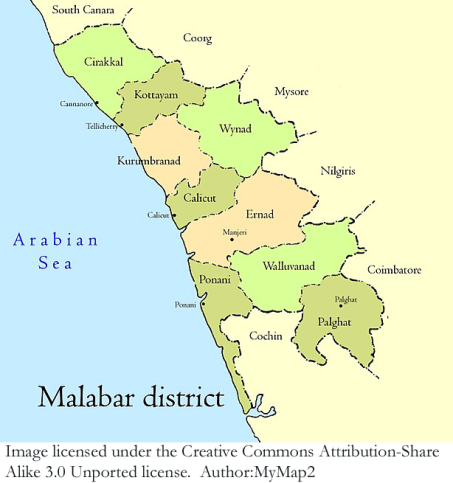 QUOTE: Owing to the terms of the cowls they held, the three northern Rajas did not immediately acquiesce in the Company’s sovereignty over them, but after some hesitation they soon found the necessity of relaxing their pretensions, and the Kadattanad Raja was the first to agree to a settlement on 25th April 1792, stipulating as follows : —
1st - The Raja to remain in the exercise of all his rights and authority subject only to the control of the Company in case of oppressing the inhabitants.
2ndly—A Resident or Dewan to reside with him to enquire into any complaints of oppression.
3rdly —Two persons on the part of the Company and two on that of the Raja to make a valuation of the revenues of each district. END OF QUOTE
There are lots of jingoist writings about how the English Company took over the ‘nation’. The fact is that which sane person in this country would love to be under the rule of these insipid kings and queens who could very easily become quite jealous of their own subjects?
QUOTE: The Padinyaru Kovilakam branch of the Zamorin’s family, already noticed, possessing great influence in the country, was entrusted with the collection of the district of Nedunganad by the Eralpad Raja, the managing heir apparent of the Zamorin. On the strength of this the Padinyaru K. Raja attempted to render himself independent of the Zamorin. The dispute was carried on to such lengths that Captain Burchall was obliged to seize his person at Cherupullasseri. He died there a day or two afterwards, and at the instance of the Zamorin his brother and nephew were put under restraint, and released only upon the Kilakka Kovilakam Raja standing security for their good behaviour and payment of arrears of revenue amounting to one lakh of rupees. END OF QUOTE.
The above is the state of the unity inside the ruling house of tiny Calicut. There is no need to understand that the mutinous side was in the wrong and the other side correct. It is just a continual struggle to keep one’s head above the swirling waters of ‘no respect’. When one person goes up in ‘respect’, the other person necessarily goes down in ‘respect’. And it is more or less impossible to live in a feudal language society without ‘respect’, for the social seniors.
This concept of ‘respect’ which is encoded in the feudal language code has no corresponding item in pristine-English.
The other issue of how come he died within a matter of two or three days in custody. There are all possibilities that the native-soldiers who had custody of him would bear upon him with the Nee and Eda word, which he would quite naturally oppose. They would thrash him terrifically. These things happen on an everyday basis in most police stations in India today.
QUOTE: Extract from the Governor-General's instructions to the Commissioners deputed to the Malabar Coast: - ..... together with the particulars of their interior and foreign trade, on which subject you will form and report your opinion as to the best means of improving both, in such manner as shall have the greatest tendency to conciliate the Commercial Interests of the Company with those of the natives, and best promote the internal prosperity of the Country at large. END OF QUOTE
These are original words of the administrators of the English Company. It is easy to mention that these are mere words. It is like speaking about Bio-data/ CV /Resume. Someone writes an original Bio-data containing the best version of his capabilities and personal dispositions. Others look at the wordings and simply copy them.
This is the same issue with the above words. These words are original and correct in intent. In the newly created nation of India, the officials simply write similar words as the government policy. No one really believes that the government machinery will at any time focus on these aims. It is not just a matter of some high level political leader being focused on these aims. It is just that only he would be with that focus. All others simply stand with focus in different direction. For, that is how feudal language brings in disarray.
QUOTE: The establishment of a Plan for the administration of Justice in the several Districts being a point the effectual attainment of which we have above all others at heart, we rely with confidence on your experience acquired on this side of India for your being able to determine in a satisfactory manlier on the number and constitution of the several Courts of Justice that will be necessary to ensure to the utmost possible degree (as far as the state of society there will permit) the dispensation of equal Justice to all classes of the society ; END OF QUOTE
The reader can very well see the spirit that led to the creation of the judiciary in the subcontinent. It had been a location where there was no equality before the law. Because the wordings in the feudal languages insist that people are of different levels. A few are of gold levels. A few of medium levels. And a big percent of the people at the stinking excrement levels.
The setting-up of a judiciary based on written codes in pristine-English, more or less, spontaneously and automatically insisted that the all persons are equal before the law and administration.
It is a very curious sight to see various low-class websites including the Wikipedia India pages simply refusing to mention the creation of the judiciary by the English Company as the real foundation of the Indian judicial apparatus. If one reads such low-class writings, one would get to feel that the Supreme Court of India simply was born on its own one fine morning.
As of now, with the Constitution of India and the written codes of law being translated into the feudal vernaculars, the majority people, the low financial and social classes are again being pushed into the levels of the stinking excrement. This is what a newly created nation is doing to its own people. And the people themselves cannot understand this cunning reality. For, they know no other language system. For, English has been cunningly denied to them, right from their primary school education. Their teachers use these very same degrading words to them. And they are trained to fall in love to those who thus degrade them.
QUOTE: Seventh.—The pepper produced on the Coast of Malabar constituting (as already intimated) a very material Branch of Commerce to the Honourable Company, it is our wish that a Provision on terms of perfect fairness to the natives may be effected in all the settlements for the Revenue payable to Government, so that as far as possible it may be made good in the natural pepper produce, taken at a fair market valuation instead of money payments, leaving whatever proportion cannot be secured in this way to be purchased by the Company’s commercial Agents on the spot on the footing END OF QUOTE.
The greatness of this rule might not be understood by the stupid arm-chair academic historians of India. For, this made commercial activity quite attractive and free of corruption and dependence on the low-class government clerks and peons. The difference was that in independent native kingdoms, the people were fleeced by the local officialdom and terrorised.
For instance in Travancore, trade in many of these commercial items were monopolised by the government. The farmers could sell them only to government warehouses. They were not paid in cash. They were given some other item in barter, unless they bribed the official. And the items given in barter were in most case of very low quality.
See these QUOTEs from Travancore State Manual:
-
The monopoly rates being abnormally high, there was a great temptation for smuggling. Again the abolition of the monopoly system in Malabar dealt a serious blow at the Sirkar monopoly and greatly facilitated the operations of the smugglers from Cochin, Anjengo and Tangasseri
-
By Act VI of 1848 the coasting trade of British India was freed from all duties
-
It was therefore more advantageous for a merchant to take Travancore goods by land to British Cochin in the first place and thence transport them to other parts of British India. The same was the case with the imports also.
END OF QUOTE.
The freedom of trade in British-India was of fabulous quality. Indeed there is no record of any sales tax department in British India, till almost the very end of the English rule. That too, I have heard was in Madras Presidency, when the Congress ministry in rule decided to impose a very miniscule duty on sales. Now this miniscule percent has developed into a huge monster in charge of a lot of corrupt officials.
QUOTE: One of the first measures of the United or Joint Commission was to proclaim on 20th December 1792 the general freedom of trade in all articles except pepper which was hold as a monopoly, and the Institution of “two separate courts of Equity and Justice” at Calicut on 1st January 1793, the first court to be presided over by the members in rotation, in which revenue and litigated landed claims were to be investigated, and the second to take notice “of all other subjects of claim and litigation not relating to the revenue or landed property.” END OF QUOTE.
Wonder of wonders! Way back in 1792, a very liberal measure. Under an English rule.
QUOTE: They further, on 9th January 1793, sent round a circular to all the chieftains charged with the collection of the Revenue of their Districts, forbidding the collection, on any pretence whatever, of any presents or cesses such as had been customarily prevalent END OF QUOTE.
Slowly the English administration was crushing down the traditional officialdom of the land. The jingoistic patriots of India would naturally boil with fury. ‘Who gave them the right to crush our corrupt officials’ That would be the point boiling in their minds.
QUOTE: While these Commissioners were engaged with the above-mentioned enquiries, the remaining members issued a proclamation of general amnesty for acts of homicide, maiming, robbery or theft committed prior to 1st February 1793 as a means of inducing the lawless among the population to resort to honest courses. END OF QUOTE.
Slowly a peaceful and secure social life was being introduced in a location where massacres and brutal hacking of individuals were a routine event.
QUOTE: “Phouzdarry oath. “I, William Gamull Farmer, Supravisor of the Province of Malabar and entrusted as the Chief Magistrate with Phouzdarry jurisdiction, do solemnly promise and swear that I will exert my best abilities for the preservation of the peace of the District over which my authority extends, and will act with impartiality and integrity, neither exacting or receiving, directly or indirectly, any fee or reward in the execution of the duties of my office other than such as the orders of Government do or may authorise me to receive. “So help me God !
END OF QUOTE
Thus was an honest administration being set up, in a land wherein lies and cheating and bribes and corruption were an indispensable way of life.
QUOTE: All interior customs were to be abolished END OF QUOTE
One has to experience the travails of trading in India as a small-time businessman to understand huge relief the above-statement conveys. As of now, the country is littered with check posts. Low quality, crooks man these check posts. The great Indian officialdom!
QUOTE: further to institute a canongoe establishment throughout the country to bring into and keep in order the accounts of each district, and to act as local assistants, guides and intelligencers to the servants of Government in the discharge of their duties, and to serve as checks upon undue exactions on the part of the Rajas. END OF QUOTE.
When a good system of government comes into the picture, the local rulers who try to fleece the populace will have to be kept in control. For, they can use powerful lower indicant word codes to inflict oppression on anyone.
QUOTE: Itta Punga Achchan, who had settled with the Bombay Commissioners for the first year’s lease, had shot himself and had been succeeded by his nephew Itta Kombi Achchan. The latter had imprisoned a rival claimant to the raj, by name Kunji Achchan, but on the arrival at Palghat of the deputed Commissioner, the latter was set free. END OF QUOTE.
A typical issue which the English administration had to face in its formative years.
QUOTE: Similar terms to those arranged with the aforesaid Rajas had been made on 21st June 1793 with the managing Achchan, but with an additional clause restricting him from the exercise of any judicial authority in consequence of the beheading of the Malasar already alluded to. END OF QUOTE
The irascible powers of the local chiefs had to be cut down. For, they could literally murder anyone as matter of traditional right.
QUOTE: The Roman Catholic padre of Calicut, however objected to the “infidel tribunal” of the Darogas, and claimed the ancient privilege of the Portuguese Factory of jurisdiction over Christians. This claim being incompatible with the principles of British rule was rejected, but the padre was allowed to attend the Fouzdarry Court to explain the law at the trial of Christians. END OF QUOTE.
There is indeed a slight amount of duplicity in the English Company’s side. Even though from a very slender perspective, the English side is seen to be establishing a rule of law in which all citizens are equal. However, that is not the truth in the subcontinent. The subcontinent runs on feudal languages. Individuals are not the same in these satanic languages.
So the very fact that the natives of the land have been given judicial powers was a very great negation of the essential quality of the English rule. For, it is a very clearly understood idea that the natives of the land would not see the people in an equal manner, with rights to equal dignity. Such persons should never be given any statutory powers.
Indeed this issue came to the fore for the English side also.
See this incident mentioned in Travancore State Manual:
QUOTE: It had been declared by the Government of India so early as 1837 that “Europeans residing in the territories of Native States not being servants of the British Government, were in all respects and in all cases, civil or criminal, subject to the law of the country in which they reside.”
But the question as to the liability of European British subjects had long remained unsettled. It came up for discussion in 1866 in connection with the trial of John Liddel, Commercial Agent at Alleppey, who stood charged with having embezzled a large sum of Sirkar money.
The Travancore Government tried him by a special Commission which found him guilty of the offence and sentenced him to two years’ imprisonment. The trial was declared by the Madras Government as illegal and as contrary to the provisions of the Proclamation of the Government of India dated 10th January 1867, issued under, and in conformity with,, with the result that Liddel’s immediate release was ordered. END OF QUOTE.
In this context, the imprisonment given to the British Sailors who landed on the Madras coast a few years back can be taken up. Grave miscarriage of justice was done in this case. The spirit of the law was not taken up. Instead the crude ego issues of the lowly Indian officials was what came into prominence.
It is not good to give power to Indians over other Indians. It has been mentioned even during the Colonial days that if such power is given, it will be misused. It is very difficult for feudal language speakers to think in a free manner. Their world and social vision will be corrupted by the feudal language codes.
QUOTE: But the erroneous idea thus authoritatively promulgated was accepted without question in all further proceedings both in the Administrative Department and in that of Civil Justice, and the question as to whether the Commissioners’ action was correct or not was not raised until so recently as 1881. END OF QUOTE.
The English administration had to deal with the attitude of the native officials also. These native officials had their own vested interests. It was to see that the lower castes were not developed, if the officials were from the higher castes. If the officials were from the lower castes, they had huge fury and vengeance against the higher castes. Both of them had fury towards the Mappillas who were the Muslims. The above-quote is one such mood of the native-officials finding fault with the English official actions. The attitude is that the native officials know better. It is just a creepy claim.
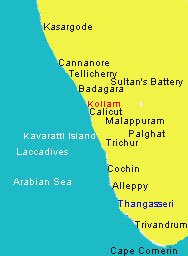 QUOTE: and the old Tellicherry Factory, which had exercised, as these pages show, such abundant influence for good in the annals of the Malayalis for over a century, and which had existed as oasis of peace and security and good government during all those troublous times, ceased to exist as such on the 27th July 1794. END OF QUOTE.
The fact mentioned about the Old Tellicherry Factory is true. However, the word ‘Malayalis’ is suspect. The Malayalis of those times were the Malabari language speakers. They do not include Travancoreans. The above-statement should be about north Malabar and to a slight degree about south Malabar. Words have to perfectly defined and used. Otherwise, they will be misused later.
QUOTE: With Cochin there passed also into the hands of the British the Dutch, formerly Portuguese, settlement of Tangasseri on the point of land lying west of Quilon bay, and the various petty places named in paragraph 299 of section (6), Chapter IV, lying to the north and south of Cochin in the territories of the Cochin and Travancore Rajas, which now, with Cochin itself, constitute the British taluk of Cochin. END OF QUOTE.
That was about British-Cochin. Tangasseri is also mentioned.
QUOTE: at the same time charges of corruption and bribery were brought before the Governor, Mr. Duncan, by the Zamorin against Messers. Stevens, Senior J. Agnew, and Dewan Ayan Aya, a Palghat Brahman for extorting one lakh of rupees. END OF QUOTE.
This must have been more revealing incident. That a local small-time ruler can place accusations on the officials of the ruling power. And they were put into prison after a trial in Great Britain.
QUOTE: The Raja, however, persisted in his assertion that the district was fairly assessed, and as the Nambiar had meanwhile allied himself with certain of the young Rajas of the Kolattiri family who were inclined to question the right of the Raja to the position he had acquired from the English, the Supravisor, after taking the orders from the Bombay Government, finally decided on 10th May 1796 to despatch a body of troops into the district under Major Murray to enforce the Raja's demands. The troops succeeded in driving the chieftain and his followers into the jungles, and Major Murray further succeeded in detaching from their alliance with the Nambiar the junior Rajas of the Kolattiri family who had taken refuge there.
The Nambiar on the 18th August then forwarded to the Commissioners a full statement of his claims, and particularly insisted on the excessiveness of the demand made against him by the Raja, and on the motives which had induced the Raja to misrepresent his actions to the Honourable Company with a view to acquiring the district for himself END OF QUOTE.
The English side was forced to deal with the issue of everyone wanting a title. The issue of ‘respect’ was not really understood by them.
On the other side, there was desperation to misrepresent, misquote, and misinterpret each of the competing persons / groups to the English side. This is how a typical feudal language social system works. For, each verbal code pulls along with it a lot of other verbal codes and set in motion various kinds of social machineries.
QUOTE: The Governor-General, Lord Mornington, after full consideration of the matter, came to the conclusion that “Wynad was not ceded to the Company by the late Treaty of Peace, and that it belongs by right to his said Highness the Nawaub Tippu Sultan Bahadur,” who was to be permitted “consequently to occupy the said district whenever it may suit his pleasure.” END OF QUOTE.
This is a very powerful illustration of how the English side consistently tried their fair-play policy. Instead of aiming to gain a small profit, they were focused on creating powerful social systems and conventions of fair-play. However, on the other side there were very few persons who could appreciate these gestures. For over there, everyone of them were terribly preoccupied with the issues of maintaining ‘respect’ under all costs.
QUOTE: The Malabar militia, an irregular force and undisciplined, serving under their own native chiefs, was then (June 10th, 1801) disbanded. END OF QUOTE.
It is good that such an irregular and undisciplined force, functioning top to bottom on feudal languages should be disbanded, and a new force which was focused upon planar language English come up.
QUOTE: The superseded chiefs were continued in the enjoyment of the allowance of one-fifth (in some cases) and of one-tenth (in others) of the revenue of their respective districts which had been allotted to them for their maintenance. These allowances continue to be paid to them down to the present day under the designation of Malikhana. END OF QUOTE.
May be this is how the Privy Purse system (pension system for the old time rulers and their descendents) came into being. It was a good policy of the English rulers. For the royal houses were not forced into penury. However, when India was created one of the Prime Ministers suddenly stopped this, as a display of some shallow populism. This literally led to some of the small-scale kingly houses falling into deep financial distress.
QUOTE: In 1857 the Government agreed with the Revenue Board and the Acting Collector that the allowances are perpetual during good conduct and are not revocable at pleasure.” END OF QUOTE.
If this be so, how come the Indian Prime Minister stopped the allowance all of a sudden? May be a reparation case can be filed.
QUOTE: The Coorg war in 1834 did not affect Malabar beyond that “an old and faithful servant of the Company,” Kalpalli Karunakara Menon, the Head Sherishtadar of the district, was sent for the purpose of opening a friendly negotiation with the Raja, and was imprisoned by the latter. This outrage led directly to the war. END OF QUOTE.
Despite all great talk of great heritage and such nonsense, the fact remains that in any scene the powerful side would use the degrading verbal codes on the weaker section. Once this done, the weaker section has no right to any kind of decent behaviour from the other side.
QUOTE: with a view not only to exhibit the difficulties with which the district officers have had to deal, but to elucidate the causes from which such difficulties have sprung. END OF QUOTE.
Each of the minor localities had a lot of problems. For, the systems were changing. In the earlier times, there is no location for appeal. The local chief took terrific decisions including that of decapitation or impaling. Now, the focus of social power was shifting towards written codes of law.
QUOTE: Kavalappara under its own Nayar chief owed a sort of nominal allegiance both to the Cochin Raja and to the Zamorin. The Commissioners eventually decided in favour of his independence. END OF QUOTE.
The king of Calicut is a tiny ruler. However, he has smaller-than-him rulers under him. He will not allow them to go independent. For, their subordination is his pathway to leadership. In fact, this remains a fact of social life in the subcontinent even to this day. Conversion to another religion is tried to be forestalled. For, it is like undermining a leadership. The lower castes declaring that they are not Hindus, but actually different religions will not be allowed. For, that will be decimate the Hindu leadership.
Even in the case of India-occupied-Kashmir, India will not allow the people there to do decide what they want to be.
QUOTE: they were careful in their despatch of the December following to caution the Government against introducing into Malabar “an intermediate class of persons (call them Zemindars, Mootahdars, or what we may) between the Government and the Jelmkaars or hereditary proprietors of the soil END OF QUOTE.
The insight and the foresight are extremely admirable. However, who is there on the other side to understand the calibre of the native-English administrators? The native intellectuals are bothered only about their own ‘respect’ and nothing else.
QUOTE: not to create, but to restore, landed property, gradually to convert the bad farms of the Tamil country into good estates, and the land-property holders into land-owners, etc." END OF QUOTE.
Extremely great ideas. However, these great ideas are being put forward for an ungrateful population, who the moment they get more power will only try to pull down the very people who had helped them come up.
I am reminded of the biblical words:
Give not that which is holy unto the dogs, neither cast ye your pearls before swine, lest they trample them under their feet, and turn again and rend you." –Matthew 7:6 Bible - King James Version
QUOTE: "The Board of Revenue declare that our knowledge with respect to the ancient state of things in Malabar is extremely defective. To us it appears so defective that many things which have been stated and re-stated as matters of fact are but objects of conjecture, conjecture founded upon hardly anything to which with propriety the term evidence can be applied. END OF QUOTE.
This is the truth about almost all antique claims currently made by India. All things that have been traced out in some ancient Sanskrit palm-leaf books in some remote households, are now claimed as the heritage of India. The actual fact remains that most of these books were unearthed by the officials of the English Company. See this quote from the preface to the English translation of Kama Sutra:
QUOTE: While translating with the pundits the ‘Anunga runga, or the stage of love,’ reference was frequently found to be made to one Vatsya. The sage Vatsya was of this opinion, or of that opinion. The sage Vatsya said this, and so on. Naturally questions were asked who the sage was, and the pundits replied that Vatsya was the author of the standard work on love in Sanscrit literature, that no Sanscrit library was complete without his work, and that it was most difficult now to obtain in its entire state. The copy of the manuscript obtained in Bombay was defective, and so the pundits wrote to Benares, Calcutta and Jeypoor for copies of the manuscript from Sanscrit libraries in those places. Copies having been obtained, they were then compared with each other, and with the aid of a Commentary called ‘Jayamangla’ a revised copy of the entire manuscript was prepared, and from this copy the English translation was made. END OF QUOTE.
The fortitude displayed by the pristine-English officials in those days is of fabulous standards.
QUOTE: “We observe with dissatisfaction that when you have assumed the existence of any peculiar ownership in the land as that of Moorassidars or Jelmkars, you afford us little information with regard to the condition of any other class of the agricultural population. In Malabar the number of occupants who pay the assessment on the land, mortgagees and lessees included is estimated by the Collector at 150,000. The number of persons employed in the cultivation must exceed this number to an extent of which we have no means of forming an accurate judgment.”
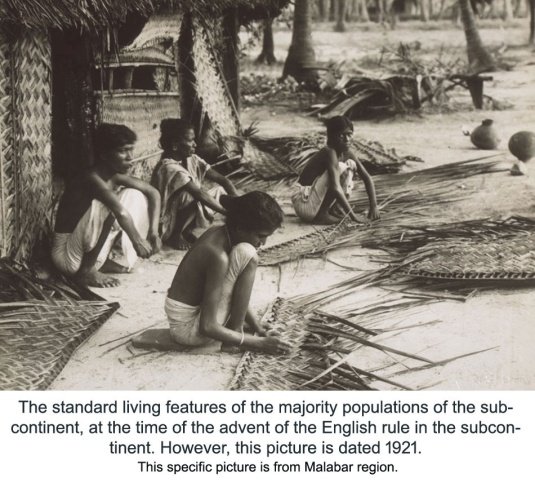 Nothing known of the great body of actual cultivators, nor of the slaves. END OF QUOTE.
It is a great point to note here that the people of the subcontinent do not notice the poverty around them, or the fact that their own servants sit on the floor, sleep on the floor, are made to dress in the old shabby dresses of their masters, have to enter the household through the back door, have to use a shabby eastern-toilet while the householders can use a western-toilet, and are addressed and referred to in the pejorative form of word codes. But then these very same affluent class of India, do notice the terrible racism in native-English nations, where well-groomed blacks and Asians are still clamouring for more rights, after all the fabulous improvements they have had in native-English nations.
These people are not really bothered about anyone else other than their own right to encroach into native-English locations. Even the Continental Europeans have this complaint that they are kept apart from the native-English.
Kottayam
There was a small kingdom headquartered near to Tellicherry. It was the Kottayam kingdom. Even though a lot of fabricated fame and halo has been added to this tiny kingdom, most of the people who had heard about this kingdom did not really know where exactly this place was. The place name Kottayam was misunderstood as the Kottayam of Central Travancore.
In fact, when I once told a man in north Malabar this kingdom was near to Tellicherry, he replied thus, ‘Now only I understand. I was always wondering how the Wynad Kurichiyas were involved in a fight with the British in Kottayam.’
The issue here is that man’s native place was just around 35 kilometres from the location of this Kottayam and yet he had not heard of this place. Nor had this place been mentioned by my own family ancestors in Tellicherry.
However, the fame of this tiny place is being slowly built up by a series of fabricated stories, newspaper writings, fake-story films, and outright manipulation of written history, of how this kingdom fought for the ‘freedom of India’ against the British Empire!
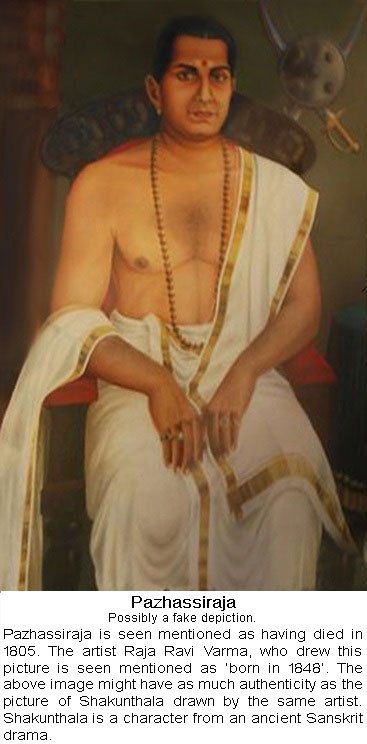 The fabricated story was of the king of Kottayam fighting against the British to save his people, his kingdom, and ultimately India, with the help of the Kurichiya lower-caste tribals of Wynad forests. There are even persons who ascribe his team to have used the martial arts techniques of Kalari to defeat the British in various battles and guerrilla attacks.
This Kottayam itself must be a small place near to Tellicherry. However, the kingdom is mentioned as having its rights up to Kuttiadi and Kavilumpara etc. and inside Wynad also.
However, the so-called Pazhassi raja was not really the king of Kottayam. He was seen as an usurper by the real king of Kottayam.
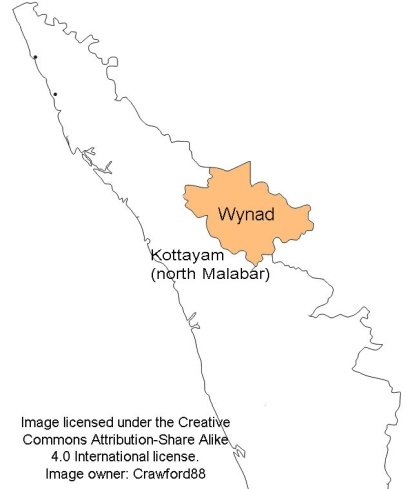 As to Wynad, there is this point to be noted. Wynad forest area seems to be part of the Deccan plateau. I am not sure about this. However, it might be very much a part of the Mysore kingdom. But then being a thick forest location, there might not be much of a ‘rule’ there.
See this quote:
QUOTE: The Governor-General, Lord Mornington, after full consideration of the matter, came to the conclusion that “Wynad was not ceded to the Company by the late Treaty of Peace, and that it belongs by right to his said Highness the Nawaub Tippu Sultan Bahadur,” who was to be permitted “consequently to occupy the said district whenever it may suit his pleasure.” END OF QUOTE
Now, let us go through the text in this book, Malabar and try to place everything in the correct context. It may be borne in mind that the Nayar and higher caste sections would insert filtered information into this book in an attempt to portray the Kottayam insurgent leader in a larger than life version. The Company officials are also seen to be lenient to him in this regard without really understanding the social reality.
QUOTE: Of Rajputs, or foreign Kshatriyas, there are in Malabar (census 1881) only three hundred and sixty-two all told. The families of the Kottayam and Parappanad chieftains belong to this class, and the former of these chieftains used sometimes to be called the ‘Puranatt’ (i.e., foreign) Raja. The Parappanad family supplies consorts to the Ranis of Travancore, and also forms similar connections with the families of other chieftains in Malabar. They follow the Marumakkathayam law of inheritance. END OF QUOTE.
There might have been a sort of feeling that a mention of a connection to the populations of the northern parts of the subcontinent would give a better genetic address. It is seen mentioned that they follow the Matriarchal or Marumakkathaya law of inheritance. In which case, the same family system must be seen in the Rajputs who are seen mentioned as their family ancestry. I do not know if this true.
It is seen in this book that various persons when they assume or attempt to assure some regal title or address, assume the Varma name. This Varma name in Malabar might have helped earn a Kshatriya heritage and antiquity address. There is a general indoctrination in the social system that the Aaryan heritage is something superior, to the Dravidian heritage. The Dravidian heritage is generally connected to the Tamilians who are dark-skinned. Many of the dark-skin people have this skin-colour inferiority complex in themselves.
However, it would be most unwise to assume that all the south Indians are connected to the Tamilians or Dravidian ancestry. The Marumakkathaya Thiyyas, the Malayans, the Pulaya, the Pariah, the Makkathaya Thiyyas, the Nayars, the Shanars, the Vedars, the Chovvans, the Ezhavas, Nambhuthiri Brahmins, the Ambalavasis etc. might have different ancestry and antiquity. Each one of them would have connections to different population groups from all over the globe. In Malabar, Canara, Tamilnadu, Travancore etc. they got regimented under the same social system. With the Brahmins at the top. That is all.
Much before the Pazhassiraja insurgency, the Kottayam kingdom had long years of relationship with the English Company. This kingdom also made use of the Company to protect themselves from the insidious takeover attempts by other small-time kingdoms, nearby. Moreover, the kingdom did try its own game at make the best profit out of the competition between the English Company at Tellicherry and the French headquartered at Mahe. Tellicherry, Kottayam and Mahe are within a few kilometres radius.
QUOTE: And it was known that the Kottayam Raja, who had helped the prince to take it from the Mappillas, had agreed to give up the positions held by him on it to the French whenever they should choose to END OF QUOTE.
The king of Kottayam was also playing the seesaw game, with the English Company and the French. However, whenever things became too hot, the then ruler of Kottayam would rush to the English to ask for help.
QUOTE: But disputes early commenced between this Raja and Tippu relative to their respective boundaries, and the latter’s vakils complained also of the Kottayam Raja taking Wynad, which district the Commissioners were then of opinion was not ceded by the treaty. END OF QUOTE.
Wynad was not part of Kottayam territory, but more or less under the disputed ownership of the Mysorean kingdom.
QUOTE: The Kottayam Raja's alarm of invasion had meanwhile not abated, and on the 19th of February he sent to the Chief an unconditional agreement to plant the English flag and post garrisons on the island. END OF QUOTE
This happened when the Canarese army invaded north Malabar. It is quite funny that the well-established kingdoms had to run to the safety of a small trading settlement of the English Company whenever there was any attack on them from any neighbouring kingdom.
QUOTE: Meanwhile the mediation carried on by Kottayam went on slowly. He was in no hurry to arrange terms while being paid a personal allowance of Rs. 40 per day as may be imagined, and he appears not to have scrupled at declaring openly that he meant to make the most he could for himself of the troubles in the country. END OF QUOTE.
The king of Kottayam was ‘making hay when the sun was shining’, so to say. For, he thought as every other small-time kingdom in the locality did, that he could play French against the English and vice versa and get his due profit.
QUOTE: The Kottayam Mappillas deserted the Raja and assisted the invaders END OF QUOTE.
This happened when Hyder Ali invaded north Malabar kingdoms. The Mappillas supported the Muslim invaders. For, they had their age-long grievances against the Nayars and the higher castes.
QUOTE: It must also be here explained that with regard to the Chirakkal cowl it was granted to Unni Amma, a younger member of the family, who assumed the name of Ravi Varma, and was the only one on the spot, the real head of the house having fled with his mother to Travancore ; and that the Kottayam cowl was likewise granted to a junior member of the family, afterwards known as the rebel Pazhassi (Pychy) Raja, the senior Raja having also taken refuge in Travancore. END OF QUOTE.
This is the crucial information about the real reasons of how this ‘raja’ became an insurgent. The tale of this insurgency is actually a story of how his uncle, the real raja went on trying to subdue him, and the young man not willing to give up his title. For, in feudal languages, the moment a title is given up, all the verbal codes of ‘respect’ would get erased. It is like an experience of ‘free-fall’ down to the social depths for the person who has lost his ‘respect’. It is for this reason that politicians fight to retain their positions desperately in current-day India. The leader and the follower will be placed on the same verbal level, once the ‘respect’ is gone.
The English Company did many times try to help the Pazhassiraja to come to an amenable terms and relationship. However, each time, his uncle would thwart the attempt. For, it was in his interest to see that the usurper is not allowed any power at all.
QUOTE: As after events fully proved, however, the Kottayam nephew of Kurumbranad—the famous Palassi (Pychy) Raja was not amenable to control by his uncle, and the uncle was powerless to execute his own orders in the Palassi country. END OF QUOTE.
This is the true, much understated fact about the background to the insurgency, which was at best a struggle to get the royal title, and to safeguard his own ‘respect’ and honour by the Pazhassiraja. It was not any kind of a ‘freedom struggle’ against the British Empire. Only total nitwits will believe such nonsense.
QUOTE: The Palassi (Pychy) Raja had already, in April 1793, been guilty of the exercise of one act of arbitrary authority in pulling down a Mappilla mosque erected in the bazaar of Kottayam. The Joint Commissioners took no notice of the act, although it was in direct opposition to the conditions, of the engagement made with the Kurumbranad Raja for the Kottayam district. END OF QUOTE.
Actually the Mappilla presence in the kingdom would be a sort of social revolution. In that the lower caste might see the elevated stature of the Muslims, as they do not have any statutory hierarchies among them. Many of the Muslims could be recently converted from the lower castes.
As to the English Company not taking any action against this act of villainy, it might be just that they had not yet started their administration on a sure footing here. Things were still quite fluid. Beyond that there must have been so many similar events happening all around the geography.
QUOTE: Again, in September 1793, the Mappillas of Kodolli applied to the Palassi (Pycliy) Raja for leave to build or to rebuild a mosque, and were told in reply to give a present. They began to build without making the preliminary gift to the Raja, so he sent Calliadan Eman with five armed men to bring the Mappilla headman (Talib Kutti Ali) before him. The headman delayed; the escort attempted to seize him ; whereupon Kutti Ali drew his sword and killed Calliadan Eman, and was in turn killed by the others. END OF QUOTE.
Here there is a hidden issue. The Muslim headman would have to display his subservience to the small-time chief of Kottayam who was not really the king, but a usurper. The headman would invariably be addressed as Inhi (Nee lowest You) by not only Pazhassiraja, but also by most of his relatives. In such a scenario, many persons with some self-dignity would refuse to go to such a location. Or else, they would try to delay the going.
The team that went to bring the Mappilla headman also would use such tormenting words to the Mappilla headman. However, this would be in a location where the Mappilla headman would have his own supporters. The very word ‘Inhi’ would be highly inflammatory. He would turn homicidal, if he has any sense of self-respect left in him. That is the truth. Only in native-English nations, this information has not entered much to the bemused delight of outsiders/ immigrants.
There is no known defence to a degrading lower indicant word verbal attack. The affected person has only one option. That is to go berserk.
QUOTE: On receipt of news of this affair the Raja sent an armed party with orders to slay all the Mappillas in Kodoli. The party went and slew six Mappillas with a loss to themselves of two killed and four wounded. END OF QUOTE.
The Pazhassiraja was not a person with any kind of enlightened statesmanship. However, if he had become the king, naturally he would be ‘respected’ and honoured. That is all.
QUOTE: They (The English Company) contented themselves with a mild remonstrance addressed to the Kurumbranad Raja and with the despatch of troops to Kodolli and Palassi. END OF QUOTE.
The English Company initially had no intention of interfering into all the social issues of the land, which probably they (the native-English) could not understand. Moreover, if the Company tried to insert its own justice on all local rulers, they would have found it difficult to continue their trade there.
QUOTE: The Palassi detachment was accompanied by a European Assistant. The Raja, alarmed at the movement of troops, designed as he thought to make him a prisoner, refused to come to Tellicherry to explain the matters to the Northern Superintendent, and ironically referred the Supravisor for explanation to his “elder brother” of Kurumbranad. He further in his reply expressed surprise at his not being “allowed to follow and be guided by our ancient customs” in the slaughter of erring Mappillas. END OF QUOTE
Here there are more than one issue. Even though the detachment was accompanied by a European Assistant, it was naturally full of the local Nayar / Thiyya sepoys. They would use only the lower indicant (Inhi/Nee, Eda, Enthada) words if they were to accost him.
If he were to come to Tellicherry, he would not have anything to confirm that he would not be treated in a manner in which the subordinated individual is treated by the native rulers.
As to his ironical referring to his ‘elder brother’, the fact is that his elder brother would also have a similar opinion on what to do to the Mappillas.
His surprise is also quite noteworthy. Till the advent of the English supremacy in the subcontinent, the small-time rulers and other Adhikaris could literally do what they wanted to the people under them.
QUOTE: the Palassi (Pychy) Raja had threatened to cut down all the pepper vines if the Company’s officers persisted in counting them. In short he conducted himself in a way that fully justified the Joint Commissioners in styling him “the most untractable and unreasonable of all the Rajas.”
On the deputation of one of the Company’s Linguists, Mr. Lafrenais, to enquire into his grievances, it was discovered that his uncle, the Kurumbranad Raja, from views of personal advantage, had secretly instigated him to resist the execution of those very terms of settlement with the Commissioners which he had himself concluded with the Company on behalf of his nephew. He thus hoped to involve the Company in active hostilities with the Palassi (Pychy) Raja, who now, convinced of his machinations, entered on 20th December 1793 into an agreement direct with Mr. Farmer for the districts of Katirur, Palassi, Kuttiyadi and Tamarasseri on the same liberal lines as those accorded to Kadattanad. END OF QUOTE.
There is a wonderful illustration of how the social machinery works. Pazhassiraja’s own uncle makes certain settlements with the English Company. At the same time, he instigates Pazhassiraja to resist the execution of the terms of these very settlements. This is actually a technique even now followed in various situations in the subcontinent. That of acting as a sort of mediator between two groups, and then at the same time instigating each against the other.
The feudal language word codes actually promote these kinds of activities.
QUOTE: But over and above those concessions to the Palassi (Pychy) Raja, Mr. Farmer further agreed for one year, until orders could be obtained, not to collect the assessment on temple lands, and to remit further one-fifth of the revenues for the maintenance of the Raja, and for the support of the temples one-fifth more in consideration of the assistance given against Tippu and of the Raja’s ancient friendship with the Company. END OF QUOTE.
Actually these are all wonderful offers. Yet, the verbal codes in the social system can create havoc, in a scene where the raja is seen as a usurper and a threat by his own uncle.
QUOTE: The Kottayam and Parappanad leases were, however, once more executed by the Kurumbranad Raja—a repetition of the old mistake, as events soon proved, made originally by the Joint Commissioners.
-----------the repetition of the old mistake of entrusting the management of the Kottayam district to a chief who had no power or influence therein, and the passing over of the Palassi (Pycliy) Raja’s claims to the Government of that district, very soon bore disastrous fruit. END OF QUOTE.
This was the item that again made Pazhassiraja go astray. There would be very concerted planning on the side of the Kurambranad Raja to keep his claims out. And the English Company fell for this cunning.
QUOTE: Some time before the lease was concluded, one of the Iruvalinad Nambiars—Narangoli—had brought himself within reach of the law. One of his people had been killed by a Mappilla, and in revenge the Nambiar put to death three of that class, being instigated (as it was alleged, but there was no conclusive proof of it) to that act by the Palassi (Pychy) Raja. However this may have been, the Nambiar fled to the protection of the Raja, and in spite of the Supravisor's remonstrances, that chief protected the refugee. The Supravisor then declared the Nambiar to be a rebel and confiscated his lands and property. END OF QUOTE.
Again it is the traditional antipathy for the Mappillas which created the rancour.
QUOTE: Two Mappillas were suspected of having committed a robbery in the house of a Chetti. The Raja explained afterwards that they confessed their crime; they were certainly kept in confinement for some months. Then they were tried according to the ancient usage of the country, it was alleged, and on their own confessions were sentenced to death. Their execution was carried out on or about the above date at Venkad by impalement alive according to ancient custom END OF QUOTE.
Again it is the antipathy for a class of people who were not in sync with the traditional hierarchal system in the society. If the traditional hierarchy were to be enforced, most of the Mappillas would go to the very bottom of the social set up.
QUOTE: shortly afterwards there arrived intelligence of another arbitrary act on the part of the Raja ; he, it was said, deliberately shot another Mappilla through the body while retiring from his presence whither he had gone to present a gift. These arbitrary acts could not be overlooked. END OF QUOTE.
Again it is the Mappilla man who has been killed. Now, it might be time to check why this happened. The man went to give a gift. Yet, was killed.
The reason is that when a person is out of step with an established system of hierarchy in a feudal language, a slight body posture which is not in sync with the verbal respect code would cry out the signal that the side that has to be ‘respected’ has been dishonoured.
It is like that of an ordinary man in India going to a police station and sitting down in front of the police inspector. In most probability, he would be slapped on the face with homicidal fury. As per the verbal hierarchy of the Indian officialdom, an ordinary man has to bent, bow and cringe, and display all kinds of subservience. Even a single item which is out of step would proclaim the information that all his other actions of ‘respect’ were mere pretences.
This is exactly what happened to the British Sailors who were imprisoned in Madras. They displayed their normal English behaviour and stature in an Indian police station. The police officials would go berserk. Just because they were from Great Britain, they were not physically attacked then and there. If it was a local citizen, he would have his bones broken, then and there.
QUOTE: The Supreme Government directed that the Raja should be put upon his trial for murder, but it was not easy to bring this about, for the Raja was well guarded by five hundred well armed Nayars from Wynad.
In August 1795 the Supravisor stationed detachments of troops at the bazaar of Kottayam itself and at Manattana to protect the Kurumbranad Raja s revenue collectors.
These detachments were withdrawn for a time because of troubles with the Mappillas in Ernad and Vellatiri, but they were again posted in November to keep the peace, and as Mr. Rickards expressed it : END OF QUOTE.
The mention of ‘five hundred well armed Nayars from Wynad’ could be just a mere hearsay or even an insertion by the Nayar section into the book. Getting five hundred Nayars from Wynad would be quite a difficult proposition, considering that the location was a dense forest. It would take at least a couple of weeks to get them to Kottayam (near Tellicherry).
Beyond that it does not look as if the Pazhassiraja could afford to maintain such a large number of Nayars for his protection. It is not that easy in that the other kings and rulers in the area did not want an upstart to grow up to regal levels.
There is another item to be mentioned. In Kottayam, the English Company was trying to protect the Mappillas. However, in South Malabar, the Mappillas were creating trouble for the Company by attacking the Hindus and Nayars. Their aim was not really the English Company. However, the Company was forced to intervene. Because it was the Company which was seen as the paramount power by everyone.
See these words of the king of Calicut, during the time when Sultan Tippu attacked:
QUOTE: To this I am obliged to reply that the country and the government is with the Company, whose armies must protect it ; that, unless they (the small-time kings) willingly contribute to the expense of maintaining them according to what is just, the country may go back to Tippu, and instead of living in peace under the shadow of the Company, all our troubles and vexations may return and we may be driven back into the Travancore country. END OF QUOTE.
QUOTE: “From this time forward the conduct of Kerala Varma, (Palassi Raja) continued to be distinguished by a contempt for all authority. He delighted to show how powerless Kurumbranad was to carry on his engagement for the Kottayam district. END OF QUOTE
As seen in the above quote, the Pazhassiraja was smarting under the snubbing he received from the Kurumbarand raja. That the English Company got involved was a mere coincidence.
QUOTE: King of Calicut says: “As for me, when my people ask for revenue (from the Mappillas), they shake their swords at them”. END OF QUOTE
So there are two separate items to be mentioned with regard to the Pazhassiraja insurgency. The first one was that he was not the real king. He was seen as a usurper by his own uncle who held the title of king. The other rulers in the area were not very keen on his gaining the royal title.
The second item was the Pazhassiraja shared the animosity for the Mappillas which was there in all who were stuck in the social hierarchical system with the Brahmins on the top. He took law into his own hands under the claim that it was his hereditary right, and impaled a number of Mappillas and also killed some other Mappillas otherwise.
Usually when eulogising the Pazhassiraja by the current-day academic histories to spray ignominy on the English Company, these information are kept hidden.
QUOTE: The pepper revenue of Kottayam, a most important item in the accounts, was in jeopardy owing to bands of armed men moving about the country.......................On December 16th, the Northern Superintendent came to the conclusion that the differences between the rival Rajas were irreconcilable, and suggested the issue of a proclamation to the people forbidding them to assemble to assist the Palassi (Pychy) Raja. END OF QUOTE.
Due to the feud between the Uncle and his nephew, the administration was suffering. Pepper revenue was lost. This is due to the fact that no worker would dare to go into the area for pepper collection. For, he might be hacked into pieces.
The English Company had to have financial acumen to administer this semi-barbarian land where the people were accustomed to hack or impale each other, if they get the upper-hand.
QUOTE: Moved by those threats, the Palassi (Pychy) Raja then openly visited Tippu’s Killidar at Karkankotta. END OF QUOTE.
This is was a very foolish item to do. It is like what happened to SubashChandran. He ditched his INA army and tried to move to Russia. There, it can be presumed that he was caught by the Russian soldiers. It is a real tragic affair to be caught to the Russian soldiers. There were news reports that came out during the Presidency of Gorbachev in Russia that he had been made a menial servant in a Siberian prison and that he had died there thus. There were other rumours that the Indian Prime Minister Nehru was hell-bent on seeing that he did not come out. For, if he came out, it would become a terrible threat to his own prime-minister-ship, which presumably had been grabbed with the clandestine help of the British Labour Party leadership.
QUOTE from timesofindia.indiatimes.com dated: Jan 24, 2016: One of the disclosures in the Netaji files, made public on his 119th birthday on Saturday, is that Nehru had written to then British PM Clement Attlee about Subhas Chandra Bose, saying,
"Your war criminal has been allowed to enter Russian territory by Stalin. This is a clear treachery and betrayal of faith by the Russians, as they were allies of the British and the Americans. Please take care and do what you consider proper and fit."
While this would appear to confirm a testimony by a stenographer, Shyam Lal Jain, who had told the Khosla Commission set up in 1970 to investigate Netaji's death that he had typed such a letter dictated by Nehru in December 1945, the Congress jumped at the typographical and factual errors to claim it was a hoax. END OF QUOTE
If Pazhassiraja had gone to Sultan’s Tippu’s residence, he would more or less face the same problem of ‘respect’. Sultan Tippu’s people had the habit of cutting off the hand and other parts of the human body, to extract ‘respect’ from them. In fact, a number of British sailors and soldiers did experience this. See the story of James Scurry who had been imprisoned and converted into a menial servant under the subordinates of Sultan Tippu.
Tippu had a grudge against the Nayars and all the higher castes. Beyond that, Pazhassiraja had the history of impaling the Mappillas. It would have fared very bad for him if he had got caught by Tippu’s people.
QUOTE: It seems that Tippu agreed to supply him with ammunition, and to on station 6000 “Carnatics” under his Killidar at Karkankotta on the Wynad frontier, to be ready to help the Raja’s people in driving the British troops down the ghats out of Wynad. END OF QUOTE.
However, no such thing ever materialised in the small-time skirmishes that ensued later between the raja’s subordinates and the English Company.
QUOTE: Acting mainly on the advice of Shamnath, the Zamorin’s minister, the Commissioners had, just before the arrival of the Committee of Government, begun to raise a levy of irregular troops to harass the Palassi (Pychy) Raja, a measure which appears to have been attended with the best possible effect. END OF QUOTE
It is plainly seen that the king of Calicut wanted to see Pazhassiraja crushed. For, he was a usurper. He rising in power would embolden so many other similar usurpers in so many king houses, in the various small-times kingdoms.
QUOTEs
1. After several ineffectual attempts of the Chirakkal Raja and Mr. Peile, the Northern Superintendent, had been made to induce the Palassi (Pychy) Raja, under the most unqualified assurance of safe conduct, to meet the Committee at Tellicherry, active measures were resumed against him,
2. pardon was likewise extended to the Narangoli Nambiar of Iruvalinad who as already related, had, after the slaying of three Mappillas, fled to the Palassi (Pychy) Raja for protection END OF QUOTE
Even then the English Company did try to reach out to him and settle matters amicably.
QUOTE: This Yemen Nayar, for whom Colonel Wellesley wrote, was an influential Nayar of Wynad, who, at the outbreak of hostilities with Tippu Sultan in 1799, had come to the Malabar Commissioners at Calicut and professed his attachment to the British cause. His professions were believed and assurances of protection to himself and his adherents were granted to him. He had since that time been admitted to the confidence of the authorities in Malabar, and it was to consult him as to local matters that Colonel Wellesley now sent for him prior to forming his plan of operations against the rebels in Wynad.
It was never clearly proved, but it is almost certain, that he was all the time in secret correspondence with his suzerain lord of Palassi (Pychy), advising him of the measures to be taken against him. END OF QUOTE
These are the usual cunning used in almost all feudal language societies. There is indeed the history of Ajatha Satru who was a king of yore in the far eastern parts of the subcontinent. When he wanted to defeat the relatively more powerful kingdom of Vajji, which was ruled by an oligarchy of high class families, he simply acted out a fight with his minister. The minister went to the Vajji kingdom and asked for refuge. This was granted to him. Then from inside he slowly set each family against each other. When the internal rivalry was high, he sent word to Ajatha Satru, who came with his army and captured the kingdom.
If indeed the US government would check the Tiananmen Square incident acted out by the Chinese government, it would most probably seen that it was a very cunning event set forth with the aim of stealing the technological secrets of the USA.
The way these things are planned and acted out is not easy to imagine in planar languages like English. In feudal languages, there are powerful routes of command and obedience, even if the other man is on the enemy side.
This Yemen Nair would have his own vested interest in crushing the English Company. For, the English Company was the most dangerous entity to appear on the Malabar seashore. Its very existence would flatten up the social order, and the Nayar and the rest of the higher castes would be brought down to the levels of equality with the lower castes.
The Englishmen did not really understand the mental trauma which this eventuality would create in the higher castes. The rude and crude lower castes would be let loose in the social order. Then no higher caste individual, especially the female folks would be able to walk on the road. For, the lower castes would dare to use the lower indicant words on them.
See this QUOTE from Travancore State Manual:
QUOTE Brahmans never attend these markets. When this liberty was given to the low castes, Sudra women and others refrained for a while from attending market, but they are now getting accustomed to the new state of things, though they hotly declare their dislike to it. END of QUOTE
QUOTE: Colonel Stevenson entered the district in January 1801, the rebels were easily dispersed, and by the month of May every post of any importance in Wynad was in the hands of the British. END OF QUOTE
There were a few skirmishes before this and after this, in which the Pazhassi side did attack the English side by hiding in the woods and springing up upon them suddenly. However, there is no great battle or war seen mentioned in this book, Malabar.
QUOTE: Some five days previous to 11th October 1802, one of the proscribed rebel leaders, Edachenna Kungan, chanced to be present at the house of a Kurchiyan, when a belted peon came up and demanded some paddy from the Kurchiyan. Edachenna Kungan replied by killing the peon, and the Kurchiyars (a jungle tribe) in that neighbourhood, considering themselves thus compromised with the authorities, joined Edachenna Kungan under the leadership of one Talakal Chandu. END OF QUOTE.
This kind of cunning has been used many times in the subcontinent by various groups. When this killing is done, the killer informs the Kurichars that the English Company will catch them and do something terrible to them. The poor jungle folks who are literally at the mercy of the native-land bosses would not have the daring or information to question or doubt these statements.
They then fall in line with the commands of their own traditional tormentor class. For, they have been told that the English Company was terrible. They would even tell them that they would be caught and sold as slaves in the high seas.
See the same technique used by the Travancore Nayars to terrorise the lower castes, during the times of the Census conducted all over the Subcontinent by the English East India Company administration:
QUOTE from Native Life in Travancore: The Sudras also sought to frighten them by the report that the Christians were to be carried off in ships to foreign parts, in which the missionaries and their native helpers would assist. When numbers were stamped upon all the houses, people thought that soon they themselves would be branded and seized by the Sirkar. END OF QUOTE.
This is more or less the way in which the Pazhassiraja side defrauded the Kurichiyas to stand with his side. They would be made to do more and more crimes that they would really be terrified of getting caught by the English Company.
QUOTE: By June 20th Mr. Baber had succeeded by his personal efforts in dissolving the rebel confederation in Chirakkal ; he restored confidence in the most rebellious tracts, and undermined the influence of the rebel leaders by representing them in the worst light as the enemies of society. END OF QUOTE.
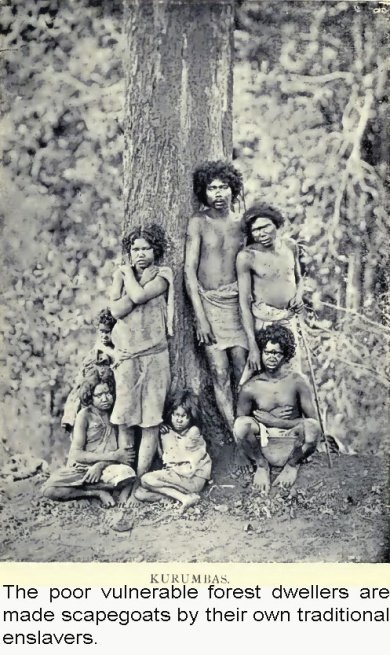 Actually if the English side did really understand the social system, they can very well explain the goodness that they were ushering in. However, the information on the feudal languages of the subcontinent simply was not detected by them. However, it was very plainly clear that their presence was unshackling the lower classes without much disturbing the higher castes.
QUOTE: The attack was made by Kurumbars, described as a desperate race of men, who were just beginning to waver in their attachment to the Palassi (Pychy) Raja, and whom the rebel leaders wished by some outrage to commit entirely to the Raja’s side. END OF QUOTE.
This was the rascality of the traditional tormenter class. They made the very population who they had been oppressing over the centuries to commit the crime against the very people who had arrived to save them from their social slavery. This kind of treacherous actions are very much part of the social system even now.
QUOTE: Throughout the northern and western parts of the district, I found the sentiment in our favour, at the same time a considerable disinclination to afford the smallest information of the Pyche (Palassi ) Rajah or his partisans. END OF QUOTE.
The people understand the refinement of the English Company. But then, what is to be done? They cannot openly support the English side. For, the social system is full of treacherous elements. One small whisper is enough to get a person hacked to pieces by the insurgent side, which is hell-bent on continuing the age-old enslavement of the lower classes.
QUOTE: the most wealthy and numerous of whom were the Chetties and Goundas,—a vile servile race of mortals, who are strangers to every honest sentiment, and whom nothing but one uniform system of severity ever will prevent from the commission of every species of deceit and treachery. END OF QUOTE.
I think the Chetties and the Goundas were the traditional landlord classes in Wynad. Naturally they would be very cunning. For, they have to keep a huge section of people as their slaves for centuries. But then, it would be quite unwise to brand them exclusively with these vile attitudes. The fact is that almost all persons in the subcontinent who has some clout and power does practise all this either inadvertently or deliberately. This is so, because the codes for this attitude are there in the language codes.
QUOTE: “The Kooramars (Kurumbar), a numerous race of bowmen, by far the most rude of all the Wynadians, had to a man deserted their habitations and estates and betaken themselves to the strongest parts of the country, where they had removed their families and were dragging on a miserable existence, labouring under the dreadful impression that it was the intention of our Government to extirpate their whole race. As those people were exclusively under the influence of Palora Jamon (Pallur Eman), it is not difficult to explain whence this unfortunate notion originated ; it is only those who have had a personal opportunity of knowing the extensive abilities and artifices of this man who can justly calculate upon the mischief and dire consequence that must ensue where such qualifications are employed against us. END OF QUOTE.
The capability of cunning of the upper classes of the subcontinent is actually of the most unbelievable quality when seen from English. This is so because in the native languages here, by a slight change in the verbal codes, huge emotional swings can be created. There is no information on these things even now in English.
QUOTE: A few movements of our troops soon brought the inhabitants to a sense of their own interest ; they had been driven from mountain to mountain, their jungly huts were destroyed, their families were reduced to the greatest distress. They had seen with surprise that no injury was offered to their habitations or cultivations and they began now to conceive the idea that we were as ready to protect as we were powerful to punish them. END OF QUOTE.
The English Company’s army was disciplined to the utmost. I have been told that even women were safe with these units passed through a location. This is not very easily achieved. For, in all the other armed groups, the chance to molest women and to plunder is the most alluring aspects of joining raiding team. There is no professional army in that sense in any of the kingdoms of the subcontinent.
QUOTE: “After proceeding about a mile and a half through very high grass and thick teak forests into the Mysore country, Charen (Cheran) Subedar of Captain Watson’s armed police, who was leading the advanced party, suddenly halted, and beckoning to me, told me he heard voices. I immediately ran to the spot, and having advanced a few steps, I saw distinctly to the left about ten persons, unsuspecting of danger, on the banks of the Mavila Toda, or nulla to our left.
“Although Captain Clapham and the sepoys, as well as the greater part of the Kolkars, were in the rear, I still deemed it prudent to proceed, apprehensive lest we should be discovered and all hopes of surprise thereby frustrated. I accordingly ordered the advance, which consisted of about thirty men, to dash on, which they accordingly did with great gallantry, with Charen (Cheran) Subedar at their head.
“In a moment, the advance was in the midst of the enemy, fighting most bravely. The contest was but of short duration. Several of the rebels had fallen, whom the Kolkars were despatching, and a running fight was kept up after the rest- till we could see no more of them END OF QUOTE.
This is the ‘great’ war that was fought between Pazhassiraja and the English East India Company. However, actually it was a fight between the Pazhassiraja and the Kolkars of the English side. Kolkars are peons by designation. Or rather untrained foot-soldiers in this context.
QUOTE: I learnt that the Pyche (Palassi) Rajah was amongst those whom we first observed on the banks of the nulla, and it was only on my return from the pursuit that I learnt that the Rajah was amongst the first who had fallen. END OF QUOTE.
It was a fight with a small group of people.
QUOTE: “The following day the Rajah’s body was despatched under a strong escort to Manantoddy, and the Sheristadar sent with it with orders to assemble all the Brahmins and to see that the customary honours were performed at his funeral. I was induced to this conduct from the consideration that, although a rebel, he was one of the natural chieftains of the country, and might be considered on that account rather as a fallen enemy. If I have acted unjudiciously, I hope some allowances will be made for my feelings on such an occasion. END OF QUOTE.
The English side was still quite magnanimous. For, if it was a local native king who had defeated his enemy, the enemy would be tortured to death. And if already dead, his body would be desecrated to the utmost. The female members of the fallen enemy’s household would be molested by the foot-soldiers and the peons.
Beyond that the English official obviously makes the mistake of defining the fallen enemy as the natural chieftain of the country. Pazhassiraja was not even the real king of Kottayam. His main fight was with his uncle who tried to degrade him by placing a lower grade man above him. These are very powerful things, which would make the verbal codes change from that of ‘respect’ to ‘degrading’. In the ultimate sense, Pazhassiraja was the victim of the language codes. He did not get the ‘respect’ he yearned for. However, if the Mysorian invasion had not taken place, he would never have had a chance to be on the top for a temporary period.
Being on top for a temporary period is a very dangerous thing in a feudal language. For, the moment he steps down, the verbal codes changes to that of degrading. It is an unbearable scenario.
QUOTEs: 1. On the cession of Malabar to the British in 1792 some unfortunate misunderstandings arose, and the Palassi or Pychy Raja, the de facto head of the house, rose in rebellion, and maintained a sort of independence so long as Wynad
2. Palassi amsam— the seat of the Raja known in Malabar history as the Pychy (Palassi) Raja of Kottayam who carried on warfare against the East India Company for a long time, and who was finally killed in 1805, his whole estate being confiscated to Government. END OF QUOTE.
The above quote is from another section in this book. The sense that this quote gives is much different from what had been mentioned in the history part. These kind of different perspectives or indoctrinations are part of this book, Malabar. It proves that different persons have written different sections in this book, which purports to be a book written by William Logan.
There is no long time independent rule in Wynad. Wynad was at that time a terrible forest location with few locations of human habitation.
There was no great or long-time warfare. Pazhassiraja is said to have impaled the Mappillas in 1795. His rebellion against his uncle commenced a few years later. He was killed in 1805. So the length of his rebelling will not even be ten years. Actually it was only around five years at the most.
QUOTE: I observed a decided interest for the Pyche (Palassi) Rajah, towards whom the inhabitants entertained a regard and respect bordering on veneration, which not even his death can efface. END OF QUOTE.
There are issues with this quote. In a feudal language system, the degraded subordinate views the ‘respected’ higher man with veneration. However, if this degraded subordinate is allowed to improve, sit on a chair, address the senior as an equal etc., this veneration will vanish. So, the exact codes of such veneration is connected to being maintained as a subservient.
The second point is that Pazhassiraja is seen as daring to fight with the ‘great’ English Company. Actually this Company is more humane and less dangerous. However, if Pazhassiraja had been mentioned as rebelling against a less venerated entity, like the lower castes or Mappillas, the level of veneration would go down.
This is a very powerful information that the current-day native-English nations have no information of. For, when they enter into a fight, the enemy side’s stature goes up. People respect them more and would line up to join them. However, if they are heard as fighting with some low class populations, the glow will vanish and their supporters would not bask in a halo.
QUOTE: Edachenna Kungan, being sick and unable to escape, committed suicide to prevent himself from falling alive into the hands of a party sent in pursuit of him. END OF QUOTE.
This information has some understanding problem for the native-English. If this man had been captured by the Kolkars (peons), they would not allow him to die fast. They would question him with the words Inhi - Nee, Ane - Eda, Yenthane - Enthada, Oan - Avan etc. This is a kind of dirtying and defiling of the human soul of someone who had been a leader, which has no parallel in English. In fact, there is no way to convey to a native-Englishman as to what this experience is. It is more easier to die than to be made to bear this.
Mappillas
In this book, Malabar, Mappillas are defined from two entirely different perspectives. One is the general English tone of them having been a solace inducing effect on the downtrodden castes in the location. The other perspective is that them being utter rascals and scoundrels. The second perspective could have much to do with the Hindu (Brahmin) and Nayar experience with them. Naturally, the English side will not get to feel the realities of the terrors connected to feudal language communication.
QUOTE: How the Muhammadans came to adopt this same style for their mosques is perhaps to be accounted for by the tradition, which asserts that some at least of the nine original mosques were built on the sites of temples, and that the temple endowments in land were made over with the temples for the maintenance of the mosque. Before Muhammadanism became a power in the land it is not difficult to suppose that the temples themselves thus transferred were at first used for the new worship, and this may have set the fashion which has come down to the present day. So faithfully is the Hindu temple copied, that the Hindu trisul (or trident) is not unfrequently still placed over the open gable front of the mosque. END OF QUOTE.
No comment.
QUOTE: .—The word Mappilla is a contraction of Maha (great) and pilla (child, honorary title, as among Nayars in Travancore), and it was probably a title of honour conferred on the early Muhammadan immigrants, or possibly on the still earlier Christian immigrants, who are also down to the present day, called Mappillas. The Muhammadans are usually called Jonaka or Chonaka Mappillas to distinguish them from the Christian Mappillas, who are called Nasrani Mappillas. END OF QUOTE
This attempt to portray the word ‘Mappilla’ as some kind honourable title might have been the attempt of the Christians of Travancore. Seeing that the Nayars were the constable class, with much power over the common lower caste, this verbal association might have done some help. However, with regard to the ‘Mappillas’ of Malabar, who were the Muslims, there is no such association possible. Many of the earlier Mappillas could be off-spring of Arabic sailors who had a marital relationship on the Malabar Coast (not Travancore coast). Beyond that a vast majority of Malabar Mappillas are the converts from the lower castes, including Cherumar and above up to Makkathaya Thiyyas of south Malabar.
QUOTEs: 1. Some years after his death Malik-ibn-Dinar and his family set-out for Malabar.
2. To this they rejoined that they, foreigners, could not know his country and its extent and would have no influence therein ; whereupon, it is said, he prepared and gave them writings in the Malayalam language to all the chieftains whom he had appointed in his stead, requiring them to give land for mosques and to endow them END OF QUOTE
The above quotes are with regard to how Malik Dinar set up Islam in Malabar for the first time. It is seen mentioned that the Perumal king who had gone to Arabia and converted to Islam did give the written letter of introduction for them to show to the rulers of the various small kingdoms of Malabar.
QUOTE: The race is rapidly progressing in numbers, to some extent from natural causes, though they are apparently not so prolific as Hindus, and to a large extent from conversion from the lower (the servile) classes of Hindus END OF QUOTE.
It is seen here that the Islamic religion is expanding exponentially primarily due to the oppression the lower castes face from their Hindu overlords.
QUOTE: Regarding the increase in the Muhammadan population between 1871 and 1881, the following remarks occur in the Presidency Census (1881) Report, paragraph 151:—“Conspicuous for their degraded position and humiliating disabilities are the Cherumars. This caste numbered 99,009 in Malabar at the census of 1871, and in 1881, is returned at only 64,7251. This is a loss of 34.93 per cent, instead of the gain 5.71 per cent, observed generally in the district. There are, therefore, 40,000 fewer Cherumars than there would have been but for some disturbing cause, and the disturbing cause is very well known to the District Officer to be conversion to Muhammadanism. END OF QUOTE.
The above quote more or less stands testimony of the fact that it was the lower-caste conversion that boosted the Muslim Mappilla population in Malabar, especially in South Malabar.
QUOTE: Zamorin Rajas of Calicut, who, in order to man their navies, directed that one or more male members of the families of Hindu fishermen should be brought up as Muhammadans, and this practice has continued down to modern times. END OF QUOTE
This is a very curious information. However, it might be true. Yet, the question remains as to why the fishermen caste (lower-caste) men were not made use of in his navy? There is the larger question of what kind of a ‘navy’ this tiny kingdom had. There is nothing to suggest that the king of Calicut had any such thing. For, due to the fact that the fishermen folk and other seafarers were lower castes, and hence of a ruder and cruder type, from the perspective of the higher castes, there is no way a navy could be created using them. Then the only other option would be to form one with a Muslim team. Being Muslims, their mental attitude would be that of being on the top.
However, it is still not possible to imagine the Muslim fishermen as a group being culturally different from the lower caste fishermen.
QUOTE: In particular he (Cherman Perumal) invited a Muhammadan and his wife to come from his native land of Aryapuram and installed them at Kannanur (Cannanore). The Muhammadan was called Ali Raja, that is, lord of the deep, or of the sea END OF QUOTE
May be this information might be from the fake history book, Keralolpathi. However, there is no need to doubt the authenticity of the above statement. For, Keralolpathi seems to have been written from various hearsays prevalent at the time of writing the book. The name Ali Raja, as I had mentioned earlier, could really be Aazhi Raja, if the meaning of the name given is accurate.
QUOTE: Note.—Considering that Muhammad himself was born only in the 7th century A.D., the date mentioned is obviously incorrect, if, as stated, this Perumal organised the country against the Mappillas. END OF QUOTE
If there is any substance in the above statement, it is possible that the higher castes had tried to suppress the spread of Islam in an earlier age.
QUOTE: As regards Muhammadan progress in Malabar, writing in the middle of the ninth century A.D., a Muhammadan has left on record “I know not that there is any one of either nation” (Chinese and Indian) “that has embraced Muhammadanism or speaks Arabic.” (Renaudot’s “Ancient Accounts of India, etc” London, 1733). END OF QUOTE.
This is the effect of trying to understand huge histories from minutes information based on traveller accounts. Most traveller accounts with regard to historical incidences are based on their personal experiences. However, the landscape was astronomically larger than anything they could have imagined.
QUOTE: The traveller thereupon concluded that here at last was a trustworthy king, and so he settled down at Calicut and became the Koya (Muhammadan priest) of Calicut. END OF QUOTE.
This is with regard to a story of how an Arabian merchant tested the honesty of the then king of Calicut. The story can be correct or incorrect; however the summarisation made based on this solitary incident might be foolish. However, this might be one of the events that led to the Mappilla Muslim domination on the king of Calicut. There might be other unconnected incidents also.
QUOTE: “To the infidels he supplies this in vessels ; to the Moslems he pours it in their hands. They do not allow the Moslems to touch their vessels, or to enter into their apartments ; but if any one should happen to eat out of one of their vessels, they break it to pieces. END OF QUOTE.
That was Ibn Bututa’s words. These words might be true in the exact location and time period he visited Malabar. Beyond that, these records might not be sufficient evidence to prove anything. However, the repulsion to a low-caste convert might be the reason.
QUOTE: indeed there exists a tradition that in 1489 or 1490 a rich Muhammadan came to Malabar, ingratiated, himself with the Zamorin, and obtained leave to build additional Muhammadan mosques. The country would no doubt have soon been converted to Islam either by force or by conviction, but the nations of Europe were in the meantime busy endeavouring to find a direct road to the pepper country of the East. END OF QUOTE.
This might be true of that time. For, converting people to a religion in a feudal language social set-up is different from anything a native-English mind can conceive. It is a powerful manner to regiment people under the religious leaders. To this extent, the aims of Islam might not be in sync with the real aims of Prophet Muhammad. However, the same is true about other religions also.
It is not a surprise from this background to understand that the English Company rule did not support any kind of religious conversion to Christianity. Nor was Missionary activity allowed inside the locations where they were in rule.
QUOTE: The arrival of this Portuguese expedition aroused at once the greatest jealousy in the Moors or Muhammadans, who had the Red Sea and Persian Gulf trade with Europe in their hands, and they immediately began to intrigue with the authorities for the destruction of the expedition. END OF QUOTE.
There is a typical correctness in the above statement with regard to the subcontinent. Trade and commerce are not really as understood in native-English nations. Economic supremacy is the enslavement of the others in feudal languages. Because it can cause terrific changes in the verbal codes. It is due to this non-understanding of the real intentions of the feudal language speakers that the native-English nations are keeping the nations open to them. No other sane population would allow any competing feudal language population to enter and takeover the businesses.
QUOTE: A few Moors resided there, and possessed better houses than those of the native population, which were merely composed of mats, with mud walls and roofs thatched with leaves END OF QUOTE.
That was about Cochin. It might be true that Islam is an egalitarian religion. However, the Muslims who live in the subcontinent, do not speak any egalitarian language. They are part and parcel of the feudal language social systems, in the subcontinent. Hence, their egalitarianism would be confined to their religious brethren, who also would have to display some kind of subservience to their superiors.
QUOTE: one Kuti Ali of Tanur had the effrontery to bring a fleet of two hundred vessels to Calicut, to load eight ships with pepper, and to despatch them with a convoy of forty vessels to the Red Sea before the very eyes of the Portuguese. END OF QUOTE
Well, the fight for dominating the pepper trade is the core issue here. Pepper was an essential part of the European and British culinary traditions. And hence a very profitable business. However, it would be a very great mistake to imagine that the whole populations of Europe and Britain were involved in the competition for pepper trade. At best, the competition would be between the traders.
The local Mappilla traders, not all the Mappillas, could have been the supporters of the Egyptian traders.
QUOTE: On that day, however, the resolution was taken to begin the necessary propagations at once by enlisting Mappillas at 23 fanams per month. END OF QUOTE.
This is a record of the English Company enlisting Mappillas men as soldiers.
QUOTE: The Calli-Quiloners (Mappillas) had “blue coats faced with green perpets ” and thin bolts like those of the sepoys. END OF QUOTE.
The uniform of the Mappilla soldiers in the English Company pay.
QUOTE: He (the English Company chief) wished to dismantle it (Madakara fort) and abandon the place, but the Prince Regent fearing it would fall into the hands of the Mappillas persuaded him to keep it, END OF QUOTE.
There is obvious terror of the Mappilla dominance. It is just that it is a totally different social regimentation, into which the non-Muslims cannot find a corresponding berth. Even though inside the Muslim community there is slightly more social freedom and individual dignity, they are still part of the feudal language social communication. So, the egalitarianism that Islam promotes cannot come near to the original tenets of pristine-Islam, which actually is very near to pristine-English.
QUOTE: During this interval also the Mappillas began to give trouble. The factors in exercise of their treaty rights had established round boats to prevent the export of pepper from Kadattanad. These boats were found not to be of sufficient strength for the purpose, as they were unable to cope with the Mappilla boats rowed by eight or ten men with four or six more to assist, all of whom (even the boatmen) practised with the “sword and target” at least. In retaliation for the pressure thus brought to bear upon them by the factors, the Mappillas took to committing outrages END OF QUOTE.
There is a huge information left unmentioned here. It is that English boats would be in the hands of the English Company peon level staff. Their usages of words like ‘Inhi’, ‘eda’, ‘enthada,’ ‘Oan’, ‘Avan’ &c. mentioned in the manner to demean the ‘respected’ persons in the Mappilla boats would be the real cause for igniting the antipathy. The antipathy would ultimately fall upon the English Company, even though it is their subordinate Nayars and Thiyyas who are creating it.
QUOTE: Such outrages became frequent, and on July 9th 1765 the Chief was obliged to issue a stringent order to disarm them within factory limits. END OF QUOTE
The entry of the English Company had dismantled the age-old social hierarchies. The lower castes had received the opportunity to go up socially as well as financially. The most easy means to do this was to convert to Islam. Once a lower caste man becomes a Mappilla, his complete ire would be focused on his traditional tormentor classes, the Nayars and the higher castes.
The English Company officials got involved because they are the people who have to enforce the law and order. However, they have no means of understanding what is going on.
If fact, when there was a shooting of a Telugu Engineer in the USA by a native-US citizen, I did mention this issue. The Telugu population in the USA became very vexed and started insulting me verbally. However by the next morning, the Telugu organisation in the US had given out a proclamation that the Telugus should avoid speaking in Telugu in the US.
The actual fact is that all feudal languages should be banned in native-English nations. Otherwise, the native-English will slowly start going berserk as did the Mappillas in Malabar.
QUOTE: On the 25th the factors despatched the Achanmar of Randattara to their district, escorted by British sepoys, but the Mappillas refused them passage thither. END OF QUOTE
This was the state of the location which was slowly converted into a great nation by the English Company.
Mogul officer's report which was subsequently edited by Prince Ghulam Muhammad, Tippu’s only surviving son on the invasion of Malabar by Hyder Ali: QUOTE: The country of the Nayres was thrown into a general consternation, which was much increased by the cruelty of the Mapelets, who followed the cavalry, massacred all who had escaped, without sparing women or children : so that the army advancing under the conduct of this enraged multitude, instead of meeting with resistance, found the villages, fortresses, temples, and in general every habitable place forsaken and deserted END OF QUOTE
This was the terror let loose by the great ‘freedom fighter’, who fought against the English Company.
QUOTE: The Mappillas of this latter district undertook to assist the British to maintain their hold of the province, but when it came to the push their hearts failed them. END OF QUOTE.
It was difficult for the Mappillas to stand against Hyder Ali. For, he had appealed to their spirit of religious camaraderie.
QUOTE: Tippu’s affairs were not well managed in Malabar when he recovered possession of it. The exactions of his revenue collectors appear to have driven the people into rebellion. Ravi Varma of the Zamorin’s house received in 1784 a jaghire in order to keep him quiet, and even Tippu’s Mappilla subjects in Ernad and Walluvanad rebelled. END OF QUOTE.
That was about Sultan Tippu’s short-lived attempt at administering Malabar.
QUOTE: Shortly after this, the Bibi of Cannanore again sought protection from the company and stated positively that Tippu was shortly coming to the coast with the whole of his force. The Bibi was probably at this time playing a deep game. The Mappillas of the coast generally recognised her as their head, and the Mappillas of the south were in open rebellion against Tippu’s authority. END OF QUOTE.
Duplicity, double-talk, back-stabbing, lies, pretended affableness &c. were and are the norms.
QUOTE: It was also now becoming evident to the factors that causes of discord between Hindu and Mappilla were likely to cause the latter to favour Tippu rather than the British, because they were afraid of letting the “Malabars” have authority over them” after what had happened, and particularly after the forcible conversion to Islam of so many Hindus, and after the fearful retribution which had been wreaked by the Hindus in many places on their oppressors, when the tide of victory turned in favour of the English. END OF QUOTE.
Even though the fight and enmity were between the Nayars and the Mappillas, the feeling that if the English come to power, the Nayars would get the opportunity to seek revenge must have been a fear among the Mappillas. In fact, the English administration was being taken for a ride by the Nayar officials. Whatever verbal atrocities they place on the Mappillas, the fury will be focused back on the English administration.
QUOTE: The chief condition of surrender was effective protection against the Nayars, who had joined Colonel Stuart and were employed in the blockade ; but on the fire of the place being silenced, crowded the trenches and batteries, anxious for sanguinary retaliation, which it required very exact arrangements to prevent. END OF QUOTE.
That was with regard to the surrender of Palghat fort. There is huge hatred that has been triggered by the verbal codes over the years. There is no way that any agreement of terms of surrender would be followed. The moment the Nayars get their hands on the surrendered Mappillas, they would exact terrible revenge. Again it is for the English Company’s officials to seek to protect the Mappillas.
QUOTE: On September 24th, Mr. Taylor found it necessary to take another step, for the misunderstanding between Hindu and Mappilla was becoming very apparent, and the Chief to quiet the fears of the latter, had to issue a proclamation that he would secure both parties on their ancient footing. END OF QUOTE.
This is connected to the unsteady and wobbly Bibi of Cannanore.
QUOTE: “From the repeated treachery and notorious infidelity of the whole Mappilla race, rigid and terrifying measures are become indispensably necessary to draw from them the execution of their promises and stipulations. Lenity has been found ineffectual.” END OF QUOTE.
That is from the Factory records of the English Factory, immediately after the departure of Sultan Tippu. One cannot say for sure what provoked the writing of these words. The lower financial class Mappillas were mostly the converts from the lower-castes. However, there are words that are very appreciative of the rich Mappilla merchants who are mentioned as quite decent, honest and dependable. So, the above writing can be taken as the personal experience of the person who wrote it.
See this QUOTE:
Affairs in Chirakkal next claimed attention. The Raja died and the Government recognised the succession of Ravi Varma, the eldest of the two princes in Travancore. His nomination to the raj was opposed by the Kavinisseri branch of the family supported by the senior or Kolattiri Raja. To ensure peace and harmony in the family the Linguist, M. A. Rodrigues, and the influential Mappilla merchant Chovakkaran Makki, were deputed to Chirakkal. They succeeded in establishing peace. END OF QUOTE.
Yet, it must also be admitted that the English side had no means of understanding what the provocations were in the social system.
QUOTE: Vellatiri or Valluvakon Rajas were, as the foregoing pages sufficiently indicate, the hereditary enemies of the Zamorins. The reigning chief had endeavoured, by favouring the Mappillas, to counterbalance the influence gained by the Zamorin through his Muhammadan subjects. END OF QUOTE.
The king of Calicut is competing with the kings of Palghat and of Valluvanad. All of them are trying to manipulate the Mappilla /Muhammadan support to their own side.
QUOTE: Mappillas consequently abounded in this chief’s territory, but as Muhammadan immigrants were few in his inland tracts he had perforce to recruit his Mappilja retainers from the lowest classes of all—the slaves of the soil or Cherumar. Having tasted the sweets of liberty under the Mysorean rule, these Mappillas did not readily yield submission to the ancient order of things when the Mysoreans were driven out. Although., therefore, the Vellatiri Raja’s districts were restored “to the Raja for management, it was soon discovered that he was powerless to repress the disturbance which speedily arose between Nayar and Mappilla, and it was in consequence of this that so early as May 1793 the Joint Commissioners had to resume his districts and manage them directly. END OF QUOTE.
The very brief Mysorean occupation of south Malabar had given the lower caste converts to Islam a very powerful experience. They had tasted the sweetness of liberty from their oppressor Nayars and the Hindus (Brahmins). It would be very difficult to get them back to don their age-old attire of bound-to-the-soil-slaves. Indeed the very unidirectional addressing of them as Inhi / Ijj (lowest you) and referring to them as Oan/ Avan, would provoke a retort in the same verbal manner. It would be like an Indian army officer addressing the Indian soldier with a Thoo and the soldier retorting back with a similar Thoo. The provocation would be of the highest order. However, there is nothing in the English records to suggest that they had even the slightest hint of these provocations.
QUOTE: Moreover, on the outskirts of this lawless tract of country there dwelt a tribe of what were in those days called “jungle” Mappillas, who were banded together under chiefs and who subsisted on the depredations committed on their neighbours. END OF QUOTE.
This statement can be rewritten to mention that a population that subsisted on depredations had converted into Islam, but still continued their traditional means of subsistence.
QUOTE: On the representation of Said Ali, the Quilandy Tangal or Muhammadan high priest, that a jaghire had been conferred on him by Tippu, a grant exempting his house and property from taxation during his lifetime was given him. END OF QUOTE.
That was the English Company administration working to set things in order.
QUOTE: The ryots, on the other hand, viewed the government as the inheritors in succession to Tippu and Hyder Ali of the pattam or land revenue assessment, and this was explicitly stated to the Commissioners by a deputation of influential Mappillas whom the Commissioners called together to consult on the subject. If the Commissioners had followed out the rule laid down in the fourth paragraph of the agreement with the Iruvalinad Nambiars which has already been commented on, the status of the ryots of Malabar would have been very different at the present day. END OF QUOTE.
The claim at the end of the above quote is a sly attempt by some native-of-the-subcontinent writer in this book, Malabar. It is a very silly and very simplistic understanding of the social scene. The provocations and the social relationships are connected to the verbal codes. There has been cataclysmic changes in it in recent days. First the entry of the English Company, which more or less showed that the traditional oppressor classes are no more in control. The second item is the brief attempts at administration by the Mysorean Muslims. They literally dismantled the traditional social set up. In fact, if the Mysorean rule had continued, the Nayars would have been converted into the lower castes.
QUOTE: An attempt was made by two of the Rajas of the Padinyaru Kovilakam (western palace) of the Zamorin’s house to assassinate him because he failed to procure them their restoration to Nedunganad. These Rajas then proceeded to the southward to raise disturbances, and were joined by Unni Mutta Muppan, the Mappilla bandit chief, and some Gowndan Poligar chiefs from Coimbatore who had rebelled against Tippu. Subsequently, too, they were joined by Kunhi Achehan of the Palghat family, who fled to them after having murdered a Nayar. This Kunhi Achchan’s claims to the management of the Palghat District had been rejected by the Joint Commissioners END OF QUOTE.
In the tiny geopolitical location of Malabar, there were so many claims and counterclaims. In this soiled water, everyone were trying to fish, using all kinds of permutations and combinations.
QUOTE: He (Pazhassiraja) further in his reply expressed surprise at his not being “allowed to follow and be guided by our ancient customs” in the slaughter of erring Mappillas END OF QUOTE.
There is a number of events connected to Pazhassiraja, wherein he is seen as a tormentor of the Mappillas. Check the Section on Pazhassiraja.
QUOTE: Just before the Joint Commission was dissolved, the Supravisor made a grant exempting the lands of the Kundotti Tangal (a high priest of one section of the Mappillas) from payment of the revenue, as had been the custom in Tippu’s time, on the condition that the Tangal and his people would prove loyal to the Honourable Company a promise which they have ever since very faithfully fulfilled. END OF QUOTE.
Here it is seen mentioned that the Kundotti Tangal household had stood in loyalty to the English rule. In this connection there is another incident to be mentioned here. When the Malabar District Collector Connolly was hacked to death, QUOTE: They (the killers) had not gone far from this place when they were seen, and, being followed up by the people of Kondotti (another sect of Mappillas), were driven at length to take refuge in the house, where they were shot the same evening by a detachment of Major Haly’s Police Corps and a part of No. 5 Company of H.M’s 74th Highlanders under Captain Davies END OF QUOTE.
There is this below quote also to be noted in another context:
QUOTE: The feud between Nayar and Mappiila in consequence of the complete subversion of the ancient friendly relations subsisting between these classes broke out afresh about this time, and Major Dow was deputed to the Mappilla districts, and a cowl of protection was issued in favour of the Kundotti section of the Mappiila class, who had been oppressed by the Nayar landholders. END OF QUOTE.
QUOTE: In the interim an agreement was on 8th May 1794 entered into with the Mappilla bandit chief Unni Mutta Muppan by Major Murray and with a view, if possible, to secure peace to the country his small district of Elampulasseri was to be restored to him and a money allowance of Rs. 1,000 per annum granted. But he renewed his pretensions to a share of the revenue and began levying blackmail END OF QUOTE.
The problem with this kind of magnanimity is that it would collide with the verbal codes at other locations. It is like this: when this Unni Mutta Muppan is mentioning the English magnanimity, there would be other around him who would speak using verbal codes that would make the whole item look quite ludicrous buffoonery. These kind of verbal codes are not there in English. So, the native-English side will not really understand what had gone wrong.
QUOTE: The petty robber chief Haidros was captured by the Ponnani Mappillas, was put on his trial and sentenced to death but the sentence was commuted into one of transportation to Botany Bay. END OF QUOTE.
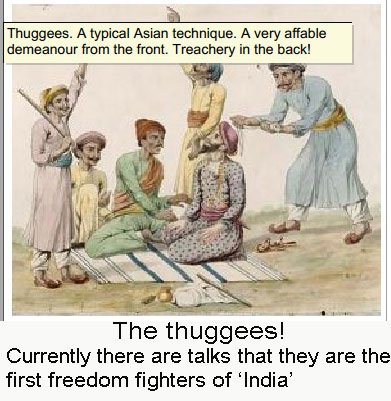
It might be possible that these kinds of persons can very easily be identified as ‘freedom fighters’ who fought for ‘India’ against the British! In fact, if this logic can be taken to the northern parts of the subcontinent, it might be possible to mention that the Thuggees (highway robbers who conducted the killing of merchants in a ritualistic manner) who were crushed by Henry Sleeman were actually ‘freedom fighters’ against the British rule!!
QUOTE: The notorious Mappilla bandit chief, Unni Mutta Muppan, was pardoned and restored to his estate of Elampuinsseri, while Attan Gurikkal, a relation of his and no less noted for turbulence of character, was appointed from motives of policy as head of a police establishment in Ernad. END OF QUOTE.
All these endeavours do have a great chance to collide with the verbal codes of the native feudal languages, which would dismantle magnanimous gesture of the English Company.
QUOTE: Nearly all the Rajas were backward in the regular discharge of their kists and were obliged to procure the suretyship of Mappilla merchants for the payment of arrears. Although members of this sect living in the coast towns were active traders and well-behaved, in the interior their fellow religionists were incessantly engaged in marauding expeditions. END OF QUOTE.
It is a very enlightening information. That the local rajas had to get the suretyship of Mappilla merchants for the payment of their arrears to the English Company. And also the description of the different versions of Mappillas. The Mappilla traders were not of the same genre as the Mappilla lower caste converts. However, the deeper fact is that that lower caste converts were existing on the lower planes of the verbal codes, while the rich merchants were on the upper parts of the verbal codes. This difference in location in the virtual codes creates entirely different human personality and disposition. This is an information about which the native-English side has no information on.
QUOTE: The mistaken notions prevalent in regard to ownership in the land appear to have been to a large extent at the bottom of these disturbances, which assumed the aspect of faction fights for supremacy between Hindus and Muhammadan END OF QUOTE.
This is again an insidious insertion of the Nayar vested interests who have tried their best to subvert the magnanimous actions of the English Company. The fight for supremacy has nothing to do with any doings of the English Company. It simply broke out because of two different historical experiences that came upon the land. First the advent of English supremacy, which more or less broke the backbone of the age-old social hierarchy. The second was the total disruption of the social order created by the brief Mysorean rule. The lower castes were literally informed that they can relocate to the top, and the upper castes were on the verge of being pushed to the bottom.
There is a tone in the quote above that the writer of the above lines knows better than the English Company as to what is good of the land. Actually these native upper classes were not able to bring any bit of goodness in this land for centuries.
QUOTE: The pensioned Rajas of Kumbla and Vittul Agra or Higgada did not also fail to harass Tippu's possessions during the war and on this account the pension of the former was in 1801 increased to Rs. 400. But the latter having after the proclamation of peace plundered the Manasserum temple, he was declared a rebel and death anticipated the orders issued for his seizure END OF QUOTE.
These are hidden facts of history. The modern Indian academic fake history might mention that the British robbed the temples and such with no qualms. Actually it was the opposite. The English rule was totally focused on protecting and preserving the wealth and heritage of the land. In fact, no one seems to mention that had Sultan Tipu managed to enter Travancore kingdom, the fabulous treasures mentioned to be in the possession of the Sree Padmanabhapuram Temple would have been looted then and there.
QUOTE : The Malabar Commissioners deputed Major Walker to the southern districts, and upon his report condemning the spirited action of Messrs. Baber and Waddell with reference to the Mappilla banditti, Chemban Pokar was pardoned on his giving security of good behaviour, and Gurikkal was allowed the option of either living on the coast near Calicut, or standing his trial for having caused the late troubles. END OF QUOTE.
The English administration was quite accommodating and magnanimous to all kinds of persons. The fact would come out if one were to compare these actions with how the modern Indian police /army would act if they were catch similarly disposed persons. They would have been thrashed to a pulp in the various police stations or in the army barracks. The moment the words of address changes to Inhi / Nee / Thoo, every kind of protective shields will vanish.
QUOTE: This success encouraged Chemban Pokar to make a daring attempt on the life of Mr. G. Waddell the Southern Superintendent, while he was proceeding from Angadipuram to Orampuram, in which attempt Chemban Pokar was secretly abetted by Gurikkal, who had been in Company’s service since 1790 as head of police in Ernad END OF QUOTE.
In spite of the magnanimous attitude of the English Company, what was given in return was again deeply troubling physical offense. However, there are deeper issues involved. The other side of the equation, that is the anti-Mappilla groups would make all kinds of taunts upon them the Mappillas, wherein it is quite candidly understood that the blame would be placed upon the English Company officials. The cunningness deeply entrenched within the local feudal language social system is of an unbelievable kind.
QUOTE: The cause assigned for the murder of the peon was that the peon dragged one of the Mappillas out of the mosque, END OF QUOTE.
The very act of allowing a lowly peon to touch another person as an act of domination can be an erroneous act. In fact, I find that in Malabar the English administration did understand this issue later on.
The next item that is missed is the content of the conversation that led to the event. In all probability, the peon would have used lower indicant words of the most despicable kind. For, he is the bearer of authority. In the initial period of the English administration, the English officials did not really understand that a person with any kind of official power in the subcontinent can become a satanic entity due to the existence of the varying codes for verbal conversation.
QUOTE: It is very sad to look round us from where we are and see the vast extent of forest that has been destroyed by the Mappillas all round for coffee END OF QUOTE.
Though it might be true that the Mappilla Timber businessmen would have had a hand in this, there is a wider truth that needs to be placed on record. A vast percent of the forest lands had been wiped out by the converted to Christian settlers from Travancore. However, presumably that event gathered strength in the years after this book was written.
QUOTE: Genuine Arabs, of whom many families of pure blood are settled on the coast, despise the learning thus imparted and are themselves highly educated in the Arab sense. Their knowledge of their own books of science and of history is very often profound, and to a sympathetic listener who knows Malayalam they love to discourse on such subjects. They have a great regard for the truth, and in their finer feelings they approach nearer to the standard of English gentlemen than any other class of persons in Malabar. END OF QUOTE
This might be Logan’s own words. It more or less reflect a particular similarity between pristine-English and pristine-Arabic. That pristine-Arabic is also more or less a planar language to a great extent. However, as to whether anyone anymore speaks pristine-Arabic might be a debatable point.
QUOTE: Shortly after the close of the war with Coorg the district administration entered upon a period of disturbance, which unhappily continues down to the present time. The origin and causes of this are of so much importance that it has been considered best to treat the subject at considerable length with a view not only to exhibit the difficulties with which the district officers have had to deal, but to elucidate the causes from which such difficulties have sprung. END OF QUOTE.
It is not possible for the English officials to really understand the various provocations that exist in feudal languages. A number of incidences are mentioned here. In all them, the attackers are seen as Mappillas and the attacked are the Hindus (Brahmins) and the Nayars. A few individuals of the subordinated populations have also been attacked at times. From the administrative side, representing the English administration, are the native Tahsildars, and the peons, most of them from the Nayar caste and Thiyyas.
If one were to look beyond the confines of purported religious animosities, the reality is that the Hindus and the Nayars, and even the Thiyyas, would use highly provocative degrading verbal forms such as Inhi (lowest You), Oan (lowest he / him), etc. on the Mappilla individuals who might not be of the lower order in various ways.
There is a wider issue here. In that the Mappillas would have a penchant for using these very words to all and sundry who are not exactly persons they personally revere. They use it in a more egalitarian sense than can be understood by the Hindus and the lower castes. The Hindus would get to feel the degrading when the Mappillas use it on them. The lower castes may not get this feeling, however, used as they are to it daily from their own Hindu oppressors and Nayars.
When the native-officials get the Mappillas (mostly the lower caste converts) in their hands, they would use the same words in a more brutal manner, which is not in an egalitarian sense. These are all very delicately slender issues to understand. Unless the reader has profound information on the verbal codes of Malabari (Malayalam of yore), the higher provocative switches inside the language will not be visible.
The lower castes who converted into Islam are similar to a native of the subcontinent individual who has learned English. He has moved into a social system wherein he has no senior caste. However, this is a very narrow reality. For, just beyond the confines of his new religion, he is still a lower caste man. The language is not Arabic or English. The languages are feudal. They contain not only powerful codes for ennobling, but also very powerful words which can literally turn a human soul to feel like excrement.
The fact is that if the native-Englishman also were to understand or feel this forced-turning-into-excrement experience, he will also go berserk. That is actually the reason behind the violence in native-English nations, which have been callously defined as ‘racist’. Native-English nations have no idea on the dangerous inputs that are slowly entering into their placid social system.
However, here the Hindus and the Nayars see the Mappillas as a very dangerous population who do not extend the requisite formal respects. It can be slightly compared to a soldier in the Indian army who does not salute his officers or use the App (highest you) / Unn (highest he / him) word to them or about them.
QUOTE: On the 2nd October 1850 information was received that the sons of one Periambath Attan the Mappilla adhikari of Puliakod amsam in Ernad taluk had, with others, concerted to kill one Mungamdambalatt Narayana Mussat and to devote themselves to death in arms. Security was required of nine individuals on this account. The District Magistrate, Mr. Conolly, in reporting on the outrage and wholesale murders of January 4th-8th, suggested that a commission should be appointed “to report1 on the question of Mappilla disturbances generally. I wish. ” he stated, “for the utmost publicity. If any want of, or mistake in, management on my part has led in the slightest degree to these fearful evils (far more fearful in my time than they have ever been before), I am most desirous that a remedy be applied, whatever be the effect as regards my personal interests END OF QUOTE.
The actual fact is that the English administration was guilty of being quite gullible. The fight was between the Hindus and Nayars on one side, and the Mappillas on the other. There were grievances on both sides. And the culprit was the highly degrading and provocative local vernaculars Malayalam and Malabari. There is no solution to be found without a total removal of these evil languages. Not only Malayalam and Malabari, but most of the feudal languages of the subcontinent have to be removed from their current-day status of statutory languages. If this is not possible, the social system will continue to have all the problems connected to social hierarchy and human degrading.
QUOTE: The individual here referred to is the notorious Saiyid Fazl of Arab extraction, otherwise known as the Pukoya or the Tirurangadi or Mambram Tangal. He had succeeded at an early age to the position vacated by the Taramal Tangal (already alluded to), and it is certain that fanaticism was focussed at the time at and about the head-quarters of Saiyid Fazl at Mambram. Fanatics then, as now, considered it almost essential to success in their enterprise that they should have visited and prayed at the Taramal Tangal’s tomb at Mambram and kissed the hand of the Tangal living in the house close by. END OF QUOTE.
The adjective ‘notorious’ need not be from Logan, but from some others who had doctored the manuscript or actually written the text.
QUOTE: Information of this was given by the principal Mappillas of the former amsam at about ten o’clock that night. They and their adherents remained on guard during the whole of the night at the houses of Pilatodi Panchu Menon and Purmekad Pisharodi, the principal Hindu janmis in the amsam, and respecting the former of whom there were on several occasions rumours that Mappilla fanatics were seeking to kill him. END OF QUOTE
The above-statement should stand testimony to the fact that at least the higher class Mappillas stood apart from the aspiration of the lower class Mappillas.
QUOTE: On the night of the 28th April 1852 the house of Kannambat Tangal in Kottayam taluk was fired into and the out-buildings of the Kallur temple were set on fire. The tahsildar (a Hindu) was of opinion that it was done by Hindus wishing to profit by the absence of the Tangal, the great janmi of the locality. The Sri Kovil (shrine) and the grain rooms were left uninjured, and this fact was urged in support of the tahsildar’s opinion. END OF QUOTE.
The above information could be very vital to showcase the ways and manners of the society. There is a continuing urge in the language codes to use Agent Provocateurs.
QUOTE: Five were induced to crime “because of relatives having wrongs, fancied or real, to redress ; and the remaining 144 were without any personal provocations whatsoever.” END OF QUOTE.
What is indeed admirable in the English administration is their urge to find out a cause; even though, they did not detect the cause. However, in the case of the current-day Indian officialdom, there is no urge to find the real cause or provocation.
QUOTE: He then went on to review the next ground for committing them dwelt upon by the Mappillas, namely, that the criminals were forced into them by destitution, but he passed this by with the remark that most of the criminals were mere youths, and he could not believe that they “should be ready thus to throw life away from more despair as to the means of supporting it. END OF QUOTE.
The native higher-castes know that destitution does not make anyone revolt, unless there is someone to organise them into a fighting unit. In fact, destitution only makes a person more respectful.
QUOTE: The natural result was that “the Hindus, in the parts where outbreaks have been most frequent, stand in such fear of the Mappillas as mostly not to dare to press for their rights against them, and there is many a Mappilla tenant who does not pay his rent, and cannot, so imminent are the risks, be evicted. Other injuries are also put up with uncomplained of. END OF QUOTE.
There might be much truth in this. However, the terror is not just about physical violence. It can even be the attitude to not concede ‘respect’. A simple ‘Inhi podo’ to a higher caste landlord by the tenant can be a most mentally establishing experience. The actual terror is the ‘Inhi’ (Nee) (lowest you). Not the podo (go off).
QUOTE: But Mr. Strange went beyond this and proposed that the force should be exclusively composed of Hindus, a measure which it is needless to say was not approved by the Government. The Government also, on similar grounds, refused to entertain his proposals for putting restrictions on the erection of mosques as being a departure from the policy of a wise and just neutrality in all matters of religion. END OF QUOTE.
Even though many persons in the current-day would say that Mr. Strange’s ideas were sound, the fact is that his information on what he was dealing with was not that profound. As to the English administrators, they took a very enlightened policy of not allowing any discrimination based on religion. But then, the problem in all these kinds of endeavours, there was and is no one of quality or calibre enough to appreciate these higher levels of thoughts and principles.
There was and are very grave coding errors in the local feudal languages. In fact, most languages have these issues. Only languages like pristine-English are devoid of the evilness present in feudal languages. Yet, there is nothing on record to suggest that anyone really thought about checking the verbal codes in the languages.
QUOTE: “First, as to the essential nature of Malabar Mappilla outrages, I am perfectly satisfied that they are agrarian. Fanaticism is merely the instrument through which the terrorism of the landed classes is aimed at.” END OF QUOTE.
It is a foolish assessment. For, it was the Mappillas who were in a better financial location and also exponentially improving. The exact cause was the gaining of more personal stature and social liberty than was allowed by the language codes.
QUOTE: The common kanam tenure has degenerated into an outrageous system of forehand renting, favourable only to the money-lender. END OF QUOTE.
If this was true, then the revolt would not be confined into a communal clash. And the revolutionaries would not attack the lower castes who stood in subordination to the higher castes.
QUOTE: Most of them do not know where much of their property lies, having never even seen it.
They do not know the persons who cultivate it, and do not concern themselves as to whether their tenants sublet or not. Most of them care nothing for the welfare of their tenants. END OF QUOTE.
This is an actual assessment of the traditional hierarchical social system, based on the feudal languages of the subcontinent. However, this is not the reason for the Mappilla outrages on the higher castes. For, these things do not trigger terrible mental animosities.
QUOTE: This granting of receipts places large power for evil in the hands of these low-paid and ignorant agents, and they have to be bribed by the ryots in order that they may be allowed to remain in the good graces of the janmis, who in regard to local details are completely in their agents’ hands. END OF QUOTE.
This again is the traditional system under which the officialdom as well as the feudal social system subsists. However, this again is the not the reason for the Mappillas outrages. If this had been the reason, more terrible Mappilla outrages should have happened in these days. For, the Indian officialdom is absolutely feudal and abusive to the ‘Indians’.
QUOTES: Moidin Kutti was merely a tool in the hands of Kutti Mammu END OF QUOTE.
The fact is that in a feudal language system, the person in subordination becomes a willing tool of those who hold him in subordination. However, these things do not explain what triggers the terrible animosity. If the Brahmin landlords are very oppressive, well then, it is the lower castes who had not converted who should have gone in for a bloody revolt. This did not happen, and will not happen, until the lower castes changes their leadership from that of their traditional feudal upper castes to someone from a revolutionary party.
QUOTE:
With settled homesteads and an assured income to all who are thrifty and industrious—and in these respects the Mappillas surpass all other classes—it is certain that fanaticism would die a natural death. END OF QUOTE.
This is a very good thing to happen. However, this may not shut down the religious animosities. For, when the Mappillas improve financially, in the verbal codes, the higher castes would be replaced by them. The lower levels of the verbal codes would be placed on the Hindus (Brahmins) and the Nayars. This again would make way for violent antipathy from the them.
QUOTE:
-
They attacked the Mappillas on the morning of the 24th, but upon the latter rushing out, the sepoys were panic struck and took to flight
-
The military detachment who had misbehaved were called into Calicut the next day and their place taken by a fresh body of 35 men, whom I thought it essential to keep in the disturbed locality until tranquillity was more secured.”
-
Ensign Wyse’s party, with the exception of 4 men who were all killed, refused to advance to receive the charge of only a few of the fanatics who came down hill at them, and notwithstanding the gallant example set by the Ensign himself in killing the first man who charged, the party broke and fled after some ineffectual filing. END OF QUOTE
The above words are not mentionable descriptions of the Nayar and others who populated the sepoys of the English Company. However, the foolish English administration is trying to protect the Hindus (Brahmins) and the Nayars, who actually do not deserve it. For, they are the first to run off, from the scene, when danger looms large.
QUOTE: But the real fact was that the man slain was what would have been called in Ireland a “landgrabber,” and the persons (Mappillas) for whose lands he was intriguing set up Unni Mammad to commit the murder. END OF QUOTE.
I am just taking up the above quote due to one interesting insight. It is that the Irish social scene has been mentioned to be quite similar to that of Malabar in another book of those times. I have even mentioned that the Celtic language of Ireland would be feudal. If the feudal elements are there in the native language of Ireland, the social errors can be erased only by superimposing the society with pristine-English.
Whether this has happened in Ireland is not known to me. If this is how the social trauma was removed from Ireland, then it might good to check if the same treatment can be done on the societies of the subcontinent.
QUOTE: No persuasion could induce him to surrender himself. END OF QUOTE.
Only a total idiot would surrender to a feudal-language speaking population. The moment he surrenders, he is an ‘Inhi’/ ‘Nee’ to the others, even if he a respect personage on his own side. There ends all his rights to human dignity.
QUOTE: held a close conclave with the Tangal on rumours being spread that he was at once to be made a prisoner and disgraced. END OF QUOTE.
There is an issue about which the English administration had no information on at that time. If the Tangal is arrested by the native police, they will naturally make use of the opportunity to address him with a Inhi / Nee word. Other words like Eda, Enthada &c. and even terrific profanities would be showered upon him. The profanities can be borne, but the lower-indicant words would be not bearable. This is the essential information that stands withheld from the native-English.
QUOTE: The Tangal (Saiyid Fazl) avowed that he had done nothing “to deserve the displeasure of the Government ; that he repudiated the deeds of the fanatics ; and that it was his misfortune that a general blessing, intended to convey spiritual benefits to those alone who acted in accordance with the Muhammadan faith, should be misinterpreted by a few parties who acted in contradiction to its precepts.” END OF QUOTE.
Actually this is the curse that has befallen the Islamic faith. A religion that should actually be in the possession of the highest quality persons has been literally dispersed into the hands of populations which carry highly provocative verbal and cultural codes. They are also involved in a daily battle with similar quality populations.
QUOTE: Sayyid Fazl usually known as Pukkoya who was banished with his relatives beyond India on the 19th March 1852. END OF QUOTE
The above quote stand in direct opposition to the words in the quote above it. This can very easily lend support to the idea that the text in the book has had different and mutually opposite direction codes attached to it. It is very clearly mentioned in the earlier section that Sayyid Fazl Thangal left the place on his own will to see that his name is not misused in the forthcoming communal frenzy between the converted to Islam lower castes and the Hindus (Brahmins) and the Nayars. He cooperated with the English administration to the utmost.
QUOTE: It must have been at this time that the parties interested began to realise the enormous changes wrought by European ideas of property in their relative positions, and it is a very significant and ominous fact pointing in this direction that on the 26th November 1830 - at a time when, looking at the high prices obtained for their produce, the cultivators one would have thought had every reason to be satisfied—there occurred the first of the Mappila outrages reported on by Special Commissioner Strange in 1852 END OF QUOTE.
The above words, quite obviously are not the words of William Logan. The word ‘European’ is a cunning insertion. Even inside Britain, there were different ideas on property. This was not the issue here. The issue here was the cataclysmic social liberation that set in without the populations getting any kind of quality enhancement, which necessarily involves the learning of the egalitarian language English.
And the arguments in the above statement is an utter mixing up of contradictory ideas. Mappillas outrage commenced when the agrarian situation actually improved. So, the agrarian disputes are not the reason. The reason is the verbal issues which has not kept pace with the changes in the social system. And it is not possible for feudal languages to accommodate such social liberties.
QUOTE: 1. that it was a religious merit to kill landlords who might eject tenants,”
2. the fact of a jamni or landlord having, IN DUE COURESE OF LAW, ejected from his lands a mortgagee or other substantial tenant, is a sufficient pretext to murder him, become sahid (or saint), END OF QUOTE.
It is just a mere claim to seek some spiritual support to one’s own anger. This is not the cause of the Mappila outrages.
Beyond that very few of the outrages against the Nayar and Hindus (Brahmins) and also their slave castes were due to them ousting the Mappilla tenents.
QUOTE: The spirit prevailing against the landlords I have remarked, as found by me, to be very strong, and greed of land unquestionably inflames it END OF QUOTE.
This would be true to the extent that the landlords can suppress the tenants verbally. When the tenants get used to more social interaction and liberty, they would resent this, even if they are not Mappillas. So, this is not the cause of the Mappilla outrages.
QUOTE: Finally it is well known that the favourite text of the banished Arab Priest or Tangal —Saiyid Fazl—in his Friday orations at the mosque in Tirurangadi was :— It is no sin, but a merit, to kill a janmi who evicts.” END OF QUOTE.
It is possible that the above quote by Mr. Strange could very well be mere hearsay. People do make up stories and quotes. Even the higher caste officials under the English administration would add spicy and juicy stories.
Other than that, the above quote is strikingly similar to the contentions of the Naxalbari (Communist) revolutionaries of the 1960s in the Wynad district of Kerala. Actually they did commit certain outrages based on this slogan.
QUOTE: a number of influential Mappillas, the latter told Mr. Duncan that since Hyder's time the rights of the jenmkaars had been taken or absorbed by Government,” and consequently the Mappilla jenmkaars were at the time paying nothing to the janmis except what they gave them out of charity, and they specifically asserted that nothing had been reserved for the janmis in making the Mysorean land revenue settlement, and they denied that the janmis were “of right” entitled to anything. END OF QUOTE.
In the above quote, the influential Mappillas are sort of making fun of the higher caste Janmis and their right to collect a rent from the tenants. However, this issue might not be of any worth in studying the cause of the Mappilla outrage, which was primarily caused by the breakdown of the feudal social hierarchies due to the advent of the English Company administration as well as the action of the Mysorian raiders. The local feudal languages were not capable of adjusting to the sudden and cataclysmic enhancement of the lower caste levels when they converted into Islam.
Since the cataclysmic changes had been actually triggered by the Mysorean invasion, and not really a controlled change induced by the English rule, there were limits to how much the English administration could understand the social explosions that had set in. It was not really an English language based change, but simply the pulling down of the social hierarchies suddenly by an external entity.
QUOTE: Socially the cultivators are subjected (particularly if they are Hindus) to many humiliations and much tyrannical usage by their landlords. END OF QUOTE.
Actually the whole issue of social discontent can be seen summed up in the above one sentence. All it requires is a bit more elaboration on the meaning of the words: ‘tyrannical usage’. Here the feudal language codes can come out and very candidly show the satanic errors in the social landscape.
QUOTE: Mr. Logan finally formed the opinion that the Mappilla outrages were designed “to counteract the overwhelming influence, when backed by the British courts, of the janmis in the exercise of the novel powers of ouster and of rent raising conferred upon them. A janmi who, through the courts, evicted, whether fraudulently or otherwise, a substantial tenant, was doomed to have merited death, and it was considered a religious virtue, not a fault, to have killed such a man, and to have afterwards died in arms fighting against an infidel Government which sanctioned ouch injustice.” END OF QUOTE.
The above was a very superficial assessment of the situation and totally a misguide one. The misguiding would have been done by the Hindus (Brahmins) and the Nayar officials.
QUOTE: “The land is with the Hindus, the money with the Mappillas," observed Mr. Strange END OF QUOTE.
Even though Mr. Strange has made a lot of observation about the social realities of South Malabar and to some slight extent about North Malabar, whether they are all of any level of profundity has to be examined separately. As to this above-mentioned observation, there is the question of how the Muslims are able to gather money when they have no land with them remains. And the observation is in sharp opposition to the other observation that the cause of the Mappilla outrages is the economic feebleness of the Mappillas. It does give a feeling that his observations are based on flimsy bit of evidences, which might not be compatible with each other.
The above observation can be correct in some areas. However, it is all observations in bits and pieces.
QUOTE: The Mappillas, who had been peacefully in possession of the lands since the time of Hyder Ali’s conquest, felt it no doubt as a bitter grievance that the janmis should have obtained power to evict them END OF QUOTE.
The Mappillas did not come into possession of the lands in any peaceful manner. But then, it is true that they were in peaceful possession for a very brief period. The whole social order tumbled down during the ravaging times of the Mysorian raid and rule. As to the Mappillas being in possession, again this contention might go against the words of ‘The land is with the Hindus’ mentioned in the previous Quote.
QUOTE: The policy of repression failed to fulfil its objects, and outrages or attempts at outrage have, notwithstanding the enormous penalties of the repressive Act, unfortunately occurred... END OF QUOTE
This statement very obviously cannot be the words of Logan. The words ‘the policy of repression’ is not the way an administrator would define his own side’s actions.
QUOTE: This exaltation of the Mappilla caste enables them to make better terms with their janmis. The janmis do not fear the Hindus as a caste. Therefore Hindu tenants have to submit to terms which Mappilla tenants would not endure. And finally the result is that there is a steady movement whereby in all the Mappilla tracts the land in passing slowly but surely into the possession of the Mappillas and the Hindus are going to the wall. END OF QUOTE.
All these are quite funny findings. On making an enquiry on why the Mappillas are aggrieved, the enquiry is seen to be coming up with findings that shows that the Mappillas are not the aggrieved party, but rather the Hindus (Brahmins) and Nayars are the aggrieved! And this is made to explain why the Mappillas are going berserk!!
However, actually in the verbal codes, the Hindus (Brahmins) and the Nayars might have gone berserk many times. However, there is not even a minor hint of these things in this book of historical records.
QUOTE: The insecurity to the ryots thus occasioned has resulted in fanatical outrages by Mappillas and in a great increase of crime. The remedies to be applied are still (1886) under the consideration of the Government of Madras. END OF QUOTE.
The above statements are talking in cross-purposes. The Mappillas have money, the land is not with the Mappillas, the land is moving towards the Mappillas, the ryotes are insecure, the Mappillas are committing outrages!!! What all foolish ideas are being promoted by the natives of the subcontinent writers who have written into this book! There is an understated or even overstated input in these writings giving a sly message that the English administration is a kind of imbecile and that the traditional overlords of the land know how to administrate the land in a better manner!!
Yes, it is true. If the English administration had not been there, the Mappillas would have been slaughtered by the local kings and the Nayars. Or maybe the Mappillas will not lift their head, sensing what would happen to them, if they did.
QUOTE: 1. In 1765-66 Hyder Ali paid a visit to these Nads, and his agents and his tributary, the Coimbatore Raja (Maha Deo Raj, usually styled Madavan in Malabar), afterwards till 1767-68 managed the country and levied irregular and violent contributions both on the personal and on the real property of the inhabitants.
2. In 1773 Chunder Row and Sreenivas Row came with troops and wrested the country from the Zamorin. By their orders the Nads were rented to Mohidin Muppan and Haidros Kutti, who collected 100 per cent, of the pattam (rent), but finding that insufficient to enable them to meet their engagements, they imposed further contributions and seized personal property. Finding this means also fail, they carried some of the inhabitants to Seringapatain with whatever accounts of the pattam (rent) were extent. END OF QUOTE.
This is the way the Mysorean ‘freedom fighters against the British rule’ administered Malabar. It may be noted that the agents of Hyder Ali are not having Muslim names.
QUOTE: but the Mappillas being now in the habit of turning out the original tenant as soon as the trees come to maturity and paying off the Kulikkanam money, END OF QUOTE.
It does seem that the lower castes after becoming Mappillas were taking up a position of consolidating the land in their own hands as the higher castes had done for ages. The location does not have the feel of one single nation, but rather a land which competing populations were trying to takeover. It is a great wonder that the English administration could make a great nation out of all these mutually competing entities.
QUOTE: The Mappilla proprietors along the coast frequently, however, take their pattam in kind and dispose of it to the best advantage END OF QUOTE.
Being part of a much more interacting social group and that too on the coast must have been a great advantage to them. For, they get to converse with a wider section of people with more worldly experience. This advantage, the Hindus (Brahmins) and the Nayars may not have. Even to interact with the lower caste seafaring folks will not be liked by them. If a deeper look is done, it may be seen that the Hindus (Brahmins) and the Nayars are placed in a location in the verbal codes where they are under compulsion to get pre-set ‘respect’. In the case of the lower castes converts to Islam, they are under no such compulsion. So, in a free-for-all situation, the Mappillas are at an advantage.
QUOTE: 1. In the town of Quilandi there is an old mosque 130 by 70 feet. It is very high, having three storeys. The Government have granted lands yielding annually Rs. 1,800 for the support of this mosque.
2. In Edakkad amsam is a small Mappilla village known as Putiyangadi (new bazaar), about three miles from Calicut town. Here lives the Mappilla priest, called Putiyangadi Tangal of pure Arab extraction.
3. The Tangals have been loyal to the British Government and their loyalty has been rewarded by the grant of a personal inam to the extent of Rs. 2,734 per year (vide G.O., dated 12th October 1865, No. 2474), and by permission to keep seven pieces of cannon (vide licence granted by the Government of India, under date the 15th September 1885, No 43, forwarded with Madras Government G.O., dated 29th September 1885, No. 2617, Mis.). END OF QUOTE.
QUOTE: It is curious that the only two pitched battles fought in Malabar between the Mysoreans and the British took place on the same battlefield. END OF QUOTE.
The location is near a dismantled fort in Tirurangadi. Colonel Humberstone defeated and slew Mukhdam Ali, one of Hyder Ali’s Generals on 8th April 1782. General Hartley defeated Tippu’s troops in 1790.
QUOTE: Notwithstanding their form of religion, monogamy is universal, and the women appear in public freely with their heads uncovered, and in Minicoy take the lead in almost everything, except navigation. END OF QUOTE.
This is about the Muslims of certain Laccadive Islands. Muslim women here do seem to have a different custom and culture.
QUOTE: At Seuheli there is a mosque of rude construction and the tomb of a pious Tangal held in much veneration by the islanders. Many miracles are ascribed to him, and it is especially common to invoke his aid in storms or when distressed by adverse winds. The islanders say that when in a storm they make a vow to visit the shrine of this saint the sea at once goes down and the winds become favourable. END OF QUOTE.
No comment.
QUOTE: The people are, as a rule, quiet in their disposition, but the complexities of the Muhammadan rules of inheritance and marriage and the existence, side by side, of the Makkatayam and Marumakkatayam rules give rise to frequent litigation END OF QUOTE.
This is about the Muslims of certain Laccadive Islands .There seems to be three mutually incompatible family and inheritance systems. The Muhammadan, the Makkathayam (patriarchal) and the Marumakkathayam (matriarchal).
QUOTE: The customs of the islanders are in many respects remarkable and bear no trace of having been introduced from Cannanore. One which is without parallel amongst any society of Mussalmans is that the men are monogamous. END OF QUOTE.
This is about the Minicoy Island of the Laccadive Islands. Even though the miniscule kingdom of Cannanore (Ali rajas) has claimed the sovereignty of these islands, the above statements seems to place a doubt over the foundation of such claims.
Mappilla outrages against the Nayars, Ambalavasis and the Hindus (Brahmins)
Even though the Mappilla outrages which commenced from around 1836 has been variously mentioned by stupid and shallow academic historians of India and elsewhere as a revolt against the ‘British rule’, it was not anything of that kind. It was purely an attack by the newly converted-into-Islam lower-castes, on the Hindus (Brahmins and Ambalavasis) and the Nayars, and their loyal lower-caste slave-servants.
I can understand the terrible frustration that the English officials felt as they started getting to hear of the terrible attacks on unwary and seemingly innocent Hindus and Nayars. They made various kinds of enquiries on what was creating this terrible homicidal mood for massacre. The fact is that all their conclusions and assertions were wrong and quite distant from the real cause.
The lower castes, on converting into Islam, suddenly find that they have no one above them. Till that time, they were part of an insidious hierarchy, in which they bore the verbal hammering, of such words as Inhi ഇഞ്ഞ്/Ijj ഇജ്ജ്/Nee നീ, Oan ഓൻ/Avan അവൻ, Olu ഓള്/Avalu അവള്, Eda എടാ, Edi എടി, Vaada വാടാ, Vaadi വാടീ, Vaane വാനേ, Vaale വാളേ, Avattakal അവറ്റകൾ/Ittingal ഐറ്റിങ്ങൾ / Athungal അത്ങ്ങൾ etc. [All lowest indicant code words for You, He/him, She/her, They/ Them &c.]
Getting out of this terrible suppression is like eating the biblical fruit of knowledge (forbidden fruit). Suddenly the individual will get an awareness that till then he, his wife and children had been kept artificially on a very degraded platform. Once a person comes out this social shackle, each time he perceives that he has been degraded by a population group, including the children, he would go into a very brooding mood of fury and vengeance. {The stupid sciences of psychology and psychiatry might not know anything about all this}
There is actually no solution for this, other than acclimatising them to the same levels of degradation from another perspective by means of formal education. In fact, modern Indian formal education is actually aimed at encoding tolerance to a similar kind of degradation into human beings. The teacher degrade the students and the students are trained to bask in this degradation.
This is one of the reasons why feudal-language speaking teachers should never be allowed to teach native-English children. A non-tangible core human-value erasement will set in, if this is allowed, in native-English children.
The Hindus and the Nayars were also getting to feel the same verbal attacks on them from the lower-caste convert Mappilla side. The words ‘lower-caste converts’ has to be stressed. In this book, Malabar, William Logan has mentioned the Muslims of pure Arabian stock to be quite a refined population with cultural and social interaction standards quite near to that of the native-English.
He has also given a very good opinion of the big-time Mappilla merchants on the coastal areas.
The Hindus and the Nayars would find it quite irksome to bear the verbal assault of the lower-caste convert Mappillas. The verbal assaults would not be any profanity or expletives. It would simply be the use of lower indicant words, such as Nee/Inhi &c. That is enough for the Hindus and the Nayars to go into a terrible mood of fury.
The English officialdom was quite naive and gullible. The terrific verbal assaults were something innate to the social system.
Until the entry of the English administration there was not much of a problem on this count. For, it was not easy to convert to Islam. But with the establishment of the English supremacy, it was found that every man had his rights to do what he wanted with regard to his affiliation and spiritual loyalties.
At the same time, it is also noticeable that there was indeed a historical undercurrent of distaste to the Mappillas on account of them being outside the hierarchical system on which the Hindus (Brahmins) were on top. The lower castes would find them acting too superior to them, and the higher castes and the Hindus would find them too over-bearing.
Pazhassiraja killing or impaling the Mappillas in his own locality is based on this undercurrent of hatred. The fact is that people who are not part of the subordinated groups would fail to exhibit the necessary ‘respect’ and subservience in words, posture, body-language etc., which the subordinated individual would concede.
Mappilla outrage list
I am listing out the various Mappillas outrages that started around 1836, as found in the book, Malabar. It will be clearly noticed that the English administration is actually not a part of this fight. However, the Hindus and the Nayars could very easily make them a party in a belligerence they could not understand.
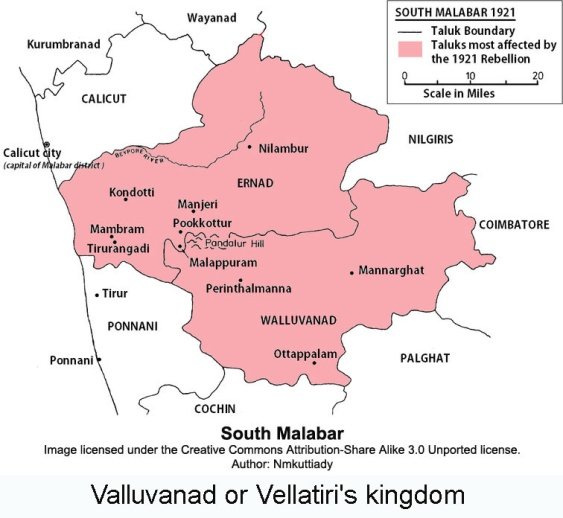 However, the entry of the English administration could worsen the fury of the Mappillas. For, in almost all the police actions on the Mappillas, it is found that it was the peons or Kolkars who went for the killing or maiming of the Mappillas. These peons or Kolkars were mostly Nayars. There is actually no mention of any Thiyya peon or Kolkar in this book, Malabar, even though, that is also possible.
The Mappillas were not willing to surrender to these peons and other native officials. For, these native-officials would not treat them with any kind of courtesy expected by a surrendered fighter in English. They would be verbally abused by lower indicant words such as Inhi/Nee, Eda, enthada, vaada &c. even if the Mappilla persons are of good personal stature.
These words, the natives of the land know, are capable of despoiling a human soul like no other thing can.
Now, before embarking on the listing, I need to mention this much also.
The native English-speakers in England are slowly heading on to the same mental trauma which the Mappilla persons endured.
It is like this. One Malabari Muslim man with some Arabian blood-mix told me thus: When I was a young boy, I used to address a fifty year old aashari (carpenter) by his mere name, ‘Govindan’. No one told me that this was a very bad thing. Later when I grew up, I understood that I was being very cruel. After that I have made it a point to address all the non-Muslim elder persons with a Chettan (respected elder brother) suffixed to their names.
Actually what he had been practising was the original Arabian language culture, in which even one’s own father is addressed by mere name.
However, he was a Malabari and not an Arab. That was the problem.
I was once told by a Malayalam speaker, who came from England, that the English people are utter rascals. They do not show respect to ‘our elder persons’. Actually, English systems are the best in terms of communication. However, if and when England gets filled with feudal-language speakers, they communication standards would not be acceptable. They would be found to be ‘rascals’, and the immigrant folks will be hell-bent on make them their slaves, in retribution.
The native-English would be very powerfully placed in a lower slot of the feudal language. They would be very slowly made to understand that there are higher social levels above them. It would be a real shocking information for them. However, they would be by-then like the oppressed lower castes of the South Asian subcontinent. With no energy to retaliate or escape. The feudal language words have clasping power which might be compared to the sticking cobwebs of the spiders.
It would be then that they would start creating the same outrages that the Mappillas did in Malabar. However, the Mappillas did this on escaping from their shackles. As to the native-English, they would start the outrages when they get to feel the sticky shackles slowly winding round their feet and body.
The Mappilla outrage list
1. On the 26th November 1836 Kallingal Kunyolan of Manjeri amsam, Pandalur desam in Ernad taluk, stabbed one Chakku Panikkar of the Kanisan (astrologer) caste, who subsequently died of his wounds. He also wounded two other individuals, and a fourth who had been employed to watch him, and fled to Nenmini amsam in Walluvanad taluk, whither he was pursued by the tahsildar, taluk peons and villagers. He was shot by the police on the 28th idem
2. On the 15th April 1837 one Ali Kutti of Chengara amsam, Kalpetta desam, Ernad taluk, inflicted numerous and severe wounds on one Chirukaranimana Narayana Mussat (a Brahman janmi), and took post in his own shop, where he was attacked by the tahsildar and the taluk peons, and shot by the taluk police on the following day.
3. On the 5th April 1839 Thorayampolakal Attan and another, of Pallipuram amsam, Walluvanad taluk, killed one Kelil Raman and then set fire to and burnt a Hindu temple, took post in another temple and there they were attacked by the tahsildar and his peons and were shot by a taluk peon.
4. On the 6th April 1830 Mambadtedi Kuttiathan stabbed and severely wounded one Kotakat Paru Taragan and then came among the police party, consisting of two tahsildars and others, who were occupied in framing a report connected with the preceding case, and stabbed and wounded a peon. He was captured, brought to trial, and sentenced to transportation for life.
5. On the 19th April 1840, in Irumbuli amsam, Ernad taluk, Paratodiyil Ali Kutti severely wounded one Odayath Kunhunni Nayar and another, set fire to Kidangali temple and took post in his house, where he was attacked by the tahsildar and his peons. He rushed out and was shot by a taluk police peon on the following day.
6. On the 5th April 1841 Tumba Mannil Kunyunniyan and eight others killed one Perumbali Nambutiri (a Brahman janmi) and another at Pallipuram in Walluvanad taluk, burnt the house of the latter victim as well as four other houses (belonging to the dependents of the Brahmans), the owner of one of which died of injuries then received. The Mappillas then established themselves in the Brahman’s house and defied the Government authorities. They were attacked and killed on the 9th idem by a party of the 36th Regiment Native Infantry and the police peons and villagers.
The chief criminal in this outbreak was one Kunyolan, and the cause assigned was the duplicity on the part of the Nambutiri Brahmans in the matter of a garden for which Kunyolan advanced Rs. 16, and of which he wished to remain in possession. Another Mappilla brought a suit in the Munsiff's Court to evict Kunyolan on the strength of a deed of melkanam obtained from the Brahmans.
7. On the 13th November 1841 Kaidotti Padil Moidin Kutti and seven others killed one Tottassori Tachu Panikkar and a peon, took post in a mosque, set the police at defiance for three days, and were joined by three more fanatics on the morning of the 17th idem.
8. On the 27th December 1841 Melemanna Kunyattan, with seven others, killed one Talappil Chakku Nayar and another, and took post in the adhikari’s house on the 28th idem. They rushed upon the police peons and villagers who had surrounded the house under the Ernad tahsildar’s directions, and were before the arrival of the detachment sent out from Calicut, all killed and their bodies were brought to Calicut and interred under the gallows.
9. On the 19th October 1843 Kunnancheri Ali Attan and five others killed one Kaprat Krishna Panikkar, the adhikari of Tirurangadi, and proceeded, at the suggestion of a seventh Mappilla who joined them afterwards, to the house of a Nayar in Cherur, and posting themselves in it, avowed not only the murder they committed, but their determination of fighting to death.
10. On the 19th December 1843 a peon was found with his head and hand all but cut off, and the perpetrators were supposed to be Mappilla fanatics of the sect known as Hal Illakkam.
11. On the 4th December 1843 a Nayar labourer was found dead with ten deep wounds on his body, and his murder was believed to be the work of the Hal Ilakkam sect just described.
12. On the 11th December 1843 Anavattatt Seliman and nine others killed one Karukamanna Govinda Mussat, the adhikari of Pandikad in the Walluvanad taluk, and a servant of his while bathing. They afterwards defiled two temples, broke the images therein, and took post in a house.
13. On the 26th May 1849 Chakalakkal Kammad wounded one Kanancheri Chiru and another and took post in a mosque. When the Chernad tahsildar (a Pathan) proceeded towards the mosque in the hope of inducing the murderer to surrender himself, he rushed forward with a knife, and a peon put an end to the fanatic on the same day.
14. On the 25th August 1849 Torangal Unniyan killed one Paditodi Teyyunni and with four others joined one Attan1 Gurikkal. They with others on the following day killed the servant of one Marat Nambutiri and two others and took post in the Hindu temple overlooking Manjeri, the headquarters of the Ernad taluk. They defiled the temple and in part burnt it.
15. On the 2nd October 1850 information was received that the sons of one Periambath Attan the Mappilla adhikari of Puliakod amsam in Ernad taluk had, with others, concerted to kill one Mungamdambalatt Narayana Mussat and to devote themselves to death in arms. Security was required of nine individuals on this account.
16. On the 5th January 1851 Choondyamoochikal Attan attacked and wounded severely a Government native clerk named Raman Menon, who had been employed in inspecting gingelly-oil seed (ellu) cultivation in Payanad in Ernad taluk in conjunction with the village accountant in view to settling the Government share, and he then shut himself up in the inspector’s house, setting the police at defiance. No persuasion could induce him to surrender himself. He declared he was determined to die a martyr. The tahsildar (a Mappilla) tried to induce him to deliver himself up, hut he utterly refused to do so.
17. On the 15th April 1851 Illikot Kunyunni and five others were reported as designing to break out and kill one Kotuparambat Komu Menon and another. Evidence of the fact was deficient and the accused were released, but it subsequently turned out that the information was only too true.
18. On the 22nd August 1851 six Mappillas killed one Kotuparambat Komu Menon (above referred to) and his servant on the high road between Manjeri and Angadipuram as they were returning home from the Mankada Kovilakam of the Walluvanad Raja. They were joined by three others, with whom they proceeded towards Komu Menon’s house. But finding a brother of Komu Menon’s ready to meet them with a gun and a war knife, they left the place and went to the house of Ittunni Rama Menon, another brother, who was then bathing in a tank close by. They killed Kadakottil Nambutiri, who was seated in the porch of the house, the family of Rama Menon escaping in the tumult.
19. The murderers next overtook Rama Menon, who had endeavoured to escape, and cut him down. Setting fire to the house, they marched towards the house of one Mudangara Rarichan Nayar, whom they wounded severely and who subsequently died of his wounds. They then set fire to the house of one Chengara Variyar.
They proceeded to the house of the Kulattur variyar, an influential janmi who had opposed the erection of a mosque. They were in the meantime joined by five others. On their arrival, the attendants and family escaped ; all the women and children were told by the fanatics to go away. They next killed two servants of the Variyars. Two of the junior Variyars escaped. But the old Variyar, a man of 79, probably shut himself up in a room of his house where the fanatics eventually discovered him.
The Hindus sent for the Mappilla chief men of the place and others. About fifty persons appeared, two of whom joined the insurgents, calling out “the chief pig is inside.” The old Variyar was then brought out into the paddy field adjoining his house, to a distance of sixty yards from the gatehouse, and one Pupatta Kuttiuttan and another there, in the sight of all the people assembled, hacked him to pieces, severing his head from his body.
20. On the 5th October 1851 information was received that Tottangal Mammad and three other Mappillas of Nenmini amsam, Walluvanad taluk, were found in possession of certain arms and were designing to commit an outrage.
21. On the 9th November 1851 information was received that Choriyot Mayan and eight others were designing to break out and kill one Kalattil Kesuvan Tangal, a wealthy and influential Hindu janmi of Mattanur in Kottayam taluk. Evidence was lacking, and the tahsildar omitted to report the matter.
On the night of 4th January 1852 the party named above and six others, making in all fifteen, supported by a large mob estimated at 200, proceeded to the house of the abovesaid Kalattil Tangal in Mattanur, Kottayam taluk. They butchered all the unhappy inmates (eighteen in all) and thus extirpated the family, wounded two other persons, and burnt the house on the following morning.
They then, unattended by the said mob, burnt four houses and a Hindu temple, killed four more individuals, defiled and damaged another Hindu temple, entered the palace of a Raja, took post there temporarily, defiled and destroyed two other Hindu temples, and finally fell on the 8th idem in a desperate and long-sustained attack on the house of the Kalliad Nambiar, another wealthy and influential janmi in Kalliad amsam of Chirakkal taluk.
A detachment under Major Hodgson off the 16th Regiment, consisting of two companies of that corps and 100 Europeans of the 94th Regiment, were sent out from Cannanore, but before they arrived on the scene, the Mappilla fanatics had been all killed by the country people, retainers of the Nambiar.
22. On the 5th January 1852 information was received that certain Mappillas intended to break out and kill one Padinyaredattil Ambu Nambiar, and security was taken from five of them.
23. On the night of the 28th February 1852 one Triyakalattil Chekku and fifteen other Mappillas of Melmuri and Kilmuri amsams in the Ernad taluk "set out to die and to create a fanatical outbreak.”
24. Ominous rumours of an intended Mappilla outbreak in the Kottayam taluk in April 1852 drove many of the Hindu inhabitants into the jungles.
25. On the night of the 28th April 1852 the house of Kannambat Tangal in Kottayam taluk was fired into and the out-buildings of the Kallur temple were set on fire. The tahsildar (a Hindu) was of opinion that it was done by Hindus wishing to profit by the absence of the Tangal, the great janmi of the locality.
26. In April-May 1852 two Cheramars (the property of Kudilil Kannu Kutti Nayar, peon of Chernad taluk), after embracing Muhammadanism, reverted to their original faith after the departure of Saiyid Fazl, through whose influence they had become converts. Some Mappillas did not relish this, and consequently determined to murder Kannu Kutti Nayar and the two Cheramars, and thus become Sahids (martyrs).
27. On the 9th August 1852 information was received that three Mappillas of Kurumbranad taluk had taken up a position in the house of the accountant of Puttur amsam in the same taluk, and had resolved to die as Sahids (martyrs). They wounded a Brahman and were on the 12th idem killed by the police, of whom two received wounds.
28. Two Mappilla fanatics, Kunnumal Moidin and Cherukavil Moidin, murdered a Brahman named Chengalary Vasudevau Nambutiri on the 10th September 1853.
29. In December 1854 Mr. Conolly proceeded on a tour to collect the war-knives through the heart of the Mappilla country, and brought in 2,725, and by the 31st of the following month of January 1855 (the latest date on which the possession of a war-knife was legal) the number of war-knives surrendered to the authorities amounted to the large number of 7,561.
The above are the Mappilla outrages in south Malabar in the year starting 1836 till the time this book, Malabar, was written. None of them were really directed against the English administration per se. The English officials came into the scene only as the officials responsible for the law and order. However, in current-day Indian academic history, the whole theme is twisted out to make it a freedom fight by the Mappillas. This contention more or less is utter nonsense, as is most of the other contentions of Indian academic history studies.
What is repulsive about the Muslims?
This is an item that is not connected to this book, Malabar. However, the records of the Mappilla outrages against the Hindus (Brahmins) and the Nayars is a very tricky part of this book. And I have tried to give an explanation for this series of incidences from the perspective of feudal language codes.
I think it might be correct give a more longer and wider attention to this issue from the same perspective.
Islam per se, is not a bad religion, if the location where it was born is taken into consideration. It was born in Asia, or better still in the Middle-East, among the Arabs. The Arabs of those times were a very crude and rough people who did have a lot of erroneous behaviours. However, that statement must be better qualified by mentioning that in the ancient times all over the world, most human populations were quite barbarian. And in the current-day world also, in many locations the same kind of heinous barbarity still persists.
The person on whose life this religion has been founded is also not a bad man. In fact, he might be of quite resplendent character, if the geopolitical location where he lived is taken into consideration.
This religion was born among a most terrible population. It has tried its best to bring in quality to the Asian and African populations. However, in each population where it has spread, it has been contaminated by the innate erroneous features of that population.
Islam has a particular philosophical quality that is quite near to pristine-English. In that it tries to view all human beings as of equal dignity or stature. This feature has been mentioned in this book, Malabar. I do remember having noticed something similar in the Native Life in Travancore.
See this QUOTE: The condition of the predial or rustic slaves of Malabar cannot bear a favourable comparison with that of household or domestic slaves among the Mahommedans. The latter are received with them into a fraternity; and are no longer kept at a suspicious distance. In Arabia their treatment is said to be like that of children, and they go by the appellation of sons with their masters. They often rise to the most confidential station in the family; and the external appearance of the master and slave is hardly distinguishable, they are so much upon a par. END OF QUOTE.
However, this above-statement does not give the whole picture. The above-picture is connected to the socially higher strata Muslim families in Arabia and in the South Asian subcontinent. For instance, the Sultans of the Slave dynasty (Mamluk dynasty) of Delhi kingdom, were actually individuals who had been bought as slaves in the slave-markets of the middle-east of those days.
However, all the Muslims are not from this background. That is the crucial issue. Islam went forth and did what it was supposed to do. It went on converting the lowest of the lowest populations in the subcontinent into Islam.
It is seen mentioned in Native Life in Travancore that there are a few numbers of different Muslims in Travancore.
Pathans (Pattanis) or Afghans, Syeds, Lubbays, Mettan, Tulukkans, Moghuls, Arabs and Sheik. Out of which the first four are significant. Besides these there might be others also like the Rawuthors etc. Beyond that there are such categorisations as Ossaan (barber) &c. The above information about the Muslim groups that I have given need not be error-free and might need more scrutiny.
In Malabar, as elsewhere in the subcontinent, a lot of lower castes used the minute incidents of the Mysorean invasion to escape from their centuries of enslavement under the Hindus (Brahmins) and the Nayars. When the English rule became powerful, many Cherumars and other lower castes took this same route to freedom.
In this book, Malabar, the Cherumar caste is seen mentioned much in this regard.
See this QUOTE taken from the Presidency Census (1881) Report, paragraph 151
QUOTE: There are, therefore, 40,000 fewer Cherumars than there would have been but for some disturbing cause, and the disturbing cause is very well known to the District Officer to be conversion to Muhammadanism. END OF QUOTE
This is the location where Islam is seen to be very evidently repulsive in the subcontinent. A huge percentage of them are literally the much-despised by the Hindus (Brahmins) and the Nayars) lowest of the castes.
It is seen mentioned that the Makkathaya Thiyyas also did convert into Islam.
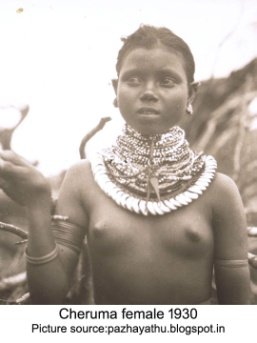 However, the moment they become Islam, everything changes for them. It is an experience very much near to arriving in a native-English nation. They have no one above them.
Now, there is another continuing terror with regard to people who are kept in the lower pane in feudal languages. They very categorically know the flipping power of the lower indicant word codes. If a higher caste man or woman is in their hands, they will very fast use the lowest indicant codes of Inhi / Nee, Oan /Avan, Oalu / Aval etc. The power of these words are not known to native-English people. The person who has been thus defined literally falls into a deep social pit much below the persons who spoke it. In this case, they go below the lowest of the population groups.
This is the most terrific problem connected to feudal languages. It is not just that the higher persons would crush down the lower positioned persons. It is also that the lower positioned persons become quite dangerous persons. For, their verbal power can literally throw a person down into a gorge. The fact is that the effect can be felt emotionally and on the physical body. [Interested readers are requested to read: 1. Shrouded Satanism in feudal languages. 2. Codes of reality; what is language? ]
The lower populations who have converted into Islam do know the power of their verbal codes. They use it whenever they can. In fact, once they have converted into Islam, they have no qualms about using the Inhi / Nee, Oan /Avan, Olu / Aval word on Hindus (Brahmins), the Nayars, the Thiyyas etc. For, they feel like they are Englishmen. However, they are not Englishmen, and they are not speaking English. In fact, they are not even speaking in Arabic. They are speaking in the utter satanic languages of the subcontinent, such as Hindi, Malabari, Malayalam etc.
This same issue is felt in the northern parts of the subcontinent. That is, the lower Islamic populations have a propensity to use the Thoo word (lowest You) in an indiscriminate manner. At the same time, the higher Islamic populations also might have this attitude, which basically springs from a higher caste feeling.
Among the Muslims, there would be non-tangible codes of communication that indicates who has to be honoured etc. For, even though the religion proposes egalitarianism, there is no scope for it to be practised in a feudal language location. It then becomes a lower class population group which is not willing to concede the requisite feudal ‘respect’ and such other venerations that are expected by the non-Muslim populations.
In the earlier days, a rich Muslim boy would not see any reason to use ‘respect’ to a Thiyya labourer who comes to work in this household. He would address him by ‘mere’ name, and also use the Inhi / Nee, Oan / Avan, Oalu / Aval words.
Actually this very verbal codes had been traditionally used by the Hindus (Brahmins) and the Nayars to the lower castes including the Thiyya labour classes. In those days, the lower castes would have not much objection to this, since it is their acknowledged social seniors who are doing this. However, in the case of Muslim boy who is very clearly from a lower caste ancestry, it becomes a totally unacceptable action.
However, no correction can be really done to this error. For, if the Muslim boy is forced to concede ‘respect’, immediately the labourer would use the verbal codes to crush down the boy.
One may see these kinds of issues in the manner in which the Pazhassiraja used to kill or impale the Mappillas. What triggered his homicidal mania would be similar to the mental trigger that works in an Indian police constable, when he sees someone who is defined as low-class not conceding the requisite ‘respect’ in words, body-posture, body-language, eye-language, dress-code etc.
QUOTE: Genuine Arabs, of whom many families of pure blood are settled on the coast, .............. have a great regard for the truth, and in their finer feelings they approach nearer to the standard of English gentlemen than any other class of persons in Malabar. END OF QUOTE
Now, the above-statement is an appraisal of Muslims of another individual quality.
Of the around seven or more Muslims population groups I had mentioned, the Mappilla outrages in the Valluvanad region was basically connected to the converted-from-the-lower-castes Mappillas. In which case, the so-called Mappilla lahala that continued to rage in South Malabar right up-to the early decades of the 20th century was actually between the Brahmins and Nayars on one side, and their erstwhile subordinated lower castes on the other. However, the latter had converted into Islam.
Their stance cannot be fully found fault with. For, they have escaped from centuries of enslavement. Suddenly they see their traditional master classes as mere human beings. They have no mood for any kinds of formalities. They actually do not see any use in it. Beyond that their religion proposes human equality and brotherhood.
However, this human equality and brotherhood has to be confined to their own Islamic brotherhood.
They are not allowed to use it even to certain other Islamic groups. For, instance, the children of Tangals. I think Tangals are very near to Syeds in ancestry. The ordinary Muslims of Malabar are prohibited from using the lower indicant words ‘Inhi / Nee, Oan/ Avan &c. to and about the Tangal children, even if they are quite young in age. So, it is seen that even among the Muslims, the traditional Muslims from Arabia had taken steps to protect themselves from the verbal code degradation that the converted-to-Islam populations could render.
The subject theme is somewhat more wider. However, I will not go into all that here. Before concluding this item here, I will simply mention that Prophet Muhammed did prohibit the action of getting up in ‘respect’ even if he is the person who is entering into the presence of others. The action of ‘getting up’ in ‘respect’ is very tightly connected to feudal language codes. I am not sure how it got connected to pristine-Arabic. Maybe spoken-Arabic might not be pristine enough.
These kinds of Islamic tenets are not practicable inside any feudal language social system. To this extend, Islam in their societies is a corrupted form of Islam.
At this point, I need to mention that pristine-Islam might actually be pointing towards pristine-English, despite its various tenets seeming quite barbarian. That might be so, because Islam is basically a religion that was created to reform barbarian social systems.
From this perspective it might be mentionable that Islam need not try to impose itself on native-English social systems, other than to inspire native-English societies to go back to their own pristine-English form. That means, the ousting of all feudal language speakers from native-English nations.
Now, coming back to the Mappillas of Malabar, as of now, it is first of all a mix of North Malabar as well as South Malabar Mappillas. However, I do feel that some of the families of the traditional higher class or the Arabian bloodline Mappillas do keep a distinct bloodline that might not get mixed with the others.
As to the Arab blood mix in Malabar, it is seen mentioned that the Arabian seafarers who came for trade did maintain a family on the Malabar coast, with a wife and children here.
Apart from the lower-castes who converted into Islam willingly, some Hindus (Brahmins) and Ambalavasis and also a lot of Nayars did convert into Islam.
See this QUOTE: Parappanad, also "Tichera Terupar, a principal Nayar of Nelemboor” and many other persons, who had been carried off to Coimbatore, were circumcised and forced to eat beef. END OF QUOTE.
QUOTE: The unhappy captives gave a forced assent, and on the next day the rite of circumcision was performed on all the males, every individual of both sexes being compelled to close the ceremony by eating beef.” END OF QUOTE.
As of now, the current-day ordinary Mappillas of Malabar, both south and north might be a wholesome mix of all these above-mentioned groups. In recent years, they have lost their traditional Malabari language, with many of them deceived into believing that Malayalam is their traditional language. Only a few among them will currently understand their traditional language and the words and usages in it.
Hyder Ali
QUOTE: The Palghat Raja turned in this emergency to his neighbour on the east, and despatched in 1757 a deputation to Hyder Ali, then Foujdar of Dindigul under the nominal sovereignty of the puppet Chick Kishen Raja of Mysore desiring his assistance against the Zamorin.
Hyder Ali sent his brother-in-law Mukhdum Sahib with 2,000 horse, 5,000 infantry, and guns to assist him : and this force aided by the Palghat Nayars carried their arms as far as the sea coast. The Zamorin’s force retreated and the Zamorin bought off his opponents by agreeing to restore his Palghat conquests and by promising to pay in instalments a war indemnity of Rs. 12,00,000.END OF QUOTE.
This might be how the Mysoreans got the taste of Malabar. However, in the behind scenes a lot of treacherous and backstabbing incidences did take place on the Mysore side. This is about how Hyder Ali, a Moroccan, usurped the title of the king. Check the details in book, Malabar. QUOTE: This was the first occasion on which a Muhammadan force ever entered Malabar. END OF QUOTE
QUOTE: Reinforced by a number of the disciplined soldiers of Hyder Ali, the High Admiral, it is said, sailed for and conquered the Maldive Islands. After taking the King of the Islands prisoner, he had the barbarity to put his eyes out. END OF QUOTE.
The subcontinent was generally a semi-barbarian locations. Worse things have taken place here.
QUOTE: But Hyder Ali was so irritated at the cruelty practised on the unfortunate king by his admiral that he instantly deprived him of the command of the fleet, which he afterwards, it is said, bestowed on an Englishman named Stanet. END OF QUOTE.
It is quite interesting that an Englishman did have command on his naval fleet. It may be that he did summarise that the English have a natural affinity for the seas. However, this man’s name is not mentioned elsewhere in this book.
QUOTE: A general insinuation was given to the army to grant no quarter. END OF QUOTE.
Show no mercy! That was the military command given by the Mysorean leader. It does not seem to be Islamic at all. Hyder Ali’s as well as his son Tipp’s dispositions were totally connected to the terrific triggers of feudal languages.
QUOTE: Hyder Ali’s own army consisted it is said, of 12000 of his best troops, of which 4,000 were cavalry and the rest infantry, and his artillery consisted of only 4 pieces, but the fleet accompanied him along the coast and afforded assistance as required. END OF QUOTE.
This was the terror that entered Malabar.
QUOTE: The Kolattiri family made no resistance, for simultaneously with Hyder Ali’s advance Ali Raja and his men seized their palace at Chirakkal, and the old Tekkalankur prince with his attendants came to take refuge at the Brass Pagoda within Tellicherry limits.
They were followed by numerous refugees, fleeing probably more before the terror of the Mappilla scouts than before Hyder Ali’s army. END OF QUOTE.
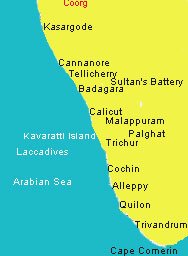 The Ali Raja of that period acted like the backstabbing double-crosser in Malabar.
As to the general populace, which might mean the Hindus (Brahmins) and the Nayars, they had no protection left. Everyone were fleeing instead of fighting.
QUOTE: The factors at the same time had information that Ali Raja was all this time urging Hyder Ali to attack the factory, but to this he would not listen. END OF QUOTE.
The Ali Raja actually should have shown some gratitude to the English Company. Instead, they were out to see that they are butchered. As to why Hyder Ali did not want to attack the English Factory at Tellicherry might require some deep analysis.
QUOTE: they were led on by fifty of the French Hussars lately arrived from Pondicherry. END OF QUOTE.
Off course, the French were the full supporters of the ‘great’ ‘Indian freedom fighter Hyder Ali’ in his fight to ‘free India’ from British Colonialism!
QUOTE: He agreed not to molest the Raja of Cochin on certain conditions, but he would guarantee nothing in regard to Travancore. As there was delay in replying to his proposals he then modified his terms as regards these Rajas and demanded 4 lakhs of rupees and 8 elephants from Cochin, and 15 lakhs and 20 elephants from Travancore, in default of receiving which, he said, he meant to visit those countries. In reply to this demand, the Cochin Raja placed himself unreservedly in the Dutch Company’s hands, but the Travancore Raja, strong in the assurance of English support, replied that Hyder Ali had not commenced the war to please him or with his advice, that therefore he objected, to contribute anything, that moreover he was already tributary to the Nawab Muhammad Ali and could not afford to subsidise two suzerains at the same time, but that he would contribute a considerable sum if Hyder Ali would reinstate the Kolattiri and the Zamorin, and ended by suggesting to the Dutch to do the same. END OF QUOTE.
King Marthanda Varma had assessed the English Company correctly. That they would stand by their word. However, that was because the idiots in the British Labour Party had no control over the English Company.
QUOTE: 1. When the river was at the lowest he (Hyder Ali) entered it full gallop at the head of his cavalry which he had till then kept out of sight of the Nayars
2. They (the Nayars) were frightened at the sudden appearance of the cavalry and fled with the utmost precipitation and disorder without making any other defence but that of discharging a few cannon which they were too much intimidated to point properly. END OF QUOTE.
No comment.
QUOTE: “Hyder foreseeing this event, had given orders to pursue the fugitives full speed, cutting down all they could overtake, without losing time either by taking prisoners or securing plunder. END OF QUOTE.
That was about the Nayars mentioned above. Then the Nayars, mentioned in the local fake histories as great exponents of Kalari (a kind of fabulous martial arts of unknown origin, practised traditionally in certain Kalari training centres of north Malabar) etc. had no answer for the barbarity that was let loose by the Mysoreans.
QUOTE: and the 300 Europeans lately arrived from Pondicherry and Colombo, were offered parasols as they did not choose to quit their habits END OF QUOTE.
Continental Europeans arriving to support Hyder Ali endeavours and to seek revenge on England!
QUOTE: corps was commanded by a Portuguese Lieutenant-Colonel lately arrived from Goa, with different officers of his nation. The left wing, composed of topasses, was commanded by an English officer, and Hyder himself commanded the main body, having behind him a reserve of Europeans, almost all French, with whom were joined those who are called the Bara Audmees or great men, a corps composed of all the young nobility and courtiers, without excepting even the generals who have not appointed posts or commands on the day of battle. END OF QUOTE.
Horror of horror! There was even an Englishman on Hyder’s side. Could it be the Stanet, mentioned earlier? Now, does that not involve England in this raid? For, if a single Englishman’s name is mentioned with regard to any wrong deed anywhere in the world, the great birdbrains would use it to put the full responsibility on pristine-England. Here England is also seen as part of the great ‘Indian’ ‘freedom fighters’ against Britain!!!
QUOTE: Hyder answered that he might do as he thought proper ; and he immediately joined his troop, which was impatient for the combat and burned with a desire to revenge the French who were inhumanly massacred at Pondiaghari.
Headed by this active and courageous officer, and joined by the Bara Audmees, they ran with violent eagerness to the attack. The intervals between the battalions of sepoys afforded them a passage : they jumped into the ditch, and hastily ascending the retrenchments tore up the pallisades, and were in the face of the enemy in an instant. They gave no quarter ; and the enemy, astonished to the last degree at their impetuosity and rage, suffered themselves to be butchered even without resistance.
The flames of the village on fire, and the direction of the cannon now pointed on the distracted Nayars, evinced to Hyder that the village was carried. The whole army in consequence moved to attack the retrenchment ; but the enemy perceiving that Hyder’s troops had stormed their outpost, and catching the affright of the fugitives, fled from their camp with disorder and precipitation. END OF QUOTE.
These are things that cannot be taught in Indian or Kerala history. For, on one side a great ‘freedom fighter’ against the British would be seen as a barbarian. On the other side the great valorous traditions of Malabar, which includes a lot of claims about the great Kalari exponents of north Malabar, would stand demolished.
However, a deeper analysis would reveal that what always brings in disarray and mismanagement is the machinery of feudal languages. In fact, even the Mysorean side was to get the negative effects of this, when they confronted the English armies.
QUOTE: This refers to the massacre at this same place a few months previously of five French deserters from Mahe proceeding to join Hyder Ali's army. This event occurred during the general revolt which followed Hyder Ali’s withdrawal from the coast. Two women accompanying the deserters were, it is alleged, most barbarously mutilated and killed at the same time. END OF QUOTE.
To be caught by the barbarians on any side of this conflict was a terrible experience.
QUOTE: Before he quitted the country, Hyder by a solemn edict, declared the Nayars deprived of all their privileges ; and ordained that their caste, which was the first after the Brahmans, should thereafter be the lowest of all the castes, subjecting them to salute the Parias and others of the lowest castes by ranging themselves before them as the other Mallabars had been obliged to do before the Nayars ; permitting all the other caste to bear arms and forbidding them to the Nayars, who till then had enjoyed the sole right of carrying them; at the same time allowing and commanding all persons to kill such Nayars as were found bearing arms. By this rigorous edict, Hyder expected to make all the other castes enemies of the Nayars, and that they would rejoice in the occasion of revenging themselves for the tyrannic oppression this nobility had till then exerted over them. END OF QUOTE.
Actually what the above edict proposes in the total upheaval and the vertical flipping of the social order as designed in the feudal languages. It is something like commanding the police constables to be on the top layer, and the IPS officers at the bottom. That of the lower police officials addressing their actual seniors with Inhi / Nee, and referring to them as Oan/ Avan, Oal / Aval. This single flipping of verbal codes can literally through the whole regimentation into terrific disarray.
QUOTE: Hyder Ali bought off the Mahrattas, and the Nizam was induced to throw over his allies and to join Hyder Ali in a campaign against the English on the east coast. The first act of hostility occurred on 25th August 1768, but the news did not reach Tellicherry till the 13th October.
It is unnecessary to trace in detail the operations which followed. The allies were beaten in the field, the Nizam made a separate peace, the English in conjunction with Muhammad Ali, Nabob of the Carnatic, overran Hyder Ali’s dominions, and planned, with an utterly inadequate force to carry out this resolution, an invasion of Mysore itself. END OF QUOTE.
Surely there was something quite different in the English side, that even in times of extreme tribulations, they face the trials and came out victorious. In a feudal language situation, when one’s leaders are seen as losing, the verbal codes of ‘respect’ will get erased. This is a terrible tragedy to occur. For, when one is in grave need of ‘respect’ it would be withdrawn.
QUOTE: Hyder Ali’s rapid and secret march across the peninsula and his recapture of Mangalore are matters of history. The Bombay force was driven out of Mangalore with such indecent haste that they even left their sick and wounded behind them, as well, as their field-pieces and stores. Honore and other places were recovered with equal ease, and before the monsoon commenced Hyder Ali’s army had reascended the ghats. END OF QUOTE
Fabulous success. But then maintaining it against the feeble softness of native-English perseverance would be impossible!
QUOTE: In June he was at Bednur wreaking his vengeance on the inhabitants who had favoured the English designs, END OF QUOTE.
Actually everyone outside his immediate command hierarchy would prefer the English rule, rather than the tumultuous clamour and whimsical style of rule of Hyder Ali.
QUOTE: Excepting Kolattunad and Palghat, therefore, and perhaps Kottayam and other petty chieftains, whose territories Hyder Ali’s officers had never so far been able to command, the Malayali chiefs eagerly adopted the terms offered, and "Hyder’s provincial troops, whose escape would otherwise have been impracticable, not only retreated in safety, but loaded with treasure—the willing contribution of the chiefs of Malabar—the purchase of a dream of independence.” END OF QUOTE.
Everyone is eager for their own survival. There is no other political policy, no social welfare, no concept of infrastructure building for the common populace, no policy of educating the masses, nothing other than self-protection. That is only aim in a feudal language social set up.
QUOTE: Hyder Ali had meanwhile after suffering many reverses been forced by the Mahrattas to make a disadvantageous peace. In a short time, however, his treasury was again replenished at the expense of his subjects and his forces were reorganised END OF QUOTE.
In a feudal language social set-up, the only aim is to gather leadership. Without it, there is no ‘respect’. Everyone clamours for this slippery item called ‘respect’.
QUOTE: Coorg fell to him in November 1773, and a force despatched under Said Sahib and Srinavas Row Berki pushed through Wynad and descended on Malabar about 27th December by a new and direct route via the Tamarasseri pass END OF QUOTE.
‘Srinavas Row Berki’ seems to be a non-Muslim name. How Hyder could manage his pro-Muslim agenda using non-Muslim commanders is an intriguing point worthy of inspection.
QUOTE: The latter had agreed in the Treaty of 1769 to assist him against the Maharattas, but Muhammad Ali, the Nabob of the Carnatic, had by intrigues in England effectually prevented the fulfilment of that part of the treaty in order to carry out an ambitious scheme of his own. Hyder Ali appears to have fathomed the Nabob’s designs, which, as a preliminary to still more ambitious schemes, required Hyder Ali’s own destruction, and he accordingly determined to break with the English. His relations with the Mahrattas, however, led him to temporise for a time. Meanwhile if he could possess himself of Travancore he would not only replenish his coffers, but would secure an advantageous position on his enemy’s flank for his contemplated invasion of the Carnatic. END OF QUOTE.
Quite a wholesome content.
The point ‘by intrigues in England effectually prevented the fulfilment of that part of the treaty’ is a very interesting information that should be taken up for more debate. It is seen that during the English East India Company rule in a particular percent area of the subcontinent, some of the kings and princes of the subcontinent did go to England and secure support for their misdeeds from there. It is seen that even in the months preceding the Sepoy Mutiny in the northern parts of the subcontinent (in the Bengal regiment), a particular agent of one of the small-time kings had gone to England, to assess the situation there, and to deceive the gullible, and foolish native-English there.
QUOTE from THE STORY OF CAWNPORE by CAPT. MOWBRAY THOMSON :
Azimoolah was originally a khitmutghar (waiter at table) in some Anglo-Indian family; profiting by the opportunity thus afforded him, he acquired a thorough acquaintance with the English and French languages, so as to be able to read and converse fluently, and write accurately in them both. He afterwards became a pupil, and subsequently a teacher, in the Cawnpore government schools, and from the last-named position he was selected to become the vakeel, or prime agent, of the Nana.
On account of his numerous qualifications he was deputed to visit England, and press upon the authorities in Leadenhall Street the application for the continuance of Bajee Rao’s pension. Azimoolah accordingly reached London in the season of 1854. Passing himself off as an Indian prince, and being thoroughly furnished with ways and means, and having withal a most presentable contour, he obtained admission to distinguished society.
In addition to the political business which he had in hand, he was at one time prosecuting a suit of his own of a more delicate character; but, happily for our fair countrywoman, who was the object of his attentions, her friends interfered and saved her from becoming an item in the harem of this Mahommedan polygamist. Foiled in all his attempts to obtain the pension for his employer, he returned to India via France; and report says that he there renewed his endeavours to form an European alliance for his own individual benefit. I believe that Azimoolah took the way of Constantinople also on his homeward route.
..............It is matter of notoriety that such vaticinations as these were at the period in question current from Calais to Cairo, and it is not unlikely that the poor comfort Azimoolah could give the Nana, in reporting on his unsuccessful journey, would be in some measure compensated for, by the tidings that the Feringhees were ruined, and that one decisive blow would destroy their yoke in the East.
I believe that the mutiny had its origin in the diffusion of such statements at Delhi, Lucknow, and other teeming cities in India. Subtle, intriguing, politic, unscrupulous, and bloodthirsty, sleek and wary as a tiger, this man betrayed no animosity to us until the outburst of the mutiny, and then he became the presiding genius in the assault on Cawnpore.
I regret that his name does not appear, as it certainly ought to have done, upon the list of outlaws published by the Governor- General; for this Azimoolah was the actual murderer of our sisters and their babes. When Havelock’s men cleared out Bithoor, they found most expressive traces of the success he had obtained in his ambitious . pursuit of distinction in England, in the shape of letters from titled ladies couched in the terms of most courteous friendship. Little could they have suspected the true character of their honoured correspondent. END OF QUOTE
QUOTE: Mahe was at this time of more importance to Hyder Ali than even Pondicherry itself, for it was through that port that he received his guns and ammunition and French reinforcements. END OF QUOTE.
It does really seem that the Indian government should honour the French, as does the foolish US government, for supporting the ‘freedom fighter’ Hyder Ali in his endeavour to defeat the English.
QUOTE: Hyder Ali approved of young Kadattanad’s conduct, and the latter beheaded the unfortunate dhobi in the presence of a peon of Brathwaite’s, who had gone with a message, and of a horsekeeper who had also been entrapped. The two latter, with their hands cut off, were permitted to return to Mahe. END OF QUOTE.
This cutting of limbs does seem to be a natural habit of the Mysorean kings, both Hyder as well as Tippu. However, it might not be correct to associate these barbarian habits with Islam. For, even Velu Thampi of Travancore did have this kind of habit. The land and the people were reacting to the terrific codes inside feudal languages. Even native-English men would react in a similar manner when they feel the terrors of pejorative feudal language verbal codes. Check what Adam Purinton did in the USA.
QUOTE: On October 24th the factors recorded their opinion that Hyder Ali intended to break with the Honourable Company, and that the native chiefs were acting under secret orders from him. END OF QUOTE.
Once the ‘revered’ leadership shows signs of going weak, it is natural for the ‘respecters’ to jump to the more ‘respected’ side. For, that is how the feudal language codes urge.
QUOTE: 1. Hyder Ali himself, too, in a letter to the Resident received on February 4th, 1780, complained of the protection afforded to the Nayars and their families and of the assistance given to them in arms, etc., in order to create disturbances
2. Into this small and insufficiently protected area flocked every one who had property to lose. Hyder Ali’s “Buxy” (Bakshi — paymaster) at Mahe, in a letter of May 29th, 1780, to the Resident put the matter very forcibly thus : “I know perfectly well that you have been guilty of giving an asylum to people that ought to pay to the Nabob lacks and lacks of rupees, and given assistance to the vassals of the Nabob. You also keep in your protection thieves, who ought to pay lacks and lacks of rupees.” END OF QUOTE.
Though the English Company has no particular affinity for any of the barbarian populations in the subcontinent, since they are in charge of the protection of those who come to them for safety, they were morally duty-bound to protect them. However, Hyder has the aim to crush the traditional oppressor classes of the land. Yet, there is no cumulative social reform that will come about. There will be only a change of positions, with the lower castes occupying the higher positions. Which will be a more tragic scenario.
QUOTE: On December 6th, 1779, Sirdar Khan, accompanied by some European officers, minutely reconnoitred all the posts, END OF QUOTE.
It is amply clear that the English colonialism in the South Asian subcontinent was a fight by the English against the Continental Europeans. The Continental Europeans were the first and foremost fighters for ‘Indian Independence’! Even before the very nation of ‘India’ was formed, they were at it.
QUOTE: The church management went on smoothly till the invasion of Malabar by Hyder Ali in 1766. In that year the Portuguese Vicar and Factor waited on Hyder Ali and obtained an order to Madye, Raja of Coimbatore and Governor of Calicut, for the payment of 2,420 fanams annualiy to the Vicar of the church. Hyder All also ordered that the rent and revenue or benefits of the landed property should not be appropriated END OF QUOTE.
In a feudal language set up, a direct appeal with the expected obeisance can work wonders. Rule of law, statutes, fair-play, justice, right &c. can get sidelined by this method.
QUOTE: Hyder Ali died on the 7th December 1782 and Tippu was in full march back to secure his father’s throne. END OF QUOTE.
Now starts the next fight. The desperation to capture the title of the Sultan before anyone else can take possession of it. There is no policy of primogeniture in practise anywhere in the land, even though one traveller in his mistaken observation has mentioned such a thing. In the subcontinent, the foreign travellers are easily fooled.
Sultan Tippu, generally known in the vernacular as Tippu Sulthaan or Tippu Saib.
He was not his father’s favourite. There was another person, whose close association with his father did create sharp envy in him. This individual was Shaikh Ayaz. He was actually a Nair boy of exquisite personal beauty. He became a Muslim under the forced conversion programme of Hyder Ali. See the quote below:
QUOTE: The noble port, ingenuous manners, and singular beauty of the boy attracted general attention ; and when at a more mature age he was led into the field, his ardent valour and uncommon intelligence recommended him to the particular favour of Hyder, who was an enthusiast in his praise, and would frequently speak to him, under the designation of “his right hand in the hour of danger.” . . . .In the conversation of Muhammadan chiefs, a slave of the house, far from being a term of degradation or reproach, uniformly conveys the impression of an affectionate and trustworthy humble friend, and such was Ayaz in the estimation of Hyder. END OF QUOTE.
On his father’s death, Tippu did unsuccessfully try to kill him.
Sultan Tippu have been as much or even more purposeful in seeing to it that the Hindus (Brahmins) and the Nayars are degraded to levels below that of the pariahs and pulayas. And he also wanted to see that the lower castes are relocated on the top scales of the social system.
If the English Company had not been there, in all probability, as of now the Hindus (Brahmins) and the Nayars would have been the lowest of the castes in Malabar. May be in Travancore also, something similar might have happened. Beyond that the Padmanabhapuram Temple would have been plundered and the fabulous wealth stored since antiquity inside the secret chambers inside the Temple would have been literally splattered on the streets.
QUOTE: Among other prisoners taken at the raising of the siege of Tellicherry in 1782, the Kurangoth Nayar, chief of a portion of the petty district of Iruvalinad, lying between the English and French settlements, had ever since remained a prisoner at Tellicherry. ................
The Nayar appears to have been set free, but in 1787 he was seized by Tippu, who hanged him and in spite of French remonstrances annexed his territory to the Iruvalinad collectorship. END OF QUOTE
There are ample contemporary records that attest to the fact that the people on Sultan Tippu’s side were extremely barbarous. See this quote from Travancore State Manual, as to what King Marthanda Varma said about him:
QUOTE from Travancore State Manual: ...........but when he has taken some of my people he has been so base to cut off their noses and ears and sent them away disgracefully. END OF QUOTE.
More or less the same thing is substantiated by James Scurry, an English sailor who had been handed over to Tippu’s people by the French after they had attacked his ship and imprisoned him.
QUOTE: Tippu’s affairs were not well managed in Malabar when he recovered possession of it. The exactions of his revenue collectors appear to have driven the people into rebellion. Ravi Varma of the Zamorin’s house received in 1784 a jaghire in order to keep him quiet, and even Tippu’s Mappilla subjects in Ernad and Walluvanad rebelled. END OF QUOTE.
Tippu’s rule in Malabar might have been just a version of the same old sultry rule in the subcontinent that had continued since times immemorial. Just collect the tax and squeeze the tenants.
QUOTE: On the 25th May 3 1788, the factors at Tellicherry received proposals from the Bibi of Cannanore to take her under their protection ; and her message stated that Tippu had advised her to make up her quarrel with the Kolattiri prince and to pick one with the English. END OF QUOTE.
These kinds affections were mere shifting affections, more or less just to tide over a difficult time.
QUOTE: On Tippu's inhuman treatment of his prisoners, it is unnecessary to dwell. Beginning with the brave Captain Rumley, he had already poisoned, or destroyed in other ways, all whom he thought from their gallantry or abilities would be dangerous opponents in a future struggle. END OF QUOTE.
There are enough and more illustrative eye-witness narrations of these horrible deeds.
QUOTE: Tippu complained bitterly of this evasion, and, on the 25th May, the Chief at Tellicherry had a letter from him complaining further that the Cannanore fort had been looted of everything, “and the said fort made empty as a jungul, and then your troops went away. END OF QUOTE.
This is with regard to the handing over of the Cannanore fort to Tippu by the English Company. The English side simply vacated the place, without waiting for Tippu’s soldiers to arrive. By the time Tippu’s men had arrive, the local populace of Cannanore had more or less looted the fort totally clean.
QUOTE: It was, on July 14th, that the next most important item of news reached the factors. They wished to send an express messenger overland with news of their situation to the Anjengo settlement for communication to Madras and Calcutta. Such messages had heretofore been safely entrusted to Brahmans who, from the sanctity of their caste, had hitherto been permitted to come and go without hindrance. But the factors now learnt that Brahman messengers were no longer safe ; a Brahman selected to convey the message refused to go ; and assigned as his reason that there was “a report prevailing that the Nabob had issued orders for all the Brahmans on the coast to be seized and sent up to Seringapatam.” END OF QUOTE.
This is was the state of the land. The distances are very small in modern perspective. However, no one can move beyond his own homeland without adequate protection. Literally anything can happen.
However, generally Brahmins were safe. Due to their being accorded the highest of ‘respects’.
QUOTE: And on the 20th continuation of the fact was received from Calicut, where “200 Brahmans had been seized and confined, made Mussulmen, and forced to eat beef and other things contrary to their caste.” END OF QUOTE.
It would be quite curious to think as to why they should remain Islam when the terror is over. It is generally mentioned that it is because their own caste would not accept them back. However, there might not be any problem in coming out of Islam and remaining as a different caste.
There might be some unmentioned item about this. The experience of being an Islam would in most probability give these ‘forced into Islam’ persons a lot of worldly experiences beyond the narrow confines of their home. Moreover, the experience in eating tasty ‘forbidden’ food articles would also be too alluring to leave.
QUOTE: First, a corps of “30,000 barbarians,” who butchered everybody “who came in their way next, Lally with the guns ; then, Tippu himself riding on an elephant, and finally another corps of 30,000 men. His treatment of the people was brutal in the extreme. At Calicut he hanged the mothers, “and then suspended the children from their necks.” Naked Christians and Hindus were dragged to pieces tied to the feet of elephants. All churches and temples were destroyed. Christian and pagan women were forcibly married to Muhammadans. END OF QUOTE
That was Fra Bartolomæo’s graphic account Sultan Tippu’s ways and manners in his expeditions.
QUOTE: Parappanad, also "Tichera Terupar, a principal Nayar of Nelemboor” and many other persons, who had been carried off to Coimbatore, were circumcised and forced to eat beef. END OF QUOTE.
In a way these are welcome pieces of information for current-day Muslims. The earlier statements that a lot Cherumar and Makkathaya Thiyyas had converted into Islam would have a very depressing effect on those who wish to connect to the highest classes of people, who they believe are the Hindus (Brahmins) and the Nayars.
QUOTE: On May 27th the Kolattiri or Chirakkal prince began to show his zeal for Tippu’s cause by demanding a settlement of accounts with the factors, and by asking for an immediate payment of one lakh of rupees, for which purpose he sent one of his ministers with orders to remain at Tellicherry till he was paid that sum. The factors were astonished at the demand since the accounts showed that the prince was over four lakhs in the debt of the Honourable Company. The Chief stopped the minister’s “diet money,” invariably paid while such officers remained in the Company’s settlement, and the minister after some demur departed. END OF QUOTE.
This is a very surprising feature of feudal languages. When it suddenly dawns that the ‘revered’ individual or institution is going to slip into ‘no respect’, then the persons who had till then being very submissive will start acting in a dominating manner bordering on rascality.
QUOTE: While these operations were in progress no less than 30,000 Brahmans with their families, it is said, fled from the country, assisted by Ravi Varmma, and took refuge in Travancore. END OF QUOTE.
It transpires that the great warrior class Nayars who are repeatedly mentioned in this book, Malabar, had no stamina for a fight. Beyond that, the tall claims of north Malabar being the homeland of Kalari, the fabulous Marital arts of unknown origin, also stood erased. There was no protection against the hordes that came rushing in from Mysore. The only unwavering entity that stood forth as a protective force was the feeble English Company at Tellicherry.
It should be quite a wonder that individuals who are quite effeminate, soft, detached, reclusive and of feeble sound and utterances could actually form a more powerful protective force than all the semi-barbarians who spontaneously made terrible noises and clamour.
QUOTE: The unhappy captives gave a forced assent, and on the next day the rite of circumcision was performed on all the males, every individual of both sexes being compelled to close the ceremony by eating beef.” END OF QUOTE.
The forced eating of beef might be mentioned again and again as a very repulsive event for the higher castes, especially the Brahmins and the Ambalavasis. Yet, once they experience the Muslim culinary skills, this very repulsive practise might entice them in.
QUOTE: Hereafter you must proceed in an opposite manner ; dwell quietly, and pay your dues like good subjects : and since it is a practice with you for one woman to associate with ten men, and you leave your mothers and sisters unconstrained in their obscene practices, and are thence all born in adultery, and are more shameless in your connexions than the beasts of the field : I hereby inquire you to forsake those sinful practices, and live like the rest of mankind. END OF QUOTE.
These can be claimed to be the great words of a social reformer. However, Sultan Tippu was a conqueror and raider. When he did both, the others with him would do all kinds of molesting.
As to liberating women (or is it confining women?), the social communication is much more complicated than can be improved by these kinds of reckless gimmickry.
Nothing that these ‘great’ social reformers did would come anywhere near to what the English administration offered. And that was English education. Even now, not many persons would like to give English education to the downtrodden. For, it will only liberate them to the levels of competitors and degraders. In fact, all the higher castes in the subcontinent knew it then, and all the higher classes know it now, that it is like taking a poisonous creature from the fence and placing it on one’s own shoulder, to allow the lower classes to learn English. For, they will develop and try to attack the higher castes and classes.
QUOTE: However that may be, it is certain from Tippu’s own account, as well as from the factory diary record, that his body was treated with the greatest, indignities by Tippu. He had it dragged by elephants through his camp and it was subsequently hung up on a tree along with seventeen of the followers of the prince who had been captured alive. END OF QUOTE.
This is about the fate of the Chirakkal Prince who was till the arrival of Sultan Tippu’s ravaging team had been very hostile to the English Company. He had to come seeking the protection of the feeble English Company at Tellicherry.
In James Scurry’s account of his subordination to Sultan Tippu, there are many more terrible events described in a very stark manner.
QUOTE from James Scurry’s account:
Now followed the fate of the poor Malabar Christians, of which I shall ever consider myself the innocent cause, in reading what was written by General Matthews, as stated in the preceding note. Their country was invested by Tippoo’s army, and they were driven, men, women, and children, to the number of 30,000, to Seringapatam, where all who were fit to carry arms were circumcised, and formed into four battalions.
The sufferings of these poor creatures were most excruciating: one circumstance, which came under my immediate notice, I will attempt to describe. When recovered, they were armed and drilled, and ordered to Mysore, nine miles from the capital, but for what purpose we never could learn.
Their daughters were many of them beautiful girls, and Tippoo was determined to have them for his seraglio; but this they refused ; and Mysore was invested by his orders, and the four battalions were disarmed and brought prisoners to Seringapatam. This being done, the officers tied their hands behind them. The chumbars, or sandalmakers, were then sent for, and their noses, ears, and upper lips, were cut off; they were then mounted on asses, their faces towards the tail, and led through Patani, with a wretch before them proclaiming their crime.
One fell from his beast, and expired on the spot through loss of blood. Such a mangled and bloody scene excited the compassion of numbers, and our hearts were ready to burst at the inhuman sight. It was reported that Tippoo relented in this case, and I rather think it true, as he never gave any further orders respecting their women. The twenty-six that survived were sent to his different arsenals, where, after the lapse of a few years, I saw several of them lingering out a most miserable existence.
Some time after our initiation, (about nine months,) many of the mechanics were brought from their different prisons to Patam, and sent to his arsenal, to their different employments; about eighty was their number; they had a tolerable allowance, but were all circumcised. One, whose name was William Williams, effected his escape, but was taken, and treated as the above, with the exception of losing only one ear, with his nose; which was executed before us, as a terror, no doubt, to prevent our attempting any thing in the same manner.
Most of those unfortunate men were put to death; nine of them, including to this office; and such was their brutality, that they frequently cut (or sawed, rather) the upper lip off with the nose, leaving the poor unfortunate wretch a pitiable object, to spin out a most miserable existence, being always sent to Tippoo's arsenals, to hard labour on a scanty allowance.
Two carpenter’s mates, belonging to the Hannibal, Archy Douglas, and another whose name I have forgotten, were hung on one tree, because one of the party, named Flood, a sergeant-major in the Company’s service, to pass away a tedious hour, had been taking a sketch of the surrounding scenery; this was the crime for which they all suffered death! END OF QUOTE
QUOTE: Another conquering race had appealed on the scene, and there is not the slightest doubt that, but for the intervention of a still stronger foreign race, the Nayars would now be denizens of the jungles like the Kurumbar and other jungle races whom they themselves had supplanted in similar fashion. END OF QUOTE.
This is the statement that should be read to the birdbrain who is now campaigning in England among ‘White skinned persons’ that if England had not come to ‘India’, ‘India’ would have been ‘rich’. The damn truth is that he would have been a menial servant in that rich ‘India’ administered by the Cherumars, the Pulaya and the Pariahs. That is the unmentionable truth.
QUOTE: In 1788 the Zamorin was accordingly induced by a promise of the restoration of a portion of his territory to put forward some rather antiquated claims to suzerainty over Travancore. But being disgusted at the forcible conversions which followed the sultan’s advent, he drew back from the arrangement. END OF QUOTE.
The king of tiny Calicut would have drooled over the prospect of being offered the kingship of Travancore. However, on a deeper pondering, at least his family members would have remonstrated at his wavering stance.
QUOTE: Tippu had, unfortunately for himself, by his insolent letters to the Nizam in 1784 after the conclusion of peace with the English at Mangalore, shown that he contemplated the early subjugation of the Nizam himself. END OF QUOTE.
This is in the realm of verbal codes. When he is feeling that he is going to be paramount, his words would become filled with lower pejorative addressing (Nee/Thoo) and referring (Avan/USS) of the other. However, when he does not become paramount, these very words become triggering codes of brooding hatred; that the other man would not be able to sleep in peace until he has been avenged.
QUOTE: Tippu, it seems, was still inclined not to appear as a principal in the attack on Travancore. During the monsoon months, before setting his army in motion, he had sent a message to his tributary, the Cochin Raja, to proceed to his camp at Coimbatore. It is understood that Tippu really wished to avail himself of the Cochin Raja’s name and services in his attack of Travancore. The Raja, however, having the fear of forcible conversion to Islam before his eyes, replied that he paid his tribute regularly, and that he had already paid a visit to his suzerain. END OF QUOTE.
Even though this terror can be very easily attributed to the ‘horrors of Islam’, the fact remains that actually all the purported ‘horrors of Islam’ are connected to the Islamic people being located in very specific location in the virtual code arena that is created, designed and maintained by feudal language codes.
However, this was the social reality of the South Asian Subcontinent, in which some kind of civil behaviour was ushered in by the native-English administration.
QUOTE: General Medows was at this time following Tippu, who, with his superior equipments, was leading him a merry dance, and who was now after leaving the neighbourhood of Tiurchirappalli, plundering, burning and carrying ruin into the very heart of Coromandel. END OF QUOTE.
It is generally mentioned in a most casual manner that the English won on every front due to their superior weapons and knowledge. There is no truth at all in this claim. For, in almost all the confrontations between the English and the native rulers of the subcontinent, the latter had the full support of Continental Europeans. The French being the foremost in this regard. However, such other Continental European nations as the Portuguese and the Italians also did come to their help at various times. For instance, the Mysoreans even had a European regiment and even European commanders.
In terms of weaponry, the Mysorean could have been in a level of higher sophistication. Yet, the English side prevailed at the end. On the Mysorean side, there was always the possibility of backstabbing and treachery. In fact, the moment his father died, one of the first deeds of Tippu was to try to kill his father’s most trusted commander, Shaikh Ayaz.
Read the following narration of what took place.
QUOTE: Directly therefore Tippu assumed the reins of Government on the death of Hyder Ali, he despatched secret instructions to the second in command at Bodnur to put Ayaz to death and assume the government. What follows is thus narrated by Wilks :—
“ Whatever may have been the ultimate intentions of Ayaz at this period, it is certain that apprehensions of treachery were mixed with all his deliberations : he had taken the precaution of ordering that no letter of any description from the eastward should be delivered without previous examination ; and being entirely illiterate, this scrutiny always took place with no other person present than the reader and himself, either in a private chamber, or if abroad, retired from hearing and observation, in the woods.
“On the day preceding that on which the ghauts were attacked, and while Ayaz was occupied near Hyderghur, in giving directions regarding their defence, the fatal letter arrived and was inspected with the usual precautions ; the Brahman who read it, and to whom the letter was addressed as second in command, stands absolved from all suspicion of prior design by the very act of reading its contents ; but in the perilous condition of Ayaz he durst not confide in a secrecy at best precarious, even for a day ; without a moment’s hesitation, he put the unfortunate Brahman to death to prevent discovery ; put the letter in his pocket, and returning to his attendants instantly mounted, and without leaving any orders, went off at speed to the citadel to make the arrangements for surrender which have been related, it may well be presumed that this horrible scene could not have been enacted without some intimation reaching the ears of the attendants, and the very act of abandoning the scene of danger contrary to his usual habits, spread abroad among the troops those rumours of undefined treachery which abundantly account for their dispersion and dismay.”
“He accordingly surrendered to General Matthews the fort and country of Bednur, of which he was the governor, on the condition that he was “to remain under the English as he was under the Nabob (Hyder Ali).”
“Of the unhappy results of General Matthews’ expedition it is unnecessary to say anything. Shaikh Ayaz fled precipitately from Bednur on hearing of the approach of Tippu with the whole of his army, leaving General Matthews and his army to its fate, and his flight was so sudden that he lost the small remains of property belonging to him. END OF QUOTE.
If this be the social situation inside the subcontinent, there is no doubt that the English perseverance would prevail at the end.
QUOTE: The Coorg Raja next renewed his complaints about the boundary in dispute with Tippu, and Captain Murray was in consequence deputed to his country and appointed Resident at his court. END OF QUOTE.
The fabulousness of the English side was that whatever number of persons were appointed in all kinds of location, they were all focused and united on the platform of pristine-England. As of now, this is the greatest drawbacks that England is facing. The social platform has been rapidly been shifting from that of pristine-English and pristine-England to an utter nonsense called Multiculture.
QUOTE: In 1787 Tippu caught and hanged him and annexed his Nad to the lruvalinad Revenue Cutcherry. END OF QUOTE.
That was Kurangott Nayar.
QUOTE: Ponmeri, In the Siva temple is an ancient inscription on a broken slab in unknown characters. The temple is very old. It was destroyed by Tippu’s soldiers. END OF QUOTE.
It is a very lucky thing for Travancore that the English Company was there to protect the kingdom. Otherwise, there would be no one to stop Tippu’s raider from entering the Sree Padmanabha Temple at Trivandrum.
QUOTE: The Mysorean Government continued its payment to church till 1781, when Sirdar Khan, Tippu’s fouzdar, stopped the allowance. But the Vicar raised the revenue from the glebe lands till 1788, when a Brahman named Daxapaya came as Tippu's Revenue Collector of Calicut, and demanded from the Vicar, Gabriel Gonsalves, the church revenues and imprisoned him ; but the Vicar effected his escape with the connivance of Arshed Beg Klhan, Tippu’s fouzdar, and fled to Tellicherry. END OF QUOTE.
The problem with dealing with or having a treaty with the semi-barbarian rulers of the subcontinent was that their actions and administrative policies were more or less based on momentary whims and fancies. The problem here is that in feudal languages, very minute social, body-language and verbal signals can swing a person’s mood and mental dispositions quite violently. In fact, a simple action as sitting down without a due permission or standing with a straight back can bring in a sort of hatred quite near to homicidal mania.
QUOTE: Ferokh. It was planned by Tippu whose intention it was to make it the capital of Malabar, but his troops were driven out of it in 1790 before the design was fully carried out. He compelled a large portion of the inhabitants of Calicut to settle here, but on the departure of his troops they returned to their former abode. END OF QUOTE.
May be he wanted a new city known in history as founded by him.
Women
There is a lot of hype about the women folks of the subcontinent. However, without taking into consideration the fact of caste rules, the state of women cannot be mentioned. Women of the higher castes would not like even to be referred to by the lower castes women, unless they can be very forcefully made to use the ‘respectful’ indicant words for She, Her, Hers etc.
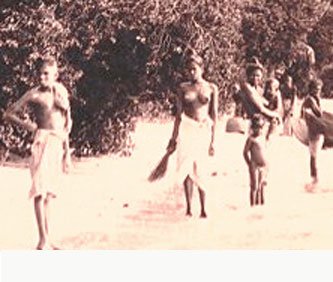 If the lower caste females use the lower indicant words such as Olu / Aval etc., it can be dangerous degrading. The native-English cannot understand this at all. Hence, their own nation and its original native-English are being degraded bit by bit, and they have no information on this.
The state of women was not that great, unless they stayed in a location wherein they received ‘respect’. If they were touched by a lower caste male or female, many of them could lose the right of entry into their very household.
There is a very detailed description of the terrors of being a female in the neighbouring Travancore in Rev. Samuel Mateer’s Native Life in Travancore. Interested readers can refer to that book.
QUOTE: Leud, adulterous women were made over to the chiefs with a premium by the other members of their families in order that they might be taken care of, and the chiefs (at any rate the Zamorins) used in turn to sell the women to foreign merchants, thus making a double profit out of them END OF QUOTE.
Women in the hands of various others would naturally have to undergo many kinds of experiences. Since they are from the higher castes, in most cases, they might be made use of only by the higher castes. If the lower castes were to be given right to use them, then it would be an utter tragic condition, given the terrific feudal content in the languages. That of the lower castes using words such as Inhi/Nee, Edi, Ale, Enthale, Enthadi, Olu, Aval etc. to and about a higher caste female.
But then, it has been seen reported elsewhere that higher caste women who were thrown out of their households used to be taken by the lower caste strong-men.
QUOTE: The persons accused by the woman are never permitted to disprove the charges against them, but the woman herself is closely cross-examined and the probabilities are carefully weighed. And every co-defendant, except the one who, according to the woman’s statement, was the first to lead her astray, has a right to be admitted to the boiling-oil ordeal as administered at the temple of Suchindram in Travancore. If his hand is burnt, he is guilty ; if it comes out clean he is judged as innocent END OF QUOTE.
QUOTE: Pulayatta-penna (lewd, aduterous women), or degraded women, were a source of profit to Rajas ; outcastes, not exclusively, but chiefly of the Brahman caste, they were made over to Rajas to take care of. As a compensation for their maintenance and for the trouble of preventing their going astray again, the family of the outcast were in the habit of offering to the Rajas as far as 600 fanams or Rs. 150. The Rajas then disposed of them for money, but their future condition was not exactly that of a slave. They were generally bought by the coast merchants called Chetties, by whom they had offspring, who came to be intermarried among persons of the same caste, and in a few generations their origin was obliterated in the ramifications of new kindred into which they had been adopted. END OF QUOTE.
In such situations, a powerful family name would help. Otherwise the servants of the merchant would address them in the pejorative. Once this is done, they are literally defined as dirt.
In a feudal language situation, the servants are very dangerous individuals for those who cannot display some powerful family name or status.
QUOTE: "Nilkesi, a woman of good family, an inhabitant of a place called Sivaperur (Trichur?), a town famous for female beauty, could not obtain a son though married to several men END OF QUOTE.
The above quote is from Payyannur Pattola (legend of Payyannur). The issue of a woman mating with different men does not seem to be a great item here. For, if the woman is addressed as Inhi / Nee, and referred to as Olu / Aval by different men, there will definitely be a personality depreciation in her. She would literally be like a servant woman in many ways. However, the words ‘woman of good family’ might stand a defensive shield to her. However, the mention that she moved out as a beggar might actually mean that she did lose her status in the society.
But then polyandry was not that rare in the land. In which case, it is like a woman brought home for doing the various household chores. And at the end of the day the man who married her and his brothers taking her for fornication. Even in this fornication, usually the precedence is perfectly maintained with the elder son having relative precedence. There is no scope for any kind of jealousy or envy in that the woman is literally a household servant who will bear the children of the sons of the family.
See this QUOTE: Like the Pandava brothers, as they proudly point out, the Kanisans used formerly to have one wife in common among several brothers, and this custom is still observed by some of them. END OF QUOTE.
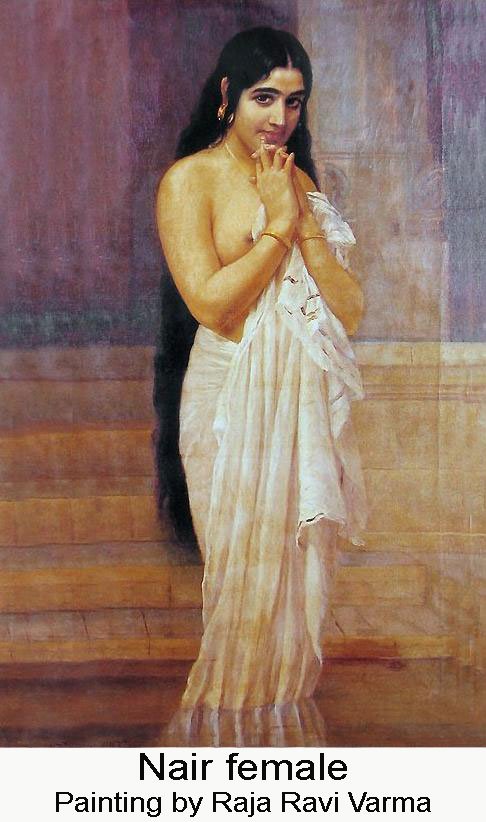 But then, in the matriarchal family system, the female is literally handed over to Nambhoothri Brahman honoured guest, when he visits the household, by her brothers. In the case of her marriage (sambhandham) to a Nayar man also, it is seen that her brothers do decide on whether that relationship should continue. Literally she is in her household where her brothers stay. They can inform her ‘husband’ that he is no longer welcome.
QUOTE:
ROYAL LETTER ADDRESSED TO CHUNDAYKAT OTALUR
Whereas there being no male members in the two Illams of Kandiyur Natuvattunnu Natuvat and Kandanasseri Palaykat in Alur Muri of Chundal Pravirtti, Sridevi and Savitri, two females of Natuvat Illam, have executed a document authorising Otalur Nambutiri to marry in the said Taravad, to hold and enjoy the property, movable and immovable (വസ്തുമതുൽ), including the slaves and the Ambalapadi, Urayma and other titles and honours (സ്ഥാനമാനങ്ങൾ) attached to the pagodas of Ariyannur, Kandiyur and Plakkat, and to maintain the females : and whereas that document has now been presented before us, we hereby direct that Otalur (Nambutiri) to marry in the said Taravad, hold and enjoy the property, movable and immovable, slaves and chest of documents (പെട്ടിപ്രമാണം) belonging to the two Illams of Natuvat and Palaykat, and the Ambalapadi, Urayma, titles and honours, and everything else pertaining to the above-mentioned three pagodas and maintain the females. 1851 END OF QUOTE.
This above mentioned deed might seem to have the look and feel of a hybridisation or husbandry programme. However, in effect it is a formal familial relationship that is being sponsored with a man who has social respect, title and honour. It is indeed a great security for a female to be connected to a man who has social ‘respect’. If she is connected to a man who is lowly on the social evaluation scale, her own social value would go down. The physical security can be compromised.
QUOTE: Notwithstanding their form of religion, monogamy is universal, and the women appear in public freely with their heads uncovered, and in Minicoy take the lead in almost everything, except navigation. END OF QUOTE.
This is about Muslim women of certain Laccadive Islands.
QUOTE: Contrary to what is the usage on the mainland, the women do not cover their heads and are not kept in seclusion. The women are generally very untidy and dirty. END OF QUOTE.
This is again about women in certain Laccadive Islands.
QUOTE : Nearly all the work is done by the women, and, besides their usual work, the women of the Melacheri class have, on the return of the odams from the coast to carry the bags of rice, etc., from the vessels to the houses of the consignees receiving one seer per bag as cooly END OF QUOTE.
This is again about women in certain Laccadive Islands.
Laccadive Islands
When speaking about Laccadive Islands, it must be mentioned that these Islands became part of current-day India, due to the fact that they were under British-India. Otherwise, there is nothing to categorise them as India, other than that certain Islands there had been under the control of the tiny Ali Raja kingdom of Cannanore. Whether this hold was a willing subordination or forced one is not known to me. However, there is some mention in this book wherein it is seen that some of the Islanders were not very happy with the subordination to the tiny kingdom of Cannanore town. I think that this subordination was made by the Arabian or Mappillas traders or seafarers who might have doubled up as pirates also.
QUOTE: This form of patriarchal administration was suited to the rude state of society on the islands, but corruption and its concomitant baneful influences were rampant, and goaded the islanders into open rebellion and resistance of the Cannanore authority. END OF QUOTE.
So, it is conceivable that the Ali Raja rule was more of a forced one.
QUOTE: The islanders state that it was surrendered by them to the Cannanore house on condition of protection being afforded to them against the Kottakkal Kunyali Marakkars, the famous Malayali pirates, who used to harry the island periodically. END OF QUOTE.
However, there are other contentions in this book, Malabar, which gives a different historical route of how the Islands came into the possession of a very tiny kingdom, more or less confined to the Cannanore town and suburbs.
As to the presence of pirates inside the sea around this place, there are some references to the pirates of South Asia mentioned in Ibn Battuta’s Travels in Asia and Africa.
See this QUOTE about the Minicoy Island from that book: The Indian pirates do not raid or molest them, as they have learned from experience that anyone who seizes anything from them speedily meets misfortune. END OF QUOTE.
It may be mentioned that quote is from an English translation of the book done by translated by H. A. R Gibb who was a lecturer in Arabic, School of Oriental Studies, University of London. Naturally, the Arabic word for would have been translated as India, because England was understood in England to be ruling ‘India’.
Beyond that, Minicoy is not part of the Laccadive Islands, but still it is in the nearby vicinity.
QUOTE: The Malikhans or chief men state that their forefathers voluntarily surrendered the island to the Cannanore Raja on his undertaking to protect them against pirates. END OF QUOTE.
That might not be the whole story.
QUOTE: The islands numbered 1 to 4 yielded annually during the ten years 1865-66 to 1874-75, during which period the islanders had broken loose from the Raja’s control and exported their produce without any restriction, END OF QUOTE.
So, naturally the effect of the English rule in the Malabar area was a sort of rebellion in the Ali Raja controlled islands.
QUOTE: The Portuguese made a settlement on the island of Ameni, but were shortly afterwards (about A.D. 1545) exterminated by poison owing to the intrigues of the Kolattiri princes.
About 1550, the Kolattiri Raja, who no doubt found the islands to be, after the advent of the Portuguese, an irksome possession, conferred them, it is said in Jagir, with the title of Ali Raja (Raja of the deep or sea), on the head of the Cannanore family, the stipulated peishcush being either 6,000 or 12,000 fanams.
It is said that this tribute continued to be paid, but probably with more or less irregularity as the fortunes of the two houses waxed or waned, by the house of Cannanore to the Kolattiri princes till the middle of the eighteenth century. The Bednur invasion and subsequently that of Hyder Ali led to the dismemberment of the Kolattiri kingdom and to the independence of the Cannanore house, who retained the exclusive possession of the islands as allies of Hyder Ali and Tippu Sultan END OF QUOTE.
The above information might be the history how the islands came under the tiny Arakkal kingdom.
QUOTE: The Cannanore islands became at the disposal of the Company by the storming of Cannanore towards the end of 1791, and were further ceded with Tippu’s entire dependencies in Malabar by the Treaty of Seringapatam in 1792. This southern or Malabar group of islands, along with Cannanore itself, are still held by the Cannanore family at a peisheush of Rs. 15,000 (less the remission above mentioned), alleged to be one-half of the profits derived from the trade with the islands and from the lands at Cannanore—a tribute which, though adopted only provisionally at the time of the first settlement, has remained unaltered to the present time.
The Malabar islands have, in recent years, been twice sequestrated for arrears of revenue, and at the present time are under the direct management of the Collector of Malabar END OF QUOTE.
There will definitely be a difference in the administration of the Ali raja’s officials and that by the English Company officials.
QUOTE: In 1827 the price of coir suddenly fell from Rs. 60 to Rs. 20 or less, but considering the profits derived from the coir monopoly for so many years previously, the (English Company) Government held with regard to their Canara islands that they could not fairly call on the islanders to share in the loss by low prices, and no change whatever took place in the Government islands. In the Cannanore islands (Ali rajas domain), on the other hand, the nominal price payable to the islanders was reduced from Rs. 30 to Rs. 22 subject to the same deductions as before (viz., 10 per cent, import duty on coir, 10 per cent, export duty on rice and 1 per cent, on account of sundry expenses), and to further aggravate the evil, the commutation price of Rs. 2¼ per muda of rice was maintained, notwithstanding the fact that the market price at that time was only Rs. 1½. END OF QUOTE
This is a typical example of the concern showed by the English Company administration towards the problems faced by the people. In the location where the native kings held the power, there was scarce concern how the people fared.
QUOTE:
a) Their coir was dried again and beaten in bundles at Cannanore with a view to reduce its weight.
(b) Deductions were made on account of old debts which were never proved to their satisfaction.
(c) The raja’s agents exacted presents.
(d) There was considerable delay in settling the accounts and allowing the vessels to return to the islands.
END OF QUOTE.
The above is some of the few ways in which the Ali Raja’s officials squeezed the Islanders, as per this book, Malabar.
QUOTE:
1. The free supply of salt to the islanders was recognised by Government in February 1880.
2. The tax was abolished with the sanction of Government, conveyed in their order of 23rd February 1880.
3. When the land has been all thus settled, it will probably become possible to abolish the trade monopolies with their irksome restrictions, and to throw the island trade open.
END OF QUOTE.
This is the way the English Company rule attended to the issues of the islanders.
QUOTE:
This form of patriarchal administration was suited to the rude state of society on the islands, but corruption and its concomitant baneful influences were rampant, and goaded the islanders into open rebellion and resistance of the Cannanore authority. END OF QUOTE.
These things might not find their way into modern academic history. May be Ali Raja’s also enjoy the status of ‘freedom fighters’ against the ‘evil’ English rule.
QUOTE: It is somewhat difficult to define what is the occupation of the Karnavar class, as they rarely do anything save bullying their dependents or quarrelling among themselves ; END OF QUOTE
The above statement is reflective of the foolish understanding that every man should work for others. In a feudal language society, working for others, is a very demeaning item. This is an experience that the native-English will get to know if they become forced to work under feudal language speakers in a feudal language ambience.
See this QUOTE also:
The men are the laziest, and it was with great difficulty that they were got to do some cooly work during the periodical visits of the officers to the island. END OF QUOTE.
The fact is that doing cooly work under feudal language speakers is not a very attractive proposition for anyone with some sense of upper-class sensitivity.
QUOTE: Nearly all the work is done by the women, and, besides their usual work, the women of the Melacheri class have, on the return of the odams from the coast to carry the bags of rice, etc., from the vessels to the houses of the consignees receiving one seer per bag as cooly. END OF QUOTE.
This again might serve to protect the social status of the family. It is a very complicated scenario in feudal languages systems.
QUOTE: The generality of the people are poor, all the wealth and influence being confined to a few of Karanavar class who keep the others well under subjection END OF QUOTE.
In the ultimate information, the social system is run on feudal languages.
QUOTE: In the island, he and the gumasta alone wore jackets as a mark of distinction, all others being prohibited from doing so whilst in the island, though out of it, e.g., in Calicut, other Malikhans are in the habit of dressing somewhat gaudily. Amongst the women also sumptuary distinctions prevail, the lowest class being strictly prohibited from wrearing silver or gold ornaments END OF QUOTE.
The native-English side has no information on the requirements of feudal languages. For, attire is one very easy means to understand another person’s stature in the verbal codes. It is like the uniform in the Indian army. Depending on the uniform, a person in uniform can be addressed as a Thoo or an Aap.
Wearing the wrong dress is like an ordinary soldier wearing the uniform of a commissioned officer. He would be court-martialled. It would be a terrible crime which would not be condoned.
QUOTE: One which is without parallel amongst any society of Mussalmans is that the men are monogamous. END OF QUOTE.
No comment.
QUOTE: There are hardly more than three individuals in the island who can speak or read Malayalam. The language spoken is Mahl, and there is therefore great difficulty in communicating with the islanders. END OF QUOTE.
That is about Minicoy Island.
QUOTE: The higher and lower classes are opposed to vaccination, but several children have been operated on, and a beginning has been made. END OF QUOTE.
Even though Vaccination is not the last word on preventive healthcare, the above event is illustrative of the way the English rule set out to create healthy living conditions.
In fact, in Malabar there were Sanitary Inspectors who were in charge of seeing that both the public as well as private toilets are kept in very clean conditions. However, as is natural from the perspective of feudal languages, the people gave them a derogatory name: Thotti inspector തോട്ടി ഇന്സ്പെക്ടർ. As of now, the very concept of Sanitary Inspectors seems to have vanished. The officials have changed their designation name into something more formidable. After all, a government official is a ‘respected’ individual and is not supposed to do any work connected to anything demeaning.
QUOTE: A school was started by Mr. Winterbotham in 1878 with a nominal roll of 36 boys, but this number had dwindled away to 14 in 1880. The plan of combining mosque schools and secular schools is being tried END OF QUOTE.
The English administration was bent on spreading ‘education’. However, whether they understood that the only education that was worth the time spent is good quality English education, is not known.
Ali Raja
When speaking about north Malabar, and especially about the locations between and including Tellicherry and Cannanore, three families are mentioned. One is the Chirakkal family, next the Kolathiri and the third the Arakkal family.
The first two are connected and I think can easily get mixed up. The third one is also known as the Ali Raja family. It is generally seen mentioned nowadays that the meaning of Ali is Sea or Ocean. I do not know in which language Ali becomes Sea or Ocean. I think it is a mistake which must have originated from this book, Malabar purportedly written by William Logan.
In this book, a general tendency to write the Malabari and Malayalam zhi (ഴി) as li (ലി) is seen. From this perspective, I think that actual word was not Ali Raja, but Aazhi Raja. Aazhi (ആഴി) does mean Sea or Ocean. However, since the family was Muslim, and the name Ali is a Muslim name, the shift in the English pronunciation was widely accepted without much demur. And from English, the name pronunciation must have diffused into Malabari and Malayalam also. So that as of now, the name must be Ali in all the afore-mentioned languages.
Even though the kingdom has been mentioned several times in this book, as far as I can discern, it is a very tiny bit of place. I feel it was more or less confined to certain parts of Cannanore town. In the heydays of its existence, it must had occasion when it might have had some larger existence. I am not sure about that.
See the words of Hamilton: QUOTE: “Adda Raja, a Mahometan Malabar prince, who upon occasion can bring near 20,000 men into the field. END OF QUOTE.
The number 20,000 in the above statement might need to be imbibed with a pinch of salt. 20000 was the number of soldiers assembled by the Mogul Diwan at Murshidabad to attack Robert Clive and his native infantry. It was indeed a very huge assemble of soldiers.
However, the Arakkal family has had some kind of ownership of certain islands in the Laccadive Sea. This ownership must have come upon this tiny kingdom by their supporting the Arabian trading ships that came from Egypt. It is also possible that the Mappilla seafaring family known as the Kunhali family of Badagara area may also have supported them in this. The Arakkal family’s hold on the Laccadive islands was more or less tenacious, I think, holding on against the overall antipathy for the more or less exploitative control over the disunited islands and the island populations.
There is the name of Arakkal Bibi, or Beevi or Beebee found in this book, Malabar. This denotes the title holder of ‘queen’ of this family. Since the family system was matriarchal, it is the Beevi who is mentioned in this book as representing the family and ‘kingdom’. However, there is evidence in this book itself that the actual players in decision-making were the male members of the family, with the Beevi being only namesake tile-holder of family head.
The next point is that the word Bibi, Beevi and Beebee is seen mentioned in the book, Malabar, in the history over the centuries. So naturally there will be different individuals holding this title one after another over the years. There seems to be no mention of these individuals, other than the sterile word Bibi, Beevi or Beebee. The situation looks quite similar to the ‘Zamorin’ word representing another tiny, but still much bigger kingdom that that of the Bibi.
QUOTE: Cheraman Perumal, the text goes on to say, encouraged merchants and invited Jonaka Mappillas (Muhammadans) to the country. In particular he invited a Muhammadan and his wife to come from his native land of Aryapuram and installed them at Kannanur (Cannanore). The Muhammadan was called Ali Raja, that is, lord of the deep, or of the sea. END OF QUOTE.
So, that was how this family came into being. There is another local story with a slight variation in circulation in Cannanore.
QUOTE: On the 26th of the same month the Prince Regent took and destroyed the Mappilla settlement at Valarpattanam, killing 600 men, women and children END OF QUOTE.
Ali Raja’s relationship with the Kolathiri and also with Kottayam raja were at times strained.
QUOTE: In their letter of 14th March 1728 to Bombay the factors reported that “Ally Rajah .... is sailed for duddah, and all his country save Cannanore entirely destroyed by the Prince.” The next news of him received in October, through Bombay, was that he had been poisoned at Jeddah by his minister, and that all his effects had been seized on account of presents promised to the prophet’s tomb. END OF QUOTE.
No comments
QUOTE: The Bibi of Cannanore was next prevailed on in November- December 1734 to surrender her claims to the island out of fear that the Canarese or French would take it, and owing to her inability to retake it herself and keep it securely. If it was to be in any other hands than her own, she preferred that it should be taken possession of by the English. END OF QUOTE.
The ‘she’ in the above passage might not really any ‘she’. It would be a decision taken by the men folk. And it might be their preference to see that the island is in English hands, rather than in the hands of Canarese or the French. The former being dangerous feudal language speakers. And the latter also with the same infliction but also quite unsteady.
QUOTE: The weakness of that prince was avarice, and Ali Raja of Cannanore, helped by the French, had been “spiriting up” the Prince Regent with money and creating dissensions between him and the English factory. END OF QUOTE.
This was the state of the geopolitical location where the English Company tried to establish a trading relationship. Everyone was fighting against each other. Even inside the Kolathiri family, there were various groups, all seeking ways to usurp the title of the king.
It is seen that when feudal language speakers set up beachheads inside native-English nations, those locations also start exhibiting similar social infections. That of the nation fighting against itself. This is very much evident in the case of the USA now.
QUOTE: Ali Raja repaired at once to Mahe with 500 men. But his reception seems to have cooled his ardour for the French alliance, and after this powerful French fleet had sailed away without even attacking Tellicherry, he soon sued the English factors for peace and stated his hearty repentance. END OF QUOTE.
The native-kings were shifty and always doing things which were not direct, but from behind the back. There is indeed a culture here in which it is seen that cheating another person, or doing something against him behind his back are seen as great personal capacities. The direct manner of dealing is not encouraged by the feudal language codes.
QUOTE: In September 1755, Ali Raja of Cannanore organised a big buccaneering expedition in close alliance with Angria. He sent 3,000 men with guns in 70 native small craft (manchuas) and large boats to ravage the Canarese country. This expedition attacked Manjeshwar and obtained there a booty of 4,000 pagodas, besides 100,000 more from a private merchant. They also landed people to the north of Mangalore, marched 18 leagues inland to a very rich pagoda called “Collure” and carried off booty to the extent, it was reported, of no less than 4,000,000 pagodas. END OF QUOTE
.
Till the entry of the English rule, there was no far-sighted aim to create any enduring social or administrative system in the subcontinent. Everyone acted in the most selfish manner.
QUOTE: On the 11th Ali Raja of Cannanore, without giving any notice to the factors of his intention, surprised the French fort on Ettikulam Point at Mount Deli and most barbarously massacred the garrison of 20 men. END OF QUOTE.
This was done because the support of the English Company was on their side. However, it seems to be a show of power done without the permission of the English Company officials.
QUOTE: On the 11th March 1761 the Kolattiri Regent wrote to the Chief to say that Ali Raja of Cannanore had given the greatest affront possible to the Hindu religion by putting a golden spire on the top of one of his mosques, it being contrary to their established rules to have a spire of gold on any edifice throughout the coast except on the principal pagodas ; and only those of Taliparamba, "Turukacoonotu" in Kottayam, and "Urupyachy Cauvil" at Agarr were entitled to the distinction. War ensued: the Court of Directors’ orders were peremptory and forbade the factors from interfering, except as mediators, in the disputes among the country powers. END OF QUOTE.
These fights are innately encoded into the social culture of the location. The moment one side gets power, it will display it. However, the English Company was not to get involved. This was a most sensible policy. This is the sense that has been lost in native-English nations as they continuously get hoodwinked by various lobbies to and get entrapped into fighting other people’s battles and wars.
As to the communal divide that ensued, it is spontaneous and not from what has been currently described as a ‘divide and rule’ policy ostensibly of the English.
QUOTE: Shortly after this, the Bibi of Cannanore again sought protection from the company and stated positively that Tippu was shortly coming to the coast with the whole of his force. The Bibi was probably at this time playing a deep game. The Mappillas of the coast generally recognised her as their head, and the Mappillas of the south were in open rebellion against Tippu’s authority END OF QUOTE.
Everyone was cunning to the core. And the political scene itself was quite confusing.
QUOTE: She professed friendship for the Honourable Company, but did all in her power in an underhand way against them. END OF QUOTE.
The word ‘she’ can be taken in a more gender-neutral sense. As to how the Ali Raja side acted, there is nothing unusual. That is how unwary adversaries are struck down in all feudal language locations. Affability and extreme hospitality are tools of conquest and backstabbing.
QUOTE: The Bibi’s attitude at this time to the British was very unsatisfactory and enigmatical. Ever since Tippu’s visit to Cannanore in the preceding year, she had ostensibly lent to an alliance with the British, but had in reality secretly worked against them END OF QUOTE.
The English Company officials were slowly learning the social culture of the location.
QUOTE: It will be noted that this chieftainess was not on a footing similar to that of the rest of the Malabar chiefs, for she had basely thrown over the English alliance instead of assisting the Honourable Company’s officers, and had been compelled by force of arms to withdraw from her alliance with Tippu. END OF QUOTE.
It is only natural that the Muslim Arakkal family would find it more advantageous to support a Muslim raider, who could probably overwhelm everyone in Malabar and Travancore. If he was to win, it would have fared very good for the Arakkal family. From its very tiny size, it would probably have grown into a very powerful ruling family in Malabar and probably in Travancore also.
QUOTE: The islands numbered 1 to 4 yielded annually during the ten years 1865-66 to 1874-75, during which period the islanders had broken loose from the Raja’s control and exported their produce without any restriction, END OF QUOTE.
It is doubtful if the islanders derived anything good by being the subjects of the Arakkal family. However, till the advent of the English rule in the subcontinent, it is doubtful if any of the rulers in the location had any concept of a people’s welfare in their administration policy. Their main idea and mainstay was fighting, conquering, capturing, overrunning, molesting, plundering, pillaging, breaking places of worship, catching people for slavery &c. That itself took up almost all their time and intelligence. Moreover, they had to be continually vigilant about individuals on their own side trying to seize the power and the title of king.
QUOTE: Over a part, however, the Pandaram asserts exclusive claims on the ground that it was formerly waste land and therefore the property of the raja. The claims were resisted by the people and gave rise to great discontentment and opposition on their part END OF QUOTE.
That was with regard to Kavaratti Island. The mentioned ‘raja’ was Ali Raja.
Kolathiri
Basically another tiny kingdom in Cannanore, but much more powerful than the miniscule Ali Raja kingdom. They had their headquarters at Chirakkal, which is a few kilometres from current-day Cannanore town. It may be mentioned that the Ali Raja family also has certain hereditary connections with the Chirakkal raja family.
Even though this kingdom has certain traditional superiority over the other smaller kingdoms, inside this family many feuds and mutinies and insubordinations are seen mentioned.
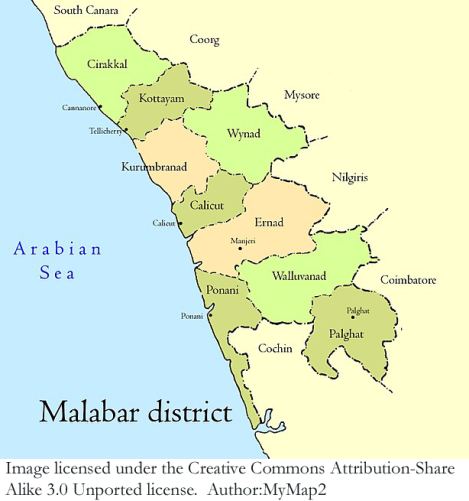 Like all the other minor kingdoms of Malabar, they also did go on shifting their alliances with regard to the English East India Company. All of them did go to their doom. In this regard, the totally different stance taken by the king of Travancore, Marthanda Varma and his descendents might be mentioned. He declared his total support for the English Company and gave a message on this deathbed to never disconnect with the great and honourable English Company. Travancore was to grow into a stable kingdom, remained in existence, till the British Labour Party made England look like a knave. All terms and treaties and commitments were thrown to the wind, when they gave the military power to the politician of the northern parts of the subcontinent.
QUOTE: a fortnight later news came from the factors at Honore regarding “the Extraordinary Insolency of the Canarees” in having taken the guns out of several Bombay boats because the English at Tellicherry had assisted the Prince Regent against them. END OF QUOTE.
The English Company had actually connected to a prince who had ulterior motives in everything. Even his treaty of peace with the Mappillas was mentioned by him as : QUOTE: The present Treaty is only to give me a Breathing for four months. END OF QUOTE.
The social and family situation was a continually changing one, with everyone have their own private aims, and ready to backstab anyone, friend or foe, for private gains. For the English Company, it must have been a very tough situation to deal with this type of social system.
QUOTE: The country south of the river to be under the Prince Regent, who was to receive assistance against his rebellious subjects, first of whom were the Mappillas of Cannanore. END OF QUOTE
This assistance was by the Canarese with whom the Prince had patched up. The enemy was the Mappillas of Cannanore. Which might mean the people of Ali Raja, i.e., the Arakkal family. However, the joint attack on them by the Kolathiri prince and the Canarese forces was repulsed by the Mappillas.
QUOTE: In August and September 1748 matters came to a crisis by the Prince Regent “laying an impediment” on one of the Company’s merchants, on mulcting him heavily. On being remonstrated with for this and other similar behaviour, he strenuously asserted his right to take the half of every man’s property, and the whole of it if he committed a fault. END OF QUOTE.
The prince’s name was Kunhi Raman. It is quite easy to see that there is very fast shifting of loyalty and connections. All that is required to provoke such a thing was a minor change in the verbal code, mentioned by someone. These are things that could have perplexed the English Company very much.
As to mulcting the Company’s merchant, the merchant could be a native-man of the subcontinent. His own words, body posture, eye-language all could also be provocative. For, his own stance would be that he is from a more higher position than a ‘tiny’ prince.
QUOTE: In November 1748 he had, it seems, portioned out his country to certain headmen in order that they might plunder his subjects, and the Commandant at Madakkara reported that soon the country would be ruined END OF QUOTE
He, the prince, is actually acting quite similar to the current-day officials of India.
QUOTE: He was present at an affecting interview with a very old and bed-ridden lady, described as the prince’s mother ; she expressed her satisfaction on being informed that everything had been amicably accommodated, and enjoined her son as her last parental counsel and advice never to give umbrage to the Chiefs of Tellicherry, who had protected the Palli branch of their family in its utmost distress. END OF QUOTE.
It was the English Company Chief Mr. Byfeld who had conversed with the prince’s mother. However, there was actually no hope. The Kolathiri family was divided into so many mutually competing and fighting teams. There was no way for the English Company to address a single king or prince in this family.
QUOTE: The Prince Regent’s bad advisers, banished in Mr. Byfeld’s time, returned and signalled their return by an outrage on a private servant of one of the English officers at Madakkara fort. END OF QUOTE.
The English Company itself was in some kind of an issue. Their new Chief was not able to understand the social system correctly.
QUOTE: The Prince Regent on 25th September openly visited Mahe and was received with a salute. END OF QUTOE
The Prince was shifting his loyalty. As to the French, they were using that standard technique used by all feudal-language speaking groups. That of effusive hospitality to befriend a person who was on the enemy’s side. This is the same technique they used to fool young George Washington in the American Continent when he was sent to their camp with a message from the English Governor of the place.
QUOTE: Northern Regent then transferred “for ever” to the Honourable Company the “whole right of collecting the customs in all places in our dominions END OF QUOTE.
This came about from a very curious situation in which the English Company had to struggle to find a new ‘king’ when two Prince Regents died one after another. As usual, many persons staked their claims and fought for it. The English Company was forced to seek out who was the most eligible and to support him. And this was the result when he was securely placed on the ‘throne’.
It might seem that the English Company was slowly taking over the locality or ‘country’. However, the fact is that no sane person would like to be ruled by the native kings and princes. To be under them is a demeaning experience. The English Company’s rule would be supported by the discerning people.
QUOTE: On the 11th March 1761 the Kolattiri Regent wrote to the Chief to say that Ali Raja of Cannanore had given the greatest affront possible to the Hindu religion END OF QUOTE.
Kolathiris and the Ali Rajas fighting against each other
QUOTE: In April some disturbances were created in Chirakkal by a prince of the Chenga Kovilakam of the Kolattiri family, a nephew of the late Raja. He claimed the raj. Colonel Dow went with a force to restore quiet. The rebellious Raja attempted in the following month of May to take the Puttur Temple by storm, but was slain in the attempt by the ruling Raja's Nayars who defended it. END OF QUOTE.
The English Company is stuck in the midst of such acrimonious situations. They came for trade but had to stay on to set up a peaceful situation in the land.
Kadathanad
As per this book, Malabar, the location of Kadathanad is Badagara and thereabouts. In certain other locations, the precise location is mentioned as Puthuppanam. However, these two are more or less very near places.
QUOTE: Puttuppattanam (new town) was at one time the seat of the Southern Regent of Kolattunad. END OF QUOTE.
As per this book, the king of this place was a sort of ‘lord of pirates’. The place is the much mentioned as the location of Kalari (Vadakkan Kalari). Vadakkan Kalari is a very sophisticated martial arts. It is not clearly known as to from where this martial arts reached here. The problem that this martial art possesses is that it was very much twined with the feudal language of Malabari. As of now, the feudal language codes of Malayalam have replaced the Malabari codes.
This martial art, though currently mentioned as part of the heritage of Kerala, is actually historically part of the heritage of North Malabar. It does not seem to have any link to the traditions of Travancore, where possibly such traditions are connected to Tamilnadu. At the same time, it is doubtful if this martial art has been of any use in confronting any kind of military attacks. For, the language codes are feudal, and it would be quite difficult to assemble different population groups in the regimentation required in Kalari. Many persons would not like to be subordinated thus to any guru or teacher other than their own acknowledged superior.
Pazhassiraja’s insurgency against his uncle ultimately resulted in a fight with the English Company’s local Kolkars. It is seen mentioned by current-day Kerala spin-tale wishy-washy historians that he had used this martial arts in his fight against the English Company’s Kolkars. It is actually curious that there is no mention of this martial art in this book, Malabar.
The only time some kind of martial arts expertise in mentioned is with regard to one Mappilla incident and two times with regard to the Mamamkam festival at Tirunavaya.
QUOTE: 1. Mappilla boats rowed by eight or ten men with four or six more to assist, all of whom (even the boatmen) practised with the “sword and target” at leas
2. There were but three Men that would venture on that desperate Action, who fell in with Sword and Target among the Guards
END OF QUOTE.
Another time the term ‘Sword and Target’ is mentioned when the Kolattiri visited Da Gama at Cannanore.
Whether all the kings and princes of the location were exponents in Kalari is a debatable point. From their general attributes, it does not seem that they had any inclination for any kind of dedicated programmes. Whether Pazhassiraja was an exponent or expert in this art is not known. And it may not mean much also. For, his real fight was against his uncle. And his aim was to get the kingship which his uncle was cunningly avoiding in conceding to him. Kalari has no meaning this issue.
However, it is seen mentioned that there were such ‘champions’ in most of the villages who would fight for others to settle feuds and challenges. Even though they are currently being mentioned as ‘great’ persons, it can be really doubtful if they were that great for the socially higher persons. Even the Vadakkan Pattukal, which contain many stories of such persons and their exploits, were actually the ballads and songs sung by the women working in the paddy fields. So, it might be true that these fighters and champions were their heroes. Not the heroes of the higher grade families.
Moreover, in spite of all claims of so many great martial art professionals, including females, when the Mysorians arrived, there were actually none to confront them. In fact, almost the whole of the Hindu (Brahmin), Ambalavasis and Nayar populations ran off. Whether the Marumakkathaya Thiyyas also ran off is not seen mentioned. However, since the Muslim invaders were actually targeting only the Hindu (Brahmin), Amabalavasi and Nayars, it might be possible that the Thiyyas and the lower castes were left unmolested. This also cannot be said for sure. For raiding parties, in the midst of the melee of plundering and molesting, would not stop to check the caste of anyone.
QUOTE: Hamilton paid him a return visit on shore at “his palace which was very meanly built of Reeds and covered with Coconut Leaves, but very neat and clean END OF QUOTE.
Hamilton was actually an interloper. Meaning he was a British man who was wandering in the location near English Company Factory on his own, and more or less trying to give a perspective that was not from the Company’s view point.
However, his description of the palace of the king has to be noted. For, in modern history versions, especially in movies and such, there is a tendency to show grand and majestic buildings as these palaces. See the words; It was ‘very meanly build of Reeds, and covered with Coconut leaves’.
QUOTE: “I do not certainly know how far Southerly this Prince’s Dominions reach along the Sea Coast, but I believe to Tecorie, about 12 miles from Mealie, and in the half way is Cottica, which was famous formerly for privateering on all Ships and Vessels that traded without their Lord’s Pass.” END OF QUOTE.
Piracy was crushed by the English rule in the subcontinent. The sea routes became safe.
QUOTE: Hamilton further notices the “sacrifice Rock” lying off Cottica, about 8 miles in the sea—so called, tradition says, because “when the Portuguese first settled at Calicut, the Cottica cruisers surprised a Portuguese vessel and sacrificed all their Prisoners on that Rock. END OF QUOTE.
It would be quite nonsensical to think that this was an of ‘freedom fight’. For, the current-day India composes of various bloodlines, including that of the Portuguese. As to the persons who attacked the Portuguese, they were attacking them only to protect their own various interests.
The Zamorin and other apparitions
In the various history writings of the land, there are some names that are given a more that life-size dominance. One such is the word Zamorin. Its colloquial name is Samoori or in modern Malayalam Samoothiri.
When one reads the history that encompasses a few centuries, one finds that the various native kings change in the various kingdoms. Then the Continental Europeans arrive; the Portuguese, the Dutch and the French. Then the English comes.
In all these histories, some native kings are seen to remain in a un-dying form. One such is the Zamorin. Another is the Beebi of the minute kingdom inside Cannanore town. Then there are others like the Nawab of Carnatic etc.
Actually the persons do change across the years. Yet, their individual names are not seen mentioned much. They sort of exist like the Phantom, the Ghost who walks!
QUOTE: an agreement with “Kishen, Zamorin Raja of Calicut,” investing him with the sole management of all the countries heretofore included in the province of Calicut, which are or may be conquered by the British troops END OF QUOTE.
The name ‘Kishen’ is seen mentioned in the above quote.
As to the Zamorian, I think the word mentioned in English and the Continental European languages must have struck the imagination of those people. Far in the remote eastern mystical lands, there is a ‘great Emperor’, the Zamorin.
Actually the Calicut kingdom was a very tiny one. Its mainstay of existence was the support given by the king of Egypt, whose one main source of revenue must have been the pepper trade to Europe, monopolised by Egyptian traders. Even the kingdom Palghat in the east did not concede to the supremacy of Calicut with or without demur. Nor did Valluvanaad to the south.
Just beyond the Korapuzha to the north was the kingdom of the Kadathanad. And far at the southern end of the subcontinent, Travancore was to become a far more powerful kingdom than Calicut had ever been. This rise of Travancore was totally due to the support given by the English East India Company.
QUOTE: The king was sitting in his chair which the factor” (who had preceded Da Grama with the presents) “had got him to sit upon: he was a very dark man, half-naked, and clothed with white cloths from the middle to the knees ; END OF QUOTE.
In all probability, the Zamorin would be just like a typical landlord of Malabar, who had the seaport in his areas among the areas which were under his control or ownership. However, beyond that he might even be much connected to seafaring communicates, who are generally kept at a distance by the ‘higher castes’. But then, there is nothing to denote that kings of Calicut did go for sea-travel. For, it was dangerous when accosted by rude pirates, and also a source of defilement, when accosted by lower caste seafaring populations.
May be he had some dark-skin Tamil bloodline. For generally the people in Malabar, unconnected to the fishermen folks fair in complexion.
QUOTE: “On the other side stood another page, who held a gold cup with a wide rim into which the king spat; END OF QUOTE.
The spitting would be after chewing the betel leaves. It would be done by holding two fingers pressed on the mouth. It is a style that has to be developed with meticulous practise. A barbarian and uncivilised act aimed at protruding some kind of dominance.
QUOTE: “And he (the Zamorin) and his country are the nest and resting place for stranger thieves, and those be called ‘Moors of Carposa,’ because they wear on their heads long red hats ; and thieves part the spoils that they take on the sea with the King of Calicut, for he giveth leave unto all that will go a roving liberally to go ; in such wise that all along that coast there is such a number of thieves, that there is no sailing in those seas, but with great ships, and very well armed ; or else they must go in company with the army of the Portugals.” — (Eng. Translation.) END OF QUOTE.
That was the words of Cæsar Frederick, a merchant from Venice, writing around 1570s.
But then, the king of Calicut was the person who could arrange the pepper for the merchants. And he was in the control of the Arabian merchants who would not allow any other trading team to come into direct contact with him.
QUOTE: But it very soon transpired that all that the Zamorin wanted was to get assistance against the Portuguese for the conquest of Cranganore and Cochin, and when the English ships left without assisting him, very scant courtesy was shown to the ten persons left behind, who were to have founded a factory at Calicut END OF QUOTE.
The English trading ships came for trade. However, the local attitude was to make use of all these gullible merchants as some kind of mercenaries. The local kings and the various other population groups were not intent on setting up any kind of refined social set up. Their one and only ambition was to tumble down another social or political adversary. The continued maintenance of a huge section of the population as slaves or repulsive castes was a foregone conclusion. No one even bothered to even think of an alternative social set up, until the advent of the English colonial rule.
QUOTE: In 1788 the Zamorin was accordingly induced by a promise of the restoration of a portion of his territory to put forward some rather antiquated claims to suzerainty over Travancore. But being disgusted at the forcible conversions which followed the sultan’s advent, he drew back from the arrangement END OF QUOTE.
It is quite funny to note that the then king of Calicut could be persuaded by Sultan Tippu to support him, on being promised that the Travancore kingdom would be brought under him. It might be remembered here that the Kolathiri raja of Cannanore and beyond had been seduced by Hyder Ali, Tippu’s father to support him on the promise that he would be made the king of Calicut. The title Samoori could have had a definite ‘verbal greatness’. Oh, to be the Samoori!
Here the Samoori is being seduced by the promise that he would be the ruler of Travancore!
QUOTE: 1. The Padinyaru Kovilakam branch of the Zamorin’s family, already noticed, possessing great influence in the country, was entrusted with the collection of the district of Nedunganad by the Eralpad Raja, the managing heir apparent of the Zamorin.
On the strength of this the Padinyaru K. Raja attempted to render himself independent of the Zamorin. The dispute was carried on to such lengths that Captain Burchall was obliged to seize his person at Cherupullasseri. He died there a day or two afterwards, and at the instance of the Zamorin his brother and nephew were put under restraint, and released only upon the Kilakka Kovilakam Raja standing security for their good behaviour and payment of arrears of revenue amounting to one lakh of rupees
2. An attempt was made by two of the Rajas of the Padinyaru Kovilakam (western palace) of the Zamorin’s house to assassinate him (the king of Calicut) because he failed to procure them their restoration to Nedunganad. Though severely wounded, he recovered under the treatment of Surgeon Wye END OF QUOTE.
This was the state of affairs inside the ruling family of tiny Calicut, in a period of relative peace. The words ‘He died there a day or two afterwards’ also is quite suspicious. The native-kolkars or peons (Nayars) who did all these kinds of custody taking of persons would not leave a chance to beat up a person in their custody.
QUOTE: His (the king of Calicut’s) demand for the restoration of Pulavayi was left in suspense to be settled by the Supravisor as its Nayar chiefs were openly resisting the attempts of the Zamorin to interfere in the concerns of their country. END OF QUOTE.
So it is seen that the king of Calicut was not the acknowledged leader of the Nayars of South Malabar.
QUOTE: They granted one per cent of the land collection of the Zamorin’s districts to Shamnath, a Palghat Brahman and the Sarvvadi Karyakkaran or chief minister of the Zamorin, for services rendered by him to the Company. END OF QUOTE.
No comment.
QUOTE: On 15th November 1806 the Principal Collector, Mr. Warden, and the Zamorin reduced to terms the understanding with the latter and his family in regard to the payment of the malikhana allowance (or one-fifth share of the revenues of their districts) which had been set apart for their maintenance.
The family receives Rs. 1,32,163 odd per annum, and it is “considered as the security for the good and dutiful behaviour towards the Company’s Government of each and every member of the Rajeum (Rajyam) or family to which it may now and hereafter be payable. END OF QUOTE.
I think this was commencing times of the famous Privy Purse, or the pension given to the erstwhile rulers whose areas had been taken over by the English administration. It was one of the Indian prime ministers who stopped this suddenly inside India. What happened in Pakistan is not known to me. This sudden stopping was a populist political action by a mediocre politician who literally got everything on a silver platter from the English administration. Many small-time royal families went into severe destitution with this.
QUOTE: Kavalappara under its own Nayar chief owed a sort of nominal allegiance both to the Cochin Raja and to the Zamorin. The Commissioners eventually decided in favour of his independence. END OF QUOTE.
There is a missed information in all this. Why did the native-rulers concede to the leadership of the English, when they would not have allowed anyone among them to dominate? The answer lies in the fact that the native rulers and their henchmen are feudal-language speaker. A subordination to one among them would pull down the indicant word levels of such words as You, Your, Yours, He, His, Him, She, Her, Hers etc. to dirt levels in the hands and minds of several persons. In the case of subordination to the native-English, such a terror was not there at all.
QUOTE: But the Raja of Palghat applied to Hyder Ali, then Foujdar of Dindigul, in the service of Chick Deo Raj, the nominal sovereign of Mysore. On this application Hyder Ali sent a force under his brother-in-law, Muckh doom Sahib, who drove back the Zamorin’s Nayars END OF QUOTE.
This is how the Mysorean’s got a taste for Malabar.
QUOTE: the gauntlet of the Zamorin’s 30,000 spears at Tirunavayi in Ponnani taluk every twelfth year. END OF QUOTE.
Whether the number 30,000 is mere bluff might need to be checked. The quote is about the Mahamakkam festival at Tirunavayi.
QUOTE: King and beggar were both thus attired, but Mussulmans dressed in costly garments. The king was called “Samuri” and the traveller noticed the peculiar law of inheritance in force. END OF QUOTE.
That was a quote from Abdu-r-Razzak’s writings (1442 A.D.). The beggar looked like a king or the king looked like a beggar?
If it is the former, the place was quite rich like Japan, where even the lowest classes have fabulous dresses. Or if it is the latter, the place must be quite different.
The Jews
I am not sure as to what the native-language of the Jew is. It can be Aramaic or Hebrew. And whether they practise their hereditary language/s is not known to me. However, since it is language that holds the traditional culture and mentality of a population, it is possible that they do speak their hereditary language, whatever it is.
It might not be correct to say that the Jews have been cunning. Even though there is something about their language/s that has created some kind of very definite issues about them in various parts of the world.
However, the Jewish leadership did have some innate knowledge about the state of affairs in the subcontinent or at least in the Cochin-Kodungalloor area. When they arrived to settle in the location, they presented themselves from a location of power and prestige. Using this platform, they got the local kings to concede a social position to that was more or less on par with the Nayars of the location. It was very carefully mentioned that the lower castes were under them, and they had to be extended the due servitude by them, in all manners.
The same thing, I think the Syrian Christians also would gather from the ruler of Travancore.
This kind of intelligence very evidently were not made use of by such population groups like the Marumakkathaya Thiyyas and Makkathayatha Thiyyas of north and south Malabar.
This is a very dangerous way of entering into a social system which runs on feudal languages. When entering into a feudal language social ambience, care should be taken to keep a distance from the lower-placed persons. No kind of friendship or common interests should be mentioned. All mention should be of higher-positioned locations. For, verbal codes shift 180° depending on what connection is mentioned or displayed. Never admit that one is capable of great physical feats like climbing a coconut tree. This simple admission can place that person in a gorge.
In the case of the English also, they were actually quite foolish in that they did not take into consideration the very powerful hierarchical layers inside the social system. However, at the same time they had a few very powerful advantages. One was that their own native-language, pristine-English did not have the codes that would create division, envy, backstabbing etc.
It is true that many native-Englishmen did find their personal qualities compromised as they got entangled in personal relationships with the natives of the subcontinent.
The second very powerful item was that they found it quite difficult to learn the local feudal languages, which more or less would sound like animal sounds to a person who is not used to them.
The third quite helpful item was that they were on their own. They could take pre-emptive actions, without having to bother about explaining everything to the people back at home, who literally would not be able to understand what these people were actually facing. There was no democracy to make a mess of a great Company’s endeavours.
The fourth great help was that the English Company directors were based in England. So, that they were in a most egalitarian mood.
All this helped the English Company to save themselves from being slowly and surely downgraded into one of the lower castes of the subcontinent.
There was great gullibility in the endeavours of the native-English. They were bent on improving the stature of the lower castes. It is a very dangerous deed indeed. For, when the lower castes improve, they will have no residue of gratitude left in them after a generation or two. They will become as carnivorous as the higher castes in their verbal codes, and will try to bite the native-English with all display of calibre and skills.
However as of now, all these great advantages are gone in England. The native English are made to get accustomed to the satanic codes of feudal languages. The other side literally enjoys the slow and steady atrophying of the native-English posterity. If very clear understanding the great mutation this is bringing in into the interiors of both the human beings as well as the social system is not there, within a few centuries, the native-English will reach the levels of the lower castes of this subcontinent. That much is for sure.
QUOTE: The Jews and Syrians were by other deeds incorporated in the Malayali nation, and in the second of the Syrians’ deeds it is clear that the position assigned to them was that of “equality with the Six Hundred” of the nad (that is, of the county) END OF QUOTE
This is a very powerful insertion in the Deeds. Only populations that understand the social codes of feudal languages would insist on these things. In native-English nations, where such things are not known, the native-English populations are powerfully heading on to terrible conditions. They have no platform to stand upon as feudal-language speakers from Continental Europe, South America, Africa and Asia rush in and speak English. The fact all of them do have another social and mental demeanour in their own native languages is not understood by the native-English populations.
Some of the native-English react powerfully when they get to experience a terrible kind of degrading that the feudal languages enforce upon them. It can be felt in the eyes, body-language, camaraderie, facial demeanour etc. of the feudal language speakers. In fact, inside the feudal language nations, people do not allow others who might use pejorative word-form or pejorative glances or pejorative body languages, into the close proximity. However, in pristine-English, there is no way to define another person as being a dangerous entity.
When the native-English react to these satanic human degrading for which there is no known defence as of now, it is quite coolly defined as a ‘hate’ behaviour and ‘racism’. The whole ludicrous item in these kinds of definitions is that the native-English side has no means to even claim that something terrible has been done upon them.
In the above-quote, the words “equality with the Six Hundred” is not to be construed as being given superior status comparable to the royalty. At best, it is the stature of the local police constable of present day India. Even though the police constable are at the lowest rung of the India police administration, from the perspective of the common man, they are quite brutally powerful.
QUOTE: There is only one other matter to be pointed out in connection with these deeds. The privileges granted thereby were princely privileges, and that such favours were conferred on foreigners engaged in trade like the Jews and Christians is matter for remark. Such privileges are not usually to be had for the asking, and the facts set forth in this section seem to point to their having been granted END OF QUOTE.
There is indeed some cunning misinterpretations inserted here, naturally by the Nayar writers of this book, Malabar. The privileges of the Nayars are not the privileges of the princes and kings. However, from the perspective of the feudal languages of the subcontinent, they are ‘princely’ for the common folks.
If the ways and manners by which the common man has to behave in front of an Indian police constable is compared with that of England, it might be seen that even the common man in England does not have to display that level of subservience and servitude to even the Monarch of England.
From this sense, the privileges granted are ‘princely’
QUOTE: a hereditary appendage for the time that earth and moon exist—Anjuvannam, a hereditary appendage END OF QUOTE.
Well, it seems that as per the antiquity, these rights are still valid. It is a quote from the Deed signed between King (Perumal) Sri Bhaskara Ravi Varman, and Joseph Rabban.
QUOTE: ; pacudam (T.tribute) is, in the Jewish translation the right of calling from the comers of the street that low castes may retire. END OF QUOTE.
This is the sort of clearing the way for the Hindus (Brahmins) and the higher castes to move through the road. There are different distances at which each different layer of the lower castes should keep themselves from the higher castes. The more down the lower caste is, the more is the distance. Actually these things are directly connected to the physical and virtual code effects of the feudal languages.
The more subordinated a person is, the more ‘respectful’ he or she has to be. For the more lower a caste, the more taller is the pivot they create, on which they can swing or seesaw or carousal the higher castes. For more on this, please check my writing, ‘An Impressionistic history of the South Asian Subcontinent’.
See this QUOTE from Native Life in Travancore by Rev. Samuel Mateer: QUOTE: Pulayars meeting me, cried po, po (“go”) പോ, പോ, and stood still, till I assured them they need not fear me. END of QUOTE
This is one of the cautions the lower castes used to signal the higher castes of their polluting presence.
QUOTE: We have given to Joseph Rabban (the principality) Anjuvannam, along with the 72 Janmi rights, such as (going) with elephants and (other) conveyances, tribute from subordinate landholders, and the possession (or revenue) of Anjuvannam, the light by day, the spreading cloth, the litter, the umbrella, the Vaduca drum (Jews' transl: "drum beaten with two sticks’’), the trumpet, the gateway with seats, ornamental arches, and similar awnings and garlands (charawu, i.e,, T.காவ) and the rest. END OF QUOTE.
Even though the above rights look terrific, they are basically the rights of the supervisor caste or the Nayars. It may be borne in mind that above the Nayars there are the various layers of Ambalavasis and above them, the various layers of the Brahmin caste.
It is similar to the police constables in India being quite powerful over the lower financial private individual. However, above of the layers of the constables, there are the middle-level police officials, viz. the Sub Inspector, the Circle Inspector, and the DySp. Above them are the ‘officer’ class known as the IPS. It starts from the Assistant Superintendant of Police, Superintendent of Police, the Deputy Inspector General of Police, the Inspector General of Police and the Director General of Police.
The majority people of India are under the constables of the Indian police department. They will be addressed and referred to in the most terrible pejorative words of the feudal languages. The people have no complaints about this. For, they are given the adequate training by the government vernacular schools that the common man in the nation are mere low-class beings, quite lower than even the lowest class in the government service.
QUOTE: We also have given to him (the right of) the feast-cloth(?), house-pillars (or pictured rooms ?), all the, revenue, the curved sword (or dagger), and in (or with) the sword the sovereign merchant-ship, the right of proclamation, the privilege of having forerunners, the five musical instruments, the conch, the light (or torch burning) by day, the spreading cloth, litter, royal umbrella, Vaduca drum (drum of the Telugu’s or of Bhairava?), the gateway with seats and ornamental arches, and the sovereign merchant-ship over the four classes6 (or streets), also the oil-makers and the five kinds of artificers we have subjected to him (or given as slaves to him) END OF QUOTE.
See the words ‘given as slaves to him’. It is simply the wording in the local language such as ‘he is coming there to you’ by one boss to another. What is the level of dignity being offered to ‘him’ depends on the word used for ‘he’. If it is ‘avan’, he is literally taken as a lowly servant. If it is ‘Ayaal’, a slight more consideration is given. He can be given a seat to sit down, and the pejorative words of addressing will not be there. However, if the ‘he’ word used in the highest, something like Oru /Avaru/ Adhehem etc., the person would be given the same honour that is reserved for the highest persons.
Now, what has happened here is that a new group of people have come to the land. The native king mentions to them that such as such persons are ‘for you to address in the pejorative and can be used and misused as you like’.
The fact is that these things do matter much in the subcontinent. For instance, I have seen in the Wynad district in north Malabar, the settlers coming from Travancore and treating the forest-dwellers there as their dirty servants. It is there in the verbal codes. No one bothers to question this.
Now, if outsiders go to England, then if the English king or some other authority tell them, that such and such populations are dirt and they can be addressed in the pejorative and used and misused, that would look pretty funny. For pristine-English does not have codes to hold these kinds of cantankerous ideas.
It is into this high quality England that persons who speak such satanic languages are entering. Their very mental disposition is devilish. When they speak or think about another person or persons, the other person or persons are really being encoded with very powerful codes of personality mutation and disarraying.
What is being thought will reflect in the eyes. The eye-language of person who views another person as Inhi/Nee (lowest you), is different from the person who views him as an Ingal/Saar (highest you). The former is highly piercing, personality splintering, looks which can cause very powerful negatively mutations inside the other person’s individuality.
The latter is the view that is offered to those one reveres. It adds to the other person’s personality, positive codes and values. It can cause very powerful positive mutations in his or her internal codes.
These are things that are not known in native-English nations. However some persons, especially the lower-aged as well the persons doing jobs which are defined as lowly in these dirty languages, will feel the tragic mutation. They might go berserk. And the foolish psychologists and psychiatrists who do not know a thing about these things will judge them as having mental problems. Actually, the reality is the exact opposite. They are the few who could detect or sense the terrific degrading mutation that the nation is undergoing.
It is like this. A person goes into a private location in a building and does a biological action that would be too vulgar and dirty if seen by anyone outside. However, someone who is his subordinate did see this action by spying into the room through a hole in the wall.
The first person comes out. He assembles all his subordinates in front of him. When he is looking at the eyes of each on them, there is no problem. However, when he looks into the eyes of the person who has viewed his private vulgarity, he would see a different tone in the eyes. It is that, that person’s brain has entered into a very deeper location with regard to him. And has processed him with that information.
The same is the case with the feudal-language speaker in England. He has measured each of the native citizens using his own language codes. He has seen that many of them of younger-age, and lesser-positioned jobs are of the mere ‘eda’, ‘edi’, ‘Inhi’, ‘Nee’, ‘oan’, ‘oalu’, ‘avan’, ‘aval’ &c. levels in his own language coding. This is making a piercing entry into the very vitals of the native-English individual.
He or she has no defence against this. For, if a defence against this had been available in the South Asian subcontinent, the lower castes would have used it to protect themselves.
The native English individual will naturally have some kind of repulsiveness when in the presence of such individuals. This is one of the real reasons for the emotion called ‘racism’. However, there is another content also in it. That I might mention later.
SOCIAL CUSTOMS
QUOTE: Another curious custom has come down from ancient times and is still flourishing, though the mutual confidence on which it relies for its proper effects shows signs of breaking down and is cited as a degeneracy of Malayali manners. Any one desirous of raising a considerable sum of money for some temporary purpose invites his friends to join him in what is called a kuri or lottery : END QUOTE.
In the above-quote, there does seem to be some confusion or discrepancy. There are two entirely different items in vogue in current-day Kerala. Of this, the item which seems to be connected to the antiquity of Travancore is something known as Chitty. It is also known as Kuri.
At the same time, there is another very popular social financial, sort-of-crowd-sourcing. This is part of the antiquity of Malabar. It is known as Panappayat.
However, the above quote seems to be something kind of mixing up these two items, possibly by the Travancore lobby which has had access to doctoring the inputs in this book. For the word Malayali is seen used. It is troubling. Because, there are two different population groups which are being conjoined using this word. The Travancore population has not yet connected to the Malabar population other than at the higher caste levels. Even at that level, there can be doubt as to whether the same caste names do refer to the same antique populations.
QUOTE: The Kuri was of three kinds : (1) Nelkkuri, where the shares were paid in paddy ; (2) Arikkuri, where the shares were paid in rice ; and (3) Panakkuri, where the shares were paid in money. END OF QUOTE
A bit of more detail about Kuris.
QUOTE: 1. KURI MUPPAN is the president of the society termed Changngatikkuri
2. The society has of late years fallen into disuse, partly because the European authorities have discouraged it among all public servants as liable to abuse END OF QUOTE.
Off course, when such financial dealing become part of the social rights of a native government officials, there would be misuse. It is great that the English administration did sense this, and prohibit among the ‘public servants’.
There is this thing also to be noted. Current-day Indian officials do not like the usage ‘public servant’. They find it a most foolish term. For, they are generally accepted as the ‘public master’ and not the ‘public servant’. They will not allow such deprecatory words defining them.
The usage ‘European authorities’ is utter nonsense. British-Malabar is not under any ‘European authorities’.
QUOTE: It is not, it appears, confined to people of the same caste, but the association was often composed of Nayers, Tiyars and Mappilas END OF QUOTE.
It is about the Changngatikkuri (may be panappayatt). The above statement might be about North Malabar.
QUOTE: the lower orders of the population, who even now take vengeance on the higher castes by stoning their houses at night and by various devices superstitiously set down to the action of evil spirits. END OF QUOTE.
It might be true that some kind of mischief must have been done by the lower castes. However, beyond that there might be no need to be judgemental about the powers of supernatural beings associated with the various Shamanistic rituals of North Malabar.
As to the attitude of the lower castes, there might naturally be many who might have felt that they have more claims to social rights than was being conceded to them.
QUOTE: Some of the agrestic slave caste had murdered a Nayar and mutilated the body, and on being asked why they had committed the murder, the details of which they freely confessed, they replied that if they ate of his flesh their sin would be removed. (Indian Antiquary, VIII, 88.) END OF QUOTE.
These were very rare occurrences. I personally do not think that cannibalism was a part of the culinary art in the subcontinent, as it was in the African continent.
Hinduism
QUOTE: The final Brahman irruption from the north into Malabar, may be placed about A.D. 700, was destined to work a greater change in the religion of the land, for it was part of the policy of the new-comers to “enlarge their borders”, and to embrace in their all-enveloping Hinduism all minor creeds with which they came into contact END OF QUOTE
The above quote can be absolute nonsense. This ‘Hinduism’ did not envelop all minor creeds in the manner one might easily understand. By some very clever use of verbal codes, various different populations were subordinated to the Brahmins. This Brahmanical Hinduism cannot embrace anyone other than itself.
Moreover, Hinduism never could come out of its cloistered features, due to the fact that the Brahmanical religion (Hinduism) was connected to an extremely feudal language, Sanskrit. Beyond that, it is possible that almost all the languages of the subcontinent were also terribly feudal. So much so that even the an ordinary conversation with a seafaring population who might not be ready to concede the expected levels of reverence in words, would have had the effect of degrading the Brahmins.
It is seen that the other ordinary Brahmins were averse to travelling by sea. However, with the arrival of the English rule, many of them did get to travel by sea and even to England, standing inside the cosy interiors of an English ambience.
The basic information to be had is that when the seafarers were Englishmen, the Brahmins had no problem of travelling across the seas. When the travelling was in the hands of the lower-castes of the subcontinent, it would be a terror to have a conversation with them. For, they might not really concede the ‘respect’ words.
QUOTE: Malayali Hinduism, therefore, in the present day is a strange mixture of all kinds of religious ideas. It embraces, chiefly as divers manifestations of Siva and his consort Kali, all the demoniac gods originally worshipped by the Malayalis END OF QUOTE.
The above statement might be a pack of lies packaged in easily seducing ideas. The very word ‘Malayali Hinduism’ is a misnomer. In this book, Malabar, it is used to mean the Nayars and the Hindus (Brahmins) of Malabar, at the same time mixing up this word with the people of Travancore.
Even though it is possible that some of the higher castes of Malabar are same to the corresponding castes of Travancore, when it comes to the castes subordinated under the Nayars, there might not be much of a correspondence. Even though the Shamanistic deities of the populations kept subordinated under the Nayars have been entangled into Hinduism as some kind of lower version of the Brahmanical religion, actually there is no need for such a prop.
QUOTE: It has borrowed from Christianity—with which, probably for the first time, Hinduism came into contact in Malabar —some of the loftiest ideas of pure theism. END OF QUOTE.
This statement is again some kind of shallow scholarship. Christianity itself is not a European religion. Its roots are based outside Europe. As to Christianity having very lofty ideal, English Christianity is very high in quality. Whether the Continental European Christianity is that high is doubtful. And whether Hinduism has any lofty social ideals is also a debatable point. For, if the native-English rule had not come into the subcontinent, even now the social system would have been terribly structured and with a huge slave population.
QUOTE: It was at the hands of Samkaracharya, who is generally acknowledged to have been a Malayali Brahman living in the last quarter of the eighth and in the first quarter of the ninth, century A.D., that Hinduism attained its widest bounds under the form of Vedantism END OF QUOTE.
I do not know what are Shankaracharya’s ideas and information. Since it has been highly praised, it is very much possible that there are great thoughts in them. However, to connect the high-grade thoughts, ideas and ideals of a solitary individual to that of an unorganised religion or with an unconnected series of populations, does seem quite unintelligent.
Again the word ‘Malayali Brahmin’ has a lot of issues. He is not from Malabar, but from Travancore area. At that time, it is seen mentioned that the language was more or less Tamil in Travancore. Simply running off with words without anything to substantiate them does look ludicrous. In fact, Kaladi, his home town is not very far from the Kottayam of Central Travancore, where the English evangelists such as Henry Baker &c. had to work for years to improve the lower castes from their hereditary state of being identified as very near to animals.
It does look quite odd that this great teacher in Vedic contents had no thoughts comparable to what the ordinary English evangelist had.
A book in Sanskrit is actually a book in Greek to the natives of both Malabar as well as Travancore, whichever group is identified as ‘Malayalis’. However, it might be possible that the newly created language, Travancore Malayalam, has literally downloaded almost all the words in Sanskrit into its own verbal repository. From this perspective, it is possible that Malayalam might be found in the ancient Sanskrit books.
QUOTE: There is a constant pining after a transcendental ideal, attainable perhaps, but only after much suffering, and after much, almost, impossible, self-denial END OF QUOTE.
The feudal content in the languages here do create a lot of very special kind of thoughts. For, individuals cannot converse with others as they can do in English. For, in each conversation, there is need to first establish and publish each person’s relative social status. Beyond that, the above claims of piety can be found in persons of all kinds of religious and spiritual persuasions.
QUOTE: the first Hindu embassy from King Porus, or, as others say, from the King of Pandya, proceeded to Europe and followed the Roman Emperor Augustus to Spain END OF QUOTE.
There is a question that can be asked about the above statement. Was it a religious embassy from King Porus? Why a ‘Hindu’ word? Even if the Continental Europeans may have used the word ‘Hindu’, from the local understanding the word ‘Hindu’ is superfluous. It can be mentioned as a delegation from King Porus, even though such technical words as ‘delegation’ etc. might give the travellers an English aura, which they might not have, other than in Hollywood, Bombay film world &c. movies.
But then there might have been so many others also, since there was some kind of trade going on globally. There is also the issue of technically relatively much better placed nations were also there in the world in various places. If that be so, there must have been more travellers of this kind.
At best, these kinds of claims might be there in plenty in the African continent also. For, it was also a place with numerous ports of call in ancient times.
Christianity
The subject of Christianity is quite a complicated one. There are a few Christian denominations in current-day south India. Christians can be found in Travancore, Cochin, Kodungalur, Trichur, Calicut, Wynad, Tellicherry, Cannanore and such places. However, beyond the traditional urban areas, there are Christians to be found in the forest areas of Malabar extending from the interiors of Calicut /Malappuram to the interior mountain regions of Kasargode district.
Christians are found in Madras and in the various locations of Tamilnadu state. They are to be found in Mangalore and Udupi and even in Bangalore. I understand that Goa has a sizable Christian population. Bombay has Christian populations.
All of them can be presumed to be focused on the life and teaching of Jesus Christ.
But then, as mentioned before, the Christians are not single group. Some of the denominations are not in peace and love with certain other Christian groups.
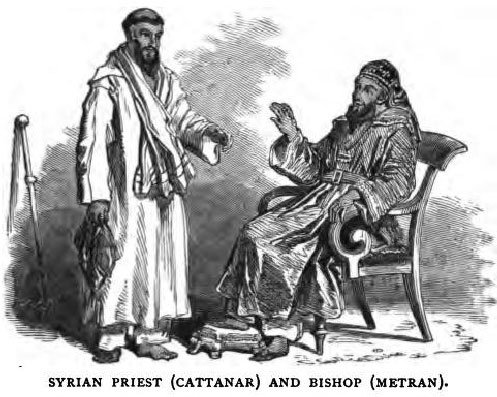 Inside Travancore itself there have been varied historical incidences connected to the various minor denominations. The main traditional Christian group in Travancore, I understand, might be the Syrian Christians.
Then there is the huge number of lower caste people who have converted into Christians. Many of them are from the very low castes of Paraih, Pulaya etc.. Many Ezhavas also have converted into Christians.
Of these converted-into-Christians from Travancore, a sizable number did move to Malabar. Some of them might have come as Church officials and teachers. Some might have come to take up jobs that required various skills, including formal education.
The converted Christians do not generally display any kind of lower mental or physical abilities in the case of individuals who have risen up financially and educationally.
QUOTE: There is consequently no inherent improbability in the tradition that the Apostle Thomas was one of the earliest immigrants from the West; END OF QUOTE.
The word ‘west’ is not clearly understood here. Jesus of Nazareth was not actually from the ‘west’, if the word is meant to mean Continent Europe or Great Britain. However, I have no personal knowledge in these things.
QUOTE: A king, who has been satisfactorily identified with, king Gondophares mentioned in IndoSkythian coins, and of whose reign a stone inscription, dated 40 A.D., has recently been deciphered is said to have sent to Christ for an architect, and St. Thomas was sent in consequence. But this king reigned in North-western India, whereas St. Thomas is understood to have preached his mission in Malabar and to have been killed at St. Thomas’ Mount near Madras. END OF QUOTE.
Quite an interesting historical confusion!
QUOTE: Likewise at Male where the pepper grows; and in the town Kalliena there is also a bishop consecrated in Persia.” “Male” is clearly Malabar, and “Kalliena” is most probably a place near Udipi in South Canara. END OF QUOTE.
It is quite curious. I do not remember seeing the word ‘Male’ to mean Malabar. What about the Mali Island? It is simply a query, with no specific arguments. The above quote also can be correct.
QUOTE: a large body headed by the venerable Bishop Mar Coorilos waited, by special request, on the Right Honourable Mr. Grant Duff, Governor of Madras, at Calicut, in January 1882, and presented to him a short account of themselves, from which the following extracts are taken:- END OF QUOTE
Parts of the narration are given below:
QUOTE: the arrival of a Persian heretic of the School of Manes, or, as is supposed1 by some, a heathen wizard. Through his teaching, many went over to him and are even to this day known as ‘Manigramakkar’ They cannot be distinguished from the Nayars, and are to be found at Quilon Kayencolam and other places. South Travancore is the seat of the descendants of those who stood steadfast in their faith during this apostacy and are known as Dhariyayikal meaning ‘nonwearers’ (of heathen symbols) END OF QUOTE.
This is one group of Christians, I suppose. However, the words ‘They cannot be distinguished from the Nayars’ can be an issue. For, there is so much self-praise and eulogising of Nayars in this book, Malabar, that everything mentioned with regard to ‘Nayars’ has to be taken up for scrutiny. A few of the items can be factually correct, despite the ubiquitous eulogising words.
QUOTE: “Some years after this first split had taken place or in (350 A.D.) was the arrival of Thomas of Cana, a Syrian merchant, whose large heartedness and sympathy for the neglected community was such that on his return to his native land, his story induced many to come out with him in his second visit, among whom was a bishop by the name of Mar Joseph. It was the first time a colony of Christians came to India.
They were about four hundred in number. They landed at Cranganore then known as Mahadeverpattanam. They settled in the country with the permission of ‘Cheraman Perumal the ruler of Malabar, who, as a mark of distinction and favour, granted to the Christian community certain privileges (72 in number) which at once raised them to a position of equality with the Brahmans. One of the privileges was the supremacy over seventeen of the lower classes; a relic of which still exists in the adjudication by Syrian Christians of certain social questions belonging to them. The grant was made on copper-plates, which with some others, are in the custody of the Syrian Metran and are preserved in the Kottayam Seminary END OF QUOTE.
This may be how the English official came to understand how a Christian community which was quite ancient was in existence in Travancore and Cochin areas. They were to form the Syrian Christians in the location. Thomas of Cana and Mar Joseph are seen as the founders of this Christian colony inside Travancore. The purpose why they relocated to Travancore might not be what has been described in the above paragraph.
That they did not come with any egalitarian principles or with the concept of ‘love thy neighbour’ concept of Jesus Christ can be seen very clearly. For, they came with the full realisation that they had to survive in a land where if they are not properly secured above the various layers of castes, they would get crushed down by the feudal vernacular verbal codes. The Syrian Christians maintained this superiority even though it is seen mentioned that all of them were not in good conditions, when the London Missionary Society came to Travancore. That is mentioned in Native Life in Travancore by Rev. Samuel Mateer.
Here the difference between the intentions of Thomas of Cana and Mar Joseph team and that of the evangelists of the London Missionary Society can be seen. The former came to suppress the lower castes under them and to keep them as slaves. The latter came with the deliberate aim of emancipating the enslaved classes from their terrible state of life.
It is a curious situation. Both are Christian groups. However, it is the group that came from England that had egalitarian aims.
QUOTE: “Matters continued thus until the arrival of the second colony of Christians (who were Nestorians) from Persia, at Quilon ‘between the ninth and the tenth century. They were also received well and permitted to settle in the country. The first colony, incorporated with the northern portion of the community, had their headquarters at Cranganore and the southern portion ‘Kumk-keni-kollam’ or Quilon. END OF QUOTE.
The tale continues.
Then came the Portuguese, and then the mission of Alexis Menezes, Archbishop of Goa, who was deputed by the Pope in 1598 A.D. to complete the subjugation of the Syrian Church. The Church split into church into Romo-Syrians or ‘Old Party,’ and Syrians or ‘New Party. The presence of the Dutch brought down the antipathies.
QUOTE: The capture of Cochin by the Dutch in 1663 was followed by an order requiring the Romish bishops, priests, and monks to quit the place which was not a little favourable to the Syrians. END OF QUOTE.
QUOTE: a large number, at a public assembly, resolved upon applying to Babylon, Antioch, Alexandria, and Egypt for a bishop. “This was done, and in 1653 Antioch promptly complied with the request by sending out Mar Ignatius, a Jacobite bishop. It was from this date that the Jacobite element began to leave the Malabar church. Mar Ignatius was mercilessly seized and thrown into the sea, as is believed by the Syrians, or sent to be tried before the Inquisition as is supposed by others END OF QUOTE.
In the year 1800 came the figure of Rev. Claudius Buchanan, going from church to church, conversing freely with all and diligently seeking for information about them.
QUOTE: Coming to Kandanad, he had an interview with the Metran, to whom he set forth the advisability of maintaining a friendly relation with the Anglican church, translating the Bible into Malayalam and establishing parochial schools. This being acquiesced Dr. Buehanan saw Colonel Macaulay, the British Resident, in company with whom he visited the northern parts of Travancore and Cochin END OF QUOTE.
It is curious that Rev. Claudius Buchanan was mentioning the advisability of maintaining a friendly relation with the Anglican church, and also on translating the Bible into Malayalam and establishing parochial schools. The fact should be the last two items are actually the exact opposite of what the Anglican Church should stand for. I am not sure how much profound understanding the Anglican Church had about the advisability of connecting with the Syrian Christian church, whose traditional aims were the exact opposite of Anglican Christianity.
It is seen in the Native Life in Travancore that Syrian Christians did have lower caste slaves under them bound to the soil. It is a sure case that they would not view the activities of the London Missionary Society with pleasure. However, these Missionaries also did not promote English, I think.
So there were actually a lot complications involved. And I think ultimately with the departure of the English rule in the subcontinent, the Anglican Church also must have fallen into the hands of the other Christian denominations. These are things about which I do not have any information. It is true that these information can be collected quite easily. However, there are so many information that can be collected if enquired. If the reader wants to pursue them, he or she can.
It may be mentioned in passing that most of these above-mentioned items are connected to Travancore and Cochin. The relevance to Malabar comes only with the issue of Converted Christians from Travancore relocating into Malabar forest regions. As to the wider aims of the Bishop Mar Coorilos in meeting the Right Honourable Mr. Grant Duff, Governor of Madras, at Calicut, in January 1882, it might be just a cunning premeditated plan to make the best use of the English supremacy in the subcontinent, for furthering the interests of his own christen denomination.
QUOTE: ......The fact attracted the attention of Colonel Munro, who, after making himself acquainted with the real position, set about getting a seminary built for them at Kottayam, of which the foundation stone was laid in 1813.
At the commencement of his government, Colonel Munro undertook to get out missionaries to train Syrian deacons and lads to carry on parochial schools.
And the Resident got the Honourable East India Company to invest 3,000 star pagodas in the name of the community for educational purposes. END OF QUOTE.
Colonel Munro seems to have done more indeed. However, whether it was actually in sync with the published aims of the English East India Company might have to be looked into, to know more. He could have been hoodwinked by pretended affableness.
QOUTE: “Colonel Munro, whose tenure of office extended from 1810 to 1819, must be regarded as having been the most, earnest promoter of Syrian Christian interests. END OF QUOTE.
Syrian Christians were not a pro-English side. Nor were they happy with the unshackling of their hereditary slaves. Moreover, it was not an English Church. However, Col. Munro himself seems to be a Scot.
Generally there is a mistaken notion in native-English nations that all Christians all around the world are one team. It is a very flawed understanding of realities. Even the Continental European Christians do not support any English endeavour or side. If that be so, the feeling that the Christians in Asian/ African/ South American nations are from their side is a very foolish idea in native-English nations.
QUOTE: Travancore, the Dewan and Resident of which was Colonel Munro, endowed the institution with Rs. 20,000 and a large estate at Kallada called Munro Island END OF QUOTE.
Col Munro is seen as a great administrator in Travancore. However, that was just because he was part of the English East India Company. As to what he did as per the above statement, a feeling that he clearly went beyond his brief comes.
It was not the policy of the English East India Company to promote any kind of Christian denominations. In fact, the policy decision given to the officials was to be neutral with regard to all religious and spiritual aspirations as much as possible.
In fact, I have personally seen all kinds of Christians who speak very bad about English colonialism, after swallowing up huge contents of wholesome benefits derived from the English rule.
QUOTE: how through the good offices of Mr. Bellard, the British Resident, the Travancore Sircar restored to them their portion of the endowments which was in their custody after the adjudication by the committee, how the church is disturbed by various internal feuds; and how the community is once more going through another cycle of trials and neglect.” END OF QUOTE.
Thus ends the narration by Bishop Mar Coorilos to the Right Honourable Mr. Grant Duff, Governor of Madras. Here again, it is seen that the Syrian Christian church did take the British Resident Mr. Bellard for ride. After all in feudal language nations, the best tool for deceiving is that of pretended affability and fake friendliness.
The standards of the English East India Company droop down in these episodes.
QUOTE: As regards the Roman Catholics and their connection with the Romo-Syrians, the following extracts are taken from a short history of the Verapoly Catholic Mission END OF QUOTE.
That is a different story altogether. It goes through another route.
QUOTE: The first superior of the Carmelite mission, Mgr. Joseph of St. Mary, a descendant of the noble Sebastiano family, was appointed by the afore said Pontiff in the year 1656, END OF QUOTE.
This is from this Verapoly Catholic Mission story.
QUOTE: But, on the 6th January 1663, the Dutch having defeated the Portuguese, took possession of Cochin, and refused to the Carmelite missionaries the permission of exercising their ministry in Malabar
“However, after a short lapse of time, the Dutch Government being aware that the presence of the Carmelites in Malabar could produce no harm, cancelled the above-said prohibition and allowed them to dwell in this country as before END OF QUOTE.
It continues thus to more complicated incidences,
QUOTE: Then appeared in Malabar a certain bishop named Mar Gregory, who pretended to have been sent by the Patriarch of Jacobites at Antioch END OF QUOTE.
If the reader is interested, the detailed history of the Christian Churches in the subcontinent can be read directly from the book, Malabar. It moves through various geopolitical locations including Goa, Portugal and Rome.
QUOTE: The only Protestant mission at work in Malabar is the Basel German Evangelical Missionary Society, of which the latest report, the 43rd, shows that on 1st January 1883, the society had in Malabar 2,632 church members, END OF QUOTE.
The reader may have noted that most of the earlier-mentioned items are not about Malabar per se. However, the above quote is directly about Malabar. However, it is also not a standalone entity, I think. Furthermore, I do not know what was the route through which a German missionary society came to Malabar. In the English East Indian territories, missionary work was prohibited I think. If that is so, what was the way in which they conducted their affairs also is not known to me.
QUOTE: Chombala in Aliyur amsam is a Basel Evangelical station. The mission was started there in 1849, and the number of church members in the colony on the 1st January 1885 were 309. There is a girls’ orphanage here, which was transferred from Cannanore in 1872. A branch weaving establishment has existed here since 1883. There are three schools for boys and girls with an average attendance of about 200 pupils. The Chombala Mission has an out-station at Badagara and Muvaratt. The station at Quilandi, opened in 1857, is subordinate to the mission at Calicut. The congregation at Quilandi numbers 68. END OF QUOTE.
That is about the above mentioned Basel Mission.
QUOTE: There is also a Basel Mission Church at Calicut, The history of the Mission is briefly noted below : — In May 1842 the Mission was established by the Rev. J. M. Fritz. In the same year, two Malayalam schools and a Tamil school were opened. One of the former was raised to the standard of a high school in 1879. END OF QUOTE.
It is curious that the Basel Mission supported feudal-language education. In which case, it ceases to be education, other than empowering the ‘educated’ persons to subdue the ‘uneducated’. There is no quality improvement from the perspective of social communication and relationship.
QUOTE: In 1855 a carpenter’s workshop and a weaving establishment with six looms were opened. In the former, Christians and Heathens are employed, and in the latter the number of workmen exceed 100.
In 1868 a mercantile mission shop was opened. It is the only shop at Calicut, which fully meets the demand of the public. In 1874 the Mission started the works. Here machines of German make are used for manufacturing tiles after the European fashion, for which there is an ever-increasing demand. The tile works furnish employment for more than 150 persons both Christians and Heathens. Here it must be noted that these industrial establishments are entirely of a charitable character.
In 1876 a caste girls’ school was opened in Calicut, and in 1883 a congregation girls’ school with nearly 100 pupils was also started. END OF QUOTE.
I am unable to understand the term ‘caste girls’. Could it be a school for the relatively higher caste girls? I have seen a picture of a school for ‘Nayar girls’ of those times.
QUOTE: And it has farther been settled with the concurrence of His Excellency the Ayyan Adigal, His Excellency Rama, and the Palace-major, that the church people (Palliyar, probably heads of the Tarisa citizens) alone have power to punish the (Heathen) families of this land for any offence whatsoever, and receive the fines, expenses, head-price and breast-price (probably the right of selling males and females for serious caste offences) ; END OF QUOTE.
The above is a quote from the Deed signed between the king of Venadu and the Tarisa church. It is one of the deeds belonging to the Syrian Christians of the Cochin and Travancore States.
It is seen that this Church literally joins the feudal oppressors. They were not the liberators of shackled human beings. To this extent, this Church was anti-English, even though the English and British officials failed to understand the difference. For, it is quite easy to hoodwink the native-English.
QUOTE:
PANDI. (Dravidian) = the Southern Tamil country with Madura as capital. The name given to a tribe of Christian fishermen and palanquin-bearers on the Malabar Coast, whom I have seen at Cannanore. They are supposed to have come from, the southernmost part of the Malabar Coast, viz., Travancore, and, perhaps, from the Tinnevelly province originally. END OF QUOTE
So that adds another Christian group from south who have come to North Malabar.
QUOTE: There is a Protestant church called the St. Mary’s Church at Calicut, which was built in June 1863. Before its erection the Anglican community held Sunday service in a portion of the Collector’s office. END OF QUOTE.
That might be about the Anglican Christians.
QUOTE: The history of the Roman Catholic Church, Calicut, which is interesting, is briefly as follows :
In 1513 A.D., a treaty was concluded between the Portuguese and the Zamorin, in which the latter allowed the former to erect a factory at Calicut to which was attached a chapel.
..............
The church management went on smoothly till the invasion of Malabar by Hyder Ali in 1766. In that year the Portuguese Vicar and Factor waited on Hyder Ali and obtained an order to Madye, Raja of Coimbatore and Governor of Calicut, for the payment of 2,420 fanams annually to the Vicar of the church. Hyder All also ordered that the rent and revenue or benefits of the landed property should not be appropriated.
.............
..till 1788, when a Brahman named Daxapaya came as Tippu's Revenue Collector of Calicut, and demanded from the Vicar, Gabriel Gonsalves, the church revenues and imprisoned him ; but the Vicar effected his escape with the connivance of Arshed Beg Klhan, Tippu’s fouzdar, and fled to Tellicherry.
The Vicar returned to Calicut and resumed possession of the church lands in 1792, when Malabar came under the East India Company. END OF QUOTE.
The English East India Company appears to be quite soft. The reader can read more about this in the book, Malabar.
QUOTE: In 1878 another charitable institution was attached to the Roman Catholic Mission at Calicut, denominated the Society of St. Vincent de Paul. It has since been divided into two branches—St. Mary’s conference and St. Francis Xavier’s conference. The poor and helpless of every creed are here assisted in their temporal necessities. END OF QUOTE.
Helping the poor and helpless is a great deed, indeed. However, there is a great difference in how this goes about in feudal languages, from how it is imagined in English.
QUOTE: There is a small Roman Catholic chapel called the Chapel of the Holy Cross at Calicut on the road to Wynad about two furlongs north of the Mananchira tank. It was a thatched chapel until last year, when it was substantially built by a member of the Roman Catholic congregation. END OF QUOTE
QUOTE: They go out to sea in the height of the monsoon in catamarans to catch fish. The owner of each net has to pay one-third of the price of fish caught every Friday to the church. This rate is called Friday contribution or Velliyalcha Kuru END OF QUOTE.
That information is about Angengo.
Pestilence, famine etc.
QUOTE: Malabar does not produce grain sufficient for the consumption of the home population, and this has been more especially the case since, by the introduction of European coffee cultivation into the Wynad taluk, the jungle tribes and other servile castes, who used to cultivate the rice-fields in that region have been attracted to the more profitable employments on coffee estates. END OF QUOTE.
The terrific information that the jungle tribes escaped from their age-old tormentor does not hold much attraction for the current-day people of India. For, it is a fact that is not very helpful in a feudal languages social system. When the lower ‘he’ (Avan/ Oan) improves, it is possible that this ‘he’ will topple down the higher ‘he’ (Avaru/ Oaru /Adheham).
And again the word ‘European’ is not a tenable one. The word could have been British or English, even though it is possible that other Whites would have also entered into the scene using their white-skin colour to confuse everyone.
This confusion has been a source of woe in those days. When the British West African Squadron patrolled the West African coasts to catch the slaver-ships, the native-blacks could not really make out if they were the saviours or the enslavers.
There were certain tragedies associated with the saving of potential slaves. The Black natives could not differentiate between their saviour and their tormentors. Sometimes, they mistook their British liberators for slave traders; there being a lot of Europeans also in the vicinity, along with the local enslavers.
One time, a young Royal Navy officer by name Cheesman Binstead gave chase to a convoy of canoes on the Congo River, seeking enslaved persons. When he came near to one of the canoes, the people inside simply jumped into the water and met a watery grave. They did this because they thought that he and his companions were slave traders.
When this is the reality, the use of the word ‘European’ as a synonym for ‘Briton’ or ‘the English’ is an act of utter rascality. Continental Europeans might have put up appearances of being British or English. However, that was probably only a very thin veneer. The difference is caused by their native language codes.
QUOTE: Thus in October 1755, the King of Bednur, to whom the rice -exporting port of Mangalore belonged, laid an embargo on grain, because of the ravages committed in his country by a buccaneering expedition under the Mappilla chief of Cannanore. This placed the French at Mahe, the English at Tellicherry, the Dutch at Cannanore, and the Malabar Nayars and Mappillas—the whole community in fact -- in a state of comparative famine. END OF QUOTE.
This famine came as a punishment.
QUOTE: But of real famine in the land there are few records. During the long period in which the Honourable Company occupied the factory at Tellicherry, there is but one record of a real famine.
........On examination of the factory storehouses, there was found to be bare provision for the place for one month, so an urgent requisition was sent to the Anjengo factors for supplies. On the 8th September, there was famine in the land and the record runs that the factory gates were daily besieged by people begging for support. END OF QUOTE.
It is possible that the English Factory did try its best to give solace to the people, even though the word gratitude is not ingrained in their brain. For, every single ideology, gratitude and loyalty is connected to the powerful strings of ‘respect’. Their whole endeavour is to gather ‘respect’.
QUOTE: One meal of rice kanji distributed gratis to all comers daily during this season of the year at many places throughout the district sufficed to stave off actual famine in 1877; the number thus daily relieved aggregated at one time over 40,000. END OF QUOTE.
The English Company administration certainly was taking up a lot of burden. Yet, one might find in the writings of silly writers that every single work done in the subcontinent was aimed at gathering profit for the company’s shareholders in London.
QUOTE: In October 1730, the Tellicherry factory diary records— “The pestilence which has raged for some time among the people of this district being now come to such a pitch, as, with difficulty, people are found to bury the dead, and our garrison soldiers, Muckwas (fishermen, boatmen) and others under our protection being reduced to such extremity by this contagion, so as not to be able to subsist in this place any longer unless relieved by charity, it was agreed to build barracks for the sick and to entertain attendants” to bury the dead.
What the “pestilence” was the records do not give information, but it was probably cholera. A fortnight later requisitions were sent by the factors to Anjengo and to Madras to raise soldiers to supply the vacancies, as the garrison was obliged to do double duty on account of the increasing of the contagion. END OF QUOTE
I remember the time when there was an earthquake in Gujarat around 1999. India has a huge army. Not even a single army personnel was sent for rescue work. The people stuck inside the buildings went on screaming for hours, till at last all sounds ceased. This is what was reported in the newspapers. In the subcontinent, people who are safe are not very much bothered about the people who are doomed.
QUOTE: One has only to attend one of the dispensaries in Malabar, or walk through the bazaars of some of the principal towns, and see the great, amount of people with anæmia, dropsy, and enlarged spleens. These classes of diseases fill our dispensaries —all the result of neglected ague or from repeated attacks of it. END OF QUOTE.
This is one problem with the English colonial rule. They have recorded everything which actually in the subcontinent no one really cares about. If there is terribly poverty in one location, the affluent classes look away. It is not that the affluent classes are wicked or bad. It is just that to converse or communicate with the financially backward classes is difficult, unless there is some way to enforce ‘respect’ from them. If they do not concede ‘respect’, instead of compassion what comes out is hatred and homicidal mania.
QUOTE: The native system of medicine and surgery is based upon the obsolete ideas, apparently borrowed from the Greeks, of the body being composed of fives elements -earth, water, fire, air, and ether END OF QUOTE.
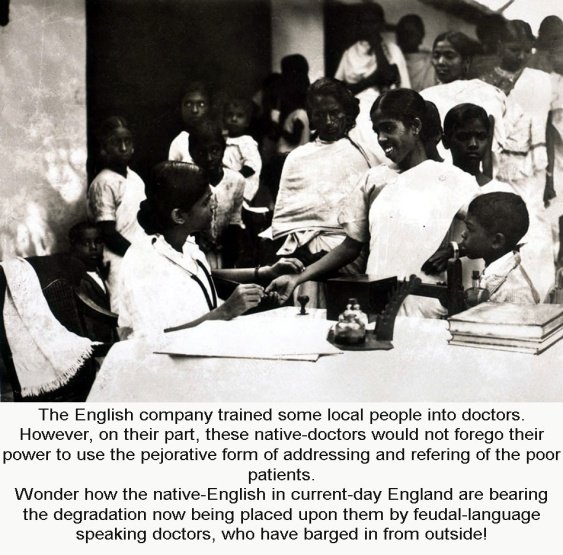 It might not be correct to be judgemental about native herbal cure. Herbal treatment has been a part of all the populations all around the world. In Europe, there was the Western Herbalism in practise. Chinese Herbalism is also much known nowadays. In South America, Africa, other Asian nations etc., this kind of treatment system has been in vogue.
However, when speaking about the Herbalism in the subcontinent, one has to be careful. It should be deliberately mentioned that it was ‘discovered’ in ‘India’ thousands of years ago. Mentioning it came from Greece and such other places can create dramatic political issues.
Now, going into the wider aspects, it was the English rule that brought in the concept of public healthcare, hospitals, medical colleges, and also the complete system of systematic medical care. Of course, as an academic compromise, when the jingoists claims that everything came from the Vedic texts from some 7000 years and beyond, it can be accepted as a kind gesture.
The very compassionate understanding that Sanskrit culture could have come from Central Asia, or from anywhere on the globe, might not be remembered. And also the fact that Sanskrit is a very powerful feudal language, which can literally splinter up any population groups into varying layers of populations might not be borne in mind.
British Malabar versus Travancore kingdom
QUOTE: The caste is very scantily clad; in many places the men do not wear cloth at all round their waists, but substitute for it a fringe of green leaves. Their women used at one time to go similarly clad, but this practice has fallen into disuse in Malabar at least, although it is still maintained in the Native States. END OF QUOTE.
The under-mentioned and understated goodness of the English rule in Malabar. The lower castes slowly started feeling the weight of the pressing down caste layers above them easing up. It has its terror also. For, the lower castes would start acting over-smart and disrespectful.
Travancore
QUOTE: It is a noteworthy circumstance in this connection that even now-a-days the Travancore Maharajas on receiving the sword at their coronations have still
to declare1;—“I will keep this sword until the uncle who has gone to Mecca
returns.” END OF QUOTE
QUOTE from Travancore State Manual: In support of this statement he writes: — “It is a noteworthy circumstance in this connection that even now-a-days that Travancore Maharajas on receiving the sword at their coronations have still to declare: —
“I will keep this sword until the uncle who has gone to Mecca returns”. This statement, founded as it is on Mateer’s Native life in Travancore, is clearly incorrect. The Travancore Maharajahs have never made any such declaration at their coronations, when they received the sword of State from God Sri Padmanabha.
The Valia Koil Tampuran (M. R. Ry. Kerala Varma Avl., C. S. I). writing to His Highness the present Maharajah some years ago received the following reply dated 10th April 1891: — “I do not know where Mr. Logan got this information; but no such declaration as mentioned in the Malabar Manual was made by me when I received the State Sword at Sri Padmanabha Swamy’s Pagoda. I have not heard of any such declaration having been made by former Maharajahs.” END OF QUOTE.
This is one very powerful input that might show that William Logan’s or his other writers’ many sources could be unsubstantiated hearsay. Or they could have been inserted by someone quite deliberately to make the whole book look quite silly. Feudal language world is full of silent intrigues.
QUOTE: This step consisted in obtaining a body of troops—1,000 cavalry and 2,000 sepoys from the Nayak of Madura—in consideration of Travancore undertaking to become tributary to him END OF QUOTE.
What looks funny here is the numbers, 2000 sepoys and 1000 cavalry.
QUOTE: Secondly, of the English Company’s resolution in 1723 to “subject the country to the king” and so facilitate their trade ; END OF QUOTE
This was to be the English Company’s policy throughout the subcontinent. That is to make the local king a responsible king. However, that was easier said than done. For, in a feudal language system, there is no way for the lower population to have any rights on the ruler. It is practically impossible to even initiate a conversation with the higher layers. And for the higher layer to take up the concerns of the lower populations and treat it with the seriousness it deserves, was a demeaning item. This mood continues even to this day.
QUOTE: He was a most intolerant man, and directly he arrived he saw the necessity of curbing the rising power of Travancore if the Dutch were to retain their hold of the trade of the country and not allow it to pass into the hands of the English, who were backing up the Travancore Raja. END OF QUOTE
There might have been a greater insight in him (Mr. Van Imhoff, the Dutch Governor). It is connected to the realities in Continental Europe. The big Continental European nations could not get to conquer the relatively small island of Great Britain. The reason for this was the existence of pristine-England in Great Britain. From this insight, he could foresee that once England gets a foothold in the Subcontinent, the Continental Europeans were as good as out.
QUOTE: The Raja then broke up the conference by sneeringly observing, he had “been thinking some day of invading Europe !” END OF QUOTE.
That was king Marthanda Varma sneering at the Dutch Governor, Van Imhof. It is typical attitude of the subcontinent that once another entity is entrapped, a feeling of shallow superiority complex comes in. Actually Travancore was at that time just a semi-barbarian nation, just beginning to experience a connection with England. Holland has had centuries of experience in proximity to England.
Actually Travancore would not have able to fend off an attack from any of the small-time kingdoms around it, without the active help and protection of the English East India Company.
Even tiny Attingal might have finished it off, in the long run, if the mighty support of the English East India Company was not there.
QUOTE: Such sordid meanness defeated its own end of course, and shortly after the treaty was signed, and after the Travancore frontiers had advanced as far as Cochin, the Travancore Raja of course turned on them and repudiated his obligations, telling the Dutch, factors at Cochin they were no longer a sovereign power, but merely a number of petty merchants, and if they required spices they should go to the bazaars and purchase them at the market rates. They had eventually to pay market prices for the pepper they wanted. END OF QUOTE.
Well, the fact might be of more deeper content.
It is possible that the Travancore side would have forced the Dutch to make promises which amounted to breaking up of the commitment to other kingdoms. And once this was achieved, the Travancore side more or less used the same logic to break their words of commitment.
The way feudal language systems work cannot be understood in English.
There are verbal codes which cannot be translated into English. And hence the emotions that they lend cannot be visualised or understood in English.
QUOTE: His relations with the Mahrattas, however, led him to temporise for a time. Meanwhile if he could possess himself of Travancore he would not only replenish his coffers, but would secure an advantageous position on his enemy’s flank for his contemplated invasion of the Carnatic. END OF QUOTE.
That was Hyder Ali of Mysore. As to him being able to ‘replenish his coffers’, if he could possess himself of Travancore, actually one of the greatest treasure troves in the subcontinent was lying hidden inside secret vaults under the Padmanabha Swamy temple at Trivandrum. Had the king of Travancore not had the English Company to help him, it was just a matter of time before either Hyder Ali or his son Sultan Tippu ransacked the vaults, and molested the Hindus (Brahmins) and the Nayars.
See the commitment shown by the English Company to a minute kingdom, which in later days would display its competitive mind and ingratitude at odd times.
QUOTE: The Travancore Raja fearing a simultaneous attack from both directions, had communicated with the Madras Government, and Sir A. Campbell, the Governor, had intimated to Tippu that aggression against Travancore would be viewed as equivalent to a declaration of war against the English. END OF QUOTE.
QUOTE: And it was formally intimated that, if these demands were not complied with, Tippu’s force would come against Travancore.
To these demands the Travancore Raja made answer that he acted under English advice, and that he would be guided by that advice in this case. END OF QUOTE
The Travancore Raja was none other than Marthanda Varma, who seems to have placed his full faith in Sri Padamanabaha Swamy and the English Company.
QUOTE: The Travancore commander had arranged that the Raja’s force should reassemble upon the Vypeen Island, but the extreme consternation caused by the loss of their vaunted lines had upset this arrangement, and the whole of the force had dispersed for refuge into the jungles or had retreated to the south. END OF QUOTE.
Surely, with this type of army, Travancore did not have any chance against the forces of Sultan Tippu.
QUOTE: “We are in that confusion that I scarce know what to recommend respecting the detachment” (Colonel Hartley’s force). The consternation of the Raja's people was so great that they could not be trusted to procure supplies. The whole of the inhabitants, including the boat people, had gone off with their boats which had been collected for conveyance of Colonel Hartley’s detachment, so that the principal means of transport were also wanting. END OF QUOTE
The English Company was trying to protect a kingdom whose people had no stamina to protect themselves. This fact is still continuing all around the world even to this day.
QUOTE: The news of his force being on its way had greatly quieted the inhabitants, and “the consternation which had seized all ranks of the people’’ had considerably abated END OF QUOTE.
That was Colonel Hartley, fully determined to push on, despite the cowardice of the Travancore forces.
QUOTE: The Bombay Commissioners next learnt that General Medows, the Governor of Madras, in the course of the war operations on the other side of the peninsula, had allowed the Travancore Raja a controlling power over the Malabar Rajas ; and that on this plea the Travancore Dewan Keshu Pillay had collected, in the name of the Company and on the plea of contribution towards the expenses of the war, various sums of money from the revenues of the country for the years 1790 and 1791 END OF QUOTE
Travancore kingdom did clearly go beyond its brief.
QUOTE: The palace of the Kshatriya family of Parappanad Rajas is situated at a short distance from the Railway station. It is from this family that the consorts of the Ranis of the Travancore family are usually selected. END OF QUOTE.
This is this QUOTE from Travancore State Manual:
The Kilimanur Koil Tampurans are the natives of Parappanad in Malabar. Their northern home is known as “Tattari-kovilakam”.
The great Martanda Varma Maharajah, the founder of Travancore, and his illustrious nephew Rama Varma, were the issue of the alliance with Kilimanur — a circumstance of which the members of that family always speak with just pride, as the writer himself heard from the lips of one of its senior members, a venerable old gentleman of eighty summers.
The Koil Tampurans of Kilimanur were the first of their class to come and settle in Travancore and all the sovereigns of the State from Unni Kerala Varma to Her Highness Parvathi Bayi, sometime Queen regent, were the issue of the Koil Tampurans of Kilimanur. Thus it will be seen that the Kiliminur house has been loyally and honourably connected with the Travancore Royal family for more than two centuries END OF QUOTE.
Judicial
The judiciary, written codes of law, equality before the law for all citizens, right to move the court against government orders including that of the English East India Company administration, the police department, security of life and property, Penal code &c. were all the legacy of the English rule in the subcontinent, which currently includes Pakistan, India and Bangladesh.
However, in current-day, all of these things are slowly being taught as something that was there in the land since times immemorial. As to what is taught in Pakistan and Bangladesh is not known to me.
QUOTE: Extract from the Governor-General's instructions to the Commissioners deputed to the Malabar Coast-
“Sixth.—The establishment of a Plan for the administration of Justice in the several Districts being a point the effectual attainment of which we have above all others at heart, we rely with confidence on your experience acquired on this side of India for your being able to determine in a satisfactory manlier on the number and constitution of the several Courts of Justice that will be necessary to ensure to the utmost possible degree (as far as the state of society there will permit) the dispensation of equal Justice to all classes of the society ; END OF QUOTE.
Actually the very preamble of the Constitution of India can be seen in the above statement. However, the Indian political leaders (many of them who do not even know to read the Constitution of India, in its original form), the corrupt officialdom and the cunning academicians of India will not allow these kinds of information to come into the possession of the people.
QUOTE: The permission of the chieftain to hunt on his territory was not required and was never sought, and the idea of an exclusive personal right to hunting privileges in certain limits is entirely foreign to the Malayali customary law. Such an idea was only imported into Malabar with English courts and English law and lawyers. There was a fundamental difference in the ideas from which originated the Malayali law of land tenure and the English law of land, and this will be considered in the chapter on the land tenures and land revenue.
This difference has never been properly understood in the courts, and the confusion and consequent strife among those interested has been very great and deplorable. END OF QUOTE.
The above quoted words very obviously might not reflect the ideas of Logan. It is more or less certainly in sync with native-land officialdoms jingoist words. Hunting privileges might not be a personal right in the forest lands. For, so many forest populations were living inside the forest. This information cannot be used to mention that ‘confusion and consequent strife’ happened due to this lack of information by the courts.
It is true that the English courts did not really understand the full satanic quality of the social communication and control over the subordinated populations via means of verbal codes. However, the native higher castes were aware of it. And they were not willing to inform the English administration about that. Even now, the native-English world does not have the least bit of information on the explosive content in feudal language verbal codes.
QUOTE: The five great crimes were—(1) murder of a Brahman ; (2) drinking spirits (probably a crime only among Brahmans, for the Nayars are not now, and never were an abstemious caste, nor were the other lower castes) ; (3) theft : “They put a thief to death”, wrote Sheikh Ibn Batuta regarding the Malayalis in the fourteenth century A.D., “for stealing a single nut, or even a grain of seed of any fruit : hence thieves are unknown among them, and should anything fall from a tree none except its proper owner would attempt to touch it.” (Ibn Batuta, Travels, Or. Transl. Committee, London, 1829, p. 167); (4) disobeying a teacher’s rules; (5) cowkilling, which is still a penal offence in the Cochin State.
QUOTE: The manner of carrying out capital punishments was sometimes barbarous in the extreme. Criminals were cut in half and exposed on a cross-bar, in the manner still adopted with tigers and panthers slain in hunting expeditions and offered as a sacrifice to local deities. Thieves were similarly cut in two and impaled on a stake, which probably had a cross-bar, as the word for it and that for an eagle or vulture are identical. But impaling alive was also known, and in June 1795, by the orders of the Palassi (Pychy) rebel chief two Mappilias were thus treated after a pretended trial for alleged robbery in a Nayar’s house at Venkad in Kottayam Taluk. END OF QUOTE.
This was the state of semi-barbarianism in the subcontinent. It might not be a aberration of a minor period. For, Sheikh Ibn Batuta has mentioned this in the 1300s. And it is seen practised by the much mentioned Pazhassiraja in the late 1700s / early 1800s.
QUOTE: And every co-defendant, except the one who, according to the woman’s statement, was the first to lead her astray, has a right to be admitted to the boiling-oil ordeal as administered at the temple of Suchindram in Travancore. If his hand is burnt, he is guilty; if it comes out clean he is judged as innocent END OF QUOTE.
This was another system of enforcing justice or punishment.
QUOTE: Extract from the Governor-General's instructions to the Commissioners deputed to the Malabar Coast-
Seventh.—The pepper produced on the Coast of Malabar constituting (as already intimated) a very material Branch of Commerce to the Honourable Company, it is our wish that a Provision on terms of perfect fairness to the natives may be effected in all the settlements for the Revenue payable to Government, so that as far as possible it may be made good in the natural pepper produce, taken at a fair market valuation instead of money payments, leaving whatever proportion cannot be secured in this way to be purchased by the Company’s commercial Agents on the spot on the footing END OF QUOTE.
In neighbouring Travancore kingdom, the farmers were forced to sell to the government warehouses, where the officials would not pay money, unless a bribe was given. In many cases, the officials would give useless other articles as a sort of barter arrangement. The farmers used to smuggle their wares into British Cochin areas, which might have included nearby Tangasherri.
QUOTE: One of the first measures of the United or Joint Commission was to proclaim1 on 20th December 1792 the general freedom of trade in all articles except pepper which was hold as a monopoly, and the Institution of “two separate courts of Equity and Justice” at Calicut on 1st January 1793, the first court to be presided over by the members in rotation, in which revenue and litigated landed claims were to be investigated, and the second to take notice “of all other subjects of claim and litigation not relating to the revenue or landed property.” END OF QUOTE.
In India (the current-day nation), this kind of freedom has vanished. Each highway moves through a series of sales tax and excise check posts, where the low-class officials wait for their prey. The modern-day avatar of the ancient Thuggees.
With regard to the above-mentioned Courts of Equity and Justice, the only thing that could throw a hammer in the works was the feudal languages of the subcontinent. Nothing would be straight-forward. For the languages and communication moved through crooked routes.
QUOTE: They further, on 9th January 1793, sent round a circular to all the chieftains charged with the collection of the Revenue of their Districts, forbidding the collection, on any pretence whatever, of any presents or cesses such as had been customarily prevalent END OF QUOTE.
This is not an easy thing to suppress. For the languages are feudal. The person who is ‘honoured’ has to be necessarily given as article of ‘homage’ (kaanikka).
QUOTE: While these Commissioners were engaged with the above-mentioned enquiries, the remaining members issued a proclamation of general amnesty for acts of homicide, maiming, robbery or theft committed prior to 1st February 1793 as a means of inducing the lawless among the population to resort to honest courses. END OF QUOTE.
That was a move based on expediency. If the various feuds and moods for vengeance and revenge that existed as a brooding mood in the subcontinent were taken into account, the justice system would break down under the huge load. Moreover, the feudal languages would go on creating more and more brooding angers each and every passing day.
QUOTE: In the Judicial Department seven local Darogas or native Judges were appointed, subordinate to the Provincial Courts of the Superintendents, viz.., at Cannanore, Quilandy, Tirurangadi, Ponnani, Palghat, Tanur and Chetwai END OF QUOTE.
The use of barbarianism and semi-barbarians as a serviceable substitute for quality judiciary was coming to an end.
See these QUOTES:
1. The Achchan in April took the law into his own hands, in spite of the terms of his engagements, by "putting to death Ullateel Veetul Canden Nayar and taking out the eyes of Parameshuaracooty Brahman”.
2. Among the privileges' recited, in a “Malabar Jenmum” deed granted by the Kolattiri Raja to the Honourable Company’s linguist at Tellicherry in October 1758 are the following : “Penalties or condemnations and customs, beginning with one principal and ending with all other things,” which was explained to the Joint Commissioners (Diary 15th February 1793) as meaning “the power of administering justice, both civil and criminal, even to the cutting off the hands of a thief.”
3. If any injustice be done to these (the Palliyar ? or Anjuwannam and Manigramam ?), they may withhold the tribute (“world-bearing hire”) and remedy themselves the injury done to them. Should they themselves commit a crime, they are themselves to have the investigation of it. [NOTE: This is like the current-day Indian Police system. They kill a person in an ‘encounter’ and if someone questions the deed, they themselves enquire into it.]
END OF QUOTE.
There is no other option other than barbarity to run a semi-barbarian social system. This continued till the English system arrived.
QUOTE: ".............. but you will not interfere with the Desavali Sthanamnana Avakasam (or such ancient privileges belonging to him as Desavali) as the Government may deem it advisable to permit to be enjoyed, and as the inhabitants may voluntarily offer in conformity with old customs.” Extract from Mr. Græme’s form of sanad appointing Adhikaris of Amsams. Special Commissioner to Principal Collector 20th May 1823. Conf. p. 89 of the text. END OF QUOTE
The replacement of the traditional Adhikaris was not easy. They held the power of killing and maiming anyone in their location from times immemorial. The feudal languages added to their power of oppression.
Even their subordinated populations would offer their ‘respect’ and veneration to them.
QUOTE: Where the mortgagee discovers that the landlord has acted fraudulently in valuing the produce of the land, he is entitled to have the deed cancelled.— (Proceedings of the Court of Sadr Adalat No. 18, dated 5th August 1856. END OF QUOTE.
These are all quite high quality jurisprudence. However, the society would be low-quality due to the feudal content in the language.
QUOTE: The following are notes of some of the voluminous and conflicting decisions of the Courts on the various points connected with kanam and kulikanam, The Courts, starting with an erroneous idea as to what jamnam was have, in their endeavours to ascertain customs, been evidently making law instead of merely declaring it, and deciding by it. END OF QUOTE.
The fact of the matter would be that the native-officials would try hard to make everything confusing. For, they did not really like to see the subordinated populations improving. For, the subordinated populations, being from the subordinated parts of the feudal vernacular, would be quite rude and crude if given leeway to improve into the locations of the higher quality populations.
QUOTE: Such a protection the custom of the country provides against the grasping avarice of proprietors, and it is only the strict preservation of this custom which can prevent this species of tenure from becoming a monstrous fraud, in which the weak will always be the prey of the strong."—S.S.C., 398 (1854) END OF QUOTE.
The English administrators were seeing the monstrous quality of the social system. However, they cannot go inside and change it. For, everyone in the social system is part of it. Simply relocating the downtrodden to the heights would only have a catastrophic effect on the social system.
QUOTE: Notes.—1- The following are a few of the Civil Courts’ rulings. —
Verumpattakkar are entitled on eviction to the value of improvements, whether these have been effected with or without the knowledge of the Kanakkar or Janmi. This is an ordinary usage in the country.—S.D.C., 40 (1854).
A tenancy expressed to be for one year is not necessarily determined at the end of the year. If the tenant remains in possession he holds as a tenant from year to year.—S.D.C , 400 (1877), 437 (1878).
Although it is not open for a tenant to deny his lessor’s title, it is open to him to show that the title has ceased.—N.D.C., 413 (1861), 73 (1862) ; S.D.C., 172 (1877).
A lessee is debarred from disputing that his lessor had no title.—S.S.C., 366 (1854). Semble: Lessor’s transferee’s lack of title.—M.S.C., 103 (1859).
Encroachments by a tenant on adjoining waste are for the benefit of the landlord, — S.D.C., 438 (1877), 559 (1877).
A tenant cannot of right claim remission on account of loss by drought.—S.D.C., 60 (1878). 133 (1878) END OF QUOTE.
There is a general feeling currently in this nation that the English administration was on a looting spree. The people imagine the native-English of those times as just a mirror reflection of themselves.
As of now, the native population of England is also changing rapidly. The entry of the immigrant populations who speak feudal languages is the worst of negativities effecting England. The native-English are unknowingly reacting to feudal language verbal codes, facial expression, body language etc. and changing /mutating.
Apart from that the influence of the USA is also there. USA is a location where the feudal language speakers from elsewhere come and enjoy all the freedoms that they cannot even imagine in their own nations. They do not represent pristine-English. They represent the unbridling that English can deliver. But the innate controls of pristine-English have not been imbibed by them.
QUOTE: 2. This lease runs only for a single year, unless otherwise specified. At the end of the year the landlord is at liberty either to renew the lease or to let the land to another tenant ; but he cannot, under any circumstances, disturb the tenant in his enjoyment until the year has expired. Where the lease is for a specified period, the tenant cannot be ejected during that period unless he endeavours to defraud the landlord or allows the rent to fall into arrears. In either of these cases, however, an action of ejectment will lie against the tenant.—(Proceedings of the Court of Sadr Adalat, Ko. 18, dated 5th August 1856). END OF QUOTE.
The courts are slowly building up a huge repository of legal content, in a location where there was none.
QUOTE:
NOTEs: Note.—See Chapter IV, Section (a) of the Text. The records of the Courts having been searched it is believed that no suits of ejectment were in reality brought before 1856, or at any rate before 1822. The Janmi used to oust an obnoxious tenant by selling his interest in the land before 1856. END OF NOTEs
.
These are historical records of momentous importance of how the new administrators very systematically build up a legal system. However, in the useless academic textbooks, nonsensical speeches and processions and fights of ‘great’ ‘freedom fighters’ are described!
QUOTE: The collection of revenue is made by Mr. Brown, who also exercises petty judicial powers usually inherent in the village head. The late Mr. F. C. Brown was appointed by Government to be an Honorary Magistrate of the First Class, and the High Court was also moved to issue in his name a Commission of the Peace. (Vide G.O. No. 1315, dated 14th September 1865.)
Mr. Murdoch Brown, son of Mr. F. C. Brown, was appointed by Government, in 1869, to be an Honorary Magistrate in the Chirakkal taluk with the powers of a Subordinate Magistrate of the Second Class (G.O. No. 52, dated 12th January 1869) END OF QUOTE.
From a very perfunctory perspective, the above statement can be easily misconstrued as a replacement of native-administrators who had been doing yeoman service from times immemorial. However, that is only how a utter idiot jingoist would know it.
It has been seen mentioned in the writings of such others as Edgar Thurston, and I can personally vouch for the correctness of it, of village headmen being utterly brutal and barbarian to the lower classes. It is basically about an issue which could not be understood by the English administrators.
It was seen that the lower caste men and women and even children might at times use abusive words to and about the higher caste men, women and even children. However, what this abusive words were could not be clearly understood. For, in English the words might simply translate into harmless words, such as : Where are you going?
However, the greater information would be that in the newly emerging social scenario of the native English administration coming to supremacy, the lower castes were fast losing the ‘respect’ for the higher castes.
The words: ‘Where are you going?’ would have the problem of indicant word level of ‘you’ going down. Like from Ingalu to Inhi. If a lower caste person uses such a terribly tormenting word to even a higher caste child, it would be a very bad thing.
The higher caste man who had been negatively affected would complain to the village headman. Then the village headman would gather few ruffians from the higher castes, who would then accost the villain who had used the derogatory form of ‘you’. He would be taken to an isolated hut, and tied up and trashed up to the very inch of his life. He would remain there in that position for a few days.
Far-reaching changes were commencing in Tellicherry, wherein good quality English education was being distributed. However, when the fool in England, the dastard Clement Atlee ditched the peoples of the subcontinent, everything collapsed. And now, even those who received the goodness of good quality English education do not have any qualms in using this very English to cast disparagement on the English colonial rule.
QUOTE: The judicial administration of the Kirar territory is conducted by the officers of the British Government. The raja is merely permitted to collect rents on the lands comprised within the Kirar limits, and has no power to interfere with the collection of special rates chargeable under the municipal or fiscal law. END OF QUOTE.
This is how an incorruptible officialdom was slowly set up in the Malabar district of the Madras Presidency. I say that the officialdom, especially the officer class of this set up was incorruptible, from my own personal experience and information. At the same time, what the condition of a native-kingdom bureaucracy can be seen from this quote from Travancore State Manual.
QUOTE from Travancore: To quote the illustrious writer of the article in the Calcutta Review
“The public service from the top to the bottom consisted with few exceptions, of an army of voracious place-seekers, who having obtained their appointments by bribes, were bent upon recouping themselves a hundredfold; and peculation, torture, false accusation, pretended demands on behalf of the Sirkar, these were the instruments with which they worked out their object. Nonpayment of salaries furnished even an open pretext for these malpractices.
The courts of justice were so many seats of corruption and perversion of justice. Dacoits and marauders of the worst stamp scoured the country by hundreds; but these wore less feared by the people than the so-called Police. In short, Travancore was the veriest den of misrule, lawlessness, and callous tyranny of the worst description. END OF QUOTE
It must be mentioned that when Malabar was amalgamated with the Travancore-Cochin state to serve the vested interests of the Converted Christians of Travancore’s interests and that of the Ezhava leadership of Travancore, it is this terrible bureaucratic culture that was to infect all the official conventions of Malabar. However, these are things not many people are aware of. And of the persons who are aware of these things, not many have any concerns.
QUOTE: The Zilla Court at Calicut was established in 1803. It was abolished in 1843 to make room for a Civil Court for which was substituted a District Court under Act III of 1873. END OF QUOTE.
The emergence of quality judicial machinery at Calicut under the English rule.
QUOTE:
1. Wandur—in the amsam of the same name, is 12 miles from Manjeri, and is the seat of a Sub-Registrar of Assurances, who is also a Special Magistrate
2. The Koduvayur Sub-Registrar exercise also magisterial powers in respect of nuisance cases arising within the Pudunagaram town.
END OF QUOTE.
The above are sample texts that denote the slow setting up of quality administrative machinery. However, the moment these things were handed over to India, the quality went down. Official behaviour went rude. Officials became exorbitantly paid. They started demanding bribes and ‘respect’. They started getting pension benefit of an astronomical scale for themselves and their dependents till their and their dependents’ death. Official became the new feudal overlords of the people.
QUOTEs:
1. That the inhabitants, residing within the limits of the said village of Tangasseri, of all castes and descriptions, whatsoever, shall continue to be under the protection of the British Government in all cases of a civil or Police nature
2. That the inhabitants of the farm of Kottadilli of all castes and descriptions whatsoever shall continue to be under the protection of the British Government and amenable to its authorities in all cases of a police or civil nature and that the British Resident is empowered by the second paragraph of the Minutes of Consultation of the Government of Fort St. George, No. 90, under date the 25th Febiuary 1847, to interfere summarily in all complaints made by the ryots against the Sirkar officers. END OF QUOTE
These were the statutory agreements made when Tangasherri and Kottadilli farms were given on lease to the Travancore kingdom. The terror of the people can be understood on going under a brutal feudal language officialdom.
In fact, Great Britain stands guilty of not enforcing such a statutory requirement when the South Asian Subcontinent was handed over to the crooks in Pakistan and India. That the people can appeal to the British government when they are being ill-treated by the Pakistani or Indian officials.
The same should have been done in the case of all the colonial lands which were handed back to barbarians by the Satan Clement Atlee and his team of blood-thirsty vampires in the British Labour Party.
Even the handing over of Hong Kong to China was a Satanic act.
QUOTE: At present he can only convey to them this property by stripping himself of it and making it over to them in free gift during his own lifetime. And this he is naturally reluctant to do for many and obvious reasons. He is in a thoroughly false position, for if he obeys his natural instincts and gives away his property during his lifetime to his wife and children, he becomes a beggar and is taken to task by his legal heirs; whereas, if he hesitates to do it, he incurs the displeasure of his own household. This false position is fatal to individual industry and thrift, and it is to be hoped that the law will soon be changed by permitting of the testamentary disposal of self-acquisitions. END OF QUOTE.
The above is about the terrific changes that came into the laws and understanding on inheritance. The terrors embedded in the Marumakkathaya (matriarchal) family system. The father of the children cannot provide for them. He can only provide for his sister’s children.
And there is the added mental burden. That there is only partial possibility that his woman’s (wife’s) children are his own, as per the native family system. For, it is the uncles and the brothers of his wife who really decide who his wife consorts with.
The following quotes are about Laccadive Islands.
QUOTE: The people are as a rule quarrelsome and litigious END OF QUOTE.
The above-mentioned quote is about the Kavaratti Island of the Laccadives. However, even if the statement is mentioned about the peoples of the subcontinent, it would not be much incorrect. However, if proper hierarchies are enforced, people don an artificial demeanour of quietude and subservience. It is connected to the feudal language codes. Nothing to do with ethics.
QUOTE: There were no prescribed rules of procedure in regard to trials or judicial proceedings and matters of importance were referred to Cannanore for orders. It was supposed that records had been kept of all such proceedings, but they were stated to be not forthcoming when demanded of the Raja by the Collector. END OF QUOTE.
I think the reference is about the minute Ali raja kingdom of Cannanore town. The issue first is that these ‘kingdoms’ are not used to keeping official records, and such other things. The main focus perpetually remains on extracting ‘respect’ from others and seeing to it that ‘respect’ is not conceded to the wrong person.
The other issue is that there was indeed a feeling that English Company officials were mere employees of some merchants in London, and hence the equivalent of ‘Inhi’/ ‘Nee’, ‘Oan’ / ‘Avan’ etc. employee level person under the native-kings.
See this QUOTE of Sultan Tippu’s words in his letter to the Chief of English Factory at Tellicherry :
I have many lakhs of people like you in my service and so have the company.” END OF QUOTE
This ego issue is at stake in various interactions with the native-English or British. For instance, Napoleon did go to the extent to calling Britain a nation of ‘shop-keepers’, trying to imagine them as equivalent to the lower class commercial people of France. It is twist of fate that he had to wait for an English ship to surrender. If he had been caught by his Continent European enemies, he would have literally been beaten to death.
There is one more ego issue. I have heard of rich landlords in Malabar refusing to meet the District Collector in the local government Rest house, when the Collector comes in to the interior villages. They would want the Collector to come to their house, where they would be greeted with great hospitality. However, the fact remains that the persons who goes to the other man’s home base gets to be reduced in stature in the eyes of others. This again is part of the feudal language codes.
QUOTE: The Kuttam (see Glossary) was no doubt a rough but most effective instrument of justice in such cases. The community simply rose and plundered (as in this instance) the guilty individual and his family, reducing them to beggary END OF QUOTE.
Though the above statement is about the Laccadive Islands, the fact remains that this is mostly the case with most interior village panchayats of yore. That is the group of persons who are in power literally reduce the others to levels of defilement with the use of lower indicant verbal codes.
As of now, the same time is slowly come back. The local self-government system in which each panchayat is having government office. The elected officials are merely jokers, who have to continually fight it out to retain their seats in the Panchayat Board. The actual power remains with the government officials who are permanent officials. They do not care much for either the people or the Panchayat Board members. In fact, it is the people’s representatives who have to be obsequious to them.
QUOTE: In the adjudication of petty civil disputes oath, arbitration and ordeal were freely employed, and oaths in the name of the raja and on the Koran were considered peculiarly solemn. END OF QUOTE.
This is again from the descriptive writings on Laccadive Islands. The fact remains that a higher level of adjudication, administration &c. are not very much practical in the India, Pakistan or Bangladesh, in the current-day social ambience of feudal languages. Every route of social thinking is made to curve and twist as per the satanic codes inside these languages.
QUOTE: The islands have been periodically visited by Covenanted European officers and a small staff of clerks, and the grievances of the people have been fairly and equitably dealt with both on the spot as well as on the mainland END OF QUOTE.
There is some malicious cunning in that the appropriate words ‘British officers’ or ‘English officers’ are seen replaced in almost all such places with the word ‘European’. Even the Christian Church was not happy with the English Company. For, their evangelical activities were prohibited inside the English ruled areas. They had their European stooges inside the English administration.
QUOTE: One amin with a gumasta (clerk) to assist him, and paid fairly well, has been appointed for each island, and has been authorised to try petty civil and criminal cases of a nature which do not involve any intricate or nice questions beyond the keen and intelligence of this class of officers. END OF QUOTE.
Under the guidance and control of the English officialdom, this system would function at quality levels much above what can be expected in such semi-barbarian social systems.
QUOTE: When society has become more complex, written laws must of course follow ; but meanwhile the enlightened despotism of the officers of Government, founded on justice and good conscience, is a form of administration which the islanders thoroughly appreciate and which they have as yet shown no wish to have changed. END OF QUOTE.
This was true of the whole of British-India.
Now let us have a comparison with the judiciary in a native-kingdom of the subcontinent, where English systems have been copied, but run by the native feudal-language speaking officials:
QUOTE from Native Life in Travancore: “Notwithstanding the civilisation that education ought to inculcate in the minds of the rulers of a State, we are sorry to say that neither time nor education seems to have worked any change in the old usages of the Tahsildars’ Cutcherries.
Parties to a suit, if they be of low caste, are not privileged to approach such places, but have to keep away at a distance of fifty or sixty paces from them, the examination of witnesses and every other proceeding of a suit being conducted at that respectable distance.
It is very amusing to watch a case of this description going on, for the Gumashta (clerk) of the cutcherry has to cry out at the top of his voice every question, and the witnesses or defendants, as the case may be, have in turn to respond to them, by as loud yells, so that all the proceedings are not only audible to those in court, but to those out of and far from it, presenting a scene more like a serious quarrel than a court of law.
The low-caste people who wish to present petitions are thus kept away from the court, and are made to stand day after day in the hot sun, their heads not being permitted to be covered, or they are exposed to merciless rain until by some chance they come to be discovered, or the Tahsildar is pleased to call for the petition.
This procedure is diametrically opposite to the distinct orders of the British Resident conveyed upon the subject several years ago, abolishing the barbarous practice in the local courts, and we hope, therefore, that the Dewan will take the necessary steps to put a stop to the invidious distinction of caste prejudice and pollution so rampant in public places of business.” END OF QUOTE.
Actually the indifference to the ordinary citizen by the officialdom has spread into India also. I have seen a lot of people, including women and children, standing in the open ground many years ago when the newly designed Election IDs were being issued. From morning till evening.
However the fact remains that it is the very members of this people who become the officials. So, it might be more correct to say that the whole set of people are crude and rude to each other.
Revenue and administrative changes
The English Company came to do trade. However, unwittingly they had to take up the administration of the semi-barbarian locations. For, in the various feudal language location, no one was bothered about creating any enduring systems. All that was the thought about and aimed for was ‘respect’. Without ‘respect’, an individual is a ‘pinam’-പിണം, that is a dead body.
Once the administration became their responsibility, the English Company officials had to literally set up and create each and every kind of infrastructure in the land right from start. Including the administration, the police, the judiciary, the roadways, the waterways, the postal system, public healthcare, public sanitation and much, much more. ഇന്ന് ഇന്ത്യയിലെ രാഷ്ട്രീയക്കാർ നിന്ന് വിലസുന്ന മിക്ക ഭരണ സംവിധാനങ്ങളും ഇങ്ഗ്ളിഷ് ഭരണം ഇവിടെ വെറും നിലത്ത് പൊടിതട്ടി, കുഴികുഴിച്ച് വിത്തിട്ട് വെളളമൊഴിച്ച് വളർത്തി പന്തലിപ്പിച്ചവയാണ്.
For doing all this there was need for revenue. It is quite curious that the English administrators did not think of sales tax at all. Instead, they tried to go along with the revenue collection model that was already there in the land. That is of collecting a tax on the agricultural products.
This was a Himalayan endeavour. These persons who did not know actually anything about agriculture and produces of the subcontinent went on improving their ideas, so as to arrive at the best suitable system. However, they were hampered by the various vested interests involved. The first of this was their own natives-of-the-subcontinent officials. They were mostly corrupt and could very easily misuse their position. For, in the feudal languages, any official job automatically becomes a social position.
QUOTE: Was Janmi, as Mr. Græme says, an empty title after his share of the produce of the land had been thus mortgaged ? END OF QUOTE.
In English, it might seem that a person who has become a ‘former’ official, has not much of a difference in the verbal codes from an ‘official’ who is incumbent. However in feudal languages, it is not so easy. Titles are codes of ‘respect’. And it bear many kinds of social power and prestige, which are not there in English for any official.
QUOTE: river-side portion of Ponnani town which stands at its mouth is always in more or less danger from erosion, and in fact the town is only preserved by groynes, for the proper maintenance of which a special voluntary cess is paid by the mercantile community. END OF QUOTE.
That is from the description on Ponnani River.
QUOTE: “After completion, the roads should be maintained in good order by the labour of the community. Bullocks carrying merchandise might be tolled so as to provide a fund to meet contingent charges, etc.” END OF QUOTE.
That was mentioned with regard to the building of the various news roads to the various interior parts of Malabar by the English Company.
QUOTE: The ryots, on the other hand, viewed the government as the inheritors in succession to Tippu and Hyder Ali of the pattam or land revenue assessment, and this was explicitly stated to the Commissioners by a deputation of influential Mappillas whom the Commissioners called together to consult on the subject. If the Commissioners had followed out the rule laid down in the fourth paragraph of the agreement with the Iruvalinad Nambiars which has already been commented on, the status of the ryots of Malabar would have been very different at the present day. END OF QUOTE.
There are obviously a lot of conflicts of interests, as the English Company went ahead to breakdown the oppressive social layers. Actually the English Company was not any kind of inheritors of anything in the subcontinent. They were a totally different group who was bring in a lot of enlightenment to the social system.
Naturally the higher castes who were in the earlier days the main officials of the English administration, including the socially powerful peons (kolkars), had their own interest in seeing that the English Company’s native-English officials were led to all kinds of confusions and disorientations, as a means to delay the more or less certain liberalisation of the social system.
QUOTE: They declared the trade in timber to be free, abolished the levy of profits on black pepper, coconuts, etc., as impolitic, and instructed the Supravisur to levy a modern tax in the shape of licence on the retail tobacco trade. END OF QUOTE
The English administration was bringing in standards in everything. Written codes of law even in the case of tax collection was being introduced. Many age-old revenue inflictions were removed.
QUOTE: These leases, after recapitulating the Provisions of the Commissioners’ agreements of 1792 and 1793, prohibited the levy of all exactions recently abolished and allowed only the collection of land revenue and the charges for collection while deductions were made for bringing waste lands into cultivation. END OF QUOTE.
This was to rein in the irascible powers of the various rajas and other small-time chiefs in South Malabar on the people in their own locations.
QUOTE: There can be no manner of doubt that the system of settlement adopted by the Joint Commission, of which Mr. Duncan was President during the greater portion of its existence, was very unsuited to the circumstances of the country.
The Zamorin had in a very characteristic letter, as he himself put it “opened his heart” to the Joint Commissioners, and at an early period in 1792 had assured them that “By the ancient customs of Malabar the Nayars held their lands free ; they paid no revenue to any one, but were obliged to attend their Rajas when called on to war.” END OF QUOTE.
The point to be checked is what the circumstances of the ‘country’ were. It was a land that functioned on feudal languages. A huge percent of the population were placed in hierarchical layers, from which they revered those above and treated as stinking dirt those who were below. Into this cantankerous ‘circumstances of the country’, the English administration and the egalitarian English language were bringing in a total wiping out of the hierarchical codes.
Naturally the vested interests who got a chance to write into the book, Malabar, were writing their own perturbations. For, it was an uneasy situation. Because the lower-placed populations, who had been traditionally ‘respectful’ would become stark rude and insulting, once they get the upper hand, if the language was Malabari or Malayalam.
QUOTE: The result, of course, was that the petty chieftains, accustomed to independence, shook their swords or barred the doors of their defensible houses when the tax-gatherers came, and large balances of course accrued. END OF QUOTE.
Off course, the petty chieftains should now be declared as ‘great’ ‘freedom fighters’ against the English! For, they were fighting against the English attempts to uplift the lower populations.
However, there is the other side to the social communication involved. The traditional rajas would find it quite difficult to converse with the native-officials of the English Company in Malabari or Malayalam. For, in the usual course of things, the petty kings could address them as Inhi or Nee. And they would have to stand with a perpetual bow before these ‘rajas’.
The satanic languages, Malabari and Malayalam were the culprits.
QUOTE: “They (the Rajas) have (stimulated perhaps in some degree by the uncertainty as to their future situations) acted in their avidity to amass wealth, more as the scourges and plunderers than as the protectors of their respective little states. END OF QUOTE.
The fact is the rajas of the subcontinent had always remained as scourges and plunderers of the majority populations of the land. However, the in the new social circumstance, they could very well understand that they were moving down to the levels of the higher castes, who had treated them with venerations. So, the higher castes and other social seniors were going to become their social competitors.
QUOTE: The posts of native dewans were abolished, and it was resolved to make a radical change in the administration by the appointment of covenanted servants as revenue assistants, to be employed throughout the district, on which account the existing regulations were modified. END OF QUOTE.
This was an item that could have directly led to the emancipation of the lower castes. The way was now opening for the lower castes to aspire for governmental jobs. However, they needed to be properly trained, and their innate rudeness to those who they did not venerate had to be ironed out.
QUOTE: The establishment of a rule for the registration of all writings of the transfer of landed property END OF QUOTE.
This was the promotion of the Land Registration department. I think it was first set up by Mr. Murdoch Brown, who was in charge of the Randattara Plantation in Anjarakkandi.
QUOTE: For the purpose of collecting the revenue Captain Watson was next entrusted with the organisation of a new corps of armed police, consisting of 500 men, whom he trained and equipped in a fashion much resembling the present constabulary force. The Malabar militia, an irregular force and undisciplined, serving under their own native chiefs, was then (June 10th, 1801) disbanded. END OF QUOTE.
Slowly the administration was setting up quality systems. The age-old cantankerous, dirty pejorative word-using (Inhi, enthane, enthale, eda, edi, Oan, Oalu &c.) rude systems were giving way to higher quality, much more disciplined official systems. However, these changes would take time to stabilise. For, an English-speaking officialdom had to be created.
In fact, in the Madras Presidency, by the 1900s, a good quality English-speaking officer class had come to take charge of the government offices. They were different from the crass satanic native-officialdom of yesteryears in that they would not use the pejorative form of addressing or referring to people who came to their offices. However, the clerks and the peons were still from the satanic language group. They would address the common people as Inhi, and even as eda and edi. The police constables also would do the same.
The English administrator could make the quality change only in the case of the officer class. Before they could bring in this quality change in the lower officials, the idiot Clement Atlee destroyed everything.
QUOTE: But Major Macleod's mistakes did not end here. For, coming fresh from the country east of the ghats, where the ryots had been accustomed for generations to be a down-trodden race, he seems to have mistaken altogether the character of the people with whom he had to deal. END OF QUOTE.
It is almost certain that the higher-caste officials were out to misguide the English administrators to make minor errors and grievous errors. For, at stake were the traditional rights over the populations whom they had kept in shackles for centuries. This kind of misguiding the native-English officials have been repeated almost all over British-India.
Publications which came out in the native languages as purported translations could be very cunningly made to seem exceedingly rude and oppressive by the mere changing of a single word. For instance, the word Aap in Hindi can be changed into Thoo. And in the language of the southern parts of the Subcontinent, the word Inhi / Nee can be used instead of Ingal/Ungal/Neevu etc.
The terrific dropping-down-the-canyon feeling that these words can create in a person’s mind might not be clearly understood by the English administrators.
QUOTE: The time allowed for the purpose was ludicrously insufficient; the establishments employed were underpaid and notoriously corrupt when such a chance was placed within their reach. The natural results followed as a matter of course. The accounts were fabricated, actual produce was over-assessed, produce was assessed that did not exist, and assessments were imposed on the wrong men. END OF QUOTE.
This is what the English administration had to face. The basic issue was to find quality people to officiate. In a feudal language set up, this is almost an impossible thing, unless a totally different officer class could be created from among the natives. However, the fact is that in the British-Indian location, they could create it slowly. However, the officialdom in the native kingdoms, just outside British-India was top to bottom corrupt.
QUOTE: The people were unable to find a market for their produce, and had to part with their grain at ruinous prices to pay the revenue. END OF QUOTE.
This is mentioned as due to a grave error on the part of one English Chief. How much misinformation and misguiding the native-officials gave is not seen mentioned.
QUOTE: The Nayars were no doubt spread over the whole face of the country (as they still are) protecting all rights, suffering none to fall into disuse, and at the same time supervising the cultivation of the land and collecting the kon or king’s share of the produce - the public land revenue in fact. END OF QUOTE.
This might be the very reason that the Nayar officials would have strived to misguide the English officials. For, it was their traditional source of wealth that was being taken out for the administration of a welfare state.
QUOTE: THE FUNDAMENTAL IDEA that certain castes or classes in the state were told off to the work of cultivation, and the land was made over to them in trust for that purpose, and in trust that the shares of produce due to the persons in authority should be faithfully surrendered. END OF QUOTE.
Actually the holding power of this trust was encrypted in the feudal language codes, which in turn kept the various population layers in position. However, with the coming in of Land Registration and the advent of an administration that was immune to the feudal language codes, and the caste system, every kind of exploitative connections began to tumble down. However, there was nothing of quality ready to replace this social system.
QUOTE: But with these material objects it will be observed were conveyed such things as “authority in the Desam,” “Battle wager” and “Rank” and “Customs” which are clearly outside the idea of dominium as understood by Roman lawyers. It would have been well therefore if, before adopting the view that janmam was equivalent in all respects to dominium, a full investigation had been made of the points wherein they differ. END OF QUOTE.
The above statement is something like ‘attacking a Strawman’. The English administrators were not trying to establish Roman administration in the subcontinent. The writer who mentions this is either trying to act pedantic, or simply trying to confuse the situation. In fact, the local officials who quite obviously were good in English were trying their best to create a mess of out of the English administration. For, it is in a social mess that the ancient creepy officialdom of the subcontinent had survived and prospered.
QUOTE: The idea of property in the soil—the Western or European idea — was evidently not the idea uppermost in the minds of the persons who executed this deed. END OF QUOTE.
The above foolish statement is not actually foolish, but sinister in its attempt to act dumb. First, it is not Western or European ideas that were brought in, but native-English ideas. Not even Celtic systems were encouraged, let alone European.
To this extent, it is somewhat a Straw man’s argument. Attacking an idea which has not been proposed at all in the first place.
Second point is that it is indeed true that the property in soil might be what was understood by the native-English administrators. For, they might not have any information on rights that verbal codes give to individuals over other individuals and their personal properties.
QUOTE: The European looks to the soil , and nothing but the soil. The Malayali on the contrary looks chiefly to the people located on the soil END OF QUOTE.
Ignore the nonsensical word ‘European’. The quote is correct to some extent. But does not clearly mention that it is the definition assigned to the people or the individual, in feudal language indicant codes that is looked at. And there is no Malayalis in Malabar, if the word is meant to mean the population of Travancore.
QUOTE: The system was admirably conceived for binding the two classes together in harmonious interdependence. This excellent arrangement necessarily fell to pieces at once when the Civil Courts began to recognise the force of contract—the Western or European law— as superior to the force of custom—the Eastern or Indian law END OF QUOTE.
The idiot who wrote the above-words are again and again using the words ‘Western or European’ to the extent of creating an irritation. The place is not ruled by Continental European, but by native-English. Most of the Continental Europeans are the exact antonyms of the native-English.
As to the point raised, the English administration was not thinking of the two closely related higher-caste classes alone. There were many others, who do not get any mention in any other history records of the location, other than in the case of some as slaves. The English administration was trying to improve everyone. Naturally the close symbiotic relationship between the two higher caste classes would not be able to survive.
It is true that it will have it tragic side. That of a rude lower classes arriving at higher positions. However, the native-English administrators did feel that they could improve the individual quality through English.
QUOTE: Prior to 1856 or thereabouts, when a janmi wished to get rid of a kanakkaran he allowed the pattam to fall into arrears and then sued for the arrears and in execution sold the kanam interest. END OF QUOTE.
Naturally, when the new systems of judicial intervention came into a crass semi-barbarian social system, there would be persons who would use or misuse it to their own advantage. As to the English officials, it was a learning experience.
QUOTE: This system—another necessary result of the Hindu social organisation — was evidently conceived in much wisdom for protecting the interests of the cultivating castes. Here again however ideas borrowed from the European law of property in the soil have come in to upset the well-conceived customary law of Malabar. END OF QUOTE.
The above words are merely the wailing of the castes which were certainly finding the social changes totally devastating to their own traditional rights. The ‘well-conceived customary law of Malabar’ is nowhere seen in the history of the place, other than periodic raiding, molesting, plundering, pillaging, hacking, back-stabbing, cheating, kidnapping, enslaving, selling as slaves, selling women to merchants in the seaports etc.
QUOTE: Under the native customary law the cultivator could not be ousted except by a decree of the tara, for the janmi was powerless unless he acted in strict accordance with the Nayar guild END OF QUOTE.
Why should the English administration care two-pence for the decree of the tara or of the Nayar guild? The English administration was out to bring in an egalitarianism in the social set up which had never before seen attempted in recorded history in the land.
QUOTE: The effect of this disturbance of the ancient system of customary sharing of the produce has next to be traced.
“Of this produce one-third was allowed to the farmer for his maintenance, profit, etc., one-third for the expenses of the Tiyars, Cherumars or other cultivators attached to the soil, one-third went as rent to the jelmkaar or landlord. END OF QUOTE.
This book, Malabar, had been written for the sake of information for the English administrators about the district. And the various natives-of-the-subcontinent officials had used this opportunity to misinform the English administrators.
When looking at the above quoted statement, everything looks quite refined and okay. However, there is no mention that the various layers downward are defined as stinking dirt in the verbal codes. The personality depreciation that this brings about has to be seen to be understand. That of a higher caste child addressing a lower caste adult of around 40 with an Inhi (lowest you), and referring to him or her as an Oan or Oalu, and addressing her by mere name. And at the same time, the lower caste adult has to use reverential words to and about the higher caste child.
There are no solutions to this in feudal languages. For, if this strict enforcement of degrading and respecting are removed, then the exact opposite will take place. The lower caste adult will use the degrading words upon the higher caste child. Which is more terrific and satanic in what they propose.
QUOTE: They were in short, as already set forth, CO-PROPRIETORS bound together in interest by admirable laws of custom. END OF QUOTE.
What ‘admirable laws of custom’ are being alluded to in a land where populations try their best to usurp the positions of the higher positioned persons? For, ‘respect’ in verbal codes is the key to social stature.
QUOTE: From that date forward the land disputes and troubles began, and the views above described of the Joint Commissioners were not the only causes contributing to the anarchy which ensued. END OF QUOTE.
The above words are very obviously the words of some native higher-caste official. The whole history of the Malabar, Travancore and even of the whole of the subcontinent is a history of all kinds of social insecurity and anarchy. And imagine the crass rascality in placing all the responsibility of that on the native-English administrators who were doing their best to understand an insane social system.
It is amply seen that it was noticed by the English administration that no person in the subcontinent was stable. The actuality of this issue was that each person in the native language existed in number of human personalities. That of Nee-Nee, Nee-Ningal, Nee-Thangal. In this complex verbal relationship, each change of verbal code, changes the individual.
And to make the whole thing more complex, a change in the social level of the other person could also create terrific mood swings in the person.
Feudal language codes are like attachments to a flywheel. When the flywheel moves, it pull along with it a lot of other links and attachments. The verbal codes will change in far-off locations.
QUOTE: He took an early opportunity of calling together the principal janmis of South Malabar to confer on the important question of fixing the Government share of the produce. END OF QUOTE.
The English officialdom was at a loss at understand the social system, which was totally different from anything pristine-English could design or create.
QUOTE: Very numerous and well-founded were the complaints that it is usually impossible to obtain receipts for rent paid END OF QUOTE
There is a terrible information in the above quote. In the subcontinent, the dealings are not between gentlemen of any kind of equal stature in communication. One is an Ingal (higher You in Malabari) while the other is an Inhi (lowest you in Malabari).
The lowest ‘you’ will quite easily be defined, mentioned and terrorised by other more terrible word-codes. He or she cannot ask for anything from the higher man, if he is not willing to give it. The only way to ask is to plead, which the other man will simply discard with a Inhi Poda or Inhi Podi (derogative verbal forms meaning Get lost, you despicable being!). Curiously, these words are not abusive as the word ‘abusive’ is understood in English. For in translation, it only means, ‘you go’! These words can be used to a person defined as lower. These words become ‘abusive’ only if a lower man uses it on the higher man. Or if he or she uses on current-day Indian officials. Current-day Indian officials using this on the lower populations is not a crime. However using it on the officials is a crime. That is the real state of the ‘free’ nation of India.
QUOTE: The jamnis' managers were as a body impeached, and with good show of reason, for fraudulent dealings in various ways with the tenants under them. END OF QUOTE.
The English administration was trying to bridle the reckless powers of the supervisor class, i.e. the Nayars.
QUOTE: On only three out of ninety-eight estates examined in the low country taluks, it was found that the cultivators were enjoying the share of produce set apart for them under Mr. Rickards’ scheme of assessment ; on all the others, the cultivators’ shares of produce had been encroached upon most seriously in most cases and most outrageously in some. END OF QUOTE.
This is how the systems were working. The English administration was doing its best to create ideal agricultural relationships. However, the feudal language codes were acting on their own and creating different social relationships.
QUOTE: A garden, therefore, came to be known as a garden of so many coco, arcca, or jack trees, and of so many pepper-vines END OF QUOTE
The English administration was trying its best to make taxation intelligent and as per written laws. Till that time, it was more or less the whims and fancies of the supervisor class that decided everything.
QUOTE: Malabar under Hyder Ali : and it was with the husbandmen, and not with the landlords, that the settlement was made. (Paragraph 196 of the Joint Commissioners’ Report, 1793 END OF QUOTE.
On a close scrutiny, it was found that that the Mysorean invader Hyder Ali’s officials had more or less disregarded the higher castes and tried to more or less give the possession of the land to the real agriculture workers and farmers. It might seem as if some great socialism and communism were being imposed. However, these are not steady reforms. In a short course of time, new lords will spring up from the new land owners. And they will start oppressing and degrading their former master classes. The language codes are like that.
QUOTE: And of course this under-estimating of the capabilities of the land was not procured for nothing.
Individuals who could manage to square the officials got off with comparative immunity, while those who could not do so had their lands excessively assessed END OF QUOTE.
This is how the native-officialdom tried to make a mess of all great reforms that the English Company administration tried to bring into this semi-barbarian land. It is the same now in India, Pakistan and Bangladesh. Those who bribe the officials and are servile to the officialdom gets their things done. Others who deal with them with self-dignity stand to lose.
Off-course, it might seen that it was the higher caste members who became the leaders of the miniscule movements which tried to create a ruckus in the subcontinent against the English rule. Almost all their meetings and protect marches were poorly attended. After all who would like to go under these rascals who had tormented the lower castes and populations for centuries with words like Inhi / Nee, Eda, Edi, enthada, enthadi &c.? But then, there were plenty of the poor people who were hoodwinked. For instance, if the communist party leaders of those times are scrutinised, it would be seen that almost all of them were from the traditional higher castes. They wanted to continue their dominance over the lower castes, in the guise of ‘revolutionary leaders’. Off course, many of them had their one foot in native-English nations. For instance, there was one ‘great’ communist leader and later CM of Kerala. He quietly relocated his son to the US.
QUOTE: It would at all times have been a difficult operation for intelligent and trained officers to distinguish between what was true and what was false in the deeds produced (unstamped and unregistered cadjan leaves) and in the statements made by the people, on which Mr. Graeme proposed to found his revised assessment ; but when this operation was made over for performance to the ignorant and interested heads of villages, failure was quite certain END OF QUOTE
The perseverance and the patience of the native-English officials was beyond imagination. People telling lies, no one trustworthy, officials corrupt &c. And yet, the wonderful capacity of the native-English officialdom carried the day.
QUOTE: The Mysorean officials, it would seem, imposed an apparently severe tax on the “seed of assessment” and “fruitful tree” respectively, probably for the sake of throwing dust in the eyes of the people at headquarters in Mysore, while in reality, in distributing the lump sums thus assessed on particular districts, they found congenial and remunerative employment in fixing the assessments on individuals. END OF QUOTE
The true antiquity of the modern Indian officialdom and people.
QUOTE: In 1782-83, in the time of Arshad Beg Khan, a complaint was made of the severity of the assessments, but no attention was paid to it and, on the contrary, two of his subordinates (Venkappa and Venkaji) levied an additional contribution of 15 percent of charges for collection in all the Desams (compare paragraph 120). END OF QUOTE
In a feudal language society, who really cares for the complaints and problems of the common man? Everyone knows that if the common man improves, he becomes a danger. And even the Common man is frightened of another Common man improving!
QUOTE: ‘The Desadhikaris are excessively backward in the survey of the rice-lands and pay not the least attention to orders, demeaning themselves in such a way as evidently to prove their luke-warmness in the cause ; that he (the Principal Collector) had been unable to make the least impression on them (the Desadhikaris); that the accounts they give are ‘grossly false beyond description' ; and that they sedulously conceal the deeds, ‘making it next to impossible to ascertain the resources of the country. END OF QUOTE.
These traditional Desadhikaris are self-serving local hoodlums. They would care two-pence for creating a great social set up. However, since they were disobeying the English officialdom, modern India should honour them as great ‘freedom fighters’.
QUOTE: Desadhikaris made large fortunes, the country 'teemed with fictitious deeds' ‘temporary deeds, and agreements were executed to suit present purposes, and were prepared with a view of corresponding with a survey notoriously fallacious.' A number of returns and deeds was eventually obtained, ‘but the great majority was of the most grossly fraudulent description. END OF QUOTE.
The relief and the solace must have come with the crushing down of these traditional ‘freedom fighters’ and the commencement of a Civil Service officials who were good in egalitarian English.
QUOTE: The Tahsildars were to cheek the accounts and send them to the Huzzur, but after repeated reminders, etc., the accounts came in driblets and without verification by Tahsildars. END OF QUOTE.
The native-English officials must have wept in horror as they went on to discover the true ‘talents’ and ‘geniuses’ of the subcontinent.
QUOTE: In 1843 a small establishment was entertained, and about half of them were copied hastily info a form of Kulawar Chitta (individual account); but directly it was sought to verify or use them, their worthlessness was seen and Mr. Conolly at once stopped further expenditure. END OF QUOTE.
In the subcontinent, people are made ‘small’ by the feudal languages. They have very limited vision, unless they have commanding positions. They cannot communicate beyond certain barriers.
QUOTE: In 1765-66 Hyder Ali paid a visit to these Nads, and his agents and his tributary, the Coimbatore Raja (Maha Deo Raj, usually styled Madavan in Malabar), afterwards till 1767-68 managed the country and levied irregular and violent contributions both on the personal and on the real property of the inhabitants. END OF QUOTE.
There might not be any need to attribute the full blame on Hyder Ali. The land was run on feudal languages. The officialdom will deal quite cantankerously with the common man. The common man cannot argue, debate or explain his point at all. For, that would amount to absolute impertinence.
QUOTE: By their orders the Nads were rented to Mohidin Muppan and Haidros Kutti, who collected 100 per cent, of the pattam (rent), but finding that insufficient to enable them to meet their engagements, they imposed further contributions and seized personal property. Finding this means also fail, they carried some of the inhabitants to Seringapatain with whatever accounts of the pattam (rent) were extent. END OF QUOTE.
That was the typical manner of tax collection in the subcontinent, by the varying rulers who came one after another, in each minute location.
QUOTE: These statements were found by him on examination to give in most cases grossly false accounts of the rent (pattam) receivable by Janmis, so they served very little purpose beyond furnishing facts to show how false they were on this point. END OF QUOTE.
This is the real sort of governmental reports in India. It is similar to so many other statutory records found in the governmental files now. Reports are simply created to finish the work of submitting a report. Most of it would of useless content. This was the state of affair in India for a long time. May be this is correct in Pakistan and Bangladesh also. However, with the coming of digital technology, many of the records have become slightly better. For, currently digital technology runs on English. However, the moment feudal language encodings come inside the computer working, various kinds of emotions connected to hierarchies will enter into them. And the pace of digital communication will slow down to erroneous levels.
As of now, the problems of such diabolical emotions will enter into the communication only when human beings have to be addressed or connected to through the digital technology connected to government work.
QUOTE: The general information on which he relied was defective, because it did not enable him to distinguish between rent paid by intermediaries and rent paid to intermediaries by sub-tenants. END OF QUOTE.
It would be easily understood that the native officials were mostly trying to befool the English officials.
QUOTE: The Verumpattam or actual rent was, they continued, in some places concealed, and in other places understated with the connivance of the Mysorean officers owing to favour, intrigue, or local causes. END OF QUOTE.
The most wonderful aspect of the English administration all over the world was the more or less quaint efficiency. However, when feudal language speakers are involved in it, everything twists, twines, whirls and twirls around each and every point. For, the language codes are not planar, but feudal. In each specific location, the focus and loyalty would be on to some minor personage of ‘respect’.
QUOTE: while, as matter of fact, it is extremely doubtful if any such deduction ever really took place. The remission probably went into the pockets of the officials. This fact must be constantly borne in mind when comparing the assessments of South Malabar with those of the north END OF QUOTE.
When assessing and comparing any social, administrative or police issues or systems in India, Pakistan and Bangladesh, with that of any native-English systems, it must be constantly borne in mind that the subcontinent runs on feudal languages. The officials are corrupt. The history and other claims that they make are mostly lies. Their major aim is to amass money for themselves and to send their children to native-English nations. Wherever they go, they will create social disintegration.
QUOTE: It was also generally assumed that the ryot could not have sub-tenants so long as Government waste land of good quality existed for any one to cultivate who felt so deposed. END OF QUOTE.
This is a very good point. There are plenty of forest lands. Can’t the enslaved populations simply go and start on their own? Well, that is where the power of the feudal languages comes into play in a very powerful manner. In a feudal language system, the downtrodden populations cannot unite. They will compete against each other. They will not ‘respect’ each other. Their ‘respect’ would be towards the higher ups, who can degrade them. The more they are degraded, the more they love and ‘respect’ the higher classes. The higher classes will unite to see that the lower caste do not go independent.
This is where the American war for ‘Independence’ has to be looked as afresh. There is actually no tragic situations comparable to what the enslaved populations in the subcontinent are suffering. Yet, they revolted against a very noble nation, hearing the stupid demagogy of such insipid fools like George Washington etc. Whatever goodness seen in the US was only the mere reflection of the noble standards of pristine-England.
QUOTE: The courts view him as trespasser, but the original idea is that all cultivators are in duty-bound to reclaim waste land, in Malabar and trespassers on waste land are unknown END OF QUOTE
The above statement is packed in cunning misinformation. Actually, it was not possible for the lower castes to take any waste land for cultivation and thus become a landlord. This was precisely what was done by the Converted Christians of Travancore kingdom in British-Malabar. This was something they would not have been allowed to do in Travancore kingdom.
As for Malabar, it would be a foolish idea to imagine that the Hindus (Brahmins) and the Nayars &c. would have allowed their slave populations to go in for independent cultivation in the forest lands.
QUOTE: it must of necessity have arisen that many of the original "ryots” attending to their own interests, have become proprietors and have dropped the other characters of labourer and farmer. END OF QUOTE.
Under the English rule, this is the possibility. Actually, this was what the Converted Christians of Travancore did. They came to British-Malabar and occupied the Malabar forests in the sly. However, in Travancore, if they had attempted to become land owners, it would have created a huge ruckus in the social system. They would probably have been slaughtered if there was no protection for them from the English East India Company administration based in Madras.
QUOTE: All these considerations force one to the conviction that Sir Thomas Munro’s ideal Ryotwari settlement is not a thing of permanence, and that sooner or later, even in the model Ryotwari districts, a state of things will be brought about similar to what has existed in Malabar from the very first. END OF QUOTE.
Actually there is more to this, than is obvious. The social system in designed by the design codes in the language. Whatever formal and statutory changes are enforced on a social system, everything will wind back to the original design that it there in the language system. Only by changing the language can a perpetual design change in the social system be brought in. In which case, it is an automatic change, which does not require administrative intervention.
In this context, it might be good to mention that when England gets filled in by people who speak feudal languages, England will change for the worse.
QUOTE: who employ, superintend, and sometimes assist the labourer, and who are everywhere the farmers of the country, the creators and payers of the land revenue,” END OF QUOTE
The native-English officials of the English East India Company are trying to understand a social system without any information on the design codes in the local languages.
QUOTE: for thinking that even in Malabar individual property in the soil, in the European sense of the word, was not in existence at the beginning of British rule END OF QUOTE.
What is the ‘European sense of the word’ is not known and also not relevant here. However, in the English sense of the word, there naturally will be a lot of difference. For, the social system here is tied powerfully to the feudal language word-codes. Individual ownership will then be a hierarchy of ownerships. It will be like a woman married into a polyandry family. The single woman will be owned by all the brothers, but the elder brother will have more precedence and he can command all the brothers under him. This hierarchy will be maintained to the very youngest brother. Under the youngest brother, there will be male servants. They do not have any right over the woman, other than to tend to her various needs such as washing, cooking, cleaning the house, doing routine household work etc. These persons can be compared to the lower castes and the slaves. The brothers can be compared to the varying layers of the higher castes, who ‘own’ the land.
QUOTE: That being so it is evident that the recognition by the courts of the janmi as dominus and the enforcement by them of contracts have wrongfully benefited the janmis and have deprived the others of the just rights. END OF QUOTE
The importing of Roman items is definitely misleading. There is no Roman or Continental Europe involved in British-Malabar. As to the courts making mistakes, it is true that the English administration’s all endeavours were mistakes if seen from the perspective of the traditional upper classes. Everything was being changed. However, almost none of these changes were in sync with the codes of the native feudal languages. In fact, they stood in stark opposition to the hierarchical language codes. To that extent, whatever good is done, will not reach its perfection expected in English. If English had been the language here, the social system will automatically change into an egalitarian one, even if there are statutory feudal structures in the society.
QUOTE: The grant of freedom to a community thus organised meant (as soon as custom had given way) freedom for the "strong to oppress the weak ; freedom for the newly created proprietor to take an ever increasing portion of the share of net produce left over after paying the Government dues. END OF QUOTE.
The writer of the above words is trying to take up the argument of the opposite side and using to support his own side. The ‘strong to oppress the weak’ was the custom of the land. Now, the caste hierarchy has broken down. The lower caste man who has improved will do the same thing, as he is now the ‘strong’.
This is the way things work out in feudal language systems. There is no fundamental change in any social reform other than change of persons in the various positions. The positions all remain the same.
QUOTE: to obtain the name of every field in the country, so as to serve as a ground for an actual survey ; END OF QUOTE.
Only a native-English team can even think of such a endeavour. Not that it is impossible for others. It is just that in a feudal language system, there is nothing attractive in creating efficient systems. For, in such systems, what is craved for are just systems in which the top people get ‘respect’. Even a dirty location is liked, if it is a place where they get ‘respect’.
QUOTE: Are they tenants-at-will of the former class? END OF QUOTE.
In feudal language systems, there are social codes, rights and claims over individuals which are beyond the scope of statutory laws.
QUOTE: In 1850-52, owing to general complaints of over-assessment of gardens, the whole of the old Kurumbranad Taluk was again surveyed, and a decrease in the assessment of only Rs. 366 was the result. END OF QUOTE.
What is remarkable was the determination to redo a survey of a full Taluk. Indeed this subcontinent was blessed that such individual of steely determination came from England to create systems and infrastructure.
QUOTE: but on the 9th June 1825, after two year’s struggle to carry out Mr. Graeme's Pymaish, Mr. Vaughan reported the ‘total failure in the promises made by the inhabitants to revise and give in true and correct accounts END OF QUOTE
It is not that people do not want to give the correct and true accounts, but that there are huge impediments across the social system and layers. Human relationships are not as seen in English.
QUOTE: It will be seen from the above that it is difficult to compare the Wynad wet land assessments with those of the low country, for here there is a fourth kind of pattam (rent) to be dealt with. END OF QUOTE.
If this was the kind of complications that existed inside such a miniscule geographical area, imagine the astronomical levels of complications that the English administrators had to deal with at the whole subcontinent level. In each locality, there is a multitude of populations connected to each other with very specific weird relationships and claims.
QUOTE: while, on the other hand, the greater cost of labour and the breaking down of the system of serfdom have tended to increase the original cost of the produce END OF QUOTE.
Cheap, slave labour was being removed and the enslaved populations were getting their first experience of liberty to decide to whom to work for and at what wages.
QUOTE: Wynad, however, is an exceptional taluk, chiefly owing to its unhealthiness; and the breaking up of the system of serfdom since the assessments were fixed must have had a much greater influence on agriculture in Wynad than it had elsewhere, because in Wynad there was but a limited class to take the places of the slaves who chose to leave their ancient masters and work for hire on the European coffee-estates END OF QUOTE.
This is the conflict of interest that is downplayed. The feudal lord classes were the losers while the slaves and the other lower castes were the most obvious beneficiaries of the advent of the English rule. The birdbrain who is now campaigning against England, sitting inside England, for reparations from England, represents the former. Indeed his ancestral family surely lost much satanic rights and wealth. Naturally, he will find England responsible for that. However, what about the tens of thousands of enslaved populations over the centuries? His ancestral family will have to give them proper compensation.
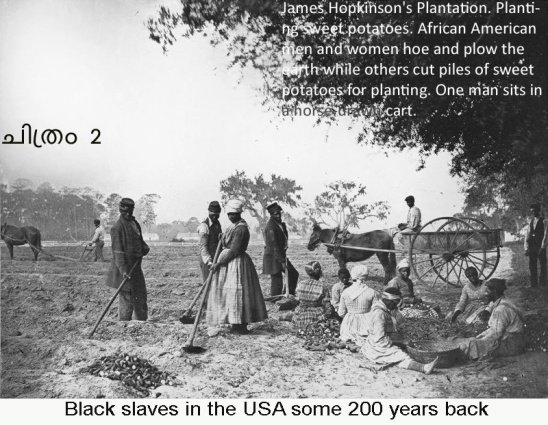
In the US, the black slaves improved beyond the wildest dreams of the African lower class blacks, during their days of enslavement in the US. However, such a development never perched upon the slaves of Malabar. For, they were the slaves of feudal language speakers.
QUOTE: Under any other circumstances the Adiyan cannot be dispossessed, and he has the right of burial within the garden. END OF QUOTE.
This ‘right of burial’ is a resounding one, denied to all the very low castes. The very low castes are assigned a burial ground far off from human habitation. I have personally seen an situation some twenty years back, wherein the town had grown around the lower caste burial ground. The sight of this very low caste burial ground was depreciating the real estate value of the locality. The low castes were intimidated by the social seniors and their burial rights taken off.
The communication is not like in English. In the feudal languages, it is downright pejorative words used. Nee, Eda, poda etc. are very freely used on them, in a very disregarding and down-casting sound. As if speaking to throwaway piece of waste.
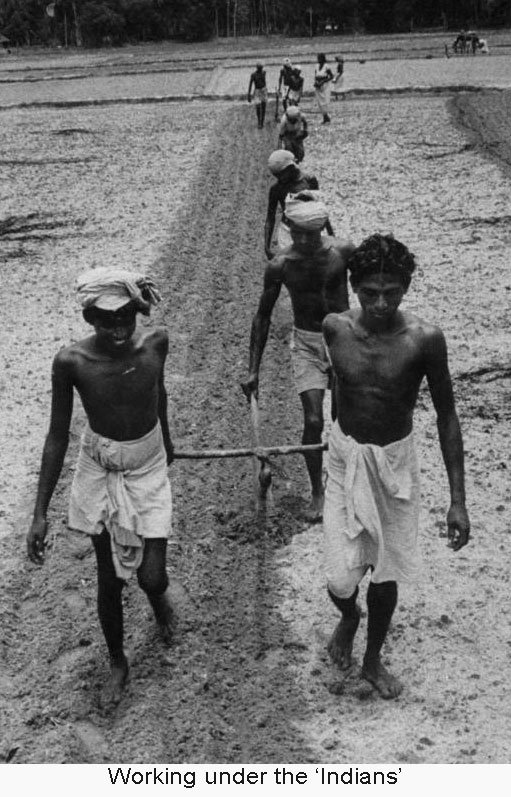 QUOTE: It is certainly noteworthy that if a Nambudiri in Travancore sells this freehold land to anyone but a Nambudiri, an obligation to pay Mupra (in the case of wet lands, and Ettayil onnu (1 in 8 in the case of garden lands) immediately attaches to the lands, END OF QUOTE.
These were the unmentioned attributes of the subcontinent social system, seen when the native English came in.
QUOTE: Putran, literally the son, but in Malabar construed to mean the heir, whether a nephew or son END OF QUOTE.
Quite an interesting information.
QUOTE: The mortgagee gives two fanams, which is placed in a small vessel of water ; the mortgagor, holding the deed in his hand, pours the water over it, which the mortgagor receives as it falls, and either swallows it, or puts it upon his head, or upon his feet, or upon the ground, according to the relative caste of the two parties. END OF QUOTE
The relative statures are encoded in the language codes.
QUOTE: It appears the private Janmams of conquered states were not respected by the conquerors. END OF QUOTE.
That could be the fact of the matter with regard to all customs. Each raiding and conquering team from the neighbourhood decides the next land ownership.
That much for heritage in a social system splintered up feudal languages.
QUOTE: This tenure prevails only in the neighbourhood of Calicut END OF QUOTE.
Imagine the level of complication that the English administration had to face, as it strived to create a good nation in a semi-barbarian location. Each small-time local area with its on traditional systems, which might not have any concurrence with the other small-time locations all around!
QUOTE: The judicial administration of the Kirar territory is conducted by the officers of the British Government. The raja is merely permitted to collect rents on the lands comprised within the Kirar limits, and has no power to interfere with the collection of special rates chargeable under the municipal or fiscal law END OF QUOTE.
It took time, patience and perseverance to slowly shift the administration of the land to that of a welfare state based on written codes-of-law. Earlier it was the whims and fancies of the feudal lords and small-time rajas, trigged by the various emotions connected to feudal language codes that decreed the rules and laws.
QUOTE: The tax was abolished with the sanction of Government, conveyed in their order of 23rd February 1880. END OF QUOTE.
That was the English administration crushing the draconian rights of the officials of the Cannanore Arakkal family over the people in the Laccadive Islands.
QUOTE: When the land has been all thus settled, it will probably become possible to abolish the trade monopolies with their irksome restrictions, and to throw the island trade open. END OF QUOTE.
Again the English administration is slowly freeing the people of the Laccadive Islands from the stranglehold of the Cannanore Ali raja family.
QUOTE: "That with the exception of the introduction of the monopoly of the sales of tobacco and spirits, the Travancore Sirkar or its Agents are prohibited from imposing new taxes, levying unusual duties or arbitrary exactions of any kind on the inhabitants of Tangassari, and that an attempt to do so by the Travancore Sirkar, will forfeit all claim to a continuance of the Farm. END OF QUOTE.
This is with regard to the Tangasseri area which was leased to the Travancore kingdom. The amount of care taken by the English administration to see that no low-class government official of the Travancore kingdom gets to harass or molest any citizens of British-India, is quite admirable.
QUOTE: The janmi has, by the action of the Civil Courts, been virtually converted into a dominus, and the result on the workers, the cultivators, has been, and is, very deplorable. END OF QUOTE
The cunningness of the above quote is beyond words. In a land where the majority population was slaves and semi-slaves, the English administration is trying its best to introduce corrective measure without terrorising the upper-class populations much. And it is these attempts that are being misinterpreted with misinformation.
It is true that most of the native-English systems were too good for the low-quality feudal language social ambience in the subcontinent. For, all routes of social communication go through the winding pathways of feudal language code. Nothing is straightforward. There is no way for the different layers of populations to converse with each other without one-side getting crushed, snubbed and maimed by words.
Yet, it was the English administrators who tried their level best to create something good inside the enwrapping mess.
QUOTE: Turning lastly to the most important point of all, the oppressiveness or otherwise of the Government shares produce at the Government commutation rate it may be remarked in the first place that high prices of produce are like a high flood-tide, submerging all inequalities of assessments, as rocks are submerged by the tidal wave. It is only when the tide recedes that the rocks are laid bare. Since 1832 a high flood of prices has set in which as yet shows no sign of ebbing. END OF QUOTE.
This is a very vital information. When the English administration brought in peace and prosperity in the land, economy boomed. Commercial products started getting higher prices. This was happening in a minute land, which was for centuries the regular and periodic battlegrounds of varying killing, maiming and hacking attacks and counterattacks.
QUOTE: The Government of Fort St. George having received information through various channels that great inequalities exist in the present revenue jamabundy of the province of Malabar, transmitted orders some time back to the Principal Collector to frame by survey and assessment a new jamabundy upon improved principles founded on a liberal consideration of the relative rights of the Sirkar, of the proprietor and cultivator END OF QUOTE.
These are the suo motu actions of a very vigilant egalitarian government.
Rajas
There were a number of rajas in North Malabar and South Malabar.
See this QUOTE taken from Travancore State Manual, written by V Nagam Iyya:
Among the Princes that took shelter in Travancore at the time were the Zamorin of Calicut, the Rajahs of Chirakkal, Kottayam, Kurumbranad, Vettattnad, Beypore, Tanniore, Palghat and the Chiefs of Koulaparay, Corengotte, Chowghat, Edattara and Mannur. END OF QUOTE.
Raja of Valluvanad is not seen mentioned in the above list, I think. There would be others also.
Not one of these kings or rajas was a ruler of any kind of big location. Rajas of the northern-end parts of north Malabar are not mentioned above. And Ali raja, of an extremely miniscule Arakkal kingdom in Cannanore, is also not there. However, if the servile subordinates of these kings write any historical records, it would be about ‘great kings’ or ‘Maha rajas’. A mention of the Empire of Calicut was also found in one of the records.
None of them had any concern about the welfare of the people. They stood as the vanguards and rearguards of a terrible social system which was based on the terrible feudal languages of the location. Their aim was to see that the social upper classes were protected from being accosted by the lower classes. Nothing intelligent was proposed or desired. For instance, there was no aim to create an egalitarian social system, judiciary based on egalitarian principles, education for the lower castes, making the roadways safer and any other thing. There was no thoughts that the rude and insolent lower castes/classes could be improved.
Each of the kings or rajas was totally immersed in the daily insecurity of another competing entity trying to usurp his title. For, retaining or grabbing ‘respect’ was the most powerful of aims and ambitions.
Inside each miniscule raja family, there were others who tried to backstab or act treacherously on the title holder. Every kind of permutations and combinations were tried to settle or unsettle friends and adversaries. A single wrong indicant word code can trigger homicidal mania in these rajas. A very illustrative example is the oft-mentioned in modern times Pazhassiraja, who literally impaled Mappillas on the whim of the moment; his mental equilibrium terrible disturbed by some ‘respect’ issues.
Tax collection was not aimed at spending it for any people welfare purpose. Instead, it was only aimed as empowering the upper classes.
QUOTE: Writing of the chiefs of North Malabar — but the same thing held good for those in the South—the Joint Commissioners observed “they have (stimulated, perhaps, in some degree by the uncertainty as to their future situations) acted, in their avidity to amass ‘wealth, more as the scourgers and plunderers than as the protectors of their respective little States.” END OF QUOTE.
This change from protector to plunderers is a more complicated issue than is seen above. In the earlier times, it was a teamwork to maintain a huge section of the population as semi-slaves and total slaves. However, when the English rule came, this teamwork had no more meaning. For, it became an everyone-for-himself situation.
For instance, the Nayars used to show subservience to the Nambhodhiri Brahmans. The Nambhudhiri Brahmans would then bless them. It was a great experience to be near to a much-revered Nambhudhiri Brahman. Their entry into the Nayar household was treated as special occasion. Actually, the Brahmans were given access to the Nayar women folks through some special formalities and after some ceremonies, if need be. These kind of connections literally improved the social status of the Nayar household.
It may be noted that if a lower caste man were to even glance at without ‘respect’ or with a profane sense at a Nayar woman, it would be a most demeaning act. For the verbal codes connected to Nayar woman would literally fall down into the gutters.
QUOTE from Native Life in Travancore: Individuals of some castes are allowed to form connections with Sudra females which are to them irregular, but which they attempt to justify by pleading the Nayar usages; and many cases of prostitution occur, even among the respectable classes. END of QUOTE
Actually, the words mentioned-above could be the opinion of the lower castes. In that, they were avoided in manner of social contact, which the higher stature social classes seemed to have freedoms beyond anything they could imagine.
However, once the English officialdom literally created a new administrative system based on Civil Service officials, the ancient social structure collapsed in Malabar. The traditional systems were not a happy one. Even for the Nayar females. In that, they would find it quite difficult to attach a sense of loyalty and fidelity to anyone.
See these QUOTEs from Native Life in Travancore:
QUOTE: A good deal of controversy has taken place on the subject in the public prints, and a society for the reform of the Malabar laws of marriage (and inheritance) has been formed at Calicut by the leaders of the Nayar community, especially those educated in English. END of QUOTE
QUOTE: Some of the more enlightened and educated Nayars are now beginning to realise their degradation, and to rebel against the Brahmanical tyranny, and absurd and demoralising laws under which they are placed. END of QUOTE
The whole of the ancient traditions became ‘Brahmanical tyranny, and absurd and demoralising laws’ only when it was increasingly seen that the Brahmin were no more the top layers of the social set up and language codes.
QUOTE: The blessed rule having devolved from the earth-ruler Man-lord Chacravarti Vira Kerala (the first of the line), through regular succession, upon Sri Vira Raghava Chacravarti, now wielding the sceptre for many 100,000 years END OF QUOTE.
This is a quote from an ancient Deed (Deed No. 2, in this book, Malabar). This is the way the Raja claimed heritage and antiquity. The extraordinary claims do insert a great positive effect on the inner value of the verbal codes.
QUOTE: Attippettola Karyam (അട്ടിപ്പെറ്റൊലകാർയ്യം) executed in the month (മാസം) of Kanni, 281, Putuvaypa (പുതുവായ്പ). The Cochin Rajas (പെരുമ്പുടപ്പ) Gangadhara (ഗംഗാധര), Vira (വീര), Kerala (കേരള), Trikkovil (തൃക്കോവിൽ), Adhikarikal (അധികാരികൾ) = Sarvadhikaryakar), END OF QUOTE.
Even though, it might be seen that even the English do try to use high-sounding titles to acknowledge their monarchy (may be due to the English Monarchies Continental European ancestry), the heaviness of the words seen above is unmatchable in pristine-English words. Words like Attippettola Karyam, Gangadhara, Vira, Trikkovil, Adhikarikal, Sarvadhikaryakar &c. have a resounding heaviness that cannot be found in native-English.
Even the monarch of England who was literally in charges of an Empire was only a mere ‘queen’. At the same time, even the miniscule raja of a miniscule kingdom in the subcontinent will adorn himself with very high-sounding title and names. Words such as Veera, Varma &c. are assumed by the title holder, even if there the antique connection to these words is very slight and feeble. For, any verbal change applied would literally pull up the verbal codes across the social scene in all conversations.
Even English official names did get to bear heaviness in the subcontinent in those days. Queen Victoria was mentioned as Amma Maharani (Great Mother Queen) by the lower castes, who had seen and experienced social freedom for the first time in recorded history, with the advent of the English rule in Malabar.
QUOTE: means in Malabar the fifth or 20 per cent, of a fixed revenue of their former countries which the dispossessed Rajas of Malabar receive from the Company. END OF QUOTE.
This was a very magnanimous attitude on the part of the English East India Company. Over the years, there must have been changes. However, the former raja houses were given a pension by the English administration. This was to protect the raja families from falling into penury in a land where no one has any sense of gratitude to anyone. However, one Indian politician, when she came to power had the Privy Purse suddenly stopped as a political gimmickry. It is not certain whether this act did serve her anything good in the long run.
QUOTE: six miles from Perintalmanna is Mankata, the seat of the Walluvanad Raja, who enjoys a Malikhana of Rs. 13,400 from Government. END OF QUOTE
No comment.
QUOTE: it was formerly customary to give from 3 to 5 per cent, on the amount of the principal to the proprietor upon making out this deed as a fee under the name of Oppu or signature, and further the mortgagee had to give 2 per cent, under the denomination of Suchi, or the point of the iron style used for writing the deed END OF QUOTE
Maybe in those days, it must have involved a huge lot of work connected to measuring the land etc. I am not sure. However, may be this might be the antique claim that the modern Land Registration Document Writers use to demand an unreasonable percentage as fee for writing the documents.
QUOTE: It is however, I believe, well-known that all Devaswams are not public institutions. Many are strictly private property END OF QUOTE
It is a point that might need some inspection. For, with the departure of the English rule, most of the major temples have been taken over by the government. The earnings from the Brahmanical temples currently are regularly looted by the respective governments in the various states in India. Even though, there is a very callous tendency to claim that the English rulers even looted the temples, the reality is simply the opposite. The English rule protected the temples, while the local government in India are literally plundering the temples.
QUOTE: The systematic usurpation of the estates of such neighbouring Rajas or Naduvalis or other chiefs as might be incapacitated from poverty or other cause from governing. The Sastra says the peculiar duty of a king is conquest. END OF QUOTE.
It is funny to see that even the Sastras call for regular plundering of mutual locations. Civil life must have been terrible as seen mentioned in Travancore State Manual, till the advent of the English rule in the subcontinent.
QUOTE: KOLA കൊല = violence, forced contribution, extortion.
CHARADAYAM: Forced contributions levied by Rajas for particular emergencies according to the circumstances of the individuals.
TAPPU: Fines levied by Naduvalis and Desavalis from their inferiors, and by Rajas from them, for accidental unintentional crimes END OF QUOTE.
The above thieving practises are mentioned as the means of raja’s revenue.
QUOTE: Under the name of Attadakkam the Raja was entitled to the property of Naduvali, or Desavali or an Adiyan (vassal), or any person who held lands in free gift, dying without heirs END OF QUOTE
That was another event for drooling. That of such persons dying without issues.
QUOTE: 1765-66 Hyder Ali descended into Kolattunad. The country was in a distracted state : sometimes in Hyder’s possession, sometimes in the Rajas, and sometimes in the hands of the Cannanore Bibi, and 30 per cent, of the pattam (rent) was imposed. END OF QUOTE.
Imagine the plight of the people living in these semi-barbarian locations, till the advent of the English rule. Academic historians of India who literally plunder the national coffers with their astronomically huge 13 months a year salary, astronomical pension, commutation of pension and much else have no problem in saying anything. However, the realities of the land are starkly terrible for the vulnerable sections of the people who literally are seen as dirt and ruffians by these academic looters.
Forests
QUOTE: Forests in Malabar are chiefly private property and the great bulk of the land in the Nilambur valley is the property of the Nilambur Tirumulpad, a wealthy landowner not likely under any circumstances to sell land, still less for the purpose of instituting a local industry of a character to compete with his own agricultural and timber operations for the limited supply of local labour. The plantations owed their existence to the accident that one of the many religious bodies holding temple lands happened to be in want of funds and to own blocks of land scattered here and there in this valley, many of which constituted the very best sites for planting that could have been selected had the whole area been available to choose from. END OF QUOTE.
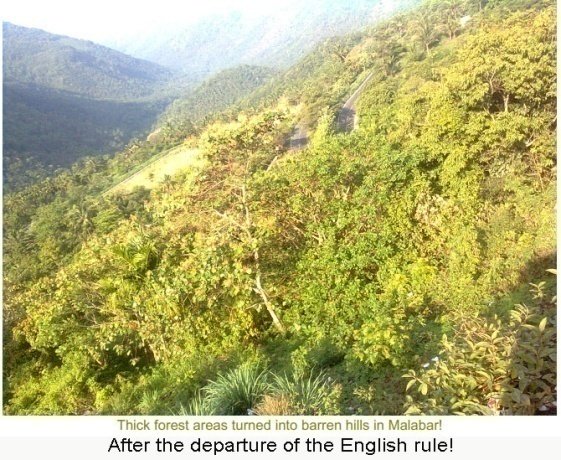 This is a very revealing statement. In general, there is a very common belief in the subcontinent as of now, that during the English rule, the administration could do what they wanted. That they can rob any natural resource or the private property of any person. It is not true. Everything was done as per the dictates of very powerful written codes of law and rules.
The Nilambur Teak plantation was a very wonderful creation of the then Malabar District Collector, Henry Valentine Conolly. However, as of now, one can find insidious writings online that the Teak plantation was created with the specific intention of looting ‘India’. The reader should try to understand who could be writing such monstrous lies.
QUOTE: In considering, however, the difficulties which had to be contended with, it is necessary to regard as occupying a prominent position, the jealousy of a local Janmi of overpowering influence whose house and pagoda formed the only point of social attraction in what was otherwise a jungle. END OF QUOTE.
This again is a very pertinent observation. In the subcontinent, due to the feudal structure of the languages, every entity is seen from a relative perspective. A big man will become small when a bigger entity comes into proximity. Words like He, His, Him, She, Her, Hers, You, Your, Yours, They, Their, Theirs &c. all have relative forms. There is a terror in another entity or individual becoming big, even if there is no competition between them in their spheres of activity.
QUOTE: The Nilambur teak plantations were first suggested in 1840 by Mr. Conolly, Collector of Malabar, who described their object as being “to replace those forests which had vanished from private carelessness and rapacity—a work too now, too extensive, and too barren of early return to be ever taken up by the native proprietor." END OF QUOTE
These are ideas which cannot be understood in a feudal language mindset mind. The ‘native proprietor’ who lives and thinks in feudal languages has only one aim. To gather as much ‘respect’ for himself or herself as long as he or she lives. What happens to others is of no care to him.
This is the exact reason why the current-day citizens of Pakistan, India and Bangladesh cannot understand the grand magnanimity of the English colonial rule in the subcontinent. As to the native-Englishmen in current-day Britain, they are no more pristine-English. For, most of them are multicultural Englishmen. Multicultural Englishmen are sinister mutants. They have literally defiled their unique antiquity by surrendering their nation, language and culture to the wild ravages of the feudal-language speaking creeps.
QUOTE: In 1863 Mr. Ferguson arrived bringing the knowledge of a forester trained in the extensive plantations of Perthshire, and operations were vigorously prosecuted for the ensuing 7 years, i.e., from 1863-1869, by which time 619 acres had been planted in this quarter. The area of suitable land here having been exhausted, the experiment was made of further extending at Nellikutta, 10 miles up stream and near the base of the hills in 1870 and 1871 rather more than 100 acres were planted. END OF QUOTE.
The British Imperial Forest School was commenced in Dehradun in 1878. This was set up with the aim of preserving the forests of the land. However, as of now, I am told that the current-day trainees coming out of this institute are very careful about getting the official assignments where they can earn the most on the sides. The forest coverage in the geography of India, I think, has diminished to less than 10% of what there was there in 1947.
QUOTE: The site, however, proved so unhealthy that it was abandoned owing to loss of life and invaliding among the establishment. END OF QUOTE.
The solid truth is that many native-Englishmen perished in the various forests and mountains of this subcontinent, where they had ventured into, to create dams and roads and other infrastructure, in an age when technology was still quite primitive. Many died of Malaria, some by poisonous creature bites and some by various kinds of accidents. Yet, they were able to create fabulous dams and other structures, where were bequeathed to a most ungrateful local low-class politicians by Clement Atlee. [For example, Google Search: Colonel John Pennycuick CSI]
QUOTE: teak of the clean, straight, sound growth, for which the Nilambur Valley teak is celebrated, a character which in the plantations promises to be fully maintained END OF QUOTE
Everything that the English rule created in this subcontinent was of painstakingly worked out, to create items of persevering quality standards.
QUOTE: especially when the absence of heartshake and the economy of working secured by straight growth is considered. A comparison of the conditions under which the two classes of timber can be brought to market shows what a hopeless disadvantage the Anamala teak labours under. END OF QUOTE.
That means that the English-administration created teak was of superb quality. The wood was with no heartshake and also quite straight, with no bend.
QUOTE: it seems impossible to resist the conclusion that eventually the result of the plantations must be to contribute to the wants of the country an immense stock of useful material, realising such a revenue as fully to reimburse the State END OF QUOTE.
The farsighted aims were good. However, it is not to be doubted that there would have been private plundering of the timber here with the connivance of the local and forest department officials after the location was handed over to the looting Indian officials.
In fact, some twenty years back, there were huge jokes about felling trees in such forests. When large-scale private plundering of forest timber started taking place legally, with official permits, some low-class science organisations started making a clamour that if trees are gone, there will be no rain. Then one politician who was thick in the midst of these tree-felling operations, gave a very sarcastic comment, ‘If rains will cease if there are no trees, then how come there is rain in the Arabian Sea?’ This became a huge joke among the people of the local state, with everyone laughing it out, when presumably the tree felling was going in unhampered. Off course, the rains did not stop even when the forest lands went barren.
QUOTE: Almost all these extensive and valuable forests are private property, except the two Government forests known by the names of the "Chenat Nayar” and the "Walayar ” Reserves END OF QUOTE
This was the tragedy. Private forests means, right for private axing of trees of age extending to backward centuries.
QUOTE: The Chenat Nayar and the private heavy forests in the Taluk, all contain more or less valuable trees, among others, teak and blackwood ; while cardamom, honey, gum, &c., constitute the chief minor produce which is collected in the case of the private forests by the resident jungle tribes and generally bartered in the plains for the necessaries of life END OF QUOTE
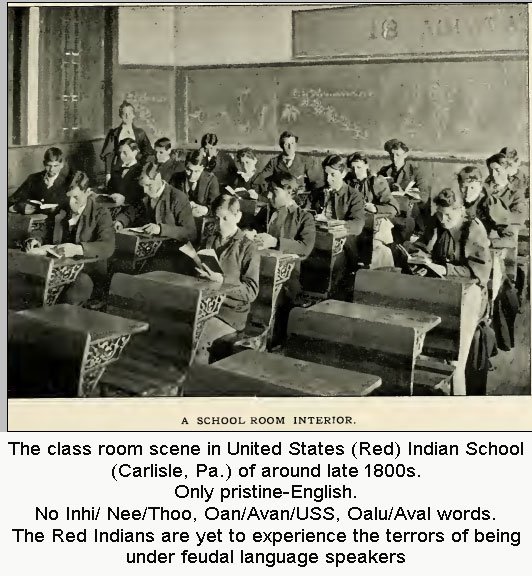 As of now, the ‘resident jungle tribes’ have been plucked out into the open sunlight with all the trees around them gone. They have literally become homeless dependents on the current-day state government charity. The local officials address them in the dirt-level verbal codes of the local languages. The Nee (lowest you), Avan (lowest he/him), Aval (lowest she/her) &s. are the descriptive words secured for them. The total blame should be placed on Clement Atlee and his British Labour Party.
QUOTE: The lower slopes are very malarious, but the open grass lands higher up are above fever range END OF QUOTE
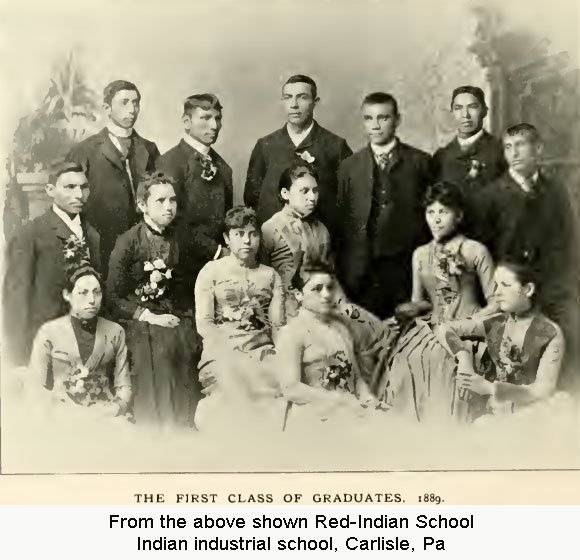
Malaria is spread by mosquitoes. However, there was not much information about this in those days. Going up the mountains in those days for any work could be a very dangerous endeavour.
QUOTE: the villagers in the neighbourhood having been in the habit of pollarding the trees for manure for their paddy. In 1883, this was put a stop to and a forest guard appointed to look after this END OF QUOTE
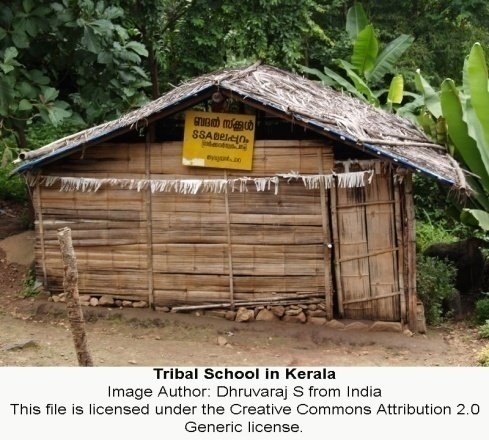 From a very superficial view, the posting of a forest guard was a good act. However, there is evidently the issue of posting one ‘Indian’ over other ‘Indians’. This is an act which portends serious issues. The language is feudal. The moment one ‘Indian’ gets power over another ‘Indian’, the verbal codes will change. The former can and will start using the lowest indicant verbal codes of Nee, Avan, Aval, eda, edi, enthada, enthadi etc. on vulnerable persons.
I am not sure how far the native-English officials did understand this issue. However, I have seen it mentioned by one IP (Imperial Police) officer of British-India, that it is quite dangerous to hand over power over one ‘Indian’ to another ‘Indian’. For the latter is sure to misuse the power.
So, if anyone reacts to the cantankerous words of the above-mentioned guard, he or she naturally becomes a ‘freedom fighter’, and his descendents are eligible for ‘freedom fighters’ pension!
QUOTE: A working scheme of this forest has been prepared. It is fenced in, and fire protected annually, and cattle are rigidly excluded. There is a special forest pound for stray cattle. END OF QUOTE.
As of now, all this might look quite silly. However, a lot of calibre is required to set up a huge structure of administrative system in a totally insane feudal language social system, right from start.
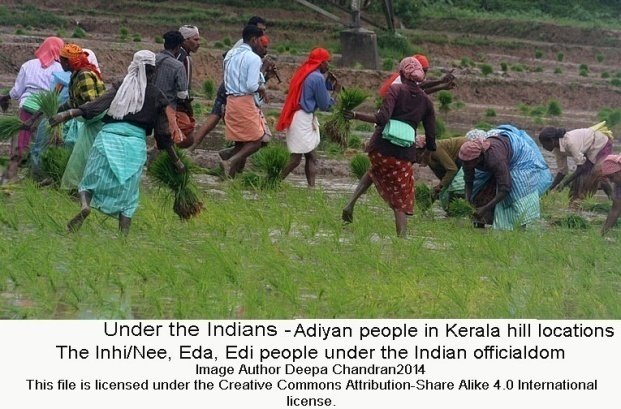 QUOTE: Timber from the Anamalas and the Mannarghat forests is largely floated down the river during the rainy season to the timber depots at Ponnani, belonging to local merchants as well as to the Cochin sirkar, for export to foreign places END OF QUOTE.
There is a general feeling spread by low-class academic textbooks, that in British-India all major commercial establishments were run by the British. It is an absolute lie. For, what really happened was the very powerful emergence of native-businessmen to very high levels, due to the spread of peace and security all over the subcontinent. There was proper policing, incorruptible officers in the administration, written codes of law, and the extremely dangerous highway dacoits known as Thugges in the northern parts of the subcontinent were crushed &c.
Henry Valentine Conolly
Henry Valentine Conolly was, like most of the native-English officials of the English East India Company, quite a dedicated individual. He was the Collector of the Malabar district during the rule of the English East India Company from February 1840 to September 1855 as per this book, Malabar.
The problem that he faced was a complicated one, which the English administration did face in many locations. Whatever good they did was misinterpreted by some persons to create a ruckus.
He did a lot of good deeds in Malabar district. However, what are generally mentioned are the Connolly Canal in Calicut and the Teak Plantation in Nilambur.
South Malabar did have the severe problem of solitary attacks on the Hindus (Brahmins & Ambalavasis) and their supervisor caste, Nayars. The basic problem that led to this was the feudal content in the local languages. The exact route of these solitary attacks on the higher castes has been discussed in the relevant section in this Commentary.
The English administration actually could not understand what was going on. For, even their peons’ (kolkars’) verbal exchanges with the Mappillas did contain terrific codes of provocation which could lead to homicidal mania in the adversely-affected Mappillas.
The English administration being committed to maintain law and order had to face the brunt of all criticism for trying to curb a communal frenzy between the higher castes and the Mappillas, many of whom were recent converts from the lower castes.
Conolly, as the District Collector, could have been easily blamed for the provocative verbal codes used by the native-officials on the Mappillas. And also for trying to save the Hindus (Brahmins &c.) and the Nayars from such attacks or for taking steps to capture the persons who had attacked them or had entered Hindu (Brahmin) temples, with insidious intentions.
Actually if it had been a local raja’s rule, the king would have literally allowed the non-Mappillas, who included the Hindus and the lower castes to attack and finish off the Mappillas. However, the English administration could not allow such a thing to happen.
In fact, there were suggestions to remove all Mappillas from the English armed forces. However, the English Company refused to be partial to any of the sides in the ongoing communal belligerence.
QUOTE: The District Magistrate, Mr. Conolly, in reporting on the outrage and wholesale murders of January 4th-8th, suggested that a commission should be appointed “to report on the question of Mappilla disturbances generally. I wish,” he stated, “for the utmost publicity. If any want of, or mistake in, management on my part has led in the slightest degree to these fearful evils (far more fearful in my time than they have ever been before), I am most desirous that a remedy be applied, whatever be the effect as regards my personal interests. END OF QUOTE.
The problem that he faced was there were not many persons in the Mappilla side to understand the administrative steps. On the other hand, the Hindu section (Brahmins and their Nayars) would also misinterpret the events to both sides, to the Mappillas and to the English administration. Their main aim would be catch fish in troubled waters.
The Hindu (Brahmin) side naturally would want the English to fight their wars with the Mappillas. This foolishness is actually continuing in all native-English nations. Outsiders are very coolly entrapping the native-English nations in all their native-land fights.
QUOTE: Mr. Conolly had received an anonymous letter warning him, but unfortunately thought it needless to take precautions, and had not even mentioned it to Mrs. Conolly.” END OF QUOTE.
It is quite sure that some Mappilla social leaders did try to warn Conolly about the impending attack. However, they could not openly reveal the information to Conolly. For, the native-officials would leak the name of the informants.
QUOTE: On the very day (17th February) that the Government appointed Mr. Strange as Special Commissioner, Mr. Conolly reported that 10,000 to 12,000 Mappillas, “great numbers of whom were armed” met at Tirurangadi and held a close conclave with the Tangal on rumours being spread that he was at once to be made a prisoner and disgraced. END OF QUOTE
There is a very slender and yet significant information hinted out here. The Nayar and higher castes officials working in the English administration would spread rumours that the Tangal was being questioned by the police with words such as Nee, Eda, Enthada &c. This would provoke terrific homicidal mania in the Mappilla who saw the Arabian Tangal as their leader.
However, it is seen that even on the Mappillas side, the Tangal was being misinterpreted, to give out a feeling that he was supporting terror acts. Actually, the reality was different.
See what were the Tangal’s own words:
QUOTE: Mr. Conolly had been successful in his negotiations to induce Saiyid Fazl to depart peaceably.
The Tangal avowed that he had done nothing “to deserve the displeasure of the Government ; that he repudiated the deeds of the fanatics ; and that it was his misfortune that a general blessing, intended to convey spiritual benefits to those alone who acted in accordance with the Muhammadan faith, should be misinterpreted by a few parties who acted in contradiction to its precepts. END OF QUOTE
The issue here is that the Mappilla individuals who were nursing an antipathy for the Hindu side would also be spreading false stories that the Tangal had given the go-ahead for various terror attacks.
QUOTE:
It was apparently these letters of Mr. E. B. Thomas which eventually decided the Board of Diroctors to send out orders to legislate in the matter, for in their despatch of 27th July 1842 they first sent orders “for the entire abolition of slavery”, and in a second despatch of 15th March 1843 they called the special attention of the Government of India to the question of slavery in Malabar where the evils, as described by Mr. E. B. Thomas, were so aggravated “as compared with other portions of India”.
The Government of India thereupon passed Act V of 1843. On the passing of the Act, its provisions were widely published throughout Malabar by Mr. Conolly, the Collector, END OF QUOTE
Conolly was doing his best to eradicate the slavery of the Cherumar. However the Mappillas included the Cherumar who had converted into Islam, and so they were not bothered about slavery. For, they had already escaped from that.
QUOTE: So far as the details at present are ascertained, the perpetrators were three Mappillas, who rushed into the verandah and completed their deadly work before assistance could be called. In the present state of Mrs. Conolly, it is impossible to gather further particulars of the tragedy of which she was the sole witness ; but immediately that I am able to do so, I will furnish more complete information. END OF QUOTE.
This is how the murder was accomplished.
QUOTE: “Nothing could exceed the treachery with which the murder was begun, or the brutal butchery with which it was completed. Mr. Conolly was seated in a small verandah (as was his in variable custom of an evening) on a low sofa.
Mrs. Conolly was on one opposite, a low table with lights on it being between them ; he was approached from behind and even Mrs. Conolly did not catch sight of the first blow, which would alone have proved fatal ; the next moment the lights were all swept off the table and the ruffians bounded upon their victim, slashing him in all directions. The left hand was nearly severed, the right knee deeply cut, and repeated stabs indicted in the back. The wounds (twenty-seven in number) could have been inflicted only by fiends actuated by the most desperate malice.
To the cries of poor Mrs. Conolly no one came ; the peons and servants are usually present in a passage beyond the inner room ; they were either panic-stricken, or, unarmed (as they invariably were) were unable to come up in time to afford any real assistance. END OF QUOTE.
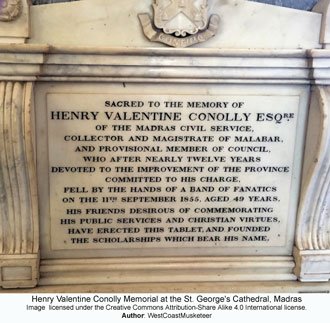 A young couple from England, duty-bound to bring in quality social systems in a semi-barbarian land run on feudal languages. This is what was given back as gratitude.
QUOTE: They compelled one Chapali Pokar to act as their guide. He led them to Eddamannapara, which they reached at 4P.M. on the 17th. They had not gone far from this place when they were seen, and, being followed up by the people of Kondotti (another sect of Mappillas), were driven at length to take refuge in the house, where they were shot the same evening by a detachment of Major Haly’s Police Corps and a part of No. 5 Company of H.M’s 74th Highlanders under Captain Davies. END OF QUOTE.
Ultimately, it was the Mappillas themselves who cornered the murderers.
Miscellaneous notes
QUOTE: Vishu is the astronomical new year day END OF QUOTE
As per the Malabar Traditional Calendar (Malabar Kolla Varasham), I think the New Year begins in the month of Kanni. As per the Travancore Traditional Calendar (Travancore KollaVarsham), the New Year begins in the month of Chingam. However, with the creation of Kerala, most of the Malabar traditions, including language have been wiped out. Now, everything is connected to Travancore systems, which in turn are connected to Tamil and Sanskrit. It is difficult to find persons now in Malabar who know much about the antiquity and traditions of Malabar. Even the traditional language Malabar is slowly getting erased out under the onslaught of Malayalam, which comes with official backing.
The educated classes of Malabar had supported English, during the English rule time. However, with the amalgamation of Malabar with Travancore, English was pushed out and Travancore language Malayalam was ushered in.
As of now, the people of Malabar also swear by Travancore Malayalam traditions and their loyalty is with that language. It is like the Mappillas of Malabar. At least some of them are the descendents of Nayars and also a few of Brahmins, who had been forced to convert to Islam by the Mysorean invaders. However, as of now, the children of these forced converts are fully loyal to Islam.
QUOTE: Onam: This is the day on which Parasu Raman or Vishnu is supposed to descend to earth to see his people happy. END OF QUOTE.
This again is some kind of nonsense, if current-day beliefs are taken into account. As per current-day traditions, Onam traditions are connected to Vishnu appearing in the form of Vamanan appearing before Mahabali. And the Onam day is celebrated on the day, on which Mahabali is believed to be visiting his native-land again to see his subjects.
Travancore State Manual does mention a Tamil (Vattezhuthu) stone inscription dating 27th Medam, 410 M.E (Malayalam Era) at Manalikarai, a petty village near Padmanabhapuram in South Travancore, in which there is mention of Onachelavu.
QUOTE from Travancore State Manual: onachelavu, a special contribution to keep up the annual national festival of that name (Onam).” END OF QUOTE.
This information does carry an additional burden, in that Onam the festival, which is more or less claimed by Malayalees, does seem to have non-Malayalee (Tamil) heritage links. However, the fact might only lead to the contention that Malayalam was just of recent origin.
As to whether Onam is really connected to Malabar or to Travancore traditions is not clear. May be Onam was brought to Malabar from Travancore by the Hindus (Brahmin &c.), or vice versa, and it was forced upon the suppressed populations, as part of their enforced display of subservience.
QUOTE from this book, Malabar: 1. Further, there is reason to think that, this date, 25th August 825, was the day of the Onam festival, when it was, and still is, customary for dependants to visit their suzerains and to do acts of homage either in person or by deputy to them, END OF QUOTE.
2. It was usual in former days, and it is to some extent still prevalent, for superiors to be visited twice a year by their inferiors or dependents with gifts in hand—once at the time of the vernal equinox called Vishu, and once at the time of new moon in August— September, called Onam. END OF QUOTE.
Actually as a social ritual, for the suppressed populations including the semi-slaves and the totally enslaved populations, Onam is a day to celebrate their enslaved status. They have to go to the households of the Hindus and show their obeisance as per their traditional vocation. They would be given some token gifts by their slave-master households.
Vilkurup caste persons would place a bow and arrow in the houses of the Nayar superiors. In return, they would be given some paddy, vegetables, one coconut and some oil.
The household slaves of landlords would be given one para paddy, some salt, one coconut, oil and chilly.
Nayadis would offer four coir ropes of eight yards length to their Nambhuthiri illams, and two ropes in their Nayar houses. In return, the Hindus would offer them a specific amount of paddy.
See this conversation with a slave: QUOTE from Native Life in Travancore: “What are the wages of slaves in other districts ?”
“Half an edungaly, with a trifling present once a year at Onam. END OF QUOTE
QUOTE: Panikkar: A kind of Master of Arts, formerly held in great respect in families as teachers of the use of arms and of martial exercises of all kinds. END OF QUOTE
Is this true?
QUOTE: It is supposed that in Malabar a man has enough to eat if he has 1½ Tippalis of rice and ½ Tippali of conjee a day, or 1 Idangali of paddy of 4 Calicut Nalis There are many in a starving condition who get less, and many affluent who eat more. END OF QUOTE
In the feudal language social system, it is deemed good to give only what is enough for subsistence to the lower-placed populations. For, if they are given more than that, they would start improving beyond their allowed social stature. Actually, only in nations like England etc. are everyone allowed to develop to the best of their potential.
QUOTE: But the extension of the railway to Calicut is likely to result in the reversion of Beypore to its old state of a fishing village END OF QUOTE
That was more or less the undoing of Beypore from the great expectations that must have been nursed by the locals there.
QUOTE: Kunda mountains and the Wavul range extending to Chekkunnanmalai (ചെക്കുന്നൻമല), a high saddle-hill north-east of Ariakode contains teak and other timber in almost inexhaustible quantities END OF QUOTE.
It would be quite worthwhile to scrutinise what has happened to the great forest wealth in the subcontinent after it has been handed over to the local politicians who had their one foot in England, in the year 1947.
QUOTE: Administrative Divisions.—For purposes of administration the Taluk is divided into 64 amsams, each having an Adhikari who collects the tax and is also Village Magistrate and Munsif, and who has under him an accountant (menon) and a couple of peons, except in one instance (Arakurishj amsam) in which the number of peons is four. There is of course a Tahsildar with the powers of a Magistrate of the 2nd class, whose headquarters are at Perintalmanna and who is assisted in his revenue work by a Deputy Tahsildar stationed at Cherupulasseri and usually invested with 2nd-class magisterial powders END OF QUOTE.
The above is about Walluvanad Taluk. The English administrators were slowly introducing an efficient administrative system in the location. The only negativity about this was the fact that the local people had to be handed administrative powers. Unless they were good in English and committed to English, they would be quite feudal and oppressive in the native language communication. This could be one of the reasons that the Mappillas anger on the Hindus (Nayars and higher castes, and their loyal servants) was quite easily diffused on the English administration.
Culture of the land
The English Company was trying to set-up a trading relationship with a semi-barbarian land. The culture of the land was totally different from anything that the native-English could imagine or understand.
To know what the great difference is, one has to know that a social system is designed by the design codes inside the language of the social system. The languages here were feudal languages. That is, there are multiple words of many things, including that of addressing as well as referring to a person or entity. The very definition of an entity is defined by the specific words chosen for definition.
Here the reader must understand that the multitude of words is not synonyms as understood in English. They represent varying levels of existence, as one can imagine in a vertical hierarchy.
All human attributes, such as honesty, courage, valour, chivalry, word of honour, civil behaviour, rectitude etc. depend on these words. And it must also be mentioned that all the above-mentioned attributes are totally different from what they look like or feel in English.
Into such a starkly different and semi-barbarian land, the native-English were entering in all stances of dignity and daring. However there is nothing in this land to reciprocate dignified stances in a like manner. In fact, a dignified stance by a side seen to be weaker or vulnerable, is taken as an offensive stance. They will be punished just for displaying a pose of dignity. A very illustrative example is what happened to the British Sailors who were lured to the Indian coast and put into prison in Madras.
QUOTE: “On the other side stood another page, who held a gold cup with a wide rim into which the king spat; END OF QUOTE.
This is from the reception scene of the king of tiny Calicut meeting Vasco da Gama. The Calicut king had not much of an information on what all stances would give him a majestic demeanour. The very natural idea from a semi-barbarian mentality would be to do a lot of spitting, with a pageboy kept in pose of servile attendance. In fact, the real truth is that even now, people use servile subordinate around them to display a show of power.
QUOTE: The eldest female of all the branches was accustomed to some distinction, and was entitled to the sthanam (dignity) annexed to the Achamma Mupasthanam. She was nominally the head of the whole family just .............
But the executive power was in theory at least sub-divided among the five eldest male members, who were styled, respectively, in their order of seniority. END OF QUOTE
There is some great information in the above-statement. There is a general feeling that the females are weaker. That is only on husband-wife relationship, wherein she has to display her ‘respect’ to him. He has to address and refer to her in the pejorative. However, the same woman would be quite violently rude and degrading in her stance of power over all those who come under her. This is a very sly location that does not find much mention.
I personally had an experience in this. Some twenty-five years back, I had to go and meet the local area committee leader of the Communist party in his house in one place. He had been a lower primary teacher in one of the government-aided schools in the locality. He was a Nayar by caste. Even though by scholastic abilities, he was more or less a dullard, he was the acknowledged leader of the lower classes, whom he maintained a powerful leadership by addressing them as Nee (lowest you), and referring to them as Avan (lowest he / him). For this, they showered him with honour and affection.
This man used to address me with a ‘Ningal’ (middle-level you), and I used to reciprocate in a like manner.
When I went to his house, his wife came out. A typical interior village Nayar female. More or less totally unlettered ignoramus. However, she had the mien that indicated that she was used to subordinating the lower class member of her party. I had a terrific shock when she addressed me with a Inhi (ഇഞ്ഞി). It was her house and I had come to meet her husband. It was very momentary display of what must have been the stance of the relatively higher classes in the subcontinent before the English rule could dismantle the satanic power of these rude households. However, the paradox in these kinds of social themes is that the more they suppress with words, the more is the affection that the lower classes would give in return.
Now, coming back to the context, the mention of the male hierarchy is intimately connected to the language codes. However, in all hierarchical set-ups, seniority in age is generally taken up for designing the hierarchy. Even in the Monarchy of England. But then, it must also be mentioned that the English Monarchy does have some roots in the German language. I cannot say for sure if this connection has affected any structural frame of the English Monarchy. I do not think so.
QUOTE: On examining the records it is found that, as a rule, the ablest member of the family, sometimes peaceably with the consent of all the members, sometimes by force, seized the reins of power at the earliest possible opportunity, and the rest of the family, although perhaps senior to himself, were mere puppets in his hands. END OF QUOTE.
Even though the above-statement is with regard to the Kolathiri family of Cannanore, the truth is that this statement would be equally true with regard to almost all the ruling families of the various kingdoms in the subcontinent of those times. The most powerful urging for mutinous usurping of the highest title is the fear of losing ‘respect’. Once a person is below the highest, it is the highest person’s decision as to where to place him in the hierarchy. If the highest individual is not well-deposed to this individual, he can even be made lower to certain levels of lowly individuals. Maintaining one’s ‘respect’ and level is somewhat similar to being in a deep water, wherein one has to continuously beat and peddle to keep one’s head up and above the clamorous water.
Actually this is one of the reason that Pazhassiraja could not bear his uncle. His uncle did try to place him under one of his own underlings.
QUOTE: The Nayars and other Malayalis suffered in their eagerness for plunder, for a magazine blew up and killed 100 of them END OF QUOTE.
This craving for looting is what more or less gave inspiration for persons to join in all kinds of clamour activities. However, there is a slight issue. There is the mention of the ‘other Malayalis’. Why they are not specified might be a debatable point. After all this is a sort of multi-user created book. Logan simply stands a sort of gullible fool, giving a platform for many others with their own vested interests to insert in what they wanted.
QUOTE: Captain Lane reported, “cruelly—shamefully— and in violation of all laws divine and humane, most barbarously butchered” by the Nayars, notwithstanding the exertions of the English officers to save them. END OF QUOTE.
This incident is very eerily similar to what happened to SubashChandran’s natives of the Subcontinent soldiery who had shifted their loyalty from the British-Indian army to that of the Japanese side. When they surrendered, the British-Indian soldiers took turns to butcher them on the sly. Ultimately they had to be placed under the direct protection of the English soldiers.
QUOTE: If attempts were made to sow dissensions by showing forged letters, etc. (as had already happened), inter-communication between the factories was to be free in order to get rid of the distrust thereby caused. END OF QUOTE
There are very specific codes in the local feudal languages, that can make a particular lower-class section to act like a pivot on which the higher sections are made swing and carousal. Moreover, these codes can maintain the higher positioned groups in a sort of seesaw experience. It requires great insight to understand all this. So that pre-emptive measures can be taken to forestall the insidious attempts to create dissension and division.
QUOTE: The country people all know this to be false, so the Chief and factors accepted the offer, judging it would make the family contemptible in the eyes of the natives. END OF QUOTE.
Actually this is a very foolish idea. The people in the subcontinent do not necessarily support the side which has more integrity or honesty or courage. They are naturally attuned to admire the side which shows more calibre for successful deceit and treachery.
QUOTE: The factors now interposed and arranged articles of peace between the Kolattiri and the Canarese. The Chief and Mr. Lynch and the Prince Regent, on 30th August 1737, met Surapaya, the Canarese general, near Madakkara. Both parties went strongly armed and escorted fearing treachery, and the Canarese escort was described as "very ungovernable” in their demeanour. END OF QUOTE.
The basic problem is that the subordinates do not really obey instructions fully, unless they feel they can be punished. This cannot be done in the usual circumstances. Even in current-day India, the subordinate policemen, including the middle-level ‘officers’ do not actually obey orders if they can get away with it. At times, they go beyond their brief. They kill, without specific orders to do so, and the higher officers are made to stand supportive of them.
QUOTE: “It is observed that they will not go for a loan to shreffs and merchants who cannot protect them ; but if we do not comply they will have to mortgage their country to the prince, who probably could not supply them, and if he could it would subject them to him more than is consistent with their privileges. The only other people they can apply to are the Honourable Company or the French, or the Cotiote. END OF QUOTE.
Actually there is a huge information embedded in the above statement with regard to why the native rulers liked to collaborate with the English Company. If they took any kind of favour or help from anyone native to the subcontinent, immediately they come under him or her. This would reflect very sharply in the words of addressing and referring. However, in the case of the English, since they were native to a planar language, there would not be any change in the verbal codes.
To put it more candidly, if one were to become subordinated to a native of the subcontinent, the words of address, especially in letters and messages could change to the Inhi or Nee or Thoo (lowest you). And the subordinated person would have to consistently display his or her subordination in verbal codes.
QUOTE: At 2 P.M. the French troops arrived at Tellicherry with drums beating, colours flying, etc., and grounded their arms at the southern limit gate. M. Louet and the officers were received by the Chief Mr. Hodges, who returned them their swords, and M. Louet was saluted with fifteen guns as he entered the fort. END OF QUOTE.
The English were in most cases very professional and courteous when their enemy had surrendered. This is an international point to be noted. That even Napoleon did not surrender to anyone else other than the English. If it was the English army that had entered Berlin, Adolf Hitler most probably would not have committed suicide.
If it was the Russian army which had taken over Japan, the people there would have faced a lot of molestations.
QUOTE: The Dutch were also very intolerant of persons professing the Roman Catholic faith, and in their overtures to Portugal about this time they proposed to hand back the places (except Cochin) where that faith had obtained a firm hold of the people. The negotiations fell through, and in 1684 the Roman Catholic priests were at last allowed to return to the charge of their flocks. END OF QUOTE.
It does seem that only the Portuguese were on a conversion to Christianity programme. However, the general impression that one gets on the contentions of the current-day jingoist of India, the feeling arises that the Continental Europeans and the English were pro-Christian entities. This was not true at all.
QUOTE: In consequence of these expensive wars the "Dutch settlement at Cochin was not paying its way, so in 1721 the Supreme Council in Batavia came to the very important resolution that the Raja of Cochin was no longer to be supported in his interminable fights with the Zamorin, and the Cochin council was solemnly cautioned to live peaceably with all men : advice more easily given than capable of being carried out. END OF QUOTE
In the subcontinent, once an acquaintanceship is established with a lower quality group, it is very difficult to cut the ties. They would use all means to foster the relationship. For, the verbal codes do have an entwining quality, which cannot be understood in English.
The English efforts in developing the subcontinent
The English Company officials came to the subcontinent as employees of an England-based trading company. However, the social forces and the accumulated social errors in the location forced them to intervene and to take charge of around half of the subcontinent.
English-based trade, employment, supervision, entrepreneurship etc. cannot be understood from any feudal languages.
All the above-mentioned items are there in feudal languages also. However, the main motivating factor in them is the urge to go up in ‘respect’ by being able to subordinate a number individuals as degraded dependents, who themselves are arranged in a hierarchy, by means of ennobling versus degrading verbal codes.
This is the very powerful information that is missed in all kinds of sociological, business, labour-relationship, entrepreneurship, psychology &c. studies about feudal language social systems.
The amount of commitment, courage and perseverance shown by the native-English officials cannot be imagined as of now. For, even England as changed from a pristine-English entity, and the Mecca of pristine-English, to a Multi-culture entity with monstrous possibilities in its destiny, unless very powerful corrective measures are inserted before it is too late.
QUOTE: Since this was sent to press, an agreement has been arrived at with the Travancore Government to transfer Tangassori and the four bits of territory belonging to the Cochin Taluk to Travancore in part exchange for the site of the Periyar dam designed to turn for irrigation purposes a portion of the waters of the Periyar (great river) across the ghats into the Madurai district. The agreement has not yet been carried out, END OF QUOTE.
The English government based in Madras was ready to transfer the rights over Tangasseri and four other bits of territory to a native-kingdom. Why? To get the permission to create a dam on the Periyar river. I think this history is connected to the building of Mullaperiyar Dam. It was a momentous work in which very many native-Englishmen perished.
It is seen mentioned that the chief officer in charge Col. John Pennycuick did go home to England, sell his private properties, gather money to fund the project, which was completed in 1895. This was because the English administration ran out of funds for the project. This was due to the fact that natural forces like heavy rain, and floods kept on destroying the work and the work materials.
This Dam irrigated of 2.23 lakh (hundred-thousand) acres in Theni, Dindigul, Madurai, Sivaganga and Ramanathapuram districts of Madras presidency. The people wept in joy and worship.
A quote from the grouchy Wikipedia:
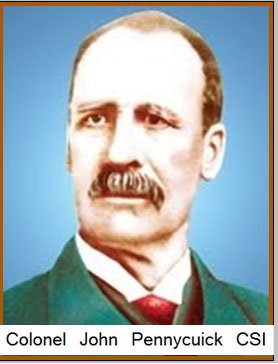 QUOTE: Many of the farmer families of the Theni and Madurai districts still keep portraits of Pennycuick and worship him as a god. Villagers prostrate before his portrait, offer prayers, decorate with garlands and perform aarati to his photos which are usually kept in the hall or in puja room along with images of other gods END OF QUOTE
QUOTE: Out of 30 boys, with whom a school was established in 1878, only 11 appeared for examination in 1880. END OF QUOTE.
That was in Agatti Island in the Laccadive Islands.
QUOTE: A school was started by Mr. Winterbotham in 1878 with a nominal roll of 36 boys, but this number had dwindled away to 14 in 1880. The plan of combining mosque schools and secular schools is being tried. END OF QUOTE
That was in the Androth Island in the Laccadive Islands. The fact was that the English administration was trying to uphold to its own honourable stance that they would usher in social quality in semi-barbarian locations, all around the world.
QUOTE: Next day the French unloaded their ship and hauled her in so close under the forts that it was thought she was aground. She lost 50 men in the action, including her captain, while the English loss was only 2 men. END OF QUOTE.
It might seem a quixotic claim if it is pointed out that in most of the English East India Company’s military engagements in the Subcontinent against all others including the Continental Europeans, the English side usually lost only very few of its individuals. Only in rare occasions of some terrific errors or backstabbing did they lose more.
I do not know if the reader here may agree to my contention that it was the planar codes of the English language that made difference. The logic in this statement has been very carefully explained in the ‘An Impressionistic history of the South Asian Subcontinent.’
QUOTE: It may be added that the Nayar shortly afterwards proved to the satisfaction of the Commissioners that he was really independent of the Cochin Raja, and a decision was accordingly given in his favour on this point END OF QUOTE.
The English administration was quite magnanimous and at the same time beyond the stranglehold of nepotism and partiality. Again, this was secured through the planar codes of English.
The point to be noted here is that if it was a local native entity that was the deciding power, the most significant logic that would have swung the decision would be the question of ‘did he display enough ‘respect’’?
If not, he is done for. If Yes, then whatever be the correctness of the other side’s arguments, they would lose their case. This is how the nation of India is being currently run.
QUOTE: Of those “under instruction” 59,264 were males and 9,550 were females ; of the “instructed ” 147,167 were males and 20,009 were females ; and of the “illiterate and not stated” 967,173 were males and 1,160,471 were females. To cope with this dense mass of ignorance a good deal of attention has been bestowed in the last twenty-five years on schools and education, and the progress obtained will be seen from the following figures END OF QUOTE
The English East India Company seems to have understood that the bane of the land was lack of formal education. This was not a correct assessment. The curse on the land was the feudal languages of the land.
I am not sure at what point the Company and later the British Crown rule came to the understanding that it was promotion of English that would improve the social system. It was Lord Macaulay’s famous Minutes on Indian Education that more or less created a most powerful inducement for teaching English to the masses. He did detect that the native-languages of the land were ‘rude’.
I do not know what he meant by ‘rude’. However, the fact is that the languages of the land are not only rude, but worse than rude. They have got all the codes for social discrimination. And also for homicide and mass massacres if a wrong indicant word is used at certain locations.
In fact, almost all the current-day seemingly insane gun violence in the USA is provoked by the unrestrained entry of feudal language speakers into a quaint native-English land. The feudal languages speakers can use these terrific provocative codes with all the facial charm of being magnanimous, when actually they would be busy inserting sharp wedges into the social system.
QUOTE: They work very hard for the pittance they receive; in fact nearly all the riceland cultivation used to be in former days carried on by them. The influx of European planters, who offer good wages, END OF QUOTE
The above statement has all the feelings of the anecdotal story of the frog sitting on the elephant, when the elephant stomped the crocodile. It is the frog’s claim that it was he and the elephant that crushed the crocodile.
All positive changes that entered into the Subcontinent were the handiwork of the native-English. The Continental Europeans were at first the ‘freedom fighters of India’, who either individually or with the natives rude kings and rulers of the subcontinent fought the ‘freedom fight’ against the English rule.
The use of the word ‘European’, when an appropriate word ‘native-English’ or ‘British’ is available, is really a misuse of the word.
It might be true that there were Europeans also in the new fray to create plantations. However, the fact then would be that there were many natives of the subcontinent also doing the same thing. Indeed, even the lower castes did enter into this frenzy.
QUOTE: The questions of slavery and the slave trade attracted the early attention of the Honourable Company’s Government. So early as 1702, the year in which British rule commenced, a proclamation was issued by the Commissioners against dealing in slaves. END OF QUOTE
Terrible things get enacted in the subcontinent currently. Degrading words are used to the subordinate. The police personnel literally used abusive or degrading words to the common persons and thrash them up inside the police stations. School teachers use terrific degrading words like Thoo / Nee, Eda, Edi, Avan, USS, Aval etc. to and about the students under them.
The household servants are not allowed to sit on a chair. They have to sit on the floor, eat on the floor, and sleep on the floor. They are addressed in the degrading verbal codes.
No one notices any of these things. However, the moment a native-English man or woman sees this, he or she will notice that there is something amiss. This is the mental quality that made the native-English officials see an item which went on unnoticed in the subcontinent for centuries.
The reader is requested to read the chapter in this Commentary dealing with Slavery.
QUOTE: The forests are peopled by Kurichiyars—a class of Jungle tribes who raise various products in them. The forest has been notified for reservation under the Madras Forest Act V of 1882. END OF QUOTE
This is about the forest areas that come under the Kottayam raja’s place. The Kurichiyars were the jungle tribe in the Wynad area who were fooled and terrorised by the Pazhassiraja’s people. They were made accomplice in a murder and thus forced to join the insurgency run by Pazhassiraja, who had unsuccessfully tried to usurp his uncle royal title. His uncle was more cunning. For more on this, read the Section on Pazhassiraja in this Commentary.
Now, about the notification for reservation under the Madras Forest Act V of 1882. It was great deeds like this that more or less protected both the forest wealth as well as the forest people from the ravages of the social leaders of the subcontinent. However, when the English rule departed, the forests were literally in the hands of the thugs, who had no qualms in plundering everything inside the forests.
QUOTE: 1. The forests were worked on the native system for many years, no efforts were made to improve them, and trees were indiscriminately felled where found, whatever their age might be. In 1878, all felling of living teak was stopped, and the Forest Department turned its attention to the utilisation of the wind-fallen and dead trees which were being annually destroyed by fire. In 1882, the Forest Act was introduced, and immense progress has been made in the scientific treatment of the forests
2. Nurseries have been established, and large quantities of ficus elastica seed obtained from Assam and planted, and numerous seedlings raised. Mahogany and bamboo seedlings are also being raised to plant out clearings
3. Various exotics, such as mahogany and rubber trees, castilloa, hevea and ipecacuanha, are being planted and experimented with, and some of them have thoroughly been acclimatised and established there. END OF QUOTE
It was an utter crime done by the British Labour Party to handover the British-Indian army to Pakistan and Indian politicians who within a decade destroyed the complete incorruptible culture of the administration which had been designed by the English administrators.
QUOTE:
1) The Deputy Collector and Magistrate located at Manantoddy.
(2) The Tahsildar and Sub-Magistrate located at Manantoddy.
(3) The Police Inspector located at Manantoddy.
(4) The Deputy Tahsildar and Sub-Magistrate located at Vayitiri.
(6) The Police Inspector located at Vayitiri.
(6) The District Munsif located at Vayitiri.
(7) The Sub-Registrar, Manantoddy, under the District Registrar. Tellicherry.
(8) The Sub-Registrar, Vayitiri, under the District Registrar, Calicut.
(9) Combined Postal and Telegraph office at Vayitiri.
(10) Other Post offices at Manantoddy, Kalpetta. Tariyott, Sultan’s Battery and Mepadi.
(11) Police stations at Manantoddy, Oliyot, Koroth, Panamaram, Kalpetta, Vayitiri, Mepadi, Tariyott, Sultan’s Battery and Periah.
(12) Sub-Assistant Conservator at Manantoddy and his subordinates,
(13) Local Fund Supervisors and Sub-Overseers at Vayitiri and Manantoddy.
(14) Local Fund Middle School at Manantoddy.
(15) Vaccine staff for North and South Wynad under the control of the Deputy Inspectors of Tellicherry and Calicut circles respectively.
(16) Hospitals at Vayitiri and Manantoddy in charge of Apothecaries ; the latter being supervised till August 1886 by a European medical officer, who drew a special allowance of Rs. 150 per mensem from Government.
(17) Bench of Magistrates, North Wynad.
(18) Do. South Wynad.
END OF QUOTE
QUOTE: The Post office at Calicut is also held in a private building rented for the purpose. It is not far from the Telegraph office. END OF QUOTE
This is a minor list of social and administrative infrastructure created by the English rule in the remote forest areas of Wynad. It definitely took a lot of determination to create all this, in a location where for centuries the local feudal lords literally fleeced the lower populations. In fact, the lower class females were under full access to the feudal lords at any time they wanted. The poor husband, who would literally be treated like some cattle, would have to stand apart for the feudal lord to be thus entertained. It was the norm. His wife herself would have bare ‘respect’ for her husband, as she is verbal trained to ‘respect’ the feudal lord.
It was the entry of the English administration that for the first time in recorded history that made an attempt to stop this ravaging. And established the rights of the husband against the various external claims on his wife. As of now, again Indian statutory laws are handing this right back to the wife’s father, mother, uncle, aunts, cousin etc. Utter academic-idiots are now in charge of writing statutory laws!
In a location where the common man cannot go much beyond his or her immediate neighbourhood due to reasons of safety, a very powerful administrative set-up based on egalitarian principles was being set up.
See what was being set up:
Deputy Collector, Magistrate, Tahsildar, Sub Magistrate, Police Inspector, Deputy Tahsildar, District Munsif, Sub-Registrars, Postal and Telegraph office, post offices, Sub-Assistant Conservator, Local Fund Supervisors and Sub-Overseers, Middle School, Vaccine staff, Hospitals &c.
The modern day jingoist who has had all the facilities and infrastructures given to him on a silver platter will quite easily mention that everything was done to suppress the ‘Indians’. Those kinds of claims are only perverse words. The police, judiciary, hospitals, vaccination staff, post offices, telegraph office, forest offices were all for the people of the land. None of them were looting offices.
However, all of these set-ups did have a basic deficiency. That the staff members were not native-English, but the same old natives of the land. These people carried the terrible codes of their horrible feudal languages. The moment they get some power in their hands, they would use it to degrade the others in the lands.
QUOTE: Under the head of education, the census of 1881 returned 6,384 persons as ‘'under instruction,” 18,721 as "instructed” and 180,857 as "illiterate including not stated”—a state of things which shows that education has not reached the masses END OF QUOTE
That was about the state of Education in Calicut Taluk. The urgency and focus on spreading education in the location is seen in the above statement. May be it would have been understood that the mere spread on sterile knowledge would bring in qualitative improvement in the social system. However, that was an erroneous understanding. For, all education in the feudal languages would only add to the terrors of the society. For, it was literally feeding the Satan with more powers.
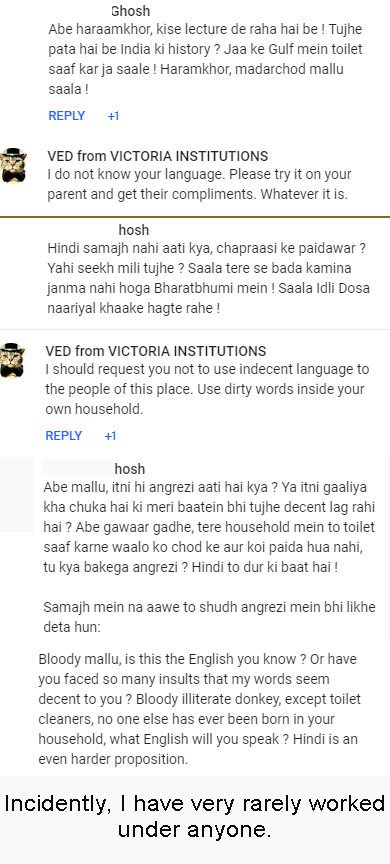 Only when the English East India Company decided to support English education did the real quality enhancements come. However, this was to take time. Only in few locations did reach to the heights. And before anything could be done to spread out the quality, the English rule was ended by the idiots in England.
With that, a very low-class replicated form of education spread from the Travancore area. This spread into Malabar and more or less erased the whole good quality systems that was there in British-Malabar. For, as of now, British-Malabar had been forcefully redesigned as Enslaved-to-Hindi-Malabar.
The Hindi land people who are formally educated do not have much ‘respect’ for Malabar. They visualise Malabar as Mallus. Actually this Mallu word is a very recent accident that befell the Malabar people.
During the British-Malabar times, Malabar was part of Madras Presidency. And hence, the Malabaris were generally known as Madrasis.
However, when Malabar was disconnected with Madras state, this very people were mentioned as Malabaris.
But then, when the Malabari culture was overrun by the Travancore language of Malayalam, both the names became quite unsuitable.
In those days, the change came in the Middle-East Gulf nations. The Mallu word was a derogatory word used upon the Malayalam speakers. It was more or less used in the same sense as ‘Annachis’, (Tamil-speaking rag-pickers of those times in Kerala). Slowly the Malayalam speakers started mentioning themselves as ‘Mallus’, without any information that it is a derogatory word.
As of now, all persons of Kerala are generally mentioned in derogation as Mallus by the others, and as Mallus by the Keralites themselves in the firm belief that it is some kind of ennobling word.
As of now, the Malabaris have lost all the good points in their culture, and has absorbed all the bad points in Malayalam culture.
QUOTE: Cochin Taluk: On 31st March 1886 there were 16 schools, middle, primary, aided and unaided, with an attendance of 996 pupils END OF QUOTE
That was about British-Cochin, and not about the native kingdom of Cochin.
QUOTE:
The purposes to which the funds raised under the Act are applied are
— (a) the construction, repair and maintenance of streets and bridges and other means of communication ;
(b) the construction and repair of hospitals, dispensaries, lunatic asylums, choultries, markets, drains, sewers, tanks and wells, the payment of all charges connected with the objects for which such buildings have been constructed, the training and employment of medical practitioners, vaccinators, the sanitary inspection of towns and villages, the registration of births and deaths, the lighting of the streets, the cleaning of streets, tanks and wells, and other works of a similar nature ;
(c) the diffusion of education, and with this view - the construction and repair of school-houses, the establishment and maintenance of schools either wholly or by means of grants-in-aid, the inspection of schools and the training of teachers
(d) other measures of public utility calculated to promote the safety, health, comfort or convenience of the people ;
(e) the payment of salaries, leave allowances, pensions, gratuities and compassionate allowances to servants employed by the Municipal Council ; and
(f) the payment of all expenses specially provided for by the Act, but not included under preceding clauses (a) to (e).
END OF QUOTE.
As of now, around 100% of all these kinds of governmental revenue is for feeding the gigantic white elephants called ‘government employees’, and for providing various kinds of conveniences for their family members.
For more on this, check: Fence eating the Crops.
QUOTE: The pier went out of order in 1883, when, with the permission of Government, a company of local merchants, designated the Calicut Pier and Warehouse Company Limited, to carry on the business of warehousemen and to levy cranage and other dues and tolls, was started with a capital of Rs. 5,000, which was utilised for repairing the pier. END OF QUOTE
The birdbrain who is now currently campaigning in England for compensation for ‘looting’ ‘India’, seems to have a feeling that the native people of British-India were gullible fools. Actually, the exact opposite was the truth. They were too intelligent for words. But they lived in a feudal language ambience which would not bring in social placidity. They used the English rule to the best to improve themselves.
QUOTE: There is a club for Europeans on the beach which was started on the 8th February 1864. Connected with the club is a station library maintained by subscriptions. END OF QUOTE.
The fact that a club was there which limited its membership to those of white-skin colour might look quite rude. However, the fact is that there are various locations inside the subcontinent where only certain kind of people are given admittance. No one sees anything wrong with them. Only when white skin-colour is used as the minimum qualification for admittance does the fury of the fussy intellectuals erupt.
Actually giving a private space of culturally different populations is good. It would be a free space where they can be themselves. The problem here is that the native-English create great private spaces. The others who are rich want to barge in. They find it quite troubling that their money cannot get them everything. At the same time, they find that they are not able to create something which is good enough for them.
This is one part of the issue. The second part is the word European. Connecting Continental Europeans with the native-English is certainly a sore point. Even Gundert, the Travancorean stooge, should have been kept out.
QUOTE: The hospital and dispensary at Calicut was opened in October 1845, under the auspices of Government. It was transferred to the Municipality when it was instituted at Calicut. It is now kept up at Municipal expense supplemented by a grant from the District Board. The dispensary has an endowment of Rs. 13,000 collected by private subscriptions and invested in Government securities yielding Rs. 520 per annum as interest.
2. Palghat: In-patients as well as outpatients are largely treated in the hospital referred to, the total number of beds available for in-patients being 16; 8 for males and 8 for females END OF QUOTE.
It should be quite surprising that these kinds of people welfare activities and infrastructure building were not in the purview of either the king of Calicut or of the immensity of rulers in the subcontinent. It is true that some 2000 years back a king on the eastern border areas of the subcontinent did go around placing a lot of rock edicts claiming all kinds of bountiful actions of his. It is quite curious as to what kind of a rule he was that he should go around writing his own greatness and great actions. It sounds quite similar to the actions of current-day Indian politicians and officials who placed full-page newspaper ads proclaiming their various developmental activities.
QUOTE: The lunatic asylum at Calicut was established on 20th May 1872 at a cost of Rs. 39,250. It is about 2½ miles east of Calicut on the road to Chevayur. It is built on a hill called Kutiravattam. On the 31st March 1885, there were 149 lunatics in the asylum. END OF QUOTE.
It is curious that Edgar Thurston has mentioned that it is the Eurasians who are more prone to insanity than the pure natives of the subcontinent. It is no doubt the affect of living in two different language systems. As the person and his personality shift from of a planar language to that of a feudal language, he would feel his personality wobble, degraded, kicked, distorted, and disarrayed. A normal man would go berserk. Others would not.
Check what Adam Purinton did when accosted and addressed by feudal language speakers.
QUOTE: Sanitation. The conservancy of the chief towns is looked after by a staff consisting of 1 Sanitary Inspector, 1 maistry, 13 sweepers and 1 totti, paid from Local Funds. The Inspector, with his headquarters at Ponnani, supervises the work of the whole staff which is distributed as follows :—Ponnani, 4 sweepers and 1 totti ; Betatpudiyangadi, 3 sweepers ; Tanur, 1 maistry and 3 sweepers ; the remaining 3 sweepers being attached respectively to the three fish curing yards situated at Ponnani, Veliyangod and Tanur END OF QUOTE.
The interest taken by the native-English administration in maintaining the cleanliness of the townships was phenomenal. However, it is doubtful if the people really understood its value. They had the habit of using the most desultory verbal usages for persons concerned with sanitation.
QUOTE After much and protracted discussion it was further finally decided that the French had made good their claims to certain other bits of territory lying in the neighbourhood of Mahe, described as the “four villages of Paloor, Pandaquel, Chamberra and Chalicarra, and of the three detached points or posts of Fort Saint George, the great and the little Calayi, as defined by the British authorities, without any of the territory in their vicinity, to which a claim was made on a former occasion.” These bits of territory were accordingly delivered1 to the French on 14th November 1853. END OF QUOTE.
The sense of fair-play, justness and magnanimity of the native-English administration is beyond words.
QUOTE: 1. Prices which were abnormally low just then rose in 1831-32 to about fifteen per cent, after the setting in of the rains. In the following year they again rose twelve per cent. Prices were again higher in 1833-34
2. Since 1832 a high flood of prices has set in which as yet shows no sign of ebbing END OF QUOTE
The real economic effect of the English rule can be seen in the above-statement. In 1917, the British-Indian rupee is stated to have been Seven USD. That was the state of the economy.
However, as of now, there is another kind of economic machine at work. Artificially bring down the currency value. As of now, One USD is equivalent to 64 rupees. This has created an artificial group of rich persons who are employed or domiciled or doing business in native-English and other nations. The locally earning ‘Indians’ have gone down to the very bottom of an economic gorge. The aforementioned artificial rich are literally buying up the land and the people. All history and political discussion are manipulated by these artificially rich individuals to befool the people.
QUOTE Port rules for Cannanore
Your immediate and most particular attention is requested to the imperative necessity of your entering in the report herewith forwarded the state of health of your crew and passengers, and whether any infectious and malignant or other disease has appeared on board during the voyage.
In the event of any such sickness having occurred, you are hereby ordered and directed to prevent all communication with other vessels in the roads or with the shore, until the Port and Marine Surgeon shall have duly reported such intercourse to be free from objection. If sickness has appeared and still prevails, you are required to hoist the flag R of the Commercial Code by day, or two lighted lanterns one over the other at the fore by night. END OF QUOTE
In a land with no systems, other than loud shouting and rude rebukes, the native-English side was building up systems and codes of professional functioning. The only error in the ambience was the feudal language of the native people of the subcontinent. It remained rude, unpleasant and auguring distaste and disaster in the offing.
QUOTE: Commanders and officers are particularly requested to abstain from ill-using boatmen or other natives. All complaints will be promptly inquired into. END OF QUOTE.
The English officers did have some understanding on what really happens outside the veils of the statutory codes. The verbal exchanges are, even if politely and softly done, quite rude and oppressive, and also demanding ‘respect’ and subservience towards the lower positioned persons. However, if the lower positioned are placed at a higher level, they would change into the same oppressive form.
Famines
There are people in India who write about famines in British-India. They claims that these famines were caused by the English rulers. These claims could be far from the truth. Actually, it is only in very recent days that these kinds of claims are being noticed.
There was indeed a terrible social situation which was actually noticed even by visitors from Britain to the British-India and to the native-kingdoms. This was a land with enough and more natural resources. However, the majority people lived like dirt.
There were people who blamed the English rule. This was actually a nonsense. The actual degradation of the majority people had nothing to do with the English rule. The real villain was the feudal languages. People were grouped in hierarchical layers. The top layer people crushed, cheated and exploited the layers below them. And at the same time, worshipped and adored the layers above them.
So, it was a sort of willing self-destructive mentality.
Physical labour was seen as distasteful. Each layer pushed down the physical labourer part to their lower layers.
In such a terrible social mentality, whatever goodness and beneficial acts were done by the English administrators, nothing will seep down. For, each one of the social layers would see to it that the lower layers do not get any benefit which might give them leeway to come up.
This is actual truth.
Now, about the actual food eating condition of the people has to be mentioned. The slave castes literally lived on bare subsistence food.
See the series of QUOTEs I am posting from Travancore State Manual of the living condition of the peoples in the native-kingdom ruled by a native king:
QUOTEs:
1. Pulayas:
“The food of these Pulayans is fish, often cooked with arrack and with the liliaceous roots of certain water plants.
Their food is chiefly rice, as they are employed in its cultivation, to which they add vegetables and fruits grown in the small plots usually allotted them by their masters. The rice is boiled and eaten with coarse curry, or only pepper and salt. It is also parched, or beaten flat, but they have no skill in baking or cookery.
Not long since, a Pulayan escaped from a cage prison in South Travancore. When again caught, he confessed that he had run off because he had been starved for four days, the peons pocketing the allowance for food.
2. The Kanikars are generally very short in stature and meagre in appearance, from their active habits and scanty food.
3. Pariahs: The flesh of cattle left dead by the roadside is their perquisite, and it is their partaking of this food that excites the abhorrence of ordinary Hindus, who venerate the cow.
The Pariahs eat the carcases of cows and other animals which have died of old age or disease, even when almost putrid. These are cut up for distribution by the females principally, and after partaking of this disgusting food, their odour is insufferable.
4. The Valans: Their food is scanty, and never includes eggs, milk, or rice cakes. Their dress is unclean and poor, the children going quite naked, and often suffering from indigestion, worms, and other diseases; while the parents are so ignorant that they do not even know the use of such a simple remedy as castor oil.
5. During the months of scarcity the Vedar women go to the jungle, and dig up various kinds of wild yams and tubers with pointed sticks of wood which they always carry, and boil and eat these roots. The Pulayars, likewise, hunt for crabs, tiny fish, and snails, in the irrigation channels, eggs of red ants, the winged white ants, or anything else to fill the stomach and satisfy the cravings of hunger.
6. Roots, vegetables and fruits form a considerable proportion of the food of the population, especially of the poorest classes, who have little besides when rice is scarce or dear. The forest and hill people dig out wild, stringy yam-roots from the jungle as food in the hot season. Every native grows something, if he can, around his own dwelling for home use.
7. The poorer class of cultivators generally go to their work at six o’clock in the morning, and return at the same hour in the evening. Only when the work is unusually difficult or pressing do they take solid refreshment at noon. They get food warm and abundant in the evening only.
8. Conversation with a slave:
“What are the wages of slaves in other districts ?”
“Half an edungaly, with a trifling present once a year at Onam.”
“In sickness, is relief given by the masters ?”
“At first a little medicine, but this is soon discontinued. No food is supplied.”
“What is your usual food ? “
“Besides rice when able to work, often only the leaves of a plant called tagara (Cassia tora) boiled; and for six months the roots of wild yams are dug from the jungle.”
“How do you get salt?”
“We exchange one-sixth of our daily wages in paddy for a day’s supply of salt”
“Not having proper food, the children are weak and unable to do hard work, therefore they are not paid any wages until they are fifteen years of age;
9. They are kept toiling in manuring, planting, or reaping through the day in the agricultural season, mostly with the blazing sun beating on the bare head, and the feet in mire or water, and return in the evening, fatigued and hungry, to their wretched huts to boil their rice and eat it with salt and pepper.
10. Sudras (Nayars – higher caste) do not eat beef, but mutton, poultry, &c.
11. Syrian Christians (land owners): Food. — There are no prejudices against any particular kind of food. Beef is ordinarily not procurable, therefore not eaten. Rice and curry is a favourite dish.
12. The cheapest food in Travancore, except home-grown roots and fruits, is rice. Of this adults require about a pound and a half daily, and it costs something like a penny to a penny farthing per pound. Rice is not nearly so nourishing as wheat or oatmeal, and should be supplemented, as it usually is among vegetable feeders, with pease, milk, or butter. Numerous varieties are grown, and nice distinctions made of flavour and individual taste.
13. Rice, the staple food of the people, is not commonly ground into flour, but boiled whole and eaten with curry — that is, highly spiced meat, fruit, or vegetables; other grains, as millet, &c., are ground into flour, and boiled into a kind of porridge or pudding.
14. The social circumstances and daily life of the poor low-caste or slave women, who are obliged to labour for their daily support, and sometimes have nothing to eat on any day on which they remain idle, present a direct contrast to the comfort of these just described, as might be expected from the condition of extreme and enforced degradation in which they have been so long kept, and the contempt and abhorrence with which they are universally regarded. Yet they are human as well as their superiors. They work hard, suffer much from sickness and often from want of food, and generally, like all slaves, also form evil habits of thieving, sensuality, drunkenness, and vice, which increase or produce disease and suffering.
END OF QUOTEs
This is the real condition of the food intake of the various peoples of Travancore. The higher castes and the Syrian Christians did have good food. The lower castes had food bare enough to just survive.
If that be the condition of Travancore, see what was the condition of Malabar.
QUOTE from this book, Malabar:
It is supposed that in Malabar a man has enough to eat if he has 1½ Tippalis of rice and ½ Tippali of conjee a day, or 1 Idangali of paddy of 4 Calicut Nalis There are many in a starving condition who get less, and many affluent who eat more. END OF QUOTE.
There is a lot of online claims about famine in Bengal during the English rule. It is mentioned as if the British government planned for this famine and induced it artificially. The actual fact is that the problem is connected to languages. I have seen very rich locations in Delhi in close proximity to very poor people location. The rich classes simply act as if they do not see the other class. For, it is not easy for an Aap-level person to get into a conversation with Thoo level individuals, unless some kind of enforceable hierarchy is there.
After the formation of India, the poor in the land joined the Naxalite party (revolutionary communist) and attacked the landlords and the police and killed them. Their leader Charu Majumdar was caught from his hiding place after the police could extract this information from one of his associates by torturing him in custody. Charu Majumdar was beaten to death by the police. His body was burned by the police without giving it to his relatives. This is the exact and wider truth about the Bengal famine.
Even now there is terrible starvation and poverty in Bengal. However, people of India are attuned to not notice such things. However, if it was English rule here, there will be an infinite number of things that would be noticed, including the terrible manner in which live fowls are transported for slaughter across the distances in cages which are stacked one upon another.
No one cares for another person’s sufferings. The current-day nation of India is full of sufferings of the downtrodden folks. It is not possible to converse across the layers created by the feudal languages.
Academic historians of India with low-class scholarship, sit inside cosy buildings, earning astronomical salaries, write any nonsense that comes to their insipid minds about the English rule. And these are people who puts on a pretence that they do not know that if a person is addressed as a Thoo or Nee, there is a huge hammering being done, that would travel down to the very bottom of highly-layered social structure.
However, they are aware of this, but still they would place the blame for everything on the English rule.
Oft-mentioned objections
Insipid historians mention that the English Empire was a looting empire. Basically it is an issue of them visualising English colonial officials as a mere reflection of their own personal attributes.
For instance, when I mention that in Malabar till around the end of the 1970s, there was an English-speaking officer class in the administration who would not take even one paisa as bribe, currently it is difficult to find anyone to believe it. For, it is not possible to imagine, as of now, any official signing away official papers which would be very valuable to any member of the public without charge an appropriate bribe-fee. However that was the truth. And I have ample proof with me to prove it beyond any content of doubt.
In the same manner, whatever goodness was done in the subcontinent, mediocre historians and their insipid repeaters mention them as with some other ulterior motives. I am quoting from the words of one Christian Missionary of the London Missionary Society. He worked in the Travancore kingdom. The quote is taken from the Native Life in Travancore:
QUOTE: The first missionary, Ringeltaube, working quite alone, amid difficulties and discouragements of every kind, and often suffering under heavy depression of spirit in view of the unpromising character of the early converts, was not able to realise the grand proportions which the mission would ultimately assume, nor the full value of the work which he was doing in laying the foundations of a noble Christian church in Travancore. Tempted by low spirits and long-continued solitude to unbelief, bitterness of mind, and a somewhat undue depreciation of native character, he wrote to his sister
“I have now about six hundred Christians, who are not worse than the other Christians in India. About three or four of them may have a longing for their salvation. The rest have come through all kinds of other motives, which we can only know of after years have passed.”
END OF QUOTE
The certain native people of the subcontinent imagine everyone as being like themselves. It is not true. Planar language people cannot be like feudal language people. That is the basic issue in understanding the motives of the English administrator. When they taught the people good cultural standards, good dressing standards, good technical information, taught them English, brought in good administration, set up good quality healthcare, set up medical colleges and much else, the aims was not to squeeze out money.
The truth is that from almost all these things, currently the native bosses are make fortunes. For instance, private medical colleges are literally gathering astronomical amounts of money from their students as Capitation fees. What does England get from these things, all of which literally sprouted from the legacy they left here?
Had England been cunning enough, they would have destroyed every one of these things and asked the peoples of the subcontinent to create them all on their own. However, due to their great magnanimity, they did not do this.
Photos and picture of the Colonial times
There are many pictures in circulation as of now, depicting scenes from the English Colonial times. In most of them, the natives are seen in very wretched conditions. This is then taken as a proof that under the English rule, the natives of the subcontinent were in wretched conditions.
Actually the analysis of the pictures is done in a totally erroneous manner. The pictures that is thus shown are the real conditions of the lower-placed populations of the subcontinent as seen by the English officials. It is these persons who were slowly placed on a platform for improvement. However, when doing this, the English officials had to face the wrath and antipathy of the higher classes of the subcontinent.
The next mischievous pictures are those that show good quality households and other buildings owned by the English officials in British-India, and the missionary buildings in the native kingdoms.
Actually the great quality seen in them is the natural quality of the English language ambience. The English dressing standards, though simple, was beyond the conceptions of a lower caste man or women in the subcontinent. For, they stood under the weight of a number of social layers pressing down from above.
What is missing in all these kinds of pictorial depictions were the pictures of the higher castes and classes of the subcontinent. Their supreme position in the land cannot be understood by merely looking at their dresses. For instance, when a big man wears a mundu or dothi, there are hidden social codes of ‘respect’ and derogation encrypted in them. Just by looking at a man wearing a Mundu, one cannot take up the understanding that he is a non-entity or a nondescript man. He would very well be a most powerful feudal lord.
And by looking at a tiled house of a landlord, it would be quite foolish to say that he is poor. For, there would be an immensity of dependents of his who live in thatched huts, with bare conveniences.
The fact is that if an English household were living near them, the whole social system would change, by the very sight of the Englishmen and women standing, conversing, walking &c. with a totally different bearing. For, such a higher stature human body-language was not commonly seen in the subcontinent. Just viewing the English native of those times was a high-content education in human potential enhancement.
These are things which insipid history textbooks written by equally dullard Indian academicians would not dare to mention.
Now, we come to the various picture of White men and women in forest scenes showing them having killed or shot dead some wild animal.
There are multiple issues in these pictures. For one thing, there might not be enough evidence that these men and women in a specific picture were from England or Great Britain. For, there were other White populations from Continental Europe also nicely enjoying the secure conditions provided the English rule.
Even before the secure installing of the English rule, the French, Italians, Portuguese etc. did also do all these things. These white people did fight on the side of the ‘freedom fighters of India’ against the English.
Next items for scrutiny would, did these shootings take place inside British-India or in the native-kingdoms. The native kings and other ‘Indian princes’ were involved in the shady business of inviting native-Brits to their kingdoms and conducting wildlife shooting expeditions.
There is another wider aspect to the inspected. Some rich people from India go to Britain and take their guns and go in for shooting the animals and birds there. What would happen?
It is very much possible that they would be arrested or restrained or taken into custody and sent back home. However, instead of that, if the native officials in Britain invite such people from outside and give them all encouragement to shoot any animal they like, then the blame cannot be placed on the outsiders.
Now, this was what was restrained in British-India. The forest department in British-India would have stood for protecting the forests and its resources, while in the native-kingdoms, it would have been scene of inducing the foreign guests to take part in such forest parties, as a sort of native entertainment. And in later years, the whole blame would be placed on England. And not on the native kingdoms.
Payment for the Colonial deeds
I am intending to conclude this commentary with one brief discussion about a very cantankerous campaign going on in England. It is mainly done by persons who had the fortune to live in native-English nations.
This has been the history of this subcontinent. Persons of miniscule personality and information go to England or some other native-English nation. From there, they act as if someone from the subcontinent had authorised them to act as the representatives or the agents or leaders of the people/s of the subcontinent.
They initiate campaigns, make declarations, deliver speeches, take part in discussions, meet the political leaders of those nations and do so many things like that in the foolish guise of the leaders of the people/s of the subcontinent.
When one lives in native-English nations, everything looks quite easy. These very persons, if they were to live in the subcontinent, would find it quite difficult to communicate across the social layers. It is not easy to even converse with a police constable or a government office peon for most people in India. The languages are so terrible that the government personnel can very easily degrade the common man using very soft words.
The wise guys who go to England and act as the leaders of the people cannot do one bit to change all this. In fact, they remain as the great stumbling block for the development of the people.
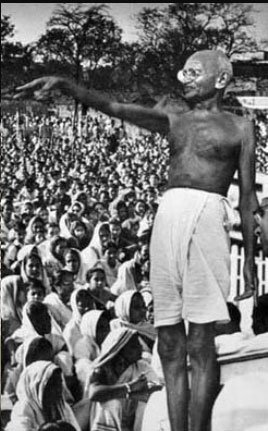
There was one Gandhi who is mentioned currently as the ‘father of the nation’. What kind of a ‘father of a nation’ is this, when there is no such definition anywhere in any of the statutory books, including the Constitution of India, about such a ‘father of the nation’? This man’s USP was asking the people to remain in their degrading dressing standards, and to address him as Aap, and as a Mahatma or a Ji. He remains an UNN (highest he/him), which the common man is a Thoo, and a USS (lowest he/him). Some bloody fools in England have even put up a statue of him next to that of Winston Churchill.
One should compare his common followers with the common people who followed the English systems. Then the stark difference would come out.
In fact, there was no great ‘freedom struggle’ in the subcontinent so to speak of. The Sepoy Mutiny was not a ‘freedom struggle’ by ‘Indians’. Only academic idiots would make such a discovery. In fact, even the people of Meerut did not support the actions of a reckless group of armed natives. A group of armed natives is a terror for the common people.
It was the rest of the people/s and the kings and other rulers of the subcontinent who rushed to the help of the English East India Company and crushed the hooligans.
What these hooligans did in Cawnpore can be read in The Story of Cawnpore by Capt. Mowbray Thomson. It might even be suspected that the Mutiny had the blessing of the British home government or the British Crown. For, it was the only legal opportunity to dismiss the East India Company government which had become statistically multiple times more powerful that Great Britain itself. However, since the Company was an English one, they did not go alone. Any other nationalities would have simply gone off alone.
Only around half of the subcontinent was under the English rule. The rest were independent kingdoms, who did not want to mention that they were not part of British-India, in England. For, it was a very cosy address to mention cunningly. However, even the earlier mentioned Gandhi was not from British-India. His father was the prime minister of Porbunder kingdom.
The creation of Pakistan and India was not due to any kind of freedom struggle anywhere. It was the foolish deed of the British Labour Party that killed the English Empire. It was the Labour Party’s political policy that when they come to power, they would kill the Empire. Those fools came to power in Britain in the immediate aftermath of the World War 2. They ditched everyone who had stood by Britain thick and thin.
The 3 million and odd native-soldiers of the subcontinent were betrayed. They were handed over to the Hindi-speaking native officers. In Hindi, the soldier, his wife and family are the Thoo people. The officers, the wives, and their families are the Aap people.
This is a very great defining element. The soldiers who had stood stolidly with the English officers were going to mutate into something of a low-grade variety.
The native-kingdoms who had supported the English rule suddenly found that they had nothing to hold on to. The British-Indian army which had been under commitment to protect them was now in the hands of politicians who had no qualms of using and misusing the armed forces as per their whims and wishes. Both Pakistan and India went on military intimidation campaign to overrun all the native-kingdoms. No referendums on the peoples’ wishes were taken into account.
Calculating the compensation
The first part of the compensation has naturally to go to the kingdoms which were forcefully attached to the nations of Pakistan and India. And also to the people who were subjects therein. Naturally both Pakistan as well as India stands complicit in this piece of rascality.
The second part of the Compensation can be taken up on the huge infrastructure building done in the land.
Before going ahead on this route, let me take up the location of Malabar. It is a miniscule location when seen from a subcontinent perspective. This book, Malabar, deals with North Malabar and South Malabar. These two locations are socially disconnected locations. The people of the north view the southern sections as demeaned. What is the perspective from the other side is not known to me.
Inside each of these sections, there are numerous kingdoms, many small, and the others miniscule. They are all incessantly fighting against each other, via frequent plundering, and molesting raids.
Inside each king family, there are various mutinous groups who would be quite happy to decapitate the head of their king.
Then there is the Hindu (Brahmin) social leadership who hold a very powerful grip over a number of layers of human populations, by means of very terrible feudal languages.
Below the Brahmins are the various layers of the Ambalavasis, who might also be Hindus.
Below this comes the Nayars, who were in days of yore some kind of fake Sudras or something else. However, by submitting themselves fully to the Brahmin superiors, their bloodline became more or less totally Brahmin. It was their job to uphold the ‘respect’ of the Hindus and to keep down the lower populations by means of the powerful verbal codes in the feudal language. The language was something called Malayalam, but not the current-day Malayalam. The name Malayalam was usurped by the Travancore group as they took over some parts of the Malayalam of Malabar and mixed it up with their traditional language Tamil and inserted Sanskrit words in immensity. It has come to a state that the original language of Malabar had to be renamed as Malabari.
Each one of the lower castes themselves were brutal to those who came under each one of them.
The Hindus (Brahmins) naturally had the learning in Sanskrit. However, the technical skills were with the various lower class populations. However, only in native-English nations would the technically skilled persons be allowed to function freely in the social set up. In a feudal language set up, it is very clearly known that if the technically skilled persons are given any leeway to go up in the social ladder, they would take-over the social system.
Now, into this highly cantankerous social system of a very miniscule geopolitical location, the English East India Company officials are under duress to create a functioning and enduring political system. And they succeeded in doing this.
What can be the compensation for this? How does one calculate the stopping of all kinds of warfare and battles in the location that had been going on incessantly from times immemorial, in terms of monetary compensation?
This is item no 1.
2. Emancipation of slaves:
The majority populations were in various levels of slavery. Even though the subservience to the higher-placed populations starts directly from the Brahmins, it is actually from the ranks below the Nayars that the real enslavement commences.
It is like this: Nayars are below the Ambalavasis. The Ambalavasis have several layers. Ambalavasis, Unni, Nambishan, Pisharadi, Variyar, Chakkiyaar, Nambiyaar &c.
They all come under the Brahmins.
Among the Brahmins also there are layers. Thamburans, Nambhoothiripad, ‘special’ (Vishistar), Bhattathirpad, Saamaanya Brahmins, Nambi, Shanthikkaar / Embraan, Namboori (Sapagrasthan), Papista Brahmins &c.
It should be noted that the above-mentioned lists might not be very authentic. I have simply gathered them from one or two old time books. I have no direct information on these castes and how they relate to each other.
Nayars could have been mentioned as an enslaved caste. However, they stood rock-solidly loyal and subservient to the Hindus (Brahmans) to the extent that they made a policy that the Nambhuthiri Brahmins could have close alliance with their womenfolk.
Even though this might look a bit awkward from current-day shallow understandings of reality, the fact is that offering the household women to the divine levels of personages is one of the highest levels of offering an individual or household or population can offer. It is an act of pious offering. This is an item that can be understood only in a feudal-language social system.
It is an offering to the higher indicant word defined personage. It is not to the lower-indicant word defined persons.
The higher indicant word personage can relocate the worshipper and his family to the height of the social layers.
In other words, the Sudras were being placed above the various other populations. They can address them as Inhi/Nee/Thoo, and refer to them as Oan/Avan/Chekkan, Olu/Aval/Pennu etc. This positioning in the verbal codes is something that cannot be understood in English.
It is a great blessing that is being bestowed on the complete family members. They literally rise high above the various other populations, who might exhibit dignity, mental stature etc. However, in feudal languages, those who exhibit dignity, mental stature, high bearing etc. are crushed down and the place of prominence is offered to those who cringe, and shower feudal ‘respect’.
It is like a common soldier in a feudal-language based army offering his wife or sister to the army officer/s. The officer/s helps him to slowly rise above his rank and become a Commissioned Officer. What has happened is the total rising of the status of his complete family members. They all are now part of the officer class. They can address the common soldiers and their family members with the lower indicant words for You, Your, Yours, He, His, Him, She, Her, Hers &c. It is a very powerful endowment that has been received.
It might be seen that both the Syrian Christians as well as the Jews did very powerfully grab the higher social positions more or less equal to the Nayars from the contemporary Tamil kings of Travancore area. What they offered in return for getting this kind of astronomical levels of social heights is not known.
Coming back to Malabar, it is seen that many populations who were not willing to concede such offerings or were not even asked for such offerings, were pushed down to the levels of various levels of slaves. The Hindus and the Nayars literally lived on the centuries of enslavement of these unfortunate populations. Many of the extremely lower classes literally lived like animals or domestic cattle. They were more or less tied to the small bit of land where they had to work from the beginning of their working life to the end of it. The working life would start when they were about four or five years old.
They were sold or lent, or hired out to other land-owners. Even though the higher classes saw them almost every day, no one really bothered to think of them as human beings. It is like this in current-day India. People see the household servants treated like some kind of low quality human beings. They are made to sit on the floor and addressed in the pejorative part of the verbal codes. To become friendly with them is also quite dangerous. For, if they feel that the other person is an equal, the verbal codes they use to him would become quite carnivorous. That is, it will bite. They are made to live like carnivorous animals.
It is true that if these people are allowed to go to any native-English nation, their individuality would rise up sky-high. However, after a few years, they would start complaining about native-English racism. That is the most funny part. That, persons who would be made to sit and sleep on the floor in India and addressed as ‘dirt’, when they go to native-English nations would find the native-English, ‘racist.
It was the native-English administration in the subcontinent, starting with the English East India Company that took the most vigorous steps to stamp out human slavery. Many of these erstwhile slaves rose up to the social heights. Many other escaped to other nations where English colonialism was in existence, and started their lives as labourers. It is quite funny that idiot academic historians have taken this as proof that the English were ‘exporting slaves from India’.
The fact is that the slave populations in Travancore, which was not part of British-India, could not interact with the local social system with dignity. They could not come on the roads. They would not get good government jobs. Their only option to become part of any human society was to escape from this land to other lands, where their manual labour skills could be given for wages. Not as slaves.
The slave populations who improved in Travancore was mainly due to the handiwork of the members of the London Missionary Society. However, they escaped to Malabar forests and became reasonably very rich. Today they will not admit that they by ancestry were from the slave populations.
Actually no one would like to mention such a thing. None of the lower castes would like to mention their caste name. They would prefer to be known as Hindus and thus connected to the much-described Vedic culture of some 7000 years back in some part of Central Asia. Actually none of these populations are Hindus. They all had their own traditional deities and Shamanistic rituals. However, many of them are quite ashamed to mention these links. Instead they all want to mention their links to Hindu/Brahmanical traditions and antiquity.
On this account also, the English East India Company has lost much in terms of gratitude. For, if no one claims to have come from the slave ancestry, there is no meaning in seeking any appreciation for the great deeds of the English Company.
But then, historical facts should stand indelible. The vast majority population/s of Malabar consists of those who were emancipated from social slavery by the English East India Company. If compensation claims are to be put up, how much it would run up to. An emancipation of millions of human beings across the generations, whose ancestors were the human beast of labour for centuries and beyond.
This is item no 2.
However, that is the compensation that the emancipated populations have to offer to pristine-England. Not to Multi-culture demon England.
But then what about the Hindus and the Nayars? They would have also to pay a very huge astronomical sum as compensation to their erstwhile slaves’ descendents.
In which case, the birdbrain campaigning in England for compensation for ‘colonial looting’ would find his family fortunes completely wiped out. He himself would find himself doing some wiping job to make ends meet.
3. Educating the peoples
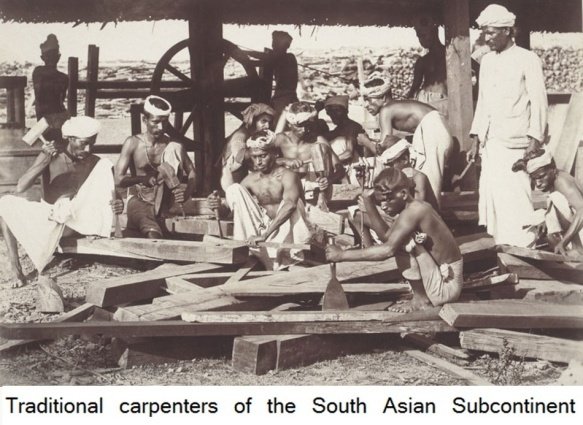 There was practically no formal education for the people of Malabar. However, it does not mean that they were without skills or capabilities. In fact, most of the lower-positioned castes were experts in some kind of skilled work. Furniture carpentry, architecture carpentry, pottery, herbal medicine, various kinds of cultivation, coconut-tree climbing, making oil, making lime for use as building mortar, and much else were there as skill and knowledge among the various population groups, which were identified by specific caste names.
But then, it might be true that the higher kind of information on engineering, architecture, allopathic medical treatment, etc. had to be inserted into the social system by the English administrators. It was not easy for them. For, it is seen that when they tried to open a Medical College at Calcutta, for teaching medical studies to the native students, there was indeed a huge hue and cry against it, from the local social leaders.
As to Sanskrit literary education, it is sure that the Brahmins did have this as part of their traditional legacy. When the English administrators set up schools, there was a concerted effort on the part of the local feudal landlords also to set up a parallel vernacular education system. It is easy to understand their urges.
For, in a feudal language social system, education has some other ulterior aims. It is an easy way to assemble young children under oneself. The children can then be addressed by powerful demeaning lower indicant words like Inhi, Nee etc. and other lower grade indicant words can be used to refer to them. When this kind of demeaning is done, what takes place is the exact opposite of what would happen in English. In English, a person with some dignity would react with vehemence at this Satanic degrading. (Currently in Multi-culture England, this degrading of students might be going on in the sly. Feudal languages would raise their monstrous heads only when they have gained a lot power).
In a feudal language ambience, the degraded students would fall in love with their degrading teacher, shower him with respect, and hold him up as a very honoured individual. This is the real secret for the inducement to become a teacher in the subcontinent.
What was great about the education that was truly supported wholeheartedly by the English administrators was education in English. It may be noted that the Christian Missionaries who worked in the native-kingdoms did not support education in English, even though they did run many English schools. One of the reasons could be that in the subcontinent, the Christian religion was only very slightly connected to English and England. For most of its components were from non-English nations. And there were persons like Gundert etc. who were actually some kind of interlopers, acting as silent agents for a larger agenda.
It was the presence of such white-skinned Continental Europeans that messed up the definition of the English rule. They also managed to confuse both the English administrators as well as the native populations as to who was really ruling the land. Actually the colonialism in the subcontinent was not a ‘White-man colonialism’, but an English colonialism. The term ‘White’ can encompass a number of nationalities in Continental Europe. At least some of them were the early days ‘freedom fighters’ of ‘India’, in that they collaborated heavily with the native kings to destroy the English East India Company administration.
The greatest of English contribution in the field of education, actually all kinds of education, was the setting up of very high quality systems, procedures, protocols, codes of ethics, grooming standards, hierarchies not based on feudal language codes and much else in all fields that had connection to education and professional studies.
For instance, the Allopathic Medical education. The very refined systems, based on pristine-English were taught and enforced by them. This is where all other systems including the native-herbal treatment systems and even formidable Homoeopathy went behind. For instance, even though Homoeopathy is a very effective disease treatment system, just because it was never part of the English educational system, it continues to lag behind with low-quality systems, conventions, behavioural pattern etc. and at the same time, more or less trying to imitate Allopathic conventions. Even the word ‘doctor’ is a creation of the English system in this land. It continues to hold a brand image of an honoured person, due to the feudal languages of the land.
However, the Homoeopath has not been able to gather a similar ‘honourable’ stance for the word ‘Homoeopath’. So, he or she is highly bent on claiming a ‘doctor’ prefix to his or her name.
It is undeniable that the English administration did try to use formal education to improve the standards of the common people. However, they did make one mistake in that, there were not insistent enough on stressing the importance of good-quality English, and English only, in education.
Formal education without good-quality English was more or less a waste of time, unless every kind of statutory jobs were reserved for this useless vernacular -educated students. Vernacular education does not do anything to erase the huge and totally encompassing feudal language emotions and triggers from a student’s mind.
Vernacular education in India as of now, is the forceful enslavement of children under low-class under-informed individuals who address the children as Thoo/Nee, and refer to them as Avan/Aval/Uss etc. All of these words are of the lower indicant levels and meant to degrade the individual.
It may be seen that two persons were given the Noble Prize for aiding these ‘teachers’. They cannot be blamed. However, the Nobel Prize Committee which decided to give the awards to these cunning crooks might need to be taken up for scrutiny by both Providence as well as Nemesis.
As of now, teaching is a business. Compulsory teaching has its business aims. A teacher’s job in a government-aided school in Malabar can be bought by ‘teachers’ for around 20 lakh (200 million) rupees and more. It is the school management’s profit. The teachers who literally do not know anything are paid an astronomical salary, plus huge pension benefits.
The textbook industry also has a very great vested interest in this.
I will give a list of educational systems that were introduced or supported or sponsored by the native-English rulers:
1. Medical Colleges
2. Engineering Colleges
3. Dental Colleges
4. Veterinary Colleges
5. Agricultural Colleges
6. Science Colleges
7. Humanities Colleges
8. English Nursery Schools (some run by good-quality Anglo-Indians)
9. English Lower Primary Schools (some run by good-quality Anglo-Indians)
10. English Higher Primary Schools (some run by good-quality Anglo-Indians)
11. English High Schools (some run by good-quality Anglo-Indians)
12. English Intermediate Colleges
13. English Degree Colleges
14. Vernacular Schools
15. Various kinds of technical teaching institutes
However, what needs to be mentioned here is that among all the above-mentioned items, actually the best item was the English Nursery, Lower Primary, Higher Primary and English High School education. It was in these locations that the native children got to get educated in the egalitarian emotions of the English language. Moreover, many of them became good in English Classical literature.
Actually a good reading experience in English Classical literature is the greatest of education that an individual can get to totally erase his native-land barbarian and semi-barbarian mentality.
In the English-rule times, only a person who has traversed the English Classical literature track successfully could get to become a Government officer, a doctor, an engineer, a teacher and such.
Because it was this English Classical literature which was the towering Himalayan heights that should first be climbed, before any individual could aspire for any higher quality profession. For, once he or she has climbed this, he or she becomes a great individual with profound egalitarian principles in his or her mind.
An individual who has not climbed in the English Classical literature route remains more or less, the same old feudal language mentality person. He or she should never be given any quality professional status. For, if he or she occupies such positions, everyone who works under him or her gets despoiled. From this despoilment, the members of the public also get dirtied.
As of now, in India, persons who do not have any connection to English Classical literature are becoming IAS/IPS officers, Doctors, Engineers, Political leaders etc. And the quality derangement induced by them on the people is quite obvious.
It might be mentioned in passing that if current-day ‘officers’ of the Indian government were to write a Civil Service exam of the English rule times, only very few of them would get in. Most of the others would be assignable only menial jobs in the government offices. Such persons are now in charge of the government offices.
However, the government official content is only representative of the people content.
Again, speaking of the Nursery-level education, in good-quality English schools, it was done by good quality individuals who were good in English and English Classics. They would never use a pejorative word to the students. However, as of now, the servant-maid type of persons is in charge of Nursery school education. There is a general feeling that Nursery school education is of the least importance. Actually it is of the greatest importance.
Hopefully, the Nobel Prize Committee would get its just desserts before long from Nemesis.
Every kind of educational item, which are all currently in their most dirtied form, including the Professors, Lectures, Research fellows, University Convocation, Graduate and Post Graduate degree Certificates, and much else are what has been bequeathed to a most ungrateful population by the native-English rulers.
Now, speaking of Compensation, what can be the total valuation of the huge and gigantic educational system that has grown up on the foundations made by the native-English rulers? It might be noted in passing that the native-land feudal landlord classes never seems to have pondered on these kinds of infrastructure building for the common man. But then, they cannot be blamed. For, it was a common knowledge that if the lower classes are improved, they would push out the benefactors and make all kinds of attempts to take-over their assets and other possessions.
Actually this is going on in England as of now. The immigrant folks are hell-bent on over-running England and enslaving the native-English people. They are creating fractures in the social fabric and acting as if they are the healers to the malady. Actually they are the malady.
The foundation for mass education in Pakistan, India and Bangladesh was the legacy of the English Colonial rule. It is true that as of now, this public education has been deliberately made sterile by the exclusion of English in the education.
This is item no. 3.
What amount of compensation should be paid to England for this fabulous legacy of educational infrastructure? It is true that jingoists can speak of Taxila and Nalanda &c. But then what do they have to do with the Nambhuthiris, Ambalavasis, Marumakkathaya Thiyya, Makkathaya Thiyyas, Nayar, Malayans, Vedans, Chaliyars, Pulayars, Pariahs, Converted Christians, Shanar and other immensity of populations here?
4. Creating a huge egalitarian administrative system
In Travancore State Manual written by V Nagam Iyya, there is this statement:
QUOTE: “It is the power of the British sword,” as has been well observed, “which secures to the people of India the great blessings of peace and order which were unknown through many weary centuries of turmoil, bloodshed and pillage before the advent of the Briton in India”. END OF QUOTE.
Actually the British sword is not of a different breed that it is more sharp, more lengthier or more piercing. And the word ‘India’ is not the apt word. The apt word would have been Subcontinent. As to the word ‘people’, it should have been ‘peoples’.
Yet, what the statement defines is quite true. The lands had been ‘through many weary centuries of turmoil, bloodshed and pillage before the advent of the Briton in India’. However, the apt word here would have been ‘the English’ rather than ‘the Briton’.
QUOTE from the Travancore State Manual:
It is quite possible that in the never-ending wars of those days between neighbouring powers, Chera, Chola and Pandya Kings might have by turns appointed Viceroys of their own to rule over the different divisions of Chera, one of whom might have stuck to the southernmost portion, ....................... subsequently as an independent ruler himself. This is the history of the whole of India during the time of the early Hindu kings or under the Moghul Empire. END OF QUOTE.
See the words ‘never-ending wars of those days between neighbouring powers, Chera, Chola and Pandya Kings’.
QUOTE from Travancore State Manual: collecting their own taxes, building their own forts, levying and drilling their own troops of war, their chief recreation consisting in the plundering of innocent ryots all over the country or molesting their neighbouring Poligars. The same story was repeated throughout all the States under the Great Moghul. In fact never before in the history of India has there been one dominion for the whole of the Indian continent from the Himalayas to the Cape, guided by one policy, owing allegiance to one sovereign-power and animated by one feeling of patriotism to a common country, as has been seen since the consolidation of the British power in India a hundred years ago. END OF QUOTE.
Actually, Nagam Iyya seems to have gone berserk with his affection for the English rule in the Subcontinent. For, there is an error. The native-kingdoms were not actually part of British-India. This has been mentioned in ample words in that very book itself, when a question about the legal rights over native-British citizens living inside Travancore, came up for scrutiny.
QUOTE from Travancore State Manual: As a natural consequence anarchy and confusion in their worst forms stalked the land. The neighbouring chiefs came with armed marauders and committed dacoities from time to time plundering the people wholesale, not sparing even the tali on their necks and the jewels on the ears of women. The headman of each village in his turn similarly treated his inferiors END OF QUOTE.
This was the experience of a place called Nanjanad. Actually, this was the infrequent experience of very many places in the subcontinent, as far as the common people were concerned. When a similar terrible time came for Malabar, the kings and princes and other higher caste people who had the amenities, ran off to Travancore kingdom seeking safety.
So what was the state of the subcontinent before the advent of the English rule?
1. turmoil, bloodshed and pillage
2. never-ending wars
3. plundering of innocent ryots all over the country or molesting their neighbouring Poligars
4. anarchy and confusion in their worst forms
5. plundering the people wholesale, not sparing even the tali on their necks and the jewels on the ears of women
6. Slavery, and getting sold or rented out as slaves
Sitting inside some cosy air-conditioned building and writing a false history comes easy for the Indian academicians. However, the realities of the subcontinent were terrible. Even the forced burning of young widows was of unmentionable horror. I have seen one joker sitting in the US and claims that it was burned women’s human right to get decide to get burned. That fool has forgotten that in his native land in India, people cannot think or decide beyond what is allowed in the verbal codes. There are quite powerful strangleholds that the family as a whole has on an individual.
The insecurity on the trading roads due to the presence of the Thugges was another unfathomable horror. They would use the vile strategy of affableness and unwavering friendship to corner an unwary trader. This use of affableness and friendliness to subdue an adversary is a national pastime in all feudal language nations. Native-English populations cannot even imagine the satanic pleasure that is derived in using backstabbing methods to overpower them.
As to people’s safety and welfare, one only needs to see how an ordinary worker or some other kind of lower-placed labourer gets treated in an Indian police station or village office. The words used are invariably ‘Nee’, ‘Thoo’, ‘Inhi’ etc. Once this hammering via words is placed on the person, the person is more or less in a debilitated form. In fact, most of the ‘Indians’ are these kinds of ‘debilitated’ citizens. The other non- debilitated citizens of India are happy to see them in such a condition. For, they then pose no competition to them. Feudal languages create a terrific mood for competition in each and every verbal dialogue, unless there is acknowledged servility on one side.
It is these kinds of an immensity of minute populations, and lands that were amalgamated to form British-India. British-India had its own national sovereignty, and focus of sovereignty for the people/s. For the first time in recorded history, the Nambhuthiris, Ambalavasis, Makkathaya Thiyyas, Malayans, Vedans, Chaliyars, Pulayars, Pariahs, Cherumars, Converted Christian, converted Mappillas, Shanar, Nayar, Marumakkathaya Thiyya, Arabian-blood-mix Mappillas, Rawuther Muslim and other immensity of populations here, felt that they were part of a single large human population group that consisted of Rajputs, Moguls, Gujaratis, Sindhis, Bengalis, Telugus, Kannadigas, Biharis, Pathans, Tamilians &c.
However, there is also a much wider complication in this national affiliation. For, inside each of these afore-mentioned ethnic groups, there would be a huge number of castes who traditionally looked downwards with unconcealed distaste and repulsion.
That the native-English could create a nation out of them, in around the half of the geopolitical location of the subcontinent actually points to a very high calibre communication-capability population
.
In such a very complicated social system, it would not be possible for any of the local populations to create anything like this. For, no communication will go forward without some powerful backing in it.
It is like this:
One leader tells another person to go and tell another person to do such and such a thing. The first person would first assess if the order has been given by an adequate UNN/ Adheham/ Avar (highest He/Him). If the assessment is that the person is not of enough heights, he will not do what has been asked of him.
Now, if he does go and give the request to the third person, the third person would scrutinise both the first person as well as the second person. If either of them are not of acceptable heights and lowliness respectively, he would dither on the information and request.
This is how communication works in a feudal language. However, if the command comes from a very terrorising and powerful entity, it is conceded to.
However, for the first time in recorded history in the subcontinent, a new system of communication based on logic, pleasant words, good manners, non-degrading and non-servile verbal codes entered into the social system. It actually took some time for the local people and the local kings to understand that the English systems had some kind of terrific difference from their own traditional systems.
It was this information that a very decent and honourable new entity, something like a very decent alien population, had come into the subcontinent that more or less united the people and the kings under the English East India Company standard (flag).
See this QUOTE from Travancore State Manual:
Marthanda Varma’s words on his deathbed to his heir: “That, above all, the friendship existing between the English East India Company and Travancore should be maintained at any risk, and that full confidence should always be placed in the support and aid of that honourable association. END OF QUOTE.
I have already listed out the great administrative apparatus that was created in each every Taluk in miniscule Malabar. I will list them here again of Manantody Taluk:
QUOTE:
(1) The Deputy Collector and Magistrate located at Manantoddy.
(2) The Tahsildar and Sub-Magistrate located at Manantoddy.
(3) The Police Inspector located at Manantoddy.
(4) The Deputy Tahsildar and Sub-Magistrate located at Vayitiri.
(6) The Police Inspector located at Vayitiri.
(6) The District Munsif located at Vayitiri.
(7) The Sub-Registrar, Manantoddy, under the District Registrar. Tellicherry.
(8) The Sub-Registrar, Vayitiri, under the District Registrar, Calicut.
(9) Combined Postal and Telegraph office at Vayitiri.
(10) Other Post offices at Manantoddy, Kalpetta. Tariyott, Sultan’s Battery and Mepadi.
(11) Police stations at Manantoddy, Oliyot, Koroth, Panamaram, Kalpetta, Vayitiri, Mepadi, Tariyott, Sultan’s Battery and Periah.
(12) Sub-Assistant Conservator at Manantoddy and his subordinates,
(13) Local Fund Supervisors and Sub-Overseers at Vayitiri and Manantoddy.
(14) Local Fund Middle School at Manantoddy.
(15) Vaccine staff for North and South Wynad under the control of the Deputy Inspectors of Tellicherry and Calicut circles respectively.
(16) Hospitals at Vayitiri and Manantoddy in charge of Apothecaries ; the latter being supervised till August 1886 by a European medical officer, who drew a special allowance of Rs. 150 per mensem from Government.
(17) Bench of Magistrates, North Wynad.
(18) Do. South Wynad.
END OF QUOTE
This is a minor list of social and administrative infrastructure created by the English rule in the remote forest areas of Wynad. Wynad was actually a forest-filled Taluk north of Calicut and east of Tellicherry. Just imagine, the English Company setting up all these things and more in around half the location of the subcontinent. In other areas, like the seaports, they did create wonderful harbours and seaport. It is not the infrastructure of the ports and harbours that should create wonder in our minds. It is the port rules and other decorum, and codes of formal functioning that are incredible. For these very decent codes of actions are being introduced in a semi to fully barbarian land. Check the Port Rules section in the book, Malabar.
The main point here to be mentioned powerfully is that it is not that a native leadership of the Subcontinent cannot visualise all these kinds of administrative set ups. It is just that the moment he or she talks in the feudal languages social system, it would create problems of communication. As to who is bigger and who is smaller.
Beyond that, inside the administrative set-up, everyone would be first and foremost concerned about their own social stature and ‘respect’. The quality of everything would be compromised upon this item.
This is item no. 4.
When speaking about Compensation, how much amount should the nations of Pakistan, India and Bangladesh give to pristine-England (not to Multi-culture demon England) for the setting up of an immensity of administrative set-ups in the whole of the subcontinent? Remember that in India alone, there are around 238617 panchayats and around 649481 villages. (I am not sure if the mentioned numbers are correct).
Let the birdbrain start calculating.
5. Postal Department
The concept of posts and courier is not difficult to conceive. It is just a matter of telling someone to take some article, go to the place where it has to be given and deliver it.
The idea is quite simple.
However, in a feudal language social systems only if a powerful entity gives the order would the thing move forward. Otherwise, even if the other person has promised that he would do it, he would not do it.
It is like this. In India, one man is told to take one letter to another man, who has to do its bidding and then take the assigned item to another man.
Both the persons agree to do their part of the work. However, when the first man is called in the morning, he admits that he has not done it. Why? His uncle called him for another work. He cannot disobey his uncle. However, he will do it the next day.
The next day also some other excuse.
Ultimately, the first man goes and gives it to the other man’s wife, who informs him that her husband had waited for the article on the first day.
The next day the second man is called. He says his wife had received the item, but then she had to go to her aunt’s house. And he has not received the article in his hands.
Ultimately he receives the article. However, he is now called for some family affairs and cannot tend to the instructions in the letter. The real reason is that he finds that he has to go to a location wherein he might not be ‘respected’ adequately.
This is how these things work in a feudal language ambiance. For, very powerful indicant word-codes do influence all human actions and emotions.
But then the higher castes and the rulers did have various kinds of letter and other article delivery systems. The arrangement is not for the people to use. It is just simply a system of people organised to send, forward and deliver letters and other articles from their social leaders to others. It has nothing like a pre-paid stamp and such.
The very idea of a postal department which can be utilised by everyone came from an English mind. It is not that a Malabari man cannot imagine this up. It is just that, in Malabar, who would want to give this facility to the ‘low-class’ others in the society? No sane man would do this. For, the ‘low-classes’ would then tend to show-off their grandeur!
As of now, the traditional postal and telegraph systems are going rapidly into oblivion or obscurity.
But then, in their heydays, they were wonderful creations of a most egalitarian population’s mind. There was actually no need for the English rulers to set up a postal department which all people could make use of.
No other king or queen or ruler in the subcontinent had even pondered on giving such facilities to the downtrodden populations.
In my childhood, I was quite easily impressed by what it meant. I post a One-paise stamp postcard in a small letterbox in some remote corner of some remote village. It is addressed to a location in Assam, some 3500 kilometres away, in an equally remote village. The exact location is a small hut on the other side of a water-filled agricultural plantation.
The wonder of wonder is that this tiny bit of paper, with a stamp value of extremely negligible amount, is delivered to the hut with supernatural precision.
The amount of written codes, rules, by-laws, systems, routing, authentications, enforcement of discipline etc. in a land which had nothing of this can be understood only by those who know what is what. For, each individual in the string of individuals has to placed in a very controlled corridor, that moves only in the pre-set route. No command, appeal, emotion, frustration, anger, enmity, laziness, procrastination &c. should be able to create a disruption in this route.
The people here received this fabulous set-up on a silver platter.
Ibn Batuta does mention about a courier system among the Muslim kings of the northern parts of the subcontinent. In Travancore, there was a Anjal ottam (mail-runner) courier service. These are all sort of expensive services for the privileged classes.
These kinds of things would be found in all the ancient kingdoms of the world. This has nothing to do with the English built up postal system based on prepaid stamps. Even if such a system did exist in some per-historic times, it does not affect the truth that in the South Asian Subcontinent, it was the English administration that set up the postal department that exists today.
It is easy to say that a very professional set-up can be created very easily. The fact is that to ensure the delivery of the mail article at the precisely correct location requires the setting of a very fabulous organisational machinery.
When we speak about the British-Indian postal system, it would be a satanic intention to confuse this system with the courier systems for the rulers and the other privileged classes, which would be found in existence thousands-of-years back in all continents.
QUOTE from the insipid Wikipedia: By 1861, there were 889 post offices handling nearly 43 million letters and over 4.5 million newspapers annually. The first superintendent of the post office was appointed in 1870 and based in Allahabad END OF QUOTE.
Can this postal department be compared with the courier system for the privileged classes of the subcontinent? An academic mind especially of India will naturally have the genius to find a comparison.
The British-Indian postal rates were quite low. However, around 2000, the government of India gave it very great patriotic push that all the lower financial classes went out its purview. As of now, the Indian postal department caters to the financially higher classes of the land. Mainly as a courier service for Online buying.
The postal department is a huge money-maker for the government of India, as well as a treasure pot for its employees. However, there must be some thought about paying the price of the company. Simply taking over a company when some nut was ruling England cannot be mentioned as a great antiquity and heritage of a newly formed nation. Or is its nations? Three of them are there.
This is item no. 5.
6. Railways
There is a very cunning scene of the ‘father of the nation’ being pushed out a South African train in the Gandhi movie. The ostensible reason being that he was not White. However, how come a feudal language-speaking person, who discriminates others and degrades a lot of them, on each and every aspect of a human being was allowed into the train is the moot question.
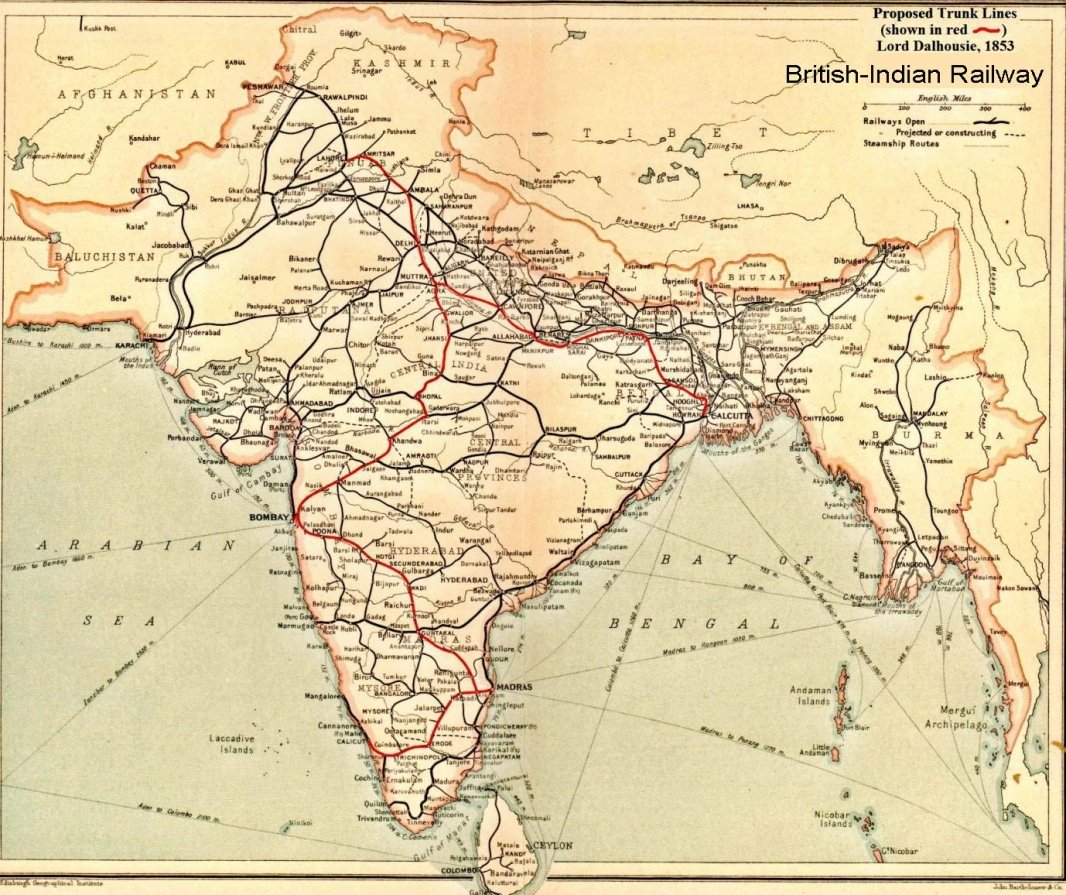
The British-Indian railway was a wonder in the subcontinent in those days. It traversed a lot of small and minor locations. The fact that all the people in the various locations inside British-India were all under the same sovereign tended give an impression that they were all one people, which actually they were not. The peoples of the various locations viewed the various others as despicable entities. Even now this is true.
See the way one native of middle India, where the common population is of relatively lower social quality mentions the people of the south. He was working in a Continental European nation as an employee there in one of the firms there.
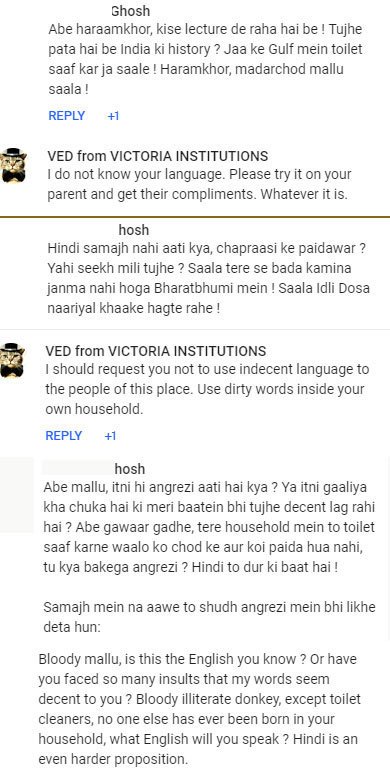 Being under the same sovereign can give an impression that all the subjects are same. For instance, the group of Travancore and Malabar into one political entity tended to give power to the Ezhava political leaderships’ contention that both the Thiyyas populations are Ezhavas. The easiest logic is that all three come directly under the Nayar caste in the social hierarchy of yore.
Actually both the Thiyyas populations are not one caste.
Even though in these times, when almost all the technical skills and knowledge of England has been download into India, it might not seem to be a great thing to build a Railway system in India, the truth is that the creation of the British-Indian railways was a marvellous event in the history of the subcontinent.
However, the marvel does not stop at that. The huge content of systematic actions that can allow the trains to run on time, and safely across the distances really required a lot of mental exertion. It is quite easy to improve upon something another man has created. However, that does not come anywhere near to the effort of the first creation.
In my own professional writing works, which I used to do a few years back, I had occasions wherein I would be compelled to finish a work in an extra hurry, with some unknown client demanding that the work be given overnight. The work naturally might not be of high quality standards due to this hurry. Later, actually weeks later, the client would have someone else improve the text and give a comment that the original was not up to the mark. The fact is that if I had been asked to do an improvement of my own hurried work, I would have created a much better product. As for the other person, he or she was simply improving a lot of verbal usages, on the translations I had given, of the extremely complicated text.
However, in the case of the Indian Railways, still it has not come anywhere near to the egalitarian aims of the British-Indian administration. That is, to provide quality travelling convenience for the downtrodden populations. However, this is not a standalone issue. It is connected to the various other aspects of the administration.
For instance, look at the suburban railways in Bombay. It is a nightmare. However, this issue is connected to the fact that the Bombay city has itself become a nightmare for the lower populations of the city. Moreover, an immensity of others rush into Bombay to escape the feudal language terrors of their own native places. For inside Bombay, the presence of huge crowds everywhere can give anyone an anonymity which is not possible to get in one’s own native place.
The quaint English-built railway stations were a natural beauty. There would be trees in the railway platforms. There would be seats for all people to sit down. I mean for even the lowest-class ticket holders.
This point requires a clarification. When I used to move from Malabar to Travancore in the 1980s, I used to find the difference very stark. In the newly-built Indian railways station of Travancore, in those days, sitting convenience for the lower-class ticket holders was not very much obvious.
In those days, the railways were slowly changing from an easy-going English system to that of rude feudal language systems. Actually brutish Hindi was spreading throughout Malabar and Travancore Railways, in the same way it was doing all over the nation.
The terrible replacement of English with a feudal language did create a lot of efficiency problems around the 1980s. However, as of now, things have more or less settled into the feudal language system. Feudal language systems are efficient inside their own systems. However, if an outsider comes in, who does not display the expected subservience, it would rankle.
Actually this is the real reason that I did not go to the Cannanore Railway station to check the Railway archive records on how more than 20 railway stations in the north Malabar area got a Muthappan Temple attached to them during the English rule period. It simply is not easy to converse with an officialdom which speaks in feudal languages, unless one is ready to bent and bow and cringe, and use words of ‘respect’ or has an uncanny ability to drop powerful names of connections, inadvertently. The various officials in the system are tied to a very powerful stream of feudal subservience or domination. An outsider has to fit into that stream to be able to move with that stream.
It is a different world from that of English altogether. From a feudal language perspective this would be the best possible official system possible. However, once a person gets acquainted with any pristine-English official systems, the stark difference would be visible. However, it must still be admitted that the very system of bureaucracy has a formal positioning and hierarchy in it, be it feudal language or English. However, in feudal languages, this hierarchy become quite heavy and totally a one-way valve system for the flow of communication and ideas. In fact, more than one extraneous hierarchy gets overloaded into the official hierarchy.
The huge railway network with all kinds of textual guidance, procedures, protocols, signal systems, precautions, cautions, railway gates, bridges, guards, periodic and timely inspections, water supply, fuel storage, a huge number of auxiliary businesses and such other things working, well, it all required a huge quality personnel to set it up first. It is not all things cannot be imagined or created by others. It is simply that there should be first such a people’s organisation that can work it out.
If it is a single feudal language system as in Japan, it can be done without much hassles, even though they might have to first rob the initial idea from elsewhere. In a nation where different human hierarchies work in close proximity in mutual competition, it is very near impossible to first create the huge human organisation from scratch. I do not mean the railway organisation, but the totality of all the things that were gathered together by the pristine-English administration.
It is nation where even now a common man cannot communicate with a policeman from a stature of dignity and self-respect. The policeman simply would not allow it. His very words of addressing Inhi / Nee/ Thoo will erase any attempt by the common man to communicate from a stature of dignity.
What is the Indian railway valued at? Well, the people who created it cannot simply be shooed away just like that. A valuation has to be done, and a proper value has to be given to the population that created it.
Simply using such words as ‘looters’ etc. on quality people will not help the scene.
This is item no. 6.
7. Hospitals and public healthcare
It took a lot of efforts on the part of the English administration to set up hospitals and other healthcare infrastructure for the common people. For such a concept of providing for the common man was not there in the subcontinent. However, if by people one were to mean only the Hindus (Brahmins) and the Nayars, there would be ample people to come to their houses and treat them with whatever traditional treatment knowledge they had. However, for the lower populations below the Nayars, the quantity of such services they received would decrease rapidly as their caste level goes down.
I am quoting three different paragraphs from Edgar Thurston’s Castes and Tribes of Southern India Vol 1.
QUOTE: 1. Adutton (a bystander).—A synonym for Kavutiyan, a caste of Malayalam barbers. In like manner, the name Ambattan for Tamil barbers is said to be derived from the Sanskrit amba (near), s'tha (to stand), indicating that they stand near to shave their clients or treat their patients.................. Not improbably the name refers to the original occupation of medicine-man, to which were added later the professions of village barber and musician............. His medicines consist of pills made from indigenous drugs, the nature of which he does not reveal. His surgical instrument is the razor which he uses for shaving, and he does not resort to it until local applications, e.g., in a case of carbuncle, have failed. In return for his multifarious services to the villagers, the Ambattan was given a free grant of land, for which he has even now to pay only a nominal tax.
2. In 1891 the live inmates of a single hut were murdered, and their hut burnt to ashes, because, it was said, one of them who had been treating a sick Badaga child failed to cure it.
3. A local tradition describes the Travancore Kshaurakans as pursuing their present occupation owing to the curse of Surabhi, the divine calf. Whatever their origin, they have faithfully followed their traditional occupation, and, in addition, many study medicine in their youth, and attend to the ailments of the villagers, while the women act as midwives.
END OF QUOTE.
This is a sample of a treatment system at certain caste levels. However, the higher castes seems to have access to a particular standard of Herbal treatment, which is locally known as Ayurveda. The moment the name Ayurveda is mentioned, the current-day jingoists in India would spring up with very tall claims of having huge medical treatment systems in ‘ancient India’. Names such as Charaka, Danvanthari, Shustrutha etc. would be mentioned rapidly.
There is no denying that such medical experts were there in the ancient times in some parts of the globe, which might even be inside the subcontinent. However, what is their bloodline, or genetic or caste-based connections to the Nambhuthiris, Ambalavasis, Nayars, Marumakkathaya Thiyya, Makkathaya Thiyyas, Malayans, Vedans, Chaliyars, Pulayars, Pariahs, Converted Christians, Arab blood-mix Mappillas, lower caste Converted Mappillas, Tangal Muslims and other immensity of populations of North and South Malabar?
Or with the Nambhuthiris, Ambalavasis, Nayars, Shanars, Ezhavas, Pulayas, Pariahs, Vedars, Nadars, Converted Christians, Syrian Christians, Methan Muslims, Mukkuvars &c. of Travancore?
Or with the vast number of varying populations in Canara, Madras Presidency, Hyderabad kingdom, Kashmir, Mushidabad, Assam, Sind?
There is this much more to be added about the English Company rule public healthcare system. If the medical professionals are native-English, the members of the public would get to feel a very vibrant egalitarian feeling, even though the native-officials in the hospital would try their best to induce all kinds of inferiority complexes in the socially lower-placed individuals.
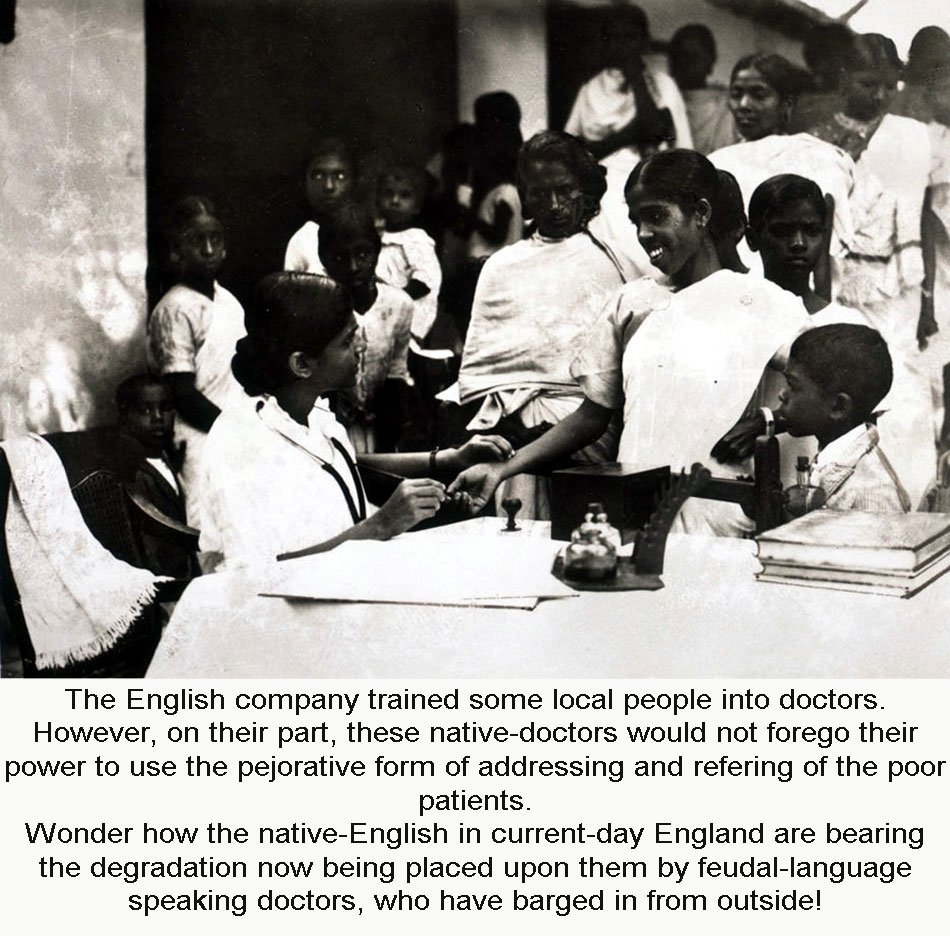
But then, if the medical professionals themselves are feudal language speakers, then the effect is again like being under the thraldom of an affable tyrant.
It is simply that the native medical professionals would use the lower indicant words of addressing and referring. Such words as Inhi / Nee/ Thoo, and Oan / Avan / Uss and Oalu / Avalu / Uss etc. These words do the pressing down action on a human dignity, personality and stature.
Now think of the immense number of public healthcare institutions, and their command wings created all over the subcontinent; catering to the people of around 649481 villages in current-day India alone. (I am not sure if the mentioned numbers are correct).
Then there is Pakistan and Bangladesh also.
Now, let us calculate the total cost of the healthcare infrastructure that was handed over to the politicians in Pakistan and India. This would include the huge training set-up for the various categories of medical professionals. The medical literature, the textbooks, the class rooms, the awareness programmes for the common people, the decorum of functioning, the uniforms of the personnel, the medical teachers, the medicines, the drug manufacturing professional knowledge, the pharmacy colleges, and off course the British Pharmacopeia.
Naturally the jingoist in Indian have copied the idea and created an Indian Pharmacopeia. It is quite possible that they would claim that the complete drug standards mentioned in the Indian Pharmacopeia was copied by the British from some ancient Vedic textbook dating some 8000 years back!
It is quite a wonder that Clement Atlee had the nerve to simply throw out all of these priceless legacies of English antiquity to competing rank outsiders.
This is item no. 7.
8. Judiciary
As of now, the Internet is full of lies and misinformation. It was the English East India Company that set-up a totally new form of judiciary in the subcontinent, in which before the law all citizens were as they appeared in English. That is, a single You, Your, Yours; a single He, His, Him; and a single She, Her, Hers; &c.
Before the entry of the English judicial systems, judicial verdicts were the whims and fancies of some low-quality village-Adhikari or some other feudal landlord who would dispense justice on the basis of the verbal definition of an individual. That is, it depends on whether the individual is an Adheham, or Ayyal or Avan. And in the case of belligerence between two individuals, the higher He/Him will naturally be liable to get a favourable verdict in his favour.
For, it is like this: He beat him.
If Aheham (highest He) beat Avan (lowest him), then it is a condonable action.
However, if, Avan (lowest he) beat Adheham (highest him), then it is a terrible crime.
If one were to search for the details of the Indian judiciary, it is quite possible that there will be claims of ‘Indian’ judicial apparatus appearing in ancient textbooks of various kingdoms.
But what is all of them to do with the meticulously worked-out Judicial apparatus of the English East India Company. The most wonderful aspect of this is that the common man would even place a complaint against the very officials of the Company, if need be. And it would be enquired into and if the complaint is found correct, action would be taken on the accused.
Imagine a common man trying to place a complaint on any of the officials in the various kingdoms of the subcontinent! The individual will end up with his limbs broken.
Some of the native-kingdoms, tried to replicate the judicial system set-up in British-India inside their own kingdoms. However, they functioned in the native feudal language.
See this statement from the Native Life in Travancore by Rev. Samuel Mateer:
QUOTE: but cases of complaint rarely succeeded in those days, as the subordinate magistracy were so deeply prejudiced and naturally partial to their own intimates and caste connections. END OF QUOTE
See this statement from the Travancore State Manual written by V Nagam Iyya:
QUOTE: When Col Munro took up the Diwanship for a brief period, this was what he saw:
“No description can produce an adequate impression of the tyranny, corruption and abuses of the system, full of activity and energy in everything mischievous, oppressive and infamous, but slow and dilatory to effect any purpose of humanity, mercy and justice. This body of public officers, united with each other on fixed principles of combination and mutual support, resented a complaint against one of their number, as an attack upon the whole. END OF QUOTE
If this be the state of a judiciary in one native kingdom, imagine the condition in the hundreds of similar kingdoms in the subcontinent, over the centuries. The majority people lived like slaughter-animals, with absolutely no human or animals rights for them.
Into this inglorious land, the English Company brought in written codes of law and an egalitarian language to define human beings before the judicial courts. However, as of now, this tremendous and wonderful insertion of an egalitarian language has been reversed. In many places in the northern parts of India, the judiciary functions in Hindi. Hindi is a language that can quite easily define a human as a piece of dirt (a Thoo and a Uss) and another man as a divinity (An Aap and a UNN).
In Kerala, that is, the sly amalgamation of Malabar with Travancore, the Judicial courts have started to function in Malayalam. Malayalam is another satanic language that can do more or less the same evil discrimination with more effectiveness. The common man can be quite easily be defined as Nee/ Ningal and Avan/Ayaal, and the officialdom can stand as the Saar and Adheham or Avar. What kind of a stupid judiciary is this? The whole idea stands directly against the sacred tenets of the Constitution of India, which proudly proclaims that all citizens of India are equal before the law. The translated-into-Hindi Constitution does support an idea that the common people are dirt and the officialdom and other higher persons are gold.
The Constitution of India is a great document written in English. Its original concepts and precepts are based on the unwritten conventions and egalitarianism of pristine-English.
Translating this golden document into satanic languages is a deed of the devil.
There is one more thing that needs to be mentioned about the British-Indian judiciary. It tried to enhance the personal stature of the people here. However, the people here have to deal with the judiciary through the advocates / lawyers. It is doubtful if these lawyers / advocates would treat the people with dignity. It is a common knowledge in feudal language systems, the if you treat a lower entity with ‘respect’, he would withdraw his ‘respect’.
So, it is only natural to expect that the lawyers would use only the Inhi/Oan or Nee-Avan (lower indicant words) on the lower-class people who come to them seeking judicial solace. This is again a failure of the English East India Company. They should have understood this issue and should have given stern advice to the lawyers that they were under obligation to protect the stature of the individual who comes to them.
However, it is a hopeless situation. For the society at large would not concede to this. So, at least the judges should have been native-English. At least at that level, human beings would be seen as of equal stature.
Now, let us start calculating the Compensation:
A wonderful judiciary (which as of now has atrophied into feudal language systems)
A Constitution based on the egalitarian conventions of pristine-English.
A huge set of written codes of law and judicial procedures.
A huge array of Judicial courts across the country. A Supreme Court of India, High Courts in the States. District Courts in each district. Sub-district Courts.
Judicial officers including Justices, Judges, Magistrates, Sub-Magistrates, Arbitrators &c.
Lawyers / Advocates.
Statutory uniforms for the judicial officers including the lawyers.
Various kinds of writ petitions in the Supreme Court and High Courts, such as Mandamus, Habeas corpus etc.
Various indelible rights to the citizens.
Well, this all for the total population of India. Pakistan and Bangladesh liability can be calculated later, if need be.
What Compensation from India will suffice for the astronomical levels of efforts placed in this subcontinent by the ordinary persons from England?
This is item no. 8.
9. Land Registration Department
Imagine the efforts that created a complete registered documentation for around half of the subcontinent. This was actually a corollary of another great social reform created by the English rulers. That the age-old slave and semi-slave class of people could become land-owners. Actually, this is where the birdbrains, who are campaigning for Reparation for British-rule deeds did face their tragedy. They lost their lands, and the slaves escaped from their clutches. They want compensation for this! What a funny demand!!
What is the total value of the Land Registration department? Its creators should be paid. Simply scooting with some other persons’ creation is not a good action.
This is item no. 9.
10. Police department
The Thugges were crushed. They had menaced the northern parts of the subcontinent for centuries. It was Henry Sleeman who created the police force. He crushed the Thuggees.
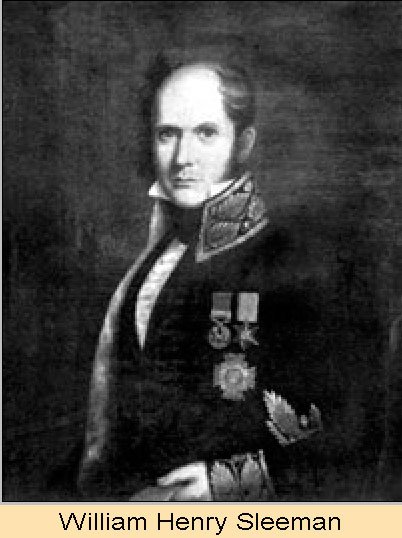 The roadways were made safe. There was a police station functioning in some level of English, for the people to appeal for help. In a land, where there was actually nothing like that at all. Functioning in English is great. Because the officials can interact with other officials without being hindered by the feudal language limitation of ‘respect’ and pejoratives.
As of now, it is very difficult for the citizens of India to go to a police station and demand a service. The very word ‘demand’ can get them thrashed. They can only beg. They have to stand. They cannot sit. The police man or woman will use terrible pejoratives to them. They people have to speak in hushed tones with great ‘respect’ for the very officials who will use terrific pejoratives on them. The great Indian patriots are not bothered. For, they have one foot in England.
It will not be correct to blame the policemen for this. For, this is the way the low-quality vernacular education teaches the people to behave. The policemen simply have to go along with this system.
What is the valuation that can be assigned for the Indian police departments?
During the English rule time, the Imperial Police (IP) officers were in charge. At that time, British-Indian police was an English organisation, even though there were many natives of the subcontinent also in this cadre. Now, the police departments are in the charge of the Indian Police Service (IPS)officers. These are natives of India, who have written a most illogical exam and got posted into positions which had been created by the English rulers. It does not means that all of them are misfits. Actually many of them are of very good quality. However, the systems are in feudal languages. There is not much they can do individually to run the service with any kind of quality.
The IPS officers are the Director General of Police, Inspector General of Police, the Deputy Inspector General of Police, Superintendent of Police, and the Assistant Superintendent of Police.
Below the IPS are the Deputy Superintendent of Police, the Circle Inspector Police, and the Sub Inspector of police. This is the middle level executive cadre in the police department.
Below them comes, the Assistant Sub Inspector, Head Constable and the Constables.
Majority of the common people of India, as per the verbal codes in the feudal languages come under the constables. That is, the constable can and will address them as Nee / Thoo. No idiot patriot in India has any problem with this. For, they are rich and many of them have relatives in England or USA.
Look at the huge personnel structure of the Indian Police system. It is in all the Indian states. Apart from that there are police departments under the central government also.
There are armed police forces also.
What would be the monetary value of the total of these police departments? Off course, the England will have to be duly compensated for all this. It would be quite an unwise things to stand with politicians who advice running off with other people’s creations.
This is item no. 10
Fire Force. I do not know who actually commenced this department, which is seen in many states in India. The current level of personnel would be totally feudal language content.
This is an auxiliary to item no. 10
11. Public Service Commissions
Before the advent of the English rule in the subcontinent, the local kings simply appointed anyone they liked to any post. The problem with this kind of posting was that the persons were mostly from a low-individual quality. Their most immediate aim would be to amass money and to terrorise the people, so as to gather ‘respect’.
The English rule brought in the concept of Civil Service Exams. It was one of the greatest changes in the social system. Even lower caste persons who acquired good standards in English could become even senior officers in the Civil administration (Imperial Civil Service – ICS), Police service (Imperial Police), Railway department, British-Indian army, Healthcare etc. In fact, there are incidences of lower caste individual becoming Royal Air Force (RAF) pilots.
At the same time in native kingdoms, the lower castes were merely menial class workers who had to do the office cleaning in the government offices.
This concept and infrastructure for Civil Service exams has, as of now spread all over the nation. May be it is there in Pakistan and Bangladesh.
There is a huge and monumental value for this activity and system. How much should the nations of Pakistan, India and Bangladesh give to England as the price of this? Simply confusing the issue by mentioning that there was a similar Civil Service Exam in the Vedic times some 8000 years ago will not be enough.
After all when the nation steals, the citizens automatically become accomplices, and complicit.
This is item no. 11
12. Free trade routes.
There was no sales tax and many other vexatious taxes. The terror of these taxes is due to the utterly rude native-officials who would come and use lower indicant words on the small-time traders. The very fact these creeps had been removed by the East India Company rule deserves a huge appreciation. It may be mentioned in passing that these rogues are back in business, under the Indian rule in the subcontinent, under various official titles.
This is item no. 12
13. Sanitation.
A huge set of official machinery focused on maintaining a high level of cleanliness in private as well as public places. It is a great thing indeed. For, in the native feudal languages, all things connected with sanitary work are considered to be dirt and dirty. In spite of this, the English officials used to personally come and check the cleanliness of the various public and private conveniences. In times of epidemics, they would personally visit the houses in the affected areas and check for deficiencies.
This is item no. 13
14. Public Conveniences.
It might good to say that that even the very concept of public toilets might have been promoted in the subcontinent by the English rulers. However, I do not have any records as proof of this. But then, it might be possible to find some records of public rest houses and such things created by this administration. Apart from this, there was another thing that might be mentionable. The concept that when a common man comes to a government office, that there should be use-able toilets, drinking water, place to sit and wait etc. were seen in the old time government offices in Malabar. As of now, these things are slowly coming into the notice of the government employees.
This is item no. 14
15. Forest Department.
The forest department of the English rule time had preserved the forest resources in their pristine condition in most of the places. However, the moment the subcontinent was handed over to the politicians of Pakistan and India, the looting of the forests started. In fact, it was seen mentioned many years ago that only around 16% of the forest cover of India in 1947 is remaining. However, that was many years ago. As to what is the condition now cannot be said. I am daily seeing the looting of forests in Wynad district, as lorries loaded with huge-sized lumber move right in front of my house.
I was once privy to a conspiracy by a group of rich persons, who were manipulating the official records to convert around 230 acres of pristine forest land into a private land. All the connected officials were to share a huge amount. Each tree would cost in 100s of thousands of rupees. Who will Compensate for this loss?
And what about the value of the various Forest departments, the various forestry colleges, and such?
This is item no. 15
16. Indian army
British-Indian army was divided into two. One piece was given to India. The other to Pakistan. Both armies use the cunning strategy of mutual belligerences to get their respective government to allow them huge cash funds to buy expensive toys like fighter planes, submarines, warships, armoured vehicles, guns, revolvers, bombs, and other ammunitions. Imagine the amount of money that is wasted in a land where actually there was only one government. Now, there are three. Each of them wary of the other two.
British-Indian army was an English-based army. All the systems were based on pristine-English conventions. And this army, including the Royal Indian Navy and the Royal Indian Air Force were modelled upon the British army systems.
It would be quite foolish to imagine that the various kings of the subcontinent would have been able to create such a professional army in their kingdoms. Even the mogul army was mentioned as just a huge content of various feudal lords who come with their serving folks, dancing girls, slaves for building toilets and setting up canopies &c. There were elephants and such things to convey grandeur.
In all the major battles between the English East India Company and the native kings, the French and the Portuguese fought on the side of the native kings. At times, there were even Italian regiments also. However, at the end of all wars, it was the English side that won.
Moreover, the casualties on the English side (most of the soldiers were the natives of the subcontinent) were very negligible in most confrontations.
It was this army with a very glorious record that was divided into two mutually antagonistic groups.
The Commissioned officers in the Indian army are thus: Field Marshal, General, Lieutenant General, Major General, Brigadier, Colonel, Lieutenant Colonel, Major, Captain and Lieutenant. Below them is the huge number of soldiers who are currently of the Thoo / Uss level.
What would be the monetary value of this army? That is how much money should be spent to create such an army? Monetary value will not convert into quality value. For, the army is run on feudal languages. It will be quite a brutal army. However, at the level of commitment and loyalty, the moment the tide seems to be going wrong, there would be mass desertions. For, no person with some sense of self-dignity will allow himself to be thus desecrated by the officers of an army that is going down. This is true for Pakistani and Bangladesh armies also.
The officer-soldier relationship will be uneasy at many levels. For, a soldier with higher capabilities will be a distraction for the officer. For the language is feudal.
This is item no. 16
17. Miscellaneous
There is no need to elaborate on the various other items handed over to ungrateful populations in the subcontinent. I will simply list them out here.
1. Roadways – literally a huge network of roads in a land with very little good quality roadways.
2. Waterways, canals, dams, agricultural water supplies
3. Warehouses, and other food storage place
4. Museums
5. Census department
This is item no. 17
18. Various statutory councils, civial aviation, rules, decorums &c.
Now look at the list given below:
1. Agriculture and Processed Food Products Export Development Authority
2. Apparel Export Promotion Council
3. Carpet Export Promotion Council
4. Cashew Export Promotion Council of India
5. Basic Chemicals, Pharmaceuticals and Cosmetics Export Promotion Council
6. Coffee Board of India
7. Cotton Textile Export Promotion Council
8. Gem and Jewellery Export Promotion Council
9. Export Promotion Council for Handicrafts
10. Handloom Export Promotion Council
11. Council for Leather Exports
12. Pharmaceutical Export Promotion Council
13. Shellac and Forest Products Export Promotion Council
14. Indian Silk Export Promotion Council
15. Spices Board of India
16. Sports Goods Export Promotion Council
17. Tea Board of India
18. Tobacco Board
19. Wool & Woollens Export Promotion Council
20. Wool Industry Export Promotion Council
It is quite possible that most of the above-mentioned Councils were formed after the formation of India. For, there are very many vested-interests who would like to form a statutory Council and get appointed as its senior person.
However, would it be too foolish to mention that most of the above Council’s do have some connection to the groundwork laid by the native-English administration?
When speaking of Compensation, these items would also require to be mentioned.
Then there is Civil Aviation, aviation rules, airports.
Harbours, Port rules &c.
It is possible that the original quality of the people of the subcontinent could never create any of these things. For, they (the Nayars) were ‘valorous’ fighters, ready to die for their king; that is the way they are variously described in this book, Malabar.
This is item no. 18
19. Now, let us speak about concepts.
The concept of Copyright, Patent, Brand name, Technical words, Technical terminologies &c. might have come into the subcontinent via the English rule. Off course, the natives of the subcontinents who have lived in the native-English nations would get to see all these things as of their own ownership.
Beyond all this, look at the immense content of books currently available in the Public Domain. I do not think that there was any such contribution from the subcontinent in anything.
Even though people say Yoga is from India, it is not the truth. It was there in the Asian culture in the exclusive social circles, that is true. However, as to how many ‘Indians’ knew about Yoga in the earlier days is doubtful. There is no mention of Yoga in the various book of the southern parts that I had gone through.
For instance, check these books:
Travancore State Manual Vol 1 (I have read only Vol 1)
Native Life in Travancore
Castes and tribes of Southern India Vol 1 (I have read only Vol 1 fully)
Omens and Superstitions of Southern India
In none of these books did I find a mention of Yoga. However, it is quite possible that the Hindus (Brahmins) would be aware of it. But then, the Hindus (Brahmins) form only a very small percentage of the population in India. And they would not teach this to others, in the ancient times.
As to the oft-mentioned huge treasure-trove of contents in Sanskrit, it was the English officials of the English East India Company who made Sanskrit scholars go and search them out, and bring them to the notice of the world. Otherwise, in most probability they would have gone into oblivion over the centuries.
This is item no. 19
20. Roadside trees
Trees, everywhere trees, was a hallmark of the English rule. The roadsides were lined with shade-giving trees. However, with the birth of India, trees have vanished from the roadsides. For, each tree is worth a lot of money for all the people concerned.
Only in certain posh localities, are avenue trees being planted artificially.
In other locations, the common man has to endure the burning sun when walking on the roadsides in the afternoon hours. However, these are not the things that birdbrains who have one foot in native-English have to suffer.
This is item no. 20
21. Freedom of press
It was a very powerful urge among the English administrators that all the books and other knowledges of the land should be preserved. Nothing should be lost to posterity.
Along with that, there was a very special kind of freedom given to the citizens. That of right to publish newspapers and magazines. It is off course true that the super rich individuals like Gandhi &c. did misuse these freedoms to promote themselves as the leaders of the peoples.
However, this freedom was given to the people.
As of now, this freedom is in the statute books. But then when anyone desires to publish a newspaper or a magazine, the government of India has a very cunning technique to bridle that aim. That is, the intending publisher has to get the name of the publication verified as not being in the possession of another publisher. On this, the intended publisher can be made to literally wander through various government offices, including the utterly low-class village offices.
It is true that the people of India are not of the quality as of the natives of pristine-England. However, to bring them to that level, the feudal languages of the location have to be thrown out into the Arabian Sea.
Talking about compensation, well, the nation does owe a huge compensation to the English rulers for setting this right for the citizens. It may be remembered that such rights were not given to any persons in any of the kingdoms of the subcontinent by their local kings and queens. In fact, for a very minute error in the display of feudal ‘respect’, Pazhassiraja had a person, who had come to give him presents, killed.
This is item no. 21
22. Overrunning independent kingdoms
When the British-Indian army was divided and handed over to Pakistan and India, both sides went ahead and captured all the independent kingdoms within their respective proximity.
No referendum on the people’s wish was taken. No consideration was given to such thoughts. However, simply conquering kingdoms which were not captured by
British-India was an act of rascality.
When thoughts are going ahead on compensations, it might be good to put in some thoughts to compensating the royal families of those captured kingdoms. Along with that a tidy sum for the subjects of those kingdoms.
For instance, a sum like 10 crores to the royal family of Travancore. And around Rs. 10,000 to each individual whose ancestors were subjects of the Travancore kingdom, when the kingdom was captured by India. This amount need not be taken from the national coffers. Instead, it can be collected from the private properties of the various national and regional political party leadership. After all, it was they who did the mischief.
This is item no. 22
23. People quality enhancement
People from the subcontinent who go and live in native-English nations improve their physical stature and mental features. This is mainly due to the fact that they live in a planar language world. The very air of a planar language world would create positive changes in a human being. In fact, English language can actually create positive mutations in a feudal language person, over the years and over the generations.
The English administration did bring in a human quality enhancement in the people who were in close proximity to it. For instance, at Tellicherry, around the years 1960s, when I was a very young individual, I remember seeing a section of the lower caste Thiyya community having quite fabulous looks, which Edgar Thurston, seems to have mentioned as quite near to that of the ‘Europeans’, who themselves were having a looks quite near to that of the native-English. The truth of the matter was that a close proximity to the native-English population will set in personality enhancement in people.
The very bearing of standing with the straight back, without it seeming to be impertinence, is not possible for most Indians. For, they have to practise a sort of ambivalent stance. That of being servile to the social higher ups so as to cajole them, and stand with the chest-pushed-to-the-front stance to those whom they have to subordinate.
In fact, when Indians try to imitate the English stance of standing with a straight back, it can easily get misinterpreted as impertinence if it done in front of someone who demands servility. For instance, if a common man stands thus in front of a low-class Indian official or police official, it most cases, this posture would be understood as rank insult.
The English-speaking Thiyyas of Tellicherry of yesteryears were starkly different from the low-caste Malabari-speaking Thiyya who lived among them and were in full strength within a few kilometres from Tellicherry. With the departure of the English rule, the Travancorean Ezhava leadership came in with full strength and ‘converted’ the whole lot of Thiyyas to ‘Ezhavas’. It did not give any kind of quality enhancement to the Thiyyas, other than a feeling that they were ‘low-caste’.
I have taken up the Thiyyas issue to focus on the wider aspect of the departure of the English rule from the subcontinent. The people have again come under the low quality, people degrading local leadership of yore. British-Malabar has been converted into Hindi-Malabar, if the newer geopolitical connection is taken into account.
By all means, a link to England was a million times better than a link to the low-quality populations of the Hindi hinterland. After all when the low-quality Hindi-speakers mention the Malabaris as Thoo, it does have a degrading effect, which can only be erased by a disconnection.
The English connection of yesteryears was a connection to English Classics, and pristine-England. As of now, that England has also vanished, with the tumultuous arrival of the low-quality immigrant crowds in England. It is true that people improve tremendously in England. Even if a servant maid from India goes to England and stays there in close proximity to the native-English, she will display personality enhancement of the highest order.
However, only total idiots would try to find the greatness in her and not in the English ambience that promoted her individuality.
English racism is utter nonsense and useless. It cannot stop people from running into England to experience it. In fact, English racism is totally useless to repel populations who are the speakers of terrible feudal languages.
Feudal languages can desecrate any good quality native-English land.
Immense people in India and Pakistan speak English. But not everyone. The individuals who did get English naturally have some advantage. It might be good on their part to pay something like Rs. 10 every year to England.
It is like this. One very smart looking man is in the US. He is a company leader. He speaks good English. He is groomed in an attire which would have been identified as English dress in the colonial days. He is from India. His ancesters do not look like him. They do no wear English attire.
Now where did he get all this? Naturally, from his school days, and others in his society. However, where did they get all these kinds of ideas and language skills? If the route is searched backwards, it would be found that it all commenced from the untiring efforts of the English colonial officials. Well, everything is on record, if one can search it out.
It would only be an act of expressing gratitude to them to decide to pay a yearly sum, quite small let it be, to the native-English folks of England.
Well, he would not like to do that? It is his will and wish. Everything comes back in a circle.
Look at the huge content of books printed all over the world in English. It is only right that a very small percent of the book profit should be given to pristine-England. Not to Multi-culture England. The percentage need not be big. Something like .0001%.
They will not do that? Well, that is their will and wish. Bear in mind everything is on record.
This is item no. 23
24. Reparation for the daylight heist done to cater to the selfish interests of the vested-interests here.
Next item is the immensity of English/British owned companies forced to be sold to the cunning rich folks of subcontinent in the immediate aftermath of the departure of the English-rule. Parrys of Madras is just one name that comes to my mind. There are many more. It was all part of the ‘Indianisation’ drive by the rich vested interests over here.
If that action can be condoned, a more justifiable action would be to Britianise all the Indian, Pakistani and Bangladeshi owned firms in Great Britain one fine morning.
Maybe a calculation of the monetary value of the British-owned companies stolen by the rich-folks here should be done. And an appropriate reparation amount decided.
This is item no. 24
Complete list of Compensation dues
1. Creation of a single nation by gathering together a lot of barbarian and semi-barbarian geopolitical locations.
2. Emancipation of slaves
3. Setting up the huge number of infrastructure for Eduction and educating the peoples
4. Creating a huge egalitarian administrative system
5. Postal Department
6. Railways
7. Hospitals
8. Judiciary
9. Land Registration Department
10. Police department
11. Public Service Commissions
12. Free trade routes
13. Sanitation.
14. Public Conveniences
15. Forest Department.
16. Indian army
17. Miscellaneous
18. Various statutory councils, civial aviation, rules, decorums &c.
19. Concepts, civil aviation, rules, decorum &c.
20. Roadside trees
21. Freedom of press
22. Overrunning independent kingdoms
23. People quality enhancement
24. Indianisation under duress – practically pirating
Maybe the birdbrain currently campaigning in England might need to be told that trade is not looting, when it is done by the native-English. Only when trade is done by the ancient enslavers of the subcontinent does it, does it become a deed of rascality. Naturally, the birdbrain does belong to the enslaver class and caste of the subcontinent.
The foolish idiots in England who give a platform for these ancient enslavers also should be taken to task.
End of Commentary
MALABAR MANUAL VOLUME ONE
BY
WILLIAM LOGAN, M.C.S.
Collector and Magistrate of the District, and Fellow of the University of Madras
In Four Volumes
VOLUME 1
CONTENTS (Vol 1)
This version is the government of India reprinted (1951) version. There might be serious differences from the original version published around 1887. See below:
QUOTE: In the year 1948, in view of the importance of the book, the Government ordered that it should be reprinted. The work of reprinting was however delayed, to some extent, owing to the pressure of work in the Government Press. While reprinting the spelling of the place names have, in some cases, been modernized.
Egmore, B. S. BALIGA,
17th September 1951 Curator, Madras Record Office
END OF QUOTE
PLEASE NOTE: The text has been taken out of scanned files of the original book, which is available on archive.org. There can be inadvertent errors in this book. Beyond that, a lot of extra images have been added to this book.
Publisher:
VICTORIA INSTITUTIONS
Aaradhana, DEVERKOVIL 673508
INDIA
www.victoriainstitutions.com, admn@victoriainstitutions.com
Telegram: https://t.me/VICTORIA_INSTITUTIONS
PREFACE TO VOLUME I
The feeling uppermost in my mind, as I lay aside my pen is, though it may seem paradoxical to say so, that I could wish that I were just taking it up to begin! Not, however, be it understood, that I could wish that I were just about to commence this present work afresh, but that (it having been completed by someone else) I were starting to follow my inclination in wandering along some of the many fascinating vistas of knowledge which have been disclosed in the course of its preparation.
Many things I would, no doubt find wherein my knowledge was defective, and many more still in which fuller investigation would, throw new, and perhaps altogether different, light on what seems plain enough now.
The knowledge obtained in compiling these volumes and the Volume of Treaties,* etc., which preceded them, has in short brought me to the stage in which discrimination becomes practicable, and I could wish that I were taking up my pen now to pursue the inquiry further in many directions.
How far my readers may agree with me on this point I know not, but I shall consider that I have failed in one main object if I do not succeed in arousing a feeling of interest on many points whereon I have necessarily touched but briefly in this present work.
NOTEs
*A Collection of Treaties, Engagements, and other papers of importance relating to British Affairs in Malabar. Edited with notes by W, Logan, Madras Civil Service, Calicut, 1870. END OF NOTEs
I would more especially call attention to the central point, of interest, as I look at it, in any descriptive and historical account of the Malayali race—the position, namely, which was occupied for centuries on centuries by the Nayar caste in the civil and military organization of the province,— a position so unique and so lasting that but for foreign intervention there seems no reason why it should not have continued to endure for centuries on centuries to come. Their functions in the body politic have been tersely described in their own traditions as “the eye,” “the hand” and “the order” and, to the present day we find them spread throughout the length and breadth of the land, but no longer—I could almost say, alas!—“preventing the rights (of all classes) from being curtailed or suffered to fall into disuse.”
This bulwark against the tyranny and oppression of their own rulers secured for the country a high state of happiness and peace, and if foreign peoples and foreign .influences had not intervened it might, with almost literal truth, have been said of the Malayalis that “happy is the people who have no history.”
To understand Malabar and the Malayalis aright it is above all things necessary therefore that this central fact — this distribution of authority,—this “Parliament ” as it was called so long ago as 28th May 1746 by one who was settled in the country and watching its working—this chastiser of the unwarrantable acts of Ministers of State—-this all powerful influence tending always to the maintenance of customary observances—should be firmly grasped by the mind.
Progress in the modern sense it is true was impossible under such a system, but what after all has been the goal of all modern legislation, but, as Bentham’s great dictum puts it,—“the greatest possible happiness of the greatest possible number.”
To anyone who chooses to study the history of the Malayalis it will become apparent that the race had advanced far towards the attainment of this modem aim, and this too, and it is all the more remarkable on that account, was the state of affairs among a people whom I have described in the text as “a Hindu community of the purest and most characteristic type”.
I regret much that more cannot be made at present of the early history of the people. Such sources of information as were accessible to a very hard-worked District Officer have been freely utilised, but the results are not very satisfactory. Moreover, it ought never to be forgotten that facts, which bulk largely in the histories of European races, arc not to be expected here. Violent ebullitions of the popular will be directed towards the removal of tyrants, and great upheavals of classes are not to be looked for in Malabar. A people who throughout a thousand and more years have been looking longingly back to an event like the departure of Cheraman Perumal for Mecca, and whose, rulers even now assume the sword or sceptre on the understanding that they merely hold it “until the Uncle who has gone to Mecca returns,” must be a people whose history presents few landmarks or stepping stones, so to speak,—a people whose history was almost completed on the day when that wonderful civil constitution was organized which endured unimpaired through so many centuries. The Malayali race has produced no historians simply because there was little or no history in one sense to record.
But the field is in another sense a fertile one, and I have already in the text acknowledged my great indebtedness to Dr. Gundert for having in his admirable Malayalam Dictionary gathered in a rich harvest of knowledge on a vast variety of topics treated of in this work. I believe that if one were to search the length and breadth of the Peninsula it would ho found difficult to select another Province in which research is likely to yield a more abundant store of highly interesting and important information. To do the subject full justice however that harvest should be reaped, that stun' should be accumulated, by a native of the soil.
In regard to the period when foreign peoples and foreign influences began to make their mark in. Malayali history, the late Dr. Burnell told me that he had for years been collecting in his library every work hearing on the Portuguese period, with a view to preparing an exhaustive account of their doings. To this end he had been picking up volumes in almost every country on the continent and in almost every European tongue. It is a thousand pities that he was unable to complete the work: whether he ever made a commencement of it I know not. The short account given in this work makes no pretensions to being exhaustive, and as regards accuracy I have done the best with the materials I found ready to hand
Pyrard’s work, which is just appearing in London under the auspices of the Hakluyt Society, did not come under my notice until the text was in print, else I would not have failed to borrow from its picturesque pages some especially interesting sketches of native society on the coast in the early years of the seventeenth century.
In regard to the later periods of foreign influence and intervention, I have drawn nearly all my informal inn from the district records. The earliest of these, in my office, at Calicut, go back to the seventeenth century, and from the year 1725 an almost unbroken series of very ponderous manuscript volumes records, in the most minute detail, the doings of the Honourable East India Company's Factories on the coast down to the time (1792) when the Honourable Company’s “merchants" and “writers” laid aside day-book and ledger and assumed the sword and sceptre of the land.
Subsequently to 1792 also, the records of my office contain nearly everything that is required to furnish an account of the province down to the present day.
These portions of the history of the district have accordingly been treated as fully as the nature of the present work seemed, to require. Advantage has also been taken, to supplement the district records from standard works. But the number of the latter is extremely limited, for although he was born in the district at Anjengo—Ormo does not appear to have done anything towards elucidating its history—And Wilks concerns himself chiefly with the Mysorean conquests, and scarcely touches on Malabar topics except when re-counting the exploits of Hyder Ali, or describing the atrocities of Tippu Sultan.
Full advantage has been taken of his graphic and picturesque historical sketches. Finally Dr, Day’s “Land of the Perumals,” founded to a considerable extent in regard to Dutch affairs on information derived from my office records, has been laid under liberal contribution.
In conclusion 1 must acknowledge my great indebtedness to Mr. Rhodes Morgan for his interesting sketches of the Forests and Fauna of the District, to Messrs. O. Cannan, ex-Deputy Collector, and Kunju Menon, Subordinate Judge, for very valuable notes on many subjects, to the gentlemen who have contributed the local descriptive notes embodied in Appendix XXI, and to many other native friends too numerous to mention here.
Mr. Jacques, of the Collector’s office, has been indefatigable in the preparation of the index. One important source of information has, I regret, been neglected, more from lack of special knowledge than from anything else. I refer to the archaeology of the district.
The Director-General, Dr. Burgess, C.I.E., has lately been here on tour and from the fact that some of the existing Malayali temples probably date back in his opinion so far as the eighth century A. D., some important information will almost certainly be derived from this source. In one particular Dr. Burgess has also, from a cursory examination of the Muhammadan tombstones at Pantalayini Kollam (page 195), been able to sot me right.
He thinks that, apart from what may be engraved on the stones, not one of them can, from the character of the writing, be of an earlier date than the fourteenth century A.D. The inscription to be found at page 195 was read for me by a learned Arab gentlemen, who took much pains in the way of paper tracings of the letters and figures, and spent much time in endeavouring to secure accuracy in the reading. It is quite possible that the tombstone was erected at a later date to commemorate the traditionary burial place of one of the early Arabian pioneers on the coast.
EAST HILL, CALICUT
7th of January 1887.
CHAPTER I.—The District.
(a) Its Limits and Physical Features
(b) Mountains
(c) Rivers, Backwaters and Canals
(d) Geological Formation
(e) Climate and Natural Phenomena
(f ) Fauna and Flora
(g) Passes, Roads and Railway
(h) Ports and Shipping Facilities
CHAPTER II.—The People
Section A.—
(a) Numbers, Density of Population, Civil Condition, Sex and Age
(b) Towns, Villages, Dwellings and Rural Organisation
(c) The Language, Literature, and State of Education
(d) Caste and Occupations
(e) Manners, Customs, etc.
(f) Religion: Hindus, Muhammadans, Christians
(g) Famine, Diseases, Medicine
CHAPTER III.—History.
(a) Traditionary Ancient History
(b) Early History from other Sources (c) 826 to 1408 A.D.
(d) The Portuguese Period, A.D. 1498-1003
(e) The Struggle for the Pepper and Piece Goods Trade—A.D. 1663
(f) The Mysorean Conquest—A.D. 1766—1702
(g) The British Supremacy—A.D. 1792 to date
CHAPTER IV.—The Land .
(a) Land Tenures
(b) Land Revenue
I. Preliminary Remarks and Plan
II. Historical Facts down to 1805-6, relating to the Low Country. Kolattunad
Randattara
The English Settlement at Tellicherry and Dharmappattanam Island Iruvalinad
Iruvalinad
Kurungott Nayar’s Nad Kottayam
Kottayam
Kadattanad
Payyormala, Payanad, Kurumbranad, Tamarasseri
Polanad, Beypore, Pulavayi
South Parappanad, Ramnud, Choranad, Ernad
Vellattiri, Walluvanad, Nedunganad, Kavalappara
Vadamalapuram, Tommalapuram, Naduvatturn
Vettatnad
Kutnad, Chavakkad, Chewai
III. Retrospective Summary as for the year 1805-6 in the Country
IV. The system of Land Revenue management adopted in Malabar 1805 -18, and the Positions of the Ryot and of actual cultivator considered
Subsequent Land Revenue History of the Low Country down to the present
VI. The Exceptional Nads Cannanore and the Laccadive Islands Wynad
Dutch Settlement at Cochin
Dutch Settlement at Tangasseri and English Settlement at Anjengo
VII. Final Summary and General Conclusions
VIII. INDEX
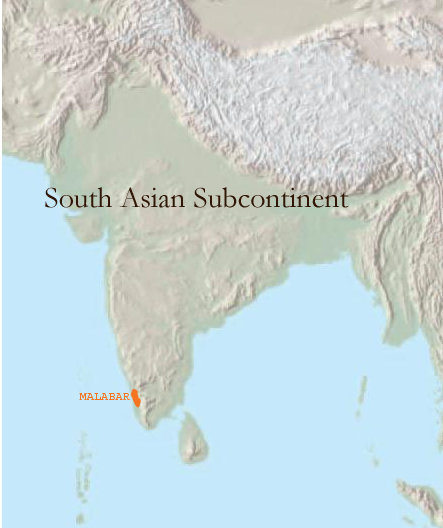
Chapter 1. The DISTRICT
Section A. - Its Limit's and Physical features.
The name by which the district is known to Europeans is not in general use in the district itself, except among foreigners and English-speaking’ natives. The ordinary name is Malayalam, or, in its shorter form, Malayam (the hill country).
The word Malabar is therefore probably, in part at least, of foreign origin; the first two syllables are almost certainly the ordinary Dravidian word mala (hill, mountain) and bar1 is probably the Arabic word burr (continent), or the Persian bar (country). From the time (A.D 522-547) of Cosmas Indicopleustes down to the eleventh or twelfth century A.D., the word “ Male ' was applied to the coast by Arab navigators, and the seafaring population, who flocked thither subsequently for pepper and other spices, called it Mulibar Manibar, Mulibar, Munibar, Malibar.
The early European travellers followed suit, and hence come the other forms in which the name has been written Melibar (Marco Polo), Minibar, Milibar, Minubur, Melibaria,
Malabria etc, Malabar may therefore be taken to mean the hilly or mountainous country, a name well suited to its physical characteristics.
NOTES
1 “Bar signifies a coast, in the language of the country,” p. 10(a) of Renaudet’s translation of “Ancient Accounts of India and China by two Muhammadan travellers in the nineteenth century A.D.”—Lond., 1733.
Malayalam is not, however, the only indigenous name for the district. The natives love to call it Keralam, and this and other names will be found treated of in the historical chapter.
The district is very widely scattered and consists of the following parts:
(a) Malabar proper extending from north to south along the coast, a distance of about one hundred and fifty miles, and lying between N. Lat. 100 15’ and 120 18’ and E. Long. 75° 14’ and 760 56’.
The boundaries of Malabar proper are north, (South Kanara district; east, Coorg, Mysore, Nilgiris, Coimbatore; south, the Native State of Cochin; west, the Arabian Sea.
(b) A group of nineteen isolated bits of territory lying scattered, fifteen of them in the territories of the Native State of Cochin and four1 in those of Travancore, but all of them on or near the coast line between about N. Lat. 9° 36' and 100 10' and E Long. 76° 14' and 76° 25'. These isolated bits of territory form the taluk of British Cochin.
(c) Two other detached bits of land imbedded in Travancore territory and also on the coast line, namely :
Tangasseri, N. Lat. 8° 54', E. Long, 76° 38', and
Anjengo, N. Lat. 8° 40', E. Long. 76° 49'.
(d) Four inhabited and ten uninhabited islands of the Laccadive group. The positions of the inhabited islands are notified below:
Agatti, N. Lat. 10° 50', E. Long. 72° 9', with four uninhabited islands, viz., (1) Parali, (2) Bangara, (3) Tinnakara, and (4) Kalpitti;
Kavaratti , N. Lat. 10° 31', E. Long. 72° 35', with three uninhabited islands, viz., (1) Pitti, (2) Valiyakara, and (3) Cheriyakara, the two latter islets forming together the Seuhelipar reef, thirty-seven miles south-west of the main island. Pitti, on the other hand, lies fifteen miles north-west of the main island;
Androth , N. Lat. 10° 47', E. Long. 73° 40', and
Kalpeni, N Lat. 10° 6', E. Long. 73° 35', with three uninhabited islands, viz., (1) Cheriyam, (2) Thilakka, and (3) Pitti.
(e) The solitary island of Minicoy (Menakayat) lying between the 8° and 9° ship channels. Its position is
N. Lat. 8° 18', E. Long. 73° 1'. Attached to it is the small islet of Viringilli, used for quarantine purposes by the islanders.
The Malabar Collector’s charge therefore lies scattered over four degrees of latitude and over more than four degrees of longitude. It embraces an area of six thousand and two square miles with something more to be added for the islands and out-lying parts, and, as may be easily imagined, it presents a vast variety in the conditions of its many parts.
NOTEs:
1: Since this was sent to press, an agreement has been arrived at with the Travancore Government to transfer Tangasseri and the four bits of territory belonging to the Cochin Taluk to Travancore in part exchange for the site of the Periyar dam designed to turn for irrigation purposes a portion of the waters of the Periyar (great river) across the ghats into the Madurai district. The agreement has not yet been carried out.
On the ghat range some of the mountain peaks rise to very nearly eight thousand feet with bright frosty nights in the cold season, and at the opposite extreme may be placed the radiant lagoons, the perpetual summer, and the coral reefs of the Laccadive Islands.
The coast line of Malabar proper trends from about north-north- west to south-south-east, and, at a distance inland from the coast of about twenty increasing as it goes southward to about fifty miles, rise the western shoulders of the great Mysore and Nilgiri plateaus and the Western Chats. The lowest points in the ridge of the Mysore plateau approximate invariably to about three thousand feet, while in the ridge of the Nilgiri plateau it would be difficult to find a point under six thousand feet.
The mountain line does not, however; present an even aspect when viewed from a distance on the west. It seems to approach and then to recede from the coast, and the reason of this is at once apparent to a traveller from the south who skirts the mountain bases and passes buttress after buttress thrown far out into the plains.
They form a magnificent array in echelon of mountain heights, with their front , facing southwards and with their loftiest ponies like grenadier companies protecting the right of the line. The district does not rise above this mountain harrier except at two points. The Wynad taluk, which lies above the ghats, is simply a portion of the great Mysore plateau. Behind the ridge of ghats forming the southern slopes of the Nilgiri range there also lie two forest-clad valleys—the Silent Valley and the Attapadi Valley—which likewise pertain to Malabar.
One of the most striking features in the country is the great Palghat gap, a complete opening some twenty miles across in this great backbone of the peninsula. Here, by whatever great natural agency the break occurred, the mountains appear thrown back and heaped up, as if some overwhelming deluge had burst through, sweeping them to left and right.
On either hand tower the giant Nilgiris and Anamalas, over-topping the chain of ghats by several thousand feet, while through the gap the south-west winds bring pleasant 'moist air and grateful showers to the thirsty plains of Coimbatore, and roads and railway link the Carnatic to Kerala. Through this the thousand streams of the higher mountains find their way to the sea, and the produce of the eastern and western provinces is exchanged.
The unique character—as a point of physical geography—of this gap in an otherwise unbroken wall of high mountains, six hundred miles long, is only equalled by its great economic value to the countries lying on either hand of it.
Stretching westward from the long spurs, extensive ravines, dense forests and tangled jungles of the ghat mountains lie gentler slopes, rolling downs and gradually widening valleys closely cultivated, and nearer the sea-board the low laterite tablelands end abruptly in cliffs and give place to rice plains and cocoanut-fringed backwaters.
Numerous rivers have hollowed out for themselves long valleys to the coast, where, backed up by the littoral currents, they discharge into the line of backwaters. These backwaters and the streams which flow into them and the canals which connect them afford a cheap means of communication to the inhabitants, and the rivers, backwaters and canals are crowded with boats conveying produce to market and huge unwieldy rafts of timber being slowly poled downstream to the timber depots.
The coast line, trending, as already said, from about north-north-west to south-south-east through a length of nearly one hundred and fifty miles, bears evidence throughout its length to a slow but steady encroachment of the sea upon the land. The prevailing littoral current is from north to south. It is one branch of the might ocean current which sweeps across from Madagascar and the east African coast and impinges on the Malabar coast at a point a little to the north of the northernmost part of the Malabar district whore it apparently divides into two branches, one going northwards and the other, and perhaps the main branch, flowing southwards down the coast. Its action is to be seen in the long sand-spits stretching from the north across the mouths of the rivers,—sand which in the wash of the waves travels slowly but most persistently from north to south—and in denuded headlands where the primeval rocks jut up and form barriers to the encroachment of the waves, which sweeping round the obstructions gradually hollow out bays to the southward of them.
The sea-board may be considered pretty open except to the north, where stand the island, hill, and wind-swept ruined fort of Mount Deli (eight hundred and fifty-five feet), a bold eminence of laterite and gneiss, and a conspicuous and well-known landmark to mariners. Further south and as far as Calicut the coast line is fringed alternately by low cliffs and long reaches of sand.
Beyond Calicut to the southward the shore is one long unbroken stretch of sand. The littoral currents, though persistent in their action, are nowhere strong, and hence deep water close in shore is nowhere to be found and there are no natural harbours suited for modern tonnage. The bottom of the ocean shelves very gradually, and so uniformly that experienced mariners have no difficulty in telling their distance from land at any point of the coast by the number of fathoms they find on sounding with the lead.
The coast does, however, afford some refuge to small craft with shallow draughts of water enabling them to cross the bars of some of the backwater outlets, and where the backwater is extensive and the scour on the bar is great (as at Cochin) comparatively large vessels do enter the estuaries and load and discharge in smooth water.
The Laccadive Islands and Minicoy are islands composed for the most part of coral sand, and limestone formed from it. The highest point of any of the islands is probably not more than thirty feet above sea-level. The islands are small and as a rule long and narrow, and within a few yards of the shore the bottom sinks abruptly beyond the reach of any ordinary sounding tackle.
In form the islands generally lie north and south in a crescent-moon shape with a more or less ample lagoon enclosed by a coral reef on the western and north-western sides. These lagoons are shallow as a rule, and on a calm, clear day the dazzling whiteness of the coral sand at bottom, the rainbow-coloured tints and diversified shapes of the living coral rocks, the intensely brilliant colours — cobalt, green, yellow and crimson—of the fish which dart out and in among them, and the exquisitely buoyant crystal clearness of the water on which he is floating, strike the visitor with surprise and leave indelibly impressed on his mind a picture of radiant, beauty such as few spots on earth can produce.
The islands themselves, however, are intrinsically uninteresting and are usually covered from end to end and down to within a few yards of sea-level with a dense mass of vegetation, consisting of cocoanut trees and a few bread-fruit and lime trees in the cultivated parts, and elsewhere a dense mass of impenetrable scrub and screw-pine (Pandanus odoratissimus) with here and there a few cocoanut trees towering above it.
SECTION B — Mountains
The mountains forming the Western Ghats, frequently in former days called the Sukhein1 mountains, range from three thousand to five thousand feet above sea-level on the Coorg and Wynad slopes, with one or two peaks, to be noticed presently, ranging over six thousand and up to nearly eight thousand feet. But on the Nilgiri-Kunda face the average height springs up to over six thousand feet. It falls again to about four thousand feet and lower on the southern Nilgiri slopes, and again rises to a high altitude in the Vadamalas (northern hills), fringing the northern edge of the Palghat gap.
NOTEs: 1. Probably a corruption of Sahyan or Sahyachalam - the mighty hills – the Western Ghats. END OF NOTEs
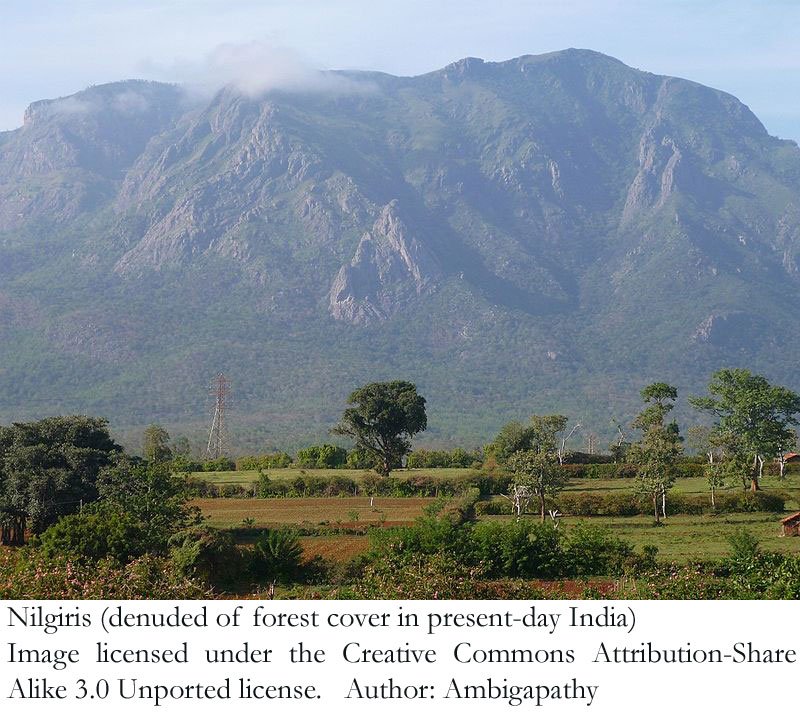
On the south edge of the gap the Tenmalas (southern hills), outliers of the lofty Anamala mountains, commence with an elevation of four thousand to five thousand feet above sea-level. Dwarfed into insignificance compared with the ghat mountains in the background there also occur dotted about on the plain country several hills of considerable elevation.
The following are among the most noteworthy peaks of the Western Ghats : —
Veidal Mala.—N. Lat. 12° 10', E. Long. 75° 36'. A long, level, grassy mountain, standing almost at right angles to the ghats and ending precipitously on its western face, supposed to be haunted by demon who displays a wonderful ruby stone at nighttime to lure men to their destruction.
The people have a tradition that a mighty robber, Veidal Kumar, used at one time to frequent this hill, and there is certainly near the western end the foundation of what must have been a large house. His neighbours in the low country finally combined against him, and, having won by treachery one of the passes to the hill, took his house and put its inmates to the sword, except one woman whose descendants can still be pointed out.
At certain seasons of the year - April, May and October—thunderstorms of terrific violence rage on the western summit of this mountain. Height above sea-level about 1,500 feet.
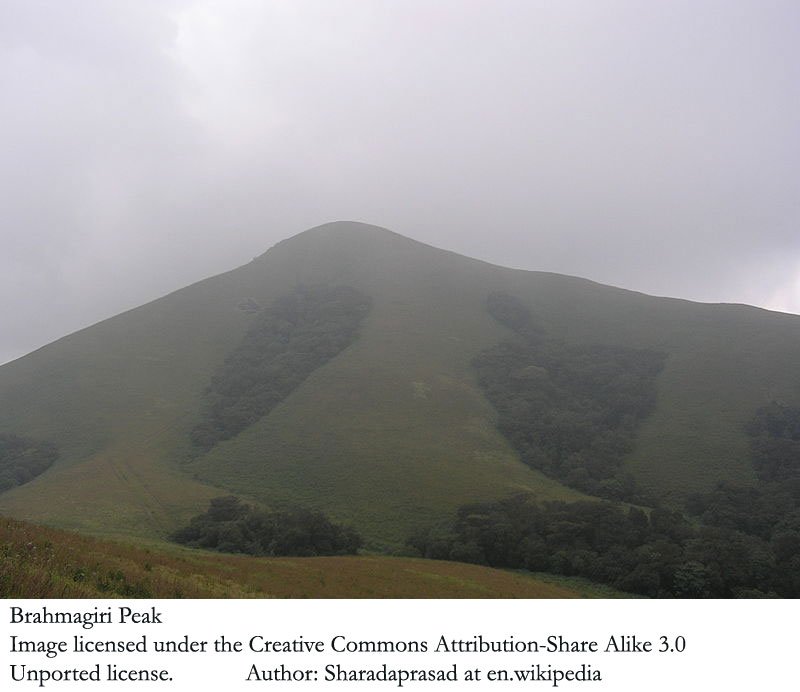
Brahmagiri Peak.—N. Lat. 11° 56', 12. Long. 70° 4’. On the edge of an elevated miniature plateau of beautiful grass and shola land, the greater portion of which lies in Coorg. Height 5,276 feet.
Banasur or Balasur Peak.—N. Lat. 11° 42', E. Long. 75° 58'. An isolated cone-shaped forest-clad hill towering high above the line of ghats. Height 6,762 feet.
Naduvarum Peak. -N. Lat. 11° 44', E. Long. 750 51’. An important Great Trigonometrical Survey station. Height 4,557 feet.
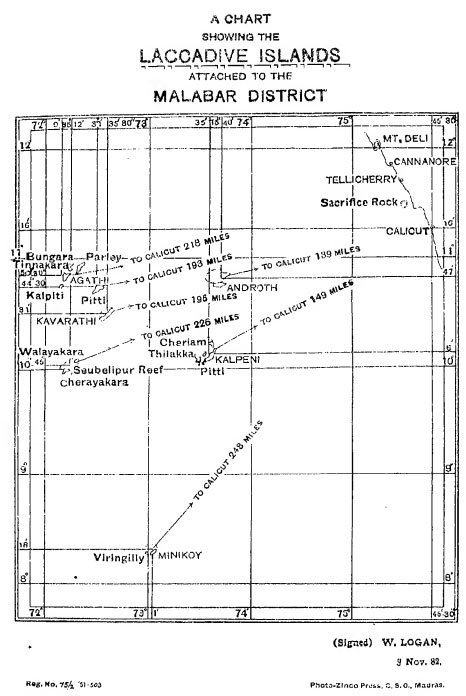
Tanolemala.—N. Lat, 11° 32', E. Long. 70° 2'. Overhanging the Tamarasseri pass into Wynad. Height 5,095 feet.
Elambileri Peak.—N. Lat. 1l° 31', E. Long. 76° 9'. A precipitous needle-shaped hill in the very heart of the best coffee-producing district in Wynad. Height 6,806 feet.
Vellera Mala.—N. Lat. 11° 27', E. Long. 76° 12'. A massive hill in the same famous coffee-producing district. Height 7,364 feet.
Vavulamala (Camel Hill) or Camel’s hump. N. Lat. 11° 26', E. Long. 76° 11'. The highest peak in the Wynad, and a most conspicuous landmark from all points on the coast and from far out at sea, covered to the very top with virgin forest. Height 7,677 feet.
Nilgiri Peak. - N. Lat, 11° 23' E. Long. 70° 32', and
Mukurti Peak.—N. Lat. 11° 22' E. Long. 70° 36'. Height 8,380 feet. Both on the Nilgiri-Malabar boundary.
Anginda Peak.—N. Lat. 11° 1 1', lib Long. 76" 31'. Also on the edge (southern) of the Nilgiri plateau. Height 7,828 feet.
Karimala.—N. Lat. 10° 56', E. Long. 70° 43'. The height point on the mountains to the north of the Palghat gap. Height 6,556 feet.
South-west of it, and forming the extreme point of that range is —
Kalladikod Peak.—N. Lat. 10° 54', E. Long. 76° 39'. Perhaps the stormiest peak in all Malabar, so much so that the native proverb is, “If Kalladikodan grows angry (or black) will not the Karuga river be swollen.” Its height has not been accurately ascertained, but it is close upon or over 4,000 feet.
The following hills lie dotted here and there over the plain country : —
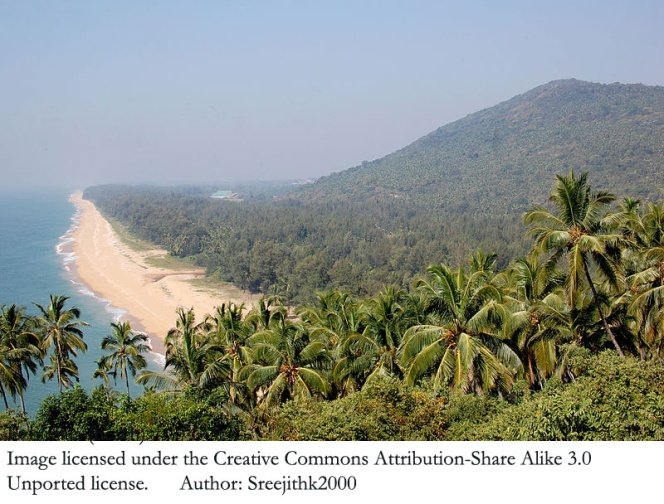
Elimala or Mount Deli.—N. Lat. 12° 2', E. Long. 75° 16'. A conspicuous isolated hill on the sea-shore, well known as a landmark for mariners since the earliest times. Vasco da Gama’s pilots foretold that the first land to be sighted would be ‘a great mountain1 which is on the coast of India in the kingdom of Cannanore, which the people of the country in their language call the Mountain Delielly, and they call it of the rat, and they call it Mount Dely, because in this mountain them were so many rats that they never could make a village there.”
Eli certainly means a rat, but the name of the hill is written with the cerebro-palatal1. The legend which Correa obtained was like that which conferred on it likewise the sounding title of sapta-shaila or seven hills, because elu means in Malayalam seven, and elu mala means the seven hills, of which sapta-shaila is the Sanskrit equivalent.
Now, as a matter of fact, there are not seven peaks to this hill, just as probably the rats were no worse there than they were anywhere else on the coast. But eli2 in clearly identical with Marco Pole's “Kingdom3 of Eli” and Ibn Batuta’s Hili, and as the Eli Koviligam, the second oldest of the palaces of the ancient line of Kolattiri Princes, lies at a very short distance from the northern slopes of the hill it is clear that the name of the hill was given to the palace, or that of the palace to the hill. Height 855 feet.
NOTEs:
1: Stanley’s “Three voyages of Vasco da Gama and his Viceroyalty from the Lendas da Índia of Gaspar Correia, &c.”—Hakluzt Soc., London, 1869, p. 145
2: The conversion of eli into Deli was simple enough, for the early Portuguese would call it the Monte D’eli.”
3: Yule’s “Marco Polo,” Chap. XXIV of Book HI, Vol. II, pp. 374 to 377 Lodonn, 1874
Chekunnu.— N. Lat. 11° 15', E. Long. 76° 9'. On the outskirts of the Camel Hump range. Height 1,975 feet.
Urolmala. N. Lot, 11° 5', K. Long. 70° 4'. Overlooking the European military outpost of Malapuram. There is on its summit a small Hindu temple with an inscription of no great antiquity. Height 1 ,573 feet.
Pandalur. — N. Lat. 11° 3', E. Long. 76° 14'. Also overlooking the Malappuram outpost. It is covered for the most part with dense scrub jungle, but one or two coffee gardens have been opened with success on its northern slopes. At some distance from the summit and on the east face of the hill is a perennial spring of excellent water flowing from beneath an immense boulder of rode. The spring is supposed to be haunted, and, as a matter of fact, a solitary Mussulman Fakir used to inhabit a tiger’s cave close to the spring.
A magnificent panoramic view of mountain scenery is obtained from various points of this hill, but particularly from the highest point of it a piled up cone of rocks reaching to a giddy level with the tops of the forest trees. Height about 2,000 feet.
Pranakod—N. Lat. 10° 59', E. Long. 76° 21'. The summit of a small densely wooded range of hills which, with the range last mentioned, seems to form at this point the advanced guard of the Nilgiri Mountains. Height 1,792 feet.
Anangamala.—N. Lat. 10° 49', E. Long. 76° 27'. A long precipitous isolated rocky Hill, a conspicuous landmark. There are one or two small coffee gardens on its slopes. Height 1,298 feet.
To the above list of mountain peaks and lulls, most of which are stations of the Great Trigonometrical Survey, may be added the following list of other survey stations of less elevation; —
Cannanore: N. Lat. 11° 52', E. Long. 75° 25'. Height 51 feet,
Darmapattanam.—N. Lat. 11° 46', E. Long, 76° 31'. Height 112 feet.
Manantoddy.—N. Lat. 11° 48', E. Long. 70° 4'. Height 2,558 feet.
Purakad.—N. Lat. 11° 28', E. Long. 75° 43'. Height 260 feet.
Pukunnu—N. Lat. 11° 14', E. Long. 75° 53'. Height 279 feet.
Kurnad.—N. Lat. 10° 47', E. Long. 76° 9'. Height 354 feet.
Kurachimala.—N. Lat. 10° 47', E. Long. 75° 41'. Height 479
Palghat Fort.—N. Lat. 10° 46', E. Long. 76° 43’ Height 349 feet.
The latitudes and longitudes given are those of the ordinary Indian Atlas Sheets, Nos. 44, 44, 61 and 62, and not the revised values found recently by the Great Trigonometrical Survey : the heights, however, are correct.
Section C.—Rivers, Backwaters and Canals.
The river and backwater system of the district had much to do with the development of the country in the early days of foreign intervention, for those afforded the easiest and cheapest and almost the only moans of communication in times when wheeled traffic and pack-bullock traffic were unknown. And accordingly it is found that the foreigners settled most thickly close to or on the rivers and selected sites for their factories so as to command as much as possible of these arteries of traffic.
The Portuguese (subsequently Dutch) factory at Cannanore, with its outwork on Mount Deli point, commanded the river navigation of the whole of the Kolattiri’s northern domain. The English factory at Tellicherry, with its outworks on Darmapattanam island, secured to the Honourable Company the largest share of the trade in the excellent pepper produced in the Randattara Achanmars’ territory, in the Kottayam Raja’s domain, and in that of the Iruvalinad Nambiars, tapped by the rivers converging at Dharmapattanam.
The French factory at the mouth of the Mahe river did the same for the Kadattanad Raja’s territory drained by that river. The Portuguese, the English, the French, and the Danes had factories in the Zamorin’s territory at Calicut, whither was conveyed by water the produce of the territories of the Zamorin, and of his more or less dependent chieftains, the Payurmala Nayars, the Kurumbranad Rajas, the Tamarasseri branch of the Kottayam family, the Parappanad Rajas, and the Puluvayi Nayars.
At Ponnani the water communication was defective because inconstant, so it was not much sought after as a factory site; whereas Chetwai, at the mouth of a widespread river and backwater system, was in much request by Portuguese and Dutch and subsequently by the English, and was often hotly contended for.
Cochin, where the Portuguese and subsequently the Dutch formed large settlements, owed its importance no less to its unsurpassed water communications with the interior as to its deep bar and landlocked harbour for the ships of small draught of water then in vogue. Again from Tangasseri the Dutch could command the largo expanse of navigable rivers there finding outlet to the sea. And finally the English at Anjengo settled on an inhospitable sandspit with the ocean on one side of it and a navigable river on the other, just because of the advantages which this river and neighbouring creeks afforded for bringing the produce of the country to their Company’s mart.
These were the great emporia of foreign trade, but at the head of the tidal portion of each river, and at favourable sites on its hanks, the pioneers of the great foreign companies had their trade-outposts and warehouses, and at all such places sprang up settlements of the classes (chiefly Muhammadans) who carried on the trade of the country. Such settlements still exist, but with the opening up of roads, canals and railway, and the centralizing influence of trade, their glory has largely passed away from them.
The following are the chief rivers, backwaters, canals, etc., in. the district, and the latitudes and longitudes are taken from the Indian Atlas Sheets Nos. 14, 61 and 62, and are those of the river mouths where they empty themselves into the ocean, or, in the case of rivers flowing eastward, those of the places where they finally leave the district: -
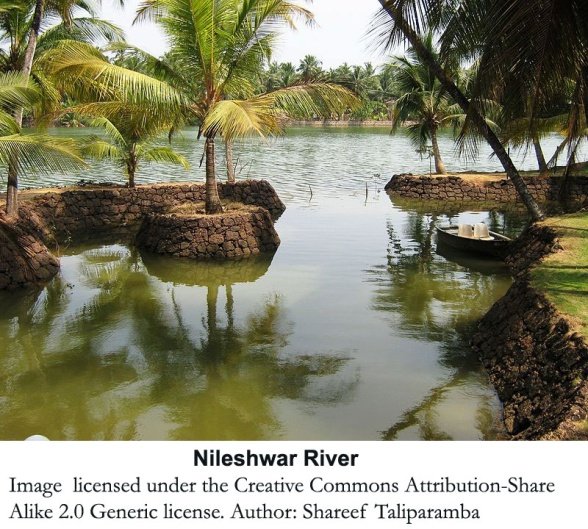 The Nilesvaram River.—N. Lat. 12° 4', E. Long. 75° 14’ This river, which is about forty-seven miles in length, lies for the most part in the district of South Canara. It drains, however, what is still a Malayalam country, and what was formerly the most northern portion of the kingdom of the Kolattiris. Country craft of small burthen can enter its mouth for a short distance.
The Elimala, or Mount Deli River N. Lat. 12° 2', E. Long. 75° 18’. The course of this stream is only about thirty miles in length. It rises in the ghat mountains and loses itself in a number of crooks to the east and north-east of the mount. One or more of these join the waters of the Nilesvaram river, and the chief one flows south and enters the sea in the angle of the bay formed immediately to the south of and under the very shadow of the mount itself.
These creeks being tidal, therefore convert the mount peninsula into an island. The sluggish water of these brackish crooks is extremely favourable to the crocodile tribe, which here at times attain prodigious dimensions, and with increasing weight they gain an appetite for the flesh of men and animals which makes it extremely dangerous for fishermen, and agriculturists too, to pursue their callings in such haunts. A crocodile fifteen feet in length is far more than a match for the strongest buffalo. The prodigious length of his ponderous jaws, armed with sharp-pointed interlocking teeth, give the reptile a hold of his victim which enables him to make full use of the enormous dead weight of his ungainly carcass as well as of his immense muscular power.
So much are these reptiles feared, that people in boats even are sometimes not exempt from danger, and dwellers by the water-side generally have guns loaded to take advantage of their enemies. Sometimes the whole country-side turns out to drag them from their lairs by nets of strong meshed rope.
The Sultan's Canal.—N. Lat, 12° 2', E. Long. 75° 18’. This is an artificial work (about two miles in length), undertaken and executed in 1766 by Ali Raja, the husband of the Bibi of Cannanore, when managing the Kolattiri domains for Haidar Ali. It connects the Mount Deli river with the backwater formed at the mouth of the Taliparamba and Valarpattanam rivers, and thus gives uninterrupted water communication at all seasons. Formerly boats going to or from the north had to go out to sea at this point.
The Taliparamba River.—N. Lat. 11° 57', E. Long. 75° 22'. The main branch of this river is navigable at all seasons for boats as far as the lower slopes of the ghat mountains. After passing Taliparamba the main branch is joined by one from the cast, and the two together spread out into an extensive sheet of water, the haunt in certain seasons of large flocks of aquatic birds. Bending slightly to the north and passing under the guns of an old ruined fort of the Kolattiris, - the united streams then suddenly turn at Palangadi (ancient bazaar) due south and run in a course parallel to the sea till they meet the stronger current of the Valarpattanam river, united to which they force for themselves a passage to the sea through the sand shoals thrown up by the littoral currents. A large tract of fertile garden land has been formed by the continuous action of the littoral currents damming up the mouth of this river. Its length from source to mouth is about fifty-one miles.
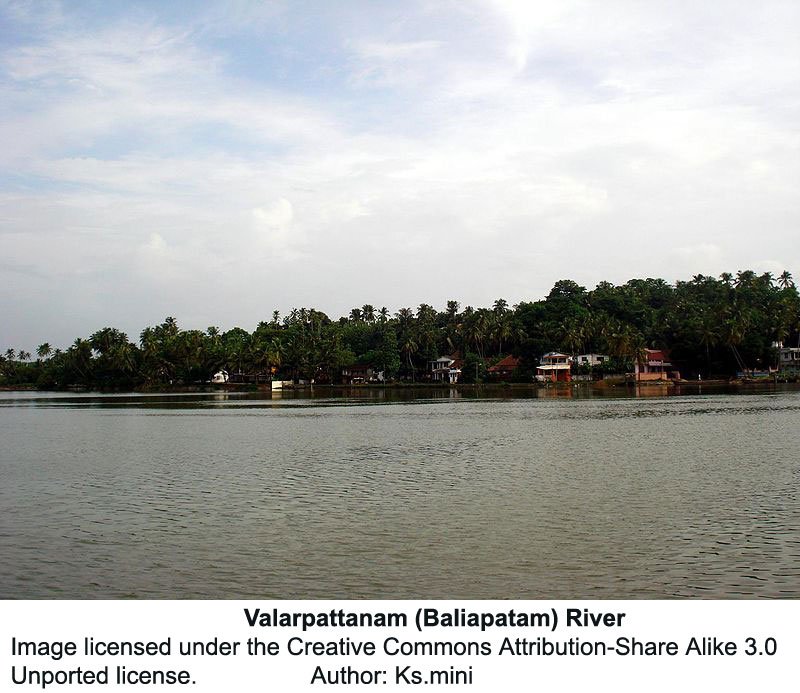 The Valarpattanam River.—N. Lat. 110 57', E. Long. 75° 22’. Though the length of this river is less than that of several others in Malabar proper, it perhaps discharges more water into the sea than any of them. It has three large branches, one of which joins the tidal part of the main stream and is itself navigable for boats almost to the foot of the ghat mountains. Near the head of the navigable portion of this branch lies one of those pioneer settlements of trading foreigners (Muhammadans) already alluded to, and it is in this out-of-the-way place that, local tradition says, was founded one of the nine original Muhammadan mosques.
The tradition is, that this place, the “Surrukundapuram” of the Indian Atlas, was in former days the chief emporium of trade with the fertile lands of Coorg and the sandal forests of Mysore, and that this is the place to which Ibn Batuta travelled from Hili (Elimala), and about the exact locality of which there has been some speculation. It is just about one day's journey, by water all the way, from Mount Deli.
On the main branch of the river the head of the navigable portion is likewise marked by a pioneer settlement of foreign traders (Muhammadans) located in the village of Irukur (Erroocur of the Atlas). The trade route to Mysore and Coorg in more recent times lay through this village, and it was through this village that one of the columns of the force despatched against Coorg in I834 laid its route.
Further up stream, at Irritti, and just below the junction of its other two main branches, the existing trade route via the Perambadi ghat crosses the river by a lofty bridge of masonry piers and abutments with a superstructure of wood about to be replaced by iron lattice girders. Beyond this bridge the sources of the river lie in the ghat mountains and in primeval forest, much of which is still inhabited only by wild beasts. The lengths of these two main branches above Irritti bridge are respectively about thirty-two and twenty-eight miles, and the whole length of the stream may be taken to be about seventy-four miles.
At the village of Valarpattanam near its mouth there is a well-preserved fort on a lofty cliff on the south bank of the river completely dominating the stream, and further west on an island, in the backwater was yet another fort called Madakkara. The former belonged to the Kolattiri, and was evidently planned for him by European engineers; the latter was one of the outworks built by the Honourable Company’s factors at the English settlement of Tellicherry to protect the Company’s trade on those rivers. Country craft of considerable size enter the river and lie off the village of Valarpattanam.
The Anjarakandi River.—N. Lat. 11° 47', E. Long. 75° 32'. This river rises in the heavy forest land on the western face of the Wynad ghat slopes, and after a course of about forty miles divides into two branches and thus forms the island of Darmapattanam at its junction with the sea. It is navigable for boats at all seasons to a place called Venkat some distance above Anjarakandi. At Venkat the Honourable English Company had a trading outpost in the very heart of the finest pepper-producing country in Malabar.
And at Anjarakandi the Honourable Company started an experimental garden for the growth of various exotics. The command of the traffic on this river was considered so important that Darmapattanam island at its mouth, acquired by the Honourable Company in 1734-35, was heavily fortified and garrisoned from the Tellicherry factory, and it was even proposed to give up the Tellicherry factory altogether and to build a new one on Darmapattanam island.
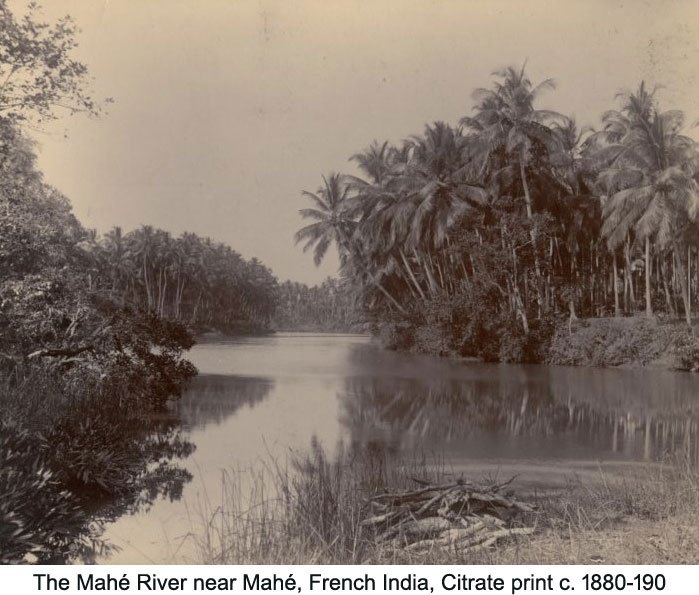 The Tellicherry River.—N. Lat. 11° 43’ E. Long. 75° 33'. This is an insignificant stream navigable for boats to a distance of only about three or three and a half miles, and in length altogether its course is about fourteen miles. Small country craft do, however, enter its mouth and lie above the bridge which spans it. It was of importance as affording protection to the English factory at Tellicherry on the northern and eastern landward sides, and the natural protection it afforded was further strengthened by small fortified outworks at various points of vantage. It was frequently called the Kodoli river from the fort of that name, commanding the bay at its month. At a short distance above Tellicherry it still forms the boundary of the French aldee, of Pandakal, a detached outlying portion of the French settlement at Mahe.
The Mahe River. - N. bat. 11° 43', E. Long. 75° 36'. This stream rises in the heavy forests of the Wynad ghats, and after a course of about thirty-four miles falls into the sea at the French settlement of Mahe, of the main portion of which it forms the northern and eastern boundary for a distance of about two miles. It is navigable for country craft of a small size for a distance of about half a mile and for boats as far as Parakadavu some twelve miles farther up stream.
The Kotta River.—N. Lat. 11° 34', E. Long. 75° 39'. It is so named from a fort (kotta) commanding the entrance to the sea. It was notorious in former days as a haunt of pirates, one of whom Kottakkal Kunyali Marakkar, made his name famous. It drains a heavy mass of virgin forest on the western slopes of the Wynad ghats, and, the rainfall being excessively heavy in those parts, the river discharges for its length, only some forty-six miles, more than the usual quantity of water for rivers of its size. It is navigable at all seasons for boats as far as Kuttiyadi, which lies closely adjacent to the chain of ghats, and from this point a pack-bullock road runs up the mountains into North Wynad. The water communication on this river is linked on the one hand on the north by —
the Vadakkara Canal. N. Lat 110 36', E Long. 750 38' - partly natural and partly artificial, to the thriving trading town of Vadakkara, and on the south by another canal made in 1843 and called —
the Payoli Canal—N. 110, 31', E Long. 750 43' length about one mile, to the extensive natural backwater communication of—
the Agalapula, which means lit orally broad river. This broad river or backwater receives no stream of any importance, indeed nearly all the drainage from the ghats at this point is intercepted by the main stream and tributaries of the Kotta river, so that for a distance of about sixteen miles (N. Lat 110 31', E Long. 75° 43', to N. Lat. 11° 22', E. Long. 750' 48') this backwater runs in a course parallel to the sea until it meets the Ellattur river close to the mouth of that stream. The importance of this natural water communication can hardly be overrated. It would seem as if the Kotta river had at one time found its way to the sea by this outlet instead of by the channel now in use, and indeed even now the water-level in the Kotta river sometimes rises so high as to threaten to breach through the narrow isthmus separating it from the Agalapula, the water-level of which rises of course much less rapidly in floods. This difference of level in floods necessitates the maintenance, of a water-lock at the entrance to the Payoli canal from the Kotta river.
The Ellatlur River.- N. Lat, 11° 22', E Long. 75° 48'—is in length about thirty-two miles, but it is a shallow stream, and, except near its mouth, is not suited for boat traffic. It is connected with the Kallai river and backwaters and with the Beypore river beyond by —
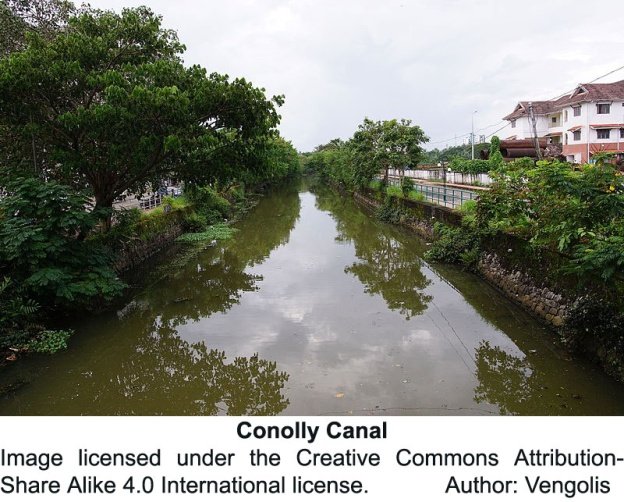
the Conolly Canal, which, taking advantage of the natural facilities already existing, loops together the drainage areas of the three streams above mentioned. The canal was constructed under the orders of Mr. Conolly, the Collector of Malabar, and was completed in the year 1848. It consists of a cut about three miles in length through several low ridges intervening between the Ellattur river and the Kallai river ; the deepest cutting is about, thirty feet through laterite rock, and the width which is irregular, is in the narrowest portions about twelve feet. The depth of water in the cutting at low tide is only a few inches. Imperfect as it is, the facilities it affords to traffic are largely utilised, and it is likely to be ere long much improved in the carrying out of an extensive scheme proposed so long ago as in 1822 by Special Commissioner Mr. Graeme for affording inland water communication from Travancore northwards.
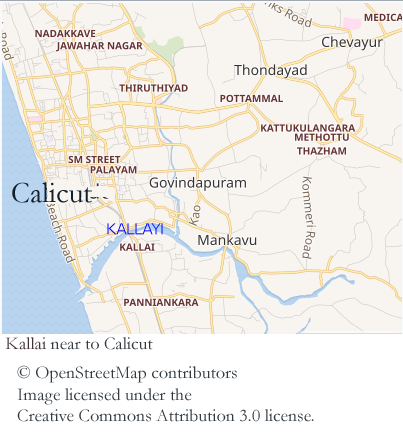 The Kallai river. N. Lat. 110 14', E. Long. 75° 51'. The stream, which, in the monsoon months only, forces a way for itself into the sea through the sand shoals thrown up by the littoral currents on the beach at Calicut, is a very insignificant one, and attains a length of about fourteen miles only. Connected with it, however, are several pretty extensive back-waters, and these again are looped on to the Beypore river by a narrow creek.
The Beypore river. N. Lat. 110 9’, E. Long. 75° 52'-—drains a very extensive tract of the Wynad ghats and Nilgiri mountains. This is the only stream in Malabar which brings any considerable portion of its waters from above the crest of the ghat mountain ridge. Its two main branches rise respectively one in the Kunda mountains on the Nilgiri plateau and the other on the lower ranges of south-east Wynad. The one, called the Gold river, passes over the ridge of ghats in a long succession of rooky cataracts lying a short distance south of the Karkur pass.
The other, called the Chola river, leaps down from the crest of the Wynad bills in a magnificent cataract close to a footpath known as the Choladi pass. The two streams, after receiving many large feeders, unite in the midst of the Nilambur Government teak plantations, and then flow on, receiving several important feeders from north and south, to their outlet into the sea at Beypore, the old terminus of the Madras Railway south-west line, a total distance in the ease of the main branch of about ninety-six miles.
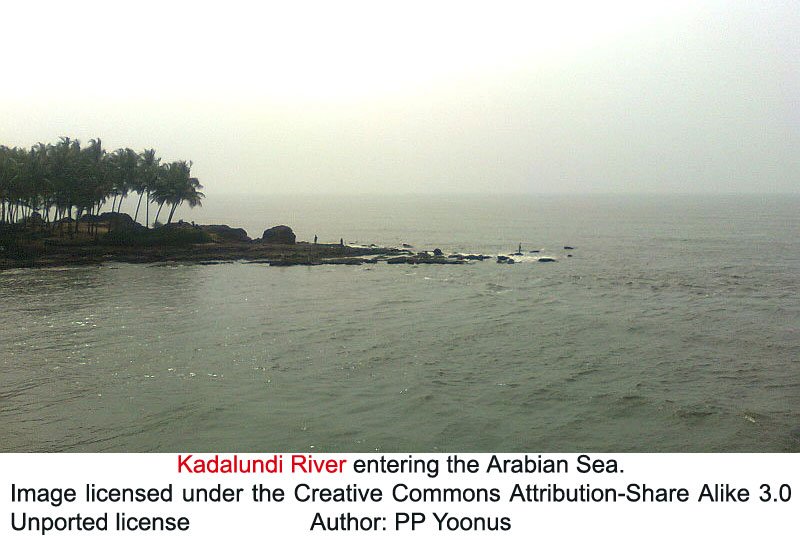 This river discharges a very large volume of water in the monsoon seasons, and the scour on the bar is thus sufficient to maintain a depth of about six feet at low tide which enables country craft to enter and lie about half a mile up-stream opposite the custom house and railway terminus. Even in the height of the dry season also boats of light draught can ascend the stream as far as Mambat under the very shadow of the lofty Camel Hump range. There as usual (and also at Arikod) are to be found colonies of Muhammadan traders settled for ages. The sands of this, and indeed of all the streams descending from the ghat mountains in Malabar, have from the earliest times been known to be auriferous, and even now some of the lower classes of the population try to eke out a precarious livelihood by washing the sands after each annual flood.
The Kadalundi river--N. Lat. 11° 8', E. Long. 75° 53'—is united to the Beypore river by a creek, and thus is formed the island of Chaliyam, on which was placed the old terminus of the Madras Railway south-west line.
The Kadalundi river comes from the western slopes of the Nilgiri mountains and of the Silent Valley range, and its main branch is seventy-five miles in length. The country through which it passes is on a higher level than the valley of the Beypore river, and hence the boat traffic on this stream is very limited except during the annual flood season when boats can get up-stream as far as Malappuram and even farther, but in the dry season boat traffic is confined to a few miles near the mouth of the river.
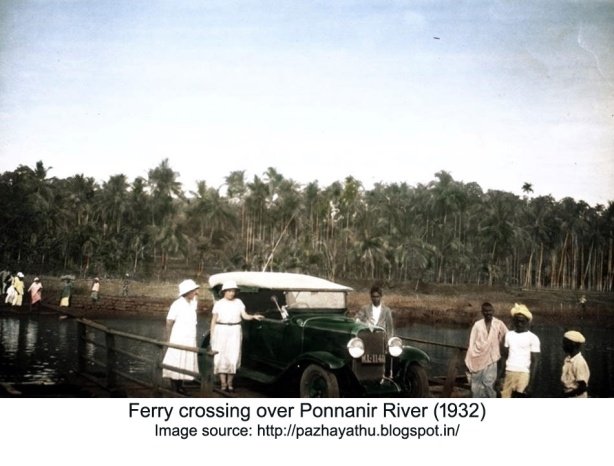 An unsuccessful attempt, continued down to 1857, was made by several Collectors to connect by a canal the Kadalundi river with the hack-waters and creeks of the Ponnani river. A outting was made, and for a day or two in the height of the monsoon, when the country is flooded, boats can pass with some difficulty from the one river to the other, but at other seasons this is impracticable. A great natural obstacle to the successful construction of this canal was that at a short depth below the surface, a bed of unctuous clay or mud was found, which oozing into the canal filled it up sufficiently to prevent the passage of boats. This liquid mud seems to be of the same character with that which, forced upwards from the bottom of the sea by submarine volcanic action or by subterraneous pressure of water from the large inland back-waters, forms the mud banks or mud bays in which at one or two places on the coast (notably at Narakal and Alleppey) ships can ride in safety and load and discharge cargo throughout the monsoon season. The same difficulty was experienced at Calicut in making a short canal from the Kallai river to the main bazaar.
The Ponnani river.—N. Lai. 10° 48', E. Long. 75° 59'. This is the longest of the rivers which discharge into the Arabian Ocean in Malabar proper. The main stream is about one hundred and fifty-six miles long, and the lengths of its three chief tributaries before they join the main stream are respectively about sixty, fifty and forty-six miles. But the volume of water discharged from, the large area drained by this river and its tributaries is probably not so great and is certainly not so constant as that discharged either by the Valarpattanam river or by the Beypore river.
The reason of this is that the main stream comes from the arid plains of Coimbatore, and its drainage area in the mountains under the influence of the south-west monsoon is comparatively small. This tract, too, lies further inland than the mountain ranges to the north of them. The south-west line of the Madras Railway strikes the course of this river at the Palghat gap and runs along close to the stream till within a mile or two of the coast. The bed of the stream in the lower roaches is generally sandy, and the water is shallow, but in the rains loaded boats do ascend the stream for considerable distances There is never, however, except during the rains, a current at its mouth sufficiently strong to maintain a deep and wide channel through the sand drifts carried by the littoral currents. The bar is therefore always considerably impeded by shoals, and at times when the first monsoon floods come down the river the water is backed up and floods the surrounding country till the rush of water has cleared away these sand shoals. Dangerous deep currents are thus formed, and the river-side portion of Ponnani town which stands at its mouth is always in more or less danger from erosion, and in fact the town is only preserved by groynes, for the proper maintenance of which a special voluntary cess is paid by the mercantile community. This river near its mouth is connected on the north by a navigable crook with the railway system at Tirur railway station, and on the south by—
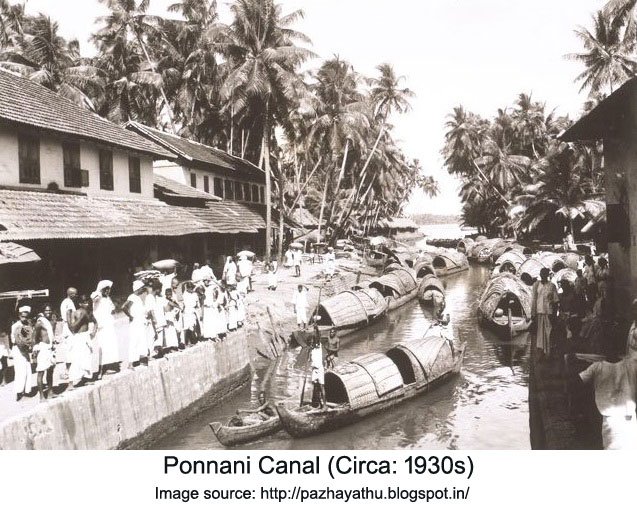 the Ponnani canal with the back-waters of Velliyankod, which again communicate with those further south, and boat traffic is by those means possible from the railway at Tirur down to Trivandrum, the capital of the Travancore State, a distance of over two hundred miles. But the water communication is only practicable at all seasons at present for small boats, and a scheme is under consideration for improving it. Among the most urgent requirements is the widening and deepening of the cut about two miles in length — connecting the Ponnani river with the Velliyankod back-water. The cut is at present only about fifteen foot, wide, and the water in it is only a few inches deep at low tide.
The Velliyankod back-water.-- N. Lat. 10° 44', E. Long. 76° 0’. No stream of any importance joins this system of lagoons and back-waters, and the opening to the sea is maintained by the force with which the tide ebbs and flows. It is united with —
the Chamkkad back-water by creeks which, together with the latter, extend from N. Lat. 10° 44' to 10° 32' and from E. Long. 76° l' to 76° 6', a distance in all of about fifteen miles. In all this distance no stream of any size flows into or out of the back-water ; indeed two ridges running parallel to the coast line seem to shut off drainage both from east and west. This hollow is filled with fresh-water in the rains, and two rude embankments of wattle and mud are made at the end of the rains to keep in the fresh and to prevent the influx of salt-wafer, which would otherwise destroy the heavy rice-crops raised within the enclosure.
The passage of boats is maintained by sliding them with extra help over the obstacles on the unctuous mud of which the embankments are formed. At its southern extremity the back-water joins
the Chewai river.—N. Lat. 10° 31', E. Long. 76° 6'. The mouth of this river and about six miles of its course lie entirely in British territory, and for about two miles more it forms the boundary between British territory and the Native State of Cochin. At the end of this eight miles the river widens out into a lake, partly natural and partly artificial.
The Trichur or Ennamakkal lake—N. Lat. 10° 25' to 10° 35', E. Long. 76° 10' to 76° 16'—as it is called, is of considerable size, about twenty-vivo square miles, and of great value, and deserves notice, if only for the singular struggle of human industry against the forces of nature to which the cultivation of its bed demands. From the subsidence of the floods of one year to the commencement of the following rains the space of time is barely sufficient for the garnering of a crop. At the close of the rains the water in the lake, which is protected from tidal influences by a masonry dam at Ennamakkal, is drained off by ceaseless labour day and night with Persian wools aided not unfrequently now-a-days by patent pumps driven by portable steam-engines, whose fires glow weirdly across the waste of waters on dark nights while the incessant throb and rattle of the engines and machinery strive hard to dispel any illusions. Every foot of ground that can be thus reclaimed is protected by fences of wattle and mud and is planted up with well-grown rice seedlings.
Spaces are left between the fields, and into these channels the water drawn from the fields is poured, so that boats have to be employed for visiting the different fields, the dry beds of which lie some three or four feel below the level of the water in the canals. In the dry weather the lake presents a magnificent level green expanse of the most luxuriant growing rice, the pleasant effect of which to the eye is heightened by contrast with the snowy plumage of the innumerable cranes and other aquatic birds which here revel in a continual feast. With the early thunder harbingers of the south west monsoon in April re-commences the struggle with the slowly but steadily rising flood. Numberless Persian wheels bristle in their bamboo frameworks for the contest with the threatening floods, and as the season advances thousands of the population, many of them good caste Nayar women, are perched high above the scene on those machines continuing the day and night struggle with the rising floods for the preservation of their ripening crops. The bulwarks of the fields are frequently broached and the unmatured crop drowned.
Often a large area has to be reaped by simply heading the stalks from boats ; but, as a rule, an enormously rich crop rewards this remarkable industry. A small portion only of this lake lies in British territory. The major portion belongs to the Cochin State, and, as already observed, a masonry dam at Ennamakkal is necessary to maintain the level of the fresh-water in the lake and to keep out the salt-water. The original dam seems to have been formed some time during the eighteenth century by (it is said) the united efforts of the Zamorin and Cochin Rajas. They erected an embankment of hewn stone above two hundred feet long across the backwater at Ennamakkal.
In 1802 Assistant Collector Mr. Drummond, under an erroneous expectation of benefiting the neighbouring lands, caused the dam to be partially destroyed ; but the consequence was that a largo area of land fell out of cultivation owing to the influx of salt-water. Various attempts were made, especially in 1823 and 1842, to reconstruct the dam on the original plan. A project for a now dam lower down the river at Chetwai was proposed, and between 1855 and 1858 preparations for constructing this work were undertaken. The idea was abandoned, however, after Rs. 35,000 had been spent on it, and since then the original dam has been annually patched up at the joint cost to the British and Cochin Governments.
The last stream to find its way into the sea, in British territory is-
The Cochin river- N. Lat. 90 38’ E. Long. 760 18’ It can hardly be called a river, for it is rather the tidal opening, of an immense system of back-waters in which numerous large rivers from the ghat mountains lose themselves. These back-waters extend far away north into Cochin territory and far away south into Travancore and afford an admirable means of conveying the produce of this immense tract to its market at Cochin. The rush of water across the bar is so great as to maintain a depth on it of about, twelve feet of water, which enables ships of a considerable size to come into harbour and load in smooth water. The depth is, however, insufficient for the large trading steamers employed in the coast traffic, and many of the sailing ships even which convey the produce to foreign countries are unable to cross the bar when loaded. These sometimes take in a portion of their cargo inside, and then go outside to the roadstead to complete their lading. Many proposals have from time to time been mooted for improving the Cochin river harbour, and a steam dredge was sent out from England to deepen the bar. It was found to be unsuited for working in the rough water which always more or less prevails on the bar, and it was also found that the depth of water in the channel inside the bar was suited for the merchant steamers of the present day.
A proposal to make a close harbour has also been set aside on the ground of expense. The trade of Cochin, considerable as it is, could not afford to pay the interest, on the largo sum required for this purpose.
Besides the above rivers which flow into the Arabian sea in Malabar, there are three of the largo tributaries of the Kaveri river which deserve mention as having their sources in Malabar. Those are —
The Kabbani River- N. Lat. 110 52’ E. Long. 76° 16’ - which has its sources in Wynad, and which at times, owing to excessive rainfall on the ghat mountains, rolls down a very heavy flood to its parent stream. It and its tributaries drain, nearly the whole of North and South Wynad, but their beds are too rocky and too shadow to permit of any traffic on them beyond the floating of timber.
The Rampur River—N. Lat. 11° 12', E. Long. 76° 48'—resembles the Kabbani, into which it eventually flows after draining a large portion of South-East Wynad.
The Bavani River - N. Lat. 11° 12', E. Long. 76° 48'—rises in the Kunda mountains on the Nilgiri plateau, and, after following a circuitous course through the Attapadi Valley, in which it barely escapes tumbling over the ghats to the westward, it returns again to the shadow of the Nilgiri mountains just, before leaving Malabar. It is joined in the valley by one large and several small feeders. The former is called the Siruwani or small Bavani and rises on the crest of the lofty forest-clad mountains on the northern edge of the Palghat gap.
Acquiring a considerable volume in a sort of amphitheatre of mountains on the very crest of the ghats it pours itself in a magnificent cataract, said to be two thousand foot high, over a precipitous ledge of rock which horns in the Attapadi Valley on the south.
At the top of this lodge of rook is a deep pool in the bed of the stream called Muttukulam, which is regarded with superstitious awe by the people, and about which many wonderful stories are told. By those who have never been to see it, it is said to be fathomless, and the people declare that extraordinary and tremendous noises do at times issue from it, and full cracking among the mountains.
Section D. — Geological Formation.
With the exception of the auriferous quartz-reef country in South-East Wynad, the detailed consideration of which falls more appropriately under the heading of the gold industry in Chapter VII, the district has not yet been scientifically surveyed by the Geological Survey Department, but Mr. W. King, the Deputy Superintendent for Madras, has embodied in his “General sketch of the Geology of the Travancore State” the results of his observations gathered in visits to Malabar and Cochin, and those, as he says, enables him to “generalise as to the lie and character of the very few rock formations over the country far to the northward” of the scene of his immediate explorations in Travancore, so that in fact a good deal is known about the geological formations of Malabar.
For facility of reference Mr. King’s short paper on Travail core is therefore subjoined, with notes to certain portions of it.
General sketch of the Geology of the Travancore State. By W. King, D.Sc., Deputy Superintendent, (Madras) Geological Survey of India — (Records, Geological Survey, Vol. XV, p. 87.)
“My last season’s work (1880-81) was devoted to a general examination of the geology of the southern half of Travancore, and to a particular study of a small area of deposits which has been long known as occurring on the sea-coast, on the history of which I have written a separate paper.
“The development of the gold industry of Southern India having raised hopes of a similar auriferousness of the mountainous and coffee-planting districts in Travancore to that in Wynad, I was, at the very urgent request of the Travancore Government, induced to devote a considerable portion of my time to the examination of the region supposed to present the most favourable indications of gold-bearing rooks. The result of this was a report on the quartz outcrops of Peermad, in which I showed that the supposed reels are to all appearance beds of nearly pure quartz rock occurring with the other strata of the gneiss series, and that, though they locally give the very faintest traces of gold, there is no reason to expect that hotter results will be obtained. Practically, there are no auriferous quartz-reefs, as usually understood, in the area pointed out; neither do I expect that such will be found of any extent or richness in so much of Travancore as I was able to visit.
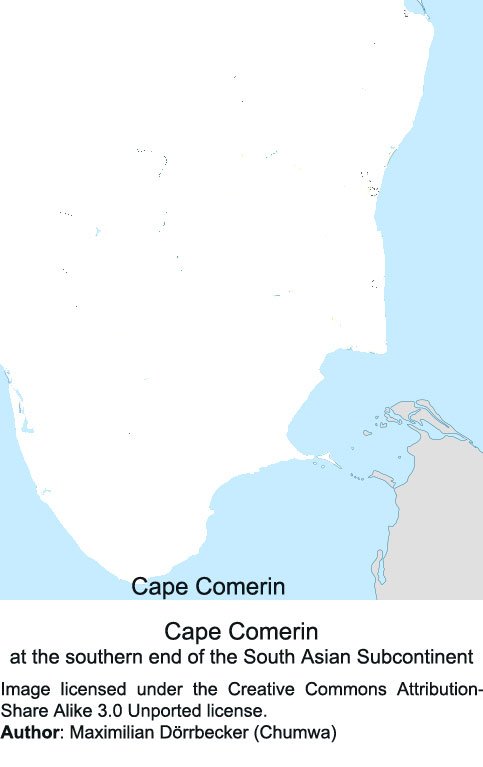 “The geological examination of the country may be said to have extended over more than half of the territory—in reality, it consisted of various traverses over the country between Cape Comorin and the 9° 35’ parallel of North latitude ; but I can generalize as to the lie and character of the very few rock formations over the country far to the northward through visits which I had made in previous years in the Coimbatore and Malabar districts, and this season at Cochin, to which place I was called in connection with a commission of enquiry on the harbours, conducted by Colonel R. H. Sankey, C.B., in the hopes of being able to elucidate something regarding the well-known tracts of smooth water off the coast at Narakal and Poracaud.
“The Travancore State, though it has long had a very irregular eastern frontier, has now been settled as lying practically to the westward of the main water-shed of the southern portion of the great mountainous back-bone or mid-rib of Southern India, which stretches from the low-lying gap of Palghat, below the Nilgiris, to within some Fifteen miles of Cape Comorin. Between this southern extremity of the mountain land and ‘the Cape’, as it is distinctively called, there is an outlying hill mass which carries the watershed rather to the eastward of the extreme southern point of India ; but a low rocky spur does terminate the end, and outside of it, or a little to the eastward again and somewhat higher, are two rocky islets.
In the northern part of the country the mountain mass is very broad, but just south of the Peermad parallel (the northern limit of my proper work) the hilly backbone narrows considerably and becomes a lengthened series of more or less parallel ridges with lower and lower intermediate valleys. Those are striking with the gneiss, or about west-north-west and east-south-east, there being at the same time a line of higher masses and peaks culminating the main ridge, from which the ribs run away, as indicated, to the low country.
“The mountain land does not, as may be seen by any good map, run down the middle of the peninsula, but keeps to the westward ; so that there is a broad stretch of low country on the Madura and Tinnevelly side, while that on Travancore is narrow. Then the mountains drop rather suddenly to the east, while they send long spurs down to within a comparatively short distance of the western coast. There is thus still, in Madura and Tinnevelly, a southerly prolongation of the wide plains of the Carnatic, which stretch round by Cape Comorin and join the narrower, though rather more elevated, low country of Travancore, Cochin and Malabar.
"This narrower and somewhat higher land of the west coast presents also unmistakable traces of a plateau or terraced character1 which is best displayed about Trivandrum, and northwards past Cochin into the Malabar country. South of Trivandrum these marks gradually disappear, the last trace being in the flat upland or plateau bordering the sea-shore at Kolachel. This more or less even-surfaced tract of country has an elevation in its most typical parts of one hundred and fifty to two hundred feet above the sea, and it touches the shore in cliffs or headlands at two or three points, particularly at Warkilli, and in the Paupanocheri hill south-west of Trivandrum.
NOTEs: 1: The terracod character of the low lands of Malabar is best seen at Malapuram, the Special Assistant Collector’s headquarters in the Ernad Taluk; but in the extreme north of the district, in the Chirakkal taluk, both north and south of the Taliparamba river, it is also conspicuous. Those terraces touch the sea and form low cliffs at Mount Deli, at Cannanore, at Darmapattanam and Tellicherry, and thence almost continuously on to Mahe, at Kollam near Quilandy, and for a few miles north of it, and lastly at the Ellattur river mouth. Mr, King examined some of these terraces and observed in regard to them that “the capped character of the plateaus in the neighbourhood of Beypore and Calicut, for instance, is duo to the denudation of an originally planed-down terrace of gneiss into detached plateaus, the upper surfaces of which are altered and lateritised to a certain depth,”— {Records, Geological Survey, Vol. XV, p. 101.) END of NOTEs
“To an observer travelling to Trivandrum across the Ariankow pass from Tinnevelly, the change from the parallel ridges and broken form of the lower hilly country to the comparatively smooth downs of Trivandrum is striking, though he would hardly see the generally terraced or plateau character until a more extended acquaintance had boon made with the country .
“Northwards from Trivandrum there are narrow strips of absolutely low land, that is on the sea-level1, marked by sandy and alluvial flats and long back-waters or lagoons. These widen out northwards from Quilon, until at Alleppey (Aulapolay) there is a width of about twelve miles of such formations, with the very extensive backwater which stretches far past Cochin.
NOTEs: 1 Those sea-level lands are numerous in Malabar also; as, for example, the wide tidal backwaters on the Taliparamba and Valarpattanam rivers, the Agalapula (broad river) stretching between the Kotta and Ellattur rivers, the backwaters on the Kadalundi river, those connected with the Velayankod backwater, and finally the Trichur or Ennamakkal lake itself, with many others too numerous to be mentioned. END of NOTEs
“The rock formations are first, and most prevalent and foundational, the gneiss series1 and then on it, but only in a very small way, the Quilon beds, which are supposed to be of eocene age. These last are overlapped by the Warkilli2 beds which certainly appear to belong to a different series, and are thus perhaps of upper tertiary age ; they appear also to be equivalent to the Cuddalore sandstones of the Coromandel. Finally, there are the recent deposits.
NOTEs: 1. Mr. R. Bruce Foote, in his “ Sketch of the work of the Geological Survey in Southern India”, points out that Mr, H. F BlandFord, in his memoir on the Nilgiris which appeared in 1859, exposed “the fallacy of a view held by Captain Newbold as well as many others at that time and still later, namely, that each of the mountain plateaus and ridges contained a great irrupted nucleus of granite rocks”, and observes “that the metamorphic rocks have not. been greatly broken up and dislocated by intrusions of granite, to which the present outlines of the country were supposed to be largely due”, and finally winds up on this point as follows : “The existing outlines are almost entirely duo to atmospheric erosion acting over vast periods of time, the gneissic highlands of the south of the peninsula being one of the oldest known portions of terra firma".—(Reprint from Madras Journal of Literature und Science, 1882, p. 5.) To this may be added the following from Mr. W. King’s paper on the goldfields of South-East Wynad: “It is worthy of notice that the present surface of Wynaad has probably only been exposed after a slow wearing away of over two thousand feet of superincumbent gnoiss which was once continuous between the Nilgiri mountains and the Vellera Mala range”.— (Records, Geological Survey, Vol.VIII p. 43.)
NOTEs: 2: So far as is yet known, the Quilon beds do not extend into Malabar, but the Warkilli beds are known to occur at two places in least in Malabar, namely, going northwards
(1) Beypore where Lieutenant Newbold obtained the following measurements in the suction of a cliff extending down to the water-level in the river :
“Four feet, of muddy alluvial soil.
Ten feet of loose sandstone; with beds of achroous earth.
Twenty feet of gritty sandstone, passing into gritty laterite, and variegated in its lower portions with red and yellow bands.
Carboniferous stratum varying from a few inches to five feet in thickness.” —(Madras Journal of Literature and Science, Vol. Xl, pp. 239-243).
Mr. King seems to have overlooked this account of Lieutenant Newbold’s when stating that all the lateritic country about Calicut and Beypore is “merely one of a decomposed forte of gneiss”,- (Records, Geological Survey. Vol. XV, p. 101.)
(2) Mr. O. Cannan, an ex-Deputy Collector of Malabar, while sinking (January—May 1876) a well in his garden in the Cantonment of Cannanore, observed the following facts:
Strata met with
Feet
Red earth mid gravel 8
Tough, hard laterite . . 20
Red and yellow clay . . 10
Blue clay . . 10
Carboniferrous stratum with dammer (resin) fruits resembling
those of the alukkappayim (Sphæranthus Ind.) ores and metals 4
White sand with spring of water l
Total depth of well 56
Diameter of well 17
Distance from the sea about quarter mile. This carboniferous stratum is well known at Cannanore, and it is often met with in sinking wells at that place. It also crops out in the low cliffs on the seashore.
In boring for foundations for a road bridge in the bed of the Kallai river at Calicut in 1883, a stratum of what looked like a carbonaceous shale was met with at thirty feet to thirty-six feet, below river bed. In one bore hole the thickness of this stratum was six feet; in another two feet. Other bore holes on either side did not meet, with this stratum, which lay under stiff, grey, black and blue clays. END of NOTEs
“The gneisses are generally of the massive grey section of the series, that is, they are nearest to the rocks of the Nilgiris, though they differ from them in being coarse-grained or more largely crystallised, and in being generally quartzose rocks.
“So quartzose are they, that there are, locally, frequent thin beds of nearly pure quartzrock which are at times very like reefs of veinquartz. Often those beds are strongly felspathic, the felspar occurring among the quartz in distinguishable grains, or larger crystalline masses, giving the rock rather a granitic appearance. The only other region where I know of somewhat similar beds of quartz rock occurring with other gneisses is in the schistose region of the Nellore district. There, however, the quartz rock becomes often a fine, compact quartzite; here, in Travancore, there are no approaches to such compact forms.
“The common gneisses are felspathic quartzose varieties of white or grey colours, very largely charged with garnets. A particular form of them is an exceedingly tough, hut largely crystallized, dark-grey or greenish felspathic rock.
“Massive hornblendic gneisses are not common. Indeed, hornblende may be said to be a comparatively rare constituent of the Travancore gneisses.
“All the gneisses are more or less charged with titaniferous iron in minute grains; they are likewise—only more visibly—as a rule, highly garnetiferous. In fact, one might say that Travancore is essentially a country of garnetiferous gneisses. The garnets themselves are only locally obtainable, it being impossible to break them from the living rock while they are generally decomposed or weathered. They are generally of small size, but are very rich in colour, the precious garnet being very common. Other minerals, such as red, blue and yellow sapphire and jacinth, arc found among the garnet sands so common on the seashore at certain places. The sea-sands are also full of titaniferous iron grain. While on this subject, I may instance the beautiful and long known constitution of the shore sands at Cape Comorin, where, on the beach, may be seen the strongest-coloured streaks or ribbons, of good width, of bright scarlet, black, purple, yellow and white sands of all these minerals and the ordinary silica.
"As will be seen further on, an enormous quantity of ferruginous matter is collected among certain forms of weathered gneiss and other rocks, the source of which is hardly accounted for in the apparent sparse distribution of iron in the gneisses. After all, however, an immense supply of ferruginous matter must result from the weathering of the garnets, when we consider that they are so generally prevalent in all the gneisses, and crowdedly so in very many of them.
“The general lie of the gneisses is in two or three parallel folds striking west-north-west to east-south-east. There is, perhaps, rather a tendency of the strike more to the northward in the broad part of the hills, about Peermad, and on towards the Cochin territory. Thus between Trivandrum and Tinnevelly on the west coast, or for some twelve to twenty miles inland, the dip is high to the south-south-west inland of the terraced or plateau country, or among the first parallel ridges there is a north-north-east dip ; then, on the mountain zone, there is again a high dip generally to the south-south-west. Thus the inclination of the beds is generally high, right across the strike with a crushed-up condition of the folds; but they are often at a low angle, and the anticlinal on the western, the synclinal on the eastern, side are plainly distinguishable. About Kurtallam (Courtallum), on the Tinnevelly side, the rise up from the synclinal is very well displayed, and in their strike west-north-westward into the broad mountain land, the beds of this place clearly take part in a further great anticlinal which is displayed in a great flat arch of the Peermad strata. With this widening out of the mountain mass there is rather an easier lie of the strata.
"Southwards from the Ariankow traverse just detailed, there is much crushing up of the beds ; but they roll out flatter again towards the southern extremity, and there are good indications of a further synclinal to the south-south-west in the northerly low-dipping beds of Cape Comorin.
“Foliation is very strongly developed : indeed it is here, practically, bedding and lamination, of which there are some wonderful exhibitions. At Capo Comorin, indeed, some of the gneiss in its weathered condition (not lateritised) is scarcely to be distinguished, at first, from good thick bedded and laminated sandstones and flaggy sandstones.
“There is no special development of igneous rocks either in the way of granites or greenstones, though small veins and dykes are common, generally running nearly with the strike of the gneiss. In South Travancore, or north of the parallel of Trivandrum, there are stronger occurrences of granite, in which the mica is abundant and in largish masses.
"The great feature about the gneisses in Travancore, and indeed also in Cochin and Malabar, is their extraordinary tendency to weather or decompose, generally into white, yellow, or reddish felspathic clayey rocks, which, in many places and often very extensively, ultimately become what is here always called laterite1.
NOTEs: 1. The vexed question of the formation of laterite is still sub-judice. There are three theories accounting for it, namely, the marine ; the fluviatile; and the sub-aerial. The chief difficulty lies in the total absence of all organic remains, for chipped instruments, which have boon found in it, are only indirectly of organic origin. Alluding to the different kinds of rock which go by the name of “laterite ” Mr. King, in a footnote to his paper on “the Warkilli and Quilon beds in Travancore,” says :
“The origin of laterite being still unsettled, it is as well that no opportunity should be neglected for keeping certain points in the investigation well to the fore. Only lately I see that my colleague Mr. F.R Mallet, in his paper 'On the ferruginous rocks associated with the basaltic rocks of North-Eastern Ulster in relation to Indian laterite (Records, Geological Survey of India, XIV, p. 148), writes with reference to a generalisation of Mr. W. J. M’Gee of Farley, Iowa, United States of America : 'But that laterite is a product, of the alteration in situ of the underlying rocks is a view open to serious objections, which has been fully discussed by Mr. Blanford.’
Now this is striking at actual facts, against which no local or theoretical objections can be taken into consideration; for, to put it plainly, and as long as we are unable to define strictly what shall and what shall not be called laterite among the strange ferruginous rocks which go by that name, certain forms of this rock are actually and really an altered condition of the rock in situ. Such is the case in Travancore, Malabar, and Ceylon, where I have over and over again traced the laterite (as it is called in Travancore) or the ‘Kabuk’ (the Singalese synonym) into the living gneiss rock. I have held this view of what may be called the lateritisation of gneiss with Mr. R. Bruce Foote (my colleague in Madras) for the last twenty years : our conclusions have been based on observations on the Nilgris, Shevaroys, and other elevated regions in the Kurnool und Cuddapah districts ; and my enlarged experience of the western coast, and Ceylon has only confirmed it.
Our experience of the Deccan laterites in not so extended, but, we are agreed also that some of these must be products of alteration of the rock in situ.”—(Records, Geological Survey, XV, p. 96). And Mr. King goes on in the text (p. 97) to distinguish “three forms of rock here (Warkilli) and in the neighbourhood which usually go by the name of laterite:
"(1) Superficial ferruginously cemented debris.
“(2) The ferruginous, clayey, reddish or brown coloured, irregularly vesicular and vermiform scabrous rock forming the uppermost portion of the Warkilli beds, which is unmistakably detrital, and which I will call laterite in this paper.
(3) The altered form of decomposed gneiss (called ‘Kabuk’ in Ceylon), which I shall here write of as lateritised gneiss. This form always eventually shows traces of original crystalline structure and constitution.” END OF NOTEs
The evidence of this are, after all, only well seen in the field ; but it may be stated here that these are seen principally in the constituent minerals, mainly the quartz, being still identifiable in much of the rock ; in the lamination or foliation being also traceable ; in the gradual change from the massive living rock to the soft and finally hard, scabrous, and vermicular ferruginous clayey resultant called laterite ; and in the thin, pale, and poorly ferruginous forms exhibited by the weathering and alteration of the more felspathic and quartzose gneisses.
"This altered form of the weathered gneiss occurs over a definite area which I have laid down approximately in the map. At the same time, the change from unweathered gneiss to this belt is not sharp ; for long before the eastern limit of the more generally lateritised belt is reached, approaching it from the mountain zone, the great change has begun.
“Very soon after one begins to leave the higher ribs of the mountains and to enter on the first long slopes loading down to the low country, the gneiss begins to be weathered for some depth into a clayey rock, generally of pale colours, streaked and veined with ferruginous matter, and having always an appreciable upper surface of scabrous or pisolitic brown iron clay, which is, of course, probably largely the result of ferruginous wash, and, less so, of ferruginous infiltration. Also the ferruginous and lateritoid character is devolved to a certain extent according to the composition of the gneisses ; but, on the whole, there is no doubt that the upper surface generally over large areas is lateritised to a certain depth irrespective of the varying constitution of the strata.
“Then, as the rocks are followed or crossed westward the alteration becomes more frequent, decided, and deeper seated ; though still, all over the field, ridges, humps, and bosses of the living rock rise up from the surrounding more or less decomposed low-lying rock areas.“
This generally irregular and fitfully altered condition of the gneisses begins at an elevation of about four hundred foot above the sea, and thus it extends as a sort of fringe of varying width along the lower slopes of the mountains.
At a yet lower level, say from two hundred to one hundred and fifty feet, and so nearer the sea-coast, there is a better defined belt of more decidedly lateritised form of weathered gneiss, in which the unaltered rock occurs less frequently, and then always in more or less flatly rounded humps and masses, which never rise above a general dead level. This belt is, in fact, a country of undulating downs (where free from thick and lofty jungle), or tolerably uniform level stretches of forest land. Occasionally it also shows a plateau surface, or it is broken into small and low flat-topped hills. Always it is very deeply indented by river and stream valleys, or even by some of the backwaters which have high and steep shores.
“Further northwards the plateau character of the lateritic gneiss belt is very well developed in Malabar.
“ It is remarkable of this coastal belt of country that its laterite (an altered, or ferruginously infiltrated condition of weathered or decomposed gneiss) is not to be distinguished from any other laterite, except that which is made up of obviously detrital material,
“Whatever the laterite of Travancore or Malabar may have been originally, it is a useless form of the rock, being crumbly and soft as a general rule, and oftener of a red colour than brown, The character of the climate does, in fact, appear to militate against the changing of the red peroxide of iron in the rock to the brown peroxide, during which change the proper cementing and hardening of the sound rock, such as that on the east coast or in the Deccan, is evidently brought about.
“The next succeeding rock formations, namely, the Quilon and Warkilli beds, occur as a very small patch on the coast between the Quilon and Anjengo backwaters.
“The Quilon beds are only known through the researches of the late General Cullen, who found them, cropping out at the base of the low laterite cliffs edging the backwater of that place, and again in wells which he had dug or deepened for the purpose, I was myself not able to find a truce1 of them. They are said to be argillaceous limestones, or a kind of dolomite, in which a marine fauna2 of univalve shells, having an eocene facies , was found, and they occur at about forty feet below the laterite of Quilon, which is really the upper part of the next group.
NOTEs: 1. They have since been satisfactorily identified as occurring at a place called Parappakkara on the Quilon backwater about six and a half miles north-east of the Residency at Quilon.
2. The marine fauna to which Mr. King here refers in thus described in an extract quoted by him in his paper on “The Warkilli and Quilon beds in Travancore.”
“Lastly come the argillaceous limestone of the Malabar Const, not only abundantly charged with the orbolite just mentioned” (Orb. Malabarica—but it is doubtful for reasons assigned by Mr. King, whether this orbolite was actually found in the Quilon beds), “ but thou again in company with Strombus fortisi, together with Cerithium rude, Ranella bufo, Cassis sculpta, Voluta jugosa, Conus calenulatus, and G. marginatus (Grant. Geol. Cutch. Tert. Foss.) : also Natica, Turbo, Pleurotoma, Fasciolaria, Murex, Cancellaria, Ancillaria, and Cyprea, all (now species?) closely allied in form to the figured shells of the eocene period. The orbolite differs very little, except in size, from Orbiculina angulata, Zam. (Encyclop. Methodique, page 468, fig. 3), from which I infer that the latter should also be included among orbolites, Zamarck.” — [Records, Geological Survey, XV, p. 96.] END OF NOTEs
“The Warkilli beds, on the other hand, are clearly seen in the cliffs edging the sea-shore some twelve miles south of Quilon, where they attain a thickness of about one hundred and eighty feet, and have the following succession in descending order : —
Laterite (with sandstone masses).
Sandy clays (or lithomarge).
Sandy clays (with sandstone bands).
Alum clays.
Lignite beds (with logs of wood, etc.).
The bottom lignite beds rest on loose white sand, and nothing is known, of any lower strata.
“It will be seen how this set of strata has an upper portion, or capping of laterite, which is, however, clearly detrital. On the landward edge of the field of those Warkilli beds, there is in places only a thin skin, representative of these upper beds, of lateritic grits and sandstones lying directly on the gneiss, which is itself also lateritised ; and it is very hard, as may be supposed, to distinguish the boundary between the two unless the detrital character of the former deposits is well displayed. Thus the upper part of the formation has overlapped the gneiss. It is also this upper portion which overlies the Quilon beds, which are also apparently overlapped.
“These Warkilli beds constitute, for so much of the coast, the seaward edge of the plateau or terraced country above described, and they present similar features. The Warkilli downs are a feature of the country—bare, grass grown, long, flat undulations of latorite, with, about Warkilli itself, small plateau hills forming the higher ground—one hundred and eighty to two hundred feet above the sea. These downs, too, and the small plateaus or flat-topped hills, are partly of the Warkilli laterite and partly of the lateritoid gnoiss.
“Whatever form of denudation may have produced the now much worn terrace of the gneissic portion of the country, the same also determined the general surface of the Warkilli beds. Indeed, it gradually dawned on me while surveying this country, having the remembrance of what I had seen of the plateaus and terraced lowland in Malabar in previous years, that here, clearly, on this western side of India is an old marine terrace, which must be of later date than the Warkilli beds.
“These are, as I have endeavoured to show in another paper, of probably upper tertiary ago, and equivalent of the Cuddalore sandstones of the Coromandel. Hence this terrace must be late tertiary or post-pliocene, and it marks, like the long stretches of laterite and sandstones on the eastern side of the country, the last great or decided elevation1 of Southern India, prior to which, as is very probable, the Indian land rose almost directly from the sea. by its Western Ghats and had an eastern shore line which is now indicated very well by the inner edge of the Tanjore, South Arcot, Madras, Nellore, and Godavari belts of latorite and sandstone.
NOTEs: 1. This reminds one of the traditionary account of the miraculous reclamation of Keralam from the sea by the might of Parasu Raman. END OF NOTEs
“Mr. Foote has already generalised in this way for the eastern side of Southern India in particular ; but I think he makes the elevation too great, including, as he does in his latorite deposits, patches of lateritised gravels and rock masses ranging up to a height of five hundred feet at least, which are not so definitely part and parcel of the proper coastal developments.
“The plateau form of the Coromandel areas has often already been commented on ; but their connection with a terraced form of marine denudation is more clearly brought out now that the evident conformation of the Travancore and Malabar lowland is ascertained.
“The somewhat different level of the surfaces of these plateau lands on each side of the peninsula is also interesting in so far as there is an evident general very slight inclination of the whole to the south-eastward,
“One more very small patch of variegated sandstones, but associated with scarcely any laterite, occurs in the Travancore country at Nagarcoil, about twelve miles north of Cape Comorin. I should certainly take this to be representative of the Cuddalore sandstones so long as no positive evidence to the contrary turns up ; and it may be the nearest connecting link between these rocks on the eastern coast and the Warkilli beds,
“The recent deposits are the usual blown-sands and alluvial deposits of the low flats along the coast ; an exceptional form occurs at Cape Comorin in the shape of a hard calcareous sandstone, which is crowded with true fossils and casts of the living Helix vitata. It appears to be simply a blown-sand, modified through the infiltration of calcareous waters. Loose blown -sands are heaped over it now in places, among which are again thousands and thousands of the dead shells of the past season. The examination of this deposit has, however, been left to Mr. Foote, who has likewise reserved for his study other remarkable fossiliferous rocks of very late age which occur in this neighbourhood.”
The soils resulting from the geological formations which Mr. King thus describes have been roughly grouped by the natives into three classes, namely —
Pasima—a rich, heavy, clayey, tenacious soil.
Pasima-rasi—the above with an admixture of sand, and of a loamy character.
Rasi—sandy soils.
Each of these classes is again subdivided into three, so that in reality there are nine classes of soils, and this classification is used in determining the revenue assessments on rice lands, to which indeed this classification is alone applied. It is also laid clown in the Hindu Sastras that the above classification of soils can be roughly applied to any particular soil in the following manner : one cubic kol or yard of earth being excavated, soil of the best description (pasima), if put back into the pit thus excavated, will suffice to more than fill it ; while loamy soil (pasima-rasi) will exactly fill it, and sandy soil (rasi) will not suffice to fill it.
The poor sandy soils are chiefly found on the low-lying lands near the coast, and the coconut palm flourishes vigorously in them if the subsoil water is within easy reach of its roots. The uplands are chiefly formed of detrital laterite, many of them being little better than gravel quarries, and of what Mr, King calls lateritised gneiss.
Some of the most productive grain land in the district, lies in the Walawanad Taluk where laterite is scarce, and where the pasima lands are chiefly to be met with. On the mountain slopes and ridges, where the gneiss does not crop up, there is an immense store of rich black mould produced by decayed vegetable matter.
The chief building material in the district is laterite, a most valuable material for some kinds of buildings and a most treacherous material for other kinds. In the mass, when not exposed to the atmosphere, it is as a rule soft and therefore easily obtained. It is cut out in squared oblong pieces with an axe having a bifurcated blade and is dressed to the shape wanted by means of a rough adze. After exposure to the air for some time it becomes hard and answers nearly all the purposes for which bricks are used, but it varies greatly in quality. Some of the best sorts stand damp and exposure to the air as well as the best sandstone, while, on the other hand, arched bridges and high revetments, when constructed of inferior sorts, are notoriously unsafe, as the material (especially during the rains) is very apt to crush.
Section E.—Climate and Natural Phenomena
To understand aright the climate of Malabar it is necessary first of all to glance at a few of the more prominent facts which hold good not only of Malabar, but of all intertropioal countries similarly situated.
And the first and most obvious fact which strikes an observer is the uniformity of temperature throughout the year as tested by the thermometer. The thermometer shows a mean annual temperature on the sea-coast of 81° Fahr. It rarely rises above 900, and it seldom falls below 70°. It may be said in short that it is always hot, sometimes hotter, but never very hot.
This is not solely nor even chiefly due to the great altitude of the sun at midday as very often supposed, for the sun is no higher in the heavens in Malabar at certain seasons than it is in temperate climates. Moreover, the sun shines much longer in summer in temperate climates than it does in Malabar. Further it may be observed that the month in which the sun is at its highest in Malabar, and its hours of shining longest, is by no means the hottest month of the year. At the same time of course it is to be remembered that the altitude of the sun is always great, and its hours of shinning are comparatively long throughout the year, varying as they do from a maximum of about twelve hours and thirty-five minutes in the latter half of June to a minimum of about eleven hours and thirty-five minutes in the latter half of December.
One of the most important factors in maintaining this high temperature is the superheated condition of the surface soil. There is no thick body of cool earth on the surface capable of quickly absorbing the sun’s rays as there is in the temperate zones, where, the range of the thermometer being greater, the depth at which an uniform temperature for the year is reached is deep below the surface of the earth.
The uniform annual temperature depth is soon reached in Malabar, and the consequence is that the surface soil becomes superheated and is constantly radiating its heat both by day and night, and thus maintaining a comparatively high temperature. Another very efficient cause of the high temperature maintained throughout the year is the influence of the aqueous vapour of the atmosphere. It has already been noticed that an ocean current sweeps across from the African and Madagascar shores, and one brunch of it apparently impinges on the coast a little to the north of the district. This brings with it an atmosphere more or less saturated with moisture.
And the ocean itself is always at hand and the sea breeze always highly saturated with moisture blows steadily for several hours of each day in the dry weather. Finally during June, July and August—the south-west monsoon season—the wind blows all day and night long off the ocean and rolls up before it dense masses of vapour. The atmosphere is therefore throughout the year in a more or less saturated condition, and the superfluous heat which, as observed above, is given off by the earth’s surface is, instead of being radiated off into space, very largely absorbed by the aqueous vapour held in suspension in the atmosphere. This aqueous vapour in fact acts like a blanket, preventing the earth from losing heat at night by radiation into space, and the greater the heat is the greater is the capacity of the atmosphere for absorbing moisture.
A cloudless night in Malabar does not, as those who have experienced it can testify, betoken a cool night as it usually does elsewhere.
The above facts are not, however, without their compensating advantages, for the ocean never becomes superheated like the land, and the ocean breezes which blow throughout the year, and in particular the south-west monsoon wind, are comparatively cool winds. In the south-west monsoon season, the temperature of the atmosphere is low in spite of the fact that the sun then attains its greatest elevation in the heavens, and for days, sometimes for weeks together, the dense mass of the monsoon clouds shelters the earth -from the sun’s direct rays.
In fact, so dense and so unbroken is the stratum of clouds in the south-west monsoon season that the uniformity of temperature is chiefly maintained by another cause, namely, by condensation of the atmospheric vapour in the shape of rain. To convert water into steam requires a large amount of heat, and the reverse process, the condensation of aqueous vapour into rain, necessitates the liberation of a large store of heat. So long as the water retains its gaseous form, the heat is insensible, but on being liberated it helps to keep up the high temperature of the air. And this is no doubt what happens to a great extent in the monsoon season when the earth is screened by clouds.
But finally there is also evaporation, a conversion of watery molecules into their gaseous form, in which process a large amount of boat becomes latent or insensible. This goes on in the hours of hottest sunshine. The district is well supplied with rivers and backwaters, and there is besides the ocean always at hand for the sun’s rays to act upon. The heat thus absorbed is great, and evaporation plays no inconsiderable part in moderating the heat and reducing the temperature on land.
Vegetation thrives in such a climate as Malabar possesses, and it is needless to dwell on the luxuriance of grass and shrub and tree presented in Malabar to the eye of a traveller crossing from the arid plains and hot winds of the country east of the ghat mountains. The mountains themselves play an important part in sheltering the country lying to the west of them, for they cool down the winds passing over thorn ; but in the extreme south of the district, where the Palghat gap permits the hot land winds to rush through unimpeded, vegetation receives a severe check in the dry months. Even here, however, the balance of nature is maintained, for heated plains invite the inrush of moist sea breezes, and though the days are hot, the sea breeze lasts longer than it does on the coasts, and brings with it fresh nights and cool mornings even in March and April, the hottest months of the year.
Nor is the climate less favourable to man and animals ; for, as Mr. Wallace in his work on “Tropical Nature” justly observes : “The large absolute amount of moisture always present in the air is almost as congenial to the health of man as it is favourable to the growth and development of vegetation”—(p. 17).
Facts bear out the truth of this remark, and it is matter of common observation that Europeans, who leave the coast in the hot months to seek the coolness and the “sweet half-English Nilgiri air” of the mountains, return after their holiday trip to find their brethren in the plains in the enjoyment of robust health and vigorous constitutions. The best time to seek a change on the coast is in the months when the sky is screened by heavy clouds, when the almost incessant rain of the south-west monsoon has filled the air and the earth with an excess of moisture, and when thick clothing is necessary to stave off maladies arising from the chilly damp.
It is then, too, that animals require extra care and extra comforts in the shape of warm dry beds. It is altogether a mistake to suppose that horses and dogs and cattle generally thrive worse in the humid climate of the west coast than in other places to the east of the mountains. There is absolutely less risk to a heated animal to be exposed to the moist air of the coast climate than to the chilly breezes that prevail at certain seasons elsewhere, and it is matter of experience that with the most ordinary care a sensitively organised animal like the horse enjoys as good health on the coast as inland. All kinds of property, susceptible of damage by excessive moisture, are very liable to be spoilt.
Articles made of leather, the binding of books, furniture whose parts are glued together, instruments made of steel or iron, woollen articles of clothing, silks, etc. require especial care in the monsoon season. They become mildewed, they fall to pieces, they rust, they become spotted, they lose their colours, and, generally speaking, perish unless great care and elaborate drying arrangements are undertaken.
Another most striking point in regard to the climate is the extreme regularity as a rule of the seasons. It once happened to the present writer to be asked one day in the end of the month of February or beginning of March as to the likelihood of rain coming soon, and the reply given on the spur of the moment was that on the 22nd of March at 2 p.m. the first shower would fall. As a matter of fact, the shower did come on that day and at that hour, within ten minutes or so. This was not altogether a haphazard guess, for the 22nd of March is the vernal equinox, and 2 p.m. in the day is precisely the hour at which most frequently the daily battle between sea-breeze and land-wind begins.
In some seasons, though not in all, the first distant rumble of thunder along the line of ghats betokens that 2 p.m. has just struck or is about to strike. This daily battle begins as soon as nature’s pendulum (so to speak) commences slowly to swing back with the passage of the sun across the equator into the northern hemisphere. And so it is throughout the seasons with a regularity as to months and almost to days and hours, perfectly astonishing to people accustomed to live in less settled climes.
The rotation of seasons is very much as follows : towards the end of March or beginning of April the first distant mutterings of thunder are heard among the hills. In some seasons, these thunderstorms occur regularly every afternoon, and occasionally the thundershowers extend as far as the coast line. In other seasons the, advent of these storms is not such a regular daily occurrence, nor is the hour at which they begin so marked. At first the land-wind usually gets the advantage and blows throughout the night; in the forenoon, there is a lull ; then, as the inland surface of the country becomes heated, the sea-breeze rushes in to supply the place of the atmosphere rarefied by the heat. This continues until the thunder-storms commence or until night sets in, for on the coast the sea-breeze declines with the setting sun, and it is only far inland that it continues to blow through the early part of the night. As the season progresses, the western winds from the sea usually gain in force, while the land-winds from the east and north-east fail.
Towards the end of May or beginning of June, the south-west monsoon wind finally obtains the mastery, and the regular rains begin and are usually ushered in by heavy banks of cloud to seaward, by a heavy swell from the west, and by an electric storm of more than usual violence. In some seasons, the electrical disturbance at this time is very great, the roar of the thunder is continuous for many minutes together, and the blaze of the many coloured lightning flashes almost incessant.
In the season of 1873, the duration of one of these thunder-peals was noted. It lasted for no less than thirty-five minutes, during all of which time there was no cessation in the roar of sound, one thunder-peal succeeding another, now near, now far, without a single moment’s interval between them.
The blaze of light, too, at such times is truly awful. Once, however, the south-west monsoon has asserted itself, the thunder-storms cease, the wind settles steadily in the west, and as the season progresses it veers a point or two to the northward of west, although inland it blows steadily all the time from south-west. The explanation of the fact of the wind veering to the north of west is that as it strikes the coast it follows, the direction of the littoral current which at this season runs from north to south. The figures given in the Statistical Appendix No. 1 attest the volume of rain which falls at this season, but even in the heaviest weather one or two hours of each day are free from rain, and there is sometimes a cessation for a fortnight. These long breaks in the monsoon, if there occur with them a fresh breeze and a bright sky with scattered clouds, are most enjoyable, but on the other hand the short intervals between the rain squalls of the monsoon are most oppressive, the air is supersaturated with moisture, the heat is also at the same time great, and of wind there is none.
In the end of September, the south-west monsoon dies away, nature's pendulum (to use the same metaphor) again begins to swing back, and sometimes battles royal again take place between the contending aerial currents, In October, the north-east monsoon or land-wind has usually asserted itself, and with it the rain becomes less frequent, the country begins to dry up, and by the end of December the dry weather has, as a rule, fairly set in.
The period of regular land-winds at night and morning and of sea-breezes during the day then commences and lasts till, with the venial equinox, the period of disturbance again sets in.
Of the south-west monsoon and the discovery by Hippalus —the Columbus of antiquity as he has been called—of its importance to navigators, the following interesting account is taken from M’Crindle’s translation of the “Periplus Maris Erythraei” :
“The whole round of the voyage from Kane and Endaimon Arabia, which we have just described, used to be performed in small vessels which kept close to shore and followed its windings, but Hippalus was the pilot who first, by observing the bearings of the ports and the configuration of the sea, discovered the direct course across the ocean; whence as, at the season when our own Etesians are blowing, a periodical wind from the ocean likewise blows in the Indian sea, this wind, which is the south-west, is, it seems, called in these seas Hippalos (after the name of the pilot who first discovered the passage by means of it). From the time of this discovery to the present day, merchants who sail for India either from Kane or as others do from Aromata, if Limurike be their destination, must often change their track, but if they are bound for Borugaza or Skythia they are not retarded for more than three days, after which, committing themselves to the monsoon which blows rigid in the direction of their course, they stand far out to sea, leaving all the gulfs we have mentioned in the distance.”
It is generally accepted that Hippaios made his discovery in the first century A.D.
Excessive falls of rain are quite common and floods are frequent. On 19th and 20th of May 1882 there was registered a very heavy fall of rain. Several rain-gauges in different parts of the town of Calicut registered from eighteen to twenty-five inches in the twenty-four hours, and as an instance of a heavy fall spread over a longer period in the monsoon of 1871 the rain-gauge at the Collector’s office in Calicut registered over six inches per diem for six consecutive days. But floods do little damage: the rivers have in the course of ages worn down for themselves deep river beds, which, as a rule, contain all ordinary floods, and the common laterite soil of the country is so porous that within half-an-hour of the heaviest shower of rain the roads are dried up, and but for the dripping trees and bushes there would be very little to tell of the rain that had just ceased.
Of unusual storms there are but few records. This is perhaps to be explained by the fact that the mountain peaks of the Western Ghats prevent altogether or disperse any cyclonic tendency of the winds, but the squalls which usher in the south-west monsoon are at times terrific in their violence, and do much damage to ships which have incautiously remained too long on the coast to complete their lading. These squalls are accompanied by mountainous seas, and the wind and waves together generally smash the strongest cables of the best equipped ships. With their anchors gone, the ships usually attempt to set sail, but, the squall being past, the seamen find there is a lull in the wind, while the sea runs as high as ever. If the attempt to make an offing is persisted in, the ship generally drifts slowly into the breaker, and the most skilful seamen usually attempt to beach their ships instead of trying to work them out to sea.
The great storm of the 10th, 17th and 18th April 1847 is perhaps the only occurrence, of the kind of which some details are on record. The storm originated somewhere beyond the southern islands of the Laccadive group. It swept over the islands of Kalpeni and Androth, and did some damage to Kavarathi, but Agatti was apparently beyond the circle of its violence. Of ninety thousand coconut trees in each of the islands of Kalpeni and Androth the hurricane left only seven hundred standing in Kalpeni and eight thousand in Androth.
Kalpeni was also partially submerged by a wave, and the drinking water of the people in wells was spoilt and their stores of food and their houses destroyed. Of a population of over one thousand six hundred in Kalpeni, four hundred and fifty only remained, but it was estimated that from three hundred to four hundred people only had perished in the storm or of famine afterwards, and that the others had left the island. Of a population of over two thousand five hundred in Androth, nine hundred only remained, the rest having either perished in the storm or dispersed. Two boats with ninety-six males and a number of females belonging to Agatti were caught in the storm and heard of no more. The storm wave dashed on the coast in a very unexpected manner, and its effects were felt from Cannanore to Chetwai.
The wave destroyed the Cannanore Custom house ; it came in so suddenly that the officials had hardly time to escape by the rear as the sea swept in at the front. The wave rushed up the Kotta river and destroyed the Palliyad dam and the cultivation above it over two miles from the mouth of the river. The floods from inland breached the new work on the Conolly canal at Calicut.
At Parappanangadi and Tanur private persons suffered much loss from the sudden rise of the sea. The wave rushed up the Velliyankod river and destroyed the Ayinichira dam and the cultivation above it. The sea also “forced a new and deep opening into the Chavakkad back-water and broke with much strength on the Ennamakkal1 dam, which, however, sustained no injury,” but the crops in the bed of the lake were injured by the floods from inland.
NOTEs: 1. Eight miles from the river month. END OF NOTEs
Earthquakes are fortunately not very frequently experienced, nor, when they do occur, are they destructive in their effects. On the 31st December 1881 at 7:1 a.m. (Madras time) a tremulous motion of the earth, apparently from east to west, was observable at Calicut. It lasted only a few seconds, and the motion which, at Calicut, was unaccompanied by any rumble or noise, was so slight that persons walking and riding out of doors at the time failed to notice anything unusual.
To those indoors, however, the motion was very perceptible, and one or two persons felt sick. This earthquake was preceded by something of the same kind about- mid-night of the preceding night, and a peculiar rumbling and a noise as of rushing waters was heard, but these were so faint that they escaped general observation. This earthquake extended over a wide area, stretching from the Malabar Coast to the Amman Coast and as far north at Khatmandu in Nepal and south as far at least as the Nicobar Islands. Two months later - on : 28th February 1882 about 6:16 a.m. (Madras time) another smart shock of earthquake was felt at Calicut, but it seems to have been a mere local affair, extending as far north as Tellicherry and as far east as the Nilgiri mountains.
There was the same tremulous motion as on the previous occasion, but the motion gradually increased, and a muffled roar was heard approaching, passing, and dying away. It was like the noise of a short train passing through a tunnel underfoot at the rate of several hundred miles per hour, in a direction from south to north. Furniture and roof tiles and window frames shook audibly for a second. From the first tremulous motion of the earth until everything was again quiet there was no more than an interval of four or five seconds.
At 2 p.m. on 14th October of the same year (1882) the Deputy Tahsildar at Allattur in the Palghat taluk heard a noise as of a train proceeding underground from east to west. He happened to be at the time in office, and the tables and boxes rattled audibly while the shock lasted, which was only for a second or so. Further south earthquakes occur occasionally also, and they have been noticed on the following dates at Trivandrum : —
February 1823,
September 19, 1841.
November 20, 1845.
March 17, 1856.
August 11, 1856—5 h, 56 m. 25 s. A.M.
August 22, 1856—4 h. 25 m. 10 s. P.M. and
September 1, 1856—0 h. 1 5 m. 0 s. P.M.
At various periods of the year, but chiefly towards the close of the rains, the sea and some of the backwaters exhale very offensive effluvia. The water is at times of a dark porter colour, at other times it has been noticed to leave a deposit of black mud on the sand. Whatever may be the cause of this change in the water, it is invariably fatal to fishes of all sorts, which float dead and dying on the surface and are thrown up by the waves on the beach. The offensive smell is of course largely caused by the putrid fish, but the water itself when thus changed has a peculiar fetid odour.
Many suggestions have been offered to account for the occurrence almost annually of this ked vellam- (bad, stinking water) as the natives call it. Day, in his “Land of the Perumauls,” p. 417, suggests that at Cochin it is due to the emptying of the pits in which coir fibre is soaked before being twisted into rope—the effluvia from which, he very justly remarks, is “most horrible”—and also by the emptying or overflowing of rice-fields in which vegetable matter is allowed to putrefy for manure. These causes do not, however, apply to all the circumstances under which this phenomenon occurs, particularly in Malabar proper, and Dr. Day himself says that “the cause of this effluvia in the sea, during the hot months, is difficult to determine.”
Benell, quoted by Dr. Davy, considered that in Ceylon it arose from the presence of vast numbers of the Arum foptidum. The cause usually assigned, namely, the mixing of the fresh-water from the flooded rivers with the salt-water of the ocean, cannot account for the occurrence of the phenomenon, in November and December, arid an instance of its having been observed at Tellicherry, where also there is no mud bank, in those months of the year 1826 is on record.
It is possible that the phenomenon is connected with that puzzling one presently to be described, which in the very height of the monsoon months vouchsafes calm harbours of refuge for ships on the open coast.
The origin of the mud bays or mud banks which exist at Northern Kollam (near Quilandy), at Calicut, and at Narakal in the Cochin State, and at Alleppey in Travancore, to which some allusion has already been made in the description of the Kadalundi river, has never yet been satisfactorily set at rest. The fact that at Narakal, and sometimes too, at Alleppey mud banks exist, which enable ships to load and discharge cargo in calm water on the open coast all through the south-west-monsoon season is well known. At Calicut, too, a small mud bank of a similar description is generally present, and at Northern Kollam also. In fact it was at one time supposed (erroneously of course) that the mud bank at Kollam protected the fleet of Vasco da Gama through the monsoon season of 1498, and this and the fact that a ship had lain there in safety the previous year and another had already taken up her position for the season then approaching induced the Joint Commissioners in Malabar in 1798 to permit the Honourable Company's vessel Morning Star to lie under the protection of the mud bank there during the south-west monsoon of that year.
Very heavy weather, however, was experienced, the seas broke-through the bank, and the Morning Star was wrecked, Thu characteristic of the mud banks is that an unctuous mud rises from the bottom of the sea, becomes dispersed in the water, and effectually stills the surf. That the mud is always more or less present at the places named is a fact, but the annual churning up of this mud stratum hardly accounts for all that has been observed, and Mr. H. Crawford, the late Commercial Agent of the Travancore Sirkar at Alleppey, who has perhaps had better opportunities of watching the phenomenon than anyone else, came to the conclusion that subterranean passages or streams communicating with some of the rivers and backwaters “become more active after heavy rains, particularly at the commencement of the monsoon, and carry off the accumulating water and with it vast quantities of soft mud.”
In scanty monsoons the mud banks are less effective as anchorages. He also observed that at seven hundred yards east of the beach at Alleppey pipes were being sunk at a depth of fifty feet to sixty feet when the shafting ran suddenly down to eighty feet and several buckets of mud from this depth were brought up, corresponding in every respect with the mud thrown up by bubbles which he had observed in the sea.
A cone of mud, he said, at time ; appears above the water, the cone or bubble bursts, throwing up immense quantities of soft soapy mud and blue mud of considerable consistence in the form of boulders with fresh water, debris of vegetable matter decayed, and in some instances fresh and green.
Mr. Crawford's successor at Alleppey, Mr. Rohde, confirms the observation, and states that he has seen mud volcanoes bursting up in the sea during the rainy season, to all appearance “as if a barrel of oil had suddenly been started below the surface.” He has come to the conclusion that the mud bank at that place, after being formed in the way above described, is gradually floated away to the southward by the littoral current, and fresh mud banks are formed whenever the hydraulic pressure of the inland backwater increases sufficiently to overcome the subterranean resistance offered by the stratum of fluid mud which exists at the spot described by Mr. Crawford.
A further proof, he observes, of the truth of this is to be found in the fact that the extent of mud bank at Alleppey increases and diminishes as the level of the inland waters rises and falls, and this was most observable in the monsoon season of 1882.
Of the mud itself, Dr. Day gives the following account: “The mud feels unctuous and sticky, but is not gritty unless mixed with the sand. It is of a very dark greenish colour, and has but a slight odour. Under the microscope it shows ‘very minute angular fragments of quartz, the largest hardly visible without a lens : this is the sand. Secondly, — Foraminferous shells, of the genus rotalia, and a few fragments of larger shells. Thirdly, — Diatomacea, of which were discovered species from upwards of twenty genera. Fourthly,—a few spicules of sponges and corals, very minute: and some amorphous matter which was not destroyed after long boiling in strong acids.’
On a more elaborate enquiry1 the mud was found to be very tenacious and resistant of pressure, like a stiff piece of jelly; and it is supposed that, acting like an immense spring, it yields to the pressure of the waves, that the water thus loses its force and becomes quiescent2 whilst the mud expanding is prepared for a fresh encounter. An examination into its composition resulted in the discovery of sixty-two species belonging to thirty genera, of the class Cryptogamia and sub-group Diatomae." — Land of the Perumauls, pp. 36, 37.
NOTEs: 1. Madras Journal of Literature and Science. New Series, No. XII. p. 264
2. While these pages have been passing through the press, Mr. King, of the Geological Survey, has written a paper on the subject, in which, for the first time, it is conclusively proved that “a sensible amount of oil” exists in the mud. And the oil, as Mr.. King points out, may be in part at least the sufficient cause of the quiescence of the sea. The oil, Mr. King thinks, is ‘derived perhaps in part from the decomposition of organism (in the mud), but principally from the distillation of oil in subjacent lignitoferous deposits belonging presumably to Warkilli Strata'. He also suggests that this distillation of oil from the lignitiforous Warkilli deposits may be due to 'moderate heat arising from a line of volcanic energy," “possibly lying parallel to the west coast of India". — Record, Geol, Surv., Vol. XVII, Pt. I, 1884, p. 14. END OF NOTEs
These phenomena, owing perhaps more to natural difficulties than to any lack of interest in the subject, have not yet been exhaustively investigated, but the following statement of facts is perhaps justified by the observations so far made. The occurrence of the Iced vellum (stinking water) and the existence of the mud banks are not necessarily connected : fish can live in the latter, but not in the former. The former probably owes its deadly character to the generation from subjacent strata by volcanic heat of poisonous matter or vapour which is absorbed by the water; and the latter, while possibly deriving some of their mud oil from similar volcanic causes, are also replenished, in one instance at least, by subterranean passages, full of liquid mud, communicating with the sea on one side and the backwaters on the other.
SECTION F.—Fauna and Flora of Malabar.
(By Rhodes Morgan, F.Z.S., Member of the British OrnithologistsUnion,
District Forest Officer, Malabar.)
FORESTS AND TIMBER.
There being in Malabar great variations of climate, soil and rainfall, and the latter being nowhere less than fifty inches annually, we find a rich and varied flora, which is best classified as follows :
(1) The littoral zone—sea-level to 200 feet ; rainfall 70 to 133 inches.
(2) Zone of deciduous forest commencing some five miles or so from the base of the Western Ghats and in the south-eastern portion of the range extending sonic distance up to an elevation of l,500 feet ; rainfall (average) 130 inches.
(3) Tropical evergreen forest from 500 to 3,500 feet ; rainfall from 130 to 180 inches.
(4) Evergreen shola forest from 3,500 to 0,000 feet ; rainfall from 180 to 250 inches.
(5) Scrub shola forest from 6,000 feet upwards ; rainfall from 260 to 300 inches.
(0) Open grass, scrub and bamboo, mixed deciduous and evergreen forest (Wynad plateau), from 2,000 to 2,500 feet ; rainfall 60 to 90 inches.
(7) Heavy deciduous forest with teak zone 50 to 80 inches.
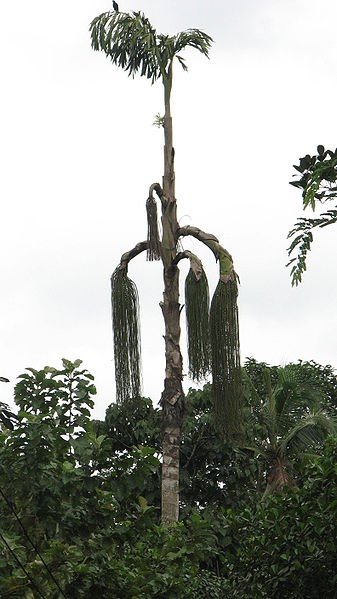 Perhaps the best way in which I can describe these various classes of forest will be by asking the reader to kindly follow me on a trip from, say, Calicut to the Mysore frontier.
We will first of all drive from the beach to Ellatur, where a boat is in waiting for us to take us to the foot of the ghat near Kuttiyadi. The road passes through a forest of Coco palms (Cocos nucifera), of which we notice several varieties. Every here and there a giant Talipot (Corypha umbraculifera) with Palmyra (Borassus flabelliformis) and Sago palms (Caryota urens) are to be seen, generally near houses, whilst on the edges of paddy flats, groves of the graceful Areca (A. catechu) are cultivated for the sake of their astringent nuts. Mango (Mangifera Indica) and Jack (Artocarpus integrifolia) are abundant, and we see planted in the avenues, white Dammer (Valeria Indica), Poonga (or Oonga as it is here called) (Pongamia glabra), Banyans and Peepuls (Ficus Indica and religiosa), and in the compounds of houses, the Poinciana, covered with its gaudy blossom, and the beautiful Lagerstroemia reginae, which, later on, we will see in full blossom at the base of the ghats. The graceful Indian Laburnum (Cassia fistula) with its pendulous racemes of golden flowers, and long dark brown legumes, next claims our attention.
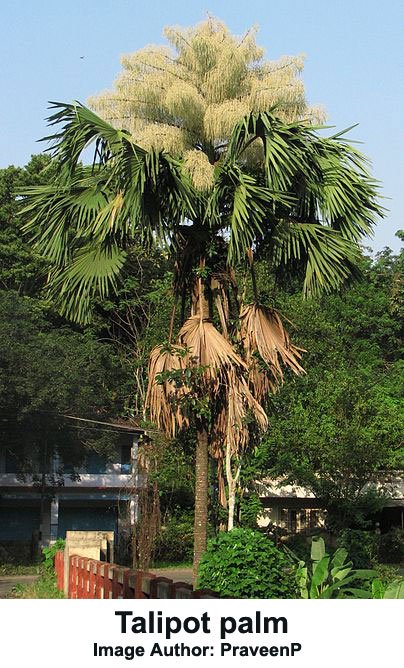 Further on, we pass on our right, low laterite hills, on which the Cashew-nut tree (Anacardium occidentale) grows vigorously. We pick some of the bright gold and crimson peduncles of the fruit on which the curved ash-coloured nut is borne ; but though the former are juicy and sweet they leave an acrid fooling behind in the throat.
The Casuarina (C. equisetifolia) seems to thrive well also on these hills where the laterite does not actually outcrop on the surface but, where it does, it supports a scrubby growth of Lantana, Eugenias on which Eugenia bracteata, a small tree in Wynad of thirty to forty feet in height, and occasionally two feet in diameter, is here a ramous shrub of three or four feet in height at the most ; and two species of Euphorbia, of which E. nivulia grows to over twenty feet in height, and occasionally sandalwood (Santalum album) sown by birds from cultivated trees in the neighbourhood.
When we got to Ellatur we find numerous boats drawn up on the beach of the backwater ; our canoe is rather better than the others, being larger and cloanor, with a neat semi-circular awning of Corypha leaves. It has been cut out of a single log of Iyneo (Artocarpus hirsuta). Some of the large sea-going boats, made of this timber, are worth from five hundred to six hundred rupees each, and last for a great number of years. Having crawled head foremost into our boat, the roof of which is so low that we can just sit up without knocking our heads against it, the boatman in the stern digs his bamboo polo into the un-savoury mud, and we are off. Our boat is manned by two men—-the one who poles and the man in the prow who rows with an antiquated oar made of a circular bit of wood snooped out like a spoon and lashed to a bit of bamboo split at the end, which forms the handle.
The backwater, or tidal creek up which we are going, is known as the Agala-pula and is very irregular in shape, sometimes broadening out to over two miles in width, anon narrowing, till you can throw a stone across. The banks are fringed with the everlasting cocoanut, and now and again, near houses, we see pretty clumps of dark green trees, principally jacks and mangoes, with Talipot and Sago palms and occasional gaunt stems of the silk-cotton tree (Bombax Malabaricum), from which the breeze floats clouds of silky-down that drop gently in the water and boat down with the receding tide. At intervals we pass groves of trees sacred to snakes, where stone images of the cobra, plentifully smeared with castor-oil and red ochre, lean against the trees. Here the Frangipani (Plumeria acuminata) scents the air with its beautiful wax-like blossoms, whilst a host of pied hornbills (Hydrocissa coronata) gorge themselves on the golden fruit of the deadly Nux-vomica (Strychnos nux-vomica).
A scrubby growth of jungle fringes the oozy banks of the creek and thousands of little red crabs race in and out of their holes in the slime, each holding a monstrous ivory-white claw pugnaciously out, as if offering battle to all comers. This little creature is apparently all claw ; the one claw being disproportionately developed at the expense of the other. Growing in this fringe of jungle, the Cerbera odollam, claims our attention with its green fruit, looking for all the world like mangoes, but deadly poisonous ; and where the lagoon shallow's suddenly and forms marshes, a dense growth of Dillivaria (D. ilicifolia) forms a secure retreat for muggers (Crocodylus palustris) which lie stretched out on logs of drift wood or sand spits in the Dillivaria, lazily enjoying the hot sunshine with wide-open mouth. Families of otters (Lutra nair) disport themselves in the bright blue wavelets, diving and chiming one another in play, or swimming ashore when they have been lucky enough to capture a fish to devour their finny prey secure from the greed of their comrades. Kingfishers of four species are abundant. The large stork-billed kingfisher (P. gurial) flying out of the clumps of trees that line the shore, as the boat comes into view, uttering his harsh cackle, whilst the pied kingfisher (Ceryle rudis) hovers over the stream with his eye keenly fixed on the small fry stemming the tide below.
The brilliant H. Smyrnensis is busy, excavating her nest on the sandy banks and cliffs that here and there rise above the level of the water, and her smaller cousin, the little Alcedo Bengalensis, seated on a twig just below is belabouring a minnow on the branch he is on, to be presently thrown up in the air and swallowed head foremost with much gusto. Bee-eaters too (Merops Swinhoii and viridis) are having a fine time of it, hawking the numerous insects hovering over the water, and diving with them into the holes in yonder sand hank, whore their clamorous young with gaping bills are waiting to be fed. Long lines of snowy egrots (Bubulcus Coromandus) come flying past us low over the water on their way to their roosting places lower down the river.
The sun is dipping now behind a heavy bank of clouds and darkness is speedily on us.
How beautifully phosphorescent the water is, what flashes of light there are, as frightened fish shoot like lightning through it, alarmed by the approach of the boat, and how the water sparkles again as it falls dripping like a shower of diamonds off the blade of the oar! We light a lantern and hang it over the boat and numbers of fish, attracted by it, come leaping into the boat. Most of them look like miniature “Bombay ducks” with long serrated beaks like the bill of a snipe. They have a nasty odour though, an ancient and fish-like smell, and so we throw thorn back again or hand them to the peon in the stern for his curry in the morning.
At midnight we are awakened, for we have reached the Payoli Lock, where a small fee has to be paid to the toll-keeper, and then on again. We are now in the Kuttiyadi river, for we crossed from the Agalapula through a canal, where the lock is, while we were asleep. How still everything is ! Now and again, however, there is a sullen plunge, as some mugger waddles off the bank and tumbles head foremost into the river or a great Nair fish (Lates calcarifer) leaps sportively out of the water. We turn in once more only to be awakened by our servant asking us whether we wish to have coffee as day has broken, and yet we have done twenty miles since leaving the lock ; but we have slept so soundly, it seems only an hour ago we went to sleep !
We land, gather a few dry sticks and have chota hazri, then once more on again.
NOTE added by VED: Chhota haazri or Chota hazri was a meal served in British-rule-linked households and barracks in the South Asian subcontinent, during the English colonial rule in around half of the subcontinent. This term is still in use in certain areas in the subcontinent, where English systems are followed. END OF NOTE
How the scenery has changed ! The mountains of the Western Ghats rise right before us clothed with forest from base to Summit. We have only a mile more to go, and this does not take us long. The boatman being paid his fare, and the usual inam which every Tiyan makes a point of clamouring for, we mount our horses which we sent on from Calicut, see our traps started, and follow them. It has rained overnight, though we did not know it, and Nature is rejoicing ; a thousand brilliantly plumaged birds fly from branch to branch and chatter in the trees overhead. The ubiquitous cocoanut palms are on both sides; but we notice that many forest trees are growing amongst them, and that luxuriant pepper vines are trained up the stems of every tree ; the lovely Erythrina (I. Indica) with its scarlet blossoms being evidently a special favourite for this purpose.
Here are two elephants going to their day’s work. Poor beasts ! look at the frightful abscesses in their jaws ! the result of making them drag huge logs of timber with their teeth. Was over such barbarity heard of! Many of thorn lose their teeth, and to an elephant this is a far more serious matter than to us, for he cannot go to a dentist, poor beast, and have a fresh one put in. He cannot chew his food, nor digest it ; he loses condition, and dies. His pigheaded owner will not listen to reason ; when you suggest that he might use harness and adopt a more rational method of having his timbre dragged, his only reply is that it is the custom of the country (mamool) and that his father did it, etc.
Three miles after leaving Kuttiyadi we enter the forest. There, to our right, is a timber depot ; it belongs to the owner of this forest, and we dismount and have a look at it. There are logs of all sizes. Ebony (Diospyros ebenos), Irool (Xylia dolabriformis), Mutti (Terminalia tomentosa), Poomaraday (Terminalia dolabriformis), and a few logs of red (Acrocarpus fraxinifolius) and white Cedar (Cedrela toona).
All these will be floated down this little stream when it is in flood into the main stream at Kuttiyadi, and from there they will be rafted to Calicut. All the logs in this depot are in the round, the bark alone being peeled off. We leave the depot and a few yards further come on a large “Punam” clearing. What reckless and wanton damage has been done here! All the larger trees have been girdled and killed long ago, and every sapling has been pollarded. The tender green of the blades of sprouting grain are very beautiful. There is the owner, a Malayar ; he is stooping to examine his dead falls, which he has set at intervals all round his field for hares, porcupines and such small deer, and see, he has just taken out a mouse-deer (Memimna Indica).
The forest now has grown denser ; everywhere we see the quaint stems of Cycas circinalis, which is spared for the sake of the nuts it boars. There is a bunch of them to our right, growing on the very apex of the tree ; they are green, and as large as a pigeon’s egg ; but. one or two are of a golden-yellow, and must be ripe.
These magnificent trees, under which we are passing, are Schleichera (S. trijuga), one of the handsomest trees I know. They bear bunches of round fruit, the size of a robin’s egg, with a few short spines. The seeds contain a large percentage of good oil, and the natives are much given to hacking off the branches to save themselves the trouble of gathering the fruit, and that is why that file specimen to our right looks so lopsided. At a distance, one might almost mistake this fine tree for an oak, and near Palghat the country is covered with them, the owners being fully alive to their value, having spared them when the rest of the forest fell before the axe.
Further on, lofty specimens of Hymenodiction (H. excelsum) tower above the smaller trees that surround them. The hark of this tree is so bitter that at one time it was believed, that it might contain similar alkaloids to the cinchona, but analysis soon dispelled this idea. That tree next the Hymenodiction is a Bignonia, and touching it is a fine specimen of the Alstonia (A. scholaris), belonging to the natural order Sapotaceae. There are other genera of this useful order, such as the Bassia (B. longifolia), but though common in the drier taluk of Palghat, it is not found here. But higher up a bit I will introduce you to the Isonandra (I. Wightiana).
We now pass over a wooden bridge spanning a mountain torrent, which rushes seething and foaming over a bed of solid gneiss which it has worn into innumerable pot-holes, into and round which, the water, clear as crystal, gurgles and bubbles. Just below the bridge is a pool the water of which is of a sapphire blue, so deep is it. Crowds of little fish dart hither and thither, the lovely little Barilius Bakeri rising freely at the little flies and ants that are falling into the water shaken down by a troop of noisy, chattering, grey monkeys (Macacus radiatus), who are busy filling their pouches with some small yellow berries that are growing on a creeper-enveloped tree that overshadows the pool.
We now begin the ascent of the ghat and at first rise gradually. The undergrowth consists entirely of a species of Strobilanthes, in flower at present. Soon it will all be dead and afford food for the destructive forest fires that sweep through the forests at this elevation. The bamboos (B. arundinacea), too, have seeded, and the jungle fowl (Gallus sonneratii) are rejoicing exceedingly. There are several scratching under yonder dump. The old cock crowing defiance to another who, perched on a boulder in the middle of the stream, challenges him to battle, whilst his hens cackle their approval.
The booming note of the black languor (Presbytis jubatus) now resounds through the forest, and presently we see him, his wives and children bounding from branch to branch as they approach to have a nearer look at us. He is a truculent looking old fellow this patriarch, and as he balances himself on a branch and barks angrily at us, we cannot help noticing his enormously long and sharp canines with which he can rip up a dog as with a razor.
We again cross the stream, and here the gigantic size of the trees strikes us with wonder. There is a black Dammer (Canarium strictum) with a mass of resin, two feet long, that has poured out of a cut in the trunk, sticking to the bark, and here a noble Isonandra (I. Wightiana), which we hack with a shikar-knife, and a stream of milk oozes nut and flows down its mossy sides ; this rapidly hardens into a kind of gutta-percha, for which no doubt some use will hereafter he found. Close to the Isonandra is a curious little tree, Baccaurea sapida, its trunk covered with racemes of pinkish red flowers. Most of these have withered now, and the curious little angular rod fruit appear here and there.
In October when the cardamoms are ripe, the fruit will be the size of a duck’s egg, and will prove a pleasant treat to the lucky finder for the aril of the seed inside is sweet, sub-acid and pleasant, and very refreshing, tasting somewhat like a mangosteen.
Here are cardamoms (Elettaria cardamomum) too, but most of the flowers have set, and we only find one at the extreme end of a raceme white, with the throat striped and spotted with violet and purple.
Be careful, however, what you are about, for overhead is the terrible Laportea crenulata or devil’s nettle- -the petioles of the leaves are hispid, with poisonous hairs, the sting of which once felt will not be forgotten by you in a hurry - and yet another vegetable abomination in the shape of Mucuna pruriens, or cowhage. The pods of this nasty creeper are covered with a velvety armament of stinging hairs, so give them a wide berth, and do not pick the purple flower of that arum, it has a horrible smell.
We must now press on, for the sun is getting hot. We can sit down and have a sandwich higher up, where there is a stream of water, and a drink and smoke, and wait for our people to come up.
A turn in the road brings us to a coffee estate. The trees are from ten to fifteen feet high and covered with blossom. The air is scented with its sweet odour, just like jessamine.
Birds are numerous here. The pure white Tchitrea Paradasi or paradise fly- catcher is busy catching insects. The two long white tail feathers wave like ribbons behind him as he flies from tree to tree, whilst his sober chestnut-coloured spouse is busy with the cares of maternity. When they have reared their brood they will leave us, for they are migratory.
Hovering in front of yonder flower is the purple sun-bird (Cinnyris lotenia), gorgeous in a mantle of the darkest steel-blue that flashes in the sun, whilst his quivering wings boat the air as suspended in front of the flower, he quickly thrusts his tongue deep down into it- and extracts the nectar. Another brilliant sun-bird (Cinnyris zeylanica) is also busy at the coffee blossom. His wings are dark maroon, breast golden yellow, and his head capped with metallic green, whilst his little throat is clothed with the most brilliant amethystine purple feathers imaginable. Down in the rocky stream below, the Malabar blue thrush (Myophonus Horsfieldii) is whistling gaily away. Soon, when the monsoon has burst, he will be busy with his wife in building a home for a future generation in some rooky cleft near a foaming torrent, inaccessible to mischievous monkeys and marauding snakes.
And still we must toil upwards, for we have not reached the stream yet. Here, a pretty little squirrel (Sciurus tristriatus) dashes across the road, and a still smaller one (S. sublineatus) looks sharply at us from the gnarled knot of a forest tree overhanging the road. These, however, are but pigmies of the race, for we presently see a splendid male of the Malabar squirrel (S. Malabaricus) racing up the trunk of a giant Dammer (Vateria Indica) as he rattles out his disapproval of us in no measured terms.
If you look up that buttress tree in front you will see a round hole, the edges of which look as if they had been recently cut out with a chisel and so they have, for inside Pteromys petaurista is no doubt at home, and if you will go down and rap on the trunk with a stone, he will come forth to interview the unwelcome visitor, and when he sees you, will spread his parachute and sail gracefully down the valley out of sight.
Perhaps, however, I am mistaken, and it is a smaller and rarer species of squirrel (Sciuropterus fusco capillus) that lives in that hole. What a multitude of noble and valuable trees are there here ! Look at that splendid iron wood (Mesua ferrea) and this tree, known on the coast as Irrupu (Cynometra ramiflora), rare up here, but commoner down below, a splendid timber, and that fine Jack (Artocarpus integrifolia), sixty feet to the first branch and over three feet in diameter ! You never saw a boll like that in a cultivated tree, and see what a splendid Poon spar (Calophyllum Angustifolium) that is! There are hundreds of others, but if I were to go on at this rate the whole of the space at my command would be taken up with the more description of these trees.
Are they not better described in Beddome’s magnificent “Flora Sylvatica”?
Here we are at last! This pure, cold mountain water is very refreshing. You need not be afraid to drink it, no malaria fiend lurks there.
What a vast extent of forest lies stretched before us! We can distinctly see the sea, and even the white sails of fishing craft coming homewards from the fishing grounds, laden with seer-fish and pomfret and many other kinds.
Who would imagine that the whole of that vast forest that stretches from near the base of the hills to the very sea consists mainly of cocoanut palms !
Look too, at the rivers and backwaters glittering amongst the groves of far off palms.
But here come our people, so we must press on. We have not far to go now, for we intend to spend the night at the head of the ghat, and to-morrow early we will come back to the toll-gate at the head of the ghat and go right up to the top of Balasore and explore the forests. And this is the toll-gate. The taluk boundary runs, you see, to the right and left up those conical forest-clad hills, and the next step we take brings us into Wynad
.
We must descend now a little. That urticaceous plant in the ravine is a Boehmeria (B. Malabarica), and produces a splendid fibre. The string of yonder Coorcha’s bow is made of it. What plucky men these Coorchas are ! I know an old fellow who lives in these same forests ; he owned a little coffee garden some six miles from here, and one evening his nephew was busy weeding it when a tiger suddenly pounced on him and bore him away into the depths of the forest. The next morning a searching party was organised and the remains of the poor follow recovered. The Coorchas instantly surrounded the forest and beat the tiger out, when the old man drove an arrow through its heart as it hounded across the open grassy hill side to the next shola.
We spend the night very comfortably in the Koroth bungalow and make an early start for the great Balasore mountain, at the base of which our bungalow is : we will not go back to the toll-gate that would be too far out of our way.
We first toil through some abandoned coffee, with that curse of the country, lantana, growing in clumps here and there. It will soon overspread the whole face of the mountain now under coffee. We have passed this bit of planting now and enter a small patch of the original primeval forest. The ground is strewn with large, round prickly fruit (Cullenia excelsa) that look like green hedgehogs rolled up. We must clear out of this, or one may come down on our heads and that would be no joke, for they are very heavy and the spines three inches long. Bump ! hump ! how fast they are falling ! and no wonder for a tribe of Wanderoos (Innus silenus) or lion-tailed monkeys are feasting on the seeds.
Here is a fearful thicket of rattans (Calamus rotang). Take care of the streamers ; they are twelve or fourteen feet long, as thick as a pencil, and armed with rows of the most fearful recurved spines. If they catch you by the lip or ear you will remember it.
And this is the handsome Solanum robustum, with leaves three feet long and two feet broad, beautifully velvety ; but they and the stem are armed with spines. We will take home the handsome orange fruit ; they are as big as badminton balls, and covered with a thick coat of fine spines, When peeled, the fruit looks just like the yolk of a hard-boiled egg. We will have them made into a tart to-night for dinner, and I promise you, that they will taste nicer even than the Brazil cherry (Physalis Peruviana) cooked that way.
There is a large solanum that Mr. Broughton got from Peru. It is exactly like this, but unarmed. You will see it growing in the Conservatory (Botanical Gardens) at Ootacamund if you go there. Is not this a lovely Thunbergia, with its racemes of pendant golden flowers ! There is another species too here, much handsomer, with the flowers streaked with orange- maroon. Both species flower in the cold weather, and it is very curious that this one should have flowered like this out of season.
Here is a monstrous tree, it is a fig (Ficus parasitica) ; a thousand aerial roots have descended to the ground in every direction so thickly that we can scarcely pass between them. Many have anastomosed with the main stem and with each other, forming quaint arches. The smaller roots produce a soft and silky fibre, very strong, used by the Coorchas for their bows, and known as colinar. They, however, prefer the manali nar (Boehmeria) I told you about.
It is very curious how little leaf mould there is in the ground. What has become of it ? Well, the termites have buried it. Turn over that rotten log and you will find millions of them hard at work, and see there is a splendid earth-snake under it, a very rare and handsome one, the rainbow snake it is called, for its whole body gleams with the most lovely iridescent hues—shades of purple and metallic blue. We will put him into our death bottle ; and here is another treasure, the elephant beetle, the giant of his tribe, and, if you travel through the deciduous forests on the Mysore frontier after rain, you will find him busy carrying out the purpose for which he was created, rolling great balls of elephants’ droppings along the path and tumbling them into a hole he has dug with much trouble and patience. Break one of these balls open and you will find a yellow egg, as big as the top of your little finger. Later on there will be a loathsome looking larva there, covered with parasites. This will form a toothsome morsel for the black sloth bear (Ursus labiatus) when he comes shuffling along and sniffs out the nest with his keen nose.
Up the trunk of that Dammer we see a thin black line. It is the covered gallery leading to a neat of the arboreal termite, suspended a hundred feet overhead. If it happened to fall now and strike one of us it would be certain death, for that nest weighs sixty pounds and is as hard as iron. There are over twenty different species of termes in this province alone, and in Burmah there is a monstrous one, half an inch in length, that marches along pathways at night and makes the natives jump when they happen to tread on them in the dark.
Do you see those holes in the ground at the base of that white-ant’s nest ? They have been made by the pangolin or scaly ant-eater (Manis pentadactyla) who is most probably rolled up inside last asleep after having demolished the inhabitants of the colony. We are still in the third zone or tropical evergreen forest, the most interesting of all. On that block of gneiss a thousand rock-plantains (Musa ornata) display their handsome leaves and curious bulbous looking stems, whilst the common wild plantain (M. Superba) grows in clumps in the ravine lower down.
We cut down a bunch of the tempting golden fruit. There is nought inside them however but a mass of hard black seeds, thinly covered with farinaceous pulp. Our attendant Coorcha munches steadily through them, finishing up with a handful of common figs (Ficus glomerata) which he has picked on our way up and which swarm with a multitude of little two-tailed flies.
This is a Gamboge tree (Garcinia morella) ; the yellow gum comes slowly out when we cut the bark, and the larger one just ahead is the wild nutmeg (Myristica laurifolia). There is another (M. Angustifolia) lower down, but it is not so common as this one. And that tree you are passing, with the clusters of pale green flowers growing out of the trunk, is a Polyalthia (P. coffeoides). The bark is very fibrous and strong. And here is another of the same order Anonceae, quite a small tree with glabrous leaves ; it rejoices in the name of Goniothalamus (G. Wightii). It is rare here, but much commoner near Palghat in the Chenat Nayar forests.
We have to cut our way now through a dense undergrowth of the dwarf Screw-pine (Pandanus. sp. undescribed?) and then through a lot of Strobilanthes (S. paniculatus) which higher up forms the solo undergrowth in places. The number of species of Strobilanthes is very great and varies according to the elevation.
We are now out again in more coffee, wretched sticks with hardly a loaf on them. The hemileia vastatrix has destroyed them.
That large bird lying across is a hornbill (Dichoceros cavatus). Hornbills are breeding now and are very noisy. Who would believe any bird capable of uttering such horrible cries as that old male perched on the dead tree opposite? He roars like some wild beast, disgusted no doubt at having the trouble of feeding his mate, who is sitting comfortably on her large white eggs in the hole of some giant forest tree near. She is fat and jolly, for every ten minutes or so Mr. Hornbill comes flying up with some sweet and juicy fig or plum and pops it down her throat. Lady Hornbills are kept in due subjection by their lords, who build them into their nests by plastering the mouth of the Hole up with clay and excrement, leaving a mere slit to food them through. There must be some reason for the males undertaking this self-imposed task ; possibly their spouses are a giddy lot, and require to be restrained from leaving their nests to flirt while their eggs get cold.
It is very sad to look round us from where we are and see the vast extent of forest that has been destroyed by the Mappillas all round for coffee. After toiling upwards for another hour, we again find ourselves in shola, but of a different character to that we have left behind us. The trees are not so lofty, the undergrowth is much denser, the species of Strobilanthes here is quite different to that last seen ; birds, too, are more abundant, and bees and insects keep up a continual hum in the blossoming trees overhead.
We are now in the fourth zone or evergreen shola.
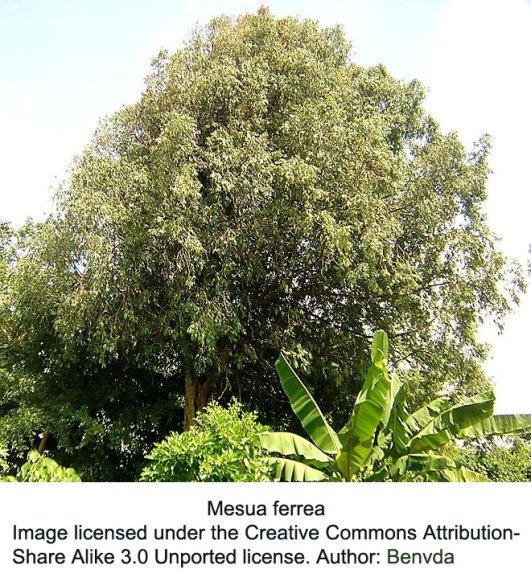 We enter a dense growth of dwarf bamboo (Beesha Rheedii) and put up a barking deer (Cervulus aureus). Further on our Coorcha finds a bees' nest (Apis mellifica), and as there is a delightful purling brook close by we decide to have breakfast. How lovely these moss-grown rocks are, with lycopodiums and balsams growing all over them, and that funny frog (Hylarana. sp.) squatted amongst thorn, every now and then raises his voice and treats us to what he no doubt, considers music, a monotonous miming up the scale, which sounds like “Tune-tuk-tuck tuck, tuk, tuk.”
Here comes our Coorcha with the honey which he has cut of the hole of that Eugenia---a mass of golden combs, with the divine scent of the beautiful camellia-like flowers of the iron-wood (Mesua ferrea), for most of the honey now is collected from that flower. The Coorcha reserves for himself the larvae and pollen, which he devours with much gusto as we smoke our cheroots. Half an hour is all we have allowed ourselves for this pleasure, for the top of the mountain is yet far off and we must cut our way soon. There is a family party of the spur-fowl (Pteroperdix spadiceus). How fussy the mother is about her little brood. She is hiding them in the dead leaves, and there they will instinctively crouch till we have passed them.
The slimy hole you see in this bit of swampy ground is a sambur (Rusa aristotelis) wallow, and last night, after rolling in the mud, a stag has rubbed his back against this rock and then sharpened his horns against yonder Garcinia (G. purpurea). Our wide-awake friend, the Coorcha, pockets a lot of the acid fruit of this tree, which are used by the natives as a substitute for tamarind.
The Eugenia family is well represented here, and there are more species than below, but I will reserve those for the list at the end. Symplocos too, of which we see several species, and cinnamons ; but most of these are supposed to be only varieties of the common kind (Cin. zeylonica). And there is Eurya (E. Japonica) which is so like the tea shrub, and two species of Tetranthera which the Atlas larva delights to feed on, and Bischofia Javanica —the A. Luna silk-worm loves it. And here is Evodia triphylla with several gorgeous butterflies (Papilio Paris) hovering round it, and look at that chaste-looking Hestia (H. Jasonia) with her lace-like wings. I have just secured three beetles, a handsome green elater, a large rose beetle, one of the cetoniidae, and a line specimen of the horned beetle (Odontolabis Burmeisteri).
And the Coorcha has found a horrible scorpion, eight inches long, of a dark bluish green colour, which looks like a small lobster. He tells us a wonderful story of a snake which chased him here, and declares it had wattles like a cock on its head of a brilliant scarlet ! Most probably the snake was the mountain cobra (Ophiophagus elaps) which is given to be aggressive. This Coorcha knows the boa well enough, for he once killed one eighteen feet long with an arrow, so he says. Snakes are numerous hereabouts, especially a greenish brown viper with a villainous looking head. I have nearly been bitten a hundred times ; but luckily this snake is so sluggish that it is a long time before he will make up his mind to retaliate.
After another, half hour’s work we reach the region of dwarf shola forest, or the fifth region, and here our troubles really commence. The undergrowth is very dense, and we have to cut every yard of our way. The ground, too, has become very broken. There are great stretches of boulders to be scrambled over, and we get badly stung by the common nettle (Girardinia heterophylla). The trees are principally dwarf Egenias and ilex (T. Wightiana) with a scrubby bamboo (Arundinacea Wightiana) only six or eight feet high. The species of Strobilanthes is very harsh too, and difficult to struggle through. Flying, from bush to bush we see small flocks of a rare laughing thrush (Trochaloptcrum Jerdoni), while the blue rock thrush (Petrocincla cyanea) sits looking at us from a boulder above.
A multitude of other birds, such as Zosterops palpebrosus, Hypsipetes Nilgiriensis, Dendrophila frontalis, etc., are busy scouring their food amongst the loaves and brunches of the trees and shrubs, whilst the common green mogalaima, seated on the topmost bough of the only tall tree near, utters his monotonous “koturr, koturr” the livelong day. Thousands of swiftlets (Collocalia unicolor) are hawking the insects about, and will probably roost to-night in the caves of the Bramagiris, where, at this time of the year, they brood in thousands. Their nests are not edible, however, like the Chinese ones, though they are made of the same substance, inspissated saliva mixed, in the case of those birds, with moss and feathers.
A Nilgiri kestrel (Cerchneis tinnunculus) is busy eating a mouse on a rock, and flies away with his prey as we approach.
At last we gain the peak and look round. There, away to the east, we see the great pools of the Cobbani where the mahseer loves to dwell. To our right lie the serrated peaks and ridges of the Western Ghats with patches here and there of coffee near their bases, and beyond again the Nilgiri plateau with great masses of black storm-clouds gathered menacingly over it, whilst from their dark depths vivid streaks of lightning dart forth forked tongues of flame, and the boom of distant thunder echoes from the rocky cliffs around.
Clouds are gathering, too, on our left over the Bramagiri and Dindamal hills, so we will take the warning and hurry down again — not the way we came, but down the Terrioot face of the mountain. It is late by the time we reach the foot, and, mounting our horses posted for us there, we got back to the Koroth bungalow in time for a late dinner.
At midnight, the storm bursts, the rain pours in torrents, whilst the vivid and continuous flashes of lightning illuminate the country round. How the thunder peals and crashes over head, as report quickly follows report, until the whole is merged in one almost continuous series of detonations echoed back from the mountain above. In an hour, it is all over, a loud rumbling to the west denoting the course followed by the storm ; but the roar and rush of mountain torrents, careering madly down the steep slopes behind us carrying the surface soil away to the sea, continues for some time longer.
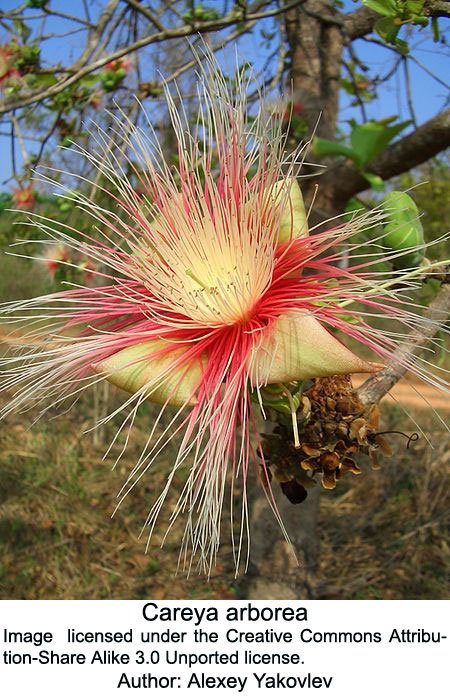 At day-break we are off, en route to Manantoddy, ten miles away. The air is fresh and cool, and a thousand birds rejoice ; here the exquisite scent of a lovely orchid fills the air with fragrance. It is the Dendrobium aurum. We pick a few of the delicate golden flowers and collect a host of others with which the trees are laden. In this hollow them is a great bed of wild ginger, and the trees are covered with festoons of Hoyas and handsome ferns, and there, on the bank, or some fine tree ferns (Alsophila glabra). Here the forest is principally deciduous, though many evergreen trees appear, such as Vateria Indica, Evolia triphylla, etc. The shrubby Wendlandia (W. notoniana) is abundant, and we may expect to find on it fine specimens of the larvae of the Atlas moth (Attacus atlas).
The whole of the country about here has been ruined by koomree cultivation, the land having been tuckled for raggi for years, until it refuses to grow anything now but a scrubby vegetation, consisting mainly of such trees as Evodias, Lagerstroemias, the Wodina (W. wodier), and Bignonias, with scattered trees of Careya arborea, surrounded by a heavy growth of brackens.
There is an old avenue bordering the road, planted up with Vateria Indica, Ficus benghalensis, Artocarpus integrifolia, etc. Between the patches of jungle are open grassy downs with herds of buffaloes and small black cattle grazing on them. These latter are not to be trusted, as they are often vicious and charge desperately, as I have experienced to my cost. Most of the animals have wooden bells on, and their loud and monotonous rattling is more curious than pleasant.
We pass numerous Mappilla houses on the road, each with its little coffee-garden shaded by jack trees, up the stems of which Dioscoreas have been trained for the sake of their tuberous roots.
As we approach Manantoddy, the lantana becomes more abundant, till finally it seems to have taken entire possession of the country, affording a secure asylum to numerous panthers (Felis pardus) which prey on the village dogs, calves, etc.
We ride through the Manantoddy bazaar, a dirty and disreputable place, and finally reach our destination at nine o’clock, quite ready for breakfast, which discussed, we walk down to the Forest office, a small building on the top of a hill, prettily situated. Here we find an experimental garden, in which Ceara rubber (Manihot Glaziovii), mahogany (Chloroxylon Swietenia), cocoa (Theobroma cacao), the rain tree (Pithecellobium saman), sappan (Caesalpinia sappan), and a host of Australian eucalypti, acacias, and exotic trees and palms are growing vigorously ; and then on to the new building for the Forest officer, of which nothing is to be seen but the foundations, after which we mount our horses and are off again to Begur, the headquarters of the Koodrakote forest, where forest operations are in full swing.
After riding about, two miles, we enter the reserve, a huge signboard with the words “Imperial Forest Reserve, Koodrakote” informing us of this fact. This board has been nailed to a fine young tree of the Nauclea species, covered with its curious flowers just like olive-green badminton balls.
The Nauclea is growing in a swamp in a dense brake of screw-pine (Pandanus odoratissimus) with scattered trees of the common willow (Salix tetrasperma). Just above us, overhanging the road we have come, is a huge solitary tree loaded with the nests of the cliff bee (Apis dorsula), so, for heaven’s sake, do not smoke, or the irascible little wretches will be down upon us, in which case we are certain to have a bad time of it, even if we escape with our lives! Here is a bridge with a notice that you are to walk over it. One of my mahouts lately, in the dark, took his elephant across it, so I do not think we need pay much attention to the notice.
The forest improves, and we presently leave the Oliot police station behind us and reach the village of Sunnuthgoody. Here we turn off, the road to the right going on to Mysore. We will go that way to-morrow.
The forest we are now riding through is very valuable. It belongs to the seventh zone, and is first-class deciduous forest with teak. Yesterday, if you remember, we rode through the sixth zone, or open grass scrub and bamboos with mixed deciduous and evergreen forest. The principal timber here is Mutty (T. tomentosa), or Kurra-maradoe as it is called in Canarose. See how abundant it is, and what grand logs it can produce. Seventy and eighty foot long, and as straight as an arrow !
If we could but got an extensive sale for it at remunerative rates, what a mine of wealth those grand forests would become. But we cannot sell it now. Natives do not value it here, though it is a magnificent timber, very strong and tough. White-ants, however, destroy it, and that is why it is not valued ; besides it is given to warping and dry rot ! However, when a railway affords cheap carriage and saw-mills are at work, we may hope to make a fair profit out of it yet.
Look at those magnificent logs ! They are Hone (Pterocarpus marsupium), the next best timber we have to teak. The merchant who has bought them has got his money’s worth, for they have been so well and truly squared, and are so sound, that there will be little or no wastage in sawing them up. This mark in the corner of the log has been made by the Bet Kurumbar who squared it. What does this  heirogiyphie mean ? It is only Kala’s mark. He has no T-square, no tape, no foot-rule, chisel or hammer — nothing hut his axe, and this is what it is like :
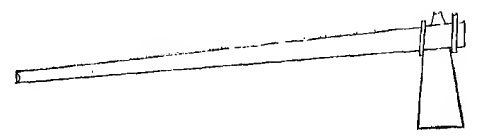
He has squared the log entirely by his eye. In the centre of the log we find stamped with a stool die,
which means that the number of the log is 276, that it is 30 foot long, and its mean quarter girth is 19¼ inches and total cubical contents 77-2-4. The /83 denotes the year in which it was felled. (W.F) stands for Wynad forests and the (s) shows that it has been sold. The K.J. in the right-hand corner are the initials of the purchaser. The hole in the comer is for the drag-chain to pass through.
The logs in the next depot you see are all blackwood (Dalbergia latifolia). They are for the coast market, and will be shipped by the purchasers at Tellicherry for the Bombay and Karachi markets. We are close to Begur now, for on our left the forest is a gorgeous sea of flame : the Poinciana (P. regia) is in flower. The whole of this side of the road was once a splendid shoot of coffee, but the manager was foolish enough to plant this tree for shade, and, being a surface-feeder, its roots quickly starved the coffee out. We leave the road now and turn sharply to the right, and ride through the estate. There are a few jack trees hero and there, but our elephants have stripped the leaves and branches off them and they do not look happy. Those two large sheds you see below us are the elephant houses, but the elephants have not returned yet from their work.
We will have tiffin now and then write some letters, after which we will go down to the stream close by and see if we can got a tow carp for dinner. This is the forest hut ; it is built entirely of teak and shingled. It was nicely matted inside at one time, but I had the mats all pulled off the walls, as rats took up their quarters between and snakes followed them.
Here is old Khazi. He is a great fisherman and has turned up in the nick of time. “How is the water, Khazi ?” “Excellent, sahib.”
“And the fish, are there lots of them ?”
“Your lordship will have good sport ; they are well on the feed.”
“Well, we will take the rods and come at once.”
“Here are the leaves, master.”
We carefully tie on a Vallisneria leaf to our hook, so that it is quite concealed, and wading into the head of the run, lot our line, with six feet of the finest drawn gut at the end, float gently down the current. Just as the loaf passes the roots of yonder willow, sixty feet away, there is a swirl, and a plunge, and a sudden tug at the line, and our reel screams a merry tune. He is six pounds, if an ounce! Gently now, for he is trying hard to fray the gut against that snag. Now he makes a rush for that fallen tree in the water. Once under that, and he is gone. Oh! run Kala, run! Wade in and free the line ; it has twisted round that bamboo twig. Be careful! He is off ! No, thank goodness, no ; ho is on still. Now for the net. They have left it behind : how disgusting, Khazi ! help me to land this fish. Out with him now !
And Khazi deftly pushes his fingers in behind the gills and flings Barbus carnaticus, quivering and gleaming, on the pebbly shore, He is quite four pounds we find. But see what Khazi is up to. He has a dozen gourds, and is tying three feet of sago palm (Caryota urens) fibre on to the neck of each ; and now he whips on hooks, baits them with Ageratum leaves, and sets them floating down the stream. There goes the little fleet, and bob ! down goes the leading gourd. Now it is up again, and seems to have gone mad, for it jumps and leaps about, then dives and disappears in the most surprising manner. But old Khazi knows what is up, for he has run to the bottom of the pool, and, as the gourd passes him, seizes it, and lo ! there is a handsome three-pound barbus at the end of the lino.
We go on fishing with varying success, and finally count up a bag of three brace of carp. Old Khazi has caught two, and has made besides a miscellaneous bag of mastacembelus —a fish that looks like a sharp-nosed eel—four young labeos, several cat fish (silurus), and a heap of the little Barilius Bakeri.
On our way back we call on old Lutchmi, a dear old elephant, at the shed, and treat her to some jaggery and see Mr. Sankara fed. He has been naughty of late and became “must” so he has had to do double work. Here are Chloe and Phyllis, who were captured in the Alambadi khedda in Coimbatore. Vixen has gone to Nilambur. These last three are, I believe, the only ones alive now out of all those those captured ! They are going down to the river now to bathe, after which they will be hobbled and turned loose to graze all night.
Do you notice the number of young trees here that have grown up everywhere in this abandoned coffee estate ? There are two teak seedlings twenty feet in height ; and these are all young blackwood trees, growing vigorously.
Before dinner we will send for old Kurumhar Kala and the forester, and give them orders to have two Kurumbars ready to go with us to the Soola Bulla forest, near the Coorg frontier, early to-morrow morning.
Daybreak sees us up, and we are in the forest after sunrise. We march steadily along the forest road for some distance and turn off, after crossing a large bridge, to inspect a depot. There are over seventy logs in this depot, all dead teak, for we have not felled living trees here for the last six years. The Kurumbars who have prepared those logs are waiting for the measurements to be checked, and this we do. A great deal of the timber you see is much cracked and flawed, but as long as we can make any profit out of it, it would be a great pity to let it get burnt up and destroyed.
 Look at the pugs of this tiger ! what a monstrous size they are! He lives up on the Bramagiri plateau, and only occasionally comes down here when he is hard up for grub and has established a scare amongst the sambur up there. He is a grand old fellow, this tiger, and I once had a shot at him, but only wounded him slightly in the leg.
There are wild dogs (Cuon rutilans) crossing the road ahead, eight-nine-ten of them ! One stops and barks at us, with - his brush up in the air, and then jumps lightly over a log and disappears. They are remorseless beasts, these dogs, and kill numbers of deer, both sambur (Rusa aristotelis) and spotted deer (Axis maculatus). Sometimes they go about in enormous packs ; I have seen one of over sixty myself. The wild dog has few enemies to keep it in check, and it is but rarely shot by sportsmen. I think, though, that a good many get killed in their encounters with dangerous game, such as boars and tigers. There are many instances on record of wild dogs having tree’d both tigers and panthers, and one, of their having killed and partly eaten a tiger at Bundipore on the Mysore frontier.
The forest we are now passing through has a dense undergrowth of Lceas and zingiberaceous plants, with a host of creepers trailing along the ground and twining up the trunks of the trees, in many instances distorting the tree, or even strangling it altogether. Many species of ficus arc, however, far worse in this respect, for there, in front of you, is a mighty rosewood tree (Dalbergia latifolia), the trunk of which has been almost completely hidden by a fig (F. parasitica), and so tightly has it been embraced that there is nothing to denote that the rosewood is even alive but that miserable tuft of leaves showing overhead through the luxuriant foliage of its enemy.
We must keep a sharp look out now, for here are the fresh tracks of a solitary elephant, a rogue, no doubt, for he is constantly about here and is the terror of our Kurumbar axemen. I should not be at all surprised if we found him in company with Chloe and Phyllis, who were let loose to graze in this part of the forest last night.
What is Kala running back for ? He must have seen the tusker. No; there is a large sounder of pig (Sus Indica), he says, in a swamp. There they go, headed by a grim old boar, who is, grunting angrily and champing his tusks. We will let him pass as we are not armed.
Here we are at the big depot, and there is old Lutchmi in the swamp. She has evidently not smelt that rogue, or she would have come straight home again, for she does not like wild elephants, and is not given to flirting with rogues, like her giddy companions, Chloe and Phyllis.
Just look at the magnificent trees here ! And no wonder they are so fine,, for the soil is a deep rich loam, nearly black, and composed entirely of the rich surface-soil washed down from the low hills around by the monsoon rains. The rainfall is about eighty inches here annually.. There stands a magnificent teak surrounded by thousands of Mutty trees (Terminalia tomentosa), and Venghay (Pterocarpus marsupium), and Venteak (Lagerstroemia microcarpa), with here and there a noble rosewood (Dalbergia latifolia).
Here, just off the road, is a monstrous fig (Ficus mysorensis) that was blown down in the fearful monsoon gales of 1882. A famous tree it was, too, known amongst the Kurumbara as the great “Goni Barray”. Its branches bore twice a year a rich crop of wax and honey, for over a hundred colonies of the largo bee (Apis dorsata) have resorted for years to this mighty tree to rear their broods in fancied security.
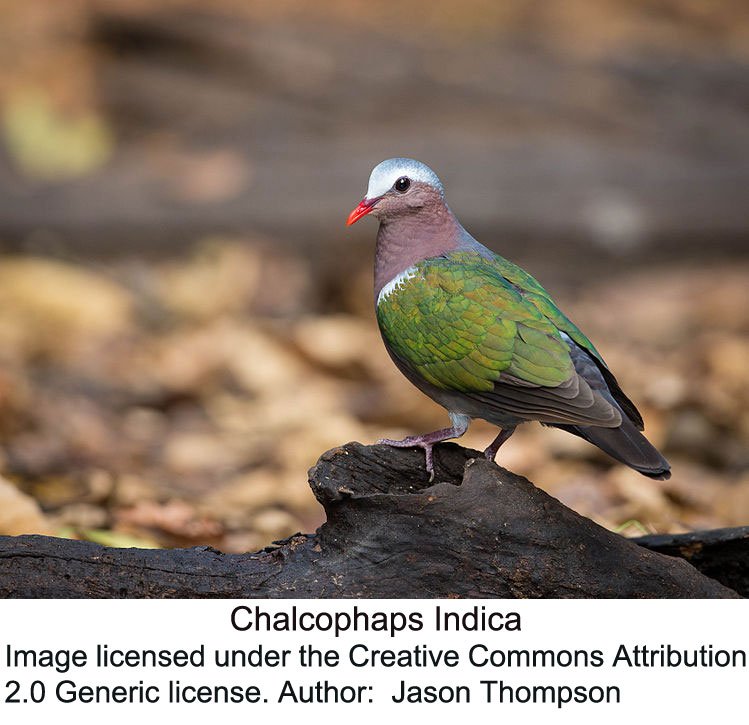 We must return now, for we go to Bhawully this evening. The forest here swarms with birds. That handsome black bird flying across the path is the Bhimraj (Edolus paradisus), often tamed by Muhammadans for its song. It also possesses a strong power of mimicry, and, in captivity, will imitate the mowing of cats, crying of babies, and cackling of poultry in the most wonderful manner. In English it is known as the racquet-tailed drongo shrike, from the two elongated tail feathers, which are curled into the shape of a racquet at the end.
Seated on a twig is a male of the handsome Malabar trogon (Harpactes fasciatus), his rose-pink breast contrasting beautifully with the delicately-penciled black of his wings, flashing like a meteor across the path, flies the lovely bronze-wing dove (Chalcophaps Indica), the metallic green of his wings glittering like some jewel in the sunshine ; and on the tree in front are a host of flame birds (Pericrocotus flammeus), the cocks clad in orange-red and black and the hens in gold and dark grey.
The oriole (Oriolus kundoo) is here, too, resplendent in his gold and black livery, and the fairy blue-bird (Irena puella) with a back of the loveliest cobalt blue, the rest of his body a jetty black. Hodgson’s wood-pecker (Picus Hodgsoni) is investigating the trunk of yonder hoary tree and making the forest resound again with his loud rat-a-tat-tat-tat-tat. The moment we catch his eye he slips round the trunk like lightning.
But how is it possible to describe the hundreds of species of birds that swarm in these forests, with the limited space at my command ? I must even content myself with a dry list of them at the end.
We have reached Begur now, and so we will mount our horses and be off to Bhawully. At Karticollam we branch off to the Mysore road, and, after going a short distance, pass the Padry Reserve signboard and a little further on reach the Bhawully bridge. We now dismount, and go down to the river and have a look at the colonies of bees (Apis dorsata) that have built under the arches of the bridge. It is a wonderful sight truly ! There are over a hundred hives : the bees are flying in millions across the bridge and we see nervous travellers passing the bridge at a run to avoid being stung.
Seated on a willow tree are about fifty or sixty birds— king-crows (Dicrurus macrocercus) and bee-eaters (Mcrops viridis and Swinhoii). Watch them, and you will see one or two leave their perches for a moment, fly rapidly through the arches of the bridge, snap up a bee, and retire to the forest on the opposite side to devour their prey at their leisure. This goes on continuously, and the numbers of bees devoured in this way must be something enormous.
Before returning to Manantoddy we will just take a run down to the pool in the Cubbani at Shanamangalam, and have a try for mahseer (Barbas mosal) and Carnatic carp (B. Carnaticus). There are some monsters in this great pool, and if we are fortunate enough to get a run, we must look to our tackle and see that it is in proper order.
Here is the pool, some four hundred yards long by one hundred yards broad, and from ten to seventeen foot deep ; a fine sheet of water. We will now unwind our reel, and dry the three hundred yards of strong cotton line it holds, in the sun for a quarter of an hour. We will also oil the winch, for it is a cheek winch invented by me, and see that it is in proper working order. Having done this, we will prepare our bait.
First and foremost we cut a bamboo rod, seven feet long, and put on a single gut-lino with a fine hair-hook ; next we deftly tie on a leaf-fly and then chuck in a handful of Valisneria leaf. See how the fish are rising : now is the time. Our fly falls gently in the very centre of a patch of floating Valisneria. There is a swirl, and a tug, and, after a little play, we land a nice little Carnatic carp, nine inches long, just the right size. Our Kurumbars have meanwhile made a bamboo basket with a narrow mouth, and we put our bait into it and lower it into the water with a tuft of grass, to keep the fish from jumping out, shoved into its mouth.
In ten minutes we have half-a-dozen young carp, and it is now time to reel up our line. This finished, we examine the three trebles and coat the silk whipping with a little fly-wax. These trebles are the very largest and strongest made for mahseer fishing. We now cut a strong bamboo rod, twenty-five feet long, nice and pliable, and lash it firmly to a willow tree so that the point overhangs a deep, shady portion of the pool. Next we take out a carp and with a needle stitch a double thread through his back, just in front of the dorsal fin. We then pass one of the hooks through the loop of thread thus formed, and tie our line to the tip of the bamboo rod, so that we can lower our bait at will from the bank ; at the same time we make our tie just strong enough to hook the mahseer when he seizes the bait.
We now drive the spike of our reel deep into the bank, and reel up the slack lino till the dorsal fin of the bait just shows above water. The bait is very vigorous, you see, for he dashes madly round in a circle, striving to escape. A screen must be made or the wily mahseer would never come near the place if he suspected that we were here.
We have another reel, and this we will work in a different way. We will first drive the spike into the ground and then pull out thirty yards of line. About a foot from the hooks, we tie a quartz pebble of a pound in weight, and then we bait the hooks with a lump of raggi dough as big as your two fists. We next gather the lino into a neat coil and fling our bait far out into the pool. When the bait and pebble have settled at the bottom, we gently pull in the slack line till we feel the weight of the stone, and then take a double turn of the line round a stake one foot long and as thick as your finger.
This stake we thrust deep into the sand, and then make the line from the reel to the stake taut. All is ready now, and there is nothing for it but patience. The sun is just setting, and it is the hour when mahsoor wake and begin to feed. Silence ! Not a word must be uttered, so we lie down behind our screen and lazily watch the green imperial pigeons (Carpophaga insignis) cooing and pinning their feathers on yonder bastard ebony tree (Diospyros embryopteris).
Swimming slowly down the pool, nothing visible but his bung-like eyes, goon a mugger (Crocodylus palustris) on the look out for grub. No chance of a mahsoor as long as that scaly monster is on the move!
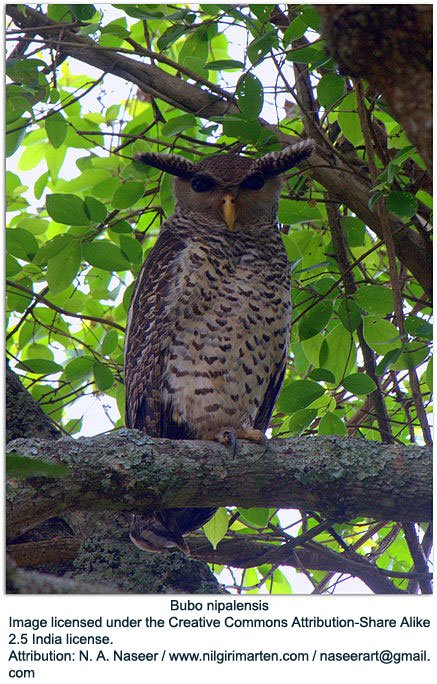 Some Wodagur women are coming down the bank for water opposite us with their polished brass-pots gracefully poised on their heads. The mugger dives and is gone, the wood pigeons flutter from the ebony tree and swiftly wing their way down stream, a melancholy frog croaks dismally from yon slimy pool covered with ferruginous scum, and the hoot of the great eagle owl (Bubo Nipalensis) is echoed from the dark forest behind us.
The stars twinkle overhead, and soon all nature is hushed, the silence being now and again broken by the splash of some great fish. Hours pass and no sign. It is drowsy work, and soon the heavy breathing of our Kurumbar is the only sound heard. We begin to nod too, when splash ! whir-r-r-v-r ! whir-r-r-r-r-r-r-r ! There is a sound as if the father of all fish had taken a header out of the water, and our reel slugs merrily as yard after yard is reeled - out with the rapidity of lightning ! Gently now ! We seize the line with a strip of chamois leather; it is out through in an instant. Lower the line under water ! Let him travel. Do not attempt to stop him or the line will part. One hundred and fifty yards out and still he goes ! Ha ! His first rush is over, and now we will reel in hand over hand.
In comes the line ; a desperate tug. He is off again. Let him go. Nearly two hundred yards out, and suddenly the line stiffens. Heavens ! it will part. We feel the desperate tugs at the end of it, but not only will it not come in, but when we let it out, it slacks ! The fish has fouled it and has beat us. The raft! the raft! The Kurumbar lights a bamboo torch. I jump on the raft and my companion attends to the line. We polo rapidly down, line in hand. The fish has fouled in the heavy water below. We shoot past and over the spot. A few tugs at the line and it is free. Hurrah ! the fish is still on ! Let out lino ! we cry as the fish forges ahead, nearly towing the raft. He has doubled and goes up stream, fouling the line again under the raft ; but we quickly free it, and now it tautens as he frantically dashes down again.
Line! line! more line! Ha! see his tail as the water boils under its strokes. His race is run now, and he nears the raff. The glare of the torch lights up his massive back, and, horror of horrors ! shows one hook alone slightly attached to the very tip of his under lip ! One more pull, hands are slipped behind his gills, and he is ours as he lays gasping on the raft. And now back to the hut, the Kurumbar frantic with joy. We land and weigh our prize, sixty-four and a half pounds, a splendid female. Enough for to-night. We get back to camp to sleep soundly till daybreak.
FAUNA.
In Appendix II will be found a list of the animals found in Malabar. To this list I might have added two new bats (Chiroptera) but as they have not been named as yet I not done so. They were discovered in the depths of the primeval ghat forests, and are chiefly remarkable for being clad with a long dense fur, I have found it impossible to give a detailed description here of the fauna of Malabar, the space at my command being so limited; but a short description of the habits and distribution of some of the more remarkable forms may be of interest.
The wild elephant is the most important animal of the district. Without his assistance, when domesticated, it would be difficult indeed to work the forests. Wherever you go in the forests you find numberless pitfalls excavated for his capture; but, as a rule, they are mostly old ones, half filled in. Numbers of elephants are captured by Nayars and Mappillas, and broken in for timber dragging, which is done entirely by the teeth ; the elephant seizing a thick cable made of grewia fibre in his trunk, and biting the end between his molars, drags the log, to which the other end of the cable has been made fast.
In wet and slippery weather, when going downhill, a log often gets such way on that the elephant’s jaw is either dislocated by the sudden jerk or a molar is pulled out. All elephants which are forced to drag timber in this brutal and irrational manner have their jaws very much disfigured by abscesses and suffer cruelly from toothache, often being laid up for months at a time.
Elephants are very abundant all along the chain of the Western Ghats and in the teak forests of Beni, Chedleth, and Koodrakote ; but here they are partially migratory, leaving Wynad in the heavy bursts of the monsoon for the drier climate of Mysore, where they eat quantities of the black saline earth in the salt licks and thus get rid of the innumerable intestinal worms, with which they are troubled.
When the domestic elephant, prompted by instinct, does this, the mahout thinks at once that he is ill, and the wretched animal is forthwith dosed with the most virulent mineral and vegetable poisons that the nearest bazaar is capable of producing, such as corrosive sublimate, arsenic, verdigris, croton-oil, marking-nut, nuxvomica, etc., mixed, up with such ridiculous ingredients, as bison flesh, peacock’s fat, etc.
I have heard frequent complaints of the “want of constitution of Indian elephants’’ and such like balderdash, but when we consider the brutal and wicked manner in which this, one of the noblest creations of God, is treated, is it any wonder that the wretched animal, however powerful its constitution, succumbs ? Think of the dreary marches of a newly-caught animal—which has already endured all the tortures of the damned in the khedda where it was captured—-over dusty plains in the hot weather, picketted out in the scorching sun, often without a drop of water to assuage its burning thirst, fed for years on coooanut leaves or the eternal banyan and fig, physicked when it is well and when it is ill, in a word—-physicked to death !
In Malabar the system of catching elephants is to dig groups of pitfalls on the pathways and beaten tracks the animal has made for itself, and which it is so fond of using. As a rule, those pits are dug a little way off the road and a tree felled across it to induce the animals to go round, but so artful are they, that a cautious old female will often suspect the trap, and carefully uncover the pitfalls, to prevent her more youthful companions from tumbling in. Elephants are often seriously injured and even killed in these pitfalls.
The gaur (Gareus gaurus) was in former years very abundant everywhere in the Malabar forests, but murrain has slain its thousands, and the native and European pot-hunters have, not been behind-hand in the work of destruction. I have heard well authenticated cases of Englishmen, who have shot three and four cow bison of a day and have left them to rot where they fell.
Now, bison are only to be found on the Bramagiri and Dindamul ranges of hills, in the Chedleth and Beni forests, and; in the ghat forests near Peria in the Wynad. In the low-country the gaur is found all along the slopes of the Western Ghats, from the Coorg frontier to near Palghat in the Chenat Nayar forests ; but they are nowhere abundant
Sambur (Rusa aristotelis).—This fine deer is almost extinct in the Wynad plateau proper, but is still fairly abundant on the spurs of the Western Ghats and on the Bramagiri range. It is also found all along the lower slopes of the Western Ghats, but is hot very abundant.
The spotted door (Axis maculata).—This handsome animal is abundant only near the foot of the Karkur ghat; elsewhere it is far from common,- and may be considered nearly extinct in the Wynad, where at one time it swarmed.
The tiger (Felis tigris) is rare in the Wynad, not uncommon all along the Western Ghats, where each tiger has his own beat and does not interfere - with his neighbour. As a rule, the tiger in Malabar is restricted to such parts where game abounds.
The panther (F. pardus) is particularly abundant at Manantoddy in Wynad, and in September and October may be heard roaring round your house in every direction. Woe to the dog that leaved his master’s house, even for five minutes; there at night.
The wild pig (S. Indicus) is common everywhere in the forests, but, is fairly kept in check by his natural enemies the tiger, pard, wild dog, and last, though not least, the native, who is very partial to, pork, even though it may be measly.
The South Indian wild goat (Hemitragus hylocrius) was abundant once all along the precipitous peaks and rocky hills of the Western Ghats from Naduvatam to near Valliyar, but it has been so ceaselessly persecuted by Europeans and natives alike, and the does so ruthlessly slaughtered, that where there were herds formerly of over a hundred, you rarely now meet with more than two or three, and on many great rocky ranges they are quite extinct.
The following interesting account of tame ibex is taken from the Madras Journal of Literature and Science, New Series, II, 82. It is sad to relate that those ibox have all been since ruthlessly shot down by persons who ought to have known better.
“No one lives upon this hill” (Malliattur hill-station, northeast of Alwaye), “but the chapel” “a very filthy little neglected church which bears a character of excessive sanctity”) “has a weekly visit from the priests at Malliattur, who at other times leave the chapel to the care of a converted herd of ibox, which graze on the steep hill-side and shelter in the sheds and outhouses.
“I saw fifteen of those very ugly goats about the knoll, all males, which was remarkable, and I should have entered them in this my diary as having distinctly monastic habits had I not been told that there were many more in number of the other sex just out of sight among the bushes, which silenced the suggestion. These civilised members of a forest family have not lost all the habits of their race in general. They saunter with composure on edges as sharp as knives, and stand with all four foot upon a single point of rock. Nor are they less wary than the ibox tribe in general. Their cunning teaches them that they are safer in the sanctuary of the church than on their wanted haunts, the precipice; and having taken up their abode upon the sacred hill, they bask in perfect safety as if aware that it was consecrated.
“In one of the chapel offices a black buck was lounging on a bedstead, who know his place better than to take any notice of the heretic intruder, and such was evidently the feeling of the herd in general. This seems to speak of good intelligence, yet, judging by the head and face, the ibox is a sheepish jackass. Dull as those animals appear, they are said to have all the cleverness of priests, and, when anything goes wrong on the hill, one of the old bucks goes down immediately to report it in Malliattur.
“Only a few days ago one of these vigilant vergers is said to have taken the three-mile walk to ask a man in the village when he meant to pay that silver elephant he had promised to the church if the pitfalls he was digging should prove successful, an elephant having been taken and the vow forgotten.”— (Captain Fred C. Colton's account of a journey over the Annamullays for the purpose of examining the teak forests, etc.— Cochin to Annamullay. )
There are three fine species of large squirrels in Malabar. The Malabar red squirrel (Sciurus Malabaricus) is abundant everywhere in the ghat forests, and is also found in the ravines of the deciduous forests. There are two varieties : the one has a yellow tip to its tail and the other has a tail wholly black.
The largo flying squirrel (Pleromys pelarista) is a very handsome animal. It is entirely nocturnal in its habits and very silent, only giving utterance to a low plaintive note at night. It grunts like a young pig when handled. The fur is beautiful and much valued. These squirrels are very abundant, but rarely seen, unless a forest is felled, when they fly out of their holes as the trees fall.
Fishes
Of fishes there are innumerable species and varieties, and all waters teem with them. The most important amongst the sea-fish are the seer, the pomfret, mullet, barmin, and Nair fish. Sardines (Sardinella Neohowii) are very abundant at times and very cheap. They are extensively used as manure, and an evil smelling oil is manufactured from them. Of fresh-water Ashes, the mahseer is the most important, and is found in most of the larger rivers. It does not, however, grow to such a size in those rivers as it does in the Cubbani in Wynad, where it is said to grow to over a hundred and fifty pounds in weight. In Appendix III will be found a list of the fishes of Malabar taken from Dr. Day’s work.
Birds.
The Malabar District is very rich in its avifauna. The list in Appendix IV contains four hundred and twenty species of birds, most of which have been entered in the list on undoubted authority, Mr. Atholl MacGregor, late British Resident in Travancore, having collected them and drawn up a list from Jerdon’s “Birds of India,” which has served as a foundation for the preparation of Appendix IV. Some few species, such as Lyncornis bourdilloni, Merula Kinisii, etc., have been entered, as it is very probable that they will be found to occur, both species having been procured in Travancore. No doubt there are errors in this list ; but it is next to impossible, without the most careful and systematic collecting, to got anything like a really correct list of the fauna of a largo district like Malabar.
Inserts and reptiles
It is simply impossible to give lists of the various species of inserts and reptiles that abound. It would take up a great deal of time and space, and both are here valuable. I have, however, given a list (Appendix V), though not a complete one, of the butterflies of the Wynad and the Western Ghats.
FOREST TREES
In Appendix VI will be found a list of the principal timber and forest trees of Malabar classified according to the forests in which they grow.
Section G.—Passes, Roads and Railway
The climate, the physical character of the country, and, in most places, the nature of the road materials are all unfavourable to road-making in Malabar. Indeed, in ancient times and within the memory of people still living, bullock carts and made roads did not exist. The chief traffic of the country was, and in great measure still is, carried on, as already alluded to in the section on rivers, etc., by water and not by land.
In ancient times, the country was split up into rival principalities and roads were not a necessity. A force on the march went in single file and unencumbered by artillery, and it was only after the Mysoroan invasions under Haidar Ali and Tippu Sultan that the necessity for roads capable of carrying heavy guns began to be felt. The following extracts from the records show how the matter stood shortly after the British acquisition of the province.
Minute by Colonel Dow on the state of roads in 1796.—“The general disorder that has hitherto prevailed in the Mappilla districts is greatly imputable to want of roads, which enabled them to trespass with security. The Mappillas hold all regular government in aversion, and never appear to have boon thoroughly subjugated by Tippu. This habitual dislike to subordination is not to be removed by methods of severity, which are likely to excite resistance. A large body of troops should be stationed at their quarters, and their lurking-places should be kept open by constructing roads. At present no vestige exists of wheel-carriages having over been in use in Malabar, and the roads are generally narrow, which are rarely better than foot-paths running at random through paddy-lands without any regard to the convenience of travelling.
“The necessity for spacious and broad roads was not probably felt until the Muhammadan conquest. Tippu projected and in a great part finished an extensive chain of roads that connected all the principal places in Malabar and pervaded the wildest parts of the country. The grand termination of those intercommunications was Seringapatam and as the route necessarily led over the ghats, neither labour nor expense was spared in rendering it practicable for artillery. This was the most politic and enlightened of any enterprise undertaken by that prince, and he appears to have been sensible that the construction of the public roads was absolutely necessary for the maintenance of his authority and to enable him to effect the forcible conversion he so long meditated.
“Many works of utility have been abandoned since the province came into the hands of the Company. Works of great extent and magnitude should be proceeded with by degrees. The roads, whether projected or finished by Tippu, should be first ascertained and completed thoroughly before any new works are undertaken. His routes are in general well-chosen and lead through almost every part of the province. The work might be performed by the Cherumars of the country. Having completed Tippu’s roads, the Company should take up such roads as escaped the supervision of that prince.
“After completion, the roads should be maintained in good order by the labour of the community. Bullocks carrying merchandise might be tolled so as to provide a fund to meet contingent charges, etc.”
Colonel Dow stated further: “Since the country came into the possession of the Company, the roads have been gradually encroached on, and in many parts entirely shut up, by the inhabitants. The country is rendered scarcely accessible to the troops and the movement of artillery impracticable.”
The task of securing good roads to all parts of the province was taken in hand, and, as a first step, the following information as to Tippu’s roads was obtained from the Zamorin’s minister, and from actual inspection by an officer of Engineers.
“Account of Tippu’s Gun-roads by Shamnauth.
“1. From Calicut to the present cantonment Polwye by Purrinalettu, Cheakur, Tamracheri.
“2. Prom Malapuram to Tamracheri.
“3. .Front Malapuram to Pudapani and from thence to the ghat.
“4. From Calicut to Ferokia, Carate Hobli, Elamaruthoo, Chatamungul, Purrinalettu, Tamracheri.
“5. From Ferokia through Shernad Taluk, by Chalapoora Hobli, Pooloor, Tirurangadi, Venkatakotta, Poolanalettu, Erakerlu, Kemaro, Waleakoonmuttu, Tirucheraparamba, Cowlpara, Mungarey river, Pattambi, Walayar river, Coimbatore.
“6. From Palghat to Dindigul, Tallamangala, Wundelarrullatie, Nellimootiel, Wellikumbil, Margienaympalim, Peelachi, Worunmalakatu, Kannenerukuvaturu, Palni, Virupakshu, Dindigal.
“7. From Venkatakkotta, Purumbil, Walluanatakunny (Velateru), Palaketeri, Angadipuram, Mulcakurchi, Karialutu, Vellatur, Rapelallawuloora, Peynat, Koondepulla river, Mannar, Attapara, Tengraumttooroo, Wellimamutu, Coimbatore.
“The northern division is in like manner pervaded by roads, the particulars of which may be easily obtained. It is sufficient at present to take notice that they lead from mount Deli both by the seashore and through the interior parts of Chirakal, Cotiote, etc., generally having for their direction the passes of Pudiacherrim and Tamracheri.”
Letter from Captain-Lieutenant Johnson, of Engineers, on the subject of the gun-roads in the province, dated 1st December 1796.—
“The roads practicable for guns are as follows : one from the south side of the Beypore river to Tanur, Ponnani, Balliancota, and keeping about one mile to the westward of Chavakkad, proceeds along the island of Chetwai to Cranganore, where it stops. This, road is throughout good, but has five rivers to cross, four of which, require boats ; but as the road lies near towns close to each of these rivers, boats are easily, procured when wanted.
“The next begins at Tanur, from whence it proceeds through Pudiangadi, Tirunavayi, Omalur, Tirttala, Cowlpara, Lakkidikotta to Palghat, and from thence to Coimbatore to the eastward, as also through Chittur, Tattamangalam to Kolangod. The first part of the road requires hardly any repairs as far as Tirunavayi, where, near the Ponnani river, road is so much encroached on whenever it leads through batty fields, that in such places it can hardly be called a foot-path ; not only this, but the more effectually to prevent cultivated spots from being marched through, hedges, banks and ditches are made to cross the roads, or trees felled which require time and trouble to clear away.
“These appear to be the first obstacles to be removed and prevented. The latter part of this road, as it mostly runs over high jungly, hilly grounds, only requires here and there repairing, which being once done, the inhabitants of the country might be induced to keep it so, as it is one of the first marks of attention very readily shown to many of the natives of rank to clear and repair, and even clean, the road over which they have to pass.
“There is also another gun-road loading from Pattikad Chokee to Trichur, Ullur, Pudcad, through Ramesvaram gate to Amolum eastward of Cochin, which is kept in repair by the Cochin Rajah, whose guns are moved over it frequently.
“Of roads formerly intended as gun-roads there are many leading in every direction, the principal of which are one leading from Ferokabad to Trevengarry, and by passing near Venkatakotta, to Angadipuram, from whence it leads through Cherpalcheri to Mannar Town. The first part of this road, so far as Venkatakotta, is mostly over uncultivated rocky heights, abounding in forage, but affording little wood and water, which would only require a little repairing at the ascents and descents here and there, after which, going toward Angadipuram, there are batty fields and nalas that require more work to make them fit for guns, but the expense, even there, cannot be great, as such places bear a very small proportion to the tract of country over which this road loads, which is generally high and even, but also abounds in wood and water, which are to be found in abundance everywhere but on the sea-coast.
“The next is a road from Ferokia to Konduvetti, and from thence to Errowinagarry, Nilambur, and by the Karkur pass to the top of the Gazalhatti pass. The first part of this road boars evident marks of having been made for guns at a great labour, and appears more to require clearing of small trees, etc., than making ; it also abounds in wood, water and forage throughout, but is destroyed whenever it crosses batty fields. This road strikes to southward from Errowinagarry to Whurumpuram, the first half of which I have not seen ; but, supposing it resembles the latter, will require very little expense to make it practicable for guns. There are also many of this kind of roads—such as one from Mannar to Cowpiel, from Cherpalcheri to Lakkidikotta, from Venkatakotta to Tirunavayi- -all of which require more to be cleared and repaired than made. Very little more can be said concerning them.”
Though, the matter thus received early attention, but little was done this direction for over fifty years, and it is only within the last thirty years that the opening up of the country by good roads has been vigorously pushed on. The main lines of road eastward and the coast-line absorbed all the money that could be devoted to them, and the following roads, which enabled the produce of Malabar to be exchanged for that of the eastern districts, were maintained in fair order during the first period of fifty years.
(1) The Perambadi ghat road, leading from Tellicherry and Cannanore through Coorg, to Seringapatam and Mysore, by which sandalwood and pepper and grain, and chillies and pulses, and latterly, coffee were brought to the coast, and return loads, chiefly of salt, were taken back. The route has been partly altered and the gradients on this line have been greatly improved of recent years. The ghat portion of it lies in Coorg territory.
(2) The Pariah ghat road, from Tellicherry and Cannanore through North Wynad to Mysore, conveying much the same traffic as the road last-mentioned between the same places. This road has been very greatly improved in recent years. It was originally required, as an alternative route for the passage of troops from the coast to Mysore, which, going this way, avoided passing through, the Coorg Raja’s country. The ghat has been retraced in recent years, and all the old steep gradients cut down or circumvented.
(3) The Kuttiyadi ghat road, leading from the head of the navigable waters of the Kotta river into North Wynad, which at first was made, and afterwards maintained, chiefly for military purposes, in connection with the Palassi Raja’s rebellion. This ghat road remains in much the same state as formerly. A new and easy trace up the mountains has been laid out, hut it has not been widened sufficiently for carts. The traffic which exists is still carried on by means of pack-bullocks and by coolies.
(4) The Tamracheri ghat road — one of Tippu’s military roads — leading from Calicut through South Wynad to Mysore, was the line judiciously selected by Colonel the Honourable Arthur Wellesley (afterwards Duke of Wellington) as commander of the forces for the operations against the rebellious Palassi Raja. It had the advantage of splitting up the country of that chieftain in Wynad and of enabling the military commanders to operate, according to circumstances, against any position where the rebels seemed inclined to make a stand.
For this purpose stockades1 or small forts were made at easy distances apart throughout its length. The labour of moving guns on this road must have been most severe, as the original trace ran straight up the almost precipitous face of the mountain. In recent years a well-graded ghat road, seven and three-quarter miles in length and rising nearly three thousand feet, has taken the place of the old short direct track.
NOTEs: 1. Lakkidikotta means literally stick or timber fort, and this is how the place at the head of the ghat obtained its name. END OF NOTEs.
For the first three miles from the top of the ghat the road has literally been blasted out of the solid rock, which at that place crops out precipitously on the face of the mountain. The view, from the upper zigzag, of mountains and forests, and of the plains of Malabar with the sea in the distance, is superb.
(5) The Sissapara ghat road was made from the head of the navigable waters of the Beypore river, through the head of the Silent Valley, also called Vallaghat, up to the summits of the Kundah mountains on the Nilgiri plateau, for the purpose of enabling visitors from Bombay and the west coast generally to reach the Nilgiri Sanitarium. Except, from the river to the foot of the hills it was, and still, is, only passable for baggage animals, but it has, ever since the opening of the railway, been discarded as a. route to the Nilgiris.
(6) The Palghat gap afforded an easy means of communication between east and west, and a good road has always been maintained between Ponnani on the coast and Coimbatore and Palani inland. This road passes through Palghat, where it bifurcates, one branch going to Coimbatore, the other to Palani. From Tirtala, too, a branch struck off north-westwards to the coast road and afforded the usual route adopted by travellers to or from Calicut.
(7) Finally, the coast road, from Calicut to the extreme north of the district, united all the above lines at the points where they touched the sea-coast, and afforded a ready means of bringing detachments of troops from the military brigade stationed at Cannanore to any point where their services were required. These were the main lines of communication kept up till within the last forty years, but a good deal used to be done besides to keep up country-paths, running in all directions over the country, but utilised only by men and animals. Those country-paths were maintained by the occupiers of lands through which they passed.
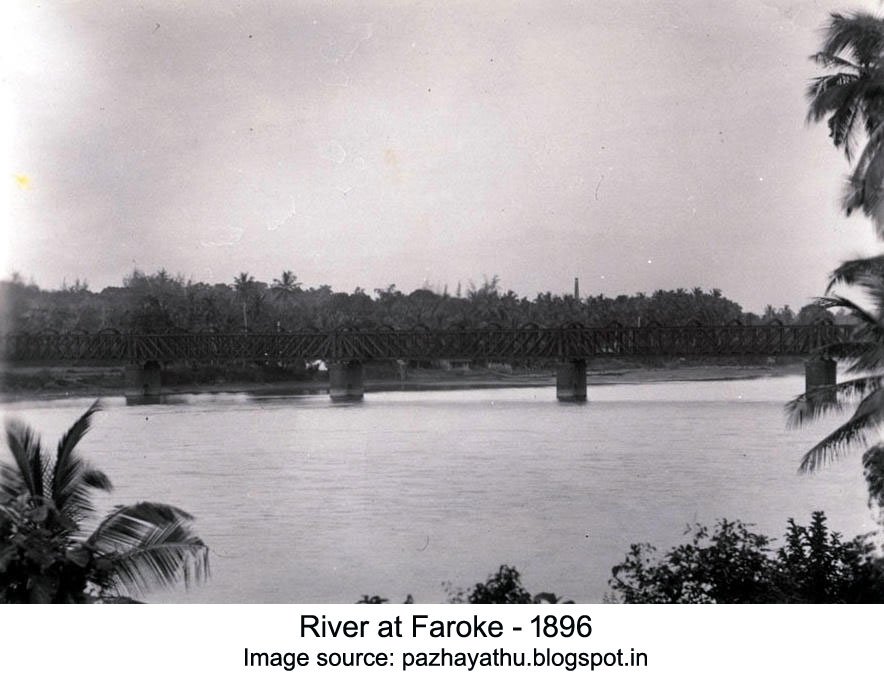 In the last forty years great strides have been made towards opening up the district, and there is now scarcely any considerable portion of it to which wheeled traffic has not been extended. The roads, exclusive of those within the limits of municipalities, now number one hundred and seventeen and the total length maintained is one thousand, four hundred and forty-three miles. The details will be found in Appendix VIT. The south-west branch of the Madras railway was opened in the following sections on the following dates :
Sections. Miles. Dates.
Beypore to Tirur 19 12th March 1861.
Tirur to Kuttipuram 9 1st May 1861.
Kuttipuram to Pattambi 12 23rd September 1861.
Pattambi to Podanur 65 14th April 1862.
Kadalundi to Calicut 10 2nd January 1888.
Olavakkot to Palghat 3 Do
And with the opening on 12th May 1802 of the section beyond Podanur, the west coast was put into direct railway communication with the presidency town. The total length of line within the district is ninety-nine miles, and the following are the railway stations:-
|
1 Calicut. |
2 Kallayi. |
|
3 Ferok. |
4 Kadalundi. |
|
5 Parappanangadi |
6 Tanur. |
|
7 Tirur. |
8 Edakkolam. |
|
9 Kuttipuram. |
10 Pallippuvam. |
|
11 Pattambi. |
12 Cheruvannur (Shoranore). |
|
13 Ottapalam. |
14 Lakkidi. |
|
15 Mankarai. |
16 Parali |
|
17 Olavakkot. |
18 Palghat. |
|
19 Kanyikod. |
20 Valliyar. |
Before the extension of the line to Calicut it was felt that it was a mistake for the railway to stop at Beypore, which is only an insignificant fishing village, and that the line should have been brought into Calicut, the headquarters of the district, only seven miles distant from the terminus. On 9th February 1880, after much previous discussion, a public meeting was held at Calicut, and resolutions were passed and a memorial drawn up, praying that the line might he brought into Calicut. The prayer of the memorialists was favourably received and the line to Calicut opened on 2nd January 1888. On the same date a feeder line was opened between Olavakkot and Palghat.
There are but few works of any engineering consequence on the line of railway in Malabar, but the following may be mentioned :
Dimensions of principal bridges on the Madras railway in Malabar District
|
Bridges |
Miles |
Telegraph post |
Remarks. |
|
Kallayi Bridge |
412 |
3 |
300 feet in length. Iron lattice girders. Three openings, each 130 feet long. Iron cylinder foundation. No flooring. |
|
Ferok do. |
407 |
2 |
780 foot in length. Iron lattice girders. Six openings, each 30 feet. long. Iron cylinder foundation. No flooring. |
|
Kadalundi Bridge No.1, at |
403 |
5 |
840 foot in length. Twelve 70-feet, iron girders on piers of cast iron cylinders of 6 feet diameter, 12 spans, each 64 feet. No flooring. |
|
Do No. 2 at |
403 |
7 |
560 foot in length. Eight 70-feet iron girders on piers of screw-piles, 8 spans, each 04 feet. Depth of screw-piles 30 to 35 feet below rail level. No flooring. |
|
Canal Bridge at |
395 |
5 |
210 foot in length. Three 70-feet iron girders on piers of screw-piles, 3 spans, each 64 feet. Depth of screw-piles 30 to 35 feet below rail level. Floored. |
|
Tirur Bridge at |
387 |
12 |
370 feet in length. Five 70- feet and one 20-feet iron girders on four piers of screw-piles and one pier of laterite stone 4 feet 10½ inches thick, 5 spans, each 64 feet and 1 span 16 feet, 1 1/2 inch. Depth of screw-piles 30 to 35 feet below rail level. No flooring. |
|
Tudhakal River Bridge at |
373 |
12 |
744 feet in length. Twelve 62-feet iron girders on piers of laterite stones 7 feet thick, 12 spans, each 55 feet. Nature of foundation, clay ; platform, timber over wells. No flooring. |
|
Kottakkad Bridge at |
329 |
4 |
520 feet in length, Fifteen 30-feet arches on piers of granite stones 5 feet thick. Nature of foundation, on rock, No flooring. |
|
Valliyar do at |
316 |
3 |
100 feet in length. Three 30-feet arches on piers of masonry 5 feet thick. Nature of foundation, gneiss. Depth 7 feet. No flooring. |
The following heights above mean sea-level give a very fair idea of the gradients on the line :
|
|
Height above mean sea-level Feet |
|
Kadalundi bridge |
11.64 |
|
Parappanangadi platform |
37.60 |
|
Tannr do |
22.54 |
|
Tirur platform |
16. 61 |
|
Tudhakal bridge parapet |
48.20 |
|
Cheruvannur (Shoranore) platform |
94.58 |
|
Ottapalam platform |
115.67 |
|
Palghat do. |
255.73 |
|
Kanyikod do. |
376.77 |
|
Valliyar boundary bridge parapet |
689.23 |
The heaviest gradient west of the boundary bridge is one in sixty-six.
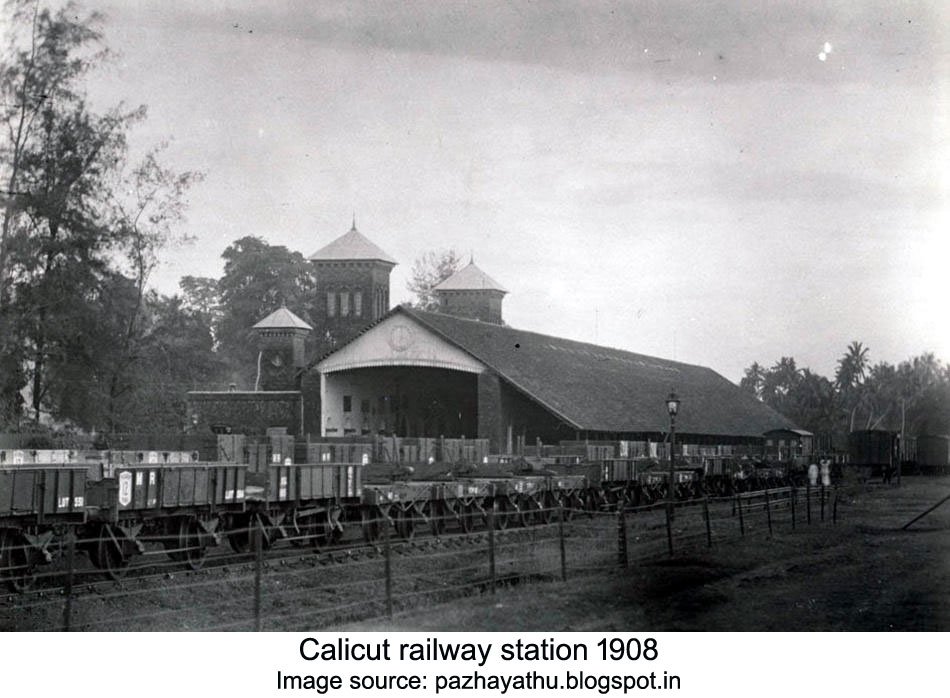
The traffic on the line in goods showed no tendency to expand, nor was it likely to be the case till a more suitable terminal station was obtained ; but some concessions to third-class passengers resulted in a considerable increase in the passenger traffic. A statement showing the variations in the goods and the passenger traffic subsequent to the extension of the line to Calicut is appended.
|
|
Monthly average Passengers Goods |
|
|
Year |
No. |
Tonnes |
|
1870 |
12,729 |
2,134 |
|
1871 |
13,219 |
4,279 |
|
1872 |
14,820 |
7,480 |
|
1873 |
16,607 |
4,986 |
|
1874 |
10,291 |
3,770 |
|
1876 |
16,028 |
4,383 |
|
1870 |
14,767 |
3,054 |
|
1877 |
16,492 |
8,660 |
|
1878 |
14,311 |
3,199 |
|
1879 |
14,761 |
3,431 |
|
1880 |
18,297 |
3,200 |
|
1881 |
20,012 |
2,709 |
|
1882 |
21,796 |
2,931 |
Statement showing the monthly average number of passengers and tonnes of goods passed in and out of Calicut Railway Station
|
|
Monthly average Passengers Goods |
|
|
Year |
No. |
Tonnes |
|
1888 |
34,980 |
3,610 |
|
1889 |
37,711 |
4,9!)J |
|
1890 |
34,054 |
4,403 |
|
1891 |
35,653 |
4,640 |
|
1892 |
40,241 |
5,670 |
|
1893 |
40,702 |
4,918 |
|
1894 |
41,703 |
4,818 |
|
1895 |
33,855 |
4,357 |
|
1890 |
34,377 |
4,004 |
|
1897 |
31,065 |
0,777 |
|
1898 |
27,718 |
4,100 |
|
1899 |
29,984 |
8,107 |
Section H —Ports and Shipping Facilities.
The number of ports in Malabar is very large, but many of them are only occasionally visited by small coasting craft. The following list, proceeding from north to south, gives such particulars of them as are worthy of notice : —
(1) Kavvayi.—Small craft enter the mouth of the Kavvayi river.
(2) Ellikkulam.—This is a small, picturesquely situated village, in a bay just under the mount Deli promontory, and commanded by the old mount Deli redoubt now in ruins. When the wind is from north-north-west large numbers of country craft bound to the northward take shelter in this bay and wait till the wind takes a favourable slant for the continuation of their voyages. In former days this bay was a regular resort of the pirates who infested the coasts, and who came in here to waylay their victims and to take in wood and water.
(3) Putiyangadi.—Fourteen miles north of Cannanore. A very small port of call on the open coast for country craft taking in cocoanuts and other produce. The name means “new bazaar” and it was probably so called to distinguish it from Palayangadi or “old bazaar” a place of ancient repute on the Taliparamba river.
(4) Valarpattanam.—This port has a fair amount of coasting trade. Craft of considerable size enter the river of the same name and take in the country produce brought to market at Valarpattanam by the rivers (Valarpattanam and Taliparamba) which here unite their streams.
(5) Cannanore. —This is the principal port of the group composed of Nos. 1, 2, 3, 4 and 5. The average tonnage is 459,253 per annum. The imports average Rs. 21,44,726 and exports Rs. 13,87,749.
It was described by the first Europeans who saw it as “a large town of thatched houses inside a bay.” — (Correa, .p. 145).
Most of the houses are now tiled, and the barracks of the European troops, and the bungalows of the officers dotted along the low cliffs, and the fort built by the Portuguese on the promontory north of the bay, stand prominently out when approached from seaward. Being the headquarters of the Malabar and Canara brigade, coasting steamers call here regularly ; but of trade there is not much, particularly since the excise system of managing the Government salt monopoly was introduced. The best anchorage for large vessels in the roads is with the following bearings : —Flagstaff N.E. by N. to N.E. by E. in from five and a half to six fathoms, and about two and a half miles off shore, while small coasting craft find shelter in the bay under the guns of the fort situated on a promontory commanding the native town. The port limits are as follows:-
To the north.—The boundary pillar one mile north of the fort.
To the south.- -The boundary pillar two miles south of the fort.
To the east.—The seashore between them to within fifty yards of high-water mark, spring tides.
To the west.—The space enclosed by two lines running duo west from the boundary pillars to nine fathoms water. There is a flagstaff in the fort with a light for the shipping in the roadstead.
(6) Elam or Agarr.—This port is at the mouth of a small stream, the bar of which, however, cannot he crossed even by small craft. The English factors at Tellicherry had a warehouse here for collecting pepper.
(7) Dharmmapattanam.—A small bay at the month of the southern branch of the Anjarakandi river, which, however, cannot be entered by any but the smallest coasting vessels.
(8) Tellicherry .—This is the principal port of the group composed of Nos. 6, 7, 8 and 9. It is not, as sometimes supposed, a place of ancient trade. It was the Honourable East India Company’s first regular settlement on the Malabar coast. ‘Let us be sole. Masters of the pepper trade” they said, and accordingly selected the site of the town as the most favourable point they could at the time obtain for commanding the pepper trade in the Kottayam and Kolattiri Raja’s dominions.
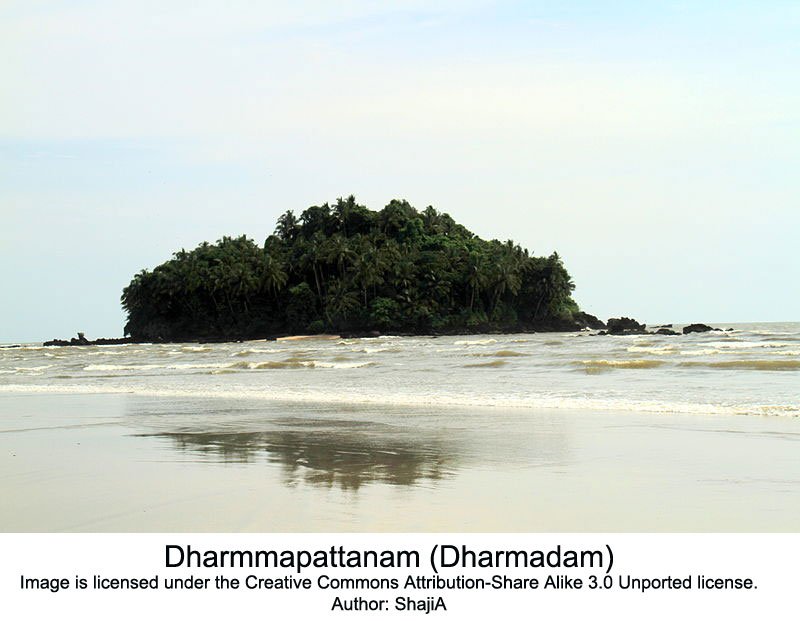 Dharmmapattanam [No. (7)] would have suited their purpose better, but this ancient trading post was at the beginning of the eighteenth century in dispute between three country powers—the Kolattiri and the Kottayam Rajas, and Ali Raja of Cannanore. And it was not till some years afterwards and under pressure of a Canarese invasion, that a favourable opportunity occurred for securing Dharmmapattanam Island for the Honourable Company. A scheme for moving the Tellicherry Factory bodily to Dharmmapattanam Island was sanctioned immediately after the acquisition of the latter, but, on account of the expense of moving, the scheme was never carried out, though it was steadily kept in view even up to the time (1792) when Malabar was finally ceded to the British by Tippu Sultan.
The Factors completed about 1708 the building of a fort on a rocky cliff projecting into the sea at Tellicherry, and this port continued to be one of the principal trading posts of the Honourable Company down to 1702. It was subordinate to the Company’s chief settlement at Bombay. The average tonnage now-a-days is 601,404 per annum. The imports average Rs, 42,0.8,272 and the exports Rs, 78,05,718. It is a place of considerable trade, of which the most valuable articles of export are coffee and pepper, and the most valuable imports are rice and salt.
The best anchorage for large vessels is with the following bearings :—Flagstaff N.K. by N. in six fathoms and about two miles off shore. Coasting craft come into the bay, lying south of a reef of rocks, which, at a distance of about a thousand yards from shore, runs parallel to the coast line. Instances have been known of vessels of six hundred or eight hundred tons in ballast passing the monsoon under shelter of this reef.
The custom house is in the centre of the business quarter of the town. The port is supplied with a flagstaff on a bastion of the Honourable Company’s fort! And here, too, is a white light (sixth order dioptric) displayed at a height of ninety feet above water mark and visible about six miles.
The limits of the port of Tellicherry are as follows : —
To the north.—The boundary pillar one and a half miles north of the custom house.
To the south.—The boundary pillar one and a half miles south of the custom house.
To the east .—The seashore between them to within fifty yards of high-water mark, spring tides.
To the west.—The space enclosed by the two lines funning due west from the boundary pillars to nine fathoms water.
(9) Talayi .—Is a small port on the open coast about one and a half miles south of Tellicherry.
(10) Kallayi.—This port is inside the bar of the Mahe river, which can be entered by small-sized country craft. There is little coasting trade, but the land customs of the French settlement provide some occupation for the establishment here maintained, there is no port subordinate to it. Its average tonnage is 1 6,966 per annum, imports Rs. 2,24,732
(11) Chombayi or Chombal.—This port is on the open coast, and an occasional load of cocoanuts is taken to market. It lies about five miles north of Vadakara.
(12) Muttungal.—The same remarks apply to this port, which lies about three miles north of Vadakara. It was a notorious haunt of pirates in former days.
(13) Vadakara.—This is a place of considerable trade on the open coast and coasting steamers occasionally call. The chief exports are coffee and dried and fresh cocoanuts ; the chief imports rice and salt. It is the chief port of the group composed of Nos. 11, 12, 13 and 14, Its average tonnage is 202,735 per annum. Its average imports are worth Rs. 7,42,241 and its exports Rs. 13,84,921 .
(14) Kottakkal.—At the mouth of the Kotta river, was a famous resort for pirates in former days. They made prizes of all vessels not carrying the pass of the Kadattunad Rajah, their sovereign, who was styled the lord of the seas. But for the fact that a canal, partly natural, partly artificial, gives access from the Kotta river to Vadakara, the trade at this port would be considerable.
(15) Trikkodi and (10) Kadalur.—Are small ports, with occasional craft calling to load with cocoanuts and other country produce.
(17) Kollam .—This is the Northern Quilon, as distinguished from Quilon proper in Travancore, which is styled Southern Kollam by Malayalis. Some confusion has sometimes arisen from the fact not being known that there are two Kollams, both of which were important places in former days. This place, about one and a half miles north of Kovilkandi (Quilandy, Coilandy), is sometimes also called by another name which it bears, Pantalayini, or Pantalayini Kollam. This is the Pandarani of Portuguese writers, the Flandrina of Friar Odoric, the Fandreeah of Rowlandson’s Tahafat-ul- Mujahidin, the Fandaraina of Ibn Batuta.
Some accounts say that it was here Vasco da Gama brought his ships (probably from Kappatt), and it was here he landed. This is not at all improbable. It was certainly here that the Morning Star, a vessel belonging to the Honourable Company, was wrecked as already described (ante, p. 30), and the fact of the existence of the mud-bank gave colour to the story that it was here that Vasco da Gama lay with his ships, protected by the mud-bank, during the monsoon of 1498.
The mud-bank still exists, and in the monsoon season it is generally possible to land in a small bay immediately to the south of the promontory which is used as a Muhammadan burial-ground. Moreover, even now, sailing ships from the Arabian Coast and Persian Gulf invariably touch here if the monsoon is still blowing when they arrive off the coast, and the fact that Vasco da Gama’s expedition reached the coast on 26th August, at a time, that is, when the monsoon must still have been blowing, is much in favour of the supposition that it was here, and not at Kappatt, that Vasco da Gama landed. Indeed, Correa’s account, which is evidently the most trustworthy, is silent on the point, and his statement that the anchors were dropped at Kappatt is quite reconcilable with the other account which points out Kollam as the eventual landing-place ; for this account also say the ships were brought subsequently to “Pandarane” (i.e.) Pantalayini ), and this is not contradicted by Correa.
(18) Kovilkandi (Quilandy, Coilandy),—This port has some trade, and the ports Nos. 15, 16, 17, and 19 are subordinate to it. Its average tonnage is 15,865 per annum. Its average imports are valued at Rs. 2,33,690 and exports at Rs. 2,46,843. Some years ago this was the favourite starting and landing place for Muhammadan pilgrims to Mecca, but of recent years and since the introduction of steamers the passenger traffic has fallen off.
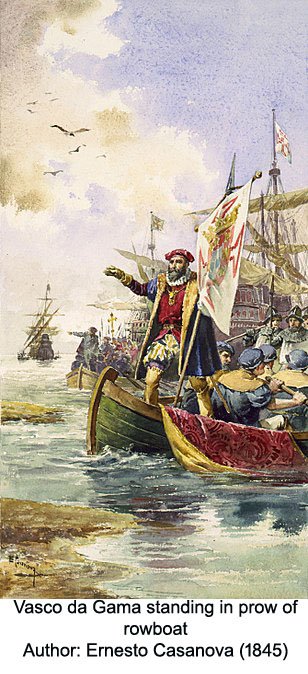 (10) Kappatti or Kappallangadi.—This little port on the open coast is famous as the place where Vasco da Gama’s expedition first dropped anchor. Correa’s account may be here transcribed. “The ships,” after sighting mount Deli and passing Cannanore, “ continued running along the coast close to land, for the coast was clear, without banks against which to take precautions : and the pilots gave orders to cast anchor in a place which made a sort of bay, because there commenced the city of Calicut. This town is named Capocate.” The “city of Calicut” does not commence for eight miles more to the southward, but what was meant probably was that there commenced the dominions of the Zamorin of Calicut. The place is an insignificant minor port where country craft sometimes come to lade with bulky country produce.
(20) Elattur.—A small port at the month of the river of the same name. Small vessels do not enter the river ; they call here occasionally for country produce.
(21) Puliyangadi.—A small port on the outskirts of Calicut, where country vessels sometimes call.
(22) Calicut.—This is one of the largest ports in the presidency. The tonnage frequenting it annually averages 902,119 tons. The average, value of its imports, chiefly consisting of grain, salt, and piece-goods, is Rs. 68,43,021, and of its exports, chiefly consisting of coffee, pepper, timber, ginger, etc., Rs. 1,22,37,598. It was in ancient days, when the Zamorin’s influence was supreme on the Malabar Coast, a place of great trade. The nations of the West came here for spices, popper, and cloth (calico); the Chinese even came from the far East in their gigantic floating hulks. It probably rose into importance about the eleventh or twelfth century A.D. In the first half of the fourteenth century, when Shaik Ibn Batuta visited it, it was certainly a place of great trade, and so it continued till the arrival of the Portuguese in the end of the fifteenth century. After that its decline was rapid owing to the interference of the Portuguese with the Muhammadan trade, and it has never since then recovered its position, as Cochin, its rival, under Portuguese and Dutch influence, has, with its greater natural facilities, always hitherto had an advantage.
In later times the French, Danes, and English had small trading factories at Calicut. It was here that the notorious pirate Captain Kydd began his career of crime. Aided by several noblemen, he had, in 1695, fitted out his ship the “Adventure,” a galley of thirty guns with two hundred men, to attack and destroy "the buccaneers who had their rendezvous at Madagascar, and who preyed to such an extent on the native trade that the Honourable Company feared the Mogul Emperor would take to making reprisals on them. His mission failed if it ever was seriously undertaken, and Captain Kydd finally threw off the mask and made prize of a small Dutch bark at Calicut, carrying it off to Madagascar.
Shortly afterwards he took the “Quedah Merchant,” of four hundred tons, with a cargo valued at four lakhs of rupees. After this he was joined by others, and his force was eventually composed of five ships (one hundred and eighty guns), two of which constantly cruised off Cape Camorin and the three others off the Malabar Coast, the port of Porcat (Porukatt) being free to them. After a short but brilliant career he returned to St. Mary’s Island off Madagascar and partitioned his gains among his crew. He then sailed for the West Indies, was arrested in America by one of the noblemen (Lord Bellamont) who had helped to fit him out, was tried, condemned, and hanged in chains at Tilbury (23rd May 1701), and his property becoming forfeit, was presented by Queen Anne to Greenwich Hospital. This severe example did not, however, prevent others from following in his footsteps, though, perhaps, the trade was carried on less openly afterwards, and Captain Alexander Hamilton narrates how he met at Calicut, in February 1703, a certain Captain Green, who admitted to him he had helped the Madagascar pirates with arms, and who, under the guise of lawful trading, did not let slip any opportunity of enriching himself by plundering others who were weaker.
Captain Green, too, had his crimes brought home to him, and was executed in Scotland. Other nations also, it would seem, engaged in this unlawful trade, and the “Formosa,” an English ship of Surat, was never heard of move after leaving Calicut one night on her voyage home. The people ashore heard a great firing of cannon at sea next forenoon, and two Danish cruisers were believed to have rifled her and then sunk her and her crew.
Calicut possesses an iron screw-pile pier extending out to twelve feet of water, and it has a lighthouse exposing a good dioptric light. The best anchorage for large vessels is marked by a buoy, and is with the following bearings ;—Lighthouse E. to IS. by N. in five to six fathoms, and from two to three miles off shore. Small craft, of which large numbers frequent this port, lie close in shore, but they should not anchor further south than with the light bearing E.N.E. as the ground then becomes foul.
The latter frequently lie aground on the soft mud-bank which from time to time forms off the lighthouse. This mud-bank is of small extent and gets broken up by heavy weather, but it at times suffices to still the surf created by ordinary sea-breezes and bints affords facilities for landing and shipping goods. The entrance and exit to and from the anchorages, particularly from the southward, is cumbered by a reef known as the “Coote Reef,” from one of the Honourable Company’s vessels having grounded on it.
This is probably also the reef alluded to by Captain Alexander Hamilton as “the ruins of the sunken town built by the Portuguese.” In standing into Calicut roadstead his ship struck on the “ruins,” and in describing the event he conjectures how the “ruins” got there, and quaintly winds up with the observation “but so it was, that in six Fathoms at the mainmast, my ship, which drew twenty-one Foot water, sat fast afore the chest-tree.”
That the sea has encroached at Calicut cannot be doubted, but that a Portuguese fort once stood where the Coote Reef now is cannot be believed, although the tradition alluded to by Captain Hamilton has great currency on the coast. There is no doubt that the tomb of an Arab of Himisi in Egypt, by name Shaikh Mammu Koya, once stood on a spot now covered by the sea, but his bones were recovered, and a birth-feast (muvalud) is now held annually in his honour, in the month Rajab, at his mosque. The encroachment on this occasion could evidently not have been a serious one.
Recent experience shows that if the sea encroaches one year it recedes again speedily, a fact which is perhaps to be accounted for by the rocky (laterite) nature of the bottom opposite the lighthouse, and for a considerable distance further north. In 1877 it encroached so much on the beach opposite the new custom house (about a thousand yards north of the lighthouse) that the abutment of the pier and three of the pier bays were carried away ; but now (April 1883) the sea beach has reformed at this spot, and the sand now extends fully up to or beyond its former limits.
The limits of the port, of Calicut are as follows : —
To the north.—The boundary pillar erected three quarters of a mile north of the new custom house.
To the south.—The boundary pillar two miles south of the custom house ; the seashore between them to within fifty yards of high-water mark spring-tides.
To the east.—The harbour or backwater, and the Kallayi river as far as the junction of Conolly’s canal with all creeks and channels leading thereto, and so much of the shores thereof, whether of the mainland or the islands, as are within fifty yards of high-water spring-tides.
To the west .—The space enclosed by two lines running due west from the boundary pillars to nine fathoms water. The ports immediately subordinate to Calicut are Nos. 20, 21 and 23.
(23) Molamkadavu.—A small port at the mouth of the Kallayi river, about a mile south of the Calicut lighthouse.
(24) Beypore.—The present terminus of the Madras railway south-west line is usually called Beypore, but this nomenclature is not correct, for Beypore, the port properly so called, lies on the north bank of the river of that name, whereas the terminus of the railway is on what is known as the island of Chaliyam. The custom house is on the north bank of the river, but the marine establishment, with a flagstaff, is located close to the railway station on the south side. The anchorage for small vessels is inside the river, close to the north bank and immediately below a reef of laterite rock which projects far into the stream. There is here, too, a tide-registering apparatus. The best anchorage in the roads for large vessels is with the following bearings : ---Port flagstaff E. by N. ½ N. to N.E. by E. in four and a half to six fathoms and from two to three miles off shore. There is one port subordinate to it, No. 25. The average tonnage of the port is 276,071 per annum, its average imports, consisting chiefly of salt and grain, are worth Rs. 4,80,407, and exports, consisting chiefly of coffee and cotton, are worth Rs. 37,66,695. The limits of the port are as follows :
To the north and south .—The seashore within fifty yards of high-water mark spring-tides, from boundary pillars one and a half miles north and south of the river’s mouth.
To the west.—The anchorage between two lines running west from the boundary pillars to nine fathoms water.
To the east.- -The banks of the river, backwater, creeks, and islands within fifty yards of high-water spring-tides, and within a distance of one and a half miles from the river’s mouth.
(25) Kadalundi .—This is a small port at the mouth of the river of the same name, where native vessels occasionally come for country produce. The bar of the river prevents even small native craft from entering it. It is possible that this port was of considerable importance in ancient times, inasmuch as the fate Dr. Burnell has taken this to be the site of the “village of great note situate near the sea” known to the author of the Periplus Mar. Eryth, as Tundis. There is some colour for this conclusion in the name itself, as Kadalundi is probably kadal (Mal. sea) and lundi (Mal. navel). Moreover, Tundis1 was, according to the Periplus, distant five hundred stadia from the mouth of the Mouziris river, which has been pretty satisfactorily identified with Muyiri-kodu or Cranganore (Kodungallur), and as matter of fact Kadalundi is sixty-six and a half miles or five hundred and seventy-eight stadia from the mouth of the Cranganore river.
NOTEs: 1. Tundis was on a river, and the only other river that could bd referred to in the Periplus is Ponnani, the mouth of which is a long way short of 500 stadia from the mouth of the Cranganore river. END OF NOTEs.
There is a temple of some note in the neighbourhood with a tradition going back to Rama’s conquest of Ceylon. The services rendered on that occasion by the monkeys secure daily food at the present day for their descendants left behind by Rama, on his return journey, at this temple. They come up boldly directly they are called. There is also a sacred spring which holds only a gallon or so of water, but refills as soon as the water is drawn. There are no remains of mark, but as in the first century A.D. Tundis was only a “village,” not much can be expected in that way.
(26) Parpanangadi.—This is a small port on the open coast, with some trade in salt-fish and country produce.
(27) Tanur.—This is another small port and fishing village, also on the open coast. Subordinate to it are the ports Nos. (26) and (28). Its average tonnage is (5,406 per annum. Its imports average Rs. 7,247 and its exports Rs. 90,345.
(28) Paravanna and (29) Kuttayi resemble Nos. (26) and (27).
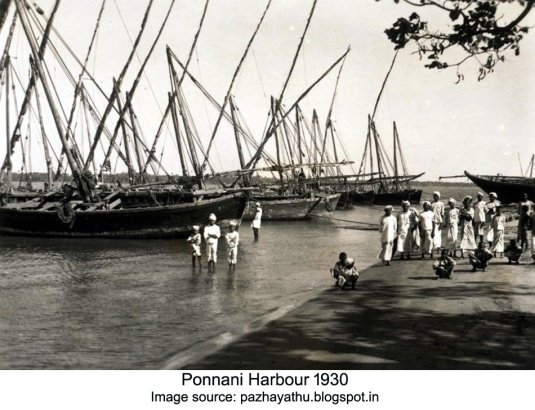 (30) Ponnani.—This port is of some importance owing to its position at the month of the river of the same name, and also owing to its being the nearest port to the great gap at Palghat in the Western Ghat chain. There was in fact, on this account, a proposition at one time to place here the terminus of the Madras southwest line of railway. A large part of the country east of the ghats used to be supplied with salt brought from Bombay to this port, but the railway has revolutionised this trade. The average tonnage frequenting the port is 39,203 per annum. The average imports (grain and salt chiefly) are valued at Rs. 1,01,260 and the exports (chiefly timber, pepper and cocoanut produce) are valued at Rs. 4,25,576.
Coasting craft of small size can enter the river, the mouth of which is, however, much cumbered by sand-banks. Subordinate to this port are Nos. 29 and 31.
(31) Veliyankod.—Is a small port of call for coasting craft loading with cocoanuts and other country produce, and is placed at the mouth of the river of the same name.
(32) Chavakkad.—This port is not situated at Chavakkad itself , which is an inland place, but at Chetwai (Chettuvali ) at the mouth of the river of that name. Its chief trade is in salt-fish, cocoanuts, etc., carried in small coasting craft, which, however, do not enter the mouth of the river. Average tonnage 4,987 per annum. Imports Rs. 671, exports Rs. 31,927.
(33) Madayi, (34) Attakuli, (35) Kurkkuli, (36) Attupuram. — Are all small ports of call for native coasting craft, and are all situated on the open coast respectively forty-eight miles, forty-two miles, thirty-six miles, and thirty miles north of Cochin, to which port they are all subordinate. These ports, however, all belong to the Ponnani and not to the Cochin Taluk, being situated in the Vadanapalli, Pallipuram, Keippamangalam, and Panangad amsams of the former taluk.
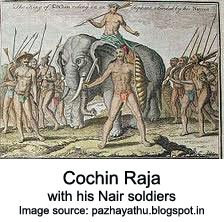 (37) Cochin.—This is the second or third largest trading port in the presidency. Its imports, valued at Rs. 57,46,987, the average for the seven years 1875-76 to 1881-82, consist chiefly of food-grains, metals, piece-goods, seeds, wood and manufactures, and its exports, valued at Rs. 74,44,303, the average for the same period of seven years, consist chiefly of coir yarn, rope and fibre, coffee, dried cocoanut, cocoanut-oil, pepper and wood, and manufactures. The average tonnage frequenting this port is 474,357 per annum.
Cochin has an inner harbour and an outer roadstead. The former is comprised of a narrowish patch of deep water created by the heavy scour of the tides rushing into and out of the immense tidal area of the backwater lying both to the north and south of the port. This deep water lies chiefly on the south bank close to the town of Cochin, and also between the jaws (as it were) of the harbour. On passing beyond the points of the land, the stream of the tides naturally diffuses itself over a wider area and the ship channel gradually diminishes in depth till the bar is readied.
The bar, which is at a distance of about a mile from the shore, is marked with buoys about five hundred yards apart, and carries a depth of never less than twelve feet and never more than eighteen feet of water. For the first half mile beyond the bar the depths lead only to twenty-one feet, and to secure thirty-six feet another mile has to be passed. The roadstead for vessels of great draught, therefore, lies about two to two and a half miles from shore in five and a half to six and a half fathoms with the following bearings : flagstaff E. ½ N. to E.N.E.
Cochin possesses great natural facilities for trade as it is the centre of an immense area of rich country, tapped in all directions by inland backwaters and navigable creeks, and it has the further advantage of affording security to the small shipping which frequents the port ; but it fails to come up to the requirements of modern trade in the matter of harbour accommodation for the large ocean-going steamers now used.
In the monsoon mouths, when the bar is usually impassable, the shipping takes refuge at the mud-bank of Narakal lying off Cochin State territory, five miles to the north ; and trade, though slack in the rains, is still carried on there. The limits of the port of Cochin are as follows :
To the north.—The boundary pillar on the northern point of the entrance to the harbour or backwater.
To the south.—The boundary pillar three miles south of the southern point of the entrance to the backwater. The seashore between them to within fifty yards of high-water mark springtides.
To the east.—The harbour and backwater, with all creeks and channels leading thereto that may be within the Honourable Company’s territories, and so much of the shores thereof, whether of the mainland or the islands, as are within fifty yards of high-water mark spring-tides.
To the west. — The space enclosed by two lines running due west from the boundary pillars to nine fathoms of water.
Cochin is really the successful rival of the very ancient trading city of Mouziris mentioned in the Periplus Mar. Eryth, which was written in the first or the third century A.D. The account given of that city in the said work is so interesting that it deserves to be here transcribed.
From the Periplus Maris Erythraei (M'Crindle's translation).
“53. After Kallienna, other local marts occur—Semulla, Mandagora, Palaipatmai, Melizeigara, Buzantion, Toparon, and Turannosboas. You come next to the islands called Sesekreienai and the island of the Aigidioi and that of the Kaineitai near what is called the Khersonesos, places in which are pirates, and after this the island Leuke (or "the white ”). Then follow Naoura and Tundis, (the first marts of Limurike, and after these Mouziris and Nelkunda, the seats of government.
"54. To the kingdom under the sway of Keprobotras, Tundis is subject, a village of great note situate near the sea. Mouziris, which pertains to the same realm, is a city at the height of prosperity frequented as it is by ships from Ariake and Greek ships from Egypt. It lies near a river at a distance from Tundis of live hundred stadia, whether this is measured from river to river or by the length of the sea voyage, and it is twenty stadia distant from the mouth of its own river. The distance of Nelkunda from Mouziris is also nearly five hundred stadia, whether measured from river to river or by the sea voyage, but it belongs to a different kingdom, that of Pandion. It likewise is situate near a river and at about a distance from the sea of one hundred and twenty stadia.
“55. At the very mouth of this river lies another village, Bakare, to which the ships despatched from Nelkunda come down empty and ride at anchor off shore while taking in cargo, for the river, it may be noted, has sunken reefs and shallows which make its navigation difficult. The sign by which those who come hither by sea know they are nearing land is their meeting with snakes, which are here of a black colour, not so long as those already mentioned, like serpents about the head, and with eyes the colour of blood.
“56. The ships which frequent these ports are of a large size, on account of the great amount and bulkiness of the pepper and betel of which their lading consists. The imports here are principally—
|
Great quantities of specie. (Topaz?) gold-stone, chrysolite. A small assortment of plain cloth. Flowered robes. Stibium, a pigment for the eyes ; coral. White glass, copper or brass. Tin, load. |
Wine, but not much, but about as much as at Barugaza. Sandarach (Sindura). Arsenic (orpiment), yellow sulphuret of arsenic. Corn, only for the use of the ship’s company, as the merchants do not sell it. |
“The following commodities are brought to it for export.1
NOTEs:
-
It will be observed that there is no mention among those exports of cocoanuts or of cocoanut produce of any description. If the cocoanut tree had existed at this time (first century A.D.) in Malabar, it is pretty certain that the produce of such a notable fruit tree would have been exported and must have been here mentioned. It may be safely concluded that the cocoanut;—-the southern tree as the Malayalis call it — was introduced on the coast after the first century A.D. It was probably cultivated on the coast at the time of the Syrian Christians’ copper-plate grant—the date of which is placed in the early part of the ninth century A.D.—for the professional planters of the coast, the Tiyar* (islanders), Cingalese, organised as a civic guild, were then well established, and tradition says that they came from the south bringing with them the “southern tree,” the cocoanut to wit. END OF NOTEs
NOTEs by VED: * Here, Logan has clearly made a confusion. He is confusing the Ezhavas of Travancore with the Thiyyas of Malabar. Actually, there are two different castes coming under the name of Thiyya. One is the Thiyyas of North Malabar who were traditionally following a Matriarchal family system. The second is the Thiyyas of South Malabar, who were following a patriarchal family system. Traditionally, all the above mentioned three castes were different with no common traditions or family connections. The English administration in Malabar did face some confusion with regard to the two different castes named Thiyyas coming with their administrative control, when the North and South Malabar came under the Malabar district. Edger Thurston’s book: ‘Castes and tribes of Southern India’ does mention the difference in certain pages. In certain other pages, this is difference is not allowed. More or less pointing to the fact that local interests did influence the contents of many similar writings by British colonial officials.
Ezhavas are mentioned as coming from Ezham or Ceylon (Sri lanka). Thiyyas have other claims. All the three groups get connected to each other by the single fact that all three of them were forcefully placed under the same supervisory caste of the Brahmins, that is, the Nairs. That is, the same level of subordination. END OF NOTEs by VED
|
Pepper in great quantity, produced in only one of these marts and called the pepper of Kottonara, Spikenard from the Ganges. Betel—all brought from countries further east. Transparent or precious stones of all sorts. Diamonds. |
Pearls in great quantity and of superior quality. Ivory. Fine silks. Jacinths. Tortoise shell from the Golden Island, and another sort which is taken in the islands which lie off the coast of Limurike. |
"The proper season to set sail from Egypt for this part of India is about the month of July, that is, Epiphi.”
Mouziris, as already noticed, has been satisfactorily identified with Muyiri-kodu, alias Kodungullur, alias Cranganore, the capital city of the Chera empire*, and its site was manifestly well selected as a place of trade before the mouth of the Periyar (great river) was blocked up by the sand-banks and alluvial islands which now hamper it.
NOTEs by VED: The use of the word Empire with regard to any of the kingdoms, big or small, in currently dug-up history, of the various locations inside the South Asian Subcontinent, is a fallacious and deceptive use of the word. To add to the fallacy, is the fact that the ruler of the English Empire which more or less was one of the biggest empires the world has seen, was only a queen or a king. At the same time, miniscule rulers in the South Asian subcontinent are in various ways, great kings or Emperors or Empresses.
The Portuguese would no doubt have made their chief settlement at Cranganore instead of at Cochin had the advantages been in favour of the former, but Vasco da Gama's successor, in 1500 A.D., wisely selected a site for his factory at Cochin, situated at the principal mouth of the system of back waters. It was described at this time as a long, low, sandy island covered with cocoanut trees, and divided by a deep river from Vypeen. Since that time it has continued to be a place of great trade, first under the Portuguese (A.D. 1500 to 1663), then under the Dutch (A.D. 1663 to 1795), and finally under the British.
The mouth of the system of backwaters has thus been fixed and protected, a fact of importance to the stability of trade at any part of a coast where the littoral current and the surf are always at work attempting to block up existing waterways and to open others. A breach, in fact, did take place in 1875 at what is called the Cruz Milagre Gap, about two miles north of Cochin, and to shut up the deep channel which was immediately scoured out was a labour of difficulty and expense. The existing waterway at Cochin can only be maintained by preventing the opening out of other waterways in the long reach of low sand spits stretching from Cranganore river to beyond Alleppey, a distance of over sixty miles.
The limits of the minor ports, namely, Nos. 1, 2, 3, 4, 6, 7, 8, 10, 11, 12, 14, 15, 16, 17, 19, 20, 21, 23, 25, 26, 27, 28, 29, 31, 32, 33, 31, 35, and 36 in the above list, have been authoritatively1 laid down as follows : —
NOTEs: 1. Government notification, 18th June 1881. END OF NOTEs.
"Half a mile on either side of the landing-place, extending to ten fathoms water seaward and fifty yards above high-water mark landwards.”
The Appendices VIII and IX give additional information as to port rules, fees, and other matters at the various ports.
Chapter 2. The PEOPLE
Section A.—Numbers, Density of Population, Civil Condition, Sex and Age
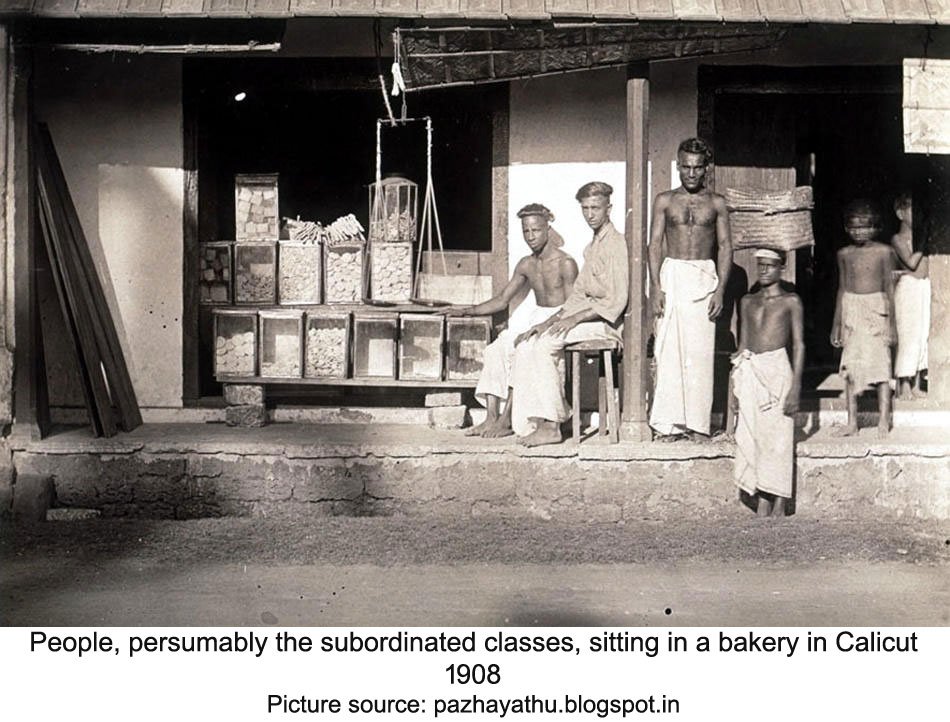
In 1802 the population was estimated at 465,594, in 1807 at 707,556, in 1821-22 at 907,575, in 1837- at 1,165,791, in 1851-52 at 1,514,909, in 1856-57 at 1,602,914, in 1861-62 at 1,709,081 and in 1866-67 at 1,856,378.
In 1871, when the first really trustworthy census was taken, the number was found to Be 2,261,250 living in 378,228 occupied houses, and in 1881, 2,365,035 living in 404,968 occupied houses.
The population is naturally densest on the seaboard, the number of persons (census, 1881) per square mile being –
Highest in Ponnani . . . . . . 974
Lowest in Wynad . . . . . . 92
and on the average . . . . . . 272
The average number of persons per occupied house (census, 1881) is found to be
Highest in Wynad . . . . . . 10.1
Lowest in Kurumbranad . . . . 5.3
and in the district generally . . . . 5.8
The civil condition of the people (census, 1881) is represented by the following figures:-
|
Singles |
Males |
688,027 |
|
Females |
539,109 |
|
|
|
1,227,136 |
|
Married |
Males |
455,083 |
|
Females |
476,711 |
|
|
|
941,704 |
|
Widowed |
Males |
20,283 |
|
Females |
174,079 |
|
|
|
194,362 |
|
Not stated |
Males |
881 |
|
Females |
862 |
|
|
|
1,743 |
|
Total |
Males |
1,174,274 |
|
Females |
1,190,761 |
|
|
|
2,366,035 |
Of the ages of the people (census 1881) the following figures* give the chief facts:
|
Years |
Males |
Females |
|
0 to 5 |
170,649 |
174,780 |
|
5 to 10 |
166,072 |
155,077 |
|
10 to 15 |
150,011 |
133,233 |
|
15 to 20 |
112,686 |
115,632 |
|
20 to 25 |
98,982 |
116,012 |
|
25 to 30 |
102,538 |
110,603 |
|
30 to 35 |
89,614 |
91,231 |
|
35 to 40 |
76,618 |
65,907 |
|
40 to 45 |
60,627 |
61,857 |
|
45 to 50 |
41,570 |
39,087 |
|
50 to 55 |
36,050 |
41,178 |
|
55 to 60 |
22,722 |
22,068 |
|
60 and upwards |
43,377 |
61,906 |
|
Not stated |
248 |
195 |
|
Total |
1,174,274 |
1,190,761 |
NOTEs by VED: There can be errors in the digits given above, due to the fact that text in the scanned pdf file of the original book is not very clear. END of NOTEs by VED
Section B.—Towns, Villages, Dwellings and Rural Organisation.
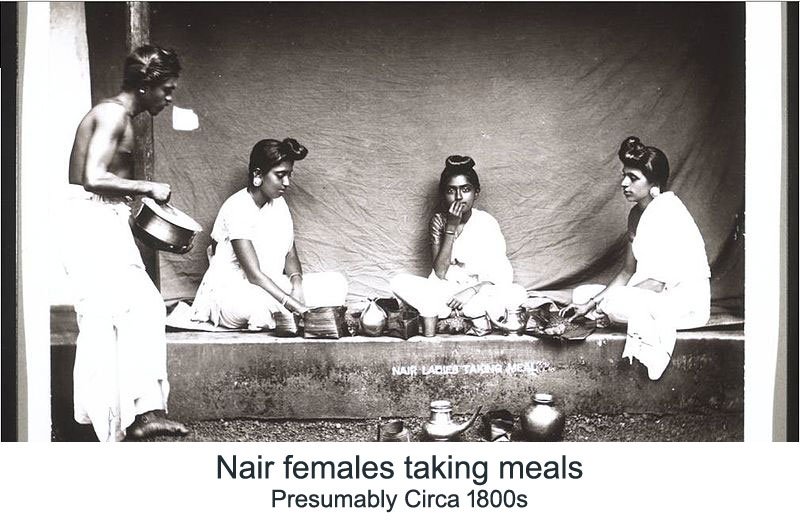
The Hindu Malayali is not a lover of towns and villages. His austere habits of caste purity and impurity made him in former days flee from places where pollution in the shape of men and women of low caste met him at every corner ; and even now the feeling is strong upon him and he loves not to dwell in cities.
On the margin of a fertile valley or ravine, with bright green fields of rice in front of his door, he likes to select the site of his dwelling. The stream coming down the valley or ravine is skilfully turned aside to right and left high up in its course where the first of the rice-fields is terraced out of the steep hill-side.
This device serves several purposes, for first of all the divided stream is carried along the sides of the valley at a higher level than the middle of it and thus irrigation is easy ; then, again, the channels serve as catch-drains for the streamlets coming down at intervals along the lull sides ; and, finally the water serves many domestic purposes as it flows close past the outer gateway of the house.
This outer gateway is the first tiling that catches one’s eye as the dwelling is approached: it is quaintly placed, quaintly constructed, and quaintly neat and tidy in all its surroundings. It is essential that a stair or a ladder should lead up to it from the bank of the green level paddy flat, reminding one in its construction of the days when security of life and limb and property depended on one’s ability to laugh a siege to scorn ; when a Nayar’s house was his castle ; and when here, at the gateway, were posted the retainers to keep watch and ward against enemies. Seats for them to rest on, to right and left, both outside and in ; a quaintly and solidly carved door and lintel ; a room above approached by a ladder from inside, with a window or openings whence deadly shots are even now-a-days sometimes discharged on lawless intruders ; and, finally, a thatched roof, complete the characteristics of the gatehouse.
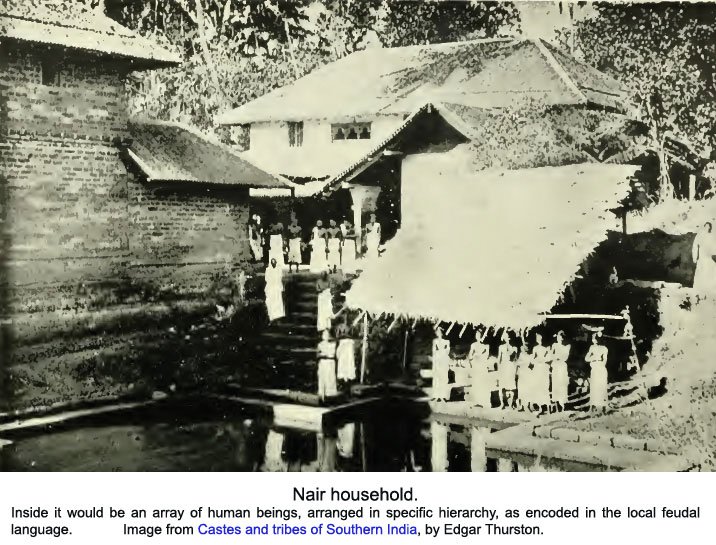
The Malayali is scrupulously particular about the tidiness and cleanliness of his house and its surroundings, and nowhere perhaps is this more conspicuous than at the gateway of his dwelling.
But a gate-house without flanking defences would be of little use, and the attention is next drawn to the massive bank of earth which hems in the spacious orchard in which the dwelling is placed. A neat interlaced and most serviceable fence of dry prickly bamboo thorns now generally tops the massive bank of earth and takes the place of the dense mass of living bamboo thorns which in former times used to be relied on for keeping out enemies. The house was evidently never meant to stand a long siege in former times, and the defences were intended merely to ward off a sudden raid and give time for the occupant’s friends and retainers to rally round him as was their wont.
On entering at the gateway the most prominent feature is the expanse of cool shade thrown by the umbrageous trees that surround the dwelling. The cocoanut, the jack with its dark glossy leaves and massive shade, the slender areca-nut and the broad-leafed plantain, all contribute to this effect. The earth around is cooled, and an agreeable freshness is perceptible even in the hottest and most scorching days in April and May.
A broad smooth path of hard baked clay, with raised banks a few inches high on either side, leads to a square, flat, open yard, where at midday' the sun shines dazzlingly and scorchingly down on the stores of paddy and other grains laid out to dry. The floor of this yard is well rammed and made smooth by cow-dung mixed with charcoal dust, often renewed in the hot weather, and the same bank of smooth clay hems in this yard on the open side.
The neatness, tidiness, and cleanliness of the approaches are not belied on closer acquaintance with the dwelling itself, and speak volumes for the housewifely qualities of the ladies who inhabit the main dwelling ranged round three sides, or sometimes all four sides, of the open yard just described.
The main building must face the rising sun—the east—and yet rather inconsistently it is called the Padinyatta-pura or western dwelling. The reason of this is explained that the building is opposite to the rising sun, and the Padinyatta-muri—the central chamber, the honoured guest chamber in the house, the sanctuary of the ancestors of its occupants—must be placed so as to admit of entrance through its doorway of the sun’s earliest rays. Another way of looking at it is that it is called the “western dwelling” because there cannot be any portion of the house to the west of it again. It in fact hems in as it were the dwelling on the western side. On either side of it, forming two sides of the square, are the vatakkina and tekkina—the northern and southern rooms—the former used for cooking and the latter for ordinary purposes of the household.
These three are the main rooms of the dwelling, but the fourth side of the square is sometimes occupied by another room called kilakkina or eastern room, and behind one or more of the chambers is sometimes placed another called the chaypu, or lean-to, forming an enclosed verandah room.
In selecting the exact spot for his dwelling a Malayali is guided by a very simple rule. The garden in which it is to be placed must be intersected into as far as possible equal portions by lines running due north and south and duo east and west. Four divisions are thus formed and the exact spot where the Padinyatta-pura is to be placed is in the north-east division, and in the inner corner or south-west angle of that division. The reason for the selection of this spot is explained to be that a Malayali tries to be as far as possible away from the polluting caste people who may approach the house as far as the fence, but may not enter the garden.
However high a man’s position may be, and however numerous may be his dependents, his house must, if he attends to the customs of his ancestors, be a succession of dwellings made in the above style ; but upper storeys are often added, verandahs generally find a place both upstairs and down, and are made both open and enclosed. Long, cool, comfortable quarters are to be found in those enclosed verandahs, which, by an arrangement, common on the west coast, are screened from outside observation by a pent-house roof with a massive carved wooden reverse slope to the caves filled in with horizontal bars.
The woodwork of the dwelling is solid and substantial and is often beautifully carved. The walls are generally of latorite to bricks set in mud, for lime is expensive and scarce, and till recent years the roof was invariably of thatch. This custom of the country was very strictly observed, and it was not till after the Honourable East India Company had had settlements on the coast for nearly a century that they were at last permitted, as a special favour, in 1759 fill to put tiles on their factory at Calicut. Palaces and temples alone were tiled in former days.
Of the surroundings of the dwelling there is generally a cattle-shed, and sometimes an excavated tank for bathing purposes, often full of fish and water-lilies ; a well of water at the rear of the cooking room, so arranged as to admit of water being taken direct from the well into the cook-room, is generally present.
A chapel of the household deity is found in all considerable houses, and there is sometimes a separate dwelling (matam) for Brahman travellers and Brahman visitors. The houses of the poorer classes, though smaller, are built on the same lines as a rule, and are usually kept as neat, and tidy, and clean as those of their superiors. The furniture of all the houses is very simple ; a metal pot with a spout, a few metal plates and saucers, a few metal pans of sizes, a spittoon of brass, a betel box, a few mats, a knife, a cot or two, a few wooden bins for grain, etc., are nearly all the requirements of a household in this respect.
NOTEs by VED: Above part is obviously of the household of the Nairs and not of the other castes. However, from the next paragraph onwards, the household mention goes into the case of all populations in the land. END of NOTEs by VED
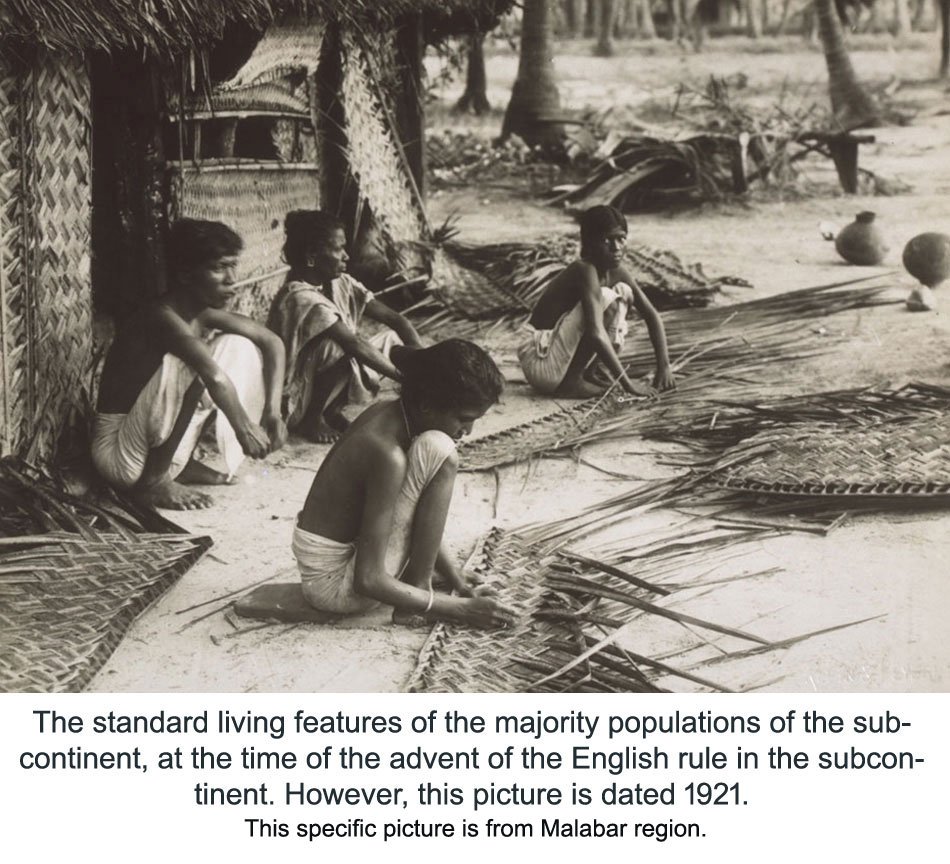
The house itself is called by different names according to the occupant’s caste. The house of a Pariah is a cheri, while the agrestic slave—the Cheraman—lives in a chala. The blacksmith, the goldsmith, the carpenter, the weaver, etc., and the toddy-drawer (Tiyan) inhabit houses styled pura or kudi ; the temple servant resides in a variyan or pisharam or pumatham, the ordinary Nayar in a vidu or bhavanam, while the man in authority of this caste dwells in an idam ; the Raja lives in a kovilakam or kottaram, the indigenous Brahman (Nambutiri) in an illam, while his fellow of higher rank calls his house a mana or manakhal.
Inferior castes, however, cannot thus speak of their houses in the presence of the autocratic Nambutiri. In lowliness and self-abasement they have, when talking to such an one, to style their houses “dungheaps,” and they and their doings can only be alluded to in phrases every one of which is an abasement and an insult.
The Nambutiri’s character for Hospitality stands high, but only among those of his own caste. Here is a graphic picture from the Travancore Census (1871) Report of the Nambutiri in his own home, related apparently from personal experience : —
“The Nambutiri’s hospitality and charity are proverbial. The Brahman guest in the family, especially if he combines with that character some little influence, is most kindly, treated, and in spite of the uncouth manners and queer conversation which he may meet with, he is certain to carry away the happiest recollections, of the illam. On entering the gate of the extensive property—in the midst of which is situated the palatial mansion with its suburban buildings severally dedicated for the household god, the younger members of the family, the cutcherry of the Pravritti officers, and for the wearied Brahman travellers- the visitor is received by the lord of the manor, who in his native simplicity inquires if he has bathed without any further ado about the health or other concerns of his guest. If the answer is in the negative, he himself leads the guest to the bathing-tank with its cool shod and refreshing waters, most politely inquiring if oil, enja (Acacia intsia) and thali are required, all the time innocently gaping at the dhowti, the walk, the arrangement of the hair, the moustaches on the face, the absence of the nanamundu and the conventional waist-string and undercloth, while the stranger, accustomed to more formal societies, smarts with shyness at the queer looks of his host.
The Nambutiri must be asked to leave the bath for a short time before he can be expected to go. The visitor is next led into the illam and asked to sit before the leaf spread out, not where the inmates generally eat, but in one of the outer rooms, respectable though ; but the inevitable thought occurs that you are treated like an outcasts. Even the ghi and dhal eating propensities of the visitor are attended to, though they are carefully eschewed and even disliked by the Nambutiri in his own meals.
Before serving rice, the Nambutiri inquires if the morning prayers are over, which he thinks improbable on account of the speed with which the visitor has returned from the tank, and feels a conscientious but unexpressed, hatred of the light manner in which religious observations are regarded by the Brahmans of the other coast. The feeding of Brahman travellers is not, however, such a rare or difficult business with the Nambutiri. It is a matter of course with him ; he makes it a rule of his life to treat the hungry Brahman : the traditions of his family am full of the proudest feats of charity and hospitality, and the number which he daily foods is limited only by the measure of his affluence.”
It may be gathered from the above descriptions that quiet and retirement are what the Malayali looks to in selecting a site for his dwelling, and that towns and town-life are not congenial to his tastes. And the fact is that the coast tracts are so densely populated that it is difficult to say where one of the municipal towns begins and where another ends. From end to end of the district on the low-lying lands near the sea there is an unbroken belt of coooanut-palm orchards, and the description which Shaikh Ibn Batuta gave of the country in the fourteenth century A.D, is equally applicable to it, now.
“We next”, said he “came into the country of Malabar which is the country of black pepper. Its length is a journey of two months along the shore from Sindabur to Kawlam. The whole of the way by land lies under the shade of trees. And in all this space of two months’ journey there is not a span free from cultivation. For everybody has here a garden and his house is placed in the middle of it ; and round the whole of this them is a fence of wood, up to which the ground of each inhabitant comes.”
The fact which on the coast of Malabar indicates the existence of a town is the occurrence of one or more streets of shops—bazaars — longer and busier than those to be met with elsewhere in the district. The foreign Brahmans, the Eurasian population, and, to a certain extent the Muhammadans also, live in streets of houses built in continuous rows.
The following statement shows at a glance the chief circumstances connected with the town population in Malabar:
|
Towns |
Area in Acrea |
Houses |
Floating population |
Total population including floating |
Total |
Religions |
||||||
|
O c c u p i e d |
U n o c c u p i e d |
M a l e s |
F e m a l e s |
M a l e s |
F e m a l e s |
H i n d u |
M u h a m m a d a n s |
C h r i s t i a n s |
O t h e r s |
|||
|
Cannanore Tellicherry Calicut Palghat Cochin |
2,482 2,555 8,447 5,821 597 |
4,038 3,420 8,540 6081 2,411 |
1,943 2,118 1,512 1,658 467 |
238 725 1,140 728 2,602 |
18 54 76 231 20 |
13,046 12,939 30,009 17,673 8,374 |
13,340 13,471 27,076 18,666 7,824 |
26,386 26,410 57,085 36,330 15,698 |
1 0,656 15,488 33,875 30,424 4,383 |
11,617 9,140 20,257 4,854 2,942 |
4,087 1,705 2,909 1,061 8,360 |
26 8 44 13 |
NOTEs by VED: There can be minor errors in the digits copied and placed above, due to the fact that the text was not clear in the scanned pdf file of the book. END of NOTEs by VED
For administrative purposes the district is divided not into villages as in the eastern coast districts, but into amsams, that is to say, parishes, of which the following statement gives the numbers in the different taluks:-
|
Taluks |
Number of amsams |
Estimated area in acres |
Total population of taluk |
Average area per amsam in acres |
Average population per amsam |
|
Chirakkal Kottayam Kurumbranad Wynad Culicut Ernad Valluvanad Palghat Ponnani Cochin |
44 28 57 13 41 52 64 56 73 1 |
644,453 420,080 261,163 612,240 765,680 1,527,332 448,961 614,400 258,154 1,085 |
272,669 165,775 261,024 88,091 205,962 296,143 308,102 342,454 392,654 17,161 |
14,046 15,002 4,581 47,095 18,675 29,371 7,015 10,971 3,536 1,085 |
6,197 5,920 4,579 6,776 5,023 5,695 4,814 6,115 5,278 17,161 |
|
District totals and averages |
429 |
5,553,548 |
2,350,035 |
12,945 |
5,477 |
NOTEs by VED: There can be minor errors in the digits copied and placed above, due to the fact that the text was not clear in the scanned pdf file of the book. END of NOTEs by VED
As the district has never been surveyed in detail, the areas of amsams are not wholly reliable, and in fact there are several obvious errors in the census (1881) statistics on this point, as, for example, the amsam of Arakurissi in Valluvanad taluk is said to embrace only 29,555 acres, whereas the whole of the Attapadi Valley, a very sparsely populated tract—probably 200 square miles in extent—ought to have been included, but is omitted from the statement of this amsam.
Subordinate to the amsam comes the desam or hamlet, which has often been mistaken for the village of the east coast. The fact, however, was that the desam was the territorial unit of the military organization in the ancient regime, and the true village, that is, the territorial unit of organization for civil purposes, was the tara. The amsams as at present defined are a modern and very recent creation for administrative purposes, but taras and desams, and the distinction that existed between them, take the enquirer back into ancient times and necessitate an investigation of the ancient system of government. This would, however, be out of place here, and it will more appropriately fall under the sections devoted to the history of the country.
It will suffice here to note that the earliest of the British administrators asserted repeatedly that the Hindu village did not exist in Malabar. Each State, said Mr. Warden, “was partitioned into gradations of military divisions from the Naduvali1 to the Desavali “Every division and subdivision was designated by the allotted quota of Nayars it was required to bring into the field.”
NOTEs: 1 Naduvali = the ruler, commandant of the nad or country ; Desavali = the ruler, commandant of the desam, or parish END of NOTEs
“The designations of the different military divisions remain to this day in every district in Malabar.”
The chieftains of the military divisions, large and small, held their dignities as hereditary in their respective families, and had appropriate titles of distinction. They were not always in attendance on the Raja’s person. If not required on particular State duties or religious services, they were only called out for defensive or offensive warfare. (Report to Board of Revenue, 12th September 1815, paragraphs 63, 64.
Sir Thomas Munro seems to have felt, and felt truly, that this could not have been the real state of things in a Hindu State, and in 1817 he paid Malabar a flying visit to satisfy himself on the point. The result of this visit was embodied in a very interesting report, dated the 4th July 1817, and the conclusion he arrived at was that for some purpose or other Malabar “was in the earliest times divided like the other provinces of India into districts and villages, the limits of which, but more especially of the villages, remain unchanged to this day.”
The districts and villages he found to be under hereditary chiefs, and the village was called the desam, the name by which it is still most commonly known.
Mr. Warden and Sir Thomas Munro were both in the right to a certain extent, but they both failed to recognize the importance of that most influential territorial unit of organisation - the Dravidan tara1. Sir Thomas Munro indeed mentions the word, but only as the name which the experienced Mysorean administrators of Haidar Ali and Tippu Sultan applied to the territorial units which they endeavoured to foster and keep alive as villages with hereditary heads, “an essential branch of their system” as Sir. Thomas Munro pointed out. This fact ought to, and probably would, have opened his eyes to the real state of the case had his stay in Malabar been prolonged. The influence of the tara organisation cannot be overrated in a political system tending always to despotism.
NOTEs: 1 Tara = foundation, mound, ground, village, quarter; similar to Tamil and Malayalam teru, Telugu teruvu, Cannarese and Tulu teravu END of NOTEs
The Nayar inhabitants of a tara formed a small republic, represented by their Karanavar or elders, and presented in that respect a striking resemblance to the “village republic” of the east coast districts as sketched by the Board of Revenue at the time when the village lease settlement system, as opposed to the ryotwari settlement system, was being discussed (Revenue Selections I, 487). The desam and the tara were not conterminous. If Sir Thomas Munro had enquired thoroughly into the matter he would, for instance, have found that the hundred and twenty-five desams which, according to information supplied him, formed the Calicut nad or county, embraced precisely the same lands as the seventy-two taras into which that nad was likewise divided. The nad or county was a congeries of taras or village republics, and the kuttam or assembly of the nad or county was a representative body of immense power which, when necessity existed, set at naught the authority of the Raja and punished his ministers when they did “unwarrantable acts.”
These are the very words used by the Honourable Company’s representative at Calicut when asked to explain the origin of certain civil commotions which had taken place there in 1746. His report deserves to be quoted in full, for it gives a vivid insight into the state of things as it then existed.
“These Nayars,” he wrote, “being heads of the Calicut people, resemble the parliament, and do not obey the king’s dictates in all things, but chastise his ministers when they do unwarrantable acts.” (Tellicherry Factory Diary of 28th May 1746).
The tara organisation instituted by the Mysoreans was unwisely changed into the hobali system or subordinate district establishments under the Honourable Company, the tarns being enlarged for this purpose. Sir Thomas Munro pointed out that the establishment thus organised was “so inadequate to the object of its institution that it required a complete revision.”
It was, in fact, not a village establishment at all, and instead of "bringing the Collector more immediately into contact with the people, it only served to lengthen the chain, already too long, of officials between them. The hobali system was abolished, and the existing amsam system was organised in its place by Special Commissioner H. S. Graeme in 1822-23. In doing this Mr. Graeme was at some pains to search out and instate as head of the amsam or adhikari, the most influential of the Desavalis under the ancient system, but many desams had to be rolled together to form one amsam.
There were formerly two thousand and odd desams ; there are now only four hundred and twenty-nine amsams. The Desavali selected was not always, or even generally, the Desavali of all the desams comprised in his amsam, and it was a new and unaccustomed role for him to be placed as headman in civil matters over people who had not previously acknowledged his authority. Indeed Mr. Graeme was careful in his sanads of appointment to preserve the rights of other Desavalis to the Sthana Mana avakasam (rights and privileges of office) in tracts which had previously been under other men.
But Mr. Graeme made the great mistake of thinking that the desam and the tara were synonymous, and so in his scheme of amsam establishments, the real civil organisation by the Karanavar or elders of the people was ignored, and in its place authority of various kinds was conferred on some only of the men who had been the local representatives of the ruling chieftains of Malabar. The mistake was of importance because it diverted attention away from, what had been the ancient organisation, and placed the real power in the hands of only one man out of several who had previously acted together in a body in the kuttam or assembly of the tara.
In these popular assemblies existed the nucleus of what might have been organised by judicious treatment into real local self-government, and it was a great misfortune that this important point escaped notice at the time. Each amsam or parish has now besides the Adhikari or man of authority, headman, an accountant or writer styled a Menon (literally, superior man), and two or more Kolkars (club men or peons), who between them manage the public affairs of the parish and are the local representatives of the Government.
Section C.—-The Language, Literature and State of Education
AMONG THE PEOPLE.
The vernacular of the district, popularly known as Malaylam, but more correctly written as Malayalma or Malayayma, “claims to be placed,” says Dr. Caldwell, “ next to Tamil in the list of Dravidian tongues, on account of the peculiarly close relationship to Tamil in which it stands.” Indeed the relationship is so close that Sanskrit writers class both tongues as Dravida, although from remote times a separate name has been applied by them to the Malayalam country.
Whether Malayalam is a “very ancient” and much-altered offshoot” of Tamil, as Dr, Caldwell holds, or whether, as Dr. Gundert holds, “the two languages of old differed rather as dialects of the same member of the Dravidian family than as separate languages,” is a point into which it is unnecessary to enter here in detail beyond remarking that Dr. Caldwell’s main argument from the words denoting east and west seems to be a fanciful though ingenious one. Because the Malayalam word for east, kilakku, means beneath, and because melku1 (west) means above, Dr. Caldwell argues that the Malayalis must have come from the Tamil country east of the ghats, since there they had the low level of the ocean on the east and the high level of the ghat mountains on the west.
NOTEs: 1.The more common word in Malayalam for west is padinynyaru, meaning the setting sun. END of NOTEs
But it is quite as reasonable to suppose that the Dravidians, in finding names for east and west, selected words denoting that east was where the sun appeared from below, as it would seem to them, and west as the place where he similarly disappeared from above. The languages were no doubt identical in ancient times, but with a high range of mountains intervening between the two countries rendering inter-communication difficult, and with further obstacles thrown in the way by differing political institutions, it is not to be wondered at that they split into two dialects, and as time advanced that they became two tongues.
The chief difference between them, and indeed between Malayalam and all the other Dravidian tongues, lies in the absence in Malayalam of the personal terminations of the verbs.
In treating of the Dravidian conjugational system Dr. Caldwell writes :
“The tenses are formed, not by means of the position of the pronouns, but by the particles or signs of present, past, and future time suffixed to the theme ; and the personal signs, as in the Turkish and Finnish families, are suffixed to the signs of tense. The only exception to this rule is that which forms the most characteristic feature of Malayalam—a language which appears to have been originally identical with Tamil, but which, in so far as its conjugational system is concerned, has fallen back from the inflexional development reached by both tongues whilst they were still one, to what appears to have been the primitive condition of both—a condition nearly resembling the Mongolian, the Manchu, and the other rude primitive tongue of High Asia.
“In ancient times, as may be gathered from the Malayalam poetry, and especially from the inscriptions1 preserved by the Syrian Christians and the Jews, the pronouns were suffixed to the Malayalam verb precisely as they still are in Tamil. At present the verb is entirely divested, at least in the colloquial dialect, of signs of personality ; . and with the pronouns the signs of number and gender have also necessarily disappeared : so that the pronoun or nominative must in every instance be separately prefixed to the verb to complete the signification ; and it is chiefly by means of this prefixed pronoun that a verb, properly so called, is distinguished from a verbal participle.
NOTEs: 1 Dates about A.D. 700 to A.D. 820. END of NOTEs
“Though the personal signs have been abandoned by the Malayalam verb, the signs of tense or time have been retained, and are annexed directly to the root as in the other dialects. Even in modern English some persons of the verb retain archaic fragments of the pronominal signs (e.g. lovest, loveth) ; but in modern Malayalam every trace of these signs has disappeared.
“Thus, whilst we should say in Tamil aditten , I beat ; adittay , thou didst beat ; adittan, he beat ; Malayalam uses in these and all similar cases the verbal participle adichu (for adittu), having beaten, with the prefixed pronouns I, thou, he, etc. (e.g., nyan adichu, I beat ; ni adichu, thou didst beat ; avan adichu he beat). Though the pronominal signs have been lost by the Malayalam verb, they have been retained even by the Tuda ; and notwithstanding the comparative barbarity of the Gonds and Kus, their conjugational system is peculiarly elaborate and complete.”
The complete disappearance of signs of personality in the Malayalam verb raises a doubt whether they were ever really adopted in the colloquial language. For the evidence in favour of pronouns being suffixed to the Malayalam tenses—it being admitted that verbs in all Dravidian languages were originally uninflected—is derived from ancient poetry and ancient inscriptions, and these did not necessarily correspond with the spoken language.
It is to be noted that the written tongue in ancient times always tended to become a speciality, the speciality of a class or caste who got a livelihood by it. Moreover, as will be seen further on, the precise time to which Dr. Caldwell alludes—the time of the Jews’ and Syrians’ deeds—was precisely at that epoch (about eighth century A.D.) in the history of the country when Vedic Brahmanism is believed to have finally supplanted Jainism as the religion of the Aryan immigrants.
The Jains, whose period of greatest literary activity in the Tamil country was subsequent—ninth or tenth to thirteenth century A.D.—to the dates of the Jews’ and Syrians’ deeds, seem to have encouraged the study of the vernaculars and to have developed the languages of the common people ; the Vedic Brahmans, on the other hand, encouraged—and that only among themselves—the study of nothing but Sanskrit, of which and of the religion and arts and sciences embodied in that tongue they held a practical monopoly for many centuries, beginning from probably the end of the seventh or commencement of the eighth century A.D. One would expect therefore to find—and such is the actual fact—that Malayalam is much fuller than any of the other Dravidian languages of pure Sanskrit words (tatsamam) and Sanskrit derivatives (tudbhavam) : this is, indeed, the only other chief difference between it and the other Dravidian tongues.
The most probable view is that the Vedic Brahman immigration into Malabar put a stop to the development of Malayalam as a language just at the time when the literary activity of the Jains in the Tamil country was commencing. It is admitted that this immigration took place at an earlier point of time into Malabar than into the other South Indian countries, and it is not unreasonable to suppose that at the time when this took place the use of verbal inflexions had not taken hold of the colloquial language.
The Vedic Brahmans (Nambutiris ) were, of and are still it may be added, the last persons in the world to approve of educating the commonalty, for that would have tended to take from themselves the monopoly of learning they so long possessed. It was no less than a revolution when in the seventeenth century one Tunjatta Eluttachchan, a man of the Sudra (Nayar) caste, boldly made an alphabet—the existing Malayalam one—-derived chiefly from the Grantha—the Sanskrit alphabet of the Tamils, which permitted of the free use of Sanskrit in writing—and boldly set to work to render the chief Sanskrit poems into Malayalam.
Regarding the obstacles which he had to meet and the opposition which was offered to him Mr. F. W. Ellis has the following remarks in a dissertation on the Malayalam language : “The difficulties with which he had in consequence to struggle gave him an energy of character which it is probable he would not have possessed had his caste been without blemish .1
NOTEs: 1 Mr. Ellis supposed him to be the illegitimate son of a Brahman woman, hut there is nothing to support, this, and, on the contrary, tradition says he was a Sudra (Nayar). Mr. Ellis may have confounded the tradition about the great Sankara Acharya with the tradition about him END of NOTEs
“The Brahmans envied his genius and learning, and are said to have seduced him by the arts of sorcery into the habit of ebriety, wishing to overshadow the mental powers which they feared. The poet, however, triumphed on his habits, though he could not abandon them, and, in revenge against those whom he considered the cause of his debasement he opposed himself openly to the prejudices and the intolerance of the Brahmans. The mode of vengeance he chose was the exaltation of the Malayalam tongue, declaring it his intention to raise this inferior dialect of the Tamil to an equality with the sacred language of the gods and rishis.
“In the prosecution of this purpose he enriched the Malayalam with the translations I have mentioned,1 all of which, it is said, he composed while under the immediate influence of intoxication. No original compositions are attributed to him.”
NOTEs: 1 Viz. “All the works of note in the original language” (Sanskrit). He is traditionally reported to have translated into Malayalam the following : Ramayanam, Mahabharatam, Bhagavatam, besides others. END of NOTEs
Tunjatta Eluttachchan’s success even in his own lifetime seems to have been great, and it was in consequence of his influence and success that Malayalam, as a written language, obtained its most recent development.
The site of his house is still pointed out at Trikkandiyur near Vellattpudiangadi in the Ponnani taluk, and, as usual among Malayalis when a man has risen a bit above his fellows in good or in bad qualities, something of superstitious awe attaches to the place of his dwelling. It is said that as Tunjatta Eluttachchan lay on his death-bed he told his daughter that at a particular hour, on a particular day, in a certain month and a certain year which he named, a youth would come to his house. His daughter was directed to have the house swept and garnished as for a distinguished guest, and his directions were that to this visitor his sandals and his books should be given.
On the appointed day and at the appointed hour came one Surya Narayanan Eluttachchan, then a youth of sixteen years and of the Taragan caste. He received the sandals and the books and went his way. This Surya Narayanan became Gurunadhan (tutor, teacher) to the Zamorin, and afterwards set out on pilgrimages to Benares and other places, wandering about leading a holy life till he was thirty-two years old. He then returned to Malabar, and was directed in a vision, thrice repeated, to settle on the river bank (then a jungly place) at what is now Chittur Tekke Gramam in Cochin territory, east of Palghat.
He there bought some ground and, helped by the Zamorin and others, built on one side of the street a row of houses for Brahmans and in the middle, on the opposite side, one for himself. He next invited some Brahman families to settle them, which they did, attracted by the holiness of Surya Narayanan Eluttachchan’s life and character. He never married but lived and died a sanyasi (ascetic), and Tunjatta Eluttachchan’s relics were, it is said, there sacredly preserved and worshipped till, with one exception, they were destroyed by fire some thirty or forty years ago.
The stool and staff mentioned by Dr. Burnell in his “South Indian Palæography” belonged, it is said, to the ascetic and not to the father of modern Malayalam. And another fire has, it is believed, destroyed these relies since Dr. Burnell’s visit, and also probably the Bhagavatam, the only thing saved from the previous conflagration. Tunjatta Eluttachchan’s memory, however, is not likely to die down, for relics thus lost are easily replaced and the sacred honours paid to them are easily shifted to the substitutes. On the development of Malayalam since Tunjatta Eluttachchan’s time Dr. Burnell has the following remarks in his “South Indian Palæography”: The Sanskrit literature was, after this, no longer a secret, and there was perhaps no part of South India where it was more studied by people of many castes during the eighteenth century.”
Of the Malayalam poetry which thus originated Mr. F. W. Ellis gives the following account :
"The language of Malayalam poetry is in fact a mixture of Sanskrit, generally pure, with Sen and Kodun Tamil ; ” but in Tamil “ declined or conjugated forms from the Sanskrit are not admissible.” “ They are not admissible, also, in Malayalam prose, but in verse they are often used with such profusion as to give it the appearance of that fanciful species of composition called in Sanskrit Mani-pravalam and in English ‘Maccaronic verse,’ rather than the sober dress of grammatical language : often, indeed, the whole verse is pure Sanskrit, connected or concluded by a few words of Malayalam.”
And “this profuse intermixture of the grammatical forms of the Sanskrit in the higher order of Malayalam composition would seem to have led certain recent Italian writers into strange misconceptions. Though one of them, Paulinus of St. Bartholomæo, has composed a grammar of the Sanskrit, he does not seem quite clear there is any radical distinction between what he calls the lingua Sanscredamico-Malabarica and the Samscredamica; and the author of the introduction to the Alphabetum grandonico-malabaricum sive samscrudonicum, by which he means the Arya character of the Malayalam, though he be sadly puzzled to discover whether the Samscrudonica lingua be the mother of the Grandonica or vice versa, expressly says : ‘Lingua igitur vulgaris Malabarica, ea nempe quoe usurpatior a Gentibus littoris Malabarici insolis, a Promotario Comorino usque ad monlem Deli prope Regnum Canara, nil nisi dialectus est Sanscrudonicae linguae.”
Mr. Ellis goes on to remark : “The Malayalam has never been cultivated as an independent literary language, nor does the Tamil literature, notwithstanding the length of time the country was subject to the Kings of Seram, appear to have been extensively known here, or at least has not survived that dynasty. This is the more extraordinary as some of the earliest and best of the Tamil works were composed in Seram. This remark, however, applies more to Keralam proper than to Mushikam or Travancore ; the residence of the Seram viceroys was in this province, and a knowledge of pure Tamil has always been more prevalent here than in the northern districts.”
Of the historical portion of these remarks this is not the place to speak, but it is necessary to observe that Tamil, as an independent literary language, flourished in the tenth to thirteenth centuries A.D., some considerable time after the last of the Perumals (to whom apparently Mr. Ellis refers in speaking of the viceroys) disappeared, an event which, for reasons to be assigned in the proper place, was probably contemporaneous with the commencement of the Kollam era, 25th August 825 A.D.
Mr. Ellis is right in saying that Malayalam has never been cultivated as an independent literary language, and he continues:
“There exists in Malayalam, as far as my information extends, no work or language, no grammar1, no dictionary, commentaries on the Sanskrit Amarakosha excepted. The principal work in prose is the Keralutpati2, which is also said to be translated from the Sanskrit, though the original is now nowhere to be found.”
NOTEs: This was written some time before 1819, the year in which Mr. Ellis died. These complaints exist no longer, thanks to the research of Dr. Gundert.
NOTEs: 2. Origin of Keralam END of NOTEs
This last-named work is an account chiefly from the Vedic Brahman point of view of the origin and history of Keralam. As a historical work it is of little use, but as a mine of half forgotten and wholly forgotten native usages and customs it is most valuable.
While, however, Malayalis have no literature to be compared to the Kural of Tiruvalluvar or to the polished3 verses of Sivavakkiyar , they have many folk songs, few of which have been reduced to writing, but which are extremely popular, being composed in the ordinary dialect of the people and treating of subjects in which they have an interest.
NOTEs: 3
|
Arium alla, Ayanum alla, Aranum alla—appuram alla; Karumei, semmei, venmeiyum, Kadantu nindra karanam; Peritum alla, siritum alla, Pennum anum allave; Duriamum Kadaptu nindra— Dura, dura, durame. (Sivavakkiyar.) |
Not Brahma, Vishnu, Siva, In the beyond is He; Not black, nor white, nor ruddy, This Source of things that be: Not great is He, nor little, Not female and not male; But stands far, far and far beyond All being utmost pale. (R. C Caldwell.) |
END of NOTEs
Of these, perhaps the most popular are the ballads relating the deeds of Tachcholi Meppayil Kunhi Othenan. The original Tachcholi pat, describing one of Othenan’s exploits — whether the final exploit of his life or not is uncertain— is a great favourite, and several Tachcholi pats, as they are called, have since been composed in the same metre regarding the doings of other men. There is one commemorating the Palassi (Pychy) Raja’s rebellion (1797-1805 A.D.), another about Tippu Sultan, a third about the mythical feats of Veikeleri Kunhi Kelappan. A specimen of the metro (the first few lines) of the original Tachcholi pat is subjoined :
“Otayottidattile Kandasseri
Lokanar Kavile Kavuttana
Kavur vannum pulannu vello
Nammala Kavilum pova venam
Tachcholi Meppayile Kunynyi Otenan
Tanre chamayam chamayavum cheythu
Tanre idattatum valattatumayi
Munnile pokunna Kandasseri
Valiye madhakkaran Kunynyi Otenan
Iruvarum kudiyallo porunnata.”
The metro falls in the class of what are known as "Vishamavrittam ” or irregular metres. The lines contain generally ten or more syllables or fourteen matras (time required to utter u) and each couplet ought to have twenty-eight matras.
Of the hero of the original Tachcholi pat—the Robin Hood of North Malabar—many traditions are extant. He was apparently a man of fine physique and skilful in the use of arms, who attracted to himself a large and mixed following. It is not exactly said that, like his prototype, he robbed the rich to give to the poor, but he was evidently not too particular as to his means of taking what he wanted for himself or followers.
This, no doubt, brought him into collision with the authorities, and the well is still pointed out near Vadakkara in Kurumbranad Taluk which he is said to have cleared at one bound to prevent his capture by the followers of the Kadattanad Raja. The well is a fine masonry-built structure, still in excellent preservation, and at the spot where Tachcholi Otenan is said to have cleared it, it is twenty feet six inches between perpendiculars.
There is a massive conical-shaped block of laterite some three feet in height planted erect in the ground about fifteen paces from the well, and one mythical tradition says he jumped the well with this and a jack tree in his arms. In the popular ballad he is stated to have been treacherously shot, but whether mortally or not is uncertain, by a Mappilla on returning to search for a dagger he had accidently dropped in a duel in which he had discomfited his enemy. The following is a literal translation of the ballad, narrating with much quaintness the events of this duel, and shedding various interesting lights on native customs and habits.
Tachcholi Ballad
To his squire Odayottidattil Kandasseri (Chappan)
Said Tachcholi Meppayil Kunhi Odenan,
“For the Lokanar Kavil Kavut,
“Which day of ceremony has come and dawned,
“We to that temple must go.”
Tachcholi Meppayil Kunhi Odenan
His apparel he put on,
His sword and shield he took in his right and left,
In front walked Kandasseri,
In the rear the nobleman Kunhi Odenan.
Together proceeded in company.
Said dear Kunhi Odenan
To his wife Kavile Chathoth Kunhi Cliiru.
"Till I go and come
"Don’t you go down the gate steps
“Do caress child Ambadi;
“Give him milk when thirsty
“And rice when hungry.”
So Tachcholi Meppayil Kunhi Odenan .
Took loave of Kavile Chathoth.
Odayottidattil Kandesseri
Took a lance made of the first-rate cocoanut tree;
Armed with it,
They proceeded together ;
Walked (the whole distance) in one march.
On arriving at the Lokanar Kavu
It appeared as if it had been fenced with men on all four sides.
All the Ten Thousand Nayars had assembled ;
Also the Princes of the Four Palaces
The reigning Raja of Kadattanad,
The heir apparent of Purameri,
And the Raja of Kuttipuram,
Had put ill their royal prosence.
Tahcholi Meppayil Kunhi Odonan
Went and ascended the entrance steps.
Walked straight up to the Tachcholi’s seat—
The platform under the Banian tree—
Where the good fellow sat and amused himself.
Gazing at the comers and
Looking all round about the temple.
While thus sitting,
The Mathilur Kurikkal with his disciples—
The two and twenty youngsters—
Arrive at the Lokanar Kavu,
Went to the Goddess’ divine presence,
Most devoutly worshipped with clasped hands,
And, after worshipping, left the temple
To occupy a seat on the Tachcholi’s platform,
On the south part of which they went and sat.
This with his own eyes Kunhi Odenan saw,
And he thus exclaimed ;
“Lo ! Odayottidattil Kandasseri
“What (a) strange (thing is) all this !
“On the platform under our Banian tree
What Nayar cometh to take a seat ?
“Make haste and see who he is.” ;
Thus said Meppayil Tachcholi Kunhi Odenan—
A very jealous Odenan—
“What Nayar art thou
“That went to the Banian tree?
Odenan seeing this with his own eyes
Boiled his jet black eyes in burning rage,
Shook his legs in excitement,
Clenched his fists in anger,
And spoke thus : “Odayottidattil Kandasseri!
“Go home quick, and get
“ My silver-handled gun ;
“In our western chamber it stands
“Full loaded with two bullets and two plugs.
“Hasten thou and come soon.
“One word more to you ! Kandasseri!
“The Poratara Peacock
“With its young brood
“*Is perching upon our Banian tree
“I’ll shoot them dead one by one.”
This one word was said.
At once Kurikkal said,
“Hark ! My beloved youths !
“We must start at once ;
We must go to our Poratara.’
So the Mathilur Kurikkal and pupils
Proceeded back with their heads
Covered and hungdown in disgrace.
Again said the Kurikkal,
“We should not wait to see the Kavut.”
Thus the Kurikkal left at once
With his two and twenty pupils.
When descending the steps,
The Kurikkal shouted loud and challenged
“My good fellow, Tachcholi Kunhi Odena!
“If the tenth and eleventh of Kumbham shall come,
If God will spare my life,
“I pledge my word to be at Ponniyat.
“There under the Banian tree
“In single combat could we test our supremacy.
“That day let us meet again!”
Thus the Kurikkal declared the war,
In the midst of the Ten Thousand,
And proceeded back on his way.
The sight-seers trembled
At this throwing down and taking up the gauntlet.
A stillness prevailed like that after a heavy rain.
A panic spread
Over all assembled.
Tachchoji Koma Kurup (older brother of Odonan),
On this very news coming into his ears,
Beat his breast and exclaimed in tears
“Alas ! You saucy fellow !
“Is it at a mountain that you are throwing a pot ?
“On Thursday in Kumbham next
“ You have agreed to enter the lists.”
The Kurup hastened on to interpose:
The Kurikkal, on his way from the temple,
Is accosted by the Kurup,
Whom the Lord Kurikkal treats with contempt,
Spits on his face with betel juice,
And says to the Kurup :
“Got thee gone ! What (an) unmanly thing!
“What meanest thou by
Untimely interposition?
“ If God spares me
“ I will make him atone for it.”
Thus saying the Kurikkal went his way to Poratara.
Tachacholi Koma Kurup
Went however to the Lokanar Kavu.
He was met by his brother,
Who was returning having seen the Kavut.
They walked home straight.
On their way the Kurup wept,
Beating his breast, shedding bloody tears,
And thus addressed his brother :—-
“My beloved brother ! how impudent you are!
“You have engaged to fight on the 1Oth and 11th Kumbham !
“ What do you think of doing next ?”
Immediately replied Kunhi Odenan,
“ Brother ! Why do you weep ?
“ Am I not a man like himself ?
“Is it enough always to give ?
“Can’t I receive it once ?
“Let it happen as fate wills it!
“Why cry for it !”
“Hear me,” said the Kurup,
“In whose charge do you leave me?
“Am I not in my dotage ?
“ If fate should call me away any moment,
“To perform the funeral rites
“No male exists in our family.”
Thus saying they were going.
The Kurup further observed :
“My dear brother Odena
“Your nice little face of ripe areoanut colour
“How came it to be changed into a new pot’s colour?”
By this time they reached the Tachcholi Meppayil house.
Their sister Tachcholi Unnichira
Seeing then come,
Brought a gindy pot of water (to wash hands and feet, with)
And asked her dear brother to partake of kanji;
But Kunhi Odonan said he must bathe.
So he bathed, dined, and spent that day there.
The next morning dawned,
And the Koma Kurup said :—
“Brother Tachcholi Meppayil Kunhi Odenan !
“The fatal 10th and 11th of Kumbham
“Are drawing closer and closer.
“On Thursday week, in Kumbham next,
“At Ponniyat Banian tree, you must
“Go to fight the duel.
“Your friends in all
“You must go and call—
“Kottakal Ahamad Marakkar,
“Vadakkara Pidigayil Kunhi Pokkar—
“To them you must go, and tell particularly
“That they should accompany you personally.
“Again, Etacheri Odenan Nambiyar
“ And Panangatan Chandu Kurup
“ Must also be requested
“ To accompany you to Ponniyat,
“ Hear me again, Kunhi Odonan !
“ There is Payyampalli of Katirur Tara,
“ The Kunhi Chandu of that house
“ You must also take along with you.”
They were all accordingly invited.
Chandu, on being asked, said :—
“Odenan ! don’t you go this year to Ponniyat.
“You have an evil time of it,
“ And I shall not come with you.”
At once returns Kunhi Odonan,
Walking hastily through Ponniyat Kalam field,
Crossing the Ponniyam and Puttalam rivers,
And passing the Chambat Puncha land,
Arrives at his Tachcholi Meppayil house,
Bathes and takes his food,
And spends the day there.
Next morning he went to Lokanar Kavu;
Bade the priest to open the shrine
And light up lamps on each side of the idol, !
And caused the musicians to beat: tom-tom.
The treasure-box was brought out,
And the idol in procession marched out.
At this juncture
A Nambutiri youth received divine inspiration,
And pronounced the oracle ;—
“You should not go to Ponniyat this year ;
“Your evil star is in the ascendant;
“I can do nothing for you.”
When this was heard
Odenan prostrated himself before the Goddess
And prayed :—“ 0 ! noble Goddess !
"When I go to Ponniyat
“You must stand on my right.
“I have no other help
“But my mother Goddess !”
The oracle then gave him leave
To stay in the arena till noon,
And not to remain there longer;
And further assured him
That if he looked up to the Banian tree
He would see the Goddess herself in the disguise of a yellow bird.
But afternoon she would not be there,
And therefore he should not be there.
Kunhi Odenan then from his waist cloth took
Sixteen silver Panama, which in the sacred box he put.
Thus worshipping, he returned
With his attendant Odayottidattil Chappan
To theTachcholi Meppayil house,
And told his brother Koma Kurup
All that the oracle had said.
“Don’t you then go this year,” says Koma Kurup.
But Odenan replies—
‘‘Should I die even, it matters not;
“ I must go to Ponniyat to-day.
Remonstrance had no effect—
Either brothers or others’.
“Let us go,” says Odenan to Kandasseri,
“To Kavile Chathoth house.”
Thither they went accordingly
And saw his wife Chiru
Talcing the child Ambadi in her arms,
And looking at the husband she cried :—
“ Oh ! my daring husband !
"You have engaged to fight
"At the Banian tree in Ponniyat:
To whose care will you entrust us ?”
“Dear Chiru,” says Odenan in reply,
"Am I going to die ?
“Is not man equal to man ?
Bathing and eating he spent that day there.
Next day broke;
Kinhi Odenan rose
And proposed to go to Meppayil house
Then Chiru prepared milk kanji,
Which Odenan took and went home.
In taking leave of his wife, lie told her;
“My dear Kunhi Chiru,
“ Till I come back
“ Don’t you stir out of the house.”
When words like these were heard,
Beating her breast, she cried.
“ Why do you cry, my dear” said Odenan,
“I am not going to die ;
“I shall come very soon.”
Thus saying, he took leave of her.
When descending the gate steps
Her eyes were full of tears
Which were flowing by the breast in bloody drops.
He walked straight to his Tachcholi Meppayil house.
Where, in the west room he found
That his brother was still in his bed.
He sat on the bed
And placing his feet on his lap
And rubbing thorn gently
He waked his brother from sleep. ,
“Who is this at my feet ? ” asked the brother ;
“l am, I am my brother,” was the answer.
So and so he passed that day there. ’
The next day came,
And the eventful Thursday came.
There came then the Kottakkal Ahamad Marakka
And his followers,
Vadakkara Pidigayil Kunhi Pokkar
And his followers,
Edacheri Odenan Nambiyar
And his followers,
Kalleri Kunga Kurup
And his followers,
Panangatan Chandu Kurup
And his followers,
All in a body assembled
Numbering about five hundred.
Tachcholi Meppayil Kunhi Odenan
Took an oil bath, and rubbed over his body
A mixture of perfume, sandalwood and musk,
And sat down for dinner.
A Kadali plantain leaf was spread.
His sister Tachcholi Unichira
Served him the dinner—
Fine lily-white rice,
A large quantity of pure ghee,
And eleven kinds of vegetable curries.
He fed himself sumptuously on all those
And washed his hands and mouth after it.
He then sat in the south verandah.
Kandasseri Chappan, his squire,
Served him betel to chew.
Chewing and chatting he sat there for a while;
After which he rose and opened his west room,
Where he stood in devotion to family Gods,
And offered them vows if success he got,
And beseeched them to stand on his right.
He then prostrated himself before them,
And went to dress-—a full dress.
He wore God of-Serpent’s head ear-ring in ears,
Combed down his hair,
And wore a flower of gold over the crown,
A silk cloth round the loins,
A gold girdle over it,
Gold rings in four lingers,
A bracelet worked in with scenes
From Ramayanam and Bharatam
High up on his right arm,
A gold-handled sword in his right hand,
And a tiger-fighting shield in his left hand
When coming out thus dressed, he looked
Like melted gold of ten and a half touch !
Like the rising sun in the east!
Liko the setting moon in the west!
He took leave of his brother Koma Kurup
By falling prostrate at his feet,
Who then blessed him thus— ,
“May God help you !
“May you gain the victory !
Odayottidattii Kandasseri
Took a spear—a tiger spear—
And led the way on ;
All in a body went on ;
Numbering about five hundred.
They proceeded on in one single march
From Kadattanad to Ponniyat.
They halted not on the road,
They drank not when thirsty,
They sat not to chew betel.
Fatigued as they were by the march,
They came to the Peringalam river
And they crossed the river.
Through the Chambat Punja field,
And through the good village of Chambat,
They made a rapid march.
They reached the mango grove
For tightening girdles above.
From under the Ponniyat Banian tree
The noise of the crowd assembled,
The sound of swords clashing upon targets
Were heard, and Odenan said
To his brother and comrades
That Kurikkal and his party had taken the field.
Odenan, from his waist cloth,
Took sixteen silver Fanams,
And, presenting the same
To Kottakkal Ahamad Marakkar,
Prostrated himself at his feet,
In the name of Allah he blessed him
“The plot you stand in" said he
To Odenan, “shall be the Kalari—
“The seat of the God of war."
In like manner did he receive blessings
Of Kalleri Kunga Kurup and
Of his brother Koma Kurup.
With the latter’s permission, .
Odenan tied his girdle
One end to a mango tree
The other to his loins.
In one pull the tree’s leaves came down,
A second pull brought down the branches.
Then took he in his right and left
The sword and shield,
And ran off, crossing the new river.
To the Ponniyat Banian tree,
Where, in formidable array, people stood ;
But to Odenan and his party they gave open way.
On his glaring at them
The Mathilur Kurikkal and pupils were startled.
Leaving his waist dagger behind,
Odenan jumped into the arena
Like a cock running to fight
And combat ensued.
It was then about noon.
Odenan took his enemy’s sword seven times
On looking up to the tree at these times
He saw the yellow bird—
The Lokanar Kavu Goddess.
On looking up again,
It was in vain
And Odenan retired from the arena instantly,
And marched home triumphantly.
But, as ill fate would have it,
When Ponniyam new river was arrived at
He found his dagger had been lost.
At once sayeth he—
“Hark ! my brother !
“I left my dagger in the arena
“And I forgot to take it.
“ What shall I do now ?”
“If that is lost,” replies the brother,
“I shall give you another like it.”
“It’s all true, my brother,
“But go and take my dagger I must.”
The brother’s remonstrance had no effect.
Odenan ran back to the arena;
The Kurikkal seeing this said
To Chundanga poyilil Mayan Pakki—
The Tachcholi who went away, is coming again;
“ Now he will not allow us to survive.”
Hearing words to this effect,
Pakki took up his gun, and
Loaded it with two shots,
And concealed himself behind a tree.
On Odenan coming near,
The Mappilla, taking good aim, shot
At Odenan’s forehead.
He fell down on his knees.
But would not let his mean enemy escape.
He threw his sword at him,
Which cut not only the tree
But Pakki himself into two.
Tearing off his silk turband,
Odenan dressed his wound on the forehead.
Tho Kurup, his brother ,seeing this
Burst into tears.
But Odonan remained bold and said:
“Brother! don’t you show your weakness
“In the midst of these thousands of men.
“How simple you are !
“Has anybody as yet died
“From arrows on the neck ?
“Or from bullets on the forehead?”
They then began to retreat
Through the Chambat field
And reached home—Meppayil in
Kadattanad—that day.
The common people still compose ballads in memory of passing events, and one of the most remarkable relates the circumstances attending one of the Mappilla outrages, and recalls with graphic power and a great deal of exaggeration of course, the chief incidents that occurred.
Translation of some Mappilla Gitans.
The first part relates the cause of the murder of a Hindu by a fanatic Mappilla and the circumstances attending the outrage down to the time when the fanatic, joined by six others, selected a place in which to make a stand against the troops. The song then proceeds as follows ; —
The news now spread, and a petition from the taluk reached the huzur cutcherry. Then the chiefs were angry and assembled officers, subedars at the huzur ; a company was got ready, the Feringees gave the order to go quickly ; there were many Mussulmen in the company ; the drums beat, and Pallakur Raman went with the company ; the Kafirs were all delighted at its going out, and many persons accompanied it to assist and see to the fun.
“The Mussulmen in the company said to one another, ‘The Feringee’s order is given to fight; if we do not fight we shall be brought to ‘ Kott-mashal ’ (court-martial) ; go along quickly ’ (sic). The sepoys with belts on and guns on their shoulders, Pallakar Raman Menon with his people marched away !
“The officers in palkis, etc., cried out, ‘ Clal ! chalol (sic Get on! get on !) “The Pallakar’s people said ‘Keep together, and do not separate.’ Kaasim, subadar of the company, said, ‘Do not fear ! we shall soon catch them !’
“On hearing Kaasim, all the men of the company were pleased and went on. The bugle went ‘Didi ! didi1’ and the drum ‘Dado dado do !’ All kept step with the music, but in their hearts they were afraid !
“The officers’ bearers called out ‘ Tukkadu dam tukkada dam dim, dim, dim’
“The sound of the bugle and the tramp of the sepoys’ foot were very stirring! Our Commanding Officer was on a horse ; he instructed the men and called out ‘Chal ! Chal !’ (Gel along, get along).
“The sepoys began to think, ‘ Here is trouble on our heads ; Kaasim Subadar is taking us, poor Mussulmen, along with him ! The Jemadar Mallikappen also told the men to go along rapidly, and they would be rewarded if they caught them ; he said, ‘Cannot we, a hundred men, seize seven ? There is nothing to be afraid of. My sword tells me we shall be victorious to-day ! '
“Going along altogether, about 2,000 persons may have joined,
“They reached Achali Pannjkar’s house and surrounded it nobody knew how many persons were inside.
“As a man in the jungle approaches a tiger’s lair cautiously, so did these men go up to the house. They were as wary as if they were walking into a lion’s mouth !
“Pallakar Raman (wearer of a ball of hair, i.e. a Nayar) called out ‘Are you afraid of seven half-starved wretches ? We know all about them ; they are not demons from another world. Here you have arms ! This is not a fort you have to take : these men must die if not taken by us alive’
“All went close to the house. They wanted to take the Mappiilas alive, but on getting close their intention vanished as an image from a glass !
"Pallakar Raman called out, ‘Why do not you seven wine outside ? Your time is up ! ’ The men inside replied, ‘Wait a bit ; as soon as we finish a prayer or two we will came. Get ready for us. We have done this by Syed Aim's order, and with his blessing, to remove the slur from our religion’
Then saying ‘Praise to God the highest, etc., etc.’ the seven kissed each others hands and came out. It was a rainy day and the guns fired at them missed their marks ; the Mappillas got into the midst of the sepoys ; all bolted as a snake makes for its hole when men assemble and attack it. Of all the persons who had been standing outside not one remained. The number of men killed by tiger Hussein’s blows and the number who fell by Bookari’s strokes—heads down, feet up, broken necked (an immense number)—we know not, and the number of heads and arms separated by Ali Hussein’s blows we cannot tell, neither can we estimate the number who, on hearing Mussa Kutti’s voice, fell down, or the number destroyed by the lion-child Mohidin.
The Mappillas called out to the sepoys, ‘You have come to fight us ; why do not you stay ? ’ and to the company officers ‘Kum hir! Kott-mashal ! Koni loff ysholder! Kumpani ! Shut ! phayr ! ’ (sic- Come here ! Court-martial ! Company left shoulders ! Company Shoot ! Fire !)
“Then all stopped and loaded again, firing from different places. Kassim Subadar seized Bookari, who was pursuing the fugitives. Bookari released himself and stabbed Kassim, cutting him in half. An officer came in front ; he was cut into two also : after that Mussa Kutti killed eight persons and wounded nineteen. The sepoys formed up, all the cutcherry people with them, but the Mappillas broke them again. Then the Mappillas congratulated each other and said ‘We are now contented ; the disgrace to our religion is far removed.’
The Mappillas called out to the regiment, ‘Do not run away ; we are all badly Wounded and cannot fight any more ; you may now come and take our lives ! Then the Pultun people fired again and killed them.
“The seven died as martyrs, and houris of paradise comforted them and their bodies remained where they fell in a place pleasant for them.
“The names of the seven were notorious over the world, and I also write these praises on their behalf. All Mussulmen should remember these martyrs and should hold them in veneration over their nearest relatives. I have made this poem by order of certain Sahiban, viz., Kadir Sahib Markar, Kunji Mohidin, inhabitants of Vettatt Pudiangadi, and they highly approve of these verses.
May God give courage to all Mussulmen to remove disgrace from their religion, and let all persons pray that in similar cases the martyrs may be admitted into paradise1!”
NOTEs: 1. Most of the facts related are of course without foundation, but the sepoy troops were so often broken by the fanatics that the authorities decided at last not to employ them again in such expeditions. END of NOTEs
Malayalam is rich in proverbs, in “wise saws and modern instances,” and there is nothing the Malayali loves better than to give a turn to conversation by an apt saying. The proverbs depend as much on rhythm and alliterative and other affinities as on terseness of expression, and on sarcasm, wit, and humour as much as on common sense.
The second, for instance, of those that are to be found printed in Appendix X runs thus : Akattu kattiyum— purattu pattiyam” : literally “ knife inside, plaster outside,” reminding one of the Old Testament verse : “The words of his mouth were smoother than butter, but war was in his heart : his words were softer than oil, yet were they drawn swords.” Ps. 55, 21.
The fifty-fifth is also very terse in its expression, and though it is wholly Sanskrit it is in common use in Malabar : “Artham anartham” : literally, “riches (are) ruin.”
In the hundred and eighty-fourth the Malayali gives expression to his scorn of the sordidness of foreign Brahmans : “ Uttu ketta pattar—attu ketta panni,” meaning the Pattar runs as fast to a rice distribution as the wild pig runs from its pursuers. The Pattar is often the butt for a Malayans wit and sarcasm, and in one proverb he classes him with black beetles and bandicoots (a kind of large rat) as among the plagues of Keralam.
The proverbs translated in the appendix are only a few out of hundreds, and are taken from the beginning of a small pamphlet of them published in Malayalam at Mangalore in 1868 and containing nine hundred and ninety such phrases.
Malayalam is written in more than one alphabet, and that employed in the most ancient written documents extant—the Jews’ and Syrians’ copper-plate grants—is known as the Vatteluttu. Besides it there is its derived alphabet called Koleluttu, chiefly used in keeping the records in Rajas’ houses. And lastly, there is the modern Malayalam alphabet introduced by Tunjatta Eluttachchan.
Dr. Burnell styles the Vatteluttu “the original Tamil alphabet which was once used in all that part of the peninsula south of Tanjore, and also in South Malabar and Travancore.”
In a modern form it is still known, but if used at all its use is very limited. Its origin has not hitherto been traced. Dr. Burnell said of it : “The only possible conclusion, therefore, is that the S. Acoka and Vatteluttu alphabets are independent adaptations of some foreign character the first to a Sanskritic, the last to a Dravidian language.” And he thought that both had “a common Semitic origin.”
The Vattelultu alphabet “remained in use” in Malabar, Dr. Burnell wrote, “up to the end of the seventeenth century among the Hindus, and since then in the form of the Koleluttu (= sceptre writing), it is the character in which the Hindu sovereigns have their grants drawn up.”
The modern Malayalam alphabet introduced by Tunjatta Eluttachchan comes from the Grantha—the Tamil-Sanskrit character and Dr. Burnell says of the application by Tunjatta Eluttachchan of the Aryaeluttu (as it is sometimes called) to the vernacular Malayalam that “beyond adopting the Vatteluttu signs for r, l and l (റ, ല, and ള), he did nothing whatever to systematise the orthography, which till lately was most defective, or to supply signs for letters (e.g. u) which are wanting in most of the other Dravidian languages.”
It will be seen from the above account that there is but little of interest or of importance in Malayalam literature, and the scholars who have of late years studied the language have been attracted to it rather by the philological interest attached to it than by anything else. Mr. F. W. Ellis in his essay, from which numerous quotations have been taken, long ago saw the importance of comparative philology, and the following further quotation from his essay on Malayalam is very interesting from a historical point of view : — “He who shall conquer the difficulties which the absurd speculations of the idle or the ignorant have thrown in his way, and establish etymology on the firm basis of truth and reason, will suggest to the philosopher new and important speculations on mankind, and open to the historian views of the origin and connection of nations which he can derive from no other source.”
Commenting on this and the essay generally Dr. Burnell observes : “It was not till 1816 that Bopp published his ‘ Conjugation, system, which was the beginning of Comparative Philology in Europe,” so that Mr. F. W. Ellis had, probably by some years, anticipated in his Malayalam researches the importance to which this science would rise, and Dr. Burnell justly adds : “ His unfortunate end—he was poisoned by accident—prevented his doing much, for he was only forty when he died, but he cannot be robbed of his due fame by the success of others more lucky than he was.”
Among those who have followed in the path traced out for them by Mr. Ellis, not the least successful is the author of the standard Dictionary of Malayalam and English—Dr. K. Gundert. The lavish industry, research, and ability displayed in this work, which was published in 1872, are beyond all praise, and have opened up to the enquirer, as Mr. Ellis foresaw, new and truthful explanations of what was in former days all mystery and doubt. There is hardly a page in this present work which in one way or other does not derive authority or enlightenment from Dr. Gundert’s labours and scholarship.
Besides Malayalam there is one other territorial language in Malabar—Mahl to wit—the language of the Minicoy Islanders. Owing to the remoteness of the island, its small size, and the scanty means of communication with it, very little progress has been made in the knowledge of its language ; but in Appendix XL will be found a vocabulary taken down at odd times from the lips of Ali Malikhan, the late headman of the island, The vocabulary was taken down in Malayalam, and it has been transliterated in the method used in this volume. But it has not been carefully revised or even arranged, and any conclusions to be drawn from it should therefore be accepted with caution. There is no doubt, however, that their system of notation is the duodecimal modified by the introduction of various foreign terms.
There also seem to be, as in Malayalam, no personal suffixes to the verbal tenses. It is singular that living in an island, they have no word for such a thing except “country.” They have names for each day of the week, chiefly Sanskrit derivatives, but no word apparently for “week” itself. They use Dravidian words for quarter and three-quarters, while for “half” there seems to be an indigenous term.
It only remains to speak of the state of education among the people, and the chief facts are contained in the subjoined statement taken from the census (1881) figures:
|
Taluks |
Under instruction |
Instructed |
Illiterate, including not stated |
Total |
|
Chirakkal Kottayam Kurumbranad Wynad Calicut Ernad Walluvanad Palghat Ponnani Cochin Island |
9,486 5,567 7,944 1,370 6,384 5,114 7,117 11,018 12,769 1,799 246 |
17,772 12,764 20,206 3,853 18,721 14,823 19,149 25,703 27,762 4,046 2,377 |
245,411 147,444 232,874 82,868 180,857 276,206 281,836 305,733 352,123 15,515 8,178 |
272,669 165,775 261,024 88,091 205,962 206,143 308,102 342,454 392,654 21,300 10,801 |
|
TOTAL |
68,814 |
167,176 |
2,129,045 |
2,365,035 |
NOTEs by VED: Typographical errors might be there in the above table. END of NOTEs by VED
Of those “under instruction” 59,264 were males and 9,550 were females ; of the “instructed ” 147,167 were males and 20,009 were females ; and of the “illiterate and not stated” 967,173 were males and 1,160,471 were females. To cope with this dense mass of ignorance a good deal of attention has been bestowed in the last twenty-five years on schools and education, and the progress obtained will be seen from the following figures:—
|
Years |
University pupils |
High school pupils |
Middle school pupils |
Elementary pupils |
Normal school pupils |
|
1857-58 1862-63 1867-68 1872-73 1877-78 1882-83 |
.. .. 10 32 55 149 |
205 381 753 562 295 341 |
580 577 2,012 3,696 1,180 1,431 |
116 .. 1,013 11,671 27,527 37,136 |
.. 32 26 22 90 120 |
Of the pupils in 1882-83, 5,270 were girls. Many Malayali youths proceed to Madras and elsewhere to complete their education, and if the numbers of these were added, there would be a considerable increase in the numbers shown in the column headed “University pupils.”
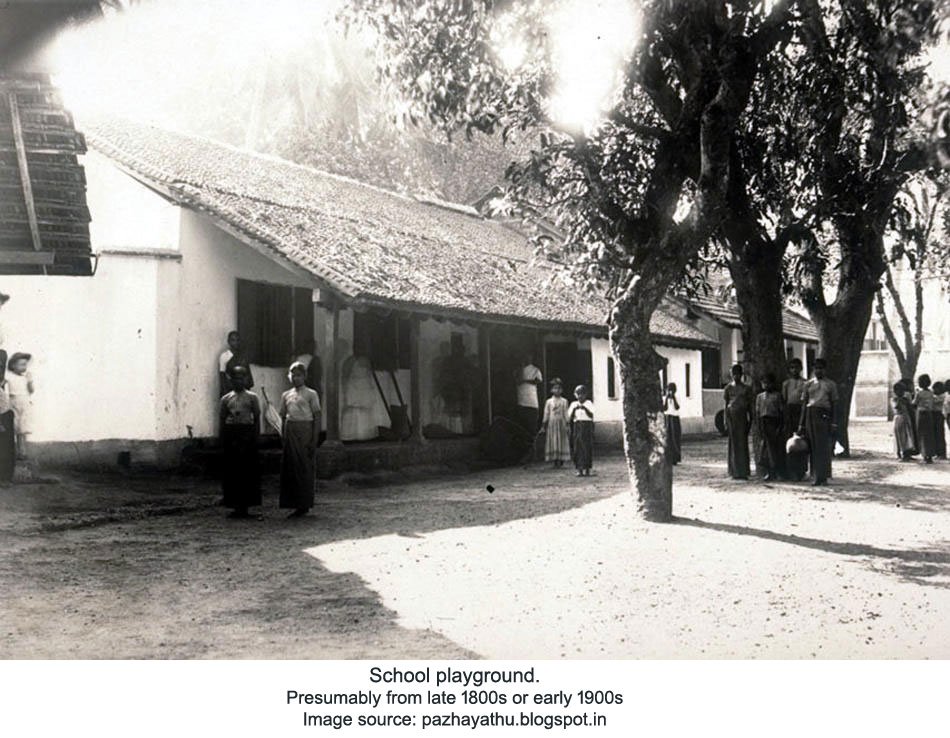
‘The above includes only such pupils as attend schools brought under inspection and control by the Educational Department. There are, as a comparison of the two statements will show, numerous other scholars educated after a fashion in indigenous schools. Of the system of teaching adopted by the educational authorities it is unnecessary to say anything here, but of the Hindu system which it is gradually supplanting—the indigenous methods— the following notes may be of interest.
'The first step in such schools is to teach the boys, and girls too—for the indigenous schools are freely attended by girls—the alphabet : some sand is spread on the floor and the letters are learnt by tracing them in the sand with the forefinger. The teacher next writes on a cadjan leaf some slogams (verses) relating to Ganapati and other gods. These are spelt out by the boys and girls and learnt by heart and sung.
The next stage is the reading (singing) of the Amaram, a collection of slogams (verses) telling the names of all things in heaven and on earth and under the earth—gods, and men and living animals, trees and stocks and stones. After this comes grammar, taught on cadjan leaves, and also by means of slogams (verses) which are sung. Finally, the pupils who have advanced thus far are set to read (sing) the Ramayanam, Bhagavatam, etc, written in the “maccaronic verse” described above by Mr. F. W. Ellis.
The Vyagaranam and other sastrams follow on this. A pupil who has advanced thus far is considered very far advanced in learning, but those who get so far as to be able to read and understand the Ramayanam and the other epics are usually considered quite learned enough, and the generality of people do not get further than spelling out the Amaram. It will be seen that reciting or singing plays a very important part in this system.
For indigenous Brahmans there are three Sanskrit colleges, two of which—Tirunavayi in Ponnani taluk and Pulayi in Kurumbranad taluk—are in Malabar, and the third is at Trichchur (Tirusivapperur) in the Cochin Native State.
Each college is presided over by a Vadhyan or teacher. The generality of the Brahmans educated in these places are taught to repeat their particular Veda without understanding it. It is only a very small number who can both read and interpret the Vedas, and the proportion in which these, are studied by the Nambutiri families is as follows:
Rik Vedists 532 families
Yajur do 407 do
Sama do 7 do
Excluded from reading the Vedas or uncertain 71 do
....................
Total 1,017
But it must not be supposed that the teaching which the Nambutiri Brahmans receive is wholly religious. The study of the different sciences seems to have descended in particular families, and astronomy in particular has had great attention paid to it, and the knowledge of it is fairly exact. These Brahmans had a monopoly of learning for many centuries, and doubtless this was one of the ways in which they managed to secure such commanding influence in the country.
Muhammadan children are likewise taught to repeat, without understanding, the Koran, and in addition to this elementary Malayalam writing is taught. But at Ponnani there exists a Muhammadan college, founded, it is said, some six hundred years ago by an Arab named Zoyn-ud-din. Ho took or received the title of Mukhaddam, an Arabic word meaning the first or foremost in an assembly, etc. He married a Mappilla (indigenous Muhammadan) woman, and his descendants in the female line have retained the title. The present Mukhaddam at Ponnani is the twenty-fourth or twenty-fifth in the line of succession.
The students at the college are supported by the Ponnani towns people, the custom being to quarter two students in each house. The students study in the public or Jammat or (as it is sometimes called) Friday Mosque, and in their undergraduate stage they are called Mullas. There is apparently very little system in their course of study up to the taking of the degree of Mutaliyar, i.e elder or priest. The word is sometimes pronounced Musaliyar, and very often by ignorant people as Moyaliyar.
There is no examination, but the most diligent and most able of the Mullas are sought out by the Mukhaddam and are invited by him to join in the public reading with him at the “big lamp” in the Jammat Mosque. This invitation is considered as a sign of their fitness for the degree, which they assume without further preliminaries.
Genuine Arabs, of whom many families of pure blood are settled on the coast, despise the learning thus imparted and are themselves highly educated in the Arab sense. Their knowledge of their own books of science and of history is very often profound, and to a sympathetic listener who knows Malayalam they love to discourse on such subjects. They have a great regard for the truth, and in their finer feelings they approach nearer to the standard of English gentlemen than any other class of persons in Malabar.
Section D.— Caste and Occupations.
In Chapter XI of the Madras Census (1871) Report, in treating of caste, Surgeon-General Cornish wrote as follows : “The subject of caste divisions among the Hindus is one that would take a lifetime of labour to elucidate. It is a subject on which no two divisions or subdivisions of the people themselves are agreed, and upon which European authorities who have paid any attention to it differ hopelessly. The operation of the caste system is to isolate completely the members of each caste or sub-caste; and whatever a native may know of his own peculiar branch, he is, as a rule, grossly ignorant of the habits and customs, or the origin, of those outside the pale of his own section of the community.”
To reduce the subject to something like order and method, the Madras Town Census Committee proposed, in 1869, a system of classification, which was adopted in the census 1871, and this system is thus described by Surgeon-General Cornish : “ The committee started with the assumption that the present Hindu castes must all have branched out from a few parent stems ; that from the first there must have been a primitive division of labour, and hence of caste, corresponding to the great divisions of labour now existing, i.e., Professional, Personal Service, Commercial, Agricultural, Industrial and Non-productive.”
They are probably correct in stating that in “early times the present almost innumerable sub-divisions of castes did not exist, and that a large number are mere repetitions of castes in another tribe and language. Long separation and infrequent communication have led to insulation so complete that former union is forgotten and intermarriage is prohibited.
Another very large aggregate of the population has sprung from a few root castes, simply because of local variations in the mode of labour. Length of time has fossilised minute changes, and new castes have grown up. These also, from an ethnic and social point of view, remain one and the same caste.”
The committee accepted, without question, the divisions of the Hindu community into (1) Brahmans, (2) Kshairiyas, (3) Vaisyas, (4) Sudras, and (5) Out-castes.
After examining, at some length, the Hindu sacred writings Dr. Cornish observed : “It is plain that in a critical inquiry regarding the origin of caste we can place no reliance upon the statements made in the Hindu sacred writings.” The tendency of these writings was too obviously the exaltation of the Brahman at the expense of the other castes. He concluded, moreover, that “the whole caste system, as it has come down to us, bears unmistakable evidence of Brahmanical origin ;” and finally arrived at a “ natural explanation ” of the origin of caste which he thus described ; “The later Aryan colonists evidently saw that if they were to preserve their individuality and supremacy, they must draw a hard-and-fast line between themselves, the earlier and partly degenerated Aryans, and the brown and black races of the country, and hence probably we get a natural explanation of the origin of caste.”
As bearing upon this important subject of the origin of the caste system the evidence of the early Syrian Christians’ deed, translated by Dr. Gundert in Madras Journal of Literature and Science, Vol. XIII, Part I, deserves, it would seem, a prominent place, but a few preliminary remarks are necessary before setting forth this evidence. If it were necessary to sum up in one word the law of the country as it stood before the Muhammadan invasion (1766 A.D.) and British occupation (1792 A.D.), that word would undoubtedly be the word “Custom.”
In Malayalam it would be “Maryada” “Manrgam” “Acharam” all signifying established rule and custom, and all of them Sanskrit words. There can hardly be a doubt that the high degree of civilisation to which the country had advanced at a comparatively early period was due to Aryan immigrants from the north, and these immigrants brought with them Aryan ideas of method and order in civil government which became the law of the land.
Among other things which they imported was “jati” (caste). There is no indigenous word either in Malayalam or in any other of the Dravidian languages to signify caste, Jati itself, like all other Malayalam words beginning with “j”, is a foreign word and expresses a foreign and not a Dravidian idea. The root of the word is the Sanskrit “jan” and it simply means “birth.”
As applied in the law of the land, it was the “custom” connected with “birth.” But of course Malayalis have an indigenous word for “birth,” and, in common with Tamil, Canarese and Tulu, they use a verb signifying to bring forth, and from it the Tamils and Malayalis form a verbal noun peru (birth). And this word peru occurs in the well-known compound word nir-atti-peru, signifying the “water-contact birthright” in land, equivalent to the later Sanskrit word janmam, (birthright) used for the same purpose.
The indigenous word for “birth” seems thus to have acquired at a very early period a peculiar signification of its own for it occurs in this sense in the Cochin Jews’ deed—of date about the beginning of the eighth century A.D.—and it was thus perhaps not available for the purpose of defining “caste.” The word Jati (caste) was not, however, the only Sanskrit word used in the development of tire caste system, and the words Karalar and Karanmei (modern Karayma ) —the former used twice and the latter once in the second (of date about the first quarter of the ninth century A.D.) of the Syrians’ deeds—deserve attention.
These are not pure Sanskrit words, but they come from a Sanskrit root with a Dravidian termination, and they originally implied a trust and correlative duty. Certain classes of citizens were, according to that deed, entrusted with certain functions, which functions it was their duty, as an organised community in the body politic, to fulfil . A certain class called the planters—that is to say, the caste now known as the Tiyar (Dwipar — islanders) or Iluvar (Simhalar , Sihalar, Ihalar Cingalese)—were entrusted with the duty of planting up the waste lands. They are specifically referred to elsewhere in the same deed as the Islanders with a headman of their guild. Two of their specific privileges are also mentioned in the deed, namely, the “Footrope right (for mounting trees)” and the "Ladder right (for a similar purpose)”.
NOTEs by VED: The contention that Ezhavas and Thiyyas (two separates castes in themselves) are same is not correct. Moreover the word Thiyya might not be a contortion of the word dweepar. END of NOTEs by VED
Curiously enough, although the word Karanmei (modern Karayma) has come in the course of ages ordinarily to signify something very different, yet the ancient meaning is still occasionally to bo met with by the diligent observer. He will find it, however, not in the mouths of the learned or the well-to-do, but in the mouths of the poor cultivators in out-of-theway parts of the country, where archaic forms of words and archaic ideas still survive. The Iluvar or planters in these parts still look upon it as their duly in the body politic to form gardens and to plant up the wastes with trees.
So it was with the “setters,” whoso duly it was to “set” the rice plants. This class or caste is also specifically named in the deed as the Vellalar (that is, irrigators), a caste which subsists to the present day, but which, for reasons to be presently alluded to, has not kept itself as distinct as the planters in the body politic.
Again it was declared to be the duty of the Jewish and Syrian guilds assembled in their respective corporate headquarters at Anjuvannam and Manigramam to protect the church peoples’ (Palliyar) town. This duty of “protection” was a most important function in the body politic. The Jews and Syrians were by other deeds incorporated in the Malayali nation, and in the second of the Syrians’ deeds it is clear that the position assigned to them was that of equality with the Six Hundred ” of the nad (that is, of the county).
The “Six Hundred” are both in this deed and in another ancient one referred to as the protectors, and in the latter they are also referred to as the supervisors (the Kanakkar), a word which has come down to modem days and which has been much misunderstood.
The Nayars (so styled from a Sanskrit word signifying leader, in the honorific plural lord, and in ordinary sense soldier) were the “protectors” of the country, and, as such, crystallised readily into the existing caste of Nayars, with numerous branches. Their other function of supervision (Kanam) still also remained with them almost unimpaired down to the time of the British occupation ; but of recent years, owing to the ignorance of the British courts of justice, the term has quite lost its proper signification. The Nayars were, if we may credit tradition, also Vellalar (that is, irrigators), but of course their most important, most consequential, and most acceptable function was the protection duty and trust, and so there are comparatively few of the original Vellalar (irrigator) caste in the district.
Then, again, it was the duty of the heads of the Syrian Church (Palliyar) to render to the powers above them—who were respectively the Kon or king, or Perumal or emperor*, and the Jewish and Syrian protector guilds in their corporate capacities—a trustworthy account of the shares of produce of the land which respectively fell to them. But it seems very doubtful if the shares which respectively fell to the powers above them were shares of the land produce alone : it would, of course, in an agricultural country be the chief source of their revenues, and probably as regards the protector guild the only one. The word Varakkol, used in the deed, means, however, simply “sharing staff of office,” and the wording of some of the clauses seems to point to a share, in all gains, however made, being paid to the central authority—the lion (that is, shepherd or king). As a matter of fact this system of sharing gains has not survived in Malabar in any other industry but agriculture, but the history is peculiar as will be seen further on, and fully accounts for this fact.
On the other hand, of course, the sharing system in a pure Hindu State is well known and exists to the present day, and extends to all classes of the community, no matter how humble or how despised their callings may be.
Finally, the Palliyar themselves were on the precise footing of members of the “protector guild” established in out-of-the-way parts of the country. Their “sharing staff” duty would ordinarily have constituted of them a distinct caste, but as members of the “protector guild” the protectors’ duty would overshadow their minor duty as “sharing staff” office holders. And this seems to have been what actually happened to the Nayars who were scattered over the place of the country not only as supervisors holding the “sharing staff” of office, but as local militia and “protectors.”
Down to recent times the Nayars were primarily the “protecting” caste, but as a matter of fact also they inherited the “sharing staff” office functions as Kanakkar. In this way, there came to be therefore no distinct caste of “sharing staff ” office holders, or at least none are traceable now.
If this reasoning and the facts on which it is founded are correct, then it follows that the origin of the caste system is to be sought, not so much in any ethnic circumstances of blood connection as Dr. Cornish suggests, as in the ordinary every-day system of civil government imported into the country by Aryan immigrants, and readily adopted by the alien peoples among whom the immigrants came, not as conquerors, but as peaceful citizens, able by their extensive influence elsewhere to assist the people among whom they settled.
The idea in fact embodied in the caste system of civil government was the idea which permeates Hindu society—the idea of the family household. The Aryans thought, and to a certain extent wisely thought, that they could not do better in organising their State than to copy the example continually before their eyes and to organise it on the model of a well-regulated household. There they saw each member of it told off to perform certain clear and distinct functions. The clearer and more distinct those functions were, the better were the household affairs managed. The cook must attend to the kitchen, the lady’s maid to her mistress’ attire; the sweeper must not interfere with the food, nor the water-man with the lady’s muslins. In no country under the sun has the efficient organisation by households—by families -been better understood or more extensively carried out than in India. And when questions of civil administration were under consideration it was the most natural thing to turn to the family as a model. The soldier was told off to his especial calling, the merchant to his accounts and trade, the cultivator to his plough.
Nothing strikes the fancy more strongly in the old Hindu world stories than the picture presented of fighting men killing each other in one field, while the husbandman peacefully tilled the one adjoining, and the Brahman sat silently contemplating creation under a neighbouring sacred tree. Busy each in their own spheres, it mattered very little to them how it fared with others having other and distinct functions.
Society organised on these lines was capable of easy and rapid development, and this no doubt accounts for the advanced state of the people in early times, on which it is unnecessary here to dwell.
A time came of course, and came quickly too, when development ceased, when custom became lord paramount, and when society, turned in (as it were) upon itself, began to waste its energies in multiplying distinctions of caste and in searching out hair-splitting differences. This followed, of necessity, for the bonds of caste being inherited at birth are as rigid as they are strong. Even criminals at last set up as civic corporations, as witness the powerful thief or robber caste in Southern India. Even now, when custom is no longer sole lord of the land, castes continue to multiply, nor will it be otherwise till British freedom evokes, as it is sure to do in good time, a national sentiment, and forms a nation out of the confusing congeries of tribal guilds at present composing it.
Looked at from this point of view, it is clear that questions of caste and questions of hereditary occupation ought to be considered together. The census figures unfortunately give insufficient data for an analysis of the extent to which castes have fallen away from their hereditary trades as professions, but something may be learnt from the returns. It is unfortunate, however, that such an essentially European classification of occupations has been adopted in the census returns, for it is only confusing to suppose (as the Madras Town Census Committee supposed) that castes naturally ranged themselves at first under the heads adopted in the census tables of Professional, Personal Service, Commercial, Agricultural, Industrial, and Non-productive.
Some of these divisions are right, but others are not merely wrong, but misleading. What ought to have been done was to have adopted the four great divisions into which the Hindus themselves say they were originally divided, viz :
(1) The sacrificers (God-compellers) and Men of Learning ;
(2) The protectors and governing classes ;
(3) The traders and agriculturists ;
(4) The servile classes ; and to have added to this a fifth class of apparently later origin— -
(5) The mechanics and handicraftsmen ; and all other classes now existing would have fallen under a separate class of—
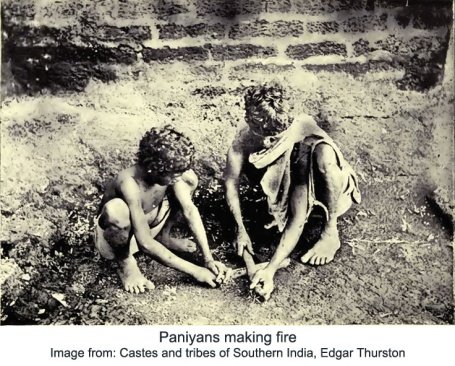 (G) Miscellaneous.
It would have been interesting to have noted to what extent persons belonging to one or other of these great caste divisions had encroached upon the hereditary occupations of persons belonging to other divisions ; but occupations have boon treated in the census 1881 returns as something quite unconnected with caste.
Foreigners (such as the British and Parsis) and people of foreign religions (such as the Muhammadans) should thou have been separately treated in order to show to what extent they too had encroached upon the hereditary occupations of the Hindus. The census returns do not permit of such a comparison being made, nor are the returns even of castes so distinct as could be desired, so that the following is merely an attempt to classify the Hindu castes under the indigenous hereditary occupation or caste, guilds :
Division I
The sacrifice's (God-compellers) and Men of Learning
Totals
Brahman (Malayali and foreign) . . . . 47,683
Division II.
The Protectors and Governing Classes,
Maravan (Tamils—Watchers) . . 130
Mutratcha (Tamils—Watchers) . . 6
Nayars (Militia) .. .. 321,674
Rajput (Foreigners) . . . . 362
322,178
Division III.
. (a) The Traders.
Balija (Tolugus) . . . . . . 1,466
Komati (Tamils) . . . . . . 1,096
Shetti (Tamils) . . . . . . 20,945
Vaniyan and Gandlu .. . 42,781
Vanniyan (Tamils) . . . . . . 1,259
67,547
(b) The Agriculturists.
Agamudayan (Tamils) .. . . 184
Golla or Idaiyar (Herdsmen) . . 2,889
Gouda (Herdsmen) . . . . . . 1,062
Kurumbar (Shepherds, Junglemen) 2,062
Kuruba Golla (Herdsmen) . . . . 16
Padayachi (Tamils) . . . . . 1,008
Reddi (Telugus) . . . . . . 119
Shanan or Idiga & Tiyan or Ilavan (Planters) 559,7 17
Telugalu or Vadugar (North countrymen) 7,811
Vellalan (Irrigators) . . . . 7,525
Yadavulu (Telugus) . . . . 24
582,417
Division IV.
The Servile Classes
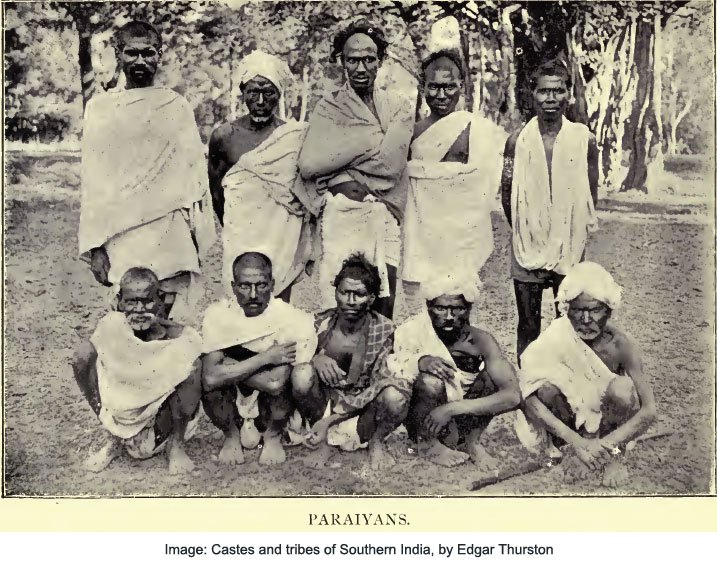 Palli (Ploughmen) . . . . . . 40,809
Parayan (Slaves) . . . . . . 93,612
Ambattan (Barbers—Serving all castes, but not indiscriminately). 8,347
Oddar (East Coast tank-diggers) . . 1,682
Upparavan (East Coast tank digger) 1
Vannan (Washerman—Serving all castes, but not indiscriminately). 37,556
182,007
Division V.
Mechanics and Handicraftsmen
Devangulu (Telugus) . . . . 10
Kaikalar (Weavers) . . . . 20,465
Kamsalar or Kammalar (Carpenters, Braziers, Stone-masons, Goldsmiths,
Blacksmiths) . . . . 51,553
Kummara or Kushavan (Potters) . . 11,770
Madiyu (Workers in leather ?) . . 181,614
Sale (Weavers) .. .. .. 21,589
Seniyan (Tamils—Weavers) 486
287,487
Division VI.
Miscellaneous
Ambalakaran (Tamils—Chiefs of the Kallar ?) .. .. .. .. 27
Besta or Valayan (Fishermen) 16,024
Lingadhari (Lingavites—No caste). 71
Kallan (Tamils—Thief, Robber caste) . . . . . . . . 47
Shembadavan (Fishmongers) . . 167
Others 162,175
Not stated . . , . . . . . 1,441
179,952
Grand total 1,669,271
The names of the different castes in the above list have been adopted from the census tables but they are not strictly applicable to Malabar. It will of course be urged against this table that such castes as the planters—the Tiyar or Ilavar should not find a place in the division corresponding to the agriculturists of original Aryan organisation, but it must be remembered that the Aryans were, in dealing with the aboriginal population of Malabar, not dealing with their own people but with an alien race. They had no sufficient body of "protectors” of their own race to fall back upon, so they had perforce to acknowledge as “protectors” the aboriginal ruling race,- the Nayars — whom they designated as “Sudras” but in reality treated as Kshatriyas.
If their “protectors” were called Sudras (servile classes), then the castes below Sudras would not have any footing in the original Aryan organisation. This is so, and it is moreover, most strenuously maintained to the present day. Nevertheless it is perfectly clear from the wording of the Syrians’ deed that the planters—the islanders—who are still the most numerous body of Hindus in the district, were originally an organised agricultural caste with a distinct function in the body politic. The, real fact seems to have been that the Aryans who introduced the political system of caste into Malabar were unwilling to raise even the aboriginal ruling race to the dignity of the pure Kshatriya caste of Aryans.
Very possibly they were Kshatriyas1 themselves who introduced the system. And yet the State organisation required that there should be a protector or Kshatriya casts, so they solved the difficulty by inventing a term—-Nayan, plu. Nayar (Sans, leader, soldier)— and by applying it to the caste whom they constituted protectors and yet treated as “Sudras” (servile caste). In this way the real agriculturists except the Vellalar (irrigators) out of whom the caste of Nayars seems to have been originally formed, came to be treated as being outside the caste system altogether.
NOTEs*: 1 Conf. the Dutch Chaplain (but a Tamil by birth) P. de Melhe’s account of the tradition current in his time. He said that the Chera, Chola and Pandya rulers were all Kshatriyas and belonged respectively to the races of the fire, of the sun, and of the moon, Ind. Ant. X, 85 END of NOTEs
*NOTEs by VED: These notes by native observer can be suspect. They might usually write what found acceptable by the ruling classes. In many locations in the subcontinent, there was a powerful urge to be connected to the higher echelon of the brahminical caste layers. END of NOTEs by VED
To the present day the higher castes maintain most strenuously that the Tiyar—the islanders, the planters of the community—are outcastes.
The final organisation of castes in Malabar probably took place about the eighth century A.D., simultaneously with the rise of the Nambutiri Brahmans to power and influence. The Aryan Jains who had preceded the latter had probably already organised the community in the Aryan fashion into corporate guilds, and it only needed the idea of caste as a religious institution to be imported into the country by the Vedic Brahmans to bring about the crystallisation (so to speak) of the various caste elements.
In the census 1881 returns the population has been classed according to actual occupations as follows :
|
I. Professional 1. Government 2. Defence 3. Learning, literature etc. Total
II. Domestic 4. Wives 5. Personal offices Total
III. Commercial 6. Money, house, good dealing 7. Carrying Total IV. Agricultural 8. Occupancy of land & agriculture 9. Care of animals Total V. Industrial 10. Art and mechanics 11. Textile fabrics and dress 12. Food and drinks 13. Animal substances 14. Vegetable substances 15. Mineral substances Total VI. Indefinite and Non-productive 16. Labour (specified) 17. Rank and property (without occupation) 18. No specified occupation Total Grand total
|
7,206 2,274 27, 657 37,137
5,739 5,793
16,968 32,299 49,267
346,868 13,082 359,950
19,673 30,097 72,632 705 27,830 65,708 216,645
29,066 31 476,385 505,482 1,174,274 |
57 14,588 14,645
866 6,001 6867
2,304 2,133 4,437
228631 3948 232,579
417 61,973 52,998 1,599 14,030 6,742 6,742
18,081 30 776,336 794,474 1,190,761 |
7,263 2,274 42,245 51,782
866 11,794 53,704
19,272 34,432 53,704
575,499 17,030 592,529
20,090 92,070 125,630 2,304 41,860 72,450 354,404
41,147 61 1,252,721 1,299,956 2,365,035 |
Of the different castes in Malabar much information has been collected and a great deal might be written, but it will probably suffice to notice here the chief peculiarities of the more noteworthy among the Malayali castes.
And first it may be noticed that the Malayalis distinguished two kinds of pollutions, viz,., by people whose very approach within certain defined distances causes atmospheric pollution to those of the higher castes, and by people who only pollute by actual contact.
Among the first class may be mentioned the following, and the prescribed distances at which they must stand, viz.
Feet.
The Nayadi (dog-catcher) 72
The Pulayan (agrostic slave) 64
The Kanisan (astrologer) 30
The Mukkuvan (fisherman), etc. 24
But women, even of equal caste-rank, pollute if at certain times they come within certain distances, and this custom seems to prevail even among the lowest castes. A newly confined woman has to stand at a distance of eighteen feet and a menstruating women at twelve feet ; hence the necessity in all respectable houses for special buildings set apart for special use by the women.
Among the second class are ranked Muhammadans, Christians and foreign Hindus, who defile only by touch. And it is a sufficiently remarkable fact that a corpse even may be defiled by touching it. This feeling on the part of the Hindus loads to various inconveniences, for it is only in the very last resort that a European or a low-caste medical man is permitted to touch a sick person.
Pollution, however acquired, by the near approach of a low-caste man or by touch, can only by washed out by complete immersion in water. Even to use hot water seems to be against the canon. And great are the perplexities of the strictly conservative, and noteworthy are some of the devices by which the better castes try to turn the flank (so to speak) of this law, now that greater freedom in moving about the country is necessitated by modern requirements. The water must be in a natural tank or stream : even Ganges water if confined in a tub would perhaps fail to wash away pollution.
The strictly orthodox are sometimes driven to emptying big bottles of boiling water into the stream above the place of bathing in order that the health of the bather may not suffer when on a journey in a cold climate. The orthodox fashion is to hold the nose with finger and dip completely under the surface when nothing more loathsome has to be washed off than the polluting touch of a European’s friendly shake of the hand. This bath is necessary before food can be partaken, or a sacred place entered, or several other acts performed.
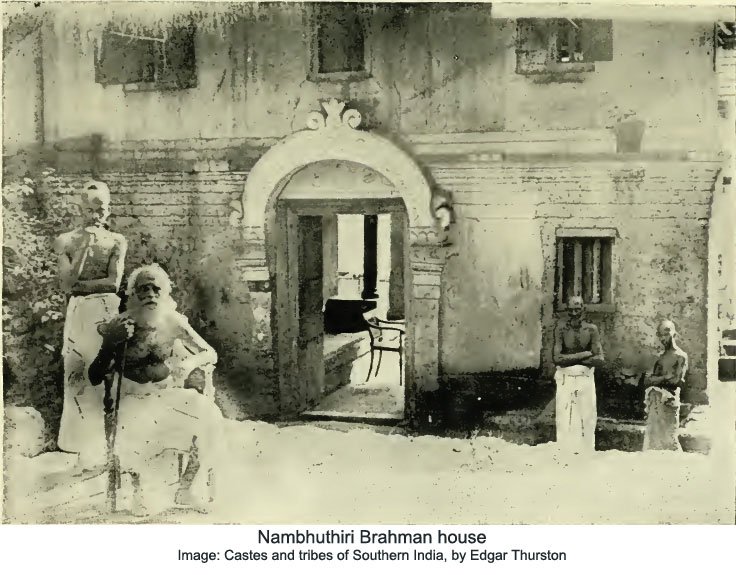
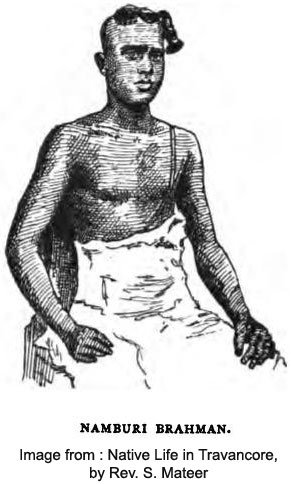 Tho highest castes are naturally the greatest sticklers for this observance, and although British freedom has made inroads on the Hindu custom in this respect, chiefly through the influence of education and extended knowledge, it is too soon yet to look forward to the final extinction of this anomalous custom.
Of the Malayali castes the most exclusive, and the most conservative, and in the European sense, nearly the most unenlightened is that of the indigenous Malayali Brahmans called Numbuthiris, If they did not introduce caste, as a political institution, into the country, they atleast seem to have given to it its most recent development, and they are its staunchest upholders now. They seem to have embodied in the Sanskrit language rules of life regulating their most trivial actions, and at every step their conduct is hampered and restrained by what, appear to European eyes absurd customs.
They shun publicity, and it is exceedingly difficult to obtain exact knowledge of what they do, or think, or feel. In ancient times their influence seems to have been supreme in the State councils, as indeed their caste name implies, for Dr. Gumlert derives the word from the Dravidian verb nambuka (= to confide, desire) and the common Sanskrit affix tiri1 (= office, dignity).
NOTEs: 1. Tiru, blessed, fortunate — sri, END of NOTEs
There are several other derivations, but all are more or less fanciful, and the above may be accepted as the correct one since it not only has the authority of so distinguished a Dravidian scholar as Dr. Gundert, but because the character of confidential adviser and trusty friend of Rajas and people of influence is even now the peculiar character which this caste bears.
The Nambutiris are Vedic Brahmans. It has been conjectured from the use of the phrase Aryya Brahmanar that they are of pure Aryan descent, but the fact requires proof, and is certainly not borne out by personal appearances. The bulk of them are followers either of the Rik or of the Yajur Veda, while a very few follow the Sama Veda, and some are excluded from studying the Vedas altogether. The existing actual distribution of the several schools is shown in the following tabic which was prepared a year or two ago:
|
Taluks |
Number of Nambutiri families settled in each taluk |
Of whom there are |
|||
|
Rik Vedists |
Yagur Vedists |
Sama Vedists |
Excluded from Vedas or uncertain |
||
|
1. Chirakkal 2. Kottayam 3. Kurumbranad 4. Wynad 5. Calicut 6. Ernad 7. Valluvanad 8. Palghat 9. Ponnani 10. Cochin |
79 30 70 152 120 277 299 |
3 4 51 8 10 192 264 |
76 26 19 144 85 40 17 |
2 5 |
25 43 3 |
|
Total |
1,017 |
532 |
407 |
7 |
71 |
It is asserted that the Panniyur (literally, pig village) Gramam is totally excluded from the Veda. In that case twenty-one of the families in Kurumbranad, shown as of the Rik Veda school, and one of the Yajur Veda school, should be transferred to the last column of the statement ; and similarly, in the returns for Ponnani, forty -five of the Rik Vedists and one of the Rama Vedists should be transferred to the last column.
In the early history of the caste there was a split into two factions, the Panniyur Gramam adopting the Vaishnavite faith with the Vaishnavite emblem, the pig or boar, and the Chovur Gramam that of Saiva. It will be noted in the historical chapter that a more or less successful resistance, probably with Brahman aid, was made by the Malayalis against the aggressions of the Western Chalukya dynasty, and as the boar was also the Chalukya emblem, it is probable that the decline of the Panniyur Gramam and the ascendancy of the Chovur Gramam was brought about at this time. At any rate, the Chovur Gramam had the best of the quarrel. The whole caste has, however, since adopted the Vedantist doctrines of Sankara Acharya, himself believed to have been a Nambutiri.
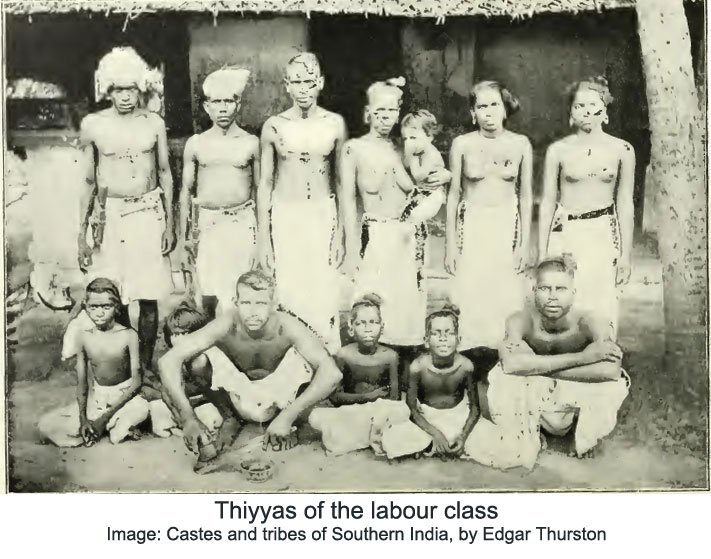
Their organisation is by Gramams (villages), just as the Nayars were organised by taras and nads, and Tiyars and other foreigners by cheris. The principal pure Nambuthiri Gramams now extant are
1. Sukapuram or Sivapuram (probably identical with the original Chovur or Chovaram = Sivapuram).
2. Peruvanam.
2. Irinyalalaula.
4. Panniyur (the other original village).
5. Karikkad.
6. Trissivaperur
7. Perinchellur
8. Venganad.
9. Alattur.
10. Edakkad.
The only two villages mentioned in the Syrians’ deed of A.D. 774 are Panniyur and Chovur (Chovaram, i.e., Sivapuram — Siva’s town) ; so it is difficult to resist the conclusion that there were but two organized villages of Brahmans in Malabar at that time, both Vedic, but of opposite religious views. The other Gramams, besides others now extinct, probably either branched off from the two original villages or settled in the country subsequently.
The mythical story of Parasu Raman reclaiming the land of Keralam from the sea, for the benefit of sixty-four Brahman villages, and in expiation of his sins in slaying twenty-one heroic dynasties of Kshatriyas (as the Malayali tradition runs) is not in accordance with such scraps of history as have come down, nor with facts as they exist, but this matter will be better dealt with in the subsequent chapters.
Besides these there are several classes of inferior Brahmans styled Nambidis, Elayads, and in one instance Embrantiri , who have succeeded in later times in securing, or being thought fit to assume, the name of Nambutiri, and there is yet another class, the Mussat, or more properly the Urilparisha Mussat, who are privileged to eat with Nambutiris, but who do not intermarry with them, nor are they entitled to perform yagams (sacrifices).
The hereditary Veidyan (physician) family is also styled Mussat, and tins family’s only disqualification for the rank of Nambutiri lies, it is said, in the fact that they were originally surgeons as well as physicians.
The conclusion seems to be that the original Brahman families divided among themselves the learned professions and the privilege of making sacrifices, and never lost an opportunity of protecting their monopolies by every art in their power, and in particular by forbidding the study of Sanskrit to other castes. There are hereditary magician or sorcerer families ; a few are well versed in astronomy ; some are preservers of the sacred fire (adittiri ) ; others are doctors or surgeons ; others again actors.
It is only the poorest of them who will consent to act as priests, and of these the highest functionary in a large temple is condemned to three years of celibacy while holding office ; some are celibates for one year of office, and allow their hair to grow.
It is traditionally alleged that some portion of the Brahmans did at one time arm themselves. The numbers who did so are said to have been thirty-six thousand, and they are known as Ayudhapani or weapon-bearers. The heads of this class were styled Nambiyattiri, and the Idappalli Nambiyattiri is still pointed out as the chief of them. There was therefore probably some foundation in fact for the tradition, but arms to a Brahman, under the old regime, was not a congenial employment.
The Gramams are presided over by six Smarthas, who are presidents of the assemblies at which caste offences are tried. Such assemblies in former times required the sanction of the ruling chieftain, who, on representation made that a caste offence had been committed, issued orders to the local Smartha to hold an enquiry. There seems to have been in former days no appeal from the decision of the Gramm assembly to any other authority, but within the last few years the decision of such an assembly was called in question, and the attempt that was subsequently made to overrule its decision greatly exercised the minds of the “twice born” in all the Malayali countries.
The episodes in the trial of a caste offence among Nambutiris are so curious, and throw such light on their ways of thinking and acting, that it is worthwhile to go into the matter in some detail. The local chieftain’s sanction for the trial of the offence was, as already said, first of all necessary. The Nambutiri family (Bhattattiri) which has the privilege of furnishing the president (Smartha), and the number of members (Mimamsukas) required to form a tribunal, are different in different parts of the country.
When a woman is suspected by her own kinsmen or by neighbouring Brahmans of having been guilty of light conduct, she is under pain of ex-communication of all her kinsmen, placed under restraint. The maid-servant (Dasi or Vrshali), who is indispensable to every Nambutiri family, if not to every individual female thereof, is then interrogated, and if she should eliminate her mistress, the latter is forthwith segregated and a watch set upon her. When the family can find a suitable house1 for the purpose, the sadhanam (the thing or article or subject, as the suspected person is called) is removed to it ; otherwise she is kept in the family house, the other members finding temporary accommodation elsewhere.
NOTEs: 1 It is called the “fifth house”, i.e., tbe building next to the usual "'4 four houses” or northern (Vadakkini), southern (Tekkini ), eastern (Kilakkini}, and western (Padinyyattini) rooms or houses. END of NOTEs
The examination of the servant-maid is conducted by the Nambutiris of the Gramam, who, in the event of the servant accusing her mistress, proceed without delay to the local chieftain who has the power to order a trial. And authority is granted in writing to the local Smartha, who in turn calls together the usual number of Mimamsakas (persons skilled in the law).
They assemble at some convenient spot, generally in a temple not far from the place where the accused may be. All who are interested in the proceedings are permitted to be present. Order is preserved by an officer deputed by the chief for the purpose, and he stands sword in hand near the Smartha and members of the tribunal.
The only other member of the court is a Nambutiri called the Agakkoyma, whose duties will be described presently. When all is ready the chief’s warrant is first read out and the accused’s whereabouts ascertained.
The Smartha, accompanied by the officer on guard and the Agakkoyma Nambutiri, next proceeds to the accused’s house : the officer on guard remains outside while the others enter. At the entrance, however, they are met by the maid-servant, who up to this time has never lost sight of the accused and who prevents the men from entering. In feigned ignorance of the cause for thus being stopped, the Smartha demands an explanation, and is told that a certain person is in the room.
The Smartha demands more information, and is told that the person is no other than such and such a lady, the daughter or sister or mother (as the case may be) of such and such a Nambutiri of such and such an illam. The Smartha professes profound surprise at the idea of the lady being where she is and again demands an explanation.
Here begins the trial proper. The accused, who is still strictly gosho., is questioned through the medium of the maid, and she is made to admit that there is a charge against her. This is the first point to ho gained, for nothing further can be done in the matter until the accused herself has made this admission. This point, however, is not very easily gained at times, and the Smartha has often to appeal to her own feelings and knowledge of the world and asks her to recollect how unlikely it would be that a Nambutiri female of her position should be turned out of her parent’s house and placed where she then was unless there was some cause for it.
In the majority of cases this preliminary stage is got over with little trouble, and is considered a fair day’s work for the first day. The Smartha and his colleagues then return to the assembly and the former relates in minute detail all that has happened since he left the conclave. The Agakkoyma's basic is to see that the version is faithful. He is not at liberty to speak, but whenever he thinks the Smartha has made a mistake as to what happened, he removes from his shoulders and lays on the ground a piece of cloth as a sign for the Smartha to brush up his memory. The latter takes the hint and tries to correct himself. If he succeeds, the Agaikkoyma's cloth is replaced on his shoulders, but if not the Smartha is obliged to go back to the accused and obtain what information is required.
When the day’s proceedings are finished, the members of the tribunal are sumptuously entertained by the accused’s kinsmen, and this continues to be done as long as the enquiry lasts. A trial sometimes lasts several years, the tribunal meeting occasionally and the accused’s kinsmen being obliged to entertain the members and any other Nambutiris present on each occasion, while the kinsmen themselves are temporarily cut off from intercourse with other Brahmans pending the result of the trial, and all sraddhas (sacrifices to benefit the souls of deceased ancestors) are stopped.
The reason for this is that, until the woman is found guilty or not, and until it is ascertained when the sin was committed, they cannot, owing to the probability that they have unwittingly associated with her after her disgrace, be admitted into society until they have performed the expiatory ceremony (Prayaschittam). The tribunal continues its sittings as long as may be necessary, that is, until either the accused confesses and is convicted, or her innocence is established. No verdict of guilty can be given against her except on her own confession. No amount of evidence is sufficient.
In former days, when the servant accused her mistress and there was other evidence forthcoming, but the accused did not confess, various modes of torture were had recourse to in order to extort a confession, such as roiling up the accused in a piece of matting and letting the bundle fall from the roof to the court-yard below. This was done by women, and the mat supplied the place of the purdah. At other times live rat-snakes and other vermin were turned into the room beside her, and even in certain cases cobras, and it is said that if after having been with the cobra a certain length of time and unhurt, the fact was accepted as conclusive evidence of her innocence.
In cases when the accused offers to confess, she is examined, cross-examined, and re-examined very minutely as to time, place, person, circumstances, etc., etc., but the name of the adulterer is withheld (though it may be known to all) to the very last. Sometimes a long list of persons is given and similarly treated. Innocent persons are sometimes named and have to purchase impunity at great expense.
In one case a woman who had indicated several persons was so nettled by the continual “who else ?” “who else ? ” of the zealous scribe who was taking down the details, that she at last, to his intense astonishment, pointed to himself as one of them, and backed it up by sundry alleged facts.
The persons accused by the woman are never permitted to disprove the charges against them, but the woman herself is closely cross-examined and the probabilities are carefully weighed. And every co-defendant, except the one who, according to the woman’s statement, was the first to lead her astray, has a right to be admitted to the boiling-oil ordeal as administered at the temple of Suchindram in Travancore. If his hand is burnt, he is guilty ; if it comes out clean he is judged as innocent.
The ordeal by weighment in scales is also at times resorted to. The order for submission to these ordeals is called a pampu and is granted by the president (Smartha) of the tribunal. Money goes a long way towards a favourable verdict or towards a favourable issue in the ordeals. The tribunal meets at the accused’s temporary house in the Pumukhan (drawing-room) after the accused has admitted that she is where she is because there is a charge against her. She remains in a room, or behind a big umbrella, unseen by the members of the tribunal and other inhabitants of the desam who are present, and the examination is conducted by the Smartha.
A profound silence is observed by all present except by the Smartha, and he alone puts such questions as have been arranged beforehand by the members of the tribunal. The solemnity of the proceedings is enhanced to the utmost degree by the demeanour of those present. If the accused is present in the room, she stands behind her maidservant and whispers her replies into her ear to be repeated to the assembly.
Sometimes the greatest difficulty is experienced in getting her to confess, but this is usually brought about by the novelty of the situation, the scanty food, the protracted and fatiguing examination, and the entreaties of her relatives, who are being ruined, and by the expostulations and promises of the Smartha, who tells her it is best to confess and repent, and promises to get the chief to take care of her and comfortably house her on the bank of some sacred stream where she may end her days in prayer and repentance.
The solemnity of the proceedings too has its effect. And the family often come forward, offering her a large share of the family property if she will only confess and allow the trial to end. When by these means the woman has once been induced to make a confession of her weakness everything becomes easy. Hitherto strictly gosha, she is now asked to come out of her room or lay aside her umbrella and to be seated before the Smartha and the tribunal.
She sometimes even takes betel and nut in their presence. When the trial is finished, a night (night-time seems to be essential for this part of the trial) is set apart for pronouncing sentence, or, as it is called, for “declaring the true figure, frame, or aspect” of the matter. It takes place in the presence of the local chieftain who ordered the trial. A faithful and most minutely detailed account of all the circumstances and of the trial is given by the Smartha, who winds up with the statement that his “child” or "boy” (a term1 applied by Nambutiris to their east coast Pattar servants) will name the adulterer or adulterers.
NOTEs: 1. Kutti — Child or boy. The phrase Kutti Pattar is sometimes used. END of NOTEs
Thereupon the servant comes forward, steps on to a low stool, and proclaims the name or names.
This duty is invariably performed by a man of the Pattar caste. It is essential that the man who does it should himself be a Brahman, and as no Nambutiri or Embrantiri (Canarese Brahman) would do it for love or money, a needy Pattar is found and paid handsomely for doing it. Directly he has performed the duty, he proceeds to the nearest piece of water, there to immerse his whole body and so wash away the sin he has contracted.
The next proceeding, which formally deprives the accused woman of all her caste privileges, is called the ‘Keikkottal ' or handclapping ceremony. The large palmyra leaf umbrella with which all Nambutiri females conceal themselves from prying eyes in their walks abroad is usually styled the “mask umbrella” and is with them the outward sign of chastity.
The sentence of ex-communication is passed by the Smartha in the woman’s presence, and thereupon the accused’s umbrella is formally taken from her hands by a Nayar of a certain caste, the pollution-remover of the desam, With much clapping of hands from the assembly the woman is then instantly driven forth from her temporary quarters and all her family ties are broken. Her kinsmen perform certain rites and formally cut her off from relationship. She becomes in future to them even less than if she had died. Indeed, if she happens to die in the course of the enquiry, the proceedings go on as if she were still alive, and they are formally brought to a conclusion in the usual mannor by a verdict of guilty or of acquittal against the man implicated.
The woman thus driven out goes where she likes. Some are recognized by their seducers ; some become prostitutes ; not a fow aro taken as wives by the Chettis of Calicnt. A few find homes in institutions specially endowod to receive them.
Those last-named institutions are of a peculiar character. Perhaps the best known, because it has formed the subject of judicial proceedings, is that of the Muttedatta Aramanakal in the Chirakkal Taluk with extensive jungly land endowments. The members of this institution are respectively styled as Mannanar or Machchiyar, according as they are men or women. They have baronial powers and keep up a sort of baronial state, for which purpose two hundred Nayars of the Edavakutti Kulum (or clan) were in former days bound to follow the Mannanars when out on active service.
The members of the institution are recognised as of the Tiyan (or toddydrawer) caste, and the sons of Machchiyars become in turn Mannanars (or barons). The women take husbands from the Tiyan community. The women who are sent to this institution are those convicted of illicit intercourse with men of the Tiyan or of superior castes. If the connection has been with men of lower caste than the Tiyan (toddy-drawer), the women are sent on to another institution called Kutira Mala, still deeper in the jungles of the Western Ghats.
Following on the Keikkottal (hand-clapping) ceremony comes the feast of purification (Prayaschittam) given by the accused’s people, at which for the first time since the trial commenced the relatives of the accused woman are permitted to eat in company with their caste follows, and with this feast, which is partaken of by every Nambutiri who cares to attend, the troubles of the family come to an end. Apart altogether from the scandals which are thus dragged into the light, it is a very serious matter to a family to have to incur the expenses of such an enquiry, for the cost rarely comes to less than one thousand rupees and has been known to amount to as much as twelve thousand rupees. Nothing but the dread of being deprived of their caste privileges by the general body of their community would induce a family to incur the odium and expense of such a trial, and this feeling prompts them unhesitatingly to cast out their erring members.
The caste may be divided into two classes : Nambutirippads and Nambutiris. The former, as their name implies1, are of superior rank. They are expected to be more strict than the latter in their religious duties, and among them the oldest son alone may marry, his brothers being expected to refrain even from concubinage with Nayar fomales. This latter practice is, however, now often set aside. The common Nambutiris are not expected to be so strict, and they, as a rule, form fugitive connections with Nayar women. Those Nambutiris who have performed a public sacrifice (yagam) are called Chomatirippads (i.e., persons who have sacrified with Soma juice).
NOTEs: 1. Nambutiri and pad - authority. END OF NOTEs
As a rule the people of this caste every simple lives ; and the simplicity of character of a Nambutiri is in some places proverbial. They rise very early in the morning, 3 a.m., and immediately bathe in the cold water of their tanks. They spread their cloths out to dry and proceed almost naked to their religious exercises in the temple. After this and till eleven o’clock the more religious of them read or recite their Vedas. At eleven o’clock they dine, and after that devote themselves to various employments including the keeping of a solemn silence.
In the evening they bathe in oil, and again resort to the temple till about 9 P.M., when they sup and retire for the night.
Their dress, too, is very simple, and consists of an under and of an upper cloth ; on extraordinary occasions the long upper cloth is twisted round the loins and each leg separately. They wear no ornaments except finger rings and waist-strings. They are very particular about their caste marks made with sandalwood saw dust and ashes. The women are styled antarjjananams, or agattummamar (in-doors people), appropriate names, as, after attaining majority, they are rarely seen abroad. They must not look on the face of a human being of the male sex except their husbands, and, when compelled to travel, they are invariably preceded by a crier in the person of a Nayar woman called a Vrshali who warns off male travellers by a long-drawn shout of Ahayi. Besides this they are protected -by their large cadjan umbrellas as already alluded to above.
Like the men they are very simply dressed in an under-cloth round the loins and passed between the legs and an upper cloth wrapped round the breasts under the arm pits and reaching as far as the thighs. Both cloths have coloured gold-embroidered borders. They have metal—generally silver—ear-rings, and they wear brass bracelets in profusion on their arms from the wrist to the elbow. They are not allowed to wear gold ones. On their foreheads they wear sandal paste marks after bathing.
The men exact great reverence from the low-caste people whom they address, and are most punctilious in this respect. They in everything endeavour to make it appear in their conduct and conversation that all the excellences are the birthright of the Nambutiris, and that whatever is low and mean is the portion of the lower orders of society. A Nayar speaking to a Nambutiri must not call his own food “rice”, but “stony or gritty rice”, his money he must call his “Copper cash,” and so on. In approaching a Nambutiri; low-caste people, male and female, must uncover to the waist as a token of respect. But with all this self-assertion, a Nambutiri who is true to the best traditions of his race in respect to unworldliness, gentleness, simplicity and benevolence, presents himself to the Hindu mind as a model of Hindu piety coupled with a charming innocence and a noble simplicity. “His person is holy ; his directions are commands ; his movements are processions ; his meal is nectar ; he is the holiest of human beings ; he is the representative of God on earth.” (Travancore Census Report, 1874-75, page 191.)
As the eldest son only of a family may marry into his own caste the younger brothers cohabit with Nayar females, and many Nambutiri women necessarily never get a chance of marriage. It is on this account that the caste rules against adultery are so stringent. But to make tardy retribution—if it deserves such a name—to women who die unmarried, the corpse, it is said, cannot be burnt till a tali string (the Hindu equivalent of the wedding ring of Europe) is tied round the neck of the corpse while lying on the funeral pile by a competent relative. Nambutiris are exceedingly reticent in regard to their funeral ceremonies and observances, and the Abbe Dubois’ account of what was related to him regarding other observances at this strange funeral pile marriage requires confirmation.
In order to get his daughters married at all, a Nambutiri must be rich, for with each of them he has to pay the bridegroom a heavy dowry and many an illam’s resources have been drained in this way. The details of the marriage ceremonies are too long for insertion here. The horoscopes of the pair must agree, then the dowry is settled, formal sanction to marry his daughter is asked by the bridegroom from the bride’s father, the bridegroom proceeds in state to the bride’s house, there is much feasting and ceremony, the bridegroom has a bamboo staff in his right hand and a string tied to his right arm, the bride’s emblems are an arrow and mirror and a sacred thread round her neck, the dowry and the daughter are handed over simultaneously to the bridegroom by the father, the pair then take seven steps forward and seat themselves, then follows a sacrifice, and the final act at the bride’s house is the father’s delivery of her to the groom with a solemn injunction to “treat her well”.
Then comes the procession back to the bridegroom's house, where again feasting and ceremonies occur, and finally the pair are escorted to the nuptial couch, a blanket spread on the floor with a white robe over it and hemmed in by ridges of rice and paddy. The priest leads in the pair and seats them on the couch, and then withdraws and locks the door and continues outside reciting appropriate passages, which are repeated and followed by the bridegroom from within. The wife then serves to the husband his first meal, and on the fifth day the ceremonies end by the husband laying aside his staff and untying the sacred thread on his right arm.
One remarkable proceeding in the marriage ceremonies is, it is said, that bride and bridegroom stand beside a tub of water in which several small live fishes are placed and by means of a cloth capture these fishes. The significance of this custom is uncertain; some allege that it is done in remembrance of the fisher origin of the caste, as sarcastically alleged by the Mahratta Brahmans ; another interpretation is that the fishes are captured as emblems of the fertility wished for by the parties to the union.
In the third month of the first pregnancy a solemn sacrifice is performed, emblematic of the offering of the first fruits of wedlock to the Supreme Being. In the fifth and ninth months other ceremonies take place: in the one the husband draws with a porcupine quill a straight line from the tip of his wife’s nose to the crown of her head, and in the other he pours into his wife’s nostrils a few drops of the essence extracted from the barks of the five sacred trees—Ficus Indica, Ficus racemosa, Tamarind, Spondias mangifera (Hog-plum) and Coorg tamarind?). Immediately after confinement both mother and babe are bathed in cold water.
On the eleventh day after birth the father names the child ; in the sixth month he is fed on sweet rice; in the third year tonsure takes place ; in the fifth year the boy is initiated by his father in the alphabet on the last day of the Dasara feast ; in the seventh year the boy is invested with the sacred thread (punnul) and his ears are bored. For three years he next leads a holy life and pays visits only to his teacher.
As already said, the Nambutiris are very reticent on the subject of their funeral ceremonies. The dead body having been laid on the pile, rice is scattered over the deceased’s face and mouth by all blood relations, and pieces of gold are placed in the nine openings of the body, apparently to provide the deceased’s soul with money for its journey by whatever exit it leaves the body, thus recalling the somewhat similar practice of the Roman world. After fire has been applied to the pile the company retires and bathes. They observe pollution for ten days, and during that time abstain from supper and the use of salt in curries. On the twelfth day a grand feast is given to all relatives, and on the recurrence of the fatal day two men are feasted in honour of the deceased.
Of the east coast or foreign Brahmans it is unnecessary to say much as they differ in no respect from ordinary east coast Brahmans. They are called Pattars, a corruption of the Sanskrit Bhatta. They engage in trade and agriculture and in domestic and other service. In former times they were used as confidential messengers and spies. One class of them are styled Choliya or Aryya Pattars, and instead of wearing the top knot of hair (kudumi) on the back of the head, as other east coast Brahmans do, these wear it on the top of the head like the Nambutiris and Nayars.
The great Pattar settlements in Malabar lie in the Palghat Taluk, a taluk which, if it ever was occupied by the Nambutiris, has for a very long time past been deserted by them. The Pattars live in ‘grammas or villages, the houses being arranged in rows and streets like those of east coast villages.
A class of Brahmans peculiar to Malabar are the Ilayavar or Ilayathu, the progenitor of whom is traditionally said to have been a Nambutiri and to have been turned out of caste for communicating to a Nayar the details of the funeral rites (sraddha) to be performed for the benefit of departed ancestors. These do not eat nor keep company with ordinary Brahmans, nor will they eat or associate with Nayars. They officiate as the family priests (purohit) of Nayar families. In customs they are still Brahmans and their women are strictly gosha.
Another very small class of Brahmans is to be found in North Malabar. They are called Pidaranmar. They drink liquor, sometimes exercise devils, and are worshippers of Bhadrakali or of Sakti. The name is also applied to snake-catchers, and it was probably conferred on the caste owing to the snake being an emblem of the human passion embodied in the deities they worship. This caste wears the sacred thread, but their women are not gosha.
Another class of pseudo-Brahmans derive their name from the ceremony of jumping through fire before temples. Those are the Tiyattunni or Tiyadi (Ti = fire, attam = play). They differ but little from the caste last named, except that they follow the Marumakkatayam system of inheritance.
The Pisharodi class do not wear the sacred thread. The legend of their extraction is that a Sanyasi had educated a Nambutiri pupil to fit him as a member of his holy order. But when the time came for him to receive the distinctive marks of asceticism, he fled from his preceptor and from the prospect of a life of penance and austerities.
His descendants were called those “who ran away,” and to commemorate the event their bodies are after death buried with salt, as in the case of Sanyasis. They are chiefly temple servants. Whether they and the Pidaran class above described were more closely connected originally it is not easy to say, but pisharan and pidaran appear to be identical, and pisharodi may well be those who deserted (“ran away from”) the worship of the sexual passion and became ascetics.
Besides the three classes last named there are several others whose distinctive function is temple service. As a class they are known as Ambalavasis (i.e. dwellers in ambalams or temples), and they form a sort of intermediate class between the Nambutiris and the Nayars.
Of these temple servants the following may be named.
One class of the Nambidis wears the sacred thread, another subdivision does not, and the class in general is said to have been originally Nambutiri. Their progenitor, it is said, was degraded for having murdered with a knife one of the Perumals or “Emperors of Keralam”. They follow the Marumakkatayam system of inheritance.
The Gurukkal class wears the sacred thread. The name seems to suggest that they were originally teachers, but their proper functions, as understood now-a-days, are to supply milk, ghee, and dowers to temples and to sweep and clean them. They are governed by the Marumakkathayam system of inheritance.
The Muttatu class ought perhaps to have been placed at the head of the Ambalavasis or temple servants. Their functions are to sweep the steps of the temples, to carry the idols in procession on their heads, and to do other temple services. They wear the sacred thread and do not follow the Marumakkathayam system of inheritance. Their women, too, are free from concubinage with the superior castes. They adopt the customs and rites of Brahmans, and it is said that Brahmans may cook their food in Muttatu houses, and in turn the food cooked by the Muttatus may, it is said, be eaten by other Ambalavasis. Some of them are styled Potuvals and do not wear the thread.
The Pushpakan class, as their name implies (pushpam = a flower), are employed in bringing flowers and garlands to the temples, and follow the Marumakkathayam law of inheritance.
The Chakkiyars sing and play in the temples, and sometimes, on occasions of festivals, improvise verses of their own and make the characteristics of the community “the butt of their sarcasm and satire” (Travancore Census 1874-75 Report). Their women are called Nangiyar. “Their wives are Illodammammar. The Nangiyar sounds the cymbal to the time of the Chakkiyar’s play, and is seated by his side while he is engaged in dramatic representations. Their law of succession is Marumakkathayam” (Ibid, pages 220, 221).
The Variyars perform the lower temple services and funeral ceremonies. In Malabar they follow the Marumakkathayam system of inheritance.
The Nambiyars are in some parts of the country a very influential body, as in the ancient Iruvalinad, of which they were the chieftains. They follow Marumakkathayam, and their functions in a temple are said to be helping the Chakkiyar in their play acting by beating the big drum (milavu).
The Marans or Marayans are the temple sweepers and musicians, and play on five different kinds of instruments, chiefly drums, viz., (1) Chenda = kettle-drum, (2) Kurunkulal = short flute or pipe, (3) Timilu = another kind of drum, (4) Idakka = a double drum, and (5) Dhamanam = another kind of kettle-drum. These do not eat with the other Ambalavasis, They follow Marumakkathayam. Ohe section of the class perform purification for Brahmans.
Of Rajputs, or foreign Kshatriyas, there are in Malabar (census 1881) only three hundred and sixty-two all told. The families of the Kottayam and Parappanad chieftains belong to this class, and the former of these chieftains used sometimes to be called the ’Puranatt’ (i.e., foreign) Raja. The Parappanad family supplies consorts to the Ranis of Travancore, and also forms similar connections with the families of other chieftains in Malabar. They follow the Marumakkathayam law of inheritance.
Something has already been said under this section of the next great division of the Hindu population—-the Nayars—who are 321,674 strong. The Nayars were, until the British occupied the country, the militia of the district. Their name itself implies, as already said, that they were the “leaders” of the people. Originally they seem to have been organised into “Six hundreds,” and each “Six hundred” seems to have had assigned to it the protection of all the people in a nad or county. The nad was in turn split up into taras, a Dravidian word signifying originally a foundation, the foundation of a house, hence applied collectively to a street, as in Tamil (teru), in Telugu (teruvu), and in Canarese and Tulu (teravu).
The tara was the Nayur territorial unit of organisation for civil purposes, and was governed by representatives of the caste, who were styled Karanavar or elders. The “Six hundred” was probably composed exclusively of those Karanavar or elders, who were in some parts called Mukhyaslans (= chief men), or Madhayastans (= Mediators), or Pramanis (= Chiefmen), and there seem to have been four families of them to each tara, so that the nad must originally have consisted of one hundred and fifty tara.
This tara organisation of the protector caste played a most important part in the political history of the country, for it was the great bulwark against the tyranny and oppression of the Rajas. Something has already been said about it in the section treating of towns, villages, etc.
The evidence of the Honourable East India Company’s linguist (interpreter, agent) at Calicut, which appears in the Diary of the Tellicherry Factory under date 28th May 1746, and which has already been quoted (ante p. 80), deserves to be here reproduced. He wrote as follows :
“These Nayars, being heads of the Calicut people, resemble the parliament, and do not obey the king’s dictates in all things, but chastise his ministers when they do unwarrantable acts.”
The “parliament” referred to must have been the “kuttam” (assembly) of the nad. The kuttam answered many purposes when combined action on the part of the community was necessary. The Nayars assembled in their kuttams whenever hunting, or war, or arbitration, or what not was in hand. And this organisation does not seem to have been confined to Malabar, for the koot organisation of the people of South Canara gave the British officers much trouble in 1832-33.
In so far as Malabar itself was concerned the system seems to have remained in an efficient state down to the time of the British occupation, and the power of the Rajas was strictly limited. Mr. Murdoch Brown of Anjarakandi, who know the country well, thus wrote to Dr. Francis Buchanan in the earliest years of the present century regarding the despotic action of the Rajas when constituted, after the Mysorean conquest, the revenue agents of the Government of Haidar Ali : “By this new order of things, these latter (the Rajas), were vested with despotic authority over the other inhabitants instead of the very limited prerogatives that they had enjoyed by the feudal system, under which they could neither exact revenue from the lands of their vassals nor exercise any direct authority in their districts.”
And again, “The Raja was no longer what he had been, the head of a feudal aristocracy with limited authority, but the all-powerful deputy of a despotic prince whose military force was always at his command to curb or chastise any of the chieftains who were inclined to dispute or disobey his mandates.” (Buch. Mysore, Canara and Malabar, II, pages 189-90).
From the earliest times therefore down to the end of the eighteenth century the Nayar tara and nad organisation kept the country from oppression and tyranny on the part of the rulers, and to this fact more than to any other is duo the comparative prosperity which the Malayali country so long enjoyed, and which made of Calicut at one time the great emporium of trade between the East and the West.
But besides protection the Nayars had originally another most important function in the body politic. Besides being protectors they were also supervisors or overseers, a duty which, as the very ancient deed (No. IV in Appendix XII) testifies, was styled kanam— a Dravidian word derived from the verb kanaka (= to see, etc.). The original meaning of this word kanam has been very greatly misunderstood by the British courts and British administrators, and this point will be dwelt on hereafter under land tenures.
Parasu Raman (so the tradition preserved in the Keralolpatti runs) “separated the Nayars into Taras and ordered that to them belonged the duty of supervision (lit. kan = the eye), the executive power (lit. kei = the hand, as the emblem of power), and the giving of orders (lit. kalpana — order, command) so as to prevent the rights from being curtailed or suffered to fall into disuse.”
The Nayars were originally the overseers or supervisors of the nad, and they seem to have been employed in this capacity as the collectors of the share of produce of the land originally reserved for Government purposes. As remuneration for this service, and for the other function as protectors, another share of the produce of the soil seems to have been reserved specially for them. It would be well worth the study of persons acquainted with other districts of the Presidency to ascertain whether somewhat similar functions to these (protection and supervision) did not originally appertain to the Kavalkars of Tamil districts and the Kapus in the Telugu country, for both of these words seem to have come from the same root as the Malayalam kanam.
And it is significant that the Tamil word now used for proprietorship in the soil is Kani-yatchi, to which word the late Mr. F. W. Ellis in his paper on “Mirasi rights” assigned a similar derivation.
There are, of course, numerous subdivisions among the Nayars. The distinctions between the customs of these subdivisions is often whimsical, but the more capricious they seem the more persistently are they observed. The chief distinction seems to be in the preparation and eating of food. Food cooked in one house will not be partaken of by the members of a different subdivision to that to which the house belongs, and different classes object to eating while seated in the same row with members of other subdivisions The following subdivisions may be mentioned :
1. Nayar (Leader, soldier, lord).
2. Menon or Menavan (mel — above, and avan — third personal pronoun; superior N., generally writers, accountants).
3. Menokki [mel— above, and nokki from nokkunnu — to look, look after ; supervisor, superintendent N.).
4. Muppil Nayar (Chief N.).
5. Pada Nayar (Fighting N.).
G. Kuruppu (? Fort N.).
7. Keimal (kei = hand as emblem of power ; hence powerful or chief N.).
8. Panikkar (Fencing master N.).
9. Kiriyatta Nayar (House N., stewards).
10. Muttar (Elder, chief N.).
11. Ore (for plural third personal pronoun avar, honorific title of N.).
12. Kidavu (child, young person, N. ; considered honour ideally as child of the king, Raja).
13. Kartavu (Lord).
14. Eradi (N. of Eradu or Ernad — taluk of that name, the bullock country).
15. Nedungadi (N. of Nedunganad in taluk of Valluvanad).
16. Vallodi (N. of Valluvanad).
17. Mannadiyar (N. of Palghat, originally from the Chola country).
18. Manavalan (? Cultivating N.)
The Nayars follow the Marumakkathayam system, of inheritance, with the solo exception of some of the Mannadiyars in Palghat taluk. These latter seem to have come into the country from the east coast at a later date than the great body of Nayars, and only some of them, having mixed with the Nayars, have adopted the distinctive Nayar system of inheritance.
The national dress of the Nayars is extremely scanty. The women clothe themselves in a single white cloth of fine texture reaching from the waist to the knees, and occasionally, while abroad, they throw over the shoulders and bosom another similar cloth. But by custom the Nayar women go uncovered from the waist; *upper garments indicate lower caste, or sometimes, by a strange reversal of western notions, immodesty.
NOTEs by VED: *This assertion seems to be quite wrong. END of NOTEs by VED
The men wear a white cloth in like fashion, and another cloth is also occasionally thrown over the shoulders. The ornaments of the women consist chiefly, of a huge cylinder, gold plated, finely worked, and inserted in the lobe of the oar, which is artificially enlarged for the purpose of receiving it. Several kinds of massive gold necklaces rest on the bosom, while bangles for the wrist, rings for the fingers and nose and a waist string of elaborate construction, complete the list of ornaments. The men content themselves with ordinary ear-rings, finger rings, and a waist string. In childhood they also wear bangles and one or two neck ornaments.
Both men and women are extremely neat, and scrupulously particular as to their cleanliness and personal appearance. The women in particular enjoy a large measure of liberty, and mix freely in public assemblies.
NOTEs by VED: *This kind of insertions should be understood with a clear bearing in mind that the word ‘public’ means only those who are of equal caste or above. In the case of being in the presences of or in the assemblages of lower castes, these female would be at pain to display a superior demeanour in dressing and facial expression. END of NOTEs by VED
The men wear their kudumi or tuft of hair on the top of the head. The women have long black locks which they keep neat and clean and tidy by constant bathing and combing. When returning from the bath the hair is coquettishly allowed to hang loose down the back to dry. When dry it is oiled and gathered up neatly into a knot on the left side of the head in front.
The most characteristic custom of the Nayars is connected with their marriages. Every Nayar girl is married in one sense at a very early age. The tali is tied round her neck before she attains puberty, and it is considered to be disgraceful in her relations not to have this ceremony performed before that event takes place. The tying of the tali is a great event in each household, and frequently several girls go through this ceremony simultaneously. When this can be managed it enables the family to make a greater display than they would probably be able to afford if there was a separate ceremony for each girl.
The marriage pavilion is in the case of influential families very often magnificent in its decorations—bright-coloured rows of columns supporting gothic arched or Saracenic roofs resplendent in tinsel and colours, with an extremely ingenious and pretty device of domes revolving slowly at intervals and showering down at appropriate moments sweet-smelling flowers on the guests and bridal party. The auspicious day and hour are carefully selected beforehand in consultation with the astrologers : friends, relations and neighbours all flock to the ceremony, and at the selected auspicious moment the tali is tied round the girl’s neck amid much tom-tomming and shrill music accompanied by deafening shouts from the assembled people.
Then follows the usual distribution of betel and areca nut, and the guests afterwards sit clown to a banquet. The ceremony is prolonged over four days in the case of well-to-do families. The strange thing about it all is that the girl is not really married to the man who performs the tali-tying ceremony. In the case of good families the man selected for this duty is usually either an llayattu or an east coast Brahman, and in the case of others a man of their own kindred. After the ceremony he receives a suitable present and departs. When the girl comes of age he cannot claim her as his wife, nor solicit her favours in after life.
After attainment of the age of puberty the girl chooses her real husband of her own free will, though in this she is often guided by the opinions of her elders. The man she selects is called the “Gunadoshakkaran”, gunam being good and dosham being bad and karan being the doer. This designation may be exactly reproduced by the phrase from the *English wedding service in which the mutual contract of the parties is “for better for worse, for richer for poorer.”
NOTEs by VED: *Logan is being utterly foolish and misled. There might not actually be any such area of correspondence. END of NOTEs by VED
The ceremony of instalment of her husband is exceedingly simple. All that is necessary is that the husband should give, and that the girl should receive, a cloth in the presence of relations and friends. If the pair are dissatisfied with each other the woman in like simple fashion returns the cloth and their connection thereupon ends. Sometimes a woman accepts the favours of many lovers, but this is generally now-a-days scouted by all respectable people, and the fashion is daily becoming more and more prevalent for the woman to leave her ancestral home for that of the husband of her choice, although, as matter of law, the husband occupies no recognised1 legal relation involving rights and responsibilities in regard either to his wife or his children.
NOTEs: 1 As this work is being passed through the Press (July 1884) a Committee (President—Raja Sir T. Madava Row, K.C.S.I., Members—Mossara. Logon, Wigram, P. Karunakara Menon, and C. Sankaran Nayar) is busy drafting a Rill to legalise marriage among people governed by the Marumakkathayam system of inheritance. END of NOTEs
The statement that the younger cadets of Nambutiri families live with Nayar women merely reproduces in English the Malayali mode of describing the married life of these people and of the Nayars. It is part of the theory that the women they live with are not wives, that they may part at will, and that they may form new connections. This part of the Malabar law has, in the hands of unenquiring commentators, brought much undeserved obloquy on the morality of the people. The fact, at any rate of recent years, is that, although the theory of the law sanctions freedom in these relations, conjugal fidelity is very general. Nowhere is the marriage tie—albeit informal—more rigidly observed or respected, nowhere is it more jealously guarded or its neglect more savagely avenged.
The very looseness of the law makes the individual observance closer; for people have more watchful care over the things they are most liable to lose. The absence of ceremonial has encouraged the popular impression ; but ceremonial, like other conventionalities, is an accident, and Nayar women are as chaste and faithful as their neighbours, just as they are as modest as their neighbours although their national costume does not include some of the details required by conventional notions of modesty.
In former times, however, there was perhaps a better foundation for the popular impression. One Sheikh Zin-ud-din, the author of a work which in a more or less abridged shape has a large circulation, chiefly in manuscript, in Malabar, noticed the Nayar custom of marriage as one which they possessed distinguishing them from other races. He wrote about the middle and latter half of the sixteenth century. He seems to have had exceptionally good opportunities for observing facts. He said that each woman had two or four men who cohabited with her, and the men, he said “seldom” quarrelled, the woman distributing her time among her husbands just as a Muhammadan distributes his time among his women.
NOTEs: 2. 2 Tahafat-ul-Mujahidin or “Hints for por.sons seeking the way to God,” as it is frequently translated, or more literally “An offering to warriors who shall fight in defence of religion against infidels :” Translated by Rowlandson : London, 1833. END of NOTEs
Hamilton, too, in his “New account of the East Indies” (Edinburgh, 1727) wrote : “ The husbands,” of whom, he said, there might be twelve, but no more at one time, “*agree very well, for they co-habit with her in their Turns, according to their Priority of Marriage, ten Days, more or less according as they can fix a Term among themselves, and he that co-habits with her maintains her in all things necessary for his Time, so that she is plentifully provided for by a constant Circulation.”
NOTEs by VED: *There will be verbal hierarchies, attached to the names, and also in the words for He, Him etc. that makes precedence correctly understood. Beyond that women in such sort of polyandry relationships, the so-called wife will be there to serve a specific purpose, just as a domestic help is understood as being there for that specific purpose. No individual ownership might not be aimed for, by anyone. END of NOTEs by VED
“When the Man that co-habits with her goes into her House, he leaves his Arms at the Door, and none dare remove them or enter the House on Pain of Death.” “ When she proves with Child she nominates its Father, who takes care of its Education, after she has suckled it, and brought it to walk or speak, but the Children are never Heirs to their Father’s Estate, but the Father’s Sisters’ Children are.”
Many fanciful reasons are assigned for this peculiar custom, but there can be little doubt that the custom was adopted to prevent alienation of property, as Shiekh Zin-ud-din, the earliest observer, himself specifically sets forth. The custom had also much to commend it in a society organised as it then was, when the Nayars were the “protectors” of the State and could seldom, except in old age, settle down to manage their family affairs.
In Johnston’s “Relations of the most famous Kingdom in the world” (1611 Edition) there occurs the following quaintly written account of this protector guild : “It is strange to see how ready the Souldiour of this Country is at his Weapons : they are all gentile men, and tearmed Naires. At seven Years of Age they are put to School to learn the Use of their Weapons, where, to make them nimble and active, their Sinnewes and Joints are stretched by skilful Fellows, and annointed with the Oyle Sesamus : By this annointing they become so light and nimble that they will winde and turn their Bodies as if they had no Bones, casting them forward, backward, high and low, even to the Astonishment of the Beholders. Their continual Delight is in their Weapon, persuading themselves that no Nation goeth beyond them in Skill and Dexterity.”
And Jonathan Duncan, who visited Malabar more than once as one of the Commissioners from Bengal in 1792-03, and afterwards as Governor of Bombay, after quoting the following lines from Mickle’s Camoens, Book VII-
“Poliar the labouring lower clans are named :
“By the proud Nayrs the noble rank is claimed ;
“The toils of culture and of art they scorn :
“The shining faulchion brandish’d in the right_
“Their left arm wields the target in the fight_
went on to observe :
“These lines, and especially the two last, contain a good description of a Nayar, who walks along, holding up his naked sword with the same kind of unconcern as travellers in other countries carry in their hands a cane or walking staff. I have observed others of them have it fastened to their back, the hilt being stuck in their waist band, and the blade rising up and glittering between their shoulders.” (Asiatic Researches, V, pages 10, 18.)
NOTEs by VED: These type of descriptions are due to not understanding the power which a police constable has in the Subcontinent. It is connected to the huge and eerie power that feudal language codes perch upon them, over populations forcefully made subordinate to them. END of NOTEs by VED.
M. Mahe de la Bourdonnais, who had some experience of their fighting qualities in the field, thus described them :
“Les Nairs sont de grands hommes basanes, legers et vigoureux: Ils n'not pas d'ature profession que celle des armes, et seraient de fort bons soldats, s'ils otaient disciplines: mais ils combattent sans ordre, ils prennent la fruite des qu'on les serre de pres avee quelque superiorte; pourtant, s'ils se vioent presses avee vigueur et qu'ils se croient en danger, ils reviennent a la charge, et ne se rendent jamais." (E. Esquer, "Essai sur les Castes dans l'Inde" Page 181, quotation)
NOTEs by VED: The above text will contain enough and more typos. This is due to copying very illegible text from a language which I do not know. END of NOTEs by VED.
Finally the only British General of any note—Sir Hector Munro who had ever to face the Nayars in the hold thus wrote of their modes of fighting :- “One may as well look for a needle in a Bottle of Hay as any of them in the daytime, they being lurking behind sand-banks and bushes, except when we are marching towards the fort, and then they appear like bees out in the month of June.”
“Besides which,” he continued, “they point their guns well and fire them well also.” (Tellicherry Factory Diary, March, 1701.) They were, in short, brave light troops, excelling in skirmishing, but their organisation into small bodies with discordant interests unfitted them to repel any serious invasion by an enemy even moderately well organised.
Among other strange Malayali customs Sheikh Zin-ud-din also noticed the fact that if a chieftain was slain, his followers attacked and obstinately persevered in ravaging the slayer’s country and killing his people till their vengeance was satisfied. This custom is doubtless that which was described so long ago as in the ninth century A.D. by two Muhammadans whose work was translated by Renaudot (Lond., 17 33) ;
“There are kings who, upon their accession, observe the following ceremony.” A quantity of cooked rice was spread before the king, and some three or four hundred persons came of their own accord and received each a small quantity of rice from the king’s own hands after he himself had eaten some.
“By eating of this rice they all engage to burn themselves on the day the king dies, or is slain, and they punctually fulfil their promise.”
Men who devoted themselves to certain death on great occasions were termed “Amoucos” by the Portuguese ; and Barbosa, one of the Portuguese writers, alluded to the practice as a prevalent custom among the Nayars. Purchas (II, 1708) has also the following : “ The King of Cochin hath a great number of Gentlemen, which he calleth Amocchi, and some are called Nairi : these two sorts of men esteem not their lives anything, so that it may be for the honour of the king.” The proper Malayalam term for such men was Chaver, literally, those who took up, or devoted themselves to death. It was a custom of the Nayars which was readily adopted by the Mappillas, who also at times—as at the great Mahamakham, twelfth-year feast, at Tirunavayi— devoted themselves to death in the company of Nayars for the honour of the Valluvanad Raja. And probably the frantic fanatical rush of the Mappillas on British bayonets, which is not even yet a thing of the past, is the latest development of this ancient custom* of the Nayars.
NOTEs by VED: *These are all totally foolish claims, made either by Logan himself, who has not understood the power of the feudal hierarchical codes in the native languages; or it could be the insertions of someone who wanted to promote purported Nair heritage. Actually, the very opposite ideas about Nair fighting qualities are mentioned Travancore State Manual written by V. Nagam Iyya. Beyond that, there is actually no requirement to exault fighting qualities of semi-barbarian populations. If there is any evidence of quality social codes that they can promote, it is these things that might need to be praised. Actually the suicide bombers currently in active in many locations are more brave that the above-mentioned population/s. However, there is nothing to admire in their bravery unless it is towards some great aim. END of NOTEs by VED
The martial spirit of the Nayars in these piping times of peace has quite died out for want of exercise. The Nayar is more and more becoming a family man. Comparatively few of them nowadays even engage in hunting. With a large increase in their numbers, and with comparative poverty for the large body of them, the race is fast degenerating. A caste who are hardly to be distinguished from the Nayars except by their inheritance customs, is that of the Kadupallar or Eluttachchans, that is, professional village schoolmasters. They follow a modified Makkatayam system of inheritance in which the property descends from father to son but not from father to daughter. The girls are married before attaining puberty, and the bridegroom who is to be the girl’s real husband in after life arranges the dowry and other matters by means of mediators (Enangan).
The tali is tied round the girl’s neck by the bridegroom’s sister or female relative. At the funeral ceremonies of this class, the barber caste (Ambattan) performs priestly offices, giving directions and preparing oblation rice. A widow without male issue is removed on the twelfth day after her husband’s death from his house to that of her own parents. And this is done even if she have female issue.
But on the contrary, if she has borne sons to the deceased, she is not only entitled to remain at her husband’s house, but she continues to have, in virtue of her sons, a joint right over his property. When she goes to her parents’ house widowed, two other women bear her company as far as the gate of her destination and then retire. Loud lamentations are exchanged when the parents receive the poor widow. On her way home she is clad in a new cloth and veiled. But she can remarry.
The Astrologers, who come next in turn to be noticed, deserve a somewhat detailed description. The caste is styled Kaniyan, Kanisan and Kaniyar Panikkar, the last designation being the title of their office. They are a polluting caste, and have to stand at the distance already described. And yet their caste functions (astrology, and astrology coupled with teaching children to read and write) can be classed only among the learned professions. Native tradition is never at a loss to account for such a fact as this, and there is a traditional myth regarding the origin of the caste which may have some historical foundation in fact.
The tradition runs that astrology as a profession was once exclusively practised by the Nambudiri Brahmans, and this is most probably historically correct, for the Brahmans seem to have had originally a monopoly of all the learned professions. One Palur Bhattiri, one of the greatest of the Brahman astrologers, is said to have foreseen an evil conjunction of the planets which would certainly bring him into disgrace and prove calamitous, and to avoid this adverse fate he forsook his home and friends and set out on a journey.
In the course of this journey he had to cross the dry bed of a river, when sudden freshes came down and swept him off to an unknown region. He scrambled ashore in torrents of rain and in darkness, and, espying a light in a house near where he landed, he made for it, and in an exhausted state lay down in the verandah of the hut musing on the untoward events of the day and on his affectionate family whom he had left. The hut was the dwelling of a man of the Tityan caste, and as it happened this man had that day quarrelled with his wife and left the hut.
The wife anxiously, it is said, expecting his return, opened the door about midnight, and seeing a man lying in the verandah, mistook him for her husband, and the Brahman was so wrapt up in his thoughts of his home that he in turn mistook the Tiyatti for his own wife. In the morning the truth was revealed, and the Brahman then accepted his degradation and lived with the woman, who bore him a son. This son the Brahman in due course educated in all the lore of his profession, and by his influence obtained for him an important place in the Hindu constitution as Ganakan, that is, astrologer.
The name was subsequently corrupted into Kanikan or Kanisan. Stripped of its improbabilities the story just amounts to this, that a Brahman astrologer of good position and influence conceived an attachment for a woman of the Tiyan caste, and educated the son born of this mesalliance in all the secrets of his own profession and thus founded the caste of Kanisans. The probability of this story being in part at least true is that the most noteworthy family of Kanisans in the Malayali country is still known as the Palm Kanisans who are still reputed to be the most skilful of the caste in foretelling future events.
However this may be, it is certain that the Kanisans as a caste have spread over the face of the land and have in large measure superseded the Brahmans in this profession. This is easily accounted for by the store which is set upon their services as diviners of future events. They occupied in the ancient Hindu constitution a place of importance in every village, and along with the Asari or carpenter, the Tattan or goldsmith, the Malayan or musician, conjuror, the Vannan or washerman, the Velan or midwife, accoucheur, and the Vilakkattaravan or barber, they were styled Cherujanmakkar, that is, small birthright holders, and as such were entitled to hereditary rights and perquisites within certain well-defined local limits.
This organisation is to a certain extent still preserved, and most probably the Kanisan’s profession will survive all other relics of the ancient Hindu constitution as his services are still considered of essential importance in all matters of everyday life.
Indeed it would be difficult to describe a single important occasion in everyday life when the Kanisan is not at hand as a guiding spirit, foretelling lucky days and lucky hours, casting horoscopes, explaining the causes of calamities, prescribing remedies for untoward events, and physicians (not physic) for sick persons. Seed cannot be sown nor trees planted unless the Kanisan has been consulted beforehand.
He is even asked to consult his shastras to find lucky days and moments for setting out on a journey, commencing an enterprise, giving a loan, executing a deed, or shaving the head. For such important occasions as births, marriages, tonsure, investiture with the sacred thread, and beginning the A. B, C, the Kanisan is of course indispensable. His work in short mixes him up with the gravest as with the most trivial of the domestic events of the people, and his influence and position are correspondingly great.
The astrologer’s finding, as one will solemnly assert with all due reverence, is the oracle of God himself, with the justice of which every one ought to be satisfied, and the poorer classes follow his dictates unhesitatingly.
There is no prescribed scale of fees for his services, and in this respect he is like the native physician and teacher. Those who consult him, however, rarely come empty-handed, and the gift is proportioned to the means of the party and the time spent in serving him. If no fee is given, the Kanisan does not exact it, as it is one of his professional characteristics and a matter of professional etiquette that the astrologer should be unselfish and not greedy of gain. On public occasions, however, and on important domestic events, a fixed scale of fees is usually adhered to.
The astrologer’s busiest time is from January to July, the period of harvest and of marriages, but in the other six months of the year his is far from being an idle life. His most lucrative business lies in casting horoscopes, recording the events of a man’s life from birth to death, pointing out dangerous periods of life, and prescribing rules and ceremonies to be observed by individuals for the purpose of propitiating the gods and planets and so averting the calamities of dangerous times. He also shows favourable junctures for commencement of undertakings, and the Grantham or book written on palmyra leaf sets forth in considerable detail the person’s disposition and mental qualities as affected by the position of the planets in the Zodiac at the moment of birth.
All this is a work of labour, and of time; there are few members of respectable families who are not thus provided, and nobody grudges the five to twenty-five rupees usually paid for a horoscope according to the position and reputation of the astrologer.
Two things are essential to the astrologer, namely, a bag of cowries and an almanac, When any one comes to consult him he quietly sits down, facing the sun, on a plank seat or mat, murmuring some mantrams or sacred verses, opens his bag of cowries and pours them on the floor. With his right hand he moves them slowly round and round, solemnly inciting meanwhile a stanza or two in praise of his guru or teacher and of his deity, invoking their help.
He then stops and explains what he has been doing, at the same time taking a handful of cowries from the heap and placing them on one side. In front is a diagram drawn with chalk on the floor and consisting of twelve compartments. Before commencing operations with the diagram he selects three or five of the cowries highest up in the heap and places them in a line on the right-hand side. These represent Ganapati (the Belly God, the remover of difficulties), the sun, the planet Jupiter, Sarasvati (the Goddess of speech), and his own guru or preceptor.
 To all of those the astrologer gives due obeisance, touching his ears and the ground three times with both hands. The cowries are next arranged in the compartments of the diagram and are moved about from compartment to compartment by the astrologer, who quotes meanwhile the authority on which he makes such moves. Finally he explains the result, and ends with again worshipping the deified cowries who were witnessing the operation as spectators.
Like the Pandava brothers, as they proudly point out, the Kanisans used formerly to have one wife in common among several brothers, and this custom is still observed by some of them. Their custom of inheritance is consequently from father to son, and the son performs the funeral ceremonies. But in all other respects their marriage and death ceremonies seem to have a Marumakkatayam origin.
The marriage and other important ceremonial expenses of the village (desam) astrologer and schoolmaster are always provided by the people of his village and the headman and others take a proper pride in celebrating the marriage and other ceremonies in good style. At his wedding he is decked out for the occasion in valuable ornaments conspicuous among which is the combined style (for writing on palmyra leaves) and knife, which is thrust into the girdle, and which is highly embellished with inlaid silver and gold work.
On setting out on his wedding journey lie is accompanied by a party of Nayars as escort who fire guns, blow horns and beat tom-toms as the procession sets forth from the bridegroom’s house, and the same proceeding is followed on arrival at the bride’s house. One of the bride’s female relatives, who is styled Enangatti, has a conspicuous part to play in the ceremony. She seats the bride on seven and a half measures of white rice spread on the floor. The bride is either carried or led in by her with her eyes closed, two betel loaves being hold firmly pressed by her against her eyelids.
The tali is placed round her neck by the Enangatti while the bride is seated on the rice, with her back to the bridegroom, and the bridegroom knots the string at the back of the bride’s nock at the precise moment when a neighbouring astrologer called in for the occasion declares that the moment is auspicious.
The phrase he uses is as follows : “The auspicious time is come and it greets you with offers of beauty long life, wealth, sweet wedlock, posterity, and happiness. Seize thou the occasion and marry the bride, and prosperity will attend you.”
The wedding guests here break in with a solemn twang of Aha ! Aha ! I” The tali string is thereupon promptly tied by the bridegroom. After reading of a portion of the Ramayanam the Enangatti seats the bride beside the groom and joins their hands.
The rice on which the bride was seated becomes the astrologer’s fee, with eight annas added in money. The Enangatti next feeds the youthful pair with sweets, and practices on the bridegroom various little jokes while so doing. Finally she comes behind the pair with rice in both hands and sprinkles it over their heads with prayers and good wishes, and this is done in turn by all the relations beginning with the parents. The wedding ceremony concludes with the pair making obeisance to their elders.
The festivities, however, last for four days, and on the third day the party adjourns to the bridegroom’s home, and on the fifth day it finally disperses. Without the consent of the people of the village the parties are not permitted to divorce each other. With this consent the parties have simply to pronounce the divorce in a caste assembly. The children, if any, in that case belong to the father.
Their other ceremonies are not of sufficient interest to merit detailed description.
The *Tiyar or Ilavar caste is the numerically strongest section of the Hindu population, numbering in ail 559,717. They were, as already noticed in this section, the planters of the ancient Hindu constitution, and this character they still to a very large extent retain, as they hold to the present day a practical monopoly of tree climbing and toddy drawing from palm trees.
NOTEs by VED: *This grouping of Thiyyas (two different castes in themselves) with Ezhavas, is seen to be done in a most vehement manner, suggesting some vested interests have interfered in this writing, with regard to this:
Moreover, to mention them as part of ancient Hindu constitution is also a very foolish item. END of NOTEs by VED
One of their caste names (Tiyan) denotes that they came originally from an *island, while the other caste name (Ilavan) denotes that that island was Ceylon. Tiyan is a corruption of the Sanskrit Dvipan passing through Tivan, a name which is even now sometimes applied to the caste. In the records of the Tellicherry Factory the caste is generally alluded to “Tivee.” Simhala was the ancient name for Ceylon, and the other caste name of the planters must have passed through Simhalam to Sihalan and Ihalan and finally to Ilavan.
NOTEs by VED: * The whole text above is just a lot nonsense, written very clearly by some of the SNDP or some other Ezhava activists who strived to set up a base in Malabar. They might have had the support of many Thiyya social leadership as well as Thiyya government officials. It is not possible to mention as who all must have collaborated in this scheme of events, which also included setting up Ezhava Temple in Tellicherry. Logan, very obviously was a dullard in many of his observations, if they are from his own insights. Or else he has been befooled.
There is no possibility of a migration of Ezhavas from Travancore to north Malabar. In fact, the very language of north Malabar was different from that of what the Ehavas might have spoken. Beyond that none of the north Malabar Thiyya traditional spiritual system, which are basically shamanistic, have any connection to Ezhava traditions.
All that is common is that both Ezhavas as well as the Thiyyas came under the same feudal caste masters. It is like the immigrants from various Asian locations arriving in England. After being under English systems for a few centuries, these immigrants would find it quite difficult to mention a difference.
However, in the case of Ezhavas and Thiyyas, especially north Malabar Thiyyas, there is absolutely anything common. In fact, the Ezhavas traditionally followed patriarchal family system, while the North Malabar Thiyyas followed matriarchal system of family inheritance.
It would be most interesting to get the information on who gave such information to Logan.
Edgar Thurston, in his Castes and Tribes of Southern India has actually given a very detailed information of this issue. END of NOTEs by VED
In their migration into Malabar they are traditionally stated to have brought with them the Tenkay-maram, that is, the southern fruit-tree, alias, the coconut1 palm, the coconut palm was perhaps grown in India at a very early period for in Photios’ abridgement of the Indika of Ktesias reference is made to “palm trees and their dates” which were said to be “thrice the size of those in Babylon,” and in another abridged passage of the same work by another writer the palm fruits are referred to as “the largest of nuts.”
NOTEs: 1 See ante, foot-note, p. 70. END OF NOTEs
Both passages however belong to times long subsequent to that of the original work. There is no doubt however that Kosmas Indiko pleustes described most accurately the coconut palm under the appellation of Argellia, an erroneous transliteration probably of the word narikelam or nalikeram usually applied to the fruit by the Malayali Brahmans. It is not at all improbable that Tiyans had arrived in Malabar before the time of Kosmas Indiko pleustes. (A.D. 522—547.)
The former caste name is used on the coast and in North Malabar generally, the latter is applied to them chiefly in the Palghat and Valluvanad taluks.
In North Malabar the caste generally follows the Marumakkaltayam system of inheritance, while in South Malabar the descent of property is generally from father to son. Not unfrequently, however, two brothers, or more even, marry one wife. If she have but one son the child is fathered on the elder brother.
Both men and women of the North Malabar caste are remarkably neat in appearance, although, like the Nayars, their clothing, both of men and women, is extremely scanty, and they are besides extremely careful as to personal cleanliness. The headquarters* of the caste may be said to lie at and round the ancient European settlements of the French at Mahe and of the English at Tellicherry. The women are not as a rule excommunicated if they live with Europeans, and the consequence is that there has been among them a large admixture of European blood, and the caste itself has been materially raised in the social scale.
In appearance some of the women** are almost as fair as Europeans, and it may be said in a general way that to a European eye the best favoured men and women to be found in the district are the inhabitants of ancient Kadattunad, Iruvalinad, and Kottayam, of whom a large proportion belong to the Tiyan or planting community.
NOTEs by VED: It is quite obvious that the above-mentioned items are about North Malabar Thiyyas, not about Ezhavas. END of NOTEs by VED
In the facility of their marriage relations they differ but little from the Nayars, but with them the real marriage ceremony is much more formal. It is usual for the girl to have her tali tied, as in the Nayars caste, before attaining the ago of puberty, but the system of having the tali tied by the man who is to be her future husband is always resorted to when a suitable husband can be found before the girl attains to that age. At the betrothal ceremony, which is managed by two relatives, and by a Tandan (headman or priest) on each side the bridegroom’s party tender payment of four fanams, apparently for the food they have partaken, and then five and a quarter rupees in cash and two now pieces of cloth as an adayalam or mark or sign of the conclusion of the bargain.
At the end of this part of the proceedings the groom’s Tandan gives to the bride’s Tandan two betal leaves with the remark, “We shall be coming for the marriage with a party of so many on such and such a date,” to which the bride’s Tandan replies, “If you satisfy our claims with (say) ten and a half rupees in cash and six pieces of new cloth and two fanams for uncle’s son, we shall hand over the girl to you.” The allusion here to “uncle’s son” will be explained presently.
Before the wedding day the bridegroom goes and visits all his relations accompanied by live women all well clad and bedecked. If he accepts food in any house it is a sign that the inmates are invited to the wedding
Thu bridegroom1 with his relations and friends sets out for the bride’s house on the wedding day on observing a favourable omen.
NOTEs: 1 As this work is being passed through the Press (July 1884) a Committee (President Raja Sir T. Madava Row, K.C.S.I., Members—Mossara. Logon, Wigram, P. Karunakara Menon, and C. Sankaran Nayar) is busy drafting a Rill to legalise marriage among people governed by the Marumakkathayam system of inheritance. END of NOTEs
He goes accompanied by two other youths dressed exactly like himself, and with others of his male relations and friends armed with swords and targets playing in front of him. On arrival at the wedding pavilion2 the bride’s Tandan wisely collects the swords and keeps them in his own charge. The three youths dressed exactly alike sit together and have rice strewn over them in common.
NOTEs: 2 Tahafat-ul-Mujahidin or “Hints for persons seeking the way to God,” as it is frequently translated, or more literally “An offering to warriors who shall fight in defence of religion against infidels.” Translated by Rowlandson : London, 1833. END of NOTEs
NOTEs by VED: The context of the above note is not clear. END of NOTEs by VED
The bridegroom’s sister brings in the bride and seats her behind the groom ; the other female relatives stand behind, and the bride’s mother is conspicuous in a special red cloth thrown over her shoulders. If the bride has not already had her tali tied, the groom now puts it round her neck, and his sister ties it at the auspicious moment pronounced by the astrologer present for that purpose. After this the bride moves back to her seat behind the groom, and the groom’s sister then asks permission of the assembly to pay the bride’s price (kanam), and the bride’s mother then, in similar fashion, seeks permission to receive at her hands the cloths and ton and a half rupees in cash.
The groom and his two groomsmen are then served with food, etc., which they in dumb show pretend to take, and at the conclusion of this they rise up and march straight home with the bride, who must be held by the groom’s sister all the way.
As they stop out of the wedding pavilion they are met by Machchun or “uncle’s son,” prepared to contest with them for the bride as prize, he having, according to Marumakkatayam ideas, a better claim to her than anyone else. It is on this account that the two groomsmen are dressed up like the groom himself in order to puzzle the Machchun at this juncture as to who’s who. The Machchun’s claims are bought off with the two fanams brought for the purpose, and he in turn presents betel leaf in token of conciliation.
On reaching the bridegroom’s house the bride and groom must enter the door placing their right foot simultaneously on the door step. The feasting is kept up for two days at the groom’s home and for two more days at the bride’s, the parties assisting each other and also making presents to the couple.
This caste is much given to devil-charming, or devil-driving as it is often called. The washer-men (Vannan) are the high-priests of this superstition, and with chants, ringing cymbals, magic figures, and waving lights they drive out evil spirits from their votaries of this caste at certain epochs in their married lives. One ceremony in particular, called Teyyattam—incorrupt form of Deva and Attam, that is, playing at gods—takes place occasionally in the fifth month of pregnancy.
A leafy arbour is constructed and in front of it is placed a terrible figure of Chamundi, the queen of the demons*, made of rice-flour, turmeric powder, and charcoal powder. A party of not less than eighteen washer-men is organised to represent the demons and furies—Kuttichattan (a mischievous imp) and many others. On being invoked, those demons bound on to the stage in pairs, dance, caper, jump, roar, fight, and drench each other with saffron-water. Their capers and exertions gradually work up their excitement, until they are veritably possessed of the devil. At this juncture fowls and animals are sometimes thrown to thorn to appease their fury. Those they attack with their teeth, and kill and tear as a tiger does his prey. After about twenty minutes the convulsions ease, the demon or spirit declares its pleasure, and much fatigued, retires to give place to others, and thus the whole night is spent with much tom-tomming and noise and shouting, making it impossible, for Europeans at least, to sleep within earshot of the din.
NOTEs by VED: *Logan is clearly being judgemental on items he is simply ignorant END of NOTEs by VED
Their funeral ceremonies are peculiar in certain respects. The diseased is furnished with money and food for his journey by each blood-relative holding in his right hand in turn a piece of gold and some white rice, and pouring over those some drops of water into deceased’s mouth as he lies at the grave side or on the funeral pyre as the case may be. Early too on the morning of the third day after death the Kurup or caste barber adopts measures to entice the spirit of the deceased out of the room in which he breathed his last. This is done by the nearest relative bringing into the room a steaming pot of savoury funeral rice. It is immediately again removed and the spirit after three days’ fasting is understood greedily to follow the odour of the tempting food.
The Kurup at once closes the door and shuts out the spirit. Boiled rice is thrown to the crows daily while the ceremony lasts. The barber or Kurup is fed most liberally for the duties which he has to perform, and which are looked on as entailing great sin. And it is a common saying that the Kurups never increase in numbers owing to these sinful earnings.
The Kurup just referred to belongs to Panan caste. He is the barber of the polluting castes above Cherumars, and by profession he is also an umbrella-maker. But curiously enough, though an umbrella -maker, he cannot make the whole of an umbrella. He may make only the framework ; the covering of it is the portion of the females of his caste. If he has no female relatives of his own capable of finishing off his umbrellas, he must seek the services of the females of other families in the neighbourhood to finish his for him.
In the ceremonies of this caste there is nothing particular worth mentioning except that the village astrologer is not expected to be present at their weddings, and the usual part played by him in such ceremonies among other castes is taken by an older of the caste itself.
The basket-makers of society are called Kavaras. Their origin is obscure, but it. is clearly Dravidian as they speak a corrupt kind of Tulu. Nothing will induce them to take hold of an umbrella, as they have a rule or motto ; “Do not take hold of a Panan's (umbrella-maker’s) leg.” They have no fashion about wearing their hair : some shave in the Hindu fashion, leaving a top knot, others shave their heads clean, others again wear their hair long and matted and not over clean.
Though the village astrologer will not work for the barbers (umbrella-makers) of polluting castes, yet he attends the wedding ceremonies of the basket-makers. The basket-makers in turn have barbers of their own. The polluting castes’ barber—the Panan—does not serve them.
The most remarkable custom of the basket-makers is that as soon as the pains of delivery come upon a pregnant woman she is taken to an outlying shed and left alone to live or die as the event may turn out. No help is given to her for twenty-eight days ; even medicines are thrown to her from a distance; and the only assistance rendered is to place a jar of warm water close by her just before her child is born. Pollution from birth is held as worse than that from death. At the end of the twenty-eight days the hut in which she was confined is burnt down. The father, too, is polluted for fourteen days, and at the end of that time he is purified, not like other castes by the barber, but by holy water obtained from Brahmans at temples or elsewhere, and on this point the Kavara is most particular.
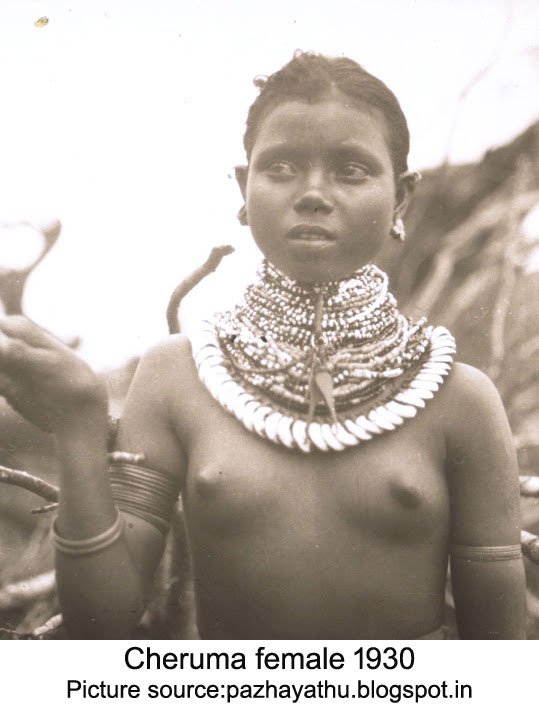 The next caste to be noticed is formed of the Cherumar or agrestic slaves. These were in all probability the aborigines of the country when it passed under the rule of the Nayars. The name is now written as above Cherumar, and as such is supposed to be derived from cheru, small, an adjective which correctly describes the appearance of this caste now-a-days ; but size and stature depend more upon conditions of food than upon anything else, and a race which has for centuries on centuries continued to be fed by its masters on a minimum of what will keep body and soul together is pretty sure in the long run to degenerate in size.
NOTEs by VED: *There is more to what happened than what Logan could possibly understand. This unmentioned item is the feudal language of the natives. It has the capability of delivering hammerblows on the extremely lower-down positioned populations. In fact, if the Briton were to come under the immigrants from the South Asian subcontinent, and remain there for a few centuries, they themselves would have many of the facial and physical demeanours of the lower castes in the subcontinent. It is basically connected to being under feudal language speakers, at an extremely low level. And the native-English have many of the qualifications that can make them be pushed to the lowest levels. END of NOTEs by VED
The Hindu mind, moreover, seems to be peculiarly liable to adopt superficial views on historical matters, and the fact that the race of Cherumar is of small stature is just one of those superficial facts which would be accepted by a Hindu (with the clearest conscience) as proof positive that the name was given because the people were of small size and stature. On the other hand there is ample evidence that the Malabar coast constituted at one time the kingdom or empire of Chera, and the nad or country of Cheranad lying on the coast and Inland south-east of Calicut remains to the present day to give a local habitation to the ancient name. Moreover the name of the *great Emperor of Malabar who is known to every child on the coast as Cheraman Perumal, although the first of these names is now written with the dental instead of with the cerebral r—was undoubtedly the title and not the name of the emperor, and meant the chief (literally, big man) of the Chera people.
NOTEs by VED: *It is true that in the local feudal languages, there is a propensity to use large-scale words for anything that seems beyond one’s level. However, to use the word ‘Emporer about any king of the subcontinent, is being slightly farfetched. Simply overrunning locations with crude and brutal barbarian forces is simply not the hallmark of any Empire. Empire-building should consist of a capability of setting up great social and administrative systems that caters to at least a majority of the residents. END of NOTEs by VED
Finally, from a census taken in 1857 of the slave population it appears that they were then distributed as follows :
1. Chirakkal 13,380
2. Kottayam 2,859
3. Kurumbranad 10,500
4. Wynad 10,561
5. Calicut 14,082
G. Ernad 35,419
7. Valluvanad 34,902
8. Palghat 25,280
0. Ponnani 28,668
10. Cochin 71
Total 187,812
That is to say, the bulk of them were located in the ancient Cheranad (part of the Ernad taluk) and in the neighbourhood of it. Moreover Ernad and Valluvanad and Ponnani are the three great Mappilla taluks of the district, and the converts to Islam have in Malabar been drawn chiefly from the slave population, so that originally the slave population in those three taluks, which seem to have been about the heart of ancient Chera, was denser still. There is therefore a good deal to be said in favour of the view that the Cherumars were the aborigines of Malabar.
The Cherumar are of two sections, one of which, the Iraya Cherumar, are of slightly higher social standing than the Pulayar. As the names denote, the former are permitted to come as far as the eaves (ira) of their employers’ houses, while the latter name denotes that they convoy pollution (pula) to all whom they meet or approach, the former class belongs chiefly to Palghat taluk, and it is said that the only houses which they may approach as far as the eaves are the houses of the Ilavan caste.
The caste is very scantily clad; in many places the men do not wear cloth at all round their waists, but substitute for it a fringe of green loaves. Their women used at one time to go similarly clad, but this practice has fallen into disuse in Malabar at least, although it is still maintained in the Native States. In the latter also, in outlying parts, both men and women are still afraid to avail themselves of the privilege of using the public roads. In passing from one part of the country to another they tramp along through the marshes in mud, and wet often up to their waists, rather than risk the displeasure of their lords and masters by accidentally polluting them while using the public roads. They work very hard for the pittance they receive; in fact nearly all the rice-land cultivation used to be in former days carried on by them. The influx of European planters, who offer good wages, has had a marked effect in releasing this class from some of their bonds, and the hold which their masters had over them has been proportionately relaxed. It is said that the difficulty of providing for their woman is the chief obstacle to their complete release from their shackles. The women must have dwellings of some sort somewhere, and the masters provide the women with huts and allow their men to go to work on plantations on condition that they return in good time for the rice cultivation and hand over a considerable portion of their earnings.
Conversion to Muhammadanism has also had a most marked effect in freeing the slave caste from their former burthens. By conversion, a Cheruman obtains a distinct rise in the social scale, and if he is in consequence bullied or beaten the influence of the whole Muhammadan community comes to his aid. With fanaticism still rampant, the most powerful of landlords dares not to disregard the possible consequences of making a martyr of his slave.
The questions of slavery and the slave trade attracted the early attention of the Honourable Company’s Government. So early as 1702, the year in which British rule commenced, a proclamation was issued by the Commissioners against dealing in slaves. A person offering a slave for sale was to be considered as a thief. The slave was to be forfeited and the person offering him for sale was to be fined five times his value. The purchaser was to be similarly treated. The houses of suspected slave traders were to be well watched and entered and searched on the smallest suspicion, and the traders caught in flagrante delicto were to be handed over to the Rajas to be dealt with.
Fishermen and Mappillas convoying slaves were to be “severely flogged and fined at the rate of ten rupees each slave.” Vessels used in trade (except fisher-boats) were to be confiscated. But the proclamation was not to prevent the privileged superior castes from purchasing the children of famine-stricken parents, as had been customary, on condition that the parents might repurchase their children, as had also been customary, on the advent of better times. This proclamation was, however, directed chiefly against the practice, then prevalent, of bands of robbers carrying off by force from their houses the children of “the most useful inhabitants, the Tiyars and other cultivators.”
This practice was kept alive by the facility with which the slaves could be sold on the coast to the agents of vessels engaged in the trade sailing from the French settlement at Mahe and from the Dutch settlement at Cochin. These ships “in general carried them (the slaves) to the French Islands.”
The subject of agrestic slavery did not come forward for some years, but on 20th July 1819, Mr. Warden, the Principal Collector, wrote an interesting report on the condition of the Cherumar and on the 23rd December of that year the Principal Collector received orders desiring “that the practice of selling slaves for arrears of revenue may be immediately discontinued.”
The matter in this and other ways reached the ears of the Court of Directors, and in their despatch of 12th December 1821 they expressed considerable dissatisfaction at the lack of precise information which had been vouchsafed to them regarding the cultivators in general, and in particular said : We are told, indeed, that part of them (an article of very unwelcome intelligence) are held as slaves ; that they are attached to the soil and marketable property.”
A report was called for, and Mr. Vaughan in his letter of 24th August 1822 merely said that the slaves were under the protection of the laws. The general question of slavery was not, however, allowed to drop—as, indeed, at that time it was not likely to be—for the British public mind was in great excitement on a question of the kind nearer home. It was, perhaps, fortunate for Malabar that West Indian slavery was receiving so much notice at home as it served to divert attention away from the Indian question, and at any rate the solution of the difficulty was thus set about with greater regard for the individual interests both of the slave and of his master.
On 16th November 1836, the Government ordered the remission in the Collector’s accounts of Rs. 927-13-0, which was the “annual revenue” from slaves on the Government lands in Malabar, and the Government was at the same time “pleased to accede to the recommendation in favour of emancipating the slaves on the Government lands in Malabar.”
Their freedom was not, however, to be proclaimed, and the measure was to be carried out in such manner “as not to create any unnecessary alarm or aversion to it on the part of other proprietors, or premature hopes of emancipation on that of other slaves.”
This was a wise step on the part of Government, for it strengthened their hands in future years in recommending others to do as they themselves had already done. But at the same time they need not have been under any apprehensions as to the effects of such an emancipation on the minds of other slaves. It is only people with initial ideas of liberty who fret under a system of compulsory customary employments.
The Directors on learning what had been done "entirely approved” of the measures adopted, and requested the Government to consider how to extend similar measures to the slaves of private owners, and urged the necessity of carrying out the measures with "extreme caution”. This was contained in the Directors’ despatch of 17th August 1838, and in penning it they evidently had before their eyes the fear of being heavily mulcted after the West Indian fashion in compensation to owners if any overt act was taken towards publicly recognising a general emancipation of slaves.
The Collector on 7th January 1839 submitted his report, and noticed the fact that there were “few or no slaves” in North Malabar. Ho also stated that, their condition was ameliorated since 1822. On this, nothing more was done just then, except that the Government issued orders on 12th March 1839 “to watch the subject of the improvement of the condition of the Cherumar with that interest which it evidently merits, and leave no available means untried for effecting that object.”
Nothing more would likely have been done had not Mr. E. B, Thomas, the Judge at Calicut, written in strong terms on 24th November 1841 a letter to the Sadr Adalat, in which he pointed out a number of facts which had come judicially under his notice. Women in some taluks fetched higher prices in order to breed slaves. Tho average cost of a young male under ten years was about Rs. 3-8-0, of a female somewhat loss. An infant ten months old was sold in a court auction on 10th August 1841 for Rs. 1-10-6 independent of the price of its mother.
And in a recent suit, the right to twenty-seven slaves was the “sole matter of litigation, and it was disposed of on its merits.” In a second letter, dated 24th August 1842, Mr. E. B. Thomas pointed out that the slaves had increased in numbers from 144,000 in census 1835 to 159,000 in census 1842, and he observed that “no gradual extinction of slavery is really going on in Malabar.”
It was apparently these letters of Mr. E. B. Thomas which eventually decided the Board of Diroctors to send out orders to legislate in the matter, for in their despatch of 27th July 1842 they first sent orders “for the entire abolition of slavery”, and in a second despatch of 15th March 1843 they called the special attention of the Government of India to the question of slavery in Malabar where the evils, as described by Mr. E. B. Thomas, were so aggravated “as compared with other portions of India”.
The Government of India thereupon passed Act V of 1843. On the passing of the Act, its provisions were widely published throughout Malabar by Mr. Conolly, the Collector, and he explained to the Cherumar that it was their interest as well as their duty to remain with their masters if treated kindly.
He proclaimed “The Government will not order a slave who is in the employ of an individual to forsake him and go to the service of another claimant; nor will the Government interfere with the slave’s inclination as to where he wishes to work.” And again, “Any person claiming a slave as janmam, kanam or panayam, the right of such claim or claims will not be investigated into at any of the public offices or courts.”
In the other portions of the proclamation, he closely adhered to the language of the Act. These measures in due course received the cordial approval of the Court of Directors, who, in their despatch of 30th July 1845, wrote as follows : “It would defeat the very object in view to create any estrangement between them and their masters, and , moreover would be an act of injustice and bad faith of which the masters would be entitled to complain.”
The appointment of a Protector of the Cherumar was sanctioned but never carried out, and various industrial and educational schemes organised for their benefit failed because of their lack of industry in the one case, and their lack of application and adaptability in the other.
In 1852 and again in 1855 the fact that traffic in slaves still continued was brought incidentally on the first occasion, and specially on the second, to the notice of Government, but on full consideration no further measures for the emancipation of the Cherumar were deemed to be necessary. The Cherumar even yet have not realised what public opinion in England would probably have forced down their throats fifty years ago, and there is reason to think that they are still, even now, with their full consent, bought and sold and hired out, although, of course, the transaction must be kept secret for fear of the penalties of sections 370, 371, etc., of the Indian Penal Code, which came into force on 1st January 1802 and which was the real final blow at slavery in India.
The slaves, however, as a caste will never understand what real freedom means until measures are adopted to give them indefeasible rights in the small orchards occupied by them as house sites.
Like the Tiyar or Ilavar, the Cherumar purchase their wives, and the bridegroom’s sister is the chief performer in the wedding ceremony. It is she who pays the girl’s price and carries off the bride.
The consent of the parents on both sides to a marriage is signified by an interchange of visits at which sips of rice-water are partaken, the visitors in each case signifying assent by dropping a fanam coin into the rice-water before partaking of it. When the wedding party sets out, they form a large gang of people, and at intervals the men set to at stick-play, the women singing in chorus to encourage thej “Let us see—let us see - the stick-play (Paditallu), oh ! Cherumar”.
At their weddings too, men and women minglo indiscriminately in dancing. On the return to the bridegroom’s hut, the bride is expected to weep loudly and deplore her fate. On entering the bridegroom’s hut, the bride must tread on a pestle placed across the threshold. A divorce presents no difficulties beyond the necessity of returning half of the bride’s purchase value.
Like the other castes, the Cherumar observe pollution for a number of days when a relative dies. The number of days in this case is fourteen, but as they cannot at certain seasons afford to be idle for fourteen days together—for fourteen days’ idleness very often with them means fourteen days’ starvation—they resort to an artifice to attain this end. They mix cowdung and paddy and make it into a ball and place this ball in an earthen pot, the mouth of which they carefully close with clay. The pot is laid in a corner of the cottage, and as long as the pot remains unopened they remain free from pollution and can mix among their fellows. On a convenient day they open the pot and are instantly seized with pollution, - which continues for forty days. Otherwise fourteen days’ consecutive pollution is all that is required. On the forty-first or fifteenth day, as the case may be, rice is thrown to the ancestors and a feast follows.
The village astrologer is above being consulted by the Cherumar who therefore resort to a Pariah. The process of divination is performed by turning some paddy in a basket, and in this way the good and the bad times of a Cheruman are reckoned.
Of the Nayadis or lowest caste among the Hindus—the dog-eaters— nothing definite is known. They are most persistent in their clamour for charity, and will follow at a respectful distance for miles together any person walking, driving or boating. If anything is given to them it must be laid down, and after the person offering it has proceeded a sufficient distance the recipient comes timidly forward and removes it.
Section E— Manners, Customs etc.
The most important of the customs in which the people of Malabar differ from people elsewhere is that connected with the inheritance of property. It is a sufficiently perplexing thought to a person brought up in western modes of life and with western ideas that a father can stand in no recognised legal1 relation to his own children, and that a father’s property does not as a matter of course descend to his offspring. And yet that is how the law stands at present in regard to the vast majority of the inhabitants of the district.
NOTEs: 1 See foot-note to p. 136. END OF NOTEs
This law of inheritance, usually styled Marumakkattayam (literally, sister’s son’s inheritance), may be shortly described thus. A Malayali taravad corresponds pretty closely to what the Romans called a gens, with this important distinction, however, that whereas in Rome all members of the gens traced their descent in the male line from a common ancestor, in Malabar the members of a taravad trace their descent, in the female line only, from a common ancestress.
All Taravads of influence set apart property for the common use, and indeed it seems to have been for purposes of thrift that this system of inheritance was at first devised. So long as that common property exists any number of families may hang together and form one taravad. To explain what is here meant by a “family” as distinguished from a taravad, take the following example :
|
A (Common ancestress) |
|||||
|
B (Female) (has issue) |
X (Male) |
C (Female) (no issue) |
Y (Male) |
D (Female) (has issue) |
Z (Male) |
X, Y and Z are A’s sons, and, as such, are members of A’s taravad, but however many children may be born to them, those children never come into A’s taravad nor stand in any recognised legal relation either to their fathers, or to the property of their fathers’ taravad. But the daughters B and D have each a family, and their daughters may in turn have further families, and so on. The word “family” was used in the sense of the issue (both male and female) of any female descendant in the female line only of A. Every member, whether male or female, and whether of age or not, has an equal interest in the common stock of the taravad ; but no member can claim his share of it. The taravad, however, as a body, can of course make any division, it pleases of the common stock, and among the more influential families it is customary to set aside certain portions of it, for the life enjoyment only, of members who attain to Sthanams or dignities hereditary in the family.
The portions so set apart are intended to help them in maintaining the dignity of their positions, and in respect to them they are to a great extent in the position of trustees. When a partition of the whole stock takes place, the taravad becomes disintegrated, and dissolves into so many fresh taravads as the members may have settled to form among themselves. This process of disintegration goes on continually except among the highest classes, who pride themselves on maintaining a large common stock. But even among them the taravad gets split up into subordinate divisions, known as tavalis or branches. One way in which this occurs is, that a member with perhaps some assistance from the common stock, but more usually with the assistance obtained from his father (who, as already said, stands in no recognised legal relation to his son), sets out from his taravad house and lives apart, taking with him one or more female relatives (usually a sister or sisters) and thus founds a separate branch (tavali ) of the taravad.
Or, more usually still now-a-days, a female of the taravad leaves the taravad house to live with the husband of her choice in a separate house prepared on purpose for her by her husband. This house is usually conveyed to her in free gift by her husband, and there she settles down to rear her family, who constitute a tavali of their taravad. The property acquired by such a tavali has been usually regarded as the separate property of the members who compose the tavali, and not as part of the common stock of the taravad, even when there has been no formal deed declaring what is, and what is not, common property ; but the High Court has of recent1 years held otherwise, and the tendency of the courts is now to regard all property as common property until a formal division thereof has taken place.
NOTEs: 1 I.L.R., Madras III, p. 212, and IV, p. 150, and Madras H.C. Reports, II, p. 162, and VI, pp. 401 to 415.END OF NOTEs
A man’s own acquisitions during his lifetime, therefore, descend at his death to his taravad and not to his own children. In the days when the Nayar male population were all soldiers and the marital tie was not much regarded this did not matter much, but things are changed now that a Nayar usually marries one wife, lives apart with her in their own home, and rears her children as his own also. His natural affections come into play, and there is a strong and most laudable desire for some legal mode, other than those at present recognised, for conveying to his children and to their mother all his self-acquired property.
At present he can only convey to them this property by stripping himself of it and making it over to them in free gift during his own lifetime. And this he is naturally reluctant to do for many and obvious reasons. He is in a thoroughly false position, for if he obeys his natural instincts and gives away his property during his lifetime to his wife and children, he becomes a beggar and is taken to task by his legal heirs; whereas, if he hesitates to do it, he incurs the displeasure of his own household. This false position is fatal to individual industry and thrift, and it is to be hoped that the law will soon1 be changed by permitting of the testamentary disposal of self-acquisitions.
NOTEs:1. See foot-note, p, 116 END OF NOTEs
Dr. Gundert gives the following list of the castes who follow this system of inheritance : (1) Seventeen Brahman illams in Payanur, Chirakkal taluk ; (2) Kshatriya ; (3) Tirumulpad ; (4) Nayar ; (5) Urali ; (G) Andor ; (7) Pallichan ; (8) Kuskavan ; (9) Vyabari ; (10) Kolayan ; (11) Chembotti ; (12) Pisharodi ; (13) V. Variyan ; (14) Nambi ; (15) Teyambadi ; (16) Maran ; (17) PoduvaL ; (18) Kuttunambi ; (19) Attikurichi ; (20) Unnitiri ; (21) Eradi ; (22) Vallodi ; (23) Nedungadi ; (24) Veluttedan ; (25) Chaliyan ; (26) Tiyan in north, and in Travancore.
NOTEs by VED: The observation that Tiyan in north and Travancore follow Matriarchal system of inheritance is again some kind of mischief, deliberately inserted for some political reason. Tiyans were not there by antiquity in Travancore. And the Ezhavas of Travancore, who are nowhere connected to Thiyyas of north Malabar, are not matriarchal people, even though there might have been some families there which might have followed this system due to some specific reasons, soley connected to them. END of NOTEs by VED
Of the other system of inheritance, usually styled Makkattayam (literally, son’s' inheritance), very little needs to be said, but many castes have peculiar customs in regard to it of which a few have already been noticed in the caste section. As a rule it may be said that these special customs have for foundation a desire to keep the property of the family together. It is this desire which prompts the Nambutiris to allow only their eldest sons' to marry wives of their own caste, and which prompts the Ilavar to have one wife in common among several brothers.
Dr. Gundert gives the following list of castes who follow this Makkattayam system of inheritance : (1) Nambutiri, (2) Pattar, (3) Embran, (4) Mussad, (5) Ilayad, (0) Tangal, (7) Nambidi, (8) Komatti, (9) Veishyan, (10) Nambiachan, (11) Chakyar, (12) Adigal, (13) Pidaran , (14) Poduval, (15) Vilakkattaravan , (16) Irankolli , (17) Mutta Chettiyan, (18) Kammalar, (19) Tavdan, (2) Ilavar, (21) Cherumar,—also some of the following castes : (22) Chaliyar, (23) Jedar, (24) Kaikolar, (25) Kaniyan, and (26) Tiyar in Kadattunad and Travancore.
Of other customs peculiar to Malabar there is a list of sixty-four, of which, however, there is more than one version. One version of the list will be found in the “ Indian Antiquary,” Vol. IV, p. 255, based, it is said, on precepts given by the great Samkara Acharya in twenty-six Sanskrit slogams. Another version, derived from personal communication with men learned in such matters, is subjoined. These sixty-four rules are called the Kerala Anacharam, that is, the irregular customs of Keralam and one tradition alleges that Samkara Acharya promulgated them at Kollam on 25th August 825 A.D., the first day of the first year of the Kollam era followed on the coast. There is some colour for this tradition in the well-known chronogram marking the commencement of the Kollam era, viz, :
|
0 Ach |
6 ar |
1 Ya |
4 Va |
3 Ka |
4 bhod |
1 ya |
which means, Acharya’s (i.e., Samkaracharya’s) word or law is unalterable, or must not be changed. The syllables represent figures as shown above, and those written backwards give the ago in days of the Kali Yuga on the first day of the first Kollam year. It is perhaps unnecessary to observe that Samkaracharaya was, according to the most recent authorities, not alive on 25th August 825 A.D., so he could not have promulgated them as alleged. The sixty-four rules are evidently of Brahman origin, and are concerned chiefly with Brahman usages.
Customs for Malabar Brahmans, etc., not observed elsewhere.
1. You must not clean your teeth with sticks.
2. You must not bathe with clothes worn on your person.
3. You must not rub your body with the clothes worn on your person.
4. You must not bathe before sun-rise.
5. You must not cook your food before you bathe.
0. Avoid the water kept aside during the night.
7. You must not have one particular object in view while you bathe.
8. The remainder of water taken for one purpose must not be made use of for another ceremony.
9. You must bathe if you touch another.
10. You must bathe if you happen to be near another.
11. You must bathe if you touch polluted wells or tanks.
12. You must not tread over a place that has been cleaned with a broom, unless it is washed.
13. A particular mode of marking the forehead with ashes.
14. You must repeat charms yourself.
15. You must avoid cold-rice, etc.
16. You must avoid leavings of meals by children.
17. You must not taste anything that has been offered to Siva.
18. You must not serve out food with hands.
19. You must not make use of the ghee of buffalo-cows for burnt offerings, etc.
20. You must not make use of the ghee of buffalo-cows for anniversary, etc.
21. A particular mode of taking meals.
22. You must not chew betel while you are polluted.
23. You must observe the conclusion of Bramhachari (an unmarriedman).
24. You must give presents to your guru (preceptor)
25. You must not repeat Vedas at the road.
26. You must not sell women.
27. You must avoid any vow which you observe in anticipation of getting your desires fulfilled.
28. Bathing is all that a woman should observe if she touches another in her monthly course.
29. Brahmans should not spin cotton.
30. Brahmans should not wash clothes for themselves.
31. Kshatriyas should avoid worshipping in Siva Lingam.
32. Brahmans should not accept the anniversary of Sudras.
33. Perform the anniversaries of your fathers, etc.
34. Anniversaries should be performed oil the day of the new moon.
35. The funeral ceremony should be performed at the end of the year from the day of death.
36. The ceremony to be performed till the end of the year from the day of death.
37. Sraddha should be performed with regard to the stars.
38. The funeral ceremony should be performed after the pollution caused by a child-birth at that time has been removed.
39. A particular mode of performing Sraddha by an adopted son.
40. The corpse of a man should be burnt in his own compound.
41. Sanyasis (devotees) should not look at females,
42. You must always be seeking for the next world.
43. Sraddha should not be performed in honour of dead Sanyasis.
44. Brahman females must not look at any other persons besides their own husbands,
45. Brahman females must not go out unaccompanied by female servants.
46. Should wear only white clothes.
47. Noses should not be pierced.
48. Brahmans ought to be put out of their caste if they drink any liquor.
49. They ought to be put out of their caste if they have intercourse with other Brahman women besides their wives.
50. The consecration of evil spirits in temples should be avoided.
51. Sudras, etc., are prevented from touching an image.
52. Anything offered to one god should not be offered to another.
63. Marriages, etc., should not be done without a burnt- offering.
54. Brahmans should not pour blessings upon each other.
55. They should not bow down to another person.
56. Sacrifice with a cow should be avoided.
57. Do not cause distraction, some by observing the religious rite of Siva and others those of Vishnu.
58. Brahmans should wear only one sacred thread.
59. Eldest son only is entitled to legal marriage.
60. Ceremony in honour of the dead ancestors should be performed with boiled rice.
61. Ceremony to be performed in honour of an uncle.
62. The right of inheritance among Kshatriyas, etc., goes towards nephews.
63. Widows should lead the lives of Sanyasis.
64. Sati should be avoided.
The Malayalis compute1 their time, as observed above, by the Kollam era, which commenced on 25th August 8252 A.D., but it is not generally known that there are two Kollam years, just as it is not generally known that there are two well-known Kollams or Quilons, as already described in Chapter I, p. 72. The Northern Kollam year commences on the 1st of Kanni, the month (September) in which the sun enters the Zodiacal sign of Virgo. The Southern Kollam year, on the other hand, commences on the 1st of Chingam, the Zodiacal month of Leo (August-September).
NOTEs: 1. Another Era which is in use, but only to a very limited extent, near Cochin in the Vypeen Era. In Malayalam it is called Putuveppu (literally—new deposit) and it dates from A.D. 1341, the year in which a new inland (Vypeen) was formed by deposit of sand and silt between the mouths of the Cranganore and Cochin rivers—or in which perhaps this island was first inhabited.
2. The data for fixing this day may be thus stated : —
(a) Up to midnight of 14th September 1882 A.D. there had elapsed 687,280 days of the Christian era.
(b) On 15th September 1882, the first day of the Northern Kollam year 1058, the age of the Kali Yugam in days was 1,820,238.
(c) The age of the Kali Yugam on the first day of the first year of the Kollam era was as fixed by the chronogram "Acharya vakubhodya," 1,434,160 days.
(d) Therefore 301,202 days of the Christian ore had elapsed when the Kollam era began.
(e) And this corresponds with the 236th day of the 825th year.
(f) The 237th day of 825 A.D. was 25th August.
(g) The same date is assigned in the Ind. Ant., Vol. XI, 271, but the date in that case are not stated. END OF NOTEs
It is uncertain how this difference of a month was imported into the era. The most natural explanation seems to be that there are two eras, and not merely one, but here history is at fault, for it is certain that the dates could not have been fixed as those of the founding of the two Kollams, as very often supposed, one of the Kollams having already been in existence for two centuries at least at the date of the commencement of the era. (As. Res., X, 69 ; Caldwell’s Drav. Gram., p. 27.).
Another theory is that the two dates mark the acquisition of independence of the Perumal (emperor) by the two Kolattiri families. There is much to be urged in favour of this view, only it is unlikely that the dates of acquiring independence should have fallen precisely on the first days of two successive months. The matter is explained more fully in the historical Chapter, Section (a).
A third theory is that the dates denote respectively the epochs when Samkaracharya’s Vedantist doctrines were embraced respectively by the Brahmans of the south and the Brahmans of the north portions of Keralam. There is some colour for this in the chronogram already explained above (page 150) marking in the Kali Yugam era the commencement of the Kollam era. But there is no historical evidence so far as yet discovered in favour of this view.
The other two explanations proceed on the assumption that originally there was but one era, that it marked an event in the history of the country, and that as this event fell in the middle of a month the initial day of the Kollam year was arbitrarily transferred by the respective suzerains of the north and south (in a11 probability the two Kolattiri dynasties), the one to the beginning of the Zodiacal month next following (1st Kanni), and the other to that of the Zodiacal month next preceding (1st Chingam), the exact date of the event, and this is probably the true explanation of the difference.
The two historical events from which is supposed to date the commencement of the Kollam era are respectively the institution of the Onam festival, the great annual festival of the Malayali , and the departure of the last emperor (Perumal) of Keralam for Arabia, whence he never returned. The evidence in favour of this latter event having taken place at this time will come more appropriately hereafter. As regards the former, the facts on which the assumption, for it is nothing more, rests is that the Onam festival falls on varying days at or about this time of the year, and that in title-deeds, horoscopes and other writings in North Keralam the year is still sometimes written as having ended on the day preceding the Tiru Onam day.
This fact is quite reconcilable with the other explanation which alleges that the commencement of the era coincides with the day of the Perumal’s departure for Arabia if it is assumed that, as is not improbable, the day on which he sailed was the Tiru Onam day—the day on which acknowledgments of fealty should have been made.
As there are two initial days of the Kollam year, so there are two systems of astronomy and two calendars in use on the coast. The differences between the two systems are, however, of minor importance, and the chief difference will be presently set forth. The system in vogue both in the north and in the south is that founded on Arya Bhattacharya’s dictum ;—“All the heavenly bodies1 enter the sign Aries and rise above the horizon at one and the same moment on a certain day2, which moment is reckoned as the commencement of a Kalpam3 , of a Yugam4 , of a year, of a month, and of a day. Time is duration with no beginning nor end, but capable of being computed by means of the relative positions of the planets and stars.”
NOTEs: 1. Sun, moon and planets.
2. Here must be understood: at Lanka (Ceylon), supposed to be on the Equator :
3. The period commencing with this phenomenon and ending with its recurrence.
4. One seventy-second part of a Kalpam according to one school, and one seventy-first part according to another. END OF NOTEs
It is accordingly by the sun’s position in the heavens that the lengths of the Malayali months and years are determined. Hence the months correspond with the signs of the Zodiac :
|
Months in Mal. |
Signs of the Zodiac. |
Corresponding English month. |
|
Medham |
Aries |
April—May. |
|
Idavam |
Taurus |
May—June. |
|
Midunam |
Gemini |
June—July. |
|
Karkadagam |
Cancer |
July—August |
|
Chingam |
Leo |
August—September. |
|
Kanni |
Virgo . |
September—October. |
|
Tulam |
Libra . |
October—November. |
|
Vrikshikam |
Scorpio |
November—December |
|
Dhanu |
Sagittarius |
December—January. |
|
Makaram |
Capricornus |
January—February. |
|
Kumbham |
Aquarius |
February—March. |
|
Minam |
Pisces |
March—April. |
The Malayali names, chiefly of Sanskrit origin, correspond precisely to the names of the Zodiacal signs used in European countries.
The Malayalis again divide their day into 60 naligas (— 24 minutes), and each naliga into 60 vinaligas ( — 24 seconds), and each vinaliga into 60, what they call, “long letter utterance times” (the time taken to pronounce a consonant and a long vowel = 2/5 of a second).
There are two other fanciful measures of time shorter than this, one of which (matra) is ¼ of a “long letter utterance time,” and another (noddi ) which is ⅛ of a matra ; but for practical purposes the day is divided into naligas, vinaligas, and "long letter utterance limes.”
The chief difference between the northern and southern systems of astronomy is that if the sun enters a sign of the Zodiac (Sankramam) during the day time, that day is reckoned in the northern calendars as the first day of the month corresponding to that sign ; whereas in the south, in order that a day may he reckoned as the first day of the month corresponding to any Zodiacal sign the sun must have entered that sign within the first three of the five parts into which they have divided the day. If the entry takes place in the latter two of the five parts of the day, the day next following is accepted as the first day of the month. According to both systems the months are of the following durations :
According to both systems the months are of the following durations :
|
Months |
Days |
Naligas |
Vinaligas |
Long letter utterance times |
|
Medhom |
30 |
55 |
30 |
13 |
|
Iddavam |
31 |
24 |
3 |
31 |
|
Midhunam |
31 |
36 |
26 |
5 |
|
Karkadagam |
31 |
28 |
4 |
30 |
|
Chingam |
31 |
2 |
4 |
59 |
|
Kanni |
30 |
27 |
23 |
15 |
|
Tulam |
20 |
54 |
11 |
55 |
|
Vrikshikam |
29 |
30 |
31 |
6 |
|
Dhanu |
29 |
21 |
2 |
13 |
|
Makaram |
29 |
27 |
23 |
36 |
|
Kumbham |
29 |
48 |
30 |
14 |
|
Minara |
30 |
20 |
10 |
38 |
|
Total |
365 |
15 |
31 |
15 |
These numbers are noted in the chronogram.
|
5 “Mu |
1 khyah |
1 Ka |
3 lo |
5 ma |
1 Ya |
5 ma |
6 tu |
3 lah" |
a phrase with a fanciful and apprently inappropriate meaning.
As the fractional parts of the day set forth above correspond to 6 hours 12 minutes and 30 seconds, it is clear that the Malayali year is too long by 23 minutes odd, and this is no doubt due to the omission in the above calculations, as in all other Hindu astronomical systems, of any compensation for the error caused by the precession of the equinoxes. The astronomers, it is understood, did recognise the fact of precession (ayanamgah), but they failed to utilise it to obtain a correct computation of the solar year.
The calendars are prepared by taking every fourth year as of 366 days and every hundred and sixteenth year as of 307 days in order to make up the fractional part of a day over and above 365 days. A great deal more might be said as to the infinity of uses to which those skilled in astronomical and astrological questions put the elaborate almanacs issued afresh every year, but enough has already been said about this matter in connection with the professional caste of astrologers.
Of the Malayali festivals only a very short account can be given.
It was usual in former days, and it is to some extent still prevalent, for superiors to be visited twice a year by their inferiors or dependents with gifts in hand—once at the time of the vernal equinox called Vishu, and once at the time of new moon in August—September, called Onam.
Vishu is the astronomical new year day. In 1883 it occurred on the 13th of April. It is supposed to be the vernal equinox, but as its position in the calendar has shifted about twenty-one days from the exact date of that event, it marks the time when Hindu astronomy attained its present development, for the Malayali year is too long by twenty-three minutes forty seconds, and an easy sum in compound division shows that the Malayali vernal equinox began to be diverted from its true position some thousand three hundred years ago, or (say) about the middle or end of the sixth century A.D. This is of course due, as already said above, to the error imported by failure to observe the effects of precession.
But however this may be, the Malayali is very superstitious about his conduct on this day of Vishu, and the first thing that comes under his observation on the morning of that day is believed to be significant of the luck that will attend him throughout the year then commencing. Hence the collection beforehand, sometimes in houses of temporary structure expressly built, of costly and auspicious objects, hence the annual presents to superiors, etc.
At Onam, which is perhaps the greatest national feast in Malabar, the houses are made gay with wild flowers, which are collected for the purpose by bands of children singing shrilly the appropriate Onam hymn. This is the day on which Parasu Raman or Vishnu is supposed to descend to earth to see his people happy.
To understand aright the significance of this feast to the people now-a-days it must be remembered that the good old days when perfect justice, perfect trust, and perfect truth prevailed upon the earth, are believed to have been during the reign of Mahabali . And the people attempt in a joyous way to reproduce, if only for one night, a vivid remembrance of the millennium, to which they look back with fond longings.
Next to these, perhaps the most popular feast in Malabar is that of the Bharani or cock feast in the month of Minam (March- April). It takes the people in great crowds away from their homes. The whole country near the lines of march rings with the shouts “Nada-a-Nada-a” of the pilgrims to the favourite shrines, chief of which is that at Cranganore (Kodungallur) in the Native State of Cochin. Of what takes place when the pilgrims reach this spot perhaps the less said the better. In their passage up to the shrine the cry of “Nada-a-Nada-a” (march, march away) is varied by terms of unmeasured abuse levelled at the goddess (a Bhagavati) of the shrine. This abusive language is supposed to be acceptable to her. On arrival at the shrine they desecrate it in every conceivable way, believing that this too is acceptable : they throw stones and filth, howling volleys of opprobrium at her house.
The chief of the fishermen caste, styled Kuli Mullalla Arayan, has the privilege of being the first to begin the work of polluting the Bhoot or shrine. Into other particulars it is unnecessary to enter. The cocks are slaughtered and sacrificed. The worshipper gets flowers only and no holy water after paying his vows. Instead of water he proceeds outside and drinks arrack or toddy, which an attendant Nayar serves out. All castes are free to go, including Tiyars and low caste-people.
The temple was originally only a Bhoot or holy tree with a platform. The image in the temple is said to have been introduced only of recent years. The object of the pilgrimage is to secure immunity from severe diseases during the succeeding year.
Of the Dasara it is unnecessary to say much. The feast is called in Malabar the Ayudhapuja (weapon or tool worship) or Sarasvatipuja- and sometimes Pujaveppu (the opening day) and Pujayeduppu (the closing day). On the opening day, tools, weapons, implements, etc., are or ought to be laid aside (veppu), and on the closing day they are resumed, taken up (eduppu). It is a ten days’ feast, and is called the feast of the autumnal equinox. The closing day has shifted, as in the case of Vishu, and for the same reason, about three weeks from the exact date of the equinox.
The other principal festivals are, Siva Ratri (Siva’s night-watch), Pongal (the cooking of the new season’s rice), Sri Rama Navami (Rama’s birthday), Vinyagachaturti (birthday of Ganesa, the god of wisdom and wealth, worshipped in the image of a rat), and Dipali or Dipavali (the feast of lamps at the new moon in the month Tulam, October-November).
There are also numerous local festivals which sometimes attract large crowds from long distances ; of these the Tiruchamaram festival, held at Taliparamba in Chirakkal taluk, in March ; the Kottiyur festival about May-June, held in the jungles of the Kottayam Taluk, at the foot of the mountains near the Periah Pass ; the Kilur Arat festivals, held in December in the Kurumbranad taluk ; the Car festival, held in November in Palghat Town ; the Konduvetti Takkujakal Nercha (a Mappilla feast), Ernad taluk in April ; the Guruvayyur Ekadesi feast, held in Ponnni taluk in April; and the Kurumandham Kunnu festival, held in April in Valluvanad taluk, are among the chief events.
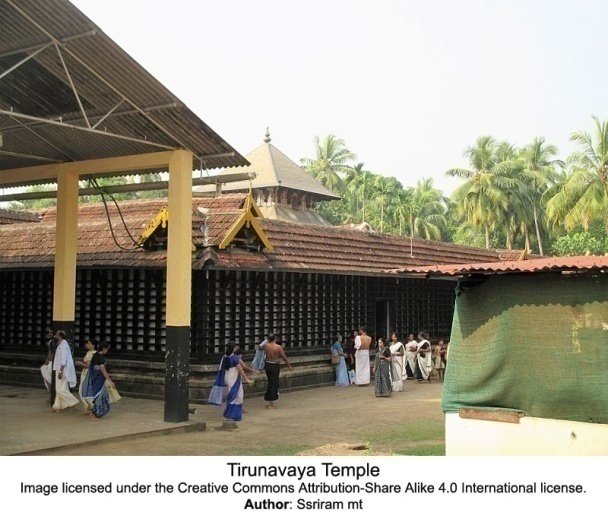 Besides these, a festival which used formerly to be held every twelfth year at Tirunavayi temple in the Ponnani taluk deserves more than a passing reference although it has been discontinued for the past one hundred and forty years. This festival was called the Mamakham or Maha Makham* which means literally big sacrifice. It seems to have been originally the occasion for a kuttam or assembly of all Keralam, at which public affairs were discussed and settled.
NOTEs by VED: *This information might be wrong. END of NOTEs by VED
Hamilton thus alludes to the tradition current about it in his time (end of seventeenth anti beginning of eighteenth centuries) : — “It was an ancient custom for the Zamorin to reign but twelve Years and no longer. If he died before his Term was Expired it saved him a troublesome Ceremony of cutting his own Throat on a public Scaffold erected for that Purpose. He first made a Feast for all his Nobility and Gentry, who are very numerous. After the Feast he saluted his Guests and went on the Scaffold, and very decently cut his own Throat in the View of the Assembly, and his Body was a little While after burned with great Pomp and Ceremony, and the Grandees elected a new Zamorin. Whether that Custom was a religious or a civil Ceremony I know not, but it is now laid aside.
“And a new Custom is followed by the modern Zamorins, that a Jubilee is proclaimed throughout his Dominions at the End of twelve Years, and a Tent is pitched for him in a spacious Plain, and a great Feast is celebrated for ten or twelve days with Mirth and Jollity, Guns firing Night and Day, so at the End of the Feast any four of the Guests that have a Mind to gain a Crown by a desperate Action in fighting their Way through thirty or forty thousand of his Guards and kill the Samorin in his Tent, he that kills him, succeeds him in his Empire.
In Anno 1695 one of those Jubilees happened, and the Tent pitched near Pennany (Ponnani), a Sea Port of his, about fifteen Leagues to the Southward of Calicut. There were but three Men that would venture on that desperate Action, who fell in with Sword and Target among the Guards, and after they had killed and wounded many were themselves killed. One of the Desperadoes had a Nephew of fifteen or sixteen years of Age, that kept close by his Uncle in the Attack on the Guards, and when he saw him fall the Youth got through the Guards into the Tent and made a stroke at his Majesty’s Head, and had certainly despatched him if a large Brass Lamp which was burning over his Head had not marred the Blow : but before he could make another he was killed by the Guards : and I believe the same Zamorin reigns yet.
“I chanced to come that Time along the Coast, and heard the Guns for two or three Days and Nights successively.” (New Account, etc., Vol. 1, pages 306-8).”
The Kerala Mahatrnya so far corroborates Hamilton's story that it declares the king used to be deposed at this festival, but there is no mention of self-immolation, although it is quite possible the deposed kings may have occasionally adopted this mode of escape from the chagrin of not being re-elected by those who had hitherto been their adherents.
Mr. Jonathan Duncan, Governor of Bombay, wrote about this festival in the first volume of the Transactions of the Bombay Literary Society to the following effect.—The installation of the first Perumal took place on “Pushya (8th Lunar Asterism) in the month Magha1 in Karkadaga Vyalam2 (the period during which Jupiter remains in Cancer) and this day in every cycle of Jupiter thus became important in the history of Malabar” because the reign of each Perumal terminated on that day, he being elected only for 12 years. “This great feast and the coronation occurring in the month Magha that month in every Karkadaga Vyalam was known as the great Magha or Mahamagha which was afterwards corrected into Mamangam.”
NOTEs: 1* There is no such month as that —Magha—mentioned by Mr. Duncan and the title of the festival is properly that above given, namely, Maha (= great) and Makham ( = sacrifice). He evidently confounded makham with Makaram. END OF NOTEs
NOTEs by VED: *It seems that Logan also missed the idea. The festival seems to be connected to the Magham nakshatram (astrological star) and not to any ‘sacrifice’ meaning. END of NOTEs by VED
NOTEs: 2*. Vyalam is the Tamil-Malayalam word for Jupiter, and a cycle of Jupiter is roughly speaking 12 years, more accurately 4,332 days odd. END OF NOTEs
NOTEs by VED: *The correct pronunciation might be Vyazham. END of NOTEs by VED
“At the end of this feast all prior leases of land were considered to be at an end and fresh grants were to be obtained at the beginning of the next reign.”
“In all the principal deeds the position of Jupiter is to be mentioned.”
“This practice is continued even up to the present day.”
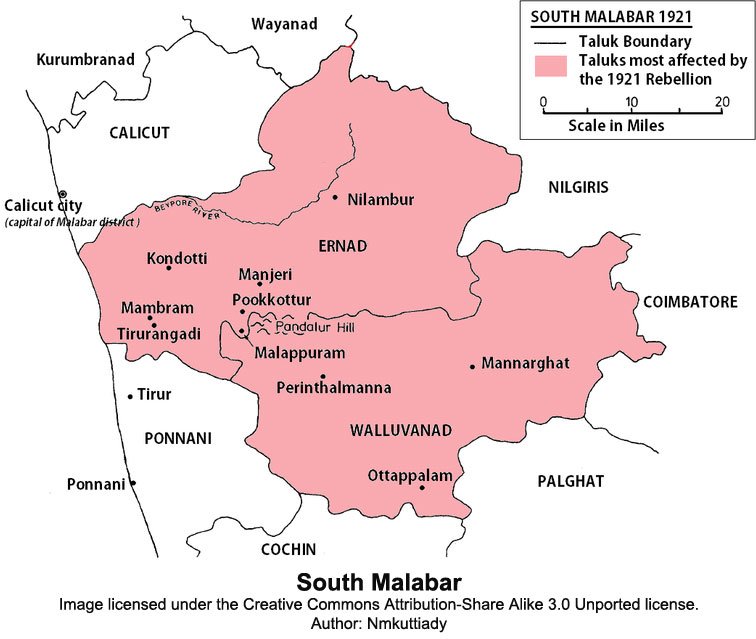 Mr. Duncan seems to have obtained his information from the Keralopathi. The fact seems to have been that at each recurring festival all feudal ties were broken, and the parties, assembled in public conclave at Tirunavayi, readjusted at such times all existing relations among themselves. The tradition is that this festival was instituted in the days of the emperors (Perumals), that is, prior to the Kollam era, and that when the last emperor set out for Mecca and left the country without a head the duty of celebrating it devolved on the raja of the locality where the festival used to take place, that is, on the Valluvanad alias Vellatri alias Arangott Raja3. And this arrangement seems to have continued up to the twelfth or thirteenth century A.D., when the power of the Zamorins (chiefly through Muhammadan influence and arms and trade) became supreme in all Keralam. From that time down to the last celebration of the festival in 1743 the Zamorins were present at this festival as Suzerains of all Keralam, including Travancore, which as a Malayali State only attained to the first rank shortly after the date of the last Mahamakham festival in 1743.
NOTEs: 3. So called in the Jews’ deed of the eighth century A.D., on account of his territory lying beyond (angotla) the river (ar) from Cranganore, the emperor’s headquarters. END OF NOTEs
Those who acknowledged the Zamorin’s suzerainty sent flags in token of fealty, and the places where these flags used to be hoisted at festival time are still pointed out. The Valluvanad Raja, who is still represented in the management of the Tirunavayi temple by one out of the four Brahman Karalars, instead of sending a flag used to send men called Chavers (men who have elected to die}, whose office it was to endeavour to cut their way through the Zamorin’s guards to his throne in a manner presently to be described. If they had succeeded in killing him—as on the occasion cited by Hamilton, whose statement, except as to the date, is moreover corroborated by tradition-—it is uncertain what would have happened; but probably if a capable raja had been ruling in Valluvanad at such a time, popular opinion would have endowed him with the suzerainty, for the Nayar militia were very fickle, and flocked to the standard of the man who was fittest to command and who treated them the most considerately.
With the kind assistance of the present Zamorin, Maharaja Bahadur, the records of his family have been examined and a complete account obtained of the events attending the festival held in 1683 A.D., the festival next preceding that alluded to by Hamilton. The festival used to continue for twenty-eight days every twelfth year, when the planet Jupiter was in retrograde motion in the sign of Karkadagam or Cancer or the Crab, and at the time of the eighth lunar asterism in the month of Makaram the festival used to culminate. On the occasion in question the Zamorin some months beforehand sent orders for the preparation of the necessary timber and bamboos for the temporary buildings required at Tirunavayi, and the materials were floated downstream from the Aliparamba Chirakkal lands. Then exactly two months before the opening day he sent out a circular to his followers worded as follows :—
"Royal writing to the Akampati Janam (body-guards).
“On the 5th Makaram 858 is Mahamakha Talpuyam (time of the eighth lunar asterism in the festival season), and the Lokars (chief people of each locality) are required to attend at Tirunavayi as in olden times.
'"Mangatt Raman and Tinayancheri1 are sent to collect and bring you in regular order for the Mahamakham.
NOTEs: 1.Two of the hereditary ministers, the first being a Nayar, the second an Ilayatu. END OF NOTEs
“You must come to Tirunavayi on the 3rd of Makaram to fight and foil as usual. But all of you should come for the Mahamakham.”
The Zamorin timed himself to arrive at Tirunavayi on the day after that appointed for the arrival of his followers, and the lucky moment for setting out on this particular occasion on the last day’s stage of the journey was “at the rising of the constellation of Aquarius”.
The Tirunavayi temple stands on the north bank of the Ponnani river close to the present line of railway. Passengers by train can catch a glimpse of it by looking across the level expanse of paddy fields which lie south of the sixth telegraph post on the three hundred and eighty-second mile of the railway.
There is a modest clump of trees on the river bank hiding the temple, the western gateway of which faces a perfectly straight piece of road a little over half a mile in length stretching from the temple gateway westwards to the elevated ridge hemming the paddy-fields on the west. This road is but little raised above the level of the paddy flat. Directly facing this straight piece of road as the elevated ridge is reached there are three or perhaps four terraces, the outlines of which may still be traced in the face of the precipitous bank.
A little to one side of the upper terrace are the ruins of a strongly built powder magazine, and on the flat ground above and on both sides of the fine avenue shading the public road at this place is ample space for the erection of temporary houses.
In a neighbouring enclosure under cultivation is a disused well of fine proportions and of most solid construction.
From the upper terrace alluded to a commanding view is obtained facing eastwards of the level rice-plain at foot, of the broad placid river on the right backed by low hills, of higher flat-topped laterite plateaus on the left, their lower slopes bosomed in trees, and, in the far distance, of the great chain of Western Ghats with the Nilgris in the extreme left front hardly distinguishable in their proverbial colour from the sky above them.
It was on this spot, on a smooth plateau of hard laterite rock, raised some 30 to 40 feet above the plain, that the Zamorin used several times in the course of the festival to take his stand with the sword of Cheraman Perumal, the last emperor, in his hand.
The sword is, and has been for centuries, slowly rusting away in its scabbard, but it is not alone on it that the Zamorin depends for his safety, for the plain below him is covered with the thirty thousand Nayars of Ernad, the ten thousand of Polanad, and numberless petty dependent chieftains, each counting his fighting men by the hundred or the thousand, or by thousands. Away on the right, across the river are the camps of the second prince of the Zamorin’s family and of the dependent Punattur Raja ; the third, fourth, fifth and sixth princes’ camps too are close at hand in the left front behind the temple, and behind the terrace itself is tl.re Zamorin’s own camp.
The whole scene is being made gay with flags as an elephant is being formally caparisoned with a drain of solid gold with “one hundred and fourteen small links and one clasp, making in all one hundred and fifteen”—as the record specifically testifies—and with golden bosses and other ornaments too numerous to be detailed. But this part of the festivities is not to be permitted to pass unchallenged, for it signifies in a formal manner the Zamorin’s intention to assume the role of Rakshapurashan, or protector of the festivities and of the people there assembled. On the instant, therefore, there is a stir among the crowd assembled near the western gate of the temple directly facing at a half mile distance the Zamorin’s standing-place on the upper-terrace.
From this post, running due east in a perfectly straight line to the western gate of the temple, is the straight piece of road already described, but the road itself is clear and the armed crowd on the plain, it is seen, are hemmed in by barred palisadings running the full length of the road on both sides. Two spears’ length apart the palisades are placed, and the armed crowd on either hand, consisting on this occasion of the thirty thousand Ernad Nayars, it is seen, are all carrying spears. The spearmen may not enter that narrow lane, and by the mere weight of their bodies present an impassable obstacle to the free passage of the freemen now bent on cutting down the Zamorin in his pride of place.
Amid much din and firing of guns the morituri, the Chaver Nayars, the elect of four Nayar houses in Valluvanad, step forth from the crowd and receive the last blessings and farewells of their friends and relatives. They have just partaken of the last meal they are to eat on earth at the house of the temple representative of their chieftain ; they are decked with garlands and smeared with ashes. On this particular occasion it is one of the house of Putumanna Panikkar who heads the fray. He is joined by seventeen of his friends—Nayar or Mappilla or other arms bearing caste men— for all who so wish may fall in with sword and target in support of the men who have elected to die.
Armed with swords and targets alone they rush at the spearmen thronging the palisades ; they “wind and turn their bodies as if they had no bones ; casting them forward, backward, high and low, even to the astonishment of the beholders” as worthy Master Johnson describes them in a passage already quoted (p. 137). But, notwithstanding the suppleness of their limbs notwithstanding their delight and skill and dexterity in their weapons, the result is inevitable, and is prosaically recorded in the chronicle thus: “The number of Chavers who came and died early morning the next day after the elephant began to be adorned with gold trappings—boi g Pulumanna Kattur Menon and followers—were 18.”
NOTEs: 1. *(l) Chandratt Panikkar, (2) Putamanna Panikkar, (3) Kolkot Panikkarand (4) Verkot Panikkar. END OF NOTES
At various times during the ten last days of the festival the same thing is repeated. Whenever the Zamorin takes his stand on the terrace, assumes the sword and shakes it, men rush forth from the crowd at the west temple gate only to be impaled on the spears of the guardsmen who relieve each other from day to day. The turns for this duty are specifically mentioned in the chronicle thus : “On the day the golden ornaments are begun to be used the body-guard consists of the Thirty Thousand ; of Ellaya Vakkayil Veltodi (and his men) the second clay, of Netiyiruppu1 Muttarati Tirumalpad (and his men) the third day, of Itatturnad2 Nambiyattiri Tirumalpad (and his men) the fourth day, of Ernad Munamkur3 Nambiyattiri Tirumalpad (and his men) the fifth day, of Ernad Elankur4 Nambiyattiri Tirumalpad (and his men) the sixth day, and of the Ten Thousand,5 the Calicut Talachanna Nayar ancl Ernad Menon the seventh day.”
NOTEs: 1 The Fifth Prince of the Zamorin’s family.
2 The Fourth Prince of the Zamorin’s family.
8 The Third Prince of the Zamorin's family.
4 The Second Prince and Heir Apparent of the Zamorin’s family.
5 The Ten Thousand of Polanad, the district round about Calicut, formed the Zamorin’s own immediate able body-guard— Cenf. the account contained in the Keralolpatti of how these men were originally selected—Chap. Ill, Sect. (a). END OF NOTEs
The chronicle is silent as to the turns for this duty on the eighth, ninth and tenth days. On the eleventh day, before the assembly broke up and after the final assault of the Chavers had been delivered, the Ernad Elankur Nambiyattiri Tirumalpad (the Zamorin next in succession) and the Tirumanisseri Nambutiri were convoyed in palanquins to the eastern end of the narrow palisaded lane, and thence they advanced on foot, prostrating themselves four times towards the Zamorin, once at the eastern end of the lane, twice in the middle, and once at the foot of the terraces.
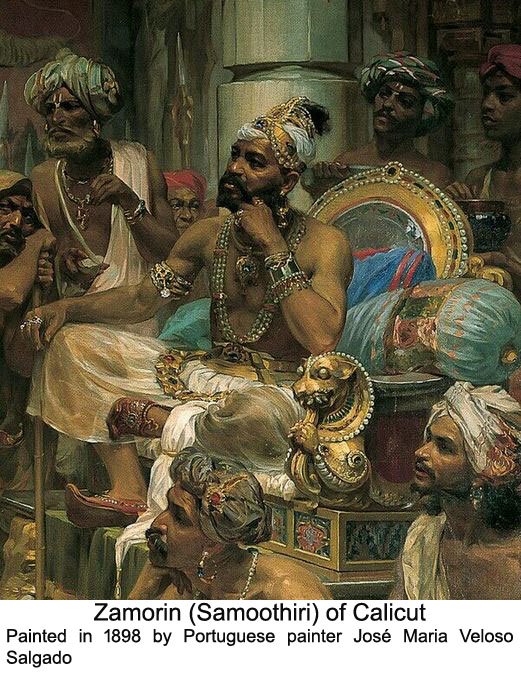 And after due permission was sought and obtained they took their places on the Zamorin s right hand. After this, so the chronicle runs, it was the duty of the men who had formed the body-guard to march up with music and pomp to make obeisance. On this occasion, however, a large portion of the body-guard seems to have been displeased, for they left without fulfilling this duty, and this story corroborates in a marked way the fact already set forth (p. 132) regarding the independence and important political influence possessed by the Nayars as a body.
The Ernad Menon and the Calicut Talachanna Nayar with their followers were the only chiefs who made obeisance in due form to the Zamorin on this occasion, and possibly by the time of the next festival (1695 AD), of which Hamilton wrote, the dissatisfaction may have increased among his followers, and the Zamorin’s life even may have been endangered, as Hamilton alleges, probably through lack of men to guard him. Tradition asserts that the Chaver who manage on one occasion to get through the guards and up to the Zamorin’s seat belonged to the family of the Chandrattil Panikkar.
The chronicle winds up with a list of the Chavers slain on this occasion, viz.:-
When the Zamorin was taking his stand on the terrace apparently at the commencement of the festivities . . 5
On the day the elephant was adorned, as already related . . 18
“The next day of Chandratiil Panikkar and followers, the number who came and died .. .. .. .. 11
“Of Verkot Panikkar and followers, the number that came and died the third day . . . . . . . . . . 12
“The number who came up to Vakkayur and died in the four days . 4
“The number of Chavers who were arrested at the place where Kalattil Itti Karunakara Menon was and brought tied to Vakkayur and put to death . . . . . . 1
“The number of Chavers arrested on the day of the sacrifice, when all the persons together made the obeisance below Vakkayur at the time when the Zamorin was taking his stand, and left tied to the bars, and who were afterwards brought to Vakkayur and after the ceremony was over and the Zamorin had returned to the palace were put to the sword.. .. .. .. .. .. .. 4
Total 55
The chronicle does not mention the fact, but a current tradition says that the corpses of the slain were customarily kicked by elephants as far as the brink of the fine well, of which mention has been made, and into which they were tumbled promiscuously. The well itself is nearly filled up with debris of sorts, and a search made at the spot would probably elicit conclusive evidence of the truth of this tradition.
The martial spirit of the Nayars was in former days kept alive by such desperate enterprises as the above, but in every day life the Nayar used to be prepared and ready to take vengeance on any who affronted him, for he invariably carried his weapons, and when a man was slain it was incumbent on his family to compass the death of a member of the slayer’s family. This custom was called Kudippaka (literally, house feud), or in an abbreviated form, Kuduppu.
One curious fact connected with this custom was that the chieftain of the district intervened when a man was slain and the body of the deceased was by him taken to his enemy’s house and the corpse and the house were burnt together. It is understood that an outhouse was usually selected for the purpose, but it was a common phrase to say “the slain rests in the yard of the slayer.”
Again, when mortal offence was given by one man to another, a solemn contract used to be entered into before the chieftain of the locality to fight a duel, the chief himself being umpire. Large sums (up to a thousand fanams or two hundred and fifty rupees) used to be deposited as the battle-wager, and these sums formed one source (ankam) of the chieftain’s revenue, and the right to levy them was sometimes transferred along with other privileges appertaining to the tenure of the soil.
A preparation and training (it is said) for twelve years preceded the battle in order to qualify the combatants in the use of their weapons. The men who fought were not necessarily the principals in the quarrel—they were generally their champions. It was essential that one should fall, and so both men settled all their worldly affairs before the day of combat.
Besides this custom, which brought revenue into the chieftain's coffers, a curious list of items also producing revenue has been preserved in Mr. Graeme, the Malabar Special Commissioner’s Report ( 1818- 1822), and it may be here given as it illustrates in many lights the customs of Malabar in ancient times. The chieftain levied customs duties on imports, exports, and transports.
He had a recognized right to usurp the estates of his decaying neighbouring chiefs: in fact the doctrine of the “survival of the fittest” was carried into practical politics in Malabar to a great extent.
And he had the right to force them, by violence if necessary, to contribute supplies on emergencies. Fines of sorts were of course levied from subjects, and when they died their successors, particularly those who held offices or rights over land, had to contribute something in order to ensure recognition of their right to succeed to the deceased’s estate or office. Leud, adulterous women were made over to the chiefs with a premium by the other members of their families in order that they might be taken care of, and the chiefs (at any rate the Zamorins) used in turn to sell the women to foreign merchants, thus making a double profit out of them.
No one might quest for gold without payment of a royalty, and in Mr. Dillon’s “East Indies” the way this was managed at Calicut is thus described : “Among the sands of the shore, there is good store of gold dust, which is very fine ; and everybody has the freedom to gather it at pleasure : the biggest piece that ere I saw was not worth above fifteen pence, and commonly they are not worth above four or five pence a piece ; abundance of people got a livelihood by it ; and with the consent of the Governor (which is to be purchased by a certain set price for the maintenance of a hundred poor people) you may have as much sand as you please carried to your dwelling-places in order to separate it with the more convenience.”
Again, when a man died without heirs, the chieftain took his property ; nor could a man adopt an heir without the chief’s consent. Under various designations fees for protection were levied from dependants and from strangers, and this latter was doubtless one of the obstacles which prevented the Chinese traveller Fah Hian from penetrating into South India, for he wrote : “ Those who desire to proceed thither should first pay a certain sum of money to the king of the country, who will then appoint people to accompany them and show them the way.”
Presents of congratulation or of condolence were always sent to the chieftains on the occasions of weddings, funerals, births, opening of row palaces, of ascension to the throne, and on the occurrence of numerous other domestic and public events.
Then, again; ships which came ashore were annexed by the chieftain of the locality. Moreover, a more piratical custom than this even was observed, in ancient times at least, for thus wrote Marco Polo respecting the kingdom of “Eli” (ante, p. 7) :
“And you must know that if any ship enters their estuary and anchors there, having been bound for some other port, they seize her and plunder the cargo. For they say, ‘you were bound for somewhere else, and ‘its God has sent you hither to us, so we have a right to all your goods.’
“And they think it no sin to act thus. And this naughty custom prevails all over these provinces of India, to wit, that if a ship be driven by stress of weather into some other port than that to which it was bound, it is sure to be plundered. But if a ship come bound originally to the place they receive it with all honour and give it due protection.” (Yule’s Marco Polo, II, 374.)
The custom of taking ships and cargoes wrecked on the coast continued down to recent times, for the English factors at Tellicherry entered into engagements with three of the country powers for exempting English vessels from such seizure. But it was a custom which the Malayali chieftains broke through with extreme reluctance. The kings of Bednur were the first to grant immunity in 1736-37, and thrice afterwards ratified it ; then followed the Kolattiri prince, on 8th May 1749, ratified in 1760; and finally the Kadattunad Raja granted similar immunity in 1761.
No others followed their examples. Finally the chieftains had a monopoly of various animals produced or captured in their domains, cows having an abnormal number of dugs, cattle that had killed a human being crany animal (they were called “red horns cattle born with a white speck near the corner of the eye, buffaloes with white tips to their tails, wild elephants caught in pitfalls, the hind quarter of any wild hog or deer slain in hunting, the tails and skins of all tigers similarly slain, and wild hogs that had fallen into wells —an occurrence which must have been frequent to judge by the wide area in which this right of the chieftains was recognized :—all of these were their perquisites of office.
A few words may be added regarding the right to appropriate a portion of each wild game animal slain in hunting. This right was, and it still is, known as the Urpalli right, ur being a village, and palli a place of reverence or importance. The village hunts, like everything else in the daily life of a Hindu community, were conducted precisely according to ancient corporate customs. The Urpalli was the place where, according to custom, the game must be broken up. The man even who alone could perform this office had a hereditary right to officiate. He was called the Keikkaran or attendant (perhaps originally an older of the village). As perquisite, he had the other hind quarter of the animal. The hunter who killed the animal had as perquisites the head and one forequarter. A share of the flesh was given to each of the hunters engaged in the hunt, and three pieces were distributed among those who came to the Urpalli to see it cut up. The animal was methodically out up into eighteen customary pieces.
The Urpalli was a place in the jungle duly consecrated to the hunting deity Ayyan or Ayyappan, and it was in front of his shrine that the formal ceremony took place. The hunting season opens on the 10th or 11th of Tulam തുലാം (October—November) of each year, and those days are still considered of importance in places where game is still to be found.
The permission of the chieftain to hunt on his territory was not required and was never sought, and the idea of an exclusive personal right to hunting privileges in certain limits is entirely foreign to the Malayali customary law. Such an idea was only imported into Malabar with English courts and English law and lawyers. There was a fundamental difference in the ideas from which originated the Malayali law of land tenure and the English law of land, and this will be considered in the chapter on the land tenures and land revenue.
This difference has never been properly understood in the courts, and the confusion and consequent strife among those interested has been very great and deplorable.
So strong indeed was the hold that old observances and customs had upon the people, that “when summary payment was demanded of a debtor, the custom was to draw a circle round him with a green branch and imprecate on him the name of the particular divinity whose curse was to fall upon him if he left the circle before satisfying the claim of his creditor.” (I. A. VIII, 2G7.)
Many writers have noticed the existence of this custom, and some have commented on and marvelled at the strictness of the arrest. But it must be remembered that of individual freedom there was very little as every person from his cradle to his grave was hemmed in by unyielding chains of customary observance.
In an interdict there were four kinds of twigs used for the four sides, viz., either the four tali plants—-probably consisting of 1, Convolvulus maximus ; 2, another kind of convolvulus called Tirumudittali; 3, a three-ribbed convolvulus (Tirupantittali) ; and 4, Ipomoea setosa;—or 1, a thorn with an edible fruit called Rhamnus circumcisus; 2, a medicinal tree called in Malayalam nyallu ; 3, Mussaenda frondosa with white bracts called in Malayalam Vellila ; and 4, the Malayalam tumba (Phlornis or Leucas Indica), a common weed.
A tuft of three green twigs tied to a doorway precluded persons from crossing the threshold of a house, and a similar tuft to the end of a staff stuck in the ground was, and still is, in some parts a sign, that there is an interdict on the crops there growing. The people must have been a very law-abiding and docile race if such simple formalities sufficed to govern them. But indeed custom, when once it has become law, arrays the whole community in arms against the law-breaker, and is perhaps the safest form of law for a semi-civilised State.
Another curious custom has come down from ancient times and is still flourishing, though the mutual confidence on which it relies for its proper effects shows signs of breaking down and is cited as a degeneracy of Malayali manners. Any one desirous of raising a considerable sum of money for some temporary purpose invites his friends to join him in what is called a kuri or lottery : chance enters very little, however, into the arrangement, and it would be a bettor term to call the members a mutual loan society. The organiser of the kuri gets a certain number of his friends to subscribe a certain amount of money, or of rice husked or unhusked, as the case may be. The friends bring their contributions to his house, where they are hospitably entertained, and by lot the person is selected to whom similar contributions from all present, including the organiser of the kuri, are to be made at a certain date then and there fixed.
This individual in turn hospitably entertains his friends when they come with their contributions. A third person is then selected, and the same thing comes off at his house. And so it goes on, until every one of the original members or his heir has in turn reaped the benefits of the contributions of his friends. The arrangement is of obvious benefit in several ways to those concerned.
Trials by ordeal were and still are very common, although some forms of them have necessarily disappeared. The Zamorin in 1710 entered into an engagement with the Honourable Company’s Factors at Tellicherry to subject to the oil ordeal people who disputed with them as to the value of articles agreed to be supplied for money received. This engagement is recorded in the Tellicherry Factory Diary of 6th May 1728 as: "A grant that any Mallabarr having accounts with us must put his hand in Oyio to prove the verity thereof, given Anno 1710.”
And in the engagement itself it was written: “If his hand comes out clean, he will be held innocent and you will have to pay him, as usual, the expenses he may incur (in taking the oath).” The form of taking the oath was to pick a coin out of a pot of boiling oil with the hand, which was immediately swathed in bandages and sealed up, and the state of the hand after a certain lapse of time (three days, it is understood) determined the matter.
The crocodile ordeal, in which a man swam across a piece of water swarming with saurians was also in vogue at some places to determine the guilt or innocence of criminals. The ordeal by weighment was, and still is, sometimes resorted to. A man who wishes to establish his innocence is weighed: he proceeds to a neighbouring tank and bathes, and if on returning to the scales he is lighter than when he went into the water, his innocence is established. This is used now-a-days in deciding caste offences.
But criminals did not in former days always escape, and were not always given the option of submitting the test of their innocence to an ordeal.
The five great crimes were—(1) murder of a Brahman ; (2) drinking spirits (probably a crime only among Brahmans, for the Nayars are not now, and never were an abstemious caste, nor were the other lower castes) ; (3) theft : “They put a thief to death”, wrote Sheikh Ibn Batuta regarding the Malayalis in the fourteenth century A.D., “for stealing a single nut, or even a grain of seed of any fruit : hence thieves are unknown among them, and should anything fall from a tree none except its proper owner would attempt to touch it.” (Ibn Batuta, Travels, Or. Transl. Committee, London, 1829, p. 167); (4) disobeying a teacher’s rules; (5) cowkilling, which is still a penal offence hi the Cochin State.
The manner of carrying out capital punishments was sometimes barbarous in the extreme. Criminals were cut in half and exposed on a cross-bar, in the manner still adopted with tigers and panthers slain in hunting expeditions and offered as a sacrifice to local deities. Thieves were similarly cut in two and impaled on a stake, which probably had a cross-bar, as the word for it and that for an eagle or vulture are identical. But impaling alive was also known, and in June 1795, by the orders of the Palassi (Pychy) rebel chief two Mappilias were thus treated after a pretended trial for alleged robbery in a Nayar’s house at Venkad in Kottayam Taluk.
Finally, great criminal were at times wrapped up in green palm leaves and tom asunder probably by elephants.
Whether cannibalism ever extensively prevailed is uncertain, but it is not improbable that it at times was perpetrated among the lower orders of the population, who even now take vengeance on the higher castes by stoning their houses at night and by various devices superstitiously set down to the action of evil spirits. In modem times only one authentic instance of cannibalism is on record, and it was vouched for by the late Dr. Burnell. Some of the agrestic slave caste had murdered a Nayar and mutilated the body, and on being asked why they had committed the murder, the details of which they freely confessed, they replied that if they ate of his flesh their sin would be removed. (Indian Antiquary, VIII, 88.)
Down to the present day the power of enchantments and spells is believed in implicitly by the lower and by the semi-educated among the upper classes ; and some individuals of the lower classes have a powerful superstitious influence over the higher castes owing to their supposed efficiency in creating enchantments and spoils and in bringing misfortunes.
The family of famous trackers, whose services in the jungles were retained for H.R.H. the Prince of Wales’ projected sporting tour in the Anamallai Mountains in 1875, dropped off most mysteriously one by one shortly afterwards, stricken down by an unseen hand, and all of them expressing beforehand their conviction that they were under a certain individual’s spell and were doomed to certain death at an early date. They were probably poisoned, but how it was managed remains to the present day a mystery, although the family was under the protection of a European gentleman who would have at once brought to light any ostensible foul play.
“Be it noted,” wrote Mr. Walhouse, late M.C.S., in the Indian Antiquary for January 1876, “that Malabar is the land par excellence of sorcery and magic ; the most powerful bhootas and demons reside there.” He further gives details of three of the forms raised in compassing the discomfiture of enemies.
“Make an image with wax in the form of your enemy, take it in your right hand at night and hold your chain of beads in your left hand ; then bum the imago with duo rites, and it shall slay your enemy in a fortnight. Another strong spell for evil is to take a human bone from a burial ground and recite over it a thousand times the powerful Malayali mantra namely, ‘Om ! Hram ! Hram ! Swine-faced goddess ! seize him ! seize him as a victim ! drink, drink his blood ! eat ! eat his flesh ! O image of imminent death ! Bhagavati of Malayala ! Glaum ! Glaum ! Om !’ The bone thrown into an enemy’s house will cause his ruin...........
Let a sorcerer obtain the corpse of a maiden, and on a Sunday night place it at the foot of a bhuta haunted tree on an altar, and repeat a hundred times ‘Om ! Hrim ! Hrom ! O goddess of Malayala, who possessest us in a moment ! come ! come ! !’ The corpse will then be inspired by a demon and rise up, and if the demon be appeased with flesh and arrack, will answer all questions put.”
The demons “can be bought, carried about, and transferred from one sorcerer to another.” It may be added that the best educated native gentlemen have even yet hardly got over their objections to photography on the ground that their enemies may obtain possession of their photographs, and may by piercing with needles the eyes and other organs, and by powerful incantations, work them serious mischief.
Keralam has twelve professional magicians, six of whom work to win the good gods, and six to coerce the evil ones.
Of belief in the potency of the “evil eye” evidence meets one at nearly every step throughout the land. A house or a shop is being built ; there surely is to be found exposed in some conspicuous position an image, sometimes of extreme indecency, a pot covered with cabalistic signs, a prickly branch of cactus or what not to catch the “evil eye” of passers-by and to divert their attention from the important work in hand.
A crop is being raised in a garden visible from the road : the vegetables will never reach maturity unless a bogey of some sort is set up in their midst. A cow will stop giving milk unless a shell is tied conspicuously about her horns.
The same idea enters into all domestic events and arrangements, and that not merely among Hindus, but among Muhammadans as well, to an extent that is with difficulty realised by Europeans.
When affliction comes the animal affected is served with grass, fruits, etc., on which charms have been whispered, or is bathed in charmed water, or has a talisman in the shape of a palm-leaf inscribed with charms rolled up and tied round its neck.
So too with human beings. In 1877 a poor Mappilla woman residing in one of the Laccadive Islands was put upon her trial for witchcraft for importing into the island a betel leaf with a certain cabalistic and magical inscription it, but it fortunately turned out for her that she had merely pounded it up and rubbed it over her daughter's body to cure her of fits.
Ibn Batuta wrote of a Malayali king who was converted to Islam by the leaf of “the tree of testimony,” a tree of which it was related to him that it does not generally drop its leaves, but, at the season of autumn in every year, one of them changes its colour, first to yellow, then to red ; and that upon this is written, with the pen of power, ‘There is no god but God : Muhammad is the Prophet of God,’ and that this leaf alone falls.” The falling of the leaf was an annual event anxiously looked for, and the leaf itself was efficacious in curing diseases.
Now-a-days the belief among Muhammadans still subsists that the leaves of a certain tree growing on Mount Deli possess similar virtues.
The incantation for the removal of spells and for avoiding future mischiefs is a long and somewhat complicated affair at times. The following account has been furnished from a trustworthy source : —
“Besides this, two other methods called Tolulika (a ceremony for removing different sins and punishments by throwing them with leaves into the fire), and Beliyulika (a ceremony performed by waving a basket of flowers round a possessed person), are also adopted in the case of human beings, and the mode of performing it is as follows : First, a lighted lamp and a nazhi (a wooden vessel containing half a seer) filled with rice are kept in the verandah or in the yard of a house. On the north-east corner of it a representation of Kala Bhyravan (a demon) with its head towards the south and feet towards the north, is made in five colours, viz., white, yellow, green, red and black.
Rice cleaned and uncleaned, tender cocoanut, plantains, pounded rice, fried grain, betel leaf, arcca nut, etc., are placed on all the four sides of it. A Kypandi (a triangle made with plantain rind and young cocoanut leaves cut and stuck upon it in row's) having Kanikkali (saffron and chunam mixed with water and made after the fashion of a gruel) sprinkled over it, is placed on the east, red gurusi (water made red by mixing a little saffron and chunam with it) and a reddened cocoanut on the north, and black gurusi (water mixed with charcoal) and a blackened cocoanut on the south, of the said representation.
After modes of adoration have been done to these, Piniyal (the person on whom exorcism is being practised) proceeds with three betel leaves and three pieces of arcca nut, rice and wick in the right hand and with a knife in the other, and goes three times round the said representation, and then standing on the west of it facing towards the east, holds out the knife three times against the representation and cuts three times across it, and at last sticks the knife in its light eye, and then sits down. After this a wick is placed in the Kypandi, one in the red gurusi , and a third on the reddened cocoanut after singing hymns in praise of Kali, and wicks are similarly placed in black gurusi and on the blackened cocoanut after singing hymns in praise of Gulikan (son of Saturn, the ruler of the fatal hours). Then either the person who performs the ceremony or anybody else takes one handful of the leaves of Iranynyi (a tree) and one handful of those of nochchi (a shrub), and having caused Piniyal to keep a wick upon them for avoiding the evil eye, keeps them aside. Again one man takes one handful and a second another handful of the said leaves and stand on each aide of the Piniyal and rub with them from the head to the feet of the Piniyal, when Bharatam ought to be sung. This ought to be that portion of the Bharatam called Nilalkuttu which relates the story of the Pandus who were troubled by Curus by means of sorcery. At the end of each verse, the said leaves ought to be mixed with salt, chillies, mustard seed, gingelly seed, etc,., and burnt in fire prepared with jack wood ; a piece of iron is also placed in the fire.
At the end of the four verses in this manner Pandi and gurusi are thrown aside, having due hymns sung by the person who performs the ceremony. After this, the body of the Piniyal is anointed with the ground root of a medicinal plant called Panal mixed with gingelly oil. The said piece of iron is then taken out of the fire and placed in front of the Piniyal, and the performer takes in his hands the smoke that bursts out by pouring upon it water mixed with gingelly and lamp oil, and rubs the body of the Piniyal with it.
A cocoanut is then placed in the front of the Piniyal, having two wicks one across the other upon it. The Piniyal then crosses the cocoanut three times forward and backward, with a knife in the right hand and with a lighted wick in the other, and then sets fire to the wicks already placed on the cocoanut. The Piniyal then attempts three times to cut the cocoanut with the knife, and at the fourth time cuts it into two pieces, and then destroys the said representation with the hands and puts a mark on the forehead. Thus it ends.
“This is generally performed for males just before their first marriage, and also when they appear to be subject to such injuries as those already mentioned. This is done for females also on the day previous to the Pumsavana (a ceremony generally observed by them in the fifth, seventh, or ninth month of their first pregnancy). It is also performed for females who are afflicted with barrenness”.
There are no professional augurs among the population, but the events of their daily lives are supposed to be largely influenced by the signs presented to them by various birds and beasts and human beings and substances of sorts. The following list of good and bad omens has been prepared by a native gentleman.
Good omens.—The sight of such birds as crows and pigeons, etc., and beasts as deer, etc., moving from left to right, and dogs and jackals moving inversely, and other beasts found similarly and singly, wild crow, cock, ruddy goose, mongoose, goat and peacock seen singly, or in couples either at right or left ; the rainbow seen on right or left side or behind, prognosticates good, but the reverse if seen in front.
Butter-milk, raw rice, Puttalpira (Trichosanthes anguina), Priyanga flower, honey, ghee, red cotton juice, antimony, sulphurate, metallic mug, bell ringing, lamp, lotus, Koruka grass (Agrostis linearis), raw fish, flesh, flour, ripe fruits, sweetmeats, gems, sandalwood, elephant, pots filled with water, a virgin, a woman, a couple of Brahmans, Rajas, respectable men, white flower, white yak tail, white cloth and white horse.
Chank-shell, flagstaff, turband, triumphal arch. fruitful soil, burning fire, elegant eatables or drinkables, carts with men in, cows with their young, mares, bulls or cows with ropes tied to their necks, palanquin, swans, peacock and Indian crane warbling sweetly !
Bracelets, looking-glass, mustard, Bazoor, any substance of white colour, the bellowing of oxen, auspicious words, harmonious human voice, such sounds made by birds or beasts, the uplifting of umbrellas, flagstaffs and flags, bailing acclamations, sounds of harp, flute, timbrel, tabor, and other instruments of music, sounds of hymns of consecration and of Vedic recitations, gente breeze all round happening at the time of journey.
Bad omen.--The sight of men deprived of any of their limbs, such as the lame or blind, etc., of corpse, or wearer of cloth put on a corpse, coir pieces, broken vessels, bearing of words expressive of breaking, burning and destroying, etc., the alarming cry of "alas ! alas !” loud screams, cursing, tumbling, sneezing, the sight of a man in sorrow or one with a stick, a barber, or widow, pepper and other pungent substances.
The sight of a- serpent, cat, igu a, bloodsucker, or monkey passing across to road, or vociferous boasts or birds. Such as jackals, dogs and kites, crying loud from the eastern side, and of a buffalo, donkey, or temple bull, black grains, sail , liquor, hide, grass, dirt, faggots, iron, and flower used for funeral ceremonies, a eunuch, a ruffian, an outcaste, vomit, excrement, stench, any horrible figure, bamboo, cotton, lead, cots, stools or vehicles being carried with legs upwards, and dishes, cups, etc., with mouth downwards, vessels filled with live coals, and which are broken and not burning, broomstick, ashes, oil, winnow and a hatchet, etc.
SECTION F. RELIGIONS
The annexed table shows the respective members of the followers of the different religions in Malabar, and the ratio of each to every 100,000 of the population in 1871 and again in 1881.
|
Religion |
1871 |
1881 |
|
|
|
Population |
Ration per 100,000 |
Population |
Ration per 100,000 |
|
|
Hindus Muhammadans Christians Others |
1,037,914 581,609 40,268 1,459 |
72,434 25,721 1,781 84 |
1,669,271 652,198 43,196 370 |
70,581 27,677 1,826 16 |
|
Total |
2,261,250 |
100,000 |
2,365,035 |
100,000 |
Excluding the Laccadive Islands, which are wholly Muhammadan, the Hindus are most numerous in Palghat Taluk, where, of every 100,000 of the population, 80, 518 are Hindus, and fewest in numbers in Cochin Taluk, where the proportion is only 25,900. The Muhammadans similarly are most numerous in Ernad Taluk, proportion 50,649, and least numerous in Palghat, proportion 9,441.
The Christians again are most numerous in Cochin Taluk, proportion 50,354, and least numerous in Valluvanad Taluk, proportion only 46. Of people of other religions, the largest number is in Wynad Taluk, proportion 174, and the fewest in Palghat Taluk, proportion nil.
NOTEs by VED: There can be an error here. All throughout this book, there is a grey area, when mentioning two items. One is the word Malayali. And the other is the word Hindu. The word Malayali more or less is seen to mean only the Brahmans and the castes below upto the Nairs. For instance, see Chapter 2. The PEOPLE: Section B.—Towns, Villages, Dwellings and Rural Organisation.
Second item which is in the grey area is the definition of Hindu. It is more or less clear the Hindus are actually the Brahmin classes and their subordinates consisting of the Amabalavasi and their direct serving class, the Nairs. The nairs actually are in the peripheral region of the Hindu religion, with no rights to hear or recite Hindu scriptures. The Marumakkathaya Thiyyas of north Malabar as well as the Makkathaya Thiyyas of south Malabar are not allowed in the spiritual practises of the Hindu religion at all. Most of the castes that come below them also do not have any connection to Hindu religion, other than that they are the castes, which are kept at a distance from the Hindus. However, the distance always did lend enchantment. Some of these kept-at-a-distance castes did continually try to mention some historical connection to being connected to Brahmins or some other higher castes. Check: Castes and tribes of Southern India by Edgar Thurston
Logan is again quite flimsy and superficial here. END of NOTEs by VED
Hindus
Of the strange medley of cults and religions which goes by the name of Hinduism, it is very difficult to give any adequate idea in a few pages.
The earliest aboriginal cult was probably that which is sometimes called animism—the propitiation of evil spirits, male and female—for in the earliest relics of religion still extant there seems to be embodied a belief in an existence after death. Persons who caused sorrow and trouble in life were after death supposed to be the cause of further unhappiness, and as such they had to be propitiated with gifts which they would have appreciated when alive. They had to be supplied with the weapons, the cooking pots, the oil receptacles, oil lamps, the ornaments, the water jars, and the implements which they used during life.
Periodically solemn festivals were held, and a portion of the viands was solemnly set apart for the, departed. In every garden on the southern side, even in the present day, a portion is set apart where the bones of those who are burned are buried in pots, and nightly lights are periodically kept blazing in memory of the day on which the deceased departed this life.
This custom prevails among Nayars, Tiyars, and the artisan castes, and it is no doubt the latest development of the cult, which dictated the making of the massive sepulchral urns and the erection of the massive cromlechs, and k stvacus with which the district abounds, but of which, tradition, in any reliable form, is wholly wanting.
A distinct advance in religious ideas may perhaps be gathered from those sepulchral relies, which, in Malabar am more varied in their forms, end in their associations perhaps more interesting than any similar relics in any land yet explored. And although the subject is archaeologically of historical interest, its chief importance seems to be in its religious aspect, and as such it may be fitly introduced here.
In so far as explorations have yet been conducted the sepulchral remains referred to may be separated into four classes, which, from internal evidence, may probably be correctly classified chronologically thus :-
|
I. Megalithic remains. |
probably synchronous. |
|
II. Excavated caves :. |
|
|
III. Caves with massive urns (kula-kallu) and massive sepulchral urns without caves. |
|
|
IV. Modern sepulchral urns of a small size. |
|
There is a fifth class which has not- boon authoritatively connected with sepulchral uses. This class is known as the topikullu (hat stone), and evidently belongs to the megalithic period of Class I.
Illustrations Nos. I and II are of this uncertain class ; the hat stone represented in No. I was explored by Mr. Babington in November 1819 who thus summed up the result : “Though from its situation, size, and appearance I was led to expect my labour would not have been in vein, nothing was found in the hollow space between the stones which supported the topikallu and which were themselves placed on, the solid rock.”
Similar researches made since have so far as known proved as equally unsuccessful, and Mr. Babington’s conclusion either that these monuments are not sepulchral, or, if sepulchral, that their contents have crumbled into indistinguishable dust is fully justified.
Specimens of the first of the four undoubtedly sepulchral classes may be found scattered widely over the hilly country in the South of Malabar, and one characteristic group of them is to be found in a valley at the foot of the Kalladikod mountain peak in, the Kavalpat amsam of Palghat Taluk. They invariably contain the remains of iron implements and weapons and earthen pots. All covered up most carefully with fine earth which has in general been carefully sifted. Those remains correspond so closely with ordinary cromlechs elsewhere that it is unnecessary to illustrate them.
The stones composing the sides and ends of the place of sepulchre are sometimes fully exposed, sometimes half-buried, and sometimes only just showing above the surface. Occasionally the cromlech has a circle of stones placed round it at the distance of a yard or two. Of Class II, specimens (Illustrations Nos. Ill to VII) occasionally come to light, by accident, in quarrying blocks of stone, or in digging the foundations of buildings.
Such specimens are known to exist in the following places :—(1) in the Tallavil desam of Kuttiyori amsam in Chirakkal Taluk ; (2) in the Taliparamba and Trichumaram desam of Taliparamba amsam in the same taluk ; (3) in the Padinyattumurai amsam and desam of Calicut Taluk.
Their existence has been reported from many other places (Sewells "Lists of Antiquities, Madras,” p. 210, seq). The contents are, in all respects, similar to those from the megalithic class. Those caves are therefore probably of the same ago as the megalithic class, although in form they differ widely from the square megalithic cromlech, as will be seen from the following plans and sections. The caves are invariably cut out of soft laterite rock, and as gneiss is both more difficult to work and scarcer than laterite in the parts where these caves are to be found, it is probable that the architects adapted themselves to circumstances, and, instead of building their sepulchres or death-houses, set to work to excavate them.
The next illustration, No. VIII, convoys an accurate idea of the style of the earthernware vessels and iron weapons and implements found in those excavated “death-houses.”
It was probably a distinct advance in civilisation and in religious ideas (as will be presently explained) which led to the adoption of the next class (No. Ill) of sepulchral relies, for the kuta-kallu remains invariably' contain a largo sepulchral urn placed inside an excavated chamber, in addition to the usual earthenware pots and iron implements characteristic of the supposed earlier sepulchral relics. Moreover, in these kuta-kallu chambers are to be found earthenware pots of a more advanced type, evincing that meanwhile society had begun to pay attention to ornamenting the vessels in domestic use. Beads, too, are found in them, and the iron implements, weapons are more varied in form as if designed for more extended wants.
Illustrations (Nos. IX to XII) copied from a very interesting paper communicated by Mr. .J. Babington to the Literary Society of Bombay in December 1820 (Reprint, Bombay Literary Society's Transactions, 1877, p. 342), are representative of those kuta-kallu remains and of their contents.
The occurrence of these massive half-backed earthenware urns in the excavated chambers of the kuta-kallu seems to supply the necessary connecting link between society, ancient and modern ; for Malayalis, as already said, still adhere to the practice of using small sepulchral urns of the IV class. But now-a-days the charred bones of the deceased are placed in the urns as a temporary resting place only, and are, as soon as convenient, removed and cast into the fresh water of the holy rivers.
Formerly there was evidently no intention of ever disturbing the relics after they were put in their final resting place. The shape of some of the ancient urns perhaps affords a clue to the idea which originally suggested this mode of sepulchre; for in Malabar, as in the districts east of the ghats, their shape is at times peculiar. The urn shown in Mr. Babington’s illustration (No. IX) was evidently the final resting-place of a person of wealth and consideration—the extent of the excavation, the massive character of the capstone, and the articles found, all attest this.
Meaner individuals had to be content with less pretentious tombs, and, accordingly, it is found that in many localities in the district massive half-baked sepulchral urns, simply buried in the ground, are grouped together, generally on hill sides, in large numbers; occasionally, where the laterite rock occurs near the surface, the - rock is hollowed out a little to admit of receiving the urn, but no attempt is made at constructing a chamber round each urn. What is further peculiar about them is that, while some are plaintlv made like that shown in Mr. Babington's illustration (No, IX), in others of them, as in some of the specimens to be found at Vaniarnkulam in the Valluvanad taluk, the bottom of the ur thickens out in a circular -shape and through this protuberance a small hole is drilled.
It has been suggested that this peculiarity in construction is emblematic of the religious ideas connected with the Bhu-devi or earth goddess (Tellus), and that burial in this fashion was emblematic of the return of the individual to the womb of Mother Earth. The protuberance on the bottom of the urn under this supposition would signify that it was representative of the os uteri.
The worship of the earth goddess is a subject full of difficulty; it probably came in with the advance in civilisation, which taught men that the earth was fruitful if tilled, and possibly the transition from the megalithic and excavated tomb period to the period in which earthen sepulchral urns began to be used marks a change in Malayali civilisation from a pastoral life to one of agriculture, and from a belief in the powers for good and evil of departed human spirits to one in which the former belief began to be modified by the idea of an earth goddess, who became the refuge of the dead.
To the present day there is a native tradition, which of course is not in harmony with orthodox Sanskrit texts, and which runs follows :
"As long as the bones remain undestroyed and undefiled;”
“So long does the soul enjoy heaven."
And this tradition has still such a powerful hold on the people, that their superstitious fears are at ones aroused if such places of sepulchre are opened up. To this feeling chiefly is to be attributed the lead fact that so little is still known about these death relics. When a tomb is by accident discovered, it is generally for superstitious reasons closed up again at once and the fact of its existence is kept secret.
But even, according to orthodox Brahmanical idea, the corpse of a human being is, if the proper mantras are used, delivered at the burning ground to the care of Rudran, (one form of Siva), whose charge ceases when the burning is complete. The unburnt bones become pure and ought to be delivered in a pure form to Paramesvaran (another form of Siva) whose property they become. This is effected by casting them into the fresh water of holy streams, such as the Ganges, and into branches of the Kaveri as at Tirunelli in Wynad, and Periar in Coimbatore, and the like. But it in not always convenient to carry away the bones at once for this purpose, and frequently it is not done for years. Meanwhile, therefore, the bones are placed in a holy urn1 (Class IV) and preserved till a fitting opportunity occurs for their removal. The spirit of the deceased is meanwhile supposed to inhabit the western room—the honoured guest-chamber of the house-into which it is conveyed on the fortieth day after death in the holy urn before the latter is finally consigned to its temporary resting-place in the southern portion of the garden. The urn used must be of un burnt fresh earth, a fact which goes a long way to connect the ancient and modern practice on this point, for the massive urns of Class III above described are likewise constructed of only partially baked earth.
NOTEs: 1. The urns are not peculiar in shape, so it is unnecessary to give an illustration of class IV. END OF NOTEs
The native tradition still extant, that so long as the bones remained "undestroyed and undefiled” the deceased enjoyed heaven, is no doubt the original ancient idea, and the carrying out of the idea gave rise to the first three classes of these forms of sepulchre. Modern ideas have changed simply by making priestly intercessions necessary for the welfare of the deceased.
This is most conspicuous in the ideas now in vogue regarding the sraddha ceremonies, for priestly ingenuity has had a wide scope in following the course of a departed spirit and in inventing obstacles to its final attainment of bliss.
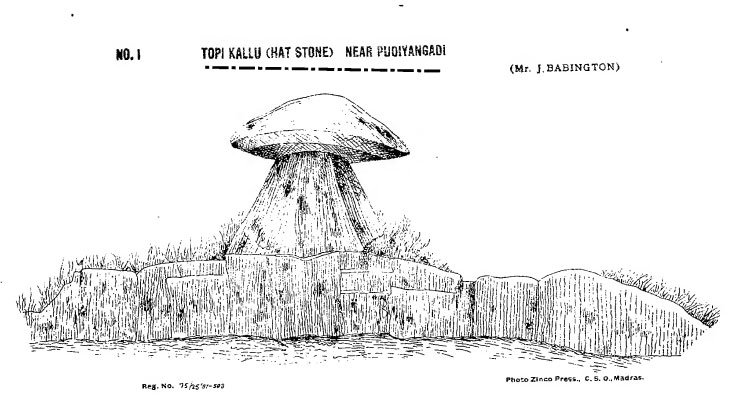
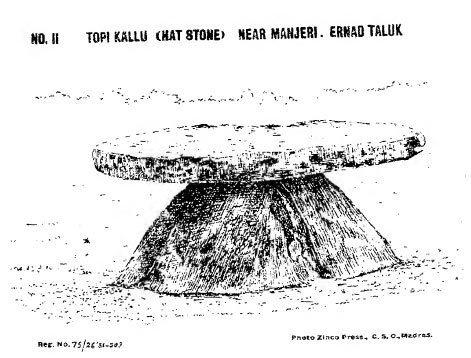
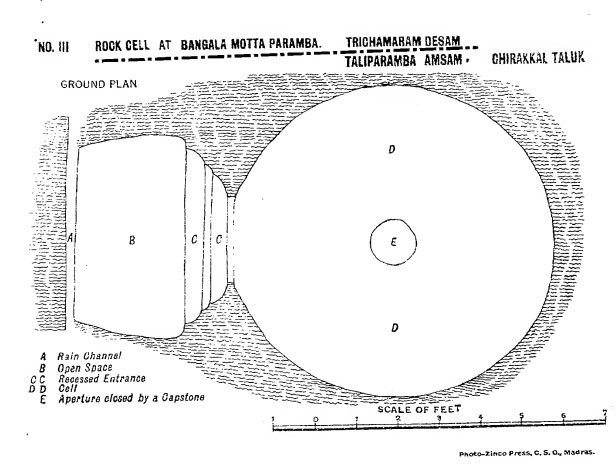
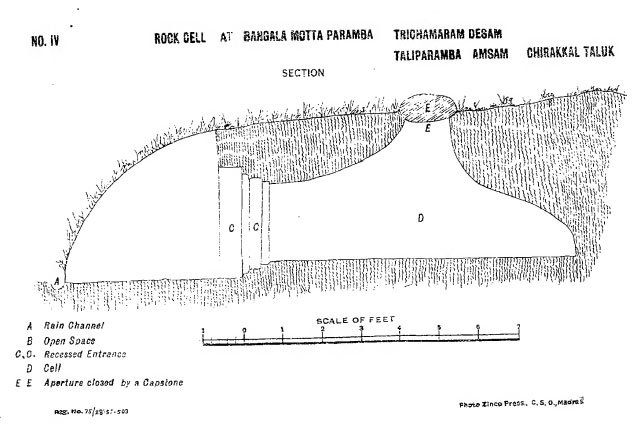
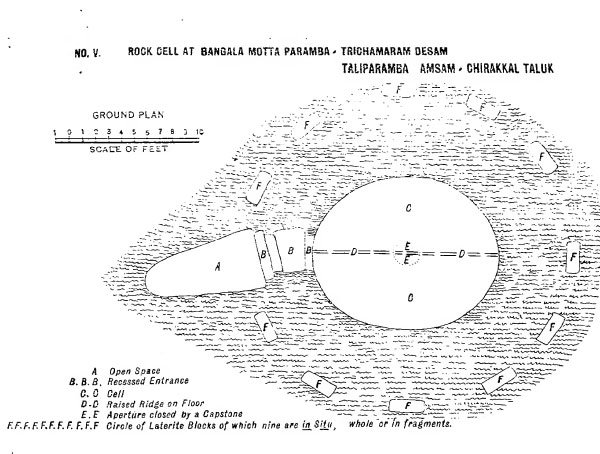
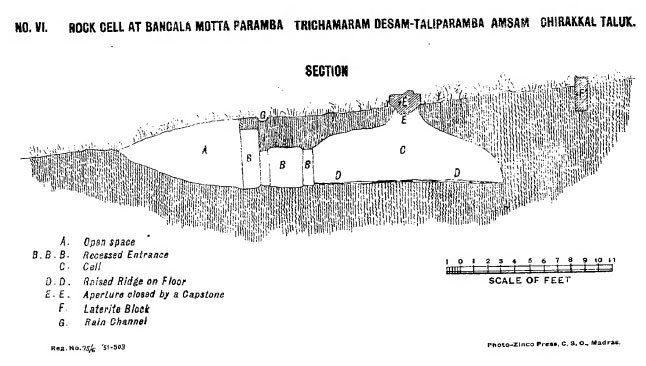
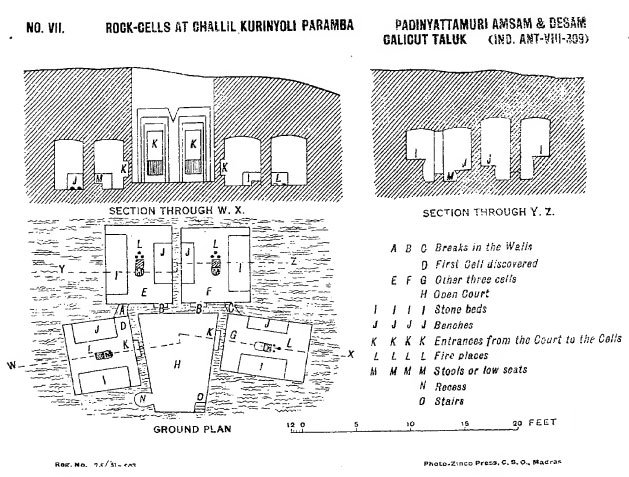
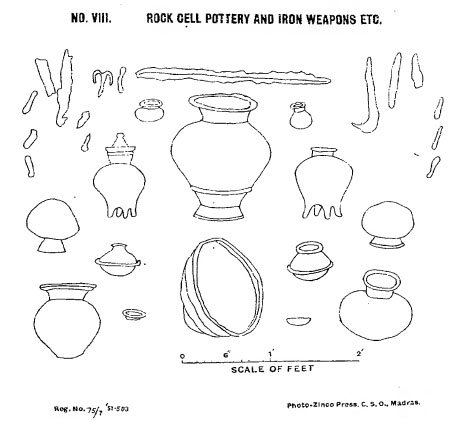
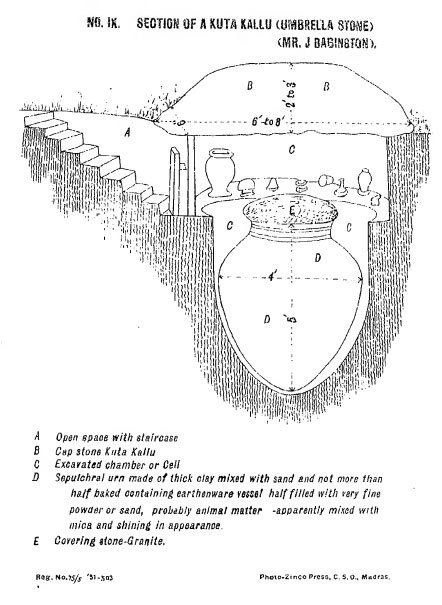
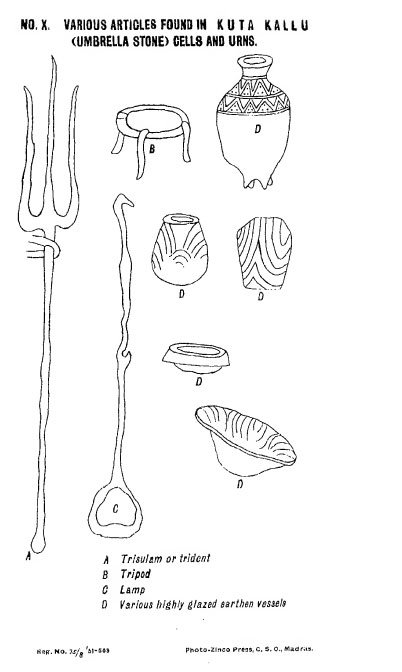
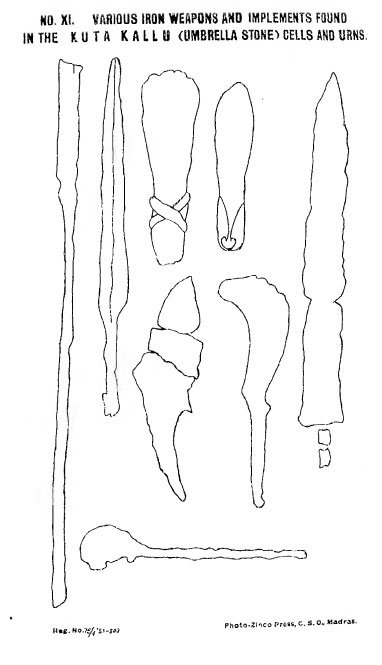
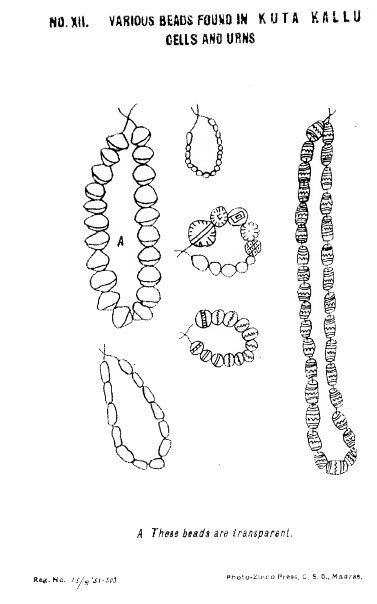
At every step of the preta, or departed spirit, obstacles are thrown in its way, and heavy toll is levied from the pockets of the deceased's descendants to purchase gati, or progress onward through purgatory— the “fourth mansion" as it is sometimes called by Malayalis—to other births and ultimate emancipation. Neglect to perform the necessary ceremonies leaves the departed spirit in the condition of a pisachu or foul wandering ghost, disposed to take revenge for its misery by a variety of malignant acts on living creatures.
While on the other hand, the due performances of the ceremonies converts the preta into a pitri with divine honours which are paid to it in the Sraddha ceremony. At this stage even priestly interference does not leave the departed soul, for the pitri has to progress through various other stages of bliss till admitted finally into heaven. Malayalis, like other Hindus, flock to Gaya for the performance of Sraddha ceremonies, because of the efficacy of the service conducted there in procuring direct admission into heaven of the pitris at whatever stage of gati, or progress, they had previously arrived.
The primary or foundational religious idea of the Malayali Hindu, then, consisted probably of a relief in the evil propensities of deceased persons (animism). When calamity attacked him he sought refuge in sacrifices to propitiate the evil wandering spirits of his ancestors, or of other men or women. When disease attacked a community an evil spirit, generally feminine, was supposed to be the author. And so it remains to the present day : astrologers are consulted when the calamity is a personal one : when the trouble is common to society it is the velichchappadu (the enlightener or oracle) of the local deity, who falls into a trance, becomes inspired, and points out the remedy to the assembled multitude.
The snakes, too, are supposed to exercise an evil influence on human beings if their shrines are not respected. A clump of wild jungle trees luxuriantly festooned with graceful creepers is usually to be found in the south-west corner of the gardens of all respectable Malayali Hindus. The spot is left free to nature to deal with as she likes. Every tree and bush, every branch and twig is sacred. This is the vishattum kavu (poison shrine) or naga kotta (snake shrine).
Usually there is a granite stone (chittra kuta-kallu) carved after the fashion of a cobra's hood set up and consecrated in this waste spot. Leprosy, itch, barrenness in women, deaths of children, the frequent appearance of snakes in the garden, and other diseases and calamities supposed to be brought about by poison, are all set down to the anger of the serpents. If there is a snake shrine in the garden, sacrifices and ceremonies are resorted to. If there is none, then the place is diligently dug up, and search made for a snake stone, and if one is found it is concluded that the calamities have occurred because of there having previously been a snake shrine at the spot, and because the shrine had been neglected. A shrine is then at once formed, and costly sacrifices and ceremonies serve to allay the serpent’s anger.
Allied with this worship of the serpent, there occur two other religious ideas about which it is difficult to come to correct or to satisfactory conclusions ; for phallic and sakti worship and tree worship are somehow inextricably mixed up with serpent1 worship in Malayali Hinduism. It is possible that the tree1 was at first simply an emblem of the phallus, and the serpent was, and still continues to be, an emblem of the sexual passion.
NOTEs: 1 These objects of adoration, borrowed apparently from the mosaic of Hindu cults, were imported through Manichaean influence into Christianity in one of its earlier and grosser forms. END OF NOTEs
Then again those are probably a development of the sun and earth goddess worship, for, contemporaneously with the change from a pastoral to an agricultural life, fertility of the soil seems to have been recognised and embodied in divine male and female forms.
It would be out of place here to consider those points in detail. It is sufficient to remark that the Malayali Hindus are still to a very great extant demon and ancestor worshippers; that this was probably their original religious idea and that, probably with the introduction of agriculture, their religious ideas, in which images2 of the divinities played no part, received fresh impressions tending towards the phallic cult which still holds them enchained.
NOTEs: 2. All the Malayali words for idols are of Sanskrit origin. END OF NOTEs
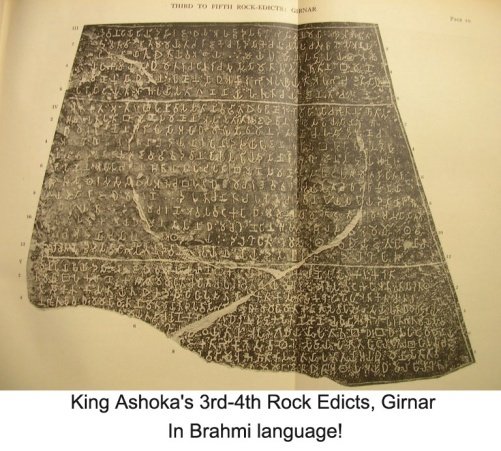 It remains to consider how their religion has been affected by the introduction of foreign ideas. It is certain that Jain missionaries penetrated as far as Malabar in Asoka’s time, for Asoka, in one of his Girnar edicts, says3 expressly ; “In the whole dominion of the king Devanampriya Priyadarsin, as also in the adjacent countries, as Chola, Pandya, Satyaputra, Keralaputra, as far as Tamaraparni, the kingdom of Antiochus, the Grecian king, and of his neighbour kings, the system of caring for the sick, both of men and of cattle, followed by king Devanampriya Priyadarsin, has been everywhere brought into practice ; and at all places where useful healing herbs for men and cattle were wanting, he has caused them to be brought and planted ; and at all places where roots and fruits were wanting, he has caused them to be brought and planted ; also he has caused wells to be dug and trees to be planted on the roads for the benefit of cattle.”
NOTEs: 3 Indian Antiquary, Vol. V, p, 272, and Thomas’ “Jainism, or the Early Faith of Asoka, etc.”, London, 1877, p. 42. END OF NOTEs
Here Keralaputra, or as sometimes transliterated Ketalaputra, refers undoubtedly to the king of ancient Chera, and the fact that Chera embraced the Malabar district and a good deal more is generally accepted as historically correct.
The Jains seem to have made very little impression on the religious beliefs of the people, for even a regard for animal life, the great characteristic of the Jains, had, until recent years, very little hold on the people; and even now the great bulk of the Hindu population feed on fish and flesh when they can get it, and it is only the unenlightened upper classes, who are under Brahmanieal influence, who observe the practice of abstaining from flesh. Under such circumstances, it may be regarded as having been introduced to this limited extent by the Brahmans rather than by the Jains.
The Jains do, however, seem to have left behind them one of their peculiar styles of temple architecture ; for the Hindu temples and even the Muhammadan mosques of Malabar are all built in the style peculiar to the Jains, as it is still to be seen in the Jain bastis at Mudbiddri and other places in the South Canara district. Regarding this style, Mr. Forgusson has the following suggestive remarks in his work on the “History of Indian and Eastern Architecture” : —
“When1 we descend the ghats into Canara, or the Tulava - country, we come on a totally different state of matters. Jainism is the religion of the country, and all, or nearly all, the temples belong to this soot, but their architecture is neither the Dravidian style of the South, nor that of Northern India, and indeed is not known to exist anywhere else in India proper, but recurs with all its peculiarities in Nepal.”
NOTEs: 1. Edition 1876, p. 270. END OF NOTEs
“They2 are much plainer than Hindu temples usually are. The pillars look like logs of wood with the angles partially chamfered off, so as to make them octagons, and the sloping roofs of the verandahs are so evidently wooden that the style itself cannot be far removed3 from a wooden original. In many places, indeed, below the ghats the temples are still wholly constructed in wood without any admixture of stone, and almost all the features of the Moodbidri temples may be found in wood at the present day. The blinds between the pillars, which are there executed in stone, are found in wood in every city in India, and, with very little variation, are used by Europeans in Calcutta to a greater extent, perhaps, than they were over used by the natives.
NOTEs: 2. Ibid., p.271.
3. Note.—The buildings in this style in Malabar are invariably built of wood in all their characteristic portions. END OF NOTEs
“The feature, however, which presents the greatest resemblance to the northern styles is the reverse slope of the caves above the verandah. I am not aware of its existence anywhere else south of Nepal, and it is so peculiar that it is much more likely to have been copied than reinvented.”
“I1 cannot offer even a plausible conjecture how, or at what time, a connection existed between Nepal and Tibet, and Canara, but I cannot doubt that such was the case.” Further on, after describing the architecture of Nepal, Mr. Forgusson continues2 : “It may be remembered that, in speaking of the architecture of Canara, I remarked on the similarity that existed between that of that remote province and the style that is found in this Himalayan valley ; and I do not think that any one can look at the illustrations quoted above and not perceive the similarity between them and the Nepalese examples, though it might require a familiarity with all the photographs to make it evident, without its being pointed out. This being the case, it is curious to find Colonel Kirkpatrick stating, more than seventy years ago, ‘that it is remarkable enough that the Newar women, like those among the Nayars, may, in fact, have as many husbands as they please, being at liberty to divorce them continually on the slightest pretence.’ (Nepal, p. 187.)
NOTEs: 1 Edition 1870, p. 278.
2. Ibid., p, 305. END OF NOTEs
Dr. Buchanan Hamilton also remarks that ; though a small portion of the Newars have forsaken the doctrine of Buddha and adopted the worship of Siva, it is without changing their manners, which are chiefly remarkable for their extraordinary carelessness about the conduct of their women ; ’ and he elsewhere remarks on their promiscuousness and licentiousness—(Account of Kingdom of Nepal, pp. 29 42, 51, etc.).
In fact, there are no two tribes in India, except the Nayars and Newars, who are known to have the same strange notions as to female chastity, and that coupled with the architecture and other peculiarities, seems to point to a similarity of race which is both curious and interesting ; but how and when the connection took place I must leave it to others to determine. I do not think there is anything in the likeness of the names, but I do place faith in the similarity of their architecture combined with that of their manners and customs.”
Regarding these extracts it may be remarked that this style of architecture marks out better than anything else the limits of the ancient kingdom of Chera, for the style prevails all through the West Coast country from the limits of Canara to Cape Comorin.
In Malabar proper the style is reserved almost, if not altogether, exclusively for religious edifices. In Travancore it is often to be seen in lay buildings.
How the Muhammadans came to adopt this same style for their mosques is perhaps to be accounted for by the tradition, which asserts that some at least of the nine original mosques were built on the sites of temples, and that the temple endowments in land were made over with the temples for the maintenance of the mosque. Before Muhammadanism became a power in the land it is not difficult to suppose that the temples1 themselves thus transferred were at first used for the new worship, and this may have set the fashion which has come down to the present day. So faithfully is the Hindu temple copied, that the Hindu trisul (or trident) is not unfrequently still placed over the open gable front of the mosque.
NOTEs: 1 In this connection it may be mentioned that on the margin of the bathing place in one of the original mosques, at Pantalayini-kolla, there still exists a fragment of granite stone inscription in ancient Vatteluttu characters, said to have, at one time, formed part of the temple which the mosque superseded ; another fragment is also to be seen there. And on a rock on the sea-shore, close to the site of this same mosque at Pantalayini-kollam, there is a foot-print deeply cut. A natural hollow in the rock has been chiselled into the shape of a foot, and this mark, which is 3' 3” long by 10” to 12” broad, is said by the local Mappillas to be foot print of Adam’s foot, as he landed from across the ocean ; his next step took him to Adam’s Peak in Ceylon. Both temple and foot-print were doubtless originally Jain. END OF NOTEs
The final Brahman irruption from the north into Malabar, which for reasons set out at some length in Chapter III, may be placed about A.D. 700, was destined to work a greater change in the religion of the land, for it was part of the policy of the new-comers to “enlarge their borders”, and to embrace in their all-enveloping Hinduism all minor creeds with which they came into contact.
Malayali Hinduism, therefore, in the present day is a strange mixture of all kinds of religious ideas. It embraces, chiefly as divers manifestations of Siva and his consort Kali, all the demoniac gods originally worshipped by the Malayalis. Brahma and Vishnu, too, are worshipped with Siva, the other member of the Hindu Trimurti or triad. It has borrowed from Christianity—with which, probably for the first time, Hinduism came into contact in Malabar —some of the loftiest ideas of pure theism.
And Buddhism and Jainism have each left their mark on the system as eventually elaborated.
It was at the hands of Samkaracharya, who is generally acknowledged to have been a Malayali Brahman living2 in the last quarter of the eighth and in the first quarter of the ninth, century A.D., that Hinduism attained its widest bounds under the form of Vedantism. The Malayali tradition regarding him, as embodied in the Keralolpatti and other works, is that he was the son of a Brahman widow, and as “the son of the widow” he is sometimes referred to in Malayalam. This slur upon the legitimacy of the “gracious teacher,” who summed up his philosophy and his religion in the Atma Bodha Prakasika, is not borne out by other stories of his life, one of which, however (and that an Eastern Coast one), makes him the miraculous son of a virgin, like the founder of Christianity.
NOTEs: 2. Born A.D, 788 ; died A.D. 820-21. Indian Antiquary Vol XI, pp, 175, 263. The accuracy of this date has since been questioned, and the matter is still subjudice. END OF NOTEs
Whether there was any truth in the story is likely ever to remain a matter of doubt, but the necessity of explaining how at a very early period of his life, he was rejected by his own people and adopted the habits of a saniyasi, or religious recluse, has led to the currency of another story regarding him, namely, that at eight years of ago he was seized by a crocodile while bathing in the Aluvayi river, and that, after obtaining the consent, of his mother, who witnessed the affair from the river bank, he adopted the life of a saniyasi , and at that very early age begun his religious career.
The Malayali traditions place his birth-place at Kaladi to the south1 of the Aluvayi river in the Nambutiri illam of the Keippalli taravad. At an early ago, it is said, he began to criticise the Vedic knowledge and studies generally of the Nambutiris, who resented his conduct, and, it is said, excommunicated the family. At sixteen years of ago, it is said, he became omniscient, and set out on his travels as a saniyasi. He composed largely, and one account says he met Vyasa, the great Rishi, who approved of his works, and resided with him for some years.
NOTEs: 1 One account says north, instead of south. END OF NOTEs
According to another account his treatment of the sago was very far from being polite at their first meeting, for, after having vanquished him in argument, he ordered his disciples to throw down the defeated and unmannerly old Brahman, and drag him away by his legs. This account goes on to say they eventually became reconciled and Vyasa approved of Samkaracharya's works. The most interesting and most, important part of the account of the life of the “gracious teacher”, as related by Anandagiri, in his Samkaravijaya (victories of Samkara), is that the great Vedantist had at last to respect the popular superstitions of the day, and to give his sanction even to those forms of idolatrous worship, which his philosophy repudiated.
All Malayali accounts agree that he returned to Kerala, and performed the religious obsequies of his mother, at which ceremony as those of his own caste held back, a Sudra had to perform the part usually undertaken by a junior member of the family, and it is said that from the time of this event began the custom in Kerala of “no ceremony for Brahmans without the assistance of a Sudra”, and vice versa.
All Malayali accounts, too, agree in stating that he eventually died at Badarikasramam2 in Northern India, and at a very early ago, thirty-two years, according to most accounts.
NOTEs: 2. He is said to have died, not at Badarikasramam, the place named in the Malayali stories of his life, but at Kedarnath in the Himalaya, to which place he proceeded from the former place— (Wilson, Asiatic Researches, XVII, 178-79 ; Moor's Hindu Pantheon, edition 1864, pp. 81. 353.) END OF NOTEs
Of his philosophical system of religion, which has in times past produced, and which still exercises, so wide and so beneficent an influence on native society, it may be said to be summed up in the "great saying” as Samkaracharya himself called it,, “Tat Tvam asti ” = (that i.e., Brahma,1 “the supreme deity, the causa materialis and causa efficiens, of the illusive world")—tu (thou, the individual living spirit) -—es (art)=;“ Thou art that.” “Having by the aid of the words ‘it is not so, it is not so’ removed all the upadhis (‘the illusive forms of Brahma within the world’) 'one will easily recognise, by the aid of the great saying, the oneness of the (individual) living spirit with the (Universal) Supreme Spirit.’” "(Atma Bodha Prakasika, translated by the Rev. J.F.Kearns, Strophe 29.)
NOTEs: 1. To be distinguished from Brahma., the chief god of the Hindu Trimurti or triad—Brahma, Siva and Vishnu. Samkaracharya's views regarding Brahma are stated in Strophe 57 of the Atma Bodha Prakasika :—
“Having access to a portion of the bliss of the being of all perfect bliss, Brahma and the other (popular deities) become, by degrees, partially happy beings.” (Kearns “Translation.”)END OF NOTEs
“Having crossed the sea of fascination, and having slain the giants, 'inclination’ ‘aversion’ etc., the wise shall go forth married to tranquillity, delighting in the spirit,” (Ibid., Strophe 49) ; “Extinguishing his inclination for external changeable pleasure, and securely reposing in spirit—pleasure, (such an one) shall always shine forth clearly therein, like the light which stands in a vessel secure,” (Ibid., Strophe 50).
To the question— “In what condition, then, is the freed-life-soul, until the guilt (accumulated during a prior existence) is completely expiated and incorporeal bliss succeeds the extinction of the threefold2 corporealness?"
NOTEs: 2.
“According to the Vedanta Philosophy, there are three sarira or corporeal forms;—(i) the karana sarira (corpus causans), (ii) the sukshma sarira, the fine material form, and (iii) the sthulada sarira, the gross body, made up of the limbs which we perceive. The latter two are the corpora causata. The sthulada sarira perishes at death, but the sukshma sarira, the immediate organ of the soul, is said to accompany it through all its transmigrations, and is capable of sensations of enjoyment and suffering. The corpus causans is the original type or embryo of the body as existing with the soul in its original state.” (Rev. J.F.Kearn's Note to Strophe 13.) END OF NOTEs
The “gracious teacher” replied, in Strophe 51: “Although still involved in the upadhi (i.e., corporeity) the muni (i.e., wisdom-perfected sage) may remain uncontaminated by its natural qualities (just like the æther, which, although it pervades the most unclean things, is nevertheless uncontaminated). And although hE knows all, yet like a (disinterested) imbecile will he stand aside, and clinging (to no sensual thing) (he) passes through (them) like the wind.”
In Strophe 52, he continued: “By the dissolution of the upadhi, the muni (wisdom-perfected sage) unites inseparably with the (All) Pervading One, just as water mixes inseparably with water, air with air and fire with fire.” In this description of what Brahma is, he said:
“That, which one having perceived, there is nothing else to perceive,
“That, which one having attained, there is nothing else to attain,
“That, which one knowing, there exists nothing else to be known,
“That is, Brahma—let this be believed." (Ibid., Strophe 54.)
And in the concluding Strophe (67), he observed: “ Whoever undertakes the pilgrimage of himself * * * obtains eternal happiness, and is free from all toil * * * and becomes, omniscient, all-pervading immortal.”
The Vedantists say, in short, that nothing exists but Brahma, that the “pilgrim of himself,” if he frees himself from the illusions of the flesh and the mind, will become a muni (a wisdom-perfected sage), and will in the final stage of existence at last-perceive that he himself is Brahma.
The religious ideal thus presented is in strange contrast to that which preaches:- “Whether ye eat, or drink, or whatsoever ye do, do all to the glory of God,” and it is ill-adapted for a work-a-day world, where fields have to be ploughed to gain bread, where children have to be born to continue the human race, and whom the good and the evil things in this world meet the passer-by at every corner of his life journey. But it is an ideal always present to the mind of the devout Hindu, and its deep refining influence on the people cannot be exaggerated—an influence, which, in their inner life, is productive of many most admirable qualities.
There is a constant pining after a transcendental ideal, attainable perhaps, but only after much suffering, and after much, almost, impossible, self-denial
“O for those days when I shall dwell alone,
"Among the snowy hills by Ganga’s stream,
“In stony torpor stiffened on a stone,
"Inly conversing with the One Supreme,
“Rapt in devotion, dead to all beside,
"And deer shall fray their horns against my senseless hide.”
(Tawney’s Metrical Version of the Vairagya Satakam.)
Of places of resort, for Hindu devotees there are in Malabar, owing perhaps to the jealous exclusiveness of the Nambutiri Brahmans, singularly few, and such as do occur are resorted to almost exclusively by people of the coast. The most famous temple in the district is Tirunavayi in the Ponnani taluk, where the Maha Makham festival, already fully described at page 103 of this Chapter, used to take place every twelve years.
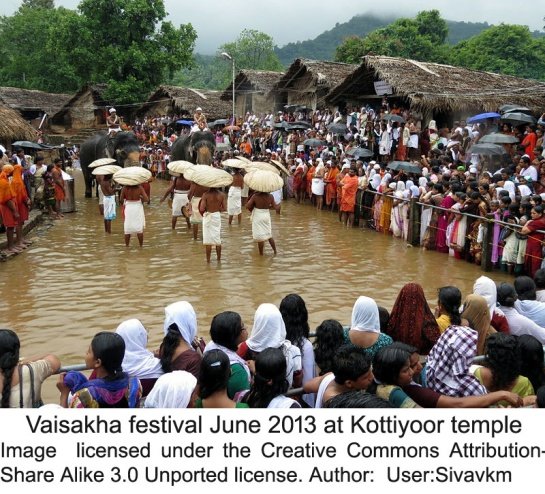 Next to it, perhaps, comes Guruvayur also in the Ponnani taluk, a shrine supposed to be effectual in the cure of rheumatism. Besides these the following may be named : the Taliparamba temple in Chirakkal taluk; the Kottiyur shrine in the jungles of the Manattana amsam of Kottayam taluk resorted to by great multitudes about the beginning of the south-west monsoon season ; the Kilur tomplo on the south bank of the Kotta river, where is held annually the largest cattle-market in the district ; the Tirunelli temple placed on a branch of the Kaveri river at the foot of the Bramagiri plateau in Wynad, to which the people of North Malabar used to resort for the performance of Sraddha ceremonies, until by the opening of the railway it became easier for them to visit Perur on the Noyal river in Coimbatore for this purpose; the Bhagavati shrine near Angadipuram in Valluvanad taluk, whence, after decorating the shrine, the largest band of Mappilla fanatics ever collected (66 in number) issued forth to be shot down or impaled on the bayonets of the Grenadier Company of Her Majesty's 94th Regiment. (August-September 1849); the Kalpati temple in Palghat town, where is held annually a car festival, the only ceremony of the kind that takes place in the district although very common in eastern districts, and in which the idol is carried in procession through the streets on a monster car.
Muhammadans
There are many accounts extant in Malabar concerning the introduction of the religion of the prophet into the district. The indigenous manuscripts, however, differ from those belonging to Arab families settled in the district on one or two points, while in regard to all others the accounts are identical.
The points of difference relate to the time when the first convert was made, and as to some of the things that happened to him. The indigenous Muhammadans (Mappillas)1 are anxious, very naturally, to claim for their first convert the honour of having had an interview with the Prophet himself, and of having been instructed by the Prophet himself in the principles of the “Fourth Vedam,2” as the religion of Islam is commonly called in Malabar. The Mappilla accounts likewise give the text of a speech said to have been delivered by the Prophet to his followers on the occasion, and further assert that the Prophet changed the name of the convert to Thiaj-ud-din (Crown of the Faith).
NOTEs: 1. N.B .—The word Mappilla is a contraction of Maha (great) and pilla (child, honorary title, as among Nayars in Travancore), and it was probably a title of honour conferred on the early Muhammadan immigrants, or possibly on the still earlier Christian immigrants, who are also down to the present day, called Mappillas. The Muhammadans are usually called Jonaka or Chonaka Mappillas to distinguish them from the Christian Mappillas, who are called Nasrani Mappillas. Jonaka or Chonaka is believed to stand for Yavanaka = Ionian — Greek. In the Payyanur pat, or earliest Malayali poem, some of the sailors are called chonavar. Nasrani is of course Nazarene ; the term is applied to Syrian or Syrio-Roman Christians.
2. The three other Vedams (knowledge, revelation, religion) are according Muhammadans, (1) Heathen or Hindu, (2) Jewish and (3) Christian. END OF NOTEs
The Malayali Arabs do not credit these facts, because, in the first place, the convert’s name (he being so influential a person as king or emperor of Malabar) would certainly have come down to posterity in the works of the old commentators, or have appeared in the list of Assahabi, or persons who saw the Prophet.
Moreover, it is also a fact that no such names as those taken by the convert denoting attachment to Islam were given in the Prophet’s lifetime. In their rejection of those facts they follow the example set by Sheikh Zin-ud-din, a writer, who in the sixteenth century noticed the story as then current, but rejected it on the ground, among others, that the convert was said, in his time, to have died on the coast of the Red Sea, whereas it was well known that his tomb was at Zaphar (on the Arabian Coast north-east of Aden). The Mappillas now assert that he died at Shahr-Mokulla, not on the Red Sea Coast. This, too, is contrary to fact, as the evidence of the tomb stone itself, still existing at Zaphar, is understood to testify.
The Malayali Arabs assert, chiefly on Sheikh Zin-ud-din’s authority, that Islam was not introduced into Malabar until 200 years after the Hejira—And this, or a later date, seems to be correct, for the Arab merchant, Sulaiman, who wrote in A.H. 2371 (A.D 851- 52), and who wrote with knowledge as he had evidently visited the countries he wrote about, said expressly2 : “I know not that there is any one of either nation (Chinese or Indian) that has embraced Muhammadanism or speaks Arabic.”
NOTEs: 1. Malik-ibn-Dinar's expedition described further down is said to have reached Malabar about A.H. 224, by which time Sulaiman had probably returned from his wanderings.
2. Renaudot’s translation of “Ancient Accounts of India, etc." London, 1733, p. 37 (a). END OF NOTES
There is no reason to suppose3 with Rowlandson that Arab emigrants established themselves in Malabar (presumably as a conquering race) in the time of the Umayyide Caliph Walid I (A.D. 705-15), for it is by no means certain that the pirate Meds, alias Naukumara, alias Nagamara, alias Kurks, were in any way related to the Coorgs—an inland people—or to the Malayalis. The expeditions directed by the Muhammadan Governor of Persia against Sind, in revenge for the plundering by the pirates of Debal of the king of Ceylon’s ships convoying tribute, were directed, as was natural, against Debal itself, which appears to have been some place in Sind.
NOTEs: 1. Rowlandson’s foot-note to Tahafat-ul-Mujahidiv, p. 5. END OF NOTES
All Malayali accounts, however, are substantially in accord as to the following facts :—The last king or emperor of Malabar was one Cheraman Perumal, who reigned at Kodungallur (Cranganore, the Mouziris of the Greeks, the Muyiri-kodu of the Cochin Jews’ deed). Cheraman Perumal dreamed that the fullmoon appeared on the night of newmoon at Mecca in Arabia, and that, when at the meridian, she split into two, one half remaining and the other half descending to the foot of a hill called Abikubais, when the two halves joined together and then set.
Sometime afterwards a party of Muhammadan pilgrims on their way to the foot-print shrine at Adam’s Peak in Ceylon chanced to visit the Perumal’s capital, and were admitted to an audience and treated most hospitably. On being asked if there was any news in their country, one, by name Sheikh Sekke-ud-din4, it is said, related to the Perumal the apocryphal story of Muhammad having, by the miracle about which the Perumal had dreamt, converted a number of unbelievers. The Perumal, it is said, was much interested and secretly made known to the Sheikh his intention “to unite5 himself to them.” When the Sheikh returned from Ceylon the Perumal secretly directed him “to make ready a vessel and provide it with everything necessary for proceeding on a voyage."
NOTEs: 4. Or Seuj-ud-din.
5. Rowlandson's Tuhafat-ul-Mujahidin p. 59. END OF NOTEs
For the next, eight days the Perumal busied himself privately in arranging affairs of state, and, in particular, in assigning to the different chieftains under him their respective portions of territory. This was all embodied in a written deed which he left behind him. At the end of the eight days he embarked secretly in the vessel prepared for him along with the Sheikh and his companions, and they proceeded to Panthalayini-Kollam (Northern Kollam near Quilandy), to the place, where some six-and half centuries later the first Europeans, who successfully navigated their way to Indian soil, first landed.
At Pantalayini-Kollam they spent one day, or a day and a night, and thence proceeded to the island of Darmatam, or Darmapattanam, near Tellicherry. This island adjoins the Randattara Achanmars territory and to this day Randattara is commonly called the Poyanad (i.e. the country whence the Perumal “went” or “set out” on his journey to Arabia).
At Darmapattanam the party remained three days, and then embarking set sail for, and landed at, 8hahr on the Arabian Coast,. At this place the Perurnal remained, according to the Arab accounts, for a considerable time.
It is uncertain whether it was here (Shahr) that the Perumal came for the first time into contact with the persons, who were to be the pioneers of Islam in Malabar, or whether they, or some of them, had been of the party of pilgrims with whom he originally set out from Kodungallur. But, however this may be, the names of the persons have been handed down by tradition as (1) Malik-ibn-Dinar, (2) Habib-ibn-Malik, (3) Sherf-ibn-Malik1 (4) Malik-ibn-Habib and his wife, Kumarieth with their ten sons2 and five daughters3.
NOTEs: 1 Or Shiaff-ibn-Malik
2. (1) Habib, (2) Muhammad, (3) Ali, (4) Hussain, (ii) Thuki-ud-din ?, (6) Abdar Rahman, (7) Ibrahim, (8) Mussa, (9} Umrnar, (10) Hassan.
8 (l) Fatima, (2) Ayissa, (3} Zainab, (4) Thanirath, (6) Halima END OF NOTEs
From the names it may perhaps be gathered that the party consisted of Malik-ibn-Dinar, his two sons, one grandson, and his grandson's wife, and their family of fifteen children.
The Peruman apparently changed his name to that which is still said to appear on his tomb, namely Abdul Rahman Samiri, and married a wife, whose name has been variously handed down as Rahabieth or Gomariah. The Perurnul, it is said, after remaining a considerable time at Shahr, formed a resolution to return to Malabar for the purpose of establishing his new religion with suitable places of worship, and he set about for the purpose the building of a ship. Before, however, the ship was built the Perumal fell dangerously ill, and, being convinced there was no hope of his recovery, implored his companions not to desist from their design of proceeding to Malabar to propagate there the Fourth Vedam. To this they rejoined that they, foreigners, could not know his country and its extent and would have no influence therein ; whereupon, it is said, he prepared and gave them writings in the Malayalam language to all the chieftains whom he had appointed in his stead, requiring them to give land for mosques and to endow them.
He further instructed them not to tell of his sufferings and death1 ‘‘but tell ye not to any of my people of Malabar of the violence of my sufferings, or that I am no more.” And he finally enjoined on them not to land anywhere, save at Kodungallur (Cranganore), Darmapattanam, Pantalayini- Kollam, or Southern Kollam (Quilon). "And1 after this he surrendered his soul to the unbounded mercy of God."
NOTEs: 1 Rowlandson’s Tuhafat-ul-Mujahidin p. 53. END OF NOTES
Some years2 after his death Malik-ibn-Dinar and his family set-out for Malabar, bearing with them the Perumal’s letter, and, concealing his death, delivered them to those to whom they were addressed, beginning with the prince3 ruling at Kodungallur (Cranganore). They were received hospitably, and, in accordance with the Perumal’s instructions, land to build a mosque and a suitable endowment were given. Malik-ibn-Dinar himself became the first Kazi of this place.
NOTEs: 2. Eight years according to the Mappilla manuscripts.
3. Probably of the Cochin Raja’s family. END OF NOTES
After some time Malik-ibn-Dinar sent out to Southern Kollam4 (Quilon) Malik-ibn-Habib with his wife and some of their sons. There also they were received hospitably, apparently by the Southern Kolattiri (Travancore Raja), and a second mosque was founded, of which Hassan, one of the sons, became Kazi. Some of the remaining sons, accompanied by their father most probably, next set out for the dominion of the Northern Kolattiri (Chirakkal Raja’s family), and at Hubaee Murawee (Madayi) or Palyangadi in Chirakkal taluk, close to one of the palaces of the Kolattiris, a third mosque was founded and endowed.
NOTEs: 4. According to one manuscript the second mosque was erected at Northern Kollam (Pantalayini-Kollam) not at Southern Kollam (Quilon), and according to it, the last mosquo erected was at the latter place. END OF NOTES
At this mosque a tradition exists that the party brought over with them from Arabia three blocks of white marble, one of which was placed in this mosque, where it is still to be seen. The other two, the tradition says, were similarly placed in the mosques at Quilon and Cranganore. Abdar-Rahman remained there as Kazi.
Thence the party proceeded to Bakkanur (Barkur) and to Manjalur (Mangalore) and to Northern Kanyarode (Casargode), three places in Canara, founding mosques at each place and leaving as Kazis at them respectively Ibrahim, Mussa, and Muhammad, sons of Malik-ibn- Habib. The remainder of the party next returned to Madayi Palayangadi and remained there three months.
The locality of the next mosque founded has been the subject of some debate, but there seems no reason to doubt the correctness of the current Malayali accounts, which agree in placing it at Chirikandatam5 or Cherupattanam6 (literally small town). “Zaraftan” is the name which occurs in Rowlandson’s version of the Tahafat-ul-Mujahidin and Jarfattan, in two other versions of the same work in the hands of families at Ponnani and Calicut. The village now called Srikandapuram or Chirikandatam (the “Surrukundapuram” of the Indian Atlas) lies at the head of the navigable waters of one branch of the Valarpattanam river in the Chirakkal taluk, and its former importance as a entrepot of trade with Coorg and Mysore has already been alluded to. (Chapter I, Section C, p. 10.)
NOTEs: 5. Palayangadi mosque manuscripts.
6. Another manuscript in the hands of an Arab family in Calicut. END OF NOTEs
To this mosque, at Srikandapuram, the first Kazi appointed was Ummar, another of the ten sons.
After this the party visited, in succession, Darmapattanam in the Kottayam taluk, and Pantalayini-Kollam in the Kurumbranad taluk, (both already alluded to above), and lastly Chaliyam in the Ernad taluk, the present terminus of the Madras South-West Line of Railway. At those three places respectively Hussain, Muhammad1, and Thaki-ud-din, three more of the ten sons, were appointed as Kazis.
NOTEs: 1.There is a discrepancy here, for Muhammad was already Kazi of Cassargode mosque. END OF NOTES
Of the persons who were thus instrumental in introducing Muhammadanism into Malabar, it is related that Malik-ibn-Dinar subsequently visited each of the mosques in turn, and, after returning to Kodungallur, set out for Southern Quilon2 with Malik- ibn-Habib. Thence he went to Arabia and “travelling3 on to Khorassan there resigned his breath.” Malik-ibn-Habib and his wife came after Malik-ibn-Dinar’s departure from Quilon to Kodungallur and there both of them died.
NOTEs: 2. According to one manuscript the last of the nine mosques was erected here—See note above regarding Southern Kollam (Quilon)
3. Rowlandson’s Tahafat-ul-Mujahidin, p. 55. END OF NOTEs
And of the Kazis of the other mosques, Muhammad alone died elsewhere than at his post of duty ; he, it seems, died at Aden.
There is good reason for thinking that this account of the introduction of Muhammadanism into Malabar is reliable.
For first of all it is beyond doubt that Arabs had by the ninth century, about which time these events are said to have happened, penetrated beyond India and as far as China for purposes of trade, and it is notable that all the nine places where mosques were erected were either the headquarters of the petty potentates of the country, or places affording facilities for trade, and in some cases (as at Kodungallur, Kollum, Palayangadi, and perhaps Pantalayini Kollam) the places had the double advantage of being both well situated for trade and in close proximity to the chieftain’s strongholds. Arabs engaged in trade had no doubt settled in these places long previously, and indeed an inscription on a Muhammadan granite tombstone still standing at Pantalayini-Kollam recites, after the usual prayer, that “Ali-ibn-Udtherman was obliged to leave this world for over to the one which is everlasting, and which receives the spirits of all, in the year 1661 of Hejira, so called after Muhammad the Prophet left Mecca for Medina.’’
NOTEs: The date is a good deal weather-worn, but those figures are still fairly distinct. END OF NOTEs
Malik-ibn-Dinar and his party, even with the exceptional advantages they possessed, would hardly have been able in so short a time to found and establish mosques at these places, unless the ground had been prepared beforehand for them to some extent at least. And the fact that Arabs had settled for trading purposes carries with it the further probable assumption that some of them at least had contracted alliances with women of the country, and the beginnings of a mixed race, the Mappillas, had been laid.
Finally, it has recently come to notice, from the information of an Arab resident near the spot, that the tomb of the Perumal referred to still exists at Zaphar on the Arabian Coast, at some distance from the place (Shahr), where he is reported to have landed. The facts have still to be authoritatively verified, but it is stated that on this tomb the inscription runs: “Arrived at Zaphar A. H. 212. Died there A.H. 216.” These dates correspond with the years 827 -832 A.D., and as the Kollam era of the coast commenced in 825 A.D., and in the month of the year (25th August) just before the northeast monsoon sets in, when ships frequently sail for Arabia and the Persian Gulf, it is not at all improbable that the beginning of the Kollam era of the coast dates from the day on which Cheraman Perumal, the last of the kings of Malabar, set sail for Arabia in the manner described. It is said that he stayed a “considerable time” at Shahr, which perhaps accounts satisfactorily for the time elapsing between August-September 825 A.D. and A.D. 827 the year in which he went to Zaphar.
Moreover Sheikh Zin-ud-din2 stated in reference to this affair : “Touching the exact time when this event occurred there is no certain information ; but there appears good ground for the supposition that it happened about two hundred years after the flight of the Prophet.”
NOTEs: 2. Rowlandson’a Tahafat-ul-Mujahidin, p. 55. END OF NOTEs
And he continued : “It is a fact, moreover, now well known to all, that the king was buried at Zofar, instead of on the Arabian Coast of the Red Sea, at which place his tomb can be seen by every one, and is indeed now flocked to on account of its virtues. And the king, of whom this tale is told, is styled by the people of that part of the world As-Samira3, whilst the tradition of his disappearance is very common throughout the population generally of Malabar, whether Moslems or Pagans ; although the latter would believe that he has been taken up into heaven, and still continue to expect his descent, on which account they assemble at Cranganoro and keep ready there wooden shoes and water, and on a certain night of the year burn lamp as a kind of festival in honour of his memory.”
NOTEs: 3. The name of the king is said to have been changed to Abdul Rahman Samiri, and the tomb, it is said, is till regarded with much veneration as that of a Hindu (Samiri-Samaritan-worshipper of the calf — Koran, S. 20) king of Malabar, who became a convert to Islam. From the fact that the king is called Samiri, some Mappillas assert that the king buried at Zaphar was really a Zamorin. The mukri of the mosque adjacent to the tomb came to Malabar some sixteen years ago, soliciting subscriptions for repairing the tomb and mosque. END OF NOTEs
The Mappillas, the mixed race, the beginnings of which have just been sketched, have played an important part in the political history of the District, which will be alluded to in its proper place in the historical chapter. And it is unnecessary to say more about that subject here than that the Arab element in the parentage of the vast majority of them is now very small indeed. The race is rapidly progressing in numbers, to some extent from natural causes, though they are apparently not so prolific as Hindus, and to a large extent from conversion from the lower (the servile) classes of Hindus - -a practice which was not only permitted but in some instances enjoined under the Zamorin Rajas of Calicut, who, in order to man their navies, directed that one or more male members of the families of Hindu fishermen should be brought up as Muhammadans, and this practice has continued down to modern times.
Regarding the increase in the Muhammadan population between 1871 and 1881, the following remarks occur in the Presidency Census (1881) Report, paragraph 151:—“Conspicuous for their degraded position and humiliating disabilities are the Cherumars. This caste numbered 99,009 in Malabar at the census of 1871, and in 1881, is returned at only 64,7251. This is a loss of 34.93 per cent, instead of the gain 5.71 per cent, observed generally in the district. There are, therefore, 40,000 fewer Cherumars than there would have been but for some disturbing cause, and the disturbing cause is very well known to the District Officer to be conversion to Muhammadanism.
NOTEs: 1. In the year 1856, the Government called for information as to the traffic in slaves, and from a careful enumeration then made, it seems that the caste numbered at that time 187,758 ; so that the decrease in 25 years has been over 65 per cent. END OF NOTEs
“The honour of Islam” once conferred on a Cheruman, or on one of the other low castes, he moves, at one spring, several places higher socially than that which he originally occupied, and the figures, corroborating what has been actually observed in the district show that nearly 50,000 Cherumars and other Hindus have availed themselves of the opening.”
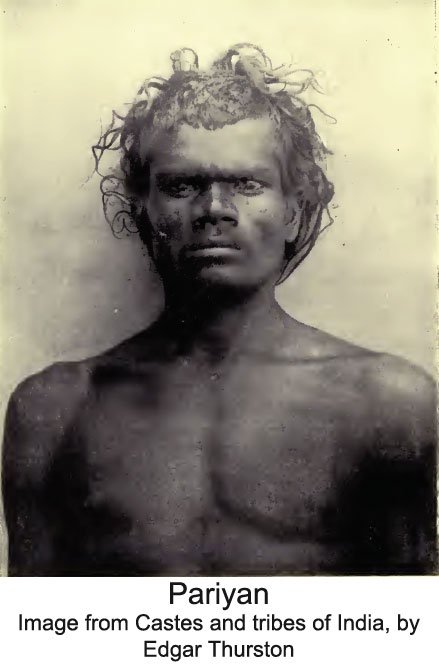 The conversion of a Pariah, or low caste Hindu, to Muhammadanism raises him distinctly in the social scale, and he is treated with more respect by Hindus. “He is no longer a link in a chain which requires to be kept in its particular place. His new faith neutralises all his former bad qualities. He is no longer the degraded Pariah whose approach disgusted, and whose touch polluted the Hindu of caste, but belonging now to a different scale of being, contact with him does not require the same ablutions to purify it.” (Special Commissioner Græme's Report, paragraph 21). This was written before the Mappilla outrages exalted this community so greatly in the district.
It may be doubted whether contact with a Hindu, even in Mr. Græme’s time, did not carry with it the necessity of Hindu ablutions afterwards, but however this may be, the Hindu is very strict about such matters now. At the same time the main fact remains that a low caste Hindu, obtains by conversion many substantial benefits, For Mappillas, as a class pull well together ; and he is a daring Hindu indeed who dares now-a-days to trample on their class prejudices or feelings.
Of the Mappilla, as a class, Mr. Græme expressed himself as follows :—“ On the coast, they are industrious, skilful in trade, crafty, avaricious, rigid observers of the in junction of the Prophet in abstaining from the use of spirituous liquors, particular in attending to the forms rather than the spirit of their religion, being regular in worship, but at the same time hypocritical rogues, and zealous in their attempts to gain proselytes.” (Report, paragraph 20.)
Of their fanaticism and courage in meeting death enough will be said further on. They are frugal and thrifty as well as industrious. They marry as a rule, but one wife, and live with her and their children on affectionate terms.
The women appear in public without veils, but among the better class it is usual to envelop the head and person but not the face in a long robe. They are very scrupulous about the chastity of their women, who, however, enjoy much freedom.
To those who treat the men with kindness and consideration they become much attached, and they are of all classes in the district by far the most serviceable on ordinary occasions, and the most reliable in emergencies. But the hand that controls them as a class must be firm, and punishment, when justly merited must be inflicted with severity; for leniency is an unknown word, and is interpreted as weakness, and not merely that, but as weakness, of which advantage is to be taken at the earliest possible moment.
They are moreover, as a class, nearly almost, if not altogether, illiterate. The only education received is a parrot-like recitation of portions of the Koran, which, being in Arabic, none of them understand. The scruples of the parents prevent them from permitting their children to attend the vernacular schools of the Hindus. A fairly successful attempt has however been made to reach them by giving grants to their own teachers on condition that they must show results. The teachers, being as illiterate as their pupils, except in knowledge of Koran recitations, usually employ Hindu youths to teach the pupils and so earn the results grants.
And some of the pupils are now being taught teaching as a profession in special normal schools. The number of Mappillas who have advanced so far as to learn to read and write English in the schools, could very probably be counted on the fingers of two hands. The people, as a class, being thus ignorant, are very easily misled by designing persons, and they are of course as bigoted as they are ignorant. Of their religion itself they obtain such knowledge as they possess of it from Malayalam tracts, for which, especially for those detailing the essential things to be attended to in pilgrimages to Mecca, there is a considerable demand. The ceremonial observance connected with bathing, the washing of the face and hands, worship by prostration, the appropriate prayers, the hours of worship, the Prophet’s commandments, acts vitiating the efficacy of worship, the giving of alms, the observances of Ramzan (the fasting-month), and many other similar subjects are treated of in these tracts. And the people obtain from them accurate ideas of the outward forms of their religion, in the observance of which they are very strict.
They are chiefly Sunnis, or followers of the Ponnani Tangal, the chief priest of the orthodox party, but some time in the eighteenth century a schism was created by the introduction of new forms of worship by a foreign (Persian) Muhammadan, who settled at Kandotti (Konduvetti) in the Ernad Taluk. His followers are called Shi’ahs by the orthodox party, but they themselves, when questioned, object to the use of the name and assert that they are as much Sunnis as the other party. This sect, though still numerous, does not seem to be increasing in numbers.
Christians
There are four chief sects of Christians in Malabar, namely—
1. Syrians,
2. Romo-Syrians,
3. Roman Catholics, following the ordinary Latin rite, and
4. Protestants of all denominations.
The Syrians and Romo-Syrians.—Malabar Christians of the first two of those classes are often called “the Christians of St. Thomas,” from the prevalence of a tradition that Christianity was introduced into Malabar by the Apostle himself, and the tradition is implicitly believed by the generality of the adherents of the first three classes.
But the evidence as yet available in support of the truth of the tradition is by no means perfect.
It is certain that, in the first century A.D., a very extensive trade and connection existed directly between India and the Western world, and a promise and expanding knowledge of the geography of the Indian coasts and markets, is manifest in the writings of the author of the “Periplus Maris Erythræi” and several others. Mouziris, in particular, which has already been alluded to, was one of the places best known to travellers and merchants from the West, and it was there and thereabouts that the original settlements of Christians were formed. The names of the traditionary places where the first seven churches were built sufficiently attest this viz., (1) Niranam, (2) Chayal, (3) Kollam, (4) Palur. (5) Kodungallur (Mouziris itself), (6) Gokkamangalam, (7) Kottakayal, localities which are all well known, and in all of which except Chayal and Kodungallur, churches still exist. Of those places only one, Palur1 lies in British Malabar.
NOTEs: 1. In Palayur amsum of the Ponnani taluk. END OF NOTEs
This direct trade connection seems to have been maintained though probably in a diminishing scale, for some centuries after the birth of Christ, and if the evidence of the Peutingerian Tables* (which are believed to have been constructed about 226 A.D.) is accepted, the Romans even at that date are said to have had a force of two cohorts (840 to 1,200 men) at Mouziris to protect their trade, and they had also erected a temple to Augustus at the same place. That Christians, among others, found their way to Malabar in the very early centuries after Christ is therefore highly probable.
NOTES added: *Tabula Peutingeriana is an illustrated ancient Roman road map showing the road network in the Roman Empire. The map is a 13th-century parchment copy of the Roman original, and includes Continental Europe, North Africa, and parts of Asia (including the Middle-East and the South Asian Subcontinent). END OF NOTES added
There is consequently no inherent improbability in the tradition that the Apostle Thomas was one of the earliest immigrants from the West; but of direct contemporary proof that he did come to Mouziris and found the Christian churches in that neighbourhood there is absolutely none so far as researches have yet gone.
The probability of the tradition consequently depends on later evidence.
The first mention of St. Thomas’ mission to Ma'abar is probably to be found in the Acta Thomæ, or Acts of Judas Thomas, an apocryphal gospel, the date of which was probably not earlier than 200 A.D, and was certainly not later than the fourth century. A king, who has been satisfactorily identified with, king Gondophares mentioned in Indo-Skythian coins, and of whose reign a stone inscription, dated 40 A.D., has recently been deciphered is said to have sent to Christ for an architect, and St. Thomas was sent in consequence. But this king reigned in North-western India, whereas St. Thomas is understood to have preached his mission in Malabar and to have been killed at St. Thomas’ Mount near Madras.
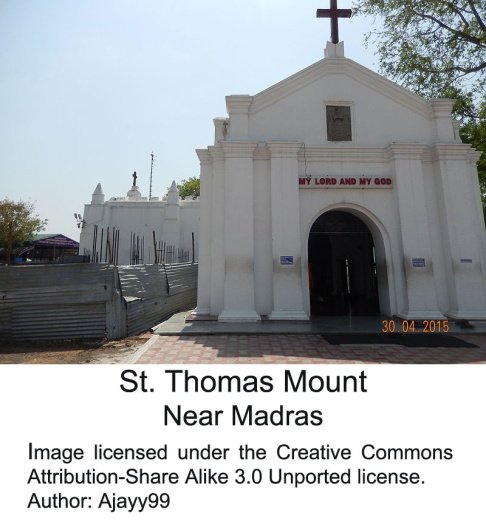 The object of the author of this apocryphal gospel scorns to have been to promote the doctrine of celibacy, and ho possibly took, as his ground-work, the current traditionary story about St. Thomas, and possibly in entire ignorance of what he was writing about hauled in the name of a king, who could not possibly have had anything to do with the part of India, where St. Thomas was said to have preached and died.
However this may be, the next authentic notice of the story seems to be contained in the fragments of the writings of Dorotheus, Bishop of Tyre, latter half of third and beginning of fourth centuries A.D. He wrote that St. Thomas, after preaching to the Parthians, Medes and Persians, died at Calamina1, a town in India.” And this name is considered by some to be the Syriac translation of "Maliapore" since Mala (Tam.) and Golomath2 (Syriac) both mean “hill,” and both names signify “City of the Mount.”
NOTEs: 1. This is the name which also occurs in the Roman Martyrology. END OF NOTES
NOTES added: A martyrology is a catalogue or list of martyrs and other saints and beati arranged in the calendar order of their anniversaries or feasts (Information taken from newadvent.org) END OF NOTES added
NOTEs: 2. It may be noted however in passing that it is very doubtful if the Syrian connection with the “Thomas Christians” was established for several centuries after this time.END OF NOTES
It was about the same time (A.D. 261) that Manes, the disciple of Terebinthus founded the sect of Manichæans in Persia. It seems that sometime in the second century A.D. one Scythianus, who had studied at Alexandria and had visited the anchorets of Thebais went, by sea to India and brought thence four books containing the most extravagant doctrines, but he died about the end of the second century before he could preach his new tenets.
On Terebinthus, his disciple, devolved the duty of spreading those new views, and he accordingly preached his doctrines in Palastine and Persia, declaring that he himself was another Buddha, and that he was born of a virgin. Meeting with strong opposition from the priesthood he had to conceal himself in the house of a rich widow, and there he met with his death by accident. The widow’s adopted son or servant was Manes, and he it was who is said to have “called on” Hind and Sin and the people of Khorasan, and ‘‘made a deputy of one of his companions in each province.” It seems doubtful whether he himself ever visited “Hind” which, among Arabs, was the name applied to Southern India exclusively.
He was put to death, by the king of Persia in 277 A.D.
“The Manichæaus1 said that Christ was the primæval serpent, who enlightened the minds of Adam and Eve, the creator, the preserver, and the destroyer, the original soul, the preserver of the soul, and the fabricator of the instrument with which the salvation of the soul is effected. He was born of the earth, and for the redemption of mankind suspended on every tree, for they saw him crucified on every tree among its branches.”
NOTEs: 1. Asiatic Rearches IX, 216-18. It is noteworthy that in the Keralolpatti or origin of Keralam, the pseudo-history of Malabar current among natives, the Brahmans are said to have displaced the Nagas or snakes. The final Brahman immigration seems to have occurred in or about the eighth century A.D. and Christian (?Manichcæn) colonies had arrived in the country long before that time. It is possible that the allusion in the Keralopatti refers to the Manichæane. END OF NOTEs
“The doctrine2 of Manos could not fail of meeting with many admirers in India when he appeared in the character of Buddha, and of Christ, or Salivahana. Transmigration was one of his tenets, and the rule of the life and manners of his disciples was very severe and rigorous. They abstained from flesh, fish, eggs, wine, etc., and the ruler of every district and president of their assemblies was considered as Christ.”
NOTEs: 2. Asiatic Researches IX, 221. END OF NOTEs
But whether it was Christianity in this shape, or Christianity in a more orthodox form that was at first imported into Malabar, it is difficult to say. The late Doctor Burnell’s3 views were that the earliest Christian settlements in India were Persian, and probably therefore Manichæan or Gnostic,” and that these were not supplanted by the more orthodox Nestorians “earlier than the eleventh or twelfth century A.D.”
NOTEs: 3. Indian Antiquary III, 311. END OF NOTEs
On the other hand it has boon pointed out that Eusebius, Bishop of Caesarea, about 264-340 A.P. mentions that Pantænus of the Catechetical School at Alexandria, visited India and brought home with him a Hebrew copy of the Gospel by St. Mathew about the end of the second century A.D., and that one of the apostles (Bartholomew) did visit India.
India, however, in those days and long afterwards meant a very large portion of the globe, and which of the Indies it was that Pantænus visited it is impossible to say with certainty ; for, about the fourth century, there were two Indias, Major and Minor. India Minor adjoined Persia. Some time later there were three Indies — Major Minor and Tertia. The first, India Major extended from Malabar indefinitely eastward. The second, India Minor embraced the Western Coast of India as far as, but not including, Malabar, and probably Sind, and possibly the Mekran Coast, India Tertia was Zanzibar in Africa.
It would seem that the Malabar Coast lay in India Major, but whether it was this India and this part of India Major that Pantænus visited cannot be decided. If he did come to India Major, it is extremely likely that it was on the Malabar Coast that he found the Hebrew Gospel of St. Matthew, for the Jews have according to tradition been settled in the country now comprising the Native State of Cochin since the beginning of the Christian era and perhaps before it. Moreover, if according to the Peutingerian Tables, the Romans had a force of two cohorts at Muoziris to protect their trade there in A.D. 210, it is certain that intercourse between Alexandria and the Malabar Coast must have been both direct and frequent, and the fact that Pantænus went to India Major and to Muoziris becomes highly probable.
The fact, however, that he found a Hebrew copy of St. Matthew’s Gospel points to the probability of the first colony of Christians having been Israelites, and not either Syrians or Persians. Eusebius likewise mentioned that St. Thomas was the Apostle of Edessa in Syria, and as the Apostle of the Syrians he has all along been accepted. The facts to be presently set forth go to show that in the Christian colonies Persian and not Syrian influences were prevalent from a comparatively early date.
The next item of history available is the presence of Johannes, Metropolitan of “Persian and the Great India” at the Council of Nice in 325 A.D. There can be little doubt that “India Major” as above explained, was here meant, and India Major included the Malabar Coast. If Johannes belonged to the Manichæan sect would he have been present at this Council?
Rufinus, who went to Syria in 371 A.D. and lived at Edessa for 25 years, attested that St. Thomas’ body was brought from India to Edessa and there interred ; but from which of the “Indies” was the body brought, presuming that the relics were still in existence ?
It was about this same time that the first authentic mention of the "Acts of Judas Thomas” was made by Epiphanius Bishop of Salamis, and Jerome, who died in 420 A.D., also alluded to St. Thomas’ mission to India.
The next important fact seems to be that Nestorius was consecrated Bishop of Constantinople in 428 or 429 A.D. His heretical doctrines were condemned by the first Council of Ephesus a year or two later, and in 435 he was banished by the Emperor and in 430 his followers were proscribed.
A year or two later the Manichæans were persecuted, their books burned at Rome, and their doctrines condemned by the Council of Rome in 444 A.D. There must have been considerable intercourse between Persia and India, for in the middle of the sixth century a learned Persian —perhaps a Christian—came to India to get a copy of the Panchatantram.
And about 522 A.D. Cosmas Indicopleustes, a Byzantine monk, visited Ceylon and the West Coast of India and wrote as follows :— “ In the Island of Taprobane (Ceylon) there * * * is a church of Christians, and clerks, and faithful. * * * Likewise at Male where the pepper grows; and in the town Kalliena there is also a bishop consecrated in Persia.” “Male” is clearly Malabar, and “Kalliena” is most probably a place near Udipi in South Canara.
“A letter1 in Assemani’s Bibliotheca from the Patriarch Jesajabus (died A.D. 660) to Simon, Metropolitan of Persia, blames his neglect of duty saying that, in consequence, not only is India 'which extends from the coast of the kingdom of Persia to Colon, a distance of 1,200 parasangs deprived of a regular ministry, but Persia itself is left in darkness.’ ” “Colon” can be none other than Quilon or Kollam, and it was the Metropolitan of Persia who was blamed, probably on insufficient grounds owing to the rapid rise and spread of Islam, for having shut the doors of episcopal imposition of hands and for interrupting the sacerdotal succession.
NOTEs: Caldwell’s Dravidian Grammar—Foot-note by Colonel Yule, p. 27. END OF NOTEs
It was in this century also (the seventh century A.D.) that the direct Red Sea trade between Egypt and India was finally stopped from the same cause—the rise of the Muhammadan religion and the spread of Arabian political power. The Persian metropolitan in the next, hundred years seems to have cast off, and again to have reverted to, the control of the Seleucian Patriarch. This was probably the beginning of Syrian influence in the church of Malabar. And indeed the tradition of the existing church is that a company of Christians from Baghdad, Nineveh, and Jerusalem, under orders from the Catholic Archpriest at Ural ai (Edessa), arrived in company with the merchant Thomas in 745 A.D.
But whether this date is correct or not it is certain that in A.D. 774 there is no trace of Syrian influence in the pseudo-Syrian copper-plate deed still1 extant, and the later pseudo-Syrian copper plate deed (also extant)2 contains (as the late Dr. Burnoll3 has shown) no trace of Syriac either ; but, on the contrary, several Sassanian-Pahlavi, and Hebrew or Chaldee-Pahlavi attestations —that is, attestations of Persian immigrants are appended to it.
NOTEs: 1. No. 2 in Appendix XII.
2. No. 3 in Appendix XII.
3. Probably fifty years later than the former—“ninth century” (Hang). Indian Antiquary III, 315. END OF NOTEs
Moreover the “Maruvan Sapir iso” the grantee of this latter deed can be no other than the ‘‘Mar Sapor” who with “Mar Purges” or “Peroz” proceeded from Babylon to “Couln” (Quilon) about A.D. 822, and they seem to have been Nestorian Persians. In both deeds the pseudo-Syrian chief settlement is called Manigramam, winch the late Dr. Burnell took to mean the village of Manes or Manichæus, a suggestion first volunteered by Dr. Gundert, the translator of both deeds (M.J.L.S., Vol. X III, Part I).
In the ninth century the Muhammadan traveller, Sulaiman, mentioned, “Betuma” as being ten days’ sail from “Calabar” which latter he describes as the name of a place, and a kingdom on the coast to the right hand beyond India.”
“Betuma” has been taken by the Editor M. Reanudot to mean the “House of Thomas,” that is St. Thomas, and the same authority has—“There is a numerous colony of Jews in Sarandib (Ceylon) and people of other religions especially4 Manichæans. The king allows each sect to follow its own religion.”
NOTEs: Sir H. Elliot’s History of India, I. 10. M. Renaudot translated the passage somewhat differently : “In this same island (Sarandib, Ceylon) there is a very great multitude of Jews, as well as of many other sects, even Tannis or Manicheus, the king permitting the free exercise of every religion.” (Ancient Accounts of India, etc., translated by Renaudot, London, 1733, page 84 (a) ). END OF NOTEs
It would appear probable from the above facts that the Malabar church, whatever it may have been originally, was not latterly Manichæan as the late Dr. Burnell suggested5 on what seems to be barely sufficient evidence, but more orthodox Persian (Nestorian)6. After this time it is generally acknowledged that the Syrian church possessed the ascendancy. A tablet at Kottayam in the Travancore State has an inscription in Syriac as well as one in Pahlavi, and the latest inscriptions in Pahlavi to be found in India belong to the eleventh or twelfth centuries A.D., by which time Persian influence in the church had probably been completely superseded.
NOTEs: 5.Indian Antiquary III, 311.
6. The Syrians themselves say (v. infra) that the Jacobite doctrines did no prevail till so late as 1663, and it was then for the first time that the Patriarch of Antioch obtained control over the church. END OF NOTEs
But there is also a church tradition that the preaching of Manes did have some effect on the community. This and the subsequent history and the present position of the Syrian and Romo-Syrian churches will be best told in the language of the Syrians themselves, who in a large body headed by the venerable Bishop Mar Coorilos waited, by special request, on the Right Honourable Mr. Grant Duff, Governor of Madras, at Calicut, in January 1882, and presented to him a short account of themselves, from which the following extracts are taken:-
“Passing over this period we come to the third century remarkable for the arrival of a Persian heretic of the School of Manes, or, as is supposed1 by some, a heathen wizard. Through his teaching, many went over to him and are even to this day known as ‘Manigramakkar’ They cannot be distinguished from the Nayars, and are to be found at Quilon Kayencolam and other places. South Travancore is the seat of the descendants of those who stood steadfast in their faith during this apostacy and are known as Dhariyayikal2 meaning ‘nonwearers’ (of heathen symbols).
NOTEs: 1.There is probably some confusion here between the founder of the Manichæana and Manikavachaka , a Tamil reformer of a much later date.
2. Sometimes explained as the firm, courageous men, from theiryam= (bravery). END OF NOTEs
“Some years after this first split had taken place or in (350 A.D.3) was the arrival of Thomas of Cana, a Syrian merchant, whose large heartedness and sympathy for the neglected community was such that on his return to his native land, his story induced many to come out with him in his second visit, among whom was a bishop by the name of Mar Joseph. It was the first time a colony of Christians came to India. They were about four hundred in number. They landed at Cranganore then known as Mahadeverpattanam. They settled in the country with the permission of ‘Cheraman Perumal4 the ruler of Malabar, who, as a mark of distinction and favour, granted to the Christian community certain privileges (72 in number) which at once raised them to a position of equality5 with the Brahmans. One of the privileges was the supremacy over seventeen of the lower classes; a relic of which still exists in the adjudication by Syrian Christians of certain social questions belonging to them. The grant was made on copper-plates, which with some others, are in the custody of the Syrian Metran and are preserved in the Kottayam Seminary.
NOTEs: 3. Too early. A much later date (745 A.D.) is assigned by another tradition.v. supra.
4. For reasons already given (p. 195-196) and understanding (as is usual in Malabar) that Cheraman Perumul was the last king of Kerala, the date is obviously wrong.
5. The effect of this grant will be fully considered in the historical chapter. The assertion here made is not quite correct—See No. 2 in Appendix XII. END OF NOTEs
“Matters continued thus until the arrival of the second colony of Christians (who were Nestorians) from Persia, at Quilon ‘between the ninth and the tenth century. They were also received well and permitted to settle in the country. The first colony, incorporated with the northern portion of the community, had their headquarters at Cranganore and the southern6 portion ‘Kumk-keni-kollam’5 or Quilon. And in title-deeds this distinction had been preserved for centuries up to the time of the recent organisation of the Registration Department. The zenith of the prosperity of the community seems to have been between the ninth and fourteenth centuries, as then they were permitted to have a king of their own, the extent of whose authority cannot be stated with any historical precision. Their house of princes was known as the ‘Valiyarvattam’ or ‘Undiyamperur’ dynasty. It however afterwards became extinct and the community came under the subjection of Perumpatappu or Native Cochin. This part of the history of the Syrians leads us to the advent of the Portuguese.
“Immediately after the appearance of the Portuguese the Christians of Malabar went to them, making advances for support and protection, which were introduced by the presentation of the sceptre of their extinct royal1 house to Da Gama, whose efforts, as well as those of his successors, were directed to bring the native church under the authority of the Sec of Rome. Hence the details in the history of the connection with the Portuguese will be found to be a string of artful measures and violence which ended in the mission of Alexis Menezes, Archbishop of Goa.
NOTEs: 1. The peculiar organisation of the country at this time will be set forth In the historical chapter. In the exact words of the grant the Christian headman was created “grand merchant of the Cheraman world” (Kerala) “and lord of Manigramam." END OF NOTEs
He was deputed by the Pope in 1598 A.D. to complete the subjugation2 of the Syrian Church, and his arrival was remarkable as having been the occasion on which the third and most grievous split arose in the church into Romo-Syrians or ‘Old Party,’3 and Syrians or ‘New Party.’4 It was not however very long before the church had a cessation of its troubles. The presence of the Dutch staid the hand of persecution and reduced the pressure on the community. The capture of Cochin by the Dutch in 1663 was followed by an order requiring the Romish bishops, priests, and monks to quit the place which was not a little favourable to the Syrians.
NOTEs 2. In 1599, he held the memorable Synod of Diamper (Utayamper) in which the heresies of Nacstorius were condemned. There were at this time only 76 churches.
3. It would have been rather an inversion of the facts to have called the “Syrians” the “New Party." It is more probable that they were so called, because of their acceptance of the Jacobite doctrine and the Jacobite Bishops alluded to further on, they having up to this time been Nestorians. END OF NOTEs
“The thread of history cannot be complete without the mention of the Jacobite bishops, who began to make their appearance before the time of the Dutch. It was necessitated by the anarchy that reigned in the church at the close of the Portuguese connection. Things had been deliberately brought to such a crisis by thorn that the assimilation of the Syrian to the Roman Church was thought practicable only by the extermination of the bishops and clergy. Bold and stout hearts did however not want to declare their independence and a large number, at a public assembly, resolved upon applying to Babylon, Antioch, Alexandria, and Egypt for a bishop.
“This was done, and in 1653 Antioch promptly complied with the request by sending out Mar Ignatius, a Jacobite bishop. It was from this date that the Jacobite element began to leave the Malabar church. Mar Ignatius was mercilessly seized and thrown into the sea, as is believed by the Syrians, or sent to be tried before the Inquisition as is supposed by others. The fury of the community was roused and a numerous body went to Cochin to take revenge. But nothing more serious was done than swearing with one voice never more to have anything to do with the Portuguese, which was done by holding a thick rope to show that every one who held it joined m the oath.
“From 1665 to 1751, five Metrans, in succession, all bearing the name Mar Thoma, and belonging to the Pakalomattam1 family, at at the head of the church. The remaining period to the beginning of the present century may be passed over with the remark that it was also one of unrest, as the presence of foreign prelates was superfluous side by side with that of native metrans, and party spirit was fostered by the former to the distraction of the church.
NOTEs: 1. One of the two families from which it was customary to ordain the ministers of the church. The other was the Sankarapuri family. END OF NOTEs
“The year 1800 opens a fresh and glorious chapter in the history of this community, tormented, victimised, and disorganised by so many ceaseless troubles from friend and foe alike. We are here introduced to the figure of Rev. Claudius Buchanan, going from church to church, conversing freely with all and diligently seeking for information about them, as for two hundred years after the Portuguese nothing had been heard of them. On inquiring of a priest at Chenganur how the community had sunk so low, the pregnant answer was — ‘Three hundred years ago an enemy bearing the name of Christ came from the West and had us to seek shelter under the native princes, under whom, though we have not been stripped of our appendages of dignity, we have been reduced to slavery.’
Coming to Kandanad, he had an interview with the Metran, to whom he set forth the advisability of maintaining a friendly relation with the Anglican church, translating the Bible into Malayalam and establishing parochial schools. This being acquiesced Dr. Buehanan saw Colonel Macaulay, the British Resident, in company with whom he visited the northern parts of Travancore and Cochin.
At Ankamali, he was presented with an old copy of the Syriac Bible written on parchment, which had been in the possession of the Syrians for a thousand years. This book was taken by him to England, where it was printed, after his death, by the Bible Society and copies were distributed among the churches in Malabar. The Metran, after this time, was Mar Thoma, the seventh and last of the Pakalomattam family, whose consecration having been irregular the people became discontented and a division was the consequence. The fact attracted the attention of Colonel Munro, who, after making himself acquainted with the real position, set about getting a seminary built for them at Kottayam, of which the foundation stone was laid in 1813.
Mar Thoma having died in 1810, was succeeded by the liberal-minded Mar Dionysius. At the commencement of his government, Colonel Munro undertook to get out missionaries to train Syrian deacons and lads to carry on parochial schools.
Accordingly through the influence of this worthy Resident, the C. M. Society sent out the Rev. Thomas Norton, who arrived in May 1816 and to whom the services of the Rev. B. Baily were added in November of the same year. He was followed by the Rev. Messrs. Baker and Fen and the latter was placed in charge of the seminary. Travancore, the Dewan and Resident of which was Colonel Munro, endowed the institution with Rs. 20,000 and a large estate at Kallada called Munro Island.
More than this the native government helped the translation and distribution of the Bible with another gift of Rs. 8,000. And the Resident got the Honourable East India Company to invest 3,000 star pagodas in the name of the community for educational purposes. A new career had no sooner been opened than the liberal-minded Mar Dionysius died, and was succeeded by another Mar Dionysius belonging to a family at Kottayam.
“Colonel Munro, whose tenure of office extended from 1810 to 1819, must be regarded as having been the most, earnest promoter of Syrian Christian interests.
“The next and last, part of the history may be dismissed with a word or two. It discloses how the Syrian church wanted to break its friendly connection with the missionaries through the machinations of evil-minded persons ; how a special committee settled their respective chains on the endowments of the seminary; how the late Mar Athanasius, who had received his consecration for the first time in the annals of the country and community at Antioch, attempted a reformation in consonance with the teachings of the Bible ; how through the good offices of Mr. Bellard, the British Resident, the Travancore Sircar restored to them their portion of the endowments which was in their custody after the adjudication by the committee, how the church is disturbed by various internal feuds; and how the community is once more going through another cycle of trials and neglect.”
Church Government, Forms of Worship, etc.
“It will have been observed that there was a ministry ordained by the Apostle1 himself. Then came the government, new and then, by foreign prelates, who laid claim to nothing more than ministering to their spiritual wants. And with the second colony was introduced the Nestorian element from Babylon. But their influence seems to have left no permanent trace of their heretical views. No one appears to have cared for theological sub Jo tics or deep inquiries into the basis of their faith. A simple belief in the Lord’s work of redemption was all they had. From the earliest times and during all the time of foreign prelacy there was an archdeacon, always a native, looking after the temporal affairs of the church. This line of archdeacons continued up to the seventeenth century, and at the close of the Portuguese period began, as has already been observed, the commotion with the Jacobite bishops.
NOTEs: 1 From what has been set forth above, it will be seen that this fact is , to say the least, doubtful. END OF NOTEs
“Turning to the forms of worship, etc., it must be promised that there is a reforming party and a non-reforming one at the present day. The work of the reformation has been progressing for the last thirty years, widening the gulf between the two parties. The principle of the reformers is to bring the church to its primitive purity, while the others adhere to most of the practices which found their way during the unhappy connection with the Romish church. The reformers try to reject whatever is unscriptural, such as Mariolatry, invocation of the saints, and prayers for the dead, and the others look upon them as heterodox on this account.
The reforming party administers the Lord’s Supper in both kinds, in contradistinction to the administration in one kind by the others. The former have all their service in Malayalam, as opposed to the Syriac services of the latter. Both alike pray standing in churches and facing to the east. In the midst of the service, before reading the Gospel, the hands of fellowship (Kayyassuri) are offered to all.
Festivals are numerous and love feasts (Agapæ), such as were observed by the primitive church, are extant. In the baptism of infants tepid water is poured on the head followed by anointing with the holy oil (Sythe and Muron in Syriac). Bishops observe celibacy, while the priests are allowed to marry, though remarriage is not permitted by the non-reformers. The clergy too were celibates until very recently. Marriages are celebrated by the non-reforming party on Sundays, whilom one of the week days is chosen by the others. Cousins can marry only after the seventh generation. The customs and manners of this people are too numerous to mention, and are therefore omitted ; but it must be observed that many of them are duo to the influence of the classes around.
Present Status
“The community numbering now about 300,000 has nearly 200 churches with nine Metrans, six of whom were consecrated by the Patriarch of Antioch when he visited Malabar in 1875. These newly consecrated bishops, though they had their dioceses assigned to them by the Patriarch, have not been accepted by the people in all cases. One of the remaining three in the person of Mar Coorilos enjoys undisputed authority in British Malabar. Mar Dionysius, the head of the non-reforming party, and Mar Athanasius that of the reforming party, have between them the whole of the Travancore and Cochin churches ; and now the contention for supremacy is at its climax though it does not seem likely that the adherents will change, sides even after the battle is won by either, as both parties have been trained to think differently.
“The number of priests in the churches varies with the size of the parish—larger ones having 10 or 12, and smaller ones 2 or 3. Almost all churches have endowed property mostly mismanaged and in the hands of persons, who scarcely think of paying up the dues. The endowments and their possession have caused much litigation, and the large resource of rich churches have been drained to meet the costs of suits and counter-suits, terminating in heavy losses to the community in every way.
“They are mostly an agricultural people. Elementary education has never been neglected and every effort is made to secure the benefits1 of higher education. The number of graduates end under- graduates is annually increasing, and if judged by the success at examinations, the community must he said to be keeping pace with the times, and bids fair to take a good place in the rank of nations and classes making rapid progress in the cultivation of knowledge and intelligence. The learned professions have their proportion of votaries, and it is not too much to say that their loyalty coupled with their light and intelligence will do honour to the land of their birth.
“The clergy, too, are far in advance of these of the denomination in former days. Notwithstanding the utilisation of the educational advantages, there is a discouraging want of State patronage, which is so liberally dispensed to other classes. An analysis of the list of public servants of the Travancore Government1 will bear out this statement. Thus, internal! peacelessness, incessant litigation impoverishing the richest churches and individuals, the agitating influence of the recent heresy of the ‘Six Years’ sect, and the want of encouragement, are the forces which are acting upon this community, the extent of whose consequences cannot be pre-judged.”
NOTEs: 1. “The list for 1879-80 shows that out of 1,424 servants holding appointments worth Rs. 10 or above, there are only 25 Syrian Christians.” END OF NOTEs
The Romo-Syrians and Roman Catholics
As regards the Roman Catholics and their connection with the Romo-Syrians, the following extracts are taken from a short history of the Verapoly Catholic Mission kindly furnished in manuscript by the Rev. Father Camillas, D.C., Missionary Apostolic of Cochin. The southern-most portion of Malabar is, it will be seen, under the spiritual jurisdiction of the Carmolite Vicar-Apostolic at Verapoly. The rest of Malabar is spiritually under the Jesuit Vicar Apostolic of Mangalore.
“After the conversion of the Syrian to Catholicism, the Supreme Pontiff Clement VXIII (in 1605), appointed as their first Archbishop, Mgr. Francisco Roz, a Jesuit, who was afterwards transferred by Paul V to the Sec of Cranganore (1605) (the title of Angamale being suppressed), and the said prelate governed the Syrian congregation all his lifetime, till the 18th February 1624, in which he breathed his last at Pattana Paroor.
“Thus, the Syrians remained under the administration of Jesuit bishops till the year 1653, when they became disgusted with them and rejected the allegiance of Mgr. Francisco Garcia, who was then their legitimate bishop.
“And now we can understand the motive for which Pope Alexander VII, who was governing the church at that time, sent over the Carmelite missionaries to take charge of the Christians of Malabar and established a Vicar-Apostolic at Verapoly. The first superior of the Carmelite mission, Mgr. Joseph of St. Mary, a descendant of the noble Sebastiano family, was appointed by the afore said Pontiff in the year 1656, This prelate, with the help of his follow missionaries, worked with energy and perseverance to uproot the schism and recall the Syrians to their duty, their efforts bring rewarded by the conversion of many parishes that came back to the catholic unity.
“In the meantime, Mgr. Joseph of St. Mary having returned to Rome was there raised to the episcopal dignity, and sent again by the Pope to the Malabar mission, with a now batch of Carmelite missionaries ; after their arrival (1661) they hed the consolation to reconcile a large number of the schismatic Syrians to the catholic unity.
“But, on the 6th January 1663, the Dutch having defeated the Portuguese, took possession of Cochin, and refused to the Carmelite missionaries the permission of exercising their ministry in Malabar. In such a circumstance, Mgr. Joseph, seeing the necessity of providing the Syrian congregation with a lawful pastor, and using the extraordinary powers he had received ad hoc from the Popo, consecrated, as a bishop, Parambil Alexander, a catenar of Corrovalanghatt, on the 31st January of the same year, in the of Cadatturutti.
“However, after a short lapse of time, the Dutch Government being aware that the presence of the Carmelites in Malabar could produce no harm, cancelled the above-said prohibition and allowed them to dwell in this country as before ; from that time to the present day they have continued their apostolical work for the civilisation and religious instruction not only of the Syrians but also of the Latin Christians, whose care was entrusted to them by the Holy See.
“But a portion of the schismatics would not abandon their rebellious opposition, and remained without a spiritual loader till the end of the year 1665. Then appeared in Malabar a certain bishop named Mar Gregory, whe pretended to have been sent by the Patriarch of Jacobites at Antioch. To this, the aforesaid schismatics gave obedience, and till now are called Syrian Jacobites ; they readily acknowledge that they are indebted to him for their new creed, call him their patriarch, and venerate him as a saint.
“To enable the reader to understand how, in this country, we have also a Catholic Goanese jurisdiction, some previous remarks are necessary. It must be remembered that, in former times, the Popes desirous to promote the propagation of the catholic faith had granted to the Kings of Portugal a kind of religious patronage, called Jus Patronalis. This is a privilege, which the Catholic church sometimes grants to sovereigns or influential parsonages, and is connected with certain obligations and duties to be fulfilled by such patrons. Speaking of the Malabar country in particular, we may say that Pope Clement VIII granted the above-said privilege to King Philip, with a charge of providing with donations and supporting the catholic churches, the bishop and the canons of his cathedral, seminaries, etc., declaring at the same time that, in the case of a non-execution of the said clause by the king, the privilege and concession should of itself (ipso facto) become null and void (See the Poutifical Bull ‘In supremo militantis ecclesiae Solio' 4th August 1600).
After a certain lapse of time, Portugal ceased to provide for the support of the churches and government of the Christians, according to compact ; and in fact, having lost the supremacy in most parts of India, it became impossible for that nation to fulfil the above-said obligations. Besides after the Dutch took possession of Cochin, they would not allow any Portuguese bishop or missionary to remain in the country. The Goanese themselves, on their part, far from assisting, or supporting the clergy, were incessantly exciting troubles and vexations against, the missionaries sent by the Holy See. Such being the case, the Supreme Pontiffs, to whom it chiefly belongs to promote the spiritual interests of the Christians, were obliged to appoint Vicars-Apostolic, whom they exempted from the Goanese jurisdiction.
Thus on the 10th November 1673, Clement X forbade, ‘under severe punishment,’ that the Archbishop of Goa or his Canonical Chapter should exercise any act of jurisdiction beyond the ‘limits of the Portuguesa dominions, and exempted from the Goanese jurisdiction both the Vicars and Missionaries Apostolic.’ Moreover, on the 22nd December of the same year, and the 7th of June 1674, in two different briefs, the Pope declared ‘that the Portuguese had no jurisdiction whatever upon the Vicars or Missionaries Apostolic sent to India, chiefly in the territories where the King of Portugal had no authority.'
In spite of all these arrangements, the general progress of the mission was cramped by various causes. Finally, in the year 1837, Gregory XVI, whe then sat on St. Peter’s chair, published his famous bull ‘Multa Præclare’ by which he divided the whole of India, into a certain number of Vicariates Apostolic, and distinctly forbade the Goanese prelates and priests to interfere in any way with the management of the same.
“But the Goanese disregarded this authoritative decree, and began the schism, commonly called ‘Indo-Portuguese’ Indo-Lustrum Schisma. On the contrary, the great majority of the Catholics in India acknowledged the spiritual authority of the Apostolic Vicars and Missionaries, and put them in possession of their churches end establishments such was the state of things till the year 1861.
“At that time, the Supreme Pontiff Pius IX anxious to procure the eternal salvation of so many Christians, who were miserably adhering to the Goanese schism, first (in February 1857) had concluded a concordat with the King of Portugal, in which, among other dispositions, was inscribed the following, namely, that such churches and Christians as, in the day of the signature of the concordat, were presently under the obedience and jurisdiction of the Apostolic Vicars, should continue to adhere to the same, and that churches and Christians, then acknowledging the authority of the Goaneso prelates should remain under their government.
“To put this decree into execution (in the year which had been fixed in the above concordat No. 17), that is, in 1861, two commissioners were sent to India, one Apostolic Commissioner acting in behalf of the Pope, and one Royal Commissioner acting in the name of the King of Portugal. Through their agency, His Holiness granted for some time (ad tempus) to the Archbishop of Goa, an extraordinary jurisdiction upon the few churches and Christians that were then governed by Goanese priests, either in Malabar, or in Madura, Coylon, Madras, Bombay, etc. Here is the reason of a double jurisdiction existing till now in the said places.
“From this statement, it is easy to conclude that all Catholics are under the obedience of the Pope, and that their allegiance to the Kings of Portugal is merely political and accidental. All spiritual jurisdiction is derived, even for the Archbishop of Goa and other Portuguese Prelates, from the visible Head of the Catholic Church, the Supreme Pontiff residing at Rome, and they would lose it entirely the very day they should throw away their obedience to him.
“In order to understand better the progress of the Catholic mission in this country, it must be remarked that the present Syrian community, now composed of Catholics and Jacobites, was, at the beginning, one and the same congregation, founded in the earliest times of the church, as the bishops, who subsequently came from Persia into Malabar, communicated to them their own liturgy (which was the Syrian rife), for that mason the above-said Christians were usually called Syrians ; they were also designated by the name of ‘St. Thomas’ Christians,’ according to the tradition handed down from their forefathers that they had really been converted from paganism by that holy Apostle.
“This Christian community subsisted and gradually increased, both by its intrinsic elements and by the admission of new converts, from the people living in the neighbourhood of Syrian churches. In some localities, these neophytes were very numerous, and having, from the day of their conversion, resided amongst Syrians, were considered as belonging to their race. Even now, amongst those who are baptised at Verapoly, the greater part, settles in Syrian parishes.
“But besides this catholic community, there is another one, equally catholic, that is called Latin on account of its following the Latin liturgy. This was formed from the Malabarese people of various castes, who had been converted to Catholicism before the year 1512 (namely, the date of St. Francis Xavier’s arrival in India), and from the others who have been converted subsequently down to the present-times. As these Christians had been baptised by Latin priests, and in places where generally there was no Syrian church, they began to follow, and even now are following, the Latin rite. At the present time, the Catholic Syrians have 160 parochial churches with a great number of chapels, depending from the greater ones, and number about 200,000 souls. The Christians, who follow the Latin rite, have about 40 principal churches with a proportionate number of annexed chapels ; their population is nearly 90,000. It is to be noted that in the above-stated numbers are not included all the churches with their attendant belonging to the Vicariate of Quilon, but only those of the Verapoly Vicariate, the limits of which are in the north Ponnani, in the south Poracaud, and in the east the Ghats.
“In fact, the Vicariate of Quilon extends from Poracaud in the north to Cape Comorin in the south, having its own churches and Christians, who all of them belong to the Latin rite, the Syrians who live within the said limits being Syrian Jacobites.”
Tippu Sultan in his proselytising zeal carried away many Christians from Canara to Mysore, and in 1793, and 1795, 87 families of these returned and were located by the Honourable Company in the district of Randatara in the Chirakkal taluk, where lands were assigned to them and money advances given to help them.
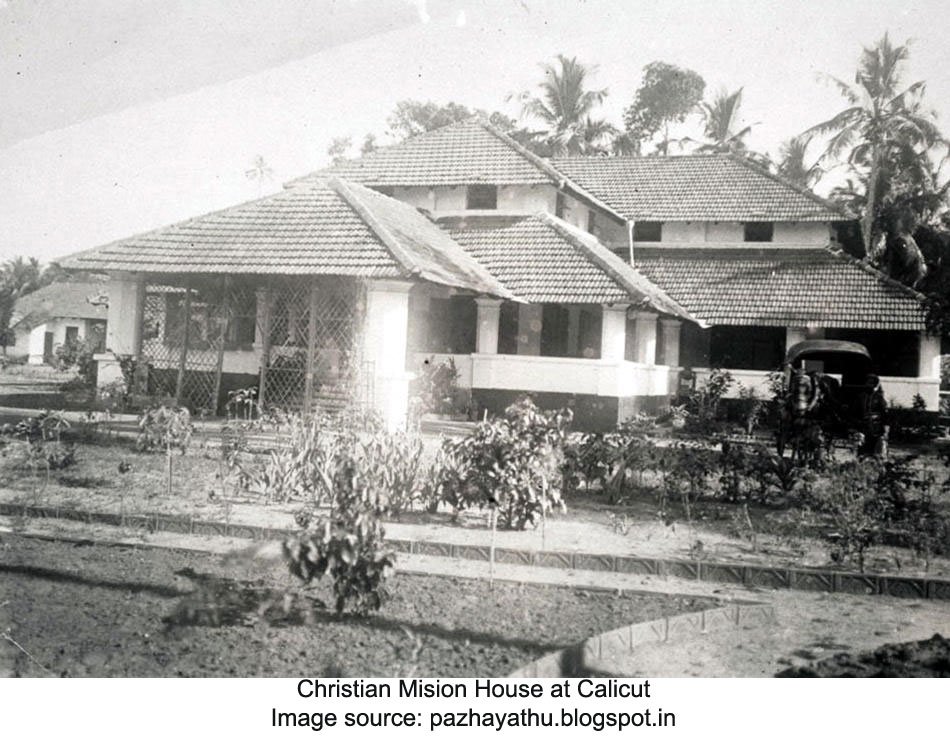
Protestants
The only Protestant mission at work in Malabar is the Basel German Evangelical Missionary Society, of which the latest report, the 43rd, shows that on 1st January 1883, the society had in Malabar 2,632 church members, including children, distributed at the following mission stations : Cannanore in the Chirakkal taluk, Tellicherry in the Kottayam taluk, Chombala in the Kurumbranad taluk, Calicut in the Calicut taluk, Codacal in the Ponnani taluk and Palghat in the Palghat taluk.
The earliest of these stations was established at Tellicherry in 1839 and the latest at Palghat in I858.
Besides attending to the spiritual and educational wants of their congregations, the mission has very wisely organised various workshops and manufactories, the productions of which have acquired not merely local celebrity, for "mission’’ cotton cloths of infinites variety and “mission" tiles for roofing and other purposes are now to be met everywhere in India. Besides these, a mercantile branch has been organised, which gives very suitable employment in shops to other members of the congregations, And a printing press at the mission headquarters at Mangalore in South Canara turns out, both in English and the vernaculars, work of which any press in Europe might be proud.
Section G.—Famine, Diseases, Medicine
Malabar does not produce grain sufficient for the consumption of the home population, and this has been more especially the case since, by the introduction of European coffee cultivation into the Wynad taluk, the jungle tribes and other servile castes, who used to cultivate the rice-fields in that region have been attracted to the more profitable employments on coffee estates. Malabar pays for much of the grain consumed by the people out of the money obtained for its special products—coconuts, coir, coconut-oil, areca-nuts, coffee, pepper, ginger, cardamoms, timber, etc.
An artificial famine is therefore always possible in Malabar, and, as matter of fact, such famines used to occur pretty frequently in former times when the supply of grain came from only one or two foreign ports. Thus in October 1755, the King of Bednur, to whom the rice -exporting port of Mangalore belonged, laid an embargo on grain, because of the ravages committed in his country by a buccaneering expedition under the Mappilla chief of Cannanore. This placed the French at Mahe, the English at Tellicherry, the Dutch at Cannanore, and the Malabar Nayars and Mappillas—the whole community in fact -- in a state of comparative famine.
But of real famine in the land there are few records. During the long period in which the Honourable Company occupied the factory at Tellicherry, there is but one record of a real famine. It occurred in August— September of 1727. The factors’ diary record is as follows:
“The country about us of late have greatly feared an extraordinary scarcity of rice,” and it was accordingly resolved to impose the embargo, usual in those days, an exports of grain. Strict orders were issued “for not carrying any quantity out of our limits.” There, was none to be had at Mangalore ; the granary — and almost the sole one in those days --from which Malayalis drew their extra supplies of rice. The factors had information that parents were selling their children at Mangalore in order to obtain support for themselves.
On examination of the factory storehouses, there was found to be bare provision for the place for one month, so an urgent requisition was sent to the Anjengo factors for supplies. On the 8th September, there was famine in the land and the record runs that the factory gates were daily besieged by people begging for support. There is no further record in the diary, and doubtless the worst symptoms disappeared, as they did in 1877, with the garnering of the first (kanni) rice crop in September. The months of July, August and September are the months in which the poorest classes of Malayalis find it hardest to obtain sustenance.
The stores that may have been reserved from the previous season’s crops are always then at the lowest ebb. The rice-crops on the ground are usually sufficiently advanced at this season to require only the minimum of attention from out-of-door labourers. And the now harvest is not yet available. In every season the pinch of poverty is therefore felt in these months, more than in the others, and in seasons when famine is raging in neighbouring districts and when famine prices have for months reduced the slender stores of savings, it is in these months of the year, particularly, that organised assistance is required ; and the rich should come forward to help the poor. One meal of rice kanji distributed gratis to all comers daily during this season of the year at many places throughout the district sufficed to stave off actual famine in 1877; the number thus daily relieved aggregated at one time over 40,000.
Of remarkable outbreaks of disease the records also contain few notices. In October 1730, the Tellicherry factory diary records—
“The pestilence which has raged for some time among the people of this district being now come to such a pitch, as, with difficulty, people are found to bury the dead, and our garrison soldiers, Muckwas (fishermen, boatmen) and others under our protection being reduced to such extremity by this contagion, so as not to be able to subsist in this place any longer unless relieved by charity, it was agreed to build barracks for the sick and to entertain attendants” to bury the dead.
What the “pestilence” was the records do not give information, but it was probably cholera. A fortnight later requisitions were sent by the factors to Anjengo and to Madras lo raise soldiers to supply the vacancies, as the garrison was obliged to do double duty on account of the increasing of the contagion. Calicut also suffered severely, for, on 13th November, there is an entry that the “pestilence was again broke out in Calicut more violent than before.”
On 18th December, the “contagion” was “in no wise abated” and the factors organised charitable relief. The further history of the outbreak stops short here. The garrison at this time numbered about 270 men, including Nayars and Mappillas, in the service of the Honourable Company, and besides those the men of two other outposts, which cost; about Rs. 250 more per mensem.
It was not till July 1757 that the next severe visitation of disease occurred ; and on that occasion it was said to be due to the excessive monsoon rains. There was “terrible mortality” at Calicut, Mahe, and Cannanore, but by 20th July it had abated at Tellicherry. What the disease was was again not recorded. In August 1800 there was a scare, lest the plague then raging at Baghdad should be imported into India, and strict quarantine regulations were imposed.
In December 1801 very handsome rewards and encouragement were offered to natives who successfully practised inoculation1 for small-pox, and in 1803 the Sub- Collectors were directed to exert themselves “personally to the utmost in persuading the principal inhabitants of the country, who have not had the Small-pox to submit to vaccination.”
NOTEs: 1.This was probably the “vaccine inoculation,” then recently discovered. END OF NOTEs
Notwithstanding the measures then taken and the organisation subsequently of a special establishment to deal with this disease, it almost annually claims its thousands of victims, and, alternating with cholera, the two diseases carry off a large proportion of those who live insanitary lives.
The chief source of disease in the low country is the badness of the water-supply, and as there is hardly any water, however filthy in appearance, which the lower classes of the population refuse to utilise for domestic purposes, there is little to be wondered at in this.
The higher classes are much more particular in this respect than in East Coast Districts, but they, too, have yet failed to realise that a water source once tainted is not fit for use for some time. They, in futile fashion, bent drums and blow horns to drive away the devils, which bring, they think the disease, but never dream of taking exceptional care to keep their water-supply untainted. Recent experience has shown, however, that the mortality from cholera, can be lessened, if not prevented altogether, by judicious administrative measures. The closing of the. wells of the infected locality is not the least important of the steps to be adopted. And great good results from the mere presence in an infected locality of the officers specially charged to deal with the disease.
The District Medical and Sanitary officer (Surgeon-Major H. D. Cook. M.D) has furnished the following brief sketch of the principal diseases:
“The principal diseases that are especially prevalent in the Malabar district may be enumerated as follows:
|
1. Anæmia (general weakness). |
5. Dysentery. |
|
2. General dropsy. |
6. Skin diseases |
|
3. Splenitis (or ague cake) |
7. Elephantiasis |
|
4. Ague. |
|
“A few remarks on each is necessary. Anæmia, general dropsy, and splenitis, although put down as special diseases, are generally, if not always, the result of neglected or protracted attacks of ague. They occur in this way. People of Malabar of all classes reside for some time or other in Wynad. In the months of March, April and May ague abounds there and spares few, rich or poor. The poor, through neglect of seeking medical aid, have repeated attacks of it undermining their constitutions, the result being that they flock back to the coast, bloodless, dropsical, and with spleens occupying sometimes half the cavity of the abdomen instead of the area of a man's hand.
One has only to attend one of the dispensaries in Malabar, or walk through the bazaars of some of the principal towns, and see the great, amount of people with anæmia, dropsy, and enlarged spleens. These classes of diseases fill our dispensaries —all the result of neglected ague or from repeated attacks of it.
“Dysentery is very common indeed, and it is a common saying ‘if you are subject to dysentery avoid Malabar.’ In my experience I have not found dysentery so common among the rich, but the poor suffer fearfully from it, and generally the acute variety. The season for it is June, July and August, and the cause the climate. The hot and dry months of April and May are succeeded by the very wet ones of June and July. The houses of the poor are mere huts, thus exposing the inhabitants to damp and cold. Children suffer terribly from this. Dysentery, of course, is often the result of affections of the liver and of malaria. But what I refer to is acute dysentery, the result, as said, of damp and cold, or sometimes from eating bad fish.
“Skin diseases abound, the principal form being scabies, vulgarly called ‘ Malabar itch.’ Itch generally is the result of uncleanliness all over the world ; but the form of itch met with in Malabar is of an aggravated form, and I cannot give any particular reason for it. Some attribute it to eating a kind of fish called in Malayalam ‘Ayila.’
“Elephantiasis. - This is very common in Malabar, especially among Mappillas on the coast. It is called in Malayalam ‘Mantha kalu or ; Ana kalu’ 'The ordinary form is a hypertrophy of the skin and arcolar tissue of some part of the body, but generally attacking the legs and genital organs. The skin becomes enormously thickened with a quantity of albuminous fluid in the arcolar tissue. It is most common in males. Various causes are said to be assigned for this disease—air, water and food -and it generally occurs near the sea. Eating fish has been said to be a cause for it. I think that poor living has a good deal to do with it.
“Dr. Fayrer, in his book, attaches much importance to the presence of filariæ in nutritious fluids. This is too big a question to take up here ; but I may as well mention that acute researches are now being made to prove that mosquitoes have very much to do with the production of many diseases, by communicating filariæ to the human body which entering the blood becomes what is termed filariæ sanguinis hominis. Any one desirous of obtaining all information on this subject, I advise them to read Dr. Fayrer’s book on 'Tropical Diseases.’”
The native system of medicine and surgery is based upon the obsolete ideas, apparently borrowed from the Greeks, of the body being composed of fives elements -earth, water, fire, air, and ether. Physical health is supposed to be preserved by the preservation, in exact proportions, of the three general elements, viz. rheum, bile and phlegm, or air, fire, and water respectively.
“Their harmonious1 admixture, tends to constitutional nourishment, whilst anything that disturbs or destroys this harmony causes impaired health. Though in a sense pomading all (ho body, each of them is not without its allotted province, that is, air, or rheum , spreads itself below the navel ; lire, or bile., between it and the heart; and water, or phlegm above the heart and upwards. By the predominance of one of these humours over the others, the human health is deranged, whilst their proportionate evenness secures good health.”
NOTEs: 1 Translated from the Introduction to Mr. O. Cannan's “Malayalam Translation and Commentaries on the ‘Ashtanga Hridayam,' or Treatise on Manhood (Ayur Vedam)" Calicut, 1878. END OF NOTEs
“Tastes are six in number, viz., sweet, sour, saltish, bitter, pungent, and astringent, which are the atributes of substances, each preceding taste being superior to that immediately succeeding it. The first three-—sweet, sour, and saltish—appease rheum ; and the remaining three—bitter, pungent and astringent—appease phlegm, while bile is appeased by astringent, bitter and sweet.
According to another opinion, the three humours are said to be promoted by those tastes, viz., the rheum, by bitter, pungent and astringent : the phlegm by sweet, sour, and saltish ; and the bile by pungent, sour, and saltish. Substances have three forms of digestions, viz., the sweet and saltish will digest sweetly, the sour in its original taste, and the pungent and astringent mostly turn acrid.
“Medicines are of two classes known as clearing and subsidiary. The first effects the cure by purging out the irritated humours ; and the second by establishing the humours which have bum disturbed in their respective positions.
‘‘To secure health, we should try to purge out the bile and other humours according to season.
“Purgatives are essential, as otherwise the humours, augmented by their stagnancy, will endanger even life. The humours allayed by fasting, or by the use of medicines having digestive properties, will sometimes be irritated.
“If properly purged out, these humours are not liable to irritation.
“Oil bath, athletic exorcise, simple bath, and oil-syringing are also necessary, as those will restore health and establish the digestive powers, and likewise create intellectual brightness, personal beauty, acuteness of the senses, and prolongation of life. Refrain from doing anything disagreeable to the mind, feelings and thoughts, lest a deceitful conscience irritate all the humours ; govern the passions and senses in order that they may not be led astray ; remember the past, and conduct yourself with duo regard to the peculiarities of the time and place as well as of your own constitution, and pursue the well-trodden path of the righteous.
“He who wishes for happiness in this as well as in the next world should, in controlling the passions, successfully resist the blind rush of the thirteen mental vices known as (1) avarice, (2) envy, (3) malice, (4} enmity, (5) lust, (6) covetousness, (7) love or passion, (8) anger, (9) pride, (10) jealousy, (11) arrogance, (12) haughtiness and (13) self-conceit, inasmuch as man, imbued with any one of them, is apt to commit vicious acts of divers sorts, resulting in iniquities, which gaining ground in successive births, will force themselves out in the shape of diseases causing immense misery.
“Moreover when those evils take hold of the mind, their influence agitates it and destroys the mental ease and vitiates the vital air, which is wholly dependent on such mental ease ; and as the very life, vigour, memory, etc., are all sustained by this vital air, its loss entails hazard to them, and injuring respiration gives rise to various diseases. By treading the paths of virtue and possessing a truthful nature, a charitable disposition, compassion, sympathy, and continence, and by using such fare as is congenial to the mind, free motion to the vital air will be secured. For mental vices, spiritual knowledge, combined with prudence and courage, is the best remedy, by seeking which, the mind will be liberated from evil passions and left to pursue a virtuous course.”
After much wise discourse on the true means of attaining the "pith of all human endeavours,” happiness, by aid of virtue, he continues as follows : — “Speak but little, and that significantly and opportunely, so as to be agreeable to your hearers, and lot your speech be characterised by sweetness, voracity, and cheerfulness, and an open countenance graced with kindness and affability.
“Eat or enjoy nothing alone. Do not be overcredulous or suspicious. Be sagacious in guessing other minds ; treat them with kind and greeting expressions and do net over-vox or over-indulge the organs of taste with distasteful or delicious fare.
“Let your mental, vocal, or bodily exertion cease before actual fatigue commences.
“Do not deal in, or drink, spirituous liquors, nor expose yourself to the east wind, directly to the rays of the sun, or to the dust, show, and storm .
“Do not in a crooked position yawn, cough, sleep or eat., nor shelter under the shadow of trees on the margins of rivers.
“As the wise have the world for their preceptor in all doings, you ought to study the movements of the righteous, keeping yourself steadily to their virtuous path.
“A tender fooling and unaffected charity towards all creatures, and a self-restraint, physical as well as vocal and mental, combined with a duo regard to the interests of others, are moral virtues which complete the test of true uprightness.
“He that daily contemplates his own acts, as to whether and how he has actually realised the grand ends of his existence on the day, the lapse of which has brought him nearer to the grave than on the previous day, cannot be overtaken by grief, inasmuch as his deliberations, secure in divine grace, will ultimately conduct him to the attainment of true wisdom, regarding the mutability of this world and the eternity of God; and he will, thus, be freed from all sins and sorrows, and in the end gain everlasting happiness. Moreover as each day passes, life becomes shorter, and patent is the fact that the exercise of morality can be prosecuted only while it exists, and as the extrication from sorrow is the result of a strict pursuit of virtue and abstinence from vice, a daily reckoning of the nature and amount of our virtuous floods is a salutary remedy for all mental diseases.
“A strict adherence to the daily observances herein briefly summarised will lead to longevity, health, prosperity, imputation and eternity.”
The lofty tone of morality above sketched runs quaintly through the voluminous treatise, which follows consisting of six parts and containing 120 chapters. The treatise gives extremely explicit directions, first for the preventive and afterwards for the curative measures to be adopted in the multitudinous circumstances of life. A more detailed examination of the system of medicine in vogue would be beyond the scope of the present work.
CHAPTER III. HISTORY.
Section A — Traditionary Ancient History
The Kerala Mahatmyam and the Keralolpatti (Kerala-ulpatti = origin of Kerala), the former written in indifferent Sanskrit and the latter in modern Malayalam, contain the traditions current among the people regarding the ancient history of the province.
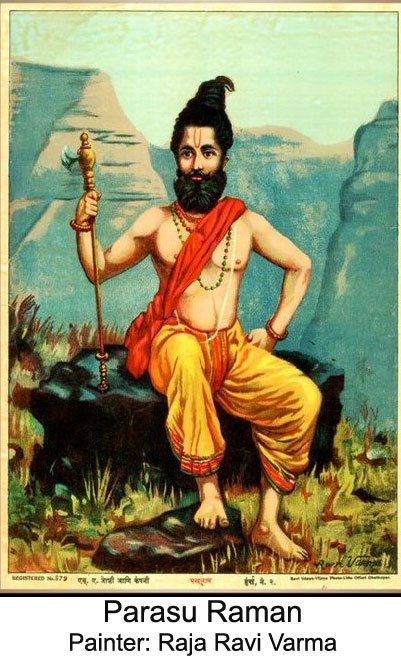 The mace-bearing incarnation of Vishnu (Parasu Raman), the former work says, was obliged by the Rishis to expiate the sin of having slain his mother by extirpating the Kshatriyas, the enemies of the Brahmans. This he accomplished in twenty-one expeditions. At Vishvamitra's suggestion he then made over all the land within the four seas to the Rishis “with all the blood-guiltiness attached to it, by making them drink of the water1 of possession”.
NOTEs: 1. N.B.—The fact that the janmam (birth-right) of land in Malabar is also called the "water-contact-birthright” (Nirattiperu) is fully commented on in Chapter IV. END OF NOTEs
The Brahmans, it is said, turned him out of the land he thus gave away, but with Subramanya's assistance, he obtained by penance from the god of the seas (Varuna) the grant of some land to dwell on. The throw of his mace (parasu) was to determine its extent. He threw it from Kanya Kumari (Cape Comerin) to Gokarnam The gods came to visit the land thus miraculously won and called it Parasu Raman's land, and Siva condescended to be worshipped in Gokarnam the metropolis of the province thus reclaimed from the sea. To people this land, Parasu Raman is said to have first of all brought a poor Brahman from the shores of the Kistna river. This man had eight sons, and the eldest was made head of all the Brahmans of Kerala and located, some say, at a place near Gokarnam, others say at Trisivaperur (Trichur in the Cochin State).
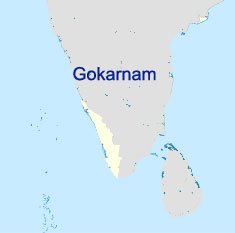 Other Brahmans were next brought, and located in sixty-four gramas or villages. Ships with seeds and animals next came, also eighteen Samantas2 (sons of Brahmans and Kshatriya women) also Vaishyas (Chottis) and Sudras and the low castes. Some of the Brahmans emigrated, and to prevent this for the future the special customs already alluded to (ante p. 155) were prescribed.
NOTEs: 2. The families of the native chieftain are mostly of this caste, but they are classed as Sudras. END OF NOTEs
Bauddhas are confounded in the Mahatmyam with Muhammadans, and the first Buddhist vihara or palli (chapel, mosque) is said to have been located at Madayi3 south of the Seven Hills,4 i.e., Mount Deli. The Mahatmyam is full of the usual inflated Brahmanical legends, and is not so worthy of serious analysis as its more popular form, the Keralolpatti.
NOTEs: 3. Compare p. 194.
4. Vide p. 6. END OF NOTEs
The Keralolpatti too is full of Brahmanical legends, but historically there is something to be learnt from it.
It agrees with the Mahatmyam on the main points, the miraculous formation of the land, and the peopling of it first of all with Brahmans. It sets forth that the first Brahmans who arrived from various places did not remain in Keralam owing to their dread of the myriads of serpents1 infesting the country.
NOTEs: 1. See footnote on p. 201. END OF NOTEs
When the Brahmins retired, the serpents are said to have protected the country. Then Parasu Raman fetched more Brahmans from the north and located them in sixty-four villages or gramams, viz., (1) Gokamam ; (2) Gomakutam ; (3) Karavalli ; (4) Mallur; (5) Eppanur ; (15) Cheppanur ; (7) Katalur ; (8) Kallannur ; (9) Karyachchira ; (10) Peiyanchira — this was the first group in the extreme north of the newly reclaimed land—(11) Trikkani ; (12) Trikkatta ; (13) Trikkanpala ; (14) Trichchola (15) Kollur ; (16) Komalam ; (17) Vellara ; (18) Vengatu ; (19) Venkatam ; (20) Chengotu—-another set of ten gramams presumably to the south of the first group and all lying in North Canara or Tulunad (21) Kolisvaram ; (22) Manchisvaram ; (23) Utuppu ; (24) Sankaranarayam ; (25) Kottam ; (20) Sivalli ; (27) Mora (28) Pancha ; (29) Vittad ; (3u) Kumaramangalam ; (31) Anantapuram ; (32) Kannapuram—a group of twelve gramams lying in South Canara or Tulunad—(33) Peiyanur ; (34) Perinchellur ; (35) Karikkatu ; (36) lsanamangalam ; (37) Alattur; (38) Karintolam ; (39) Trissivaperur ; (40) Panniyur ; (41) Chovaram— those though only nine in number are said to have formed another group of ten grammams----(42) Paruppur ; (43) Eiranikkulam ; (44) Mushikakulam ; (45) Iringatikkotu: (46) Alappur ; (47) Chenganolu; ; (48) Uliyanur ; (49) Kalutunalu. (50) Kalachchur ; (51) Ilibhyam ; (52) Chamundha ; (53) Avattiputtur --another group of twelve gramams —(51) Katukaruka ; (55) Kilangur, (56) Karanallur ; (67) Kaviyur ; (58) Ettulaniyur ; (59) Nilmanna ; (60) Anmani; (61) Anmalam ; (62) Tiruvallayi ; (63) Chenganiyur.
One of the names has probably been lost. The last named thirty-one gramams seem to belong to Malabar proper and the Native States of Cochin and North Travancore; but some of the names of places cannot now be identified, nor are the name which can be identified arranged in strict order proceeding from north to south.
The Keralolpatti proceeds to describe how certain of the Brahmans obtained the gift of arms, how the serpents which had formerly been the terror of the Brahmans were made their household gods— a portion of the shares2 of the Brahmans being set apart to satisfy the serpents—how fencing schools with tutelary deities were established, how the goddess Durga was set to guard the sea-shore, and the god Sasta the feet of the hills, how the unstableness of the land was removed by sprinkling gold dust on the ground, by stamping so as to make it firm, and by depositing water carrying golden sands.
NOTEs. 2. Vide p. 184. END OF NOTEs
Parasu Raman finally organised the gramams, setting special tasks to some, and to particular individuals others. His last injunction to the gramams was to adopt the law of succession through the mother, but only one of them (Peiyanur), located in the extreme north of the Malayalam country, obeyed him.
After all this had been arranged he next introduced Sudras from the countries east of the ghats, and caused all of them to adopt the law of succession through the mother, and he constituted them as the body -guard of the Brahman villages.
“Thus” the Keralolpatti runs on, "Parashu Raman created the land of Malabar—the Karmabhumi, or country where salvation depends entirely upon good actions—and bestowed the same upon the Brahmans of the sixty-four gramams as a poured-out gift.
The narrative recites how he selected the four gramams of Peiynur, Perinchellur, Parappur and Chenganiyur and gave them authority to act in place of the whole sixty-four gramams. While the armed Brahmans were ruling the land, it is said, disputes arose and injustice ensued. So the Brahmans assembled and appointed a Protector in each1 of the four selected villages, to hold office for three years, and assigned to each Protector a share equal to 1/6 of all the land for the support of himself and his subordinates.
NOTEs: 1. There is a different tradition about this. END OF NOTEs
This institution, it is said, did not work well, and the people were oppressed by the Protectors, who sought to make the most of their opportunities during their short terms of office. So the Brahmans, assembled at Tirunavayi, determined to select a king, and empowered the four selected gramams to choose a. king. Their choice fell on Keya Perumal, of Keyapuram, in the country east of the ghats. He was brought, it is said, to Keralam and installed as the first of the Perumals in the year of the Kalivug “Bhumanbhupoyam Prapya”, corresponding to A.D. 216.2
NOTEs: 2. The specific dates mentioned in the work are all unreliable. END OF NOTEs
The Brahmans arranged that he should rule for twelve years, but it is said he reigned for only eight years and four months. It is incidentally mentioned that there were two other Perumals besides the Keya (Chera, Kerala) Perumal. Those were the Choya (Chola) Perumal of Choyamandalam, and the Pandi or Kulasekhara Perumal of Pandimandalam, which information is corroborated from other and early sources, which mention Chera, Chola and Pandya as being the three great kingdoms of the south of the Peninsula.
It is further incidentally mentioned that the Malanad (hillcountry, Malabar) was divided into four parts, viz. : — (1) Tula kingdom extending from Gokarnam to Perumpula (the big river), i.e., the Canaras (north and south) very nearly as at present defined.
(2) The Kupa kingdom extending from Perumpula to Putupattanam, the seat of the Tekkankur (Southern Regent) of the north Kolattiri dynasty situated on the Kotta river, i.e., North Malabar as at present defined less the southern half of the Kurumbranad taluk.
(3) The Kerala kingdom extending from Putupattanam to Kannetti, that is, South Malabar, including the south halt of the Kurumbranad taluk, the Cochin State, and North Travancore.
(4) The Mushika kingdom extending from Kannetti to Cape Comorin, that is, South Travancore.
It would appear, therefore, that the Perumal whom the Brahmans say they selected ruled over only a small portion of the country (Kerala) reclaimed by the efforts of Parasu Raman, and that Kerala, the name usually applied to the whole of Parasu Raman's reclamation, was in fact the name by which the Brahmans designated the middle half only of the country inhabited by the Malayalam-speaking race of Dravidians.
This fact has an important bearing on the question as to when the Brahmans really did settle in Malabar, for Kerala is now by scholars recognised to be a dialectic (Canarese) form of the ancient name of the whole country, viz., Chera or Cheram or Keram, a name which probably still survives in Cheranad, the western portion of the Ernad taluk, and possibly also in Cheruman (plural — Cherumakkal1) the agrestic slave caste.
NOTEs: 1. The Cherumar are supposed to be so styled because of their low stature ((Cheru = small) but low feeding produces low stature, and it is very possible that the slave caste constituted the aborigines of the ancient Chera kingdom (vide p. 147). END OF NOTEs
The name Kerala was probably not in use in Malabar itself until it was imported along with the Nambutiri Brahmans, and after being so imported it was naturally applied to that portion only of ancient Chera where those Brahmans settled most2 thickly, that is, in the third of the divisions or kingdoms mentioned in the Keralolpatti. Outside the Malayalam country the name was certainly in use, as will be seen presently, for centuries before the Nambutiri Brahmans arrived, and was employed to designate the dominions of the Chera king.
NOTEs: 2. See the table given at p. 119-120. END OF NOTEs
Thus runs the Keralolpatti ;— “When the Brahmans first appointed a king they made an agreement on oath with him to this effect—‘Do that which is beyond our power to do and protect. When complaints happen to arise, we will settle them by ourselves. You are not to question us on that point. For formality’s sake you may ask why we deal with affairs ourselves after making you a king’.
At this3 day even when complaints arise the king says:-- Why do you deal with them ? Why did you not make your complaint to me?' This is owing to the former oath.''
NOTEs: 3. The work is generally supposed to have been written in the 17th century A.D. END OF NOTEs
It is further said they gifted him with lands and fixed his headquarters at Allur alias Kodumgallur (Cranganore) alias Muyirikode (Jew's deed) alias the Mouziris of the Greeks.
After Keya Perumal's death the Brahmans, it is said, brought Choya Perumal from Choyamandalama. He reigned ten years and two months and returned to Choyamandalam.
They next brought Pandi Perumal1 from the Pandi country. He built a fort, reigned nine years and returned to his former home “whence a messenger had come to inform him that there was no one to be king at Pandimandalam”.
NOTEs: 1. One version asserts that this was an "enterprising female.—” Ind. Ant. IX, p. 78. END OF NOTEs
It will be noticed that the names of these three first Perumals, supposed to be single individuals with exact terms stated as to the durations of their reigns, are in reality the names of the Chera, Chola, and Pandya rulers, and it is quite possible that when the dominion of the Chera princes terminated, they were succeeded in the suzerainty of the Kerala chieftains, first by the Cholas and afterwards by the Pandyas.
Then comes in a tradition of a king called Bhutarayar2 Pandi Perumal, between whom and the Brahmans bitter enmity arose. He was guarded by two spirits and the Brahmans could not compass his destruction, until one of them played chess with him and won the services of the guardian spirits ; after which he was assassinated3 by a Brahman, from whom descended the Nambidi caste.
NOTEs: 2. This Perumal who was guarded by evil spirits and inimical to the Brahmans was not improbably the Perumal who became a convert to Muhammadanism, the Pallibana Perumal, as he is called further on, and the Cheraman Perumal of the popular tradition.
3. Another version asserts that the Perumal thus assassinated was called Shola Perumal (or Choya Perumal above referred to). — Ind. Ant. IX, 78. END OF NOTEs
The Mahatmyam says of him that the Pandyans invaded Kerala with an army of Bhutans (spirits) that Parasu Raman said to the Bhuta Raja angrily : “Your arrival at my country is in vain. I have given it over to the Southern king Adityavarman 4.The Bhuta army was then defeated, and the boundary of Kerala was fixed at the place (Bhuta pandi) where Parana Raman accosted the invaders.
NOTEs: 4. This seems to refer to the Chola king of this name, who, according to present knowledge, overran a large part of Southern India about A.D. 804. If the Bhutarayar Pandi Perumal above referred to was, as suggested, the Muhammadan convert, then this allusion to the Chola king is chronologically correct. END OF NOTEs
Invasions, it is said in the Keralopatti, became frequent ; the Brahmans applied to Parasu Raman, who told them to select a king at Tirunavayi5 , that the Gangadevi (Ganges) would come6 on the day of the festival at Tirunavayi, that they might choose whomsoever they wished, and that he should be anointed with the water of the Perar (big river), that is, the Ponnani river, on the north bank of which Tirunavayi stands; Parasu Raman likewise gave them the sword of Bhadrakali7 for the protection of the country.
NOTEs: 5. Vide p. 163.
6. At the Mahamakham festival (vide pp. 163-69) still held at Kumbhakonam, in Tanjore District, every twelfth year, the Ganges in the form of a blooming girl of seventeen-years (sometimes still seen by imaginative individuals) is believed to visit a certain tank in that town much bathed in on such occasions.
7. Conf. p. 240. END OF NOTEs
They proceeded to Choyamandalam, the narrative continues, and brought thence a king named Keralan. He was anointed on the day of Puyam, in the month of Kumbham, in the year when the planet Jupiter was in the constellation of the Crab, that is, he was anointed after one of the Tirunavayi Mahamakhom1 festivals, and the ceremony was performed in the royal hall of Vakayur.2"
NOTEs: 1. Conf. p. 104.
2. Conf. p. 160. END OF NOTEs
On him the Brahmans, it is said, conferred the following privileges :—Battle wager, land customs, fines for evasion of ancient usages, riding on elephants, cows with five tents to the udder, cows with three teats to the udder, bulls that have slain men or animals, spotted bulls, tails of tigers slain in hunting, wild pigs that have fallen into wells, regulation of the beds of streams, accretions from the sea, tax on headloads [or, perhaps, trees or fruits of abnormal growth, or, perhaps, the cabbage of palm trees cut down), sea customs, the revenue and charges of all Kerala. They also presented to him the sword of Bhadrakali, and built him a palace at Trikkata Matilaha.
lt is said he reigned for twelve years and then returned to his own country, and on account of his good qualities, it is said, the land received the name of Kerala.
To him succeeded King Pandyan alias Chenaar of the Pandyan Raj. He reigned twelve years and then went back to his own country after settling up accounts with the Brahmans.
Then followed King Choyiyan of the Choya Raj. He also, it is said, ruled twelve years.
The tradition about these three kings is, it will be observed, just a different version, with some local colouring, of the tradition already alluded to above pointing to the probability that the Kerala princes proper were followed in the suzerainty of Malabar by the Cholas and Pandyas ; only this repetition of the tradition seems to place the Pandyas’ suzerainty as an event prior to that of the Cholas.
The Keralolpatti next proceeds to state that the Brahmans, in order to prevent the King from seizing despotic power, divided the country into seventeen divisions, and committed the power of control to four gramams (Brahman villages), namely, (1) Eiranikkulam, (2) Iringal kollu, (2) Mushikakulam, and Purappur. Of these four villages, it will be noticed that only one (Purappur) was among the first four villages selected by Parasu Raman. The reason assigned for the supersession of Peiyanur (or perhaps Panniyur), Perinchellur and Chenganiyar, is that these were too distant from Paravur, or Parappur.
The fact, however, is also consistent with the supposition that political reasons had been at work, and the acquisition of independence by the Northern Kolattiris in North Malabar and by the Southern Kolattiris in Travancore (for which there is a strong tradition) may have led to the withdrawal of the Peiyanur gramam from the list of controlling gramams in North Malabar, and to the non-establishment (a fact which remains to the present day) of any Nambutiri villages to the south of the Quilon river.
If on the other hand, it was the Panniyur (literally pig village) gramam which was superseded, that also is explicable on the supposition (for which also there is some extraneous evidence) that there was at one time a diminution1 in the influence of the Vaishnavites (worshippers of the boar incarnation of Vishnu) and an increase in the influence of the Saivites. Kerala was probably stripped of its northern province by the power and influence of the Western Chalukyas, whose emblem was this name boar incarnation of Vishnu and the Rashtrakuta or Ratta dynasty in turn with strong Brahmanical and Saivite proclivities superseded the Western Chalukyas and claimed to have conquered Keralam.
NOTEs: 1. Conf. pp. 119 and 120. At the present day, the Panniyur (pig village) Brahmans are considered not to be entitled to recite the Vedas.END OF NOTEs
The precise time or times when those events occurred will be considered in the next section of this chapter, but meanwhile, as some additional evidence that political influences were at work, it is necessary to draw attention to the fact that the Keralolpatti next proceeds to describe a new arrangement of the gramams which took place at this time. The thirty-two Tulu gramams (north of the Perumpula) were it is said, “cut off from all connection (or perhaps intermarriage)” with the thirty-two pure Malayali gramams lying to the south of that river, and a fresh distribution of the Malayali gramams themselves took place. The narrative further runs thus :—“ The other thirty-two gramams (i.e., those lying to the north of the Perumpula) are composed of those who went away to join the Panchadravidas2 and returned afterwards. They are called Palantuluvar3 or Tulunambis4.”
NOTEs: 2. Literally five Dravidas, which usually refers to the five chief Dravidian dialect—Tamil, Telugu, Canarese, Malayalam and Tulu. Had the word in the text been the “ Fifth Dravidas," i.e., the Tulus, the meaning would have been clear.
3. Literally ancient Tulus
4. Literally Tulu Vaishnavas END OF NOTEs
Sometime after this, so the tradition runs, the Brahmans brought from the East Coast from Banapuram5 a king whom they called Bana5 Perumal. He was installed at Allur, i.e., Kodungallur (Cranganore). It was during his reign that the Mappillas came and gave an account to him of the greatness of their religion. The Perumal, it is said, was convinced, and embraced the Muhammadan (or Baudha (sic)] faith.
NOTEs: 5. Query.—The Mahavali dynasty of kings was also called the Bana dynasty. Is Banapuram another name for Mamallaipuram (the Seven Pagodas near Madras), and did this Perumal belong to the Mahavali dynasty? END OF NOTEs
He sent for the Brahmans and said to them : “Everybody in this Malanad (hill country, Malabar) must embrace this way (religion).” The Brahmans were embarrassed and could not eat with comfort owing to the defilement of the choultries. It is said they finally persuaded the Perumal to allow them an opportunity of controversy with the exponents of the new religion, agreeing that the party which was worsted in the encounter should have tongues cut out. The Mappillas, it is said, were defeated and the Perumal cut out the tongues of those who remained and expelled them from the kingdom. Somewhat, inconsistently, however, the narrative runs that the Perumal himself did not revert to Hinduism and after a reign of four years he proceeded to Mecca, “saying that since he believed in the Mappilla faith he had no other way of obtaining salvation” ; and one account of him winds up thus:—“The Bhauhus (Mappillas) say that Cheraman Perumal went to Mecca- and not to heaven. That was not Cheraman Perumal, but this Pallibana Perumal1 (king of Kerala) ; Cheraman Perumal did indeed go to heaven. He was the fifth king after four kings had reigned.’’
NOTEs: 1.This Muhammadan Perumal must have lived subsequently to the seventh century A.D. when the Muhammadan religion was founded, and if, as the text says, Cheraman Perumal was the fifth of his successors, it follows that Cheraman Perumal must have lived after the seventh century A.D., whereas further on it will be seen, the text says, he went to heaven in the fourth or fifth century A.D. All the specific dates mentioned in the text are worthless. END OF NOTEs
Notwithstanding, however, the assertion in the text, it will be seen presently that the tradition about the conversion of this Baudl a (alias Mappilla) Perumal fits in accurately with the little that is known of the real Cheraman Perumal, and these traditions themselves, it will be seen, have assigned to him his proper place in history as having reigned subsequently to the partial disruption of the ancient Chera kingdom alluded to above.
The Keralolpatti then proceeds as follows – “The Brahmans went to other countries and brought Tulubhan Perumal from the northern country.” He fixed his residence, it is said, in the gramam of Kotisvaram2, and it was he that gave his name to the Tulunad (Canara). He is said to have reigned six years and to have died.
NOTEs: 2. This gramam lay in South Canara. END OF NOTEs
Indra Perumal was next, it is stated, sent for and made king. He lived at the big palace (Kovilagam king’s house) at Allur3 (Kodungallur, Cranganore). He reigned, aided by the councillors, it is said, of the four representative Brahman villages, for a period of twelve years, and then went away to the east, leaving orders to appoint another king.
NOTEs: 3. To the present day this place lies in the Native State of Cochin. END OF NOTEs
Arya Perumul was brought from Aryapuram and installed. He, it is said, inspected the whole of the country and arranged it4 into four divisions or provinces, viz. : —
(1) Tulu country, from Gokarnam to Perumpula.
(2) Kerala,5 from Perumpula to Puluppalanam.
(3) Mushika6 country, from Putuppattanam to Kannetti.
(4) Kuvala7 country, from Kannetti to Cape Comorin.
NOTEs: 4. Another version says the division took place in the reigns of the two Perumals last above mentioned as well as in this Perumals's reign (Ind. Ant. IX, 78). This version of the tradition materially helps the suggestions made further on in the text
5. N.B.—Kerala here acquires a very restricted meaning, and corresponds precisely to what was the dominion of the North Kolattiris in historical times.
6 N.B.—This Province was in the previous distribution called Kerala.
7 N.B.—This Province was in the previous distribution called Mushika END OF NOTEs
He is further said to have arranged it into seventeen nads or counties, and each nad into eighteen kandams or portions. He also, it is said, organised the country into desams (territorial military units) and named them.
He reigned with the aid of the councillors of the representative Brahman villages, and at the end of five (or twelve) years “the gods let down their chariot from the heavens, in which the Perumal went in a royal procession to heaven” to the great sorrow of the Brahmans.
They, however, next sent for Kannan Perumal “from the east country.” He is said to have built a “king’s house” at Kundivaka near Kannetti.1 He reigned four (or twelve) years and went away to his country.
NOTEs:1. In Travancore END OF NOTEs
Then Kotti Perumal was sent for and crowned as king. He lived at Kotti kollam2 for one year and died.
NOTEs: 2. Conf. p. I58. The assertion that this place was the modem Calicut (Ind. Ant. IX, 78) seems to be mere conjecture. END OF NOTEs
To him succeeded, it is said, Mata Perumal who reigned for eleven (or twelve) years and then thought of building a fort, so he sent for his younger brother Eli Perumal,3 i.e, the Perumal or Mount Deli, and went away to his country.
This Eli Perumal3 built, it is said, the Matayeli4 fort, and after reigning twelve years, he either died or went away to his native country.
NOTEs: 3. Conf. p. 6. END OF NOTEs
4. Note. This is probably the original spelling of Madayi, the third most ancient of the king’s houses of the Northern Kolatiiris. It is in the immediate vicinity of Palayangadi referred to in the notice of the Taliparamba River (ante p. 10). Col. Yule, in “Marco Polo,” has a note (II, pp. 375-76) on the various spellings of Madayi. END OF NOTEs
Komban Perumal was next sent for, and it is said he lived for three years and six months in tents or in camp on the banks of the Neytara river, another name for the Valarpattanam river5 (ante p. 10).
NOTEs: In North Malabar END OF NOTEs
Then came Vijayan Perumal, who built the fort at Vijayan kollam6. He reigned for twelve years and went away to his country, leaving orders to appoint another king.
The Brahmans, it is said, next sent for Valabhan Perumal “from the eastern country” and made him king of Kerala.7 He is said to have consecrated gods and built a fort on the banks of the Neytara6 river (Valarpattanam river). The fort (ante p. 11) received the name of Valarbhattu Kotta, and he appointed this as the hereditary residence of the future kings of Kerala.7 He reigned for eleven years and died.
NOTEs: 6. This place is subsequently mentioned in the text as being near Kanyarott (Cassergode) river in the Malayali portion of the South Canara district.
7. N.B. — Kerala, it will be noted, had now, according to the text, the restricted meaning of the territory lying between the Perumpula river and Putuppatlanam, that is, the dominion of the Northern Kolatiiris, North Malabar in fact. END OF NOTEs
Harischandra Perumal was next brought. He is said to have built a fort on the top of the Purali hill in Kottayara taluk.1 It was, however, haunted2 by forest deities, and men could not, it is said, safely go there and speak to the king. After reigning a few years, he is said to have disappeared.
NOTEs: 1. In North Malabar.
2. This tradition still survives. END OF NOTEs
Then Mallan Perumal was sent for. He built the fort of Nallurumallan in the Mushika3 province, and after a reign of twelve years went away to his country.
NOTEs: 3. That is, South Malabar, Cochin, and North Travancore, according to the distribution made above. END OF NOTEs
The next Perumal was Kulasekhara Perumal4 from the Pandyan country. He built his king’s house in the Mushika Province, introduced Kshatriya families, and organised the country, it is said, into small chieftainships to protect it against the Mappillas. He is also credited with having introduced the study of sciences into the Malayali country, for the Malayali Brahmans were, it is said, ignorant of sciences up to this time. In this, he was assisted by a person styled Udkayatungan, also called the Chetty (foreign merchant), who endowed the teacher of science, Prabhakara Gurukkal, with land sowing 5,000 kalams (bushels) of seed. The Perumal’s gift was of land sowing, it is said, 7,000 kalams.
NOTEs: 4. N.B.—This is still one of the titles of the Maharajas of Travancore, the Southern Kolattiris. END OF NOTEs
“Kulasekhara Perumal reigned for eighteen years and went to heaven with his body” in tl.o Purudisamasrayam year of kaliyuga, or in A.D. 3335, so it is said. The Bhagawati temple at Tiruvanjakkulam (near Cranganore) is also said to have come into existence in the same year.
NOTEs: 5. Note.—Considering that Muhammad himself was born only in the 7th century A.D., the date mentioned is obviously incorrect, if, as stated, this Perumal organised the country against the Mappillas.. END OF NOTEs
And here it will be as well to pause to consider who those Perumals were, who are said to have succeeded to the Muhammadan Pallibana Perumal in the manner above related. It has already been set forth above (ante. pp 72-73 . 158 -159) that there are two well-known places called Kollam6 — one in North Malabar and one in Travancore —that there are two Kollam eras in use in the Malayali countries and that the northern Kollam era began on 25th August 825 A.D.
NOTEs: 6. Note.—It is perhaps not too far-fetched to suggest that the Kolattiris were really originally the Kallattiris, i.e., chiefs of the countries lying round the two Kollams. Kollam is only an abbreviated form of Koyilagam or Kovilagam, which word means “King’s house.” The word Kollam is also applied to many other places where there were “King’s houses,” e.g., Kodungallur or Cranganore. It may be objected that the Northern Kolattiris never held sway about North Kollam which lies to the south of Putuppattanam on the Kotta River, usually assigned as the North Kolattunad southern limit, but this is rendered doubtful by the fact that down to the present day Nayar women from North Malabar may not pass to the south of the Ellattur river. All to the north of this latter river, including North Kollam, was probably at first the dominion of the North Kolattiris. END OF NOTEs
There is further extrinsic evidence (ante p. 196) that at or about the very time a king of Malabar, stated by the Mapillas to have been Cheraman Perumal, whom all—Hindus and Muhammadans alike—regard as having been the last of the kings of Kerala, embraced Muhammadanism, went to Arabia, and died at Zaphar, where his tomb is still to be seen. Further, there is reason to think that, this date, 25th August 825, was the day of the Onam festival, when it was, and still is, customary for dependants to visit their suzerains and to do acts of homage either in person or by deputy to them, and this of all days in the year would be the day for a vassal to proclaim his independence of his suzerain.
It is not, therefore, an improbable suggestion that this was the day on which the Southern Kollattirs and possibly also the Northern branch broke away, possibly under the pressure of foreign influences, or possibly out of disgust at Cheraman Perumals perversion to Islam, from their allegiance to the last of the Kerala Perumals.
And again, for reasons which will be set forth further on, it may perhaps be guessed that the Northern Kolattiris had not up to this time attained to the dignity of a separate dynasty, whereas their cousins of the south, the Southern Kolattiris (Travancore), had, as the Jews and Syrians’ deeds show, been a distinct ruling family for some time. It is a noteworthy circumstance in this connection that even now-a-days the Travancore Maharajas on receiving the sword at their coronations have still to declare1;—“I will keep this sword until the uncle who has gone to Mecca returns.”
NOTEs: Mateer’s “Native Life in Travancore.” London 1883, p. 121. END OF NOTEs
The use of this phrase would seem to point to another solution of the problem, namely, that the Southern Kolattiris only assumed independence after the Perumal had left the country, and then only on the understanding that it was to be laid aside directly he returned. There is more in favour of this view than the former, for it renders it easier to understand how the writs obtained by Sheikh-ibn-Dinar and his family from Cheraman Perumal obtained2 ready acceptance and recognition at the hands of the various chieftains whose territories they visited with a view to the propagation of Islam.
NOTEs: Pages 193 -195. END OF NOTEs
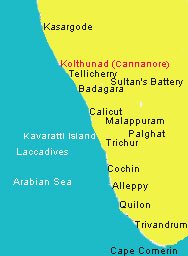 Whichever of those views is correct, it will be noted that the principal actors on the Malayali stage after the flight or pilgrimage of the Muhammadan Pallibana Perumal ought to be the North and South branches of the Kolattiris and the other chiefs who attained independence in consequence of the Perumal’s flight, and if the traditions contained in the Keralolpatti are correct, they ought, after relating the disappearance of the convert to Islam, to go on to describe the chiefs who at this time attained to independence : nor does this test fail, for it will be seen from the details given above that the Perumals described as having reigned after Pallibana Perumal are either the North or South Kolattiris or the Tula or Cochin chiefs. The name “Kerala" even undergo a change, and instead of meaning the whole of the land between Gokarnam and Cape Comorin it comes at this time to signify merely North Malabar, i.e., Kolattunad, the kingdom of the Northern Kolattiris.
In his review of the Kerala Mahatmyam, Dr. Gundert observed 1 :—" The intention of the Purana is evidently to describe Kerala as being first under the rule of the united Travancore and Kolattiri dynasty, the sway of which being contracted by foreign aggression in the north, paved the way for the independent rule of the Kolattiri branch.”
NOTEs: 1. M.J.L.S., XIII, ii, 07. END OF NOTEs
This view, it will be seen, has much in common with what is set forth above, but it is more probable that the circumstances which finally led to the independence of the Kolattiris (or perhaps Kollattiris) were those detailed in what follows in the text.
The natural view to take of the text seems to be that two traditions— one probably a pure Brahman tradition, and the other a more popular tradition—have become mixed up, that Pallibana Perumal was really Cheraman Perumal, and that the Perumals who are recorded in the manner just set forth to have succeeded Pallibana Perumal were in reality the petty dynasties among whom Cheraman Pemmal divided his dominions, in the manner to be presently described, before he set out on his pilgrimage to Arabia.
The Keralolpatti after recording the death of Kulasekhara Perumal proceeds to describe over again the organisation of the Brahmans into an arms-bearing caste in order to protect the country. It is said eight and a half of the gramams took up arms, and were subsequently joined by two others, and it is recorded that seventy-two chiefs of one of the four selected villages fell in battle, but when, or where, or how, is not stated. One person each from two others of the selected gramams are also stated to have fallen in fight. In those cases, the names and the date of the month on which they fell are preserved, chiefly, it is presumed, because death ceremonies had to be performed for them once a year ever afterwards. Those armed Brahmans or protectors had, it is said, four chief things to attend to, viz. : —
(1) To assemble to consult about Government affairs.
(2) To assemble for play.
(3) Sankha Lakshanam, which literally means the characteristic mark of assembly, whatever that may have been. To these throe, which the protectors had from the beginning, was added —
(4) Authority to fix the flag at Tirunavayi, i.e., presumably at the Mahamakham festival held there every twelfth year.
Regarding the above organisation it seems probable that an attempt was made to form some of the Brahmans into a military caste, but it is impossible at present to say when this occurred or what was the occasion for it. That it ever supplied the place of a ruling king in the country is inconsistent with established facts and is, from the account given of the institution, also incredible.
Having dealt with this institution, the Keralolpatti proceeds as follows :—“After the country had been thus governed by the Brahmans of the sixty-four gramams and the Perumal1 for a short period, the sixty-four gramams assembled at Trikkariyur2 temple, consulted and resolved as follows :— ‘ This state of things will not do. The country will be lacking in the administration of justice. The Brahmans will have to leave the country and go away. A king is wanted.'
NOTEs: 1. The military organisation of the Brahmans seems by this to have occurred during the reign of one of the Perumals.
2. Or, as another copy says, “assembled in full at the sandy island of Tirunavayi” (ante p. 163). END OF NOTEs
“They went to the eastern country, obtained an interview with Anakundi Krishna Rayar, and after making various agreements with him asked him to send a king for Keralam to rule for every twelve years. (3He accordingly sent Perumal, the first king, and then Pandi Perumal to rule for twelve years, and after their reigns were ended) he sent the Kshatriya, Cheraman Perumal.
NOTEs: 3. The passage within brackets is a variation in the text. It seems to be on incomplete version of a tradition about the predecessors of Cheraman Perumal. END OF NOTEs
“They sat in the palace of Trikkariyur for the ceremony of coronation. Then the Brahmans of sixty-four gramams gave him an Anayatittu” (a kid of writ) to rule Kerala, the land 100 Katam (leagues) in length, and authorised him to rule as sole Emperor, giving him flowers and water. (4Thus Cheraman Perumal obtained the country of Kerala, 160 Katam (leagues) in length, with water. That Kali year was Swargasandehaprapyam,5 (A.D. 428).”
NOTEs: 4. Variation in the text.
5. Literally, “He went to heaven with his body." The value of the chronogram is 1,288,734 days of the Kali Yuga. END OF NOTEs
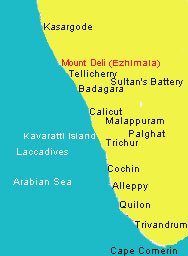 The Anakundi Krishna Rayar mentioned can be no other than the well known (puppet?) King of Vijayanagar, who flourished in the early part of the sixteenth century A.D; and the statement that a Perumal nominated by him came to Kerala in A.D, 428 is sufficiently absurd. This date, like the others already mentioned, is worthless, and the allusion to Krishna Rayar of Vijayanagar must also be inaccurate, since he lived in the first century after the Portuguese arrival, and the account which follows of the partition of Kerala among the existing families of Rajas by a Perumal of his nomination is palpably erroneous.
It is said that Cheraman Perumal after inspecting the country found that Trikkariyur, Tirunavayi and Valarppattanam fort were holy places, and of the eighteen seaports (literally, entrances to the deep), he selected that at Tiruvanchalimukham, and there erected the temple of Tiruvanchakkulam.
At the end of twelve years the Brahmans being pleased with him determined, it is said, to set at nought the injunction of Krishna Rayar that the Perumal was to reign for only twelve years, and they accordingly made him reign for another twelve years.
They next wished to have a race of good Kshatriyas in Kerala, so they sent for a “Surya Kshatriya” woman, and to her two sons were assigned, respectively, the Mushika1 country and the Tulunad1 country.
NOTEs: 1. Mushika here seems to mean the province between Putuppattanam and Kannetti and Tulunad, the country north of the Perumpula. This partition between the two sons of this woman is commented on further down. END OF NOTEs
It is not said that this was a wife of Cheraman Perumal, but on the contrary it is stated that the sons were the sons of a Brahman and of the Kshatriya woman after the fashion current now-a-days in the Malayali Rajas’ families. This tradition relates, as will be seen presently, to the Cochin Raja’s family. The woman was probably a sister or other near relative, natural or adopted, of Cheraman Perumal ; and in, corroboration of what is here stated the Jews, in connection with their copper-plate grant, explain the absence of the Cochin Raja’s name from the list of witnesses to the deed by asserting that he was Cheraman Perumal’s heir.
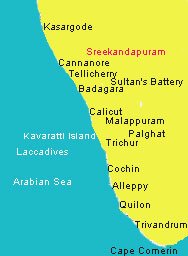 Then follows an account of three women (one Kshatriya and two Sudra), strangers from some northern land being stranded in a boat on Mount Deli. Cheraman Perumal took all of them to wife apparently, and on the descendents of the Kshatriya woman he conferred the title of Elibhupan (king of Eli) with “heirdom to the kingdom,” and he built for her the Elett king’s house at the foot of Elimala (Mount. Deli).
This tradition relates undoubtedly to the northern Kolattiri family, the second most ancient seat of the family having been at this particular king’s house under Mount Deli. The descendants of the other two (the shudra) women became, respectively, the ancestress of the Nerpatt and Chulali dynasties.
These families became the chief feudatories of the Northern Kolattiris. The Chulali dynasty apparently protected the trade2 route between Coorg and the Kolattiris’ dominion which passed through Srikandapuram or Jarfattan, where one of the original Muhammadan mosques, as already related, was built. If it is a correct tradition that the Chulali family is descended from Cheraman Perumal, it was a very natural thing for the Perumal to include among the letters given to Sheikh-ihn-.Dinar one addressed to the Chulali family; and the building of the mosque at such an apparently out-of-the-way spot becomes in this light intelligible.
NOTEs: 2. Srikandapuram is in the Chulai amsam of Chirakkal taluk. It is called in the Keralolpatti Siravupattanam (S. 7, Part 2), which is not far from the Jarfattan of the Arabs. END OF NOTEs
Another remark deserves to be here recorded, for these traditions explain a very powerful influence which was, and it may be added still is, always at work tending to the disintegration of Malayali families and Malayali inheritances. A Malayali king’s natural heirs were his sister’s or aunt’s or female cousin’s children. His own children were the heirs not of their father but of their mother. But from natural affection a suitable provision would always be made for the mother of the king’s children and her off spring; and the provision often took the shape of a grant of territory.
It was undoubtedly thus that the dominions of the Northern Kolattiris became so curtailed in extent. The Kadattunad family thus acquired the portion of their dominions which used at one time to be under the Tekke Ilankur, or Southern Regent of Kollatunad, with head- quarters at Putuppattanam, and the Keralopatti explains how the Nilesvaram dynasty holding the Malayali portion of South Canara sprang from a matrimonial alliance between a prince of the Kolattiri and a lady of the Zamorin’s house.
The more powerful the family of the lady was the more likelihood there was of the provision for her leading to the founding of a dynasty and to its semi-independence of the male parent stock. It is not at all improbable therefore that the Northern Kolattiris are descended from a matrimonial alliance between the last of the Kerala Perumals and a lady of the stock of the great southern feudatory, the Travancore (South Kolattiri) Rajas. The two families have always observed pollution, when deaths occurred in their respective houses, and, as matter of fact, the southern family would have ceased to exist long ago but for the adoption of heirs on several occasions from the northern family.
In all probability a fresh adoption will have to be made in the course of the next few years.
This solution of the problem, while in strict accordance with the text, supplies a sufficient answer to the question why the Northern Kolattiri was not, while his cousin of the south, was a witness to the copper-plate grants whereby the Jews and Christians obtained extensive privileges from two of the Perumals in the eighth century A.D.
This absence of the name of the North Kolattiri from the list of witnesses to those deed led Dr. Gundert to conjecture1 that the North Kolattiri was, at the dates of their execution, independent of the Perumal, but so far as evidence is yet forthcoming there is nothing to show that the North Kolattiri dynasty had a separate existence in the eighth century A.D. ; and it will be seen that the Muhammadan story about the introduction2 of Islam into Malabar renders it probable that the last of the Perumals had sufficient influence over the North Kolattiri to induce him to grant a site for a mosque at Madayi and to endow the institution. This would not have been a very probable occurrence had the North Kolattiri been, for perhaps a century and-a-half previously, as Dr. Gundert conjectured, independent of the Porumals altogether.
NOTEs: 1. M.J.L.S XIII, Part I.
2. Anfep. 194. END OF NOTEs
Cheraman Perumal, the text goes on to say, encouraged merchants and invited Jonaka3 Mappillas (Muhammadans) to the country. In particular he invited4 a Muhammadan and his wife to come from his native land of Aryapuram and installed them at Kannanur (Cannanore). The Muhammadan was called Ali Raja, that is, lord of the deep, or of the sea.
NOTEs: 3. Vide foot-note p. 191.
4. There are other traditions about the origin of the family of the Chief of Cannanore and of the Laccadive Islands, which will be alluded to further on. END OF NOTEs
Cheraman Perumal had reigned for thirty-six years when Krishna Rayar, it is said, sent an expedition to subdue the country and enforce his commands.
Another version of the text says that it was not Anakundi Krishna Rayar but a Pandyan king who invaded the country in Cheraman Perumal’s time : and the reason for the expedition is said to have been that the Perumal himself came from the Chola country, and the Pandyan was jealous of the growth of the Chola influence in Kerala. The Pandyan, it is said, ascended the Anamala mountains, descended through the forests on Kerala, and built a fort in the Taravur country.
To drive back the invaders Cheraman Perumal, it is said, employed Prince Utaya Varmman of the Karippatt1 king’s house, his son by the Kshatriya women : and he also sent for Manichchan and Vikkiran of Puntura,2 or, according to another version, those noble youths while on a pilgrimage came to Tirunavayi, where the Perumal was residing after having sustained a defeat in battle. He was apparently even contemplating a flight in boats when assured by the youths that they would take the fort.
NOTEs: 1. This is the earliest of the seats of the North Kolattiris. It lies in Kurummattur Amsam in Chirakkal taluk.
3 Punturakkon (King of Puntura) is still one of the titles of the Zamorin Maharaja Bahadur of Calicut, and his official title is Manavikraman, a compound of the names mentioned in the text. END OF NOTEs
So the expedition was organised and despatched under the Puntura youths. It is unnecessary to relate the events of the campaign, as they are all more or less of a mythical character and include the mention of the use of fire-arms and cartridges ! ! The battle lasted for three days, and the result was, it is said, that, the Rayar evacuated his fort, and it was seized by the Perumal’s troops. It is also related that the well known body of Nayars, the Ten Thousand of Polanad (country about Calicut), were specially solicited by the Puntura youths and miraculously marked by them with a vulture’s quill. They distinguished themselves greatly on the occasion and earned, it is said, the reward of being stationed in the best district of the kingdom.
It is known from the Jews’ and Syrians’ deeds that the Zamorin’s family had attained the dignity of Utayavar for at least a century before the dawn of the Kollam era ; the tradition then, which makes the Perumal summon the boys from school, as one version relates, to lead his army, is apochryphal unless indeed there is here to be found the real tradition of the founding of the family some considerable time previously to the reign of the last of the Perumals. It is not at all unlikely that a battle against invaders coming via Anamala, that is, through the Palghat gap, did take place, and the gallantry of the ancestors of the Zamorin brought them on that occasion into favourable notice, but it must have been on an occasion long prior to the beginning of the Kollam era.
Again it is noteworthy that the North Kolattiri, whose name is also mentioned, seems to have played no part in the campaign conducted by the Puntura youths, although, as said above, the Perumal had selected him to drive back the invaders. But this is unaccounted for if it be supposed that Kerala was threatened from two sides simultaneously—from the north via the coast, and from the east via the Palghat gap—and it may be added that, as the Keralolpatti itself says, invasions became frequent, and invaders apparently did come from both directions about this time. The North Kolattiri may possibly have reconquered for the Perumal the Malayali territory (North Malabar) which from the first description of the limits of Kerala (ante p. 224) seems to have been previously lost to the latter.
The “heirdom to the kingdom” conferred on him by the Perumal may have subsequently led to the designation of Kolattunad as Kerala (ante p. 228); but however this may be, it is pretty certain that the North Kolattiri had the duty assigned to them of protecting the north of the Perumal’s domain, just as their cousins of the south (Travancore) had already for some generations been guarding the southern passes.
“At the time of this successful war” continues the Keralolpatti, “there was born as the son (or incarnation) of Mahadevan (Siva) a celebrated genius. It was he who was afterwards known as Samkaracharyar”. And the text goes on to give one of the versions of his life which have already been summarised.1 He is further stated to have laid down laws for the guidance of the Malayali Brahmans in all the ordinary business of life, as well as for the Sudras and other classes. The Sudras (Nayars) were told off to “battle, hunting, service, guard, convoy, and escort.”
It is also incidentally mentioned that subsequently to the reign of Mayuravarmman in Malayalam, or, as another version has it in Toulavam, i.e., the Tulu province (South Canara), the Rajas were in the habit of adopting the suffix of Varmman or Sarmman to their names. The text next diverges into a general account of the Malayali castes and mentions among other facts that the Chinese were among the merchant immigrants, as also were “the men of round hats (!)” of whom there were four castes, viz. : — 1. Parinki (Portuguese), 2. Lanta (Dutch), 3. Parintirias (French), aud 4. Inkiriss (English).
The various castes, including apparently the "round-hatted” Europeans, are said to have been told off to their various functions in the State by Samkaracharyar himself. The text runs: “Thus Samkaracharyar laid down the rules to be observed by the seventy-two classes,” and he is said to have solemnly proclaimed the same “on the day next after the Mahamakkam which occurred in the month of Kumbham in the year of the cycle of Jupiter when he was in the sign of the Crab.”
This account of Samkaracharyar, which makes him a contemporary of the last of the Perumals, is interesting, because, as a matter of fact, the tradition on the point is probably correct. The last Perumal, for reasons stated, probably left Kerala on his voyage to Arabia on or shortly after the 25th of August 825 A.D., and the latest authority1 for Samkaracharyar's date places it at 788-820 A.D. As the last Perumal is understood to have reigned for thirty-six years, it follows that he was a contemporary of the “gracious teacher.”
NOTEs: 1. Ante p. 187. END OF NOTEs
The mention of Mayuravarmman's name is also important, as it was he who, according to other extraneous traditions to be noticed shortly, first introduced Vedic Brahmans into Kerala. The time when this occurred will be noticed further on, but it is important to observe that the tradition is that he was ruler of the Tulunad (Canara) Province only.
The Keralolpatti next proceeds to detail the division made of the Malayali Provinces by Cheramam Perumal : “While Cheraman Perumal was thus ruling the kingdom independently he thought as follows :— “This country was given as a poured out-gift by Parasu Raman to the Brahmans. I have enjoyed it for so many years. How am I to expiate that sin? He consulted several Sastris (selected Brahmans). They informed him the expiation was not to be found in the six Sastras and three Vedas and that the remedy must be sought for in the fourth Veda.”2
NOTEs: 2. Vide p. 191. The fourth Veda is the Koran.END OF NOTEs
Then it goes on to relate how the Perumal wished to punish his minister for a fault, which strangely reminds one of the story of Joseph and Potiphar’s wife. The minister was miraculously saved, it is said, by being taken straight up to heaven, and his last words were to the “Ten Thousand” to “do his office of body guard.”
The name of the minister was Patamalanayar3 and therefore he was a Sudra (Nayar). As he was ascending to heaven the Perumal asked him : “How can I attain eternal bliss?” and the reply of the minister was that he should join the Muhammadans, go to Mecca, and there he would through the efficacy of the fourth Veda attain half bliss.
NOTEs: 3. Pata = warfare, Mala = hill, and Nayar = caste of fighting men. END OF NOTEs
This version of the tradition contains what was a sufficient reason for the secrecy of the Perumal’s final departure as related by the Muhammadans. The Perumal had evidently for some reason entertained suspicions of the loyalty of the “Ten Thousand ” —of the body guard, that is to say. He seems to have put the chief of that corps to death, and it was incumbent on the survivors by the old established custom of Kudipakka4 (blood feud), to seek his death in return.
NOTEs: 4. Vide p. 169. The Nayar hostages on board Vasco da Gama’s ships, when warned of the fate which awaited them because of the Zamorin’s having treacherously detained da Gama on shore, replied —“Yes, that there they were, and if any harm were done to the Ambassador on shore, the Portuguese might cut off their heads if they pleased, for they were men who had brothers and relations on shore who would revenge their deaths even upon the person of the King.” (Correa.) END OF NOTEs
Another tradition is that the Perumal’s final dispute was with the Brahmans as they were bathing in the holy water on the day of Mahamakham5. It related to the Vedas, and it is said that, being offended, the Perumal determined to go to Mecca with the Mappillas [Baudahas (sic)].
NOTEs: 5. Vide p. 163 END OF NOTEs
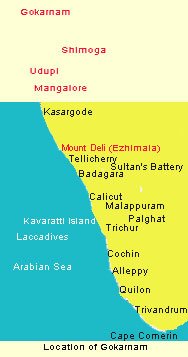 Whatever the immediate moving cause was, the Perumal, it is said, determined to partition his dominions among his friends and relatives. “Between Gokarnam and Cape Comorin, within Kannetti1 and Puttuppattanam, there lie on the south Changalappuratta port, and on the north Putupattanam1 port, on the east the eighteen mountain passes, on the west the eighteen entrances to the deep. Between these and the four corners, north-west, north-east, south-east, and south-west, lies the country of Cheraman.1 (Parasu Raman’s land) 160 Katam in extent. The adjoining five countries are Pandi, Kongu, Tulu, Vayanad, Pimnad.”
NOTEs: 1. N.B.—Cheraman's country by this description excluded the dominions of the two Kolattiris. END OF NOTEs
“In this country of Cheraman, Utayavarmman Kolattiri was made Perumal of the north (Crowned King and Lord of Kerala); Kolattiri was then crowned. The two barons of Kolattiri, namely, the two Nambiyars, Chulanna (Chulali)Kammal and Nerpetta Kammal, were each given twelve Katams (leagues) of territory and 12,000 Nayars. Cheraman, then blessed Utayavarman and said to him :2 ‘If I return you shall be Ilankuru (heir apparent), if I don’t return you shall have Cheraman’s crown (chief authority).’
NOTEs: 2. Compare the declaration which the Maharajas of Travancore have to make at their coronations (ante p. 231).END OF NOTEs
Then in the south to the Venatatikal3 (of Kulasekhara's dynasty) were appointed 350,0004 Nayars armed to serve him in the Omana new king’s house (on the right hand side of the fort at Kalkkulam) and territorial kingly authority (over Onanad and Venanad). Cheraman said to him: ‘You must assist Kolatliri and expend money' and he appointed him ruler5 (Valuvan) of the Kuvala kingdom. Then to the Surya Kshatriya, he gave fifty-two Katam (leagues) of territory, many (fighting) men, eighteen barons, and forty-two (or seventy-two) ministers, and conferred on him the title of Perimpatapp6 ... (His younger7 brother Kavi-simhaveru was appointed to protect the Tulunad, and was given kingly authority to the north of the Perimpala. Four chiefs were ordered to support him, viz., Parampar (Bangar of Nandvar) Ajalar (Ajilar) Savitlar (Chantar of Mudubidri) and Samantareru (Samantar of Mulukki).”
NOTEs: 3. The Travancore Maharaja.
4. The same number were assigned to the North Kolatliri.
5. It is beyond doubt that the Travancore Chiefs were Utayavar (the same word as the Woddear, e'c, of Coorg, Mysore, etc.) of the south long before the last Perumal’s time. See also the declaration which the Maharajas still have to make at their coronations (ante p. 231).
6. This is still one of the titles of the Raja of Cochin.
7 From another version. END OF NOTEs.
The text then goes on to say that donations of territory, etc., were given to the Poralatiri of Polanad , to Kurumbaratiri (or Kurumbiyatiri), (to the Raja of Kollam)8 to the Raja of Pantalam lying between Venanad and Onanad, to the Parappur, and Vettatt, and Kayankulatt Cherayi dynasties. To Valluvakkonattiri he assigned a nad (or country) and the privilege of conducting the Mahamakham1 festival at Tirunavayi. He is said to have conferred on the Valluva Konattiri the title of Arangattu2 or Arangottur3.
NOTEs: 8. That is, north Kollam (ante p. 72). This occurs in one version of the text, and it is probably an interpolation to suit subsequently existing facts, and indeed of what is here stated seems to be in the same case, for the only Malabar Utayavar families mentioned in the Jew’s and Syrians’ deeds are the Zamorins, the Valluvanad and the Palghat Rajas.
1. Ante p. 164.
2. The title was in use before the last Perumal's reign. The Valluvanad Raja was thus designated in the Jews’ and Syrians’ deeds. The name literally signifies the chief of the nad or district lying across (angottu) the river (ar) from the Perumal's palace at Kodungallur, i.e., the district north of the Ponnani River. END OF NOTEs
Under this arrangement, the Zamorin was left out in the cold, so, it is said, that as the Perumal was about to set sail for Mecca, the survivor, according to one version, of the two Puntura youths, one (Manichan) having fallen in battle, went to the Perumal, who told him he had already divided his kingdom, that there were left only one Desam so small that a cock3 crowing could be heard all over it, also one bit of thorny4 jungle, that he could give him these and that he was sorry he had not come sooner. The Puntura youth, it is said, agreed to take this insignificant, gift accompanied, as it, was said to be, with the Perumal's sword5, and with the advice to “die, and kill, and seize” and to make himself master of all the Malanad. The Perumal gave the territory and the sword with water, and one version says he gave the sword to Manichchan and the water to Vikkruman, both being alive and present.
NOTEs: 3. Allusion is here made to the popular derivation of the name of Calicut Koli (fowl) and Kottu (a corner or empty space) or Kolta (a fort
4. Perhaps a salt swamp was intended if the thorny bush referred to was the waterholy (chulli) so common in the salt marshes.
5. The frontispiece to this volume is an engraving from a sketch of this weapon, as still preserved by the Zamorins. The blade is rusted to the scabbard, and the whole of the weapon, which is 3 feet 2 inches in length, has been carefully coated with a copper covering to preserve the original. It is daily decorated with flower wreaths. The weapon used to play an important part at the Mahamakkam festival at Thirunavayi (ante p. 163 6) and it was in all probability the weapon which the Perumals used on the occasions « of the occurrence of the assembly every twelfth year of the people at that festival. It may have been the sword of Bhadrakali referred to (ante p. 226). END OF NOTEs
The Zamorin was forbidden, it is said, to go to war with either the North or South Kolattiris, but he might go to war with the other chiefs.
The Perumal, it is further said, distributed territory among other petty chiefs and feudal lordships among others. He is also said to have appointed four men (named) to commit the laws and customs to writing, and they met at the Mahamakham festival on the day of Puyam, in the month of Magaram, when Jupiter was in Cancer.
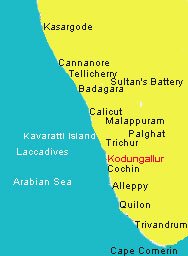 "After doing all this, the Perumal left the sandy island of Tirunavayi with the people of the Veda and descended from a ship at harbour and entered the palace of Kodungallur with a view to proceed to Mecca (Cheruman embarked for Mecca with the people of the Veda). It was in the Kali1 year (Cheraman desaprapyah)” (A.D. 355). Then follows the Mappilla version of the story, as already summarised,2 but with the addition that the ship in which he sailed was pursued by other ships and it was only by fighting hard that he escaped.
The proper light in which to regard these last traditions is undoubtedly to view them as a repetition of the traditions already commented on, which detail how various Tulu and North and South Kolattiri Permals succeeded to the Muhammadan convert Pallibana Perumal. Cheraman Perumal may safely be taken as identical with Pallibana Perumal, the traditions about the latter being from a Brahman point of view, while those about the former are from the point of view of the common people.
The exclusion of the domains of the two Kolattiris or Kollattiris from the kingdom of the Perumal, and yet his having granted territory to them before leaving for Mecca is probably to be explained by the fact of his having conform to the “heirdom to the kingdom,” i.e., future independence of future Perumals, on the North Kolattiris, and of his having conferred somewhat similar authority on those of the South. Their independence may have been recognised before the Perumal sailed for Arabia. The dates on the Zaphar tombstone record the Perumal’s arrival at that place as having happened some time after the Kollam era commenced, and it has been already suggested (ante, p. 196) that he may have spent at sea and at Shair Makulla, where he first landed, the interval that elapsed between the date on which he set sail (presuming that date to have been the initial day of the north Kollam era) and the date recorded on the tomb of his arrival at Zaphar.
But it is equally probable that he did not sail till some time after having partitioned his dominions in the way described, and the initial day or days of the Kollam eras may have been the day or days on which he conferred the “heirdom of the kingdoms ” on the two Kolattiris or Kollattiris. It is in favour of this view that the tradition regarding the partition by himself of his own kingdom is so strong.
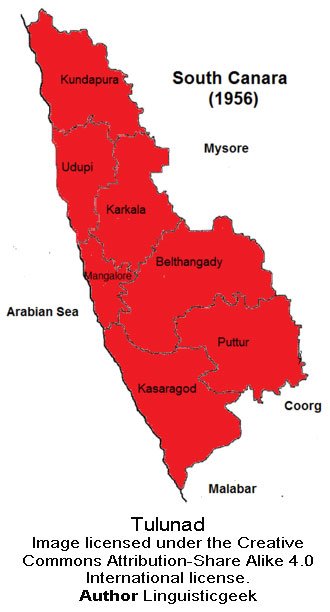 The tradition about the grants of territory to the Perimpatapp (Cochin) and Tulunad Rajas, the sons of the Surya Khshatriya woman, presumably a sister or female relative, natural or adopted, of the Perumal, is merely a repetition of the tradition already commented on above (ante, p. 231). This tradition throws some light on the Muhammadan story about the introduction of Islam, for if the Perumal’s dominion extended only from Putupattanam to Kannetti as related, it is difficult to understand how the Perumal’s letters should have obtained for the Muhammadans such a favourable reception at Mangalore, Barkur and Kanyarott (Cassergode) which all lie in South Canara.
At the same time of course this tradition that the Perumal assigned the Tulunad to one of the brothers is inconsistent, with the tradition, already commented on, that prior to this Perumal’s reign the Tulunad had been definitely severed from the Kerala kingdom.
It may be suggested that a connection, either natural or adoptive, existed between the Perumal and the Tulu king. After Mayura Varmman's time it will be noted the Perumals are said to have adopted the suffixes of Varmman and Sarmman to their titles. The first authentic instance of the use of such a surname by a Perumal occurs in the Jews’ deed (circa 700 A.D.). This fact points to a close connection between the Perumals and the Tulu kings, and if the Surya Kshatriya woman was adopted by the Perumal from the Tulu king’s family, it is not difficult to understand how her sons obtained Cochin and Tulunad, respectively, nor to understand how the Perumal even after his setting out for Mecca should have retained influence in Tulunad.
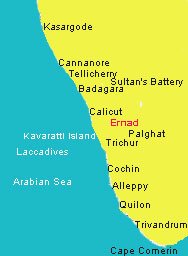 Finally, there remains the important point that the Zamorin was treated so shabbily by the departing Perumal in the matter of the grant of territory. The Jews and Syrians’ deeds show that the Zamorin had long previously attained to the rank of Ulayavar of Eralinad or Ernad, so that the family did not spring into existence at this time which was probably 125 years later than the date of the earliest of those grants. The differences between the Perumal and the Ten Thousand, whose headman the Perumal apparently put to death, had probably something to do with the matter, for the Ten Thousand were in later times at least the Zamorin’s bodyguard.
The Ten Thousand were moreover the troops specially selected by the Zamorin with which he repulsed the invaders. The Nayar of Calicut, one of the small bits of territory assigned to the Zamorin, was, up to the time of the British occupation, one of the leaders of the Ten Thousand, and the text after describing the victory also runs that the Perumal out of gratitude for the success the Puntura youths had won called them before him, told them he would make them his successors, or heirs (Anantaravar), and station them at Calicut ; so that there is much reason for the inference that the Zamorin had cast in his lot with his favourite troops and there is little wonder then that he was not in favour with the Perumal at his departure.
It is not at all improbable under these circumstances to suggest that the Zamorin’s power and influence had been increasing after his successful repulse of the invaders, that this had excited the Perumal’s jealousy and had led him to adopt stringent measures against the Ten Thousand, ending naturally enough in his being obliged to flee the country after providing, as best he could, for his immediate relatives. In corroboration of this view it is at least suggestive that not one of the original Muhammadan mosques founded by Sheikh-ibn-Dinar was situated in territory under the sway of the Zamorin.
The grant of territory to the Valluvakonattiri (Valluvanad) and the grants to the other petty chieftains who are named in the text were not, it may be presumed, made at this time ; for the Valluvakon, as evidenced by the Jews and Syrians’ deeds, had been an Utayavar of a nad (county) like the Zamorin and Travancore Rajas for several generations before the Perumal left Malabar.
This ends the portion of the Keralolpatti dealing with the earliest traditions and with those current concerning the Perumals. The remaining traditions relate to the subsequent changes among the ruling families wrought after Cheraman Perumal’s departure (circa 825 A.D.) and will be best considered further on.
It remains to sum up the traditions already narrated and commented on before proceeding to detail such scraps of the ancient history of Malabar as are to be gathered from other sources. It cannot be doubted that the first half of the ninth century A.D, was an important epoch in the history of Malabar and of the Malayalis.
It is beyond all doubt that events of sufficient importance occurred at this time to create an era, which, dating in Malabar, Cochin and North Travancore from the 25th day of August 825, continues down to the present day to be the era in common use by the people.
What those events were may perhaps be gathered from the traditions now under consideration. The chief event was the termination of the reign of the last of the Kerala or Chera Perumals or Emperors, who for centuries had been kings of the land ; for it may be assumed, until evidence to the contrary is forthcoming, that the Muhammadan tradition is correct, and that the Hindu King of Malabar, who lies buried at Zaphar in Arabia, was indeed Cheraman Perumal.
The dates on that tombstone, which however still require verification, place this event as closely contemporaneous with the inauguration of the new era. Why it was called the Kollam era these traditions also seem to explain ; for the independence, until Cheraman Perumal should return, of the two branches of the Kolattiri (or perhaps Kollattiri) family seems to have dated from this time, and to have been brought about in the manner already described in the commentaries on those traditions.
Of the events which preceded, and of the Perumals who reigned in the county prior to that event, these traditions tell next to nothing, and the reason is not perhaps far to seek. Those traditions are mainly of Brahmanical origin, and from facts which will be detailed in the following section it is pretty certain that the Brahmans had not, for more than a generation or two at most, been settled in the land when Cheraman Perumal assumed the reins of Government.
The Brahmans are notoriously careless of history and of the lessons which it teaches. Their lives are bound hard and fast by rigid chains of customs. The long line of Chera kings, dating back to the “Son of Kerala”, mentioned in the third century B.C., in King Asoka’s rock-out inscriptions, had for them no interest and no instruction; and it is not to be wondered, at that the mention of them finds in the Keralolpatti no place.
What is substituted for the real history of this period in these traditions is a farrago of legendary nonsense, having for definite aim the securing to the Brahman caste of unbounded power and influence in the country. The land was miraculously reclaimed for their benefit ; the whole of it was made over to them with the “blood-guilty water of possession” ; they were the first inhabitants ; the kings were appointed and the land was governed by them ; and the only allusion to prior occupants is an obscure allusion to the “serpents”, from fear of which the first immigrants fled back to the country whence they came.
This allusion to the serpents, who “protected” the land, contains perhaps an allusion to Jaina immigrants, worshippers of the twenty-third Jaina, Tirtham Kara, Parsva or Parsvanatha, whose symbol was a hooded snake. That the Perumals were originally of the Jaina persuasion is not at all improbable, considering the facts already stated (ante p. 184-86) regarding the style of religious architecture still prevalent in the land.
Judging by the extent of country over which this Jaina style of religious architecture prevails, the limits of the old Chera kingdom were not improbably those which it is said Parasu Raman miraculously reclaimed from the sea, viz., Canara, Malabar, Cochin and Travancore. But when the bearers of these traditions first came into the land Chera or Kerala had dwindled down to the small province of South Malabar, Cochin and North Travancore (Putuppattanam to Kannetti), and it was apparently to these limits that the name of Kerala, thus imported into Malabar at this time, was originally applied by Malayalis themselves.
There is also to be learnt from these traditions that the time was ripe for religious movements, the last Perumal became a convert to Islam, and the great Samkaracharyar, himself a Malayali, was engaged in creating the revival of Hinduism which has moved so profoundly every generation since.
The “great1 saying” had just gone forth, and the words “Thou art that” had set for the great mass of the people an exemplar which they have patiently and piteously, but very imperfectly, been studying ever since to attain. It was a fitting time for the commencement of an era, and the dynasty of the ancient "Sons of Kerala” (Keralaputran) drew appropriately to a close as new religious light began to be disseminated in the land.
NOTEs: 1 Ante p. 189. END OF NOTEs
It has been noticed that the Maharajas of Travancore have still to declare at their coronations that they hold their territories only on sufferance until their kinsman returns from Mecca. The Zamorins too, at their coronations, have still, when crossing the Kallayi ferry, to take betel from the hands of a man dressed up as a Mappilla woman, and are actually put-out of caste2 by the ceremony, and have to live separately thereafter to their manifold discomfort."
NOTEs: 2. Was this brought about by their having been constituted as Cheraman Perumal*a successors or heirs after the victory obtained over the invaders!. END OF NOTEs
These are no doubt relics of the time when the Perumal turned Muhammadan and left the country to its own devices. The Travancore, the Valluvakon [literally king of the Valluvar (? Pallavas)], and the Zamorin Rajas were left free by his flight to establish themselves as independent kings of their respective little States.
The Cochin and perhaps the Tulunad Rajas and the North Kolattiri Raja, the Chulali and Nerpett Kammals, being his heirs and children, respectively, were, as these traditions seem to show, provided for with grants of territory and with men to defend them ; and thus the country was split up into little kingdoms, which under ordinary circumstances would have immediately set to work to devour each other. The organisation of the militia, however, as will be explained presently, served to retard the process, and though it may seem strange that after the lapse of so many centuries nearly all of those identical families should have remained in existence, still it is a fact which deserves careful consideration that these very families were the chief among those with whom the British Commissioners came into contact in 1792 when reorganising the country after Haider Ali’s and Tippu’s wild raids through it.
Section B.—Early History from other Sources.
Some of the more remarkable of the vegetable and animal productions of the Malabar Coast have been known to Western nations from times antecedent to the Christian era, and have been the objects of maritime enterprise and commerce through all the succeeding centuries.
Perhaps as early as the time of Moses, the great Jewish law-giver, this commerce existed, for cinnamon and cassia played a part in the temple services of the Jews (Exodus xxx. 23, 24), and at any rate the commerce existed in the time of King Solomon (c. B.C. 1000), for the Bible narrative records that silver “was nothing accounted of in the days of Solomon”—everything was of gold. “For the king had at sea a navy of Tharsish with the navy of Hiram ; once in three years came the navy of Tharsish, bringing gold and silver, ivory,1 and apes and peacocks ” (I Kings x. 22).2 With the exception perhaps of silver, these are all production of the Malabar Coast, and the biblical name for the peacock — tuki—is evidently the Tam. Mai. tokei, the bird of the tail.
NOTEs: 1. Elephants’ teeth.
2. Conf. Genesis x. 29 ; I Kings ix. 28, x, 11, and xxii. 49 ; I Chronicles xxix. 4 ; II Chronicles viii. 18, and ix. 10, 21 ; Job xxii. 24, and xxxix, 13 ; Isaiah xiii. 12. END OF NOTEs
Again, Solomon obtained his gold from Ophir. It is hazardous after all that has been written about this place to contribute anything more to the controversy, for as Master Purchas quaintly wrote about it ; “This Golden Country is like Gold, hard to find, and much quarrelled, and needs a wise Myner to bring it out of the labyrinths of darknessse, and to try and purifie the Mynors themselves and their reports.” (Purchas His Pilgrimes I, 25.)
But it may as well be pointed out that Beypore lies at the mouth of the river of the same name, which still brings down gold from the auriferous quartz region of South-East Wainad, the mines of which were well worked in pre-historic times; that Tundis, the “village of great note situate near the sea”, mentioned in the early centuries A.D. by the author of the Periplus Mar. Eryth. (ante. pp. 70-80), lies close to Beypore on the southern bank of the same river ; and that the country lying inland from these places is still called Ernad — the bullock, that is grazing, country.
If Ophir, as is generally now supposed, meant, the country of the Abhira or cowherds (? Kurumbar) then the name of Ophir fits the locality indicated as well as, or bettor perhaps than, any of the very numerous other places with which it has been identified. There has also been much learned disquisition on the word Tharsish, and the name perhaps survived1 on the coast till the ninth century A.D. in the word Tarisa-palli or church of the Tarisa (Tharshish?) people, which occurs in the third of the ancient deeds published in Appendix XII.
NOTEs: 1. .J.L.S. XIII, part I END OF NOTEs
The fact remains to the present day that Jewish colonies are settled on the coast, and if their progenitors, often of course replenished by further immigrations, did not come with King Solomon’s fleets, they have at least traditions which carry back their arrival on the coast to the time of their escape from servitude under Cyrus in the sixth century B.C. And if the Jews were settled on the coast at the early period mentioned in their traditions, they would have had no difficulty in maintaining intercourse with their native land, for in Herodotus’ time (B.C. 484-413) the trade with the East was maintained.
About 600 B.C. Scylax, a Greek sent by Darius, had voyaged home by sea from the mouth of the Indus. Herodotus mentions that the Red Sea trade in frankincense and myrrh, and cinnamon and cassia (the two latter being Malabar products), was in the hands of the Egyptians and Phoenicians, but these traders do not appear to have proceeded beyond the port in Arabia Felix (Aden probably) where these goods were procurable.
Of India proper Herodotus’ information is scanty, and, though capable of corroboration in some respects, inclines to the marvellous. In the end of the fourth century B.C. the Greek writer Ktesias probably alluded to cinnamon, a common product of Malabar, as karpion, a name which seems to have been derived from the Tam. Mai. karuppu or karppu. In this same fourth century B.C. occurred Alexander the Great’s expedition into Northern India, and Megasthenes, the Greek ambassador sent by Seleucus Nicator to the Indian King Chandragupta’s (Greek Sandrocottus) court gathered some scanty information about Southern India. It is certain from his account that the Pandyan kingdom then existed, and the people whom he styles “Charmœ” and places correctly next to the “Panda” can be no other than the aborigines of Chera, whe to the present day probably exist in the Cherumar or agrestic slaves of Malabar (conf. p. 147).
It is also noteworthy in this connection that Megasthenes alludes to the fact that the southern peoples were ruled by queens, He accounts for it by a mythical story of the Greek hero Heracles having left the kingdom to his daughter. As all the Malayali chieftains’ houses are still, theoretically at least, subject to the eldest lady in each, it is probable that in the earliest ages the kingdoms were in fact governed by females. One of the successors of King Chandragupta in Northern India was the “King beloved of the gods”—King Priyadasi—whe reigned in the middle of the third century B.C. This king, better known as Asoka, left behind him certain edicts engraven on rocks in different parts of the country, and in one which occurs at Girnar the legend runs as follows : —
"In the whole dominion of King Devanampriya Priyadarsin, as also in the adjacent countries, as Chola, Pandya, Satyaputra, Keralaputra, as far as Tamraparni, the kingdom of Antiochus the Grecian king, and of his neighbour kings, the system of caring for the sick, both of men and of cattle, followed by King Devanampriya Priyadarsin, has been everywhere brought into practice, etc., etc.
It is matter of controversy whether King Asoka, was Jain by religion or a follower of Buddha ; but the evidence seems to favour the former conclusion. Jain missionaries doubtless at this time spread over the Malabar Coast, and there are still relics of them left in the Jain settlements in Canara, and in the peculiar Jaina style of architecture of religious edifices still prevalent all over the Malayali tracts and Canara.
About this style of architecture Mr. Ferguson’s very pertinent remarks have already (ante, pp. 185-6) been quoted. It is a significant fact that nothing like it exists at any point on the continent of India nearer than Nepal, and the coincidences which Mr. Fergusson points out in the circumstances of two countries geographically so distant from each other, makes it more than probable that Aryan civilisation was first imported into Malabar by Jain missionaries, and this event probably occurred about the time of King Asoka in the third century B.C. If this style of architecture had been peculiar to the later Brahman colonists, and if these latter had, as usually asserted, such commanding influence in the country from the very first, it is almost certain that the Muhammadans would not have been permitted to adopt it in their mosques, for these too are almost universally constructed in the same style.
In this edict of King Asoka’s the country is styled Ketala or Kerala, the name which occurs, as already described, in the Keralolpatti. It is a dialectic (Canarese) form of the ancient name Keram, or Cheram, or Chera, a name which still survives in the Cheranad or country lying round Tundis, the “village of great note situate by the sea” already more than once referred to, and in Cherumar1 (Megasthenes’ Charmœ?), the aboriginal inhabitants, now the agrestic slaves of the community.
NOTEs: 1. Conf, pp. 147-53. END OF NOTEs
On the breaking up of Alexander the Great’s Empire, the cities of Phoenicia and their Red Sea trade passed with Egypt into the hands of the Ptolemies, Egypt then became not only the centre of literary cultivation and learning for the Hellenic world, but an emporium of trade and the centre of great commercial enterprises. The Red Sea trade, which had previously crossed the Isthmus of Suez to the Phoenician city of Tyre, was diverted to Alexandria. Ptolemy Philadelphus (B.G. 285-247) founded a city (called Arsinœ after his wife) in the Gulf of Suez, and proceeded t o open a canal from that place to the Nile. But owing to the dangers of navigation in the gulf, this project was abandoned and a port (called Berenice after his mother) was opened nearly 500 miles down the Red Sea, and this gradually became an emporium of trade.
The merchandise was thence transported overland to Coptos on the Nile, whence it descended the river to Alexandria. But Myos Hormos, lying further north than Berenice, was next found to be in some respects even more conveniently situated than the latter for the land transhipment, of goods to Coptos, and so the trade with India for a time centred itself at this place.
Like their predecessors the Phoenicians, however, the Egyptian Greeks contented themselves with buying Eastern merchandise from the Sabæans (Arabs), and Aden was probably the port in which the Arabian and Indian merchants met the Greeks and exchanged their goods.
It was not till about 120 B.C. that an attempt was made to go direct from Egypt to India. A Hindu said to have been, wrecked in the Red Sea volunteered to take a ship to India. The ship was fitted out and in it sailed Eudoxus of Cyzicus. The voyage was successful ; the ship brought back a valuable cargo, but it was appropriated by the king (Ptolemy Euergetes II). The same fate befell a second expedition sent out by Cleopatra. Strabo wrote of Eudoxus’ attempt to reach India as something altogether new and exceptional.
These facts explain the barrenness of the Greek writers on the subject of India. Their accounts at this period are derived from Megasthenes and contemporaries of Alexander the Great, not from direct information obtained from merchants and travellers. Eratosthenes (B.C. 270) thought India lay east and west ; he was familiar with Ceylon (Taprobane), but made it far too large—8,000 stadia—and extending east and west.
Very little advance on this state of knowledge had been made even so late as the time of Strabo (about B.C. 54 to A.D. 25), but an important change came with the conquest of Egypt by the Romans, for the trade passed directly into their hands and they were not long in tracing it out to its sources. The first important advance was made by a Greek named Hippalos, who, acting on information received probably from Arab or Hindu informants, boldly stood out to sea from Cape Fartak in Arabia, and sailing with the south-west monsoon trade winds, found a direct route to the pepper-bearing country of Malabar.
This event, as already described (ante, p. 32), occurred in the early part of the first century A.D. And about this same time (A.D. 24) the first Hindu embassy from King Porus, or, as others say, from the King of Pandya, proceeded to Europe and followed the Roman Emperor Augustus to Spain, It was on this occasion that an ascetic (probably a Jain) who accompanied the expedition voluntarily sacrificed himself at Athens on a funeral pyre.
With increased trade came increasing knowledge of the countries whence the spices came. The fullest account of the trade about this time is contained in the Periplus Maris Erythræi, from which a passage has already been quoted (ante, pp. 78-80). It is matter of controversy whether this account was written in the first century A.D. or at a later date (third century A.D.), but, however this may be, Roman authors of the first century A.D, amply attest the fact that a large trade existed.
Petronius in the early part of the first century A.D, reproached the Roman matrons for exposing their charms in Indian muslins, which he called “woven wind” or “a texture of cloud.”
Pliny (A.D. 23-79) raked together without much discrimination a vast amount of information regarding the subjects he wrote about. He countenanced a story of Hindus having sailed round the north of Asia and Europe and having been wrecked on the coasts of Germany, but he seems to have acquired a very exact idea of the navigation as practised in his day after the discovery by Hippalos of the direct route to the Indian shores.
“Afterwards” he wrote, “it was found the safest course to proceed direct from the promontory of Syagrus in Arabi” (Capo Fartak) “to Patale” (probably Pantalayini1 or Pantalayini Kollam see pp. 72-73) “with the west wind (Favonius), which they call there the Hippalos, a distance reckoned at 1, 435 miles. In the next generation it was judged to be both a safer and nearer course to proceed from the same promontory direct to Sigerus,2 a port of India.
NOTEs: 1. Down to the present day this port is generally the first one touched at by ships from the Arabian coast, and it was to its immediate neighbourhood that the "pilots brought Vasco da Gama’s ships. Moreover it was in former times and even till quite recently—till steam ships superseded sailing ships—a very favourite port of departure for the Arabian coast and Persian Gulf. Pilgrims to Mecca used to set sail from it in large numbers formerly.
2.The Melezigara of the Periplus Maria Erythrœi and the Melezigyris of Ptolemy — probably Viziagur, 120 miles south of Bombay. END OF NOTEs
And this mode of navigation was preserved for a long time until merchants discovered a shorter route, and the profits of India were thus brought nearer to land. The voyage is now made every year with cohorts of archers on board the ships ; on account of the pirates which infest those seas”.
He estimated that India took 65,000,0003 sesterces annually, and the goods purchased brought a hundred times that amount when sold in Europe. He described the journey by the trade route through Egypt and then proceeded as follows: — “They begin the navigation in the middle of summer before the rising of the Dogstar, or immediately after its appearance, and arrive in about thirty days at Ocelis in Arabia, or Cane in the frankincense-bearing region. There is also a third port called Muza which is not frequented by those sailing to India, but by the merchants whe trade in frankincense and other Arabian perfumes. In the interior is a city, the capital of the kingdom called Sapphar,1 and another called Sane. But for those whose course is directed to India it is most advantageous to start from Ocelis. From thence they sail with the wind called Hippalos in forty days to the first commercial station of India named Muziris (ante, p. 78), which is not much to be recommended on account of the neighbouring pirates,2 who occupy a place called Nitrias3 nor does it furnish any abundance of merchandise.
NOTEs: 1. This is evidently Zaphar, where Cheraman Perumal lies buried (ante, p. 196).
2. Conj. pp. 69 and 72.
3. Query: Can this be Nittur in Kottayam taluk, adjoining Tellicherry? END OF NOTEs
“Moreover the station of shipping is far from the land, and cargoes have to be loaded and unloaded in barges. The ruler of the country at the time of which I speak was Cottonara4. There is another more advantageous port, which is named Barace5 in the territory of a nation called the Ncacyndi. The king of that country was named Pandion6 whe resided far from the port in a city of the interior which is called Madura. But the region from which pepper is brought to Barace in barges hewn out of single trees is called Cottonara7. None of these names of nations or ports or cities are found in any former writer, from which it is evident what changes take place in the state of things in those countries. They commence the return voyage from India at the beginning of the Egyptian month of Tybis, which answers to our December, or at all events within the sixth day of the Egyptian month Mech’r, that is, within our Ides of January. Thus it comes to pass they return home within the year. They make the return voyage from India with the south-west wind (Vulturnus), and, when they have entered the Red Sea, with the south-west or south wind.”
NOTEs: 4. In one manuscript it is written Celobotras. It is clearly intended for Keraputran or Cheraputran ~ king of Chera.
5. This place was probably situated close to Southern Kollam at the mouth of the Quilon river. It is called Bakare in the Periplus Maris Erythrœi (ante, p. 79).
6. The Pandya kingdom, with Madura for capital, is here very clearly indicated.
7. Called Kottonara in the Periplus Maris Erythrœi (ante, p. 80). Some writers have identified this place with Kadattunad in North Malabar, and with Kolattu Nad (North Malabar), but it is unnecessary to go so far afield, and the fact stated that the pepper came in barges hewn out of single logs of timber makes it in the highest degree improbable that these identifications can be correct. The country lying about 10 miles east of Quilon is still called Kottaram (royal residence) or Kottarakkara (place of royal residence) : and it is tapped in various directions by the river, and connected backwaters ; and it is here probably that the pepper grew. END OF NOTEs
Pliny also obtained information from the Ceylon ambassadors to the Emperor Claudius about A.D. 50 regarding Ceylon, and some mention seems to have been made of the Chinese (Seres) having at this time traded to Ceylon.
It is clear from this account that the kingdom of Chera did not extend in the first century A.D. to the south of South Kollam (Quilon). South Travancore at this time lay in the Pandyan dominions. Moreover this is precisely the account given by the author of the Periplus Maris Erythrœi (ante, p. 79), but the latter’s account differs from Pliny’s in regard to the condition of Mouziris at or about this time, for it is described as “a city at the height of prosperity,” frequented by ships from the coasts of Guzerat and by Greek ships from Egypt.
There is no doubt of the fact that Roman gold poured largely into the country at this time. Many such coins have been found, and in the collection of His Highness the Maharaja of Travancore there are 9 aurei of the reign of the Emperor Augustus, 28 of Tiberius, 2 of Caligula, 16 of Claudius, and 16 of Nero. These and many other similar coins are understood to have been found in a remote part of North Malabar.
“Great quantities of specie” is one of the import items mentioned in the Periplus Maris Erythrœi (ante, p. 79), and from the facts vouched for by Pliny the commerce must have been on a very large scale.
Whether St. Thomas the Apostle visited the Malabar Coast about this time and founded the Christian Church, which certainly from a very early period down to the present day has existed there, is likely ever to remain a subject of controversy. But it will be seen that, had he been so minded, he would have found in those annual pepper fleets every facility for effecting his journey to Malabar.
The Jews, too, have a tradition that a largo number of their nation came and settled in Malabar at this time, after the destruction (A.D. 68) of the temple at Jerusalem.
Ptolemy (A.D. 126—61) is the next writer from whose pages some information is to be gleaned. He wrote the title of the Chera king as Kerobothros and stated the fact that the capital of the kingdom was at Karoura, which name has been very generally accepted as identical with that of the modern town of Karur in the Coimbatore district. But this is after all very little more than conjecture, as there are no data such as are to be found in the Periplus Maris Erythrœi in regard to Tundis, Mouziris and Nelkunda for accurately fixing the position of the place. Tradition, however, places the trijunction of the three ancient kingdoms of Chera, Chola and Pandya at a small stream (the Karaipottanar) flowing into the Kaveri river eleven miles east of the modern Karur.
Accepting, then, till some better conclusion is forthcoming, that Ptolemy’s Karoura is identical with the modern Karur, the boundaries of ancient Chera in the first to the third1 centuries A.D. may be roughly gathered from the sources already cited. The boundaries seem to have been : —
North—as for at least as Honore or Honavar (the Naoura of the Periplus, ante, p. 79).
South—as for as the Quilon (Southern Kollam) river.
East—as far as Karur, or perhaps the Kaveri river at that point. . .
West—the sea.
NOTEs: 1 The Periplus Maris Erythrœi is by some writers thought to have been written in the first and by others in the third century A.D. END OF NOTEs
But it is impossible at present to say if the boundary projected any further in a north-east direction. Some writers have taken the Cheras to be identical with the Gangas or Kongus of Coimbatore and Mysore, and much confusion has in consequence arisen. Malayalis themselves call the country east of the Palghat gap the Kongunad or country of the Kongus.
The Kongu language seems to have been Canarese, and not Tamil or Malayalam, and in fact, as will be seen further on, the Kongus were a distinct dynasty, who seem to have allied themselves with the Western Chalukyas and Rashtrakutas against the Cheras. The confusion on this point apparently arose from one or two clerical errors in the well-known chronicle of the kings of Kongu (Kongudesa Rajakkal). There is no evidence as yet on record to show that the Cheras did at any time extend their rule further to the east than Karur or the banks of the Kaveri river east of the Palghat gap, or that they ever held any territory on the Mysore plateau. And in this negative position the question must for the present rest.
In the Mackenzie Mss. the traditionary boundaries of Chera are recorded in three separate passages:
Stanza I.
"1. To the North, the place (or fane) Palanna1—hail ! To the East, Chengodu2
"2. To the West point. Koli-kudu3 will be. The seashore of
“3. The margin, that will be the South : an 80 katams (leagues)
“4. The Cheranad boundary; speaking, say thou.
Stanza II.
“1. To the North, the place Palani1—hail ! To the East, the South Kasi2
“2. The West point Koli-kudu3 will become. The seashore of
“3. The margin that will make the South. An 80 katams (leagues)
“4. The Cheranad boundary ; speaking, say thou.”
Another version.
“On the North Palani1 , to the East the great town (Perur), on the South the sea, on the West the great mountain, from East to West 40 katams (leagues), from South to North 40 katams (leagues), making together 80 katams.”
NOTEs: 1. The modern Pulney.
2. Probably Shencotta, near Tenkasi in Tirunelveli.
3. Apparently intended for Calicut. END OF NOTEs
It is not easy to reconcile these traditions, but it is clear in the light of the writings of Pliny and Ptolemy and of the Periplus that the Tenkasi eastern boundary, which describes pretty accurately the Malayali limits now, is of later date than the first to third centuries A.D. The Malayalis have since those dates encroached considerably to the south on the ancient Pandya dominions. Then, again, Perur may very well be the limits of Chera when it shrunk within the Malayali present limits at the Palghat gap, for there is a well-known town of that name to the west of Coimbatore and almost in the gap. It is much resorted to by Malayalis for sraddha ceremonies (ante, p. 183).
As regards the northern boundary, these traditions say that it ended at Palani, a well-known temple and place of pilgrimage in the Mathurai district, just beyond the Palghat gap. The western boundary is variously stated to be either Calicut or “the great mountain,” both of which lie in one sense to the north of Palani. If the limit on the coast line is taken to be mount Deli (ante, p. 6)—the “great mountain” of the pilots who conducted Vasco da Gama’s expedition—then it would be very nearly correct, but it is clear that on this side too the Malayali limits had in the interval shrunk considerably within the boundary assigned by the author of the Periplus.
Intercourse between East and West from this time forward continued to be briskly maintained. After the Ceylon embassy to Claudius in A.D. 44, further embassies from India continued at long intervals to reach the Roman world. Trajan received one in A.D. 107, Antoninus Pius (A.D. 138-61) another, Julian received a third in A.D. 361 , and even so late as the reign of Justinian (A.D. 540) one was despatched to Constantinople. The trade during this period seems to have been steadily carried on.
The Pentingerian Tables (supposed to have been compiled about A.D. 226) mention that there was a considerable Roman settlement at Mouziris (Cranganore), that there was there a temple to Augustus, and that two cohorts of soldiers were employed in protecting the trade. But notwithstanding this there is a singular deficiency in the contemporary Latin and Greek authors of any fresh information regarding the countries of the East, and after the fall of Palmyra in A.D. 274 this deficiency becomes still more marked.
Indeed the first really fresh and authentic piece of information about the Malabar Coast is that contained in the writings of a Byzantine monk by name Cosmas Indicopleustes, who lived in the early part of the sixth century A.D. He wrote : “In the Island Taprobane (i.e., Ceylon) there is a church of Christians, and clerks, and faithful. Likewise at Mala where the pepper-grows ; and in the town Kalliena1, there is also a Bishop consecrated in Persia.”
NOTEs: 1. Near Udipi in South Canara. END OF NOTEs
And in further confirmation of the fact that Christianity had meanwhile taken root in Malabar, a letter in Assemani's Bibliotheca, from the Patriarch Jesajabus (died A.D. 660) to Simon, Metropolitan of Persia, blames his neglect of duty, saying that in consequence not only is India, “which extends from the coast of the kingdom of Persia to Colon,3 a distance of 1,200 parasangs, deprived of a regular ministry, but Persia itself is left in darkness.” (Colonel Yule in foot-note. Caldwell's Dravidian Grammar, p. 27.)
NOTEs: 2. One of the Kollams, probably the southern (Quilon proper). END OF NOTEs
It would be out of place here to attempt to trace in detail the influences brought to bear during these centuries of commerce on India and Europe respectively. It is certain that Indian ideas and practices contributed largely to the form which orthodox Christianity in the West finally adopted. Monasteries and nunneries, tonsures, rosaries, confession, and celibacy all seem to have found their way to Europe from Indian sources.
And in return, the West seems to have given to the East arts and sciences, architecture, the art of coining money, and in particular the high ideal of religion contained in Christianity, as St. Chrysostom (who died A.D. 407) wrote: “The Syrians too, and Egyptians, and Indians, and Persians, and Ethiopians, and innumerable other nations, translating into their own tongues the doctrines derived from this man, barbarians though they were, learnt to philosophise.”
The Malabar Coast with its Christian settlers must have been one of the chief centres whence European influences spread throughout the land, so it is not to be wondered at that Vedantism at the hands of its expounder, the “gracious teacher" — Samkaracharyar— spread from Malabar over the whole of India ; nor that the founder — Madhavacharyar—of the sect which approaches nearest of all to Christianity was born at Udipi, near the place (Kalliena) where, according to Cosmas Indicopleustes, a Persian Bishop was settled in the sixth century A.D.
It was probably not from any neglect or unwillingness that the Patriarch of Persia had failed to maintain regular Christian ministration on the Western Coast, for a new influence had by this time (seventh century) began to be felt. Islam was spreading rapidly over the face of the globe, and, with the conquest of Egypt (A.D. 638-40), the trade between India and Europe passed into fresh hands. These hands were, however, for many generations engaged with conquest rather than with trade, so that probably for two centuries at least after this time but little was done to extend commercial enterprise.
The Christian settlements, however, were still on the coast, though sadly embarrassed at times for regular ministrations.
As regards Muhammadan progress in Malabar, writing in the middle of the ninth century A.D., a Muhammadan has left on record “I know not that there is any one of either nation” (Chinese and Indian) “that has embraced Muhammadanism or speaks Arabic.” (Renaudot’s “Ancient Accounts of India, etc” London, 1733).
It will be necessary to revert here to indigenous sources of information, scanty as these sources are. The true ancient history of Southern India, almost unrecorded by its own people in anything worthy of the name of history, appears as yet only as a faint outline on canvas. Thanks to the untiring labours of European scholars and of one or two native scholars these faint outlines are gradually assuming more distinct lines, but it is impossible as yet to offer anything even approaching to a picture in full detail of any period or of any state, for the sources of information contained in inscriptions and deeds are extremely scanty, and even in genuinely ancient deeds it is frequently found that the facts to be gathered from them are unreliable owing to the deeds themselves having been forged at periods long subsequent to the facts which they pretend to state.
The Malayali country is, further, most peculiarly unfortunate in not having preserved its traditions in inscriptions and deeds after the manner in vogue elsewhere. The eulogies of court poets, as embodied in the inscriptions found in other parts of South India, though generally full of inflated language, relate the names and relationships and reigns of kings and princes from remote antiquity down to the time when the grant or privilege contained in the deed was finally conferred by the then reigning sovereign or chief.
When these statements, taken from different inscriptions, agree among themselves, fairly reliable evidence of the facts is obtained. But in Malabar, besides the fact that such inscriptions are, so far as present knowledge goes, extremely rare, it further seems to have been the habit not to record the grant of privileges in this fashion, so that even this meagre source of information is not available. Then, again, the inscriptions recording alleged grants by the neighbouring dynasty of the Gangas or Kongus are precisely those with which the greatest liberties seem to have been taken by forgers, and the consequent difficulty of eliciting what is true and of rejecting what is false has resulted in throwing doubt on information which might have been utilised to some extent in the history of the Malayalis.
It is then only when inscriptions of neighbouring dynasties throw some side-light on the course of events in Malabar, and thus supplement facts and inferences to be drawn from indigenous sources of information, that it is possible to make use of the studies of modern scholars in this direction. How small the results are so far shall now be set forth.
One dynasty, besides those — Chera, Chola and Pandya—already mentioned, stands prominently forward in the ancient history of the south.
This dynasty is that of the Pallavas, as they are usually called, or Pallavas of Kanchi (Conjeeveram) as they are also sometimes styled. It is proved by inscriptions that the dynasty was in existence in the fourth or fifth century A.D. and at a still earlier period in the second or third century. When and how far they invaded Malabar, and whether, having taken the country, it was the Cherumars or the Kurumbars, or partly the one and partly the other that they displaced, is at present matter of speculation. It is quite possible that the dynasty is still represented in Malabar by the Vallodi or Valluvanadi caste of Nayars.
There is also a servile caste of Valluvar who are labourers, fishers, ferrymen and sorcerers. Of these two classes, the former inhabit Valluvanad (i.e the country of the Valluvar), which to the present day gives its name to one of the taluks of the district ; while the latter are usually regarded as of superior rank to the huntsmen who abound on the slopes of the Western Ghats and in Wainad. The latter are called Kurumbar, or Kurchiar, or Kuravar, and they too have a local habitation in the low country in the name of one of the present taluks called Kurumbranad or the country of the Kurumbar.
The Kurumbar were originally, and are to the present day in districts east of the ghats, shepherds and herdsmen, and from their having given their name to such an unpastoral portion of the district as Kurumbranad, it is perhaps safe to conclude that it was only occupied by them under compulsion, and that there they made a stand for some considerable time.
The Valluvar country, on the other hand, is a fine pastoral country lying close to the south-west slopes of the Nilgiris, just such a country as shepherds and herdsmen would select.
It is not improbable, therefore, if the Cherumar (agrestic slaves) are, as suggested, the real aborigines of the ancient Chera kingdom, that they were displaced to some extent at least by a more independent race of shepherds, who in turn gave way to the Valluvar (?Pallavar). The fact that the Kurumbars preferred a roving life in the jungles to a sedentary one in subjection on the plains, proves them to have been a superior race, and indeed to the present day they very markedly retain this characteristic.
As to when the Tiyar or Islanders (Cingaloso) and the Nayars (militia) came into Malabar it is at present hardly possible even to suggest.
These castes constitute by far the largest portion of the Hindu population at the present day. They were certainly both settled in the country at the time when the Jews’ and Christians’ deeds of privileges were granted (A.D. 700 to 825), but there is very little evidence to show one way or other how long they had at that time been settled in the land.
The Cingalese tradition is that the Cholas invaded Ceylon so early as in the third century B.C., and again in the second century B.C., and for a third time in the second century A.D. ; that the Cingalese retaliated and invaded the mainland, and that after the second century A.D. there were constant wars between the two races. These dates are quite uncertain, but it is perhaps to be inferred that the islanders obtained possession of some portion of the mainland, and were in turn brought under subjection by an irruption of the Tamil race (Nayars) under Kshatriya leaders from the East Coast.
If, as tradition says, the islanders brought with them the coconut tree-—the “southern tree” as it is still called — then, judging from the facts stated in the foot-note to page 79, this must have happened some time after the beginning of the Christian era ; and, judging from the fact that the tree was well known to, and fully described by Cosmas Indicopleustes, the islanders [Tiyar) must have been settled in the country before the middle of the sixth century A.D.
The Nayars again were certainly settled in the country before A.D. 700, and they are consequently not the descendants of the Cholas, who are historically known to have subjected the greater portion of Southern India in the end of the ninth and in the tenth and eleventh centuries A.D. It must have been an earlier invasion of Tamils that brought the Nayars into Malabar. Judging from the fact to be alluded to presently that the whole of South India, including Kerala, was in the seventh century A.D. under the sway (suzerainty) of the Pallavas of Kanchi (Conjeevaram), and from the fact that the Tamil and Malayalam languages were in those days practically identical, it may be inferred that the ruling caste of Nayar3 were already settled in Malabar in the early centuries A.D., and may possibly have been on the coast at a very much earlier period, Mr. Ellis considered1 that Malabar was divided into chieftainships (Ulayavar) about 389 A.D., and there is a strong tradition in favour of so early a date.
NOTEs: 1. See Dr. Gundert’s note to cl. g of Deed No. 1, Appendix XIX. END OF NOTEs
The Pallavas of Kanchi continued in power for many centuries after they first come to notice in the fourth or fifth century A.D. Indeed they did not disappear as a power till the fourteenth century, although for a long period before that time they had subsided into the position of mere feudatories. According to the earlier grants, in the fourth or fifth century A.D. they had pushed their dominions as far north as Badami, for they are styled “crushers of Vatapi,” the ancient name of that place. But their conquests in that region seem to have excited opposition, for an early dynasty of Kadambas comes to notice, and one of that line — Mrigesa—in the fifth century is mentioned as having been “a very fire of destruction to the Pallavas,” and of another of them (Ravi Varma) it is recorded that he “uprooted Chandadanda, the Lord of Kanchi”.
The Pallava kingdom probably about this time reached its greatest dimensions, and there is hardly any room for doubt that it was to it that Fah Hian, the Chinese pilgrim (about 400 A.D,), referred when he wrote regarding the great kingdom of the Tha-Thsen (Dakshina or south). “Those who desire to proceed thither” he wrote, “ should first pay a certain sum of money to the king of the country, who will then appoint people to accompany them and show them the way.”
This custom clearly refers to the well-known ancient Malayali system of Changatam (convoy, guard) from which the Nayar chieftains used to derive some revenue. These are small matters enough to serve as links of connection between the ancient Pallavas and the Nayars, but a deed is still in existence of date about the fifth century A.D. , in which the genealogy of some of the ancient Pallava kings is given, and in which one of the Pallava headquarters is said to be a place called “Palakkada,” which may, as a writer in the Indian Antiquary (V, 154) has suggested, be taken to be Palghat, lying within a few miles of Valluvanad [i.e., the Valluvar (? Pallava) country].
It will be seen presently that in the ancient deeds a dear distinction is drawn between the Keralas and the Pallavas. These names, and likewise those already so often mentioned—Chola and Pandya— were, however, dynastic names rather than names of distinct nations. The Tamil race seems to have spread over the whole of the peninsula and to have split up into three kingdoms — Chera, Chola and Pandya—corresponding to those very ancient and well-known divisions of the Peninsula. The Pallava kingdom of Kanchi was probably a fourth dynasty founded when the Tamils thus spread as a conquering race over the South.
In 500-504 A.D. it is recorded by Chinese writers that a king of India sent an ambassador as far as China, taking with him presents consisting of pepper, ginger, sugar, sandalwood, tortoise-shell, etc., and it was said that this Indian nation traded to the West with the Romans and Parthians, and to the east as far as Siam and Tonquin. Their sovereign was said to wear a small lock of hair dressed spirally on the crown of his head, and to wear the rest of his hair very short. The people, it is also said, wrote on palm leaves and were excellent astronomers. The produce sent as presents, the trade to East and West, and the manner of wearing the hair, are all so essentially Malayali, that it is difficult to resist the conclusion that the ambassador must have been sent from some place on the Malabar Coast.
With the founding about the end of the sixth century A.D. of the dynasty of the Chalukyas, a most important political influence began to bear on the nations, if they may so be called, of the South. The founder of the dynasty (Pulakesi I) is styled the “Lord of Vatapi” (Badami), “the best of cities.”
The dynasty was founded by dispossessing the Pallavas of that city, and, in the reign of Pulakesi I’s successor Kirtti Varma, by the breaking up of the “confederacy of the Kadambas" with whom the Pallavas had already been at war. Kirtti Varma, whose reign terminated in 567-68 A.D., is recorded to have “broken the Kadamba tree” and to have subdued the Kadambas of Vanavasi. Kirtti Varma's younger brother (Mangalisa ) next reigned for some years during the minority of Kirtti Varma's son (Pulakesi 11 or Satyasraya), but, being ambitious of securing the kingdom for his own son, he seems to have lost his life in the attempt, and the family perhaps in consequence of these dissensions split up about the beginning of the seventh century A.D. into two branohes, which are respectively known as the Western and Eastern Chalukyas.
It is with the former alone that it is necessary to deal in considering the history of Malabar.
Of the first king of the Western Chalukyas branch, Pulakesi II, it is recorded; “When he prepared himself speedily for the conquest of the Cholas, the river” (Kaveri) “which abounds in the rolling eyes of the carp, abandoned its contact with the ocean, having (the onward flow of) its waters obstructed by the bridge formed by his elephants, from whom rut was flowing. There he caused the great prosperity of the Cholas and the Keralas and the Pandyas, but became a very sun to (melt) the hoar frost which was the army of the Pallavas."
He is also said to have “caused the Lord of the Pallavas, who had arrived at the eminence of his own power, to hide his prowess within the ramparts of the city of Kanchi.” This, the first of the Western Chalukya irruptions, seems to have taken place in the early part of the seventh century A.D.
It is to be inferred from this that Pallava influence had, some time prior to these events, become to some extent paramount in the south, overshadowing the other dynasties, to whom it was a relief that an invader from the north should have been able to drive the Pallava king to take shelter within the ramparts of his own capital.
Contemporary grants do not record that Kerala became at this time tributary to the Western Chalukya king, but in a forged grant of about the tenth century it is recorded, not of Pulakesi II, the founder of the Western Chalukya line, but of Pulakesi I, the founder of the whole family, that he “made the kings of Chola, and Chera, and Kerala, and Simhala. (Ceylon), and Kalinga, to pay tribute,” and punished the Pandya and other chieftains.
There is no reason to suppose, however, that such was the fact. The forger of the grant evidently confused the two Pulakesis, amplified the exploits of the later of the two kings and tacked them on to the earlier of the two, whose authority he wished to have in favour of his grant. But the fact of a deed (albeit forged) of the tenth century recording that Chera was distinct from Kerala opens up ground for remark. It has already been noticed (page 224) that the traditionary limits of the original Kerala extended from Putupattanam on the Kotta river to Kannetti in Travancore. If this was Kerala, where then was Chera?
The answer to this is not easy to suggest. The forger may have referred to the Ganga or Kongu dynasty under the name of Chera, and the confusion as to Gangas and Cheras may have had an origin as ancient as his time. The fact that he would have been historically incorrect in such an allusion would not matter to one who could be so far wrong as to mistake Pulakesi I for Pulakesi II.
In a genuine deed nearer the time of the occurrences it is specifically said that Pulakesi II in his southern raid, was “closely attended by the Gangas. And it may be noted in passing that this confederation seems to have been brought about first by the conquest of the Gangas by Mrigesa, the Kadamba already mentioned as having fought the Pallavas, and secondly by the subsequent conquest of the Kadambas by the Chalukyas under Kirtti Varma. The Gangas, under these circumstances, must have in turn accepted the Chalukyas as their suzerains, and it was quite natural that they should under such circumstances join in Pulakesi II’s raid against the Pallavas.
If the forger did not refer to the Gangas, then it is to be inferred that the reference was to a Chera dynasty as distinct from the Kerala dynasty. Perhaps the Pallavas still held that part of Malabar where their name still seems to linger—the Valluvunad. The chieftain of this nad, the Valluva Konattiri, or as he is sometimes called, the Vallabhan or Vellattiri Raja, is in the Jews’ deed (c. A.D. 700) styled the Arangott Utayavar, meaning the chieftain who held the country on the other side (Angotta) of the river (ar), and as this is a title by which the Valluva Konattiri is still known on account of his dominions lying to the north of the Ponnani river, it may perhaps be correct that in the seventh century this part of Chera was held by the Pallavas ( Valluvar) as distinct from the Keralas. It is certain that the Valluva Konattiri after the last Perumal’s departure in A.D. 825 became the protector of the Maha Makkam feast at Tirunavayi, and this looks as if he had held a distinguished place among the Malayali chiefs before that time—a place so distinguished that he appears to have superseded the last Perumal’s lawful heir (Cochin) as protector at this festival.
In the seventh century it is certain that Gokarnam, the traditionary most northerly point of Kerala, was already famous as a place of worship, for Siva is alluded to about this time as the “Lord (svami) of Gokarna.”
It is almost certain that the Vedic Brahmans proper had not at this time migrated to the south. “The bones of the dead,” so wrote in 605 A.D. one of the numerous Chinese pilgrims who flocked at this time to India “are burned and their ashes placed in a so-tu (stupa),” a practice which Malayalis certainly observed originally if the evidence of the rude stone monuments of the district signifies anything (conf. pp. 179-83).
“So long as the bones remain undisturbed and undefiled,
“So long does the soul enjoy heaven”..
seems, as already said, to have been the original faith.
But with the advent of the Vedic Brahmans came a change in this respect. These posed before the rude chieftains with whom they came in contact as “God-compellers.” Their sonorous mantrams and spells could compel the gods to take the wandering ghosts of even the worst of men direct to heaven. There was no necessity for costly death houses, and for furnishing such with all the deceased’s weapons and implements in use by him during life. A few sonorous phrases, a ringing of bells and burning of incense, and the thing was accomplished, and it only remained to scatter the ashes of the deceased over the surface of some holy river to ensure to him a welcome into the heaven of Indra.
In a grant of perhaps the fifth century A.D. and coming from the far north (Ilichpur), it is recorded by a king that “in order to increase our spiritual merit, life, strength, conquests, and rule, and for the sake of our welfare in this and the next world” he gave some land to certain Brahmans, on the condition, however—a unique fact perhaps, but perhaps necessary before the sacred status of the Brahmans had been established beyond doubt that they should continue to be loyal and peaceful citizens.
From this time forward grant after grant by different dynasties — Western Chalukya, Kalinga, Gurjora, Mahavali, Rashtrakuta, Ganga — record that lands were given to Brahmans, with libations of water (the well-known incident of the Nirattiper tenure in Malabar), in order to increase the religious merit of the grantors and of their deceased relatives.
And so the faith in the necessity for sraddha ceremonies, and in the necessity for the removal of the ashes of the dead to sacred rivers, seems gradually to have worked its way southwards towards Malabar in the wake of the "God-compelling” Vedic Brahmans. There is no reason however, for thinking that such a change in the faith of the Malayalis had taken root before the beginning of the seventh century A.D. ; indeed it will be seen presently that the great Brahman migration into Malabar did not probably take place till a century later.
Between the years 629-45 A.D. the Chinese traveller Hwen Thsang visited South India, and from the work of his two pupils, translated by M. Stan. Julien, many facts can be gathered regarding the condition of the south at this time. He visited the Pallava kingdom called Ta-lo-pi-tch'a (Dravida), and he described the capital —Kanchi—as being 30 li in circumference. He described the people as brave and eager (ardent), profoundly attached to good faith and justice, and holding science in esteem. He found 100 monasteries with 10,000 Buddhist or perhaps Jain votaries, and 80 temples of the gods frequented by naked heretics, whom Dr. Burnell, for substantial reasons (Ind. Ant. I, 309) has identified as Digambara Jains, followers of the 24th Tirthamkar.
From Dravida he proceeded to Malakuta, which lay in the Kaveri delta of Tanjore. The people there were black, rough (dur) and passionate, having among them partisans both of the truth and of error. They did not care for the cultivation of the arts “el mettent loute leur habilete a poursuivre le lucre." The naked heretics (Digambara Jains) were in great force.
Unfortunately he did not visit the Malabar Coast. He, however, noticed the fact that sandalwood and a camphor-bearing tree (cinnamon) grew on the mountains of Mo-la-ye (Malaya), "dont les sommets escarpes dominent des vallees profondes".
And he further noticed that a certain island which he described as lying to the south-west of Persia was peopled only by women. Reference is probably here made to the Island of Minicoy, and this subject will again occur in considering Marco Polo’s account of the male and female islands.
Hwen Thsang’s description is here transcribed : "Au sud-ouest du royaume Po-la-see (Persia) dans une ile, se lrouve le royaume des femmes d'occident; on n'y voit que des femmes et pas un seul homme. Ce pays abonde en productions rares et precicuses; it est sous la dependance du royaume de Fo-lin, dont le roi leur enovie chaque annee des maris qui s'unissent avec elles: mais lorsqu'elles mettent au monde des gracons les lois du pays defendent de les elever."
About the time of Hwen Thsang’s visit the Pallavas seem to have made an effort and to have recovered temporarily from the Western Chalukyas the town of Vatapi (Badami), and in this they were apparently assisted as feudatories by the three rulers of Chola, Pandya and Kerala.
The Chalukya king Pulakesi II at his death seems to have left three infant sons. During their minority Vijaya battarika assumed the reins of government. The oldest son died and made way for Vikramaditya I. The southern powers apparently saw, while this interregnum lasted, a chance of suppressing the rising dynasty and accordingly combined against it.
That the combination was successful at the time is borne out by more than one Chalukya grant. The Pallava king is referred to in one of those as the leader “who had been the cause of the discomfiture and the destruction of that family which was as pure as the rays of the moon.”1
NOTEs: 1. The Chalukyas claimed to belong to the Somavaea or Lunar Race. END OF NOTEs
But retribution speedily came, for it is recorded of Vinayaditya that during the lifetime of his father Vikramaditya I (about 670-80 A.D.), and by his command, he “arrested the extremely exalted power of the Pallavas, whose kingdom consisted of three component dominions.” This last phrase, though it occurs more than once and in different deeds, is not explained therein.
In regard to it Mr. Fleet thus expresses his views : “The expression points distinctly to there being three well-defined and recognised divisions of the Pallava dominions. They may have been each ruled by a separate king of a separate branch of the dynasty ; or they may have been under one monarch with a viceroy in each of the three provinces.”
There is little room for doubt that the expression refers to the “Chola, Pandya and Kerala ” rulers, who, in another grant of Vinayaditya's, are specifically referred to as “the proud summits” of three mountains which he “rent open (like Indra) with the thunderbolt which was his prowess.”
How much Vinayaditya and his father Vikramaditya I accomplished in this raid into the South it is not easy to suggest. Vikramaditya I is said to have “had the water-lilies which were his foot kissed by the diadem of the Lord of Kanchi, who had bowed down before no other,” and of Vinayaditya, it is recorded that he “caused the riders of Kamera and Parasika and Simhala and other islands to pay tribute to him.”
The name Kamera occurs in two grants ; in another it occurs as Kavera (perhaps Kaveri), and in a fourth the word used is Kerala. Parasika is the modern Halsi in Belgaum, the capital of the early Kadamba dynasty, and Simhala is Ceylon.
It is not improbable that the Chalukyas entered into separate tributary relations with the Kerala ruler at this time. Their policy would certainly be to break up the southern confederacy which had nearly proved fatal to them. And the isolated position of the Keralas behind their mountains would render it easier to detach them than any of the other combined powers.
It is not improbable also that it was at this time that the Kerala territory lying to the east of the Palghat gap (vide page 252) which to this day Malayalis call the Kongunad, was lopped off from their possessions. For in more than one grant of Vinayaditya's allusion is made to him as the king “by whom the Pallavas, the Kalambras, the Keralas, the Haihayas, the Vilas, the Malavas, the Cholas, the Pandyas and others were brought into a similar state of servitude, with the Aluvas and Gangas and others who were hereditarily (subject to him).”
The Gangas or Kongus (as Malayalis call them) must have followed their suzerain in his southern raid, and not improbably drove the Keralas inside their mountain limits at this time (c . A.D. 680-96).
Of Vinayaditya's successor in the early part of the eighth century A.D. nothing further is related regarding measures affecting the southern powers than that he is said to have “uprooted the clumps of thorns among the kings of the south.”
But the next of the Western Chalukya kings — Vikramaditya II (A.D. 732-47)— seems to have directed all his energies to the subjugation of the Pallavas of Kanchi. It is said he slew the Pallava king, whose name Nandi Polavarma is given, and took a big drum belonging to him called “Roar of the Sea.” He directed three expeditions apparently against Kanchi, and his successor Kirtti Varma II, whilst heir - apparent, seems to have commanded in one of them.
As regards the other powers of the south, nothing more is recorded than that Vikramaditya II “withered up Pandya, Chola, Kerala, Kalabra, and other kings.”
These expeditions, however, which were probably in great measure unsuccessful as permanent conquests, seem to have exhausted the Western Chalukya resources, and the natural reaction set in. In the reign of Kirtti Varma II (A.D. 747-57) the Rashtrakuta dynasty rose to power and effaced for a time the glories of the Chalukyas. The Rashtrakuta king Dantidurga coming from the north, subdued the victorious army of Karnata (Chalukya), and of Kirtti Varma II it is recorded that “through him the regal fortune of the Chalukyas became impeded on the earth.”
Dantidurga the Rashtrakuta king’s date has been fixed by means of grants as A.D. 725-55, and with his conquest of the Western Chalukyas a fresh political influence began to bear on the kingdoms of the south. That he came into collision with the southern powers is not stated. It is merely recorded of him that he conquered the army of Karnata (Western Chalukya), “which had been expert in defeating the Lords of Kanchi and Kerala, the Chola, the Pandya, Sriharsha and Vajrata”. But after this the dynasty rapidly acquired great and extensive influence. It extended its rule not only over the Dekhan proper, hut over the Konkana, a portion of Gujarat and Central India, up to the Vindhya mountains, and its influence made itself felt much further to the north.
It was Krishna I, the successor of Dantidurga, who built the temple of Ellura, and the second king after Krishna I, by name Dhruva (about 770-79 A.D.), seems to have set himself in earnest to conquer the south. The Pallavas of Kanchi had probably, in the Western Chalukya wars, lost much of their influence in the south. Dhruwa, it is recorded, managed to hem in the army of the Pallavas between his army on the one side and the ocean on the other, and despoiled the conquered of their fighting elephants, which were much prized in the armaments of Indian kings. The Pallava king seems to have had but little choice left to him than “to bow down before him” as another grant records.
With the conquest of the Western Chaluhyas the tributary lien on Kerala and the suzerainty over the Gangas must also have passed to the Rashtrakutas. The Ganga king seems to have rebelled against the yoke, for Dhruva, it is recorded, conquered and imprisoned him, and from this time forward down at least to the beginning of the tenth century the Gangas continued to follow their Rashtrakuta suzerains in their battles.
In the reign of Govinda III, his successor (A.D. 803-814-15), they were in particular used in the wars against the Eastern Chalukya dynasty, one of whose kings (Vijayaditya or Narendra Mriga Raja) fought, it is recorded, a hundred and eight battles against the combined Rashtrakutas and Gangas in the short space of twelve and a half years. It was perhaps on account of this good service that Govinda III released the captive Ganga king (imprisoned by Dhruva), but his lenient policy failed, for he had again shortly to retake and reimprison him.
Whether it was at this time, or shortly before or after it, is uncertain, but the Keralas also began to give trouble. Of Govinda III one grant records that “(Having conquered) the Keralas, the Malavas (and) the Santas, together with the Gurjaras (and) .... who dwelt at the hill fort of Chitrakuta, then he (became) a very Narayana on the earth in inspect of fame.”
And again in another grant belonging to the allied dynasty (Rathor) of Gujarat it is recorded, “...and the array of the Mahasamantas1 of the region of the south, terrified, and not holding together, and having their possessions in the course of being taken away from them by Srivallabha” (i.e., Govinda III), ‘‘through (showing) inspect, obtained protection from him” (i.e., Indra III , the Rathor king of Gujrat).
NOTEs: The Malayan chieftains all claim to be of the Samantha caste, with the exception of one or two who claim Kshatriya rank. END OF NOTEs
It may be doubted whether, as alleged, the victory over the Keralas was very complete. But the fact that expeditions into Malabar did about this time occur is in consonance with local tradition2. Local tradition, however, says that they were repulsed, and that the Eradi chiefs of the Zamorin's house were, with the aid of the Ten Thousand Nayars of Polanad, the chief instruments of the discomfiture of the invasion via the Palghat gap, while the Northern Kolattiri seems to have arrested that which came by way of the coast.
NOTEs: Pages 236-37. END OF NOTEs
It is doubtful whether after this time (early part of the ninth century A.D.) the Rashtrakuta dynasty had any dealings directly with Kerala. The invaders were probably driven back, as Malayali tradition indeed asserts. At any rate there is apparently nothing yet on record to prove that the Rashtrakutas conquered Malabar ; whereas, on the contrary, the fighting with the Pallavas and with the Eastern Chalukyas continued from this time down to about the beginning of the tenth century A.D., and this probably occupied most of their attention.
It was about this latter time that the great irruption from the south into the Dekhan took place. The Cholas had probably during all these years been husbanding their strength, and when the other dynasties had exhausted themselves in barren conflicts, the greater part of their dominions fell an easy prey to the southern dynasty. The final blow to the Rashtrakuta supremacy was dealt by Tailapa or Taila, who revived the dynasty of the Western Chalukyas in the latter half of this same tenth century A.D.
But it will be necessary to revert here to matters more immediately concerning Malabar, and the epoch is a convenient one for the purpose, because, on the 25th August 825 A.D., there dawned, as already explained (pp. 157-60), the Kollam Era of the Malayalis. There are three ancient Malayali deeds which have excited much interest, not only because of their antiquity, but because of the interesting fact that by them the ancient kings of Kerala conferred on the Jewish and Christian colonies certain privileges which those colonies, to a certain extent, do still possess. Those deeds have been more than once translated, and in Appendix XII will be found translations of them by the most erudite of Malayalam scholars, Dr. H. Gundert.
The dates to be assigned to these deeds have been much discussed, but there is a general agreement among those best capable of judging that the Jews’ deed (No. 1) is of date about the end of the seventh or beginning of the eighth century A.D. Dr. Burnell says of No. 2, the settlement deed of the main colony of Christians, that “the only possible date is A.D. 774.”
And as regards No. 3, the settlement deed of the southern Christian colony, it is on general grounds placed about 50 years later than No. 2. or about A.D. 824, and in corroboration of the correctness of this conclusion it may be pointed out that two Nestorian priests, by name Mar Sapor, and Mar Peroz, or Peroses, or Pargos,1 are known to have proceeded about 822 A.D. from Babylon to Quilon, and to have founded a Christian colony there, and the name of the grantee of the privileges conveyed by No. 3, namely, Maruvan Sapir Iso is evidently identical with the name of the first-mentioned of these priests.
NOTEs: Forster’s “Fra Bartelomœo,” London, 1,800 foot note to p. 91. END OF NOTEs
These three deeds, when read together1 and along with No. 4, the date of which has not yet been authoritatively fixed, afford evidence of the following facts : —
Chera, or to use its better known Canarese equivalent Kerala, was at this time (end of seventh to first quarter of ninth century) a petty empire extending in a southerly direction at least as far as Quilon, and in a northerly direction at least as far as Calicut.
The petty suzerains who ruled this tract of country were —
At the time of No. 1 (c A. I). 700)- — Bhaskara Ravi Varma .
At the time of No. 2 (A.D. 774) — Vira Raghava Chacravarti,
and
At the time of No. 3 (c. A.D. 824) Sthanu Ravi Gupta.
NOTEs: See the foot-notes in the Appendix. END OF NOTEs
These three names are, so far as investigations have yet proceeded, the only really authentic names known of the kings or Perumals of ancient Chera or Kerala. And the last named of them is probably identical with the Cheraman Perumal (a title meaning literally the bigman of the Cheras), whose name is in the mouth of every child on the coast. His title of Gupta seems to point to the family having been of Mauryan descent and it very possibly came from the Konkana.
Below the suzerain were a number of chieftains or princes (Utayavar—literally owners) of nads (counties), including among them the well-known families of Venad (Travancore), Eralanad (Zamorin), Valluvanad, and Nedumpuraiyurnad (Palghat).
The nad (country) was the territorial organisation of the ruling caste (Nayars), and, in two instances at least (Venad and Cheranad), it was the territory of the “Six hundred.” These “Six hundred” were the supervisors (Kanakkar) and protectors of the nad. The importance to the country of this Nayar organisation has already2 been dwelt upon. It was, as the Keralolpatti expressly says, their duty "to prevent the rights from being curtailed or suffered to fall into disuse.” They were, in short, the custodians of ancient rights and customs; they chastised the chieftains’ ministers when they committed “unwarrantable acts,” and were the “Parliament” of the land.
NOTEs: Conf. pp. 88, 89, 132, 133. END OF NOTEs
Under such circumstances it becomes easy to understand how institutions existed unchanged for centuries, and how some of the influential families (continued when necessary by adoptions from allied families) who ruled the nads in the eighth and ninth centimes A.D. still continued to rule them when the British acquired the country in 1792.
Custom was the law of the land, and it did not escape the attention of some of the early British administrators that this was so. Lord William Bentinck wrote in 1804 that there was one point in regard to the character of the inhabitants of Malabar, on which all authorities, however diametrically opposed to each other on other points, agreed, and that was with regard to the “independence of mind ”of the inhabitants.
This “independence of mind” was “generally diffused through the minds of the people. They are described as being extremely sensible of good treatment, and impatient of oppression; to entertain a high respect for courts of judicature, and to be extremely attached to their customs. Agriculture is considered as an honourable occupation, and the rights of landed property and the division of the produce of the soil between the landlord and tenant are perfectly defined and confirmed by immemorial usage”.
The “independence of mind” which is here referred to by Lord William Bentinck, and which has been noticed by every district officer then and since, could only have been the slow growth of a steady political system, and there can be no doubt that this territorial organisation of the Nayars into supervising and protecting agencies was the system which produced such (for India) unexpected results.
To the Jews and Christians organisations were given similar to that, of the Nayars. Their headmen (Joseph Rabban and Iravi Corttan respectively) were raised with hereditary rank to (at least a nominal) equality of rank with the chieftains (Utayavar — Woddear of Mysore and Coorg) of the nads. The privileges conferred on them along with their rank as Utayavar are very curious, viz. :
(a) The seventy-two Viduper, attached to lordship over the land. —What these were cannot now be fully stated, as the only information regarding them is contained in clause (b ) of No. 1 and in clause (k) of deed No. 3 (Appendix XII).
From the instances there given they appear to have been generally of a sumptuary character, such as the use of elephants carrying earth and water in marriage or other processions ; tribute from subordinate, landholders—the revenues of the land granted ; the light by day, a well-known privilege still highly prized by the ruling houses of Travancore and Cochin and other chieftains; the spreading cloth to walk upon; the litter or palanquin still in common use ; the umbrella , another privilege still highly prized by Malayali chieftains ; the Vaduca drum; the trumpet, that is, the conch shell, which still figures in the emblazonments of the Travancore and Cochin rulers ; the gateway with seats, that is, probably the power of administering justice ; ornamental arches and similar awnings and garlands, still thrown across the paths taken by members of the ruling houses—“and the rest”
(b ) Remission of tribute to the Supreme Government.
(c) Remission of taxes to the king’s house due from townspeople.
(d) The privilege of receiving presents when townspeople receive them.
(e) Feast cloth.
(f) House pillars or pictured rooms.
(g) The curved sword or dagger, that is, probably, the right to make war armed with the distinctive Nayar1 weapon, the ayudha katti (war-knife), or as it is sometimes called, the kodunga katti (curved knife).
NOTEs: 1.The use of this knife was proscribed by Act XXXV of 1854 in consequence of the deadly use made of it by fanatical Mappillas. END OF NOTEs
h) Sovereign, merchantship over the four classes (cheri), who were probably all foreigners ; Jews and Christians were certainly two of the classes ; another of them may have been the Islanders or Cingalese (Dvipar, Divar, Tiyar, and Simhalar, Sihalar, Ilavar) ; the fourth were Chettis (East Coast merchants) or Arabs, or perhaps Chinese.
(i) Right of proclamation.
(j) Forerunners in processions.
(k) The five musical instruments.
(l) Lordship over the oil-makers and. the five kinds of artificers, that i.e., the carpenter, blacksmith, goldsmith, brazier, and tanner.
(m) Brokerage and customs of all general classes of goods. — The phrases used (Deed No. 2, Appendix XII) in describing the articles to which this privilege extended are noteworthy : “all that may be measured by the para (bushel), weighed by the balance, stretched by the line, of all that may be counted or carried.” This is almost an exact reproduction of the phrase so familiar to Roman jurists : Quote pondere, numero, mensurave, constant, and it has been suggested in a foot note to the deed that perhaps the currency of the phrase at Kodungallur (Cranganore, alias Mouziris) is traceable back to the time of the Roman trade with that city.
But the interest in. the deeds does not end here ; and deed No. 32 in particular is replete with allusions to the state of society then prevailing. Put into few words the transaction therein recorded seems to have been this : Maruvan Sapir Iso had obtained a “water” grant of some land over which one or more headmen of the Christian community (Palliyar) already had some (inferior) claims. He bought up their existing privileges, and transferred to certain persons, with the sanction of the authorities, the superior title he himself had acquired. It is in regard to the notice of the various rights and privileges thus bought up and convoyed that the interest in the deed seems to culminate.
NOTEs: Appendix XII END OF NOTEs
A good deal has already been said (pp. 110 to 113) about the light which this deed (No. 3) seems to throw on the origin of the Hindu caste system, and it is unnecessary to repeat it here. The deed itself was executed with the "concurrence” of
(a) The local chieftain (Travancore).
(b) His next heir.
(c) His officers.
(d) His ministers.
(e) The “Six hundred.”
(f) The neighbouring lords ; and with the “sanction” of
(g) The Perumal or suzerain.
Moreover the “Six hundred,” that is, the Nayar congregation of the nad, were associated with the Jewish and Christian communities (Anjuvannam and Mamiymmwm) in the protection of the subordinate community of Christians founded by this deed. The reason of this seems to have been that the “Six hundred” were always on the spot, while Anjuvannam and Manigramam were a long way off. The church in question is understood to have been situated at Southern Kollam (Quilon), or somewhere in South Travancore territory, while Anjuvannam and Manigramam lay at Cranganore some miles north of Cochin.
It will be noted further that in addition to the “sanction" of the Perumal, the “concurrence” of the various persons detailed above was considered necessary to complete the formality of the grant. Why was this? The answer seems to be plain enough. The local chieftain (Travancore) was evidently the headman of the local “Six hundred.”
Until Maruvan Sapir Iso obtained from the Perumal this “water” grant the local chief and the local “Six hundred” were the protectors of this as well as of the other territory of their nad, and, most probably, entitled as such to the Pati's share of the produce. If this was so, it will be seen that the Perumal was bound in justice to make this grant only after he had ascertained that such proposals—transfer to the Jewish and Christian corporate bodies of the protection trust, and along with it the Pati's share of the produce—would be agreeable to the authorities of the nad. The neighbouring lords were probably individuals who had already received similar “water” grants of other bits of the nad.
The following is a list of the rights and privileges noticed in this deed. Some of those are obscure in meaning, and possibly further research may show that some of the terms have been misunderstood.
|
(a) Varakol (share1 staff) of certain Iluvar and other families. |
Inferior rights and privileges. Clauses (b ) and (c). |
|
|
(b) Foot-rope right. \For mounting trees. |
|
|
|
(c) Ladder right / For mounting trees. |
|
|
|
(d) Tax on elephant feeder. |
|
|
|
(e) Wash gold (tax on washerman). |
|
|
|
(/) Harvest gold. |
|
|
|
(g) Nightly meal of rice. |
|
|
|
(h) Pot-measure. |
|
|
|
(t) Cavvan (? tribute). |
|
|
|
(j) Karanmei (Karayma2 modern) of land. |
|
|
|
(k) Power to seize and possess with the ceremony of water3 drops. |
Superior right. Clause (d). |
|
|
(l) Power to punish offences, |
Special privileges, given to the holders of the “water- contact birth-right” in this instance. Clause (e). |
|
|
(m) Levy of fines. |
|
|
|
(n) Levy of expenses. |
|
|
|
(o) Head price. |
Prices of males and females sold into slavery for caste offences |
|
|
(p) Breasts price. |
||
|
(q) Protection. |
Privileges of the Pati (over-lord). Clauses (f) and (g). |
|
|
(r) Power to enforce the grant. |
|
|
|
(s) Limitation of citizenship to sixty-one in number |
Limitation of the privileges conferred on the “water” grantees. Clause (i). |
|
|
(t) Liability to pay poll-tax |
|
|
|
(u) Limitation of hire for conveyances |
|
|
|
(v) Do Do Animals |
|
|
|
(w) Limitation of mode of disposal of merchandise |
|
|
|
(x) Liability to control by the Pati (over-lord) in carrying on the business of a lord (svami) |
|
|
|
(y) Liability to pay Ko-patta-varam (king’s share of produce) and Patipattavaram (over-lord’s share of produce) |
|
|
|
(z) The seventy-two Viduper, or privileges attaching to the “water” grant of a piece of land (see above), |
Ordinary privileges of the “water" grantees. Clause (k). |
|
|
(aa) Right to withhold tribute due to the Kon (king) if injustice were done. |
Privileges of the Pati (over-lord). Clauses (l) and (m). |
|
|
(bb) Investigation of offences by members of their own body, |
|
|
|
(cc) Karanmei (modern Karayma) of the town. |
|
NOTEs: 1. It would seem that a share of the earnings of all classes formed part of the Perumal’s revenue, and this is in accordance with the usage in some Hindu States down to the present day.
2. Conf. pp. 110-13 and Chapter IV, Section (a)
3. Conf. p. 221. END OF NOTEs
The light thrown by these deeds on the state of society as it existed in the eighth and ninth centuries A.D. exhibits a community in a very advanced state of organisation. At the head of all was the Kon or King or Perumal—drawing from the land a share of the produce of the soil called the Ko-pad's share (varam). Another share of the produce went to the Pati (over-lord) intermediary between the Kon and the actual landholder. The Pati, it seems, was not any particular person, but a body corporate of the Jews in their municipal township of Anjuvannam and of the Christians in their’s of Manigramam, and (inferentially) of the Nayars in their corporation called the ‘‘ Six hundred”. But each body corporate had a hereditary headman or chieftain.
These bodies corporate seem to have constituted the political back-bone of the country, and their particular functions in the State were those of protecting and of supervising to which several allusions have already1 been made.
NOTEs: 1 Pages 87 to 90, 111-12, 131 to 133, 168. END OF NOTEs
But whom did they “protect,” and whom did they "supervise”? The Keralolpatti expressly says their duty was “to prevent the rights from being curtailed or suffered to fall into disuse,” and what has already been said about the organisation of the caste system seems to make it certain that their function in the body politic was to keep every one in the place allotted to him by hereditary descent, i.e., by caste, and to see that he fulfilled his hereditary functions.
And, more than this, their duty as supervisors (Kanak -kar)—the men of the “eye”, the “hand” and the “order” as the Keralolpatti calls them-entitled them to a share2 in the produce of the land while collecting the Kon's (king’s) share, the public land revenue in fact.
NOTEs: 2. The Kana-pattam (Kanampat-varam = the share of the man who had Kanam authority, i.e., the share of the supervising caste of Nayars). The bearing of this on the question of land tenures is most important, and will be stated in its proper place. END OF NOTEs
It is easy to understand, then, how this “protecting” and “supervising” caste of Nayars spread themselves over the face of the land in the positions in which they are still to be found. And it is further easy to understand how society, organised on such lines as these, was capable of enduring almost unchanged through the long centuries which elapsed before their country finally fell under the sway of foreign rulers.
There is one other point which requires more than a passing notice here.
In deed No. 2 the witnesses are thus cited:—“With the knowledge of the two Brahman divisions of Panniyur and Chowaram village have we given it, etc.” There is no such attesting clause to deed No. 1, nor is there any such to deeds Nos. 3 and 4.
Now these two Brahman divisions or villages, as they are called, are the two well-known Nambutiri Brahman factions of the Panniyur (literally, pig village) and Chovur (literally, Siva village) already alluded to (p. 120). These facts seem to throw some light on the much-disputed point as to when the Vedic Brahman irruption into Malabar occurred, and such facts as are available on this point may conveniently be here brought together.
It is certain that when Hwen Thsang, the Chinese pilgrim, visited Southern India east of the ghats in A.D. 629-45, he either found no Vedic Brahmans at all, or they were in such numbers and influence as not to deserve mention. The “sectaires nus” whom he met in large numbers were, as Dr. Burnell was the first to point out, Digambara Jains, i.e., adherents of the 24th Tirthamkar.
In deed No. 1—the Jew's deed—the Brahman factions were not cited as witnesses. This happened about the beginning of the eighth century A.D.
In A.D. 774 they attested the deed No. 2.
They were not cited as witnesses to deed No. 3 of date about 822-24 A.D.
Now the communities founded by deeds Nos. 1 and 2 were located at the Perumal’s head -quarters at Kodungallur (Cranganore), while by No. 3 was founded a Christian community located somewhere in South Travancore. Down to the present day no Nambutiri family of pure birth has settled to the south of the Quilon river in South Travancore. The Travancore Rajas have “in vain tried by every means in their power to induce them to reside there.” (Day’s Land of the Perumauls, p. 23; Mateer’s “Land of Charity,” p. 29.)
The table given at pages 117-18 shows that they congregate most largely in the Calicut, Ernad, Walluvanad and Ponnani taluks of Malabar, and in the Cochin territory and in North Travancore they are also to be found in large numbers. These tracts constituted very nearly the whole of the portion of the Malabar coast first named1 as Keralam in the Keralolpatti, and the chief seat of the Kerala Perumal was at Kodungallur (Cranganore), where were located the headquarters of the Jewish and Christian communities.
NOTEs: 1 Page 221. END OF NOTEs
But reasons have already been assigned (pp. 223-24) for thinking that the territory over which the Kerala Perumal finally ruled was this very tract styled Keralam (Putupattanam to Kannetti), in which the Brahmans settled most thickly. It is not an unnatural inference consequently that the Brahmans arrived in the declining day's of the Perumals, and as they were powerful enough to be cited with Travancore and other chieftains as witnesses to deed No. 2, and do not appear along with the same chieftains as witnesses to deed No. 1, it may also be inferred that they became a power in the land somewhere between the early years of the eighth century and the year A.D. 774.
Moreover in North Malabar, where they have settled very sparsely, one of their villages (Peiyannnr) has adopted the law2 of inheritance customary among Hindus on the coast. And it is noteworthy that the Muhammadans settled there (Mappillas) have done the same thing. The Peiyannnr village is near the extreme north of the Northern Kolattiri’s ancient domain. This looks as if the Brahman immigrants coming from the north along the coast had only been permitted to settle down in those parts after adopting the laws peculiar to it.
NOTEs: 2. Marumakkatayam or descent in the female line to the exclusion of the male. END OF NOTEs
Very probably this demand to conform to the customs of the country did not suit them. Their non-settlement in the country of the Southern Kolattiri (Travancore) is also noteworthy in this connection.
One of the last acts of Cheraman Perumal was (according to the Keralolpatti) to confer separate dominions on the Northern and Southern Kolattiris. The Northern Kolattiri was employed apparently in driving back invaders coming by the way of the coast, and the Southern Kolattiri had evidently guarded the southern passes for some generations. If the Northern Kolattiri, after driving back the invaders, allowed Brahman immigrants to settle down in his dominions only on condition that they changed their habits of life and conformed to the custom of the country, it is not difficult to understand how the Brahmans refrained altogether from settling down in the Southern Kolattiri (Travancore) domains.
This, too, points in the same direction, namely, to the settlement of the Nambutiri Brahmans on the coast somewhere about the time of the last of the Perumals.
Turning next to native traditions other than Malayali, there are in the Mackenzie MSS, two separate accounts current in the early years of the present century among the Canarese and among the Mahrattas.
The Canarese account, taken from the St’hala Mahatmyam of Banavasi, relates how one Mayura Varmma, a Kadamba king of Banavasi, impressed with reverence for a Brahman who refused to eat in a country where no Brahmans were settled, established this man in his capital. Mayura Varmma’s son, called Chandrangatan, it is said, called in a large colony of Brahmans and located them in Kerala, in Tuluva, Haigiri, Concana and Corada.
The Kerala Brahmans are said to use Malayalam. It was after this so it is further said, that Parasu Raman came1 to the country, bringing with him sixty-four families, among whom he established his own Vaidika (ascetical) system.
NOTEs: 1 Conf. p. 221. END OF NOTEs
The Mahratta account states that Parasu Raman turned the Boyijati (fisherman2 caste) into Brahmans in order to people Keralam. They were to summon him from Gokarnam, whither he had retired, if they had any cause of sorrow or regret.
NOTEs: 2. Probably intended as a slur on the origin of the Nambutiris. In Malabar also there are indications of some such tradition having been at one time current. END OF NOTEs
They summoned him unnecessarily and he cursed them and “condemned them to lose the power of assembling together in council, and to become servile. They accordingly mingle with Sudra females and became a degraded race.”
“About this time one Mayura Varmma, considering these Brahmans to be contemptible, sent for others from Hai- Kshetram and located them at different places in his dominions.” Mayura Varmma was a Kadamba king, and was “selected,” so the tradition runs, to rule over “Kerala and Caurashtaka Desam.”
Both traditions,3 it will be seen, credit the Kadamba king Mayura Varmma with having been mainly instrumental in introducing Vedic Brahmans into Keralam, and it is known from other reliable sources that Mayura1 Varmma was the first of a resuscitated dynasty of Kadamba kings, one of whom (Tailapa) reigned from A.D 1077 to 1108.
NOTEs: 3. For further notices of the tradition as current among the Canarese, both Jains and Brahmans, see Buchanan's Mysore, Canara and Malabar, Volume II, pp. 225, 259, 269, 270, 270, Madras edition, 1870.
1. There was a second of the name, but his date is much later, long after the time when, from deed No. 2, it is known for certain that the Vedic Brahmans were firmly settled in Malabar. END OF NOTEs
Calculating back from these dates through the sixteen generations which had elapsed between Mayura Varmma’s time and Tailapa’s, and allowing twenty-four years as an average,2 Mayura Varmma’s accession may be placed in the last years of the seventh or beginning of the eighth century A.D. This again points to the Vedic Brahman immigration having been in the early years of the eighth century A.D., and to their having come into Malabar by way of the coast from the Tula country (South Canara).
NOTEs: 2. This is a fair average for Indian kings of this class. END OF NOTEs
Until better evidence is forthcoming, therefore, it may be concluded from the above facts and traditions that the “God-compelling” Vedic Brahmans, with their mantrams, and spells, and doctrine of salvation for deceased persons through the efficacy of their sacrifices, came in the wake of the conquering Western Chalukyas and Rashtrakutas and their allies. The former were Vaishnavites and their emblem was a boar, and the Panniyur (pig village) faction of the Nambutiris no doubt was at first in a position of equality with the Saivite faction, but the Rashtrakutas were chiefly Saivites, and the Chovur faction of the Nambutiris managed in the end to get the ascendency.
To this day the latter party assert that the Panniyur faction is, as already stated (p. 120), excluded from the Vedas altogether. At the time of deed No. 2 (A.D. 774) both factions seem to have been in power in Malabar.
There is only one other matter to be pointed out in connection with these deeds. The privileges granted thereby were princely privileges, and that such favours were conferred on foreigners engaged in trade like the Jews and Christians is matter for remark.
Such privileges are not usually to be had for the asking, and the facts set forth in this section seem to point to their having been granted - in the case of the Jews’ deed (No. I), at or very near the time3 when the Western Chalukya raids into Southern India resulted in the dismemberment of the Pallava kingdom, and its three confederate and apparently subordinate dynasties of which Kerala was one ; and in the case of the Christians deed (No. 2), at or very near the time4 when the Rashtrakuta invasions of Southern India had resulted in the final subjugation of the Pallava dynasty of Kanchi (Conjeeveram).
NOTEs: 3. Conf. pp. 262-3.
4. Conf. pp. 263-5.END OF NOTEs
Indeed in the latter case the date of the deed (A.D. 774) falls in the reign of Dhruva, the Rashtrakuta who hemmed in the Pallava host between his own army and the sea, and who, after despoiling them of their fighting elephants, seems to have let the opposing host go free in shame and contumely after making their sovereign “bow down before him'.”
At such times money would be required in large sums to buy off opposing hosts, and it is not therefore an improper inference to draw from the facts that, in offering assistance in this shape, the trading foreigners met the Perumal’s wishes, and naturally enough secured at the same time for themselves a higher standing in the land in which they traded.
A few years1 later it may be further noted—about the time of deed No. 3—fresh invasions of Kerala took place. It was, as the Keralolpatti tradition indicates, threatened from two sides at once. The Northern Kolattiri chief was appointed by the Perumal to stop the invaders—probably Kadambas or some other feudatory of the Rashtrakutas - coming along the coast from the north, while the raid from the east via the Palghat gap, probably by the Gangas or other feudatories of the Rashtrakutas, seems to have been defeated by the Eradi chiefs of the Zamorin’s house.
NOTEs: 1. Conj. p. 265. END OF NOTEs
How this last exploit led to the exaltation of the latter family, to the last Perumal’s flight to Arabia, and to the sinking into humble rank of his family—the present Cochin2 Raja’s dynasty—has already been set forth in the preceding section.
NOTEs: 2. The Jews, it will be noted—Dr. Gundert's note to deed No. 1—have preserved the tradition that the Cochin Raja was the last Perumal’s lawful heir. END OF NOTEs
There can be little doubt that it was at this time (first half of the ninth century A.D.) that the Malayalam-speaking races became consolidated within the limits which they occupy down to the present day. At the time mentioned, as these deeds show, Malayalam and Tamil were practically one language, at least in their written form. From that time forward Malayalam and the Malayalam races began to draw apart from Tamil and the races east of the ghats. Shut in by their mountain walls except at the Palghat gap, the Malayalis became in time a distinct race, and, owing to their excellent political constitution, which on the one hand kept them free from the aggressions of their neighbours, and on the other hand maintained steadfastly among themselves the ancient order of things, there is little wonder that they presented through many succeeding centuries the example of a Hindu community of the purest and most characteristic type.
Section C.—825 to 1498 A.D.
The Keralolpatti, after describing the partition of his dominions by Cheraman Perumal, and after describing how the original settlement of Muhammadans was effected in the way3 already described, proceeds to give some account of the changes which followed the retirement of Cheraman Perumal among the petty Rajas whom he left behind. The details given, however, do not admit of anything but the most cursory treatment.
NOTEs: Pages 192-95. END OF NOTEs
It relates how the Zamorin became the most famous of the Malayali Rajas. He seems to have adopted the high sounding title of Kunnalakkon, or king of the hills (kunnu) and waves (ala). The Sanskrit form of this title Samudri, or as it is pronounced by Malayalis Samutiri or Tamutiri (or vulgarly Samuri or Tamuri), is that by which the chief Raja of this house became known to Europeans as the Zamorin of Calicut.
The Zamorins in the eighth century had been Utayavar1 of Eralinad or Ernad, the Bullock country. Down to the present day the second eldest male of the family bears the title of Eralpad. And the family is sometimes called the Eradi dynasty, and sometimes the Netiyiruppu dynasty from the locality (in Ernad) where probably was located the original family residence.
NOTEs: 1. Conf. Deeds Nos. I and 2, App. XII. END OF NOTEs
Another tradition has it that the original family residence was at Puntura, whence the title also sometimes applied of Punturakkon or king of Puntura. Where this last named place was situated is not definitely known, but one tradition has it that the family came originally from a place of that name situated somewhere in the valley of the Kaveri River.
The Zamorin was also sometimes called the “Lord of Men” and a distinction was drawn between him and the North and South Kolattiri chiefs who were respectively styled the “Lord of Horses” and the “Lord of Elephants”, Cannanore, the capital of the former chief, was in former days a great emporium of the trade in horses between Arabia, the Persian Gulf, and Southern India.
The Zamorin’s first act of aggression after the departure of the Perumal was to dispossess the chieftain of Polanad—the country round about Calicut —the country in fact of the Ten Thousand with whose assistance it is said he won the victory2 over the invaders coming by the Palghat gap. One tradition says that for forty-eight years he warred with the chief of Polanad, the Porlattiri Raja, and in the end succeeded by winning over his opponent’s troops, the Ten Thousand, and by bribing his opponent’s minister and mistress.
NOTEs: 2. Conf. pp. 236, 238, 241, 242. END OF NOTEs
The Zamorin’s troops having been admitted by treachery into his fort, the Porlattiri chief fled to the protection of the North Kolattiri, and from one of the females of this family the present Kadattunad Raja of North Malabar is descended.
The treacherous minister and mistress of Porlattiri were rewarded with territory and honours—the former received the rank of Ernad Menon and the latter that of Talachennor of Calicut. Sometime afterwards however misunderstandings arose, and half of the Ten Thousand (the Vadakkampuram faction) marched to the Zamorin’s palace to oppose the other half of the Ten Thousand (the Kilakkampuram faction). But peaceable councils prevailed, and by timely concessions and liberal allowances the Zamorin and his ministers finally won over the Ten Thousand and their country (Polanad) round Calicut.
The tradition preserved in the Keralolpatti as to the founding of Calicut and its rapid rise as a trading centre are very probably founded on fact. The Zamorin had apparently built a fort at a place called Velapuram in Calicut probably in order to have a firmer hold of Polanad. A merchant (Chetti) from the East Coast, who had been on a trading voyage to Mecca reached Calicut with a ship overloaded (it is said) with gold. The ship was about to sink in consequence, and the merchant brought it close in shore at Calicut, took out a box of treasure, laid it before the Zamorin, and told his story. The Zamorin directed him to bring the treasure ashore and to store it in his palace. The merchant accordingly built (it is said) a granite cellar in the king’s house and deposited therein as much of the treasure as could not be conveniently taken away in his ship. He then sailed for his own country, and after a time returned to Calicut, opened the cellar in the presence of the Zamorin,' counted out the treasure, and finding it correct divided it into two portions and offered the Zamorin one-half of it.
But the Zamorin replied, “I do not want your treasure, you may take away the whole.” The Chetti being “convinced that this was the most truthful of all kings and Svarupams (dynasties)” then asked and obtained permission to trade at Calicut. In this way the bazaar was founded. The Chetti’s name was Ambaresan, and, so the Keralolpatti runs, “the cellar erected by him in the Kovilagam (king’s house) bears even to this day1 the name of Ambaresan kett, (Ambaresan built).”
NOTEs: 1. The tradition has been lost since the Keralolpatti was written (seventeenth century A.D). END OF NOTEs
After this, it is said, “the men of the port began to make voyages to Mecca in ships, and Calicut became the most famous (port) in the world for its extensive commerce, wealth, country, town, and king.”
Yet another tradition is also preserved in the Keralolpatti, somewhat to the same purport as that last above related. It runs, that in the town of Muscat two sons were born to a Muhammadan ; after they had grown up, the father addressed the elder of the two sons saying :—“After my death you two will fight with each other. The other will kill you. Both of you should not be in this same place. You had better go to some land and pass your days. I shall give you enough of gold for that.” Thus the father sent away the elder son in a ship. He visited various countries and laid presents before their respective sovereigns. The presents consisted of pickle -boxes full of gold, and he used to represent to each king whose honesty he wished to test that the box contained only pickles. All the kings he visited on discovering what the boxes really contained concealed the fact and appropriated the gold, but at last the experiment was tried on the Zamorin, and the Zamorin at once called him up and said :—“ You mistook one thing for another. This is not pickles but gold.” The traveller thereupon concluded that here at last was a trustworthy king, and so he settled down at Calicut and became the Koya (Muhammadan priest) of Calicut.
Both traditions it will be seen rely on the fact that property was made secure in Calicut, and that in consequence of this the trade of the place and the trading settlers increased largely. Among the latter the Arab and Muhammadan element became in time predominant. And the Keralolpatti tradition asserts that it was through the aid rendered by the Muhammadan settlers at Calicut that the Zamorins made their next great encroachment on the neighbouring chiefs.
Up to this time1 the Valluva kon or king of the Valluvar [(?) Pallavas] had been the presiding chief at the great Kuttam or Assembly of Keralam which took place every twelfth year at the Maha Makhum2 festival at Tirunavayi. The Koya of Calicut was desirous of seeing the ceremonies, and accordingly went to one of the festivals. On his return to Calicut he told the Zamorin that, if he wanted it, he would conquer the country for him and install him as presiding chief at the festival. To this the Zamorin agreed, and the celebration of the festival under the auspices of the Zamorins dates from the time when the Muhammadan took up arms on behalf of the Zamorin, It is unlikely that it was only with the Valluva kon that hostilities ensued, for the Cochin Rajas seem to have been despoiled by the Zamorins about the same time of the Kutnad and Chavakkad portions of the Ponnani taluk.
NOTEs: 1. Conf. p. 239.
2. Still allied to the Rashtrakuta dynasty. END OF NOTEs
It is impossible to say exactly when those events happened. Other traditions previously related3 seem to show that, when the line of Kerala princes ended with Cheraman Perumal in 825 A.D., the Cholas acquired the suzerainty of Kerala. Moreover, the Keralolpatti has preserved the name of one of the Chola kings Adityavarmman, who is generally supposed to have overrun a large part of South India about A.D. 894.
NOTEs: 3. Conf. pp. 163-68. END OF NOTEs
And the tradition also exists that invasions became frequent about this time. Both Pandyans and Cholas apparently struggled for the mastery, and the latter appear to have driven back the Kongus or Gangas and so freed Kerala, for a time at least, from attack via the Palghat gap. The Zamorins about this time-the first century after 825 A.D. — were probably busy consolidating their hold on the country round Calicut, and it was not till some considerable time later that their preponderance among the Malayali chieftains began to be recognized.
The Cochin Rajas as Cheraman Perumal’s direct heirs, shorn however of the territories transferred to the Kolattiris (North and South), and of other territory, besides by the defection of the Zamorins, seem to have been the principal power in central Kerala, and it is in accordance with this that in the Kollam year 93 (A.D. 917-18) an expedition (probably of Kongus4 or Gangas) from Mysore was driven back when attempting an invasion of Kerala via the Palghat gap.
NOTEs: 4. Conf. pp. 225-26. END OF NOTEs
Local tradition assigns this as the date on which the Cochin Rajas acquired the small district of Chittur still held by them and lying to the east of Palghat in the very centre of the gap. And the Palghat Rajas assort that the territory was assigned by them to the Cochin Rajas to enable the latter the better to protect the country from invasions at that point.
About 973-90 the Rashtrakuta dynasty succumbed to the Western Chalukya king Taila II, “who lifted up the royal fortunes of the kingly favourites of the Chalukya family which had been made to sink down by the deceitful practices of the Rashtrakutas.” Kerala, after this time probably, had peace on its Kongu or Ganga frontier, for the resuscitated dynasty of Western Chalukyas does not appear to have extended its power to its old limits in the South, and about a century later (1080 A.D.) the Gangas or Kongus gave place finally to the Hoysala Ballalas.
After the overthrow of the Rashtrakutas the Gangas or Kongus were probably a decaying power. It was about this time, or more exactly A.D. 970-1039, that Al Biruni wrote his account of the coast—“Beyond Guzarat are Konkan and Tana ; beyond them the country of Malibar,1 which, from the boundary of Karoha to Kulam,2 is 300 parasangs in length. The whole country produces the pan, in consequence of which Indians find it easy to live there, for they are ready to spend their whole wealth on that leaf. There is much coined gold and silver there, which is not exported to any other place. Part of the territory is inland and part on the sea-shore. They, speak a mixed language, like the men of Khabhalik in the direction of Rum, whom they resemble in many respects. The people are all Samanis (Buddhists) and worship idols. Of the cities on the shore the first is Sindabur, then Faknur,3 then the country of Manjarur,4 then the country of Hili,5 then the country of Sadarsa,6 then Jangli,6 then Kulam.7 The men of all those countries are Samanis. After these comes the country of Sawalak8 which comprises 125,000 cities and villages. After that comes Malwala,8 which means 1,893,000 in number.
NOTEs: 1 Conf. p. 203.—“Male, where the pepper grows,” has now developed into Malibar. And this last form of the name has to be distinguished from M'abar, which name Al Biruni assigns to the country extending from 'Kulam' to the country of Silawar ’ 300 parasangs along the shore.”
2. Quilon (South Kollam).
3. Barkur in South Canara.
4. Mangalore in South Canara.
5. This evidently refers to the North Kolattiri dynasty whose second most ancient family seat was in the immediate neighbourhood of Mount Deli, the Hili of Al Biruni.
6. These names have probably not been accurately handed down.
7. Kulam is evidently Quilon (South Kollam), the country of the South Kolattiri (Travancore).
8 These names being derived from numerals, the Laccadive and Maldive Islands are probably here referred to. The Laccadive Islands have always been the prey of sea-robbers. END OF NOTEs
“About forty years ago the king of Malwala died, and between his son and the minister a contest arose, and after several battles they ended with dividing the territory between them. The consequence is that their enemies obtained a footing and are always making their incursions from different parts of Hind, and carrying and viands, sugar, wine, cotton cloths, captives and great booty. But through the great wealth of that country no serious injury is done.”
By the eleventh century A.D., the time when the above account was written, the Pallavas had sunk into the position of mere feudatories of the Cholas, and the Cholas seem to have become the great suzerain power of South India. The Mala-nad (hill country, West Coast, Malabar) was more than once invaded by the Cholas at this time, and they doubtless drew tribute from one or more of the Malayali chiefs. Those invasions, however, do not seem to have left any permanent impression on the country or to have given rise to any changes among the ruling families.
The Vikramanka deva charita of Bilhana affects to give an, account of a brilliant Western Chalukyan expedition made into Southern India in the last quarter of the eleventh century A.D. or in the first quarter of the twelfth by Vikramaditya VI styled The Great. And in this expedition the poet relates that the king of Kerala was slain. That Vikramaditya the Great ever came so-far south as Malabar is not to be credited for various reasons, but it would appear that some of his feudatories (Sindas of Erambarage) made an incursion to the West Coast, in the course of which they are said to have burnt Uppinakatti (? Uppinangadi in South Canara) and Goa and to have seized the Konkan. This was probably exploit enough for the court poet to magnify into a magnificent royal procession throughout South India.
The Chola supremacy in South India continued throughout the twelfth century A.D. ; it attained its widest bounds probably in the reign of Kulottunga Chola (about 1064-1113 A.D.), and in 1170 Madura, the Pandyan capital city, had become incorporated in the Chola dominions.
“Five miles by sea (from Kulam Mali) lies the Island of Mali, which is large and pretty. It is an elevated plateau but not very hilly, and is covered with vegetation. The pepper vine grows in this island, as in Kandarina1 and Jirbatan,2 but it is found nowhere else but in these places”—so wrote Al Idrisi, a Muhammadan geographer settled at the court of Roger II of Sicily in the end of the eleventh century A.D. He then desorbed the pepper vines, and-explained how white pepper is obtained from pepper “beginning to ripen or even before ” and finally he assorted that the pepper vine leaves curl over the bunches of grapes to protect them from rain and return to their natural position afterwards—“ a surprising fact5” !!
NOTEs: 1. Afterwards written as Fandarina by the author. Conf. pp. 72, 192, 194, 195.
2. Conf. pp. 10, 195, footnote 234. END OF NOTEs
Al Idrisi obtained his information chiefly from books and from travellers ; he had no personal knowledge of the countries in India about which he wrote, and his account is much confused. The following is his description of the places named above:
“From Bana (Tanna) to Fandarina is 4 days’ journey. Fandrina is a town built at the mouth1 of a river which comes from Manibar2 where vessels from India and Sind cast anchor. The inhabitants are rich, the markets well supplied, and trade flourishing. North of this town there is a very high mountain3 covered with trees, villages and flocks. The cardamom3 grown here and forms the staple of a considerable trade. It grows like the grains of hemp, and the grains are enclosed in pods.”
NOTEs: 1. Query—Did the Kotta River at this period flow into the Agalapula and find an outlet into the sea at Pantalayini KoIIum ? It is not improbable. Conf. p. 12.
2. Malabar— Conf. p. 279, footnote 1.
3. The portion of the Wynad plateau lying north-east of P. Kollam has always been and is still celebrated for the excellence of its cardamoms. END OF NOTEs
“From Fandarina to Jirbatan, a populous town on a little river,4 is five days. It is fertile in rice and grain, and supplies provisions to the markets of Sarandib. Pepper grows in the neighbouring mountains.”
NOTEs: 4. This description fits Srikandapmam — Conf. p. 195. But in another place the author apparently places Jirbatan on the sea-coast. END OF NOTEs
At this time the rising power in the south were the Hoysala Ballalas of Halabid ; they had in Al Idrisi's time apparently already obtained a footing on the West Coast, for among the places he mentions is Saimur which “ belongs to a country whose king is called Balhara,” and Nahrwara (? Honere) seems to have been at this time also in their possession.
In the first half of the twelfth century the Ballala king Vishnuvardhana took Talakad, the Ganga or Kongu capital, and brought that dynasty to a close, and a few years later (A.D. 1182 or 1189) the suzerains of the Gangas or Kongus—the Western Chalukya dynasty—came to an end in the reign of Somesvara Deva, the last king of that branch of the family, their territory being swallowed up by the Yadavas of Devagiri coming from the North, and by Bijjala of the Kulabhuriya Kula who was in turn supplanted by the Ballalas advancing from the South.
About this time and a little later the Cholas were kept busy by invasions from Ceylon, apparently in aid of the Pandyas, mild by attacks of the Orungal dynasty in the North, and although the Ballalas took Canara which they called Kerala it does not yet appear that they had anything to do with Kerala proper, that is, Malabar.
In 1263-75 Al Kazwini, another Muhammadan geographer, compiled his account of India from the works of others, and among other places he mentions “Kulam5, a large city in India. Mis’ar bin Muhalhil, who visited the place, says that he did not see either a temple or an idol there. When their king dies the people of the place choose another from China6. There is no physician in India except in this city. The buildings are curious, for the pillars are (covered with) shells from the backs of fishes. The inhabitants do not eat fish, nor do they slaughter1 animals, but they eat carrion”, and he goes on to describe the pottery made there and contrasts it with China ware. “There are places here where the teak tree grows to a very great height, exceeding even 100 cubits.”
NOTEs: 5. Quilon.
6. Was Quilon at this time a Chinese Factory?
1. This looks as if the people had been Jains or Buddhists. END OF NOTEs
A more trustworthy account of the coast than Al Kazwini's is to be found in the Book of Travels containing the adventures of Messer Marco Polo and his companions in the East. Marco Polo's first visit to India on a mission from Kublai Khan was about 1290 A.D, and on his return journey in the suite of the Princess Kokachin he passed up the coast in 1292 or in 1293, the probabilities being in favour of the latter year.
“When you leave the Island of Sedan and sail westward about sixty miles you come to the great province of Malabar2 which is styled India the Greater; it is the best of all the Indies and is on the main land.”
NOTEs: 2.This name- is applied by Marco Polo to the country east of the Ghauts comprising the ancient territories of the Pallavas of Kanchi, of the Cholas, and of the Pandyas. Conf. footnote, p. 279. END OF NOTEs
After giving an interesting account of the countries east of the Ghauts, and after describing the “kingdom of Coilum3 and the “country called Comari”4 , a short chapter5 is devoted to the “kingdom of Eli”.6
NOTEs: 3. Quilon (South Kollam).
4. Cape Comorin.
5. Colonel Yule’s Marco Polo, 2nd edition, Vol. II, p. 374.
6. Mount Deli —Conf. pp. 6, 229. END OF NOTEs
“Eli is a kingdom towards the west, about 300 miles from Comari. The people are idolaters, and have a king, and are tributary7 to nobody ; and have a peculiar language. We will tell you particulars about their manners and their products, and you will better understand things now because we are drawing near to places that are not so outlandish.
NOTEs: 7. This statement confirms the assertion made in the text that the Ballalas had nothing to do with Kerala proper. END OF NOTEs
“There is no proper harbour in the country, but there are many great rivers with good estuaries8, wide and deep. Pepper and ginger grow there, and other spices in quantities. The king is rich in treasure but not very strong in forces. The approach to his kingdom, however, is so strong by nature that no one can attack him, so he is afraid of nobody.
NOTEs: 8. Conf. pp. 9, 10, 11. END OF NOTEs
“And you must know that if any ship enters their estuary and anchors there, having been bound for some other port, they seize9 her and plunder the cargo. For they say, ‘you were bound for somewhere else, and ’tis-God has sent you hither to us, so we have a right to all your goods.’
NOTEs: 9. Conf. p. 171. END OF NOTEs
And they think it no sin to act thus. And this naughty custom prevails all over those provinces of India, to wit, that if a ship be driven by stress of weather into some other port than that to which it was bound, it is sure to be plundered. But if a ship comes bound originally to the place, they receive it with all honour and give it duo protection. The ships of Manzi1 and other countries that come hither in summer lay in their cargoes in six or eight days and depart as fast as possible, because there is no harbour other than the river2 mouth, a mere roadstead and banks, so that it is perilous to tarry there.
NOTEs: 1. China, south of the Hwang-ho (Yellow river)—Yule’s Marco Polo, II, 8. It is possible that the Chinese had at this time one or more settlements on the coast. (Conf. p. 281.)
2. This refers no doubt to the rivers (Nilesvaram and Eli mala) which unite and enter the see immediately north of Mount Deli (p. 9)). In this neighbourhood, at a place called Cachchilpattanam, there was a settlement of trading foreigners who, with the Jews of Anjuvannam and Christians of Manigramam, formed three of the four settlements [cheri) of foreigners referred to in Deed No. 2, Appendix XII— See full details in the notice of Chirakkal taluk regarding this settlement in "The Legend of Payanur”. END OF NOTEs
The ships of Manzi indeed are not so much afraid of those roadsteads as others are, because they have such huge wooden anchors which hold in all weather.
“There are many Lions and other wild beasts here, and plenty of game, both beast and bird.”
There can be no reasonable doubt that the “Kingdom of Eli” here referred to is identical with the kingdom of the Northern Kolattiris, whose original settlement was at Karipatt3 in Kurummattur amsam in Chirakkal taluk. The second most ancient seat, of the family was at the foot, of Mount Deli (Eli mala), and the site of one at least of their residences at the time of Marco Polo’s visit is probably still marked by a small but very ancient temple—with a stone inscription in Vatteluttu characters—not very far from the big Ramantalli temple on the banks of the river near Kavvayi, and lying close in under the mount on its western or sea face.
NOTEs: 3. Conf. p. 236. END OF NOTEs
While residing at this Eli Kovilagam or king’s house, the family seems to have split up—after the fashion of Malayali taravads—into two brandies, one of which, (Odeamangalam) settled at Aduthila in the Madayi amsam, while the other (Palli ) had various residences. The head of both branches (that is, the eldest male) was the Kolattiri for the time being. He, as ruling prince, lived apart from the rest of the family and had residences at Madayi4, Valarpattanam5 , and other places. Madayi was probably, as the Keralolpatti seems to indicate, the more ancient of the two seats of the ruling prince, for down to the present day the Madayi Kava is looked on as the chief temple of the Kolattiri household goddess Bhagavati, and the next most important temple of the goddess is at the Kallarivatukal (Fencing School gateway) temple at Valarpattanam.
NOTEs: 4. Conf. p. 229.
5. Conf. p. 229. END OF NOTEs
After describing the kingdom of Eli, Marco Polo in what appears to be an interpolated passage proceeds : “Melibar6 is a great kingdom lying towards the West. The people are idolaters; they have a language of their own, and a king of their own, and pay tribute, to nobody.”
NOTEs: 6. Conf. pp. 279, 281, 282. END OF NOTEs
He then proceeds to describe the pirates of Melibar and of Gozurat, and their tactics in forming sea cordons with a large number of vessels, each five or six miles apart, communicating news to each other by means of fire or smoke, thereby enabling all the corsairs to concentrate on the point where a prize was to be found.
Then he goes on to describe the commerce : “There is in this kingdom a great quantity of pepper, and ginger, and cinnamon, and turbit, and of nuts of India. They also manufacture very delicate and beautiful buckrams. They also bring hither cloths of silk and gold and sendels ; also gold and silver, cloves and spikenard, and other fine spices, for which there is a demand here, and exchange them for the products of these countries.
“Ships come hither from many quarters, but especially from the great province of Manzi1. Coarse spices are exported hence both to Manzi and to the West, and that which is carried by the merchants to Aden goes on to Alexandria, but the ships that go in the latter direction are not one2 to ten of those that go to the eastward ; a very notable fact that I have mentioned before.”
NOTEs: 1. Conf. foot-note, p, 283.
2. The preponderance of the Malabar trade towards China and the East at this time is, as Marco Polo states, "a very notable fact". The Red Sea trade had suffered by the rise of the Muhammadan powers. END OF NOTEs
After giving short accounts of “Gozurat”, “ Tana”, “ Cambaet”, “ Semenat” and “ Kesmakoran” Marco Polo proceeds : “And so now let us proceed, and I will tell you of some of the Indian islands. And I will begin by two islands which are called Male3 and Female.”
NOTEs: 3. Conf. p. 261, where Hwon Thsang’s parallel tradition is given. END OF NOTEs
“When you leave this kingdom of Kesmakoran, which is on the mainland, you go by sea some 500 miles towards the south, and then you find the two islands, Male and Female, lying about thirty miles distant from each other. The people are all baptised Christians, but maintain the ordinances of the Old Testament4 ; thus when their wives are with child they never go now them till their confinement, or for forty days thereafter.
NOTEs: 4. "The islanders have, from time immemorial, adopted the precaution of separating lepers from among them. On the appearance of the disease the sufferer is called before the Kazi (Priest) and, if the leprosy is pronounced to be contagious, he is expelled to the north end of the island where a place is set apart for the purpose. A hut is built for him, and he subsists on supplies of food and water which his relatives bring at intervals and leave on the ground at a safe distance’- Mr. Winterbotham's official report on Minicoy, dated 31st May 1876. Conf. Leviticus Chapters XIII and XIV. END OF NOTEs
“In the island, however, which is called Male, dwell the men alone, without their wives or any other women. Every year when the month of March arrives the men all set out for the other island, and tarry there for three months, to wit, March, April, May, dwelling with their wives for that space. At the end of those three months they return to their own island, and pursue their husbandry and trade5 for the other nine months.
NOTEs: 5. "383 men were absent on voyages to Bengal and other places"—.Mr. Winterbotham'a report on Minicoy of 25th May 1876. END OF NOTEs
“They find on this island very fine ambergris.1 they live on flesh, milk and rice. They are capital fishermen2, and catch a great quantity of fine large sea-fish, and them they dry, so that all the year they have plenty of food, and also enough to sell to the traders who go thither. They have no chief except a Bishop, who is subject to the Archbishop of another island, of which we shall presently speak, called Socotra. They have also a peculiar language.
NOTEs: 1. Found on the Laccadives and Minicoy and considered a royalty.
2. "The pursuit of the mass-fish is the most lucrative (industry). The boats used in mass-fishing are built on the island. * * They are the finest boats I have seen in the East, and are managed most skilfully by the men of the island."_ Mr. Logan's official report on Minicoy, dated 28th February 1870, The mass-fish comprise two kinds of bonito ; the boats under full sail pass and repass through the shoals of these fish when they visit the neighbourhood of the island. Two men, provided with stout rods and short lines, trail long unbarbed hooks of white metal at the stern of each boat, and as the fish, mistaking those trailing hooks for fish-fry, dash at them and are hooked, the point of the rod is raised, and the fish without further ado is swung round into the boat, and, disengaging itself readily from the unbarbed hook, is left to flounder about in the bottom of the boat while the fisherman proceeds to capture another. While this is going on a third fisherman is busy in the bottom of the boat ladling out fish-fry of which a supply is kept ready to hand in a well in the centre of the boat. The catch is occasionally enormous and the dried fish is exported largely to Ceylon and other places. END OF NOTEs
“As for the children which their wives bear to them, if they be girls they abide with the mothers ; but if they be boys the mothers bring them up till they are fourteen, and then send them to the fathers. Such is the custom of these two islands. The wives do nothing but nurse their children and gather3 such fruits as their island produces : for their husbands do furnish4 them with all necessaries.”
NOTEs: 3. The gathering of coconuts is one of the chief occupations of the women of Minicoy. The collection is made monthly, and “each woman engaged in collecting nuts receives eight nuts a day and 4 per cent of the number she collects.”—Mr. Winterbotham's report on Minicoy, dated 26th May 1876.
4. "Every woman in the island is dressed in silk. The gowns fit closely round the neck and reach to the ankles. The upper classes wear red silk and ear-rings of peculiar fashion. The Melacheri women are restricted to the use of a dark striped silk of a coarser quality. Every husband must allow his wife at least one candy of rice, two silk gowns, and two under- cloths a year. He also presents her on marriage with a fine betel-pouch (brought from Galle) and a silver ornament containing receptacles for lime and tobacco, and instruments of strange forms intended for cleaning the oars and teeth.”- Mr. Winterbotham's report on Minicoy, dated 26th May 1876. END OF NOTES
There has been much debate whether such islands have over existed anywhere, for similar stories have a wide currency, and no small amount of speculation has been bestowed on the question as to what islands are specifically referred to by Marco Polo ; for as Colonel Yule observes,5 “Marco’s statement that they had a Bishop subject to the Metropolitan of Socotra certainly looks as if certain concrete islands had been associated with the tale.”
NOTEs: 5. Polo, II, p. 397. END OF NOTEs
The following facts, and the foot-notes appended to the text, make it not improbable that the Female Island referred to may have been Minicoy.
The following are extracts from an official report regarding the island, written in 1876 by a District Officer (Mr. H. M. Winterbotham) who visited the island in the early part of that year: — “One (custom) which, so far as I know, is without parallel amongst any society of Mussulmans is that the men are monogamous.1
NOTEs: 1. If the Minicovites were at one time "baptised Christians” (see Marco Polo’s account of the islanders) the fact would be accounted for, the custom having survived their conversion to Muhammadanism. END OF NOTEs
I was assured that it was an established custom that no man could have more than one wife at one time. When I took the census there were 1,179 women on the island and only 351 men. The other men were absent on their voyages. But when all are present on the island the women exceed the men by 20 per cent.”
“The women appear in public freely with their heads uncovered, and take the lead in almost everything except navigation. The census was made through them in a manner peculiar to the island. Orders were issued by Ali Malikhan to certain women in authority, and they called together an adult female from every house. About four hundred females assembled and told off the number of their households with much readiness and propriety.”
“After marriage the wife remains in her father's house,2 a very convenient custom when the men are mostly sailors, absent from the island a great part of the year. Three or four couples find accommodation in the same chamber, each enveloped in long-cloth mosquito curtains. If the daughters are numerous, they leave the parental roof in order of seniority, and the houses erected for them become their property. The men, I was told repeatedly, have no right of ownership over the houses.”
NOTEs: 2. Or rather her mother's -see what immediately follows. END OF NOTEs
From the facts as they exist even down to the present day, it is easy to understand how mariners casually visiting the island would he astounded to find none hut women, to receive them and everything arranged and managed by the women. The men who remained on the island would probably keep out of the way until the strangers cleared out. These islands (Laccadives and Mini coy) were notoriously the prey of sea-robbers in former days, and it would have fared badly with the remaining men if they had offered resistance.
In the Lusiad there is a vivid description of a company of Portuguese mariners running riot in an island of this description. Again, seeing that the islands described by Marco Polo are “Indian islands” and not either Arabian or African, it follows that the locality to be sought lay on the Indian side of the Arabian Sea, and the Island of Minicoy consequently better fulfils the description given than either the Kuria Muria Islands lying off the Arabian coast or any others lying nearer Africa. Shortly after Marco Polo’s visit, Southern India was convulsed by a Muhammadan irruption from the North under Malik Kafur (A.D. 1310). It has sometimes been supposed that the Malabar coast fell in common with the rest of the peninsula before the Muhammadans at this time, but there is nothing to show that this was the case, and the name applied at this time by Marco Polo (1293A.D.) and by lbn Batuta (1342-47 A.D.) to the eastern portion of the peninsula—namely, Malabar—probably gave rise to the idea.
Chola and Pandya both however succumbed to the Muhammadans, and Kerala probably owed its immunity from attack to its ramparts of mountains and forests.
With the founding, however, of the Vijayanagar dynasty in 1336-50 a new political influence began to bear on the South, and it was about this time (1342-47 A.D.) that Sheik Ibn Batuta of Tangier’s came to Malabar.
The following interesting sketches of the coast at this period have been taken from an abridged account1 of his travels : — “We next came into the country of Malabar which is the country of black pepper. Its length is a journey of two months along the shore from Sindabur to Kawlam.2 The whole of the way by land lies under the shade of trees,3 and at the distance of every half mile there is a house4 made of wood, in which there are chambers fitted up for the reception of comers and goers, whether they be Moslems or infidels. To each of these there is a well, out of which they drink ; and over each is an infidel appointed to give drink.
NOTEs: 1. “The Travels of Ibn Bututa, etc.” by the Rev. Samuel Lee, B.D., London, Oriental Translation Committee, 1829.
2. South Kollam—Quilon.
3. The country must have been thickly planted (as now) with coconut and other palms.
4. From the description which follows, the water-pandals, still so common on all frequented roads in the hot season, seem to be here alluded to. END OF NOTEs
“To the infidels he supplies this in vessels ; to the Moslems he pours5 it in their hands. They do not allow the Moslems to touch their vessels, or to enter into their apartments ; but if any one should happen to eat out of one of their vessels, they break it to pieces. But in most of their districts the Mussulman merchants have houses, and are greatly respected. So that Moslems who are strangers, whether they are merchants or poor, may lodge among them. But at any town in which no Moslem resides, upon any one’s arriving they cook, and pour out drink for him, upon the leaf of the banana ; and, whatever he happens to leave, is given to the dogs. And in all this space of two months’ journey, there is not a span6 free from cultivation. For everybody7 has here a garden, and his house is placed in the middle of it ; and round the whole of this there is a fence of wood, up to which the ground of each inhabitant comes. No one travels in these parts upon beasts of burden ; nor is there any horse8 found, except with the king, who is therefore the only person who rides.
NOTEs: 5. This practice is still followed. For certain low castes a long spout is provided, made from bamboo or from the midrib of the sago palm leaf. The low caste man stands at the end of the spout and receives the water in his hands, and thus the high caste dispenser of the drink is kept free from pollution by the too near approach of the drinker.
6. lbn Batuta probably exaggerates a little, but the land was evidently highly cultivated.
7. This description might be literally written of the Malabar of to-day.
8. Horses and ponies are still very few in numbers, notwithstanding the improvement in the roads of recent years. END OF NOTEs
“When, however, any merchant has to sell or buy goods, they are carried upon the backs1 of men, who are always ready to do so (for hire).
NOTEs: 1. Still largely true of the district. END OF NOTEs
“Every one of these men has a long staff,2 which is shod with iron at its extremity and at the top has a hook. When, therefore, he is tired with his burden, he sets up his staff in the earth like a pillar and places the burden upon it ; and when he has rested, he again takes up his burden without the assistance of another. With one merchant you will see one or two hundred of these carriers, the merchant himself walking. But when the nobles pass from place to place, they ride in a dula3 made of wood, something like a box, and which is carried upon the shoulders of slaves and hirelings. They put a thief4 to death for stealing a single nut, or even a grain of seed of any fruit, hence thieves are unknown among them; and should anything fall from a tree, none, except its proper owners, would attempt to touch it.
NOTEs: 2. Still occasionally to be seen.
3. Palanquin. The Manchal, a long and broad strip of canvass suspended at each end to a stout pole is more frequently seen now-a-days.
4. Conf. p. 174 and p. 293. END OF NOTEs
“In the country of Malabar are twelve kings, the greatest of whom has fifty thousand troops at his command ; the least five thousand or thereabouts. That which separates the district of one king from that of another is a wooden gate upon which is written : “ The gate of safety of such an one.”
“For when any criminal escapes from the district of one king and gets safely into that of another, he is quite safe ; so that no one has the least desire to take him so long as he remains there.
“Each of their kings succeeds to rule, as being sister’s5 son, not the son to the last. Their country is that from which black pepper is brought ; and this is the far greater part of their produce and culture. The pepper tree resembles that of the dark grape. They plant it near that of the coconut, and make framework6 for it, just as they do for the grape tree. It has, however, no tendrils, and the tree itself resembles a bunch of grapes. The leaves are like the ears of a horse ; but some of them resemble the leaves of a bramble. When the autumn arrive, it is ripe ; they then cut it, and spread it just as they do grapes, and thus it is dried by the sun. As to what some have said that they boil7 it in order to dry it, it is without foundation.
NOTEs: 5. Conf. pp, 153, 154 and 155.
6. The practice is different now, the vine is planted at the foot of jack, mango, and Murikku trees (Erythrina Indica) which serve as standards for the vine.
7. To make white pepper probably. END OF NOTEs
“I also saw in their country and on the sea-shores also, like the seed-aloe, sold by measure, just as meal and millet is.
* * *
“We next came to the town of Hili,8 which is large and situated upon an estuary of the sea. As far as this place come the ships of China,1 but they do not go beyond it; nor do they enter any harbour, except that of this place, of Kalikut and Kawlam.
NOTEs: 8. Eli or Mount Deli — Conf. pp. 6, 9, etc.
1. Conf. p. 284. END OF NOTEs
The city of Hili is much revered both by the Muhammadans and infidels on account of a mosque,2 the source of light and blessings, which is found in it. To this sea-faring persons make and pay their vows, whence its treasury is derived, which is placed under the control of the principal Moslem. The mosque maintains a preacher, and has within it several students, as well as readers of the Koran, and persons who teach writing.
NOTEs: 2. Conf. p. 194. The city referred to was probably Palayangadi (lit—old Bazaar). END OF NOTEs
“We next arrived at the city of Jarkannan,3 the king of which is one of the greatest on these coasts. We next came to Dadkannan,4 which is a large city abounding with gardens, and situated upon a mouth of the sea. In this are found the betel-leaf and nut, the coconut and colocassia. Without the city is a large pond5 for retaining water ; about which are gardens. The King is an infidel. His grandfather, who had become Muhammadan, built its mosque6 and made the pond. The cause of the grandfather’s receiving Islamism was a tree, over which he had built the mosque. This tree is a very great wonder ; its leaves are green, and like those of the fig, except only that they are soft. The tree is called Darakhti Shahadel (the tree of testimony), darakht meaning tree.
NOTEs: 3. Afterwards written Jarafattan — Conf. pp. 194, etc.
4. Afterwards written Badafattam. This no doubt infers to Valarpattam — Conf. pp. 10 and l1
5. This probably refers to the magnificent tank at the Chirakkal Kovilagam of the Kolattiri family where the Chirakkal Raja now usually resides.
6. This fact strengthens the conclusion at p. 194, that the fourth of the original mosques was not placed at Valarpattanam. END OF NOTEs
“I was told in these parts that this tree does not generally drop its leaves ; but at the season of autumn in every year, one of them changes its colour, first to yellow, then to red ; and that upon this is written with the pen of power, “There is no God but God ; Muhammad is the Prophet of God ;” and that this leaf alone falls. Very many Muhammadans, who were worthy of belief, told me this; and said that they had witnessed its fall, and had read the writing ; and further, that every year, at the time of the fall, credible persons among the Muhammadans, as well as others of the infidels, sat beneath the tree waiting for the fall of the leaf; and when this took place, that the one-half was taken by the Muhammadans, as a blessing, and for the purpose of curing their diseases ; and the other by the king of the infidel city, and laid up in his treasury as a blessing ; and that this is constantly received among them.
“Now the grandfather of the present king could read the Arabic ; he witnessed, therefore, the fall of the leaf, read the Inscription, and, understanding its import, became a Muhammadan accordingly. At the time of his death he appointed his son, who was a violent infidel, to succeed him. This man adhered to his own religion, cut down the tree, tore up its roots, and effaced every vestige of it. After two years the tree grew, and regained its original state, and in this it now is. This king died suddenly ; and none of his infidel descendants, since his time, has done anything to the tree.
“We next came to the city of Fattan1 (Battan), the greater part of the inhabitants of which are Brahmins, who are held in great estimation among the Hindoos. In this place there was not one Muhammadan. Without it was a.mosque, to which the Muhammadan strangers resort. It is said to have been built by certain merchants, and afterwards to have been destroyed by one of the Brahmins, who had removed the roof of it to his own house. On the following night, however, this house was entirely burnt, and in it the Brahmin, his followers, and all his children. They then restored the mosque, and in future abstained from injuring it ; whence it became the resort of the Muhammadan strangers.
NOTEs: 1. This referred probably to Darmapattanamm — Conf. p. 194. END OF NOTEs
“After this we came to the city of Fandaraina,2 a beautiful and large place, abounding with gardens and markets. In this the Muhammadans have three districts, in each of which is a mosque, with a judge and preacher. We next came to Kalikut3 one of the great ports of the district of Malabar, and in which merchants from all parts are found. The king of this place is an infidel, who shaves his chin just as the Haidari Fakeers of Room do. When we approached this place, the people came out to meet us, and with a large concourse brought us into the port. The greatest part of the Muhammadan merchants of this place are so wealthy, that one of them can purchase the whole freightage of such vessels as put in here, and fit out others like them.
NOTEs: 2. Pantalayini or Pantalayini Kollam. North Kollam—Conf. pp. 72, 194.
3. The modern Calicut. END OF NOTEs
“Here we waited three months for the season to set sail for China : for there is only one season in the year in which the sea of China is navigable. Nor then is the voyage undertaken, except in vessels of the three descriptions following : the greatest is called a junk, the middling size a zaw, the least a kakam. The sails of these vessels are made of cane-reeds, woven together like a mat ; which, when they put into port, they leave standing in the wind. In some of these vessels there will be employed a thousand men, six hundred of these sailors, and four hundred soldiers. Each of the larger ships is followed by three others, a middle sized, a third, and a fourth sized. These vessels are nowhere made except in the city of Elzaitum in China, or in Sin Kilan, which is Sin Elsin.
“They row in these ships with large oars, which may be compared to great masts, over some of which five, and twenty men will be stationed, who work standing. The commander of each vessel is a great Emir. In the large ships too they sow garden herbs and ginger, which they cultivate in cisterns (made for that purpose), and placed on the sides of them. In these also are houses constructed of wood, in which the higher officers reside with their wives ; but these they do not hire out to the merchants.
“Every vessel, therefore, is like an independent city. Of such ships as these, Chinese individuals will sometimes have large numbers; and, generally, the Chinese are the richest people in the world.
“Now when the season for setting out had arrived, the Emperor of Hindustan appointed one of the junks of the thirteen that were in the port for our voyage. El Malik Sambul therefore, who had been commissioned to present the gift, and Zahir Oddin, went on board, and to the former was the present carried. I also sent my baggage, servants, and slave-girls on board, but was told by one of them, before I could leave the shore, that the cabin which had been assigned to me was so small, that it would not take the baggage and slave-girls. I went, therefore, to the commander, who said, ‘There is no remedy for this ; if you wish to have a larger, you had better get into one of the kakams (third-sized vessels) ; there you will find larger cabins, and such as you want.’
“I accordingly ordered my property to be put into the kakam. This was in the afternoon of Thursday, and I myself remained on shore for the purpose of attending divine service on the Friday. During the night, however, the sea arose, when some of the junks struck upon the shore, and the greatest part of those on board were drowned ; and the rest were saved by swimming. Some of the junks, too, sailed off, and what became of them I know not. The vessel in which the present was stowed, kept on the sea till morning, when it struck on the shore, and all on board perished, and the wealth was lost. I had indeed seen from the shore the Emperors servants, with El Malik Sambul and Zahir Oddin, prostrating themselves almost distracted ; for the terror of the sea was such as not to be got rid of.
“I myself had remained on shore having with me my prostration carpet and ten dinars, which had been given me by some holy men. These I kept as a blessing, for the kakam had sailed off with my property and followers. The missionaries of the king of China were on board another junk, which struck upon the shore also. Some of them were saved and brought to land, and afterwards clothed by the Chinese merchants.
“I was told that the kakam, in which my property was, must have put into Kawlam.1 I proceeded therefore to that place by the river. It is situated at the distance of ten days from Kalikiit. After five days I came to Kanjarkara, which stands on the top of a hill, is inhabited by Jews, and governed by an Emir who pays tribute to the king of Kawlam. All the trees (we saw) upon the banks of this river, as well as upon the sea-shores, were those of the cinnamon and bakam2 , which constitute the fuel of the inhabitants ; and with this we cooked our food. Upon the tenth day we arrived at Kawlam, which is the last city on the Malabar coast. In this place is a large number of Muhammadan merchants ; but the king is an infidel.
NOTEs: 1. Southern Kollam — Quilon,
2. Caesalpinia sappan. END OF NOTEs
“In this place I remained a considerable time, but heard nothing of the kakam and my property. I was afraid to return to the Emperor, who would have said, ‘How came you to leave the present and stay upon the shore?5 for I know what sort of a man he was in cases of this kind. I also advised with some of the Muhammadans who dissuaded me from returning and said : ‘He will condemn you because you left the present : you had better, therefore, return by the river to Kalikut’.”
* * *
“I then left him for Hiuaur1 and then proceeded to Fakanaur2 and thence to Manjarur3, thence to Hili, Jarafattan, Badafattan, Fandaraina. and Kalikut, mention of which has already been made. I next came to the city of Shaliat,4 where the Shaliats are made, and hence they derive their name. This is a fine city ; I remained at it some time and there heard that the kakam has returned to China, and that my slave-girl had died in it ; and I was much, distressed on her account.
NOTEs: 1. Honer.
2. Barkur — Conf. p. 194.
3. Mangalore —Conf, p. 194.
4. Chaliyam, the Island lying between the Beypore and Kadalundi rivers (p. 13) - Conf. p. 194. END OF NOTEs
“The infidels, too had seized upon my property, and my followers had been dispersed among the Chinese and others.”
Ibn Batuta, twice afterwards visited Calicut and other places on the coast, but no further particulars of interest are recorded. Setting sail finally from Calicut he arrived at Zafar in April 1347 and thence returned to Egypt and North Africa.
The Muhammadans continued their raids into Southern India, during the fourteenth century, and in 1374, in one of these, under Mujabid Shah of the Baluimni dynasty, they came as far south, as Rameswaram, but the rapid rise and extension of the Vijayanagar Raj in the last half of the century put an end for a time to these Muhammadan raids into the South. There can be no doubt, however, that even in Malabar, which was free from such expeditions, Muhammadan influence was on the increase, and it is not at all improbable that it was about this time (end of fourteenth century A.D.) that the influence of the Zamorins began to preponderate in Malabar ; and this there can be no doubt was brought about (as indeed the Keralolpatti indicates) by a close alliance with the Muhammadan traders attracted to Calicut by the freedom of trade enjoyed there.
One of the first effects of this Muhammadan alliance seems to have been that the trading rivals of the Muhammadans, the Chinese merchants, whose fleets Ibn Batuta so graphically describes received some bad usage at the Zamorin’s hands, and deserted Calicut and the Malabar coast generally after undertaking an expedition of revenge in which they inflicted no small slaughter on the people of Calicut. This happened, Colonel Yule thinks,5 about the beginning of the fifteenth century.
NOTEs: Marco Polo, II, 381. END OF NOTEs
There is certainly no mention made by Abdu-r Razzak6 of Chinese trade, except that the sea-faring population of Calicut were nick-named, at the time of his visit. (1442 A.D.), “Chini Buchagan” (China boys) ; and, as he says, that the trade with Mecca was chiefly in pepper and that at Calicut there were “in abundance varieties brought from maritime counties, especially from Abyssinia, Zirbad, and Zanzibar,” it is probable that the preponderance of the Malabar trade with China and the East, noticed1 by Marco Polo, had by this time given place to a trade with the West in the hands of Muhammadan merchants, and in proof that Muhammadans were then both numerous and influential at Calicut, it may be cited that there were when Abdu-r Razzak visited the place, two cathedral mosques (Jamath mosques) at Calicut.
NOTEs: 1. Sec p. 285. END OF NOTEs
Abdu-r- Razzak gives a very interesting account of his sojourn at Calicut, which he describes as a “perfectly safe harbour.” The Calicut port is, and from the shelving nature of the sea-bottom probably always will be, an open roadstead, so that the traveller intended to convoy that the safety of its harbour depended on other circumstances than the nature of its shores, and these he proceeds to describe thus —
“Such security and justice reign in that city that rich merchants bring to it from maritime countries large cargoes of merchandise which they disembark and deposit in the streets and market-places, and for a length of time leave it without consigning it to any one’s charge or placing it under a guard. The officers of the Custom House have it under their protection, and night and day keep guard round it. If it is sold they take a customs duty of 2½ per cent ; otherwise they offer no kind of interference.”
This corroborates in a very remarkable way the tradition2 preserved in the Keralolpatti that it was owing to the security of trade which merchants found at Calicut that they were induced to settle there. Abdu-r-Razzak also notices that wrecked vessels were not taken at Calicut by the authorities. The people went about naked, bearing “a Hindi dagger' (bright) as a drop of water” in one hand and in the other a shield “of cow’s hide large as a portion of cloud.”
NOTEs: 1. Sec p. 280. END OF NOTEs
King and beggar were both thus attired, but Mussulmans dressed in costly garments. The king was called “Samuri” and the traveller noticed the peculiar law of inheritance in force.
“No one becomes king by force of arms,” he observed, and seemed astonished at the fact. At his audience with the king he was made to sit down and his letter was read, but “The Samuri paid little respect to my embassy so leaving the court I returned home.”
His presents while en route, had been taken by pirates, and this no doubt contributed to his cold reception. The result was that he remained “in that wretched place, a comrade of trouble, and a companion of sorrow” for some time. At last came a herald from Vijayanagar with a letter to the Samuri “desiring that the ambassador of His Majesty the Khakan-i-Said should be instantly sent to him” the Raja of Vijayanagar, and the traveller thereupon remarked : —“Although the Samuri is not under his authority, nevertheless he is in great alarm and apprehension from him, for it is said that the king of Bijanagar has 300 sea-ports, every one of which is equal to Kalikot, and that inland his cities and provinces extend over a journey of three months.”
There was evidently a settled and independent Government at Calicut, and the pleasing account given of the security there afforded to merchants accounts for the pre-eminence to which the city of Calicut rose about this time. The trade in Malabar products seems to have been exclusively in the hands of Muhammadan merchants, and it may be safely concluded that, after the retirement of the Chinese, the power and influence of the Muhammadans were on the increase, and indeed there exists a tradition that in 1489 or 1490 a rich Muhammadan came to Malabar, ingratiated, himself with the Zamorin, and obtained leave to build additional Muhammadan mosques. The country would no doubt have soon been converted to Islam either by force or by conviction, but the nations of Europe were in the meantime busy endeavouring to find a direct road to the pepper country of the East.
The first assured step in this direction was taken when Bartholomew Dias sailed round the “Cape of Storms” in I486. The Cape was promptly rechristened the “Cape of Good Hope,” and the direct road to India by sea was won.
Section (D). THE PORTUGUESE PERIOD. A. D. 1498 – 1663
The next adventurer who weathered the Cape of Good Hope was an unlettered man “of middle stature, rather stout, and of a florid complexion.” He was of noble birth. In character he is described as being possessed of “a violent and passionate temper,” which led him to the commission at times of atrocious cruelties. But he could, when he chose, command his temper, and he had a large fund of dissimulation.”
His great qualities were “indomitable constancy” and a will which brooked no questioning. The most pleasing trait in his character was his affection for his brother, who sailed with him in this voyage of exploration.
Starting from Belem near Lisbon on the 25th of March 1497, Vasco da Gama’s fleet consisted of three small vessels called the San Raphael (his own ship, 100 tons), the San Gabriel (his brother Paulo da Gama’s ship 120 tons), and the San Miguel (commanded by Nicholas Coelho, 50 tons). Each ship carried eighty men officers, seamen and servants.
After a voyage of nearly five months the fleet arrived at St. Helena Bay (18th August 1497). From that point they stood out to sea for one month and then made for the land. Failing in weathering the Cape on that tack, they again stood out to sea for two two months, and on making for the land they found that they had weathered the Cape (November 1497). After entering one or two rivers east of the Cape they left the coast, and on. 8th December 1497, the squadron encountered a great storm and the crews rose in mutiny.
The officers stood by their commander, the ringleaders were put in irons, and the ships went on their way sighting the coast of Natal on Christmas Day. On 6th January 1498 the squadron entered the River of Mercy (des Reis or De Cobre), and there they remained for a month careening the ships and breaking up the San Miguel, the crew of which was distributed between the other two ships, Coelho himself thereafter sailing with Vasco da Gama in the San Raphael .
Leaving the place in February, they passed the banks of Sofala and in the end of March the expedition reached Mozambique, There they remained about twenty days and left it on Sunday, 8th or 15th April. On 21st April the squadron reached Mombasa, and on Sunday, 29th April, Melinde.
Their stay at Melinde extended to three months, for the “new moon of July” was the beginning of the season for departure from Melinde for India.
The king of Melinde most hospitably entertained the strangers, and provided them with pilots and with a broker to help them in their trade. And it was by his advice that the expedition eventually sailed for Calicut instead of for Cambay whither the broker wished to take them. Leaving Melinde on 6th August 1498, the two ships ran across with the south-west monsoon and sighted the coast of Malabar on 26th August.
The pilots foretold that the first land to be seen would be “a great mountain1 which is on the coast of India in the kingdom of Cannanore, which the people of the country in their language call the mountain Delielly, and they call it of the rat, and they call it Mount Dely, because in this mountain there were so many rats that they never could make a village there.”
NOTEs: Conf. p. 7. END OF NOTEs
Running down the coast from Mount Deli the expedition passed Cannanore without stopping, which town seems to have presented much the same appearance then as it does now, for it is described as “a large town of thatched houses inside a bay.”
The ships continued running along the coast close to land, for the coast was clear without banks against which to take precautions: and the pilots gave orders to cast anchor in a place which made a sort of bay, because there commenced the city of Calicut. This town is named Capocate.”2
NOTEs: Conf. p. 73. END OF NOTEs
Shortly afterwards Da Gama appears to have moved his ships a few miles to the northward and to have anchored them inside the mudbank lying off Pantalayini Kollam.
The arrival of this Portuguese expedition aroused at once the greatest jealousy in the Moors or Muhammadans, who had the Red Sea and Persian Gulf trade with Europe in their hands, and they immediately began to intrigue with the authorities for the destruction of the expedition. There appear to have been three persons in authority under the Zamorin, the Overseer of the Treasury, the king's Justice, and the Chief Officer of the Palace Guard. The two first of these were the first to be liberally bribed to obstruct the new-comers.
Accordingly, when Da Gama sent Nicholas Coelho on shore with a message to the Zamorin asking him to sanction trade, the authorities tried his temper by making him wait, thinking this to cause a break with the Portuguese; but being warned by a Castilian whom they found in the place, he exercised patience, and on declining to give his message to any but the king himself, he was at last admitted to an audience, and after some further delay the king gave his sanction, written on a palm leaf, for opening trade. Trade accordingly began, but the Portuguese were supplied with nothing in the way of goods but rubbish, and scantily even with that. They accepted it, however, in default of better stuff, but the jealousy of the Moors prevented them eventually from getting even this much.
Da Gama accordingly determined to visit the Zamorin in person, and demanded hostages for his safe conduct. By the Castilian’s advice the nephew of the king’s Justice was accepted as a sufficient hostage. Intrigues were rife however, and when Da Gama made his first attempt to land he found that the Zamorin had gone to a place at some distance, and the authorities were prepared to take Da Gama thither by force if he landed. Again warned by the Castilian, Da Gama sent messengers in front to ascertain if the king was really there to receive him, and on finding that he was not, Da Gama, without landing, re-embarked.
Finding that he was not to be outwitted, the authorities eventually arranged for an interview. Sending a factor in front of him with the presents1 for the king, Da Gama ascertained that this time he was there and ready to receive him, and he proceeded to the interview accompanied by twelve men of good appearance and well-dressed. He himself was “in a long cloak coming down to his foot of tawny-coloured satin, lined with smooth brocade, and underneath a short tunic of blue satin, and white buskins, and on his head a cap with lappets of blue velvet, with a white feather fastened under a splendid medal, and a valuable enamel collar on his shoulders, and a rich sash with a handsome dagger.”
NOTEs: 1. Piece of very fine scarlet cloth, piece crimson velvet, piece yellow satin, chair covered with brocade of much nap studded with silver gilt nails, cushion of crimson satin with tassels of gold thread, cushion of red satin for the feet, a hand-basin chased and gilt with ewer of the same kind “a very handsome thing,” “a large very splendid gilt mirror,” fifty scarlet caps with buttons and tassels of crimson twisted silk and gold thread on the top of the caps, fifty sheaths of Flanders knives with ivory handles and gilt sheaths. The presents were “all wrapped in napkins, and all in very good order.” END OF NOTEs
The appearance of the king at this interview in thus described. —
“The king was sitting in his chair which the factor” (who had preceded Da Grama with the presents) “had got him to sit upon: he was a very dark man, half-naked, and clothed with white cloths from the middle to the knees ; one of these cloths ended in a long point on which were threaded several gold rings with large rubies which made a great show. He had on his left arm a bracelet above the elbow, which seemed like three rings together, the middle one larger than the others, all studded with rich jewels, particularly the middle one, which bore large stones which could not fail to be of very great value. From this middle ring hung a pendant stone which glittered : it was a diamond of the thickness of a thumb ; it seemed a priceless filing. Round his neck was a string of pearls about the size of hazel nuts, the string took two turns and reached to his middle; above it he wore a thin round gold chain which bore a jewel of the form of a heart surrounded with large pearls, and all full of rubies ; in the middle was a green stone of the size of a large bean, which, from its showiness, was of great price, which was called an emerald ; and according to the information which the Castilian afterwards gave the Captain Major of this jewel, and of that which was in the bracelet on his arm, and of another pearl which the king were suspended in his hair, they were all three belonging to the ancient treasury of the Kings of Calicut.
“The king had long dark hair all gathered up and tied on the top of his head with a knot made in it ; and round the knot he had a string of pearls like those round his neck, and at the end of the string a pendant pearl pear-shaped and larger than the rest , which seemed a thing of great value. His ears were pierced with large holes with many gold ear-rings of round beads. Close to the king stood a boy, his page, with a silk cloth round him: he held a red shield with a border of gold and jewels, and a boss in the centre, of a span’s breadth, of the same materials, and the rings inside for the arms were of gold ; also a short drawn sword of an ell's length, round at the point, with a hilt of gold and jewellery with pendant pearls.
“On the other side stood another page, who held a gold cup with a wide rim into which the king spat; and at the side of his chair was his chief Brahman, who gave him from time to time a groom leaf closely folded with other things inside it which the king ate and spat into the cup.”
Da Gama on reaching the king’s presence made profound salutations, and the king, bowing his head and his body a little, extended his right hand and arm, and with the points on his fingers touched the right hand of the Captain Major and made him sit- upon the dais upon which he was.”
But Da Gama declined the honour, and remained standing during the interview,1 in which he pressed for freedom to trade in the produce of the kingdom, explaining what he could give in return.
NOTEs: The Zamorin’s return present to Da Gama consisted of twenty pieces of white stuff very fine with gold embroidery ‘‘which they call Beyramies,” twenty other pieces called “Sinabafes,” ten pieces coloured silk, four large leaves of Benzoin as much as a man could carry, and in a porcelain jar fifty bags of musk, six basin of porcelain of the size of large soup basins, six porcelain jars each holding thirty pints of These things were for Da Gama himself. If he had parted amicably the king he was to have received a special present for the King of Portugal. END OF NOTEs
The interview would probably have had the desired result, but the Moors had meanwhile been busy bribing the Chief Officer of the Palace Guard, an official of great power, for “if any one entered where the king dwelt without his leave, immediately he would order his head to be cut off at the door of the palace without asking the king’s pleasure.”
To him then the Moors resorted in their alarm, and fresh dangers immediately beset Da Gama. The Portuguese had been allowed to erect a factory on shore for trading purposes, and Da Gama was at this factory after his interview with the king, when the Chief Officer of the Palace Guard arrived there with a palanquin to conduct Da Gama, as he said, to a second interview. Encouraged by the seemingly satisfactory result of the first interview, Da Gama appears to have been off his guard for the time, and accompanied by eight of his men carrying sticks—their arms having prudently been left behind—he was borne off in the palanquin.
They journeyed leisurely till nightfall and were lodged all together in a house in the middle of other houses, having for food boiled rice and boiled fish and a jar of water. Next morning the doors of their house were opened very late, and only those who wished to go out for offices of nature were permitted to do so.
Thus they remained a day and another night.
On the next day they were taken “among thickets until about midday, stifled with the great heal, of the sun,” and then they reached the hanks of a river, where they were put into two Indian boats and so went on. The boat with Da. Gama went ahead and reached some houses, where rice was cooked and offered to them. The other boat with five men in it remained behind, and at night they were landed and put into another house.
“When a great part of the night had passed” a message was brought to Da Gama to say the Chief of the Palace Guard wanted to speak to him, and one man who acted as interpreter, by name Joan Nuz (Nunez), was alone permitted to accompany him. He was taken by himself through a path, in the bushes by a Nayar to a house where he was shut in by himself. The Moors tried hard to persuade the Chief Officer to kill him at this point, but he did not, it is said, dare to allow it, because the king would have utterly extirpated him and his.
In the morning Da Gama was taken before the Chief Officer, who received him very ungraciously and questioned him about the object of his voyage. Da Gama almost laughingly put him off and said he ought to take him to the king and he would tell him the truth.
The Chief Officer was very angry at receiving this answer and Da Gama did not reply to his further questions.
The next device resorted to was to get Ga Dama to promise to land all his merchandise from the ships, and to then excite the king’s cupidity by telling him it was no sin to take the goods as the Portuguese were only robbers and pirates who ought to be executed. Acting on t his, Da Gama was told on the following day that the king had ordered all the goods to be landed, and he thereupon consented to do so ; but seeing in this a means of communicating with the ships and letting his brother know of the predicament in which he was placed. Da Gama added that it was necessary to send some one with a message to the ships, and this was agreed to.
The place where Da Gama and his men then were was only a league from the factory, so one Joan De Sctubal was sent in a boat to the ships to tell all that had happened. One boat load of goods was accordingly sent ashore and the goods were taken to tile factory.
Da Gama thereupon promised to send all the rest if he were allowed to go on board, but to this the Chief Officer would not consent.
Then Da Gama sent a message to his brother to say that even if all the goods were landed he did not think they would let him go ; so he directed him to send the hostages ashore with much honour and many gifts, and to make sail for Europe.
Paulo da Gama refused to obey this order, and the goods not having been landed, the Chief Officer went before the king, charged Da Gama with breaking faith, and suggested that the Moors should be permitted to take the ships and appropriate the goods for the king’s use. The king agreed to this, but the jealousy of the king’s Brahman and of his Treasurer had been aroused at the Chief Officer’s having it all his own way. and first the one and then the other interfered and pointed out that the Portuguese had so far done no harm, and great discussions thereupon arose.
At this juncture Paulo da Gama released the hostages on board honourably and with rich presents, and made pretence to sail away. The hostages demanded to be put to death by the king if Da Gama were to be slain, and their demands were backed up by both the Treasurer and the king’s Justice out of envy at the rich presents offered by the Moors to the Chief Officer of the Palace Guard. The king then seeing the ships, as he thought, departing without doing harm, repented and ordered the goods in the factory to be paid for.
He also sent for Da Gama and begged his pardon, and gave him a present and dismissed him, “asking his pardon frequently.” As Da Gama was thus going away, he met the factor coming to tell the king that the factory had been robbed. The king’s Treasurer accompanied Da Gama to his boats, and when Da Gama vowed to him he would have his revenge, he said “he regretted very much the manner in which he had been treated, but that the king was not in fault.”
On hearing from the Castilian, who returned on-shore after seeing Da Gama on board, the true account of what had happened, the king sent off a boat with one of his Brahmans to ask Da Gama to return in order to see the justice the king would execute on the persons through whose fault offence had been given to the Portuguese, and to offer also to complete the lading of the ships., but Da Gama, thankful to be safe on board once more, declined the invitation and offer.
The expedition appears to have remained for about seventy days at Pantalayani Kollam, and to have left the place about the 4th November 1498.
Running up the coast they were met by boats sent out by the King of Cannanore (the Kolattiri Raja) to intercept them, and Da Gama decided to visit the place, but declined to land.
To show his good-will, the Kolattiri sent them all they required and more for the loading of their ships, and Da Gama, was equally liberal in the goods sent in exchange : branch coral, vermilion, quicksilver, and brass and copper basins.
To the Kolattiri himself he sent a present of green cloth, brown satin, velvet crimson damask, a large silver basin, thirty scarlet cloth caps, two knives in sheaths, and five ells of darker scarlet cloth.
Thereupon the Kolattiri would not rest till he had seen the commanders with his own eyes and for this purpose, as Da Gama would not land, he had constructed for himself a narrow wooden bridge made out into the sea to the distance of a cross-bow shot, and at the extremity of it he had a small planked chamber prepared. Thither the Kolattiri came to be nearer to the ships, and there the brothers Da Gama, visited him giving and receiving valuable presents, and talking of the vile treatment received by Da Gama, at Calicut.
The Kolattiri likewise sent a present to the King of Portugal and gave Da Gama a, golden palm-leaf on which all was written.
The expedition left Cannanore on 20th November 1498, proceeded to Angediva Island, which they left, on 10th December. They readied Melinde on 8th January 1499, sailed again on 20th January, touched at Tereceira Island for the burial of Paulo da Gama in the end of August, and finally, on 18th September 1499, the two ships again reached Belem.
Of the momentous results to Asia and Europe of this most memorable voyage, this is not the place to write, as it forms part of the general history of India. Suffice it to say that the Moors of Calicut had good cause to be jealous of the Portuguese interlopers who bade fair soon to make their Red Sea and Persian Gulf trade unprofitable, and who in a very short time showed that they meant to suppress the Moorish trade on the Indian coasts altogether.
The profits realised on the cargoes taken home in Da Gama’s ships were enormous, and accordingly in the following year (1500 A.D.) a fresh expedition was fitted out and entrusted by the King of Portugal to the command of Pedro Alvarez Cabral. It was this expedition which laid the foundations of the Portuguese settlement at Cochin, and the following account thereof is extracted from Day’s Land of the Perumauls ; or Cochin, its Past and its Present ” (Madras, 1863), p. 79:
“In the following year, Pedro Alvarez Cabral was despatched from Portugal with ten ships and two caravels, carrying one thousand five hundred men besides twenty convicts, to establish a factory by fair means if possible, but otherwise to carry fire and sword into the country. Some of those who had sailed with Da Cama. accompanied him, and Bartholomew Diaz commanded one of the vessels, and five friars of the Order of St. Francis accompanied the fleet.
Cabral received secret orders that if he succeeded in negotiating with the Zamorin, he was to endeavour to induce him to banish the Moors from his dominions. On 5th March 1500 the sailors embarked, Cabral was presented with a royal banner, which had been blessed by the Bishop of Visen, and a cap which had received the Pope’s benediction ; thus armed, on the 9th the fleet commenced their voyage.
On 24th May they encountered a sudden tempest near the Cape of Good Hope, and four vessels foundered with all hands on board ; but on 13th September the remainder of the fleet arrived off Calicut. Cabral then despatched a deputation to the Zamorin of one European and four natives, the latter being some of those carried away by Da Gama, but as they were fishermen (Mukkuvar) and consequently low-caste men, the Zamorin could not receive them.
“Cabral then demanded that hostages should be sent on board to obviate any treachery in case he wished to land, and named the Cutwat1 and a chief Nayar as the most suitable persons ; they, however, declined the honour, but on other hostages bring furnished, Cabral landed with thirty officers and men.
NOTEs: The Chief Officer of the Palace Guard, who had ill-treated Da Gama. It was perhaps as well for him that he did not go on board. END OF NOTEs
"An interview then took place, at which rich presents were exchanged, and a treaty of friendship, ‘as long as the sun and moon should endure’ was entered upon.
"About this time, a vessel from Cochin of six hundred tons burden passing the port, the Zamorin requested Cabral to capture it, which he succeeded in doing, hut subsequently restored it to the Raja of Cochin. A factory was soon established at Calicut in which, seventy Europeans were located. Cabral, however, found that he still progressed very slowly, having only succeeded in loading two vessels with pepper in two months. The Moors appear to have effectually prevented the Portuguese from obtaining any large supply of this valuable condiment.
"Cabral at length became very impatient at the delay, and informed the Zamorin that he must immediately receive lading for his vessels as he was anxious to return to Europe, complaining that the Moors had been served with all the spices, thus precluding his procuring any. The Zamorin hesitated and appeared embarrassed how to act, and Cabral, with a view to hasten his delusion, on 17th December attacked and seized a Moorish vessel, which was loading in the harbour, on which the Moors on shore became greatly excited and besieged the factory, slaughtering fifty of the Portuguese in sight of their countrymen, who, however, could render no assistance: the remaining twenty contrived to escape by swimming off to the ship’s boats, which were lying as close to the shore as was safe.
“Cabral demanded satisfaction for this outrage, but not receiving any, he bombarded the town, killing six hundred of the inhabitants ; and then seized ten of the Zamorin's vessels, to pay for the merchandise left, onshore, which was valued at four thousand ducats : some of these ships contained merchandise, and on board one of them were three elephants, which were killed and salted for the voyage.
Having thus revenged himself, Cabral sailed for Cochin, protesting that in Calicut the people could not be trusted, and that truth and honour were alike unknown, it appears, on the other hand, that Cabral was hasty and perfectly regardless of the sacrifice of human, life, being quite ready to slaughter Moors and Nayars indiscriminately, with or without provocation, and with no expectation, of doing any good.
"On 20th December1 1500, the fleet arrived at Cochin, and a Syrian Christian, Michael Jogue who was a passenger in one of the vessels (for the purpose of visiting Rome and afterwards proceeding to the Holy Land) was despatched on shore accompanied by an European to visit the Raja, Tirumumpara, who received them in a very friendly manner and sent a message to Cabral that he might either purchase spices for money, or give merchandise in exchange for them, as was most convenient to him.
NOTEs: 1. Or 24th by other accounts. END OF NOTEs
"Cabral was in every respect much pleased, with the Raja of Cochin, who, although much less wealthy than the Zamorin, and consequently not living in so much state,2 was greatly superior to him in every other respect, being honest in his dealings and intelligent and truthful in his conversation.
NOTEs: 2. It appears he was at this time tributary to the Zamorin. END OF NOTEs
"Cochin at this time was described as a long low sandy island covered with coconut trees and divided by a deep river, a quarter of a mile broad, from the neighbouring island of Baypin, or Vypeen. Passing up this river for half a mile, a wide expanse of backwater appeared, which extended for about a hundred miles north and south.
“The town of Cochin was small and situated close to the river, and in it was the Raja’s palace (where Muttancherry now stands), by no means an imposing edifice, and badly furnished. A few Moors resided there, and possessed better houses than those of the native population, which were merely composed of mats, with mud walls and roofs thatched with leaves. At this period no buildings were allowed to be constructed on stone or brick and tiled, excepting temples and palaces; but Moorish merchants were permitted to surround their dwellings with stone-walls for the security of their merchandise.
The Raja suggested that to avoid any misunderstanding and to create mutual confidence, it would be best for him to send Nayar hostages on board the fleet. This was accordingly done, the Nayars being exchanged for others every morning and evening, as they could not eat on board without violating some religious rules. An alliance of friendship was signed, and the Portuguese promised Tirumumpara at some future date to install him as Zamorin and to add Calicut to his dominions.
A factory was then given the Portuguese, in which seven factors were placed to sell their merchandise. The Raja allowed them a guard and permitted them to sleep within the walls of his palace.
One night this factory caught fire, which of course was attributed to the vindictiveness of the Moors, but no injury appears to have resulted.
“Whilst Cabral was at Cochin he received deputations from both the Rajas of Cannanore1 and Quilon, inviting him to visit them and promising to supply him with pepper and spices at- a cheaper rate than he could obtain them at Cochin, but their offers were politely declined.
NOTEs: 1. The Kolathiri.
2. Notwithstanding this it appears that as stated further down, Cabral visited Cannanore before sailing for Europe, as Da Dama had done before him. END OF NOTEs
Two natives also paid Cabral a visit and requested a passage to Europe, stating that they were members of a large Christian community residing at Cranganore (Kodungngallur), about twenty miles north of Cochin, in which some Jews of little note were also located.
"Just as Cabral was preparing to leave Cochin on 10th January 1501, a fleet belonging to the Zamorin, carrying one thousand five hundred men was descried off the harbour. The Raja immediately sent messengers to inform the Portuguese of the appearance of the enemy and to offer them any assistance they might require. But the Calicut people held off and had evidently no wish to come to an engagement. On the following day finding that they did not attack, Cabral chased them, but was overtaken by a violent storm which carried him out to sea. He did not subsequently return, to Cochin, but put into Cannanore, where he received on board an ambassador from the Raja of that country to the King of Portugal.
NOTEs: 3. The fact no doubt was that the Cochin Raja hoped, with the assistance of the foreigners, to regain some of the power and independence of which the Zamorin, with Muhammadan assistance, had robbed him. END OF NOTEs
“From thence he proceeded to Europe, carrying with him the hostages, whom he had forgotten to land. Thus was Cochin first visited by European vessels, filled with Portuguese, who after their recent capture of the Raja's vessels, apprehended retaliation, but instead met with nothing but kindness arm hospitality, as writ as every assistance in obtaining lading for their ships.
“Cabral in return, unfortunately, but as he asserted accidentally, carried off the Nayar hostages to Europe, leaving his factor and people on shore without any attempt either to provide for their safety or to reconvey them to their native land. But they were taken every care of by the Cochin Raja and subsequently honourably returned to their friends.
“As the number of vessels lost in these first expeditions counterbalanced the profits, the King of Portugal proposed that merchants should trade to India in their own vessels on the following terms, namely, that twenty-five per cent of the profits should go the king and the trade in spices remain wholly in the hands of government officials who were to decide upon all mercantile transactions even to the necessary expenditure for factors, it is hardly requisite to observe that no persons come forward to avail themselves of this extremely liberal proposition.
“The next Portuguese navigator, or rather buccaneer, who arrived in Cochin was John de Nueva, who was despatched from Portugal in March 1501 in command of four vessels. The king supposing all difficulties with Calicut amicably settled by Cabral, ordered de Nueva to leave two of these ships at Cochin and to proceed, with the remaining two to Calicut : in case he met with Cabral he received instructions to obey him as general.
“At St. Blaze he found an old shoe hanging from the branch of a tree, which contained a letter from Pedro de Tazde, giving an account of what had lately occurred at Calicut, and also of the friendly dispositions of the Rajas of Cannanore and Cochin. It was thought best on receiving this information to take all four vessels on to India as the whole force did not exceed eighty men. Nueva anchored at Anchediva in November and from thence proceeded to Cannanore where he was amicably received by the Raja, who offered him lading for his vessels. This Nueva declined until he had consulted the factor at Cochin, whilst en route, to which place he attacked and captured a Moorish vessel opposite Calicut.
“On his arrival at Cochin, the factor came on board and informed him that although the Raja was naturally extremely indignant with Cabral for having carried away his hostages and departed without bidding him adieu, he had nevertheless treated him and the other Portuguese who were left in his territory in a friendly manner.
“Being apprehensive lest their enemies the Moors might attempt to massacre them, the Raja had even lodged them in his own palace and had provided them with a guard of Nayars to protect them when they went into the town. He also stated that the Moors had persuaded the native merchants to refuse to exchange their pepper for Portuguese merchandise, and that therefore ready-money would be required for all purchases. Nueva being unprovided with this, returned at once to Cannanore, but found that owing to the machinations of the Moors, it was as necessary there as at Cochin.
He now quite despaired of procuring lading for his vessels, but the Raja of Cochin, when informed of his dilemma, at once became his security for a thousand hundred-weights of popper, four- hundred and fifty of cinnamon, fifty of ginger, and some bales of cloth. Whilst lying off this place on 15th December, about one hunched and eighty vessels filled with Moors arrived from Calicut with the intention of attacking the Portuguese fleet. The Raja immediately offered Nueva any assistance in his power; this was however civilly declined, and all the ordnance at the command of the Portuguese vessels was speedily brought to bear on the enemy.
“By this means a number of their vessels were sunk and the remaining Moors were too much discouraged to continue the action. Owing to the generosity of the Raja, the Portuguese ships were soon loaded, and Nueva departed, leaving his European merchandise for disposal in Cannanore under the charge of a factor and two clerks. Before sailing he received an embassy from the Zamorin, offering excuses for his previous conduct and promising to give hostages if be would proceed to Calicut and there load his vessels. To this message Nueva vouchsafed no reply.
“The King of Portugal, on learning the treatment which Cabral had received from the Zamorin, was extremely indignant and determined to exact further retribution. Vasco da Gama was therefore despatched from Lisbon on 3rd March 1502, in command of an avenging squadron of fifteen vessels, being followed a short time subsequently by his cousin Stephen da Gama with five smaller ships.”
The King of Portugal originally intended that Pedro Alvarez Cabral should again command in this expedition, but Da Gama, who was engaged in superintending arrangements connected with these expeditions ashore, succeeded with difficulty in persuading the king to allow him to go on this occasion to take vengeance on the Zamorin. Among the crews went eight hundred men at arms, “honourable men and many gentlemen of birth.” Da Gama’s flagship was the San Jeronyme, with Vincent Sodre, “a relation of his,” as captain.
The fleet sailed on 25th March 1502, made the coast of Brazil, and then crossed to and weathered the Cape of Good Hope. One ship was lost in a storm off the Sofala banks, and after touching at Melinde, which they left on the 18th of August, they made the coast of India at Dabul.
Running south along the coast, Da Gama claimed for the King of Portugal the suzerainty of the sea, and this was first formally notified to the King of Batticola, who is described as “a tenant of the King of Bisnaga” (Vijayanagar).
Da Gama promulgated the conditions on which alone he would allow native trading vessels to ply, namely,
They were not to trade in pepper.
Nor bring Turks.
Nor go to the port of Calicut.
The fleet proceeding southwards came to an anchor in the ‘Bay of Marabia’1 to repair a mast and while anchored there they fell in with “a larger ship of Calicut” with “the chief merchant and the richest in Calicut” on board.
NOTEs: 1. The bay lying opposite Madayi conf. p. 229 and p. 69. The bay alluded to is that of Ettikkulam. END OF NOTEs
This individual was the brother of “Coja Casem, the factor of the sea to the King of Calicut.” There were besides more than seven hundred Moors on board. The Portuguese first looted the ship, and then, notwithstanding promises of the largest ransoms, Da Gama ordered the ship to be set on fire. The crew had been deprived of most of their arms, but with what remained they began a desperate fight. They succeeded in boarding a Portuguese ship which tackled them, and would have succeeded in taking it had not assistance arrived.
Da Gama then gave orders to sink the ship with the falconets and swivel guns. This was done, and the crew taking to the water were killed with lances. But even then they continued to resist, and one man, while swimming, hurled a lance into one of the boats and killed a Portuguese.
Da Gama was complimented on this exploit by the Kolattiri, who had hospitably treated the Portuguese factors left at Cannanore by Cabral. Da Gama proceeding thither landed, and with his men attended mass in the church.
While at Cannanore the Kolattiri visited Da Gama attended by four thousand Nayar swordsmen. He was accompanied by his nephew, “a youth and a courtly person,” who carried sword and target, “which it is their custom to carry till death.”
Da Gama arranged a treaty of commerce with the Kolattiri, the goods to be supplied at fixed prices.
He next divided his fleet ; one portion of it was to war on all ships except those of Cannanore, Cochin and Quilon, which were to be protected by passes obtained from the Portuguese factors at Cannanore and Cochin respectively. The Kolattiri allotted to the Cannanore factor ten Nayars as a guard and to carry his messages.
“These Nayars are gentlemen by lineage, and by their law they are bound2 to die for whoever gives them pay, they and all their lineage.”
NOTEs: 2. Conf. p. 138. END OF NOTEs
And even if they are of the same lineage and serving different masters, they are bound all the same to kill each other if need be, “and when the struggle is finished, they will speak and communicate with one another as if they had never fought.”
Proceeding southwards towards Calicut, Da Gama first received a message from the Zamorin by a Brahman who came dressed in one of the murdered friar’s habits. The message was to say that the Zamorin had arrested the twelve Moors who had been guilty of the outrage on the factory, and with them he would send a large sum to pay for the factory goods.
Da Gama sent back word to say that he did not want money, and referred to his treatment of the rich Moor in Mount Deli bay. But he kept the Brahman.
Da Gama’s next acts were those of a fiend in human form over which it is well to draw a veil. And his relative De Sodro at Cannanore was also guilty of great cruelty to a wealthy Moor (Coja Muhammad Marakkar of Cairo) who had insulted the Kolattiri. For the service rendered by De Sodre on this occasion the Kolattiri began, it is said, the custom of giving to the Portuguese commandants at Cannanore a gold pardao daily for their table supplies.
Da Gama went on to Cochin, which he reached on 7th November. He there keel hauled and caulked his ships and loaded them with pepper, at the same time satisfactorily settling a treaty of commerce with the King of Cochin. He also arranged a similar treaty with the Queen of Quilon. The Zamorin and the Calicut Moors had meanwhile been making great preparations to fight the Portuguese at sea.
Da Gama left Cochin with his fleet in two divisions to load up with ginger at Cannanore. Vincent Sodre with the fighting caravels ran along close inshore while the laden ships kept further out to sea. Proceeding thus they fell in with the Calicut fleet, the “first squadron” of which consisted of about twenty large ships and about fifty other “fustas” and "sambuks.”
The Portuguese with their caravels got to windward of the enemy, a light land wind blowing. The Moors were much elated at seeing the smallness of the Portuguese fleet. But the Portuguese artillery was much more powerful than that of the Moors ; the Moorish shot came “like bowls” (their powder was weak). The Portuguese succeeded in dismantling the Moorish flagship, the others collided, got into a tangle, and drifted helplessly out to sea.
Then the ships of burden came up and tackled the second squadron of the enemy, consisting of a hundred sail, chiefly “sambuks.” Standing through among them, living broadsides, the Portuguese ships did much damage ; while in return, although the Portuguese ships were covered with arrows, no harm was done as the men lay concealed. Many of the Moorish vessels were sunk, and some of them, after being deserted by their crews, were towed up as far as Calicut, there tied together, and then set on fire and allowed to drift ashore in front of Calicut.
Da Gama, buried much of his artillery at Cannanore, and obtained permission from the Kolattiri to build a wall and palisading, the key of the door of which was to remain at night in the safe keeping of the Kolattiri himself. After regulating the Cannanore factory affairs Da Gama left two hundred men there and sailed for Europe on the 28th December 1602.
Da Gama’s departure was the signal for the outbreak of hostilities between the Raja of Cochin and the Zamorin, to whom the former was tributary. The latter demanded that the Portuguese factors left at Cochin should be given up to him, and the demand was refused. A force of fifty thousand Nayars, joined by many Cochin malcontents, marched to Repelim (Eddapalli in Cochin State) on the 31st March 1503.
On the 2nd of April this army attempted to force a passage by a ford near Cranganore, defended by Narayan, the heir apparent of the Cochin State, with five thousand five hundred Nayars. The attack was repulsed, but aided with Moorish money, the Zamorin effected by treachery what he had failed to obtain by force, and Narayan was slain with two more of the Cochin princes. The Cochin Raja’s people, on this happening, became clamorous for the lives of the foreigners whose protection had led to the calamity, but the Raja remained firmly their friend.
Two Italians however deserted, and learning from them the state of panic prevailing at Cochin, the Zamorin’s forces marched thither and burnt it to the ground. The Cochin Raja thereupon retreated to the Island of Vypeen opposite Cochin, and the Portuguese with their property went with him.
As the south-west monsoon had begun, the Zamorin’s force leaving a strong detachment at Cochin, retreated to Cranganore and postponed further operations until after the Onam festival in August.
Great was their consternation and great was the joy of the beleaguered Portuguese and Raja therefore when, on Saturday, 2nd September 1503, there appeared before Cochin Don Francisco de Albuquerque with six sail. He had touched at the Cannanore factory and learning from the Kolattiri the critical position of affairs, had pushed on to Cochin just in time to relieve the small garrison.
The Zamorin’s forces were disheartened and easily driven back. And Albuquerque, taking advantage of the high favour he possessed with the Raja, sought and obtained permission to build a stockade at Cochin for the future protection of the Portuguese traders. It was accordingly commenced on 26th September 1503, and it took the shape of a square with flanking bastions at the corners mounted with ordnance.
The walls were made of double rows of coconut tree stems securely fastened together and with earth rammed firmly between; it was further protected by a wet ditch. On 30th September Albuquerque’s cousin Alonso arrived with three more ships, and as the crews of those vessels were also at once put on to the work it was soon finished.
On the morning of 1st October the fort was with great pomp christened Emmanuel, after the reigning King of Portugal and one Gaston, a Franciscan monk, preached a sermon on the occasion, blessing the day as one on which a door for the evangelization of the Hindus had been opened, and enjoining daily prayers for the welfare of Perimpatap, the Raja of Cochin.
Thus was founded the first European fort in India, for the stockade already erected at Cannanore appears to have been little more than a fence to keep out incendiaries. The Zamorin and the Moors next resorted to other tactics. The Portuguese came for pepper and spices: if unable to obtain them they might perhaps leave the coast. The utmost exertions were therefore made to prevent their getting a lading for their ships.
Albuquerque sent Pacheco into the interior to procure pepper, but what he got after great exertions and fighting sufficed to lade only one ship. He therefore proceeded to Quilon, where he was amicably relived, and easily procured, with the aid of the local Christian merchants, spices for his ships. Obtaining permission to open a factory, he left a small establishment there.
Travancore was at this time ruled by Govardhana Martanda. His territory extended from Quilon to Cape Comorin, and embraced, besides, the southern portion of the Pandyan kingdom including the port of Kayal. The Raja exacted tribute from Ceylon, kept a corps of three hundred female archers, and it is said he had not hesitated to challenge to battle the Raja of Vijayanagar.
Albuquerque sailed from Quilon on 12th January 1604 for Cochin, whence on 31st January he finally sailed for Europe, touching at Cannanore for ginger. Before doing so, however, he concluded a short-lived treaty with the Zamorin, the conditions of which were : (1) nine hundred candies of pepper as compensation, (2) Moors to give up trade with Arabia and Egypt, (3) permanent reconciliation between the Zamorin and Cochin, and (4) the delivery up of the two Italian deserters.
These terms, except the last, were agreed to by the Zamorin to the rage and indignation of the Moors, some of whom left Calicut. But the treaty was of short duration, because of the capture of a boat by the Portuguese laden with pepper intended for Cranganore. Six persons were slain and several wounded in effecting this capture.
Albuquerque, before sailing, was warned of impending dangers, and the defence of the Cochin fort was accordingly entrusted to Pacheco, a most valiant soldier. He had as garrison one hundred and fifty men including invalids, and two ships which had not been loaded with pepper were also placed at his disposal.
On 16th March 1504 the Zamorin’s force, consisting of five big guns which had been constructed for him by the two Italian deserters, the Vettatta and Kottayam and Parappanad Rajas and other chiefs, with fifty - seven thousand Nayars, together with one hundred and sixty boats linked together and armed with guns cast by the Italians attacked Pacheco's small force at the Eddapalli ferry. But the Portuguese artillery again proved completely effective, and the enemy was driven back with heavy loss notwithstanding that the Cochin Nayers (five hundred men) had fled at the first alarm.
On Sunday, the 25th March, another attempt to force the passage was made, and this time again the Zamorin was defeated by Pacheco’s daring little band.
On the Tuesday following a third attempt was made, but with no better success. The Zamorin next divided his forces and sent one part of it to force another and shallower ferry called Valanjaca. Pacheco’s resources were now put to the greatest test, for at ebb tide he had to proceed to Valanjaca and defend it, and when the flood tide made that passage impracticable for men without boats he returned to Edapalli. As a precautionary measure he had seized all the boats.
The rains set in, cholera broke out among the Zamorin’s men, and this brought a- short respite to the wearied Pacheco and his band of heroes. The Brahmans with the Zamorin finally appointed Thursday, the 7th May, for the last attack ; and it was with the utmost difficulty repulsed, the Cochin Nayars having again proved faithless.
But a partial crossing was effected at another point, and a curious incident, possible only in Indian warfare, occurred, for a band of Cherumar, who were there busy working in the fields, plucked up courage, seized their spades and attacked the men who had crossed. These being, more afraid of being polluted by the too near approach of the low-caste men than by death at the hands of Pacheco’s men, fled precipitately.
Pacheco expressed strong admiration of the Cherumars’ courage and wished to have them raised to the rank of Nayars. He was much astonished when told that this could not be done.
The Zamorin at last gave up the attempt in despair, and his power and influence waned perceptibly in consequence of his ill-success, while the influence of the Cochin Raja, on the other hand, increased considerably. On 3rd July Pacheco having brought his three and a half months toil to a happy issue, returned to Cochin in triumph, and hearing there of a partial outbreak at Quilon, he set sail, to the amazement of everybody, in the teeth of the monsoon, landed at Quilon, and speedily restored the Portuguese prestige there.
On the 1st September 1504 Suarez de Menezes arrived at Cannanore, where he was received by the Kolattiri escorted by three elephants and five thousand Nayars. After an ineffectual attempt to rescue some of the prisoners taken at Calicut in Cabral’s time, he cannonaded the place and sailed on 14th September for Cochin.
After being joined there by Pacheco on his return from Quilon in October, a successful night attack was made on Cranganore, which was held by the Padinyattedam chieftain under the Zamorin. The place was captured and was nearly all burnt. The Portuguese spared the Christian houses, shops and churches, but they looted those of the Jews and Moors.
The only other notable incident connected with Suarez’s stay on the coast was his destruction of a large Moorish fleet at Pantalayini Kollam. It had assembled there to take back a large number of Moors to Arabia and Egypt, who were leaving the country disheartened at the trade losses caused to them by the Portuguese. It was a crushing blow, for it is said Suarez captured seventeen vessels and slew two thousand men ; and the Zamorin too felt the weight of it, for he had hitherto relied on the Moors for assistance, and it was by their aid chiefly that he had obtained such pre-eminence on the coast.
On the return of Suarez and Pacheco, King Emmanuel, at a Council, resolved to bring about the complete overthrow of the Moorish trade by seizing (1) Aden, (2) Hormuz, and {3} Malacca, the two first being the ports through which their eastern trade reached Europe via Alexandria and Beyrout, and the last being that at which they exchanged goods with China.
The year 1505 was a memorable year in the Portuguese annals, for on 31st October there arrived at Cochin eight vessels, all that remained out of a fleet of twenty-two, carrying one thousand five hundred soldiers, with which Don Francisco de Almeyda, the first Portuguese Viceroy of all the Indies had sailed from Europe.
His appointment dated from the 25th March of that year, but it was made conditional on his succeeding in erecting forts at four places: (1) Anjediva Island, (2) Cannanore, (3) Cochin, and (4) Quilon. The building of the Anjediva fort was commenced directly Almeyda touched the coast on 13th September, and it is said that in digging the foundations the Portuguese came across stones bearing a cross, showing that the place had once been the abode of Christians.1
NOTEs: 1. It does not follow that they were Christian crosses, for the cross was originally a heathen emblem. END OF NOTEs
On his way down the coast he, on 23rd October, commenced, with the Kolattiri’s permission, the Cannanore fort,2 which he called St. Angelo. And he left there Lorenzo de Brito with one hundred and fifty men and two ships to defend it.
NOTEs: 2. It was probably built on the site of the existing fort at this place. END OF NOTEs
Here he was visited by the minister of Narasimha Row of Vijayanagar, who then ruled the chief portion of Southern India. South Canara had been before this time annexed in order to provide horses (Arab and Persian Gulf) for his cavalry.
Almeyda was flattered at this visit, and the minister proposed an alliance of marriage between his master’s daughter and the King of Portugal’s son.
On reaching Cochin Almeyda learnt that the factor and others, thirteen persons in all, had been burnt to death by the mob at Quilon. Thither accordingly he despatched his son Lorenzo with six vessels, with orders to ignore the massacre if lading for his ships were provided, but if not, then to take ample vengeance for the massacre. Lorenzo, finding twenty-seven Calicut vessels there, engaged and sank them all ; and after visiting the Maidive Islands (in search of Arab vessels) he touched at Ceylon and concluded a treaty with the King of Colombo.
Almeyda himself was meanwhile busy with political affairs at Cochin, arranging a new succession to the crown. He installed with great pomp the third Raja, and endeavoured to alter the succession to the throne, making it contingent on the approval of the King of Portugal. This not being approved by the elder princes, hostilities ensued. But the Portuguese hold on Cochin was increased by the strengthening and rebuilding of the fort there, a work to which Almeyda devoted all his energies.
The Zamorin had for a long time been waiting for succour from Egypt, and had meanwhile been completing with utmost secrecy preparations for a great naval attack on the Portuguese. The secret was well kept, but a travelling European, one Ludovic of Bologna, disguised as a Moslem Fakir, visited Calicut, fell in there with the two Italian deserters in the Zamorin’s employ, fraternised with them, and soon ascertained that preparations on a big scale were afoot.
He succeeded in escaping to the Cannanore fort, and was thence despatched to Cochin to lay his information before Almeyda. Lorenzo Almeyda was accordingly ordered to concentrate his ships on Cannanore, and as it happened, they rendezvoused there on the 16th March 1506, just in time to intercept an armada of Turks and Moors whom the Zamorin had launched against Cannanore. This armada consisted of two hundred and ten large vessels gathered from Ponnani, Calicut, Kappatt, Pantalayini Kollam, and Dharmapattanam.
Lorenzo Almeyda steered his ship straight between two of the enemy carrying red-coated Turkish soldiers. The Portuguese gunpowder and artillery fire again easily won the day, and the armada retreated towards Dharmapattanam. The wind falling adverse, however, they were again driven north towards Cannanore. They sent a message to Lorenzo to say they had not come to fight, and wished to pass to the northward.
To this, however, Lorenzo would not listen. He again closed with them and near three thousand Moslems, it is said, fell in the battle and the rest were scattered in all directions. The Portuguese loss was very trifling.
This victory completely established the naval supremacy of the Portuguese, and no further attempt was made to dispute it.
At the end of the monsoon in 1506, the Portuguese viceroy wisely determined to give up the Anjediva fort and to concentrate his forces in the Cannanore and Cochin forts, which sufficiently protected the trade. And it was well he did so ; for, in April 1507, the Portuguese at Cannanore had to sustain the brunt of a powerful attack from the Kolattiri, assisted both by the Zamorin and the Moors.
The old Kolattiri, the original friend of Vasco da Gama, had died and the succession to the raj had been disputed. The matter had been left to the arbitration of a Brahman nominated by the Zamorin, so that the new Kolattiri was attached to the Zamorin’s interests and was no friend of the Portuguese.
Moreover, a barbarous incident had justly incensed the people of Kolattunad. The Portuguese permitted no native vessel to ply on the coast without their passes, signed by the commandants either of Cochin or of Cannanore. Chenacheri Kurup, the minister of the old Kolattiri had some years previously sent a memorial to the King of Portugal praying for an order to the Portuguese captains not to molest the Kolattiri’s petty islands, the Laccadive group, and to permit ten native vessels to go annually to Hormuz or Gujarat for the purchase of horses, and a favourable reply had been received.
But the Portuguese captains had obstructed the carrying out of the order, and, perhaps, they had some excuse for doing so, as several Calicut Moors under cover of this permission used to carry on trade. The Portuguese captains were not therefore very particular as to what vessels they took.
And it so happened about this time that one of them, Gonzalo Vaz, meeting a vessel near Gunmumre, overhauled her papers, and, declaring a pass which she carried from Brito, the Cannanore commandant, to be a forgery, seized the rich prize, and, to avoid discovery, plundered and sank her after sewing the crew up in a sail and throwing them overboard.
The stitching had not been firm, and the corpses of the crew were washed up on the beach. One of the bodies was identified as the son-in-law of Mammali Marakkar, and the father, a very influential merchant, came to the Cannanore fort and indignantly upbraided Brito for the breach of the faith.
Brito protested his innocence, but it was not believed. And the murdered man’s family, therefore, went in a body to the Valarpattanam palace of the Kolattiri and demanded vengeance. The populace was greatly incensed, and the Kolattiri reluctantly consented to hostilities.
The Portuguese, seeing the threatening attitude of the people, withdrew within their fort, and from 27th April 1507, for a period of four months, the fort was closely invested.
Before the breaking of the monsoon, Brito communicated with Almeyda at Cochin and obtained some reinforcements and supplies, and Gonzalo Vaz was dismissed from the service. But, though informed of this act of justice, the Kolattiri was not satisfied. He obtained twenty-one pieces of cannon from the Zamorin, all communication between the town and fort was cut off by a trench, and forty thousand Nayars were entertained to besiege the place, and the Zamorin subsequently sent twenty thousand more to assist.
Brito worked hard to complete his defences. At last one morning, the besiegers advanced against the fort in twelve columns of two thousand men each, tom-toms beating, rockets and blue-lights blazing, and doughty champions dancing in front of the array, performing wonderful athletic feats.
The Portuguese poured in a destructive fire, however, and drove the invaders back before they reached the walls.
The water of the garrison came from a well1 situated a bowshot from the walls, and each time the Portuguese wished to draw water they had to fight for it, until Fernandez, an engineer, hit upon the expedient of mining a passage as far as the well and so drawing off the supply underground. The Portuguese, after this had been accomplished, made another sally and filled up the well with earth to hide the device from the enemy.
NOTEs: It is an interesting fact that the present Cannanore fort is still dependant for its water-supply on this well. END OF NOTEs
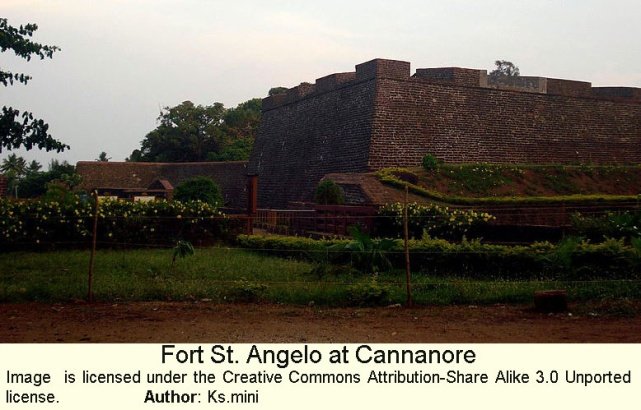 The Moors constructed ramparts of bales of cotton, and against them the ordinary cannon used had but little effect ; but the Portuguese planted a large piece of ordnance on their ramparts, and one lucky shot from it, it is said, sent the cotton bales flying and killed no less than twenty two men. After this, no attempt was made to take the fort, and the besiegers hoped to starve out the garrison. The latter were reduced to the greatest straits, and lived on lizards, rats, cats, and other animals.
On the 15th August, however, a miraculous event occurred, seemingly in answer to the prayers of the besieged to the Queen of Heaven,1 whose feast day it chanced to be, for the sea sent forth shoals of crabs and prawns, and the garrison again lived in plenty.
NOTEs: 1. Conf. pp. 34-37. The sea had probably sickened, as it does periodically, and the prawns and crabs had probably been driven on shore in consequence. END OF NOTEs
To bring the siege to a termination before the Onam festival in August, a grand final assault, both by sea and land, was planned. The boats and catamarans were easily enough driven back by the besieged garrison, but the Nayars gallantly stormed the wall and effected an entrance. So steady, however, was the Portuguese fire that they withered away before it and finally retreated.
Nearly every one of the little garrison was, however, wounded in that day’s fight ; and Brito, to conceal the exhaustion of his resources, kept up a bombardment of the town after the enemy had been repulsed, and destroyed a big mosque in which the Moors had congregated for the Friday service. But succour was at hand ; for on 27th August, a fresh fleet of eleven ships under De Cunha arrived from Europe, and their commander, with three hundred of his men, had no difficulty in driving back the besiegers and relieving the place.
The Kolattiri then sued for peace, which was granted on terms advantageous to the Portuguese. The markets of Cannanore and Cochin were thus open, and no difficulty was experienced in freighting the ships for Europe with spices.
Prior, however, to the despatch of the fleet, Almeyda, on the 24th November, made a descent on the Zamorin's shallow harbour of Ponnani, and destroyed the town and shipping. Numbers of Moors took oath to die as sahids on this occasion, and the defence of the town, the Moorish headquarters on the coast, was very stubborn. Eighteen Portuguese were killed in the assault on the place. The fleet eventually sailed for Europe on 6th December.
Meanwhile extraordinary preparations were being made in Egypt to equip a fleet to drive away the Portuguese, whose interference with the overland trade had deprived the Egyptian ruler of his chief source of revenue. Cedar trees felled on Mount Lebanon were rafted to Alexandria by sea, thence floated up the Nile, and finally transported on camel back to Suez, where twelve large ships were built under the skilled superintendence of Venetian shipwrights.
This fleet, under the command of Admiral Mir Hussain, then sailed for the coast of Konkan, carrying on board one thousand five hundred Mamluks and the Zamorin’s ambassador, Muyimama Marakkar, who had been sent to request assistance against the Portuguese.
This ambassador was among the first slain in the fight which ensued at ChauI with Lorenzo Almeyda’s ships. But Lorenzo was himself slain together with the whole of the crew of his ship, which had grounded on some fishing stakes and there remained fast. The remaining Portuguese vessels then sailed for Cochin and conveyed the news of this disaster to the viceroy.
The latter vowed vengeance ; and, with a fleet, carrying one thousand three hundred Europeans and four hundred selected Cochin Nayars, sailed for and reached Cannanore on 25th November 1508.
Hearing a rumour that the Egyptian fleet was approaching, Almeyda sailed up to Mount Deli, and while anchored there a large fleet hove in sight, which turned out to be that of the great Albuquerque, who had been sent out to relieve Almeyda of the viceroyalty. The combined fleets then returned to Cannanore and quarrels immediately ensued between the two viceroys.
In the end Albuquerque was sent to Cochin, and Almeyda, as viceroy in command of the combined fleets, sailed from Cannanore on 12th December in search of the enemy.
On the 3rd February 1500 the viceroy fell in with the Egyptian fleet, and the eighty war-boats despatched to its assistance by the Zamorin in a harbour in Gujarat. A complete victory was gained by the Portuguese, who also secured much plunder and took many prisoners.
Returning in triumph to Cannanore, Almeyda made a most brutal use of his victory by hanging some, and by blowing from cannon others, of the Turkish prisoners taken by him. The limbs of the victims of his revengeful fury are said to have been showered over the Moorish town of Cannanore as a warning to Moslems not to provoke the Portuguese to vengeance.
On reaching headquarters at Cochin (8th March 1509)), Almeyda still delayed handing over charge of his office to Albuquerque. The disputes between them continued until Albuquerque was despatched a prisoner to Cannanore and consigned to Brito’s charge.
Thus matters continued until 16th October 1500, when fresh reinforcements arrived at Cannanore from Europe under the command of Don Fernando Coutinho. Brito, the Cannanore commandant, set sail secretly the very night the fleet anchored at Cannanore to convey the news to Almeyda, for one of the first acts of Coutinho was to release the great Albuquerque from custody, and to confer on him the insignia, of his rank as viceory.
On their arrival at Cochin (29th October 1509), Almeyda quietly resigned charge of his office and made preparations to return to Europe. He was, however, never destined to reach Portugal again, for in a petty quarrel with Caffres at a place to the west of the Cape of Good Hope, the first of the Portuguese viceroys of India was mortally wounded, and the same fate likewise befell Brito, the famous defender of the Cannanore fort.
Coutinho had brought out instructions from Portugal that Calicut should be destroyed. Such had been, it is said, the counsel sent to Europe by the Kolattiri and by the Cochin Raja, both of whom envied and were afraid of the Zamorin, and benefited by his misfortunes.
Accordingly Albuquerque and Coutinho set out for and reached Calicut on 4th January 1510, timing their arrival there when the Zamorin was absent from the place.
Landing in two divisions, Albuquerque on the left took the fort by escalade and carried all before him.
Not to be outdone, the aged Coutinho, with the right division, sought and obtained a guide to conduct his party of eight hundred men straight to the Zamorin’s palace. The day was hot, Coutinho himself had no helmet or other head covering. The country through which his division passed was thickly covered with orchards and the gardens were divided from each other (as they are now) by massive earthen embankments.1
NOTEs: 1. The palace alluded to is still pointed out as that of which the mounds forming the foundations now alone exist on both sides of the main road from the Mananchira Tank towards Beypore. It is there that the Zamorins are still crowned. END OF NOTEs
Proceeding thus, it is said, for a mile and a half, the palace was at last reached, and the Chief Officer of the Palace Guard and two other chieftains defending it were slain. The palace was sacked, the treasure and royal emblems accumulated for ages were seized, the precious stones were picked out of the idols, and excesses of all kinds were committed. Overcome by fatigue Coutinho lay clown to rest on a couch in one of the most spacious halls, and it is said he slept for over two hours.
Suddenly he was roused by the wild shouts of the returning foe, the Nayar guards (the agambadi ) poured in from all directions before he could rally his men ; the Portuguese knew not which way to turn in their ignorance of the locality, and the Nayars overwhelmed them with showers of arrows and javelins.
Albuquerque arrived on the scene too late to save his friend ; Coutinho and eighty of his men were slain, and Albuquerque himself escaped with difficulty. The palace was on fire, and two of the guns were in the hands of the enemy. He made a great but ineffectual effort to retake them, and then retreated. The earthen embankments among the orchards obstructed his men, and at such places the Nayars pressed them hard and wounded many of the Portuguese. Albuquerque himself was first wounded by a bullet in his foot, and then by a stone which knocked him down insensible. Laying him on shields, he was carried without further mishap to the shore, and on reaching this the Portuguese made good their retreat to the ships under cover of the guns of the fleet commanded by Captain Rebello.
They left, however, one hundred of their number behind.
After returning to Cochin and giving the wounded some time to recover, Albuquerque next set out on an expedition against Hormuz; the headquarters of the Moslem trade in the Persian Gulf. Proceeding up the coast he touched at Honore, and was there prevailed on by the chieftain Timmaya, to attack him before proceeding to Hormuz.
The chieftain of Goa, Subbayi, had lately died. He had succeeded in collecting around him a large following of divers nations, and piracy on a large scale was there carried on.
Adil Khan, his successor, was absent at the time, and Goa fell an easy prey to Albuquerque aided by the Honore chief. On 25th February 1510 Albuquerque entered the place in triumph, and found great booty, including a large number of horses intended for sale to the Vijayanagar Raja.
The advantage of having a deep harbour like Goa, available for shelter for even his largest ships in the south-west monsoon season struck Albuquerque very forcibly, and he determined at once to make it the capital of the Portuguese possessions in India. And to this end he set about strengthening its defences. He accordingly stayed there till the monsoon set in, and meanwhile despatched an embassy to Vijayanagar, proposing an offensive and defensive alliance against the Moslems.
But Adil Khan then returning, laid siege to the place, and so effectually intercepted supplies that Albuquerque was compelled at last to evacuate the place and to retreat to Ra-bunder, where he remained in great stress for provisions all through the monsoon. Many desertions from the Portuguese ranks took place at this time. At last, taking advantage of a break in the weather, he made good his retreat to Anjediva (August 1510), and on 15th September arrived at Cannanore
There in a large tent erected in front of the fort a grand durbar was held, attended by the Kolattiri, his minister Chenacheri Kurup, and Mammali Marakkar, the chief Moor of Cannanore.
At this council an urgent message was received from Nuno, left in command at Cochin, that the viceroy would at once return thither, because the reigning Raja had, under Brahman advice, decided to relinquish the throne according to custom on the death of the senior Raja, which had just taken place.
The ruling Cochin Rajas had been previously in the habit of retiring to a pagoda to lead the lives of hermits directly their seniors in the family died. This custom was now to be broken through in deference to the wishes of the Portuguese, to whose interest it was that the next senior in the family, an ally of the Zamorin’s, should not succeed to the raj. It was, however, with much reluctance and with a heavy heart that the reigning Raja was prevailed upon to do so, and it was only when a number of his chieftains presented themselves, tendered fealty, and advised that the Brahmans should not be listened to in this matter, that he consented to break through the customs of his ancestors.
Albuquerque tried to reassure him and said, “Brahmans’ have ceased to rule this kingdom. The mighty arm of the foreigner must be respected in future. Seek asylum therefore in the royal favour of the King of Portugal, and you will never be forsaken.”
In the end of September Albuquerque decided on a second expedition against Goa, and a fresh fleet from Europe arrived just as he was organising the expedition and enabled him to make up his force to the necessary strength.
On arrival at Cannanore, however, the men broke into mutiny on hearing that a force of nine thousand Turks had been prepared to meet them. The Zamorin too sent a force under the rival Cochin claimant to draw off the Kolattiri from the Portuguese alliance. Albuquerque was, however, equal to the occasion ; he eventually persuaded the Kolattiri minister, Chenacheri Kurup, to join his expedition at the head of three hundred picked Nayars, and this shamed his own men into facing the dangers in front of them.
Proceeding up the coast, the expedition touched at Honore, and after engaging the chief of that place, Timmayya, to assist him against Goa, and on learning that Adil Khan was again absent from the place, Albuquerque determined on immediate attack. He reached Goa on St. Catherine’s day, 6th November 1510, and after a contest lasting only for six hours the place fell into his hands.
Albuquerque took a statesmen-like view of his position, and it was under his orders that the foundations of Portuguese power in India were laid. Besides building forts and churches and carrying out various public works with Moorish spoils, he encouraged his men to marry the native women, and on them he bestowed the lands taken from the Moors. To the mixed race thus produced he looked for the formation of a native army which should be as powerful by land as his fleet was by sea.
Adhering to these views with firmness, he ably carried them out. But the people under him thirsted to be rich ; the means they adopted to this end were very frequently most unscrupulous, and all such irregularities Albuquerque repressed with a heavy hand. He thus made numerous enemies among his own people.
From November 1510 Goa finally supplanted Cochin as the chief Portuguese settlement, and the effect of the capture was so great that the different Rajas of Southern India voluntarily sent embassies to Albuquerque acknowledging the Portuguese supremacy.
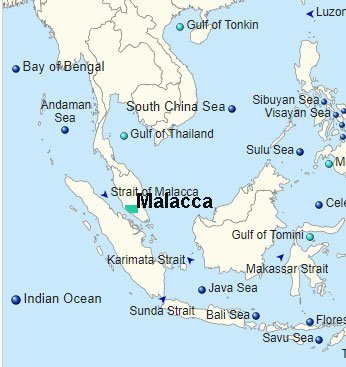 To ruin the Moslem trade in India and the East had been the aim of all the Portuguese commanders from Da Gama’s time downwards. And Albuquerque’s next blow was aimed at their China trade, the emporium of which was at Malacca. This city he took in July 1511.
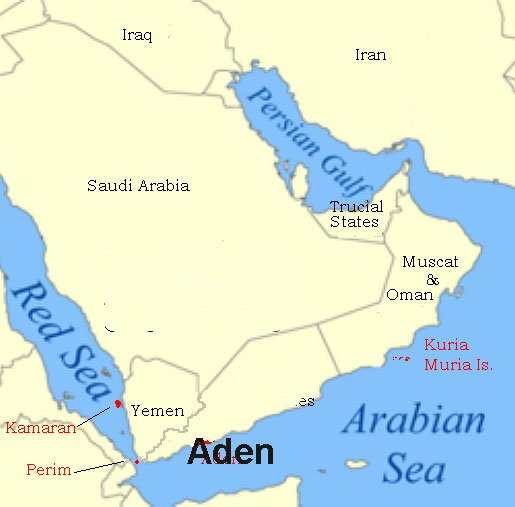 Narrowly escaping being drowned in shipwreck on his way back, he landed at Cochin in February 1512 among great demonstrations of joy as the Moors had been industriously circulating rumours of his death.
To his sorrow, however, he found that his countrymen had in the interval been associating indiscriminately with the natives, and had abandoned themselves to vice and crime. To stop this he constructed a barrier to separate the fort from the town, and made a rule that any one other than a Christian entering the Fort should forfeit his life. In consequence of this rule over four hundred Cochinites, including some Nayars voluntarily embraced Christianity. For their benefit the viceroy established schools.
Leaving Malabar in September 1512, Albuquerque next proceeded to Goa and thence he set out on another distant expedition against Aden, after putting in train a scheme for building a fort at Calicut and for entering on a treaty of peace with the Zamorin, It was in spite of the expressed dissatisfaction of the Kolattiri and of the Cochin Raja that he endeavoured to come to terms with the Zamorin, and as all their influence was exerted to thwart the plan, the negotiations did not make much progress, and they came to a standstill altogether directly Albuquerque sailed for Aden and the Red Sea.
Returning with a heavy heart from his unsuccessful expedition against Aden in August 1513, an opening was presented to Albuquerque for a good understanding with Calicut in consequence of the succession to the raj of the member of the family who had hitherto encouraged the idea of an alliance with Portugal.
By a treaty with the Zamorin the Portuguese would be enabled to curtail their expenditure at Cochin, for their establishment to protect Cochin from invasion, especially at the Eddapalli ferry, had always to be maintained on a war footing whilst the Zamorin was their foe. Albuquerque landed at Calicut, had an interview with the Zamorin, and arranged the following terms of peace with him: —
The Portuguese were to erect a fort at Calicut in a locality of their own selection.
They were to be permitted to trade as they pleased.
They were to be permitted to barter European goods for pepper whilst all other traders1 were to pay for it in cash.
The annual quantity of pepper to be supplied to them was fixed as fifteen thousand candies, and the price to be governed by that prevailing at Cochin.
NOTEs: 1. The Moors alleged that one of the conditions was that, they should be permitted to load four vessels annually for the Red Sea, but as soon as the Calicut fort was finished the Portuguese broke faith with them and forbade any further trade with Arabia, and any trade whatever in pepper or ginger (Rowlandson's Tahafat-ul Mujahidin, p. 112). It is doubtful however if this was so, and reference is probably made to the proposed terms embracing a condition to the said effect offered by Albuquerque prior to his Aden expedition, which terms were not accepted at the time. END OF NOTEs
A moiety of the customs revenue was to be paid as tribute to the King of Portugal. The loss incurred by the destruction of the factory planted by Cabral was to be made good from the Zamorin’s treasury.
In accordance with this agreement, the Portuguese set to work to erect a fort at Calicut. The site selected appears to have been on the northern bank of the Kallayi river at the southern extremity of Calicut. The position chosen had the advantage of being flanked on two sides by water. The fort was square in form with flanking bastions at the corners facing the sea. The Zamorin personally exerted himself to help the engineer, Thomas Fernandez, who built it.
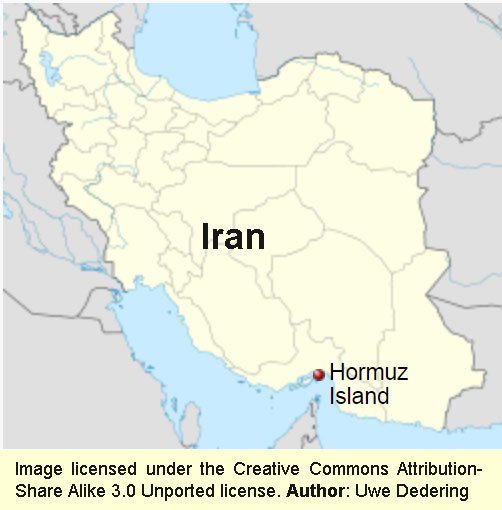 This arrangement with the Zamorin increased Albuquerque’s fame in Europe. He sent tigers and elephants to Portugal ; some of them were passed on to Rome. His zeal was, however, disparaged by slanderers among his own officers, and the King of Portugal began to take alarm at his increasing renown.
In February 1515, Albuquerque set out on his last expedition for ruining the Moslem trade, and this was directed against Hormuz, the emporium of the Persian Gulf. This place fell an easy conquest.
But meanwhile the slanderers’ tales had been listened to and Albuquerque’s supersession had been decreed. His successor, Suarez, sailed in April and reached Goa on 2nd September 1515. Albuquerque was still absent on the Hormuz expedition, and a ship was despatched to convey to him the news. His anguish was great when he came to know that men whom he had sent in disgrace to Europe had returned in high offices of State.
“Oh holy Jesus, deliver me from this dilemma. When I serve my king loyally, the people hate me! When I serve the people the king hates me! I have had enough of this ; it is time for me to hid farewell to the world. Ah! do not forsake an aged man.”
Falling ill of dysentery, he saw his end approaching, and placidly acquiesced therein. His ship arrived at Goa on 16th December ; a boat was despatched to shore to fetch a priest ; he received the last offices of the Church, and on the 17th he died, aged 63 years.
Albuquerque was greatly beloved by the natives for his justice and honesty. These good qualities lived long in their memories, and offerings and vows were made at his tomb by all classes and creeds among the natives.
The events of the next few years do not present many features of interest. But an important change came over the Portuguese administration. In 1517 a Finance Minister was sent out from Europe to control expenditure, and as a check on the hitherto unlimited powers of the Viceroy. Dissensions of course arose directly he tried to exercise his authority, and in the end he had to go home.
From this time forward the Home Government displayed great jealousy and suspicion in regard to the acts of its Indian administrators, and frequently cancelled their orders. This treatment naturally produced indifference in public affairs, and resulted in every one connected with the administration striving to amass wealth without caring much how it was obtained.
In 1517 Suarez arranged a treaty with the Queen of Quilon. Compensation was given for the loss of the former factory, control of the pepper trade was obtained, and a fresh factory was erected, probably on the site of the existing fort at Tangasseri.
An unsuccessful expedition against Jeddah, and the subjugation of Egypt by the Turks, also marked this year. The impending trouble from a fresh Egyptian expedition consequently passed over.
In 1518 expeditions were sent to the Maldives and to Ceylon, and in the end of the year a change of viceroys took place, Scqueria succeeding Suarez.
In 1519 some trading Moslems, taking advantage of the weakness of the Portuguese factory at the Maldives, massacred the garrison, and from this time forward the islanders, including probably those of Minicoy, were not interfered with by the Portuguese, and in course of time became Muhammadans.
In this same year in September, the Quilon, or rather Tangasseri fort (Fort. Thomas) was begun secretly by the Commandant Rodrigues under pretence of repairing the factory, and was completed and armed ; and, under the conditions of the agreement giving the Portuguese the control of the pepper trade, Rodrigues seized five thousand bullock-loads of that article which certain traders from the East Coast had collected in barter for five thousand bullock-loads of rice, and which they were on the point of taking across the ghauts via the Ariankavu Pass.
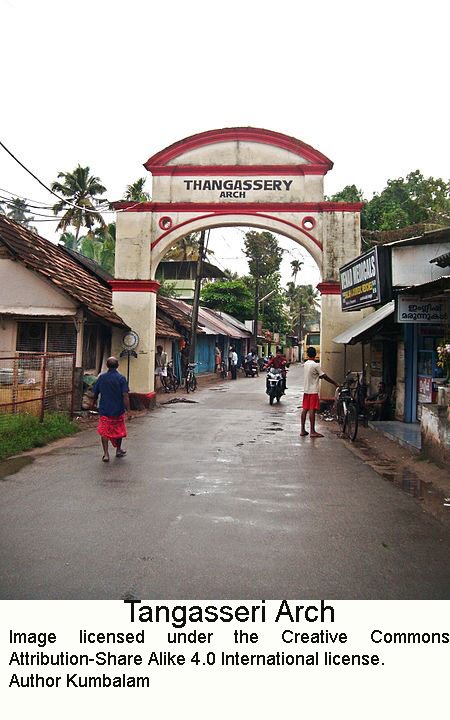
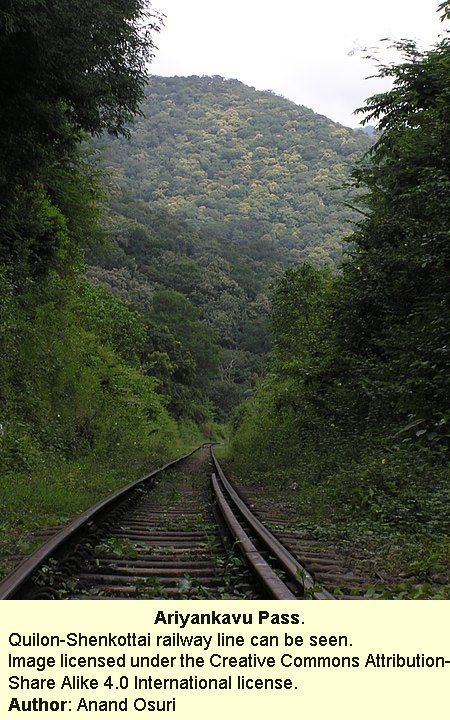 From that time forward, East Coast merchants were afraid to cross by that puss for trade at Quilon and it gradually fell into disuse. It was in this year also that Scqueria, the Viceroy, with a band of men witnessed near Cochin a duel1 on a very big scale between a chieftain of the Zamorin and a chieftain of Cochin. Four thousand men were engaged on each side, and while the fighting was in progress one of the Portuguese struck in with the Zamorin ’s men, whereupon the Cochin men sent a flight of arrows into the Portuguese spectators and killed five of thorn, putting the rest to flight.
NOTEs: Conf. p. 169. END OF NOTEs
In January 1520, another expedition against Jeddah was despatched, but it seems to have accomplished little or nothing, and in the monsoon of that year, Fort Thomas at Tangassori was besieged. The garrison, numbering only thirty Europeans, had rice to eat, but little else, and were driven to making curry of rats to give their rice a flavour.
In August, however, provisions and reinforcements arrived from Cochin, and the two Queens of Quilon sued for and obtained peace.
In 1521 the Cochin Raja, smarting under the recollection of the former defeats sustained at the Zamorin’s hands, thought he saw a favourable opportunity for attacking the latter, which he did with a force of fifty thousand Nayars, and the Portuguese, disregarding treaty obligations sent some gunners to assist him. But the Brahmans came to the Zamorin’s assistance, and by cursing the land which gave protection to the Parangis (Portuguese), succeeded in making many of the Cochin Raja’s followers desist from the enterprise, and the rest were easily driven back into their own limits.
The Portuguese too, under Scqueria, made themselves very much disliked by the natives by refusing to recognise their own passes to native ships engaged in trade ; in fact, the Portuguese ship captains became little better than organised pirates. Petitions went home, particularly from Cannanore, and in consequence of these Scqueria was recalled and Don Duarte de Menezes came out as Viceroy with orders to maintain peace and to propagate Christianity.
In January 1523, Menezes came to Calicut, and there found to his astonishment that things were rapidly assuming a warlike aspect. The Zamorin was dead and his successor did not favour the Portuguese alliance. Moreover, the piratical acts of the Portuguese had made the Moorish merchants desperate.
The Viceroy, to avoid war, adopted the readiest means for bringing it on by overlooking insults to his people. His own Secretary (Castro) was grossly insulted in Calicut bazaar and driven back with his retinue into the fort, by the rabble with stones, several of the retinue being wounded, and no notice was taken of the affront. When therefore Menezes sailed with all the available ships to Hormuz, a Moorish merchant, one Kuti Ali of Tanur had the effrontery to bring a fleet of two hundred vessels to Calicut, to load eight ships with pepper, and to despatch them with a convoy of forty vessels to the Red Sea before the very eyes of the Portuguese.
On the 11th or (perhaps) 21st of September 1524, “there arrived at the bar of Goa D. Vasco da Gama, who discovered India, as Viceroy of India.” He came in great state as befitted his position, with a fleet of fourteen ships carrying three thousand men, and his mission was to reform the abuses which had crept, into the administration. On reaching the land at Dabul “and with the wind becalmed, during the watch of daybreak, the sea trembled in such a manner, giving such great buffets to the ships, that all thought they were on shoals, and struck the sails, and lowered the boats into the sea with great shouts and cries and discharge of cannon.”
On sounding, they found no bottom, “and they cried to God for mercy, because the ships pitched so violently that the men could not stand upright and the chests were sent from one end of the ship to the other,” The trembling came, died away, and was renewed “each time during the space of a Credo.”
The subterranean disturbance lasted about an hour, “in which the water made a great boiling up, one sea struggling with another.” When daylight was fully come, they saw the land. Da Gama maintained his presence of mind during this trying scene, and reassured his men by telling them that even the sea trembled at the presence of the Portuguese.
Da Gama went to Cannanore and stayed there for three days, during which time he insisted on the Kolattiri surrendering a notorious pirate chief called Bala Kansan, who was thereupon thrown into a dungeon in Cannanore fort.
Passing Calicut, where there were commotions but no fighting, Da Gama proceeded to Cochin and took measures to bring Menezes, the Viceroy, to account for his actions by arresting both him and his brother D. Luiz, the good Governor of Cochin.
But Da Gama had fallen sick and Menezes hoped to continue in his post if his illness proved fatal. In this, however, Da Gama forestalled him by orders issued from his sick bed, and he sailed for Europe before the illness took a fatal turn.
Da Gama died “at 3 o’clock after midnight on the 24th day of December of this present year of 1524.”
“Feeling his death approaching (he) passed from the fortress to the houses of Deogo Pereira which were close by in the court of the church.” After death, his body “was carried to the monastery of St. Anthony and1 buried in the principal chapel.”
NOTEs: The quotation in the text is from Correa's "Lendas da India" (Stanley’s translation). There has been much conjecture as to the exact place of the great Du Gama’s burial at Cochin. The monastery belonged to the Franciscans, and the principal chapel thereof was probably dedicated, as Correa and P. Barreto de Resende state, to St. Anthony. Castanheda, on the other hand, says the burial took place in the Cochin cathedral. Barros and San Roman say it was the monastery of St. Francis. Correa's account written so near the time is entitled to the fullest credit, and there can be little doubt that it was in the Franciscan chapel of St. Anthony that Da Gama’s body was first laid to rest. Much has been written about the vandalism of the British Government in having blown up the church where Da Gama’s remains rested, but, the charges are without foundation, for the chapel, rebuilt by the Dutch, still exists as the European Protestant place of worship down to the present day. Da Gama's body was removed to Portugal in 1538 and deposited first at Vidigueira. His remains now rest, in a. chapel at Belem, the port whence he set out on his adventurous voyage. They were transferred to this last resting place with much ceremony so lately as Juno 1880. END OF NOTEs
On this tomb, there was “a square grating surrounding the grave, of the height of a span, lined with a black velvet, and a black and white fringe placed upon a velvet cloth which covered all the grave.”2 Short as was the time during which Da Gama held office, he did much to rehabilitate the reputation of the Portuguese. He purged the settlements visited by him, and selected the ablest officers to conduct affairs.
NOTEs: There is pointed out in the Protestant Church at Cochin a tomb-stone in the pavement of the church bearing the name “Vasco” in legible characters thereon, the remainder of the name has become obliterated. The top of the stone bearing a coat of arms is broken, but if the top there now is the real top of the stone on which the name “Vasco” is engraved, then it is almost certainly not Da Gama’s tomb-stone, as the coat of arms is different from that of Da Gama. END OF NOTEs
De Souza under his orders relieved Calicut, engaged the famous Kutti Ali’s fleet at Kappatt and drove it to Pantalayani Kollam. Taking up the chase next day, De Souza drove the fleet before him as far as Cannanore, where the sailors having abandoned it, it fell a prey to the Portuguese.
Meantime the young George Tellia had encountered the younger Kutti Ali near Goa and had defeated him too.
When the royal despatch was opened after Da Gama’s death, it was found that Henry Menezes had been appointed to succeed him in the event of his death. About the time of Da Gama’s death, the Moors, with the Zamorin’s approval, made an onslaught on the Cannanore Jews and Christians, the reason alleged being that the Moors had resorted to various tricks for adulterating the pepper, etc., brought to market, and some Jews and Christians had been specially selected to discover such tricks and mete out justice to the offenders.
Assembling from Calicut, Pantalayini Kollam, Kappatt, “Turlcoz” (?Trikkodi), Chaliyam, Parappanangadi, “Travancore ” (?) Tanur, Paroni, Ponnani, and Baleenghat,” the Moors mustered a fleet of one hundred grabs and attacked Cranganore. They slew many Jews and drove out the rest to a village to the east, but when they attacked the Christians, the Nayars of the place retaliated, and, in turn drove all the Moors out of Cranganore.
One of the first acts of Henry Menezes’ rule, when he arrived at Cannanore on his way to the south from Goa, was to order the execution of the pirate Bala Hassan, who had been delivered up by the Kolattiri on a demand from Da Gama. This man was related to the family of the Arakal Raja of Cannanore (Mappilla), and bribes to a large amount were offered for his release, but in vain.
The Kolattiri also offered a visit to the Viceroy to intercede for him, but the execution was not stayed. The Moors were greatly disgusted at this and decided that in the future they should act independently of the Kolattiri altogether. And the Kolattiri on his part asked the Viceroy to punish those Moors who had taken refuge at Darmapattanam Island. An expedition was accordingly organised, and the towns, bazaars and shipping at Darmapattanam and at Mahe were destroyed (January 1525).
On reaching Calicut, Menezes found that the place had been attacked by the Zamorin’s troops ; but notwithstanding this, the Zamorin pretended he was now inclined to sue for peace. Pushing on to Cochin, Menezes there received another message from the Zamorin asking for peace, but in reality it was only a pretence to gain time till the setting in of the monsoon.
Hurrying his preparation, therefore, Menezes determined to strike the first blow, so he sailed for Ponnani and there burnt the town and seized or burnt the shipping (26th February 1525).
Pantalayini Kollam, the emporium of the trade with Mecca, next occupied his attention. It was defended by three bastions on a hill1 with many guns. A canal had been dug communicating with the sea and the ships and mercantile warehouses lay along this canal. The town was defended by twenty thousand Nayars and Moors.
NOTEs: 1. The present graveyard hill apparently. END OF NOTEs
Menezes arrived before it one evening, and both parties made great preparations for the fight on the morrow. The Portuguese next day landed in three divisions and were completely victorious, taking, it is said, two hundred and fifty cannon and quantities of ammunition. The town and bazaar and shipping were all burnt, and the Portuguese carried off with them forty vessels to Cannanore, where they arrived on 11th March 1525.
The effect of this victory was great, and the reputation of the Portuguese for valour was revived. The Viceroy next dealt with the Laccadive Islands, which are eighteen in number. Orders had come from Portugal that if the Kolattiri would supply all the coir (for which the islands are famous) required by the Portuguese at a cheap rate, he might keep the islands. Menezes, at an interview with the Kolattiri, then demanded a thousand candies per annum of coir.
The Kolattiri replied he could not undertake to supply this quantify and said he preferred giving up the islands. This was accordingly done, and Menezes stationed there forty soldiers and imposed an import duty on all rice taken to the islands. With the sum thus collected, he was able to buy the coir required and to pay for the establishment.
He next blockaded the coast to intercept the supplies of rice required at Calicut, and two naval actions, both in favour of the Portuguese, were fought near Mount Deli. War with the Zamorin was clearly impending, although he still pretended to want peace with a view to throw the Portuguese off their guard ; so the Calicut fort was first provisioned and strengthened for the monsoon season, and Captain Lima, with three hundred men, undertook its defence.
The Kurumbranad Raja and Tinayancheri Elayad invested the place with their Nayars directly the monsoon set in, and they were helped by a band of Moors under the command of a skilled European engineer who had three years before, been made a captain at the siege in Rhode Island by the Turks (1522), and who, having been taken prisoner, renounced Christianity and became a Muhammadan.
He threw up trenches and placed guns in Vannattan paramba, south of the fort, and in the street of Chinakkotta (Chinese fort). The Portuguese retired within their fort after destroying all outlying warehouses and buildings. They had water and rice sufficient for one year, and curry stuff and oil for one month.
On the 13th June 1525, the Zamorin himself came with an additional force, and Lima, although the monsoon was then blowing, despatched a boat to Cochin for assistance. The boat reached there after much buffeting on 10th July, and one hundred and forty men were despatched to succour Calicut. Only thirty-five of them landed with great difficulty, owing to the roughness of the sea about the beginning of August, under protection of the fort guns. The rest, without leaving their boats, went back to Cochin after receiving a message, shot out to them tied to an arrow, that four men were killed, that many were wounded, that five hundred men at least were required, and that provisions and ammunition were wanted most particularly.
The Zamorin spared no efforts to take the place before reinforcements could reach it. The powder magazine walls cracked, and the ammunition had to be stored elsewhere. The Sicilian engineer tried to mine under the wall, but a Portuguese renegade conveyed the news to his besieged countrymen in a song. A countermine was sunk and the miners were caught.
On a stormy night in the end of August, boats arrived and landed ammunition, bread, salted meat, and other provisions, and in the morning Lima, the Commandant, out of bravado, sealed the rampart, chucked some bundles of fresh betel leaf to the besiegers, and then proceeded to show them he had both bread and meat to eat by eating it in full view of the besiegers. On 15th October, the Viceroy arrived with twenty ships and relieved the garrison ; and on the 31st of that month an attack was made on the besiegers and they were driven back, leaving the renegade Sicilian and two thousand men dead in the trenches.
Meanwhile, the Viceroy had determined to abandon the fort altogether, because he had news from Europe that the Turks, now rulers of Egypt, were organising an expedition to the East, and it was manifest the Portuguese could only hope to resist them by concentrating their strength. The fort was accordingly abandoned1 and it is said that the last man to leave it set fire to a train of gunpowder which killed many of the Nayars and Moors, who in hopes of plunder flocked into the fort directly it was abandoned.
NOTEs: Zein-ud-din in the Tahafat-ul Mujahidin gives a similar account, “To facilitate their doing this’’ (abandoning the fort), “they made an opening in the wall from within the fort, and in a part which was not visible to those who were without, and abandoning the fort they set sail in the ships and went away.” Ferishta’s story about the taking of the fort was probably founded on the inflated account which the Zamorin sent abroad concerning the siege. END OF NOTEs
During the rest of the year, the Viceroy was busy hunting up pirates along the coast, for no open opposition was now over offered to the Portuguese at sea. The people, however, organised a system of fire signals, and the movements of the Portuguese ships were vigilantly watched and made known. While taking some boats near Beypore, the Viceroy received a wound in the leg, and the inflammation was increased by unnecessary exertions of a similar kind off Mahe. He then retired to Cannanore and landed there in January 1526. But his wound grew worse and he died there on the 2nd February. His body was buried in the Church at Cannanore. It was remarked of him with wonder that he had saved no money during his tenure of office. On opening next day the royal despatches, it was found that Mascarenhas, then absent on an expedition to Malacca, was nominated as Viceroy next after Henry Menezes.
Owing to his absence, and as it was necessary to have some one at hand to organise the defence against the Turks, the next despatch was opened and Sampayo, at Cochin, was found to be the next nominee. He was informed of this, and accordingly assumed the reins of government, and at once set to work to put Goa, Cannanore and Cochin in a posture of defence to resist the expected Turkish expedition. Fort St. Angelo at Cannanore was extended up to the well on which the garrison depended for drinking water, and Fort Emmanuel at Cochin had bastions erected on the sea side of the work.
Dissensions at Mascarenhas' supersession, however, arose, and the Portuguese were divided into two parties, and party spirit ran high.
Fortunately for them, similar dissensions had arisen in the Turkish fleet despatched to India, and anxiety on that account was allayed by the news that the Turks had failed to take Aden.
This news was conveyed to Portugal by the overland route via Hormuz through the Turkish dominions, in the wonderfully short space of three months, the first occasion on winch the overland route was ever used for the purpose. When Mascarenhas arrived from Malacca, he was favourably received at Quilon, but at Cochin he was driven again on board his ship. Sailing to Goa, Sampayo there seized him, put him in chains, and sent him to Cannanore, where, in turn, the garrison honourably received him. In July, arbitration as to the rival claims was resorted to, and the result being in favour of Sampayo, Mascarenhas sailed for Europe (21st December 1527).
Various combinations of pirate boats under the Kutti Alis were dispersed during the early part of 1528, and in September of that year there occurred a violent storm while some Portuguese ships were lying off the mouth of the Chetwai River. The wind came, it is said, from the east, but, if that was so, it is difficult to understand how several ships were driven on shore and wrecked and the crews massacred, for an east wind ought to have blown them out to sea.
In the following month, the Viceroy made a descent on Purakkat, the Nayar chieftain of which had, up to the time of the attack on Pantalayini Kollam, been a firm ally of the Portuguese and had joined them on several expeditions with his men. On that, and probably on previous occasions also, the Purakkat people, however, had been on the watch for the plundering rather than for the fighting, and while Purakkat was lazily looking on at the fight at Pantalayini Kollam and watching his chance for plunder, Henry Menezes, the Viceroy, in a rage directed one of his men to aim “at that idle fellow.”
Purakkat was wounded in the leg and fell, but concealed his feelings of indignation at the time. Afterwards, however, he joined the Zamorin against the Portuguese and was in particular present at the siege of Calicut fort. It was to take vengeance for his desertion that the Viceroy attacked his territory, and he further timed his attack so as to arrive there when the chief was absent. On the 15th October 1528 the Portuguese took the place and obtained a very rich booty. Each of the thousand men engaged obtained as his share, it, is said, no less than eight hundred gold pallaks (ducats), and Sampayo himself got a lakh of them.
Purukkat after this sharp lesson returned to his allegiance and continued steadfast in it up to the very last.
In October 1529, Sampayo’s successor (Nunho D'Acunha) arrived with orders to send Sampayo in custody to Europe, and this was at once done when Sampayo boarded the Viceroy's ship at Cannanore on the 18th November.
The new Viceroy governed with justice and impartiality, and the Portuguese under his rule again became all-powerful, so that, in 1531 the Zamorin again began to think of a Portuguese alliance. Terms of peace were arranged, and the Portuguese selected a site for a new fort in the Zamorin’s territory. The place selected was the island of Chaliyam.1
NOTEs: 1.The site of the present terminus of the Madras Railway south-west line. END OF NOTEs
The position was well chosen for the object which the Portuguese from Cabral’s time had kept steadily in view, namely, ‘‘to ruin the trade of the Moors.”
“Is2 locus ultra Calicutum duas lencas apprime navigabili aesluario impositus, mire factus eral ad Arabum infestanda commercin et Zamorini consilia exploranda, conatusque opprimendos.” And its advantages are further set out; in Zein-nd-din’s work. From their fort there the Portuguese were able as Maffeius says, to watch the Zamorin’s movements, because “the Zamorin, his troops, and, indeed, all travellers of whatever description were obliged to pass” that way along the coast, and the fort “thus commanded the trade between Arabia and Calicut.”
NOTEs: 2. Maffeius, lib, ix. p. 208. END OF NOTEs
Securely posted at Chaliyam, the Portuguese, with the aid of their armed boats, which could ply at all seasons of the year as far up the Beypore river as Arikkod, and even farther into the very heart of the ghaut forests, were in an unequalled position to harass the Zamorin by overhauling all traffic between the portions of his dominions lying to the north and to the south of that river. This armed patrol service in fact cut his dominions in half, and all merchandise passing to Calicut from the southern territory could be overhauled as it passed. Even his troops, unless they swam the river whilst the Portuguese patrol boats were absent, could not cross the stream without seeking Portuguese permission.
No wonder, then, that Zein-ud-din described the Portuguese official who negotiated the peace as a “master of the greatest subtlety and cunning and capable of employing the deepest stratagems.”
There accordingly a fort “of great solidity and strength” was built, and in making it the Portuguese were not particular as to the materials employed. They threw down the ancient Jamat mosque3 and even “demolished the tombs of the Moslems, and carried off the stones of which they had been built to complete their fortress”.
NOTEs: 3. Conf. pp. 194—95. END OF NOTEs
On being remonstrated with for this, the Viceroy himself came to the place and ordered that the materials belonging to the Portuguese only should be employed. The work of destruction went on however and it then transpired that, the local chief had sold the mosque and tombs to the Portuguese. For this he was afterwards summarily dealt with by the Zamorin.
The building of this fort exercised a most important influence on the events that followed, for the Portuguese hold of the Moslem trade grew stronger than ever in consequence. And the events of the next few years might be summed up in a few words as fruitless attempts on the part of the Moors to break the chains that bound them in this respect.
In 1537 the Portuguese made a descent on Peroney and killed Kutti Ibrahim Marakkar and others because a vessel had sailed to Jeddah with pepper and ginger without obtaining a Portuguese pass, and punishment was necessary to prevent a repetition of the act, which would have caused the Portuguese great loss.
In consequence of this the Zamorin started for Cranganore to attack the Portuguese and the Cochin Raja, but his courage failed him, and to protect the place for the future the Portuguese erected a fort at Cranganore, "by which and other acts of theirs” Zein-ud-din says, “the Zamorin was reduced to the last extremity.”
In the same year (1537) the Portuguese followed up their opponents to Kayil, to the east of Cape Comorin, and destroyed a Moorish fleet which had rendezvoused there. And a somewhat similar event occurred in the year following in 1539 peace followed, and the Zamorin’s subjects again agreed to accept the Portuguese passes.
In 1550 war again broke out in consequence of the Zamorin interfering in the succession to the chiefship of some territory near Cochin famous for its pepper. Its chief was called by the Portuguese “the great pepper-owner.”
The chief was slain and the Zamorin came south to avenge his death. The hostilities which ensued caused him to expend “much good substance, which never returned either to himself or to his posterity.’* The Portuguese retaliated by making descents on the coast towns, particularly on Pantalayini Kollam, destroying mosques and houses, and giving one-third of the inhabitants “martyrdom.”
In 1552 the Zamorin received assistance in heavy guns landed at Ponnani, brought thither by Yoosuf, a Turk, who had sailed against the monsoon.
But by 1555 the desultory war had exhausted the resources both of the Zamorin and of his Moorish subjects, and the inevitable had to be submitted to once more.
Peace was restored on condition that the Portuguese ship passes should be taken out by traders. Again, in 1557, the Moors in North Malabar began hostilities, and these continued till, in 1559, they made the usual submission and agreed to take out the hateful passes.
It was at this time (about 1559) that the Portuguese began to be most stringent in enforcing their pass rules. They confiscated all vessels not carrying their passes, even in cases in which passes had been duly taken out and had been accidentally lost, and it is alleged they were utterly unscrupulous as to what became of the crews.
Zein-ud-din, who is, however, a not altogether disinterested witness, says that they massacred the crews by cutting their throats, or tying them up with ropes or in nets and throwing them overboard. However divergent might be the views of Portuguese viceroys and commandants on other points, they appear to have been at one on this question of the advisability of destroying the Moorish trade. Their policy was, therefore, consistent and directed to one end. They began by making contraband any traffic in the articles of pepper and ginger.
They next excluded Muhammadans from the trade “in the bark of spice trees, and in the clove jilli-flower, and the herb fennel, and in produce of this kind.” Lastly, they closed to Muhammadan merchants the Arabian ports, and Malacca, and Resha, and Thinasuree, and other places,” so that there remained to the Muhammadans of Malabar “of their coast trade, nothing but the petty traffic in Indian nut, coconut, and cloth, whilst their foreign voyages of travel were confined to the ports of Gujarat, the Concan, Solmundel, and the countries about Kaeel.”
Moreover, the Portuguese also obtained the control of the rice trade from Honore, Barcelore, and Mangalore by building forts designed to prevent Malabar merchants from collecting rice in granaries and exporting it, as was their custom from these places, “to Malabar generally, to Goa, and even to the Arabian ports.”
Down to the present day an artificial famine can always be produced in Malabar by stopping its imports of grain, and it appears to have been the same in the sixteenth century. These stringent measures led to the Moors fitting out piratical fleets of small boats—chiefly at Valarpattanam, “Turkoz”1 (?Trikkodi) and Pantalayini Kollam to prey on the commerce of the Portuguese and their allies. In this they were at first very successful, and the Portuguese thereupon began an indiscriminate plunder of the property of Muhammadans, and were guilty of great oppression, for which there was none among them (Muhammadans) able or willing to grant redress.”
NOTEs: 1. Famous among the pirate chiefs who commanded these fleets stands out the name of the Kottakkal Kunhali Marakkars. The family originally hailed from Pantalayini Kollom. Probably at the time when Henry Menezes destroyed that Moorish settlement, the family moved to Trikkodi, and thence again to Kottakkal at the mouth of the Kota river. They obtained the title of Kunhali Marakkar from the Zamorin. Kunhi means a youth, a title of distinction ; Ali is the name of the Prophet’s son-in-law, and Marakkar means the doer or follower of the law —marggam—and is applied, as a title, to persons of a foreign religion like the Christians and Muhammadans. Some of the remains of their fort at Kattakkal are still to be seen. It was situated at the northern extremity of a spit of sand extending from the south across the Kota river mouth, and it completely commanded the bar of the river and the shipping which lay inside it. The position was one of great strength against ancient artillery as it was protected on two sides (north and east) by water, on a third side (the west,) by a swampy salt marsh, through which the river, encumbered by another sand-spit stretching from the north across its mouth, has now (1885) forced its way. On the south the narrow neck of land was easily protected by a rampart. This fort lay just opposite to Putupattanam, the ancient seat of the Tekkalankur (Southern Regent,) of Kollattunad. It would occupy too much space to relate the history of this family, whose descendants still live in Kottakkal in comparative poverty. The tombs of the first, of the Kunhali Marakkars and of the mother of the founder of the family (who had no title), are still pointed out in a building attached to the chief mosque of the place. A memorial tomb to the founder of the family, who was captured by the Portuguese and “received martyrdom,” at Goa, is also to be seen in the same building. END OF NOTEs
Nor did the Portuguese content themselves with suppressing the Muhammadan trade ; they tried to convert the Moslems to Christianity and it is related that, in 1512, they seized a large number of Moorish merchants at Goa and forcibly converted them. Of course those converts reverted to their own religion at the first convenient opportunity.
Zein-ud-din’s indictment of the Portuguese for these and similar oppressions is very forcible. They were “guilty of actions the most diabolical and infamous, such indeed as are beyond the power of description; they having made the Muhammadans to be a just and a laughing stock, displaying towards them the greatest contempt ; employing them to draw water from the wells and in other menial employments ; spitting in their faces and upon their persons ; hindering them on their journeys, particularly when proceeding on voyages to Mecca ; destroying their property ; burning their dwellings and mosques ; seizing their ships : defacing and treading under foot their archives and writings ; burning their records ; profaning the sanctuaries of their mosques ; even striving to make the professors of Islamism apostates from their creed and worshippers of their crucifixes, and seeking, by bribes of money, to induce to their apostacy. Moreover, decking out their women with jewels and fine clothing in order to lead away and entice after them the women of the Muhammadans ; slaying also the pilgrims to Mecca and all who embraced Islamism, and practising upon them all kinds of cruelties ; openly uttering execrations upon the Prophet of God (upon whom may the divine favour and grace for ever rest) ; confining his followers and incarcerating them. Further binding them with ponderous shackles and exposing them in the markets for sale, after the manner that slaves are sold ; and when so exposed, torturing them with all sorts of painful inflictions, in order to exact more from them for their freedom. Huddling them together into a dark noisome and horrible building;1 and when performing the ablutions directed by their law, beating them with slippers ; torturing them with fire ; soiling and making slaves of some, and harassing others with disgusting employments ; in short, in their treatment of the Muhammadans they proved themselves devoid of all compassion.”
NOTEs: 1. This refers to the prison of the Inquisition at Goa, called by the Portuguese “Algowar.” It was thus described by M. Dellon, who was confined in it : “This prison was more foul, dark, and horrible than any one I had seen, and I doubt whether there can be one so nauseous and appalling.” He was told that forty out of fifty Malabar pirates confined in it some years before his time hanged themselves with their turbands owing to the horrible famine they suffered. END OF NOTEs
“For how many women of noble birth, thus made captive (at sea) did they not incarcerate, afterwards violating their persons for the production of Christian children, who were brought up enemies to the religion of God and taught to oppress its professors? How many noble Saids, too, and learned and worthy men did they not imprison and persecute even unto death ! How many Moslems, both men and women, did they not compel to embrace Christianity ! And how many acts of this kind, atrocious and wicked, the enumeration of which would require volumes, did they not commit! May the All Gracious and Merciful God consign them to eternal destruction! ”
“Notwithstanding all this, however, they preserved an outward show of peace towards the Muhammadans in consequence of their being compelled to dwell amongst them, since the chief part of the population of the sea-ports consisted of Muhammadans.”
The year 1564 was an eventful year for Southern India, since it was in that year that the bulwark which the Hindu dynasty of Vijayanagar had presented against the flood of Muhammadan invasion from the north, was overthrown at the battle of Talikota. So far as Malabar itself was concerned this event, however, did not bear fruit for two centuries more.
In that same year the Portuguese were again besieged in their fort at Cannanore. The attack was however repulsed, and in retaliation the Portuguese, it is said, cut down forty thousand coconut trees to punish the inhabitants.
In 1565 the Zamorin and his Moorish allies again attacked the Cochin Raja at or near Cranganore, and in the course of a fortnight, it is said that two of the Cochin Rajas fell at the head of their troops in this war. The result was that the Portuguese enlarged and strengthened their Cranganore fort. And the Jews in this same year finally deserted their ancient settlement of Anjuvannam at Cranganore and came to Cochin, where they resided within the fort limits until Jew’s Town was built. It was completed in 1567, and the Jews in a body moved into it.
Meanwhile the coast pirates were busy, and in 1566 and again in 1568 those of Ponnani under Kutti Poker made prize of two large Portuguese vessels. In one of these ships it is said no less than a thousand Portuguese soldiers, “many of them approved veterans,’’ perished either by the sword or by drowning. Kutti Poker’s adventurous career was however cut short in 1569, for after having made a successful raid on the Portuguese fort at Mangalore, he fell in with a Portuguese fleet as he was returning south off Cannanore, and he and all his company “received martyrdom.”
The Zamorin about this time tried to arrange a combined attack on the Portuguese in all parts of the country simultaneously, and two of the confederate Muhammadan kings of the Dekhan (Ahmadnagar and Bijapur) besieged the Portuguese settlements of the north. Mutual jealousies fomented by the Portuguese, however, brought these expeditions to naught.
In 1571 an important advantage was obtained, for in that year “on the 14th or 15th of the month Sufur” the Zamorin's troops laid siege to the fort at Chaliyam, which had been such a thorn in the Zamorin’s side ever since it was built in 1351. The Ponnani, “Punnoor,” Tanur, and Parappanangadi Moors joined in, and the combined forces drove the Portuguese under Attaide, with considerable slaughter, inside their fortifications. The besiegers threw up trenches.
The Zamorin expended "a vast sum of money,” and after two months came in person from Ponnani to conduct the operations. The besieged garrison’s provisions ran short and they were driven to feed on dogs and “animals of a similar vile impure nature.”
Supplies sent from Cochin and Cannanore were intercepted. The Portuguese tried to arrange terms, and eventually, on the “10th of the month Jumadee Alakhur”, at midnight, the garrison marched out, “safe egress being afforded them,” and they were shortly afterwards sent away under the escort of the Raja of Tanur (? Vettatta Raja), who had leagued with and abetted them.
From Tanur they were shipped to Cochin. A relieving expedition from Goa arrived just too late to be of any assistance.
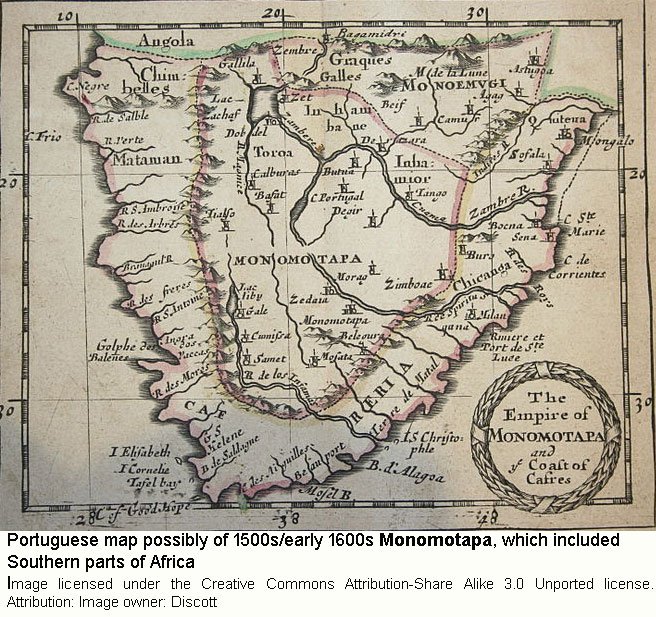 The Chaliyam fort had been such a source of trouble and annoyance to him, as already explained, that the Zamorin “demolished the fort completely, leaving not one stone upon another.” He made the site “a barren waste, transporting to Calicut the greater part of the stones and masonry,” whilst he gave the remainder to be appropriated for rebuilding the Jamat mosque, which the Portuguese had destroyed in building their fort. The ground and that lying round it were given, as previously arranged, to the Raja of Chaliyam (Parappanad Raja) for the assistance rendered by him on the occasion.
An event even still more important to Portuguese interests occurred in this same year (1571), for orders came out from Portugal to divide their possessions into three portions, designated India, Monomotapa, and Malacca. The decline of the Portuguese power seems to have dated from the time of this arrangement, for the consequence was a train of perplexities that distracted the Portuguese more than all the previous attacks of their enemies in India.
The war, however, still went on. In 1572 the Portuguese made a descent on Chaliyam and burnt it. In the following year Parappanangadi was attacked and four Muhammadans “suffered martyrdom.” In 1577 a fleet of fifty “grabs” returning from South Canara with vice was seized by the Portuguese and three thousand Muhammadans and sailors, it is said, were slain, and “the trade of the Muhammadans by this blow became almost annihilated.”
In the following year negotiations were opened for peace ; the Zamorin offered to allow them to build a fort at Calicut, but they wished to have one at Ponnani, to which the Zamorin would not agree. In 1579 the Zamorin was at the sacred temple of Kodungagallur (Cranganore), and the Cochin Raja, even with Portuguese assistance, failed to dislodge him from it. Nettled at this failure, the Portuguese carried on hostilities with great rancour against the Zamorin and his subjects—at Calicut, “the new harbour” (?Putiyangadi), Kappatt, Pantalayini Kollam, “Turkoy” ('?Trikkodi) and Ponnani—attacking them at all times and seasons, cutting off intercourse between neighbouring ports, and “greatly hindering ” the importation of rice from South Canara. So that a great famine, such as had never before occurred, was the consequence, “the common people of the ports above named being deprived of all means of subsistence.”
About this time a merchant of Venice, Cæsar Frederick, paid a visit to the coast, and among other interesting bits of information he gives the following : “And from thence (Barcelore) you shall go to a city called Cannanore, which is a harquebush shot distant from the chiefest city that the king of Cannanore hath in his kingdom, being a king of the Gentiles.”
“And he (the Zamorin) and his country are the nest and resting place for stranger thieves, and those be called ‘Moors of Carposa,’ because they wear on their heads long red hats ; and thieves part the spoils that they take on the sea with the King of Calicut, for he giveth leave unto all that will go a roving liberally to go ; in such wise that all along that coast there is such a number of thieves, that there is no sailing in those seas, but with great ships, and very well armed ; or else they must go in company with the army of the Portugals.” — (Eng. Translation.)
Just then (1530) another blow was impending still further to destroy Portuguese prestige, for on the death of Henry I, Spain subdued Portugal, and the control of their possessions in the East passed into Spanish hands, This event was almost contemporaneous with another which influenced the fate of India in general and of Malabar in particular, for in 1580-81 Holland, one of the seven “Northern United Provinces,” declared its independence of Spain.
And shortly after this other European nationalities began to trade directly with the East. About 1581-84 the Zamorin had had enough of fighting, and he arranged a treaty of peace with the new Viceroy Mascarenhas (the first appointed by Philip of Spain), whereby the Zamorin's subjects were permitted to trade as far as Gujarat, and to other parts as formerly, and to open trade with Arabia at the end of each season.
With the conclusion of this treaty of peace the interest in the narrative changes from Malabar to Europe, because it was only for a year or two more that the Portuguese enjoyed that monopoly of the Indian trade, particularly in Malabar pepper and spices, to which their efforts had hitherto been very consistently directed. With the appearance on the scene of the Dutch, and afterwards of the English and of the French, this monopoly died a natural death. Moreover the Muhammadans, whose trade it was the policy of the Portuguese to ruin, again began after a while to exercise their former privileges under the favouring shelter of the European jealousies imported into the East.
It would be out of place here to trace out the influences which eventually resulted in the conquest of all the Portuguese possessions in India outside Goa. A few words will suffice to carry the history of the Malabar coast up to the next stage in its course, the conquest by the Dutch of the Portuguese settlements, culminating in that of Cochin.
In 1591 Captain Raymonds made an unsuccessful attempt to reach the East in three English ships. In 1594-95 Houtman organised the Dutch East India Company. In 1596 another English expedition to the East under Captain Wood was also unsuccessful. In 1597 two Dutch ships succeeded in reaching India, but the one was destroyed off Malacca by a fleet of six Portuguese ships, and the other was wrecked on the coast of Pegu.
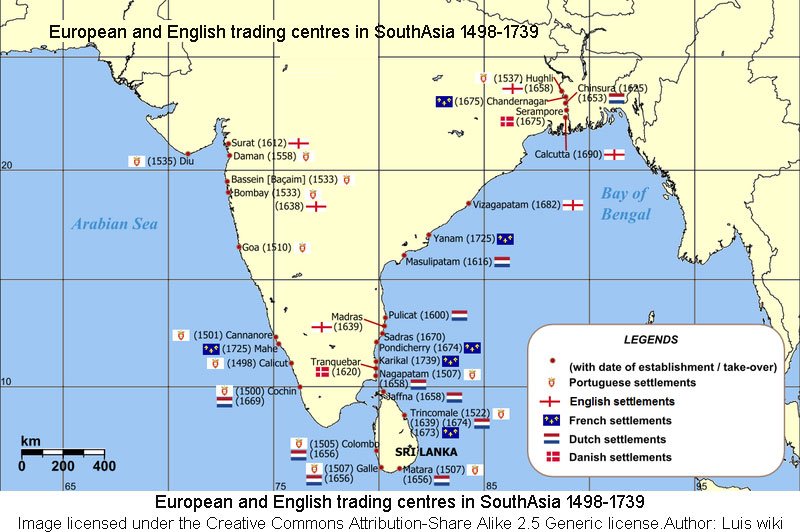
In 1598 the Dutch under VanNec reached Amboyna, established trade, and also settled at Baroda. On 31st December 1600 the English East India Company of London was formed. Henry IV of France issued letters patent for the formation of a French East India Company on 1st June 1604, but it came to naught. In August 1607 or 1608 the first English ship reached Surat under Captain Hawkins. In 1609 the right of Holland to trade with India was formally recognised by treaty with Spain, and in 1610 the Dutch settled at Pulicat.
In 1612 the English factory at Surat was established, and in 1615 Captain Keeling with three English ships, the same which had brought Sir Thomas Roe on his embassy to the Great Mogul, arrived off Calicut, and concluded a treaty with the Zamorin. But it very soon transpired that all that the Zamorin wanted was to get assistance against the Portuguese for the conquest of Cranganore and Cochin, and when the English ships left without assisting him, very scant courtesy was shown to the ten persons left behind, who were to have founded a factory at Calicut.
In 1611-15 the United French East India Company was formed. In 1616 this United Company sent two ships to Java, and the result is described negatively as “not a failure” financially.
In 1617 the Dutch settled at Ahmedabad.
In 1619-20 the French Company sent an expedition to Acheen and Java, and it was fairly successful. In 1620-22 the Dutch settled in Persia and in other places tentatively.
In 1624 the English East India Company was invested with powers of Government. In 1634-35 the English East India Company entered into a treaty with the Portuguese by which the English gained free access to Portuguese ports. In consequence of this some Englishmen appear to have settled at Cochin, and in 1635 pepper was for the first time exported to England direct from Malabar. In 1636 other bodies than the English East India Company were empowered to trade with India, and the same was renewed in 1655.
In 1639 the English settled at Madras and the Dutch made their first attack on Goa. In 1640 Portugal recovered its independence from Spain. In 1642 Richelieu founded “La Compagnie des Indes” with exclusive privileges for twenty years, but the energies of the company were wasted in an ineffectual attempt to conquer Madagascar.
In 1647 the English East India Company began to enlist Members of Parliament among the subscribers to their stock ; hitherto they had been shy of enlisting ‘‘gentlemen” among their servants. In 1652-53 ensued the naval war between England and Holland in Europe, and the English factories in India suffered in consequence. In 1655 the Dutch settled at Vingorla. In 1657 the English East India Company obtained a new charter. In 1660 the Dutch made a second attack on Goa and failed.
In 1661 the English East India Company was re-incorporated by Charles II, and by the charter granted in this year the East India Company’s servants were authorised to make peace or war with any prince or people not being Christians, and to administer justice for themselves and their dependents. This provision materially improved the status of the chartered Company’s servants—who had up to this time been buccaneering adventurers rather than steady traders and one company had been seeking to discredit another.
Moreover in this same year Bombay was transferred to the English Crown as part of the Infanta Catherina’s dowry on her marriage with Charles II.
The following account of the capture of Cochin, and of the other Portuguese settlements in Malabar, is taken from Dr. Day’s “Land of the Permauls ; or Cochin, its Past and its Present,” p. 115. Dr. Day’s account was compiled from official records now in the Collector’s office at Calicut.
“Another power was now to become predominant in the East, another race was to try their hand at supremacy, and another religion to be introduced. The Portuguese had become objects of aversion to their old allies, the prince of Cochin, as they had deposed the Raja and created his aunt the Rani.
“The Dutch beginning to dislike the interference of the Mogul and others at Surat, wished to establish a settlement on the coast of Malabar, where they might be territorial sovereigns, as well as traders without being subject to the rapacious exactions of the Muhammadan Government, or the neighbourhood of their successful rivals, the English. Cochin appeared a suitable spot, so they determined to try and dispossess the Portuguese and occupy it themselves.
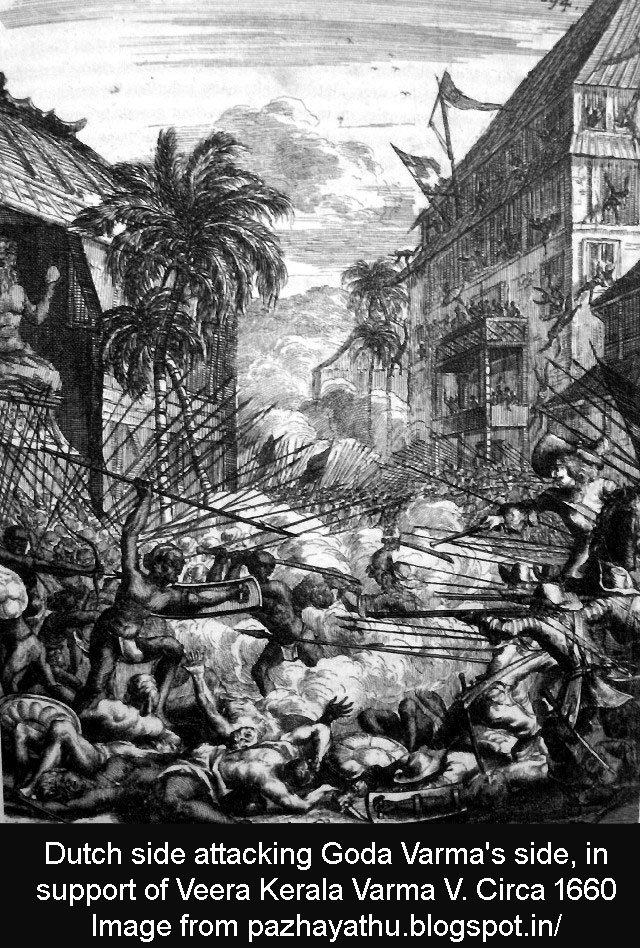
“In 1601 the Dutch entered into an agreement with the Paliat Achan, hereditary chief minister to the Cochin Raja, to assist them in their schemes. ‘When the Dutch planned the conquest of the coast, he (the Paliat Achan) materially assisted and met VanGoens, 12th March 1661, in a friendly manner and entered into an agreement the purport of which was that, as the Portuguese and other enemies had deprived him of his lands, he would place himself entirely under the protection of the Dutch, who were to restore him by force to his territories, whilst he was to obey them in all things.’
“This agreement was dated the same day on board the ship De Muscaatboom. The Dutch troops appeared on the northern side of Cochin at Vypeen, where VanGoens fixed his head-quarters at the Bishop’s house, and strongly fortified the Roman Catholic Church. Leaving eight hundred men to garrison it, VanGoens re-embarked the remainder of his force, and landed on the southern side of the town. The Raja of Cochin now openly asserted that he and the Dutch had entered into an alliance.
“VanGoens seized a church to the south, and made it his headquarters. He then attacked the Rani’s palace at Muttancherry, and after a struggle succeeded in taking it and making the Rani a prisoner. On the following day the Dutch attacked the fort of Cochin, but the officer commanding the storming party was killed, and they retreated in confusion. Regular approaches were now opened, but the old Portuguese spirit showed itself, and the garrison bravely defended themselves for several weeks, when the Raja of Porea1 came to their assistance with six thousand natives, and the Dutch determined to retreat.
NOTEs: 1. Purakkat. END OF NOTEs
“In the dead of the night they accordingly embarked in silence. When the morning broke, the Portuguese were amazed at finding their enemy’s camp abandoned. A Jew had sounded the hours as usual, thereby effectually deceiving them and preventing any sally on their part. Seven hundred men were left in the entrenchment at Vypeen. This year Tangacherry fell to the Dutch.
“As the Jews had favoured their enemies the Dutch, the Portuguese considered it necessary to punish them to prevent the recurrence of such conduct, and therefore immediately on the siege being raised, they plundered Jews’ Town of almost all it contained, attempted to destroy the synagogue, and carried off the Pentateuch, which was subsequently, in 1668, recovered uninjured.
“The absence of the Dutch was but temporary. In 1662 Cranganore fell to them; in October of that year they returned to Cochin under Hustart, but were vigorously met by the Portuguese, who in vain attempted to prevent their landing. The head-quarters of the Dutch were fixed at the convent of St. John the destruction of which had been unsuccessfully attempted by the garrison. In November VanGoens with a large number of troops joined the besiegers, but the garrison bravely determined to stand a siege.
“In December the Raja of Porea1 arrived with a large native force at Ernakulam, and threw supplies into the fort. It was therefore determined to attack him. The natives under Portuguese officers met their foes most gallantly and drove them back with great loss, and the Dutch were compelled to bring up fresh troops before the Porea contingent could be routed.
“But the Portuguese still held out, so the Dutch with the assistance of the troops of their ally the Raja of Cochin and the Paliat Achan, determined on storming the fort, and for eight days and nights were enabled to keep up a succession of assailants, the troops being relieved every three hours. A remnant of the glorious valour of the early Portuguese appears to have animated this little band of their descendants in so long maintaining such an obstinate defence. At length, when the Portuguese commandant Pierre de Pon found that no assistance could reach him, that his native allies had forsaken him and had joined the new European power, that provisions were becoming very scarce, and all were worn out with fatigue and anxiety, he capitulated, and the Dutch became masters of Cochin on the 8th January 1663.
“Four hundred topasses who were not included in the terms of the capitulation on discovering the omission, and knowing the cruel and licentious character of the Dutch soldiery in India, drew up close to the gate at which the Portuguese were to march out and the Dutch to enter, declaring that if equally favourable terms were not granted to them as to the Portuguese, they would massacre them all and set fire to the town. It was deemed advisable to accede to their demands, and subsequently some of them even enlisted in the Dutch service.”
Section (E) - THE DUTCH, ENGLISH AND FRENCH SETTLEMENTS
The Struggle for the Pepper and Piece Goods Trade. A.D. 1663-1766.
When the Dutch acquired in the manner described in the preceding section all the Portuguese possessions in Malabar they found, among the settlers at Cochin, a small factory of the English East India Company established there, as already described, so early as 1634-35, and these factors receiving immediate notice to quit, took the earliest opportunity to leave the place after it fell into Dutch hands.
From a very early period in its history the English Company had set its face against martial enterprises. And Sir Thomas Roe, the Ambassador to the Great Mogul, had given the Company some invaluable advice which they took well to heart.
“The Portugueses”, he wrote, "notwithstanding their many rich residences are beggared by keeping of soldiers, and yet their garrisons are but mean. They never made advantage of the Indies since they defended them. Observe this well. It has also been the error of the Dutch who seek plantations here by the sword. They turn a wonderful stock; they prole in all places ; they possess some of the best, yet their dead pays consume all the gain.”
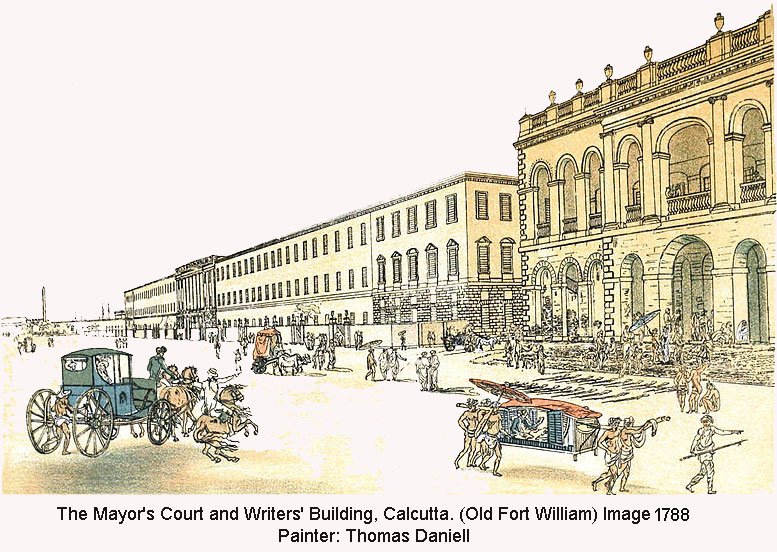
So far indeed did the English Company carry this policy that they even forbade at times an appeal to arms by the factors for their own defence ; and the annoyances experienced in consequence of this were occasionally almost intolerable. But the strength of the Company lay in the admirable arrangements whereby they encouraged trade at their fortified settlements. They established manufactures ; they attracted spinners and weavers and wealthy men to settle in their limits ; the settlers were liberally treated and their religious prejudices were tolerated ; the privacy of houses were respected by all classes and creeds; settlers were allowed to burn their dead and to observe their peculiar wedding ceremonies ; no compulsory efforts were made to spread Christianity, nor were the settlers set to uncongenial tasks ; shipping facilities were afforded ; armed vessels protected the shipping ; all manufactured goods were at first exempted from payment of duty ; the Company coined their own money ; and courts of justice were established ; security for life and property in short reigned within their limits.
In 1685-90 a martial policy was tried at Bombay and Surat, but the Company found to their heavy cost that it did not pay, and so it was once more abandoned. And the settled policy of the Company seems to have been from this time forward to avoid war, either defensive or offensive, unless a substantial return could be obtained for the outlay in money and men.
The English Company’s servants were graded in their order of seniority as apprentices for five years, as writers for five years, as factors for three years, as senior factors for three years, and as merchants.
Some changes subsequently took place in these grades, for senior factors were latterly styled merchants, and the merchant grade became senior merchants. The pay of the several grades was very small. In 1739 the Chief of the Tellicherry factory received only £70 a year, the two senior merchants £40 a year each, one junior merchant £30 a year, and one writer £5 a year with an additional Rs. 144 (equivalent at that time to £18 a year) for reading divine service.
One or more of these servants seem to have been despatched from time to time to look after the Company’s investments at the different ports on the coast. They lived under the protection of the native rulers of the places where they settled, and were in no way different from ordinary private merchants.
In time, as the Company’s investments became larger and more important, the necessity for fortified posts to protect the Company’s warehouses made itself felt ; but for many years after the Company’s factors were unceremoniously turned out of Cochin by the Dutch in 1663 the English Company’s servants in Malabar had to rely alone for protection on the native chieftains in whose territories they were settled. It would be difficult to over-estimate the benefits of the experience thus obtained in the Company’s dealings with the natives, for the factors had perforce to study native character and to adapt themselves to it ; and in doing this they were unconsciously fitting themselves to become the future rulers of the empire.
Such settlements seem to have been formed at Rattera and Brinjan in Travancore territory and at Ponnani and Calicut in the Zamorin’s country. It was with the latter chief that the English Company’s earliest extant1 agreement was concluded in September 1664 shortly after the taking of Cochin by the Dutch. Two of the Company’s servants by name Riveri (? Rivers) and Vetti (?) appear to have proceeded to Calicut in June preceding the above date, and to have been permitted to settle there on agreeing to pay duty to the Zamorin on the trade carried on.
NOTEs: Collection of Treaties, etc,, i. I.—Calicut 1879. END OF NOTEs
The Zamorin is described shortly after this time as ruling the country “from Ticori (Trikitodi1) to Chitwa,”2 a distance of about 22 leagues. His palace at Calicut was built of stone, and he kept up “some faint resemblance of grandeur” about it.
NOTEs: 1. Page 72.
2. Chavakkad, see p. 77 END OF NOTEs
He was still “reckoned the powerfullest king” on the coast, and he had the best trade in his country. The products of his country were pepper, betel-nut, coconut, jaggery, copra, sandalwood, iron, cassia-lignum and timber. His supremacy appears to have been acknowledged by all the Malayali chiefs, except, perhaps, the Cochin Raja, from the northernmost part of Malabar to the southernmost extremity of Travancore by the offering of a flag or other token of submission, and by attending him once in twelve years at the Tirunavayi ceremony already fully described.3 This supremacy was however little more than nominal, and his position among the country powers appears to have deteriorated greatly from what it was in 1498 when the Portuguese appeared upon the scene.
NOTEs: Pages 163-8. END OF NOTEs
In August 1664 the French “Compagnie des Indes” was formed by Colbert. It started with a capital of 15,000,000 “livres tournois” (£600,000), and Louis XIV had to publish an edict telling his courtiers it was not derogatory for a man of noble birth to trade to India. Men who had thus to be reminded of what "was or was not fitting to their position were not the men to push French interests successfully, and the English Company’s servants soon saw that the French men were poor men of business and not likely to prove successful rivals in trade.
Fryer described their Surat factory about this time as “better stored with monsieurs than with cash ; they live well, borrow money, and make a show'”.
Their first venture was a fresh attempt on Madagascar, and most of their funds were spent in combating with a bad climate, a poor soil, and the hostility of the Malagasis. In 1672 they relinquished their attempts on the island and their colonists were scattered abroad, some to India and some to Mauritius and Reunion.
Meanwhile in 1665 war had broken out in Europe between the English and the Dutch ; and the Dutch4 in 1673 with a fleet carrying 6,000 men under VanGoens threatened the English settlement at Bombay, where in September 23, 1668, the English Company had finally settled down and secured for themselves from the Crown authorities an unequalled position for trade. The Dutch, on finding they were likely to receive a warmer reception than they had bargained for, wisely determined not to land.
NOTEs: The Dutch settlements on the coast at this time were —
(1) Quilon.
(2) Calli-Quilon.
(3) Cranganore.
(4) Cannanore, which were all placed under the command of the Governor at.
(5) Cochin. END OF NOTEs
In 1674 the French, who had been driven out of St. Thome by the Dutch, settled under Francois Martin at Pondicherry.
About 1680 the Dutch began to experience the results of their error in seeking trade at the point of the sword. The expenses of the garrisons maintained at their various settlements were so large that their trade yielded no profits, and they began gravely to consider the advisability of destroying the forts of Cannanore, Cranganore and Quilon, or of re-selling them to the Portuguese.
For various reasons, however, the resolution was not carried out. The Dutch were also very intolerant of persons professing the Roman Catholic faith, and in their overtures to Portugal about this time they proposed to hand back the places (except Cochin) where that faith had obtained a firm hold of the people. The negotiations fell through, and in 1684 the Roman Catholic priests were at last allowed to return to the charge of their flocks.
In this same year (1684) the English Company obtained from the Attingal Rani (of the Travancore family) a sandy spit, of land at Anjengo. The site was badly selected in some respects, for there was no good water within three miles or so and the open roadstead and surf rendered shipping operations precarious.
The place, however, had other advantages. Pepper was abundant, also calicoes of excellent quality. And when the place was fortified some years later, the cannon of the fort commanded the river, the main artery of traffic, as well as the shipping in the roadstead.
It was in 1690 that the Rani of Attingal gave permission to the English Company to erect the Anjengo fort, but no written treaty remains as a record of the fact. The English system of sending factors to various points on the coast to test the value of the trade at those places seems to have enabled the Company to decide where it would be best for their interests to plant factories for the defence of the trade thus ascertained to exist ; and, in this way, towards the close of the seventeenth century they settled on two points on the Malabar coast, one at Anjengo, as already described, and the other at Tellicherry.
Calicut would probably have been selected as a more favourable spot for trade than Tellicherry, but the Zamorins seem, not unnaturally after their experience of what had befallen them in the Portuguese period, to have looked with jealousy on all foreign fortified settlements ; and so strong seems to have been the feeling on this point that it was not, until after the English Company had been settled for nearly a whole century at Calicut, that they were permitted in 1759 even to tile their factory there so as to secure it against fire.
As the English Company’s operations expanded in this way so did the Dutch Company’s business fall off, notwithstanding the number and strength of their fortified posts. On September 10, 1691, the Dutch gave up Chetwai to the Zamorin. In 1697 the walls of the Dutch fort at Cochin had become so ruinous, owing to the parsimonious policy pursued, that it was manifest something must be done. In pursuance therefore of the policy inaugurated in 1680; steps were taken to reduce their military expenditure.
The Cochin fort was reduced to half its size, at Cannanore and Quilon only one tower was to be left standing, and at Cranganore the exterior works only were to remain. Moreover the military at all the outposts— Paponetty, Purakkat, and Calli-Quilon —were to be withdrawn, and the marine establishment was reduced to the most attenuated proportions-—one small yacht, two sloops, and three row boats.
These reductions had their natural effect on the country powers, and the Dutch Company was no longer feared.
It was in 1695 that the notorious Captain Kydd’s expedition was lifted out in England to put down1 European piracy in the Indian seas. The Mogul held the factors at Surat responsible for the piratical acts of Kydd, the Dutchman Chivers, and others. And the other country powers seem to have reasoned in like fashion, for about November 1697 the Anjengo settlement was violently but unsuccessfully attacked by the Travancoreans on the plea that, the factors were pirates. It may, however, be doubted whether this, their ostensible reason, was the true one, for, as will presently appear, the presence of the English in Travancore was gradually leading to a revolution in that State.
NOTEs: Pages 73-4. END OF NOTEs
It was not the country powers alone who charged the old English Company with fomenting piracy, for their rivals (the new company) also brought this charge against, them ; and indeed from the extent to which European piracy had prevailed, the alternative lay between the suppression either of it or of honest trade.
It would be out of place here to set forth the grounds of quarrel between the rival East India Companies, but in passing it requires to be noted that, English interests suffered severely in consequence of the disputes, whereby piracy was encouraged. The Mogul made the Surat factors pay heavy damages, and even went the length of ordering the factories to be destroyed. The differences were at, last, however, arranged; on April 27, 1702, the rival Companies approved an instrument of union, and on and after July 22 of that same year all opposition between the rival Companies’ officers in India was to cease.
It took a year or two more, however, to adjust all their differences ; and it was not till September 29, 1708, that the Earl of Godolphin, Lord High Treasurer of England, who had been appointed arbiter in the disputes, made his famous award, and from that date the style of the association was altered to that of “The United Company of Merchants of England trading to the East Indies.”
Notwithstanding those troubles the English settlements on the coast were making progress.
About 1680 there had occurred a disruption in the Northern Kolattiri family. Hamilton, who visited the reigning Kolattiri in 1702, but who had been on the coast some years previously, thus describes the event :—“There were three princes of the blood royal who conspired to cut him” (the reigning Prince Unnitri) “and his family off, to possess themselves of the government of Callistree ” (Kolattiri): “but being detected they were beheaded on altars built of stone. About two miles from Cannanore the altars were standing when I saw there. They were only square piles of hewn stone, about three yards high and four yards each side.”
Such family quarrels were not infrequent in the Kolattiri Chief’s house, and the reasons therefore are in operation in all Malayali families down to the present day and more especially in North Malabar. The head of a Malayali house has two conflicting sets of interests to deal with—first;, those of his legal heirs, the children of his female relatives of various degrees ; and secondly, those of his natural heirs, his own wife and children. The latter have no legal claim on him, but natural affection comes into play, and to provide suitably for his own children and their mother a man not infrequently trenches upon the right of his legal heir.
Hence arise bitter quarrels and jealousies. There can be no doubt that the Kolattiri family’s dominions had become greatly curtailed by such provisions having been made for the natural heirs of the chiefs out of the territories belonging of right to the legal heirs. And at the period when the Tellicherry factory was established, somewhere about I694-95, one of the natural offshoots of the family, the Kadattunad Raja, known to the early English as the Boyanore or Baonor1 of Badagara2 was in semi-independent possession of Kadattunad3 ;i that is, of the territory lying between the Mahe and Kotta rivers.
NOTEs: 1. Valunnavar - Ruler.
2. Vadakara (p. 72)
3. See map at paragraph II of Section (b), Chapter IV. END OF NOTEs
And another such offshoot was in similar semi-independent possession of the Malayalam territory lying to the north of the Kavayi river. And of the territory lying between the Kavayi and Mahe rivers various portions had come, whether by family alliances of the kind described or by grants, it is difficult to say, into the possession of various chieftains who were all more or less dependent on the Kolattiris.
Randattara, otherwise called Poyanad,4 was under the Achanmar (fathers) four houses of the Nambiar caste ; Kottayam was under the Puranat (foreign) Rajas, and Iruvalinad including Kurangoth ) was ruled by six houses of the Nambiar caste and by one house of the Nayar caste. Besides the above the two houses of Nambiars still continued to rule, in some subjection to the Kolattiris, the territories,1 assigned, (it is said) to them by Cheraman Perumal himself along the foot of the Western Ghauts in the present Chirakkal taluk, and there were other houses of Nambiars (though of lower lank) located in different places in what is now the Chirakkal taluk.
NOTEs: 4. Tradition says that, this was the county (nad) from which Cheraman Perumal went (poyi) to Arabia.
1. (Chulali and Noriyot) - Conf. p. 234. END OF NOTEs
Lastly the Mappilla Chief of Cannanore (the Ali Raja) or Raja of the Sea had secured to himself a small slice of territory at and about Cannanore. The original Kolattiri dominions were therefore broken up into a large number of petty principalities at the time of the founding of the Tellicherry factory, and the territory which remained under the direct rule of the Kolatliris was of comparatively small extent.
To understand thoroughly the position of affairs at this time, it is further necessary to explain that the Kolattiri house itself had become largely disintegrated. The following table shows its present (1886) constitution:
|
Kolattiri family |
|||||||
|
Udayamangalam |
Palli |
||||||
|
Chirakkal |
Chenga |
Tevanamkotta |
Padinyara |
Kavinisseri |
|||
|
|
Prayikkara |
Ennakkat |
|
|
|
||
|
|
|
Ennakkat |
Mavalikkara |
|
|
|
|
Several other sub-branches had broken off from the parent stem, but these have all since become extinct.
The eldest female of all the branches was accustomed to some distinction, and was entitled to the sthanam (dignity) annexed to the Achamma Mupasthanam. She was nominally the head of the whole family just as the Ambadi Kovilagam Rani was the nominal head of the Zamorin’s house.
But the executive power was in theory at least sub-divided among the five eldest male members, who were styled, respectively, in their order of seniority.
1. The Kolattiri,
2. The Tekkalankur ,
3. The Vadakkalankur,
4. The Nalamkur, and
5. The Anjamkur.
When this arrangement was first made, the Kolattiri himself probably retained originally the immediate executive charge of only the middle portion of his dominions. The Tekkalankur (the Southern Regent) used to have separate charge of the southern portion of the territories of the house with his headquarters at Putupattanam on the Kotta river , and tradition says that it was by marriage with one of the southern regents that one of the Kadattanad Raja’s female ancestors acquired the territory of that family. The Vadakkalankur (the Northern Regent) had separate charge of the northern territories, and from a marriage with one of them, the Nilesvaram Rajas acquired their territory forming at present the southern portion of the Kasargode taluk in South Canara.
The other Kurvalchas (rulers of portions), namely, the fourth (Nalamkur) and fifth (Anjamkur), probably remained in more or less immediate attendance on the Kolattiri himself and rendered him any assistance he required.
The dissensions which broke out from time to time in the family, and of which that noticed by Hamilton is the first on record, were caused no doubt by the extensive surrenders of territory to the consorts of the ruling members. The Tekkalankur, when he succeeded to that dignity in order of seniority, would find himself, if he accepted the situation, a ruling chief without any territory to rule, and he would not willingly part with what remained of the territory attached to the dignity (the Vadakkalankur’s) he was about to vacate.
On examining the records it is found that, as a rule, the ablest member of the family, sometimes peaceably with the consent of all the members, sometimes by force, seized the reins of power at the earliest possible opportunity, and the rest of the family, although perhaps senior to himself, were mere puppets in his hands.
This explains how it came about that the grant of the Tellicherry factory site was obtained, not from the Kolattiri himself but from the Northern Regent (the Vadakkalankur), who happened at the time to be the de facto ruler of Kolattunad. It is not easy to explain why the Company eventually decided to settle at Tellicherry, for it was a place of no importance up to that time. Hamilton, who however bore the factors no good-will, was not able to find a satisfactory reason for it at the time. His narrative runs thus:—
“The place where the Factory now stands belonged to the French, who left the mud walls of a Fort built by them to serve the English when they first settled there, and for many years they continued so, but of late1 no small pains and charge have been bestowed on its buildings ; but for what reason I know not for it has no River near it that can want its protection, nor can it defend the Road from the insults of Enemies, unless it be for small vessels that can come within some rocks that lay half a mile oft or to protect the Company’s Warehouse, and a Punch-House that stands on the Sea-Shore a short Pistol Shot from the garrison.”
NOTEs: 1. Published in Edinburgh in 1727. END OF NOTEs
The factory site was probably chosen more for purposes of trade than with a view to securing that trade once it was developed. Tellicherry lies close to the fine pepper-producing countries of Kottayam and Randattara, and the finest cardamoms in the world are produced in the country lying at the head of the Periah pass into Wynad, to which Tellicherry is the nearest point on the coast.
These were advantages which the Company would certainly appreciate. By selecting Darmapattanam Island, however, the same advantages could have been secured along with capabilities of defence such as Tellicherry could not boast. But the island was at this time in dispute among the country powers, and when the chance did occur of acquiring it the expense of moving the garrison and warehouses to the island was so heavy that, although the removal was sanctioned, it was never actually carried out.
As to when the factory was established it is certain that this event happened some time before the 24th October 1699, the first, date in the “General Letter Book” of the factory extant on 6th May 1728 as mentioned in the factory diary of this latter date. The Company had probably had a trading post at Tellicherry for some years previously, and it is certain that at the union between the Companies in 1702 Tellicherry is mentioned along with Karwar, Calicut, and Anjengo as among the affiliated factories of Bombay.
It was the Vadakkalankur (Northern Regent) of Kolattiri who permitted the English Company to settle at Tellicherry. Their settlement was as usual unprotected. And, it is said, that one of the rival Kolattiri princes of the Udayamangalam branch, in combination with the neighbouring Nayar chieftain of Iruvalinad, the Kurangoth Nayar, entered the Company’s warehouse one day about 1704-05 and committed certain regularities, which were duly reported to the Northern Regent, and it was at the same time pointed out to him that such events would recur unless the place were fortified.
The Regent thereupon gave his consent to the building of a fort, and it is said that he himself laid the foundation-stone thereof. With the consent, it is said, of the Ponattil Poduval and of the Vallura Tangal, a house site belonging to the former and a hill (Tiruvallappan Kunnu) belonging to the latter were taken up, and on these sites the fort and fort-house were built. The Company also bought up, for the same purpose, a street of weavers which existed at the place.
The town, Hamilton says, lay at the back of the fort with a stone wall round it “to keep out Enemies of the Chief’s making, for in 1703 he began a war that still continues, at least there were Folks killed in 1723 when I was there”.
The buildings and the war together, he said, had taken, “double the Money to maintain them that the Company’s investments came to,” and he thus relates the origin of the disturbance.
“The occasion of the War, as I was informed, began about a trifle. The Nayar, that was Lord of the Mannor, had a Royalty, for every Vessel that unladed at Tellicherry paid two Bales of Rice duty to him. There was another Royalty of every tenth Fish that came to the Market there, and both together did not amount to £20 Sterling per annum. The Chief either appropriated these Royalties to his own or the Company’s use, and the Nayar complained of the Injustice but had no Redress. These little duties were the best part of the poor Nayar’s subsistence which made it the harder to bear, so his friends advised him to repel force by force, and disturb the Factory what, he could, which he accordingly did (by the secret assistance of his Friends) for above twenty years. The Company are the best Judges whether the War is likely to bring any profit to their affairs there or no."
It is extremely improbable, it may be remarked, that the Company’s officers, who had been careful to buy up the weavers’ and others’ houses and lands before beginning to erect their fort, would have refused to pay the petty dues Hamilton writes about, had they been justly payable, and he omits all mention of the irregular entry into the Company’s warehouse before the fort was built, so he is not an impartial witness in the matter.
Jealousies between the Kolattiri chiefs had probably more to do with it than the reasons assigned by Hamilton.
A paper in the records states that every endeavour was made to arrange matters amicably with the Kurangoth Nayar, and it was only when these proved abortive that the English Company resorted to force. They stormed the Mailan hill on the outskirts of Tellicherry and took it, although it had, with a view to giving trouble to the factory, been fortified by the Nayar with the secret assistance of his friends,1 no doubt, as Hamilton says.
NOTEs: Hamilton himself, who was an Interloper, was probably to be reckoned of this number as he paid a visit to Mahe, the southern limit of the Nayar’s territory in 1707. END OF NOTEs
On August 20th, 1708, the Northern Regent formally gave2 and made over the Tellicherry fort, which had been “built at the request and entreaties made by me as a friend " to the Honourable Company, and he added that within its limits "no person shall demand, collect or plant," and “our custom house will be obliged to give us what has been settled."
NOTEs: 2. Treaties, etc., i. III. This treaty was subsequently confirmed by the Kolattiri himself and other members of the family. Ibid., i. VIII, IX and X. END OF NOTEs
The Nayar appears to have maintained a desultory warfare with the factory until, on 29th September 1719, he submitted proposals of peace, which were accorded to him and ratified on that date. Among other terms3 he gave the Company “two great guns and a slave in lieu of one you have lost," and he agreed to give the Company a monopoly of his pepper produce without any duty and to surrender "the Ramem hill," which is probably identical with that of Mailan already referred to.
NOTEs: 3. Treaties, etc., i. VI and VII. END OF NOTEs
The Zamorin in 1699 had probably received an advance of money from the Company, as in that year he came to an understanding4 with a Mr. Peni (Penny?) authorising him to deduct 25 per cent, of the duty on pepper exported. And again in 1710 he had authorised1 them to employ the oil ordeal for settling their disputes with native traders. It appears they also had the privilege of protecting debtors who took refuge in their Calicut factory, to the disadvantage occasionally of interlopers like Hamilton.
NOTEs: 4. Treaties, etc., i. II.
1. Treaties, etc., i. IV. END OF NOTEs
Meanwhile affairs in other parts of the Zamorin’s territory had not proceeded so satisfactorily for the English Company’s interests. It has already been said that the Dutch in pursuance of their policy to curtail their military expenditure had in 1691 placed the Island of Chetwai in the Zamorin’s hands. The Zamorin was not slow to follow up the advantage this gave him of being placed on the flank, as it were, of his hereditary foe, the Cochin Raja’s territory. War broke out shortly afterwards, and from 1701 till 1710 the Dutch were drawn into it in a desultory manner in protection of the Cochin Raja’s interests.
It was this protection of the Cochin Raja against the Zamorin which involved the Dutch in so much profitless expenditure in Malabar. So long as the Chetwai Island remained in the Zamorin’s hands, he could at any moment turn, as it were, the flank of the Cochin Raja’s defence, and it, therefore, became an object of importance to the Dutch Company to protect the northernmost point of the island. In 1714 they accordingly set about the erection of a fort at this point.
The English Company, on the other hand, and, if Hamilton’s account is correct, the Chief of the English factory, Mr. Robert Adams, had, in particular, interests of their own to protect. Ever since the place had been in the Zamorin’s hands, the English chiefs had made, as Hamilton expresses it, “a good Milch Cow” of it, by vending presumably on their own private account, “between 500 and 1,000 Chests of Bengal Ophium yearly up in the inland Countries where it is very much used.2 The Water Carriage of the River being cheap and secure, the Price of Ophium high, and the Price of Pepper low, so that their profits were great both ways.”
NOTEs: 2. The consumption in these same parts is still large. END OF NOTEs
The Raja of Cochin made over his claims to the island to the Dutch, “who,” as Hamilton records, “made small account who had the best Title, but carried on their Work with Diligence.”
Acting on the advice of Mr. Adams on the other hand, the Zamorin determined to resort to stratagem to recover possession of it. He accordingly sent some soldiers disguised as coolies who entered the Dutch service to help in the building of the fort. These men were instructed to watch their opportunity, and for this purpose they lay in ambuscade “in a Morass overgrown with weeds near the Fort.” The two Dutch lieutenants in charge of the works began one evening to play dominoes in a temporary guard-room about half a mile from the fort, while the garrison strolled about off their guard in the cool of the evening. Taking advantage of this favourable opportunity the men in ambush easily overpowered the sentinels and took the half-built fort.
Collecting a few men the officers rushed to the spot, but one of them was killed in the advance, and the other losing heart drew off his men and sailed for Cochin. Before sailing he had the mortification to see the English flag flying over the fort. On reaching Cochin he was tried by court-martial and shot, Hamilton being present at the execution. The Zamorin’s people set to work at once to demolish the fort and carried off some great guns belonging to the Dutch. “And this was the Prelude of the War.”
The reason for the hoisting of the English flag over the unfinished work appears to have been that in February 1715, Mr. Adams had obtained permission1 from the Zamorin to build a warehouse at Chetwai, and keep a person there for trade purposes.
The Dutch could not stand this affront, so Councillor Willem Bakker Jacobtz took the field at the head of 4,000 European and native troops. Chetwai was recovered ; Paponetty previously mortgaged to the Zamorin was also taken ; and notwithstanding some unacceptable advice tendered to Mr. Adams by Hamilton “not to embark his Masters in that Affair because war was a different Province from his,” the war ended in “a dishonourable and disadvantageous Peace” in 1717. The Zamorin by the conditions of peace “was obliged to build up the Fort he had demolished, to pay the Dutch Company 7 per cent, on all the pepper exported out of his Dominions for ever, and to pay a large Sum towards the Charges of the War. Some Part of the Money, I believe, he borrowed.”
The Dutch formally resumed possession of the Chetwai fort on April 10th, 1717. It was named Fort William and Heer Wilhem Blasser, Captain-Lieutenant, and first commandant thereof, died there on the 2nd of February 1729, as his tombstone lying at the Chetwai public bungalow still attests.
After the conclusion of this disadvantageous peace, Mr. Adams continued to be the Chief of the Tellicherry factory for many years, and he was not relieved of that charge till the 10th of March 1728. Hamilton’s belief that part of the money spent by the Zamorin in this war was borrowed was fully justified, for the early Tellicherry records show that the Company took great exception to the loans which Mr. Adams had made out of their money to the Zamorin, the Punnattur Raja, the Prince Regent of the Kolattiri dominions and others.
Notwithstanding the most persistent dunning, the Zamorin’s debt amounted to the large sum of fanams 6,68,122.04 when Mr. John Braddyl eventually took charge of the factory. Mr. Adams did not regularly deliver over charge of it. He proceeded with Mr. Braddyl to Tanur to recover some of the money lent. Mrs. Adams, after some restraint (subsequently withdrawn) had been used to prevent her leaving Tellicherry, came down the coast “on board the Decker for Fort St. George,” picked up her husband at Calicut, and the records do not say what further became of them.
In consequence of these expensive wars the "Dutch settlement at Cochin was not paying its way, so in 1721 the Supreme Council in Batavia came to the very important resolution that the Raja of Cochin was no longer to be supported in his interminable fights with the Zamorin, and the Cochin council was solemnly cautioned to live peaceably with all men : advice more easily given than capable of being carried out.
This resolution of the Dutch Company, coupled with the results of certain memorable events at Anjengo, speedily led to great changes among the country powers.
The Honourable Company settled at Anjengo mainly for two reasons—“Pepper” and “piece-goods.” Travancore was at the time of the settlement and for many years subsequently in a state which did not favour trade. The Rajas were as a rule mere puppets in the hands of certain Brahmans of the Trivandrum temple and of certain petty chieftains of the Nayar caste, who were styled the Ettuvittil Pillamar, or the Pillays of the eight houses. These latter appear to have been the local heads of the Nayar tara organisation - of the organisation, that is, which, as already fully explained, was charged with the maintenance of the rights of all classes, and with preventing any such from falling into disuse.
The country was therefore broken up, as was also the case with Kolattunad, into an immense number of petty chieftainships, over which the Rajas had very limited and precarious authority. Such a country was not favourable for trade. What the English Company would have liked would have been a despotic monarch who could assign to them monopolies of the produce they came seeking and could enforce the same with a strong arm.
A weaker prince than usual appears to have succeeded to the Travancore Raj in 1718, and another prince then quite a boy, but afterwards famous as the great Martanda Varma, appears to have set himself in opposition to the Brahmans and feudal chiefs, and in consequence the country was in a disturbed state.
In April 1721 the Anjengo factors were applied to for their usual annual present due to the Rani of Attingal, of the Travancore family. “Those1 who demanded it assured him (the Chief of the Factory) that they came to demand it by the Queen’s order, and offered their Receit of it in her Name.” The chief appears to have had reason to expect that if the present were sent it would never reach Her Highness as the Ettuvittil Pillamar were just then in the ascendant, so he refused to pay it into any hands but those of the Rani. On this the Rani invited him to bring it to Attingal himself.
NOTEs: 1. Hamilton's New Account, etc., I. 332-3. END OF NOTEs
“And he to appear great there, carried two of his Council, and some others of the Factory with most Part off the Military belonging to the Garrison, and by Stratagem they were all cut off, except a few black Servants whose heels and language saved them from the Massacre, and they brought the sad news of the tragedy.”
This happened on the 15th April 1721.
Two years later the Chief of the Anjengo factory was Dr. Alexander1 Orme, the father of the Historian2 Robert Orme. He had come as an adventurer to India about 1706, and probing serviceable as a surgeon to the factors at Anjengo he had been taken into the Company’s service, being described by the Anjengo factors, who recommended his being entertained, as “a very capable and ingenious person that would be extraordinarily serviceable to our masters and us in sickness." He appears to have been appointed as the chief of the factory directly after the massacre.
The resolution taken by the Honourable Company on learning of this massacre is thus expressed in an ola (cadjan letter), written by the Travancore Raja to Dr. Orme on the 15th August 1723 ; —
“Owing to the loss sustained by the Honourable Company in the capture of Atinga (Attingal) and the money and artillery, which the enemies robbed in our country, the Honourable Company have resolved, in spite of money expenses, to put clown the enemies and subject the country to the king, we are ready to do anything, which the Honourable Company may require, and shall personally come there and punish the enemies there in the best manner you may desire, regarding which we affirm to do without fail, and wish to know when must we come there with our army.”
The Raja appears to have died shortly after this letter was written, and it was not till 1726 that the first important step was taken by his successor, advised to it also by the Prince Martanda Varma, now twenty years of age, to break the power of the Ettuvittil Pillamar and other chieftains whose interference was as unwelcome to the Raja as it was to the trading English Company. This step consisted in obtaining a body of troops—1,000 cavalry and 2,000 sepoys from the Nayak of Madura—in consideration of Travancore undertaking to become tributary to him.
With the aid of this force the refractory feudal chiefs were kept under some restraint, but it was not until after 1729, when the famous Raja Martanda Varma at last succeeded to the Raj, that effectual steps were taken “to put down the enemies, and subject the country to the king.” And the extirpation of the Ettuvittil Pillamar was the first effectual step taken in this direction by that energetic chief. The advantage of having a standing army of trained troops had however meanwhile become so apparent that the next step adopted by this capable Martanda Varma was to employ the famous Fleming Eustachius D'Lanoy to organise his forces. D’Lanoy had been taken prisoner at the Travancorean attack on the Dutch fort of Colachel in August 1741 ; he had attracted the notice of the Raja who had treated him with much kindness and consideration, and in return he and several of his companions had entered the Raja’s military service.
Things had in this way become rife for great changes in the south, and in consequence
First, of the Dutch Company’s resolution in 1721 not to back up their native allies, or to do it in an irresolute fashion, which appears to have been what actually happened ;
Secondly, of the English Company’s resolution in 1723 to “subject the country to the king” and so facilitate their trade ;
and
Thirdly, of the formation about 1741 of a standing army in Travancore,
the next few years saw the Travancoreans masters of the whole of the country as far north as Cranganore, leaving to the luckless ally of the Dutch Company, the Cochin Raja, only a few square miles lying round his palaces at Ernakulum and Cochin.
Meanwhile the French had secured a stable footing on the coast as competitors for the Malayali produce of pepper, piece-goods, ginger and cardamoms, and the way of it was as follows : —
Hamilton, as already set forth, mentions incidentally that the French had formed a temporary settlement in a small mud fort at Tellicherry prior to the occupation of that place by the English. And he further notices the fact that in 1698 they had a factory at Calicut. They were, however, evidently not doing much there, as he says they had neither money nor credit and were “not in a condition to carry on a trade.”
Hamilton chanced once to visit the place which he called “Mealie,”1 and which the French subsequently seized in the manner to be presently described, and his account furnishes much interesting information regarding the chief of that district of Kolattunad, whom the French afterwards dispossessed of a small portion of his territory.
NOTEs: 1. Mayyali — Mahe. END OF NOTEs
“And 8 or 10 miles further to the Southward” (of Mahe) “is Burgara,2 a seaport in the dominions of Ballanore3 Burgarie2 a formidable Prince. His country produces Pepper and the best Cardamoms in the World.”
NOTEs: 2. Vadakara.
3. Corrupt form of Valunnavar = Ruler. END OF NOTEs
In January 1703 Hamilton appears to have visited the place and bought cardamoms, and received a visit from the prince on board his ship, which he minutely inspected and then signified his intention of building a similar one “but there wanted water enough in his Rivers to flote her.”
“This Prince and his predecessors have been Lords of the Sea, Time out of Mind, and all trading vessels between Cape Comorin and Damaan were obliged to carry his Passes. Those of one Mast paid for their Passes about 8 shillings yearly, and those with three paid about sixteen ; but when the Portuguese settled in India, then they pretended to the Sovereignty of the Seas which occasioned a War between him and them that has lasted ever since. He keeps some light Gallies that row and sail very well, which cruise along the Coast from October to May to make Prize of all who have not his Pass.
“In our discourse I asked him if he was not afraid to venture his person on hoard of a Merchant Ship since he himself was an Enemy to all Merchants that traded on these Coasts. He answered that he had heard of my Character, and that made him fearless and that he was no Enemy to trade, but only vindicated the Sovereignty of those Seas before mentioned, and that our own King was invested with the like Sovereignty not only on his own Coasts, but on those of France, Holland and Denmark and could have no greater right than he had, only he was in a better Position to oblige the transgressors of his Laws to obedience than he was.
“However, he would maintain his claim and right the best way he could, and whoever lost their Ships or Vessels for contempt of his authority might blame their own obstinacy or folly and not him.”
On parting with Hamilton he gave him a bracelet and made him "a free Denizen in all his Territories.”
Hamilton paid him a return visit on shore at “his palace which was very meanly built of Reeds and covered with Coconut Leaves, but very neat and clean.”
He expressed wonder why the English did not settle in his dominions because he had pepper and cardamoms which were carried both to Calicut and Tellicherry and paid customs en route to other chiefs while he only charged 5 per cent as duty. Hamilton replied “that sending his Vessels to cruise on Merchant Ships had blasted the reputation of his country.”
He proposed to Hamilton to settle there, but Hamilton told him in reply that he could not accept of his favours without the approbation of the Company.
In 1707 Hamilton again came from Cochin to buy a new ship which the Raja (Kadattunad) had built. He called at a place, belonging to him “called Mealie.”1 He was received with great favour, but the Raja would not sell the ship until he had first employed her in one voyage himself.
NOTEs: 1. Mayyali — Mahe. END OF NOTEs
“When I went to his palace the first time I was innocently guilty of ill-manners, for walking with him near his lodgings, I chanced to touch the Thatch with my Hat which polluted it so much that as soon as I went away he stript it of its Covering because Religion forbade him to sleep under it when it was thus polluted, but it was soon re-sanctified by a new Thatching.”
If this had been done by one of his own subjects he might have been in danger of his life for it. The Raja insisted on all things being supplied to Hamilton without payment, and he had in consequence to pay fishermen on the sly for the fish he got from them.
“I do not certainly know how far Southerly this Prince’s Dominions reach along the Sea Coast, but I believe to Tecorie,2 about 12 miles from Mealie,1 and in the half way is Cottica,2 which was famous formerly for privateering on all Ships and Vessels that traded without their Lord’s Pass.”
NOTEs: 2. Trikkodi, p. 72. 1. Mayyali — Mahe. 2. Kottakkal, p. 72, and foot-note, p. 330. END OF NOTEs
Hamilton further notices the “sacrifice Rock” lying off Cottica, about 8 miles in the sea—so called, tradition says, because “when the Portuguese first settled at Calicut, the Cottica2 cruisers surprised a Portuguese vessel and sacrificed all their Prisoners on that Rock.”
NOTEs: Kottakkal, p. 72, and foot-note, p. 330. END OF NOTEs
In 1719 the “Perpetual Company of the Indies” was formed in France by Law, and a few years after this event a French squadron made, in 1725, a descent on Mahe3 “in pursuance4 of orders from the Directors, with the view to secure on the Malabar Coast a post that would indemnify the French for the loss of Surat.”
NOTEs: 3. It appears from the Tellicherry factory diary of 28th November 1726 that the French had previously in 1722 occupied Mahe, and this is probably the occupation to which Hamilton alludes in his “ New Account, etc.” 1,298, in the following terms :—“About 4 miles to the south ward of Tellicherry is a small French factory lately settled at the mouth of a small river, but for what end I know not : but I believe more to employ a little stock for the gentlemen of Calicut factory’s account than for the French Company.”
4. Malleson’s “History of the French in India” p. 82, foot-note. END OF NOTEs
“In the year 1725, a small French squadron under the command of M. dePardaillan, acting under the orders of the Government of Pondicherry, came to opposite the little town of Maihi, just below Tellicherry, on the Malabar coast, and summoned the place to surrender. The governor refused. The situation of Maihi indeed seemed to place it out of all danger.
“On high ground rising up from the sea, and washed on its north side by a little river, the entrance into which, as it ran into the sea, was closed by rocks for even the smallest boats, Maihi seemed to be able to bid defiance to any enemy who should attack it on the side of the sea. So at least thought the governor, and so, apparently, seemed to think the French commodore. He, at all events, was, hesitating as to the course he should adopt under the circumstances, when the captain of one of his ships submitted to him a plan which he begged he might be permitted to carry himself into execution. The name of this captain was Bertrand Francois Mahe deLabourdonnais.
“On arriving at Pondicherry, he was attached to the squardon of M. dePardaillian, just starting for the conquest of Maihi. It is under the orders of this commodore, hesitating regarding the attack of the place, that we now find him.
“The plan which Labourdonnais submitted to the commodore was to land the troops on a raft of his own designing, in order of battle, under cover of the fire of the squadron. He pressed also that he might be permitted to lead them himself. M. dePardaillian, struck with the ingenuity of the plan, and with the energy and quickness of decision evinced by the young officer, gave his consent to the scheme, it was carried out almost instantly.
“The raft was made, the troops were placed upon it, and, piloted by deLabourdonnais, were landed, with dry feet and almost in order of battle, at the foot of the high ground. This difficulty being surmounted, the place was stormed. As an acknowledgment of the skill and enterprise of his young captain, the commodore by a slight alteration of the letters which went to form the name of the captured town, transformed it from the Indian Maihi or Mahi1 into the French Mahe — the first name of Labourdonnais. This new name, not only took root, but it gradually effaced the recollection that the town had ever borne another.
NOTEs: The Malayalam name ia written thus : മയഴി— Mayyali. END OF NOTEs
“We are indebted to the Carnatic Chronology of Mr. C. P. Brown, late Madras Civil Service, for the information regarding the origin of the name ‘Mahe’. It was evidently unknown to Mr. Mill, and equally so to the authors of the Indian Gazetteers.”2
NOTEs: 2. Pages 62-64, Malleson’s History of the French in India. END OF NOTEs
The Tellicherry factors naturally enough regarded this intrusion of the French at a place so close to their limits—only two miles from their outposts in no friendly light, and the first paper on the record of the extant Tellicherry factory diary beginning with Monday, 1st August 1726, is a letter from the President and Council at Madras expressing concern at the success of the French in seizing Mahe.
From an entry a week later it would appear that the Kadattunad Raja had been at war at this time with the Kottayam Raja as well as with the French. Mr. Adams succeeded however in reconciling them with a view no doubt to turn all the Kadattunad Raja’s efforts towards embarrassing the French, and the terms of peace demanded by Kottayam and accepted by Kadattunad were—(1) The districts of “Belleta” with absolute command thereof to be delivered to the former ; (2) an elephant to be given to Tellicherry pagoda by the latter with an offering of butter tied round its neck ; (3) a piece of ground and a house for Brahmans to be given up by latter ; and (4) a house in the latter’s country to be burnt.
This however did not much affect the result. On the 14th August the French seized a small hill lying between them and Kadattunad’s force, and notwithstanding smart firing the latter failed to dislodge them. On the 15th, 100 Tellicherry Nayars were sent to assist3 Kadattunad ; but he wanted money and being already indebted to the Company, he was told first of all to settle his accounts. Rather than do this he preferred to come to terms with the French, and notwithstanding the chief’s efforts to “embarrass the affair,” he sent on the 8th September to say that he thought himself obliged by force to hearken to the French, and was told in reply that he was unreasonable.
NOTEs: 3. He had, on February 17th, 1725, agreed with the English factors not to permit any other Europeans to settle in this country and to give the English a monopoly of the produce of pepper and cardamoms. Treaties, etc., i. XIII. END OF NOTEs
On the 10th of September there was a cessation of hostilities, and Kadattunad began to try to obtain the best terms he could by playing off the one factory against the other. No sooner had the hostilities with Kadattunad ceased than the French under M. Fremisot began to be active in other directions. Between the two factories lay the territory of the Kurangoth Nayar with whom the English factors had previously been at war as already described. The Nayar welcomed the French as allies and with their aid began to try to recover the territory he had lost.
The great annual hunting festival of the Nayars, Tulappattua1, was at hand ; between Tellicherry and Malie lay some hills covered with brushwood which harboured wild pigs, and Mr. Adams obtained information that on the 12th of October the Nayar and the French intended to hunt on two hills, called Punnella and Putinha, which had been taken from the Nayar by the English factors. It was accordingly resolved to get up an opposition hunt and to guard the hills in order to prevent the French from seizing them.
NOTEs: Conf. p. 172. END OF NOTEs
On 12th October accordingly the Nayar and French combined and suddenly attacked the people stationed on the disputed hills. In the fight which ensued one Nayar was killed on the side of the English, and one Frenchman was slain and several wounded on the other side. On the following day there was another fight in which one Nayar boy was killed on the English side and three Nayars and a fisherman were wounded.
The affair ended in mutual protests between the two factories, both urging that their nations were at peace in Europe, and finally a conference was arranged in December to settle matters. The English factory limits at this time are thus described: “From Upalla Canidi to Ponella Malla, north and south, and what may be to the westward of said places or with them, and Tellicherry fort to Moohara and Codalla.”
The firm attitude assumed by the English factors had, they were assured, greatly advanced their credit in the country.
To protect their trade the English factors resolved to assist Kadattunad with money, etc., as being cheaper than war ; and they made use of the friendship of the Prince Regent in the Kolattiri dominions to bring over to their2 side the four Kulatta Nambiar’s of Iruvalinad, who were in a position to stop country supplies from reaching Tellicherry.
NOTEs: Treaties, etc., i.e. XV end XVI. END OF NOTEs
This fighting at Tellicherry was not approved either at the Presidency (Bombay) or by the Court of Directors. Orders were sent to live amicably with the French, to reduce expenses,3 and to recover debts.
NOTEs: 3.
|
The following establishment, it was calculated, would suffice as soon as all the buildings were finished— |
|
|
(1) Tellicherry fort—126 men. |
|
|
(2) Mailan do. 44 do. |
|
|
(3) Coddalice do. |
40 Nayars |
|
16 Moors |
|
|
(4) Moohara do. garrisoned by Narangapuratta Nayar's men at 500 fanams monthly. |
|
|
(6) Putniha fort Garrisoned by Narangapuratta Nayar’s men at 50 fanams monthly. |
|
|
(6) Tirimalla fort esteemed at 500 fanams—(Diary, 14th February 1727). |
|
END OF NOTEs
The Secretary of State was also moved to send a remonstrance to the French Ministry against the French insults at Tellicherry, and the Royal Company of France was ordered to be in amity with the English settlements in India.
The result was that the two settlements began to interchange friendly visits, and much gunpowder was spent in salutes, much to the chagrin of the Kurangoth Nayar, who tried various plans to prevent the respective factors from coming to an amicable understanding. His people came vapouring up before the English posts, which however were ordered “to bear everything till attackt.”
They next pulled down one dark night a fence round a French post in their own lines with a view to make the French believe the English had done it and set the French firing in all directions ; but Mr. Adams had no difficulty in exposing the Nayar’s “villainous artifices”.
The respective factors finally arranged terms mutually satisfactory and advantageous, and these were embodied in two agreements1 and duly executed on 9th March and 17th—28th April 1728. This agreement secured both factories against the intrigues of the Kurangoth Nayar and other petty chieftains in Iruvalinad ; it provided for the surrender of deserters, and for fixing a fair price for pepper ; and even if war prevailed between the two countries in Europe, the conditions of the agreement were to be observed until notice to the contrary was given by either side.
NOTEs: Treaties, etc., i. XVII, afterwards in 1736. Extended in regard to the surrender of deserters who had committod crimes in the respective settlements. See i. XXXII. END OF NOTEs
Thus peace and security reigned to the south and east of the Tellicherry factory. To the north disturbances occurred in another quarter.
The Tellicherry factory diary records, on the 6th June 1727, that Ally Raja “did last night Treacherously seize the said Hill and Fort” (namely, Codalla) which the Prince Regent in Kolattunad had erected “purely as a barrier to a Large Country which produced a great quantity of Pepper.”
The Dutch were still at this time settled in Cannanore in Fort Angelo taken from the Portuguese, and Ally Raja, or more correctly Ali Raja (the sea king), lived under the guns of their fort at a house called the Arakkal in Cannanore town.
Reference2 has already been made to the origin of this Mappilla chieftain. The Keralolpatti would trace the family history back to the time of Cheraman Perumal, but tradition is tolerably unanimous that the first chieftain of the family was a Nayar, by name Arayan Kulangara Nayar, one of the ministers of the Kolattiri, who is said to have lived about the end of the 11th or beginning of the 12th century A.D., and who embraced Islam and adopted the name of Muhammad or Mammad Ali.
NOTEs: Conf. p. 235. END OF NOTEs
Owing to his skill and ability, it is said, the Kolattiri retained him as his minister after his conversion, and his successors were known as the Mammali Kitavus, who were hereditary ministers of the Kolattiri. Tradition says that Mammad Ali and his successors1 were admitted to all the important counsels of the Kolattiri and that they used to stand on such occasions with sword point resting on a box, implying that, whatever was determined on, they would find the money to do it.
NOTEs: 1.
The following is the traditionary list of these chieftains :—1. Mammad Ali. 2. Ussan Ali. 3. Ali Mussa. 4. Kunhi Mussa. 5. Ali Mussu is said to have conquered some of the Maldive Islands in 1183-84. The Laccadive Islands had probably before this time been colonised from Kolattunad. The Kolattiri is said to have arranged with him for an annual payment of 18,000 fanams for the islands besides any further required sum of money in times of need. And as a reward for his services the port of Cannanore and the desams of Kanattur and Kanottamichala were assigned to him. The long subsisting connection between the Maldive Islands and the Cannanore family probably also began at so early a date as that here assigned by tradition. It is certain that in the beginning of the 16th century the Maldive king was a tributary of Cannanore. 6. Alivappan Mappilla, A.D. 1204-5. 7. Issa Pokra, A.D. 1283-84. 8. Valiya Mammali, A.D. 1364-65. The title of this chieftain, viz., the Great (Valiya) Mammali (Muhammad Ali), is suggestive of an extension of the family influence about his time. The family title of Mammali was well known to the Portuguese and other Europeans, and from the family connection with the Maldives and Laccadives the 9° channel separating Minicoy from the Laccadive group was usually referred to down to nearly the end of the 18th century, as “Mammala’s channel.” 9. Pokrali Koya, said to have been killed by the Portuguese in 1544-45. This appears to have been a brother of the chieftain (Mammali), and the Portuguese appear to have first offered to him the position of “Lord of the Maldives." Shortly after this the Maldive king in 1552 became a convert to Christianity. The Portuguese reduced the Islands in 1553, but ten years afterwards two Katibs, assisted by four vessels from the coast (“Corsaires Malabares”) took the Portuguese fort, killed 300 of the garrison, and established themselves as joint kings. 10. Kuttiali, A.D. 1544-45. 11. Kunhi Pokko, A.D. 1590-91. 12. ChoriyA Kunhi Pokkur, A.D. 1606-7. In the time of this chieftain, the family connection with the Maldives appears to have been resumed, and he, after defeating the claimants to the Maldive throne, appointed one of them as his “Vice-Regent.” Very little is known of the Maldives after his time until the beginning of the 18th century, but from about the middle of the 17th century the Maldive kings have placed themselves under the protection of the dominant European power in Ceylon, first the Dutch and afterwards the British. 13. Mammali, A.D. 1 609-10. 14. Mammali Koya, A.D. 1646-47. 15. Kamali Karnavar, A.D. 1654-55. 16. Mammali, A.D. 1655-56. 17. Kuttiali, A.D. 1699-91. I8. Kunhi Avusi, A.D. 1703-4. 19. Kunhi Mammali, A.D. 1719-20. 20. Kunhi Bi, alias Aravichchikiravu, A.D. 1727-28. 21. Junumma Bi, A.D. 1731-32. 22. Kunhi Amsi, A.D. 1744-45. 23. Jumumma Bi, Valiya Tangal A.D. 1776-77. 24. Abdul Kadar, A.D. 1815 16. 25. Bi Valiya Tangal, A.D. 26. Maria Amma Bi, A.D. . 27. Ayissa Bibi Valiya Tangal, died, A.D. 1861-62. 28. Sultan Ali Raja, died A.D. 15th November 1870, 29. Sultan Ali Raja, the present chieftain. END OF NOTEs
Hamilton gives an interesting account of these chieftains after they had become independent of the Kolattiris. He describes Cannanore as “a pretty large town built in the bottom of the bay” and as independent of the Dutch stationed Fort Angelo. It was under “Adda Raja, a Mahometan Malabar prince, who upon occasion can bring near 20,000 men into the field.”
“His government is not absolute, nor is it hereditary ; and instead of giving him the trust of the Treasury which comes by Taxes and Merchandise, they have chests made on purpose with holes made in their lids, and their coin being all gold, whatever is received from the treasurer is put into these chests by these holes and each chest has four locks, and their keys are put in the hands of the Raja, the Commissioner of Trade, the Chief Judge, and the Treasurer, and when there is occasion for money none can be taken out without all these four be present or their deputies.”
The practice alluded to doubtless had its origin in the time when the Mammali Kilavus were the Kolattiri’s Chief Sea Customs Agents and Admirals. After the Portuguese reprisals on the Moorish commerce, the relations between the Ali Rajas and the Kolattiris had become strained, and at the period now reached the Dutch had evidently set up the Ali Raja to seize Codally, with a view to gain for themselves the pepper of the country (Randattara) commanded from that place. The Dutch making use also of the manifold dissensions always existing in the Kolattiri family had also made it impracticable for the Prince Regent to act vigorously.
A detachment sent to Agarr,1 in June 1727, to protect the English warehouse there, was stopped at Darmapattanam Island by Ali Raja’s people and turned back with insults. The Chief appealed to the Prince Regent to “unite with those of the Royal line” and maintain peace. But the prince quaintly replied that “as there are so many of the Royall Line ’tis extream difficult to effect the necessary Union.”
NOTEs: 1. Conf. p. 70. END OF NOTEs
The Kottayam Raja, however came to his assistance and between them they, in February 1728, took one of Ali Raja's forts on Darmapattanam Island. On the 26th of the same month the Prince Regent took and destroyed the Mappilla settlement at Valarpattanam, killing 600 men, women and children. On the 29th the united forces took Darmapattanam Island, another great Mappilla settlement, and Ali Raja’s people had to take refuge in the little2 island lying about a gunshot off the point of Darmapattanam, whence they exchanged shots with the Prince Regent’s people on the main island ; and there they maintained themselves for some time.
NOTEs: 2. Called in Hamilton’s time “Cacca Diva, i.e. Crow (Kakka) Island, but usually, called at this time “Grove Island” by the factors. END OF NOTEs
In their letter of 14th March 1728 to Bombay the factors reported that “Ally Rajah .... is sailed for duddah, and all his country save Cannanore entirely destroyed by the Prince.” The next news of him received in October, through Bombay, was that he had been poisoned at Jeddah by his minister, and that all his effects had been seized on account of presents promised to the prophet’s tomb. But the factors informed Bombay, that the Moors had not been discouraged thereby, and they were 14,000 to 15,000 strong in Cannanore. So the war went on ; the Prince Regent, in great need of money and supplies, and being refused the same by the English factors, opened negotiations with the Dutch of Cannanore to hand over to them Darmapattanam Island, the possession of which was essential to the trade of Tellicherry.
The factors thereupon (September 1730) determined to open their purse strings and store-rooms, and, as the best means of preventing a large expenditure of money, they further resolved to bring about peace between the Prince Regent and the Mappillas. On the 1st of November the Chief (Mr. Braddyl) had a satisfactory interview with the Prince Regent, and on the 2nd at another interview the Chief obtained from him a grant3 of a monopoly of trade in Iruvalinad, Darmapattanam Island and Randattara, with permission to hoist their flag if the Dutch or French threatened to take possession of these places.
NOTEs: Treatise, etc., i. XIX. END OF NOTEs
In return the Chief promised him 20,000 fanams worth of military stores to enable him to carry on his war against the Mappillas. On 13th January and 10th May following further loans were given him, and on the 9th June 1731, peace was at last arranged through the mediation of the Kalliad Nambiar, the Mappillas agreeing to pay an indemnity of 1,00,000 fanams at once, and a similar sum in four months time.
Hearing of this, Mr. Braddyl promptly applied for repayment of the loans, but the prince answered : “The present Treaty is only to give me a Breathing for four months.”
Before, however, the four months had elapsed, a greater danger to the Prince’s authority began to make itself felt. It seems to have had its origin in the same family dissensions which had probably precipitated the Mappilla outbreak. The prince had stated, when applying for the loan given to him on the 10th of May, that the money was wanted to enable him to fight the Canarese as well as the Moors, and on 23rd October following he applied for Tellicherry manchuas (small coasting craft), etc., to “cruise against the Canarees,” and a fortnight later news came from the factors at Honore regarding “ the Extraordinary Insolency of the Canarees” in having taken the guns out of several Bombay boats because the English at Tellicherry had assisted the Prince Regent against them.
The Ikkeri, or Keladi, or Bednur Rajas were chiefs who had obtained independence on the breaking up of the Vijayanagar dynasty after the battle of Talikota in 1564. Prior to that event, Wilks says : The founder of the dynasty had been raised from the situation of an opulent farmer to the rank of Governor of Bednur, and the ninth in descent from him (Sivappa Nayak) who reigned from 1649 to 1671, but who had really been de facto king for a much longer period during the reigns of three of his cousins (1604-49), had defeated the Jain Rajas of Tuluva, and had acquired Canara from Honore to Cassargode.
At Cassargode the Canarese necessarily came into contact with Malayalis and with the dominions of that offshoot of the Kolattiri family which had been founded by intermarriage with the Zamorin’s family. The Prince Regent, as already described, had found it “extream difficult to effect the necessary union” among the various branches of the family, and it seems to have been on the invitation of one or more of his discontented relatives that Somesekhara Nayakha, the thirteenth of this line of Bednur Rajas, pushed his forces across the Malayali frontier.
On the 16th January 1732 the factors reported to the President and Council at Bombay that the Prince Regent’s army had been routed by the Canarese, who had, they said, “gott as farr as Monuty1 Dilly,” and the factors expressed anxiety as to their grain supplies usually obtained through the Canarese port of Mangalore.
On the 28th January news came that the parts of the country about Valarpattanam were “altogether unsettled” and “in utmost confusion by reason of the great progress made by the Carnatick army against this kingdom.” Adherence to the Prince Regent’s cause meant starvation to the Tellicherry settlement, and great anxiety prevailed as to the provision of grain for consumption in the ensuing monsoon season. Moreover to add to the anxieties of the factors at this time the native pirates became unusually active ; but they despatched two successful expeditions against them, in one of which a pirate vessel, mounting 15 small guns, was taken, and in another, Ensign Lewis Mendonza, after first taking off the Valarpattanam river month a small Canarese vessel which attacked his party, was in turn attacked by a pirate vessel belonging to “Cutty Coileen” and carrying 200 men.
A skilfully planted shell, however, appears to have reached the pirates’ magazine and she blew up, not one of her crow escaping. The factors were nearly in despair as to the provision of grain, and were planning secret expeditions to seize the Canarese boats carrying it to the army, when a welcome supply of 2,000 bales came in from Bombay. Almost simultaneously, however, came the unwelcome news that the Canarese had taken by assault on the 10th of May the fortified peninsula of “Matame” held by the Mappillas to the north of the Valarpattanam river.
The Prince Regent had apparently made some sort of terms with the Canarese on condition that they should help him in his feud with the rebellious Mappillas of Cannanore.
There was nothing now to prevent the Canarese from making themselves masters of the whole of the country down to the very gates of Tellicherry, and from overrunning the whole of the country from which the settlement obtained its chief supplies of pepper. The situation became consequently very embarrassing. On 22nd October 1732 news came that the Canarese had passed to the south of the Valarpattanam river, and were about to besiege Cannanore in aid of the Prince Regent and in pursuance of a treaty with him.
The factors learnt by letter next day from the prince himself what terms he had accepted from the Canarese general “Ragonatt,” These were:—The prince to hold the country north of Valarpattanam river as far as Nilesvaram as a tributary of Bednur. Bedmir to have three forts in the said territory - one at “Madacarro”1 another at “Cavi,”2 and the third at Nilesvaram in South Canara.
NOTEs: 1. Near the Valarpattanam river mouth — Conf. p. II.
2. Kavvayi — Conf. p. 69. END OF NOTEs
The country south of the river to be under the Prince Regent, who was to receive assistance against his rebellious subjects, first of whom were the Mappillas of Cannanore. In January, and again in February 1733, Cannanore was accordingly attacked, but on both occasions the Prince Regent’s troops and the Canarese were repulsed with loss.
The possession of the Darmapattanam Island now became a matter of supreme importance to the factory. The main portion of it was still held, it is true, by the Prince Regent's people, but it was quite possible that they might transfer it to the Canarese, and on the other hand it was quite possible the Kottayam Raja might hand it over to the French. With the possession of it either in Canarese or in French hands, the Tellicherry trade would certainly have either disappeared altogether, or been fatally hampered, as the country from which their chief pepper supplies were drawn were commanded by this island.
Strenuous efforts were accordingly made to obtain exclusive possession of it, and the conduct of the negotiations lay in competent hands—those of Mr. Stephen Law1 - who had succeeded Mr. Braddyl as Chief on 17th December 1732. The first step taken was to secure a firm hold of “Grove Island” lying off the Point of Darmapattanam, and this was done with the Bibi of Cannanore’s consent, on 5th October 1734, on which date Sergeant John Christian, 2 corporals, 7 soldiers and 15 sepoys were admitted to garrison the small island in company with the Bibi's men.
NOTEs: 1.Afterwards President and Governor of Bombay. END OF NOTEs
The Chief having gained this first step, took care to let the French factors know his determination to keep out everybody else. He accordingly next introduced men in English pay, but nominally in the prince’s service, into all the forts on the island under a secret engagement already obtained from the prince, for at this time (October-November 1734) the Chief was under an apprehension that the French would take it by a coup de main assisted by the crew of a French ship then at Mahe. And it was known that the Kottayam Raja, who had helped the prince to take it from the Mappillas, had agreed to give up the positions held by him on it to the French whenever they should choose to take them.
The Bibi of Cannanore was next2 prevailed on in November-December 1734 to surrender her claims to the island out of fear that the Canarese or French would take it, and owing to her inability to retake it herself and keep it securely. If it was to be in any other hands than her own, she preferred that it should be taken possession of by the English.
NOTEs: 2. Treaties, etc i. XXIV, XXV and XXVI. END OF NOTEs
There remained then only the Kottayam Raja to be dealt with, and his consent was at last obtained after an army of between 4,000 and 5,000 Canarese had, on 3rd February 1735, crossed the Anjarakandi (called at that time the “Trentapatam”) river and had encamped on the sandy flats at the east end of the island with a view to the further3 invasion of the Kottayam Raja’s territory. The preliminaries were arranged with him on the 6th February; the cadjan4 deed containing his consent to the English occupation was received at Tellicherry at 2A.M. on the 7th.
NOTEs: 3. The French afterwards gave out that, this advantage had been planned by the English to compel Kottayam to come to terms with them. There was probably some good ground for this assertion.
4. Treaties, etc., i, XXVII. END OF NOTEs
A hasty council was summoned, and it was resolved to act on it at 8A.M. by formally taking possession of the largest fortress and any others the engineers might think necessary. These being secured, a peremptory demand was to be sent to the Canarese to evacuate the island forthwith. Captains Slaughter and Mendonza and Ensign Adams with 120 soldiers, 140 Nayars and 60 Tiyars, and others, mustering altogether 400 men, accordingly took possession of the fortress that same forenoon, and the Canarese general received notice to quit, with which he feigned compliance ; but he did not actually go.
The Kottayam Raja's alarm of invasion had meanwhile not abated, and on the 19th of February he sent to the Chief an unconditional agreement1 to plant the English flag and post garrisons on the island. It was then only that the prior secret arrangement2 with the Prince Regent of Kolattunad was made public, making the grant of the island to the English absolute.
NOTEs: 1. Treaties, etc., i. XXVIII, followed by another a few days later—i. XXX.
2. Treaties, etc., i. XXI, XXII. END OF NOTEs
As soon as the business of gaining a solid footing on Darmapattanam Island had been thus satisfactorily arranged, the Chief set himself to the still more difficult task of trying to form a combination of the petty country chieftains against the Canarese. The Prince Regent had proposed this to the Chief in the preceding December (1734), and had proposed to raise the necessary funds by “tribute, and taking from such Pagodas as are supplied therewith.”
On 8th February 1735 the Chief advised the prince to help the Canarese until the Kadattunad and Kottayam Rajas and the Nambiars of Iruvalinad were forced to combine against the invaders. The Kottayam Raja shortly after this gave in his adhesion to the Chief’s project. But jealousies were rife and the others all held aloof. The French too had professed their willingness to strike in, but when the Chief visited Mahe on 31st March to arrange the matter, the French, much to the disgust of the country powers, backed out of it. The negotiations for a combination did not make much progress under such circumstances.
In fact it was not till 29th January 1736 that any substantial progress way made, and then the combination included only the Prince Regent, the Kottayam Raja and the English. On that day, however, the resolution was taken to begin the necessary propagations at once by enlisting Mappillas at 23 fanams per month. News had come from Bombay two days previously that Madras and Anjengo had been asked to help, and that men and a sloop-of-war were on their way from Bombay. On the 17th February the Prince Regent deposited Rs. 20,000 as his share of expenses.
On the 24th February the Canarese were peremptorily ordered to move back to the north of the Valarpattanam river, and their general seeing that mischief was brewing, took the hint and at noon on the 25th retreated across the Anjarakandi river towards Agarr and a strongly fortified post built at a place called “Cadalay”. On the 27th the native levies from Tellicherry—all Narangapuratta Nayar’s men, the corps of Tiyar, and 231 Mappillas, 450 men in all—proceeded to join the Prince’s and Kottayam Raja's forces at Edakkad.
On the 20th the first hostilities ensued. The allies were attacked by the Canarese at Edakad, but the assailants were repulsed with loss, and a Canarese redoubt ("Trankier") at the Edakad point was taken. On the 3rd March the Chief himself (Mr. Stephan Law) took the field and planned a fort to annoy the “Cadalay” fort held by the Canarese. He next devoted his attention to the Canarese outlying works and to intercepting their supplies of food. On the 7th their Madakara fort was surrendered to the English war “gallivats”.
On the 8th the Chief proceeded thither and found the fort to be 500 yards in circumference with eight half - moon bastions. He wished to dismantle it and abandon the place, but the Prince Regent fearing it would fall into the hands of the Mappillas persuaded him to keep it, and an engagement1 was accordingly afterwards2 drawn up in ratification of the arrangement.
NOTEs: 1. Treaties, etc., i, XXXI.
2. On 5th July 1737.END OF NOTEs
The news reached him on the same day that the Canarese were beginning to desert other fortified posts to the north. The incursion of the Canarese had been disastrous to the Dutch trade at Cannanore as well as to the English, and on the 15th March the Dutch Chief at Cannanore, under orders from Cochin, took steps to stop the supply of food to the Canarese. That same day the Chief (Mr. Stephen Law) began to draw in his detachments and to concentrate on the isolated position of the Canarese at Cadalay. The preparations for attacking it were complete on the 17th, and on the morning of the 18th the first attack was delivered. The English force secured an eminence with the Nayars on their right, but the latter fled when attacked by the Canarese. The English position was next attacked and was successfully defended with the loss of 3 men killed and 20 wounded. At 4PM. a retreat was made to a better position.
The Dutch factors at Cannanore were meanwhile holding aloof from active operations against the common enemy. They were afraid lest the post of Cadalay, if it were taken, would be retained by the English and used to intercept the Dutch trade with the pepper country lying up the Valarpattanam river. To remove their jealousy the Chief agreed on the 19th to give them a certificate renouncing all claim to Cadalay if it should be taken. It is like enough that if the attack of the 18th had succeeded Cadalay would have been retained by the English and used to cut out the Dutch.
On the 20th a reinforcement (an ensign and 30 men) arrived from Anjengo. On the 21st the Dutch agreed to join on the understanding that Cadalay should be razed to the ground. On the 26th Dutch reinforcements, in five ships and other small vessels, arrived at Cannanore, and on the 29th Mr. Law visited Cannanore and after some more fencing about the future occupation of Cadalay the Dutch at last agreed to land 300 men (of whom 180 were Europeans) to assist the English, and this was accordingly done on March 30th.
On the 31st a council of war was held, and it was agreed to seize a hill near the Canarese camp, to erect a breastwork there, and then to bring up cannon and mortars to reduce the Cadalay fort.
On the morning of 1st April this plan was put into operation. An advanced guard, half English and half Dutch, seized the hill. A general advance of the whole force was then made. The Canarese horse made a stand, but the Dutch, assisted by the English, routed them in great disorder, some taking towards the fort and some to the ground below it. The combined force then made a rush for the fort ; the Canarese hung out a flag of truce, but continued firing. This enraged the assailants, and a great slaughter took place at the gate, which was stubbornly defended by the Canarese, and which became blocked up by the dead bodies of assailants and defenders.
At this crisis an English topass one Joam Pichota, brought up a ladder, scaled the fort wall, and discharged his own piece as well as those of 18 others handed up to him in quick succession. This cleared the wall, and the English colours were soon flying on the ramparts. Meanwhile the defence of the gate slackened, the assailants poured in, and many of the Canarese defenders sought safety by lowering themselves over the walls by ropes. At about 7 a.m. the fort was completely taken amid great slaughter, women and children and the Canarese general, Gopalji, being among the slain.
A large body (300) of the enemy, after giving up their arms and while proceeding to Cannanore, were barbarously massacred by the Nayars. By the Chief’s exertions 600 or 700 more were saved and taken to Tellicherry. A third body of 200 horse and foot, while trying to escape inland, was cut off by the Nayars. The loss of the allies was not very great, the English lost five natives killed and 8 wounded. The Dutch had 1 ensign killed (died from over-exertion on the march), another European killed, and 2 others burnt by an explosion of gunpowder. The Nayars and other Malayalis suffered in their eagerness for plunder, for a magazine blew up and killed 100 of them.
Eight cannon and 1 mortar were among the spoils, and it was found that the Canarese would have been very soon starved into surrender, even if their fort had not been taken. The other Canarese forts surrendered one by one after this event to small detachments sent under Ensign Fisher and Captain Lane. These forts were located at Madayi, Taliparamba, Matalay and Ayconny. This last fort, described as 500 yards in circumference with ten half-moon bastions, situated at the mouth of the Kavayi river “in a pleasant plain country,” gave some trouble.
Captain Lane bombarded it at pistol-shot distance from 6A.M. to 3A.M. After its surrender, the whole of the garrison, men, women and children, were. Captain Lane reported, “cruelly—shamefully— and in violation of all laws divine and humane, most barbarously butchered” by the Nayars, notwithstanding the exertions of the English officers to save them.
The 700 Canarase saved by the Chief at Cadalay were sent back (all but three officers) under safe escort as a sort of peace-offering to Bednur, and on 11th May the Chief wrote to the Bednur Raja detailing the causes of his breaking with him. These were (i) the factory at Honore had to be abandoned in consequence of the oppressions of his people ; (2) the Company’s broker at Mangalore had been fined and imprisoned on a false pretext ; (3) the promise to respect the English trading privileges in the Kolattiri country had been broken; (4) and two English vessels driven ashore in Canara had been seized and plundered and no redress had been given ; (5) finally the Canarese general Gopalayya, had created dissensions in the Kolattiri family and tried to alienate the Company’s privileges. And he followed this up with an offer to negotiate terms of peace, between Bednur and the Prince Regent.
On the 12th August 1736 a somewhat questionable transaction took place. The Bibi of Cannanore had begun to show some hankering after Darmapattanam Island acquired by the Company in the way above described, and as Grove Island, to which the military had, with her consent, been admitted in October 1734, commanded the entrance to one of its rivers, it was resolved to “send away the Moors now on it.” There is no doubt this was regarded as a breach of faith by the Mappillas, and was resented as such. ; but it was submitted to quietly enough. The fact was that the Bibi of Cannanore could not afford to act independently of the English, and on the 8th October 1736, when she showed some signs of trying to intrigue against the Company, the Chief warned her to desist in very plain terms:-
“If in future you continue in same evil practices, I shall no longer make those favourable allowances, but proceed for compelling you to desist.” The Bibi was so placed that if the English had shut up her communications by sea, as they could very easily have done, and if the Prince Regent had co-operated with them by land, as he would have been only too delighted to do, the Bibi’s stronghold at Cannanore could not have resisted the joint attack for any length of time.
On 30th April1737, the Bibi's husband agreed to take an oath in the chief mosque at Cannanore that she had never attempted anything against the English Company. The country people all know this to be false, so the Chief and factors accepted the offer, judging it would make the family contemptible in the eyes of the natives. After this, amicable relations were resumed and a vessel seized at Anjengo was restored.
On 10th September 1737 the factors received news that, the Dutch had come to a disagreement with the Prince Regent, and had threatened to refuse further aid against the Canarese.
The facts forcibly illustrate the different methods of dealing with the country powers adopted by the Dutch and by the English Companies. The Dutch wished the Prince Regent to undertake to sell them 100 candies of pepper at 13½ Venetians, to be laid on any district of his country. To this the prince replied that he did not concern himself with merchandise, that he had already assigned to the English Company privileges of trade, and that the English only bought pepper with the free consent of the owners thereof. This did not content the Dutch ; the negotiations went on ; and eventually about January 1737 an agreement was arranged that the Dutch should assist the prince to expel the Canarese beyond the Cassargode river, should aid him to reduce the Mappillas of Cannanore and the Raja of Kottayam on condition that the prince should deliver to them annually 1,000 candies of pepper at Rs. 56 per candy, about half its market rate.
This arrangement did not much disconcert the Tellicherry factors, who shrewdly recorded in their diary that even if the Dutch did their part, the prince would not do his because of his avarice, which prevented him from paying even for the few Nayars the Company had entertained at Ayconny fort (Alikkunuu opposite Kavayi), and which would certainly, they concluded, prevent him from paying the market price for pepper and selling it at a loss to the Dutch.
The English Company were well advised in paying market prices for the produce they required, for North Malabar was so broken up into petty principalities that the Prince Regent could not have, without war, secured the produce of any district, in his dominions at less than the market rates.
The state of disunion among the petty chieftains, and, more especially between the different members of the Kolattiri family, and their mutual jealousies were more strongly than ever forced on the attention of the factors in endeavouring to arrange a peace with Bednur ; and after an unsuccessful effort made in October 1736 by Captain Gibbs and Mendonza with 200 soldiers and 180 sepoys to take the Nilesvaram fort, the last remaining stronghold held by the Canarese, the factors decided to send one of their number, Mr. Lynch, to Mangalore to arrange a general peace, if possible, and if that, as seemed probable, were unattainable, then a separate peace on behalf of the English Company.
Mr. Lynch went properly equipped for the undertaking, and in his bill of expenses subsequently submitted there occurred the item of “Rs. 200 defraying the equipping himself with apparel suitable to the gay temper of the Canarese,” which item the factors passed with the remark that what he alleged had weight, the more so that his ordinary style of dress was very indifferent.
The result of Mr. Lynch’s embassy was a treaty,1 dated 9th - 20th February 1737, in which the Canarese Governor of Mangalore Surapaya, ratified all former grants to the Company, empowered them to re-open the factory at Honore, secured all English wrecks from seizure, assigned to the English a monopoly of pepper and cardamoms in all the Kolattiri territory that might thereafter be conquered, secured recognition of all their grants theretofore obtained from the Kolattiri, empowered the Company and their officers to export rice from Mangalore without payment of a heavy duty called Adlamy, barred the Canarese from coming to the south1 of the Valarpattanam river, or erecting strongholds near the Company’s fort at Madalkara and left the rest of the Kolattiri dominions to be overrun by the Canarese as they might think fit ; and besides these terms the diary shows that damages to the extent of 5910 pagodas were obtained for wrongs suffered.
NOTEs: 1. Treaties, etc., i. XXXIII.
1. In the diary of January 6th, 1737, it is stated that this is the country where all the pepper is grown. END OF NOTEs
On the 16th February 1737 a counterpart agreement2 was executed by the Chief Mr. Stephen Law, on behalf of the Company.
NOTEs: 2. Treaties, etc., i. XXXIV. END OF NOTEs
Directly Mr. Lynch left Mangalore, the Canarese to-crossed the Nilesvaram river. The Prince Regent applied as usual for money to aid him to oppose them, but he was reminded that, at the first settlement being formed at Tellicherry, the Company was to keep up no force, and that the Prince Regent was to protect the settlement in return for the customs duties which the Company had agreed, to pay. He was accordingly informed that money would be advanced only if due security for re-payment were given. And the factors noted in their diary that even if the worst came to the worst, “the fortresses we have erected in this country may be esteemed a tolerable security for the trade, even should the prince or whomsoever be disposed to attempt any violations therein.”
On the 14th January news arrived of a grave disaster suffered at the Ayeonny fort (Allikkunnu) protecting the mouth of the Nilesvaram river. Bombardier John Hull, it seems, was engaged in fixing some fuzes. Instead of using a wooden mallet he attempted to do it with an iron hammer ; the magazine door was carelessly left open, an explosion took place, and in a second the magazine exploded, the fort gate was knocked down, also part of the wall ; 6 soldiers and 1 sepoy were killed, 13 soldiers and 12 sepoys were wounded ; the house, provisions, arms and most of the stores were destroyed.
But under the treaty it became no longer necessary to hold this fort, and so, on 16th February (the date on which the Chief ratified the terms), orders were sent to vacate it, which was immediately done. The Nayars on this deserted it, and it was immediately occupied by the Canarese. It gave them the command of the Nilesvaram river and of the Nilesvaram portion of the Kolattiri dominions. The peace enabled the factors to reduce their military establishment. They sent back the Anjengo and part of the Madras detachment, and a return shows that, on 7th March 1737, they had 2 captains, 4 ensigns, 19 sergeants, 16 corporals, 13 rounders, 14 drummers, 91 Europeans, 42 mustees, 221 topasses, total 422, less 30 sick, leaving 392 effective men for duty. These men were thus distributed:
|
(a) Tellicherry |
|
|
(1) Limit gate |
8 |
|
(2) Banksaul (warehouse) |
13 |
|
(3) Great bastion |
9 |
|
(4) Hospital |
5 |
|
(5) Fort |
90 |
|
|
125 |
|
(b) Mailan fort |
48 |
|
(c) Putinha |
25 |
|
(d) Grove Island |
14 |
|
(e) Atarra 1 |
22 |
|
(f) Darmapattanam (Great) |
35 |
|
(g) Tachara |
10 |
|
(h) Codotu |
15 |
|
(i) River’s mouth |
8 |
|
(j) Eddakat |
12 |
|
(k) Madakkara |
30 |
|
Total |
344 |
NOTEs: 1. 1. Elara, or Agarr. END OF NOTEs
For the necessary reliefs a “free guard” of 140 men was wanted, making a total of 484 ; so the factors wanted 92 sepoys to make up their force to its proper strength.
On 8th April 1737 news arrived from Bombay that Salsette Island had been taken by the Mahrattas. The Presidency asked for succour, and the factors at once despatched 170 sepoys (already under orders to go back) and 3 gallivats and 100 stand-of-arms.
The Canarese were busy meanwhile within the limits allotted to them in the treaty with the English Company. In April 1737 they had again come south as far as Madakkara, and supplies and men had to be sent thither as a precautionary measure. In July the Prince Regent was promised Rs. 5,000 if he would decline to deal with any other European nation than the English and if he would consent to give an authentic deed ratifying the English Company's hold on Eddakat and Madakkara. Rs. 1,000 were sent to him and he2 did as he was required.
NOTEs: 2. Conf. Treaties, etc., i. XXXI, XXXV. END OF NOTEs
The Dutch functionaries too retired in disgust to Cochin, not being able to arrange terms with the Canarese or with the Prince Regent, uttering vague threats of vengeance against the Canarese as they retired. Their trade at Cannanore must now have dwindled away to very small proportions, as the English Company from their Madakkara fort were now able to keep them out of the Valarpattanam river. In fact, on 18th March 1737, as some of their boats entered they were brought to by the fort and obliged to retire across the bar.
By August 1737 the Canarese had again overrun the whole of the country as far south as the Taliparamba river, but Madayi fort still held out against them.
The factors now interposed and arranged articles of peace between the Kolattiri and the Canarese. The Chief and Mr. Lynch and the Prince Regent, on 30th August 1737, met Surapaya, the Canarese general, near Madakkara. Both parties went strongly armed and escorted fearing treachery, and the Canarese escort was described as "very ungovernable” in their demeanour. The terms arranged were as follows
1 : “That from the fort of Madday (Madayi), westward, to Urbolly, southward, and as the river winds to the foot of the hills, eastward, with all the country, northward of the said river, shall hereafter appertain to the King of Bednur, and from the parts aforesaid, southward, the King of Colastri (Kolattiri) shall enjoy what appertains to him, etc.”
These terms were not, however, acceptable to the King of Bednur, who had more ambitious schemes of conquest in view, and simultaneously (20th, 21st October 1737) with his refusal to ratify the terms came the news that the Company’s vessels at Mangalore had been refused a supply of rice. The Bednur Raja by turning off the rice tap, so to speak, had it always in his power to inconvenience seriously the Company’s settlements and to cause an artificial famine. And rice was urgently needed just then in the Presidency for the Mahrattas were threatening an invasion.
Surapaya was superseded by Ragonatt as Governor of Mangalore and Commander of the Army, and the selection was not agreeable to the factors. On 20th December 1737 he reached the camp at Madayi, and, on 1st January 1738 the Chief received a peremptory order from him to proceed forthwith to the camp to talk of important matters, whereupon the diary records the following remarks : “The Board naturally remark the haughtiness of the precited Ragonatt and how base is his disposition. The Chief never thought proper to visit him even in times of the Canarese elated state, well knowing that Chicane and Treachery are what Ragonatt is extremely addicted to.”
They however agreed to disguise their real feelings and to send a deputation to ascertain his intentions, and on the 4th January the deputation returned and reported that the Canarese wished the Company to remain neutral in the war about to be commenced against “the Mallabars.”
The factors’ reply to this was the putting of the Madakkara fort in a thorough posture of defence and the securing the mouth of the Valarpattanam river so as to prevent the Canarese from crossing it into the pepper districts. This being accomplished, the factors awaited the current of events, but beyond seizing (April 1738) the guns of some English vessels detained at Mangalore the Canarese did nothing towards pursuing their conquests up to August 1738.
There is a gap in the diary at this period, and the events of the next twelve months cannot be fully ascertained from the other records. In October 1738 the Prince Regent appears to have been so far pressed that he actually delivered Rs. 30,000 to the factors to prosecute the war, and the agreement come to with the factors at this juncture “to make war against the insolence of Canara” and “to drive out Canara” is still on record.1
NOTEs: 1. Treaties, etc., i. XXXIX. END OF NOTEs
About the end of the year hostilities were in progress. On January 2nd, 1739, Mr. Law reported from Madakkara a skirmish with the Canarese in which, on the English side, the Malabars displayed great apathy. On January 7th an attack by bombardment was delivered on the Canarese position near the same place ; the Canarese made a counter attack on the English flank, but were repulsed by the “remarkable fire” of the English troops. On January 10th prospects of peace began to dawn, the Canarese being dejected at the obstinate defence of the line of the Valarpattanam river, but the actual terms2 were not definitely settled for another thirteen months.
NOTEs: 2. Treaties, etc., i. XLII, XJLIII. END OF NOTEs
The chief points were the permission to export a definite quantity of rice without duty from Mangalore, and the omission of the clause stopping the Canarese from making conquests to the south of the Valarpattanam river, in other respects the treaty followed pretty closely that of February 1737, which was likewise at the same time ratified.
After the conclusion of peace in the manner above indicated, the Bednur forces gave little further trouble to the Tellicherry factory, and they do not appear ever to have subsequently attempted to force their way to the south of the Valarpattanam river, which was securely guarded by the Company’s fort at Madakkara. The fact seems to have been that besides the opposition which the factors would have made had they attempted to pass to the south of the river, the invaders had pretty well exhausted the resources of the country to the north of it, and found a difficulty in supporting the large force they had there, and which it is said was costing them in January 1749 as much as 12,000 pagodas per month.
On February 27th, 1739, there arrived the ship “Harrington” from England with despatches from the Court of Directors appointing the Chief, Mr. Stephen Law, to be President and Governor of Bombay, and appointing Mr. William Wake from Anjengo to the chiefship of Tellicherry. By the same ship the Directors wrote pointing out that “Rs. 1,36,000, the charge (of the Tellicherry factory) last year is a sum which runs away with all our profit.”
The dissensions in the Kolattiri family still continued, and the party of disorder appears to have been headed by a prince called “Ockoo,” who, in consequence of the peace with the Canarese, seemed to have turned his attention next to creating trouble in the south. In an attempt to reach Kadattunad by sea in November 1739 he was taken prisoner by the factors and sent in custody to Madakkara fort. But this does not seem to have disheartened his followers,, and the record of the next few years is full of references to various petty risings by this gang in different parts of the country.
Moreover, two of his immediate followers escaped from custody in Dharmapattanam Island through the carelessness of a “Centinel” on 12th December 1739, and the factors were so annoyed at this that they dealt summarily with those responsible. “The commanding officer is relieved and severely reprimanded. The corporall is broke, and the centry Henry Goodgame ordered to run the gauntlet and confined to duty in the fort for two months.”
The escape of these men appears to have encouraged the rest of their party. Meanwhile the French at Mahe had been at war with the Nambiars of Iruvalinad. The original cause of dispute was whether a certain Nayar called “Polatche” should pay pattam to the Nambiars, who claimed him as a vassal. The French, on the other hand, laid similar claims to him. The Nambiars imposed an interdict by tying a bough to a tree after the country fashion. The French pulled the bough down, and “Polatche” took their side.
The French obtained assistance from the Kadattunad Raja, who was at this time a minor and under their influence, but the Nambiars repulsed their enemies on 4th September 1739 after killing the French commanding officer and many of his men. The English factors finding the Nambiars hard pressed shortly after this, assisted them indirectly through the Prince Regent, and on 20th November the French were repulsed.
The respective factories then protested formally against each other and peace1 was restored in December 1739.
But the peace was of short duration, for on the 22nd of that same month the French seized a hill near Mahe under the pretext that they had bought it from the minor Kadattunad Raja, whose mother, on the other hand, refused to acquiesce in the arrangement, and amicable relations were, accordingly broken off in that direction.
The French were very busy about this time and pushing in all directions. In December 1739 they hoisted their colours at Tanur. In January 1740 they attempted to settle at Chetwai, but the Zamorin would not consent, and the Dutch also marched down on them and forced them to leave. Then on 6th March 1740 and again in the end of the year came news from Europe of a probable impending war between England and Spain assisted by France.
In April the French, who were blockading the Kadattunad country, seized an English boat, but released it. In June the English factors obtained information that the French had designs on Andolla Mala, an outlying bit of territory attached to Tellicherry. The English factors were on the alert and hoisted their colours on the hill, sending at the same time a party of military to protect them. The French began making entrenchments under the English guns on the hill, whereupon they were promptly attacked on 17th June 1740 by Ensign Bilderbeck and turned out of the place.
The English loss was one man mortally, and another slightly, wounded. The usual protest followed, the French sending a sergeant and drummer to notify the same. And the English factors in their diary of 23rd July 1740 recorded that the English Company had a grant from the Kolattiri, empowering them to hoist their colours at any time and anywhere in the kingdom consisting of seven provinces, viz :—
|
"1. Pallartuta Naddu. |
2. Choulsaroum. |
|
3. Neliotusaroum. |
4. Alerta Naddu. |
|
5. Edevadu Naddu. |
6. Cartua Naddu. |
|
7. Porovenaddu.” |
|
And they observed that the Canarese had conquered Aleta Naddu, and that “long since one of his (Kolattiri) ancestors being embarrassed in war, granted to one who was of the race of kings (which is a particular caste) the province of Porovenaddu (now called Cotiote), which he was to govern according to the dictates of an idol of a pagoda who is called Peremal a Podee.”
And they continued : The kings heretofore appointed a governor in Cartua Naddu, but some few years before the French settled at Mihie the Governor (called Boyanore) paid little regard to the present king, who was then also embarrassed with war. Upon the French settling, they countenanced him, and since the governor’s death his sister who presides pays no allegiance at all.”
It also appears that the French had lately set up “one of the caste of kings” in opposition to the Regent (Boyanore’s sister), but this proceeding of theirs had not been approved by their superiors.
On 5th September 1740 the French were repulsed in attacking a hill in Kadattunad on the road to Peringatur, where they had an outpost. On the 18th they suffered another disaster at the same place. They had taken forty men out of one of their Europe ships to assist, them, and in the attack which followed, thirty of these were killed besides twenty others of the garrison, making in all fifty killed. Besides those, twenty men were wounded, exclusive of Nayars and sepoys. Of course the French protested against the English factors, and in proof sent the latter an English cannon ball which had been fired into their fort. The following day a reply was sent from Tellicherry to say that English cannon balls could be found in every country where the English had settled, and they recommended the French factors to return it “whence it came.”
This war continued in a desultory manner till the beginning of May 1741, when, both parties agreed to a cessation of arms for a time.
The diary of 13th November 1741 contains the following: — Arrived M. de Labourdonnais with two large ships at Mihie.” And on the 15th the factors received notice of his intention of making war on the Kadattunad Raja, and of overhauling boats and vessels approaching that part of the coast.
The tone of the letter was somewhat overbearing, as if written with the full knowledge that if his requests were not acceded to, he had ample force at his back to compel compliance. And so it turned out, for next day news came that three other French ships of Labourdonnais’ squadron had reached Mahe, and another had arrived at Calicut.
Thus reinforced the French speedily took the field, and on the 22nd their forces captured the Kadattunad entrenchments after a warm fight in which many were killed on both sides. Labourdonnais had despatched one of his ships to Goa for provisions, etc., and on 10th December news arrived that the Mahratta pirate, Angria of Gheria, with seven grabs and thirteen gallivats, had surrounded and after a long day’s fighting, from 7 a.m. till 6 p.m., had taken her, although she had 200 European soldiers and mariners on board. She was deeply laden with rice, wheat flour, and arrack, and she had besides between 300 and 400 slaves on board intended for the French Islands.
Having defeated Kadattunad, Labourdonnais next turned his attention towards bringing about a more satisfactory state of the relations between the French and English factories. The agreement1 of 17th - 28th April 1728 had adjusted the differences between the factories in regard to the Kurangoth Nayar’s domains. Both factories had since then, and particularly just before Labourdonnais’ arrival, been competing for the command of the Iruvalinad Nambiars’ domains which adjoined those of Kurangoth inland.
NOTEs: 1. Treaties, etc., i. XVII. END OF NOTEs
Each had seized and fortified several places in that part of the country. At Labourdonnais’ suggestion they now wisely decided to relinquish those advanced posts, which only served “to bring an expense on both, give disgust to the Malabars, and afford them an occasion of sowing divisions between the settlements of Tellicherry and Mahe.”
It was accordingly agreed2 to raze the following posts and to withdraw from them the guns and garrisons :
NOTEs: 2. Treaties, etc., i. CVII. This agreement and that which follows it (CVIII) were signed by M. de Labourdonnais as Mahe de La B. The French settlement is usually alluded to in the diary as “Mihie," which represents pretty accurately the native spelling "Mayyali”. END OF NOTEs
|
By the French. |
By the English. |
|
1 Peringatur. |
1 Andolla Malla. |
|
2 Cannamalla. |
2 Putinha. |
|
3 Chimbora. |
3 Tere Malla. |
|
4 Poitera. |
4 Ponella Malla. |
|
5 Bilay. |
5 Muicarra Cunnu. |
|
6 Maylat. |
6 Muicarra Cundy. |
Neither factory was in future to erect warehouses or forts in Iruvalinad, but only to hold such places as might be within gunshot of the respective settlements. Commissaries were to supervise the carrying out of the above ; and the produce of the Nad was to be bought only at the respective factories.
On Christmas day 1741 the above articles were supplemented by others.3 Joint action by both factories was to be taken against the Nambiars of Iruvalinad and against the Kottayam Raja if they attempted to disturb peace.
NOTEs: 3. Treaties, etc., i. CVIII. END OF NOTEs
If attempts were made to sow dissensions by showing forged letters, etc. (as had already happened), inter-communication between the factories was to be free in order to get rid of the distrust thereby caused. The Nayars1 in the pay of the respective companies were to be kept quiet, and the factories were to take joint action in case of dissensions among them and also in protecting them against other people.
NOTEs: English.—(l) Naranport Nayar, (2) Muicara Cunoti Nayar, (3) Muicara Candil Nayar.
French. - (1) Kurangoth Nayar, (2) Unichatoo Nayar. END OF NOTEs
To keep down the price of pepper “which rises daily” the merchants of the respective factories were not to be permitted to monopolise the product and the factors were to consult how to keep it down. In January and February consultations and assemblies of the respective merchants, with a view to fixing fair rates for pepper, were to be held. If after a rate was fixed the price should rise, the factors were to consult before making any advance on the rate already fixed. And if the merchants raised the price inland suitable remedies were to be applied.
Further it was provisionally2 agreed that in disputes arising between the French and the Kadattunad Raja the English factors were to arbitrate, and the French factors were to act similarly in disputes between the English and the Prince Regent of Kolattiri, and as regards disputes with other Malabar powers the factors were to afford mutual succour to each other by arbitration, if asked, and failing that by arms if necessary. If arbitration were not asked, then the respective factories were to remain neuter and under no pretext whatever was succour to be given to the native powers.
NOTEs: 2. It does not appear that what follows was ratified by the President and Council at Bombay. END OF NOTEs
The succour to be respectively given was to consist of ammunition and provisions, and to evince the friendly understanding between the factories, soldiers and officers were likewise to be lent. Finally the agreements3 of 1728 and 1736 were to remain in full force.
NOTEs: Treaties, etc., i. XVII—XXXII. END OF NOTEs
On the following day, 26th December 1741, orders were given for withdrawing the guns and garrisons. On the 11th January following peace was declared between the French and Kadattunad. The latter gave up the two hills about which they had been fighting, besides some adjoining land from the river to the sea. The hill recently stormed and taken by the French, called Porto Peak, was not to be occupied by either party. The French paid Kadattunad 2,000 pagodas presumably for the land taken by them.
The French also concluded peace with the Nambiars of Iruvalinad who relinquished 14 coconut gardens to the French and received back their bonds4 for 1,80,000 fanams for war expanses, but the bonds were to revive if they misbehaved themselves.
NOTEs: 4. Conf. Treaties , etc., i, XLI. END OF NOTEs
Having thus, in a very short time and in a very satisfactory manner, adjusted the affairs of the Mahe factory with its neighbours, M. deLabourdonnais sailed on 13th January 1742 for the Island of Mauritius with one ship only.
It will be necessary now to revert to the 29th December 1740, on which day the Achanmar (fathers, chieftains) of a district, called Randattara, repaired to the Tellicherry fort, bringing with them fanams 1,029 in part-payment of the Prince Regent’s debt to the Company and proposing to the factors to hand over the revenues of that district “for the remaining part of their proportion of said debt, and such a further sum as will make the whole 60,000 fanams which they will repay at the end of five years, and pay the interest thereon annually at the rate of 10 per cent.”
The factors’ resolution thereupon was that "this being a matter that requires some time to enquire into, we defer giving them an answer for some few days.”
On the 3rd January 1741, the matter was fully explained. The Prince Regent had assessed the district of Randattara with 1,00,000 fanams as its share of the Canarese war expenses in 1737. Of that sum, 70,130 fanams 4 vis had been paid, and there remained a balance of 29,869 fanams 12 vis of the principal and 11,388 fanams 9 vis as interest, making in all 41,258 fanams 5 vis.
‘‘They now request that we lend them 18,741 fanams 11 vis, which will make their balance to be 60,000 fanams, for payment of which in five years and interest arising thereon they propose to make over the rents and revenues of their country to the Honourable Company, which now by moderate computation do not amount to less than 2,20,000 fanams per annum. Out of which they constantly maintain about 1,000 Nayars, which with other officers and servants, amounts to upwards of 1,80,000 fanams, and pay annually towards defraying Government charges in time of peace about 8,000 fanams and more in war or on emergent occasions. The above-mentioned 1,00,000 fanams was their proportion of expense incurred by Government in the late wars with the Canarese. Whence there will remain in time of peace about 30,000 fanams and is what their families—in number now 13—subsist upon.
“Their occasion for about 20,000 fanams is for repairing a place of worship, which sum the country people cannot now pay without overburthening them at a time when the country requires cultivating to restore it to its former productive state destroyed by the Canarese war, and which occasioned Chattoo Chitty to be in arrears with the Company, the country at present not producing half the quantity of pepper. We could formerly depend on it for a yield of 800 to 1,000 candies annually.
“It is observed that they will not go for a loan to shreffs and merchants who cannot protect them ; but if we do not comply they will have to mortgage their country to the prince, who probably could not supply them, and if he could it would subject them to him more than is consistent with their privileges. The only other people they can apply to are the Honourable Company or the French, or the Cotiote. It would damage the Company’s interest if the French or Cotiote were to supply them, as the pepper would be lost.
“The security offered is undeniable, and if the President and Council should disapprove, then the money could be raised from others at Tellicherry living under the Company’s protection.
“Resolved, therefore, to accept their proposals by lending fanams 60,000 (inclusive of 41,258 fanams 5 vis now due by them) for five years, and to obtain their mortgages1 ola making over to the Honourable Company the routs and revenues of their country.”
NOTEs: 1. Treaties, etc., i. XLIV. END OF NOTEs
This entry in the diary throws a good deal of light on the former relations between the ruling chiefs and the petty chieftains, who, under them, directly governed the country. The petty chieftains had to defray out of the pattam (or authority’s share of the produce) the charges connected with maintaining the body of militia of the district. The pattam, was still in fact the public land revenue of the country, and was not rent as understood in Europe. This coincides with the views on the subject adopted in Chapter IV.
The relations between the Honourable Company and the Randattara Achanmar thus inaugurated were afterwards more closely cemented, and the bonds of union were of so much advantage to the respective parties that no serious attempt seems ever to have been made by the Achanmar to pay off the debt and to recover their former independence.
On 12th June 1741, in consequence of a son of the Achanmar having sided with some members of Ockoo’s gang of rebels, the necessity of having more control over them was felt, and the Achanmar agreed2 to keep all intruders out of their district who were inimical to the Prince Regent or to the Honourable Company and to chastise any of their own number who might molest the prince or Company.
NOTEs: 2. Treaties, etc., i. XLV.—The house of the rebellious youth was pulled down by an elephant in the presence of one of the Kolattiri princes “as the utmost mark of disgrace to his family.” END OF NOTEs
The factors recorded in regard to this deed :—“The intent of the above ola is to give the Honourable Company authority over the Achanmars as also, to interpose with the prince if he should oppress them by extravagant taxes which has heretofore happened.”
But the temples had not been taken into account in the bond, and it became necessary to include them formally.3 This did not, however, work well, and the Brahmans appear to have been jealous of English interference in their affairs. The principal of the bond was accordingly in 1749 reduced by 15,000 fanams by enfranchising4 for payments to that amount, the lands in Randattava held by the temples.
NOTEs: 3. Treaties, etc., i. CIX.
4. Treaties, etc,, i. LVII, LVIII, LIX, LX, LXI, mid foot-note to LXI. END OF NOTEs
The Achanmar at the same time (7th September 1749) renewed5 their bond and gave additional security. On 16th October the principal of the debt had increased6 to 60,000 fanams. On March 23rd, 1765, after a period of disturbance during which the management of the district was conducted by the Kolattiri, the Prince Regent finally ceded7 the protection of Randattara to the Honourable Company, and from that year the Honourable Company became the virtual1 sovereigns of that district and began to levy a regular land revenue from it.
NOTEs: 5. Treaties, etc., i. LXII.
6. Treaties, etc., i. LXIV.
7. Treaties, etc., i. LXXXI, LXXXII.
1. Treaties, etc., i. LXXXIII, LXXXIV. END OF NOTEs
Hyder’s impending invasion of Malabar at this latter time also weighed with the factors in accepting this charge. Hyder at first respected the Honourable Company’s rights in the district. It has already been stated that a large French ship belonging to Labourdonnais’ squadron was captured in December 1741 by a fleet of country vessels belonging to the pirate chief Angria of Gheria. This important capture seems to have inflamed the imaginations of the coast pirates generally and to have incited them to renewed activity, for the records during the next two years are full of notices of them and of their exploits.
On 30th January 1742, the gallivats of a Mahratta pirate known as “Kempsant” made a descent during the night on the coast near Cannanore and looted and burnt some houses. On 15th March, one Kunhi Ahamad, a nephew of the pirate chief of Kottakal, who was generally known as “Cota2 Marcar,” was captured with a boat’s crew of his men by the English boats employed in stopping the exportation of pepper from Cannanore to Calicut. It did not appear that he was piratically engaged at the time, so he resented the treatment and taking opium, ran amuck. He killed a sergeant with a knife and was then shot by the guard. Of his companions several escaped, of whom two were retaken, one of them being killed. The general opinion was that the pirates had been badly treated, and this treatment seems to have led to an outburst of fanaticism both at Tellicherry and Calicut, in which several lives, including that of a Portuguese Padre, were lost and other persons were wounded. Great honours were, it seems paid to the tomb of Kunhi Ahamad, and to that of the man who killed the Padre at Calicut.
NOTEs: 2. Cota Marcar = Kotta (fort and name of river) and Marggakkaran (lit. doer of the law or rule, i.e., convert from Hinduism to some foreign religion, in this case Muhammadan), Conf. foot-note p. 330. END OF NOTEs
After the monsoon of 1742 the pirates were again busy. Coompta was looted by Kempsant. In January 1743 Angria with 7 grabs and 11 gallivats appeared at Calicut and fired about 100 rounds at the shipping, driving some of them ashore. On the 13th this piratical fleet was off Mahe. In February the Company’s armed gallivat “Tiger” under Richard Richards, succeeded in capturing one of Kempsant’s gallivats and three small vessels.
Angria’s fleet was meanwhile lying off Mount Deli, and Kempsant’s off Mangalore, intercepting the rice vessels. In March the latter took a French ship, which was however again taken from them by a Portuguese fleet off Mangalore. Angria also took another French ship, and appeared off Calicut in March, causing a great panic there and causing people to desert the place with their families and valuables.
In April several encounters occurred between the pirates and various English ships and the “Tiger” gallivat on the voyage between Bombay and Tellicherry. The “Tiger” was kept busy in looking after the Kottakal pirates to the south likewise. After the monsoon of 1743 Angria again put to sea and came south to Calicut and Tellicherry.
The “Montagut" and "Warwick” coming down the coast, were engaged from 8 p.m. till 4 a.m. during one night and from 6 a.m. till noon next day with a fleet of Angria’s, consisting of 7 grabs and 8 gallivats, but 4 of the small vessels under their convoy were taken. In January 1744 a Portuguese frigate was engaged for two days and two nights off “Pigeon Island” with 7 of Angria’s grabs and 17 gallivats. She would likely have fallen a prize, for all her masts had been shot away, had not the Company’s vessels above named, under Commodore Freeman, come to her rescue ; two of the piratical grabs were hauled off from this encounter in a sinking state.
In July the Kadattunad Raja (the King of the pirates) asserted his right to the wreck of a French brigantine, which went ashore to the south of Mahe.
In 1744 war broke out in Europe between England and France. Unfortunately the records are incomplete at this time (August 1744 - 31st July 1745). But the war had little effect at first on the Company’s settlements owing to the great losses at sea sustained by the French. In March 1746 the factors found there were “no buyers of pepper now but us,” and taking advantage of that fact they promptly proceeded to lower the price of the article. The following month they recorded that the French commerce was now carried in Dutch ships.
It looked for a time as if the anticipations of the Bombay President and Council that the French would not be troublesome would be fulfilled. But on 17th July 1746 two ships came into Mahe roadstead, a French brigantine and an English prize (a country ship from Bengal) captured off Mozambique. On the 20th the factors heard with dismay of the activity of their quondam friend Labourdonnais on the Coromandel Coast. On the 24th the French at Mahe began to make warlike preparations, giving out they would soon be saying mass in Tellicherry as their fleet was expected in October.
Matters thus suddenly began to look alarming, and it was well that the factors had just before this news reached them been successful in getting one of the Kolattiri princes, favourable to their interests, installed in Kolattanad. They had in August 1745 been obliged to recognise another of the Kolattiri princes and assist him with gunpowder and lead in order to cheek the Prince Regent “his arbitrary proceedings.”
The weakness of that prince was avarice, and Ali Raja of Cannanore, helped by the French, had been “spiriting up” the Prince Regent with money and creating dissensions between him and the English factory. A desultory war ensued between Ali Raja and the English about the mouth of the Valarpattanam river and the English fort at Madakkara, but Captain Faudell with 300 men on 22nd October 1745 dislodged the enemy from their entrenchments with the loss of 1 soldier killed and 5 wounded. As a protection on the landward side, the factors enlisted1 in their interest the Raja of Kottayam as it seemed not unlikely the Prince Regent himself would take the field against them.
NOTEs: Treaties, etc., i, CX. END OF NOTEs
They next asked the Dutch for permission to attack Cannanore directly, but this was refused. In April 1746 there was a revolution in Kolattunad, and a prince favourable to the Company's interests obtained the reins of power after getting rid of an obnoxious minister, named Unni Chandu Kurup. Almost simultaneously there was a riot in Cannanore and two of Ali Raja’s ministers were slain by the populace. In June the ex-Prince Regent died, so that in July, when the above ominous news came from the Coromandel Coast, the factors were in a position to raise all the important country powers (except Ali Raja) in their favour if there should arise a necessity for it.
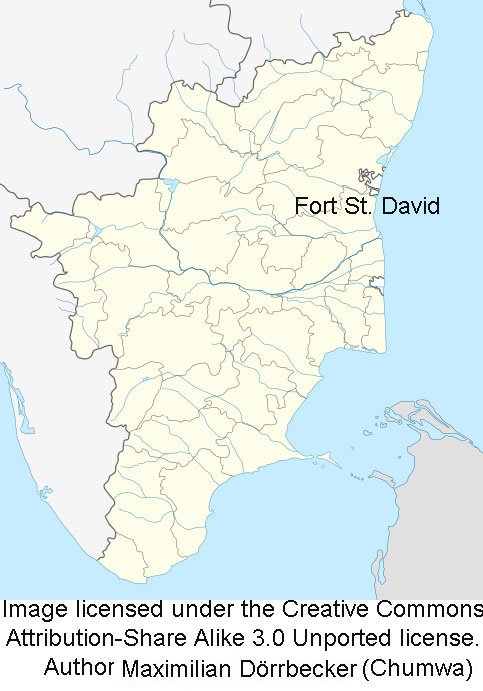 Nor was the foresight thus displayed long in being justified, for, notwithstanding the indecisive naval action off Point Calimere, in which Labourdonnais was wounded, that indefatigable officer with his customary promptitude and decision brought matters speedily to a crisis by capturing Port St. George at Madras. The first news that arrived was that it had fallen on the 8th September 1746, but Mr. Hinde at Fort St. David shortly afterwards corrected this date to the 10th and at the same time sent the factors the reassuring message that he had just completed a bomb-proof building, as the French used bombs, that the factors should follow his example, and that he had no doubt he could hold out in Fort St. David for twelve months against all the force the French could bring against him.
The French at Mahe marked the receipt of the news of the capture of Madras with every demonstration of joy and with much expenditure of gunpowder from all their forts. The English factors at once set to work to prepare for a siege by the French fleet. Provisions and liquors were laid in, men were enlisted, the garrison was concentrated as much as possible, the Native Chiefs, the Prince Regent, the Bednur Raja, the Nileswaram Raja, the Achanmar of Randattara, etc., came forward with offers of assistance of men, some of whom were accepted.
The French at Mahe enlisted 1,500 Mappillas, and the Mudaliyar (chief man) of the Valarpattanam Mappillas joined the English. The English garrison was camped out between Tellicherry and Mailan forts to be ready at a moment’s notice. But their services were not required, for Fort St. David not only stoutly held out, but even repulsed the enemy. And shortly afterwards the French fleet was reported as having passed Anjengo and Tanur on its way north to Mahe. It arrived in two detachments on 27th February and 1st March 1747, and consisted of the Centaur, Mars, Brilliant, St. Lewis, Princess Mary and one other.
Ali Raja repaired at once to Mahe with 500 men. But his reception seems to have cooled his ardour for the French alliance, and after this powerful French fleet had sailed away without even attacking Tellicherry, he soon sued the English factors for peace and stated his hearty repentance. The factors promptly tendered to him a bill for 3,10,556 fans., 12 tar. He offered to pay Rs. 15,000, which was declined at first, but after a day or two’s delay accepted.
The French fleet had gone ; the factors knew not whither. They heard it was at Goa and awaiting Labourdonnais’ return from the islands with another squadron. They were still in daily dread of being besieged. It was with no little satisfaction therefore that, about July 1747, they received the welcome news that the dreaded Labourdonnais had been sent an unhappy prisoner to France. The departure of the French fleet enabled the English factors to reduce their military establishment, and to succour Fort St. David with 250 sepoys in June 1747 and with 1301 more on the 19th August.
NOTEs: 1 Orme states this reinforcement at 400 men, but it seems that only 380 men were sent. END OF NOTEs
These men afterwards proved unfaithful to their salt. Their commander, “a Moor” (? Mappilla) was tampered with by an ex-interpreter of the Governor of Madras, who was in secret communication with Madame Dupleix, the wife of the French Governor of Pondicherry. The commander’s design to desert to the French in the first engagement that should happen was discovered, and he and ten of his officers were banished to St. Helena, where several of them helped each other to end their lives rather than remain as prisoners in such a hopelessly remote island.
The naval warfare between the English and French still went on, and after the monsoon of 1747, the English fleet appears to have kept to the Coromandel Coast and the French to the West coast, and there was constant anxiety for the safety of the Company’s ships. On 14th and 26th September, four French ships arrived at Mahe, one of them bringing in two prizes, one English and one Dutch, taken off Bombay. As they came into the roads they were flying English colours “with the union downwards.” But after the receipt on 8th February 1748 of the news of Anson’s victory off Finisterre, events took a different turn, and on March 29th, H.M.’s ships Exeter (Commodore Panlet) and Winchester (Lord Thos. Bertie) came into the Tellicherry roads, and took on board a party of men, with a design to destroy the St. Lewis, which was lying in the Mahe roads at the time.
Accordingly, on March 30th, H.M.’s ships ran into Mahe roads under Portuguese colours, which they hauled down about noon and the English ensign was hoisted in their place. The French were taken by surprise ; the St. Lewis fired signal guns and boats pushed off from Mahe to her assistance. They did not all arrive in time, however, and the action, which lasted only about an hour, resulted in the St. Lewis cutting her cables and getting under the protection of the Mahe forts with the aid of her jib or jib staysail, the rest of her rigging having been torn from her yards, and her three top-gallant masts having been shattered ; she continued, however, to defend herself, and the engagement ceased at sunset.
Next day the French unloaded their ship and hauled her in so close under the forts that it was thought she was aground. She lost 50 men in the action, including her captain, while the English loss was only 2 men.
Meanwhile, the tables had been successfully turned on the French on the Coromandel Coast also, and the French at Mahe were obliged to despatch men to help to defend Pondicherry, besieged by Admiral Boscawen. On 24th October 1748 the news of the preliminaries having been settled of the peace of Aix-la-Chapelle arrived, and orders came at the same time for a cessation of hostilities after 19th October. The French at Mahe were immediately apprised of the fact. It was not however, until 24th September 1749 that H.M.’s proclamation of peace arrived. This proclamation was read to the military and artillery train drawn up outside the Tellicherry gates.
The Chief (Mr. Thomas Byfeld) proceeded thither in state, accompanied by two of the gentlemen from the Mahe factory, with whom cordial relations had again been established. Twenty-one guns were fired from the fort, and the day was “spent in other demonstrations of joy.” The French and English factors had meanwhile likewise combined and had succeeded in reducing the price of pepper to Rs. 50 per candy, the lowest price it had ever fetched.
The Prince Regent of Kolattunad during the time of the French war (1744-49), byname Kunhi Raman, appears to have been jealous of the Company’s interference in the affairs of Randattara, and to have impeded the Company’s officers in collecting the revenues of that district. In 1747 he claimed the property of a Nambidi, who died without heirs, and interfered in two desams, “laying impediments on the ground,” besides which, it was brought to the factors’ notice, he had “tyed four or five elephants in Randattara and ordered the olaes and fruit to be gathered from trees belonging to themselves (the Achanmar) and others which used not to be done formerly.”
His alliance was of too much importance to the factors at this time for them to attempt to break with him, and as the Achanmars’ troubles continued, and the Prince Regent encroached more and more on their privileges. In August and September 1748 matters came to a crisis by the Prince Regent “laying an impediment” on one of the Company’s merchants, on mulcting him heavily. On being remonstrated with for this and other similar behaviour, he strenuously asserted his right to take the half of every man’s property, and the whole of it if he committed a fault.
In November 1748 he had, it seems, portioned out his country to certain headmen in order that they might plunder his subjects, and the Commandant at Madakkara reported that soon the country would be ruined. Meanwhile, the cessation of hostilities with France had strengthened the factors’ position, and they were able to deal with him with more firmness in regard to Randattara and other matters. The result was duly recorded in an agreement,1 dated 10th January 1749, by which he agreed to turn a number of people out of his dominions, to dismiss his customs master, and not to interfere except as agreed in Randattara affairs.
NOTEs: Treaties, etc., i. XLVI. END OF NOTEs
But there were other matters remaining to be settled, particularly in regard to the island of Madakkara, and the Chief Mr. Byfeld, took an early opportunity of visiting Madakkara fort and of personally conferring with the Prince Regent and others regarding them. He was present at an affecting interview with a very old and bed-ridden lady, described as the prince’s mother ; she expressed her satisfaction on being informed that everything had been amicably accommodated,1 and enjoined her son as her last parental counsel and advice never to give umbrage to the Chiefs of Tellicherry, who had protected the Palli branch of their family in its utmost distress.
NOTEs: Treaties, etc., i. XLVIII. END OF NOTEs
Mr. Byfeld also seized the opportunity to obtain from the prince, who held the rank of Vadakkalankur (Northern Regent) at the time, and who belonged to the Udayamangalam branch, a deed,2 dated 9th May 1749, transferring absolutely to the Prince Regent of the Palli branch all the property of his family lying to the south of a line drawn from the river Quilavelly to Urbelli.” This line appears to have coincided pretty closely with that of the Taliparamba river, and probably cut off the isthmus running south to Madakkara fort and lying between the river and the sea, the portion, in short, of North Malabar which was at this time tributary to the king of Bednur.
NOTEs: 2. Treaties, etc., i. XLIX ; Conf. i. XXXVIII oncl ii. CCX. It was probably under this deed that the Palli branch of the family virtually superseded the other (Udayamangalam) branch, which arrangement still continues in force. The nominal Kolattiri is still the eldest male of both branches, but the de facto head of the family is the oldest male of the Palli branch, who is usually styled the Chirakkal Raja. The matter has been more than once before the British Courts.—Mr. Rickards’ decree of 6th August 1803 and Sadr Adalat Special Appeal No. 9 of 1821. END OF NOTEs
This deed was cancelled and another3 signed two days later (11th May 1749), in which the southern limit of the Udayamangalam branch territory was fixed at “Cheria Kunnu” which appears to correspond with the amsam of Cherukunnu, about a mile to the south of the Taliparamba river opposite Madayi. The Vadakkalankur, who signed these deeds, was at the time a prisoner in the Valarpattanam fort belonging to the Palli branch of the family. On signing the latter deed, which put the Prince Regent in a better position to pay off his debts to the Company, the Vadakkalankur was released from confinement at Mr. Byfeld’s request. But the younger princes of the Udayamangalam branch naturally objected to being thus compelled to part with their birth-right, and as the Chief was unable to bring them to terms in any other way, he resolved to assist the Prince Regent vigorously with men and ammunition.
NOTEs: 3. Treaties, etc., i. L. END OF NOTEs
The result was that their stronghold at Puttur was captured in June 1749, and they themselves were driven into the jungles and their followers dispersed.
Having thus for the time being enabled the Prince Regent to quell the dissensions in his own family, Mr. Byfeld next turned his attention to strengthening the position of the Company in the Kadattunad territory, while maintaining therein, as far as a treaty could do it,4 the authority of the Prince Regent of Kolattunad. And that having been satisfactorily accomplished, a general settling up5 of accounts took place in September 1749.
NOTEs: 4. Treaties, etc., i. LIII,
5. Treaties, etc,, i. LIV to LXII. END OF NOTEs
The trade of the Company likewise received attention. The method adopted for getting the pepper at a low figure was as follows:
A monopoly of the trade in the country having been secured from the various chiefs by treaty, the exporting of the article without permission was prohibited both by sea and land. This prevented, to a certain extent, sales being made to outsiders, but whenever the price of the article in a free market, as at Calicut, rose high, the merchants were tempted to run the risk of exporting for the sake of the extra prices obtainable. The Company, however, had much control over its merchants, for the latter obtained no protection anywhere outside the limits of the Tellicherry factory, and when the Chief found that they were exporting the pepper to a free market, and that they were consequently unable to fulfil their contracts, he took summary means to bring them to reason by incarcerating them.
The same influences which had so weakened and distracted the Kolaltiri family in the past were still at work. The Prince Regent had married the Kadattunad Raja’s sister, and had built a house for her in Iruvalinad, the country of the Nambiars. His object was to establish his son therein as ruler (Valunnavur, the title held by the Kadattunad Raja). But to do this, it was necessary that the semi-independent Nambiars should either submit willingly or be compelled to it.
The Chief seeing in this a means of counteracting French influences in that district, assented to the proposal, which also, of course, had the support of the Kadattunad Raja, whose nephew and heir this youth was. The Company were not, however, to take an active part in the operations : indeed on the contrary, they just then took the opportunity of reducing their military to a peace1 footing. The design of the prince was not, however, carried through, but in March 1750 the Kadattunad ruler formally assumed the title of Raja, the Prince Regent being privy to it.
NOTEs: 1. The establishment consisted of 400 military under a “Captain,” who received 10 shillings sterling per day ; 70 gunners under a “Lieutenant Fireworker,” who received £75 per annum, and 365 “milita,” consisting of sepoys, Mappillas and Nayars under various headmen. END OF NOTEs
On 17th January 1750 Mr. Byfled handed over charge of the Tellicherry factory to Mr. Thomas Dorril, as Chief, and immediately a change for the worse came over its management. Mr. Dorril appears to have been rash as well as narrow-minded and weak. He was easily misled, and being weak, he mistook obstinacy for firmness. The Prince Regent’s bad advisers, banished in Mr. Byfeld’s time, returned and signalled their return by an outrage on a private servant of one of the English officers at Madakkara fort. The new Chief, nettled perhaps at this event, set his face against the designs of the Prince2 Regent, who had married Kadattunad’s sister ; and this estrangement speedily led to divers troubles, for, although the Chief and factors acknowledged an elder prince, who, by virtue of his age, ought to have been the ruling prince, the latter was powerless, and very probably at heart unwilling to help them.
NOTEs: 2. There were two princes regnant at this time, and although the younger is styled the junior prince in the Diary, he was de facto ruler. END OF NOTES
Of the Iruvalinad Nambiars, some adopted one side and some another. The Chief was warned from the Presidency not to allow the Company to be dragged in as principals in any of the country quarrels, but he blindly took the steps best calculated to bring this about. The de facto Prince Regent finding himself thrown over by Mr. Dorril, naturally turned to the French alliance.
Mr. Dorril in April 1751 proceeded to the Madakkara fort, and thence to Valarpattanam fort, and placed himself in communication with the nominal head of the house, the Kolattiri Raja himself, a frail old man, who had no power in the country. He assented, at Mr. Dorril’s suggestion, to the appointment of a junior prince, without any power in the country, by name Ambu Tamban, to be Prince Regent in supersession of the de facto ruler, and this arrangement was duly embodied in three deeds,1 dated the 21st April 1751.
NOTEs: 1. Treaties, etc., i. LXV, LXVI and CXIII. END OF NOTEs
The Chief’s eyes ought to have been opened to the fatal step he was taking, when, on proceeding strongly guarded to Cotcunna (Kottakkunnu) to interview the elder Prince regnant, the latter, on learning his mission, abruptly withdrew inside his fort and prepared to fire at the Chief’s party. The Chief’s guard were ill advised enough to open fire at this threat. It was returned from the fort, and the Chief withdrew to Valarpattanam, where he received the news that the de facto Prince Regent, then in the south, was advancing with 1,500 Kottayam and Kadattunad men to attack Tellicherry.
Next day (22nd April), as the Chief and party withdrew from Valarpattanam to Madakkara, they were again fired at. And to complete the list of his errors, Mr. Dorril made prisoner of the aged Kolattiri and of the young Ambu Tamban, and took them off with him to Tellicherry, presumably as hostages for the good conduct of the rest of the family.
It is difficult to understand what could possibly have been Mr. Dorril’s object in acting thus, for it soon became evident that he had roused the country, and had no friend left among the chieftains, except Ali Raja of Cannanore, who only promised to remain neuter. Lest the Achamnar of Randattara should give him aid, the de facto Prince Regent threw 2,000 men into that district to overawe it and demanded 1,00,000 fanams from the Achamnar. Finding no friend near home, Mr. Dorril had perforce to seek them abroad, and on 7th July he advised the Bednur Governor of Mangalore that now was his opportunity to seize Nilesvaram fort. His real object in tendering this advice was to prevent its falling into the hands of the French, for it was only too obvious by this time that the French were stirring with a view to benefit themselves in the impending struggle, and the Nilesvaram country yielded sandalwood and cardamoms, which would be lost to the English if the French settled there.
The French were not slow to make use of the opportunity offered, and by the 17th July, they had hoisted their flag at Nilesvaram and the mouth of Kavvayi river (Ayconna—Alikkunnu) and were busy fortifying both places. They had also thrown men into Valarpattanam fort.
The Canarese under a Brahman who is described as an “inactive man," moved towards Nelesvaram in August, but created very little diversion on that side. The Achanmar of Randattara came to Tellicherry to seek protection, and receiving aid in military and militia, attempted to return to their district via Agarr ; after some smart skirmishes, the military had to return on finding themselves confronted by 5,000 of the Prince Regent’s Nayars. Their loss was 2 killed and 9 wounded.
The Prince Regent on 25th September openly visited Mahe and was received with a salute. And this was followed by fresh concessions to the French ; Ramdilly fort and the Ettikulam fort on the point of Mount Deli were placed in their hands. Moreover, by this time, the Prince Regent was able to assume the aggressive. On 9th September he had attacked and been repulsed from the Company’s post of Edakad. On 18th October he attacked Ponolla Malla on the outskirts of Tellicherry with 4,000 men. Being repulsed he set to work with French and to erect a battery on a hill called Chimbra which commanded Ponolla Malla.
On 21st October Tirimalla, another outpost on the Tellicherry limits was taken by surprise, and (it was alleged) treachery. The garrison resisted, bravely headed by their corporal, but being taken unawares, they had not time to fix their bayonets and were all slain and their bodies placed on the chevaux de frise. Ponolla Malla was also hotly attacked. A panic ensued among the inhabitants, who all flocked into the limits commanded by the Tellicherry fort.
Then a crisis occurred. The Nayars and Tiyars at Ponolla Malta deserted, and the sepoys refused to sacrifice themselves. Orders were sent to retreat from Ponolla Malla after spiking the guns and destroying the ammunition and stores and this was done. The English loss in this day’s engagement was about 100 killed, and 20 wounded were brought to hospital. How many more were not brought in does not appear.
The panic among the inhabitants continued ; families were sent away and the merchants deserted. The Prince Regent busied himself on the 23rd, burning the houses of the inhabitants within the Tellicherry limits, and threatening Morakkunnu, which was immediately reinforced. On the 24th the Tiruvengad pagoda, another outpost, was in his hands and Melur aud Kodolli were threatened.
On the 27th a French ship of considerable force came in sight, and the most gloomy anticipations were indulged in by the beleaguered factors.
In the straits to which he had so easily brought the settlement, Mr. Dorril turned, as already said, to the Raja of Bednur for help, and to this end he despatched the Company’s Canarese linguist, as he was called, by name Antonio Pircs, to Mangalore to seek assistance. The linguist arranged two treaties,1 dated respectively 25th and 30th October 1751, but these were of little advantage beyond preventing the French from concluding terms with Bednur.
NOTEs: 1. Treaties, etc., i. LXVII and CLXVIII. END OF NOTEs
On 29th October a welcome supply of rice from Mangalore arrived just in time to save the garrison from starvation. And the Chief was on 2nd November at last successful in creating a split in the enemy’s camp. From the position of the Kottayam Raja’s territories abutting on the Tellicherry limits inland and extending thence into the Ghats and Wynad, the Raja and the Company combined could prevent the passage of troops and inter-communication between the Kolattiri's and Kadattunad’s dominions. And any enemy attacking Tellicherry from the landward side was liable to have his rear attacked unless he had laid his accounts to have Kottayam as a friend.
Kottayam ratified the proposals2 on 12th November, and bargained for Rs. 40 per diem as his own allowance, payable fortnightly “so long as he acted as a faithful ally to the Honourable Company”. He also agreed to lend the Company, on payment, 1,000 men with arms and to stop the communication between the Kolattiri and Kadattunad dominions as soon as the Prince Regent had gone north into Kolattunad and his wife (Kadattunad’s sister) had gone south into her brother’s territory.
NOTEs: 2. Treaties, etc., i. CXIV. END OF NOTEs
It was well for the Tellicherry factory that this treaty was concluded, for the Company was beleaguered on all hands—Madakkara fort was also besieged. On 4th November the Morakkunnu redoubt within the Tellicherry limits was attacked, and the enemy came up to the very gates of the Tellicherry fort itself. The cavalier bastion in the south-east corner of the latter was of great service on this occasion. On the 13th the communications with Mailan fort guarding the southern limits were intercepted, and a second unsuccessful attack was made; on Morakkunnu redoubt.
On the 16th the siege was pressed with great vigour and the batteries kept up an incessant fire with shot, and shell on the besiegers. On the 22nd the factors resolved that if any advantage was gained against Mailan fort they would withdraw their forces from all the outposts. Next day came the crisis, and it fortunately took a favourable turn, for Captain Cameron, in command at Mailan fort, succeeded in destroying the opposing battery on Putinha hill, and greatly alarmed the French by sending a few shells into Ponolla Malla battery, where their gunpowder was unprotected.
Kottayam, who had probably been waiting the turn of events, now came forward, and on the 25th November he managed that the Prince Regent should withdraw his forces from Narangapuram and Putinha and so free the Tellicherry limits.
The Bombay President and Council had had troubles of their own on hand just then and had been unable to send the successor urgently demanded for Tellicherry. On 14th December they at last managed to send ships to the assistance of Tellicherry, and with it came a letter expressing their utmost surprise at the turn affairs had so unexpectedly taken, and attributing it all to Mr. Dorril s great want of judgment for reasons already set forth above.
Meanwhile the mediation carried on by Kottayam went on slowly. He was in no hurry to arrange terms while being paid a personal allowance of Rs. 40 per day as may be imagined, and he appears not to have scrupled at declaring openly that he meant to make the most he could for himself of the troubles in the country. So the war went on. In December the Canarese met with a severe reverse when attempting to cross the Nilesvaram river.
In January 1752, when terms of peace had been almost arranged, the Prince Regent “flew off” on hearing of another success in the north. On 19th March the French attacked Madakkara fort with big guns from a new battery, alleging they had acquired land there. On 22nd March the enemy returned to Putinha and began erecting a battery there. Captain Mostyn offered to take it, and he appears to have succeeded. But a panic ensued consequent on Ensign Target’s being shot through the head going up to the captured redoubt, and a hasty retreat was made by the common soldiers, of whom it is recorded “ happy was he who could run fastest.”
On the 1st of April an attack was made on Madakkara, but the enemy were driven back with 100 to 150 killed and wounded. On 12th April the batteries on Putinha were enlarged, but on the 17th the fire from Malian fort silenced them for a time. Up to 13th May the duel between these two places continued.
A week later on (or 22nd May 1752) an armistice was concluded, and on the following day the terms1 of peace were ratified by the Prince Regent. These were for the most part very general. The Honourable Company and the Kolattiri princes were not to meddle in each other’s affairs, the grants to the Company being confirmed. They were to give each other mutual assistance if attacked. And finally the Tellicherry linguist (Pedro Rodrigues) and his family were not to be employed in any transactions between the parties.
NOTEs: 1. Treaties, etc., i. LXIX. END OF NOTEs
But besides these terms there were others which did not appear : Rs. 50,000 was paid to the Prince Regent as compensation, and Rs. 10,000 to Kottayam as mediator. Madakkara fort was given back, and the prince was to destroy his redoubts on the outskirts of Tellicherry on the hills of Andolla, Ponolla and Putinha.
Mr. Dorril objected to the insertion of these terms in the treaty because they were disadvantageous to the Honourable Company and because he did not wish to have the facts entered on the “Prince, his records.”
The records for some time after this are full of the charges brought against, the Company’s linguist, Pedro Rodrigues. Mr. Dorril and the factors endeavoured to make a scapegoat of him, but although he fled to Mahe and the factors gave out that, his property was going to be seized, no serious steps were really taken against him, and on 16th September 1752 the Bombay President and Council sent orders forbidding the seizure of his effects, “this family having been so remarkably distinguished by the Honourable Company.” And the despatch continued : “We peremptorily order you not to do it.”
The French continued at war with Bednur in aid of the Prince Regent of Kolattiri during 1753, and meanwhile afresh combination of the country powers was brought about. The Zamorin was in April 1753 induced to visit the Tellicherry factory, and on his return journey he was escorted with great military pomp by sea as far as Quilandy. An alliance was formed between the Zamorin, Kottayam, and the Iruvalinad Nambiars, backed of course by the Honourable Company, and their object was “to ward against the growing power of the Prince Regent (Kolattiri) and Kadattunad backed by the French.”
This combination made the Prince Regent of Kolattunad exceedingly uneasy, and in June he wished to visit the factory. But on desiring the Chief to come out to meet him, Mr. Dorril declined and the prince then went to Mahe, where he was received with open arms by the French Chief. The war, however, had told on the French resources, and they began to be in straits for money, their new forts in the north costing them as much as Rs, 15,000 per mensem. Moreover, just about this time the Canarese gained an important success over the French allies, the details of which were carefully kept secret.
In October 1753 the Kadattunad commenced hostilities in Iruvalinad against the Nambiars and Kottayam, who were backed of course by the Tellicherry factors. The Prince Regent would fain have come to his brother-in-law’s help, but the factors and Kottayam together effectually blocked his way in the manner already described. The effect of this was that the Prince Regent, for the first time since Mr. Dorril commenced hostilities against him, came to the factory on the 17th November 1753.
Little time however remained for effecting a complete reconciliation between them, for on 3rd January 1754 there arrived from Bombay two gentlemen (John Sewell and Thomas Hodges), commissioned as “Supravizors,” to enquire into Mr.Dorril’s administration of the factory affairs, and after completing the enquiry one of them (Thomas Hodges) was commissioned to remain on as Chief of the settlement. The “supravizors” completed their enquiry by the 15th March, on which date Mr. Hodges assumed the office of Chief.
The enquiry resolved itself into a battle between Mr. Dorril and the linguist Pedro Rodrigues. The supravizors naturally held Mr. Dorril solely responsible for the misfortunes which had befallen the factory and Pedro Rodrigues was acquitted, and on 12th May 1754 restored to office as linguist.
In July the French Chief (M. Louet) managed to arrange a peace between Kadattunad and the Iruvalinad Nambiars and Kottayam. Kadattunad accepted M. Louet’s intervention, but was disgusted at the French having secretly assisted the Nambiars.
Mr. Hodges’ management of affairs was much more prudent than Mr. Dorrill’s and the factors began slowly to regain the ground they had lost in the latter’s time. He avoided war ; but steadfastly set his face to turn the French out of Nilesvaram. To this end he succoured the third Prince of the Nilesvaram family in opposition to the first Prince, who was in alliance with the French, and a desultory war begun in August 1755 kept the French employed in that quarter till after the news had arrived (28th May 1756) that France was again at open war with England.
Meanwhile it will be necessary to revert to Dutch affairs. The important resolution taken by the Supreme Council in Batavia in 1721 not to succour their native allies, which has already been alluded to, began shortly afterwards to bear its natural fruit. In October 1733 Calli-Qulion was threatened by the energetic Marthanda Varma of Travancore ; the Dutch Governor, A. Mateu, was applied to for aid, and the result was a refusal to grant it, coupled at the same time with advice to join another chief who had refused passage to the Travancoreans and to drive back the invaders.
In 1734 the territories of this latter chief and another were annexed by Travancore. In 1739 Mr. Van Imhoff became Governor. He was a most intolerant man, and directly he arrived he saw the necessity of curbing the rising power of Travancore if the Dutch were to retain their hold of the trade of the country and not allow it to pass into the hands of the English, who were backing up the Travancore Raja. Van Imhoff, it is said, carried to the Travancore Raja his own protest against the Raja's occupation of the territory acquired in 1734. His protest failed, and Van Imhoff nettled at this result spoke of invading Travancore.
“The Raja replied1 that doubtless he might do so, but there were forests into which he could retire in safety.”
NOTEs: 1. Day's Land of the Permauls, p. 131. END OF NOTEs
Imhoff retorted that “where Travancoreans could go, Dutch could follow.”
The Raja then broke up the conference by sneeringly observing, he had “been thinking some day of invading Europe !”
Unfortunately for Van Imhoff he had no sufficient force at hand to command respect and obedience to his wishes. War ensued, but it was not conducted with energy and vigour, and the successes obtained by the Dutch at starting were not maintained. They waited for orders from Batavia, and maintained a desultory war meanwhile. On October 18th, 1748, the Batavian Council at last approved of the terms finally accepted by Travancore, but it was not till nearly five years later that peace was finally established on August 15th, 1753.
The Dutch were mean enough to stipulate on this latter date that they "shall2 recede from all engagements, which they may have entered into with the other Malabar princes, whom the King of Travancore might choose to attack, and on no account interfere in their disputes, afford them assistance or shelter, or in any respect raise any opposition to the enterprises of the king.”
NOTEs: 2. Day’s Land of the Permauls, p. 133. END OF NOTEs
And what were they to get in exchange for such a pledge ? Just 4 annas on every 25 lb. of pepper to be supplied to them from Travancore and from the territories to be conquered by that State ! !
Such sordid meanness defeated its own end of course, and shortly after the treaty was signed, and after the Travancore frontiers had advanced as far as Cochin, the Travancore Raja of course turned on them and repudiated his obligations, telling the Dutch, factors at Cochin they were no longer a sovereign power, but merely a number of petty merchants, and if they required spices they should go to the bazaars and purchase them at the market rates. They had eventually to pay market prices for the pepper they wanted.
This treaty gave the coup de grace to Dutch influence in Malabar.
The pirates too had meanwhile begun to give trouble once more. In 1753-54 the Tellicherry factors were kept in constant anxiety on account of the Honourable Company’s shipping, and the Mahratta Angria’s fleet was much feared. In September 1755, Ali Raja of Cannanore organised a big buccaneering expedition in close alliance with Angria. He sent 3,000 men with guns in 70 native small craft (manchuas) and large boats to ravage the Canarese country. This expedition attacked Manjeshwar and obtained there a booty of 4,000 pagodas, besides 100,000 more from a private merchant. They also landed people to the north of Mangalore, marched 18 leagues inland to a very rich pagoda called “Collure” and carried off booty to the extent, it was reported, of no less than 4,000,000 pagodas.
In this expedition the Mappillas killed some Brahmans who were greatly mourned at the Bednur court. And of course Bednur adopted the readiest means at his command for bringing everybody to their senses ; he stopped the export of rice from Mangalore, and thus put everybody, English, French, Dutch, Nayars, and Mappillas, all in a serious predicament. The Bombay President and Council, on 7th November 1755, sent Ali Raja a sharp letter of remonstrance on his conduct. He had not attacked the Company’s shipping, else he would have been as summarily dealt with as his ally, Angria, shortly afterwards (January and February 1756) was at Gheriah by a squadron of H.M.’s and of the Honourable Company’s ships under Admiral Watson and Colonel Clive.
The Tellicherry factors were jubilant on this occasion ; the news of the capture of Gheriah on the 13th February reached Tellicherry on the 23rd and a royal salute was fired at once.
It had come shortly after this to the knowledge of the factors that affairs were again in a critical state in Europe between England and France, so like wise men they set all their energies to work to lay in a suitable stock of grain in anticipation of hostilities, and in this Mr. Hodges was successful in the early part of 1756.
On the 28th May of that year authentic news arrived via Madras of the renewal of hostilities in America, but war had not been declared. All doubt, however, on this latter point was set at rest on 17th October 1756 on receipt of H.M.’s declaration of war against France. The news came via Bussorah and Bombay. The factors had not, when they got the news, completed their collection of stores, so they waited a day or two before publishing it till all their rice and store boats had come in.
On 26th October a store of 12,000 bales of rice was on hand and the factors felt themselves to be relieved of anxiety on that score.
It has been said that the first news of the critical state of politics in Europe reached the factors on the 28th May 1756. Mr. Hodges had prior to this event been vigorously sending aid to his ally the third Prince of Nilesvaram in pursuance of his policy of driving the French out of that country and securing its cardamoms and sandalwood for the Honourable Company. The results of Mr. Hodges’ action were soon apparent, for on 5th April news had come that the third Prince had defeated the French in two hand-to-hand engagements.
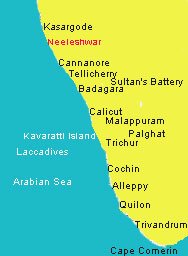 On the 1st of May news of another victory came to hand : the French had again been defeated with the loss of 2 officers and 20 sepoys and others killed and 70 more wounded. Then on 23rd June came the still more important news that the French fort at Mattalye had been surprised by the third Prince of Nilesvaram. This fort maintained the French communications between their fort of Ramdilly (Alikkunnu) and their furthest post at Nilesvaram, so that its capture imperilled their line of communications. The garrison, consisting of 1 officer and 20 soldiers, was put to the sword ; all but the gunner, who was spared on the condition that he would point their guns for the captors.
The fort mounted 20 guns, chiefly 18-pounders, and 1 mortar, and there were also 200 muskets with suitable ammunition. On the 4th July the third Prince was further aided by Mr. Hodges, both with money and stores, as news had come that the Prince Regent himself meant to take the field with 1,000 men in aid of the French. The French were very uneasy, as may be imagined, at the loss of the fort and the danger to their line of communications with Nilesvaram, and were ready to agree to any terms to have it restored.
The Prince Regent intervened in their favour, and arranged that if Mattalye fort were restored to them they would evacuate Nilesvaram and some other small places, and the Prince Regent in return for his services was to have his bond for Rs. 60,000, advanced to him in the war with the Tellicherry factors, returned to him and cancelled. Moreover the Prince Regent guaranteed on oath that the French would perform their part of the contract and surrender Nilesvaram and the other places.
The French fired a salute of 15 guns at Mahe on being repossessed, on 22nd July 1756, of Mattalye ; but they deliberately broke their promises of evacuating Nilesvaram and other places and of returning the Prince Regent's bond to him.
This was not unnaturally the turning point in the Prince Regent’s friendship with the French.
When the declaration of war arrived therefore on the 17th October following, the English factory affairs under Mr. Hodges’ able guidance were in a prosperous condition, while the French at Mahe were exhausted with the protracted warfare in the north and with the heavy monthly expenses of their garrisons in those regions.
The Chief next directed his energies towards extending and consolidating good relations with the various country powers. Kottayam and Ali Raja appeared inclined to join the Honourable Company against the Prince Regent and the French. And it was hoped that Kadattunad and the Iruvalinad Nambiars too would join. There remained the Prince Regent to be brought to terms, and matters were already arranging themselves in the desired direction because of his disgust at the broken promises of the French. On 2nd November he came to the factory and gave vent to his anger at Mr. Dorril having been let off so easily ; he had been dismissed the service : but that was punishment insufficient he thought for what he had done : he called him a ‘cullan’1 (which in Mallabars signifies infamous man, or more literally interpreted, robber).”
NOTEs: 1. Kallan. END OF NOTEs
At this interview it is noted that Messrs. Johnson and Taylor, from the progress they had made in “Mallabars,” were able to understand the Prince without the aid of an interpreter, so that the linguist, Pedro Rodrigues, had not to be called in. A very important2 step had consequently been taken towards freeing the Chief from underhand intrigues of the linguist.
NOTEs: 2. This was followed up on 8th February 1758 by a formal examination, the first of its kind no doubt ever held in Malabar, conducted by the Chief in person, in which Messrs. Johnson, Taylor, and Samuel Crocs were tested as to their proficiency “in Mallabars." END OF NOTEs
This interview was followed by a secret one on the following day, at which the Prince Regent promised to assist the factors against the French and to oblige Kadattunad to do the same. He would not, however, though pressed, give this in writing. He evidently wished to give the French a last chance of fulfilling their promises, and, accordingly, on 11th November, on his way to the south with his wife and family, he had a very private interview with the French Chief of Mahe.
The French too were on the alert, and on the very day after the Prince had thus gone to the south, the Honourable Company’s fort of Meylure on Darmapattanam Island was attacked by three Mappillas, who killed two people and dangerously wounded the corporal in charge. They were however themselves slain, and Mr. Hodges, on informing the Prince Regent of the affair, learnt that, in the Prince’s opinion it was an act of his enemies to embroil him with the Company.
On hearing from him to this effect he was asked to send some of his people to be present to “assist ours in spitting them as they are not worthy of burial.” This was accordingly carried out, and on the 25th November the bodies, after being “spitted” a sufficient time, were thrown into the sea to prevent others from erecting monuments and canonising them for having slain others of a different religion. The factors, though in some doubt on the point, concluded that this attack was an artifice on the part of "Candotty Pacquey", the Mahe merchant, to embroil the English factors with the Prince Regent.
It will be recollected that, at the beginning of Mr. Dorril’s term of office, a somewhat similar event at Madakkara had led him into hostilities with the Prince. On the 15th December 1756 the negotiations with Kottayam for a defensive alliance had progressed so far that, a treaty1 was arranged on a basis favourable to both parties. He promised to let the factors have the services of as many as 6,000 Nayars, and he himself was to receive a douceur of Rs. 2,000 whenever war broke out and the French assumed the offensive; but if the Company were going against the French he agreed not to assist the latter, but he would not act against them.
NOTEs: 1. Treaties etc., i. CXXI. END OF NOTEs
Meanwhile hostilities had commenced in November by the Honourable Company’s Commoodre capturing between Tellicherry and Calicut a French vessel, the “Indian” of 700 tons and 24 guns with 400 men, coming from Pondicherry and laden with military stores for Mahe. No details of the fight are given, but the Commodore’s loss was not great.
This capture must have crippled still more the French resources.
Mr. Hodges was still busy extending good relations with the country powers, and even the Kurangoth Nayar appears to have at this time been on good terms with the factory. The Prince Regent had fallen sick, and when he had recovered sufficiently, Mr. Hodges on 19th April 1757 set out for Chirakkal to pay him a visit. He was very handsomely received and the Prince sent his own chaise for him, and in it Mr. Hodges travelled as far as the road would permit.
The result, of this interview was embodied in an agreement,2 dated the 21st April 1757, though the terms had been arranged in the previous November. The Prince agreed to assist the Honourable Company against the French or any other nation who might attack them, and to use his influence in the same direction with the other country powers. If a French fleet arrived, 1,500 musketeers and other armed men were at once to be sent to Tellicherry, and if the English were to go against the French, the Prince was to assist after settling what gain he was to get. He was in turn to be assisted by the Honourable Company if he required it, and his people, if killed or wounded, were to be treated like those of the Company.
NOTEs: 2. Treaties etc. i. LXX. END OF NOTEs
Finally the Company’s trade was to remain on the same footing as formerly, and to be enlarged, if possible, and the Prince was to be assisted on his part as formerly.
This treaty, brought about in great measure by the broken promises of the French, restored English prestige in Kolattunad to its old footing and completed Mr. Hodges’ masterly preparations for the coming conflict.
But just as the factors—their preparations being completed — were settling quietly down to await the anticipated conflict, an event happened which upset, for a time, their calculations of preparedness. For on 19th August 1757 the diary records that “Cotiote (Kottayam) demised of a bile in his arm” and of course the agreement with him became mere waste paper unless ratified by his successor. Who that successor was to be was fiercely contested, for the Prince Regent of Kolattunad intervened in the dispute, and so did the French. It was not till the 28th June 1759 that the Vice Regent of Kottayam was able to report that he had been crowned at “Vaenalt” (Wynad), and on 23rd August following the Chief obtained from him a ratification1 of the former treaty in an amplified form.
NOTEs: 1. 1. Treaties etc,, i. LXXIII. END OF NOTEs
Meanwhile, another similar event had happened, and in the diary of 9th May 1759 it is recorded that the Prince Regent too had “demised.” The Chief had much difficulty in securing a suitable successor, but he decided at last to exercise all his great influence in favour of a prince who had already succeeded to the title of Vadakkanlankur or Northern Regent of the Kolattunad, and who was senior in age to the late prince, and to oppose the claims of a junior prince, Unaman, who had married the late Prince Regent’s daughter, and who was therefore likely to fall under the influence of the French exerted through his wife’s uncle the Kadattunad Raja.
The preliminaries took months to arrange, but at last, on 5th September 1760, everything was ready and a combination of the Kolaltiri Northern Regent, of Kottayam, and of Ali Raja of Cannanore was formed. On 6th September the Northern Regent executed two agreements2 ratifying the Company’s privileges and extending them. On the 23rd hostilities commenced and were rapidly and successfully carried through, place after place being taken from Prince Unaman by the allied forces, while the Kadattunad Raja’s forces were kept from passing to the north to assist his beleaguered nephew-in-law by the cordon drawn across the country from the sea shore at Tellicherry to the limits of Wynad by the combined forces of the Honourable Company and of Kottayam.
NOTEs: 2. Treaties etc., i. LXXIV and LXXV. END OF NOTEs
On the 8th October Prince Unaman sued for peace, but the terms he obtained were so little to his liking that he determined to go to the south, taking his wife, Kadattunad’s niece, along with him. He was allowed to pass through the cordon on 16th October, and on the 17th the Northern Regent was in full possession of the country and the Honourable Company’s forces were recalled. Pursuant to his engagement in the previous treaty, the Northern Regent then transferred3 “for ever” to the Honourable Company the “whole right of collecting the customs in all places in our dominions” for the sum of 21,000 silver fanams to be paid annually. The formal deed evidencing this transaction, though dated 21st November 1760, was not signed till 11th March 1761, the Northern Regent having in the meanwhile on various pretexts put off signing it.
NOTEs: Treaties etc, i. LXXVI. END OF NOTEs
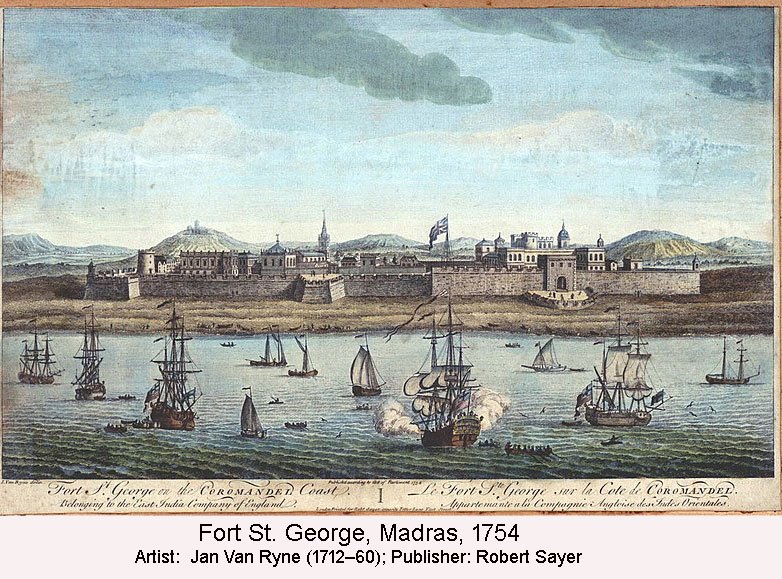
So far the Tellicherry factory had not been disturbed by the French. On 4th July 1758 the factors heard with alarm the news of the fall of Fort St. David in the previous month. The Prince Regent shortly after this, actuated by the French, put on foot negotiations for a strict neutrality between the settlements, but after what had passed this had no chance of being listened to. On 11th March 1759 the factors were jubilant with 21 guns over the news of the siege of Madras having been raised, and on the 20th of the same month they fired 21 guns on receiving intelligence of the taking of Surat castle and of Admiral Boseawen’s successful expedition against Louisbourg.
On the 24th they flouted the Dutch by stopping one of their ships from exporting pepper from Vadakkara. And things altogether seemed to wax prosperously with them : each of the ships despatched at this time to Canton with pepper and sandalwood was freighted by them up to £40,000 sterling. The Chief even found time to devote to such petty matters as the “cloathing of our irregulars.”
The sepoys had “scarlet coats faced with green perpets” and a belt “covered with green perpets.” The Calli-Quiloners (Mappillas) had “blue coats faced with green perpets ” and thin bolts like those of the sepoys. The artillery lascars had blue coats faced and bound with red, and no belts. The coats were made to reach just below the knees.
The English fleet had come up the coast in the end of 1759, and the Chief had thought of going against Mahe but desisted for want of an Engineer officer to make the approaches.
In January 1760 the French again brought forward proposals for a strict neutrality between the settlements, which were of course rejected on the obvious ground that all the advantages of such an arrangement under the existing circumstances would be with the French. The French at Mahe were in fact in a bad way. On 13th April 1760 the factors wrote to Bombay that “Mahe had long been in a deplorable condition and was then without appearance of relief.”
On the 11th September 1760 the first ostensibly aggressive act of the factors against the French, was an unsuccessful attempt to cut out a French “Snow” from under the guns of Mount Deli fort.
The English on the East Coast were still engaged with the siege of Pondicherry, when on 27th December 1760 there occurs the following entry in the Tellicherry factory diary :—“Imported the Honourable Company’s ships Neptune, York and Earl Temple from England and Triton from Bengal—and came ashore Major Hector Munro, Commander of H.M.’s troops on board.”
The troops belonged to Colonels Parslow’s and Moriss’ regiments, the former under Major Piers, and the latter under Major Hector Munro the senior officer. There "were six hundred and thirty-five rank and file, besides officers, and one hundred and three of them were down with scurvy.
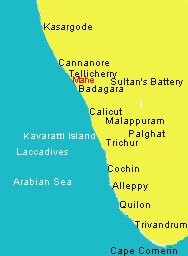 On the following day (28th) the troops were landed and put under tents to await an opportunity of sending them to Fort St. George, and at a consultation with the factors Major Hector Munro expressed an opinion that Mahe could be reduced since the French there were now in great straits and had even been selling their good arms to procure means of subsistence, and their European soldiers were kept on constant duty to prevent their deserting for want of pay. On the 29th more troops arrived in the Honourable Company’s ship London, and on the 30th there came H.M.’s ships Elizabeth, Baleine and South Sea Castle with a tender and a French prize, the Hermione—all from Trincomallee.
On the 31st the fleet sailed for Bombay, all but the Triton. On the 3rd January 1701 the Company’s ship Egmont arrived from England with the rest of the troops. The factors now found themselves sufficiently strong to attack Mahe and so prevent the French from exporting pepper, as they had been doing in Portuguese bottoms, but orders came from Bombay disapproving of this, as the place must fall on Pondicherry being taken.
And Pondicherry, it was well known, had for some time been in an almost hopeless plight and provisions were so scarce in that beleaguered city that the poorer inhabitants had been reduced for some time back to the eating “of camels, elephants, dogs and cats.” The Bombay authorities, therefore, directed that if the news of Pondicherry having been taken reached the factors before they had forwarded the troops to Madras, they were to employ them against Mahe.
These orders arrived on 19th January, and simultaneously came the melancholy news from Colonel Coote of a dreadful storm having occurred on 2nd idem at Pondicherry, which had driven ashore several of Admiral Steven’s squadron, had dispersed the rest, and had blown down, with many casualties among the native troops, the greater part of his encampment, and damaged most of his gunpowder. He sent an urgent requisition for stores and gunpowder, and the factors at once began their preparations to aid him. By the 31st their preparations were almost complete and everything was ready to start, when there arrived "the glorious news” of the surrender of Pondicherry on the 16th idem.
Messages were at once sent flying about the country informing the various chiefs of what had happened, amidst thundering salutes from the batteries and ships and a feu de joic by the king’s troops. On February 1st the factors accordingly set to work in earnest for the conquest of Mahe. They prevented both by sea, and by land with Kottayam’s help, the French from calling in their garrisons in the north ; whilst they themselves withdrew as many as possible of their outpost troops in order to combine with H.M.’s troops under Major Hector Munro for the reduction of Mahe.
On the 3rd M. Louet was called on to surrender Mahe and its dependencies, to which he replied on the 16th that be the respective forces what they might, he could not “but defend and support H.M.’s colours.” The factors’ reply to this was the seizure of Chambra hill, from which to attack Fort St. George at Mahe, and on the 7th orders were sent to Major Hector Munro to march, every thing being ready.
On the 8th accordingly the battalion of Colonel Parslow's regiment marched with the Company’s irregular forces, all under Major Piers, to the south end of Ponolla Mala to take the defences in flank, but there was to be no fighting, for, on that same day a party of deserters came in bringing the news that the Mahe Council had decided to capitulate. Notwithstanding this, however, preparations continued and Colonel Moriss’ battalion of Highlanders with the Company’s regulars were ordered to join the other troops next morning.
And this movement was carried out although between 1 and 2AM on the 9th, letters were received from M. Louet and his council proposing terms of capitulation. On 9th February 1791 the French delivered over all their forts in the north, except Mount Deli and Ramdilly (Alikkunnu), to Prince Cape Tamban of the Kolattiri family.
On the 10th two topsail vessels came in sight flying Danish colours, but evidently intent on reaching Mahe. The blockading squadron however cleared them away. And a manchua, a schooner and a sloop mounting six swivel guns were driven on shore, one sergeant being killed and six others wounded in the latter operation, which was successfully carried out by Captain James Lindsay in the Success ketch.
On the 11th Ali Raja of Cannanore, without giving any notice to the factors of his intention, surprised the French fort1 on Ettikulam Point at Mount Deli and most barbarously massacred the garrison of 20 men. The interval between the 9th and 12th had been taken up in discussing the terms of capitulation, and on the latter date the articles2 were received back duly signed by the French Chief M. Louet and his military officers. The terms were briefly as follows :—
NOTEs: 1. Conf. Treaties, etc., i. CV as to the terms on which the French had in Mr. Dorril’s time obtained this and the Alikkunnu fort from the Kolattiri.
2. Treaties, etc,, i. LXXVII. END OF NOTEs
The Roman Catholic religion was not to be disturbed. “The garrison to march out with honours of war, drums beating, colours flying, each man with, a ball in his mouth, four field-pieces with one mortar and twelve rounds to march to Tellicherry, etc.” the arms, etc., being delivered up at Tellicherry. The garrison was to be sent to the Island of Bourbon or to Europe. All deserters, except one, named Thomas Palmer of Colonel Parslow’s regiment, were to be pardoned. Private property of various descriptions was not to be confiscated, along with that belonging to the French Company. All forts to the northward were to be surrendered on the same conditions. The French factory at Calicut was to be treated as neutral. Assistance was to be rendered to the garrison for transporting their effects and for treating the sick and infirm.
On the 13th, in pursuance of the above-articles, Major Piers with about five hundred men went to take possession of Mahe, and about noon the British flag was run up under a salute from the ships and forts. At 2 P.M. the French troops arrived at Tellicherry with drums beating, colours flying, etc., and grounded their arms at the southern limit gate. M. Louet and the officers were received by the Chief Mr. Hodges, who returned them their swords, and M. Louet was saluted with fifteen guns as he entered the fort.
M. Louet publicly declared that if the country powers had not been drawn off from the French alliance, Mahe would have made a better stand, which was a well-deserved tribute to the superior diplomatic powers of Mr. Hedges.
On the 16th of February Major Hector Munro proceeded to the north to recover the French forts in Prince Capu Tamban’s hands. He had some difficulty in effecting this service, and some experience, which has already1 been quoted, of the Nayar modes of fighting. By the 19th of March he had accomplished the task and proceeded to demolish the forts, of which Mattalye was reported to be of great natural strength. Their retention would have been of no use for the Company’s trade in those parts. When, therefore, the fleet came round from Pondicherry in March, bringing with it the 70th Regiment of Highlanders and artillery to assist in the capture of Mahe, there was nothing for them to do and they were considerably disappointed.
NOTEs: Page138. END OF NOTEs
On the 1st May 1701 M. Louet with his family and the other French prisoners were embarked for Europe on board the Lord Mansfield under a salute of fifteen guns. And nothing else of importance, except an unseemly quarrel between the factors and Major Hector Munro in regard to the ownership of the French stores found in the Mahe forts, occurred, until on 20th April 1763 H.M.’s proclamation of a cessation of arms was received and published.
In consequence of the destruction of the French influence and competition in trade the factors were enabled to withdraw a number of outposts and to concentrate their establishments with economy. In this way the Madakkara fort was blown up, and the island was restored to the King Regent on 28th August 1762, and other smaller posts were similarly relinquished, until on 1st August 1764 the only outposts kept up consisted of Darmapattanam Island and Mould Deli.
Section (F). THE MYSOREAN CONQUEST. A.D. 1766-1792.
Meanwhile, however, fresh and most serious trouble was brewing in a totally unexpected quarter. On the 11th March 1761 the Kolattiri Regent wrote to the Chief to say that Ali Raja of Cannanore had given the greatest affront possible to the Hindu religion by putting a golden spire on the top of one of his mosques, it being contrary to their established rules to have a spire of gold on any edifice throughout the coast except on the principal pagodas ; and only those of Taliparamba, "Turukacoonotu" in Kottayam, and "Urupyachy Cauvil" at Agarr were entitled to the distinction. War ensued: the Court of Directors’ orders were peremptory and forbade the factors from interfering, except as mediators, in the disputes among the country powers.
At last on 28th August 1762 a hollow peace was patched up between the Kolattiri Regent and the Cannanore Mappillas.
Only a few months later, Mr. Stracey, the Honourable Company’s Resident, at Honore, sent an urgent message, which arrived on January 9th, 1768, to say that a large Mogul (sic) army was threatening Bednur, and that he urgently wanted a ship to be sent to remove the Honourable Company’s property from Honore. And on the same day the linguist, at Mangalore wrote to the same effect, but informed the factors that the army belonged to "Hedder Naique" and not to the Mogul.
The factors were not kept long in suspense, for, on the 24th of the same month, the news of the taking of Bednur by "Hedder Naique" on the 16th arrived, and on the 28th this was followed up by an account of "Nabob Hyder Ally Cawn's" arrival at Mangalore on the 27th.
In the success of a Muhammadan like Hyder Ali, the Ali Raja of Cannanore saw hopes of future aggrandisement and of settling the long score he had to repay the Kolattiris. The factors received intelligence that, even so early as January 1763 he was endeavouring to persuade Hyder Ali to the conquest of Malabar, but for a time it did not suit that potentate's schemes to comply with the request.
Before proceeding to relate the story of Hyder Ali’s conquest of the province, it will be well to take note briefly of the changes brought about in the south in the last few years.
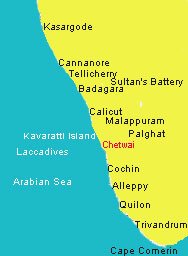 When in 1753 the Dutch basely threw over their native allies and, more particularly, the Raja of Cochin in the manner already described, two important, aggressive forces were let loose on the hapless Raja of Cochin and his allies and vassals. The Zamorin coming along the coast line from the north in 1755-56 attacked Chetwai, drove in the Dutch outposts, and rapidly possessed himself of Cranganore, Paroor and Verapoly. And the Travancore Raja advancing in like manner from the south, rapidly overran Tekkankur, Vadakkankur, Purakkat and other places—allies or vassals of Cochin—whom their suzerain attempted but in vain to assist. The allied forces were completely routed by the Travancoreans at Purakkat.
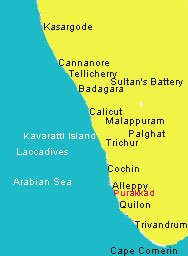 The Dutch managed to recover their fort at Chetwai, and by a disadvantageous peace with the Zamorin in 1758 they obtained three islands lying off Palliport, but otherwise these encroachments from the north and south were unchecked.
In his extremity the Cochin Raja turned for assistance to Travancore instead of to his hereditary foe the Zamorin, and on the 22nd and 23rd December 1761 articles1 of alliance passed between the two Rajas, providing for the expulsion of the Zamorin and for the cession of further territory to Travancore. The Travancore troops were admitted to the Cochin territory for its defence, and the first act of the Travancoreans was to set about the construction of the famous Travancore lines stretching in an almost straight line from the shore of the backwater opposite the ancient town of Cranganore to the foot of the ghats. The lines consisted of an imposing earthen rampart, but of no great height, fronted on the north by a ditch formed by excavation of earth required for the rampart. At intervals were placed flanking towers and at the western extremity a fort of considerable strength.
NOTEs: 1. Treaties, etc., i. CXXIV and CXXV. END OF NOTEs
Its weakness lay in the fact that so few of the points were closed on the rear or south side, and that if one such point were taken the whole line of defence, extending to nearly thirty miles, necessarily collapsed.
But however imperfect the Travancorean engineering was, the importance of such a line of works was not perceived by the troops of the Zamorin. The meaning of the trouble taken by the Travancoreans in constructing such a work was not seen until, with their right flank thoroughly protected by this work, the Travancoreans in 1762 launched themselves under their General Eustachius Benedictus de Lannoy2 in three divisions on the Zamorin’s garrisons, extending in a long weak line into Cochin territory at Cranganore, Paroor and Verapoly. The defeat of the Zamorin was rapidly achieved and his troops were completely and finally driven from Cochin territory. This left the Travancoreans masters of the whole country from Cranganore to Cape Comorin, a small isolated portion of territory lying round the Cochin Raja’s palace at Tirupunattara on the east, of the backwater, and another portion to the north and south of Cochin on the west of it, being all that was left to the Cochin Raja of his dominions to the south of the Travancore lines.
NOTEs: 2. De Lannoy lies buried in the ruined chapel of the Udayagiri fort in South Travancore. His tombstone contains the following inscription :—“Hic jucet Eustathius Benedictus de Lannoy qui tanquom dux generalis militiæ Travancotidis præfuit, ac per annos XXXVII formo summa felicitate regi insorbiit, cui omnia regna ex Caiamcolum usque ad Cochin vi armorum ac terrore subjecit. Vixit annos LXII menses V et mortuus est die I Junu MDCCLXXII. Requieseat in pace." END OF NOTEs
But it was not alone in Cochin territory that the Zamorin was actively aggressive about this time. Some time previously, but in what particular year it is impossible to say, he had driven a wedge through the territories of his other hereditary foe, the Walluvanad Raja, and had cut the dominions of the latter in two by annexing a broad band3 of territory extending from his own country of Ernad in the north to the previously conquered Walluvanad territory of Nedunganad in the south.
NOTEs: See the map at paragraph 11, Section (B), Chapter IV. END OF NOTEs
And by adopting similar tactics with the dominions of the Palghat Raja, his neighbour on the east, the Zamorin had about 1756-57 driven a similar wedge, to which he gave the name of the Naduvattam,1 through the Palghat territory and cut it in two with a view no doubt to eventual absorption of the whole.
NOTEs: See the map at paragraph 11, Section (B), Chapter IV. END OF NOTEs
The Palghat Raja turned in this emergency to his neighbour on the east, and despatched in 1757 a deputation to Hyder Ali, then Foujdar of Dindigul under the nominal sovereignty of the puppet Chick Kishen Raja of Mysore desiring his assistance against the Zamorin.
Hyder Ali sent his brother-in-law2 Mukhdum Sahib with 2,000 horse, 5,000 infantry, and guns to assist him : and this force aided by the Palghat Nayars carried their arms as far as the sea coast. The Zamorin’s force retreated and the Zamorin bought off his opponents by agreeing to restore his Palghat conquests and by promising to pay in instalments a war indemnity of Rs. 12,00,000. Not relishing the presence of Muhammadan troops, while waiting for payment of the subsidy, the Zamorin opened negotiations with Deo Raju one of the puppet Mysore Raja’s ministers.
NOTEs: This was the first occasion on which a Muhammadan force ever entered Malabar. END OF NOTEs
This afforded Deo Raj an opportunity he desired of settling some other matters in dispute between himself and Hyder Ali, and the latter relinquished his claim to the Rs. 12,00,000 in favour of Deo Raj, who thereupon sent the Rajput corps of Herri Sing, the most zealous of his supporters, to collect it. Herri Sing failed to recover any portion of the money, and returned, on hearing of Deo Raj’s death, which took place at Seringapatam on 19th June 1758, to Avanasi in Coimbatore. Here he was treacherously surprised and murdered at night by a force sent by Hyder Ali under Mukhdum Sahib for this special purpose, though the force was ostensibly detailed for service at Dindigul. The claim to this war subsidy was never relinquished, and to recover it was one of Hyder Ali’s avowed objects in invading Malabar.
Shortly after these events, in June 1759 Hyder All successfully intrigued to remove Nunjeraj, the remaining minister of the puppet Mysore Raja. He was supplanted by Kunde Row, a creature of Hyder Ali’s and the latter became virtually the ruler of Mysore. Two years later, in the beginning of June 1761, Hyder Ali finally overthrew Kunde Row and usurped the Government, still, however, nominally recognizing the Raja as such.
To resume the narrative of events. On the 7th May 1763 the Tellicherry factors heard that hostilities had been commenced on the Canara frontier by the king of Nilesvaram. Hyder Ali threatened to come down to take the forts lately vacated by the French, and the Honourable Company’s Agents considered it high time to come to some understanding with him. A treaty, dated 27th May 1763, was accordingly arranged at Bednur in the shape of a "Phurmaund"3 from the “Nabob Hyder Ali Khan Bahadur,” permitting the Honourable Company to export rice from Mangalore for Tellicherry, and binding both parties not to assist each other’s enemies.
NOTEs: For the two articles of it relating to the Tellicherry factory, see Treaties, etc., i. LXXIX. END OF NOTEs
Hyder Ali’s plans were not yet ripe for the conquest of Malabar, and in the interval orders were about April 1764 received from Bombay that the French were in accordance with treaty to be put in possession of all their places as they stood in 1749. To Captain Louis D. Plusquellec, Commissary appointed by John Law of Lauriston, Commander-in-General of all the French Settlements in the East Indies, the factors accordingly in due course on October 20th, 1765, restored1 Mahe and its dependencies and the places where the fortifications stood.”
NOTEs: 1. Treaties, etc., i. LXXX and CXXX. END OF NOTEs
During this interval also the Mappillas began to give trouble. The factors in exercise of their treaty rights had established round boats to prevent the export of pepper from Kadattanad. These boats were found not to be of sufficient strength for the purpose, as they were unable to cope with the Mappilla boats rowed by eight or ten men with four or six more to assist, all of whom (even the boatmen) practised with the “sword and target” at least. In retaliation for the pressure thus brought to bear upon them by the factors, the Mappillas took to committing outrages.
In March 1764 two of them entered a church on Darmapattanam Island, where a priest was saying mass, and murdered one man and severely wounded several. They were shot by the garrison “and spitted.” A few days afterwards another Mappilla came behind two Europeans while walking along one of the narrow lanes leading to Fort Mailan and cut one of them through the neck and half way through the body with one stroke of his sword. The other was mangled in such a way that his life was despaired of. After this the Mappilla picked a quarrel with a Nayar and was subsequently shot by the Tiyar guard. His body was “spitted” along with those of the others, and then thrown into the sea, to prevent their caste men from worshipping them as saints for killing Christians.
Such outrages became frequent, and on July 9th 1765 the Chief was obliged to issue a stringent order2 to disarm them within factory limits.
NOTEs: 2. Treaties, etc., i. CXXVIII. END OF NOTEs
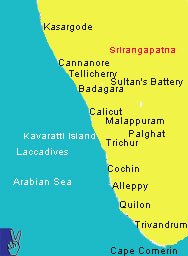 The factors were fully alive to the fact that Hyder Ali’s invasion of Malabar was only a question of time ; and with, a view no doubt to obtaining a reliable estimate of his power the Chief had, so early as January 1764, despatched Ensign Parker on a long journey overland to Madras. The ostensible object of the trip was to survey the line of country “through Cotiote3 to Syringapatam and thence through the pass in the mountains called Sautgurr to Vellour.” with a view to marching troops that way if necessary to Madras.
NOTEs: 3. The Kottayam Raja’s territory comprising the present taluks of Kottayam and Wainad. END OF NOTEs
On the 8th October of that same year Hyder Ali sent a letter to the Chief by the hands of Anant Row, who hinted that it was Hyder Ali’s intention to invade Malabar as soon as he had settled with the Mahrattas. Against this, of course, the Chief and factors - protested ; but on the 6th November following came another letter from Hyder Ali, and Anant Row asked the factors to offer no opposition when Hyder Ali’s army entered the country as he had now made up his mind to make the Kolattiri, the Zamorin, and the Cochin and other Rajas tributary to him.
Anat Row invited the Honourable Company to assist Hyder Ali in carrying out his designs or to at least remain neuter. The Chief and factors at first said they could not listen to such proposals, but on further consideration “that he might not in all probability be prevailed upon to desist from carrying his already projected plans into execution by anything they might say or do,1 they finally resolved to make the best terms possible for the Honourable Company.
NOTEs: 1. Ensign Parker’s mission had no doubt opened their eyes to the power Hyder Ali commanded. END OF NOTEs
They accordingly informed Anant How that it could not be expected that the Company would remain neuter unless Hyder Ali entered previously into engagements for preserving the Company’s proper footing in any countries he might subdue, and they suggested the following as a basis for an agreement : -(1) The commodities dealt in by the Company to be solely appropriated to the Company on payment of the usual customs and no more. (2) Wollen goods and Europe staples to pass customs free on the Chief’s certificate. (3) Goods (cloth, etc., purchased inland for the Company to pass duty free, and that not for the Company to pay half the usual rates. (4) Any quantity of rice to be exported free of adlamy from the Canara ports.
Ali Raja of Cannanore, in view of the impending invasion, next proceeded to better himself by siding with the irreconcilable party of Capu Tamban in the Kolattiri family. The Prince Regent applied to the factors, and they tried to bring Ali Raja to reason, but without much success ; for notwithstanding the engagement2 given by him to give back what he had unjustly seized and not to interfere further in Kolattunad affairs, the war went on, and on 18th August 1765 the Ramdilly (Alikkunnu) fort was taken by a party sent from Tellicherry under Captain Lytt Le die to a d the Prince Regent.
NOTEs: 2. Treaties, etc., i. CXXIX. END OF NOTEs
The irreconcilables under Prince Ambu Tamban still, however, kept the field, and it was in ostensible aid of this prince, and also to collect an old Bednur outstanding of Pagodas 2,00,000 against the Kolattiri and his own debt against the Zamorin, that Hyder Ali eventually crossed the frontier. The news of this event reached the factors on the 10th February 1766 and on the 12th Mr, Ashburner reported from Nilesvaram that Hyder Ali was there with a considerable army bent on subduing Malabar.
In accordance with orders from Bombay two members of the Tellicherry Board set out for Hyder Ali’s camp to point out to him what powers were in alliance with the Company and should not be molested. And the result of this mission is embodied in “a grant”3 from Hyder Ali, executed at Madayi on the 23rd of the same month, confirming all the Honourable Company's trading privileges in Malabar.
NOTEs: 3. Treaties, etc., i. LXXXV. END OF NOTEs
 Prior to this, Hyder Ali had been directing his attention to the formation of a fleet, and Ali Raja of Cannanore, who already had a number of well-equipped vessels at sea, was appointed High Admiral, while his brother Sheikh Ali received the appointment of "Indendant of the marine, of the ports, and of the maritime commerce of his dominions." Reinforced by a number of the disciplined soldiers of Hyder Ali, the High Admiral, it is said, sailed for and conquered the Maldive Islands. After taking the King of the Islands prisoner, he had the barbarity to put his eyes out.
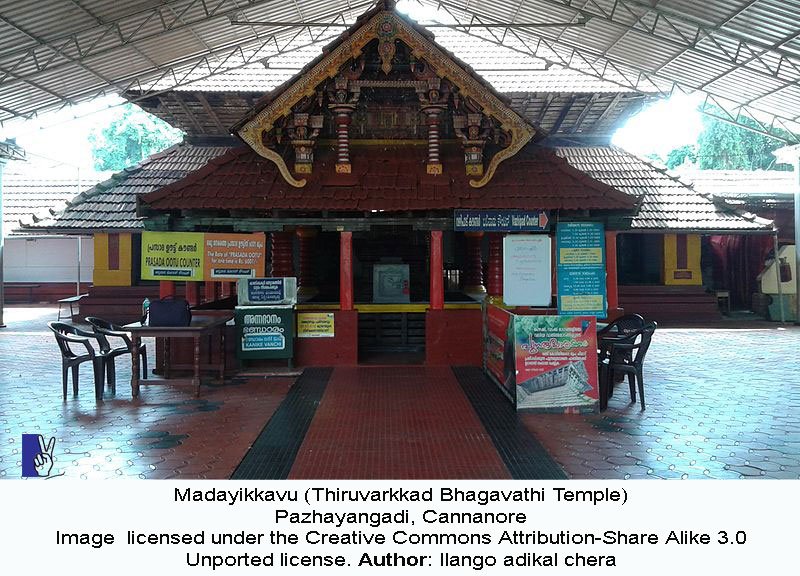 Returning victorious to Mangalore, Ali Raja next proceeded to Nagar with his unfortunate captive. But Hyder Ali was so irritated at the cruelty practised on the unfortunate king by his admiral that he instantly deprived him of the command of the fleet, which he afterwards, it is said, bestowed on an Englishman named Stanet. And it is a pleasing trait in Hyder Ali’s character that he entreated the unfortunate king to forgive the outrage committed, and that he provided sumptuously for the blind man’s comfort. Thence forward Ali Raja and his brother served on land, and aided by a body of their troops, stated to have been 8,000, and by a different account 12,000 in number, they acted as very efficient scouts to Hyder Ali’s army in its progress through Malabar.
Hyder Ali’s own army consisted it is said, of 12000 of his best troops, of which 4,000 were cavalry and the rest infantry, and his artillery consisted of only 4 pieces, but the fleet accompanied him along the coast and afforded assistance as required. A general insinuation was given to the army to grant no quarter.
On the 21st February 1766 the factors heard that the force had taken possession of a temple1 and had laid seige to Madayi, which the officer in command offered to deliver up. Hyder Ali would, however, consent only to an unconditional surrender. On the following day news came that the fort had been evacuated.
NOTEs: Probably that of Kunhimangalam. END OF NOTEs
The Kolattiri family made no resistance, for simultaneously with Hyder Ali’s advance Ali Raja and his men seized their palace at Chirakkal, and the old Tekkalankur prince with his attendants came to take refuge at the Brass Pagoda within Tellicherry limits. They were followed by numerous refugees, fleeing probably more before the terror of the Mappilla scouts than before Hyder Ali’s army.
On the 6th of March Hyder Ali, encamped at Chirakkal, sent a message to the Chief (Mr. James Ryloy) asking for a personal interview, but the Chief declined the honour unless Hyder Ali would consent to come to Dharmapattanam Island, or on board a country ship then in Tellicherry roads.
On the 7th the army entered Randattara and began to commit irregularities, whereupon the factors sent one Ramjee Purvoe to remonstrate. Hyder Ali changed his demeanour and told the messenger it was entirely the factors’ own fault: “Why did they not hoist his colours instead of the English ones, which his people did not know?”
The Nabob had, by this time, come to the conclusion that, the English were destined to be the masters of all India unless a change soon took place. They were already, he was heard to say, “masters of the whole of Bengal, of the greatest part of the Coromandel Coast, they are trying to get Malabar under them, and they have it in contemplation to send an expedition to China.”
He was, he added, determined to prevent this coming to pass. This conversation was reported to H. Kroonenberg, the Dutch Commandant at Cannanore when he, in great state mounted along with Hyder Ali on the latter’s own elephant, returned the visit paid by the latter to Cannanore fort on the 15th of March. The Nabob said he looked to the Dutch to help him to drive out the English.
Being in this frame of mind, the Mysorean objected to the protection afforded by the Tellicherry settlement to the refugees who fled before his army. He also asked to be supplied with gunpowder and arms, and being refused, made another grievance out of this. The factors at the same time had information that Ali Raja was all this time urging Hyder Ali to attack the factory, but to this he would not listen. On the 15th March the army entered the Kottayam Raja’s territory after some opposition and with some casualties, on both sides.
The Kottayam Mappillas deserted the Raja and assisted the invaders.
On the 21st, at 6 P.M., an interview took place between Hyder Ali and the Chief Mr. Ryley, at a spot in Kottayam territory opposite to Darmapattanam Island, but no business was discussed, and it was arranged that Ramjee Purvoe should remain behind to settle all such affairs.
On the 25th the factors despatched the Achanmar of Randattara to their district, escorted by British sepoys, but the Mappillas refused them passage thither. On the 26th came orders from Bombay counselling the adoption of a conciliatory policy towards the invaders, as opposing them would lead the Company into projects far too extensive, for which there was no sufficient force. These orders were subsequently modified by further orders from Bombay, ordering the factors when it was too late—the orders were received only on the 17th April—to repel force by force if the invaders attempted to pass the Tellicherry limits, or to invade the Company’s immediate property.
The orders were accompanied by a letter to Hyder Ali himself, which was sent to him, upbraiding him for attacking the Company’s allies. The invaders met with the first serious opposition they had experienced when attempting on the 28th to enter Kadattanad. To do this they had to cross the Mahe river in the face of the enemy strongly posted on its southern bank. It is difficult to point to the exact scene of this battle, but it probably lay at or near the existing ferry of Perinkulam. The fight is thus picturesquely, but, perhaps, not very accurately, described by the Mogul officer, whose work was subsequently edited by Prince Ghulam Muhammad,1 Tippu’s only surviving son.
NOTEs.1. London: Thacker & Co., 1855, p. 69. END OF NOTEs
“To succeed in his attempt, in spite of this numerous army and the artillery, Hyder caused his fleet to enter the river. His vessels sailed up as far as possible ; and drawing up his infantry in order of battle in a single line in face of the enemy with his twelve pieces of cannon, he waited for the ebb of the water. When the river was at the lowest he entered it full gallop at the head of his cavalry which he had till then kept out of sight of the Nayres : they were led on by fifty of the French Hussars lately arrived from Pondicherry. As the rapidity of the current was diminished by his vessels, he traversed the river without difficulty at a place where it was a league in breadth, sometimes swimming and sometimes wading: he soon came to the other river where the Nayres were busied in attempting to oppose the infantry, who pretended to be on the point of passing over. They were frightened at the sudden appearance of the cavalry and fled with the utmost precipitation and disorder without making any other defence but that of discharging a few cannon which they were too much intimidated to point properly.
“Hyder foreseeing this event, had given orders to pursue the fugitives full speed, cutting down all they could overtake, without losing time either by taking prisoners or securing plunder.
“This order being executed with the utmost strictness, nothing was to be seen in the roads for the distance of four leagues round but scattered limbs and mutilated bodies. The country of the Nayres was thrown into a general consternation, which was much increased by the cruelty of the Mapelets, who followed the cavalry, massacred all who had escaped, without sparing women or children : so that the army advancing under the conduct of this enraged multitude, instead of meeting with resistance, found the villages, fortresses, temples, and in general every habitable place forsaken and deserted.
“It was not till they were near the environs of Tellicherry and Mahe, French and English establishments, that they began to find people, who had taken refuge near those places.”
The factors’ information regarding this severe engagement was that it lasted twenty-four hours, that there were many casualties, including some principal officers, and that the Kadattanad Raja retired to a pagoda with his force not altogether beaten. The invading army remained at the spot, making good their passage for over a week, and on the 6th of April a force of 1,000 men entered and searched Mahe in an attempt to discover the Kadattanad treasures.
On that same day another force of 6,000 men was despatched against Calicut. The invaders met with little further resistance, and as they proceeded they secured the country in their rear by a series of block houses (called lakkidikottas or wooden forts). The Nayars, in their despair, defended such small posts as they possessed most bravely.
“One of these which my manuscripts name Tamelpelly, was surrounded by Hyder in the following manner : first, a line of regular infantry and guns with an abbatis ; second, a line of peons ; third, of cavalry. This disposition was made for the purpose of striking terror by not allowing a man to escape destruction. The Nayars defended themselves until they were tired of the confinement, and then leaping over the abbatis and cutting through the three lines with astonishing rapidity, they gained the woods before the enemy had recovered from their surprise.” (Wilks’ History, I, 291.)
The officer left in command at Kottayam wrote on the 10th to say he had instructions to maintain a friendly footing with the Honourable Company.
And next day the factors received news from Calicut that Ali Raja, at the head of 1,000 men, had reached the Zamorin’s palace near Calicut, and on summoning it to surrender, had been refused by the second prince of the family. Calicut itself was quietly occupied by another party. Another account says that the Zamorin himself met Hyder Ali in Kurumbranad, to which the latter had advanced with his army from the Turasseri river. The demand made for a crore of gold mohurs was so extravagant, that the Zamorin protested his inability to comply with it. He offered to deliver the whole of his treasure and all his property, but this did not satisfy his adversary, who caused him to be seized and imprisoned.
“He was sent1 under a guard of 500 horse and 2,000 infantry to the fort of Calicut ; the Raja was confined in his own house without food, and was strictly prohibited from performing the ceremonies of his religion: and as he thought that Hydro might inflict some further disgrace upon him, either by causing him to be hanged, or blown from a gun, the Raja set fire to the house with his own hand, and was consumed in it.”
NOTEs: 1. Asiatic Researches, V, pp. 30, 31. Several accounts of this event are extant. That given in the text was obtained in 1793 from the then Zamorin by Mr. Jonathan Duncan, President of the first Malabar Commission, and afterwards Governor of Bombay. END OF NOTEs
At Calicut Dutch commissioners met Hyder Ali at his request and discussed with him the terms on which he would be prepared to enter into an offensive and defensive alliance with the Hollanders. It is unnecessary to give the proposals in detail, for nothing came of the conference, and it was manifest that to have accepted his terms the Dutch would have had to fight the English both at home and abroad.
He agreed not to molest the Raja of Cochin on certain conditions, but he would guarantee nothing in regard to Travancore. As there was delay in replying to his proposals he then modified his terms as regards these Rajas and demanded 4 lakhs of rupees and 8 elephants from Cochin, and 15 lakhs and 20 elephants from Travancore, in default of receiving which, he said, he meant to visit those countries. In reply to this demand, the Cochin Raja placed himself unreservedly in the Dutch Company’s hands, but the Travancore Raja, strong in the assurance of English support, replied that Hyder Ali had not commenced the war to please him or with his advice, that therefore he objected, to contribute anything, that moreover he was already tributary1 to the Nawab Muhammad Ali and could not afford to subsidise two suzerains at the same time, but that he would contribute a considerable sum if Hyder Ali would reinstate the Kolattiri and the Zamorin, and ended by suggesting to the Dutch to do the same.
NOTEs: 1. Conf. Treaties, etc., i, CXXXlV to CXLI. END OF NOTEs
And strangely enough, in spite of the ill-treatment which the Cochin Raja had quite recently received at the hands of the Zamorin, the Cochin Raja too in his reply trusted that the Kolattiri and the Zamorin would be restored. The Dutch did not care to send such replies to Hyder Ali, as in the case of Travancore they would have shown him how helpless in reality they were to conduct such negotiations, and how powerful by contrast their English rivals were ; the Cochin Raja eventually obtained immunity from conquest by agreeing to pay a subsidy of 2 lakhs of rupees and 8 elephants.
To the demand of Hyder Ali the Travancore Raja, on July 20th, 1766, made further significant reply by commencing on that date to extend the Travancore lines to within range of the guns of the Dutch fort at Cranganore and on to the territory of the Cranganore Raja. The Dutch, in their fear of offending Hyder Ali, required them to desist from this work within Dutch limits.
After engaging in these negotiations and in further preparations for securing, by means of fortified posts, the conquered country, Hyder Ali at length started eastwards, leaving a movable column of 3,000 regular troops aided by Ali Raja and his Mappillas at Calicut. He also left Madanna, an experienced revenue officer, as civil governor of the province.
He had remained too long on the coast, however, and was overtaken by the south-west monsoon on his fourth day’s march. His march was rendered difficult in consequence, and it was only after sustaining a heavy loss of horses and cattle that his army debouched at last on the cool and pleasant plains of Coimbatore. At Madakkara he left Raza Sahib in quarters with 3.000 infantry.
While Hyder Ali was thus engaged in the south, the Tellicherry factors on the 17th April again attempted to recover Randattara, and a small force sent thither for the purpose had to retire. A boat sent to the Valarpattanam river at the same time to protect the Company’s trade was captured by the Mappillas, two guns and three mortars were seized, and the sergeant in charge was made prisoner. The factors suspected that Ali Raja (“that Moor”) was being secretly assisted by Hyder Ali, who, however, when appealed to, restored on 7th May the guns and mortars and other property. As regards Randattara, Hyder Ali told the factors to send only one Brahman thither to collect the revenue, and wound up ironically thus; “but if you do not choose to trust me, keep what people you please there.”
On the 22nd June came a letter from Madras strongly advising the Bombay Council not to come to a rupture with Hyder Ali — first, because having command of the passes, he might send his cavalry and ravage the country ; secondly, because he was a check on the Mahrattas, who but for him would do the same thing ; and, finally, because the Mogul having recently given a grant of the Northern Sirkars to the Company, and the Nizam being inclined to oppose it, it would be a formidable combination if Hyder Ali were driven to join him.
Moreover they pointed out that the Company’s position on the West Coast put it in their power to disturb him at any time when he was not prepared to resist, or when troubles in other parts of his extensive dominions called him away elsewhere. They recommended, however, that the factors should not submit to be insulted by him.
On the 24th June, after Hyder Ali had retired to Coimbatore, news reached the factors that the Kottayam and Kadattanad Nayars had risen and retaken many places, and next day it was reported that Ali Raja had been appointed civil governor and his brother, Sheikh Ali, military governor of Kolattunad. The former was at Quilandy with 200 men and unable to pass through Kadattanad, being opposed by the Nayars. In September too Prince Ambu Tamban revolted, took two forts, and inflicted a defeat with a loss of 300 men on the Mappillas. The Kottayam Nayars also retook the Nittur fort close to the Tellicherry limits, and the country rose en masse.
The revolt was also general in South Malabar. No word of it, so effectually were messengers intercepted, reached the Mysoreans at Coimbatore until after the chief forts at Calicut and Ponnani had been closely invested. And even then the news was only convoyed by a Portuguese sailor, who, on promise of a handsome reward from the officer commanding at Ponnani, succeeded after many hardships, and with only a compass for guide, in reaching Madakkam and apprising Raza Sahib of the revolt and of the dangers to the garrisons at Calicut and Ponnani.
Raza Sahib marched at once with his infantry alone in spite of the inclement weather and of the inundated state of the country. The absence of his cavalry enabled the Nayars to harass the force at every river-crossing, and at length it was drawn into a position at the junction of the Tutakal and Ponnani rivers, whence it could neither advance on account of the streams, nor retreat on account of the ravines strongly held by the enemy in the rear.
Prince Gulam Muhammad’s author gives the following interesting account of Hyder Ali’s march to relieve his lieutenant : — “Raza Sahib having contrived to send advice of his situation, Hyder immediately marched with 3,000 horse and 10,000 sepoys or topasses. He ordered his cavalry, both officers and men, to ride without saddles ; and commanded his infantry to quit their habits and march naked, excepting a pair of light drawers and shoes. Each soldier was provided with a waxed cloth to wrap up his knapsack, and the 300 Europeans lately arrived from Pondicherry and Colombo, were offered parasols as they did not choose to quit their habits! Their refusal was the cause that they were almost the only persons in the army that were attacked by the dysentery.
“All the artillery of this small army consisted in twelve light pieces of cannon that were carried by elephants.
“It is scarcely possible to form an idea of the species of war to which Hyder led his troops this campaign. Imagine an army of 15,000 men marching from the break of day through a mountainous country in roads or passages scarcely admitting more than three men abreast, exposed from morning till night to a constant shower, equal to those that fall in the greatest storms attended with frequent thunder and lightning, excepting for three hours after noon in which the sun shone out with almost insupportable lustre and heat ; frequently obliged to cross rivers up to the chin in water and sometimes swimming ; and passing the night in towns or villages deserted by their inhabitants, where, however, they found plenty of the necessaries of life. Their path was everywhere marked by rain and destruction, for their orders were to burn and pillage, and they exerted themselves so much in this horrible work that they left behind them nothing hut heaps of ruins where houses had formerly stood.
“This unexpected march obliged the Nayars to collect all their troops and gave some relief to the troops of Raza Sahib, though not sufficient to prevent his losing many of his men for want of necessaries and in consequence of the hardship they were subjected to. The Nayar princes, though half defeated by the fear of the consequences of their revolt, nevertheless expected Hyder with confidence in a retrenched camp near Pondiaghari,1 which on its left wing had a village fortified with a ditch and parapet planted with pallisades well furnished with artillery and maintained by the most resolute, who had determined rather to perish than to yield.
NOTEs: The place indicated appears to have been Vettatt Putiyangadi in Ponnani taluk. It is usually referred to as Putiyangadi (lit. new bazaar). END OF NOTEs
“Hyder, for the attack of this retrenched camp, disposed of his army so that 4,000 of his best sepoys, forming the right wing, were charged to attack the village ; this corps was commanded by a Portuguese Lieutenant-Colonel lately arrived from Goa, with different officers of his nation. The left wing, composed of topasses, was commanded by an English officer, and Hyder himself commanded the main body, having behind him a reserve of Europeans, almost all French, with whom were joined those who are called the Bara Audmees or great men, a corps composed of all the young nobility and courtiers, without excepting even the generals who have not appointed posts or commands on the day of battle. They were all on foot and armed with sabres and bucklers, having voluntarily put themselves under the command of the officer of Europeans, whom they promised to follow wherever he might lead them.
“The cavalry, that could not be of service till after the entrenchment was forced, was formed behind the corps-de-reserve. According to the orders, the Portuguese officer attacked the retrenched village with his 4,000 sepoys, by conducting them bravely to the edge of the ditch ; but without advancing a step farther, he contented himself with causing his troop to fire as if at their exercise. These unfortunate sepoys, totally exposed, were destroyed with impunity by their enemies, who fired from pent-holes or from behind the hedges. This firing, which lasted upwards of two hours, highly enraged Hyder, who receiving every moment news of the state of the attack, learned with the utmost mortification the unavailing loss of his host troops. The French officer, commandant of the Europeans, who lately arrived, and had not yet had an opportunity of distinguishing himself, offered to advance with the corps-de-reserve and put himself at the head of the sepoys.
Hyder answered that he might do as he thought proper ; and he immediately joined his troop, which was impatient for the combat and burned with a desire to revenge the French who were inhumanly1 massacred at Pondiaghari. Headed by this active and courageous officer, and joined by the Bara Audmees, they ran with violent eagerness to the attack. The intervals between the battalions of sepoys afforded them a passage : they jumped into the ditch, and hastily ascending the retrenchments tore up the pallisades, and were in the face of the enemy in an instant. They gave no quarter ; and the enemy, astonished to the last degree at their impetuosity and rage, suffered themselves to be butchered even without resistance. The flames of the village on fire, and the direction of the cannon now pointed on the distracted Nayars, evinced to Hyder that the village was carried. The whole army in consequence moved to attack the retrenchment ; but the enemy perceiving that Hyder’s troops had stormed their outpost, and catching the affright of the fugitives, fled from their camp with disorder and precipitation.
NOTEs: 1. This refers to the massacre at this same place a few months previously of five French deserters from Mahe proceeding to join Hyder Ali's army. This event occurred during the general revolt which followed Hyder Ali’s withdrawal from the coast. Two women accompanying the deserters were, it is alleged, most barbarously mutilated and killed at the same time. END OF NOTEs
“Hyder had supposed his enemies would have exhibited more firmness on this occasion. This brave and fortunate attack, which was much exalted by the young nobility that shared the glory, gave him infinite pleasure. He created the French commandant Bahadur upon the spot ; and in the evening presented him with a patent appointing him general of 10,000 horses, which is the highest military post among the Moguls, at the same time declaring him general-in-chief of his artillery. He likewise gave a gratification of thirty rupees to every soldier, and twice that sum to each of the wounded, of which there was a great number, though no more than one died.
“As the Nayars had no bayonets, the wounds were only cuts with the sabre, little dangerous where ready assistance is to be had.
“The Europeans inspired the Malabars with a new terror by this exploit ; and Hyder, to increase it, spread a report that he expected many thousand men from Europe ; he added that they were a cruel people and devourers of human flesh, and that his intention was to deliver all the coast to their outrages. The rage and fury by which his small handful of French were urged on to revenge their murdered countrymen gave much force to the belief the wretched inhabitants were disposed to afford to his reports. Wherever he turned he found no opponent, nor even any human creature ; every inhabited place was forsaken ; and the poor inhabitants, who fled to the woods and mountains in the most inclement season, had the anguish to behold their houses in flames, their fruit-trees cut down, their cattle destroyed, and their temples burnt.
The perfidy of the Nayars had been too great for them to trust the offers of pardon made by Hyder ; by means of Brahmans he despatched into the woods and mountains to recall those unhappy people, who were hanged without mercy and their wives and children reduced to slavery whenever they were found in the woods by the troops of Hyder, severity and mildness being both equally ineffectual in making them return to their homes. Ali Raja and the Mappillas, who saw themselves thus involved in the ruin of the Nayars, persuaded Hyder to return to Coimbatore in hopes that his absence might remove the timidity of the people ; and it is highly probable that the dysentery that raged in his army was a much more effectual reason that induced him to leave the country. The officers and Europeans, who had retained their clothing and had more particularly abused the liberty of doing as they pleased, were the most exposed to this dangerous malady.
“Before he quitted the country, Hyder by a solemn edict, declared the Nayars deprived of all their privileges ; and ordained that their caste, which was the first after the Brahmans, should thereafter be the lowest of all the castes, subjecting them to salute the Parias and others of the lowest castes by ranging themselves before them as the other Mallabars had been obliged to do before the Nayars ; permitting all the other caste to bear arms and forbidding them to the Nayars, who till then had enjoyed the sole right of carrying them; at the same time allowing and commanding all persons to kill such Nayars as were found bearing arms. By this rigorous edict, Hyder expected to make all the other castes enemies of the Nayars, and that they would rejoice in the occasion of revenging themselves for the tyrannic oppression this nobility had till then exerted over them.
“This ordinance being found to make the submission of the Nayars absolutely impossible, because they would have thought death preferable to such a degradation, he made a new edict by which he re-established in all their rights and privileges such Nayars as should embrace the Muhammadan religion. Many of these nobles took the turban on this occasion, but the greater part remained dispersed and chose rather to take refuge in the kingdom of Travancore than submit to this last ordinance.
“Though the approach of the fine season and the terror he had spread might have left little apprehension of another revolt, yet he left several bodies of troops in the country distributed in posts so situated as to assist each other in case of necessity, and quartered the rest of his infantry in the neighbourhood of Madigheri,1 taking only his cavalry with him to Coimbatore, which he was obliged to spread over the country on account of the scarcity of forage.”
NOTEs: 1. Madakkara. END OF NOTEs
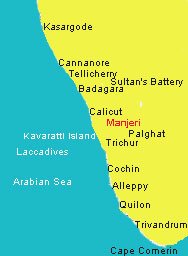 In addition to the measures described above Hyder Ali adopted other means of subduing the refractory Nayars. His troops spread over the face of the country after taking Vettattputiyangadi, and acting from Manjeri in the Ernad taluk as a centre, they brought in numerous prisoners. These were at first either beheaded or hanged ; “but2 as their numbers increased, Hyder conceived the plan of sparing them for the use of his former territories. This cure for rebellion in one province and for defective population in another, of which such numerous examples occur in the Jewish history, was not successfully practised by Hyder. The captives were uncared for, and owing to privations and a violent change of climate, of 15,000 who were removed, it is supposed that 200 did not survive the experiment.”
NOTEs: 2. Wilks* “Historical Sketches, etc.,” 1,293. END OF NOTEs
These violent measures produced a deceitful calm in the province, and Hyder Ali thinking he had permanently tranquillised the country proceeded to Coimbatore, giving orders en route for the erection of the present Palghat fort, which, lying in the centre of the gap in the line of ghats, was judiciously chosen as an advanced post and depot to facilitate communications with the newly-subdued province.
Hyder Ali at this juncture had to face a more formidable confederation than any he had yet experienced. The Mahrattas and the Nizam, aided by an English corps, were threatening him on the north and north-east. In the face of this combination, he accordingly resorted to measures likely to be pleasing to one of his antagonists, and on 3rd November 1766 the factors at Tellicherry had the satisfaction of learning that he had evinced a veal desire to be on good terms with the Honourable Company, and in proof of it he had ordered all the pepper and other monopoly products of Malabar to be given to them.
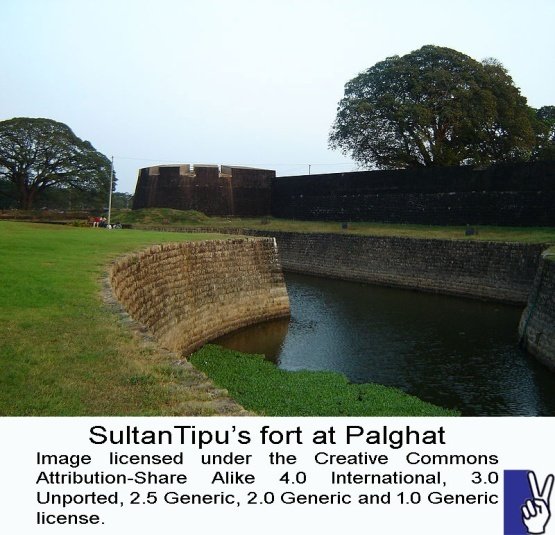 But the seeming calm was not destined to last. Hyder Ali had not received the submission of Travancore, and only a week after the above event the factors obtained intelligence that he was preparing to invade Travancore and was seeking for a passage for his troops through the mountains. And, on 10th January 1766, came the further news that a force despatched for this purpose had been defeated, and this reverse seems to have been the signal for another general rising in Malabar. A force of 4,000 men had been sent into the Kottayam territory. It was attacked by 2,000 Nayars and defeated with great slaughter and loss of their camp and stores. The Nayars all over the country again rose and shut up the invaders in their stockades (lakkidikotta).
Hyder Ali bought off the Mahrattas, and the Nizam was induced to throw over his allies and to join Hyder Ali in a campaign against the English on the east coast. The first act of hostility occurred on 25th August 1768, but the news did not reach Tellicherry till the 13th October.
It is unnecessary to trace in detail the operations which followed. The allies were beaten in the field, the Nizam made a separate peace, the English in conjunction with Muhammad Ali, Nabob of the Carnatic, overran Hyder Ali’s dominions, and planned, with an utterly inadequate force to carry out this resolution, an invasion of Mysore itself.
To aid the operations on the east coast an expedition under Messrs. Govin and Watson was despatched in February 1768 from Bombay to take or destroy Hyder Ali’s fleet. The leaders of the expedition, on reaching Honore, wrote to Tellicherry for boats to assist in crossing the Mangalore surf, and Mr. Sibbald at Honore prevailed on Hyder Ali’s naval commander to join the expedition with one three-mast grab, one two-mast grab, and five gallivats. In Mangalore the expedition took the “Buckingham” and another three -mast grab.
On 1st March the news arrived that Mangalore had been taken and that three vessels of the expedition were being despatched to help the Tellicherry factors in an expedition they had planned against Ali Raja’s town of Cannanore. On the 3rd of March the expedition against Cannanore was despatched. The force consisted of 2 captains, 5 subalterns, and 182 infantry, the commanding officer of artillery and 47 of his train - 232 Bombay sepoys, 80 of the Honourable Company’s Narangpurattta Nayars, and 175 Tiyars—altogether 716 effective men besides officers; and the Prince of Kolattunad and the Raja of Kottayam had agreed to join with 1,700 Nayars.
The whole force was under the command of Captain Thomas Henry assisted by Mr. Robert Sparkes.
Their first move was from Darmapattanam Island to Carly Hill on 3rd March. After reconnoitring the place Captain Henry determined to attempt the capture of a fort called Avarakotta1 lying to the north-east of the town. Once in command of this fort the town would have been at his mercy. He accordingly proceeded on the 9th March to storm it, but the defence was desperate and the attacking column was driven back with the loss of 1 officer, 9 Europeans, 6 seamen, and 6 natives killed, and 1 officer, 16 Europeans, 4 seamen, 19 Bombay sepoys, and 8 Nayars wounded —altogether 70 men killed and wounded.
NOTEs: Probably identical with the ruined fort now called the Sultan’s Battery. END OF NOTEs
An application to the leaders of the expedition at Mangalore for assistance was made, but only one artillery officer’s services could be spared, and so on 22nd March, after a council of war had been held, at which it was estimated that a force of 2,200 men of all arms would be required to effect the reduction of the place, the scheme was finally abandoned. The factors were indignant at their native allies, Kottayam and Kadattanad, for not assisting them. The Prince of Kolattunad, on the other hand, was present and energetically assisted the besiegers.
On the 26th the news of the capture of Honore was reported, and on the same day came a vigorous remonstrance from the Bombay council at the line of action taken by the factors. “This your precipitate and ill-judged conduct1 in the present state of affairs lays us under the greatest embarrassment.”
NOTEs: 1. The council's declared policy had been to assist the native powers against Ali Raja, but not to engage as principals in any warfare against him—Despatch of 30th September 1766. END OF NOTEs
And the despatch peremptorily directed operations against Ali Raja to be suspended in order that those against Hyder Ali might be carried on more vigorously.
Hyder Ali’s rapid and secret march across the peninsula and his recapture of Mangalore are matters of history. The Bombay force was driven out of Mangalore with such indecent haste that they even left their sick and wounded behind them, as well, as their field-pieces and stores. Honore and other places were recovered with equal ease, and before the monsoon commenced Hyder Ali’s army had reascended the ghats.
In June he was at Bednur wreaking his vengeance on the inhabitants who had favoured the English designs, and on the 18th of the month he prevailed on a Madras officer there imprisoned to write to the Chief at Tellicherry, signifying his desire for peace. This letter was in due course forwarded to Colonel Wood, and on 20th August the Chief was instructed from Madras to reply as follows :—
“I have communicated to the Governor of Madras what you wrote to me at the desire of Hyder Ally, the 18th June, to which I have received the following answer :—
“‘In the letter you sent me from the officer at Biddanora it is said Hyder Ally is desirous that a general peace may be effected through the mediation of Bombay. I have no objections to receive his proposals for peace ; if Hyder Ally has anything to propose on that subject and will write to me, I shall answer his letters. If he rather chuses to write to Bombay ’tis well, it will only prolong the negotiations, the end will be the same. It is said also in the same letter that Hyder Ally desires not to make war with the English but with Nabob Muhammad Ally only. The English are always true to their friends and faithful to their allies and therefore must look on the enemies of the Nabob Wallajah as their enemies. Whether the forts we have taken be of mud or stone ’tis not necessary to explain here, ’tis enough that Hyder Ally knows what they were worth to him, and I know well their importance to us. As to his threats of laying waste these countries and destroying the inhabitants, of what avail are words—they cannot hurt and merit not a reply—’Tis not my custom to threaten but to act.’ ”
Hyder Ali’s threats were not empty words, however, as the Madras council learnt to their cost when in November 1768, Fazlulla Khan in command of one column and Hyder Ali himself in command of another made a rapid and unexpected descent on Coimbatore and Salem, and Colonel Wood’s weak and scattered posts, designed more for the Nabob Muhammad Ali’s extortionate exactions of revenue than for military operations, fell an easy prey to the Mysoreans, some by treachery and some by force.
Lieutenant Bryant and his sepoys, being well apprised of treachery within their own lines, left Palghat by night, and marching south-west into Cochin territory eventually reached Madras by way of Travancore and Cape Comorin. Hyder Ali fulfilled his threat by scouring the country up to the very gates of Madras itself and almost1 dictated peace within sight of its walls on the 3rd April 1769.
The Tellicherry factors were not too well pleased with the terms obtained, although the Honourable Company’s trading privileges were confirmed, and recorded their opinion that Ali Raja should either be obliged by Hyder Ali to restore Kolattunad to the Prince Regent, or be compelled to give it up by force of arms. The fact was that Hyder Ali had insisted, as a special condition in the negotiations which Madanna, the Civil Governor of South Malabar, had opened with the various Malabar chiefs in December 1768, that Ali Raja should remain undisturbed, and as Palghat was also studiously omitted, Hyder Ali had thus previously secured two points on the coast from which at any time he could resume his designs on the province.
Excepting Kolattunad and Palghat, therefore, and perhaps Kottayam and other petty chieftains, whose territories Hyder Ali’s officers had never so far been able to command, the Malayali chiefs eagerly adopted the terms offered, and "Hyder’s2 provincial troops, whose escape would otherwise have been impracticable, not only retreated in safety, but loaded with treasure—the willing3 contribution of the chiefs of Malabar—the purchase of a dream of independence.”
NOTEs: 1. Wilks, I. 383.
2. The Kadattanad Raja paid as much as Rs. 80,000.-— (Factors’ Diary, December, 1768). END OF NOTEs
The Malabar contingent of troops thus relieved in December 1768 formed a respectable portion of the army with which Hyder Ali and Fazlulla Khan a few months afterwards, ravaged the Carnatic plains, and forced the Madras Government to accept the terms of peace above alluded to.
Ali Raja’s territory did not however in the factors’ view, or in that of the native chiefs’, extend to the south of the Anjarakandi river, and accordingly, in December 1768, the factors shelled his people out of a bamboo fort which they had erected on Nittur point close to the Tellicherry limits on the opposite side of the Koduvalli river. And this fort was in due course made4 over to the Kottayam Raja, its rightful owner, and he in return finally waived his claim to some land on the Honourable Company’s Island of Darmapattanam, regarding which he had from time to time been troubling the factors ever since 17351.
NOTEs: 1. Treaties, etc., i. LXXXVIL.
2. Treaties, etc., i. XXVII, XXVIII. END OF NOTEs
At the conclusion of the peace with Hyder Ali in 1769, affairs in Malabar seem to have settled down into their usual quiescent state. In 1770 the factors were once more reinstated in full possession of the district of Randattara. And in the following year the Dutch, following out their policy of reducing the number of their fortified places, sold Fort St. Angelo at Cannanore to Ali Raja, and about this same time or a little earlier the equipments of their forts at Chetwai and Cranganore were materially reduced. Cochin fort too was in a ruinous state, and Governor Moons set to work to repair it.
While the Dutch were thus still further reducing2 their hold on the country, the English factors were busy, but in another way, in strengthening their position. On 12th March 1772 the factors began to levy a regular land revenue assessment. Private gardens were taxed at “25 per cent, of the produce,” rice lands belonging to the Honourable Company paid 40 percent, of the gross produce, and the factors were at a loss to know what to impose on other lands of that description. A reference to Bombay brought hack, on 24th April, an order that “the estates and verges3 not yet assessed must be taxed at 10 per cent, on account the Honourable Company.”
NOTEs: 2. Under the circumstances, it is not a little curious to know that even at so late a date as 1790, the Dutch at Cochin passed a formal resolution that the English factory at Anjenge should be destroyed.
3. Paddy flats.—Port. END OF NOTEs
The officer charged with collecting the revenue of Randattara was styled “Inspector of Randattara.”
Hyder Ali had meanwhile after suffering many reverses been forced by the Mahrattas to make a disadvantageous peace. In a short time, however, his treasury was again replenished at the expense of his subjects and his forces were reorganised : so that when dissensions broke out in the Mahratta camp consequent on the death of Madu Row in November 1772, Hyder was ready “for4 whatever event the page of fate should unfold ;” and in little more than six months, between September 1773 and February 1774, he managed to repossess himself of all the territories he had lost during the English and Mahratta wars.
NOTEs: 4. Wilks, I. 388. END OF NOTEs
Coorg fell to him in November 1773, and a force despatched under Said Sahib and Srinavas Row Berki pushed through Wynad and descended on Malabar about 27th December by a new and direct route via the Tamarasseri pass. The Malayali chiefs yielded without striking a blow, and Srinivas Row remained as Foujdar (or military governor) assisted by Sirdar Khan, while Said Sahib, returned to Seringapatam with the cavalry and other troops not required as a garrison.
About a year later (1775) Hyder Ali appears to have made up his mind that any idea of an alliance with the English was hopeless. The latter had agreed in the Treaty of 1769 to assist him against the Maharattas, but Muhammad Ali, the Nabob of the Carnatic, had by intrigues in England effectually prevented the fulfilment of that part of the treaty in order to carry out an ambitious scheme of his own. Hyder Ali appears to have fathomed the Nabob’s designs, which, as a preliminary to still more ambitious schemes, required Hyder Ali’s own destruction, and he accordingly determined to break with the English. His relations with the Mahrattas, however, led him to temporise for a time. Meanwhile if he could possess himself of Travancore he would not only replenish his coffers, but would secure an advantageous position on his enemy’s flank for his contemplated invasion of the Carnatic.
In 1776 then he demanded of the Dutch at Cochin a free passage through their territories into Travancore. The Dutch still held possession of their fort at Cranganore, which effectually protected the western flank of the Travancore lines, and which was regarded on this account, and also because it commanded the great natural water communications between north and south, as the key of the country. Hyder’s demand to be allowed to pass was refused on the plea that a reference had to be made to Batavia ; but ten .years previously this very same request had been met by this very same reply.
Hyder Ali knowing that the Dutch had had ten years to consider his proposal, not unnaturally regarded the reply as evasive and threatened the Dutch with annihilation.
Sirdar Khan was accordingly set in motion at the head of about 10,000 men. He invaded in August 1776 the northern portion of Cochin and took the fort of Trichur. The Cochin Raja agreed to give a nazar of 4 lakhs of rupees and 4 elephants and to pay an annual tribute of Rs. 1,20,000 ; but the Travancore lines blocked a further advance southward of Sirdar Khan’s force and the Dutch were beginning to hope there would be no more trouble.
“The Dutch now congratulated themselves on the disappearance of the Mysoreans, but a letter soon arrived from Sirdar Khan in which he claimed the Chetwai territory on the plea that it had formed a portion of the Zamorin’s dominions wrested from him by the Dutch, who had promised to return it after a certain period. That time having elapsed, and Hyder being now by right of conquest the successor to the Zamorin, the Cochin council were requested to give up the lands, which they declined doing.
“On October 9th, Sirdar Khan crossed the Chetwai river near Poolicarra, a little to the north of the Dutch fort, and took possession of the customs-house, making a prisoner of the writer who was sent to him as the bearer of a message. The Mysore forces now divided into two bodies, one of which proceeded southwards towards Paponetty, from whence the Dutch Resident retired into the Cranganore fort, taking with him the company’s treasure. Sirdar Khan now threw up strong works at Paponetty and despatched a letter to the Governor of Cochin, stating that Hyder Ali considered that he had met with a premeditated insult from the Dutch Governor, who had given no decided reply to his letter. Still he wished to be friends, but a free passage for his troops towards Travancore was essential; and were such refused, it would be considered equivalent to a declaration of war.
“Governor Moens replied that he was glad to understand that the Mysoreans wished to be regarded as friends, and he should feel obliged by their evacuating the Dutch territory, and not allowing their people to approach the Cranganore fort. But before his reply could reach its destination, Sirdar Khan attempted to surprise this fort on October 11th, but failed. He then wrote another letter, stating that having taken the lands of Paponotty, he should feel obliged by the accounts of the last twenty years being forwarded. He also demanded the territory the Dutch Company had received from the Zamorin in 1758, as well as a nazar and a free passage towards Travancore.
“Without sufficient troops to hold their own by force, surrounded by native states outwardly friendly but secretly hostile, attacked by the Mysoreans, and awaiting instructions from Batavia, Moens’ position was a very difficult one. A common danger, it was true, bound the Cochin and Travancore States to the Dutch, but it was feared that they did not possess sufficient forces to afford any effectual barrier against the advance of the Mysore troops. Still Moens considered it advisable to sound the dispositions of the two Rajas, so wrote and informed them that he was ready to commence offensive operations against the Mysoreans, but he first required a categorical answer as to how far he could depend upon their support ; he also proposed a plan on which all would have to act in concert against the common enemy. The Raja of Travancore replied that he had entered into an alliance with the Nabob of Areot and the British, in which it had been stipulated that he was only to act on the defensive, and not to be the aggressor, otherwise he would receive no aid : so he regretted being unable to join the Dutch, except for defensive measures. Should the Mysoreans advance on his territory, British and Arcot troops were promised for his assistance.
“Urgent requests were despatched to Ceylon for more troops as there were only 200 effective soldiers present and the safety of Cochin itself was now endangered, for it was ascertained that a fleet, consisting of one three-mast ship, six two-mast grabs, and twenty well-armed gallivats, were preparing at Calicut to take troops by sea past Cranganore to the island of Vypeen. It was suspected that the Ayacotta fort would be first attacked, and should it fall, that Cranganore would be besieged from the south, whilst Sirdar Khan invested it from the north. An armed sloop was placed at the entrance of the Cranganore river, and two armed merchant ships further out to sea to cover the coast. The Raja of Travancore and Cochin improved the lines, which commenced from the rear of the Ayacotta fort and were carried along the southern bank of the river towards the ghauts. The Cranganore and Ayacotta forts were strengthened, the first and most important by having a retrenchment thrown up under its guns, and the latter by being repaired.
“Some Travancore sepoys were now sent to Ayacotta, which the Mysore troops prepared to attack ; but unwilling to come to blows, the Travancoreans retired to their own country. Fortunately at this critical time a Dutch detachment arrived by sea, and consequently the Mysoreans retreated. A strictly defensive policy was now decided upon, for fear of giving offence to the British and the Nabob of Arcot, but in November, as a further reinforcement had arrived, the Dutch considered themselves strong enough to become the aggressors.
“The Muhammadans had invested Chetwai, the garrison of which place sent a message to Cochin, representing that they could not hold it much longer, so Governor Moens now determined to attempt its relief. Provisions and ammunitions having been packed in casks, 189 men embarked in the ship Hoolwerf, having some small boats in tow for the purpose of landing the men and stores. On the same afternoon, November 11th, they arrived before Chetwai, but the surf being high, the wary Muhammadans had the satisfaction of perceiving that they delayed landing until the next day. A chosen band of Sirdar Khan’s troops was told off, and in the dead of the night placed in ambuscade close to the beach where the landing was most likely to be effected, and in silence awaited the disembarkation of their prey.
“The morning dawned, and the Dutch having examined the shore, could see no vestige of an enemy, all appeared perfectly quiet, and they congratulated themselves on surprising Hyder's troops. The landing commenced, the first boat upset, but the troops waded to the beach with their loaded muskets wet, and their ammunition of course spoilt. Suddenly the ambuscade rushed out, and finding advance impossible, the Dutch retreated in good order to the beach ; but their boats were gone, and the terrified native boatmen were pulling quickly away from the scene of strife. Some of the detachment were killed, and the remainder obliged to surrender themselves prisoners of war.
"The Europeans were disheartened and abandoned the attempted relief whilst the Muhammadans were greatly elated and the fort of Chetwai was compelled to capitulate on the 13th, one condition being that the garrison should be permitted to retreat to Cranganore, a promise which was of course broken. The prisoners were plundered of everything, even to their very clothes, and with the women, children and slaves, were sent to Calicut. From thence the military were despatched loaded with chains to Seringapatam, where all took service with Hyder, excepting the Commandant of Chetwai and the Resident.
“The whole of the island including Chetwai, Ayroor or Paponetty, and the territory of the Raja of Cranganore (excepting the Dutch fort), all of which were tributary to the Dutch, now succumbed to Hyder’s general ; but he found his further advance impeded by the Travancore lines. The Cochin council now decided upon still further strengthening the Cranganore fort and on not again breaking up their troops into detachments.
“On January 9th, 1777, the answer to Hyder’s letter arrived from Batavia, and with it the customary presents, which with an apologetic letter from the Governor of Cochin, were forwarded to Hyder’s camp. On February 25th the Commandant and Resident of the Chetwai fort arrived in Cochin from Seringapatam and informed Governor Moens from Hyder that most of the prisoners, including the women and slaves, were set at liberty (some soldiers were induced to remain in Hyder’s service) and that they were commissioned by Hyder to say that he was still anxious to enter into a treaty of friendship with the company, upon which subject he would shortly write. Hyder’s letter disowned Sirdar Khan’s proceedings, and stated that he had only despatched him into the sandy1 country to inquire after some of the Zamorin’s lands ; that he had no unfriendly feeling towards the Dutch, and whilst returning the prisoners trusted all matters of dispute between them would be rapidly and amicably settled.
NOTEs: Chetwai Island is some times called Manapuram, i,e., sandy place from the nature of the soil. END OF NOTEs
“Hyder Ali in a secret correspondence became very pressing to carry into effect his former propositions for entering into an alliance with the Dutch. He now reduced his requirements to 400 European infantry and 100 artillery men. Governor Moens evaded this application without declining it, and held out hopes which were never carried into effect. He foresaw that neutrality with the English and Travancore must cease should he join Hyder. The Dutch council also wished to prevent the Travancore Raja, who was becoming alarmed at Hyder’s increasing power, from forming too intimate relationship with the British, so they tried to induce him to believe that from Hyder he had nothing to fear.
*******
“On January 8th, 1778, the Dutch planned an expedition to recover their lost ground. They stormed and took the Cranganore Raja’s palace, which had a garrison of 300 men, and pursued the enemy to Paponetty. The succeeding day the Dutch forces reached Bellapattoo, and on the evening of the third day arrived before Chetwai, At once the guns began to play upon the fort, and continued all that night and throughout the next day. On the third day they unsuccessfully attempted to storm ; the attack was continued seven days, but the enemy commencing to assemble in force on the opposite side of the river, the Dutch were obliged to retreat to Cranganore on January 19th with the loss of some guns. On the morning of March 3rd the Mysoreans attacked the Cranganore palace with 3,000 men on foot, 150 horse and 4 guns. After ten hours’ fighting the Dutch retired to the Cranganore fort with the loss of 6 men.
“In March the Dewan of Travancore came to Cochin to have an interview with Governor Moens, who pointed out to him the necessity of preventing Cranganore from falling into the hands of Hyder, and urged that it was to the interest of the Travancoreans to join the Dutch as they were running a risk of losing their country, whilst the Dutch could only lose a little strip of territory, which Moens hinted might even be avoided should he join the Mysoroans.
“About this time Hyder, who was now most indignant with the Dutch, was obliged to go to war with the English and the Nabob of Arcot. On his way he found time to plunder the Dutch store-house at Porto Novo and make a prisoner of the Resident.”
* * *
“In 1783 the Raja of Chetwai was peaceably reinstated in his dominions by the Dutch when they retook the place from Tippu’s forces ; but in the following year orders arrived from Batavia to return this territory to Tippu, Hyder having died in December 1782.” — Day's Land of the Permauls, pages 149 to 155.
Meanwhile in North Malabar, in consequence of Ali Raja’s failure to pay the stipulated tribute, the Prince Regent of Chirakkal (Kolattunad) had been restored to his dominions and a Mysorean officer had been sent to administer the revenue. On 25th April 1775 the Prince Regent, backed by the Mysoreans, forced the Kurangoth Nayar, backed by the French of Mahe, to come to terms, and on 5th May the French paid Rs. 80,000 and procured the withdrawal of the enemy.
In June the Prince Regent proceeded into Kottayam to reduce various forts : all guns taken were sent to Hyder Ali. The Prince Regent however during all this time continued to supply the Tellicherry factory with pepper, and thereby the factors incurred the jealousy of the French Settlement at Mahe. M. Law de Lauriston wrote to Warren Hastings, complaining of the entire ruin of French trade on the coast through the factors “new treaties” with the Prince Regent “for all the pepper and other productions of the country.”
Notwithstanding this aid, however, in their mercantile pursuits, the Tellicherry factory had not for some years past been a paying investment. On 8th January 1776 advices were received by the Gatton that what had been impending for some years had at last been ordered to be carried out. The factory was to be reduced to a residency and the troops removed. At this juncture the principal inhabitants of all classes came forward voluntarily and presented a petition, “representing the deplorable situation they will be reduced to in case the Honourable Company withdraw their protection from them, and as they learn that the great expense of this settlement is the cause of the Honourable Company’s resolution to withdraw their troops, they have agreed to raise a sum sufficient, with the present revenues, to maintain a force for their protection by a tax on their oarts1 and houses as specified at the foot of their petition.
NOTEs: 1. Port. Horta = garden. END OF NOTEs
The officer commanding estimated that the force required would cost Rs. 60,000 per annum, and the new tax and other revenues were estimated likewise to produce that sum. The petition was accordingly sent to Bombay for orders, and the factors pointed out that, unless the settlement was kept up on a more respectable footing than a residency, it would be impossible to provide for the annual investment in pepper and cardamoms, except at exorbitant rates.
It remained as a residency—-with an establishment of a Resident, and one or sometimes two factors — until 27th January 1784, on which date the chiefship was re-established, and it continued on this footing down to 1794, when the factory was finally abolished. On March 13th, 1778, the French recognised the declaration of American independence and thus brought on another war with England.
The news reached Tellicherry via Anjengo on the 20th July, shortly after a French reinforcement for Hyder Ali had been passed on to him through Mahe.
Mahe was at this time of more importance to Hyder Ali than even Pondicherry itself, for it was through that port that he received his guns and ammunition and French reinforcements. He was busy wresting from the Mahrattas the territory lying between the Tumbadra and the Kistna rivers, when the English laid siege to Pondicherry on August 8th, 1778, and he failed to make a diversion in their favour. Pondicherry fell on 18th October. The news reached Tellicherry on 3rd November, and shortly after that date the factors heard that it was in contemplation to reduce Mahe also. But the reduction of Mahe would have cut off Hyder Ali from his base of supplies, so, although not yet prepared finally to break with the English, he appears directly Pondicherry fell to have sent orders, which resulted in the Prince Regent of Kolattunad joining the French at Mahe with 1,500 of his Nayars. Besides which 200 of Hyder Ali’s own sepoys were thrown into the place ; and orders were sent to Kadattanad to reinforce Mahe with 2,000 more men, and Kolattunad was to send a like further number.
Kadattanad, however, inclined to the English alliance, and so did the Zamorin and Kottayam. The factors at Tellicherry took every possible means to secure these allies, and as the event turned out, the Kolattunad Prince was the only chief who remained faithful to Hyder Ali’s interest until after Mahe had fallen.
On January 3rd, 1779, the siege stores for Mahe came in from Bombay. On February 6th the Kolattunad force1 in defence of Mahe was reinforced by 2,000 men from Coorg. On February 21st the first division of Colonel Brathwaite's expeditionary force, 800 sepoys under Captain Walker, reached Tellicherry. On February 24th there arrived another battalion under Captain Fraser. On March 2nd there came the Terrible bomb ketch Asia, man-of-war, and on March 12th H.M.’s ships Sea Horse and Coventry, with the Resolution in convoy, carrying Colonel Brathwaite and a European battalion.
NOTEs: 1,000 men and 2 guns. END OF NOTEs
At 4 p.m. on that day the colonel landed under a salute of 15 guns, and at 5 p.m. the first gun was fired by the French at the British advanced posts. On March 15th the Royal Charlotte brought Major Clifton and three companion of artillery. And the force being now complete, Colonel Brathwaite, on the 16th March at 3 p.m., summoned M. Picot to surrender the place. Lieutenants Bate and Williams, his messengers, returned with M. Picot’s refusal at 8 p.m. on the same day.
But meanwhile the Prince of Kolattunad had, on February 27th, thrown a cordon round Tellicherry and stopped the import of provisions. The factors, however, effectually replied to this move by supplying Kottayam with military stores and despatching him on March 11th to recover his country. The Prince Regent thus found himself with Kottayam and the British actively hostile on his rear and right flank, and Kadattanad and the Iruvalinad Nambiars passively hostile on his left flank, and it became at once apparent that he was helpless to assist the French unless they could feed him and his men.
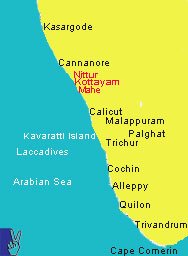 The position was hopeless for the French, so on the 19th March, at 7 a.m., proposals of capitulation were received from M. Picot. Brathwaite’s reply was accepted1 the same day, and at 4 p.m. the British colours were hoisted on “Currachee redoubt”.
NOTEs: Treaties, etc., i. LXXXIX. END OF NOTEs
Chimbrah and Fort St. George were handed over next morning under a salute of 21 guns, and the British colours were flying in Mahe itself at 6 p.m. on the evening of the 20th. The garrison marched out with the honours of war, but all arms, stores, etc., were surrendered, and the forts, etc., were placed at the disposal of the Honourable Company.
The Prince Regent of Kolattunad effected his retreat from Mahe through Nittur after suffering defeat from Kottayam and sustaining considerable loss, and both Kottayam and the Zamorin for a time recovered most of their dominions from Hyder Ali’s troops.
The Company was, however, still nominally at peace with the latter, and no overt encouragement, beyond the grant of supplies of arms, etc., was held out to the country powers, though the circumstances might have justified the adoption of active measures, for Mr. Wm. Freeman, the Company’s Resident Factor at Calicut, had, by order of the Governor, been obliged, on March 18th, summarily to leave that place, and the Company’s goods and some of their employees had been left behind by him at the mercy of Hyder Ali’s people there.
The Mysorean provincial troops had consequently no difficulty in putting down the rising in the south, and the Kolattunad Prince, after, joining Bulwant Row, returned to the Kottayam country, dispersed the Kottayam force, and then proceeded to Kadattanad, where the Senior Raja, who had sided with the English, was deposed in favour of a young prince.
The effect of these measures was soon apparent, at Mahe and Tellicherry. On June 24th young Kadattanad’s force closed in on Mahe and began erecting fortifications. On August 20th a washer-man belonging to Brathwaite’s force camped at Mahe was carried off. Restitution was demanded, and in a collision which occurred in consequence eight of the Kadattanad Nayars were slain.
Hyder Ali approved of young Kadattanad’s conduct, and the latter beheaded the unfortunate dhobi in the presence of a peon of Brathwaite’s, who had gone with a message, and of a horsekeeper who had also been entrapped. The two latter, with their hands cut off, were permitted to return to Mahe.
It soon became apparent in short that Hyder Ali, by means of the Malabar chiefs in his interest, meant to become actively hostile. The country powers intercepted letters and stopped the supply of provisions, and in October still more active measures were undertaken by them—first against the British outpost at Mount Deli in the beginning of that month, and towards the end of it the British district of Randattara was overrun by the Kolattunad Prince with his force.
The Mappillas of this latter district undertook to assist the British to maintain their hold of the province, but when it came to the push their hearts failed them. A small force sent out to assist the Randattara Achanmars was obliged to retreat before overwhelming numbers to Darmapattanam Island. On October 24th the factors recorded their opinion that Hyder Ali intended to break with the Honourable Company, and that the native chiefs were acting under secret orders from him.
On October 31st young Kadattanad attacked the British outpost at “Moicara” and seized it and Andolla and Tira Malas, and as the factory was now attacked on all sides, the factors sent a requisition to Colonel Brathwaite to come to Tellicherry to assist in its defence.
On November 1st, 1779, the factory diary thus runs : “As the enemy seem to be gaining ground—resolved that agreeable to the Company’s orders, we deliver the keys of the fort to the Military Commanding Officer, who is to take all possible means for the security of the fort and districts.”
From this date till January 8th, 1782, the town was in a state of close siege on the landward side, and the keys were only returned to the Resident on the 24th of this latter month.
Colonel Brathwaite accordingly evacuated Mahe and brought his Madras troops to assist in the defence of Tellicherry. Part of the British Island of Darmapattanam was seized by the enemy so early as November 3rd, but the rest of it was held till July 18th, 1780, two days prior to the date on which Hyder Ali finally threw off the mask and descended on the Nabob of Arcot’s territory with his array of 99,000 men in pursuance of his plan with the Mahrattas of annihilating the English power. And it was on that very day, July 20th, 1780, that the factors were at last authentically apprised by a deserter that Hyder Ali was at war with the Company. The only remaining outpost at Mount Deli was evacuated in November 1780.
Prior to these events the state of siege was maintained ostensibly by the Kolattunad and Kadattanad Princes ; for Kottayam was throughout the siege firmly attached to the Honourable Company’s interests, and helped materially, with a body of from 1,000 to 1,300 of his Nayars, to enable them to hold the town successfully. The post was not a strong one, although it was protected on three sides by the sea and the river with redoubts1 on all positions of importance, but there was cover available for the enemy up to within 200 yards of the main fort itself if they had once broken through the “extensive2, but indefensible” outer line of defence.
NOTEs: 1.“Cuchicundy”, Koduvalli, Pallikkunnu, Morakkunnu, Chirakkalkandi, Tiruvengad temple and Mailan were the principal outworks.
2. Wilks’ "Historical Sketches”, II. 1 END OF NOTEs
Into this small and insufficiently protected area flocked every one who had property to lose. Hyder Ali’s “Buxy” (Bakshi — paymaster) at Mahe, in a letter of May 29th, 1780, to the Resident put the matter very forcibly thus : “I know perfectly well that you have been guilty of giving an asylum to people that ought to pay to the Nabob lacks and lacks of rupees, and given assistance to the vassals of the Nabob. You also keep in your protection thieves, who ought to pay lacks and lacks of rupees.”
Hyder Ali himself, too, in a letter to the Resident received on February 4th, 1780, complained of the protection afforded to the Nayars and their families and of the assistance given to them in arms, etc., in order to create disturbances, whereby “my country of 20 lacks of rupees revenue is entirely ruined, and I cannot get the same increased.”
This security of property and perfect trust in the Company’s officers probably did more than anything else to bring the siege to a successful issue, for there was no other spot on the coast, not excepting the Dutch settlement at Cochin, where such perfect security to person and property could be found. The persons who flocked into Tellicherry from all the country round accordingly fought and watched with the courage and vigilance of despair, and every effort of the enemy to break through the slender line of scattered outworks was defeated.
On December 6th, 1779, Sirdar Khan, accompanied by some European officers, minutely reconnoitred all the posts, and on January 17th, 1780, the factors reported to the Governor-General (Warren Hastings) that Sirdar Khan was expected shortly with a large force from Seringapatam. On February 17th, 1780, the news arrived that he had reached Tamarasseri and wished to treat with Kottayam, the Honourable Company’s only native ally at this time, for the restoration3 to him of his country below the ghats. The negotiation took place: a demand was made for five lakhs of rupees, of which two lakhs were to be paid at once. Kottayam could raise but one lakh ; an application to the factors for the loan of another lakh was of course refused, although it would have gone hardly with the besieged had the Kottayam Nayars been withdrawn.
NOTEs: 3. It appears that Kottayam had previously received from Hyder Ali a “Phirmaund for Vaenatoo” (Wainad). END OF NOTEs
Eventually Kottayam paid Rs. 60,000 to Sirdar Khan, but this was not enough to satisfy the latter, and his request to be restored to his dominions was accordingly refused. The result of these negotiations was to attach Kottayam more strongly than before to the Company’s interests.
On December 23rd, 1779, Brathwaite was relieved of the command of the town by Major John Cotgrave, another Madras officer. On July 8th, 1780, Sirdar Khan appeared at Mahe with a large force, which three days later he began to pass across the river, and on the morning of the 12th the force reached “Mellure.” This led to the evacuation of Darmapattanam Island and to the concentration of the Honourable Company’s force within the lines of Tellicherry. Sirdar Khan refused to assign any reasons for his action; but it was no longer doubtful that Hyder Ali had finally broken with the Company.
As soon as the state of the season permitted, Sirdar Khan commenced operations by sea as well as by land, and on October 1st, 1780, the factors reported that they were “blocked by sea by a ketch and a great number of armed manchuas and toneys.”
But this did not last long, for on October 6th came the “Drake,” and "Eagle” cruizers, which disabled the enemy’s ketch and drove away the smaller vessels into the creeks and rivers, where, however, they lay ready for future operations.
When the news of Bailey’s defeat by Hyder Ali arrived on November 1st, matters assumed a very serious aspect, as it was supposed the Madras troops under Major Cotgrave would be withdrawn, and the evacuation of two redoubts called Whippey’s and Connor’s created shortly after this quite a panic in the town. But a day or two later (November 27th) matters began to look brighter when Sir Edward Hughes with H.M.’s ships Superb, Exeter, Eagle, Worcester, and Burford and others in convoy put into the roads.
Just about this time the Mahratta Angriah, in command of Hyder Ali’s fleet, consisting of two ships, two snows, six ketches, and two gallivats, sailed south as far as Cannanore to attack the ships in the Tellicherry roadstead, but he did not like the aspect of the shipping when he arrived there and wisely retreated.
Directly, however, Sir Edward Hughes sailed north to Bombay, the enemy’s fleet again began to give trouble, and to remedy this Captain LcMesurier of the Ponsbornc was appointed Cammodore of the Tellicherry roads.
In March and April 1781 the enemy’s exertions were redoubled, but the garrison reinforced by two 12-pounder guns and 60 marines from the ships successfully repelled the attacks. The following singular account of one of the modes of attack adopted by Sirdar Khan is given by Wilks1 on the authority of Sir Barry Close, “one of the besieged” :—“Sirdar Khan had no acquaintance with the European science of attack and defence, but, after failing in several assaults which were repelled by the bravery of the defenders, and finding every ordinary battery opposed by corresponding and more skilful defensive means, or destroyed by sorties, adopted a species of offensive work, which from its height should enable him to see and counteract the designs of the besieged, and from its construction be exempt from the dangers of assault. An immense extent of base served as the foundation for several successive storeys, constructed of the trunks of trees in successive layers, crossing each other and compacted by earth rammed between the intervals ; the contrivances in the rear for raising the guns were removed when the erection was complete, and enormous inaccessible towers rearing up their summits by the successive addition of another storey as the besieged covered themselves from the proceeding, exhibited a system of attack too curious to be dismissed in silence, but too imperfectly impressed by distant recollection to be well described.”
NOTEs: 1. Wilks’ “Historical Sketches, etc.," II. 2. END OF NOTEs
Shortly after this, on May 7th, Sir Edward Hughes’ squadron again came into the roads with troops and stores and Major Aldington as “Major Commandant” in succession to Major Cotgrave, who with the Madras troops sailed with the fleet on May 16th.
On May 17th and 18th ineffectual attempts were made by the enemy to set fire to the Sea Horse in the roadstead, nor were their efforts by land more successful.
On August 6th, however, they opened a fresh battery of 5 guns against Morakkunnu, a redoubt by the river side, and in consequence of the incessant firing kept up in reply, the gunpowder supply of the garrison began to run short and became “very alarming.” An urgent requisition was sent to Anjengo, and Mr. Firth, one of the factors, proceeded by sea to Cochin to endeavour to get a supply from the Dutch. A day or two after he had gone (August 27th), the news arrived that England was at war with the Dutch. Mr. Firth was accordingly detained as a prisoner of war at Cochin, and the money and other things that he carried with him were seized.
As the British fire slackened, the enemy came closer to the lines, and in spite of the news of Sir Eyre Coote’s victories on the East Coast in July and August, the enemy were no whit less assiduous in the siege. On October 11th they had, Major Abington reported, mined “under and even within our lines.” But on that day also arrived the first instalment of the long looked for supply of gunpowder and hand grenades from Anjengo, and the anxiety so long felt was removed.
On November 22nd Mr. Firth was released at Cochin in exchange for a Dutchman, a relative of the Dutch Governor Van Angelbeck. With the beginning of December 1781 came the news from the East Coast of the retaking of Arcot and of Hyder Ali being in “a very perilous situation at a place called Convy”.
And by this time the Bombay authorities had matured their plans for relieving the settlement. Accordingly, on December 18th, the Resident and Major Abington had a consultation and agreed on a plan of operations to be put in force directly the expected reinforcements arrived.
The plan appears to have been much the same as that already long before proposed by the Kottayam Raja in December 1780, and then warmly approved by Major Cotgrave. Kottayam was to advance from the fastnesses of the ghats in rear of the enemy opposing the Morakkunnu redoubt. The garrison were to join hands with him there and thus cut the besieging army in half and afterwards vanquish it in detail.
Besides this, the cruisers were to be stationed to the south of Mahe to prevent a retreat of Sirdar Khan’s force by sea. The cruisers protecting the roadstead at this time were the Morning Star and the Drake, and as a preliminary to the further operations, they, on 21st December, set upon Hyder Ali’s gallivats, took one of them, and drove the remainder in a very shattered condition into the Valarpattanam river. On the same day the enemy sprung two mines at Fort Mailan, but without doing any damage, and that post was made stronger than ever. On December 28th, the Travancore and Zamorin Rajas were addressed to assist in crushing Hyder Ali’s force on the coast as soon as the Tellicherry siege was raised. It was necessary to maintain the strictest secrecy in regard to the intended movements, and hence the addresses to these Rajas were not sent sooner.
On December 30th, 1781, the expected reinforcements arrived from Bombay, consisting of the 2nd and 8th battalions of sepoys and 40 artillery men with four 6-pounders, besides lascars.
With this force, and as many of the troops in garrison as could be spared, Major Abington left his trenches at 5 A.M. on Monday, 8th January 1782, and “stormed and carried the enemy’s batteries, took their cannon, ammunition, etc., and a number of prisoners, etc.” And the further results were thus described by him in a note addressed to Mr. Freeman, the Resident, written from “Guerechee” at 11 o’clock: -
“Sir, I congratulate you on our success, and I believe our whole loss does not exceed 30 killed and wounded. We are in possession of Guerechee, Putney, Bench Hill and I hope by this time of everything under Moylan, all the guns and 2 brass field-pieces. Scirdar Caun is now setting with me, and all his family; he is wounded and seems very ill; the Buckshee of the irregulars is killed, and they have suffered very considerably. Poor Woodington is the only officer wounded. Yours very sincerely —William Abington.”
Fort St. George at Mahe surrendered at 9½P.M. on the 8th, and Mahe at 5A.M next morning. The left attack being thus annihilated, the remainder of the besieging army on the point of Nittur and on Darmapattanam Island evacuated their positions on the 9th.
The keys of the fort were re-delivered to the Resident on January 24th. The Nayars rose all over the country, and Major Abington pushing on southwards took Calicut on February 13th, and by the 20th of that month "Palicatcherry" was reported to be the only place of importance, though this fact is doubtful, remaining in Hyder Ali’s hands in South Malabar.
“Sirdar Caun departed this life at 9 o’clock this morning” (February 26th).
Hyder’s affairs at this time were in a very unprosperous state — Sirdar Khan’s army destroyed at Tellicherry ; disappointed and, as he thought, deceived by the French, foiled in every battle by Sir Eyre Coote. Rebellions in Malabar, in Coorg and in Bullum, and finally threatened by a Mahratta invasion from the north, “he determined1 to concentrate his force, to abandon his scheme of conquest in Coromandel, and to direct his undivided efforts first, for the expulsion of the English from the Western Coast, and afterwards for the preservation of his dominions, and for watching the course of events.”
He had to reduce his army in the Carnatic considerably in order to despatch the three expeditions required to put down the rebels. Mukhdum Ali was sent to Malabar, Woffadar (a Chela) to Coorg, and Shaikh Ayaz (Hyat Sahib,2 another and more remarkable Chela) was ordered from Bednur (of which he was appointed governor) against Bullum.
NOTEs: 2. The story of this man is remarkable. Wilks gives the following account of him : —
Among the prisoners carried off in the first inhuman emigration from Malabar, was a young Nair, from Chereul, who had been received as a slave of the populace, and to whom, on his forced conversion to Islam, they had given the name of Shaikh Ayaz.* The noble port, ingenuous manners, and singular beauty of the boy attracted general attention ; and when at a more mature age he was led into the field, his ardent valour and uncommon intelligence recommended him to the particular favour of Hyder, who was an enthusiast in his praise, and would frequently speak to him, under the designation of “his right hand in the hour of danger.” . . . .In the conversation of Muhammadan chiefs, a slave of the house, far from being a term of degradation or reproach, uniformly conveys the impression of an affectionate and trustworthy humble friend, and such was Ayaz in the estimation of Hyder. To the endowments which have been stated, incessant and confidential military service had superadded experience beyond his years ; and Hyder selected him for the important trust of civil and military governor of the fort and territory of Chittledroog. But modest as he was, faithful and brave, Ayaz wished to decline the distinction, as one to which he felt himself incompetent ; and particularly objected, that he could neither read nor write, and was consequently incapable of a civil charge. “Keep a corlat at your right hand ” said Hyder, “ and that will do you better service than pen and ink,” then assuming a graver countenance, “place reliance ” added he, “on your excellent understanding ! act for yourself alone ! fear nothing from the calumnies of the scribblers ! but trust in me as I trust in you ! Reading and writing!! how have I risen to empire without the knowledge of either?” In addition to this Hyder Ali was in the habit of publicly drawing very invidious comparisons between his son Tippu and his favourite Shaikh Ayaz. Reprimanding the former on one occasion for attempting secretly to embezzle some plunder, he called him “a thief and a blockhead” ; observing that he had not the common sense to perceive that he was stealing from himself : for “unhappily,” said he, “ you will be my successor; would that I had begotten Ayaz instead of you !” Directly therefore Tippu assumed the reins of Government on the death of Hyder Ali, he despatched secret instructions to the second in command at Bodnur to put Ayaz to death and assume the government. What follows is thus narrated by Wilks :—“ Whatever may have been the ultimate intentions of Ayaz at this period, it is certain that apprehensions of treachery were mixed with all his deliberations : he had taken the precaution of ordering that no letter of any description from the eastward should be delivered without previous examination ; and being entirely illiterate, this scrutiny always took place with no other person present than the reader and himself, either in a private chamber, or if abroad, retired from hearing and observation, in the woods. On the day preceding that on which the ghauts were attacked, and while Ayaz was occupied near Hyderghur, in giving directions regarding their defence, the fatal letter arrived and was inspected with the usual precautions ; the Brahman who read it, and to whom the letter was addressed as second in command, stands absolved from all suspicion of prior design by the very act of reading its contents ; but in the perilous condition of Ayaz he durst not confide in a secrecy at best precarious, even for a day ; without a moment’s hesitation, he put the unfortunate Brahman to death to prevent discovery ; put the letter in his pocket, and returning to his attendants instantly mounted, and without leaving any orders, went off at speed to the citadel to make the arrangements for surrender which have been related, it may well be presumed that this horrible scene could not have been enacted without some intimation reaching the ears of the attendants, and the very act of abandoning the scene of danger contrary to his usual habits, spread abroad among the troops those rumours of undefined treachery which abundantly account for their dispersion and dismay.” He accordingly surrendered to General Matthews the fort and country of Bednur, of which he was the governor, on the condition that he was “to remain under the English as he was under the Nabob (Hyder Ali).” Of the unhappy results of General Matthews’ expedition it is unnecessary to say anything. Shaikh Ayaz fled precipitately from Bednur on hearing of the approach of Tippu with the whole of his army, leaving General Matthews and his army to its fate, and his flight was so sudden that he lost the small remains of property belonging to him. He appears to have fled to the protection of the Company’s settlement at Tellicherry, and there “on the 7th of the month Kany,” in the year 1783, he obtained under pretence of using his influence with the English to procure for his quondam sovereign, the reigning Kolattiri Prince, the restoration of his country, a grant for his family of three taras or villages in the Chirakkal taluk ( Treaties , etc., i. XCI.). The grant was subsequently pronounced invalid as having been obtained by fraud. Tippu tried in vain to persuade the English to give up his enemy Ayaz under one of the conditions of the treaty of peace executed in 1784, which provided for a restitution of prisoners captured. Ayaz eventually retired to Mazagon in Bombay in enjoyment of a money allowance granted to him by the Supreme Government. It would appear that he was originally a Nambiar by caste belonging to the Valia Putiya house in Chirakkal. END OF NOTEs
* The same person afterwards Governor of Bednur at the accession of Tippu, and called in most English accounts Hyat Saheb.
t. A long whip of cotton rope, about an inch and a half in diameter at the thick end, where it is grasped, and tapering to a point at the other extremity ; this severe instrument of personal punishment is about 9 feet long; and Hyder was constantly attended by a considerable number of persons too constantly practised in its use.
Shortly after Major Abington had, on 13th February 1782, taken Calicut, there arrived at that place from Bombay, under the command of Colonel Humber«tone, a portion of the force despatched from England under General Medows and Commodore Johnson. Col. Humberstone’s force consisted of about 1,000 men, and it appears that the original plan was for General Medows’ whole force to co-operate with Sir Edward Hughes’ squadron in an operation against the Dutch settlements in Ceylon. But it was diverted from this object through instructions received from Mr. Sullivan, the British Resident at Tanjore, and Colonel Humberstone accordingly proceeded to make a diversion against Hyder Ali by advancing from Calicut against the approaching army of Mukhdum Ali.
The following is Colonel Walk's narrative1 of the events which followed : —
“The naval and military officers commanding this portion of the armament having received the communication from Mr. Sullivan, which has been described, and deeming the attempt to reach the opposite coast, while the French were understood to have the superiority at sea, as a precarious undertaking, determined that the troops should be landed at Calicut in aid of the proposed diversion, and that the ships should return to Bombay in furtherance of the same design. Colonel Humberstone, as senior officer, assumed also the command of the troops which had hitherto served under Major Abington, and being joined by a body of Nayars anxious to emerge from a long and cruel subjugation, he moved about twenty miles to the southward (of Calicut) and close to Tricalore,2 came in contact with Hyder’s detachment under Mukhdum Ali, already adverted to.
NOTEs: 1. Wilks’ “Historical Sketches," II. 28.
2. On 8th April 1782.—(Tellicherry Factory Diary, 13th and 15th April 1782.) The place appears to be identical with Tirurangadi in Ernad taluk. END OF NOTEs
“That officer, confident in superior numbers, estimated at 7,000, waited the result of an action in a strong but most injudicious position, with a deep and difficult river in the rear of his right ; from this position he was dislodged, and the retreat of the left being interrupted by a judicious movement of the English troops, a large portion of the Mysorean right was driven into the river with a loss, in killed alone, estimated by Colonel Humberstone at between three and four hundred men, and among that number Mukhdum Ali, their commander ; 200 prisoners and 150 horses were secured, and the total loss in killed, wounded and prisoners may thus be estimated at from 1,000 to 2,000 men, while that of the English was inconsiderable.
“Colonel Humberstone followed the route of the fugitives as far as Audicota. but finding pursuit unavailing, he resumed his plan of proceeding to the attack of Palghaut cherry by the river Paniani, which passing near to that fort discharges itself into the sea at a town of the same name with the river, distant about sixty miles, and is navigable for boats to distances fluctuating with the season, but sometimes for thirty miles. While moving southward for that purpose and waiting the arrival of the boats which conveyed his stores, a violent gale of wind, attended with five days’ incessant rain, dispersed the boats, spoiled the provisions, and damaged the ammunition ; and the soldiers, from exposure to the inclemency of the season, becoming sickly, he was induced, as soon as the violence of the weather would allow, to march his troops to the towns of Tanoor and Paniani.
During these events, the Mysoreans rallied at Ramgerry,3 a place situated about half way from the coast to Palghaut cherry, whence detachments of cavalry were advanced for the usual purpose of annoyance. Colonel Humberstone being himself seriously indisposed, directed Major Campbell, in an interval of fair weather to advance towards the enemy, who again awaited the attack in an injudicious position and were defeated with the loss of two guns. Experience of the nature of the season already commenced compelled Colonel Humberstone to seek for better cover to shelter his troops during the monsoon, and he availed himself of the first favourable interval to return to Calicut after a short course of operations highly creditable to his energies as an executive military officer, but founded on views neither sufficiently matured nor combined by the Governments, who were to supply the means necessary to the execution of the service and finally undertaken at an improper season.
NOTEs: 3. On the cross road between Pattambi and Cherupullasseri. END OF NOTEs
“In contemplating the policy of such diversion, the Government of Bombay were wisely of opinion that no middle course was expedient between measures purely defensive on that coast, and an armament capable not only of penetrating into the interior but maintaining its communications. Previously to the departure of Colonel Humberstone from Bombay, the Government had distinctly objected to a project which he had suggested for employing the troops under his command in the reduction of Mangalore or Cochin, and urged his proceeding to Madras where the reinforcement was expected. The operations which have been described are therefore to be viewed as resulting from a coincidence of circumstances, and not the effect of digested measures, for we shall hereafter have occasion to see that the combinations which might have rendered them safe and efficient were never practically adopted.
“On receiving intelligence, however, of his landing at Calicut and sending back the ships, although the Government of Bombay state this determination to have ‘disconcerted their measures,’ ‘they nevertheless resolved to take the proper means to assist him’ ; afterwards however expressing their regret that ‘while General Coote is in want of every European we can collect, as appears by the Madras letter received on the 13th ultimo, the force under Colonel Humberstone should be shut up at Calicut in the utmost distress for many necessary articles ; in no situation to render any service to the public ; and out of the reach of support or supply from hence at this season of the year.’
“Sir Eyre Coote, however, judiciously converting his own disappointment with regard to this reinforcement into the means of effecting a secure diversion, placed Colonel Humberstone under the orders of the Government of Bombay, recommending to them such a concentrated and powerful attack on Hyder’s western possessions, as should have the effect of compelling him to return for their defence and thus leave his French allies in Coromandel to their own separate resources. Before, however, these measures could be matured, or the season could admit of conveying to Colonel Humberstone the requisite orders for his guidance, that officer was again in motion for the prosecution of his original design. The river Paniani afforded conveyance for his stores as far as the post of Tirtalla, thirty miles inland, and he soon afterwards obtained possession of Ramgerry, a place of some capability, five miles further up the river.
“Fortunately the extreme peril of the expedition was here tempered by the consequences of local inexperience, and apparently inadequate means of communication with the natives; he describes himself to be 'ignorant of the road and situation of the country, and could place little dependence on the information of the Nayars,’ natives of that part of the country, and deeply interested in his success : he consequently determined to leave under the protection of a battalion of sepoys at Ramgerry the whole of his battering train and heavy equipments and marched with six 6-pounders, two 1-pounders, and the remainder of his force ‘to reconnoitre the country and fortress of Palghautcherry, before he should undertake to attack it.
“The remains of the Mysorean troops appeared to make a stand in a position not far from the place, but suffered themselves to be easily dislodged, and retreated into the fort. The colonel proceeded under cover of his troops to reconnoitre the southern and western works ; he moved on the ensuing day to the northward of the fort, and after folding by a complete examination that it was ‘everywhere much stronger than he had reason to apprehend,’ he returned to his first ground to the westward of the place, but in this movement, a judicious and well-timed sortie produced the loss of nearly the whole of his provisions and the discomfiture of all his Nayars, who seem to have gone off in a panic in consequence of being attacked in a morass during a thick fog.
“On the ensuing day he fell back to a little place named Mangaricota, eight miles distant, where he had left some provisions. An attack in force upon his rear repelled with judgment and spirit was of less importance than the distress sustained by rains which fell from the 21st to the 24th with as great violence as during any period of the monsoon, and rendered impassable for several hours a rivulet in his rear. It appears by letters, not officially recorded, that on the 10th November he received at Mangaricota orders from Bombay to return to the coast ; he commenced his march for that purpose on the 12th. On the 14th he was at Ramgerry, about halfway from Palghaut to the coast.
“A chasm occurs in the materials which the public records afford from the 30th of October till the 19th of November, when Colonel MacLeod, who had been sent by Sir Eyre Coote to assume the command, landed at Paniani. On the 20th Colonel Humberstone with his whole force came in, having made a rapid retreat before Tippu and Lally, who followed him by forced marches with a very superior force the last march being from Tirtalla, thirty miles. The public despatches are silent with regard to his numbers and the fate of the battering train, but the circumstances which led to this attack are better ascertained.
“After the defeat of Mukhduni All, Hyder had made all the requisite arrangements for endeavouring to repair that misfortune as soon as the season should permit. Tippu’s usual command including the corps of M. Lally had been reinforced and improved, and towards the close of the rains in Malabar, affected to be meditating some blow in the neighbourhood of Trichinopoly in order that when the state of the season and of the roads should be reported favourable, and above all when Colonel Humberstone should have advanced a sufficient distance from the coast, Tippu1 might be enabled by a few forced marches to come unexpectedly upon him. The receipt of orders from Bombay for his return to the coast, considered by himself as a public misfortune, may be deemed the efficient cause of the preservation of the troops under his command.
NOTEs: Colonel Humberstone, on 16th June 1782, when at Calicut, received information that "Tippu Said will most undoubtedly command the army on this side in the ensuing campaign. (His letter in Tellicherry Factory Diary, dated 1st July 1782.) END OF NOTEs
“Tippu commenced his forced march from the vicinity of Caroor in the confidence of finding Colonel Humberstone at Mangaricota advancing his stores for the siege of Palghaut. Tippu arrived at the latter place on the 16th, when his enemy had receded to Ramgerry ; it was not however, until the 18th2 at night, that he had any intelligence which satisfied him of the necessity of retreat at four o'clock on the ensuing morning ; but from an official neglect to send the order to a picquet of 150 men stationed at the extraordinary distance of three miles, five hours were lost ; incessantly harassed and cannonaded throughout the day, he attempted without success to pursue his route on the right bank of the river which was not fordable, but found himself stopped by impenetrable swamps.
NOTEs: 2. Apparently he had intended marching on the evening of the 18th (Tellicherry Factory Diary. 22nd November 1782.) END OF NOTEs
“The early part of the night was passed in anxious search for a practicable forth and at length one was found so deep as to take ordinary men to the chin ; yet by clinging together in silence, the tall assisting the short, the whole got across without the loss of a man. Tippu supposing the river to be everywhere impassable, employed the night in making dispositions for destroying his enemy in the snare in which he supposed him to be entrapped ; but by daylight on the 20th the detachment had performed the largest portion of the march and was only overtaken within two miles of Paniani. The hope of intercepting him was thus frustrated by an unexpected event, but Tippu determined to persevere in the attack.
“Colonel MacLeod, on examining his position3 at Paniani, began to strengthen it by some field works, and on the 25th attempted to surprise Tippu’s camp by night, an enterprise from which he desisted on forcing a picquet and discovering regular military arrangements and a strong position. On the morning of the 29th, before day, the field works being still unfinished, Tippu attempted the strong, but weakly occupied position of Colonel MacLeod by a well-designed attack in four columns, one of them headed by Lally’s corps; but such was the vigilance, discipline and energy of the English troops that the more advanced picquets were merely driven in on the out-posts, not one of which was actually forced ; support to the most vulnerable having been skilfully provided and M. Lally’s corps having fortunately been met by the strongest, each column before it could penetrate further was impetuously charged with the bayonet.
NOTEs: 3. The Tellicherry factors sent him 500 bags of rice on the 27th, there being only 13days' provisions in store at Ponnani. - (Tellicherry Factory Diary, dated 27th November 1782.) END OF NOTEs
“The errors incident to operations by night divided the columns, but the English tactic was uniform. A single company of Europeans did not hesitate to charge with the bayonet, a column of whatever weight without knowing or calculating numbers. M. Lally’s dispositions were excellent, if the quality of the troops had been equal, a pretension which could only be claimed by a portion of one column out of the four, and the attempt ended in total discomfiture and confusion, the Mysoreans leaving on the field 200 men killed and carrying off about 1,000 wounded; the loss of the English was 41 Europeans and 47 sepoys killed and wounded, including eight officers.
“Sir Edward Hughes proceeding with his squadron from Madras to Bombay, came in sight of the place on the ensuing day ; and on learning the circumstances in which the troops were placed, offered to Colonel MacLeod the alternative of receiving them on board, or reinforcing him with 450 Europeans. He adopted the latter, from considering that while Tippu should remain in his front, the small body under his command could not be better employed than in occupying the attention of so large a portion of the enemy’s army, and that while at Paniani he was equally prepared, as at any other part of the coast, to embark and join the concentrated force which he knew to be preparing at Bombay.
“The return furnished by Colonel MacLeod to the Commander-in-Chief at Madras of his total number, after receiving from Sir Edward Hughes the reinforcement of 450 men, was European 800, English sepoys 1,000, Travaneorean troops 1,200, showing that the number of Europeans engaged in the late encounter were fewer than 400 men, and as he had been accompanied in landing by 40 men, the number with which Colonel Humberstone returned to Paniani could not have exceeded 300 men, out of the thousand with which he had landed in the preceding February.
“Tippu after this ineffectual attempt1 retired to a further distance to await the arrival of his heavy equipments in order to resume the attack on the position at Paniani ; but on the 12th of December, the swarm of light troops which had continued to watch the English position was invisible, and successive reports confirmed the intelligence that the whole Mysorean force was proceeding by forced marches to the eastward, whither our narrative must return.”
*****
Hyder Ali died on the 7th December 1782 and Tippu was in full march back to secure his father’s throne.
On hearing of Colonel MacLeod’s position at Ponnani the Bombay Government determined to despatch their Commander-in-Chief, Brigadier-General Matthews, to relieve him with such forces as were immediately available. In his progress down the coast General Matthews heard of the hasty retreat of the enemy’s force, and instead of going on to Ponnani, he commenced, under special orders from Bombay, a hasty and ill-considered scheme for an advance on Bednur. For this purpose he sent ships to Ponnani and brought away Colonel MacLeod and the force under his command. The factors at Tellicherry were alarmed at the withdrawal of the force, as it exposed the settlement to great danger in the event of its being again attacked.
It is unnecessary to follow in this narrative the unhappy issue of the campaign thus rashly undertaken or of the defence of Mangalore which brought it to a glorious but unfortunate close. The shattered remains of the Mangalore garrison, with their brave commander, Colonel Campbell, reached Tellicherry on the 3rd February 1783 in the ships Sulivan, Hawke, and Alfred, escorted by the Morning Star and Drake, cruisers.
As a diversion in another quarter to draw Tippu’s attention away from Mangalore after his breach of the armistice at that place Colonel Fullarton, in command of a force1 of 1,700 Europeans and seventeen battalions of sepoys which had been organised by Mr. Sullivan, the Resident of Tanjore, to operate in Mysore, pushed westwards from Dindigul via Darapuram towards Palghaut as soon as he had been apprised2 by the factors of Tellicherry of a recommencement of hostilities at Mangalore.
NOTEs:1. One European and three sepoy brigades, besides four flank battalions that acted as a fifth brigade.” Also “65 pieces of cannon, with field ammunition and 10,000 battering shot; the engineer’s department was stored with besieging tools and other implements ; the pioneer corps was strengthened ; our cavalry, excepting three troops, were natives and irregulars ; they amounted to 1,000 men ”—Col. Fullarton’s letter to Madras Government, 7th January 1785. The figures given in the text are taken from the Tellicherry factory diary.
2. This was on 3rd October 1783. They had, the previous day, received secret intelligence of the fact from Mr. Murdoch Brown written, as alleged, at the peril of his life from Valarpattanam ; but. the fact was subsequently not confirmed. Mr. Brown's information was that Tippu taking advantage of an opportunity “seized and put in irons the troops, general, and gentlemen, who were out of the fort” at a time when Tippu's own force was apparently dispersed ; but the General (MacLeod) arrived at Tellicherry on the 12th. END OF NOTEs
“The immediate object of this movement was the relief of Mangalore : the ultimate object was the reduction of Hyder’s family, or at least the attainment of a respectable accommodation.”
The vaguest ideas regarding the topography of the country prevailed, and Mangalore was found to be too distant to be reached by the force, but the seizure of Palghaut “as an intermediate place of strength and resources” and to serve as a magazine of stores and provisions for the prosecution of our undertaking or to secure a retreat if necessary,” with a view to the carrying out of the ultimate object for which the force had been organised, appeared to Colonel Fullarton an operation of the greatest importance.
His own account3 of his Palghaut campaign is thus related : - “Palghautcherry4 held forth every advantage; it was a place of the first strength in India, while its territory afforded a superabundance of provisions. The mountains that bound the pass which it commands are strengthened by thick forests and surrounding woods, and the intersections of the Ponnani river, through deep rice grounds, all concurred to enable a small body of infantry to defend the territory against any number of horse. It commanded, further, the only practicable communication between the coasts of Coromandel and Malabar, and promised us possession of all the countries from Trichinopoly by Darapuram, in a reach of more than two hundred miles. It opened the means of supply from Travancore, Cochin, and other places on the Malabar coast. It afforded confidence to the Zamorin and other disaffected rajas, from Cochin to Goa, who were struggling to shake off the yoke of Hyder. It left us at liberty to disguise our movements and to proceed either by the route of Coimbatore and Gudgereddy, or by Calicut on the Malabar coast, and the pass of Damalcherry,1 to the siege of Seringapatam. It was, besides, of such intrinsic consequence to the Mysore Government that the reduction of it could not fail to weigh essentially in the negotiations for peace, then said to be in agitation, and promised to make Tippu Sultan raise the siege of Mangalore, in order to oppose our farther progress.
NOTEs: 3. “A View of English Interests in India,” etc., Madras 1867, pp. 26-30.
4. Palghautcherry was completely re-built by Hyder since the war of 1767 with the English, and was furnished with all the advantages of European construction and defence.
1. Tamarassori. END OF NOTEs
“We marched from Putney in October, reduced the forts of Cumalum, Chucklygerry, and Annamally, and passed through a rich country abounding with dry grain, cattle, wood, and rice-fields. At Poliatchy the ground attains its highest elevation, and the streams run east and west to the Coromandel and Malabar seas. During our whole march through this part of the country, the flank brigade, under Captain Maitland, moved constantly in front, occupied positions, and secured provisions for the army.
“From Annamally our progress became truly laborious ; we had to force our way through a forest twenty miles in depth, extending thirty miles across the pass of Palghaut. Our object was to reach Calingoody,2 a post on the western side of the forest, within fifteen miles of Palghaut cherry. The frequent ravines required to be filled up before it was possible to drag the guns across them ; innumerable large trees which obstructed the passage, required to be cut down and drawn out of the intended track, and then the whole road was then to be formed before the carriages could pass. The bridges were distributed to succeed each other at intervals, preceded by pioneers, in order to clear what the advanced body had opened, for the guns and stores that were to move under cover of the rear division.
“While we were thus engaged, an unremitting rain, extremely unusual at that season, commenced. The ravines were filled with water, the paths became slippery, the bullocks lost their footing, and the troops were obliged to drag the guns and carriages across the, whole forest. I forced on with the advance to Calingoody,2 in order to make the necessary arrangements with the people of the Zamorin, who had prepared for the future subsistence of the army. The disposition of the inhabitants towards us, and their means of supply, exceeded our most sanguine expectations.
NOTEs: 2. Kollengode. END OF NOTEs
 “The Zamoria’s vakeel informed the Brahmans that we were friends to their cause, and eager to deliver them from the yoke of Hyder ; that we only wished to receive the public proportion of grain, but none from individuals, and that any person belonging to the camp who should attempt to plunder, would be hanged in front of the lines. On hearing these declarations they testified the strongest satisfaction, and their confidence increased when they found that the first offenders were executed.
“The rains continued fourteen days without intermission, the passage through the forest became daily move distressful, and the troops were exposed, in their whole progress, without the possibility of pitching touts or of affording them either cover or convenience.
“Calingoody1 is fifteen miles from Palghautcherry, and the road lies entirely through rice grounds, with intersecting ridges covered with cocoa and other trees ; the water and embankments necessary for the cultivation of rice render it difficult for guns to pass and impracticable for cavalry to act. As soon as sufficient, force got through the wood, the advance corps moved to the bank of the Ponnani river, within random shot of the works of Palghautcherry. There we took a secure position and prepared to attack the place.
NOTEs: 1. Kollengode. END OF NOTEs
My Brahman Hircarrahs2 had executed a model of the fort in clay, a work at which they are extremely dexterous, and on all hands we had received accounts of it that appeared exaggerated ; but on a near inspection, my admiration of its strength was mingled with serious apprehensions that much time might be wasted on its reduction.
NOTEs: 2. Hircarrahs are people who give intelligence, show roads, etc. END OF NOTEs
“On the 4th of November the main body of the troops, not including the rear division, arrived at our position on the river, which we crossed next day, and encamped about two miles east from the fort across the great road that leads from Coimbatore. The engineer’s stores arrived and a post for them was established, where all the preparations for a siege were collected. As our next object was to circumscribe the besieged and accelerate our approaches, with this view we occupied the pettah, or open town, on the east and north faces of the fort ; and on each of these faces we carried forward an attack. During the whole period of our approaches, and in the construction of our trenches, parallels and batteries, the besieged kept a continued fire on our covering and working parties. The battering train and stores, under cover of the 4th brigade, reached our encampment on the 9th, after a succession of toils that would appear incredible if recited in detail.
“Apprehending much delay from the strength of the defences and the obstinacy of the defenders, especially if they should force us to approach by sap to the crest of the glacis, and to proceed from thence by regular gradations across the ditch, we resolved, at a seasonable opportunity, to attempt the gateway. We found it, so strongly flanked and fortified that it appeared almost secure from any attack ; however, having no drawbridge, we founded our hopes of accelerating the siege on this circumstance.
“We did not permit any heavy metal whatever to be fired till the 13th when we opened with twelve guns and four howitzers from two batteries, at four hundred yards’ distance from the east and north faces of the fort, and before sunset the defences were so much damaged that the fire of the besieged considerably abated. The fortunate circumstances1 attending our attack, and the surrender of the place during the night, are explained in my letter of the 15th November.
NOTEs: 1 “The Honourable Captain (now Sir Thomas) Maitland being on duty in the trenches, had taken advantage of a heavy fall of rain to drive the enemy from the covered way which was not palisaded, and pursuing the fugitives through the first, and second gateways, struck such a panic into the garrison so as to cause its immediate surrender.” (Wilks’ “Historical Sketches,’ II, 80.) END OF NOTEs
“On the surrender of Palghautcherry, I appointed Captain Dewar, one of your ablest officers, to command there, and the 19th battalion with a few Europeans and some irregulars to garrison the place. The heir apparent to the Zamorin left his retirement in the woods and remained with me during the siege. In answer to his urgent solicitations that I should restore him to the dominions, of which Hyder had deprived his family, I declared that, in the event of our moving by Calicut, I hoped to effect his re-establishment there ; and that, in the meanwhile, he should be reinstated in the territory of Palghaut, an ancient dependency of the Zamorins, requiring only from him that he should furnish grain for the army while in that vicinity, without any other obligation until the termination of the war, or until your Government should make some regular agreement with him.
“To establish more fully the Zamorin’s authority, and to afford him the necessary support in his present situation, a large body of Brahman hircarrahs, who had constantly remained with me in camp, were employed, and proved not only of material service in the business of intelligence, but of material influence in conciliating the Gentoos. Accompanied by them we frequently rode through the adjacent villages, assembled the head people, and assured them of protection.”
Finding that the physical difficulties in the way of effecting a junction with General MacLeod’s force at Tellicherry with a view to a combined movement against Mysore were insurmountable, Colonel Fullarton still bent on reaching Mysore, turned eastwards, and on 26th November received the surrender of Coimbatore.
Two days later he received instructions, which he at first sensibly disregarded, from the peace plenipotentiaries proceeding to Tippu’s camp, to abandon his intentions of aggression against Mysore and to retire within the limits held by the English on the 26th July preceding. But the orders received confirmation from Madras, and Fullarton on 28th December began reluctantly to obey them. Hardly however had he reached Dindigul once more, when the government of Lord Macartney changed its mind and he was told to stand fast in his possessions.
It was too late, however, the evacuation had been carried out and as Mr. Swartz, the famous missionary, forcibly expressed it, “they had let go the reins and how were they to control the beast !”
Palghaut had been occupied by the Zamorin of Calicut as soon as the British force retired. Fullarton applied for and received four battalions of Travancore sepoys, which he despatched to the place to help the Zamorin to hold it till further assistance could arrive, but before the succour arrived, the Zamorin’s force despairing1 of support had abandoned the place and retired into the mountains. Tippu’s forces, thereupon, speedily re-occupied all the south of Malabar as far as the Kota river, at which point a detachment of troops from Tellicherry was stationed to prevent the enemy from encroaching on the Kadattanad country to the north of the river.
NOTEs: 1. Fullarton, in his narrative, gives the following curious account of the reasons for abandoning the place :—"The Zamorin and his followers of the Nayar caste are rigid Gentoos and venerate the Brahmans. Tippu’s soldiers, therefore daily exposed the heads of many Brahmans in sight of the fort. It is asserted that the Zamorin, rather than witness such enormities, chose to abandon Palghautcherry.” END OF NOTEs
Meanwhile, an independent expedition had been planned against Cannanore, "that nest of enemies” as the officer in command, Brigadier-General Norman MacLeod, styled it. The reason for attacking it was that some 300 sepoys on their way from Bombay to join General MacLeod’s army had been wrecked on the coast in a storm. Two hundred of them had been detained by Tippu as prisoners, and the rest had similarly been detained by the Bibi of Cannanore. There are very few particulars in the records regarding this expedition, of the reasons for which the factors were not informed until after the place had fallen. Genera] MacLeod arrived at Tellicherry on October 12, 1783, almost simultaneously with the detachment of French troops under Colonel Cossigny, which had taken part in the earlier operations against Mangalore, but which had left Tippu’s service on the conclusion of peace between the English and French.
On October 20th there arrived the squadron of H.M.’s ships under Sir Richard Bickerton bringing with them from Madras “800 of H.M.’s troops” for General MacLeod’s command. More troops came from Bombay shortly afterwards, and by 11th December General MacLeod reported “everything in great forwardness in the siege.” And three days later, or on 14th December, the place was carried. The 42nd and 100th regiments and two companies of the Tellicherry grenadiers took part in the operations.
On the 8th of January 1784 the General and the Bibi of Cannanore entered into an agreement2 of peace and friendship, stipulating for repossession of all the countries, of which the Bibi stood possessed before the English army entered the country (thereby including3 the greater portion, if not the whole, of the Kolattiri northern dominions), for a war indemnity of 1½ lakhs of rupees, for an annual tribute of another lakh, and for the Bibi’s protection against the Nayars, retention of the forts by the English, and offer of the pepper crop at a reasonable price.
NOTEs: 2. Treaties, etc., i. XCII
3. The reigning Kolattiri prince, while a vassal of Tippu’s, had in 1782 joined General Matthew’s force. This was the signal for the Cannanore Mappilla family to rise and re-possess itself of the territory which it had held under Hyder Ali from 1766 till 1777. END OF NOTEs
This engagement was however disavowed subsequently by the Bombay Government as having been concluded without authority, but afterwards it was temporarily confirmed during the armistice with Tippu or until peace should be concluded.
And peace was now near at hand, although it was not a peace of which the English could be proud ; for Tippu, already in possession of all the territory which the English held as guarantees of peace excepting Cannanore and Dindigul, was in a position to flout the peace plenipotentiaries, and he on the 11th March 1784 acquiesced eventually in the articles1 only when he learnt that the English were again preparing in earnest for a further conflict.
NOTEs: 1 Treaties, etc., i. XCIII.- Which contains only those articles relating to Malabar affairs. END OF NOTEs
In the first article the parties stipulated for peace on behalf of their “allies and friends” among whom the English particularly cited, as theirs, the Rajas of Tanjure and Travancore and the Nabob of the Carnatic, and among those whom Tippu similarly cited were “the Bibi of Cannanore and the Rajas or Zamindars of the Malabar Coast”.
The peace plenipotentiaries were not in a position to protect their friends. Warren Hastings pertinently remarked that the proper place for the plenipotentiaries to have arranged terms with Tippu would have been at the head of Colonel Fullarton’s force instead of which they went as suppliants to Tippu’s camp at Mangalore. The Tellicherry factors addressed them at that place under date the 16th February, begging earnestly that the dominions of the Coorg, Kolattiri, Kottayam and Kadattanad Rajas and of the Iruvalinad Nambiars might be secured independence, inasmuch as the welfare and trade of the company’s settlement, and their China investments, depended upon the degree of independence which might he secured for these chieftains.
“They pointed out that Coorg had been independent since the close of the siege of Tellicherry, that the company through their conquest of Cannanore were now in a position to reins-state the Kolattiri prince, that the Kottayam2 family had never bowed their necks either to Hyder Ali or to Tippu’s rule, had preferred exile in their mountain fastnesses to submission to the conqueror, had in company with Kadattanad rendered “very essential service to the company during the siege of Tellicherry,” and had, since January 1782, been in independent possession of their country, and finally that Kadattanad,1 though a feudatory of Hyder Ali's from 1774, had in 1779 evaded his demand to assist the French at Mahe, had on being driven out in favour of his nephew taken refuge in Tellicherry, rendering also good service to the company during the siege of that place, and had since the raising of it been in independent possession of all his own territory.
NOTEs: 2. The Resident at Tellicherry had in August 1782 submitted to Bombay proposals from Kottayam and Kaddattanud and the Iruvalinad Nambiars to pay annual tribute to the extent of Rs. 1,00,000, Rs. 50,000, and Rs. 25,000, respectively, in “consideration of the countenance and protection” of the Honourable Company (See Treaties , etc., i. XC).
But the Bombay Government were not yet prepared to undertake such responsibilities, and on the 30th September of the same year the Resident was informed that “we do not think it advisable to enter into engagements for taking them (Malabar powers) under our protection." The country powers had fully realised by this time that the traders could fight as well as trade, and were eager to have their protection as tributaries. The empire of India was being forced on the acceptance of a humble company of foreign traders, whose only object was to buy pepper, ginger, cardamoms and piece goods as cheaply as they could. END OF NOTEs
Tippu was admittedly in possession of South Malabar, but from the Kota river northwards the chiefs and the company were exclusively in possession. On the 17th March, Messrs. Staunton and Hudleston, two of the plenipotentiaries, arrived by sea at Tellicherry, bringing news of the peace, and of the Malabar chiefs having been included by Tippu among his “friends and allies’’ !!
The fourth article stipulated that Cannanore should be evacuated by the English and restored to the Bibi as soon as all the prisoners2 are released and delivered.”
On Tippu's inhuman treatment of his prisoners, it is unnecessary to dwell. Beginning with the brave Captain Rumley, he had already poisoned, or destroyed in other ways, all whom he thought from their gallantry or abilities would be dangerous opponents in a future struggle. But he was not without a grievance himself owing to the summary manner in which the fort of Cannanore had been evacuated in April by General MacLeod in express breach of this fourth article.
Without waiting to hear of the release of the remaining prisoners, MacLeod in April disbanded his force which included the 42nd and 100th regiments, sending some to the east coast, some to Bombay, and some to garrison Tellicherry, and he himself left Tellicherry on the 27th of that month. There were doubtless reasons-near approach of the monson, difficulty in obtaining transports, and difficulty in feeding the force—for evacuating the fort so soon ; but these ought to have been set aside in favour of strict adherence to the terms of the treaty.
Tippu complained bitterly of this evasion, and, on the 25th May, the Chief at Tellicherry had a letter from him complaining1 further that the Cannanore fort had been looted of everything, “and the said fort made empty as a jungul, and then your troops went away. By this it is certain that the heart is not clean :—What more is to write !!”
NOTEs: 1. It is clear the Tippu expected the guns and stores to be handed over with “the fort and district; ” but there is nothing in the article to countenance such an interpretation of its clauses. END OF NOTEs
The eighth and ninth articles renewed and confirmed the Honourable Company’s trading privileges in Malabar and stipulated for the restoration of the fort and district of Mount Deli and of the Calicut factory.
Among other prisoners taken at the raising of the siege of Tellicherry in 1782, the Kurangoth Nayar, chief of a portion of the petty district of Iruvalinad, lying between the English and French settlements, had ever since remained a prisoner at Tellicherry. When the peace with Tippu above cited was concluded, all the English acquisitions along the coast were relinquished, except this Nayar's territory. He continued to pay tribute to the Honourable Company for some time.
The French on receiving2 back on 15th August 1785, their settlement of Mahe in pursuance of the treaty of Versailles (3rd September 1783) claimed the Nayar as their ally, not as their dependent. The Nayar appears to have been set free, but in 1787 he was seized by Tippu, who hanged him and in spite of French remonstrances annexed his territory to the Iruvalinad collectorship.
Tippu’s affairs were not well managed in Malabar when he recovered possession of it. The exactions of his revenue collectors appear to have driven the people into rebellion. Ravi Varma of the Zamorin’s house received in 1784 a jaghire in order to keep him quiet, and even Tippu’s Mappilla subjects in Ernad and Walluvanad rebelled.
In 1784-85 Tippu unwisely separated the civil from the military authority of the province. The latter was entrusted to Arshad Beg Khan, “a Mussulman of rare talents, humanity and integrity,” who had previously, since Hyder All’s death, been sole governor, and the former was bestowed on Meer Ibrahim. The civil governor broke through all the engagements with the Malabar chieftains, imposed new exactions, and of course rebellions broke out on every hand.
Foreseeing the evil consequences, Arshad Beg Khan, in 1786, tendered his resignation of his post, and asked to be permitted to visit Mecca. And some time afterwards he earnestly requested Tippu to come in person and avert the threatened destruction of his authority in Malabar.
This request was eventually complied with after Tippu had succeeded in making peace with the Muhrattas and the Nizam. It was on the 4th April 1788, that the factors at Tellicherry heard that Tippu was shortly coming3 to the coast and that a great magazine of rice was being laid in at Calicut, and next day they received the alarming intelligence ” of his being actually “this side of the Tamalcherry (Tamarasseri) Ghaut.”
The Calicut governor was meanwhile engaged with the “Insurgent Moors”. The Calicut Resident was at the time at Tellicherry, but he was sent post-haste back to his appointment at Calicut, with instructions to beg for the removal of the embargo laid on articles entering the Tellicherry settlement from the districts lying round it, which appeared to have been in force more or less ever since the treaty of Mangalore, and in spite of the specific terms of that treaty.
Various alarming rumours were current as to what Tippu’s intentions were, and the factors set earnestly to work to repair their defences which had fallen considerably into disrepair since the close of the siege ; but more re-assuring news came from the Resident directly he reached Calicut. Tippu had only 5,000 men and 100 field pieces and no battering train.
Calicut was not well placed for the operations then in hand, the subjugation of the “rebellious Moors,” and shortly after having had an audience with Tippu on 14th April, the Resident sent word that “the Nabob has been twice to Beypore, where on the 12th he began the construction of a strong fort, and it is supposed he intends to transfer the trade of Calicut thither,” and next day he reported that the Nabob was to proceed that day to Beypore to select a site to build his new city.”
On April 25th the Resident (Mr. Gribble) had another audience of Tippu, but failed to extract any promise from him in regard to trade. Tippu’s formal reply to the factors’ letter, with the delivery of which and of the customary present the Resident had been charged, was given into Mr. Gribble’s own hands, and Tippu insisted that he himself should convey it to Tellicherry. This very unusual request was complied with. When the reply was opened it was found that Tippu referred the factors to Mr. Gribble for full details of business, and Mr. Gribble had none to give, his conversation with the Nabob having been of the most, general character!
On May 3rd, Mr. Gribble was sent back to Calicut with another letter from the Chief, and another audience produced no better results although on this occasion some verbal promises were made. On the 11th it became quite certain that the Nabob was preparing to leave the place and on the 12th the report was—“The Pasha is now in the country lately infested by the rebel Moplas (Mappillas) to the southward of the Beypore river, from whence, it is said, he will proceed to Panany (Ponnani) on his way to Palacatcherry (Palghaut).”
The monsoon was on him before his journey was completed, and he arrogantly said that he would order the clouds to cease discharging their waters till he should have passed but the rains showed no respect to him and his army suffered the greatest hardships on their march.
On the 25th May 3 1788, the factors at Tellicherry received proposals from the Bibi of Cannanore to take her under their protection ; and her message stated that Tippu had advised her to make up her quarrel with the Kolattiri prince and to pick one with the English.
The reason for this seems to have been that the Kolattiri prince was just then in high favour with Tippu, and had been confirmed in his tenure of his own dominions. The Bibi and her ministers had, on the other hand, desired to be reinstated in the position of Governor of Kolattunad conferred on the Cannanore chieftain by Hyder Ali in 1766, and had been disappointed, and so, for the time being, they leaned to the English alliance.
On May 27th the Kolattiri or Chirakkal1 prince began to show his zeal for Tippu’s cause by demanding a settlement of accounts with the factors, and by asking for an immediate payment of one lakh of rupees, for which purpose he sent one of his ministers with orders to remain at Tellicherry till he was paid that sum. The factors were astonished at the demand since the accounts showed that the prince was over four lakhs in the debt of the Honourable Company. The Chief stopped the minister’s “diet money,” invariably paid while such officers remained in the Company’s settlement, and the minister after some demur departed.
NOTEs: 1. The old name of the dynasty, Kolattiri, had by this time become pretty well forgotten, and in the records the prince is invariably styled as of Chirakkal. There had been a split in the family at the time of the Bednur Baja’s invasion (1733-40). At that time, the Kolattiri had conferred heirship on “Odeormen of the Palace of Pally’’ (Treaties, etc., i. XXXVIII), and ever since the princes of this Palli branch of the family had been recognised as having taken the place of the head of the family —Kolattiri. In fact, the Utayamangalam branch had been shut out from the KoIatitiri sovereignty (Conf. Treaties, etc., ii. CCX) although, as matter of fact, one of that branch might still have claimed, if he was the eldest male of both branches, the empty title of Kolattiri. The title of Kolattiri thus fell into disuse, and the ruling family (Palli branch) gradually began to be known as that of Chirakkal from the Kovilugam of that name, which was the headquarters of their branch of the family. The Palli branch claimed “such part of the kingdom as had not been dismembered” by the Ikkeri (Bednur) Raja, and as the ruling family they obtained and still enjoy Rs. 23,500 out of Rs. 24,000 mallikana allowance from the British Government. The remaining Rs. 500 is enjoyed by the Utayomangalam branch. END OF NOTEs
The factors were not long left in doubt as to the next step. The prince had three years previously resumed possession of the district of Randattara, on which the Honourable Company had a mortgage claim to a large amount. The factors and the Bombay Government did not consider it necessary actively to oppose this occupation as the Company’s claim was not that of full sovereignty ; but on June 4th, 1788, the factors received information that the Chirakkal prince meant to seize Darmapattanam island, which ever since 1733, had been in the company’s undisputed possession. On June 7th accordingly, the prince occupied the island with his troops, and the garrison of Tellicherry being inadequate to defend the island as well as the main settlement, the factors prudently resolved not to oppose the occupation.
The factors plainly saw that Tippu was the real aggressor1 in these instances. The monsoon season had just commenced, communication with Bombay was consequently cut off, and the factors wrote urgent letters to Madras and via Madras to Calcutta of the dangers threatening.
On the 17th of June, they heard that the Chirakkal prince had met with an honourable and flattering reception from Tippu at Coimbatore and that he had been sent back with orders to molest the English settlement. On the 25th came further news that the prince meant to seize Muicara on the south-east of Tellicherry as his nephew had been appointed by Tippu Governor of Iruvalinad and Kurangoth. There was every prospect, therefore, of the settlement being put at an early date in a state of close seige, as it was from Iruvalinad that supplies of country provisions, etc., were chiefly obtained.
Happily for the factory this latter design was never carried out, for, on his return journey, the Chirakkal prince was sudden taken ill and died on June 19th at Palghaut, and his brother, who succeeded him, though he still pressed his money claims on the notice of the factors, was not inclined to be aggressively hostile.
Meanwhile the factors were busy looking to the state of their lines. Captain Paul Daser of the Engineers reported, on the 30th June, that the limit lines had been very nearly completed. The weak point still was, as it had been during the siege of 1779-82, the “very open and exposed” portion stretching from C'hirakkalkandi round Morakkunnu by the river side which was insufficiently protected by a stockade along the river bank.
Both the Madras and Supreme Governments meanwhile remonstrated with Tippu for his Chirakkal feudatory’s unauthorised invasion of the Honourable Company’s territory, “in a manner very little short of actual hostilities” as the Madras Government chose to put it. But Tippu put them off with a false representation off the facts pretending that the Honourable Company had merely a mortgage claim to Darmapattanam island, and that the Company was deeply indebted to Chirakkal.
It was, on July 14th, that the next most important item of news reached the factors. They wished to send an express messenger overland with news of their situation to the Anjengo settlement for communication to Madras and Calcutta. Such messages had heretofore been safely entrusted to Brahmans who, from the sanctity of their caste, had hitherto been permitted to come and go without hindrance. But the factors now learnt that Brahman messengers were no longer safe ; a Brahman selected to convey the message refused to go ; and assigned as his reason that there was “a report prevailing that the Nabob had issued orders for all the Brahmans on the coast to be seized and sent up to Seringapatam.”
And on the 20th continuation of the fact was received from Calicut, where “200 Brahmans had been seized and confined, made Mussulmen, and forced to eat beef and other things contrary to their caste.”
The effect of this on the country powers became speedily apparent, for, on the 27th August, the factors received identical notes from the Kottayam and Kadattanad Rajas saying they could no longer trust Tippu, and beseeching the factors in the most earnest way "to take the Brahmans, the poor, and the whole kingdom under their protection.”
But it was not only the Brahmans, who were thus put in a state of terror of forcible conversion, for, in this same month, a Raja of the Kshatriya family of Parappanad, also "Tichera Terupar, a principal Nayar of Nelemboor” and many other persons, who had been carried off to Coimbatore, were circumcised and forced to eat beef.
 The Nayars in desperation, under those circumstances, rose on their oppressors in the south, and the Coorgs too joined in. The Mappillas likewise, though in their case, fiscal oppression and intrigues to be presently alluded to must have been the causes, rose in rebellion. The movement was headed by Ravi Varma of the Zamorin’s house, on whom, to quiet him, a jaghire had already been conferred by the Mysoreans. This chieftain, between July and November 1788, took the field, and being victorious1 made himself master of the open country. He then proceeded to invest Calicut.
NOTEs: 1. The Tellicherry merchants living under the Honourable Company’s protection, it seems, supplied the insurgents with gunpowder and “shott,” and the Governor of Calicut, wrote in September an angry remonstrance to the factors regarding this. END OF NOTEs
Tippu, in December, sent down Lally and Mir Asr Ali Khan, who succeeded with 6000 native troops and 170 Europeans, in driving him away from Calicut, but never quite succeeded in driving him out of the field.
While these operations were in progress no less than 30,000 Brahmans with their families, it is said, fled from the country, assisted by Ravi Varmma, and took refuge in Travancore. The factors in the interval were left in peace at Tellicherry. No further aggressive movement of the Chirakkal prince took place, and the factory having been reinforced from Bombay after the rains, was strong enough to take the field.
On December 23rd, the Chief demanded restitution of Darmapattanam Island within ten days, failing compliance with which, he said, “I shall be under the necessity, conformably to my orders, to resume possession of the said island by force.”
No heed was taken of this threat, so on the appointed day (January 2nd, 1789) at 7 p.m. a. force of one battalion of sepoys with artillery men and two field pieces, was despatched to carry out the orders. Next day the Prince’s Nayars quietly yielded up possession of the island to the force, and the Chief wrote to the prince to say he was now ready to come to a liberal adjustment of his accounts with him.
So early as October 30th, 1788, the factors heard of Tippu’s intention shortly to revisit the coast, and Sir Francis Gordon, Bart., the Company’s Resident at Calicut, when reporting on January 1st, 1789, the arrival of Lally’s troops, indicated pretty clearly what Tippu’s mission was; for Lally and his coadjutor had already received “orders to surround and extirpate the whole race of Nayars from Cotiote (Kottayam) to Palacatcherry (Palghant).
Shortly after this, the Bibi of Cannanore again sought protection from the company and stated positively that Tippu was shortly coming to the coast with the whole of his force. The Bibi was probably at this time playing a deep game. The Mappillas of the coast generally recognised her as their head, and the Mappillas of the south were in open rebellion against Tippu’s authority.
Her reinstatement in possession of the country of her hereditary enemy, the Chiiakkal prince, would doubtless have induced her to quiet the troubles in the south, and as events turned out this appears to have been her object all along. Meanwhile, she again turned to the English alliance. On the 11th of February, there was a report at Calicut that Tippu had descended into the low country by the Tamarasseri ghaut, and on the 15th he sent a formal request to the factors not to give protection to any Nayars, who might flee to Tellicherry. Next day, Sir Francis Gordon’s letter from Calicut stated that Tippu was then at “Anjacuddechaveddy,” some four leagues from Calicut on the Tamarasseri road.
Tippu’s first object on reaching the coast was to try to reconcile matters with his rebellious subjects. This piece of information came from Sir Francis Gordon at Calicut. But Tippu had already broken with the Nayars, so that it would appear it was his rebellious Mappilla subjects and fellow-religionists whom he wished to reconcile. It is nowhere stated that, to accomplish this object, he found it necessary as a preliminary step to secure the good will of the Bibi of Cannanore, but it is almost certain that this was the reason which impelled him to his next move ; for, on February 27th, after leaving a force at Calicut “to surround the woods and seize the heads of this faction,” that is, Nayars, he turned his steps northwards.
This move was the signal for a general exodus of the Hindu chiefs in North Malabar. The Fouzdar of Kottayam wrote angrily to the factors, on the 7th of March, to say that both the Kottayam and Kadattanad Rajas and other principal people had taken refuge in Tellicherry. The Chief replied that he had given orders to put out all the people belonging to Tippu’s Sirkar, and the Fouzdar was at liberty to come and see if they were there. The fact was, as Tippu afterwards pointed out in a very angry letter to the Chief, that the Rajas had come into Tellicherry and taken boat thence to Travancore, carrying with them, so Tippu alleged, ten lakhs of rupees each. But Tippu was not convinced that they were really gone until, with the Chief’s consent, he had on March 10th and 11th, sent an officer and six other persons to search for them in Tellicherry.
 It was time for the factors to bestir themselves in looking to their defences, for, on the 12th March, they had authentic information from a spy that the force now at “Cootypore” (Kuttippuram in Kadattanad) within a few hours’ march of the settlement consisted of between 20,000 and 30,000 regulars, namely:
|
|
|
Men |
Guns |
|
Lally’s corps |
5,000 |
9 |
Field pieces. |
|
Mir Kamr-ud-diu’s corps |
10,000 |
7 |
Do |
|
Said Guffar’s corps |
2,000 |
6 |
Do |
|
Chelas |
2,000 |
6 |
do |
|
Near Nabob’s tent |
|
18 |
do |
|
Totals |
19,000 |
46 |
do |
Besides some other “Russulas” and a great number of “Camattys and Comattys” irregulars. There were but 400 horse of the “Khaspaga.”
It was at Kuttippuram, the head-quarters of the Kadattanad family, that this force surrounded 2,000 Nayars with their families in an old fort which they defended for several days. At last finding it untenable they submitted to Tippu’s terms which were “a voluntary1 profession of the Muhammadan faith, or a forcible conversion with deportation from their native land. The unhappy captives gave a forced assent, and on the next day the rite of circumcision was performed on all the males, every individual of both sexes being compelled to close the ceremony by eating beef.”
NOTEs: 1. Wilks’ “Historical Sketches," II. 126. END OF NOTEs
This achievement was held out as an example to the other detachments of the army.
There was no doubt that Tippu was bent on carrying out to the letter the substance of the proclamation, which, he himself in his autobiography says, he addressed to the people of Malabar. “From2 the period of the conquest until this day, during twenty-four years, you have been a turbulent and refractory people, and in the wars waged during your rainy season, you have caused numbers of our warriors to taste the draught of martyrdom—Be it so. What is past is past. Hereafter you must proceed in an opposite manner ; dwell quietly, and pay your dues like good subjects : and since it is a practice with you for one woman to associate with ten men, and you leave your mothers and sisters unconstrained in their obscene practices, and are thence all born in adultery, and are more shameless in your connexions than the beasts of the field : I hereby inquire you to forsake those sinful practices, and live like the rest of mankind. And if you are disobedient to these commands, I have made repeated vows to honour the whole of you with Islam and to march all the chief persons to the seat of government.”
NOTEs: 2. Wilks’ “Historical Sketches II. 120.—It appears that circular orders for the conversion of the Hindus were issued to all the different detachments of his troops. The original of one of these orders found in the records of Palghaut fort, after its capture in 1790, ran as follows :—“If directed that every being in the district, without distinction, should be honoured with Islam, that, the houses of such as fled to avoid that honour should be burned, that they should be traced to their lurking places, and that all means of truth and faslehood, fraud or force, should be employed to effect their universal conversion.”—Ibid., 11. 132, footnote. END OF NOTEs
The factors at Tellicherry redoubled their efforts to get their lines into a proper state of defence. The length of the lines which had been successfully defended against Sirdar Khan was no less than over 3,000 yards from Mailan Fort to Chirakkalkandi, and 5,500 yards more from the latter place to the Coduvalli river mouth, besides upwards of three miles of sea shore. The factors set to work at an inner1 line of defence stretching from the river north and west of Morakkunnu to the beach at the south end of the bazaar.
NOTEs: 1. This line was afterwards completed by special orders of Lord Cornwallis. END OF NOTEs
But they might have spared themselves the trouble, for Tippu’s plans were not yet ready for breaking with the Honourable Company. He was bent on his proselytising mission for the present.
On March 22nd the Chirakkal prince, who had been till lately in hostile possession of Darmapattanam Island, and who was still in hostile possession of Randattara next claimed the protection of the factors, but as the receiving of him would probably have diverted Tippu’s whole force against the settlement, and as moreover his recent conduct had been so unfriendly the Chief gave him a stern refusal. Next day however his sister and the rest of the family made their appearance uninvited on Darmapattanam Island. On being told to go they refused both that day and the next. In the following night they appear to have set sail in a boat for Travancore. Tippu made another grievance out of this against the factors ; this party was also said by him to have carried off ten lakhs of rupees with them in their flight.
Some 10,000 to 15,000 Nayars came with the family to Darmapattanam Island and provoked the angry letter from Tippu to which reference has already been made. The island was crowded with them on the evening of March 26th, but during that night, after their Chief’s family had sailed, they most mysteriously disappeared,2 and the Commanding Officer of the Island, who had received orders to send them away, found, to his surprise, on the morning of the 27th that they had already gone.
NOTEs: 2. Pakal kataka ravu vitaka is a saying still current regarding the hardships endured by the Nayars at this time. It was only at night that they could with safety visit their houses; during the day time they had to conceal themselves in the jungles. Another conquering race had appeared on the scene, and there is not the slightest doubt that, but for the intervention of a still stronger foreign race, the Nayars would now be denizens of the jungles like the Kurumbar and other jungle races whom they themselves had supplanted in similar fashion. END OF NOTEs
There are different accounts of what befel their unhappy prince. Wilks says that “he had been induced by the most, sacred promises to pay his personal respects to the sultan, and was for several days treated with considerable distinction, and dismissed with costly presents to his little principality.”
But after his departure malign influences came into play ; he was accused of a secret conspiracy to revenge the cruel indignities committed on his countrymen ; two brigades were sent to take him ; his attendants prepared to defend themselves ; and, in a skirmish, he was killed. The factory diary records that “he was killed in attempting to escape.” Another account says he shot himself on finding that escape was hopeless. However that may be, it is certain from Tippu’s own account, as well as from the factory diary record, that his body was treated with the greatest, indignities by Tippu. He had it dragged by elephants through his camp and it was subsequently hung up on a tree along with seventeen of the followers of the prince who had been captured alive.
On April 18th, the factors requested Tippu to carry out one of the stipulations of the treaty of Mangalore, which had provided for the restitution to the Honourable Company of their fort and district of Mount Deli, whence the settlement used to be supplied with timber and firewood ; but Tippu was too incensed with the factors to listen for a moment to such a request. Being furious, he was not unnaturally also illogical, and in his reply of the 21st he accused the Chief (Mr. W. Lewis) of something like falsehood, and wound up his letter with—“Therefore I believe you are not a good man, but whether good or bad what can I say ? I have many lakhs of people like you in my service and so have the company.”
And he desired that the Chief would not write to him again.
Tippu, when he sent this reply, had again turned his face southwards. But previously to doing so he had visited Cannanore and solemnised the preliminary ceremonies of a marriage between the Bibi’s daughter and one of his sons, Abd-ul-khalic.
There can be little doubt that the main object of his visit at this time to North Malabar was to appease the Cannanore chieftainess. Having made friends with the Bibi by handing over1 to her a portion of the Chirakkal district, as well as by the projected marriage, the trouble from rebellious Mappillas in the south rapidly disappeared, and in the future this turbulent race ranged themselves on the side of Tippu’s troops.
On April 22nd Tippu, his mission to the north having been accomplished, quitted the Kottayam territory and was expected at Calicut on the 27th. Before leaving the neighbourhood of Tellicherry, he drew the cordon of troops round the place still closer and stopped all supplies, even the most trifling, from entering the settlement.
The Bibi still professed friendship for the English, although the factors remarked, on March 10th, that in spite of her professions she had in an unfriendly way sent two of the company’s European deserters to Tippu at Calicut. The fact was that her maritime trade was so great that she dared not to oppose the Honourable Company openly for fear of the reprisals, which would certainly have been made at sea. She professed friendship for the Honourable Company, but did all in her power in an underhand way against them.
The final act in the drama was now about to commence. From a state of scarcely veiled hostility against the English at Tellicherry, Tippu rapidly passed into one of active aggression against, the Honourable Company and its allies.
The conquest of Travancore had been the goal of Mysorean ambition ever since Hyder Ali’s first raid through Malabar.
How that conqueror was stopped by the Dutch from passing into Travancore round the flank of the Travancore lines has already been related.
The Travancore lines again barred Tippu’s path, and nothing but the entire subjugation of that country, whither so many of his unhappy “friends and allies” (Mangalore Treaty, Art. I) had fled with their “tens of lakhs of rupees” would satisfy him. He was anxious to conquer the country without appearing as a principal in the war, for the very good reason that the Travancore Raja had been included in that same article of the Mangalore treaty as one of the special “friends and allies” of the Honourable Company. In 1788 the Zamorin was accordingly induced by a promise of the restoration of a portion of his territory to put forward some rather antiquated claims to suzerainty over Travancore. But being disgusted at the forcible conversions which followed the sultan’s advent, he drew back from the arrangement.
In this same year and in the following year (1789) there occurred the combination, which resulted in the complete isolation of the Mysore State. The Nizam took umbrage at the assumption by the Honourable Company of the government of the province of Guntur, to which their reversionary right was, in Lord Cornwallis’ opinion, “no longer doubtful,” owing to the death of Basalut Jung. And he accordingly sent, embassies, both to the English Company and to Tippu, with a view to forming an alliance with either the one or the other, and so protecting his own interests. To Tippu he sent an ambassador bearing a splendid Koran for his acceptance and return if a similar present by Tippu was intended to mean the establishment of “the most sacred and solemn obligations of friendship and alliance.”
Tippu had, unfortunately for himself, by his insolent letters to the Nizam in 1784 after the conclusion of peace with the English at Mangalore, shown that he contemplated the early subjugation of the Nizam himself. And now (May 1789), just after the events above related, when Tippu reached Coimbatore for the rains and found the Nizam’s ambassador awaiting his arrival, he, instead of accepting the proffered friendship, had the insolence, as the Nizam viewed it, to propose an intermarriage between the families as a preliminary condition to the acceptance of the Nizam’s terms.
The Nizam publicly repudiated the counter proposal, and accepted instead the proposals of the English Viceroy as convoyed in his famous letter of July 1st, 1789, the substance of which was that the treaty of 1768 was to be carried into full effect with the aid of the Mahrattas and the Nizam. One of the provisions of that treaty provided for the conquest of Mysore. An English subsidiary force was to be organised and furnished to the Nizam and Lord Cornwallis, in enumerating the powers against whom the force was not to be used, studiously omitted the name of the Mysorean ruler, and as studiously included the name of every other power in the Deckan and the south.
The omission of Tippu’s name could not be misunderstood, and the sultan, therefore, directly the monsoon season was past, set himself to the conquest of Travancore as the most efficient preparation he could make for the struggle which he now saw was impending.
 He had not meanwhile been inactive in his preparations for the subjugation of Travancore, but he made the mistake of thinking that it was easy of accomplishment. He had about June-August, 1788, minutely investigated the routes leading into Travancore both from the north by way of the coast, and from the east by way of the Cumbum valley and the pass of Gudalur. The Travancore Raja fearing a simultaneous attack from both directions, had communicated with the Madras Government, and Sir A. Campbell, the Governor, had intimated to Tippu that aggression against Travancore would be viewed as equivalent to a declaration of war against the English.
Tippu’s plans were not sufficiently matured at the time, and he merely replied that the interposition between him and Travancore of the dependent Cochin State prevented the possibility of a collision.
About the same time, June-September 1788, he further proceeded to moot to the Dutch at Cochin Hyder Ali's old policy of forming an offensive and defensive alliance with them, but his intentions were suspected, and nothing came of it. Nor was he more successful some time later (in 1789) in his offer to buy, from the Dutch the fort of Cochin, together with the forts of Cranganore and Ayacotta, which flanked the defence of the Travancore lines.
Instead of selling their possessions to Tippu, the Dutch consulted with Travancore on the best means either of stopping the Mysoreans, or of committing the English as parties in the impending struggle. And as the best means to this end, a sale which had been talked of for the previous two years was carried into effect on the 31st July 1789.
On that date “the Illustrious and Mighty Netherlands East India Company” sold1 to "the Illustrious and Mighty King of Travancore Wanjie Walla Martanda Rama Warmer” “the fort of Cranganore and the outpost of Ayacotta with the plantations and fields belonging thereto” also the cannon and thereto belonging ammunition” and gunpowder, for the sum of Surat silver Rs. 50,000 ready money and a further sum of Rs. 2,50,000 to be adjusted afterwards or three lakhs of rupees in all. The chief exceptions made in the conveyance of all the Dutch possessions in that quarter were in respect to “the Lepers’ house at Palliport with its adjoining buildings, gardens, and other grounds belonging thereto,” which were to remain in the ‘‘company’s full and free possessions” and in respect to the Roman churches at Cranganore and Ayacotta,” the Christians of which were “to remain vassals of the company ” and were "not to be burthened with any new taxes.”
NOTEs: 1. Treaties, etc., i. CLVII. END OF NOTEs
On November 13th, 1789, Lord Cornwallis issued clear and explicit instructions to the Madras Government in regard to the attitude to be assumed in regard to the above transaction, as soon as it became known that Tippu had put forward a claim of sovereignty on behalf of his Vassal Cochin to the places thus sold by the Dutch. If they had belonged to the Raja of Cochin subsequently to his becoming tributary to Mysore, the Raja of Travancore was to be compelled to restore them, to their former possessor. If not, then the Travancore possession of the places was to be supported. If Tippu had actually taken possession of the places he was not to be forcibly dispossessed of them without the sanction of the Supreme Government, unless he had also attacked the other territories of Travancore ; but if such attack had occurred, then the Madras Government was positively ordered to deem it as an act of hostility to be followed up vigorously by war.
These instructions, instead of being obeyed by the Government of Mr. Holland, were animadverted on and disregarded to such an extent that Lord Cornwallis accused them subsequently of “a most criminal disobedience of the clear and explicit orders of this Government, dated the 29th of August and 13th of November, by not considering themselves to be at war with Tippu, from the moment that they heard of his attack” on the Travancore lines.
It was not till October 1789 that Tippu left his monsoon quarters at Coimbatore ; and the first intelligence of his being on the move readied the Tellicherry factors on the 6th November from Mr. Powney, the Honourable Company’s Resident in Travancore. He reported that Tippu, with his army,2 had reached Palghat, that it was supposed that he meant first to take Tellicherry, and then proceed against the south ; but the Resident himself anticipated that the south, that is, Travancore, would be his first object of attack. Some design was certainly on foot as provisions, ammunition, etc., were being sent about the country.
NOTEs: 2.
Regular infantry 20,000 I Horse 5,000
Spearmen and match-lock men 10,000 I Field guns 20 END OF NOTEs
The factors’ first care on receipt of this news was to prosecute vigorously the construction of their inner line of defence, cutting off the Morakunnu, Chirakkalkandi, Tiruvengad temple, and Mailan redoubts for the purpose of enabling the garrison to concentrate, if necessary, in the Tellicherry fort itself, and in the comparatively short line of defence extending from the end of the main bazaar to the Koduvalli river along the line of paddy fields, and thence along the river bank to its mouth. This scheme of Captain Paul Daser, Engineer, had received the sanction of Lord Cornwallis, and the importance of the Tellicherry settlement as affording a secure point of attack against the Mysorean dominions was at this time fully recognised, and as the sequel will show its advantages were fully utilised in the operations which followed.
Tippu, it seems, was still inclined not to appear as a principal in the attack on Travancore. During the monsoon months, before setting his army in motion, he had sent a message to his tributary, the Cochin Raja, to proceed to his camp at Coimbatore. It is understood that Tippu really wished to avail himself of the Cochin Raja’s name and services in his attack of Travancore. The Raja, however, having the fear of forcible conversion to Islam before his eyes, replied that he paid his tribute regularly, and that he had already paid1 a visit to his suzerain. Tippu on receiving this message temporised, and sent an envoy to the Raja accepting his apology for not complying with the request, desiring that the Raja’s son or a minister might be sent, and he would not detain him two days, and stating that he wished the Raja to arrange for him with the Dutch for the purchase of their Cochin fort.
NOTEs: 1. This was on May 26th, 1788, at Palghat. END OF NOTEs
A second refusal on the part of the Raja aroused Tippu’s wrath, and he is reported to have said that “if they did not attend his summons, he would come and fetch them by force.” The Travancore lines were constructed originally, as has been already stated, on the territory conquered for the Travancore State by the enterprising Flemish General D’Lanoy. In the negotiations2 which succeeded the conquest, the Cochin Raja was left in possession of the territory immediately surrounding and attached to his two palaces of Tiruppunattara and Mattancheri both in the immediate neighbourhood of Cochin. But between this territory and the Raja’s other dominions not conquered by D’Lanoy, there extended, and there still extends, to the east of the backwater a wide belt of Travancore territory, near the northern limit of which the famous Travancore lines were constructed with their left resting on the backwater opposite Cranganore, and their right extending right up into the jungly hills, a distance of close upon 20 miles.
NOTEs: 2. Treaties, etc.,i, CXXIV, CXXV. END OF NOTEs
Tippu’s tributary Cochin State, therefore, lay partly to the north and partly to the south of the lines, and it was with no small show of reason that Tippu now demanded a passage through the lines to his own tributary territory lying round the Dutch town of Cochin.
On the 30th December, the Tellicherry factors were at last apprised, as a certainty, that Tippu’s armament was not in the first instance to be launched at them. Mr. Powney’s letter of the 20th reached them on that date and conveyed the news that Tippu had formally demanded of the Travancore Raja.
That his troops holding the recently acquired fort of Cranganore should be withdrawn.
That the Malabar Rajas, Tippu’s “friends and allies” of the Mangalore treaty, should be surrendered.
And that the Travancore lines should be demolished.
And it was formally intimated that, if these demands were not complied with, Tippu’s force would come against Travancore.
To these demands the Travancore Raja made answer that he acted under English advice, and that he would be guided by that advice in this case. As regards the lines, he further asserted, what was the fact, that they had been in existence long before Cochin became tributary to Mysore.
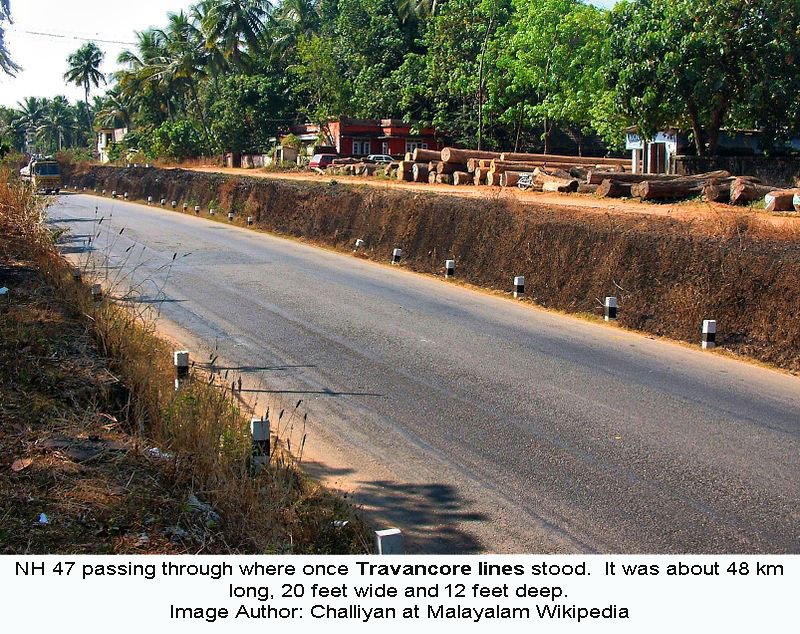 In reply to this, Tippu, on the 24th December, sent another embassy with two caparisoned elephants, ostensibly meant for the conveyance to his presence of the two Rajas, Cochin and Travancore. The latter viewed this as a gross insult, but Tippu’s rocket-men and scouts, who came up to within musket-shot of the walls for the purpose of inviting an attack, were nevertheless unmolested. The main body of the force was then some 10 miles distant, but the vanguard was camped within 2 or 3 miles of the lines.
On the 5th January 1790, Mr. Powney followed up the above intelligence with the exciting news that the lines had been attacked and that the attack had been repulsed. His account, written from Parour, on the 1st, ran as follows : —
"Tippu has met with a repulse from the Raja’s troops. He breached1 a weak part of the lines and filled the ditch with bales of cotton2 and earth for his cavalry to enter. He made the attack with 7,000 men. They carried it and possessed the lines for 3 miles in extent, but reinforcements of the Raja’s troops coming from the right and left, the enemy were hemmed in between two fires, and were drove out with great slaughter. Near a thousand were left dead within the lines, some horses and prisoners were taken. Zemaul Beg, commander of a cuasoom, was killed, likewise another person of consequence ; it is said to be a son of the late Meer Saib. The enemy, as soon as he fell, cut off his head and carried it with them. About 200 of the Raja’s people were killed and wounded. By all accounts they behaved very gallantly. A Brahman of some consequence is among the prisoners ; he says that Tippu1 was at the attack, and had a horse shot under him. We apprehend he is meditating some grand attack. Report says he has crossed the Chitwa river and is advancing along the sea-side with the intentions of attacking Cranganore and Ayacotta. I think we shall be prepared for him at these places. He has certainly drawn off his army from the lines.”
NOTEs: 1. The attack was made on a part of the lines close to the hills, and a thick jungle running close to it allowed him to bring his men to the attack almost as soon as they were discovered. The battery was soon carried. From a subsequent letter, dated the 8th January.
2. The use of bales of cotton for this purpose is contradicted by other accounts.
1. Another account says that in the confusion of re-crossing the ditch in front of the lines 10 feet wide and 20 feet deep, the Sultan escaped with great difficulty and chiefly by the exertions of some Chelae, and the injuries he received on this occasion made him lame for life. END OF NOTEs
Tippu had counted on securing an easy victory, and had made his preparations accordingly, and the above result made him determine that his preparations should be adequate on the next occasion. He sent to Seringapatam and Bangalore for battering guns and recalled a detachment from Coorg and the troops employed in Malabar in hunting down the Hindus and making forcible converts of them. He withdrew his force to a distance of only 4 miles from the lines and there awaited his reinforcements.
The news of this attack decided Lord Cornwallis to prosecute the war with vigour and on the 4th March the Tellicherry factors heard that the Nizam and the Mahrattas were to join the English in their onslaught on Mysore, and that Lord Cornwallis was coming in person to conduct the operations.
Mr. Robert Taylor had, on 25th December 1789, relieved Mr. Lewis, as Chief of the Tellicherry factory, and on the 9th of the following month of March instructions came from Bombay that he and the other members of the Tellicherry factory were to take an oath of secrecy for the conduct of the warlike operations then imminent. And among the first affairs, to which after taking this oath they were directed to turn their attention, was the holding out of hopes to Tippu ’s “friends and allies” the Malabar Rajas, that they would not be deserted in the event of the Honourable Company coming to an open rupture with Tippu.
Accordingly, on the 20th of the same month, “general assurances of protection” were issued by the factors. On the 24th Mr. Powney was requested secretly to send up from Travancore, where he had taken refuge, the Raja of Kadattanad, and an armed vessel was despatched thither for his conveyance. On the 28th, the ministers of the Kottayam and Chirakkal Rajas received hints that they might expect protection.
On April 6th, Lord Cornwallis’ despatch, promising to confirm any “reasonable promises” the Chief might make to the Rajas, was received. And on April 9th, the factors finally received intelligence from the Madras Government, through Mr. Powney, that “the sword was drawn” and that the chief was at liberty to hold out hopes to the country powers that they would in any future treaty with Tippu be “rendered independent” of their “friend and ally”.
Accordingly on the 25th April, on the occasion of a force under Major Bow proceeding from Tellicherry to clear the neighbourhood of Tippu’s garrisons and patrols, which had for so long put the settlement in a state of virtual siege on the landward side, Mr. Taylor issued a proclamation1 to all the inhabitants guaranteeing to all who joined the Honourable Company’s forces that they would be protected and included as “allies of the Honourable Company in any future treaty they may enter into with the Nabob,” and warning those who would not join that they would be considered “as enemies of the Honourable Company and acted against accordingly.”
NOTEs: 1. Treaties, etc., i. CLVIII. END OF NOTEs
The Hindu chieftains very readily accepted the terms, and on the 4th of May Mr. Taylor under his hand and the seal of the Honourable Company assured2 the Chirakkal Raja, who is styled as “Reviwarma, king of the house of Palliculam of the kingdom of Colastri,” that if he entered heartily into the war against Tippu and fulfilled his contracts for supplies granted to him, he would in any future treaty with that prince "be included and considered as an ally of the Honourable Company.”
NOTEs: 2. Treaties, etc., i. XCV. END OF NOTEs
And the same terms were offered to, and accepted shortly after this by, both the Kottayam and Kadattanad Rajas. On the 9th of May Lord Cornwallis’ second despatch of 8th April was received, promising on similar conditions as above that the Honourable Company would do their utmost “to render them (Malabar chieftains) in future entirely independent of Tippu, and at the conclusion of a peace to retain them upon reasonable terms under the protection of the company.”
Again on the 1st of June Lord Cornwallis wrote that, subject to the same conditions, we will do our utmost to force that prince (Tippu) to relinquish his claim of sovereignty over them at the conclusion of a peace.”
And finally in a letter written by Lord Cornwallis to the Bombay Government, on the 31st May he promised on the same conditions to “force that prince (Tippu) to relinquish all future claims upon their (Malabar chiefs’) allegiance, and to agree to their becoming the subjects and dependents of the Honourable Company. To which we shall add that, in order to secure a willing obedience from the Malabar chiefs, we should be contented with their paying a very moderate tribute, provided they will give the company advantageous privileges for carrying on a commerce in the valuable possession of their country.”
It is necessary to be thus particular in regard to the terms offered and accepted, for the intentions of the Honourable Company in coming to the above agreements with the North Malabar chiefs were afterwards much discussed.
Meanwhile in the south matters had gradually been coming to a crisis. On the 2nd and 8th March, Mr. Powney reported a skirmish having taken place in front of the lines, and that Tippu after opening fire from his batteries with only a few guns had discontinued the cannonade— for what reason it was impossible to say or even to guess. On March 14th, the Madras troops (two battalions) marched "into the lines to help the defenders. On the 22nd March the factors heard from Mr. Powney that Tippu’s approaches were within 100 yards of the ditch in front of the lines, but still the assault was delayed ; and on the 25th that the approaches were 50 yards closer ; and that assaulting batteries then ready covered a distance of from 1 to 1½ miles in extent.
On April 2nd he again wrote that the enemy had made regular approaches within a few yards of the counterscarp of the ditches and added “I am afraid the lines must be carried.”
A week later the approaches were reported to be within a few feet of the ditch, and on the 18th Mr. Powney wrote that the approaches were then through the ditch, and probably under the wall, twenty feet of which had been knocked down by the batteries and had been rapidly filled up again by the defenders.
The first overt act of the war by the Honourable Company on the west coast was the taking, on the 28th March, by Captain Byron of H.M.’s frigate Phœnix1 of an armed grab with Tippu’s “commodore of the fighting craft” on board. The grab mistook its adversary ; she was found with her guns loaded with canister and shot, matches burning, and each sepoy with 30 rounds of ball in his pouch.
NOTEs: 1. Later on in the war this frigate took part in a curious episode, which is fully described by Major Dirom. While Commodore Cornwallis was anchored with his fleet at Tellicherry at a time when Tippu was known to be expecting supplies from France, a French frigate of 36 guns, La Resolu, came out of the Mahe roads with two merchantmen in convoy. The commodore thereupon despatched the Phœnix and Perseverance frigates, each mounting 36 guns and commanded by Captains Sir Richard Strachan and Smith to chase and bring to the merchantmen and overhaul their cargoes. A gun was fired to bring to the merchantmen, and an officer from the Phœnix was sent on board La Resolu to acquaint the French captain with the commodore’s orders. As the officer was returning, La Resolu poured two broadsides into the Phœnix. Sir Richard thereupon manœuvred his ship and raked the Frenchman. The Perseverance joined in and in half an hour the French vessel struck her colours. The Phœnix lost 7 men and La Resolu 21 killed and 44 wounded, including her captain, who said he acted under the orders of his commodore, who had sworn he would fight the English commodore wherever he met him. The merchantmen did not after all contain any goods contraband of war, and the French and English nations were at peace at the time ! END OF NOTEs
“I am persuaded,” Captain Byron wrote, “they intended to take me, so I thought it proper to take him.”
On the 31st March, Tellicherry received a reinforcement of another battalion of sepoys, besides 60 Europeans and 10 gunners for its defence during the approaching monsoon.
But a few days later news came that a larger force consisting of H.M.’s 75th Regiment, two battalions of sepoys, and one company of artillery was on its way down the coast under command of Colonel Hartley, with orders to co-operate with Travancore against the enemy.
It was extremely doubtful if they could arrive in time to be of service in defending the Travancore lines, for the approaches had already been reported as within a few feet of the ditch. And Mr. Powney, who had been informed of its coming, was very desirous that it should arrive before Tippu’s force had crossed the Cranganore river. He requested that it should be ordered to proceed to Alikkotta (Ayacotta on Vypeen Island) as rapidly as possible. On the 20th April it reached Tellicherry, and on the 22nd it again sailed southwards.
It arrived too late, however, to be of service in saving the lines, for off Beypore Colonel Hartley was met by news from Mr. Powney that the long-impending stroke had fallen and that the lines had been taken by the enemy. Writing from Alikkotta on the 15th Mr. Powney reported: “The enemy all last night kept up a heavy cannonade, and this morning at daybreak stormed. It is said that 6,000 of Tippu’s dismounted horsemen made the assault. Some of the Raja’s troops withstood them for some time, but some Poligars giving way caused a general flight. In short the enemy are in possession of the lines ; the Company’s battalions this day have been covering the retreat of the Raja’s troops across the Cranganore river, after which they are to take post at Ayacotta ” (Alikkotta).
The Travancore commander had arranged that the Raja’s force should re-assemble upon the Vypeen Island, but the extreme consternation caused by the loss of their vaunted lines had upset this arrangement, and the whole of the force had dispersed for refuge into the jungles or had retreated to the south.
“We are in that confusion that I scarce know what to recommend respecting the detachment” (Colonel Hartley’s force). The consternation of the Raja's people was so great that they could not be trusted to procure supplies. The whole of the inhabitants, including the boat people, had gone off with their boats which had been collected for conveyance of Colonel Hartley’s detachment, so that the principal means of transport were also wanting.
Colonel Hartley nevertheless determined to push on and take post at Alikkotta. The news of his force being on its way had greatly quieted the inhabitants, and “the consternation which had seized all ranks of the people’’ had considerably abated when Mr. Powney again wrote on the 20th and 22nd of April urging strongly that Colonel Hartley should push on to Alikkotta with his force to restore confidence. The Raja’s forces encouraged by these hopes of assistance were beginning to return, and Mr. Powney had been able to lay in a large stock of grain.
Colonel Hartley duly arrived and joined Mr. Powney at Alikkotta, and after this junction had been effected, the Travancore troops were on May 8th withdrawn by Colonel Hartley’s orders from the Cranganore fort, which was no longer of use when the Travancore lines had been forced. It was however, dismantled before being thus thrown open to Tippu. With the combined Bombay and Madras troops, consisting of one European and four native battalions placed at Alikkotta in such an advantageous position on his flank, it was clear that Tippu could not dare to make any considerable forward movement into Travancore territory.
He accordingly busied himself in demolishing the famous lines. “The whole army1 off duty was regularly paraded without arms, and marched in divisions to the appointed stations ; the Sultan, placed on an eminence, set the example of striking the first stroke with a pickaxe ; the ceremony was repeated by the courtiers and chiefs, the followers of every description, bankers, money-changers, shopkeepers, and the mixed crowd of followers were all ordered to assist the soldiers.”
NOTEs: 1. Wilks’ “Historical Sketches" II, p. 154. END OF NOTEs
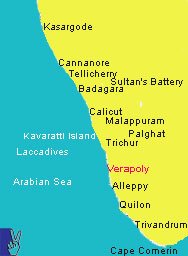 And some considerable breaches were made in the wall. After this exploit, and without penetrating farther to the south than Verapoly, the headquarters of the Carmelite mission, Tippu, on the 24th May 1790, turned again towards the north with a view to avoid the monsoon and to re-equip his army for the storm already gathering in his rear. General Medows, the Governor and Commander-in-Chief of Madras, assumed command of the army at Tiruchirappalli on that same day and made his first march northwards from Tiruchirappalli on May 26th.
It was thus that Tippu left Malabar, destined never to enter it again.
Fra Bartolomæo,1 who was on the coast for some time before Tippu thus left it, gives a graphic account of his doings, in all his expeditions Tippu thus arranged his force—First, a corps of “30,000 barbarians,” who butchered everybody “who came in their way next, Lally with the guns ; then, Tippu himself riding on an elephant, and finally another corps of 30,000 men. His treatment of the people was brutal in the extreme. At Calicut he hanged the mothers, “and then suspended the children from their necks.” Naked Christians and Hindus were dragged to pieces tied to the feet of elephants. All churches and temples were destroyed. Christian and pagan women were forcibly married to Muhammadans.
NOTEs: 1 “Voyage to E. Indies”—Forster’s Translation, London, 1800, pp. 141-42. END OF NOTEs
His information was obtained from Christian and heathen refugees fleeing before the face of the “merciless tyrant,” and while being helped by the author to cross the Verapoly river—Verapoly itself (the farthest point to the southward reached by Tippu’s force—was visited by a “few marauders” from the Mysorean army shortly after Fra Bartolomæo left it. They “converted our church, our seminary, and our convent into real dens of thieves. They plundered and destroyed whatever they could lay their hands on, for it had been almost impossible for us to remove anything out of the way.”
The Tellicherry factors had meanwhile bestirred themselves to clear the country about that settlement of Tippu’s posts and patrols, by which they had been placed in a state of siege for many months previously. Ten days after the Travancore lines had been forced in the manner above narrated, and before the news of that event had reached the factory, Major Alexander Dow, the Officer Commanding the Tellicherry garrison, moved out of his entrenchments on the 25th of April with a force consisting of 3 battalions of sepoys, 3 companies of Europeans, and 4 field pieces with their complement of gunners. As auxiliary forces he had also with him 1,500 Kottayam Nayars under “one of the princes” of Kottayam, and 1,300 Chirakkal Nayars under “one of the Chirakkal family”.
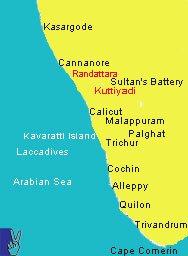 With this force he attacked a stockaded encampment of the enemy at Katirur, some four miles from Tellicherry. His force took the encampment easily but a stockaded house, probably the Kottayam Raja’s palace at that place, held out against his assaults. His guns were not heavy enough to force an entrance, and he had to send back an officer to bring up an 18-pounder gun from Tellicherry. Before, however, this gun was despatched, the enemy had on the 26th surrendered their position.
While Major Dow was thus engaged on the east, Captain Murray, with some parties of the 6th battalion of sepoys, cleared the Kurangoth country and some small forts on the south of the settlement. In these operations, 500 prisoners were taken including 8 killadars, and the British loss was two sepoys killed, a very few wounded, and Lieutenant Lamb slightly in the shoulders.” Two guns were also captured.
The Kadattauad Raja arrived from Travancore in the Shark gallivat, which brought the news of the fall of the Travancore lines, and setting out for his country he was able, in this same month of April, to clear it of the enemy-who appear to have evacuated all their forts and retreated southwards. Kottayam too was busy, and in May he took the Kuttiyadi fort, mounting 4 guns, and some other places later on.
The east and south of the Tellicherry settlement being thus in a fair way of being cleared of the enemy, attention was next directed to the north, and in particular to the Honourable Company’s mortgaged district of Randattara. On the 28th of April, Major Dow with his force endeavoured to cut off Tippu’s garrison in a fort erected at Agaar. But some Cannanore Mappillas gave information of his movements to the garrison who evacuated their post and retreated before Major Dow’s force into the shelter of the posts defending the Bibi’s town of Cannanore.
On coming within range of the Carley fort, the guns opened fire on the British troops, and Major Dow in consequence drew off his force.
The Bibi’s attitude at this time to the British was very unsatisfactory and enigmatical. Ever since Tippu’s visit to Cannanore in the preceding year, she had ostensibly lent to an alliance with the British, but had in reality secretly worked against them.
The proclamation warning the country powers that those who did not join the British, would be treated as enemies was in great measure disregarded. The factors now thought it high time to act, so on the 27th April one of the Bibi’s vessels was seized, but still she hung back. The bearer of a letter to her from Mr. Taylor was turned back. Major Dow’s force was fired upon, as already stated, on the 28th, and on the 3rd of May the Drake, an armed vessel of the company’s, stood in towards Cannanore to test the depth of water for a naval attack and drew on herself the fire of the fort on the south-east of the bay ; one shot struck her and carried away a main topmast backstay.
But the force at the settlement was not strong enough to deal effectually with her. The safety of the Tellicherry settlement had been very strongly impressed on the factors, both by the Bengal and Bombay Governments, as a matter of supreme importance at the then juncture in affairs, and Major Dew’s instructions were not to proceed beyond 24 hours’ distance of the place. The factors accordingly ordered him back to head-quarters as soon as it was seen that the Bibi meant to resist, and the posts captured by him were made over to the country powers to protect.
But Chirakkal could not proceed to his dominions, as 8,000, it was said, of Tippu’s troops were still in and about Cannanore. The factors had to give him leave to remain with 200 of his men in Tellicherry during the monsoon, for he said, it would be a disgrace to him if he were to return to his districts and remain in hiding in the jungles as he had done before. Moreover he could not now count on maintaining himself in the jungles in the manner he had done before, namely “by plundering and making occasional depredations.”
It was also now becoming evident to the factors that causes of discord between Hindu and Mappilla were likely to cause the latter to favour Tippu rather than the British, because they were afraid of letting the “Malabars” have authority over them ” after what had happened, and particularly after the forcible conversion to Islam of so many Hindus, and after the fearful retribution which had been wreaked by the Hindus in many places on their oppressors, when the tide of victory turned in favour of the English.
On the 28th of June, the Chief reported to Bombay that, the Bibi was still holding aloof from an alliance with the Company, and that the reduction of Cannanore was necessary. Meanwhile, however, events to the east of the ghauts had shown that the British were likely to carry matters all their own way. On July 24th, news of the taking of Karur by General Medows on the 15th June arrived, and with it also came information of the triple alliance between the Mahrattas, the Nizam and the English having been ratified.
And on August 6th, a letter from General Medows arrived stating that he was at Coimbatore, that nearly all the south of Tippu’s dominions was in his hands almost without the loss of a man, and that the enemy had retired up the ghauts into Mysore.
It was now high time for the Bibi to declare herself, and two days later (8th August), she accordingly signed “the preliminaries1 to a future treaty of firm alliance and friendship” with the Honourable Company. It was done, however, under the strictest secrecy; two officers (Lieutenants Lewis and Munro) proceeded to Cannanore by sea at night, landed secretly there and obtained the Bibi’s signature to it.
NOTEs: 1. Treaties, etc., i. XCVI. END OF NOTEs
The terms were that she was “whenever called upon” to admit the company’s troops to garrison the fortress of Cannanore and to give as hostages for such performance the husband of her oldest daughter, and one of her ministers. On these and other conditions, which it is unnecessary to detail, as they were never carried out, the Bibi was to be considered as an ally of the Honourable Company “in the same manner as the other Malabar princes, their allies.’”
Ten days later Mr. Powney reported that the Raja of Cochin had thrown off allegiance to Tippu, and had joined1 the British.
NOTEs: 1.The formal treaty with this Raja was not, however, signed for some months, 6th January 1791 - See Treaties, etc., i. Cl. But he had previously to this entered into an agreement with Mr. Powney for the lease of the Island of Chetwai, which was cleared of the enemy by Colonel Hartley in the September preceding—See Treaties, etc., i. XCIX etc. END OF NOTEs
And on 27th September 1790, General Medows, the Governor and Commander-in-Chief of Madras, entered at Coimbatore into an agreement2 with “Kishen, Zamorin Raja of Calicut,” investing him with the sole management of all the countries heretofore included in the province of Calicut, which are or may be conquered by the British troops.”
NOTEs: 2. Treaties, etc,, i. XCVII. This "Kishen Raja” was in reality not the Zamorin at all, but only the second of the house. END OF NOTEs
Palghaut fort and district and certain adjacent districts had just then been taken after a short siege of this fort by the same officer, Colonel Stuart, who, on proceeding with an advanced force of General Medow's army to invest and summon the place in the July preceding, had been driven back by the violence of the south-west monsoon. Wikls3 gives the following account of his second and successful attempt to take the place:
NOTEs: “Historical Sketches” II, pp. 163-64. END OF NOTEs
“After retracing his steps to Coimbatore, this officer was, without joining head-quarters, ordered, with augmented means, to proceed to Palghaut. Officers who had served in the siege of 1783 spoke in high terms of the strength of the works, as being composed of long blocks of granite, so built as to present the end instead of the side to the shot, and thus resisting the ordinary means of effecting a breach ; the ordnance was therefore prepared on a respectable scale and placed under the direction of Lieutenant Colonel Moorhouse, an officer of distinguished reputation.
“The preparations were made with corresponding care, and at daylight, on the 21st September, two batteries opened at distances under 500 yards, one for enfilade and the other for breaching ; the latter, consisting of eight 18-pounders, dismounted at their first discharge six of the guns opposed to them. In less than two hours the fort was silenced and before night a practicable breach was effected. The opinion above stated appears to have arisen from attempting a breach in a circular tower, and the reflection of shot from indirect incidence was ascribed to direct resistance. In the present instance, the breach was made in the curtain, and the error was practically discovered.
“Among the recent improvements was the completion of the ditch across that causeway which led the assailants of 1783 to the gate ; but although the covered way had been improved, it was still without palisades, and in a considerable extent immediately opposite to the breach, the glacis was so imperfectly finished as to leave cover immediately under its crest : of these defects the proper advantage was taken the same night.
“On reconnoitring the covered way, it was found that the besieged retired every night into the body of the place, drawing after them a rude wooden bridge, which was replaced every morning. The defective spot was immediately seized : a circular place of arms, in a salient angle of the covered way, was next occupied, and its defences reversed; the musketry from the crust of the glacis opposed that of the fort, the gate of the sortie was converted into a battery for two 18-pounders, light mortars were brought up to the position first seized and were served with decisive effect ; the ditch, however, was still to be filled : the advanced position must on the ensuing day have remained insulated until it could be connected in the usual manner with the trenches ; but all these labours were rendered unnecessary by the impression produced on the garrison, who before daylight called out that they desired to capitulate.
“The terms were soon adjusted in conversation across the ditch, and soon after daylight the rude bridge was launched, which enabled the besiegers to occupy the place, which was found to mount sixty guns of various calibres. The chief condition of surrender was effective protection against the Nayars, who had joined Colonel Stuart and were employed in the blockade ; but on the fire of the place being silenced, crowded the trenches and batteries, anxious for sanguinary retaliation, which it required very exact arrangements to prevent.
“Colonel Stuart arrived before Palghaut, with two day’s provisions, and without a shilling in his military chest ; the sympathy which he evinced for the sufferings of the Nayars and the rigid enforcement of a protecting discipline had caused his bazaar to assume the appearance of a provincial granary ; the fort was ill-stored, but after depositing six months’ provisions for the garrison appointed for its defence, he carried back to his Commander-in-Chief one month's grain for his whole army : the confidence which his conduct inspired in this short intercourse having enabled him to pay for these supplies with written acknowledgments convertible into cash at the conclusion of the war.”
All the Malabar Chieftains1 had thus declared for the British.
NOTEs: 1. The Coorg Raja too joined the confederacy on 26th October 1790 — Treaties, etc..,i. XCVIII.—An easy and safe passage through friendly territory was thus secured for an army advancing from Tellicherry as the base through Kottayam and Coorg against Seringapatam. This treaty with Coorg completed Mr. Taylor’s able political preparations for the struggle just commencing. END OF NOTEs
Colonel Hartley had, in September, moved up the coast from Alikkotta, and after clearing the Island of Chetwai2 of the enemy, he took, on 26th September, the enemy’s fortified post at Chavakkad mounting 15 guns, and fifty prisoners were captured at the same time. Proceeding onwards to Ponnani, he then turned his face eastwards clearing all the country to the south of the Ponnani river, and by the 9th October he had reached Palghaut already taken by Colonel Stuart. And there he remained till about the 20th November.
NOTEs: 2. Leased by Mr. Powney to the Cochin Raja for one year on 26th November 1790 for an annual payment of Rs. 40,000. END OF NOTEs
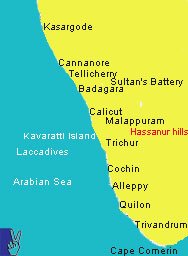 Meanwhile affairs to the east of the ghauts had not been prospering with General Medows. Colonel Floyd’s detachment sent out to forage at the foot of the Hassanur hills beat a hasty retreat in September before a large force brought down the Gajalhatti pass by Tippu in person, and it narrowly escaped annihilation before effecting a junction with General Medow’s own force. The Mysorean army was better equipped and General Medows never succeeded in coming up with it.
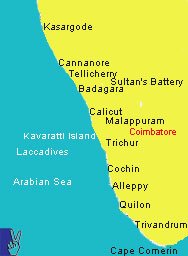 Tippu threatened Coimbatore, which was opportunely strengthened by Colonel Hartley, who despatched three Madras battalions to defend it. Tippu, however, managed to take Darapuram from the weak garrison left there by General Mcdows.
In August the Bombay Government had despatched Major Auchmuty to Tellicherry with a commission to act in concert with Colonel Hartley and Mr. Taylor, and with orders to keep ready at Tellicherry for field service a force consisting of one company of artillery and lascars, three companies of the Bombay European regiment, and the 2nd, 3rd and 10th battalions of sepoys, all under the command of Major Dow for co-operation with Colonel Hartley.
This force was kept in readiness to move at a moment’s notice, but in the meantime the Cannanore Bibi’s attitude again excited suspicion.
In August the Chief had reason to think she was really endeavouring to get rid of Tippu’s force which still lay at Cannanore, and to facilitate her endeavours and give her confidence a small party of men from Tellicherry was sent, under protest from the French at Mahe, to guard the passage across the Mahe river so as to prevent Tippu’s force in the south from communicating with that lying in and about Cannanore.
On September 24th, Mr. Taylor found it necessary to take another step, for the misunderstanding between Hindu and Mappilla was becoming very apparent, and the Chief to quiet the fears of the latter, had to issue a proclamation that he would secure both parties on their ancient footing.
About October 14th, the Bibi complied so far with the terms of her engagement that she sent away Tippu’s troops from the place, and Randattara accordingly once more passed into the hands of the Company. No further progress, however, was made in carrying out the agreement, and in order to force her to declare herself, Mr. Taylor on 17th October despatched a battalion to take possession of the Cannanore fort. Admission was refused and the battalion thereupon took post at Agarr in order to protect Randattara.
On the 19th an evasive reply was received from the Bibi, and on the 21st Mr. Taylor heard that Tippu’s force of about 8,000 men, which had gone only a short distance north, had again returned to Cannanore.
There was now no uncertainty about the fact that the Bibi meant to side with Tippu and oppose the Honourable Company. Mr. Taylor accordingly wrote to Bombay to ask for sanction to besiege Cannanore, and, on the 22nd October, the Princess Royal ketch belonging to the Honourable Company was sent to blockade the place by sea. Finally on the 5th November the Bombay Government "justly incensed at her (the Bibi’s) prevaricating if not treacherous, conduct” determined to prosecute the siege with vigour.
The interest in the narrative at this point next centres on the movements of Colonel Hartley’s force in South Malabar. Having heard from Tellicherry that Major Dow, with the force above detailed, was held in readiness to join him, Colonel Hartley, on 13th November, wrote from Palghaut, desiring that Major Dow might be sent down the coast to Ponnani to take post on the south of the river at that place and to await further orders. But the Bibi’s hostile attitude made it impossible for Mr. Taylor to comply with this request, and as soon as Tellicherry had been reinforced, Major Dow was sent out to take post at Agarr with three battalions in order to watch the movements of Tippu’s force at Cannanore and to protect Randattara.
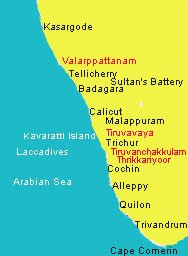 Colonel Hartley, after despatching the above requisition, next set his force in motion from Palghaut towards the west about the middle of November. On the 22nd, he was at “Ometore” on the south bank of the Ponnani river, three miles east of the famous Tirunavayi temple. His object was to keep open the communications between General Medow’s force and the west coast via Palghaut.
Martab Khan with 5,000 of Tippu’s troops had pushed southwards across the river and had busied themselves in devastating the country as far as Chavakkad, On hearing of the approach of Colonel Hartley, this force retired northwards and was generally supposed to have concentrated on Venkatakotta, a few miles north of Tirunavayi. On December 1st Hartley reached Ponnani and remained there four days. On the 5th he set out in pursuit of Martab Khan, and on the 7th captured Venkatakotta with 3 guns and 20 prisoners. Pushing on from there, Colonel Hartley with only one European regiment and two battalions of sepoys with their usual field artillery came up with the enemy on the 10th and won a brilliant victory which is thus described in the records.
“He encountered two of Tippu’s commanders, Martab Khan and Hussain Ali Khan, at the head of 9,000 Tippu’s men and 4,000 Mappillas on the plains of Tervannengurry”1 (evidently Tirurangadi in Ernad taluk) “on the morning of the 10th instant. After a smart action the colonel routed Martab Khan with the right wing of the enemy and put them to total flight. The retreat of Hussain Ali being cut off by the Highland or 75th Regiment, he, with the remaining troops, was obliged to fly towards the fort of Tervannengurry, but the 7th battalion coming up with him before he could effectually enter the fort put 400 of his men to the sword in the covert way. Being then surrounded on all sides by the English, Hussain Ali loudly called out for quarter, which being granted, he surrendered himself with two sirdars and 900 men prisoners of war.
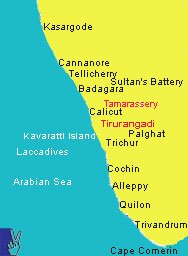 NOTEs: 1. In Major Dirom’s “Narrative of the Campaign, etc." London, 2nd edition, 1794, p, 263, the place is called “Tricalore" which is evidently Tirukkallur, the Hindu name of the neighbouring temple and fort. The locality is probably identical with that where Humberstone won his victory over Hyder Ali’s general, Mukhdum Ali in 1782. END OF NOTEs
The loss on our side during this action is very trifling. No officers killed—among the wounded are Captains Lauman and Blackford, Lieutenants Stuart and Powell—none dangerously, but the latter, it is supposed, will lose his arm. The loss on the side of the enemy, independent of the captured, is estimated at about 1,000 killed and wounded.
“Colonel Hartley finding that Martab Khan had retreated to Ferokia, or new Calicut, a place lately strengthened and considerably improved by Tippu, pursued him thither without a moment’s loss of time. On the night previous to the arrival of the detachment Martab Khan again fled from them, and carried with him from thence, on elephants, all the treasure of the place. It is supposed that he is gone towards the Tambercherry pass. The remainder of this garrison, consisting of 1,500 men, laid down their arms on the colonel’s appearance, who consequently, took possession of the fort, guns, etc., without further opposition.
Beypore also surrendered to him immediately with a considerable number of vessels and boats laying in the river.”
Major Dirom, who was Deputy Adjutant-General of the Army, put the enemy’s losses in these three affairs at
|
|
|
Guns |
Men killed, wounded and missing or prisoners. |
|
December 10th |
Tricalore |
3 |
2,000 |
|
December 12th |
Ferokabad |
50 |
1,300 |
|
December 12th |
Beypore |
20 |
Evacuated |
The effect of these operations of Colonel Hartley’s was to clear the whole of South Malabar of the enemy. It only remained to effect the same purpose in North Malabar.
After determining, on 5th November, as already stated, to besiege Cannanore, the Bombay Government of General Abercromby vigorously set about their preparations for this end. On 25th November the factors heard that they were despatching to Tellicherry a regiment of Europeans, a company of artillery, two of lascars, and the 12th battalion of native infantry, and that the Governor himself was coming to conduct the operations.
Major Dow was despatched with three battalions to take post at Agarr, as already stated, on the 27th and four companies of the Bombay European regiment were held in readiness on Darmapattanam island to support him. On the 4th, 5th and 6th December the troops from Bombay, including H.M.’s 77th Regiment (nine companies strong), and General Abercromby himself arrived. H.M.’s ship Phœnix (Captain Byron) was appointed the flagship in the naval operations against Cannanore.
On the 13th December, General Abercromby with his force of 3,000 to 4,000 men and the ships invested the place.
On the 14th the siege was opened, the two important out works, Forts Avary and Carlee, were captured on the 16th, and on the 17th the besieging force having mastered all the heights and commanding situations round the fort and town, the Bibi wisely submitted to her fate and agreed to an unconditional surrender.1 The Bibi and inhabitants generally were, however, assured by General Abercromby of protection for themselves and for their personal property and household furniture.
NOTEs: 1. Treaties, etc., i. CLIX.—The assurances referred to in the text were afterwards supplemented by others executed respectively by General Abercromby (Treaties, etc., i. CII), on 14th February 1791, and by the Bibi (i. C .X), in March 1791, guaranteeing that the Bibi and her family should not be handed over to Tippu by the British on the one hand, and that the Bibi should do all in her power to conciliate and attach the Mappiles to the English interest, and to assist in the war against Tippu on the other. END OF NOTEs
All military and naval stores, vessels, grain, etc., were confiscated. Future relations were to be left for adjustment afterwards, and meanwhile the Bibi was to continue “to exercise justice to the inhabitants agreeable to their customs in all cases where the commandant of the fort and town does not interfere”. The Bibi’s husband, who it seems had always headed the opposition to the English, died during the early part of the siege, and her minister and heir apparent were therefore sent as hostages to the English camp. Five thousand of Tippu’s troops found in the town laid down their arms and colours, and formal possession of the place was taken by Captain Wiseman, who marched into Fort St. Angelo and occupied it with the two flank companies of his battalion.
The British flag was hoisted under a salute from the batteries, and the enemy lost 68 guns by the capture.
Thus Cannanore, the first place in India to welcome2 Europeans to Indian shores, was the last of the important places in Malabar to pass into the conquering hands of the British. There was, after this and after Colonel Hartley's brilliant exploits in the south, but little left to do for the establishment in Malabar of British supremacy.
Major Dow with a detachment moved against Valarpattanam and captured there five more guns ; but the Mappillas and some remains of Tippu’s force had seized Vadakkara and part of Kadattanad, and it was necessary to disposes them. This was done without difficulty by a detachment commanded by Captain Oakes, who secured twelve guns and 400 prisoners at Vadakkara and Kuttippuram, the Kadattanad Raja's headquarters.
NOTEs: 2. Conf. p. 300. END OF NOTEs
All Malabar was in fact now in the hands of the British, and it only remained for the administrators to set to work. And it is notable in this connection and in the light of subsequent, and (some of them) very recent, event that the following occurs among the first sentences in the records after describing the above affairs: -
“From the repeated treachery and notorious infidelity of the whole Mappilla race, rigid and terrifying measures are become indispensably necessary to draw from them the execution of their promises and stipulations. Lenity has been found ineffectual.”
General Abercromby, therefore, wisely determined to takeaway their arms and prohibit them the possession of any weapons. The narrative of the succeeding events may be related in a few words, as the scene of active operations in the war lay to the east of the ghauts.
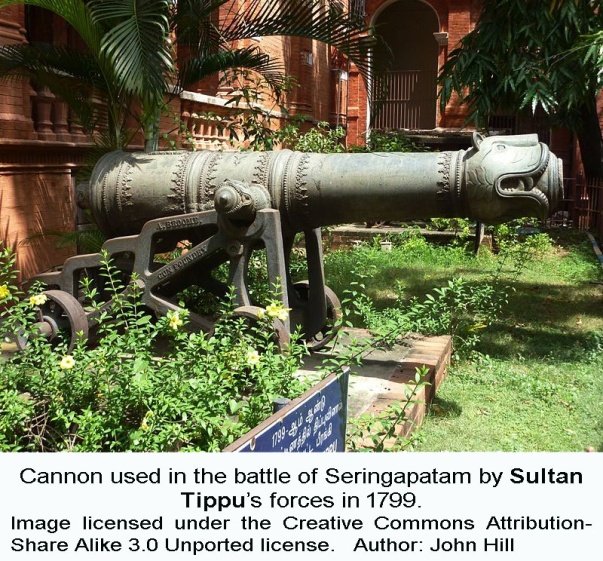 On December 12th, 1790, Lord Cornwallis, the Governor-General arrived at Madras to take the management of affairs into his own hands. General Medows was at this time following Tippu, who, with his superior equipments, was leading him a merry dance, and who was now after leaving the neighbourhood of Tiurchirappalli, plundering, burning and carrying ruin into the very heart of Coromandel.
On December 30th, General Medows received orders to return to Madras with his army as it was clear his plan of operations could never have brought the war to a successful close. On January 29th, 1791, Lord Cornwallis assumed command of the Army at Vellout, 18 miles from Madras, and determined to strike in the first instance at Bangalore, the place second in importance in Tippu’s dominions, and afterwards at Seringapatam itself.
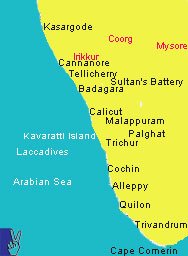 On February 5th the army began its march, and on the 11th it concentrated near Vellore. Bangalore was taken by assault on March 21st, and on May 15th Tippu was defeated at Arikera, close to Seringapatam. But a week later (May 22nd) Lord Cornwallis had to abandon his scheme of carrying Seringapatam itself, his transport having failed him, and he destroyed his battering train under the very walls of the fort against which he had designed to use it. General Abercromby, with his force, had ascended through friendly territory from Cannanore via Irukkur and Coorg to the Mysore frontier and was ready to co-operate with the main army, but on receipt of intelligence of what had happened he effected a safe retreat to the coast in spite of a large force sent by Tippu to intercept him.
In November 1791, General Abercromby returned once more to the coast from Bombay either bringing with him or receiving from Palghaut all the means of a good equipment. Again ascending the ghauts he made his first march from the head of the pass towards Seringapatam with an effective force of 8,400 men on January 22nd, 1792.
On the 25th of that same month, Lord Cornwallis, with 16,721 infantry and cavalry, 44 field guns, and a battering train of 42 pieces, effected a junction with the Nizam’s army and some Mahrattas under Hari Punt at Savendrug, and commenced his second march on Seringapatam. On February 16th, the two armies effected a junction under the walls of Seringapatam, and on the 22nd Tippu was1 forced to yield to the allies “one-half of the dominions which were in his possession at the commencement of the present war” and to pay “three crores and thirty lakhs of sicca rupees.”
All prisoners were to be released, and “two of the three oldest sons of Tippu Sultan” were to be given as hostages. This treaty was, as contemplated by article V, only preliminary to “a definitive treaty of perpetual friendship.” It took some weeks to adjust the exact terms of this further “definitive1 treaty,” which was signed by Lord Cornwallis on 18th March 1792, and from that date “Calicut, 63 taluks,” valued at “C. Pagodas 8,48,765-5-4½” and “Palghautcherry,” with an estimated revenue of “C. Pagodas 88,000,” passed finally under the dominion of the Honourable East India Company.
NOTEs: 1. Treaties, etc., ii II. END OF NOTEs
Section (G). THE BRITISH SUPREMACY. 1792 to Date.
At the cession of Malabar, in the manner above related, to the British by the Treaties of Seringapatam,2 dated 22nd February and 18th March 1792, the country was found to be split into a number of kingdoms and principalities, a prey to the bigotry of its late Muhammadan conquerors, abandoned by its principal landholders, and distracted by the depredations and rapacity of the Mappilla banditti.
NOTEs: 1. Treaties, etc., ii II. END OF NOTEs
The Joint Commissioners, whose proceedings will be stated in some detail shortly, thus described the territory which fell to the share of the British by the above treaties : — "Malabar, exclusive of the two merely tributary districts of Corga and Cochin (situated at either of its extremities), may be considered as consisting of two grand divisions, the northern and southern, separated by the Toorshairoo (Turasseri) or Cotta (Kotta) river.
“That to the northward comprehending the ancient Colastrian (Kolattiri) range (raj) or kingdom, now dismembered and partitioned out into the several principalities or districts of—
“1st—Chericul (Chirakkal) or Colastry (Kelattiri) proper ;
“2ndly—Cottattu or Cotiote (Kottayam or inflected Kottayattu), annexed to which was, or is, Wynad above the ghats (the former peculiarly noted for the production of pepper, and the latter for cardamoms) ;
“3rdly—The district of Cartinaad (Kadattanad), the woods in which contain abundance of neglected cassia or wild cinnamon ; and
“4thly—The petty township and contiguous districts of Cannanore (held by a Mappilla family possessing also the greater part of the Laccadive Islands, and which is much respected by all the others of the same tribe throughout Malabar) ; and
“5thly, 6thly and 7thly—The small taluks of Irvenaad (Iruvalinad), Corengotte (Kurangot) and Randaterra (Randattara), which last-mentioned place had become subordinate to the settlement of Tellicherry in the manner that will be hereafter pointed out
“The districts to the south of the Toorahairoo (Turasseri) river contain —
“1st—Coorimnaad (Kurumbranad), a distinct and independent rajaship ; and
“2ndly~Those districts that formed the dominions of the Samoory or Zamorin, such as Pynaar (Payyanad), with Warcumbra (Vadakkampuram) and Curcumbra (Kilakkampuram) to the north and east of Calicut ;
“and to the southward of that city and district, the countries of Ernaad (Ernad), Shernaad (Cheranad), Venkillycotta (Venkattakkotta), Malapuram (Malapuram), Capool (Kappul), Weenarcar (Mannarakkad), Cunumpoora (Karmpula), Nerenganaad (Nedunganad), and Poonany (Ponnani).
“Besides which, the Samoory claimed to be, with a more or less influence, the paramount sovereign over —
“The Nayarships of Pyoormulla (Payyormala) and Poorwye (Pulavayi) to the north and east of Calicut ;
“and to the southward of the Rajaships of Beypoor (Beypore), Perepnaar (Parappanad), Bettut or Vettutnaar (Vettattunad), and Tallapellie (Talapalli), called also Soukar and Chowghaut (Chavakkad), including the Nayarship of Coulpara (Kavalappara)
“And he had also possessed himself of the more full and immediate sovereignty over the three Nayarships of Colemgoor (Kollankodu), Codovoura or Koorwye (Kotuvayyur) and Mungary (Mangara), originally a part of the Palghaut (Palghat) country
“So that, exclusive of the residue of this last-mentioned district, and of the three lesser Nayarships of Congad (Kongad), Manoor (Mannur) and Yerterra (Edattara), and of the district of Coorimnaad (Kurumbranad) and of that of Velatra or Velnatera (Vellatiri) in the southern division of Malabar, the family of the Zamorin had, by a continued service of warfare and contest, thus reduced (before the period of their own expulsion by Hyder Ali Khan) to a greater or less degree of subordination and dread of their power, all the Raja’s chiefs and land-holders of the countries lying between the Toorshairee (Turassori) river [which is above stated to have been the boundary of the ancient Colastrian (Kolattiri) kingdom] and that of Cochin.”
To complete the list of British possessions on the coast at this time, it will be gathered from the foregoing narrative that the following had already, for longer or shorter periods and more or less uninterruptedly, been in the possession of the British :— .
(a) Tellicherry, with its dependencies, namely, the Island of Dharmmapattanam with Grove Island lying off it, the district of Randattara (also mentioned by the Commissioners), and the fort and district of Mount Deli.
(b) The Island of Chetwai, retaken from the Mysoreans by Colonel Hartley in 1790, and rented to the Cochin Raja at Rs. 40,000 per annum.
And (c) The fort and territory at Anjengo.
The localities of most of the above bits of territory are indicated in the sketch map given at paragraph 11 of Chapter IV, (Section (b), and further details of the precise limits of each little bit of territory will be found in that section itself.
Soon after the conclusion of the peace Lord Cornwallis, the Governor-General, instructed General R. Abercromby, Governor of Bombay, under date the 23rd March 1792, to enquire into the present state of the country and to establish a system for its future government, but to lose no time in coming to an agreement with all the chiefs for some specific revenue to be paid for the ensuing year. Such of the friendly Rajas whose territories were not included in the cession were to be allowed the option of returning to them under the protection of the 8th article of the Treaty, or of remaining within the limits of the Company’s territories ; and Lord Cornwallis promised, in conclusion to depute two Civil Servants from Bengal to act in concert with the gentlemen to be appointed from Bombay.
In pursuance of these orders the General arrived at Cannanore and appointed Mr. Farmer, a Senior Merchant, and Major Dow, the Military Commandant of Tellicherry, as Commissioners, and issued instructions to them under date the 20th April 1792, to preserve the peace of the country, and after settling the amount of tribute to be paid by the native princes and chiefs, to direct their attention to collecting materials to form a report on the most eligible system of establishing the Company’s authority on the coast. The states of Coorg in the north-east and Cochin in the south, which were included in the cession, were made tributaries and included in the object of the commission.
Before proceeding to state in detail the measures adopted by the Commissioners for carrying out the above instructions, it will be as well to explain that the only plan on which this can be done with a view to giving an adequate idea, of the labours of the Commissioners, will be to adhere strictly to the chronological method.
The narrative will necessarily appear disjointed, but, having regard to the vast number of bits of independent territory which came under settlement, this cannot be helped. The Bombay Commissioners began at Tellicherry to effect settlements with the three northern Rajas of Chirakkal. Kottayam and Kadattanad, whose relations with the English from a remote period have already been dealt with in the foregoing pages.
The engagements or cowls entered into in 1790 with these chieftains, the terms of which have already1 been fully described were now found to be “not so comprehensive as could be wished, since they provided for the emancipation of the Malabar Rajas from Tippu, but did not clearly express their dependence on the Company,” for the instructions of the Governor-General issued on 8th April and 31st May 1790, and already fully described, were received only after the execution of the cowls.
NOTEs: 1. Pages 458-459. END OF NOTEs
These instructions contained clear directions as to the terms of dependence on which the chieftains were to remain under the Honourable Company, but they did not appear to have been communicated to those chiefly concerned.
It must also be here explained that with regard to the Chirakkal cowl it was granted to Unni Amma, a younger member of the family, who assumed the name of Ravi Varma, and was the only one on the spot, the real head of the house having fled with his mother to Travancore ; and that the Kottayam cowl was likewise granted to a junior member of the family, afterwards known as the rebel Pazhassi (Pychy) Raja, the senior Raja having also taken refuge in Travancore.
Owing to the terms of the cowls they held, the three northern Rajas did not immediately acquiesce in the Company’s sovereignty over them, but after some hesitation they soon found the necessity of relaxing their pretensions, and the Kadattanad Raja was the first to agree to a settlement1 on 25th April 1792, stipulating as follows : —
NOTEs: 1.Treaties, etc., ii. IV. END OF NOTEs
1st - The Raja to remain in the exercise of all his rights and authority subject only to the control of the Company in case of oppressing the inhabitants.
2ndly—A Resident or Dewan to reside with him to enquire into any complaints of oppression.
3rdly —Two persons on the part of the Company and two on that of the Raja to make a valuation of the revenues of each district.
4thly—Amount of revenue payable by each subject to be ascertained.
5thly—-The Raja’s tribute to be settled in October according to the appearance of the crop2 .
6thly—The Government share of pepper to be delivered to the Company at a price to be fixed in December.
7thly—The remaining pepper to be purchased exclusively by merchants appointed by the Company, and
8thly—Lesser points which might arise from time to time to be left with Mr. Taylor, the Chief of Tellicherry, to adjust, and the whole was to be considered as temporary and subject to the confirmation of General Abercromby on his return to the coast.
Similar3 terms were next accepted by the Kottayam and Chirakkal Rajas, and measures were adopted for obtaining a valuation of these districts.
NOTEs: 2.Treaties, etc., ii. V and VI.
3. Of pepper presumblay. END OF NOTEs
With a view to check the illicit trade in pepper, etc., carried on by the French at Mahe, the small district of Iruvalinad, of which frequent mention has already been made in the foregoing narrative, was retained under the direct management of a covenanted servant subordinate to the Tellicherry Factory, and the same system was likewise extended to the district of Randattara, already so often mentioned as a bone of contention between the Company and the Chirakkal Raja.
The Bombay Commissioners next turned their attention to Cannanore, another of the Malayali chieftainships, whose relations with the English from a remote period have already been detailed in the preceding pages. It will be noted that this chieftainess was not on a footing similar to that of the rest of the Malabar chiefs, for she had basely thrown over the English alliance instead of assisting the Honourable Company’s officers, and had been compelled by force of arms to withdraw from her alliance with Tippu.
The chief source of revenue in Cannanore being the commerce carried on by the Bibi with Arabia, etc., and the produce of the Laccadive Islands, she was called upon for a statement of the produce and value of her country preparatory to a settlement.
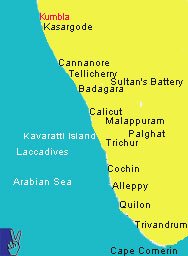 The Commissioners then proceeded to settle the case of the five friendly northern Rajas whose territories lying contiguous to Kolattiri proper or Chirakkal on the north of the Kavvayi river, were not included in the cession, although they were, prior to Hyder Ali’s conquest, under the suzerainty of the Kolaltiri family.
Hyder Ali attached their territories to his Kacheri of Bednur. They were the Rajas of Nilesvaram, Kumbla, Vitul Hegra or Beigada, Bungor and Chowtwara. The Nilesvaram Raja, although he was granted cowl by the factors in 1790, obtained permission from Tippu to return to his country. The Kumbla and Vitul Hegra Rajas were each granted1 a pension of Rs. 200 by the Company, with permission to reside at Tellicherry.
NOTEs: 1. Treaties, etc., ii. Ill and IX. END OF NOTEs
As to the Bunga or Bunger and Chowtwara Rajas, they having made the offer of their services very late in the war, it was not deemed necessary to extend to them any indulgence of the kind. They had to return to their country, and were, it is said, imprisoned by Tippu.
Having put matters in train for a settlement in the north, the Bombay Commissioners next repaired to Calicut to negotiate with the Zamorin, who, however, delayed to attend on the Board. The Commissioners accordingly made a settlement of the Kurumbranad district with Vira Varma Raja, who had been a member of the Kottayam family and had been adopted as heir by the senior Kurumbranad Raja. The latter was absent in Travancore. They leased2 to him on the 27th May 1792, for the sum of Rs. 1,40,000 for one year, not only the two districts of Kurumbranad and Kolakkad, which appertained to his adopted family, but Payyanad, Payormala, Kilakkampuram, Vadakkampuram and Pulavayi, which were then understood to belong to the Zamorin, but classed in Tippu’s schedule under the taluk of Kurumbranad.
NOTEs: 2. Treaties, etc. ii, VlI and VIII. END OF NOTEs
This Raja had received no cowl from the Tellicherry factors, so as a preliminary condition to the grant of the above agreement he had to acknowledge that the Honourable Company “alone are the rightful sovereigns” of his districts, and he was in turn appointed the Honourable Company’s “manager” to "collect the revenues, administer justice, and preserve the peace” of his districts, and the Zamorin’s agents were required to settle with him for sums collected by them.
The Bombay Commissioners next learnt that General Medows, the Governor of Madras, in the course of the war operations on the other side of the peninsula, had allowed the Travancore Raja a controlling power over the Malabar Rajas ; and that on this plea the Travancore Dewan Keshu Pillay had collected, in the name of the Company and on the plea of contribution towards the expenses of the war, various sums of money from the revenues of the country for the years 1790 and 1791. The question as to whether he should be made to account for these collections occupied some of the Commissioner’s time, and was eventually left for disposal by the Governor-General.
The feud between Nayar and Mappiila in consequence of the complete subversion of the ancient friendly relations subsisting between these classes broke out afresh about this time, and Major Dow was deputed to the Mappilla districts, and a cowl1 of protection was issued in favour of the Kundotti section of the Mappilla class, who had been oppressed by the Nayar landholders.
NOTEs: 1. 1 Treaties, etc.., ii. X. END OF NOTEs
The next settlement was made for the Palghat district with Itta Punga Achchan, a younger member of the family, who, according to custom, exercised sovereign authority as regent in place of a superannuated senior Raja. On his acknowledging the sole sovereignty of the Honorouable Company over his district it was, on 12th July 1792, leased2 to him for one year for the net sum of Rs. 80,000 after allowing for charges of collection.
NOTEs: 2. Treaties, etc., ii. XI. END OF NOTEs
The Zamorin had driven a wedge3 through and had acquired, as already described, a large part of the ancient Palghat territory. In this agreement with Itta Punga Achchan this claim of the Zamorin to the Natuvattam was carefully ignored.
NOTEs: 3. The Natuvattam (Central circle), see map at, paragraph 11 of Section (b), Chap. IV. END OF NOTEs
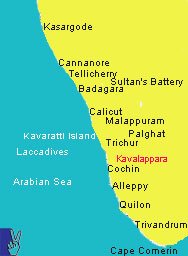 And on the same4 day the Kavalappara Nayar acknowledged the Honourable Company’s sovereignty and was installed in his territory for one year his payments being fixed at Rs. 15,000. As however, the Cochin Raja had advanced a claim to sovereignty over the Nayar’s territory (Treaties, etc., i. Cl. Article III), the Nayar was further bound to abide by the decision of the Honourable Company in this matter. It may be added that the Nayar shortly afterwards proved to the satisfaction of the Commissioners that he was really independent of the Cochin Raja, and a decision was accordingly given in his favour on this point.
NOTEs: 4. Treaties, etc., ii, XII. END OF NOTEs
It was at first resolved to place the Nayars of Kongad, Mannur and Edattara under the Palghat Achehan, but as they had formerly taken the protection of the Vellatiri Raja, they were ordered to pay their revenue through that Raja, viz.
|
|
Rs. |
HOONS |
|
Kongad |
1,454 |
8 |
|
Mannur |
1,344 |
2½ |
|
Edattara |
1,505 |
8 |
A dispute soon however arose between the Raja’s family and these Nayars, and they were thenceforward permitted to pay revenues direct to the Company.
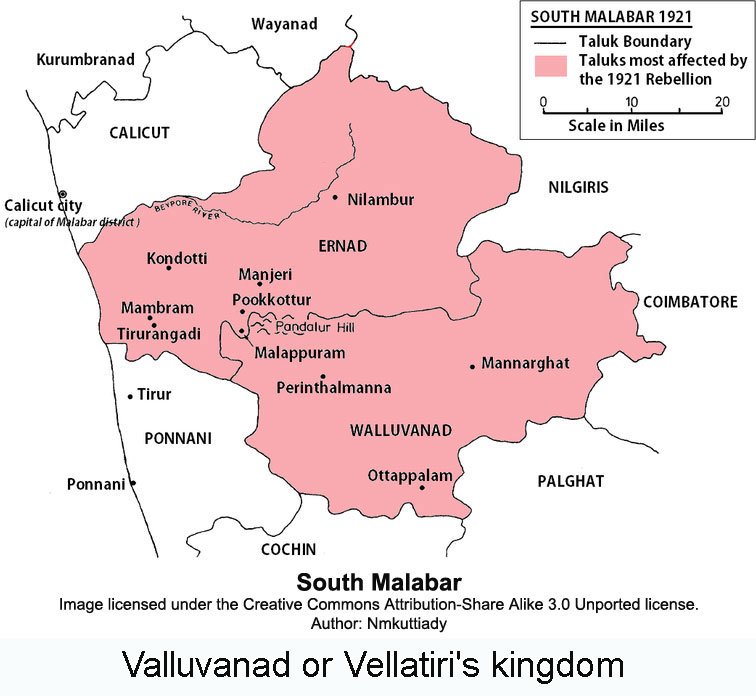 Their territories were in this way first included among those for which the Vellatiri Raja next, on 30th July 1792, undertook to pay a sum of Rs. 38,410½. The Vellatiri or Valluvakon Rajas were, as the foregoing pages sufficiently indicate, the hereditary enemies of the Zamorins. The reigning chief had endeavoured, by favouring the Mappillas, to counterbalance the influence gained by the Zamorin through his Muhammadan subjects.
Mappillas consequently abounded in this chief’s territory, but as Muhammadan immigrants were few in his inland tracts he had perforce to recruit his Mappilja retainers from the lowest classes of all—the slaves of the soil or Cherumar. Having tasted the sweets of liberty under the Mysorean rule, these Mappillas did not readily yield submission to the ancient order of things when the Mysoreans were driven out. Although., therefore, the Vellatiri Raja’s districts were restored “to the Raja for management, it was soon discovered that he was powerless to repress the disturbance which speedily arose between Nayar and Mappilla, and it was in consequence of this that so early as May 1793 the Joint Commissioners had to resume his districts and manage them directly.
Another reason for direct intervention was that this chief and his family had all fled to Travancore, and that they had afforded the Honourable Company no help whatever in the war with Tippu.
In settling with the minister of the Vellatiri Raja the Commissioners learnt that it had been the practice with Tippu and his farmers to exact 10 per cent, on the jama or annual demand for the charges of collection in the southern districts. They therefore took this extra charge to account and increased the amount of the Vellatiri lease from Rs. 38,410½ to Rs. 41,594½.
The Parappanad district was next, on 11th August 1792, farmed3 out for the net sum of Rs. 14,000 to one of its Rajas, Vira Varma, one of the few members of the family who had escaped forcible conversion at the hands of Tippu’s myrmidons.
NOTEs: 3. Treaties, etc., ii, XIII. END OF NOTEs
The Vettattanad district was next leased on 14th August 1792, on behalf of the Raja, by his minister for Rs. 34, 807¼. But this Raja did not long survive ; he died on 24th May 1793, leaving no heirs natural or adoptive to succeed him, and his estates were declared to have passed to the Honourable Company.
The settlement with the Zamorin, which had been all the while under consideration, presented various difficulties. During the religious persecutions of Tippu, a younger member of the family, Ravi Varma, belonging to that branch of the family styled Padinhare Kovilakam (western palace), having proved himself a champion of the Hindus, obtained from General Medows at Coimbatore, on 27th September 1790, a cowl1 in the name of Kishnen Raja, heir apparent of the Zamorin, who had fled to Travancore, authorising the latter to administer the revenue of the country during the war and providing for the payment of an equitable poishcash to the Company at its termination.
NOTEs: 1. Treaties, etc, ii, XCVII. END OF NOTEs
Under the provisions of this cowl an agreement2 was, on the 18th August 1792, concluded with the fourth Raja of the Kizhakke Kovilakam (eastern palace), on behalf of, and as surety for the Zamorin for Rs. 4,16,366¼. It contained sixteen articles, which constituted the basis of all subsequent proceedings with this Raja.
NOTEs: 2. Treaties, etc., ii, XVI. END OF NOTEs
The districts leased were —
in Calicut—the cusba and Ramnad.
in Kurumbranad—Vadakkampuram and Kizhakkampuram, which the Kurumbranad Raja agreed to give up to the Zamorin.
in Vettattanad—-Ponnani, Choranad and Venkattakkotta.
in Chavakkad—Chavakkad, Nedunganad and Karimpuzha,
in Ernad—Ernad and Malapuram, and
in Palghat—Kollangod, Koduvayyur, and Mankara, and the duties on land and sea customs were also likewise leased.
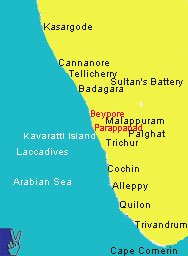 As a mark of respect and superiority, the Rajas of Beypore, Parappanad and Vettattunad were required to pay their revenues through the Zamorin, who was also temporarily vested, “as in the ancient times”, with power to administer justice “over all these petty Rajas.”
The last separate district settled by the Commissioners was with the Beypore Raja for Rs. 10,000.
After this the Commission separated for a time, Major Dow proceeding to Cochin and Travancore with a view to secure3 the pepper produce and to obtain as much information as possible before the arrival of the Bengal Commissioners.
NOTEs: 3. Treaties, etc., ii, XVII. END OF NOTEs
Mr. Farmer remained behind and entered into an arrangement for the mint with the Zamorin, to whom it was leased for Rs. 15,000. He also appointed Mr. Agnew the Calicut Resident, as Collector General of the southern districts, and Mr. Sunkheet as Collector of Palghat. He then proceeded to the north to arrange definitely with the northern Rajas. There he was joined by Mr. W. Page, appointed as third member of the Bombay Commission.
The Chirakkal Raja’s revenue1 was fixed at Rs. 50,000, the Kadattanad1 Raja’s at Rs. 30,000, and the Kottayam1 Raja’s at Rs. 25,000 and all three Rajas now acknowledged the full sovereignty of the Honourable Company over their respective districts.
NOTEs: 1. Treaties, etc., ii, XVIII, XIX and XX. END OF NOTEs
The articles were similar to those made with the Zamorin, with modifications to suit the circumstances of the districts, particularly in the mode of purchasing pepper.
In regard to the Bibi of Cannanore nothing was arranged. She claimed the restoration of the jaghire given to her by Tippu in lieu2 of four of her islands taken by him and attached to Canara, and which jaghire had been resumed by the Chirakkal Raja. She represented also that she had been obliged to mortgage the coir of her remaining islands to Chovakkara Mussa on account of the expense of former wars.
NOTEs: 2. Conf. p. 453, foot note. END OF NOTEs
The Chief (Mr. Robert Taylor) and Factors of Tellicherry were on 31st October 1792 appointed Collectors-General of the northern districts.
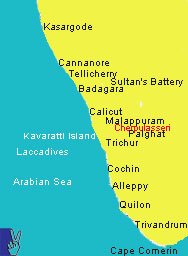 The Padinyaru Kovilakam branch of the Zamorin’s family, already noticed, possessing great influence in the country, was entrusted with the collection of the district of Nedunganad by the Eralpad Raja, the managing heir apparent of the Zamorin. On the strength of this the Padinyaru K. Raja attempted to render himself independent of the Zamorin. The dispute was carried on to such lengths that Captain Burchall was obliged to seize his person at Cherupullasseri. He died there a day or two afterwards, and at the instance of the Zamorin his brother and nephew were put under restraint, and released only upon the Kilakka Kovilakam Raja standing security for their good behaviour and payment of arrears of revenue amounting to one lakh of rupees.
Such was the general state of progress made by the Bombay Commissioners when the Governor, Sir Robert Abercromby, again arrived in Malabar, followed on 12th December 1792 by Messrs. Jonathan Duncan and Charles Boddam, the Commissioners despatched from Bengal by Lord Cornwallis to co-operate with those from Bombay. The following extract contains Lord Cornwallis’ instructions to Messrs. Duncan and Boddam and explains the scope of the Joint Commission.
Extract from the Governor-General's instructions to the Commissioners deputed to the Malabar Coast-
“Third.—It is our intention that, in conjunction with the Commissioners on the part of Bombay, you shall enter into full investigation with a view to ascertain with as much accuracy as possible the general and particular situation of this Ceded country, in respect as well to its former as its late and present Governments, as far as may be requisite to enable you to point out in what manner justice has heretofore been and may in future be more advantageously administered to all classes of the natives, the nature of whose several tenures and more especially those of the Zamorin of Calicut and of the principal Rajas and Nayars and Mappillas throughout that and the other parts of the country are to be specified, accompanied with Estimates and statements, formed on the best materials you may be able to procure, of the amount of Revenue which these several Districts are capable of paying and may be equitably assessed at ; together with the particulars of their interior and foreign trade, on which subject you will form and report your opinion as to the best means of improving both, in such manner as shall have the greatest tendency to conciliate the Commercial Interests of the Company with those of the natives, and best promote the internal prosperity of the Country at large.
“Fourth.—From the several Copies of Papers (consisting of the Correspondence that has hitherto passed on this subject) which the Secretary will furnish you with, you will learn what progress has hitherto been made by Mr. Farmer and Major Dow, with whom Mr. Page has since been joined in the Commission, consisting of certain articles agreed upon between them and the Rajahs of Cartinaad (Kadattanad) and others in the northern division of the Ceded country, by one of which the amount of the revenue payable the first year was to be ascertained from the appearance of the crop in October last. The result of this intended inspection you will no doubt learn on your arrival at Tellicherry ; and besides this the Commissioners from Bombay appear to have since concluded a money settlement for one year with the Zamorin and some other Chiefs of the Southern Districts, as you will find detailed in the latest advices received from Mr. Farmer.
“Fifth.—Although these advices show that the general assessment of the Ceded countries in the coast of Malabar is likely to fall considerably short (for the first year at least) of their estimated Revenue Produce as contained in the schedule of Jamabandi furnished at the Peace by Tippu Sultan, we think it nevertheless probable that your and the other Commissioners’ further enquiries may ascertain the revenue capacity of the country to be at least much nearer the standard at which it was ceded to us than the amount of the Temporary settlements hitherto made seems to indicate ; but although it is certainly our object to fix on a fair and equitable Jama as payable to Government (and we rely on your best exertions and those of the gentlemen from Bombay to ascertain the real ability of the country in that respect), yet we are at the same time willing to admit and act upon the expediency of a principle of a suggestion which you will find urged to the Commissioner from Bombay in a representation made to them on the part of the Zamorin, viz. :—that with a view to conciliate the native Rajas, Landholders and cultivators to the Company’s Government, and encourage them to improve their respective' Districts and increase their productiveness, more especially by replanting the pepper vines wherever they have of late years been destroyed, their Burthens, that is, the revenue assessed on them, should in the beginning at least, be in general lighter than that exacted from them by Tippu, - in which view we think it may be very advisable for you and the other Commissioners to propose to the several Parties a settlement, either for their respective lives or for such a term of years as may be most agreeable to them, with a moderate increase (in such places as you think will bear one) on the reduced Jama that it may now be necessary to stipulate for ; so that the just advantages of Government may in some degree keep pace with the progressive improvement of the country under that system of good government which your researches and proceedings will, we trust, enable us to establish in it.
“And as the settlement for the first one year ending as we understand, in September 1793, will probably be everywhere concluded before your arrival on the Malabar Coast, your principal attention will, of course, be directed to the permanent adjustment of the public Revenue to take place from that period, for the first year of which series (or up to September 1794) we shall with a view of preventing interruption to the current business of the country or obstruction to the progress of its improvement, confirm as a matter of course the Jama which you and the other Commissioners may stipulate for each district ; but the settlement for the remaining years of each lease you and they are only to recommend and (as far as you may find satisfactory grounds) conclude with the several parties, subject by an express clause to our ultimate approbation or alteration, which shall be signified as soon after your report as possible.
“Sixth.—The establishment of a Plan for the administration of Justice in the several Districts being a point the effectual attainment of which we have above all others at heart, we rely with confidence on your experience acquired on this side of India for your being able to determine in a satisfactory manner on the number and constitution of the several Courts of Justice that will be necessary to ensure to the utmost possible degree (as far as the state of society there will permit) the dispensation of equal Justice to all classes of the society ; and if, from General Abercromby’s presence on the spot or in the neighbourhood of the place at which your proceedings are held, he shall concur with you in opinion on these subjects, or in those plans that relate to the collection of the Revenues, or to the management of the trade of the country, we shall have no objection to find either one or all of them begun to be carried into execution (subject to our ultimate approbation) by the country being divided provisionally (even before your final Report to us) into such Revenue Divisions or Collectorships, and Judicial Jurisdictions, Civil and Criminal, and commercial agencies, as you shall intend ultimately to propose for our Confirmation.
Seventh.—The pepper produced on the Coast of Malabar constituting (as already intimated) a very material Branch of Commerce to the Honourable Company, it is our wish that a Provision on terms of perfect fairness to the natives may be effected in all the settlements for the Revenue payable to Government, so that as far as possible it may be made good in the natural pepper produce, taken at a fair market valuation instead of money payments, leaving whatever proportion cannot be secured in this way to be purchased by the Company’s commercial Agents on the spot on the footing (as nearly as may be) that their purchases of Investments are provided by the Regulations (with which you are acquainted) established for the Commercial Department in Bengal ; for we are aware that on the footing of any positively exclusive privilege the Company must lose in their Revenues and in the prosperity of the country more than they could gain by rigidly enforcing a right to monopoly or purchase in any other mode than that which we have thus pointed out.
“Eighth.—You are also, in the same spirit of moderation and liberal attention to the rights of the native, to include in your Report the information you may be able to obtain in respect to the General state of the trade of the country in the other articles besides pepper, comprehending (as far as your opportunities may admit) that carried on in the Districts of the Raja of Travancore, and reporting thereon whatever means may occur to you for securing, on equitable principles, such share of it to the Company as former engagements (which Mr. Powney, the Resident with the Raja, will be directed to make you acquainted with), and more especially the late and recent exertions in favour of that country so fully entitle them to expect.”
The Governor-General did not fail at the same time to notice (despatch of 18th November 1792) with “much satisfaction” the “laborious and persevering attention” which had been already devoted to the objects of the Commission by the Bombay members of it. One of the first measures of the United or Joint Commission was to proclaim1 on 20th December 1792 the general freedom of trade in all articles except pepper which was held as a monopoly, and the Institution of “two separate courts of Equity and Justice” at Calicut on 1st January 1793, the first court to be presided over by the members in rotation, in which revenue and litigated landed claims were to be investigated, and the second to take notice “of all other subjects of claim and litigation not relating to the revenue or landed property.”
NOTEs: 1. Treaties, etc., ii. XXIII, XXIV, XXVII. END OF NOTEs
They further, on 9th January 1793, sent round a circular2 to all the chieftains charged with the collection of the Revenue of their Districts, forbidding the collection, on any pretence whatever, of any presents or cesses such as had been customarily prevalent before the Mysore Government imposed the land cess, which alone they were authorised to collect.
About this time a hill tribe called Malasars (Mala—hill, and arasar - lords) in Palghat having inopportunely disturbed a Brahman festival by intruding into the circle for the relics of the feast, the Palghat Achchan caused the headman of the tribe to be decapitated. On this account the Commissioners soon afterwards insisted on the Achchan not only satisfying the family of the deceased Malasar, but entering before Mr. Lockhart into a written agreement1 not to exercise in future any criminal jurisdiction affecting the life or limb of any person without obtaining the sanction of Government.
NOTEs: 1. Treaties, etc., ii, XXVI. END OF NOTEs
Messrs. Page and Boddam were next deputed to Cochin and Palghat respectively to ascertain the identity of the taluks referred to in the Cochin Treaty of 1790 and Tippu’s schedule of 1792, to enquire into the boundary dispute between the Cochin Raja and the Zamorin as well as that relative to three taluks between the former and the Travancore Raja, to adjust with the Dewan of the latter large sum of money said to have been unduly collected by him, and lastly, to settle the Cochin Raja’s claims on Kavalappara, which point was, as already stated, decided in favour of the Nayar.
While these Commissioners were engaged with the above-mentioned enquiries, the remaining members issued a proclamation of general amnesty for acts of homicide, maiming, robbery or theft committed prior to 1st February 1793 as a means of inducing the lawless among the population to resort to honest courses.
The Commissioners likewise prohibited the slave trade carried on extensively in children by Mappilla merchants with the French and Dutch ports of Mahe and Cochin respectively.
It was becoming very apparent that the breach between the Mappillas and the Nayars, particularly in the Vellatiri district, was very wide. The Raja was found to be powerless to prevent outrages of all kinds by Mappillas, or to punish them when the culprits were known. Moreover, on the outskirts of this lawless tract of country there dwelt a tribe of what were in those days called “jungle” Mappillas, who were banded together under chiefs and who subsisted on the depredations committed on their neighbours.
The best known chief of these banditti was styled Elampulasseri Unni Mutta (Mussa) Muppan, who had a loopholed and fortified house in the jungles at the foot of the ghats at a place called "Tereangnanor” in the records, and who kept a retinue of a hundred armed men. He declined to submit to the Honourable Company’s protection when asked to do so by one of the Company’s military officers, unless he were granted a pension, because he said his followers had no means of subsistence beyond what they could get by robbing their neighbours.
But in addition to professional robbers like this, the Vellatiri district swarmed with Mappillas driven to desperation by the exactions of the Raja’s Hindu agents employed in collecting the revenue, who resorted, much to the disgust of the British officers quartered in those districts in command of troops, to the most cunning devices for procuring military aid to support their extortionate demands on the inhabitants. The latter were in constant dread of being deprived of their lands by the Nayars, and of their being thus deprived of their only means of support.
The Commissioners had meanwhile also been busy with a plan for the general government of the ceded countries, and this having been sanctioned by the Governor, Sir Robert Abercromby, it was duly proclaimed in the Governors presence at Calicut on the 18th March 1793. The following extract from Mr. Farmer’s Diary describes briefly the ceremony which took place on the occasion.
The Diary entry runs as follows: —
“Calicut, 18th March 1793.
“Diary of the Proceedings of William Gamull Fanner, Esquire, Supravisor and Chief Magistrate of the Province of Malabar.
“This day, by appointment of the Honourable Major-General Robert Abercromby, President and Governor of Bombay, the gentlemen of the Civil Service present at Calicut were summoned to attend at the Government House, late the English Factory, where the Commandant of the troops likewise attended with a numerous assemblage of officers and other gentlemen.
“The Battalion of grenadiers, forming two lines, was drawn up on the road leading from the General’s encampment to the Government House ; the General was saluted with nineteen guns from six field-pieces in passing through the lines.
“Being arrived at the Government House, Major-General Abercromby read before all the persons assembled the following letter of instructions, which was then delivered to the Supravisor
“To Williams Gamull Farmer, Esq.
“ Sir,
“ ‘You are apprised of the reasons that have induced me to form a temporary Government for the ceded country, and the motives that have actuated me in the choice of a Chief Magistrate.
“ ‘The sovereignty acquired in these Provinces by the Honarable Company imposes serious duties on their representatives ; it is their duty to protect the persons and property of all ranks of subjects to administer unbiassed justice according to ancient laws and customs, but meliorated by the influence of our milder institutions, to respect religious opinions and established customs, to provide for the exigencies of Government by a fair and equal assessment, to diffuse the blessings of free intercourse and commerce, to preserve the rights of the superior class of subjects as far as is consistent with the general good, in fine to introduce good order and government where anarchy, oppression, and distress have long prevailed.
“These, Sir, are the duties imposed on the Honourable Company’s representatives ; a knowledge of these duties actuated the Commissioners in recommending a system of government, and these must actuate you in the execution of it.
“ ‘The general rules by which you will be guided are clearly defined, and particular instructions will be framed for the several Departments under your control. In addition to those instructions, I have to request you will remember that abuses are more easily prevented than remedied. The principle of the present Government is not to seek emolument or create places for persons, but to grant moderate salaries, and hold out to the hopes and ambition of the younger servants the honourable and liberal situations that superior stations admit of. You will also recollect and impress it on the minds of the gentlemen under you that it is an arduous task, and requires zeal and exertion to fill with propriety newly established officers under a Government recently formed. This zeal is expected from you ; without it every effort to establish will but weaken our influence, and where merit is so indispensably required, it will be properly noticed and rewarded.
“ ‘To enable you to enter on the execution of your office, I have only to add that by authority of powers vested in me, I hereby appoint you to assume the temporary management of the ceded countries under the name and title of Supravisor and Chief Magistrate of the countries henceforth to be denominated the Province of Malabar.
“ ‘You will be subject to such orders and directions as you may receive from Government, or the Commissioners may think proper to give you, and at the termination of the Commission you will assume the same powers over the Chiefship of Tellicherry as are now held by them.
“ ‘Wishing you success in the execution of your duty,
“ ‘I have, etc.,
(Signed) Robert Abercromby.’
“After the delivery of this letter the Government thus established was saluted by twenty-one guns from the field-pieces placed in front of the Government House.
“The following oaths were then taken by the Supravisor:-
“Revenue, oath.
“I, William Gamull Farmer, do promise and swear that, I will, to the utmost of my endeavours, well and faithfully execute and discharge the duties of an officer of revenue reposed in and committed to me by the United Company of Merchants trading to the East Indies, and that I will not demand, take or accept, directly or indirectly, by myself or by any other person for my use, or on my behalf, of or from any Raja, Zemindar, Talukdar, Poligar, Renter, Ryot, or other person paying or liable to pay any tribute, rent, or tax to, or for the use of, the said United Company, any sum of money or other valuable thing by way of gift, present or otherwise, over and above, or besides and except the actual tribute, rent, or tax authorised to be taken by and for the use of the said United Company, and that I will justly and truly account and answer for the same to the said United Company.
“So help me God !
“(Signed) W. G. Farmer,
“Calicut,
“ 18th March 1793.
“Sworn to before me.
“(Signed) Robert Abeuoromby.
“Phouzdarry oath.
“I, William Gamull Farmer, Supravisor of the Province of Malabar and entrusted as the Chief Magistrate with Phouzdarry jurisdiction, do solemnly promise and swear that I will exert my best abilities for the preservation of the peace of the District over which my authority extends, and will act with impartiality and integrity, neither exacting or receiving, directly or indirectly, any fee or reward in the execution of the duties of my office other than such as the orders of Government do or may authorise me to receive.
“So help me God !
"(Signed) W. G. Farmer,
“Calicut,
“18th March 1793.
“Sworn to before me.
“(Signed) Robert Abercromby.
“Sadar Adalat oath.
I, William Gamull Farmer, Supravisor and Chief Magistrate of the Province of Malabar, do swear that I will administer justice to the best of my ability, knowledge and judgment, without fear, favour, promise or hope of reward, and that I will not receive, directly or indirectly, any present or nuzzer, either in money or in effects of any kind, from any party in any cause, or from any person whatsoever, on account of any suit to be instituted, or which may be depending, or have been decided in the Court of Sadar Adalat under my jurisdiction, nor will I knowingly permit any person or persons under my authority, or in my immediate service, to receive, directly or indirectly, any present or nuzzer, either in money or in effects of any kind, from any party in any cause, or from any person whatsoever, on account of any suit to be instituted, or which may be depending or have been decided in the Court of Sadar Adalat under my jurisdiction, and that I will render a true and faithful account of all sums received for deposits on causes, and fees of court, and of all expenditures.
“So help me God !
“(Signed) W, G. Farmar.
“Calicut,
"18th March 1793.
“Sworn to before me.
“(Signed) Robert Abercromby.
“James Stevens, Esquire, next took the necessary oaths as Superintendent of the southern Districts. Mr. Augustus William Handley, Senior Assistant to the Supravisor, and, as such, Judge of the Court of Adalat at Calicut, then also took the oaths appointed.
“After this Major-General Abercromby withdrew with the same ceremony he entered, the field-pieces saluting him with nineteen guns.
“The principal natives paid their respects. It was remarked as a propitious omen that the day of fixing a government for the Malabar Coast was the anniversary of the day on which it was ceded by Tippu in consequence of the treaty concluded with Earl Cornwallis at Seringapatam on the 18th March 1792.
The Governor, before his departure from the coast, further issued a circular1 to all the Rajas and Chiefs explaining the purport and object of the measure which had thus taken effect. Agreeably to the plan, the ceded country was called the “PROVINCE OF MALABAR” and divided into two superintendencies, with a middle division directly under a Supravisor, as he was called, with superior political, revenue, and judicial powers and full control over the two Superintendents.
NOTEs: 1. Treaties, etc., ii, XXXII. END OF NOTEs
His seat was fixed at Calicut. The Superintendents had revenue and magisterial power. The headquarters of the Northern Superintendent were fixed at Tellicherry, with the districts from Chirakkal to Kurumbranad and Coorg under his control.
The Southern Superintendent was stationed at Cherapullasseri, in charge of the districts from Parappanad to Chetwai together with the Cochin tribute. The military force stationed on the coast was subject to the sole requisition of the Supravisor, except in cases of ‘serious emergency.’
The Supravisor and Superintendents had also a number of assistants under them, and the Senior Assistant was Judge and Magistrate at Calicut.
There was to be only one mint for the whole country, under the control of the Supravisor at Calicut. All interior customs were to be abolished and duties on foreign exports and imports were to be collected by Government. The Senior Commissioner, Mr. Farmer, was made the first Supravisor, and he thereupon vacated his seat on the Commission. Messrs. Galley and Stevens were appointed Northern and Southern Superintendents respectively and Mr. Handley as Senior Assistant. The remaining members of the Joint Commission then continued their labours with Mr. Jonathan Duncan as President.
The Coorg tribute was next settled1 at Rs. 24,000 per annum. But disputes early commenced between this Raja and Tippu relative to their respective boundaries, and the latter’s vakils complained also of the Kottayam Raja taking Wynad, which district the Commissioners were then of opinion was not ceded by the treaty.
NOTEs: 1. Treaties, etc., ii. XXXIII. END OF NOTEs
Two of them, Mr. Duncan and Major Dow, next proceeded to Cannanore to enquire into the alleged mortgage of the Laccadive Islands to Chovakkara Mussa and the land taken from the Bibi by the Chirakkal Raja. There they were joined by Mr. Page from Palghat, and engagements2 were taken on the 11th and 13th April 1793 from the Bib, binding her to pay up arrears and to pay a “moiety of whatever is the produce of my country according to the funds thereof, and out of the Rs. 20,000 annual profit which I reap from my trade with the Laccadives, I am also to pay the half to Government.”
NOTEs: 2. Treaties, etc., ii. XXXIV, XXXV. END OF NOTEs
And further stipulations provided for the future revision of the estimate of income, and for the sequestration, if need be, of the whole of the produce of the islands and of the islands themselves.
The pepper monopoly3 was next abolished in the south, while in the north it was limited to one-half of the produce to be taken in kind. Owing to some clashing between the authority exercised by the Joint Commission and by the Supravisor respectively, a uniform system of dealing with the pepper produce throughout the province was not introduced.
NOTEs: 3. Treaties, etc., ii. XXXVI, XXXVII. END OF NOTEs
The Commissioners next turned their attention to the affairs of the Honourable Company’s mortgaged district of Randattara, and an agreement4 was on 26th April 1793 entered into with the Achchanmar or Chiefs of that district, that on condition of the revenue of their estates being estimated at 20 per cent on garden produce and 15 per cent on rice lands, the rates which had prevailed since 1741, when the province was first mortgaged5 to the Company, and with an exemption in favour of temple lands and of their own houses, they renounced all future right to manage the district after the native fashion, with its fines and mulets and presents and succession duties.
NOTEs: 3. Treaties, etc., ii. XXXVI, XXXVII.
4. Treaties, etc., ii. XXXIX. END OF NOTEs
The waste lands of this district having been thus placed at the disposal of Government, a number of Native Christians who had fled from Canara and Mysore in consequence of Tippu’s persecutions were allowed to settle with their families on the waste lands in Randattara, and were granted advances of money to carry on cultivation.
Iruvalinad, the district of the Nambiars1, which was a most important tract of country to the Honourable Company in the early days of the Tellicherry Factory, was next taken in hand by the Commissioners. The district had been in a disturbed state owing to the mutual animosities and jealousies of the Nambiars themselves and to the confused method in which they conducted the administration. It was very necessary to protect the lower classes of the people from the exactions of the Nambiars, who now freed by the strong arm of the Company from dependence on those beneath them, would have taken the opportunity, if it had been afforded them, of enriching themselves at the expense of their poorer neighbours and subjects.
The Commissioners accordingly, on the 14th May 1793 took from them an agreement2 to protect the poorer class of landholders and to put an end to the exaction of the feudal fines and mulcts and duties and presents which had formerly been customary, and further arranged that the Nambiars were to conclude a detailed settlement3 with Mr. Galley the Northern superintendent at Tellicherry. An allowance of 10 per cent “on the Government’s moiety of Revenue was granted to the Nambiars for their support and comfort.”
NOTEs: 3. Treaties, etc., ii. XLI.
4. Treaties, etc., ii. LXIII, LXIV. END OF NOTEs
It may be noted in passing that the Honourable Company’s officers had had for many years previously exceptional opportunities of studying the organisation of this petty district, and the care displayed by the Commissioners in protecting the rights of the lower orders of landholders in this district should have been extended widely throughout the Province; but in place of viewing the janmam right over land in its true aspect as a mere right to exercise authority over the persons of those who resided thereon the Commissioners accepted the view that janmam right was a right to the soil the plenum dominium of Latin jurists, and as such they proceeded shortly afterwards, as will be presently seen, to set forth, and to direct the Courts to act upon, that EUROPEAN IDEA.
The Commissioners, after some unsatisfactory negotiations with the northern rajas, returned to Calicut, where they on 18th May 1793 accepted the (as it appeared to them at the time) agreeable proposal4 of the Kurumbranad Raja to appoint a person on the part of the Company to assist in his collections for the ensuing year, on the result of which a permanent lease might be granted to him not only for the district of Kurumbranad, but also for Kottayam and Parappanad, which were in the possession of his two nephews of the Kottayam family, over whom it was alleged he possessed entire ascendency.
NOTEs: 4. Treaties, etc., ii. XLII. END OF NOTEs
The latter district had fallen to the family by adoption and by the recent death of the old Parappanad Raja! As after events fully proved, however, the Kottayam nephew of Kurumbranad—the famous Palassi (Pychy) Raja was not amenable to control by his uncle, and the uncle was powerless to execute his own orders in the Palassi country. He further agreed subsequently to relinquish the districts of Payyanod, Puluvayi and Payyormala, which had been included in the first agreement entered into by him.
At this juncture the Mappillas of the south began to give trouble. Major Dow was deputed a second time to settle with the robber chiefs Haidros and Unni Mutta Muppan, but as they were refractory, Captain Burchall marched against Unni Mutta and surrounded his fortified house. The robber chief, however, made a desperate sally and escaped. Bui some of his noted followers were captured and his lands sequestered.
Meanwhile, encouraged by their success with the Kurumbranad Raja, the Commissioners proceeded to negotiate the same sort of agreement with the Zamorin, whose chief Minister, Shamnath, they had engaged to assist in the work and further to institute a canongoe establishment throughout the country to bring into and keep in order the accounts of each district, and to act as local assistants, guides and intelligencers to the servants of Government in the discharge of their duties, and to serve as checks upon undue exactions on the part of the Rajas.
To these two points the Zamorin was induced on 29th June 1793 to give his assent1 on condition of an adequate provision being made for his family. He further agreed to give up his right to customs and transport duties, he being allowed to keep accounts of the receipts in the Company’s custom houses. In regard to the mint a compromise was agreed to by the Commissioners that the general direction should remain exclusively under the Company, but that the Raja’s people should assist in the details of the business, and that he should be allowed half the profits.
NOTEs: 1. Treaties, etc.., ii. LXIV. END OF NOTEs
Similar terms2 were accepted shortly afterwards by the Rajas of Kadattanad and Kurumbranad, the latter making separate similar engagements also for Kottayam and Parappanad. Shortly after these arrangements had been made, Mr. Boddam rejoined the Commission from Palghat. Itta Punga Achchan, who had settled with the Bombay Commissioners for the first year’s lease, had shot himself and had been succeeded by his nephew Itta Kombi Achchan. The latter had imprisoned a rival claimant to the raj, by name Kunji Achchan, but on the arrival at Palghat of the deputed Commissioner, the latter was set free.
NOTEs: 2. Treaties, etc., ii. XLV, XLVII. END OF NOTEs
Similar terms3 to those arranged with the aforesaid Rajas had been made on 21st June 1793 with the managing Achchan, but with an additional clause restricting him from the exercise of any judicial authority in consequence of the beheading of the Malasar already alluded to.
NOTEs: 3. Treatieat etc., ii. XLVI. END OF NOTEs
Similar terms1 to those made with the Achchan were likewise arranged with the Nayars of Kavalappara, Kongad, Mannur and Edattara, and for the benefit of the subjects of the Achchan and of the three last-named Nayars the Commissioners agreed2 to the establishment at Palghat of an inferior Court subordinate to the Southern Superintendent for the trial of small suits and of 'inconsiderable quarrels, brawls and affrays.”
NOTEs: 1. Treaties, etc., ii. XLVIII to LI
2. Treaties, etc., ii LII and LIII. END OF NOTEs
The Chirakkal Raja also at length, on 5th July 1793, acceded3 to the terms, and the Beypore Raja likewise executed an engagement similar to that entered into by the Palghat Achchan.
NOTEs: 3. Treaties, etc, ii. LV. END OF NOTEs
The deeds were all forwarded to the Supravisor with directions to appoint Tahsildars or Collectors in the several districts with subordinate Parbutties and Menons, exclusive of Canongoes, who were separately furnished with instructions so as to ensure “such a control over the collections as would enable the Company’s servants to ascertain at the end of the year the nature and constituent parts and amount of the public revenue.”
In regard to the remaining districts there were disputed claims, which previous to a settlement, it was necessary to adjust, the districts of Chirakkal and Parappanad were also in dispute, and it will be proper here to notice the conflicting claims.
The competitor for Chirakkal was a young Raja of the family, as already noticed, who had never left Travancore. His claims were set aside in favour of the Raja, with whom the settlement was first made, from his having been in possession from the earlier period , but the claimant was allowed to make good his right, if so advised, by suit in the Adalat Court.
Parappanad was subject to two claims, one from a person claiming as nephew of the late Raja, who had adopted a member of the Kottayam family of which the Kurumbranad Raja, as already mentioned, was the head. This claim was left open for investigation. The other was advanced by the Zamorin, but he was not able to substantiate it. The Kurumbranad Raja, who had made the settlement for his nephew, was therefore held responsible for the revenues.
The Zamorin’s claims to Vettattanad, on the ground that he had been levying some dues from the Mappillas of this district were rejected as untenable, as also was the one advanced by him to Kavalappara.
His pretensions to Chetwai Island were next enquired into and decided against him. It had been taken from him by the Dutch in 1717 and from the latter by Hyder Ali in 1776, and the English in 1790 took it from Tippu Sultan and leased it to the Cochin Raja for Rs. 40,000 per annum.
The Zamorin next preferred a claim to Payyanad, and as the four chiefs acknowledged him as their lord paramount, his claim was accordingly admitted.
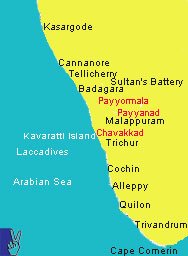 His demand for the restoration of Pulavayi was left in suspense to be settled by the Supravisor as its Nayar chiefs were openly resisting the attempts of the Zamorin to interfere in the concerns of their country.
His claim on Payyormala he himself renounced, and this district was placed directly under the Company.
Finally, the Zamorin and the Talapalli or Punattur Raja both claimed the Chavakkad district, which had, the latter alleged, been at one time in the exclusive possession of his ancestors, but the Zamorin had been gradually usurping the district from them. It was arranged that both parties should enter into a written engagement binding themselves to abide by the Supravisor’s decision, and in the meantime a proper allowance for his support was granted to the claimant by the Zamorin.
Marco Antonio Rodrigues, a descendant of the former Linguists of the Tellicherry Factory, next laid claim to the petty district of Kallai in Chirakkal under a deed of conveyance1 to his grandfather by the Chirakkal Raja in 1758, and which the present Raja had quietly resumed. The claim was submitted for the decision of the Governor-General, and meanwhile the district was sequestered by the Company. How the matter was finally settled cannot be traced in the records.
NOTEs: 1. Treaties, etc., i. LXXL. END OF NOTEs
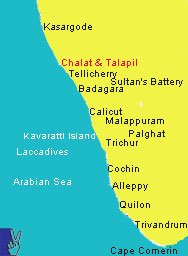 Hyat Sahib, a converted Hindu of the Nambiar caste of Chirakkal, whose interesting biography has already2 been related at some length, advanced his claims on a similar deed3 granted by the Chirakkal Raja in 1783 to the three taras or villages of Chalat, Talapil and Kunattur, which were the identical places claimed by the Bibi of Cannanore as her jaghire, obtained4 from Tippu at the time of her daughter’s marriage to Tippu’s son. The grant to Hyat Sahib was pronounced invalid by the Commissioners as having been obtained by fraud and the claim was rejected.
NOTEs: 2. Conf. p. 431 foot-note.
3. Treaties, etc., i. XCI.
4. Conf. p. 453. END OF NOTEs
On the representation of Said Ali, the Quilandy Tangal or Muhammadan high priest, that a jaghire had been conferred on him by Tippu, a grant exempting his house and property from taxation during his lifetime was given him.
The French claim to the petty district of Kurangot as a dependency of their settlement at Mahe early led to much discussion, and was in itself very much involved, but France was just then in the throes of the Reign of Terror. King Louis XVI died on the scaffold on the 21st January 1793.
On the 1st of February war was declared by the French Republic against England and Holland, and for the third time in its history the French settlement at Mahe had to open1 its gates to a hostile English force under Colonel Hurtley on the 16th July 1793. The garrison, after surrendering, was allowed to march out with all the honours of war. The settlement was placed under Mr. G. Parry as Superintendent of Police.
NOTEs: 1. Treaties, etc., ii. LVII. END OF NOTEs
It was at this time that Mr. Murdoch Brown, who had been in French employ and whose name is intimately connected with the early administration of the country, joined the Company's service. He was at first made Deputy Superintendent of Police, which appointment being disapproved by Government he resigned it. But he was afterwards re-entertained as Superintendent of Police, and was subsequently made overseer of the Company's plantation in Randattara, of which he eventually became the possessor2 by purchase on a ninety-nine years’ lease. His descendants still hold this estate under the original grant.
NOTEs: 2. Treaties, etc., ii. CCLXIX. END OF NOTEs
Having concluded the general mode of arrangement for the ensuing year, the Commissioners next proceeded to draw up general regulations for the administration of the revenue, founded entirely on the Bengal Code, modified so as to adapt it to the circumstances of the country. These were followed by Regulations for the civil and criminal administration of justice to take effect from 1st July 1793, with some supplementary articles in both departments.
In the Revenue Department, Dewans were appointed to help the Supravisor and Superintendents, and bound by muchilkas or penal obligations for good behaviour and integrity. In the Judicial Department seven local Darogas or native Judges were appointed, subordinate to the Provincial Courts of the Superintendents, viz.., at Cannanore, Quilandy, Tirurangadi, Ponnani, Palghat, Tanur and Chetwai.
The Roman Catholic padre of Calicut, however objected to the “infidel tribunal” of the Darogas, and claimed the ancient privilege of the Portuguese Factory of jurisdiction over Christians. This claim being incompatible with the principles of British rule was rejected, but the padre was allowed to attend the Fouzdarry Court to explain the law at the trial of Christians.
The Commissioners further laid down regulations3 relative to the janmis. This subject is fully discussed in section (a) of Chapter IV. The Joint Commissioners viewed the status of a janmi as being equivalent in all respects to that of a Roman dominus. The matter was very insufficiently investigated by the Commissioners. The janmi was simply a man exercising authority within a certain defined area, and entitled as such to a well-defined share of the produce—the pattam or ancient land revenue assessment—of the land lying within that area. But by the Commissioners’ action the jenmi was constituted the lord of the soil, and it is not to be wondered at that in time the janmis began, with the help of the courts of justice, to show very small respect for the rights of the tillers of the soil—the ryots in fact.
NOTEs: 3. Published subsequently by the authority of the Supravisor, Mr. Farmer.-Treaties, etc., ii. LXVIII. END OF NOTEs
The ryots, on the other hand, viewed the government as the inheritors in succession to Tippu and Hyder Ali of the pattam or land revenue assessment, and this was explicitly stated to the Commissioners by a deputation of influential Mappillas whom the Commissioners called together to consult on the subject. If the Commissioners had followed out the rule laid down in the fourth paragraph of the agreement with the Iruvalinad Nambiars which has already been commented on, the status of the ryots of Malabar would have been very different at the present day.
But the erroneous idea thus authoritatively promulgated was accepted without question in all further proceedings both in the Administrative Department and in that of Civil Justice, and the question as to whether the Commissioners’ action was correct or not was not raised until so recently as 1881.
They also framed regulations1 for the custom house collections, prohibited the export slave trade and dealing in gunpowder, warlike weapons and stores. They declared the trade in timber to be free, abolished the levy of profits on black pepper, coconuts, etc., as impolitic, and instructed the Supravisur to levy a modern tax in the shape of licence on the retail tobacco trade. They granted one per cent of the land collection of the Zamorin’s districts to Shamnath, a Palghat Brahman and the Sarvvadi Karyakkaran or chief minister of the Zamorin, for services rendered by him to the Company.
NOTEs: 1. Treaties, etc., ii. LXII. END OF NOTEs
An attempt was made by two of the Rajas of the Padinyaru Kovilakam (western palace) of the Zamorin’s house to assassinate2 him because he failed to procure them their restoration to Nedunganad. These Rajas then proceeded to the southward to raise disturbances, and were joined by Unni Mutta Muppan, the Mappilla bandit chief, and some Gowndan Poligar chiefs from Coimbatore who had rebelled against Tippu. Subsequently, too, they were joined by Kunhi Achehan of the Palghat family, who fled to them after having murdered a Nayar. This Kunhi Achchan’s claims to the management of the Palghat District had been rejected by the Joint Commissioners.
NOTEs: 2. Though severely wounded, he recovered under the treatment of Surgeon Wye. END OF NOTEs
The Padinyaru Kovilakam Rajas, for whose capture the Supravisor offered Rs. 5,000 reward, were hotly pursued by Captain Burchall as far as the Anamala Mountains, whence they escaped into Travancore. The Coorg Raja next renewed his complaints about the boundary in dispute with Tippu, and Captain Murray was in consequence deputed to his country and appointed Resident at his court.
Major Dow next proceeded to the Court of the Travancore Raja on a separate commission from the Bombay Government to organise the military defence of the country. Mr. Boddam was compelled by illness to proceed to the Carnatic, and the two remaining members went to the south to Alikkotta and Cochin, where the Cochin Raja’s revived claims to Kavalappara, and the important question whether the district of Cranganore formed part of the Company’s island of Chetwai or not, engaged their attention.
The deputed Commissioners, to whom among other subjects the first point had been committed for enquiry, had at a very early stage given their opinion that the Kavalappara district ought not to be granted to the Raja, as his claim was based solely on its having being inserted in the Cochin Treaty of 1790—a judgment in which the other members concurred, and to which the Commissioners now adhered in the renewed discussion.
As to the second point, after a lengthy correspondence with the Raja, and with Herr Van Anglebeck, the Dutch Governor of Cochin, determined to let Cranganore remain with the Raja until the pleasure of Government should be known.
They likewise agreed to the renewal of the lease to the Cochin Raja of the island of Chetwai.
Meanwhile a storm was brewing in the district of Kottayam in the north. The Kurumbranad Raja had agreed with the Joint Commissioners, as has already been stated, to manage that district, and it has also been observed that that agreement was a mistake inasmuch as the Kurumbranad Raja had no power or influence in the district, which was completely under the control of Kerala Varma Raja of the Padinyaru Kovilakam (western palace) of Kottayam, the head-quarters of which were located at Palassi, whence Kerala Varma was usually styled the Palassi (Pycliy) Raja. It will be convenient in the rest of this narrative to give him this abbreviated title.
The Palassi (Pychy) Raja had already, in April 1793, been guilty of the exercise of one act of arbitrary authority in pulling down a Mappilla mosque erected in the bazaar of Kottayam. The Joint Commissioners took no notice of the act, although it was in direct opposition to the conditions, of the engagement made with the Kurumbranad Raja for the Kottayam district.
Again, in September 1793, the Mappillas of Kodolli applied to the Palassi (Pycliy) Raja for leave to build or to rebuild a mosque, and were told in reply to give a present. They began to build without making the preliminary gift to the Raja, so he sent Calliadan Eman with five armed men to bring the Mappilla headman (Talib Kutti Ali) before him. The headman delayed; the escort attempted to seize him ; whereupon Kutti Ali drew his sword and killed Calliadan Eman, and was in turn killed by the others.
On receipt of news of this affair the Raja sent an armed party with orders to slay all the Mappillas in Kodoli. The party went and slew six Mappillas with a loss to themselves of two killed and four wounded.
The Supravisor and Commissioners, probably from various reasons, and more especially the danger of throwing the Palassi (Pychy) Raja, with Wynad at his back, into the arms of Tippu, and the danger of losing the pepper crop of the district, took no steps to deal summarily with him, as they had already done with the Achchan of Palghat for the execution of the Malasta. They contented themselves with a mild remonstrance addressed to the Kurumbranad Raja and with the despatch of troops to Kodolli and Palassi.
The Palassi detachment was accompanied by a European Assistant. The Raja, alarmed at the movement of troops, designed as he thought to make him a prisoner, refused to come to Tellicherry to explain the matters to the Northern Superintendent, and ironically referred the Supravisor for explanation to his “elder brother” of Kurumbranad. He further in his reply expressed surprise at his not being “allowed to follow and be guided by our ancient customs” in the slaughter of erring Mappillas.
With disturbances thus brewing both in the north and in the south the Joint Commission was brought to a not unsuccessful close, for the bulk of the country continued to be in a fairly peaceful state and to pay a fair revenue. Among the last acts of the Join Commissioners were the inauguration of a postal establishment and the institution of enquiries regarding the manufacture, and regarding other industries, which subjects were left at present in abeyance by order of Government.
On the 11th October 1793 the Commission dissolved itself. The members forwarded to the Governor-General a most elaborate and very valuable report on the province, framed from materials which they had with untiring industry collected.
Just before the Joint Commission was dissolved, the Supravisor made a grant exempting the lands of the Kundotti Tangal (a high priest of one section of the Mappillas) from payment of the revenue, as had been the custom in Tippu’s time, on the condition that the Tangal and his people would prove loyal to the Honourable Company a promise which they have ever since very faithfully fulfilled.
The Supravisor (Mr. Farmer) was now in uncontrolled charge of the province, and among his first acts after issuing the janmi proclamation already alluded to, was to settle the long pending dispute between the Zamorin and Punattur Rajas by inducing1 the former to allow the latter 20,000 fanams or Rs. 5,700 annually for his support.
NOTEs: 1. Treaties, etc., ii. LX, LXI, and LXIX. END OF NOTEs
To encourage people in catching elephants he next gave2 up the Government royalty in them and proclaimed that the Company would be satisfied with one-third of the value of any elephant caught.
NOTEs: Treaties, etc., ii. LXX. END OF NOTEs
The system of joint collection and of canongoe inspection of the real revenue funds of the country did not from various causes turn out satisfactorily. The first difficulties were experienced in the northern division, where the Rajas generally complained that the country could not bear the assessment which they had engaged to pay, and they evinced a spirit of dissatisfaction.
The Supravisor was advised by one of the Commissioners, Mr. Duncan, that. “no consideration of temporary pecuniary advantage to the Honourable Company ought to induce him to enter into, or very much risk the contingency of being led into a state of warfare with any of the Rajas, especially with those who hold cowls from the chiefs of Tellicherry.”
Therefore in Mr. Farmer’s conference with the Kadattanad Raja, he in December 1793 made certain concessions1 to him by altering the demand from half the produce in kind to half the pattam, and by other measures which it is needless to specify in detail as the Government of India afterwards rescinded them.
NOTEs: 1. Treaties, etc., ii. LXXIII. END OF NOTEs
The Palassi (Pychy) Raja appears to have been the most discontented of all, and up to November 1793 no collections of revenue had been made in Kottayam. Moreover, the Palassi (Pychy) Raja had threatened to cut down all the pepper vines if the Company’s officers persisted in counting them. In short he conducted himself in a way that fully justified the Joint Commissioners in styling him “the most untractable and unreasonable of all the Rajas.”
On the deputation of one of the Company’s Linguists, Mr. Lafrenais, to enquire into his grievances, it was discovered that his uncle, the Kurumbranad Raja, from views of personal advantage, had secretly instigated him to resist the execution of those very terms of settlement with the Commissioners which he had himself concluded with the Company on behalf of his nephew. He thus hoped to involve the Company in active hostilities with the Palassi (Pychy) Raja, who now, convinced of his machinations, entered on 20th December 1793 into an agreement2 direct with Mr. Farmer for the districts of Katirur, Palassi, Kuttiyadi and Tamarasseri on the same liberal lines as those accorded to Kadattanad.
NOTEs: 2. Treaties, etc., ii. LXXV. END OF NOTEs
But over and above those concessions to the Palassi (Pychy) Raja, Mr. Farmer further agreed3 for one year, until orders could be obtained, not to collect the assessment on temple lands, and to remit further one-fifth of the revenues for the maintenance of the Raja, and for the support of the temples one-fifth more in consideration of the assistance given against Tippu and of the Raja’s ancient friendship with the Company.
NOTEs: 3. Treaties, etc., ii. LXXTV. END OF NOTEs
The same liberal terms accorded to Kadattanad were also granted4 to the Chirakkal Raja on 7th January 1794.
NOTEs: 4. Treaties, etc., ii. LXXVI. END OF NOTEs
There is every reason to believe that these concessions, all which were subsequently rescinded by the Governor-General, secured (for a time at least) the tranquillity of the northern division of the province.
The Bengal Commissioners submitted on the 2nd February 1794 a supplementary report dwelling on the subject of the troubles excited by the Padinyaru Kovilakam Rajas of the Zamorin’s house and Unni Mutta Muppan, the unadjusted boundary concerns with Tippu and regarding the money levied in Malabar by the Travancore Dewan, which last transaction had on enquiry been denied by the Dewan. The Commissioners were now of opinion that the sums exhibited were not justly recoverable.
Sir John Shore, the Governor-General, in a lengthy letter to the Bombay Governor, the Honourable G. Dick, dated 27th March 1794, conveyed the Supreme Government’s general approbation and confirmation of the several institutions and regulations framed by the Joint Commissioners—of the agreements concluded by them with the Rajas—and of the decisions arrived at by them in the cases of disputed claims.
Respecting other points it passed the following orders : —
To treat Randattara as a part of the Company’s domain, but to relinquish all demands on the Chirakkal Raja for debts due by him and his predecessors on former accounts, inclusive of his suretyship for the debts of his kinsman the Nilesvaram Raja.
To apprehend the Padinyaru Kovilakam Rajas of the Zamorin’s house, or allow them the option of retiring to Travancore on an adequate pension.
To allow Cranganore to remain with the Cochin Raja, as well as to renew the Chetwai lease with him for a term of years with the assent of its inhabitants.
To allow the three villages of Perur, Allungur and Kunatnad to remain with Travancore till the decisions of the Court of Directors were received.
And to relinquish the claims on the Travancore Dewan for the collections made by him during the war.
Regarding the Bibi of Cannanore the Supreme Government called for further particulars in respect of the sums brought to the Company’s credit by the reduction of Cannanore in 1784 by General Macleod and regarding the mortgage claims to the islands of Chovakkaran Mussa, and directed that an officer in a cruiser should be deputed to report on the state of the Laccadive Islands.
With regard to the boundary disputes the Supreme Government proposed to despatch Captain Doveton to enquire into the subject of the doubtful possession of Wynad and the frontiers in order to bring the whole into an amicable adjustment.
The despatch further authorised the abolition of the Tellicherry Factory.
This measure was at once carried into effect, and the old Tellicherry Factory, which had exercised, as these pages show, such abundant influence for good in the annals of the Malayalis for over a century, and which had existed as oasis of peace and security and good government during all those troublous times, ceased to exist as such on the 27th July 1794. A temporary Commercial Residency under the Chief Mr. Taylor, was established in its place at Mahe.
In the beginning of the year 1794 Mr. Farmer left, and was succeeded in the Supravisorship by Mr. J. Stevens, Senior.
The new Supravisor found fault with the engagements recently concluded with the three northern Rajas by his predecessor, and after a lengthy correspondence the agreements were rescinded by the Bengal Government as containing concessions improper and impolitic as well as opposed to the regulations framed by the Governor-General on the Joint Commissioners reports and the Supravisor was further directed to conclude engagements for a term of years with all the Rajas and chiefs. But he had to defer for a time the settlement with the northern Rajas and made but low progress with those in the south.
In the interim an agreement1 was on 8th May 1794 entered into with the Mappilla bandit chief Unni Mutta Muppan by Major Murray and with a view, if possible, to secure peace to the country his small district of Elampulasseri was to be restored to him and a money allowance of Rs. 1,000 per annum granted. But he renewed his pretensions to a share of the revenue and began levying blackmail. The Supravisor thereupon revoked the engagement, and in lieu of it offered a reward of Rs. 3,000 for his capture. Captain MacDonald seized and demolished his stronghold on the forest-clad hill of Pandalur near Malapuram, as well as several other fortified houses belonging to him and his followers, and pursued him far into the jungles.
NOTEs: 1. Treaties, etc., ii. LXXVIII. END OF NOTEs
The petty robber chief Haidros was captured by the Ponnani Mappillas, was put on his trial and sentenced to death but the sentence was commuted into one of transportation to Botany Bay.
By October 1794 a beginning was made with the execution of the quinquennial2 agreements by the Rajas and chiefs in the south. These leases, after recapitulating the Provisions of the Commissioners’ agreements of 1792 and 1793, prohibited the levy of all exactions recently abolished and allowed only the collection of land revenue and the charges for collection while deductions were made for bringing waste lands into cultivation.
NOTEs: 2. Treaties, etc., ii. LXXX to LXXXII, LXXXIV to LXXXVII. END OF NOTEs
In reality, however, the Devasthanams or temple lands, and cherikkal or private lands of the Rajas and chiefs, were also left out of assessment.
The data for fixing the revenue payable in each instance were as follows:
The gross revenue realisable was first estimated ; from it 10 per cent was deducted as charges of collection, 20 per cent as allowances for the Raja or chief, and 3½ per cent, for temple lands and the Raja's or chief's private property.
A decennial3 lease of the Chetwai island was likewise, in accordance with the Governor-General's orders, granted in November 1794 to the Cochin Raja for the net sum of Rs. 30,000 per annum exclusive of the collections of customs, which were to be retained by the Company.
NOTEs: 3. Treaties, etc., ii. LXXXII. END OF NOTEs
The authority of the Company’s judicial courts was likewise to be in force throughout the district. The island had produced only Rs. 22,053 when managed by the Company’s officers direct in the previous year, but the Raja consented to pay the higher sum in order to keep the island out of the hands of the Zamorin, his hereditary foe.
Upon similar data settlements were next effected with the Rajas in the north. The Kottayam and Parappanad leases were, however, once more executed by the Kurumbranad Raja—a repetition of the old mistake, as events soon proved, made originally by the Joint Commissioners. In this lease were included the district, of Tamarasseri and eleven desams of Pulavayi as appendages of Kottayam, while the Pulavayi Nayar chiefs were granted a separate lease.1
NOTEs: 1. Treaties, etc., ii, XCIV. END OF NOTEs
The Danish Governor of Tranquebar, through his Agent Mr. W. Brown of Alleppey, had in 1792 and 1793 advanced claims to the Danish Factory at Calicut. The Danish Governor of Tranquebar (Ans Arnest Bonsark) had in 1752 sent an agent by name Jacob Christovo Suytenan to the Zamorin to effect a settlement in his dominions, and a plot of ground at Calicut called “Valappii Kadute” had been granted to the Danish nation on the same terms as those granted to the French Factory there, viz. : payment of customs on all goods imported and exported, supply of munitions of war, and aid in case of an attack on the Zamorin’s territories. This plot of ground adjoined the grounds of the French Factory.
In 1766 the grant was continued by Hyder Ali. But in 1788, when Tippu began his religious persecutions in Malabar, the Danish Factor (Manuel Bernardes) under the orders of Tippu’s Fouzdar Arsad Beg Khan precipitately fled from the place, abandoning his trust. The Governor-General, to whom the matter was referred, expressed in 1795 an opinion adverse to the Danish interests, as it was clear that the Danish Factor had voluntarily abandoned the possession in 1788 in Tippu’s time. There the matter rested for many years ; the buildings were in existence up to 1817 and were then in use as a hospital.
The present Calicut hospital appears to occupy the exact site of the Danish Factory. In 1845 the British Government acquired for four lakhs of rupees all Danish claims in India and extinguished this one among others.
As already said, the repetition of the old mistake of entrusting the management of the Kottayam district to a chief who had no power or influence therein, and the passing over of the Palassi (Pycliy) Raja’s claims to the Government of that district, very soon bore disastrous fruit.
Some time before the lease was concluded, one of the Iruvalinad Nambiars—Narangoli—had brought himself within reach of the law. One of his people had been killed by a Mappilla, and in revenge the Nambiar put to death three of that class, being instigated (as it was alleged, but there was no conclusive proof of it) to that act by the Palassi (Pychy) Raja. However this may have been, the Nambiar fled to the protection of the Raja, and in spite of the Supravisor's remonstrances, that chief protected the refugee. The Supravisor then declared the Nambiar to be a rebel and confiscated his lands and property.
But there was worse to follow, for about 28th June 1795 the Palassi (Pychy) Raja not only stopped the collection of the revenue of Kottayam, but once more took the law into his own hands. Two Mappillas were suspected of having committed a robbery in the house of a Chetti. The Raja explained afterwards that they confessed their crime; they were certainly kept in confinement for some months. Then they were tried according to the ancient usage of the country, it was alleged, and on their own confessions were sentenced to death. Their execution was carried out on or about the above date at Venkad by impalement alive according to ancient custom. This barbarous form of execution was known to Malayalis as the Kalu or eagle, and the impaling stake appears to have been so named from its resemblance to that bird.
The news of this event reached the Supravisor early in July, and shortly afterwards there arrived intelligence of another arbitrary act on the part of the Raja ; he, it was said, deliberately shot another Mappilla through the body while retiring from his presence whither he had gone to present a gift. These arbitrary acts could not be overlooked.
The Supreme Government directed that the Raja should be put upon his trial for murder, but it was not easy to bring this about, for the Raja was well guarded by five hundred well armed Nayars from Wynad. In August 1795 the Supravisor stationed detachments of troops at the bazaar of Kottayam itself and at Manattana to protect the Kurumbranad Raja’s revenue collectors. These detachments were withdrawn for a time because of troubles with the Mappillas in Ernad and Vellatiri, but they were again posted in November to keep the peace, and as Mr. Rickards expressed it :
“From this time forward the conduct of Kerala Varma, (Palassi Raja) continued to be distinguished by a contempt for all authority. He delighted to show how powerless Kurumbranad was to carry on his engagement for the Kottayam district.
Meanwhile events in the war already alluded to begun in Europe by Republican France against England and Holland were destined to spread their influences to the Malabar coast. The French Republican army entered Holland. The Stadtholder fled to England , and thence in February 1795, after the proclamation of the Batavian Republic in alliance with France, he addressed a circular to all the Dutch Governors and Commandants to admit British troops into all the Dutch “Settlements, Plantations, Colonies and Factories in the East Indies” to prevent them from falling into the hands of the French.
Mr. Vanspall was at this time Governor of Cochin, began laying in provisions with a view to standing a siege, and he invited the Cochin Raja to help him. On July 23rd Major Petrie, under orders from Colonel Robert Bowles, commanding the troops in Malabar, marched from Calicut to the Dutch frontier with a small force of infantry to obtain a peaceable surrender of the Dutch settlement. But the Governor refused to give up the place, and Major Petrie had then to wait till a siege train could be brought up. The Supervisor (Mr. Stevens) proceeded in person to Cochin in the beginning of September to endeavour to arrange matters with Mr. Vanspall, and a conference ensued, at which it was agreed that the surrender should take place. But next day the Governor changed his mind and the negotiations were suspended.
A force consisting of the remainder of His Majesty’s 77th regiment (two companies being already with Major Petrie at Cochin), another battalion (the 5th) of native infantry, and a company of artillery with 6 six-pounder field-pieces, 6 eighteen- pounders, 6 twelve-pounders and 2 eight-inch mortars, was accordingly ordered down the coast to Major Petrie’s assistance. The force was safely landed to the south of Cochin, and on the night of 19th October fire was opened.
“A shell1 was cast with excellent skill into the centre of the Government House, bursting without any disaster : the white flag was at once hoisted, and a suspension of hostilities agreed to during the negotiations for a surrender.” Major Petrie’s reply to the Dutch proposals was sent off at 11-30 on 19th October; the armistice was to last till 4 a.m., by which hour Mr. Vanspall’s acceptance of the term was required. The terms were2 accepted, and Cochin passed into British possession at noon on 20th October 1795.
NOTEs: 1. “British and Native Cochin,” by C. A. L. : Cochin, I860, p. 15.
2. Treaties, etc., ii. XCVl. END OF NOTEs
With Cochin there passed also into the hands of the British the Dutch, formerly Portuguese, settlement of Tangasseri on the point of land lying west of Quilon bay, and the various petty places named in paragraph 299 of section (6), Chapter IV, lying to the north and south of Cochin in the territories of the Cochin and Travancore Rajas, which now, with Cochin itself, constitute the British taluk of Cochin.
Cochin and these dependencies were finally ceded to the British Government by the Paris Convention of 1814.
One of the members of the former Joint Commission—the Honourable Jonathan Duncan—having been appointed as Governor of Bombay, visited in November and December 1795 Travancore and Malabar whilst en route by sea from Bengal to the Presidency.
During his visit to Travancore Mr. Duncan concluded a temporary commercial engagement and a treaty3 of “future prepetual friendship, alliance and subsidy” with the Travancore Raja on the 17th November 1795. The taluks of Perur, Alungad and Kunnatnad had been ceded by Tippu to the British in 1792.
NOTEs: 3. Treaties, etc., ii. XCVII to XCIX. END OF NOTEs
The question as to whether these districts should be occupied by the Honourable Company or left on the former footing as part of the Raja’s territory was now decided in favour of the latter. The Raja had at a comparatively recent date1 acquired these districts by conquest from the Raja of Cochin and his feudatories, and it was on this account, and because Tippu’s troops had in 1790, after the taking of the Travancore lines, overrun this part of the country, that the Sultan had claimed them as his own possessions.
NOTEs: 1. Conf. p. 403. END OF NOTEs
The Governor also held conferences with the subordinate Rajas of the Padinyaru Kovilakam (western palace.) of the Zamorin’s family and finally settled, with a view to the preservation of peace, an allowance2 of Rs. 10,000 for their maintenance payable by the Zamorin.
In his minute of 17th December 1795, written on board the “Panther” on his way to Bombay, Mr. Duncan considered at great length another question of importance which forced itself upon his notice.
Out of a total revenue of something more than fourteen lakhs of rupees due for the year ending September 1795, no less a balance than upwards of six lakhs of rupees remained uncollected on the 31st October 1795. Prior to Mr. Duncan’s arrival at Calicut on 21st November the Supravisor had, however, collected Rs. 1,67,794 of the arrears, but a balance of nearly four and a half lakhs of rupees remained unadjusted.
Mr. Ducan under these circumstances procured agreements2 or insisted on the deposit of good securities3 by the principal indebted chieftains. And he further insisted on their signing agreements4 binding themselves to regularity in the future payments of their dues, and in default of the regular discharge of their obligations he insisted on their agreeing to pay interest on all arrears at the following rates:
NOTEs: 3. Treaties, etc., ii. CXII.
4. Treaties, etc., ii. C, C1, CIII, CIV, CV.
5. Treaties, etc., ii. CVI to CX. END OF NOTEs
For the first 8 days after due date 12 per cent per annum.
Do. next 20 do. do. 24 do. Do.
Do. do. 30 do. do. 36 do. do.
and so on, 1 per cent, per mensum being added to the rate of interest for each additional month on which the arrears remained unpaid. And on failure to pay arrears within twenty-eight days, the Honourable Company were to be at liberty to enter into possession and collect the revenue direct from the ryots until ample security was given “for the future punctuality of the payments”.
There can be no manner of doubt that the system of settlement adopted by the Joint Commission, of which Mr. Duncan was President during the greater portion of its existence, was very unsuited to the circumstances of the country.
The Zamorin had in a very characteristic letter, as he himself put it “opened his heart” to the Joint Commissioners, and at an early period in 1792 had assured them that “By the ancient customs of Malabar the Nayars held their lands free ; they paid no revenue to any one, but were obliged to attend their Rajas when called on to war.” And his experience in endeavouring, as required by the Commissioners, to levy the general assessment imposed by the Mysoreans was thus graphically described : “As for me, when my people ask for revenue (from the Mappillas), they shake their swords at them”. And as to the Nayars : “They think that my government is returned, and they hope to be relieved of all the oppressions of Tippu. To this I am obliged to reply that the country and the government is with the Company, whose armies must protect it ; that, unless they willingly contribute to the expense of maintaining them according to what is just, the country may go back to Tippu, and instead of living in peace under the shadow of the Company, all our troubles and vexations may return and we may be driven back into the Travancore country.
“This is I tell them ; but after all, you know they are not like the people of other countries, who live collected in cities where the hand of government can reach them and the tax-gatherer has an easy task. They live in woods and in hills, with every house separate., and that house defensible.”
Had the Joint Commissioners, instead of accepting as conclusive the statement that the Nayars paid
“no revenue to any one,” pursued their investigations a little farther than they did, and sought reasons for the assertion that Malabar was an exception to all other territories in India in having no land revenue system, they would undoubtedly have been convinced in the end that the Zamorin’s statement was not strictly accurate. The fact was that, as stated more at large in section (a) of Chapter IV, Malabar was no exception to the rule, and that pattam, which the Joint Commissioners viewed simply as rent in the European sense, was in reality a land revenue assessment imposed on every cultivated acre of land, as indeed the very name itself indicates, for pattam is simply the pad (i.e., authority’s) varam (share of the produce).
The Nayars who paid “no revenue to any one” were simply fragments of a government which had at one time levied this pattam throughout the province. The subdivision and re-subdivision of the authority of government were perfectly marvellous and probably unparalleled in the history of any country in the world. The great families—the Zamorin, Kolattiri, Walluvanad, Palghat, Kottayam, Kadattanad, Kurumbranad, etc.—were petty suzerains, each with numbers of vassals, more or less independent, and more or less fluctuating in numbers, who again were suzerains to still pettier chiefs, also more or less independent and more or less fluctuating in numbers. The subdivisions of authority did not cease till the lowest stratum of agricultural society was reached.
The society thus constituted was on a thoroughly sound basis, for the strongest men had opportunities of coming to the front (so to speak). The great bulk of the payers of the pattern were themselves Nayars the “eyes,” the “hands,” and the givers of orders as the Keralolpatti pithily expresses their state functions. These Nayars naturally attached themselves to the strongest individuals of their community, taking with them of course the pattam or authority share of the produce, which formed a substantial object of ambition to the pushing men of the community.
In this way numberless petty chieftains arose, and the great families waxed or waned just according as they were able to attract to their following larger or fewer numbers of these petty chieftains. “No revenue” was in one sense levied from the petty chiefs who thus flocked round the standards of the great families, for the petty chiefs themselves enjoyed the ancient land revenue assessment.
But in another sense land revenue was paid on every cultivated acre. The difficulty was to see and realise that this revenue was really what, in every other Indian province, has constituted the basis of the revenues of the province. But what the Joint Commissioners failed to see was no mystery to the people themselves. The influential Mappillas in particular told Mr. Jonathan Duncan that the Mysorean Government “had taken or absorbed” the customary payments formerly made by them to the janmis, i.e., the pads or men in authority.
This view was in every sense most natural ; the ancient government of divided authorities had been superseded by the organised rule first of the Mysoreans and afterwards of the Honourable Company, and what else could be expected than that the ancient government share of produce should go along with the authority.
The Joint Commissioners in express terms withdrew from the great families to whom they committed the revenue management of their ancient territories all authority except that of levying the land revenue but the “authority" and the land revenue collection had never before been so divorced from each other, for in Mysorean times even the land revenue was collected direct from the cultivators by Mysorean officials.
The result, of course, was that the petty chieftains, accustomed to independence, shook their swords or barred the doors of their defensible houses when the tax-gatherers came, and large balances of course accrued.
And again, such pressure as Mr. Duncan here brought to bear on the great families with a view to getting in their arrears of revenue was better calculated than anything else could have been to aggravate the very evil of which the Joint Commissioners had complained in their report1 to Government that “They (the Rajas) have (stimulated perhaps in some degree by the uncertainty as to their future situations) acted in their avidity to amass wealth, more as the scourges and plunderers than as the protectors of their respective little states.”
Freed by the presence of British troops from the restraints of having to consult the interests and feelings and prejudices of the petty chieftains who had formerly been their mainstays, the Rajas naturally enough perhaps, sought their own aggrandisement at the expense of their former subjects. About the only thing that can be said in favour of Mr. Duncan's drastic measures for getting in the land revenue is, and possibly this was intended by him, that it paved the way for speedily undoing the very work which he, as a joint Commissioner, had laboriously elaborated.
Towards the middle of December 1795 Mr. Stevens, Senior, resigned the Supravisorship and was succeeded by Mr. Handloy, and at the same time charges of corruption and bribery were brought before the Governor, Mr. Duncan, by the Zamorin against Messers. Stevens, Senior,1 J. Agnew,1 and Dewan Ayan Aya, a Palghat Brahman for extorting one lakh of rupees. The Bombay Government in January 1796, accordingly appointed a commission for special enquiry into these charges and some other minor matters. The commission consisted of three members, Messrs. Wilkinson, Simpson and Fell.
NOTEs: 1. These officers were prosecuted by His Majesty’s Attorney-General before the Court of King's Bench in London on charges of bribery and extortion. The trial began in 1801. They were found jointly guilty by a jury of having taken Rupees 85,000 from the Zamorin, and of having demanded larger sums. And on 18th June 1804 they were brought up before the Court for sentence. They were jointly condemned to the forfeiture of Rs. 85,000, the sum received from the Zamorin. Mr Stevens was fined £5,000 over and above the said amount and sentenced to two years imprisonment “from that time and until he shall have discharged the fine.’’ In consideration of Mr. Agnew’s impoverished condition no fine was imposed on him “but he was sentenced to a further imprisonment of two years from that time.”- Court of Directors' despatch of 31st August 1804, paras. 71-74. The Principal Collector, on 18th May 1805, communicated the result of the trial to the Zamorin and in accordance with the orders received, thus addressed him : “You will have it perused to you with attention, and I have no doubt be fully satisfied that the principles upon which the English wish to govern their subjects in India are founded upon truth and justice, and are particularly sensitive of the comforts and happiness of the natives of India.” END OF NOTEs
Owing to this untoward state of affairs, added to disturbances in Chirakkal, Kottayam, etc., which will be presently related, and also to prevent the clashing of authority, the office of Supravisor was incorporated with the special commission, to which were appointed2 on 18th May 1790, Lieutenant-Colonel Dow and Mr. Rickards in lieu of Messrs. Simpson and Fell. Mr. Handley, the Supravisor, also became for a short time a member of the commission.
NOTEs: 2. Treaties, etc., ii. CXV. END OF NOTEs
The possessions taken from the Dutch were about the same time placed under a separate Commissioner, Mr. Hutchinson, the Anjengo Resident, who was soon after succeeded by Mr. Oliphant, and the Dutch inhabitants were allowed3 “for the present” the privilege of retaining the “exercise and operations of their laws, customs and usages.”
NOTEs: 3. Treaties, etc., ii. CXIV. END OF NOTEs
Shortly afterwards fresh accusations were brought against other public officials by the Kavalappara Nayar, the Palghat Achchan, and the Kurumbranad Raja - against an officer (subsequently acquitted) and against the late Supravisor, Mr. Handley, and Dewan Ayan Aya, Chicken Aya, Purba Panadurang and Ram Row of bribery and extortion of Rs. 62,000. Just about this time, too, a native cashkeeper, Kasinath Balajee Prabhu, robbed the Government treasury of Rs. 27,000, and some defalcations in the military chest likewise came to notice.
The troubles in Chirakkal, to which allusion has already been made, arose from the Raja making a demand on the Chulali Nambiar for an excessive sum (Rs. 16,000 per annum) for the district which this chieftain held in the wildest part of the Chirakkal country.
The Nambiar was one of those semi-independent chiefs who had formerly acknowledged a merely nominal suzerainty to the Kolattiri family. Reference1 has already been made to the traditional origin of this family, and it is certain that from a very remote period it had enjoyed a position of semi-independence, if not complete independence.
NOTEs: 1. Conf. p. 234. END OF NOTEs
When the Chirakkal Raja obtained a lease of the whole of the Kolattiri dominions, the opportunity was too good to be lost to bring this hitherto free district into subjection so the Raja made demands which he knew could not be complied with, and when asked to settle the balance due to him, he assigned as his reason that the Nambiar was in arrears with the sum due from his district.
Major Murray was ordered to visit the district, and in his report of 28th December 1795 after seeing the chief, he gave his opinion that the district was too highly assessed, that the Nambiar with his neighbours could raise could raise among them 1000 men armed with English firelocks, and that the country was too wild - he described it, as indeed it still is at the present day, 'the strongest imaginable" for the purpose of guerilla warfare - to hold out any hopes of an easy subjection. He wound up by stating that the Raja on his part must concede, and that the Nambiar on the other should listen to reason.
The Raja, however, persisted in his assertion that the district was fairly assessed, and as the Nambiar had meanwhile allied himself with certain of the young Rajas of the Kolattiri family who were inclined to question the right of the Raja to the position he had acquired from the English, the Supravisor, after taking the orders from the Bombay Government, finally decided on 10th May 1796 to despatch a body of troops into the district under Major Murray to enforce the Raja's demands. The troops succeeded in driving the chieftain and his followers into the jungles, and Major Murray further succeeded in detaching from their alliance with the Nambiar the junior Rajas of the Kolattiri family who had taken refuge there.
The Nambiar on the 18th August then forwarded to the Commissioners a full statement of his claims, and particularly insisted on the excessiveness of the demand made against him by the Raja, and on the motives which had induced the Raja to misrepresent his actions to the Honourable Company with a view to acquiring the district for himself.
After some further negotiations the Northern Superintendent (Mr. Christopher Peile) finally adjusted the matters in dispute between them. The Raja was obliged to admit that his demand of Rs. 16,000 for the district was nearly Rs. 5,000 in excess of what it ought to have been, and on this basis the Superintendent on the 27th October effected a reconciliation between them and an adjustment of their accounts.
Unhappily for the peace of the province, matters were not so easily adjusted with the Palassi (Pyolty) Raja. In November 1795 his conduct, as already stated, seemed to Mr. Rickards to be “distinguished by a contempt for all authority”. He completely set aside the authority of his uncle of Kurumbranad, who had, at Mr. Stevens’ request, signed the quinquennial lease for the Kottayam districts. Again and again requests were made to the Supravisor for troops to bring the Palassi (Pychy) Raja into subjection, but for a time those requests were disregarded. Meanwhile, however, the revenue was more and more falling into arrears, until at last in April-May 1796 orders came from Bombay to get in the arrears ; and with this view to seize the person of the Raja and to bring him to trial for the murder of the three Mappillas.
The bulk of the troops were at this time absent at Colombo, but were daily expected back. Colonel Bowles, the Officer commanding the Province, formed on April llth a plan for seizing the Raja. The Supravisor acquiesced in the plan, and on April 19th an attempt was made to put it into execution. In the early morning of that day 300 men of the 3rd battalion of native infantry, under Lieutenant James Gordon, marched from Tellicherry and surrounded the Raja’s fortified house at Palassi at daybreak. An entrance was forced, but the affair had been mismanaged and the Raja had four days previously gone to Mauattana in the jungles.
A quantity of treasure was found in the house, and a portion1 of it only, as afterwards appeared, was sent to Tellicherry. The troops remained at the place and a proclamation was issued that they had been sent to protect the inhabitants against the Raja’s oppression and violence.
NOTEs: 1. 301 gold mohurs, 2,568 Venetians, and 1 gubber. END OF NOTEs
The Raja resented the taking of his house and forwarded to the Supravisor a long list of articles said to have been in it. This list differed very materially from that prepared under Lieutenant Gordon’s orders. But, it, was afterwards proved that it was in some respects at least erroneous.
The Raja after this could not feel himself safe in the low country, so the next news received of him was that, accompanied by his family and principal people, he had in May 1796 “ascended the mountains and gone to the Ghaut Parayool in the Wynad country.”
In June he stopped the traffic on the Kuttiyadi Ghat, and the British military force was in like manner directed to stop all communication between the upper and lower country, but, not to pursue the Raja into Wynad. The military posts from which these operations were to be carried out were Manattam and Kuttiyadi. But the force at Colonel Dow’s disposal was insufficient for this service, and additional troops were requisitioned. The change to Wynad, especially during the rains, appears to have been severely felt by the Raja, and in the end of June Colonel Dow in whom (from old acquaintanceship at the siege of Tellicherry and subsequently) he appears to have placed much confidence, received at “ Corote-Angady,” in the Wynad, a penitential letter from him alluding to his “evil fate, which had compelled him to remove from his ancient abode to this strange habitation, and proposing to come in if pardoned and his property restored.
Colonel Dow on 3rd July acceded to his request and promised him “an act of oblivion.’’ The other Commissioners did not approve of this measure, and very pertinently remarked that Government had proceeded to violent measures with the Raja because lenient ones had been found ineffectual, and “if after going such lengths, we were to reinstate him without reserve merely because he petitions for forgiveness, either what has already been done was oppressive and unjust, or so doing must be the height of weakness and inconsistency.”
However, as Colonel Dow had made the promise they felt compelled to confirm it in so far as he felt himself bound, and until the orders of Government could be obtained. But, on the other side it might have been argued that failing to come to terms with him would have thrown him into the arms of Tippu, and the cause of his proceeding to Wynad at all was the secret and unsuccessful attempt to take him in his house at Palassi.
In pursuance of this arrangement the Northern Superintendent returned from Manattana, and the Raja was, under Colonel Dow’s orders, conducted to Palassi by Lieutenant Walker, and his property, except the treasure, was restored to him.
For his good behaviour pending the receipt, of the orders of Government, Colonel Dow further took security1 from the Kurumbranad Raja and four of the principal inhabitants of Kottayam, and in return Colonel Dow agreed2 to use his efforts to get back the Palassi house, which had been attached, and to have a thorough enquiry made into the alleged plunder of it by the troop, on condition that the Raja explained to the satisfaction of Government his conduct in putting the three Mappillas to death.
NOTEs: 1. Treaties, etc., ii. CXVII.
2. Treaties, etc., ii. CXVIII. END OF NOTEs
In due time the orders3 of the Bombay and Supreme Governments were received (July 25th, August, 16th, 23rd and 27th) approving of the Raja’s reinstatement “on account of the cowl4 granted to him by the Chief of Tellicherry” and likewise of Colonel Dow’s action in granting a pardon, indemnity and act of oblivion on the terms agreed to by the Colonel, and his “restoration to his district and property” was distinctly ordered.
NOTEs: 3.Treaties, etc., ii. CXXII.
4. Treaties, etc., i. XCV. END OF NOTEs
But these orders of Government were not communicated direct to the Palassi (Pychy) Raja. They were sent through the Raja of Kurumbranad, whose agents omitted both to communicate them to the Raj and to pay over to him the money taken at the sack of his house, which the Government had likewise ordered to be restored to him.
Moreover, the Kurumbranad Raja removed from the management of the Kottayam district an agent whom the Palassi Raja particularly wished to keep there. And this agent (Kaiteri Ambu) betook himself with some followers to Kanoth , where, it was reported, “they meditated tumult and commotion, and, working on the Pychy (Palassi) Raja’s leading passions, had enticed him to join them.”
The Northern Superintendent wished to have an interview with the Raja, but by that time (October 1796) he had “retired to the most impenetrable parts of the jungle.”
In short, the Raja felt himself deceived (as indeed he had been by his uncle and his agents), and feared that the Commissions, a majority of whom were determinedly set against him, would make another attempt to secure his person which might not be so unsuccessful as the last. Moreover, the Commissioners ought to have themselves carried out the orders regarding the “restoration to his districts and property” which both the Bombay and Supreme Governments had directed to be done.
Of course the result of his flight to the jungles was that the collections again fell into arrears. Meanwhile further orders (17th October 1796) of the Supreme Government had likewise been received at Bombay, and were to the effect that the Commissioners were to take possession of Wynad, which both Governments, after the very favourable terms accorded by them to the Palassi (Pychy) Raja, probably thought must now be in the Raja’s friendly hands.
The orders regarding “restoration to his districts and property” had, however, meanwhile reached the Raja, and in November the Northern Superintendent then for the first time (although the orders were dated so far back as the previous July and August) asked what the "doubtful” phrase meant, and reported that the Raja expected to get back all the property which he alleged had been lost at Palassi and to obtain besides the direct management of the Kottayam district.
The Commissioners also now (24th November 1796) very tardily asked the Government what the “doubtful phrase ” meant, and meanwhile took no steps to give effect to that portion of the orders which were clear, namely, to make the Kurumbranad Raja disgorge the intercepted treasure which should have been handed over by him long ago to the Palassi (Pyoby) Raja.
Troops had already some time previously been sent to Periah in Wynad to protect the ingathering of the cardamom crop, and in November-December 1796 another detachment was sent for the same purpose. This movement of troops appears to have excited the gravest suspicions in the Raja’s mind. On December 1st, however, he attended a meeting arranged with the Northern Superintendent, and then chiefly dwelt on his being kept out of the management of Kottayam, and particularly in being placed in an intolerable position of subjection under i.e. Kurumbranad Raja’s agent, one Palaya Vittil Chandu, who had faithlessly deserted from his own service.
He came to this meeting attended by 1,200 to 1,500 armed men. A week was spent by the Superintendent in endeavouring to bring about a reconciliation between the rival Rajas, but these well-meant efforts came to nothing owing to ‘ duplicity’ on the one side and “intolerable insolence” on the other. After this, matters rapidly went from bad to worse. News came that the Palassi (Pychy) Raja was in treaty with Tippu’s officers.
The pepper revenue of Kottayam, a most important item in the accounts, was in jeopardy owing to bands of armed men moving about the country. Troops were despatched to protect the Wynad passes and to act offensively if necessary. Dindimal was occupied as a central place for defending the Kottiyur and Nelliadi passes, and the Periah Ghat detachment was also strengthened. But the country was wild and covered with impenetrable forests and more troops were wanted for the service.
On December 16th, the Northern Superintendent came to the conclusion that the differences between the rival Rajas were irreconcilable, and suggested the issue of a proclamation to the people forbidding them to assemble to assist the Palassi (Pychy) Raja.
The Commissioners adopted this idea, and on 18th December drafted but did not at once publish a warning proclamation1 that “previous to proceeding to extremities” against the Raja they gave the people an opportunity of returning to their allegiance and if they did not seize it within fifteen days they were to be considered as “irreconcilable enemies of the Company’s Government, their lands and property will be immediately confiscated, never again to be restored, and the Raja and his friends2 pursued to their utter extirpation from the Company’s dominions.”
NOTEs: 1. Treaties, etc., ii. CXXXI.
2. (1) Parappanad Raja, (2) Kannavatt Shekaran Nambiar, (3) Kaitori Ambu, (4) Kaiteri Kamaran, (5) Kaiteri, Eman, (6) Elampullian Kunyan (7) Puttamvittil Rairu (8) Menon Kuran, (9) Shekara Variyar, (10) Puttulat Nayar, (11) Melodam Kanachan Nambiar holding Rs. 41,000 of janmam property and having in train 481 men. END OF NOTEs
And they wrote to the Raja direct, telling him in a phrase which he ironically commented on afterwards when the fulfilment of the threat had miscarried, that “not a sepoy shall rest in this province till you and all your adherents are utterly extirpated”.
The Commissioners evidently lost their temper over this proclamation and the chief moving cause appears to have been that the pepper crop and the revenue dependent thereon were in danger of being lost through the disturbances created by the rebels.
Moved by those threats, the Palassi (Pychy) Raja then openly visited Tippu’s Killidar at Karkankotta.
But as a last resource another meeting was arranged at Nittur between him and the President of the Commissioners and Northern Superintendent on 30th December. The Raja demanded the direct management of his district, and was again refused as the Kurumbranad Raja would not agree.
After this nothing remained but to proceed to overawe the district by a show of force, so the Superintendent was directed to act on the proclamation of 18th December to break up the bands of armed men, to reduce the number of ghats leading to Wynad, and to efficiently protect those remaining. On January 4th, 1797, the Coorg Raja reported that either the Palassi (Pychy) Raja himself or one of his family had had an interview with Tippu at "Hegadideva” in Mysore, whither Tippu had proceeded ostensibly to see a white elephant.
The pepper crop was by this time just about ready for gathering, and to their chagrin the Commissioners now found even the Kurumbranad Raja's adherents passing over to the rebel side, and that the Raja himself showed great lukewarmness in the British cause.
Matters came to a crisis on January 7th, 1797. On that date a detachment of 80 men of Captain Lawrence's battalion was proceeding with a peon of the Superintendent's to a place called in the records “Manandory,” where they were to be stationed and where the Commissioners' proclamation was to be read.
A band of men under Kaiteri Ambu waylaid them, mortally wounded the commanding officer Captain Bowman, wounded several other officers, and killed many of the men. The detachment appears to have been taken by surprise : they had, when fired upon, neither their bayonets fixed nor their muskets loaded.
Flushed with this success, the rebels next, on the 8th January attacked the havildar’s guard stationed at Palassi, and killed the whole party excepting one man, who escaped to tell the story. And not content with killing the sepoys, great excesses were committed, for the rebels “cause1 to be cut up with unrelenting fury the women and children as is said of the same detachment. And a similar fate was intended towards a small guard stationed at Benghaut (Venkad), and the purpose would no doubt have been carried into effect had not timely intelligence readied that quarter so as to enable the party to provide the means of their security.”
NOTEs: 1. Mr. Wilkinson, President of Commission, minute of 2nd February 1797. END OF NOTEs
The weak and scattered detachments in Wynad too were found to be in danger. That at Dindimul had to retreat, under Lieutenant Inglis, for safety to the Periah post commanded by Lieutenant Gorman. It was savagely attacked en route on 14th January 1797 by the rebels, and the defenceless women and followers of the party were massacred. But the detachment made good its “very gallant retreat,” as the Bombay Government characterised it at the time, in spite of the overwhelming force of "Nambiars,” probably Kanoth Shekaran’s party, by which it was opposed, and Lieutenant Inglis won the strong approbation of the Bombay Government. His loss on the march amounted only to 1 jemadar, 1 naigue and 12 sepoys killed or missing.
The united detachments having exhausted their provisions, were permitted unmolested to make their way down, the Ellacherrum pass to Kuttiyadi. All the remote military posts in the country below the ghats were likewise placed in a state of comparative siege, and convoys of provisions sent to them were attacked. On 27th January a convoy proceeding to Major Anderson at Mananderi was attacked and 3 sepoys were killed, and a jemadar and 19 sepoys were wounded, in addition to which the coolies ran away and the stores, ammunition, etc., were lost.
The measures proposed by the Commissioners to counteract these savage successes were-—more troops to be stationed in Wynad, fortified military posts to be constructed at Venkad, Palassi, Kodoli, and Kottayam bazaar, and another post in Iruvalinad was proposed to overawe the Nambiars, one of whom (Kampuratt) was connected by marriage with the Palassi (Pychy) Raja’s chief adherent, Kanoth Shekaran Nambiar.
In February accordingly, the Bombay Government sent down a considerable reinforcement of troops, consisting of one battalion of sepoys, 200 Europeans, and a detachment of artillery, together with Major-General Bowles (who was ordered to resume the military command of the province) and several other officers.
Wynad had always been considered an “equivocal possession” as it was not specifically mentioned in the Seringapatam treaty; indeed, the only ground for considering that it had been ceded by Tippu that had occurred to the Joint Commissioners was that the revenue of the Kottayam districts would not have been rated so high by Tippu if he had not intended also to include it in the cession.
But in 1796, the Commissioners had made some advances towards annexing it to the other Malabar districts by appointing, on 26th February 1796 a canongoe to work under the Kurumbranad Raja with a view to ascertaining what its revenue resources were. This officer entered on the duty assigned to him on the 27th March following. And the Commissioners followed this up by deputing one of their members, Colonel Dow, to co-operate with the Kurumbranad Raja in arranging a mode for the future collection of the revenue, under restrictions however as to advancing any claims from which it might thereafter be dishonourable to retract, and Colonel Dow was in particular directed to avoid, as tar as possible, interfering in matters that mght occasion, on the part of Tippu any opposition to the authority of the Honourable Company in that district. Colonel Dow had accordingly, on 27th June 1796, ascended the Tamarasseri pass accompanied by a military force, and had traversed on that occasion the portion of the district lying between the head of the Tamarasseri pass and the passes known respectively as the Periah pass and the Smugglers' pass, descending on Manattana. On the 17th of July he posted at a place variously called "Coonjiste" or "Cotote" or "Canccote" or "Concesta" bazaar a detachment of troops commanded by Lieutenant Hiff, as a check on the Palassi (Pychy) Raja rather than to assert the Honourable Company's authority in Wynad.
Again in the beginning of December 1796, the Officer Commanding the Province had, at the request of the Commissioners, stationed a detachment of troops under Lieutenant Gorman at Perish with a view, as already alluded to, to protect the cardamom crop from being carried off by the Palassi (Pychy) Raja's people, and some time afterwards Lieutenant Inglis' party, to whose gallant retreat from Dindimal to Periah reference had already been made, was posted at the former of these Places.
Matters were in this state when the Commissioners finally decided to issue their proclamation1 of 18th December 1796, and the effect on the Palassi (Pychy) Raja was to drive him to seek aid from Tippu. It seems that Tippu agreed to supply him with ammunition, and to on station 6000 “Carnatics” under his Killidar at Karkankotta on the Wynad frontier, to be ready to help the Raja’s people in driving the British troops down the ghats out of Wynad.
NOTEs: 1. Treaties, etc., CXXXI. END OF NOTEs
After the outbreak of hostilities, Colonel Dow was nominated to the command of the troops serving against the rebels and in pursuance of this object he, in the beginning of March 1797, again ascended the Tamarasseri pass and marched without opposition through the Wynad district from the head of that pass as far as Periah. The plan of operations was for Colonel Dow to concentrate in force at Periah, and, when that post was secured, the force below the ghats was to drive away the rebels from the fortified post in the low country about Kanoth and it was hoped that the force above the ghats, by cutting off the rebels’ retreat, would effectually break them up.
But two companies of sepoys under command of Lieutenant Mealey, who had ascended into Wynaad by way of the Karkur pass and were bringing up the rear of Colonel Dow's force, did not succeed in overtaking the main body, and during three successive days 9th, 10th and 11th March - this detachment had to fight its way, being opposed by “some thousands" of Nayars and Kurichiars “between Devote Angady and Cunjote Angady", and was finally forced to retreat from Wynaad via the "Ellacherrum”2 (Cardamom mountain) pass with “considerable loss,” viz., one subbadar, 2 havildars, 2naiguos, 1 waterman and 32 sepoys killed or missing and 67 wounded including an English officer (Lieutenant Millinchamp). About half the force were either killed, missing or wounded.
NOTEs: 2. This is apparently the pass between the existing Kuttiadi and Periah ghat roads, leading directly under in the north of Naduvaram peak to the Government cardamom forests. The pass is still used by foot-passengers to and from Kuttiadi. END OF NOTEs
Colonel Dow himself was completely hampered in carrying out the plan of operations by lack of commissariat supplies. He had started from the head of the Tamarasseri pass with only a few days’ rations, and when his force reached Periah; he had but five days’ supplies of rice left for his men. He had written several urgent letters to the Commissioners, telling them of the straits he was in for food, and they had requested Major-General Bowles to forward supplies for him via the Kuttiyadi pass the foot of which was held by the rebels.
Major Andersen, entrusted with the duty of convoying the supplies and effecting a junction with Colonel Dow was unable to fulfil that service as the Mappillas detailed to act as guides to his detachment failed to put in an appearance, and thus much valuable time was lost, and the failure of supplies to reach in time paved the way for the disasters which immediately followed.
Shortly after reaching Periah, Colonel Dow received at the hands of six armed men letters from Tippu’s officer at Karkankotta remonstrating against his marching with a force through Wynad which he claimed as a portion of the Sultan’s territory. This circumstance seemed to Colonel Dow to render it absolutely necessary that a fresh plan of operations should be decided on, as it was clearly, he thought, impracticable, with the resources at command, to maintain the position above the ghats in the face of an active opposition of the combined forces of the Palassi (Pychy Raja) and Tippu.
Colonel Dow, under those circumstances, decided to descend the ghats with a view to consulting his colleagues in the Commission. On his way from Periah to the Ellacherrum pass above referred to his detachment was attacked by bands of rebels among whom he could easily distinguish men in the dress of Tippu’s sepoys, but he made good his retreat to the pass although only accompanied by a small party of sepoys and he descended into the low country on the 17th March, with the loss, however, of all his baggage, papers, etc.
On the night of the following day, 18th March, Major Cameron, left in command of 1,100 men at Periah by Colonel Dow, was forced by want of provisions to quit that post and to attempt a similar retreat by the same pass. But the enemy had by this time completed their arrangements and instead of attacking the party on the comparatively level ground above, they waited until the force had entered the pass.
Both sides of it were lined by the rebels, who had likewise stockaded it, and a melancholy loss occurred. Major Cameron and three other officers (Lieutenant Nugent and Ensigns Madge and Rudderman) were killed, two other officers were wounded and of the detachment “some Europeans of artillery, with a considerable number of native officers and privates were either killed or missing. In addition to this loss of life, the detachment lost its guns, baggage, ammunition and cattle and the union colour of the battalion of sepoys.
Major Anderson with his convoy of supplies, which Colonel Dow had expected to meet at or near the head of the pass on the 16th arrived on the ghat on the 19th, just in time to help to carry off the wounded, of whom there were “great numbers.”
Amongst the secret papers found in Seringapatam after the final fall of Tippu there occurs the following significant passage relating to these events in a letter dated "Le primidi de later decade de Florcal l'an 5e de la Republique francaise"1 from Tippu Sultan to Citoyen General Mangalon.
NOTEs: 1. “The first day (?) of the first ten days of the month of flowers (20th April to 19th May), in the fifth year of the French Republic," i.e., 20th April 1797. END OF NOTEs
Referring to English affairs in India, he wrote “A Calicule its ont ete attaque par le Rajas Congis Ramme Ramme Chefe de Coutengris (Kottayam), qui leurs a tue en trois sorties mille Europeens et trois milles Sipaif ; par toute la cote ils sont attaque ; tous sont revoltes contre eux, par rapors au vexations et au impots qu'ils ont mis”.
On receipt of intelligence of the above events, the Bombay Government quickly decided that the presence of the Governor (Mr. Jonathan Duncan) and of the Commander-in-chief (Lieutenant-General Stuart) was necessary in Malabar, so on 10th April 1797, by orders2 of the Governor in Council, those officers were deputed to form a Committee of the Government in Malabar where they arrived in the middle of the month.
NOTEs. 2. Treaties, etc., ii. CXXXIV. END OF NOTEs
Pending their arrival the Commissioners were directed to suspend hostilities. Before proceeding to relate the measures adopted by the Committee of Government to bring affairs into a more satisfactory state, it will be necessary to revert to other matters which had meanwhile occupied the attention of the Commissioners.
With regard to the affairs of the Bibi of Cannanore, orders were received from Government that the jaghire granted to her by Tippu should not be restored as it was only a temporary alienation from the Chirakkal Raja. She then executed an agreement3, dated 28th October 1796, to pay Rs. 15,000 annually, “being the jumma (jama—demand) on the houses, purrams, etc., situated at or near Cannanore on my trade to the Laccadive Islands, and on my jelm (janmam) property on the said islands.”
NOTEs: 3. Treaties, etc., ii CXXVI. END OF NOTEs
The right of Government to sequester4 the islands and the whole of their produce was to remain in force. She also agreed to pay customs duties on all articles except island coir yarn, and she gave up all pretensions to the one-fifth share of the collections granted to other Malayali chieftains, and finally renounced all claims to the jaghire.
This agreement is still in force, and is that under which the Cannanore Laccadive Islands are administered down to the present day.
The Zamorin had in the meanwhile failed1 to pay in the revenues of his districts with punctuality, and the Commissioners, acting on the stringent orders issued by the Governor, took over on 5th July 1796 the direct management of them. It would appear that the Mappillas of Ernad and Malapuram had given great trouble to the Zamorin’s collectors, and he had some time previously renounced the direct management of those districts, which had in consequence been made over to Manjeri Attan Gurikkal for management under the Raja. For those and the remaining districts the Zamorin was able eventually to settle the accounts, and the districts were accordingly returned to him for management on the 24th August 1796.
NOTEs: 1. Treaties, etc., ii. CXIII, CXVI, CXIX., CXX, CXXI. END OF NOTEs
The direct management by the Company’s officers of the Kavalappara and Palghat districts was shortly afterwards taken2 over for the same reasons, and it does not appear that they were ever afterwards returned for management to their respective chiefs. In short, the beginning of the final resumption of all districts held under the quinquennial leases had commenced. The two Rajas belonging to the Padinyaru Kovilakam (western palace) of the Zamorin’s family, who from the time of the murderous assault on Shamnath, the Zamorin’s minister, had been living in a state of chronic semi-rebellion latterly in their residence in the jungly country at Kalladikod in the Walluvanad taluk, were at last brought to accept terms.
NOTEs: 2. Treaties, etc., ii. CXXIII, CXXV. END OF NOTEs
The Commissioners agreed3 on 6th January 1797 to their receiving an annual allowance of Rs. 10,000, and they on their part agreed to reside peaceably thereafter at Calicut.
NOTEs: 3. Treaties, etc., ii. CXXX. END OF NOTEs
This was fortunately arranged just before the troubles with the Palassi (Pychy) Raja came to a head, for had the rebellion in the north been supplemented by a similar rising in the south, the Commissioners would have been sore pressed to make head against so formidable a combination, and the task undertaken by the Committee of Government, even with all the resources of the state to back them, would have become more difficult than it actually was.
In the middle of April the Governor, Mr. Jonathan Duncan, and Lieutenant-General Stuart, the Commandar-in-Chief, arrived to investigate the affairs of the country. Acting mainly on the advice of Shamnath, the Zamorin’s minister, the Commissioners had, just before the arrival of the Committee of Government, begun to raise a levy of irregular troops to harass the Palassi (Pychy) Raja, a measure which appears to have been attended with the best possible effect.
After the arrival of the Committee, one of their first measures was to resume4 from the charge of the so-called Kurumbranad Raja of the Kottayam family, the direct revenue management of the Palassi (Pychy) districts, which ought never to have been entrusted to his care, as his authority and that of the Palassi (Pychy) Raja had been in continual conflict, and the latter had repeatedly put this forward as his main grievance.
NOTEs. 4. Treaties, etc., ii. CXXXVI, CXXXVII. END OF NOTEs
A way was thus opened up for bringing the matters in dispute to a peaceful issue, but for a time there seemed to be no hope of a settlement After several ineffectual attempts of the Chirakkal Raja and Mr. Peile, the Northern Superintendent, had been made to induce the Palassi (Pychy) Raja, under the most unqualified assurance of safe conduct, to meet the Committee at Tellicherry, active measures were resumed against him, full authority being given to Colonel Dow, who was well known to the inhabitants.
An amnesty was at the same time proclaimed to the inhabitants who should return to their allegiance. Colonels Dow and Dunlop then marched in two columns from Kottayam bazaar, and joining forces at Manattana, they there met with some opposition, and their force suffered some casualties in officers and men. But the united force pushed onward in spite of some opposition and took possession of Tadikulam, the Raja’s headquarters and demolished the contiguous fortified house of the Kanoth Nambiar, with the loss of Brigade-Major Captain Batchelor killed and one or two Europeans and sepoys wounded. After these exploits they returned to their encamping ground.
In spite, however, of this success, the Committee became aware of the difficulties which lay in the way of bringing this guerilla warfare to a speedy conclusion on account of the mountainous and thickly wooded nature of the country. For these reasons, and for others of a wider character, namely, the war with France in Europe and the danger of intrigues on the part of Tippu and the French, the Committee determined, if possible, to bring about a speedy peace.
The Chirakkal Raja was accordingly permitted to re-open negotiations on behalf of the Palassi (Pychy) Raja, in which Devas Bhandari, a Konkana and one of the Company’s pepper merchants, and the adopted Parappanad Raja (of the Kottayam family) took prominent parts and succeeded2 on 23rd July 1797 in bringing matters to a satisfactory termination.
NOTEs: 2. Treaties, etc ii. CXL, CXLI, CXLII. END OF NOTEs
The Palassi (Pychy) Raja and his chief adherents, the Kanoth Nambiar and others, agreed to respect an agreement to be made by the Senior Raja of the Kottayam family, hitherto resident in Travancore, for the revenue management of the Kottayam districts, including Tamarasseri, in place of the superseded Kurumbranad Raja, and this arrangement3 was shortly afterwards (27th September 1797) carried into effect, and the detachments of troops posted in different parts of the low country were then concentrated in a cantonment at Kuttuparamba, about eight miles east of Tellicherry on the high road to Coorg and Wynad.
NOTEs: 3. Treaties, etc., ii. CXLV, CXLVI. END OF NOTEs
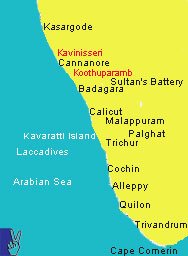 A meeting having then been arranged with the late rebellious Raja the Committee ascertained from him that through some intrigue or other the pardon of the Governor-General, conveyed to him through the Kurumbranad Raja, had not reached him before he begun to make collections on his own account. Moreover plundered property, which had been committed to the same Raja for restoration to him, had never been received. It was only on receipt direct from the Northern Superintendent of a copy of the Supreme Government’s orders in his case that he came to understand how it had been settled, and it so happened that the Malayalam translations of those orders construed the expression1 “his restoration to his district and property” in the largest sense, viz., that his country and property should be given back to him.
NOTEs: 1. Conf. Treaties, etc., ii. CXXII. END OF NOTEs
The Committee were not quite satisfied that the adoption of the superseded Raja into the real Kurumbranad family operated as a forfeiture of all his rights in the family of his birth, namely, Kottayam and they therefore could not attach much importance to that point, which was also pressed on their notice by the Palassi (Pyehy) Raja. But therein they were doubtless wrong.
The Palassi (Pyehy) Raja was granted2 a pension of Rs. 8,000 per annum and the plunder of his Palassi house was made good to him. He was further granted a pardon “for all that had been done towards the Company.”
NOTEs: 2. Treaties, etc., CL., CLI, CLII. END OF NOTEs
A pardon was likewise extended to the Narangoli Nambiar of Iruvalinad who as already related, had, after the slaying of three Mappillas, fled to the Palassi (Pychy) Raja for protection. The Committee of Government, on reviewing the papers connected with his case, had come to the conclusion that the sequestration of his lands and property was not justified by the regulations. So his outlawry was reversed and the Nambiar was restored3 to his possessions.
NOTEs: 3. Treaties, etc., ii. CLIII. END OF NOTEs
In regard to other measures, the Committee of Government strengthened the Commission on 15th September 1797 by adding to the Board the Officer commanding the Province. The militia was next disbanded and two sibandi corps of Nayars and Mappillas were organised, the Nayars being stationed in the southern and the Mappillas in the northern division to secure the peace of the country.
Affairs in Chirakkal next claimed attention. The Raja died and the Government recognised the succession of Ravi Varma, the eldest of the two princes in Travancore. His nomination to the raj was opposed by the Kavinisseri branch of the family supported by the senior or Kolattiri Raja. To ensure peace and harmony in the family the Linguist, M. A. Rodrigues, and the influential Mappilla merchant Chovakkaran Makki, were deputed to Chirakkal. They succeeded in establishing peace. Ravi Varma was confirmed in the raj and Colonel Dow was placed in judicial and magisterial charge of this district in addition to Kottayam.
The Ernad district having been relinquished by the Zamorin, an European assistant was appointed to take charge of it and another assistant was sent to administer Parappanad.
Mr. Rivett was succeeded by Mr. Spencer as President of the Commission, while Messrs. Smee and Torrins were appointed in the room of Colonel Dow and Mr. Handley. The posts of native dewans were abolished, and it was resolved to make a radical change in the administration by the appointment of covenanted servants as revenue assistants, to be employed throughout the district, on which account the existing regulations were modified.
Separate decennial leases1 were for the first time entered into with the Kurangot Nayar and the chief landholder under him, the Payapurat Nayar, for the district known as Koringot Kallai.
NOTEs: 1. Treaties, etc., ii. CLIV, CLV. END OF NOTEs
The notorious Mappilla bandit chief, Unni Mutta Muppan, was pardoned and restored to his estate of Elampuinsseri, while Attan Gurikkal, a relation of his and no less noted for turbulence of character, was appointed from motives of policy as head of a police establishment in Ernad.
The forts of Cannanore, Tellicherry and Palghat were now either improved or repaired. The minor matters which engaged the attention of the Committee of Government were -
The abolition of the expensive mail boat service and the establishment of a post via Cochin and the Travancore gate on the Tinnevelly frontier to Tuticorin.
The regulation of ferries.
The freedom of trade to the Laccadive islanders.
The abolition of all frontier duties on horned cattle, provisions, etc., imported from Tippu’s territories.
The introduction of a tax on all spirituous liquors, which were to be farmed out as well as the trade in tobacco.
The repair of the gun roads made by Tippu.
And the tracing of a road from Palghat to Palani and Dindigul in order to avoid the adjacent territories of Tippu.
Their attention was also directed to the cultivation of special products such as cinnamon, coffee, pepper, nutmeg, spices, sugarcane, cotton, etc., Mr. M. Brown was accordingly appointed2 Overseer of the Company’s plantation opened out at Anjarakandi in the waste lands of Randattara on a salary of Rs. 800 per month. The Vettatnad escheats were surveyed by Captain Moncrief, who as well as Colonel Sartorius surveyed the rivers of the country and Lieutenant Monier Williams drew the first map of Malabar under Captain Monerief’s supervision. Just at the close of the labours of the Committee of Government some treasonable correspondence- said to have been carried on by Tippu with the Palassi (Pychy) Raja, with the Padinyaru Kovilakam Rajas of the Zamorin’s house, with Unni Mutta Muppan-was discovered, but the
Committee having no reliable information to go upon, deeded to overlook the matter.
In the very begining of 1798, after a stay of over eight months in the province, the Governor and the Commander-in-Chief returned to the Presidency.
In pursuance of the arrangement for the better administration of the country, European assistants were located in all the districts under the Superintendents, and Mr. Smee was entrusted1 with the very important duty of revising the assessment of the Province by an inspection of the estate of each ryot.
NOTEs: 1. Treaties, etc., ii. CLXXXl. END OF NOTEs
In order to prevent confusion in the regular payment of revenue by the six Nambiars of Iruvalinad, the Commissioners, with the consent of these chieftains, next annulled,2 the quinquennial lease and entered into separate engagements3 with each of them for the unexpired portion of two years remaining under the lease. The revised leases followed the precise lines of those already issued to the other chiefs of Malabar.
NOTEs: 2. Treaties, etc. ii. XCIII, CLX,
3. Treaties, etc., ii, CLXI to CLXVI. END OF NOTEs
As their earnest entreaty, agreements were in February-March 1798 for the first time also entered into with the Kuttali, Avinyat and Paleri Nayars of Payyormala for the remaining term of the quinquennial lease period by the Kurumbranad Raja.
The district of Kurumbala, which lay above the ghats in Wynad and which formerly formed part of Payyormala, was not included in the Kuttali and Avinyat Nayars' agreements as to the Honourable Company's right to the territory was, like that to the rest of Wynad, considered to be doubtful, but the collections of this small district were to be made4 by the Nayars and paid into the northern treasury.
NOTEs: 4. Treaties, etc., ii, CLXIX. END OF NOTEs
In April some disturbances were created in Chirakkal by a prince of the Chenga Kovilakam of the Kolattiri family, a nephew of the late Raja. He claimed the raj. Colonel Dow went with a force to restore5 quiet. The rebellious Raja attempted in the following month of May to take the Puttur Temple by storm, but was slain in the attempt by the ruling Raja's Nayars who defended it.
NOTEs: 5. Treaties, etc., CLXXV; CLXXIX, CLXXX. END OF NOTEs
Kottayam affairs once more claimed attention. The senior managing Raja was found to be falling into arrears with his collections, although assisted by British officers. It became apparent that he had not sufficient personal influence or energy to keep things in order, so he was pensioned and permitted to retire to Travancore. The district was then placed under the direct management of the Honourable Company's officers.
The Commissioners' attention was next taken up by the affairs of Palghat. The Achchan in April took the law into his own hands, in spite of the terms of his engagements, by "putting to death Ullateel Veetul Canden Nayar and taking out the eyes of Parameshuaracooty Brahman”.
Having thus committed himself, he escaped on 7th July from his house in Kalpetti in Palghat town as soon as it was known that the Commissioners intended to bring him to trail for these offenses. A proclamation1 offering Rs. 5000 was issued for his apprehension. The upshot was that he surrendered himself to Major Romney at Palghat and was imprisoned in the Tellicherry fort, where he soon after died.
NOTEs: 1. Treaties, etc., ii. CLXXVII, CLXXVIII. END OF NOTEs
In sending orders to the Commissioners to assume the direct revenue management of the Palghat district the Bombay Government wrote approving of this measure, which had been suggested by the Commissioners, and observing further:-
“There exists no anterior general engagement whatever between the Company and the Palghat family, who appeared to have availed themselves of the victories of our army during the last Mysore war to reassume possession without any formal sanction on the part of the English, in which situation are several of the southern chieftains, who have heretofore no sort of claim upon us more than may result from their own good and unexceptionable behaviour, a distinction more than once pointed out for your guidance by this Government.”
In September of this same year final orders were at last received in regard to Tippu’s claims to Wynad. The Governor-General, Lord Mornington, after full consideration of the matter, came2 to the conclusion that “Wynad was not ceded to the Company by the late Treaty of Peace, and that it belongs by right to his said Highness the Nawaub Tippu Sultan Bahadur,” who was to be permitted “consequently to occupy the said district whenever it may suit his pleasure.”
NOTEs: 2. Treaties, etc., ii. CLXXXII. END OF NOTEs
But the Company’s claim to the passes leading up to Wynad were not to be affected in any way by this waiver of right to the district itself.
Nearly all the Rajas were backward in the regular discharge of their kists and were obliged to procure the suretyship of Mappilla merchants for the payment of arrears. Although members of this sect living in the coast towns were active traders and well-behaved, in the interior their fellow religionists were incessantly engaged in marauding expeditions.3
NOTEs: 3. Treaties, etc., ii, CLXXXVIII. END OF NOTEs
Mannarakad, Tamarasseri, Pulavayi, Vettattnad, Cheranad and Ernad especially suffered from these banditti. The mistaken notions prevalent in regard to ownership in the land appear to have been to a large extent at the bottom of these disturbances, which assumed the aspect of faction fights for supremacy between Hindus and Muhammadans.
The Zamorin having failed to pay his revenue regularly, the direct management of his remaining districts was again assumed4 in October 1798 by the Company, and agreements were shortly afterwards entered into with the fifth Raja and other members of the family for the payment of their allowances, provided and only so long as they should remain in good behaviour.
NOTEs: 4. Treaties, etc., ii. CLXXXIV. END OF NOTEs
Some of them were then allowed to resume their residence at the Kalladikod Kovilakam which was “situated amidst a strong intricate jungle”. Subsequent events did not, however, justify the grant of this relaxation.
Of the events of the last war with Tippu Sultan ending in the taking of his capital and in his own death, little need here to be said. The arrival in a French frigate at Mangalore, on 26th April 1798, of 99 French Civil and Military Officers, sent by the Governor of the Isle of France for service under Tippu, put the English on the alert, and made them commence preparations for war. The above event, followed by the despatch of a further embassy from Tippu to France, which was sent by way of Tranquebar, led directly to the last war with Tippu.
On 11th February 1799 General Harris began his march on Seringapatam, and on the 21st of that same month General Stuart, with the Bombay Army of 6,420 fighting men, made his first march out of Cannanore. On the 25th the top of the pass was reached and the column halted. On the 6th March, Tippu attacked General Stuart at Sedaseer and was repulsed, and on the 11th he retreated to Seringapatam to oppose General Harris. On April 14th the two armies effected a junction before Seringapatam, and on the 4th of May 1799 Seringapatam fell and Tippu was slain.
Stores were sent from Malabar via Irikkur on the Valarpattanam river to Coorg, where a commissariat magazine was established. The Raja of Coorg proved himself again to be a staunch adherent of the English. He aided them most substantially with provisions and bullocks, while at the same time he refused any remuneration, the value of the supplies afforded by him being calculated at not less than four lakhs of rupees. In appreciation of his conduct and valuable services, the Coorg tribute was cancelled, and for it was substituted,1 as a proof of fealty and devotion, an annual present to the Company of a trained elephant. The affairs of the State were taken out of the hands of the authorities in Malabar and a Resident was stationed at his Court.
NOTEs: 1. Treaties, etc., ii. CCI, CCII. END OF NOTEs
The pensioned Rajas of Kumbla and Vittul Agra or Higgada did not also fail to harass Tippu's possessions during the war and on this account the pension of the former was in 1801 increased to Rs. 400. But the latter having after the proclamation of peace plundered the Manasserum temple, he was declared a rebel and death anticipated the orders issued for his seizure.
Strangely enough the Rajas and Chiefs of Malabar, considering the turbulent and discontented disposition of many, were on their best behaviour during this period of disturbance. Several persons hitherto believed to be inimical to the Company's interests proved their loyalty and devotion, notwithstanding that rumours were afloat of the Chirakkal and Palassi (Pychy) Rajas carrying on clandestine correspondence with Tippu and aiding him with men and provision.
It is important to mention that with the exception of a detachment at Cannanore, and with the exception of the militia, Malabar was left entirely without military protection during the operations of the armies in the field. But General Stuart s brilliant victory of the 6th March, at the very opening of the campaign against Tippu’s force, was viewed at the time by the Governor-General and others as having conduced largely to the tranquillity in Malabar.
On the fall of Seringapatam, Wynad was, under the Partition Treaty1 and subsidiary treaties, ceded to the Company as part of their share on the Western Coast.
NOTEs: 1. Treaties, etc., ii. CXCIII, CXCIV, CCXXVIII, CCXLVII. END OF NOTEs
The four islands of the Laccadive group taken by Tippu from the Bibi of Cannanore were leased to Chovakkaran Mussa by Captain Munro, Collector of the newly acquired Province of Canara, although the Bibi did not fail once more to urge her claims to them.
The Payyormala Nayars having failed to pay their revenue, their district was next taken under2 the Company’s control, and on the expiration of the Chirakkal lease, the management of that district was also undertaken3 by the Company owing to irregularity in the payment of its revenue.
NOTEs: 2. Treaties, etc., ii, CXCVII.
3. Treaties, etc., ii, CCIII. END OF NOTEs
Writing to the Madras Government on 14th August 1800, the Commissioners reported as follows : —
“From a general failure in the fulfilment of their engagements by the Rajas, Government assumed the collection of the revenue at sundry periods before the expiration of the settlements in September 1799. Since which period, except4 in the instances of Kadattand, Kurangoth-Kallayi and Cannanore in the northern, Kavalappara and the three petty Nayar districts of Mannur, Kougad and Eddatara in the southern division, and the island of Chetwai held by the Cochin Raja on a decennial lease commencing 970, the collection of the revenues has proceeded under the sole control of the officers of Government, an arrangement from which the best effects have been produced.”
NOTEs: 4. By 18th June 1802 this number had still further diminished, and on that date the Principal Collector reported as follows to the Board of Revenue :—“ Except the two Nayars of Kallayi" (i.e., Kurangoth -Kallayi in the text), “who have a Cowl (Treaties, etc., ii. CLIV, CLV) giving them the collections for ten years ending 1807, no other person in the province that participates in the one-fifth share of the revenue has the charge of management." END OF NOTEs
The only lease renewed5 was that of the Kadattanad Raja, and that for periods of one year only. He had been uniformly punctual in the payment of his revenue. The superseded chiefs were continued in the enjoyment of the allowance of one-fifth (in some cases) and of one-tenth (in others) of the revenue of their respective districts which had been allotted to them for their maintenance. These allowances continue to be paid to them down to the present day under the designation of Malikhana.
NOTEs: 5. Treaties, etc., ii, CCVII, CCXXIII. END OF NOTEs
The minor matters which at this time engaged the attention of the Commissioners were-
The introduction of the tobacco monopoly.
The establishment of a rule for the registration1 of all writings of the transfer of landed property, on whatever tenure held, in order to put a stop to systematic forgeries.
And the change of the postal route from Travancore to Coimbatore, one of the newly acquired districts.
NOTEs: 1. Treaties, etc., ii. CCV. END OF NOTEs
The Putiyangadi Tangal, of an influential Arab family, was in March 1799 continued in an exemption from the payment of the revenue on his property, originally granted to him by the Second Raja of Calicut in 1791 in order that by his influence he might restrain the lawless habits of his countrymen, the ringleaders of whom were Unni Mutta Muppan, Attan Gurikkal, Chemban Pokar, etc.
A formidable combination was formed by these Mappilla headmen instigated by a spirit of revenge for the punishment inflicted by the regular judicial process on some of their connexions, especially on Adam Khan, a brother-in-law of Gurikkal’s, who had executed for murder. The combination became alarming after an abortive attempt had been made by the Assistant, Mr. Baber to seize Chemban Pokar, who had escaped from the Palghat fort. Mr. Baber’s party was repulsed. This success encouraged Chemban Pokar to make a daring attempt on the life of Mr. G. Waddell the Southern Superintendent, while he was proceeding from Angadipuram to Orampuram, in which attempt Chemban Pokar was secretly abetted by Gurikkal, who had been in Company’s service since 1790 as head of police in Ernad.
While these Mappilla disturbances were occurring in the south the Amildars of the Mysore Commission went to take possession of Wynad as a portion of the Company’s cession, and it was then in contemplation to attach it either to Canara or Coimbatore. But the Palassy (Pychy) Raja had laid claim to the district and persisted in keeping possession of it. To uphold his pretentions he raised a large body of men consisting of Nayars, Mappillas, and Mussalmans, the last being portions of the disbanded troops of the late Sultan.
Orders were therefore issued by the Supreme Government to punish severely his presumptuous conduct. The control of the province was placed under the Madras Government, which appointed Colonel Arthur Wellesley3 as Commander of the forces in Malabar and Canara as well as in Mysore. It was arranged to assemble forces on both sides of Wynad and to prosecute the war with the utmost vigour. But owing to the lateness of the season and the approach of the monsoon, the first military operations were confined to strengthening the military posts in the low country of Kottayam with a view to protect the peaceably disposed inhabitants. Colonel Wellesley on April 4th, 1800, writing from Cannanore, informed the Commissioners that he had ordered two companies of the 8th to Kuttuparamba and put the other six companies under Major Walker's orders for the above purpose.
NOTEs: 3. Afterwards Duke of Wellington END OF NOTEs
At the same time other preparations were begun by the construction of military roads into the heart of the country, and of two additional posts provisioned, if possible, before the rains. In any case a large store was to be thrown into Kuttuparamba and two companies of sepoys were to be sent to guard them.
Colonel Wellesley returned to Seringapatam in the same month, but nothing of much importance occurred beyond numerous secessions to the rebel ranks in Wynad. To stop this, Colonel Wellesley recommended the Commissioners to seize the families and property of those who joined. In June and July he was employed in his pursuit of Dhondia Wahan, who had invited the Malabar Chiefs to join his standard, and later on in other operations the north.
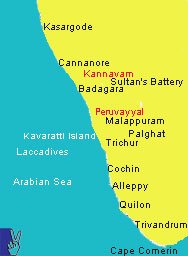 During this time the Palassy (Pychy) Raja took advantage of the opportunity, and descending the ghats at Kutttiadi, he was there joined by the notorious Mappilla bandit chief Unni Mutta Muppan and many of the chief landholders of Iruvalinad, such as the Kampuratt, Peruvayyal and Kannavatt Nambiars.
At the suggestion of Colonel Wellesley and in order to retain possession of the advanced posts of Kannavam and Manatana, Captains Ward and Moncrief dispersed the rebels from Kuttuparamba as far as Kannavam, while Major Holmes, though harassed on the march, succeeded in relieving and provisioning Manatana besieged by the rebels.
It will be convenient here, before proceeding to deal with the further military operations, to notice certain very important changes in the administration, which had a most important bearing on the events which followed.
Mr Uthoff having been sent on a separate mission to Goa and Colonel Hartley dying, Major Alexander Walker was nominated to a seat on the Commission, and pending his arrival from a tour in Travancore, Lieutenans J. Watson was provisionally appointed in his stead. In April 1800 the posts of the two Superintendents were ordered to be abolished1 and the province to be partitioned into a number of small circles2 of collection, with limited judicial powers vested in the revenue collectors, while the Cochin Commissioner was placed directly under the orders of the Malabar Board.
NOTEs. 1. Treaties, etc., ii. CCXII.
2. Treaties, etc., ii. CCX1V, CCXV. END OF NOTEs
These instructions were followed up by orders from the Supreme Government of 21st May 1800, directing that the civil administration should be transferred from the Bombay Presidency to that of Madras with effect from the 1st of July. It will be noted that for some time previously the military administration had already been in the hands of the Madras authorities, and the benefit of having undivided authority in the hands of the one presidency or the other, led to the choice3 of Madras, from its nearer vicinity to the province, as the presidency to which it, in common with Coorg and Cochin, should be transferred. The Commercial Department in the province was, however, left to the Bombay authorities.
NOTEs: 3. Treaties, etc., ii. CCXIII. END OF NOTEs
Travancore too was placed under a separate Political Officer and Colonel Macaulay was nominated to the post.
The commission of Bombay officers continued under the orders of Madras to perform their functions for some time longer. The Malabar Commissioners deputed Major Walker to the southern districts, and upon his report condemning the spirited action of Messrs. Baber and Waddell with reference to the Mappilla banditti, Chemban Pokar was pardoned on his giving security1 of good behaviour, and Gurikkal was allowed the option of either living on the coast near Calicut, or standing his trial for having caused the late troubles.
NOTEs. 1. Treaties, etc., ii. CCXVI. END OF NOTEs
For the purpose of collecting the revenue Captain Watson was next entrusted with the organisation of a new corps of armed police, consisting of 500 men, whom he trained and equipped in a fashion much resembling the present constabulary force. The Malabar militia, an irregular force and undisciplined, serving under their own native chiefs, was then (June 10th, 1801) disbanded.
Directly the rains set in (June-July 1800), the rebels had taken possession of the low country of Kottayam, and among other mischief perpetrated, they attacked and destroyed a portion of Mr. Brown's plantation at Anjarakandi, besides beleaguering the small British outposts, especially those at Kodolli and Manatana. Colonel Wellesley when he heard of this raid was busy with Dhondia's fort of Dammal. He took that by escalade on July 26th, and next day wrote to the commissioners telling them that his success against Dammal might, if published, have some influence in quieting Malabar, and that, in anticipation of trouble, he had already on July 1st directed Colonel Sartorius to bring together at Tellicherry as large a body of troops as possible to relive the threatened posts and to drive the rebels out of the western portion of Kottayam.
A gunboat was also stationed on the Anjarakandi river. The revenue collection of Kottayam were at a standstill in consequence of the troubles, and in the beginning of October, when the revenue collection ought to have been begun, a proclamation2 was under these circumstances issued, directing the people to retain their dues in their own hands until persons duly authorised were sent to receive them.
NOTEs: 2. Treaties, etc., ii. CCXIX. END OF NOTEs
Sufficient troops were not however yet available for dealing effectually with the rebels as Colonel Wellesley was still engaged in the north with his campaign against Dondia Wahan. On October 22nd he wrote advising the Commissioners to stop all communication with Wynad with a view to cut off the Palassi (Pychy) Raja's supplies. And a few weeks prior to the receipt of this letter the Commissioners had on their own accord prohibited1 the traffic, an order which however the troops at command did not enable them adequately to enforce.
NOTEs: 1. Treaties, etc., ii. CCXXIV- CCXXII. END OF NOTEs
About a month later, however (20th November 1800), the campaign against Dhondia Wahan was brought to a close with his defeat and death, and the force under Colonel Wellesley was ordered for service against the rebels, whose ranks had just been reinforced2 by Manjeri Attan Gurikkal and his banditti, who had in Ernad attempted to loot some Government property in charge of an escort of sepoys.
NOTEs: 2. Treaties, etc., ii. CCXXIV. END OF NOTEs
Colonel Wellesley, on the above date, writing from “Annagee in Mysore,” informed the Commissioners of the orders he had received to attack the Palassi (Pychy) Raja simultaneously from Mysore and the coast, and said that he was on his way to Seringapatam, followed by the army destined for the purpose, “now crossing Tumbudra.”
To Seringapatam accordingly he requested that “Yemen Nayar” should be sent with all expedition, and he wound up with a hope that he would be able to have sufficient force to attack all the rebels at once, including Gurukkal and his hand, of whose outbreak he had just heard.
This Yemen3 Nayar, for whom Colonel Wellesley wrote, was an influential Nayar of Wynad, who, at the outbreak of hostilities with Tippu Sultan in 1799, had come to the Malabar Commissioners at Calicut and professed his attachment to the British cause. His professions were believed and assurances4 of protection to himself and his adherents were granted to him. He had since that time been admitted to the confidence of the authorities in Malabar, and it was to consult him as to local matters that Colonel Wellesley now sent for him prior to forming his plan of operations against the rebels in Wynad.
NOTEs: 3. Otherwise called Pallur Eman Nayar of Muppainad.
4. Treaties, etc., ii. CXC. END OF NOTEs
It was never clearly proved, but it is almost certain, that he was all the time in secret correspondence with his suzerain lord of Palassi (Pychy), advising him of the measures to be taken against him. And his after conduct - for on 6th December 1802 - he openly espoused the rebel cause at a time when it was becoming well nigh desperate - gives great colour to the story. The time had not however yet come for him to declare- himself in his true colours, and meanwhile he proceeded to Seringapatam to help the “Iron Duke”5 to settle the details of his campaign.
NOTEs: 5. Had a suspicion of his fidelity been brought home to the mind of the “Iron Duke” one can picture what would have been his fate in that pregnant P.S. to the latter’s despatch from Dammal - “P.S.—The killidar fell into our hands, and was hanged.” END OF NOTEs
On November 30th Colonel Wellesley, then at Seringapatam, again wrote to the Commissioners requesting that one of them would come to Seringapatam for the purpose of accompanying the expedition, which, he was sorry to say, he would not be able to command in person as he had been ordered to the Carnatic ; but he commended Colonel Stevenson, the probable commander of the expedition, to the Commissioners’ notice for his zeal, intelligence and ability, and he promised to submit a plan of operations before leaving Seringapatam.
On December 5th the general plan had been matured and was communicated by Colonel Wellesley to the Commissioners. The force to be employed was –
19th Dragoons,
2nd Cavalry,
3rd do.
Five companies, 12th Foot,
The 77th Foot,
Two battalions, Coast sepoys,
Do. Bombay sepoys,
600 Pioneers,
with 14 guns with Bengal Coast and Bombay artillerymen in proportion, besides the guns with the two cavalry regiments and 4 small mortars with stores.
The plan of operations was as follows :—The military posts in Kottayam below the ghats were to be advanced as far as Peruvayyal1 (Big paddy flat) as soon as the pressure in Wynad had induced the Palassi (Pychy) Raja to withdraw his people from the low country. Communication via the Periah pass was then to be opened up with the Mysore army as soon as practicable.
NOTEs: 1. Near Kannavam in Kottayam taluk. END OF NOTEs
The 19th Dragoons and 2nd Cavalry were to proceed via Coimbatore and Palghat to overawe the Mappillas in the south.
Colonel Wellesley then rejected a plan which had been proposed “by different Nayars2 whose opinions have been taken” for a simultaneous attack from five points. And his reasons were that the five columns would really constitute five armies, the provisioning, etc., of which would lead to delays ; that the columns would not be able to act in concert with each other ; and that, even if troops could be spared from Calicut (which was doubtful), the columns would be weak, and the Raja, by bringing all his strength against one column, might destroy that before the other columns could help it, and there might be a chance of one-third or even of one-half of the army being cut off.
NOTEs: 2. Query.—-In the light of Pallur Eman Nayar’s subsequent conduct, it would be interesting to know if it was his advice to which Colonel Wellesley here alludes. END OF NOTEs
The plan which Colonel Wellesley therefore finally recommended Colonel Stevenson to adopt was : After planting a post at Karkankotta on the Mysore frontier on the north-east of Wynad, to push on with the rest of the troops via Eratorah (Editerrahcotta - east of Sultan’s Battery) to the Tamarasseri pass with a view to –
Opening communication with Calicut,
Encouraging Yemen (Eman) Nayar and his friends, whose influence was greatest in the country to the south of the great road to Tamarasseri.
And impeding communication between the Raja and the Mappillas under Gurikkal in Ernad and his other friends in South Wynad and South Malabar.
After getting possession of this line and securing it by posts, two of which were to be at Eratorah (Editerrahcotta) near the Mysore frontier, and Lacrycotta (Lakkidikotta) at the head of the Tamarasseri pass, Colonel Stevenson was recommended to push forward to the Raja’s Colgum (Kovilakam) “in as many divisions as he might think proper,” taking care not to break up his force more than was necessary, and not to send out detachments with baggage till well acquainted with the strength of the enemy.
Colonel Stevenson entered the district in January 1801, the rebels were easily dispersed, and by the month of May every post of any importance in Wynad was in the hands of the British.
Colonel Wellesley returned from his special duties in Ceylon on the 28th April, landed at Cannanore, and proceeded to Seringapatam, whence, on May 10th, he once more addressed the Commissioners, informing them of his appointment “to command the troops in Mysore, Malabar and Canara,” and of Colonel Stevenson having been appointed to command in Malabar and Canara “under my directions.”
With every post both above and below the ghats held by British troops and the whole country disarmed,1 the Palassi (Pychv) Raja became a wanderer in the jungles, and there can be no doubt that even then, if he had proposed to accept terms from the Government, he would have been accorded favourable conditions because of his former services and of the cowl given to him by the Chief of the Tellicherry factory in 1790, but he appears never to have hesitated in the course he ought to follow.
NOTEs. 1. Treaties, etc., ii. CCXXVII. END OF NOTEs
First he fled in March along the ghats into Chirakkal, to “Neddyanji by way of Payanur” (? Payavur), and the Chulali Nambiar, being suspected of aiding him, was arrested and sent under escort to Calicut. Returning to his haunts in Kottayam, the detachments of troops drove him thence into the Kadattanad and thence into the Kurumbranad jungles, the Avinyat Nayar of Payyormala and the Kadattanad Raja both being suspected of aiding him.
In the end of July Colonel Stevenson reported that “the senior Peruvayyal Nambiar” had surrendered himself to his fate, and had been sent to Kannavam to be hanged along with two others at that place and two more at Iliacoiur (Irukkur) in Chirakkal, as an awful warning to the people. The rebellion at this time was “at a very low ebb,” he stated, and the people were beginning to show some respect for the Government. If succour could be prevented from reaching the Raja from Kurumbranad and Kadattanad, his surrender might be looked for “as not very distant.” His following at this time consisted of but six people and from twenty to twenty-five “musquet people.” He had sent back two of his followers (Mappillas), who gave those particulars.
The time seemed to be opportune for granting terms to the peaceably disposed, and the Commissioners accordingly1 proclaimed on 4th August 1801 “full and unequivocal pardon” and restoration of their property to all rebels who should submit and return to allegiance, excepting, however, the Raja himself, the Kannavatt Nambiar, Chattappan Nambiar, Edachenna Kungan, Chingot Chattu, Pulliyan Shanalu, and Punattil Nambiar, and the direst penalties to all who should disobey. A period of six weeks was named within which time this offer was to remain open for acceptance.
NOTEs: 1. Treaties, etc., ii. CCXXIX. END OF NOTEs
But this measure failed to bring about the end desired ; the chief rebel, with a faithful few, still remained at large in spite of troops acting in concert both from above and below the ghats in hunting him up. But some of his principal adherents were captured, and in particular, on November 27th, 1801, Colonel Stevenson reported to Major Macleod, the Principal Collector, that a detachment under Lieutenant Edwards had succeeded in capturing the Kannavatt Nambiar, the primary instigator, as was alleged, of the rebellion, together with his son aged about twenty-four years. These rebels were forthwith marched from Kuttiyadi, where they had been caught, to Kannavam, “to be hanged on the Hill2 of Canute (Kannavam), which is near their late residence and the scene of their rebellious oppositions to the Company’s authority. Their estates were also declared to be forfeited.
NOTEs: 2. In front of the Travellers' Bungalow at this place, on the opposite side of the main road. END OF NOTEs
The mention of the name of the Principal Collector makes it necessary to pause for an instant to describe yet another change which had taken place in the administration of the province. The Government of Lord Clive was not satisfied with the system of Government established in Malabar under the auspices of the Bombay Presidency, as it had failed to establish the authority of the Government on a respectable foundation. Writing to the Commissioners on 25th December 1800, the Government observed that while the military force, being insufficient to maintain the civil authority, had been one of the main causes of the failure to establish a permanent system of government in Malabar, the Government also thought that the principles on which the civil administration was carried on were not calculated to support a permanent government, and that every branch of the internal arrangements appeared to be overcharged with expensive and unnecessary establishments.
The Government consequently called, through the Board of Revenue, for reports from the Commissioners and from the several Collectors regarding the principles and detailed system of the present administration of the revenue in Malabar.
On receipt of these reports, the Government resolved3 on 5th September 1801 to abolish the Commission for the affairs of Malabar, and to subject the Province to the control and superintendence of one Principal Collector with three subordinate Collectors, for the administration of the revenues and of the civil government.
NOTEs: 3. Treatise, etc. ii. CCXXX, followed shortly afterwards (17th October 1801) by the abolition of the Commission for the affairs of Cochin, which with its dependencies, including Chetwai Island, was transferred likewise to the Principal Collector. - (Treatise, etc. ii. CCXXXI, CCXXXII). END OF NOTEs
Major William Macleod, then Collector of Salem, was selected for the post, and Messrs. Strachey, Hodgson and Keate were appointed his subordinate Collectors in Malabar. To Major Macleod and his assistants the Government committed all power, both civil and criminal, and the military were further authorised to punish, “by summary process, crimes of every description.”
This state of things was to continue “until the military power of the Company shall have subjugated the refractory people of the Province.”
The Commission was accordingly abolished on 30th September 1801, and the first of the Principal Collectors assumed charge on 1st October.
The capture and execution of the Kannavatt Nambiar and his son, which followed shortly on this change in the administration, must have been severely felt by the rebels, and a deceitful calm appears to have spread over the country below the ghats. Taking advantage of it, Major Macleod, in January 1802, endeavoured1 to complete the disarmament of the province by getting the people to bring in the “considerable quantities of arms” which it was believed they still kept either openly in their houses or concealed. Death was the penalty threatened to all who opposed the carrying out of these orders.
NOTEs: 1. Treaties, etc., ii . CCXXXIV. END OF NOTEs
But he followed this up by other measures which led to disastrous results. The first of those was in regard to the prevailing rates of exchange. On 31st August 1802 he issued a proclamation2 fixing (on erroneous data as was afterwards proved) the exchange rates of the “twenty-three current coins now issued and received in the public treasury as they are now rated and exchanged in the province of Coimbatore.” The effect of this may be stated shortly thus. The table so promulgated lowered the value of
|
Gold fanams from |
3½ to 47/32 per rupee |
|
Silver do do |
5 to 5½ do |
Or
|
Gold fanams from |
12¼ to 1449/64 per star pagoda |
|
Silver do do |
17½ to 19¼ do |
NOTEs: 2. Treaties, etc., ii. CCXXXVI. END OF NOTEs
The revenue at this time was accounted for in star pagodas, which coins were, however, not current in the province. The revenue was mainly collected in fanams, which were the commonest current coins in the province. In the bazaars, again, where agriculturists sold their produce, the rupee was the general standard of exchange.
The rates so promulgated therefore “in fact1 raised the revenue on every individual throughout the country 20 per cent in gold fanams and 10 per cent in silver, while for their commodities in the markets ” (where the dealers had naturally enough disregarded the proclamation) "they could only got the old rates of 3½ gold and 5 silver fanams per rupee.”
NOTEs: 1. Principal Collector Rickards to Board of Rovenue, 27th April 1803, paragraph 28. END OF NOTEs:
This measure took effect from 15th September 1802, shortly after the commencement, that is, of the revenue year.
But Major Macleod's mistakes did not end here. For, coming fresh from the country east of the ghats, where the ryots had been accustomed for generations to be a down-trodden race, he seems to have mistaken altogether the character of the people with whom he had to deal. The Tara organisation of the Nayars, albeit crushed by the Mysorean supremacy, was not altogether dead, and it only needed some acts of palpable injustice to rouse the whole community into violent opposition to the new race of rulers.
Major Macleod estimated the Government share of the produce of the rice-fields at as much as 35 to 40 per cent of the gross produce. Mr. Rickards, who followed him in his office as Principal Collector, observed that 40 per cent of the produce might possibly be collected without objection on particular spots, “but if the principles be indiscriminately applied to seed lands in Malabar, I am confident that agriculture would no longer be worth pursuing. Then, again Major Macleod estimated the average produce in nuts so high as—
Per coconut tree . . . 48 nuts,
Per arecanut do. . . 200 do.
whereas Special Commissioner Mr. Graeme, who drew up the scheme on which the existing tree assessment is based, accepted as his averages —
Per coconut tree . . . . 2421/32
Per arecanut do. . . . . 15023/64
Starting with these very grave initial errors, Major Macleod endeavoured, by means of the ordinary Parbutty (Parvritty - amsam officer) establishment, to make a fresh revenue survey of the province in the short space of forty days. The time allowed for the purpose was ludicrously insufficient; the establishments employed were underpaid and notoriously corrupt when such a chance was placed within their reach. The natural results followed as a matter of course. The accounts were fabricated, actual produce was over-assessed, produce was assessed that did not exist, and assessments were imposed on the wrong men.
A rigid exaction of the revenue under these inequalities constituted therefore one grand source of complaint. And when to this was added that the ryots, when they paid into the treasuries their full assessments in fanams, were told to their astonishment that, owing to the new rates of exchange, they had not paid enough, the prevalent dissatisfaction very rapidly took shape in organised resistance to the exorbitant demands of Government.
In the early part of 1803, the province rose en masse. To allay the storm which he had roused, and which he felt himself powerless to quell, Major Macleod, after an ineffectual attempt to quiet by a proclamation the people of the south, on the 11th of March 1803 summarily resigned his charge into the hands of Mr. Rickards, the Principal Judge of the Court of Fouzdari Adalat, which had been organised1 at Mahe for the trial of criminal cases in the low-country portions of the province, and Mr. Richards very wisely, pending the orders2of the Government, issued a proclamation3 which had some effect in quieting the rising storm.
NOTEs: 1.Treaties, etc., ii. CCXXXVIII.
2. “The orders of Government confirmed Mr. Rickards’ action in taking charge of the province, and approved the terms of the proclamation mentioned in the text.- (Proclamation of 2nd April 1803).
3. Treaties, etc., ii. CCXL.
He declared his intention to adhere to the demand as fixed by the previously existing revenue survey, and to accept in payment of the demand all the current coins at the previously existing exchange rates.
The dissatisfaction, however, had been gathering head for some months previously, and in spite of the hold which the large body of troops quartered throughout the country had upon it, the insurrection already smouldering very speedily spread. The first overt act occurred at Panamaram (otherwise called Panamarattakotta, or Panamurtha Cotta, or still shorter Panorta Cota, literally the “palmyra tree fort”) in Wynad.
Some five days previous to 11th October 1802, one of the proscribed rebel leaders, Edachenna Kungan, chanced to be present at the house of a Kurchiyan, when a belted peon came up and demanded some paddy from the Kurchiyan. Edachenna Kungan replied by killing the peon, and the Kurchiyars (a jungle tribe) in that neighbourhood, considering themselves thus compromised with the authorities, joined Edachenna Kungan under the leadership of one Talakal Chandu. This band, numbering about 150, joined by Edachenna Kungan and his two brothers, then laid their plans for attacking the military post at Panamaram, held by a detachment of 70 men of the 1st battalion of the 4th Bombay Infantry under Captain Dickenson and Lieutenant Maxwell.
“They first4 seized the sentry’s musket and killed him with arrows. Captain Dickenson killed and wounded with his pistols, bayonet and sword, 15 of the Kurchiyars, 5 of whom are dead and 10 wounded.” The whole of the detachment was massacred, and the rebels obtained 112 muskets, 6 boxes of ammunition and Rs. 6,000. All the buildings at the post were destroyed.
NOTEs: 4. Account received about three weeks later from two spies sent to ascertain the facts. END OF NOTEs
The headquarters and about 360 men of the battalion which had suffered this loss were at the time in cantonment at another fortified place called Poolinjall, a few miles to the west of Panamaram, on the lower slopes of the Balasur mountain peak. But Major Drummond, in command, made no effort to retrieve the disaster ; in fact, as Colonel Wellesley scornfully wrote of him on 3rd November, he remained a kyde1 in his own fort until released by a reinforcement of 5002 men which was despatched to the affected district.
NOTEs: 1. Keidi (Mal.) = Qaidi (Arab.) = prisoner.
2. 300 sepoys from Calicut, 200 Watson's police. END OF NOTEs
This supineness of the military on the spot had its natural effect in rousing the country. And Edachenna Kungan, the hero of the exploit, caused orders to be issued from Pulpalli Pagoda calling the inhabitants to arms. About 3,000 men3 assembled, of whom 500 immediately separated and the rest took post at Vallur Kava, the well known Fish Pagoda close to Manantoddy, at “Motimjarra” on the Karkankotta road, and at Eddapaddy.
NOTEs: 3. Colonel (now Major-General) Wellesley, in a letter of 27th December 1802, puts the number at 5,000, but the number given in the text is in accordance with local information obtained at the time. END OF NOTEs
One of Edachenna Kungan’s brothers with 100 men stationed themselves at the “Pynch” (? Periah) pass and parts adjacent. The Kottiyur pass (Smugglers’ pass) was blocked with trees and 25 men were set to guard it. And various other posts were occupied, extending from Dindimal to the Fish Pagoda. Some of the rebels were armed with matchlocks and muskets, and the rest with bows and arrows, Nayar knives and swords. The southern portion of the taluk had not up to the beginning of November joined the rebels, but the Kuppatode Nayar and two others had done so.
Edachenna Kungan had stationed himself on the route from Mysore to Manantoddy via Karkankotta, and of the detachments which were hurried up both from the coast and from Mysore, that4 coming via Karkankotta experienced the greatest opposition. It was on October 27th met “at Sungaloo on the Bhawully Nullah” by a body of Nayars in a stockaded position which was passed on both flanks. But from there all the way to Manantoddy through a thickly wooded country, it experienced opposition next day with, however, trifling loss.5
NOTEs: 4. First battalion 8th Regiment M.N.I., a party of pioneers, and 200 Mysore horses under Captain Gurnell. - (Wilson’s Hist. Madras Army, Vol. III, pp. 5, 56.)
5. Mysore cavalry killed and 17 horses wounded. The cavalry was found to be of no use in such a jungly country, and was sent back. - (Ibid.) END OF NOTEs
The regiment kept open the communication between the Bhawully river and Manantoddy, but the enemy still hung about the neighbourhood, and about 12th November one of its detachments had a smart skirmish with the enemy, resulting in 9 killed and 18 wounded, at a swamp between these two places. The enemy held an impassable nullah on the road, but a reinforcement arriving from Sungaloo in time, taking the rebel position in rear, discomfited the enemy, of whom many were put to death in the road.
The troops on this occasion were considered by Colonel Wellesley to have “behaved remarkably well”.
Besides the already mentioned reinforcement sent to Major Drummond, other troops were despatched by Colonel Bells from the cantonment at Kuttuparamba to strengthen Manantoddy, Periah and Lakkidikotta, and Colonel Lawrence ascended the ghats with his battalion and pushed on to Manantoddy.
Major Howden, with five companies of sepoys and one of Europeans, likewise marched up the Kuttiyadi pass to act in concert with Colonel Lawrence.
The troops now marched about the country, but could nowhere find the enemy, and on November 5th Colonel Wellesley wrote to Major Macleod that he himself should ascend the ghats, to help the troops and persuade the people to settle down, and on the following day the Government sent him specific orders to the same effect.
Meanwhile the rush of troops into Wynad produced outward tranquillity there, but the growing discontent with Major Macleod’s administration was beginning by December 1802 to make itself felt in the low country. On the 6th of that month the quondam friend and adviser of Colonel Wellesley - Pallur Eman Nayar—finally threw off his disguise and openly joined the party in rebellion, and on the 10th of the month news was reported from Manattana that a baggage and provision escort had been attacked between Kottiyur and the foot of the Smugglers' Pass—in the low country, that is to say.
On December 16th Major Macleod reported from Manantoddy that the number of troops employed was insufficient, that the people would not return to their homes, and it may be noticed in passing that only a day or two previously it had been reported to him that the people of the low country would give no information of the rebel movements. Finally, on 7th January 1803, the rebels had openly taken the field in Kurumbranad, and the people of Payyormala were openly sympathising with them.
In the next two months Major Macleod’s ill-advised innovations had set the whole of the province in a ferment, and his summary resignation of his office in favour of Mr. Rickards, already described, did no more than partially remedy it. In April Edachenna Kungan—"that determined and incorrigible rebel’’ came down from Wynad to assist the Kottayam marauders in an attack on the Palassi post, but they were “discomfited with considerable loss”.
In June the rebellion had extended to Chirakkal, and the armed bands were becoming so bold that they burnt a house within two miles of the Kuttuparamba cantonment. In August the rebel emissaries were in Randattara. In September they were strong enough to risk an engagement between Katirur and Anjarakandi in Kottayam. In November the Chirakkal detachments having been withdrawn to help those in Kottayam, the rebels next concentrated in Chirakkal.
On December 7th parties of the rebels were busy committing depredations at Cannanore, Makreri, Anjarakandi (Mr. Brown’s spice gardens) and at Kodoli, and on December 20th some of them came even as far as Darmapattanam island close to Tellicherry, and did much damage to the property of the peaceably inclined inhabitants.
After this time matters began slowly to improve, for Mr. Rickards, by timely concessions1 to the influential people of South Malabar in the matter of a fair settlement of the revenue, had in March, and again on 20th June 1803, prevented to a great extent the insurrectionary movement from spreading to South Malabar. And the inhabitants of Randattara had likewise in April been quieted by the judicious selection of Mr. Murdoch Brown, of the Anjarakandi spice plantation, to conduct a fresh and moderate revenue2 settlement of that district.
NOTEs: 1. Treaties, etc., ii. CCXL, CCXLII, CCXLIII, and see Appendix XlV.
2. Treaties, etc., ii. CCXLI. END OF NOTEs
The rebels knew that if the people were made contented their cause was lost, and hence the repeated outrages to which this latter district was subjected in the latter part of the year. But the daring exploits of the rebels in venturing close up to, and committing outrages in the immediate vicinity of, the European settlements on the coast necessitated the withdrawal of troops from the inland parts. Although, therefore, the force3 stationed in the province was large. Colonel Montresor, the officer in command, had to apply in December 1803 for a reinforcement of 5,000 men. The Madras Government was unable to comply with this requisition.
NOTEs: 3. In May 1803—8,147 men, including 3 European regiments. On October 1804— 5,819 men, including 2 European regiments.—(Wilson’s Hist. Madras Army, Vol. Ill, p. 146.) END OF NOTEs
An important change was, however, shortly afterwards made. Service in Malabar, and more especially in the fever-stricken district of Wynad, was very unpopular with the Bombay troops, who were far from their homes and families, and provision for their regular periodical relief, owing to the distance, was also very difficult. Hence the battalions became4 weak and inefficient, and Major-General Wellesley, writing on February 14th, 1804, considered that their relief was “absolutely necessary, both to preserve the peace in Malabar, and to secure the existence of the Bombay army as a respectable body”.
NOTEs: 4. Wilson’s Hist. Madras Army, Vol. Ill, p. 147. END OF NOTEs
In the course of 1804 Madras troops were therefore gradually sent to relieve them, and by the end of that year “a respectable5 body of Madras troops was assembled in Malabar under Lieutenant-Colonel A. Macleod”.
NOTEs: 5. Ibid—The Force consisted of—
A detachment of artillery.
First battalion 7th Regiment.
Second do. 6th do.
First do. do.
" do. 13th do.
" do. 14th do.
" do. do.
" do. Pioneers, besides His Majesty’s 30th Foot, and the
Second do. 1st Regiment. END OF NOTEs
Moreover, in addition to the regular troops, Captain Watson had by this time thoroughly organised his famous “Kolkars” or police, a body of 1,200 men, who rendered most conspicuous services in dealing with the small parties of rebels who infested the low country and laid waste the property of all peaceably disposed persons.
Mr. Thomas Warden had in the early part of 1804 become Principal Collector in succession to Mr. Rickards, and Mr. Warden’s Sub-Collector in charge of North Malabar was Mr. Thomas Harvey Baber, an officer of exceptional energy, to whose personal efforts the final suppression of the rebellion was largely due.
In February 1804 Mr. Baber was busily engaged with the Kolkars in suppressing an extensive rising in the eastern and jungly portion of Chirakkal under the Kalliyad Nambiar and the Palassi (Pychy) Raja’s followers. He found that the Mappillas of Irukkur, Kallayi and Venkat were supplying the rebels with ammunition in exchange for pepper. The rebels were dispersed by the Kolkars, supported by the regular troops under Colonel Montresor.
On April 5th Mr. Baber reported that he had begun a new policy, namely, to hold the people residing in any locality responsible whenever possible, for giving information about, and for withholding succours from, the rebels, And the good effects of this had been proved by sundry rebels having been taken or killed by the people, who had also given up a lot of arms. By June 20th Mr. Baber had succeeded by his personal efforts in dissolving the rebel confederation in Chirakkal ; he restored confidence in the most rebellious tracts, and undermined the influence of the rebel leaders by representing them in the worst light as the enemies of society. He further effected a more complete disarmament of the tract and collected 2,715 muskets, 543 Nayar knives and 1,862 swords besides other articles.
The effect of this energetic action was to circumscribe the disturbed area, and to enable the troops to hold it more in subjection.
Following up the line of policy already adopted in Chirakkal, he next turned his attention to Kottayam, in which, on July 8th, he issued1 a proclamation prohibiting the sale in the bazaars to strangers, without formal sanction, of more than one silver fanam’s worth (about 3 annas 2 pies) of rice and of other articles in proportion. The carrying of articles by any other than the public roads was forbidden to everyone ‘‘on pain of being apprehended and punished as rebels”.
NOTEs: 1: Treaties, etc., ii. CCL. END OF NOTEs
The effect of this, coupled with the vigilance of the Kolkars, was to drive the rebels from the low country into the woods and fastnesses of Wynad, and on 30th January 1804 Colonel Macleod, in command of a portion2 of the Madras force recently imported into the province, proceeded in company with the Principal Collector Mr. Warden, into Wynad, publishing at the same time a proclamation offering - to all but four rebels - a free pardon to all who returned to their homes and peaceably settled down.
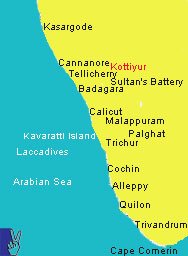 The troops marched by way of the Kottiyur (Smugglers’) Pass to Panamaram, where and also at “Velland”, “Koiladdy” and “Kunyote”, fortified posts were constructed. The troops marched into every part of the district and dispersed the rebels, who were put to the greatest straits for the necessary means to prosecute the war.
By the end of April all appearance of opposition had died away, and on May 24th Colonel Macleod issued a further proclamation1 warning those who had previously accepted2 the terms offered that they would be treated as rebels’ if they failed (of which there was already some indication) to give information of rebel movements, and if they furnished the rebel parties with arms, ammunition or provisions. This was, in effect, introducing into Wynad the policy which Mr. Baber had already, with such excellent results, employed in quieting the low country.
NOTEs: Treaties, etc., ii, CCLV
2. The bulk of the inhabitants had accepted the terms. END OF NOTEs
Mr. Warden returned to Calicut and Colonel Macleod to Cannanore in May for the rains, leaving 2,1523 non-commissioned rank and file and Captain Watson with 800 of his Kolkars in the district, all under the orders of Lieutenant-Colonel Innes of the 2nd battalion 1st Regiment.
NOTEs: 3. Distributed amongst eleven posts as follows: 2nd battalion 1st Regiment, 1,000, Pammaram, Koiladdy and Kamyote; 1st battalion 12th Regiment, 308, Matelette, Pullingal, Manantoddy, Lackery; and a havildar's guard (to be relived every third day from Manantoddy) at Sungaloo on the Mysore frontier. - (Wilson's History Madras Army, Vol III, p. 148, foot-note.) END OF NOTEs
In addition to these measures, Colonel Macleod finally on 16th June issued a further proclamation1 offering rewards for the apprehension of twelve persons whose “estates and property” were further “confiscated from this date.” The following is a list of the proscribed rebels and of the rewards offered for their seizure :
|
|
PAGODAS |
|
1.Kerala Varma, Palassi (Pychy) Raja |
3.000 |
|
2.Vira Varma Raja of the same family |
1.000 |
|
3.Ravi Varma Raja of the same family |
1,000 |
|
4. Pallur Eman (Colonel Wellesley’s friend) |
1,000 |
|
5.Pallur Rayrappan (No. 4’s elder brother) |
300 |
|
6. Edachenna Kungan (the hero of the Panamaram massacre) |
1,000 |
|
7. Edachenna Otenan |
300 |
|
8. Edachenna Komappan |
300 |
|
9. Edachenna Ammu |
300 |
|
10. Karverryallay Kannan |
300 |
|
11. Yogimulla Machan |
300 |
|
12. Itty Combetta Kelappan Nambiar |
833 |
Directly the Principal Collector and Colonel Macleod quitted Wynad, the rebels, who had held a conference as to their plan of operations, attacked but were beaten off, not, however, without considerable loss,1 from the post of “Churikunjee”, as it is called in the records.
NOTEs: 1. Subbadar and 7 sepoys killed, 17 sepoys wounded. END OF NOTEs
The attack was made by Kurumbars, described as a desperate race of men, who were just beginning to waver in their attachment to the Palassi (Pychy) Raja, and whom the rebel leaders wished by some outrage to commit entirely to the Raja’s side.
On June 11th Mr. Baber reported (with much satisfaction at the good results of his policy) the arrest of three rebel leaders and eight of their followers, by the Kolkars and people of Chirakkal acting in concert. This was followed up very shortly by other similar arrests. And the Palassi (Pychy) Raja himself narrowly escaped on 6th September from falling into the hands of a party of Kolkars despatched from below the ghats by Mr. Warden on receiving authentic information of the Raja having encamped in a pass leading from South Wynad into South Malabar.
The Kolkaras marched all night through the ghats amid rain and leeches, and at 7 a.m. completely surprised the rebel party. They had got within sixty yards of the thatched shed where the Raja was when a Kurumban on guard discovered them, discharged his arrow and gave the alarm. The Raja and others hurried out of the shed and received the fire of the detachment, by which, owing to the quantity of blood afterwards found, it was believed that Pallur Rayrappan had been mortally2 wounded. The Kolkars had a hollow and a difficult piece of jungle to pass through before reaching the shed, and the delay in passing these obstacles favoured the escape of the rebels.
NOTEs: 2. This was afterwards found to be a mistake. END OF NOTEs
Moreover, another detachment of Kolkars, ordered to co-operate with them from the Wynad side, received their orders some hours too late, and were not in the position allotted to them for intercepting the fugitives. Two of the Raja’s attendants were taken ; and 15 good muskets, 4 swords and a large heap of wearing apparel, besides about 500 pagodas worth of gold and silver valuables were captured by the Kolkar party.
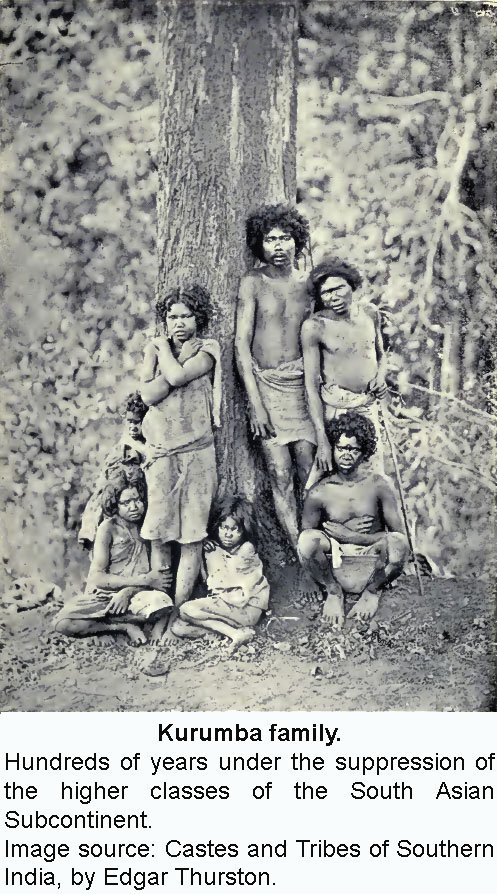 But “terrible weather” and “want of cover” had played havoc with the health of the troops and Kolkars stationed in Wynad during the monsoon. Lack of provisions and medical aid had also something to do with it. Out of 1,500 Kolkars who had been in Wynad only five weeks before, only 170 were on the roll for duty on October 18th, - so reported Sub-Collector Pearson, in charge of Wynad, to Mr. Warden on that date. The rebels were consequently again assembling at the Pulpalli temple, and a considerable number of Kurichiyars and Kurumbars, headed by the Raja, and Edachenna Kungan were assembled in the country stretching from Kurchiat by Pakam to Pulpalli.
Mr. Pearson was incapacitated by a fifth attack of fever, and Mr. Baber was consequently asked be exchange duties with him for the present or until further orders.
On November 1st Mr. Baber reported having taken charge of Wynad. He had really joined some days previously, but he had been busy in the interval counteracting a movement of the rebel leaders and their Kurichiyar followers to get the country people who had made their submission, again embroiled. They had required them “to again rise and follow up the injunctions contained in the Niyogyam or address from the Murikan mar or tutelar deities of Wynad.”
The troops and Kolkars had been constantly on the move in consequence, and two encounters had taken place, with a few casualties on both sides. But an important event had happened, for the “notorious Talakal Chandu,” who, under Edachenna Kungan, had led the attack on the Panamaram post on 11th October 1802, was taken prisoner in one of these affairs. His musket had missed fire, and he was seized, but not before he had with his knife wounded one of the cutcherry people.
The next and most important event, of all which virtually terminated the rebellion in Wynad on 30th November 1805, must be told in Mr, Baber’s own words : —
“To the Chief Secretary to Government,
“Fort St. George.
“Sir,—It is with infinite satisfaction that I report to you, for the information of the Right Honourable the Governor in Council, that this forenoon, after having been out 15 hours, I had the good fortune to come up with the Cotiote Kerula Werma Rajah alias the Pyche (Palassi) Rajah and with the assistance of Captain Clapham and 50 sepoys1 and 100 Kolkars, to chastise this rebel chieftain, by destroying him and five of his followers, one of whom was the notorious and proscribed rebel leader of Cotiote (Kottayam), Aralet Cooty Nambiar.
NOTEs: 1. Of the 1st battalion of the 4th Regiment. END OF NOTEs
“A separate party of Kolkars, whom I despatched with the Sheristadar for the purpose of co-operating with me and intercepting any fugitives, were also successful in having captured three elephants, the property of the Pyche (Palassi) Rajah.
“I trust that this notification of an event of such importance to the future prosperity of Malabar and Wynad, will not be the less acceptable to Government, because not conveyed through the proscribed channel of communication. (Signed) T. H. Baber,
“Camp at PULPELLY” Sub-Collector, Northern Divn Malabar.
“30th November 1805.”
“To the Principal Collector,
“Malabar Province.
“SIR,— A severe sickness has till now prevented me from making to you my official report of the fall of the Rebel Chieftain Cotiote Kerula Werma Rajah alias the Pyche Rajah (Palassi Rajah). I have now the honour of doing this, as well as of detailing some few circumstances, to enable you to judge by what means so fortunate and important an event has been accomplished.
“My letter to you of the 1st November last, though written at the commencement of my career in Wynad, would have raised your hopes to expect further success. The seizure of Tallakal Chundoo (Talakal Chandu), though a Courchan (Kurchiyan) was an event which excited the greatest consternation amongst those in rebellion, for such was the consequence of this person that Yadachana Coongan (Edachenna Kungan) is said to have declared (figuratively), that he had lost his right arm. Your injunctions on this occasion were received, and accordingly in the course of a few days the orders were out for a general movement and alteration in the disposition of our military force in Wynad.
“Having obtained this so essential point, I deemed it advisable during the interval that must unavoidably elapse before those arrangements could be carried into effect, to make a tour of the district, that I might be the better enabled to form some certain judgment of the real disposition of the community, and how far I could rely upon them for that co-operation which as liege subjects it was their duty to have afforded me. Throughout the northern and western parts of the district, I found the sentiment in our favour, at the same time a considerable disinclination to afford the smallest information of the Pyche (Palassi ) Rajah or his partisans. This I attribute to the dread which the numerous examples of assassination by the rebels of those who had come forward could not fail of inspiring, which, notwithstanding all our efforts to oppose, they constantly kept alive by small and numerous roving partisans, who had spread themselves all over the country.
“In many, however, I evidently saw a strong inclination to favour the rebel leaders, in particular Yadachau Coongan (Edachenna Kungan), who, with his rebel relations wisely had taken the opportunity, while the Wynad was in exclusive possession of the Pyche (Palassi) Rajah, to connect themselves with principal families in Wynad, who thereby became interested for them, but in all classes, I observed a decided interest for the Pyche (Palassi) Rajah, towards whom the inhabitants entertained a regard and respect bordering on veneration, which not even his death can efface.
“The conduct to be observed towards the most doubtful of those characters it was not difficult to determine on. Something decisive was absolutely necessary ; there was no security while they were living on their estates, and I found no other alternative left me than that of sending out of the district such of those against whom my suspicions were strongest, a determination which, while it was calculated to cut off the rebels from deriving any further support from such able allies, also would have the effect of warning others against imitating their example.
“Having fully conveyed to the inhabitants of the northern and western divisions a full idea of the line of conduct I intended to adopt towards them, I proceeded to fill up all the vacant revenue appointments in order to give due effect to my measures. Written instructions were drawn out for the conduct of these native servants, throughout which I enjoyed the most conciliatory conduct, and having concluded my arrangements I proceeded to the Southern Hobelies of Parakameetil (Parakkumital = South-East Wynad).
“In this division of the country, affairs were a different aspect. Here was no security to be placed in the inhabitants, the most wealthy and numerous of whom were the Chetties and Goundas,—a vile servile race of mortals, who are strangers to every honest sentiment, and whom nothing but one uniform system of severity ever will prevent from the commission of every species of deceit and treachery. Although the whole of these had presented themselves at the cutcherry, they had done so from no other impulse than a dread of the consequences of absenting themselves, neither did they thereby throw off their connections with the rebels, for it is notorious that the whole rebel confederacy, with the exception of Coongan’s (Kungan) party, were in Parakametal (Parakkumital) and were being supported and secreted by these very Chetties, after they had received cowle.
“I am fully persuaded also from what transpired in the course of my investigation, that the majority of these Chetties did not present themselves to the cutcherry until they had previously obtained the permission of the Pyche (Palassi) Rajah and Palora Jamen (Pallur Eman), a conduct that will be easily accounted for when it is recollected that the Rajah’s whole reliance for subsistence and information rested in these people.
The Soodra (Sudra) or Nair (Nayar) part, of the community were more to be depended upon ; there was an honest frankness about them which you could not but admire, and which is a surety that in proportion to our increasing influence, these people will prove themselves worthy of the confidence of Government.
“The Kooramars (Kurumbar), a numerous race of bowmen, by far the most rude of all the Wynadians, had to a man deserted their habitations and estates and betaken themselves to the strongest parts of the country, where they had removed their families and were dragging on a miserable existence, labouring under the dreadful impression that it was the intention of our Government to extirpate their whole race. As those people were exclusively under the influence of Palora Jamon (Pallur Eman), it is not difficult to explain whence this unfortunate notion originated ; it is only those who have had a personal opportunity of knowing the extensive abilities and artifices of this man who can justly calculate upon the mischief and dire consequence that must ensue where such qualifications are employed against us.
“This was unfortunately instanced in the Kooramars (Kurumbar), who, from the time of Palora Jamen’s (Pallur Eman’s) defection, had become in a manner desperate; they had been the foremost amongst the rebel ranks, and there is no crime, no species of cruelty and outrage, which they have not committed.
“After this unfavourable description of the southern inhabitants of Wynad, you will judge what were the difficulties to be overcome. I saw that the utmost firmness and vigilance was requisite, at the same time that I deemed the most open and public disclosure of my purposes was more likely to keep in awe those who were wearing the appearance of fidelity as well as to counteract the designs of our open enemies.
“To the Chetties in particular I explained that there were no means I would leave untried to discover their real sentiments, and warned them against giving me the smallest shadow to suspect they were continuing in the rebel interest. For this purpose I employed emissaries in a variety of characters. I made frequent marches by day and night, to the most unfrequented parts of the country, and by degrees obtained such a knowledge of the inhabitants that, fearful lest their shallow artifices would sooner or later be known, they began evidently to alter their conduct and on some instances they came forward with information.
“The rebels saw this change that was being effected, and suspecting a continuance in Parakameetil (Parakkumital) would expose them to danger, they by degrees emigrated1 towards the eastern extremities of Wynad, and one march I made after the Rajah while residing at Cooreheat (Kurchiyat) and which would have succeeded but for the treachery of my guide, a Chetty, drove them entirely out of the southern division.
NOTEs: 1. The Principal Collector was also, as already rotated, in receipt of authentic intelligence from below the ghats, and the narrow escape the Palassi Raja then had must also have acted us inducement to move eastward. Pearson before Baber’s arrival also reported the Palassi Raja as being about Pulpally. END OF NOTEs
"As the great engine of success against an enemy is depriving him of his means of subsistence, my thoughts were naturally directed to this point. As I before said, the Chetties were the media through whom these were principally drawn ; these people, to further those their views, had removed their families into Mysore in the villages of Poonat, Pootoor, Kakanabetta, etc., whither they had free egress and regress ; and from whence it was no difficult matter to draw such supplies as Wynad could not provide. They had established an intercourse by these means with the Mysoreans, whom they supplied with ghee and grains of different sorts, and in return received coconuts, oil, salt and other articles necessary for subsistence; in removing their families from Wynad they had a variety of objects, one of which was to secure them against any of those consequences which they naturally apprehended from their own dishonest and perfidious pursuits ; another was a safe asylum in the event of discovery.
“The rebels had now confined themselves to the Wynad Hobali and had entire possession of the eastern frontier, by which they were enabled to profit by this understanding between the Mysoreans and Wynad Chetties free of any molestation whatever. After this statement, it will not be extraordinary that 1 should have pursued the most effectual means to cut off the destructive commerce.
“I wrote, therefore, to the Resident at Mysore fully on the subject, and requested his co-operation to that extent as should to him appear judicious and expedient ; the result of this application was a perfect compliance with my wishes : all the inhabitants of Wynad then in Mysore were ordered to be seized and proclamation made prohibiting, under severe penalties, the passage of any articles whatever without a passport from the officers of the Honourable Company or of Mysore. Major Wilkes went further, so earnest was he in forwarding the public service, that he offered to meet me on the frontier should I deem a personal conference as promising still further advantages.
“From this time, the rebels began to experience the miseries of want, and their supporters, the Chetties, to be sensible that a perseverance in their conduct would only entail disgrace and ruin upon themselves and families. Still I found that they paid deaf ear to all our promises of protection and thundering declarations against the rebels, all of which the inhabitants considered and with great reason, as so many vauntings, for with all our means our forces, our resources, our reiterated offers of reward, we had not succeeded in apprehending any one rebel of consequence. It became, therefore, an object of the first importance to direct our views to this one subject, and which, now the rebels were confined to one part of the country, was become the more necessary, since matters were brought into that train as to afford every reasonable hope of success.
“As the rebels had entirely fled into the Wynad Hobali, I deemed it necessary to go in quest of them without loss of time ; having, therefore, made my arrangements at Ganapady Watton (Ganapativattam—Sultan’s Battery), I proceeded to Panarote Cotta (Panamaratta Kotta) and there solicited of Colonel Hill, a detachment lightly equipped to accompany me. A detachment of 200 men was in consequence held in readiness, and on the (blank) Lieutenant-Colonel Hill with 3 officers, accompanied by myself and 200 of the police, marched to Pulpally (Pulpalli).
“Nothing material happened on the road ; not a single inhabitant was to be seen, although many of them had presented themselves some months previous to the officer of Government. But it was not to be surprised at ; they were principally Chetties, conscious of the double part they were acting ; they had fled to the mountains, and many of them with their families were followers of the Rajah and his leaders.
“A few movements of our troops soon brought the inhabitants to a sense of their own interest ; they had been driven from mountain to mountain, their jungly huts were destroyed, their families were reduced to the greatest distress. They had seen with surprise that no injury was offered to their habitations or cultivations and they began now to conceive the idea that we were as ready to protect as we were powerful to punish them. I soon learned this their situation, and as they had been so situated as not to derive the smallest support from our Government, I conceived they merited our most favourable consideration as it was possible they might have been compelled to have espoused the rebel interest. I, therefore, sent them invitations to come in, by which I hoped not only to induce them to throw off all their connection with the rebels and become good subjects, but to obtain from them that information which I know they must possess of the rebel retreats.
“The invitations were accepted, and in the course of a few days most of the inhabitants within several miles of Pulpally (Pulpalli) had made their submission to me.
“From the time of my arrival at Pulpally (Pulpalli) scarcely a day passed without some movement of their sepoys or Kolkars, and the natural result was frequent skirmishes with parties of the rebels, in all of which we invariably obtained a superiority, having shot or taken several prisoners.
“Having said thus much of the plan of operations that had been adopted, I now come to those which terminated the career of the Pyche (Palassi) Chieftain.
“I before said that one of my objects by getting in the inhabitants of Pulpally (Pulpalli) was to obtain accurate information of the rebels. This I did not think prudent to commence upon too early lest they should take the alarm. I preferred trying all my persuasive means to gain their confidence and to wean them from these their connections. For this purpose, I had them constantly before me and took every opportunity of representing the folly of countenancing a body of men so truly contemptible, and who had no other end than to involve them in one common ruin. I pointed to them in the strongest colours the power and lenity of the British Government, and at last, what with exhortations and occasional presents, had succeeded in inducing several of those, who had been of most essential service to the Rajah’s party, to send their Paniars (Paniyar — agricultural labourers) out in quest of information.
“I took the precaution of swearing all whom I employed to secrecy. With many agents I could not fail of success in some one of them. On the 30th ultimo, three of them at last brought me intelligence of the Pyche (Palassi) Rajah and all the rebel leaders, with the exception of Palora Jamen (Pallur Eman) being then in the opposite side of the Kangura river, a short distance in Mysore, and this so unequivocally that I determined to act upon it. I accordingly requested of Lieutenant-Colonel Hill to assist me with 50 sepoys and an officer, with which force and about 100 Kolkars, half Captain Watson’s police, half my own locals, I marched at nine o’clock at night, and such was the secrecy in which we set off that our guides even did not know my intention until the moment we took our departure.
“Previous to this, I had deemed it expedient to make a feint to divert the attention of the rebels (who I thought it probable might have their spies in camp) by detaching 70 of my Kolkars, under the Sheristadar, under the pretext of going in pursuit of Palora Jamon (Pallur Emanl), who was reported to be in the Komanpany Mala in the south-eastern direction, while they had secret instructions after marching half-way to this mountain to strike off eastward to the Kallir mountain and there lay in ambush near to paths to cut off the retreat of any fugitives who would, in most probability, go off in that direction in the event of our party coming up with the rebels.
“Such was the nature of the country that, although we kept marching the whole night, we did not reach the Kangara river until seven the following morning. Here we divided ourselves into two parties, and proceeding along the banks observed a vast number of huts, all of them bearing every appearance of recent habitation : we continued marching until nine o’clock when the detachment being fatigued, a halt was proposed. We accordingly halted, and having taken some refreshment, we again started, with the determination of tracing every jungly path—so fully persuaded was I, as well from the earnestness of our guides as the consideration that this was a part of Mysore that our troops had at no time penetrated or perhaps even thought of doing, that the rebels must be concealed in some part of these jungles.
“After proceeding about a mile and a half through very high grass and thick teak forests into the Mysore country, Charen (Cheran) Subedar of Captain Watson’s armed police, who was leading the advanced party, suddenly halted, and beckoning to me, told me he heard voices. I immediately ran to the spot, and having advanced a few steps, I saw distinctly to the left about ten persons, unsuspecting of danger, on the banks of the Mavila Toda, or nulla to our left.
“Although Captain Clapham and the sepoys, as well as the greater part of the Kolkars, were in the rear, I still deemed it prudent to proceed, apprehensive lest we should be discovered and all hopes of surprise thereby frustrated. I accordingly ordered the advance, which consisted of about thirty men, to dash on, which they accordingly did with great gallantry, with Charen (Cheran) Subedar at their head. In a moment, the advance was in the midst of the enemy, fighting most bravely. The contest was but of short duration. Several of the rebels had fallen, whom the Kolkars were despatching, and a running fight was kept up after the rest- till we could see no more of them.
“Just at this time, a firing was heard to the right ; was accordingly returned, when we saw the sepoys and Kolkars engaged with fresh body of rebels, who proved to be Coongan’s (Kungan’s) party, but who fled after a few shots had been fired at them, and, though pursued, were seen nothing more of. From one of the rebels of the first party to the left., whom I discovered concealed in the grass, I learnt that the Pyche (Palassi) Rajah was amongst those whom we first observed on the banks of the nulla, and it was only on my return from the pursuit that I learnt that the Rajah was amongst the first who had fallen.
“It fell to the lot of one of my cutcherry servants, Canara Menon, to arrest the flight of the Rajah, which he did at the hazard of his life (the Rajah having put his musket to his breast), and it is worthy of mention that this extraordinary personage, though in the moment of death, called out in the most dignified and commanding manner to the Menon, ‘not to approach and defile his person.’
“Aralat Cootty Nambiar, the only one remaining of those rebels proscribed by Colonel Stevenson, and a most faithful adherent of the Rajah, made a most desperate resistance, but at last fell overpowered by the superior skill of one of the Parbutties (Pravritti) in Wynad ; four other followers of the Rajah were also killed, two taken prisoners together with the Rajah's Lady1 and several female attendants.
NOTEs: 1. Niece of the Payyormala Nayar. END OF NOTEs
“There was no other property discovered, but a gold Cuttarum (Katharam or Kattaram—dagger) or knife and a waist-chain— the former I have now in my possession, the latter I presented to Captain Clapham. And from the accounts of the Rajah’s Lady, they had been reduced to the greatest distresses, in particular for the last ten days. The Rajah’s body was taken up and put into my palanquin, while the lady, who was dreadfully reduced from sickness, was put into Captain Clapham’s. Finding any further pursuit of the rebels useless, we made a disposition of our forces and returned to Chomady, which we reached about six in the afternoon without having met with any further occurrences on the road.
“The following day the Rajah’s body was despatched under a strong escort to Manantoddy, and the Sheristadar sent with it with orders to assemble all the Brahmins and to see that the customary honours were performed at his funeral. I was induced to this conduct from the consideration that, although a rebel, he was one of the natural chieftains of the country, and might be considered on that account rather as a fallen enemy. If I have acted unjudiciously, I hope some allowances will be made for my feelings on such an occasion.
“Thus terminated the career of a man who has been enabled to persevere in hostilities against the Company for near nine years, during which many thousand valuable lives have been sacrificed and sums of money beyond all calculation expended.
“Notwithstanding that every effort of moderation and lenity was pursued towards the Rajah, nothing could get the better of his natural restlessness and ferocity of disposition, which, aided by the evil counsels of his advisors, impelled him to the most desperate acts and produced an infatuation which rendered him insensible to the dictates of humanity or reason. His annihilation became necessary for the stability and security of the Government and its subjects. While this severe necessity existed, the recollection of the services he has performed during the infancy of our Government cannot but inspire us with a sentiment of regret that a man so formed should have pursued a conduct that should have thrown so insuperable a bar to all kind of accommodations. To temporise further than was done would have been to yield, and to have yielded would have afforded a precedent which might have been fatal to the British Government in India.
“But it will not be necessary for me to enlarge to you, who are so well acquainted with this chieftain’s history, on the leading features of so extraordinary and singular a character. The records of India and England will convey to posterity a just idea of him.
“Where the conduct of all was so generally satisfactory, it would be an invidious distinction to mention individuals at the same time. I should be wanting in justice to Charen (Cheran), the Subodar, were I to pass over unnoticed his gallantry and judgment on the present as well as on all former occasions, nor is Caranakara (Karunakara) Menon less entitled to my approbation for his activity, courage and attachment which I have experienced for six years.
“Nothing more remains to give due effect to our Government in Wynad but the extirpation of the remaining rebel leaders—one of the most formidable, the proscribed Jadachana Jamoo (Edachenna Ammu), has already fallen. Since my departure for the coast, by the activity and intrepidity of the Pooluyal Parbutty (Pravirtti) several advantages have been obtained, and I anticipate as soon as I can return to the upper country a speedy termination to the career of the remainder.
“I am, Sir, etc.,
“Cannanore, (Signed) T. H. Baber,
“13th December 1805. Sub-Collector.
“Five elephants, a small quantity of sandalwood, and several copper pots, the property of the Rajah, have been discovered and taken at different times. I beg to recommend their immediate sale and that the proceeds be distributed for the benefit of the captors.
“(Signed) T. H, Baber,
“Sub-Collector.”
The other rebel leaders were shortly afterwards all accounted for. Edachenna Kungan, being sick and unable to escape, committed suicide to prevent himself from falling alive into the hands of a party sent in pursuit of him. Pallur Rayrappan was in January 1808 overtaken on a mountain belonging to the Tirumalpad of Nilambur, who had been privy to the rebel’s retreat and had sent men to assist him. He made a desperate resistance before he fell, and mortally wounded, it was feared, one of his captors. His brother Pallur Eman, the friend of Colonel Wellesley, was captured, and with many other rebels was deported to Prince of Wales’ Island in 1806.
The two junior Rajas of the Palassi (Pychy) family had, previously to the Raja’s death, fled to the southward to the protection of the Raja of the Padinyaru (western) branch of the Zamorin’s house, who had been permitted as a favour1 to reside at Kalladikod. The place was searched and the arms of the rebel party were found. The Raja was made a prisoner and sent to the fortress of Dindigul and his house was completely demolished. He died without a trial on 3rd March 1806. Mr. Warden held2 out, after the Palassi (Pychy) Raja’s death, an offer of pardon to the two Rajas who had thus been sheltered at Kalladikod, and they appear to have accepted.
NOTEs: 1. Treaties, etc., ii. CLXXXVI.
2. Treaties, etc., ii. CCLVII. END OF NOTEs
Mr. Baber received the thanks of Government for his services, and a donation of 2,500 pagodas.
The peace of the district has not been very seriously disturbed since then, except in consequence of the Mappilla outrages, which will be presently related. But in the beginning of April 1812, the people, chiefly Kurchiyars and Kurumbars of the east of Wynad, again gave some trouble owing to the exaction of the Government land revenue in money. The people were unable to find a market for their produce, and had to part with their grain at ruinous prices to pay the revenue. They assembled and consulted as to what they should do, and a subbadar and jemadar of the local police were attacked with bows and arrows on endeavouring to disperse an assemblage in Nallurnad.
Fire, was returned, but the police party was not strong enough to carry out its object and eventually had to retreat with the jemadar and two Kolkars wounded. Troops had to be brought both from the coast and from Mysore for the relief of the detachments at Manantoddy and Sultan’s Battery which were placed in a state of siege by the insurgents. The column from the coast encountered opposition in the Kuttiyadi pass, near which (on the north) there is a strong Kurchiyar settlement.
Two officers and seventeen or eighteen men of the second battalion of the 3rd regiment were wounded. The posts were relieved, and in order to obtain a better command of the country held by the jungle tribes, a chain of posts was established in the wild jungly country stretching to the north of the Sultan’s Battery, namely, Porakandy, Pakam, and Moodramoly, besides Panamaram and Sultan’s Battery.
In connection also with the rebellion in 1808-9 of the Travancore and Cochin Nayars, an unsuccessful attempt was made on 28th December 1808 to murder the British Resident (Colonel Macaulay) in his house at Cochin. And on the 19th January following, the town was attacked by the rebels, 3,000 strong, in three divisions. They had also planted a battery of two guns on Vypeen point and did some execution with it. The place was gallantly defended1 by fifty men of His Majesty’s 12th Foot and by six companies of the 1st battalion of the 17th Regiment, all under Major Hewitt.
NOTEs: 1. Wilson’s Hist. Madras Army, Vol. Ill, pp. 208-10. END OF NOTEs
The defence was conducted with great spirit notwithstanding several determined attacks from the rebels, who lost 300 men. The gallant defenders also suffered severely.2
NOTEs: 2. His Majesty's 12th Foot— 1 private killed, 1 officer and 14 rank and file wounded; 1st Battalion, 17th Regiment—10 sepoys killed, 1 officer and 45 rank and file wounded, the former (Captain Read) mortally. END OF NOTEs
But the rebels, though defeated, were not driven out of the field ; two days later they attacked the Dutch Governor’s house on the outskirts of the town and destroyed the garden. On the 25th another attack was made on the town from the eastward. They3 came on with their guns adorned with crimson shoe flowers (Hibiscus rosa sinensis), sacred to Siva and the Gods of Blood. They did not, however, approach with any bravery, and were without much difficulty forced to retreat, many being taken prisoners.”
NOTEs: 3. Day’s Land of the Perumauls, page 188. END OF NOTEs
For a month more they hovered about the town, doing mischief, and in particular subjecting the Syrian Christian community to great ill-treatment. Few events of political importance remain to be noticed except the outrages by Mappillas, which, unfortunately for the peace of the district, continue down to the present day.
But mention requires to be made of the following : —
On 15th November 1806 the Principal Collector, Mr. Warden, and the Zamorin reduced to terms1 the understanding with the latter and his family in regard to the payment of the malikhana allowance (or one-fifth share of the revenues of their districts) which had been set apart for their maintenance. The family receives Rs. 1,32,163 odd per annum, and it is “considered as the security for the good and dutiful behaviour towards the Company’s Government of each and every member of the Rajeum (Rajyam) or family to which it may now and hereafter be payable.”
NOTEs: 1. Treaties, etc., ii. CCLXII. END OF NOTEs
The Government had on 21st November 1804 approved of the Principal Collector’s suggestion to have similar written instruments interchanged with the other ancient chieftains of the district. But beyond this engagement with the Zamorin and his family no such interchange of written deeds appears to have taken place.
In Appendix XX will be found a complete list of the malikhana recipients, and the nature of the payments made to them has been defined as follows:-
“It should2 be understood that these allowances will be subject to revocation upon proof established of flagrant, misbehaviour or rebellious conduct.”
NOTEs: 2. Revenue Board to Principal Collector, 5th May 1804. END OF NOTEs
In 1857 the Government3 agreed with the Revenue Board and the Acting Collector that the allowances are perpetual during good conduct and are not revocable at pleasure.”
NOTEs: 3.Ext. Min. Cons., 30th May 1857. END OF NOTEs
“These4 varying allowances were permanently fixed at 20 per cent, of the net revenue of the year 1800-1.”
NOTEs: 4. Proceedings, Board of Revenue, 1970, dated 11th June 1857. END OF NOTEs
The control of the Cochin State was transferred5 to the British Resident in Travancore in April 1809.
NOTEs: 5. Treaties, etc., ii. CCLXV. END OF NOTEs
In 1813 the Anjengo Factory was closed.
On 23rd February 1817, after the conclusion of peace between the two nations, “the establishment of Mahe” was retransferred6 to the French and this was followed on 1st February 1819 by the delivery7 to M. le Chef of Mahe of the French factory at Calicut with the extent of ground to which that Government are entitled in virtue of their having possessed it in former days.”
NOTEs: 6. Treaties, etc., ii. CCLXVIII.
7. Treaties, etc., ii. CCLXXI—CCLXXXIX. END OF NOTEs
After much and protracted discussion it was further finally decided that the French had made good their claims to certain other bits of territory lying in the neighbourhood of Mahe, described as the “four villages of Paloor, Pandaquel, Chamberra and Chalicarra, and of the three detached points or posts of Fort Saint George, the great and the little Calayi, as defined by the British authorities, without any of the territory in their vicinity, to which a claim was made on a former occasion.” These bits of territory were accordingly delivered1 to the French on 14th November 1853.
The Coorg war in 1834 did not affect Malabar beyond that “an old and faithful servant of the Company,” Kalpalli Karunakara Menon, the Head Sherishtadar of the district, was sent for the purpose of opening a friendly negotiation with the Raja, and was imprisoned by the latter. This outrage led2 directly to the war.
NOTEs: 2. Treaties, etc., ii. CCLXXV. END OF NOTEs
Shortly after the close of the war with Coorg the district administration entered upon a period of disturbance, which unhappily continues down to the present time. The origin and causes of this are of so much importance that it has been considered best to treat the subject at considerable length with a view not only to exhibit the difficulties with which the district officers have had to deal, but to elucidate the causes from which such difficulties have sprung.
On the 26th November 1836 Kallingal Kunyolan of Manjeri amsam, Pandalur desam in Ernad taluk, stabbed one Chakku Panikkar of the Kanisan (astrologer) caste, who subsequently died of his wounds. He also wounded two other individuals, and a fourth who had been employed to watch him, and fled to Nenmini amsam in Walluvanad taluk, whither he was pursued by the tahsildar, taluk peons and villagers. He was shot by the police on the 28th idem.
On the 15th April 1837 one Ali Kutti of Chengara amsam, Kalpetta desam, Ernad taluk, inflicted numerous and severe wounds on one Chirukaranimana Narayana Mussat (a Brahman janmi), and took post in his own shop, where he was attacked by the tahsildar and the taluk peons, and shot by the taluk police on the following day.
On the 5th April 1839 Thorayampolakal Attan and another, of Pallipuram amsam, Walluvanad taluk, killed one Kelil Raman and then set fire to and burnt a Hindu temple, took post in another temple and there they were attacked by the tahsildar and his peons and were shot by a taluk peon.
On the 6th April 1830 Mambadtedi Kuttiathan stabbed and severely wounded one Kotakat Paru Taragan and then came among the police party, consisting of two tahsildars and others, who were occupied in framing a report connected with the preceding case, and stabbed and wounded a peon. He was captured, brought to trial, and sentenced to transportation for life.
On the 19th April 1840, in Irumbuli amsam, Ernad taluk, Paratodiyil Ali Kutti severely wounded one Odayath Kunhunni Nayar and another, set fire to Kidangali temple and took post in his house, where he was attacked by the tahsildar and his peons. He rushed out and was shot by a taluk police peon on the following day.
On the 5th April 1841 Tumba Mannil Kunyunniyan and eight others killed one Perumbali Nambutiri (a Brahman janmi) and another at Pallipuram in Walluvanad taluk, burnt the house of the latter victim as well as four other houses (belonging to the dependents of the Brahmans), the owner of one of which died of injuries then received. The Mappillas then established themselves in the Brahman’s house and defied the Government authorities. They were attacked and killed on the 9th idem by a party of the 36th Regiment Native Infantry and the police peons and villagers under the direction of Mr. Silver, then Head Assistant Magistrate in the district. The military consisted of 1 jemadar, 1 havildar, 2 naigues and 20 privates.
“The plan1 of attack I formed was, a body of peons to rush close up to one of the doors with axes and break it open, closely followed by a storming party of sepoys, while the armed villagers and peons should be disposed round the building, among the trees, as skirmishers to keep up a constant fire on every aperture to protect as much as possible the storming party.............. While we were waiting for the pick-axes, etc., the door was flung open and forth rushed the ruffians.”
NOTEs: 1. Mr. Silver’s report of 10th April 1841. END OF NOTEs
*****
“The jemadar’s party of sepoys behaved extremely well, and without them many lives would have been sacrificed.”
* * * *
One man, Pulikot Raman Nayar, was killed and ten, namely, 1 sepoy, 5 peons and 4 villagers, were wounded. The Government in Extract from Minutes of Consultation, dated 22nd April 1841, No. 329, remarked : “His Lordship in Council considers that great commendation is due to Mr. Silver for the decision and promptitude displayed by him, and to the detachment 36th Regiment Native Infantry who aided him, as well as the tahsildar and others concerned.”
The chief criminal in this outbreak was one Kunyolan, and the cause assigned was the duplicity on the part of the Nambutiri Brahmans in the matter of a garden for which Kunyolan advanced Rs. 16, and of which he wished to remain in possession. Another Mappilla brought a suit in the Munsiff's Court to evict Kunyolan on the strength of a deed of melkanam obtained from the Brahmans.
On the 13th November 1841 Kaidotti Padil Moidin Kutti and seven others killed one Tottassori Tachu Panikkar and a peon, took post in a mosque, set the police at defiance for three days, and were joined by three more fanatics on the morning of the 17th idem.
“On1 the requisition of the Zillah Judge, Mr. E. B. Thomas (the Collector having been absent at Ootacamund), a party of 40 sepoys of the 9th Regiment Native Infantry, under Lieutenant Shakespear, accompanied by Mr. Platel, arrived” on the scene.
NOTEs: 1. The District Magistrate's letter to Government, No. 29, dated 22nd November 1841. END OF NOTEs
***
“Mr. Platel2 made strenuous efforts to induce a party of peons to advance ; I found it was necessary to advance with them ; as we approached, the peons fired a few shots and drew off to the left, and when we arrived within 100 yards of it, five of the Mappillas rushed forward with big knives and shields to defend themselves ; two diverged to the left, who were instantly shot by the peons, and three made off to the right towards some paddy-fields, where they were assailed by a file or two of my men, and a few villagers and peons likewise joined them. A struggle took place between a sepoy and one of the Mappillas ; and adhikari came up and cut him down ; a second was attacked by a sepoy who threw him down, and whilst securing him was shot by one or two peons ; a third having severely wounded a villager, was also killed. Immediately after the rush of the first men, six more came running headlong down the eminence, similarly armed, and from the desperation of their manner the sepoys and peons opened fire upon them and they fell.”
NOTEs: 2. Lieutenant Shakespear’s report of 20th November 1841. END OF NOTEs
The cause assigned for the murder of the peon was that the peon dragged one of the Mappillas out of the mosque, and with the assistance of Tachu Panikkar tied him up. But the Mappillas had previously resolved upon murdering the Panikkar because he had opposed the raising of a mud wall round a small mosque built in a garden obtained on kanam twenty-two years before from his predecessor.
On the 17th of the same month a large band of Mappillas, estimated at 2,000, set at defiance a police party on guard over the spot where the above criminals had been buried, and forcibly carried off their bodies and interred them with honours at a mosque. Twelve of these were convicted and punished.
On the 27th December 1841 Melemanna Kunyattan, with seven others, killed one Talappil Chakku Nayar and another, and took post in the adhikari’s house on the 28th idem. They rushed upon the police peons and villagers who had surrounded the house under the Ernad tahsildar’s directions, and were before the arrival of the detachment sent out from Calicut, all killed and their bodies were brought to Calicut and interred under the gallows.
On the 19th October 1843 Kunnancheri Ali Attan and five others killed one Kaprat Krishna Panikkar, the adhikari of Tirurangadi, and proceeded, at the suggestion of a seventh Mappilla who joined them afterwards, to the house of a Nayar in Cherur, and posting themselves in it, avowed not only the murder they committed, but their determination of fighting to death. A detachment consisting of 1 lieutenant, 1 subadar, 1 jemadar, 3 havildars, 4 naigues, 1 drummer, 51 privates, 1 puckalli, and 1 lascar of the 5th Regiment Native Infantry, under Captain Leader, was deputed to the spot. They attacked the Mappillas on the morning of the 24th, but upon the latter rushing out, the sepoys were panic struck and took to flight.
The consequence was that 1 subadar and 3 sepoys were killed, Captain Leader and 5 sepoys were wounded, the former in the neck and stomach, and, besides these casualties to the regular troops, 7 peons were wounded (3 of them severely). The fanatics, seven in number, were killed by the taluk peons and villagers. The sepoys were subsequently tried by a Military Court of Enquiry assembled at Cannanore.
“The military1 detachment who had misbehaved were called into Calicut the next day and their place taken by a fresh body of 35 men, whom I thought it essential to keep in the disturbed locality until tranquillity was more secured.”
NOTEs: 1. District Magistrate's report to Government, No. 29, dated 4th November 1843. END OF NOTEs
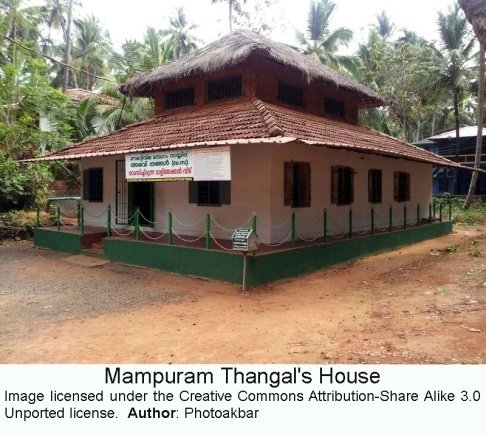 It is this outbreak which is described in the verses translated at pages 102-104. Tirurangadi, the adhikari of which was killed, lay close to the residence of the Arab Tangal or High Priest who was generally credited with having incited the Mappillas to commit these outrages. The Tangal died shortly afterwards and was buried at the Mambram mosque situated on the river bank opposite Tirurangadi. Fanatics who intend to commit outrages, and those who have committed them do, as a rule even now, proceed to this mosque to pray at the Tangal’s shrine.
On the 19th December 1843 a peon was found with his head and hand all but cut off, and the perpetrators were supposed to be Mappilla fanatics of the sect known as Hal Illakkam (lit : Frenzy-raising). The following interesting account of this sect is taken from an official report by a native subordinate, dated November 1843 : —
“Particulars of the (ഹാൽ ഇളക്കം) (Hal llakkam = frenzy) among the Mappillas in Chernad taluk and the neighbouring parts,
“Originally there was no Hal Ilakkam there.
“In the month of Metam last year, one Alathamkuliyil Moidin of Kotinhi desam, Nannambra amsam, Vettattnad taluk, which is on the skirts of Trikkulam amsam, went out into the fields (punja pattam) before daybreak to water the crops, and there he saw a certain person who advised him to give up all his work and devote his time to prayer at the mosque. Moulin objected to this, urging that he would have nothing to live upon. Whereupon the above-mentioned person told him that a palm tree which grew in his (Moidin’s) compound would yield sufficient toddy which he could convert into jaggery and thus maintain himself.
“After saying this, the person disappeared. Moidin thought that the person he saw was God himself and felt frantic (hal). He then went to Taramal1 Tangal performed dikkar and niskaram (cries and prayers). After two or three days he complained to the Tangal that Kafirs (a term applied by Muhammadans to people of other religions) were making fun of him. The Tangal told him that the course adopted by him was a right one, and saying “let it be as I have said”, gave him a spear to be borne as an emblem, and assured him that nobody would mock him in future.
NOTEs. 1. The high priest referred to in connection with the preceding outrage. END OF NOTEs
“Subsequently several Mappillas affecting Hal Ilakkam played all sorts of pranks, and wandered about with canes in their hands, without going to their homes or attending to their work. After two or three days some of them, who had no means of maintaining themselves unless they attended to their work, returned to their former course of life, while others, with canes and Ernad knives2 (war knives) in their hands, wandered about in companies consisting of five, six, eight, or ten men, and congregating in places not much frequented by Hindus, carried on their dikkar and niskaram (cries and prayers).
NOTEs: 2. See kodungakutti in the Glossary, Appendix XIII. END OF NOTEs
“The Mappillas in general look upon this as a religious vow and provide those people with food. I hear of the Mappillas taking among themselves that one or two of the ancestors of Taramal Tangal died fighting, that the present man being advanced in ago it is time for him to follow the same course, and that the above-mentioned men affected with Hal Ilakkam, when their number swells to 400, will engage in a fight with Kafirs and die in company with the Tangal.
“One of these men (who are known as Halar) by name Avarumayan, residing in Kilmuri desam, Melmuri amsam two months ago collected a number of his countrymen and sacrificed a bull, and for preparing meals for these men placed a copper vessel with water on the hearth and said that rice would appear of itself in the vessel. He waited for some time. There was no rice to be seen. Those who had assembled there ate beef alone and dispersed. Some people made fun of Avarumayan for this. He felt ashamed and went to Taramal Tangal, with whom he stayed two or three days. He then went into the mosque at Mambram, and on attempting to fly through the air into the mosque at Tirurangadi on the southern3 side of the river, fell down through the opening of the door and became lame of one leg, in which state he is reported to be still lying.
NOTEs: 3. And, it may be added, on the opposite side of the river, which here runs within high banks of which the southern bank is the higher. END OF NOTEs
“While the Halar of Muniyur desam were performing niskaram (prayer) one day at the tomb of Chemban4 Pokar Muppan, a rebel, they declared that in the course of a week a mosque would spring up at night and that there would be complete darkness for two full days. Mappillas waited in anxious expectation of the phenomenon for seven or eight days and nights. There was, however, neither darkness nor mosque to be seen.
NOTEs: 1. The famous rebel in the early days of the British Government, conf. pp. 527-529. END OF NOTEs
“Again in the month of Karkidagam last, some of the influential Mappillas led their ignorant Hindu neighbours to believe that a ship would arrive with the necessary arms, provisions and money for 40,000 men; that if that number (40,000) could be secured meanwhile, they could conquer the country, and that the Hindus would then totally vanish. It appears that it was about that time that some Tiyyar (toddy-drawers) and others became converts. For some days some Mappillas gave up all their usual work and led an idle life. In those days Halar were made much of and treated by some.
“None of these predictions having been realised, Mappillas as well as others have begun to make fun of the Halar, who having taken offence at this, are bent upon putting an end to themselves by engaging in a fight. A certain individual known as Harabikaran Tangal (lit. Arab high priest), with long hair, has been putting up with the Taramal Tangal for the last two years, offering prayers with a cry called dikkar (ദിക്കർ). The Halar appear to have adopted the dikkar from the said Tangal, as it was not known to the people before.
“The man who first had the Hal Ilakkam in the punja fields is called by the people ‘Punja Tangal.’ ”
On the 4th December 1843 a Nayar labourer was found dead with ten deep wounds on his body, and his murder was believed to be the work of the Hal Ilakkam sect just described.
On the 11th December 1843 Anavattatt Seliman and nine others killed one Karukamanna Govinda Mussat, the adhikari of Pandikad in the Walluvanad taluk, and a servant of his while bathing. They afterwards defiled two temples, broke the images therein, and took post in a house. A detachment1 of the 19th Regiment Native Infantry was sent out, but the officer commanding deemed his force insufficient and consequently fell back a short distance. Two companies2 of sepoys of the same regiment, under the command of Major Osbourne, marched from Palghat on the 17th, and on the 19th the Mappillas without waiting to be attacked, rushed at the troops directly they appeared and were shot, but not without loss of life, as one naigue of the force was killed.
NOTEs: 1. Lieutenant Lynch, l subbedar, I jemudar, 3 havildars, 3 naigues, 1 drummer, and 30 sepoys.
2. 2 lieutenants, 2 subbedars, 2 jemudars, 11 havildars, 8 naigues, 3 drummers 148 privates. 2 puckallis, and 4 lascars. END OF NOTEs
“I moved3 the detachment at half-past ten in the direction of the house occupied by the murderers accompanied by H. D. Cook, Esq., two tahsildars and peons. Immediately after filing through the paddy field the murderers rushed upon the column, and in a few minutes were shot, ten in number.”
NOTEs: 3. Major Osbourne's report, dated 19th December 1843. END OF NOTEs
On this occasion the fanatics were in an open plain without shelter, and charged deliberately, 10 men into the midst of over 200.
On the 26th May 1849 Chakalakkal Kammad wounded one Kanancheri Chiru and another and took post in a mosque. When the Chernad tahsildar (a Pathan) proceeded towards the mosque in the hope of inducing the murderer to surrender himself, he rushed forward with a knife, and a peon put an end to the fanatic on the same day.
On the 25th August 1849 Torangal Unniyan killed one Paditodi Teyyunni and with four others joined one Attan1 Gurikkal. They with others on the following day killed the servant of one Marat Nambutiri and two others and took post in the Hindu temple overlooking Manjeri, the headquarters of the Ernad taluk. They defiled the temple and in part burnt it. Captain Watt with a detachment of the 43rd Regiment Native Infantry proceeded from Malapuram to Manjeri, and on the 28th he formed a plan for attacking the temple. Ensign Wyse and his company were sent across the paddy flat separating the taluk cutcherry hill from the temple hill to attack the rebels, then only 32 in number, who were to be drawn from their position in the temple by parties of police and villagers who had been sent forward to fire at them.
NOTEs: 1. A descendant of the Gurikkal who gave so much trouble in the early days of the British administration. Attan Gurikkal was a worthless follow who preferred a life of idleness and shikar, varied by occasional dacoities, to any other kind of pursuit. He had gathered round him a considerable following of men of the same way of thinking ns himself, but among them were two at least of a respectable family who had been reduced to poverty “by suit and otherwise in their early life.” END OF NOTEs
The rest of the detachment was held in reserve on the cutcherry hill, Mr. Collett, the Assistant Magistrate, being with them. Ensign Wyse’s party, with the exception of 4 men who were all killed, refused to advance to receive the charge of only a few of the fanatics who came down hill at them, and notwithstanding the gallant example set by the Ensign himself in killing the first man who charged, the party broke and fled after some ineffectual filing.
“Others now2 came down upon Ensign Wyse, and I am informed that one of them seized him by the jacket and he received a wound, when he appears to have fallen and was of course quickly put to death ; but by this time three of the insurgents had fallen, and now those men in the detachment who alone had emulated their officer, fell, one of them having first gallantly bayonetted the man who gave Mr. Wyse his death wound.”
The party held in reserve on the cutcherry lull, on witnessing this disaster, fled, although the fanatics were still at a considerable distance on the far side of the paddy flat lying at the bottom of the hill on which the reserve was posted. Only one of the insurgents crossed this paddy flat and he was killed by a police Kolkar.
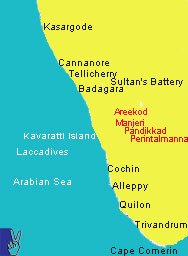 A detachment of His Majesty’s 94th regiment3 from Cannanore, under Major Dennis, reached Manjeri on the 3rd September, and also a detachment of the 30th Regiment1 Native Infantry from Palghat. The insurgents, whose ranks had been largely recruited in the interval, evacuated the temple during the night after the arrival of the reinforcements, and proceeded a distance of about twelve miles to the Bhagavati Kavu temple near Angadipuram, the head-quarters of the Walluvanad taluk.
NOTEs: 3 officers, 6 sergeants, 5 corporals, 2 drummers, and 104 privates.
-
2 officers, 4 native officers, 9 naigues, 2 buglers, and 132 privates. END OF NOTEs
Thither next day they were followed by the troops, who, in spite of their forced march in tempestuous weather from Cannanore to Calicut, of being cooped up, wet and without regular food, in cramped positions in the boats, in which, in still more tempestuous weather, they were conveyed from Calicut to Arikkod, and of the heavy march of the two preceding days, showed the utmost eagerness to close with the enemy.
At 5 p.m. on the 4th September the encounter took place at the forty-first milestone from Calicut on the Great Western Road (No. 6) and in the open ground (now enclosed) to the south of the road at that point. On receiving intelligence that the insurgents, now 64 in number, were coming to the attack, Major Dennis drew his men up “in column2 of sections, right in front, so as to occupy the whole breadth of the road, when the enemy came on with most desperate courage, throwing themselves on our bayonets ; after firing off their matchlocks, they took to their war knives, swords and spears, and when struck down to the ground, renewed the fight even on their knees by hurling their weapons at the faces of our men, and which continued until literally, they were cut to pieces ; others, planted on the trees, kept up a most destructive fire with their matchlocks loaded with iron slugs.
“This attack was made by the enemy in three divisions, about 300 yards apart, the second led on in person by Attan Gurikkal (Coyah or priest), who fought with most desperate courage ; but I am happy to say that through the steadiness, correct and low firing of the men, our loss has not been so considerable as might have been expected from the desperate onset of these mad fanatics ; and in the space of half an hour the enemy was completely annihilated, leaving 64 dead, their bodies lying close to each other, exhibiting most dreadful wounds, some having received four or five musket balls, besides bayonet stabs, before these fanatics could be stayed carrying on their determined work of destruction into our ranks.”
NOTEs. 2. Major Dennis’ report of 5th September 1949. END OF NOTEs
“The power3 of their fanaticism was astounding. One of the men had had his thigh broken in the engagement in which Lieutenant Wyse was killed. He had remained in all the agony attendant on an unhealed and unattended wound of this nature for seven days ; he had been further tortured by being carried in a rough litter from the Manjeri to the Angadipuram pagoda.. Yet there he was at the time of the fight, hopping on his sound leg to the encounter, and only anxious to get a fair blow at the infidels ere he died.”
NOTEs. 3. District Magistrate report of 12th October 1849. END OF NOTEs
The casualties in the detachments were trifling when the numbers and determination of the insurgents are considered. Two privates of the 94th Regiment were killed and three others and a sergeant wounded ; one officer received a deep flesh wound, and Major Dennis “had1 a wonderful escape from a bullet, which grazed his wrist”.
NOTEs. 1. District Magistrate's report of 4th September 1849. END OF NOTEs
A sepoy of the 30th Regiment was likewise severely wounded. On searching afterwards, one of the insurgents, a lad of 17 or 18 years, was found to be alive. He lived for some time and told what he knew about the outrages.
The bodies of the slain insurgents were thrown into a dry well in the garden lying in the south of the Walluvanad taluk cutcherry at Perintalmanna. On the 2nd October 1850 information was received that the sons of one Periambath Attan the Mappilla adhikari of Puliakod amsam in Ernad taluk had, with others, concerted to kill one Mungamdambalatt Narayana Mussat and to devote themselves to death in arms. Security was required of nine individuals on this account.
On the 5th January 1851 Choondyamoochikal Attan attacked and wounded severely a Government native clerk named Raman Menon, who had been employed in inspecting gingelly-oil seed (ellu) cultivation in Payanad in Ernad taluk in conjunction with the village accountant in view to settling the Government share, and he then shut himself up in the inspector’s house, setting the police at defiance. No persuasion could induce him to surrender himself. He declared he was determined to die a martyr. The tahsildar (a Mappilla) tried to induce him to deliver himself up, hut he utterly refused to do so. Finally, rushing out and firing at the opposing party, he was shot dead. The reason assigned by the criminal for attacking the inspector was that his wife’s gingelly-oil crop had been over- assessed.
On the 17th January 1851 three Mappillas were reported as contemplating an assault, and security was taken from them.
On the 15th April 1851 Illikot Kunyunni and five others were reported as designing to break out and kill one Kotuparambat Komu Menon and another. Evidence of the fact was deficient and the accused were released, but it subsequently turned out that the information was only too true.
On the 22nd August 1851 six Mappillas killed one Kotuparambat Komu Menon (above referred to) and his servant on the high road between Manjeri and Angadipuram as they were returning home from the Mankada Kovilakam of the Walluvanad Raja. They were joined by three others, with whom they proceeded towards Komu Menon’s house. But finding a brother of Komu Menon’s ready to meet them with a gun and a war knife, they left the place and went to the house of Ittunni Rama Menon, another brother, who was then bathing in a tank close by. They killed Kadakottil Nambutiri, who was seated in the porch of the house, the family of Rama Menon escaping in the tumult.
The murderers next overtook Rama Menon, who had endeavoured to escape, and cut him down. Setting fire to the house, they marched towards the house of one Mudangara Rarichan Nayar, whom they wounded severely and who subsequently died of his wounds. They then set fire to the house of one Chengara Variyar.
On the morning of the 23rd they were seen in Kuruva amsam, about eight miles distant from Ittunni Rama Menon’s house. Thence they proceeded to the house of the Kulattur variyar, an influential janmi who had opposed the erection of a mosque. They were in the meantime joined by five others. On their arrival, the attendants and family escaped ; all the women and children were told by the fanatics to go away. They next killed two servants of the Variyars. Two of the junior Variyars escaped. But the old Variyar, a man of 79, probably shut himself up in a room of his house where the fanatics eventually discovered him.
The Hindus sent for the Mappilla chief men of the place and others. About fifty persons appeared, two of whom joined the insurgents, calling out “the chief pig is inside.” The old Variyar was then brought out into the paddy field adjoining his house, to a distance of sixty yards from the gatehouse, and one Pupatta Kuttiuttan and another there, in the sight of all the people assembled, hacked him to pieces, severing his head from his body.
As soon as Mr. Collett, the Divisional Magistrate, heard of their having taken up a position at Kulattur, he sent a, requisition to Major Wilkinson, the officer commanding the 39th Regiment at Malapuram, who in complying with the request, wrote to Mr. Conolly in the 24th as follows : —
“I despatched a party, under the command of Ensign Turner of 65 rank and file with the proper complement of native commissioned and non-commissioned officers.
* * * * *
“My reason for sending the party under the command of Ensign Turner was, that Mr. Collett had informed me, when at my house very early yesterday morning, that he had written expressly for the European troops stationed at Calicut.”
In his two letters to Government of the 25th August 1851, Mr. Conolly thus described the operations of the Malapuram detachment : —
“The troops advanced by a muddy road towards the house” in which the insurgents were “and attacked three abrest along a causeway leading to the house through paddy-fields. After some firing, nine of the Mappillas came out from the house and advanced to meet the sepoys on the causeway. The leading sepoys were seized with a panic, which communicated itself to those in the rear, and a general retreat ensued. The Mappillas pursued the fugitives and cut down (killed) three—a naigue, a sepoy, and a drummer. They then picked up some of the muskets which had been thrown away by some of the sepoys in their haste to escape, and returned to their home. One or two of the partty is supposed to have been badly wounded by the first firing. The scattered sepoys rallied after some time and have been posted in a house about a mile from where the Mappillas are.”
This was (to use Mr. Collett’s words) “a complete disaster.”
The European detachment1 from Calicut arrived on the forenoon of the 27th, under command of Captain Rhodes. They “were so fagged with their marches”2 and so “exhausted and footsore” that they were not able to act with sufficient steadiness against the fanatics, whose ranks had been, in spite of a close watch by villagers and police, joined by three others, and who now numbered seventeen. Moreover, the fanatics showed a disposition to attack directly the detachment arrived near their stronghold, and Captain Rhodes had no time to rest and recruit his men. The attack was thus sketched by Mr. Conolly3 :
NOTEs: 1. captain, 1 lieutenant, 2 sergeants, 2 corporals, 2 drummers, 47 privates, and 2 puckallies of H.M.’s 94th Regiment.
2. They had “marched a good forty miles in two days, over a very hilly, stony and wild district,” the route being by Beypore, Tirurangadi, Venkatakotta, and Chappanangadi to Kulattur.
3. Reports to Government of 28th and 30th August 1851. END OF NOTEs
“The Europeans were in advance and the sepoys in the rear. The Europeans fired at the fanatics, who had the partial cover of a bank, till they were too tired to load. The fanatics then advanced and charged4 them, and the soldiers retreated in order. The sepoys in the rear seeing this, of course retreated also, and the confusion was very great until the officers, by dint of exhortation, managed to rally their men. It was now that the sepoys, whose guns were loaded, did the good service5 I spoke of. They brought down some of the leading pursuers and enabled the Europeans to halt and reload. Their confidence was at once restored, and they moved forward again with the sepoys in expectation of meeting more enemies. They were all in good order when I joined them in the house from which the fanatics had come out. That the check was a very unhappy one cannot be denied, but it was satisfactory that it was so soon rectified.
NOTEs: 4. The charge was made under cover of the smoke of the firing, which had lasted a quarter of an hour or more; the detachment was drawn up in quarter column, and some of the fanatics, passing round the flanks under cover of the smoke, attacked the rear, while others attacked the front of the column.
5. Eleven of the fanatics were shot by a party of the 30th Regiment, who ran down to meet them from the house held by the sepoys about a mile from the Variyar’s house. END OF NOTEs
“In the previous attack by the detachment of the 39th Regiment the rout was complete, and there was no rallying until the Mappilias had retired to their stronghold.”
In this second engagement on August 27th, 4 European privates and l native subbadar were killed.
The result of the action as far as the Mappillas were concerned may be thus summarised. Of the 19 fanatics who were concerned in these outrages it seems that 9 were engaged in the first four murders on the 22nd, 1 joined them immediately afterwards, and 4 more dining the night and next morning. Fourteen thus attacked the Variyar’s house, where 2 more immediately joined them. Of these 16 men, one was killed in the affair of the 24th August, and another, mortally wounded, died on that night. Three more subsequently joined the band, making 17 who fell on the 27th August.
On the 5th October 1851 information was received that Tottangal Mammad and three other Mappillas of Nenmini amsam, Walluvanad taluk, were found in possession of certain arms and were designing to commit an outrage. “They1 had intended to join the fanatics who perished at Kulattur, but were too late. Their purpose, it was said, had been known to some of their co-religionists and they were subject to the contemptuous soubriquet of Minjina Sahid's (all but saints). There was but too much reason to fear therefore from former experience that they would take an opportunity of wiping off the reproach by organising an outbreak on their own account.” Security to keep the peace was required from three of them.
NOTEs:1. District Magistrate’s report of 10th Octobers 1851. END OF NOTEs
On the 27th October 1851 information reached the head police officer in Ernad that some Mappillas of Irumbuli amsam, Ernad taluk, had likewise intended to join the late fanatical outbreak at Kulattur. Two of them were required to give security to keep the peace.
On the 9th November 1851 information was received that Choriyot Mayan and eight others were designing to break out and kill one Kalattil Kesuvan Tangal, a wealthy and influential Hindu janmi of Mattanur in Kottayam taluk. Evidence was lacking, and the tahsildar omitted to report the matter. The individuals in question did, however, with others subsequently commit the outrages next to be described.
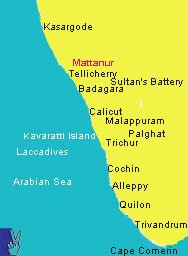 On the night of 4th January 1852 the party named above and six others, making in all fifteen, supported by a large mob estimated at 200, proceeded to the house of the abovesaid Kalattil Tangal in Mattanur, Kottayam taluk. They butchered all the unhappy inmates (eighteen in all) and thus extirpated the family, wounded two other persons, and burnt the house on the following morning. They then, unattended by the said mob, burnt four houses and a Hindu temple, killed four more individuals, defiled and damaged another Hindu temple, entered the palace of a Raja, took post there temporarily, defiled and destroyed two other Hindu temples, and finally fell on the 8th idem in a desperate and long-sustained attack on the house of the Kalliad Nambiar, another wealthy and influential janmi in Kalliad amsam of Chirakkal taluk.
A detachment under Major Hodgson off the 16th Regiment, consisting of two companies of that corps and 100 Europeans of the 94th Regiment, were sent out from Cannanore, but before they arrived on the scene, the Mappilla fanatics had been all killed by the country people, retainers of the Nambiar.
On the 5th January 1852 information was received that certain Mappillas intended to break out and kill one Padinyaredattil Ambu Nambiar, and security was taken from five of them.
The District Magistrate, Mr. Conolly, in reporting on the outrage and wholesale murders of January 4th-8th, suggested that a commission should be appointed “to report1 on the question of Mappilla disturbances generally. I wish,” he stated, “for the utmost publicity. If any want of, or mistake in, management on my part has led in the slightest degree to these fearful evils (far more fearful in my time than they have ever been before), I am most desirous that a remedy be applied, whatever be the effect as regards my personal interests. I have acted to the best of my judgment, but my judgment may be in error, and I should be glad were it duly tested......................... No measures taken as yet have reached the root of the evil, which there is too much reason to fear is growing in place of decaying.”
NOTEs:1. Report, dated 28th January 1852. END OF NOTEs
When reviewing2 this report the Government decided to adopt Mr. Conolly’s suggestion.
“For some years past the province of Malabar has been disgraced by a succession of outrages of the most heinous character, perpetrated by the Mappillas of the province upon the Hindus. Bodies of Mappillas have in open day attacked Hindus of wealth and respectability, murdered them under circumstances the most horrible, burnt houses or given them up to pillage, and finally, wound up their crimes by throwing away their lives in desperate resistance to the Police and Military.”
NOTEs: 2. Extracts Minutes of Consultation, 17th February 1852. END OF NOTEs
The order then proceeds to point out that the outbreaks had “become progressively more sanguinary and more difficult of suppression” in spite of the employment of the regular troops, and that, while on former occasions the fanatics spared women and children, they had (in the last outrage perpetrated in a part of the district” of late years distinguished for its quietness”) put to death “men, women, children, the very infant at the breast, masters, servants, casual guests and ordinary inmates,” in short, “every human being found” in the house first attacked.
Mr. Thomas Lumsden Strange, a Judge of the Sadar Adalat, “whose former long service in Malabar and intimate acquaintance with the people and their peculiar habits and feelings eminently qualify him for the task, while his employment in a different sphere of late years saves him from the influence of any prejudice or bias,” was accordingly selected “to be Special Commissioner for enquiring into the Mappilla disturbances, their causes and remedies.”
Mr. Strange was directed to enter into the freest intercourse with all classes, official and non-official, “to ascertain the causes of past outbreaks and the manner in which they may be most effectually prevented for the future. Referring to the many instances in which disputes respecting land have been, or have been assigned as, the causes of emeutes, and to the position of the Hindu and Mappilla in their relations of landlord and tenant, mortgagor and mortgagee, he will consider whether any measures seem called for for defining the landed tenures of the country and placing them on a better basis. He will report upon the various expedients proposed from time to time by the present Magistrate, for preventing or repressing outbreaks, and if it should seem to him that the district functionaries require to be armed with larger authority than they possess under the existing law, he will suggest the extraordinary powers which should be conferred and submit draft of a legislative enactment for the purpose of giving them effect.’’
Among Mr. Strange’s instructions it was pointed out that a subject, to which he should give his earliest consideration was “the conduct of the Tirurangadi Tangal, and the measures to be employed in reference to that individual.” The individual here referred to is the notorious Saiyid Fazl of Arab extraction, otherwise known as the Pukoya1 or the Tirurangadi or Mambram Tangal. He had succeeded at an early age to the position vacated by the Taramal Tangal (already alluded to), and it is certain that fanaticism was focussed at this time at and about the head-quarters of Saiyid Fazl at Mambram. Fanatics then, as now, considered it almost essential to success in their enterprise that they should have visited and prayed at the Taramal Tangal’s tomb at Mambram and kissed the hand of the Tangal living in the house close by.
NOTEs: 1. Pu (Mal.) = flower, and Koya (? corrupt form of Khwaja) = influential person, gentleman. END OF NOTEs
So great an ascendency had Saiyid Fazl at this time attained that the Mappillas regarded him “as imbued2 with a portion of divinity. They swear by his foot as their most solemn oath. Earth on which he has spat or walked is treasured up. Marvellous stories are told of his supernatural knowledge. His blessing is supremely prized.” And even among the higher class of Mappillas his wish was regarded as a command, and no consideration of economy was allowed to stand in the way of its being gratified.
NOTEs: 2. Magistrate's report, dated 29th November 1851. END OF NOTEs
On the very day (17th February) that the Government appointed Mr. Strange as Special Commissioner, Mr. Conolly reported that 10,000 to 12,000 Mappillas, “great numbers of whom were armed” met at Tirurangadi and held a close conclave with the Tangal on rumours being spread that he was at once to be made a prisoner and disgraced.
Mr. Strange was directed to report whether the Tangal should be brought to a formal trial, or treated as a State prisoner, or be induced to quit the district, quietly. But meanwhile Mr. Conolly had been successful in his negotiations to induce Saiyid Fazl to depart peaceably. The Tangal avowed that he had done nothing “to3 deserve the displeasure of the Government ; that he repudiated the deeds of the fanatics ; and that it was his misfortune that a general blessing, intended to convey spiritual benefits to those alone who acted in accordance with the Muhammadan faith, should be misinterpreted by a few parties who acted in contradiction to its precepts.”
But he added “as his blessing was sometimes misunderstood and his presence in the country unfortunately had led to deeds of horror, he was willing, if the Government chose it, to end further embarrassment by leaving Malabar and taking up his permanent abode among his people in Arabia.”
Mr. Conolly on his own responsibility then acted upon this proposal, a measure which the Government afterwards approved, and on the 19th March 1852 the Tangal, with his family, companions and servants (fiftyseven persons in all), set sail forArabia.
“The Tangal’s own conduct since he resolved on going has been prudent and politic. He did all that was in his power to avoid popular excitement by remaining in his house and denying himself even to the gaze of the large bodies who came to visit him on hearing of his intention to quit Malabar. He continued in this seclusion, so far as it was possible, till the last. So soon as it was heard that he was leaving his house (yesterday1 ) a large crowd assembled, and by the time he got to Parappanangadi on the coast, six miles from his residence, from 7,000 to 8,000 men were collected, showing strong signs of grief at his departure. The Tangal had proposed to come in during the night to Calicut by land and embark with his family, who had preceded him from thence ; but foreseeing the great excitement which might ensue from the crowd, which positively refused to leave him, and whose numbers would, no doubt, have swelled in his journey along the coast, he resolved, as he sent me a message, to take boat to the ship from Parappanangadi itself. He reached it after a twelve miles’ pull and at once got under weigh.”
NOTEs:1. 19th March 1852. END OF NOTEs
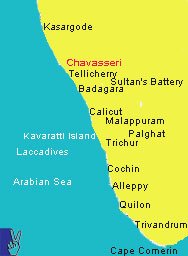 On the night of the 28th February 1852 one Triyakalattil Chekku and fifteen other Mappillas of Melmuri and Kilmuri amsams in the Ernad taluk "set out to die and to create a fanatical outbreak.” Information of this was given by the principal Mappillas of the former amsam at about ten o’clock that night. They and their adherents remained on guard during the whole of the night at the houses of Pilatodi Panchu Menon and Purmekad Pisharodi, the principal Hindu janmis in the amsam, and respecting the former of whom there were on several occasions rumours that Mappilla fanatics were seeking to kill him. On the morning of Sunday the 29th, Panchu Menon hastened into Malapuram, having been alarmed by seeing some Mappillas moving on the hill at the back of his house. He applied for protection to the officer in command at Malapuram, who, deeming the danger of an attack on Panchu Menon’s house imminent, proceeded with a portion of his troops to the house, where they remained for a few hours. He left a guard of twenty-five sepoys, who were withdrawn at night, a guard of villagers being substituted.
On the afternoon of the 1st March the suspected persons were secured in a mosque through the exertions of a wealthy and influential Mappilla named Kunyali. The case was enquired into by Mr. Collett, Assistant Magistrate, and the offenders were required to furnish security to keep the peace.
Ominous rumours of an intended Mappilla outbreak in the Kottayam taluk in April 1852 drove many of the Hindu inhabitants into the jungles. From two letters—one from Mr. Brown of Anjarakandi, and the other from the Kalliad Nambiar at the attack of whose house the fanatics were slain on 8th January of this year— the Joint Magistrate was led to believe that the storm, if it was brewing, was intended to burst upon the head of the latter, who had become a marked man by his late spirited defence of his house.
The Raja of Chavasseri had received previous warning to leave his palace. The Joint Magistrate sent off all the assistance in his power to the Nambiar, and wrote to the Raja requesting him not to leave the palace, and in the event of an emergency he would repair to his assistance with troops. The origin of the panic was that the Mappillas had given out that they were determined to avenge the supposed disgrace brought upon them by the Hindu resistance at Kalliad, and also to erect, a monument over the remains of the “martyrs” who died on that occasion.
The Joint Magistrate adopted some necessary precautions and the panic subsided. But the Mappillas did attempt to erect the tomb in the course of a single night. It was immediately, however, destroyed under the orders of the Joint Magistrate, Mr. Chatfield.
On the night of the 28th April 1852 the house of Kannambat Tangal in Kottayam taluk was fired into and the out-buildings of the Kallur temple were set on fire. The tahsildar (a Hindu) was of opinion that it was done by Hindus wishing to profit by the absence of the Tangal, the great janmi of the locality. The Sri Kovil (shrine) and the grain rooms were left uninjured, and this fact was urged in support of the tahsildar’s opinion. But in the view of the Special Commissioner, Mr. Strange, this opinion had been expressed more to suit the views of the Collector (Mr. Conolly) than to report facts. Mr. Strange took a different view and attributed the affair to the Mappillas.
In April-May 1852 two Cheramars (the property of Kudilil Kannu Kutti Nayar, peon of Chernad taluk), after embracing Muhammadanism, reverted to their original faith after the departure of Saiyid Fazl, through whose influence they had become converts. Some Mappillas did not relish this, and consequently determined to murder Kannu Kutti Nayar and the two Cheramars, and thus become Sahids (martyrs). Although the Nayar agreed to relinquish his claims over these Cheramars on receipt of their purchase money, the impression made on the conspirators was that Kannu Kutti Nayar alone was instrumental to the Cheramars’ apostacy.
As the life of Kannu Kutti Nayar was thus threatened, he was allowed to carry a pistol with him for his self-protection. He was instructed to take good care of the pistol and also to send the Cheramars away to some distant place, which was agreed to by him. In connection with this conspiracy two persons were apprehended by the tahsildar and steps taken for the arrest of every one who aided in and abetted the offence. The result of the proceedings taken is not known, but Kannu Kutti Nayar was transferred to Ponnani, and subsequently to Calicut, with a view to avert the impending danger to his life.
The Cheramars also were sent away to other taluks as their presence was considered a source of disturbance.
On the 9th August 1852 information was received that three Mappillas of Kurumbranad taluk had taken up a position in the house of the accountant of Puttur amsam in the same taluk, and had resolved to die as Sahids (martyrs). They wounded a Brahman and were on the 12th idem killed by the police, of whom two received wounds.
Two Mappilla fanatics, Kunnumal Moidin and Cherukavil Moidin, murdered a Brahman named Chengalary Vasudevau Nambutiri on the 10th September 1853. They, failing to get any recruits and not finding any good house undefended, made their appearance on the 23rd on the top of a hill close to Angadipuram. The tahsildar at once went up to the spot with his peons. The fanatics, one an elderly man and the other a mere boy, rushed upon the assailing party as usual.
Eighteen shots were fired at them. The elder man was brought down wounded but the younger was unhurt and fell on the leading peons and villagers, by whom he was despatched before inflicting injury on any one.
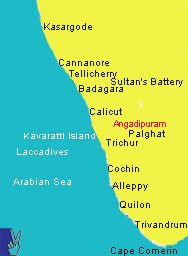 On the 25th September 1852 Mr. Strange had submitted the report called for by the Government, and this report was in due course reviewed by the Government and orders issued on the 23rd August 1853. Mr. Strange found that of all the persons engaged in the thirty-one cases, the circumstances of which he set forth in detail, there were “but fourteen for whom any personal cause of provocation was discoverable. In seven instances land has afforded the presumed ground of quarrel,” and in the other seven cases the provocatives “were mostly of an equally unreal nature.”
In nine cases the parties had been “instigated to engage in crime by others who were to profit thereby or had malice to satisfy.” Five were induced to crime “because of relatives having wrongs, fancied or real, to redress ; and the remaining 144 were without any personal provocations whatsoever.”
“It is apparent thus that in no instance can any outbreak or threat of outbreak that has arisen be attributed to the oppression of tenants by landlords. A great clamour is now raised on this regard prominently in the southern taluks visited by me, the Mappilla population seeking to throw the blame of these outbreaks upon the landlords by thus charging them with being the cause thereof. I have given the subject every attention, and am convinced that though instances may and do arise of individual hardship to a tenant, the general character of the dealings of the Hindu landlords towards their tenantry, whether Mappilla or Hindu, is mild, equitable and forbearing.
“I am further convinced that where stringent proceedings are taken, the conduct of the tenants is, in the vast majority of cases, the cause thereof, and that the Mappilla tenantry, especially of the taluks in South Malabar, where the outbreaks have been so common, are very prone to evade their obligations and to resort to false and litigious pleas.”
And Mr. Strange proceeded to review some instances—such as the taking of fines and fees on renewal of leases and the granting of melkanam rights for the purpose of getting rid of obnoxious tenants—in which he thought some changes1 in the customary rules ought to be made.
NOTEs: 1. These changes he proposed (paragraph 69) to leave to the Sadr Adalat to declare by rule, and this was partly done. The rules issued by the Sadr Adalat will be found printed in the Notes to Appendix XIII. END OF NOTEs
He then went on to review the next ground for committing them dwelt upon by the Mappillas, namely, that the criminals were forced into them by destitution, but he passed this by with the remark that most of the criminals were mere youths, and he could not believe that they “should be ready thus to throw life away from more despair as to the means of supporting it.”
But he next remarked “a feature that has been manifestly common to the whole of these affairs is that they have been one and all marked by the most decided fanaticism, and this, there can be no doubt, has furnished the true incentive to them.”
And he then proceeded to state that the Mappillas of the interior were always lawless, even in the time of Tippu’s Government, were steeped in ignorance, and were on these accounts more than ordinarily susceptible to the teaching of ambitious and fanatical priests,2 using the recognised precepts of the Koran as handles for the sanction to arise and slay Kafirs, who opposed the faithful chiefly in the pursuit of agriculture.
NOTEs: 2. He named especially the Taramal Tangal mentioned in connection with the 19th October 1843 outrage, and his son Saiyid Fazl, who left the country under the circumstances already related. END OF NOTEs
The natural result was that “the Hindus, in the parts where outbreaks have been most frequent, stand in such fear of the Mappillas as mostly not to dare to press for their rights against them, and there is many a Mappilla tenant who does not pay his rent, and cannot, so imminent are the risks, be evicted. Other injuries are also put up with uncomplained of.”
And he continued: “To what further lengths the evil might not go if unchecked, it is impossible to say. Even the desire for plunder may prove a sufficient motive for the organisation of these outbreaks, some having already largely profited in this way. They will also, there can be no doubt, be more and more directed against the landed proprietors. Six of the very highest class have been marked out for destruction in the course of the past outbreaks, of whom three were killed and several others of average property have suffered.”
In the Kulattur case in August 1851 the leading Mappillas had even asserted “that it was a religious merit to kill landlords who might eject tenants.”
The condition of the Hindus had “become most lamentable," and even the prestige of the rule of Government had been “much shaken in the district. ”
Special legislation was necessary towards the following objects, namely :—
escheating the property of those guilty of fanatic outrage,
fining the districts where such outrages occur,
deporting the suspected, and placing restrictions on the possession of arms, and more especially of the war-knife, and on the building of mosques.
Mr. Strange further proposed the organisation of a special police force to put down these risings, and deprecated the resort to the use of the European force for the purpose. The Magistrate, Mr Conolly, was in favour of this scheme, but he would “esteem it only as an adjunct to the European troops, in whom alone he has any confidence.”
But Mr. Strange went beyond this and proposed1 that the force should be exclusively composed of Hindus, a measure which it is needless to say was not approved by the Government. The Government also, on similar grounds, refused to entertain his proposals for putting restrictions on the erection of mosques as being a departure from the policy of a wise and just neutrality in all matters of religion.
NOTEs: 1. It is unnecessary to notice here some other utmost grotesque proposals of Mr. Strange, all directed to the same end, the repression of the Mappilla caste. The Government took no action upon these proposals. END OF NOTEs
But on all the other main points above adverted to Mr. Strange’s views were adopted, and a policy of repression set in with the passing into law of Acts XXIII2 and XXIV3 of 1854, the latter for rendering illegal the possession of the war-knife, and the former for fining localities disturbed and for dealing with persons suspected of being privy to the commission of outrages.
NOTEs: 2. Continued by Act XXIV of 1859.
3 This Act came into force on the 1st February 1855. END OF NOTEs
In December 1854 Mr. Conolly proceeded on a tour to collect the war-knives through the heart of the Mappilla country, and brought in 2,725, and by the 31st of the following month of January 1855 (the latest date on which the possession of a war-knife was legal) the number of war-knives surrendered to the authorities amounted to the large number of 7,561.
The next report in connection with these Mappilla outrages conveyed to the Government the distressing intelligence that Mr. Conolly, the District Magistrate and Provisional Member of Council4 for the Presidency, had been barbarously murdered by a gang of Mappillas.
NOTEs: 4. Mr. Conolly was shortly to have proceeded to the Presidency town as Member of the Council of Government. END OF NOTEs
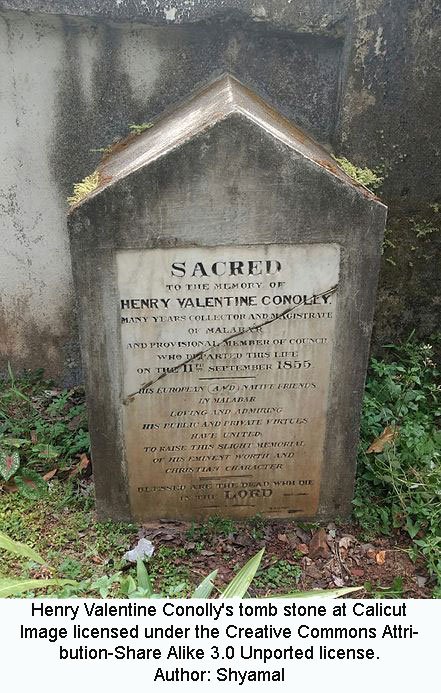 The following is a copy of the letter written by Mr. G. B. Tod, Assistant Collector, Malabar, to the Chief Secretary to Government, dated 1A.M., 12th September 1855, reporting the occurrence : —
“It is my melancholy duty to inform you, for the information of the Right Honourable the Governor in Council, that Mr. Conolly, the Collector of this district, was most barbarously murdered this evening, between eight and nine o’clock, in the presence of his wife. He received seven wounds, one of which at least was mortal.
“So far as the details at present are ascertained, the perpetrators were three Mappillas, who rushed into the verandah and completed their deadly work before assistance could be called. In the present state of Mrs. Conolly, it is impossible to gather further particulars of the tragedy of which she was the sole witness ; but immediately that I am able to do so, I will furnish more complete information.”
The facts of this most tragic and melancholy occurrence are narrated below : —
On the 4th August 1855 convicts Valasseri Emalu, Puliyakunat Tenu, Chemban Moidin Kutti and Vellattadayatta Parambil Moidin escaped from their working party of jail convicts at Calicut and proceeded to Walluvanad. They loitered about in that taluk for a few days and left it finally on the 20th, visiting, on their way, the house of Tenu and taking with them Ossan Hyderman (a barber lad), whom they desired to show the way as far as the “new public road” running due east and west through the Payanad hills, which are connected with the Pandalur range.
On the 23rd they (including the barber lad, who threw in his fate with the party) proceeded to Urotmala, whence they went to the house of Moidin Kutti at night to take their food. After a brief halt there of three or four hours they left the house, visiting some of their relatives on their way, and reached Mambram on the evening of the 24th. Here they prayed with Taramal Kunhi Koya at the shrine of the great Tangal referred to by Special Commissioner Mr. Strange as having been one of the great apostles of fanaticism and the instigator of the earlier outrages narrated above.
At Mambram the intention of the murderers appears to have been disclosed to Kunhi Koya, whose son, a boy, 13 years old, heard his father speak of it to his wife, and subsequently gave evidence to that effect before Mr. Collett, who enquired into the case. From the shrine they proceeded to Vettattpudiangadi, where they stayed for a short time.
On the 29th and 30th they visited certain shrines of local reputation lying within easy distance of that station. After this they roamed about the country till the 9th September, on which date they were harboured by one Malakal Mammu, whose house was situated three-quarters of a mile due east of Mr. Conolly’s residence on West Hill, now occupied by the European detachment at Calicut.
On the 10th there was a nercha (feast when a vow is made) in Mammu’s house, at which these assassins were present. The ceremony consisted in the recital of a song called Moidin Mula Pattu, and their war-knife was passed through the smoke of the incense burnt on the occasion.
Thus prepared, the ruffians left Mammu’s house on the evening of the 11th and noiselessly entered Mr. Conolly’s residence between eight and nine o’clock. What followed is thus described by Mr. Collett, the Sub-Collector, in one of his official reports:
“Nothing1 could exceed the treachery with which the murder was begun, or the brutal butchery with which it was completed. Mr. Conolly was seated in a small verandah (as was his in variable custom of an evening) on a low sofa. Mrs. Conolly was on one opposite, a low table with lights on it being between them ; he was approached from behind and even Mrs. Conolly did not catch sight of the first blow, which would alone have proved fatal ; the next moment the lights were all swept off the table and the ruffians bounded upon their victim, slashing him in all directions. The left hand was nearly severed, the right knee deeply cut, and repeated stabs indicted in the back. The wounds (twenty-seven in number) could have been inflicted only by fiends actuated by the most desperate malice. To the cries of poor Mrs. Conolly no one came ; the peons and servants are usually present in a passage beyond the inner room ; they were either panic-stricken, or, unarmed (as they invariably were) were unable to come up in time to afford any real assistance.
NOTEs: 1. Mr. Cullett’s report of 21st September 1855. END OF NOTEs
“One poor massalji who came forward and met one of the murderers in the inner room, received a blow which cut clean off four fingers of his left hand. A peon has also a slight wound, but it does not appear how he came by it. Doubtless this atrocity was rapidly completed, and perhaps the first thought of those servants who came up was to carry off their poor mistress to another part of the house. Mr. Conolly was soon after carried in, and Mr. Tod was the first who arrived to witness the terrible scene of domestic agony that ensued.
“Supported by Mr. Tod, Mr. Conolly lingered another half hour and then expired, having addressed a few words only to Mrs. Conolly, and apparently endured intense agony. Mr. Conolly had received an anonymous letter warning him, but unfortunately thought it needless to take precautions, and had not even mentioned it to Mrs. Conolly.”
Immediately after the murder the criminals proceeded along the high road to Tamarasseri to a village near Keravul, a distance of about twelve miles from Mr. Conolly’s house. Here they went to the mosque. About 4P.M. on the 12th they went to Makat Nambutiri’s illam and remained there till about 9P.M. They took away money and property to the amount of Rs. 300. Then they struck back to the main road to Tamarasseri and came to the house of Pulkutti Moyi.
At night they went to the Bhavat mosque, where they remained till the following night (13th). On the 14th they were reported to have purchased provisions at the Tamarasseri bazaar. On the 15th they moved on to the Tiruvambadi amsam of the Calicut taluk. On the 16th they met a village peon and wrested his musket from him. They compelled one Chapali Pokar to act as their guide. He led them to Eddamannapara, which they reached at 4P.M. on the 17th. They had not gone far from this place when they were seen, and, being followed up by the people of Kondotti (another sect of Mappillas), were driven at length to take refuge in the house, where they were shot the same evening by a detachment of Major Haly’s Police Corps and a part of No. 5 Company of H.M’s 74th Highlanders under Captain Davies.
“The position1 of the Mappillas was a most difficult one consisting of gardens surrounded by ditches. After some practice with the mortar and howitzer, the troops charged into the gardens and after turning the Mappillas out of one house, the offenders retreated to a stronger one, which they barricaded ; the outer door of this garden was on the edge of a deep nullah ; this door was first forced, and the troops were in the act of firing the house when the Mappillas threw open the door and rushed out upon the troops and were, of course, quickly disposed of. It was quite impossible, I consider, to have secured them alive, though injunctions had been given to do so if possible. The men of the new Police Corps emulated the Europeans in their steadiness, and were equally to the front at the last charge. I have, though with great regret, to report that one European was killed2 by a shot from the house, and another very dangerously wounded by a cut on the throat whilst one of the Mappillas was on his bayonet.”
NOTEs: 1. Mr. Collett's report of 17th September 1855, from "Morar, eight miles north-west of Manjeri.
2. Two Hindus were also killed, one accidentally shot, by and the other murdered by the Mappillas when they took possession of the house. END OF NOTEs
Various causes have been suggested as the motive for the murder of Mr. Conolly, but the most probable of them seem to be that the ruffians, who were men of bad character, were exasperated at the orders of Mr. Conolly subjecting them to restraint in the jail and that they had resolved, probably at the suggestion of some outsiders on avenging the banishment of Saiyid Fnzl to Arabia.
The following amsams, implicated in the outrage, were fined in the sums noted against each: —
|
|
Rs. |
A. |
P. |
|
Nemnini, Walluvanad taluk . |
1,857 |
8 |
0 |
|
Kariavattain, do. |
1,951 |
0 |
0 |
|
Kalpakancheri, Ponnani taluk. |
16,989 |
0 |
0 |
|
Kanmanam, do. |
1,869 |
0 |
0 |
|
Vadakkumpuram, do. |
1,991 |
0 |
0 |
|
Talakad, do. |
8,842 |
0 |
0 |
|
Koduvayur, Palghat taluk |
3,003 |
0 |
0 |
|
Kacheri, Calicut taluk. |
1,317 |
0 |
0 |
|
Kedavur, do. |
512 |
0 |
0 |
The widow of Mr. Conolly was granted the net proceeds of the Mappilla fines aggregating Rs. 30,936-13-10.
In November 1855 Mr. Collett, the Joint Magistrate, suspecting two Mappillas who had deserted from the Malabar Police Corps of complicity with the murderers of Mr. Conolly, required them to produce sureties for good behaviour, and confined them on failure to give security for three years. They were afterwards permitted to leave the country.
A Muhammadan named Vanji Cudorat Kunji Mayan, a relative of the Kottayam Tangal, and who had been convicted on a former occasion of robbery and sentenced to eight years hard labour, was arrested on the 3rd September 1857 on a charge of using seditious and inflammatory language in the public streets of Tellicherry, and of invoking the people in the name of God to rid the country of the Kafirs (Europeans).
The country was then in a very disaffected state owing to scarcity of rice and the outbreak of the Mutiny. The excitement caused by Mayan’s preaching was so great as to induce the Brigadier commanding the provinces to adopt precautionary measures at Cannanore and Tellicherry, and to place the former station in a state of defence. The Magistrate, Mr. Robinson, on proceeding to the northern division, found that the Head Assistant Magistrate had unwisely left the case in the hands of the subordinate police.
Mr. Robinson, in consultation with the Sessions Judge, Mr. Chatfield, decided that the case should be summarily dealt with without the intervention of the Muhammadan Sadr Amin (native criminal judge), and particularly directed the Head Assistant Magistrate to pursue this course. The latter disobeyed the instructions given him and ordered the committal of the case to the Principal Sadr Amin, who, acting on an informal medical certificate given by Mr. West, Civil Surgeon, as to the man’s insanity, and on the plea that the declamations made by Mayan in the public streets were not heard by men of his own persuasion, acquitted him of the charge, but kept him in jail as he was believed to be insane.
The Acting Magistrate and the Sessions Judge disagreeing with the views taken by the Principal Sadr Amin, the Head Assistant was directed to send the prisoner with a report to Calicut, where he was kept under the surveillance of the Zillah Surgeon ; and as the Acting Magistrate could find no reason to doubt the man’s sanity, he proposed to Government to put the Mappilla Outrages Act in force by deporting him. This suggestion was adopted and Mayan subsequently died in jail at Trichirappalli.
About the latter end of August 1857, Puvadan Kunyappa Haji and seven other Mappillas of Ponmala in Ernad taluk, the hot-bed at that time of fanaticism and disaffection, were suspected of conspiring to revenge the supposed insult offered to their religion by the relapse of a Nayar convert, and to make an attempt to rid the country of the Kafirs (Europeans), representing that the Government was weakened by the mutiny in Northern India.
One of them, a mullah, who was mukri of the Ponmala mosque, and who was the depositary of the fanatical songs and ballads of the people, had collected the prisoners and incited them to deeds of violence and blood-shed by reciting to them the famous “Cherur1 ballad,” commemorating the feats of their relatives in the outbreak of 19th October 1843. Information of this was conveyed to the police by the inhabitants, who valued their property too much to connive at it. The conspirators were surprised and taken prisoners by the police officer at Ernad (Koman Nayar) and by Mr. E. C. G. Thomas, the Special Assistant Magistrate.
NOTEs: 1. The ballad translated at pages 102-4 is sometimes thus called. END OF NOTEs
Seven of them were dealt with under the Mappilla Outrages Act and deported. The Acting Magistrate of Malabar reported to Government on 9th February 1858 that the Mappilla Act should be put in force against three individuals, one of whom had purchased the piece of ground—the scene of the death struggles of the Mappillas killed in the outbreak of 19th October 1843—had built a small mosque there, and had instituted a day for holding a festival in honour of the martyrs.
Since 1849 the number of visitors to the place had steadily increased, and the least assumed a very threatening character in the opinion of Mr. Collett. The two others were mullahs who exercised a powerful influence for evil on the people, and their removal also was thought necessary. The three men were accordingly deported for short terms.
In I860 two Mappillas of North Malabar were deported for short terms for threatening the life of an adhikari who gave evidence in a criminal case against them.
The District Magistrate, Mr. Ballard, reported to Government that on the 4th February 1864, during the Ramzan feast, a Mappilla of Melmuri amsam, Ernad taluk, named Attan Kutti, in a fit of religious fanaticism, stabbed and caused the death of one Netta Panikkar, whom he found in the house of a Tiyan, his intended victim. Attan was convicted and sentenced to be hanged as an ordinary malefactor. It afterwards transpired that he had a confederate in his design, and as their design must have been known to the people of the amsam, the District Magistrate proposed, and the Government sanctioned, the fining of the amsam to the extent of Rs. 2,037 and the deportation of the confederate.
Three Mappillas, Muhammad Kutti and two others, were convicted of the murder of one Shangu Nayar of Nenmini amsam, Walluvanad taluk, on the 17th September 1805. The circumstances of the case were such as to lead to the conclusion that the murder was planned and committed from personal and private motives, as the prisoners had money transactions with the murdered man ; but a religious cloak was thrown around the affair by the performance, three days before the act was committed, of a certain religious ceremony called mavulud at a feast at the first prisoner’s house. Several men were present on the occasion to whom the objects of the murderers must have been known. Six persons were accordingly deported.
Shortly after midnight of 7th September 1873, Kunhippa Musaliyar the priest of the Tutakkal mosque in Paral amsam of Walluvanad taluk, with eight others, visited the house of one Chattara Nayar, the Velichchapad or oracle of the Hindu temple at Tutakkal, which lies directly opposite to the mosque on the other or southern bank of the river.
The Velichchapad in one of his fits of inspiration had given offence to the Mappillas of the mosque opposite. The party, on arrival at his house, roused him up on the pretence that one of their number had been bitten on the foot by a snake. As the Velichchapad stooped down to examine the limb, the leader of the gang struck him several severe blows with a sword across the back of the neck, and the party then went away leaving him for dead.
From the Velichchapad’s house the gang proceeded to, and reached in the early morning, Kulattur, the scene of the memorable outrage of 22nd-27th August 1851, a distance of twelve miles, expecting to find the Variyar (the present head of the family and a member of the District Board) at home. But he chanced to be absent. Two other male members of the family, however, were at the house, and one of those was decoyed downstairs by the leader of the gang and was immediately attacked and mortally wounded.
The other man managed to escape. Hearing from Paral in the early morning that the gang had started for Kulattur, the taluk tahsildar, a Mappilla, sent to Malapuram a requisition for troops. And Mr. Winterbotham, the Head Assistant Magistrate who chanced to be in the taluk at the time, also heard of the outbreak while riding from Manarghat to Angadipuram, and pushed on to Kulattur, which he reached at 4P.M.
Mr. Winterbotham had time to reconnoitre the buildings held by the fanatics before the troops1 from Malapuram arrived at about an hour before dark. This enabled Captain Vesey to make his dispositions for attacking the fanatics at once.
The right half company under Lieutenant Williamson passed through the temple attached to the Variyar’s house and took up a position in the level courtyard of the house flanking the left half company, which, under Captain Vesey, occupied the interior verandah of a raised gate-house.
NOTEs: 1. 1 lieutenant, 1 surgeon, 2 sergeants, 1 corporal, 1 bugler, and 31 privates of the 43rd or Oxfordshire Light Infantry under Captain Vesey. END OF NOTEs
As soon as these dispositions had been completed and just as the day was closing in, the fanatics attacked the gate-house party. They were armed with swords, spears, a knife, an axe, and a chopper, and notwithstanding the cross fire from both parties of military, charged home on the bayonets. The leader of the gang, a man of great determination, “received2 two bullets in the chest, if not more, wounded first a front rank man, and then a rear rank man, receiving first the bayonet thrust of each, and was then killed by a third bayonet thrust.”
NOTEs: 2. District Magistrate's (Mr. MacGregor's) report to Government, No. 84-F, dated 12th September 1873. END OF NOTEs
“Another man was also wounded at the same spot.”
Of the nine fanatics eight were killed, and one, “a mere child,” was wounded and afterwards recovered. The amsams concerned in this outrage were fined Rs. 42,000, and the proceeds were utilised in giving compensation to those aggrieved, and in constructing two cart roads to open up the tract of country where the outrage occurred, and a police station at Kulattur.
On the 27th March 1877 it was reported by the adhikari of Irimbuli amsam in Ernad taluk that Avinjipurat Kunji Moidin and four other Mappillas were designing to commit a fanatical outrage, the reason assigned being that a Nayar had debauched Kalitha, the wife of one of the men, and consequently the grossest insult had been given both to him personally and to his religion. The injured husband had asked A. Kunji Moidin to join him, and had got five choppers made and well ground for the purpose of murdering the Nayar. The other three had been asked to assist in carrying out the design.
It would appear that these three men could not make up their minds to join, and that, in the meanwhile, news of their design had leaked out and was communicated to the authorities, who promptly dealt with the matter.
Kunji Moidin had set out to join the fanatics at Kulattur in 1873, but had arrived too late. Security for his good behaviour for a year was therefore taken, from him. It being considered unsafe to allow the two chief conspirators to remain at large, the Government directed that they should be proceeded against under section 6 of Act XX of 1859 unless they undertook to leave India for seven years, and that security for good behaviour should be taken from the others. The two men elected to leave Malabar for Mecca, to which place they were accordingly sent.
On the 20th June 1879 the Taluk Magistrate of Walluvanad received private information from one Teyan Menon of Cherapullasseri to the effect that Kunnanat Kunhi Moidu of Tutakal bazaar in Paral amsam, and the younger brother of Kunhippa Musaliyar, the ringleader of the Kulattur fanatics of 1873, had been inciting some six or seven young men to commit an outrage by inculcating into their minds at the mosque and other places that they would gain paradise if killed in an outbreak, and that Kunhi Moidu had also received money from, and seditious songs composed by, his father Moidin Kutti Haji, who was detained at Rajahmundry for complicity in the Kulattur outrage of 1873.
Immediately on receiving this information the tahsildar proceeded to Tutakal, where he arrested Kunhi Moidu and other individuals suspected. The evidence obtained in the case was of an unsatisfactory character, and the District Magistrate, Mr. McWatters, accordingly directed the release of the seven prisoners including Kunhi Moidu. But this action was subsequently overruled by the Government, who ordered the ringleader to be deported and security to be taken from the other six men.
The Haji above referred to, as well as Nellayi Pokar, the chief of the persons banished to Rajahmundry in 1873, were reincarcerated in jail and the allowance sanctioned to five other men who were under surveillance at Rajahmundry was reduced to Rs. 6 per mensem.
On 9th September 1880 Matuminaltodi Ali, after waiting till he was tired at the gate of an East Coast Brahman landlord named Appatura Pattar in Melattur amsam, Walluvanad taluk, for the purpose of murdering him, started for the house of a Cheraman (slave caste) lad who had some years previously become a converted to Islam and had subsequently, much to the disgust of the Mappillas of the neighbourhood, reverted to Hinduism. Finding the lad at home, he went up to him in a friendly sort of manner as he was standing close to a wooden stile, and seizing him, he bent the lad back over the stile and deliberately cut his throat with a knife. Thence he went to the village mosque, armed himself with the mosque sword, and started with the avowed intention of slaying the above-said Appatura Pattar, another landlord called Trippakkada Krishna Pisharodi, and another Hindu named Mannan Raman.
Several other Mappillas were afterwards suspected of having intended to join Ali, but as matter of fact none of them did. On the afternoon of the 9th Ali wounded a potter who came in his way and thrashed with the flat of his sword a small Cheraman boy who met him and began imitating the way in which he was brandishing his weapon.
On the early morning of the 10th September Ali, dressed in martyr fashion (white with loins girt), went vapouring up through the paddy fields to the gate-house of one of his intended victims — the Pisharodi—flourishing his sword and chanting some hymn or other. But the door was shut in his face, and a Hindu watchman named Gopala Taragan, placed in the upper story of the gate-house and armed with a shot gun, planted a charge of slugs and shot in Ali’s breast from a distance of about ten or twelve feet, and sent him doubled up and dead into the water-channel running past the gate-house.
The Molattur amsam was fined Rs. 4,200, seven Mappillas privy to the design were deported, nine others required to give security, and the watchman who shot Ali was rewarded.
On the 14th October 1880, shortly after the last outrage above narrated, in which the lives of two prominent landlords (Appatura Pattar and Krishna Pisharodi) were menaced, the Government of His Grace the Duke of Buckingham and Chandos received an anonymous petition, in which the grievances of the agriculturists were set forth, particularly in regard to eviction from their lands, and stating that the people, especially Mappillas, having conspired to create a disturbance, had been advised by some wise men to wait until a representation of the popular grievances had been made to Government and orders received thereupon.
The petition went on to say that “disturbances and bloodshed of a kind unknown in Malabar will take place,” and that this was no vain threat.
"By the Almighty God who has created all, petitioners swear that this will be a fact.”
And the petition wound up by praying for orders to prohibit the trial and execution of eviction suits, to forbid registration of deeds effecting transfers of land recovered in such suits, and for the appointment of a Commissioner “to inquire into complaints against landlords.”
This petition was referred for confidential report to the District Judge of South Malabar (Mr. H. Wigram), who was to hand it over for the same purpose to the District Magistrate (Mr. W. Logan), then just about to return from leave on furlough. Both officers agreed that Special Commissioner Mr. Strange had given far too little weight to agrarian discontent as the cause of the Mappilla outbreaks, and both officers, who had had to deal, the one in his judicial and the other in his executive capacity, with a very serious outbreak of dacoity which had imperilled the peace of the district in the years 1875, 1876, 1877, were also agreed that agrarian discontent was also at the bottom of that business.
At the same time both officers were agreed that no general rising was imminent, but both thought it likely that the agrarian discontent would culminate in fresh acts of fanaticism directed against individuals, notwithstanding the tremendous penalties of Mr. Strange’s repressive legislation.
Those opinions were in due course forwarded to Mr. A. MacGregor. the British Resident in Travancore and Cochin, who had been for several years Collector of Malabar, and in whose time, as such, the Kulattur outrage of September 1873 had occurred, and he in turn generally agreed in the views above expressed:—
“First, as to the essential nature of Malabar Mappilla outrages, I am perfectly satisfied that they are agrarian. Fanaticism is merely the instrument through which the terrorism of the landed classes is aimed at.”
After consideration of the above reports, the Government of Mr. Adam decided, on 5th February 1881, to appoint the Collector of the District (Mr. W, Logan) as Commissioner to “specially inquire into and report, upon —
(1) The general question of the tenure of land and of tenant right in Malabar, and the alleged insufficiency of compensation offered by the landlords and awarded for land improvements made by tenants.
(2) The question of sites1 for mosques and burial-grounds, with suggestions for a measure rendering the grant of such sites compulsory under certain conditions it such a measure appears to him called for.
NOTEs: 1. Another fertile cause of disagreement between Hindu and Mappilla. END OF NOTEs
“He will further submit his views as to the best means tor redressing any existing grievances which are, in his opinion, well founded, and which, after due enquiry, he thinks ought, to be redressed, and will suggest appropriate remedies.”
On receipt of these orders Mr. Logan proceeded, in February-October 1881, to visit all parts of the district (except Wynad), and after receiving in those tours 2,200 petitions presented by 4 021 persons, he was engaged from October 1881 till Juno 16th 1881, in arranging the information gathered, in searching the voluminous district records, and in drawing up a report, which on the last mentioned date, was duly submitted to the Government of Mr. Grant Duff.
The facts and conclusions arrived at may be shortly stated thus : —
At the commencement of British rule, the janmi or landlord was entitled to no more than his proper share, viz,, one-third of the net produce of the soil, and even that one-third was liable to diminution if he had received advances from those beneath him.
The janmi was also entitled to various ranks and dignities of sorts—commandant of the Nayar militia; a man of authority in the Nayar guild, organised into villages called taras ; trustee of the village temples, etc.
The British authorities mistook his real position and invested him erroneously with the Roman dominium of the soil. For certain reasons (on which it is unnecessary to enlarge) this change in the position of the janmi did not make itself much felt until Mr. Graeme, the Special Commissioner in Malabar in 1818-22, proposed to ascertain what the actual “rents” were in order to base upon them a scheme for revising the land revenue assessment on wet lands.
This inquiry brought the respective conflicting interests into sharp antagonism, and the result will be found sufficiently described in paragraph 266, etc., of Chapter IV, Section (b).
Moreover, shortly after this (about 1832) a notable increase in the prices of agricultural produce began to be felt. The land revenue assessments, hitherto collected with great difficulty, began to come in with increasing1 ease. This increase in the prices of produce, however, left a larger margin of profit than before to be scrambled for between and the ryots ; and the former, holding in the view of the Courts the dominium of the soil, began to evict such of the latter as would not yield to their increasing demands.
NOTEs:1. Chapter IV, Section (A), paragraph 315. END OF NOTEs
It was only a few years, namely, on the 26th November 1836, after these disturbing elements had been at work, that the first of the Mappilla outrages reported on by Mr. Strange occurred. Mr. Strange’s view was mainly to the effect that the outrages were due to fanaticism fanned by the ambition of two Arab priests, and the legislation proceeding from that idea had been purely repressive.
Finally this repressive legislation had failed to fulfil its objects, as the above narrative abundantly shows. Mr. Logan next turned his attention to the present condition of the agricultural classes and elicited the following facts : —
Fully two-thirds of the land revenue of the district come from wet or rice land ; there is still a considerable extent of land to be taken up (about five acres1 per man of the agricultural classes).
NOTEs: 1. Of course this is the worst land, and very little of it can be irrigated. END OF NOTEs
The cultivators are all more or less in debt, and have to pay excessive interest on their debts. Socially the cultivators are subjected (particularly if they are Hindus) to many humiliations and much tyrannical usage by their landlords.
The common kanam tenure has degenerated into an outrageous sytem of forehand renting, favourable only to the money-lender. The improving lease (kulikkanam) tenure is also unsatisfactory, as tenants, when evicted, do not get the full market value of their improvements.
The ordinary ryot (the verumpattam holder) no longer enjoys the one-third of the net produce to which he was by custom entitled, and his terms have of late years approached the starvation limit. Moreover, the bulk of the ryots tend to become such ordinary ryots (verumpattam holders).
And this is more especially noticeable in the grain-producing portion of the district (the Mappilla taluks), where rack renting is so much easier than in the fruit-bearing portion of the country, which chiefly lies along the coast line. Of the ordinary ryots' (verumpattam holders) grain land holdings, no less than 2,4832 out of 3,8172 (over 65 per cent) are year to year holdings, which have been held by present occupants for periods less than twelve years. Suits for eviction of cultivators and for rent have become increasingly numerous between 1862-1880.
NOTEs: 2. These figures relate only to the land actually examined in all parts of the district. END OF NOTEs
|
Quinquennial periods. |
Average annual numbers of |
||
|
Suits of eviction |
Persons against whom eviction decrees have been passed. |
Rent decrees, excluding Small Cause suits against persons. |
|
|
1862-66 |
2,039 |
1,891 |
1,473 |
|
1867-7I |
2,547 |
3,483 |
2,549 |
|
1872-76 |
3,974 |
6,286 |
4,314 |
|
1877-80 |
4,983 |
8,355 |
6,498 |
The excessive hardship of evictions was specially dwelt upon by the petitioners.
And when tenants are evicted, they do not, owing to court costs and other expenses, realise anything like the full market value of their improvements.
The big janmis’ property is scattered widely over the face of the country and is rarely held in compact blocks capable of effective management.
Most of them do not know where much of their property lies, having never even seen it.
They do not know the persons who cultivate it, and do not concern themselves as to whether their tenants sublet or not. Most of them care nothing for the welfare of their tenants. And the tenants are, as a rule, largely in arrears with their rents. Moreover, the men employed by these big janmis to manage their scattered properties are all men of common education, who get very small pay, and their chief duty is to grant receipts for rent collected.
This granting of receipts places large power for evil in the hands of these low-paid and ignorant agents, and they have to be bribed by the ryots in order that they may be allowed to remain in the good graces of the janmis, who in regard to local details are completely in their agents’ hands.
Mr. Logan finally formed the opinion that the Mappilla outrages were designed “to counteract the overwhelming influence, when backed by the British courts, of the janmis in the exercise of the novel powers of ouster and of rent raising conferred upon them. A janmi who, through the courts, evicted,1 whether fraudulently or otherwise, a substantial tenant, was doomed to have merited death, and it was considered a religious virtue, not a fault, to have killed such a man, and to have afterwards died in arms fighting against an infidel Government which sanctioned such injustice.”
NOTEs: 1. Mr. Collett’s report on the first Kulathur outrage of 22nd August 1851. END OF NOTEs
It is unnecessary to say anything here of Mr. Logan’s proposals for legislation, as the matter is still (1886) under consideration, but it may be mentioned here that he proposed to adopt as principles for legislation the following :
(a) The only person interested in the soil, to whom the Government should look in the pending legislation, is the actual cultivator or ryot :
(b) The landlord’s power of ouster must, in the public interests, be curtailed :
(c) The landlord is perfectly entitled to take a competition rent, provided he is dealing with capitalists: and
(d) The tenants must have the full benefit of the ancient customary law entitling them to sell the improvements on their holdings.
While Pulikkal Raman of Pandikad amsam, Ernad taluk, was cleaning his teeth at a channel on the 31st October 1883, Asaritodi Moidin Kutti of the same amsam attacked him from behind with a sword, cut him on the back of the neck, and, as he rose, inflicted another wound on the shoulder. Raman fled pursued by Moidin Kutti, who held the sword in one hand and a book in the other, and used unintelligible expressions as he ran. After dancing about on a rock for some time, brandishing his sword and striking the back of his neck with it, Moidin Kutti, on the intervention of his brother Aavaran and a Mappilla named Mammad, threw the sword and book down and surrendered. He was at forwards tried and acquitted on the ground of insanity.
On the 4th March 1884 one Marakkar and four others, of Chembrasseri amsam, Ernad taluk, presented a petition before the Taluk Magistrate, charging one Vakkayil Moidin Kutti and another of the same amsam with conspiracy to murder the East Coast Brahman landlord named Appatura Pattar of Melattur amsam in Walluvanad taluk already mentioned in connexion with the outrage of 9th September 1880, and to die subsequently as martyrs.
Moidin Kutti was a son of one of the petitioners, and his companion. (O. Kutti Mammu) was a tenant of the Brahman who had rendered himself obnoxious as a landlord generally, and who had prevented Kutti Mammu from ploughing
His land until arrears of rent due had been paid or until security had been given for its due payment. Moidin Kutti was merely a tool in the hands of Kutti Mammu, and there were also five others who had been arrested on suspicion. The two ringleaders were deported, two of the remaining five had to furnish security to keep the peace, another was released unconditionally, and the other two were released with a warning. The man who disclosed the design received a reward of Rs. 200.
A Hindu of the toddy-drawer caste, named Kannancheri Raman, who had several years previously embraced and subsequently renounced Islam, was proceeding by a river footpath from his house to work at the Malapuram barracks at about 6-30 in the morning of the 18th June 1884. He was there waylaid and attacked in a most savage manner by two Mappillas armed with hatchets, and was very severely wounded. He managed, however, to get free and fell into the river close by, whence he contrived to make his escape to the house of his brother, by whom he was taken to the barrack hospital.
He at once denounced Avarankutti and Koyamutti as the men who had wounded him, and stated that a third person, one Kunhi Mammad Mulla, was present and held him whilst the others attacked him. These men had intended to run the usual fanatical course, but their courage failed them at the last moment, and they were in due course arrested, brought to trial, and, being convicted of attempt to commit murder, were sentenced to transportation for life.
Three other persons were afterwards deported in connection with this case and five others released with a warning. The Acting District Magistrate (Mr. Galton) proposed to fine the amsam (Kilmuri) in’ the sum of Rs. 15.000, of which he proposed to assign a sum of Rs. 1,000 to K. Raman as compensation for his wounds, and these proposals were in due course sanctioned by the Government.
It was found necessary subsequently to reduce the fine to about Rs 5,000 by reason of the poverty of the Mappilla inhabitants.
The proposal to assign Rs. 1,000 of this sum to the apostate K. Raman appears to have rankled in the minds of the Mappillas generally. These held the perverted view that an apostate should suffer death, and viewed the idea of granting a reward to an apostate for his wounds as a covert attack on this cherished dogma of their religion. This, and the fact that the pseudo-sahids (martyrs) in this case had set out fully resolved to die as such, and had not had courage enough to adhere to their resolution, were viewed as slurs upon the faith of Islam which could only be washed out in blood.
Champions of the faith were required, and these were found, not among the recreant inhabitants of Malapuram, but away in the north of the taluk among the wild timber-floating population, who earn a precarious living amid hardships and dangers of no common sort.
And the following narrative sets forth how they fared in their self-imposed mission in defence of their “pearl -like faith.”
At 4 A.M. on 27th December 1884, Kolakkadan Kutti Assan and eleven other Mappillas proceeded to the house of Kannancheri Choyi Kutti, the brother of the apostate K. Raman mentioned in the narrative of the preceding outrage, in search of the latter, who, fortunately for himself, was absent. The house is on the river bank within sight of the barracks of the European infantry stationed at Malapuram, and is situated less than half a mile distant therefrom. When Choyi Kutti, hearing a noise at his cowshed, opened the door to ascertain what it was he was greeted by a volley from the firearms carried by the party. Two of the shots took effect on him and he fell badly wounded. His son, a small boy, was also wounded. The gang set fire to the thatched roof of the house and drove the women and children out of it. On leaving the house in flames they raised the Mussulman cry to prayers.
The noise was distinctly heard in the barracks, but no one paid any attention to it as firing of guns at that time was quite common in the neighbourhood.
After this exploit the gang formed up and marched right through the Malapuram bazaar, passing within twenty yards of the police station, and continued on their course along the Great Western road (No. 6) for a distance of over eight miles, warning people whom they met to get off the road. A Brahman who failed to comply with this peremptory demand, was mortally wounded by the leader of the gang with a bullet from a No. 6 gauge single-barrelled muzzle-loading elephant rifle1 which he carried, and received besides a cut from a heavy knife behind the ear.
NOTEs: 1. The rifle has "Samuel Nock invenit" on the lock plate. END OF NOTEs
Long before they left the road it was broad daylight, and they sent sundry message to the Officer commanding, Malapuram and to the District Magistrate of what they had done.
On reaching the 21st mile 4th furlong they diverged to the north into the wild hilly and jungly country stretching thence to the Beypore river. At the river they halted a short time to take some Food. After doing this a party of seven of them proceeded straight across that river, which was at the time fordable, to the Hindu temple of Trikkallur, lying in the Urngattiri amsam of Ernad taluk. They halted, for a short time only, at the Churott mosque, which lies about three-quarters of a mile from the temple on the opposite bank of a large paddy flat.
The seven men broke into the temple and took possession of it, raising the Muhammadan cry to prayer, and firing their guns out of the four windows of the upper-storeyed gate-house.
The above occurrences happened during the Christmas holidays, and both the Special Assistant Magistrate and the Assistant Superintendent of Police quartered at Malapuram were absent from the station. The head constable of police however put himself, as soon as the particulars were ascertained, in communication with the Officer commanding (Captain Curtis of the Oxfordshire Light Infantry), and the latter with a party of his men started in pursuit of the gang, which, however, having had a long start, was never overtaken, and the detachment returned the same afternoon to their barracks.
The District Magistrate (Mr. W. Logan) and the Police Superintendent (Major F. Hole) were at Calicut when the news of the outrage arrived late in the forenoon of the same day. Hastily gathering as many as possible of the police reserve under Inspector Sweeny, they marched in the afternoon and evening to Kondotti, and before midnight received authentic intelligence that the gang of fanatics had taken possession of the temple at Trikkallur. Hearing that the gang had firearms, the District Magistrate sent from Arikod, which was reached in the early morning of 28th, urgent requisitions to Malapuram and Calicut for dynamite, as it was not at all improbable that this gang of fanatics meant to depart from the tactics of their predecessors and to fight from behind walls with firearms, instead of charging the troops in the open as had been the practice heretofore. After events fully justified this anticipation.
The paddy flat beneath the temple on the east was reached at 10-30 a.m., and the Mappilla inhabitants of the locality were assembled and despatched to bring in the fanatics if possible. But in this they failed and only brought back a message to the effect from the fanatics : “K. Raman committed an offence worthy of death by becoming an apostate. You not only did not punish him for this offence, but you actually proposed to reward him with Rs. 1,000” (the sum proposed by Mr. Galton as compensation for his wounds) for doing it. How could we let him live under such circumstances?”
One of the members of the deputation had the hardihood to remain behind when the rest of the party retired from the temple and joined the gang of fanatics. They now numbered twelve. The heart of one of the original party having failed him when the neighbourhood of the temple was reached in the preceding afternoon.
The fanatics had burnt two houses in the neighbourhood in the morning as a warning to the people that they must be supplied with provisions. They had also caught and killed for food a cow which they found near the temple.
The first shot was fired by the fanatics shortly after the deputation of Mappillas retired from their interview with the gang. About 2 p.m. a party of 28 men of the Oxfordshire Light Infantry, commanded by Lieutenant Day and accompanied by Surgeon-Major Joseph Heath,1 reached the spot from Malapuram. It was determined to attack the temple from the west, on which side the ground was open, whereas the direct route on the east side was not only steep, but, owing to the sloping nature of the ground, no musketry fire could be directed on the building until close range was reached, and even then there was no room for more than ten men in the first line of attack.
NOTEs: 1. Shortly afterwards killed by dacoits in Burmah to the great regret of a wide circle of friends. END OF NOTEs
On the west the building, and in particular the upper-storeyed gate-house in which it was believed the fanatics meant to make their stand, could be seen from a distance of over half a mile. It was known that the fanatics had but one rifle in their possession, the one already described ; the rest of their armament consisted of a double-barrelled muzzle-loading percussion gun, about 14 bore, by Westley Richards, a smooth-bore muzzle-loading percussion musket, and two smooth-bore muzzle-loading percussion country guns, besides several heavy chopping knives, etc.
The temple, and in particular the upper-storeyed gate-house, occupied a most commanding position except on the east, where the view was obscured by trees.
As Lieutenant Day’s party came in sight at a distance of about 500 yards the fanatics opened fire from the upper-storeyed gatehouse with their rifle throwing conical bullets of over three ounces, which, from their ragged shape and high velocity, due to excessive charges of English sporting gunpowder, flew over the heads of the detachment with a scream like that of a small cannon ball. The Light Infantry assumed the attack formation, advancing by rushes of a few yards, and having the police in reserve behind them.
No casualties occurred until the military and police had both entered the spacious outer temple square through the ruined western gate. Here they found themselves, with massive bolted wooden doors, stone walls, and thick tiled roofs separating them from their enemies, who held the spacious inner square and the upper-storeyed eastern gate-house. But the walls which sheltered the Mappillas also afforded shelter to the military and police, for the fanatics, not expecting the attack from the western side, had only partially loop-holed it.
As Lieutenant Day was reconnoitring the building he received what at the time appeared to be a fatal wound from a bullet at the southern door of the inner square and had to retire. And the fanatics began to come down from the upper-storey building into the inner square and to make loopholes in the roof for shots at close range. Axes were procured, but it was soon found to be an impossible task to break open the massive doors.
A retreat from the outer square became necessary, and just as this critical operation had been successfully accomplished under a brisk fire, but without casualty, Lieutenant Cardew of the Oxfordshires came up shortly before sundown with 28 more men. The fanatics had all this while kept up a brisk fire from the upper-storeyed building and the western doorway of the inner square, and numerous very narrow escapes from their bullets had occurred.
The reinforcement enabled Lieutenant Cardew to guard during the night two of the four gates leading through the walls of the outer square of the temple, and the charge of a third, the eastern one, was taken by the police reserve. The southern gate was left unguarded during the night. This fact was probably not known to the Mappillas in the temple nor to those in the neighbourhood, several of whom, armed with guns, had been seen suspiciously hanging on the flank of Lieutenant Day’s detachment as it marched up to the temple, and from others of whom there came defiantly at intervals across the intervening paddy flat a wild Muhammadan call to prayers during all the time that the musketry was playing in the temple front, in sympathetic response to similar cries raised by the fanatics in the temple.
Two men unarmed attempted to pass into the temple during the night, but were stopped by the sentries. It is certain, judging from previous experience, that recruits would have joined the gang in large numbers during the night had these precautions not been taken.
Captain Curtis arrived during the night with some dynamite, and Mr. Twigg, the Special Assistant Magistrate, who had travelled all the way from Madras after receiving news of the outbreak, also arrived in the early morning. The Mappillas had been busy loop-holing the western side of the temple during the night, and at the first dawn, as the party of six officers stood closely together in a group talking, the first shot from the new loopholes in the temple was fired, and the bullet from an overloaded gun fortunately whistled harmlessly over their heads.
The means of getting access to the temple had now arrived, but a difficulty which had not been foreseen occurred, for no one present knew how to handle the explosive. And those who eventually prepared the cartridges had never even seen the explosive before. A series of experiments were made separately first with fuse, then with fuse and detonator, and finally with fuse detonator and cartridge. The experiments being successful, about twenty-five cartridges were tied together and enveloped in a thick coating of wet clay.
Just as these preparations were being made, Captain Heron Maxwell arrived from Calicut with Surgeon Cusack and 50 men of the Royal Fusiliers.
The troops and police were then divided into three parties ; the larger number, including nearly all the police, were posted at every available spot round the ruined outer wall of the temple to fire upon the upper-storeyed gate-house and all the loopholes in the doors and roof of the north-west and south sides of the inner square. Another but very small party of picked men were told off to line the few practicable places in the ruined wall on the cast side. A third party was held ready to receive the fanatics with the bayonet if they charged out.
These arrangements having been completed, a brisk fire was opened on the north-west and south sides against the loop-holed doors and roof of the inner square. And when the firing ceased, Private Barrett of the Oxfordshires ran up to the western door of the inner square and placed a dynamite cartridge on the sill. The fuse went out ; a second cartridge was brought and placed in like manner beside the first one.
After an interval which seemed an age to those waiting for the result, a loud report shook the ground, a dense cloud of smoke and dust rose from the doorway, and when this cleared away it was seen that the dynamite1 cartridges had successfully done their work by blowing in the door and displacing the beams with which the fanatics had strengthened it inside. Another five pound cartridge had subsequently to be used to clear away the wreck.
NOTEs: 1. It is believed that this was the first occasion on which dynamite was used in actual warlike operations in face of an enemy in India. END OF NOTEs
After this the taking of the stronghold was only a matter of time. But it was not accomplished without further bloodshed. Private Miles, one of the steadiest shots in the Oxfordshire detachment, had been told off as one of the marksmen at the eastern gate to protect Private Rolfe of the Royal Fusiliers, who laid the dynamite charge at the eastern door. Rolfe had laid one charge, but the fuse had gone out. Miles was peering through some bushes growing on the ruined outer wall with his head only exposed, when a fanatic shot him dead from one of the loopholes in the upper-storeyed gatehouse.
Rolfe, nothing daunted, successfully laid the second charge in spite of a brisk fire from the fanatics and smashed in the eastern door.
The north door was next destroyed, and a cross-fire poured through the north and west doors drove the fanatics in the inner square up into the upper-storeyed building.
Their determination to resist desperately to the end was remarkable. They had a bullet-proof parapet extending to a height of nearly thirty inches above the floor of the upper-storeyed room in which they were now all gathered. By lying or even kneeling behind this, they were absolutely safe from injury from the bullets, which crashed through the broad wooden planks which closed in the room on all sides above this thirty inch parapet. In the interstices between these planks loopholes had been cut. Each fanatic took his turn to fire at the military and police sharp-shooters lining the outer wall.
As the muzzle of his gun was seen protruded from the loophole and in act to fire, some twenty or thirty of the marksmen lining the ruined outer wall, fired a volley at the spot, and some of their bullets crashing through the wooden planks, hit the fanatic in several parts of his body simultaneously, but usually in the head or throat or chest. It was thus that they all died one by one.
As their fire slackened the interior of the temple was gradually occupied by the military and police, and the last dynamite cartridge was used to blow open the massive trap-door giving access to the upper-storeyed gate-house room where the final stand was made.
Of the twelve fanatics, three were still alive, but two of them were speechless and died immediately ; the third man lived about twenty-four hours.
The casualties among the military were one private killed and one officer (Lieutenant Day) and one private wounded. It is marvellous that the casualties were so few in number, considering that the fanatics were afterwards estimated to have fired not leas than two hundred and fifty shots at the party of order.
This serious outbreak was followed by several other small affairs, all pointing to the existence of widespread excitement and fanatical zeal, the particulars of which it is unnecessary to relate here.
The Soudanese Mahdi was at this time (January-April 1885) occupying a large share of public attention. One fanatical teacher at least selected his exploits for the theme of many exciting discourses, and a mysterious Hungarian stranger, under the guise of a priest, who admitted that he had known Oliver Pain, the Soudanese Mahdi’s Frenchman, made his appearance shortly afterwards at Cochin.
The risks run by the party employed in suppressing the Trikkallur gang from the firearms used by the fanatics made the Government decide to disarm three taluks of the district (Calicut, Ernad and Walluvanad). And this ticklish operation was, notwithstanding the excited state of the Mappilla community at the time, successfully carried out in the month of February 1885 by the district officers. It had a most beneficial effect on the population of the tracts in which the order was enforced.
Five disarming parties were organised, each in charge of a Magistrate with a police officer to assist him. To each party were attached a havildar’s guard of sepoys and a head constable’s party of the Police Reserve of the district. Troops furnished by the 12th Regiment were imported by rail, and stationed at all the important centres, and a considerable body of European troops furnished by the Oxfordshire Light Infantry was located at Malapuram and Calicut, in the heart of the country to be disarmed ready to act in any direction in which their services might be required.
“The general1 plan of the operations was to start from a common centre-the country lying around Malapuram, where the bulk of the European force lay in readiness for any emergency and by sweeping clean all amsams lying in the rear and on the flanks of the several disarming parties, to concentrate eventually three of the disarming parties on the country where the gang of rebels was originally recruited.”
NOTEs: 1. District Magistrate's report. No. 1871, dated 1st, May 1885, to Government. END OF NOTEs
The military and other preparations were kept secret up to the very last moment, until in fact the troops (brought, by rail from Bangalore) were at their appointed stations. “The sudden descent2 of the troops, their swift and sudden seizure and firm hold of all the important, places, the sudden and widespread issue of the demand for the surrender of all arms, the shortness of the time allowed to the people to think over the matter, the enforced surrender of their arms, and the ease with which, on the failure of the telegraph line, we were enabled to open up communication almost as swift and far more secure, were all well calculated to impress the population with a wholesome fear of the resources of the Government.
NOTEs: 2. Ibid. END OF NOTEs
The allusion to the failure of the telegraph line relates to a curious coincidence which happened on the very day (10th February) on which the troops arrived in the district. In the afternoon of that day communication between Calicut and Malapuram was suddenly interrupted ; it was known that some people in Calicut had been discussing the effect which an interruption to the wires would have had on the outbreak of December 1884.
It was thought at the time that the interruption might have been caused by design3, and in any case the necessity for a substitute made itself strongly felt. Signalling parties were accordingly organised. The Urot hill (1,573 feet) near Malapuram was occupied in force by a signalling party of the Oxfordshires, who communicated by hetic by day and by lamp at night with the General Officer Commanding at Calicut, 22 miles with Malapuram, where the bulk of the European force was stationed, 6 miles ; and with the District Magistrate’s disarming camp, as it moved to its various disarming stations, namely, Manjeri, 8 miles; Pandikad. 16 miles; Wandur, 17 miles; and Arikkod, 10 miles.
NOTEs: 3. It was long afterwards satisfactorily ascertained that this was not the case. END OF NOTEs
The number of arms of all kinds collected was very large, namely, 17,295, of which no less than 7,503 were firearms of different kinds.
A marked change for the better was immediately perceived in the "demeanour of the people of the disarmed tracts directly these operations were brought to a close.
But the people of the neighbouring taluk of Ponnani were the next to betake themselves to acts of violence.
During the night of 1st May 1885 a gang of Mappillas, consisting of T. V. Virankutti and eleven others, broke open the house of a Cheraman (slave caste) called Kutti Kariyan, and murdered him and his wife and four of their children, and set fire to the house and a neighbouring temple. The victim had become a convert to Islam many years previously, and had reverted to his original religion fourteen years ago. The Mappillas of the neighbourhood had been in the habit of taunting him with his lapse from Islam, and he in his turn had made free use of his tongue in returning their taunts.
After effecting the murders, the gang, who had one gun with them, proceeded to a police station (Kalpakancheri) with a view to help themselves to the police arms, but finding that guarded, they struck a course northwards towards the Urot hill near Malapuram, just above-mentioned, with the avowed intention of there taking post in a small Hindu temple on the summit of it. But want of water compelled them to descend the hill on the west, and the attitude of their co-religionists in that part of the country, which had just been disarmed, being unfriendly, they retreated during the night of the 2nd May to their own country side, and in the early morning of the 3rd they seized the house of a wealthy Nambutiri Brahman, landlord of Ponmundam amsam, in the Ponnani taluk.
On the afternoon of that day they were there attacked by a party of the South Wales Borderers from Malapuram under Captain Logan, accompanied by the Special Assistant Magistrate Mr. Twigg.
They opened fire from a window in the third or top storey of the house at the military, and wounded four of the men ; upon this the fire was returned, and, as it afterwards turned out, the few shots poured in at the windows of the room to silence the fire killed all twelve persons. Three, including a child, had joined the gang in place of three men whose courage had failed the m, and who had deserted during the night.
Their determination to be slain was perhaps quite as strong as that of the Trikkallur gang, and they adopted similar tactics in trusting to their firearm to do damage to their opponents. The disarming of the Ponnani taluk was next ordered by the Government. And this operation was also successfully carried1 out by the district officers in June 1885, on the same plan which had been adopted in the previous February. One company of the 2nd Battalion South Wales Borderers was brought by rail from Madras and stationed at Vettattpudiangadi, where it remained during the disarming operations.
NOTEs: 1. Arms collected 3,800, of which 1,010 were firearms. END OF NOTEs
On the morning of 11th August 1885 a Mappilla named Unni Mammad entered the house of Krishna Pisharodi, referred to in the account of the outrage of 9th September 1880, under the pretence of buying paddy. The Pisharodi was at the time engaged in having an oil-bath. The Mappilla slipped past the attendants, and with one blow of a hatchet which he had brought with him, he inflicted a mortal wound on the recumbent Pisharodi’s head. He was immediately seized and disarmed, and was, after trial in the usual course, eventually hanged. He thus missed the martyr’s fate which he repeatedly, during his examinations, avowed to have been the mainspring of his actions. But the real fact was that the man slain was what would have been called in Ireland a “landgrabber,” and the persons (Mappillas) for whose lands he was intriguing set up Unni Mammad to commit the murder.
This closes the narrative up to date of these fanatical outrages, which have been a special feature in the district administration during the last half century. And it only remains to add that the policy of repression advocated by Mr. Strange has signally failed to fulfil what was expected of it.
Fanaticism of this violent type flourishes only upon sterile soil. When the people are poor1 and discontented, it flourishes apace like other crimes of violence. The grievous insecurity to which the working ryots are exposed by the existing system of landed tenures is undoubtedly largely to blame for the impoverished and discontented state of the peasantry, and a measure to protect the working ryot, of whatever class, is the means which seems to command itself the most for the amelioration of their condition. With settled homesteads and an assured income to all who are thrifty and industrious—and in these respects the Mappillas surpass all other classes—it is certain that fanaticism would die a natural death.
NOTEs: 1. That they are both -poor and discontented Mr. Logan’s Special Commission conclusively proved. END OF NOTEs
Education is looked to by many as an equally certain means to the same end, but starving people are not easily taught, and, if taught, it would only lead to their adopting more effectual measures to obtain for themselves that security and comfort in their homesteads which it would be much wiser to grant at once. With increasing comfort at home, an increasing demand for education would certainly spring up. Without comfort, and with education, discontent would only be increased.
From the foregoing narrative it will be seen that the Malabar district of the present day is made up
— First—of the “Province of Malabar” the government of which was fixed by Sir R. Abercromby, Governor of Bombay, and the Joint Bengal and Bombay Commission, on the 18th March 1793,
Secondly—of the Dutch possessions of the town of Cochin and its outlying patterns, and of Tangasseri, which were acquired on 20th October 1795, and
Thirdly—of the district of Wynad, acquired at the end of the last Mysore war on the 22nd June 1799.
Few changes except the restitutions already described to the French have occurred in its limits since that last event happened. In 1830 the Nilgiri plateau was attached to Malabar, and its precise limits as a “separate charge” were defined1 in 1836. In 1843 the Nilgiris were transferred1 to Coimbatore, leaving to Malabar the range of the Kundahs. In 1860 the Kundahs were also transferred1 to Coimbatore and “a small nook of land at the confluence of the Moyar river and its western tributary on the confines of the Mysore territory” was at the same time transferred from Coimbatore to Malabar. On 6th October 1870 an interchange1 of some small bits of land in the Walluvanad and Ponnani taluks took place between Malabar and the Cochin State.
NOTEs: 1. Treaties, etc., ii. CCLXXVII, CCLXXIX, CCLXXXI, CCXCl. END OF NOTEs
In 1873 “the tract known as Outchterlony valley” was transferred2 from Malabar to the jurisdiction of the Commissioner of the Nilgiris. And finally the three amsams of South-east Wynad—Nambolakod, Cherankod, and Munnanad—were in like manner also transferred2 to the Nilgiri district from and after 31st March 1877.
NOTEs: 2. Treaties, etc., ii. CCLXXXIV, CCLXXXV. END OF NOTEs
The Collector3 and District Magistrate has political, revenue, and magisterial authority over the whole of these territories, except in regard to the revenues of the outlying bits of territory at Anjengo and Tangasseri, which are leased4 for terms of five years to the State of Travancore, and in regard to the territories of Ali Raja of Cannanore, comprising the kirar limits at Cannanore and the Laccadive Islands of Agatti, Kavaratti, Androth, Kalpeni, and Minicoy. The Collector and District Magistrate has ordinarily5 only magisterial jurisdiction over the kirar limits of the mainland, while the Raja collects the revenue there and exercises full authority over the islanders.
NOTEs: 3. In Appendix XIV will be found lists of the British officials, Chiefs, Residents, Commissioners, Supervisors, Principal Collectors and Collectors from the earliest times down to the present day.
4. Treaties, etc., ii. CCLXXXV1, CCLXXXVII.
5. Since 1877 the islands have however, been under attachment for arrears of revenue due by the Raja, and the administration is in process of reformation. END OF NOTEs
CHAPTER IV. THE LAND.
Section (A). Land Tenures.
NB: The author puts forward the views contained in this section as those which he has adopted after an attentive study of the sources of information at present available on the subject of the Malabar Land Tenures. These views are not to be taken as an authoritative exposition of this most difficult subject, which requires further study and a more detailed elucidation than the author has been able to give to it. The Glossary in Volume 11 contains the information gathered by Special Commissioner Mr. Grœme in the years 1818-21.
The unit of the Hindu social system was the family, not the individual. An association of families formed a body corporate, as, for example, the gramam (village) among the Brahmans, the tara (foundation, street, village) among the Nayars, the cheri (assemblage, village, street) among the Tiyar (Cingalese, Islanders) and other foreigners.
These guilds or corporate bodies had each distinct functions1 to perform in the body politic, and those functions were in old times strictly hereditary.
In their administration of the land the Hindus seem to have made no exception to the rule governing their social organisation. The chief agricultural class appears to have been the Vellalar2 the water rulers, that is, the irrigators. To them was given the duty3 (Karanmei or karayma) of regulating the distribution of water for the irrigation of the paddy or rice holds. The Tiyar or Islanders who, it is said, came from the south (Ceylon), bringing with them the southern tree, that is, the cocoanut (Tengnga or Tengnga4 or Tengayi), were appointed the planters of the body politic. These two guilds seems to have formed the bulk of the agricultural population, as indeed they do down to the present day if the Nayars, who have been classed5 as belonging to the protector and governing classes, be relegated to the agricultural class to which they appear to have originally6 belonged, and to which as matter of fact they belong at the present time.
NOTEs: 1. Conf. p. 112.
2. From Vellum — water, and the verb aluka = to rule, possess, have.
3. Conf. pp. 110—12. So common became the use of this word and its derivatives that karalar came to signify in time husbandmen, or ploughmen,
4. From Tekku = south and kay - fruit.
5. Page 114.
6. The tradition is strong that Kerala was conquered by Chola and Pandya Vellalars. END OF NOTEs
Why the Nayars have been classed in the protecting or governing class has already been explained.1 The Nayars were, as the Keralolpatti2 expressly says, the people of “the eye,” “the hand,” and “the order,” and it was their duty “to prevent the rights from being curtailed or suffered to fall into disuse.”
NOTEs: 1. Pages 111, 112, 114 and 116.
2. Conf. p. 132, 133. END OF NOTEs
So that they had as a guild higher functions in the body politic than merely ploughing the rice-fields and controlling the irrigated lands.
What these higher functions were has already also been more than once alluded to. They were probably the holders of the “sharing-staff”3 of office and they were also supervisors (kanakkar) and as kanam or the supervision right is the name4 applied to one of the commonest tenures at the present clay, it is essential to a proper understanding of Malayali land tenures that the original idea attached to the word kanam should be thoroughly understood.
NOTEs: 3. Varakol—Deed 3, Appendix XII.
4. This is however only a very modern use of the name. The proper name for the tenure given correctly in Mr. Graeme’s Glossary (Appendix XIII), namely, Pattola, or Pattamala. The Kanakkaran was in fact, as assorted in these pages, the person responsible to the ruling authority the (pad) for the ancient land revenue assessment (pattam). This modern use of the word kanam as applied to the tenure has tended not a little to obscure the facts—see foot-note No. 1, to Deed 57, Appendix XII. END OF NOTEs
It is unfortunate, under such circumstances, that so little evidence of the early use of this word is as yet forthcoming. It occurs twice in deed No. 3 and once in deed No. 4, Appendix XJI. In the two first instances Dr. Gundert has translated it as “right” and in the last as “possession” or (with some hesitation) as “mortgage.”
In considering its meaning it is well to notice in the first place that the word itself – kanam - comes from the Dravidian verb kanuku (=to see, or to be seen), and the root from which that verb is derived is kan (= the eye). Now to the Nayars as a caste belonged the duty of supervision (literally, “the eye”) as the Keralolpatti expressly says, so that kanam in its original sense seems to have denoted this function of theirs in the body politic. And there can be little doubt that it is in this sense and not as either “possession” or “mortgage” that it is to be understood in deed No. 4, Appendix XII.
The phrase in which it there occurs runs as follows: - “The purchase of this domain of the Padarar with all that belongs to it has been then made by the Ruler of Cheranadu and his Officers, and the image of the God of the Padarar with their sovereignty has been subjected to the Six Hundred, and is kanam held under the king.” The Six Hundred were the heads of the Nayar militia of the nad, the karnavar (elders or managers) of the families of authority — Taravads5—in the taras (Nayar villages) constituting the nad (county).
NOTEs: 5. From Tara (= Nayar village) and padu (= authority). END OF NOTEs
The Nayar guild were in short constituted the supervisors (kanakkarar) of this domain purchased from the Padarar.
But what was this supervision duty or right (kanam) ? Clause (i) of deed No. 3, Appendix XII, proves conclusively that the Kon (shepherd, King) and the Pati (Lord, Master) had shares of the produce due to them as the persons of authority in the land. And the specific words used in the ninth century A.D. to denote these shares have probably survived to the present day, and are still in common use in a contracted form as puttam. For pattam seems to be a compound word signifying the padu (=authority’s) varam (= share) and it was perhaps used in its uncontracted form in this clause of deed 3.
The exact words of the clause will be found printed in the appendix. To make the matter clear, the translation is here given:—“that Anjuvannam1 and Manigramam2 protect the citizens in every coming generation, that in the space within the four gates and on the spot where land for sale3 (or “under prohibition”3) is given in trust4 the Palace (or supreme Government) having received the King’s tithe, Anjuvannam5 and Manigramma6 receive the Lord’s title.”
NOTEs: 1. The Jews as a body corporate.
2. The Christians as a body corporate.
3. This is Dr. Gundert’s translation, but as suggested in the foot-note to the clause an alternative reading is “for cultivation."
4. Karanmei = Karayma. The use of this word signifies very clearly that the land was given in trust to the appointed workers or functionaries in the body politic. Conf. foot-note 3, p. 596.
5. The Jews as a body Corporate.
6. The Christians as a body Corporate. END OF NOTEs
In respect to the lands referred to in this deed it is clear that the Jews and Christians in their corporate capacities had conferred on them the chief function in the State usually performed by the Six Hundred Nayars, viz., Protection. Indeed, as will be seen from clause (x), they were specifically associated with the local Six Hundred in that function. It is peculiarly significant therefore that to them also should have been assigned the Pati (- Lord’s) tithe or share of produce.
For it follows that this share of produce did ordinarily at that time go either to the Six Hundred or to the Patis (Lords) of the Six Hundred. In fact the other function appertaining to the Six Hundred, namely, kanam (- supervision), appears to have been the function of giving the land in trust to the proper workers in the body politic and of gathering from them in due course the shares of produce due to the persons in authority.
The Nayars were no doubt spread over the whole face of the country (as they still are) protecting all rights, suffering none to fall into disuse, and at the same time supervising the cultivation of the land and collecting the kon or king’s share of the produce - the public land revenue in fact.
If this reasoning be accepted it brings the Malayali land tenures very appreciably nearer to those prevailing in the rest of India, for it has, up to very recent years, been a matter of accepted belief with the British authorities that, prior to the advent of the Mysorean Mussulmans, there was no public land revenue in Malabar.
The Honourable the Court of Directors were, and with good show of reason, very sceptical1 on the point. The above facts seem to afford the clue to all the confusion of ideas which has prevailed. There was a public land revenue in Malabar originally, just as in every other Indian province, but with the extinction of the supreme kon or king in the ninth century A.D. the share of produce due to him did not pass to those (the present Rajas) who supplied in some measures his place, but to the great bulk of the people—the Nayars, the Six Hundreds — with whom, in their corporate capacities all power rested.
NOTEs: 1. Para. 246 of Section (B) of this chapter. END OF NOTEs
In order to understand the Malayali land tenures aright it is therefore first of all necessary to realise THE FUNDAMENTAL IDEA that certain castes or classes in the state were told off to the work of cultivation, and the land was made over to them in trust for that purpose, and in trust that the shares of produce due to the persons in authority should be faithfully surrendered.
The next most important point to keep in remembrance in regard to Malayali tenures is the fact that from the earliest times (about 700 A.D). the date of deed No. 1, Appendix XII) grants of land by the ruling power were customary, and what those grants conveyed requires to be examined attentively. In the first place the grants were of a hereditary character.
This is fully borne out by the earliest deeds (Nos. 1, 2 and 3, Appendix XII). The distinctive phrase used was peru. It occurs in various combinations. Viduper, Atmiperu, Attipettola, 2 Perumartham, Epperpettatu, etc. Peru itself is the verbal noun of the verb peruka (= to bring forth), and it means birth.
NOTEs: 2. Peru inflected becomes perru, the two rr shaving the force of tt. END OF NOTEs
The word has fallen into disuse of recent years, and it has been supplanted by its Sanskrit equivalent janmam, which, coming from the root jan, also signifies birth. Both words when applied in speaking of land tenures conveyed the idea of hereditary grants.
In the next place these grants have almost invariably been made with water3. The earliest exception to this rule is, curiously enough, the earliest deed of all, the Jews’ deed (No. 1). It has already been remarked4 that the Vedic Brahman factions were not cited as witnesses to this deed, although only a few years later they were witnesses to the Christians’ deed (No. 2, Appendix XII).
NOTEs: 3. Conf. pp. 221, 269.
4. Page 271. END OF NOTEs
In deeds Nos. 35 and 38, Appendix XII, two other exceptions to this rule occur; moreover it has already also been said5 that the Vedic Brahmans in their passage southwards spread abroad their influence chiefly by claiming for themselves the gift of being able to compel the gods to do their will by reason of sacrifices conducted in sonorous Sanskrit, and in particular they claimed the power to secure benefits in the next world for their devotees by ensuring for them and their deceased ancestors an easy passage into the Heaven of lndra.
NOTEs: 5. Page 260. END OF NOTEs
The deeds of the various dynasties there cited afford the most conclusive proof that in the grants of land conferred on the Brahmans in return for their services the act of giving is almost invariably accompanied or preceded by “libations of water,”1 by “pouring of water,” by copious libations of water,” “with water in hand,” with the pouring of “water out of a beautiful golden water-pot,” etc.
In twenty-five of these deeds casually observed and extending from about the fifth century A.D. down to the year 1339-40 A.D. the omission to mention a libation of water as accompanying a grant of land to these Vedic Brahmans occurs only once. In that solitary instance however—a deed of the Rashtrakuta king Karka III in A.D. 972—73—the grant is as usual made “in order to increase the religious merit and the fame of (my) parents and of myself.”
Several preceding Rashtrakuta grants contain the phrase, so that the instance in question seems merely to be the exception proving the rule. It is hard to resist the conclusions therefore that, as the notes to deeds Nos. 2 and 38 set forth, the customary libation1 of water in making a hereditary grant of land in Malabar was introduced by the Vedic Brahmans about the beginning of the eighth century A.D., and that in parts of the district, where the influence of that caste was but small, this incident in a grant or sale of hereditary land did not obtain currency down to quite recent years.
NOTEs: 1. A water grant or deed was called in parts of the country, where the Brahman influence preponderated, "Nir-atti-peru” = Water-contact-birthright. In some of the deeds to be found in Appendix XII there is a curious extravagance of phraseology, as if the parties had laboured to find phrases to put the fact that they were water grants beyond the possibility of a shadow of doubt. See deeds 15, 18, 27, 30, 33, 37, 39, 40, 41, 43, 44, 45, 46 and in particular 47, whereas in the Chirakkal Taluk, where the Brahman influence was small, the phrase is simply “Deed of price or sale". END OF NOTEs
In regard to the next, and perhaps the most important point of all, the sharing of the produce in these hereditary holdings, much has already2 been said. And it is needless to say more here than that all the State functionaries employed had well-defined shares of the produce set apart for them. The Kon, or king, had his share. The pati or overlord (the hereditary grantee apparently if there chanced to be one) had likewise a share.
NOTEs: 2. Conf. pp. 110—112, 269, 270. END OF NOTEs
And if there was no such pati or hereditary grantee then it seems his share went to the general body of protectors and supervisors—the “Six Hundred,” the Nayar guild, the Kanakkar.
But when the reign of the Perumals came suddenly to an end in 825 A.D. in the manner indicated in the historical chapter, their (the Kon's) share of the produce was, in Malabar at least, certainly not passed on to the chieftains who in some measure supplied the Perumals’ place.
It was probably different in Cochin—the territory left to and still ruled by the last Perumal’s heirs—and in that territory the mupra1 (the 3 paras2 per 10 paras of produce in wet lands) and the Ettukkonnu1 (the 1 in 8 of produce in gardens) do probably still represent what was the Kon's share, or in other words the public land revenue of the State. This holds true also of the Cochin territory usurped by the Travancore Maharajas in the eighteenth century A.D. and perhaps also of their other territories further south.
NOTEs: 1. See footnote to deed No. 42, Appendix XII, find these words in Appendix XIII.
2. Bushels. END OF NOTEs
But in Malabar it seems to have been very different, and the fact that there was no public land revenue originally in Malabar has been accepted until very recent years as correct. It is certain that, with two trifling exceptions which are fully explained in the next section, none of the Malayali chieftains were levying a regular land revenue when the Muhammadan invasion occurred in 1766 A.D.
As the Court of Directors pointed3 out, these chieftains certainty had revenues from their demesne lands, but from the lands of the bulk of those subject to them they certainly levied nothing. The chieftains were hereditary holders (Janmis) of the lands from which they derived a share of the produce and on the other hand the bulk of their subjects— the headmen of the Nayar protector guild—had likewise become hereditary holders (janmis) of their own lands by usurping the Kon's share of the produce. This is the only explanation which accounts for the state of the facts at the time of the conquest of Malabar, and moreover it is a very natural explanation.
NOTEs: 3. Para. 246 of Section (B) of this chapter. END OF NOTEs
The hereditary holders (janmis) had originally, as already seen4, obtained their grants of land with many and formidable formalities. Those formalities lingered still in some respects, and it was usual down to recent times at a sale or gift of hereditary lands to summon the neighbours and others as witnesses to the deed.
NOTEs: 4. Conf. p. 268. END OF NOTEs
The conveyance of the property, under such circumstances, conferred on the buyer in Malabar the hereditary position which was sold, but in Travancore, on the other hand, the conveyance of hereditary property at once broke the allodial character of the holding, and liability to pay land revenue (Mupra and Etlukkonnu) seems to have at once attached to the holding if the strictly hereditary lien was broken. The Janmis transferee in short becomes an ordinary ryot in Travancore on purchasing the Janmum right.
It is unnecessary to say that under these circumstances sales very rarely take place.
In this respect the difference between the usages observed in the two countries was probably due to the fact that the Travancore chiefs were stronger in their own dominions than the Malabar chieftains were. They were able to insist on conditions which the Malayali chieftains were powerless to enforce.
The Travancore chiefs had a standing army drilled by a European—the Fleming, Eustachius D’Lanoy—which made them, at least latterly,1 independent of the protector guild of Nayars. That they were strong enough to insist on such conditions as the above before the standing army was organised by D’Lanoy is extremely doubtful.
NOTEs: 1. First half of eighteenth century. END OF NOTEs
In Malabar the hereditary property (janmam) was freely bought and sold long before the Mysorean invasion took place. And it was this buying and selling, and in particular the wording of the deeds in which such transactions were recorded, that misled the early British administrators and caused them to form erroneous views on the general subject of the Malayali land tenures. A reference to the deeds printed in Appendix XII seems at the first glance to leave no doubt whatever as to the character of these hereditary holdings. And it was unfortunately this superficial view which was adopted by the early British administrators, and which led to janmam being regarded as equivalent in all respects to the dominium of the Romans. The deed of sale in No. 15 conveyed to the purchaser:-
|
1. Good stones.2 |
15. Field ridges. |
|
2. Charcoal3 |
16. Canals. |
|
3. Stumps of Stryhnos nux vomica. |
17. Washing places. |
|
4. Thorns. |
18. Footpaths. |
|
5. Roots. |
19. Streams. |
|
6. Stupid, bad, wicked snakes. |
20. Deer forests. |
|
7. Holes. |
21. Shady places where bees make honey. |
|
8. Mounds or foundations. |
22. Desam. |
|
9. Treasure. |
23. Authority in the Desam.. |
|
10. Wells, |
24. Amsam (? share). |
|
11. Skies. |
25. Rank. |
|
12. Lower world. |
26. Battle wager. |
|
13. Water-courses. |
27. Import, export and transport customs, |
|
14. Boundaries. |
28. Everything else.4 |
NOTEs: 2. The various things conveyed are sometimes strung together in a sort of alliterative rhyme thus :—
Veppum Cheppam = Hidden treasure and its receptacles.
Kallum Karadum — Stones good and bad.
Kanyira Kuttiyam ~ Stumps of Strychnos nux vomica.
Mullum Muradurn = Thorns and roots.
Murkkan Pambum = Stupid, bad, wicked snakes.
Melakasattolavam - Up to the Heavens.
Kilpatalottalavam ~ Down to the lower World.
3 Probably a mistake for karudu -= Bad stones.
4 Matta opperppettatum = Everything heritable. END OF NOTEs
Most of these details seem at first sight to place beyond all doubt the completeness of the rights the purchaser acquired in the soil according to Western notions. The things enumerated seem at first sight to have been named purposely to express, with exaggerated force, the completeness of the relinquishment of the seller's rights in the soil. But with these material objects it will be observed were conveyed such things as “authority in the Desam,” “Battle wager” and “Rank” and “Customs” which are clearly outside the idea of dominium as understood by Roman lawyers. It would have been well therefore if, before adopting the view that janmam was equivalent in all respects to dominium, a full investigation had been made of the points wherein they differ.
Passing to another characteristic deed (No. 9) it will be seen that in that case the objects conveyed were:-
(a) A Desam along with—
1. Authority in the Desam.
(b) A Temple along with—
2. The seat of honour at the temple feasts,
3. The management of the temple affairs,
4. The temple wet lands,
5. Do. gardens,
6. Do. slaves1, and
(c) A Tarawad (authority in the Nayar tara or village) along with —
7. The Tarawad wet lands,
8. Do. gardens,
9. Do. slaves,1
10. Do. house-sites.
NOTEs: 1. Cherumar. Conf. pp. 147-247. END OF NOTEs
Here the lands and gardens and house-sites are appurtenant to the Desam, Temple, and Tara authority conveyed.
The chief things conveyed were the different kinds of authority attaching to a Desam, a Temple and a Tara, and not merely the lands and slaves.
The idea of property in the soil—the Western or European idea — was evidently not the idea uppermost in the minds of the persons who executed this deed. They, on the contrary, concerned themselves chiefly with the “authority” constituting the main items conveyed.
The rest of the items were more appurtenances to the “authority.” This seems to go to the root of the whole matter, and to differ essentially from the Western idea of ownership in the soil alone.
What in fact the Malayalis were buying and selling in this instance (deed No. 9) and also in the case of deed No. 15 was not the soil, but a position with emoluments (in Malayalam Sthanam Manam) conferring authority of different kinds, and of varying degrees over the classes resident within the limits specifically laid down in the deeds.
The European looks to the soil , and nothing but the soil. The Malayali on the contrary looks chiefly to the people located on the soil.
If however the fundamental idea of the Malayali land tenures referred to above (p. 599) is borne in mind, namely, that the land was made over in trust to certain classes for cultivation, the above will be seen to be a most natural outcome of the Hindu system.
And the surprising fact which has frequently been commented on that even the soil1 itself might drop away from the owner of a janmam holding and yet have him as completely as before the janmi of the whole of it, becomes under the above interpretation a perfectly natural —nay, a necessary—consequence.
NOTEs: 1. Conf. Perum artham, Attiperu, Janmam, Sthana-mana-avakasam, Otti, Ottikumpurameyulla kanam, Nirmutal, Janmapanyam in Appendix XIII. END OF NOTEs
This essential difference between a Roman dominus and a Malayali janmi was unfortunately not perceived or not, understood at the commencement of the British administration. The janmi has, by the action of the Civil Courts, been virtually converted into a dominus, and the result on the workers, the cultivators, has been, and is, very deplorable. While on the one hand therefore it is erroneous to suppose that the janmi was the dominus, it is equally inaccurate, on the other hand, to say of the kanakkar or supervisors that they were the real proprietors of the soil.
The Nayar protector guild was distributed over the length and breadth of the land exercising their State functions of “the eye,” “the hand,” and “the order,” and, as kanakkar, they collected the share of produce due to the janmi. But janmis were at times hard pressed for coin, and it became customary for them to borrow what money they wanted from the kanakkar.
In proportion to the sum borrowed the kanakkaran deducted from the pattam (i.e., the padu or authority’s varam or share) collected by him for the janmi a quantity of produce sufficient to meet the interest on the sum lent. The interest was calculated at certain customary2 rates, and the balance of produce alone went to the janmi.
NOTEs: See Palisa in Appendix XIII. END OF NOTEs
Sometimes the interest on the sum borrowed was sufficiently large to wipe out the whole of the janmi's share of produce. In that case the kanakkaran's interest in the land was styled an otti. It might be thought that a janmi having borrowed enough to wipe out by way of interest the whole value of his share of produce had but little proprietary right left in the land, but this was not so, for the obvious reason that, besides his share of the produce, he held authority of various kinds over the persons, located on his hereditary land, and it was customary to value this remaining right at one half of what had already been advanced to purchase the otti.
The deeds by which these further transactions were effected were : —
(a) the Ottikkum Purameyullakanam, by which the janmi borrowed ten per cent or more on the sum received for the otti right ;
(b) the Nirmutal, by which the janmi borrowed another ten percent on the money already advanced for the otti and ottikkum puram rights. He pledged himself to confer the water (nir) right on his creditor ;
(c) the janmapanayan or pledge of the janmam right. Under this deed a still further advance was made on the sums borrowed, and there was but one step beyond this, and that was the conveyance outright of the janmam right itself.
The general effect of this system of borrowing was that the janmi first mortgaged up to its full value his own share of the produce, and, when that was no longer available for payment of the interest, he had to meet the interest out of his other resources as janmi. What he pledged was evidently not the soil itself but only his share of its produce so far as that went, and after that his other income and emoluments attaching to his status as janmi of the land.
But the Civil Courts, acting on the idea that the janmi was a dominus and as such entitled to take what he could get out of the land, viewed his pledges as pledges of the soil itself, and in this way they have almost completely upset the native system of customary sharing of the produce.
Under that system of customary sharing of the produce the kanakkaran’s advance to the janmi used to be periodically1 revised in one or other of two ways, namely : —
NOTEs: 1. These renewals originally do not seem to have taken place more frequently than at successions to the janmam and kanam holdings respectively. They appear to have been in fact succession duties. (Conf. Purushantaram in Appendix XLIL END OF NOTEs
(a) A deduction of about thirteen per cent, of the advance was made, and a renewed deed showing the loan diminished by this percentage was prepared, or
(b) no deduction was made, but instead of it the kanakkaran made to the janmi a payment equivalent to the customary deduction described in (a) and the renewed deed showed the full original sum advanced.
When (a) was the method adopted of revising the relations between the parties the portion, of the janmi’s share of the produce which had been pledged for the advance was of course released to the extent of thirteen per cent from the pledge and the kanakkaran had to account for that thirteen per cent, to the janmi.
When (b) was the method adopted, it is clear that the portion of the janmi's share of the produce which had been pledged for the advance remained still fully under pledge, and no portion of it was released.
The latter method (b) is that which has generally been adopted, and the periodical renewal fees—now however extravagantly enhanced, amounting in the most favourable cases to about twenty-five per cent, of the mortgage advance—form one of the regular2 sources of a janmi’s income.
NOTEs: 2. The renewals now take place after every twelve years. END OF NOTEs
The idea at the root of this system of renewals was that in due course of time the janmi’s customary share of the produce should be freed from the mortgage with mutual advantage both to the janmi and to the kanakkaran. If, on the other hand, it was to their mutual advantage to maintain the existing relations, the payment made in lieu of the customary deduction was of advantage to both of them.
The system was admirably conceived for binding the two classes together in harmonious interdependence. This excellent arrangement necessarily fell to pieces at once when the Civil Courts began to recognise the force of contract—the Western or European law— as superior to the force of custom—the Eastern or Indian law.
And this supersession of the unwritten native law was the final blow which ruined a system already endangered by the erroneous idea that a janmi was really a dominus. Under the native system when, after a series of renewals by the method (a) above described, the janmam holding had been freed from mortgage, the parties (janmi and kanakkaran) simply resumed their original stations.
The kanakkaran began to yield up again to the janmi the whole of the janmi’s customary share, as he had been in the habit of doing before the loan had been made, and remained on the holding in his capacity as supervisor (kanakkaran). But the Civil Courts viewing the janmi as a dominus, and the kanakkaran’s advance as a mortgage of the soil, began to hold under the law of contract that on full payment of the advance the kanakkaran was bound to yield up the soil itself.
This is the latest development of the law resting on the decisions of the Courts, and it is probably not of earlier date than about 1856 when the Sadr Adalat circular, which has been published in extracts in Appendix XIII, was sent to the Courts for criticism. Though that circular was never formally promulgated, there is no doubt that the decisions of the Courts in the last thirty years have generally followed the law therein laid down. Prior to 1856 or thereabouts, when a janmi wished to get rid of a kanakkaran he allowed the pattam to fall into arrears and then sued for the arrears and in execution sold the kanam interest.
To save all trouble and doubt the janmi frequently now embodies in his kanam deeds a clause expressly contracting that the soil shall be given up on demand. The tenure which comes next in order of importance to kanam and its connected tenures, otti, etc., is that known as kulikkanam. The agricultural workers in the State organisation not only cultivated the lands already reclaimed, but were constantly bringing fresh waste lands under cultivation. And kulikkanam was the term applied to the admirable system under which this was arranged.
The customary sharing of the produce of freshly reclaimed land took place (in the case of gardens at least) at the end of a certain number of years (usually not more than twelve years) from the time the land was taken up. Up to that time the cultivator enjoyed the whole of the produce, and all he had to pay was a trifling fee of two fanams (about nine annas) on entry on the soil, paid more as an act of fealty to the janmi than as recompense for the privilege of possession.
When the janmi—the padu or authority—wished to take his customary share of the produce (pattam) of the newly reclaimed land he had to buy it from the cultivator at the rates recognised as customary in such transactions. But the money thus due was seldom or never paid down in cash. It was allowed to remain as a debt bearing interest at customary rates, and that interest was made good from the janmi s customary share of the produce.
This sum, however, under the system (a) described in regard to renewals of kanam deeds, was in due course of time gradually wiped off, or under the system (b), also described above, the janmi might content himself with taking periodically the renewal fee. The renewal did not come round very frequently in former days ; the longer the janmi lived, and the longer the cultivator lived, so much the better it was for both of them, and when a succession did take place it was only thirteen percent of the debt that was wiped off, or an equivalent payment that was made.
This system—another necessary result of the Hindu social organisation— was evidently conceived in much wisdom for protecting the interests of the cultivating castes. Here again however ideas borrowed from the European law of property in the soil have come in to upset the well-conceived customary law of Malabar.
The courts have viewed the janmi' s payment of the customary improvement rates as payment in full to the cultivator for the improvements made by him in the soil, whereas there can be no doubt that the rates so established by custom were intended merely as compensation for the customary share of the produce—the pattam—due to the padu or janmi by reason of those improvements and as in no sense whatever compensation to the cultivator for his customary share of the not produce.
The leading principle however has very fortunately been preserved, and it is now the well-recognised practice of the courts that a tenant making improvements in the soil has to be paid for them if deprived of his holding, and the courts have even gone further than this and have awarded compensation for improvements even to a cultivator1 who had not taken the trouble to recognise any one as janmi before beginning his reclamation of the waste land.
NOTEs: 1. The courts view him as trespasser, but the original idea is that all cultivators are in duty bound to reclaim waste land, in Malabar and trespassers on waste land are unknown. END OF NOTEs
Under the native customary law the cultivator could not be ousted except by a decree of the tara2, for the janmi was powerless unless he acted in strict accordance with the Nayar guild whose function was “to prevent the rights from being curtailed or suffered to fall into disuse” as the Keralolpatti expressly says.
NOTEs: 2. The kanakkar used evidently to transfer themselves and the janmi's shares of the produce of the lands they supervised from one janmi to another as their interest or inclination dictated. And even down to the present day a kanakkaran considers it a perfectly legitimate manoeuvre on his part to transfer himself and the land to any janmi who, he thinks, is an abler man than the one under whom he holds. It is such a well-known device that it has now become the settled law of the courts that, a kanakkaran denying his janmi's title operates the forfeiture of his own. See Kanam in Appendix XIII END OF NOTEs
So that in fact the holders of the kanam and kulikkanam tenures were practically permanent1 tenants.
NOTEs: 1. Mr. Rickards, the second of the Principal Collectors of Malabar, entered Parliament after retiring from the service, and in a book published by him in 1832—(“India, or Facts submitted, &c.”—Smith, Elder & Co., London—Vol. II, page 279) he recognised the fact that they were practically permanent tenants. END OF NOTEs
This practical permanency of possession of their holdings coupled with the preservation and observance of the customs regulating the shares of produce among all concerned, naturally enough created proprietary rights in the soil, and those rights are, and always have been objects of free2 transfer by sale gift or mortgage. What was sold, given or mortgaged however was confined strictly to the interest of the person making the transfer.
NOTEs: 2. Conf, Inakkumuri in Appendix XIII. END OF NOTEs
That being so it is evident that the recognition by the courts of the janmi as dominus and the enforcement by them of contracts have wrongfully benefited the janmis and have deprived the others of the just rights.
These others were in effect CO-PROPRIETORS with the janmis and the action of the courts has virtually expropriated them.
On the 5th of February 1881 the Government of the late Mr Adam appointed Mr. W. Logan as Special Commissioner to inquire into and report on the general question of the tenure of land and of tenant-right in Malabar and the alleged insufficiently of compensation offered by the landlords and awarded for land improvements made by tenants. Mr. Logan visited, in the course of the inquiry, all the taluks in the district except Wynad ; he received petitions from 4,021 individuals , and on the 16th June 1882 submitted, for the orders of Government, the result of his investigation in a report of 112 pages, with two additional volumes of appendices, one of papers on various connected subjects and one of the evidence collected.
The foregoing is an abstract of the chief points treated in the report with "some slight revisions, and the following gives some further insight into the relations between the parties. For any further information the glossary published in Appendix XIII should be referred to, as it contains the earlier views of the British officers on the subject as well as the views of the Honourable the Judges of the Sadr Adalat in 1850 and references to many decisions of the courts in the time which has since elapsed.
When the Mysorean invasion occurred there was necessarily a disturbance of the customary sharing of produce which up to that time had prevailed. For the Mysorean Government of Hyder Ali and Tippu assessed the whole of the country with an ordinary Indian land revenue settlement. And this land revenue assessment had necessarily to be carved out of the customary shares of produce.
What the Mysoreans did1 was to take everywhere as land revenue a certain portion more or less of the pattam (i.e., of the padu or authority’s customary share of the produce). This portion encroached more or less on the customary shares of both kanakkaran and janrni (who seem to have generally divided the pattam equally2 between themselves) and to have left the customary share of the cultivator intact.
NOTEs: 1. For details see Section (13) of this chapter.
2. The influential Nayars who set themselves up as patis or overlords or janmis appear to have generally divided share and share alike the whole of the pattam between themselves and their subordinate kanakkar. END OF NOTEs
Stated in few words it may be said the Mysoreans took as Government land revenue a proportion of the puttum, varying, when taken in kind, from ten per cent, (on the wet lands in the Chera nad) to a hundred per cent, (on the garden lands in all South Malabar).
But the collection as land revenue of a hundred per cent, of the pattam simply meant the expropriation of the whole of the junmi's and kanakkaran's customary shares of the produce, and this was no doubt intended by the Muhammadans in all the localities where a hundred per cent, was the share taken of the pattam.
In practice, however, matters arranged themselves differently, and in consequence of the variations in the commutation rates used for converting the shares of produce taken as land revenue into a land revenue assessment payable in money a greater degree of quality in the assessments was obtained than would at first sight appear probable. For instance, the ten per cent of the pattam of wet lands taken in the Chera nad in produce was commuted at Rs. 260 per 1000 Macleod seers, while 50 per cent, of the pattam of wet lands in Kadattanad was commuted at only Rs. 40 per 1,000 Macleod seers. In reality then, other things being equal, the ten per cent, assessment in the Chera nad was really heavier, when taken, in money, than the fifty per cent, assessment in Kadattanad.
In the tables to be found in Sub-sections III and VII of Section (B) of this chapter the money rates imposed by the Muhammadans on the various classes of land in Malabar and those subsequently imposed by the British Government have been reduced to certain common standards of produce assessments, and the result may be roughly stated thus :
(a) Assuming that in 1805-6 the actual market prices of produce were the same as those which Special Commissioner Graeme thought to be fair averages in 1822, no earlier figures being available, then in 1805-6 the assessments (which were still practically those imposed by the Muhammadans) averaged in the case of —
1. Wet lands—about 863 per cent, of the pattam.
NOTEs: 3. Special Commissioner Graeme, working by different methods, found that these percentages came respectively to, wet lands fully 90 per cent, gardens over 62 percent. See also “'Modern Land Revenue” in Appendix XIII. END OF NOTEs
II. Cocoanut gardens—about 67 per cent, of the pattam.
Areca-nut do. 53 do. do.
Jack -tree do. 69 do. do.
3)189
Average for gardens 631 do. do.
NOTEs: 1. Special Commissioner Graeme, working by different methods, found that those percentages came respectively to, wet lands fully 90 per cent gardens over 62 percent. See also “Modern Land Revenue" in Appendix XIII. END OF NOTEs
III. Modan lands — about 32 per cent of the gross produce.
Punam do. 42 do. do.
Ellu do.— market prices not available.
In many cases, however, and over large tracts of country the assessment, rates greatly exceeded these proportions, and swallowed up the whole of the pattam.
(b) Whereas now the assessments, owing to the enormous rise of late years in the prices of all kinds of produce, average no more than in the case of
I. Wet lands— about 31 per cent, of the pattam.
II. Coconut gardens— about 18 per cent, of the pattam.
Areca-nut do. 17 do. do.
Jack-tree do.—present pattam rates not available.
2) 35
Average for garden: 17 per cent, of the pattam.
III. Modan lands—about 7 per cent, of the gross produce.
Punam do. do. 4 do. do.
Ellu do. do. 7 do. do.
The various kinds of pattam adopted for revenue purposes in different, parts of the district are fully explained in paragraphs 226, 226(a), 226(b), 227, 228, 290, 306 of Section (B) of this chapter.
The general result may be thus stated:
In some cases the pattam was at first wholly expropriated, and nearly everywhere the share taken of it as revenue was very large; whereas of late years, owing to the rise in prices, the share taken of it as land revenue has become very moderate.
The effect of this disturbance of the ancient system of customary sharing of the produce has next to be traced.
The Mysoreans made their land revenue settlements with the kanakarar. The reason of this was that the janmis— the Nambudiri Brahmans and petty chieftains of the Nayar caste—had fled from Malabar owing to the terror inspired by Hyder Ali’s and Tippu’s ferocious administrations, or if they remained in Malabar the same terror prevented them from ever trusting their persons at the Muhammadan cutcherries.
“When, therefore,” so wrote the Bengal and Bombay Joint Commissioners1 in 1793, “the system of establishing a general money rental, payable to these latter (the Mysorereans) was to be carried into execution, the local delegates of the Mysore Government had in general no other choice than to settle the assessment on each portion of territory with these kanoomar2 or kanumkar who, making some reservation3 out of the gross produce for a payment to their jenmkaars4 or landholders (which appears from Oodhut Roy’s examination, entered in the Voucher No. 4. to have been in proportion of three-twentieths), together with a further deduction of about eleven-twentieths5 for their own support and profits and for the charges of cultivation, agreed to pay the residue, being about six-twentieths,6 to Government.”
NOTEs: 1.For the settlement of Malabar on its cession by Tippu.
2. The Joint Commissioner's spoiling has been retained. The proper spelling is of course kanakkarar.
3. Special Commissioner Graeme’s inquiry in 1818-22 proved conclusively that no such special reservation was made, except in two instances to benefit the Muhammadan community. Paras. 147 and 192 of Section (B) of this chapter.
4. This is the Joint Commissioner's spelling. The proper spelling is janmakkarar or shortly janmi.
5. It is perhaps needless to say in the light of the facts stated in Section (B) of this chapter that these are fanciful figures likewise.
6. Styled elsewhere by the Commissioners the “cultivating farmer” or kanumkar i.e., kanakkaran. END OF NOTEs
There is no doubt whatever that Oodhut Roy, a Mysorean Mahratta Revenue officer, misled the Joint Commissioners. The latter, acquainted only with European ideas on the subject of property in the soil, naturally enough looked on the janmis as European landed proprietor and on the Kanakkarar as ‘‘cultivating farmers.”
Mr. Fanner, one of the Commissioners, made some inquiries, and that was the result he obtained. But he seems to have been correctly informed as to the ancient system of the customary sharing of the produce which, in the case of wet lands, was thus described to him :—
From the quantity of seed the produce was calculated according to the qualities of the soil. “Of this produce one-third was allowed to the farmer6 for his maintenance, profit, etc., one-third for the expenses of the Tiyars, Cherumars or other cultivators attached to the soil, one-third went as rent to the jelmkaar7 or landlord.”
NOTEs: 6. Styled elsewhere by the Commissioners the “cultivating farmer” or kanumkar i.e, kanakkaran .
7. Property janmakaran or janmi. END OF NOTEs
Understanding here by the word “produce” that net produce was meant,8 it will be seen that the parties interested in the soil divided the net produce among them share and share, alike.
NOTEs: 8. Conf. para. 228 of Section (B) of this chapter. END OF NOTEs
Again at an interview between Mr. Jonathan Duncan, President of the Joint Commission, and a number of influential Mappillas, the latter told Mr. Duncan that since Hyder's time the rights of the jenmkaars9 had been taken or absorbed by Government,” and consequently the Mappilla jenmkaars were at the time paying nothing to the janmis except what they gave them out of charity, and they specifically asserted that nothing had been reserved for the janmis in making the Mysorean land revenue settlement, and they denied that the janmis were “of right” entitled to anything.
NOTEs: 9. i.e. janmakare or janmis. END OF NOTEs
This was the beginning of the serious misunderstanding of the janmi’s true position in regard to the land, which has since, as already set forth in the beginning of this section, produced so much hardship to the classes beneath them.
For the Joint Commissioners viewed the Mappilla assertions as a claim on their part to the janmam right itself, whereas it is clear that what they really meant was that the janmis' authority and customary share of produce had been “absorbed” by the Government, not by themselves.
It was long a matter of wonder and surprise among the earlier British administrators that the Mappillas had been so easily satisfied when all the janmis fled to Travancore. It was thought that they could then have easily seized the janmam right itself, that is, as it was then thought, the absolute ownership of the soil according to European ideas.
What the Mappillas really did at this time was to advance small sums of money and to obtain deeds assigning to them large kanam rights.
Had janmam meant in those days dominium, as it does now, and had kanam meant a more lease liable to cancelment every twelfth year, as it does now, it may be shrewdly guessed that the Mappillas would not have made such indifferent bargains. But the fact was that a kanakkaran was as much the proprietor of the soil as the janmi himself was in former days.
They were in short, as already set forth, CO-PROPRIETORS bound together in interest by admirable laws of custom.
The Joint Commissioners however looked on the janmi as the “owner”1 of the soil, and on the kanakkaran as the owner’s lessee, and as such liable to be turned out of the lands “when the time they leased them for expires,” and on 28th October 1793 those views were embodied in a proclamation and promulgated throughout the district.
NOTEs: See No. LXVIII, Part II, of Mr. Logan’s “Collection of Treaties, etc., relating to British affairs in Malabar.”—Calicut, 1879. END OF NOTEs
From that date forward the land disputes and troubles began, and the views above described of the Joint Commissioners were not the only causes contributing to the anarchy which ensued.
The revenue management of the country was made over, on behalf of the Honourable Company, to the petty chiefs, who, freed by the irresistible power of the British Government from such ties as previously bound them, were only too eager to seize the opportunity of bettering themselves at the expense of those who had formerly been the mainstay of their power.
Writing of the chiefs of North Malabar — but the same thing held good for those in the South—the Joint Commissioners observed “they have (stimulated, perhaps, in some degree by the uncertainty as to their future situations) acted, in their avidity to amass ‘wealth, more as the scourgers and plunderers than as the protectors of their respective little States.”
From 1792 till 1802 the district was in a state of constant disturbance from rebellions and organised robberies, and in these the Mappillas took a conspicuous part.
In 1803 Major Macleod, the first of the Collectors of Malabar, attempted in the short space of forty days to revise the land revenue of the district, and he also at the same time raised the rates of exchange. The fabrication of accounts, the over-assessment of produce, the assessment of produce that did not exist, the assessments imposed on wrong people, and the rigid exaction of the revenue under those inequalities were sufficient of themselves to raise a rebellion, but when to this was added that the ryots found to their astonishment, after paying in their full assessment in fanams, they had not, owing to very ill-advised changes in exchange rate, paid enough, the whole country rose en masse.
Major Macleod, with a view to lessen the excitement, summarily resigned his charge into the hands of Mr. Rickards, the First Judge of the Provincial Court then located at Mahe. Mr. Rickards had been employed in the district for some years, and was well acquainted with the people. His first steps were to cancel the revised assessment and to restore the former rates of exchange, and finally.
He took an early opportunity of calling together the principal janmis of South Malabar to confer on the important question of fixing the Government share of the produce.
The result of the deliberations is stated in detail in paragraphs 226, 226(a), and 226(b) of Section (B) of this chapter, and the proclamation embodying the details will be found in Appendix XV.
The net produce was ascertained in the customary method—this net produce was then assigned to the parties interested in the manner following :
|
Wet lands. |
Gardens |
|
One -third to the cultivator |
One-third to the cultivator |
|
Two-fifths to the Government |
One-third to the Government |
|
Four-fifteenths to the Janmi |
One -third to the Janmi |
In regard to Miscellaneous Lands (Modan, Punam and Ellu) the sharing system generally adopted1 was
Three-fifths of the gross produce to the cultivator.
One-fifth do. do. Government.
One-fifth do. do. Janmi.
Even Mr. Rickards seems to have been misled as to what "not produce” really meant, for Special Commissioner Graeme, who made a very full inquiry into the subject afterwards (1818-22), found2 that there were besides customary shares of the produce deducted, at the time, for harvesting, threshing, etc., and for the carpenter, blacksmith, etc., amounting in all to about twenty percent, of the gross produce, which customary shares were, as a matter of course deducted from the gross produce, and did not form part of the gross produce distributed under the system adopted by Mr. Rickards in consultation with the janmis.
NOTEs: 1 Paras, 232, 254, 273, 277, 278 of Section (B) of this chapter.
Conf. Kolulabham in Appendix XIII. END OF NOTEs
The scheme also failed to provide for the kanakkaran's customary share. The kanakkar were not, it seems, consulted at all in the matter. They were, it will be seen from what has been said above, entitled to a customary share equal to that of the janmi. But, in this distribution scheme if the kanakkaran’s position ever came up at all in the discussion, it must have been passed by with the reflection that he was a mortgagee, an investor of his money—-which was to some extent true—and that he might be trusted to look after his own interests and investments.
The janmi was by this scheme finally and fully recognised as the lord of the soil after the European fashion.
This did not at the time matter very much to the kanakkar, because no immediate attempt was made to act upon the distribution scheme thus sanctioned, and indeed in many places the janmis were so heavily in debt1 to the kanakkar at this time and for years afterwards that they were unable to pay off their claims.
NOTEs: 1. Principal Collector Warden to the Board of Revenue, 12th September 1815, paragraph 12. END OF NOTEs
Even when Special Commissioner Graeme made his enquiry in 1818-22 the kanakkar were still in some places paying the janmis nothing (paragraph 551 of his report) and in other places were allowing the janmis only twenty per cent,2 of the balance left over of the puttam after defraying the Government assessment and the interest on the sums advanced by them (the kanakkar) to the janmis. (Graeme’s report, paragraphs 632, 732, 733, 734, 735, 802, 803.)
NOTEs: 2. In Ernad at least there seems to have been some agreement come to to this effect in 1790-91, and in 1818-22 Mr. Graeme mentions the facts that the courts were acting upon this custom in adjudging cases that arose. (Graeme’s report, paragraphs 732-35) Conf. Nikuti Sistam and Pattinnu randu in Appendix XIII. END OF NOTEs
For years, therefore, it was a matter of hardly any importance to the kanakkar on what principles the Government assessment had been fixed. They were virtually in full enjoyment of their rights. But about 1831-32 a most important change took place, for prices of produce began to rise.
Prices which were abnormally low just then rose in 1831-32 to about fifteen per cent, after the setting in of the rains. In the following year they again rose twelve per cent. Prices were again higher in 1833-34. Next year grain prices were a little lower, but garden produce more than maintained its position. The year following grain prices again fell, but garden produce prices were maintained. In 1836-37 grain quite recovered its position and garden produce fell considerably.
In 1837-38 grain prices were maintained, while garden produce fully recovered its previous good position. And so it went on. There occurred a marked all round rise in the five years 1852-53 to 1856-57, and a still more marked rise3 all round in the three following years 1857-58 to 1859-60.
NOTEs: 3. See para. 315 of Section (B) of this chapter. END OF NOTEs
Under such favourable circumstances the Government land revenue was of course, collected with great facility. This was first noticed in the year, 1832-33, and in 1833-34 the ease with which it was collected was still more noticeable. Since then the Collectors have had no difficulty in maintaining clean balance sheets.
But higher prices would enable the tenants to pay more to the janmi as well as to pay the Government demand with increasing ease, so a very material motive came into action straining the hitherto quiescent relations between the parties.
Unfortunately also, just before this rise in prices occurred, the parties interested in the soil had at last been brought face to face with, and enabled to realise, the innovations brought about in their relative positions by the British administration. This began in consequence of the inquiry set on foot by Special Commissioner Graeme in 1823 into “actual rents" as a basis for his scheme of fixing the Government assessment on wet lands.
Sir W. Robinsons graphic account of the measures adopted to this end, and of their utter failure [paragraphs 266-68 of Section (B) of this chapter] gives some insight into the burning jealousies and strife thus engendered. The country teemed with false deeds, the courts were crowded with litigants. Those heart-burnings and disputes had no time to subside, for in 1833 there was commenced another similar inquiry by the same agency, and this continued for no less than ten years or till 1843.
It must have been at this time that the parties interested began to realise the enormous changes wrought by European ideas of property in their relative positions, and it is a very significant and ominous fact pointing in this direction that on the 26th November 1830 - at a time when, looking at the high prices obtained for their produce, the cultivators one would have thought had every reason to be satisfied—there occurred the first of the Mappila1 outrages reported on by Special Commissioner Strange in 1852.
NOTEs: 1. Paras. 399-407 of his report. END OF NOTEs
From that time down to the 14th September 1857 thirty-eight such outrages or attempted outrages occurred, including among the number the one which, shortly after Mr. Strange’s special commission, resulted fatally to the Collector Mr. Conolly.
In reporting on those fanatical outrages Mr. Strange forcibly pointed2 out that by means of fanaticism “the power of the Mappilla caste and the prostration of those of the adverse persuasion have been much advanced, and out of this substantial benefits to the aggressive body have arisen.”
NOTEs: 2. Paras. 38-39 of his report. END OF NOTEs
And again, “the evil has become deep-rooted in the country, and being based not on simple delusion merely, but upon actual criminality and prospect of gain, it will not of itself expire” and he continued, “even the desire for plunder may prove a sufficient motive for the organisation of these outbreaks, some having already largely profited in this way”; and finally, “they will be more and more directed against the landed proprietors."
He found1 that in one instance the relatives of certain of the fanatics avowed “that it was a religious merit to kill landlords who might eject tenants,” and in Mr. Collett’s (the Special Assistant Magistrate's) report on the first of the Kulattur outrages (22nd August 1851) there occurs the following very significant passage :— “The most perverted ideas on the doctrine of martyrdom, according to the Koran, universally prevail and are fostered among the lower classes of the Mappillas. The late inquiries have shown that there is a notion prevalent among the lower orders that, according to the Mussulman religion, the fact of a jamni or landlord having, IN DUE COURESE OF LAW, ejected from his lands a mortgagee2 or other substantial tenant, is a sufficient pretext to murder him, become sahid (or saint), and so ensure the pleasures of the Muhammadan paradise. This opinion has been openly stated before me by Mappillas, some indeed making a distinction as to whether the ejection was accomplished by fraud or otherwise, but others believing that the fact of the tenant being thus reduced to poverty was sufficient.”
NOTEs: 1. Para. 30 of his report.
2. i.e., a Kanakkaran. END OF NOTEs
And the same feeling is more than3 once alluded to in the correspondence on the subject. Mr. Strange further pointed4 out :—
“The spirit prevailing against the landlords I have remarked, as found by me, to be very strong, and greed of land unquestionably inflames it.”
NOTEs: 3. Mappilla Outrages Correspondence, Vol. I, pp. 194, 195, 205, 355, 360, 451, 453.
4. Report, para. 39. END OF NOTEs
Finally it is well known that the favourite text of the banished Arab Priest or Tangal —Saiyid Fazl—in his Friday orations at the mosque in Tirurangadi was :— It is no sin, but a merit, to kill a janmi who evicts.”
“The land is with the Hindus, the money with the Mappillas," observed5 Mr. Strange, so to get the land the Mappillas in his view encouraged fanaticism. That “greed of land” inflamed the movement there can be no manner of doubt, but, in the light of what has been set forth above, it may be permitted to question the accuracy of Mr, Strange’s conclusion that this greed was exhibited by the Mappillas alone.
NOTEs: 5. Mappilla Outrages Correspondence, Vol. I, pp. 194, 195, 205, 355, 360, 451, 453. END OF NOTEs
The real fact seems to have been that the janmis, influenced partly by the rise in the prices of produce and partly by the novel views of the courts as to their real position, had at last begun to feel their power as Lords of the Soil and to exercise it through the courts.
The Mappillas, who had been peacefully in possession of the lands since the time of Hyder Ali’s conquest, felt it no doubt as a bitter grievance that the janmis should have obtained power to evict them—a power which did not intrinsically belong to them — and the influential men among them, looking about for means to protect themselves, set fanaticism in motion, and at first experienced great benefits from it.
Mr. Strange holding, or perhaps rather never suspecting the accuracy of, the view that the janmi was really the Lord of the Soil, did not much concern himself with the land question. He suggested that the Sadr Adalat should issue the circular of 5th August 1856 already referred to defining the law as then held by the Honourable the Judges, and on three points he suggested that amendments in the practice of the courts should be made.
These were—(1) that the fine on renewal of the kanam deed should not be taken oftener than once in twelve years ;
(2) that the fees of various descriptions, but of a petty nature, should be regulated ; and
(3) that melkanam (an advance on the kanam debt) should not operate to a tenant’s disadvantage during the currency of his kanam lease.
He directed his main efforts towards the repression of the rampant fanaticism, and the chief measures finally sanctioned may be shortly described as
(1) a sort of permanent repeal of the Habeas Corpus Act in so far as the Mappillas are concerned in all disturbed tracts, and
(2) the fining up to total confiscation of property, if necessary, of all Mappillas resident within the limits of portions of the disturbed district.
The Government of India, when passing the first of the Mappilla Outrages Act, observed : “Within that period” (the period of five years, to which the operation of the Act was first of all limited) “it is hoped these fanatical outrages will be entirely suppressed by means of the increased powers conferred upon the Government of Madras and the judicial authorities, and by the establishment of the proposed police corps, and that the continuance of the Acts will be no longer necessary.”
This was written on the 31st March 1854, and unfortunately the Act does still remain on the Statute Book.
The policy of repression failed to fulfil its objects, and outrages or attempts at outrage have, notwithstanding the enormous penalties of the repressive Act, unfortunately occurred on 19th February 1858, 8th July 1860, 4th February 1864, 17th September 1865, 8th September 1873, June 1874, 20th March 1877, June 1879, 9th September 1880, December 1880, July 1884, 27th December 1884, 2nd May 1885, and 11th August 1885.
The exhibition of fanaticism on these occasions is still used as a means towards an end, and Mr. Strange’s description of the results is still true—“The power of the Mappilla caste, and the prostration of those of the adverse persuasion have been much advanced, and out of this substantial benefits to the aggressive body have arisen.”
Fanaticism through the fear inspired by its exhibition exalts the Mappilla religion, and this carries with it the exaltation of the Mappilla caste. This exaltation of the Mappilla caste enables them to make better terms with their janmis. The janmis do not fear the Hindus as a caste. Therefore Hindu tenants have to submit to terms which Mappilla tenants would not endure. And finally the result is that there is a steady movement whereby in all the Mappilla tracts the land in passing slowly but surely into the possession of the Mappillas and the Hindus are going to the wall.
Out of 14,034 pieces of land examined by Mr. Logan in the course of his inquiry as Special Commissioner in 1881 it was found that –
The cultivator held direct from the janmi, --------- 10,328
Do. from intermediaries between himself and the janmi , --------- 3,706
Total 14,034
These 10,328 pieces or land were held on the following tenures
|
|
NOS. |
|
I. Permanent tenures with or without rent |
338 |
|
II. Tenures with advances secured on the land but without rent, not liable to renewal fees at fixed intervals (Otti) |
33 |
|
III. Tenures with advances secured on the land but without rent, liable to renewal lees at fixed intervals (Quasi-otti) |
26 |
|
IV. Tenures with advances secured on the land, and with rent, not liable to renewal fees at fixed intervals (Quasi-kanam) |
23 |
|
V. Tenures with advances secured on the land, and with rent, liable to renewal fees at fixed intervals (Kanam) |
3,472 |
|
VT. Mortgages with or without rent for definite or indefinite periods (Panayam) |
123 |
|
VII. Leases for twelve years or more (Verum pattam) |
972 |
|
VIII. Leases for more than one year and less than twelve years |
2,752 |
|
IX. Leases for one year or at will |
2,589 |
|
Total |
10,328 |
Similarly the 3,706 pieces held by the cultivators through intermediaries gave the following results:-
|
|
Held by intermediaries. |
Held by cultivators from intermediaries |
|
|
NOS. |
NOS. |
|
Under Tenure I as above, |
86 |
7 |
|
“ “ II |
131 |
19 |
|
“ “ III |
9 |
|
|
“ “ IV |
78 |
|
|
“ “ V |
2,976 |
443 |
|
“ “ VI |
194 |
399 |
|
“ “ VII |
86 |
245 |
|
“ “ VIII |
109 |
233 |
|
“ “ IX |
37 |
2,360 |
|
Total |
3,706 |
3,706 |
The kanam tenure is being steadily abandoned in favour of ordinary leases and more particularly in favour of leases from year to year or at will.
As regards the length of possession by the cultivators of the 14,034 pieces of land examined, the general results were found to be as follows :—
The largest proportion (over forty-three per cent.) of the grain cultivators have held possession of their lands for less than twelve years. The next largest proportion of them (over thirty-four per cent.) have been in possession for over thirty years. Whereas in regard to the garden cultivators these proportions are exactly reversed ; forty-three per cent, having been in possession over thirty years, while over thirty per cent, have held their lands for periods under twelve years. The statistics in regard to eviction suits supplied the following very suggestive figures:
|
|
Average annual number of |
||
|
Quinquennial periods |
Suits of eviction |
Persons against whom eviction was decreed. |
Persons against whom rent was decreed1. |
|
1862-66 1867-71 1872-76 1877-80 |
2,039 2,547 3,974 4,983 |
1,891 3,483 6,286 8,335 |
1,473 2,549 4,314 6,498 |
NOTEs: 1. Exclusive of those sued in the Small Cause Courts. END OF NOTEs
These figures prove that in the nineteen years preceding Mr. Logan’s inquiry evictions had been steadily on the increase. Eviction does not however necessarily follow on a decree for eviction. The janmis have by this power of eviction been simply forcing up rents, which were formerly very moderate by force of custom. If the tenant agreed to enhancement of his rent then eviction did not usually follow on the decree against him. But if he refused he was ejected and a more amenable tenant took his place. The complaints against these eviction proceedings were both numerous and bitter, and ranged themselves under a few general heads, the chief complaints being of eviction : —
(a) from ancestral lands ;
(b) on demand of the land by the janmi ;
(c) just as the trees begin to bear;
(d) after due payment of renewal fees;
(e) before being permitted to reap standing crops ;
(f) for refusing to permit tenants’ trees to be cut by the janmi ;
(g) for refusing to give up the janmam title to other lands ;
(h) for sending petitions of complaint ;
(i) of widows and orphans.
On only three out of ninety-eight estates examined in the low country taluks, it was found that the cultivators were enjoying the share of produce set apart for them under Mr. Rickards’ scheme of assessment ; on all the others, the cultivators’ shares of produce had been encroached upon most seriously in most cases and most outrageously in some.
Consequently complaints of excessive rent and excessive renewal fees were very common and well founded in most instances.
Another very important subject of complaint was the inadequacy of the rates paid to the ryots for “improvements” when being evicted from their holdings. The cause of this has been already explained : the customary rates for improvements were the rates at which the janmi's share of produce had to be bought, and not at all the value of the ryots’ interest in his holding. When he (the ryot) wished to get rid of that (his interest in his holding) he sold it at its full market value, and this he does still though the janmi's power of ouster has greatly neutralised the value of the privilege.
Among other miscellaneous matters complained of were the following: —
(a) The insecurity to purchasers of kanam rights. This was a very well-founded complaint looking to the practical permanency of the tenure in former times, and the tenant’s free power of transfer of his interest in his holding,
(b) Breaches of contract to renew Kanam deeds. The system of renewal as now developed is an outrageous system of forehand renting requiring extravagant sums to be paid down on entry or renewal. These extravagant payments having exhausted the tenants’ resources and tenants’ credit, they cannot readily raise such sums. Renewal fees are, therefore now paid in driblets as the money can be scraped together, and the janmi frequently ignores such payments and gives away the land over the tenant’s head, thus forfeiting the payments made for which receipts are never given,
(c) Having obtained his renewal deed, the tenant is still not left at peace, for, under the guise of extra payments, fines, gifts, demands of produce, etc., and subscriptions he has to contribute in many illegal ways to his janmi's comfort and convenience. If he refuses, he is evicted at the next periodical renewal,
(d) The courts having viewed the kanakkaran's advance to his jamni as having been made to secure payment of the rent (pattam) and as having been also made on the security of the land, it follows that the tenant cannot be ousted for allowing rent (pattam) to fall into arrears, and if rent is allowed to fall into arrears it can be recovered when the kanam advance is paid off at the end of the tenant’s term of occupation. This being so it has become usual to write off from five to fourteen years’ arrears of rent from the kanam advance at the end of the term of occupation. In one case, that of a poor widow, nineteen years’ arrears of rent were so written off, the tenant being unable to produce receipts for the rent,
(c) Very numerous and well-founded were, the complaints that it is usually impossible to obtain receipts for rent paid.
(d) The jamnis' managers were as a body impeached, and with good show of reason, for fraudulent dealings in various ways with the tenants under them.
This brief sketch of some of the contents of Mr. Logan’s report on the land tenures brings matters down to the present day, and the following conclusions seem to be justified : —
I. The original Malayali system of land tenure was a system of customary sharing of the produce, each customary sharer being permitted the free transfer of his interest in the land.
II. Under British rule one of these customary sharers has been exalted into the position of a European proprietor holding the plenum dominium as the Romans called it.
III. The other customary co-sharers have consequently been gradually pushed to the wall and do not now receive their customary shares, and their right, of free transfer of their interests has been virtually expropriated.
IV. The insecurity to the ryots thus occasioned has resulted in fanatical outrages by Mappillas and in a great increase of crime. The remedies to be applied are still (1886) under the consideration of the Government of Madras.
Section (B): REVENUE ASSESSMENTS
EXAMINATION OF THE PRINCIPLES WHICH REGULATE THE LAND REVENUE ASSESSMENTS IN MALABAR AS BEARING ON THE SUBJECT OF RENT.
Sub-section I. — Preliminary Remarks and Plan.
The objects which have necessitated the preparation of this paper are mainly two, viz.
|
(a). To ascertain proportions between Government land assessments and not produce. |
(a) To ascertain, first, by reference to the past Revenue History of Malabar, the proportions which the land revenue assessments bear to the fund available out of the net produce of the land, for paying a rent to the proprietor and an assessment to Government. |
|
(b). Are these proportions anywhere excessive? |
(b) To discover, in the second place, whether these proportions are anywhere so oppressive at the present time, as to take from the people more of the produce than by the fixed principles regulating the assessments the Government intended to take |
|
Private property in land in India depends on the share left, over after satisfying the Government demands. |
The former object is merely precedent to the latter. Regarding the latter, it was absolutely necessary to obtain accurate and exact notions, before proceeding to the main object of the present Commission, the consideration of the existing state of the relations between cultivators, intermediaries, and proprietors. It is sufficiently obvious, and, moreover, it has always been recognised that private property in land in this country depends on the share of the produce which remains to the cultivator, after satisfying the demands of Government. The administrations, Muhammadan and others, prior to the British, on the East Coast of the Presidency, had practically abolished private landed estates by raising the Government demands so as to absorb the whole of the surplus produce. |
|
The British policy has been to restore property in land. This has, perhaps, already proceeded enough. |
The policy of the British Government has hitherto been to restore property in land on that coast. Evidence is not wanting (see the Famine Commissioners' Report) that that policy of restoring landed property has, perhaps, already proceeded far enough. The lessons to be learnt by an attentive study of the progress of events in Malabar, where the condition of landed property designed for the East Coast has never ceased to exist, may, perhaps, be found to be under such circumstances capable of more general application, and, at any rate as regards Malabar itself, it is absolutely necessary to a proper understanding of the land tenures, that exact ideas should first be obtained regarding the shares of produce which Government leaves to be divided between the private individuals interested in the land. |
|
Contrary to the view usually adopted, Malabar probably at first had a land revenue associated like all other Indian countries. |
2. Some reasons will be found set forth elsewhere [Section (A) of this Chapter] for thinking that the idea hitherto generally received that in ancient times there was no such thing as a land assessment in Malabar is, after all, a mistaken one. Knowledge on this subject is at present extremely limited, and it is now doubtful whether the point, if it is eventually cleared up will hereafter be of any other than antiquarian interest. |
It will be sufficient for the present purpose here to observe that the position occupied by the Kanakkars in ancient society, will repay the best study that can be devoted to it, and that it will almost certainly turn out that the proceedings, which will be found hereinafter detailed in due course, of the Kolattiri Raja in 1736-37 in Kolattunad, and of the Zamorin Raja a few years later in the Palghat country, were not after all as hitherto usually accepted, the first essays to assess a land tax in Malabar.
|
Necessity for reference to certain preliminary matters. |
3. Before proceeding to give in detail an account of the measures adopted, first, by Hyder Ali and Tippu and afterwards by the Honourable Company, for introducing a regular land tax throughout the district, it will be necessary to advert to some preliminary matters necessary to the correct appreciation of those measures. |
|
The Malayali mode of stating the extent of grain-crop lands. is by the quantity of seed required to sow them. |
4. First, as to the Malayali mode of determining, or rather of stating, the extent of grain-crop lands, it appears that Malabar has preserved on this point (as on so many others) the traditionary custom of other parts of the Continent. The quantity of seedgrain which it takes to sow a certain field, depends so much on the quality of the soil that it is impossible to form from it any but the very roughest approximation to the extent of the field, but on the other hand, the quantity of seed required for any particular field is, other things being equal, pretty constant, and the outturn multiple being pretty constant, also, the gross produce of the field is easily calculated. |
|
Reason for this. Custom, and not composition, distributed the produce in former times. |
It will be seen from the paper on Tenures [Section (A) of this Chapter] that custom - and not, as in these modern days, competition—ruled everything: it was essential that the gross produce of each field should be known in order that, it might be distributed by custom ; and hence the adoption of a mode of stating areas, which, under any other system, would have presented difficulties. |
5. As regards gardens, the produce of which, as in the case of grain lands, was likewise ruled by custom, it had been usual to count the fruitful trees only and to form an estimate of their produce for distribution in the allotted shares. A garden, therefore, came to be known as a garden of so many coco, arcca, or jack trees, and of so many pepper-vines.
|
The facilities which this customary sharing of the produce afforded to the Mysoreans for assessing a land revenue. |
6. The subject of pattam or so-called rent, has been considered, as fully as extent of present knowledge will permit under the head of Tenures, and nothing more required here than to observe that when the Mysoreans descended into Malabar under Hyder Ali , they found, as it were, a system made ready to hand for easily and quickly assessing a land tax. The seed sown on each field, the gross produce of the field, the shares into which this gross produce was divided, the number of fruitful trees in a garden, the produce of the garden and the customary shares of it were all points which were, and if may be added are still, known to the most illiterate husbandman ; and it was with the husbandmen, and not with the landlords, that the settlement was made. (Paragraph 196 of the Joint Commissioners’ Report, 1793). |
That settlement proceeded (as will be seen further on) nearly everywhere on the plan of taking for the Government a certain portion of the pattam or so-called rent paid by the husbandman.
|
The Mysorean settlement was not systematic. Arshad Beg Khan's share in it. |
6a. Finally, it has been too often and too easily assumed in many public reports that the Mysorean settlement of a land tax proceeded on a definite system, and was carried out completely and universally on such a system. The good but unfortunate Mysorean Governor Arshad Beg Khan’s name has been too often quoted as the official who, at least in South Malabar, carried out this system ; but it will be seen presently what was in reality the part that he played. The country was not settled enough for the introduction of any systematic and complete plan, and the Mysoreans, even under Hyder's strict rule, were not the persons to introduce such a scheme if it had been elaborated. |
|
The Joint Commissioners, in 1792-1793, were misled by a Brahman called Jinnea. |
7. The Bengal and Bombay Joint Commissioners, in 1792-93, obtained from a Brahman named Jinnea a statement purporting to give details of Arshad Beg Khan's settlement of the southern portion of the district for the year 1784-85, and on this the Joint Commissioners proceeded (paragraphs 39, 41, 42, 196 to 200 and 269 to 278) to discuss the principles on which that settlement was based, and being satisfied with its general correctness, they directed (paragraph 458) its adoption in the southern districts. |
|
Mr. Greame pointed out the inconsistencies in Jinnea's account. |
It was conclusively ascertained, however, by Mr. Commissioner Graeme in 1822 that the Joint Commissioners had been misled into believing that the settlement was more orderly and systematic than the reality proved it to be. The Brahman Jinnea's statement had set forth that so many measures of seed sown produced so many rupees, and so many fruitful trees produced so many more rupees. The Joint Commissioners thereupon judged that the Mysore settlement had been fixed at certain money rates per measure of seed sown and per fruitful tree respectively, which rates they ascertained by dividing the total revenue from wet lands and the total revenue from gardens by the number of measures of seed sown and by the number of fruitful trees respectively. Mr. Graeme in 1818-22 found, however, by comparing Jinnea's account with certain subsequently prepared, that the discrepancies in regard to "seed sown" and "fruitful trees" were enormous. |
|
In South Malabar except Palghat. |
Number of paras of seed sown. |
Outturn multiple. |
Gross produce. |
|
As per Jinnea’s account |
704,645 |
10 |
7,046,450 |
|
As per the Jamabandi of 1800-1 founded on Jinnea's account. |
782,194 |
10 |
7,821,910 |
|
As per the Janmi Pymaish account given in by the people themselves in 1 805—6. |
1,865,040 |
About 6 |
11,262,125 |
So also with cocoanut trees.
|
In South Malabar, excluding Palghat and Temmalapuram |
Number of productive trees. |
|
As per Jinnea’s account |
733,501 |
|
As per English Surveys made between I793-4 and 1800-1. |
1,273,138 |
|
As per Major Macleod’s Survey, 180I—2 |
1,452,816 |
|
As per the account which regulated the collections up to the end of 1804-5. |
1,306,735 |
|
As per the Janmi Pymaish account prepared by the people themselves in 1805-6. |
2,033,905 |
|
The real facts relating to the Mysorean settlement were gathered by Mr. Graeme. |
It is unnecessary to go into further details regarding the other garden productions, except to say that the Joint Commissioners’ calculations as to the rates of assessment were equally erroneous regarding them. Graeme, after satisfying himself that “it would be delusive to regard the principles of assessment pointed out in that Report” (Joint Commissioners’ Report, 1793) “as correct,” proceeded on a four years’ tour through the different districts of Malabar and collected most of the details which will be found below relating to the period prior to 1823. |
|
Jinnea's "factitious seed of assessment" and "artificial tree of account." |
8. It may be stated as the general result of Mr. Graeme’s enquiries that he found Jinnea’s account to be as misleading as he at first suspected it to be ; and he found that the rates which had been deduced therefrom by the Joint Commissioners had been applied to “a factitious seed of assessment” and to “an artificial tree of account” respectively. The Mysorean officials, it would seem, imposed an apparently severe tax on the “seed of assessment” and “fruitful tree” respectively, probably for the sake of throwing dust in the eyes of the people at headquarters in Mysore, while in reality, in distributing the lump sums thus assessed on particular districts, they found congenial and remunerative employment in fixing the assessments on individuals. |
The rates were so heavy that, even when an attempt was made to assess the lands fairly, the quantity of seed sown and the number of productive trees had to be understated in order to find an assessment which the lands could bear. And of course this under-estimating of the capabilities of the land was not procured for nothing.
|
The rates were so heavy that the quantity of seed sown and the number of fruitful trees had to be understated in order to find an assessment which the land could bear. The inequalities of assessment are still excessive. |
Individuals who could manage to square the officials got off with comparative immunity, while those who could not do so had their lands excessively assessed. Much has been done since to equalise the assessments, but the commutation rates have since become so favourable to the cultivators that many inequalities which would otherwise have come to the surface (so to speak) have remained hidden, and it is only when local investigations are made into existing facts that the immense differences which do really still exist, especially as respects the wet lands, are laid bare. |
|
Arshad Beg Khan's so-called Jambandi was adopted by the Joint Commissioners, and i t continues down to the present day to influence materially the land revenue in South Malabar. In North Malabar the system in force was understood by the Joint Commissioners to load to the same results, and it, too, is to some extent in force down to the present day. |
9. Notwithstanding, then its great inequalities in regard to individuals, it was Arshad Beg Khan’s so-called Jamabandi which was adopted by the Bengal and Bombay Joint Commissioners. In the Southern Districts, it continued to be the standard to which all partial revisions of assessments were made to approximate, until Mr. Graeme’s elaborate investigation (1818-22) put fresh materials into the hands of Government.
|
As regards wet lands, it will be seen in the course of this narrative that the so-called Arshad Beg Khan’s settlement continues even down to the present day to be the standard in the southern portion of the district, while in the north the settlement adopted under orders of the Joint Commissioners (Report paragraph 459), though differing in details from Arshad Beg Khan’s was understood to lead to the same results, and it, too, remains to a considerable extent to influence down to the present day the collections from wet lands in North Malabar.
|
North Malabar was managed by its chieftains as quasi-Zemindars under the Mysoreans. This system continued under British, but owing to accumulation of arrears it was gradually abolished. The Joint Commission. The Supravisors. The second Commission. Transfer from Bombay to Madras. Major Macleod the first Principal Collector. Scheme of arrangement for the historical details which follow. |
9a. It only remains to add that the revenues of North Malabar were to a great extent managed by the respective chieftains of that part of the country as quasi-Zemindars during the Mysorean occupation, while South Malabar was more or less directly under the management of Mysorean officials. During the first years of the Honourable Company’s Government, each Nad was respectively managed for longer or shorter periods by its hereditary chieftain. Owing, however, to the accumulation of arrears of revenue, which on 30th September 1801 had reached the large amount of over Rs. 11,40,000, this system of management was gradually abolished. On the winding up of the first or Joint Commission of Bengal and Bombay Officers who controlled the district during 1792 and part of 1793, a Supervisor with two Superintendents under him constituted the executive authority. This system remained in force till May 1796, when a second Commission was sent down to execute the office of Supervisor. This Commission continued till Malabar was transferred from the Bombay to the Madras Presidency, and Major Macleod was appointed the first Principal Collector in 1801. |
10. In arranging the following historical details it will be best to adopt a uniform scheme, and the one that seems best to suit the subject is —
(a) To take up one by one, proceeding from north to south, the different Nads or districts into which Malabar was divided at the time of the Mysorean conquest, and to set out in regard to each, as briefly as possible, the series of measures which were introduced therein, first under the Mysore and afterwards under the British Government, down to the year 1805-6, after which year the low-country portion of the district was treated on an uniform and systematic plan as regards land revenue.
(b) The measures adopted subsequently to 1805-6 in the low country taluks will then be detailed.
(c) The exceptional cases of (1) Cannanore and the Laccadive Islands, (2) Wynad, (3) Cochin, (4) Tangacherry and Anjengo will finally be dealt -with.
Moreover, in order to secure clearness, it will be necessary, in treating of each Nad, to detail under the separate heads of —
I. Wet Lands,
II. Garden Lands,
III. Miscellaneous Lands,
the measures adopted in regard to each. This plan will lead to some repetition, but it is impossible otherwise to prevent confusion in detail.
Sub-Section II.—Historical Facts down to 1805-6
RELATING TO THE LOW-COUNTRY.
Sketch Map of Nads. |
11. The accompanying rough sketch map will enable any one to pick out, at a glance, the particular portion of the district dealt with. |
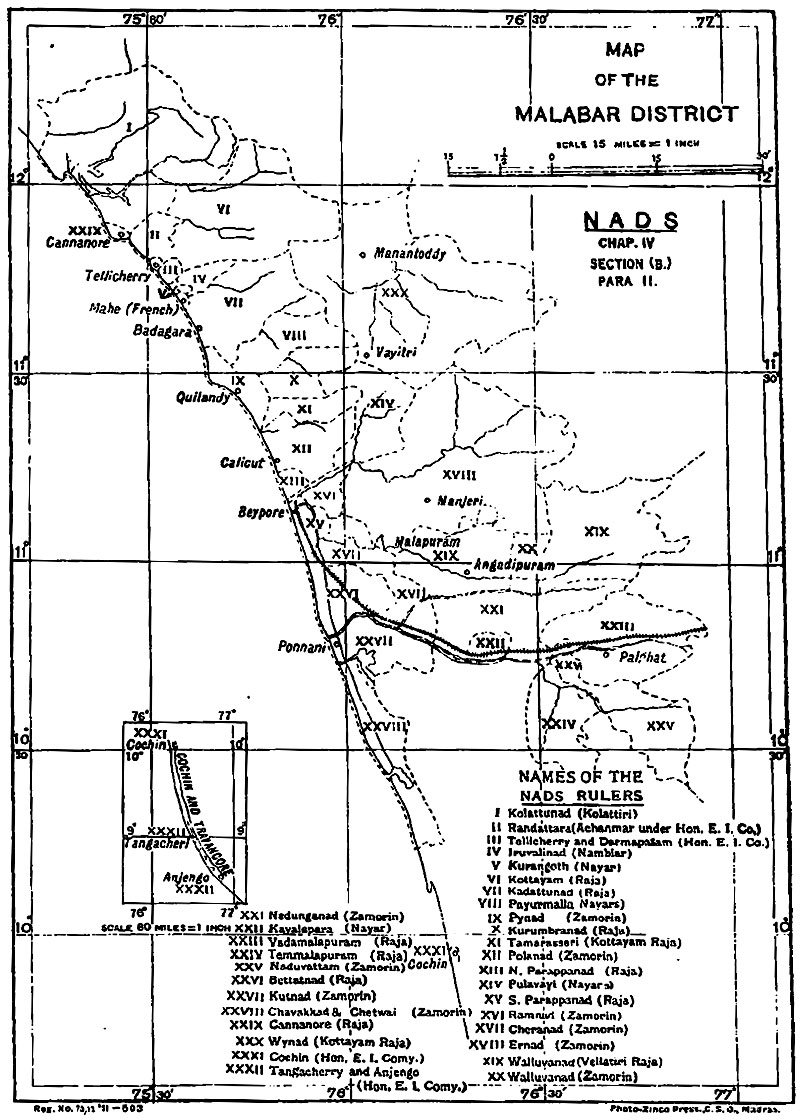
MAP of the Malabar District
|
Nads |
|
|
I. Kolattunad (Kolattiri) |
II. Randattara (Achanmar under Hon. E.I.Co.) |
|
III. Tellicherry and Darmapatam (Hon. E.I.Co) |
IV. Iruvalinad (Nambiar) |
|
V. Kurangoth (Nayar) |
VI. Kottayam (Raja) |
|
VII. Kadattunad (Raja) |
VIII. Payurmalla (Nayars) |
|
IX. Pynad (Zamorin) |
X. Kurumbranad (Raja) |
|
XI. Tamarasseri (Kottayam Raja) |
XII. Polanad (Zamorin) |
|
XIII. N. Parappanad (Raja) |
XIV. Pulavayi (Nayars) |
|
XV. S. Parappanad (Raja) |
XVI. Ramnad (Zamorin) |
|
XVII.Cheranad (Zamorin) |
XVIII. Ernad (Zamorin) |
|
XIX. Walluvanad (Vellatiri Raja) |
XX. Walluvanad (Zamorin) |
|
XXI. Nadunganad (Zamorin) |
XXII. Kavalapara (Nayar) |
|
XXIII. Vadamalapuram (Raja) |
XXIV. Temmalapuram (Raja) |
|
XXV. Naduvattam (Zamorin) |
XXVI. Bettatnad (Raja) |
|
XXVII. Kutnad (Zamorin) |
XXVIII. Chavakkad & Chetwai (Zamorin) |
|
XXIX. Cannanore (Raja) |
XXX. Wynad (Kottayam Raja) |
|
XXXI. Cochin (Hon. E. I Comy) |
XXXII. Tangacherry and Anjengo (Hon. E. I Comy) |
(1) Kolattunad.
|
Limits of Kolattanad. |
12. The domain in which the Kolattiri or Chirakkal family was regarded as the suzerain comprised the following modern amsams of the modern taluk of Chirakkal, viz. |
|
Payyannur |
Kurumattur |
Kalliasseri |
|
Vellur |
Taliparamba |
Moraya |
|
Karuvellur |
Pattuvam |
Kayaralam |
|
Korom |
Elom |
Kuttiyattur |
|
Eramam |
Cherutalam |
Maniyur |
|
Kuttur |
Kunynyimangalam |
Munderi |
|
Kuttiyeri |
Madayi |
Cheleri |
|
Chulali |
Mattul |
Kannadiparambu |
|
Kanyileri |
Cherukunnu |
Chirakkal |
|
Kalliad |
Kannapuran |
Alikod |
|
Malapattam |
Irinava |
Pulati |
|
Kottayam |
Pappinisseri |
Elayavur |
Wet Lands.
A.D. 1731-32. 13. In 1731-32 the Kolattiri dominions were invaded by the Bodnur Raja’s forces, and the Kolattiri Raja had in consequence to impose a tax of 20 per cent, of the pattam (rent) on all rice-lands.
Invasion of the Bodnur Raja.14. From this time forward the Kolattiri Raja was in straits for money to settle the Bodnur Raja’s demands, and the country seems to have been twice at least invaded afterwards.
1765-66 : 15. 1765-66 Hyder Ali descended into Kolattunad. The country was in a distracted state : sometimes in Hyder’s possession, sometimes in the Rajas, and sometimes in the hands of the Cannanore Bibi, and 30 per cent, of the pattam (rent) was imposed.
1776-77: 16. This continued till 1776-77, when Ramalinga Pillay, an officer of Hyder’s, sent one Koonjamaran Pillay, his gumasta or deputy, who fixed an assessment on each field at the rate of 50 per cent, of the pattam.
1777-80: 17 In 1777-80 Hyder exacted an annual tribute or Nuzzar of Rs. 4,00,000, and people say that 100 per cent, of the pattam (rent) was taken to make good the demand.
1781-83: 18. In 1781-83 the Raja exacted 50 per cent, of the pattam (rent), taking the paddy in kind.
1783:19. In 1783 one Harpenhully Venkappa made some alteration, but what it was, is not clear.
1785-88: 20. In 1785-88 Tippu, while the country was in possession of the Raja, sent a Commission to make a survey and to detect frauds, and the assessment was fixed at 50 per cent, of the pattam (rent), commuted into money at Rs. 40 per 1,000 seers of paddy. This commutation rate was increased to Rs. 41½ per 1,000 seers because of the substitution in the revenue collections of the Sultani fanam (3½ to the rupee) for the fanam current in the country.
1788-89: 21. In 1788-89 the people deserted the country owing to Tippu’s attempts at wholesale Islamism.
1790-92: 22. In 1790-92 the revenue was managed by the Raja, and the assessment was 50 per cent, of the pattam (rent), taken in kind for rice-lands.
1792-93: 23. In 1792-93 a survey was made by the Company’s and Raja’s servants, and the Raja alleged that he collected only 50 per cent, of the pattom (rent).
1798-99. The Hon'ble Company assume direct management:
24. A deficiency occurring in the collections, the Company in 1798—99 assumed the direct management.
1799-1800: 25. In 1799-1800 Mr. Hodgson, the Sub-Collector, made a settlement on the principle of taking 50 per cent of the pattam, commuted into money at Rs. 41½ per 1,000 seers of paddy.
1799-1801: 26. It has been customery for the inhabitants to give 10 seers per Potpad (Poti = 30 seers; Potipad = land requiring 30 seers to sow it), under the denomination of Potipattu (literally, 10 per poti), for the use of the Devasvam or Hindu temples. In 1799-1800 or 1800-1 half of this Potipattu, or (say 81/3 per cent, of the pattam) was assumed on behalf of Government at the ordinary commutation of Rs. 41½ per 1,000 seers.
1799-1801: 27. It had also been customary for the proprietors to give for every 100 seers of pattam (rent) 16 seers, under the names of Veli nellu (paddy for hedges) and Kythee nellu (grain for ropes), for raising hedges and providing ropes for keeping out and fastening up cattle which strayed into the rice-fields. In 1799-1800 or in 1800-1 half of this also was assumed by Government, at the ordinary commutation rate (Rs. 41 l/2 for 1,000 seers).
1801-2: 28. In 1801-2 Major Macleod, the first Principal Collector of the district, made a survey. Owing to the rebellion which arose, the survey was rescinded and Mr. Rickards, the second Principal Collector, reverted to the assessment of 1 800-I
1805-6: 29. In 1805-6 Mr. Warden, the third Principal Collector, for the purpose of carrying out the scheme of assessment proposed by Mr. Rickards and approved by Government (see Appendix XV), obtained a return from all proprietors of the seed, produce, etc., of all their fields. This return is usually known as the Janmi Pymaish of 981 M.E. On receipt of the returns for this Nad, the assessments, which were found to fall short of the proper proportion (50 per cent.) of the pattam (rent), were raised, but excesses similarly ascertained were not similarly reduced.
Garden lands
A.D. 1731-92: 30. It will be unnecessary to do more than refer to the following dates and paragraphs of this note for a description of the circumstances under which the revenue share of the pattam on gardens was, like that on rice-lands, assessed at the following rates:
1731-32, paragraph 13 20 per cent.
1731-65, do. 14
1765-66, do. 15 30 per cent.
1776-77, do. 16 50 per cent.
1777-80, do. 17 1 00 per cent.
1781-83, do 18 50 percent, (Pepper was taken in kind).
1783, do. 19
1790-92, do. 22 50 per cent. (Taken in money.)
1792-99: 31. Between 1792 and 1798-99 the Raja, who continued at this period to collect the revenue, had increased the percentage of assessment on garden produce to 60 per cent, of the pattam, except on pepper, which remained at 50 per cent. The pattam was ascertained by taking 20 per cent of the gross produce as the tenants share, except as regards pepper, the tenant’s share of which was not properly ascertained. The commutation rates for the produce were-
Cocoanuts Rs. 10-0-0 per 1,000 nuts.
Betel-nuts Re. 0—6—4 do.
Jacks Six-tenths of pattam, whatever the number of trees might be.
Pepper. Rs. 130-0-0 per candy of 640 lb.
32. In 1805-6 (as in the case of wet lands, paragraph 29 above) ascertained deficiencies in the proper proportion (50 per cent.) of the pattam (rent) on garden lands were raised on receipt of the Janmi Pymaish account of 981 M.E., but similarly ascertained excesses were not similarly reduced.
Miscellaneous Lands
1776-77 Modam: 32. In 1805-6 (as in the case of wet lands, paragraph 29 above) ascertained deficiencies in the proper proportion (50 per cent.) of the pattam (rent) on garden lands were raised on receipt of the Janmi Pymaish account of 981 M.E., but similarly ascertained excesses were not similarly reduced.
1776-77. Punom: 34. And in the same year (1776-77) Punam crops (rice and other grains and pulses, and occasionally some cotton grown on jungle lands felled annually for the purpose) were similarly assessed at 30 per cent, of the gross produce in the Elom, Madayi, Cherutalam and Kunyimangalam Amsams, and at 10 per cent, of the gross produce in the rest of the Nad : and the commutation rate was the same throughout, viz., Rs. 35 per 1,000 local seers as in the case of Pattada.
1776-77. Ellu: 35. Likewise, in the same year (1776-77), Ellu crops (gingelly-oil seed) were assessed throughout the Nad at 20 percent of the gross produce, commuted into money at Rs. 40 per 1,000 local seers.
(2) RANDATARA
Limits of Randatara: 36. Randatara (or , as it is sometimes called, Poyanadu in reference to the tradition that it was from this Nad that Cheraman Perumal took his final departure on his journey to Mecca) comprised the following modern amsams of the modern taluk of Chirakkal:-
|
1. Edakad. |
2. Chembilod. |
3. Iruveri |
|
4. Makreri. |
5. Anjarakandi. |
6. Mavilayi. |
|
7. Mulappilangad. |
|
|
Its connection with the Honourable East India Company’s Settlement at Tellicherry. A.D. 1741-93: It originally formed part of the Kolattunad under the Kolattiris, but it had come in the course of time to be treated as a separate Nad owing to the English factory at Tellicherry having taken the four ruling families of Achanmar and the 500 Nayars of the Nad under their special protection in the year 1741. The intention of this measure was “to give the Honourable Company authority over the Achanmar, as also to interpose with the Prince” (Kolattiri) “if he should oppress them by extravagant taxes, which has heretofore happened”- an allusion to the exactions which followed upon the Bednur irruption into Kolattunad in 1731 and following years. The transaction took the form of a mortgage for 60,000 fanams of the Nad, which was rich in pepper.
This was the beginning of a long series of transactions, which ended on the 26th April 1793 in an agreement between the Achanmar and the Joint Commissioners in allowing to the former a deduction in the amount of the revenue payable by them for their own lands equivalent to the 20 per cent, of the revenue allowed to the other chieftains of Malabar as Malilkhana.
Wet Lands
1765: 37. In 1705, collections were made by the Honourable Company at 15 per cent, probably of the pattam or rent on rice-lands, and this share of produce was taken in kind. In the agreement with the Achanmar cited in paragraph 36, this arrangement is alluded to as having been in force from 1741, but, owing to disturbances in the country, the arrangement had evidently been broken through and it was renewed on 16th May 1765.
1792: 38. In 1792, the assessment “was raised by the Commissioners to 50 percent of the “produce”, commuted into money at Rs. 43 per 1,000 seers. “The produce” here seems to mean the “pattam”(rent).
A permanent assessment of the Achanmar's private estates: 39. In 1793, the agreement alluded to in paragraph 36 was made with the Achanmar, whose wet lands were permanently assessed at 15 per cent, of “the pattam (rent)”, commuted into money at Rs. 45 per 1,000 seers.
In addition to the private estates of the Achanmar, those of the Bibi of Cannanore and of the Raja of Chirakkal were also similarly assessed. The agreement itself is very indefinite in its terms, but the above has been ascertained to be the actual settlement. The lands of other proprietors continued to be held on the footing detailed in paragraph 38.
Garden Lands.
1765: 40. In 1765 collections were made by the Company at 20 per cent, probably of the pattam or rent on gardens, the produce of which was generally commuted into money probably at current market rates. The terms of the agreement of 16th May 1765 are very indefinite.
1792: 41. In 1792 the Commissioners raised the assessment to 50 per cent, of "the produce" (which seems to have here meant pattam or rent calculated on the customary share at the customary pattam rates for produce), except on pepper. The rates were-
|
|
A |
P |
|
Cocoanut tree |
1 |
71/5 |
|
Betel-nut tree |
0 |
41/5 |
|
Jack tree |
3 |
22/5 |
|
Pepper-vine |
2 |
057/100 |
Permanent assessment of Achanmar's private estates. 42. In 1793, under the agreement alluded to in paragraph 36, the gardens on the private estates of the Achanmar were permanently assessed at 20 percent of the pattam (rent), commuted into money at the following rates :
|
|
Rs. |
A |
P |
|
Cocoanuts |
10 |
0 |
0 per 1,000 nuts. |
|
Betel-nuts |
0 |
8 |
0 do. |
|
Jacks |
0 |
6 |
4 1/5 per tree. |
In addition to the private estates of the Achanmar, those of the Bibi of Cannanore and of the Chirakkal Raja were also similarly assessed. The agreement itself is very indefinite in its terms, but the above has been ascertained to be the actual settlement. The lands of other proprietors continued to be held on the footing detailed in paragraph 41.
Miscellaneous Lands.
43. Puttada, Punaw and Ellu (see paragraphs 33, 34, 35) were assessed alike at 25 per cent, of the gross produce, commuted into money at Rs. 40, Rs. 40 and Rs. 80 per 1,000 seers respectively, but it is not certain when this assessment was fixed. (Year uncertain).
In addition to the private estates of the Achanmar, those of the Bibi of Cannanore and of the Chirakkal Raja were also similarly assessed. The agreement itself is very indefinite in its terms, but the above has been ascertained to be the actual settlement. The lands of other proprietors continued to be held on the footing detailed in paragraph 41.
Miscellaneous Lands.
Year uncertain: 43. Puttada, Punawm and Ellu (see paragraphs 33, 34, 35) were assessed alike at 25 per cent, of the gross produce, commuted into money at Rs. 40, Rs. 40 and Rs. 80 per 1,000 seers respectively, but it is not certain when this assessment was fixed.
(3) THE ENGLISH SETTLEMENT AT TELLICHERRY AND DARMAPATTAM ISLAND
Limits of the Honourable East India Company’s settlement. 44. The settlement consisted of the following modern amsams of the Kottayam taluk:-
Dharmadam. | Mailanjanmam.
Tellicherry. | Tiruvangad.
How, and when acquired: The settlement also originally formed a portion of the ancient Kolattunad. The Honourable Company sent agents to Tellicherry about 1683-84. In 1708 a formal grant was obtained from the northern regent of the Kolattiri family to erect a fort at Tellicherry, which thenceforth remained uninterruptedly in British occupation. The island of Dharmapattanam, lying adjacent to Tellicherry on the north, was acquired by agreements from the Kolattiri and Kottayam Rajas and the Bibi of Cannanore, who all had claims on it, in the years 1734-35, and remained from that time forward, with one short interruption (1788-89), in British occupation. The factory became a Residency in 1776, as, owing to the Mysore occupation, it was not continuing to pay. But the chiefship was afterwards restored.
Wet Lands
45. Those belonging to the Company were assessed at 100 percent, the pattam (rent), equivalent to about 40 per cent of the gross produce, and commuted into money at Rs. 45 per 1,000 seers.
1772-76: 46. Those belonging to private individuals in Tellicherry were free of assessment till 1772, when they were rated at 10 per cent, of the “produce.” This continued till 1776, when 25 per cent, of the ‘‘produce” - here, however, intended to mean the pattam or rent—was taken and commuted into money at Rs. 43 per 1,000 seers, which rate was subsequently raised to Rs. 45 per 1,000 seers.
47. Those belonging to private individuals in Dharmapattanam Island were assessed at 50 per cent, of the pattam (rent), commuted into money at Rs. 45 per 1,000 seers.
48. Those belonging to temples in Dharmapattanam Island were assessed at 35 per cent of the pattam (rent), commuted into money at Rs. 45 per 1,000, seers.
Garden Lands
49. Those belonging to the Honourable Company in Tellicherry were, prior to 1793-94, rated at 50 per cent, of the pattam (rent), and in that year the rate was increased to 662/3 per cent of the pattam (rent).
50. Some of those belonging to private individuals in Tellicherry had, prior to 1772, been rated at 25 per cent, of the "produce,” and in that year all of them were so rated. This continued till 1776, when the following rates were imposed : -
|
|
A |
P |
|
Cocoanuts |
1 |
71/5 per fruitful tree. |
|
Betel-nuts |
0 |
92/5 do. |
|
Jacks |
6 |
43/5 do. |
|
Pepper-vines |
3 |
22/5 per fruitful vine. |
But what constituted a “fruitful tree” or “fruitful vine” is not known. If the customary share of produce was taken and commuted into money at the customary pattam rates of produce, then it would appear as if it had been meant to take 50 per cent, of pattam on cocoanuts, 100 per cent, of pattam on betel-nuts, and 100 per cent, of pattam on jacks.
51. In Dharmapattanam Island all garden lands, whether belonging to the Honourable Company, to private parsons, or to temples were assessed alike at 50 per cent, of the pattam (rent).
Miscellaneous Lands.
Year uncertain: 52. In Dharmapattanam Island, Puttada and Ellu (vide paragraphs 33 and 35) on all lands were assessed at 25 percent of the gross produce, commuted into money at Rs. 40 and Rs. 80 per 1,000 seers respectively. It is not certain when this assessment was fixed.
(4) Iruvalinad
53. Was also a portion of Kolattunad under the suzerainty of the Kolattiri Raja. When the English factory was established at Tellicherry it was held by six families of Nambiars, viz., (1) Kunnumal, (2) Chandrott, (3) Kilakkodatta, (4) Kampuratta, who were known collectively as the Kulatta Nambiars, and by (5) Narangoli Nambiar and (6) Kariyad Nambiar. The Kurangott Nayar’s possessions also probably formed part of the original territory of Iruvalinad, but this portion will be more conveniently treated separately.
Iruvalinad proper consisted of the following modern amsams of the modern taluk of Kottayam, viz. : —
1. Pamir. | 4. Panniyannur.
2. Puttur. | 5. Perinkulam.
3. Triprangottur. | 6. Kariyad.
Their relations with the English and French settlements:
Owing to the position of their territory, these Iruvalinad Nambiars were early brought into relations with both of the neighbouring settlements of the English at Tellicherry and of the French at Mahe. There were accordingly many engagements entered into between the Honourable Company’s Factors at Tellicherry on the one hand and the Nambiars on the other.
The Nambiars are also frequently referred to in engagements between the English and French settlements, and between the English Company and other Native chieftains. It does not seem, however, that the Nambiars were in any way subject to the Honourable Company till 1782, when, owing to the successes attending the raising of the Siege of Tellicherry, the Nambiars and two other country powers agreed to become tributary to the Company. Whether this agreement was carried out is doubtful, because it was followed soon after by the Mangalore treaty of peace with Tippu Sultan in 1784, and by a return to the mutual positions hold by the respective parties before the war.
Wet Lands
1765-82: In Hyder Ali’s time (1765-82) this Nad was managed by the Raja of Chirakkal, who took 50 per cent, of the Pattam (rent), payable either in kind or commutable into money at Rs. 40 per 1,000 seers.
55. In Tippu’s time the rate continued the same, the revenue being collected in kind.
56. To prevent illicit trade with the French at Mahe the Nad was taken under the direct management of the Company at the rupture with Tippu Sultan in 1790-91; 50 per cent, of the pattam (rent.) was collected.
1793: 57. In 1793 the commutation rate was raised from Rs. 411/2 per 1,000 seers to Rs. 45 per 1,000 seers on the Narangoli Nambiar’s private estate ; it remained at the former rate elsewhere.
1793-91. 58. In 1793-91 the Nambiars were entrusted with the management of the Nad, and in 1794-95 they fixed the assessment at 50 per cent, of the pattam (rent).
1795-96: 59. In 1795-96 the assessment on all lands was raised to 60 per cent, of the pattam (rent) at the same commutation rates.
1799-1800: 60. In 1799-1800 the assessment was further raised to 72 percent, of the pattam (rent), except, on the Narangoli Nambiar's private estate, and except in four desams of Panur amsam.
Garden lands
1765-82: 61. Under Hyder Ali (1765-82) the Chirakkal Raja collected an assessment at the following rates:
|
|
A |
P |
|
Cocoanuts |
1 |
71/5 per fruitful tree |
|
Betel-nuts |
0 |
93/5 do. |
|
Jacks |
3 |
22/5 do. |
62. In Tippu's time, these rates were altered as follows:-
|
|
A |
P |
|
Cocoanuts |
2 |
33/7 per fruitful tree |
|
Betel-nuts |
0 |
91/7 do. |
|
Jacks |
4 |
66/7 do. |
But these rates being found burdensome, the whole jama (demand) on the Nad was reduced from Rs. 34,000 to Rs. 30,000, and the people were themselves allowed to regulate the rates.
1792: 63. The Nad being under the direct, management of the Honourable Company in 1792 (vide paragraph 56), the rates were raised so as to take 50 per cent, of the pattam.
1793: 04. In 1793 the rates were again altered as follows:-
|
|
A |
P |
|
Cocoanuts |
1 |
71/5 per fruit tree |
|
Betel-nuts |
0 |
93/6 do |
|
Jacks |
6 |
44/5 do |
|
Pepper |
2 |
018/25 per fruit vine |
These rates were, however, subsequently reduced as too high
1793-94: 65. The Nambiars were in 1793-94 entrusted with the management of the Nad.
1794-95: 66. The Nambiars in 1794-95 fixed the assessment at 50 per cent. of the pattam (rent). The assessment on pepper 1794-95. seems to have remained at this rate of 50 per cent, of the pattam. commuted into money at Rs. 120 per candy of 640 lb., down to the final abolition of the assessment in 1806-7.
1795-96: 67. In 1795-96 the assessment was raised to 60 per cent, of the pattam (rent).
1796-97: 68. In 1796-97 Narangoli Nambiar’s lands were assessed at 100 per cent, of the pattam (rent), probably for misconduct in intriguing with the rebellious Pychy Raja.
1799-1800: 69. In 1799-1800 the assessment was again raised (except on Narangoli Nambiars lands and except in four desams of Panur amsam to 72 percent, of the pattam (rent).
Miscellaneous Lands
1790-91: 70. In 1790-91 the assessment on Puttada, Punam and Ellu (see paragraphs 33, 34, 35) was fixed at 25 per cent, of the gross produce, commuted into money at Rs. 35, Rs. 35 and Rs. 80 per 1,000 seers respectively.
1792-93: 71. In 1792-93 the assessment on these crops was professedly raised to 40 per cent, of the gross produce, much too high a rate, leading to extensive concealment of produce.
1806-07: 72. In 1806-7 the assessment was extended, on the same principles, to Puttada and Ellu crops raised on land already assessed for garden produce.
(5) KURANGOTT NAYAR'S NAD
Position and limits: 73. For remarks, see paragraph 53 above. This Nad lay directly between the English and French settlements at Tellicherry and Mahe respectively, and consisted of the following amsams of the modern taluk of Kottayam :
(1) Olavitam.
(2) Kallavi.
His relations with the English and French and Mysoreans: From the position of his Nad, the Nayar was early brought into relations with both the English and French Companies, and he tried his best, to play off one against the other, not without loss to himself. He was the first chieftain who tried conclusions with the arms of the Honourable Company. This was in 1719, and he came out of it worsted, and was obliged to cede to the Company the desam of Mailam in the modern amsam of Mailanjanmam.
After this he remained more under French than under English influence till 1766, when, on Hyder Ali’s descent into Malabar, he was the only chieftain1 besides Cochin permitted to retain his district. He was, however, subsequently compelled to pay tribute to Hyder Ali.
NOTEs: 1. The Randatara Achanmar being under the protection of the Honourable Company were likewise at first undisturbed. END OF NOTEs
In 1779 he assisted the English Company at the taking of Mahe, and in 1782 he was in turn taken prisoner by the English Company at the successful sortie which closed the siege of Tellicherry. Remaining a prisoner at Tellicherry, he paid tribute to the Company for his Nad till 1785, in which year he was again claimed by the French as their ally.
In 1787 Tippu caught and hanged him and annexed his Nad to the lruvalinad Revenue Cutcherry. In 1790 the English Company drove the Mysoreans out of this Nad, and reinstated the Nayar, who again turned to the French alliance, in consequence of which he was arrested and sent a prisoner to Calicut in 1793. In 1797 the Nayar was reinstated in his Nad, which he managed down to 1805-6.
Wet Lands
1795-180: 74. There is nothing to show on what principles the Nayar collected the revenue between 1795 and 1805-6. In the latter year he resigned the management and received a Malikhana.
1805-6. 75. In 1805-6 the assessment was fixed at 60 per cent, of' the pattam (rent) as entered in the Janmi Pymaish account of 981 (1805-6), and commuted into money at Rs. 45 per 1,000 seers. Whether the pattam (rent), of which 60 per cent, was taken, was the actual puttam (rent) being paid to the Janmis, or whether it was the pattam (rent) calculated on Mr. Rickards’ plan (see paragraphs 226, 226a, 226b below) is not known. It was probably the latter, because the garden assessments were fixed on Mr. Rickards’ plan.
Garden Lands
1805-6: 76. In 1805-6 the assessment was fixed at 50 per cent, of the pattam (formed of two-thirds of the gross produce on Rickards’ plan, vide paragraphs 226, 226a, 226b below) and the commutation rates were fixed as follows :-
|
Cocanuts |
10 |
0 |
0 per 1,000 nuts. |
|
Betel-nuts |
0 |
6 |
64/5 do |
|
Jacks |
0 |
3 |
22/5 per tree |
|
Pepper |
1 |
0 |
0 |
It is not known, however, what this "fruit vine" was expected to yield in produce.
77. No details are available.
(6) KOTTAYAM OR COTIOTE
The Kottayam Rajas. The Pyche Raja's rebellion, and death, 30th November 1805, Limits:
78. Was also formerly a portion of Kolattunud. The Cotiote or Kottayattu Rajas, who are also styled Puranattu (i.e.foreign Kshatriya) Rajas, received their territory from the Kolattiri. This event took place some centuries ago, and when the English settlement was formed at Tellicherry, “the Cotiote” (as the Raja was generally called) was one of the first with whom the Honourable Company came into formal relations. The Raja steadily supported the Honourable Company in the conflicts with Hyder and Tippu, first in 1780-82 and again in 1791-92.
On the cession of Malabar to the British in 1792 some unfortunate misunderstandings arose, and the Palassi or Pychy Raja, the de facto head of the house, rose in rebellion, and maintained a sort of independence so long as Wynad (which was claimed both by Tippu Sultan and by the Honourable Company) was at hand for him to flee to.
On the fall of Seringapalam in 1799 Wynad was formally ceded to the Honourable Company, and a struggle immediately commenced with Palassi or Pychy Raja. The conflict lasted till near the end of 1805, and was terminated on 30th November 1805 by the death, in a skirmish, of the Palassi Raja. The Kottayam country, consisting Wynad, which will be considered separately, consisted of the following modern amsams in the modern taluk of Kottayam, viz.
Kudali. Mulakkunnu. Sivapuram. Pinarayi.
Pattannur. Gannavam. Palassi. Nittur.
Chavasseri. Manatana. Kandamkkunnu. Katirur.
Veliyambra. Kannavam. Paduvilayi. Kottayam.
Wet Lands
In a more or less unsettled state till 1805-6: 79. It will be gathered from the above that this Nad was in a more or less unsettled state both under Mysore and under British rule until 1805-6, but a settlement was concluded between the Mysoreans and the Raja some time after Hyder Ali’s second invasion, and its principles were to take 50 per cent of the pattam (rent), commuted into money at Rs. 41-8-0 per 1,000 seers. There was supposed to be an annual survey, and if this was properly conducted, the assessment would not, according to the recognised customs of the country as regards deductions for cultivation expenses, etc., have amounted to more than 25 per cent, of the gross produce.
1805-6: 80. The above principles were professedly followed down to 1805-6, when, on the receipt of the Jamni Pymaish accounts (vide paragraph 29 above), the assessment was raised in the cases in which it fell short of the proper proportion of pattam (rent) as returned in the said accounts, but similarly ascertained excesses were not similarly reduced.
Garden Lands
81. The Mysorean settlement with the Raja was on the principles of taking 50 per cent,of the pattam (rent) and of commuting it into money at the following rates :
Cocanuts Rs. 10-0-0 per nuts.
Betel-nuts 0-6—44/5 do.
Jacks The pattam was ascertained as precisely as possible.
Pepper Rs. 130-0-0 per candy of 640 lb.
1805-6: 82. These rates remained professedly unaltered down to 1805-6, when, as in the case of wet lands, on receipt of the Janmi Pymaish accounts (paragraph 29 above) ascertained deficiencies were raised and ascertained excesses were not reduced. The commutation rates remained as before, except that betel-nuts were rated at 8 annas per mille and jacks at 6 annas 44/5 pies per tree.
Miscellaneous Lands
Year uncertain: 83. Pullada and Punam (vide, paragraphs 33, 34, above) were assessed at 40 percent, of the gross produce, commuted into money at Rs. 35 per 1,000 seers, and Ellu (vide paragraph 35 above) was assessed at 25 per cent, of the gross produce, commuted into money at Rs. 80 per 1,000 seers. It has not been ascertained when this settlement was made. It was very severe, and it must have led to extensive concealment of produce.
(7) Kadattanad
The Kadattanad Rajas: 84. This was also formerly a portion of Kolattunad : it in fact formed the chief portion of the territory under the jurisdiction of the Tekkalankur (Southern Regent), or second Rajasthanam of the Kolattiri. When the English Company settled at Tellicherry, Kulattanad was subject to the ancestors of the present Raja of Kadattanad who was at that time usually known as the "Boyanore” or (Baynor1 of Badagara,” from the chief port of the Nad, and who, tradition says, was connected in the male line with the Kolattiris. It was composed of the following modern amsams of the modern taluk of Kurumbranad, viz.
NOTEs: 1. Corrupt transliterations of “Valunnavar”= ruler. END OF NOTEs
Aliyur. Valayam. Kumangod.
Muttungal. Velliyod. Ponmeri.
Eramala Kunnummal. Arakkilad.
Karttikapalli Kavilumpara. Vadakara.
Purameri. Kuttiyadi. Memunda.
Edacheri. Velam. Palayad.
Iringannur. Cherapuram. Putuppanam.
Tuneri. Kottappalli. Maniyur.
Vellur. Ayancheri. Tiruvallur
Parakadavu Kadameri.
Chekkiyad. Kuttipuram.
Kavilumpara and Kuttiyadi: The amsarns of Kavilampara and Kuttiyadi belonged, when the Honourable Company acquired Malabar in 1792, to the Kottayam or Cotiote Raja, but it will be more convenient in the present narrative to include them in Kadattanad.
Wet Lands
1766-67: 85. In 1766-67 the Kadattanad Raja agreed to become tributary to Hyder Ali for his Nad in the sum of Rs. 50,000.
1768-69: 86. No levy was made from the people on the above account till 1768-69, when, in order to defray arrears, a survey of gardens was made, but no assessment was imposed on rice.
1768-73: 87. Hyder Ali's forces having retired, no collections were made between 1768 and 1773.
1778-79: 88. It was only in 1778-79 that rice-lands were first assessed by the second Raja, acting under the orders of Bulvunt Row, Hyder Ali’s general. The assessment was at the rate of 50 per cent, of the pattam (rent), commuted into money at Rs. 40 per 1,000 seers.
1780-81: 89. This continued in force till 1781, the Raja having meanwhile been relieved from management by Sirdar Khan, who took charge in 1780-81.
1781: 90. In 1781 no revenue was paid.
1782-87: 91. 1782-83 till 1786-87, under Arshad Beg Khan's governorship, the collections continued at the former rate of 50 per cent, of the pattam (rent).
1787: 92. In 1787 the Raja was directed1 by Parvana from Tippu Sultan to take 50 per cent, of the gross produce as the Sirkar’s share, but the arrangement was never carried into effect.
NOTEs: 1 Treaties, etc., i. CXLVIII. END OF NOTEs
1788: 93. In 1788 Ramalinga Pillay, an agent, who was originally appointed by Hyder Ali, and who had made sundry settlements in South Malabar, completed a survey of the Nad and assessed the rice-lands as follows:-
Each local para (10 local seers), of seed was assessed at 3 Cunteray fanams, but whether this assessment per para of seed was imposed on the actual number of paras required to sow all the wet lands in the Nad, or whether it was only imposed (as in South Malabar) on a certain proportion of the actual number of paras so required, has not been ascertained.
1789-91: 94. The above assessment (whatever it was) was collected by Tippu Sultan's officers, who, in the absence of by the Raja, managed the district in the years 1789-90 and 1790-91.
1791-98: 95. The Raja having returned to his Nad on the expulsion of the Mysoreans, it is not clear on what principles the assessment was levied by him between 1791 and 1798.
1798-99: 96. In 1798-99 a survey was made and 60 per cent, of the pattam (rent) was assessed on rice-lands, and commuted 1798-99 into money at Rs. 40 per 1,000 seers.
Garden Lands
1768-69: 97. See paragraphs 85 and 86 above, in order to defray the arrears of tribute which had accrued, 100 percent, of the pattam on gardens was levied in1768-69.
1773-74: 98. In 1773-74 arrears had again accrued to the extent of Rs. 3,00,000, and to defray this an estimate of the number of gardens was made, excluding unproductive and waste. It came to 15,000, and on this number a rate was levied at Rs. 10 per garden. This was made at the instance of Burki Srinivas Row, Hyder’s Civil and Military Governor, who had descended into Malabar with an army.
1774-75: 99. In 1774-75 a contribution per garden of Rs. 5 was levied.
1775-76:100. In 1775-76 the contribution per garden was again raised to Rs. 10.
1777-78: 101. This continued till 1777-78.
1778-79: 102. In 1778-79 the second Raja, as already alluded to in paragraph 88, aided by an auxiliary force of 500 Mysoreans, whose pay he had to defray in addition to the tribute, made a. survey of the gardens and fixed the assessment at two-thirds of the gross produce (i.e., 100 per cent, of the pattam), the commutation rate for cocoanuts being Rs. 8 to 10 per 1,000 nuts.
1782: 103. This continued in force, under the Raja, and under Sirdar Khan till 1782, in which year Sirdar Khan having been taken prisoner at Tellicherry, no revenue was raised beyond R.s. 2 per garden levied by the Raja to defray his military charges.
1782-83: 104. From 1782-83 till 1786-87, during Arshad Beg Khan’s governorship, the collections were made on the principle of taking 100 per cent, of the pattam, (rent) on gardens.
1787: 105. In 1787 Tippu Sultan's Parvana to the Raja prescribed certain rates for gardens, which, however, as they were never enforced, need not be detailed.
1788: 106. In 1788 Ramalinga Pillay (mentioned in paragraph 93 above) made a survey of the gardens and assessed them at the following rates :
|
|
Cunteray fanam |
|
Each cocoanut tree |
½ |
|
6 Betel -nut trees |
1 |
|
1 Jack tree |
1 |
Pepper gardens were inspected, the produce in dry pepper estimated, and each seer of dry pepper was assessed at 12½ annas of a Cunteray fanam, equivalent to about Rs. 7 5 per candy of 640 lb.
1780-91: 107. The assessment remained at these rates during 1789-90 and 1790-91.
1791-98: 108. The Raja having been reinstated in his Nad, managed it from 1791 till 1798, but it has not been ascertained on what principles he collected the assessment.
1798-99: 109. In 1798-99 a survey was made and the assessment fixed at 60 per cent, of the pattam (rent) on gardens, commuted into money at the following rate:-
|
|
Per 1,000 nuts |
|
Cocoanuts Betel-nuts |
10 rupees. 6 annas 4 4/5 pies. |
The pattam (rent) of four productive betel-nut trees was assessed at 3 annas 22/5 pics, but it is not clear how this was fixed, and whether trees yielding small produce were classed as unproductive.
Jacks : 6 annas 44/5 pies was taken as the pattam (rent.) per tree.
Pepper was assessed at "half of the produce brought to account,” and, as in the calculation of produce customary deductions were made on the following accounts, viz.:-
20 to 25 per cent, for loss by falling off of grapes between inspection and harvest,
10 to 12 per cent for plucking the pepper, and about
20 per cent, for cultivation expenses,
it follows that the Government share was never more than about one-third of the gross produce. Whether the money valuation exceeded or fell short of that proportion could only be known by a comparison of the commutation rate (Rs. 150 per candy of 640 lbs.) with the actual market prices, which cannot now be ascertained.
Miscellaneous Lands
1798-99: 110. In 1798-99 Puttada, and Punam (see paragraphs 33 and 34) were assessed at 40 per cent, of the gross produce commuted into money at Rs. 40 per 1,000 seers ; and in the same year Ellu (see paragraph 35) was assessed at 20 per cent, of the gross produce, commuted into money at Rs. 60 per 1,000 seers, and the assessment was extended to garden lands where this kind of cultivation was carried on although the gardens might also be bearing a garden assessment.
(8) Payyormala ; (9) Payanad ; (10) Kurumbranad ; (11) Tamarasseri
Reasons for grouping Nads: 111. It will be convenient to group these Nads together in this narrative because the principles of the original assessment under Hyder Ali were identical in all.
Payyormala Nayars. Limits: 112. Payyormala was subject to the Nayars (Paleri, Avinyat and Kutali) of Payyormala. They were independent chieftains, with some theoretical dependence on the Kurumbranad family and also on the Zamorin. The Nad was composed of the following modern amsams of the modern Kurumbranad taluk, viz.:—
|
Paleri. Cheruvannur. Meppayur. Perambra. |
Kayanna. Karayad. Iringatt. |
Zamorin's acquisitions. Limits: 113: Payanad was subject to the Zamorin, being part of the ancient kingdom of Kollam which he annexed. It was composed of the following modern amsams of the modern taluk of Kurmubranad, viz.:-
|
Kilariyur. Mudadi. Pallikkara. |
Meladi. Vivyur. Arikkulam. |
Melar. Chemancheri. Tiruvangur. |
Kurumbranad Raja’s Limit: 114. Kurumbranad was subject to the Kurumbranad family, connected with that of Kottayam. It consisted of the following modern amsams of the modern taluks of Kurumbranad and Calicut, viz.:
|
Kottur. Trikkutisseri. Naduvannur. |
Kavantara. lyyad. Panangad. |
Nediyanad. Kilakkot. Madavur. |
Kottayam Raja's District. Limits: 115. Tamarasseri was subject to the Kottayam or Cotiote Rajas (regarding whom see paragraph 78 above). It consisted of the following modern amsams of the modern taluks of Kurumbranad and Calicut, viz.:-
|
Ulleri. Kokallur. Edakara. |
Kunnattara. Annasseri. Naduvallur. |
Nanminda. Nediyanad. Kudattayi. |
Wet lands
1776-77: In 1776-77 an account of the pattam of the different lands having been taken by the inhabitants to Hyder’s durbar, and the price of paddy having been stated at Rs. 35 to 40 per 1,000 local seers, an order was received in reply, directing that 30 per cent, of the pattam should be taken and commuted into money at 3 old Viray fanams (12 annas modern money) for each of the local paras (10 local seers), of which there were more than one. As they varied in capacity the commutation rates per 1,000 Macleod seers varied likewise as follows:-
|
|
|
Rs. |
A |
P |
|
In 38 Desams in Nad „ 40 do. do. |
IX XI |
68 |
2 |
1010/11 |
|
„ 65 do. do. |
VIII |
62 |
8 |
0 |
|
„ 11 do. do. |
IX |
57 |
11 |
012/13 |
|
„ 13 do. do. „ 60 do. do. „ 40 do. do. |
IX X XI |
56 |
9 |
719/53 |
Arshad Beg Khan's remission of 20 per cent: 117. In 1782-83 Arshad Beg Khan, Tippu Sultan's Governor, on receipt of complaints, reduced the jama (demand) 20 per cent, all round on wet lands and gardens, but left the distribution of this reduction on individuals to be carried out by his subordinates. To what extent this reduction was ever carried out in regard to individuals, it is impossible to say. This reduction took effect in these Nads and in the whole of South Malabar except in Nads XXIII, XXIV and XXV.
Tippu Sultan substituted Sultani fanams for old Viray fanams, involving increase of 12½ percent: 118. In 1786-87 Tippu Sultan ordered a coinage of Sultani fanams, and the collections were afterwards made in these instead of in old Viray fanams. As old Viray fanams were worth four to the rupee, and as Sultani fanams, though of higher value originally, had in 1788-89 fallen in value to 3½ per rupee, the substitution of Sultani fanams for old Viray fanams had the effect of raising the revenue at least 12½ per cent, all round on wet lands, gardens, and miscellaneous lands. This increase, as in the case of Arshad Beg Khan’s reduction, had effect in these Nads and in nearly the whole of South Malabar.
When the Zamorin, on his restoration in 1790-91, recommenced the coinage of fanams, called new Viray fanams, he adhered pretty closely to the standard of Tippu Sultan’s Sultani fanams, viz., 3½ to the rupee. The assessment, therefore, at this time suffered no change on this account.
1792-94: 119. In 1792-94 a kind of survey was made in consequence of a request preferred by the inhabitants to the Bengal and Bombay Commissioners that half of the “rice produce" (sic, vide paragraph 459 of their report) should be taken as revenue. It is extremely doubtful that this was their request, and it is more probable they meant the Government share to be 50 per cent, of the pattam (rent.); but however this may be, what was actually done was by adherence to the old principles to endeavour, as far as possible, to keep the revenue at the old amount.
Then 10 per cent cess for collection charges: 120. The second Commission, following a practice which had to some extent elsewhere been introduced by the Mysorean‘s and by the Joint Commissioners, added 10 per cent, to the jama (demand) in order to defray collection charges. The Mysoreans never, however, included this 10 per cent, in the permanent jama as the Commissioners did. The exact date is not known, but it was between 1796 and 1801.
Garden Lands
The original assessments in those Nads were nominally the same as those in South Malabar districts generally, viz. :—
One old Viray fanam per two cocoanut trees.
Ono do. per six betel-nut trees.
One do. per jack tree.
Three do. per pepper-vine estimated to yield 15 seers of green pepper.
But the settlement really proceeded on the principle of taking 100 per cent, of the pattam (rent), ascertained partly by inspection of trees, partly by deeds, and partly by information obtained from the people. The commutation rates were, however, the customary rates between Janmis and Ryots in fixing the pattam rates, which were admittedly below the market prices of produce. Those customary rates were –
Rs. A P
Cocoanuts 7 8 0 per 1,000 nuts.
Betel-nuts 0 4 0 do.
Jacks 0 4 0 per tree.
If Janmis chose to break through the ancient customs and regulated their dealings with their Ryots at market prices, these rates left a margin for payment of some pattam (rent).
Arshad Beg Khan’s remission of 20 per cent: 122. Arshad Beg Khan’s reduction of 20 per cent, on the jama (demand), Tippu Sultan’s increase of 12½ per cent., and the second Commissioner’s increase of 10 per cent, (vide paragraphs 117, 118, 120 above) affected the garden assessments in these Nads likewise.
Miscellaneous Lands
123. Modan and Ellu (vide paragraphs 33 and 35 above) were assessed by orders from Mysore in Hyder Ali’s time at 20 per cent, of the produce, commuted into money, the Modan produce at Rs. 35 to 40 per 1,000 local seers, and Ellu at Rs. 50 to 55 per 1,000 local seers.
(12) Polanad (Vadakkampuram and Kilakkampuram) ;
(13) Beypore or Northern Parappanad; (14) Pulavayi.
Reasons grouping: 124. These Nads, which constitute the greater portion of the modern taluk of Calicut, will be best taken together, as they seem to have been managed as regards revenue on an uniform plan.
Zamorin's acquisition of Polanad. Limits: 25. Polanad was one of the districts immediately subordinate to the Zamorin, who took it originally by stratagem from the Porlatiri Rajas. It was the Nad in which Calicut, the Zamorin’s headquarters, was situated. It consisted of the following modern amsams of the modern taluk of Calicut, viz.
|
Elattur. Talakkuluttur. Makkada. Chattamangalam. Kunnamangalam. Tamarasseri. Kuruvattur. |
Padinyavattumuri. Karannur. Edakkad. Kacheri. Nagaram. Kasba. Valayanad. |
Kottuli. Chevayur. Mayanad. Kovur. Perumanna Peruvayal. Iringallur. Olavanna. |
Parappur Raja's Limits: 126. Beypore or Northern Parappanad was subject to the Beypore branch of the Parappur family of Kshatriyas under the nominal suzerainty of the Zamorin. In consisted of the following modern amsams in the modern taluk of Calicut, viz.:
|
Kedavur. Tiruvambati. Puttur. Nilesvaram. Koduvalli. |
Kanniparamba. Chulur. Manasseri. Pannikkot. |
Wet Lands
The Huzzur Niguti. 1776-77: 128. In 1776-77 Sirdar Khan, Hyder Ali’s Civil and Military Governor, prepared certain accounts and sent them to Hyder Ali’s durbar, where they were revised, and upon them an assessment, was founded, which has usually been designated as the Huzzur Niguti, or assessment fixed at the seat of Government. Neither in Sirdar Khan’s accounts nor in those received back from the durbar was it specifically expressed what proportion of the pattam (rent) or of the gross produce was intended to be taken as the Government share.
The Niguti vittu or assessed seed: 129. But Mr. Graeme ascertained on local inquiry that the Government share varied in these Nads on wet lands from 25 per cent, of the pattam (rent) in Nads XIII and XIV and in six Desams of Nad XII to 30 per cent, in the remaining fifty-seven Desams in Nad XII.
This proportion of the produce came to be known as the Niguti Vittu or assessed seed. Each local para (10 local seers) of Niguti Vittu or assessed seed was commuted into money at 3 old gold fanams, but on complaint of the severity of this rate, Sirdar Khan reduced the commutation rate in the fifty-seven Desams ot Nad XII [where 30 per cent, of the pattam (rent) was taken] from 3 to 2½ old gold fanams. The commutation rate, therefore, varied from 10 to 12 annas per local para (10 local seers) of Niguti Vittu, or, to state the matter differently, for the purpose of general comparison, from Rs. 50 to Rs. 60 per 1,000 Macleod seers.
130. Arshad Beg Khan’s reduction of 20 per cent, and Tippu Sultan’s increase of 12½ per cent, (see paragraphs 117, 118 above) were applied to the rice-lands in these Nads.
1791-94: In 1791-92 to 1793-94 a return was gradually made to the jama (demand) at the above rates.
132. The 10 per cent, for charges of collection (vide paragraph 120 above) was also added to the demand.
1793-94: 133. In 1793-94 there was a sort of a survey, but the old principles were adhered to, and the main point kept in view was not to exceed the aggregate of the former jama (demand).
Garden Lands
Huzur Niguti : The Huzur Niguti (see paragraph 128 above) fixed the rates of assessment on garden produce as follows:-
|
A P Cocoanuts ½ old Viray fanam or 2 0 per productive tree. Betel-nuts 1/6 do. or 0 8 do. Jacks 1 do. or 4 0 do. Pepper-vines. 3 do. or 12 0 per productive vine.
|
100 percent of pattam taken as assessment: These rates, however, were perhaps never as matter of fact applied in practice. The Mysore Government, it is understood, meant to appropriate the whole of the Janmi’s share of the produce, or in other words 100 per cent, of pattam (rent).
What was understood by a 'productive tree’: In order to do this and at the same tine to preserve some uniformity in the principle of taxation, their officers entered in the accounts as “productive” only the number of trees or vines which, at the above rates, it took to make up the total jama (demand). All other trees, whether productive or not, were classed as “unproductive.” For example, 10 fanams of pattam (rent) would be reckoned as 20 productive cocoanut trees. In some localities this number of trees might produce 10 fanams of pattam (rent), but in other localities it would take 30 or 40, or, perhaps, 60 really productive trees to makeup 10 fanams of pattam (rent) ; in these cases 20 trees only would be returned as productive, while the balance of 10, 20 or 40 trees respectively, though really productive, would be returned as "unproductive.”
And so with pepper-vines, the 3 fanams per productive vine was not an assessment on each vine, or even (as was sometimes thought) on each standard tree supporting a number of vines, but upon any number of vines - varying, as it necessarily must have done, with the fertility of soil and congeniality of climate—that were estimated to yield 15 seers of green pepper (or 6 seers of dry pepper). The whole of the pattam (rent) thus taken as revenue was, however, commuted into money at rates which still left the Janmi (if he chose to break through the ancient customary rule and take it) a small share of the produce. The customary commutation rates in these Nads were as follows :
Rs. A P
Cocoanuts 7 8 0 per 1,000 nuts.
Betel-nuts 0 4 0 do.
Jacks 0 4 0 per tree.
which were considerably below market prices.
135. Arshad Beg Khan’s reduction of 20 per cent, and Tippu Sultan’s increase of 12½ per cent, and the Commissioner’s increase of 10 per cent, for establishment charges (see paragraphs 117, 118 and 120 above), were applied to the garden assessments in these Nads.
Miscellaneous Lands
136. Modan (sec paragraph 33 above) was only assessed by the Mysoreans in Nads Nos. XIII and XIV, and there at the rate of 20 per cent, of the gross produce at current market prices. Ellu (see paragraph 35) was unassessed by the Mysoreans, except when it was sown instead of Modan in Nads Nos. XIII and XIV. In the latter event the Mysore Government took in some places 5 Sultani fanams 3½ to the rupee) for every Macleod seer of seed sown, and in other places 20 per cent, of the gross produce at current market prices.
1801-2: 137. In 1801-2 Major Macleod, the first Principal Collector, included in the permanent jama (demand) of those Nads 20 per cent of the gross produce in that year of Modan and Ellu lands [commuted into money assessments at 1 new Viray fanam (3½ to the rupee) and 2½ new Viray fanams respectively per para (10 seers), dividing the amount thus arrived at into three portions, and collecting one-third annually, the lands being cultivated only once in three years. These commutation rates were equivalent to Rs. 28-9-15/7 and Rs. 71-0-102/7 per 1,000 Macleod seers respectively. To the above he also added the 10 per cent, for charges of collection (see paragraph 120).
(15) Southern Parappanad ; (16) Ramnad; (17) Chernad ; (18) Ernad.
Reasons for grouping: 138. As the Huzzur Niguti (see paragraphs 128,129 and 134) was the rule of assessment in these four Nads, and grouping as these Nads constitute nearly the whole of the modern taluk of Ernad, it will be convenient to take them together, although the modes of applying the Huzzur Niguti varied great in each of them.
Parappur Raja's Limits: 139. Southern Parappanad, under the Parappur family with the Zamorin as nominal suzerain (see paragraph 126), consisted of the following modern amsams of the modern taluk of Ernad, viz. :
|
Palanchannur. Mannur. Tonyipalam. Neduva. |
Vallikunnu. Parappanangadi Nannambra. |
The territory: 140. Ramnad, Chernad and Ernad all acknowledged the Zamorin as direct ruler. They consisted of the following modern amsams of the modern taluks of Ernad and Ponnani :
|
|
Ramnad |
|
|
Nallur. Alinyilam. Chorukava. |
Karad. Karumarakad. |
Karippur. Chelembra. |
|
|
Chernad |
|
|
Vadakkumpram. Valiyakunnu. Kattiparutti. Atavanad. Ummattur. Irimbiliam. |
Parutur. Olakara. Trikkulam. Koduvayur. Vengara. Kannamangalam. |
Urakam Melmuri. Puttur. Kottakkal. Indiannur. Valakkulam. |
|
|
Ernad |
|
|
Mappram. Chikkod. Uragattiri. Mambat. Nilambur. Kolattur. Nediyirippu. Kilmuri. Melmuri. |
Porur. Vandur. Tiruvali. Trikalangod, Karakunnu. Arimbra. Valluvambrnm. Irirnbuli. Mancheri. |
Iruvetti. Kavannur. Chengara. Puliyakod. Kulimanna Payyanad. Elankur. Ponmala. |
Wet Lands
1776-77:141. Graeme ascertained that the Huzzur Niguti (see paragraph 128), as assessed in these Nads in bore the following proportions to pattam (rent) at the following commutation rates calculated in the manner detailed in paragraph 129 above:-
Percentage of pattam taken as assessed seed, Niguti vittu:
|
|
|
Rs. |
|
|
Southern Parappanad, |
No XV |
33½ per cent, at 62½ |
per 1,000 Macleod seers. |
|
Ramnad, |
No. XVI |
25 do. at 75 |
|
|
Chernad, |
No. XVII:- |
|
|
|
In 10 desams |
10 do. at 250 |
||
|
„ 60 Do. |
10 do at 125 |
||
|
" 31 Do. |
25 do at 75 |
||
|
" 1 Do. |
331/3 do at 75 |
||
|
Ernad, |
No. XVIII |
20 do at 75 |
142. Arshad Beg Khan’s reduction of 20 per cent. Tippu Sultan’s increase of 12½ per cent., and the 10 per cent, addition for collection charges (see paragraphs 117, 118 and 120) all took effect on the wet lands of these Nads.
1791—94: 143. The old jama (demand) was gradually worked up to in 1791-92 to 1793-94, and collected as far as possible up to 1800-1.
1801-3: 144. Major Macleod made a sort of survey or inspection and increased the jama (demand) in 1801-2, without, however, presumably altering the principles of the assessment. Owing to the rebellion which ensued, the old jama (demand) of 1800-1 was reverted to by Mr. Rickards in 1802-3.
1803-4: 145. In 1803-4, however, Mr. Warden, third of the Principal Collectors, directed one-fourth of the increase to the jama (demand) made by Major Macleod to be collected in Nad No. XV and in one desam—Puttur—in Nad No. XVII. To this increase he superadded 10 per cent, for charges of collection (vide paragraph 120).
Garden Lands
The Huzrur Niguti (see paragraph 134) was introduced by Ramalinga Pillay (Hyder Ali’s agent) in all these Nads on the same footing as in the Calicut Taluk Nads, viz., that 100 percent, of the pattam (rent) was taken and commuted into money at the customary rates prevalent in all of these Nads, viz.
|
|
Rs. |
A |
P |
|
|
Cocoanuts |
7. |
8 |
0 |
per 1,000 nuts |
|
Betel-nuts |
0. |
4 |
0 |
Do |
|
Jacks |
0 |
4 |
0 |
per tree |
These rates were admittedly below the market prices, and left a small margin as pattam if the Janmi thought right to take it.
147. It appears, however, that in the assessment of the gardens in Nad No. XV and in Bettatnad (Nad No. XXVI), some small additional share was left over for the Janmi in manner following. The trees were divided as usual into productive, unproductive, and young, and a pattam (rent) calculated in money was arrived at (after making a deduction of one-third, it is supposed, as the Ryot’s share).
From the pattam (rent) so ascertained a deduction of 2 old viray fanams in 10 (i.e. 20 per cent.) was made for the benefit of the Janmis,1 and the residue, viz., 8 fanams in 10, was then entered in the accounts as 16 productive cocoanut trees in accordance with the rule of the Huzzur Niguti (paragraph 13-4).
NOTEs: 1. Mappillas (Mulmmmadans) predominated then as they still in these parts. END OF NOTEs
1803-4: 148. In Nad No. XV and in one Desam—Puttur—of Nad No. XVII also one-fourth of Major Macleod’s increase appears to have been levied by Mr. Warden in 1803-4 as in the case of wet lands (paragraphs144 and 145). To this increase was superadded 10 per cent, for collection charges.
149. Arshad Beg Khan’s reduction of 20 per cent., Tippu Sultan's increase of 12½ per cent., and the 10 per cent, for collection charges (see paragraphs 117, 118, 120) also affected the gardens in these Nads.
Miscellaneous Lands
150. The Nads were treated somewhat differently in the assessment of Modan (sec paragraph 33), Punam (paragraph 34) and Ellu (paragraph 35) were not assessed in these Nads.
1801-2: 151. Modan in Nad XV. The Mysore Government applied the same rules as in Nads XIII and XIV (vide paragraph 136), i.e. they took 20 per cent, of the gross produce in years when the crop was cultivated and commuted the share into money at current market prices, and Major Macleod, in similar fashion as in the Nads XIII anti XIV, took one-third of the assessment, of the year 1801-2 and included it in the permanent jama (demand) of the Nad (see paragraph 137).
152. Modan in Nad XVI was exempt from assessment till Major Macleod ’s time, 1801-2, in which year he assessed it as follows:-
One local para (10 local seers) in every seven paras of gross produce was selected as the Government share, and of this selected share one para in five (i.e., 1/35 of the gross produce or 26/7 per cent.) was taken and commuted into a money assessment at 6 new Viray fanams (Rs. 1-11-5 1/7) per para. The assessment thus fixed was collected in three years at one- third per year (see paragraph 137.)
153. Modan in Nad XVII was exempt from assessment till Major Macleod’s time in 1801-2, in which year he assessed the crop as follows: 20 percent, of the gross produce was selected as the Government share, and out of every five paras (50 seers) of the share thus selected one para (10 seers) (i.e.1/25 2) or 4 per cent of the gross produce was taken and assessed at 3 new Viray fanams (As.- 13-8 4/7) per para (10 seers). This assessment was likewise spread over three years.
NOTEs. 2. 21/5 of 1/5 = 1/25. END OF NOTEs
154. Modem in Nad XV1II. In assessing the Huzzur Niguti in this Nad in 1776-77, additions were made to the permanent jama (demand) in 99 Desams out of 116 in the following fashion:-
(a). On every para (10 seers) of assessed seed of wet lands (see paragraph 141).
(b). On every 3 fanams of garden assessment (see paragraph 146),
one-half of a fanam was imposed on account of Modan, and Major Macleod in 1801-2 completed the Modan assessment (wherever it had already been imposed) in the manner and on the principles described for Nad No. XVII (paragraph 153).
(19) Vellattri (Walluvanad Proper); (20) Walluvanad; (21) Nedunganad ; (22) Kavalappara.
Reasons for grouping: 155. As those Nads constitute the modern taluk of Walluvanad and as the Huzzur Niguti (paragraphs 128, 134) was the mode of assessment adopted in them in 1776-77, it will be convenient to take them together. Prior to 1776-77 these Nads were subjected by the Mysoreans to violent and irregular collections under the name of Nuzzurs or Perumbuddy.
The Walluvanad Raja's Limits: 156. Vellattri or Walluvanad proper was the sole remaining territory of the Walluvanad Raja (Valluva Konatiri), who once exercised suzerain rights over a large portion of South Malabar. His territory had been gradually broken up by the Zamorin. At the time of the Mysore conquest there remained to him the following modern amsams of the modern taluks of Walluvanad and Ernad, viz. : —
|
Kodur. Kuruva Pallipuram. Mangada. Arakkuparamba. Chettanallur. Angadipuram. Perintalmanna. Pulakkattiri. |
Valambur. Karyavattam Nenmini. Melattur. Panga. Kolattur. Kuruvambalam. Pulamantol. Elankulam |
Vettattur. Kottapadam Arakurissi. Tachambara. Anamangad. Paral. Chembrasseri Pandikkad. |
The Zamorin's latest acquisition. Limits: 157. Walluvanad was apparently the latest acquisition by Zamorin at the expense of the Walluvanad Raja. It consisted of the following modern amsams of the modern taluk of Walluvanad:-
Tuvur. Karimpula.
Tiruvalamkunnu. Tachanattukara.
Tenkara. Aliparamba
Kumaramputtur.
The Zamorin's territory. Limits: 158. Nedunganad had for some time been under the Zamorin. It consisted of the following modern amsams of the modern taluk of Walluvanad, viz.
|
Elambulasseri. Vellinali. Srikrishnapuram. Kadambalipuram Kalladikod. Vadakkuinpnram Muttedattamadamba. Trikatiri. Chalavara. |
Cherppullasseri Naduvattamkaralmanna. Kulukkalaur. Chundampetta. Vilayur. Pulasseri. Naduvattarn Mututala. Perumudiyur. |
Netirimangalam. Pallipuram. Kalladiatta. Vallapula Kotakurissi. Eledattamadamba. Chunangad. Mulanyur. Perur. |
The Kavalappara Nayar. Limits: 159. Kavalappara under its own Nayar chief owed a sort of nominal allegiance both to the Cochin Raja and to the Zamorin. The Commissioners eventually decided in favour of his independence. His territory consisted of the following modern amsams of the modern taluk of Walluvanad, viz.
|
Mundakodkurissi. |
Panamanna. |
|
Kunattara. |
Karakkad. |
|
Kulappalli. |
Mundamuka. |
Wet Lands
160. Mr. Graeme ascertained that the Huzzur Niguti (paragraph 128). as assessed in 1776-77 in the Nads1- in Nad No. 19 by Mohidin Muppan and in Nad No. 22 by Haidros Kutti Muppan— bore the following proportions to pattam (rent) and at the following commutation rates :
|
Nads |
Percentage of Puttam (rent) taken as Niguti Vittu (assessed seed.) |
Commutation Rates of the Niguti Vittu into Money Per 1000 Macleod seers |
|
Vellattri (Walluvanad proper) Walluvanad |
10 per cent 10 do |
Rs. A. P 125 0 0 125 0 0 |
|
Nedunganad a. 89 Desams b. 9 do. |
10 do
|
100 0 0 111 1 91/3 |
|
Kavalappara |
10 do |
100 0 0 |
But as regards the commutation rate for Kavalappara between 1776 and 1790-91 see paragraph 161 below regarding the Modan assessment.
NOTEs: 1. The names of the officers who settled Nads Nos. 20 and 21 have not been handed down. END OF NOTEs
161. Arshad Beg Khan’s reduction of 20 per cent., Tippu Sultan's increase of 12½ per cent,, and the 10 per cent, for collection charges— the latter cess levied as early as 1778-79 in Nads 19 and 22—all affected the wet lands of these Nads (see paragraphs 117, 118 and 120 above).
Garden Lands
162. In all of these Nads the whole of the pattam (rent), calculated in money and founded upon a valuation of the gross produce existing for a long time back between Janmis and Ryots was taken and converted into an assessment of account in the manner already described for other Nads (see paragraph 134). The customary rates for produce prevalent in all of these Nads were as follows:-
RS. A. P
Cocoanuts 7 8 0 per 1,000 nuts,
Betel –nuts 0 4 0 do.
Jacks 0 4 0 per tree.
which rates were considerably below the actual prevailing market prices, and left to the Janmi (if he cared to break through custom and take it) a portion of the actual produce of the gardens.
163. Arshad Beg Khan’s reduction of 20 per cent., Tippu Sultan’s increase of 12½ per cent, and the 10 per cent, levied for collection charges (vide paragraphs 117, 118 and 120 above) all affected the garden assessments in all of these Nads.
Miscellaneous Lands
164. The assessment of Modan (see paragraph 13) in these Nads was made at different times and in different manners, and Ella (paragraph 35) was assessed in only one of the Nads.
165. Modan in Vellattri (Walluvanad proper) was assessed in 1776-77 on the following principles, The “produce” having been ascertained, 30 per cent, of it was selected as the Niguti Vitta (see paragraph 129), and a money assessment fixed on it at the rate of half old Viray fanam (2 annas) per local para (10 seers), which, as the para in use was equal to a standard para, gave a commutation rate of Rs. 12½ per 1,000 Macleod seers.
In 1796-97 to 1800-1 the whole of the Modan assessment of this Nad was remitted under orders of Mr. Stevens, the Supervisor, as he was then styled. In 1801-2, Major Macleod (first Principal Collector) revived the assessment, taking 20 per cent, of the gross produce and commuting it into money at a rate equivalent to Rs. 16-5-234/49 per 1000 Macleod seers.
In 1815, in a portion of this Nad, the Modan assessment of 1801-2 was apportioned at various rates on the wet land assessments and consolidated with them. In the rest of the Nad the previous system continued to prevail, but the jama fixed in 1801-2 had always to be realised. If the assessments exceeded the jama no action was taken, but, if they fell short, then the assessments were raised to the requisite pitch by increasing the commutation rate so as to bring the assessments for the year up to the level of the jama (demand) of 1801-2.
1801-2: 166. Modan in Walluvanad and Nedunganad was apparently not assessed till 1801-2, when Mr. Drummond, Sub-Collector, fixed it at 20 per cent, of the gross produce, commuted into money at rates equivalent in some parts to Rs. 19-0-91/7, and in other parts lo Rs. 16-5-234/49 per 1,000 Macleod seers.
1776-77: 167. Modan in Kavalappara was assessed in 1776-77 at the rate of one-fourth old Viray fanam per local para of Niguti Vittu (see paragraph 129) on all wetlands, that is, in effect the wet lands assessment was increased from 4 to 41/4 old Viray fanams per local para of Niguti Vittu. Owing to this the commutation rate on wet lands was raised from Rs. 100 to Rs. 106-4-0 per 1,000 Macleod seers. On this increase 10 per cent, for collection charges was also levied. In 1790-91 to 1795-96, under the Honourable Company's rule, the Modan assessment seems to have been revised with reference to the arrangement prevailing in Nad No. 19. Instead, however, of taking 30 per cent of the produce as in Nad No. 19, only 20 per cent, was taken, and the remaining 10 per cent, was remitted on behalf of the Janmis.
On the above 20 per cent, of produce a rate was fixed of 1 fanam 51/3 annas per 2 paras (20 seers) or ½ paras (15 seers) per fanam, or Rs. 16-10-8 per 1,000 Macleod seers. It would also seem as if the permanent demand for Modan assessed on the wet lands was also at the same time remitted.
1770-1802: 168. Ellu in Vellttri (Walluvanad proper) was assessed from 1776-77 on the same principles as Modan (see paragraph 165), viz., from 1776-77 till 1796-97 at 30 per cent, of the ascertained produce; between 1796-97 and 1800-1 the assessment was relinquished altogether ; and after 1801- 2 the shares of the produce taken as Niguti Vittu (vide paragraph 129) was 20 per cent. The commutation rates varied similarly, viz:-
|
Per 1,000 Macleod seers. |
Rs |
|
From 1776-77 to 1789-90 " 1790-91 to 1795-96 " 1801-2 |
37½ 50 to 62½ 62½ |
(23) PALGHAT OR VADAMALAPURAM ; (24) TEMMALAPURAM ; (25) NADUVATTAM
Reasons for grouping: 169. These Nads, constituting the present taluk of Palghat, may be conveniently considered together, because in revenue matters, after the Mysore occupation, they were treated, with one exception, on all uniform plan, and because a few remarks are required regarding their political and revenue history at and about this time (1765-66).
Political events immediately preceding 1765-66: 170. The following appears to be the political history of this part of the country at the above time. Some time previously to 1757 the territories of the Palghat Rajas had suffered by severe inroads on the part of the Cochin and Walluvanad Rajas and of the Zamorin. The former had possessed himself of the Chittur territory lying east of Palghat.
The Walluvanad Raja had obtained a nominal sovereignty over the three Nayarships of Kongad, Edattara, and Mannur, lying in the north-west of the present taluk, and the Zamorin had possessed himself of the division of the country called Naduvattarn (Nad No. 25). To protect his territory from further dismemberment, the Palghat Raja had offered to become, and had been accepted as, a tributary of the Mysore Rajas, still best known in Malabar as the Rajas of Kongu or Kongunad. The tribute was 12,000 old Viray fanams per annum, was designated as Rakshabhogam, and was met, without assessment of land tax from the ordinary revenues of the country.
In 1757 or thereabouts the Zamorin seems to have overrun the remaining territory of the Palghat Raja and imposed a land-tax, called Kavalphanam upon it similar to one already in force in the Naduvattarn Nad No. 25, and designed to meet the expenses of the force required as a defence against Mysore. It amounted to one-fourth old Viray fanam per local para (10 seers) of seed-land, i.e., land required to sow one para (10 seers) of seed in a single crop. But the Raja of Palghat applied to Hyder Ali, then Foujdar of Dindigul, in the service of Chick Deo Raj, the nominal sovereign of Mysore.
On this application Hyder Ali sent a force under his brother-in-law, Muckh doom Sahib, who drove back the Zamorin’s Nayars and the Zamorin thereupon sought to compromise matters by agreeing to pay Rs. 12,00,000 as a military contribution, and by restoring the conquests he had made from Palghat, from which, however, the Naduvattam Division (Nad No. 25) seems to have been exempted. Hyder Ali afterwards made over his right to the Rs. 12,00,000 to one of the ministers of the puppet Raja of Mysore and when Hyder Ali at last usurped the Government of Mysore this claim became one of his pretexts for invading the country. After the invasion (1765-66) the Naduvattam Nad (No. 25) seems to have been managed, along with Nads 23 and 24, by the Palghat Raja’s nephew as an agent of Hyder Ali.
The northern Division of Palghat: 171. Palghat or Vadmalapuram comprised the following modern amsams in the modern taluk of Palghat, viz:-
|
Cheraya |
Elapalli |
Vadakuntara |
PalIanchuattanur |
|
Kongad |
Polpalli |
Koduntirapalli |
Kannadi |
|
Mundur |
Pallatteri |
Edattara |
Kinasseri |
|
Kavalpad |
Puttur |
Kilakkumpuram |
Tiruvalattur |
|
Akattettara |
Koppam |
Tadukasserri |
Palattulli |
|
Putusseri |
Yakkara |
Mattur |
|
The Southern Division of Palghat: 172. Temmalapuram comprised the following modern amsams of the modern taluk of Palghat, viz.
|
Chulanur. Vadakkettara. Kattusscri. Kavasseri. Tirur. |
Kannanurpattola. Ayakkad. MangaIam. Vadakkancheri. Chittalancheri |
The Zamorin's territory: 173. Naduvattom comprised of the following modem amsams in the modern taluk of Palghat, viz.:-
|
Kottaya |
Tannisseri |
Erinmayur |
Kilakketara |
|
Mangara |
Peruvemba |
Kunisseri |
Padinynyaretara |
|
Kuttanur |
Koduvayur |
Pallavur |
Vattekud |
|
Kulalmannam |
Kakkayur |
Kudullur |
Panangattiri |
|
Vilayanchattannur |
Vilayannur |
Pallassna |
Mutalamada |
|
Tenkurissi |
Manynyalur |
Vadavannur |
|
Wet lands
1765-66: 174. In 1765-66 Itti Kombi Achan, Palghat Raja’s nephew, as an agent of Hyder’s on his invasion of the country in that year, increased the rate of assessment to one old Viray fanam per para (10 seers) of seed land (see paragraph 170).
1773-74. Sullayad Khan's reduction of assessment in Nads 23 and 24:175. In 1773-74 Sullayad Khan (commonly called Darogha Sahib) Hyder Ali's Dewan, raised the assessment to 1½ fanams per local para (10 local seers) of seed-land, but on complaint of its oppressiveness he reduced it in Nads 23 and 24 in the following manner. When the land yielded 5 paras (50 seers) of pattam (rent) for each para (10 seers) of seed sown, the rate was maintained ; but, when the land yielded a less pattam, he preserved the rate, but assessed it on a proportionately smaller quantity seed, e.g:-
10 paras of seed-land yielding 50 paras or pattam (rent) were entered in accounts as 10 paras.
10 do. 40 do. 8 do.
10 do. 30 do. 6 do.
10 do. 20 do. 4 do.
On these 10, 8, 6 and 4 paras respectively, he assessed his rate of 1½ fanams per para. The paras of seed-land shown in the accounts were therefore here, as well as elsewhere in the Southern Districts, factitious measures of assessment quite unconnected with the quantity of grain required to sow the land.
176. Calculating on these figures, it therefore seems that the rate of assessment in Nads 23 and 24 was 20 per cent of the pattam (rent), converted into money at Rs. 53-9-15/7 per 1,000 Macleod seers; but of course the assessment falls heavier than this in Nad 25. What ratio it bears to pattam in that Nad, it is impossible to say. Moreover in Nad 24 Modan and Ellu (paragraphs 33-35) were assessed at 8 annas per head on all persons paying wet land assessment. This increased also to some extent the wet land assessments in that Nad (vide paragraph 183).
1781-82: 177: In 1781-82 Palghat was transferred from the Mysore Cutcherry of Calicut to that of Seringapatam.
I78. Consequently Arshad Beg Khan’s reduction of 20 per cent, in the jama (demand) did not extend to these Nads (see paragraph 117).
179. But on the other hand Tippu Sultan's increase of 12½ per cent (paragraph 118) did affect the wet lands in these Nads.
Itti Kombi Achan's 5 per cent, cess for establishment.- Increased to 10 per cent under Honourable Company: 180. Moreover in Darogha Sahib's time (paragraph 175) Itti Kombi Achan established a Parbutti Menon (Accountant) and two or three Kolkars (Peons) in each Desam to collect the revenue, and imposed for the purpose of paying them, an additional tax of 5 per cent, in some places, and somewhat less in others. Under the Company’s Government this was increased to 10 per cent, (see paragraph 120).
Garden Lands
181. Were unassessed under the Mysore Government.
1801-2: 182. In 1801-2 Major Macleod (the first of the Principal Collectors) for the first time imposed taxes on garden at the following rates, with 10 per cent, added (see paragraph 120) for collection charges:-
One new Viray fanam on S productive Coccanut trees.
One do. on 24 do. Betel-nut trees.
One do. on 4 do. Jack trees.
Three-quarter do. on each do. Pepper-vine.
What a "productive” tree or vine was supposed to mean is not now to be ascertained but supposing that the trees actually assessed were really productive trees, and accepting as the average produce per productive tree the exceptionally low rates given in the Janmi Pymaish account of 981 (See paragraph 29 above), then it becomes possible to calculate the ratio between assessment and gross produce, and between assessment and pattam (rent) ; if the pattam be hypothetically taken as two-thirds of the gross produce on Mr. Rickards’ plan (vide Append x XV). The assessment, including the 10 per cent, for collection charges, may be taken as varying.
From about 62 41/49 per cent, of the pattam (rent) on trees yielding an average of 10 nuts per tree at a commutation rate of Rs. 9-6-0 per 1,000 nuts, to about 6717/49 per cent, of the pattam (rent) on trees yielding an average of 10 nuts per tree at a commutation rate of Rs. 8-12-0 per 1,000 nuts on cocoanuts.
And from about 742/77 per cent of the pattam (rent) on trees yielding an average of 386/13 nuts per tree at a commutation rate of 11 annas per 1,000 nuts, to about 813/7 per cent, of the pattam (rent) on trees yielding an average of 386/13, nuts per tree at a commutation rate of 10 annas per 1,000 nuts on betel-nuts.
And 25 per cent of the pattam (rent) on trees yielding an average pattam (rent) of 4 annas 66/7 pies per tree on jacks.
As to pepper, assuming that the same principle was observed in those Nads as elsewhere, and that the assessment was fixed on any number of vines, which were calculated to yield 15lbs. of green or 6lb. of dry pepper, the percentage of the assessment to the gross produce would be about 62½ per cent.
Miscellaneous Lands
183. Modan and Ellu (see paragraphs 33 and 35) were assessed by the Mysorean Government only in Temmalapuram (Nad No. XXIV), and there the assessment was not on produce or rent, but at the rate of 2 old Viray fanams (8 annas) per individual paying wet land revenue.
(26) Vettatnad
The Vettatta Raj extinct. Death, 24th May 1793, of the last Raja. Limits: 184. This Nad was subject to the Vettatta Raja, over whom the Zamorin also claimed certain nominal suzerain rights. The family - a Kshatriya one - became extinct on the death of the last Raja, on 24th May 1793, while the Joint Commissioners were proceeding with the settlement of the Nad. It consisted of the following modern amsams in the modern taluk of Ponnani :
|
Pariyapuram. Rayirimangalam. Olur. Kalpakancheri. Melmuri. Anantavur. Kanmanam. |
Pomnundam. Tanalur. Niramarutur. Talakkad. Vettam. Pachattiri. Mangalam. |
Trikkandiyur. Iringavur. Klari. Chennara. Triprangod. Pallipuram. Purattur. |
Wet Lands
1777: 185. In 1777 Ramalinga Pillay, an agent of Hyder Ali’s Government, upon an inspection of the Janmi’s pattam (rent) accounts of rice-lands, assumed for the whole taluk, for the purpose of introducing the Huzzur Niguti (see paragraphs 128, 129), one local para (10 local seers) of Niguti Vittu (paragraph 129) for every 4 paras of pattam (rent) (i.e. 25 percent), and applied to it a tax of 3 old Viray fanams ( i.e Rs. 75 per 1,000 Macleod seers),
186. But Mr. Graeme ascertained that the actual shares of the pattam taken as Nigiiti Vittu varied greatly as per particulars below:-
|
In 65 Desams 25 per cent. In 38 Desams 222/9 per cent. In 8 Desams 20 per cent. In 7 Desams 162/3 per cent. |
at the uniform rate of Rs. 75 per 1,000 Macleod seers. |
1782-83: 187. In 1782-83, in the time of Arshad Beg Khan, a complaint was made of the severity of the assessments, but no attention was paid to it and, on the contrary, two of his subordinates (Venkappa and Venkaji) levied an additional contribution of 15 percent of charges for collection in all the Desams (compare paragraph 120). Arshad Beg Khan’s order regarding reduction of 20 per cent extended to this Nad, but whether it was ever acted on is extremely doubtful (see paragraph 117). Tippu’s increase of 12½ per cent affected this Nad (paragraph 118).
1790-91: 189. Between 1790-01 and 1793-04 the full revenue at the above rates was gradually revived and collected with some balances till 1800-1.
1801-3: 189. Major Macleod’s survey or rather inspection in 1801-2, followed by an attempt to collect the increased revenue, resulted in a rebellion, and Mr. Rickards in 1802-3 reverted to the settlement of 1800-1.
1803-4: 190. In 1803-4 however, Mr. Warden, the next of the Principal Collectors, directed one-fourth of the increase to the assessment fixed by Major Macleod’s survey to be collected. This increase, it may be presumed, did not affect the principles of the settlement in force.
191. To this increase was superadded 15 per cent for charges of collection (see paragraph 187).
Garden Lands
1777-78: 192. In introducing, in 1777-78, the Huzzur Niguti (paragraph 134) in this Nad, Ramalinga Pillay left a small margin for the proprietor, viz. 20 per cent of the pattam (rent), in the manner already described in paragraph 147, so that only 80 per cent of the pattam (rent) was taken as assessment in this Nad. There is no record of what the customary commutation rates between Janmis and Ryots were in this Nad, but it is likely they were the same as in the neighbouring Nads and in all other Nads in South Malabar except Nos. 23, 24 and 25.
|
|
Rs. A P |
|
Cocoanuts |
7 8 0 per 1,000 nuts |
|
Betel-nuts |
0 4 0 do |
|
Jacks |
0 4 0 per tree |
193. Arshad Beg Khan's, reduction of 20 percent, and Tippu Sultan's increase of 12½ per cent (paragraphs 117, 118) were applied to the garden lands in this Nad.
1790-94: 194. In 1790-91 to 1793-94 the full assessment at the above rates was gradually revived.
1801-2: 195. Major Macleod, in 1801-2, increased the assessment on gardens as on wet lands (paragraph 189). Mr. Rickards also reverted to the previous settlement of 1809-1 (paragraph 189), and Mr. Warden likewise, in 1803-4, levied one-fourth of Major Macleod’s increase (paragraph 190).
196. The establishment charges percentage was likewise in per cent on gardens as on wet lands (paragraph 187), and was levied on the one-fourth of Major Macleod’s increase by Mr. Warden.
Miscellaneous Lands
197. Under the Mysore Government the same rules were applied in this Nad as in Nads No 13 and 15 to the assessment of Modan (paragraph 33), viz., 20 percent of the gross produce, valued at current market rates, wherever that, crop was cultivated (see paragraph 136).
In 62 Desams, 20 per cent of the gross produce was taken as the pattam (rent), and of this pattam (rent) 25 per cent (or, say, 5 per cent, of the gross produce) was taken as assessment and commuted at the rate of Rs. 85-11-5-1/7 per 1,000 Macleod seers.
In 7 Desams, every para (10 seers) of seed sown was assessed at one new Viray fanam. Assuming the outturn to be five-fold, the assessment would be 20 per cent, of the gross produce, valued at Rs. 28-9-1-5/7 per 1,000 Macleod seers.
199. In the 62 Desams, the crop was further assessed at 15 per cent, for collection charges (see paragraphs 120, 187) and in the 7 Desams at 10 per cent.
1801-2: 200. After 1801-2 fresh assessments continued to be levied on the Mysore principles, viz., 20 per cent, of gross produce at current market rates.
201. The cultivation of Ellu (paragraph 35) being very inconsiderable was not assessed in this Nad.
(27) KUTNAD; (28) CHAVAKKAD AND CHETVAI.
Chetvai Island. Limits: 202. The Zamorin at the time of the Mysore invasion possessed suzerain rights over both of these Nads, except over the island of Chetvai, consisting of the following amsams of the modern taluk or Ponnani, viz. :-
|
Vadanapalli. |
Nattika. |
Pallipuram. |
|
Edattirutti. |
Kaippamangalam. |
Pappinivattam. |
|
Panangad. |
|
|
Political events: This island had from 1717 been in the possession of the Dutch, from whom, however, it was taken by Hyder Ali in 1776 and in turn from the Mysoreans by the Honourable Company in 1790.
Limits: The above two Nads consisting of the following modern amsams of Ponnani:-
|
Kutanad |
||
|
Tavanur |
Isvaramangalam |
Nagalasseri |
|
Kaladi |
Pallapuram |
Tirumittakod |
|
Kodanad |
Ponnani |
Otalur |
|
Melattur |
Kanynyiramukku |
Kappur |
|
Chekkod |
Edappal |
Alangod |
|
Anakkara |
Vattamkuam |
Pallikkara |
|
Kilmuri |
Kumaranallur |
Eramangalam |
|
Pottanur |
Kotachira |
Vavilattur |
|
Chavakkad and Chetvai. |
||
|
Veliangod. |
Ayirur. |
Kadikkad. |
|
Punnayur. |
Edakaliyur. |
Palayur. |
|
Guruvayur. |
Iringapuram. |
Annakara. |
|
Bhrahmakulam. |
Mullasseri. |
Venkidanga. |
|
Chavakkad. |
Orumanayur. |
Vadanapalli. |
|
Nattika. |
Pallipuram. |
Edattirutti. |
|
Kaippamangalam. |
Pappinivattam |
Panangad. |
Wet Lands.
1765-66: 203. In 1765-66 Hyder Ali paid a visit to these Nads, and his agents and his tributary, the Coimbatore Raja (Maha Deo Raj, usually styled Madavan in Malabar), afterwards till 1767-68 managed the country and levied irregular and violent contributions both on the personal and on the real property of the inhabitants.
1767-68: 204. From 1767-68 till 1773 those Nads were again under the Zamorin.
1773: 205. In 1773 Chunder Row and Sreenivas Row came with troops and wrested the country from the Zamorin. By their orders the Nads were rented to Mohidin Muppan and Haidros Kutti, who collected 100 per cent, of the pattam (rent), but finding that insufficient to enable them to meet their engagements, they imposed further contributions and seized personal property. Finding this means also fail, they carried some of the inhabitants to Seringapatain with whatever accounts of the pattam (rent) were extent.
1777-78: 206. On their return in 1777-78 they commenced to collect what they called the Huzzur Niguti (paragraphs 128,129) upon an actual reaping and measuring of the crop, taking two-thirds of the gross preclude as the Government share on rice-lands and leaving one-third to the cultivator. The consequence was the people flied and the lands lay uncultivated.
207. About this time Ramalinga Pillay came under orders from Hyder Ali and made a survey, but the amount fell short of the Huzzur Niguti (see paragraphs 128, 129).
1779-80: 208. In 1779-80 Jumien Subahdar was sent by Hyder Ali in consequence of the outcry of the people to equalise the assessment. He ascertained the probable landlord’s rent, styled the Mudalalinra pattam (headman's rent), and took
|
|
|
Rs. |
A |
P |
|
In 282 Desams |
60 per cent at |
31 |
4 |
0 |
|
In 24 do. |
60 do. At |
25 |
0 |
0 |
209. To the above was added 10 per cent., as Chelluvari (charges of collection) (see paragraph 120).
1781-82: 210. In 1781-82 the British possessed the country for a short time and the restored Rajas had the management of it.
211. Arshud Beg Khan's reduction of 20 per cent, and Tippu’s increase of 12½ percent, (see paragraphs 117, 118) affected the assessment on the wet lands.
1785-86: 212. In 1785-86 Krishna Achari, appointed by Arshad Beg Khan to the management, added two-sixteenths of an old Viray fanam, or 12½ percent., to the jama (demand) under the designation of Hecha Niguti.
1790-91: 213. In 1790-91 the Honourable Company allowed the Rajas to manage those Nads, the Chetvai Island being made over to the management of the Raja of Cochin, who continued, with a short interruption, to manage it till 1801, paying a revenue of Rs. 40,000 per annum.
1791-92: 214. In 1791-92 three-fourths and in 1792-93 six -tenths of the old jama (demand) were collected in the Nads, excepting Chetvai Island.
1793-94: 215. In 1793-94 the Honourable Company’s servants and the Rajas collected the full jama (demand) on all cultivated lands, and added another 10 per cent., for charges of collection (see paragraphs 120, 209), and this continued till 1799-1800.
1800-1: 216. In 1800-1 Mr. Drummond, Sub-Collector, increased the revenue by adding an assessment on the uncultivated lands.
1801-2: 217. In 1801-2 the jama (demand) was regulated by Major Macleod’s survey, but Mr. Rickards in 1802-3 annulled it and reverted to that of 1800-1. However, in some places the increase made bv Major Macleod was allowed to remain.
Garden Lands
218. The principles of the Huzur Niguti (paragraphs 128, 134) were applied to the garden lands, viz. : 100 per cent of the pattam (rent) was taken at the customary rates usual between Jamnis and Ryots in these Nads, which rates were, as usual in South Malabar,-
|
|
Rs. A P |
|
Cocoanuts |
7 8 0 per 1,000 nuts |
|
Betel-nuts |
0 4 0 do |
|
Jacks |
0 4 0 per tree |
considerably below market prices.
219. Arshad Beg Khan’s reduction of 20 per cent, (paragraph 117) extended to the garden assessments.
220. The Mysore Government, and afterwards the Honourable Company, seem both to have imposed 10 per cent, (or 20 per cent., in all) for collection charges (see paragraphs 120, 209 and 215).
221. The Hecha Niguti of Krishna Achari, or a further addition of 12½ per cent., seems also to have been imposed on gardens.
1801-2: 222. Moreover, Major Macleod’s increase in 1801-2 on the garden assessments was not apparently removed.
Miscellaneous Lands
223. No assessments were imposed on Modan or Ellu (paragraphs 33 and 35), the cultivation of which was inconsiderable.
SUB-SECTION III.- RETROSPECTIVE SUMMARY AS FOR THE YEAR 1805-6 IN THE LOW COUNTRY.
Necessity for the summary: 224. Before proceeding to deal with the subsequent measures taken for adjusting the land revenue, it will be as well to summarise retrospectively the measures already described, so as to bring, as far as possible within one view, the position of affairs as existing in the year 1805-6.
Method adopted for working it out: 225. Before giving the results of this proposed retrospect, it will be necessary to describe the method in which it is proposed to work them out.
Mr. Rickards' plan for establishing principles of assessment: 226. The year 1805-6 has been selected as a convenient point-of-time for doing this, because, following on the insurrection of 1803 (consequent on Major Macleod’s ill-advised innovations), Mr Rickards' the Principal Collector, with a view to remedying the extreme inequalities of assessment as well as to establish some fixed principles on which to base a new assessment, was at considerable pains to ascertain from the chief Janmis what mode of sharing the produce of the land would be most acceptable to them. Having ascertained this (29th June 1803), he recommended the scheme for adoption (1st July 1803), and it was sanctioned by Government (Board of Revenue to Principal Collector, 5th May 1804) and embodied in a proclamation and published throughout the district. (21st July 1805)—see Appendix No. XV.
The shares of produce thus sanctioned: 226a. The shares of the produce thus ascertained as being acceptable to the chief Janmis were as follows:-
Wet Lands
Deduct from the gross produce the seed and a similar quantity for expenses of cultivation, allot one-third of the balance to the cultivator for profit, divide the remainder in the proportions of 60 per cent, and 10 per cent, between the Government and the Janmi respectively, and commute the Government share into money “under a consideration to local value of the several articles in the different districts."
Illustration:
Quantities of Seed. Outturn Multiple. Gross Produce.
Paras
5 paras X 15 = 75
Paras
Deduct—
Seed 5
Expenses 5
--------
10
--------
Balance Paras: 65
One-third to cultivator for profit: 212/3
Remainder, being the share available as pattam (rent) or two-thirds net product: 431/3
60 per cent, of 431/3 paras to Government—paras. 26
40 per cent, of 431/3, paras to Janmi — do. 171/3
--------
431/3
Garden Lands
Cocoanuts and Arecas. -The pattam (rent) was to be divided between the Government and the Janmi half to each, the Government share being commuted into money at local rates.
Illustration:
Nuts
Gross produce 100
Deduct cultivator's one-third share 331/3
Remainder, being the share available as pattam (rent) or
two-thirds gross produce 662/3
50 per cent, to Government 331/3
50 per cent, to Janmi 331/3
............ 662/3
Jacks —the same principle was adopted as in the case of other garden produce, namely. 50 per cent of the pattam (rent) was to go to Government and the remaining 50 per cent, to the Janmi but the pattam (rent) stated in money was not fixed at any prescribed share of the gross or of the net produce.
Pepper- It is unnecessary to state what the sanctioned shares of the pepper produce were as the assessment was in 1806-7 taken off the land and an export duty levied instead.
The sanctioned standard shares of Government in the produce: 266b. The standard shares of Government in standard shares of the, produce, that is, the revenue assessments, were therefore fixed at-
60 per cent, of the pattam (rent ) for wet lands.
60 do. do. do. garden lands.
The pattam was calculated on a peculiar plan, hence styled Vilachchal meni pattam: 227. But this pattam (rent) was, it will be observed to be calculated in peculiar methods, whence it got its name of the Vilchchal meni pattam, that is, in the case of wet lands two-thirds ot the net produce to be ascertained in a certain manner ; and, in the case of cocoanuts and arcea-nuls, two-thirds of the gross produce in nuts only. In the case of jacks no estimate ol produce was to be made, but the money pattam (rent) was to be ascertained. How this was usually done will be alluded to presently when considering Verumpattam.
The Vilachchal meni pattam distinguished from: 228. And here it will be as well, before going further, to elucidate and distinguish this Vilachchal meni pattam from the other two kinds of rent (pattam) alluded to by Mr. Graeme and differently determined. And there is all the more reason for this, because in the foregoing account no distinction has been drawn between the different kinds of rent (pattam) referred to, when treating of the various Nads. The three kinds of rent (pattam) alluded to in Mr. Graeme’s report are-
I. Vilachchal meni pattam which has just been described.
(a). the Verumpattam: II Verumpattam or actual rent received by Janmis from Ryots, Mr. Graeme was most unfortunately prevented (paragraph 1131 of his report) from pursuing detailed inquiries into the ratios which the Verumpattam (actual rent) bore to gross produce or to net produce. He was consequently obliged to have recourse to the statements submitted to Mr. Warden, the Principal Collector, by Janmis in the year 981 (1805-6).
These statements were found by him on examination to give in most cases grossly false accounts of the rent (pattam) receivable by Janmis, so they served very little purpose beyond furnishing facts to show how false they were on this point. It. will be seen in the sequel that lack of precise information as to what the actual rents were, not only vitiated Mr. Graeme's proposals in regard to wet lands and diverted his attention away from points in regard to the position of subtenants, to which the Court of Directors had turned their earnest attention, but precipitated the collision between the parties interested in the land, and indirectly led to the Mappilla fanatical outrages and other evils (Section A of this Chapter). The general information on which he relied was defective, because it did not enable him to distinguish between rent paid by intermediaries and rent paid to intermediaries by sub-tenants. Whether, therefore, the facts which follow relate to rents paid direct by the Ryots to the Janmis or by intermediary Kanakkar to the Janmis, it is now impossible to say.
The general information he received was to the following effect:—
On wet lands the Verumpattam varied from 10 per cent, of the “average available gross produce:” in particular planes, where accidents were liable to happen from wild beasts, etc., to 33 and 45 per cent, of the same ; and "even as high as 50 per cent, of the same when the settlement with the tenant is only for one year.”
By this use of the word “available” reference was made to the customary deduction of 20 per cent, of the gross produce for the expenses of reaping, threshing and winnowing, and for fees to carpenters, smiths, and other petty proprietors, who, like the Janmi himself, had Janmam rights in the land. This deduction of 20 percent, did not in Mr. Graeme's time, and, it may be noted in passing, does not even now in many cases enter into any calculations of gross produce.
Garden lands.-In the case of coccanuts and areca-nuts, the Verumpattam was the balance of the produce1 in nuts after deducting for the cultivator’s share 20 per cent, of the same in North Malabar, and 331/3 per cent, of the same in South Malabar ; but as the customary commutation rates were respectively Rs. 10 and Rs. 7-8-0 in the two divisions, the real customary shares of the cultivators were as Rs. 202 and Rs. 252 respectively on every 10,000 nuts.
NOTEs: 1. 1 The gross produce wns taken to be the whole number of nuts of all sizes on the trees at one time, less one-third for accidents, loss by rats, windfalls, etc. ; but see also “Koyilmeni” in the Glossary, Appendix XIII.
2. Take two gardens in North and South Malabar, respectively producing each 10,000 nuts gross produce ; then--
In North Malabar the cultivator’s share of produce is 2,000 nuts, which, at Rs. 10 per mille, the customary rate, are worth Rs. 20.
In South Malabar the cultivator’s share is 3,333½ nuts, which, at Rs. 7-8-0 per mille, are worth Rs. 25. END OF NOTEs
This leaves out of account, the other produce of these gardens, such as cocoanut husks, from which coir fibre is made, leaves for thatching, branches, wood, etc., all of which fell to the cultivator’s share for profit (labham), and was excluded from any estimate of produce in fixing the Verumpattam.
Moreover these shares, Mr. Graeme noted, were sufficient remuneration to the cultivator only when the gardens were fully planted up and in bearing, but they were insufficient remuneration if the garden was not in full bearing, and would not enable the cultivator to keep up the garden in good style. These remarks, which still continue true, have a most important bearing on the relations between Janmis and Ryots of garden lands.
In the case of Jack trees it has never been customary to estimate the produce (either gross or net) except at its money value, and its money value depends entirely on whether there is a market for the product or not within reasonable distance. The fruit, from its bulkiness, is not easily carried to any great distance and it readily spoils. The money value of the produce is determined in a rough sort of way upon inspection. So many of the trees — having regard to quality and distance from a market—are judged to be capable of yielding one fanum of pattam (rent). In some places where the trees are in bad order, or the market is distant, a great number of trees may be required to yield one fanam of pattam (rent), and in other places any number of trees would be insufficient, the trees not being capable of bearing even one fanam of pattam (rent) from the lack of demand for the produce.
Under such circumstances the customary Verumpattam was probably, as in the case of cocos and arecas, one-third of the gross produce ; but, unlike cocos and arecas, estimated in money at no fixed rate per fixed quantity of produce.
(b) The Mysorean Niguti pattam: III. The Niguti Pattam.—Mr. Graeme found, on proceeding to inquire into details, that the divisional (Hobali) accounts specified in the case of each wet land what the number of paras (each 10 seers) of Niguti Vittu (assessed seed) (paragraph 129) was, but they were silent (as already noticed, paragraph 128) in regard to the proportion which the Niguti Vittu (assessed seed) bore to the gross or to the net produce.
Under these circumstances Mr. Graeme resorted to information from “the principal inhabitants,” and learning from them, first in the case of the Calicut Taluk Nads (Nos. XII, XIII, XIV) and afterwards in the case of the other Nads in South Malabar, as they were taken up one by one, what proportion the Niguti Vittu (assessed seed) bore to the pattam (rent) shown in the accounts sent by Sirdar Khan to Seringapatam, he worked back in this way to a pattam (rent) which, to distinguish it from the others just above described, he called the Niguti pattam, or pattam on which the assessment (Niguti) was fixed. Moreover the people, on being questioned, readily admitted that the pattam shown in the accounts sent to Seringapatam by Sirdar Khan was incorrect. The Verumpattam or actual rent was, they continued, in some places concealed, and in other places understated with the connivance of the Mysorean officers owing to favour, intrigue, or local causes.
This third kind of pattam extended only to the Nads in which the Huzzur Niguti (see paragraphs 128, 131) was in force, and in them it extended to all lands, both wet and garden, it will be seen from what has been stated that it represented no fixed share of the produce in kind, but the share in kind, whatever it was, was commuted into money at fixed rates.
What pattam regulated the assessments in what Nads in 1805-6: 229. Now, on referring back to the historical details given in the preceding narrative, it will be seen that in the year 1805-6 the revenue assessments were regulated in the various Nads in the following manner :
(a) On both wet lands and garden lands in Nads I, V and VI, partly by the Vilachchal meni pattam and partly by the verumpattam;
(b) On both wet lands and garden lands in Nads II, III, IV, and VII, and on wet lands only in Nads XXIII, XXIV, XXV, XXVII and XXVIII, by the verumpattam; and
(c) On both wet lands and garden lands in Nads VIII to XXII and XXVI, and on garden lands only in Nads XXVII and XXVIII, by the Niguti pattam.
The garden land assessments in Nads XXIII, XXIV and XXV have, for purposes of comparison in the foregoing narrative, been taken as shares of the Vilachchalmeni pattam, though, of course, that pattam was not a standard in force anywhere at the time (1801-2).
The actual assessment, shares of produce will be compared with the standard assessment shares of produce, and the comparison will be extended (in the inverse ratio) to the actual commutation rates so as to obtain a fair approximation to the actual incidence of the assessments in the various Nads in1805-6
280. Bearing in mind, then, the differences which existed between these various pattams (rents), it will be found possible to compare the standard rates of assessment (viz., 60 per cent, of pattam on wet lands and 50 per cent, of pattam on garden lands, paragraph 220) with the actual rates originally assessed and afterwards more or less modified in the respective Nads, and this comparison will, when extended to the commutation rates for produce (in the inverse ratios, of course), give a fair approximation to the comparative incidence as in 1805-6 of the assessments on the respective Nads. The approximation will, of course, be more or less unreliable as between Nads in which different standards of pattam prevailed, but nothing more precise is available. An example will best illustrate what is intended:
In Nads XII, XIII, XIV the percentages of Niguti pattam taken as revenue on wet lands were 30 and 25, at commutation rates of Rs. 50 and Rs. 60 per 1,000 Macleod seers respectively (paragraph 129).
After deducting from these commutation rates 20 per cent, for Arshad Beg Khan’s reduction (paragraph 130), and after adding 12½ per cent, for Tippu’s increase by the substitution of Sultani fanams for old Viray fanams (paragraph 130), and after adding 10 per cent, for establishment charges imposed under the Honourable Company's Government (paragraph 132), the sequence of these events being in the order in which they have been placed, the commutation rates come out at Rs. 49-8-0 and Rs. 59-6-44/5 per 1,000 Macleod seers respectively.
Then, in order to ascertain the equivalents of these rates at the 60 percentage standard assessment the following calculation has to be made :—
|
Standard Assessment. |
Actual Percentage taken. |
Actual Commutation Rate. |
Equivalent Commutation rate at 60 percent |
||||
|
|
|
Rs. |
A |
P |
Rs. |
A |
P |
|
60 |
30 : : 2:1 |
49 |
8 |
0 |
24 |
12 |
0 |
|
60 |
25 : : 12: 5 |
59 |
6 |
44/5 |
24 |
12 |
0 |
That is to say, the equivalent of 30 per cent, of the Niguti pattam. (rent) at a commutation rate of Rs. 49-8-0 and of 25 per cent, of the Niguti pattam at a commutation rate of Rs. 59 - 6 - 14/5 is at 60 per cent, of the Niguti pattam, a commutation rate of Rs. 24-12-0. It will thus be seen that although different- percentages of pattam (rent) were taken as revenue assessments in different parts of these Nads, still the actual result, was that the money assessment imposed was uniform throughout.
The sub-joined table shows: 231. Worked out in the method above described the following table has been prepared. It shows:
(a) The actual assessments, as in 1805-6 [varying percentages of pattam (rent) commuted into money at varying rates], worked out to their equivalents in the standard assessments [60 per cent, of pattam (rent) on wet lands and 50 per cent, of pattam (rent) on garden lands, see paragraph 226b] at the commutation rates which appear in columns 2, 4, 6 and 8, and
b) The commutation rates for produce by adopted after full inquiry by Mr. Graeme in 1822, there being no earlier figures available.
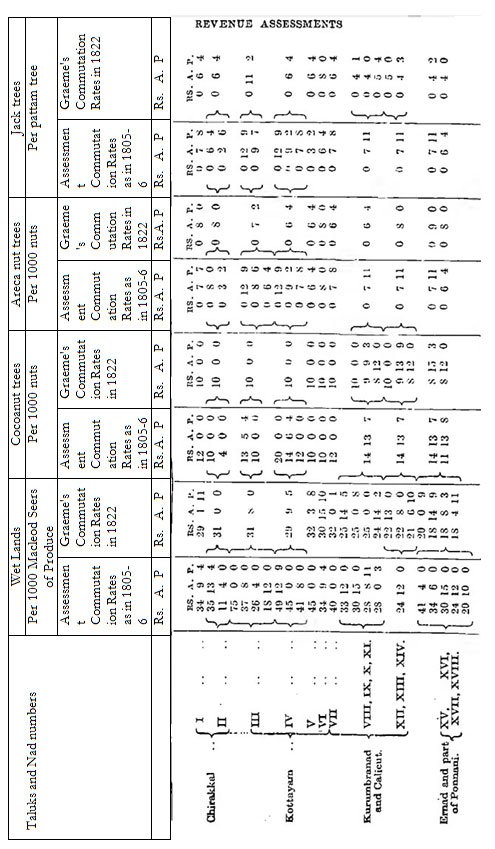
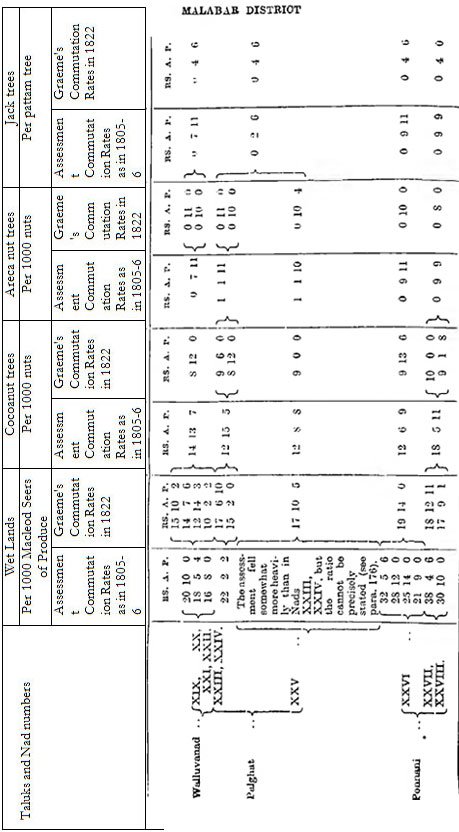
Miscellaneous Lands.
Mr. Rickards did not fix any principles to regulate the assessments on miscellaneous lands in 1803-5, but as the comparison will be useful the following table has been prepared, the standard share of produce adopted being 20 per cent, of the gross produce.
232. No agreement was come to in 1803- 5 regarding the proper mode of sharing the produce of lands not permanently assessed to revenue, that is to say, Puttada or Modan, Punam and EIlu lands (see paragraphs 33, 31, 35) ; but, as most of the materials are available, it will be useful to institute a comparison similar in the above in respect of such assessments also as for the year 1805—6. And the assessment share of produce with which they may most suitably be compared is that which prevailed generally both under the Mysore and under the Honourable Company’s Governments in South Malabar, and which Mr. Graeme subsequently recommended for adoption (paragraph 1273 of his report), viz., 20 per cent, of the gross produce.
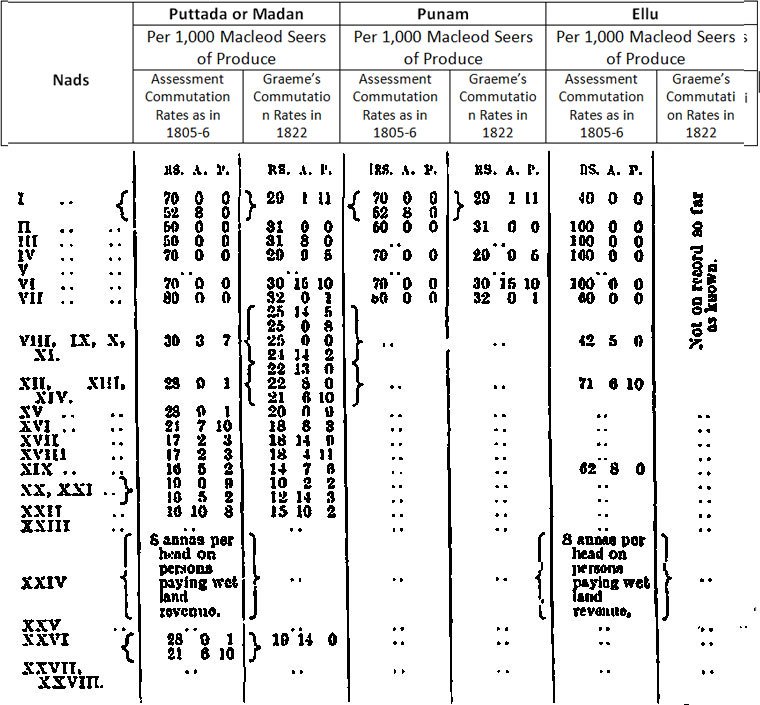
NB.—Graeme’s commutation rates for low ground paddy produce have been taken as the market prices for Modan and Punam paddy, although, as a rule, these grains do not fetch so much in the market.
233. These figures confirm what had always been recognised as a fact, viz., that the assessments in North Malabar were heavier than those in the south.
This was why the 10 per cent, establishment cess was not extended to the north.
Caution as to Arshad Beg Khan's remission of 20 per cent.
233. These figures confirm what had all along been recognised as a fact, viz., that the assessments (especially on wet and miscellaneous lands) in North Malabar were comparatively heavier than those in South Malabar. This fact had influenced the Supravisor, and afterwards the second Commissioners, not to extend to North Malabar the 10 per cent, establishment cess (paragraph 120) which they imposed on lands in the south. At the same time, it should be noticed that in the calculations made in preparing these tables, the full deduction has been allowed for Arshad Beg Khan's remission of 20 per cent, all round ; while, as matter of fact, it is extremely doubtful (as already noticed, paragraph 117) if any such deduction ever really took place. The remission probably went into the pockets of the officials. This fact must be constantly borne in mind when comparing the assessments of South Malabar with those of the north.
234. But at the same time the northern assessments were less oppressive individually than those of the south.
Reasons for this.
234. Whilst, however, the assessments were comparatively heavier in the north, they were at the same time less oppressive individually, that is to say, the burden was more evenly divided. This is to be accounted for, first, by the fact that the assessments in the north were based on the Vilachchal meni pattam and on the Verumpattam, that is to say, on certain fixed proportions of the gross or net produce; and secondly, by the fact that the assessments were made by the chieftains themselves, who, as tributaries first of Mysore and afterwards of the Honourable Company, were not easily deceived as to the capabilities of the land, and who had every inducement to make the assessments heavy on all lands but their own ; whereas, in the south, the assessment was chiefly the work of Mysorean officials, who, as strangers to the province, were more easily imposed upon, and who were, perhaps, more ready to be complacent or severe according as inducements were held out to them or refused. The result of course was that, in the south the Niguti pattam represented no certain share either of the net or of the gross produce (paragraph. 228) and individual assessments were very unequal.
The Niguti puttarn of the south represented no certain share either of the net or of the gross produce.
Examples.
For example, in Nads VIII, IX. X and XI, Mr. Graeme found that in one instance the garden assessment was 4,085 per cent of the pattam, in two instances over 2,000 per cent., in three instances over 1,000 per cent., and in other instances less than 1,000 per cent., but far in excess of the proper proportion of the pattam.
Wet Lands
235. The actual assessment commutation rates of 1805-6 are, with three exceptions, higher than the market rates adopted by Mr. Graeme in 1822, and the excess is a measure of the excess of actual assessments over the standard assessment.
235. An examination of the figures discloses the following fact in regard to wet lands :—It is not to be presumed that the market prices of produce should have fallen between 1805-6 and 1822, and yet Mr. Graeme’s rates, adopted in 1822, are (with three exceptions occurring within the territory administered by the Honourable Company’s Factors at Tellicherry) below the assessment commutation rates prevalent in 1805-6. The extent to which the rates of 1805-6 exceed, as noticed, the rates of 1822 is the measure of the extent to which the actual assessment in 1805-6 exceeded the standard assessment of 60 per cent., of the pattam (rent) if it is assumed that the market prices did not vary meanwhile. If, on the other hand, the market, prices were rising between 1895-6 and 1822 (as may safely be assumed to have been the case under regular British rule), the actual assessments of 1805-6 must have still more exceeded the standard assessment of 60 per cent.
Garden Lands
236. Similarly, the cocoanut garden assessments exceeded the standard assessments, but arecas seem to have been exceptionally favoured in many places.
236. Similar remarks to the above occur under garden lands but more particularly as regards cocoanut trees. It was in the territory lying round the Tellicherry factory that the cocoanut tree rates of 1805-6 approximated to and in one instance ran lower than, Mr. Graeme's rates of 1822. The cocoanut tree rates generally were much too high. Arecanut trees seem to have been less severely taxed than other produce in the district generally, for in many of the Nads, Mr. Graeme’s rates of 1822 are higher than the assessment rates of 1805-6.
While, on the other hand, jacks were too highly assessed nearly everywhere.
As regards jack trees, the assessments seem to have been, with a few exceptions, too high. It is unnecessary, however, to go into more detail regarding the garden assessments, because the garden land assessments were subsequently revised throughout the district.
Miscellaneous Lands
237. The assessments were very severe in the north, but the fact probably was that there was a large concealment of produce. This is why Modan and Ellu are so little cultivated in the north, and why Punam is more extensively cultivated there.
In the south, though the rates were more moderate, they were still too high.
237. The Modan, Punam and Ella rates were excessive in the north ; indeed, it is difficult to understand how even an approximation could be made towards levying them. It is quite certain that if they had been rigorously exacted the cultivation must have ceased to exist. The fact seems to have been that a large portion of the produce was concealed, an end easily to be attained through the difficulty, in the case of these fugitive modes of cultivation, of checking what was the actual produce. Even at the present day, Modan and Ellu crops, which, being, cultivated in the open country, are better capable of being properly assessed, are of far less extent in the north than in the south; while on the other hand, Punam crops, cultivated in the jungle country, where the cultivation is not so easily checked, is still one of the principal crops in the north, while it is comparatively of small extent in the south. These facts are easily accounted for on examining the commutation rates in force in 1805-6. In South Malabar, the rates, though more moderate than in the north, were still too high for those days. These assessments have all since been revised, so it is unnecessary to enter into more detail.
Sub-Section IV.—The System of Land Revenue Management ADOPTED IN MALABAR, 1805-18,
AND THE POSITIONS OF THE “Ryot” and of the “Actual Cultivator” considered.
238. The steps taken to treat the low-country part of the district in the aggregate.
238. Having passed in review the measures adopted from the earliest times for assessing particular portions of the district, and having attained as complete a view as circumstances will permit of the exact state in which these measures left the matter, it now becomes necessary to relate the particular steps, taken to deal with the district as a whole. The measures up to this time (1805-6) had been fragmentary and of local application ; it remains to relate what steps were taken to treat the low-country portion of the district in the aggregate.
239. The part Malabar played in the great battle of the tenures.
239. A word or two may, however, first of all be fittingly introduced in regard to the part which Malabar played in the great battle of the tenures, which at this time (1805-6) had begun to attract attention. It is unnecessary to say much about it, because it never at any time seems to have been in doubt that Ryotwari was the system best adapted to the district, though it was a Ryotwari with a difference from that understood by Sir Thomas Munro.
240. The position of Sir. Thomas Munro's ryot defined.
240. The characters of labourer, farmer, and landlord were generally understood as being united in the ryot. It was also generally assumed that the ryot could not have sub-tenants so long as Government waste land of good quality existed for any one to cultivate who felt so deposed. Moreover, the laws of inheritance in force in eastern districts have a constant tendency to break up properties and to cause the subdivision of landed estates.
241. This definition quite inapplicable to the state of the facts in Malabar.
241. But suppose, on the contrary, that there were portions of districts so highly cultivated that no waste land lay within convenient reach of the man willing to till it,—suppose that the waste land, if it did exist within convenient reach, was held (whether rightly or wrongly does not at present matter) to be the property, not of the State, but of private individuals,—suppose the laws of inheritance directly tended to keep property together, and suppose the classes of labourer, farmer, and landlord were distinct and separate - then clearly the district where such a system prevailed was not a Ryotwari one, and this was (and it still is) the case of Malabar.
242. From a different point of view, however, and taking “ ryot. ” as synonymous with “actual cultivator,” then Malabar was, and still continues to be a Ryotwari district.
242. Looked at, however, from a different point of view, and when the question at issue is whether the Government land revenue shall be paid by a Zamindar or farmer of the Government land revenue in many villages, by the Mouzawar or headman of one village, or by the cultivator himself, then, understanding by the word “ryot” the actual cultivator of the soil, the Malabar District revenue system was originally under the Mysoreans, and it still continues to be, to a great extent, a Ryotwari one. How this came about is easily explained by the fact that “the terror of Hyder Ali's and of his son Tippu's subsequent administration prevented the major part, of these Brahman landholders, as well as many of the Nayars, from ever trusting their persons at the Muhammadan cutcherries of their new sovereigns” (Joint. Commissioners’ Report, paragraph 196), and the Mysoreans had therefore no choice left but to conclude the land revenue settlement with the Kanakkar or the actual cultivators.
243. Sir Thomas Munro's Ryotwari system not a thing of performance. Reasons for thinking so.
243. It is manifest, however, that the meaning attached by Sir Thomas Munro to the word Ryotwari, is one that will not apply permanently to any one particular district, supposing that that district progresses in population. Waste land, under such circumstances, becomes scarcer and scarcer and more and more difficult to till as the worst lands are taken up, and long before the time when the last acre of waste is appropriated, it must of necessity have arisen that many of the original "ryots” attending to their own interests, have become proprietors and have dropped the other characters of labourer and farmer.
This state of things has existed in Malabar from the first.
Moreover, under a settled government, money acquired in trades and professions is naturally often invested in land by persons who have not the slightest intention to cultivate it. And further the laws of inheritance have been considerably affected by the power of testamentary succession. All these considerations force one to the conviction that Sir Thomas Munro’s ideal Ryotwari settlement is not a thing of permanence, and that sooner or later, even in the model Ryotwari districts, a state of things will be brought about similar to what has existed in Malabar from the very first.
244. The fact of the existence of private property in land in Malabar and Canara exercised an important influence in the debates on the merits of the rival tenures.
244. The fact that private property in land already existed in Canara and in Malabar, attracted attention at an early period in the history of British rule in South India, and the fact is again and again referred to in the correspondence which took place while the merits of the rival systems were being debated, and it exercised a very material influence on the ultimate issue in favour of the Ryotwari system and of the special form which it took.
The village community was also supposed not to exist in Malabar.
The above, coupled with another fact, viz., that the village community was supposed not to exist in Malabar, seems to have prevented any attempt to introduce into the district, the system of village settlements which for a time found favour with the authorities.
The Court of Directors' despatch of 16th December 1812, ordering the introduction of the Ryotwari system in all unsettled districts.
The final orders were issued by the Board of Revenue on the 5th January 1818.
On the 16th December 1812, the Court of Directors finally ordered the introduction of the Ryotwari system in all unsettled districts, and they were careful in their despatch of the December following to caution the Government against introducing into Malabar “an intermediate class of persons (call them Zemindars, Mootahdars, or what we may) between the Government and the Jelmkaars or hereditary proprietors of the soil ; but it was not till the 5th January 1818, that the Board of Revenue issued instructions for "the abandonment of the existing system of revenue administration and the introduction of the Ryotwari mode of settlement and collection in all practicable cases,” and in paragraph 307 of the same Proceedings the Board wound up their instructions to all Collectors in the following terms : —
The plan to be followed was to substitute the Ryotwari of the Western Coast for the old Carnatic etc., Ryotwari.
“The Collectors, in entering on the new settlement should ever recollect that the great object in view is not immediately, but by degrees, to substitute the Ryotwari of the Western Coast for the old Carnatic and Ceded District Ryotwari; not to create, but to restore, landed property, gradually to convert the bad farms of the Tamil country into good estates, and the land-property holders into land-owners, etc." Malabar, Canara, Coimbatore, Madura and Dindigul were at this time the only districts classed as Ryotwari. All others were either managed by Zemindars or under the village lease system.
There was one radical defect and confusion of ideas in this minute of the Board of Revenue.
245. One radical defect and confusion of ideas was unfortunately imported into this, otherwise admirable, Minute of the Board of Revenue. Sir Thomas Munro’s confusion of ideal "ryot", whose position has been already alluded to (paragraphs 240 to 243), was defined by the Board of Revenue in paragraph 17 of their instructions quoted above to mean “that particular class only among them ” (“the cultivators of the soil in general") “who employ, superintend, and sometimes assist the labourer, and who are everywhere the farmers of the country, the creators and payers of the land revenue,” and in paragraphs 21 to 39 of these same instructions, the Board went on to describe "the rights of the ryot” in Malabar.
The Board's definition of Sir. Thomas Munro's ideal ryot applied to Malabar.
The mistake was in lumping Janmis, Kanakkar, and Pattakkar all together under the head of ryots.
The mistake was in treating the rights of the Janmi, Kanakkar and Pattakar as equivalent to those of the “ryot,” whereas, as matter of fact, many Janmis and many Kanakkars also, and perhaps even some Pattakars, had no title whatever to be considered as “ cultivators,” or "farmers,” or as the creators,” or even as the “ payers,” of the land revenue.
It is obvious that in Malabar there existed other classes interested in the land besides the ryots.
Classes whose interests did not receive sufficient consideration.
Substantial grounds will be found set forth elsewhere [Section (A) of this Chapter] for dissenting altogether from the views entertained at that time in regard to Janmis, Kanakkar and Pattakar ; but apart altogether from controversial matters, and accepting the relative positions assigned to the three classes by the Board, viz., proprietors, mortgagees and tenants, it is obvious that there existed in Malabar other classes besides the “ryot” - classes whose position in regard to the land, either as landlords entitled to rent from under-tenants or as intermediaries liable to pay rent to landlords as well to receive rent from under-tenants, should have received very careful consideration before treating them all on the footing of the “ryot” in the sense in which the Board used that word.
The person to whom the Government of this country should give the first consideration is the 'actual cultivator', whatever he be, proprietor, farmer or labourer.
All others having interests in the soil are mere investors of their money.
The mistake made in 1818 was to drop the actual cultivator out of sight and to substitute for him an "ideal ryot".
The growing insolvent cotticrism of the bulk of the cultivators in Malabar at the present day, might, probably have been prevented, had the Board of Revenue been better informed as to the real relations subsisting at the time between the classes named. Situated as the Government of this country is, that is as part landlord of the soil, it is obvious that the person to whom the first consideration is due is the actual cultivator of the soil, whatever he be, proprietor, farmer or labourer. It is he who, by his industry and skill, pays the Government, revenue and contributes to the general welfare of the State. All others having interests in the land are mere investors of their money. The mistake made in 1818 (so far at least as regards Malabar) was to drop the actual cultivator out of sight, and to substitute for him an ideal “ryot.”
246. The further history of this point.
The Court of Directors' despatch, 12th December 1821.
246. It will be as well to continue the notice of the point here raised down to the time when it seems finally to have passed completely out of sight. On the 12th December 1821 the Court of Directors, in reviewing a letter, dated 6th February 1815 from 1821 the Board of Revenue, on the subject of the great inequalities in the land assessments in Malabar, thus expressed themselves : "The Board of Revenue declare that our knowledge with respect to the ancient state of things in Malabar is extremely defective. To us it appears so defective that many things which have been stated and re-stated as matters of fact are but objects of conjecture, conjecture founded upon hardly anything to which with propriety the term evidence can be applied.”
Defectiveness of information regarding ancient Malabar.
The earliest accounts received from the parties most interested should have been accepted with great caution and distrust.
After noticing that the first accounts of ancient Malabar obtained from Rajas and leading men had been “exceedingly favourable to their interests and contrary to what prevailed in other parts of India”, and should therefore have been received “with great caution and distrust,” the Court of Directors went on to observe that it had been affirmed that “in Malabar the whole of the produce was the property of the landowner and that no portion of it was taken by the Government. In this one circumstance lies the difference between the supposed state of rights in Malabar and the state of them in the rest of India, and that difference is so great, that it ought not to be admitted as a fact without distinct and specific evidence.”
The Court of Directors were sceptical as to the exceptional state of things in Malabar.
The Court of Directors then stated certain reasons which led them to think that the circumstances noticed in regard to the demesne land of the Rajas, to the property of pagodas, and to jaghires held on the condition of military service, pointed rather to the opposite conclusion, and that Malabar was in no way singular from other parts of India in those respects, and they continued : “It was no doubt the interest of the landholders, in Malabar to persuade their new rulers—the English—if they could, that all land was holden under jaghires of this description. The wonder is that they succeeded.1 One remarkable circumstance is that they succeeded with respect to the supposed demesne lands of the Rajas, which surely yielded revenue to Government, yet not even such part is discriminated.”
NOTEs: 1. Major Macleod, the first of the Principal Collectors, did not credit the fact (paragraph 17 of his Jamabandi Report of 18th June 1802), but he remained too short a time in the district to succeed in elucidating his views. END OF NOTEs
The Court of Directors called for information regarding other classes of the agricultural population.
After a cursory notice of Sir Thomas Munro’s very important report on 4th July 1817 (of which notice will be taken presently), they commended the subject of the inequalities in the land assessment to the notice of the Government, which, by this time, had Sir Thomas Munro at its head, and wound up this portion of their despatch in the following words : “We observe with dissatisfaction that when you have assumed the existence of any peculiar ownership in the land as that of Moorassidars or Jelmkars, you afford us little information with regard to the condition of any other class of the agricultural population. In Malabar the number of occupants who pay the assessment on the land, mortgagees and lessees included is estimated by the Collector at 150,000. The number of persons employed in the cultivation must exceed this number to an extent of which we have no means of forming an accurate judgment.
Nothing known of the great body of actual cultivators, nor of the slaves.
"Of the condition of these people we know hardly anything, and not more with respect to the other descriptions of the population. We are told, indeed, that part of them (an article of very unwelcome intelligence) are held as slaves; that, they are attached to the soil and marketable property. You are directed to obtain and to communicate to us all the useful information with respect to this latter class of persons which you possibly can; the treatment to which they are liable, the habits of their masters with respect to them, the kind of life to which they are doomed, the sort of title by which the property of them is claimed, the price which they bear and more especially the surest and safest means of ultimately effecting their emancipation. We also desire to know whether those occupants, 150,000 in number, cultivate immediately the whole of the lands by their slaves and hired servants, or whether there is a class of inferior tenants to whom they let or sub-let a portion of their lands. If there is such an interior class of lessees, you will inform us under what conditions they cultivate, what are their circumstances, and what measures, if any, have been employed for their protection.”
Mr. Vaughan's cursory report of 24th August 1822. V
Its cursoriness probably due to the fact that Mr. Graeme had shortly before submitted his voluminous report on Malabar.
The only report traceable in the records dealing with the question thus raised by the Court of Directors is a very short one from the Principal Collector, Mr. Vaughan dated, 24th August 1822, in which he stated that there was no necessity to interfere for the protection of under-tenants, as people of all castes and religion engaged in agriculture exactly as they felt inclined, and slaves too were under the protection of the laws. But the shortness and cursoriness of this report is probably attributable to the fact that Mr. Graeme, who had been Special Commissioner in Malabar from 1818 to 1822, had some months previously submitted his report on Malabar, which, Sir. Thomas Munro subsequently (10th July 1822) characterised as "on the whole the fullest, and most comprehensive report ever received, of any province under this Government."
The Court of Directors were not quite satisfied, 18th May 1825,
Mr. Graeme was most unfortunately (as already alluded to in paragraph 228) prevented from pursuing detailed inquiries into the terms on which under-tenants held their lands, and he seems to have in consequence accepted the views of those who had preceded him in their investigations on this point. The Court of Directors were not quite satisfied, and in reviewing, on the 18th May 1825, the measures which had been adopted in consequence of Mr. Graeme's inquiry, they concluded the portion of their despatch bearing on the subject in the following terms :
and called for further information.
“There appears to be in Malabar an intermediate class between the cultivators and the Government, who come nearer to the situation of proprietors of land in England than any intermediate class in any other part of India. The information which we possess respecting this class of persons, their obligations to Government, and their powers over the more numerous classes whose subsistence is derived from the land, is exceedingly imperfect. Justice requires that such a portion of the rent of the land as this class have by custom enjoyed should be still reserved to them. But the questions which relate to the other descriptions of persons subsisting upon the land are more numerous and more difficult of decision. Are they tenants-at-will of the former class? Or have they, like the ryots in other parts of India, a fixed interest in the soil? If tenants under such conditions as the superior class may please to impose, what is the sort of treatment which they receive (and if their condition is miserable, what measures can be adopted for its improvement. To these points we particularly desire that your attention should be directed. The progress of the measures which you have in contemplation will bring evidence relating to them frequently before you and it is of the highest importance that it should not be neglected."
The conditions of the under-tenants was to be kept constantly in view in the measures then in contemplation, but nothing further seems to have been done.
The actual cultivator dropped out of sight, in favour of the 'ideal ryot', and did not again come into view owing to the increasing ease experienced in collecting the land revenue.
The records do not show that anything further was done to elucidate the points regarding which the Court of Directors had evinced so much anxiety for further information, and it is to be concluded that the actual cultivator having dropped out of sight in 1818 in favour of the "ideal ryot", it became unnecessary to think about the former as soon as the land revenue assessments, aided by increasing prices, began to come in with increasing ease and regularity.
It was easy to create or restore property in the soil.
The Government should have regulated its management when created.
246a. In conclusion, it may be observed that the creation or restoration of property in the soil was a thing sufficiently easy of accomplishment . The Government had only to adhere to a policy of taking the half of the net annual produce, in order by a word to create property in the soil equal in value to the remaining half of the net annual produce.
This was clearly seen at the time, but it may be asked was it wise thus to create a property and not endeavour to regulate its future management among a people to whom freedom and liberty were unknown words? Reasons will be found set forth in section (A) of this Chapter, for thinking that even in Malabar individual property in the soil, in the European sense of the word, was not in existence at the beginning of British rule.
The drones have waxed fat and the working bees have waxed lean.
Custom, not competition, adjudged the shares into which the produce was to be divided. The grant of freedom to a community thus organised meant (as soon as custom had given way) freedom for the "strong to oppress the weak ; freedom for the newly created proprietor to take an ever increasing portion of the share of net produce left over after paying the Government dues. What wonder, then, that the drones in the hive have prospered and grown fat, or that the working bees have become famished and lean!
(a) To assess the revenue at 65 per cent, of the actual rent (Verumpattam, see paragraph 228), as ascertained from deeds and from the people themselves instead of at 60 percent of the Vilachchal meni pattam (see paragraphs 226, 226a, 226b and 227), calculated on the plan proposed by Mr. Rickards and approved by Government in 1804 (see Appendix XV). The reason for departing from the letter of the proclamation issued, with Government sanction by Mr. Warden in 1805 seems to have been that Mr. Graeme ascertained, as the result of his general inquiries, that, the Rajas and others who had ascended to adopt the Vilachchal meni pattam as a standard, made it appear as if they were in the enjoyment of a considerably larger share of the produce, than they were as matter of fact getting either at that time, or from that time up even to the time of Mr. Greame inquiry. (See “Vilachchal meni pattam” in the Glossary, Appendix XIII). Mr. Greame therefore proposed (and his proposal was approved by Sir Thomas Munro, paragraph 9 of Minute, 16th July 1822, Revenue. Selections, Vol. Ill, page 548) to discard the Vilachchal meni pattam, altogether and to take such a percentage ol the actual rent (Verumpattam) as from his general inquiries he found would be equivalent to the share which Government had a right to expect in virtue of the proclamation of 1805, that is, equivalent to 60 per cent, of the Vilachchal meni pattam. Taking the share at 65 per cent, of the actual rent (Verumpattam), Mr Greame estimated there would still be a reduction in the actual revenue of Rs. 1,39,922 or about 13 per cent.
SUB-SECTION V. -SUBSEQUENT LAND REVENUE HISTORY OF THE LOW COUNTRY DOWN TO THE PRESENT TIME.
247. Mr. Rickards' agreement with the chief landholders in 1803 regarding shares of produce.
247. After this digression on the system of land revenue management finally adopted for the district, it will be necessary to revert to a much earlier period to the first attempt to treat the revenue assessment the low country taluks on one uniform basis. For this propose it is necessary to go back to the year 1803, when, at a critical time, with active rebellion still flaming in the Cotiote and Wynad countries to the north, Mr. Rickards came to the agreement with the senior Rajas and chief landed proprietors already fully described in paragraphs 226, 226a, 226b and 227.
Mr. Warden as a first step called on all landholders for a return of their lands.
248. On Mr. Warden, who succeeded Mr. Rickards, devolved the duty of carrying out the orders of Government for a revision of the assessments. As a first step, he on 21st July 1805, on all proprietors of land to send in under their respective signatures a detailed account of their landed property, his object being:
(a) to obtain the name of every field in the country, so as to serve as a ground for an actual survey ; and
(b) to obtain an accurate numerical account of the assessable trees, so as to regulate the garden assessments.
The Janmi Pymaish account of 1805-6 was thus obtained.
The statements thus obtained are known in the district as the Janmi Pymaish of 981 M.E. (1805-6), The Janmi Pymaish account of 1805-6 was thus obtained. and frequent references have already in this Section been made to these accounts.
Mr. Warden also collected data for a classification of soils.
249. He, at the same time, arranged through his Sub-Collectors (at that time four in number) “to ascertain the actual produce on different qualities of soil in different places, with a view to obtaining data for a classification of the soils in every taluk.
Mr. Warden next proceeded to survey the wet lands, 1806-10.
250. After being in due time furnished with all these documents, Mr. Warden proceeded to the laborious task of surveying the wet lands. He was assisted in this by the Collector of Coimbatore, who sent him a number of surveyors, “all foreigners to this country.” “They entered on their duty in the year 1806. After four years' labour the work was completed and there it rests ;” so wrote Mr. Warden, in his letter to the Board of Revenue, of 16th June 1813, and he continued :
The accounts thus prepared are known as the Alavu or Hinduvi Pymuish.
“The several changes which afterwards took place brought with them such an accumulation of duty and trouble upon me, with diminished means of getting through them, being left almost entirely to native assistance, that the new assessment, with every thing connected with it, has for some time back been laid aside and the revenues of the province have been continued to be collected on the Commissioners’ Jama1 of 976 (1800-1).” The accounts thus prepared in 1806-10 are known in the districts as the Alavu Pymaish or the Hinduvi Pymaish from their being written in Mahratta : they are the most reliable of all the Pymaish accounts yet prepared, but in certain respects they are very defective.
NOTEs: 1. This was not quite correct, see paragraph 271. END OF NOTEs
The Proclamation of 21st July 1805.
251. The important proclamation published throughout the district at this time will be found in extenso in Appendix XV, It is dated 21st July 1805.
No further steps taken till Sir Thomas Munro visited the district in 1817.
His report.
252. Matters remained in this state till 1817, when Sir Thomas Munro, then a member of the commission for revising establishments, paid a visit to Malabar, and, notwithstanding the shortness of his stay, wrote a most valuable report on the district (Revenue Selections, Vol. I, p. 838). He received many complaints regarding the assessments of garden and wet lands, not so much, however, directed against the general oppressiveness of the assessments, for these were at that time “in general very moderate,” but against the continuance of assessments on lands which had been deteriorated or destroyed by natural causes, and on gardens which had also from natural causes gone to decay. The landholders being unable to pay such assessments, had had their holdings sold, and this practice of selling the land in satisfaction of arrears of revenue, formerly unknown in Malabar, had been viewed with a good deal of dissatisfaction. The balances of revenue thus realised were inconsiderable, but the number of individuals affected thereby was large.
The Board of Revenue (22nd December 1817) proposed to depute one of their members to Malabar, but the Government selected Mr. Graeme (10th February 1818).
253. On the 22nd December 1817 the Board of Revenue proposed to depute a Member of their Board to Malabar to carry out Sir Thomas Munro’s suggestions, but the Government, on the 10th February 1818, overruled this proposal and appointed Mr. Graeme, one of the Judges of the Southern Court of Circuit-
His special commission.
(a). to introduce the new system of Police and Magistracy ; and
(b). consider what improvements might be introduced into the revenue administration of the district.
Mr. Graeme submitted his report, 14th January 1822.
His proposals in regard to assessments.
254. On the 14th January 1822 Mr. Graeme completed his work and submitted to Government his report, already mentioned as having been considered by Sir Thomas Munro ‘‘on the whole the fullest and most comprehensive report ever received of any province under this Government.” His proposals in regard to assessments were briefly as follows: -
Wet Lands (paragraphs 1244 and 1245 of his Report).
Mr. Graeme submitted his report, 14th January 1822.
His proposals in regard to assessments. (a) To take 65 per cent, of the actual rent (Verumpattam) of wet lands.
The reasons for this departure from the letter of the proclamation of 1805.
To assess the revenue at 65 per cent, of the actual rent (Verumpattam, see paragraph 228), as ascertained from deeds and from the people themselves, instead of at 60 per cent of the Vilachchal meni pattam (see paragraphs 226, 226a, 226b and 227 calculated on the plan proposed by Mr. Rickards and approved by Government in 1804 (see Appendix XV). The reason for departing from proclamation issued, with Government sanction by Mr. Warden in 1805 seems to have been that Mr. Graeme ascertained, as the result of his general inquiries, that, the Rajas and others who had assented to Mr. Rickards’ plan for distributing the produce, had, by consenting to adopt the Vilachchal meni pattam as a standard, made it appear as if they were in the enjoyment of a considerably larger share of the produce, than they were as matter of fact getting either at that time, or from that time up even to the time of Mr. Graeme's inquiry. (See “Vilachchal meni pattam” in the Glossary, Appendix XIII).
Mr. Graeme therefore proposed (and his proposal was approved by Sir Thomas Munro, paragraph 9 of Minute, 16th July 1822, Revenue Selections, Vol. Ill, page 548) to discard the Vilachchal meni pattam, altogether and to take such a percentage of the actual rent (Verum pattam) as from his general inquiries he found would be equivalent to the share which Government had a right to expect in virtue of the proclamation of 1805, that is, equivalent to 60 per cent, of the Vilachchal meni pattam. Taking the share at 65 per cent, of the actual rent (Verumpattam), Mr Graeme estimated there would still be a reduction in the actual revenue of Rs. 1,39,922 or about 13 per cent.
Garden Lands (paragraph 1258 of Report)
(b) To take 50 per cent of the pattam of gardens.
(b) Mr. Rickards' plan of taking 50 per cent, of the pattam was adhered to.
(c) But the pattam was to be differently calculated in the north and in the south.
(d) He devised a plan of this own for applying these principles.
(c) But in making his estimate of future revenue Mr. Graeme departed to the following extent from the precise rule laid down by Mr. Rickards. That is, as already alluded to in paragraph 228, he found the Janmis in North Malabar enjoying 80 percent, of the produce in nuts from cocos and arecas and 80 per cent of the money pattam from jack 3, whereas in South Malabar the universal custom was to take only 662/3 percent, of the same. Mr. Rickards, who, owing to the state of the rebellion in the north at that time, was dealing (with one solitary exception, the Chulali Nambiar) with South Malabar Janmis had naturally followed the South Malabar plan of distribution. Mr. Graeme proposed to follow the North Malabar plan of distribution in North Malabar, and the South Malabar plan (corresponding to that of Mr. Rickards) in the south only.
The details of his plan.
(d) The details of his plan were then worked his plan out as follows : —
I. He found from the Janmi Pymaish accounts (paragraph 248) the total number of trees existing in 1805-6.
II. He deducted all trees said to have been at that time unproductive, or too young to bear fruit.
III. He next made a further deduction (at 20 per cent) for trees at that time productive, but which had since, it might be conjectured, gone out of bearing.
IV. He then took into account the number (75 per cent) of the young trees which had, since that time, it might be conjectured come into bearing.
V. In this way he arrived at the number of actually productive trees.
VI And also at the number of unproductive trees.
VII. From the number of unproductive trees he next deducted the number (20 per cent) which he thought might possibly be cut down and removed when his rates per tree came to be applied to all productive trees.
VIII. And in this way he arrived at the number of unproductive trees which would have to be dealt with when the assessment came to be made.
IX. He next added the number of unproductive trees thus arrived at (Clause VIII) to the number of productive trees (Clause V), and found what would be the total number of full-grown trees standing at the time when the assessment came to be made.
He then went on with his estimate as follows:-
(1) He applied the rates of gross produce in nuts per tree for cocos and arecas, ascertained from the Janmi Pymaish accounts of 1805-6 (paragraph 248), to the number of productive trees (Clause V), and thus obtained the gross produce in nuts.
(2) To this gross produce of cocos and arecas he next applied his locally ascertained prices of produce, and thus ascertained the money-value of the gross produce of those trees.
(3) Next applying to the money-value of the gross produce the principles mentioned in Clauses (b) and (c) above, he ascertained the customary pattam (rent for Cocas and arecas).
(4) To ascertain the customary pattam rent for jacks (Clauses b and c) he had only to apply the money pattam rates obtained from the Janmi Pymaish accounts of I805-6 to the number of productive trees (Clause V).
(5) He then found what the Government share at 50 per cent, of the customary pattam (Clauses 3 and 4) was on all the trees.
And finally —
(6) He divided the Government share of the customary pattam (rent) thus arrived at (Clause 5) by the number of productive and unproductive trees which he expected to find standing at the time of assessment (Clause IX), and thus obtained certain rates per tree which he proposed to apply to all standing trees, except those that were too young to bear. These rates he further proposed not to alter for twelve years except under particular circumstances. The revenue estimated in this way, Mr. Graeme thought, would fall short by about 7 per cent, of the revenue then being collected.
Miscellaneous Lands (paragraphs 1273. 1274).
(c) To take 20 per cent of the gross produce of Modan lands.
(f) He made no proposals in regard to Ella or Punam.
Modan. Graeme recommended the continuance of the prevailing system in South Malabar of taking not more than 20 per cent, of the gross produce of Modan lands (paragraph 33) in the case of all new assessments, to be spread over the period years when the lands are alternately cultivated and lie fallow. Where gardens were cultivated with Modan crops, and where the garden assessment was less than the Modan assessment, the latter should, he thought, be paid till the gardens had sufficiently improved.
Punam and Ellu.—Mr. Graeme made no specific recommendations regarding these.
Sir Thomas Munro’s opinion on these proposals.
Exception taken to the principles which necessitated the cutting down of trees yielding fruit.
255. On the 16th July 1822 Sir Thomas Munro, then Governor, minuted in favour of Mr. Graeme’s proposals, the only exception taken to them being that it was a defective principle of taxation which required a man to put down a tree which was bearing fruit (see Clause VII of last paragraph under gardens), and he suggested that “some method might perhaps be found in practice of making such a remission for old trees as would save them from being prematurely out down without exposing the revenue to any material loss.”
Mr. Graeme sent back to Malabar to carry out his own proporsals.
The order in which they were to be taken up.
256. Mr. Graeme was accordingly sent back to Malabar to carry his own proposals into practical effect. The order in which he was directed to take up the work was—first, to revise the revenue establishment; second, to revise the garden assessment ; thirdly, to revise the wet land assessments ; as that seemed to be the order in which the subjects required attention.
How far Mr. Graeme carried out this programme.
257. He completed the first, he began the second on the 20th May 1823 he left it and the third to be completed by the ordinary revenue establishment.
The garden assessments in Calicut taluk.
258. Mr. Graeme began the revision of the garden assessments in the Calicut taluk, but, as matter of fact, he left the district before he had time to do more than fix the total of the garden assessments on each village (Hobali) in that one taluk. The individual distribution of that total was left to the Collector, Mr. Vaughan.
|
Mr. Greame's plan of operations. Details of his plan. |
259 Mr. Graeme, however, sketched out a plan of operations and left instructions with Mr. Vaughan that that plan was to be followed. What that plan was will be now described. |
260 (a). He first of all obtained from the people themselves returns of the actual number of trees in each of their gardens and of the produce of the same.
(b) He next inspected some of the gardens and got the people to correct their returns when that was necessary.
(c) When he had satisfied himself of the correctness of the returns, he proceeded to calculate the resulting produce in gross, and took one-third as the share of Government, as recommended by Mr. Rickards and by himself for South Malabar. This one-third share he next commuted into money at certain fixed market rates for produce which he had ascertained by personal inquiry to be correct.
(d) In this way he arrived at the total assessment to be imposed on the village (Hobali).
(e) The next stop in his plan of operations was to communicate to the people themselves the gross assessment thus fixed, and to allow them to distribute it rateably over all the trees in all the gardens of the village, which, for this purpose, were divided into Attu Veppu (river, or low-lying, damp, fruitful gardens), of which there were two classes, and Kara Veppu [gardens on banks (Kara) and other high-lying localities, less productive], of which there were three classes.
(f) His object in doing this was to obtain certain fixed rates per tree, to be applied to all trees in the village according to the class of garden (Attu Veppu or Kara Veppu) in which they stood.
(g) The total village assessment might be increased if gardens had not been brought to account when preparing the estimate of total assessment [Clauses (a), (b) and (c)], and, on the other hand, if on distributing the rates the assessment fell short of the total estimate, the deficiency was made good by distributing the surplus rateably on trees in gardens of the Attn Veppu, first and second, and on the Kara Veppu, first classes only, that is to say, the rates on trees in the best classes of gardens in the village were in such a case pro tanto raised.
|
The advantage of having fixed rates per tree in each class of gardens in each village. |
261. The advantage of having fixed rates per tree in each class of gardens for each village was that there was thus avoided all necessity for calculating the gross produce of individual gardens. The rates had merely to be applied to the existing state of the facts as ascertained by inspection of the soil and situation of the garden, and nothing was left in this way in making individual assessments “to the difficult and uncertain judgment of the gross produce of each garden.” |
262. Obtained in the above method, the Attu Veppu and Kara Veppu rates per tree were necessarily not uniform throughout any wide area, and it was only natural it should be so, for cocoa-nut trees, for instance, in inland villages require more care, are more expensive to rear, and yield when full grown a smaller produce than trees growing in low-lying localities near the coast ; and hence it came about that in every taluk Attu Veppu rates and Kara Veppu rates shaded off the one into the other and were not uniform anywhere, not even sometimes in the same village (Hobali), because a Hobali was composed of many Desams, and the rates within the Hobali seem to have been fixed by the people themselves Desamwar and not Hobaliwar.
|
The Attu Veppu and Kara Veppu rates, therefore, differ everywhere, sometimes even in the same amsam (Hobali) |
The distinction, therefore, between Attu Veppu gardens veppu and Kara gardens was (and is) by no means apparent, and though the distinction is still maintained in the accounts, it is doubtful if it is of much practical value, and, on the other hand, it has a tendency to mislead. Gardens fringing a river, even near its mouth, are frequently capable of being classed only as Kara Veppu, while other gardens at long distance from a river are justly classed as Attu Veppu. |
|
Mr. Graeme's principles are still in force. All really unproductive trees were exempted. |
263. It is unnecessary to follow in much detail the subsequent course of events, because the general principles laid down, by Mr. Graeme were adhered to. In practice, however, some details of his scheme appear to have been altered. Effect was also given to Sir Thomas Munro’s suggestion regarding the cutting down of trees, by exempting from assessment all trees that were really past-bearing. |
264. Mr. Vaughan finished the garden survey and put the result in operation in 1824-25, but it had been too hastily done, the classification of gardens was incorrect, and there was dissatisfaction with some of the executive arrangements.
|
Mr. Vaughan finished the garden survey and put it in operation in 1824-25. |
On the 15th November 1825, the Government directed "no further collection to be made until a more correct survey had been effected, and until the accounts had received the sanction of the Board of Revenue and of Government.” |
Meanwhile the dissatisfaction had rapidly increased. On 28th February 1826, Mr. Sheffield took charge of the district, and in the following month he proceeded to Tellicherry and organised a survey of the five villages (amsams) of Kottayam taluk, whose people had first raised the clamour.
|
It had been too hastily done and great dissatisfaction arose. |
He next, took up 21 villages (amsams) in Kadattanad. the whole of Kurumbranad. and then the 22 "dissenting amsams” in Calicut taluk, 70 gardens in Puluvalinad, one amsam in Ernad, and 2 in Nedunganad, increasing or decreasing the assessments as he found it necessary. This completed the survey of those parts where the people had objected to Mr. Vaughan’s settlement, and the results were put in operation in Kurumbranad in 1827-28, in Calicut in 1828-29, and in Kadattanad and Kottayam in 1829-30. |
|
A general survey of the gardens was undertaken and was continuously in hand from 1829-30 till 1840-41. |
It is probable that the assessments on the lands lying along the Mahe river and on Dharmapattanam island were still too high, for the clamour did not altogether cease, and the revenue was, with difficulty, collected. The survey, however, had been far too hastily conducted and put in force even in places where no clamour was raised. |
|
The net result, increase of Rs. 18,849 on 279,896 gardens. |
From this time (1829-30) therefore on to 1840-41 the survey of the gardens was continuously in hand, and there resulted a small increase of revenue to the extent of Rs. 18,849 instead of the 7 per cent, deficiency which Mr. Graeme had originally anticipated. The actual number of gardens on which this small increase accrued was 279,896. |
|
Mr. Graeme's proposal in regard to periodical inspirations of gardens was not followed. Mr. Conolly's views on this point. |
265. One part of Mr. Graeme's scheme had been to revise the garden assessments every twelve years. In due course, therefore, the question of periodicity in revisions came up for decision, and in his Jamabandi report of Fash-1253 (4843-44) Mr. Conolly pointed out that no fixed periods for revision could be named, and that "the chief object of periodical revision was to counterbalance any extensive remissions which partial bad seasons or private misfortunes might render indispensable.” |
He further observed that the landholders "are aware also that, though we do not think it desirable to bind ourselves to a permanency of aggregate amount of tax, we do so to a permanency of the proportion of the Government demand to the produce;” and, he continued, as uncertainty regarding inspection would curb garden industry, he thought it, best to let things go on as they were and to examine only such gardens as their holders were “forced by their necessity” to submit for inspection. A general revision was necessary, he thought, only when the just rights of Government, owing to remissions, required it.
|
The old Kurumbranad Taluk re-inspected in 1850-52. A fresh survey thought, necessary by Sir.Conolly in 1854 was afterwards (1858) considered unnecessary. No extensive surveys have since been made or called for. The rule followed is that a person claiming remission on one garden must submit all his gardens for inspection. |
In 1850-52, owing to general complaints of over-assessment of gardens, the whole of the old Kurumbranad Taluk was again surveyed, and a decrease in the assessment of only Rs. 366 was the result. In 1854 Mr. Conolly seemed to think that owing to considerable remissions in the three or four previous years a fresh survey was necessary, but Mr. Grant in 1858 pointed out that the losses referred to by Mr. Conolly had since, owing to favourable seasons, been resumed, and there was no longer a necessity for the fresh survey suggested, and an additional argument was that the regular scientific revenue survey seemed then to the point of being extended to the district. Since that time no extensive surveys have either been made or called for and the rule has been that anyone claiming remission of assessment on one of his gardens must submit the whole of them for inspection. |
Wet Lands
266. Mr. Greame’s scheme for the revision of the wet land assessments did not progress so favourably. The result was graphically summed up in Mr. (now Sir. William) Robinson's letter to the Board of Revenue of 5th August 1857, paragraphs 16 to 19, which are here subjoined : —
|
Sir William Robinson's graphic summery of the result. The 'plague spot' in Mr. Graeme's scheme. |
"16. Mr. Graeme’s operations were very limited indeed. He left the district in 1823, directing the Principal Collector, Mr, Vaughan, 'to continue the survey of the Province hitherto carried on under his own control.’ He had himself, however, experienced that the account of the survey returns of gardens were so understated and suspicious, as to require greatest caution in, accepting them1 and 'that the accounts of rice-land which had hitherto been rendered by the proprietors seemed by no means entitled to credit.' Mr. Graeme did not indicate how this plague spot in his proposed scheme of survey was to be remedied. |
NOTEs: 1. Vide Mr. Commissioner Graeme's letter to Principal Collector, dated 20th May 1827. END OF NOTEs
|
To Board, 22nd September 1823. " " 4th February 1824 " " 20th April " " " 3rd June " " " 3rd July " " " 16th July " From" 26th July " " " 3rd August " " " 12th October " " " 29th November " To " 19th December " " " 24th January 1825 " " 5th March " From" 14th April " To " 9th June " From" 24th October " |
“17. The correspondence noted in the margin kept the Board acquainted with the failure of this almost ridiculous attempt. ‘The Desadhikaris are excessively backward in the survey of the rice-lands and pay not the least attention to orders, demeaning themselves in such a way as evidently to prove their luke-warmness in the cause ; that he (the Principal Collector) had been unable to make the least impression on them (the Desadhikaris); that the accounts they give are ‘grossly false beyond description' ; and that they sedulously conceal the deeds, ‘making it next to impossible to ascertain the resources of the country.' In his letter 3rd June, paragraph 10 Mr. Vaughan speaks of his 'utter despair of being able to prepare any returns within reasonable time', and of the 'hopelessness of the chance of getting any true deeds' through the Desadhikaris. |
|
|
The accounts given in were "grossly false beyond description. |
||
|
Desadhikaris made large fortunes. The country teemed with fictitious deeds, temporary deeds, and deeds executed to suit present purposes. The returns obtained were grossly fraudulent. Special and singular provisions proposed to check fraud. Collusions, innumerable disputes and feuds, and suits, beyond calculation in the Civil Courts. |
"18. The ryots, too, naturally had recourse to every expedient to secure the easy defeat of the proposed settlement. Desadhikaris made large fortunes, the country 'teemed with fictitious deeds' ‘temporary deeds, and agreements were executed to suit present purposes, and were prepared with a view of corresponding with a survey notoriously fallacious.' A number of returns and deeds was eventually obtained, ‘but the great majority was of the most grossly fraudulent description.' Special and singular legislative provisions were proposed, penalties and rewards to informants were suggested, forfeiture of concealed land was threatened, and assessment to the full amount of the rental in cases of fraud was actually authorised by the Board,2 but all in vain. In paragraph 5 of his letter, dated 12th October 1824, to the Board, Mr. Vaughan boldly calls on the Board ‘to reflect on the effects of these collusions on the morals of the people in giving rise to innumerable disputes and feuds, as well as suits beyond calculation in the Civil Courts;' adding ‘that it is full time to adopt measures to check the pending evil.’ |
|
NOTEs: 2. Proceedings of the Board of Revenue, dated 14th April 1825. END OF NOTEs
|
Total failure of the attempt after two years' struggle, 9th June 1825. |
A variety futile endeavours to induce the Desadhikaris and ryots to return faithful statements were made’ but on the 9th June 1825, after two year’s struggle to carry out Mr. Graeme's Pymaish, Mr. Vaughan reported the ‘total failure in the promises made by the inhabitants to revise and give in true and correct accounts.’ |
|
The Utopian scheme died of its own corruption. |
19. Such is the history of another period of five or six years wasted in futile exertion to get reliable revenue accounts from parties most interested in concealing the information, which was sought for through the corruptest, most suspicious and equally interested channels, viz., the Desadhigaris of Mr. Graeme’s appointment. The Utopian scheme of Desadhikaris’ Pymaish and Azmaish died of its own corruption, and infinitesimal authority is attached to the bundles of imperfect returns which load our records under the name of 'Desadhikari Pymaish.’ |
|
The difficulties of Mr. Graeme's scheme. due to his having been prevented from making detailed inquiries into the condition of the ryots. |
267. It would at all times have been a difficult operation for intelligent and trained officers to distinguish between what was true and what was false in the deeds produced (unstamped and unregistered cadjan leaves) and in the statements made by the people, on which Mr. Graeme proposed to found his revised assessment ; but when this operation was made over for performance to the ignorant and interested heads of villages, failure was quite certain. If Mr. Graeme had been permitted to pursue detailed inquiries into the relations between Janmis and Ryots (see paragraph 228), it might be safely hazarded that so experienced an officer would never have committed himself to such a scheme. |
|
The wet land survey postponed till after the completion of the garden survey. Prices of produce rose meanwhile and the revenue coming in easily the necessity for a survey did not crop up again. |
268. It is unnecessary to follow up in detail the steps which were taken subsequently and which eventually led to nothing. It will be sufficient to say that the wet land survey was postponed till after the completion of the garden1 survey, as suggested by Sir Thomas Munro, and that meanwhile prices of produce had increased so much as to enable the collections to be made with a facility hitherto unknown. The necessity for a revision therefore, did not force itself into notice. |
NOTEs: 1829-30 to 1841. END OF NOTEs
|
The revenue accounts had, however, fallen into confusion. |
269. Nevertheless an important change was made, in consequence of the want of accounts to show the particulars of the holding of each individual tax-payer. The want of such accounts began to be seriously felt in the year 1832-33. Holdings had been enlarged, had been thrown together, and had been parcelled out afresh, and simultaneously the distribution of items of assessment had been tampered with without any regard to the principles of the assessment by which they were at first fixed. |
|
Holdings had changed in size, and the items of revenue had been distributed without any control being exercised. Good land was assessed at less and bad land at more than they ought to have borne. |
A landholder with good and bad land in his occupation, and under some ordinary obligation to part with a piece of it to meet his necessities, naturally enough parted with the bad land first, and there being no control over him (owing to a want of any accounts to show what he was doing), he naturally enough also assigned with the bad land an obligation to pay as much of the revenue assessed on the good and bad land together as he could get his assignee to accept. The principles of the assessment thus became completely changed : the good land was in future assessed with less, and the bad land with more of the land revenue than they respectively ought to have borne. In this fashion great inequalities in the assessment had arisen, and to remedy them a plan was instituted of preparing what has generally since been known as Pukil Vivaram Accounts. |
|
The heads of villages were again entrusted with the duty of preparing the accounts. No measurements, nor accurate descriptions, nor classifications of soils were made.
|
270. As if no experience had been gained of the value to be set upon accounts prepared by the interested heads of villages (see paragraph 266) the old mistake was again made, and these officials were again entrusted with the duty of preparing returns of the lands within their respective limits. No measurements, no accurate description, nor classification of soils were called for. In fact it was as Mr. (now Sir William) Robinson described, in his letter to the Board of Revenue of 5th August 1857, a repetition of the Desadhikaris' Pymaish, with fewer guarantees for fidelity or accuracy, and it was more carelessly conducted and supervised. The Tahsildars were to check the accounts and send them to the Huzzur, but after repeated reminders, etc., the accounts came in driblets and without verification by Tahsildars. |
|
In 1843, when an attempt was made to use accounts prepared, their worthlessness became at once apparent. |
In 1843 a small establishment was entertained, and about half of them were copied hastily info a form of Kulawar Chitta (individual account); but directly it was sought to verify or use them, their worthlessness was seen and Mr. Conolly at once stopped further expenditure. Mr. (now Sir William) Robinson's opinion of these Pukil Vivaram Accounts was expressed in his letter to the Board above quoted ; he considered that they were not worth examining, as they recorded imperfectly certain particulars of the land as it existed in 1833-43. |
|
The upshot was that Sir William Robinson determined to bring back the deranged revenue demand to the basis of the ancient Jamabandi |
271. The upshot of the matter was thus described by Mr. Robinson: “I determined that the only escape from the confusion was to face the question determinedly and to bring back the deranged revenue demand on each parcel or garden to the only certain and common basis that our land revenue accounts of the district admit of the ancient Jamalbandi "as embodied in the Alara Pymuish accounts of 1806-10 (see paragraph 250). |
|
as embodied in the Alavu Pymaish of 1806-10. |
These accounts showed the assessment on the wet lands as it existed at the time named, and that, assessment was not, as described by Mr, Robinson (paragraph 22 of his letter), that up "Major Macleod’s Jamabandi of 1802,” nor yet even that mentioned in the quotation from Mr. Warden's letter (given in paragraph 250)," the Commissioners' Jama of 976 (1800-1) but a Jama founded indeed for the most part, as may be gathered from the preceding narrative on that of the Commissioners of 1800-1 but considerably modified in North Malabar by the steps taken there after the receipt of the Janmi Pymaish Accounts of 981 (1805-6) (see paragraphs 29, 32, 75, 76, 80, 82, and 248). |
|
This Jama was founded for the most part, on the Jamabandi made by the Commissioners in 1800-1. |
Moreover, it will be seen from the above narrative that the reference by Mr. Robinson to the bringing back of the demand on gardens to the ancient jamabandi was also incorrect. It was probably a slip of the pen, because it is certain that what followed on Mr. Robinson's proposals related to the wet lands exclusively (Board’s Proceedings, dated 12th November 1863, No. 7212). |
|
Sir William Robinson's proposals sanctioned 11th January 1861, and carried out by Messers. P. Grant and G. A. Ballard so that the table at paragraph 231 still embodies approximately the actual facts of the bulk of the wet land assessments. |
272. Mr. Robinson’s proposals were in due course sanctioned (G.O., Revenue Department, dated 11th January 1861, No. 82), and carried out by his successors, Messrs. P. Grant and Ballard, so that the table (in so far as it relates to wet lands) given at paragraph 231 may be taken as still embodying, as approximately as circumstances wilt permit, the actual facts relating to the principles of the bulk of the wet land assessment in the low -country taluks named therein. |
|
Exceptions to this rule. Fresh land assessment at 65 percent of the pattam. A proposal of Mr. Clementson's. |
272. There will be some exceptions to this rule in regard to such fresh lands as have been since 1822 brought under cultivation, and assessed at 65 per cent, of the pattam (rent) at local commutation rates. This was a plan adopted by Mr. Clementson in 1833, and afterwards sanctioned. Where, however, the local rates were excessive, he was at liberty to reduce them to the average market prices for ten years. Whether the Verumpattam or Mr. Rickards’ Vilachchal meni pattam was the standard is doubtful. The difference between these pattams was not well understood at that time. The matter will be found treated of fully in connection with the Cochin wetland assessments (paragraph 306). |
Miscellaneous Lands
|
Mr. Graeme's proposals in regard to Modan re-assessment perhaps escaped attention. One-fifth of gross produce was taken at current market rates, but the demand was not spread over the period of years when the land lay fallow. |
273. Modan.—Mr. Graeme’s proposals (paragraph 254) in regard to Modan lands (paragraph 33) occurring as they do in the midst of other matter in his report, probably escaped attention ; at any rate they were partially put into force. He proposed to take one-fifth of the gross produce, which seems to have been done. He said nothing about commutation rates for produce, so it cannot be gathered whether he meant to commute the one-fifth share at current market rates or not. So the actual practice, which was to take current market rates, may or may not have been part of his scheme. Finally he proposed to spread the demand then ascertained over the period of years in which the lands alternately lay fallow and were cultivated: this was not followed. |
|
Mr. Sheffield revised the Modan assessment, 1827-28. |
274. If was Mr. Sheffield, the Principal Collector, who in 1827-28 revised the Modan assessments. His plan was as follows ; — |
(a) He first of all classified the lands into three qualities according to their productive powers, viz:
|
Details of his plan |
First class, yielding an outturn multiple of from 618/64 to 443/64 the quantity of seed sown. |
Second class, yielding an outturn multiple of from 426/64 the quantity of seed sown.
Third class, yielding an outturn multiple of from 315/64 to 29/64 the quantity of seed sown.
(b) For each class of lands “a fair and moderate” quantity of seed was assumed as necessary for “100 square kolls” or land.
(c) The land was next measured and its "square contents found".
(d) The square kolls x quantity of seed x outturn multiple = gross produce.
(e) Government share = one-fifth or 20 per cent, of the gross produce.
(f) The Government share was finally commuted into a money assessment at rates "fixed for each taluk with reference to the average local prices".
|
The old commutation rates were found to be exorbitant. |
Mr. Sheffield took a great deal of trouble and found, on attempting to apply the existing commutation rates (see paragraph 232) to the exact share of Government, that the cultivation would not stand it; indeed there was an extensive abandonment of the cultivation in the Ernad taluk directly he attempted it ; so he was forced to commute at current market rates. He described the previous commutation rates as being “very exorbitant and arbitrary", a fact borne out by the table in paragraph 232. |
275. For purposes of comparison with the rates in paragraph 232, it will be as well to insert here the following details as to current market rates both of Modan and Ellu in Messrs. Sheffield and Clementson's time, faslis 1239—43 (1829-34).
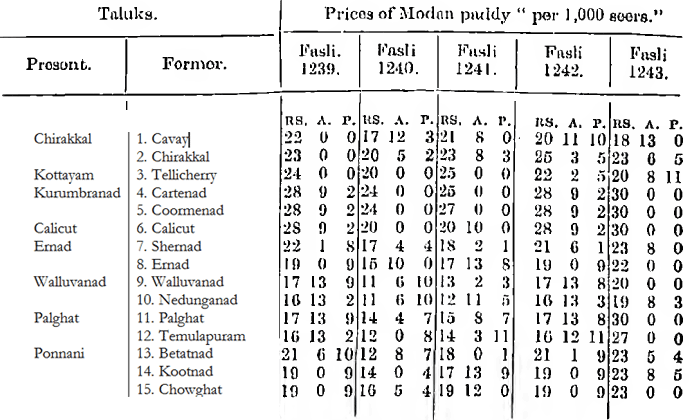
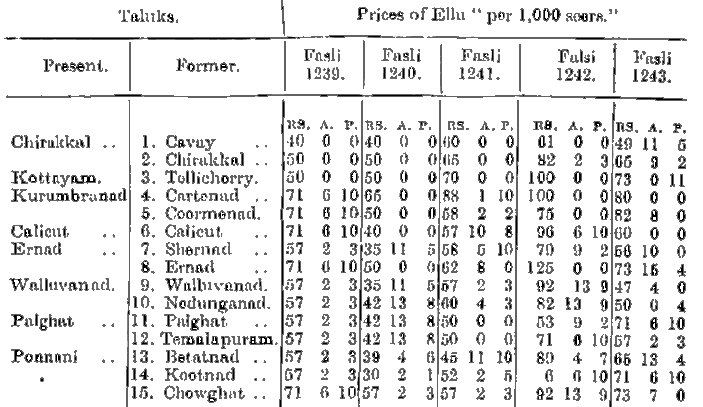
N.B- What seer was used is not certain, but it was probably the Macleod seer used in the table in paragraph 232.
|
Mr. Sheffield's system abolished 1st November 1861. Mr. Grant, the Collector, at the time was unaware of the data on which the rates then in force were fixed. The custom of fixing the commutation rates annually had perhaps ceased. The new plan was to fix 12 annas per acre cultivated annually. |
276. The system thus instituted continued in force up to 1861, when it was abolished (G.O., Revenue Department, dated 1st Novombor 1861, No. 2086). Mr. Grant, the Collector, at this time stated (paragraph 18 of his letter in Board's proceedings, dated 14th September 1861, No. 5005) that the data on which the assessment rates then in force were fixed were not known, but it will be seen, on reference to column 5 of the table given in paragraph 17 of that letter, that Mr. Shefield’s plan of taking one-fifth of the gross produce was still in force. The commutation rates were not perhaps in 1861 fixed annually with reference to market prices, as had been the case down to 1845 at least. The Government fixed one uniform rate of assessment per acre on the area cultivated annually, viz., 12 annas. Calculating on the figures given by Mr. Grant in paragraph 17 of his letter above quoted, the commutation rates per 1,000 Macleod seers in each of the modern taluks were in 1861 as follows : |
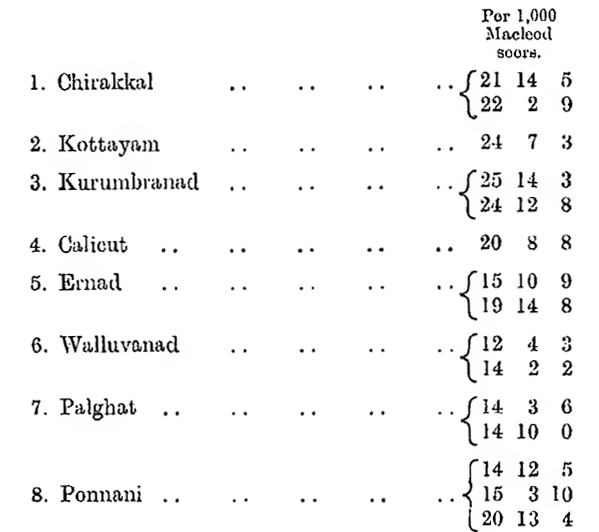
|
Assuming the Government share as one-fifth of the gross produce, the present rate per acre represents a commutation rate of Rs. 17-11-11 per 1000 Macleod seers. |
Taking the average of the Government share of produce in all taluks, as per Mr. Grant’s figures, and applying to it the money rate of assessement fixed by Government in 1861, it appears that the existing assessment represents the very moderate commutation rate Rs.17-11 - 11 per 1,000 Macleod -seers, assuming, of course, as in paragraph 232, that the Government share is one-fifth of the gross produce. |
|
Mr. Graeme made no specific proposals regarding Ellu, but Mr. Sheffield assessed this kind of cultivation on precisely the same plan as he had applied to Modan. Continued in force till 1861, and 9 annas per acre substituted. |
277. Ellu. — Mr. Graeme made no specific recommendations in regard to lands cultivated with this crop, but Mr. Sheffield extended to it precisely the same system as that introduced for Modan and described above (paragraph 274). His plan (likewise as in the case of Modan lands) continued in force till 1861, when by the same Government order an acreage assessment was substituted, viz., nine annas on the breadth of land annually sown with Ellu. What was done at this time will be clearly seen by reference to the following figures. The commutation rates per 1,000 Maclood seers, as per Mr. Grants’ figures were in 1861: |
|
Assuming the Government share of produce at one-fifth of the gross, the rate per acre now in force represents a commutation rate of Rs. 63-15-8 per 1000 Macleod seers. This rate would have been too severe in 1829-34. |
Assuming, as in paragraph 232, that, the Government share is one-fifth of the gross produce, and calculating on the average of Mr. Grant’s figures and on the money rate of assessment fixed by Government in 1861, the commutation rate now is very moderate, viz., Rs. 63-15-8 per 1,000 Maclood seers. NB.—This rate would not, however have been a moderate rate in some taluks in 1829-34 (see paragraph 275).
|
|
Mr. Graeme mad no proposals regarding Punam. There is no record of any revision of assessment from 1805-6 till 1861, when money rates per acre, varying from 8 annas to 12 annas, were imposed. |
278. Punam —Mr. Graeme made no specific proposals regarding this crop (see paragraph 34), and probably owing to the remoteness of the localities where it is directly cultivated, Messrs. Sheffield and Clementson also seem to have overlooked it. There is no record, as far as ascertained, of any revision of the principles of the assessment from 1805-6 down to 1861, when the Government order quoted in paragraph 276 fixed an acreage assessment on the breadth annually cultivated of— |
|
10 |
annas-per acre |
in old Kavayi taluk (part of Chirakkal). |
|
12 |
do. |
in the old Kadattanad taluk (northern part of Kurumbranad). |
|
8 |
do. |
8 do. elsewhere. |
Adopting for the purposes of comparison the gross produce outturns in the several taluks as given in the table at paragraph 7 of Mr. Grant’s letter on which the Government order was passed, the acreage rates on the original principles of the assessment would have been respectively:
|
Rupees 3 |
Odd per acre |
in the old Kavayi taluk |
|
do. 3 |
Do |
do |
|
do. 4 |
Do |
do |
|
do 1 or 12 annas |
odd per acre |
elsewhere |
as per the figures in the table at paragraph 232.
|
The original principles of assessment had long ago been abandoned, and the assessments were in 1861 in the greatest confusion. Assuming the Government share at one-fifth of gross produce the present money rates per acre represent commutation rates of Rs. 8 to 12 per 1,000 Macleod seers. |
It may, therefore, be gathered from the figures given in the table at Paragraph 7 of Grant’s letter, that all attempt to work on the original principles of the assessment had been long ago abandoned indeed - it was inevitable (see the remarks in paragraph 237) and that the assessments had fallen into the greatest confusion. There is no principle discoverable in Mr. Grant’s figures. The assessment seems to have in course of time approximated to about 10 per cent of the gross produce at from about Rs. 16 to Rs. 24 per 1,000 Macleod seers, which figures at the standard rate (adopted in paragraph 232) of 20 per cent, of the gross produce, give the very moderate commutation rates of about Rs. 8 to 12 per 1,000 Macleod seers. |
Other Miscellaneous Lands
|
Other miscellaneous crops in Palghat Taluk were assessed at 12 annas, per acre in 1870. |
279. In 1870 a proposal mooted by Mr. Ballard was finally sanctioned (Revenue Board's Proceedings dated 24th February 1870, No. 1289), of assessing the following crops in the Palghat taluk, viz |
|
1. Cholarn, |
6. pulses |
|
2. Raggy, |
7. Tobacco, |
|
3. Chama, |
8 Thomara, |
|
4. Kambu, |
9. Amarakay. |
|
5. Horse-gram, |
10. Castor-oil seed. |
|
A similar proposal for other crops elsewhere was abandonded. |
at the rate of 12 annas per acre on the annual breadth of land cultivated. A further proposal by the Revenue Board to extend a similar assessment to other crops, such as pepper, ginger, etc., and to other parts of the district was finally abandoned (Revenue Board’s Proceedings, dated 16th September 1873, No. 1846).
|
|
The 6 annas per acre on miscellaneous lands imposed in 1861, 16,000 across thus held at present. |
280. Six Annas per Acre Rate.—But in 1861 it was also thought politic to hold out inducements to people to take up such miscellaneous lands permanently so as to save the annual inspections and measurements by the Revenue subordinates, which are liable to so much abuse. Accordingly a rate of only 6 annas per acre was sanctioned in the Government order already referred to (No. 2086, dated 1st November 1861), and some 16,000 acres are now held on that assessment throughout the district.
|
|
Various money rates per acre were assessed on Palliyal, etc. lands in 1862. |
280a. Various Money Rates per Acre on Palliyal, etc.—On 2nd September 1862 Mr. Ballard issued orders to assess permanently on the acreage certain classes of land known locally as — |
(1) Palliyal.—Rice-lands intermediate between the ordinary low-lying paddy-flats and the high-lying Modan lands.
(2) Vila nokhi chartunna vaka.—Lands somewhat similar to Palliyal and inspected annually for assessment. The Palliyal lands had hitherto been assessed like Modan lands at one-filth of the gross produce; the Vila nokki chartunna vaka had hitherto been assessed like fresh paddy-lands. These principles were apparently adhered to in fixing the rates per acre, the average of four or five years being struck.
Sub-Section VI.—The Exceptional Nads,
viz. (1) Cannanore and Laccadives, (2) Wynad, (3) Cochin, (4) Tangacherry and Anjengo.
|
The exceptional Nads. |
281. It only remains to consider the exceptional cases of :— Nad XXIX.—Cannanore and the Laccadive Islands. Nad XXXI.—The Dutch Settlement at Cochin. Nad XXXII.—The Dutch and English Settlements at Tangacherry and Anjengo. Nad XXIX.— Cannanore and The Laccadive Islands. |
|
Considered unnecessary to say much of Cannanore and the Laccadive Islands. |
281a. Little need be said regarding these territories because any measures to be introduced for regulating the necessary the relations between Janmis and Ryots in Malabar would not, it is presumed, be extended to them. The Ali Rajas (Sea Rulers) hold only a small portion of territory on the mainland, comprising 31 Desams in and about the town and cantonment, of Cannanore in the modern Taluk of Chirakkal. They pay for their mainland territory a lump assessment of Rs. 3,801.
|
The Laccadive Islands now subject to the family are –
|
1. Agatti |
2. Kavaratti, |
3. Androth, |
|
4. Kalpeni, |
5. Minicoy |
|
with several other uninhabited small islands attached. These islands are among the “Scheduled Districts” (Act No. XV of 1874). The original assessment on them and their trade was Rs. 11,200, but that sum has since been reduced by Rs. 5,250 owing to some misunderstanding at the time of the Kirar of 1796 regarding some other territory on the mainland, which the Bibi thought she was to be allowed to retain, but which was eventually restored to its rightful suzerain, the Kolattiri Raja.
281b. The islands numbered 1 to 4 yielded annually during the ten years 1865-66 to 1874-75, during which period the islanders had broken loose from the Raja’s control and exported their produce without any restriction, the following quantity of cocoanut produce, of which coir yarn alone is monopolised:-
|
Coir yarn, 6,335 cwts. |
62,631 |
|
Cocoanuts, 1,534,121 |
23,011 |
|
Copra, 1,783 cwts. |
16,200 |
|
Jaggery, 5,930 cwts |
27,423 |
|
Vendiah, a sweat-meat, 2,693 bundles and 13 cwts |
1,331 |
|
Total |
1,30,599 |
These four islands, therefore, yield monopoly produce which may be valued—but prices vary greatly—at : Rs. 63,682, viz.:-
281c. The Island of Minicoy is administered on a different system. There is no monopoly of the coir yarn, cowries, and tortoise shell produce as in the four northern islands. The following is an estimate of the revenue derived from this island :
Cocoanuts (from Pandaram land), 550,000 number.
Coir Yarn (Poll Tax) 22 candies.
Sugar (Poll Tax) 900 adubahs (worth about Rs. 225 in Malabar).
Rice (Tax on large vessels trading with Bengal), 20 candies.
Maas fish (Tax on fishing boats), 350 fish.
Cowries—5 candies.
Maas fish (Hire of the Pandaram boat at 14 per cent. of the catch), 300 fish.
Money rents-—Rs. 900.
This revenue, valued in Malabar at ordinary prices prevailing there, averages about Rs. 7,000 per annum gross.
281d. The net revenue, after defraying all charges of collection, comes to Rs. 9,750—0—11 on the five islands and on the territory at Cannanore.
282. In paragraph 78 will be found as much of the political history of Wynad as it seems necessary here to refer to. Wynad consisted originally of the following modern amsams in the modern taluk of Wynad and in the Nilgiri Commission:-
|
Wynad Taluk |
||
|
1. Peria. |
2. Edavaka. |
3. Nallurnad. |
|
4. Ellurnad. |
5. Kuppatod. |
6. Putati. |
|
7. Kurumbala. |
8. Porunnanur. |
9. Tondarnad. |
|
10. Vaitri. |
11. Etannalassakur. |
12. Muppainad. |
|
13. Ganapativattam |
|
|
Nilgiri Commission.
14. Cherangod.
15. Munnanad.
16. Nambolaketta.
|
No settlement till after the Pychy Raja's death, 30th November 1805. |
283. The constant disturbances which agitated this Nad prevented any fixed settlement being made till after the death of the Palassi or Pychy Raja, which event took place, as already related, on 30th November 1805. |
|
Mr. Baber, Sub- Collector, on 1st March 1806 reported that the pattam was equal to double the quantity of seed sown. |
284. Mr. Baber, the Sub-Collector, on 1st March 1806 reported to the Principal Collector, Mr. Warden, that in consequence of the devastating wars which had prevailed, the pattam (rent) was at the rate of double' the quantity of seed sown, or on an average not more than one-fifth of the net produce, and that, to make such a pattam the basis of the revenue demand, as in the districts below the ghats, would be too low a standard. |
|
Mr. Warden, the Principal Collector, eventually sanctioned the following scheme. |
285. Mr. Warden eventually decided to adopt the following scheme of assessment: |
|
Details. |
(a) Ascertain the number of Potis (30 seers) of seed sown on each holding. (b) Adopt as the fixed outturn multiples of the seed sown in the lands in the following amsams the following figures : |
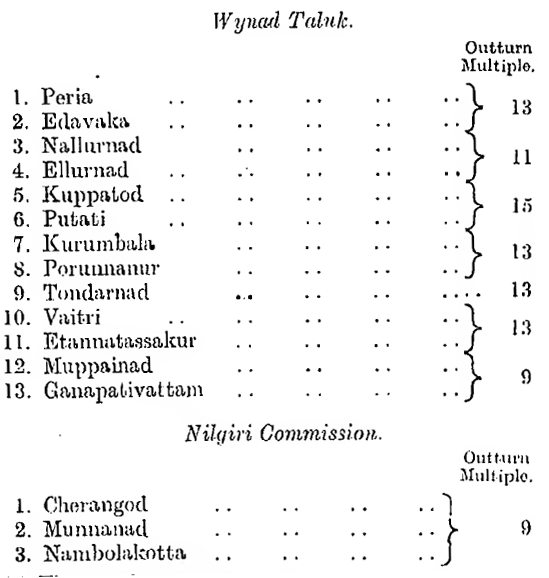
(c) The number of Potis (30 seers) of seed x the respective outturn multiples = gross produce of the holding.
(d) Deduct from the gross produce, for expenses of cultivation, three Potis (90 seers) for each Poti (30 seers) of seed sown.
(e) Divide the balance thus left over of the gross produce in equal shares between-
1. The Government,
2. The Jamni and
3. The Ryot.
(f) Commute the Government share of the net produce into money at rates varying according to local circumstances.
|
A good deal was left to Mr. Baber's discretion, and he used a peculiar device for preserving the principles of the assessment in exceptional cases. |
286. Mr. Warden, however, left it to Mr. Baber’s discretion to vary these rates in cases in which from local circumstances he thought that course necessary, discretion, and this discretion was apparently extensively utilised. Moreover, in recording these variations a peculiar device had to be resorted to, to preserve in the accounts the principles of the original assessment. For example, a land requiring 1½ or 2 Potis (45 to 60 seers) to sow it, might be so subject to the devastations of wild beasts, etc., that it could not bear the local rate of assessment. |
In such a case, instead of showing in the accounts the actual quantity of seed required, a smaller quantity [say, 1 Poti (30 seers)] would be entered in the accounts, and the other calculations would be made as if that were the actual quantity of seed required for that land. Similar devices, it will be seen on reference to paragraphs 134 and 175, were favourite ones likewise with the Mysorean officials.
|
Mr. Warden's plan resolved itself into money rates assessed directly on the Poti of seed. |
287. As soon as Mr. Warden’s scheme began to be worked, it was probably discovered that a much simpler plan would effect the same end, and this was to assess certain money-rates directly on the Potis (30 seers) seed sown on each land, instead of on the gross produce less deductions as in Mr. Warden’s plan. The explanation of this is very simple. |
|
Explanation of the above. |
In Mr. Warden’s scheme the outturn multiple and the share of Government are uniform within local areas. It may also be assumed that the rates for commuting produce into money would also be once for all fixed by Mr. Baber for local areas, as he had no instructions to alter these rates annually to suit the market prices. |
|
Example |
Directly therefore the scheme began to be worked, it would be seen that it saved a lot of work and bother, if, instead of applying the uniform money commutation rate to the uniform Government share of the uniform net produce, the uniform resulting money-rate were applied at once and directly to the quantity of seed required to sow each holding, and this device would be followed within the local areas in which these uniform conditions held good. For example, take a land sowing 5 Potis of grain in the Ganapativattam amsam |
|
Potis |
Outturn Multiple |
Gross Produce |
Expenses of Cultivation. |
Net Produce |
Government Share |
|
5 |
x 9 |
= 45 |
-(5x3) =15 |
= 30 |
÷ 10 Potis |
At Rs. 1-2-9½ per Poti = Rs. 11-11-11.
But 5 Potis (the seed) at Rs. 2-5-7 = Rs. 11-11-11.
|
The advantages of this plan when the land revenue had annually to be assessed. |
Therefore, by applying directly a rate of Rs. 2-5-7 to the number of Potis of seed sown, all the advantages of this plan, where the quantity of land sown annually had annually to be ascertained, and the revenue assessment annually calculated thereon, are sufficiently manifest. |
|
Mr. Graeme did not interfere with Wynad and instructed Mr. Vaughan to follow the plan of annual settlements, 20th May 1823. Similar determination of Government, 26th March 1862 |
288. Mr. Graeme decided not to interfere with the wet land assessments in Wynad, and instructed Mr. Vaughan, the Principal Collector, to adhere to the plan of “Annual Settlements" (paragraph 27 of his letter to Mr. Vaughan, dated 20th May 1823). And the Government, on a later occasion (G.O., Revenue Department, No. 662, dated 26th March 1862) came to a similar decision. |
|
The money rates per Poti of seed have shifted somewhat since 1822. |
289. It will be seen on reference to the subjoined table that the money rates per Poti of seed sown have shifted somewhat, since 1822. The figures are taken from Mr. Graeme‘s report and from a statement recently prepared in the Collector’s office:- |
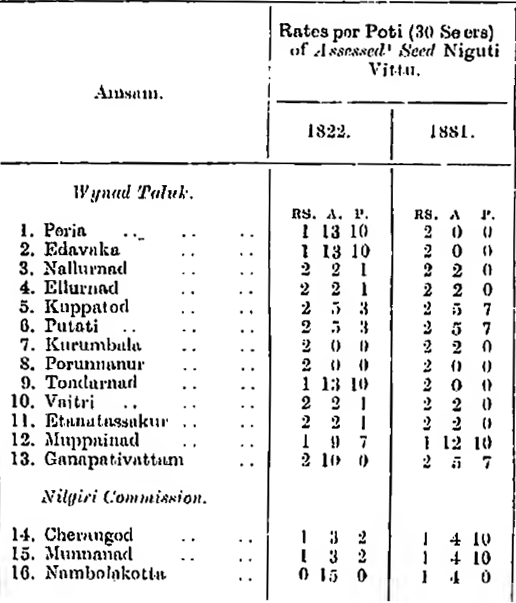
NOTEs: 1. The phrase “assessed seed “is correct, for the "assessed seed” was not always the actual quantity of seed sown (see paragraph 286, also paragraph 129). END OF NOTEs
NB.—Fractions of a pie have been omitted in converting those rates into modern currency.
|
The Warden pattam. |
290. It will be seen from the above that it is difficult to compare the Wynad wet land assessments with those of the low country, for here there is a fourth kind of pattam (rent) to be dealt with. Being different from the three others it may appropriately be called, after its author, the Warden pattam. It approximates the most to the Vilachhal meni pattam of Mr. Rickards (paragraphs 226, 226a, 226b and 227). For example: |
|
Compared with the Vilachchal meni pattam. |
Seed = 5 Potis ; Outturn multiple = 15, the rate in Kuppatod and Putati amsams.
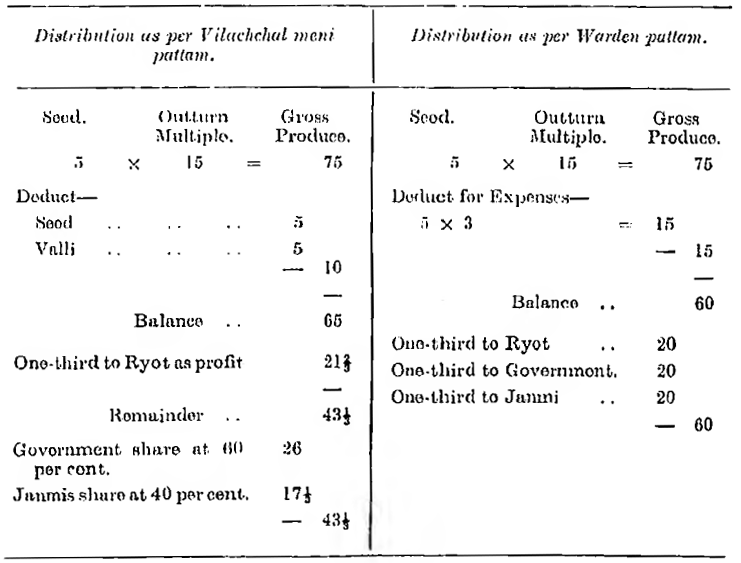
It may also be noted in passing that the deduction for expanses in the Warden pattam, is the customary rate which is still prevalent in several of the heavy rich land amsams in the Ernad Taluk.
|
Comparison of commutation rates, assuming 60 percent of pattam as the share of Government. |
291. Bearing in mind the peculiarities of the Warden pattam, which gives to the Government half or 50 per cent, of the shares of produce available as Pattam (rent) and adopting the latest Poti rates as shown in paragraph 289, it is possible to compare the assessments with those in the low-country taluks by adopting the same standard percentage of pattam (rent), viz., 60 per cent., and by converting the commutation rates per Poti1 into commutation rates per 1,000 Macleod seers, the standard adopted for the low-country. On those data the prevailing commutation rates at 60 per cent of the pattam (rent) in the various amsams come out as follows :- |
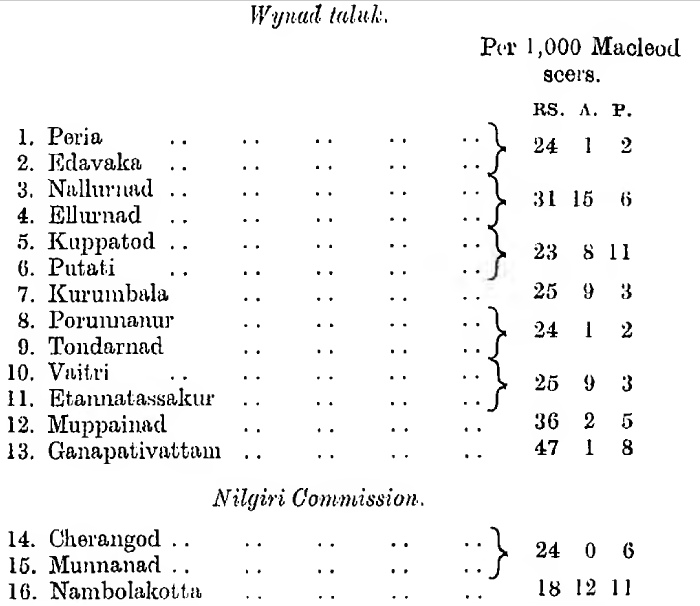
N.B.—Fractions of a pie are omitted, and the Nilgiri Commission amsam rates are calculated on the basis of the Poti rates prevalent in 1822.
The market prices prevalent in Wynad since 1860 during the harvest months average Rs. 69-6-4 per 1,000 Macleod seers, so that the commutation rates on which the assessments were fixed are everywhere well within the prices the cultivators have of late been obtaining for their produce. Other changes, however, have affected the cultivators, some beneficially, others the reverse.
The good cartloads must have very materially tended to equalise prices throughout the Nad, and the food required for the large bodies of coolies employed on coffee-estates must also have tended in the same direction ; while, on the other hand, the greater cost of labour and the breaking down of the system of serfdom have tended to increase the original cost of the produce.
|
The Ganapativattam rate must have been prohibitive for some time after the troops, regular and irregular, stationed there were withdrawn. |
The comparatively high rate in Ganapativattom was due to the demand there was for grain in 1806 to feed, the large body of regular and irregular troops stationed in that amsam at that time. It must have been a prohibitive rate after those troops were withdrawn and before the country was opened up by good roads, as indeed the large extent of waste paddy-fields in that neighbourhood still amply testifies. |
|
The Nambolakotta rate, on the other hand, must have encouraged cultivation there as soon as a market was found. |
On the other hand, the low rate in Nambolakotta must have held out strong inducements to extend wet cultivation there, as soon as a market for it could be found. Wynad, however, is an exceptional taluk, chiefly owing to its unhealthiness; and the breaking up of the system of serfdom since the assessments were fixed must have had a much greater influence on agriculture in Wynad than it had elsewhere, because in Wynad there was but a limited class to take the places of the slaves who chose to leave their ancient masters and work for hire on the European coffee-estates |
Garden Lands
|
Coco, areca, and jack are unassessed. |
292. Coco, areca, and jack gardens are unassessed in Wynad. |
|
Coffee. Rs. 2 per acre imposed from the third yoar, 16th May 1800. This rate bore no proportion to gross or net produce. Crop capricious, return uncertain. The rate is hardly felt on a good estate, but in many, perhaps the majority, it is only so much added to the losses. |
293. In 1860 coffee had become such an important industry in Wynad that Sir Charles Trevelyan proposed to assess coffee gardens at a uniform rate of Rs. 2 per acre, from the third1 year after planting (G.O., Revenue Department, dated 16th May 1860, No, 788). This assessment was arbitrarily fixed without reference to either the gross or the net produce. The crop is so capricious and the return is so uncertain that an arbitrary rate had to be fixed. The rate is hardly felt on a good estate in a good year, but Mr. Macgregor pithily summed up (Board’s Proceedings, dated 16th September 1873, No. 1846) the other side of the question thus: "The existing tax of Rs. 2 an acre on coffee falls heavily on many estates that have been fairly successful, while in a large number of instances, perhaps in the majority, it is so much added to the losses.” |
NOTEs: 1. A practice having sprung up of granting three years' remission at starting, the Government, ordered it to be discontinued. Tea and cinchona lands are to be similarly treated—G.O., R.D., 1118, of 2nd October 1885. END OF NOTEs
|
8 annas per acre more assessed on Government lands as Janmabhogam, 18th September 1860. |
294. A few months later (G.O., 18th September 1860, No. 1634) an extra cess of 8 annas per acre was imposed on Government land only as Janmabhogam from date of occupation “for any purpose.” This rate is leviable on the entire holding under puttah, whereas the assessment is payable on the area actually cultivated only. |
|
Rates per acre under Waste Land Sale Rule Rs. 2 for forest and Re. 1 for grass, afterwards reduced to 8 annas, 23rd December 1862. |
295. The rules for the sale of Government waste lands were sanctioned in 1863 (G.O., dated 23rd December 1862. No. 2677), and Rs. 2 per acre for forest and Re. 11 per acre for grass-land, were the rates of assessment reserved at the sales. The lands were not necessarily, but as matter of fact they were without exception, taken up for coffee cultivation. |
|
Cess remitted for an extra year, or three in all, from date of planting, 22nd September 1871. |
296. In 1871 the coffee-cess was remitted for an extra year, making three in all from the date of planting (G.O., dated 22nd September 1871 No. 1656).2 |
NOTEs: 1. This rate on grass-land taken up under the Waste Land Rules was reduced to 8 annas per acre by G.O., 22nd September 1871, No. 1656.
2. This G.O. “must be held to apply to such land” (forest land) “when cultivated with Cinchona" i.e., Rs. 2 per acre.—Board of Revenue, No, 2001. 11th August 1882. END OF NOTEs
Miscellaneous Lands
|
Unassessed till 1862, when Rs. 2 per acre was first imposed. Afterwards altered to 1-4-0 per acre on lands annually inspected and to 10 annas per acre if land taken up permanently, 11th August 1863, 15th August 1863, 15th December 1863. These are the Wynad equivalents of the 12 annas per acre and 6 annas per acre cesses in the low-country. The reason why they are so much heavier. Neither the net produce nor the gross was considered. |
297. Dry grain lands were unassessed till 1862, when the Board Revenue first recommended and Government approved (G.O., dated 26th March 1862, No. 660) an assessment of Rs. 2 per acre, the same as for imposed coffee, but on Mr. Ballard giving certain explanations, the Government and the Secretary of State finally sanctioned a rate of Rs. 1-4-0 per acre on cultivation annually inspected, and 10 annas per acre if the land were taken up and permanently assessed. These rates were applied to private lands only (G.Os., Revenue 11th August 1863, No. 1483, and 15th December 1863. No, 2292). They were the Wynad equivalents of the 12 annas per acre and 6 annas per acre assessments in the low country taluks already referred to in paragraphs 278, 279, 280. The reason why they were made so much more heavy is that Government had already decided (see paragraph 295) to sell Government wastes subject to a cess of one rupee per acre for grass-lands, and it was thought that Government lands would be unfairly weighted if private lands were assessed at lower rates than those mentioned. Neither the net produce nor the gross was therefore considered when fixing those rates, and in this respect it will be seen they are to some extent on the same footing as their equivalents in the low country taluks. |
Nad XXXI—Dutch Settlement at Cochin.
|
Historical |
298. On the 20th October 1795 the Dutch Settlement at Cochin was delivered up to Major Petrie, in command of a detachment of British troops. The settlement remained under the British flag till by the Convention of Paris in 1814 it was finally ceded to Great Britain. |
|
Limits |
299. The settlement consisted of the town and fort of Cochin and of the following gardens or pattams outside those limits :- |
|
1. Tumboli pattam. |
2. Kattur pattam. |
|
3. Attalakad pattam. |
4. Manakodat pattam. |
|
5. Antony Fernandez pattam. |
6. Tekkepurupunkara pattam. |
|
7. Mundenvelli pattam. |
8. Domingo Fernandez palakal pattam. |
|
9. Santiago pattam |
10. Taiveppu pattam. |
|
11 . Belicho Rodrigues pattam |
12. Saint Louis pattam. |
|
13. Duart Lemos pattam. |
14. Hendrick Silva pattam. |
|
15. Ramanturutti pattam |
16. Sondikalguvanliure Silva pattam. |
|
17. Palliport Hospital puramba. |
|
|
No |
1 lies |
33 miles |
south |
of Cochin |
|
|
2 do |
31 do |
Do |
do |
|
|
3 do |
27 do |
Do |
do |
|
|
4 do |
27 do |
Do |
do |
|
|
5 do |
6 do |
south-east |
do |
|
|
6 do |
6i do |
Do |
do |
|
|
7 do |
6 do |
Do |
do |
|
|
8 do |
G do |
Do |
do |
|
|
9 do |
5 do |
south |
do |
|
|
10 do |
4 do |
Do |
do |
|
|
11 do |
4½ do |
Do |
do |
|
|
12 do |
5½ do |
Do |
do |
|
|
13 do |
5 do |
south |
of Cochin |
|
|
14 do |
4½ do |
Do |
do |
|
|
15 do |
1½ do |
North-east |
do |
|
|
16 do |
4½ do |
South |
do |
|
|
17 do |
16 do |
North |
do |
Nos. 5 and 16 arc together known as Kallancheri.
|
Proprietary right in soil vested in Government. |
300. The proprietary right in the soil of the settlement was vested in the Government, but the Dutch and Christian residents were exempt from ground-rent taxation. |
|
Land hold on leases of 20 years. This system continued after the territory passed into British hands. |
301. The land beyond the fort was held on leases running for periods of twenty years, “on the expiry of which the land with all improvements reverted absolutely to the Government, no tenant right or compensation being admitted.” |
|
Leases put up to auction. |
302. “This system was continued after the territory passed into the possession of the British Government, but with the disadvantageous change of selling the leases as they fell in by auction.” |
|
Mr. Conolly revised the arrangements in 1847 and settled the pattams with the ryots in accordance with the district usage. Assessment liable to revision every twenty years. |
303. Mr. Conolly saw the objectionable character of the system and applied a remedy in 1847 when a number of the leases expired. He had these estates surveyed and assessed in conformity with the usage of the district according to their condition, and made over to the actual resident ryots (who as sub-tenants of the former renters enjoyed a moiety of their produce, but lost their improvements and rights with each renewal of the lease to the former renters or to strangers, according as circumstances rendered it expedient. The assessment is subject to revision every twenty years, but as the agreements contain no resumption conditions, the tenure is virtually1 permanent, the holder having the option of retaining the land at its revised assessment in preference to others if so inclined. The same system has since continued, and three estates only remain unsettled in this manner.” |
|
Board's Proceedings, 1st July 1858, No. 2279 |
304. The above extracts are from Revenue Board’s Proceedings, dated 1st July 1858, No. 2279. |
NOTEs: 1. This is not quite correct The puttahs contain a condition that the lands are resumable "at the pleasure of Government.”—G.O., Revenue Department, No 706 dated 5th June 1884, pp. 21, 23, or “should the Government require it.”—Ibid p. 20 END OF NOTEs
Wet Lands
|
Details of the settlement of wet lands. |
305. The principles on which the wet land assessments have been framed as related above are as follows : |
(a) The number of seers required to sow 100 Perukkams in each holding is first ascertained. A “perukkam” is 6 feet x 6 feet, so, 1,210 Perukkams go to an acre. The number of seers so required ranges from 4 to 4½, 5 and 6.
(b) The outturn multiple of the holding is simultaneously fixed. The outturn multiples range from three to eighteen times the seed.
(c) Then extent in hundreds of Perukkams X seed X outturn multiple = gross produce of the holding.
(d) Deduct the seed and a similar quantity for cultivation expenses and find the net produce.
(e)Reserve one-third of the net produce for the cultivator, and the remainder is the pattam.
(f) The whole of the remainder goes to Government, although in the accounts a distinction is drawn between the Government share (65 per cent, of it) and the Jamni’s share (35 per cent of it).
(g) Both shares are commuted into a money assessment at Rs. 25 per 1,000 Macleod seers.
|
Mr. Conolly followed the general plan adopted by Mr. Sheffield for assessing Modan, and Mr. Clementson's plan for distributing the produce. The Cochin plan of produce distribution distinguished from Vilachchal meni pattam and the Warden pattam. |
306. Mr. Conolly, it will be seen from the above, followed the general plan adopted by Mr. Sheffield for assessing Modan lands (paragraph 274), and in the precise distribution of the produce he followed the scheme adopted by Mr. Clementson (paragraph 272 a) for assessing land freshly taken up for cultivation. This fifth method of distributing the produce differs from the others already described, but it is very closely allied to the method adopted in distributing the Vilachchal meni pattam of Mr. Rickards and to that adopted for distributing the Warden pattam in Wynad. |
For example:-
Seed 5 seers; outturn multiple. 15.
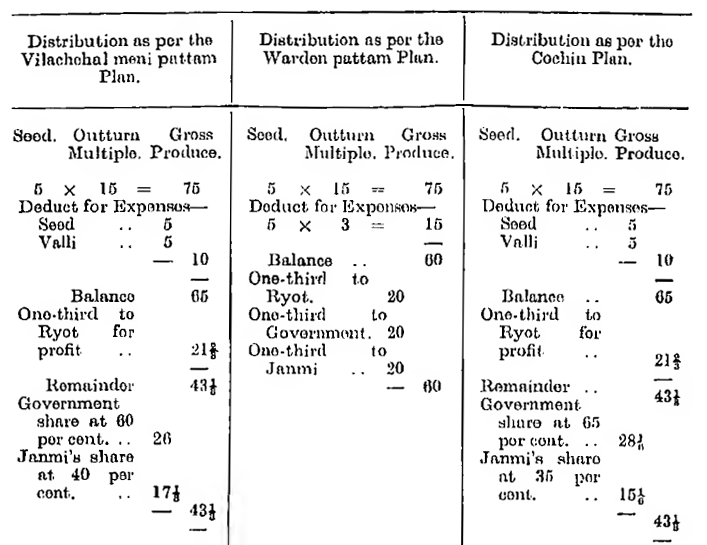
|
It was in fact the Vilachchal meni pattam with 65 percent reserved for Government instead of 60 percent. The explanation of this change of percentage. |
In short it is the Vilachchal meni pattam of Mr. Rickards, with however 65 per cent, of the pattam (in place of 60 per cent) reserved for the Government share. It was Mr. Graeme who proposed to take as the Government share 65 per cent, of the pattam, but then the pattam he referred to was the Verumpattam or actual rent, not the Vilachchal meni pattam. Mr. Graeme’s reason for proposing a departure from Mr. Rickards’ scheme fixing the Government share at 60 per cent, was that in his time it took 65 per cent, of the Verumpattam to make up 60 per cent, of the Vilachchal meni pattam ; the Verumpattamm being in his time pro tanto lower than the Vilachchal meni pattam (see paragraph 254). |
|
It was a departure from the agreement arrived at in 1803. |
It was a clear departure from the agreement with the principal Janmis in 1803 (paragraph 247) to calculate the pattam on the Vilachchal meni principles and then to take 65 per cent, of the remainder instead of the 60 per cent, agreed to. This was evidently not looked into when Mr. Clementson was authorised to adopt his plan for assessing land freshly taken up for cultivation (paragraph 272 a). |
|
The Government takes 100 per cent of the pattam in Cochin. This at first sight looks like too large a proportion of produce for Government to take, bu the commutation rate is extremely moderate, and represents a rate of Rs. 41-10-8 per Macleod seers at the standard percentage of pattam. The price of paddy in Cochin in the harvest months since 1860 has averaged Rs. 57-15-0 per Macleod seers, so that the Cochin Ryots are better off than these in many other places. |
307. It did not, however, matter much in Cochin, because there the Government was also the Janmi, and in its double capacity, it took 100 per cent, of the pattam in the shape of assessment and Janma-bhogam from the Ryots. This at first sight would seem to be too large a proportion of the produce for the Government to swallow up, but the fact is that the extreme moderation of the commutation rate assumed in converting produce into money, has left to the Ryots in Cochin a much larger share of produce than at first sight appears. Bearing in mind that in this instance it is the Vilachchal meni pattam which is being distributed, and that the Government share is 100 per cent, of it, the commutation rate (viz., Rs. 25 per 1,000 Macleod seers) at the standard percentage adopted in the tables at paragraphs 231, 291 (viz., 60 percent, of the pattam) comes out at Rs. 41-10-8 per 1,000 Macleod seers. Now, on the other hand, since 1860 the market prices obtainable at Cochin for Paddy in the harvest months have averaged no less than Rs. 57-15-0 per 1,000 Macleod seers. Even therefore though the ryots have been paying to Government the whole of the Vilachchal meni pattam, they have been better off than the Ryots in many of the Nads, for which the figures will be found in the tables at paragraphs 231 and 291, who, in addition to meeting a commutation rate quite as high, and, in some instances a good deal higher, have still above and beyond this to find a rent for the Janmi. |
Garden Lands
|
Mr. Graeme's plan followed by Mr. Connolly. |
308. Mr. Conolly assessed the coco, areca and jack trees on the plan adopted in the rest of the district (paragraph 263). |
Miscellaneous Lands
|
No cultivation, but some money rates have been applied under Mr. Ballard’s Circular of 2nd September 1802. |
309. Modan, Punam, and Ellu cultivation (paragraphs 33, 34, 35) is not practised in Cochin, but Mr. Ballard’s order of 2nd September 1862 (see paragraph 280a) has been put in operation in Cochin to a small extent. |
Nad. XXXII—The Dutch Settlement at Tangacherry and the English Settlement at Anjengo.
|
Land revenues framed by the Travancore Government. |
310. Very little requires to be said about those settlements, because the land revenues of both are, with the other sources of revenue, rented out at lump sums the Travancore State at Rs. 2,447 per annum for Tangacherry and Rs. 1,450 per annum for Anjengo. |
|
The Travancore State collects the share due to Government on Government lands. Janmam lands are exempt. |
311. The land belongs partly to Government and partly to Jamnis. The lands of the latter class are exempt from all assessments, and as regards the former the Travancore State collects only the share (pattam) due to Government. This state of things proves, if additional proof were necessary, that the position taken up in Section (A) of this Chapter is correct, viz., that the pattam really the ancient land revenue assessment of the coast—(Conf. p. 601.) |
Sub-Section VII.—Final Summary and General Conclusions.
|
Recapitulation of the objects set forth in paragraph 1 of this paper. |
312. The objects necessitating the preparation of this paper were thus set forth in paragraph 1: |
(a) To ascertain, first, by reference to the past revenue history of Malabar the proportions which the land revenue assessments bear to the fund available out of the net produce of the land for paying a rent to the Janmi and an assessment to Government.
(b) To discover, in the second place, whether these proportions are anywhere so oppressive at the present time, as to take from the Ryots more of the produce than by the fixed principles regulating the assessments the Government intended to take.
|
How far have these been attained? |
It now becomes possible to ascertain how far these objects have been attained. |
|
Details set forth for every part of the district and focussed (so to speak) in paragraphs 231, 232, 291, 307. |
313. The proportions which the various assessments bear to the rent and revenue fund, have been set forth in detail for every district for which details were required in the foregoing narrative. And these details have already been focussed (so to speak) in the figures to be found for the bulk of the low country in paragraphs 231, 232, as for the year 1805-6, and for the rest of the district in paragraphs 291 and 307, as for the present time. |
|
Further general observations. |
314. The following further general remarks observations. seem to be required:- : |
|
How far has Mr. Rickards' scheme of distribution been carried out? |
|
Wet Lands
|
Mr. Rickards' scheme has not been fully carried out. Mr. Graeme’s alternative plan provod abortive. The assessments are in much the same status as in 1805-6, and are based on four kinds of pattam. |
Mr. Rickards’ scheme of distribution depended on the ascertainment of an arbitrary pattam (rent), which has been called the Vilachchal meni pattam. It may be gathered from the foregoing narrative that his scheme has never been fully carried out. Mr. Graeme proposed, for reasons which have been already explained in paragraph 264, an equivalent scheme of his own (see in particular Sir Thomas Munro’s Minute of 16th July 1822, paragraph 9, Revenue Selections, Vol. Ill, p. 558), founded on the Verumpattam or actual rent, but Mr. Graeme’s scheme proved abortive, and so the wet land assessments are in much the same state as in 1805-6. The basis of them rests on four different kinds of pattam (rent), viz. |
(a) Verumpattam (actual rent).
(b) Nikuti pattam (the Mysorean assessment rent).
(c) Vilachchal meni pattam (Mr. Rickards').
These three regulate the proportion of produce in the low country to the extent shown in detail in paragraph 229, and the fourth, viz.,
(d) Warden pattam is in operation only in the Wynad.
|
Caution as to the figures in the tables at paragraphs 231, 291 and 307. |
These pattams of course, vary greatly among themselves, and the figures in paragraphs 231, 291 and 307 are not to be taken as the exact equivalents of the assessments in the various Nads reduced to one common fixed standard, but only as the nearest approximations which circumstances will permit, towards the attainment of such a standard. Where, however, one of these pattams is the basis of the assessment in more than one Nad, the figures represent the exact proportions which the assessments bear to each other in those respective Nads. |
|
One departure from the intention of Lord William Bentinck's Government founded on a mistake. |
There has, however, been one departure from the intentions of Lord William Bentinck’s Government. The details will be found in paragraphs 254, 272 and 306. The mistake made by Mr. Clementson of taking 65 per cent, of the Vilachchal meni pattam as equivalent to 65 per cent of the Verumpattam was apparently unnoticed then, and it has been perpetuated down to the present time. It affects all wet lands recently brought under cultivation in the low country and the accounts of all the wet lands in Cochin. |
Garden Lands
|
Mr. Rickards' scheme fully and successfully carried out by Graeme. |
Mr. Rickards’ scheme for the distribution of the produce in this class of lands was based on the actual prevailing customary pattam in South Malabar only. Graeme’s proposals did not necessitate any departure from that scheme except to the extent noted in paragraph 254. This was hardly a departure from the original scheme, because it left the North Malabar custom as to pattam intact. So that in regard to gardens (and excluding coffee, paragraphs 293, 296, as a recently introduced industry) the intentions of Lord William Bentinch’s Government have been fully carried out, and most successfully. |
Miscellaneous Land
|
Mr. Rickards’ scheme did not affect the miscellaneous lands. Uncertainty in consequence. The standard adopted by Mr. Sheffield was afterwards overlooked in I860. The disadvantage of one single fixed rate per acre. Too heavy on poor, too light on good land. |
II. As regards miscellaneous lands, Mr. Rickards’ scheme provided no rules for the distribution of the produce. There has consequently been some uncertainty in regard to the assessments. The standard adopted, for reasons stated in paragraph 232, was adhered to by Mr. Sheffield in regulating the Modan and Ellu assessments in the low country, but it was overlooked in regard to Punam. And when the low country assessments on these crops came again under revision in 1860, the standard in regard to Modan and Ellu was in its turn lost sight of, although practically its principles were to some extent preserved in the rates per acre then sanctioned (paragraphs 276, 277). The disadvantage of these fixed rates per acre is that no distinction is drawn between good, bad, and indifferent land. Mr. Sheffield had arranged the Modan lands in three classes, with outturn multiples varying from 29/64 to 618/64 and it is clear that one uniform average assessment must fall too heavily on the poor, and too lightly on the good lands. |
314a. To illustrate this section thirteen maps of the district have been prepared and are here inserted, showing the different portions of the district in which the various descriptions of cultivation principally occur.
|
Are the rates anywhere oppressive? High prices of produce are like a high flood-tide, submerging all inequalities. When the tide recedes the rocks lie bare. Since 1831-32 a high flood of prices has set in, and shows no sign of ebbing. |
315. Turning lastly to the most important point of all, the oppressiveness or otherwise of the Government shares produce at the Government commutation rate it may be remarked in the first place that high prices of produce are like a high flood-tide, submerging all inequalities of assessments, as rocks are submerged by the tidal wave. It is only when the tide recedes that the rocks are laid bare. Since 1832 a high flood of prices has set in which as yet shows no sign of ebbing. |
|
The rise most marked in and just after, the five years ending 1856-57. |
315. The district records show that prices ran very low in 1828-31 so much so that there was in 1830-31 some fear that Mr. Graeme’s commutation rates for garden produce would prove too high. Mr. Hudleston the Principal Collector, in 1830-31 had to give no less than Rs. 69,31 as remissions on gardens. This, however, was the turning point. The flood of high prices began after the setting in of the rains in 1831-32, and with some intermissions it has continued ever since. Perhaps the greatest permanent increase since 1822 took place in, and just after, the five years ending 1856-57. The following table exhibits such details as can be found of this time:- |
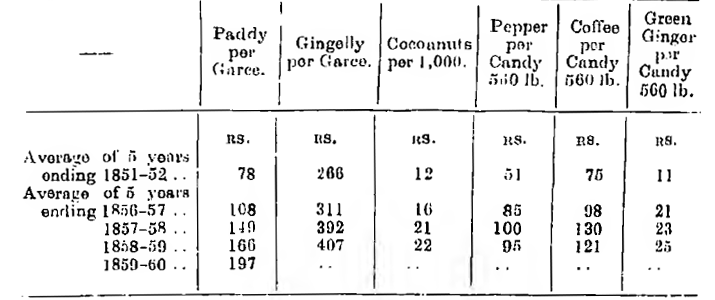
The garce referred to in this table is about three times the standard quantity used in the tables at paragraphs 231 232 291 307.
|
These high prices are compared in the following table with actual commutation rates as fixed by the principles of the assessment. |
316. In Appendices XVI to XIX will be found such details as can be had regarding the prices of produce current in recent years. In the following table these prices are compared with the commutation rates equivalent, at the standard Government shares of the produce (adopted in the figures at paragraphs 231, 232, 276, 277, 278, 291, 307), to the actual commutation rates of the existing assessment; and the map showing “Modern Taluks” will serve to show in what particular parts of the country these different rates prevail. |
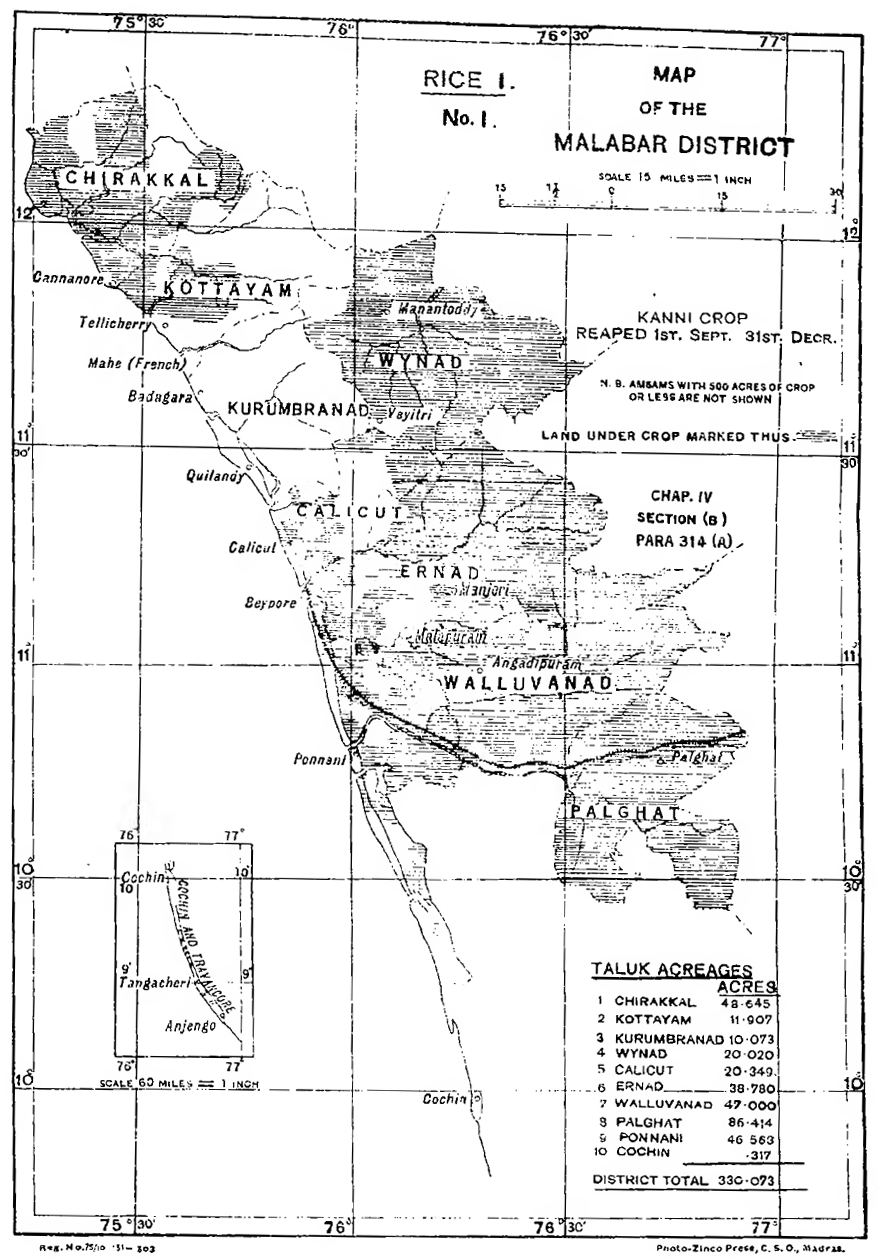
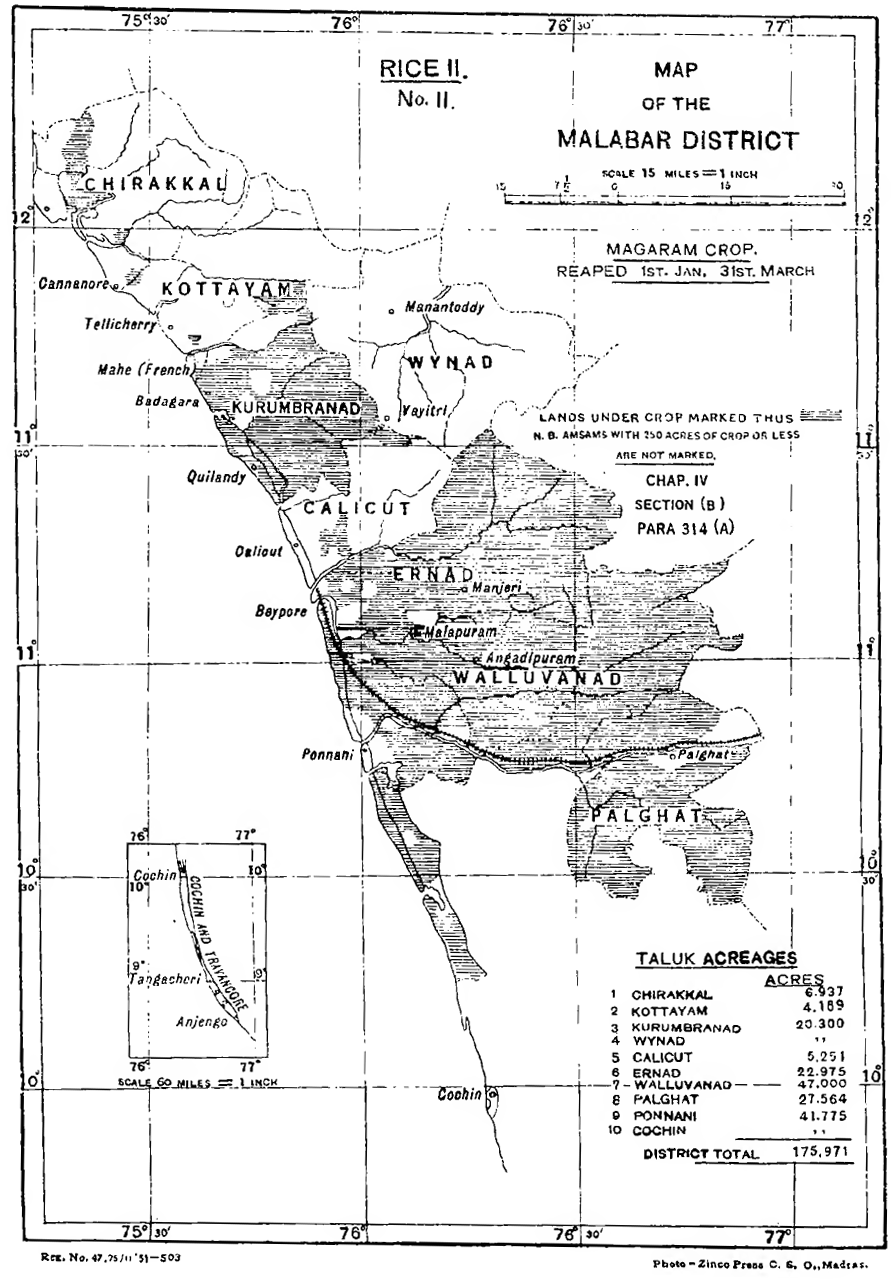
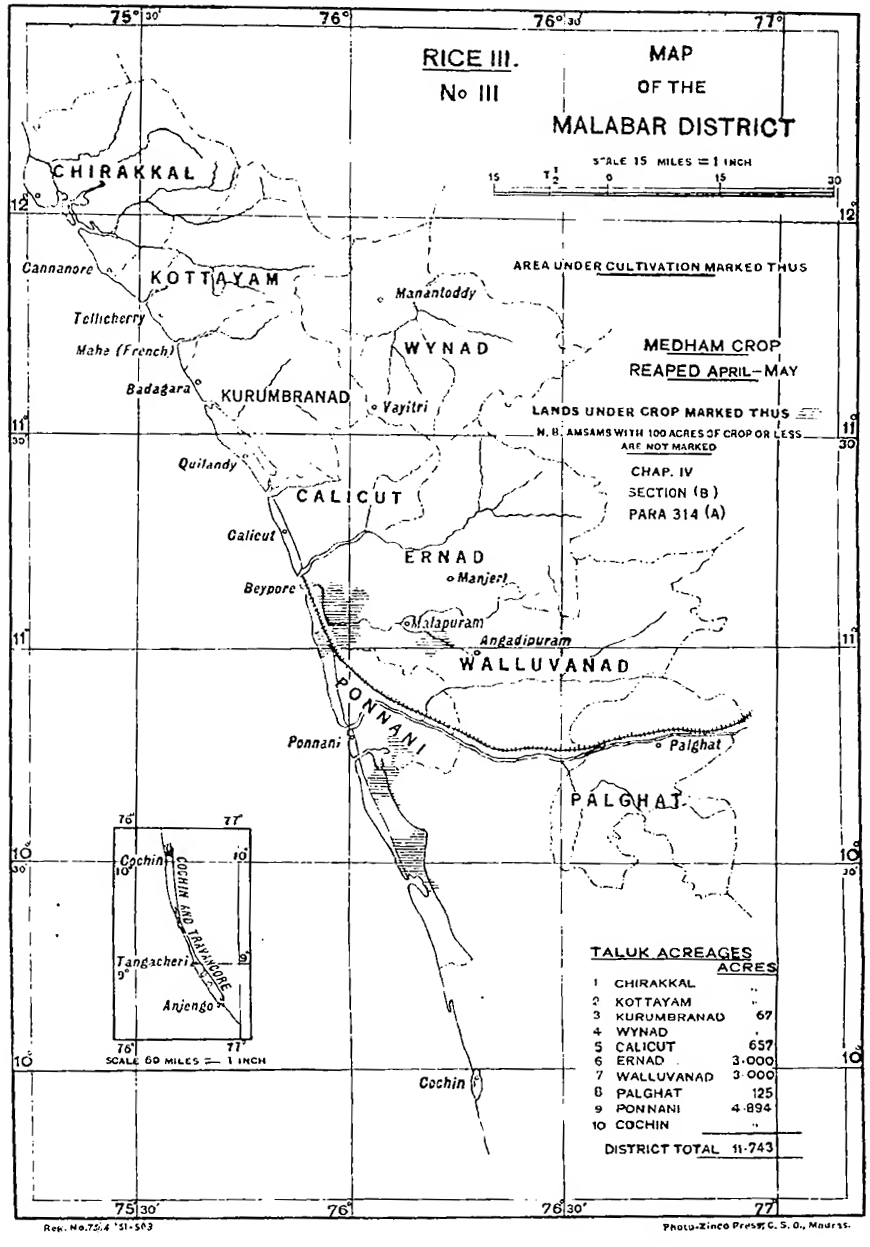
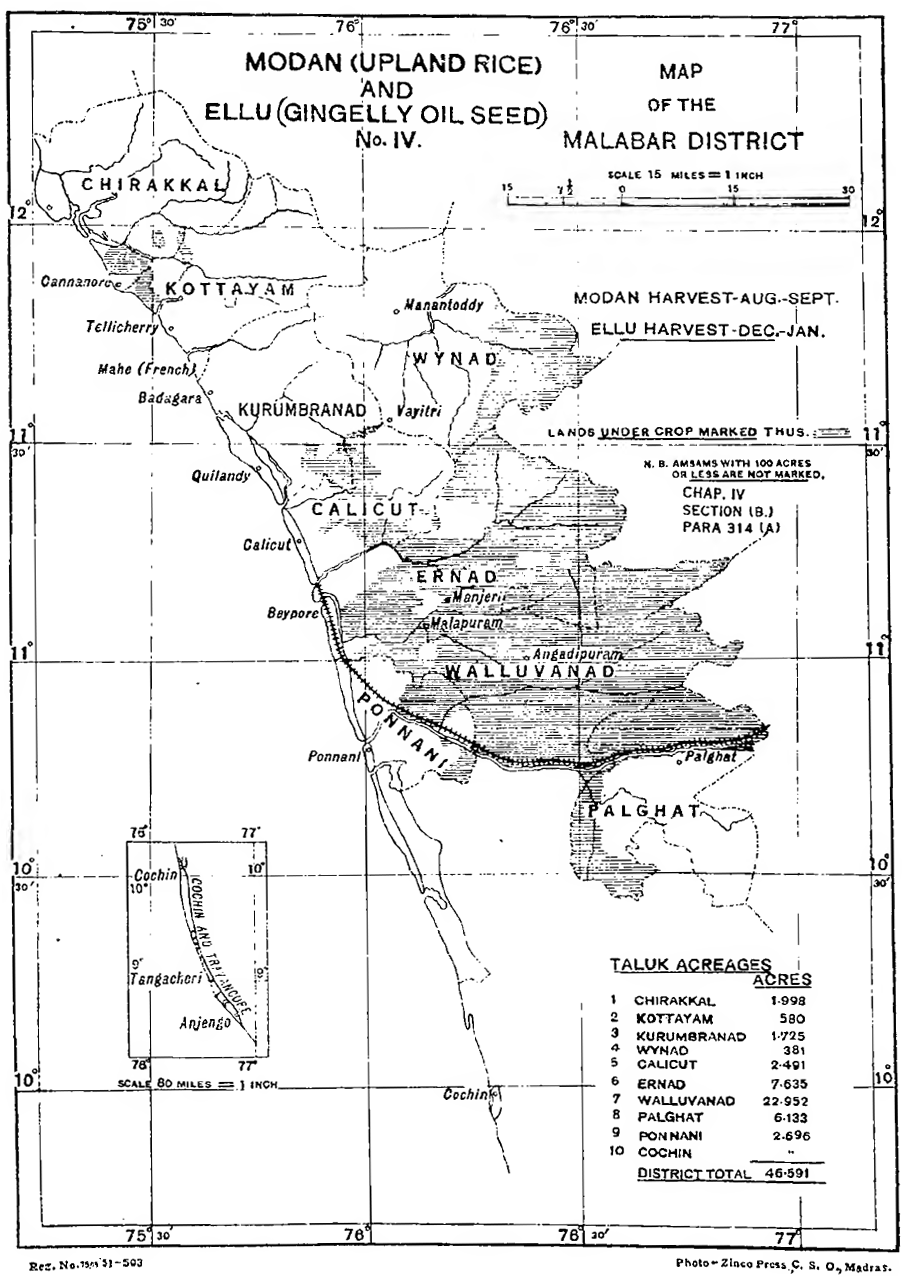
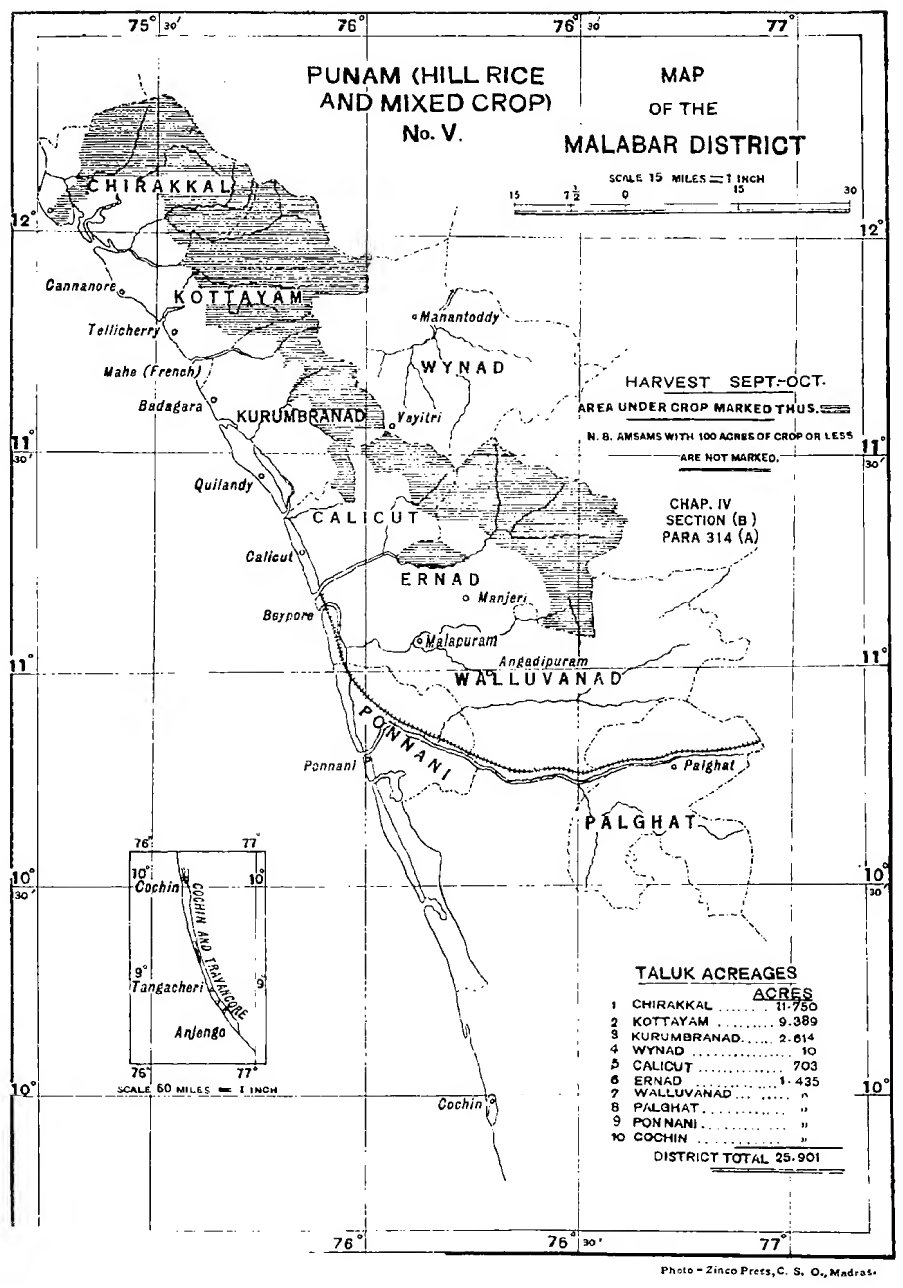
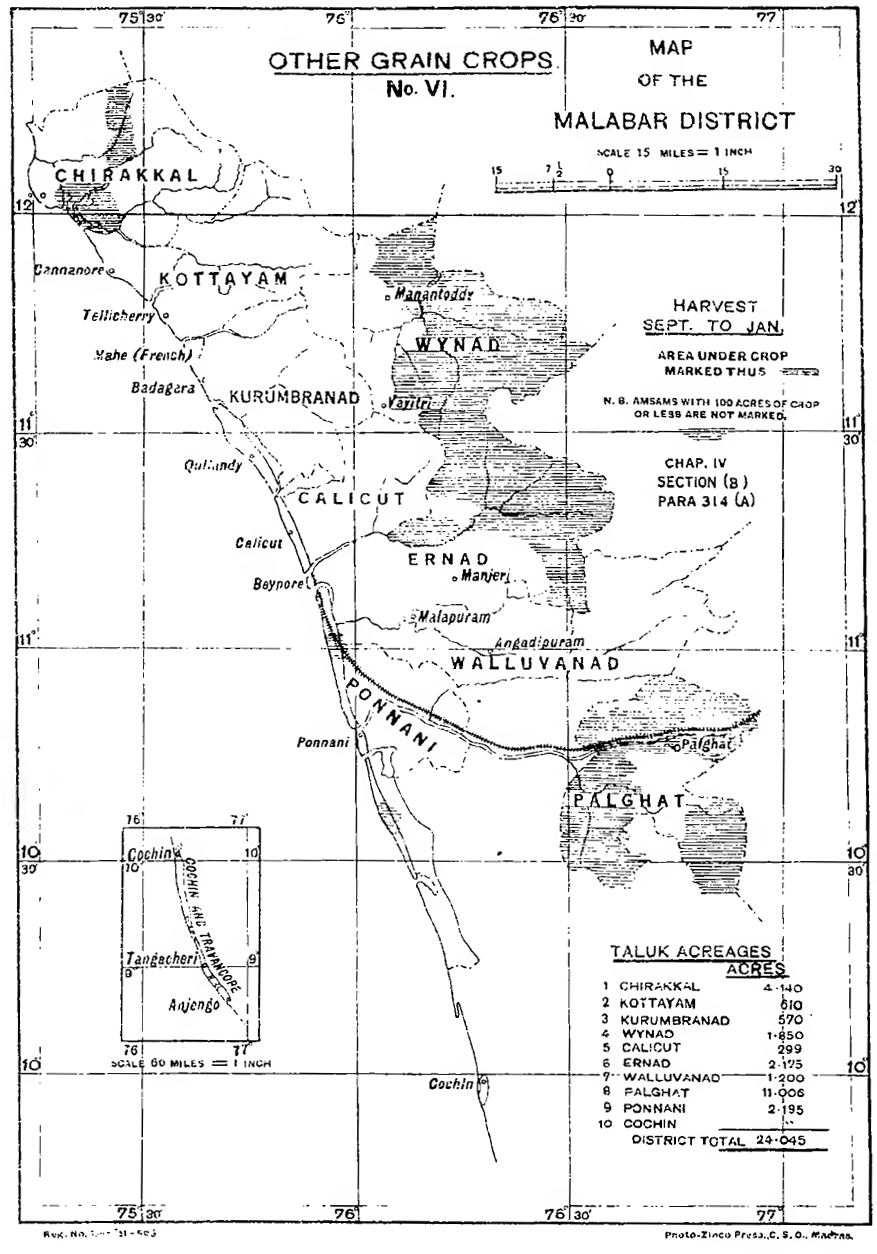
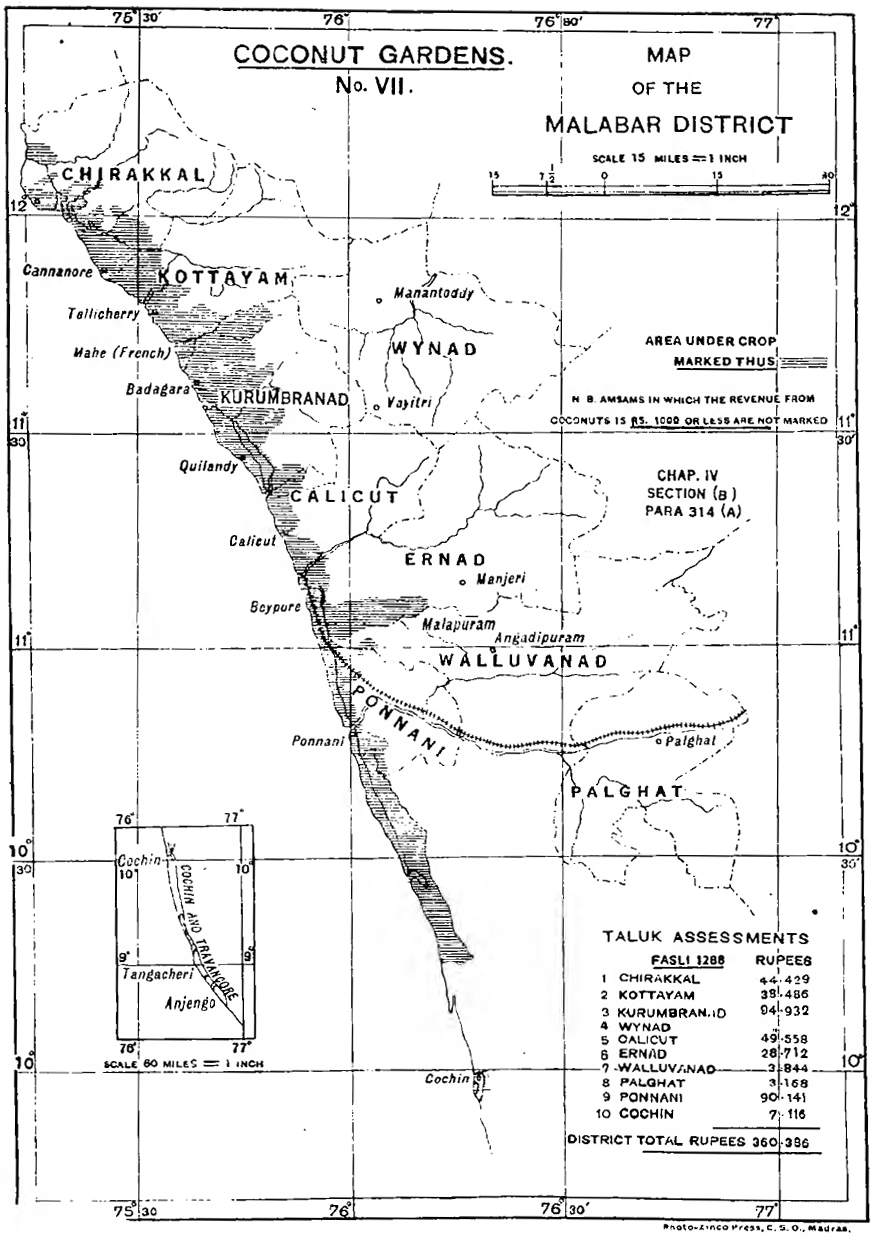
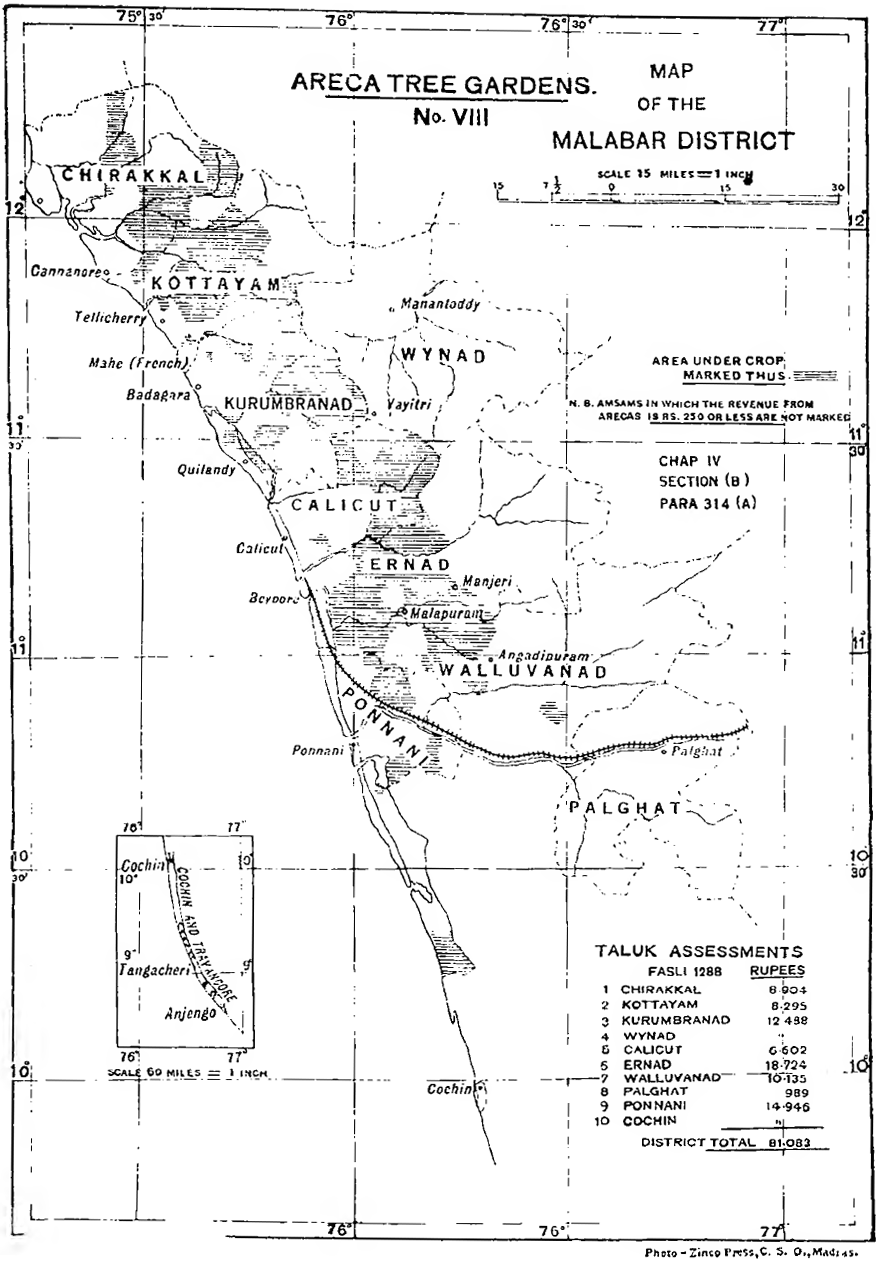
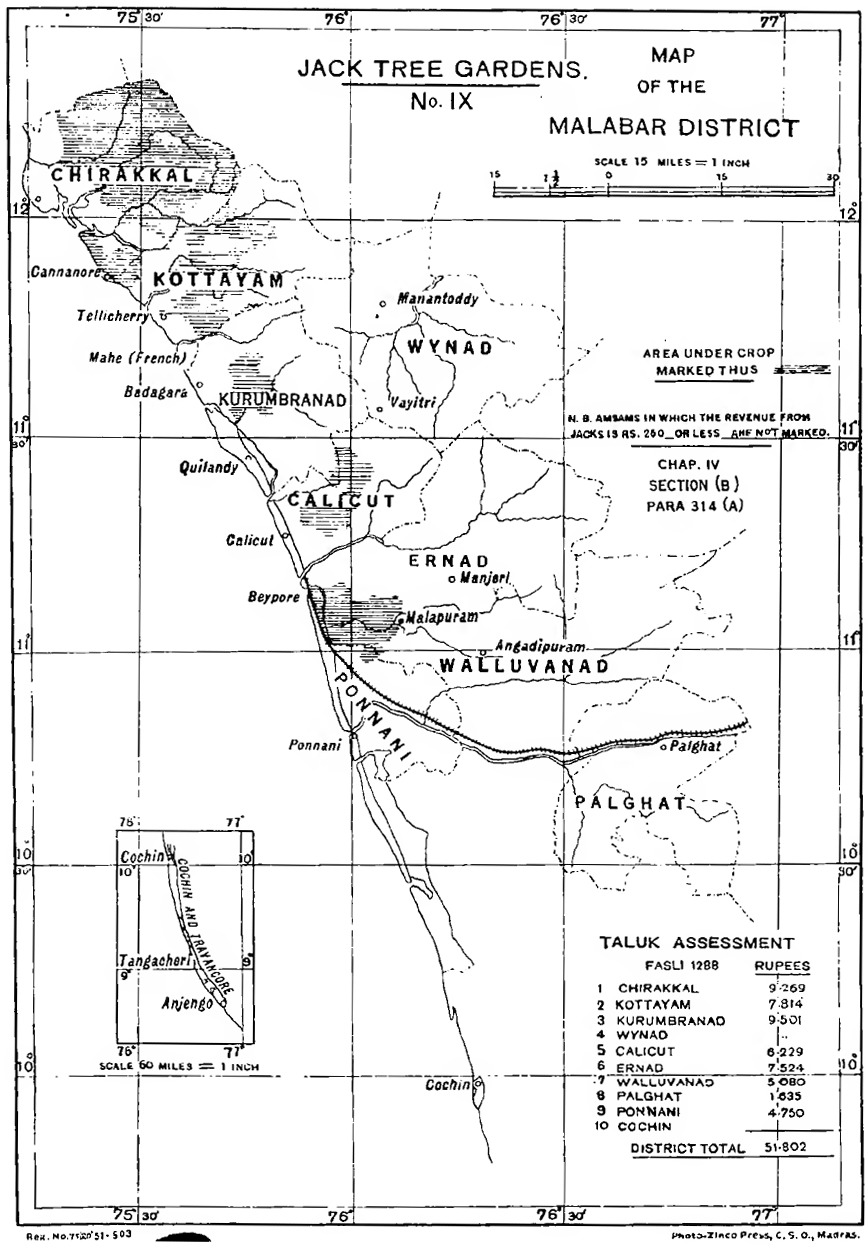
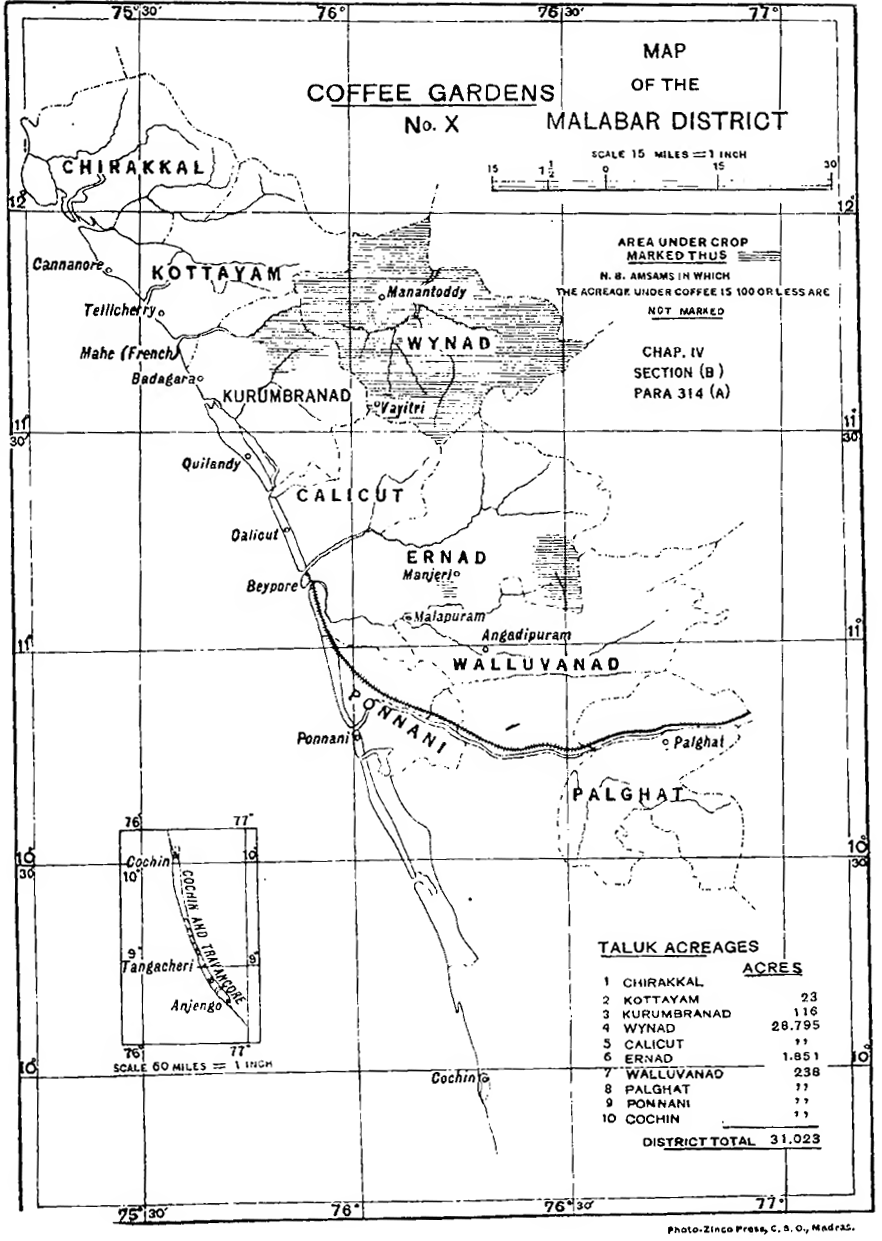
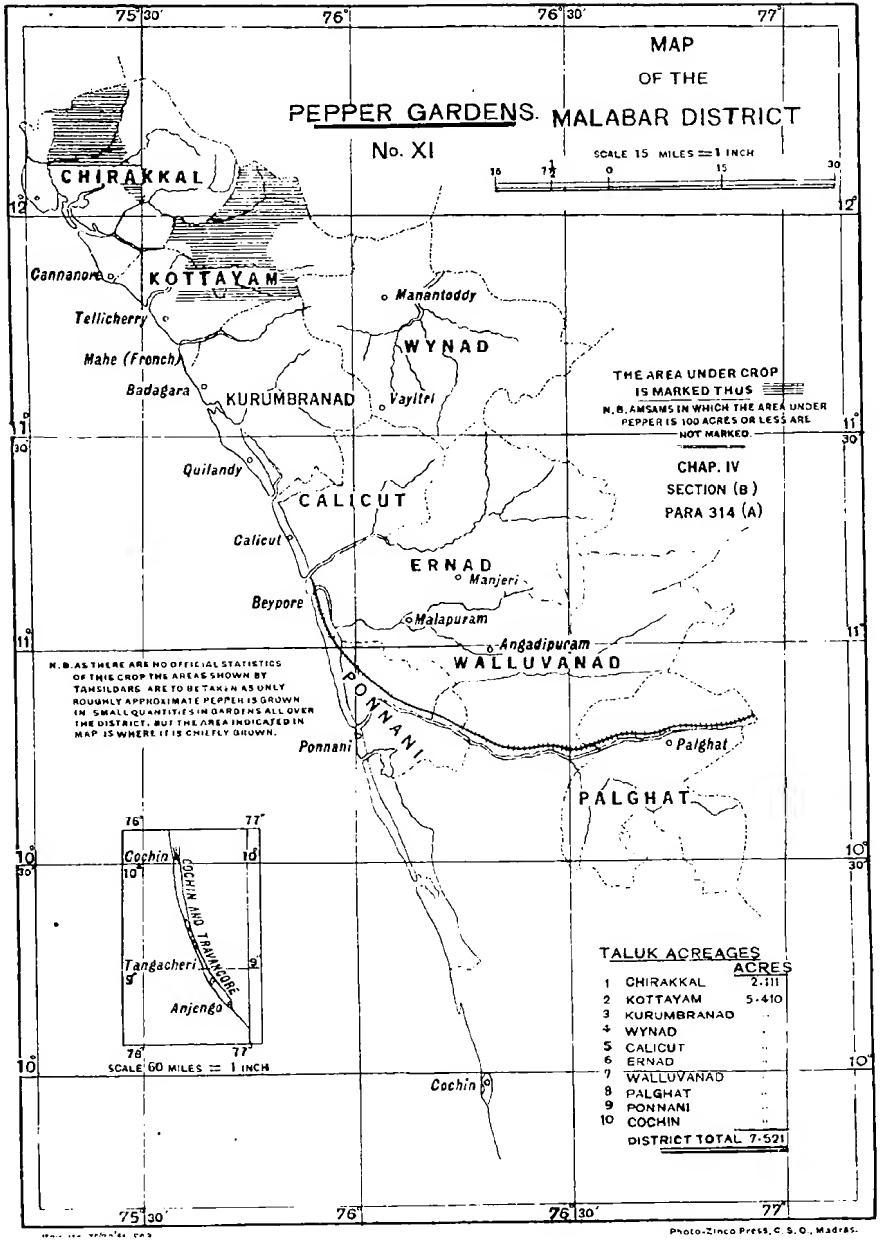
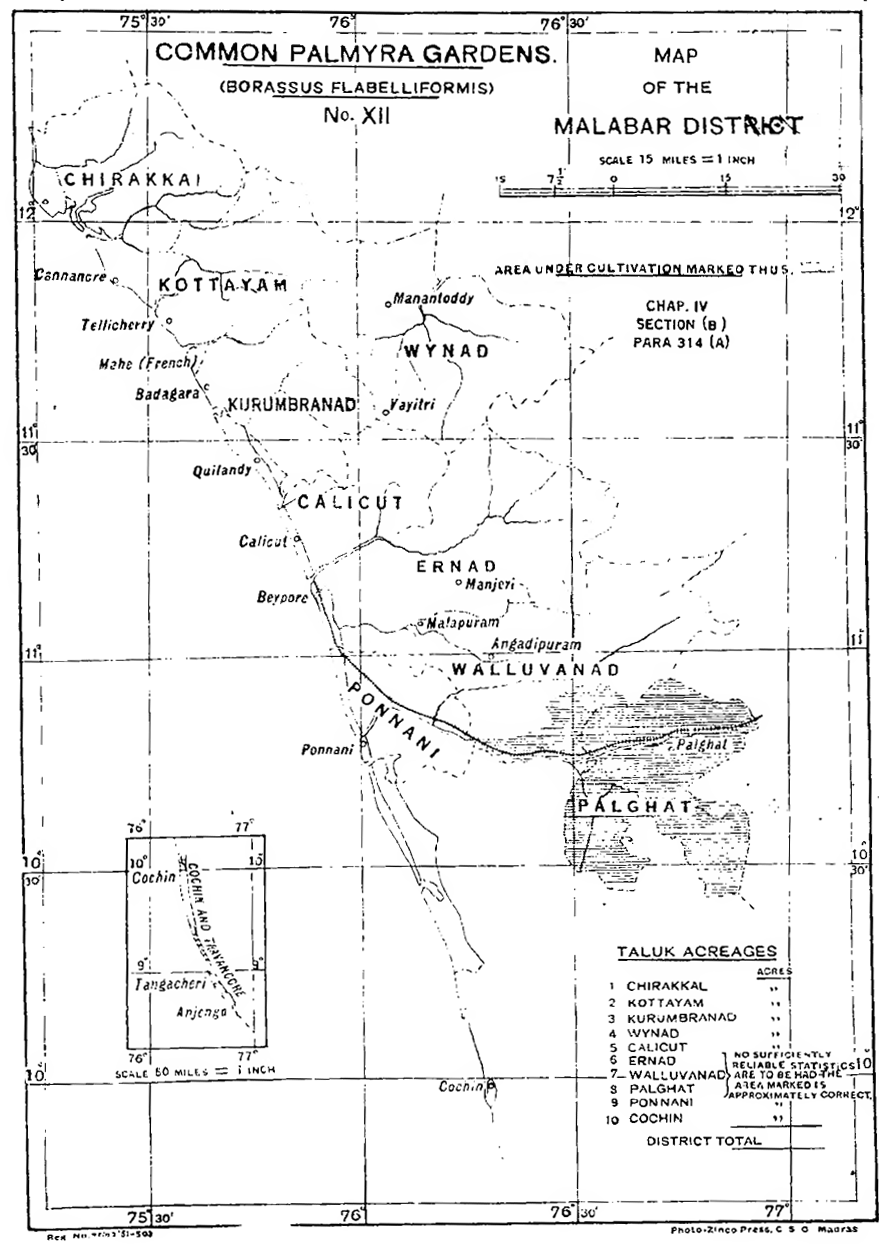
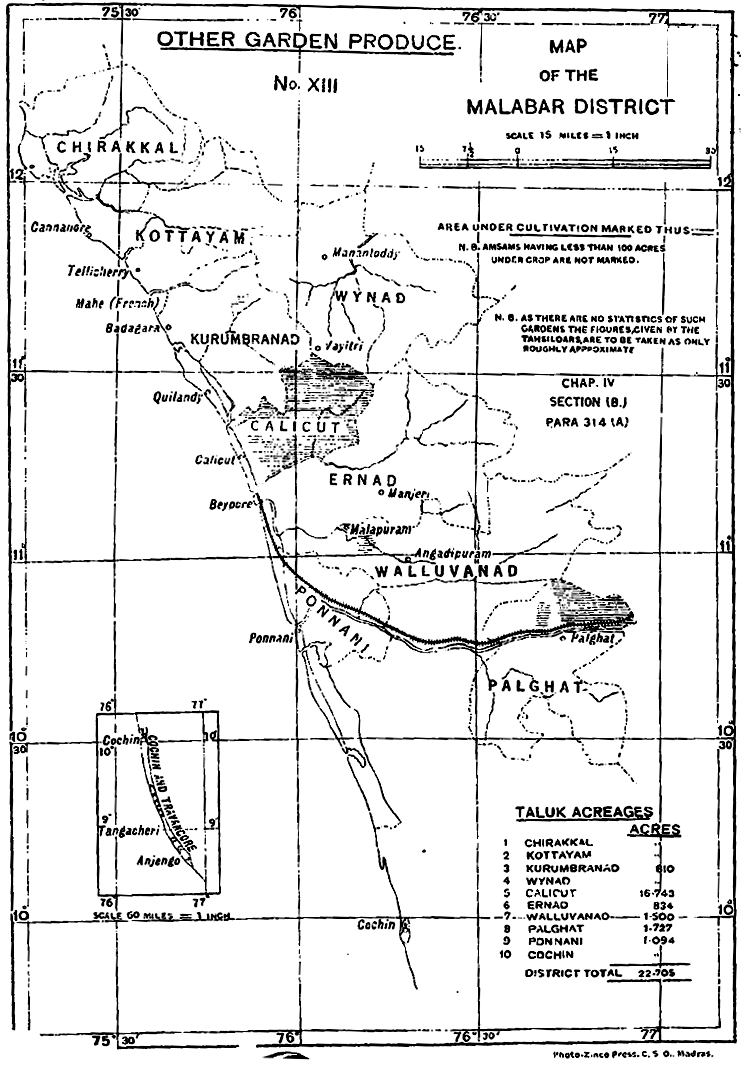
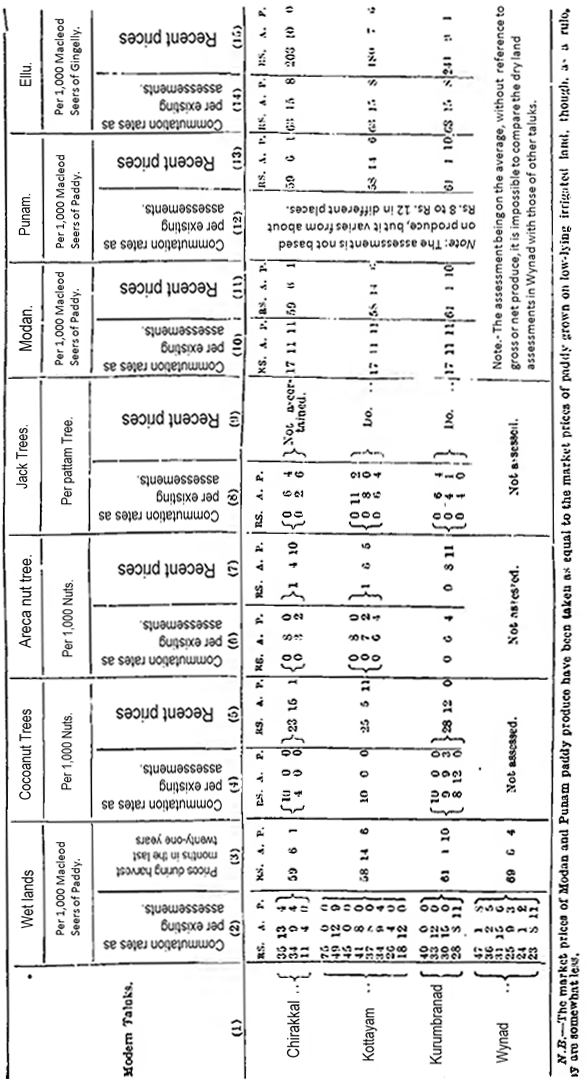
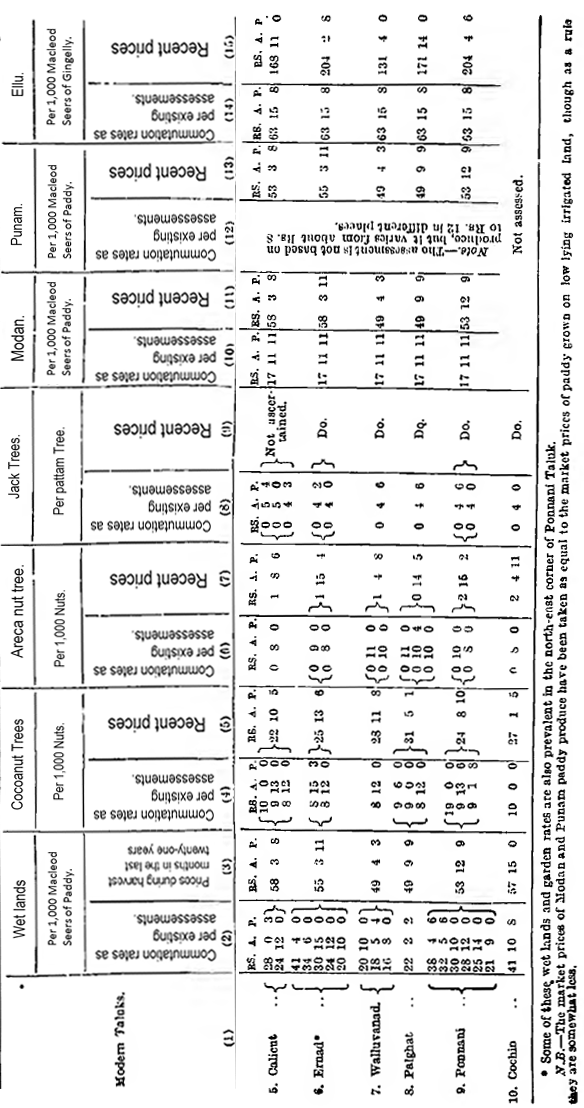
|
Some doubt as to whether Mr. Graeme's commutation rates for garden produce were adhered to in North Malabar. |
From a return recently prepared, there appears to be some doubt whether Mr. Graeme’s commutation rates for garden produce were implicitly followed when making some of the garden assessments, particularly in North Malabar. There is no doubt it was the intention of Mr. Graeme, who had from Government full authority in this matter, that they should be followed, and as they at all events are sufficiently approximate to existing rates to enable an opinion to be formed on the subject now in hand, they have been retained in the above table. |
|
The above figures proof positive of the moderation of the assessments. |
317. Very little more need be said than to refer to the figures in the above figures as proof positive that the land assessments are at the present time, and have been for many years, extremely moderate and well within the limits of the shares of produce which the Government has considered it politic to take. |
|
The exceptional case of the Kottayam Taluk explained. |
The only instance in which, to continue the simile used in paragraph 315, a rock may appear to stand above the flood prices, is in regard to the highest assessment on wet lands in the Kottayam Taluk. The commutation rate there comes out at Rs. 75 per per 1,000 Macleod seers. This, however, is an assessment on Government land, not on private land ; and the assessment has been taken at 100 percent, of the fund available for rent and assessment together. Converted into that standard of 100 per cent., the commutation rate comes out at Rs. 45 per 1,000 Macleod seers, which is well within the current price of the last twenty-one years. In this case the holders have no rent to pay to any one. They are not so well off, however, as the holders of Government wet land in Cochin for instance (see paragraph 307). |
|
The assessments are nowhere oppressive, and the growing insolvent cottierism of the Malabar cultivators is not due to Government having taken more than its fair share of their produce. Paradox. Had Government taken more, their position would have been better. |
318. It is quite clear that the land assessments are nowhere oppressive, and that the growing insolvent cottierism of the great body of ryots in Malabar is not due to any action of Government in the direction of taking more than its fair share of the produce of the land. It may seem paradoxical to say so, but it is not far from the truth to assert that the action of Government has been too liberal, and that had the share of produce left to the ryot been less, his present position would have been better. |
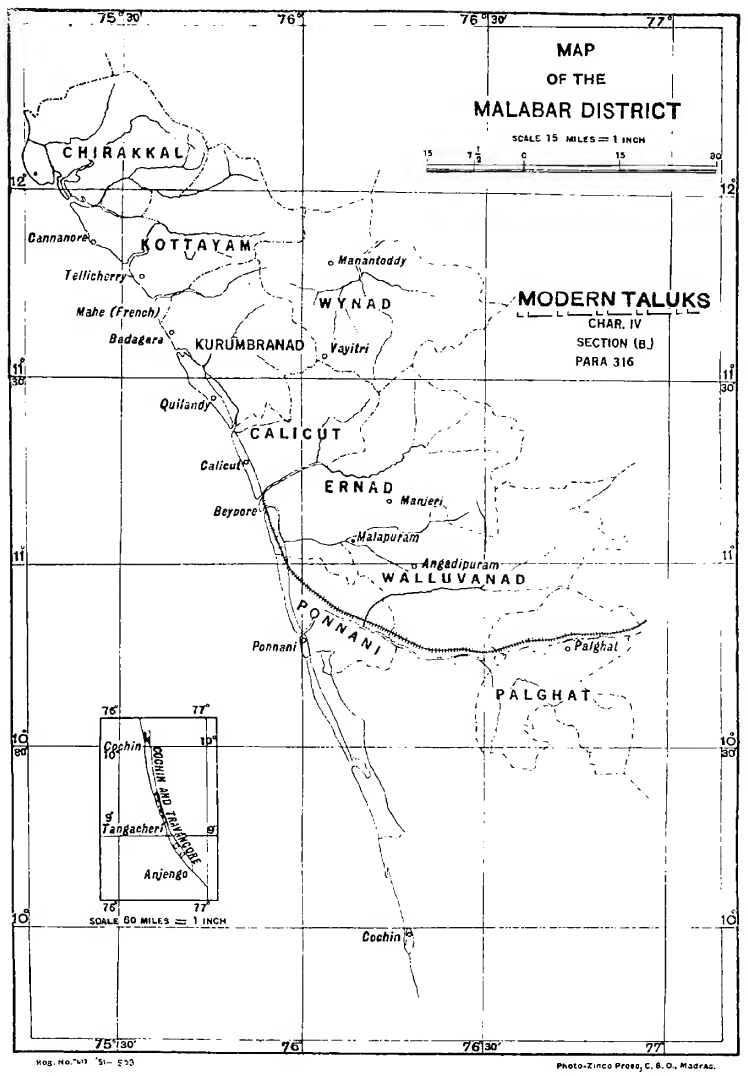
INDEX to Volume 1
|
INDEX TO VOLUME I |
|
|
Abdar Rahman |
|
|
Abdulkhalic, Tippu’s son |
Abdul Rahman Samiri |
|
Abdu-r-Razzak |
Abercromby, General R. |
|
Abhira (cowherds) |
Abikubais |
|
Abington, Major |
Abyssinia |
|
Acacias |
Achali Panikkar |
|
Achamma Mupasthanam |
Achanmar |
|
Acharam |
Acharyavakabhodya |
|
Acheen |
Acoka |
|
Acta Thomae (Acts of Judas Thomas) |
Adam |
|
Adam, The Rt. Honbl'e Mr. |
Adams, Ensign |
|
Adams, Mr. Robert |
Adam’s foot |
|
Adam’s peak |
Adam Khan |
|
Adayalam |
Adda Raja (Ali Raja, |
|
Aden |
Adhikari |
|
Adigal |
Adil Khan |
|
Aditien (Tamil), and Adichu (Mulayalam) |
Adittiri (casto) |
|
Adityavarmman |
Adlamy, duty on rice |
|
Aduthila |
"Adventure,” the |
|
Agakkoyma Nambutiri |
Agalapula |
|
Agambadi (Nayar guards) |
Agamudayan |
|
Agapae |
Agarr (seo Elara) |
|
Agattammamar |
Agatti |
|
Ageratum |
Agnew, Mr. |
|
Aguo |
Aha! Aha ! |
|
Ahayi |
Ahlwye |
|
Aigidioi |
Ajalar (Ajilar) |
|
Akampati Janam (Body guards) |
"Akattu Kattiyum, purattu pattiyam" |
|
Alambadi khedda |
Alattur |
|
Alavu Pymaish |
Al Biruni |
|
Albuquerque, Don Francisco de |
Alcedo Bengalensis |
|
Alerta Naddu |
Alexander VII, Pope |
|
Alexander, the Great |
Aloxander, Parambil, Bishop |
|
Alexandria |
Alexis Menezes, Archbishop of Goa |
|
"Algowar " prison of the inquisition at Goa |
Aii Attann, Kannancheri |
|
Al Idrisi |
Ali Hussein |
|
Ali-ibn-Udthorman |
Alikkotta (Ayacotta) |
|
Ali Kutti |
Ali Kutti, Paratodiyil |
|
Alikkunnu (Ayconny) |
Ali Malikhan |
|
Ali Matuminaltodi |
Aliparamba Chirukkal lands |
|
Ali Raja of Cannanore |
Al Kazwini |
|
Allah |
Alleppey |
|
Allungur |
Allur |
|
Almeyda, Don Francisco de, the first Portuguese viceory of all the Indies |
Almeyda, Lorenzo |
|
Alonso |
Alstonia (A. Scholaris) |
|
Alungad |
Aluvas |
|
Aluvayi (also Ahlwye) |
Amarakosha |
|
Amaram |
Ambadi |
|
Ambadi Kovilakam |
Ambalakaran |
|
Ambalavasi |
Ambaresan Chetti |
|
Ambaresan Kett |
Arabattan |
|
Ambergris |
Amboyna |
|
Ambu Nambiar, Padinyaredattil |
Ambu Tamban |
|
Ameni Island |
America |
|
Amocchi |
Amolum |
|
Amouces |
Amsam |
|
Anæmia |
Ana kalu |
|
Anamalas |
Anamally fort |
|
Anandagiri |
Anangamala |
|
Anantapuram |
Anantaravar |
|
Anant Row |
Anayatittu |
|
Ancillaria |
Anderson, Major |
|
Andolla Mala |
Andor |
|
Aadroth |
Angadipuram |
|
Angamale |
Angediva Island |
|
Angelo, Fort St. at Cannanore |
Animism |
|
Anjamkur |
Anjarakandi (river) |
|
Anjarakandi (plantation) |
Anjengo |
|
Anjuvannum |
Ankam |
|
Ankamali |
Anmalam |
|
Anmani |
Annagee in Mysore |
|
Anne, Queen |
Anonace |
|
Anson |
Antarjjanam |
|
Ant eater (see pangolin). Manis pentadactla |
Anthony, monastery of saint |
|
Antioch |
Antioch, Patriarch of |
|
Antiochus |
Antoninus Pius |
|
Appatura Pattar |
Aquarius |
|
Arabia |
Arabia Felix |
|
Arabian Coast |
Arabian Sea |
|
Arabs |
Arakkal Raja Cannanore (vide also Ali Raja) |
|
Arakurissi |
Aralet cooty Kambiar |
|
Aramunakkal, Muttedatta |
Arangattu or Arangottur |
|
Arangott Raja |
Arangott Utayavar |
|
Arayan Kulungare Nayar |
Architecture, history of Indian and Eastern by Mr. Fergusson |
|
Areca (A. catechu) |
Argellia |
|
Ariake |
Ariankow pass |
|
Aries |
Arikera |
|
Arikod |
Aromata |
|
Arracan coast |
Arshad Beg Khan, Tippu's fouzdar |
|
Arsinoe |
Artham Anartham |
|
Artocarpus integrifolia |
Arya Bhattacharya |
|
Arya Brahmanar |
Aryaeluttu |
|
Aryans |
Arya Puttar (see Choliya Pattar) |
|
Arya Perumal |
Aryapuram |
|
Asari |
Ashburner, Mr. |
|
Ashtanga Hridayam |
Asiatic Researches |
|
Assahabi |
As-Samiri |
|
Assemani’s Bibliotheca |
Assessments, Revenue, in Malabar |
|
Astrologers |
Atappur |
|
Atarra |
Athens |
|
Atlas larva |
Atlas moth (Attacus Atlas) |
|
Atma Bodhu Prakasika |
Attaide |
|
Attakuli |
Attan, Choondyamoochikal |
|
Attan Gurikkal |
At an Kutti |
|
Allan, Periambath |
Allan, Thorayampolakal |
|
Attapadi Valley |
Attapara |
|
Attikurichi |
Attinga |
|
Attingal Rani |
Attiperu |
|
Attipettola |
Attupuram |
|
Attu Veppu |
Anchmuty, Major |
|
Audicota |
Augustus, Roman Emperor |
|
Augustus, temple of |
Aulopolay. |
|
Aurei |
Avanasi |
|
Avarakotta |
Avaran |
|
Avarankutti |
Avarumayan |
|
Avary fort |
Avatti Pattur |
|
Avinyat Nayar |
Ayacotta fort |
|
Ayanamgah |
Ayan Aya, Dewan |
|
Ayconny fort |
Ayila (fish) |
|
Ayinchiradam |
Ayroor |
|
Ayudha katti (see also war-knifes) |
Ayudhapani (weapon-bearer) |
|
Ayudhapuja, also Dasara |
Ayur Vedam (Treatise on manhood). |
|
Ayyan or Ayyappan |
Baber. Mr. |
|
Babinglon, Mr. |
Babylon |
|
Baccaurea sapida |
Badafattan (Jaraffan) |
|
Badagara (see also Vadakara) |
Badami |
|
Badarikasramam |
Baghdad |
|
Bahmani dynasty |
Bailey, Colonel |
|
Baily, Rev. B. |
Bakam (Caesalpinia sappan) |
|
Bakare |
Baker, Rev. M |
|
Bakkanur (Barkur) |
Bala Hassan, notorious pirate chief |
|
Balasore |
Balasur peak |
|
'Baleenghat' |
Balhara |
|
Balija |
Ballalas |
|
Ballanore Burgarie (Valunnavar of Vadakkara) |
Ballard, Mr. G.A. |
|
Balliancota |
Bamboo (B. Arundinacea) |
|
Bamboo, dwarf (Beesha Bheedi) |
Bamboo, scrubby (Arundinacea Wightiana) |
|
Bana (Tanna) |
Bana Perumal |
|
Banapuram |
Bunasur |
|
Banavasi |
Bandha (alias Muppilla) Perumal . |
|
Bandhas (Muhammadan) |
Bandicot |
|
Bangalore |
Bangara |
|
Banyan [Ficus Indica) |
Bara aadmees (grant men) |
|
Barace |
Barbosa |
|
Barbus Carnaticus |
Barcelore |
|
Barillus Bakeri |
Barmin |
|
Baroda |
Barrett, Private, Oxfordshire |
|
Bartholomew. St. |
Barugaza |
|
Basalut Jung |
Basel German Evangelical Mission Society |
|
Bassia (B. longifolia) |
Bastis |
|
Batavia |
Batchelor, Captain Brigade-Major |
|
Bate, Lieutenant |
Bate (Cheiroptera) |
|
Butticola, king of |
Bavani river |
|
Bavnor (Valunnavar) of Badagara |
Baypin (see Vypeen) |
|
Bear, block sloth (Ursus labiatus) |
Beddome, Colonel |
|
Bednur |
Bednur, Governor of |
|
Bednur Raja |
Bednur river |
|
Beebee of Cannanore |
Bee, cliff (Apis dorsata) |
|
Bee-eater (Merops viridis and Swinhoii) |
Bee, large (Apis dorsata) |
|
Bees’ nest (apis mellifica) |
Beetle, elephant |
|
Beetle, Green, rose and horned. |
Begur |
|
Beigada Raja. |
Belem |
|
Bellamont, Lord |
Bellapattoo |
|
Belleta |
Bells, Colonel |
|
Bench Hill |
Benett |
|
Benghaut (Venkad) |
Beni, teak forest |
|
Bentinck, Lord William. |
Berenice |
|
Bernardes, Manuel |
Bertie, Lord Thomas |
|
Besta or Valayan |
Bettattnad escheats |
|
Beypore town |
Bezoor |
|
Bhadrakali |
Bhagavatam |
|
Bhagavati |
Bhagavati Kavu temple |
|
Bhagavati shrine |
Bharani |
|
Bharatam |
Bhaskara Ravi Varma (Perumal) |
|
Bhatta |
Bhattattiri |
|
Bhattiri, Palur |
Bhavanam |
|
Bhavat mosque |
Bhawully |
|
Bhimraj (Edolus paradiseus) |
Bhoot or Bhuta |
|
Bhudevi (Tellus) |
“Bhumanbhupoyam Prapya." |
|
Bhutans (spirits) |
Bhutupandi |
|
Bhuta Raja |
Bhutarayar Pandi Perumal |
|
Bibi of Cannanore |
Bickerton, Sir Richard |
|
Biddanora |
Bignonia |
|
Bijanagar |
Bijjala |
|
Bilay |
Bilderbeck, Ensign |
|
Bilhana |
Bird, flame (Pericrocotus flammeus) |
|
Bischofia Javanica (A Luna silkworm). |
Blackford, Captain |
|
Blackwood (Dalbergia latifolia) |
Blanford, Mr. M. F. |
|
Blasser, Heer Wilhelm, Captain, Lieutenant |
Blaze, St. |
|
Blue bird (Irena puella) |
Boddam, Mr. Charles |
|
Boehmeria (B. Malabarica) |
Bombax Malabaricum |
|
Bombay |
Bomhay ducks |
|
Bonsack, Ans Arnest, Danish Governor of Tranquebar |
Bookari |
|
Bopp |
Borassus flabelliformis |
|
Borugaza |
Boseawen, Admiral |
|
Botany Bay |
Bourbon Island |
|
Bowles, Colonel R. |
Bowman, Captain |
|
Boyanore or Baonor (Valunnavar of Badagara) |
Braddyl, Mr. John |
|
Brahma |
Brahmanism, Vedic |
|
Brahmans |
Brahmans, Mahratta |
|
Brahmans, Vedic (Nambutiris) |
Bramagiri peak |
|
Bramagiris |
Bramhachari |
|
Brass Pagoda in Tellicherry |
Brathwaite, Colonel |
|
Brazil |
Brinjan |
|
Brito, Lorenzo de |
Broughton, Mr. |
|
Brown, Mr. C. P. |
Brown, Mr. Murdock |
|
Brown, Mr. W |
Bryant, Lieutenant |
|
Babulcus Coromandus |
Buchanan, Dr. Francis |
|
Buchanan, Rev. Claudius |
Buckingham and Chandos, His Grace the Duke of |
|
Buddha |
Buddhism |
|
Bullock country, The—Ernad) |
Bullam |
|
Bulwant Row |
Bunga Raja |
|
Bungor Raja |
Burchall, Captain |
|
Burgara (see Vadakara) |
Burki, Srinivasa Row |
|
Burnell. Dr. |
Butterflies (Papiles paris) |
|
Buxy (Bakshi -paymaster) |
Buzantion |
|
Byfeld, Mr. Thomas |
Byron, Captain |
|
Cabral, Pedro Alcarez |
Cacca Diva (Crow Island) usually called Grove island |
|
Cachchilapattanam |
Cadalay |
|
Cadatturutti |
Cælebothras |
|
Caffres (see Kafirs) |
Calabar |
|
Calamina |
Calayi, the great and little |
|
Caldwell, Dr. |
Calicut |
|
Calicut nad or county |
Caligula |
|
Calingoody (Kollangod) |
Calliadan Eman |
|
Calli-Quilon |
Calli-Quiloners (Mappillas) |
|
Callistree |
Camattys |
|
Cambæt |
Cambay |
|
Camel’s hump |
Cameron, Captain |
|
Camillus, D.C. Rev. Father |
Campbell, Major |
|
Campbell, Sir A. the Madras Governor |
Canal bridge |
|
Canara Menon |
Canaru (South) |
|
Canarese |
Cancellaria |
|
Cancer |
Candotty Pacquey, the Mahe merchant |
|
Cane |
Cannamalla |
|
Cannan, Mr. O. |
Cannanore |
|
Cannanore Karar limits |
Cannanore Revenue assessments |
|
Canutehill (Kannavam) |
Cape Comerin |
|
Capocate |
Cape of Good Hope |
|
Cape of storms |
Capool |
|
Cupricornus |
Capu Tamban, Prince |
|
Caranakara Menon |
Carate Hobli |
|
Cardamom (Elettaria cardamomum) |
Cardew, Lieutenant |
|
Careya arborea |
Car festival |
|
Carly fort |
Carly hill |
|
Carmelite Missionaries |
Carnatic |
|
Carnatic, Carp (B. Carnaticus) |
Carnatic Chronology of Mr. C. P. Brown |
|
Carnatic plains |
Caroor |
|
Cartinaad |
Cartun Naddu |
|
Caryota urens |
Cashewnut tree (Anacardium occidentale) |
|
Cassargode |
Cassis sculpta |
|
Castes dans l' Inde |
Castilian, the |
|
Castro, Secretary to the Portuguese Viceroy |
Casuarina (C. equisetifolia) |
|
Catenar (priest) |
Catherina Infanta |
|
Catherine’s day |
Catholic Goanese jurisdiction |
|
Cauccote |
Caurashtaka Desam |
|
Cavi (Kavvayi) |
Cavvan |
|
Ceara rubber (Manihot Glaxovii) |
Cedar red (Acrocarpus fraxinifolius) |
|
Cedar, white (Cedrela toona) |
Colobotras |
|
Census of 1835 |
Census of 1842 |
|
Census of 1857 |
Census of 1871 |
|
Census of 1881 |
Census of Travancore |
|
Cerbera Odollam |
Cerithium rude |
|
Ceryle rudis |
Ceylon |
|
Chakkiyars |
Chakku Nayar, Talappil |
|
Chakku Panikkar |
Chakyar |
|
Chala |
Chalupura Hobli |
|
Chalat |
Chaldæa, Pahluvi attestations |
|
Chalicarra |
Chaliyan |
|
Chalukya dynasty, the western |
Chambat |
|
Chamberra |
Chembra hill |
|
Chamundha |
Chamundi |
|
Chandadanda, the Lord of Kanch or Conjeveram |
Chandragupta |
|
Chandragatan |
Chandratttil Panikkar |
|
Chandrott Numbiar |
Changatam |
|
Chandu Kurup, Panangatan |
Changalappurattu port |
|
Chapali Pokar |
Chappanangadi |
|
Chappan, Odayottiidattal Kandasseri |
Charles II |
|
Charmæ |
Chatfield, Mr., |
|
Chattamangul |
Chattappan Nambiar |
|
Chattara Nayar |
Chattoo Chitty |
|
Chaul |
Chavakkad |
|
Chavakkad backwater |
Chavasseri Raja |
|
Chaver |
Chayal |
|
Chaypu |
Cheakur |
|
Chedleth teak forests |
Chekunnu |
|
Chekku, Triyakulattil |
Chela |
|
Chelluvari (charges of collection of rent) |
Chemban Pokar |
|
Chembotti |
Chenaar (King) |
|
Chenachori Kurup |
Chenat Nayar forests |
|
Chenda |
Chenga Kovilakam |
|
Chenganiyur. |
Chenganetu |
|
Chenganur |
Chengara |
|
Chengara, Variyar |
Chengedu |
|
Chengotu |
Chappanur |
|
Chera Empire |
Cherum |
|
Choraman, the country of "Cheraman Desaprapyah" |
Cheraman Perumal |
|
Cheranadu |
Cherankod |
|
Cheran Subedar |
Cheraputran |
|
Cheri |
Cherikkal (private lands) |
|
Cheria Kunnu |
Cheriyakara |
|
Cheriyam |
Cherry, Brazil (Physalis Peruviana) |
|
Cherujanmakkarar |
Cherukkunnu |
|
Cherumar |
Cherumar, lraya |
|
Cherupattanam |
Cherupullasseri |
|
Cherur |
Cherur ballad, the |
|
Cherutalam |
Cheruvannur |
|
Chettis (see also Shetti) |
Chettiyan, Mutta |
|
Chetwai |
Chetwai, fort, named Fort William |
|
Chetwai island (or Chettavali) |
Chetwai river |
|
Chevaux de fries |
Chick Deo Raj |
|
Chicken Aya, Dcwnn, WU. |
Chick Kishen Raja |
|
Chimbora |
Chimbra hill |
|
China |
Chinese |
|
Chingam |
Chingot Chattu |
|
Chini bachgan (China boys) |
Chinnakotta (the Chinese fort) |
|
Chirakkal |
Chirakkalkandi |
|
Chirakkal Raja |
Chirikandatam |
|
Chiru, Kannancheri |
Chirukaranimana Narayana Mussat |
|
Chiru, Kavile Chathoth Kunhi |
Chitlac Island |
|
Chitrakuta |
Chitta, Kulawar |
|
Chittur |
Chittur Tekkegramam |
|
Chitwa |
Chivers, Dutchman |
|
Chloe |
Choladi pass |
|
Chola Empire |
Chola river |
|
Cholera |
Choliya or Aryya Pattar |
|
Chomady |
Chomatirippad |
|
Chombal |
Chombayi or Chombad |
|
Choulsareum |
Chovakkaran Mussa |
|
Chovarum |
Chovur Grammam |
|
Chowtwara Raja |
Choyamandalam |
|
Choya (Chola) Permmal |
Choyi Kutti Kannancherri |
|
Choyiyan (King) |
Christians |
|
Christian, Sargeant John. |
Chrysostom, St. |
|
Chucklygerry fort |
Chulali dynasty |
|
Chulali Nambiar |
Chulanna (Chulali) Kammal |
|
Chunder Row |
Churikunjee |
|
Churott, mosque |
Cingalese |
|
City of the Mount |
Clapham, Captain |
|
Claudius |
Clement VIII, Supreme Pontiff |
|
Clement X, Supreme Pontiff |
Clementson, Mr. |
|
Cleopatra |
Clifton, Major. |
|
Clive, Colonel |
Clive, Lord |
|
Close, Sir Barry |
Cobra, Mountain (Ophiophagus elaps) |
|
Cochin (British) |
Cochin (Native) |
|
Cochin fort, built by the Portuguese christened Emmanuel |
Cochin, The Dutch settlement at |
|
Cochin, The outlying pattams belonging to |
Cochin Raja |
|
Cochin river |
Cochinites |
|
Coco (Theobroma cacao) |
Coco palms |
|
Codacal |
Codalla |
|
Codally |
Codatu |
|
Codavoura |
Coelho, Nicholas |
|
Coilandy (see Quilandy) |
Coilum |
|
Coimbatore |
Coja Casem |
|
Coja Muhammad Marakkar |
Colachel, Dutch fort |
|
Colastri |
Colbert |
|
Colemgoor |
Colinar |
|
Collett, Mr. |
Collure pagoda |
|
Colombo |
"Colon” |
|
Comari |
Comattya |
|
Commissioners, The Joint |
Commutation rates, Mr. Græme’s, adopted in |
|
Commutation rates of produce for purposes of assessment |
Compagnie des Indes, The French, 340. |
|
Company of Merchants of England trading to the East Indies, The United. |
Company of the Indies, the Perpetual, |
|
Concan |
Concana (see Konkana) |
|
Concasta bazaar |
Concordat, The |
|
Congad |
Conjeveram or Kanchi |
|
Conelly, Mr. H. V. |
Conolly, Mrs. |
|
Conolly’s canal |
Constantinople |
|
Conus Catenulatus |
Convy |
|
Cook, Mr. H. D., District Judge |
Cook, Surgeon-Major H. D. |
|
Coompta |
Coonjiste |
|
Coorchas |
Cooreheat : see Kurchiyat |
|
Coorg |
Coorgs, The |
|
Cooriles, Bishop Mar |
Coorimnaad |
|
Coote, Colonel |
Coote Reef |
|
Coote, Sir Eyre |
Cootypore (Kuttipuram in Kadattanad), |
|
Coptes |
Corade |
|
Corengotte (Kurungot) |
Corla (a whip), Hyder's instrument of corporal punishment |
|
Cornish, Surgeon-General |
Cornwallis, Commodore |
|
Cornwallis, Lord |
Corote Angady |
|
Correa |
Corrovallanghatt |
|
Corypha umbraculifera |
Cosmas Indicopleustes |
|
Cossigny, Colonel |
Cotacunna (Kottakkunnu) |
|
Cota Maccar |
Cotgrave, Major John |
|
Cotiote |
Cotiote Kerala Varma Raja |
|
Cotiote, revenue assessments |
Cotta (see Kotta) river |
|
Cotlattu (Cotiote) |
Cottica (Kottakkal). |
|
Cottonara |
"Coulan" |
|
Council of Ephesus |
Council of Nice |
|
Council of Rome |
Courtallum(see Kurtallum |
|
Coutinhe, Don Fernando |
Cowhage (Mucuna pruriens). |
|
Cowlpara |
Cowpiel |
|
Cranganore |
Cranganore river |
|
Crawford, Mr. H. |
Crocodilus palustris |
|
Cross,Mr. Samuel |
Crow Island, usually called Grove Island |
|
Cruz Milagre Gap |
Cryptogamin |
|
Cuchicundy |
Cuddalore sandstones |
|
Cullen, General |
Cullenia excelsa (prickly fruit) |
|
Cumalum fort |
Cumbum valley |
|
Cunjote Angadi |
Cunumpoora |
|
Curcumbra |
“Currachee redoubt” |
|
Curtis, Captain |
Curus |
|
Cusack, Surgeon |
“Custom” King |
|
Cuttarum : see Kattaram |
Cutty Coileen |
|
Cutwal |
Cycas circinalis |
|
Cyprea |
Cyrus |
|
Cyzicus |
|
|
Dabul. |
Dadkannan |
|
Damalcherry |
Daman |
|
Dammal |
Dammer |
|
Dammer, black (Canarium strictum) |
Dammer, giant (Vateria Indica) |
|
Danes |
Dantidurga |
|
Darakti Shahadet |
Darapuram |
|
Darius, |
Darogas, native judges |
|
Darogha Sahib |
Dasara |
|
Daser, Captain Paul |
Dasi or Vrashali |
|
Davies, Captain |
Day, Dr. Land of the Perumals |
|
Day, Lieutenant |
Debal |
|
De Cunha |
Deer, barking (Cerulus aureus) |
|
Deer, spotted (Axis maculatus) |
Dekkam |
|
De Labourdonnais, Bertrand, Francois Mahe |
De Labourdonnais, M. Mahe |
|
De Lannoy, General, Eustachius Benedictus |
Dellon, M. |
|
De Muscaatboom |
Dendrobium aurum |
|
Dendriphila frontalis |
Dennis, Major |
|
De, Raj |
De Pardaillan. M |
|
Desadhikaris |
Desadhikari's pymaish |
|
Desam |
Desavali |
|
De Souza |
Deva-attam |
|
Devagiri |
Devanampriya Priyadarsin |
|
Devangulu |
Devas Bhandari |
|
Devasthanams (temple lands) |
Devil’s nettle (Laportea crenulata) |
|
Devote Angadi |
Dewar, Captain |
|
Dhal |
Dhamanam |
|
Dhanu |
Dhariyayikal |
|
Dharmapattanam |
Dhendia Wahan |
|
Dhowti |
Dhruva |
|
Diamper (Utayamper), Synod of |
Dias, Bartholomew |
|
Diatomaceæ |
Diatomere |
|
Dick, The Honorable G. |
Dickenson, Captain |
|
Digambaras |
Dikkar |
|
Dillivaria (D.ilicifolia) |
Dillon, Mr. |
|
Dindamal hills |
Dindigul |
|
Dindimul |
Dioscereas |
|
Dipali or Dipavali |
Directors’, Court of |
|
Direm, Major |
Disarmament of the Calicut, Ernad and Wulluvanad Taluks |
|
Disarmament of the Ponnani Taluk |
Divar |
|
D’Lanoy, Eustachius |
Dogs, wild (Cuon rutilaus) |
|
Dominium, The Roman |
Dnminus |
|
Dorotheus, Bishop of Tyre |
Derril, Mr. Thomas |
|
Deve, bronze-wing (Chalcophaps indica) |
Doveton, Captain |
|
Dow, Major |
Dravida |
|
Dropsy, General |
Drummond, Mr. |
|
Dula |
Dunlop, Colonel |
|
Duncan, Mr. Jonathan |
"Dung heap" for house |
|
Dupleix, Madame. |
Durga (goddess) |
|
Dutch, The |
Dutch, East India Company, The |
|
Dutch settlements in Malabar, The |
Dwipar (See Tiyar) |
|
East India Company, The |
East Indies, Forster’s translation of the voyage to the |
|
Ebony (Diospyros ebenes) |
Ebony tree, bastard (Diospyros embryopteris) |
|
Edachenna Ammu |
Edachenna Jammu |
|
Edachenna Komappan |
Edachenna Kungan |
|
Edachenna Otenan |
Edakkad |
|
Edattara |
Edavukutti Kulam |
|
Eddamannapara |
Eddapalli |
|
Edessa |
Edevadu naddu |
|
Editerrahcotta |
Edward, Lieutenant |
|
Egrets (Bubulcus Coromandus) |
Egypt |
|
Egyptians |
Eiranikkulam |
|
Elamaruthoo |
Elambileri peak |
|
Elambalasseri |
Elampullian Kunyan |
|
Elara |
Elayad |
|
Elephantiasis |
Eli |
|
Eli |
Elibhupan |
|
Eli Kovilakam. |
Elimala |
|
Elimala river |
Eli Perumal |
|
Ellacherrum pass |
Ellambulasseri Unni Mutta (Mussa) Muppan, Chief of the Mappilla banditti |
|
Ellattur port |
Ellattur river |
|
Elliot, Sir H. |
Ellis, Mr. F. W. |
|
Ellu lands |
Ellura |
|
El Malik Sambul |
Elem |
|
Elott, king’s house |
Elumala |
|
Eluttachchan, 139. |
Elzaitun |
|
Emalu Valasseri |
Eman Nayar (Pallur) |
|
Embran |
Embrantiri |
|
Emir |
Emmanuel, Fort Saint, at Cochin |
|
Emmanuel, King of Portugal |
Enangan |
|
Enangatti |
Eudaimon Arabia |
|
English, The |
“English Interests in India.” A View of the |
|
Enja (acacia intsia) |
Ennakkat Kovilakam |
|
Ennamakkal dam |
Ennamakkal lake |
|
Epiphanius, Bishop of Salamis and Jerome |
Epiphi |
|
Eppanur |
Epperpettatu |
|
Eradi |
Erakerlu |
|
Eralanad |
Eralpad, Raja of Calicut |
|
Endorah. |
Eratosthenes |
|
Ernacollum |
Ernad |
|
Ernad Menon |
Erroocur (see Irukur) |
|
Errowinagarry |
Erythrina (Erythrina Indica) |
|
Etesians |
Ethiopians |
|
Eltikkulum |
Ettukkonnu |
|
Ertulaniyur |
Ettuvittil Pillamar |
|
Eucalypti, Australian |
Eudoxus |
|
Eugenia |
Eagenia bractreata |
|
Euphorbia (E. nivulia) |
Eurasians. |
|
Europeans |
Eurya (E. Japonica) |
|
Eusebius, Bishop of Cæsarea |
Eve |
|
Eviction, Suits for—of cultivators |
Evolic triphylla |
|
|
Fah Hian |
|
Fakanaur |
Fakir |
|
Faknur |
Fanam, Cunteray |
|
Fanam. Sultani |
Fanam, Viray |
|
Fandariana |
Faudell, Captain |
|
Fandreeah |
Farmer, Mr. |
|
Fartak, Cape |
Fasciolaria |
|
Fattan (Puttun) |
Fauna and flora of Malabar |
|
Favonius |
Fayrer, Dr., on Tropical Diseases |
|
Fazlulla Khan |
Fell, Mr. |
|
Female Island |
Fen., Rev. Mr. |
|
Fergusson, Mr. |
Feringees |
|
Ferishta |
Fernendez, Mr. Thomas, Engineer |
|
Ferns, tree Eremophila glabra |
Ferokabad |
|
Ferokia |
Ficus Benghalensis |
|
Ficus Indica |
Ficus parasitica |
|
Ficus racemosa |
Ficus religiosa |
|
Fig, common (Ficus glomerata) |
Fig, monstrous (Ficus Mysorensis) |
|
Finisterre |
Fireworker, Lieutenant |
|
Firth, Mr. |
Fish, eat (Silurus) |
|
Fisher, Ensign |
Flandrina |
|
Fleet, Mr. |
Flora sylvatica, Col. Beddome |
|
Floyd, Colonel |
Foote, Mr. R. B |
|
Formosa, The |
Forster’s Fra Bartolomœo |
|
Fort St. Angelo at Cannanore |
Fort St. David |
|
Fort St. Emmanuel at Cochin |
Fort St. George |
|
Fra Bartolomœo |
Francis Xavier, St. |
|
Francis, Friars of the Order of Saint |
Frangipani (Plumeria apocynaceae) |
|
Fraser, Captain |
Frederick Cæsar |
|
Freeman, Mr. William |
Fremisol |
|
French,The |
French East India Company |
|
French factory at Calicut |
French Ministry, The |
|
Friar Odoric |
Frog (Hylorana) |
|
Fryer |
Fullerton, Colonel |
|
Galle |
Galley, Mr. |
|
Galton, Mr.C.A |
Gamboge tree, Garcinia morella |
|
Ganakan |
Ganapady Watton, See Ganapathivattom |
|
Ganadlu |
Ghandophares |
|
Ganesa |
Gangadevi |
|
Gangas or Kongas |
Ganges, The |
|
Garcinia |
Garcio, Mgr Francisco, Bishop |
|
Garden, experimental, Manantoddy |
Gaston, a Franciscan monk |
|
Gati |
Gaton |
|
Gaur |
Gaya |
|
Gazalhatti pass |
Gemini |
|
Gens |
Gentoos |
|
Gheria |
Ghi |
|
Ghulum Muhammad, Tippu's son |
Gibbs, Captain |
|
Girnar |
Gnostic |
|
Goa |
Goa, Archbishop of |
|
Goanese jurisdiction. The Catholic |
Goanese schism |
|
Goat, wild (Hemitragus hylocrias) |
God compellers |
|
Godolphin, Earl of, Lord High Treasurer of England |
Gokarnam |
|
Gukkamangalam |
Golden Island |
|
Gold River |
Golla or Idaiyar |
|
Golomath |
Gomakutam |
|
Gomaria |
Gonds, The |
|
Goni Barray |
Goniothalamus(G. Wightii) |
|
Goodgame, Henry |
Gopala, Taragan |
|
Gopalayya, Canarese General |
Gopalji, Canarese General |
|
Gordon, Lieutenant James |
Gordon, Sir Francis, Bart |
|
Gorman, Lieutenant |
Gosha |
|
Gouda |
Goundus |
|
Govardhana Martanda |
Govin. Mr. |
|
Govinda |
Govinda Mussot Karukamanna |
|
Gowndan, Poligar chiefs |
"Gozurat" |
|
Greme, Mr. (Spl. Commr.) |
Græme, Mr. (Spl. Commr.) |
|
Gramam |
Gramams (villages), The |
|
Gramams, The 32 pure Malayali |
Grant. Mr. P. |
|
Grant Duff, The Rt. Hon'ble Mr. |
Grantha |
|
Grass, Koruka (Agrostis linearis) |
Green, Captain |
|
Greenwich Hospital |
Gregory XVI, Pope |
|
Grenadier Company, H.M.’s 94th Regt |
Gribble |
|
Grove Island |
Gudalur |
|
Gudgereddy |
Guersihee |
|
Gulikan (son of Saturn) |
Gunadoshakaran |
|
Gundert, Dr. |
Gunroads, Tippu's |
|
Gupta |
Gurjara |
|
Gurnell, Captain |
Guru |
|
Gurukkal |
Gurunadhan |
|
Gurusi |
Guruvayyur Ekadesi |
|
Guttapercha |
Guzerat. |
|
Habeas Corpus Act |
Habib-ibu-Malik |
|
Haidar Ali |
Haidari Fakeers of Room |
|
Haidros, The Mappilla robber chief |
Haidros, Kutti Muppan |
|
Haigiri |
Haihayas |
|
Hai-kshetram |
Halabid |
|
Halar |
Hal Ilakkam (Frenzy among Mappillas) |
|
Halsi |
Haly, Major |
|
Hamilton, Captain A. |
Hamilton, Dr. Bachanun |
|
Handley, Mr. A. W. |
Harabikaran Tangal |
|
Hari Punt |
Harischandra Perumal |
|
Harpenhully Venkappa |
"Harrington” The |
|
Harris, General |
Hartley, Colonel |
|
Hassan |
Hassanur hills |
|
Hawkins, Captain |
Heath, Surgeon-Major |
|
Hecha Niguti |
Hedder Naique |
|
Hegadideva |
Hejira |
|
Helena, St. |
Helena Bay, St. |
|
Heliographic, stations established during the disarmament of Ernad taluk in February 1885 |
Helix vitata |
|
Hemileia vastatrix |
Henry 1 of Spain |
|
Henry IV of France |
Henry, Captain |
|
Heracles |
Herodotus |
|
Herrsing |
Herr Van Anglebeek, Dutch Governor of Cochin |
|
Hestia (H. Jasonia) |
Hewitt, Major |
|
Higgada Raja |
Hili |
|
Hill, Colonel |
Himalayas |
|
Hinaur |
Hind |
|
Hindi dagger |
Hindu caste |
|
Hinduism |
Hindus |
|
Hindu, trimutri or triad |
Hinduvi pynmish, 084. |
|
Hippalos |
Hiram |
|
Hircarrahs (guides) |
Hobali |
|
Hodges, Mr. Thomas. Supervisor |
Hodgson, Major |
|
Hodgson, Mr. |
Hole, Major, F. |
|
Holland |
Holland, Mr. |
|
Holmes, Major |
|
|
Hone (Pterocarpus Marsupium) |
Honore or Honavar |
|
Hood, Robin of North Malabar |
Hormuz |
|
Hornbill (Dichoceros cavatus) |
Hornbills, pied (Hydrocissa Coronula) |
|
Howden, Major |
Houtman |
|
Howden, Major |
Hoyas |
|
Hoysala Ballalas |
Hubaee Murawee (Madayi) |
|
Hudleston, Mr. |
Hughes, Sir Edward |
|
Hull, Bombardier, John |
Humberstone, Colonel |
|
Hussain, the “tiger" |
Hussain Ali Khan |
|
Hustart |
Hutchinson. Mr. |
|
Huzzur niguti |
HwenThsang |
|
Hyat Sahib |
Hyder Ali: see Haidar Ali |
|
Hydrocissa carnata |
Hymenodiction (H. Excelsum) |
|
Hypsipetes Nilgiriensis |
Ibex |
|
lbn Batuta |
Ibrahim |
|
ldaiyar (see golla) |
Idakka (drum) |
|
Idam |
Idappalli Nambiyattiri |
|
Iddavam |
Ides |
|
Idiga (see Shanan) |
Ihalar (see Iluvar) |
|
Ikkeri (Bednur) Rajas |
Llankuru |
|
Ilayavar or Ilayathu |
Ibex (T. Wightiana) |
|
Iliacour |
Ilibhyam |
|
Ilichpur |
Iliff, Lieutenant |
|
Illam |
Illodammammur. |
|
Iluvar |
Inakkumuri |
|
"India". or facts submitted, &c. |
India, Major |
|
India, Minor |
India, Tertia |
|
Indies |
Indika of Ktesins |
|
Indo-Lusitarum Schisma |
Indo-Skythian coins |
|
Indra III |
lndra Perumal |
|
Indus |
lnglis, Lieutenant |
|
Inkiriss (English) |
linnes, Lieutenant-Colonel |
|
Ipomæa, Setosa |
Ira |
|
Iranynyi |
Irankoli |
|
Iravicorttan |
Iringatikkotu |
|
Irinyalakuda |
"Iron Duke" |
|
Iron wood (Mesua ferrea) |
Irool (Xylia dolabriformis) |
|
Irritti |
Irrupu (cynometra ramiflora) |
|
Irukur |
Irumbuli |
|
Iruvalinad |
Iruvalinad Nambiars |
|
Iruvalinad, Revenue assessment |
Irvenad (Iruvalinad) |
|
Isanamangalam |
Islam |
|
Islanders, The |
Isonandra, (I. Wightinana) |
|
Israelites. |
Italians, The |
|
Itta Kombi Achchan |
Itta Punga Achchan |
|
Itty Kumbi Achchan |
Itty Combetta Kelappan Nambiar |
|
Iynee (Artocarpus hirsute) |
Jack (artocarpus integrifolia) |
|
Jacobite bishops, The |
Jucobtz, Willem Bakker |
|
Jadachna Jamon, see Edachenna Jamma |
Jains, The |
|
Jain Bastis |
Jainism |
|
Jain Raja of Tuluva |
Jama |
|
Jammat mosques |
Jangli |
|
Janmabhogam |
Janmam |
|
Janma-panayam |
Janmi |
|
Janmi Pymaish |
Jarfattan |
|
Jarkannan |
Jati |
|
Jedar |
Jeddah |
|
Jelmkaar |
Jenmkaar |
|
Jordon. Dr. |
Jerusalem |
|
Jesajabus, Patriarch |
Jesuit bishops |
|
Jews, The |
Jews’ and Syrians’ deeds |
|
Jews’ town |
Jimen, Statement of— in re Arshad Beg Khan's settlement |
|
Jirbatan |
Joma Pichota, an English topass |
|
Joan de Setubad |
Joan Nuz (Numez) |
|
Johannes, Metropolitan of “Persia and the Great India” |
John, Convent of St. |
|
Johnde Nueva |
Johnson, Captain-Lieutenant |
|
Johnson, Commodore |
Johnson. Mr. |
|
Johnston, on the relations of the most famous kingdom |
Jenaka or Chonaka (Mappillas) |
|
Joseph |
Joseph, Mgr. of St. Mary |
|
Joseph Rabban |
Juddah (Jeddah) |
|
Julian |
Julien, M. Stan |
|
Junmdeo Alakhur |
Jumion Subahdar |
|
Jumma |
Jungle fowl (Gallas sonneratii) |
|
Jupiter |
Jus Patronalis (religious patronage) |
|
Justinian |
Kabbani river |
|
Kabuk |
Kacheri amsum |
|
Kadakkottil Nambutiri |
Kadalundi bridge |
|
Kadulundi port |
Kadulund river |
|
Kadalur |
Kadamat island |
|
Kudambas |
Kadattanad |
|
Kadattanad Raja |
Kadattanad Revenue assessments |
|
Kadir Sahib Markar |
Kaduputtur |
|
Kacel |
Kafirs |
|
Kaikalar |
Kaikolar |
|
Kaineitai |
Kaiteri Ambu |
|
Kaiteri Eman |
Kaiteri Kamaran |
|
Kukanabetta |
Karkur pass |
|
Kala Bhyravan |
Kalabra |
|
Kalachchur |
Kaladi |
|
Kala Kurumbar |
Kalambras |
|
Kalari |
Kalattil Tangal |
|
Kalattil Itti Karunakara Menon |
Kali |
|
Kalikot |
Kalikut |
|
Kalinga |
Kalitha |
|
Kali yugam |
Kalkkulam |
|
Kallada |
Kalladikod |
|
Kalladikodan |
Kalladikod peak |
|
Kallan |
Kallannur |
|
Kallar (see Ambalakaran) |
Kallarivatukkal temple |
|
Kallayi |
Kallayi in Chirakkal |
|
Kallayi river |
Kalliad |
|
Kalliad Nambiar |
Kallienna |
|
Kallir mountain |
Kallur temple |
|
Kalpakancheri |
Kalpalli Karunakara Menon |
|
Kalpam |
Kalpana |
|
Kalpati in Wynad |
Kalputi temple |
|
Kalpeni |
Kalpitti |
|
Kalutunatu |
Kamera |
|
Kammad, Chakalakkal |
Kampuratt Nambiar |
|
Kamsalar or Kammalar |
Kanakkar |
|
Kanam |
Kanampat-varum |
|
Kanapattam |
Kanchi or Conjeveram |
|
Kandanad |
Kandarina |
|
Kandotti |
Kane |
|
Kangura river |
Kanikan |
|
Kanikkali |
Kanisan |
|
Kanisan, Palur |
Kaniyan |
|
Kani-yatchi |
Kanjarakara |
|
Kanji |
Kanmanam |
|
Kannanbat Tangal |
Kunnancheri Chiru |
|
Kannnacheri, Choyikutti |
Kannnacheri Raman |
|
Kannan Perumal |
Kannanur : see Cannanore |
|
Kannapuram |
Kannavum |
|
Kannavatt Kanoth Shekaran Nambiar |
Kannenerukuvaturu |
|
Kannetti |
Kanni |
|
Kannu Kutti Nayar, Kudilil |
Kanoth |
|
Kanya Kumari |
Kanyarodo (Cassargode) |
|
Kanyarott (Cassargode) |
Kanyikod |
|
Kappat or Kappattangadi |
Kapul |
|
Kapus |
Karaipottanar |
|
Karalar |
Karanallur |
|
Karanavar |
Karanmei |
|
Karavalli |
Karaveppu |
|
Karayma |
Karialutu |
|
Kariavattam |
Karikkad |
|
Kurikkatu |
Karimala |
|
Karimpulai |
Karintolam |
|
Karipputt King's house |
Kariyad Nambiyar. |
|
Karka III, King |
Karkadagam |
|
Karkadaga Vijalam (Vyalam) |
Karkankotta |
|
Karkur ghat |
Karkur pass |
|
Karmabhumi |
Karnataka |
|
Karoha |
Karoura |
|
Karpion (Cinnamon) |
Kartavu |
|
Karticollum |
Karuga |
|
Karukamanna Govinda Muscat |
Karunakara Menon |
|
Karunakara Menon, Kalatttil, Itti |
Karunakara Menon, Kalpalli |
|
Karunakara Menon, Mr. P. |
Karappu or Karppu |
|
Karur |
Karverryallay Kannan |
|
Karwar |
Kuryachchira |
|
Kasargode (Cassargode) |
Kasi |
|
Kasinath Balaji Prabhu |
Kassirn Subadar |
|
Katalur |
Katam |
|
Katharam |
Katirur |
|
Kattaram |
Katukaruka |
|
Kavalappara |
Kavalappara Nayar |
|
Kavalkar |
Kavalpat |
|
Kavalphalam (land tax) |
Kavaras. |
|
Kavaratti |
Kavera |
|
Kaveri river |
Kavilumpara |
|
Kavinisseri Kovilakam |
Kavisimhaveru |
|
Kaviyur |
Kavvayi |
|
Kawlam |
Kayal |
|
Kayankolam |
Kayankulatt Cherayi dynasty |
|
Kayyaasuri |
Kuzi |
|
Kearns, Rev.J. F. |
Keate, Mr. |
|
Kedarnath |
Kedavur |
|
Kedvellam |
Keeling, Captain |
|
Keid (prisoner) |
Keikkaran |
|
Keikkottal |
Keimul |
|
Keippalli Taravad |
Keippamangalam |
|
Keladi Rajas |
Kelappan, Veikeleri, Kunhi |
|
Kemaro |
Kempsant, Mahratta pirate |
|
Keprobotras |
Kerala |
|
Kerala, son of |
Kerala Anacharam |
|
Keralam |
Kerala Mahatmyam |
|
KeraIan (King) |
Kerala Perumal |
|
Keralaputra |
Kerala Varma Raja |
|
|
Keralolpati |
|
Keram |
Keraputran or Cheraputran |
|
Keraval |
Kerobothros. |
|
Keshu Pillay, Travancore Dewan |
Kesmakoran |
|
Kestrel, Nilgiri (Cerchneis tinunculas) |
Kesuvan Tungal, Kalattil |
|
Ketala or Kerala |
Ketalaputra |
|
Keya Perumal |
Keyapuram |
|
Khabhulik |
Khakan-i-Said |
|
Khaspaga |
Khatmandu |
|
Khersonesos |
Khorassan |
|
Kidangali temple |
Kidavu |
|
Kiggatnad |
Kilukkedatt Nambiar |
|
Kilakke Kovilukam |
Kilakkina |
|
Kilakku |
Kilakkumpuram |
|
Kilmuri |
Kiltan Island |
|
Kilur Arat |
Kilur temple |
|
King, Mr. W. |
King-crow (Dicrurus macrocercus) |
|
King-fisher, pied (Ceryle rudis) |
King-fisher, stork-billed (P. gurial) |
|
Kirkpatrick, Colonel |
Kirtti Varma |
|
Kirti Varma II |
Kiriyattu Nayar |
|
Kishen, Zamorin Raja of Calicut |
Kitangur |
|
Kistna river |
Kodakal |
|
Kodolli |
Kodolii river |
|
Kodungallur (see Cranganore) |
Kodungakatti |
|
Koduvalli river |
Koiladdy |
|
Kokachin, Princess |
KoI |
|
Kolachel |
Kolakkad |
|
Kolanged |
Kolattiri |
|
Kolattunad |
Koluttunad Revenue assessments |
|
Kolayan |
Koleluttu |
|
Kolikottu (Calicut) |
Kolikodu |
|
Kolkar |
Kolkat, Panikkar |
|
Kollam |
Kollam era |
|
Kollur |
Kolulabham |
|
Komalam |
Koman Nayar |
|
Komanpany mala |
Komati |
|
Komban Perumal |
Kombiachan |
|
Komu Menon, Kottuparambat. |
Kon (King) |
|
Kondotti Tangal |
Konduvetti |
|
Konduvetti, Tukkujakal Nercha |
Kongad |
|
Kongu |
Konga, Kings of (Kongadesa Rajakkal). |
|
Kongsnad |
Kongus |
|
Konkana |
Koodracote forest |
|
Koomree cultivation |
Koondepulla river |
|
Koonjamaram Pillay |
Kooramars, see Kurumbar |
|
Koorwye |
Koot (see also Kuttam) |
|
Kopad (king) |
Kopattavaram |
|
Koran |
Koringot Kallai |
|
Koroth |
Kotinhi |
|
Kotisvarom |
Kottakkad bridge. |
|
Kottakkal |
Kottakkal Ahmad Marakkar |
|
Kottakkal Kunyali Marakkar |
Kottakkal pirates |
|
Kottakayal |
Kottam |
|
Kottarakkara |
Kottaram |
|
Kotta river |
Kottayam |
|
Kottayam or Cotiote Revenue assessments |
Kottayam in Travancore |
|
Kottuyam Raja |
Kotti Kollam |
|
Kotti Perumal |
Kottiyur |
|
Kottiyur pass |
Kottimashal (sic) Court Martini |
|
Kuttonara |
Kotuvayyur |
|
Kovilakam |
Kovilkandi (see Quilandy) |
|
Koya (Mappilla priest) |
Koyamutti. |
|
Koyilmeni |
Krishna I |
|
Krishna Achari |
Krishna Panikkar, Kaprat |
|
Krishna-Pisharodi, Trippakkada |
Krishna Rayar, Anakundi |
|
Kroonenberg, H., the Dutch Commandant |
Kshatriyas |
|
Ktesias |
Kublai Khan |
|
Kudi |
Kudilil Kannu Kutti Nayar |
|
Kudippaka or Kuduppu (Blood feud |
Kudumi |
|
Kulabhuriya Kula |
Kulam |
|
Kulam Mali |
Kulasekhara dynasty |
|
Kulasekhara Perumal |
Kulatta Nambiars of Iruvilnad |
|
Kulattur |
Kulattur Variyar |
|
Kulikkanam |
Kuli Muttata Arayan |
|
Kulottunga Chola |
Kumaramagalam |
|
Kumarieth |
Kumbhakonam |
|
Kumbham |
Kumbla Raja |
|
Kummara or Kushavan |
Kunatnad |
|
Kunattur |
Kunda Mountains |
|
Kunde Row, 402. |
Kundivaka |
|
Kundotti |
Kundotti Section of Muppillas |
|
Kundotti Tangal |
Kunga Kurup, Kalleri |
|
Kunhali Marakkars, Kottakkal |
Kunhi Ahamad Marakkar, Kottukkal |
|
Kunhi Chandu |
Kunhi Mammad Mulla |
|
Kunhimangalam |
Kunji Mohidin |
|
Kunhi Moidu, Kunnanat |
Kunhippa Mussaliyar |
|
Kunhi Raman, Price of Kolattiri |
Kunhunni Nayar, Odyayath |
|
Kunhjiachchan |
Kunji Mayan, Vanji Cudorat |
|
Kunji Moidin, Avinjipurat |
Kunnalakkon (Zamorin) |
|
Kunmnnmal Nambiar |
Kunyali |
|
Kunyali Marakkar, Kottakkal |
Kunyappa Haji, Puvadan |
|
Kunyattan, Melemanna |
Kunyimungalam |
|
Kunyolan |
Kunyolan, Kallingal |
|
Kunyote |
Kunyunni, Illikot |
|
Kunyunniyan, Tumba Mannil |
Kupa |
|
Kuppatod |
Kuppatod Nayar |
|
Kurachimala |
Kurak-keni -Kollam |
|
KuraI of Tiruvalluvar |
Kuringot |
|
Kurangot Nayar |
Kurchiyar |
|
Kurchas |
Kuri |
|
Kuria Muria Islands |
Kurks |
|
Kurnad |
Kurrachee |
|
Kurramaradoo (see mutti) |
Kurtallum |
|
Kuruba Golla |
Kurumandham Kunnu festival |
|
Kurumattur |
Kurumbala |
|
Kurumbar |
Kurumbar, Bet |
|
Kurumbraratiri (or Kurumbiyatiri) |
Kurumbranad |
|
Kurumbranad Raja |
Kurunkulal |
|
Kurup (caste barber) |
Kurup, Tachcholi Koma |
|
Kuruppu |
Kurvalchas, (Rulers of portions) |
|
Kus |
Kutakallu |
|
Kutakullu, chitra |
Kutira mala |
|
Kutnad |
Kutnad, Chavakkad and Chetwai Revenue assessment |
|
Kuttali Nayar |
Kuttam |
|
Kuttayi |
Kuttiyali of Tanur |
|
Kutti Assan, Kolakkadan |
Kuttiatan, Mambadtodi |
|
Kuttiattan, Pupatta |
Kuttichathan |
|
Kutti Ibrahim Marakkar |
Kutti Kariyan. |
|
Kutti Mamu |
Kitti Poker |
|
Kuttipuram |
Kuttipuram Raja |
|
Kuttiyadi |
Kuttiyadi ghat road |
|
Kutriyeri |
Kuttunambi |
|
Kuttuparamba |
Kuvala |
|
Kydd, Captain |
Kyde (Keidi - prisoner) |
|
Kypandi |
Labeos |
|
Labourdonais |
Laburnum (Cassia fistula) |
|
Laccadives |
Laccadive Revenue asessments |
|
"La Compagnie des Indes" |
Lacryocotta : see Lakkidikkotta |
|
Lafrenais, Mr., The E.I.Company Linguist |
Lagerstroemia reginoe |
|
Lakkidi |
Lakkidikotta |
|
Lally |
Lamb, Lieutenant |
|
Lane, Captain |
Lanagoor, black (Prebytia jubatus) |
|
Lanka (Ceylon) |
Lauman, Captain |
|
Lanta (Dutch) |
Laportea crenulata |
|
Law, Mr. John of Lauriston |
Law, Mr. Stephen |
|
Lawrence, Captain |
Leader, Captain |
|
Lee, Rev. Samuel, B.D |
Leens |
|
Le Mesurier, Captain |
Lendas da India of Gaspar Correia, &c. |
|
Leslie, Captain Lytton |
Leuke (or "The White") |
|
Lewis, Lieutenant |
Lewis, Mr. W |
|
Libra |
Lima, Captain |
|
Limurike |
Lingadhari |
|
Lisbon |
Lockhart |
|
Logan, Captain, South Wales Borderers |
Logan, Mr. W.). |
|
Logan, Mr. W., Special Commissioner of Malabar |
Logan, Mr. W., The Special Commission Report of |
|
Lokanar Kavu Kavut |
Lokars (chief people) |
|
Lorenzo |
Louet, M |
|
Louis XIV of France |
Louisbourg |
|
Ludovic of Bologna disguised as a Moslem fakir |
Luiz, Don, Governor of Cochin |
|
Lusiad |
Lutchmi |
|
Lutra nair |
Lynch, Lieutenant |
|
Lynch, Mr. |
Lyncornis bourdilloni |
|
Maabar |
Maas, fish |
|
Mabar |
Macacus radiatus |
|
Macartney, Lord |
Macaulay, Colonel, British Resident, Travancore and Cochin |
|
MacDonald, Captain |
MacGregor, Mr. Atholl |
|
Machchun (uncle's son) |
Macleod, Lieutentant-Colonel |
|
Macleod, Major |
Mackenzie, MSS |
|
Madacarro (Madakkara) |
Madagascar |
|
Madakkara |
Madanna, Revenue Officer and Civil Governor, South Malabar |
|
Madava Row, Raja Sir T. |
Madayi |
|
Madayi Kavu |
Madge, Ensign |
|
Madhavacharyar |
Madhyastan |
|
Madiga |
Madigheri (Madakkara) |
|
Madras |
Madras Town Census Committee |
|
Madura |
Madu Row |
|
Maffeius |
Magha |
|
Mahabali |
Mahabharatam |
|
Mahu Deo Raja (Madavan) |
Mahadevan (Siva) |
|
Mahadevarpattanam (Cranganore) |
Mahamagha |
|
Mahamakham |
Mahamakham Talpuyam |
|
Mahasamantas |
Mahavali |
|
Mahavali, dynasty |
Mahdi, The Soudanese |
|
Mahe |
Mahe river |
|
Mahl |
Mahogany (Chlorixylon Swietenia) |
|
Mahrattas |
Mahseer (Barbus mosal) |
|
Maihi (Mahe) |
Mailam |
|
Mailan Hill and fort |
Mailanjanmam |
|
Mysore |
Maitland, Captain (now Sir Thomas) |
|
Makaram |
Makat-Nambutiri |
|
Makkattayam |
Makreri |
|
Malabar. |
Malabar itch |
|
Malabar land revenue assessment |
Malabar land tenures |
|
Malabar partially surveyed in 1824-26 |
Malabria |
|
Malacca |
Malagasis |
|
Malakuta |
Malanad |
|
Malapuram |
Malasars, a wild tribe that inhabit the Palghat, etc., forests. |
|
Malavas |
Malayalam |
|
Malayalis |
Malayayalma or Malayayma |
|
Malayam |
MaIayar |
|
Maldive Islands |
Male |
|
Male Island |
Mali |
|
Maliapore |
Malibar |
|
Malibar |
Malik-ibn- Dinar |
|
Malik-ibn-Habib |
Malik-ibn-Habib, sons and daughters of |
|
Malik Kafur |
Mallabars |
|
Mallan Perumal |
Malleson’s History of the French in India |
|
Mallet, Mr. F. R |
Malliattur |
|
Mallikappen, Jemadar |
Mallur |
|
Malwala |
Mamallaipuram, (The 7 pagodas near Madras |
|
Mamangam |
Mambat |
|
Mambram |
Mambram mosque |
|
Mambram Tangal |
Mammad |
|
Mammad Tottangal |
Mammad Ali or Muhammad |
|
Mammad Ali's 29 successors |
Mammali Kitavus |
|
Mammali Marakkar |
Mammu, Malakkal |
|
Muna or Manakkal (Nambutiri's house) |
Manali nar (bow string) |
|
Mananchira tank |
Manandery |
|
Manantoddy |
Manapuram |
|
Manasserum temple |
Manattana |
|
Manavalan |
Manavikraman, official title of the Zamorin |
|
Manachal |
Manchisvaram |
|
Manchu |
Manchuas (small native crafts) |
|
Mandagora |
Manes |
|
Mangalise |
Mangalon, General |
|
Mangalore |
Mangara |
|
Mangaricota |
Mangatt Raman |
|
Mango (Mangifera indica) |
Manibar |
|
Manichchan |
Manichæans |
|
Munichavachaka |
Manigramakkar |
|
Manigramam |
Manipravalam |
|
Manjalur (Mangalore) |
Manjarur |
|
Manjeri |
Manjeri Attan Gurikkal |
|
Manjeshvar |
Mankada Kovilakam |
|
Mannadiyar |
Mannanar or Machchiyar |
|
Mannar |
Mannarakkad |
|
Mannor, Lord of the |
Mannur |
|
Manoor |
Manthakalu |
|
Mantrams |
Manuel Bernardes, Danish factor |
|
Manzi |
Mappillas (Malayali Muhammadans) |
|
Mappilla fanatics |
Mappilla gitans |
|
Mappillas, Jonaka or Chonaka |
Mappillas, Jungle |
|
Mappillas, Nasrani (Syrian Christians) |
Mappilla outrages |
|
Mappilla outrages, An account of the, committed in Malabar from 1836 to 1885 |
Mappilla outrages |
|
Marabia bay |
Marakkar |
|
Marakkar, Kottakkal Ahamad |
Marans or Marayans |
|
Mar Athanasius |
Marat Nambutiri |
|
Maruvan |
Mar Coorilos (Syrian Bishop) |
|
Marco Polo |
Mar Dionysius |
|
Marggam |
Margienaympalim |
|
Mar Gregory |
Mar Ignatius |
|
Mar Joseph (Syrian bishop) |
Mar Parges or Peroz |
|
Mar Sapor |
Martab Khan |
|
Martanda Varma, Raja of Travancore |
Mar Thoma |
|
Martin, Francois |
Marumakkatayam, (Malayali Law of Inheritance) |
|
Maruvan Sapor |
Maryada |
|
Mary's Island |
Mascarenhas |
|
Maslacemblus |
Matalay fort |
|
Matam |
Matame, Peninsula of |
|
Mata Perumal |
Matayeli |
|
Mateer's "Land of charity" |
Mateer's "Native life in Travancore" |
|
Mateu, a Dutch Governor |
Mathew, St. |
|
Mathilur Kurikkal |
Matras |
|
Mattalye |
Mattancherri |
|
Mattannur |
Mathews, General |
|
Mauritius |
Mavalikkara Kovilakam |
|
Mavalud (birth feast) |
Mavilatoda |
|
Maxwell, Captain Heron |
Maxwell, Lieutenant |
|
Mayan,Choriyot |
Mayimama Marakkar |
|
Maylat |
Mayuravarmman |
|
Mayyali (Mahe) |
Mazagon in Bombay |
|
M'Crindle |
McWatters, Mr. G |
|
Menley, Lieutenant |
Mealie (Mahe) |
|
Mecca |
Mechir |
|
Medes |
Medham |
|
Medina |
Medows, General |
|
Meds |
Meer Ibrahim |
|
Meer Sahib |
Megalaima, common green |
|
Megasthenes |
Mekran Coast |
|
Melachoris |
Melattur |
|
Melezigara |
Melezigyris |
|
Melho, P. de, The Dutch Chaplain |
Melibar |
|
Melibarin |
Melindo |
|
Melizeigara |
Melkanam |
|
Melku |
Mellure |
|
Melmuri |
Meledam Kanchan Nambiar |
|
Molur |
Menkayat, see Minicoy |
|
Mendonza, Ensign afterwards Captain Lewis |
Menezes, Don Duarte de |
|
Menezes, Henry |
Menokki |
|
Menon Kuran |
Menons |
|
Merops Swinhoii and viridis |
Merula Kinisii |
|
Metran, Syrian |
Meylure fort |
|
M'Gee, W.J |
Michael Jogue |
|
Mickle's Comoens |
Midhunam |
|
Mihie |
Milavu (big drum) |
|
Miles, death of Private |
Milibar |
|
Mill, Mr. |
Millanchamp, Lieutenant |
|
Mimamsakas |
Minam |
|
Minibar |
Minicoy Island |
|
Minjina Sahids, (viz., all but saints) |
Minubar |
|
Mir Asr Ali Khan |
Mirassidars |
|
Mirassi rights, Ellis on |
Mir Hussain, Admiral |
|
Mir Kumruddin. |
Mis'ar bin Muhalhil |
|
Modan lands |
Moeus, Dutch Governor |
|
Moguls |
Mohidin Muppan |
|
Mohidin, The lion-child |
Moicara |
|
Moidin, Alathamkuliyil |
Moidin, Cherukavil |
|
Moidin, Kunnummal |
Moidin, Vellattadayattu Parambil |
|
Moidin Mala Pattu (Fanatical song) |
Moidin Kutti Asaritodi |
|
Moidin Kutti, Chemban |
Moidin Kutti, Kaidotti Padil |
|
Moidin Kutti, Vakkayil |
Moidin Kutti, Haji |
|
Molamkadavu |
Molaye (Malaya) |
|
Mombasa |
Moncrief, Captain |
|
Monier, Williams, Lieutenant |
Monkey's grey (Macacus radiatus) |
|
Monkeys, lion-tailed (see Wanderoos, Innus silenus) |
Monomotapa |
|
Monte D'Eli |
Montresor, Colonel |
|
Moohara |
Moodramoly |
|
Moorhouse, Lieutenant-Colonel |
Moors, The |
|
Moors of Carposa |
Moor's Hindu Pantheon |
|
Mootahdar |
Mora |
|
Morakkunnu |
Morar |
|
Morgan, Mr. R. W., District Forest Officer |
Moriss, Colonel |
|
Morituri |
Mornington, Lord. |
|
Moslems |
Mosques, Jammat |
|
Mosques, The original |
Mostyn, Captain |
|
Motimjarra |
Mountain Delielly |
|
Mount Deli |
Mount Deli river |
|
Mount Lebanon |
Mouse-deer (Memimna Indica) |
|
Mouzawar or headman of a village |
Mouziris river |
|
Moyaliyar |
Moyar river |
|
Moylan |
Mozambique |
|
Mrigesa |
Muckhdoom Sahib |
|
Mudaliyar |
Mudbiddri |
|
Mugger (Crocodilus palustris) |
Muhammad |
|
Muhammad All, Nabob of the Carnatic |
Muhammad or Mammad Ali |
|
Muhnmadans |
Muhammadan college |
|
Muhammadan Governor of Persia |
Muhammad Kutti |
|
Muicarra Candil Nayar |
Muicarra Candy |
|
Muicarra Cunnu |
Muicarra Cunoti Nayar |
|
Mujabid Shah |
Mukhaddam |
|
Mukhdum Ali |
Mukhdum Sahib, brother-in-law of Haidar Ali |
|
Mukhya Kalomayamatulah |
Mukhyastan |
|
Mukkuwan |
Mukkuvar (Muckwas) fishermen |
|
Mukri |
Mukurti peak |
|
Muleakurchi |
Mulibar |
|
Mullas |
Mullet |
|
Multa pracelare, Bull of Pope Gregory, XVI |
Mungarey river |
|
Mungary |
Muni |
|
Mumbar |
Munnanad |
|
Munniyur |
Munro, Captain, Collector of Canara |
|
Munro, Colonel |
Munro Island |
|
Munro, Lieutenant |
Munro, Major Hector |
|
Munro, Sir Hector |
Munro, Sir Thomas |
|
Munro, Sir Thomas, Report of |
Mupra |
|
Murex |
Murkanmar (Tutelar deities of Wynad) |
|
Murikku tree (Erythrina indica) |
Muron |
|
Murray, Captain |
Musuliyar |
|
Muscut |
Mushika |
|
Mushikakulam |
Mushikalam (see Travancore) |
|
Mussa |
Mussa Kutti |
|
Mussat |
Mutaliyar |
|
Mutratcha |
Muttancherry |
|
Muttar |
Muttatu |
|
Mutti (Terminalia tomentosa) |
Muttukulam |
|
Muttungal |
Muyiri, Kodu, alius Kodungullur or Cranganore |
|
Muza |
Muziris |
|
Myos Hermes |
Nabob of Arcot |
|
Nabob of the Carnatic |
Nad |
|
"Nada-a-Nada-a" |
Naduvali |
|
Naduvaram peak |
Naduvmam peak, 0. |
|
Naduvattam |
Naga Kotta (snake shrine) |
|
Nagamara |
Nagarcoil |
|
Nagas |
Nahrwara (? Honore) |
|
Nair fish (Lates calcarifer) |
Nairi |
|
Nalamkar |
Nali |
|
Nailika |
Nalikerum |
|
Nallurnad. |
Nallurumullan |
|
Nambi |
Nambiachan |
|
Nambidis |
Nambiyars |
|
Nambiyattiri |
Nambolakod |
|
Nambutiri (Malayali Brahmans) |
Nambutiri gramams |
|
Nambutirippad |
Nanamundu |
|
Nandi Potavarma |
Nangiyar |
|
Nankamara |
Nannambra |
|
Naoura |
Narakkal |
|
Narangapuram |
Narangapuratta Nayar |
|
Narangoli Nambiar |
Naranport Nayar |
|
Narasimha Row, minister of Vijayanagar |
Narayan, the heir apparent of Cochin State |
|
Narayana |
Narayana Musset, Chirukaranimana |
|
Narayana Mussut, Mumgamdambalatt |
Narendar Mriga Raja |
|
Nasrani (Nazarene) |
Natal |
|
Natica |
Nanclea |
|
Nayadi |
Nayak of Madura |
|
Nayar, The |
Nayur, Kiriyatta |
|
Nayar, Muppil |
Nayar, Pada |
|
Nayar, The, of Calicut |
Nayar houses in Walluvanad, The elect of four |
|
Nayars, The “six-hundred" |
Nayars, The ten thousand, of Polanad |
|
Nayar’s house, Description of a |
Neacyndi |
|
Neddyanji |
Nedumpuraiyurnad |
|
Nedungadi |
Nedunganad |
|
Neliotusaroum. |
Nelkunda |
|
Nellayi Pokar |
Nelliadi pass |
|
Nellimootiel |
Nellore |
|
Nellu, Kythee |
Nellu, Veli |
|
Nenmini |
Nepal |
|
Nercha |
Nerenganaad |
|
Neriyot |
Nero |
|
Nerpatt dynasty |
Nerpetta Kammal |
|
Nestorians |
Nestorius, Bishop of Constantinople |
|
Nettle, common (Girardina petreophylla) |
Newars, 180. , |
|
Newbold, Captain |
Neytara river |
|
Nicholus Coelho |
Nicobar Islands |
|
Niguti pattam |
Niguti sistam |
|
Niguti Vittu |
Nilalkuttu |
|
Nilambur |
Nilambur teak plantations |
|
Nile, the |
Nilesvaram |
|
Nilesvaram dynasty |
Nilesvaram Raja |
|
Nilgiri-Kunda |
Nilgiri peak |
|
Nilgiris |
Nilmanna |
|
Niranam |
Nirattiperu land tenure |
|
Nirmutal land tenure |
Niskaram |
|
Nitrias |
Nittur |
|
Nochchi |
Nock, Samuel |
|
Noddi |
Norton, Rev. Thomas |
|
Notta Panikkar. |
Noyel river, the |
|
Nueva, John de |
Nunho D’Acunha |
|
NunjeRaj |
Nuno |
|
Nutmeg, rare (N. angustifolia) |
Nutmeg, wild (Myristica laurifolia) |
|
Nuxvomica (Strychnos nux-vomica) |
Nuzzer |
|
Nyallu |
Oakes, Captain |
|
Ocelis |
Ockoo, Prince |
|
Oddar |
Odeamangalam |
|
Odenan, Tachcholi Meppayil Kunhi |
Odenan Nambiyar, Etacheri |
|
Odeormen of the Palacne of Pally in Chirakkal |
Ola (mortgage) |
|
Oliout, police station, 5 1. |
Oliphant |
|
Omalur |
Omana |
|
Ometore |
Onam |
|
Onam, Tiru |
Onanad |
|
Oodhut Roy |
Oonga (son Poonga) Pongamia glabra |
|
Orampuram |
Orbiculina angulata |
|
Ore (a Nayar title) |
Oriole (Oriolos Kundoo) |
|
Orme, Dr. Alexander |
Orme, Mr. Robert |
|
Orungul dynasty |
Osbourne, Major |
|
Ossan Hyderman |
Ottapalam |
|
Otter (Lutra nair) |
Otti |
|
Ottikkumpurameyulla Kanam land tenure |
Outchterlony Valley |
|
Outcastes |
Owl, great eagle (Bubo Nipalensis) |
|
Pacheco the valiant |
Pad |
|
Padarar |
Padayachchi |
|
Padinyare Kovilakam |
Padinyatta-pura |
|
Padinyattedam chieftain |
Padinyatta-muri |
|
Paditallu |
Padry reserve |
|
Page, Mr. W |
Pagoda, The fish—near Manantoddy |
|
Pagoda, The brass—in Tellicherry |
Pahlavi |
|
Pain, Olivier |
Pakal Kataka Ravu Vitaka, denoting hardships endured by the Nayars during the Mysorean conquest |
|
Pakalomattum family |
Pakam |
|
Pakki, Chundangapoylil Mayan |
Palaipatmai |
|
Palaketeri |
Palakkada |
|
Palani. |
Palanna |
|
Palantuluvar |
Palassi (Pychy) Raja, the rebel |
|
Palayangadi |
Palava Vittil Chaudu |
|
Palayur |
Paleography, South Indian, by Dr. Burnell |
|
Paleri Nayar |
Palghat |
|
Palghat Achchan |
Palghatcherry |
|
Palghat fort |
Palghat gap |
|
Palghat, Temmalapuram and Nuduvuttarn revenue assessments |
Paliat Achan |
|
Palicatcherry |
Pallartuta naddu |
|
Pallavas |
Palli |
|
Pallibana Perumal |
Pallichan |
|
Palliculam |
Palli Kovilukam of the Kolattiri family |
|
Palliport |
Pallipuram |
|
Palliyad dam |
Palliyal lands |
|
Palliyar |
Palm (Caryola urens) |
|
Palmer, Thomas |
Palmyra (Borassus flabelliformis) |
|
Palmyra (port) |
Palni |
|
Paloor |
Palora Jamen, see Eman Nayar |
|
Palur |
Pampu |
|
Pan |
Panal |
|
Panamaram |
Panamarattakkotta |
|
Panamurtha Cotta |
Panan |
|
Panangad |
Panayam |
|
Pancha |
Panchadravidas |
|
Panchatantram |
Panchu Menon, Pilatodi |
|
Pandæ |
Pandakal, Aldee of |
|
Pandalur hill |
Pandanus odoratissimus |
|
Pandaquel |
Pandaram lands |
|
Pandarani |
Pandavas |
|
Pandi |
Pandikkad |
|
Pandimandalam |
Pandion |
|
Pandi or Kulasekhara Perumal |
Paudya |
|
Pandyan alias Chenaar (King) |
Pangolin or ant-eater (Manis pentadactyla) |
|
Paniani (Ponnani) |
Panikkar caste |
|
Panikkar, Kaniyar |
Paniyar |
|
Panniyur Gramam |
Panarte Cotta |
|
Pantænus |
Pantalayini or Pantalayini Kollam |
|
Pantalur |
Panthers (Felix pardus) |
|
Panur |
Paponetty |
|
Paradise fly-catcher (Tchitrea paradasi) |
Parakadavu |
|
Parakameetil, see Parakkumital |
Parakkumital (S.E. Wynad) |
|
Paral |
Parali |
|
Parameshvaracooty |
Paramesvaran |
|
Parampar (Bangar of Nundadar) |
Parappakkara |
|
Parappanad |
Parappanad Raja |
|
Parappanad (South) Ramnad, Chernad and Ernad, Revenue assessments |
Parappanangadi |
|
Parappur |
Parappur Raja |
|
Parasang |
Parasika |
|
Parasu Raman |
Paravanna |
|
Parayeel (? Periah ghat) |
Parbutty |
|
Pardao |
Parker, Ensign |
|
Pariah or Parayan |
Perinki (Portuguese) |
|
Paritiriss (French) |
Paris convention of 1814, The |
|
Paroni |
Puroor |
|
Parry, Mr. G., Superintendent of Police |
Parsis |
|
Parslou, Colonel |
Parsva or Parsvavanatha |
|
Parthians |
Paru Taragan. K. |
|
Pasima soil |
Pasima-rasi soil |
|
Patale mentioned by Pliny |
Patamalanayar |
|
Pati |
Pati-patta-varam |
|
Pattakkar |
Pattaks (ducats) |
|
Pattam, ancient Land Revenue, - modern rent |
Pattam, Mudalalinra |
|
Pattam, Vilachchal meni |
Pattambi |
|
Pattar |
Pattar, Kutti |
|
Puttikod choke |
Pattinnu randu |
|
Pattona Paroor |
Paul, V. - Pope |
|
Paulet, Commodore |
Paulinus, a St. Bartholomære, Sanskrit Grammar |
|
Paulo da Gama |
Panpancheri hill |
|
Payanad hills |
Payapurat Nayar |
|
Payoli canal |
Payoli lock |
|
Payyampalli of Katirur Tara |
Payyanad |
|
Payyanur, 17 Brahman Illams in, |
Payyannurpat |
|
Payyoramala |
Payyoramala Nayars |
|
Payyormala, Payanad, Kurumbrand and Tamarasseri Revenue assessment, |
Pearson, Mr. |
|
Pedro de Tazde |
Peelachi |
|
Peepuls (Ficus religiosa) |
Peemad |
|
Peile, Mr. Christopher |
Peiyanchira |
|
Peiyanur |
Peni (? Penny), Mr. |
|
Perambadi ghat |
Perambadi ghat road |
|
Perar (Ponnani river) |
Pereira, Deogo |
|
Peremal a Podce (idol) |
Perepnaar |
|
Periah |
Periah ghat road |
|
Perimpatapp (Raja of Cochin) |
Perinchellur |
|
Peringalam river |
Peringatur |
|
Perinkulam |
Periplus Maris Erythræi |
|
Periyar |
Persia |
|
Persian Gulf |
Persians |
|
Peru |
Perumals |
|
Perumartham |
Perumbali Nambutiri |
|
Perumbuddy |
Perumpatappu (Native Cochin) |
|
Perumpula |
Perur |
|
Peruvanam |
Peruvayyal |
|
Peruvayyal nambiar |
Petrie, Major |
|
Petronius |
Peutingerian Tables |
|
Peynat |
Phallic worship |
|
Phallus |
Philip, King of Portugal |
|
Philip, King of Spain, 334. |
“Phirmaund for Vaenatte" |
|
Phoenicians |
Photios |
|
"Phurmaund" treaty |
Phyllis |
|
Picot, M. |
Pidaranmar |
|
Pierre de Pon, Commandant |
Piers, Major |
|
Pigeon, green imperial (Carpophaga insignis) |
Pigeon Island |
|
Pillamar (Pillays) |
Piniyal |
|
Pires, Antonio—The Company's Canares linguist |
Pisacha |
|
Pisces |
Pisharam |
|
Pisharan |
Pisharodi |
|
Pitri |
Pitti |
|
Pins IX, Supreme Pontiff |
Plantains, Kadali |
|
Plantains, rock (Musa ornata) |
Plantains, rock, wild (Musa Superba) |
|
Platel, |
Plenum dominium |
|
Pleurotoma |
Pliny |
|
Plusquellec, Captain Louis D |
Podnnur |
|
Point Calimere |
Poitera. |
|
Pokkar, Pidikayil Kunhi |
Polanad |
|
Polanad, Beypore and Pulavayi revenue assessments |
“Polatche" Nayar |
|
Poliatchy |
Poland, the “Ten Thousand” of |
|
Poluz |
Polyalthia (P. coffeoides) |
|
Pomfret |
Ponattil Poduval |
|
Pondiaghari (Vellatt Putiyangadi) |
Pondicherry |
|
Ponella Mala |
Pongal |
|
Pongamia glabra |
Poniciana (P. regia) |
|
Ponmala |
Ponmundam Mappilla outrage |
|
Ponnani |
Ponnani canal |
|
Ponnani Mappillas |
Ponnani (river) |
|
Ponnani Tangul |
Ponniyam river |
|
Ponniyat |
Poolanalettu |
|
Poolicarra |
Poolinjall |
|
Pooloor |
Pooluyal Parbutty (Pravritti) |
|
Poomaraday (Terminalia paniculata) |
Poonany |
|
Poonat |
Poonga (Pongamia glabra) |
|
Poonspur [Calophyllum angustifolium) |
Pootoor |
|
Poracaud |
Porakandy |
|
Poralatiri |
Poratara |
|
Poratara peacock |
Perca (Purakkat), Raja of |
|
Porcat or Porukatt |
Porovenaddu |
|
Porto Novo |
Porto Peak |
|
Portugul, King of |
Portuguese, the |
|
Porus, King |
Potipad |
|
Potipattu |
Potiphar’s wife |
|
Potuval |
Powell, Lieutenant |
|
Powney, Mr. |
Poyaned (for Randattara) |
|
Prabhakara Gurukkal |
Pramani |
|
Pranakod |
Pravritti officers |
|
Prayaschittam |
Prayikkara Kovilakam |
|
Preta |
Prince of Wales, H.R.H. the |
|
Prince of Wales’ Island |
Priyadasi, King |
|
Priyangu flower |
Protestants |
|
Pteromys petaurista or flying squirrel |
Ptolemies |
|
Ptolemy |
Ptolemy Energetes II |
|
Ptolemy Philadelphus |
Pudcad |
|
Pudiyacherrim pass |
Pudupani |
|
Pujaveppu |
Pujayeduppu |
|
Pukil vivaram accounts |
Pukoya |
|
Pukunnu |
Pula |
|
Pulakesi I |
Pulakesi II |
|
Pulavayi |
Pulavayi Nayars |
|
Pulayan |
Pulayi |
|
Puliakod |
Pulicat |
|
Pulikkal Raman |
Pulikot Raman Nayar |
|
Pulkutti Moyi |
Pulliyan Shanalu |
|
Pulnoy |
Pulpalli |
|
Pulpalli pagoda |
Pultun people |
|
Puluvalinad |
Pumatham |
|
Pumsavana |
Pumukham |
|
Punam clearing |
Punam lands |
|
Punattil Nambiar |
Punattur Raja |
|
Punja Tangal |
Punnad |
|
Punnella hill |
Punnoor |
|
Punnul |
Puntura |
|
Punturakkon |
Pura (house) |
|
Purakad |
Purali |
|
Purameri |
Puranatt Raja |
|
Purbu Pandurang |
Purchas |
|
Purchas, His Pilgrimes |
Purchas, Master |
|
Purdah |
Purmekad Pisharodi |
|
Purohit (a family Hindu priest) |
Purrinalettu |
|
Purudisamasrayam |
Purumbil |
|
Purushantaram |
Pushpakan |
|
Pushya |
Putati |
|
Putinha hill |
Putiyangadi in Calicut |
|
Putiyangadi in Chirakkal |
Putiyangadi in Ponnani |
|
Putiyangadi Tangal |
Putney |
|
Puttada crops |
Puttalam river |
|
Puttalat Nayar |
Puttalpira (Trichosanthes anguina) |
|
Puttamvittil Rayiru |
Puttur |
|
Putumanna Kantur Menon |
Putumanna Panikkar |
|
Putupattanam |
Putuveppu |
|
Puyam |
Pychy Raja, the Rebel, see Palassi Raja. |
|
Pynaar (Payyamul), 474. |
Pynoh (Periah). |
|
Pyoormulla, see Payyormala |
Quedah Merchant |
|
Queen of Heaven |
Quilandi |
|
Quilandi Tangal |
Quilavelly |
|
Quilon (South Kollam) |
Qulion Bay |
|
Quilon Queen |
Quilon Raja |
|
Ra-bunder |
Ragonatt, Canarese General |
|
Rahabieth |
Railway, S. W. Line |
|
Railway stations, The, in Malabar |
Rain tree (Pithecellobium saman) |
|
Rajah |
Rajahmundry |
|
Rajputs, The |
Rakshabhogam |
|
Rakshapurushan |
Ramalinga Pillay |
|
Rama Menon, Ittunni |
Raman, Kannancher |
|
Raman, Kolil |
Raman, Mannan |
|
Raman, Mangatt |
Raman Menon |
|
Raman Nayar, Pulikot |
Raman, Pallakar |
|
Raman, Pulikkal |
Ramayanam |
|
Ramdilly fort |
Ramella bufa |
|
Ramem hill |
Ramesvaram |
|
Ramgerry |
Ramjee Purvoe |
|
Ramnad |
Rampur river |
|
Ram Row |
Ramzan |
|
Randattara |
Randattara Achanmar |
|
Randattara Revenue assessments |
Ranis, The Travancore |
|
Rapelallawaloora |
Rarichan Nayar, Mundangara |
|
Rashtrakutas, The |
Rasi |
|
Ratlhor |
Rattans (Calamus rotang) |
|
Rattera |
Ravi Varma |
|
Ravi Varma, Raja of the Palassi family |
Raymonds, Captain |
|
Rayrappan Nayar, Pallur |
Raza Sahib |
|
Read, Captain |
Rebello, Captain |
|
Rebels, List of proscribed, during the Palassi (Pychy) rebellion |
Reddi |
|
Red Sea, The |
Renaudot |
|
Repelim (Eddapalli in Cochin State) |
Resha |
|
Revenue assessments in Malabar |
Revenue assessments in Mysorean settlement of |
|
Rhamnus circumcises |
Rhode Island |
|
Rhodes, Captain |
Richards, Westley |
|
Richelieu |
Rickards, Mr. |
|
Rishis |
River of Mercy (dos Reis or Do Cobre) |
|
Riveri (? Rivers) |
Rivett |
|
Robinson, Mr., (afterwards Sir William) |
Rodrigues, Commandant |
|
Rodrigues, Marco Antonio |
Rodrigues, Pedro, Tellicherry linguist |
|
Roe, Sir Thomas |
Rohde, Mr. |
|
Rohde, Private, Royal Fusiliers |
Roman Catholics |
|
Roman martyrology |
Romans |
|
Romney, Major |
Romo-Syrians |
|
Rosewood tree (Dalbergia latifolia) |
Retalia |
|
Rowlandson |
Roz, Mgr. Francisco, Archbishop |
|
Rubber, Ceara (Manihot Glazorii) |
Ruddorman, Ensign |
|
Rudran |
Rufinus |
|
Rum |
Rumley, Captain |
|
Russalas |
Ryley, Mr. James |
|
“Ryot” and "actual cultivator,” Positions of the |
Sabtæans |
|
Sacrifice Rock, The |
Sagittarius |
|
Sago palm (Caryota urens) |
Sagitturius |
|
Sahiban |
Sahids |
|
Sahyachalam |
Sahyan |
|
Said Ali, The Quilandy Tangal |
Said Guffar |
|
Said Sahib |
Saimur |
|
Saivites |
Saiyid Fazl |
|
Sakti worship |
Sale |
|
Salivahana |
Salsotte Island |
|
Samanis (Buddhists) |
Samantareru (Samantar of Mulukki) |
|
Samantas |
Sambur (Rusa aristotelis) |
|
Samiri |
Sampayo |
|
Samudri or Samutiri Raja (Zamorin of Calicut) |
Sandalwood (Sanatalum album) |
|
Sandracottus (Chandragupta) |
Sandracottus (Olumdraguptu), 247. |
|
Sano |
San Gabriel |
|
San Jeronyme |
Sanka Lakshanam |
|
Sankara |
Sankara Acharya |
|
Sankaramam |
Sankaranarayam |
|
Sankara Nayar, Mr. C. |
Sankarapuri family |
|
Sankaravijaya |
Sankey, Colonel, R. H., C.B |
|
San Miguel |
San Raphael |
|
Sanskrit |
Sanskrit colleges |
|
Santas |
Sanyasi |
|
Sapotaceæ |
Sappan (Cæsalpinia sappan) |
|
Sapphar |
Sapta-shailft (Seven hills), (Mount Deli) |
|
Sarandib (Ceylon) |
Sarasvati (goddess of speech) |
|
Sarasavatipuja |
Sardines (Sardinella Neohowii) |
|
Sariras, the three |
Sarira Karana |
|
Sarira sukshma |
Sarmman |
|
Sartorius, Colonel |
Sarvadi Karyakkaran Shamnath (chief minister of the Zamorin) |
|
Sassanian- Pahlavi attestations |
Susta |
|
Sastrams |
Sastris |
|
Sati |
Satyaputra |
|
Saurians |
Santgur |
|
Savendrug |
Savittar (Chantar of Mudubidri) |
|
Sawalak |
Schleichoras (S. trijuga) |
|
Scorpio |
Screwpine (Pandanus odoratissimus) |
|
Scylax |
Scythianus |
|
Sebastiano family |
Sedaseer |
|
Seer-fish |
Seilan |
|
Seleucian Patriarch |
Seleucus Nicator |
|
Semenat |
Semulla |
|
Seniyan |
Sequeira |
|
Seram |
Seres |
|
Seringapatam |
Sesekreienai |
|
Sesterces |
Seuhelipar, Laccadive Islands |
|
Seven Hills, The |
Sewell, Mr. John, Supravisor |
|
Sewell’s, Mr. R., list of antiquities |
Shahr |
|
Shahr, Mokkulla |
Shaikh Ayaz |
|
Shaikh Mammu Koya, arab of Himisi |
Shakespear, Lieutenant |
|
Shaliat |
Shamnath, the Zamorin’s minister |
|
Shanamangalam |
Shanan or Idiga |
|
Shangu Nayar |
Sheffield, Mr. |
|
Sheikh Ali |
Sheikh-ibn-Bututa of Tangiers |
|
Sheikh-ibn-Dinar |
Sheikh Sekke-ud-din (or Seuj-ud-din), |
|
Sheikh Zin-ud-din |
Shekara Variyar |
|
Shembadavan |
Shencotta |
|
Sherf-ibn-Malik |
Shernaad (see Cheranad) |
|
Shernad Taluk (see Cheranad) |
Shettis |
|
Shevaroys |
Shiaff-ibn-Malik |
|
Shi'ahs |
Shoranore (see Cheruvannur) |
|
Shore, Sir John, the Governor-General |
Shrike, racquet - tailed drongo |
|
Sibbald |
Sigerus |
|
Sihalar, Simhalar (see Iluvar) |
Silent Valley, The |
|
Silk cotton tree (Bombax Malabaricum) |
Silver. Mr. |
|
Simhala (Ceylon) |
Simon, Metropolitan of Persia |
|
Simplocos |
Simpson, Mr. |
|
Sin |
Sind |
|
Sindabur |
Sindas of Erambarage |
|
Sin Elsin |
Sin Kilan |
|
Siravupattanam |
Sirdar Khan |
|
Siruvani stream |
Sissupara ghat road |
|
Sitawar |
Siva |
|
Siva Lingam |
Sivalli |
|
Sivappa Nayak |
Sivapuram |
|
Siva Ratri |
Sivavakkiyar |
|
"Six years” sect |
Skin diseases |
|
Skythia |
Slaughter, Captain |
|
Slave caste, The |
Siogams |
|
Smarthas |
Smee, Mr. |
|
Smith, Captain |
Smugglers’ pass |
|
Smyrensis |
Snake, rainbow |
|
Socotra |
Sofala |
|
Solanum robustum |
Soliman, Anavattatt |
|
Solmundel |
Solomon, King |
|
Somasekhara Nayakka |
Somavamsa |
|
Somesvara Deva |
Soolla Bulla |
|
So-tu (Stupa) |
Soukar (Chavakkad) |
|
Spencer, Mr. |
Splenitis |
|
Spondias mangifera |
Spur-fowl (Pteroperdix spadiccus) |
|
Squirrel (Sciurus tristriatus) |
Squirrel, flying (pteromys petaurista) |
|
Squirrel, Malabar (S. Malabaricus) |
Squirrel, rare (Sciuropterus fasco capillus) |
|
Squirrel, small (S. sublincatas) |
Sraddhas |
|
Srinivasa Row |
Sriharsha |
|
Srikandapuram |
Srinivas Row Berki |
|
Sri Rama Navami |
Srivallabha |
|
Stadia |
Stanet, Mr. |
|
Stanley |
Staunton. Mr. |
|
Stephen da dama |
Steven, Admiral |
|
Stevens. Mr. James |
Stevenson, Colonel |
|
St’hala Mahatmyam of Banavasi |
Sthana Mana avakasam |
|
Sthanums |
Sthanu Ravi Gupta (Perumal) |
|
Stibium |
Strabo |
|
Stracey, Mr. Resident at Honore |
Strachan, Captain Sir Richard |
|
Strachey, Mr. |
Strange, Mr T. L., Special Commissioner in Malabar in 1852 |
|
Strobilanthes (S. paniculatus) |
Strombus fortisi |
|
Stuart, Colonel |
Stuart, Lieutenant |
|
Suarez de Menezes |
Subbayi, chieftain |
|
Subramaniya |
Suchindram temple |
|
Sudras |
Sukapuram (see Chovarum) |
|
Sukhein |
Sulaiman |
|
Sullayad Khan |
Sullivan, Mr., British Resident, Tanjore |
|
Sultan Ali Raja |
Sultan’s Battery |
|
Sultan’s Canal |
Sunbird, brilliant (Cynniris zeylanica) |
|
Sunbird, purple (Cynniris lotenia) |
Sungaloo |
|
Sunkheet, Mr., Collector of Palghat |
Sunnis, a sect of Muhammadans |
|
Sunnuthgoody, village |
Surapaya, Canarese Governor of Mangalore |
|
Surat |
Surrukundapuram |
|
Surya Kshatriya |
Surya Narayanan Eluttachchan |
|
Suytenan (Jacob Christovo), Danish Governor’s Agent |
Svami |
|
Svarupams |
“Swargasandehaprapyam" |
|
Swartz |
Sweeney, Mr. P. M., Police Inspector |
|
Swiftlets (Collocalia unicolor) |
Syagrus |
|
Syed Ahwi |
Syria |
|
Syrian Christians |
Syrian Christians' copper plate grant |
|
Syrian church, heads of the (Palliyar) |
Syrian Jacobites |
|
Sythe |
Tachara |
|
Tachcholi Koma Kurup |
Tachcholi Meppayil Kunhi Othenan |
|
Tachcholipat |
Tachu Panikkar |
|
Tachu Panikkar, Tottasseri |
Tadbhavam (Sanskrit derivatives) |
|
Tadikulam |
Tahafut-ul-Mujahidin, Rowlandson's |
|
Tailapa or Taila |
Taila |
|
Tulachanna Nayar, The Calicut |
Talakad |
|
Talakol chandu |
Talapalli |
|
Talapil |
Talayi |
|
Talechennor of Calicut |
Tali (Convolvulus maximus) |
|
Tali (ornament ) |
Talib Kutti Ali |
|
Talikota |
Taliparamba |
|
Taliparamba river |
Talipot palm (Cory umbraculifera) |
|
Tallamangala |
Tallapellie |
|
Tallavil desam |
Talopitch'a |
|
Tamarasseri |
Tamarasseri ghat road |
|
Tamarasseri pass |
Tarnelpelly Nayar |
|
Tamraparni |
Tamuri or Tamutiri Raja (Zamorin) |
|
Tana |
Tandan (headman or priest) |
|
Tangal |
Tangal, Kondotti (Konduvetti) |
|
Tangal, Ponnani |
Tangasseri |
|
Tangasseri fort named Thomas |
Tankamara |
|
Tanotemala |
Tanur |
|
Tanwis |
Taprobane, Island of (Ceylon) |
|
Tara organisation |
Taragan |
|
Taramal Kunhi Kora |
Taramal Tangal |
|
Taravad (head of the tara organisation) |
Taravur |
|
Target, Ensign |
Tarisa |
|
Tarisa-palli |
Tatsamam (Sanskrit words) |
|
Tattamangalam |
Tattan |
|
"Tat tvam asti" (Hoc tu es) Vedantist “great saying” |
Taurus |
|
Tavali |
Taylor, Mr. |
|
Taylor, Mr. Robert |
Tecorie (Trikkodi) |
|
Tekkankur |
Tekke Ilankur |
|
Tekkina |
Tellia, George |
|
Tellicherry |
Tellicherry Factory Diary |
|
Tellicherry river |
Telugalu or, Vadugar |
|
Temmalapuram |
Tengaga or Tengai |
|
Tengraumttooroo |
Tenkasi |
|
Tenkay-marum |
Tenmalas |
|
Tenu, Puliyakunatt |
Tenures, Land, of Malabar |
|
Teravu |
Terceira Island |
|
Tercangnanor |
Terebinthus |
|
Tere malla |
Termite, arboreal |
|
Termite, Burmah |
Terriot |
|
Teru |
Teravu |
|
Tervannengurry (Tirurangadi) |
Tetranthera |
|
Tevanamkotta Kovilakam |
Teyambadi |
|
Teyan Menon |
Teyyattam |
|
Teyyunni, Paditodi |
Thaki-ud-din |
|
Thurshish |
Tha-Thsen (Dakshina) |
|
Thebais |
Thiaj-ud-din |
|
Thilakka |
Thinasuree |
|
Thomas, Mr. E. B. |
Thomus, Mr. E. C. G. |
|
Thomas of Cana |
Thomas, St. |
|
Thomas’ Christians, St. |
Thomas’ Mount, St. |
|
Thomee. St. |
Thrush, blue (Myiophonus Horsfieldii) |
|
Thrush, blue rare (Petrocincla cyanea) |
Thrush, rare. Laughing (Trochaloptcrum Jerdoni) |
|
Thunbergia |
Tichera Tornpar, a principal Nayar of Nilambur |
|
Ticori (Trikkodi) |
Tiger (Felis tigris) |
|
Tilbury |
Timila (drum) |
|
Timmaya, chieftain |
Tinayancheri |
|
Tinayancheri Elayad |
Tinnakara |
|
Tinnevelly |
Tippu Sultan |
|
Tirimalla fort |
Tirthamkara |
|
Tirttala |
Tiruchamaram |
|
Tirucheraparamba |
Tirukkallar (Tricalore) |
|
Tirumanisseri Nambudiri |
Tirumudittali |
|
Tirumalpad |
Tirumalpad, Ernad Elankur Nambiyattiri |
|
Tirumalpad, Ernad Munnamkur, Nambiyatiri |
Tirumalpad, Itatturnad Nambiyatiri |
|
Tirumalpad, Netiyiruppu Muttarati |
Tirumalpad, Nilambur |
|
Tirumumpara (Raja) |
Tirunavayi |
|
Tirunavayi Mahamakham |
Tirunelli |
|
Tirupantittali |
Tiruppunattara palace |
|
Tirur |
Tirurangadi |
|
Tirurangadi mosque |
Tirurangadi Tangal |
|
Tirur bridge |
Tiruvallapan Kunnu |
|
Tiruvallayi |
Tiruvambadi |
|
Tiruvanchalimukham |
Tiruvanjakkulam |
|
Tiruvengad |
Tiruvengad pagoda |
|
Tivan |
Tivee |
|
Tiyar |
Tiyattunni or Tiyadi |
|
Tod, Mr. |
Tokei (peacock) |
|
Tolulika |
Toorshairoo (Turasseri) river |
|
Toparon |
Topikallu |
|
Torrins, Mr. |
Tottasseri Tachu Pankikkar |
|
Trankier |
Travancore |
|
Travancore Raja |
Trentapam river |
|
Trevelyan, Sir Charles |
Trevengarry |
|
Tricalore |
Trichchola |
|
Trichchur (Tirusivaperur) |
Trichur lake (see Ennamakkal) |
|
Trigonometrical Survey stations |
Trikkallur, Mappilla outrage at |
|
Trikkallur, Temple |
Trikkanpala |
|
Trikkandiyur |
Trikkani |
|
Trikkariyur |
Trikkariyur Temple |
|
Trikkata Matilakam |
Trikkatta |
|
Trikkodi |
Trikkulam |
|
Trimurthi |
Trimurthi |
|
Trinconmallee |
Trippakkada Krishna Pisharodi |
|
Trisul (trident) |
Trivandrum |
|
Trogon, Malabar (Harpactes fasciatus) |
Tuda |
|
Tuki (peacock) |
Tulam |
|
Tulappatta (great annual hunting festival of Nayars) |
Tulu |
|
Tulubhan Perumal |
Tulugramma |
|
Tulunad |
Tulunambis |
|
Tulus, ancient |
Tuluva |
|
Tulu Vaishnavas |
Tumba (Phlornis or Leucas Indica) |
|
Tumbudra river |
Tundis |
|
Tunjatta Eluttachchan |
Turannosbuas |
|
Turasseri river |
Turho |
|
Turkoz |
Turks |
|
Turner, Ensign |
Turukacoonetu |
|
Tutakkal |
Tutakkal mosque |
|
Tutakkal river |
Tutakkal river bridge |
|
Twigg, Mr. J |
Tybis |
|
Tyre |
Udayagiri fort |
|
Udamangalam Kovilakam |
Udhayatungan |
|
Udipi |
Ulhur |
|
Uliyanur |
"Ullateel Veetul Canden Nayar" |
|
Ummar |
Ummayide Caliph Walid |
|
Unaman, Prince |
Undiyamperur |
|
Unni Amma Ravi Varma |
Unni Chandu Kurup |
|
Unnichatoo Nayar |
Unni Mammad |
|
Unni Mutta (Mussa) Muppan, The Mappilla bandit (chief) |
Unnitiri |
|
Unniyan Torangal |
Upadhis |
|
Upalla Canadi |
Upparavan |
|
Uppinakatti |
Uppinangadi |
|
Ural ai (see Edessa) |
Urali |
|
Urangattiri |
Urbelly |
|
Urilaparisha Mussat |
Urotumala |
|
Urpalli right |
Urupyachy Cauvil |
|
Utayavar |
Utaya Varman |
|
Utayavarmman Kolattiri |
Uthoff, Mr. |
|
Uttu ketta pattar - attu ketta panni |
Utuppu |
|
Vadakkalankur |
Vadakkankur |
|
Vadakkara (canal) |
Vadakkara (town) |
|
Vakkumpuram |
Vadamalapuram |
|
Vadamalas |
Vadanappalli |
|
Vadhyan |
Vaduca drum |
|
Vadugar (See Telugalu) |
Vaenalt (Wynad) |
|
Vaidika system |
Vairagya Satakam |
|
Vaishvavites |
Vaisyas |
|
Vajrata |
Vakkayil Veltodi, Ellaya |
|
Vakkayur |
Valabhan Perumal |
|
Valanjaca |
"Valappil Kadute" land |
|
Valarpattanam (village) |
Valarpattu Kotta |
|
Valayan (See Besta) |
Valisneria |
|
Valiyakara |
Valiya Putiya house in Chirakkal |
|
Valiyarvattam |
Vallahan or Vellattiri Raja |
|
Vallaghat |
Valliyar |
|
Valliyar bridge |
Vallodi |
|
Vallura Tangal |
Vallur Kavu |
|
Valluvakonatiri |
Valluvanad |
|
Valluvanadi |
Valluvanad Raja |
|
Valluvanad alias Vellatri alias Arangott Raja |
Valluvar |
|
Valunnavar |
Valuvan |
|
Van Angelbeck, Dutch Governor |
Vanavasi |
|
VanGoens |
Vaniamkulam |
|
Van Imhoff |
Vaniyan |
|
Vannan |
Vannattan, paramba |
|
VanNec |
Vanniyan |
|
Vanspall, Mr. Dutch Governor of Cochin |
Varakkol |
|
Varam |
Variyam |
|
Variyars |
Varmman or Sarmman |
|
Varuna |
Vasco da Gama |
|
Vasco da Gama's present to the Zamorin |
Vasudevan Nambutiri, Chenaglary |
|
Vatakkina |
Vatapi |
|
Vateria Indica |
Vatteluttu |
|
Vaughan, Mr. |
Vavulmala |
|
Vayanad (Wynad) |
Vaz, Gonzalo |
|
Vedam, the fourth |
Vedantism |
|
Vedas |
Vedists, Rik, Yajur, Sama |
|
Veidal Kumar |
Veidal mala |
|
Veidyan |
Veishyan |
|
Velam |
Velapuram |
|
Velateru |
Velatra |
|
Velichchaappadu |
Vellalar |
|
Vellatiri |
Vellatiri Raja |
|
Vellatiri, Walluvanad, Nedunganad and Kavalappara revenue assessments |
Vellatur |
|
Vellaud |
Vellera Mala |
|
Vellila (Mussaenda frondosa) |
Velliyankod (backwater) |
|
Vellore |
Vellour |
|
Vellout |
Velnatera |
|
Venanad |
Vengattu |
|
Venghay (Pterocarpus marsupium) |
Venkad |
|
Venkaji and Venkappa. Arshad Beg Khan's subordinates |
Venkatakotta |
|
Venkatam |
Venkillycotta |
|
Venteak (Lagerstroemia microcarpa) |
Verapoly |
|
Verapoly Catholic mission, short history of the, |
Verkot Panikkar |
|
Versailles, Treaty of |
Verumpattam |
|
Vesey, Captain, 43rd Light Infantry |
Vettat dynasty |
|
Vettatunad |
Vettat Raja |
|
Vettatunad revenue assessments |
Vettatt Pudiyangadi |
|
Vetti |
Vettutnaar |
|
Vicar Apostolic, Carmelite, at Verapoly |
Vicar Apostolic, Jesuit, of Mangalore |
|
Vidu |
Viduper, The Seventy-two |
|
Vihara (chapel, mosque) |
Vijaya Bhattarika |
|
Vijayaditya |
Vijayanagar, King of |
|
Vijayan Kollam |
Vijayan Perumal |
|
Vikkiran |
Vikkraman |
|
Vikramanka deva charita of Bilhana |
Vikramaditya I |
|
Vikramaditya II |
Vikramaditya VI, the Great |
|
Vilachchal meni pattam |
Vilanokkichartunna vaka lands |
|
Vilas |
Vincent Sodre, Captain |
|
Vingorla |
Vinayagachaturti |
|
Virankutti |
Vira Raghava Chacravatri (Perumal) |
|
Vira Varma, Raja of Kurumbranad |
Viringilli Island |
|
Virupakshu |
Visen, Cabral’s banner blessed by Bishop of |
|
Vishamavrittam |
Vishattum kavu (poison shrine) |
|
Vishnu |
Vishnuvardhana, the Ballala king |
|
Vishu |
Vishvamitra |
|
Vittal |
Vitul Hegra Raja |
|
Viziagur |
Veluta Jugose |
|
Vrikshikam |
Vrshali (see Dasi) |
|
Vulturnus |
Vyabari |
|
Vyagaranam |
Vyasa, the great Rishi |
|
Vypeen |
Vypeen Era, see also Putuveppu |
|
Waddell, Mr. G. |
Wake, Mr. William |
|
Walayar river |
Waleakoomuttu |
|
Walhouse, Mr. |
Walker, Captain |
|
Walker, Lieutenant |
Walker, Major Alexander |
|
Wallace, Mr. |
Wallajah Nabob |
|
Walluanatakuny |
Walluvunad |
|
Walluvanad Raja |
Wanderoos (Innus Silennus) |
|
Wandur |
"Wanjie walla Martanda Rama Warmer" |
|
Warcumbra |
Ward, Captain |
|
Warden, Mr. |
Warden pattam, The |
|
Warkilli |
War knives, see also ayudhakatti |
|
Warren Hastings |
Watson, Admiral |
|
Watson, Lieutenant |
Watt, Captain |
|
Weenarcar |
Wellesely, Colonel the Honorable Arthur |
|
Wellikumbil |
Wellimamutu |
|
Wendlandia (W. notoniana) |
West, Mr., Civil Surgeon |
|
Western ghats |
West Indies |
|
Whurumpuram |
Wigram, Mr. H |
|
Wilkes, Major |
Wilkinson, Major |
|
Wilkinson, Mr. |
Williams, Lieutenant |
|
Williamson, Lieutenant |
Willow, common (Salix tetrasperma) |
|
Winterbotham, Mr. H. M |
Wiseman, Captain |
|
Wodagur |
Woddear |
|
Wodina (W. Wodier) |
Woffadar |
|
Wood, Captain |
Wood, Colonel |
|
Woodington |
Wood-pecker (Picus Hodgsoni) |
|
Worunmalakatu |
Wunderlarrullatiel |
|
Wynad |
Wynad ghats |
|
Wynad hills |
Wynad Revenue Assessments |
|
Wye Surgeon |
Wyse, Death of Ensign |
|
Yadachanna Conngan: See Educhenna Kungan |
Yaduvus of Devagiri |
|
Yadavulu |
Yagam |
|
Yavanaka. (see Jonaka) |
Yemen Nayar (see Eman Nayar) |
|
Yerterra |
Yogimulla Machan |
|
Yoosuf |
Yugam |
|
Zahir Oddin. |
Zamarck |
|
Zamorin of Calicut |
Zamorin, Minister of the |
|
Zamorin's return present to Vasco da Gama |
Zanzibar |
|
Zaphar |
Zaraftan |
|
Zemaul Beg |
Zeyn-ud-din |
|
Zirbad |
Zodiac |
|
Zofar |
Zosterops palpebrosus |
MALABAR MANUAL VOLUME TWO
BY
WILLIAM LOGAN, M.C.S.
Collector and Magistrate of the District, and Fellow of the University of Madras
VOLUME 2
CONTENTS (Vol 2)
This version is the government of India reprinted (1951) version. There might be serious differences from the original version published around 1887. See below:
QUOTE: In the year 1948, in view of the importance of the book, the Government ordered that it should be reprinted. The work of reprinting was however delayed, to some extent, owing to the pressure of work in the Government Press. While reprinting the spelling of the place names have, in some cases, been modernized.
Egmore, B. S. BALIGA,
17th September 1951 Curator, Madras Record Office
END OF QUOTE
PLEASE NOTE: The text has been taken out of scanned files of the original book, which is available on archive.org. There can be inadvertent errors in this book. Beyond that, a lot of extra images have been added to this book. However, many of the scanned images from the original book may look quite faint.
|
|
|
|
|
|
|
|
|
|
|
|
|
|
|
|
|
|
|
|
|
|
|
|
|
|
|
|
|
|
|
|
|
|
|
|
|
|
|
|
|
|
|
|
|
|
|
|
|
|
|
|
|
|
|
|
|
|
|
|
|
|
|
|
|
|
|
|
|
|
|
|
|
|
|
|
|
|
|
|
|
|
|
|
|
|
|
|
|
|
|
|
|
|
|
|
APPENDICES
Appendix
„ I—Statistics
„ II.—Animals
„ III.—Fishes
List of abbreviations of authors' names
„ IV.—Birds
„ V. — Butterflies
„ VI.—Timber Trees
,. VII.—Roads
„ VIII.—Port Rules (Major Ports)
„ IX.— Do. (Minor Ports)
„ X.—Proverbs
„ XI.—Mahl Vocabulary
,, XII.—Collection of Deeds
„ XIII.—Mr. Graeme’s Glossary Etymological Headings
„ XIV.—List of Chiefs, Residents, Commissioners, Principal Collectors and Collectors
,, XV.—Land Revenue Assessment, Proclamation of 21st July I805
„ XVI.—Annual Average price of Paddy, 1860-80
„ XVII.— Monthly Average no. do.
,, XVIII.—Prices of Gingelly Seed, 1861-81
,, XIX.— Do, of Coconuts and Areca-nuts, 1862-81
„ XX —List of Malikhana Recipients in Malabar
„ XXI.—Short Descriptive Notes of Taluks, &c.
Chirakkal Taluk
Anjarakandi Amsam
Cannanore-Kirur Territory
Laccadive Islands
Agatti Island
Kavaratti Island
Androth do.
Kalpeni do.
Minicoy do.
Kottayam Taluk
Kurumbranad Taluk
Mahe and the Aldces
Wynad Taluk
Imports into Malabar from Mysore
Exports from Malabar to Mysore
Wynad Forests
Kanoth Forest
Calicut Taluk
Ernad do.
Nilambur Teak Plantations
Walluvanad Taluk
Palghat do.
do. Forests
Ponnani Taluk do.
Cochin do.
Tangasseri
Anjengo
I—Statistics
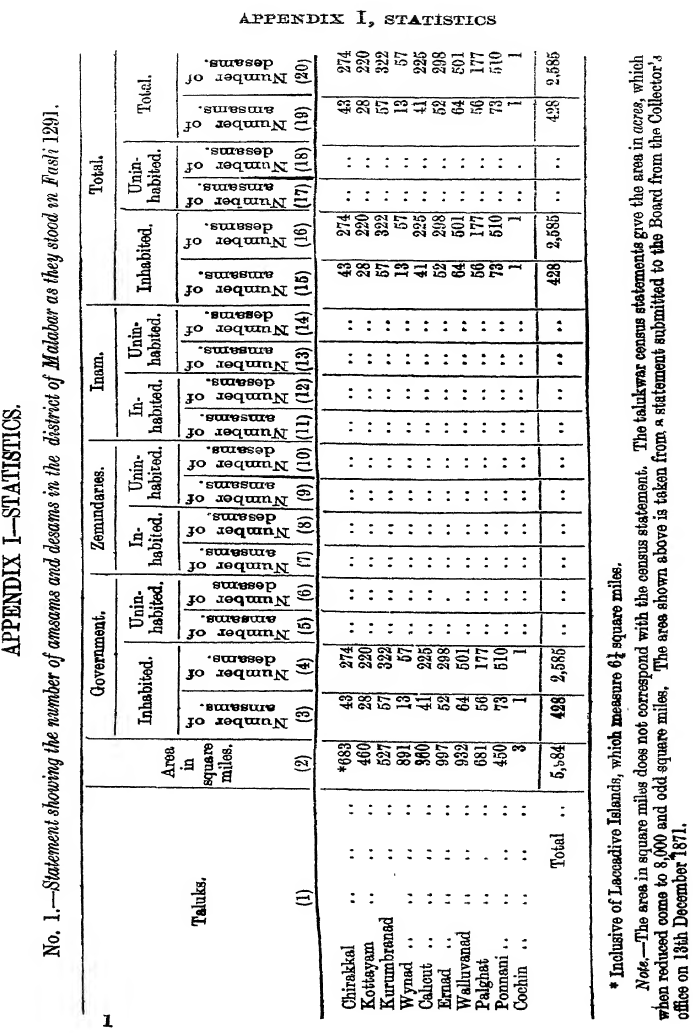
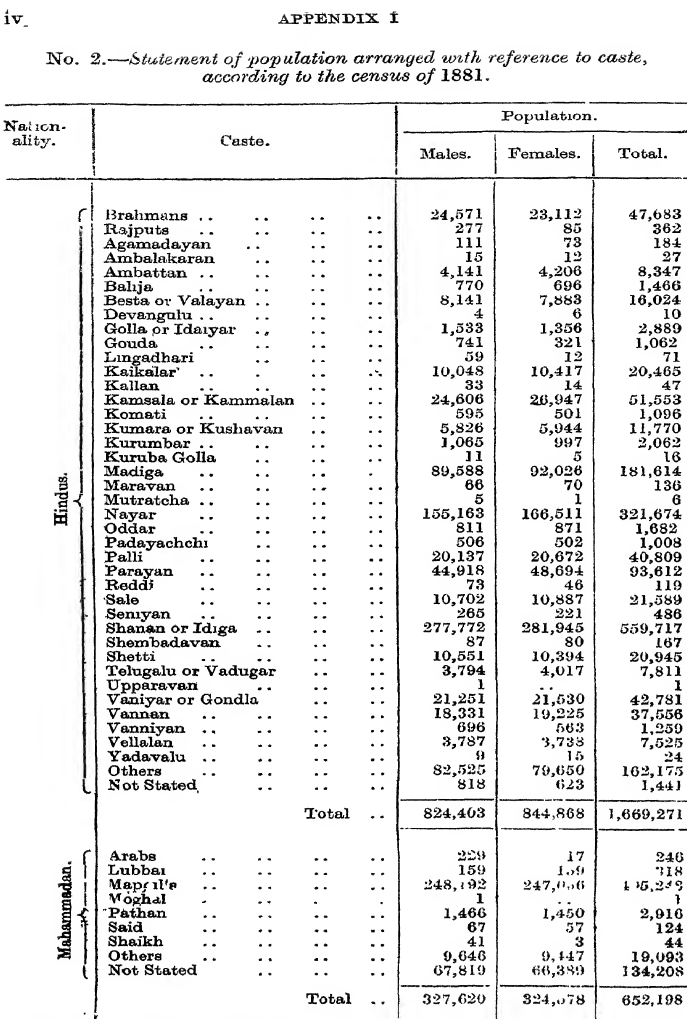
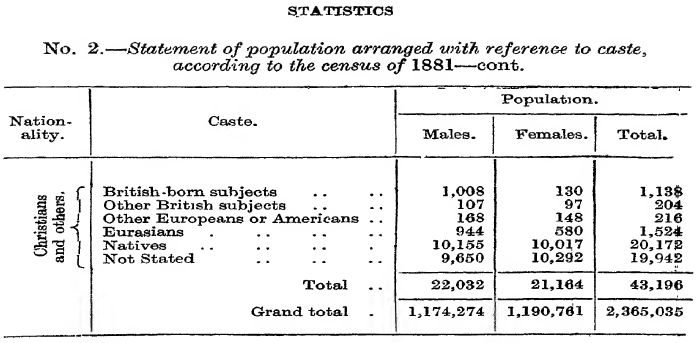
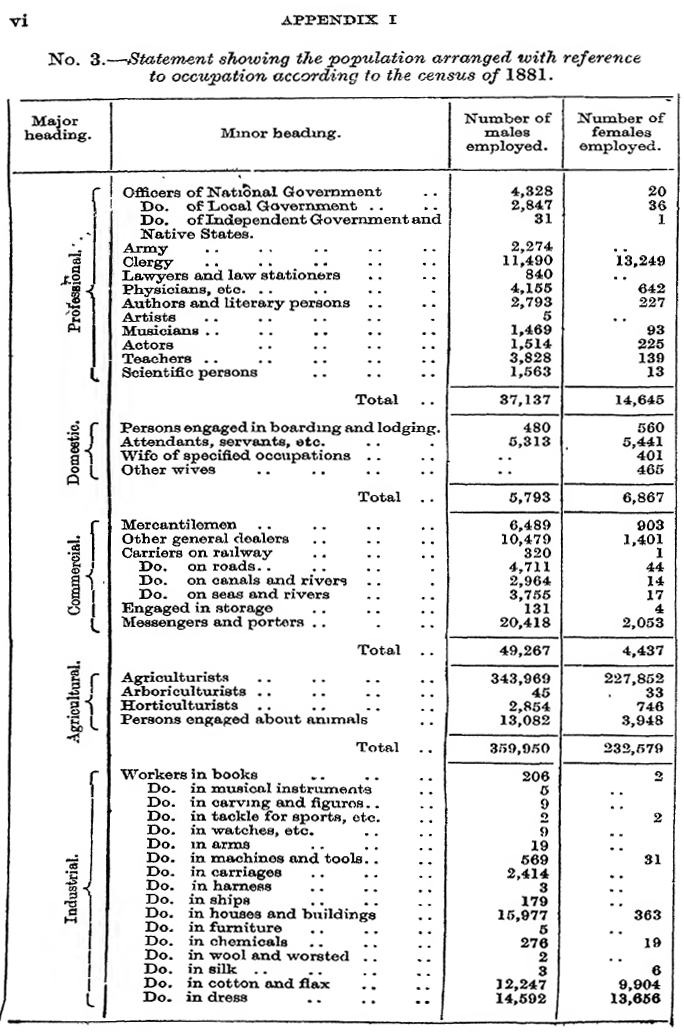
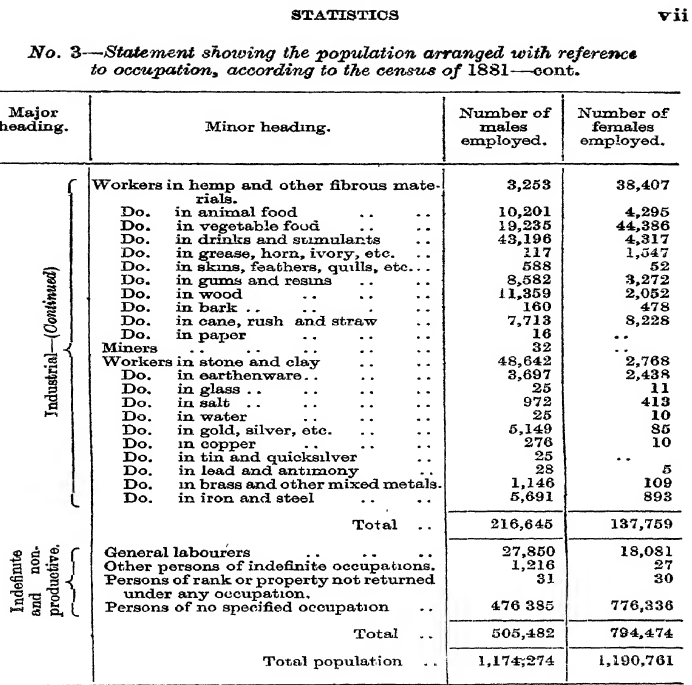
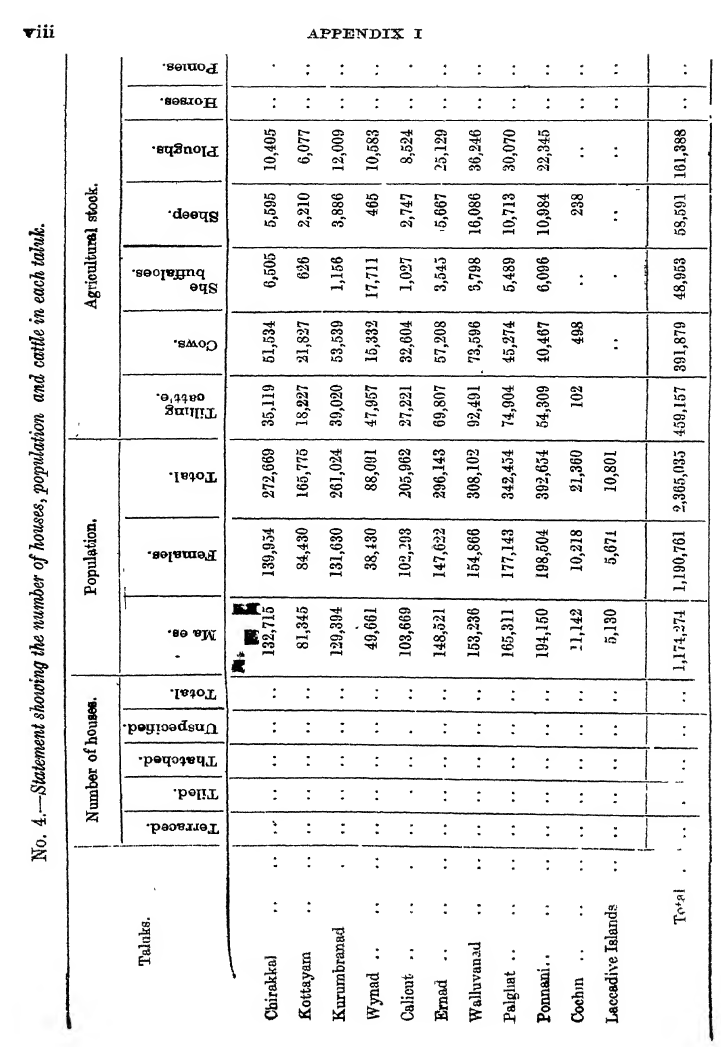
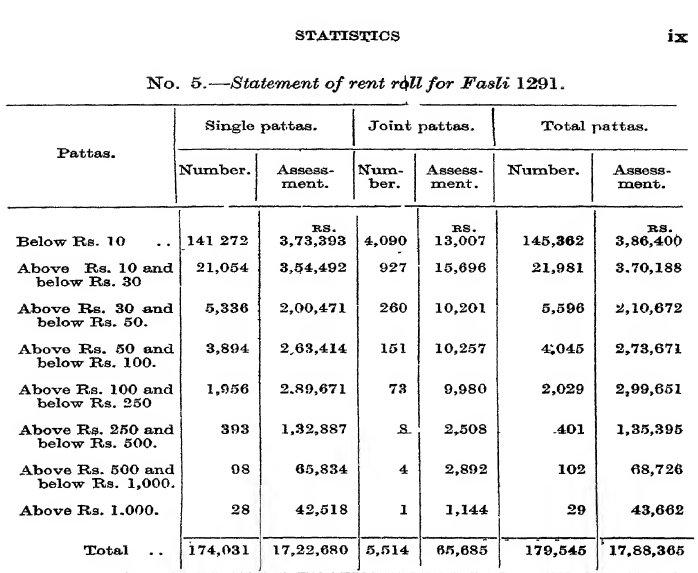
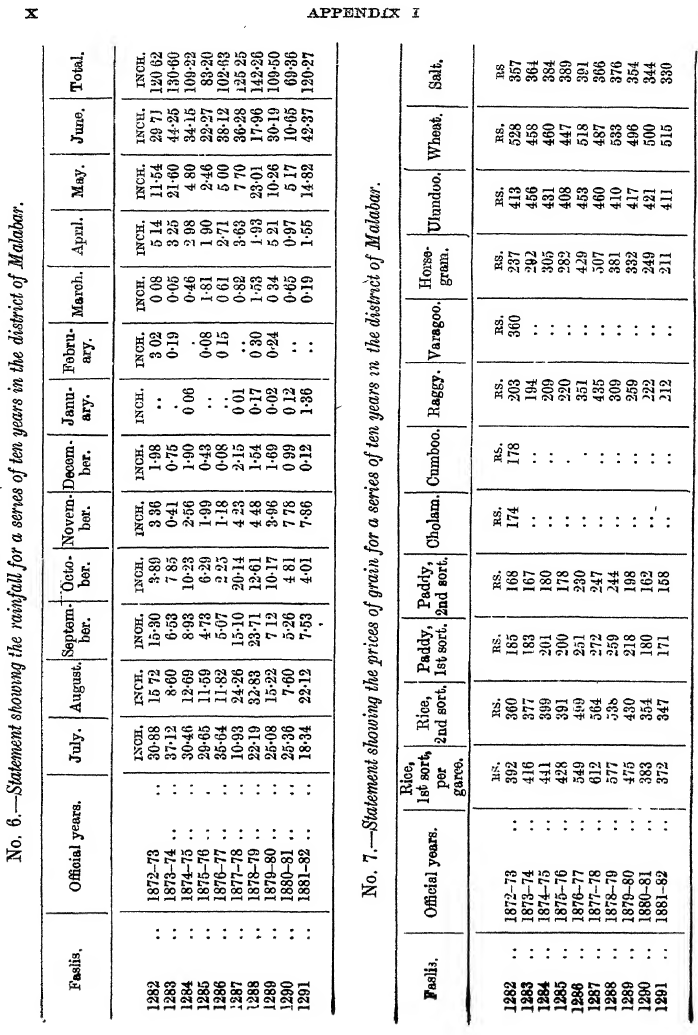
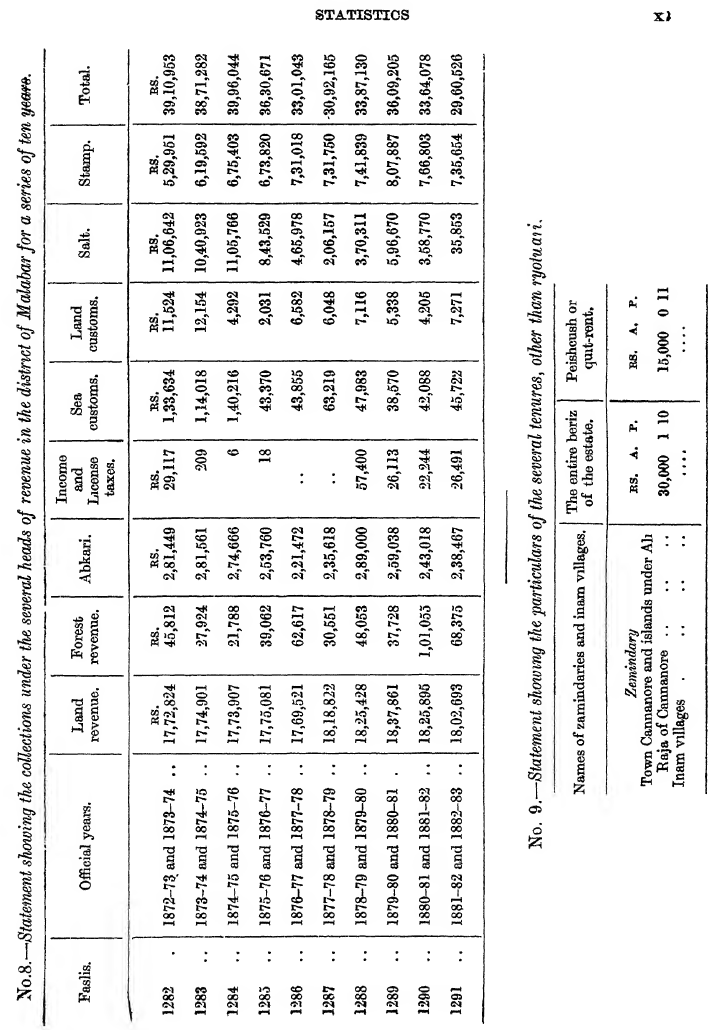
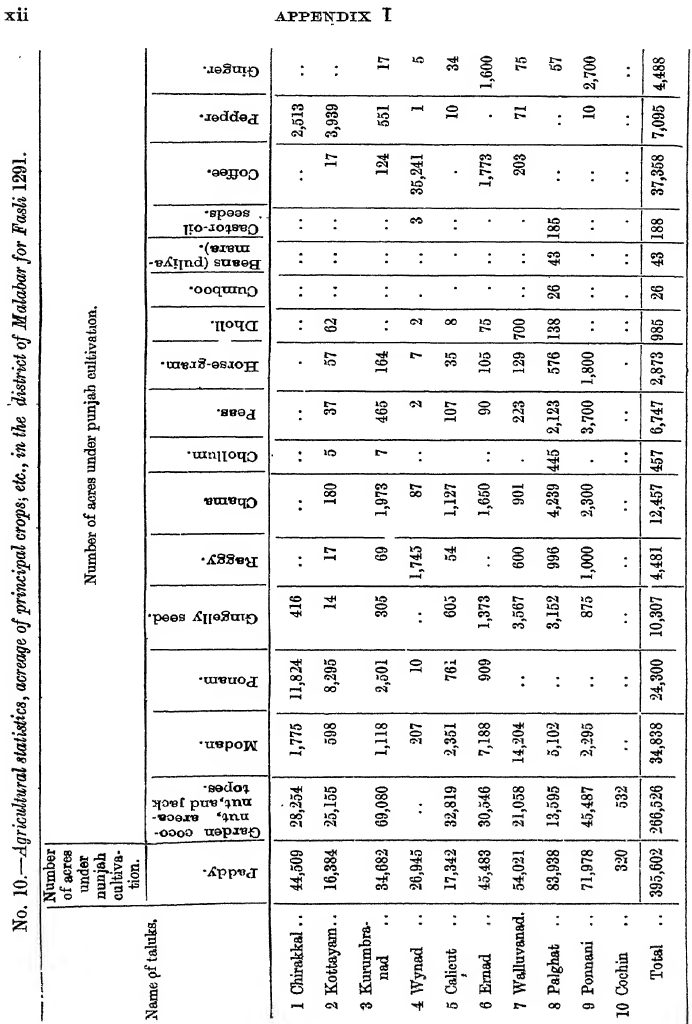
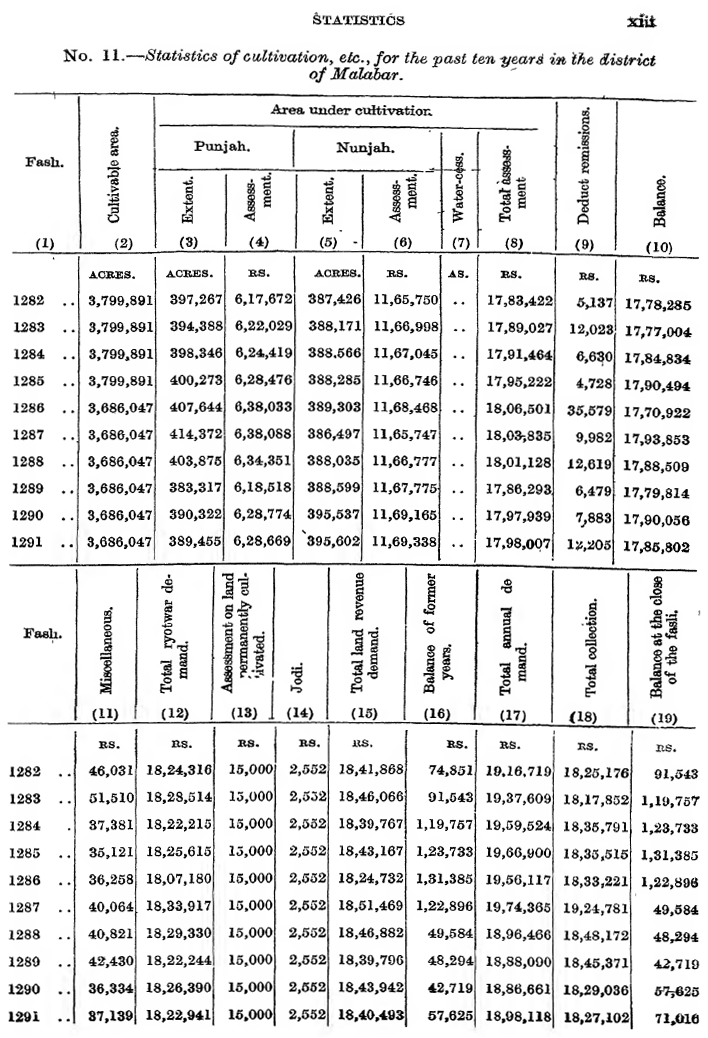
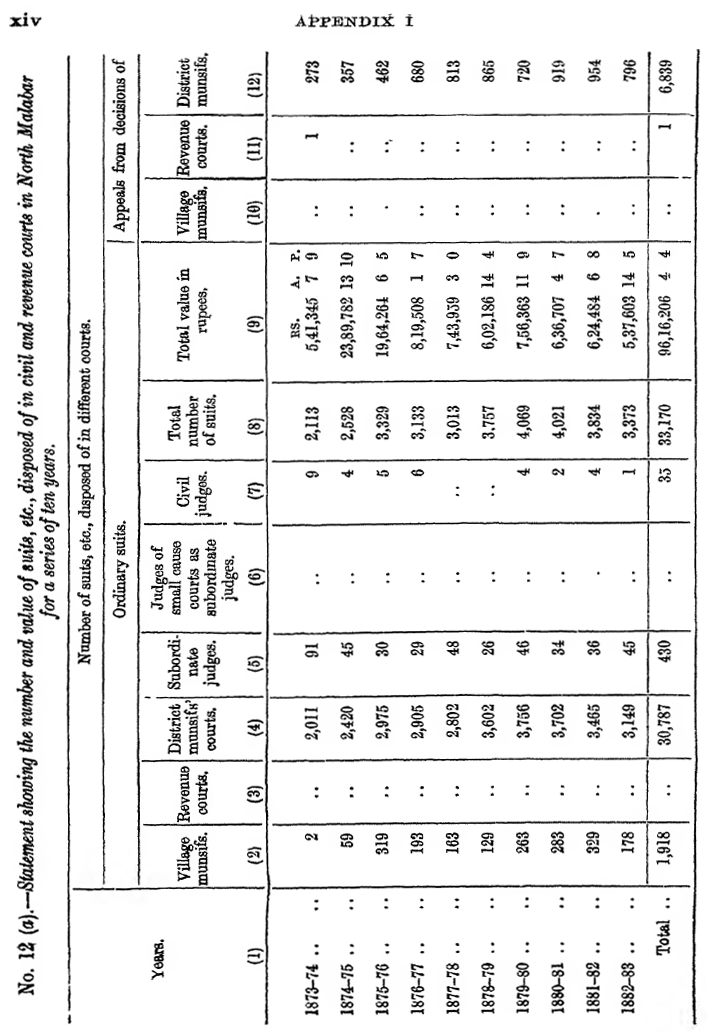
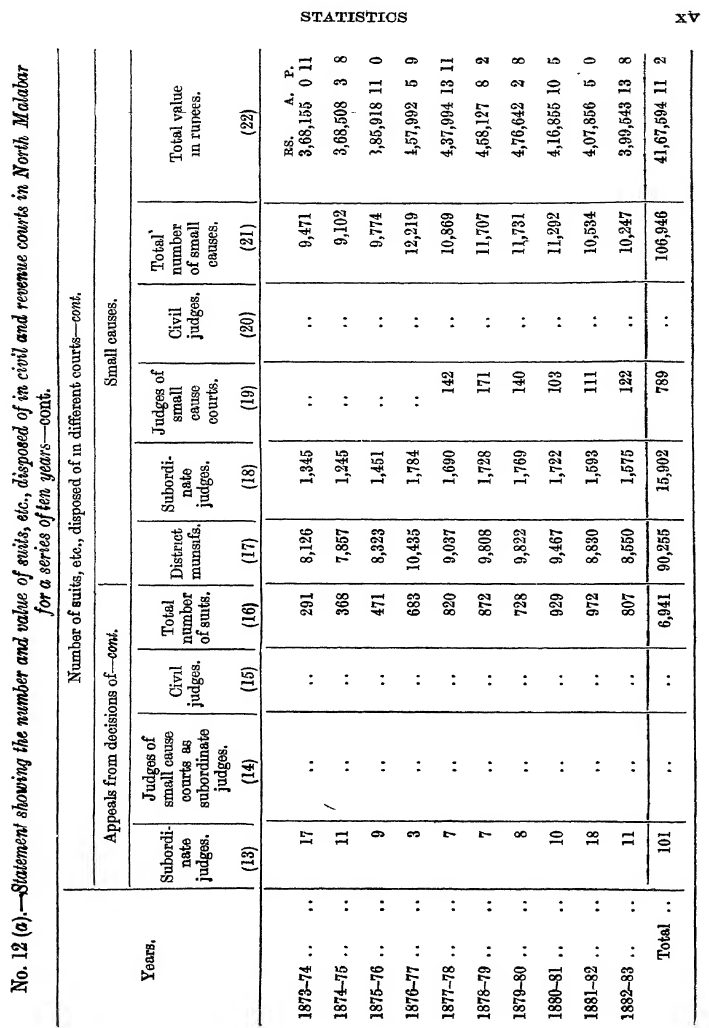
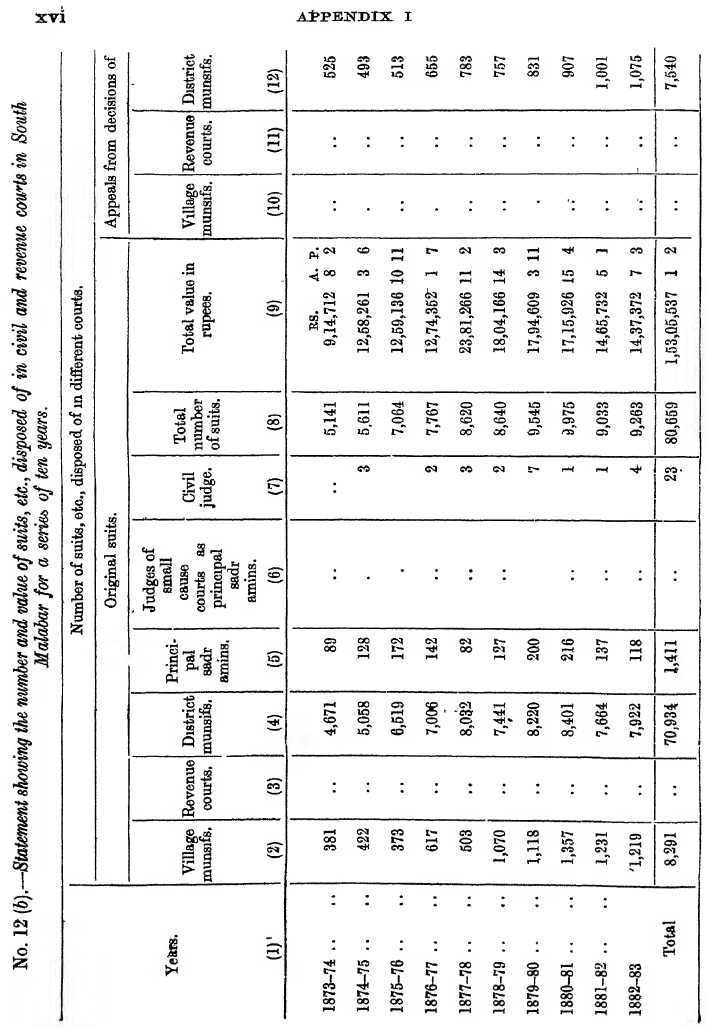
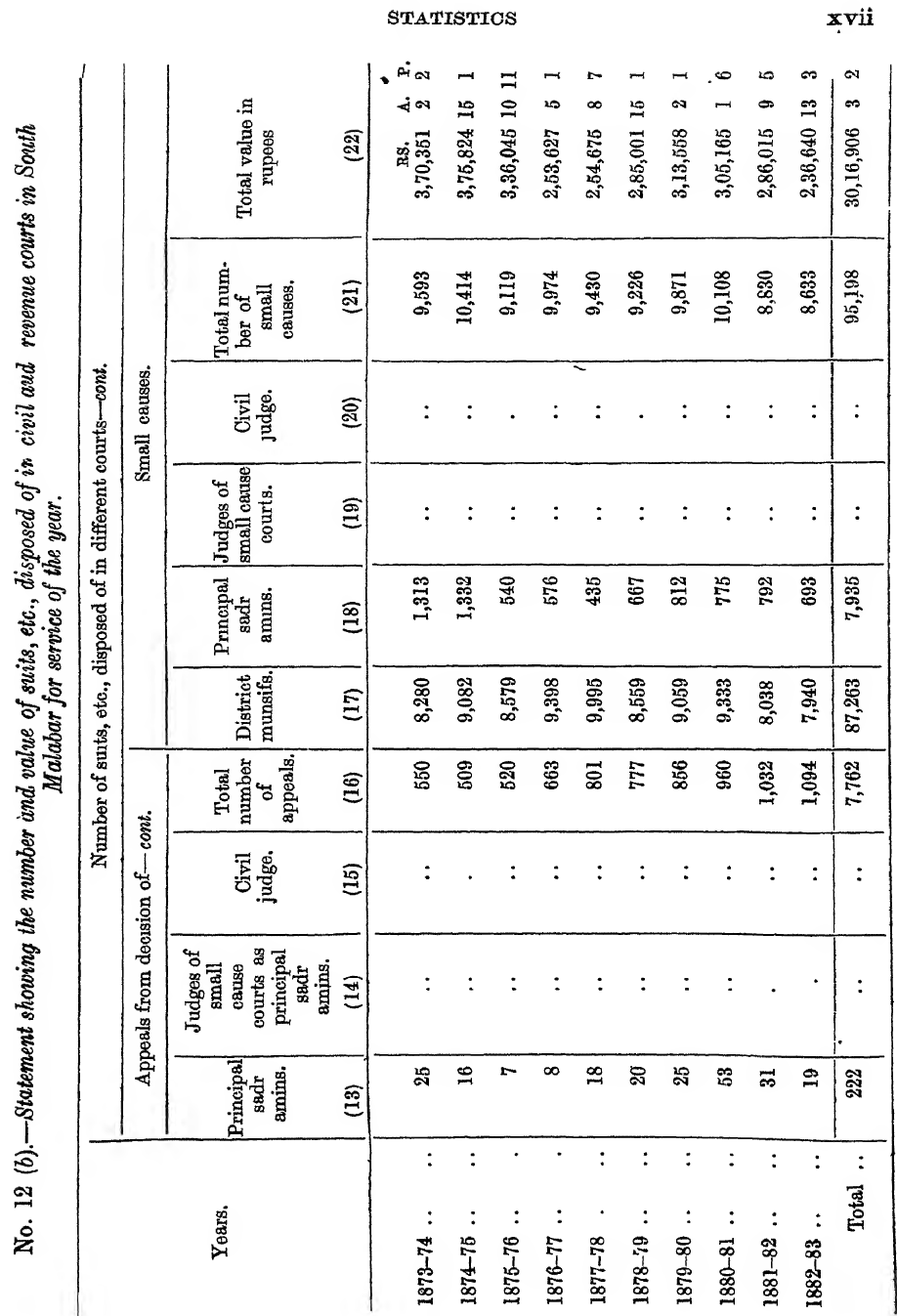
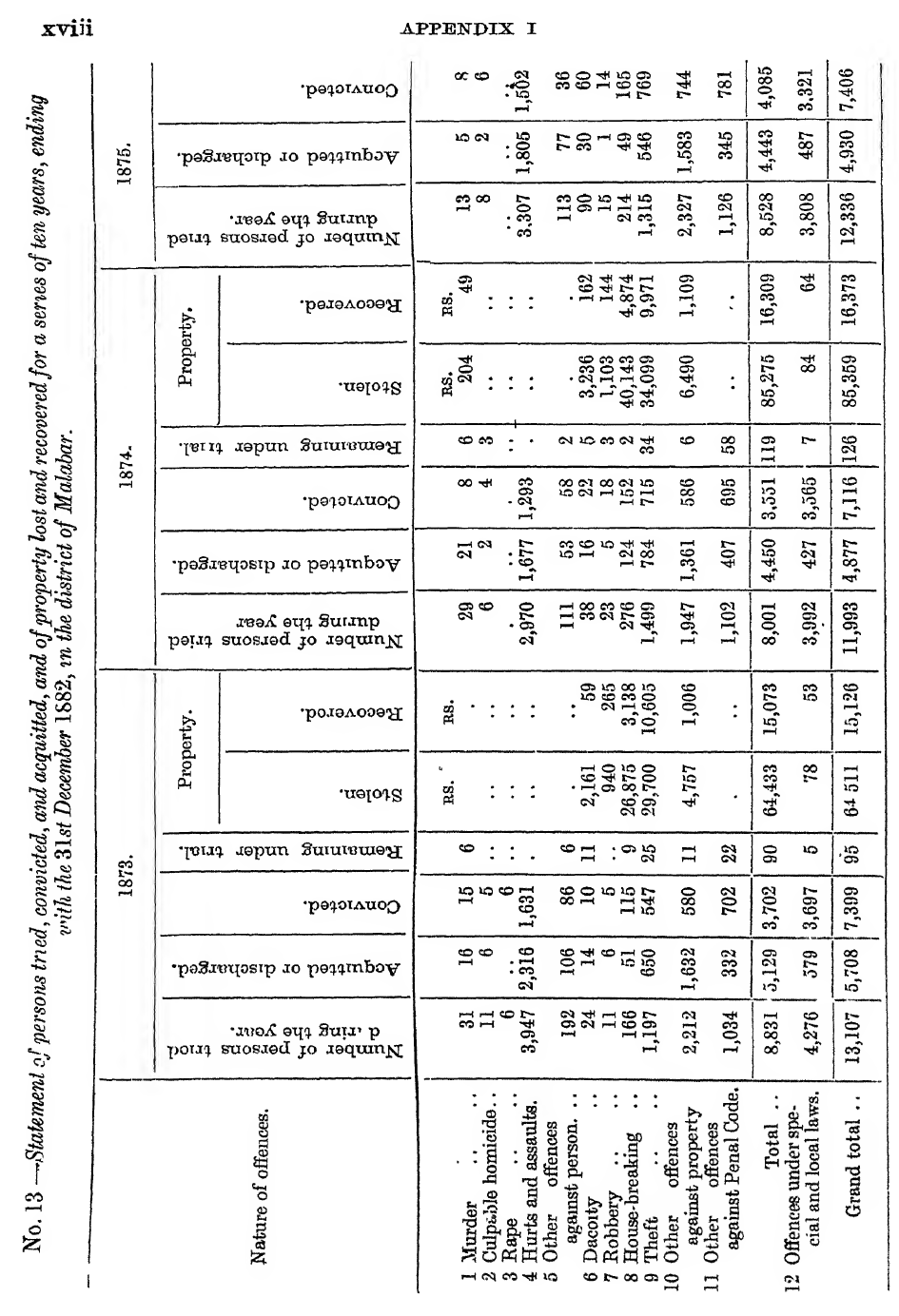
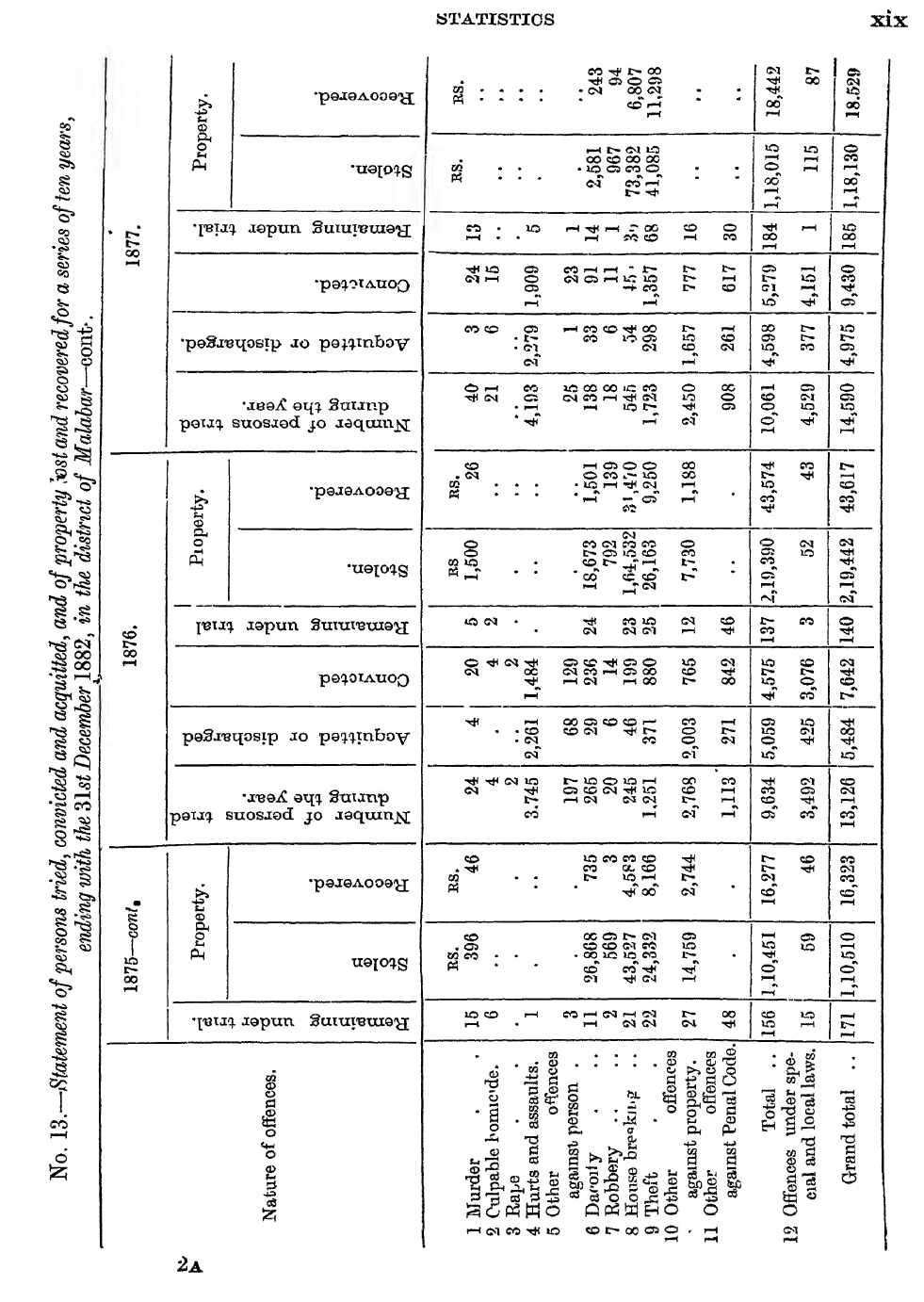
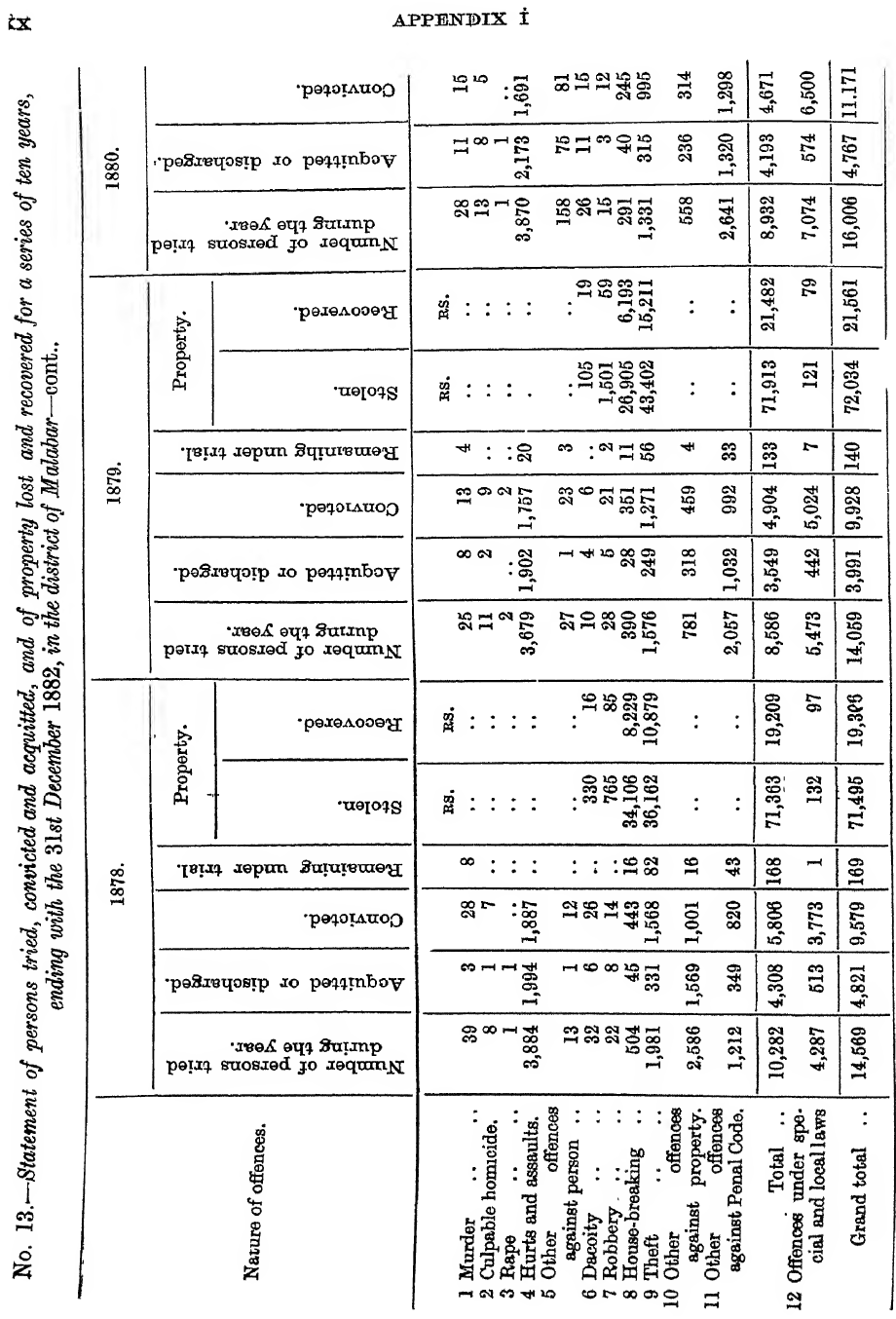
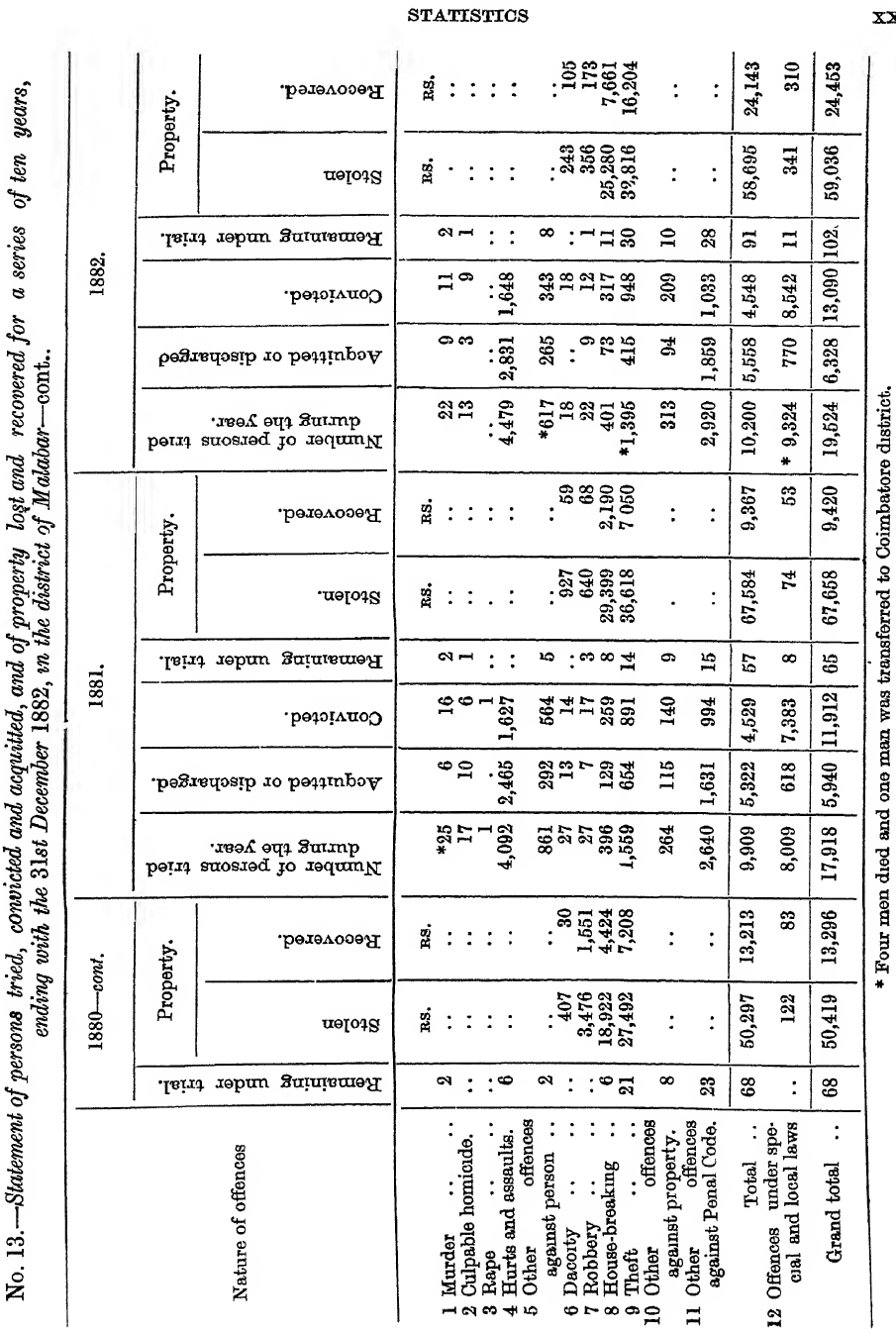
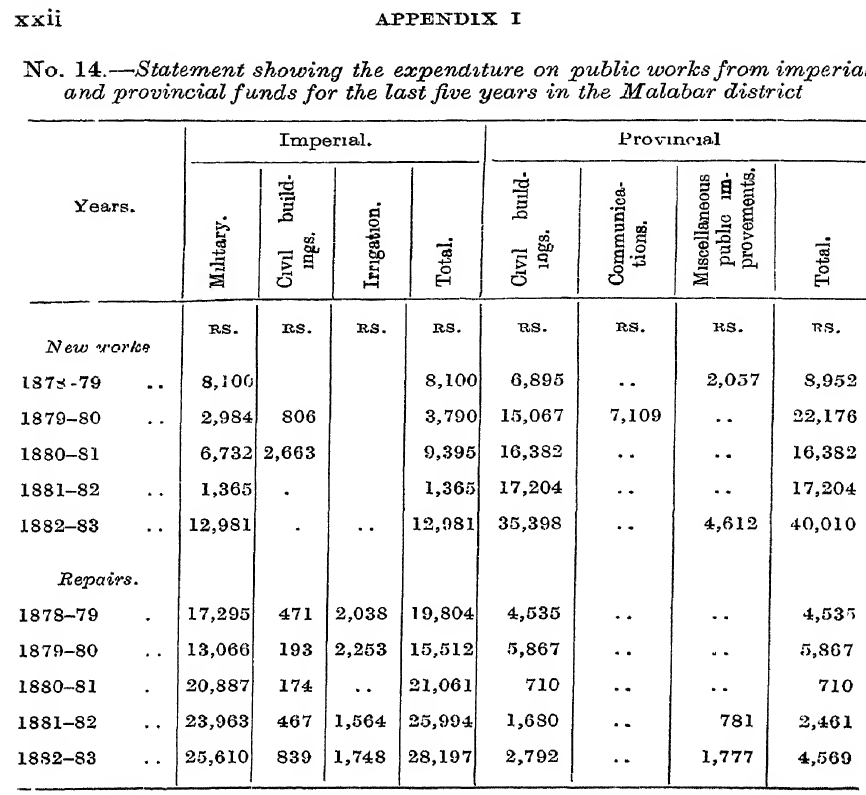
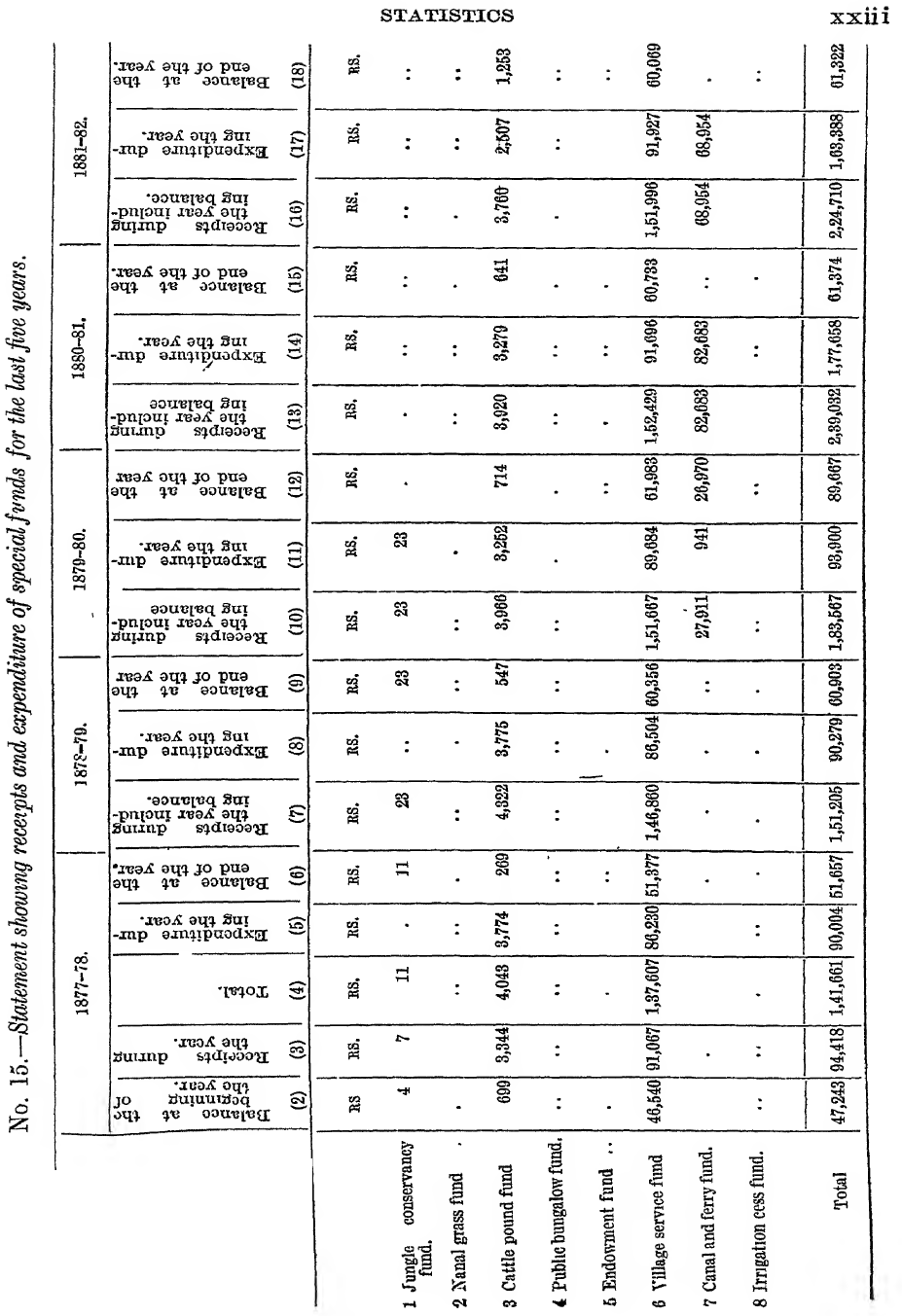
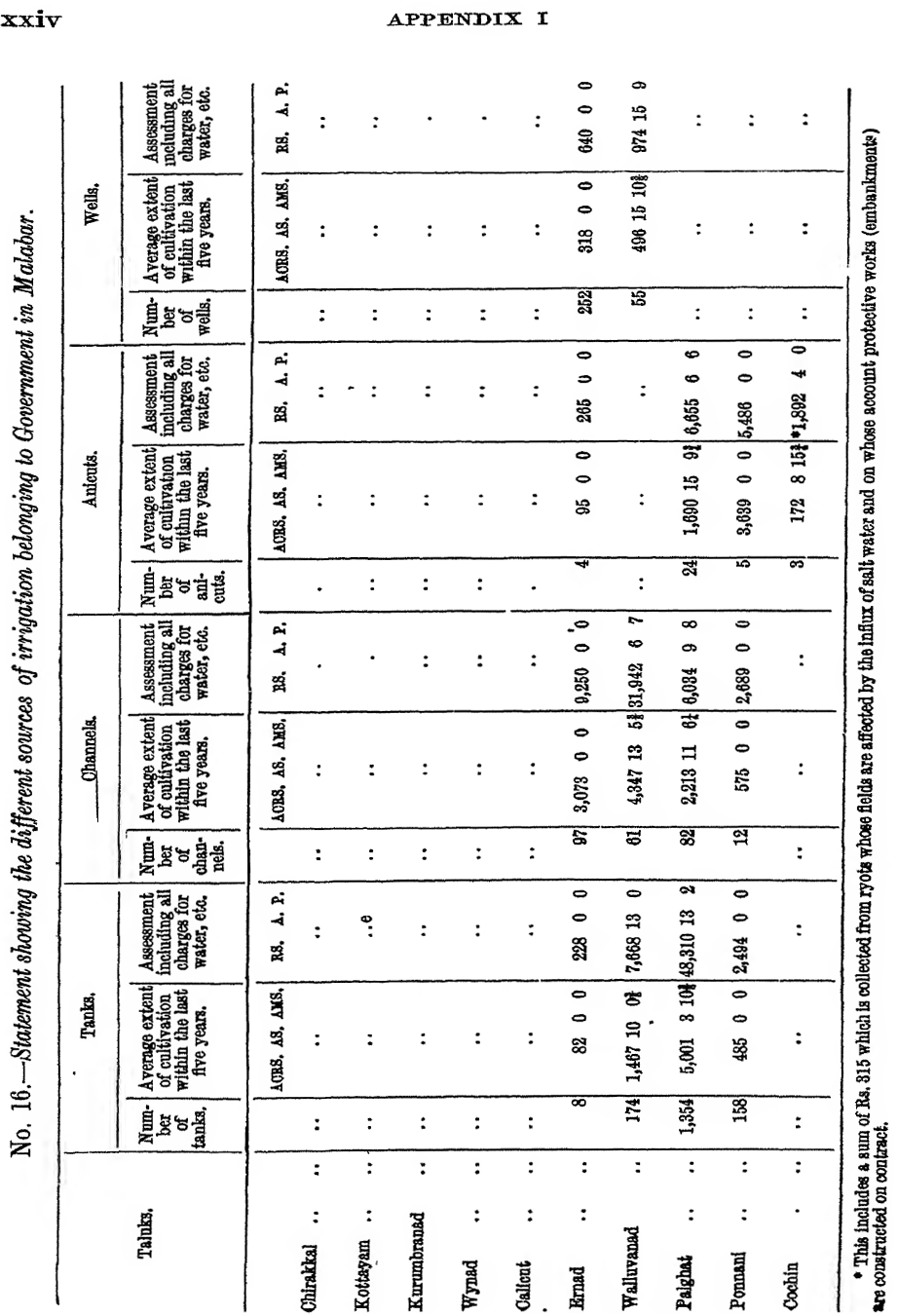
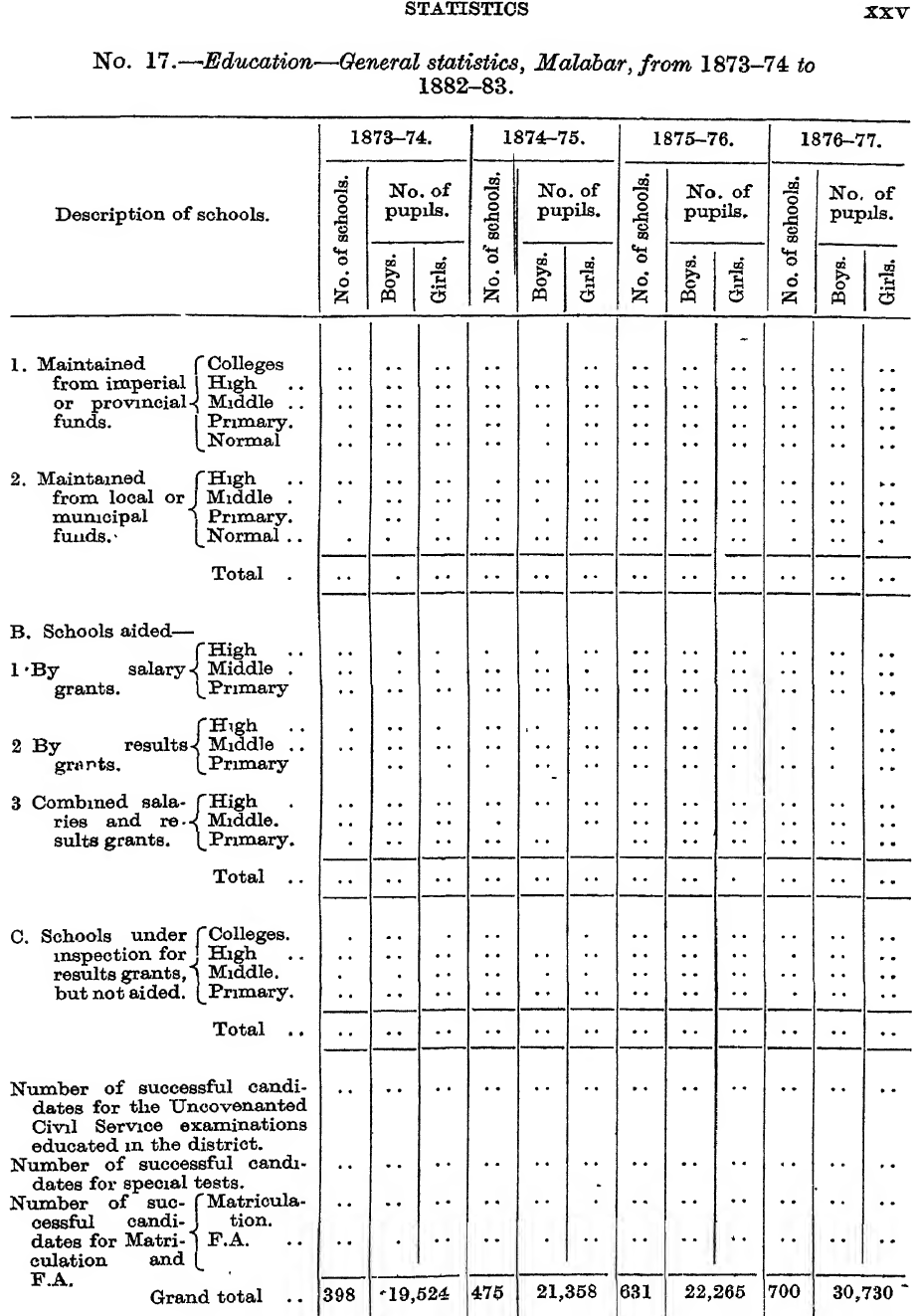
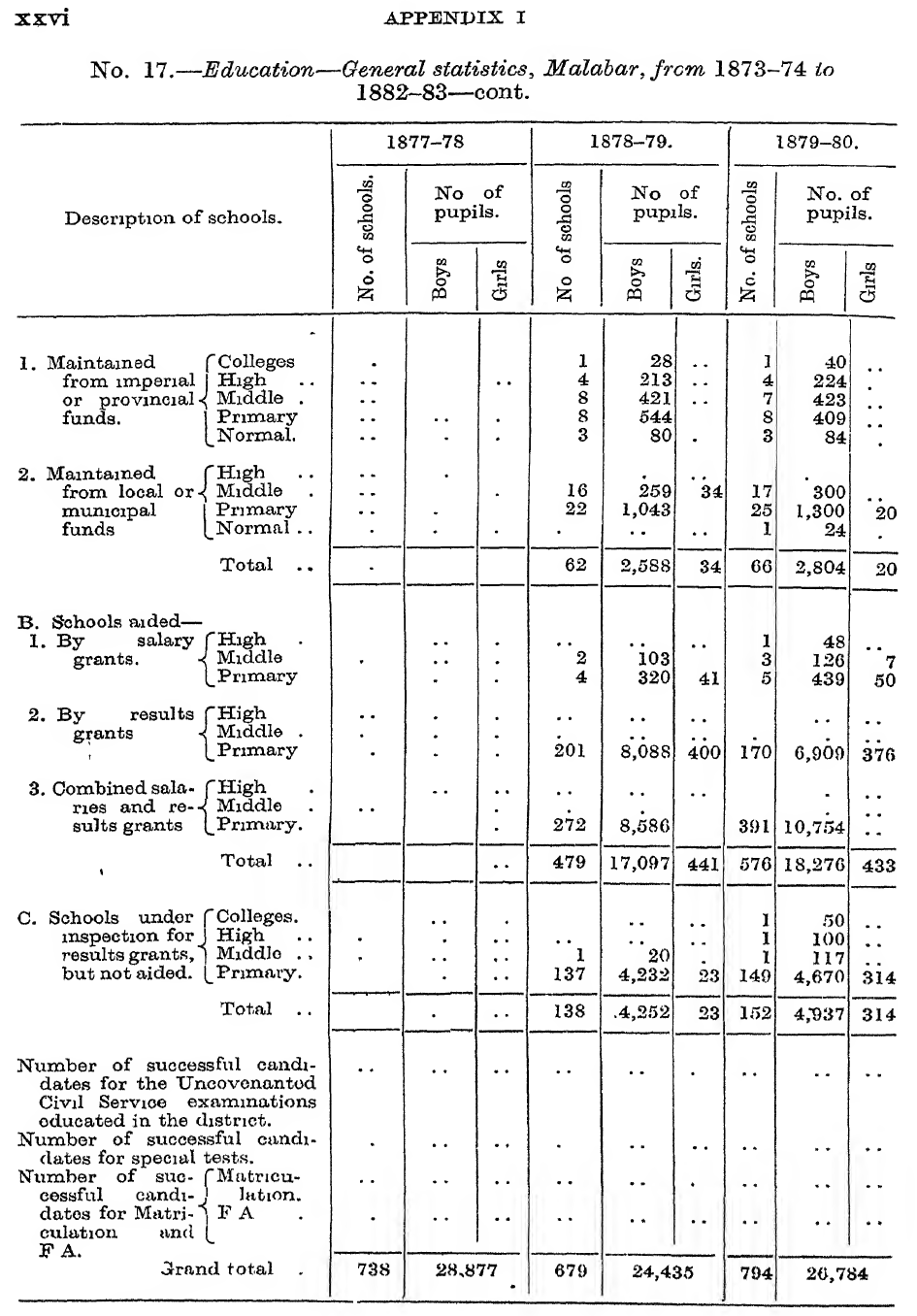
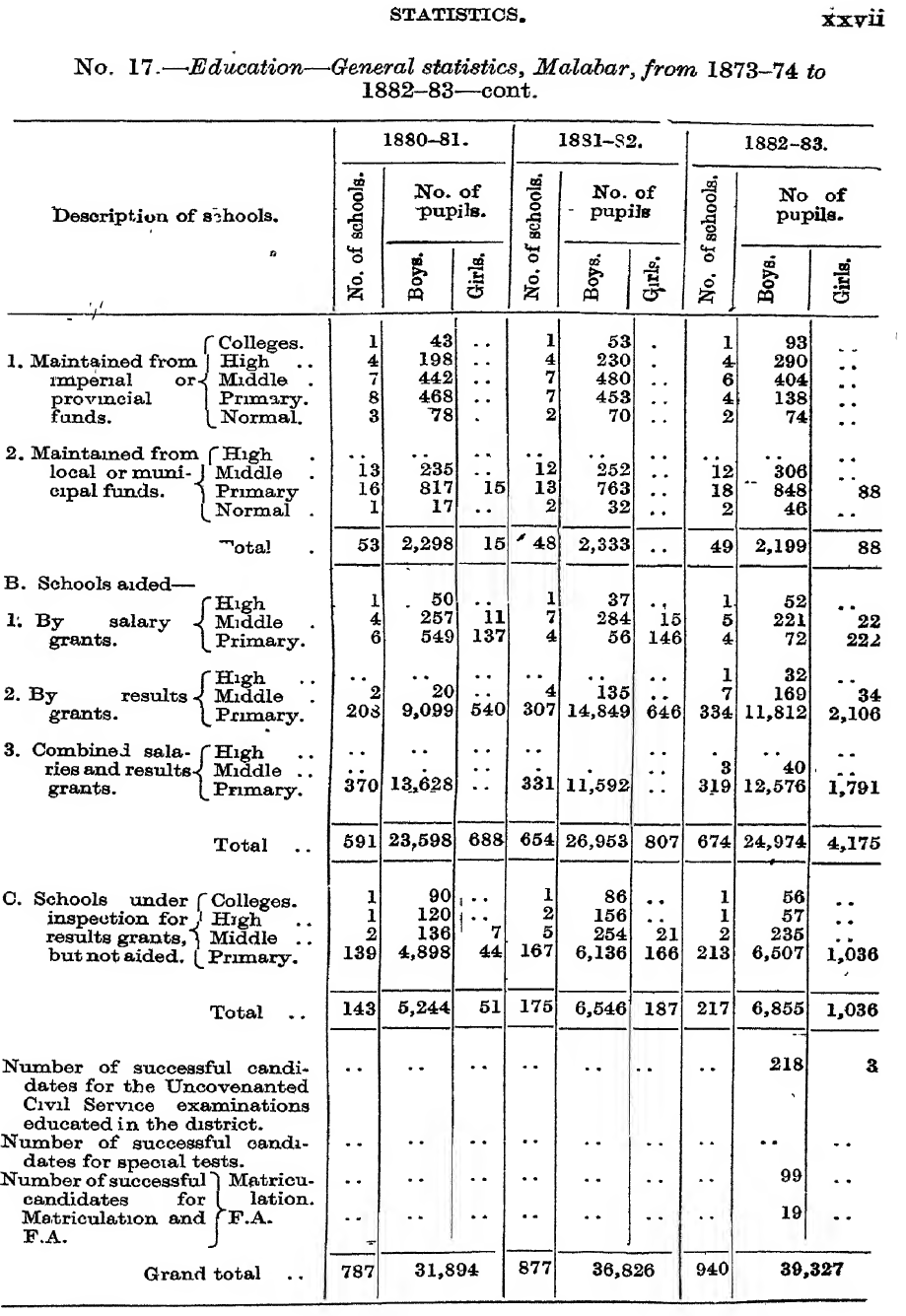
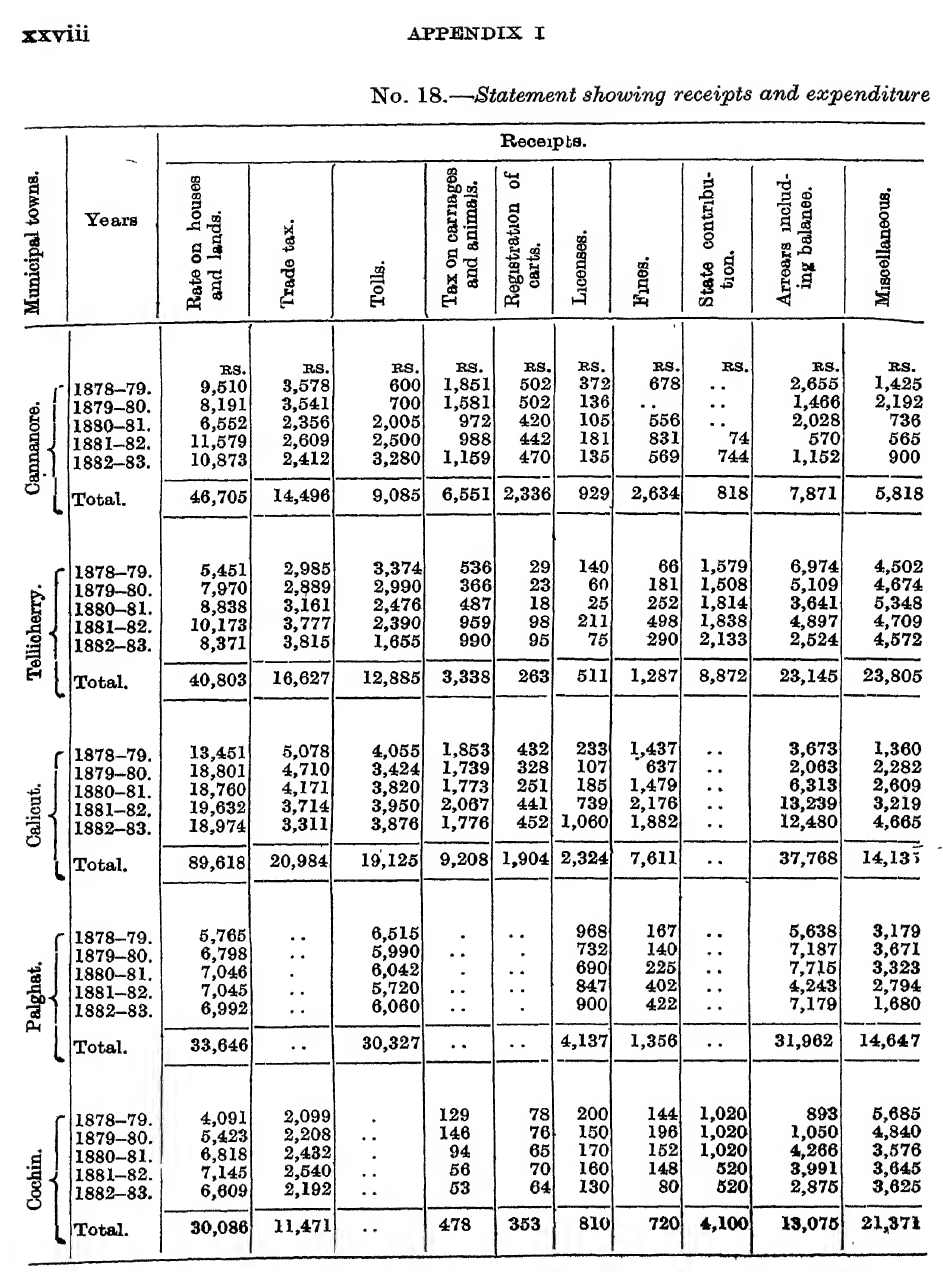
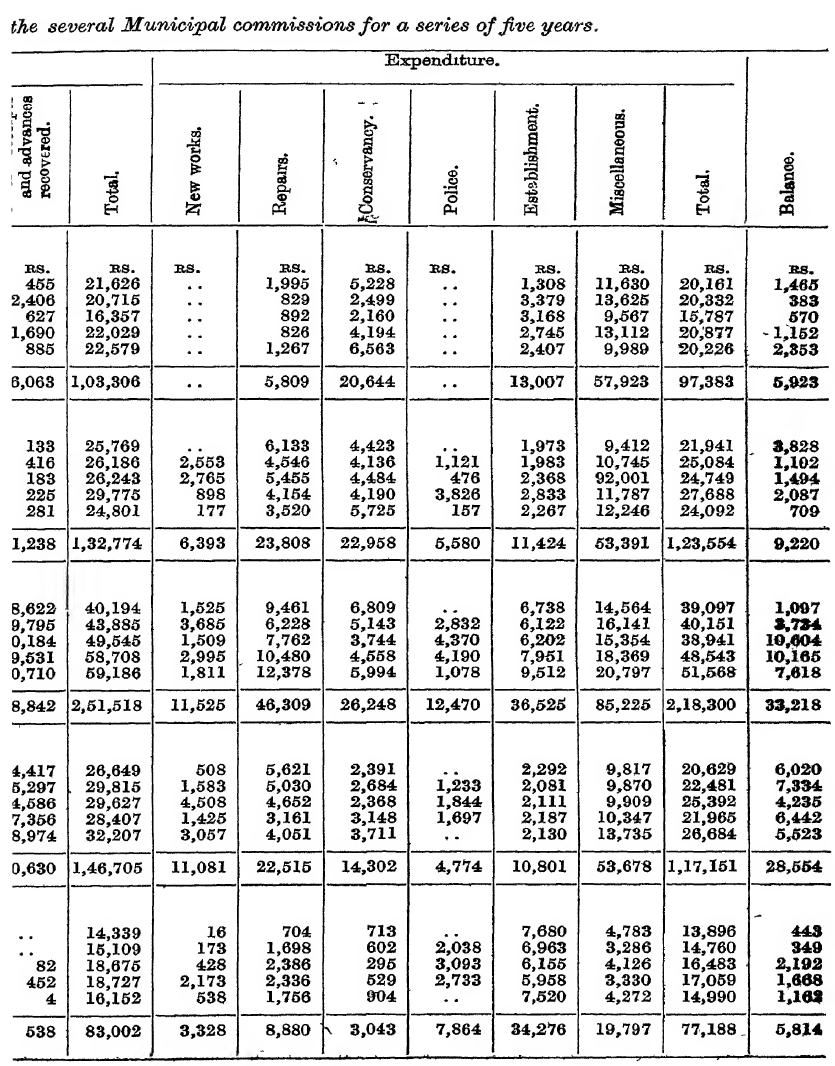
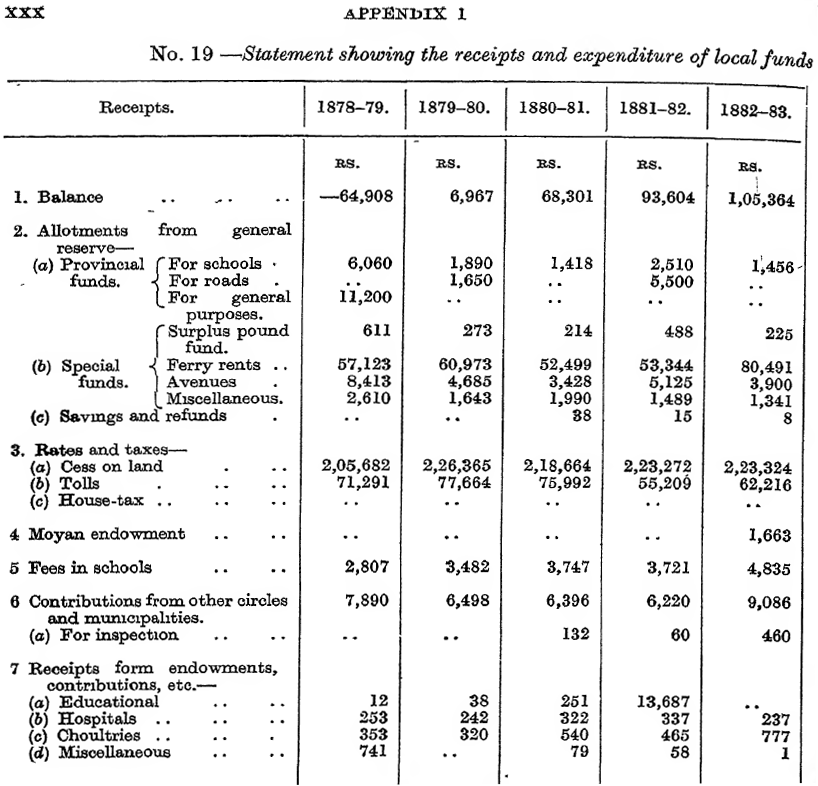
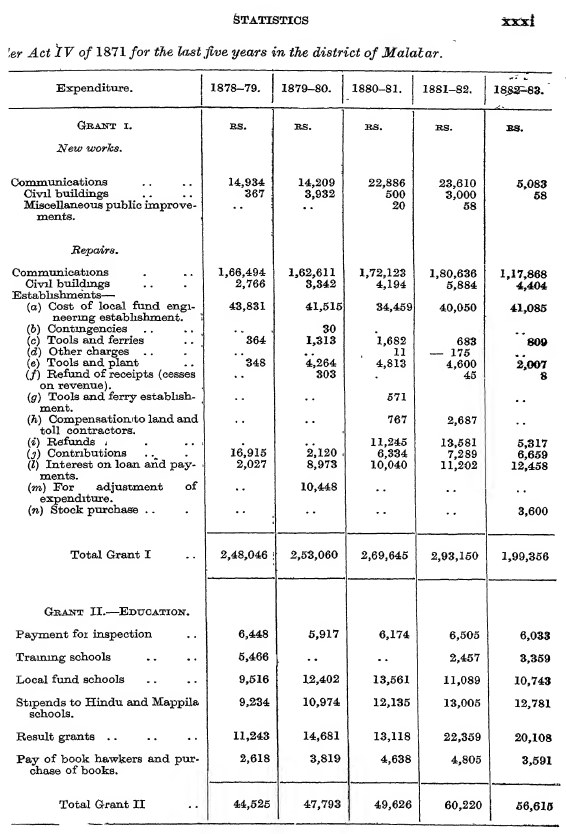
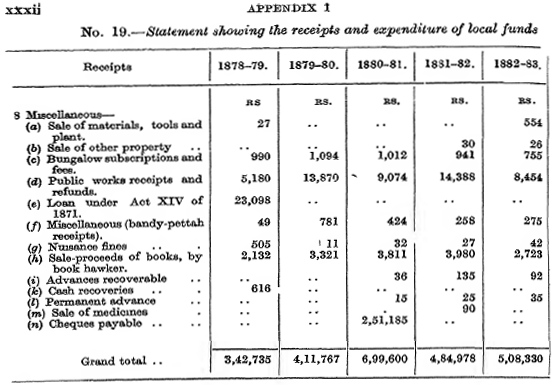
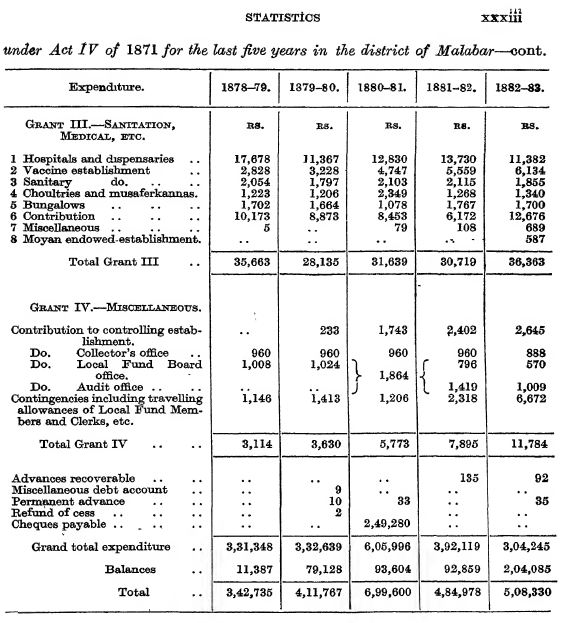
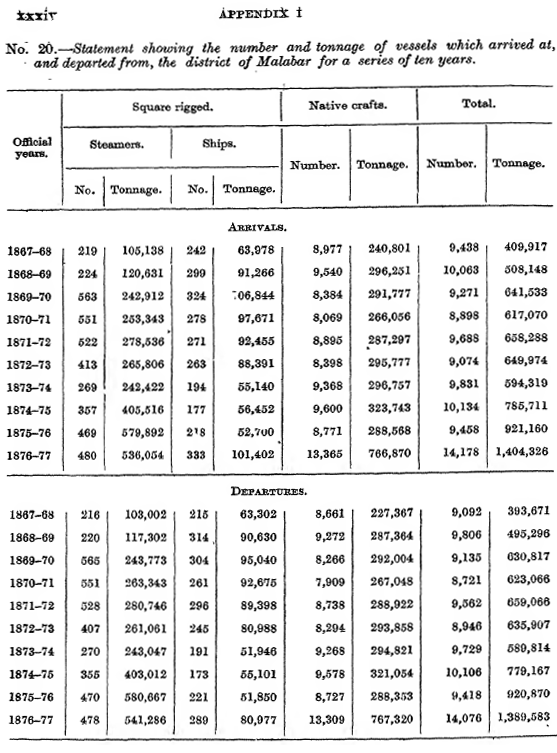
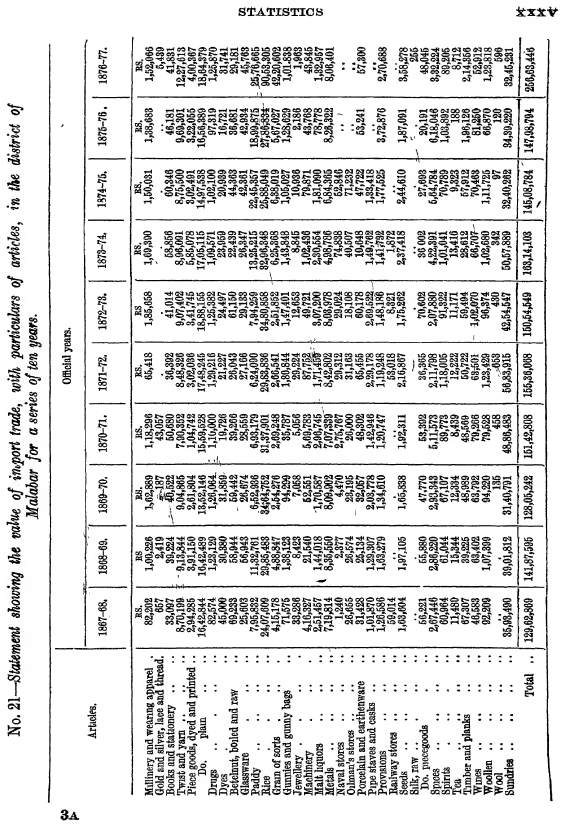
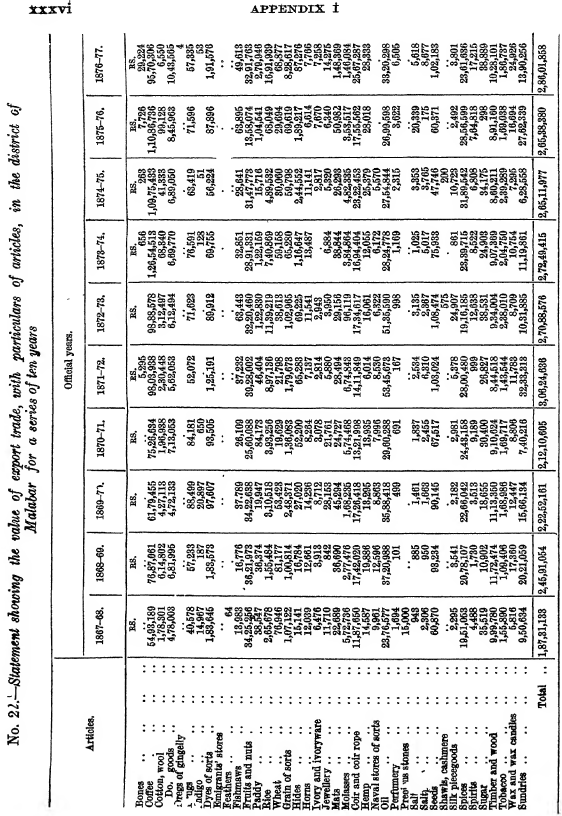
II.—Animals
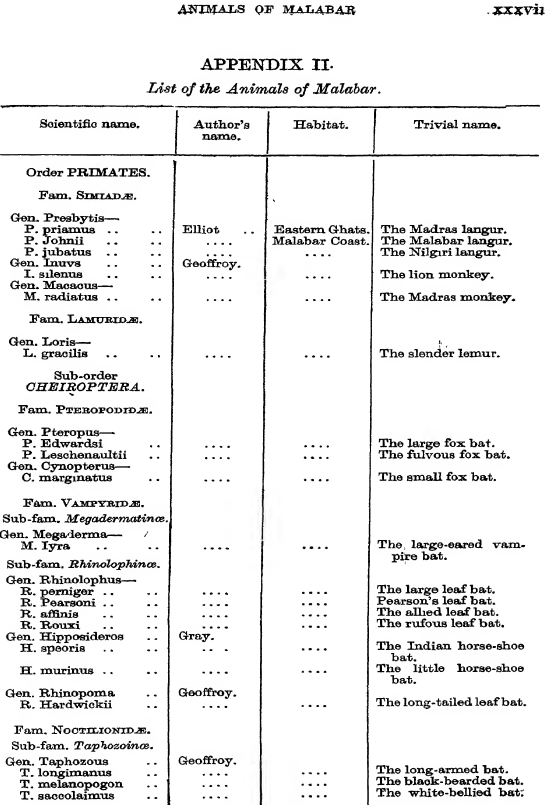
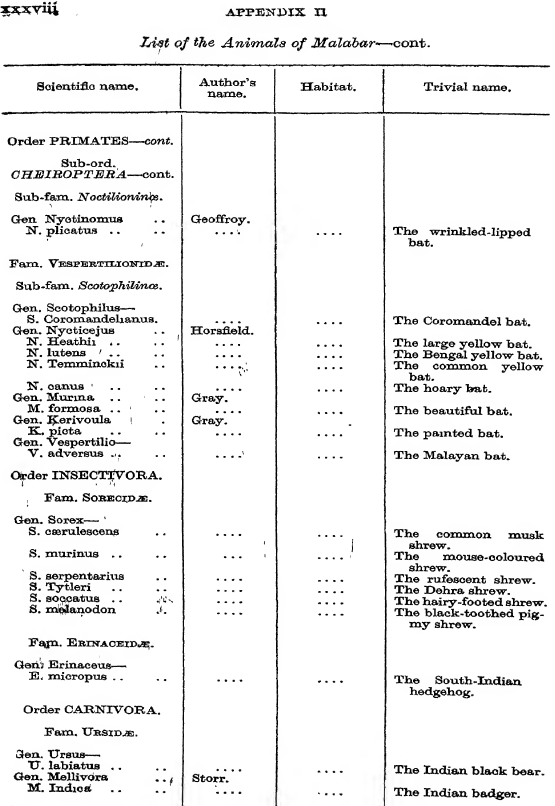
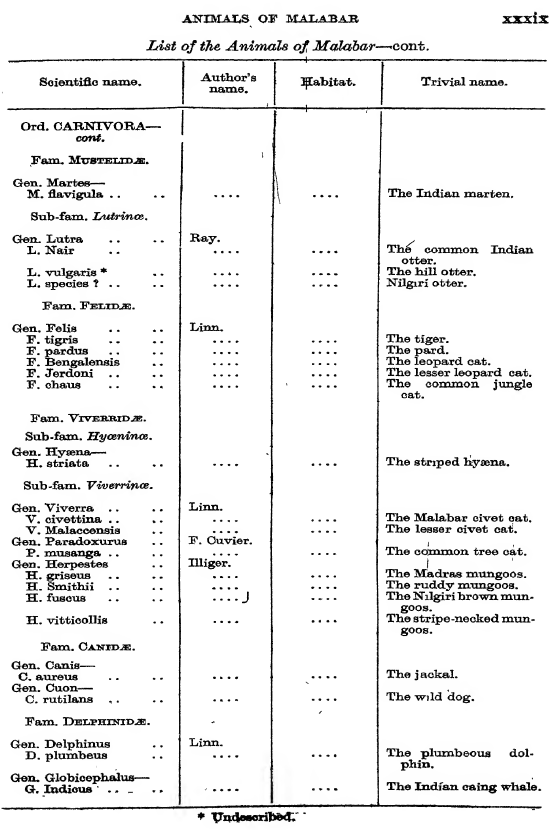
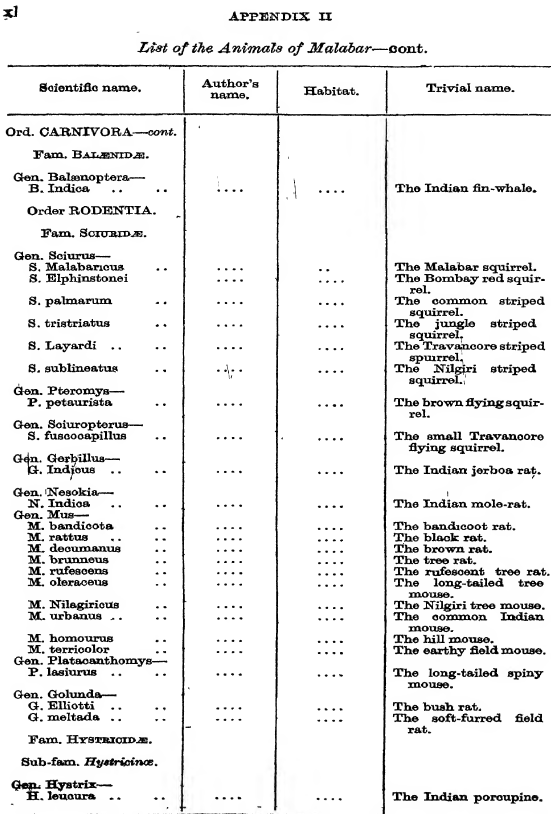
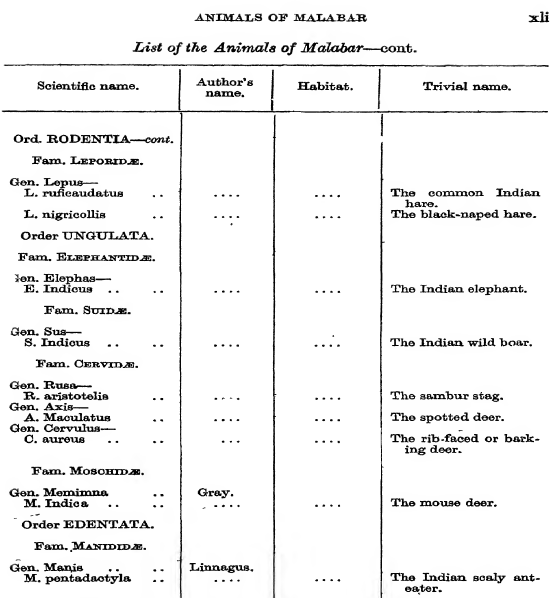
III.—Fishes
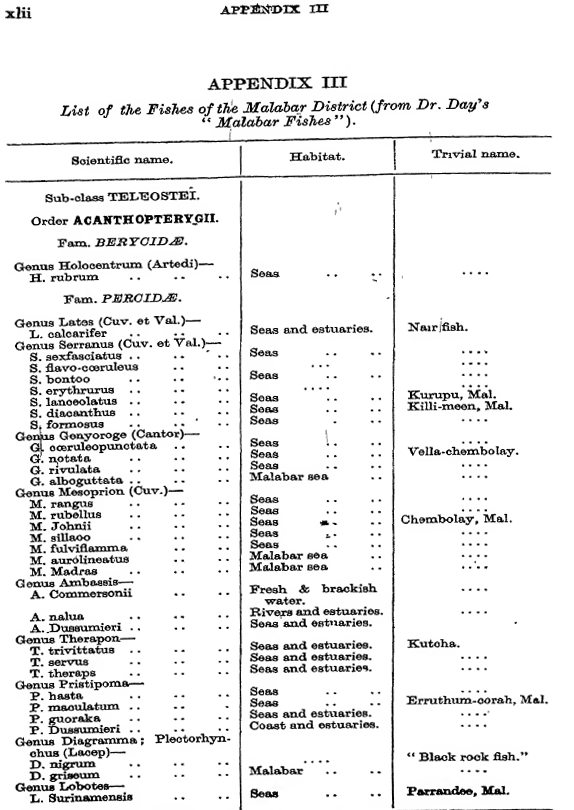
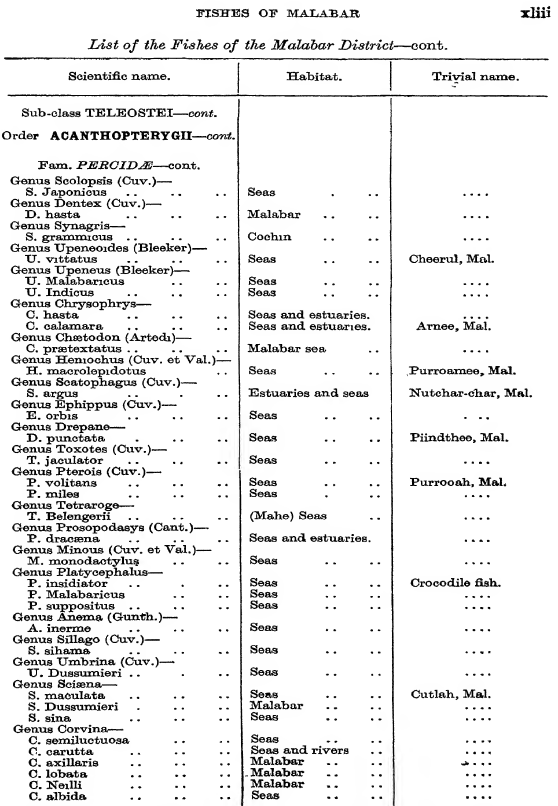
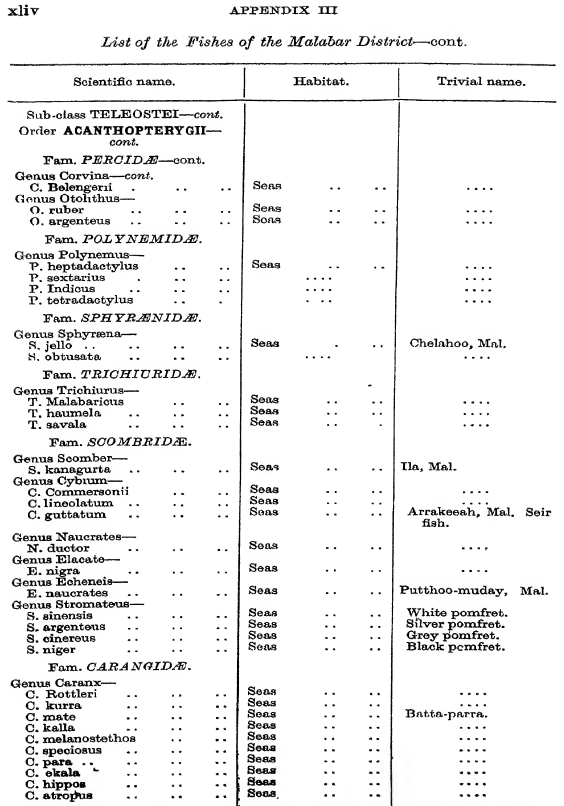
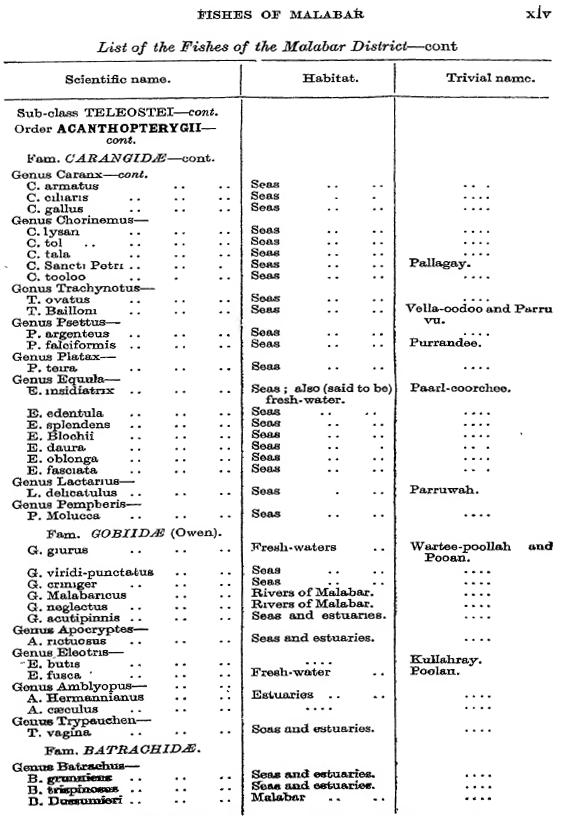
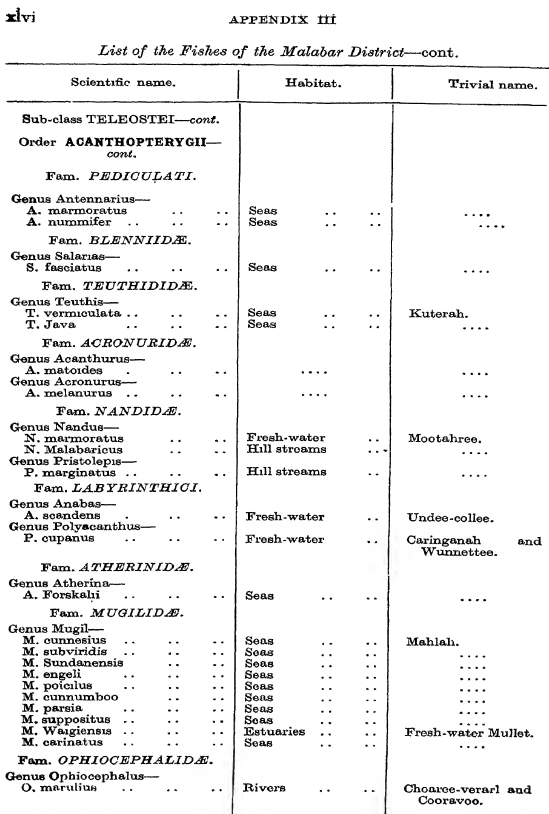
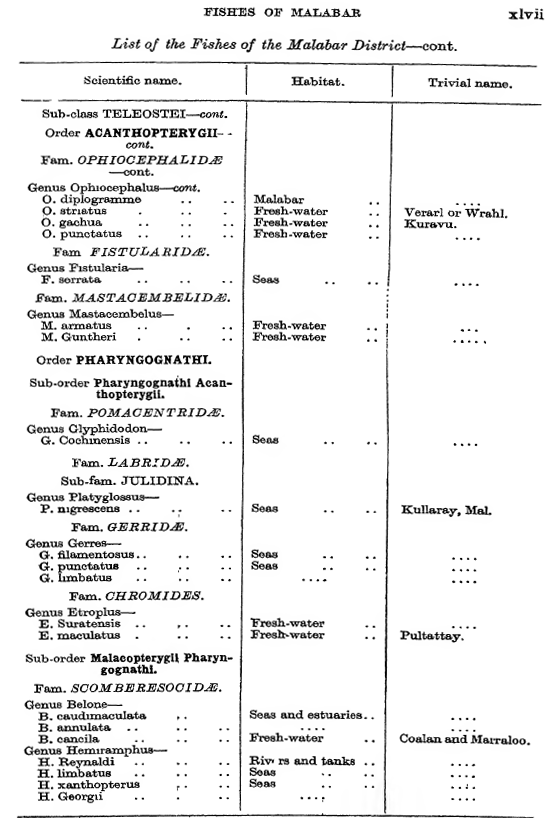
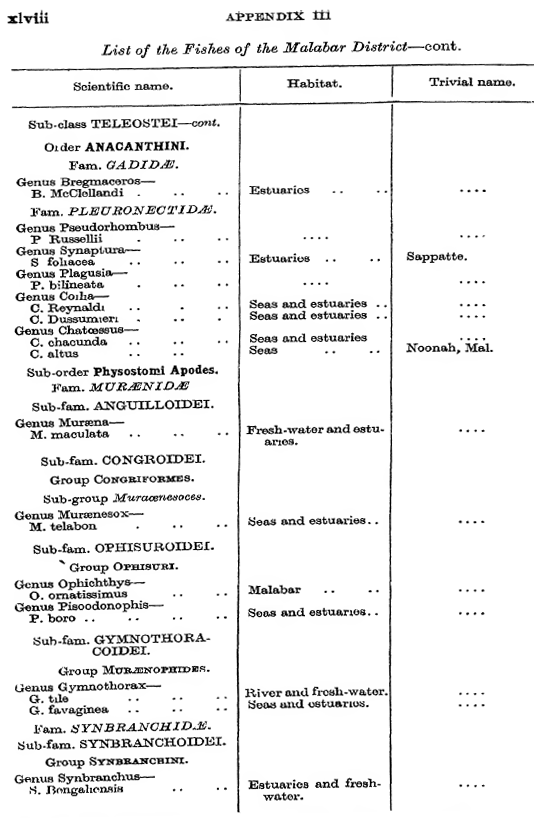
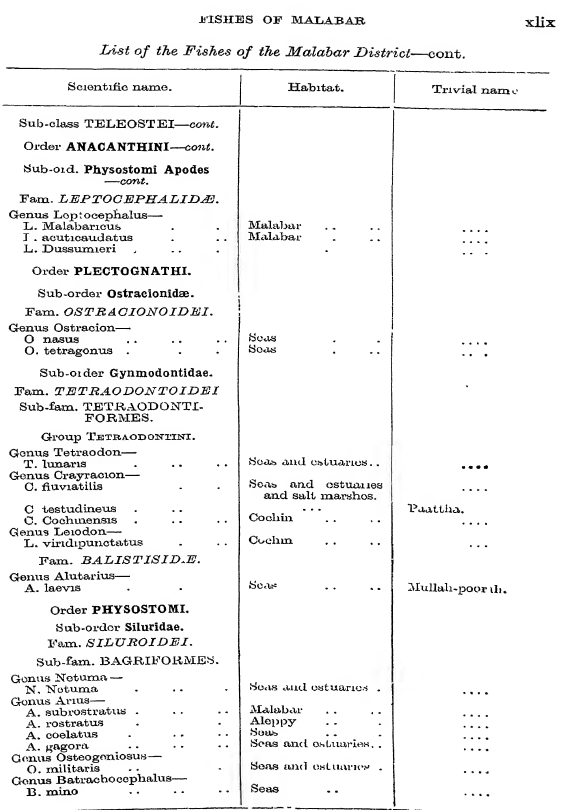
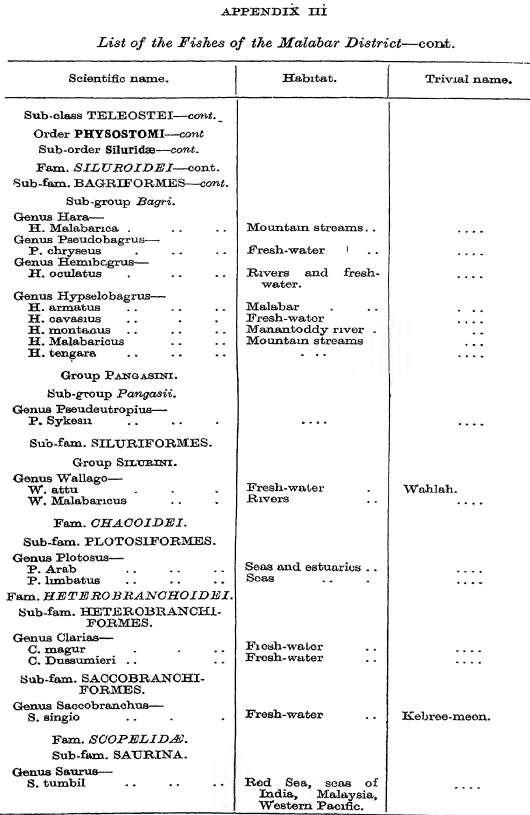
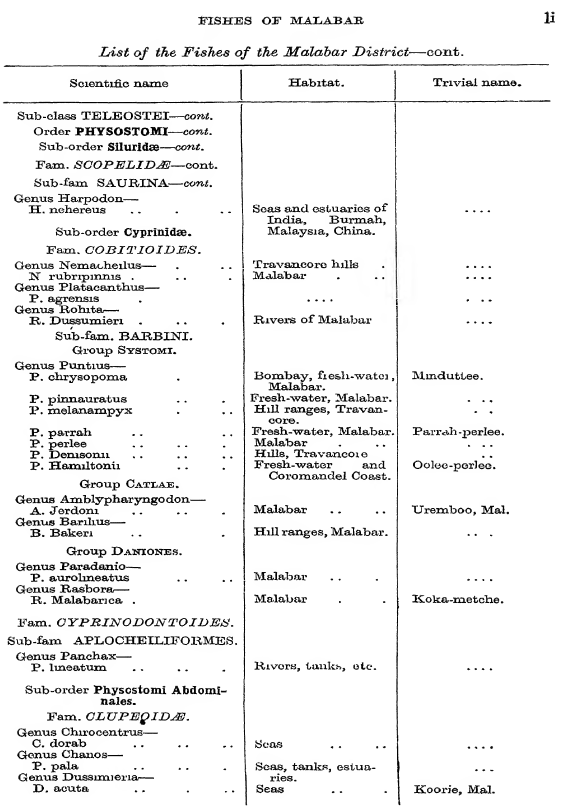
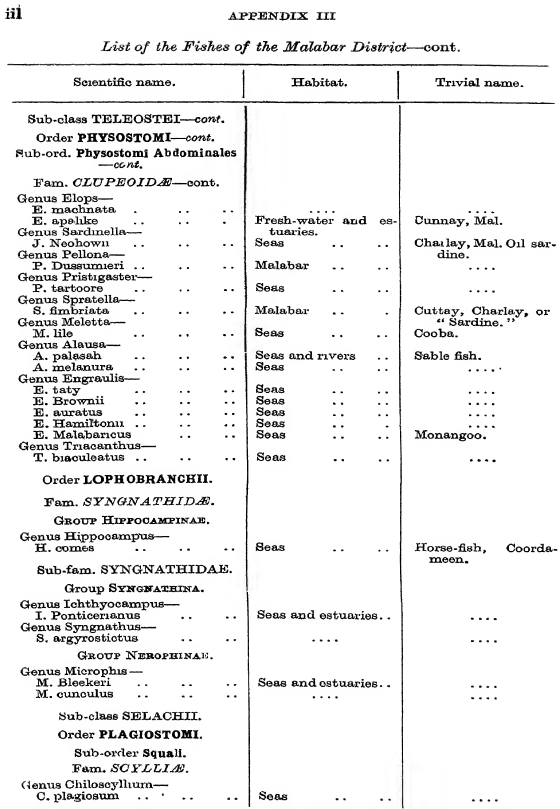
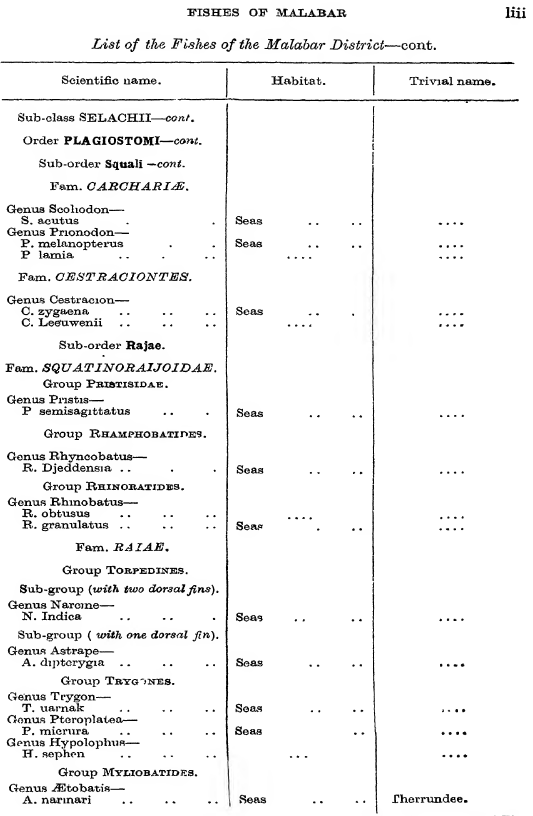
List of abbreviations of authors' names
IV.—Birds
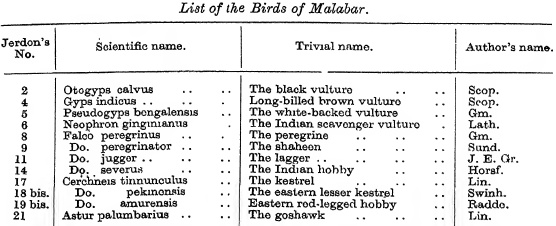
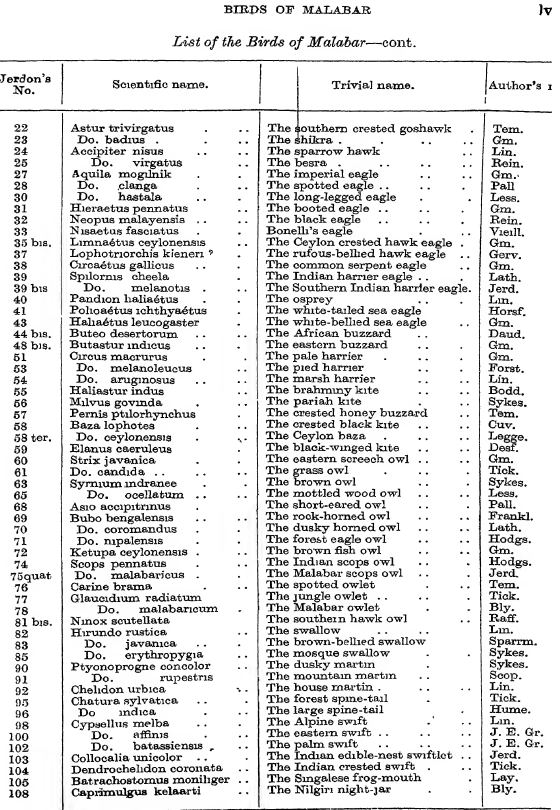
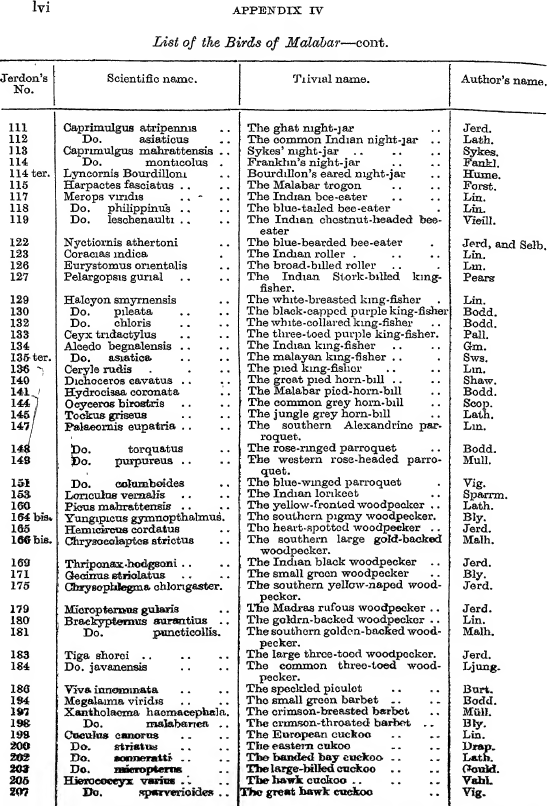
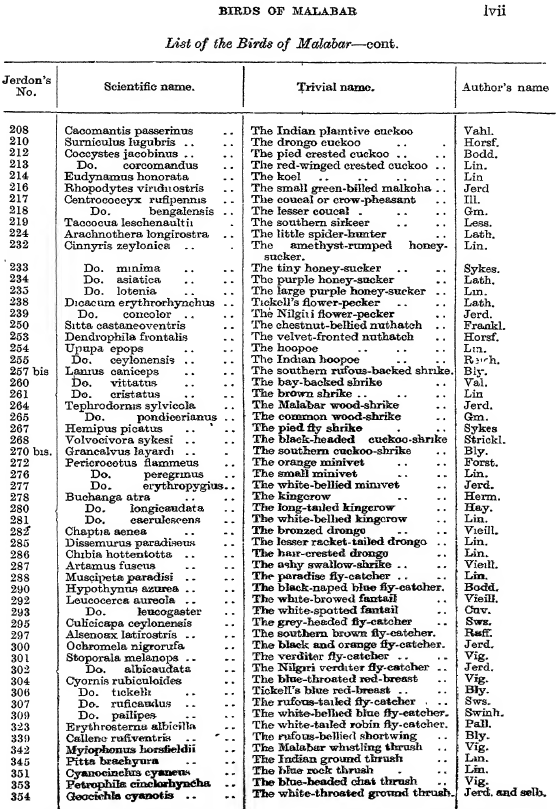
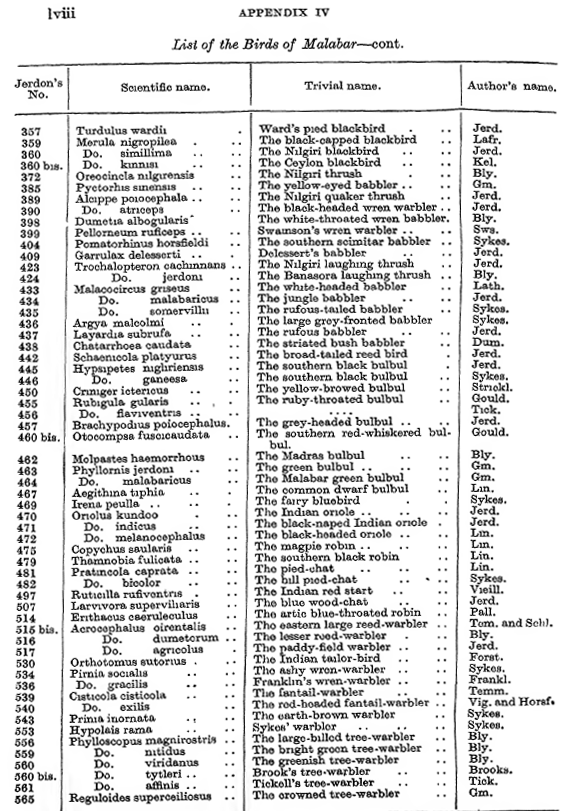
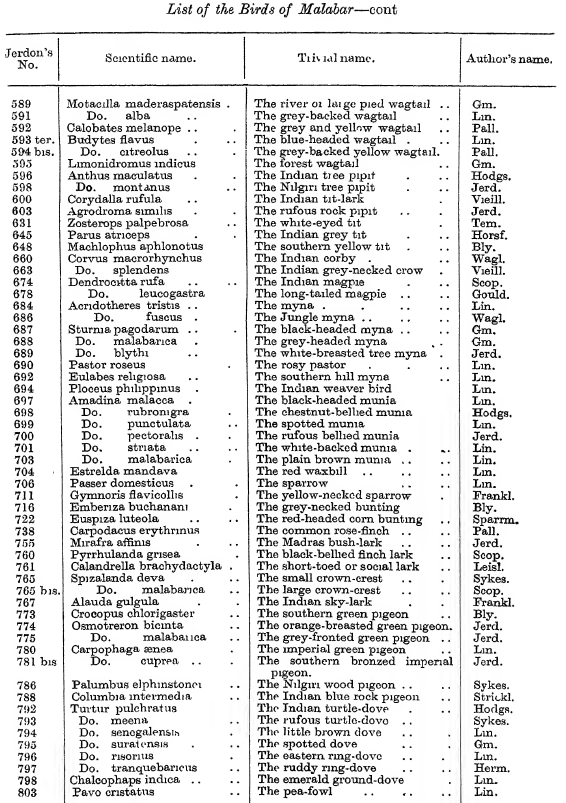
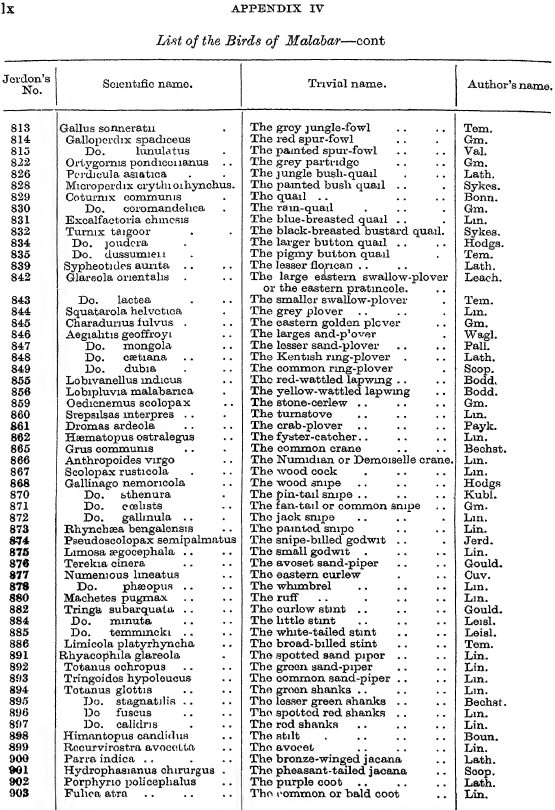
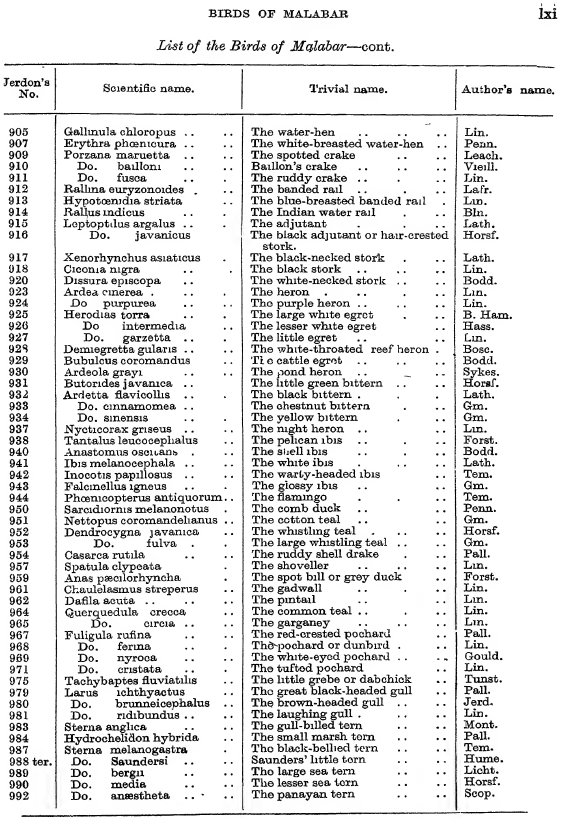
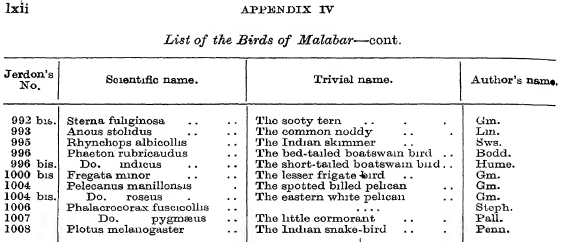
V. — Butterflies
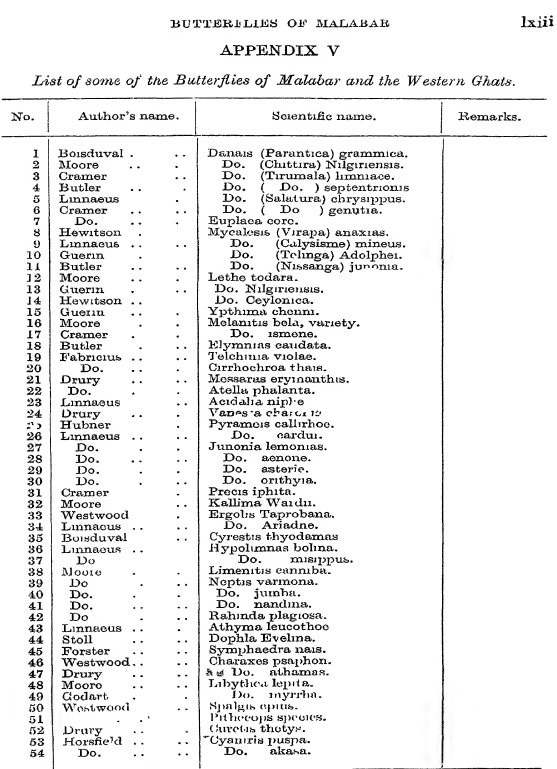
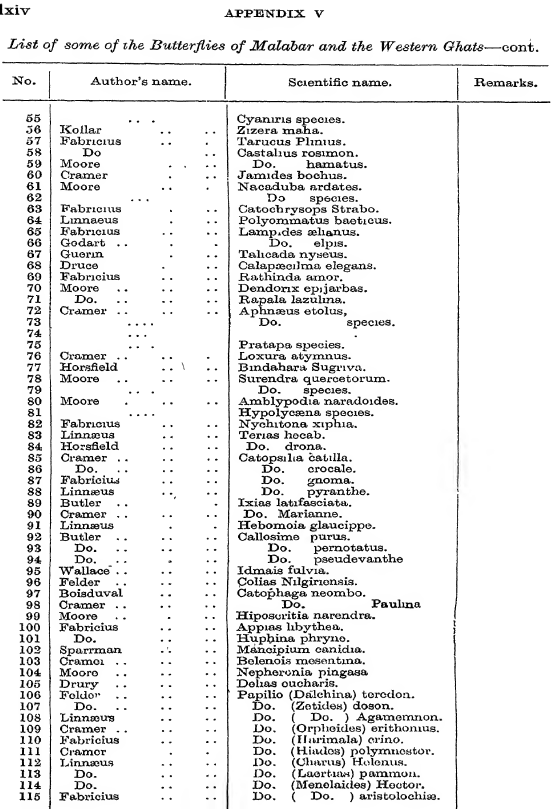
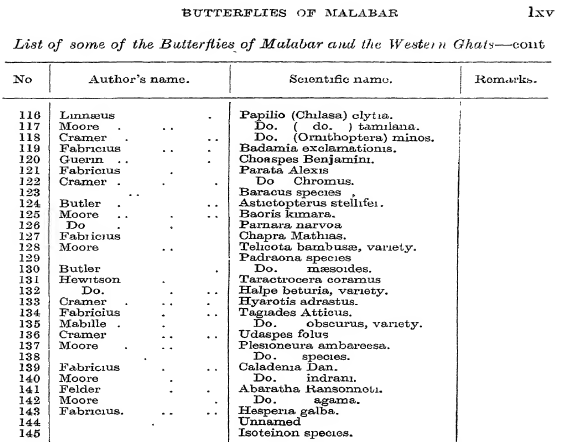
VI.—Timber Trees
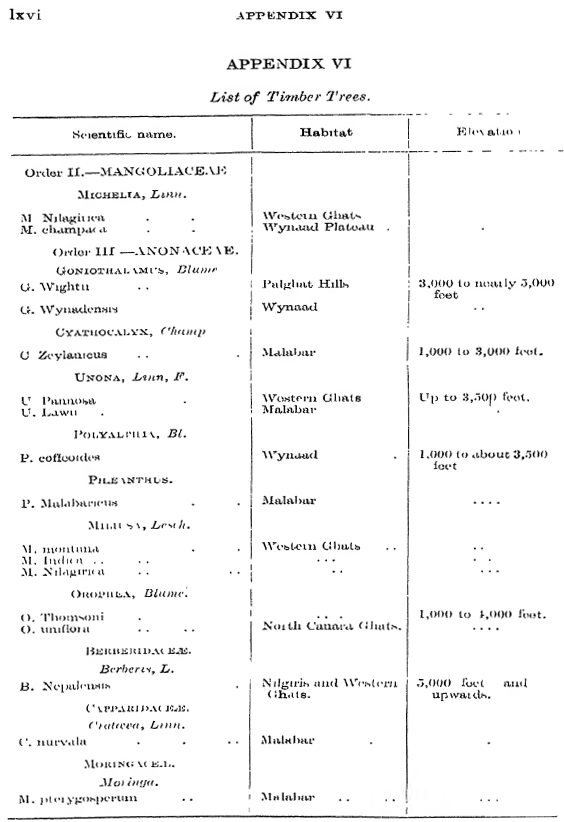
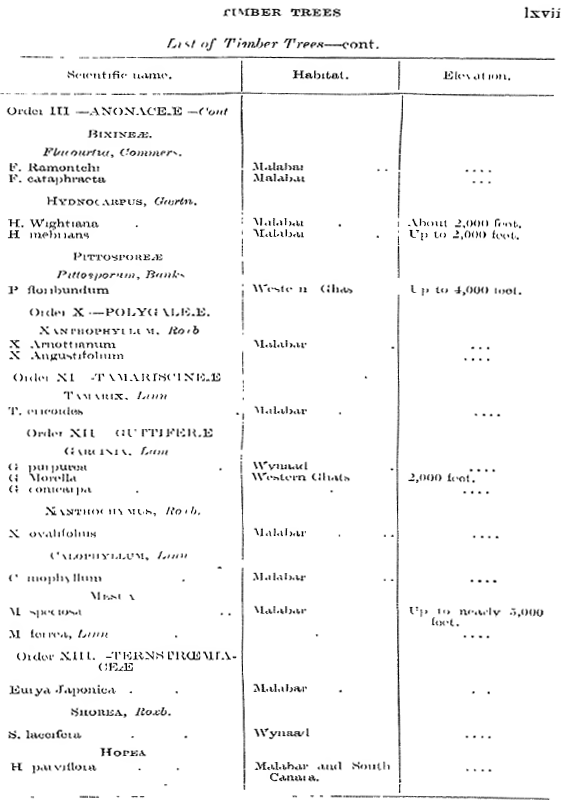
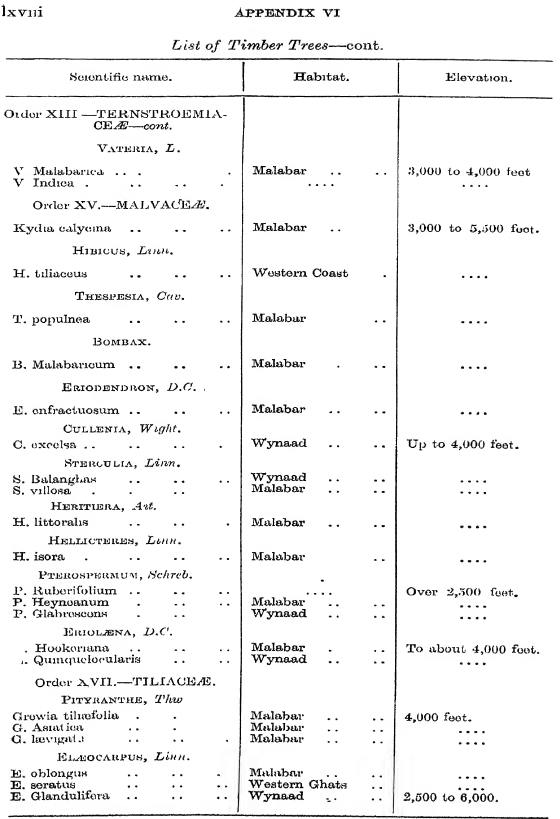
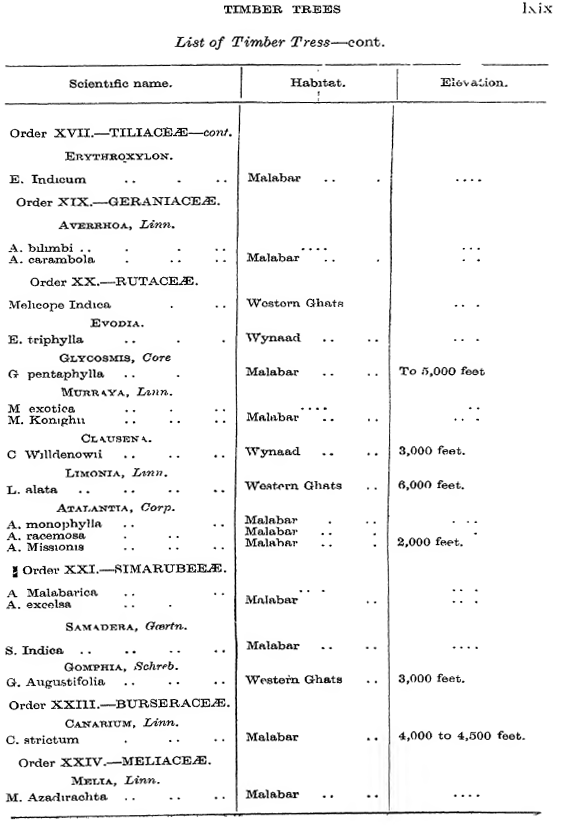
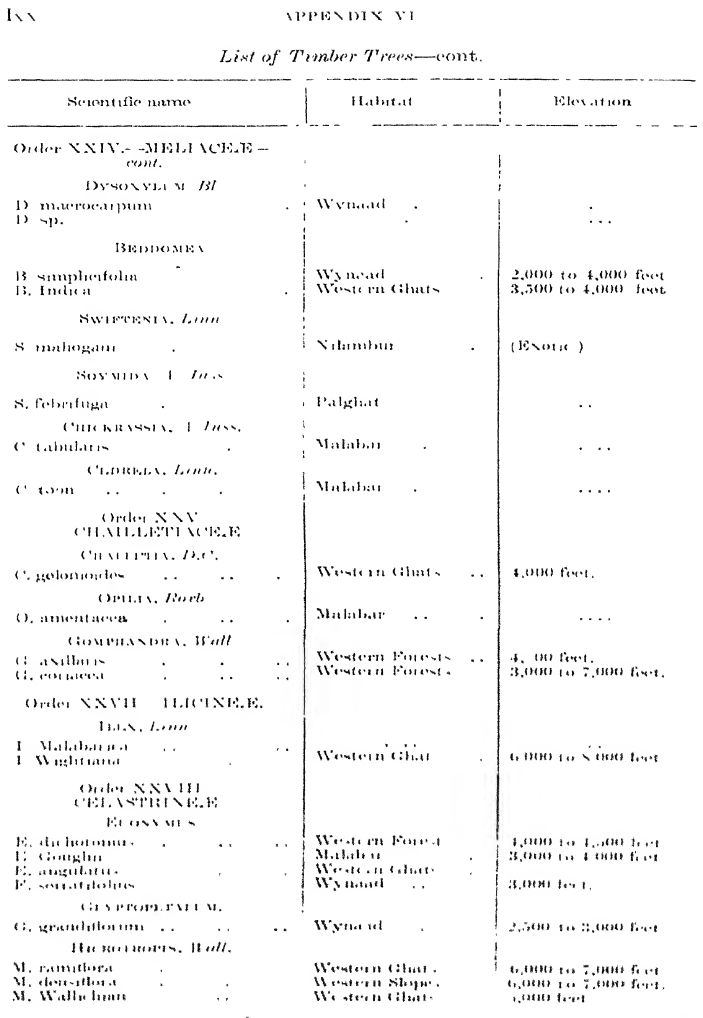
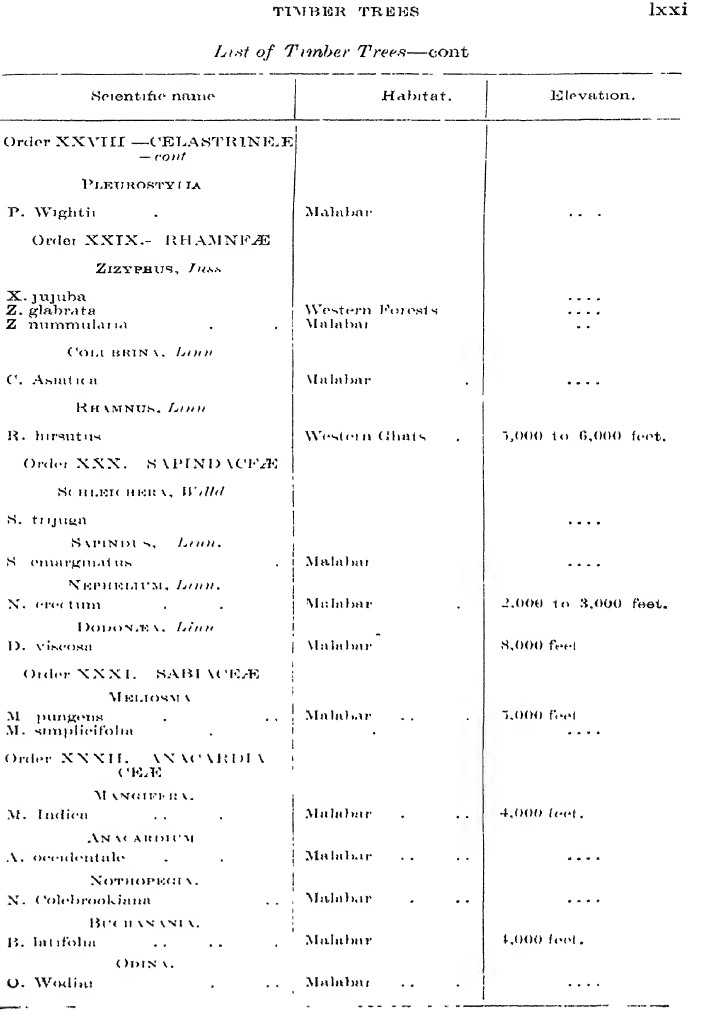
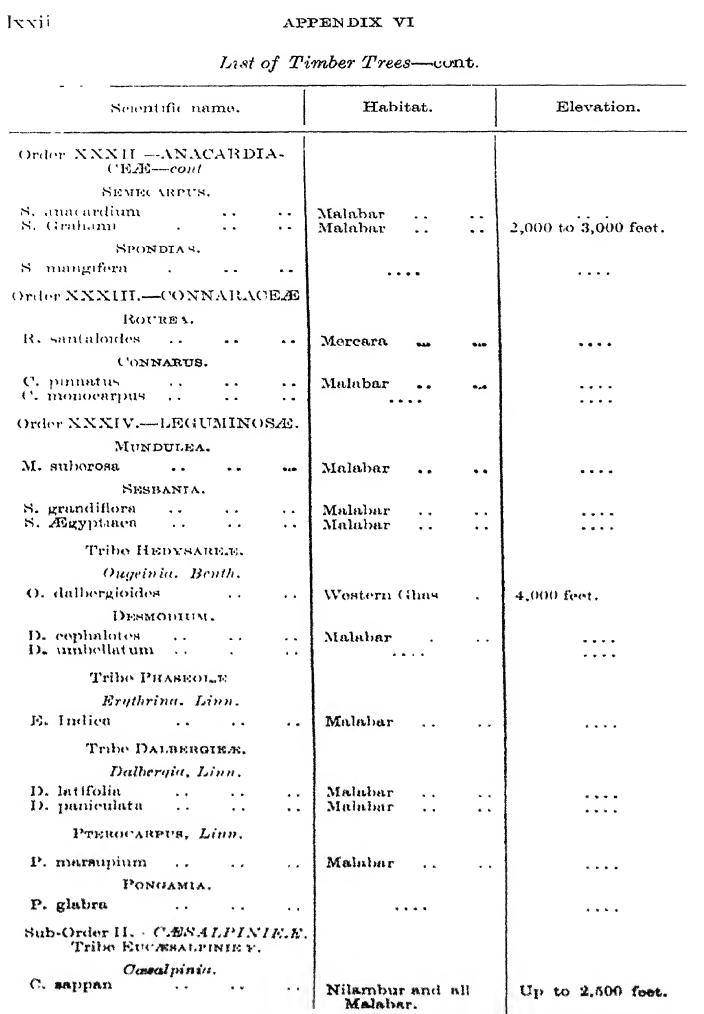
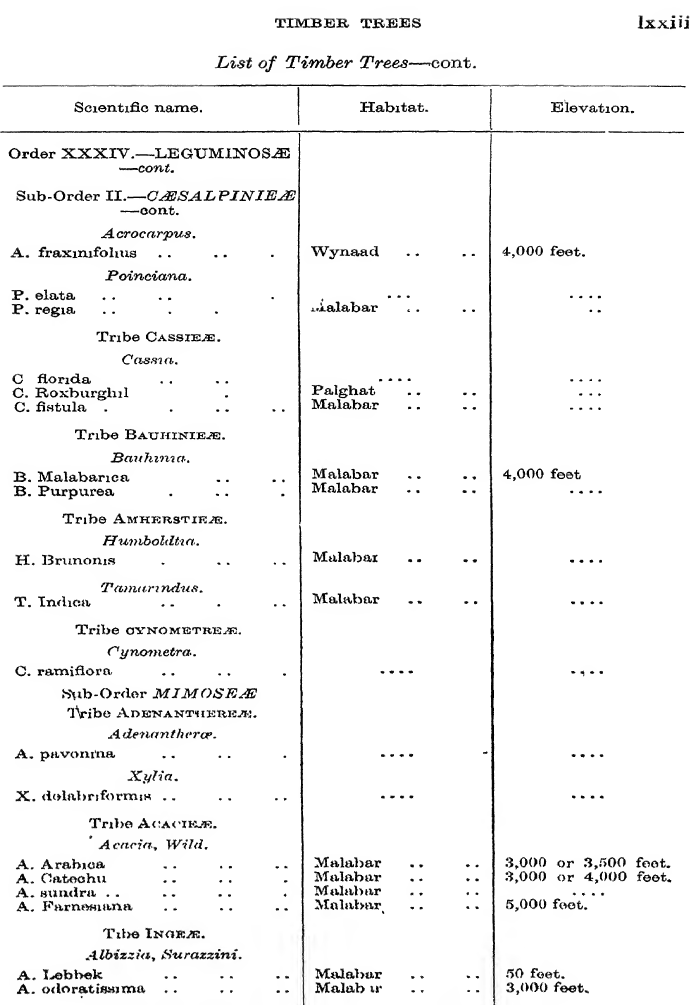
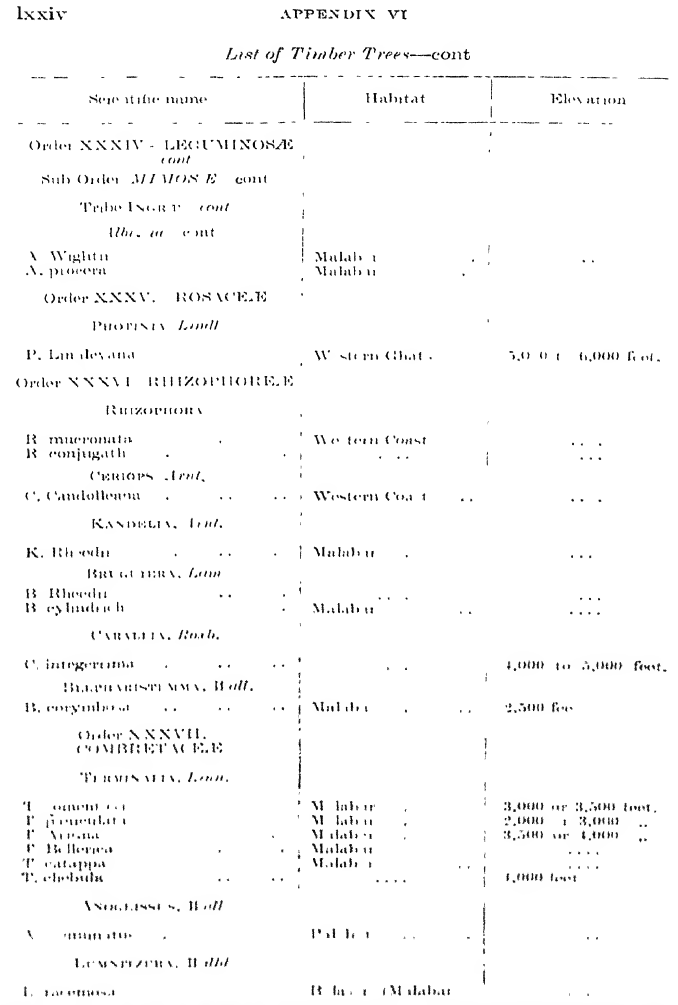
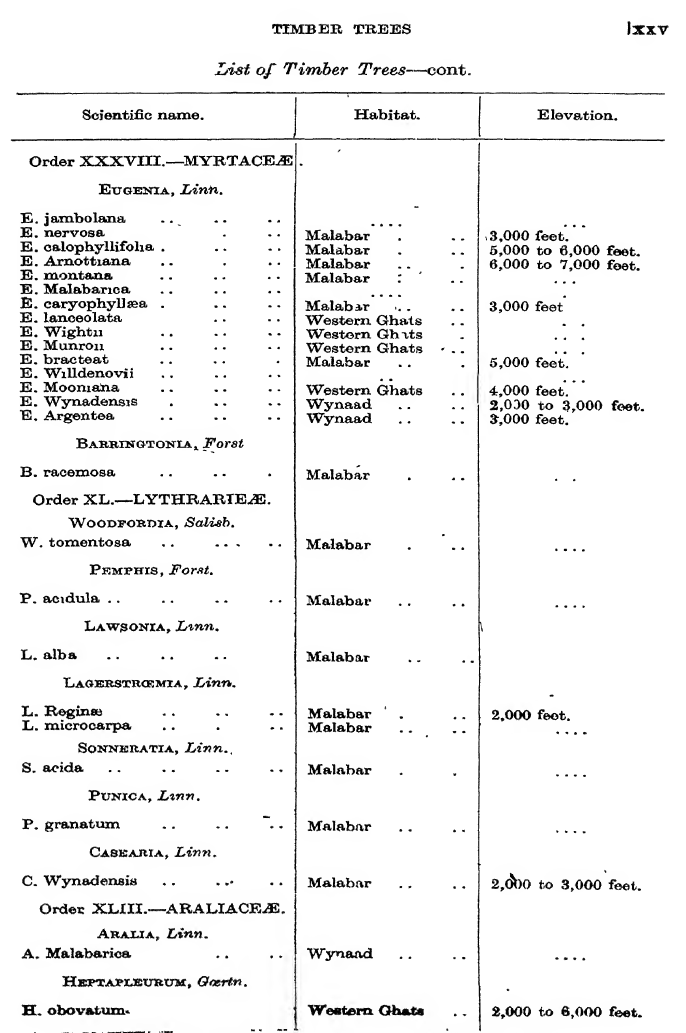
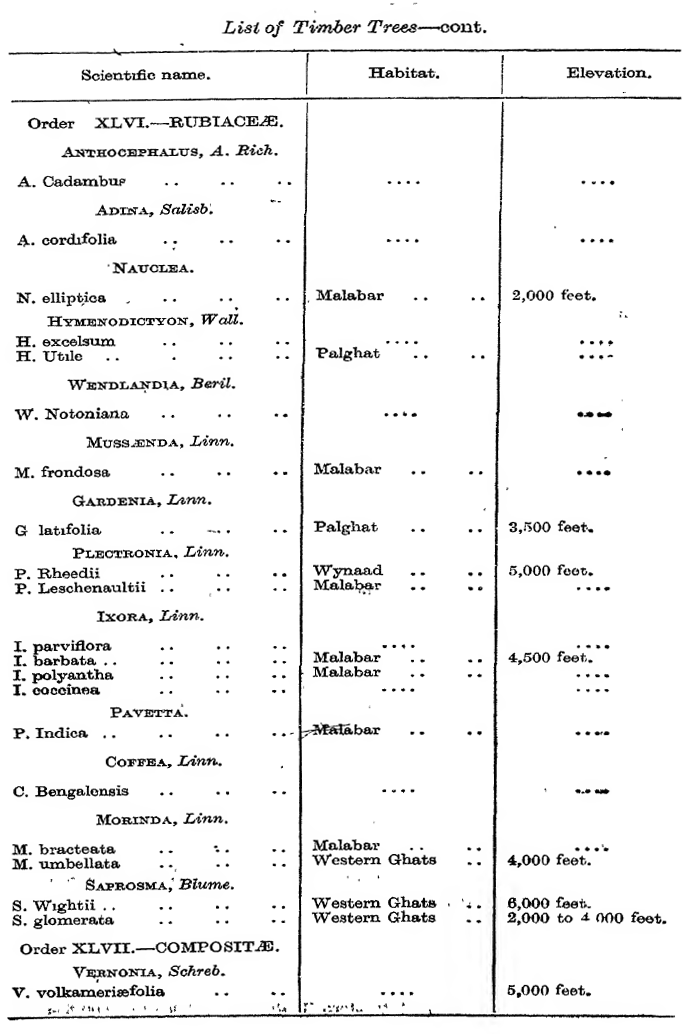
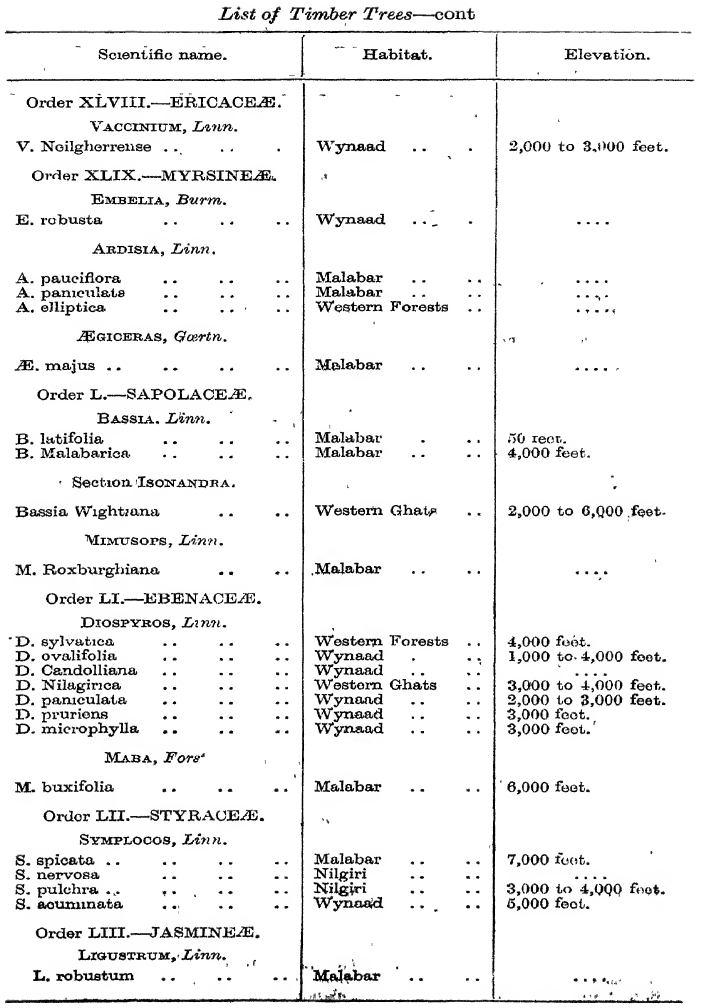
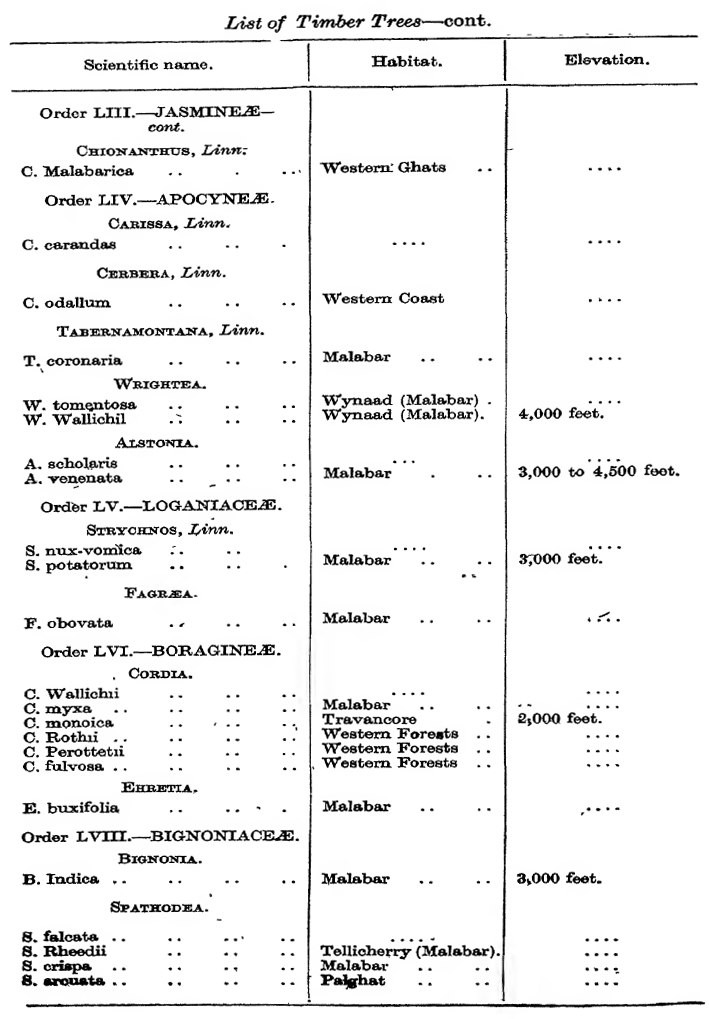
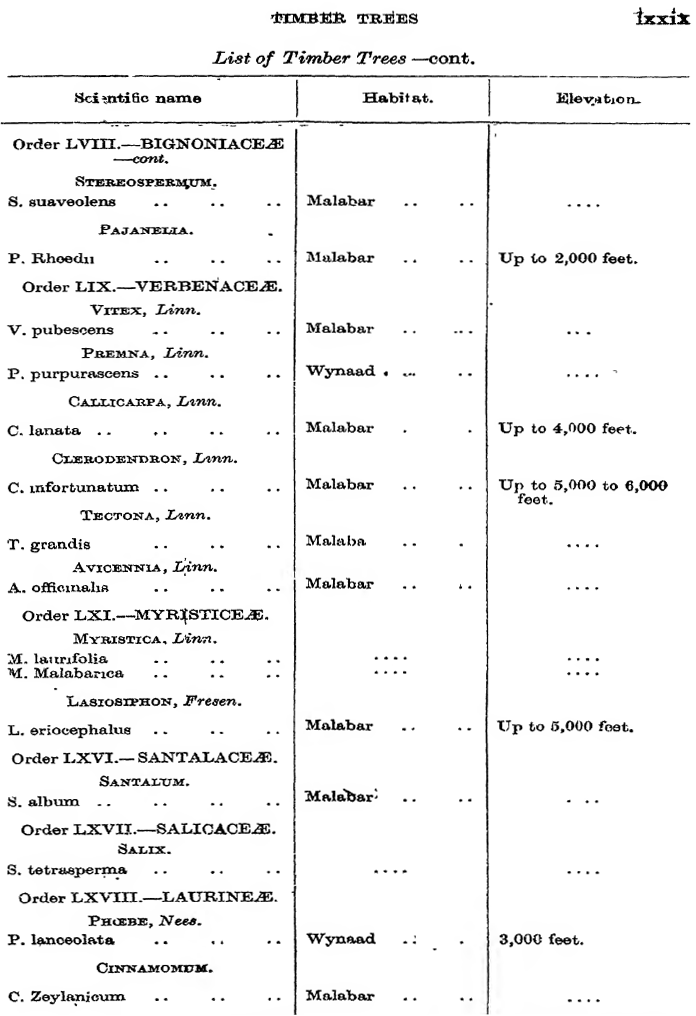
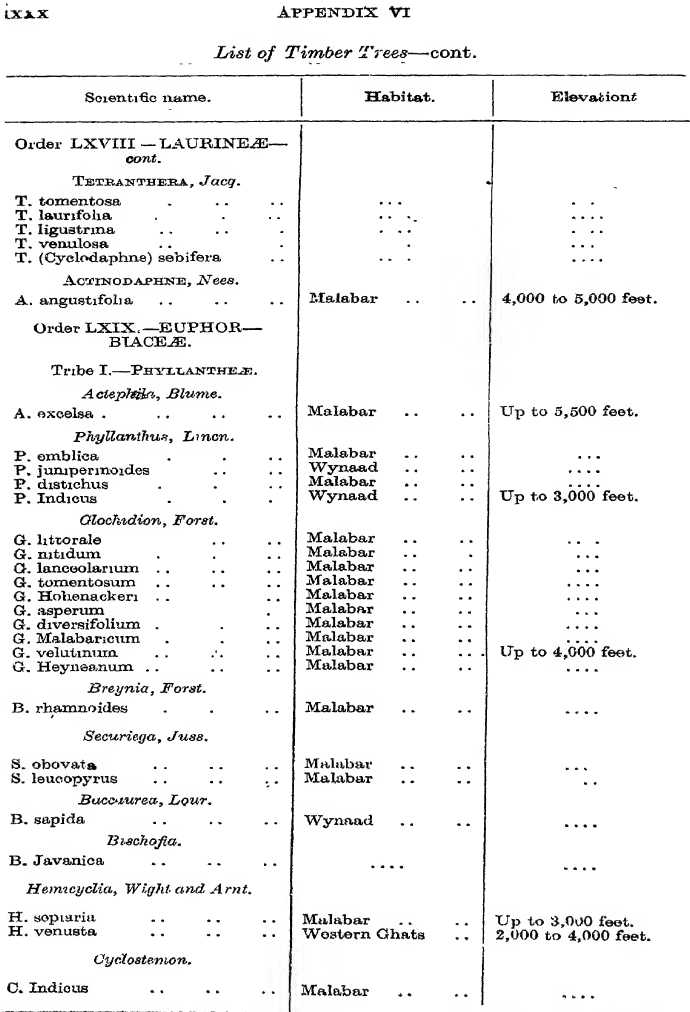
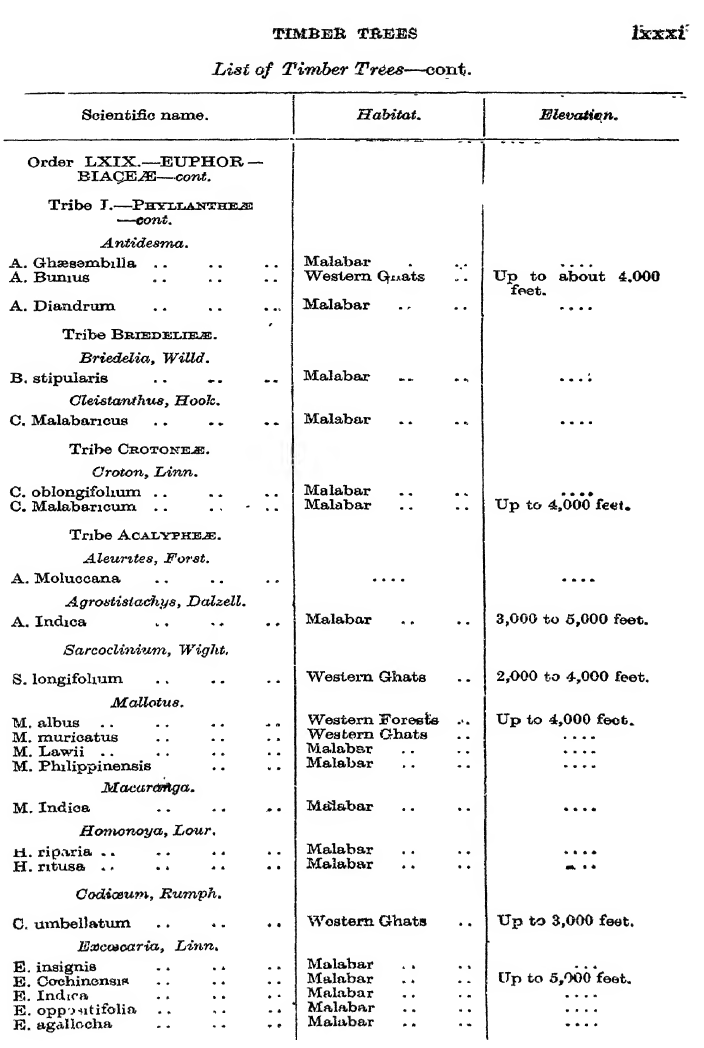
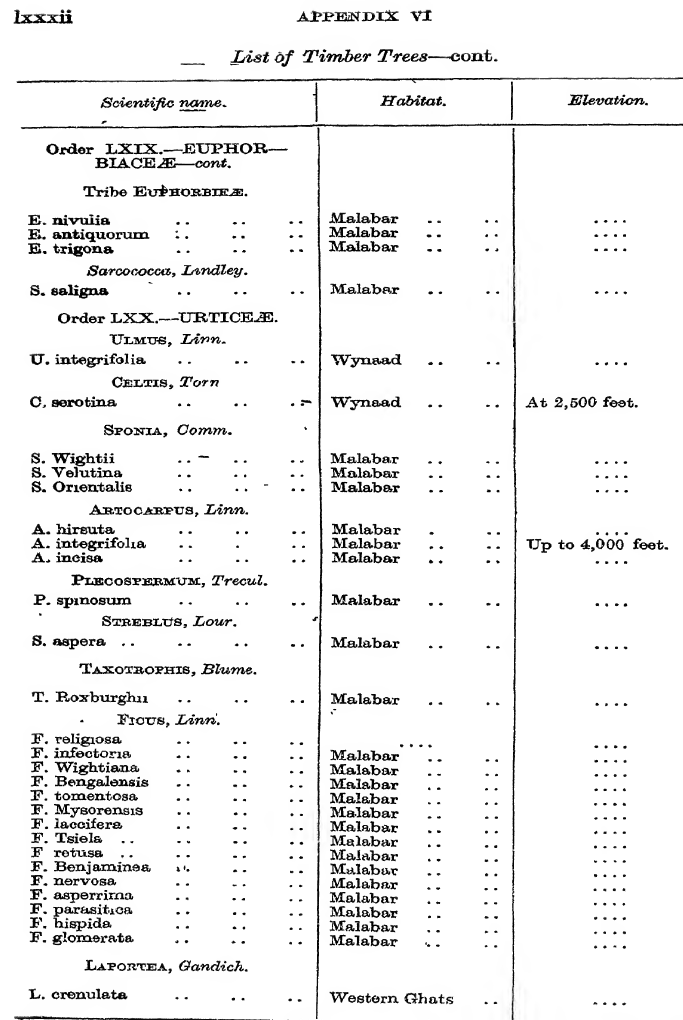
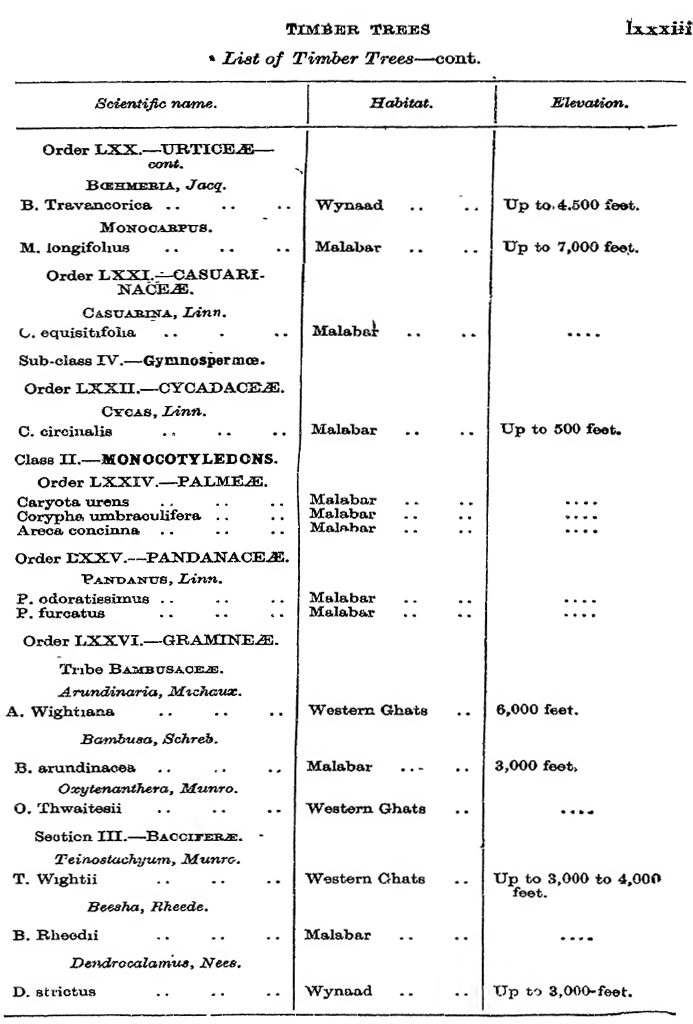
VII.—Roads
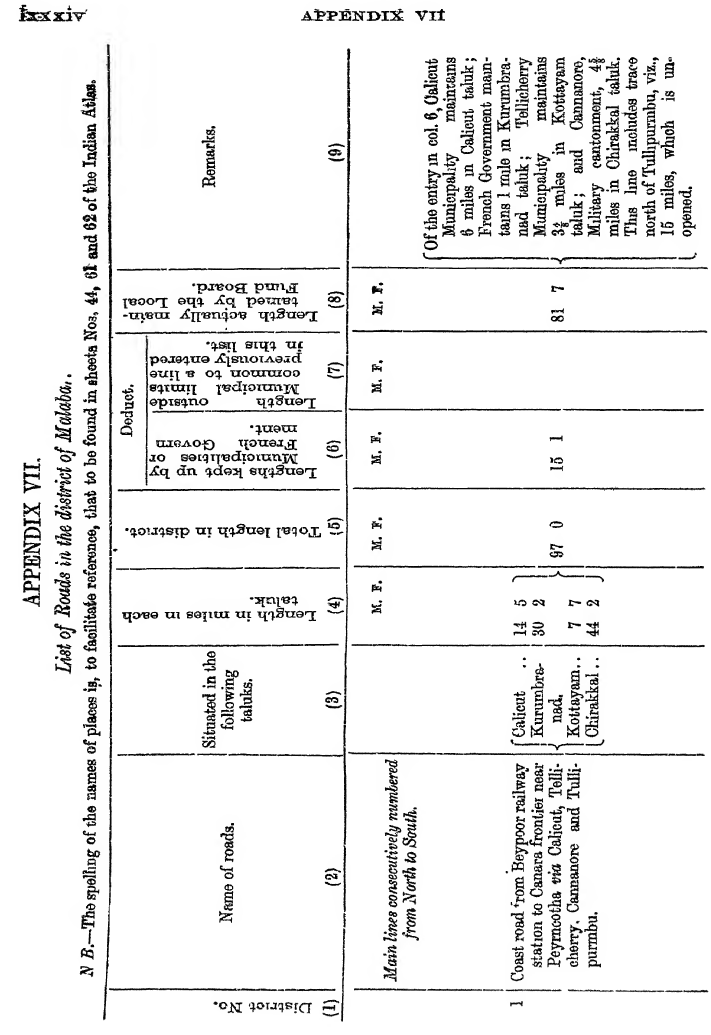
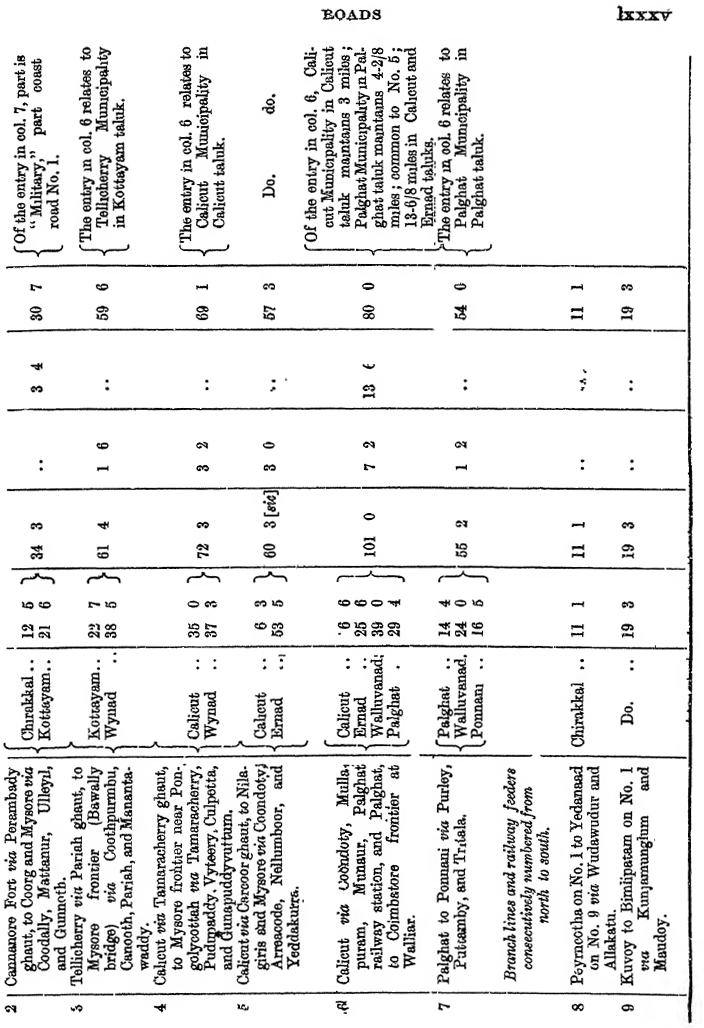
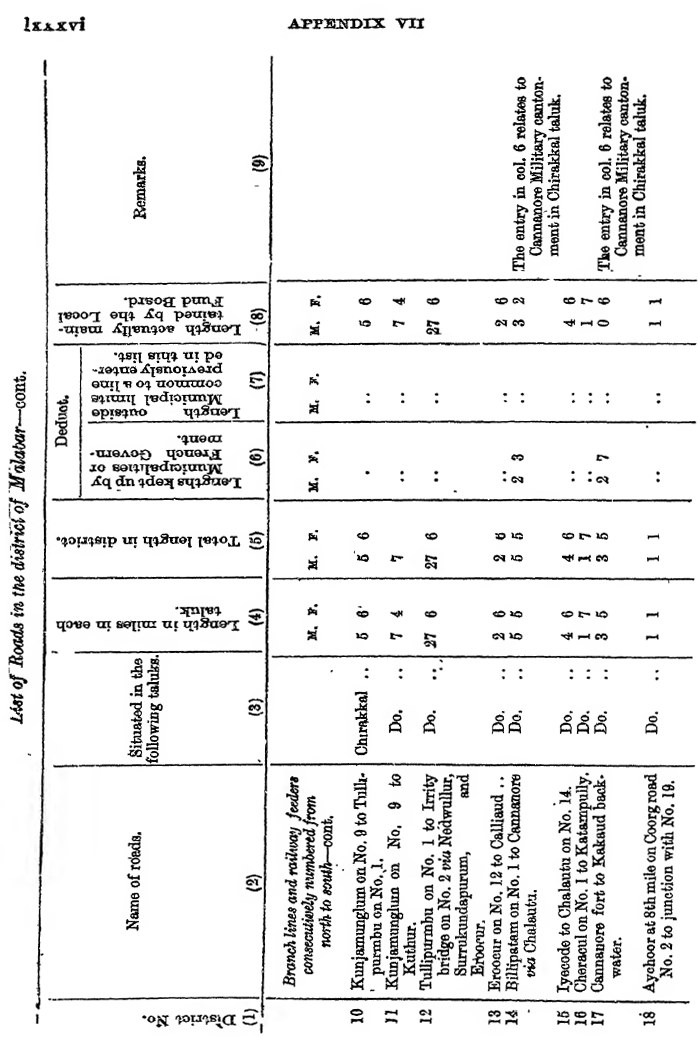
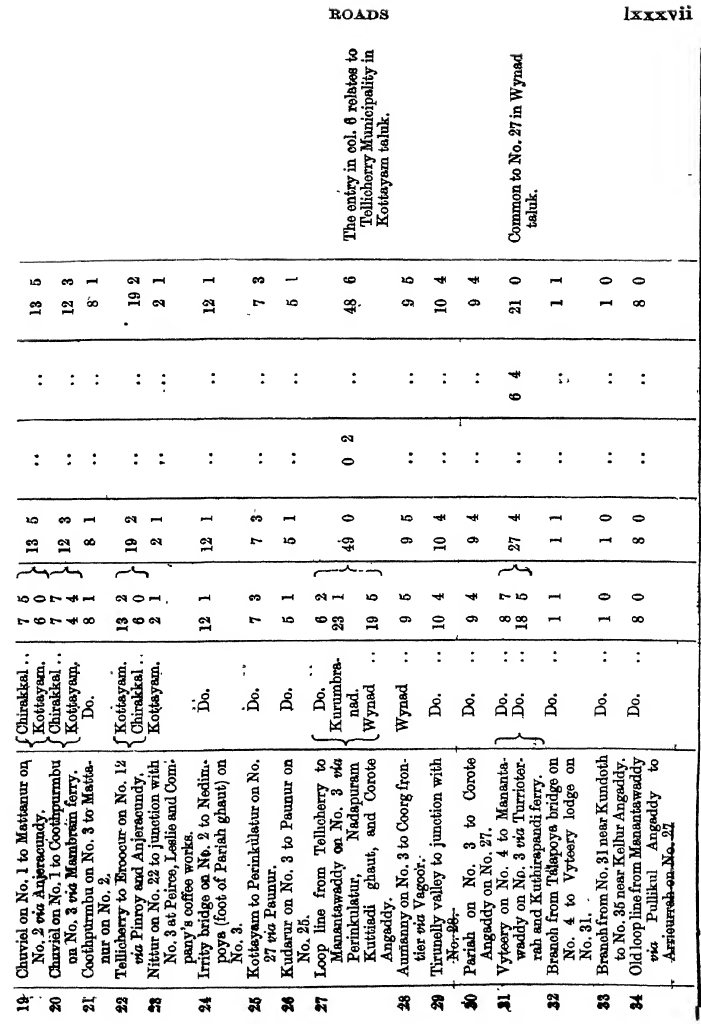
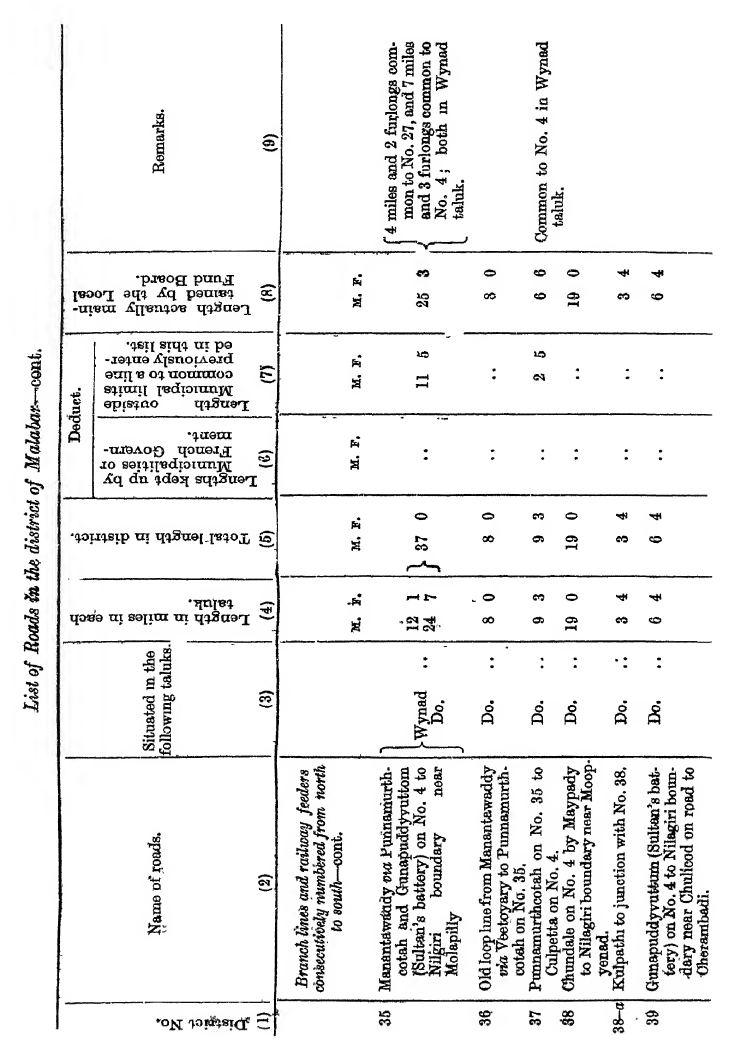
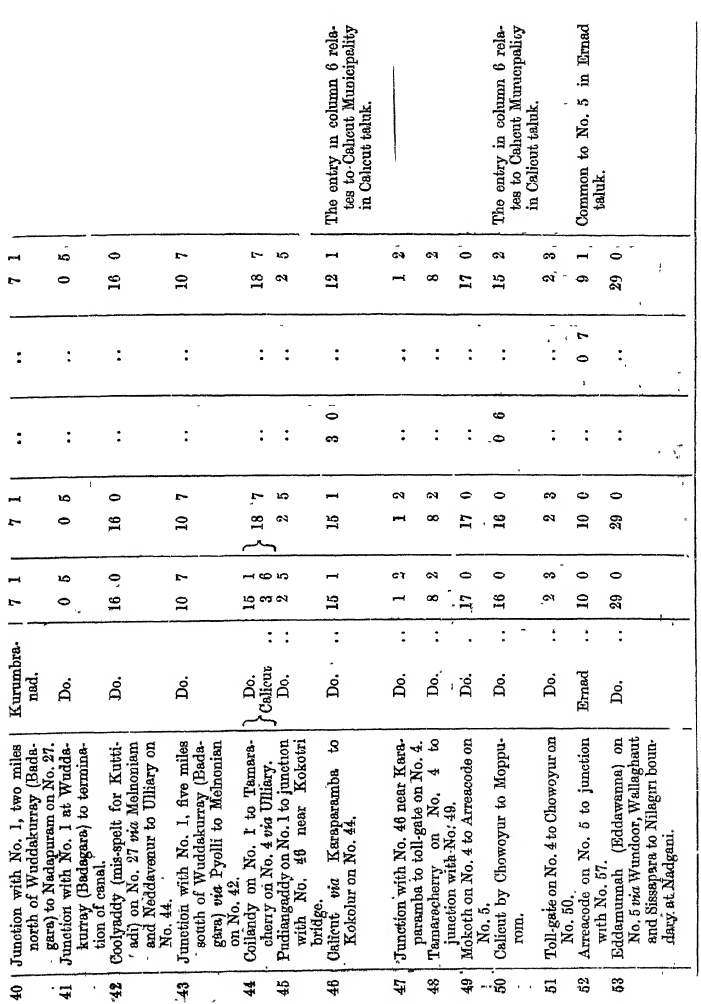
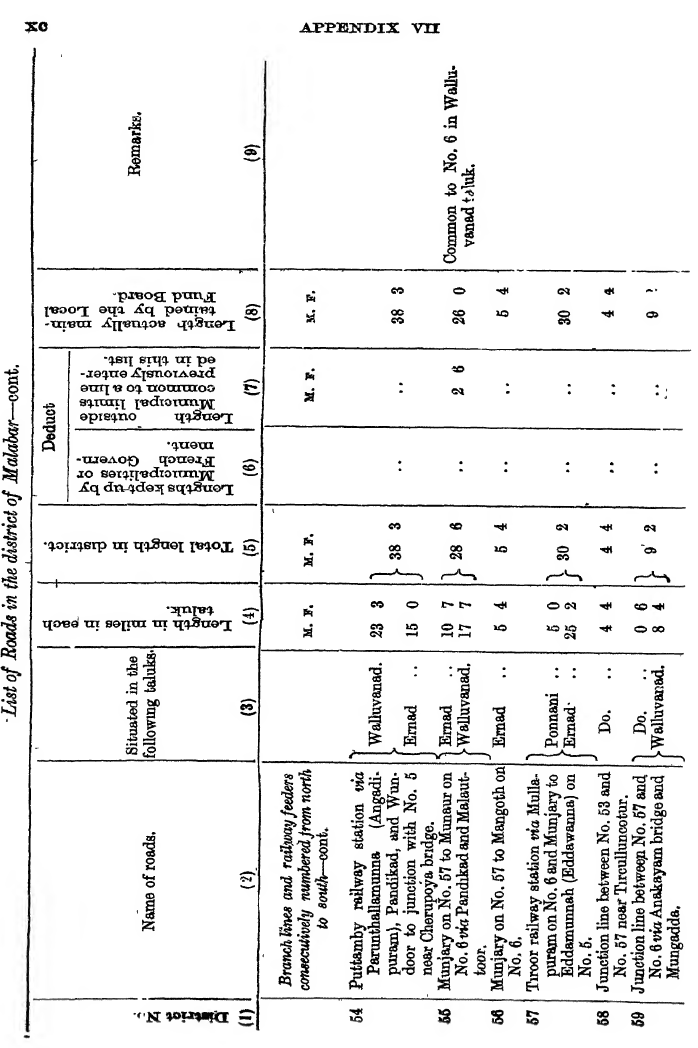
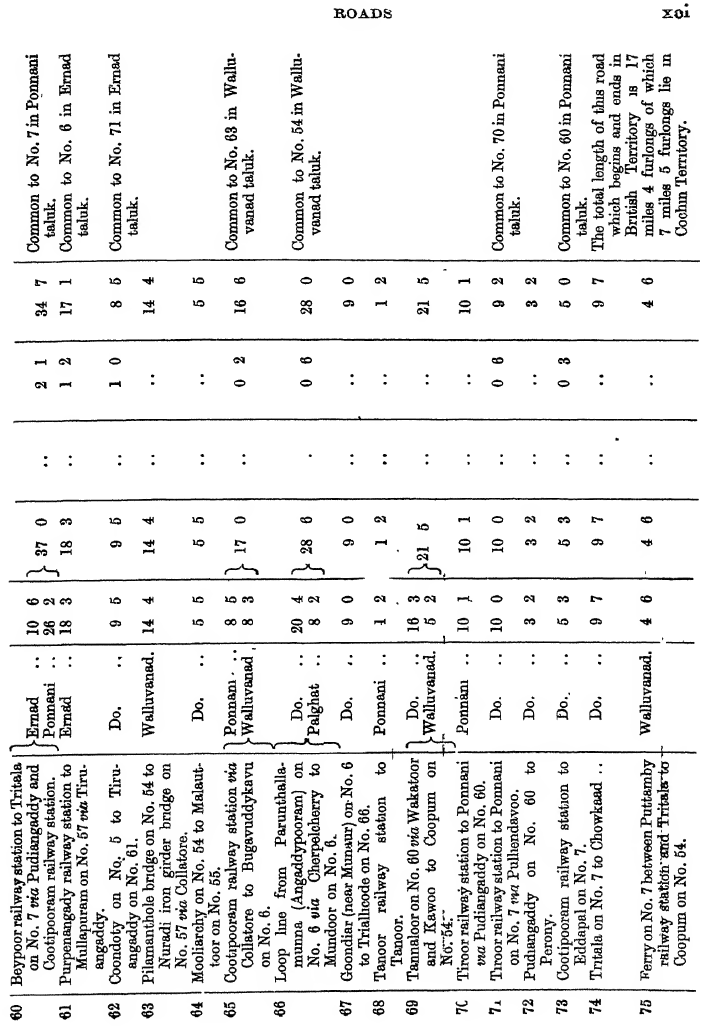
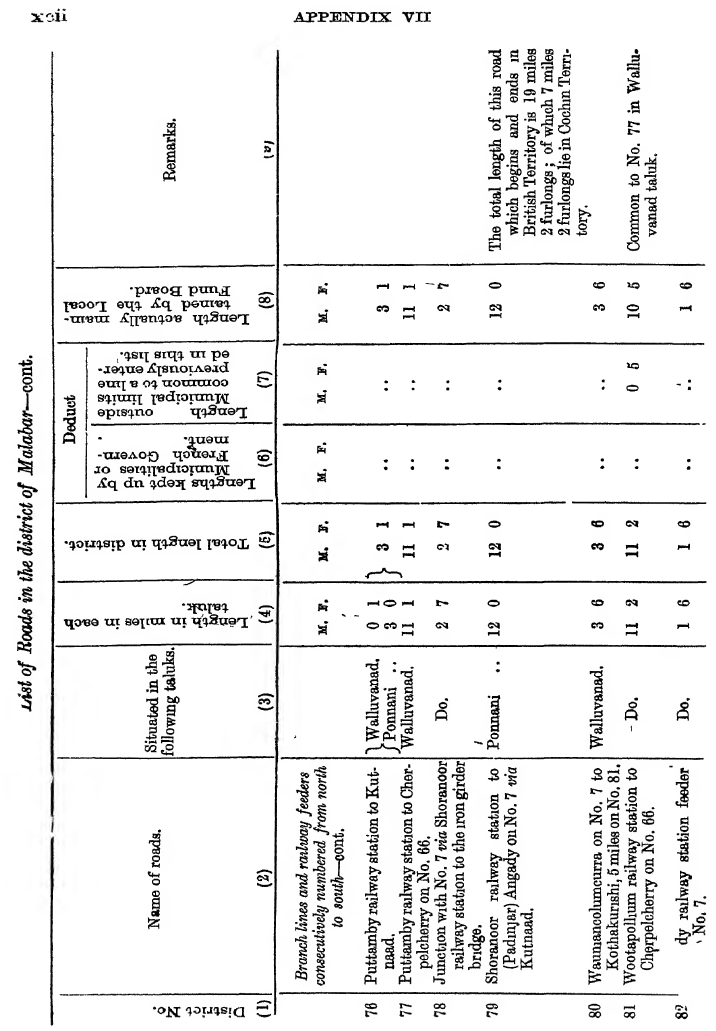
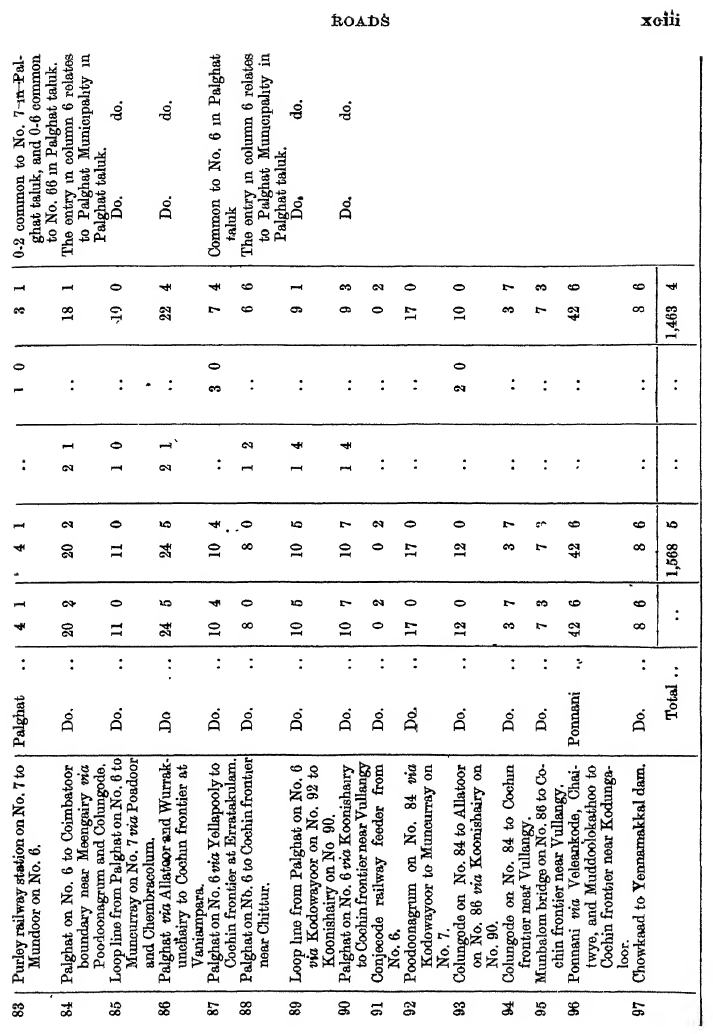
VIII.—Port Rules (Major Ports)
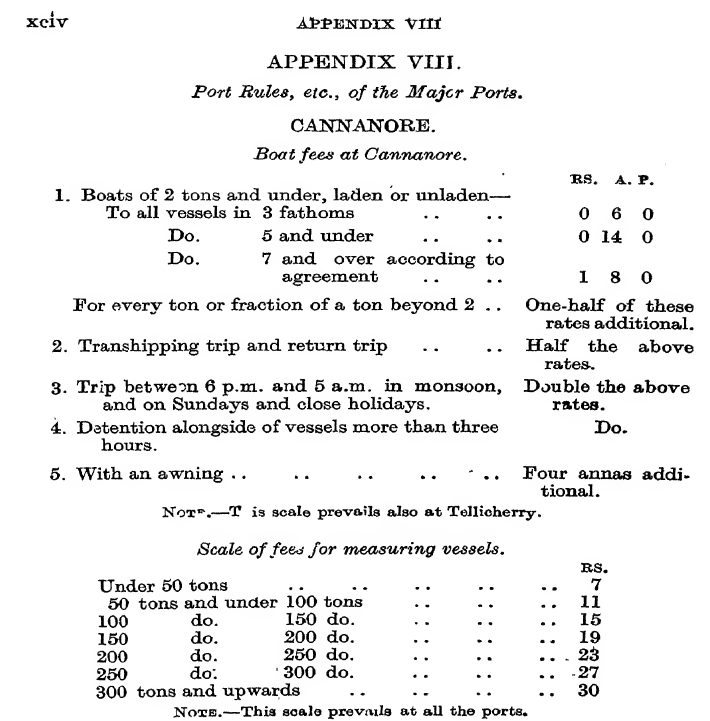
Port rules for Cannanore
Rule 1.—All vessels within the port of Cannanore shall be bound to take up such berth as may be appointed for them by the conservator, and shall change their berths or remove when required by such authority.
Runs 2.—All vessels taking in or discharging ballast, or any particular kind of cargo within the port of Cannanore, shall take up such berth as the conservator may direct.
Rule 3.—A free passage shall be kept to piers, jetties, landing places, wharves, quays, docks, and moorings , and all vessels shall be bound to move when required by the conservator to clear such passages.
Rule 4 — All vessels within the port of Cannanore, shall anchor, moor, and unmoor, when and where required by the conservator.
Rule 5.—The cargo boat rules published by Government, under date the 30th September 1867, shall be in force at the port of Cannanore.
Rule 6.— No vessels within the limits of the port of Cannanore shall boil any pitch or dammer on board, or shall draw off spirits by candle or other artificial lights.
Rule 7.— All vessels in the roadstead of Cannanore shall when at anchor between sunset and sunrise, have a good light hoisted at the starboard foreyard arm ; and all vessels under weigh at night, shall show a good light at the foreroyal or upper foremast head, and when under weigh in tow of a steamer, shall, in addition, show a light at each foreyard arm ; the steamer showing the usual light prescribed by the Admiralty Regulations.
N.B.— An infraction of rules 2 and 6 renders a commander liable to a penalty of 200 rupees, and an infraction of any of the other rules to a penalty of Rs. 100.
TELLICHERRY
The port rules for Tellicherry are the same as those in force at Cannanore, except that rule 7 runs as follows : —
Rule 7.—All vessels in the roadstead of Tellicherry whether steamships or sailing vessels, shall, when at anchor between sunset and sunrise, exhibit at the starboard foreyard arm, but at a height not exceeding 20 feet above the hull, a white light in a globular lantern of eight inches in diameter and so constructed as to show a clear, uniform, and unbroken light visible all round the horizon, and at a distance of at least one mile.
CALICUT
Rate of boat-hire at Calicut, Beypore.
1. Boats conveying 1 ton and under, laden or unladen —
|
|
Rs. |
A. |
P. |
|
To all vessels under 3 fathoms |
0 |
6 |
0 |
|
Do. in 3 and under 6 fathoms |
0 |
14 |
0 |
|
Do. in 5 and under 7 fathoms |
1 |
8 |
0 |
In and beyond 7 fathoms, the rate to be at the option of parties contracting.
|
For every quarter ton over one ton |
One quarter of the above rates additional. |
|
2. Transhipping trip and return trip |
Half the above rates. |
|
3. Trip between 6 p.m. and 5 a.m. in monsoon, and on Sundays and close holidays. |
Double the above rates. |
|
4. Detention alongside of vessels more than three hours. |
Do. |
|
5. With an awning |
Four annas additional. |
The port rules at Calicut are the same as at Cannanore, except that rules 5 and 7 run as follows : —
Rule 5.—The cargo boat rules published by Government, under date the 23rd April 1847, shall be in force at the port of Calicut,
Rule 7.—All vessels in the roadstead of Calicut, whether steamships or sailing vessels, shall, when at anchor between sunset and sunrise, exhibit at the starboard foreyard arm, but at a height not exceeding 20 feet above the hull, a white light in a globular lantern of eight inches in diameter and so constructed as to show a clear, uniform, and unbroken light visible all round the horizon, and at a distance of at least one mile.
BEYPORE
The port rules for Beypore are similar to those in force at Cannanore1, except in regard to the following : —
NOTEs: 1. Rules 1, 4, 6, 8 and 9 are identical with rules 1, 2, 4, 5 and 6 respectively of those in force at Cannanore. END OF NOTEs
RULE 2.—All vessels within the entrance of the backwater shall, if required by the conservator, rig in their jib and driver-booms, and strike their masts and yards.
RULE 3.—All vessels within the entrance of the backwater shall remove any anchor or spar, or other substance projecting from her side, if required to do so by the conservator.
RULE 5.— free channel shall be kept for ships moving up and down the backwater, and also free passage to piers, jetties, landing places, wharves, quays, docks, and moorings, and all vessels shall be bound to remove, when required by the conservator, to clear such channels or passages.
RULE 7.— All vessels within the entrance of the backwater shall be moored or warped from place to place as required by the conservator, and no vessel shall cast of a warp that has been made fast to her to assist a vessel in mooring without being required to do so by the conservator or officer-in-charge of the vessel mooring
RULE 10.—Every vessel, whether a steamer or a sailing vessel, when riding at anchor, shall exhibit, where it can best be seen, but at a height not exceeding 20 feet above the hull, a white light in a globular lantern of eight inches in diameter, and so constructed as to show a clear, uniform and unbroken light visible all round the horizon, and at a distance of at least one mile. An infraction of any of the above rules renders a commander liable to a penalty of 100 rupees under section 9 of Act XXII of 1855.
COCHIN
Instructions to commanders of vessels entering the port of Cochin.
SIR,—I am desired by the Master Attendant, Administrative Department, at Madras, to request that you will, without delay, fill up the accompanying report and return it by the bearer, the hour of whose departure from your vessel should be noted on the report.
2. Your immediate and most particular attention is requested to the imperative necessity of your entering in the report herewith forwarded the state of health of your crew and passengers, and whether any infectious and malignant or other disease has appeared on board during the voyage. In the event of any such sickness having occurred, you are hereby ordered and directed to prevent all communication with other vessels in the roads or with the shore, until the Port and Marine Surgeon shall have duly reported such intercourse to be free from objection. If sickness has appeared and still prevails, you are required to hoist the flag R of the Commercial Code by day, or two lighted lanterns one over the other at the fore by night. On either of these signals being hoisted, the commander or other person in charge of such vessel shall consider himself in quarantine. No dead bodies are to be thrown overboard in the roadstead.
NOTE — No boats to be allowed alongside until the ensign is hosted at some mast-head in token that the Commander accepts the responsibility of the proceeding caution.
3. Your attention is particularly directed to the following rules.
4. The best anchorage in the roads is with the following bearings : — Flagstaff E.½ N. to E. N. E. in 5½ to 6½ fathoms, soft ground, about 2 to 2½ miles off shore.
5. All post office-packets and letters are to be delivered to the post office peon who is sent for them.
6. Commanders are requested to fill up and return the accompanying paper relating to the port light, and the Master Attendant, Administrative Department, at Madras, invites them to forward to him any observations they may wish to offer regarding this or any other light along the coast which they may have passed.
7. Commanders are required to report themselves in person on landing at the Master Attendant’s office, and to bring with them the ship’s register, with two lists of the officers, ship’s company and passengers, and no vessel will be admitted to entry at the customhouse without producing a certificate from the Master Attendant that the provisions of this article have been complied with. In the case of certain vessels arriving in port to load part cargo for foreign ports, although the goods to be exported in them may be afloat, commanders must come on shore immediately after anchoring for the purpose of entering their vessels at the marine and customs offices, and if any of the export cargo afloat is taken on board before permission is obtained by signal from the flagstaff, they will be liable to a penalty of 1,000 rupees under sections 61 and 136 of the Sea Customs Act of 1878.
8 Commanders are also required, previous to clearing out, to deliver to the Master Attendant two lists of the officers, crew, and passengers proceeding by the vessel, together with notification of all casualties which may have occurred during her stay in port, whether by death, discharge, or desertion. No vessel will be granted port clearance until the production of a certificate from the Master Attendant that the port rules have been complied with
9. Commanders requiring a pilot to enter the inner harbour are to hoist the union jack at the foreroyal mast-head. Applications for pilots inwards and outwards are to be made to the Master Attendant in writing.
10. No cargo is to be landed in ship’s boats under a penalty of 50 rupees and confiscation of the boat.
11. No ballast is to be thrown overboard in less than 9 fathoms ; nor is any to be discharged on the beach, or elsewhere, from which it would be liable to be washed into the port. The penalty for infringing this rule is 500 rupees.
12. Commanders of vessels having more than 50 lb. of gunpowder or other combustibles on board are, under a penalty of 200 rupees for default, to report the same to the conservator, who will arrange, if necessary, for landing and storing the excess.
13. When the surf is so high as to render communication with the shore dangerous, a red and white chequered flag will be hoisted at the Master Attendant's flagstaff. When the surf is impassable the first distinguishing pendant will be displayed under that flag.
14. Should a boat be urgently required during the night, three lights should be hoisted horizontally, and in case of danger from fire or other causes, blue lights should be burnt and guns fired.
15. No boats are to be detained alongside after 6 p.m. The detention of a boat during the day for more than three hours will entail double hire. Commanders and officers are particularly requested to abstain from ill-using boatmen or other natives. All complaints will be promptly inquired into.
16. In the event of boisterous weather having been experienced, commanders are requested to report the same to the Master Attendant for the information of the Marine Superintendent, forwarding, if likely to be useful copy of the log detailing the circumstances.
17. No vessel of 200 tons and upwards is to be moved in the inner harbour without having a pilot or the conservator on board ; and no vessel exceeding 100 tons and less than 200 tons is to be moved without a pilot, except under the authority of the conservator, under penalty in each case of 100 rupees.
18. All vessels in the inner harbour shall have their jib and driver booms rigged in, and their yards and top masts struck, unless otherwise permitted by the conservator. All projections from the ship's side must be removed.
19. All vessels moored in the stream shall keep a clear hawse.
20. No vessel anchored between the buoys and inner harbour shall have lights exhibited aloft or above the deck.
21. No warps are to be made fast to the fairway buoys.
22. A free passage of half a cable's length or 120 yards shall be kept between the wharves, jetties, landing places, and dockyards, and the position of the vessels moored in the inner harbour.
23. The Madras Ports Acts can be seen at the Master Attendant's office, and copies of them can be had at six annas each.
24. Schedules of the boat hire, pilot, and other charges of the port are hereto annexed.
Note.—Similar instructions to the above are sent to commanders of vessels entering the other ports of the district. END OF NOTE
SCHEDULE A
Boat-hire to the outer roads
|
|
Rs. |
A |
P |
|
Boats carrying 6 large pipes of oil, or 7 small pipes or 12 puncheons or 20 hogsheads. |
2 |
8 |
0 |
|
Boats carrying 50 bales yarn or fibre, or 50 cases of coffee or 12 bales hides. |
3 |
0 |
0 |
|
Boats carrying 100 bags rice, coffee, pepper, etc. |
3 |
12 |
0 |
|
Boats carrying 100 cwt. coir yarn in dholls or ballasts, or 100 cwt. coir rope. |
3 |
8 |
0 |
|
One cargo boat measuring not less than 8 tons, carrying general cargo or ballast or passengers. |
3 |
8 |
0 |
|
One cargo boat measuring less than 8 tons and above 3 tons carrying general cargo or ballast or passengers. |
2 |
8 |
0 |
|
Return trip, loaded from same vessel—Half the above rates |
|
|
|
|
Return trip, loaded from another vessel—Three quarters of the above rates. |
|
|
|
|
Transhipping from one vessel to another |
2 |
0 |
0 |
|
Ordinary trip, passenger or Quilon boat, to or from the roads. |
1 |
8 |
0 |
|
Return trip, passenger or Quilon boat |
0 |
12 |
0 |
Boats carrying more than the above quantities of specified cargo, to be paid proportionately for the excess.
Double the above rates in foul weather, in going to and from vessel in and beyond 7 fathoms and at night.
Boat hire in the inner harbour
|
For 1 boat load of cargo to or from a vessel |
2.0.0 |
|
Return trip from same vessel—Half the above rates |
|
|
Do. another vessel—Three quarters the above rates. |
|
|
Passenger or Quilon boat to or from a vessel. |
0.2.0 |
In cases of extraordinary service, as proceeding to a vessel beyond the limits of the port, or rendering aid to a vessel in distress under circumstances of peril, etc., the Master Attendant shall adjudge to be paid such additional hire as the service may seem to warrant, reporting the same for the confirmation of the Collector.
SCHEDULE B
I. For every vessel of any burden exceeding 100 tons, but not exceeding 200 tons-
|
|
Per ton |
||
|
|
Rs. |
A |
P |
|
a) Drawing 4 feet and over 3 feet of water |
0 |
10 |
0 |
|
(b) Do. 5 do. 4 do. |
0 |
11 |
0 |
|
(c) Do. 6 do. 5 do. |
0 |
13 |
0 |
|
(d) Do. 7 do. 6 do. |
0 |
15 |
0 |
|
(e) Do. 8 do. 7 do. |
1 |
4 |
0 |
|
(f) Do. 9 do. 8 do. |
1 |
9 |
0 |
|
(g) Drawing 10 feet and over 9 feet of water |
1 |
14 |
0 |
|
(h) Do. 11 do. 10 do |
2 |
8 |
0 |
|
(i) Do. 12 do. 11 do |
3 |
2 |
0 |
|
(j) Do. 13 do. 12 do |
3 |
12 |
0 |
(The draft of water will be calculated upon a whole foot, e.g , a vessel drawing 3½ feet will be charged at 4 feet or Rs. 2—8~0 ; and one drawing less than at 3½ at 3 feet or Rs. 1-4-0.)
|
(a) For every vessel whose burden exceeds 200 tons, but does not exceed 400 tons |
30 |
|
(6) For every vessel whose burden exceeds 400 tons, but does not exceed 600 tons |
40 |
|
(c) For every vessel whose burden exceeds 600 tons |
60 |
SCHEDULE C
|
|
Rs. |
A |
P |
|
For the use of the anchor boat from 8 a m. to sunset per diem. |
20 |
0 |
0 |
|
For the use of a hawser (besides making good any injury it may sustain per diem) |
5 |
0 |
0 |
|
Transporting a vessel from one position to another after she has been moored, of 300ons and upwards |
7 |
0 |
0 |
|
Do. do. do. under 300 tons |
3 |
8 |
0 |
SCHEDULE D
Scale of fees for measuring vessels.
The same as at Cannanore.
The port rules for Cochin are identical with those in force at Beypore except that rule 8 runs as follows :—
Rule 8.—The cargo boat rules published by Government in G.O. No 317, dated 16th December 1873, shall be in force at the port of Cochin.
NARAKAL
Directions for vessels bound to the roads of Narakal.
1. The port of Narakal is situate about 5 miles to the north of Cochin, and its flagstaff is in latitude 100 2' N. and longitude 760 13' 36" E.
2. Owing to a mud flat extending off the place, and breaking the force of the ocean swell, the usual sea existing in an open roadstead is barely felt in a depth of five fathoms ; but under three fathoms the water is perfectly smooth. A first-class red buoy is moored on the flat in 18 feet water and bears from the Narakal flagstaff W. by N.½ N
3. In consequence of the total absence of surf on the beach abreast, a free and easy communication with the shore can be maintained at all periods of the year, and in all weathers, by boats of every description.
4. Vessels intending to seek this anchorage during the south-west monsoon, or in bad weather, should take up a berth with the Narakal flagstaff bearing from E. b. S. to E. by S. ½ S.— the Cruz Milagre gap S.E. to S.E.½ E. and the Cochin lighthouse, which is distinctly visible, S.E.3/4 S. to S.E. by S. distance off shore about 3 miles in 4 to 5 fathoms.
5. Cruz Milagre is a conspicuous opening formed in the belt of coconut trees which fringes the coast, and is clearly discernible from a ship’s deck either when approaching from the northward, or from the offing abreast of Narakal But coming from the southward, the gap is not open to view until abreast of it.
6. Close attention should be paid to the lead while approaching the flat, as from the extreme softness of the mud, the contact with the bottom is scarcely felt, and an error may lead vessels into shallow water.
7. Vessels unable to remain in the roads of Cochin from stress of weather, or bound to that port during the south-west monsoon, will find Narakal, a perfect safe anchorage, and can ride securely and communicate with Cochin either by land or backwater, m less than two hours.
8. Ships intending to leave the roads of Cochin for Narakal should steer a N. W. b. N. course until abreast of the place, and then run in for the anchorage according to the bearings given. In the event of the wind being scant, vessels should endeavour to leave Cochin during the ebb tide, as the flood is likely to sweep them in shore.
9. An ordinary light, visible about 8 miles, is exhibited from the flagstaff at Narakal during the prevalence of the south-west monsoon from the 10th May to the 30th September, which is a good guide to ships wishing to make for that anchorage during the night.
10. Boats intending to communicate from ships in the anchorage to the shore at Narakal in bad weather, should make direct for the flagstaff where they can safely be hauled up on the beach, which is free of surf to the extent of two miles ; but should avoid going far to the north or south before making for the shore, as heavy breakers prevail in the outer surf line during the prevalence of a heavy monsoon.
11. Provisions and water can easily be obtained, and to vessels, navigating this part of the western coast during the south-west monsoon, and receiving any damage or loss, Narakal affords a very desirable place of resort where such injuries can be remedied by the facilities which Cochin offers.
12. At the first burst of the monsoon, previous to which the surrounding sea is calm and quiet, there is always a sea prevailing in Narakal roads and on the shore ; but after the lapse of about a week, when the surrounding sea is much disturbed by the violence of the weather, the waters at Narakal subside into their normal serenity which continues till the end of the year.
APPENDIX IX.
Port Rules, etc., of the minor ports.
In the exercise of the power conferred by section 7 of the Indian Ports Act No. XII of 1875, the Governor of Port St. George in Council hereby prescribes the following port rulers for each of the under-mentioned ports*:
Port rules
RULE 1.— All vessels within the port shall be bound to take up such berths as may be appointed for them by the conservator, and shall change their berths or remove therefrom when required by such authority.
RULE 2.—All vessels within the entrance of the backwater shall, if required by the conservator, rig in their jib and driver-booms and strike their masts and yards.
RULE 3.—All vessels within the entrance of the backwater shall remove any anchors, spars or other things projecting from their sides if required to do so by the conservator.
RULE 4.—All vessels taking in or discharging ballast or cargo or any particular kind of cargo within the port shall, whilst so engaged, occupy such stations respectively as the conservator may from time to time direct.
RULE 5.—Free passages of such width as the conservator shall from time to time direct shall be kept for ships moving up and down the backwater and also along or near to the piers, jetties, landing places, wharves, quays, docks, and moorings in or adjoining the port.
RULE 6-—All vessels within the port shall anchor, moor, and unmoor as may from time to time be required by the conservator.
RULE 7.—All vessels within the entrance of the backwater shall be moved or warped from place to place in such manner as may from time to time be required by the conservator, and no vessel shall cast off a warp that has been made fast to her to assist a vessel in mooring without being required to do so by the conservator or the officer in charge of the vessel mooring.
RULE 8.—The cargo boat rules published by Government under date the 30th September 1867, as modified by notification of Government under the Ports Act XII of 1875 of this date, and, by Madras Act I of 1881, in ports to which that Act shall be extended, shall be in force at the said ports.
RULE 9.—No pitch or dammer shall be boiled nor shall any spirits be drawn off by candle or other artificial light on board any vessel within the limits of the port. RULE 10.—Every vessel, whether a steamer or a sailing vessel, when riding at anchor, shall exhibit, where it can best be seen, but at a height not exceeding 20 feet above the hull, a white light, in a globular lantern of eight inches in diameter, and so constructed to show a clear, uniform, and unbroken light, visible all round the horizon, at a distance of at least one mile.
NOTEs: The minor ports mentioned, at page 80 of the text. END OF NOTEs
APPENDIX X
Proverbs
|
|
1. If you put anything inside, it will surely be known outside. |
|
2. Literally, Dagger within, plaster without. |
2. Inwardly malicious, but pious outwardly. |
|
|
3. Call one passing afar and you lose one-eighth of a pice. |
|
4. Of. "A bad workman quarrels with his tools". |
4. Want of ingenuity finds fault with any material. |
|
5. Alluding to false accusation. |
5. The man on the opposite bank rolled the boat. |
|
6. A kuran or mouse-deer is caught in a trap laid by A. B says to the deer "why starest," etc. |
6. Why starest thou at me for being duped by Akkara Mavilon? |
|
|
7. Why blamest thou thy mother for thy defeat in market ? |
|
8. Alluding to attempting impossibilities. |
8. How to dig but the root of Angillapongu (a rootless plant floating on water)? |
|
|
9. Why should you remove your shoes when water flows far off? |
|
|
10. If the father be a Mahout (elephant-keeper), will the son also have a callosity on his hinder parts? |
|
|
11. If there are five buffaloes to milk, the neighbourhood will come to know it. If you strain and drink the conjee (boiled rice with water) your breast will know it. |
|
|
12. You can keep a betel-nut in your lap, but not a betel-nut tree. |
|
|
13. The drum gets beaten, but the drummer gets the money. |
|
|
14. Brothers should never get the length of blows. |
|
|
15. Even an elephant will fall on its own, if its foot slips. |
|
|
16. Would you catch a leech and put it abed ? |
|
|
17. The roof, if broken, will fall inside : a bridge falls into the current. |
|
|
18. If eyes are given to the leech no chatty can be hung up from the roof. |
|
|
19. A miry pit suits a leech. |
|
|
20. A god will be recognised only if clad accordingly. |
|
|
21. Though I hurt my throat, I will not renounce my share. |
|
22. “The best can do no more" |
22. A squirrel does what it can. |
|
|
23. No mirror is necessary to see one’s brother’s foot. |
|
|
24. Short life for being otherwise. |
|
|
25. Covetousness will lead to unusual labour. |
|
|
26. The thirteenth constellation, royal anger, bilious complaint, and paternal curse, cease not until they produce their effect. |
|
|
27. Danger follows avarice. |
|
|
28. If my food could give me good strength and God gives me a long life, you will see me in the battle-field called Mannattal. |
|
29. Spoken of a time-server. |
29. Put oil to the sword that is used daily. |
|
30. Applies to artisans and others who have to take their labour to the market daily. |
30. Do not benight yourself with a piece of work that cannot be done in one day. |
|
|
31. If love fails, right fails also. |
|
|
32. A gift made with a good heart is nectar. |
|
|
33. Will not you be satisfied, with eating the bread? Why should you count the air-holes in it ? |
|
|
34. If you practice you can carry an elephant. |
|
|
35. A door is a morsel (lit. pappatam) to him who devours a temple. |
|
36. In practising, a good many arrows are lost and a good many cadjans used as copybooks. |
36. He who has lost a great many arrows, becomes a good archer : he who has spoiled a great many cadjans, a good writer. |
|
37. A Dutchman’s anchor ? |
37. The arrow is at Kumbalath, the bow at Sekkalath, but the Nayar who uses them has reached Pannangat gateway. |
|
|
38. If the mother is a harlot, the daughter is also one. |
|
|
39. Mother in the ഉറി (net-work for suspending pots), sister below it, and the wife in mortar (rice-pounding). |
|
|
40. If mother is beaten, father should enquire about it ; and if sister is beaten, brother-in-law should enquire about it. |
|
41. In allusion to a story wherein the ‘‘uncle” and the cow are put in status quo by an umpire. Is repeated by a man when he stops a quarrel, etc. |
41. Let uncle stand where he used to stand, and the cow where she used to stand |
|
|
42 If you take more than your share, the sky will fall down on your head. |
|
|
43. She who leaves her husband, falling in love with a king, gets neither. |
|
|
44. Is there war after the king is slain ? |
|
|
45. Instant death results from the biting of a salamander. |
|
46. It is said that the reptile forgets a thing ere its tail (while creeping) has reached where its head was. |
46. Forgetfulness is with salamander. |
|
47. Borrowed from the weaver ; meaning, with reference to any difficulty, that there is as much of it as there is in disentangling half a pallam of yarn. |
47. Difficulty of half a pallam weight of thread. |
|
|
48. Half a pallam weight will waste away when any one goes by side of another. |
|
|
49. The dog ate the rice and bit the carpenter woman, and yet it snarls. |
|
|
50. A thousand crows will come if you throw rice. |
|
|
51. If you (devour) subdue your anger, it will turn out nectar ; but if you devour (fail to use) your weapon, you will not keep your manliness. |
|
|
52. One in infirmity cannot be ceremonious, nor can one in destitution make presents. |
|
53. For the operation cannot improve the substance. |
53. What has been ground should not be pounded. |
|
54. Is the complaint of a patient who has to swallow, unassisted, what the doctors compound. |
54. Many are there to grind, but there is only one to drink. |
|
|
55. Riches (are) ruin. |
|
|
56. A mean fellow becoming rich will cause an umbrella to be held up for him even at midnight. |
|
|
57. Do half yourself and leave the other half to Providence. |
|
|
58. Every clump of bushes is an elephant to an ignorant |
|
|
59. One need not explain to men of understanding, nor should one explain to men of ignorance. |
|
|
60. If you can give a thousand to be butchered, why cannot you give one to be reared ? |
|
61. Said of one in extreme agony. |
61. Like a cock that struggles having its head out off. |
|
62. Said of one hard-worked. |
62. Like a washerman's donkey. |
|
|
63. Do not speak to a distressed Pulayi woman about a Jungle full of firewood. |
|
|
64. He is a bed or mattress to ten persons. |
|
65. Said of a dying man. |
65. If all the gods come, it can be managed. |
|
|
66. In the treatment of those who are not versed in Ashtanga Hridayam, turmeric is used as orris root and camphor as Plumbago Ceylanica. |
|
67. Of. "A worm will turn." |
67. Even a rat-snake will bite if attacked in its hole. |
|
|
68. There will be no pulp in a jackfruit that looks beautiful. |
|
69. Deprecates overcrowding. |
69. A plantain tree that grows in a cluster of several others will produce no bunch. |
|
|
70. Put on the chains and log as soon as you see that an elephant is mast. |
|
|
71. Will a goat know anything of the merchandise in a bazaar ? |
|
72. Dress supplies what merit lacks. |
72. To the Chakkiyar who does not know how to dance, dress and ornaments are everything. |
|
|
73. Like a jungle where goats are allowed to graze. |
|
74. The proximity of kings was dreaded in former days. |
74. Goats spoil a jungle ji-tst as a wandering king a country. |
|
75. ‘‘Out of one’s element.’’ |
75. How will an oil-monger behave if told off to weave? |
|
|
76. Give an elephant rather than give rise to hopes. |
|
77. The innermost part of a plantain tree that has brought out its bunch has a 'heart’ resembling ivory in colour, etc. |
77. Are ivory and the heart of the plantain tree equal to each other ? |
|
|
78. The walking of an elephant and the running of a horse are equal. |
|
79. “Hamlet, Prince of Denmark, without the part of Hamlet.” |
79. How can it be a procession if there is no elephant ? |
|
|
80. When a dog barks at an elephant-keeper on the back of an elephant, how much will he be frightened |
|
|
81. When elephants fight, the ants are crushed to death. |
|
|
82. To an elephant a horse is only a footstool, |
|
|
83. A palm-tree is sugar to an elephant. |
|
84. An elephant needs no decoration. |
84. Do not hang bells on the neck of an elephant. |
|
85. Alludes to people prone to find fault with anything and everything. |
85. One so careful that he looks to see if a worm has bitten a gold mohur. |
|
86. Spoken of a stupid fellow. |
86. None but senseless words will be uttered, though thousands of instructions are poured into the ear. |
|
|
87. He holds a thousand gardens on rent, but has only oilcakes to make curry with at night. |
|
|
88. A man will be called only half a physician if he has made a thousand men blind. |
|
|
89. One dose of arsenic is sufficient to kill a thousand crows. |
|
|
90. Having borne it a thousand leagues, do not drag it half a league. |
|
|
91. Better to see one sovereign than a thousand ministers. |
|
|
92. A thousand proverbs are not injurious to life, but a thousand curses are. |
|
93. Not quite clear, but is probably spoken by a tiny fish, and has reference to its own escape through the meshes of the net, while the turtle is caught and placed on its back with a stone upon it and the larger fish are strung on an “ikkil". |
93. He who pretended to possess a thousand senses, has now a rock on his breast ; and the other who pretended to possess a hundred, is strung on the rib of a cocoanut leaf ; but I who am said to possess only one sense may now leap off free. |
|
|
94. A thousand words have not the weight of half a pallam (one quarter pound) |
|
95. The words of a person about to plant a thousand nuts. |
95. If grown there will be a thousand cocoanuts (tengnga), otherwise the loss is but a thousand shells (tongna). |
|
|
96. However fondly you may bring up a stranger, he will ever remain a stranger. |
|
97. Is commonly repeated when one is blamed for another’s fault. |
97. The Variyan is blamed for another’s fault. |
|
|
98. You may a thousand times kiss another’s child, but not once slap it. |
|
|
99. Better (more serviceable) our own gums than the teeth of other people. |
|
100. A Pattar (foreign Brahman) gets a Nayar girl when no one else will have her. Tal is eaten only when nothing else is procurable. |
100. If there is nobody else, then give me a Pattar. If there is nothing else to eat, then give me Tal (edible plant). |
|
|
101. A hundred languages in half a dozen districts. |
|
102. Teaches the importance of accounts. |
102. Even if you spill it in a stream, it should be measured. |
|
103. In allusion to a stupid errandboy who, as soon as he was told he must run an errand to a certain place, went thither without waiting to receive the message and returned. |
103. Like Ali's going to Nagapuram. |
|
|
104. If you drink milk at the cattlepen you will not have buttermilk at home. |
|
|
105. You should not strike a cow on its muzzle when it is coming to the pen. |
|
106. “When you are at Rome do as the Romans do.” |
106. When one flying-fox visits another, the one takes one branch, the other another. |
|
|
107. The result of your deeds during the prime of your life will be seen at the time of your death. |
|
|
108. Avaricious men will fall into great danger. |
|
109. In Malabar a carpenter begins life by making coconut-shell spoons; in old age he earns a scanty livelihood by making the same description of useful articles. |
109 Drudgery at the beginning of life and the end, like (the career of) a carpenter. |
|
110. "Necessity knows no law.’’ |
110 When necessity compels, a temple is a mere compound. |
|
111. Precious stones are not unfrequently valued according to the worth of the wearer. |
111 The worth of the gem depends on the worth of the man who wears it. |
|
112. If you want a thing done, do it yourself. |
112. Better go yourself than send many. |
|
115. "Grasp your nettle.” |
113. What the root is to a tree, such is help to a man (who needs it). |
|
|
114. A long pole for a deep pit. |
|
|
115. There is no chilliness if you plunge deep (into water). |
|
116. Distance lends enchantment to the view. |
116. When seen from this side, the opposite side looks green |
|
|
117. "Itala” (a fast-burning wood) is not suitable for cremation : nor is a Sudra (for the purpose now in hand). |
|
|
118. Like a snake that heard thunder. |
|
|
119. Like a tree struck down by lightning. |
|
|
120. Do not associate with one that has no friend. |
|
|
121. If you associate with one that has no friend, you will lose all your nine friends and at last yourself. |
|
|
122. Children brought up by a beggar will not leave off mendicancy. |
|
123. Fit for no work. |
123. Like a snake that has devoured its prey. |
|
124. Probably in allusion to constant calls the maid has to attend to. |
124. Like the door of a room in which a maid-servant sleeps. |
|
|
125. Do not stretch out your legs before you are seated. |
|
126. The would-be donor is certainly liberal. |
126. When the rock at Iringath becomes gold, half of it will be given to Devar. |
|
127. Improvements should never begin at the wrong end. |
127. Do not thatch your gate-house till after you have thatched your dwelling. |
|
128. Spoken of things that have found their way to people's hands and never will return. |
128. Will (red-hot) iron belch the water it has drunk ? |
|
129. A grave wrong is not counteracted by a slight act of the opposite kind. |
129. If you swallow an iron bar, will drinking ginger-water enable you to digest it? |
|
|
130. The horse knows the taste of iron and the elephant the weight of a chain. |
|
|
131 . Iron and skill will go bad if not used. |
|
132. Falling between two stools. |
132. If you put your feet in two boats you will find yourself in the middle (of the stream). |
|
|
133. If you cut down a tree on which you are seated, the tree will come uppermost and you undermost. |
|
|
134. An idle fellow will not know what appetite is, but he will who digs hard. |
|
135. Probably meaning that when there is a greater man present, a lesser one should not make much ado. |
135. When flesh is present, the feathers should not struggle. |
|
|
136. The man who went for meat, died of shivering (having been benighted in the jungle), and the man who sent for it died of greediness. |
|
|
137. Meat is eaten, but the horns are not strung up and hung around the neck. |
|
|
138. If there is want In the Brahman's house, you need not expect to find anything in the King's palace. |
|
|
139. He that can be useful at home, will not go abroad as a serving man. |
|
|
140. A man with plenty at home finds plenty abroad |
|
141. The birth of a daughter is to a Brahman the beginning of anxiety and expense. |
141. Why do you look like a Brahman to whom a daughter has been born ? |
|
|
142. Homeward a man will carry even seventy-five (measures) [an extraordinarily heavy load.] |
|
143. An emaciated child certainly does not indicate plenty at home. |
143. The circumstances of the family can be guessed from the child'ship. |
|
144. Has access to all parts of the house(?) |
144. Like the cat in a Brahman’s house. |
|
|
145. Amata (superfine gold) is to the poor the same as common gold. |
|
|
146. A wife, if not liked, is found fault within whatever she does. |
|
|
147. Money is a hatchet for severing friendship. |
|
|
148. Do not plant (a tree) head downwards |
|
|
149. A young deer does not know the jungle tracks ; an old deer is not strong enough to run. |
|
150. Making a deal of noise (with the feet). |
150. Like a dog on a heap of cockleshells. |
|
|
151. Like a monkey who has got a lump of bread. |
|
152. Both are apt to take advantage and worry you. |
152. Do not show your sore to a fly nor your toothless gums to a child. |
|
153. Some mishap (to an enemy) in the nick of time. |
153 Sore-mouth to crows when dates ripen. |
|
|
154. Is a louse to be the wages for removing a nit ? |
|
|
155. What the miser Mayan had acquired, the prodigal Mayan consumed. |
|
|
156. She that went to act as a midwife brought forth twins. |
|
157. The reason is not known ; possibly because intercourse with the island was forbidden to Brahmans, or because the trip thither was attended with danger. |
157. The Brahman who sees Ceylon will never see his home again. |
|
|
158. Is that stump of the stalk for me and the coconut for Mullappalli (a Nambutiri) ? |
|
159. For fear of hurting himself (?) |
159. Will a man who has a sore on his hip pass through a narrow stile ? |
|
|
160. How can a man who has no clothes to wear, use a clothes line ? |
|
|
161 A child that has eaten well will jump and play about, but a child that has not, will play seated in one place. |
|
|
162. We should not put pebbles in rice left over after meals. |
|
|
163. A man who has taken his meals will not know the hunger of a man who has not taken it |
|
|
164. The man who has taken his meals wants a mat : but the man who has not done so wants a plantain leaf (off which to eat). |
|
|
165. You should not wish to make an attachment (distraint) in a house where you have lived as a boarder |
|
166. Vide 143. |
166. The appearance of a child tells the distress prevailing. |
|
|
167 No presents at meals and no ceremonies in sleep. |
|
|
168 If destitute of any other things, take rice made of seed paddy, and if no clothing, wear silk |
|
169. As their "luck’’ so the crops. |
169 The good luck of the people who are to eat, can be seen at the place ploughed. |
|
|
170. If you are industrious you can have your dimmer. |
|
171. Real merit alone will retain its place. |
171. If you force anything up It will slide down of itself. |
|
|
172. Better to be drowned in a well with a stone hung on our neck than to be mounting both ends of a pestle (rice pounder) for which there is no use (rice to be pounded). |
|
|
173 Nothing salted will be more saltish than salt. |
|
|
174. If anyone eat salt, he will drink water. |
|
|
175. If salt is saltish, then the Mappilla (shop-keeper) will cheat. |
|
176. Underwent hardship in a useless occupation. |
176. He was exposed to smoke while pounding paddy husks. |
|
177. i.e., You must allow for wastage Tudi and ural are alike in shape, but the latter is several times larger than the former. |
177. A small drum (tudi) will be formed of it even if you make it as large as a mortar (ural). |
|
|
178. One must expect to get blows if seated at the foot of a mortar. |
|
179 The former is operated upon on one side only, while the latter is beaten on both sides at least in Malabar. |
179. A mortar (for pounding rice) complains to a finger-drum. |
|
180. See 177. |
180 Being cut for a pestle, turned out a short stiek. |
|
|
181. Even an uri (a net work for suspending household pots) will laugh if the truth is spoken. |
|
|
182. A poor man's iron bar is required for stealing a rich man's gold. |
|
|
183. If you jump up without knowing your strength, you are sure to break your hip. |
|
184. The former hastens to the feast. The pig, frightened at the sound of the "horn" runs for its life. |
184. A Pattar (foreign Brahman) who has heard of a rice choultry and a pig that had heard of a chase (run equally fast). |
|
|
185. In eating and bathing be first, and in war, umbrella, and mud, the middle. |
APPENDIX XI.
Vocabulary of the language—Mahl
—-spoken in the Island of Minicoy,
Taken down from Ali Malikhan Amina (Headman) of the Island.
|
English |
Mahl |
English |
Mahl |
|
Man |
Pirihenu. |
Spade |
Hutali. |
|
Woman |
Amgahenu- |
Axe |
Phuru |
|
Child |
Kudi. |
Chisel |
Vatankari |
|
Boy |
Pirihen Hudi. |
Knife |
Kuraphai. |
|
Girl |
Amgahen Kudi |
Needle |
Thinoss. |
|
Young |
Kuta. |
Cap |
Thakhiya. |
|
Old |
Bodu. |
Shoo |
Phevamg. |
|
Husband |
Phirimiha |
Sail (of a ship) |
Riyan |
|
Wife |
Abimiha. |
Tail |
Phintu. |
|
Son |
Pirihen Darivu. |
Box |
Phori |
|
Daughter |
Amgahen Darivu. |
Gun |
Badi |
|
Marriage |
Kavini Kuram. |
Gunpowder . |
Badi Bess. |
|
House |
Oe Goti. |
Bullet |
Bodu Unta. |
|
Room |
No word. |
Shot |
Kudi Unta. |
|
Door |
Doru. |
Net |
Dau. |
|
Window |
Kudi Daru. |
Hook (fishing) |
Buli. |
|
Roof |
Timi. |
Deep |
Phum. |
|
Earth |
Binmatti Bimka. |
Long |
Digu. |
|
Sky |
Udu. |
Short. . |
Kuru. |
|
Fire |
Aliphang. |
Broad |
Phulau. |
|
Water |
Pheng. |
High |
Ussmimg. |
|
Air |
Ve Madu. |
Narrow |
Phulaumi, Hanivi |
|
Wind |
Ve Gada. |
You |
Tha Khalig. |
|
Cloud |
Vila. |
I |
Aphurimimg Ma. |
|
Sun |
Iru |
We |
Aphurimimg. |
|
Moon |
Hadu |
He |
Eyi. |
|
Star |
Tari. |
She |
Eya |
|
Rain |
Par |
They |
Eyimimg. |
|
Light |
Havali |
That |
Eyuti. |
|
Darkness |
Antiri. |
This |
Miyuti. |
|
Morning |
Hentunu. |
Yours |
Thage. |
|
Noon |
Menturugam. |
Mine |
Aphurimg Ma. |
|
Evening |
HavirU |
His |
Eyi. |
|
Day |
Davalu. |
Hers |
Eya. |
|
Night |
Regam. |
Their |
Eyimimg. |
|
Week |
No word. |
Whose |
Khagi. |
|
Month |
Mastuvass. |
When |
Komg Regu. |
|
Year |
Ahari. |
Where |
Kontaka |
|
Sunday |
Aditta. |
Why |
Kevu Gante |
|
Monday |
Oma. |
Which |
Konch. |
|
Tuesday |
Amgara. |
Me |
Ma. |
|
Wednesday |
Buda. |
Him |
Esoru. |
|
Thursday |
Buraswati. |
Her |
Egoyya. |
|
Friday |
Hukkuru. |
Them |
Eyimimg. |
|
English |
Mahl. |
You (objective) |
Tha. |
|
Saturday |
Onihiru. |
Complainant. |
Sariyan Kuramiya. |
|
One |
Ekke. |
Defendant |
Prati |
|
Two |
De. |
Witness |
Sakshi |
|
Three |
Tine. |
Document |
Adaram |
|
Four |
Hattari. |
Trial |
Sariyai Kurani |
|
Five |
Pahe. |
Decision |
Vidhi. |
|
Six |
Haye. |
Fine |
Phesa. |
|
Seven |
Hatti. |
Imprisonment |
Tatavu. |
|
Eight |
Areg. |
Medicine |
Boss |
|
Nine |
Nuve, |
Physician |
Bess Kuramiya. |
|
Ten |
Dihe. |
Dish |
Tharhi |
|
Eleven |
Egara Ekluss. |
Copper vessel. |
Lo. |
|
Twelve |
Doloss. |
Wodden vessel |
Tharagi. |
|
Thirteen |
Doloss ekke. |
Chair |
Adarada Gonti. |
|
Fourteen |
Doloss De. |
Spoon |
Samusa. |
|
Fifteen |
Doloss Tine. |
Ink-bottle |
Davadu |
|
Sixteen |
Doloss Hattari. |
Price |
Agu. |
|
Seventeen |
Doloss Pahe, |
Body |
Harigamg |
|
Eighteen |
Doloss Haye. |
To sleep |
Nidani. |
|
Nineteen |
Doloss Hatti. |
To drink |
Boni |
|
Twenty |
Doloss Areg. |
To bathe |
Erani. |
|
Twenty-one |
Doloss Nuve. |
To steal |
Vakkan Kurani |
|
Twenty-two |
Doloss Dihe. |
|
|
|
Twenty-three |
Doloss Eklus. |
|
|
|
Twenty-four |
Phasihi. |
Tank |
Valu. |
|
Twenty-five |
Phasihi Ekke. |
Well |
Phempuvaiu. |
|
Twenty-six |
Phasihi De and so on |
River |
Koru. |
|
Thirty-six |
Tixxtoloss. |
To laugh |
Higoni. |
|
Thirty-seven |
Tintoloss ekke and so |
To cry |
Roni. |
|
Forty-eight |
Phanass. |
Pain |
Thadu. |
|
Sixty |
Phattoloss. |
Pleasure |
Oha. |
|
Seventy-two |
Phahitti. |
Sorrow |
Hittadu. |
|
Eighty-four |
Haidoloss. |
I speak |
Aphurimg Bunani, Ma Bunani. |
|
Ninety-six |
Hiya. |
You speak |
Khalig Bunani. |
|
One hundred |
Hiya Hattari, Sattika. |
He speaks |
Eyi Bunani, Esoru Bunani. |
|
One hundred and one |
Sattika ekke. |
They speak |
Eyimimg Bunani. |
|
Two hundred |
Dwi Satta. |
I do |
Aphurimg Kurani Ma Kurani |
|
Three hundred |
Tin Sattika |
You do |
Khalig Kurani. |
|
Four hundred. |
Hattari Sattika and so on. |
He does |
Eyi Kurani, Esoru Kurani. |
|
One thousand |
Ha He. |
They do |
Eyimimg Kurani. |
|
Ten thousand |
Dihass. |
I go |
Aphuring Higadani, Ma Higadani. |
|
One hundred thousand. |
Sattika Hass. |
He goes |
Eyi Higadani ; Esoru Higadani. |
|
Quarter |
KaL |
You go |
Khalig Higadani. |
|
Half |
Be. |
They go |
Eyimimg Higadani. |
|
Three-quarters |
Mukkal. |
I see |
Aphurina Phene ; Ma Phene. |
|
East. |
Irumatti. |
He sees |
Esoru Phene. |
|
West |
Olakumatti. |
You see |
Khaligaya Phene. |
|
North |
Utturu. |
They see |
Eyimimg Phene |
|
South |
Dekkunu. |
Eye-brow |
Buma. |
|
Hair |
Ittari. |
Moustache |
Mattimass. |
|
Head |
Bo. |
Beard |
Tumpuli. |
|
Eye |
Bo. |
Tears |
Lolu Phamg. |
|
Nose |
Nephai. |
Nails |
Nivati. |
|
Mouth |
Amka. |
Ring |
Mudi. |
|
Tooth |
Dai. |
Lip |
Tumpai. |
|
Face |
Munu. |
Tobacco |
Durnpai. |
|
Neck |
Kharu, Khantura. |
Snuff |
Vahi. |
|
Ear |
Kampai. |
Betel-leaf |
Bileyi. |
|
Arm |
Ai. |
Areca-nut |
Phuva. |
|
Hand |
No word. |
Coat |
Libass. |
|
Belly |
Badu. |
Stick |
Asa. |
|
Leg |
Phe. |
Sugar |
Ussakkuru. |
|
Foot |
Daphe. |
Honey |
Mamuyi |
|
Finger |
Imgili, Atu-imglli. |
Sea-beach |
Attiri |
|
Toe |
Phe-imgili. |
Plantain |
Khevu |
|
Skin |
Hamg. |
Emergent |
Vehe Avakka |
|
Heat |
Hunu. |
Book |
Phoyi |
|
Hot |
Hunuve. |
Koran |
Tiriss1 1. The Hindustani word (corrupted) for 30, because in the big copy of the Koran it is written on 30 ജ്യൂസ് (Jus) of 12 leaves (ഫൈഗം-Pheigam) each or 360 leaves in all. A Jus does not take heed of where the Suras begin and end. The Islanders are without exception Muhammadans. |
|
Cold |
Ihu. |
School |
Kiyavagge |
|
Thunder |
Guguri. |
Teacher |
Kiyavade Miha |
|
Lightning |
Vidum. |
Student |
Kiyava Kudi |
|
Tree |
Gass, |
Dream |
Huva Phimg. |
|
Dog |
Pirihen Lati |
Firewood |
Daru |
|
Bitch |
Amgahen Geri. |
Who are you? |
Tha Sibahari Kakute |
|
Cat |
Bulo. |
What is your age? |
Kitamg Aharu Vejjate |
|
Bull |
Pirihen Geri |
When did you leave your country |
Diya Hukkuru Duvahu Rarum Phuri |
|
Cow |
Amgahen Geri. |
How do you know that? |
Tharag Enguni Kina Kunte |
|
Rat |
Midau. |
I came in an Odam. |
Ma Odiyagge Ayi. |
|
Fish |
Mass. |
How long were you at sea? |
Khaduge Ginaduvass Viyang. |
|
Flesh |
Mass |
Where did you land? |
Hontakkatte Phebi. |
|
Sea |
Khadu. |
What things have you brought? |
Khalik Konch Ginai. |
|
Ship |
Nau |
I have brought (1) coir, (2) coconuts, (3) cowries, (4) tortoiseshell, and (5) jaggery. |
Ma (1) Ronu (2) Kahari, (3) Boli, (4) Kampuphai (5) Hakkaru, Maginat |
|
Boat |
Barkass. |
Was there any sickness in your country when you left it? |
Tha Rarum Phur Iruge Balimadu Khami Ulaiamg. |
|
God |
Khalamki, Devatamki. |
What do you wish to buy here ? |
Mitanu Tharaphi Tuge Oti Konch Gananti. |
|
Idol |
Bhuddhu |
Are your accounts ready? |
Khalig Khanakku Ganass Obiyya. |
|
Mosque |
Missakkuyi (? Mosque). |
How many peons have you got? |
Khalig Gatuge Kita Siphai Ebarute. |
|
Father |
Baphu. |
Who draws toddy in your country? |
Khalig Raruge Ra Nagani Kompetti |
|
Mother |
Ama. |
When do you go back? |
Kalig Horn Ira kunte Higadani. |
|
Island 1 1. They use the word for "Country" - "Rahrum". |
No word |
I want a barber. |
Aphurina Bobala Mihe Benume. |
|
Leper |
Bodu Bali |
Can he shave? |
Tha Bobala Danehe. |
|
Far |
Duru. |
Look at me |
Magayi Balahare. |
|
Near |
Gahi. |
Run after him. |
Maphahattuga Ana Hare. |
|
New |
Au. |
Bring that goat. |
Oyo Bakkari Ginnahari. |
|
Sick |
Bali Nukare. |
Shut my box. |
Aphurimg Phori Thalu Lahari |
|
Fever |
Hum Hattave |
Send this to him. |
Mi Gemkuss Dehere. |
|
Small-pox |
Khari Vadili. |
Ask him what he wants. |
Thara Koncham gahe Benumi Eha Balahari. |
|
Cholera |
Hode Bade lagatti |
He says he has a "Sankadam" (grievance). |
Essura Samkatam Ebutti. |
|
Love |
Bobive. |
I have no time today. Come tomorrow or the day after it. |
Mihintakku Nuphenevene Mata Makku Enadupahu Anantahare. |
|
Fear |
Biru Gani. |
Can you climb that tree? |
Khalig Yeg Egahia Aram Kerenahe. |
|
Anger |
Ruli Hatuve. |
He fell down |
Esuru Gahum Vetij. |
|
Friend |
Rahu Mattiri. |
He got a wound. |
Esuru Aiburivejji. |
|
Foe |
Jussman. |
He is a fool |
Esuru Muyaki. |
|
Good |
Hevu. |
No, he is very clever. |
Nu-Esuru Ramkulu Gulakki. |
|
Bad |
Nube. |
Yes, you speak truth. |
Khalig Thedu Bunani. |
|
Black |
Khalu |
Where do you live? |
Khalig Kontaku The Uluni. |
|
White |
Dom. |
In a shop |
Phiyarageya. |
|
Bed |
Reyi. |
I remember it. |
Mara Hantamg Oboyi. |
|
Blue |
Nu. |
I will see you next year. |
Naga Ahara Khalige Maphinnani. |
|
Yellow |
Rintu. |
|
|
|
Green |
No word. |
|
|
|
Dry |
Hikki, |
|
|
|
Milk |
Kiru. |
|
|
|
Rice (boiled) |
Bai. |
|
|
|
Blood |
Be. |
|
|
|
Cloth |
Pheli. |
|
|
|
Iron |
Dagadu. |
|
|
|
Silver |
Rihi. |
|
|
|
Gold |
Rain |
|
|
|
Copper |
Bo. |
|
|
|
Brass. |
Hudulo. |
|
|
|
Lead |
Timara. |
|
|
|
Tin |
Tuttiya. |
|
|
|
To walk |
Higani, |
|
|
|
To do |
Kurani. |
|
|
|
To sit |
Ittani. |
|
|
|
To see |
Phene |
|
|
|
To hear |
Ive. |
|
|
|
To smell |
Vassduve. |
|
|
|
Lie |
Ottani. |
|
|
|
Speak |
Vahakadakkani |
|
|
|
Ask |
Ahani. |
|
|
|
Big |
Konnani, |
|
|
|
Plough (to) |
No word. |
|
|
|
Plough (noun). |
Do |
|
|
|
Horse |
Ass. |
|
|
|
Eat |
Khani. |
|
|
|
Beat (Strike) |
Thalani |
|
|
|
Kill |
Marani. |
|
|
|
Bury |
Valulani. |
|
|
|
To call |
Banika. |
|
|
|
To cook |
Bai Kakkani. |
|
|
|
To out |
Khatani. |
|
|
|
To stab |
Thorn Pheli. |
|
|
|
Salt |
Lonu |
|
|
|
Chilly |
Onu |
|
|
|
Mustard |
No word |
|
|
|
Oil |
Thevu. |
|
|
|
Butter |
Venne. |
|
|
|
Mat |
Kunan |
|
|
|
Pillow |
Khanni. |
|
|
|
Doubt |
Drappanai. |
|
|
|
Certainty |
Urapp. |
|
|
|
Path |
Magu (S Marga). |
|
|
|
Hodge |
Phula |
|
|
|
Paper |
Kharudass. |
|
|
|
To write |
Liyani |
|
|
|
Read |
Hiyani |
|
|
|
Right |
Thedu. |
|
|
|
Wrong |
Hamanuvi. |
|
|
|
Owner |
Oni |
|
|
|
Property |
Mutal. |
|
|
|
Money |
Ruppiya. |
|
|
|
Right |
Kanayi. |
|
|
|
Left |
Vayi. |
|
|
|
Front |
Kurimatti. |
|
|
|
Back |
Phuragass. |
|
|
|
Above |
Mati. |
|
|
|
Below |
Tiri. |
|
|
|
Grass |
Huyi. |
|
|
|
Stone |
Gau. |
|
|
|
Sand |
Domveli |
|
|
|
Sin |
Phap |
|
|
|
Large |
Bodu. |
|
|
|
Small |
Kuta. |
|
|
|
Fowl |
Kukkudu. |
|
|
|
Egg |
Biss |
|
|
|
Lamp |
Vvo |
|
|
|
Cot (bedstead) |
Entu. |
|
|
|
Pot |
Phuphe |
|
|
APPENDIX XII
COLLECTION OF DEEDS
No. 1
a. Hail ! Sri—The King who has taken the supreme rule, King (Perumal) Sri Bhaskara Ravi Varman, wielding the sceptre and ruling for many 100,000 years, in his time, in the thirty-sixth year against1 the second cycle (literally, year), on the day when he was pleased to sit in Muyirikodu, he was pleased to grant this favour.
[N.B. - The Jewish translation, particularly incorrect in the rendering of this sentence, deserves perhaps, to be listened to in its translation of Muyirikodu “residing in Kranganur or Kodungalur." Perhaps the Musiris of the ancients is to be sought so far south. The calculation of the thirty-sixth year against the second cycle, which Mr. Whish has attempted, guided by the authority of other documents of considerable age, I am not prepared to criticise, as I am doubtful of the signification of "Etir” against (before ?).]
b. We have given to Joseph Rabban (the principality) Anjuvannam, along with the 72 Janmi2 rights, such as (going) with elephants and (other) conveyances, tribute from subordinate landholders, and the possession (or revenue) of Anjuvannam, the light by day, the spreading cloth, the litter, the umbrella, the Vaduca drum (Jews' transl: "drum beaten with two sticks’’), the trumpet, the gateway with seats, ornamental arches, and similar awnings and garlands (charawu, i.e,, T.காவை) and the rest.
[N.B. - Here the name of Anjuvannam has been mistaken by the Jewish and other translators. The Jews translate it “five colours,” and the revenue of Anjuvannam is converted by them into a right to convert from the five castes. But the language of the document forbids to take “anju ” for the numeral 5 : it would have been “aintu” as in the later document, Ila3. The present translation of vidu peru, generally mistaken for a gift of houses, or even for a gift to 72 families is fully secured by document II3 m several places ; vidu (cf. II, k3) is the verbal noun of vidu, “ to leave,” signifies “remittance, freedom,” hence in ancient T. Synonymous with S. mocsha ; the derived meaning is “freehold, Janmam,” hence the modem signification “gardens house.” Some of the privileges are not quite determined ; pacudam (T.tribute) is, in the Jewish translation the right of calling from the comers of the street that low castes may retire. After “umbrella” the Jews have inserted a word of which they do not know the meaning.]
c. We have remitted to him the tribute to the Supreme Government (literally, the world-bearing-hire of II4 l),
[NB.— The Jews translate literally, but ungrammatically, "and the revenue of the land and balances their hires be remitted.”]
NOTEs: 1. Compare a similar use of the word “Etir” in Deed No. 4. “The date of this deed cannot be later than the eighth century A.D.” Nor can the deed be “older than the beginning of the eighth century.” Burnell in Ind, Ant, III, 334 : “Probably not later than the ninth century A.D., nor earlier than the seventh.” Caldwell, Grammar of Dravidian languages, Introdn., 89, Edn. 1875, “About 750.” Burnell, South Indian Palaeography, 2nd Edn 140.
2. See the note which follows: the word used is Viduper.
3. No. 3 in this collection.
4. Deed No. 3, Clause (I). END OF NOTEs
And we have enacted with this copper-deed that when the other town inhabitants pay taxes to the (Perumal's) palace, he shall not have to pay ; when they receive, he shall also receive.
[N.B.- Nothing of the Jewish version can here be of any use ; they are quite misled by the word Coyil, which they take for synagogues, and hence conclude the sense to be this : “and he shall be chief to the rest of the cities in which there are synagogues and Jewish inhabitants,” without any attention to the structure of the sentence. But the sentence is difficult on account of the (antiquated) double aru, which I take for “time, term;” of Beschi’s அனுவரி tax paid at fixed times;” and the derivative aru, used in. Malayalam and Canares for “when". From a comparison of this and the first1 document, it appears that the residence of the Jewish and Christian chieftains was not in the little principality given to them, but that they remained in the metropolis as the seat of commerce. The Jewish translation may give confirmation to the tradition that there were Jews and synagogues in many cities, and that naturally enough their naturalised Emir had jurisdiction over the whole nation, which he represented in the system of Government then established.]
d. (Given) to Joseph Rabban, the owner of Anjuvannam, and to his posterity, sons and daughters, nephews and sons-in-law—a hereditary appendage for the time that earth and moon exist—Anjuvannam, a hereditary appendage. Sri.
[NB. — Pracriti “what is natural, essential to.” I take it for synonymous with janmam, which also first signifies “birth,” then in Malayalam “ hereditary property”. Different is the use of pracriti in Ila2. The Jews translate it here with “standing.”]
e. Thus do I know Govardhana Marttandan, owner of Venadu (or Travancore). Thus do I know Kotei Sri Candan, owner of the Venavali province (perhaps Bembali, wherein now Cottayam. May it not be the older name of Odunadu, I1.)
[N.B.-These are the two southern vassals.]
f. Thus do I know, Mana Vepala Mana Viyan, owner of Erala province (the name of the Tamutiri, changed by the Jewish version, according to the current tradition, into Mana Vicrama, vulgo Mana Vikkiran), thus do I know Rayaran Chattan, owner of Valluwa province.
[N.B.—Thus are the two northern vassals, as1.]
g. Thus do I know, Cotei Ravi, owner of Nedumpureiyur district (Jewish version corrupted by the writers, but the tradition that this is the Palacadu Raja seems correct. Nedumpureiyur is an old temple on the Palghatcheri road, from which Mr. Whish obtained some inscriptions).
Thus do I know Murkhan Chattan, commanding the Eastern Army. The Jews take Kilpadei for a proper name. It seems these two are the great eastern vassals on the road which leads through the Coimbatoor gap to the old fields of battle between the Pandi, Chola and Chera princes. I conclude from Document1 I, that in a later period the Chera country, properly speaking, had been taken from the Cheramans).
[According to Ellis it was divided among the great vassals as early as A.D. 389, and finally, though at what period is uncertain, was reduced to a province of the Pandyan government. (Trans. Madras Lit. Society p. 19.).]
NOTEs: 1. No. 2 in this collection.
2. No. 3 in this collection. END OF NOTEs
h. Candan of Great Taleicheri Kil-way ("under-mouth, eastern commander or viceroy, i.e, dhalawa, "army-mouth" or general), mountain-splitter. The writing of Kelappa.
[N.B. - It is open to question whether these persons are two or three. The Jewish version has only the first and the last, leaving out the middle altogether. If Kil-way be the name of a place, we must render “the writing of Kil-way Kelappan, the mountain-splitter," and the latter appellation may be taken for a title given to the writer because he deals in metals (compare the grand-goldsmith of the I1 document). But as Buchanan says the Jews find in the names of the subscribing Rajas the Colattiri and the Curumbenadu rulers, we may find it possible to recognise m the Candan of Taleicheri a family member or vassal of Colattiri, who with this sea-town recognised the rule of the Perumal, and in the mountain-splitter the chieftain of the Curumbar or jungle-dwellers, so called either from his mines at Tamracheri or from a pass he opened through the ghats. It does not seem that in the time of these three documents the northern Malabar or Colatirri did belong to the Perumals, for if it did, its Rajas would certainly have obtained as high and conspicuous a place in the line of witnesses as their relations of Venadu, to whom in old times they appear certainly superior. They recognised2 perhaps a Tulu or Maisur dynasty as supreme lords.]
NOTEs: 1. No. 2 in this collection.
2. It is suggested in the text that Keralam was at this time more or less under the Western Chalukya kings and that the northern Kolattiri family had not at this time been founded. END OF NOTEs
["Perimpadappu, who is now the Raja of Cochin, is here not mentioned, because (the Perumal) made him his heir and successor.” There is certainly some truth in this remark, from what is said1 I, about the name Vira Kerala, now the standing appellation which the Perimpadappu assumes on his accession to the throne]
NOTEs: 1. No. 2 in this collection. END OF NOTEs
Note.—This translation of the Cochin Jews’ deed was published by Dr. Gundert in the Madras Journal Lit. Sc., XIII Part I, p. 137. Other translations by Ellis and Burnell are to be found in Madras J.L S. XIII. II, and Ind. Ant III, 34 ; also by K. Kelu Nayar in M.J., L.S., N S., V 42.
No. 2
Hari Sri. Adoration to Ganapati.
The blessed rule having devolved from the earth-ruler Man-lord Chacravarti Vira Kerala (the first of the line), through regular succession, upon Sri Vira Raghava Chacravarti, now wielding the sceptre for many 100,000 years (in the year), Jupiter4 in Capricornus, the 21st of the Mina month, Saturday, Rohani4 asterism, the following grant was made in the royal palace (of the Perumal). We have given to Iravi Corttan of Mahodeverpattnam [henceforth to be called Grand Merchant of the Cheraman world (Kerala)], the lordship of Manigramam. We also have given to him (the right of) the feast-cloth(?), house-pillars (or pictured rooms ?), all the, revenue, the curved5 sword (or dagger), and in (or with) the sword the sovereign merchant-ship, the right of proclamation, the privilege of having forerunners, the five musical instruments, the conch, the light (or torch burning) by day, the spreading cloth, litter, royal umbrella, Vaduca drum (drum of the Telugu’s or of Bhairava?), the gateway with seats and ornamental arches, and the sovereign merchant-ship over the four classes6 (or streets), also the oil-makers and the five kinds of artificers1 we have subjected to him (or given as slaves to him).
NOTEs: 2. It is suggested in the text that Keralam was at this time more or less under the Western Chalukya kings and that the northern Kolattiri family had not at this time been founded
3.This is, so far as known, the earliest instance of the use, within Malabar itself, of this dialectic (Canarese) form of the ancient name, Chera, of the country.
4.“A.D. 774 is the only possible year.”—Dr. Burnell in Indian Antiqary I, p. 229.
5.The knife variously styled the war knife, Nayar knife, Mappilla knife, etc., is probably referred to. See Kodungakatti in Glossary. The possession of this weapon is now illegal.
6. Cheri—probably foreign settlers— corporate bodies.
1. 1, Goldsmith ; 2, Carpenter ; 3, Founder ; 4, Irionsmith ; 5, Coppersmith. END OF NOTEs
We have given as eternal (literally, ‘‘water”2) possession to Iravi Corttan, the lord of the town, the brokerage and due customs of all that may be measured3 by the para, weighed3 by the balance, stretched3 by the line, of all that may be counted3 or carried, contained within salt sugar, musk, and lamp-oil, or whatever it be, viz., within the river-mouth of Codungalur and the tower, or between the four Talis (temples of the deputy Brahmans) and the gramams belonging to them. We have given it by an unreserved4 tenure to Iravi Corttan, Grand Merchant of the Cheraman world, and to his sons and sons' sons in proper succession.
NOTEs: 1. 1, Goldsmith ; 2, Carpenter ; 3, Founder ; 4, Ironsmith ; 5, Coppersmith.
2. In the case of the Jews' grant there was no transfer by "water". Did this part of the ceremony come into the country with the Vedic Brahmans? See Deed No. 38.
3. “Quoe pondere, numero, mensurave constant." Is there here a relic of the Roman trade with Muziris? i e., the Codungallur of this grant ?
4. This grant is chiefly of privileges and dignities of soils, though made with "water". END OF NOTEs
Witnesses are :—
With the knowledge of the two Brahman5 divisions of Panniyur and Chowaram village have we given it ; with the knowledge of the Venadu and Odunadu (rulers) have we given it ; with the knowledge of the Eranadu and Valluwanadu (rulers) have we given it ; given for the time that sun and moon shall last ; with the knowledge of the above, written by Nambi Chadayan, grand goldsmith of the Cheraman world.
Note.—The above is one of the deeds belonging to the Syrian Christians of the Cochin and Travancore States. This translation, by Dr. Gundert, appeared in the Madras "Journal of Literature, etc., Vol XIII, Part I p. 118.
NOTEs: 5. See pages 269—273 of the test.
No. 3.
The following is the translation, as far as it can be made out, with short remarks in brackets.
a. Hail! In the time (literally, year) of Perumal (Cō, king, or Gō) Sthanu Ravi Gupta, who now rules gloriously for many 100,000 years, treading under foot hostile heads, in his fifth6 year, this year under the concurrence of His Excellency the Ayyan Adigal, governing the Venadu (the Travancore king is still called Venad Adigal, "the adorable feet of Venadu") of Anjuwannam (the Jewish principality of Deed No. 1) and of Punnattala's Lord7 (the next neighbour, vide d), the following grant of a freehold8 has been given by His Excellency the Ayyan Adigal to the Tarisa9 church (and community), established (or built) by Isodata Virai of Curakkeni Collam. (The name Tarisa is perhaps to be recognised in the Dariaygal of the Syrian tradition).
NOTEs: 6 Probably fifty years later than Deed No. 2. “Ninth Century** (Haug).— Burnell in ind. Ant. Ill, 315.
7. பதி (pati).
8. பெறு (peru).
9. Dr. Burnell thinks Tarisa is of Semitic origin, signifying study. In modem Persian Tarsa means prayer. —Ind,. Ant. Ill, 310. Other scholars have found in this word the Biblical “Tarshish."— Madras Journal of Literature and Science, XIII, Part I. END OF NOTEs
b. (This sentence is the most difficult of the whole, first, on account of the many antiquated terms of country customs ; secondly, on account of the construction, perar being the negative verb which gives no plausible translation. I prefer to read perar and take it as the nominative for the genitive.) And I also (one of the above lords of Maruwan Sapir Iso or the church, vide n), who formerly had the possession of the share staff1 (வாரககொல், feudal tenure ?) of the four families of Ilawar (Simhalese, also Tiyar, Dwipar, Islanders,” now palm-tree cultivators), and of the eight families of Ilakeyar (Sihala low castes or slaves ?) belonging to them, and one family of washermen coming from the same stock as these—all these being entitled to the fetter-right2 (தளை the foot-rope for mounting coconut trees ?) and ladder-right2 (for reaping pepper ?), to the tax for the elephant feeder, and to the wash gold (‘‘eri, perhaps ari), which the Chandan (‘'‘great person ? sun ? ) is wont to get (mattu, “hook in” T., “get by ruse"), as well as to the harvest gold (“polipon,' gold of interest ? shining gold ?), to the nightly meal of rice and to the pot measure— I, possessed of this sharestaff, and of the Cavvan (or cappam ? “tribute”), and of those five Kandis (pieces of ground or shares ?), have given them by a free and unrestricted transfer.
NOTEs: 1.The shares of produce, etc., due to the Ko (king) and to the pati (over lord) were styled varam (see i). The possession of the varakkol probably gave the holder authority to collect those dues.
2. காணம் (kanam). END OF NOTEs
c. Maruwan Sapir Iso (Maruwan, the Syrian lord ?), who has received the water (hereditary possession) of this town, having arranged that these four families of Ilawar (with their servants and washerman), families of—3, one family of carpenters, and four families of Vellalar (Tamil agriculturists)—the latter being Caralar (T. ploughmen, M. temple-servants, used. Clause m, for trustees, hence Clause i, the noun Caranmei “trusteeship”) of the Alave (or Aladeiya) land—that all these may do their duty4 to the God, the planter by planting (rice, etc.), the setter by setting (trees, or by building, offering ?), so that the required ceremonies, such as the oil for the church, suffer no diminution, has enacted and given to the Tarisa church the land now to be described.
NOTEs: 3. Sic.
4. The various members of the community were evidently told off to perform various functions ; those customary functions were hereditary : hence caste., See pages 108-112 of the text. The community was evidently organised on the model of a well-ordered household. END OF NOTEs
d. Decreed with the sanction of the Palace-major (Koyilatikarikal) Vyaraka Devar (probably Commissioner of the Perumal, since he is repeatedly mentioned before the Travancore vassal), and power given with (the ceremony of) water5 drops for seizing and possessing, under the concurrence of His Excellency the Ayyan Adigal, His Excellency the second Raja Rama (brother of the former and next heir), his officers and ministers, and of the 6006 (a local authority, vide f) ; also of the (neighbouring) lords of Punnattala (“place of Calophyllum trees”) and Pulacudi (“dwelling of silk cotton trees"), the land bounded so that the east border be Vayalcadu (open waste plain) and the backwater included ; the south-east border be the wall near the little door-gate? (Chiru watil cal matil) ; the west border the sea ; the north border the Torana garden ; the north-east border the garden of the unapproachable (andilan) of Punnattala ; the land enclosed within these four borders I have empowered to take, and by executing this copper-deed have given, for the days that earth, moon and sun exist.
NOTEs: 5. See note to Deed No. 2. In this case the transfer was of land and other things ; the things transferred by Deed No. 2, with "water,” were privileges of sorts.
6. 6. Compare the notice of the “Six hundred" in Deed No, 4. It is almost certain that the Karanavar of all the Taras (Nayar villages) in the Nad constituted the "Six Hundred ;” but Dr. Gundert in the translation of Deed No. 4 says, though with some doubt, "Bodyguard." See pages 87—90 and 132-34 of the text and the word "Kuttam” in the Glossary, App, XIII. END OF NOTEs
e. And it has farther been settled with the concurrence of His Excellency the Ayyan Adigal, His Excellency Rama, and the Palace-major, that the church people (Palliyar, probably heads of the Tarisa citizens) alone have power to punish the (Heathen) families of this land for any offence1 whatsoever, and receive the fines, expenses, head-price and breast-price (probably the right of selling males and females for serious caste offences) ;
NOTEs: 1. Among the privileges' recited, in a “Malabar Jenmum” deed granted by the Kolattiri Raja to the Honourable Company’s linguist at Tellicherry in October 1758 are the following : “Penalties or condemnations and customs, beginning with one principal and ending with all other things,” which was explained to the Joint Commissioners (Diary 15th February 1793) as meaning “the power of administering justice, both civil and criminal, even to the cutting off the hands of a thief.” END OF NOTEs
f. mine own relations, whoever they be, whatever the charges be, shall never have the right there to speak as heads of the land dealing with subjects. Let the 6002 (see d), the Anjuwannam2 and Manigramam2 (Jewish and Christian principalities) be the protectors.
NOTEs: 2. The deed, it will be observed, makes no allusion here to the headman of the Jewish and Christian communities, although it is known from Deeds Nos. 1 and 2 that such headmen had been appointed. The conclusion is, therefore, that the power of protection here assumed resided not in the headmen, but in the communities as corporate bodies. This strengthens the view in the note to para (d) that the Six Hundred were really the Kuttom (see Appendix XIII) of the Karanavar of the Nad. END OF NOTEs
g. Let them, even Anjuwannam and Manigramam act both with the church and the land according to the manner detailed in this copper deed for the times that earth, moon and sun exist.
h. Ordered with the sanction of the Palace-major Vyaraka Devar, and with the sanction of His Excellency the Ayyan Adigal, and His Excellency Rama, and free3 tenure granted to these (Palliyar) as follows : —
NOTEs 3. Viduper. END OF NOTEs
i. (Again a difficult sentence. I take Ulaku i.e,, loka for the official name of the citizens, Christian freemen formed into a corporation4 and distinguished both from the Palliyar, who are their headmen, and from the Cudi or Heathen families, who live on their grounds as farmers or slaves.) There being 61 citizens, the number not to be increased nor to be diminished ; no personal tax to be received for the slaves they buy (or, the person tax to be received’’ if you read perar) ; for admitting any conveyances or letting them out they are to receive 8 coins (Kachuwayinam is vahanam, understand horses, waggons) ; in the case of (female) elephants and of boats, whether for letting in or letting out, they are to receive 4 coins ; merchandise belonging to the citizens to be disposed of (or removed) by them with the cognizance of the above (the Palliyar ? or the protecting lords ? ) ; and that they (the Palliyar) do all the business (rights and duties) of a lord (swami) on the place of packing the wares (or on spots where poles with leaves are set up as signs of prohibition) and elsewhere, only after deliberation with the above mentioned (Anjuwannam and Manigramam ?) ; that Anjuwannam and Manigramam protect the citizens in every coming generation1; that in the space within the four gates (or in the four public offices ?) and on the spot where land for sale (or “under prohibition") is given in trust, the palace (or Supreme Government) having received the king’s tithe2 (Ko-pata-waram), Anjuwannam and Manigramam receive the Lord’s tithe2 (Pati-ppata-waram).
NOTEs: 4. This and the succeeding para, (k) prove conclusively that Dr. Gundert’s position here is correct. The Jews and Syrians were in guilds or corporations precisely similar to the Nayars, the Palliyar corresponding to the Taravad (Tara-pad) Karanavar and Anjuwannam and Manigramam to the “600" of the Nad.
1.

2. There is here the earliest intimation of what “Pattam” was originally. See the Glossary. The king (Ko-pad) and the over-lord (Pati-pad) had each a share (varam) of the produce, not necessarily of the land alone. Is it too far-fetched derive pattam from patta-varam ? END OF NOTES
k. with the sanction of the Palace-major Vyaraka Devar, who has given to these (the Palliyar) the 72 janmi3 rights (viduperu), such as for marriages (or processions), the elephant's back, the earth, the water, etc. (or “earth and water on the elephant,” at all events, marks of nobility), and with the concurrence of His Excellency the Ayyan Adigal, His Excellency Rama, the ministers and officers, the 600, and the Lords of Punnattala and Pulacudi, let Anjuwannam and Manigramam carry out this unrestricted possession right in the manner described by this copper-deed for the time that earth, moon and sun exist.
NOTEs: 3. See note to Deed No. 1. END OF NOTEs
l. If any injustice be done to these (the Palliyar ? or Anjuwannam and Manigramam ?), they may withhold the tribute (“world-bearing hire”) and remedy themselves the injury done to them. Should they themselves commit a crime, they are themselves4 to have the investigation of it.
NOTEs: 4. The Muhammadan community in Malabar does not seem to have possessed this privilege - "Tahafut-ul-Mujahideen" by Rowlandson, pp. 72, 73. END OF NOTEs
m. And let whatever the two chieftains5 in Anjuwannam and Manigramam, who have taken the water (possession) as trustees for this town (Caralar, see c.), may do in unison be counted for one act.
NOTEs: 5. The allusion here to the headmen (see Deeds 1 and 2) shows that their respective corporate bodies or guilds acted through them, though the real power (see Note to paragraph f) rested with the community. So too must it have been in the Nayar organisation by Nads. END OF NOTEs
n. And let Maruwan Sapir Iso, who took the water for this town, since he acquired (or transferred ? peruttu) the share-staff (Varakol of b), and those5 pieces (or Anjacandi) which formerly were the property of the Palliyar, pay for it the full price to the church. This also I have given over by unrestricted transfer.
o. I have ceded to the Tarisa church people, by full and unrestricted tenure, every kind of revenue by this copper-deed for the time that earth, moon and sun do last.
p. Those Ilawar6 are permitted to follow out their occupations (?) in the bazar and on the wall. The washer-man may come and do his work in the bazar7 and on the wall.
NOTEs: 6. Presumably these were some of the families of the land conveyed along with it in paragraph (c).
7. Presumably outside the limits of the land conveyed by paragraph (d). END OF NOTEs
q. Nor have the Island1 ruler (or Tiyar headman) and the Wall office or whoever it be, any power to stop them on any charges whatsoever. Though they should commit a trespass, the Palliyar alone have to try them.
NOTEs: 1. See Glossary under Tiyan, &c. END OF NOTEs
r. I have given this in the manner detailed in the copper-deed, for the time that earth, moon, and sun do last, by full, free and unrestricted tenure.
s. The person who made this full, free and unrestricted transfer to the Tarisapalli through His Excellency the Ayyan Adigal, is Maruwan Sapir Iso.
t. To those who keep this and care to see it observed let God himself be gracious (what is anugramam or anucramam ?). The writing of Ayyan ; and may this benefit (vel, or is it a compound word ?) be equal to Cula Sundara's (Vishnu ?). Rule victoriously !
Note.—The above is one of the deeds belonging to the Syrian Christians of the Cochin and Travancore States. This translation, by Dr Gundert, appeared in the "Madras Journal of Literature, & c. Vol. XIII. Part I, p, 130.
No. 4
Svasti Sri.—In the year that runs for the Kolavalan2 (or Keralavalan ?) Ramar the fourth, opposed3 to the fourth year, in this year has the ruler of Rama-vala-nadu, Kannankandan of Vali (or Valiyattu), and his officers and the 6004 (body-guard ?), in concert with the house-gods (ancestors ? Brahmans?), performed the following act :—
Chellan, the father (or stay ? lord) of Kanayapalli, wanted to purchase Tirumunnur, the Padarar’s domain, and, finding the gold required for it not forthcoming, delayed the purchase. (Here the verb ചൊഴിയുക seems plain but its meaning is obscure. Can it be Tamil ചുഴിയുക, revolve in mind ?) The purchase of this domain5 of the Padarar, with all6 that belongs to it, has then been made by the ruler of Cheranadu (or Chara ? ) and his officers, and the image of the god of the Padarars, with their sovereignty (prabhutvam), has been subjected7 to the 600, and is possession8 (Kanam or mortgage ?) held under8 the king (Iran). They may burn a lamp of joy (nanda vilakku, an old privilege, see (Curian s Essay, 1872, p. 12). The Uralan is to be the hand of the Padarar. The 600 ought to make the Padarar perform the service with one Nali rice. Let them also look after Tirukkunam, the property of these (or this) Padarar and protect9 (ilaxikka = raxikka) it for them, even the 600, and the agreeing party furnish them for this purpose with good liquor (madhu), fire and water (or holy ashes ?). When the agreeing party (mortgagor ?) maintains the temple offerings, then the Potuval has to go and hand to them what they order. It is not the 600 that have thus to serve (different meaning, if പീടി should have to be read). (Follows something, which I cannot read, about the expense at the fane of Tirukkunam. The last line is readable, except the end. ) The Uralan, if he be guilty of embezzlement( ?), shall be fined 25 Kalanju gold.
Note —This translation of an inscription on stone in old Vatteluttu characters is by Dr. Gundert. The stone was found at Tiruvannur (the “Tirumunnur” of the inscription), one of the residences of the Zamorin Maharaja Bahadur in Calicut town.
NOTEs: 3. Etir, the same word that occurs in the Jews’ Deed No. 1 .
4. See notes to Deed No. 3.
5. Padarar mel.
6. Eppereppattatum.
7. Arunurruvarkkum Kilpaitu.
8. Iranukku Kilittu kanom. This is the earliest instance excepting Clause (6) of No. 3, of the use of this important word Kanam. The "600” were evidently appointed to be the Kanakkarar (overseers or protectors) of the Padarar’s estate. Conf. p. 133 of the text.
9. See note to paragraph (f) of Deed No. 3. This sentence, taken in connection with the use of the word Kanam above, shows that the duty [see note to paragraph (c) of Deed No. 3] of the Kanakkarar was to supervise and protect. The collection of the pattam [see notes to paragraphs (b) and (i) of Deed No. 3] on behalf of the Ko-pad would naturally be part of that duty. The share of the pattam due to the Patipad went into their own exchequer as a corporate body, or into the exchequer of their headman, or perhaps partly into the one and partly into the other. Compare notes to paragraphs (i) and (m) of Deed No. 3, and the word Kanam in the Glossary as to the derivation of the word Kanam. Conf. also p. 138 of the text. END OF NOTEs
No. 5
Kumbha Vyalam, on the 5th of Karkitakam solar month (ഞായർ), in the dignified presence (തിരുമുമ്പ്) of our Kalle Kulangare Emur Bhagavati, in the northern entrance of the temple (വടക്കെനട), Sekhari Varma alias Tekkunathan,1 with the knowledge (അറിയ) of the four immediate successors (നാലുകൂറുവാഴ്ചയും) of the two Tamburattis (രണ്ട് തമ്പുരാട്ടിയും = two queens, ladies), of the two Anantiravars in the female line (രണ്ടു പെൺവഴി അനന്തിരവന്മാരും) of the Kurur Namburipad2 (കൂറരനമ്പൂരി പാടും), of the inhabitants (നഗരക്കാരും) of Rayirinallara and Kumarapuram (രായിരിനല്ലരകുമരപുരം), of townspeople (നഗരക്കാരും) of Yogakkar(യോഗകാരും) of Koppana Mannadi (കൊപ്പണമന്നാടി), and of two Kodakarttakkanmar3 (കൊടകർത്താക്കന്മാർ) our Emur Bhagavati Devasvam nilam, called Kottapadi (കൊട്ടപടി), and lands (ഉഭയം) sowing 242 kalams (കാലം =: a Tamil measure of 12 marcals) of seed, (comprised) in the 14 Cherikkal4 under (the place called) Kunnumpara കുന്നുംപാറ), with the parambas (പറമ്പു്) and tanks by their (lands) banks (തൻകര), and lands (ഉഭയം) sowing 1,200 kalams (കലം = 12 marcals) of seed, including nanja and punja (നഞ്ച പുഞ്ച), (comprised) in the 42 Cherikkal (ചേരിക്കൽ) (extending) from Chembana (ചെമ്പന) to Kachanada (കച്ചനട) at the ghat (മലയകം = literally, within the hill), and the Akamala5 (അകമല = valley), Puramala (പുറമല), Chiramala (ചറമല), and Kilamala5 (കീഴമല) of the ghat (മലയകം) ; these are given as Manyam6 (മാന്യംവിടുക), to last till stones (കല്ല്), and Cavery (കാവേരി), and grass (പുല്ല്) and the earth (ഭൂമി) exist, in order that with the income (വരുമാനം) derivable from them the expenses of Puja (പൂജ), of feeding (ഊട്ടു = generally feeding of Brahmans), and of songs (പാട്ട് = probably songs at temple), and of the subjects (പ്രജകൾ) may be met without any distinction (?)ഏെറെവരികയും ഇല്ലാമൽ). Besides this, with the pattam1 (പാടും) 411 kalams4 (കലം) sowing seeds special ceremonies (വിശേഷ അടിയന്തരം) will go on (നടക്കും). Whoever does harm (ദോഷം) to these, will merge പോകുന്നവർ) in those who murder Brahmans (ബ്രഹ്മഹതി) on the banks of the Ganges (ഗംഗാകര). With the knowledge of the witnesses Vadakkunathan2 (വടക്കുംനാഥൻ) and Vilvadrinathan (വില്വാദ്രിനാഥൻ).
Note.—Translated from a copy received from Nellisseri Siva Ramayyan of Palghat town. The document is in places barely intelligible.
NOTE: 1. Tekku-nathan (literally, southern lord), that is, the Southern Nayakkan of Palghat, the ruler of Temmalapuram.
2. Kurvalcha, from kuru (= part, share) and Dravidian-valcha ( living prosperously, reigning, governing). The immediate successors of a Raja had share in the administration.
3. Probably intended for Kotta-Karttakkanmar = literally, fort lords. Perhaps the same as the Cotual (Kottavals) of the Portuguese.
4. Lands set apart for the support of Rajas.
5. These four words probably denote “the valleys and mountain spurs."
6. Manyam (Sanskrit) - deserving of honour or regard, and lands nearly or altogether exempt from tax. Note that this is the case of a Raja parting with a portion of the lands set apart for his own use (Cherikkal).
1. See note to paragraph (i) of Deed No. 3. It is to be inferred that this pattam was derived from other land than that conveyed as Manyam. Probably it was from land of which the temple had. already obtained the "water right" and the Pati-patta-varam or pattam of which was now also given up.
2. See above. This was the head (Northern Nayakkan) of the other branch of the Palghat Raja's family. END OF NOTEs
No. 6
Letter (തിട്ട്)from Kandan Damodaran. To be read over by Mangat Menon (മേനവൻ = accountant) and communicated (തിരുമനസ് ഉണർത്തിക്കൂ == awaken the blessed mind) to Trissivaperur (Trichur) Natuvile Matattil Kakkote Tirumanassu (തിരുമനസ് = blessed mind, a term applied to Nambutiris, etc.), who looks after the affairs of Tiruvalattur Bhagavati, our household goddess (പരദേവത) ; the object ((കാർയ്യം), than, is that, with a view that prosperity may come to us (നമുക്ക് ശ്രേയസ്സ് വരേണ്ടതിന്നു്) by removing the displeasure (തിരുവെളക്കേട contracted from തിരുഉള്ളക്കേട, a particular term for the displeasure of Nambutiris, Rajas, etc.), of the Bhagavati, incurred by our having done something ( ചിലകൈക്കാർയ്യംചെയ്തു== did some deeds by the hand) to Chuvath Nambi from Sanketam (സങ്കേതം = an asylum or holy refuge exempt from war and profanation), we have made a gift (ദത്തു് ചെയ്തു) by way of atonement (പ്രായശ്ചിത്തമായി), of our property (സ്വന്മ) Meletattakku, bounded on the east by Elayachchapara, Ariyampaka and Parakkatavu, on the south by river (പുഴ) on the west by Pantillottumakku, and on the north by Pantittodu (തോട്= canal), lands for 12 (പത്തിരു) kalams (കലം, a Tamil measure = 12 marcals) of seed, and parambas situated within these boundaries, Etavantikavil Ayyan (അയ്യൻ or അയ്യപ്പൻ == deity of hunting), the Ayyappan Variyam (വാരിയം = Variyar's house), Kambu kulam (കുളം = tank), Kula nilam (നിലം == land), and 20 paras of paddy as Melvaram (മേൽവാരം), out of the Micharam due to us on account of Oravan Kandam, 60 paras lands demised (ചാർത്തിയ) to Kottavali (Nambutiri). Thus Kartikanyayar (കാർത്തികഞ്ഞായറ്റിൽ == in the solar month of Kartika) of Bahudhaniya3 Varsham (ബഹുധാന്യവർഷം). May Kartiyayini (കാർത്ത്യായിനി = female deity) be pleased and become protectress. With the knowledge of Tiruvalattur Potuval Chutanarayanan Vadamuli Kumaran Kandan, the witness to this.
Note.—Translated from a copy received from Nellisseri Siva Ramayyan of Palghat town. The language of this deed is ordinary modern Malayalam. It is placed here in the list because its date is, like the dates of those that precede it, not referable to the Kollam or Putuveppu era, but it is an ordinary modern deed.
NOTEs: 3. The twelfth year in the Brihaspati (60 years) Cycle. END OF NOTEs
No. 7
In the month of Makaram of the year 4664, Vayalmanakkal Shangara Narayanan, the proprietor5 (ഉടയ) of Parayat Desam, has conveyed [എഴുതികൊടുത്തു = literally, wrote (and) gave] for 48,101 old fanams1 to Ayikkare, Ittikota, and Itichakki, by a copper-plate (ചെമ്പേടു്) executed by Shangara Narayanan in the blessed (തിരു) presence of Villiyar Vatta Svarupam2, his lands (ഉൽപറ്റികൾ) and parambas (പറമ്പുകൾ) in the Parayat Desam (which are) bounded on the east by Aynarikkal channel (തോടു്), on the south by Kotatha ferry, on the west by Kuttiruthi channel (തോടു്), and on the north by Kayanutti channel (തോടു്) as well as the Sthanamanangal സ്ഥാനമാനങ്ങൾ = literally, rank and honors ; but per Gundert ‘"rank and emoluments of office”), Yekku3 (യെക്കു sic ? ), Chollu (ചൊല്ലു = command), Kuttu (കുത്തു = probably authority over transactions, such as signing deeds), Vilakku4 (വിളക്കു = lamp), right of digging and splitting (വെട്ടുകയും പിളക്കുകയും), cow having five nipples to the udder (അഞ്ചു മുല), Chelli a sort of grass in the fields, = to stray as cattle. Gundert, Chelli (ചെല്ലി =? stray cattle), fighting bull (ചെങ്കൊമ്പു് ==: literally, red horn), dramatic ornaments or religious festival (വെലയാട്ടു സാധനം), enjoyment of crops (വിളപൊകങ്ങൾ)5, the fish known as Cannan6 in the tank (കുളത്തിൽ കണ്ണൻ), the hog that has fallen into a well (കിണത്തിൽ പന്നി), and civet cat (പെരു = probably മെരു) and tigress (പുലി), abnormal jackfruit (കൊമ്പചക്ക)7 and "bunch of plantains with tree (കുലവാഴ), and all similar rank and honours (സ്ഥാനമാനങ്ങൾ). Thus Ayikkare, Ittikota, and Itichakki have taken by writing (എഴുതിച്ചുകൊണ്ടാൻ) from Shangara Narayanan, in the blessed presence of Villiyar Vatta Svarupam, his lands (ഉൽപത്തികൾ) and parambas (പറമ്പുകൾ) specified in Parayat Desam, as well as the rank and honours (സ്ഥാനമാനങ്ങൾ)8 Yekku (യെക്കു sic), Chollu (ചൊല്ലു = command), Kuttu (കുത്തു, see notes above), Vilakku (lamp), the right of digging and splitting (വെട്ടുകയും പിളക്കുകയും), cows having five nipples to the udder (അഞ്ചു മുല), Chelli (ചെല്ലി, see above), the fighting bull (ചെങ്കൊമ്പു്), dramatic ornaments (വേലയാട്ടു സാധനം), see above), the fish known as Cannan in the tank (കുളത്തിൽ കണ്ണൻ), the hog that has fallen into a well (കിണത്തിൽ പന്നി), civet Cat (പെരു = probably മെരു), tigress (പുലി), abnormal jack (കൊമ്പചക്ക) and bunch of plantains with tree (കുലവാഴ), and all similar ranks. Thus Ittikota and Itichakki got by writing the Desam (ദേശം അടക്കി എഴുതിച്ചുകൊണ്ടാൻ), by paying 48,101 old fanams ; the witnesses who know this being Tiriwalu Patteri, Talappu of Palutinepalli, Vaykot Elamal and Katammat Menon.
Note.—It is not known whether the boundaries specified are the boundaries of the Desam, or only of a portion of it. The copy from which this translation was made was obtained from the Dewan of Cochin State.
NOTEs: 1. It will be seen in subsequent deeds that the price paid is never stated.
2.The "Beliartes" of the Portuguese, the Kodungallur (Cranganore) dynasty.
3.. എക്കം (Ekkam) means turning for fight. — Gundert.
4.കുത്തുവിളക്കു, if taken together, means “lamp with a long handle” used as insignia.
5. First-fruits would probably better express the meaning.
6. Varal—piral (North Malabar)—pral == Maral.
7. Jackfruit with a horn, abnormal growth.
8. Some of these “ranks" (Sthanam,) and "honours" (Manam) are (see Glossary under "Revenue”) privileges supposed to appertain exclusively to ruling Rajas. END OF NOTEs
No. 8
In the year 6401, Vrisohika Vyalam, solar month (ഞായർ) Kanni, under the orders of Ittikombi and Anantiravars (അനന്തിരവൻ), and of Kalpatti Mukhalvattams (മുക്കാൽവട്ടങ്ങൾ == the oracles of Velichapadu), the land bounded on the east by the paramba north of the Chira (ചിറ) = tank or embankment) and Tekka Telava, on the south by Maravalli Todu (തോട് = stream), on the west by patti Kadavu കടവ് = ferry), and on the north by the Kalpatti Kadavu (കടവ് = ferry), is made a gift of with water2 (ധാരാദത്ത) to the temple (കോവിൽ), with the very superior ( മെച്ചമെച്ച = superior and superior) use of protection3 (ക്ഷേമമുള്ള ഉപയോഗം), to the Brahmans living therein, and with the upper and lower produce (മേൽഫലവും കീഴ്ഫലവും) retainers and slaver, (ആളടിയാർ), cattle (ഏര) and iron (ഇരിമ്പ് = ploughshare), seed and valli (വിത്തും വല്ലിയും), oil-mill (ചക്കു), and Mukkalvattam (മുക്കാൽ വട്ടം = also applied to the temples of Bhagavati, where the oracles were consulted), 130 Brahman houses existing therein, 132 fanams given to Tiranda Mana with interest of 132 fanams, the gold, silver, and copper vessels belonging to the temple, and every such thing. Nephew4 (മരുമകൻ) Ittikombi and Anantiravars and these Mukkalvattam (മുക്കാൽവട്ടം), are witnesses5 (to this) (സാക്ഷി കടവർ) ; the support to this (ഇതിന്നു ആധാരമാകുന്നതു്) is Chokkanathan (Siva), Emur Bhagavati and Melkaranavan (chief administrator). Written to this effect by Rayiramkandatt Pangi.
Note.—The copy from which, this translation was made was obtained from Nellisseri Siva Ramayyan of Palghat town.
NOTEs: 1. A.D. 1464.
2. Transfers of the “water right” required formerly the sanction of the Perumal as well as of the local chief, and his heir, and the “six hundred,” and neighbouring lords (Deed 3). Here the transfer is made by the local chief with the concurrence, however, of the people, whose mouth-piece was the Velichapad or oracle. The Perumal or Kon-of Keralam was now extinct. Each ruling chief of a nad had probably set himself up as Kon.
3. This deed adheres to the old line of providing for the "protection" of the inhabitants. Compare Deed 3.
4. "Nephew,” that is of the Palghat Raja. He was probably at the time the ruling chief, for the head of the house did not always possess executive functions.
5.The copy is to this effect, but sakshi (witness) has probably been mistaken for sukshi, which gives the more intelligible meaning, that these individuals would “take care” the deed of gift was carried out.
No. 9
Attipettolakarunam (അട്ടിപെറ്റൊലകരണം), executed in Medam Nyayar (solar month), Makara Vyalam, of the year 6996, Pulavali Nakan Naranan7 has given, with water, the Attipper of his Chennapuram Desam (ദേശം), and Desadhipatyam (ദേശാധിപത്യം), and Chennapuratt8 Ambalam (അമ്പലം = temple), and Ambalapadi Urayma (അമ്പലപടി ഊരരായ്മ), and the Devasvam lands (ഉഭയങ്ങൾ), and parambas, and Cherumars (വല്ലിചാത്തന്മാർ), amd Kolapuratt Taravad9, and the lands and parambas, and Cherumars (വല്ലിചാത്തന്മാർ), and Kudiyiruppus (കടിയരുപ്പു്) belonging to the said Taravad, to Valayur1 Kuriyetat Viyatan Manichan, after receiving from his hands (കയ്യാൽ) and the current market value thereof (അന്നുപെരും അർത്ഥം)2 = literally, the then breeding money, i.e,, the then market value.
NOTEs: 6. A.D. 1523,
7. Both parties to this deed are Samandar, the caste of the Zamorin Rajas.
8. Also called Keitodik:, temple, situated in the Cheruppullasseri Amsam of Walluvanad Taluk.
9. See Glossary and Note to Deed No. 22.
1. Also called Vinakunnatt.
2. "The price it will then fetch ; so much as it is worth." — Gundert, Compare the second note to Deed No. 7. This phrase occurs frequently in subsequent deeds. END OF NOTEs
Thus Valayur Kuriyetat Viyatan Manchan has received, with water, the Attipper of the above-said Chennapuram Desam (ദേശം), and Desadhipatyam (ദേശാധിപത്യം), and Chennapuratt Ambalam (അമ്പലം = temple), and Ambalapadi Urayma (അമ്പലപ്പടി ഊരായ്മ), and the Devasvam lands (ഉഭയങ്ങൾ), and parambas, and Cherumars (വല്ലിആളർ), and Kolapuratt Taravad, and the lands (ഉല്പത്തി), and parambas, and Cherumars (വല്ലിആളർ), and Kudiyiruppus (കുടിയിരുപ്പു്) belonging to the said Taravad, after paying the current market value thereof അന്നുപെറും അർത്ഥം). Thus Pulavali Nakan Naranan has given, with water, the Attipper of the four boundaries (നലതിർ), and parambas, and nilams, and produce (ഫലം = fruit), and all of these, etc,, comprised in the said Desam (ദേശം), lands (ഉൽപത്തി), parambas and Kudiyiruppus (കുടിയിരുപ്പു്), as also everything, of whatever3 description (എപ്പെർപ്പെട്ടതു്) included in them, after receiving the current market value (അന്നുപെറും അർത്ഥം). Thus Viyatan Manichan has received, with water, the Attipper of the four boundaries, and parambas, and nilams, and phalams, and all of these and everything else included in the said Desam, and in the lands and parambas, and Kudiyiruppu after paying the market value (പെരും അർത്ഥം). That the Attipper is given with water and that the Attipper is received with water, is witnessed by Elandikundatt Nambutiri and Patinhare Kur.4 Written by Chattu.
Note.—The copy from which this translation was made was obtained from Kilepatt Teyyan Menon of Walluvanad Taluk, Malabar.
NOTEs: 3. The same phrase occurs in Deed No. 4.
4. The branch of the reigning family, probably Zamorin of Calicut. END OF NOTEs
No. 10
Veppolakarunam (വെപ്പോലകരുണം) executed in the solar month (ഞായർ) of Chingam, 7255, towards the end of Karkadaka Vyalam (കർക്കടകവ്യാഴം പോകുന്ന). Elaya Nambi Vittil Chattan Raman and heirs (തമ്പിമാർ) received 111½ new fanams from (the hands of) Muttanambiar Vittil Kelan Kandan and heirs (തമ്പിമാർ) in this manner. Now the object of receiving the above 111½ fanams is that Elaya Nambi Vittil Chattan Raman and heirs (തമ്പിമാർ) grant (literally, write and give) Nambukkotil Kandam 2 plots, Pantarattil Kandam 1 plot, Kundu Kandam 1 plot, and Pulikkunnat compound (വളപ്പു്). Muttanambiar Vittil Kelan Kandan and Ananthavars accordingly obtain Veppu6 (വെപ്പു്) right on payment of the said sum. Thus written by the grantee, with the knowledge of Ayikltara Kandan Chattan, witness for the parties granting and obtaining Veppu (വെപ്പു്) right for the said amount.
Note.—Translated from a copy received from Kilepatt Teyyan Menon of Walluvanad Taluk.
NOTEs: 5. A.D. 1550
6. Veppu signifies a deposit, hence a pledge for the sum advanced. It is equivalent to Otti, See Glossary. END OF NOTEs
No. 11
Attippettolakaranam (അട്ടിപ്പെറ്റോലകരണം), executed in Kumbham Nyayar (ഞായർ = solar month) of the year (which has) advanced (ചെന്ന) to 7621, Kilakke Kuttattil2 Chandu of Kannanuriyatt Ur (ഊര് = village) granted Attipper and water (അട്ടിപ്പെരുംനീരുകൊടുത്താൻ) of his Nirattu house3, granted Attipper and water of Kannanuriyatt Kisaliyakat Nirattu house3, Kannanuriyatt Kisaliyakat Kuttattil4 Chandu granted Attipper and water of his Nirattu3 house by settling the price (വിലമുറിച്ച). Kisaliyatt Chandu granted Attipper and water by settling the price (വിലമുറിച്ച) and receiving the full value in gold (പൊന്നറ). In this way (ഇന്മാർക്കമെ) the Uralan, in the blessed name (തിരുനാമം) of Nallatat Perillatta5, fixed the price (വിലമുറിച്ച) and obtained Attipper and water (അട്ടിപ്പെറും നീരുംകൊണ്ടാം) of the said Nirattu house. In this way the witness6 (സാക്ഷി), knowing (this transaction) on behalf of the party who fixed the price and granted Attipper and water of the said house, and of the party who obtained (the same), is Talavattatt7 Kilakke Vittil Nambadi Kanakkampalli Kannan. Written in the hand of Kanakkam Valli.
Note.—Translated from a copy received from the Huzur Sheristadar, Malabar Collector’s Office.
NOTEs: 1. A.D. 1587.
2. Literally, Chandu of the Eastern Kuttam (see Appendix XIII), belonging to the village of Kannanuriyatt.
3. See note to Deed No. 20.
4. Literally Chandu of the Eastern Kuttam (see p. 132 of the text), belonging to the village of Kannanuriyatt.
5. Literally, nameless.
6. Neither Ko nor pati was present at the execution of this deed apparently. The circle of the Taras did, however, probably witness its execution. See following note.
7. Probably intended for Tara vattatt. See notes to Deeds Nos. 13, 14, and 20. END OF NOTEs
No. 12
Attippettolakaranam (അട്ടിപ്പെറ്റോലകരണം), executed in Tula Nyayar (ഞായർ = solar month) of the year (which has) advanced to (ചെന്ന) 7938. Kunimal Micheri Kunhamu of Putuppattanatt Ur (ഊര് = village) received the current market value (അന്നുപെറുവില അർത്ഥവും വാങ്ങി) of the Ottakandam land (ഒറ്റക്കണ്ടം) at the north-western extremity (മൂല) of Valayala land in a way extinguishing the water (right) (നീരറ) and extinguishing the price (വലിയറ). The Uralars of Nallatat Nerillat Tiru namam [തിരുനാമംവയരാ (?) = blessed name] joining the nearest Anantiravars for the time being, and with the knowledge of the neighbours and of the over-lord (പതി = lord, or master), and in the presence of the Kovil (കോവിൽ = literally, palace, hence king) of that Nad9, paid the full value in gold (പൊന്നെറകൊടുത്ത), settled the price (വിലമുറച്ചു്) and obtained Attipper with water for full value (അട്ടിപ്പെരുനീരുംകൊണ്ടാൻ). In the blessed name (തിരുനാമംവായ) of Urulleri Nallatat Perillatta paid the current market value (അന്നുപെരുവില അർത്ഥവുംകൊടുത്തു്) with the knowledge of the neighbours (അയാലു്) of the over-lord (പതി), and of the Kovil ((കോവിൽ = palace, hence king) of that Nad, settled the price (വിലമുറിച്ചു്) and obtained Attipper with water (അട്ടിപ്പെറുംനീരുംകൊണ്ടാൻ) of the Ottakandam1 land (ഒറ്റകണ്ടം) for 602 Idangalis of paddy at the north-western extremity of Valayala Kandam (കണ്ടം == piece of land), belonging to the Putuppattanatt Kunimal Muvailacheri Kunhamu.
In this way written in the hand of Nallatat Perillat Taye Kanakkam3 Valli, witness knowing (this transaction) on behalf of parties who granted and who obtained Attipper with water of what is contained within these boundaries of the said piece of land— ദൈവത്തിന്റെ കണ്ടം (God’s land) on the east, Amat Kotta (കോട്ട = fortress) on the south, അടിയോടിന്റെ കണ്ടം (Adiyodi s land) on the west, and Akkamvittil Nayar’s Korappalli on the north.
Note.—Translated from a copy received from the Huzur Sheristadar, Malabar Collector’s Office.
NOTEs: 8. A.D. 1617,
9. In Deeds Nos. 1, 2 and 3 the Ko was the Perumal or Emperor (Chakravarti) of Malabar. Here the Ko is merely king of a nad. In fact the Naduvali has by this time become the Ko.
1. It should be noticed that though the usual modern meaning of Kandam is rice-field, its original meaning is a piece or fragment or share of anything. When the Nayar “60” were breaking up their communal rights in land, this word probably meant share.
2. This means the seed required to sow the land was 60 Idangalis.
3. Probably Kanakkapilla — writer, accountant of the temple. END OF NOTEs
No. 13
Attippettolakaranam (അട്ടിപ്പെറ്റൊലകരണം), executed in Chinga Nyayar (ഞായർ) == solar month) of the year (which has) advanced to (ചെന്ന) 7954. Putiyavittil Kunnummal Kandumalacheri Taye Chandu Kurup, Kora Kurup and Taye Kunhan Nurup of Puttuppattanatt5 Ur (ഊർ = village), received the current market value (അന്നുപെറുംവില അർത്ഥവും വാങ്ങി) of their Kunnummal house6, and having received the full value in gold (പെന്നെറ) in a way extinguishing the water (right) and extinguishing the price, granted the Attipper and water (അട്ടിപ്പെറു നീരും) after settling the price (വിലമുച്ചു), by joining the nearest Anantiravars for the time being (അന്നടുക്കും അനന്തിരവരെയുംകൂടി), and with the knowledge of the neighbours (അയല) and of the over-lord7 (പതി = lord or master). In this way (ഇവാർക്കമെ), in the blessed name (തിരുനാമം വയരാൽ) (?) of Nallatat Perillatta8 Taye, Kurulleri Uralars, sitting inside (കരള്ളെരി ഊരാളര ഉള്ളരിക്കെ), paid the current market value of the Kunnummal house belonging to (തങ്ങളുടെ), the said Kandumalacheri Taye Chandu Kurup Kora Kurup, and Kunhan Kurup, settled the price (വില മുറിച്ച) and obtained the Attipper and water (അട്ടിപ്പെറും നീരും കാണ്ടാൻ). In this way (ഇന്മാർക്കമെ) the good and bad stones (കല്ലും കരടു), stump of nux vomica (കാഞ്ഞിരകുറ്റി) the front side and back side (മുമ്പുംപിമ്പും) ? thorns (മുള്ളു), cobras (മൂർക്കൻപാമ്പു്), hidden treasure and the vessel in which it is secured (വെപ്പും ചെപ്പു), and water included in the four boundaries of the said house (വീടു്) are granted as Attipper and water by settling the price. In behalf of the grantor, and in behalf of the purchaser of Attipper with water, the witnesses (താച്ചി) knowing (this) are Taravattam1 Tekkmn Talasseri (തറവെട്ടം തെക്കും തലശ്ശേരി), Kelu Kurup and Kileriye Karunakara Kurup. Written by the god’s accountant (ദൈവത്തിന്റെ കണക്കപ്പിള്ള) with due publicity (കേട്ടുകേൾപ്പിച്ച = literally, heard and caused to be heard ) in the blessed name (തിരുനാമം വയരാം) (?) of Nallatat Perillatta (nameless) god, with the Uralars sitting inside (ഊരാളച്ചിരുന്നു ).
Note.—Translated from a copy received from the Huzur Sheristadar, Malabar Collector’s Office.
NOTEs: 4. A.D. 1620.
5. Puttuppattanam (new town) was at one time the seat of the Southern Regent of Kolattunad.
6. See note to Deed No. 20.
7. The Ko (king) is not here mentioned, but see Deed No. 14.
8. Literally, nameless.
1. Taravattam means “circle of Taras". The witnesses were evidently Karanavar of the Taras of the nad. See pp. 88 and 132 of the text. The Pati also knew of the transaction. See above. Who was this Pati ? Paragraph (i) to Deed No 3 seems to make it clear that at that time the Pati was the “600’’ of the nad, the body that corresponded in the Jews’ and Christians’ organisations to Anjuvannam and Manigramam in their corporate capacities. Whether the “600” had by this time divided the common property (the Pati-patta-varam) among all the Taravads represented in the “600” it is difficult to say. On the whole, it is probably correct that the Pati-pattam was divided among all the Taravad families (see the items included under Taravad in Deed No. 9) and that the individual known as the Pati was either the hereditary military commandant of the Desam or the Naduvali or perhaps some temporarily influential man in the nad. END OF NOTEs
No. 14
Attippettalakaranam (അട്ടിപ്പെറ്റൊലകരണം), executed in Chinga Nyayar (ഞായർ = solar month) of the year (which has) advanced (ചെന്ന) to7952 Kuruvayilatt Tayatt Puttalatt Nambiar of Putupattanatt Ur (ഊര് = village) received the current market value (അന്നുപെറും വിലഅർത്ഥം), and with the knowledge of the neighbours (അയൽ), and of the over-lord (പതി = lord3 or master), and in the presence (മമ്പാകെ) of the king4 (കോവിൽ = palace, put for king) ruling (വാഴും) that Nadu (അന്നാടു്), received full value in gold (പൊൻനിറിവാങ്ങി), and granted Attipper (അട്ടിപ്പെർ) and water (നീർ) by settling the price (വിലമുറിച്ച) in a way extinguishing the price (വിലയറ മുറിച്ച) of his share5 (ഒകതി) (corruption of ഓഹരി = share) of his Mittalapavuttil, house6, Pallikkara Vittil Uralan, in the blessed name (തിരുനാമം) of Perillatta7 Taya (god) of Nallatatt Ur (ഊര്=village), purchased Vayara and Nir (വയരും നീരും = perhaps, including grass and water (?) by settling the price (വിലമറിച്ച). In this way the boundaries of this house are, east Mekkombatt house south, as far as Mekkalam, west as far as Tayatt Puttillam and north as far as Tirinnatt Kandi ; the Kanynyra kuyi paramba and field (വയൽ), Chembu (ചെമ്പു) = inferior yellowish soil ?, and water (നീർ) included in the above four boundaries ; of these the Attipper and water are granted after settling the price (വിലമുറിച്ചു). In behalf of him who granted the Attipper and water (അട്ടിപ്പെരും നീരും വിലമുറിച്ചുകൊടുത്തമെയക്കും), and in behalf of him who purchased the Attipper and water (അട്ടിപ്പെരുംനീരും വിലവുറിച്ചുകൊണ്ടമെയക്കും), the witness (താച്ചി) corruption of (സാക്ഷി) who knows this is Talavattutt1 Putiya Pattanatt Nanikkott Nambiar. Written by Mekkanattokam Palli.
Note. — Translated from a copy received fiom the Huzur Sheristadar, Malabar Collector’s Office.
NOTEs: 4. A.D. 1620.
5. Puttuppattanam (new town) was at one time the seat of the Southern Regent of Kolattunad.
6. See note to Deed No. 20.
7. The Ko (king) is not here mentioned, but see Deed no. 14.
8. Literally, nameless.
1. Taravattatt (?). See note to No. 13. END OF NOTEs
No. 15
Attippettola Karyam (അട്ടിപ്പെറ്റൊലകാർയ്യം) executed in the month (മാസം) of Kanni, 281, Putuvaypa2 (പുതുവായ്പ). The Cochin Rajas (പെരുമ്പുടപ്പ) Gangadhara (ഗംഗാധര)3, Vira (വീര), Kerala (കേരള), Trikkovil (തൃക്കോവിൽ), Adhikarikal (അധികാരികൾ) = Sarvadhikaryakar), granted on receipt of the market Attipper value (പെറും വില അട്ടിപ്പേരാർത്ഥം), found then by four people (അന്നുനാലത് കണ്ട), a Nirmutaludakamare3 Attipper (നീർമതലുദകമറെ അട്ടിപ്പെർ) of their Desam (ദേശം) to the north of the bar4 (അഴി), and Paliyat Raman Iravi and heirs (നമ്പിമാർ) accordingly obtained on payment of the market Attipper value (പേറും വില അട്ടിപ്പേരർത്ഥം), found then by four people (അന്നുനാലർകണ്ട), a Nirmutaludakamare Attipper of the Desam to the north of the bar. The boundaries5 of the Desam included in the Attipper are Kalukutta6 (കഴുകത്ത = probably the depth of a pole) in the river (കായൽ) on the east, Kalukutta in the sea (കടൽ) on the west, the bar on the south, and the Captain’s Cross (കപ്പിത്താൻ കരിശികലെ) todu (channel) on the north. Everything7 contained within the said four boundaries (എന്നീനാല തൃക്കകത്തകപ്പെട്ട എപ്പേർപ്പതും), such as stones (കല്ല്), charcoal (കരിക്കട്ട), stumps of Strychnos nux vomica (കാഞ്ഞിരക്കുറ്റി), thorn-clump (മുള്ളമുരിട), cobras (മൂർക്കപാമ്പ്), holes (അള), mounds8 (തറ), treasure (നിധി), wells (കിണർ), skies (ആകാശം), underground (പാതാളം), watercourses (നീരുവീതി), boundaries (അതിര്), field ridges (വരമ്പ്), canals (തോടു്) washing places (തുറ), roads used by persons (ആൾപോകുംവഴി), streams (നീരുപോകു ചാൽ), forests having deer (മാൻപെടും കാടു്), shady places having honey (തേൻപെടും ചോല), Desam9 (ദേശം), Desadhipatyam9 (ദേശാധിപത്യം) Amsam10 (അംശം), Sthanam (സ്ഥാനം), battle wager (അങ്കം), customs duty (ചുങ്കം), and everything else (മറ്റു എപ്പേർപ്പെട്ടതും) sold and purchased respectively. Written in the hand of Itti.
Note —Translated from a copy received from the Dewan of Cochin.
NOTEs: 2. Putuvaypu or Putuveppu (literally, new deposit) is an island formed between the mouths of the Crangannore and Cochin rivers. The deposit was formed in A.D. 1341. The date of the deed is therefore A.D. 1622.
3. From Nir (Drav.)—water ; mutal (Drav.)—property ; udakam (Sansk.) water ; vare (Drav.)—as far as, up to.
4. Cochin bar.
5. The Desam must have formed the southern extremity of what is now called the Island of Vypeen, part of which is now British territory inherited from the Dutch.
6. Meaning the boundary extends so far into the river as can be sounded by a bambo pole used in propelling boats.
7. Compare Deed No. 21 and the note thereto.
8. Tara is probably correctly translated here as “mounds", its original meaning.
9. This deed is very interesting as it shows that Rajas were in the habit of occasionally selling the over-lordships (Pati) of territory. See note to Deed No. 13.
10. Amsam (Sansk).—share, part ; probably synonymous here with varam, i.e., the Ko's or Pati's share of produce. END OF NOTEs
No. 16
Attipettolakaranam (അട്ടിപ്പെറ്റൊലകരണം), executed in Karkadaka Nyayar (ഞായർ = solar mon) of the year which has) advanced to (ചെന്ന) 8001. The blessed name of Nallatat Uralan of Kuruvalleri Ur (ഊര് = village). The Uralan of the god paid the current market value (അന്നുപെറും വില അർത്ഥും കൊടുത്തു്), joined the nearest Anantiravars for the time being (അന്നടുക്കും അനന്തിരവാരെയുംകൂടി), paid the full value in gold (പൊന്നെരകൊടുത്തു്), settled the price (വിലറമുറിച്ച്), obtained Attipper and water (അട്ടിപ്പെറും നീരുംകൊണ്ടാൻ) of the Karumani house2 belonging to (തന്നുടെ) Perunkinillat Pilarat Chattu Nambiyar. In this way the boundaries are south as far as the fields (വയൽ), west as far as Katakandam, north as far as Aviyaram Kandi (eastern boundary not given) ; thorns (മുള്ളു്), good and bad stones (കല്ലും കരടും), the stump of nux vomica (കൈഞ്ഞിരകുറ്റി), thorns (മുള്ളു്), and cobras (മൂർക്കൻപാമ്പ്), included in the circle (വട്ടം) of the above four boundaries, are granted on Attipper and water, after fixing the price (വിലമുറിച്ചു്). The witness (താച്ചി) in behalf of the grantor and grantee is............ Written by Valli.
Note. - Translated from a copy received from the Huzar Sheristadar, Malabar Collector’s Office. The deed is incomplete, and to some extent, unintelligible.
NOTEs: 1. A. D. 1625.
2. See note to Deed No. 20. END OF NOTEs
No. 17
Pattolakarunam (പാട്ടൊല കരുണം), executed in the solar month (ഞായർ) of Kumbham of the year 8223. Mukkachattil Kandar Kandar and Karumattil Ponnan Chattu received 121 new fanams from Chembil, Parangodan Kandar ; the object, then, of receiving the said 121 fanams is that our Talappalli Tirutt Kandam4 6 plots (കണ്ടം), Pulakkura Kandam 2 plots, making a total of 8 plots, are a pattam5, together with the Kavalpalam (കാവൽപലം or കാവൽഫലം—remuneration for protection6 of land claimed by, the chief inhabitants), on an annual5 pattam of 5 potis (പൊതി) of paddy, as per the Edappal Peru-nali (പെരുനാഴി-big nali) ; out of this deduct 2 potis and 8 tunis (തുണി) as interest on the amoimt at 5 per cent, and commutable at 4 paras per fanam (നാല് പര വിലയും) and 12 tunis (തൂണി) Kavalpalam (കാവൽഫലം). May the balance of 2 potis (പൊതി) be paid annually. Thus written by Eledatt Elayad.
Note.-Translated from a copy received from Kilepatt Teyyan Menon of Walluvanad Taluk.
NOTEs: 3. A.D. 1627.
4. Here again Kandam occurs in a way to suggest that it originally meant the Taravad’s share of the communal rights. See Deed No. 12.
5. Pattamayi pattamandu.
6. The duty of the Kanakkars (Nayar headmen) was protection. See note to Deed No. 4. It is a significant fact that in this, the earliest Kanam deed, the duty of protection is thrown on the Kanakkar. END OF NOTEs
No. 18
Attippettolakarunam (അട്ടിപ്പെറ്റൊലകരണം), executed, at Nalleppalli Mannam7 (മന്നം), of Ankavenatkatavur (അങ്കവേണാട്ടു കടവൂർ) Keiretatt (കൈരെടത്തു്) in the solar month (ഞായർ) of Mithunam Edava vyalam, 8311. Chambattil Chattan Chattan and heirs (തമ്പിമാർ) received the market value (പെറുമർത്ഥം) from Iswara Pattar, son of Ellappa Pattar, residing at Nalleppalli. Thus the object of the said market value is that Chambattil Chattan Chattan and heirs, by pouring water granted as Nirmutal (നീർമുതൽ = literally, water property) Nirattipper (നീരട്ടിപ്പേർ = Attipper with water) of 2 pieces of land sowing 20 paras and lying above the Vakappatat Arayakka Chira lands sowing 45 paras down from Eluvat Potta in Kalayam Kolumbu and above (മേപ്പെട്ടു്) Ankarat Nilam, others sowing 20 paras above Talatteturu Nilam, and others sowing 20 paras above Karakkatan Chira in Kosavan Kuli, making a total of (ആകെ) lands sowing 105 paras, and parambas on both sides, together with the upper and lower produce (മേൽഫലവും കീഴ്ഫലവും). Iswara Pattar and heirs accordingly paid the said market value (പെറുമർത്ഥം), and by receiving water poured out obtained as Nirmutal (നീർമുതൽ = water property) Nirattipper (നീരട്ടിപ്പേർ = Attipper with water) of the said lands sowIng 20 paras at Vakappatom, sowing 45 paras at Kalayam Kolumbil, 20 paras of Talatte, and 20 paras at Kosavankuli making a total of (ആകെ) lands sowing 105 paras, and the parambas on both sides, together wdth the upper and lower produce (മേൽഫലവുംകീഴ് ഫലവും). Written in the hand of Ponnachatat Pannochan, with the knowledge of Vettiyil Chattan Chattan and Tevur Teyyan Raman witnesses knowing this.
Note. — Translated from a copy received from Nallepalli Ankaratta Valiya Mannadiyar of Cochin State.
NOTEs: 7. Vide note to Deed 1 No. 24.
1. A.D. 1656 END OF NOTEs
No. 19
Tittu (തീട്ടു്) of Yogiyatiri (യോഗിയാതിരി), addressed to (കണ്ടുകാർയ്യം) our Elavathur Vanchi Tayamman and heirs (തമ്പിമാർ). In consideration of what we have enjoyed (നമുക്കുവേണ്ടി അനുഭവിച്ചതിന്നു്) from your Karnavan Chittalapalli Nambidi, we have given to you at the Rishabha Yogam (ഋഷഭയോഗം = council of that name), for your hereditary enjoyment (വംശപരമ്പരയായി അനുഭവിച്ചുകൊളളുമറ്റും) the following, the Pallipuratta pattam : (പാട്ടം)2 to be enjoyed as Karam pattam2? (കാരാംപാട്ട - കാരയ്മപാട്ടം = perpetual pattam), and the Velakkora land sowing 62 paras, and Karamata sowing 7 paras, which were given to you for 36 years, and 2 narayams of boiled rice at Pilakkod in Madilagam. From the solar month of Makaram 8423, what is here written under orders may be enjoyed in hereditary succession (വംശപരമ്പരയായി).
Note.—Translated from a copy of a copper-plate deed received from the Nallepalli Ankaratta Valiya Mannadiyar of Cochin State. The deed is barely intelligible in places.
NOTEs: 2. Compare note to paragraph (i) of Heed No. 3.
3. A.D. 1666. END OF NOTEs
No. 20
Attippettolakaranam (അട്ടിപെറ്റൊലകരണം), executed in Meta Nyayar (ഞായർ = solar month) of the year (which has) advanced to 8454. Putiyaparambatt Tachcholi5 Emma Kurup and Rayiru Kurap of Meppayil Ur (ഊർ == village) having received (വാങ്ങികൊണ്ട്) the current market value (അന്നുപെറുംവില അർത്ഥം) of thelr Malamal House1, and joining (with them) the nearest Anantiravars for the time being and having received (വാങ്ങി) full value in gold (പൊന്നിരവാങ്ങി), granted Attipper and water (അട്ടിപ്പെരുംനീരും), after settling the price (വിലമുറിച്ചു്) in a way to extinguish the price (വിലയറ) and water (right) (നീരറ), with the knowledge of the neighbours (അയൽ) and the over-lord (പതി = lord or master), and in the presence (മുമ്പാകെ) of the Kovil (കോവിൽ = palace, hence king) of that Nad. Putiyaparambatt Tachcholi Devan Yamma Kurup and Rayiru Kurup having paid the current market value (അന്നുപെറും വില അർത്ഥം), and having paid (കൊടുത്തു) the full value in gold (പൊന്നിറ), purchased the Attipper by settling the price (വിലമുറിച്ചു്) of his (തന്നുടെ) Malamal house, by joining (with them) the nearest Anantiravars for the time being (അന്നടുക്കും അനന്തിരവരെയുംകൂടി), and with the knowledge of the neighbours (അയൽ) and of the over-lord (പതി) = lord, master), and in the presence (മുമ്പെ) of the king of that Nad (അന്നാടുകോവിൽ), in a way extinguishing the water (right) (നീരറ) and extinguishing the price (വിലയറ). In the blessed name of Perillatta (പേരില്ലാത്ത തരിനാമംവയരാം) of Nalladath Ur (ഊർ = village), the Uralars, by sitting inside (ഊരാളർ ഉളളിരിക്കെ), got the Malamal house surrendered (വെപ്പിച്ചുകൊണ്ടാൻ == literally, caused to be laid down) by paying the current market value (അന്നപെറും വിലയർത്ഥം), and by joining the nearest Anantiravars for the time being (അന്നടുക്കും അനന്തിരവരെയും കൂടി), and with the knowledge of the neighbours and the over-lord (അയലും പതിയും അറിയ), the Attipper and water (അട്ടിപെറുംനീരും) were got surrendered (വെപ്പിച്ചുകൊണ്ടാൻ) in the blessed name of the god (ദൈവം തിരനാമം വയരാം ?) (by) the Uralars sitting inside (ഊരാളരുള്ളിരിക്കെ). In this way (ഇമ്മാർക്കമെ) the boundaries of the said house are east as far as the god’s swamp (പടന്ന), south as far as the river, west as far as the hill (മല) and north as far as the hill cultivated with cholam (ചൊളംവെച്ചു) by Kilalam Kurup, the good and bad stones (കല്ലും കരടും), the stump of Nux vomica (കാഞ്ഞിരകുറ്റി), thorns (മുള്ളു്), cobras (മൂർക്കൻപാമ്പ്), hidden treasure (വെപ്പു്), the vessel in which it is secured (ചെപ്പു്), water (നീർ), included (അടങ്ങിട്ടുള്ള) in these four boundaries (are) given as Attipper with water (നീരോടുകൂടി), by settling the price ; in behalf of the giver (കൊടുത്തമെയ്ക്കും) and in behalf of him who purchased the Attipper and water by settling the price, the witnesses (താച്ചി) knowing (this) are Taravattam2 Kaikanda (തറവാട്ടും കൈകണ്ട = literally, influential in the circle2 of Taras), Malachcheri Kunka Kurup and Chellattan Karunakara Kurap ; written by the god’s accountant (ദൈവത്തിന്റെ കണകുപിള്ള) with due publicity (കെട്ടു് കേൾപ്പിച്ചു = literally, heard and caused to be heard).
Note.— Translated from a copy received from the Huzur Sheristadar, Malabar Collector’s Office. The document is in one place very obscure. There is an apparent inconsistency in the beginning, where the vendors are first said to sell the house by receiving the price and then to buy the same house by paying the price.
NOTEs: 4. A.D. 1670.
5. Apparently the family of the hero of the തച്ചോളിപാട്ട്, the Robin Hood of North Malabar. - Conf. p- 96 of the next.
1. Vidu (Drav.) ordinarily means a house, but it had a meaning more ancient and more approximate to the verb [viduka (Drav.)—to part, let go, untie, discharge, abandon] from which it is derived. The viduper, 72 of which were conferred on the Jews by Deed No. 1, were items which were "given up” to them by the Perumal. The meaning of vidu in this deed would probably be more precisely represented by the word "manor". Compare the note on Taravad in Deed No. 22, and the note on Purayidam in Deed No. 26.
2. See note to Deed No, 13. END OF NOTEs
No. 21
Attippettola Karyam (അട്ടിപ്പെറ്റൊലകാരിയം), executed in the month (മാസം) of Dhanu, 8531. The Cochin Rajas (പെരുമ്പടപ്പു്) Lekshmikovil Adhikarikal (അധികാരികൾ = Sarvadhi-Karyakar), on receipt of the market Attipper value, then found by four people (അന്നുനാലർകണ്ട പെറുംവില അട്ടിപ്പെരർത്ഥം) granted an Attippera (അട്ടിപ്പെർ) of their Pilavattara paramba2 (പറമ്പു്), and Paliyat Raman Ittikkumaran and heirs (തമ്പിമാർ) accordingly obtained, on payment of the market Attipper value, then found by four people, an Attippera of Pilavattara paramba. The boundaries of the paramba sold are Nambulikat paramba on the east, Vayikkat paramba on the south, Vayal on the west and Vatakkera paramba on the north. Everything3 of whatever description3, that is contained (അകപ്പെട്ടു് എപ്പേർപ്പെട്ടതും) within the said boundaries, including stones (കല്ലു്), charcoal (കരിക്കട്ട), stump of Strychnos nux vomica (കാഞ്ഞിരക്കുറ്റി), thorn-clumb (മുള്ളമുരിട), cobras (മൂർക്കപാമ്പു്), holes (അള), mounds (തറ), treasure (നിധി), wells (കിണർ) skies (ആകാശം), the underground (പാതാളം), water-course (നീരുവീധി)2 and everything else (മറ്റു് എപ്പെർപ്പെടുതും), were sold and purchased, as witness Kotamangalat Battatiri and Ulutaral Battatiri. Written in the hand of Vattakkumcheri Unikkumaran.
Note.—Translated from a copy received from the Dewan of Cochin.
NOTEs: 1. A.D. 1677-78.
2. By this deed the Cochin Baja, disposed of a piece of garden. Compare with this the Deed No. 15.
3. In No. 15 the following were also named :—1, Boundaries ; 2, Field ridges ; 3, Canals ; 4, Washing-places ; 5, Roads ; 6, Streams ; 7, Deer forests ; 8, Shady places for honey ; 9, Desam ; 10, Desadhipatyam ; 11, Amsam ; 12, Sthanam ; 13,. Angam ; and 14, Chungam. If all these important privileges had been conveyed by this deed, it is hardly possible that they would have been all lumped together under the general head at the end. Moreover, Deed No. 15 has likewise a general head for privileges not mentioned. END OF NOTEs
No. 22
Tittu (തീട്ടു = letter from a superior to an inferior) from Karunnukki Tattan Narayanan to the Fifteen4 (പതിനഞ്ച്) of Irinyalakuda4 and to the Muttatu (മൂത്തതു്) of Kolamanna. As the anger (ക്ഷോഭം) of Kudalmanikkam (കൂടൽമാണിക്കം) = probably an evil spirit was found in our Taravad, we have this day, according to the remedy suggested (ഒഴികണ്ടിരിക്കുന്ന പ്രകാരം) by an astrological calculation (വണ്ണം), surrendered (ഒഴിഞ്ഞു) by a document (എഴുതിവെച്ചു = literally, wrote and placed) laid on the blessed door (തൃപ്പടി = door of temple) the lands (നിലം) and parambas (പറമ്പു്) which are our Taravad5 Janmam6 (തറവാടുജന്മം) in Allur Desam in the country (നാടു) of Chundal, and Poymale temple (ക്ഷേത്രം), Turutti temple, and Alu Bhagavati temple out of (our) temples (ക്ഷേത്രം), and the property (വസ്തുവക), and retainers (ആൾ) and slaves (അടിയാർ) and others (മുതലായതും) of the above temples (ഈ ക്ഷേത്രങ്ങളിലെ), and in addition to this (ഇതുകൂടാതെ) the property (വസ്തുക്കൾ) in the interior Dessams (ഉൾദേശം) of Poravur, Perumannai and Kandiyur, and the Karayma and Samudayam (കാരായ്മസദുദായം) of the Kandiyur temple (ക്ഷേത്രം), as perpetual (ശാശ്വാത) enjoyment (അനുപോകും), with water (ഉദയമായി) in order that they may be enjoyed for ever and ever (എന്നെന്നേക്കും) as Devaswam (property): all the above-written property (മേലെഴുതിയവക സ്ഥലവും) may be enjoyed by the Devaswam in the same manner as we are enjoying them. (This is) executed voluntarily (മനപൂർവ്വമായി), with gift of water Janmam1 (ജന്മനീരുദകം), by Karumukka Illath Tattan Narayanan, Chumaran, and Saraswati and Nanganeli out of the females (അന്തർജ്ജനങ്ങൾ), on the 14th of Chittrai month, in the year 8562, on the auspicious day, (ശുഭദിനം) of Tuesday (മംകളവാരം) and written by Unikkandan Vittil Raman. Witness : Kovur Vasudevan and Nallurpilli Paramesvaran.
Note.—Translated from a copy received from the Dewan of Cochin.
NOTEs: 4. Irinyalakuda is one of the original 64 Nambutiri Gramams (villages). The "Fifteen” probably constituted the council of the Gramam, just as the Karanavar of the Nayar Tara represented the Tara in the Kuttam in the nad, or the Palliyar (literally, church people) the various communities of Christians under the protection of Manigramam. See Deed No. 3
5. The use of this word here by a Brahman family marks a change in the constitution of society. The Tara was the Nayar village or guild (so to speak) ; Taravad is Tara-padu, that is, authority in the Tara. How could a Nambutiri family have obtained authority in the Tara ? The answer seems to be supplied by Deed No. 9 and also by Deeds Nos. 11, 13, 14, 16 and 20. The vidu is, probably, equivalent to Taravad, and both alike, it will be seen, were frequently sold.
6. This deed was executed by a Nambutiri family in favour of the elders of a Nambutiri village. 4. Irinyalakuda is one of the original 64 Nambutiri Gramams (villages). The "Fifteen” probably constituted the council of the Gramam, just as the Karanavar of the Nayar Tara represented the Tara in the Kuttam in the nad, or the Palliyar (literally, church people) the various communities of Christians under the protection of Manigramam. See Deed No. 3
5. The use of this word here by a Brahman family marks a change in the constitution of society. The Tara was the Nayar village or guild (so to speak) ; Taravad is Tara-padtt, that is, authority in the Tara. How could a Nambutiri family have obtained authority in the Tara ? The answer seems to be supplied by Deed No. 9 and also by Deeds Nos. 11, 13, 14, 16 and 20. The vidu is, probably, equivalent to Taravad, and both alike, it will be seen, were frequently sold.
6. This deed was executed by a Nambutiri family in favour of the elders of a Nambutiri village. This is the earliest instance as yet found of the use of the Sanskrit word Janmam in a Malayali deed.
1. Vide note above. Compare the phrase frequently repeated in the preceding and subsequent deeds, namely, Attipper nir, etc. Janma nir udakam is merely the Sanskritised form of the ancient phrase.
2. A.D. 1681.
No. 23
Pattolakarunam (പാട്ടൊലകരണം), executed in the solar month (ഞായർ) of Karkadakam, of the year 8683. Tirumalasseri Naranan Naranan having received 240 new fanams from (literally, from the hands of, കയ്യാൽ) Tekkat Raman Kumaran ; now the object (കാർയ്യം) of receiving the said 240 fanams is that the lands at the northern end of Potiyapuram are a pattam4 on a pattam of 24 paras of paddy, exclusive of an allowance for damage (കേടു) and inclusive of Vasi (വാശി = allowance for difference of measures) ; let the net pattam of 12 paras of paddy, after deducting 12 paras for interest on the amount (advanced) at 5 per cent, and commutable at 1 para per fanam, be paid annually to my Polattikkarar (പൊഴത്തിക്കാരർ = Pravarttikkar). Thus written by Ambalat Kelu.
Note—Translated from a copy received from Kilepatt Teyyan Menon of Walluvanad Taluk.
NOTEs. 3. A.D. 1693.
4. Pattamayi pattamandu. END OF NOTEs
NO. 24
Attipettolakaranam (അട്ടിപ്പെറ്റൊലകരണം), executed in Chingam Nyayar (ഞായർ = solar month), Karkidaka Vyalam, of the year 8815, at the Chittur Mannatt6 (മന്നത്തു് ഇരുന്ന = literally, sitting at the Mannatt) of the Kilappalayur Nad (നാടു്). Kotakare Kumaran Kandan received from (കയ്യാൽ == literally, from the hands of) Ambat Raman Manchu the market value (പെരുവർത്ഥം) ; thus the object (കാർയ്യം) of this market value (പെരുവർത്ഥം) is that Kotakare Kumaran Kandan has given, with water as Attipper, his land (..ന്മ) sowing 80 paras, and bounded on the north by Otachirayil Matampalli Vatti Kandam (field), on the south by the high road (പെരുവഴി), on the east by Parikkat Paru Nilam, and on the west by the hill ; together with its upper produce (മേൽഫലം) and lower produce (കീഴ്ഫലം), as well as Vellayan and his two children, Kutti Kannan and his four childreii, and Tambi (തമ്പി) and his two children, making a total of five (adults) and six children, and making a grand total of eleven Cherumars (വല്ലിച്ചാത്തന്മാർ), out of his (Kumaran Kandan's) slave Cherumars (അടിയാൻ വല്ലിചാത്തന്മാർ). In this way Ambat Raman Manchu and heirs (തമ്പികൾ) have taken with water as Attipper after paying the above market value (പെരുവർത്ഥം), the abovesaid land sowing 80 paras, and bounded on the north by Otachirayal Matampalli Vatti Kandam (കണ്ടം = field), on the south by the high road (പെരുവഴി), on the east by Parikkat Paru Nilam, and on the west by the hill ; together with the jungles (കാടു്) and embankment (കര) on both sides (ഇരുകര), as also Vellayan and his children, Kutti Kannan and his children, Tambi and his children, making a total of five adults and six children, and making a grand total of eleven Cherumars out of the slave Cherumars (വല്ലിചാത്തന്മാർ). The witnesses who know this (transaction) are Ilamule Chennan Raman and Chennalikkote Chatta Raman. Written by Meledatt Menon.
Note.—Translated from a copy received from the Nallepalli Ankaratta Valiya Mannadiyar of Cochin State.
NOTEs: 5. A.D. 1706.
6. A place of judgment or assembly, or a place for transacting business. For the three kinds of Mannatt, vide Gundert*s Dictionary under മണat page 788. The Chittur Taluk of Cochin State lies east of Palghat. END OF NOTEs
NO. 25
Attippettolakaranam (അട്ടിപ്പെറ്റൊലകരണം), executed in Dhanu Nyayar (ഞായർ = solar month), Chinga Vyalam, of the year 8821, at the Chittur Mannatt2 (മന്നത്തഇരുന്ന = literally, sitting at the Mannatt) of the Kilpapalayur Nad (നാട്). Matampalli Korissan and heirs (തമ്പിമാർ) received from the hands of (കയ്യാൽ) Eluvatt Chattan Malayan the market value (പെറുവർത്ഥം). The object (കാർയ്യം), then, of this market value is that the Otasara land (ഉഭയം) I obtained from Kotukare Nayar, and sowing 500 Nali (നാഴി) seeds, the boundaries whereof are these : below the Ambat Nilam and above the Porayattavar's Nilam, west of Annayi Kanam (അണ്ണായികാണം) east of the public road. The land comprised within these (boundaries), and sowing 50 paras seed, and Vellanan, son of Cheruman (വല്ലിചാത്തൻ) Tambi, obtained3 (നേടി) by me, and the original document (മുതൽകരണം) thereon, and the jungle (കാടു്), the hillock or margin (കര), channel (തോടു്), fees (ഇറ)4, and the upper and lower produce (മേൽഫലവും കീഴ്ഫലവും) comprised within the abovesaid boundaries, are given with water as Attipper by Matampalli Korissan and heirs (തമ്പിമാർ). Thus having paid the said market value (പെറുമർത്ഥം), the abovesaid Otasara land (നിലം), sowing 50 paras seed, and Cheruman (വല്ലിചാത്തൻ) Vellanan, with the original document (മുതൽകരണം) thereof, as well as the upper and lower produce comprised within the said boundaries, are taken with water as Attipper by Eluvatt Chattan Malayan and heirs (തമ്പിമാർ). Thus the witnesses who know this (transaction) are Ilamule Chennan Raman and Chennalikkote Chatta Raman. Written by Nerayath Teyan.
Note. - Translated from a copy received from the Nallepalli Ankaratta Valiya Mannadiyar of Cochin State.
NOTEs: 1. A.D. 1707.
2. Vide note to Deed No. 24.
3. Probably before this transaction regarding the land.
4. Ancient meaning, tribute, taxes. END OF NOTEs
No. 26
Attippettola Karyam (അട്ടിപ്പെറ്റൊലകാർയ്യം), executed in the Kanni Nyayar (solar month) of the year 8881. Kulikkat Karumukkil Naranan Memman and heirs (തമ്പിമാർ) conveyed (എഴുതിക്കൊടുത്താൻ = literally, wrote and gave) as Nirmutalaruti2 Attipper (നീർമുതലറുതി അട്ടിപ്പെരാകെ), their Karumattara Desam (ദേശം) by receiving the market Attipper value (പെറും വില അട്ടിപ്പെരർത്ഥം), as then found by four people (നാലർകണ്ടു്), to Paliyatt Mannan Kommi, in the blessed name (തിരുനാമ) of Putiya (പുതിയ = new ; probably newly-built) Peruntiracovil Tevar (പെരുന്തിര കൊവിൽതേവർ) god of Peruntira temple, or god of that name). The boundaries of the Purayidam3 (പുരിയടം = the site of a habitation, compound) thus purchased on Attipper at Karumattara Desam, are Otikkam Todu (തോടു് = stream) on the east, the river on the south, Angadi Kadaivu (അങ്ങാടികടവ് = shop ferry) on the west, and Ramanchira (രാമൻചിറ = a tank or embankment of that name) on the north. Everything, of whatever4 description (എപ്പെർപ്പെടുതു്) included in the above four boundaries, has been purchased (എഴുതിച്ചുകൊണ്ടാൻ = literally, wrote and took or brought) by Paliyatt Mannan Kommi, as Nirmutalaruti Attipper (നീർമുതലറുതിഅട്ടിപ്പെറാകെ), in the blessed name of Putiya Peruntiracovil Tevar (പുതിയപെരുന്തിരകൊവിൽതേവർ). The witnesses who know this (transaction) are Chekolli Nambutiri and Kutampilli Nambidi.
Note: - Translated from a copy received from the Dewan of Cochin.
NOTEs: 1. A.D. 1712.
2. Nir (Drav.) = water ; mutal (Drav.) property ; aruti (Drav.) = end, utmost limit.
3. This word is probably used here in a wider sense than ordinary. As the sale was of a Desam, the proper rendering of pura ( = house), idam ( = place, mansion), should probably be manor. Compare the note on vidu in Deed 20.
4. It is impossible to say from this whether the official dignities of Desavali were included in the rights conveyed. END OF NOTEs
No. 27
Attippettolakarunam (അട്ടിപ്പെറ്റൊലകരുണം), executed in the solar month (ഞായർ) of Kumbham, 8885, Kumbha Vyalam. Matattil Otanyil Mukkan and heirs (തമ്പിമാർ) received the current market value (അന്നുപെറും അർത്ഥം) from Nambale Naranan Chinnaran, and granted (വെച്ചുകൊടുത്താൻ) him the Attipper, with water (നീരുതകമായി), of the Adhipatyam (ആധിപത്യം = sovereignty) of his Kile Otani Taravad6 ..................7 in Vellott Kurissi Desam, along with the said Desam and Desadhipatyam (ദേശാധിപത്യം = supreme authority in the Desam), and Urayma (ഊരായ്മ), and Ama1 [ആമ = turtle (?)] and hill (മല), and Malapuram (മലപ്പുറം = hill side), and Nanya (നഞ്ഞ് = a poison used in fishing), and hunting (നായാട്ടു്) and everything, of whatever description (എപ്പെർപ്പെടുതും). Thus Naranan Chumaran and heirs (തമ്പിമാർ) obtained (വെപ്പിച്ചുകൊണ്ടാൻ), by paying the current market value (പെറുംഅർത്ഥം), the Kile-Otani Taravad, Desam, Desadhipatyam, Ambalapadi2 (അമ്പലപ്പടി), Urayma, hill (മല), Malapuram (hill-side), Nanya (നഞ്ഞു്), and hunting. Mukkan and heirs (തമ്പിമാർ) accordingly granted Attipper with water, after receiving the current market value, and Naranan Chumaran and heirs (തമ്പിമാർ) obtained Attipper with water after paying the current market value, as witnessed on behalf of both grantor and grantee by the Sabhavattam (സഭവടം = circle of assembly). Written in the hand of Putiyetat Komunni.
Note.—The original is in Vatteluttu character. A clause near the end is imperfect, and has been omitted. The copy from which this translation has been made was obtained from Kileppatt Teyyan Menon of Walluvanad Taluk, Malabar.
NOTEs:
5. 1713 AD
6. Here the word Taravad (Tara-padu, see Glossary) bears its original meaning. Compare notes on vidu in Deed No. 20 and on Purayidam in Deed No. 26.
7. Words gone here owing to age of docrunent.
1. Perhaps the scat shaped like a turtle, or perhaps Ambalapadi, the seat of honour in a temple. The Ama, however, was probably portable, while the Ambalapadi, was fixed in the outer side of the wall of the sanctuary.
2. Here Ambalapadi seems to be the equivalent of Ama, vide above. END OF NOTEs
No. 28
Attippettolakaranam (അട്ടിപ്പെറ്റൊലകരണം), executed in the month (മാസം) of Karkidakam of the year 8983. Samudayattiri Panikkar and heirs (തമ്പിമാർ) have given, with water (നീരടി), the Attipper of the land (നിലം) called Vellatt oluva, sowing 12 paras and belonging to the three Panikkars of Vellatt Samudayam (വെള്ളാട്ടുസമുദായത്തിൽ പണിക്കർക്കാർക്കർമ്മമൂവ്വർക്കും), after receiving3 the market Attipper gold (പെറുംഅടുിപ്പെറ്റു പൊന്നു്) , then found by four people (അന്നനാലർകണ്ട. In this way Paliyatt Mannen Komi and heirs (തമ്പിമാർ) have bought with water the land (നിലം) called Vellatt oluva, sowing 12 paras, after paying (മാവറമുതലറ്റ) the market Attipper gold then found by four people. The witnesses who know this are Mangalassa Nambutiri and Kilani Nambutiri. Written by Pattatt Raman.
Note.—Translated from a copy received from the Dewan of Cochin.
NOTEs:3. A.D. 1723 END OF NOTEs
No. 29
Attippettolakarunam (അട്ടിപ്പെറ്റൊലകരുണം), executed in the solar month of Karkidakam 8983, Dhanu Vyalam. Kolappurat Nokan Narayanan and heirs (തമ്പിമാർ) received the current market value (അന്നുപെറുംഅർത്ഥം) from1 Palayur Viyatan Manichan, and granted him the Attipper with water of Murkankandi Nilam, Kodunga Nilam, Telakka Nilam, Atamban Nilam, Patinhare Vellakunnu paramba, and Namban Pallimanyayal (പള്ളിമഞായൽ), situated in Irimbalasseri Desam. Thus Palayur Viyatan Manichan paid the current market value and obtained the Attipper with water of the said Murkankandi Nilam, Kodunga Nilam, Telakka Nilam, Atamban Nilam, Patinhare Vellakunnu paramba and Namban Pallimanyayal (പള്ളിമഞായൽ). The boundaries (അതിരുകൾ) of the said lands are east Vellakunnu, south Nambankalam Nilam, west Ayyappantepanatiri Nilam, and north Vellarakku Nilam. Everything, of whatever description (എപ്പെർപ്പെട്ടതും), contained within the said boundaries is given (as) Attipper with water. The boundaries of Murkankandi Nilam are east Matana Nilam, south Atamari Nilam, west the embankment of the tank, and north the canal ; everything, of whatever description included within the said boundaries, including the planting space of seedlings (നുരി) and the interval between them (നുരിയിടപഴുതു്), was obtained on Attipper with water ; as witnessed on behalf of both grantor and grantee by neighbours (അയലും), the over-lord1a (പതിയും), and the Sabhavattam (circle of assembly). Written in the hand of Vellot Raman.
Note.—The original is in Vatteluttu character. The copy fiom which this translation was made was obtained from Kilepatt Teyyan Menon of Walluvanad Taluk, Malabar.
NOTEs: 3. A,D. 1723 .
1. Receiving and paying are qualified by the phrase മാവറമുതലറെ, which cannot be clearly made out. If മാവർ is a corruption of മൂവര, then the clause may mean “in a way extinguishing the right of the three,” i,e., three Panikkars. But if മാവര stands for മാവൻ, then the clause may mean “in a way extinguishing the right of Mavan, a deity of Nayars.” The Panikkars being called Samundayam favours this interpretation. Finally the word may mean that the right extinguished was "as far as the mango tree," i,e., the timber right. On this last point compare Deed No. 43.
1a. Here the Pati and the circle of assembly attest the deed. END OF NOTEs
No. 30
Attippettolakarunam (അട്ടിപെറ്റൊലകരുണം), executed in the solar mouth of Makaram of the year 8982, Dhanu Vyalam. The Uralars of Iswaramangalam sitting inside [ഉള്ളിരുന്ന = sitting inside (probably of temple] in the sacred name (തിരുനാൾപേരാൽ) of the god (തേവർ), received the current market value (annu perum artham) from Valayur Kuriyetat Viyatan Manichan, and granted him the Attipper with water, Nirudakamayi of their Vettan Nilam in Kilatrikkovil Desam. Thus Valayur Kuriyetat Viyatan Manichan paid the current market value (അന്നുപെറുംഅർത്ഥം) and obtained the Attipper with water of the Vettan Nilam in Kilatrikkovil Desam. The Uralars of Iswaramangalam sitting inside (ഉള്ളിരുന്ന = sitting inside, perhaps of temple), in the sacred name (തിരനാൾപേരാൽ) of the god (തേവർ), granted the Attipper with water, of everything, of whatever description (എപ്പെർപ്പെട്ടതും), comprised within the four boundaries of the said Vettan Nilam in Kilatrikkovil Desam. Thus witnessed by the Sabhavattam3 (സഭവട്ടം = circle of assembly) on behalf of the granting and obtaining, for current value, the Attipper with water of Vettan Nilam in Kilatrikkovil Desam, together with everything, of whatever description, contained within its four boundaries. Written in the hand of Panku.
Note.—The original is in Vettelutta charactors. The copy from which this transalation was made was obtained from Kilepatt Teyyan Menon of Walluvanad Taluk, Malabar. A clause near the end is imperfect and has been omitted.
NOTEs: 3. The circle of assembly represented authority. END OF NOTEs
No. 31
Pattolakarunam (പട്ടൊലകരണം), executed in the solar month (ഞായർ) of Kanni, 8991. Tirumalsseri Naranan Naranan received 840 new fanams from (the hands of) Mulayil Kummini Tayi ; the object (കാർയ്യം), then, of receiving the said 840 fanams is that the land called Ekaram in Iswaramangalam Pattam1a is a pattam2 on a pattam of 56 paras of paddy, as per my Narayappara3. Out of this deduct 11 paras on account of damage (കേടുപിഴ) and 42 paras on account of interest on the amount (advanced) ; let the balance of 3 paras of pattam, which with Vasi (വാശി == allowance for difference of measure) becomes 3 paras and 3 tunis (തുണി == a measure about 1½ Idangali), be paid to my Poluttikkarar (പൊഴുത്തിക്കാരർ = Pravarttikkar). Thus written by Atiyarat Krishnan.
Note.—Translated from a copy received from Kilepatt Teyyan Menon of Walluvanad Taluk.
NOTEs: 1. A.D. 1724.
1a. The sense in which the word pattam is here used, that is, as an aggregation of lands, points to yet another mode in which the "Six Hundred" broke up their communal rights. The Nad was assessed with a certain quantity of produce as the Ko's share, that is, as Ko-patta-varam, Note (i) to Deed No. 3. The Taravad Karanavar in distributing the land would have to assign liability to pay a certain portion of the Ko's pattam to each piece of land made over to each Taravad as its share of the common property. Each piece of land would then come to be known as so and so's or such and such pattam. The use of the word in this sense is still adhered to in British Cochin inherited from the Dutch.
2. Pattamayi pattamandu.
3. നാരായം = a certain measure. END OF NOTEs
No. 32
Pattolakaranam (പാട്ടലകരണം), executed in the solar month of Kanni, 8994. Tirumalasseri Naranan Naranan received 101 fanams and 125 paras of paddy from Mulayil Kummini Tayi ; the object, then, of receiving the said 101 fanams and 125 paras of paddy is that the land which formerly belonged to Kundanur Perumpilavil people of Cherumarutur Desam is a pattam2 on a pattam of 48 paras, as per my Narayappara (നാരായപറ), exclusive of an allowance for damage (കേടു്). Out of this deduct 10 paras as interest on the amount at 5 per cent, and commutable at 4 paras per fanam, and let the balance of 38 paras be paid to my Poluttikkarar (പൊഴുത്തിക്കാരർ) annually. Thus written by Atiyarat Teyyan.
Note .—Translated from a copy received from Kilepatt Teyyan Menon of Walluvanad Taluk.
NOTEs: 4. A D. 1724. END OF NOTEs
No. 33
Attippettolakaranam (അട്ടിപ്പെറ്റൊലകരണം), executed in the solar month (ഞായർ) of Mithunam of the year 9005. Having received from (കയ്യാൽ == from the hands of Atayur Raman, Samudayam (സമുദായം) (of) the Uralars who sit inside (ഉള്ളിരുന്ന = sitting within, perhaps the temple), in the blessed name (തിരുനാമം) of the Pallimal Tevar (തേവർ = god), the current market value (അന്നുപെറും അർത്ഥം), Patavarkote Narayanan Devan granted [എഴുതിവെച്ചുകൊടുത്താൻ === literally, wrote and gave by laying (on the ground)] Attipper (അട്ടിപേർ) with pouring of water (നീരുദകമായി), of Arangatodi land (നിലം) of 12 paras, Mutayan Chattamili of 12 paras, Pullanimuri of 6 paras, the land above it (അതിന്നുമേലെ), of 5 paras, and Kunnachcheri Kandam6 of 12 paras, aggregating (കൂടി) lands sowing 47 measures (വടിപ്പൻ — a measure) of seed, possessed by him (തിനക്കുള്ള) in Valia Kundanur Desam. Thus paying the current market value (അന്നുപെറും അർത്ഥം), Atayur Raman Samudayam (of) the Uralars who sit inside (ഉള്ളിരുന്ന — see note above), in the blessed name (തിരനാമം) of the Pallimal Tevar (തേവർ), obtained [എഴുതിവെപ്പിച്ചുകൊണ്ടാൻ = literally, wrote and caused to be laid (on the ground)] Attipper (അട്ടിപ്പെർ) with pouring of water (നീരുദകമായി), of Arangatodi land (നിലം) of 12 paras, Mutayan Chattamili of 12 paras, Pulanimuri of 6 paras, the land above it (അതിന് മേലെ) of 5 paras, and Kunnachcheri Kandam of 12 paras, aggregating lands sowing 47 measures (വടിപ്പൻ) of seed (situated) in Valia Kundanur Desam. Thus Patavarkote Narayanan Devan having received the current market value, granted (എഴുതിവെച്ചുകോടുത്താൻ) Attipper with pouring of water (നീരുദകമായി), of the lands sowing 47 paras of seed which he possesses (തനിക്കുള്ള) in Valia Kundanur Desam. Thus Atayur Raman obtained (എഴുതിവെപ്പിച്ചുകൊണ്ടാൻ == see note above) the said lands (as) Attipjoer with pouring of water (നീരുദകമായി). Thus the witness who knows this on behalf of the grantor (എഴുതിവെപ്പുകൊടുത്തമെയ്ക്കും) and grantee (എഴുതിവെച്ചുകൊണ്ടമെയ്ക്കും) is Raru Patteri (Bhattatiri). Written by Kelachchatil Paman.
Note —Translated from a copy received from the Dewan of Cochin.
NOTEs: 5. A.D. 1725.
6. See note to deed No. 12. END OF NOTEs
No. 34
Desapattolakarunam (ദേശപാട്ടൊലകരണം), executed in the solar month (ഞായർ) of Karkadakam 9061 Chinga Vyalam Kudallur Yogiyattiri Tiruvadi (കൂടല്ലൂർയോഗിയാതിരിതിരുവടി) in the name of Trisivaperur Appan (തൃശ്ശിവപേരൂർഅപ്പൻ = Trichur god (?) ] received 14,000 old fanams from Kuttale Anantanarayanan Tayamma. The object of receiving the above 14,000 faiiams is that subsequent to the former document, lands sowing 420 paras of Kanimangalam Cherikkal2 (ചേരിക്കൽ), 120 paras of Utiyal, 360 paras of Manniti Cherikkal (ചേരിക്കൽ), 620 paras of Mattur Cherikkal, 120 paras of Ayinampattam3, and 120 paras of Mangalur Vengattara and 18 Cherumars (--ല്ലിയാൾ) are a pattam to you4 on a Pattam of 5,000 paras of paddy including the 1,000 paras payable by Kayaradi5 Pattillattavar and the 120 paras payable from Vellamkur [വെള്ളാംകൂർ (?)]. The net annual purapad is 1,500 paras after deducting 1,050 paras for interest on the amount (advanced), 2,240 paras for Changngatam6 (ചങ്ങാതങ്ങളും) and Palisa [പലിശകളും == persons rendering service as guards bearing (palisa) shields] and 210 paras for (പ്രവർത്തികാരനു7(?) പ്രോർത്തിയാവന (different kinds of agents, servants), making a total deduction of 3,500. The above purapad of 1,500 paras with one Chotana (ചോതന = a measure) of oil should be annually8 paid regularly on the 1st of every Chingam, and you may enjoy വഴിപിഴ (fines) for infringing old customs. Written in the hand of Kuruppat Chennan.
Note.—Translated from a copy of a copper-plate deed received from the Nallopalli Ankaratta Valiya Mannadiyar of Cochin State.
NOTEs: 1. A.D. 1731.
2. Lands belonging to Rajas or temples.
3. See note to Deed No.31 on pattam used in this way.
4. Pattamayi pattamandu.
5. കയരാടിപത്തില്ലത്തവർ — the ten Illam people of Kayarati (?).
6. See Glossary.
7. Probably for പ്രവൃത്തിയാവൻ.
8. This deed cannot be clearly understood, as the previous deed is not forthcoming. So far as can be made out, it is a Kanam deed (see Glossary under “Kanam" and notes to Deed No.4 ) of a whole Desam or of the whole of the demisor’s interest in -- and, etc., in the Desam. It is of interest because the Kanakkar had evidently to take upon himself the protection of the territory. See Deed No.4. END OF NOTEs
No 35
Valiyolakaranam (വലിഒലകരണം, corruption of വിലയോലകരണം = bill of sale), executed in the solar month (ഞായർ) of Karkadakam of the year 9141. Kurikkalote Palakkal Mittalevittil Ummanga and Uchchira of Cherukunnatt village (ഊർ) sold as far as their share (തങ്ങൾക്കുളളഒപതിഒളവും) of the Tara2 (തറ) Kandam (കണ്ടം = field) and swamps (കൈപ്പാടു്) below their house (വീടു്). Tayatt Vittil Rairu Koran and heirs (തമ്പിമാർ) purchased (the same) by paying the current market value3 (അന്നുപെറും അർത്ഥം). The boundary of the land (കണ്ടം) for which this price was paid is east as far as the river, south as far as the Palakkal paramba (പറമ്പു്), west as far as the Palakkal paramba, and north as far as the Patikkarante Kandam (land). The land (നിലം) produce (പലം = fruit) hidden treasure (വെപ്പു്) and the vessel in which it is secured (ചെപ്പു്) and thorns (മുള്ളു), and cobras (മൂർക്കൻപാമ്പ്) included in the said four boundaries are purchased (വിലകൊണ്ടാൻ) by paying the price (വിലകൊടുത്തു). The witness4 who knows this (transaction) is Kuppadakkal Kannan Kammaran and the witness5 who knows the house (കടിയറിയുംതാച്ചി) is Valliyotan Chingan Kelu. Written with the knowledge of the neighbours6 (കേട്ടുകേൾപ്പിച്ചു്) in the hand of Talavil Sankaran.
Note.—Translated from a copy received from the District Munsif of Kavai, Chirakkal Taluk. The original is in Tamil (Koleluttu) characters.
NOTEs: 1. A. D. 1739.
2. The fact that the vendors sold their share of the Tara hold or Tara portion (Kandam, see Deed No. 12) looks as if the Tara (Nayar village or guild) had held property in its corporate capacity in this part of the country (Northern Kolattunad). See Deed No. 4 and Deed No. 14.
3. Literally, Anna = that day ; Perum = which will produce : Artham = the money, wealth
4. The attestation of the neighbours and of two special witnesses was alone considered necessary in this case.
5. (?)
6. Literally “heard and caused to be heard” Kettu-Kelpichu. END OF NOTEs
No. 36
Attipettolakaranam (അട്ടിപ്പെറ്റൊലകരണം); executed in Edavam Nyayar (solar month) Karkadaka Vyalam of the year 9177 at the Chittur Mannatt8 (മന്നത്തു്) of the Kilappalayur Nad (നാടു്). Varikkot Raman and heirs (തമ്പിമാർ) received the market value (പെറുവർത്ഥം) from the hands of Ambat Raman Manchu. The object of this market value is that Varikkat Raman and heirs have given with water as Attipper his (Raman’s) property (തൊന്മ) the field9 (കണ്ടം) sowing 10 paras (and situated) above the Ambatte field by the side (ഓരെ) of the hill (മല) and below the field belonging to the Ayam house, together with its adjoining hillock or margin (കര) and upper and lower produce (മേൽഫലവും കീഴ് ഫലവും). Thus having paid the said market value the above said land (നിലം) which is above the Ambat field by the side of the hill and below the field belonging to Ayam house, and sowing 10 paras, together with its adjoining hillock or margin and the upper and lower produce has been taken with water as Attipper by Ambat Manchu and heirs (തമ്പിമാർ). Thus the witnesses who know this (transaction) are Ilamule Chennan Raman and Chennalikkote Chatta Raman. Written by Kuttikat Itti Korappen.
Note. — Translated from a copy received from the Nallepalli Ankaratta Valiya Munnadiyar of Cochin State.
NOTEs: 7. A.D. 1742.
8. Vide note to Deed No. 24,
9. Kandam See note to deed No. 12. END OF NOTEs
No. 37
Attippetttolakaranam (അട്ടിപ്പെറ്റൊലകരണം), executed at Nallaypalli Mannatt1 (മന്നത്തു്) in Angavenat (അങ്കവേണാട്ടു്) (?) Kadavur (കടവൂർ) (?) Kayariyadath (കയരിയടത്തു്) (?) in the solar month (ഞായർ) of Tulam 9242 Makara Vyalam. Karutta Mannattil Iravi Itarachan and heirs (തമ്പിമാർ) received from (the hands of) Tottatt Malayan Itti Chattar the current market value (പെരുവർത്ഥം). The object of receiving the market value is that Karuttamannattil Iravi Itarachan and heirs have given by pouring water as Nirmutal (നീർമുതൽ) = water property) the Nir Attipper (നീർഅട്ടിപ്പെർ) of his (Itaraohan’s) land (തൊന്മ)3 situated on the south of the Kalaparamba (കളപറമ്പു്) and Pula (പൂള = silk-cotton tree) which are above the embankment (ചി..) lying below that (land) demised on Kanam4 (കാണം ചാർത്തിയ) by them (Itarachan and heirs) at Kottamangalam (കൊറ്റമംഗലം) and (situated) on the north of the Kolaohira (കൊളചിറ = big tank) ; the plots (കണ്ടം) included within those (limits) sowing 70 paras and Kuli (കുഴി = an excavated ground) and the three Kuli parambas (കുഴിപറമ്പു്) with their upper and lower produce (മേൽഫലവുംകീഴ് ഫലവും) together with Atiyan Valli Chattanmar (അടയാൻവല്ലിചാത്തന്മാർ = slave Cherumars) Kannan’s son Karuttapulli and Rangayan. Thus Thodatt Malayan Itti Chattan and heirs (തമ്പിമാർ) by giving the abovesaid market value (പെറുവർത്ഥം) obtained as water property (നീർമുതൽ) the Nir Attipper (നീർഅട്ടിപ്പെർ) of the abovesaid lands with their upper and lower produce (മേൽഫലവുംകീഴ് ഫലവും) and Kuli (കഴി) and the three Kuli parambas together with two Cherumars (വല്ലിയാൻ). Witnesses hereof are Vadavannur Vellalars (വടവന്നൂർ വെള്ളാളർ and Kilillatt Anantiravars (കീഴില്ലത്തു് അനന്തിരവർ). Written in the hands of the vendor (കൊണ്ടാൻ).
Note. - Translated from a copy received from the Nallopalli Ankaratta Valiya Mannadiyar of Cochin State.
NOTEs: 1. Vide note to Deed No. 24.
2. A.D. 1748.
3. Tonma, a corrupt form of Svanma, which occurs in Deed No. 6
4. The lane demised on Kanam was not sold. END OF NOTEs
No. 38
Baliyolaharanam (ബലിഓലകരണം, corruption of വിലയോലകരണം = sale deed), executed in the solar month (ഞായർ), of Makaram of the year 9255 Kaliyatt Vittil Kunyan Nambi and heirs (നമ്പിമാർ) having received (വാങ്ങി) the current market6 value (അന്നുപെറും പോൻകാണം വില) sold (വിലകൊടുത്താർ) the Kurikkalott Palakkal Koliyatt Putiyavittile Valappa (വളപ്പു = paramba) in Cherukunnatt village (ഊർ = village) Palakkal Mittalevittil Kammaran Otenan having paid (കൊടുത്ത) the current market6 value (അന്നുപെറും പൊൻകാണം വില) purchased (വിലകൊണ്ടാൻ) (the same). The boundaries of this paramba (പറമ്പ്) are, east as far as the canal (തോടു്), south as far as the Chettire Karanma Kandam7 (കണ്ടം = field), west as far as the eastern wall (മതിൽ) of Kaliyatt Mittale house, and north as far as the Bhagavathi Ammere Kandam7 (കണ്ടം = field). Kaliyatt Vittil Kunyan Nambi and heirs having received the current market value sold1 the lands (നിലം) and produce (പലം = fruit), including (അടക്കി) the hidden treasure (വെപ്പു്) and the vessel in which it is secured (ചെപ്പു്) comprised within the said four boundaries. Palakkal Mittalevittil Kammaran Otenan purchased (the same) by paying the current market value. The witness2 (താച്ചി) corruption of (സാക്ഷി) who knows this (transaction) is Kuppadakkai Kannan Kammaran and the witness who knows the house (?) [കടിഅറിയും താച്ചി (?)] is Vellyodan Chindan Koran. With the knowledge of these, written in the hand of Talavil Narayanan Sankaran.
Note.— Translated from a copy received from the District Munsif of Kavai, Chirakkal taluk. The original is in Tamil (Koleluttu) characters.
NOTEs: 6. Literally, Anna == that day ; Perum = which will produce ; Pon - gold, Kanam = kanam, possession ; Vila = price
7. See note to Deed No. 12.
1. The use of the word Kanam above proves, that what was sold was the Kanam right (compare Deed No. 4). If so, it is important to observe exactly the things so conveyed, viz., lands, produce and hidden treasure. Veppum Cheppum are two of the best known incidents of the water birthright.
2. It is suggested in a note to Deed No, 2 that possibly the transfer of freehold "by water” came into the country with the Vedic Brahmans, whose influence was never so great in this part of the country (North Kolattunad, Chirakkal taluk) as it was further south. Possibly, therefore, this deed and, perhaps, No. 35 also were meant to be freehold deeds. They were certainly handed in as copies of so-called Janmam deeds. END OF NOTEs
No. 39
Attippettolakaranam (അട്ടിപ്പെറ്റോലകരണം), executed in the solar month (ഞായർ) of Dhanu of the year 9323. Nechchikkot Raman Kittanan (കിട്ടണൻ = vulgar form of Krishnan) and heirs (നമ്പിമാർ) received from (കയ്യാൽ = from the hands of) Kuruppatt Chirukota and heirs (തമ്പിമാർ) the current market value (അന്നുപെറും അർത്ഥം). Thus having received the current market value, Nechchikkot Raman Kittanan and heirs granted (എഴുതികൊടുത്താൻ = literally wrote and gave) the Attipper അട്ടിപെർ as water property (നീർമുതൽ) with water (.....) of his Kotumanna land (നിലം) sowing 6 paras in Kurichchikkare desam. Thus having paid the current market value, Kuruppat Chirukota and heirs obtained [എഴുതിച്ചകൊണ്ടാൻ = literally had or got (it) written] the Attipper as water property നീർമുതൽ with water of the Kotumanna land sowing 6 paras in Kurichchikkare desam. Thus Neehchikkot Raman Kittanan and heirs granted the Attipper as water property with water of the Kotumanna (land) of 6 paras. Thus having paid the current market value, Kuruppatt Chirukota and heirs obtained (എഴുതിച്ചുകൊണഅടാൻ), see note above) the Attipper as water property with water of Kotumanna (land) of 6 paras in Kurichchikkare desam. Thus Raman Kittanan and heirs granted (എഴുതികൊടുത്താൻ) the said land. Thus Chirukota and heirs obtained (എഴുതിച്ചുകൊണ്ടാൻ) the said land. The witnesses who know this in behalf of the grantor (എഴുതികൊടുത്തമെയ്ക്കും) and of the grantee (എഴുതിച്ചുകൊണ്ടമെയ്ക്കും) are Koravankuli Nayar and Attittre Kora Mappilla. Written in the hand of Chiraman.
Note.— Translated from a copy received from the the Dewan of Cochin.
NOTEs: 3. A.D. 1756-57. END OF NOTEs
No. 40
Attippettolakaranam (അട്ടിപ്പെറ്റൊലകരണം), executed in the solar month (ഞായർ) of Mithunam of the year 9344. Having received the current market value (അന്നുപെറും അർത്ഥം) from (കയ്യാൽ = from the hands of) the Uralar in the blessed name (തിരുനാൾപേരാൽ) of Kurichchikkare Tevar (തേവർ = god) Techchikkot Chakkan Ramar and heirs (നമ്പിമാർ) granted (എഴുതകൊടുത്താൻ = wrote and gave) the Attipper with pouring water (നീരുദകമായി) of his Pati paramba of 7 paras in the Muti desam. Thus having paid the current market value (the Uralars) obtained [എഴുതിച്ചുകൊണ്ടാൻ = literally had or got (it) written] the Attipper with pouring water of Pati paramba of 7 paras in the Muti desam. Thus Chakkan Ramar and heirs granted (എഴുതികൊടുത്താൻ, see note above) the said land. Thus having paid the current market value, the Uralar in the blessed name of Kurichchikkare Tevar obtained (എഴുതിച്ചുകൊണ്ടാൻ, see note above) the said land. The witnesses who know this in behalf of the grantor (എഴുതികൊടുത്തമെയ്ക്കും) and grantee (എഴുതിച്ചുകൊണ്ടമെയ്ക്കും) are Koravankuli Nayar and Malamavatiyil Makkachar. Written in the hand of Koyat Kondu.
Note. - Translated from a copy received from the Dewan of Cochin.
NOTEs: 4. A.D. 1759. END OF NOTEs
No. 41
Attippettolakaranam (അട്ടിപ്പെറ്റോലകരണം), executed at Chittur Mannatt1 (മന്നത്തു്) in Kilappalayur Nad in the solar month (ഞായർ) of Minam9282, Edavam Vyalam. Elluvatt Raman Chattan and heirs (നമ്പിമാർ) received from Ambat Manchu Raman the current market value (പെറുവർത്ഥം). The object of receiving the said market value is Eluvatt Raman Chattan and heirs give as water porperty (നീർമുതൽ) by pouring water the Nir Attipper (നീരട്ടിപ്പെർ) of the land (....ന്മ) called Otasera above the Porayatta Nilam and below the Alukkan Chira, comprising plots sowing 60 paras of paddy and the parambas (പറമ്പു്) on both sides (ഇരുകര) and the upper and lower produce (മേൽഫലവും കീഴ് ഫലവും) and the Nuri (നുരി = space required for planting seedlings) and the Nuriyida Paluta (നുരിയിടപഴുതു്— interval between the planting of seedlings). Thus Ambat Raman and Manchu and Raman and heirs (നമ്പിമാർ) by giving the current market value obtained as water property (നീർമുതൽ) the Nir Attipper with the pouring of water of the said land Otasera above the Porayatta Nilam and below the Alukkan Chira, comprising plots sowing 60 paras of seed and the parambas on both sides, and the Nuri (നുരി = the space required to plant seedlings) and Nuriyida Paluta (നുരിയിടപഴുതു് = interval between the planting of seedlings). Thus Raman Chattan and heirs receiving the current market value have executed this, and likewise Manchu Raman and heirs paying the current market value have got this executed. Tlius the witnesses to this are Elamally Chenur Raman and Chennalikat Chattan Raman. Written in the hand of Achatt Kandu.
Note. — Translated from a copy received from the Nallopalli Ankaratta Valiya Mannadiyar of Cochin State.
NOTEs: 1. See note to Deed No. 24.
2. A.D. 1763. END OF NOTEs
No. 42
To the Adhikari (അധികാരി) of Tirumala Devara (ദേവര) in Cochin. Heard from Cochin Sangara Pillay that boundaries were fixed (അതൃത്തി തിരിച്ചു) to the compounds3 (പുരയിടങ്ങൾ = literally the site of a habitation) and lands4 (കണ്ടങ്ങൾ) belonging to Tirumala devasam in the tracts പ്രദേശങ്ങൾ) included in Turavur and Manakkottuttu (subject to) Cherttala Mandavattum1 Vatukkal1 and that copies were brought and deposited [അനുവവയ്പിച്ചു (?)] at the Mandavattum Vatukkal (മണ്ടവത്തും വാതുക്കൽ) of documents relating to property held on Erakkarayma2 (എറക്കാരായ്മ) and Janmam (ജന്മം). Therefore I have relinquished (ഒഴിഞ്ഞുതന്നു) in behalf of the devasvam of the Mupra3 (മുപ്ര) and 1/8 of what is Janmam (ജന്മം) and Erakarayma (എറകാരായ്മ) documents whereof have been found. Enjoying (them) thus the Michavaram4 of Erakarayma should be paid annually to the Mandavattum Vatukkal and receipts (ചീട്ടു്) taken. Thus to this effect written on the 10th of the month (മാസം) of Makaram of the year 9455 under the orders of His Highness (തിരുവുള്ളത്തുംപടിനിനവു) by Anancha Perumal Anancha Perumal, the Valia Meleluttu Kanakku (വലിയമേലെഴുത്തുകണക്ക് = an office of that name).
Note. — Translated from a copy received from the Dewan of Cochin State.
NOTEs: 1.Mandapam (Sansk.) = open shed or hall, and Vatil (Drav.) = door, gate, chief entrance. Taken together they mean a Tahsildar’s office.
2. A right by which a small purapad is paid to the janmi by the name of Era-Micharam. It is not generally renewed, but of late it is renewed on payment of Oppu and Tusi alone. It is now recognised as redeemable.
3. Literally, three (Munnu) paras (bushels), i.e., 3 paras per 10 paras, the State share of the net produce.
4. The Mupra assessment in the Native States of Travancore and Cochin is perhaps the relic of the ancient Ko-Pattavaram, [see note to paragraph (2) of Deed No. 3]. It is certainly noteworthy that if a Nambudiri in Travancore sells this freehold land to anyone but a Nambudiri, an obligation to pay Mupra (in the case of wet lands), and Ettayil onnu (1 in 8 in the case of garden lands) immediately attaches to the lands, —(Ward and Connor’s Survey Memo., p. 63. Trivandrum Ed.) The Brahman hierarchy had evidently prior to the execution of Deed No. 2 (A.D.774) been admitted to privileges equal or perhaps superior to those conferred on the Jews and Syrians. Those privileges were probably hereditary, but not assignable to any one but Nambudiris.
5. A.D. 1770. END OF NOTEs
No. 43
Attipper ola karanam (അട്ടിപ്പെറൊലകരണം), executed on the closing (പൊകുന്ന) solar month (ഞായർ) of the Chingam of the year 9516.
Pilaparambil Kelan Koman and heirs (തമ്പിമാർ) having received the current market Attipper value (പെറുംവില അട്ടിപ്പെറർത്ഥം) as found at the time by four people (അന്നുനാലർകണ്ട.) granted (എഴുതികൊടുത്താൻ == literally wrote and gave) the Attipper with pouring of water (നീരുദകമായി) of the plot (കണ്ടം) lying east to west on the northern slope (വടക്കെ എറക്കിൽ) of the hill in the western Odi (ഒടി) = division or range of fields) of Karaka Akathutta belonging to them (തങ്ങൾക്കുള്ള) in Kutuvur desam, so as to extinguish the (right in) mango tree (മാവരെ)7 the (right in) sand (മണലരെ) and the right in water (ഉദകമരെ) and to convey the right of ceremony (കർമ്മം മടക്കി)8 without any dispute respecting this and touching that (ഒന്നതൊട്ടൊന്നചൊല്ലി ചൊതിയംകൂടാതെ). In this way Iluvan Tharayolil Kalavan Maman and heirs (നമ്പിമാർ) obtained the Attipper with pouring of water (നീരുദകമായി) of the plot (കണ്ടം) lying east to west on the northern slope of the western hill and belonging to Kelan Koman and heirs, in a manner to extinguish the (right in) mango tree (മാവറെ), the (right in) sand (മണലരെ), and the (right in) water (ഉദകമറെ), and to convey the right of ceremony (കർമ്മം മടക്കി) and without any dispute respecting this and touching that (ഓന്നതൊട്ടൊന്ന ചൊല്ലി ചൊതിയും കൂടാതെ). Thus the witness who knows this is Otaparambatt Kittanan Nayar. Written by Poringelil Chennan.
Note. — Translated from a copy received from the Subordinate Judge of British Cochin.
NOTEs: 6. A.D. 1776.
7. These seem to indicate that the timber-right, the earth-right, and the water right were given up.
8. It is not clear what this means. END OF NOTEs
No. 44
This is Attippettolakaranam (അട്ടിപ്പെറ്റൊലകരണം) written in the solar month (ഞായർ) of Tulam of the year 9541. Talikokkat Parameswaran Trivikraman and heirs (തമ്പിമാർ) have given, by receiving the market (പെറും2 = literally, born2 or produced) Attipper2 value (അട്ടിപ്പേറർത്ഥം) as then found (കണ്ടു) by four people (നാലർ) the Attipper2 with pouring of water (നീരുദകമായി) and accompanied by Janmam2 right (ജന്മഫലം == literally born2 fruit) over their (lands) in Talikolangara Desam and bounded on the east by (the land called) Totu-pata, west of Pangolam and Kunnatotupata, on the west ................... on the south by Puli Kandam and Manakkattilavan’s dwelling compound (മണക്കാട്ടിലവൻ ഇരിക്കുന്നപറമ്പ്) ...... . . .north............ field and Pilakkat paramba on the west ......on the east by the Patinhare Devasvam Totuva, on the south by. . . . jungle (കാടു), (Note.— Here more boundaries follow which owing to omission of words are unintelligible) ; (the lands) included in the above four boundaries (നാലതിർ) and sowing 18 paras, Erinheri (lands) of 8 paras, Nalpatinam land, Karuvannur Punja (പുഞ്ച) (land) of 9 paras, making a total of punja lands (പുഞ്ചനിലം) of 38 paras and wet lands (ഉൽപത്തി) and parambas (പറമ്പു്) Netumpalli Tarana Nellur Narayanan Parameswaran" and heirs (തമ്പിമാർ) take the abovesaid lands (ഉല്പത്തി) and parambas (പറമ്പു) and the waste (മുട) Chulliparamba in the east and west (കീഴ്മേൽ) with flowing water (നീരുദകമായി) and water caused to come into contact (നീരട്ടിക) along with the Janmam right (ജനമഫലം, see note above)......................... Witnesses knowing (this) are Ponnallur, Kuttampilli, Kataluramallur, Kilakkiniyeddatt Kokka.
Note. - Translated from a copy received from the Dewan of Cochin State.
NOTEs: 1. A.D. 1778
2. Here the close connection between the Drav. Peru and the Sanskritised form of it Janmam is sufficiently obvious. END OF NOTEs
No. 45
Attippettolakaranam (അട്ടിപ്പെറ്റൊലകരണം), executed at Tatta Mangalam Mannatta3 (മന്നത്തു്) in Palayur Nad (നാടു) in the solar month of Kumbham in the year 9574. Dhanu Vyalam Shippi Ammiyar, daughter of Thoppa Pattar5, a Paradesi (പരദേശി = foreigner) and heirs (തമ്പിമാർ) residing at Kakurissi Akaram (അകരം = a Brahman house) received from Ambat Raman Ittunni Raman the current market value (പെരുവർത്ഥം). Thus the object of receiving the said market value is that Shippi Ammiyar and heirs (തമ്പിമാർ) give by pouring water as water property (നീർമുതൽ) the Nir Attipper (നീർഅട്ടിപ്പെർ) of 2 kandams (plots) sowing 120 nalis (നാഴി) of paddy and situated below your land (തൊന്മ)1 called Otasira nilam of Chamba (?) and above our Parakkal Kandam (plot) and the parambas (പറമ്പു്) on both sides (ഇരുകര) of it together with the upper and lower produce (മേൽഫലവും കീഴ് ഫലവും). Thus Ambat Raman Ittunni Raman and heirs (തമ്പിമാർ) obtained with the pouring of water as Nirmutal (നീർമുതൽ = water property) the Nir Attipper (നീരട്ടിപ്പെർ) of the abovesaid two plots of land below the Otasira land of Chambatt (ചമ്പത്തു്) and above the Parakkal Kandam and sowing 12 paras of seed, and the parambas on both sides of it with the upper and lower produce (മേൽഫലവും കീഴ് ഫലവും). Thus the witnesses who know this are Kilatti Arangan Chattan and Manikatt Kandan Teyyan. Written in the hand of Eluvatt Thoppu.
Note. - Translated from a copy received from the Nallepalli Ankaratta Valiya Mannadiyar of Cochin State.
NOTEs: 3. See note to deed No. 24.
4. A.D. 1781-82.
5. East Coast Brahman.
1. Tonma, See Note to Deed No. 37. END OF NOTEs
No. 46
Attippettolakarunam (അട്ടിപ്പെറ്റൊലകരുണം), executed at Chittur Mannatt2 in the solar month (ഞായർ) of Edavam in the year 9593 Kumbham Vyalam. Porayatt Raman and heirs (നമ്പിമാർ) received the current market value (പെറുവർത്ഥം) from Ambat Raman Ittunni Raman. The object (കാർയ്യം) of receiving the said market value is that Porayatt Raman and heirs give (കൊടുത്താർ) with pouring water as water property (നീർമുതൽ) the Nir Attipper (നീരട്ടിപ്പെർ) of the Kandams (കണ്ടം == plot) sowing 12 paras seed, bounded on the north by your (തന്റെ) land (തൊന്മ) called Otasira Annakonath (ഒടാശിര അണ്ണാകൊണത്തു്) and on the south by our (തങ്ങടെ) Nilam, east by Tiruttillatt Nilam, and on the west by the slope (വെള്ളചരു) of the paramba, together with the (right of) guarding3 (പരോവു or പാറാവു = sentry or guard) and Karayma4 (കാരായ്മ) as well as the upper and lower produce (മേൽഫലവും കീഴ് ഫലവും) and everything of whatever description (എപ്പെർപ്പെട്ടതും) comprised within these four boundaries. Ambat Raman Ittunni Raman and heirs (തമ്പിമാർ) obtain with the pouring of water as water property (നീർമുതൽ) the Nir Attipper (നീരട്ടിപ്പെർ) by giving the said market value of the Kandam (plot) sowing 12 paras and bounded on the north by the Otasira Annakonath Nilam, on the south by their (തങ്ങടെ) Nilam, on the east by Tiruttillatt Nilam, and on the west by the slope of the paramba together with the right of guarding (പാരാവും) and Karayma as well as the upper and lower produce and everything of whatever description (എപ്പെർപ്പെട്ടതും) comprised within these four boundaries. Thus the witnesses who know this are Chattan Raman and Chennalikot Teyyan Raman. Written in the hand of Tatchat Kandu.
Note.—Translated from a copy received from the Nallopaili Ankaratta Valiya Mannadiyar of Cochin State.
NOTEs: 2. See note to deed No 24.
3. A D. 1784
4. Compare notes to paragraphs (c) and (f) and (m) of Deed No. 3 ; also notes to Deed No. 4. END OF NOTEs
No. 47
Attippettolakaranarn (അട്ടിപ്പെറ്റൊലകരണം), executed in the solar month (ഞായർ) of Karkadakam of the year 9635. Chirakkal Panayanullil Narayanan Chumaran and heirs (തമ്പിമാർ) having received the market Attipper value (പെറും അട്ടിപ്പെറർത്ഥം) as found at the time by four people (അന്നുനാലപെർകണ്ടു) granted (എഴുതികൊടുത്താൻ) the Attipper with water flowing (നീരദകമായി) and water coining into contact (നീരട്ടിച്ചു) of their (തങ്ങൾക്കുള്ള) Kalimpuram Desam (കഴിമ്പുറം ദേശം). Thus Ayirur Narayana Rama Varma Avatiri Kovilatikarikal and heirs (തമ്പിമാർ) having paid the market Attipper value (പെറും അട്ടിപ്പെറർത്ഥം) as found then by four people (അന്നുനാലുപേർ കണ്ടു) obtained (എഴുതിച്ചുകൊണ്ടാൻ) the Attipper with water flowing (നീരുദകമായി) and water coming into contact (നീരട്ടിക) of the said Kalimpuram desam. Thus the boundaries of this desam are east Edamuttam Desam, south Ramallur desam, west Meppuratta Paramba (which is) west of Tirunilam, and north Kuruvetti Paramba. The lands (ഉൽപത്തികൾ) and parambas (പറമ്പുകൾ) and everything else of whatever description (മറ്റും എപ്പെർപ്പെട്ടതും) included (അകപ്പെട്ട) within the above four boundaries and the Desam1 Desadhipatyam, Amabalappadi1 and Urayma1 have been given and received with water flowing (നിരുദകം). The witnesses who know this are Kuttumpilli Mutta Nambutiri, Kunampilli Nambutiri, Edatiruttu Pattali, and Kutaykkal Sankaran Kammal. Written by Chemmappallil Sankaran Shollampenambiyath Sankaran.
Note: Translated from a copy received from the Subordinate Judge of British Cochin.
NOTEs: 5. A. D. 1788.
1. Incidents attached to the rank of a Desavali. See Glossary. END OF NOTEs
No. 48
Vilayolakaranam (വിലയൊലകരണം = deed of sale), executed in the solar month (ഞായർ) of Mithunam of the year 9832. Palakkal Patinhare Vittil Rayiru Chandu and heirs (തമ്പിമാർ) of Cherukunnatt village (ഊർ) sold by receiving the current market value (അന്നുപെറും വിലയറുത്തം) the paramba (പരമ്പ്) known as Kallinga Valappa which is the janmam (ജെന്മം corruption of ജന്മം) of Payangote Palakkal Patinhare Vittil Chandu of Cherukunnatt village. The said paramba was purchased by payihg the current market value3 (അന്നുപെറും വിലയറുത്തം) by Karippatt Palli Kulakatt Chirakkal Kulakkat Ravi Varma Raja (രാച). The boundary of this paramba (പറമ്പു്) is east as far as the Cherukunnatt Devasvam (തേവാത്തം) Kandam (field), south as far as Kalattil Kolangakote Paramba, west as far as Udayammadatt Palakkal Kandam (land), and north as far as the land (കണ്ടം) of Chirakkal Kovilakam and Cherukunnu Devasvam (തേവത്തം). The lands (നിലം) produce (ഫലം = fruit), stones (കല്ല്), thorns (മുള്ളു), hidden treasure (നിതി), and other things of whatever description (എപ്പെർപ്പെട്ടതും) included in the said boundaries were purchased by paying the current market value by Karippatt Palli Kulakattil Chirakkal Kulakatt Ravi Varma Raja Tamburan to Palakkal Patinhare Vittil Rayiru Chandu and heirs. Thus the witnesses (താക്കി corruption of സാക്ഷി) are Chenicheri Chattu and (കൂടി അറിയും ?) Puliyankotan Kannan. Written in the hand of Katankotan Chandu Koran with the knowledge of the neighbours (കേട്ടുകേൾപ്പിച്ചു)4.
Note .—Translated from a copy received from the District Munsif of Kavai, Chirakkal taluk.
NOTEs: 2. A.D. 1808.
3. No mention here of water, through Janmam would seem to mean the water birthright. The deed is called merely a deed of sale—not an Attipper. There are only three deeds in this collection. Nos. 35, 38 and 48, in proof of the fact, but it is not improbable that neither Attipper nor Janmam was in general use in North Kolattunad (Chirakkal Taluk until after the British occupation).
4. Kettu Kelpichu = heard and caused to be heard. END OF NOTEs
No. 49
Attippettolakaryyam (അട്ടിപ്പെറ്റൊലകാർയ്യം), executed in the solar month (ഞായർ) of Makaram of the year 9851. Medabyalam at Mitranannapuram Mukkalvattam (മുക്കാൽവാട്ടം = temple of Bhagavati). Payyur Parameswaran Narayanan and heirs (തമ്പിമാർ) granted (എഴുതിക്കൊടുത്താൻ = literally wrote and gave to Ennur Nandiyar Valli Narayanan Narayanan and heirs (തമ്പിമാർ) by receiving the current market value (പെറു വിലഅർത്ഥം) as then found by four people (അന്നനാലർകണ്ടു്) the Attipper (അട്ടിപ്പേർ) with pouring of water (ഉദകപൂർവ്വം) in such a manner that (the transaction) might not in future (മേലിൽ) be questioned (ചോത്യയം) by us, our heirs (ശേഷക്കാർ == descendants) or anybody else (മറ്റൊരത്തരാലും), their Putturdesam2 (പുത്തൂർദേശം) Desadhipatyam2 (ദേശാധിപത്യം) two temples (ഇതുരണ്ടും) (called) Mitranannapuram (മിത്രാനന്ദപുരം) and Tekkiniyammakava, the Ambalappadi2 (അമ്പലപ്പടി) Urayma2 (ഊരായ്മ) and other temple dignities (മറ്റും ക്ഷേത്രാധിപത്യങ്ങളും) the lands (ഉല്പത്തി) and parambas (പറമ്പു) the retainers3 (ആളു്) and slaves (അടിയാർ) the dues (പോകങ്ങൾ corruption of ഭോഗങ്ങൾ = enjoyments) of Desavali (ദേശവാഴി) and everything else of whatever description (മറ്റുമെപ്പേർപ്പെട്ടതും) included (അകപ്പെട്ട) within this desam. Thus Ennur Nandiyar Valli Narayanan and Anantiravars obtained (എഴുതിച്ചുകൊണ്ടാർ = literally, had or got written) by paying the current market value (പെറുവില അർത്ഥം) as then found by four people (അന്നുനാലർകണ്ടു്) the Attipper with pouring of water (ഉദകപൂർവ്വം) in such a manner that (the transaction) might not in future (മേലിൽ) be questioned (ചോത്യയം) by Parameswaran Narayanan, heirs (തമ്പിമാർ) descendants (ശേഷക്കാർ) or anybody else, (മറ്റൊരുത്തരാലും) Parameswaran Narayanan’s and heirs (തമ്പിമാർ) Puttur desam4, Desadhipatyam4, the two temples (called) Mitranannapuram and Tekkiniyammakava, the Ambalappadi4 and Urayma4 and other temple dignities (മറ്റും ക്ഷേത്രാധിപത്യങ്ങൾ), the lands and parambas (ഉല്പത്തികളും പറമ്പുകളും), the retainers and slaves (ആളടിയാർ), the dues (പോകങ്ങൾ, see note above) of Desavali, and everything else of whatever description included within this desam. Thus the witnesses for this Attippettola (അട്ടിപ്പെറ്റൊല) in behalf of the grantors (എഴുതിക്കൊടുത്തമെയ്ക്കും) and the grantees (എഴുതികൊണ്ടമെയ്ക്കും) Vennarattur Okki, Tekkiniyetam and Nantiyarvalli. Written in the hand of Kollikandara Govindan.
Note. - Translated from a copy received from Mr. H. Wigram, District Judge of South Malabar.
NOTEs: 1. A.D. 1810
2. Incidents attached to the dignity of a Desavali. See Glossary.
3. The conveyance of rights in free retainers after the introduction of British rule is to be noted as it explains the relations which have all along subsisted between the Janmi and those beneath him.
4. "C.D. was anciently Desavali of the Desams of --------in your division, but as the present family is disqualified from poverty (or want of respectability or other cause) you will exercise in these Desams the duties of head of Police, of Village Munsif, and of Tax-Collector, but you will not interfere with the Desavali Sthanamnana Avakasam (or such ancient privileges belonging to him as Desavali) as the Government may deem it advisable to permit to be enjoyed, and as the inhabitants may voluntarily offer in conformity with old customs.” Extract from Mr. Græme’s form of sanad appointing Adhikaris of Amsams. Special Commissioner to Principal Collector 20th May 1823. Conf. p. 89 of the text. END OF NOTEs
No. 50
Royal letter addressed to Cheruvattur Nambutiri. Eletat Ullannur lllam in Perumpillesseri Desam of Urakam Pravirtti having become extinct that Taravad1 together with the property (വസ്തു) rice-lands (ഉല്പത്തി), persons (ആൾ = probably retainers, guards), slaves (അടിയാർ), chest of documents (പെട്ടിപ്രമാണം) and all Ambalapadi and Urayma rights and everything of whatever description (എപ്പെർപ്പെട്ടതും) with the exception of the Urayma of Changarayil Kshetram (temple), are hereby granted2 to you Cheruvattur Nambutiri for exclusive enjoyment (മറ്റൊരുത്തരാലും ചോദ്യംകൂടാതെ = literally without any question from any one). Written in the month of Vrischikam 10203 M.E. in the hand of Pavvattil Krishnan, in the presence and under the orders of Kanayannur Kovilakam Raja.
Note. — Translated from a copy received from Nellisseri Siva Ramayyan of Palghat Town.
NOTEs: 1.See note to Deed No. 22.
2.This illustrates one mode in which Nambutiri inheritances are passed on in the Native States.
3. A.D. 1844. END OF NOTEs
No. 51
ROYAL LETTER ADDRESSED TO CHUNDAYKAT OTALUR (NAMBUTIRI)
Whereas there being no male members in the two Illams of Kandiyur Natuvattunnu Natuvat and Kandanasseri Palaykat in Alur Muri of Chundal Pravirtti, Sridevi and Savitri, two females of Natuvat Illam4, have executed a document authorising4 Otalur Nambutiri to marry5 in the said Taravad4, to hold and enjoy the property, movable and immovable (വസ്തുമതുൽ), including the slaves and the Ambalapadi, Urayma and other titles and honours (സ്ഥാനമാനങ്ങൾ) attached to the pagodas of Ariyannur, Kandiyur and Plakkat, and to maintain the females : and whereas that document has now been presented before us, we hereby direct that Otalur (Nambutiri) do marry in the said Taravad, hold and enjoy the property, movable and immovable, slaves and chest of documents (പെട്ടിപ്രമാണം) belonging to the two Illams of Natuvat and Palaykat, and the Ambalapadi, Urayma, titles and honours, and everything else pertaining to the abovementioned three pagodas and maintain the females. Written in the month of Mithunam 10266 M.E. in the hand of Pavvattil Krishnan, in the presence and under the orders of Trichur Vatakkechira Kovilakam Raja.
Note. — Translated from a copy received from Nellisseri Siva Ramayyan of Palghat Town.
NOTEs: 4. Illam is a Dravidian, not a Sanskrit word. It is now almost exclusively applied to Nambutiri family houses, but anciently the il was the king’s house. See the use of Kovil (properly Koyil) in Deed No. 12 and others. The Nambutiris, in right of the princely privileges which seem to have been conferred on them, in common with Jews and Syrians, probably assumed the right, among their other privileges, of styling their dwellings royal houses. There is a strong contrast in this deed between lllam and Taravad—See note to Deed No. 22.
5. This illustrates another mode in which Nambutiri inheritances are passed on in the Native States.
6. A.D. 1851. END OF NOTEs
No. 52
ROYAL LETTER ADDRESSED TO CHOLAYKARA (NAMBUTIRI)
Whereas the document executed on the 8th Mithunam 991 by Tamarasseri Nambutiri of Kariyannur Muri, in Chengalikkot Pravirtti, authorising1 Cholaykara Nambutiri to hold and1 enjoy, in the capacity of Anantiravan1, the Tamarasseri Taravad and the property, movable and immovable, slaves, chest of documents (പെട്ടിപ്രമാണം), Desam, Desadhipatyam, Ambalapadi, Urayma, and everything else belonging to that Taravad2 has been produced before us ; and whereas Tamarasseri Nambutiri and the female members are dead and Cholaykara has married in that Taravad and has been enjoying the property and titles pertaining to the same ; and whereas Cholaykara has communicated the matter to us by a letter, we hereby direct that Cholaykara do hold and enjoy the said Tamarasseri Taravad and the property, movable and immovable, slaves, chest of documents (പെട്ടിപ്രമാണം) Desam, Desadhipatyam, Ambalapadi, Urayma, and everything else attached to the Taravad. Written in the month of Vrischikam 10313 M.E. in the hand of Pavvattil Krishnan, in the presence and under the orders of Kanayannur Kovilakat Tamburan.
Note. — Translated from a copy received from Nellisseri Siva Ramayyan of Palghat Town.
NOTEs: 1. This illustrates another mode of passing on Nambutiri inheritances in the Native States.
2. See note to Deed No. 22.
3. A.D. 1855. END OF NOTEs
No. 53
Whereas the document executed by Nangayya and Nangeli, the only members (female) of Pattallur Illam in Etakkulam Muri of Arippalam Pravirtti, authorising4 Patiyur Nambutiri to hold and4 enjoy the property, movable and immovable, slaves, chest of documents (പെട്ടിപ്രമാണം), Ambalapadi, Urayma, titles and honours attached to Vellinattan Pagoda, Desam, Desadhipatyam, and everything else belonging to that Taravad1 has been produced before us and Pattallur Nangeli is dead, we hereby direct that Patiyur Nambutiri do hold and enjoy, as he has hitherto done, by virtue of the document aforesaid, the Pattallur Taravad, and the property, movable and immovable, slaves, chest of documents (പെട്ടിപ്രമാണം), belonging to the same, Ambalapadi and Urayma of Vellittat Pagoda, Desam and Desadhipatyam, and everything else connected with the said Taravad, and maintain the female Nangayya. Written in the month of Dhanu 10315 M.E. in the hand of Pavyattil Krishnan, in the presence and under the orders of Iringatakkute Kovilakat Tamburan.
Note. - Translated from a copy received from Nellisseri Siva Ramayyan of Palghat Town.
NOTEs: 1. This illustrates another mode of passing on Nambutiri inheritances in the Native States.
NOTEs: 4. Illustrative of another mode of passing on Nambutiri inheritances in the Native States.
5. A.D. 1855-56. END OF NOTEs
No. 54
Jamnam6 deed (ജന്മാധാരം) executed by 1, Erechchan alias Chekkunni Nayar ; 2, Chandu Nayar ; 3, Chattu Nayar, sons of Koletuttakuriyettina Cheratamma ; and 4, Erechchan Nayar, son of Pennutti Amma in Nedungottur Desam, Kottuli Amsam, Calicut Taluk, to Rama alias Unnippera Kurup, son of Matiravana Cherukotta Cherunni Amma of the above Desam, on the 12th Chingam of the year (കൊല്ലം) 1056, corresponding to 26th August 1881. Whereas Rs. 300 was fixed (നിശ്ചയിച്ച) as the Janmam value (ജന്മവില) of 1, Vadakkemulakkandam (വടക്കെമൂലകണ്ടം == northern comer land) in the eastern division (ഒടി) of Kilakke (eastern), Mantayar Nilam (നിലം == land) ; and 2, Vadakku Padinyare Mulakkandam Paramba (north-western corner portion of the paramba) in Veluttur Paramba, specified in the schedule below, which are our Janmam, we have this day granted (തന്നിരിക്കുന്നു) the Janmam of the property (വകകൾ), with everything of whatever description (എപ്പേർപ്പെട്ടതോടുകൂടി) ; out of the Janmam value of Rs. 300 due to us (ഞങ്ങൾക്കുവരെണ്ടും = literally, that ought to come to us) we have reserved (നിർത്തി) Rs.103, being the Kanam and loan (കടംവായ്പ), including interest (പലിശകൂടി), due by us the first and second executants to Chemmalasseri Patinyarayil Koru Kurup on land No. 1, and Rs. 166-10-0, being the Kanam and loan (കടംവായ്പ), including interest (പലിശകൂടി), due to you on the paramba No. 2, making under the two heads (വകരണ്ടിൽ) Rs. 270-10-0, and the balance of Rs. 29-6-0 we have received in cash (റൊക്കം) from you, and we are satisfied as to the Janmam value of Rs. 300; we have therefore no claim (അവകാശം) and concern (ചേർച്ച) about your possessing (അടക്കി) and enjoying (അനുഭവിക്ക) the property (വകകൾ) as Janmam under this (deed) (ഇതിനാൽ).
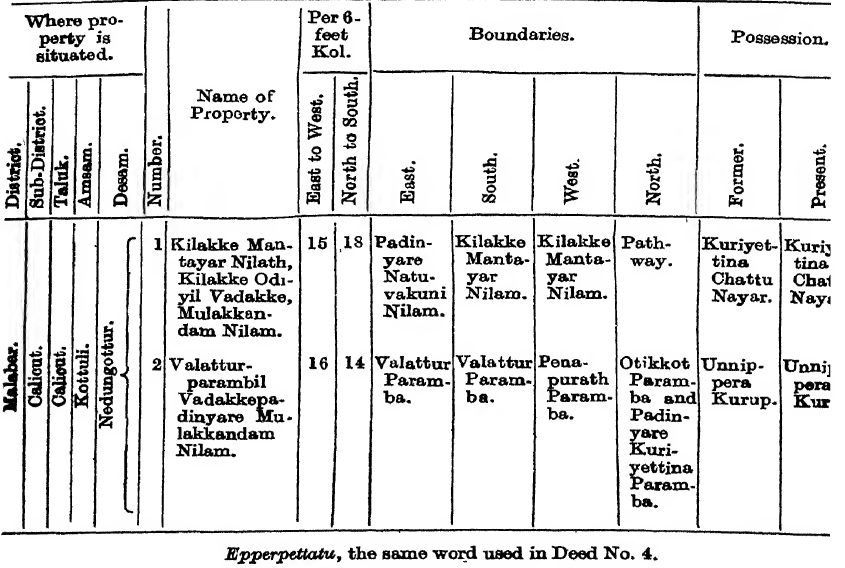
Written in the hand of Kakkalan Imbichchi Andi with Matirapanapennapurat Ittirarappa Kurup and Mannil Arikkotparambat Kelu Adiyodi as witnesses to this —
1. CHEKKUNNI NAYAR (signed).
2. CHANDU NAYAR (").
3. CHATTU NAYAR (").
4. EROMAN NAYAR (").
Witnesses-
1. ITTIRARPPA KURUP (Signed).
2. KELU ADIYODI (").
Note.—Translated from a copy received from the Registrar of Malabar.
No. 55
KOVILAKAM No. 10 of 1057.
Royal letter (തീട്ടു്) written jointly by Walluvanattudaya1 Kadannamuttayil Walluvanattukare Mankadakovilakat Vedapuratti Valiya Tamburatti of Mankada Amsam, Walluvanad Taluk, and Srivallabhan Valiya Tamburan Avarkal of the said Kovilakam, to Mambee Ali, son of Moidu of Valambur Amsam, of the said taluk. The object (കാർയ്യം) is that, whereas one item of Kudiyirippu (കുടിയിരിപ്പ), being the Janmam of Mankada Kovilakam Cherikkal, purchased (തീരു്വാങ്ങി) on the 13th Vrischikam 1052 from Avarankutti and his brother Said Ali, sons of Kalattiltodiyil Pari, and specified in the schedule below, has this day been demised to you on a pattam of 3 fanams and a Kanam2 of Rs.4-9-2, equal to 16 new fanams, you should pay within the 30th Makaram of each year from 1057, Annas 6, being the michcharam payable annually, after deducting the interest on the Kanam amount and the Government assessment from the aforesaid pattam, as well as 2 annas for Onavalakkula (ഓണവാഴക്കുല = bunch of plantains presented during the Onam festival) and Annas 2 on account of Nei Vilakku (നെയിവിളക്കു = lamp lighted with ghee) in Mankada temple from your pocket (കയ്യാൽ = literally, from the hand) and obtain receipt (നേർമറി) ; and if the michcharam is left in arrears without being paid at the prescribed time, you should pay the same, with interest at 12 per cent ; you should also surrender, on receipt of the Kanam, the Kudiyirippu mentioned in the schedule on demand3.
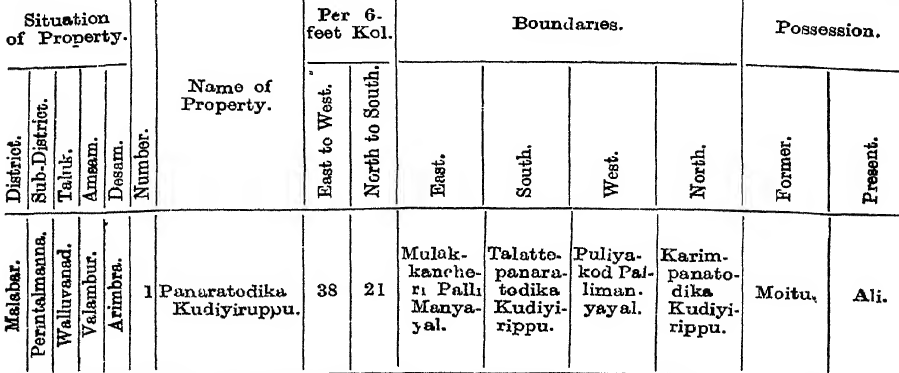
NOTEs: 1. One of the families which attested Deeds Nos. 1 and 2,
2. There is here no mention of any fine on entry. It is not usual to mention it or state its amount,
3. This is the innovating clause which is so much objected to by tenants, particularly by those who have paid fines on entry or renewal fees. See Mr. Holloway’s decision in South. END OF NOTEs
Written in the hand of Pulappillimadattil Venkideswara Pattar on the 6th December 1881, corresponding to the 22nd Vrischikam 1057, with the undersigned witnesses.
Note.—Translated from a copy furnished by the District Registrar.
No. 56
Panaya patta kulikkana1 kudiyirippu deed (പണയപ്പാട്ട കുഴിക്കാണ കുടിയിരിപ്പു്) executed on the 9th Dhanu 1057 by Nadavilakat Mamukkoya, son of Mayan Koya of Nagaram Amsam, Calicut Taluk, to Ayyappan, Mundakkutti Imbichchi and Sami, sons of Puvvattinkal Tannikunnat Chekku, residing in Valappil Paramba in Veliyancheri Desam, Kasba Amsam of the said taluk. Whereas I have this day granted you a renewed lease (പൊളിച്ചെഴുതിചാർത്തിരുന്നു) of the Valappil Paramba, the boundaries and extent of which are specified in the schedule below, being my Janmam, and included in the property assigned to me as my share in execution of the Appeal decree No. 282 of 1880, against the decree of the Subordinate Court of South Malabar in Regular Suit No. 329 of 1879 of the District Munsif’s Court of Calicut, which was transferred to the former Court, on an annual pattam of Rs. 17—8—0, equal to 70 fanams, on a Kanam of 144 fanams and 12 visams (വീശം), the Kanam already due to your father Chekku, plus 38 fanams and 8 visams, the improvement value with Ali (അഴി) = customary deduction in paying for improvements under Kulikkanam when the Janmi has not to pay for the tenth plant) of 15 coconut and 8 areca trees, this day paid for, plus 516 fanams and 12 visams, equal to Rs. 129—3—0, received this day in cash (ഇന്നുറൊക്കംവാങ്ങിയ), making under the three heads a total Kanam of 700 fanams, equal to Rs. 175, and on a Purappad pattam of Rs. 8-12-0, deducting Rs. 8-12-0 for interest on the money advanced (അർത്ഥംപലിശ) ; you should enjoy the lease (പാട്ടംനടുന്നു) of the paramba and pay annually from Vrischikam 1058 Rs. 8-12-0, being the Purappad pattam after deducting the interest on the Kanam amount, and obtain receipt (മുറി). Keikkuli Avakkasam (കൈക്കൂലിഅവകാശം == fine upon a lease and its renewal) equal to the amount of the pattam has been collected. Alikulikkanam (അഴികുഴിക്കാണം = customary improvement value subject to Ali), according to local custom (ദേശമർയ്യാദ) for trees already planted but not paid for, and for those that may be planted hereafter, excepting the 38 coconut and 8 areca trees and miscellaneous trees (പടുമരം) included in the lease, along with those which have been paid for, and the Kanam amount of Rs. 175 will be paid on eviction when the term expires. It has also been stipulated that if the paramba is not properly taken care of, or if the pattam is allowed to fall into arrears, the property should be surrendered on demand after settlement of accounts, irrespective of the term of the lease (കാലനിയമംപറയാതെ = literally without speaking about the term), and that as the Government tax (ശീമനികുതി) and the Municipal tax, if paid by you, will be allowed out of the pattam payable by you; but the Municipal tax must be paid by you. Written in the hand of Putiyakovilakam Parambil Sankaralinkam Pilla on the 21st December 1881 with the undersigned as witnesses to this :
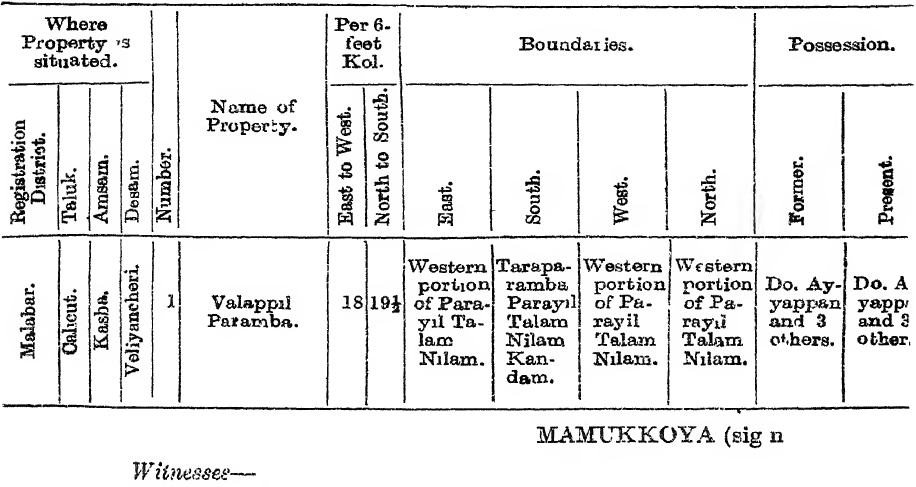
Note.—Translated from a copy furnished by the District Registrar.
NOTEs: 1. Panayam = pIedge : pattam = rent ; kuli = pit, excavation ; Kanam = money claim ; kudiyiruppu = house-site, meaning a deed embracing in its conditions some elements of a mortgage, a lease, an improving lease, and a building lease. END OF NOTEs
No. 57
Kanam1 deed, executed by Chekku Panikkar, son of Puliyosseri Mittaie Vittil Ittu Amma of Cheruvannur Amsam and Desam, Calicut Taluk, to Govindan Nayar, son of Chellat Imbichchi Amma of the above Desam. Whereas I have granted you, for the period included within 12 years (12 കൊല്ലത്തിന്നകമായ) Dharm Nyayar (ഞായർ = solar month) of this year 1057, a renewal of Kulikkanakudiyirippu (കുഴിക്കാണ കുടിയിരിപ്പിന്ന പൊളിച്ചെഴുതിചാർത്തി)2 of Vattakandi Paramba and two others items of property, which are my Taravad Janmam3 in the above Desam, and the boundaries and extent of which are described in the schedule below, on a pattam of 14 fanams for Parambas 1 and 2, and 4 paras of paddy per Nanaliyan para (നാനാഴിയൻപറ), worth 10 annas, for land No.3, and on a Kanam of 12 fanams, being the amount for which a lease was granted in 1046 after payment of the improvement value of (കഴിക്കൂർ തീർത്തുചാർത്തിയ) 2 coconut and 1 jack tree in Paramba No. 2 plus 4 fanams, being the improvement value with Ali (അഴി or ....= customary deduction in paying for improvements under കഴിക്കാണം when the Janmi has not to pay for the tenth plant) of two coconut trees now grown in the said paramba, making a total under the two heads of 16 fanams, from which deduct fanams 5 for arrears of rent, leaving a balance of 11 fanams as present Kanam and on a Purappad pattam of 13 1/2 fanams and 4 paras of paddy, half a fanam being deducted for interest on the Kanam1 amount ; you should from this (day) ഇതുമുതൽ enjoy the lease (പാട്ടംനടന്നു) of these lands annually (കാലംതോറും), and pay me annually 13½ fanams and 4 paras of paddy, being the Purappad pattam (പുറപ്പാടുപാട്ടം) due to me after deducting the interest on your Kanam (amount) and obtain receipt (പുകമുറി).
NOTES: 1. This is quite a modern phrase. The proper term for a Kanam deed is Pattamola or Patola. See Glosssary and Deeds 17, 23, 31, etc.
2. Kulikkana kudiyirippina polichcheluti chartti. Literally, for an improving (Kuli) Kannam dwelling-house site, having cancelled (polichchu) and renewed (eluti = written) and written (chartti).
3. Taravad Janmam has now come to signify merely "family property,” but the retention of the word Taravad before Janmam points out the direction in which modern ideas on the subjet have been derived. All Janmam land has descended to the present owners through the ancient Nayar Taravads (Tara = Nayar village, and padu = authority).
1. Here Kanam signifies simply money advanced and secured on the land. Compare the use made of the word in Deed No. 4. END OF NOTEs
Customary improvement value, subject to Ali (അഴി, see above) ദൈശമർയ്യാദ അഴീകുഴിക്കാണ will be paid2 for young trees (എളംഫലം) already planted but not paid for (മുമ്പുവെച്ചതിൽ തീരാതതെയുള്ള), and for trees which may be planted hereafter (ഇതുമുതലായി), excepting two old jack trees (മുതുഫലംപിലാവു്) previously existing in Paramba No. 1, and four coconut and one jack tree in Paramba No. 2, of which the improvement value has been paid (കുഴിക്കൂറുതീർത്ത), although a premium3 (പാട്ടകൈക്കൂലി) of Rs. 5—8—0 for 12 years is now collected, if the Purappad pattam payable annually be not paid at stated periods but be allowed to fall into arrears, the same should be paid in one lump (ഒന്നായി), with interest at 12 per cent, whenever I demand it. Written in the hand of Katakkat Pappu Nayar on the 19th Dhanu Nyayar (ഞായർ = solar month) of the year 1057, corresponding to 1st January 1882, with Kuttitalat Cherunni Nayar and Kannyingat Appunni as witnesses (സാക്ഷിയാകെ).
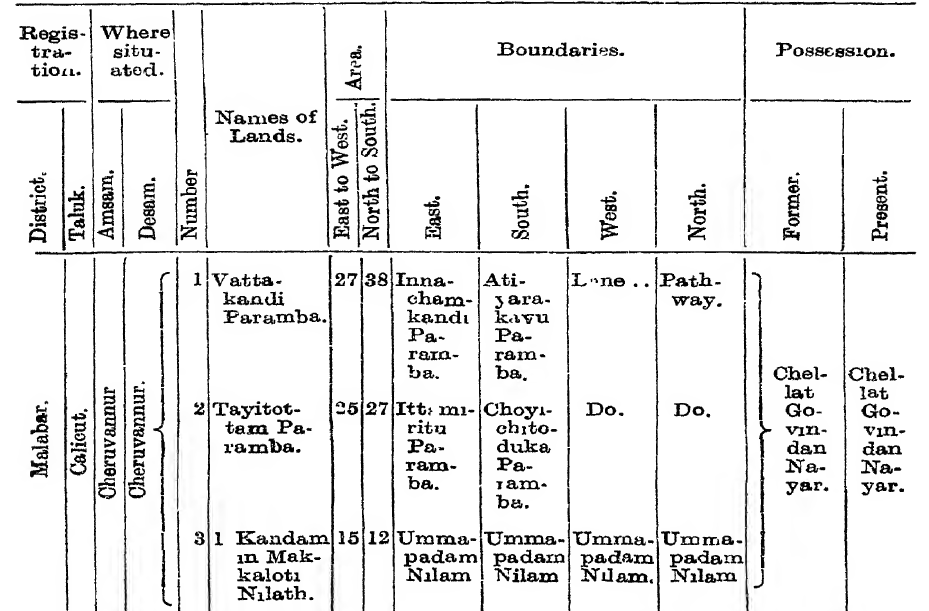
Note.—Translated from a copy received from the Registrar of Malabar.
NOTEs: 2. The incorporation in the deed of clauses relating to the valuation of improvements is quite a modern practice.
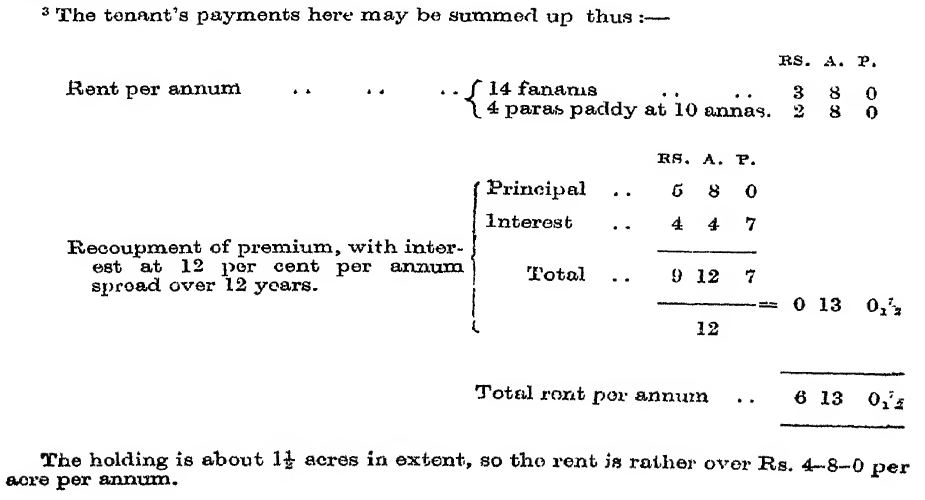
No. 58
Karipanayam deed (കരിപണയം = mortgage with possession), executed by Mangngalasseri Tekkinkattil Narayanan Nayar, son of Kunchiamma of Mundur Amsam and Desam, Palghat Taluk, to Anappara Purakkal Pachchi, daughter of Iluvan Velu, of Nechchippalli Desam, Kavalpad Amsam, of the said taluk. One item of land sowing 5 paras and specified in the subjoined schedule being given to (your) possession (കയ്വശംതന്നു) as Karipanayam (കരിപണയമായി) (I have) this day received 360 fanams, which, with 40 fanams already due, makes under two heads (വകരണ്ടിൽ) a total of 400 fanams, equal to Rs. 114-4-7. For this sum of Rs. 114-4-7 you should, by cultivating (കൃഷിനടന്നു) the land mentioned in the schedule, measure out (പടികേണ്ടും) a pattam of 33 paras and 5 Idangalis of paddy, out of which, deducting 22 paras 5 Idangalis as interest on the money advanced (അർത്ഥപലിശ), (there is left) a balance inclusive of assessment of a pattam of 11 paras of paddy, which must be annually measured out at my house in my para from 1058 (M.E.) within the 30th Makaram, after being dried and cleaned (വെടിപ്പുവരുത്തി), and a receipt should be taken (by you). Moreover, you should quit and give possession of the land (to me) when the 400 fanams is returned on the day following any Uchchar (ഉച്ചാർ or ഉചാചരൽ is the season when leases of land are generally granted and cancelled ; festival in honour of Bhudevi’s (ഭൂദേവി goddess of earth) menstruation on Makara Sankaranthi (end of January)]. Written in the hand of Narayanan, the receiver (കൊണ്ടാൻ of the the money) on the 29th January 1882, corresponding to 17th Makaram of the year 1057, with the undersigned as witnesses.
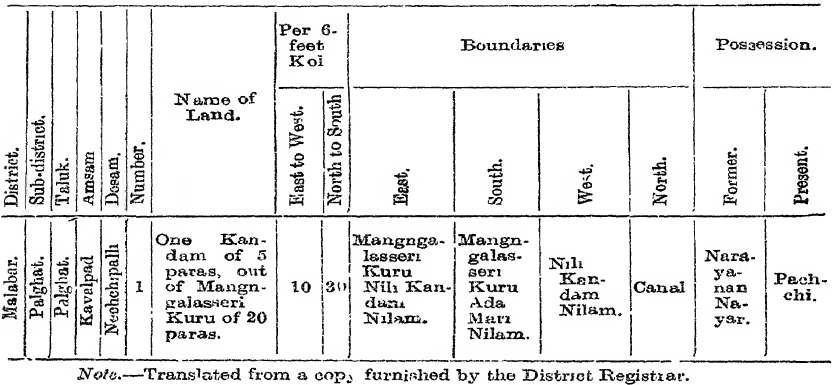
APPENDIX XIII
Mr. GRÆME’S GLOSSARY
WITH NOTES AND ETYMOLOGICAL HEADINGS
INDEX
|
A |
|
|
Adima Parambu. |
Adima. |
|
Adinynya Urukkal, see Revenue |
Adimappanam, see Revenue |
|
Alipadam |
Adiyan |
|
Alukiya Attipper, see Perura Artham |
Alisilavu |
|
Amsapatram |
Ambalappadi, see Desam |
|
Anappidi, see Revenue. |
Anakkomban |
|
Anubhavam |
Angam, see Revenue |
|
Aphalam |
Anubhogam, see Anubhavam, also Kulichchekam |
|
Attadakkam, see Revenue |
Areca |
|
Attipperu, see Attippettola |
Attaladakkam, see Revenue |
|
Ayudhakatti, see Kodungakatti |
Attippoettola, Attuveppu |
|
B |
|
|
Betelnut, see Areca. |
|
|
C |
Chala, see Houses |
|
Changngatum |
Changagatam, see also Revenue |
|
Changngatikkuri |
Changngatikkur Kalyanam, see Changngatikkuri |
|
Charadayam, see Revenue |
Chaver |
|
Chenkombu, see Revenue |
Cherikkal, see Revenue |
|
Cherlabbam, |
Cheru, See Podl |
|
Cherujanmam |
Cherumakkal. |
|
Chira. |
Chungam, see Revenue |
|
Coconut |
Cowle |
|
D |
|
|
Dasta bakki. |
Desadhipatyam, see Desam |
|
Desakoyma, see Desam |
Desam |
|
Desavali, see Desam |
Dravyani, see Otti |
|
E |
|
|
Edam |
Eimmula, see Revenue |
|
Ela, see Revenue |
Elam |
|
Ennam. |
Ennipadu, see Koyilmeni |
|
Ettukkonnu |
|
|
F |
|
|
Fanam |
Forfeiture of lease, see Kanam |
|
G |
|
|
Garce |
Gold Fanam, see Fanam |
|
Gramam |
Grandhavari |
|
H |
|
|
Hobali |
Houses |
|
I |
|
|
Idam, see Edam, also Houses |
Idapadu |
|
Ilavan |
Illakkur |
|
Illam, see Houses |
Improvements, see Kanam |
|
Inakkumuri |
Incidents, see Kanam |
|
Irunalipattam, see Pattam |
|
|
J |
|
|
Jack tree |
Janmakkaran, see Jemmam |
|
Janmakkaval, see Janmam |
Janmakkolu, see Janmam |
|
Janmakkudiyan , see Janmam, |
Janmam |
|
Janmapanayam Eluttu, see Janmam |
Janmapanayam Ola Ka. |
|
Janmapanayam Ola Karanam, see Janmam |
Jamini, see Janmam |
|
K |
|
|
Kadamvaypa, see Palisa. |
Kal. |
|
Kalameni. |
Kalappad. |
|
Kalayi. |
Kalcha, see Revenue. |
|
Kalkura patinaru. |
Kanakkappilla, see Kirani. |
|
Kanakkaran, see Kanam. |
Kanam. |
|
Kanampuram-kadam, see Kanam. |
Kandam. |
|
Kandi, see Kandam. |
Kani, see Pattam. |
|
Kannadappulli, see Revenue. |
Kappam. |
|
Kara, see Ur. |
Karalan. |
|
Karanam. |
Karaveppu. |
|
Kattakkanam. |
Kattakkol, see Kattavadi. |
|
Kattavadi. |
Kattival, see Kodungakatti. |
|
Kattuvaram. |
Kavalphalam. |
|
Kayattu nel, see Petipadu. |
Keikkuli. |
|
Keippanam. |
Keivida otti. |
|
Keram. |
Kilayijanmam, see Kilayikurujanmam. |
|
Kilayikurujanmam. |
Kinattil panni, see Revenue. |
|
Kirani. |
Kodungakatti. |
|
Kol Peimasi. |
Kol. |
|
Kola, see Revenue. |
Kolichchal. |
|
Kolu Labham. |
Koluppanayam. |
|
Kombu, see Revenue. |
Kottaram, see Houses. |
|
Kovilakam, see Houses. |
Koyilmeni. |
|
Krishi. |
Krishikkaran, see Krishi. |
|
Kudi, see also Houses. |
Kudi. |
|
Kudichillara. |
Kudippaka. |
|
Kudiyan. |
Kudiyankur. |
|
Kudiyirippu. |
Kudiyirumappadu. |
|
Kudmanir, see Kudumanir. |
Kudumanir |
|
Kuduppu, nee Kudippaka.. |
Kulichchakkaran |
|
Kulichchekam. |
Kulikkanam. |
|
Kuppamanyal. |
Kuraka, see Revenue. |
|
Kuri Muppan, see Changngatikkuri. |
Kurvalcha. |
|
Kuttadan. |
Kuttala, see Houses. |
|
Kuttam. |
Kutti nellu. |
|
Kutti vasi. |
Kuttikkanakkola. |
|
Kuttikkanam. |
Kuva. |
|
M |
|
|
Macleod seer. |
Madhyastanmar. |
|
Malikana. |
Mana, see Houses. |
|
Maniyani. |
Mannattappan. |
|
Mappilla. |
Maricham |
|
Marupattam, see Pattam. |
Maryada. |
|
Matham, see Houses. |
Melkanam, eee Kanam. |
|
Melkoyma. |
Melvaram, see Pattam. |
|
Menavan. |
Meni Vilachchal. |
|
Menippattam, see Pattam. |
Mennokki. |
|
Menon, see Menavan. |
Michcharam, see Pattam. |
|
Michchavaram, see Pattam. |
Modan. |
|
Modern Land Revenue, see Revenue. |
Mrigam Nalkkali. |
|
Muda. |
Mukhyasthan. |
|
Mukkatavali. |
Mukkuvar. |
|
Mulluvalli. |
Mummula, see Revenue. |
|
Mummula, see Revenue. |
Mundakam, see Kuttadan. |
|
Munnu-meni-nilam. |
Munpattam, see Pattam. |
|
Muppappanam, see Kattakkanam. |
Muppara, see Ettukkonnu. |
|
Muri. |
Mutalalan, see Janmi. |
|
Mutira. |
|
|
N |
|
|
Nadukuttam, see Kuttam. |
Naduvali. |
|
Nalubhayam. |
Nalu-meni-nilam, see Munnu-meni-niIam. |
|
Nambiyar. |
Namburi, see Nambutiri. |
|
Nambutiri. |
Nayan. |
|
Nayar, see Nayan. |
Nayattukuttam, see Kuttam. |
|
New Viray Fanam, see Fanam. |
Nikuti Chittu. |
|
Nikuti Sishtam, see Nikuti Chittu. |
Nikuti Vitty, see Nikuti Chittu. |
|
Nilal Kuttam, see Kuttarn. |
Nilam, see Kandam. |
|
Nirmutal |
Nokkichartta. |
|
Nokkiyelutta Peimasi, see Nokkichartta. |
|
|
O |
|
|
Oart. |
Old Viray Fanam. see Fanam. |
|
Oppu. |
Otti. |
|
Ottikkum-purameyulla Kanam, see Otti. |
|
|
P |
|
|
Pada Kuttam, see Kuttam. |
Padam, see Kandam. |
|
Pakuti ola, see Amsapatram. |
Palisa. |
|
Palisa Madakkam. |
Pallimanyayal, see Palliyal. |
|
Pallinyayal sea Palliyal. |
Palliyal. |
|
Palliyali, see Palliyal. |
Palparambu. |
|
Panaya Eluttukaran, see Panayam. |
Panayam. |
|
Panaya patta Kulikkanam, see Kulikkanam. |
Pandakkaval. |
|
Pandaram. |
Pandi. |
|
Panikkar. |
Para. |
|
Parambu. |
Para of seed land, see Para. |
|
Pasirna, see Pasuma. |
Pasuma. |
|
Patam. |
Pattachchittu, see Pattam. |
|
Pattakkaran, see. Pattam. |
Pattali, see Pattam. |
|
Pattam. |
Pattamali, see Pattam. |
|
Pattamola, see Pattom. |
Pattan. |
|
Pattinnu randu. |
Pattola, sea Pattam. |
|
Pepper vine. |
Perpetual lease. |
|
Perum artham. |
Phalam. |
|
Pidika, see Houses. |
Pila, see Revenue. |
|
Pisharam, see Houses. |
Podi. |
|
Polichcheluttu. |
Poluttikkaran, see Maniyani. |
|
Ponnarippu. see Revenue. |
Potippadu. |
|
Potippattu, see Potippadu. |
Prabhu. |
|
Pramanam. sea Karanam. |
Pramani. |
|
Pramani, see also Tara. |
Pravrittikkaran. |
|
Pravrittikkaran, see also Maniyani. |
Proprietors. |
|
Pukil. |
Pulayatta penna, see Revenue. |
|
Punam. see Modan. |
Punja. |
|
Pura, see Houses. |
Purappad, see Kanam. |
|
Purushantaram, see Revenue. |
Pushpottu. see Houses. |
|
Puttada. |
Puval, see Revenue. |
|
R |
|
|
Rakshabhogam, see Revenue. |
Rasi, see Pasuma. |
|
Rasi Fanam, see Fanam. |
Rat Hunts, see Kuttam. |
|
Reas. |
Renewal, see Kanam. |
|
Revenue. |
Rice. |
|
Rice Lands, see Rice. |
Robbin. |
|
S |
Sakshi. |
|
Salt. |
Salt-pans, see Salt. |
|
Sanar. |
Silakkasu, see Keikkuli. |
|
Silver Fanam, see Fanam. |
Sisht Bakki. |
|
Sisu. |
Slaves. |
|
Sthana-maria-avakasam |
Sudran. |
|
Sultani Fanam, see Fanam. |
Svarupakkur. see Svarupam. |
|
Svarupam. |
|
|
T |
|
|
Tala Uda-ya Tamburan. |
Talappanam, see Revenue. |
|
Tandu. |
Tappu. see Revenue. |
|
Tara. |
Taravadu, see Tara. |
|
Taravattukaran, see Tara. |
Tarisu. |
|
Tei, see Sisu. |
Tikappalisa, see Palisa. |
|
Tingalppanam. |
Tippali. |
|
Tiruvatira Nyattutala. |
Tittu, see Adima. |
|
Tiyan. |
Tobacco. |
|
Todi, see Parambu. |
Toduppanayam |
|
Tol, see Revenue. |
Tottam, see Parambu. |
|
Tusikkanam. |
|
|
U |
|
|
Ubhayam, see Kandam. |
Ulaparambu. |
|
|
Ulpatti, see Kandam. |
|
Undaruti. |
Ur. |
|
Uralan, see Ur. |
Urayma, see Desam. |
|
V |
|
|
Vakachchal. |
Vakachchalkaran, see Vakachchal |
|
Vakku. |
Val, see Revenue. |
|
Valli. |
Valumel Kodi. |
|
Valum-pudavam |
Vanokki. |
|
Varam, see Pattam. |
Vilumpadi. |
|
Virippu. |
Vittu-pati-pattam, see Pattam, |
|
Vittiratta pattam, see Pattam. |
Vattolam pattam, see Pattam. |
|
Vittu, see Valli. |
Vittupadu. |
|
Vyalavattam. |
Vyavaharamala. |
|
Y |
|
|
Yapana. see Kulichehekam. |
Yogakuttam, see Kuttam. |
LIST OF ABBREVIATIONS NOTED IN THE GLOSSARY.
S.A. = Sadr Adalat,
S.C. = Sadr Court.
M.H.C. = Madras High Court.
M.H.C.R. = Madras High Court Reports.
M.S. Decisions = Madras Sadr Court Decisions.
M.S.C. = Madras Sadr Court.
S.D.C. = South Malabar District Court.
S.S.C. == South Malabar Subordinate Court.
N.D.C. = North Malabar District Court.
I.L.R. Madras — Indian Law Reports, Madras Series.
GLOSSARY
ADIMA GRANT called a TITTU
Adima, from Dravidian adi ( bottom, base, foot), means slavery, feudal dependency. Tittu, from Dravidian tinduka (= to touch, defile), means a writ from a superior to an inferior.
In Malabar there are few castes under the rank of Nayar who did not, and who do not still, acknowledge a feudal dependence upon some superior lord, and who are not Adiyans or vassals. Persons of this description were not formerly allowed to possess land in Janmam right ; and therefore, when a Janmi made over land to a person in the condition of an Adiyan, it was called an Adima deed or grant, although he might not be his own vassal, and although the proprietor might have received the full Janmam value for the land. The right of proprietorship continued with the Janmi, and the tenant paid him a small sum of money—not more, perhaps, than two fanams annually—by way of acknowledgment of proprietorship. The tenant, however, could not be dispossessed, and the Iand descended to his heirs, and only reverted to the Janmi on failure of heirs.
The Adima grant of a paramba or garden was also often conferred by a superior lord, or Tala Udaya Tamburan, upon his own Adiyan or vassal ; but here it was in the feature of an Inam or gift, no consideration having been received for it by the proprietor. An annual trifling tribute of superiority is, however, reserved to the proprietor to prevent the garden being entirely alienated. The garden reverts to the proprietor on failure of heirs on the part of the Adiyan and if the Adiyan takes a part with the enemies of his patron, the latter may resume the property. Under any other circumstances the Adiyan cannot be dispossessed, and he has the right of burial within the garden.
Notes.—1. See Kudima, Changngatam.
2. In this the land is made over in perpetuity to the grantee, either unconditionally as a mark of favour, or on condition of certain services being performed. The terms Adima and Kudima mean a slave, or one subject to the landlord, the grant being generally made to such persons. A nominal fee of about two fanams a year is payable to the landlord to show that he still retains the proprietary title. Land bestowed as a mark of favour can never be resumed, but where it is granted as remuneration for certain services to be performed, the non-performance of such services involving the necessity of having them discharged by others will give the landlord power to recover the land. The non-payment of the annual fee will form no ground for ousting the grantee, but it will be recoverable by action. The hereditary property of Native princes cannot be conferred on this tenure, the ruling prince having only the right of enjoyment during life, without power to alienate —(Proceedings of the Court of Sadr Adalat, No, 18, dated 6th August 1856.)
3. A grant on condition of performing service is irredeemable so long as the grantee is ready and willing to perform the service.—S.D.C. 522 (1876), 113 (1877), 663 (1879).
ADIMA PARAMBU.
Adima (q. v.) Parambu (Dravidian) = higher or dry ground laid out in terraces, all fields too high for irrigation, an orchard, garden, compound.
Is a garden given to a slave (not a Cheruman or a person who can be sold), rather a vassal under the lord’s particular protection. A certain pattam is taken sometimes, and sometimes none. Land so given can never be taken away, but remains with the vassal till his death. If he dies without heirs, it reverts to the lord paramount. A Vettuvan or salt manufacturer who had got such a piece of land at Calicut said it was a place where he could be buried. He seemed to consider it a privilege insured to him.
Note.—See Parambu.
ADIYAN.
From Dravidian adi ( == base, bottom, foot), means servant, slave.
Is literally slave both in Tamil and Malayalam, and in the Northern Division of Malabar it is applied to the real slaves, but in South Malabar it means generally vassals. Under the old system, where every Tiyan was under a kind of vassalage to some superior, to some patron, to a Tamburan as he is commonly called, the patron was bound to protect him and to redress any petty wrongs he might sustain, and the client or vassal acknowledged his dependent state by yearly presents, and was to be ready with his personal services upon any private quarrel of his patron. This kind of dependency gave the patron no right of disposal of the person of his vassal as a slave, nor did it acquit the dependent individual of a superior obligation to the Raja or his representatives, the Desavali, and Neduvali, upon a public emergency.
Individuals were often clients of the church, which, by means of its representatives, the Uralar, was bound to protect them. Even at the present day an individual will immediately say who his Tamburan or patron is, and the yearly presents are still kept up.
Note.—See Changngatam.
ALIPADAM.
From (Dravidian) ali == (the ocean, the deep) and (Sanskrit) padam (a range, especially of rice-fields).
Alam, means, as in Tamil, depth, lowness, and padam field. The word applies to the lowest rice-lands.
Note.—See Kandam.
ALI SILAVU.
Ali, properly alu or aluku (Dravidian), means the high wall round an orchard. Silavu, properly chelavu (Dravidian), means expense.
The expense of preparing gardens. It bears the proportion of 20 per cent to the established valuation of trees, which is settled in making the Kulikkanam. This being added to the value of the trees, which in most places is half a rupee a coconut tree, the proprietor must pay for both, or else the interest of the two sums, according to the usual rate of the place, is included in the Pramanam and deducted from the pattam.
AMSAPATRAM or Pakuti Ola
Amspatram, from Sanskrit Amsom (= share, part) and Sanskrit Patram (= a leaf, a letter).
Pakuti Ola, from Dravidian pakuti (= division, share) and Dravidian ola (= palm leaf, a writing leaf).
Is a deed of division of hereditary property among relations ; another kind of Panaya Ola Karanam for rice-lands ; it is also called Muri : the same deed is used for plantations, and it is called in addition Kettiadakkam on account of these words being in the deed, which show that it refers to plantations.
Is a deed under which a Janmi makes over land for money borrowed. The mortgagee pays himself the interest and gives to the Janmi the purapad or residue of the pattam after deducting the interest, and in some cases the land tax is also to be deducted. The land is to be restored on payment of the debt without any deduction, of Sakshi, and no Polichcheluttu is allowed under this deed. The interest is supposed to be rather high in this transaction compared with that of many other land tenures.
ANAKKOMBAN.
From Dravidian Ana (= elephant) and Dravidian kombu (= tusk ivory).
A species of fine paddy grown in the Palghat District in low rice-lands, which is ten months in coming to maturity. It is heating. It is generally exported to Coimbatore, where it fetches one-twentieth more than any other kind of paddy.
ANUBHAVAM or Anubhogam.
(Sanskrit) = enjoyment, usufruct.
A deed of gift of land as a reward for services performed, answering, perhaps, to Inam land. The holder cannot be dispossessed, and the right is hereditary; but if the grantee or any of his descendants die without heirs, the land reverts to the Janmi, and on the succession of heirs the Janmi is entitled to Purushantaram. In some instances a trifling payment of one or two fanams is made by the grantee to the Janmi in token of acknowledgment of proprietorship. An hereditary grant of Anubhavam of the purapad, or residue of purapad after deducting mortgage interest, which remains in the hands of a mortgagee, is sometimes made to the mortgagee himself, or to some other person not connected with the land to whom the mortgagee is required to pay it.
Notes. —1. See Adim Kulichchekam.
2. It was customary for princes, when conferring a title on any person, to grant him at the same time sufficient land, to enable him to maintain the dignity of his position. Grants under this tenure were also bestowed upon persons for special services rendered, or for the future performance of certain services. The tenant cannot be ejected except where there are conditions imposed and he fails to fulfil them ; but, on the other hand, he and his heirs have only the right of enjoyment and cannot alienate their title. A trifling annual fee is generally paid to the landlord to show that he has not surrendered the proprietary.—(Proceedings of the Court of Sadr Adalat, No. 18, dated 5th August 1856.)
APHALAM.
(Sanskrit) = unfruitful, from a (Sanskrit negative particle) and Sanskrit phalam (= fruit), perhaps from Dravidian palam (== fruit).
A tree past bearing.
ARECA or BETEL-NUT. (Areca Catechu)
The tree = Kamugu, Kamundu, Kavundu, or Kalungngu (Dravidian). Its fruit = Adakka, Adekka (Dravidian), whence Portuguese Areca.
The nut of the betel-nut tree (not the tree itself) in Malayalam, whence probably the botanical name areca.
According to Arshad Beg’s Settlement of 1783-84 or 959 of the Southern District, exclusive of Palghat.-
Total Trees 3,361,195
Aphalam or Sisu 2,161,115
Productive 1,200,080
|
|
Hoons |
S. |
C. |
|
Or about one-third assessable Revenue |
20,018 |
0 |
0 |
59 productive trees per hoon, or 20 productive trees per rupee.
The number according to the Janmi Pymaish account of 981, furnished by the Collector, Mr. Vaughan, was 4,409,843 ; of this past bearing 1,326,652, pupils 1,376,846, productive 1,706,345. Their revenue of that year, deducting past bearing and pupils, Rs. 58,656 1 qr, 32 3/4 reas; average assessment per productive tree 13 3/4 reas.
Note.—The number according to the Jamabandi accounts of Fasli 1289 (1879- 80) was 8,167,552, of which 1,661,003 were returned as past bearing 3,304,740 too young to bear, and 3,201,189 as productive. The revenue, assessed on the productive trees alone, was returned as Rs. 81,311—12—0, giving an average of nearly1 5 pies per productive tree.
NOTEs: Correct average = 4215740/246293 pies. END OF NOTES.
ATTIPPETTOLA or Attipperu.
From Dravidian Atti (= causal of a verb signifying to be close, contiguous to, hence causal form, == to come in contact) and Dravidian peru (= birth, bringing forth), and Dravidian ola (= palm-leaf, leaf for writing.) The full phrase is Nir Atti peru, meaning the birthright (peru) obtained by coming in contact (Atti) with nir (= water).
Per in Malayalam corresponds with the Sanskrit word, Janmam, which means born, created, acquired, and more generally property. Atti means to join, mix. These two words united give but an imperfect meaning, and the word nir is generally prefixed. Nir-atti-per thus means the Janmam combined with water is given up. The Janmi reserves no purapad (balance of rent after deducting mortgage interest) or anything to himself. He cannot, after the execution of this deed, redeem the mortgage, and the relinquishment of the proprietary right is absolute under it. At the time of executing and delivering the deed, the following persons must be present. A Sva-jati, a person of the same caste ; Bandhu, a relative ; Putran, literally the son, but in Malabar construed to mean the heir, whether a nephew or son ; Narapati, the Raja ; the writer of the deed ; Tatra Sambandhi, a resident round the spot. In practice the attendance of the Raja, or the execution of the deed before the Raja, is dispensed with. It is only necessary that he should be apprised of the transaction. The mortgagee gives two fanams, which is placed in a small vessel of water ; the mortgagor, holding the deed in his hand, pours the water over it, which the mortgagor receives as it falls, and either swallows it, or puts it upon his head, or upon his feet, or upon the ground, according to the relative caste of the two parties. The deed is then delivered to the mortgagee. This deed mentions generally that the full value of the property disposed of has been received, and states the boundaries of it, but it does not specify the amount received.
Notes.—1. See Janmam and Perumartham and Sthana-mana-avakasam.
2. The purchaser, in coming into possession, is bound by all obligations which attached to the proprietor. He cannot disturb those who may be holding the property or any portion of it on Kanam mortgage, but merely receives the surplus rent produce in place of the former landlord. On the other hand, he comes into all the rights and privileges of the former landlord and may pay off Otti mortgages and sell or transfer the property as he pleases.—(Proceedings of the Court of Sadr Adalat, No. 18, dated 6th August 1856.)
ATTUVEPPU.
From Dravidian Aru (= river) and Dravidian veppu := (placing, planting).
Plantations bordering the seashore and rivers.
Notes.—1. One of the classes into which coconut gardens are divided.
2. As matter of fact, such gardens do not always border on the shore or river.
CHANGNGATAM.
(Sanskrit) == convoy, guard, income of Rajas from granting such guards, grants of land to persons liable to such service, companion.
Is also a kind of vassalage, and is applied particularly to Nayars who have placed themselves in a state of dependency upon some Desavali, Naduvali or Raja. The word Adiyan would, with respect to them, be degrading and improperly used. Nayars have often agreed to give Changngatam or protection-money to some chief of authority, and to make yearly presents in consequence from 4 to 34 fanams to individual patrons, and as high as 120 to the church. The church, again, has often subjected itself to Changngatam money to Rajas to ensure the benefit of their power.
Notes.—1. “Those who desire to proceed thither should first pay a certain sum of money to the king of the country, who will then appoint people to accompany them and show them the way.” — Fah Hian's Travels, quoted at Indian Antiquary VII, p- 3. ‘‘Thither” meant the country called by Fah Hian the “Kingdom of the Dakshina” or of the South.
2. There were four classes of officers about the Raja, whose posts were not hereditary but within his gift, viz., (1) Munnalippad, attendants with a daily allowance of three Nalis of paddy, youthful attendants ; (2) Arunalippad attendants with double the above allowance ; (3) Pandarappad, treasury officials ; and (4) Changngatuppad (see heading).—(Gundert’s Dictionary.)
3. See Kudima, Kulichchakkaran, Revenue.
CHANGNGATIKKURI.
From Sanskrit changngati (—convoy, guard, companion, friend) and Dravidian Kuri (= lot, share, lottery, club).
May be construed a season of friendship, a periodical association the lodge of friendship, a society of friends. It was a meeting formerly very common in Malabar among the natives, and still partially kept up, for the purposes of conversation, of discussing any particular subject, of inquiring into the conduct of any individual. It is not, it appears, confined to people of the same caste, but the association was often composed of Nayers, Tiyars and Mappilas. Besides promoting social intercourse, it has a tendency to prudential consequences. It induces economy.
Where there is a variety of castes in the society, the entertainer gives to those who are not of his own caste a certain quantity of rice and allows them to dress it by their own people. It is supported by the subscription of the members in the following manner. Suppose there are 25 members ; that each contributes 4 fanams monthly, making a total stock for each month of 100 fanams ; that the society is limited to 25 months' duration, and every member is obliged to give an entertainment to the party once in the course of this period at his own house. It does not come to the members in regular turn, but is decided by lot, that is, every member places with his subscription a ticket with his name into the deposit, and a ticket is drawn every month by some indifferent person, and the person whose name appears on the ticket drawn gives the entertainment and is entitled to the amount in deposit for the month.
The entertainment is calculated to cost at most not more than 10 per cent, of one month’s' subscription of all the members, and the great advantage is derived from drawing a ticket at an early stage, on account of the interest upon the sum to the remaining period ; there is no other prize ; every member’s subscription amounts in the end to the whole principal gain which he can ever make.
The greatest disadvantages to any member are the drawing his ticket towards the close of the duration of the society, the consequent loss of interests on his monthly subscriptions, and the loss of principal expended in the entertainment to the extent of two or two and a half month's subscription.
But these are counterbalanced by his facility of procuring easy loans of money upon the security which the ultimate certainty of attaining a prize affords. The monthly subscriptions in the meantime are small and not felt, and induce a habit of saving which would not otherwise be practised.
The interest upon loans which the members thus procure is to be paid only till the prize comes up. The lender derives no benefit from the chance of its coming up early.
Notes.—1. See Changngatam.
2. The Kuri was of three kinds : (1) Nelkkuri, where the shares were paid in paddy ; (2) Arikkuri, where the shares were paid in rice ; and (3) Panakkuri, where the shares were paid in money.
KURI MUPPAN
Is the president of the society termed Changngatikkuri, whose duty it is to see the money collected, or, in failure, to forfeit to the prize-drawer double the deficient subscription. He is entitled to the privilege of giving the first month’s entertainment.
The society has of late years fallen into disuse, partly because the European authorities have discouraged it among all public servants as liable to abuse, and partly because it does not enjoy the necessary power to enforce its rules by degradation or other punishment, and members are not to be found who will support it from their own respectability. The contempt of its regulations can only be attempted to be remedied by a tedious, vexatious and expensive appeal to a judicial tribunal—an appeal likely to be more particularly ineffectual from the compact of the parties being rather understood than expressive, founded more upon a sense of honour than upon law or written agreement.
CHANGHGATIKKURI KALYANAM.
See Changngatikkuri; Kalyanam (Sanskrit) = luck, happiness.
May be termed an association of friendship and pleasure among the natives of Malabar. It is an entertainment given by a respectable native, at which all his friends who are invited present a sum of money and a certain number of coconuts, plantains, betel-leaves and betel-nuts, every man according to his fancy, to the entertainer.
The host feeds all those who come and has diversions for the company. An account is kept of what each guest offers, and when these guests in their turn announce that an entertainment is to be given by them, the person who has formerly had the benefit of an entertainment is expected to be present and to make a return at least equal, but in general half as much again, and sometimes double, what he has received.
To any person who evades the invitation and does not send the proper present of money and fruit, a small vessel of arrack and the bone of a fowl are sent in derision to shame him into a more liberal spirit, and he is desired to eat and drink them and to return the money, etc., he formerly received. This, in general, was sufficient to ensure a compliance with the custom.
Note. —Kurikkalyanam is in some places used to signify Changngatikkuri. Such associations are still kept up.
CHAVER.
From Dravidian Chava (death) and Dravidian Eruka (= to arise, aseend), literally, those who went forth to death.
Or lands granted by Rajas to the families of deceased heroes who fell in performance of solemn vows to fight till death against the enemy. If any escaped this conflict they were excommunicated them caste and obliged to flee the country. The Ilaya Raja of Angadipuram states that much of his original rajyam in Vullatra was alienated from this cause in his wars with the Zamorin. It appears the private Janmams of conquered states were not respected by the conquerors.
Notes 1.—The name was applied to those persons who, for the honour of the Valluvakonatiri or Vellattiri elected to run, armed with swords and shields, the gauntlet of the Zamorin’s 30,000 spears at Tirunavayi in Ponnani taluk every twelfth year.
2. Their ostensible object was to elude the spears and to slay the Zamorin, who, armed with Cheraman Perumal’s sword awaited their onslaught. Conf. pp. 162—69 of the text.
CHERLABHAM.
Cherlabham, from Dravidian cheru (= wet soil) and Sanskrit labham ( = gain, profit).
Meaning generally the same as Kolulabham, but more literally the profit of the earth or soil—the cultivator’s share.
Note.—See Kolulabham.
CHERUJANMAM.
From cheru (Dravidian) = small, and Janmam (Sanskrit) = birth.
Inferior rights applied to the fees receivable by the carpenter and smith in Malabar.
Notes.—1 . See Janmam.
2. Hereditary rights and perquisites were claimed, within certain defined local limits, by (1) the Kanisan (astrologer) for feasts, (2) the Asari (carpenter) for dedication of houses, (3) the Tattan (goldsmith) for marriages, (4) the Malayan (musicians and conjurors) for devil feasts, (5) the Vannan (washerman), (6) the Velan (midwife, accoucheur), (7) the Vilakkattaravan (barber), etc.
CHERUMAKKAL.
From Dravidian cheru = chiru (= small) and Dravidian makkal ( = children).—(Gundert).
Slaves in general. It is supposed to be derived from cheru = soil, and makkal children : children of the soil, or sons of the earth. Others say from cheru, small, and makkal, children, indicating that they are to be treated as young children by their masters.
Notes.—1. From a census taken in 1857 of the slave population it appeared that they were then distributed as follows :
|
1.Chirakkal |
13,380 |
|
2.Kottayam |
2,859 |
|
3.Kurumbranad |
16,590 |
|
4.Wynad |
16,661 |
|
5.Calicut |
14,082 |
|
6.Ernad |
35,419 |
|
7.Waliuvanad |
34,902 |
|
8.Palghat |
25,280 |
|
9.Ponnani |
28,668 |
|
10.Cochin |
71 |
|
District total |
187,812 |
2. The bulk of the slaves being located in the ancient Cheranad (part of the Ernad taluk) and in the neighbourhood of it, it is not unreasonable to suppose they got their name as being the aborigines of Cheranad, or possibly of the still more ancient kingdom of Chera.
CHIRA.
(Dravidian) == enclosure, dam, tank.
A reservoir of water or tank on a smaller scale ; it answers to eri or lake in the Dravida country. In the Palghat and Temmalapuram districts, it is used for cultivation. It is formed by a bank thrown across the higher parts of a tract of rice lands and resting at each end upon eminences. Cultivation of rice is carried on on land lower than its level ; and in the bed of it a kind of rice called Kuttadan is sown, which takes nine months to come to maturity. It is sown in Chithri or April, before the commencement of the heavy monsoon, and is cut in Margulli or December, and it shoots its head above the water, the depth of which is often six feet.
COCONUT.
In Malayalam tengnga contraction for tengngankayi, from Dravidian tekke (= south) and Dravidian kay (= ripening fruit)
According to Arshad Beg’s Settlement of 1783—84 or 959 of the southern districts, exclusive of Palghat there were:-
|
Coconut trees |
2,896,099 |
|
Aphalam and Sisu |
2,162,508 |
|
Productive |
733,591 |
or about one-fourth assessable revenue 36,724 - 5½ fanams, or twenty trees per hoon, or 7 trees per rupee.
The number according to the Janmi Pymaish account of 981, furnished by the Collector Mr. Vaughan, was 6,124,367, past bearing 1,792,987, pupils 1,244,440, productive 3,086,939. Their revenue of that year, deducting past bearing and pupils, Rs. 3,15,115-0 qr. 75 ¼ reas ; average of assessment per productive tree 40 13½/16 reas.
In talking of the price of coconuts, it is always understood to be the nut without the husk, which latter is sold separately.
Note.—According to the jamabandi accounts of fasli 1289 (AD. 1879—80) the number of coconut trees was 9,519,567, of which 1,310,253 were past bearing, 3,611,506 were not yet come into bearing, and 4,597,808 were productive. The productive trees were assessed at Rs. 3,49,835-11-3, being at the rate of 1 anna 22799143/4597808 pies per productive tree.
COWLE.
(Arabic) qabul = engagement, cowle.
Notes.—1. A Government cowle for the cultivation of waste land confers a right of entry, and of compensation for improvements, but does not affect the Janmi’s right to rent.—S.D.C., 132 (1877), 79 (1878).
2. A Jamni is not at liberty to eject a squatter on waste land who has obtained a cowle from Government, if 12 years have elapsed from the date of entry SD.C, 195 (1878), 674 (1879).
3. A Government cowle does not confer any right as against a prior occupant. S.D.O., 47 and 48 (1878).
DASTA BAKKl.
From Persian dast ( = balance in hand) and Arabic bakki ( == remnant, surplus).
A balance of revenue collected from the person due, but not brought to the public credit by the Revenue Officers.
DESAM.
(Sanskrit) = region, country, parish.
A village, the same as Tara in the Malabar province. In the ancient Hindu histories a kingdom, of which there were 56 in India, is meant by it.
Note.—See pp. 87-90 of the Text. The Desam and the Tara were not the same thing. See Tara.
DESAVALI.
From Desam (q.v.) and Dravidian vali, from valuka, to live, live prosperously, reign.
Hereditary heads of villages. Before Hyder’s conquest some had one, some two or more villages , their places are now supplied by Mukhyastanmar.
The number of Nayars or fighting men attached to a Desavali was from 25 to 100 ; if it exceeded the latter number, he ranked as Naduvali.
Note—See pp. 87—90 of the Text. He was the military chief, not the civil chief of the Desam.
DESAKOYMA
From Desam. (q.v.) and Dravidian Koyma, modern form of Konma, from Kon (= king) , means sovereignty, authority.
Same as Desavali.
Note.—This word denotes the functions of a Desavali which were as follows:-
1. Desam
See Desam
2. Desadhipatyam
From Desam (q.v.) and Sanskrit adhipatyam = supreme authority.
3. Ambalappadi
From Dravidian ambalam (= place devoted for public use or assemblies, a temple) and Dravidian padi (=a step, bench).
4. Urayma
From Dravidian Ur (= village, town, parish) and Dravidian vayama modern form of vanma from valuka (= to live prosperously, reign) meaning authority, office.
Sthanams or dignities.
Ambalappadi is the seat of honour, a certain step or degree in a temple to which only particular persons are entitled. The claim to it is derived from ancestry, but the dignity is saleable. It is, however, understood that it cannot be disposed of except to a person of the proper caste and necessary respectability. It is, strictly speaking, confined to Brahmans but there have been interlopers of the Samunta caste.
The Urayma is the office to which is attached the general superintendence of the affairs of a temple; a person who has attained the Ambalappadi dignity in the village holds invariably also that of Urayma, that is, he is the Uralan of the temple, but the Uralan may be such without being an Ambalappadi (sic).
Desam means that a person possesses in proprietary right the whole property of the village or Desam He is the janmi or Mutalalan of the Desam.
Desadhipatyam is the office held by the Desadhipati or Desavali, which is the political ruler or representative of Government in the Desam; of the Desam and Desadhipatyam an individual may be possessed of the one or the other separately. The Desavali was not necessarily proprietor of all the lands of the village. But a person enjoying these four dignities collectively and in the same Desam is esteemed as one who has reached the summit of honour All the dignities were saleable, either separately or collectively, except the Urayma and the Ambalappadi, which went always together, and generally the Desam and Desadhipatyam.
Ambalam equals temple of the first order, called Maha Kshetram dedicated to the Hindu Trimurtti. There were 108 principal temples constructed by Parasurama between Gokarnam and Kannya Kumari (Cape Comorin), and the one opposite to Mr. Babington’s bungalow at Varakkal, near Calicut, is of the number.
Notes.—1. See pp. 87—90 of the Text ; also Tara and Ur.
2. A Desam was not Synonymous with a tara. Great confusion has arisen from thinking so.
3. The seat of honour in the ambalam is just outside the sanctuary. As Brahmans can enter the sanctuary itself, it was no honour to them to be seated on the ambalappadi. To be thought entitled to exclusive right to the ambalappadi was, on the other hand, a source of profit which Brahmans coveted. The ambalappadi was originally the seat of the chief man directing the proceedings of any public meeting, such as a temple feast ; he was, in short, chairman
4. Ambalappadi and Urayma were the privileges of the headmen, Karanavar of the tara (Dravidian teru — street, village) or of the Ur (Dravidian = village), along with other privileges, some of which are still observed, for example, Urpalli, the special place set apart in the village (Ur) for cutting up the carcases of deer, etc., killed in the village hunt, the headman of the Ur (a Taravattukaranavan) being entitled to a hind-quarter and other parts of the animal.
EDAM or Idam.
(Dravidian) = place, house, mansion.
Is the distinctive name of a house or palace occupied by a member of the family of the Palghat Raja; it is also used sometimes for the house of a Naduvali of consequence in the Palghat district. In the same part of the country the house of a common man is called a Vidu ; Edam in Tamil means place.
Note. —The use of the word is not confined to the Palghat taluk.
ELAM.
(Dravidian) —cardamoms.
A thousand rupees a candy the Wynaad cardamom sells for.
Note.—The best cardamoms now fetch from Rs. 1.200 to Rs, 1,400 per candy 700 lb.
ENNAM.
(Dravidian) = number, counting.
Counting. It is a term used for the expense of reaping, reckoned 10 per cent. In some places this proportion is given after the paddy is measured out , in others one out of ten sheaves is given in the field.
Note —The number of sheaves varies : in one part of Chirakkal taluk at the present time one out of twelve goes to the reapers. See Patam, Kolulabham, Cherlabham, and Pandakkaval.
ETTUKKONNU and Muppara.
Ettukkonnu, from Dravidian ettu ( == eight) and Dravidian onnu ( == one).
Muppara, from Dravidian munnu (= three) and Dravidian para (= a measure, bushel).
Meaning one to eight, and three paras ; it expresses the nature of the land-tax in the Travancore province. On the garden land one in eight (of the pattam or rent) is said to be taken, and on rice-lands three paras (out of ten).
FANAM.
From Dravidian Panam = coin, fanam, money in general.
Old Viray or Gold = 4 to a rupee. There are 12½ Malabar pice to one fanam.
New Viray or Gold = 3½ to a rupee. There are 141/4 Malabar pice to one fanam.
Silver = 5 to a rupee, and each fanam worth ten Malabar pice.
Note.- Mr. Græme has omitted mention of the
1. Rasi fanam. —The most ancient of the indigenous fanams, bearing at the present time a fanciful value. They are of gold, and have the same 14 dots as the gold fanams mentioned above. Rasi means a sign of the Zodiac, so it is supposed the 12 dots are the 12 signs of the Zodiac, and the two separate dots are the sun and moon. The 12 Zodiacal signs are divided into four good, four middling, and four bad signs, which may account for the appearance of the dots on one side of the coins : the four prolonged dots being the good, the four ordinary-sized ones the middling, and the four tiny dots placed separately in a corner by themselves the four bad signs. The other emblems are not understood.
II. The Sultani fanam.—A coin of Tippu’s, which in 1790—92 had fallen in value to 3½ = a rupee.
GARCE.
120 paras of Macleod seers, or 3,000 Macleod seers, make a garce, Bombay salt, according to my experiment, weighs 90 lb. the para of salt, so that a garce is 10,800 lb.
GRAMAM.
(Sanskrit) = village.
Equivalent to Agraharam in the Carnatic, a Brahman village. At the time of Parasurama’s gift of the country to the Brahmans, 64 Gramams were established from Goa to Cape Comorin, 32 from Kanyirote (or Cassergode north to Comorin south) ; to these were attached all the Sudra villages.
Notes.—1. See Chapter III, Sections (a) and (b) of the Text.
2. Mr. Græme here follows the Keralolpatti tradition, which, is unreliable.
GRANDHAVARI.
From Sanskrit Grandham == verse, book.
A book formed of the leaves of the Kudappana palm or Talipot tree, in which Janmis register their agreements respecting land with their tenants or mortgagees. Where it is kept it is said to be a register which may be safely referred to as authenticating an agreement otherwise doubtful, but it is not kept up so much as it used to be. The Kudappana of Malabar does not afford the leaf capable of being so used ; the impression of the iron pen goes through and prevents its being written on both sides. The proper kind is only procurable in Travancore and Canara. It is brought for sale. It is much more expensive than that of Malabar. It is also much more durable.
HOBALI.
(Dravidian) == division of a district.
A term introduced into Malabar by the Muhammadan Government. It is in Malabar a subdivision of a taluk comprehending several Desams or villages. It corresponds with Magani in Canara and with Maganum on the Eastern Coast.
Note.—The Muhammadans called their village organisation in Malabar the Tara. See Sir Thomas Munro’s Report. Revenue Selections, Vol. I, p. 842. See also Tara and Ur.
HOUSES.
Different names for them in Malabar according to castes -
|
Mana |
Nambutiripadu’s house |
|
Illam |
Nambutiri’s house |
|
Kovilakam or Kottaram |
Raja’s house |
|
Idam or Kuttala |
Naduvali’s house |
|
Vidu |
Nayar house |
|
Pushpottu or Pisharam or Varyam. |
Houses of Ambalavasi or servants of the pagoda, expressive of their caste |
|
Matham |
Houses of Chakkyar |
|
Kudi |
House of Chaliar or weavers |
|
Pidika |
House of Mappilla |
|
Pura |
House of Tiyan |
|
Chala |
The house of a Cheruman |
|
Pura or chala |
The house of a blacksmith, goldsmith, silversmith, carpenter, brazier |
IDAPADU
From Dravidian idam ( = place, house of Naduvalis) and Dravidian padu (falling, falling into power, place, rank of officials, etc.), means the authority exercised by the family inhabiting the idam, who also controlled the pagodas of Urile Bhagavati (goddess of the ur, village) and of Muvanti kali (the tutelar deity of Calicut) lying within their limits. Pagodas ; 18 should be included in the range of a Kartava of 3,000 (Nayars).
Note .—See Edam.
ILLAKKUR.
From Dravidian. Illam ( == a house) and Dravidian kuru or kur ( = part, share).
Illam, a house ; kur, partition, share. It means the private property of a Raja which descends to his heirs. He relinquishes this property to his nephew or next heir upon his giving up one official dignity for a higher step. Not that he absolutely gives up all control over it, but this arrangement is made to distinguish and separate it from the public property of the official station he has just held, and to prevent its being claimed by his successor in it.
Note.—See Kurvalcha.
ILAVAN.
From ilam, from Chingngalam, Simhala, Sihala = Ceylon.
The name of the Tiyan in the Palghat and Temmalapuram Districts in parlance, who are aborigines of Malabar ; in other places they are only so named in writings.
Note—The Tiyar or Tivar (from tivu, corruption of Sanskrit divpu = an island) are believed not to have been the aborigines of Malabar, but to have come from an island (Ceylon), bringing with them the southern tree (tengngkay), the cocoanut. See Tiyan, Shanar, Mukkuvar.
INAKKUMURI.
From Dravidian inakku ( = agreement, certificate of agreement) and Dravidian muri (== fragment, note, bond, receipt).
There are two kinds of deeds of this denomination. A mortgagee making over land to another person in mortgage gives him an Inakkumuri, or certificate that he has received a sum of money from the second mortgagee and has made over the land to him, and calls upon the Janmi to confirm him in the same tenure which he himself possessed. If this certificate be shown to the Janmi, he has a right ro demand Sakshi for the renewal of the deed, but the second mortgagee often withholds the production of the deeds in order to avoid payment of the renewal money. That is also called an Inakkumuri which a Janmi gives to a mortgagee when he has sold the Janmam right of the mortgaged land to a third person. In it he refers the mortgagee to the purchaser for the future responsibility for the kanam money.
Note.—1. Mortgagees may transfer their interest to sub-mortgagees, and the latter come into the enjoyment of the same rights and privileges as the former possessed. A notice should be given to the landlord at the time of such transfer. In an action for the recovery of the property, when an Inak has been given, the landlord must recognize and sue the property in possession, but it is only liable to pay the amount which would have been payable to the original mortgagee.—- (Proceedings of the Court of Sadr Adalat, No. 18, dated 5th August 1856.)
3. Mr. Græme and the Sadr Court both here use kanam as synonymous with mortgage. It is clear that the Kanakkar had the privilege of selling his holding, independently of the Janmi, a most important point. See Chapter IV, Section (a) of the Text.
JACK TREE. (Artocarpas integrifolia.)
In Malayalam the tree = pilavu ; its fruit == chakka, whence Jack.
Chakkha — the Malayalam name for the fruit of the Artocarpus integrifolia, whence is probably derived the name Jack.
Chakka, Mangay, Tal or Talu, Takara = a common saying expressive of the kind of food which the poorer classes of people live upon chiefly in Malabar. Chakka is the Jack, Mangay the Mango, Tal or Talu a species of wild Yam with a broad leaf, often cultivated in private gardens, and Takara a species of Dholl. It is called Sag in Hindustani, and the leaf is eaten boiled. The Jack is eaten boiled, in general mixed with salt, etc.
Note.—According to the Jamabandi accounts of Fasli 1289 (A.D. 1879—80) there were 1,441,034 Jack trees, of which 500,641 were past bearing, 605,640 were too young to bear, and 334,753 were productive. The productive trees were assessed at Rs. 52,337-8-7, or at the rate of 2 annas 66217/334753 —pies per productive tree.
JANMAM.
(Sanskrit) == birth, birthright, hereditary proprietorship, freehold property = the Sanskritised form of the Dravidian peru ( = birth birthright).
The landed property of a Janmakkaran or proprietor.
Notes.—1. See Chapter IV, Section (a) and Attiperu.
2. The purchaser, in coming into possession, is bound by all the obligations which attached to the proprietor. He cannot disturb those who may be holding the property, or any portion of it, on kanam mortgage, but merely receives the surplus rent produce in place of the former landlord. On the other hand, he comes into all the rights and privileges of the former landlord, and may pay off Otti mortgages, and sell or transfer the property as he pleases.—(Proceedings of the Court of Sadr Adalut, No. 18, dated 5th August 1856
JANMAKKARAN or JANMI or MUTALALAN.
Janmakkaran and Janmi = from Sanskrit Janmam (q.v.) and Sanskrit Karan ( = doer, one who has to do with).
Mutalalan, from Dravidian Mutal ( = beginning, principal, stock property, money) and Dravidian al ( = person).
A landed proprietor. In Malabar there are 44,378, and the same number of estates, and the land assessment being about Star Pagodas 480,000, each estate on an average bears to the whole revenue a proportion of little more than 10 pagodas per annum.—(38th paragraph of the Revenue Board’s Minute of 5th January 1818).
This number is taken from the 77th paragraph of Mr. Warden’s letter to the Revenue Board of 16th June 1813, and the 33rd paragraph of his letter to the Board of 20th April 1815, which again was taken from the Janmi Pymaish accounts of 981, but by mistake the taluks of Kavai, Cotiote, and Randatara were omitted.
The copy of the Janmi Pymaish accounts received from Mr. Vaughan by Mr, Græme makes the number 52,303, which reduces the revenue payable by each to little more than 9 pagodas. It is conjectured (though I have not yet obtained any accounts to prove it) that half the revenue is paid by estates yielding from a thousand to five thousand rupees’ assessment, which will make the amount of the assessment payable by the greater proportion of the proprietors very small indeed.
Supposing that half the revenue is paid by estates yielding a revenue of a thousand rupees, that will withdraw eight hundred and forty from the number, and the remaining half, viz., 240,000 Star Pagodas, will be paid by 52,463 estates or proprietors, which will be between 4½ and 5 pagodas for each.
The Board of Revenue have considered the number stated as so many estates, whilst Mr. Warden expressly calls this number so many proprietors, but upon examination I find that neither the one nor the other mode of considering it is strictly correct. That may be called an estate which an individual possesses in the whole province or in a village, and others have denominated single fields estates, but in the Janmi Pymaish accounts is entered as one estate the whole landed property possessed by an individual in one Hobali comprehending several Desams or villages, the number of estates is therefore either too great or too little, according to the acceptation given to the term. But if it is wished to know what assessment is payable on the whole estate in the province of each individual, this account will not show it. The number of estates is too great. It is only correct with respect to each Hobali, for many Janmis possess lands in different villages of the same Hobali, in different Hobalis of the same taluk, and in different taluks of the province, all of which, with the exception of those within the confines of villages, are entered as separate estates.
The real number of Janmis is, in consequence, not equal to the number of estates specified. Some individuals are entered ten times instead of one, and very many appear four times. The number cannot therefore be taken at more than 15,000, but for this conjecture there is no document.
Note.—See Proprietors and Perumartham and Sthana-mana-avakasam.
JANMAKKAVAL.
From Janmam (q.v.) and Dravidian kaval ( == custody, guard, watch).
Is a fee which is given to a kind of headman among slaves for watching a large tract of rice-land and protecting it from cattle. The land may belong to different proprietors, though the watcher is the slave of only one. The fee consists in the crop of a certain portion of every rice-field. The watcher is generally selected from the caste of Palium, which is considered the most trustworthy and attentive, and the watcher goes on such occasion by the name of Kalladi Palium, though the Kalladi is a different caste of slave.
JANMAKKOLU.
From Janmam (q.v.) and Dravidian kolu ( == ploughshare, cultivating tenure).
Answering to Moolgainee. It is a fixed rent which cannot be raised, and the proprietor cannot remove the tenant. It prevails in some few places in the Northern Division of Malabar.
Notes.—1. In this case the land is made over for permanent cultivation by the tenant in return for services rendered. Where the proprietary title is vested in a pagoda, the grant will be made for future services. In some cases land is mortgaged on this tenure, the Kanam mortgagee paying the surplus rent produce to the landlord after deducting the interest of the money he has advanced. The tenant has, in North Malabar, only a life-interest in the property, which at his death reverts to the landlord. In the South the land is enjoyed by the tenant and his descendants until there is failure of heirs, when it reverts to the proprietor ; except where the is granted for special services, an annual rent is payable under this tenure. The tenants right is confined to that of cultivation, but it is permanent, and he cannot be ousted for arrears of rent, which must be recovered by action, unless there be a specific clause in the deed declaring the lease cancelled if the rent be allowed to fall into arrears.—(Proceedings of the Court of Sadr Adalat, No. 18, dated 5th August 1856).
2. This right reverts to the landlord on failure of tenant’s heirs.—High Court Spec. App. 495 (1869).
JANMAKKUDIYAN.
From Janmam (q.v.) and Dravidian Kudiyan ( == inhabitant, subject, tenant).
May be translated a proprietary inhabitant. It is not uncommonly used to designate the modern Janmakar, who has acquired his property by purchase, in contradistinction to the ancient or hereditary Janmakar.
JANMAPANAYAM Olakkaranam, or JANMAPANAYAM Eluttu.
Janmapanayam, from Janmam (q.v.) and Dravidian panayam (= bet, stake, pledge).
Olakkaranam, from Dravidian Ola ( == palm-leaf writing) and Sanskrit Karanam ( = acting, instrument, deed). Eluttu (Dravidian) = writing, writ.
The Janmakkaran is supposed to have received an additional 10 per cent on the amount of the Otti, making altogether 30 per cent beyond the Otti. Under this deed he pledges the Janmam or proprietary right, without relinquishing the actual possession of it by which he is bound not to transfer the Janmam right, to another without the consent of the present mortgagee. He has still, however, the power of redeeming the mortgage by paying the debt and the interest of all sums borrowed since the period of the execution of the Otti deed, with the proviso that the interest do not exceed double the amount of the sums so borrowed. The amount of the debt, but not the pattam, is specified in this deed.
Notes.—1. “This is the last resource short of selling the land altogether. In executing this deed the landlord relinquishes the power to redeem his land, and has nothing left him but the nominal right of proprietorship. By going through the form of casting a few drops of water from his hand he yields up all right of further interference in the land. Nor can he sell his proprietary title to any one but the mortgagee, as he has already made over to him all the rights and privileges possessed by a proprietor. This tenure prevails only in the neighbourhood of Calicut.”—S.C. Circular, dated 5th August 1856, No. 18.
2. Mr. Græme in his report (paragraph 1553) remarked : "Before the conquest several intermediate stages of mortgage, in the hope of future redemption before land was sold, were common, and its disposal with all this was very rare ; but in the present times the intermediate deeds are dispensed with entirely in Palghat, and in Calicut the Otti and Janmam deeds, instead of being as before at different and distant periods from each other, are now very frequently executed on one and the same day, and the property transferred without reservation on the part of the proprietor.”
3. The above interpretation of this deed was probably more theoretical than real. It was supposed to be the fifth of the six deeds culminating in Janmam.
4. A suit to recover lands granted on a pepper-corn rent is barred after 12 years from the grant-—S.D.C., 368 (1879).
KAL
(Dravidian) == foot, leg, stem, pillar.
Literally, leg ; figuratively, support. In the Northern Division of Malabar it means the standard tree round which the pepper-vines climb. It applies to trees such as the Moochy wood tree (moorka), which are planted expressly for the support of the vine. A coconut or jack would not be called a Kal.
KALAMENI.
From Dravidian Kalam ( = pot, vessel, measure) and Dravidian meni ( = body, shape, sample, average).
An average.
KALAPPAD.
From Dravidian Kalam ( = a threshing-floor) and Dravidian padu ( = falling, falling into power of, rank, nature, measure of space and time).
A term in use in the Walluvanad Taluk, and, perhaps, other places to the southward in Malabar. It means a threshing-floor, a house or a place for removing the grain from the straw, whether by threshing, or, as in Walluvanad, by treading with men. More generally it means a collection of paddy-fields under one manager or cultivator, the produce of which is brought to one threshing-floor.
KALAYI.
(From Dravidian kal = foot, stem, or stubble, and ayi ( = became) = the second cultivation of a rice-field.
Means rice of a second crop. It implies that one crop must have been cut in Kanni (September and October, and that the second crop is cut in Makaram (January and February). It does not apply to a crop cut in Makaram which had no previous crop.
Note—Kalayi Nilam is the opposite of Ariri Nilam , which means land on which Ariri — a single crop—is raised.
KALKURA PATINARU.
Kal (Dravidian) = one-fourth ; kuravu (Dravidian) == deficiency; patinaru, (Dravidian) = sixteen.
Quarter less 16 or 153/4 Viray fanams, which Desavalis could receive in fines from inhabitants. If the fine amounted to 16 or above it, it was the right of the Naduvalis.
KIRANI or Kanakkapilla.
Derivation of Kirani is doubtful. Kanakkapilla, from Dravidian kanakku. ( = accounts) and Dravidian illa ( = child, honorary title).
Writer or Accountant. In Malabar the first used exclusively for Portuguese and half-caste writers, the second is also used for them, but I find it was also the common name for the Raja’s accountants in the Kadattanad, Kottayam (Cotiote), and Chirakkal Rajyams.
KANAM.
From Dravidian Kanuka ( == to see) means now-a-days possession, mortgage or lease, but originally it meant supervision, protection.
Which, I think, is generally supposed to mean mortgage or pledge, must be construed to be the thing or consideration for which the mortgage or pledge is given, and it seems applicable only to lands, timber trees, and slaves.
In Arabic the terms for the different incidents of mortgage are very distinct and precise. Murhoon is the thing mortgaged or pledged ; Rahin is the mortgagee ; Moortahin the mortgagor ; and Mooblunghi Murhoon the money or consideration which is given for the pledge. Kanam corresponds with Mooblunghi Murhoon, or the money given, and Panayam with Murhoon, or the thing mortgaged.
Panayam Eluttu is the mortgage writing or deed. Though the pattam or rent capable of being collected from the lands which is in the possession of the mortgagee is more than sufficient to pay the interest of the mortgage debt, yet it is generally calculated that the value of the pattam would, if sold, be not more than adequate to pay the principal. If the mortgagee retains more than his fixed share of the pattam for the payment of the interest of the debt, and neglects to pay the remainder to the Janmakkaran, he forfeits the land, which is instantly resumable by the Janmakkaran.
It is supposed that the original intention of receiving the kanam was to secure the proprietor against the imposition or the neglect of the tenant, that it was to be considered that the pattam was permanent notwithstanding the representations of the tenant, whether true or false, of bad seasons and accidents. The principal of the kanam was not, therefore, more than equal to one year's pattam, and the proprietor thus provided against failure by having received the pattam in advance for a year. The introduction of the land-tax and the increasing necessities of the proprietors obliged them to involve deeper in debts and mortgages.
There is a great distinction to be observed between a mortgage and what is called kanam. A mortgage is the thing given for the security of the creditor for money borrowed of him. A kanam is an advance of rent made by a tenant to a proprietor for the security of the latter against failure in payment of the pattam. It was originally as much the custom for a tenant to have been a long time in possession of land, merely paying the simple pattam before he advanced money, as for him to acquire possession in consequence only of advancing the pattam money. The occupancy of the land, in short, sometimes preceded, and sometimes followed, the advance of money.
One of the six Pramanams or deeds of mortgage recognised in the Sastra.
Notes.—1. See Chapter IV, Section, (a) of the Text, and Pattam and Pattola or Pattamola and Proprietors and Keikkuli.
2. Said to be the second of the six deeds culminating in janmam.
3. If no period be specified the mortgage is considered to extend to 12 years, and always so where a fee has been paid. The mortgagee has possession, recovering the interest of the money he has advanced from the produce of the land, and paying over the net profits to the landlord. Should he fail in the last respect, the amount is placed to the landlord’s credit when the mortgage is paid off, allowance being made, on the other side, for any improvements which the mortgagee may have effected. Failure to pay over the net proceeds regularly to the landlord will not give the latter power to redeem his land before the expiration of the period stipulated (or that of 12 years), unless there be an express condition to that effect in the deed. Any attempt, however, an the part, of the mortgagee to defraud the landlord and usurp the property wifi give the latter that power. Should the landlord desire to raise a further sum of money on the land, and the mortgagee be unwilling to advance it, he may mortgage the property to a third party, who will be entitled to possession on paying off the sum originally advanced by the first mortgagee. The latter, however, has the option of advancing the required sum and remaining in possession if he pleases. Where the land has been mortgaged for a particular period, the landlord cannot interfere until the expiration of such period. Kanam mortgages are generally renewed at the end of the period fixed, the landlord receiving a fee ; but there is no obligation on either side to renew them unless the landlord and mortgagee should be mutually desirous of doing so. Where the mortgagee discovers that the landlord has acted fraudulently in valuing the produce of the land, he is entitled to have the deed cancelled.—(Proceedings of the Court of Sadr Adalat No. 18, dated 5th August 1856.)
4. The following are notes of some of the voluminous and conflicting decisions of the Courts on the various points connected with kanam and kulikanam, The Courts, starting with an erroneous idea as to what jamnam was have, in their endeavours to ascertain customs, been evidently making law instead of merely declaring it, and deciding by it.
(a) Renewal.—The payment of keikkuli fees (fine) is merely an accident of the contract, and when the kanam amount has been passed, all necessary acts will be presumed to have been done, particularly when undisputed possession has followed upon the demise.—S.S.C., 5 (1856)
‘‘The payment or non-payment” (of the renewal fees)“ is wholly irrelevant to the question of validity of the deed.”—S.S.C, 57 and 155 (1865). A suit for money advanced on account of renewal fees is not barred until three years from the date of the refusal to renew.—S.D.C., 69 and 182 (1876). A renewal is the making of a new, not a continuation of an old, contract.—S.S.C., 197 (1855). A contract to renew, of which the mortgagee might claim specific performance is a sufficient answer to a suit for redemption.—S.D.C, 524 (1876), 644 and 650 (1877) 395, 572, 573 (1879). A tenant may forfeit his right to insist on specific performance of an agreement to renew by denying his mortgagor’s title to a portion of the demised property.—S.D.C., 625 (1877). A contract to renew must, if in writing, be stamped and if the consideration exceeds Rs. 100, and if the proper construction is that the whole amount is to be credited to renewal fees, it ought to be registered under Section 17, Clause 3, Act VIII of 1871. Aliter, if part of the consideration is for arrears of rent.—S.D.O., 126 (1876). The execution of the kanam and kychit deeds and their registration is good evidence of oral agreement to renew.- S D C., 333 (1877)..
(b) Incidents.— A kanakkaran creating a mortgage or quasi -mortgage of the kanam holding of which he is not owner “is to me a contradiction in terms;" the quasi-mortgagee is simply a creditor.—S.S.C., 144 (1855). It is necessary for the security of a sub-mortgagee that he should make known his claims to the proprietor. By not doing so he renders himself liable to have his claim overlooked on a settlement occurring between the proprietor and the superior mortgagee and for this the proprietor can of course not be held liable.—S.S.C., 103 (1844). A mortgagee cannot, by private arrangement with his mortgagor, prejudice the rights of the sub-mortgagee in possession. S.D.C., 346 (1878). Sub-mortgagees have no right as against janmis to hold for twelve years from date of sub-mortgagees.- S.D.C., 180 (1851). No sub-kanam does exist. The kanam, with all its incidents attached to it, can only be cut out of a right superior to itself, and the only way in which a mere kanakkaran can convey such a right is by selling that which accrued to him from the possessor of a janmam or otti right. He can also give his kanam right on simple mortgage.—S.S.C., 234 (1855). The jamnam right can be sold while kanam right is outstanding.—S.S.C., 113 (1858). The contract is not complete till the deed has been properly delivered.—S.D.C., 626 (1876). “No janmi can, in less than twelve years, demand the restoration of his land by a kanakkaran" except in the case of the breach of express or implied covenants by such kanakkaran. Such a protection the custom of the country provides against the grasping avarice of proprietors, and it is only the strict preservation of this custom which can prevent this species of tenure from becoming a monstrous fraud, in which the weak will always be the prey of the strong."—S.S.C., 398 (1854). So also fn S.S.C 63 (1855), and M.S.C., 154 (1855). A janmi has no power to enhance his demands during the currency (12 years) of a kanam lease.—S.S.C., 57 (1853). Kanam right is “an incorporeal right over the land, which may or may not be accompanied by physical possession.’’—S.S.C,, 441 (1855). If a kanakkaran has two claims, both must be settled before he can be dusted from the land.—N.D.C., 126 (1856); M.S.C., 22nd April 1858. The kanam amount cannot be apportioned piecemeal on the several parcels of land the possession of which constitutes the kanakkar’s security.—S.S.C,, 37 (1854). The kanam amount secured on several parcels of land cannot be apportioned among them : the kanakkaran may resist redemption and recovery till the whole of his kanam claim has been paid—N.D.C., 380 (1868). So also "my money was advanced on the security of all the parcels, good, bad, and indifferent together, and until I get all back I shall not relinquish any.” — N.D.C., 198, 216, 221 (1876) ; M.H.C., 611 (1877). In a suit by a janmi for damages for waste, the defendant’s liability will depend on whether there has been any injury to plaintiff’s reversion.—S.D.C,, 116 (1876), 560 (1877). A janmi cannot attach and sell his kanakkaran’s interest for arrears of rent if that interest has already been assigned by private sale.—S.D.C., 335 (1877). A kanam deed is not a lease for more than one year, and is not compulsorily registrable.—S.D.C., 353 (1876). An understanding as to how the increased fruitfulness of trees is to be brought to account in future demises does not make the tenure a permanent one.—N.D.C., 177 (1861). If land is taken back before the expiration of the lease, a portion of the fees paid at the commencement of the lease, proportionate to the time unexpired of the lease, is returned to the tenant, who, however, if guilty of breach of covenant, is not entitled to the return of such proportionate part.—N.D.C., 401 (1873).
(c) Melkanam. - When there are two valid equitable titles, he who has got the legal estate shall prevail is a doctrine peculiarly necessary in a country like this.” A man should not accept a kanam deed when the land is not in the possession of his demiser without sufficient enquiry into the demiser’s title to give him possession, which was held in this case by a previous kanam demisee.—N.D.C., 38 (1860). If the janmi is unable to give possession, the remedy is by suit against him for return of the money.—2 M.H.C K., 315. "These acceptors of kanam rights while other rights are outstanding are a pest to the country. The remedy for this hardship is the non-acceptance of kanam rights until it is in the power of the janmi to deliver the land.”—NT.D.C., 86 (1860). A first kanakkaran is entitled to the first chance of supplying his janmi’s further needs. If this is not done, and even if, in the course of proceedings in Court, the first kanakkaran denied his janmi’s title, the second kanakkaran has no cause of action, for asking a return of the land.—1 M.H.C.R., 13.
Semble : If the first kanakkaran denied his janmi’s title before the date of the second kanam, it would not be necessary to give him the option of supplying his janmi’s needs. — Ibid.
A melkanam is not wholly invalid, but will operate as an assignment of the equity of redemption although the time for redeeming may not have arrived. — S.D.C., 484 (1879). Whilst a prior kanam mortgage is outstanding and the document is in the hands of third persons claiming a lien thereon, a renewal of such mortgage is invalid.—S.D.C., 159, 743, 768 (1877). A melkanakkaran cannot oust a kanakkaran or his assignee before the expiration of 12 years from the date of the kanam.—M.S.C., 129 (1862).
{d) Purappad.—Rent tendered and refused, if of the proper amount ; exempts the tenant from future claims for that amount.—S.S.C., 157 (1855). In deciding that a kanam tenant allowing the purappad to fall into arrears was not liable to be turned out, the High Court pointed out two ways in which the jarnni can recover his purappad, viz., (1) by suing for it ; or (2) by taking credit for it on paying off the kanam amount after the lapse of 12 years.—1 M.H.C.R., 112. In a suit for redemption of kanam, arrears of rent, the recovery of which is barred by the Statute of Limitations, may be set off against the mortgage money.—S.D.C., 426 (1876), 449 (1877). The principle of this is that the kanam is deposited as security for the rent, and that the mortgagor is entitled to an account of rents and profits-—S.D.C., 285 (1877). When no date is specified for payment of rent in kind the presumption is that the rent is payable in Kanni and Makaram. If the rent for one crop is specified, double the amount may be presumed to be a fair rent for two crops.—S.D.C., 370 (1877). It is usually the rule that 60 per cent, of the rent is payable in Kanni and the rest in Makaram.—S.D.C,, 393 (1878), The words "Kanam free from the payment of rent” will not enlarge that kanam into an otti — M.H.C., 142 (1870).
(e) Improvements.—When a janmi rents a land, he must well know that the tenants cannot live thereon without a house, and, consequently, that they would, in conformity with established usage, build one. If the building is unnecessarily large, or in other respects informal, or not sanctioned, he ought to have put a atop to it ; but the idea of making the renters pull it down and carry off the materials, since he tacitly consented to its being built, is absurd.—N.D.C., 55 (1843). The Court admitted an appeal to try “whether the tenant was entitled to the value of the house,” or "whether he has the option of either removing the materials or receiving only their value,” and confirmed the Civil Judge’s decree allowing hire of labourers as part of the cost of the house.—M.S.C., 11 (1847). Tenants in North Malabar are entitled to Vettukanam, and the law encourages cultivation so much that even trespassers are entitled to it less one-tenth.—M.S.C., 32 (1872); N.D.C., 312, 315 (1873). Rupees 11½ per 100 perukkams (1210 to the acre) was taken as a fair price for converting paramba into rice-fields.—N.D.C., 283 (1874). The implied contract to pay for improvements is limited to agricultural leases. — S.D.C., 286 (1876). No compensation is claimable for improvements made prior to the date of the demise, unless specially reserved.—S.D.C., 627 (1877). All reasonable improvements must be paid for.—S.D.C., 156, 161 (1877). It is usual to apportion the compensation for improvements among the sub-tenants.—S.D.C., 170 (1878).
(f) Forfeiture of Lease.—The following have been held as reasons –
I. Sufficient for cancelling the lease before the expiration of the customary 12 years’ period. Failure under improving lease (Kulikkanam, q v.) to make reasonable improvements.—S.D.C., 68 (1859). Alteration of boundaries.-—S.D.C., 75 (1853). Denial of janmi’s title.—2 M.H.C.R., 161. Removal of foundation-stones of a ruined pagoda outside limits of holding, and from possession of which the tenant was specially shut out.—N.D.C., 82 (1844). Neglect to plant trees under improving lease (Kulikkanam, g.v.).—N.D.C., 62 (1875). Acts to invalidate the lessor’s title obviously operate the forfeiture of lease.”-—S.S.C., 191 (1854) , N,D.C., 172 (1861). Destruction of a pond essential to irrigate the lands-—S.S.C., 157 (1855). Cutting down trees without janmi’s permission.-—N-D.C , 211 (1859). Fraudulent setting up of a different tenure to that given by the janmi.—N.D.C., 218, 219, 220 (1859). Failure to cultivate in a husband-like manner under an improving lease (Kulikkanam, q.v.).—N.D.C., 274 (1859). Fraudulent attempt to embarrass the janmi by a false dispute as to the boundaries of a portion of the holding.—N.D.C., 21 (1861). False claim of right larger than tenant really possessed.- N.D.O., 176 (1861). Denial of ]anmi’s title by the assignee of a kanam right.—1 M.H.C.R., 14, 445. Neglect to cultivate.—N.D C., 350 (1870). Cutting down fruitful trees without janmi’s consent.—N.D.C., 386 (1872). Denial of janmi’s title after institution by the janmi of a suit to oust.—2 M.H C.R., 109. Express agreement to surrender on demand.—S D C., 566, 612, 621 (1876), 204 (1878) ; M.H.C., 278 (1879).
II. Insufficient for cancelling the lease before the expiration of the customary 12 years’ period. Burial of a corpse.—N.D.C., 350 (1873). “Non-payment of purappad being a breach going only to a part of the consideration, should not in all principle be held to repeal the contract.”—N.D.C., 172 (1861). So also in. M.H.C.R., 112, and M.S.C., 84 and 111 (1862).
KANAKKARAN.
From Kanam (q.v.) and Sanskrit Karan ( = doer, or one who has to do with).
Mortgagee ; the person who has lent the kanam.
KANAM-PURAM-KADAM.
From kanam (q.v.) and Dravidian puram ( = the back, outside, beyond) and Dravidian Kadam ( = debt, obligation).
This is an expedient for raising money on land already made over on kanam. It is quite a separate transaction, sometimes taking place at the time of the mortgage, in which case it is referred to in the kanam deed ; at other times effected long after the mortgagee has come into possession. In the latter case the fact of the mortgage is alluded to in this deed, and the landlord engages to pay off both the mortgage and the loan together. The loan thus made gives the mortgagee an additional lien upon the property as security for the repayment of the loan. Where the new loan is added to the sum first advanced, and a fresh mortgage-bond is executed, the transaction is treated altogether according to the rules applying to kanam mortgages.—(Proceedings of the Court of Sadr Adalat, No. 18, dated 5th August 1856.)
KANDAM.
(Sanskrit) == piece of anything, land.
A division in rice-fields.
Note.—Perhaps this word meant originally a share of the Tara rice-fields held in common.
NILAM.
(Dravidian) = ground, soil, rice-field.
Which means particularly rice-land, means also a field (answering to a stullum in the Carnatic) having a distinct name, and having many kandams or divisions of banks for the convenience of irrigation.
PADAM.
(Sanskrit) =- range, especially of rice-fields.
UBHAYAM.
(Sanskrit) = in South Malabar, rice-fields.
ULPATTI.
(Sanskrit) = birth, origin, rice-fields.
Terms used in Malabar for rice-lands ; some of these terms are peculiar to some districts.
VAYAL.
(Dravidian) = rice-fields.
A large tract or sheet of paddy land.
KANDI.
(Dravidian) == gap in a hedge or fence, a piece of high ground.
A division used in garden lands only to express one paramba or garden. It is used when speaking of the number of gardens in an estate.
KAPPAM.
(Dravidian) = tribute, taxes.
Equivalent to peishcush or tribute. The rajas of the Northern Districts of Malabar agreed to give to the Bednore Government in 913 M.S. a kappam of 80,000 rupees.
KARALAN.
(Dravidian) = workers, agents, temple servants. Their office Karayma (ancient, Karanmei).
Is the agent or deputy for the uralan, or founder, in the management of the lands of Hindu temples.
Notes.—1. Karayma right is not proved to be a right of perpetual tenure of land ; it is equally consistent that it was a title to the perpetual performance of certain services for which certain payments were demandable. - N.D.C., 142-171 (1859). Karayma right is unsaleable - M.H.C., 120 (1867)—and indefeasible. - M.H.C., 623 (1874). Karalar have no right to succeed Uralar on these becoming extinct. The right of appointing others “always did, and does still be with the executive.”—N.D.C, 1 (I860).
2. Lands made over by the trustees or managers of pagodas to those employed in performing certain offices therein are conferred on this tenure. So long as they fulfil their duties, the tenants are not liable to be ousted ; to maintain an action of ejectment, therefore, it must be shown either that they have neglected their duties, which has rendered it necessary to employ other persons to perform them, or that they have endeavoured to set up a proprietary claim in subversion of that of the pagoda,—(Proceedings of the Court of Sadr Adalat, No. 18, dated 5th August 1856.)
3. For other and more ancient uses of this word, see pp. 110—13 and Chapter IV, Section (a) of the Text.
KARANAM or PRAMANAM.
Karanam (Sanskrit) = acting, organ, instrument, deed ; Pramanam (Sanskrit) = measure, authority, proof, bond.
Generally means bonds and agreements of all kinds.
Note.—The six kinds of Karanama culminating in Janmam were, 1, Kulikkanam ; 2, Kanam , 3, Otti ; 4, Ottikkumpuram ; 5, Janmappanayam ; 6, Janmam.
KARAVEPPU.
From Dravidian Kara ( = snore, river-side, bank) and Dravidian Veppu ( = deposit, planting).
Plantations on elevated spots of ground, in contradistinction to Attuveppu, situated on low ground.
Note.—High-lying coconut gardens are divided in the revenue accounts into three classes of Karaveppu. See Ur. Kuraveppu gardens are not unfrequently situated on the high banks of rivers and backwaters. See Attuveppu.
KATTAKKANAM also MUPPAPPANAM.
Kattakkanam, from Dravidian Katta ( == lump, mass, clod) and Kanam (q.v.) ; also called Kashtakkanam, from Sanskrit Kashtam ( = hard, bad) and Kanam (q.v.).
Muppappanam, from Dravidian Muppan ( == old man, chief) and Dravidian panam ( = money).
Is the acknowledgment or Nuzur paid by a cultivator to a proprietor for land he is allowed to cultivate. It is not an advance which is recoverable. It is not deducted from subsequent payments to be made, nor is any interest granted upon it ; the cultivator pays the full established pattam besides. Its proportion to the pattam does not seem uniform. It means, literally, clod-money.
Note. - Kattakkanam is the tenure of a simple lessee who deposits m his Janmi’s hands a sum of money as security (a) for due fulfilment of his lease contract, and (b) for payment of rent. It does not carry with it a right to hold for 12 years; the security is returned without interest at the end of the lease.—N.D.C., 18 (1874)., 466 (1877).
KATTAVADI or KATTAKOL.
From Dravidian Katta ( = lump, clod) and Dravidian vadi ( = stick, staff) or Dravidian Kol ( = staff, rod).
Literally, clod-breaker. The stick in Malabar, with a knob at the end of it, with which men and women break the clods in a field after it has been dug by the mamutty or spade.
KATTUVARUM.
From Dravidian Kadu. ( = jungle) and Dravidian varam ( == share of produce).
A tax of two fanams upon every individual possessing land in a few Hobalis of the Temmalapuram District, where there is no regular Modan cultivation. It was intended as an equivalent for any cultivation which might he carried on in the Kad or jungle.
KAVALPHALAM.
From Dravidian Kaval ( == custody, protection) and Sanskrit phalam (? Dravidian palam) ( = fruit, produce).
Protection fund or compensation for protection.
KEIKKULI or SHILAKKASU
From Dravidian Kei ( = hand) and Dravidian Kuli ( == wages) and from Dravidian Shila ( = purse) or perhaps Sanskrit Shilam ( = conduct, habit, character) and Dravidian kasu ( == gold, copper coin).
A fee or fine or Nuzur of so many fanams on a Potippadu which the lessee or Verumpattakaran gives to the Janmi or proprietor upon the renewal of his lease. In Kavai Taluk, two Velli fanams, the Potippadu, is the rate fixed, which, calculating at the rate of 41½ rupees per 1,000 Idangalis, is supposed to add one-fourth to the Janmi's share in the year in which it is imposed. It is the extent of Shilakkasu which any land can afford that seems to give it a value in sale and purchase above its nominal value, or that at which the pattam is entered in account. Where this proportion is given, the lease is only for one year ; where it is for four, it is equal to one year’s pattam, that is, the full pattam is taken once in four years, being an equivalent for Polichcheluttu, though Keikkuli in the Southern Division answers to Shilakkasu in the Northern Division, where the transaction is a simple lease or Verumpattam. It is also applied in the Southern Division to land having already a mortgage upon it. It is taken in lieu of Sakshi, being in general the amount of one year’s pattam.
Note.—-See Kunarn and Pattola.
KEIPPANAM.
From Dravidian Kei ( = hand) and Dravidian panam ( = money).
Note.— Keippanam property is property given on marriage (among Mappillas), which is returnable on termination of the marital state by death or divorce ; to the widow if she survives, or to her children if she has died, or to the Taravad in absence of wife and children. The widow and children have a Iife interest independent of the Karanavan.—N.D.C., 60 (1874).
KEIVIDA OTTI.
From Dravidian Kei ( = hand) and Dravidian vida or vidatta ( = without leaving) and Otti (q.v.).
Is not a separate deed, but if the two first words are tacked to the Otti deed, it becomes a condition that the mortgagee can never be dispossessed, that the land can never go out of his hands, that the mortgage is irredeemable. Kei is "hand” and vida is "without letting go.”
The following note is by an experienced Native Revenue Officer of the district :-
Notes.—1. The question is not settled as yet, I believe it has been decided both ways. The whole thing turns on the meaning of the expression. Above it is written കൈവിടാ ഒറ്റി and interpreted accordingly. But some hold that the term is കൈവിടുക ഒറ്റി, that the meaning is that in Otti of this description the landlord “relinquishes” in favour of the Otti holder his right, recognised in ordinary Otti cases, of taking from the garden mortgaged (if the property is a garden) a few coconuts and a jackfruit annually without asking for the permission of the tenant.
2. The balance of authority is in favour of a Keivida Otti being irredeemable. The mortgagee cannot, however, assign. S.D.C.,— 578-629 (1878).
3. The landlord in this case relinquishes the power of transferring the property to a third party, and binds himself to borrow any further sum he may require only from the mortgagee. Should the latter decline to advance the amount, the landlord may pay off the mortgage and re-assign the property to another party. — (Proceedings of Madras Sadr Adalat, No. 18, dated 5th August 1856).
KERAM.
Canarese mode of pronouncing Cheram.
The Sanskrit name for the coconut fruit. A law is in existence in Malabar, contained in a book called Kera Kalpam, composed in the Sanskrit language but written in the Malayalam character, regulating the mode of planting coconut, betel-nut and jack trees, and the pepper-vine, and of settling the Kulikkanam.
Note. — Dr. Gundert’s view is that Keram is the Canarese mode of pronouncing Cheram, i.e., Chera or Malabar, and hence applied to its chief fruit, the coconut palm.
KILAYIKURUJANMAM or KILAYIJANMAM.
From Dravidian Kilu = place below, under ;
From Dravidian Ayi = became ;
From Rravidian Kuru = part, share, class ; and
Sanskrit Janmam (q.v.).
A deed in use.
Note.— Means the right to the lower kinds of paramba produce when the higher (i.e. Nalubhayam or coconut, areca and jack trees, and pepper-vines) belong to another.
KODUNGA KATTI.
From Dravidian Kodunga ( = bent) and Dravidian Katti ( == knife).
The knife worn for defence by the Nayars of Malabar, fastened to a hook attached to a leathern girdle at the back of the body.
Note.—Also called Ayudha Katti, Vettu Katti, Katti, Val, Nayar knife, Mappilla knife, etc.
KOLICHCHAL.
(Dravidian) == falling.
Literally, fall. Is an allowance made by inspectors of pepper-vines for the quantity of pepper which is likely to fall off between the period of inspection and the season for plucking.
KOL.
(Dravidian) = staff, rod, measuring rod.
A pace (a native’s), ten of which regulate the distance that ought to be observed in the original planting of coconuts ; another is afterwards planted between the two original ones, when they have grown large, in order to supply their place when they decay.
KOL PEIMASI.
From Kol (q.v.) and Persian Paimaish ( == measure, survey).
The survey which took place in 983 under Mr. Warden of the ricelands by actual measurement in cawnies and goolies is so called ; all other paimaishes in Malabar have been merely inspections without measurement.
Note. —The result of this Pymaish was embodied in what are known in the district as the Hinduvi, i.e., Mahratta accounts. It is the only reliable account in the records, but even m regard to it the details, owing to the changes in names of fields and in holdings, are not always available for references. It refers to wet lands alone.
KOLULABHAM.
From Dravidian Kolu (= ploughshare) and Sanskrit labham (== getting gain, profit).
Kolu, ploughing, and labham, profit ; or the profit of agriculture. It is the cultivator’s share.
Is the cultivator’s clear profit after deducting expenses under the name of Vittu Valli, or charges of cultivation. Out of the Kolulabham is reckoned, indeed, to pay the inconsiderable expense of Eru Irimbu, or cattle and iron. It is generally supposed that the Kolulabham is a third of the gross produce (deducting, always, 10 per cent for reaping), and that the Vittu Valli is another third. It may be so reckoned when the produce is above seven-fold, but within that the Vittu Valli comes to more than a third and encroaches upon the Kolulabham.
Notes.—1. “Besides the rent there is a cultivator’s share, which is very valuable and which affords a comfortable subsistence to a family.”—Graeme’s Report, paragraph 1428.
2. “Taking the pattern to be four-tenths of the gross produce, the gross produce would be paras 19,204,887 ; to this again may be fairly added 20 per cent. (“the usual deduction,” paragraph 1565) for the expense of reaping, for the fees of carpenters, smiths, and other petty proprietors denominated Cheru Janmakkar, and for portions of crops given up to slaves for watching, which are never brought into any calculation of produce and the gross produce would then be paras 23,045,865.” Græme’s Report, paragraph 1563.
3. See Ennam, Patam, Cherlabam, Kudiyankur, Pandakkaval, Valli-vittu.
KOLUPPANAYAM.
From Kolu (Dravidian) == ploughshare, and panayam (q.v.).
Notes.—1. Under this tenure, the mortgagee has only the right to cultivate the land. If no period be specified, the landlord is at liberty to pay off the mortgage whenever he pleases. This tenure prevails in the neighbourhood of Palghat as well as in North Malabar—(Madras Sadr Adalat Proceedings, No, 18, dated 5th August 1866).
2. In absence of a period fixed in the lease, it was held that a Kolukkanam lease was for 5 years, which had been the time fixed in the previous lease. N.D.C., 248 (1877).
KOYILMENI or ENNIPADU.
From Dravidian Koyil (= hire of fruit-gatherer) and Dravidian Meni (= average). And from Dravidian Ennuka (= to count) and Dravidian padu (= authority).
Different modes in use of valuing or estimating the produce of coconut gardens. Koyilmeni means strictly the number of pluckings, or more generally the number of crops. After deducting the Sisu or young plants, and the Aphalam or those past bearing, it is estimated what the productive trees will yield with reference as well to their appearance as to the kind of soil—Attu Veppu, Kara Veppu, Pasima, etc. (in which they are classed by nature rather than by any public account or any written deed). It is estimated that the tree produces so many crops in the year and so many fruit for each crop. Eight crops (Ettu Koyil) of 7 fruit each (Elu Meni) are the highest at which a tree is rated in account, making altogether 56 fruits ; but it is reported that there is one garden at Calicut whose trees have in general produced 64 fruits each.
The Ennipadu is the reckoning of the actual number of fruit growing in a particular year. There is supposed to be great enmity between the Janmi and the Kudiyan when this extreme measure is resorted to, and it is not common. When the estimation is fixed to take place, the Janmi gives notice to the tenant that he must not touch the fruit for a year, but allow it to remain on the trees. At the end of the year the Janmi counts the number there actually are, and fixes his pattam or share accordingly. In the present times, the fear of the dishonesty of the tenant, who might make away with many of the fruit before the day of examination arrived is sufficient to deter Janmi from this unpopular mode.
KRISHI.
(Sanskrit) = ploughing, agriculture.
Seems the land under the direct management of proprietors or their stewards, also called Svakaryam Krishi.
KRISHIKKARAN.
From Krishi (q.v.) and Sanskrit Karan (= doer, one who has to do with).
Steward of Janmi, employed to pay the slaves of the estate and other domestic expenses.
KUDI.
(Dravidian) = house, hut.
A pair ; applied to a slave and his wife in speaking of their price.
KUDICHILLARA.
From Kudi (q.v.) and Dravidian chillara (= sundries).
Tax on houses, shops, warehouses, and implements of the profession of blacksmiths, potters, oilmen, weavers, etc. Persons of these professions pay the house-tax as well as the tax on their implements. The Kudichillara amounts in Malabar to a revenue of Rs. 1,10,441—12—916½/25 and consists of the following items, viz., taxes on large houses, on small houses and huts, on upper-roomed retailer shops, on retailers’ shops, on petty retailers’ shops, on warehouses in the bazaar, warehouses, in other places, on oilmen’s mills, on carpenters’ tools, on blacksmiths’ anvils, on silversmiths’ tools, on grinders’ stones, on sawyers’ saws, on weavers’ looms, on smiths’ hammers, on smiths’ shops, on potters’ furnace, on brass-smiths’ shops, on barber shops, on washermen’s stones, on mud-wall bricklayers, on mat-makers’ tools, on Pattom or Cherumars, on fishermen’s nets, on fishermen’s boots, on pack-bullocks, on brinjals, etc., on betel-leaf vendors, on grazing lands in Kanattil, on salt godowns belonging to salt-pan proprietors, on coconut safe, on chunam-makers’ furnace, on Kangany, interest on Sircar land given on Kanam, Annakat or fees on tailor acting as barber, on teahtorum ; total 37 items composing the Kudichillara. Supposing the tax upon the houses of the lower classes to be generally 2 fanams (new Viray) a house, it would take off the tax upon 25,000 houses to reduce the house tax revenue in the sum of 5,000 pagodas or 60,000 fanams.
Note.—The Mohturfa taxes were abolished in 1861.
KUDIPPAKA or KUDUPPU.
From Kudi (q.v.) and Dravidian paka (= separation, enmity).
Family or house feud or enmity. It is the common term to express the deadly hatred subsisting between two families, if a member of a family has been killed, his relations have been known to steep a cloth in his blood and vow never to lose sight of it till they have avenged his murder by the death of the murderer and the destruction of his habitation.
Note.— It was the custom to burn the body of the slain in the house of the slayer which was of course also burnt. It was usual, however, to burn only an outhouse!
KUDIYAN.
(Dravidian) = inhabitant, subject.
Who pays revenue direct to Government, not less than one hundred and fifty thousand.—(Mr. Warden’s letter to Board of Revenue 16th June 1813, paragraph 77.)
Note.- The number of separate pattas issued or in force in Fasli 1290 (A D 1880-81) was 178,790.
KUDIYAN KUR.
From Kudiyan (q.v.) and (Dravidian) Kur ( = share, portion).
Cultivator’s share.
Note.—See Kotulabham, etc.
KUDIYIRIPPU.
From kudi (q.v.) and (Dravidian) irippu ( = sitting, residence).
It is consideration of 2 fanams which before the land-tax a tenant used to pay to a proprietor for land taken for building alone.
Notes.—1. A Kttiyirippu tenure carries with it power to build shops if locality is suitable for the purpose. N.D.C., 21 (1879). One who has obtained permission to build a house in a paramba, but not to enclose any portion of it, is liable to pay rent for use and occupation if he excludes the owner or his assignee from access to the trees.—S.D.C., 367, 382 (1877).
2. The payment was made as a token of fealty to the Janmi. The land taken was used for a garden as well as for building purposes.
KUDIYIRUMAPPADU.
From kudi (q.v.) and (Dravidian) irikkuka ( == to sit, remain, be in a place), and (Dravidian) padu ( = falling, falling into one's power, etc.)
Is a muri or document by which a Janmi who is entitled to receive purappad from a mortgagee assigns over the payment of it to a third person from whom he has borrowed money.
Note. This is an agreement between a landlord, and his creditor, according to which the latter agrees to receive the rent produce of land leased to a tenant in lieu of interest in money upon the sum borrowed by the landlord. Should any dispute arise between the landlord and his tenant, and should the latter in consequence refuse to deliver rent produce according to the landlord’s deed of assignment, the creditor, can sustain an action only against the landlord.—(Sadr Adalat Proceedings No. 18, dated 5th August 1856).
KUDUMANIR or KUDIMANIR.
From Darvidian Kuduma = narrow point, crest, (top) or Dravidian Kudma ( = tenantry) and Dravidian nir ( = water).
The terms of the body of this deed1 are the same as those in the deed of Attipper. The difference in the title alone shows a difference in the attributes. The proprietor acknowledges by this deed to have received the full value of the property, and the execution and delivery of the deed are attested by the same formalities as those of the Attipper deed. The word Kudima2, which means the condition or station of tenant, shows that the proprietor has still some proprietary right and that the mortgagee continues in the relation of Kudiyan or tenant. As a tribute of acknowledgment of proprietorship the mortgagee is bound to pay a sum of money, not exceeding two fanams or a half or a whole Tipree of ghee, which, and the periods of payment, are specified in the deed. Under this deed the proprietor has no power of redemption.
NOTEs: 1. Adima is more properly Service Inam. It used to be granted in favour of village artisans, washermen, and others who in return for the bulk of the rent of the land were bound to perform certain services. Sometimes it was likewise granted to Cherumars and other low caste people to enable them to bury or burn their dead in spots where the latter were not liable to be disturbed.
2. Kudima used to be given by big Janmis to their dependents and others as building sites. END OF NOTES
Notes—1. See Adima
2. The foot-notes to Mr. Græme’s text are by an experienced Native Revenue Officer of the district.
3. In this case the land is made over in perpetuity to the grantee, either unconditionally as a mark of favour or on condition of certain services being performed. The terms Adima and Kudima mean a slave or one subject to the landlord, the grant being generally made to such persons. A normal fee of about two fanams a year is payable to the landlord to show that he still retains the proprietary title. Land bestowed as a mark of favour can never be resumed, but where it is granted as remuneration for certain services to be performed, the non-performance of such services involving the necessity of having them discharged by others will give the landlord power to recover the land. The non-payment of the annual fee will form no ground for ousting the grantee, but it will be recoverable by action. The hereditary property of native princes cannot be conferred on this tenure, the ruling prince having only the right of enjoyment during life, without power to alienate.—( Proceedings of the Court of Sadr Adalat, No. 18, dated 5th August 1856).
4. Kudima Janmam is the highest but one of the Malabar tenures; the land is never recoverable.— 285 (1862).
KULICHCHAKKARAN.
From Dravidian kulichcham (from kuli = hire, wages) = pay of Nayar militia, and Sanskrit karan ( = doer, one who has to do with).
An armed servant or vassal of a Naduvali or Raja ; he is sometimes paid with land for his maintenance.
Note.—See Adima, Kudima, Changngatam.
KULICHCHEKAM.
Or Kulichcham (see Kulichchakkaran), from Dravidian Kuli ( — hire, wages), means besides pay the honourable service of Nayars, especially in war. Military tournaments formerly in use among the Nayars.
KULICHCHEKAM or Yapana or Anubhogam.
Kulichchekam (q.v.) Yapana (Sanskrit) = livelihood, maintenance, provisisions for soldiers. Anubhogam (q.v.).
KULIKKANAM.
From Dravidian kuli [ == hollow, hole, excavation, pit (for planting fruit trees] and kanam (q.v.).
Before the introduction of the land-tax the pattam used to be settled once in twelve years, and Kulikkanam allowed for young trees, and a deduction made for those that had gone to decay. This practice was observed even though the garden did not admit of any increase beyond the number originally planted. The tenant’s business was to take care of the trees that were standing , but he was under no obligation to replace old ones with young ones without being paid the Kulikkanam money. Since the tax, wherever the proprietor receives regularly from the tenant the pattam and takes upon himself the payment of the public assessment, the settlement of the Kulikkanam and the pattam is conducted as before ; but where the assessment is entered in the name of the tenant, and he only pays to the proprietor the Nikuti Sishtam, or what remains after discharging the assessment, the system of Kulikkanam and pattam is generally relinquished.
The tenant is responsible for the revenue ; he gets nothing from the proprietor for improvements, and he enjoys the undivided profits of them.
The Kadattanad Raja is said to have made over all his garden lands to his tenants in this way, and no settlement of Kulikkanam and pattam has been made between them for many years. The chief condition of it is that the mortgagee is to be paid a certain sum for the trees he may grow in a garden, or the interest upon that sum, to be deducted annually from the pattam or rent in the case the principal is not paid. If the tenant who planted the trees is continued in the lease, the Kulikkanam money is only given for such trees as bear; but, if he is to be dispossessed for another, the proprietor must pay it for the young trees also. This kind of tenure does not, I think, imply poverty in the Janmi. It is a good arrangement for ensuring the improvement of property by giving the tenant an interest in it. The general price of a coconut tree is from 1 old to 4 fanams from 4 to 8; betel-nut trees 1 fanam, pepper-vine 4 rupees for vines capable of yielding 1 maund, and jack trees from 2 to 16 fanams each.
It is according to the Sastra and to ancient custom to plant coconut trees at the distance of forty feet from each other. It was then the practice to continue the tenant in possession who had planted the trees, but the Mappillas being now in the habit of turning out the original tenant as soon as the trees come to maturity and paying off the Kulikkanam money, the tenants now plant closer than they used to do in order to increase the number of trees upon which they are entitled to the Kulikkanam.
It is not customary to settle the Kulikkanam and the pattam for four or five years after the trees begin to bear. The tenant in this period enjoys the produce free of any payment to the proprietor, which, and the produce of Chama and the oil-plant for the first two years, make up the expense he has to sustain, as the compensation to him does not come to him till the latter period of his undertaking. A tenant who takes upon himself the planting of trees must possess a certain capital from which he can afford to advance the expense, or, at all events, he must be able to afford to labour unpaid for this period.
The Kulikkanam rates vary from one to four old gold fanams, or one-quarter to one rupee, but half a rupee is the most prevalent.
PANAYA-PATTA KULIKKANAM.
See Panayam, Pattam and Kulikkanam.
This is a deed1 of mortgage executed by the mortgagor in favour of the mortgagee for plantations, and differs in no respect from that given for rice-lands, except that it promises to give the Kulikkanam, or the fixed value of the trees, and the Aliva, or the expense of preparing the garden, in conformity with the Desa Mariyada or custom of the village. In deeds2 in use in the Northern Division of Malabar the rates of Kulikkanam for the different kinds of trees are specified. In the Panayapatta deeds, as well for rice as garden lands, the proprietor of the land has a right of Polichcheluttu, that is, to renew the deeds every twelve years ; or, when the Janmi dies, his successor3 may demand the Polichcheluttu (or tearing up of old bonds and the making of new), by which he is entitled to a deduction Sakshi and Oppu and Suchi from the mortgage debt, or to receive the amount of it in hand from the mortgagee. It is understood that the proprietor has not the right of renewal within five or six years after the last renewal. There are two modes of settling the pattam on plantations, the Kulikkanam pattam and the Koyil4 Meni pattam : the first is where the pattam is fixed at one-fifth or 20 per cent of the Kulikkanam or established value of the trees, and the latter is where the produce is estimated and two-thirds of it determined to be the pattam.
NOTEs: 1. I have already said that Kanam sometimes means simply money. I believe Kulikkanam means digging money or hole-money, i.e. compensation for digging and planting the land. അഴിവ expense
2. Sometimes the descriptions of trees in respect of which alone improvement value is claimable are likewise specified.
3. Obsolete.
4. Koyil = harvesting ; meni = fold. Koyil meni gross produce ? The Kulikkanapattam is almost nominal, being fixed at a time when there are perhaps no bearing trees in the paramba. The practice is to lease out on a nominal rent in the first instance, and to continue to collect the same till the trees planted by the tenant have come into bearing. When this is done the custom is value improvements, make the value a charge (kanam) on the paramba, fix a Koil Mani Pattam, deduct therefrom the interest on the Kanam amount, and divide the residue between the Janmi and Government.
Under the Kulikkanam tenure the tenant or mortgagee is not answerable for any loss of trees or diminution of produce occasioned by mere neglect in not fencing the premises or not manuring the trees. No remission, however, is made in the pattarn by the Janmi for loss occasioned by this cause. The loss the tenant himself thus sustains is a sufficient punishment to him. If, however, he does a positive injury by cutting down trees without the consent of the Janmi, he is answerable1 to him for their value ; they are the property of the Janmi. The Kanam money may be forfeited in toto, or in part in proportion to the injury done. He is not however, responsible for the acts of the sovereign or the visitations of Providence, known by the name of Rajikam and Devikam. A tenant is entitled to the value of the Kulikkanam for every succession of trees which he plants, and if he throws up the garden, insisting upon this right the proprietor must pay, but much depends upon the relative situations of the proprietor and the tenant.
NOTEs: 1. Doubtful. Vide note below. END OF NOTEs
If the latter has a good thing of the tenure, or from having no other residence it would be inconvenient for him to remove, he will submit to a modification of the right not quite so favourable to him. For instance, a tenant possesses a garden producing a pattam of 100 fanams ; he plants more trees yielding a further pattam of 40 fanams. The pattam being a fifth of the Kulikkanam value, he is entitled to 200 fanams for the addition without any deduction for trees decayed of the original number. The loss from this cause being, however, 20 fanams of pattam, the proprietor deducts it and gives him credit for only 20 fanams in addition, that is, he gives him only 100 instead of 200 fanams to which he was entitled as Kulikkanam, but a remission is made for the pattam of trees decayed, and the future pattam is fixed at 120 fanams.
He has the right to revise the pattam upon the tenant’s demand of Kulikkanam for new trees, but if he anticipates an unfavourable result, he will decline any inspection of the trees upon which the pattam has been settled ; he must, at all events, pay the Kulikkanam money. If a tenant is obliged to quit a garden on the motion of the proprietor, the proprietor must pay the full Kulikkanam of all trees, however young, and the tenant on notice of such a measure frequently introduces young trees for the purpose of getting the Kulikkanam money.
The Janmi has no right to revise a pattam after it has once been fixed except upon a demand of Kulikkanam for new trees, but all this depends a good deal upon the relative circumstances of the parties. Upon every Polichcheluttu or renewal of bonds the tenant has a right to demand a revision of the pattam, and if he has suffered from Devikam (the visitation of Providence, which comprehends losses by fire, lightning, storms, floods, etc.) or from Rajikam (the acts of a sovereign), he may claim remission or decline payment of the puttam. These losses2 must be supposed to exceed 20 per cent to come within the extent of these exceptions. Jack and mango trees are exclusively the property of the proprietor, and cannot3 be cut without his permission. The tenant is entitled to cut down all unproductive coconut and betel-nut trees.
NOTEs: 2. Not legally or customarily recognised at present as far as I am aware.
3. Nor, in my opinion, can the landlord do so without the tenant's consent. END OF NOTEs
Notes.—1. See Kanam.
2. The foot-notes to Mr. Græmo’s text are by an experienced Native Revenue Officer, Mr. P. Karunakara Menon.
3. The landlord contended that “whenever a Kulikkanam deed provides for no period, the ryot must give up the land when demanded," and that “if this be not allowed, the ryot (who is merely to receive his Kulikkanam improvements) and proprietor are placed on the same footing.” The tenants contended “that it is not customary to resume parambas when no injury or arrear of rent is sustained.” It was held that summary ejectment in the manner asked could not be granted. — Malabar Auxiliary Court, 43 (1843).
4. “The law only gives 12 years' possession to a Kulikkanam tenant.” N.D.C., 33 (1876).
5. In a Kulikkanam lease there was a clause to this effect : “If you plant these said four fruits and the coconuts bear fruit as is the usage, I will give a taragu, fixing rent after estimate of the produce.” Held that the Janmi was entitled to take a full rent after the Kulikkanam lease was up, that is, after 12 years quite and sure enjoyment by the tenant, and that the tenant was obliged to give up the land at the end of the 12 years on receiving the value of his improvements.—N.D.C., 98 (1876).
6. A Kulikkanam lease is not forfeited by failure to pay rent ; even though there is an express stipulation in the deed of lease, the tenant has a right to hold for 12 years.— N.D.C., 75 (1875).
7. Where no express period has been stipulated this lease is considered to run for 12 years, otherwise for such period as may have been agreed upon. At the expiration of either of these periods the landlord may either renew the lease to the same tenant, paying him the value of his improvements, which may also be invested as a mortgage, or he may satisfy all the tenant’s claim upon the land for improvements, and may let the property to a new tenant. Compensation is allowed for buildings and fruit-producing trees and shrubs of every description. In the event of the tenant failing to reclaim the land, plant trees, and otherwise fulfil the conditions of the deed, he may be dispossessed by the landlord before the expiration of the period specified. The landlord may exercise .a similar power in the event of the tenant setting up a fraudulent title to the land.—(Proceedings of the Court of Sadr Adalat, No. 18, dated 5th August 1856).
8. Under this tenure the tenant binds himself to pay a stipulated rent, as well as to bring new land under culture. Failure in either of these respects, or any attempt to defraud the landlord of his title, will render the tenant liable to ejectment. If no period is named in the agreement the lease will be considered to extend to 12 years.—(Proceedings of the Court of Sadr Adalat, No. 18, dated 5th August 1856).
9. A tenant cannot be disturbed under this tenure for 12 years, or during the period, if any, stipulated, unless he attempts to set up a claim subversive of the landlord’s rights. Possessing a pecuniary interest in the property, he cannot be dispossessed for neglect to improve it.—(Proceedings of the Court of Sadr Adalat, No. 18, dated 5th August 1856).
10. The customary payment for improvements was meant as payment for the Janmi's share of produce not as payment for the cultivator’s interest in the land. See Chapter IV, Section (a) of the Text.
KUPPA MANYAL.
From Dravidian Kuppa (= heap of dirt, sweepings), and Dravidian Manyal (= saffron, yellow dye).
The Anotta or Bixa orellana. There is a great abundance of it growing wild at Quilandy, about 15 miles north of Calicut, without any kind of cultivation. The natural colour of the juice of the seed, which is used as a dye, is yellow, for which purpose it is exported to Bombay. It is so easily procurable that no stock is laid in for exportation, but the coasting merchants pick it up as they find it growing in the lanes about Quilandy. The seeds are carried off without any preparation. They are used in Malabar as beads in necklaces by the Mappilla women and are called Mulla. The tree grows in hedges with little or no care within the precincts of the town of Tellicherry.
KURVALCHA.
From Dravidian. Kur (=== share) and Dravidian valuka (= to live, live well, reign).
Is the step or throne which the Rajas of Malabar ascend. It answers to Puttum in Tamil and to Musnud Tnkht in Persian. Kur is share and Valcha is the management or government, implying that a Raja has come to the possession of the share of rank to which he is entitled by his seniority.
Note .—The term was always used in speaking of the share of Government entrusted to a subordinate prince of the ruling family.
KUTTADAN or Mundakam.
A species of paddy sown within the bed of tanks in the Palghat District. It is sown in the middle of Chittree (April), when there has been a little rain, and it grows afterwards during the monsoon in water, and is not cut till the middle of Tye (January), making a period of nine months for its growth.
The name of a rice which has only one crop in the year, and that crop is only cut in Makaram (January and February).
The names of paddy crop sown in Kumbham (February and March) and is eleven months before it comes to maturity . After the ploughing there is no expense of cultivation. The smallness of the expense of cultivation is mentioned as a proof that the Valli cannot be regulated by the number of meni produce.
Note—The two names are not generally applied to the same kind of paddy ; the former kind grows in salt marshes—planted April, reaped January. The latter is a rice of slow growth, reaped about January
KUTTAM.
(Dravidian) = junction, assembly.
A collection of houses, consisting of, 500 or 600 persons, six necessary for a Kartavu of 3,000.
Notes.—1. See pp. 132, 133 of the text. The Kuttam was evidently the “ Six hundred” of Deeds Nos. 3 and 4, Appendix XII.
2. The Kuttam answered many proposes, e.g., Nilalkuttam, assembly under shade of a tree to discuss Tara affairs, etc., Padakuttam, for war ; Nayattukuttam, for hunting ; Yogakkuttam, for meditation ; Nadu-kuttam, for arbitration.
3. In the Laccadive Islands there are periodical kuttams for killing the rats which infest the coconut trees. Any one absenting himself is fined.
4. The Honourable Mr. Hudleston has suggested that the Koot organisation which gave so much trouble in Canara in 1832-33 was probably identical with the Kuttam of Malabar.
KUTTIKKANAKKOLA.
From Dravidian Kutti (= stake, peg to mark limits) and Dravidian kanakku (==: accounts), and Dravidian Ola (= palm-leaf, writing).
A kind of memorandum or register written upon the Karimbana palm or palmyra leaf, in which is recorded the Janmakaran's Pramanams or deeds with his tenants and the amount of the pattam share.
KUTTIKKANAM.
From Dravidian Kutti (= stake, peg, stump) and Kanam (q.v).
Is the privilege of half a rupee or one rupee (according to local custom) to which every proprietor of a forest is entitled for every tree cut within the limit of his property. It means literally, stump money.
Note.— This is an arrangement by which the landlord assigns on mortgage a tract of forest land, receiving a stipulated fee for every tree felled by the mortgagee ; the entire number of trees to are cut down, and the period within which they are to be felled, being expressly fixed in the Karar entered into between the parties. The mortgagee usually makes an advance and agrees to pay the balance by instalments. The non-payment of the stipulated instalments does not render the mortgagee liable to dispossession unless there be special clause in the agreement to this effect. The instalments may be recovered by action, but the mortgagee remains in possession during the period stipulated.—(Proceedings of the Court of Sadr Adalat, No. 18, dated 5th August 1856).
KUTTINELLU or Velinellu.
From Dravidian Kutti (— peg, stump, stake, in a fence) and Dravidian veli (= hedge, fence) and Dravidian nel (== rice).
Hedge grain ; a contribution formerly made by Janmakars for keeping up fences against cattle, half of which contribution was taken and consolidated with the land revenue in 975 M.S. in the taluk of Kavai. It amounted to 16 Idangalis for every 100 of seed, or 8 of which were incorporated with the land revenue.
KUTTIVASI.
From Dravidian Kutti (= peg, stake, stump of a tree, hence what remains, balance) and Dravidian vasi (== excess, difference).
With the soft t it may be called the Nuffur Bakee, or balance against individuals.
KUVA.
(Dravidian) = arrowroot.
The Malayalam name for the arrowroot that grows in Malabar. It grows without cultivation, and is commonly eaten by the poorer classes boiled in water and mixed sometimes with teire (curds), and salt.
Note. — The different kinds in Malabar are Anakkuva, elephant arrowroot ; Channakkuva, Costus speciosus ; Nyettikkuva, Curcuma augustifolia, Manyakkuva and Malankuva, Koempferia ; and Manyalkkuva, Curcuma longa.
MACLEOD SEER.
Macleod seer is 25 to a para of salt, or 3,000 to a garce. Of the Madras seers there appear to be 4,800 to the garce in measuring salt.
MADHYASTANMAR.
Plural of Sanskrit Madhyastam (= neutral person mediator, arbitrator).
Arbitrators answering to Panchayat, though the latter term is not known in Malabar. Dharmakarta is also used.
Note.— The Karanavar of the Tara answered to the village Panchayat of Eastern districts. See Taravattu Karanavar.
MALIKANA.
(Persian)—what is due to the Malik or proprietor when set aside from the management of his estate, allowances to deposed Rajas.
Which is a Bengal term implying the fee or privilege of the proprietor, and was originally applied to the allowance made to the Bengal Zamindar in concluding the permanent settlement ; means in Malabar the fifth or 20 per cent, of a fixed revenue of their former countries which the dispossessed Rajas of Malabar receive from the Company.
Note. The allowances are calculated on the revenue of 1800—1.
MANIYANI.
(Sanskrit) = manager of estate on behalf of the Janmi.
POLUTTIKKARAN.
A Malayalam corrupt form of –
PRAVRATTIKKARAN.
From Sanskrit Pravratti (= occupation, business) and Sanskrit karan (= doer, one who has to do with).
Stewards or managers for Janmis or proprietors on estates or fields kept under their own direct management.
Note.- The officers who collect the revenue from ryots in Cochin and Travancore are called Pravrattikars.
MANNATTAPPAN.
From Dravidian Mannadi (= immigrant landowners in Palghat) and Dravidian appan (— father).
A caste of Vellalars or cultivating Sudras residing in certain Hobalis of the Palghat Taluk, who are said to have come from Kangayam in the Coimbatore province, and who are now so intermixed with the Nayars as not to be distinguished from them except when a Tiyan addresses them and gives them this appellation instead of Nayar. In Kangayam they are called Mannadi.
MAPPILLA.
From Ma, that is, Sanskrit Maha (= great) and Dravidian pilla (= child, honorary title).
A tribe of Mussulmans in Malabar whom Europeans call Mappillas. They are supposed to be descendants of the Arabs who first settled on the Malabar Coast, and in some families the inheritance by nephews, instead of sons is observed, the same among the Nayars, but generally the succession is by sons. Some derive the name from Ma, mother, and pilla, son, implying that they are the sons of their mothers, but that their fathers are unknown in consequence of the promiscuous intercourse between the first Arab settlers and the Native women of Malabar. Others, from Makkal daughter, and pilla, son, literally, but meaning son-in-law, that is son to the man whose daughter he has married. Makkalpilla is usually pronounced Mappilla. Makkalpilla is the common word for son-in-law in Tamil. Mokhaeepilla, or people from Mokhaee, as Mocha is usually pronounced, is another derivation. The Rajas, in writing to a Mappilla, designate him Jonakan, and they are often called Jona Mappillas. The Kestorian Christians are called Nassrani Mappillas. The number of Mappillas in Malabar, according to an account taken in 1807, amounts to 172,600.
Notes.—1. Dr. Gundert’s view is that Mappilla was an “honorary title given to colonists from the West, perhaps at first only to their representatives." The name is not confined to Muhammadans.
2. The number of Mappillas (Mnhaimnadans) in Malabar at the census taken in 1871 was 546,912.
MARICHAM.
(Sanskrit) = pepper.
The Sanskrit name for the pepper. The Hindustani word mirch is evidently derived from it.
MARYADA.
(Sanskrit) = limit, boundary, custom.
Which in Tamil means honour, respect; signifies in the Malabar province the custom, the usage, and corresponds exactly with the Hindustani word mamool.
MELKKOYMA.
From Dravidian mel (= above) and Dravidian konma or koyma (= royal authority).
Note.—Melkkoyma was the right the sovereign power possessed over property of which the ownership was in others. Malabar Rajas not now being sovereigns have no longer Melkkoyma rights.—N.H.C., 118 (1861).
MENAVAN or Menon.
From Dravidian mel (= above), and Dravidian avan (= he).
Is the accountant or register, and answers to Karnam and Kanakkapilla (Conicapoly). The appellation is generally, if not always, confined to an accountant of the caste of Nayar.
Note.—The accountants of Amsams (parishes) are now styled Menons.
MENI VILACHCHAL.
From Dravidian Meni (= body, shape, sample, average article), and Dravidian vilachchal (= produce of corn).
Means in one case the number of fold. If you ask the Meni Vilachchal, or produce of an extent of land requiring so many paras of seed to sow it (in a single crop), it is usual to state the Vilachchal, or produce, of the best crop, and not the aggregate of the different crops. For instance, the first crop may produce 8 paras, the second 10, and the third 6 : instead of saying 24, the answer would be 10.
It means also the gross produce. The number of fold produced from one para of seed land (or land which requires one para to sow it for a single crop) is about 514/16 in the province of Malabar upon applying the total gross produce (15,571,268 paras) to the total seed sown (2,638,168 paras) according to the accounts rendered by the Janmakars in 981. The assessment being proposed to be regulated on the principle of deducting seed and the same quantity under the name of Vittuvalli or expense of cultivation, and also one-third for the cultivator, and dividing the remainder in the proportion of 6 in 10 to the Sircar and 4 in 10 to the Janmi, the Government assessment comes to 184/5/16 of a para for every para shown, or about 266/15 per cent of the gross produce.
Note.—The distribution a of wet land produce, according to the scheme drawn up by Mr. Richards and approved by Government (1803-4), is known as the Villachchal meni pattam (q.v.) scheme.
MENNOKKI.
From Dravidian mel (= above, and Dravidian nokkuka (= to look at, view, look after).
The common name formerly for accountants in the Kurumbranad and Polwye and Pyurmala Districts and in the Kartavus or lordships of Vadakkampuram, and Kilakkampuram, or the Northern and Southern Divisions of the Calicut District.
MODAN and PUNAM.
Mean generally high lands where a particular kind of paddy is capable of being cultivated, and where the oil-plant and millet and toor are also planted. In the Northern Division that land only is called Punam in which there is a great deal of underwood, and which can only be cultivated once in six years ; and that Modan which is high land, but not overgrown with wood, and capable of being planted with coconut, etc., trees ; but in the Southern Division Modan is the only name and Punam is not known. The Punam is never ploughed, but always dug. The plough could not make its way through the roots of the underwood. The seed is sown, or rather placed in the holes dug, dry and not sprouted.
Rice sown on high orchard land.
Note.—Modan cultivation is now assessed at a uniform rate of 12 annas per acre in the low-country taluks, and Punam cultivation at rates varying from 8 annas to 12 annas per acre. The assessment is imposed only on the breadth of ground annually occupied.
MRIGAM NADKKALI.
Mrigam (Sanskrit) == quadrupeds, wild animals. Nalkkali (Dravidian) = quadrupeds, tame animals.
Four-footed animals. In the Southern Districts of Malabar a permanent allowance has, by ancient custom, been made by proprietors in fixing the pattam for estimated losses by animals, whilst in the Northern Districts no allowance was made for this and other items, such as Veli Nellu ; but the proprietors take upon themselves the expense of protecting their fields from cattle and pay it out of their pattam, each contributing so much to one or more persons appointed to watch a particular tract.
MUDA.
(Dravidian) = load, bale.
Means, literally, a fastening, or bundle, or package. It is applied to the packages in a circular form, like a Dutch cheese, fastened with whisps of straw, in which rice is made up in the south of Malabar and Canara. It is uniformly of the same size, containing 25 Macleod seers. In the Sea Custom accounts the Muda of rice is reckoned at 81 lb. and of paddy at 55 lb.
MUKHYASTHAN.
From Sanskrit mukhyam ( = chief, principal) and Sanskrit stham ( = staying).
Is quite a modem term, introduced since Hyder’s invasion, in lieu of the Taravattukarar or heads of villages. Though it may be derived from the Sanskrit word Mukhyam or chief, it is doutbful whether Mukhyastan, which was unknown in Malabar, was not an imitation of the Persian word Mokhtusir, which was common in the Mysore durbar and means a person of authority, a chief.
Note. - Mr. Græme, contrary to other observations made by him, here alludes to the Taravattukarur as being the heads of villages. See Tara, and Ur, and Madhya--stanmar and Taravattu-karanavar.
MUKKATAVALI.
From Dravidian munnu ( == three) and Dravidian Katam ( =- about five EngHsh miles, a league), and Dravidian vali ( = ruler).
The limit of the jurisdiction of a Kartavu of 3,000 men, extending to 3 Katam.
MUKKUVAR.
From Dravidian mukkuka (= to dip, immerse, plunge) and Dravidian avar ( = they).
A tribe of fishermen in Malabar whom Europeans call Mucquas ; their number, according to an account taken in 1807, was 12,369.
Note.—“Said to be immigrants from Ceylon with Ilavar” (q.v.) —Gundert.
MUTTUVALLI.
From Dravidian mullu ( = thorn) and Malayalam valli ( = proper subsistence given in kind to slaves or day-labourers).
Literally, thorn expense, the expense of taking care of plantations. It is synonymous with Ali Silavu.
MUNNU or Nalu Meni Nilam.
Munnu (Dravidian) = three ; Nalu (Dravidian) == four ; Meni (Dravidian) = average ; Nilam (Dravidian) = rice-field.
A paddy-field requiring only one para of seed and capable of producing three and four fold.
MURI.
(Dravidian) == a fragment, note, bond, receipt.
A receipt.
MUTIRA.
(Dravidian) = horsegram.
Horsegram, answering to Kollu in Tamil, Kooltee in Hindustani.
NADUVALI.
From (Dravidian Nadu) = the country, a (province) and Dravidian valuka ( = to live, to live well, rule).
He was not considered a Naduvali who had not at least 100 Nayars attached to his range ; any number below that ranked a person as a Desavali.
Notes.—1. See Desam and Tara, and Kuttam.
2. Mr. Græme is here referring to the modern idea of a Naduvali. In ancient the Nad was the territory of the Six Hundred, of the Kuttam, of the Kanakkar, supervisors, protectors, Nayar militia.
NALUBHAYAM.
From Dravidian nalu ( == four) and Sanskrit ubhayam (= garden produce in North Malabar).
Means the four products, and is applied in the Northern Division of Malabar to the produce, collectively, of the coconut, the betel-nut, the pepper and the jack tree.
Note.—The fifth in degree of importance was the Kodi, betel-leaf vine.
NAMBIYAR.
Honour, plural of Dravidian nambi ( = a title among Nayars).
A caste of Nayar ; the caste is distinguished by this termination to their name.
NAMBUTIRI or Namburi.
From Dravidian Nambuka ( == to trust, confide) and Sanskrit affix tiri ( == tiru = sri = blessed, fortunate).
A Brahman of Malabar.
NAYAN, plural Nayar.
(Sanskrit) = leader, in honorific plural, lord ; in ordinary sense, soldiers, militia.
A caste of Hindus in Malabar classed among the Sudras ; their number, from an account taken in 1807, was 156,283. Among Nayars nephews, and not sons, are entitled to succeed to property. This material point being established, the law of shares among relations follows in other respects the general Hindu law of succession. There are some Nayar families in Travancore who circumcise. The origin of this custom, does not seem clearly known. There is some faint tradition that there was a forcible, but partial, circumcision of natives of Malabar by people from Arabia long before Hyder’s invasion. The word Nayar has much resemblance to the Gentoo word Nayadu, to the Canarese and Tamil Nayakkan, and to the Hindustani Naig ; all titles of respect, applied in the manner that Sahib is at the end of a name.
NIKUTI CHITTU.
Nikiti or Nikuti, from Arabic nagdi ( === ready-money) or Canarese nigadi ( = instalment) or Sanskrit niti ( =:= right, proportion, law, justice), means the land-tax payable in money introduced by the Muhammadans (Mysoreans).
Chittu (Dravidian) = note, bill.
A document given by the Sircar to every person who is to pay the Nikuti or public revenue showing the annual amount of Nikuti he is to pay.
NIKUTI Sishtam.
Nikuti (q.v.) Sishtam (Sanskrit) == balance.
Is where the Kudiyan gives to Janmakar in pattam whatever remains in the pattam after paying the Nikuti.
Different ways in which it is settled in the districts south of the Kotta river, viz. :
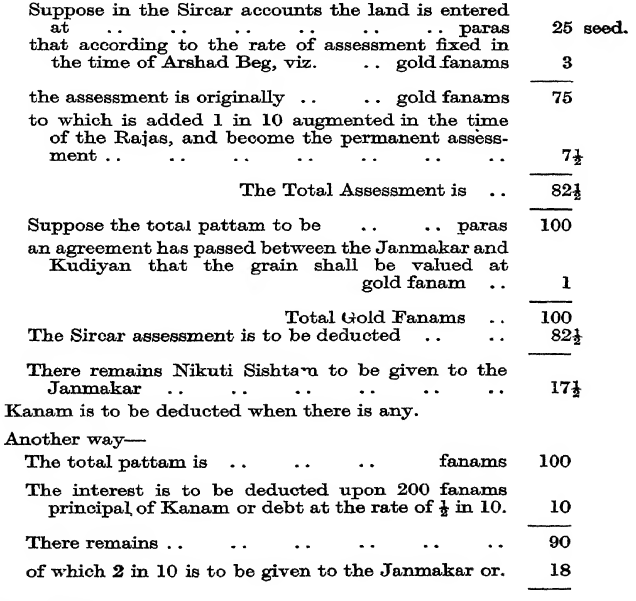
NIKUTTI Vittu.
Nikuti (q.v,). Vittu (Dravidian) = seed.
Is the quantity of seed assessed in the time of Hyder by the Huzzur Nikuti accounts. It is in contradistinction to the Vittu, which is the seed required to sow the land for one crop.
Note.—In Wynad also the actual seed sown is not always shown in the accounts.
NIRMUTAL.
From Dravidian nir ( = water) and Dravidian mutal ( = property, money).
Is a compound of Nir, water, and Mutal, property ; figuratively it means that additional property or security is acquired to the mortgagee by a pledge given by the proprietor that he will perform the ceremony of giving water to the mortgagee. It is a kind of mortgage, without possession, of the additional right which the act of giving water confers. After the execution of this deed, the proprietor cannot transfer the land to another without the express consent of the mortgagee. It is still, however, in his power to redeem the mortgage by payment of the debt. At this stage of the mortgage the proprietor has generally received 10 per cent upon the sum specified in the deed of Otti in addition to that which he had received under the deed of Ottikkumpuram. The amount of the debt, but not the pattam, is specified m this deed.
Note.—When the landlord requires to borrow a still further sum on the security of land assigned to an Otti mortgagee to whom he has already executed an Ottikkumpuram deed, he is bound first to apply to such mortgagee, and if the latter should consent to make the required advance, the landlord gives him a Nirmutal document, by which he makes over to him all but the right of water. Such further advance is recoverable with the amount of the original mortgage, the Otti claim being, in fact, merged in the Nirmutal deed. In this case, as in that of an Ottikkumpuram transaction, if the mortgagee decline to make the advance, the landlord may obtain it from a third party, who satisfies the claim of the original mortgagee and comes into possession. In any of the three cases last mentioned the landlord is at liberty at any time to pay off the mortgage and redeem his property.—(Proceedings of the Court of Sadr Adalat, No. 18, dated 5th August 1856).
NOKKICHARTTA or Nokkiyelutta Peimasi.
From Dravidian Nokki ( == having looked) and Dravidian chartta ( = assessed) or Dravidian Elutta ( = written). Peimasi = (Persian) Pymaish.
Terms in use for survey. The latter seems to have been introduced only in Tippu’s time. The surveys, except what was made by Mr. Warden in 983, are not to be understood as meaning an actual measurement of the land by square feet, but merely a calculation of the quantity of seed necessary for sowing with respect to paddy, or an inspection of the number and a valuation of the produce of trees with respect to orchards.
OART.
Used in the Commissioners’ correspondence of 1793 for garden. The Portuguese word is Horta, and its origin is evidently from Hortus.
OPPU.
From Dravidian okka ( = together, all), means agreement, and hence a signature as the mark of agreement.
Is the signature. A fee upon one of the parties signing a new mortgage-deed respecting land.
OTTI.
From Dravidian Otta ( = one, single), hence ottuka ( = to step aside, make room for another) and otti ( = the stepping aside to make room for another, or, perhaps, the substitution of one thing for another).
In former times the Otti deed was scarcely ever executed before the Pattola deed. It was the consequence of the mortgagor becoming involved in a greater degree than when he first incurred the debt to the mortgagee. It is a deeper stage into debt. In the present times it is very usual for persons to borrow to that extent at once, without going through the preliminary step of Panaya Pattam to render it necessary to execute the Otti deed.
In this deed the amount of the debt only is specified and not the pattam or rent. In this stage of mortgage the interest of the debt is equal to the annual pattam, and the mortgagee pays no pattam to the proprietor. It is also called Veppu (in Palghat) and Palisa Madakku (in Nedunganad and Walluvanad), which latter term is expressive of this characteristic feature.
The mortgagor under this deed and under the subsequent deeds, which indicate advanced stages of the mortgage, is not entitled to polichcheluttu and its concomitant advantages, Sakshi, etc., etc.
He is considered to have already received two-thirds of the value of his mortgaged land, and to be entitled to one-third more before he has relinquished his proprietary right.
Though this and other deeds have certain defined rules, it must not be understood that they are rigidly observed with respect to the proportion to the whole estimated value of the Janmam or proprietary right which should constitute it to be one kind of deed or another, but the particular sums to be given will be exceeded where the quality of the land and the great demand on the part of others may render the mortgagee apprehensive of losing possession, and in other cases the Janmi may not get so much as is supposed in these explanations.
Under this deed, as the proprietor receives no rent from the land, he must be considered to have lost all interest in it, and to be wholly inefficient for the purpose of improving it ; he is no longer even a pensioner upon it.
Notes.—1. This tenure gives the mortgagee possession and the entire produce of the land, the landlord merely retaining the proprietary title and the power to redeem. Where no period has been stipulated, the landlord may pay off the mortgage at any time. The principal alone is repayable, the mortgagee recovering the interest of his money from the produce of the land If the landlord be desirous of raising a further sum and the Otti mortgagee refuse to advance it, the money may be received from a third party and the mortgage transferred to him. But the original mortgagee has a right to be first consulted.—(Proceedings of the Court of Sadr Adalat, No. 18, dated 5th August 1856.)
2. The following are some of the decisions of the Courts. An Otti holder, like a Kanakkaran, forfeits his right to hold for 12 years by denying his Janmi’s title.—2 M.H.C.K , p. 161. An Otti holder is entitled to the first chance of supplying his Janmi’s deeds for further loans.—M.S.C., 17 (1860) ; M.S. decisions (I860), p. 249. The words “Kanam free from the payment of rent" will not enlarge that Kanam right into an Otti right.—M.S.C., 142 (1870). Until the Otti holder refuses to purchase it the Janmam right cannot be sold to another person. S.S.C., 344—358 (1855). The offer to sell the Janmam right must be “at a reasonable rate.”—N.D.C., 64 (1859). A Janmi can at any time call on an Otti holder to purchase the Janmam right, and, on his refusal, he can sell his rights to whom he pleases. M.S.C., 30 (1857). To grant land on Janmam to a third party without the Otti holder’s consent is directly at variance with the general usage of the country. S.D.C., 135—155 (1854). The Otti holder is entitled to the refusal of the opportunity of making a further advance—M.S.C, 17 (1860) and 1 M H.C.R., p. 356. The right to hold for 12 years probably attaches to an Otti.—N.D.C., 28 (1862) ; M.H.C., 380 (1862). The difference between a Kanam and an Otti pointed out : the latter includes (a) the right of pre-emption of Janmam, and (b) Janmi’s right is reduced to a mere pepper-corn rent —M.H.C., 101 (1862).
DRAVYAM.
(Sanskrit) = object, movable property, money.
The amount of Otti received by the Janmi when giving his property under the tenure of Otti.
OTTIKKUM PURAMEYULLA KANAM.
(Literally) the Kanam which is in addition to the Otti.
May be considered the third stage of mortgage. The mortgagor has borrowed 10 per cent more than the sum he had received when he executed the deed of Otti. The deed specifies the amount of debt with this addition, and makes no allusion to the pattam. The mortgagor is as little entitled to Polichcheluttu, Sakshi, and Suchi under this as under the deed of Otti.
If the mortgagor should pay off the mortgage debt, he must also under this deed, and under all the deeds executed at subsequent stages of the mortgage, pay the interest of the additional 10 per cent from the time he borrowed it, with this qualification, that it does not exceed double the amount of the principal from which it sprung.
Ottikkumpuram means above or beyond the Otti.
Under this deed the mortgagor has still the power of transferring the property to another or recovering the possession for himself by redeeming the debt.
The addition to the Otti deed which makes this deed called Ottikkum puram is not necessarily limited to 10 per cent. The mortgage retains this denomination till it becomes deep enough to be classed under Nirmutal.
The amount of the debt, but not the pattam, is specified in this deed.
Note.—When the landlord wishes to obtain a further sum he applies to the Otti mortgagee, and on receiving it executes this deed to him, in which he binds himself to repay the amount at the same time that he pays off the mortgage. The mortgagee must always have the option of making such further advance, but if he decline, the landlord may apply to a third party and assign the property to him, the latter paying off the claim of the original mortgagee.—(Proceedings of the Court of Sadr Adalat, No. 18, dated 5th August 1856.).
PALISA.
(Malayalam) = interest on money, distinct from interest on rice (= Polu, or Palisa).
Interest. The subjoined are the denominations of the different kinds of Palisa and the meaning of them in the Southern Division of Malabar, not including Palghat and Temmalapuram, where the Janmakar’s and tenants’ pattam rate is one gold fanam for 2 paras. In the Northern Division it is generally 2 silver fanams for 1 para, but in Kavai alone it is 1 silver fanam for 1 para. The terms of interest which in this table indicate so many years’ purchase for the Southern Division generally have not the same meaning in the Northern Division or in the Palghat and Temmalapuram Districts of the Southern Division, for which there ought to be a separate table.
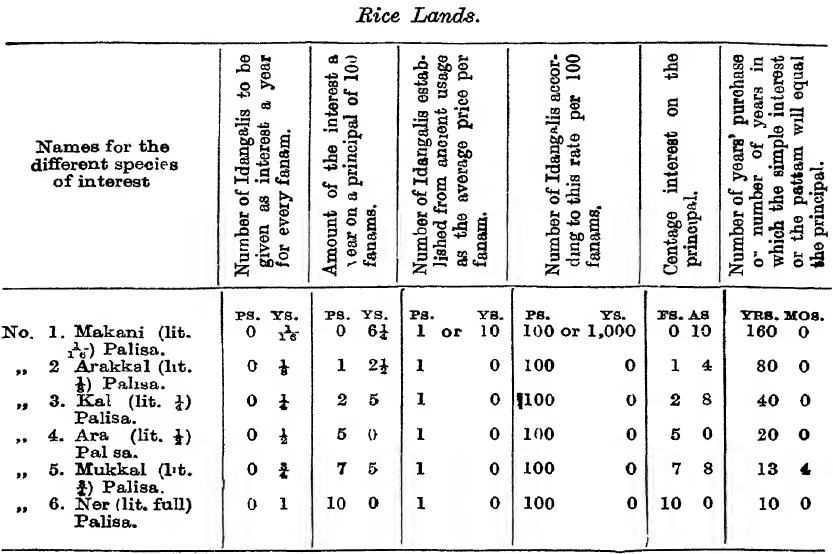
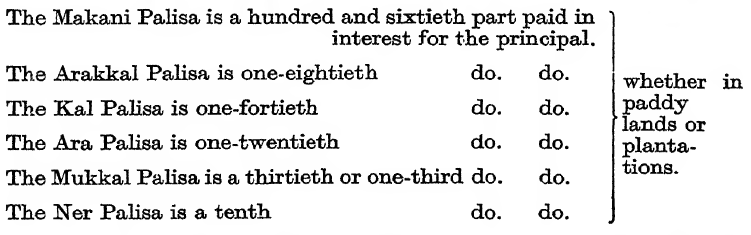
Remarks.—No. 1. May be explained to be an interest of one-sixteenth of every Idangali pattam for every fanam borrowed, or (taking the settled price of 10 Idangalis a fanam) one hundred and sixtieth part of the principal, or 160 years’ purchase, 10/16 per cent. This explanation applies to the Palisa upon paddy-fields. In plantations it is customary to refer its relation to every 10 fanams borrowed. A Makani Palisa is one-sixteenth, to be paid in interest of one fanam pattam for every ten fanams borrowed. Its centage, number of years’ purchase, and proportion to the principal, are the same as in paddy lands.
No. 2 (Blank.)
No. 3. After deducting the proportion for the assessment, this rate of interest prevails in some places.
No. 4. After deducting the proportion for one assessment, this rate is the most prevalent.
No. 5. Not in use before the introduction of the land assessment, but now in some places it prevails inclusive of the Nikuti.
No. 6. Not in use before, but now is in use inclusive of the assessment. When the assessment is half the pattam, the Ner Palisa, including the Nikuti, is equivalent to the Palisa exclusive of the Nikuti.
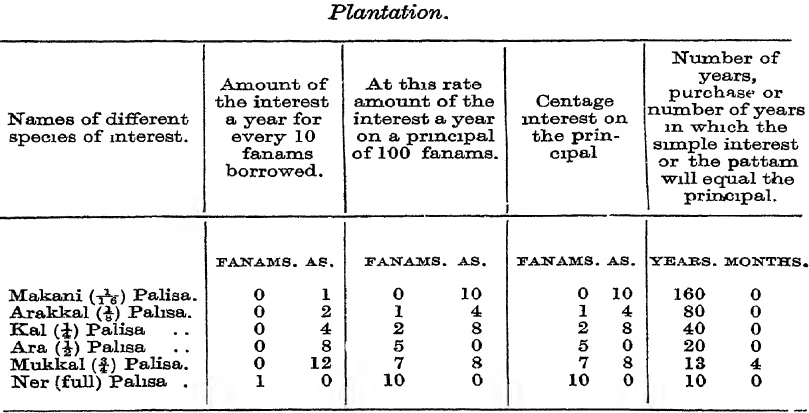
TIKAPPALISA.
From Dravidian Tikayuka = to become fall, complete) and Palisa (q.v.).
With respect to plantations has the same meaning as Ner Palisa in regard to rice-lands. It is the full interest or 10 per cent., that is, it is 10 fanams given in purchase for every fanam pattam (rent). It is the highest interest on land recognised by custom ; any excess above it would be usury.
KADAMVAYPA.
From Dravidian Kadam (= debt) and Dravidian vaypu ( = growth).
Rate of interest observable in loans of money, in contradistinction to the interest on land mortgage loans, which is much lower, but in Ernad and Vellatra many Janmakars have been obliged to borrow part of the money upon which their land is mortgaged on the terms of the Kadamvaypa.
PALISA MADAKKAM.
From Palisa (q.v.) and Dravidian Madakkam ( = return).
Used in Palghat.
The chief feature of this deed1 is that the interest of the money borrowed is equal to the value of the pattam in the possession of the mortgagee, and in this respect it exactly resembles the Otti deed. In it, however, the pattam is specified (which is not the case in the Otti deed) as well as the amount of the debt.
It is rather more favourable to the Janmakar than the Otti deed, because, as long as the mortgage has not reached the point of Otti, the Janmakar is at liberty2 to raise his terms, and the specification of the pattam gives him the means of doing it. Under the Otti deed the knowledge of the pattam is lost in former deeds, and the proprietor, it is well known, has no right to more than half as much again as he has already received. He has already got two-thirds of the whole value of the Janmam.
Notes.—1. See Otti.
2. The foot-notes to Mr. Græme’s text are by an experienced Native Revenue official.
NOTEs: 1. Otti and Palisa Madakkam are one and the same, at present at all events.
2. The distinction is scarcely maintained at the present time. END OF NOTEs
PALLIYAL, or PALLIYALI, or PAILLNYAYAL, or PALLIMANYAYAL.
Pallimanyayal from Dravidian Palli or Pallam ( == pit, hole, excavation) and Dravidian Nyaru or Naru (= what rises above ground, young plant fit for transplantation).
The highest stage of Ubhayam, a low rice-land ; it corresponds, I think with the bill of Canara The paramba may be called the high land which is not artificially irrigated.
In one kind of Palliyal or Pallimanyayal or Potta there is no cultivation. It only answers for sowing seed to be transplanted to lower lands.
Note.—Pallimanyayal was originally land excavated for rearing rice plants for transplantation.
PALPARAMBU.
From Dravidian Pal ( = an empty, void, desolate, waste place) and Dravidian Parambu ( = high ground, orchard, garden).
A destroyed garden.
PANAYAM.
From Dravidian root pan ( = to exchange, buy, bet) = bet, stake, pledge, mortgage.
In speech this deed is often designated the Todu Panayam deed with reference to its character, which corresponds with the Tors Udawoo deed of Canara.
By this deed the Janmi engages to pay a certain interest for money borrowed, or, in failure thereof, to make over to the Panayakkaran or mortgagee certain lands therein named.
In some cases the term for repayment of the principal is specified, in others it is omitted ; but it is supposed the mortgagee has a right to be put into possession of the land if the mortgagor do not pay upon the demand of the mortgagee.
If the Janmi decline putting the mortgagee into possession in failing to pay the interest, the mortgagee is in the habit of bringing an action for the recovery of the principal and interest by any means, whether by the sale of the mortgaged land alone or by the sale of other property belonging to the Janmi ; and the Judicial Courts, it is said, pass their decisions conformably to this principle.
If the Janmi, upon failing to pay the interest, were immediately to put the mortgagee in possession, the latter, it is thought, would have no right to sue for recovery of the debt by any other means.
Under this deed the Janmi has properly no right to dispose of the Janmam in the mortgaged land without the consent of the mortgagee ; but if any transfer of the kind should be clandestinely made, may insist upon the purchaser paying his demand or placing him in the possession of the land.
Where a mortgagee is placed in possession under this deed, he is to pay to the Janmi the residue of the pattam after deducting the mortgage interest.
Under this deed there is no right of Polichcheluttu, Sakshi, Oppu, and Suchi.
Notes.—1. The land is here pledged as security for the repayment, with interest, of certain sums advanced, but the lender has no right to interfere m the management of the property. In some cases it is stipulated that on failure on the part of the borrower to pay the interest, the lender shall be placed in possession of the land. Where such stipulation exists, the lender can sustain an action for possession ; in other cases he must sue for the recovery of the principal and interest of the loan, the land being liable in the event of the money not being paid. (Proceedings of the Court of Sadr Adalat, No. 18, dated 5th August 1856.)
2. The tender of the mortgage amount makes the person to whom tender is made responsible for rent from date of tender.—M.S.C., 134 (1857). A simple mortgagee has no claim to improvements.—S.D.C., 338 (1877).
3. This deed was evidently a mortgage without possession of the land interest pledged.
PANAYA ELUTTUKARAN.
From Panayam (q.v.) and Eluttukaran (Dravidian) = writ, or deed-holder.
A creditor of a Janmi, to whom the actual possession of the estate is not; consigned, but to whom the Janmi has engaged to consign it in failure of payment by a certain time. It depends upon the terms of the deed whether the land becomes in the possession of the mortgagee or not.
PANDAKKAVAL.
From Dravidian Pandal ( = temporary shed of leaves) and Dravidian Kaval ( = custody, guard, watch).
A watching fee, consisting of the crop of a certain portion of the field, which a slave receives from his master for his trouble. Kaval is watching and Pandal is the awning or cover under which the slave sets to watch.
Note.—See Kolulabham and Ennam and Patam.
PANDARAM.
(Dravidian) = treasury, government.
Term commonly used in Malabar for expressing the Government.
PANDI.
(Dravidian) = the Southern Tamil country with Madura as capital.
The name given to a tribe of Christian fishermen and palanquin-bearers on the Malabar Coast, whom I have seen at Cannanore. They are supposed to have come from, the southernmost part of the Malabar Coast, viz., Travancore, and, perhaps, from the Tinnevelly province originally.
PANIKKAR.
A kind of Master of Arts, formerly held in great respect in families as teachers of the use of arms and of martial exercises of all kinds.
The agent having jurisdiction either in a village or in a Hobaii on the part of the Kartavu, or lord of the Nad or district, to whom intermediate references are made from the Adiyans or vassals of the Kartavu.
PARA.
(Dravidian) = a drum, a rice measure.
In the Malabar province means generally ten of the measure next in quantity to it, that is, ten Idangalis or Dangalis, whatever may be the quantity of the latter. It is nearer to the mercal than to any other measure at Madras.
The standard para which appears in Mr. Græme’s statements of assessment contains ten Macleod Idangalis each Idangali being four Calicut Nalis and 3,000 Idangalis a garce.
Note.- See Vittupad.
PARAMBU.
(Dravidian) = high, dry ground, orchard, garden, compound.
May be considered the high land, whether cultivated with Modan rice, the oil-plant, the chama (Panicum miliaceum), or coconut and other trees, which is not capable of being inundated or irrigated artificially, and it does not apply exclusively to garden land as I at first thought it did.
Todi or Tottam.
(Dravidian) == garden.
Terms used for gardens and plantations.
PASUMA or Pasima.
(Dravidian) = freshness, softness, richness of soil.
Rasi.
(Sanskrit) = (a heap) with Dravidian Kuru ( = class), means poor, light soil.
Terms used for distinguishing the qualities of lands, viz., Pasima is the first, Rasi Pasima the second, and Rasi the third sort.
PATAM.
(Dravidian) = share of reapers.
It is a term used for the expense of reaping, reckoned 10 per cent. In some places this proportion is given after the paddy is measured out, in others one out of ten sheaves is given in the field.
Note.—See Ennam, Kolulabham, and Pandakkaval.
PATTAM.
Probably from Dravidian padu ( = falling, falling into one’s power, place, situation, order, office, rank of officials and of princes, etc.), hence probably meaning the share of the produce of land due to officials and princes, and latterly to Janmis or other proprietors of land. It was probably at first written as patta-varam ( = the pad's share (varam) of the produce).
The fixed proportion agreed to between a Janmi and cultivator to be given to the Janmi as his share or rent ; this proportion is usually paid in kind for rice cultivation and in money for plantations.
In settling the pattam of coconut trees it has, in most places in Malabar, been the custom to give 20 per cent of the kulikkanam money, that is, of the value of the trees. Where the cultivator has demanded immediate payment of the value, the pattam has almost everywhere been settled at two-thirds of the estimated produce. 7 1/2 rupees has been the general price almost everywhere in the central Southern Districts, at which the produce has been commuted between the proprietor and tenant in settling the pattam. At Tellicherry, Kadattanad, Kolattunad and Kavai the rate is 10 rupees The Mappilla proprietors along the coast frequently, however, take their pattam in kind and dispose of it to the best advantage.
Note.—See “Varam” and note to cl. (i) of Deed No. 3, App. XII. See also Chapter IV, Section, (a) of the Text. The kulikkanam money was the value not of the trees, as Mr. Græme asserts, but of the Janmi's share of the produce of the trees, the pattam in fact. It would never have paid any one to have planted a garden and to have undertaken to pay as annual rent one-fifth of the value of the trees, but one-fifth of the value of the Janmi's share of produce (pattam) was a very moderate annual rent.
PATTAKKARAN
From Pattam (q.v.) and Sanskrit Karan ( = doer, one who has to do with).
The tenant on a simple lease without any mortgage incumbrance.
Note.—The tenant simply yielded up the whole of the Janmi's share of the produce, that is of the pattam. It was the pattam which was not encumbered by mortgage—not the land.
KANI.
(Dravidian) =- something to be seen, gift.
Is an allowance, or offering, or tribute, of one Poti of paddy for every Poti of seed-land, which the cultivator makes to the proprietor in Wynad, answering to the Nikuti Sishtam of other taluks. Ramasvami, formerly Tahsildar of Wynad, says the Poti is given for every Poti seed of assessment, which is different from the Poti seed-land and answers to the Nejja moodee in Canara.
Synonymous with Pattam and Varam, and is used in the Wynad country for the landlord’s rent.
VARAM.
(Dravidian) == share in general, landlord’s share, rack-rent, chiefly of rice-lands (pattam of trees). — (Gundert).
The proportion given to the proprietor by the cultivator from the produce of his land. This proportion is not fixed, but depends on the actual produce, and the proprietor receives either half, or more or less, according to their agreement, which is made with respect to the quality of the land.
Note.—Pattam was probably originally patta-varam. In the ancient system certain individuals held the Varakol (share-staff) and distributed the produce. See Deed No. 3, App. XII, Conf. Nakachchal.
VARAM PATTAM.
See Varam and Pattam.
Though in general these two words are synonymous to express the landlord’s share of the produce on all kinds of land—Varam being used in the Northern and Pattam in the Southern Districts of Malabar—it appears that Varam is used in the districts south of the Kotta river in a more limited way, that is, it is confined to mean the landlord’s share arising from lands producing Modam or hill paddy and Till only, and no other descriptions of land.
Note.—Doubtful if this is so now.
VERUMPATTAM.
From Dravidian veru ( = empty, bare) and pattam (q. v.).
Simple rent unencumbered with mortgage interest.
Notes.—1- The following are a few of the Civil Courts’ rulings. —Verumpattakkar are entitled on eviction to the value of improvements, whether these have been effected with or without the knowledge of the Kanakkar or Janmi. This is an ordinary usage in the country.—S.D.C., 40 (1854). A tenancy expressed to be for one year is not necessarily determined at the end of the year. If the tenant remains in possession he holds as a tenant from year to year.—S.D.C , 400 (1877), 437 (1878). Although it is not open for a tenant to deny his lessor’s title, it is open to him to show that the title has ceased.—N.D.C., 413 (1861), 73 (1862) ; S.D.C., 172 (1877). A lessee is debarred from disputing that his lessor had no title.—S.S.C., 366 (1854). Semble: Lessor’s transferee’s lack of title.—M.S.C., 103 (1859). Encroachments by a tenant on adjoining waste are for the benefit of the landlord, — S.D.C., 438 (1877), 559 (1877). A tenant cannot of right claim remission on account of loss by drought.—S.D.C., 60 (1878). 133 (1878).
2. This lease runs only for a single year, unless otherwise specified. At the end of the year the landlord is at liberty either to renew the lease or to let the land to another tenant ; but he cannot, under any circumstances, disturb the tenant in his enjoyment until the year has expired. Where the lease is for a specified period, the tenant cannot be ejected during that period unless he endeavours to defraud the landlord or allows the rent to fall into arrears. In either of these cases, however, an action of ejectment will lie against the tenant.—(Proceedings of the Court of Sadr Adalat, Ko. 18, dated 5th August 1856).
NOTEs: Note.—See Chapter IV, Section (a) of the Text. The records of the Courts having been searched it is believed that no suits of ejectment were in reality brought before 1856, or at any rate before 1822. The Janmi used to oust an obnoxious tenant by selling his interest in the land before 1856. END OF NOTEs
VITTA PATI PATTAM.
= literally, pattam equal to half the seed sown.
Where it is half (of seed sown).
VITTOLAM PATTAM.
= literally, pattam equal to seed sown.
Where it is equal (to seed sown).
VITTIRATTA PATTAM.
= literally, pattam equal to double the seed sown.
Where the pattam is double the seed sown.
IRUNALI PATTAM.
= literally, pattam of two Nalis.
That is, two Nalis out of four which make an Idangali. It is used to express an equal division of the crop between proprietor and tenant, a mode of settlement which is seldom practised in Malabar, and which is only made for the year. It has the same meaning as Varam on the Coromandel Coast.
MENIPPATTAM.
From Dravidian meni ( == average) and pattam (q.v.).
Means the pattam or rent of a given extent of land derivable from the aggregate of the different crops, whilst the Vilachchal meni, or gross produce, refers only to the best crop, in common parlance, though not in account.
MICHCHAVARAM or MICHCHARAM.
From Dravidian micha ( = height, above) and varam (q.v.).
The balance of pattam or rent after deducting mortgage interest. It is the same as Purappad.
MELVARAM
From Dravidian mel ( = what is above, above) and varam (q.v.).
The tax upon the pattam or varam which was levied by the Rajas in the Northern Districts of Malabar before Hyder's time to pay the tribute of the Bednore or Ikkaree Raja. The Chirakkal Raja states it amounted to 2 in 10 ; in some places it is said to have been 3 in 10, or 30 per cent of the pattam.
MARUPATTAM.
From Dravidian maru ( = other, next, back again) and pattam (q.v.)
Is the counterpart of the Pattam Pramanam which the Janmi keeps by him, and may be referred to as a document in failure of the Grandhavari.
It is written upon the Karimbana palm or palmyra leaf.
MUNPATTAM.
From Dravidian ( = priority in time or place, first) and pattam (q.v.).
Note. No condition of 12 years’ enjoyment attaches to a Munpattam lease. — S.B.C., 215 (1878).
PATTACHCHITTU.
From Pattam (q.v.) and Dravidian chittu ( — a note, bill, bond).
A receipt.
Note—It is not a receipt, as Mr. Græme says, but a lease given by the proprietor to the tenant. The counterpart is Marupattam (q.v.).
PATTAMALI or PATTALI.
From Pattam (q.v.) and Dravidian ali ( = a holder).
Is a subordinate officer attacked to a Hindu temple, subject, generally, to the Uralan or to his locum tenens the Karalan. Generally speaking the office is hereditary, but the Uralan may procure his dismissal for any crime by representation to the Raja or the reigning authority.
The hereditary Karanam or register of a Naduvali The fixed or permanent writer. It is not applied to registers of Desavalis or others.
PATTOLA or PATTAMOLA.
From Pattam (q.v.) and Dravidian Ola ( = palm-leaf, deed).
Is a deed executed by the mortgagor in favour of the mortgagee, making over certain rice-land to the possession of the latter in consideration of money received, called Kanappanam. In the deed the amount of the debt is specified, the whole number of paras pattam which the land yields, the number of paras which are to be deducted1 for the interest of the debt, and the remaining number of the paras pattam of rice in the husk, called purappad, which are to be paid to the Janma. It describes the particular kind of para in which the residue is to be paid, and that it is to be delivered at the house of the proprietor. The deed states that the Kanam money received is equal to the pattam, by which is to be understood that the amount of the principal does not exceed the annual pattam, and it is said that the original intention of the proprietor receiving an advance was merely that of securing himself against the tenant failing in the payment of his pattam. The necessities of the proprietors in aftertimes drove them to borrow far beyond their annual incomes. Though not specified in the deed, it was formerly customary to give from 3 to 5 per cent, on the amount of the principal to the proprietor upon making out this deed as a fee2 under the name of Oppu or signature, and further the mortgagee had to give 2 per cent, under the denomination of Suchi, or the point of the iron style used for writing the deed. This was given where the Janmi’s established Pattolakkaran or register was employed, but the fee was less where the mortgagee appointed a person for the occasion.
NOTEs: 1. Among deductions is likewise the equivalent in paddy of the amount of assessment on the land in cases in which the tax is agreed to be paid by the mortgagee.
2. At present the rates differ with different Janmis. In some cases these are ad valorem, more frequently they are fixed. Other fees are usually paid now-a-days, such as fee to attesting witnesses, and small presents to the mortgagor’s relatives.
In the case of the Zamorin and his Kovilakams the fines and fees ordinarily levied are the subjoined :—
(1) Avakasam, at so much per para, or fanam, Janmapattam. The rate varies from 8 to 12 annas.
(2) Twenty per cent, on ditto under the name of “Aduppatha.”
(3) Stalat chilavu (expenses on the spot), that is, fees to local Karyastans.
(4) Tiruveluttu valivadu, i.e., the signature fee.
(5) A fee to the agent of the Janmi, who, under a Power of Attorney, admits execution of the documents before the registering officer. END OF NOTEs
Altogether the Oppu and Suchi are supposed not to have exceeded 5 per cent, on the amount of the debt in general. But these payments1 have been for some time discontinued in practice in most places ; they have only reference to a state of things in which the interest of the mortgage debt bore little proportion to the annual rent yielded by the land in the possession of the mortgagee, and are too excessive to be applicable to the altered circumstance of the interest of debts being equal to the pattam receivable by the mortgagee. With respect2 to this deed it is understood that if the mortgagee insists upon payment of the mortgage debt, the mortgagor has a right to deduct from the principal from 10 to 20 per cent, the rate depending upon local custom, under the name of Sakshi, and he is under no obligation to return the fees of Oppu and Suchi which he has received.
NOTEs: 1. I dare say they were when paddy was so cheap that the Michcharam received in kind hardly enabled the Janmi to meet the Government demand.
2. I am not aware that where a mortgagee demands money, any deduction in Kanam is allowed. The Janmi is not liable to refund fees. Within the last few years a practice has been introduced by certain janmis of inserting a clause m the Kanam deed whereby the mortgagee is deprived of his right of holding for 12 years if he keeps rent in arrear or does any act to the prejudice of the Janmi. Sometimes it is provided that the land shall be surrendered on demand. In all these cases the mortgagee is entitled to the refund of a fraction of the fines and fees whereof the denominator is 12, while the numerator is the number of years out of 12 which still remain to run out. The Janmi, however, takes care to mention in the document only a portion of the fines, etc., actually received by him, and when it is remembered that only a certain fraction of the principal is claimable, and not interest thereon, the hardship this practice works on the tenant becomes clear. END OF NOTEs
If the mortgagor refuses payment upon demand, the mortgagee has a right to withhold the whole of the pattam yielded by the land in his possession until his claim is satisfied, or he may mortgage the land or sell his interest in it to another. He has no claim upon any other but the particular property mortgaged belonging to the mortgagor, or any right of causing the arrest of the mortgagor. If the mortgagor of his own accord tenders payment of the mortgage debt contrary to the wish of the mortgagee, he must pay the full amount without any deduction for Sakshi, and if the mortgagee has not held possession for three years, the mortgagor must return to him the Oppu and Suchi fees which he has received.
If the mortgagee3 under this deed fails to pay the proprietor the purappad or residue after deducting the mortgage interest from the pattam, he forfeits all claim to the debt, and the proprietor has a right to demand restitution of the land. The Polichcheluttu claimable under this deed seems intended as an equivalent for the tenant’s profit, named Cherlabham, which he has derived from the land.
NOTEs: 3. At present the law, except in the cases mentioned in Note 4, is, I believe, that the Janmi shall sue for rent from time to time, or set off the accumulated rent against the Kanam money at the end of the 12 years. END OF NOTEs
On the demise4 of the tenant it is a fine of entry to his successor. The amount of it and the frequency of its renewal seem to depend upon the quality of the soil and the quantity of Cherlabham which has been enjoyed by the tenant. The latter is generally ascertained by the competition of neighbours who offer better terms to the proprietor. In the Northern Division the practice of Silakasu, or taking one year’s pattam once in three or four years, or a quarter or a third of the pattam every year, as an equivalent for the Cherlabham, has prevailed in lieu of Polichcheluttu.
Notes.—1. See Kanam and the notes of judicial decisions appended thereto.
2. The foot-notes to Mr. Græme’s text are by an experienced Native Revenue official of the district.
NOTEs: 4. This is obsolete now. END OF NOTEs
PATTAN
Corruption of Sanskrit bhattan ( = a class of foreign Brahmans). Honorific plural == pattar, applied as a caste name.
Is the foreign Brahman, not an aboriginal of Malabar. In the Palghat and Tommalapuram Districts they are the chief money-lenders and traders.
PATTINNU RANDU.
(Dravidian) = literally, two in ten.
Is where the Kudiyan pays only 2 in 10 of the pattam to the Janmi, whatever the Nikuti may be, and the difference between the Nikuti and what remains is his profit and loss.
PEPPER - VINE.
By a vine in the public accounts is meant the standard tree supporting a number of pepper-vines, or as many pepper-vines as there may be clinging to a standard tree are reckoned as one. The vine of assessment, again, the Nikuti valli, is as many vines as produce a certain quantity of pepper ; these are counted as one assessment-vine ; the quantity is 15 Idangalis of pepper in the Southern Division.
Notes.—1. The 16 Idangalis were of green pepper, which would turn out about 6 Idangalis of dry pepper.
2. The pepper-vine assessment was abolished in 1806—7, and an export duty levied instead. This continued till 1874—75.
PERPETUAL LEASE.
Notes.—1. A perpetual lease is an absolute alienation of the land subject to a perpetual obligation of paying the quit-rent, but failure to pay the quit-rent will certainly not justify resumption of the land.—S.S.C., 405 (1854), 10 (1865).
2. A perpetual lease is irredeemable, but usually not assignable.— S.D.C., 188 (1877), 29 (1878), 374 (1878), and 236 (1879).
PERUM ARTHUM or ALUKIYA ATTIPPER.
From Dravidian Perum (from peruka=to bring forth, to obtain, acquire, get) and Sanskrit (= aim, scope, object desired, gain, wealth, riches, money), and from Dravidian Alukuka (=to rot, decay) and Attipper (q.v.).
Is a deed under which the Janmi has received the full value of the property mortgaged and is not entitled to any, the smallest, share of the pattam, or even the smallest token of acknowledgment of proprietorship, but he withholds the ceremony of giving water that he may retain the empty title of Jamni.
Notes.—1. This tenure approximates closely to that of Otti, the mortgagee being in possession and enjoying the whole produce. The peculiarity of this transaction is that the sum advanced, which is always the full marketable value of the land for the time being, js not mentioned in the deed ; and the landlord, in redeeming his property, does not repay the amount originally advanced, but the actual value of it in the market at the time of redemption. In other respects the same rules that apply to Otti mortgages are applicable to this also. Deeds of this kind are in use only at Palghat and Temmalapuram.—(Proceedings of the Court of Sadr Adalat, No. 18, dated 5th August 1856.)
2. Perum Artham is a mortgage under which, when the mortgagor redeems, the mortgagee is entitled (before restoration of the mortgaged land) to be paid its market value at the time of redemption, not the amount for which the land was mortgaged.—I.I.L.R., Madras, 57.
3. Query : Was Janmi, as Mr. Græme says, an empty title after his share of the produce of the land had been thus mortgaged ? It is contrary to all reason to think so. The Janrni still retained his ‘‘water contact birthright’' (Nir-atti-peru). With various privileges attached to it. See Attiperu, Janmam, Sthana-mana-avakasam.
PHALAM.
Sanskrit, probably from Dravidian palam (==ripe fruit), fruit especially of trees, result, produce.
Fruit, profit, compensation. Under the name of Kaval-phalam or compensation for protection the Zamorin in 933 M.S. levied a general tax of one quarter of a Viray fanam upon every para of seed-land specified in Pramanams or deeds.
A bearing tree.
Note.—It was in parts of Palghat only that the Zamorin levied the tax.
PODI-CHERU.
Podi, dust ; Cheru, mud ; alluding to the different states in which land is before and after the rains. The seed without preparation is sown in the dry land and the sprouted seed on the wet.
POLICHCHELUTTU.
From Dravidian polikka (=to break open, undo) and Dravidian Eluttu (= writing).
A deed on the periodical renewal of lease, a new bond.
Literally, tearing (of documents). Is the remission or donation which the mortgagee makes periodically to the Janrni upon the amount of the debt and upon renewing the mortgage-bond. It was formerly renewed once in twelve years, the cycle in use before the present Malabar era, and generally speaking may be reckoned 2 in 10 upon the principal, but every family has its peculiar custom. At present the twelve years are not observed, but it depends on circumstances. The former principal is not reduced in the new bond ; for instance, it might have been 1,000 fanams, and the Kanakkaran gives one or two hundreds to the Janmi ready money, but the 1,000 are brought into the new bond. It is not receivable when the mortgage has arrived at that stage which is called Otti, nor is it payable upon Kadan Vayppa mortgage.
POTIPPADU.
From Dravidian poti (==a measure) and Dravidian padu (= falling, subjection, nature, measure of space, time).
Poti is a measure equal to 30 Idangalis, Potippadu is an extent of land which requires this quantity of seed to sow it.
POTIPPATTU.
From Poti (q.v.) and Dravidian pattu (=ten).
KAVATTU NEL.
From Dravidian Kayattuka ( =to increase, raise) and Dravidian nel (= unhusked rice).
The tenth of the seed, the tax which pagodas used to receive from the Kudiyan’s share in some Hobalis in the Kavali Taluk. It seems to have been consolidated with the Sircar assessment upon the Company's first survey, and no adequate compensation provided for the pagodas.
PRABHU.
(Sanskrit) = lord, prince, chief of Nayar militia.
A military chief or leader of a large force.
PRAMANI.
(Sanskrit) = chief, influential person.
Village arbitrators in the time of the Rajas, respectable inhabitants.
PRAVRITTIKKARAN.
(Sanskrit) = man of business. Often corruptly written Parputty or Parbutty.
The native collector of the revenue of a Hobali or subdivision of a taluk or district, of which there are in general from 9 to 15 to a district. It is rather a modern term, substituted for the ancient term of Pravrittikkaran.
PROPRIETORS.
It has been supposed (Mr. Warden’s letter to the Board of Revenue, 16th June 1813) that there are 44,378 proprietors1 in Malabar, the average revenue of whose estate is 480,000 pagodas, and that there are about 150,000 individuals who pay revenue direct to Government, whose payments do not exceed 3-3/16 pagodas each ; that almost the whole2 of the Janmam property is vested in pagodas and other religious establishments, and that about three-fourths of the land are held under foreclosed mortgages. This information is founded upon the account given in by the landed proprietors in 981 or 1805-6 ; but it has not been adverted to that an immense number of proprietors possess estates in several districts and different Hobalis.
NOTEs: 1. One-twentieth of them only pay-revenue to Government.
2. This was, perhaps, the state of things at the time this was written, but it is not at present, although Mr. Chattu Nambiar states that Devaswam lands form not less than one-third of the Malabar lands. There is probably some truth in the complaint, so frequently preferred of late, that the Uralars of Devaswams are converting into private (i.e.Taravad) janmam lands belonging to the pagodas. It is however, I believe, well known that all Devaswams are not public institutions. Many are strictly private property. It is considered a great point to own a Devaswam, and many janmis, until quite recently, had a tendency to set apart for their Devaswam lands till then their Taravad property. Others, again, used to do the same in order to guard against lands being sold by posterity (it being considered sinful to dispose of pagoda property, but apparently not to misappropriate the produce thereof) or held responsible by Courts for debts contracted by the owners of the Devaswams. END OF NOTEs
The account of 981 was made out by Hobalis, and a proprietor who has estates in many Hobalis appeared separately in the account of each Hobali, or perhaps three or four times in the account of a district, though properly he should only have been entered once. The number of proprietors is therefore swelled beyond all proper proportion, and their actual number is not supposed to exceed 15,000 The number of persons paying revenue direct is much exaggerated from the same cause, though the payment is certainly in very great detail and the number is no doubt very large who pay within one rupee.
I have only, however, been able to see Hobaliwar accounts, and many individuals have to pay in several Hobalis of a district. There are no accounts to show how much each individual pays in each district. It has been stated that almost the whole of the Janmam property is vested in the pagodas and other religious establishments. Much of this property must, however, be considered to belong to individual Brahmans to whom the whole landed property is said at one time to have appertained.
Taking the number of proprietors at 15,000 each estate may be reckoned to give 32 pagodas revenue, but it is conjectured that half of the whole revenue is due from estates yielding from 1,000 to 5,000 rupees assessment, though the proprietors do not themselves hold the lands in their possession or pay the assessment, the mortgagees being the occupants and paying the revenue.
The mortgaging system has been considered injurious, because the mortgagee in possession could not improve his land without the risk of being dispossessed, without affording to the proprietor the temptation to demand more or to transfer possession to another ; but it must be recollected that the proprietor cannot dispossess a mortgagee without foregoing the benefit which would be derivable to him if the mortgagee himself were to require payment of a deduction of 20 per cent from the mortgage debt under the name of Sakshi ; that it is not customary to alter a pattam long established upon an average estimate ; that every fresh demand on the part of the proprietor for an increased rent diminishes his and strengthens the rights and interests of the mortgagee in the land, gives the latter an additional mortgage interest and an improved prospect of becoming the ultimate proprietor.
By the gradual operation of this system the greater part of the mortgagees have indeed already become the virtual proprietors of the land. It seems to have been considered that lands were expressly and for the first time made over to mortgagees to discharge1 an existing debt contracted from causes unconnected with the occupation of the land ; but the fact is, I believe, that the money was almost invariably borrowed from tenants who were previously in possession.
NOTEs: 1. I do not believe that in former times the Kanam money was borrowed in order to discharge debts, for it will, I am sure, be found on investigation that in every case, without exception, the existing Kanam on any given land might have been borrowed on a mortgage of a portion of it. The fact is, I believe, that the money was received rather as security for rent. In short Kanam originally was not mortgage but was lease. Otti was mortgage. A janmi who assigned land on Otti did so because he was pinched for money. Of this, however, further on.
A “Kanam" is probably equivalent to the Roman emphyteusis, under which the tenant possessed the right of enjoying all the fruits, and disposing at pleasure of the thing of another, subject to the payment of a yearly rent to the owner (dominus). The idea of a 12 years’ holding is quite modem. Indeed it originated, I believe, with Mr. Holloway, who, taking Kanam as equivalent to emphyteusis, is said to have substituted Vyalavattam or jubilee, and thence argued that under Kanam demise the tenant was entitled to hold for a Vyalavattam or 12 years.
The meaning of the term Kanam is not clear. It is said by some to be “small fee,” “usufruct,” the word being of Persian origin. The root may perhaps be "കാണുന്നു" see, and the meaning, “money secured on the land,” i.e., seen, visible, or mentioned in the deed ("കാണുംപണം") as opposed to "കാണാപണം" invisible money, i.e., not secured on the land. The latter term is widely used in respect of renewal fees. Generally the word kanam is used as meaning money, as in Kulikkanam, Vettukanam, Tusikanam, etc.
The origin of these loans seems to have been that the tenant should give a year’s rent (pattam) in advance to the proprietor, either as a necessary security for payment or as a bonus for the profit he was allowed to enjoy, and the extravagance or necessities of the proprietor induced them to continue to borrow till the rights and interests of the mortgagee in the land became stronger than those of the proprietor. The inherent principle of redemption which the mortgage of Malabar is described to possess, and which applies strictly to the Kanam tenure alone, is accountable for by the Cherlabham or cultivator’s profit from the soil, which the proprietors have allowed them to possess independently of the deduction from the pattam on account of the mortgage interest. This is the origin of the Polichcheluttu, the Sakshi, which may be considered fines for the renewal of leases, of 10 and in some places 20 per cent according to local custom and the degree of profit enjoyed by the tenant.
Mr. Warden says truly that “The variety and number of the mortgage tenures, till they reach the deed which for ever alienates the janmam, affords the most conclusive evidence that can be adduced of the tenacity with which the ancient landholders clung to the janmam right.” They may also be considered as the result of a circumspect and jealous1 precaution on the part of the mortgagees, who, whenever they accommodated the necessities of the janmi, did not fail at the same time to add gradually but strongly to their securities for the ultimate acquisition of the proprietary right, for every step of the different mortgages involved a condition which increased the difficulty of transferring the land to any but the mortgagee.
Notes.—1. The foot-notes to Mr. Græme’s text are by an experienced Native Revenue official of the district, Mr. P. Karunakara Menon. As regards the derivation of Otti the derivation shown in its proper place in this Glossary seems preferable ; and as regards Kanam, the original meaning (supervision, protection) is fixed by Deeds 3 and 4, Appendix XII.
2. The number of Pattadars in Fasli 1290 (A.D. 1880—81) was 178,790.
3. See Chapter IV, Section (a) of the Text. The fact that the cherlabham or kolulabham (q.v.), the cultivator’s share of the produce, was “possessed independently of the deduction from the pattam on account of the mortgage interest” by the cultivator should have suggested to Mr. Græme that the thing which the Janmi mortgaged under kanam, otti, etc., was not the soil itself, but the Jamni's interest in the soil, his share of produce, the pattam in short. And this should also have suggested to him—that the Janmi had only a limited interest in the soil— that the Janmi was a co-proprietor of the soil not the dominus thereof.
NOTEs. 1. This is easily accounted for if Kanam is assumed to have been security for rent. Under Kanam, then, the mortgagee (I use the word because it is convenient) used to enjoy large profits, and he could not well impose conditions on the janmi. When however, the latter became needy and assigned land on Otti, the profits to the tenant became smaller and he naturally demanded at least greater permanency of title. And here I may attempt to derive the term Otti. I believe it is derived from "ഒറ്റൽ" (which see in Dr. Gundert’s Dictionary). The verb is "ഒറ്റുക" i.e., to secure (fish) in an "ഒറ്റൽ". The Otti holder secures the land to a certain extent, for the janmi cannot sell away to another without first giving the Ottida, the refusal. END OF NOTEs
PUKIL
A crop.
PUNJA.
(Dravidian). The name of a rice which is always cut in Medam or Edavam (April and May), It may be the only crop of the season, for some lands only admit of one, or it may be the second or the third, but it must be the crop that is cut in Medam or Edavam to entitle it to the appellation of punja.
PUTTADA.
From pu (Dravidian) == flower.
In the Northern Division of Malabar this species of rice is sown upon paramba land, whilst the kind of rice sown on lands overgrown with wood, which requires to be dug rather than ploughed, is called Punam.
REAS pronounce RIAS.
An imaginary coin introduced into the public accounts of the Malabar province, since the Company became possessed of it, from the Bombay Presidency. There are 100 of them to a quarter or 400 to one Bombay rupee.
REVENUE.
Different sources of the former revenues of Rajas in Malabar, viz. :
ANKAM.
(Dravidian) = fight, duel, battle-wager.
Was as high as 1,000 fanams or 250 rupees ; was only leviable by the Raja. It was the money which he received as umpire between two combatants under the system of battle-wager. These quarrels arose from private feuds and were meant to wipe off stains cast upon an individual's honour. A preparation and training for twelve years preceded the battle in order to qualify the combatants in the use of their weapons. They were not necessarily the principals in the quarrel, generally their champions. They undertook to defend the cause they had espoused till death. It was indispensable that one should fall.
Battle-wager or trial by single combat was a source of considerable revenue to the Rajas in former times, for each combatant was obliged to deposit with the Raja a certain sum of money. Women were the chief origin of the quarrels which occasioned these combats. They were confined to the Nayars. They were thought necessary to prove or disprove the charge of seducing women under particular protection. It was not indispensable that the parties themselves in the quarrel should be the combatants. Champions were admitted, and, in general substituted. The champions settled all their worldly affairs before the onset of the combat, for it was unavoidable that one must fall. A notification of twelve years took place before the day of combat.
CHUNKAM.
(Dravidian) == toll, custom.
Customs—land and sea—upon imports and exports. By some said to be only 2½ and 3 per cent and by others as high as 10. Naduvalis were also entitled to inland customs.
ELA.
(Dravidian) = fine, penalty, exacting presents.
The systematic usurpation of the estates of such neighbouring Rajas or Naduvalis or other chiefs as might be incapacitated from poverty or other cause from governing. The Sastra says the peculiar duty of a king is conquest.
KOLA or CHARADAYAM.
KOLA
(Dravidian) = violence, forced contribution, extortion.
CHARADAYAM.
From (? Dravidian) char (=confidant, third person) and Sanskrit adayam (= gain, income).
Forced contributions levied by Rajas for particular emergencies according to the circumstances of the individuals.
TAPPU.
(Dravidian) = blunder.
Fines levied by Naduvalis and Desavalis from their inferiors, and by Rajas from them, for accidental unintentional crimes.
PILA.
(Dravidian) = slip, fault, fine.
Fines levied in the same manner for intentional crimes, according to the magnitude of the crimes and the circumstances of the individuals. It might be a total confiscation of property.
PURUSHANTARAM.
(Sanskrit) = the next generation, succession duty.
Literally, the death of the man. Sums varying from 120 to 1,200 fanams, levied by Rajas from Naduvalis, Desavalis, heads of commercial corporation, from the holders of lands in free gift or under conditional tenure, and generally all persons holding sthanam, manam, or official dignities in the State, They also, in common with other Janmis or private proprietors, levied Purushantaram from their tenants as a fine of entry upon the decease of a proprietor or tenant. It has been supposed that the Rajas were entitled under the head of Purushantaram to a certain share of the property of deceased Mappillas, but the prevalent opinion is that there was no fixed proportion, and that it was not levied generally upon all Mappillas, but was confined to individuals possessed of wealth and holding situations or privileges dependent upon the will or favour of the Raja. The Purushantaram was sometimes enjoyed by the Desavali and Naduvali, instead of the Raja, according to the extent of right and authority which was granted or usurped, and on all occasions they were exclusively entitled to the Purushantaram of their own private lands.
PULAYATTA-PENNA.
(Dravidian) == lewd, adulterous women.
Pulayatta-penna, or degraded women, were a source of profit to Rajas ; outcastes, not exclusively, but chiefly of the Brahman caste, they were made over to Rajas to take care of. As a compensation for their maintenance and for the trouble of preventing their going astray again, the family of the outcast were in the habit of offering to the Rajas as far as 600 fanams or Rs. 150. The Rajas then disposed of them for money, but their future condition was not exactly that of a slave. They were generally bought by the coast merchants called Chetties, by whom they had offspring, who came to be intermarried among persons of the same caste, and in a few generations their origin was obliterated in the ramifications of new kindred into which they had been adopted.
PONNARIPPU.
(Dravidian) == (pon) gold (arippu) sifting.
Ponnarippu, the sifting of gold, or, generally, gold dust, was considered a royalty and the perquisite of the Rajah or the Naduvali as the case might be.
ATTADAKKAM or ATTALADAKKAM.
From Malayalam attam ( = extremity, end) and Dravidian adakkam (= subjection, possession, enjoyment).
Under the name of Attadakkam the Raja was entitled to the property of Naduvali, or Desavali or an Adiyan (vassal), or any person who held lands in free gift, dying without heirs ; and no Datt Swikaram or adoption could be valid without his sanction. A Naduvali and Desavali enjoyed the same privilege with respect to persons in the same manner dependent upon them.
ADIMAPPANAM or TALAPPANAM.
From Adima (q.v.) and Dravidian tala ( = head) and Dravidian panam (= money).
Adimappanam was the yearly payment of 1 and 2 fanams which every Adiyan was obliged to pay to his Tamburan or patron, whether he was Raja, Naduvali, Desavali, or other great man.
CHANGNGATAM.
(See note on this word in its proper place in the Glossary.)
Whenever a person wished to place himself under the special protection of a man of consequence, he paid from 4 to 64 fanams annually for Changngatam, or companionship or association, making sometimes an assignment on particular lands for the payment. It was meant for the maintenance of a kind of honorary sentinel, a belted official peon of the present times, whom the patron furnished to the person who sought his protection, but this implied also a necessity for the patron to assist with a stronger force if required in his defence.
RAKSHABHOGAM.
(Sanskrit) — Raksha, protection, and bhogam, enjoyment, hire.
Rakshabhogam payments were much to the same extent and for the same purposes. It implies an engagement of protection generally without being limited to any specific aid in the first instance.
KALCHA.
Verbal noun, from Dravidian kanuka (= to see), means perception, offering, gift.
Note. - Compare Kanam.
(Answering to Nuzzur) or presents of from 2 to 1,000 fanams, according to the circumstances of the parties, of congratulation and condolence were made to Rajas and Naduvalis by all ranks of people on occasions of the ascension of Rajas to their pattam or throne ; of the opening of a newly-built palace, a marriage, a birth, the ceremony of placing rings on a child, and a death in the family of Rajas and Naduvalis.
ADINYNYA Urukkal or Wrecks
From adinynya (Dravidian) = touched bottom, drifted ashore, and urukkal (Dravidian) = vessel, ship.
Rajas alone were entitled to shipwrecked vessels or Adinynya Urukkal.
CHERIKKAL or private domains.
From Dravidian cheri ( = assemblage, village), and, perhaps, Dravidian kal ( = foot, stem, quarter, place in general).
And they besides possessed extensive private domains in proprietary right, whether by purchases, lapses, or escheats, called Cherikkal.
EIMMULA
From Dravidian ei ( = 5) and Dravidian mula ( = udder).
MUMMULA.
From Dravidian mu ( = 3) and Dravidian mula ( = udder).
CHENOMBU.
Literally, red (chem) horn (kombu).
KANNADAPPULLI
Literally, eye spotted.
ANAPPIDI
Literally, elephant- catching.
PUVAL.
Literally, spot or speck tail.
KOMBU.
(Dravidian) = horn, ivory.
KURAKA.
(Dravidian) == the quarter, horn, thigh of an animal.
VAL.
(Dravidian) = the tail of an animal.
TOL.
(Dravidian) = the skin of an animal.
KINATTIL-PANNI.
Literally, pig (fallen) into a well.
Rajas and Naduvalis were besides entitled to Eimmula and Mummular, cows having 5 or 3 dugs ; to Chenkombu, or cattle that had destroyed a man or any animal ; to Kannadappulli, cattle having a white spot near the corner of the eye; Anappidi, elephants caught ; Puval, a buffalo having a white spot at the tip of the tail ; Kombu, the tusks of an elephant killed ; Kuraha, the leg of a deer, wild hog, or other eatable wild animal ; Val, the tail of a tiger ; Tol, its skin : and Kinattil panni, a hog fallen into a well.
MODERN LAND REVENUE.
The revenue in rice-lands, applying t.he existing professed rates of assessment per 100 paras to the average value, as fixed by Mr. Græme, of the actual pattam as rendered by the Janmis in 981, is Rs. 84 3 qrs. 52 reas per cent in the Southern Division, and Rs. 72 1 qr. 15½ reas in the Northern Division of the pattam, or for the whole province Rs. 82 0 qr. 1¼ reas.
RICE.
According to Arshed Beg’s Settlement of 1783-4 or M.E. 959 of the Southern Districts, exclusive of Palghat:-
|
Total paras sowable |
743,031 |
|
|
Deduct fallow |
38,386 |
|
|
Sowable land |
704,645 |
|
|
|
Hoons |
F |
|
Revenue |
231,481 |
4 |
Seed of rice sown, 3 paras per hoon or 1 para per rupee.
RICE LANDS.
There are 231,114 cawnies of rice-land in the Malabar Province, with the exception of Wynad, according to the survey by measurement in 983, and according to Mr. Warden’s abstract accompanying his report to the Revenue Board of 16th June 1813, of which 149,143 yield only one crop, 59,720 cawnies produce two crops, and 1,031 cawnies produce three crops ; but deducting 24,214 cawnies for waste and for pagoda and other Inams, there were remaining assessable to the revenue cawnies 209,899, of which 149,143 produce one crop only, 59,727 two crops, and 1,031 three crops, According to the Janma Pymaish accounts of 981 each cawny gives 67 standard paras and 3¼ Idangalis gross produce, and 5 rupees 42½ reas assessment, if the total revenue of 980 is applied to the total cawnies.
Note.—The rice-lands of the district are now supposed to measure, including Wynad, 394,411 acres, and excluding Wynad 366,466 acres, equivalent to 277.140 cawnies. The total revenue on the rice-lands is Rs. 11,65,921 or Rs. 2-15-5 per acre.
ROBBIN
Is what in the English correspondence is understood by a muda of rice. I cannot discover its origin.
SAKSHI
(Sanskrit) = witnessing, evidence.
Means renewal or confirmation connected with Polichcheluttu ; 2 in 10 is given for Sakshi upon the renewal of a mortgage-deed.
Note.—-See Pattola, Polichcheluttu.
SALT.
From Fasli 1216, the first year of the monopoly, to the end of Fasli 1227—
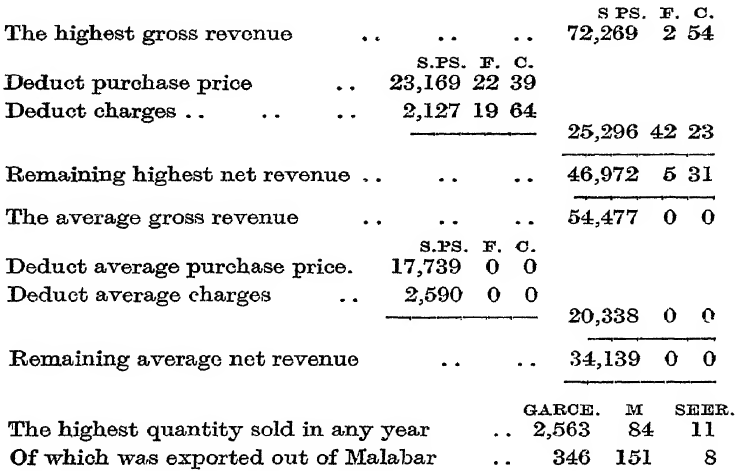
In Bombay the price rarely exceeds 2 rupees per ton. In 1821 it had risen to 6 and 7.—{Bombay Gazette, 18th April 1821.) A ton is 2,240 lb, ; a Madras garce of Bombay salt (reckoning a para at 90 lb. and 120 paras to a garce) is 10,800 lb. or 4 tons and 1,840 lb. The price of a Madras garce at 2 rupees a ton is therefore 9 rupees 2 quarters and 57 reas. The usual price at which Bombay salt has been bought in Malabar has been 13 rupees a coomb or 39 rupees a garce at Cannanore, Tellicherry, and Mahe, 42 at Calicut, and 45 at Ponnani.—(Mr. Warden's report of 3rd October 1828). At 7 rupees a ton the price is Rs. 33 3 qr. the Madras garce.
According to a letter from Government to the Revenue Board, of 20th March 1820, the present average consumption of salt in all the territories under the Madras Presidency may be taken at 25,000 garces ; reckon them at Rs. 112 the garce, monopoly selling price, they will come to 27,90,000 rupees ; but reckoning 30 per cent, for prime cost and charges, the net revenue will be Rs 19,53,000, or between 5 and 6 lakhs of pagodas. In this calculation there is nothing authenticated but the number of garces sold.
Note.—The annual average importations of salt for the five years preceding the introduction of the excise system was 4,2391 garces. Since the introduction (1877) of the excise system the annual average importation has been 3,016 garces, i.e. 10 garces of Government salt, 2,596 garces of duty prepaid salt, and 401 garces of foreign salt.
SALT PANS.
The owners of salt pans in Malabar used before the monopoly to employ labourers for the manufacture of salt, or to let the pans out on rent or pattam. The pattam was not fixed for a length of time together as on rice-lands, but depended upon the annual produce. It is generally supposed to have been a third leaving two-thirds to the manufacturer.
SHANAR.
The name by which Tiyars or toddy-drawers are called in the Temmalapuram and Palghat Districts, who are not aborigines of Malabar, but come from the districts to the east of the ghats.
Note.—See Iluvar and Tiyar.
SISHT-BAKKI.
From Sanskrit Sishtam ( = remainder) and Arabic bakhi ( == surplus).
A balance of revenue uncollected from the person from whom due, in contradistinction to Dast-bakki, a balance collected but not brought to the account of Government.
SISU or Tei.
Sisu (Sanskrit) = young animal or plant. Tei (Dravidian) = shoot, young tree.
A young plant.
SLAVES.
Amount taken in 1807, to 96,368.
Note.—In 1857, when the last census of slaves was taken, the number was found to be 187,812, of whom 148,210 had up to that time remained with their former masters. See Cherumakkal.
STHANA-MANA-AVAKSAM.
From Sanskrit Sthanam ( == standing, place, situation, rank) and Sanskrit Kanam ( = honour, rank) and Sanskrit Avakasam ( = title, claim, right).
Dignity and emoluments of a public situation.
Note.—This probably denoted the true position of a Janmi or holder of the "water contact birthright" (Nir-atti-peru). See Attiperu, Janmam, Perumartham.
SUDRAN, plural SUDRANMAR.
(Sanskrit) = the fourth caste in the Hindu system.
Who according, to the Sastram, are the fourth class of Hindus, are a particular caste of Nayars in Malabar, whose duty it is to perform ceremonies or Karmam in Brahman families on the birth of a child, etc.
Note.—Nayars generally do now style themselves as Sudras.
SVARUPAM.
(Sanskrit) = one’s own shape, image, idol, dynasty.
Means descent, family, race, house, answering to Vamsam. The Calicut Zamorin Raja’s family is called the Nayaririppu (or vulgarly, Nediyirippu) Svarupam, that of the Kadattanad Raja is the Porlatiri Svarupam, that of the Chirakkal Raja, Kolatthi or Kola Svarupam, that of Kottayam or Cotiote the Puranattukara or Purattara Svarupam, that of the Kurumbranad the Kurumbarattiri or Kurumbiyattiri Svarupam. The Walluvanad Raja is the Arngngottu Svarupam, the Cochin Raja is the Perimbadappu Swarupam, the Travancore Raja is the Trippa or Trippappu Svarupam.
SVARUPAKKUR.
From Svarupam (q.v.) and Dravidian Kuru ( = part, share).
Office, dignity, and Kuru, share, partition, allotment. It means the property attached to the official rank of a Raja.
SVARUPAM.
See Svarupam
Head of a family. Ten necessary for a Kartavu or lordship of 3,000 men.
TALA UDAYA TAMBURAN.
Literally == the head-possessing lord.
The Kartavu or superior lord of a vassal.
TANDU.
(Sanskrit) — palanquin hanging on silk cords
An open palanquin, which in the Malabar Province is also called and which Englishmen call Manchil. The attainment of the rank of Valum-pudavum is indispensable to qualify any person, whether a common man or a Raja, to ride in a palanquin.
TARA.
(Dravidian) == foundation, mound, ground, village, quarter. Similar to Tamil and Malayalam teru, Telugu teruvu, Canarese and Tulu teravu.
A village. The same as Desam in the Malabar Province.
Note.—See Ur and Desam. This and not the Desam was the true village of Malabar, that is, it was the Nayar village or unit of organisation for civil purposes among the Nayars. Conf. p. 87 of the text.
TARAVADU.
From Tara (q.v.) and Dravidian padu (=falling, falling into one's power, place, situation, rank, authority)
A house or family.
Note.—Compare pattam. Dr, Gundert defines the term a house chiefly of noblemen, ancestral residence of landowners, a family. The term was applied only to the families of authority in the Nayar village (Tara).
TARAVATTUKARAN or PRAMANI.
From Taravadu (q.v.) and Sanskrit Karan (=doer, one who has to do with), and Sanskrit Pramanam (== measure, authority).
In every Desam four householders or Taravattukarar possess a certain hereditary sthanam or dignity which points them out as the proper persons to apply to whenever a marriage, a death, a religious ceremony or dispute takes place. They are sometimes called Pramani, or principal inhabitants, and latterly, under the Company’s Government, Mukhyastanmar. They did not possess the Koyma or controlling authority in the Desam, but were a kind of arbitrators. When a dispute could not be settled by their mediation it went to the Desavali.
Names of former heads of villages.
Note.— Mr. Græme, contrary to previous notes, here states correctly, if Tara be submitted for Desam, the position of the Taravattukkarar. The Desavali was usually one of the Taravattukarar of his tara or village. See Madhyastanmar and Mukkyastan.
TARISU.
(Dravidian) = waste rice-land.
TINGALPPANAM.
From Dravidian tingal (==the moon) and Dravidian panam (=money).
General monthly levy on all classes of the inhabitants. One of the contributions levied in Malabar by the Rajas.
TIPPALI.
Is the same as Nali, a measure of which 4 go to a Idangali. It is supposed that in Malabar a man has enough to eat if he has 1½ Tippalis of rice and ½ Tippali of conjee a day, or 1 Idangali of paddy of 4 Calicut Nalis There are many in a starving condition who get less, and many affluent who eat more.
TIRUVATIRA NYATTUTALA
From Tiruvatira (==the sixth asterism, including Betelgeuze) and Dravidian Nyattutala (= the time of a constellation).
Nyattutala is a period of fourteen days. It is in the fourteen days commencing with about the 7th of Mithunam (June) that there must be constant rain for the proper growth of the pepper ; the failure of this season may cause a difference of produce of perhaps 25 per cent.
TIYAN.
Formerly written Tivan, that is islander (from Sanskrit dvipam).
Toddy-drawer and cultivator of land. Upon asking a number of Brahmans and Nayars assembled at Calicut whether Tiyars were included among the Sudras of the Sastra they professed ignorance, and said they must refer to the Sastra. Their number, according to an account taken in 1807, was 128,045.
The Tiyan woman (Tiyatti) wears no cholee, or any cloth thrown over her shoulders and neck. Her body down to the waist is entirely exposed.
Notes.—1. See lluvan, Shanar.
2. This caste now numbers 527,928 (Census, 1871).
TOBACCO.
Average annual consumption 1,500 candies of 640 lb., or 1¾ per head in the whole population.
TODUPPANAYAM.
From Dravidian Toduka = to touch, feel, come into contact with) and Panayam (q.v.).
A deed in use.
Notes.—1. The land is here pledged as security for the repayment with interest of certain sums advanced, but the lender has no right to interfere m the management of the property. In some cases it is stipulated that on failure on the part of the borrower to pay the interest, the lender shall be placed in possession of the land. Where such stipulation exists the lender can sustain an action for possession. In other cases he must sue for the recovery of the principal and interest of the loan, the land being liable in the event of the money not being paid.—(Proceedings of the Court of Sadr Adalat, No. 18, dated 5th August 1856.)
TUSIKKANAM.
From corruption of Sanskrit Suchi (=a needle, iron style) and Kanam (q.v.).
Is the fee to the writer of a new mortgage-deed. This and the Oppu may amount to 7 per cent, sometimes more, sometimes less.
ULA-PARAMBU.
Ula for ulavu (Dravidian) = tillage, and Parambu (q.v.).
Ploughable or arable highland by which the hill rice cultivation, or Modan paramba, is distinguished from the plantations, which are more properly called paramba.
Note.—Applied to land made over temporarily for use.
UNDARUTI.
From Dravidian Unnuka (==to eat) and Dravidian aruti (end) ; literally, therefore, it means having eaten and ended, that is, the property is enjoyed until the money advanced has been fully recovered with interest.
Undaruti means a settlement1 (of the debt) by the enjoyment of the profits by the usufruct. It is a species of mortgage which seems to answer to the Vivum Vadium, where the mortgagee holds the estate till the rents and profits repay the sum borrowed ; with this exception, that the pattam or rent is previously determined, and it is therefore known beforehand in how many years the debt will be liquidated, and the mortgagee is under no necessity of rendering to the proprietor an account of the produce of the estate.
NOTEs: 1. Undaruti is, I conceive, a lease. The full rent for the term of the lease is paid in advance. In fixing the rent, of course the tenant will take care to see that only the present worth is offered and paid. An Undaruti lessee is never entitled, as a matter of right, to cancel the lease. In any case he would get back no interest for the reason just advanced. END OF NOTEs
In this deed the pattam being first determined and specified, whether in rice or garden lands or in grain or money, a provision2 is made out of it to the mortgagee for the interest of the debt at the rate agreed upon, and a further provision for such a share of the pattam as shall, within, a certain time, repay the principal. If the mortgagee relinquishes the land before the expiration of the time and claims the debt, the mortgagor may take credit for the amount which the mortgagee has received, during the period he has been in possession, out of the fund allotted towards the discharge (not of the interest, but) of the principal, and from the remainder he is entitled to deduct 23 per cent for Sakshi and Suchi. The mortgagee having undertaken the responsibility of the management, this deduction is considered a just fine for his breach of engagement.
NOTEs. 2. Not that I know of. END OF NOTEs.
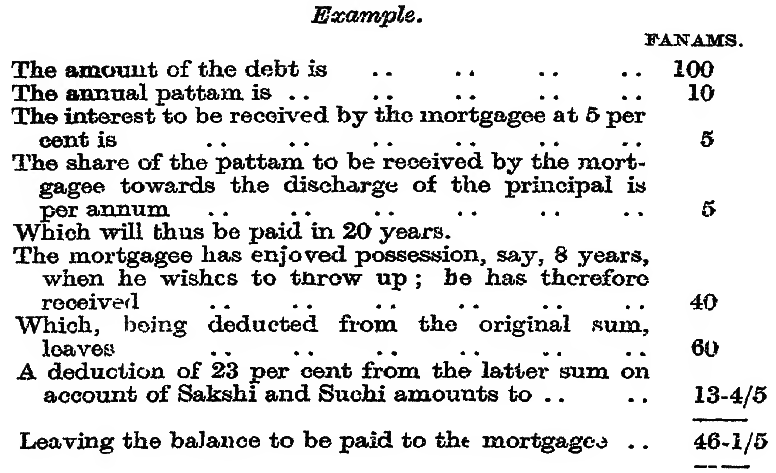
It has been1 said that the mortgagee does not receive the Kolulabham or cultivator’s profit, but according to my inquiries he is entitled to it.
The interest under the Undaruti deed is greater than that under the principal deeds of mortgage which have their rise from the Kana Janma Maryada. It is generally 10 per cent.
Though it affords the means of early liquidating the debt, it is considered in a less friendly light by the mortgagee in general than the Panaya Pattola deed. It is true he recovers his money, but what he receives annually is probably expended annually, and at the end of the specified period he does not become the laird of the land. It is a mere mercantile speculation which does not add to his dignity. The old proprietor, on the contrary, prefers this kind of tenure ; for though he suffers deprivation for a period, he is ultimately restored to his station of proprietor of the soil.
NOTEs: 1. Major Walker's treatise cm Mortgages. END OF NOTEs
Notes.- Notes.—1. The foot-notes to Mr. Græme's text are by an experienced Native Revenue official.
2. The tenant is much in the same position as a Kanam mortgagee having possession and recovering the interest of his money from the rent produce ofthe land. Instead, however, of making over the surplus produce to the landlord, he places it to his credit in account, to be applied to the reduction of the principal. As soon as the principal is in this manner repaid, the mortgagee must restore the land to the proprietor.—(Proceedings of the Court of Sadr Adalat, No. 18, dated 5th August 1856.)
3. Undaruti is a species of mortgage, the nature of which is to absorb the principal amount in the profits of the mortgaged property till it is reduced to nothing. —N.D.C., 25 (1874).
UR or KARA.
Ur (Dravidian) = village, hamlet. Kara (Dravidian) — shore, bank, hamlet.
A collection of houses in different directions, a number of which constitute a Desam. Houses are generally built round a tract of paddy land, and, according to their bearings, are named Vadakku kara (a collection to the north), Tekku kara, and so forth. The Urus or Karas have no separate boundaries and no distinct names, but are comprehended in the Desam.
Notes.—1. See Tara and Desam.
2. Those were probably congeries of houses inhabited by husbandmen, cultivators, subordinate to the Desavals in military, and to the Taravattu Karanavar in civil, matters.
URALAN.
From Ur (q.v.) and Dravidian at (person, able poison) Their office Uranma or Urayma.
May be considered the patron or founder of a pagoda, whether established in the time of Parasurama or in more recent times by Brahmans or Rajas.
Notes. —1 . When the pagoda is itself the property of the family, by the custom of Malabar the lands attached thereto are alienable as any other private possession.- M,S.C., 64 (1861). A sale of Urayma right is invalid. N.D.C., — 34 (1874). Lands attached to a pagoda cannot be alienated by the whole body of Uralar. N.D.C., — 102 (1843). Uralur cannot sell their rights.— 1 M.H.C.R, 210 ; 1, I.L.R., Madras I, 235.
2. See Desam.
VAKACHCHAL.
From Dravidian vakayuka ( == to divide).
The share of 2 in 10 in the pattam, in kind, which the Rajas used to receive in the northern districts, before Hyder’s conquest, from all but the pagoda lands, after which, in 953, the Huzzur Nikuti or the basis of the present assessment was established. The Vakachchal is said to have been introduced first in 90, when the Ikkery or Bednore Government first invaded Malabar.
VAKACHACHA(L)KKARAN.
From Vakachchal (q.v.) and Sanskrit Karan ( = doer, one who has to do with).
The collector of the share (of the pattam), He held the situation under the Rajas formerly nearly corresponding to the Pravartti of the present day.
Note.—See Pravrittikkaran and Varam.
VAKKU.
(Malayalam) = hemp. From Vala (Dravidian) = net, hence Valkkuka or Vakkuka == to catch fish and vakku, the material used for lines.
Hemp. It is sown in paramba land, but it is supposed to thrive best in the land called Palliyal, which has a sufficient command of water without being too low. The cultivation of it has extended of late years In consequence of the encouragement given to it by the canvas manufactory at Beypoor, but in the Kilakkampuram. and Vadakkampuram and Polnad Districts there is an ancient prohibition against its culture, as there is against that of ginger and against the use of buffaloes for ploughing, said to have been issued by a Raja of these districts, from whom the Zamorin Raja usurped them, and who has since become the Kadattanad Raja.
VALLI and VITTU.
Valli from val (Dravidian) = strong, means proper subsistence given in kind to slaves or labourers. Vittu (Dravidian) = seed.
Is the charges of cultivation, and with Vittu or the seed is called Vittuvalli. As the hire of labour applies only to slaves, Kuli or Cooly is the term when free men are employed. Vittu-valli comprehends the expense of ploughing, of digging, of sowing, of manuring, of weeding, and of threshing. (On the Eastern Coast the paddy is trod by bullocks, in Malabar by men.) The Valli is reckoned to amount to a third of the gross produce (deducting always 10 per cent, for reaping), but where the produce falls short of seven-fold the Valli exceeds this proportion. It must be paid, it is supposed, out of the Kolulabham or the cultivator’s profit.
Mr. Rickards, in his proposed settlement for Malabar, recommends the quantity of seed sown and an equal quantity for charges to be deducted on account of Vittu-valli from the gross produce, and the different shares to be determined on the remainder. The proportion to the gross produce varies according to the quality of the soil and its estimated produce. (See the account given by the Janmis to Mr. Rickards in 978). The lowest sort of land in this statement is supposed to produce three-fold only, which is 333/10 per cent, the highest thirty-fold, which is only 33/10 per cent, of the gross produce for Vittu-valli.
Note.—See Kolulabham, etc.
VALUM-PUDAVUM.
Val (Dravidian) = sword. Pudavu (Dravidian) = double cloth.
Is a certain rank conferred upon Rajas and Naduvalis, the external ceremony of which is conferring a sword and some cloth. To a Raja the ceremony is performed by a Namburipad Brahman, and to a Naduvali by a Raja. Money is given on these occasions by the person upon whom the honour is conferred.
VALUMEL KODI.
Literally = coloured tip of the tail.
A buffalo having a white tip to the tail, belonging to individuals, became the property of Desavalis in former times as one of their privileges.
VANOKKI.
Perhaps from Vanam (Dravidian) = sky, and nokkunnu (Dravidian) = to look, observe, meaning crops dependent on the sky, rain-fed.
Same as Punam and Modan.
VARGE.
A word used in the early records of Malabar. From the Portuguese word Varja, and means field or meadow.
VASTU and VASTU-Mutal.
Vastu (Sanskrit) — substance, matter, thing, property, weighty action, provender. Mutal, (Dravidian) = beginning, blossom, principal or capital, stock in trade, property, money.
Means generally the landed property of an individual, to include the personal property it is necessary to say Vastu-mutal.
VELLAKKEDU.
From Dravidian vellam ( == water) and Dravidian kedu ( = destruction, loss, damage).
Loss by flood. In fixing the pattam for the Kudiyan remission is allowed on this account.
VEYILKKEDU.
From Dravidian veyil ( = sunshine) and Dravidian kedu (=, destruction, loss, damage).
Injury by heat or drought. In fixing the pattam in Malabar permanent allowance appears to have been made on this account.
VILACHCHAL MENI-PATTAM.
Vilachchal, from Dravidian vila ( = vegetation, crop), means produce of corn, ripe crop. Meni (Dravidian) = body, shape, sample, average Pattam (q.v.).
Is the pattam deducible from taking, according to Mr. Rickards’ proposed settlement, two-thirds of the Vilachchal or gross produce of the Janmi Pymaish account of 981, after deducting a quantity equal to the quantity of seed sown, and one-third for the cultivator’s share. In the Malabar Province, with the exception of Wynad, it amounts to standard paras 6,210,562 and 5 Idangalis. It is to be distinguished from the Verumpattam of the same account, which is the quantity stated by the Janmis to be actually receivable by them from their tenants. It amounts to standard paras 5,910,375 and 3 Idangalis. The Vilachchal-meni-pattam with respect to gardens is two thirds of the gross produce according to Mr. Rickards’ proposed settlement.
Note.—See Pattam and Kolulabham.
VILUMPADI.
From Dravidian viluka ( = to fall) and Dravidian padi = measure at the rate of, according to).
Is a mode of agreement in practice between the Janmi and Kudiyan in Kilakkampuram and Vadakkampuram of the Calicut Taluk.
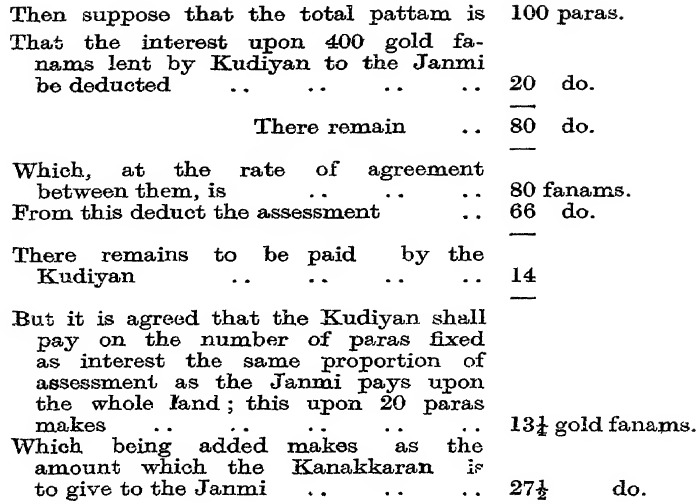
It has above been explained to mean the proportion of the public assessment which a Kanakkaram agrees to pay out of his share of the produce in common with the Janmi. Refers also to a mode of levying the assessment in Walluvanad, etc., taluks on Modan and hill produce. For instance, the permanent jamma under these heads being in any village considered to be 100 fanams, an annual inspection of the produce takes place, and 2 in 10 being assumed as the Sirkar share, this share is valued at a higher or lower rate on the different lands as may be necessary to bring the jamma exactly to 100 fanams. As a farther illustration, the Sirkar share of the produce might, in one year, be 100 paras , one fanam would accordingly be fixed as the rate for 10 Idangalis. In another year the Sirkar share of the produce might be only 80 paras ; the rate would then be a fanam for every 8 Idangalis. In both cases the total amount would be equal. Vilumpadi means generally proportion, ratio, rate.
VIRIPPU.
Dravidian = bedding, crop out in August and September.
The name of a rice which has only one crop in the year, and that crop is only cut in Kanni (September and October).
VITTUPADU.
From Dravidian vittu (= seed) and Dravidian padu ( -= falling, falling into power of, rank, nature, measure of space and time).
Answers to Verripadoo in Tamil and Beenjivurree in Hindustani. It means seed-land, that is, the quantity of seed which any land requires to sow it for a single crop. That is, suppose a land takes 10 paras to sow it or one crop and that it yields three crops. It would altogether require 30 paras for the different crops, but it would be called only a 10-para Vittupadu.
A specific superficial extent in cawnies or acres is not to be ascertained merely by the quantity of seed required to sow any land, because bad soil requires a larger, and good soil a smaller, quantity to sow it in the same extent of land.
Note.—See one Para Seed Land
VYALAVATTAM.
From, vyalam (Sanskrit) = the planet Jupiter, and vattam (Dravidian) = a circle ; means the cycle of Jupiter, about 12 years.
A cycle of 12 years, to which all transactions in Malabar had reference previous to the establishment of the present Malabar era,—renewal of leases, bonds, and rent of gardens. Each year of the cycle was named alternately from the 12 signs of the Zodiac, and as months were distinguished in the same way, the name of the month and the name of the year might often be the same in a deed.
Note.—-The word andu, in the Jews’ Deed. (No. 1) and in the old Kanam Deed (No. 4) printed in Appendix XII, signified this cycle of Jupiter, or a cycle of 60 years.
VYAVAHARAMALA.
From Sanskrit vyavaharam ( = dealings, usage, practice of Courts, lawsuit) and Sanskrit mala ( = garland, wreath, necklace).
A book containing the law of division of produce between the cultivator and proprietor, without allusion to any assessment which did not at that time exist.
Note.— As matter of fact, the Vyavaharamala is more taken up with judicial matters than with matters agricultural.
APPENDIX XIV
A.—ANJENGO FACTORY AND RESIDENCY.
.
|
Factory established in |
1684 |
|
John Brabon, Chief about |
1710 |
|
Alexander Orme, do |
1723 |
|
Hezakiah Ring, do |
1729 |
|
William Wake, do |
1735 |
|
The factory records extant commence from 1st August |
1744 |
|
|
Date of assuming charge. |
Date of retirement. |
Remarks. |
|
Chiefs |
|
|
|
|
R. Bouchier |
|
1st February 1750 |
Was Chief on 1st August 1744. |
|
T. Byfeld |
2nd February 1750. |
5th March 1751. |
|
|
T. Hodges |
5th March 1751 |
7th April 1752. |
|
|
W. Hornby, acting. |
8th April 1752 |
14th May 1752. |
|
|
G. Scott |
15th May 1752 |
27th March 1757. |
|
|
L. Spencer |
28th March 1757 |
12th September 1758. |
|
|
C. Crommelin |
13th September 1758. |
20th April 1759. |
|
|
I. Whitehill |
21st April 1759 |
8th September 1769. |
Died at Anjengo. |
|
W. Taylor, acting. |
8th September 1769. |
9th December 1769. |
|
|
P. E. Wrench. |
10th December 1769. |
16th February 1774. |
|
|
S. Ewart, acting. |
17th February 1774 . |
23rd March 1774. |
|
|
N . Slackhouse. |
24th March 1774 |
12th February 1776. |
The Chiefship was now reduced to a Residency. |
|
|
Date of assuming charge. |
Date of retirement. |
Remarks |
|
Residents |
|
|
|
|
G. Bigger, acting. |
13th February 1776 |
31st December 1776. |
|
|
J. Torlepe |
1777 |
8th December 1780. |
Diary missing. |
|
J. Morley |
9th December 1780 |
10th December 1781. |
|
|
Hutchinson, acting. |
11th December 1781 |
22nd March 1782 |
Mr. Hutchmson was appointed Cochin Commissioner, but in five months he returned to Anjengo and died there. |
|
Hutchinson, confirmed. |
23rd March 1782 |
24th February 1796. |
|
|
I. T. Dyne, acting. |
25th February 1796 |
17th July 1796. |
|
|
J. Hutchinson. |
18th July 1796 |
11th October 1797. |
|
|
I T. Dyne, acting. |
12th October 1797 |
22nd February 1798. |
|
|
G. Parry. |
23rd February 1798 |
3rd September 1803. |
|
|
A. W. Handley. |
4th September 1803 |
1st July 1808 |
Died at Anjengo. |
|
I. T. Dyne, acting. |
1st July 1808 |
27th October 1808. |
|
|
I. Smee. |
28th October 1808 |
27th December 1809. |
|
|
R. Coward |
28th December 1809. |
10th December 1810. |
Factory abolished and Anjengo transferred to the Political Resident, Travancore. |
B.—TELLICHERRY FACTORY AND RESIDENCY
List of Chiefs and Residents.
|
|
Date of assuming charge. |
Date of retirement. |
Remarks |
|
Chiefs. |
|
|
|
|
Robert Adams. |
|
10th March 1728 |
Chief |
|
John Braddyll. |
10th March 1728. |
17th December 1732 |
|
|
Stephen Law. |
17th December 1732. |
27th February 1739 |
|
|
William Wake. |
27th February 1739. |
8th November 1742 |
|
|
William Jeynson. |
8th November 1742. |
8th February 1743 |
Provisional. |
|
John Geekie. |
8th February 1743. |
20th January 1746 |
|
|
George Dudley |
20th January 1746. |
13th May 1747 |
|
|
William West. |
13th May 1747. |
20th May 1748 |
Provisional. |
|
Robert Rawdon |
20th May 1748. |
31st October 1748 |
Died |
|
Thomas Byfeld. |
31st October 1748. |
17th January 1750 |
|
|
Thomas Derrill. |
17th January 1750. |
3rd January 1754 |
Suspended. |
|
John Sewell and Thomas Hodges. |
3rd January 1754. |
13th March 1754 |
Supravisors. |
|
Thomas Hodges. |
15th March 1754. |
13th February 1762 |
Chief |
|
William Hornby. |
13th February 1762. |
30th April 1764 |
|
|
Thomas Byfeld. |
30th April 1764. |
28th September 1765 |
Died |
|
Harry Huet. |
28th September 1765. |
13th November 1765 |
|
|
James Ryley. |
13th November 1765. |
13th January 1767 |
|
|
William Hornby. |
13th January 1767. |
10th December 1768 |
|
|
Daniel Draper. |
10th December 1768. |
10th January 1770 |
|
|
Rawson Hart Boddam. |
10th January 1770 |
4th March 1776 |
Chiefship reduced to Residency. |
|
|
Date of assuming charge. |
Date of retirement. |
Remarks |
|
Residents |
|
|
|
|
William Ashburner. |
4th March 1776 |
7th March 1777. |
|
|
Richard Church. |
7th March 1777 |
22nd January 1781. |
|
|
Samuel Stedman and Michael Firth. |
Factors in charge |
to May 1781. |
|
|
Willam Freeman. |
21st May 1781 |
18th January 1784 |
Chiefship restored. |
|
|
Date of assuming charge. |
Date of retirement. |
Remarks |
|
Chiefs |
|
|
|
|
Richard Church. |
18th January 1784. |
14th February 1785 |
|
|
J. Beaumont. |
14th February 1786. |
5th June 1786 |
|
|
William Page and George Paterson. |
Factors in charge |
to 24th November 1786 |
|
|
William Lewis. |
24th November 1786. |
24th December 1789 |
|
|
Robert Taylor. |
24th December 1789. |
27th July 1794 |
Factory abolished. |
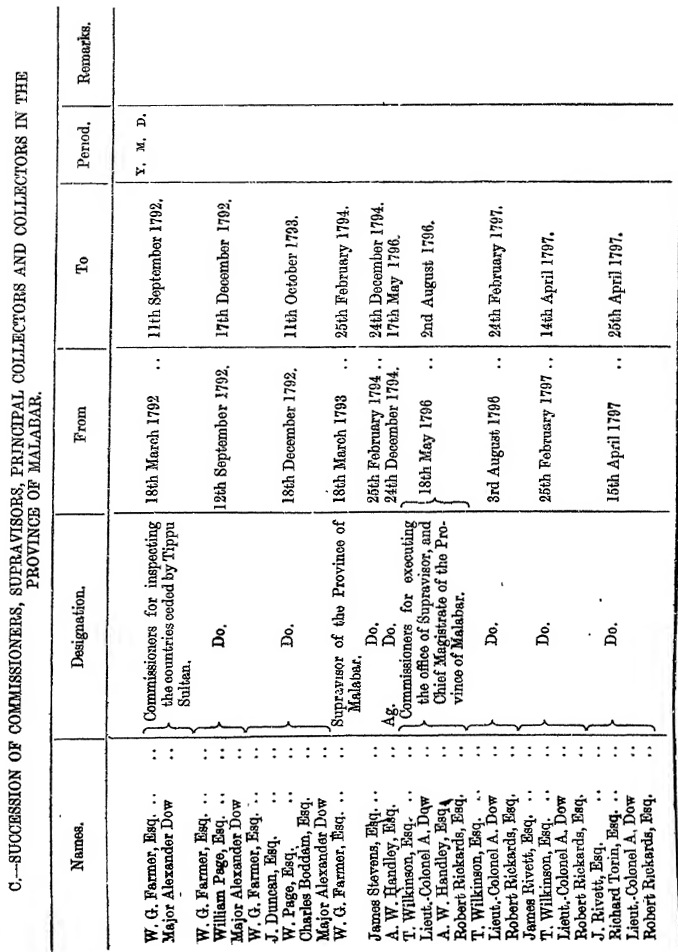
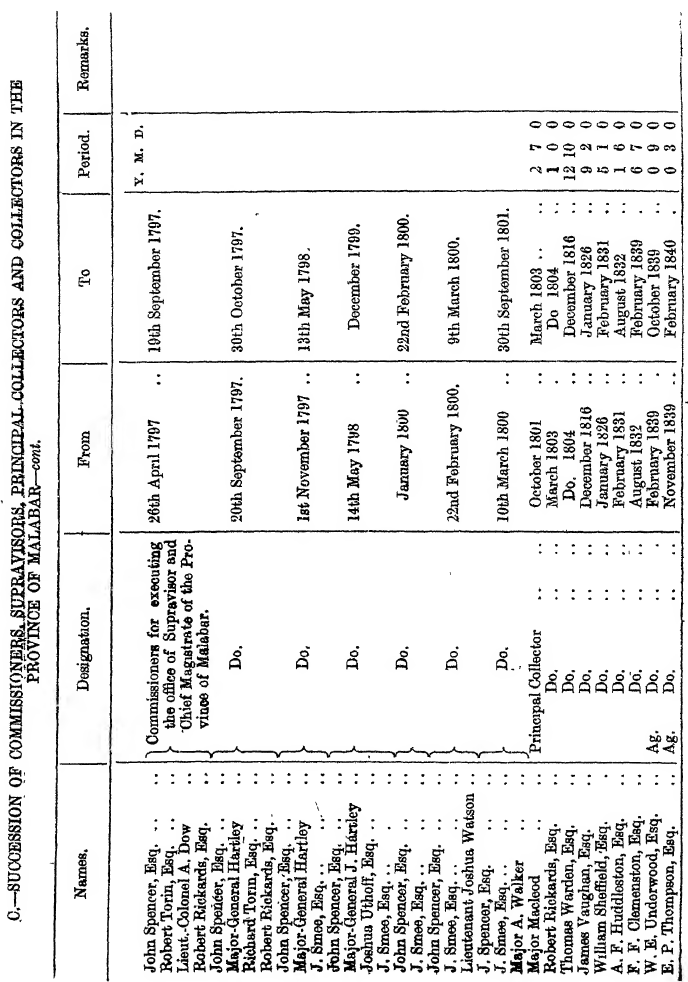
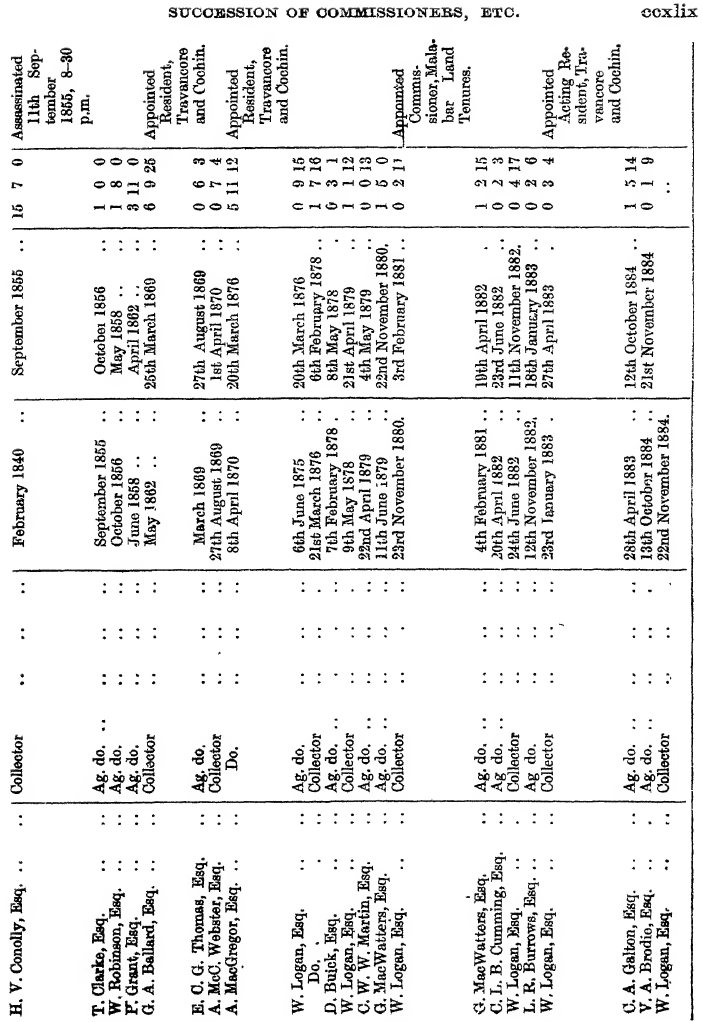
APPENDIX XV
Proclamation
Treaties. etc., ii, CCXLII—CCXLIII.
The Government of Fort St. George having received information through various channels that great inequalities exist in the present revenue jamabundy of the province of Malabar, transmitted orders some time back to the Principal Collector to frame by survey and assessment a new jamabundy upon improved principles founded on a liberal consideration of the relative rights of the Sirkar, of the proprietor and cultivator. Those orders the Principal Collector has now determined to carry into immediate and due execution.
It is well known to be considered a just system of assessment for the Government to derive its land revenue from the pattam (or net rent) payable by the cultivator’s tenant to his proprietor.
To establish a fixed rule by which the pattam shall be calculated and ascertained, it must be in the recollection of every one that the principal Malabar Rajas, Head Nambutiris and Mukhyasthans in each district were some months ago assembled by summons at Calicut, and, after the most patient inquiry into the mode by which the pattam was usually rated, it was found that a variety of systems prevailed, which might chiefly be ascribed to the existing inequalities in the revenue in the different districts in the province.
In order to rectify such errors and establish a permanent revenue by which one ryot shall neither be more heavily nor more favourably assessed than another, it became obviously convincing and desirable to all parties that one uniform system should obtain in estimating the pattam on which the Sirkar revenue was to be fixed.
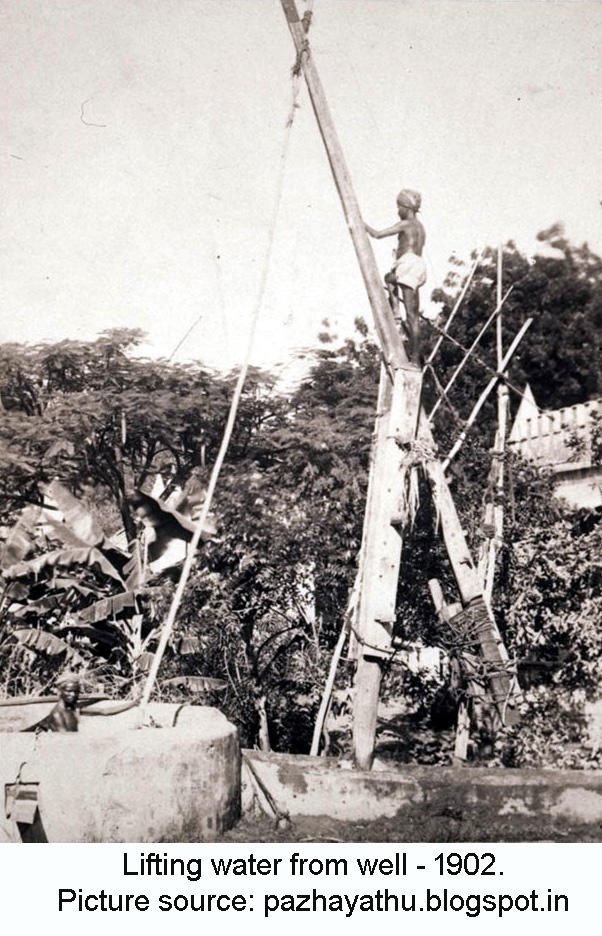 Having fully and deliberately discussed the many points connected with so material a question and pretty accurately ascertained the customs which in former times regulated pattam on lands and gardens generally throughout the province the aforesaid Rajas, Head Nambutiris and Mukhyasthans at length unanimously concurred in certain fixed principles whereby to determine the Sirkar revenue, which they recorded and authenticated by their several signatures.
Those being the very principles which the Right Honourable the Governor in Council had formally and finally confirmed and ordered to be adopted framing the new assessment of Malabar, they are now hereunder written and hereby published for the information of all its inhabitants.
First—On wet or rice grounds after deducting from the gross produce the seed and exactly the same quantity for expenses of cultivation and then allotting one-third of what remains as kolu-labham {or plough profit) to the kudiyan, the residue or pattam is to be divided in the proportion of six-tenths to the Sirkar and four-tenths to the janmakkar ;
Secondly,—On parambu or orchard lands one-third of coconut, supary, and jack-tree produce being deemed sufficient for the kudiyan, the remainder or pattam is to be equally divided between the Sirkar and janmakkar ; and
Thirdly.—-On dry grain lands (which are very scantily cultivated in Malabar) the Sirkar’s share is to be half of the janmahkar's varam on what is actually cultivated during the year.
The assessment on the pepper produce will be fixed upon hereafter.
The new paymash on the preceding principles has in the first instance been entrusted to the execution of the several Subordinate Collectors, to whom the necessary orders have been issued.
As the present mode of assessment has been acknowledged to be fair and moderate, it is expected that the janmakkars will render a true and faithful account of the pattam of their estates at the cutcherries of the Subordinate Collectors, who on their part will take care that every assistance shall be given by the local revenue servants in each district as the janmakkars belonging to it might want to obtain information from their tenants relative to the existing state of their landed property. A form will be likewise given to the several janmakkars by order of the Sub-Collectors, agreeably to which the required accounts are to be drawn out.
After these accounts are all delivered in, a rigid scrutiny will be made and the fullest means devised to ascertain their accuracy. The true result will then be submitted for the approbation of the Board of Revenue and Government, under whose sanction the Principal Collector will visit each district for the purpose of granting sealed and signed pattas, or assess notes to the several janmakkars and other inhabitants, specifying the correct annual revenue they are to pay to the Company's Government.
The Principal Collector therefore confidently expects that, without making themselves liable to punishment by any act of palpable fraud or deception, the inhabitants will willingly and readily render exact accounts of their property in order that all their apprehensions might be dissipated by the early establishment of an unalterable assessment.
Calicut, (Signed) T. WARDEN,
21st July 1805. Principal Collector.
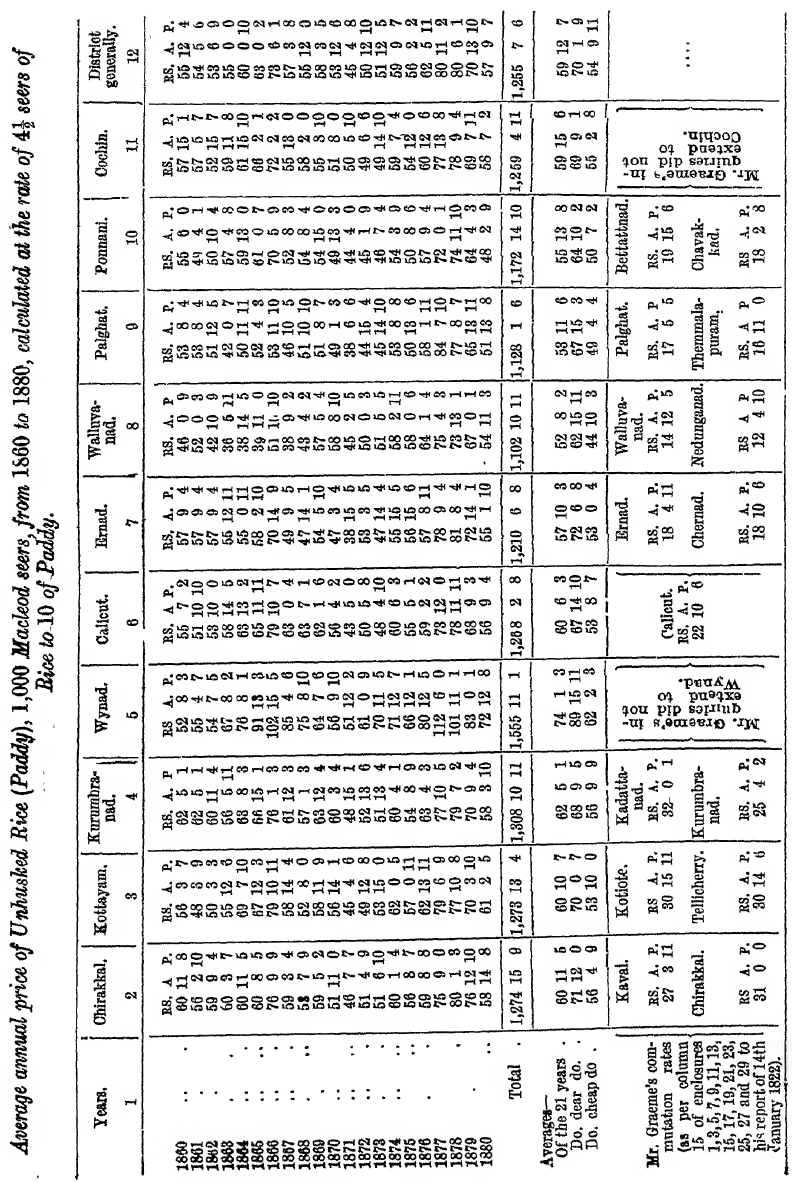
Annual Average price of Paddy, 1860-80
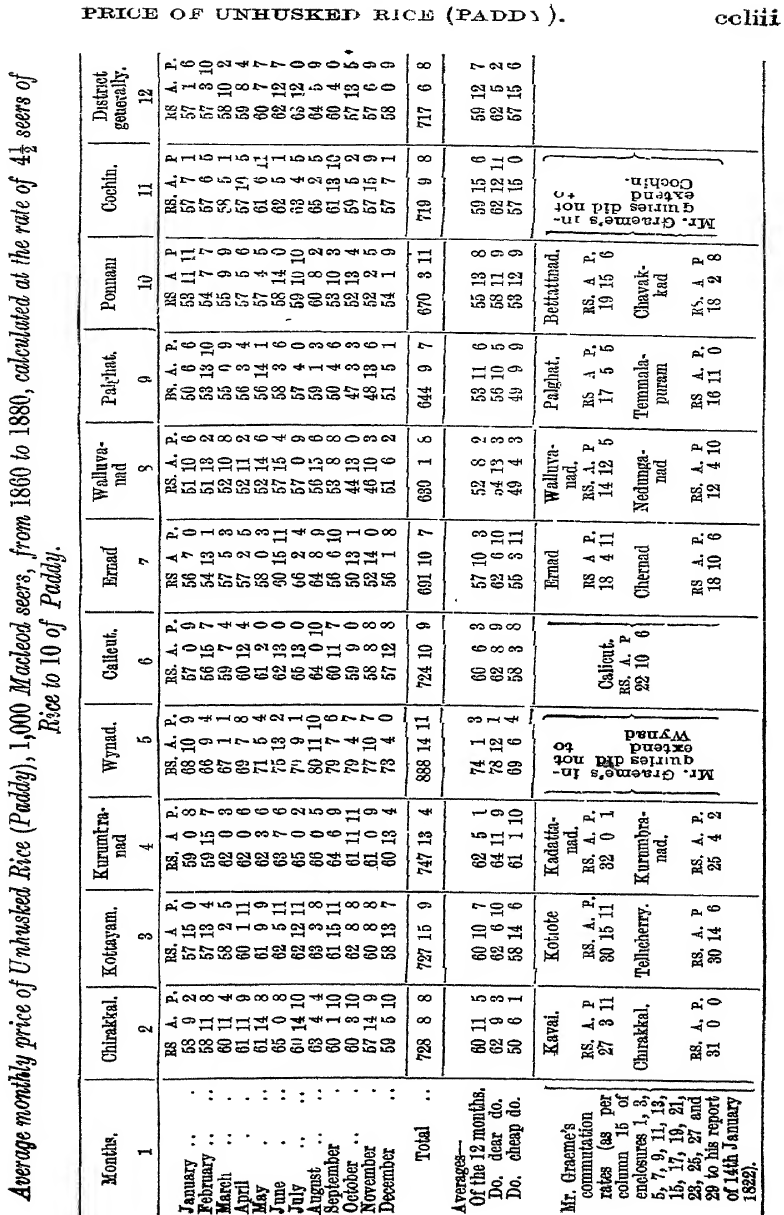
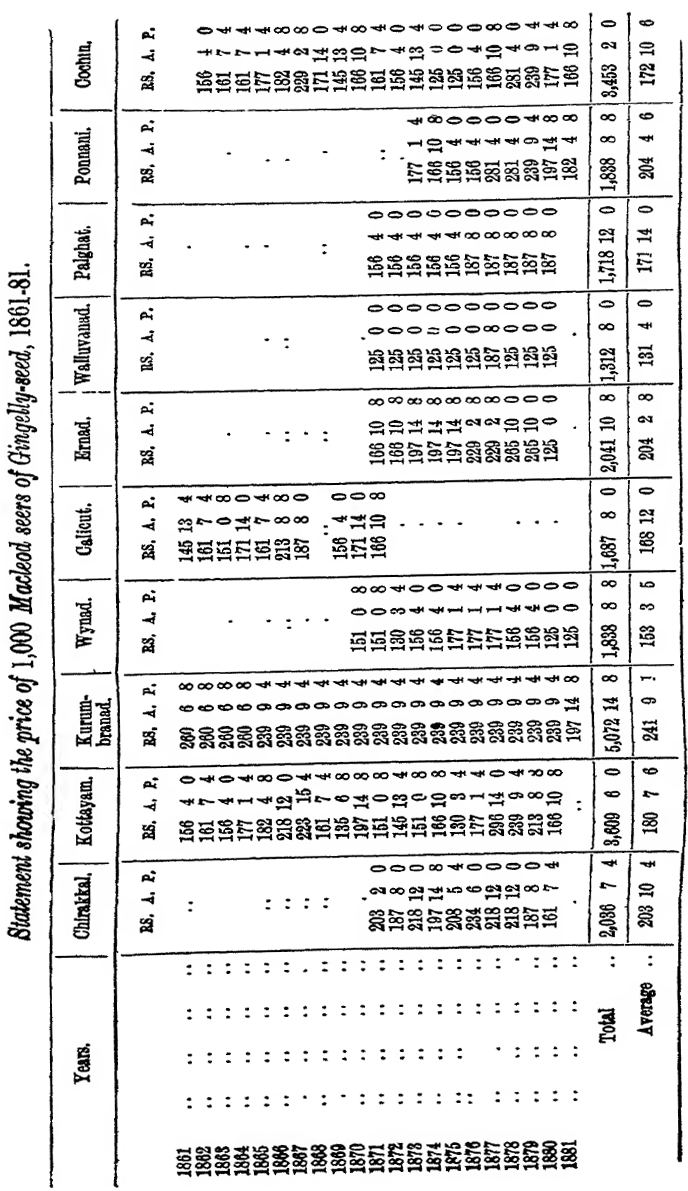
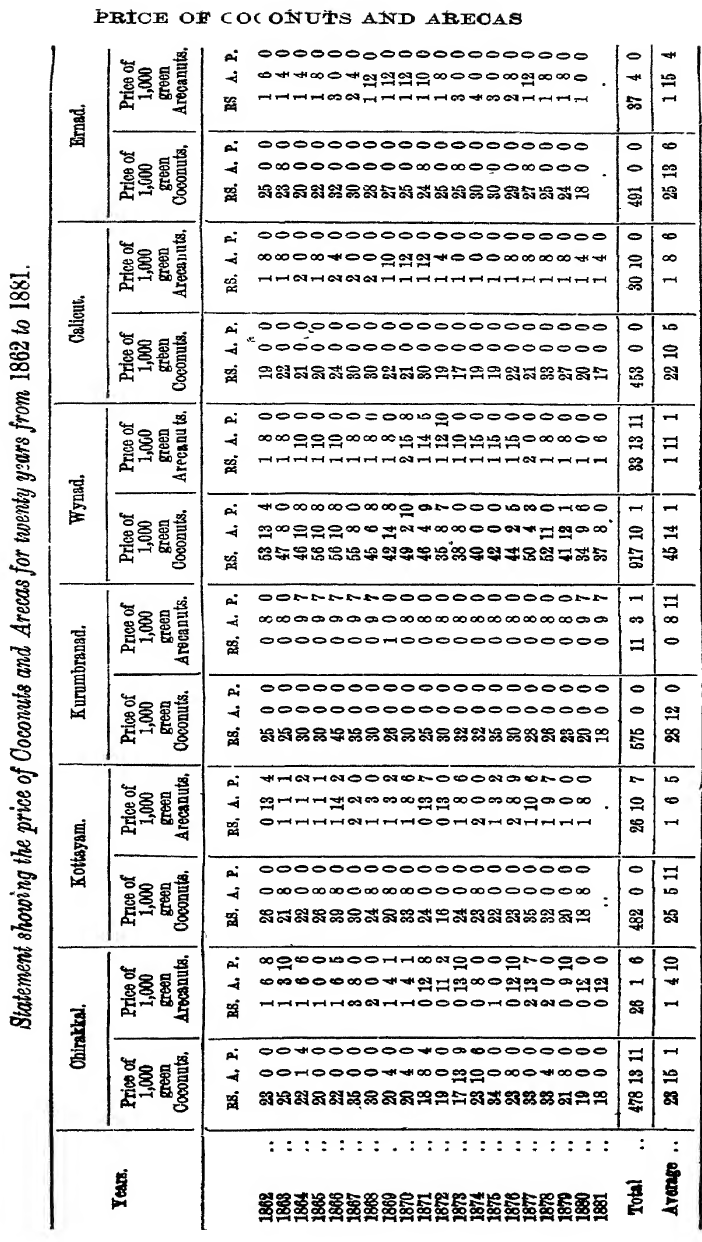
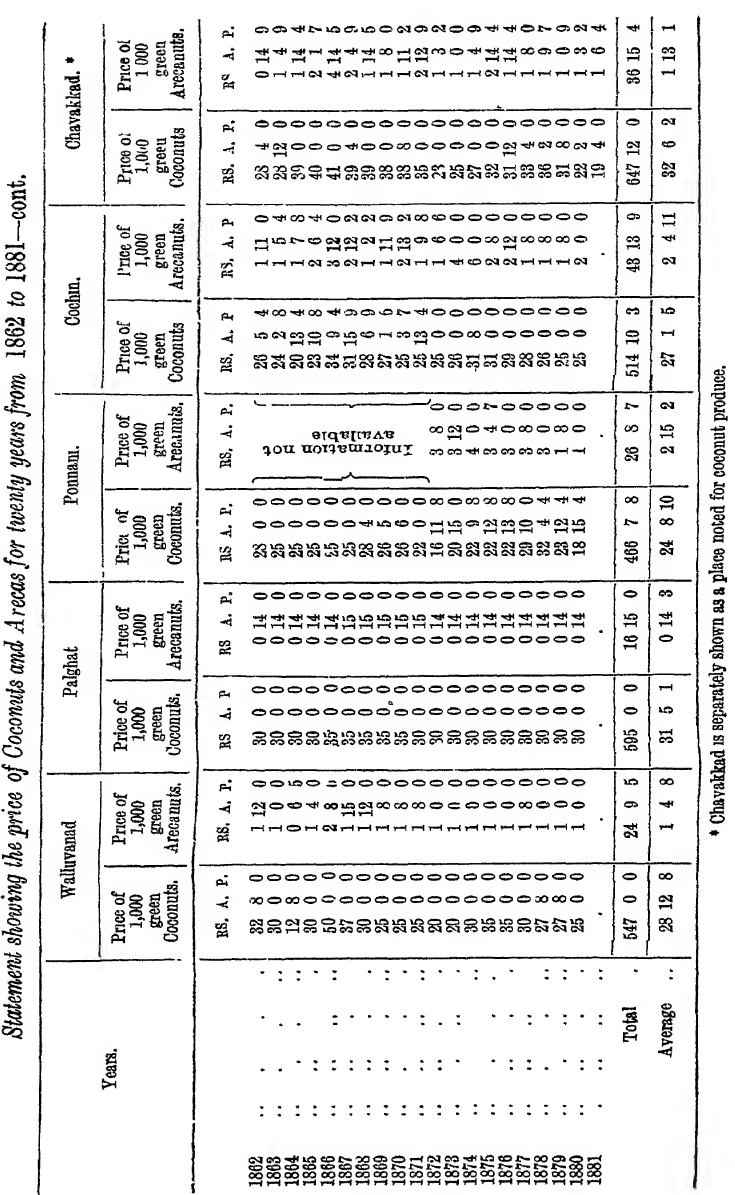
APPENDIX XX.
List of Malikhana Recipients in Malabar
List of the Malikhana Recipients of Malabar and of the Amounts of their Malikhanas
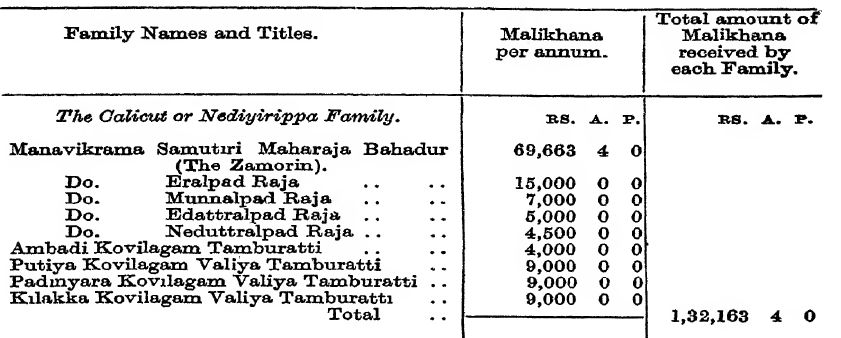
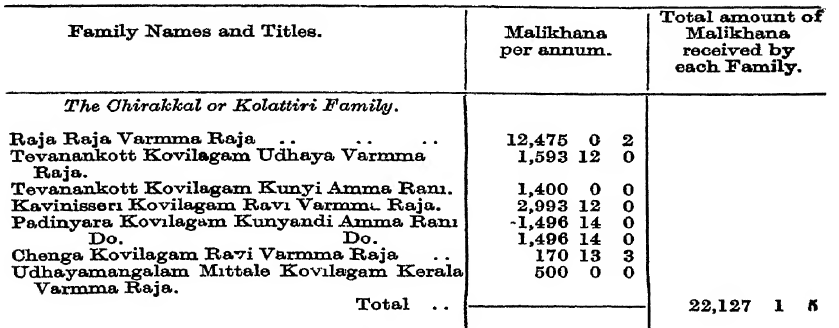
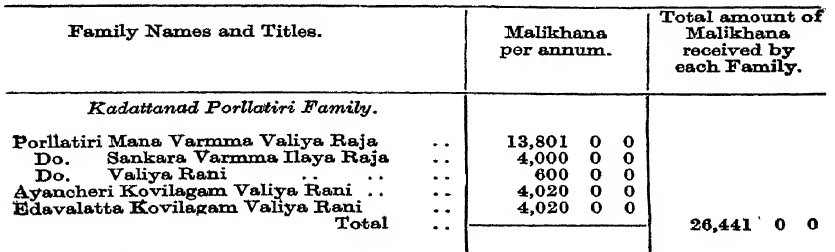
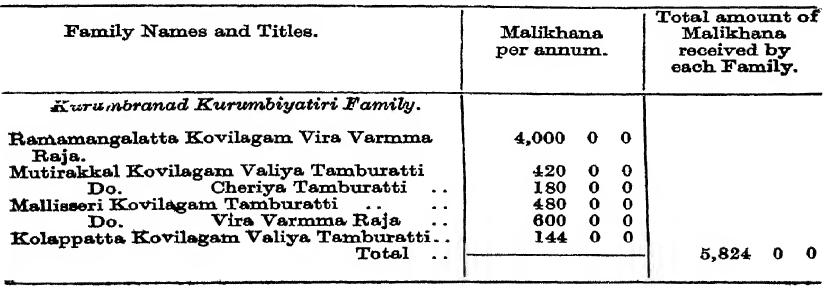
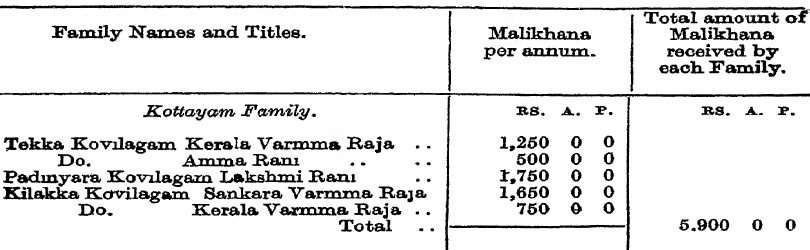
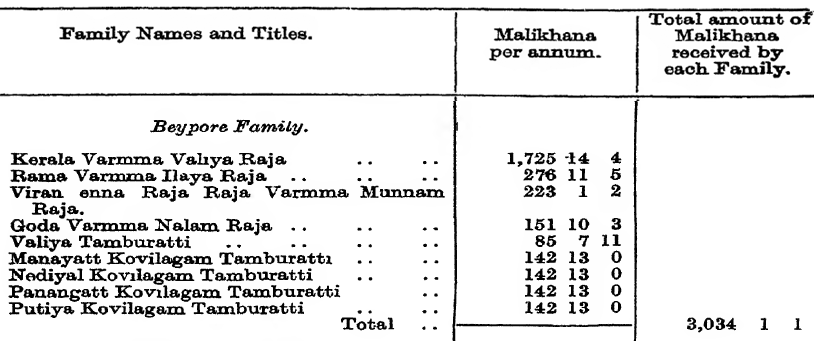
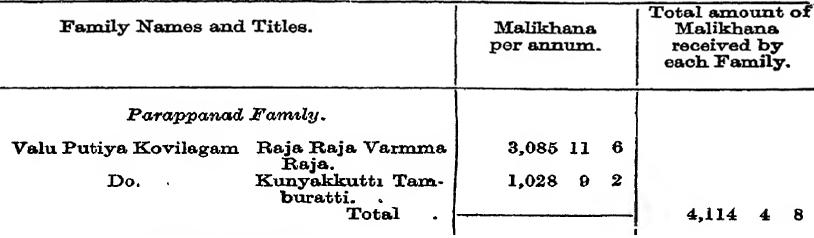
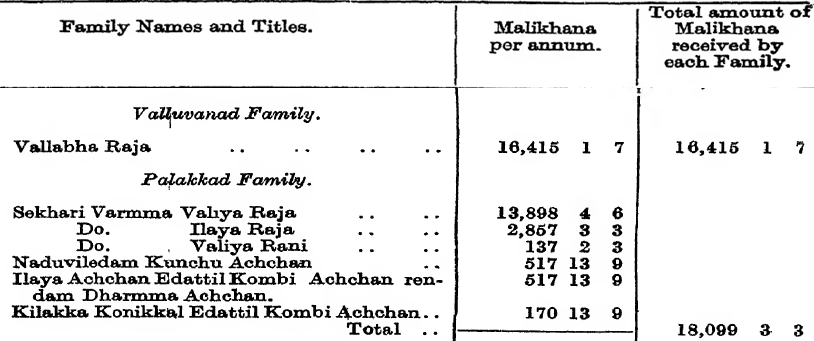
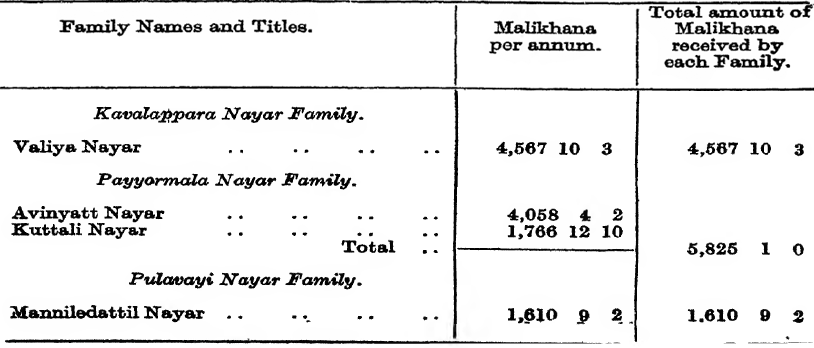
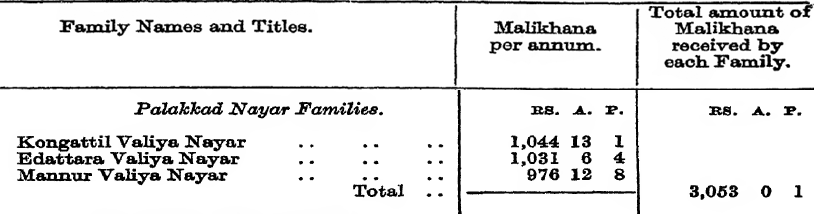
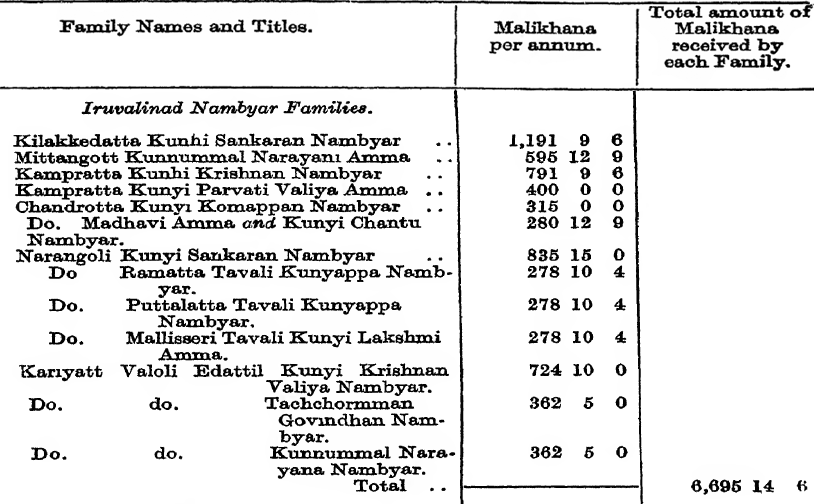
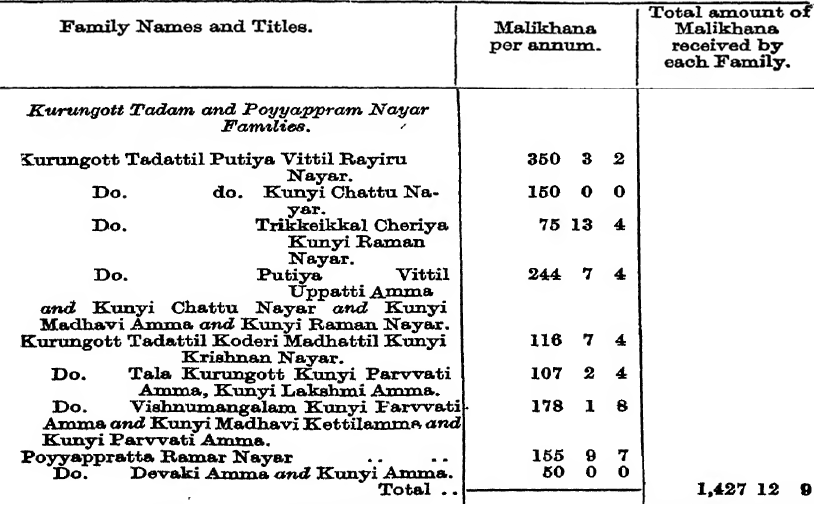

Short Descriptive Notes of Taluks, &c.
APPENDIX XXI.
CHIRAKKAL TALUK.
By Chappu Menon, B.A.
Position, Boundaries, Area.—This taluk formerly comprised the taluks of Kavayi and Chirakkal. It is the most northerly taluk of the district. Boundaries ; North—South Canara ; East—Coorg ; South— Kottayam taluk ; West—the Arabian Sea. Its area is not accurately known, there having been no regular survey of it by the professional department. For the census of 1881 the area was taken to be 648 square miles. About 150 square miles may be said to be under cultivation.
Physical Aspect.—The terraced character of the laterite formation is nowhere more conspicuous than in the Chirakkal taluk, and more particularly in that portion of it lying to the north of the Valarpattanam river. These laterite terraces are, as a rule, unproductive, but where they break off in abrupt cliffs the soil is extensively cultivated with coconut and jack and pepper. The flats also lying between the laterite terraces are thickly peopled and every inch of available ground is occupied. Along the coast, the beach, except at Mount Deli and again to the south of Cannanore, is low and sandy. Inland, the outlying spurs of the Ghat mountains are covered with scrub jungle, and even the Ghats themselves are in great part also covered with scrub, the heavy forest having disappeared before the axes and fires of the thriftless punam cultivators.
Population and Houses.—The population, according to the census of 1881, was 272,669 as against 257,377 in 1871, showing an increase of 15,292 or 5.9 per cent, on the number returned in the latter year. The Hindu population numbered 207,909, and there were 60,154 Muhammadans, 4,507 Christians, and 99 persons belonging to other classes. The males were to the females as 132,715 to 139,954, and the density of population was 421 per square mile. The total number of houses in the taluk was 54,005, of which 44,250 were occupied and the rest unoccupied.
Subdivisions of Taluk for Administrative Purposes.—The taluk is subdivided, for purposes of revenue administration, into 43 amsams or villages, each of which is as usual placed under an adhikari (village head) aided by menon (accountant) and a petty staff of peons. Groups of amsams are assigned to officers, designated Deputy Tahsildars, and these latter exercise criminal jurisdiction likewise over the area under their control. There are two Deputy Tahsildars, located one at Taliparamba and the other at Cannanore whose territorial jurisdictions extend over 10 and 9 amsams respectively ; and the Tahsildar, who has general revenue charge of all the amsams and special magisterial charge of 24 of them, has his head-quarters at Cannanore. The Tahsildar and Revenue and Magisterial establishments generally work under the Sub-Collector.
Public Establishments.—In addition to the village and taluk establishments above specified, there are two District Munsifs' Courts, situated at Taliparamba and Chova1 usually designated the District Munsifs' Courts of Kavayi and Cannanore respectively, and there are also four sub-registry offices, located at Palayangadi, Taliparamba, Cannanore and Anjarakandi.
NOTEs: 1. Since transferred to Cannanore. END OF NOTEs
The details of the several public establishments in the taltik are given below:-
1. Brigadier-General commanding the Western District, comprising Malabar and Canara, with the offices of the Deputy Assistant Adjutant and Quarter-master Generals’ and Medical Departments, Cannanore.
2. Cantonment Magistrate and his establishment, Cannanore.
3. Civil Surgeon, Cannanore, and Medical subordinates, Cannanore.
4. Superintendent, Central Jail, and his establishments, Cannanore.
5. Chaplain, Cannanore, and church servants, Cannanore.
6. District Munsifs at Taliparamba and Cannanore.
7. Tahsildar, two Deputy Tahsildars, Taluk Sheristadar, Revenue Inspectors and other subordinate revenue staff.
8. Sea Customs Superintendent and Port Conservator, Cannanore, and his subordinates.
9. Two Inspectors of Police, one at Taliparamba, and the other at Cannanore, with station-house officers and men.
10. D.P.W. Supervisor, Cannanore sub-division, and his subordinates.
11. Sub-Registrars of Assurances at Palayangadi, Taliparamba, Cannanore and Anjarakandi.
12. Officers of the Postal and Telegraph departments.
13. Sub-Inspector and other subordinates of the Salt and Abkari department.
14. Local Fund Overseer and his subordinates.
15. Municipal establishment, Cannanore.
16. Inspecting Schoolmasters and teachers.
17. Vaccinators.
NOTEs: 2. The head-quarters and a portion of the British Infantry regiment stationed at Cannanore were transferred from Cannanore to Wellington and Malabar annexed to the newly constituted “Southern District” (G.O. No. 7124, dated 15th November 1886, Military, Board’s Proceedings, No. 62, dated 18th January 1887,) since this article was sent to press. END OF NOTEs
Towns.—Cannanore (lat. 11° 51' 20 N., long. 75° 21' 45" E.), which is the head-quarters of the taluk, is a straggling town situated on the sea coast. It consists of two detached portions, locally known as the old town, or Cannanore proper, and the cantonment.
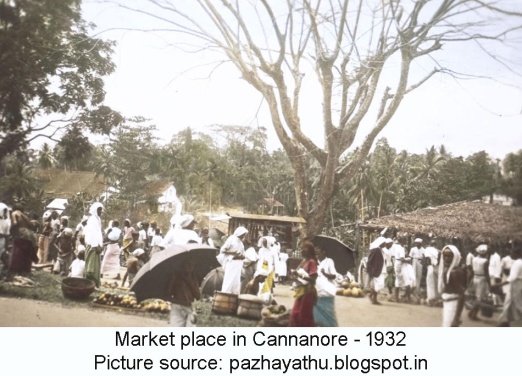 Between the two, and commanding the old town, lies Fort St. Angelo, an old-fashioned fort built of laterite and standing on a rocky promontory surrounded on three sides by the sea. The fort is held by the British troops located in the cantonment. It has a dry ditch on the landward side and flanking bastions. The greater part of the outworks was demolished some years ago. The fort has a flag-staff with a mast-light for the use of mariners.
Adjoining the fort is the brigade parade ground, which is very extensive, and has on its outskirts the barracks of the European regiment, the Anglican, German, and Roman Catholic churches, the European cemeteries, the powder magazines, the Commissariat office, and the little village of Barnacherry. This esplanade is used for parade and other military purposes.
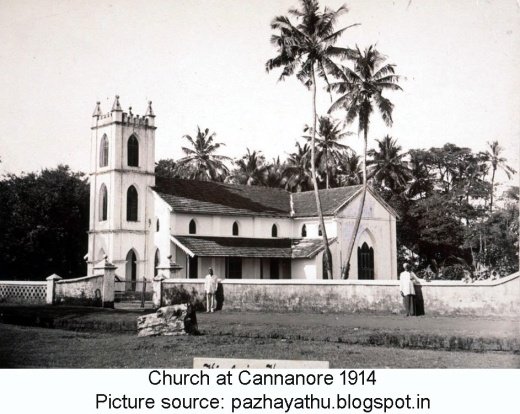 At a short distance north from the brigade parade ground lies another esplanade used by the Native Infantry regiment. On its outskirts lie the camp bazaar, the depository of the arms of the native regiment and their lines, and a bazaar known as "Thakki" bazaar, used by the native troops. The public buildings at Cannanore present no marked features. They consist of Commissariat offices, Deputy Assistant Adjutant and Quartermaster General’s offices, the Tahsildar’s and Sub-Registrar’s offices, civil and military dispensaries, postal and telegraph offices, and the Government school. The chief places of resort for travellers are the Esplanade Hotel, the travellers’ bangalow, and the mussafarkhana, the latter two belonging to the Cannanore Municipality.
Cotton fabrics of different descriptions are manufactured at Cannanore, chiefly by the mercantile branch of the German Mission. About 3 miles north of the fort is the Central Jail, at a place called Utayan Kunnu ; and the court-house of the District Munsif, Cannanore, is located at Chova1, a suburban place about 3 miles to the south-east of the fort.
NOTEs: 1. Since transferred to Cannanore. END OF NOTEs
The Central Jail is built on the system of blocks of cells radiating from a central watch tower. There is an extensive garden attached to it, in which is situated the Superintendent’s house. The jail can accommodate 829 prisoners.
The Municipal Act (X of 1865) was introduced into Cannanore by the notification of Government, dated 24th June 1867, but its operation was suspended over the area included in what are called “Kirar limits,” owing to the protest made by Sultan Ali Raja of Cannanore. His objection was, however, overruled by the Madras Government2, and the area temporarily excluded was brought within the operation of the municipal enactment in June 1873. The municipality now comprises portions of Pulati and Elayavur amsams, and has an area of about 4 square miles. Its population, according to the census of 1881, was 26,386, of whom Hindus numbered 10,656, Muhammadans 11,617, Christians 4,087, and other classes 26. The males were to the females as 13,046 to 13,340. The number of houses within the municipality was 5,981, of which 1,943 were returned as ‘‘unoccupied" at the recent census. The income of the municipality from all sources of revenue amounts to about Rs. 19,000 on an average. The following table shows how the funds are raised and spent :
NOTEs: 2. G.O. dated 21st June 1873, No. 264, Political. END OF NOTEs
CANNANORE MUNICIPALITY
Receipts.
|
1884-85. |
|
|
|
Rs. |
|
Opening balance |
1,202 |
|
Rates on houses and lands |
8,391 |
|
Taxes on arts |
2,788 |
|
Taxes on vehicles and animals |
1,414 |
|
Registration of carts |
636 |
|
Tolls |
3,100 |
|
Licenses |
116 |
|
Assignments by Government |
799 |
|
Fees and fines |
631 |
|
Endowments, &c. |
71 |
|
Miscellaneous |
740 |
|
Total receipts. |
19,787 |
|
Charges |
|
|
Grand I. |
Rs. |
|
New works—Sanitary and miscellaneous repairs |
|
|
Communications |
781 |
|
Buildings |
88 |
|
Sanitary and miscellaneous |
222 |
|
Establishment |
180 |
|
Tools and plant |
|
|
Grant II. |
|
|
Municipal schools |
|
|
Results grants |
2,502 |
|
Schools on the combined system . . |
314 |
|
Inspection (contribution) . . |
100 |
|
Miscellaneous |
|
|
Grant III |
|
|
Hospitals and dispensaries |
3,285 |
|
Medical college |
100 |
|
Sanitary inspection |
102 |
|
Vaccination |
317 |
|
Registration of births and deaths |
142 |
|
Conservancy |
6,670 |
|
Grant XV. |
|
|
Lighting |
832 |
|
Choultries |
|
|
Avenues and watering roads |
20 |
|
Miscellaneous |
819 |
|
Grant V. |
|
|
Supervision and management |
2,209 |
|
Refunds |
272 |
|
Balances |
932 |
|
Total charges |
19,787 |
Villages or Important Places.—Payyannur, which, is the northernmost amsam of the taluk, contains, inter alia, the desazos of Kavayi and Payyanur, both of which are of some importance. The former is situated on an island and contains the bungalow of that name which stands at the frontier of the district. There is a large mosque, and an old redoubt built many years ago, probably by the French.
Payyannur lies two miles to the south-east Kavayi and possesses an ancient temple dedicated to god Subramaniya. The image is said to have been consecrated by Parasu Rama. The mandapam is elaborately sculptured and the temple is surrounded by a strong wall. The place is celebrated as having been the seat of the "Payyannur Gramakkars" whom Parasu Pama is said to have specially favoured, and whose descendants still follow the marumakkatayam law of inheritance, unlike the other Brahmans of the district. There is still extant a poem entitled the Payyannur Pattola, described by Doctor Gundert as "certainly the oldest specimen of Malayalam composition which I have seen", and of which he gave a very interesting account in a paper contributed to the Madras Journal of literature and Science (No.XIII-II, pp. 14-17). "The language," continues Doctor Gundert, "is rich and bold, evidently of a time when the infusions from Sanskrit had not reduced the energy of the tongue, by cramping it with hosts of unmeaning particles."
"The legend of Payyannur, N. Lat. 12° 5' near Kavai." — "Nilkesi, a woman of good family, an inhabitant of a place called Sivaperur (Trichur?), a town famous for female beauty, could not obtain a son though married to several men. She resolves, therefore, to do penance by wandering about as a beggar, and comes to the famous emporium, Cachilpatnam (near Mt. Deli), where the chief of the place, a merchant named Nambu Chetti, or Chombu Chetti enters into conversation with her, advises her to perform certain vows, and then takes her to his palace as his lawful wife. A son is born and receives the name of Nambusari Aren, and a feast of rejoicing is celebrated on the 41st day on the plain of Payyannur. At the time Nilakesi's brothers happened to go up the coast in a ship. They hear the music and disembark to see the play, but as they climb up a wall of the temple some spectators expostulate with them. They call themselves Culavanier (merchants), who cannot be expected to know the customs of the place, and appeal to the chief. He comes, but applies his rod to the head of one, a scuffle ensues and the strangers are killed.
"Nilakesi, when acquainted with the murder of her brothers, leaves the palace and her son, and again wanders forth begging. The son grows up and is instructed by his father in all the arts of trade and shipbuilding (given in interesting detail, full of obsolete words). The ship being at length launched and manned with Vappurawas (?) Pandias, Chonakas, Cholias, and also with one Yavanaka, the merchants start fearlessly on a voyage, first to Pumpatna round Mt. Eli, then passing the mala (—Dives) into the Tanipunularu (river) to the town of Puvenkapatna, proceed further on to the Caveri, from whence they sail into another sea and to other shores till they reach the Gold mountains (Ponmala), where they exchange all their cargo for gold, return and land their goods in Cachilpatnam, store them in a new magazine, and dismiss the mariners with their shares. After this, when the father and son are amusing themselves with playing chess, a female devotee is announced who is not satisfied with alms, but wants to see the young merchant. Then follows a long and mysterious conversation. She invites him urgently to be present at a night feast of a woman at Payyannur. He promises, but cannot afterwards persuade his father to give him leave, who fears a plot and danger, but the son persisting in importuning him, and at last, prostrating himself, he consents.
“I swear by thee, O Father ! I must go’.
“Father : ‘I have opposed thee to the utmost, but now I must not prevent thy going—thou goest far away like dying men. Strong guards (or companioris) are now required—take the children of the Govatala chetti of Anjuvannam and of the Manigrama people, who, together with ourselves, are the 4 (classes of) colonists in the 4 towns.’
“They took of the 4 classes of colonists, the sons (or servants) of the town lord in that country, 14 companions, a noble household, not to be outwitted (or defeated) by any in this country (and, says the son), ' though I should be dragged by the foot I shall return (to-morrow) to Cachilpatnam, nor shall this eye sleep (to-night).’
“Upon this, the father advises them to take some merchandise along with them in the ship as for a fair, and the poem, evidently a fragment, closes in the 104th sloka with an enumeration of wares, replete with obscure terms free from any anachronisms.
"I belive that the people of Anjuvannam and Manigramam here mentioned as belonging to yonder country can only mean Jews and Christians (or Manicheans), who, for commerce sake, settled also beyond the Perumal's territories. It would be interesting to know who the 2 other classes are. In the meantime the existence of 4 trading communities in the old Kerala seems to be proved, and the നാലുചെരി of the first Syrian document receives some elucidation from this incidental allusion.” Gundert in M.J.L.S., XIII-II, 14-17.
Taliparamba, which is the seat of the local Deputy Tahsildar’s and Sub-Registrar’s offices and of the Court of the District Munsif of Kavayi, has an area of 5.938 acres and a population of 8,363 souls. It has a bungalow and a mussafarkhana close to the Deputy Tahsildar’s office, and is celebrated for two of the most ancient and important temples in North Malabar, known as Taliparamba and Trichchamparam temples.
The former is dedicated to Siva, and is a magnificent structure covered with brass plates and surrounded by a high laterite wall. On the bank of a tank attached to the temple is a building on which is a granite slab bearing an inscription ; and another, dated K.A. 954 (A.D.1778), is to be seen at the foot of a banyan tree in front of the temple. The former is to the effect that the bathing house was finished in Kollam Andu 700 (A.D. 1524). The temple has many sculptures and some fine gopurams (towers) which were, however, destroyed by Tippu. It is said to be of very great antiquity, to which the architecture in parts bears witness.
There is a large and important mosque here and an old mud fort.
On the south side of the road leading to Kuppam is a sculptured figure of a village goddess. Four rock-cut sepulchres were excavated some time ago near the travellers’ bungalow, one of which had a circle of massive laterite blocks ranged round it. These caves consist of a small chamber with a domed roof and entrance. In the centre of the dome is a hole to the upper air closed with a slab.
The celebrated temple at Trichchamparam is dedicated to Krishna, and there is another at Kanjirangott dedicated to Siva. In the former an annual utsavam (ഉത്സവം) or festival, commencing on the 22nd Kumbham and ending on the 6th Minam, is performed, and on the last-named day a large concourse of people from all parts of the district, estimated from 15,000 to 30,000, are said to assemble. The Trichchamparam is supposed to be a corruption of Sri Sambaram (ശ്രീശംബരം) so called after the great rishi of that name who did penance there, propitiated the god, and in his honour consecrated the image.
Madayi or Palayangadi, about 14 miles north-west of Cannanore, is a Mappilla village of some importance situated on the right bank of a fine river and is a place of trade. Boats of a large size come up to it. Here is a small redoubt, also a bungalow for the reception of travellers, and in the middle of the village is a handsome mosque bearing an inscription in Arabic commemorating its building in Hijira 518 (A. D. 1124). There is another inscription stating that a tank was constructed by a Hindu. The grave of an Arab, who died several years ago, also exists. In the hamlet of Palayangadi is an old tank known by the name of the "Jewish tank” near which stands the old Eli palace of the Kolattiri Rajas, The tank was probably constructed by a colony of Jews or ‘‘Yavanas". There is also a Hindu temple close to the Madayi bungalow.
Ettikulam, a small village lying a mile to the south of Mount Deli or Eli mala, where the sea forms a small bay, is inhabited by Mappilla merchants who supply Cannanore and Tellicherry with firewood. On a small hill stretching into the sea is a redoubt strongly built but overrun with scrubs. It was probably built by the Portuguese to protect their trade on this coast, and it subsequently passed into French and then into English hands. There is an insignificant mosque almost on the summit of Mount Deli frequented on certain days by numbers of Mappillas. It is infested with monkeys.
Irukkur, a large Mappilla town with some mosques, and lying southeast 25½ miles from Kavayi, is a place of note, being on the high road from the coast leading through the Pudiya Churam or Huggel pass towards Coorg and Mysore. It is on the right bank of the Valarpattanam (Beliapatam) river and can be reached by small river boats at high tides. During the rains a great deal of timber and bamboos in rafts are floated down to Valarpattanam and other places for sale and for the construction of small crafts.
Sirukkandhapuram, a Mappilla bazaar with a mosque, has a dense population in its vicinity. It is on the right bank of the northern branch of the Valarpattanam river, which is navigable as far as this for small boats. The bazaars or store-houses contain the produce of the hill cultivation which is here collected and sent down by water to the towns on the sea coast.
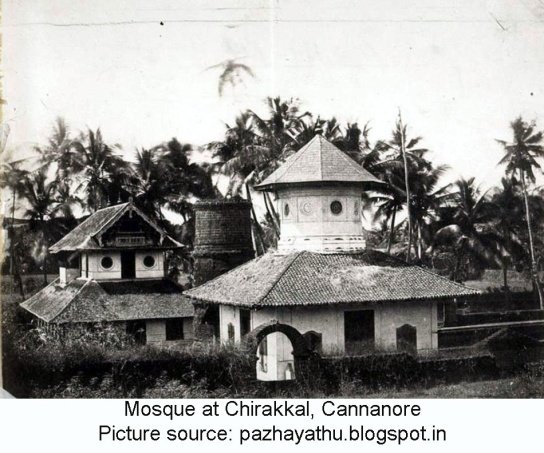 Valarpattanam (Beliapatam, called, it is said, after the Raja Valabham, who built it), situated 5 miles north north-west of Cannanore, is a small trading town composed of a street of shops and large houses. It is on the left bank of a magnificent river which discharges itself into the sea 4 miles to the south-west of it. The banks are fringed with coconut and other trees.
Chirakkal is famous as being the residence of the Raja of Chirakkal, who has a Kovilakam or palace at this place on the south side of a reservoir of fresh water of considerable dimensions, estimated to be 1,042 feet in length and 492 feet in breadth. Half a mile on the west of the high road, a street is formed by weavers and other castes, and on a height south-west of the palace are to be seen the remains of a redoubt.
Other places and religious institutions of minor importance are described in the following table :—
|
Name of amsam. |
Name of religions or other institutions for which the place is celebrated. |
Descriptive remarks. |
|
Chulali ചുഴലി |
Vayital mala വയിതൽ മല |
A very high hill. Previous to the invasion of Tippu it appears that there was a wealthy tribe of Kshetriyas called Vayital Kovvanmar (കൊവ്വന്മാർ) who owned temples and property in the amsams of Eramam, Chulali, Kuttur, Kuttiyeri, etc., below the ghat. In course of time they found rivals in the influential Nambiyars of Chulali, who waged war against and exterminated them. |
|
Kannileri കണ്ണിലെരി |
Payyavur temple പയ്യാവൂർ ക്ഷേത്രം |
Image of Siva in the hunting costume of Kirathan—Tiled building. Tradition says that Siva, in order to try the inflexibility of Arjuna’s penance, attacked and threw him away, but that from where he fell he made the image of Siva and began to worship, which greatly pleased the latter deity. |
|
Pattuvam പട്ടുവം |
Pattuvatt temple പട്ടുവത്ത കാവ് |
Image of Bhagavati—Tiled roof. Cases in which parties agreed to abide by oaths are sent here for the purpose of oaths being taken. |
|
Kunhimangalam കുഞ്ഞിമംഗലം. |
Ramathali narayam Kannur temple രാമന്തളി നരയം കണ്ണുർ ക്ഷേത്രം. |
Image of Shasthav—Thatched building—Is an old temple on the western slope of Mount Deli and close to the sea. Contains Vatteluttu inscriptions which have not yet been deciphered. Is supposed to contain valuable medicinal plants. |
|
Cherukunnu ചെറുകുന്നു. |
Cherukunnu temple ചെറുകുന്നു ക്ഷേത്രം. |
An important temple with tiled roof in North Malabar—Has an image of Bhagavati (Annapurneswari). Tradition says that the temple was constructed by Parasu Rama and that the deity came from the north near Benares. There are seven old temples here. On the west side of the hill on which stands the temple of Kunnur Matilakam is a rock-cut cave. |
|
Moraya മൊറായ. |
Katamperi temple കടമ്പെരി ക്ഷേത്രം. |
Image of Chulali Bhagavati — Tiled. Contains some carved figures. Has a fine tank. |
|
Kayaralam കയരളം. |
Velath temple വെളത്ത ക്ഷേത്രം. |
Images of Vishnu, Ganapathi, and. Siva. There are two srikovils of which one is tiled and the other thatched. There is an inscribed slab broken, in the temple, said to be in Devanagari character. |
|
Kuttiyattur കുറ്റിയാറ്റൂർ |
Kuttiyattur temple കുറ്റിയാറ്റൂർ ക്ഷേത്രം. |
Image ot Siva. Srikovil is tiled and rest thatched. In the gate of the temple is a stone bearing an inscription not as yet read—in characters stated to be unknown |
|
Maniyur മണിയൂർ. |
1. Maniyur temple മണിയൂർ ക്ഷേത്രം. |
Image of Subramaniyan. Srikovil tiled and the rest thatched. On the north side of the trench surrounding the temple is a stone having an inscription "in unknown character" on its four sides. |
|
2.Kanhirattu Jamath mosque കാഞ്ഞിരാട്ട ജമാത്തപള്ളി. |
Tiled—believed to be once a Hindu temple and converted into a mosque. |
|
|
Chirakkal ചിക്കൽ |
Kalarivathukkal temple കളരിവാതുക്കൽ ക്ഷേത്രം. |
Image of Bhagavathi—Tiled—supposed to be originally a Kalari (gymnasium) of Patuvilayi Nayar, but subsequently fell into the possession of Chirakkal Raja. |
|
Alikot അഴിക്കോട് |
Perinthra Kottaram. പെരിന്ത്രകൊവിൽ കൊട്ടാരം. |
This is the residence of an agent of Taliparamba Devaswam and is noted for a peculiar custom locally observed. There is a big tract of field known as "Olikot vayal," the ownership of which is supposed to vest in Perinthra Kovilappan. There is no image of this god. At the time of sowing and harvesting the crop in that locality, the Devaswam agent goes in procession and sows or cuts with his own hand, and unless this is done, no one can carry on any operation. A fixed portion of the produce is also assigned to the Devaswam, and this assignment is known by the name of Kangani. |
|
Etakad എടക്കാട് |
Oorpalechi temple ഊർപ്പഴെച്ചി കാവ് |
Image of Siva in the hunting costume of Kirathan and of Vettakkorumakan. Srikovil and surrounding buildings have copper roof and the rest tiled. This is a very important temple. |
|
Makreri മക്രെരി. |
Peralasseri temple പെരളശ്ശേരി ക്ഷേത്രം |
Image of Subramaniyan. Srikovil tiled and the rest thatched. Supposed to have great power of curing poison. |
Anicuts.—Canals.—Neither dams nor canals of irrigation are to be met with. There is, however, one canal of communication usually known as the Sultan’s Canal between the river of Palayangadi and a branch of another which runs north and joins the Kavayi immediately to the south of the town of that name. It is 3 miles in length, out through low paddy ground. It was executed at the expense of the Bibi of Cannanore with the object, it would appear, of having a safe inland navigation from Nileshwaram in South Kanara to Kakkad, 2 miles to the north-east of Cannanore. It is now shallow and impassable during the dry season.
Minerals, Industries and Manufactures.—Laterite is met with in abundance. Some coarse cotton cloths are made at a few places in the interior by rude appliances. At Cannanore there is an excellent weaving establishment under the supervision of the German Mission. In the Central Jail, Cannanore, carpentry and other works are carried on.
Kunhimangalam is noted for its brass works, chiefly lamps.
Trigonometrical Station.--Mount Deli, in Kunhimangalam amsam, lies in latitude 21° 01' 37.04'' and longitude 75° 14' 40.51" and belongs to Lambton’s series.
ANJARAKANDI AMSAM.
By V. Chappu Menon, B.A.
Anjarakandi or Ancharahandi (literally 5½ sections or desams) is an interesting amsam belonging to the Chirakkal taluk, and situated about 8 miles north north-east of Tellicherry, and is administered in a peculiar manner. It has no paid adhikari or other village officers, and is held by the family of Mr. Murdoch Brown on a lease of 99 years granted by the Honourable Company on the 30th April 1817. The lease consequently falls in on the 29th April 1916. The circumstances which led to the grant of this lease were as follows:
In 1797 the Honourable East India Company opened out at this place, then known as Randattara, a plantation of about 1,000 acres for the cultivation of special products, such as coffee, pepper, cinnamon, nutmeg, cassia, cotton, sugarcane and sandalwood plants, and appointed Mr. Murdoch Brown, who had originated the scheme, to be the overseer and manager of the estate. Mr. Brown was a merchant at Mahe, who, on the fall of that Settlement in 1793, had entered the Company’s service. The terms of agreement were that -
(1) The plantation was to be undertaken and carried on solely and entirely on behalf of the Honourable Company.
(2) Any special products suggested by the Company’s agents were to be planted in the manner desired, full accounts of receipts and expenditure being furnished.
(3) If the scheme sketched out for the carrying on and management of the plantation were disapproved by the Court of Directors, then the concern was to be undertaken by Mr. Brown on his own account, the Company being reimbursed within three calendar months after such intention shall have been announced, the principal and interest of money expended on the plantation provided, however, that the possession of the ground occupied by the plantation be secured to him and to those concerned with him at a reasonable rent to be rated according to the custom of the
(4) In the event of the contingency referred to in clause (3) occurring, that is, if the plantation be carried on by Mr. Brown on his own private account, the whole produce of pepper, coffee and cotton, and all such articles as shall be produced thereon, shall be wholly and exclusively tendered in sale to the Honourable Company’s agents, the Honourable Company paying for the same, viz., pepper at Rs. 50 per candy of 640 lb., coffee at Rs. 8 per bale of 20 lb. and other articles at such prices as Government may deem their qualities and species entitled to. This agreement was signed by Mr. Murdoch Brown on the 31st December 1797.
In 1799, the Court of Directors, who disapproved of the project, ordered the transfer of the plantation to Mr. Brown in accordance with the terms of his agreement ; but there was some difficulty in arranging the transfer which was effected by the Principal Collector, Major William MacLeod, only in the year 1802. In 1803, the plantation was almost wholly destroyed by the Palassi (Pychy) rebels, and this again complicated matters. After some years of correspondence, it was settled in 1817 that a lease of the estate for 99 years should be granted to Mr. Brown, and this was accordingly done subject to the following terms :
(1) Mr. Murdoch Brown binds himself, his heirs and assigns to the payment of an annual revenue amounting to Rs. 2,257-2-0 by such kists or instalments as the Collector might from time to time direct.
2) When a new survey of the land revenue of Malabar shall take place, Mr. Brown or his representatives shall pay the new revenue on the estate at the same rates as the same species of land and productions of the district shall be assessed.
(3) It shall be lawful for Mr. Brown to purchase, with the consent of the inhabitants who occupy and pay revenue on the 918 acres of land included within the plantation estimated to comprise 2,000 acres of arable arable land, all or any part of the said 918 acres, the purchases being duly registered in the Collector’s office or in the Zilla Court.
(4) It shall be lawful for the Honourable Company to prohibit Mr. Brown from purchasing occupied lands from the said inhabitants, but in that case he will be granted an equal extent of unoccupied land (not exceeding 918 acres) in the vicinity at the time of such prohibition being signified to him.
(5) At the expiration of the lease it shall remain, at the option of Government, to resume the lands thus leased on repaying to the lawful owner the sums paid to the natives for their janmam kudimanir rights and the products on them, when purchased.
(6) Whereas Mr. Brown did in 1802 offer and agree to pay for the purchase of the said plantation the amount expended on it until then by the Company with certain deductions agreed to by Government : and whereas the destruction of the buildings and nearly all the productive vines and coffee trees in 1803 by the rebels from Cotiote put it out of his power to fulfil his agreement and necessitated a reference to the Court of Directors for their final decision as to the amount of remission to be granted to him, it is further declared that Mr. Brown, who has already paid two instalments of Rs. 10,000 each, does bind himself, his heirs, executors and assigns to pay such further sum in final discharge of his debt as the Court of Directors may determine, deducting therefrom the value of the goods delivered to the Company’s Commercial Resident in Mahe agreeably to the account furnished to the Principal Collector in 1802.
(7) Mr. Brown shall at all times conform to all lawful orders issued to him under the authority of Government or its officers-
Agreeably to the above provision, clause (2) a survey took place in 1820-25 by the Commissioner, Mr. Graeme, and the Collector, Mr. Vaughan, and this was followed in 1833 by another under the Collector, Mr. Clementson. The assessment for Fasli 1294 (1884-85) was as follows :
|
Wet |
781 |
10 |
10 |
|
Dry |
1 |
10 |
3 |
|
Bhagayet |
1,374 |
9 |
7 |
|
Inam Jodi |
39 |
15 |
3 |
|
Total |
2,197 |
13 |
11 |
|
Abkari revenue on Katti and Chatti |
71 |
6 |
4 |
|
Local cess |
292 |
9 |
6 |
|
Grand Total |
2,561 |
13 |
9 |
The estate of Anjarakandi consists of five tarras or desams of —
1. Muringeri, 4. Anjarakandi,
2. Mamba, 5. Paleri,
3. Kamavatt,
together with a strip of land situated on the opposite side of the Anjarakandi river in Kottayam taluk bounded by the dyke of ten feet in height constructed in the year 1800 for the defence of the plantation and containing about 40 acres of land. The total area of the amsam is 3,382 acres, or a little more than 5¼ square miles, and it has a population of 4,155 souls, of whom 2,064 are males and the rest females. The Hindus number 3,609, Muhammadans 518, and Christians 28. The number of houses occupied is 711 and unoccupied 93.
The collection of revenue is made by Mr. Brown, who also exercises petty judicial powers usually inherent in the village head. The late Mr. F. C. Brown was appointed by Government to be an Honorary Magistrate of the First Class, and the High Court was also moved to issue in his name a Commission of the Peace. (Vide G.O. No. 1315, dated 14th September 1865.)
Mr. Murdoch Brown, son of Mr. F. C. Brown, was appointed by Government, in 1869, to be an Honorary Magistrate in the Chirakkal taluk with the powers of a Subordinate Magistrate of the Second Class (G.O. No. 52, dated 12th January 1869). The only paid public establishment at Anjarakandi is that of the Sub-Registrar of Assurances at that station.
CANNANORE-KIRAR TERRITORY
By V. Chappu Menon, B.A.
This is a tract of land about 2,364 acres in extent in Cannanore belonging to the Mappilla Raja of Cannanore and which is held by his family under an agreement entered into with the British Government, as already described in Vol. I.
The judicial administration of the Kirar territory is conducted by the officers of the British Government. The raja is merely permitted to collect rents on the lands comprised within the Kirar limits, and has no power to interfere with the collection of special rates chargeable under the municipal or fiscal law. His palace is situated in what is called the old town of Cannanore, and is known as the Arakkal palace. A lamp is kept burning throughout the day and night in one of the rooms in the palace, the belief being that if extinguished the prosperity of the house would be destroyed.
The maladministration of the Laccadive Islands belonging to the raja led to endless outbreaks and defiance of authority on the part of the islanders, and the revenue due to him was threatened with extinction. The peishcush due to Government also fell into arrears, and the Government of India therefore assumed the management of the islands till such time as the arrears remained unpaid and a better system of administration has been introduced into them. A detailed account of the islands is given separately.
The temples and mosques within the Kirar territory are shown below :
|
1. Thayil temple തയ്യിൽ ക്ഷേത്രം |
Image of Vishnu. Srikovil roofed with copper plate. The rest tiled. |
|
2. Jamath mosque ജമാത്ത് പള്ളി |
A very important mosque roofed with copper plates. There are several small mosques within the town. |
|
3. Thayil church തയ്യിൽ പള്ളി |
Roman Catholic chapel—Tiled building. |
|
4. Khajana Kotta ഖജാന കോട്ട Chutikotta . . ചൂടി കോട്ട Katalai Bjotta കടലായി കോട്ട Avera Kotta അവര കോട്ട |
These are names of certain forts that existed within Kirar limits. All of these are now in ruins and have in some cases been converted into lands for cultivation. |
The peishcush due by Sultan Ali Raja of Cannanore, according to the engagement, dated 28th October 1796, is Rs. 15,000 per annum.
N.B.—The exact amount appearing in the Revenue accounts is Rs. 15,000-0-11, payable in three equal instalments—the first on the 15th of Dhanu (8th December), the second on the 15th of Medam (6th April), and the third at the end of Chingam (15th September).
An abatement of 1,500 star pagodas, equivalent to Rs. 5,260, was allowed by the Court of Directors in 1822 as compensation for the loss of the Amin Divi Islands attached to the South Canara district.
THE LACCADIVE ISLANDS
By V. Chappu Menon, B.A.
Position and Extent.—The Laccadives {Laksha Dwipa — "The hundred thousand islands,’’ also called the Divi or Amindivi Islands) consist of a group of islands off the Malabar Coast lying between 8° and 12° N. lat. and between 72° and 74° E. long. The northern portion of the group is attached to the Collectorate of South Canara, and the southern portion, which is otherwise known as the Cannanore Islands, is attached to the Malabar district. The approximate area, population, and other particulars regarding the latter group are given below :—
|
Islands. |
Distance from Calicut. Miles |
Area in square miles. |
Population. |
Number of houses. |
Dependent islets. |
|
Agatti |
218 |
13/8 |
1,375 |
302 |
(1) Parali, (2) Bangara, (3)Tinnakara, Kalpitty. |
|
Kavaratti |
195 |
11/3 |
2,129 |
314 |
(1) Pitti, (2) Seuhelipar, consisting of Valiyakara and Cheriyakara. |
|
Androth |
139 |
12/3 |
2,884 |
407 |
Nil |
|
Kalpeni |
149 |
1 |
1,222 |
213 |
(1) Cheriyam, (2) Thilakka, (3) Pitti. |
|
Minicoy (Menakayat) |
243 |
13/4 |
3,191 |
524 |
(1) Viringilli. |
|
Total |
|
71/8 |
10,801 |
1,760 |
|
All the dependent islets are uninhabited, with the exception of Viringilli, which is used occasionally as a hospital for the small-pox patients of Minicoy.
Physical Aspects.—The topographical features of all the islands are very simple and almost identical. Each is contained within a coral reef stretching in a general direction from north to south and lies just within the eastern side of the reef, whilst on the western side a more or less extensive lagoon intervenes between the shore and the reef.
Androth is, however, an exception to this rule, in that it has no lagoon worthy of the name and lies east and west instead of north and south. Outside the reef on one side the sea deepens abruptly beyond the reach of ordinary sounding tackle (on the east side, save in the case of Androth where it is on the south), and on the other the coral shoal slopes gradually away for some distance till a depth of about 20 fathoms is attained, when ordinary soundings again suddenly cease and reveal the existence of a stupendous submarine precipice.
The water in the lagoon is generally so still that in the worst weather coir or coconut fibre may be soaked without danger of being washed away.
The surface of the islands is almost flat, the small inequalities that exist being either of artificial origin as in Androth and Kalpeni, or in some few instances of the nature of sand dunes. The elevation is nowhere more than a few feet above the level of the sea. The crescent-shaped form of the body of the island is due to the more perfect development of the eastern and protected side of the coral formation. The same feature characterises all these shoals and leads to the theory1 that they rose to the surface in the form of circular or oval shallow basins, and that, under the protection of the shoal, the eastern rim gradually developed itself towards the centre and formed an island.
NOTEs.1—Mr. Darwin’s theory that the coral insect by its ceaseless labours slowly formed the land as the island mountain tops as slowly sank in the ocean, is the one that best fits all the known facts. The coral insect, it seems, cannot work at greater depths than between 20 to 30 fathoms. —W.L. END OF NOTEs
This theory is strengthened by the fact that on some of the islands this gradual increase towards the lagoon is still going on. The receding tide leaves the outer edge of the reef nearly dry, and the tide water passes out of the lagoon by two or three breaches in the outer rim, which are sufficiently large to admit the light native craft into the natural harbour formed by the lagoon and varying in depth from a few inches to several fathoms at low tide.
Soil and Products.—The soil is generally poor, consisting solely of white coral sand and extending for the most part to a depth of only a few feet, at which depth a sub-stratum of coral limestone is met with. In most of the islands also there are spots where the soil is almost entirely composed of loose coral stones. Tlie islands are covered with vegetation, the luxuriance of which under such unfavourable circumstances is apparently due to the favourable climatic influences of their insular situation and to the fact that the coral free stone substratum underlying the islands is porous. In all the islands fresh water is to be found at a depth varying from 5 to 8 feet, but it is affected by the tide, rises and falls several inches, and is not as a rule very wholesome. The chief products are coconuts, limes, which grow luxuriantly in favourable situations, bread-fruit, dry grains and vegetables—the latter two only to a very limited extent.
There are cattle and goats in some, and fowls in all, of the islands. Rats are unfortunately numerous, and prove very destructive to the coconut plantations. Turtles, both of the green and of the tortoise shell-bearing species, are common, particularly the former, and fish, in great variety and of most astonishingly bright colours, are abundant. The sea slug (holothuria), which passes its time in taking in and discharging large quantities of sand, is also plentiful. Shell fish too are abundant, particularly the cowry, and conch shells are not uncommon.
In birds, the islands are singularly defective. The golden plover, the whimbrel, and one or two varieties of cranes visit the islands during their migrations, and owls have been imported to slay the rats.
People.—The people belong, without exception, to the Muhammadan faith, but they are organised after the Hindu fashion into three simple classes or castes-
(1) Kamavar (doers, agents), consisting of the families of principal people who monopolise the boat-owning.
(2) Malumis subdivided into—
(a) Malumis proper (pilots or sailors), and
(6) Urukars (boat people), employed formerly as common sailors, but now in various avocations, and
(3) Melacheris (climbers), who are the tree-climbers and toddy-drawers and universally dependants of the higher classes.
Notwithstanding their form of religion, monogamy is universal, and the women appear in public freely with their heads uncovered, and in Minicoy take the lead1 in almost everything, except navigation. Their language is Malayalam, which is usually written in the Arabic character, except in Minicoy where Mahl2 with a mixture of corrupt Malayalam is spoken. The inhabitants, more especially those of Minicoy, are bold seamen and expert boat-builders. The condition of the various classes and their ordinary avocations are described in the separate notices of the islands.
NOTEs: 1. Conf. Vol I, p. 287.
2. Conf., Appendix XI. END OF NOTEs
History of the islands.—The ancient history of the islands is involved in obscurity. Tradition says that the principal islands were, settled about 1,000 years ago by people from the coast. The first occupation is attributed to an accident, but considerable voluntary immigration also appears to have taken place. The accident referred to was as follows :—
"A tradition is preserved among them that their forefathers formed part of an expedition from Malayala, which set out for Mecca in search3 of their apostate King, Cheraman Perumal, and was wrecked on these islands. The inhabitants certainly remained Hindus long after their first settlement and were probably converted to Islam not more than 250 or 300 years1 back. They retain some of the general distinctions of caste as well as the law of succession in the female line with certain local modifications. This law is still adhered to on the island of Amindivi, where distinctions of caste and a more numerous population have been obstacles to the gradual change by which the custom of regular parental descent is supplanting the local law of Malabar on the islands of Kadamat, Kiltan and Chetlat of the Canara portion of the group ; in the southern islands, still under native management, the old custom is more rigidly observed." - (Robinson)
NOTEs: 3. Conf. Vol I, p. 241.
1. Note - The islanders probably became Muhammadans at a somewhat earlier period than this. The change of faith was probably contemporaneous with the rise of the Mapilla house of Cannanore (conf., Vol. I., p. 360 foot-note). END OF NOTEs
Some of the principal inhabitants claim descent from Nayars and even the Nambutiris of Malabar. The Melacheris are apparently the descendants of Tiyyars and Mukkuvars (fishermen) of the coast. The early administration of the islands appears to have been of a purely patriarchal type, conducted by a Mundyal, Mudutal or chief inhabitant, and the heads of the principal families. It continued till nearly the sixteenth century, and in no way differed from that prevailing on the mainland.
Society was organised by castes having hereditary functions to perform in the body politic, and indeed the archaic form of organisation appears to have been better maintained in these isolated islands than on the mainland. The land in particular appears to have formed a portion of the common stock of the community—and, at the present time even, the idea of ownership of the soil has very imperfectly taken hold of the minds of these islanders.
Minicoy, though the population is Mahl, is no exception to this rule, and so little has the idea of property in the soil taken root, that it is customary even now for a man to plant a coconut tree in his neighbour’s backyard if his neighbour neglects this duty and if space is available. The trees growing on the soil are, however, strictly considered to be private property, and the islanders have marks which enable them to distinguish one man’s trees from those of another.
The islanders embraced Muhammadanism at some period subsequent to the thirteenth century, owing, as is supposed, to the preaching of Mumba Mulyaka, an Arab teacher who first appeared in the island of Ameni. He met with opposition at the outset, which was, however, overcome by his demonstration of miracles and supernatural powers. Androth, which was the scene of his first success, contains his grave and shrine and has always been looked upon as a holy island. The islanders were probably always more or less dependent on the princes of the Kolattiri family and the admirals of their fleets, the progenitors of the Mappilla house2 of Cannanore.
NOTEs: 2. Conf., foot-note, Vol, I. p. 360. END OF NOTEs
The Portuguese made a settlement on the island of Ameni, but were shortly afterwards (about A.D. 1545) exterminated by poison owing to the intrigues of the Kolattiri princes. About 1550, the Kolattiri Raja, who no doubt found the islands to be, after the advent of the Portuguese, an irksome possession, conferred them, it is said in Jagir, with the title of Ali Raja (Raja of the deep or sea), on the head of the Cannanore family, the stipulated peishcush being either 6,000 or 12,000 fanams. It is said that this tribute continued to be paid, but probably with more or less irregularity as the fortunes of the two houses waxed or waned, by the house of Cannanore to the Kolattiri princes till the middle of the eighteenth century. The Bednur invasion and subsequently that of Hyder Ali led to the dismemberment of the Kolattiri kingdom and to the independence of the Cannanore house, who retained the exclusive possession of the islands as allies of Hyder Ali and Tippu Sultan.
The island of Minicoy appears to have been a more recent acquisition by the Cannanore family from the Sultan of the Maldives and the people probably never acknowledged fealty to the Kolattiri princes.
The islanders state that it was surrendered by them to the Cannanore house on condition of protection being afforded to them against the Kottakkal1 Kunyali Marakkars, the famous Malayali pirates, who used to harry the island periodically.
NOTEs: 1. Conf., Vol. I, p. 12 and p. 332 foot-note. END OF NOTEs
In 1786 the inhabitants of the group attached to the South Canara district revolted, in consequence of the rigorous enforcement of the coir monopoly, and transferred their allegiance from the Cannanore house to Tippu Sultan. In 1799, when Canara fell to the East India Company, these islands, which had been attached by Tippu Sultan to his Kacheri of Mangalore, were not restored to the Bibi of Cannanore, but a remission of 1,500 pagodas, equivalent to Rs. 5,250, was conceded instead in 1822. The Cannanore islands became at the disposal of the Company by the storming of Cannanore towards the end of 1791, and were further ceded with Tippu’s entire dependencies in Malabar by the Treaty of Seringapatam in 1792.
This southern or Malabar group of islands, along with Cannanore itself, are still held by the Cannanore family at a peisheush of Rs. 15,000 (less the remission above mentioned), alleged to be one-half of the profits derived from the trade with the islands and from the lands at Cannanore—a tribute which, though adopted only provisionally at the time of the first settlement, has remained unaltered to the present time. The Malabar islands have, in recent years, been twice sequestrated for arrears of revenue, and at the present time are under the direct management of the Collector of Malabar.
Fiscal administration.—The sources of the revenue derived from the islands during their administration by the raja comprised —
(1) The monopolies of coir, coconuts, cowries, tortoise-shell, holothuria, and ambergris.
(2) Confiscations, escheats, naziranas, pilot customs, and fines for criminal offences and for evasions of fiscal restrictions.
Besides these, there were several other cesses levied by Mukhyastans, the Pandaram or fiscal agents of the raja and the kazi, in matters falling within their respective provinces. But these, which were for the most part discretionary and unauthorised, have been given up or discontinued. The only monopolies now recognised are those of coir, cowries, tortoise-shell, holothuria, and ambergris. The two last named have almost died out, and yield no revenue to the Pandaram exchequer.
Coir monopoly.—By far the most important item of revenue is the monopoly of island coir. The earliest form in which this assessment was collected was by the exaction of a tithe of the produce on exportation from the islands as well as by the collection of a tithe of rice brought in exchange. For two centuries this, with certain royalties, constituted the whole revenue of the group. In 1765 the right of purchase of coir by the Pandaram was first introduced, when the market value of that article was 60 to 70 rupees per candy, and the price to be paid by the Pandaram was fixed at Rs. 30 per candy payable in rice at a fixed rate of Rs. 2¼ per muda, supposed to contain 50 Calicut seers, whilst the average price of rice was Rs. 1—12—0 per muda. The tithe duty on coir was transferred to Cannanore and charged as an import duty ; the tithe duty on rice imported into the islands was also retained. From these sources the profits were for a time enormous, and this system was pursued until 1826.
In 1827 the price of coir suddenly fell from Rs. 60 to Rs. 20 or less, but considering the profits derived from the coir monopoly for so many years previously, the Government held with regard to their Canara islands that they could not fairly call on the islanders to share in the loss by low prices, and no change whatever took place in the Government islands. In the Cannanore islands, on the other hand, the nominal price payable to the islanders was reduced from Rs. 30 to Rs. 22 subject to the same deductions as before (viz., 10 per cent, import duty on coir, 10 per cent, export duty on rice and 1 per cent, on account of sundry expenses), and to further aggravate the evil, the commutation price of Rs. 2¼ per muda of rice was maintained, notwithstanding the fact that the market price at that time was only Rs. 1½.
In 1832 a further reduction was made in the rate of payment for coir which was fixed, irrespective of the market or any other money rates, at 5¾ mudas of rice for a candy of coir subject to the usual deductions of 21 per cent. The price obtained by the islanders for their coir thus dwindled down to about Rs. 6-6-0 per candy. It was alleged by some of the islanders, who represented their grievances to Government, that, besides the starvation rate allowed to them on their coir, they were subjected to further and considerable hardships and losses, because -
(a) Their coir was dried1 again and beaten in bundles at Cannanore with a view to reduce its weight.
(b) Deductions were made on account of old debts which were never proved to their satisfaction.
(c) The raja’s agents exacted presents.
(d) There was considerable delay in settling the accounts and allowing the vessels to return to the islands.
NOTEs: The islanders, as recent experience shows, sometimes damp their coir to give it more weight. The temptation to do this must have been irresistible, when their produce was being paid for at a starvation rate. END OF NOTEs
All these charges were of course denied by the raja and his agents, but the fact remained that the islanders were driven into open defiance of his authority and refused to import any coir into Cannanore. These complaints, as well as the large arrears of peishcush left unpaid by the Cannanore house, induced Government to interfere in the interests alike of the raja and of the people, and the islands were on the last occasion attached and brought under Government management on the 3rd April 1875. The monopoly rates at which the islanders have been paid since 1st January 1878 for their coir are as follows :—
(a) First sort coir per candy of 560 lb., Rs. 6 plus four sacks or eight mudas of rice, nominally equivalent to Rs. 22 in all, but actually rising or falling above or below that sum according as the price of a muda of rice rises above or falls below Rs. 2 per muda.
(b) Second sort coir do., Rs.4 plus 3½ sacks or 7 mundas of rice, nominally equivalent to Rs. 18 in all.
(c) Third sort coir do., Rs. 4 plus 2½ sacks of rice, nominally equivalent to Rs. 14 in all. Each sack contains 100 Calicut seers of 65 tolas of rice each. The rates are very nearly the same as those prevailing on the Canara islands.
This arrangement is advantageous to the islanders because it secures to them payment for their coir yarn in the article (rice) in which payments are made for its manufacture at the islands, and the money payment in addition enables the islanders to purchase other articles of consumption. The islanders are (as in justice they ought to be, so long as such a faulty revenue system remains in force) protected against a falling market for their produce and a rising market for rice ; and as matter of fact, the price of rice having risen of recent years, the islanders have been receiving for their coir yarn better prices than they could have obtained in the open market.
The following statement shows the revenue from the coir monopoly during five years ending with fasli 1293. The figures represent actual sales, including in some cases the balance of coir yarn of previous year. For convenience, fractions of candies and rupees have been omitted.
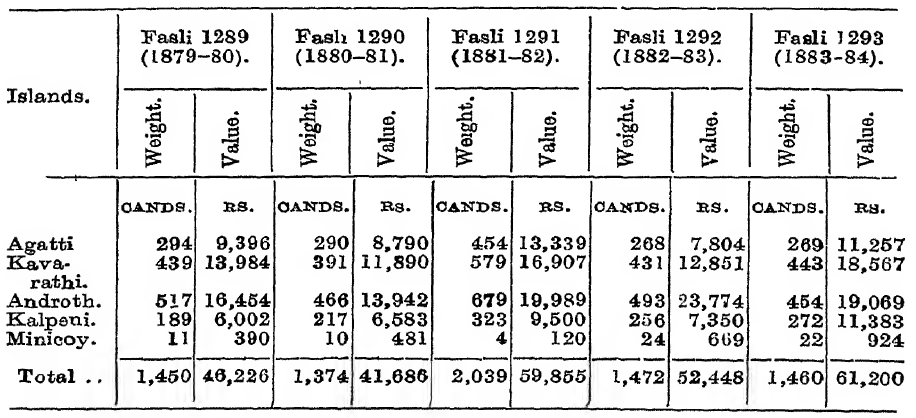
The revenue fluctuates with the season and with the varying conditions of the coir market, and cannot be relied on. Sometimes the monopoly results in losses to the island administration. The coir monopoly does not exist in the island of Minicoy. A sort of Karayma or fixed rent, at the rate of 15 palams or 5 lb. of coir on each tree confiscated and allowed to remain in the management of the family from whom the property was seized, is exacted in some of the islands. The Kavaratti islanders chiefly noticed this as one of their grievances.
Coconut monopoly.—In 1826 a coconut monopoly was established in the islands according to the same system as existed in regard to the coir. It has, however, since been abolished. During the continuance of the monopoly, people turned to the manufacture of jaggery which was free ; but whereas in Agatti the toddy was not plentiful, they betook themselves to the manufacture of oil Almost all the revenue derived from coconuts is now obtained from Minicoy ; it amounted in fasli 1293 (1883—84) to Rs. 20,394. The produce, however, included a portion of the stock of the previous year and was unusually large.
Cowry monopoly.—It is not known at what period this monopoly was commenced. The fisheries were carefully preserved for the Pandaram and could not be undertaken without permission. This permission is, however, not required now except when people proceed to any part of the islands where there is danger of theft of Pandaram coconuts. When fished, the whole must be delivered under heavy penalties to the Pandaram. They were received originally by measure in exchange for rice, the earliest rate being two seers of rice for one seer of cowry. In 1826, when the price of coir fell, the cowry rate was reduced to one seer of rice for one seer of cowry When this change tended to diminish the supply, the rice rate was raised from one to one and a half seers. The present price is 4 annas a seer of cowries, which weighs nearly two pounds. The monopoly is a failure. In fasli 1293 there were purchased 11 candies, 10 maunds, 27 lb. of cowries at a cost of Rs. 871—5—1 and these realised on sale only Rs. 448-4-7.
Tortoise-shell.—Green turtles are found in considerable numbers on the shoals and in the lagoons of the islands, and are valuable for their blubber. The tortoise-shell yielding species is comparatively rare. Up to 1815 the rate was 10 to 15 seers of rice for each tortoise-shell according to its size, and this was raised afterwards to Rs. 6 per lb. with a view to hold out sufficient inducement to the people to prosecute the fishing. The present rate is Rs. 2 per lb. In fasli 1291, 11½ lb. were purchsed from the islanders at a cost of Rs. 23, and realised on sale Rs. 57—8—0. As cowries and tortoise-shell are not important sources of income to the islanders, there were no serious complaints about the inadequacy of the remuneration paid to them by the raja.
Holothuria (Beche-de-mer of commerce).—The manufacture of beche-de-mer appears to be somewhat recent and to have given rise to some successful speculation. The Pandaram claimed it as a royalty and preserved all holothuria, either manufacturing the beche-de-mer on its own account or renting the fishing to coast merchants. Mr. Underwood, in 1882, found that “the trade in the Atta or sea-leach (beche-de-mer) has not quite died out. Men do not come over from the mainland as in former days and hire labour to catch them. Some of the more industrious islanders go and pull them off the rocks and out of the sand and cure them. They are sent to Mangalore in the odams and thence shipped to China."
Ambergris.—Very little of this article is found on the islands, but when found it is considered to be a royalty.
Morinda Citron and Lime Monopoly.—The Morinda citron of Androth and the lime of Kavaratti were formerly articles of monopoly. The former used to be monopolised at one-fourth of its value and the latter gathered by the Pandaram agents, a good portion being taken as the Pandaram share and sent to Cannanore or made into pickles. The tax was abolished with the sanction of Government, conveyed in their order of 23rd February 1880.
Salt and Tobacco Monopoly.—On the introduction of salt and tobacco monopoly on the coast they were imitated in the Cannanore islands. The raja made considerable profit by this ; but of late it has fallen into disuse, and the people now supply themselves. The free supply of salt to the islanders was recognised by Government in February 1880.
Pilot Customs.—The people of the group are skilful pilots. They used to pilot crafts from the coast till they cleared the group of islands, and also to Arabia. A nazirana at the rate of Rs. 3—8—0 on a voyage of the former description and of Rs. 7 on the latter, was exacted. This has now been given up.
Other naziranas used to be exacted as follows : —
First.—Rs. 300 to 500 on succession of the heir to the office of kazi, which is hereditary.
Secondly.—Rs. 100 to 300 on occasions of titles or dignities being conferred on principal personages. These titles had local privileges attached to them and implied power to levy certain contributions, such as pick of fish, etc.
Thirdly.—Rs. 4 to 11 on occasions of interviews or audiences of the raja.
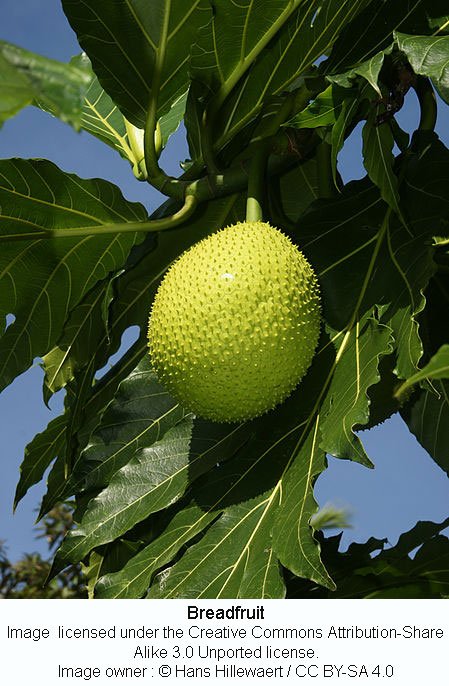 Fourthly.—Payments for permission to wear ornaments. Formerly toddy-drawers, too, had to pay cesses under the name of naziranas towards the support of the public servants, although the trade in jaggery manufactured by them was free. All these have since been given up.
Bread-fruit trees have been assessed with the sanction of Government, conveyed in February 1880.
Waste land.—The raja claims all waste lands as Pandaram or crown property. The claim has been acquiesced in to a large extent by the people. The ideas of the islanders in regard to property in the soil have been only slowly developing in recent years. Originally, the land was the common stock of the community and the administration is now engaged in dividing it among the people. The waste lands claimed by the raja are given on application to any one who will undertake under a cowle1 or written agreement to cultivate them within a certain time, and all improvements made become the sole property of the cultivator. When the land has been all thus settled, it will probably become possible to abolish the trade monopolies with their irksome restrictions, and to throw the island trade open.
NOTEs: 1
The form of cowle at present in use is as follows : —
Agreement between ___________ on behalf of the Collector of Malabar and ___________ of ___________.
I, ___________, hereby lease to you and I ___________hereby take on lease from you the Pandaram land described at the foot of this document on the following terms :—
1. Whereas there are now standing on the said land the following trees :-
|
Coconuts |
Bread-fruits |
Limes |
|
|
Tei |
|
|
|
|
Kili |
|
|
|
|
Maram |
|
|
|
|
Phalam |
|
|
|
|
Aphalam |
|
|
|
I, ________, agree to pay rent for the same as specified below, viz. :—
(a) In ________ of coir of the best sort made in the island and at this rate each year till________.
(b) In ________ of coir of the sort above said and at this rate in each year till ________.
(c) In ________ of coir and at this rate in each year until the under-mentioned paimash is made.
2. I, ________, further agree that within three years from the date of this lease the said land shall be cleared, and shall thenceforwards be kept clear, of jungle and planted up with cocoanuts, in such a manner that there may be at no time less than one plant for every ________ perukams, exclusive of the land occupied by buildings.
3. Paimashes shall hereafter be made at such intervals as may be fixed with the sanction in writing of the Collector of Malabar, acting under the general or special orders of the Government of Madras, and at each paimash the rent to be thenceforwards paid by me shall be calculated at the rate of ________ on each tree found to be in bearing at the said paimash.
4. I further undertake that I will not erect any mosque or bury any human body in the said land.
5. I, ________, under the authority vested in me by Government through the Collector of Malabar undertake that no rent shall be demanded from you, your heirs, representatives or assigns on account of any trees hereafter planted by you or them on the said land until the expiration of ________ years from the date of this lease.
6. 1, ________, further undertake that (subject to your punctually paying the stipulated rent, and otherwise complying with the terms of this agreement) you, your heirs, representatives or assigns shall not be ousted until the expiration of forty years from the date of this lease, nor after the termination of the lease, until you are paid the compensation provided for in the next succeeding paragraph. But with the sanction in writing of the Collector acting under the general or special orders of the Government of Madras, this contract may for any special reason be terminated after one year’s notice in writing has been given to you. In this case you will be entitled to compensation as provided in paragraph 7 together with a further sum amounting in all to 15 per cent, of such compensation.
7. I further undertake that if you, your heirs, representatives or assigns are ejected on the expiration of your lease, or for non-payment of rent or for any other sufficient reason, you or they shall be paid compensation for all valuable trees of whatever description you or they have planted during the lease at rates to be fixed with the sanction in writing of the Collector of Malabar, acting under the general or special orders of the Government of Madras, or by a person appointed by him as arbitrator.
8. You, your heirs, representatives and assigns are at liberty to dig wells and tanks, to erect buildings (other than rhosques) and to dwell on the land.
9. On you, your heirs, representatives or assigns being ejected you shall be at liberty to remove the said buildings, and shall be allowed one month so to do ; subject to a lien thereon for any rent which may be due.
10. You shall not be entitled to receive any sum as compensation save and except in the manner provided in paragraphs 6 and 7.
11 . Until the next paimash, the rent shown m paragraph 1 (a) and (b) as payable by you in coir shall at your option be payable in money at the rate of _____ per _____.
12. You _____ shall be at liberty to relinquish the land after giving a year’s notice in writing to the Collector of Malabar, but in this case you will not be entitled to any compensation for improvements.
13. If you, your heirs, representatives or assigns lease the land or any portion of it to a sub-tenant, the sub-lease shall be in writing and registered, and such subtenant shall not during the remainder of the currency of this lease, be ousted from possession of the land, except with the sanction in writing of the Collector of Malabar acting under the general or special orders of the Government of Madras, and then, only on compensation being paid to the sub-tenant at full market rates for all improvements made by him.
14. In the event of the rent being allowed by you to fall into arrears, it will be collected by the attachment and sale of your movable property.
|
Name of Island. |
No. of plot on Survey Map. |
Measurement in 6 feet Koles. |
Area
|
Boundaries |
||||
|
N. & S. |
E. & W. |
N. |
E. |
S. |
W. |
|||
|
|
|
|
|
|
|
|
|
|
END OF NOTEs
General and Judicial Administration.— Very little is known about tbe ancient administration of the islands. The administrative machinery of each island consisted of a karyakar (raja’s agent), one accountant and three or four Nadapals (village runners), the latter number having been subsequently reduced to two. These officers were under the immediate orders of Cannanore, and were seldom controlled in their work by the personal visits of either the raja or his principal karayakars. They were entrusted with the administration of petty police and civil justice, the maintenance and protection of the monopolies, the collection of revenue and the management of the Pandaram property.
The karyakars were aided in their work by mukhyastans or principal men who sat with them in committee in the adjudication of all matters. The mukhyastans were invested with certain dignities and privileges and had their office hereditary in their families. Their presence was necessary to constitute the kacheri for the transaction of business and they exerted considerable influence over the islanders. This form of patriarchal administration was suited to the rude state of society on the islands, but corruption and its concomitant baneful influences were rampant, and goaded the islanders into open rebellion and resistance of the Cannanore authority.
All cesses, customs and contributions due to the Pandaram and local servants, judicial fines and penalties for breaches of fiscal rules, etc., were secured by attachment and confiscation of the defaulter’s property and where they could not be fully recovered they were carried into the accounts as debts against the family and realised whenever opportunity offered. Evasions of payments were also punished by fines and imprisonment. There were no prescribed rules of procedure in regard to trials or judicial proceedings and matters of importance were referred to Cannanore for orders. It was supposed that records had been kept of all such proceedings, but they were stated to be not forthcoming when demanded of the Raja by the Collector.
There was no distinction between criminal offences and those constituted by commercial and fiscal arrangements, and the same summary proceedings were resorted to in all matters.
It has been affirmed that offences of a heinous nature happily never occurred on the islands, and it is possible that this might have been the case. Some years ago the murder of a child alleged to have been committed with a view to obtain her jewels was stated to have occurred in the island of Kavaratti, and it was believed that the perpetrator’s house was "plundered” by the inhabitants in an organised body1, the jewels and a boat were sold and the proceeds given to the victim’s family. A plantation of 8 or 10 trees was also carried to the Pandaram account.
NOTEs: 1. The Kuttam (see Glossary) was no doubt a rough but most effective instrument of justice in such cases. The community simply rose and plundered (as in this instance) the guilty individual and his family, reducing them to beggary. END OF NOTEs
It is curious that this form of rough and ready justice was most frequently employed for the punishment of the offence of sorcery. In the adjudication of petty civil disputes oath, arbitration and ordeal were freely employed, and oaths in the name of the raja and on the Koran were considered peculiarly solemn. The kazi also exercised jurisdiction over matters falling within his province.
The islands form one of the scheduled districts and no written law has yet been extended to them. Nor is there, so long as the islands remain under the direct administration of Government officers, much necessity for the introduction of written laws, which in the case of such archaic forms of society only lead to the breaking up of the bonds on which society rests, and to the consequent multiplication of chicanery, fraud, and other too numerous evils. When society has become more complex, written laws must of course follow ; but meanwhile the enlightened despotism of the officers of Government, founded on justice and good conscience, is a form of administration which the islanders thoroughly appreciate and which they have as yet shown no wish to have changed.
Since the last sequestration of the islands, in April 1875, for arrears of peishcush due by Sultan Ali Raja of Cannanore, the administration of the islands has been improved in several ways. The islands have been periodically visited by Covenanted European officers and a small staff of clerks, and the grievances of the people have been fairly and equitably dealt with both on the spot as well as on the mainland.
One amin with a gumasta (clerk) to assist him, and paid fairly well, has been appointed for each island, and has been authorised to try petty civil and criminal cases of a nature which do not involve any intricate or nice questions beyond the keen and intelligence of this class of officers. Their powers extend to a sentence of imprisonment not exceeding 15 days and of fine not exceeding Rs, 15, and the trial is conducted with the aid of two or more assessors selected in turn from the list of chief men in each island.
A number of volumes of the Registration Department usually in use on the coast have been sent to the islands, and the amins have been directed to copy into them walls and other documents relating to divorce and other important transactions in the island. The present establishments on the islands are as follows :
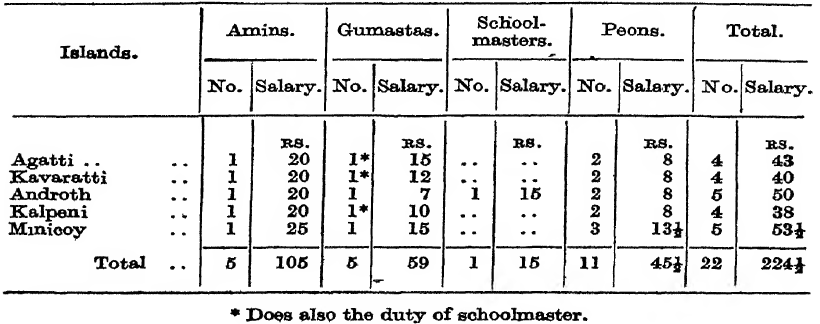
The islands were attached on the first occasion for arrears of peishcush due to Government under orders issued on the 7th September 1854, but from circumstances beyond control there was some delay in carrying them into effect. The Islands of Androth, Kalpeni, Kavaratti and Agatti were taken charge of on the 9th November 1854, and the island of Minicoy on the 22nd March 1855, but there was resistance in the last-named island owing to the intrigues of the house of Cannanore, and this was not finally overcome till after the visit of Mr. Thomas in the early part of 1858. The islands were released from attachment on liquidation of arrears in 1861. The attachment on the second or last occasion took place on the 3rd April 1875.
The names of officers who have from time to time visited some or all of the islands are as follows :-
|
Name of officer. |
Designation. |
Date of visit. |
Remarks. |
|
Lieutenant Bentley. |
|
1795 |
To institute enquiries as to the condition and resources of the islands. |
|
Mr. (afterwards Sir) William Robinson |
Head Assistant Collector. |
1847 |
To afford relief to the islanders who were in distressed circumstances after the great storm of April 1847. |
|
Mr. E. C. G. Thomas. |
Special Assistant Collector. |
1856 |
To inspect and report on the islands after their sequestration by Government for arrears of peisheush. |
|
do. |
1858 |
To investigate the cause of the mutinous spirit exhibited by the people of Minicoy and to bring them to a sense of allegiance to Government. |
|
|
Mr. W. Logan |
Sub Collector |
1869 |
To report on the condition of the islands, their administration and remedial measures for establishing order and good Government. |
|
Mr. J. B. Spedding. |
do. |
February 1873 |
To ascertain whether the arrangements suggested in Mr. Logan’s report had been carried out by the raja and his agents. |
|
Mr. H. M. Winterbotham. |
Special Assistant Collector |
February and March 1876 |
To dispose of island matters on the spot and to submit proposals for the administration of the islands. |
|
do. |
December 1877 and January and February 1878. |
do. |
|
|
Mr. V. A. Brodie. |
Special Assistant Collector |
January to March 1880. |
For disposal of ordinary island matters. |
|
Mr. W. G. Underwood. |
do. |
November 1881 to February 1882. |
For disposal of ordinary island matters. |
|
Mr. A. C. Tate |
do. |
January to March 1884. |
For disposal of ordinary island matters. |
|
Mr. G. W. Dance. |
Head Assistant Collector. |
December 1884 |
To appoint a competent amin at Minicoy. |
|
do. |
January 1885. |
For disposal of ordinary island matters. |
|
|
Mr. W. Logan. |
Collector. |
January 1887. |
do. |
|
Mr. G. W. Dance. |
Head Assistant Collector. |
January 1887. |
do. |
AGATTI ISLAND.
Position and Extent.—The island of Agatti, situated in Lat. 10° 51' 30" N. and Long. 72° 28' E, and lying about 35 miles north-west of Kavaratti, is the most westerly of the Laccadive group. In formation it somewhat resembles Kalpeni. Like that island, it lies north-east and south-west, and has on its western side a fine lagoon. The coral shoal upon which it stands is between 6 and 7 miles in length and from 3½ to 4 miles in breadth. On the east, the reef is situated close to the beach and beyond it the water deepens rapidly ; whilst on the west, the reef trends outwards so as to enclose the lagoon, which at its broadest point is more than two miles wide, and in this direction beyond the reef the slope of the coral shoal is very gradual.
Besides the main island, the reef also encloses the small uninhabited island of Kalpitti situated to the south of Agatti proper and separated from it by a narrow and shallow channel. The main island is long and narrow, being nearly 5 miles in length, whilst its greatest breadth is under 1,000 yards.
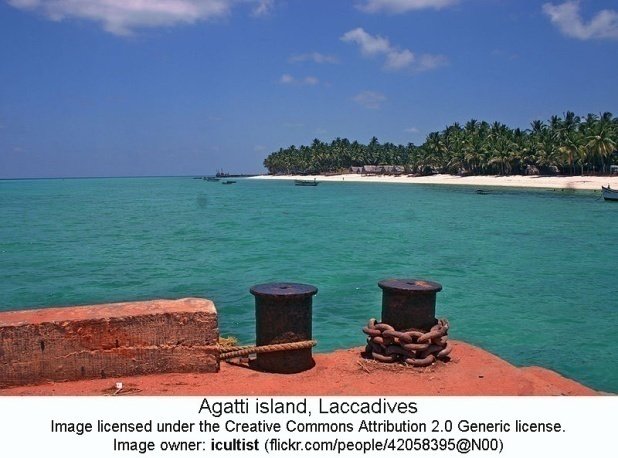 The southern portion consists of a long narrow strip averaging for more than 2 miles of its length little over 100 yards in width. The total area of the two islands is 716 acres or nearly 11/8 square miles, Agatti comprising an extent of 688½ acres and Kalpitti 27½ acres. At a distance of about 5 miles to the north lie the uninhabited islands of –
1. Bangara (115 acres),
2. Tinnakara (76¾ acres),
3. Parali (10 acres),
but these, though situated upon what is no doubt an extension of the Agatti coral shoal, are enclosed by a separate range of reefs and the channel between is deep.
There are two entrances into the lagoon navigable by the island vessels, viz., one situated close in shore at the north-western extremity of the island, and the other on the west side of the lagoon. The former is the passage ordinarily used by the island vessels, but the latter is the largest. At high water, there is in this passage about 7 feet of water and inside the lagoon a depth of several fathoms is obtained. As the lagoon is fairly free from coral rocks its navigation is easy.
Soil and Products.—The soil is comparatively sterile. About two-thirds ofthe island are under cocoanut cultivation and the rest is waste, but there are no large jungles. The lands claimed by the Pandaram are of small extent and as the cultivation is very imperfect and the quality of the soil poor, only a small revenue is obtained from them in this island. Some attempts have been made to form a tottam (artificial low land) for the cultivation of cereals, but the extent is trifling and the quality very poor. The only grain raised is a sort of vetch (payar), but the quantity is small. The islanders also cultivate sweet potatoes and plantains to a small extent, and there are a few bread-fruit trees, lime trees, one areca palm and betel vines. A plant called Ittala grows in Bangara, from the root of which a sort of tapioca is obtained and used as diet for invalids. The fauna and flora of Agatti are the same as in the case of Kalpeni and Androth, save that in this island and in Kavaratti there are no crows.
Animals.—The islanders possess 110 cattle and 46 goats and the usual domestic fowls. One islander introduced a pair of rabbits from the coast a few years ago and they seem to thrive well. The sea products are the same as those of Kalpeni. Fish of many kinds is abundant and the inhabitants are very expert fishermen.
People, their Customs and Occupation.—This island is a melacheri or low caste island, but the division of the people into castes according to occupations that exist in the other islands is also found here, viz. ; —
(a) Karnavars (principal inhabitants),
(b) Urukars or sailors, and
(c) Melacheris or tree-climbers.
In disposition the inhabitants are the most enterprising and energetic, and are also very hospitable and cheerful. Both in person and in their habits they are very cleanly. The language differs slightly from that of the other northern islands and bears a closer resemblance to Tamil in interrogative suffixes. Thus they use "a" for "o” as the interrogative affix, e.g., "orangiya," did you sleep ?
Of the men belonging to the two lower classes only about half permanently reside in the island. The others go and settle on the coast, either in Malabar or Canara, as topee-makers (cap-makers), and as the price obtained for a topee varies from Rs. 5 to Rs, 15, this is a pretty profitable employment. As this occupation deprives the karnavar (or headmen) to a large extent of the personal services of their dependents, it is not very popular amongst them. Besides topee-making those who settle on the coast are in the habit of chanting the koran at private houses, for which they get their food and a small present.
Population, Sanitary Condition and Medical Aspects.—The population of the island, according to the census of 1881, was 1,375, of whom 672 were males and the rest females. In 1848 the population numbered 1,545.
The houses are built much in the same style as those of Androth, but they differ in two important respects. First, there is no central hall off which all the rooms open, and, secondly, the back verandah is within and not outside the outer wall of the building.
As in Androth, the walls are built of quarried slabs of coral free stone, but these are not kept in position by posts. As they whitewash the outer walls of their houses, they have a cleaner and brighter appearance than in any of the other islands. The doors and barred windows also are usually painted black or green, and in respect of ventilation they are superior, as they are built with eaves, and the rooms have barred windows. The people also pay more attention to conservancy than those of the other islands, and all house-refuse is collected in one spot and either used for manuring the cocoanut trees or burnt from time to time.
No epidemic has visited the island of late years, and the only prevailing complaints are eye-diseases and skin-diseases.
Education.—Secular education is more neglected here by the people than in Androth.
Out of 30 boys, with whom a school was established in 1878, only 11 appeared for examination in 1880. There are four mosque schools, at which about 60 boys and girls of the better classes are taught the Koran.
Religion and Mosques.—The people are, as in other islands, exclusively Muhammadan. The number of mosques in 1880 was 27, of which 19 had cemeteries attached to them. The number of mosques in 1848 was 35.
Manufactures and Trade.—The manufactures and trade of this island are the same as in other islands and call for no special notice. The number of boats owned in 1876 was 121, of which 18 were large and the rest small. The total number prior to 1847 was 68.
Survey and Cowles.—The survey of the island has been completed and a portion of the Pandaram lands has been granted on cowle or lease.
Subdivisions of the Island.—The island is divided into three cheries or subdivisions, viz., 1. Edacheri, 2. Vadakancheri and 3. Tekkancheri.
General remarks.—In June 1880, a British steamer, named the "Mahableshwar,’" was wrecked on the reefs of this group of islands.
KAVARATTI ISLAND
Position and Extent.—This island is situated in Lat. 10° 34' and Long. 72° 57' E., and so is distant about 74 miles from Kalpeni and 35 from Agatti. The coral shoal is the least extensive of any. The length of the island from north-east to south-west is about 3½ miles and its greatest breadth about three-quarters of a mile. The area is 865-1/5 acres or about 11/3 square miles.
As usual the island is situated just within the reef on the east, whilst on the west there is a lagoon which at its widest part is about half a mile broad. At the southern end it would appear that there was formerly a separate island, but it is now connected with the main island by a narrow strip of land about 50 yards wide. The islets attached to Kavaratti are –
|
1. Pitti. |
|
|
2. Seuheli or Seuhelipar composed of : |
(a) Valiyakara (b) Cheriyakara |
The former, a mere sandbank on a coral limestone foundation, lies about 15 miles to the north-west of Kavaratti and is frequently visited by the people of that island and by those of Agatti and Ameni for fishing purposes. A pile of stones with a stout post in the centre has recently been put up as a landmark to attract the attention of mariners. The tides here run strong and there is often great difficulty in landing owing to the surf.
About 37 or 40 miles to the south-west of Kavaratti lies the coral shoal of Seuheli or Seuhelipar. It is composed of Valiyakara (big shore) at the northern extremity of the lagoon and of Cheriyakara (little shore) at its southern extremity. These two islets were formerly the common property of the Kavaratti islanders, but were many years ago confiscated by the Pandaram. As in Bangaram and Tinnakara the coral substratum is imperfect in both islets so that no fresh water is procurable ; but for the same reason the soil is exceptionally damp and fertile.
Valiyakara is completely overrun witn jungle, throughout which scattered cocoanut trees occur. Unlike the jungle in the other islands it contains no screw-pine whatever. In the centre there are large trees of various kinds, the most common being a species of banian (Ficus Indica). At the eastern and western extremities, the jungle becomes smaller and is composed of a species of shrub resembling the Rhododendron called Kanni by the islanders. On the north the shore is composed of coral rock and the vegetation overhangs the water. On the other shores the beach is sandy.
Cheriyakara lies east and west and has an extreme length of three-quarters of a mile. Its breadth at the widest point does not exceed a quarter of a mile. The area is 81¾ acres. The beach is generally sandy and the lagoon in its immediate neighbourhood is very shallow, especially on the south and east where large sand flats are left dry at low tide.
Unlike Valiyakara it contains no jungle worthy of the name. The island is covered with coarse long grass and a kind of small shrub. There is a well the water of which though brackish is occasionally used for cooking and drinking purposes. Near the centre and at about 100 yards from the eastern shore there is an extensive shallow pond and marsh of stagnant water surrounded by a dense fringe of small shrubs. It serves no useful purpose whatever and might be filled up.
Soil and Products.—The soil of Kavaratti is poor and is unsuited for the cultivation of cereals or vegetables. Beans, plantains and brinjals and a few areca palms, tamarind trees and betel vines are, however, grown ; but the extent ot cultivation is very limited and is hardly worth the name. The people depend almost entirely upon their cocoanut cultivation which covers nearly the entire island. A leaf disease formerly affected many cocoanut trees. There are a considerable number of bread-fruit and lime trees ; the timber of the former is used for shipbuilding and by the toddy-drawers for making wooden vessels to hold toddy.
Animals.—The number of cattle and goats in 1880 was 137 and 193 respectively. The chief sea-products, besides fish, are cowries, tortoise and turtle. The latter is captured chiefly for its oil. The lagoon adjacent to Souheli affords excellent fishing. People, who visit Seuheli for fishing purposes, are allowed to pluck the cocoanuts required for their use free of payment. This privilege has existed for a long time.
People, their Customs and Occupation.—The same division of the inhabitants into classes or castes exists here as in Androth, but all castes claim to be janmis. A few who immigrated from other islands at the time of the great storm in 1847 are dependents of the Koyas ; some of the lower classes are topee-makers like those of Agatti. Melacheris are called Thandels at Kavaratti. The people are as a rule quarrelsome and litigious ; the Malumis are more numerous and influential than the same class on other islands.
Population, Sanitary Condition and Medical Aspects.—-The population of the island, according to the census of 1881, was 2,129, of whom 1,030 were males and the rest females. The number in 1848 was 2,060. The houses along the west coast of Kawaratti are built in a row and in close proximity to each other. On the east and south coasts they are scattered here and there and are built in the same fashion as those of Androth. The health of the island has of late been good. In 1039 M.E. (1863-64 A.D.) about 700 people are supposed to have died of cholera.
Education.- Malayalam school started at Kavaratti was closed for want of pupils. The number shown in the census report of 1881 as "instructed” and under “instruction’’ is 513.
Religion and Mosques.—The inhabitants are exclusively Muhammadans. The number of mosques in 1848 was 51. At Seuheli there is a mosque of rude construction and the tomb of a pious Tangal held in much veneration by the islanders. Many miracles are ascribed to him, and it is especially common to invoke his aid in storms or when distressed by adverse winds. The islanders say that when in a storm they make a vow to visit the shrine of this saint the sea at once goes down and the winds become favourable.
Manufactures and Trade.—The manufactures of this island consist mainly of coir-yarn. The number of boats owned bv the islanders in 1876 were 30 large and 126 small vessels.
Pandaram Lands and Income therefrom. - In this island as elsewhere the body of the island is the common property of the people. Over a part, however, the Pandaram asserts exclusive claims on the ground that it was formerly waste land and therefore the property of the raja. The claims were resisted by the people and gave rise to great discontentment and opposition on their part.
The Pandaram income is derived—
1st. From the trees on the Pandaram Pak (forbidden ground) to the south of the island which comprises about one-fourth of the total area. It is cut off from the body of the people’s plantation by an old wall probably thrown up while it was really waste, and as such no entry could be made on this land without a pass from the raja’s agent.
2nd. From the trees on padipadi (half and half) lands, the produce of which is equally divided between the Pandaram and the tenants.
3rd. From Nattagatta Karayma, a fixed rent on escheated trees in various parts of the island.
4th. From Chuttu Karayma, a fixed rent arbitrarily assessed on all trees growing with 40 koles (kole = 30 inches) of the seashore.
All these lands have been granted to tenants on cowle with the exception of Chuttu Karayma lands, the rents of which were relinquished in favour of the occupants of the adjacent holdings. The tax on lime trees was remitted, and the bread-fruit trees were brought under assessment.
Subdivisions of the Island.—The inhabited portion of the islands is divided into four cheris, viz.
1. Melacheri or Mecheri on the north-west coast.
2. Tekkecheri on the east coast.
3. Porakecheri to the south.
4. Pallicheri on the south-west shore.
Porakecheri is separated from Mecheri and Pallicheri by a small valley which was apparently excavated formerly for grain cultivation.
ANDROTH ISLAND
Position and Extent.—This island, which is the largest of the northern group of the Cannanore Islands, is situated in Lat. 10° 48' N and Long, 73° 57' E. It is about 139 miles from Calicut and differs in its formation from all the other islands of the group in that it lies east and west and has hardly any lagoon. The coral shoal upon which it is situated is of considerable extent, but the coral crops up to the surface only in the immediate neighbourhood of the land, the reef being hardly anywhere above sixty yards from the beach, and on the east the beach and reef are coincident.
The greatest length of the island from south-east to north-west is about 3½ miles, and the greatest breadth, which is at about the centre of the island, is 1¼ miles. The area is l,0672/3 acres or about 12/3 square miles. The coast line is scarcely at all indented, so that the island forms a regular oval figure. The surface is generally a level plain, elevated but a few feet above the sea, but here and there it is varied by mounds formed mostly of the heaped-up material excavated in forming the "Tottam” or arable land.
The highest mound is probably not 40 feet above the sea and the average elevation not more than 7 or 8 feet.
Soil, Products.—The soil is comparatively superior to that of other islands save perhaps parts of Kalpeni. It is richest in the centre and west parts and poorest on the south-east, where it is largely mixed with coral stones varying in size from small pebbles to considerable boulders. The Pandaram or crown lands comprise about one-fourth of the area of the islands and are scattered throughout the holdings of the islanders. They have been acquired by escheat or confiscation and contained, according to Sir William Robinson’s report, about 20,000 coconut trees prior to the great storm of 1847.
The chief Pandaram possessions are the East and West Valiya Pandarams which are comparatively in a neglected condition. The holdings of the islanders are well stocked with coconut trees. The chief produce of the island is coconuts ; but dry grains, such as raggi, varagu and millet, yams, sweet potatoes, bread-fruit trees, plantains, limes, areca palms and betel vines are also grown to a limited extent.
Animals.—The number of cattle and goats is larger in this island than in any other and amounted in 1880 to 208 cattle and 418 goats. The only other domestic animals are fowls and cats. There are several species of rats which commit great injury to coconut plantation. The crow is the only wild bird that breeds on the island, but it is visited by various kinds of sea birds and also by migratory birds, such as the golden plover, the smaller curlew and the cuckoo.
As there is no lagoon, the turtle and tortoise are very scarce, and from the absence of extensive shallow coral banks, the same is the case with cowries and other shells. Fish also are not plentiful, but there is a small species of octopus, called by the islanders appallu, which when roasted is esteemed a great delicacy.
People, their Customs and Occupation.—The people of the island fall under three main classes, viz. —
(1) Karnavar (doers, agents), subdivided into Karnavar proper and Thanakapirantha Kudiyans.
(2) Malumis (pilots and sailors), subdivided into (a) Malumis proper, (b) Urukars.
(3) Melacheris (tree-climbers).
The first class of Karnavars is composed of the rich odam (vessel) owners and Panchayatkars (arbitrators). The male members of this class are also distinguished by the title of Koya—a religious dignity. The island Karnavans, Amin and Kazi, all belong to this class. The Thanakapirantha Kudiyans are less wealthy and cultivators. The second class or the Malumis are, as the name implies, sailors They are generally Patta Kudiyans, i.e., partly independent and partly dependent on the higher classes The only difference between the Malumis proper and the Urukars appears to be in the names. The third class, Melacheris, are servants and toddy-drawers (the name signifies one who works aloft).
These are generally Adima Kudiyans or serfs of the Karnavars, but they are at liberty to change their employers. Inter-marriage between the two classes of Karnavars is free and unrestrained, and lately it appears that the jusconnubrum (right of intermarriage with Karnavars) has been accorded to the second class), but it is still withheld from the third class or Melacheris, intermarriage with whom is punished by the exclusion of the offender from his or her caste. The marriage is, however, deemed a valid one.
The islanders compare favourably in physique with the people of the coast and in their customs and habits closely resemble the Mappilias of North Malabar. The men of the upper classes wear jackets and head gear, but the Melacheris or lowest classes wear neither the one nor the other. Contrary to what is the usage on the mainland, the women do not cover their heads and are not kept in seclusion. The women are generally very untidy and dirty.
The people are, as a rule, quiet in their disposition, but the complexities of the Muhammadan rules of inheritance and marriage and the existence, side by side, of the Makkatayam and Marumakkatayam rules give rise to frequent litigation. The men are comparatively indolent, but the women are engaged from morning till dark in cooking, pounding rice, beating, unravelling and twisting coir-fibre, carrying loads, boiling toddy in order to make jaggery, etc.
It is somewhat difficult to define what is the occupation of the Karnavar class, as they rarely do anything save bullying their dependents or quarrelling among themselves ; occasionally they do a little cultivation and fishing, and those who have odams (vessels) superintend the repairs and accompany the odam on the voyage to the coast where they do all the buying and selling, only rendering an account upon the return of the odam to the island.
The dependents of the Karnavar caste serve for nothing in their master’s odam (boat), or, when he has none, in the odam in which he sails or sends his goods. The Kudiyan must also ship the produce of his trees, etc., in the master’s odam, or through him in the odam in which the master ships his own goods, and 20 per cent of the goods he so exports is appropriated by the master as freight. The tottam or arable land is sometimes cultivated by the master, but most is given over to Kudiyans(dependents) on the share-and-share-alike system.
The income of the Karnavar class, who are all landholders and many of them odam-owners, is thus derived from the following sources :-
(1) From the produce of parambas retained in their own hands.
(2) From the export and sale of the goods worked up by the females of the family.
(3) From the freight paid them by their Kudiyans on the goods they export. Where the Karnavan is also the odam-owner he gets the whole 20 per cent ; when he is not, he usually gets freight for his own goods and those of his Kudiyans at the rate of 10 per cent in the odam of another and the other 10 per cent of the exports of his Kudiyans is alone appropriated by him.
(4) From the rent (half the produce) of their arable lands.
(5) Kudiyams are also bound to give the Karnavan a share of the fish they catch when fishing in his boat and to make presents on the occasion of weddings and other festivities in the Karnavan's family
(6) Some of this class also make tours on the mainland giving themselves out to be priests and often return to the island with large sums collected from the faithful of the places they visit.
The second class or Malumis are sailors and are engaged in exporting the produce of the island to the mainland in the Karnavar's odams ; some of them also possess fishing boats and small odams of their own, in which they make voyages to the coast, and this has excited the jealousy of the Karnavar class, who look upon them as interlopers and rebels. There is thus ill-feeling between the two classes.
The Melacheris or the third class are the hardest working population of the island. They alone climb trees and so pluck the nuts and draw toddy from the trees in the possession of the higher classes. For plucking nuts, a small percentage is given them as hire, and the toddy which is drawn twice a day is given every other day to the Karnavan, i.e., half goes to the Melacheri and half to the Karnavan. Besides their profession of toddy-drawing, they have to do odam service for their lords and they also work in the tottam and go fishing.
A few coast people who have settled in the island are silversmiths and jewellers.
Population, Sanitary Condition and Medical Aspects.—The population of the island previous to the great storm of 1847 was 2,576 ; in 1876 it was 2,629. According to the census of 1881 it numbered 2,884 souls, of whom 1,412 were males and 1,472 were females. A large number of people perished during the storm of 1847, and it is believed that the number that remained in the island, omitting those who emigrated to the other islands, did not exceed 900. The island has now thoroughly recovered itself from the disastrous effects of 1847.
The sanitary condition of the island, although more satisfactory than that of the rest is, as might be expected very backward. There is no conservancy, and house-refuse is allowed to accumulate in the house-yards until it becomes objectionable, when it is collected and occasionally burnt. Rarely it is placed as manure in the pits in which young coconut-plants are planted.
Water-supply is good, there being as a rule a well attached to each house. The wells consist of a pit about 5 feet square and about 5 feet deep with steps leading down one side to a similar pit at the bottom cut through the coral substratum. From these wells, which are never dried up, excellent water is obtained. Some of the mosques and better sort of houses have also small tanks similarly constructed attached to them. These are used for bathing purposes only, but the sea is the chief resort for this purpose. There are no wells for purely cultivation purposes.
The houses are built with thin slabs quarried from the coral freestone substratum, the size of the blocks averaging about 5 to 6 feet in length, 2 feet in width and 4 inches in thickness. These are placed lengthwise on their edges and the walls so formed are plastered to give them stability. The houses are ill-ventilated and are in some cases so dark that a stranger requires to be shown about with torch or other light. The higher and lower classes are opposed to vaccination, but several children have been operated on, and a beginning has been made. There are two native physicians in the island. They purchase the necessary medicines from native physicians on the coast. There is hardly any medicinal plant to be found there. The most prevalent diseases are fever, rheumatism, consumption, dysentery, itch and ophthalmia.
Education.—The upper classes do not seem to be wanting in intelligence, but they are very indifferent to education, whilst the lower classes from the state of the subjection in which they are held are rude and ignorant. Most of the members of both sexes belonging to the former class can read the Koran character, but the number that can read Malayalam is comparatively limited. The number shown in the census return of 1881 is 89. A school was started by Mr. Winterbotham in 1878 with a nominal roll of 36 boys, but this number had dwindled away to 14 in 1880. The plan of combining mosque schools and secular schools is being tried.
Religion arid Mosques.—All the people of the island profess Muhammadanism. There were 30 mosques in 1880, of which 28 had grave yards attached.
Manufactures and Trade.—The only manufactures carried on in the sland are the manufacture of coir-yarn and that of jaggery. Shark fin are cured for exportation in small quantities, but the curing of holothuric has been entirely given up. Jaggery is prepared from meerah (as the sweet toddy drawn from the coconut palm is called) by a process of evaporation. In order to prevent fermentation, in place of rubbing the collecting pots with chunam (lime water) as is done on the mainland, the Melacheris are in the habit of putting in them small coral limestone pebbles which answer the same purpose, and to this cause is attributed the peculiar sweet taste of the island toddy.
When the meerah has become semi-fluid, which it does after about two hours boiling, various articles are usually mixed with it in order to flavour it, such as rice, ragi flour and the scrapings of tender coconuts, etc. It is then taken off the fire and allowed to cool, when it forms a solid but sticky mass. This the women mould into balls (Pindika) of from 1 lb. to 2 lb. in weight, which they wrap up in bread-fruit tree leaves, and in this form it is exported. At Calicut a price of about two annas per pound is obtained. Jaggery is used by Mappillas in the preparation of the Calicut "alva", a very popular sweetmeat amongst them. Ambergris, which was mentioned by Sir William Robinson as a product of Androth, was found by Mr. Brodie only in the possession of one islander.
The principal exports from the island are, as in all other islands, coir-yarn, coconuts, with and without husk, jaggery and pindika (a kind of sweetmeat) and a little vinegar, lime-pickle and shark fins. The imports are rice, salt, arecanuts, betel, curry-stuffs, cooking utensils, both earthen and metal, implements of husbandry, clothes and occasionally cattle and ornaments. Teak, mango-wood and bamboos are also imported and used in repairing the odams and small boats.
As Androth is the nearest island to the coast, many odams from other islands call there for water, etc, both on their way to the mainland and when returning. The usual coast markets visited by the islanders are Calicut, where they sell their goods, and Mangalore where they usually purchase their supplies. Occasionally they also call at Tellicherry and Cannanore. The number of boats possessed by the islanders in 1880 as contrasted with the numbers in 1876 and 1848 is given below :-
|
Year |
Large coast-going vessels |
Small boats and fishing crafts |
Total |
|
1848 1876 1880 |
31 32 40 |
152 130 162 |
183 162 202 |
Survey and Cowles.—The demarcation and survey of the Pandaram lands in Androth have been completed and most of the lands granted on cowle.
Subdivisions of the Island.—-The island is divided into four subdivisions or cheris, viz.-
(a) Edacheri
(b) Mecheri
(c) Kicheri
(d) Chemacheri.
The last cheri is situated upon the southern shore and separated from Edacheri by the tottam or garden. Formerly these cheris were political and revenue subdivisions, but now that all matters are decided by the Amin with the assistance of the Karnavars, regardless of the cheri to which the latter belong, and the Muppans and the Nadapals are abolished and the revenue administration directly committed to the Amin, these subdivisions have lost all importance. There are no islets attached to Androth for administrative purposes.
KALPENI ISLAND.
Kalpeni 494½
Cheriyam 1291/8
Thilakka 123/4
Pitti 13½
Total 6497/8
Position and Extent.—The island of Kalpeni lies about 44 miles due south from Androth In Lat. 10° 7' N. and Long. 73° 55' E., and is thus the most southerly of the northern group or Laccadives proper. The coral shoal upon which it stands is very extensive, being about 8 miles in length and 3½ to 4 in width. Besides the main island (Kalpeni proper), which alone is inhabited, there are two small rocky islands to the southwest, called respectively, Thilakka and Pitti, separated from the mainland and each other by narrow channels and a long narrow island called Cheriyam, about 1½ miles to the north of the main island. These four islands together form a figure resembling a bottle with an elongated neck (Cheriyam and the north of Kalpeni) running from north by east to south by west. The extreme length from the north point of Cheriyam to the south point of Kalpeni is about 7 miles, and the greatest width about three-quarters of a mile. The total area of the group is 650 acres or just over 1 square mile.
On the east, the reef forms the shore line of Kalpeni and Cheriyam and on the south lies but a short distance from the beach. On the west it trends outward so as to enclose a magnificent lagoon of still water over 7 miles in length and from 2 to 2½ miles broad at its widest point. The entrance, distant some 4 miles from the landing place, is good ; but although the lagoon attains a depth of over three fathoms in many places its navigation is rendered very intricate and difficult by numerous coral rocks that rise in many instances to within a foot or so of the surface at low-water.
As there are no waves, no breakers disclose their presence, but in daylight their situation is easily discernible.
On the east the coral shoal slopes rapidly away. On the west beyond the reef, the slope is so gradual that the bottom can be seen for a considerable distance. The channels between the various islands are at low water very shallow, and the islanders can easily pass on foot from one to another, and it was from these shoals (particularly that between the main islands and Cheriyam) that cowries, of which this island used to export the largest quantity, were usually gathered.
The main island is about 3 miles long. For the first two miles of its length from the north it consists of a long strip increasing in width from about 50 yards at its northern extremity to about 400 yards at the termination of the big north Pandaram, after which it suddenly bulges out, attaining its greatest width in a few hundred yards. Only this southern portion is inhabited, as it is only here that good drinkable water is procurable. No drinkable water is found in the other small islands. All the uncultivated portion of the main island and the attached islets are covered with a dense jungle of screwpine, etc., in many parts of which scattered coconut trees occur.
Perhaps the most remarkable feature in the topography of the island, the general level of which is very low, is the natural sea-bank of coral stones along the east and south-east shore. This bank is supposed to have been cast up by the sea at the time of the great storm in 1847. As it is about 12 feet high and 60 feet in width at the base, it forms a grand natural barrier against the recurrence of such a disaster. It is a peculiarity of this island that the coral substratum is wanting, or at least not so solidified into a layer of limestone rock as in the other islands.
Soil and Products.—The soil appears to be very good in the central and southern portions of the main island, but the smaller islands of the group are very rocky and though covered with luxuriant vegetation, the coconut trees growing in them are not very productive. Along the east shore of the main island also there is a long strip about 50 yards wide, so stony that its cultivation would be very difficult and probably unproductive.
Besides land suited to the cultivation of the coconut palm, this island contains, like Androth, a considerable plot of low arable land adapted to the cultivation of a few coarse grains. In the tottam (as the arable ground is called) the same coarse grains are cultivated as in Androth, but the area devoted to the cultivation of plantains is more extensive than in the latter island. The plantains are very productive and are stated to require no watering. The bread-fruit also appears to grow more luxuriantly in this island than in any other, and whole groves of it occur everywhere throughout the inhabited portion of the island. A few areca palms, one tamarind tree, lime bushes and betel vines are also cultivated. The wild almond tree and punnan (a tree used for masts), found occasionally in the jungle, furnish fairly good timber, but the islanders usually import what they require.
On the whole, Kalpeni may be said to be one which nearly produces the food supply necessary for the support of its inhabitants, and this is clearly shown by the fact that they export a large quantity of the produce of the tottam (grain, plantains and sweet potatoes), fish, oil and dried fish to the other islands (mainly Kavaratti) getting in exchange coconuts, young plants, jaggery and coir.
The three islets mentioned above, as well as the greater portion of the main island, which together comprise about three-fourths of the entire extent, are claimed by the Pandaram. Cultivation is most backward in these parts. The inhabitants are extremely lazy and a considerable portion of the islands is, therefore, covered with jungle. The tottam alone is well cultivated.
Disaster of 1847.—On the 15th April 1847 a violent hurricane visited the island of Kalpeni and caused most woeful injury to life and property. It commenced at about 8 P.M. at the season of spring tides and passed on to Androth which it reached between 12 and 2 A.M. of the 16th. It then arrived at Kiltan, one of the islands attached to the South Canara district, and after that gradually subsided. The following extract taken from the Proceedings of the Board of Revenue, dated 2nd August 1849, gives a clear idea of the dreadful catastrophe : —
"The sea rose and flooded the whole but across the narrower part of the mainland ; it seems to have had tremendous velocity. All the trees, with the very soil, and between 60 and 60 houses, were washed into the ocean with upwards of 200 persons, while along the whole length of the shore a flood of loose coral has been deposited over the island which will render a considerable tract quite unserviceable until it has decomposed and become soil. Across the broader parts of the island, the water was not so destructively rapid, but so complete was the inundation that the first impression of the islanders was that the whole shoal was sunk. The water filled the tottam with salt water, killing all vegetation and drowning many persons.
"It was, in consequence, last year quite waste. Over the eastern bank of the tottam, a flood of loose coral stones was poured, which has filled up and destroyed a part of this useful land. Many wells and tanks were filled with sand and stones, and fresh water in all of them was spoilt. The inundation was probably more destructive than the wind, and has shaken the confidence of the people in the stability of the island greatly. The storm lasted for about an hour in all its violence.
"Then a sudden lull and the wind soon sprung up briskly from the westward and the flood subsided, leaving the island in the most perfect state of desolation.
"Of the 348 houses standing before the storm, not one escaped. Many were so entirely washed away as scarcely to leave vestiges of their foundation. All were unroofed and otherwise damaged. All the mosques, 29 in number, were injured, and nearly the whole of them at the time of Mr. Robinson’s visit were lying in a state of ruin.
"The population of Kalpeni, prior to the hurricane, is reckoned at 1,642 souls. Of these, 246 were drowned or washed away during the storm, far the larger proportion being women and children. One hundred and twelve perished in the ensuing five months from famine or from the diseases engendered by unwholesome and insufficient food, 376 escaped to the coast during the monsoon, thus leaving in the island 908, of whom nearly four-fifths are women and children.
"The plantations in the island have been entirely destroyed ; out of upwards of 105,000 full-grown coconut trees, the number before the storm, 768 only are now standing ; the total number of trees, young trees and plants which have survived, scarcely exceeds 10,000. This is only the main island Kalpeni ; the state of the adjoining islets, Thilakka Pitti and Cheriyam, is even more disastrous. The other trees—bread-fruit, banana and betel-nut are likewise all lost. More than a third of the trees destroyed are Pandaram or the Beebee’s property.
"The hurricane reached Androth between 12 and 2 A.M. of the 16th April, filve or six hours later than at Kalpeni. The tide was then happily low, so that only a small part of the island was inundated, and the results of the visitation, though sufficiently deplorable, were less disastrous than those experienced in the latter islands."
Animals.—The domestic animals that existed in the island in 1880 consisted of 94 cattle and 64 goats and the usual fowls and cats. In sea products, Kalpeni is peculiarly rich. The ayacura (seer fish), tarandi (skate), shark, appal (Bombay duck), flying fish (paramin) of two sorts, sword-fish and many other large fish are caught in abundance. The turtle, killed for oil but not for eating, is very common, and the tortoise pretty frequent. As might be expected from the great extent of the coral shoals and of the lagoon, shell-fish of many kinds are most abundant. One or two sorts are occasionally gathered for food, but the cowries are what we chiefly gathered formerly for export and are much more abundant in this island than in any other.
People, their Customs and Occupation.—In physique, the inhabitants of Kalpeni appear decidedly inferior to those of the other islands. They are also the most ignorant and superstitious, the most bigoted and the dirtiest, both in person and habits. The men are the laziest, and it was with great difficulty that they were got to do some cooly work during the periodical visits of the officers to the island. Nearly all the work is done by the women, and, besides their usual work, the women of the Melacheri class have, on the return of the odams from the coast to carry the bags of rice, etc., from the vessels to the houses of the consignees receiving one seer per bag as cooly.
The sailor class arrogate to themselves the reputation of being the best malumis (pilots), but this pretension is ridiculed by the other islanders.
The generality of the people are poor, all the wealth and influence being confined to a few of Karanavar class who keep the others well under subjection. The Karanavar class claim to have derived their descent from the Nambutiris or Brahmans of Malabar, and their houses are generally distinguished by the word illam—the appellation in Malabar peculiar to the houses of Nambutiris.
The other islanders are considered to be of Sudra or Nayar extraction and the distinctions of caste still survive amongst them.
Every one, male or female, over about 10 years of age, carries a pouch containing betel, tobacco, etc. The superstition of the islanders and their fear of ghosts is such that they hardly venture out of their homes after dark.
Population, Sanitary Condition and Medical Aspects. - The population of the island had been reduced by the storm of 1847 to about 450. In 1876, it numbered 1,029 and at the census of 1881 it amounted to 1,222, of whom 604 were males and the rest females. The sanitary condition of the island is most defective. The bad smell emanating from the accumulation of refuse matter is so powerful that no stranger can pass through the house-yards of even the wealthiest without his olfactory nerves being grievously offended.
The dwelling houses are constructed differently from those in other islands for want of building stones. To form the walls, two parallel rows of stakes are driven into the ground about 6 inches apart and the intervening space filled in with suitably sized stones obtained from the beach. When this space has been well and tightly filled up, the wall so formed is plastered on both sides, and when this plaster dries the stakes are removed. A second and thicker layer of plaster is then applied which completes the outside wall upon which the roof is placed.
As in Kavaratti, all the houses are enclosed with fences and the entrances secured by tatty screens. In the yard of each, also, there is usually a small shed in which the women, who are more secluded in this island than in the others, work. Some houses have also two out-houses, used as kitchen and room for receiving visitors, attached to them.
There is no native physician in the island, but the gumasta has the credit of being the best. He only uses castor oil and some made-up medicines he gets from the coast, and has never had any training.
Education.—A school was established in 1880 at the desire of the islanders. It is hoped that it may improve. The number of persons capable of reading, according to the census of 1881, is 221.
Religion and Mosques.—The people are exclusively Muhammadans. There are 16 mosques in all, of which 7 are supposed to belong to the Pandaram. The number of mosques in 1847, according to Sir William Robinson, was 29.
Manufactures and Trade.—The coir-yarn is the chief manufacture of the Island. It is generally of an inferior quality. The number of boats belonging to the islanders in 1880 was 16 large vessels and 70 small boats. The corresponding numbers in 1876 were 15 and 68.
Survey and Cowles.—The survey and demarcation of the island have been completed. A portion of the Pandaram lands has also been granted on cowle.
Sub-divisions of the Island.—The island is divided into 4 sub-divisions or cheris, viz., (1) Vadakkancheri, (2) Tekancheri, (3) Kicheri, (4) Mecheri. The islets attached to it have already been mentioned above.
General Remarks.—There is not in this island the same amount of ill-feeling between the Karnavan and the Kudiyan as exists to a greater or less extent in the other islands. It appears that only 10 per cent of the Kudiyan's produce is deducted as freight. Probably this explains the absence of disputes between Karnavar and Kudiyans. Eight Ipecacuanha plants were planted by Mr. Tate during his visit in 1884.
A large English steamship, named the "Amelia" was wrecked upon the reef of Kalpeni in April 1880.
MINICOY ISLAND
Position and Extent.—The island of Minicoy is situated in Lat. 8° 17' N. and Long. 73° 19' E, and is distant about 243 miles from Calicut. a dependency of the Cannanore family and so classed with the Laccadive group, it is situated about midway between the Laccadives proper and the Maldives, and the inhabitants belong to the latter race and speak Mahl. Its extreme length from, north-west to south-east is 6 miles, 1 furlong, 56 yards, and its greatest breadth 4 furlongs, 12 yards. The area is 1,120 acres or 1¾ square miles. The island is long and narrow and in shape somewhat resembles a crescent, the convex of which faces east, whilst on the west there is a magnificent lagoon.
The northern portion of lagoon is deep and not very difficult to navigate. To the south of the main island, and separated from it by a channel about one-fourth of a mile wide, is a small island called Viringilli to which small-pox patients are transported to prevent the epidemic from spreading in the village.
Soil and Products.—Though the soil has every appearance of being fertile, yet the cultivation upon which the islanders almost entirely depend is that of the coconut palm, with which the whole island is more or less planted up. In the Pandaram plantations, there is a considerable amount of jungle interspersed with coconut trees. The wealthier islanders possess gardens which are secured against depredators by strong fences and locked gates.
The late Amin, Ali Malikhan, made a garden in which plantains, pumpkins, brinjals, beans, chillies, cucumbers, limes and betel vines were found to thrive excellently. There is also one small mango tree. No grain is cultivated, save a few plots of cholum. The jungle contains many trees, of which the banian and wild almond are the chief. The jungle products are much the same as in other islands. The Ittala plant, already mentioned as found in Bangaram, is also very common. The only marine product which calls for remark1 is the maas fish (Bonito), of which large quantities are annually cured and exported chiefly to Ceylon.
NOTEs: Conf., Vol. I, footnote p. 286. END OF NOTEs
Animals.—The number of cattle and goats in the island is very small ; there were only one of the former and ten of the latter in 1880. It is alleged that cattle cannot be bred in the island, as they are killed by mosquitoes and a kind of poisonous grass. The few to be found on the island are imported for slaughter at religious ceremonies.
People, their Customs and Occupation.—The inhabitants are divided into four classes, viz.-
1. Malikhans, corresponding to the Karnavar of the other islands.
2. Malumis (pilots).
3. Takkara (sailors and boatmen).
4. Melacheris, or kohlus as they are called (tree-climbers).
The boat-owners and holders of valuable property from the Pandaram upon a light quit-rent belong to the first class. The Malumis and Takkarus are sailors, and the Kohlus tree-climbers and servants.
The late Amin, Ali Malikhan, was the most influential man in the island, and, besides maintaining strict order, used to insist on a certain amount of respect being paid to him by the other islanders. In the island, he and the gumasta alone wore jackets as a mark of distinction, all others being prohibited from doing so whilst in the island, though out of it, e.g., in Calicut, other Malikhans are in the habit of dressing somewhat gaudily. Amongst the women also sumptuary distinctions prevail, the lowest class being strictly prohibited from wearing silver or gold ornaments. In personal appearance and in their dress, manners and customs they differ considerably from the inhabitants the other islands. They are much smaller in stature, darker, and have very round faces. In disposition they are quiet and obliging.
The customs of the islanders are in many respects remarkable and bear no trace of having been introduced from Cannanore. One which is without parallel amongst any society of Mussalmans is that the men are monogamous. The custom forbidding men to have more than one wife at a time is so strong that even the late Amin, influential as he was, dared not break through it when he wanted a second wife.
Some of the men appear to be anxious that this custom should be abrogated by Government interference ; but the women, in spite of the number of spinsters amongst them, will not hear of it. The women appear in public freely with their heads uncovered and take the lead in almost every thing except navigation. In fact they seem to have as much freedom as there is in European countries. Enquiry into their civil condition (e.g., whether they are married or unmarried) is regarded as an unpardonable affront. Unmarried men may converse with maidens, and courtship is a recognised preliminary to marriage. The girl's consent is in all cases necessary, and the Kazi will not perform the ceremony unless he has sent two mukris to ascertain that she is willing. After marriage the wife remains in her mother’s house, a very convenient custom where the men are mostly sailors absent from the island a great part of the year.
Three or four couples find accommodation in the same chamber, each enveloped in long cloth mosquito curtains. If the daughters are numerous they leave the parental roof in order of seniority, and the houses erected for them become their property. The men have no right of ownership over houses. Every woman in the island is dressed in silk. Their gowns fit closely round the neck and reach to the ankles. The upper classes wear red silk and earrings of peculiar fashion.
The Melacheri women are restricted to the use of a dark striped silk of a coarser quality. Every husband must allow his wife at least one candy of rice, two silk gowns and two under-cloths a year. He also presents her on manage with a fine brass betel pouch (brought from Galle) and a silver ornament containing receptacles for lime and tobacco and instruments of strange forms intended for cleaning the ears and teeth.
The husband retains the power of divorce, and it is not the custom of the island to pay dower. Bathing tanks are set apart for the use of the women, and men are not allowed to intrude on that part of the island behind the village where the women congregate of a morning to prepare the coconut husks for the manufacture of coir.
Population, Sanitary Condition and Medical Aspects.—The population, according to the census of 1881, numbered 3,191, of whom 1,412 were males and the remaining, 1,779, were females. In 1867, three vessels were lost in a cyclone at Calcutta, and it is estimated that the number of men that perished then was 120.
The sanitation of the island is excellent. The houses of the people are built close to each other in rows. The rows run parallel to each other from the beach inland or east and west and are eight in number, each of which has a distinct name. One long cross road and several smaller lanes intersect the village. The walls of the houses are of undressed stone and plastered as in Kalpeni, but the style of architecture is quite different. Each has a long verandah running throughout its whole length off which the various rooms open. In front is a small yard which is fenced or wailed off from the street and the entrance protected by a neat tatty screen.
The houses of the wealthy have kitchens and store-houses attached to them, and also wells inside their yard. The poorer classes get their water from public wells in the streets or from the well of the nearest wealthy man. Some wells have also been sunk in the uninhabited parts of the island for public convenience, to each of which there belongs a long stick with a coconut shell cup at the end to draw water with. The wells are all square in shape and the sides built up and plastered ; the water obtained from them is excellent. There are also six large built tanks with parapets and steps used for bathing purposes. The village is in good order as regards conservancy and the streets are daily swept.
The custom of the islanders in regard to sanitation and the interment of the dead is valuable and most beneficial. There are three separate burying grounds in remote parts of the island for persons who die of small-pox, cholera and leprosy. The precaution of separating lepers is maintained ; on the appearance of the disease, the sufferer is called before the Kazi, and if the leprosy is pronounced to be contagious, he is expelled to the north of the island where a place is set apart for the purpose. A hut is built for him and he exists on supplies of food and water which his relatives bring at intervals and leave on the ground at a safe distance. There is a boundary line beyond which lepers are not permitted to proceed.
The islanders have a horrible superstition that in the night time goblins may be seen clawing at the leprous parts, and the leper habitation seems to be generally regarded with dread. The poor patients receive only occasional treatment during the visits of the European officers ; small-pox patients are invariably transported to the island of Viringilli to prevent the disease spreading in the village, but if it becomes epidemic, those attacked are allowed to remain and be treated in their own houses. The health of the island is fairly good, but there is a very unwholesome practice among the people who, in order to protect themselves from mosquitoes, sleep on cots surrounded by thick linen curtains, thus inhaling accumulated foul air. In the evening swingcots are used to keep off the mosquitoes.
Education.—There are hardly more than three individuals in the island who can speak or read Malayalam. The language spoken is Mahl, and there is therefore great difficulty in communicating with the islanders. The majority of the upper classes and a few of the Melacheris have learnt the Koran character in the mosque schools, and many of the men of the upper classes have picked up a knowledge of Hindustani and Tamil in the course of their voyages to Ceylon and the Bay of Bengal.
Religion, Mosques and Cemeteries.—The inhabitants are exclusively Muhammadans. There are about 20 mosques and 26 cemeteries. The cemetery at Viringilli is used for small-pox patients die there and for those who perish at sea, whatever be the cause of death. The reason given in the latter case is that the disease being unknown, it is safer to bury the bodies at a distance. There is also a small ground to the south on the main island in which are buried those who die on the maas-boats, as also Kohlus who, taking up a temporary residence in the big south Pandaram to draw toddy, die there.
Near here is the grave of a holy man to whom prayers are offered to quell the raging of the sea. Deceased violent lunatics are buried to the north at a place called Runnagatta. The lepers have their own cemetery within the limits of their holding. In all cases the Mukri and sextons of the Jamath mosque go and perform the prescribed rites and give decent sepulture.
Manufactures and Trade.—The manufactures of Minicoy are the same as those of other islands. The coir is a little dark in colour but much finer in quality than that produced in the other islands. This is due to the coconut husk being allowed to grow hard and woody before being soaked for fire.
The nuts are not gathered from trees but are allowed to ripen and fall on the ground. Maas-fish is cured and exported largely to Ceylon. In 1876 there were 8 large and 33 small vessels. The former increased to 9 in 1882. Of these, two go to the coast, the Maldives and Ceylon, and the others to the Bengal side.
There are 11 maas-boats, to one of which every one in the island belongs. Men get a share of the fish in addition to their wages. The maas-boats are excellently built, with deep keels, fine lines, and a large allowance of beam. They carry a large square mat sail with a linen try-sail behind it. They are nicely finished off and painted and go very fast under sail. The islanders are skilful sailors.
The sides of the boats are of coconut and probably do not last long. The islanders have a very good assortment of ship-building tools and are very well skilled in their use. The Pandaram had three vessels, of which one, which could not be repaired except at an enormous cost, was sold by public auction at Beypore in 1883. The other two vessels are still in the island. The customary rates of payment to the crew of the Panadaram vessel are as follows : —
In the case of small vessels each sailor gets on the day of embarkation 60 coconuts, 4 lbs. of jaggery and 4 lbs. of rice. This is about the equivalent of Rs. 1-8-0. During the voyage he gets 1 lb. of rice and two coconuts a day. The tindal gets twice and the malumi four times the allowance of a sailor. When the larger vessel sails, each sailor receives 100 coconuts, 28 lbs. of jaggery and 22 lbs. of rice on embarking and rations as above.
Pandaram lands, their Tenure and General Remarks.—The land is the property of the community, and is managed by the Pandaram, i.e., the Government. Private property in the soil is unknown, but improvements, such as houses, coconut and other trees, etc., belong to the persons who make them.
The Malikhans or chief men state that their forefathers voluntarily surrendered the island to the Cannanore Raja on his undertaking to protect them against pirates. Every tree in the inhabited part of the island has the mark of its owner cut upon it, so that disputes respecting the ownership of trees have been very rare.
The principal sources of revenue are—
(1) Valiyapattam or pattam payable by certain Malikhans.
(2) Attiri-pattam or sea-shore pattam.
(3) Pattam on tottam or garden.
(4) Poll-tax at the rate of 20 lbs. of coir per male and 6 lbs. per female. The families of Malikhans, one married female in each house, all unmarried adults and toddy-drawers are exempt from this tax.
(5) Sugar-tax in the nature of a poll-tax on toddy-drawers.
(6) Cowrie monopoly.
(7) Produce of the Pandaram trees.
(8) Tax (in rice) on large vessels trading with Bengal.
(9) Tax (in maas-fish) on fishing boats.
(10) Hire of Pandaram boat at 14 per cent on fish taken.
There is no coir monopoly in this island, and this fact explains chiefly the absence of disaffection towards the raja.
Divisions.—The island is demarcated into nine large blocks—
(A) The great north Pandaram.
(B) North Moiluth grant.
(C) Leper settlement.
(D) South Moiluth land.
(E) Malikhan land.
(F) Central Pandaram.
(G) Attiri Pandaram (containing most of the village site).
(H) Eastern block (containing rest of the village tottams and Pandaram plots).
(I) Great southern Pandaram.
NOTE.- The village (blocks G and H) is divided for purposes of administration into attiris (sea-shore or male assemblies) and varangis (female assemblies). Of the latter, there are ten, which lie in order from north to south, thus : —
1. Bodu, 2. Kudahe, 3. Punghilolu, 4. Aludi, 5. Setivalu, 6. Kandamatu, 7. Hanimagu, 8. Olikolu, 9. Digu, 10. Kolu. The attiris correspond in name to the varangis except that No. 7 lies inland from No. 6, and the head-man of No. 6 having charge of the attiri, that is, sea-shore, is head-man of both Nos. 6 and 7. To each varangi there is a head-woman. The Malumi (pilot) and Malikhan (chief men) castes are independent of these attiri and varangi organisations, which are formed exclusively of the two lower castes, viz., Takkarus (sailors) and Melacheris (tree-climbers), and which exist for the public services (male and female) of the community. Each attiri and varangi has a special place of meeting, and the sexes being told off to certain well-defined services, there is no clashing of authority. The head-men control all the men and youths of their attiris. The head-women exercise authority over all females and over boys until the latter are old enough to join in the services performed by the males of the attiris, that is, till they are about 7 years of age. The different castes are located in the village thus :
|
Name of Varangi |
Households of |
Total |
|||
|
Melacheris (tree-climbers) |
Takkarus (sailors) |
Malumis (pilots) |
Malikhans (chief men) |
||
|
1. Bodu |
96 |
|
|
|
96 |
|
2. Kudahe |
|
54 |
6 |
1 |
61 |
|
3. Punghilolu |
|
60 |
|
3 |
63 |
|
4. Aludi |
|
29 |
6 |
4 |
39 |
|
5. Setivalu |
|
43 |
5 |
4 |
52 |
|
6. Kandamatu |
|
15 |
2 |
2 |
19 |
|
7. Hanimagu |
|
30 |
3 |
2 |
35 |
|
8. Olikolu |
|
45 |
8 |
1 |
54 |
|
9. Dugu |
47 |
10 |
4 |
|
61 |
|
10. Kolu |
64 |
16 |
2 |
|
82 |
|
Total |
207 |
302 |
36 |
17 |
562 |
Each attiri has a number of maas-fishing boats. The owner of the boat gets 14 per cent of the catch of fish, the rest is divided equitably among the attiri.
Lighthouse.— A fine lighthouse, constructed by the Trinity House has been recently erected at the south end of the island in block I. The light was first exhibited on the 2nd February 1885.
KOTTAYAM TALUK.
By V. Chappu Menon, B.A.
Boundaries, Position and Area.—The Kottayam taluk, which comprises the old taluks of Kottayam and Tellicherry, is bounded on the north by Chirakkal, on the east by Coorg and Wynad, on the south by Wynad and Kurumbranad, and on the west by the sea. It lies immediately to the south of the Chirakkal taluk and resembles the latter in its general features.
Area.—462 square miles, of which 80 square miles may be said to be under cultivation.
Population.— The population, according to the census of 1871, was 143,761, which in 1881 rose to 165,775, showing an increase of about 15 per cent. The males were to the females as 81,345 to 84,430. The Hindus numbered 124,099, Muhammadans 39,825, Christians 1,842, and other classes 9. The population is most dense towards the coast.
The number of houses occupied in 1881 was 25,646 and of those unoccupied 6,200.
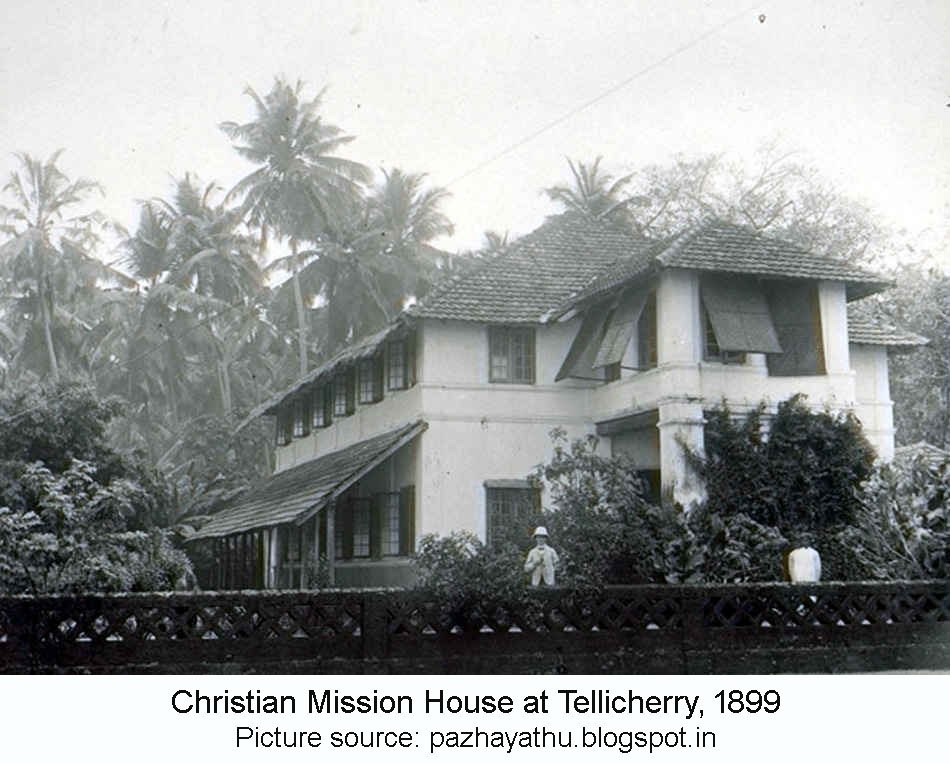 Sub-division of the Taluk for Administrative Purposes.—The taluk is divided into 28 amsams of which 16 are under the charge of the Tahsildar for magisterial purposes and the remaining 12 under the Deputy Tahsildar, Kuttuparamba. The taluk headquarters are at Tellicherry.
Public Establishments.—The various public establishments existing in the taluk are specified below :
1. District Court, North Malabar, Tellicherry.
2. Sub-Collector and Joint Magistrate’s Court, Tellicherry.
3. Civil Surgeon, Tellicherry.
4. Assistant Superintendent of Police, Tellicherry.
5. Sub-Court, North Malabar, Tellicherry.
6. District Munsif’s Court, Tellicherry.
7. Tahsildar and his establishment, Tellicherry.
8. Deputy Tahsildar, Kuttuparamba.
9. Sea Customs Superintendent and Port Conservator, Tellicherry.
10, District Registrar, Tellicherry, and Sub-Registrars of Kuttuparamba and Panur.
11. Police Inspectors, Tellicherry and Kuttuparamba, with station-houses at Kallai, Chavasseri, Iritti, Kannavam, Kuttuparamba, Kasba, Nagaram and Panur.
12. Postal and Telegraph ofiices at Tellicherry.
13. Inspector of Salt and Abkari Revenue, North Malabar.
14. Teachers of the Brennen High School and other educational institutions.
15. Local Fund Supervisor, Tellicherry sub-division.
16. Deputy Inspector of Vaccination, North Malabar.
17. Municipal establishments.
Towns.—Tellicherry (Lat. 11° 44' 53" N., Long. 75° 31' 38" E.), which is the headquarters of the taluk, was constituted a municipal town under Act X of 1865 with effect from 1st November 1866 (vide notification of Government, dated 13th September 1866, and G.O., dated 13th September 1866, No. 925).
The boundaries of the town are —
North— Eranjoli river as far as the old bridge on the Coorg road.
East and South —The Eranjoli old road as far as the Tiruvangad kovil large tank, and the cross road thence to Kodapalli kunnu on the sea-shore.
West—The sea.
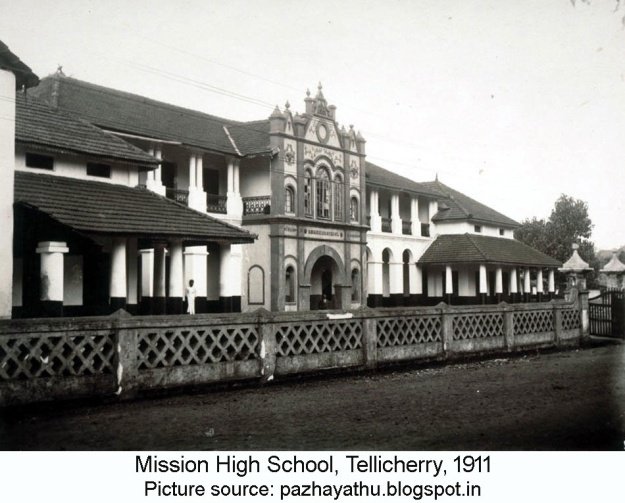 The town extends from the Koduvalli bridge on the north to the small hill in the Mailanjanmam amsam on the south ; from the sea-shore on the west to the river on the east. The distance north to south is 3 miles and east to west 1¾ miles. The area is about 4 square miles and the population, according to the census of 1881, was 26,410, of whom 15,488 were Hindus, 9,149 were Muhammadans, 1,765 were Christians, and 8 belonged to other classes. The males were to the females as 12,939 to 13,471. The number of houses occupied was 3,426. and of those unoccupied 2,118.
The municipal town comprises at present the whole of the Tellicherry amsam and portions of Tiruvangad and Mailanjanmam amsams. In 1880 a portion of the Nittur amsam was added to the municipality, but was excluded in 1884 as it did not derive much benefit from the municipal administration.
In March 1884, proposals for the incorporation of the remaining portions of the Tiruvangad and Mailanjanmam amsams were sanctioned by Government, but the order was subsequently cancelled on the representations of the inhabitants of the locality. The receipts and charges on account of the Tellioherry Municipality for the year 1884-85 are subjoined :
TELLICHERRY MUNICIPALITY
|
1884-85. |
|
|
Receipts |
Rs. |
|
Opening balance |
179 |
|
Rates on houses and lands |
11,419 |
|
Taxes on arts |
4,057 |
|
Taxes on vehicles and animals |
793 |
|
Registration of carts . |
46 |
|
Tolls |
2,183 |
|
Licences |
100 |
|
Licence tax |
|
|
Assignments by Government |
200 |
|
Contribution from local funds |
1,050 |
|
Fees and fines |
190 |
|
Endowment, etc. |
1,200 |
|
Miscellaneous |
6,407 |
|
Advances recovered |
|
|
Total |
27,884 |
Charges
|
Grant I 1884-85. |
|
|
|
Rs. |
|
New works – Communications |
|
|
Buildings |
|
|
Sanitary and miscellaneous |
|
|
Repairs—communications |
2,182 |
|
Buildings |
123 |
|
Sanitary and miscellaneous. |
67 |
|
Establishment |
608 |
|
Tools and plant |
|
|
Grant II 1884-85. |
|
|
|
Rs. |
|
Municipal schools |
6,163 |
|
Results grants |
543 |
|
Schools on the combined system |
448 |
|
Inspection |
150 |
|
Miscellaneous |
|
|
Grant III 1884-85. |
|
|
|
Rs. |
|
Hospitals and dispensaries |
4,437 |
|
Medical college |
|
|
Sanitary inspection |
|
|
Vaccination. |
584 |
|
Registration of births and deaths |
344 |
|
Conservancy |
5,585 |
|
Grant IV 1884-85. |
|
|
|
Rs. |
|
Lighting |
1,488 |
|
Choultries |
123 |
|
Travellers’ bungalow |
|
|
Miscellaneous |
576 |
|
Licence tax |
|
|
Police |
|
|
Grant V 1884-85. |
|
|
|
Rs. |
|
Supervision and management |
3,050 |
|
Advances recoverable |
50 |
|
Refunds |
152 |
|
Balances |
1,211 |
|
Grants 1884-85. |
|
|
|
Rs. |
|
Total |
27,884 |
Tellicherry is a healthy and picturesque town, situated upon a group of wooded hills running down to the sea, and protected by a natural breakwater of rock.
The citadel or fort, still in excellent preservation, stands to the north of the town and was used as a district jail till the latter was abolished on 1st June 1885. The buildings in the fort are now intended for public offices. The fort is built of laterite in the form of a square with flanking bastions on the south-east and north-west corners. The south-east bastion has also a cavalier bastion above it. On the north is another bastion situated on a cliff overhanging the sea, and separated from the main work by a space of about 150 yards. The immediate precincts of the fort were further protected by a strong wall of which portions still remain loop-holed for musketry and with flanking towers at intervals.
The native town lies to the south ; the principal street runs parallel to the coast, and is a mile in length. A white dioptric light, exhibited from a small masonry tower on the fort wall, 70 feet above high water, marks the harbour. The East India Company established a factory at Tellicherry in 1683 to secure the pepper and cardamom trade ; and on several occasions, between 1708 and 1761, the Company obtained from the chiefs of the Kolattiri family and other local chiefs, not only grants of land in and near Tellicherry, but some important privileges, such as the right to collect customs, administer justice, etc., within the lands so granted.
Hyder’s invasion of Malabar narrowed the Company's operations for a time, and in 1766 the factory was reduced to a residency. From 1779 to 1782 the town withstood a seige by Hyder’s General, Sirdar Khan ; on the arrival of relief from Bombay under Major Abington, the enemy was severely handled in a sortie and the siege was raised. In the subsequent wars with Mysore, Tellicherry was the base of operations for the ascent of the ghats from the west coast. After the peace, the town became the seat of the Superintendent of North Malabar and of the Provincial Court of Circuit.
The various public offices existing in the taluk have been already noticed. The following edifices which exist in the town deserve mention. They are –
(1) The civil dispensary built partly with subscriptions raised by Dr. Ross, a former Civil Surgeon of the station, and partly with funds supplied by Government.
(2) A Protestant church (the foundation of which was laid by Lord Napier in 1869), raised with funds left by the late Master Attendant, Edward Brennen, Esq.
(3) A church of the German Mission.
(4) A Roman Catholic church over a century old.
(5) A large Mappilla mosque called Orta (in Portuguese, garden) Pally (ഓടത്തിൽപള്ളി) built by a very opulent Mappilla, Chovakkaran Mussa, the site being the Government garden, hence the name.
(6) Another mosque of some note, that of the Cutch Muhammadans, built by the late Ali Haji Sett, a rich merchant of this town, whose descendants are still trading here.
(7) A Hindu pagoda in Tiruvangad dedicated to Sri Rama, an incarnation of Vishnu, and commonly called "Brass Pagoda’’ owing to its being covered with brass sheeting instead of tiles, and of which the walls and gopurams are in a state of disrepair.
(8) A high school, also built with funds left by Mr. Brennen and known as the Brennen High school.
(9) Another school in charge of German Missionaries built with money provided by a Parsee by name Kasroo—a grandson of Darashoo Cursetjee, an old Parsee merchant of this place. (10) A terrace made by the late Vice-President, Mr. Overbury, with municipal fund and which presents an agreeable appearance commanding an excellent view of the sea, and is now much resorted to by town people, especially in the evening. There are also a travellers’ bungalow and two chattrams, one of which was built by the Municipality and the other by the Government. There is also another chattram, built and endowed, by Moyan Kunhi Raman Nayar, who was once a ward under Government, and intended for Hindu travellers.
Of the private dwelling houses which are of some note, there are only two deserving mention here. One of these at Morakkunnu was built by Mr. James Stevens, and the other at Pallikkunnu by Mr. Thomas Harvey Baber, both first Judges of the late Western Provincial Court.
There are two large tanks within the town, the largest at Tiruvangad, measuring 250 feet by 340, belongs to the Tiruvangad temple, and the other measuring 150 feet by 150, near the High school, was sunk by the late Mr. Baber, and goes by his name. There is no hotel here, but there is a club for Europeans situated close to the fort.
Other institutions of minor importance in the town are noted below :—
1. Liekshmi Narasimham temple (ലക്ഷ്മിനരസിംഹ ക്ഷേത്രം) roofed partly with copper and partly with tiles belonging to the Konkani Brahmins.
2. Old Jamath mosque പഴെ ജമാത്ത പള്ളി.
3. Mattamprath mosque മട്ടാമ്പ്രത്ത പള്ളി.
4. Lower bazaar mosque താഴെ അങ്ങാടി പള്ളി.
5. Trikkayil temple dedicated to Siva തൃക്കയിൽ ക്ഷേത്രം.
6. Ayyalath palli അയ്യലത്ത പളളി.
7. Seydarpalli സെയ്താർ പള്ളി.
Nos. 1 to 4 are in Tellicherry amsam, and Nos. 5 and 6 in Tiruvangad amsam, and No. 7 in Mailamjanmam amsam.
Kutali amsam—about 12 miles north north-west of Tellicherry, contains a bungalow known as Chalot Bungalow and a potty bazaar. It is on the high road from Cannanore to the Pudiachuram pass into Coorg.
Pattanur amsam—has nothing worthy of note, except perhaps a Vishnu temple called Nayikkali നായ്ക്കാലി.
Chavasseri amsam—about 4 miles north north-east of Palassi, has a Mappilla bazaar and a palace to the north of it. It contains the Kallur temple and Palot mosque, and also a small bungalow and chattram.
Veliyambra amsam—contains the village of Iritti, which has a bridge of that name in course of construction. It contains Kuyimbil (കുയിമ്പിൽ) temple and Uliyll (ഉളിയിൽ) mosque.
Mulakunnu amsam—contains a fort called Harischandra Kotta on the Purali mala hill, near this is a rock-cut cell. There are two temples known as Mulakunnu (മുഴക്കുന്ന്) and Tillangiri (തില്ലങ്ങെരി) and a mosque called Palayil (പാലയിൽ).
Gannamm amsam—is a hilly tract containing an area of 41,440 acres, or about 65 square miles. It has a travellers’ bungalow and a mussaferkhana and two religious institutions, one (Muntemparamba temple (മുണ്ടെംപറമ്പു ക്ഷേത്രം) belonging to the Hindus, and the other (Aralathpalli ആറളത്ത പളളി) belonging to the Mappiilas. The Iritti bridge is on the boundary of Gannavam and Veliyambra amsams.
Manattana amsam—about 28 miles from Tellicherry and 8 from Kannoth, was once a military post. There is a redoubt on the summit of a low hill in good order but overrun with trees and shrubs. It is the largest and most hilly tract in the taluk, and has, according to the census of 1881, an area of 106,000 acres, or about 165 square miles, and a population of 4,365 souls. There is a temple of great celebrity called Tricharumanna at Kottiyur (തൃച്ചരുമന്ദ അല്ലെങ്കിൽ കൊട്ടിയൂർ ക്ഷേത്രം) dedicated to Siva, and although situated in a wild woody tract, it has an annual festival in April-May attended by about 50,000 people. The nearest inhabited place to Kottiyur is Manattana, about 8 miles distant from it. The road from Manattana to Wynad passes through this village. At Nitumpoyil, there exists a chattram for the use of travellers. There is also a mosque called Kolayat (കൊളയാടു പള്ളി).
Kannavam amsam—is a largo hilly tract about 14 miles north-east of Tellicherry, and was formerly a military post. Here is a small redoubt on a hill in ruins. There a good bungalow for travellers and a sudstantial stone bridge thrown over a small river by a battalion of pioneers employed in Wynad, in 1822-23.
There is a celebrated pagoda known as Totikalam (തൊടിക്കളം) temple about one mile northwest of Kannoth, where, in the month of Vrischigam, Tiyyars bring tender coconuts as offerings to the deity. There are three rock-out caves in Totikalam, said to be paved with bricks.
There is also a mosque in the amsam known as the Kannoth mosque. At Kannoth there was a rich janmi knowm as Kannoth Nambiyar, who joined the rebellious Palassi (Pyche) Raja of Kottayam, and who disturbed the peace of the taluk for a series of years. He eventually fell into the hands of the authorities and was hanged on the hill near the bungalow,- his estate being declared escheated to Government in 1805. The property known as Kannoth escheat is of large extent and lies in Kannoth and Manattana amsam. It has mostly been dealt with by the escheat department, and, has a portion of it planted up with teak trees. The area of the tract is variously estimated. The Tahsildar of Kottayam once put the area at 375 square miles, but forty square miles is a very moderate estimate not taking into consideration the increased superficial area caused by the mountainous character of the locality. The forests are peopled by Kurichiyars—a class of Jungle tribes who raise various products in them. The forest has been notified for reservation under the Madras Forest Act V of 1882.
Palassi amsam— the seat of the Raja known in Malabar history as the Pychy (Palassi) Raja of Kottayam who carried on warfare against the East India Company for a long time, and who was finally killed in 1805, his whole estate being confiscated to Government. There is a small fort which is now in ruins.
The two temples in this amsam are Perincheri (പെരിഞ്ചേരി) and Mattanur (മട്ടന്നൂർ). Mattanur is painfully interesting as being the scene of the terrible tragedy enacted there in 1852, wherein a whole family of Brahmans, consisting of 18 souls, were most cruelly butchered by Mappilla fanatics.
Kandamkunnu amsam—is the seat of the Kuttuparamba Deputy Tahsildar’s office, and contains also a Sub-Registrar’s office, a Police station, a Mission school, public bungalow and an old fort now in ruins. There is also a large maidan in the possession of Government and a street inhabited by buffalo-herdsmen. It lies on the high road to the Periah pass. The Merumpoya bridge, over the river of that name, is situated in this amsam. There are also the (1) Nirveli (നിർവ്വെലി), (2) Mananteri (മാനന്തെരി) and (3) Ramapuram (രാമപുരം) temples, and (4) Merumpoya (മെരുമ്പായി) mosque and (5) Muriyat (മൂർയ്യാട്ടേ) mosque. Patuvilai amsam—contains two Hindu temples known as Kallay (കല്ലായി) and Patuvilai (പടുവിലായി) and two mosques called Kallai and Vengatti.
Dharmatam amsam.—Dharmatam (literally a place of charity) is a small island close to Tellicherry and contains a redoubt on the top of an elevated place and also an old rock-cut cave. There was here one of the earliest Muhammadan mosques now demolished. The place was ceded to the Honourable East India Company in 1734, was seized by Ravi Rarma, Raja of Chirakkal, in 1788, but was retaken in 1789, There are two Hindu temples called Melur (മേലൂർ ക്ഷേത്രം) and Andalur (അണ്ടലൂർ കാവ്), a Christian church and a Jamath mosque. There is also a Trigonometrical survey station here.
Pinarayi amsam—contains an old palace belonging to the Raja of Kottayam and the Paraprath (പാറപ്രത്ത്) mosque.
Mailanjanmam amsam—contains a mosque called Seydarpalli and two small rock-cut sepulchral caves like those at Taliparamba.
Katirur amsam—about 4 miles north-east of Tellicherry, was formerly the seat of the Tahsildar and subsequently of the District Munsif. It had a palace built by the Pychy (Palassi) Raja. There are (1 ) Katirur temple (കതിരൂർ ക്ഷേത്രം) with a nice tank attached to it, (2) Chirumpa kavu temple (ചിരുമ്പകാവ്), (3) Talath (താഴത്ത) mosque, (4) Telayilat (തെലയിലാട്ടു) mosque, and (5) two rock-cut caves.
Kottayam—also called Kottayakam and Kottangadi, is a large village about 7 miles north-east of Tellieherry, and contains the palaces of the Kottayam Rajas and the houses of several wealthy Mappillas. It is celebrated for a fine temple known as Trikayikunnu (തൃക്കയിക്കുന്നു) and a big tank close to it. The rebel Pychy (Palassi) Raja belonged to one of the branches of the Kottayam family. There are three mosques called (1 ) Kottayath Jamath mosque (കൊട്ടയത്ത് ജമാത്തപള്ളി), (2) Mutiyanga Jamath mosque (മുതിയങ്ങ ജമാത്ത പള്ളി) (3) Cheruvancheri mosque (ചെരുവാംഞ്ചേരി പളളി).
Panur amsam.—Panur, about 7 miles from Tellicherry, was formerly the seat of a District Munsif and has now a Police station and a Sub Registrar’s office. It is a populous Mappilla village and contains a bazaar. There are the ruins of an old fort and a rook-cut sepulchral grave, the latter in Kannampalli desam. The chief religious institutions are Kutteri temple (കുറ്റെരി അമ്പലം) and Panur mosque (പാനൂർപള്ളി).
Puttur amsam—is a jungly tract and contains Pullanhot പുല്ലാഞോട്ടു) temple and Kallil (കല്ലിലെപള്ളി) mosque ; also two rock-cut caves in Kolavallur desam.
Triprangottur amsam—is a jungly tract and contains the Vishnu temple known as Kotantram velli temple (കൊടന്ത്രംവെള്ളി ക്ഷേത്രം) and the Katavattur mosque (കടവത്തൂർ പള്ളി). Both have thatched roofs.
Panniyanur amsam—contains the temples known as Kottarattil Ampalam (കൊട്ടാരത്തിൽ അമ്പലം) and Kilaketath Ampalam (കിഴക്കെടത്തമ്പലം).
Peringalam amsam—about 8 miles from Tellicherry, contains a rock-cut cave on the top of a hill. There are also a rock-out cave with two pillars and four caves in the amsam. The Menapratt (മെനപ്രത്ത്) and Anniyarath (അണിയാരത്ത്) temples and Peringalathur (പരിങ്ങളത്തൂർ പള്ളി) mosque are the only religious institutions of note. At Kanakamala there is a small spring which is considered sacred, and in which people bathe on certain days in the year.
Olavilam amsam—contains Olavilath Tadathil (ഒളവിലത്ത് തടത്തിൽ) temple and Tottathil (തോട്ടത്തിൽ) mosque.
Kallayi amsam—contains two caves cut out of laterite, also Parimatam temple (പരിമഠം) and Kallai mosque.
Karyad amsam—contains Pallikunil temple (പള്ളികുനിൽ അമ്പലം) dedicated to Vettakorumakan.
Mountains, Hills and Forests.—The line of ghats to the eastward, the crest of which forms the boundary dividing Kottayam from Coorg and Wynad, are lofty, some of the peaks being about 4,000 feet above the level of the sea. The valleys formed by the slopes are extensive and covered with dense forests. The Kanaka mala is a lofty ridge stretching west from the ghats, the slopes from it approaching within 10 miles of the coast due east of Tellicherry. Purali (പുരളി) mala, situated centrically, is a long ridge about 6 miles in length east and west unconnected with the ghats. It is covered with wood and bamboos to the summit. In the north-east portion several table-lands covered with wood, apparently flat, rise abruptly from the cultivated valleys.
The country, 8 miles in a parallel with the coast, is composed of open ridges between the cultivated valleys. A few of the eminences are wooded. There is very little fiat land in the district beyond a belt along the coast about Tellicherry and the cultivated valleys. The whole of the eastern portion is one dense wood with a few cultivated spots to the foot of the ghats.
In the small island of Dharmapatam the only flat ground is that under wet cultivation and marsh ; the rest is undulating ground falling in cliffs towards the sea. Opposite to it is a rocky island called Grove Island with some wood surrounded by rocks.
About half a mile to the west of Tellicherry is a ridge of rocks which affords some shelter for craft. The description of the Kannoth forest belonging to Government will be found in the Notice of the Wynad Forests.
Soil and Productions.—The soil in some parts towards the coast is brown and sandy ; on the rising grounds in the interior it is rich and gravelly ; the cultivated valleys a brown loam , towards the mountains and in the forests it is rich and black.
The productions are rice of different kinds, coconut, betel, areca-nut, cardamom, pepper in great quantities and dry grains of sorts. Kottayam is celebrated for its pepper crops.
Minerals.—Iron is to be found in some parts, but it is not worked.
Manufactures.—Cloths of an inferior sort are made in several amsams. In Nittur, a suburb of Tellicherry, weaving is carried on by the Basel Mission weaving establishment. Arrack, jaggery, oil from copra and other nuts are manufactured. Copper vessels are manufactured at Tellicherry and at Mattanur in Palassi amsam.
Fairs and Markets.—Fairs are held at almost all the temples where people resort for public festivals or worship. Kottiyur is one of the most important of the pagodas in this respect. A festival is held there in April-May every year which attracts thither great trade.
Bungalows and other Public Buildings.—There are three travellers’ bungalows in the taluk at—
1. Kannoth in Kannavan amsam,
2. Gannoth in Gannavam amsam, and
3. Kuthuparamba.
Mussaferkhanas are provided at—
1. Nedumpoyil in Manattana amsam.
2. Chalot in Kudali amsam.
3. Chavasseri.
4. Iritti in Veliyampra amsam.
5. Gannoth in Gannavam amsam.
Trigonometrical Station.—At Dharmapattanam.
|
|
° |
‘ |
“ |
|
Lat. |
11 |
45 |
59.76 |
|
Long. |
75 |
30 |
09.82 |
KURUMBRANAD TALUK
By C. Kunhi Kannan
Position, Boundaries, Soil and Area.—The Kurumbranad taluk is bounded on the North by the Kottayam taluk, on the east by the Wynad taluk, on the south by the Calicut taluk, and on the west by the Arabian Sea. The soil of the interior is generally red and much impregnated with laterite, which gradually assumes a rich loam in parts cultivated with paddy, whilst towards the coast it is brown loose earth.
The Kurumbranad taluk comprises the old taluks of Kadattanad and Kurumbranad.
The area of the taluk, according to the census returns of 1881, is 538 square miles. This is only an approximate calculation as accurate figures are not available, the district not having been surveyed. Of this extent about 175,613 acres or about 274 square miles, are under cultivation. The demand of land revenue for fasli 1295 (1885-86) was Rs. 2,13,565, giving an average of Rs. 1¼ nearly per acre of cultivated area.
Population.—The population of the taluk, inclusive of floating population as ascertained by the census of 1881, was, 261,024, being 129,394 males and 131,630 females. The population returned by the census of 1871 was 244,166. The population of 1881 may be classified as follows :-
|
Hindus |
196,383 |
|
Muhammadans |
64,245 |
|
Christians |
394 |
|
Others |
2 |
|
Total |
261,024 |
which give an average of 485 persons per square mile.
Education is backward in the taluk as will appear from the fact that under the head of “instruction" the census returned 7,944, ‘‘instructed’’ 20,206, and “illiterate including not stated" 232,874 persons.
There were 56,471 houses (48,440 occupied and 8,031 unoccupied) in 1881 against 45,597 houses in 1871. The average number of persons per occupied house in 1881 was 5.4.
Division of Taluk for Administrative Purposes.— The taluk comprises 57 amsams each with an adhikari on Rs. 5¼, a menon on Rs. 6 and two peons on Rs. 3 each per mensem.
Prior to 1866 there were 63 amsams in the taluk, but in that year 6 amsams were transferred to the Calicut taluk. The names of these amsams will be found in the Note on the Calicut taluk.
The old Kadattanad taluk comprised 21 hobalis and the old Kurumbranad 10 hobalis. As already observed, these two taluks were amalgamated into the present Kurumbranad taluk.
Government Establishments of different kinds maintained in the taluks and where located.—The taluk kacheri of Kurumbranad, including the Sub-jail and Police station, is at Badagara, where there is also a District Munsif’s Court and a Sub-Registrar’s office. The District Board maintain a middle school, a dispensary on a small scale, a travellers' bungalow and mussafer khana at Badagara.
There are two other District Munsifs’ Courts in the taluk, one at Nadapuram in Kummangod amsam, 9 miles north-east of Badagara, and the other at Payanad in Quilandi, 14 miles south of Badagara. There is a Deputy Tahsildar’s kacheri at Quilandi. There are Sub-Registrars at Nadapuram, Payoli, Quilandi, Naduvannur and Kuttiyadi. There are combined Post and Telegraph offices and Sea Customs offices at Badagara and Quilandi. There are Police stations at Chombal in Aliyur amsam, Nadapuram in Kummangod amsam, Badagara, Payoli in Iringatt amsam, Quilandi in Viyur amsam, Tiruvallur, Kuttiyadi, Perambra, Naduvannur and lyad.
Short Descriptive Notices of Towns, etc.—There are no Municipal towns in Kurumbranad. Kadattanad is one of the ancient chieftainships (nads) into which Malabar was formerly divided. It stretches from the sea coast up the western declivity of the Western Ghats. The level tracts near the sea are very fertile. The eastern hilly parts are well wooded and contain indigenous cardamom plants. The petty State is said to have been founded in 1664 by a Nayar chief who inherited it in the male line from the Tekkelankur (southern regent) of the Kolattiri kingdom.
Badagara (Vadakkekara = the north bank) is the chief town in the taluk. According to the census of 1871, there were 1,037 houses with a population of 7,718 souls in Badagara amsam. At the census of 1881, there were 1,643 houses and a population of 8,336 persons. Of these 3,849 are Mappillas. Badagara is situated on the sea coast at the northern extremity of the Elattur-Badagara backwater and on the trunk road from Calicut to Cannanore, 30 miles from the former and 12 miles south of Telhcherry.
There is a fort at Badagara which originally belonged to the Kolattiri Rajas, and it is said to have been acquired by the Kadattanad Raja in 1564. On passing into the possession of the Mysoreans it was made the chief export customs station on the coast. In 1790 it was taken from Tippu by the English, and having been restored to the Kadattanad Raja, it was converted by him into a Brahman feeding-house, which was afterwards transferred to the Paravantala temple in Badagara amsam. The raja has since built a thatched house in the fort. The fort is 246 feet square with bastions at each corner, and immediately west of it is a tank 168 feet long and 144 feet broad.
Badagara is a straggling but busy Mappilla town with several irregular streets or lanes. On the beach there are several substantial storehouses. There is a Jamatt mosque here as well as minor mosques. The Jamatt mosque is 114 by 42 feet.
In Paravantala desam in Badagara amsam is a well 66 feet in circumference and 42 feet deep. This well is said to have been jumped across by Tachcholi Odenan, the hero of a folk song noted in North Malabar.
In Badagara amsam, Paravantala desam, there is a temple dedicated to Subramanyan. It is 76 feet long and 66 feet broad. Attached to the temple is a tank 73 feet square. The temple, said to be an ancient institution, was renewed by the Kadattanad Raja about the year 1864, The roof of the shrine is covered with copper plates. The raja maintains a Brahman feeding-house here.
In Kuttipuram amsam, 10 miles to the north-east of Badagara, is the fortified palace of the Kadattanad Porlatiri Valiya Raja, and in Purameri amsam, 8 miles from Badagara, is the Porlatiri Ilaya Raja's house. The remaining two branches of the raja’s family live in Ayancheri Kovilakam and Edavalatt Kovilakam in the same amsam.
Kottakkal, 3 miles south of Badagara, is a sea customs sub-port subordinate to Badagara. It was once a large town inhabited by Mappillas. There is a mosque of some note on the southern bank of the river at Kottakkal. Kottakkal was formerly the stronghold of a Mappilla pirate called Kunhali Marakkar, who committed depredations in the surrounding country which are described in a folk song. Hardly any vestige of the stronghold now remains.
The Sacrifice Rock is opposite the Kottakkal sub-port in Lat. 11° 29' 45" N., Long. 75° 31½ E., bears S. ½ E. from Tellicherry 5¼ leagues, and is distant 4¾ miles from the land opposite ; it has a white aspect, 40 feet in height, and is discernible 3 and 3½ leagues from a large ship, the deck being elevated 15 or 20 feet above water. It is called Velliyankallu or the white or silvery stone by the natives of Malabar. This rock or island is steep all round, having 12 and 13 fathoms close to it, 16 fathoms 2¾ miles outside, 10 fathoms within it, to 7 fathoms about midway between it and the mainland in a very good channel. Ships passing through the inside channel ought to give the point a berth of 3 miles by borrowing towards the rock ; and in working should heave the lead quick, if they come under 6 fathoms standing in shore. Passing outside Sacrifice Rock in the night, ships should not come under 16 or 17 fathoms water.
Nadapuram is a rising Mappilla town in Kummangod amsam 9 miles from Badagara. The amsam has a population of 5,328 souls. The recent establishment of a Munsif's Court has increased the importance of this place. There is a Jamatt mosque here, which is 104 by 33 feet in size.
At Kuttiyadi, which was once a strong military post, 17 miles from Badagara, there is an old redoubt as well as a small Mappilla village. The Kuttiyadi Ghat begins here. There is a Sub-Registrar's office and a Police station here. There is also a Jamatt mosque, 53 by 27 feet.
The Kuttiyadi Pass, in the Western Ghats, leads from Kurumbranad taluk into Wynad. It is steep and only practicable for foot-passengers and beasts of burden. The Kuttiyadi river is navigable from Badagara up to 30 miles. Large quantities of timber are floated down the river to Elattur in Calicut, and to Badagara.
In Ponmeri amsam, 5 miles from Badagara, is a Siva temple which is 124½ feet by 87 feet. It is sculptured. The roof of the shrine is covered with copper. There is a granite slab at the eastern entrance with an inscription in unknown characters. The temple is very old and was destroyed by Tippu's soldiers.
In Edacheri amsam, 5 miles from Badagara, is Vengoli temple in which Ganapati is worshipped. It is 70 by 53½ feet. The Kadattanad Raja mamtains a Brahman feeding-house here. Not far from the temple to the north there is a Bhagavati temple called Kaliyampalli temple. It is 97 feet long and 86 feet broad. There is an inscription on a slab in unknown characters.
In Muttungal amsam, Vellikulangara desam, 4 miles north of Badagara, there is a Siva temple, 54 by 41 feet. Outside the temple, there is a slab with inscription in an unknown language. At Karshkad in this amsam, there is a Muhammadan mausoleum over the grave of one Siti Koya, who is alleged to have migrated to Malabar from Arabia about 200 years ago. The mausoleum is held in great veneration by Mappillas, who flock to it in large numbers from different parts and make offerings.
In Velam amsam, 12 miles south-east of Badagara, there is a reservoir of fresh water locally known as Tura, which is 1,080 feet long by 218 feet wide. There is a similar Tura in Kuttiyadi amsam, which is 684 feet by 72 feet with a depth averaging 22 feet. These are fabled to have been excavated by the Pandus in pre-historic period.
Chombala in Aliyur amsam is a Basel Evangelical station. The mission was started there in 1849, and the number of church members in the colony on the 1st January 1885 were 309. There is a girls’ orphanage here, which was transferred from Cannanore in 1872. A branch weaving establishment has existed here since 1883. There are three schools for boys and girls with an average attendance of about 200 pupils. The Chombala Mission has an out-station at Badagara and Muvaratt. The station at Quilandi, opened in 1857, is subordinate to the mission at Calicut. The congregation at Quilandi numbers 68.
In Melati amsam, 10 miles from Quilandi, there is a Siva temple known as Kilur, which has its shrine roofed with copper. The temple is 93 by 70 feet. In the month of Vrischikam (November-December), a festival is celebrated here with great pomp. During the festival an important cattle market is held close to the temple over a large area. Divers other articles also find ready sale here on the occasion. More than 60,000 head of cattle are brought here from different parts of the district and Coimbatore, etc., and more than 10,000 people assemble during the festival.
Quilandi, the headquarters of the Deputy Tahsildar, is in Viyyur amsam. There are besides a District Munsif’s Court, Sub-Registrar’s office, Sea Customs office, a combined Post and Telegraph office, Police station, Subsidiary jail, travellers’ bungalow and mussaferkhana at Quilandi. The population of the amsam in 1871 was 10,367 and in 1881, 10,259. In 1881 there were 2,095 houses against 1,757 in 1871. Of the former, 1,752 were occupied and the rest unoccupied.
Quilandi was a large flourishing port and town, of which many substantial buildings remain. It had also the advantage of being in the neighbourhood of the Kollam mud bank resembling those at Alleppey and Narakkal. Towards the close of the last century, the port was suddenly destroyed by a cyclone.
It was close to Quilandi (Capocate) that Vasco da Gama’s fleet first cast anchor in 1498. Close to the seaport on the north is one of the nine original Muhammadan mosques established on the Malabar Coast by Malik Ibn Dinar. The mosque (recently renewed) is at Kollam, sometimes called northern or Pantalayini Kollam. This mosque appears to have been built in imitation of one at Mecca. The dome is covered with sheets of copper which Arab vessels passing down the coast never failed in former days to salute, and all Muhammadan seamen offered prayers on coming abreast of it. Three festivals are annually celebrated in the mosque. In Kollam, there is a Jamatt mosque in which there are three granite slabs containing inscriptions.
In the town of Quilandi there is an old mosque 130 by 70 feet. It is very high, having three storeys. The Government have granted lands yielding annually Rs. 1,800 for the support of this mosque. A brief account of the circumstances of this endowment will not be uninteresting.
The mosque appears to have been founded in 1779 by Saiyid Abdulla Bin Saiyid Ahamad Hadi. In 1780 voluntary engagements were entered into by the Muhammadan and Hindu merchants of different villages in Tinnevelly, by which they bound themselves to pay for the mosque a trilling fee upon each man’s load or bullock load of merchandise which passed through their respective villages. A payment analogous to this was also in due course secured in Malabar in behalf of this mosque. The above collection was continued until 1803 when Regulation XII of that year put a stop to the practice.
In 1810, Saiyid Ali Hadi, the founder’s son, brought to the notice of Government the difficulties experienced in regard to the up-keep of the mosque by the enforcement of Regulation XII. An enquiry was instituted into the matter in 1826 which eventully resulted in the grant of an allowance of Rs. 1,800 per annum, payable by monthly instalments, for the support of the mosque and establishment, and an additional payment down of Rs. 2,000 for repairing the mosque (G.O., dated 29th February 1828).
The mosque was described by the Sub-Collector, Mr. Wheatley, to be a magnificent structure affording accommodation to travellers and to a largely attended school where instruction was imparted to Muhammadan youths. It was also stated that pilgrims to Mecca and visitors from Arabia were entertained here. The Government consequently directed the allowance to be continued as long as the institution was kept up on a proper footing and found to be beneficial to that portion of the public which had been accustomed to resort to it for lodging, entertainment or religious purposes.
In their despatch of 15th June 1831, the Court of Directors approved the grant and the proviso laid down for its continuance, and observed that what was intended was a degree of utility not altogether disproportionate to the allowance made. The Inam deed pertaining to this confirmed the grant to the present Inamdar for the purpose of the Inam as long as he continues to be loyal.
In 1841 Government withdrew from all connection with religious institutions, and in 1846 the Government accepted the Collector’s proposal to make over to the Quilandi mosque as Sarvamanyam certain escheated farms in Ernad producing a net revenue of Rs. 1,800 per annum. In 1848, 199 pieces of paddy fields and nursery plots and 16 gardens measuring in all 306 cawnies, 828 koles, and assessed at Rupees 1,176-10-1 with proprietor’s share of Rs. 623-5—11 aggregating Rs. 1,800 were made over to the Inamdar. These lands lie in the amsams of Manjeri, Karakunnu, and Trikalangod in Ernad taluk. The Inamdar now squeezes from his tenants more than Rs. 3,200 per annum.
A festival is annually performed in the month of Ramullan on Mayath Kunnu (grave-yard hill) in Kollam. There are several ancient tombs on the hill, some of them with inscriptions.
In Kollam desam is the Vishari Kavu temple, dedicated to Bhagavati and Siva. The roof of the Bhagavati shrine is covered with copper. The temple is 93 by 84 feet. The Dasra festival is celebrated here with pomp in Kanni (September-October), and in the month of Minam (March-April), a festival takes place for 8 days which attracts many pilgrims and calls into being in its neighbourhood at Kannadikkal a fair for diverse articles aggregating in value about Rs, 10,000.
The temple possesses inam lands in the amsams of Viyur, Mudadi Tiruvangur, Arikkulam, Kilariyur and Melur, the revenue of which amounts to Rs. 343.
There is a tank 920 feet by 502 feet at Kollam.
There are inscriptions in illegible characters in the minor temples of Maralur, Pantalayini and Taliyil in Viyur.
In Edakkara amsam, 10 miles from Quilandi, there is a hill called Vallikkat-Mittal Kunnu crowned by a small shrine. There is a perennial flow of water from the top of the hill which is considered to be tirtham or holy water and to which a large number of pilgrims flock in the month of Tulam (October-November). In Velur desam, Manikottaparamba, there is a hat-stone 36 feet in circumference on an upright stone about 3 feet high and 4 feet thick. There was a similar circular stone in the same compound which has fallen from its prop.
In the neighbourhood of these hat-stones there is a stone-cut cave with a central column and raised platforms on sides similar to those found elsewhere in the district.
Naduvannur is an important village and was the headquarters of the old Kurumbranad taluk. It has a population of 3,386 souls, of whom 2,616 are Hindus and 770 Muhammadans. There is a Sub-Registrar’s office here as well as a Police station. There is also a travellers’ bungalow. A market is held every Saturday.
In Karayad amsam, Tiruvangur desam, 6 miles from Quilandi, there is a Siva temple called Tiruvangur perched on a rock-hill called Kappa mala. There are sculptures in the temple. It is 109 feet by 63 feet. The Sivaratri festival is celebrated here annually in the month of Kumbham (February-March). On the north and south of the temple as well as within the precincts of the temple, there are as many as nine quasi tanks varying from 6 to 60 feet in circumference, excavated on the top of the rocky hill which are never dried up. They are esteemed for ablutions. On a granite rock at the temple there is an inscription in unknown characters.
In Meppayur amsam, Eravattur desam, there are two ponds known as Narikkilapula and Tiyarapula. The former is 600 feet long and 90 feet broad and the latter is almost as broad. They are used for washing. A local legend imputes their excavation to the Pandavas.
In Pompiri desam of the same amsam is a garden called Kudakottiparamba, in which there is a hat-stone 30 feet in circumference supported by an upright column about 3 feet high and about 5 feet thick. The circular stone is a little damaged on one side. This is 9 miles north-east of Quilandi.
Payoli in Iringatt amsam is a rising town. The population of the amsam is 3,408, being 2,508 Hindus, 892 Muhammadans and 8 Christians. There is a Sub-Registrar’s office at Payoli and a Police station as well as a travellers’ bungalow on an eminence overlooking the river. A weekly market on every Monday is held here. There is a lock at Payoli on the canal which connects the Akalapula backwater with the Kuttiyadi river, and thus provides an uninterrupted line of inland navigation from Elattur in Calicut to Badagara. Fees are levied on boats passing the lock. Payoli is 10 miles from Badagara and 11 from Quilandi.
The rivers of the taluk are—
1 . The Kottakkal or Kuttiyadi river
2. The Mahe or Mondole river.
3. The Naduvannur river.
A list of ferries in the taluk is subjoined:-
Second Class
1. Murat kadavu.
|
Third Class |
||
|
2. Kanayankod kadavu. |
3. Puramannadi kadavu. |
4- Nirattukuli kadavu, |
|
5. Chittani kadavu, |
6. Kuniyott kadavu. |
7. Muttunkal kadavu. |
|
8. Kayippratt kadavu. |
9. Puliyapula kadavu. |
10. Perincheri kadavu |
|
11. Maniyan kadavu. |
12. Pulakandi kadavu. |
13. Idinja kadavu. |
|
14. Kotta kadavu. |
15. Chenthodi kadavu. |
16 Thorasheri kadavu. |
|
17. Akalapula kadavu. |
18. Nelliyadi kadavu. |
19. Naderi kadavu. |
|
20 Annala kadavu |
21. Ollur kadavu. |
22. Thoraya kadavu. |
|
23. Chattanatt kadavu. |
24 Kuniyil kadavu. |
|
Fairs and Markets — A weekly market is held at Badagara every Tuesday, at Nadapuram every Thursday, at Payoli every Monday, at Kokkallur, close to Iyad Police station, every Wednesday, at Naduvannur every Saturday.
Trigonometrical Survey Station — There is a Trigonometrical survey station on Nadapuram hill in Kunnummal amsam, 16 miles from Badagara, as well as one on Puramala hill in Mutadi amsam, 5 miles from Quilandi.
Dams and Anicuts.—There is a dam at Palayad for the exclusion of salt water from the paddy cultivation lying above the dam. There is also a dam at Kattampalli in Panangad amsam.
Ayyanikkad dam is an old one between Ulliyeri and Arikkulam amsams. These dams are intended for the protection of cultivation and revenue.
Archaeology.-— Reference has already been made to the rock-out cave and hat-stones in Edakkara amsam, and a hat-stone in Meppayur amsam.
In Muttadi amsam, Muchukunnu desam, in the valley of Valiyamala hill, there are two caves. One is large, being 66 feet long and 36 feet wide. At the western end of the cave is a circular pit 9½ koles in circumference and 1½ koles deep.
In Mullipad desam, Cheruvannur amsam, 9 miles south-east of Badagara, there is a small rock-cut cave not yet excavated.
On the eastern side of the temple in Kaliyamvelli, in Edacheri amsam, 6 miles north north-east of Badagara, there are some inscriptions.
On the eastern side of the temple in Vellikulangara in Muttungal amsam, 4 miles north of Badagara, there are some inscriptions. There is an old fort in Eramala amsam.
An old Siva temple in Iringannnr, 8 miles north-east of Badagara, is fabled to have been founded by a rishi.
There is a small rock-cut cave in Kolukkallur desam of Karayad amsam, 18 miles south-east of Badagara. There is an inscription on a granite rock at the temple of Tiruvangara.
Kavuntara, 12½ miles south-east of Badagara, 3 miles west of the bungalow at Naduvannur, there is a deserted ruined temple. Close to the temple in the yard of a house is a stone with an inscription said to be illegible, and there is another on one of the steps of the tank belonging to the temple.
Kilariyur is 15 miles south south-east of Badagara. There are two rock-cut caves here.
In the mosque at Kollam on the edge of the bath is a granite slab, broken, bearing an inscription in Vatteluttu characters. It is dated K.A. 684 (1508 A.D ).
Meppayur, 10 miles east south-east of Badagara. In the grove attached to the Elavattara temple of Durga are some "sculptured images.’’ A channel on the south side of the Malamangalam temple is fabled to have been excavated by the Pandavas and is said to contain treasure. In Kayalat are to be seen a dolmen and two menhirs, and in Kilapaliyur are a dolmen and five menhirs. In Pampiri desam are two stone circles already referred to. Funeral urns of pottery have been found here.
Panangod, 18½ miles east south-east of Badagara. A ruined and deserted temple, on the eastern wall of the porch of which is an inscription in unknown characters. There is an old ruined fort here.
Ponmeri, 5 miles north-east of Badagara. In the Siva temple is an ancient inscription on a broken slab in unknown characters. The temple is very old. It was destroyed by Tippu’s soldiers.
Viyyur, 10 miles south of Badagara. In the Maralur temple there is an inscription. There is another in the Pantalayini temple and one in the deserted temple of Talayil.
MAHE AND THE ADJOINING ALDEES
The French settlement of Mahe is situated in Lat, 11° 41' 50" N., and Long. 75° 34' 25" E. to the south of the mouth of the river Mahe with a roomy harbour whose rocky bar admits vessels up to 70 tons. Vessels may anchor off Mahe in 5 fathoms, with the flag-staff east-north-east and 2 miles from shore.
Mahe consists of two portions, the one lying on the left bank of the river at its junction with the sea, the other lies inland on the opposite side of the river, and is a narrow strip of land touching at one point the small river which debouches at Tellicherry.
The population in 1871 was 8,492. The present population is 8,383, of whom 191 are Christians, 6,340 Hindus, and 1,852 Mappillas, The superficial area of Mahe proper restored to the French on the 23rd February 1817 was 1,445 acres, being 1,329 acres of lands under cultivation and 116 acres of public lands. It is about 4 miles to the south of Tellicherry. The restitution of the outlying aldees (villages) of (1) Chalakkara, ( (2) Pallur, (3) Chembra and (4) Pandakkal, or what is collectively called Nalutara, on 14th November 1853, enlarged the possession to 5 square miles in extent.
The desama constituting the settlement are –
|
1) Valiyangadi. |
(8) Mattammal. |
|
(2) Parakkal |
(9) Odattinakam. |
|
(3) Mundokkil. |
(10) Valappinakam. |
|
(4) Manchakkal. |
(11) Chalakkara. |
|
(5) Chudikkotta. |
(12) Pallur. |
|
(6) Valavil. |
(13) Chembra. |
|
(7) Puliyil. |
(14) Pandakkal. |
Mahe was at first a place of considerable importance and trade, but after wards, having fallen so frequently into the hands of the English, the settlement and its trade suffered ; and in 1782 its fortifications were not only razed to the ground, but the town was almost entirely burnt.
Most of the chief buildings in Mahe are picturesquely situated on the bank close to the river mouth. The site is hilly, but densely covered with coconut trees. Mahe
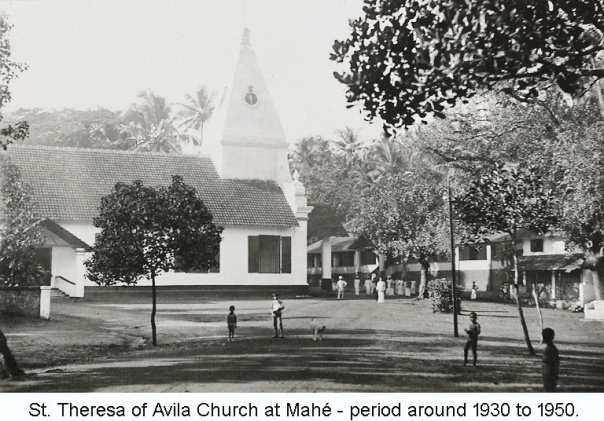 is celebrated for the fertility of its soil and the salubrity of its climate. It is in charge of a Chief de Service subordinate to Pondicherry.
There is a Roman Catholic chapel to which a large number of devotees are annually attracted from different and distant parts on the occasion of a festival on the 15th of October every year.
There are three boys’ schools and one girls’ school. There is also a British Post office and a long wooden bridge maintained by the Malabar District Board across the Mahe river. The coast road from Beypore to Tellicherry and Cannanore passes through Mahe.
There is a temple called Kilakke Puttalatt Bhagavati temple of note in Mahe. Here a festival takes place every year in Kumbham (February- March), when more than 5,000 people assemble from different places on North Malabar.
Close to Mahe, at Kallayi in British territory, there is a British Sea Customs Superintendent. Round Mahe there are four land customs chowkies with a preventive police establishment for guarding the frontier against the smuggling of dutiable goods, such as liquor, arms, ammunition, and military stores, opium and salt.
Of the four outlying aldees or villages restored to the French, Chalakkara, Pallur and Chembra formed the demesne of the Nambiyar's of Iruvalinad and Pandakkal of Kurungott Nayar, and the four villages together constituted the amsam of Nalutara in Kottayam taluk.
In obedience to Extract from Minutes of Consultation, the Board of Revenue, in their Proceedings, dated 28th September 1846, directed the delivery to the French Government of the villages of Chalakkara, Pallur, Chembra, Pandakkal, as also the three detached points called Fort St. George and the great and small Kallayi. These were accordingly handed over by Mr. J.D. Robinson, Head Assistant Collector, to Monsieur Hayes, Chief of Mahe, on the 14th November 1853. The boundaries of the four villages were —
East.—Part of Panniyanur, Peringalam, Olavilam and Kallayi amsams.
West.—Tiruvangad and Kallayi amsams.
North.—-Poniyam river and part of Panniyanur amsam.
South.—Part of Olavilam and Kallayi amsams.
Of the three detached points which communicate with each other—
North.—The strip of Kallayi lying between them and Vera Kunnu.
South and south-west.— A strip of Kallayi amsam intervening between them and Mahe river, and a portion of Tellicherry.
East.—A mosque and precipice.
West.—A portion of Tellicherry road and a strip of Kallayi amsam intervening between them and Kanien Kunnu.
WYNAD TALUK
By V. Chappu Menon, B.A.
Boundaries Area and Population.—The Wynad taluk which forms part of the table-land of Mysore originally consisted of three divisions known as North Wynad, South Wynad and South-East Wynad, comprising seven, six and three amsams respectively. The North and South Wynad divisions still appertain to the Malabar district, but the south-east portion, consisting of the amsams of Nambalakod, Munnanad and Cherankod, was transferred to the Nilgiri district with effect from 31st March 1877 (Fort St. George Gazette, dated 13th March 1877).
This article is confined to the notice of the Malabar-Wynad, Mr. A. E. C. Stuart who has been engaged for some time in the settlement of forests and of escheat claims in Wynad having, with the sanction of Government, undertaken the preparation of a special manual for the entire tracts known at present as the Nilgiri-Wynad and the Malabar-Wynad.
The Malabar-Wynad is bounded on the north by Kottayam and Coorg, on the east by Mysore, on the south by the Nilgiri district and Ernad, and on the west by Calicut and Kurumbranad.
Area.—999 square miles, of which 80 square miles may be said to be under cultivation.
Population.—According to the census of 1881, the population numbered 88,091 souls, of whom 76,898 were Hindus, 9,056 were Muhammadans, 1,983 were Christians and 154 belonged to other classes. The males were to the females as 49,661 to 38,430. The number of houses occupied was 8,666 and of those unoccupied 3,982.
Physical Aspects.—Wynad is an elevated and exceedingly picturesque mountainous plateau. It is generally rugged and broken and has some of the largest mountain peaks in the district. The central portions consist of ranges of low hills of easy slopes, covered with grass and low bamboo jungle, while the eastern parts are fairly open and flat and merge insensibly into the table-land of Mysore. The Nilgiri-Kunda range abuts on the south-east corner of the taluk, while the Bramagiri hills on the north separate it from Coorg. The average height of the plateau above sea-level is 3,000 feet, though many of the mountain peaks are over 5,000 feet, e.g., Vavul mala (Camel’s Hump), the highest peak in the taluk, is 7,677 feet ; Vellera mala, 7,364 feet ; Banasur, 6,762 feet ; and Bramagiri peak, 5,276 feet.
Mountains and Forests.—The table-land of Wynad is composed of low ridges with innumerable valleys running in all directions ; the only space which is of a more level surface is about Porakudi, Panamaram and Ganapativattam, in the south-east. The eastern portion is under heavy forest and few hills appear. The whole of it is undulating. The ghats from the Periah pass towards the Tamarasseri pass and 11 miles to the east are lofty consisting of immense peaks, from 5,000 to 6,000 feet and occupy a large surface.
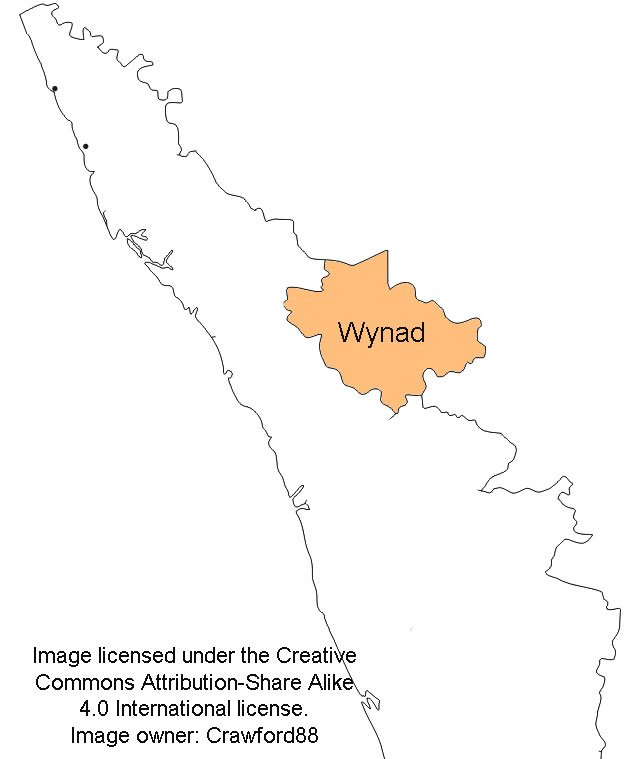 To the north of Manantoddy (5 miles) is a lofty ridge branching off from the ghats and north of it (4 miles) is the famous mountain of Bramagiri. This ridge forms the limit common to Coorg and Wynad and between these two ridges lies the valley of Tirunelli. In the interior are several detached hills of considerable elevation. The following are the principal mountains —
(1) The Balasur or Banasuran mala (ബാണാസരൻ), called after the giant Banasuran who is supposed to have built a fort on its summit.
(2) Bramagiri, supposed to be the abode of the god Brahma, and which would make a splendid sanatorium.
(3) Chambra mala (ചമ്പ്രമല)
(4) Tala mala (തലമല).
(5) Tariyott or Terriote mala (നരിയോട്ട്മല).
(6) Vavul mala (Camel’s Hump).
(7) Elampileri mala (എളമ്പിലേരിമല).
The forests in Wynad are very valuable. A note on them prepared by the District Forest Officer, Mr Rhodes Morgan, will be found at the end of this paper.
Rivers .—The important rivers in the taluk are —
(1) The Kabbani which has its principal sources in the Western Ghats. They take their rise in the valley of the high mountains northwest and north-east above the Tamarasseri pass. Several streams, such as the Kalpetta, the Manantoddy and the Bavalli join this river, which when united drains nearly the whole of North and South Wynad.
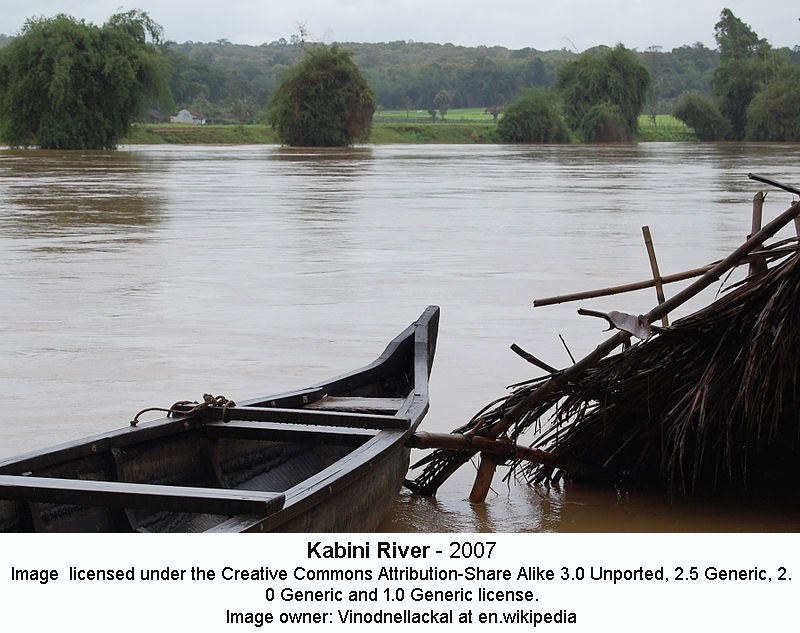 (2) The Chola or Solayar, one of the main tributaries of the Beypore river which leaps down in a magnificent cataract from the crest of the hills close to the Choladi pass into the Nilambur valley.
(3) The Manantoddy pula which has its sources in the mountains between Banasur peak and the summit of the Kuttiyadi and Periah passes and joins the Kabbani near the famous Fish Pagoda.
(4) The Panamaram pula.
(5) The Kunattu pula (കുന്നത്തു) in Vayitiri amsam.
(6) The Putusseri pula in Kurumbala amsam.
(7) The Kanayamcheri pula (കണയഞ്ചേരി) in Etannatassakur amsam.
(8) The Alatur pula (ആലത്തൂർ) in Ganapathi Vattam amsam.
Nos. (4) to (8) united join the Manantoddy river near the Fish Pagoda and form the upper waters of the Kabbani.
The Rampur and the Moyar rivers chiefly drain the South-East Wynad.
Passes— main passes uniting the low country with the taluk are —
(1) The Smugglers’ pass from Dindimal to Manatana.
(2) The Periah pass descending on Kannavam in Kottayam taluk.
(3) The Ellacherum pass (Cardamom Mountain pass) leading to Kuttiyadi in Kurumbranad taluk.
(4) The Kuttiyadi pass also descending on Kuttiyadi.
(5) The Tariyott pass likewise leading to Kuttiyadi.
(6) The Tamarasseri pass into Calicut taluk.
(7) The Choladi pass leading into the Nilambur valley.
(8) The Karkur pass into the Ernad taluk.
Nos. (2), (6) and (8) are broad roads open for cart traffic. No, (3) is only available for horse or pack-bullocks. The remaining are minor passes, used only by foot-passengers.
History.— The traditionary history of Wynad is very obscure, but the following account of it has the merit of having been in vogue in the early years of British rule.
The country was formerly held by a line of Vedar Rajas ruling the Vedars (wild hunters), and thus much is probably correct, for Wynad has been the last refuge and is still the home of many aboriginal tribes, Kurumbars, Kurichiyars, Panniyars, etc., driven up probably from the low country of Malabar.
In the times of the Vedar Rajas, a man of the Kshatriya caste called the “Cumbala Raja” (? Kumbla) came to Wynad from the north with a view to visit the Tirunelli shrine. He was taken prisoner and carried before the Vedar Raja, who insisted, before permitting him to depart, on his marrying one of the daughters of the kingly Vedar line.
Being a Kshatriya he would not consent to marry into the Vedar tribe, but as the Raja was inexorable he at last agreed on the condition that the ceremony should be carried out in accordance with Kshatriya customs. This was allowed and a delay occurred while marriage pandals and other preparations were being made. Taking advantage of this delay, the imprisoned Raja communicated with the Kshatriya Rajas of Kottayam and Kurumbranad in the low country, and these princes, with their forces, put in an appearance on the wedding day. The Vedar Raja was besieged in his fort ; the fort was taken, and the Vedar Raja and most of his people were slain.
The intended bride of the "Cumbala Raja” was given, it is said, in marriage to one of the Nambiar caste who was entrusted by the Kottayam and Kurumbranad Rajas with the government of the country.
The allied Rajas next consulted, it is said, how to divide the country so as to avoid disputes. To this end they set out in different directions and agreed to make the place where they should meet the boundary. This plan failed, as may well be conceived by any one who has even now-a-days tried to find his way through the elephant grass and tangled swamps with which Wynad abounds.
The Kottayam Raja then generously gave up all his claims to the country to the Kurumbranad Raja, stipulating only that if posterity failed the latter country should come to him and his posterity.
An ascetic with matted hair, who had been one of the attendants of the Cumbala Raja, settled down, it is said, in Wynad, and his daughter was afterwards married to a Kottayam Raja. It is not said what became of the other attendant who is described as a Sudra Vellalan. Subsequently the Kottayam and Kurumbranad families fell out, and by the time the British raj was established, the Kottayam family was supreme in the taluk.
It is unnecessary to detail here the events of the Palassi (Pychy) Raja’s rebellion and death, as these have been treated fully in Volume I.
The attainder passed on him and his heirs in Wynad deserves, however, a few remarks.
On the 16th June 1805, Lieut.-Colonel MacLeod offered rewards for the apprehension of the Palassi (Pychy) Raja and eleven of his principal adherents, and “also made known that all the estates and property belonging to the described rebels is confiscated from this date”. The rebel leader and five of his followers were killed on the 30th November 1805. The sentence of forfeiture pronounced on the 16th June 1805 has never been effectively carried out, though from time to time attempts have been made to ascertain the exact limits of the "Pychy escheats” with a view to the assertion of the rights of the State therein. The consequence has been that many of the lands in Wynad—the janmam property of the Pychy rebels and therefore the property of the State by forfeiture—have been usurped by fictitious janmis, whose claims are now being investigated. The decisions arrived at in the various claims preferred and investigated will be carried out at the new revenue settlement of the tract about to be commenced.
Subdivisions of the Taluk for Administrative Purposes.—Wynad originally comprised eleven hoblis consisting of thirteen amsams, the latter being subsequently increased to 16 by the creation of Peria, Vayitiri and Cherankod amsams. The names of the hoblis and of the ancient and modem amsams are shown below : —
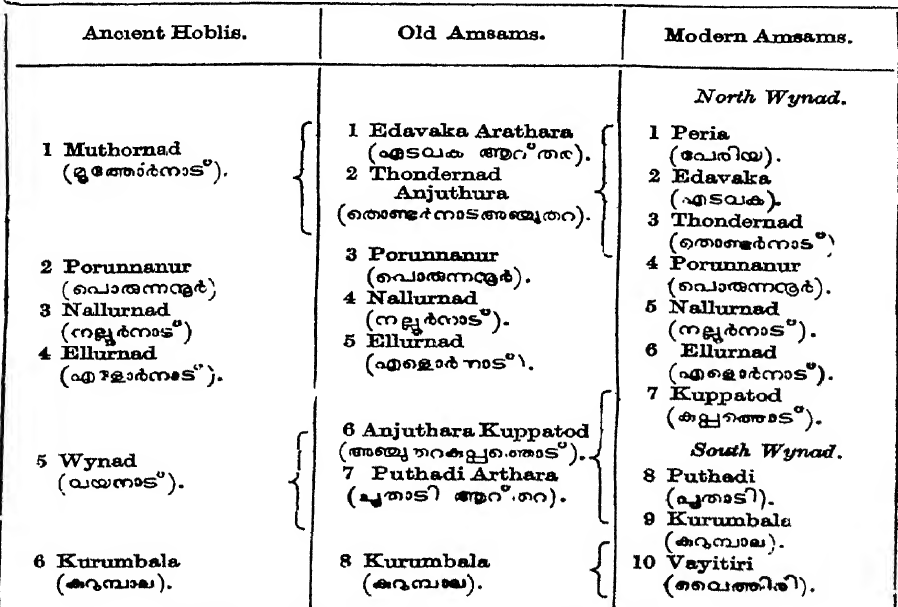
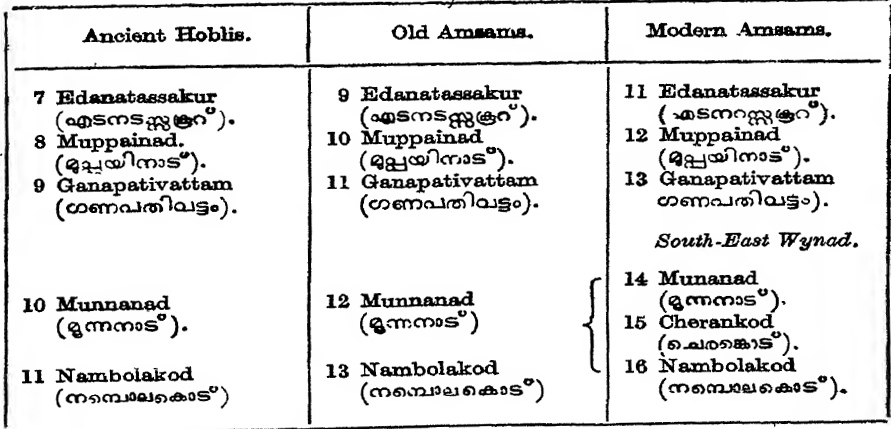
Pulpalli desam which formed part of the Kuppatod amsam was transferred to Puthadi amsam in 1884 under Board’s Proceedings, dated 9th Angust 1884, No. 2754.
The taluk was formerly under the Sub-Collector, Tellicherry, who was replaced by the Deputy Collector on the creation of that class of officers on the 12th August 1859. Its civil jurisdiction vested in the Deputy Tahsildar, Vayitiri, and the Deputy Collector, Manantoddy, until 1879, when a separate Munsif’s Court was established at Vayitiri for the entire tract (vide notification in the Fort St. George Gazette, dated 28th January 1879, page 112).
The seven amsams of North Wynad forming the Tahsildar-Magistrate’s jurisdiction are subordinate to the District and Sessions Court, Tellicherry, for judicial purposes ; whilst those of the South Wynad forming the Deputy Tahsildar’s charge are subordinate to the District and Sessions Court, Calicut (vide notifications in the Fort St. George Gazette, dated 2nd January 1863, 3rd March, and 15th October 1886). Until recently, the District Munsif, Vayitiri, was subordinate only to the District Court, Calicut, but in the Govemment notifications, dated 3rd March and 15th October 1886, already quoted, he was placed in subordination to both the North Malabar and South Malabar District Courts. The District Munsif is generally invested with first-class magisterial powers with a view to presiding at the Bench of Honorary Magistrates for South Wynad.
The following are the principal public offices :—
(1) The Deputy Collector and Magistrate located at Manantoddy.
(2) The Tahsildar and Sub-Magistrate located at Manantoddy.
(3) The Police Inspector located at Manantoddy.
(4) The Deputy Tahsildar and Sub-Magistrate located at Vayitiri.
(6) The Police Inspector located at Vayitiri.
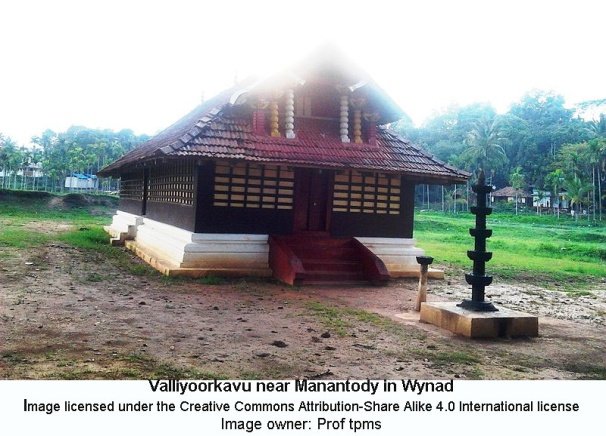 (6) The District Munsif located at Vayitiri.
(7) The Sub-Registrar, Manantoddy, under the District Registrar. Tellicherry.
(8) The Sub-Registrar, Vayitiri, under the District Registrar, Calicut.
(9) Combined Postal and Telegraph office at Vayitiri.
(10) Other Post offices at Manantoddy, Kalpetta. Tariyott, Sultan’s Battery and Mepadi.
(11) Police stations at Manantoddy, Oliyot, Koroth, Panamaram, Kalpetta, Vayitiri, Mepadi, Tariyott, Sultan’s Battery and Periah.
(12) Sub-Assistant Conservator at Manantoddy and his subordinates,
(13) Local Fund Supervisors and Sub-Overseers at Vayitiri and Manantoddy.
(14) Local Fund Middle School at Manantoddy.
(15) Vaccine staff for North and South Wynad under the control of the Deputy Inspectors of Tellicherry and Calicut circles respectively.
(16) Hospitals at Vayitiri and Manantoddy in charge of Apothecaries ; the latter being supervised till August 1886 by a European medical officer, who drew a special allowance of Rs. 150 per mensem from Government.
(17) Bench of Magistrates, North Wynad.
(18) Do. South Wynad.
Manantoddy.—In Vemom desam of Ellurnad amsam, is the headquarters of the Deputy Collector and of the Tahsildar of Wynad. It contains, in addition to public offices, a hospital, a travellers’ bungalow, a chattram in Buffalo street and another at Bavalli and a middle school, and is the centre of some trade. A weekly market is held here on Sundays.
There was formerly a cantonment at this place on a low flat hill, consisting of a small redoubt, an artillery shed, a range of officers’ quarters, place-of-arms, hospital, etc. The important religious institutions in the Ellurnad amsam are—(1) Tirunelli temple (തിരുനെല്ലി ക്ഷേത്രം) (2) Trichaleri temple (തൃശ്ശലെരി ക്ഷേത്രം), (3) Valliyurkava (വള്ളിയൂർക്കാവ്), the famous Fish Pagoda (VoL I., p. 537), (4) the Roman Catholic church. There is a Protestant cemetery at Manantoddy and another at Vayitiri. Tirunelli and Trichaleri are considered most sacred places, and a short account of the origin of the temple at the former locality is given below.
Tirunelli temple (literally the temple having the sacred nelli tree) lies in a valley of the mountains to the south of the Bramagiri peak. It is known by three different names, viz., (1) Tirunelli temple (തിരുനെല്ലി ക്ഷേത്രം) (2) Amalaka temple (ആമലകക്ഷേത്രം) and (3) Sidha temple (സിദ്ധ ക്ഷേത്രം). It is believed to have been dedicated by Brahma to Vishnu known as Deva Devesan (ദേവദേവേശൻ) and Tirunelli Perumal (തിരുനെല്ലി പെരുമാൾ). The mythological origin of the temple is as follows.
Once upon a time when Brahma was enjoying one of his periodical peregrinations, he happened to be delighted beyond measure with this place with a grove of most beautiful trees and plants, of flowers and foliage among which stood a nelli tree (Phyllanthus emblica), on which was seen the image of Vishnu with four hands bedecked with numerous fine jewels.
The image immediately vanished from sight. Being overtaken with grief and surprise at this sudden disappearance, Brahma engaged himself in deep contemplation, when the image reappeared and he heard the following words uttered by an invisible being : “The image that thou hast seen is that of Vishnu, the excellence of this place draws and keeps him here". Convinced of these divine utterances Brahma made a temple, consecrated Vishnu therein and entrusted its keeping to two pious Brahmins of the Amalaka village.
The Brahma ordained that visits to, and prayers at, the temple would remove the sins committed though they were for generations, and secure paradise, and that the performance of prayers and ceremonies would lead to the translation of the spirits of the departed, who have not obtained salvation, to the "Pithurloka" (regions of blissful spirits) wherein to enjoy eternal happiness. This blessing, pronounced by the Brahma, is believed in by Hindus, and pilgrimages are therefore undertaken to the shrine.
In connection with the temple there are seven holy water fountains, which are:
(1) Papa-nasini (പാപനാശിനി), literally extinguisher of sins, (2) Panchathirtham (പഞ്ചതീർത്ഥം), (3) Irnamochini-thirtham (ഋണമോചിനിതീർത്ഥം), (4) Gunnika-thirtham (ഗുണ്ണികതീർത്ഥം) (5) Sata-vinnu (ശതവിന്ദു), (6) Sahasravinnu (സഹസ്രവിന്ദു), (7) Varaham (വരാഹം).
There is a rock called Pinnapara (പിണ്ഡപ്പാറ) where offerings to the spirits of the departed are made, and this rock is supposed to be the bone of an asuran (demon) named Palana-bhedi (പാഴാണഭേദി), who was killed by Vishnu and who at the time of his death prayed to that deity that his body might be converted into a rock extending from Tirunelli to Gaya and divided into three parts fit for the performance of offerings for the departed, viz., at (1) Tirunelli representing his foot, (2) Godaveri representing the middle part, and (3) Gaya representing the head.
Offerings at any of these three places are supposed to have special benefits in producing happiness and in the propitiation of the spirits. For the safeguarding of the temple four shrines have been created, viz., the shrine (1) of Durga at the east, (2) of Siva at the south, and (3) at the west and (4) of Subramaniam at the north. These four shrines are supposed to represent (1) Valliyurkava temple (വള്ളിയൂർക്കാവ), (2) Trichaleri temple (തൃശ്ശളെരി) (3) Tricharakuimu temple (തൃച്ഛറകുന്നു), and (4) a temple said to exist in the Brahmagiri mountains.
There are some old copper plate grants in this temple in the Vatteluthu (വട്ടെഴുത്തു) character which have not yet been deciphered.
In the desam of Arattuthara (literally a place of bathing the idol), in Ellurnad amsam, is situated the Valliyurkava temple, at which a festival takes place annually, when an immense concourse of people assemble and live in small booths built from materials obtained on the spot. Feeding the mahseer and other carp which abound in the pool of the river lying close to this shrine is considered meritorious, and hence the popular name of the “Fish Pagoda” by which it is generally known to Europeans.
Vayitiri.—In the amsam of the same name, is the seat of the District Munsif and of the Deputy Tahsildar. It contains likewise the offices of the Sub-Registrar and the Police Inspector and is a place of some importance. The Bench of Magistrates for South Wynad meets at Vayitiri. There is a Hindu temple known as Kunnath ampalam now in ruins. There is also a Roman Catholic chapel in fair condition and a chattram.
About a mile to the south-west of the village lies the Pukkote lake, a natural sheet of water among hills, the only thing of the kind of which the district can boast. On the picturesque bank of the lake the European planters of the district have built a club, and there is a large store adjoining it.
Lackadi—in the same amsam, lies at the head of the Tamarasseri ghat pass and contains a bungalow, a chattram and the ruins of the old Mysorean stockade (Lekkiti-kotta), from which it derives its name.
Periah—in the amsam of the same name, is about 19 miles from Manantoddy and lies on the road to Tellicherry. It is celebrated for its cardamom cultivation, and has a travellers' bungalow, a chattram and a Police station.
Nallurnad.—Payingatiri, in Nallurnad amsam, is a Brahman village ot some note, and is about two miles from Manantoddy. The amsam contains a mosque known as Pallikkal Angadiyil palli (പള്ളിക്കൽ അങ്ങാടിയിൽ പള്ളി) and a bazaar.
Kupputot.—Panapuram or Panamaram (literally the place of palms) in Kuppatot amsam was once a strong military post consisting of an extensive square mud fort with a sepoy place-of-arms and other buildings ; but the whole of it is now in ruins.
In contains now a Mappilla bazaar and a Police station.
Putati.—Putati and Purakati in Putati amsam, are places of note. At the former is a temple known as Arimula Ayyappan temple, on the east wall of the mandapam of which is an inscription, dated K.A. 922 (A.D. 1746), in a mixture of four languages. There is a Canarese inscription on a stone which belonged to the Patiri temple, but is now in the possession of Patiri Manjaya Gavundan. In the hamlet of Pakkam is a free Standing stone.
At Kaniyampatta, in the Putati amsam, there is a bungalow belonging to the District Board.
Porunnanur amsam contains the bazaar known as (1) Kellurangadi palli () and also three mosques called (1) Kellurangadi palli (ചൊല്ലൂർ അങ്ങാടി പള്ളി), (2) Palanchana angadi palli (പഴഞ്ചന അങ്ങാടി പള്ളി) and (3) Kandattvayal palli (കണ്ടത്തവയൽ പള്ളി).
Tondarnad.—Korom or Koroth in Tondarnad amsam is a place of considerable trade chiefly in the hands of the Mappillas. It contains a travellers' bungalow, a Police station, two Hindu temples known as Tondarakotta (തൊണ്ടരക്കോട്ട ക്ഷേത്രം) and Bhagavati Kavu (ഭഗവതികാവ്) and two mosques called Koroth angadi palli (കൊറൊത്ത അങ്ങാടി പള്ളി) and Koroth putiya palli (കൊറൊത്ത പുതിയ പള്ളി).
Etannatassakur.—Kalpatta alias Kalpatti, in Etannatassakur amsam is a place of some note from its being the residence of some Brahmans and Chettis. It is on the high road from the Tamarasseri pass, and contains a bungalow and a chattram.
Tariyott—is another place in the same amsam of some note, and contains a chattram.
Ganapativattam— (literally the circle or range of the god Ganapati) otherwise known as Sultan's Battery from the fact that Tippu Sultan had a fort here, is a village of little importance. There was a British regiment stationed here in the early part of the present century. On the hill known as Nalapat chala kunnu is a stone having an inscription in old Tamil on two sides. It has not yet been read. There is another on the Dipastambha (lamp post) at the Ganapati temple, and a third on a stone standing in the north court of the Mariyamma temple. In the hamlet of Kitanganat are twelve dolmens, a menhir and three carved stones.
Muppainad—contains a small fort and a pagoda of some importance dedicated to Vettakorumakan. The Devaswam is usually known as the Muttil Devaswam. In the hamlet of Muttil are 22 dolmens, and in Chingeri 2.
Christian Churches and Cemeteries.—There are two Roman Catholic chapels in the taluk, one at Manantoddy and the other at Vayitiri, also a Protestant chapel at Chundale and a temporary edifice at Vayitiri used for divine service by the Protestant community. At Vayitiri the service is performed by the Chaplain of Calicut, and at Manantoddy by the Chaplain of Cannanore.
At the latter station there is no separate building, the service being performed in the Local Fund school-house. There are two Protestant cemeteries, one at Manantoddy and the other at Vayitiri, which are in good condition. The Roman Catholic cemeteries are not secured by proper walls.
Bungalows and Chattrams.—There are bungalows at (1) Periah, (2) Koroth, (3) Manantoddy, (4) Lakkidi, and (5) Sultan’s Battery, and chattrams at (1) Periah, (2) Manantoddy, (3) Bavalli, (4) Kalpetta, (5) Tariyott, (6) Lakkidi, (7) Vayritri and (8) Sultan’s Battery.
Mines, Minerals and Manufactures.—Iron ore may be obtained in several parts, but none of it is manufactured. The principal rocks, which are gneisses, granites, etc., are traversed by quartz reefs, which are frequently auriferous, but they are found chiefly in South-east Wynad.
The favourable, reports on the auriferous character of the Wynad fields led to several companies being formed for working gold, and although several blocks of estates were purchased for this purpose, no operations are now being carried on in Malabar-Wynad. The collapse of the mining industry, which at one time promised to be so important, told seriously on the other, and ordinary pursuits, such as the planting of coffee and other products. The jungle tribes from a remote period used to work gold from the sands of rivers which are sometimes mixed with gold particles. This practice has now fallen into desuetude.
Soil and Productions.—The soil in the cultivated valleys is a fine rich brown, on the heights it is mostly red mixed with gravel. Towards the east and the woody tract it is almost black and rich from the accumulation of dry leaves and other matter. The productions are generally different kinds of rice, horse-gram and other dry grains, castor and other oil seeds and sugarcane, from which latter, jaggery to a very limited extent is manufactured.
Since 1840, the cultivation of coffee has occupied the attention of European planters and proved for a long time highly remunerative. Owing, however, to leaf-disease and other causes, the industry began to languish, and hopes are now centered in tea and cinchona plantations as well as in coffee.
The taluk produces very little pepper and no coconuts nor arecanuts, though a few trees of each may be seen. Cardamoms are produced in great plenty between the Periah and Kuttiyadi passes, and are considered to be of a superior quality. Small quantities are also obtained on the slopes of the mountains forming the Tamarasseri valley above the pass. Large quantities oi honey and bees' wax are obtained from the forests and rocks among the mountains. These useful articles find a ready sale in the seaport towns, from whence they are exported. Some tobacco is produced, but only in small quantities and for private consumption.
Inams.—The inams granted in the Wynad taluk are the following:
(1) Pumalathalachil Bharadevata (goddess) temple in Kuppattot amsam, Rs. 96-10—4.
(2) Pallimalamma Bhagavati (goddess) temple in Tondernad amsam, Rs. 11-6-0.
The inams granted in the above amsams are intended to defray the expenses attending the usual ceremonies in the temples.
Cattle and other Animals.—Cattle and buffaloes are numerous and are sometimes a source of mischief to planters. Sheep and goats are almost unknown except such as are imported for food. The taluk abounds with deer (sambur) and wild pigs. Elephants and bison are also to be found in the ghat forests. Tigers are fairly numerous, and panthers abound to such an extent as to be an intolerable nuisance to any one with pet dogs.
A peculiar practice of spearing tigers and panthers obtains among the Chettis in Ganapativattam, Muppainad and Putati amsams. When a kill takes place, the beast of prey is quietly allowed to gorge itself with beef, and under such circumstances it lies up in the first favourable sheltering cover it finds. Word is sent round the country and the people bearing nets and spears quietly assemble at the spot. If the patch of jungle in which the animal has lain up is of small extent, the nets are immediately run up round it and fastened to stout stakes driven into the ground. The nets are of ordinary thin rope, and, when stretched, are about 5 feet high.
Ordinarily, however, the matter is not so easily arranged, but the probable course of the animal after it is roused is usually well known, a piece of likely jungle is selected and three sides of it are beforehand netted in. Scouts are posted, the animal is then disturbed, and as soon as it enters the netted space, the fourth side is immediately closed with nets, the workers being protected by the spearmen while this ticklish operation is in hand. The animal thus netted rarely escapes, the netted space is gradually reduced in size by clearing away brushwood and eventually the animal is confined in a space measuring some 18 or 20 yards in diameter.
The aid of the village deity is invoked, and the huntsmen armed with spears challenge the animal to combat at the time pronounced by the oracle to be favourable for action. The ground where the so-called combat is fought is called Narikandi (tiger-ground), and people sometimes have to await the oracular revelations for four or five days. At the hour appointed, the animal is enraged by every sort of device : when its first low muttered growls are heard, the spearmen surrounding the net in an unbroken phalanx shout in response ; the growls gradually become louder and more continuous, until at last breaking into short and sharp savage grunts, the maddened animal delivers a charge full at the net when the spearmen half mad themselves from arrack and excitement receive it on their spear points. Several such charges are usually delivered before the animal receives its death thrust.
The skin of a tiger or panther thus slain is never removed either for obtaining rewards from Government, or for sale, but the carcass is hung, on a horizontal bar and there allowed to rot.
Fairs and Markets.—Weekly markets are held on Sundays at Vayitiri and Manantoddy. A large fair is held for five days at Valliyur Kavu (fish pagoda) during the annual festival ; markets are also held at Kalpetta, Tariyott, Mepadi and Sultan’s Battery.
Climate.—The climate of Wynad is much cooler than the low country, being about 3,000 to 4,000 feet above the level of the sea. The thermometer during the cool weather is as low as 60°, but during the months of March, April and May, it rises to 84° and sometimes higher. On the whole, it is considered unhealthy, owing chiefly to defective water-supply and the prevalence of malaria.
Manantoddy is, from a climatic point of view, better than Vayitiri, and has comparatively an open country around it. From October to January the climate may be said to be fairly dry, cool and salubrious ; from February to May hot land-winds blow and fever is prevalent ; from June to October rain falls with short intermissions, and though the temperature is lower and fever less general than in the preceding months, dysentery, diarrhoea and rheumatism are common. The average rainfall of the taluk for three years is given below :
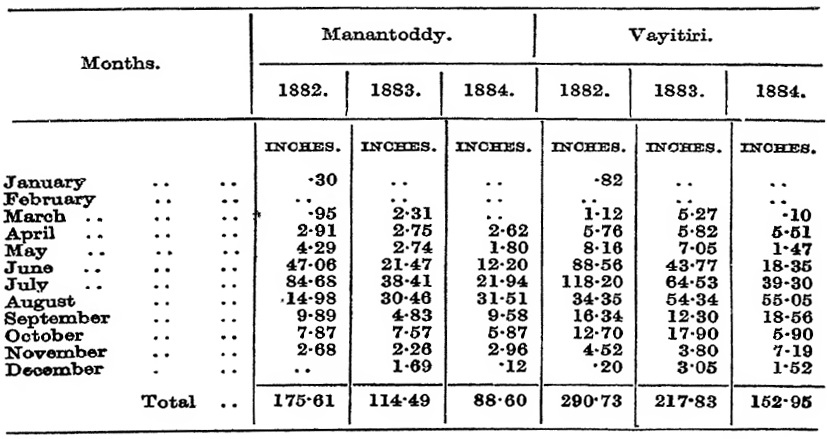
Trigonometrical Stations.—There is but one survey station to be preserved and annually reported on (Board’s Proceedings, dated 28th July 1886, No. 1706).
|
Name of G.T.S Station. |
Situation. |
Series |
Modern values |
|
|
Latitude. |
Longitude. |
|||
|
Narikod |
Vayitiri amsam. |
Modern |
11°32' 26" 88 |
76° 01' 21" 07 |
Traffic Registry Stations.—Two stations for registering the traffic with Mysore were opened in December 1880 at Bavalli and Sultan’s Battery. The statistics of trade for 1885-86 are given below:-
Imports into Malabar from Mysore
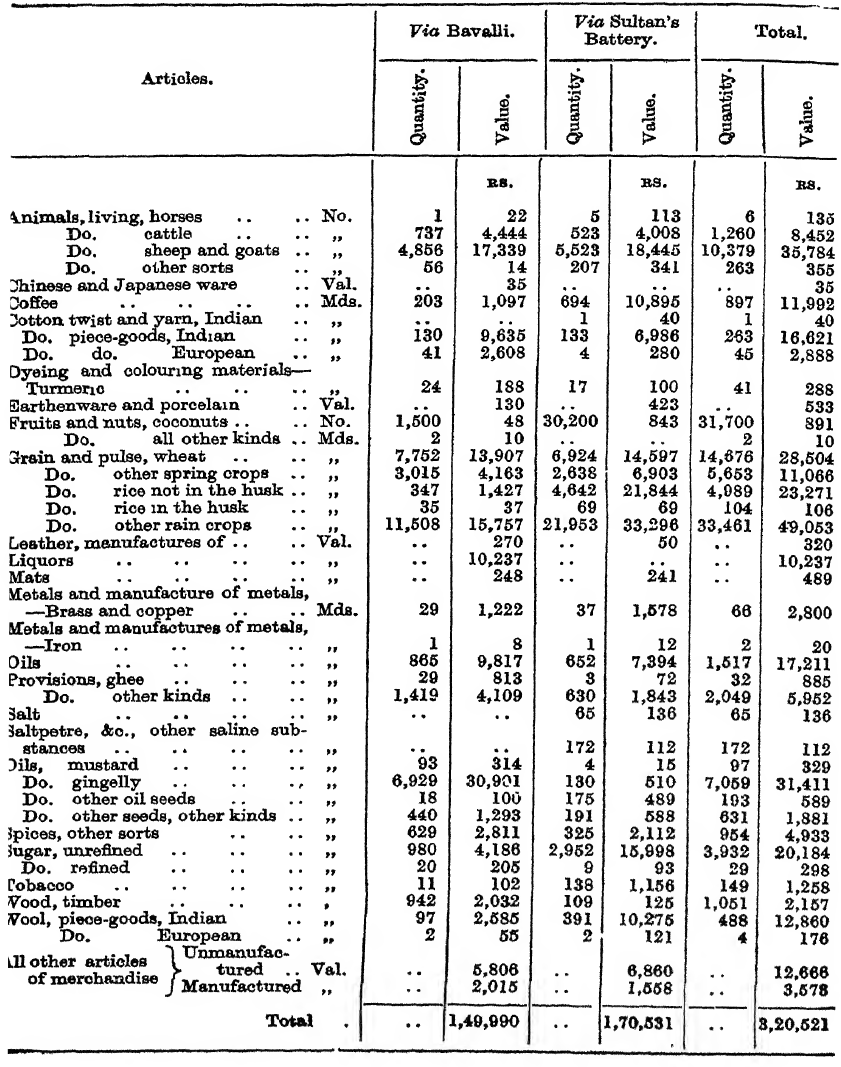
Exports from Malabar to Mysore
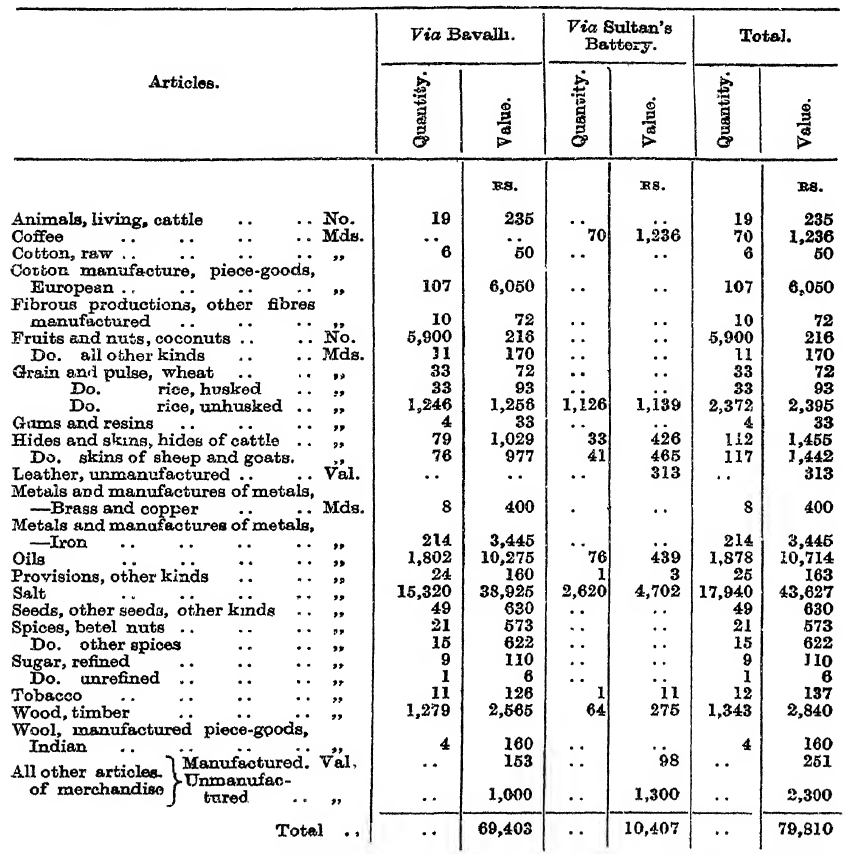
WYNAD FORESTS
By Rhodes Morgan, Esq., District Forest Officer.
General Description.—The whole of the Wynad plateau must have been covered at no very remote period with dense forest, the greater portion of which, more especially in the centre of the taluk, has been swept away by the system of cultivation known as "Tuckle" or punam in Malabar, leaving a fringe of deciduous teak forest all along the eastern frontier, from whence it extends into the province of Mysore. On the north and west, the steep declivities of the Western Ghats, covered with a primeval growth of evergreen forest also escaped destruction.
The deciduous forests occupy a zone extending from 11° 58' Lat. on the north to 11° 35' Lat. on the south, and between 75° 59' and 76° 33' East Long. The evergreen forests clothe the slopes of the Western Grhats on the west, and of the Dindimal and Bramagiri ranges on the north. These ranges run out at right angles to the Western Ghats and form buttresses of that great chain of mountains.
The deciduous forests contain the most valuable timber trees, such as teak, rosewood, iynee (Artocarpus hirsuta), venghay (Pterocarpus marsupium), ven-teak (Lagerstraemia microcarpa) and a host of others, and produce many valuable articles of commerce, of which wax, honey, resin, turmeric, zedoary and myrabolans are the principal.
They are more or less open, and there is little undergrowth, except in one or two tracts where fire has been artificially excluded . Thousands of acres are covered with a growth of coarse grass from 4' to 8' high. Where the soil is richer, and the growth of trees denser, there is an undergrowth of low scrub, consisting of Lea-Helicteres, curcuma, etc. Many trees grow to a great size, yielding as much as 300 cubic feet of timber occasionally ; but the average contents of the trees are about 40 cubic feet.
In the evergreen forests, the trees are lofty, and the growth very dense. There is little or no undergrowth, except in patches, where a dwarf Pandanus is common. These forests have a gloomy aspect, and the sun rarely penetrates them except where some tree has fallen from old age, or has been up-rooted by some storm.
The most valuable trees are the red and white cedars, the wild jack, the poonspar, and the ironwood. Cardamoms are the principal product ; they are extensively cultivated, and also grow spontaneously. Bees’ wax, dammer, rattans and pepper are the only other products much collected at present, though resins, kino, gamboge, etc., abound, but have no market value.
Past History.—When Wynad was taken from Tippu Sultan by the British, the Palassi (Pychy) Raja, a petty chieftain in possession, rebelled against the British, was conquered and shot. His forests and other possessions were then escheated. For years no real effect was given to the order of escheat, and many forests were usurped possession of by various persons.
In the year 1859, a Forest Department was formed and an officer, Mr. Hunter, sent down to work the Wynad. At that period, the Collector administered the forests and sold timber, on what is known as the stump-fee system, i.e., any person paying a certain sum per tree was allowed to cut it down and remove it. In the case of teak, this stump-fee was Re. 1 per tree.
The forests were worked on the native system for many years, no efforts were made to improve them, and trees were indiscriminately felled where found, whatever their age might be. In 1878, all felling of living teak was stopped, and the Forest Department turned its attention to the utilisation of the wind-fallen and dead trees which were being annually destroyed by fire. In 1882, the Forest Act was introduced, and immense progress has been made in the scientific treatment of the forests.
Present Condition of Forests—The deciduous forests have been divided into 14 blocks, of which six are reserved forests, two are under reservation, and six blocks are reserved lands.
The evergreen forests have been divided into three blocks ; all at present are under reservation. The annexed statement gives particulars of all these blocks, and their areas.
Of the reserved forests, three—Begur, Kurchiyat, and Rampur—have been demarcated with posts and cairns, and two others will be demarcated before this year has ended.
They are all under special fire protection under rule 8 of the rules under section 26 of the Forest Act ; but only one (Begur, area 15,366 acres) is fire-traced, and systematically patrolled in the fire season. Gradually complete protection will be extended to all the others.
The Begur Forest has been divided into 8 compartments, and a working scheme will be prepared for it shortly. At present, as already stated, only dead wood is being removed.
All the forests have been roaded, and about 80 miles of such roads exist at present ; but these roads are all more or less primitive.
The timber in the forests is squared, with much skill, by aboriginal tribes, on contract. They are paid three-fourths of an anna per cubic toot ; when felled, the logs are hauled by elephants into depots, and are from thence carted to the banks of the Kabbani river and floated to Mysore. In the dry weather, logs are carted the whole way to Mysore ; but such transport is so costly as to be almost prohibitive. There are eight elephants and ten buffaloes altogether maintained for the haulage of timber in the forests.
Numerous buildings have been erected, and still more will shortly be erected for the establishment employed to work the forests, which consists of —
|
1 District Forest Officer. |
1 Sub-Assistant Conservator. |
|
1 Ranger. |
3 Foresters. |
|
20 Forest Guards. |
|
The members of the establishment are constantly being changed, owing to the excessive malariousness of the forests in the dry weather, which wrecks the very strongest constitutions in a few months.
List of Reserved Forests and Reserved Lands with their areas, etc., in Wynad
District: Malabar. Taluk: Wynad
|
No |
Amsams |
Name of forest |
Area in acres |
|
1 |
Ganapathi vattam |
Kuppadi |
7,337.44 |
|
2 |
Do |
Kurichiyat |
18,053 |
|
3 |
Do |
Rampur |
18,854 |
|
4 |
Do |
Nulpoya |
3,613 |
|
5 |
Do |
Mavanhalla |
12,576 |
|
6 |
Ellurnad |
Begur |
15,365 |
|
|
|
Total |
75,801.81 |
List of Reserved Forests and Reserved Lands with their areas, etc., in Wynad. (Continued)
District: Malabar. Taluk: Wynad
|
No |
Amsams |
Name of forest |
Area in acres |
|
|
|
Reserved Lands |
|
|
1 |
Ellurnad |
Kudrakote |
43,764 |
|
2 |
Putati |
Padri |
34,385 |
|
3 |
Tondernad |
Periah cardamom forest |
13,440 |
|
4 |
Periah |
Chapparam |
112 |
|
5 |
do |
Panniyatta |
150 |
|
6 |
Ganapathivattam |
Palapattur |
1,538 |
|
|
do |
Vengur |
3,013 |
|
|
do |
Chedleth (excluded portions in) |
960 |
|
|
do |
Karapur |
1,825 |
|
|
do |
Kallur |
5,280 |
|
|
do |
Excluded portions of Trans-Beni |
7,459 |
|
|
Ellurnad |
Botanical Garden, Manantoddy. |
21 |
|
|
|
Total |
111,897 |
KANOTH FOREST
Attached to the Wynad subdivision there is an extensive tract of forest known as the Kanoth forests. It is situated in the Kottayam taluk, at the base, and partly on the western slopes of the Western Ghats. The area of these escheat forests has been approximately computed at 375 square miles. Of this enormous tract, a very small portion (some 40 square miles) is in the hands of the Forest Department, the rest has not been settled yet.
These forests were escheated from the Kanoth (Kannavath) Nambiar, one of the principal adherents of the rebel Palassi (Pychy) Raja. In 1883, the management of the tract was transferred to the Forest Department, and immediate steps were taken for its conservation and improvement.
It is inhabited by an aboriginal tribe known as Kurichiyars, who had for years previously carried on the destructive system of "Punam" cultivation (known in Wynad as "Tuckle”). The whole forest, with the exception of a few patches near the crest of the ghats (3,500' elevation), had been ruthlessly hacked to pieces. The present growth is from 3 to 7 years of age, and consists principally of a multitude of worthless pollards and crooked coppice shoots.
It has been demarcated and surveyed, and 31 miles of the northern boundary have posts and cairns erected as well. It is now under reservation. At the conclusion of the settlement, the aboriginal inhabitants will be removed, and settled elsewhere, and works started for the improvement of the growth.
Nurseries have been established, and large quantities of ficus elastica seed obtained from Assam and planted, and numerous seedlings raised. Mahogany and bamboo seedlings are also being raised to plant out clearings.
There are four small experimental teak plantations made in 1876—78, which, however, are not so forward as could be wished, having been seriously injured, when young, by an attack of borer. Teak is, however, indigenous and promises yet to be a success.
CALICUT TALUK
By C. Kunhi Kannan.
Position, Boundaries, Soil and Area. -—The Calicut taluk occupies a central position in the district. It is situated in Lat. 11° 15' N., and Long. 75° 50' E. It is bounded on the north by the Kurumbranad and Wynaad taluks, on the east by the Wynaad and Ernad taluks, on the south by the Ernad taluk, and on the west by the Arabian Sea. The soil about the seaboard is brown or white sand ; in the interior it is red with gravel approaching in certain parts to a mixture of red and brown.
The approximate area of the taluk, according to the census report of 1881, is 339 square miles. Of this about 68,057 acres or 106 square miles are cultivated.
The demand on account of land revenue in the fasli year 1295 (1885—86) was Rs. 1,29,814 giving an average of Rs. 17/8 per acre of cultivated area.
Population.—The population of the taluk, including floating population, according to the census of 1881, is 205,962 (103,669 males and 102,293 females) against 189,734 as ascertained by the census of 1871. Of the former, which gives an average of 456 persons per square mile, 149,843 are Hindus, 52,942 Muhammadans, 3,126 Chiistians and 51 “others.'’
Under the head of education, the census of 1881 returned 6,384 persons as ‘'under instruction,” 18,721 as "instructed” and 180,857 as "illiterate including not stated”—a state of things which shows that education has not reached the masses. There were in the taluk 39,450 houses in 1881 against 36,479 in 1871. Of the former, 34,751 houses were occupied and 4,699 unoccupied. The average number of persons per occupied house is 5.7.
Division of the Taluk for Administrative Purposes.—The taluk comprises 41 amsams, each having an adhikari on a salary of Rs. 5½ per mensem, a menon on Rs. 6, and two peons on Rs. 3 each.. But in the Nagaram amsam, in which the capital of the district stands, there are two menons on Rs. 6 each and four peons on Rs. 3 each, whilst in the Panniyankara amsam, which has the largest revenue in the taluk, there are 3 peons.
In 1860, when the taluks of the district were reorganised, there were only 35 amsams allotted to Calicut taluk. But in 1866 six amsams in the Kurumbranad taluk, namely:-
1. Nodiyanad, 4. Annasseri,
2. Kilakkott, 5. Natuvallur,
3. Matavur, 6. Nanminda,
which were nearer to Calicut than the headquarters of Kurumbranad, were transferred to the Calicut taluk under the orders of Government, dated 5th September 1866, No. 2362.
Government Establishments maintained in the Taluk.—As the capital of the district all the important offices are located in the town of Calicut. They are- (1) the Collector's office including the District Board’s office. Assistant or Temporary Deputy Collector’s office, the Treasury Deputy Collector’s office, the Currency office, the Treasury and Press, the District Forest office and the District Board District Engineer’s office ; (2) the District and Sessions Court1 of South Malabar including the Sub-Court and the District Munsif’s Court ; (3) the office of the District Superintendent of Police ; (4) the office of the District Medical and Sanitary Officer ; (5) the office of the Executive Engineer, West Coast division ; (6) the Deputy Tahsildar's and Town Magistrate’s Court including the Sub-Jail ; (7) the Telegraph office ; (8) the Post office; (9; the Port office; (10) the office of the Superintendent of Customs; (11) the Police station; (12) the District Jail; (13) the Government College ; (14) the District Registrar’s office ; (15) the Branch Bank of Madras and (16) the office of the Assistant Commissioner of Salt and Abkari Revenue.
NOTEs: 1. The Zilla Court at Calicut was established in 1803. It was abolished in 1843 to make room for a Civil Court for which was substituted a District Court under Act III of 1873. END OF NOTEs
The Tahsildar’s office including the Sub-Jail is on a hill at Chevayur about four miles east of the town of Calicut. There is a Sub-Registrar’s office at Chevayur as well as at Tamarasseri in Kedavur amsam, about 19 miles from Calicut on the road to Vayittiri. There are Police stations at Ellatur, Naduvattam (Beypore), Kunnamangalam and Tamarasseri, Kanniparamba, Chevayur and Putupadi.
Short Description of the Town.—The Towns Improvement Act X of 1865 was extended to Calicut on the 3rd July 1866. The limits of the town for the purposes of the Act were —
West.—Sea, ;
North.—Road from the sea north of the barracks, past Rock Hall and East Hill, to the Conoily Canal at Karaparamba ; East.—Road from Karaparamba to Kakodi bridge to intersection of the road running south near Florican Hill, and on to its intersection with the Calicut to Tamarasseri road—thence by said road to the canal —thence the canal to its intersection with the watercourse dividing the Komeri desam from the Valayanad desam of the Valayanad amsam — thence eastward along the line of the said watercourse and the northern boundary of the Valayanad desam to the foot of the Pokkunnu Hill - thence south-east along the foot of the hill, and from the hill along the eastern boundary of the Valayanad desam to the backwater at Attupurathu paramba—hence returning by the backwater to the Mangavu bridge, and from the bridge along the canal leading to the Beypore river to the portion of it called Kotta Pota, where the canal turns eastward ;
South.—Thence turning to the west along a foot-path leading to the Mammalli road, and from the road to the Tiruvachira or tank, and thence to the sea, keeping along the southern boundary of the Panniyankara desam of the Panniyankara amsam; including within those limits houses and premises wholly or in part within 100 yards of the outside of any boundary road –
|
1. Panniyankara (portion). |
2. Nagaram (all). |
|
3. Kasaba (all). |
4. Kachcheri (all). |
|
5. Valayanad (portion). |
6. Edakkad (portion). |
|
7. Kottuli (portion). |
|
Act X of 1865 (Municipal) was in force until 1871 when it was repealed by Act III of 1871, which again was replaced by Act IV of 1884. The extent of the municipal town is approximately 13 square miles.
The sources from which the municipal income is derived are —
(a) an annual tax on arts, professions, trades and callings, and on offices and appointments at the rates specified in the Act ;
(b) an annual tax on lands and buildings not exceeding 7½ per cent on the annual value of such lands and buildings ;
(c) a half-yearly tax on vehicles with springs, palanquins and animals at rates not exceeding those specified in the Act ;
(d) a half-yearly tax on carts and other vehicles without springs at a rate not exceeding Rs. 2 for each half year in respect of every such vehicle ; and
(e) tolls on vehicles and animals entering the municipal limits at rates not exceeding those prescribed in the Act.
The purposes to which the funds raised under the Act are applied are —
(a) the construction, repair and maintenance of streets and bridges and other means of communication ;
(b) the construction and repair of hospitals, dispensaries, lunatic asylums, choultries, markets, drains, sewers, tanks and wells, the payment of all charges connected with the objects for which such buildings have been constructed, the training and employment of medical practitioners, vaccinators, the sanitary inspection of towns and villages, the registration of births and deaths, the lighting of the streets, the cleaning of streets, tanks and wells, and other works of a similar nature ;
(c) the diffusion of education, and with this view - the construction and repair of school-houses, the establishment and maintenance of schools either wholly or by means of grants-in-aid, the inspection of schools and the training of teachers ;
(d) other measures of public utility calculated to promote the safety, health, comfort or convenience of the people ;
(e) the payment of salaries, leave allowances, pensions, gratuities and compassionate allowances to servants employed by the Municipal Council ; and
(f) the payment of all expenses specially provided for by the Act, but not included under preceding clauses (a) to (e).
The revenue of the Calicut Municipality during the official year ending 31st March 1886 was Rs. 56,925 and expenditure during the period was Rs. 48,294.
The population of the municipal town of Calicut, according to the census of 1881, was 57,085 (30,009 males and 27,076 females) against 48,338 returned by the census of 1871. The latter figure cannot be considered as accurate, inasmuch as it embraced the population of the amsams of Nagaram, Kasaba and Kachcheri only, which are wholly included within the Municipality. The census of 1881 includes the population of the above three amsams, as well as of such parts of Edakkad, Panniyankara, Valayanad and Kottuli amsams as are within the Municipality.
The population of the town is classified as follows : —
|
Hindus |
33,875 |
|
Muhammadan |
20,257 |
|
Christians |
2,909 |
|
Others |
44 |
There are 10,152 houses in the town, being 8,540 occupied and 1,512 unoccupied. The average number of persons per occupied house is 6.7. The density of population is 4,391 per square mile.
There is a Protestant church called the St. Mary’s Church at Calicut, which was built in June 1863. Before its erection the Anglican community held Sunday service in a portion of the Collector’s office. There is an old European cemetery close to the beach and not far from the new Custom house, where there are several graves and tombs—the earliest inscription goes back to the seventeenth century. The tomb built by the friends of Mr. Conolly, the Collector of Malabar, who was assassinated by Mappillas, is in this cemetery.
The history of the Roman Catholic Church, Calicut, which is interesting, is briefly as follows : —
In 1513 A.D., a treaty was concluded between the Portuguese and the Zamorin, in which the latter allowed the former to erect a factory at Calicut to which was attached a chapel.
On the 4th of March 1724 a Portuguese man-of-war, called Mater de Deos, anchored in the Calicut roads, and its commander, Pedro Guedes de Magalhaens, effected a treaty on behalf of Pedro Mascurenhas, Coude de Somdomil, the Portuguese Viceroy and Captain General of India, with the Zamorin in the presence of Mons. Andre Molandin, chief of Moye (Mahe), who became surety for the execution of the treaty. By this the Zamorin undertook, inter alia, the erection of ‘‘a church of stone and mortar with a parochial house, vestry, porch and a belfry having a bell weighing 150 lb.” This treaty was, it appears, engrossed on a copper plate, which, it is said, remains in the possession of the Portuguese Government at Goa to this day.
Towards the close of the year 1724, Mons. Molandin named above informed the authorities at Goa that the Zamorin had deposited 17,000 fanams as the price of a bell to be cast at Goa, that the building of the church had been commenced and that the Zamorin had in the presence of the Vicar, Bernado da Sa, given a moor merchant, Bamacheri Isumali, as surety to pay all further expenses for the completion of the work.
About 1725, the church was completed, dedicated to “Mater de Deos”, and the Zamorin granted a garden in perpetuity for the support of the church.
The church management went on smoothly till the invasion of Malabar by Hyder Ali in 1766. In that year the Portuguese Vicar and Factor waited on Hyder Ali and obtained an order to Madye, Raja of Coimbatore and Governor of Calicut, for the payment of 2,420 fanams annually to the Vicar of the church. Hyder All also ordered that the rent and revenue or benefits of the landed property should not be appropriated.
In 1775 the church, which was then under the immediate Jurisdiction of the Archbishop of Cranganore and Cochin, was repaired.
The Mysorean Government continued its payment to church till 1781, when Sirdar Khan, Tippu’s fouzdar, stopped the allowance. But the Vicar raised the revenue from the glebe lands till 1788, when a Brahman named Daxapaya came as Tippu's Revenue Collector of Calicut, and demanded from the Vicar, Gabriel Gonsalves, the church revenues and imprisoned him ; but the Vicar effected his escape with the connivance of Arshed Beg Klhan, Tippu’s fouzdar, and fled to Tellicherry.
The Vicar returned to Calicut and resumed possession of the church lands in 1792, when Malabar came under the East India Company. But the Company "had caused 500 coconut trees belonging to the church to be cut down” as they had rendered "the English Factory close and unhealthy and impeded also the sight of the flagstaff.” The Vicar therefore applied in March 1793 to the Malabar Commissioners for "a just indemnification and for permission to collect the rent on houses built on church ground agreeably to immemorial custom and privileges as per the Zamorin’s grant, engraved on copper plate still preserved at Goa.”
The Vicar’s petition was repeated to Mr. Farmer, the Supravisor of Malabar, who wrote to the Bombay Government showing an account of the annual rents of the church lands and allowances made by the former Governments and stating that he has since October 1793 paid Rs. 50 per mensem to the Vicar, and adding "that the collections formerly made by the Padre will now be made by the Company, in which by the increasing number who flock to our Government there will be a progressive increase."
On the 24th December 1793, the Bombay Government agreed to allow the Padre Rs. 50 "for his own maintenance expenses, for the servants and repairs of the church ’’—-an allowance which has been continued to this day.
Although it would appear that the rents of all the glebe lands were to be collected by the East India Company as proposed by Mr. Farmer in 1793, yet it is said that the church records up to 1825 show that a large extent of lands obtained by endowments and legacies remained with the church and was leased by the Vicars. In 1835, Vicar Leonard Areline de Casta stated that "on the acquisition of the country by the English a part of the land was taken possession of by them with the view of answering certain public ends, and a commutation in money at the rate of Rs. 50 per month was granted for the support of the curate as well as other expenses of the church."
In 1838, by the Bull of Pope Gregory XVI, this church, along with other churches on the Malabar Coast, was placed under the jurisdiction of the Archbishop of Verapoly. In 1850 this church, with other churches in Malabar and Canara, was placed under the Carmelites.
In 1862 an orphanage and asylum was started. For completing the building the Madras Government paid Rs. 2,000 in 1875 and Rs, 1,500 in 1882.
The Carmelite Mission established a convent and girls’ school and a school for boys in lieu of the old parochial school. These schools are now in a thriving condition. The boys' school was up to the end of 1884—85 aided from Municipal funds, but in 1885-86 it was recognised as a poor European school for which grant-in-aid is paid from Provincial funds. The strength of the boys’ school on the 31st March 1886 was 172, whilst that of the girls' school was 94.
In December 1878 the Malabar and Canara Portuguese Missions were, by the Bull of Pope Pius IX, placed under the Jurisdiction of the Jesuits, under whom it remains.
In 1878 another charitable institution was attached to the Roman Catholic Mission at Calicut, denominated the Society of St. Vincent de Paul. It has since been divided into two branches—St. Mary’s conference and St. Francis Xavier’s conference. The poor and helpless of every creed are here assisted in their temporal necessities.
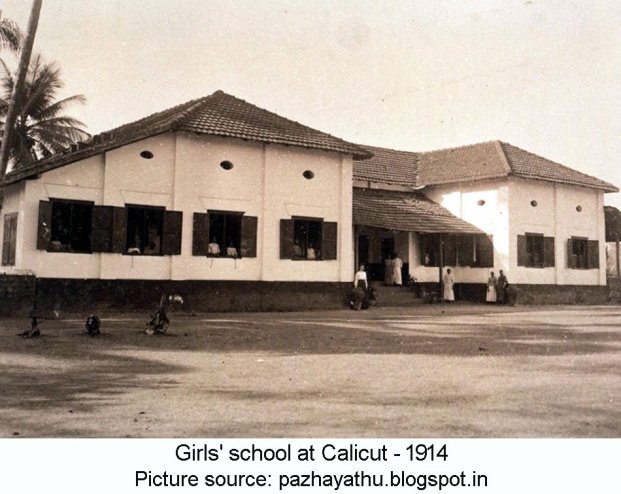 There is a small Roman Catholic chapel called the Chapel of the Holy Cross at Calicut on the road to Wynad about two furlongs north of the Mananchira tank. It was a thatched chapel until last year, when it was substantially built by a member of the Roman Catholic congregation.
There is also a Basel Mission Church at Calicut, The history of the Mission is briefly noted below : —
In May 1842 the Mission was established by the Rev. J. M. Fritz. In the same year, two Malayalam schools and a Tamil school were opened. One of the former was raised to the standard of a high school in 1879.
In 1845 a girls’ orphanage was opened, and in connection with it female education commenced. This institution existed until 1882, when it was amalgamated with that at Chombala in Kurumbranad taluk.
In 1854 the erection of the Basel Mission Church at Calicut was commenced, and it was on 20th December 1855 used for the first time.
The Basel Mission cemetery is about a mile to the north of the church in a compound which lies between the trunk and the Wynaad road.
In 1855 a carpenter’s workshop and a weaving establishment with six looms were opened. In the former, Christians and Heathens are employed, and in the latter the number of workmen exceed 100.
In 1868 a mercantile mission shop was opened. It is the only shop at Calicut, which fully meets the demand of the public. In 1874 the Mission started the works. Here machines of German make are used for manufacturing tiles after the European fashion, for which there is an ever-increasing demand. The tile works furnish employment for more than 150 persons both Christians and Heathens. Here it must be noted that these industrial establishments are entirely of a charitable character.
In 1876 a caste girls’ school was opened in Calicut, and in 1883 a congregation girls’ school with nearly 100 pupils was also started.
There are seven Hindu temples of note in the town of Calicut. They are-
|
1. The Talli temple. |
5. Arikkodu Kavu. |
|
2. Tiruvannur temple. |
6. Kokkolikott temple. |
|
3. Varakkal temple. |
7. Bhairagimadham temple. |
|
4. Bilattikulam temple. |
|
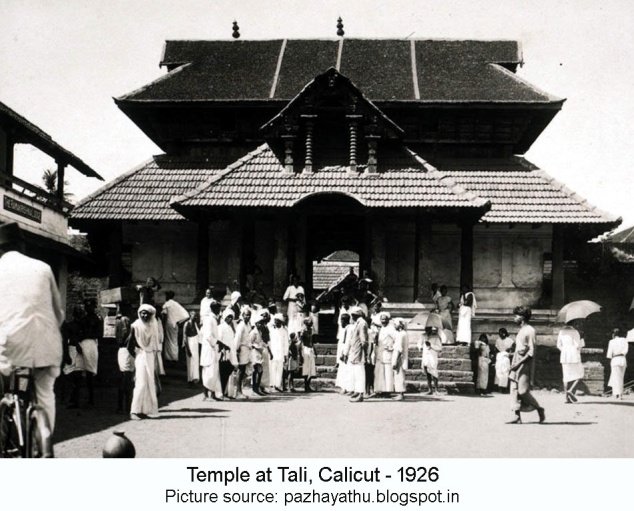 The Talli temple is in kasaba amsam in a locality of same name in the heart of the Calicut town close to the Zamorin’s old palace. The temple is a very ancient one, and is 218 feet long from east to west and 270 feet broad from north to south. It is dedicated principally to Siva, though Vishnu, Bhagavati, Ganapati and Ayyappan fim also worshipped. The temple contains suptures of a high order as well as paintings intended to perpetuate Hindu religious legends. Attached to the temple is a tank in pretty good preservation with laterite steps. The tank is 240 feet long from east to west and 349 feet broad from north to south, and is used for bathing purposes. Close to this is a tank known as Kandamkulam, also used for washing. It is 349 by 140 feet. Talli is densely populated by Brahmans, Nayars and others. A festival is celebrated for a week annually in the month of Medam (March-April) at the Talli temple.
The Tiruvannur temple is in Panniyankara amsam, 2½ miles from the town in a desam (hamlet), from which the temple derives its name. Originally the name appears to have been Tirumunnur (the holy three hundred). The Zamorin lives near the temple. His Putiya (new) Kovilakam (palace) branch is also located at Tiruvannur, another branch called the Padinhare Kovilakam is in Valayanad amsam, Mankavil desam, and a third one, called the Ambadi Kovilakam, is in kasaba amsam. The chief object of worship m this temple is Siva, though Vishnu, Ganapati and Ayyappan are also collaterally worshipped. This temple is a very ancient one, is elaborately sculptured, and contains paintings. The newly erected gateway is interesting, being in style precisely similar to the bastis at Mudabidri in South Kanara erected by the Jains. The temple is 246 feet long from east to west and 198 feet wide from north to south. The Zamorin maintains a Brahman feeding house at Tiruvannur.
The Varakkal temple is in Edakkad amsam and is 96 feet long from east to west and 66 feet broad from north to south. It is on an eminence, and is dedicated to Bhagavati, Ganapati, Ayyappan and Dakshinamurthi. It is fabled that the image in this temple was placed by Parasu Rama with his own hands. The temple contains sculptures. The dasra festival is celebrated annually with great eclat in this temple. Thousands of people congregate here for the performance of ancestral obsequies on the occasion of new moon in the month of Tulam (October-November).
On this day all married men among the native community in Calicut are, by custom, expected to go to their wives’ houses with presents in the shape of sweetmeats, plantains, etc., on pain formerly of having their marriages dissolved, a custom perpetuated in a couplet which runs when translated as follows : —
“Failure to visit on the occasion of Varakkal new moon, entails forfeiture of relationship.” വരക്കൽ വാവിന്നു വന്നില്ലെങ്കിൽ, ബന്ധംമുറിഞ്ഞത അടയാളം.
There is a tank attached to the temple for washing purposes which is 228 feet long from east to west and 390 feet broad from north to south.
Bilattikulam temple is in kacheri amsam, in which Vettakarumakan is worshipped. It is 24½ feet long from east to west and 19½ feet broad from north to south. A festival is celebrated here for forty days in December and January.
The tank attached to the Bilattikulam temple is 378 feet from east to west and 160 feet from north to south, and is used for washing purposes.
The Arikkodikavu temple is in kasaba amsam in which Bhagavati, Ayyappan and Andimahakalan are worshipped. The temple is 120 feet long from north to south and 108 feet broad from east to west. In the month of Kanni (September-October) a festival lasting for 10 days is celebrated here.
The Kokkolikott temple is also in Kasaba amsam dedicated to Siva. It is 120 feet long and 84 feet broad.
The Bhairagimadham temple is in nagaram amsam in which Siva, Parvati, Ganapati and Hanuman are worshipped. It is in the very heart of the Calicut town behind the southern row of the main big bazaar. It is in the possession of the Bhairagis, a sot of ascetic gowda Brahmans who emigrated from Northern India. It is a small temple being only 20 by 12 feet.
There are no less than 40 mosques in the town of Calicut. The most important of them are the two Jamatt mosques, Shekkinde Palli and Palaya Palli. Besides these there are several other suburban mosques.
The two Jamatt mosques lie on either side of the big tank known as Kuttichira in the middle of the Mappilla quarters in Calicut. The one on the south of the tank is 144 by 114 feet, and the other on the north is 115½ by 64½ feet. The Kuttichira tank is 410 feet long, north to south and 210 feet wide, east to west. It is built in laterite and is used for washing purposes.
Shekkinde Palli (mosque) is 48 by 32 feet and is looked upon with much reverence by Mappillas. It is said to have been built over the grave of a Mappilla named Suppikkavittil Shaikh Mamu Koya, who by his piety approached in sanctity in the opinion of Mappillas to that of a Saiyid. He is said to have died more than 300 years ago. This mosque is constantly resorted to by Mappillas for the adjustment of civil and other disputes by the test of oath.
Palaya Palii which is 56 by 30 feet is looked upon as an ancient institution as its name indicates.
The West Hill barracks, built on an eminence commanding a good view of the sea and the surrounding country, lie in Edakkad amsam within the Municipality. A detachment of European soldiers is garrisoned here. The detachment was first stationed at Calicut in 1849 owing to frequent Mappilla outrages. It was removed to Malapuram in 1851, but again brought back on the assassination of Mr. Conolly, the Collector of Malabar, on the 12th September 1855 in his bungalow on the West Hill.
The Lighthouse at Calicut was built in February 1847. It is a column of laterite in chunam, 102½ feet high, and the white dioptric fourth order light is visible in clear weather at 14 miles. The Calicut port bears from Sacrifice Rock south-east distant 20 miles. Vessels should anchor in 5 fathoms mud. The merchants find it more convenient, when the sea breezes are strong, to load from the beach 1 or 2 miles to the north of the lighthouse, where there is always less surf than opposites the town. Large Kotiyas and Pattimars are built on the beach 1½ miles south of the lighthouse, by the entrance of the Kallai river or creek, where the shore is also smooth, being partially protected by the Coote reef. There is a patch of rocky ground with 4 fathoms least water, having 6 fathoms mud, all around it, bearing west north-west distant 3¾ miles from the lighthouse. This is supposed to be the shoal discovered by Captain Hogg of the "Juliana.’’
Calicut reef, on which the sea breaks in one part almost always where there is only two feet at low water, is of irregular outline. This shoal-patch of two feet is in its centre, and bears from the lighthouse south south-west ½, west 1½ miles, and is distant 6 cables’ lengths from the nearest shore abreast. The southern extremity of this reef (which is generally called the Coote reef after the late East India Company sloop-of-war Coote which was lost there) lies 2 cables’ lengths to the south of the centre breakers. To the south and east of the reef, the bottom is soft mud. There is a considerable extent of anchoring ground for small coasting craft in 2 and 2½ fathoms at low water, partially protected from north-west winds by the reef. A red buoy to mark the western extreme of this reef, as a guide to small coasting vessels, was moored two cables’ lengths west by north from the most shallow part.
Seaward of the reef are numerous dangerous rocky patches, but none have less than two fathoms on them. This foul ground extends more than two miles off shore. One patch of 13 feet at low water bears southwest ¾, west 1¾ miles from the lighthouse, and another with a similar depth south south-west ½, west rather more than two miles. It is high water on full and change at Calicut and Beypore at 12 hours 15 minutes ; springs rise little more than 4 feet, but extraordinary tides as much as 5 feet ; neaps rise 2½ feet.
Calicut south-west shoal bears from the lighthouse about south-west by west 2½ miles. On the northern extremity of this shoal, with the lighthouse bearing east north-east, are rocks in 4 fathoms, and on its western edge rocks in 4½ fathoms. Over the centre of the shoals are numerous rocky heads, with 3 fathoms on them, and 3¾ to 4½ fathoms between them. These are the rocks on which the “Juliana” first struck when Captain Hogg anchored in 5 fathoms, lighthouse bearing east north-east. On the inner or eastern side of the shoal was 4 fathoms clear ground, with the water decreasing gradually towards the shore. When there is any sea on, it breaks, and may generally be seen. On the outer edge are rocks in 3½ fathoms with 2 and 2½. The remains of the “Juliana” lay in 3½ fathoms south-west, ¾ south, about 1¾ miles from the lighthouse.
There is said to be another dangerous ledge, bearing west from the lighthouse, from 1½ to 3¾ miles distant On the northern side of this shoal, with the lighthouse east ¾ south are 4 fathoms, and on the southern side with lighthouse east ¾ north 4 fathoms ; on the western extremity 4¾ fathoms. Ships approaching from either the south or the north intending to anchor, ought not to come inside of 8 fathoms till the lighthouse bears east by south, then steer for the anchorage.
The best anchorage in Calicut roads is, during the north-east monsoon, in 5½ fathoms, with the lighthouse about east by south. This is a convenient berth for the new screw-pile. The best distinguishing mark for Calicut in the morning is the house amongst trees on the hill more than 2 miles north of the lighthouse ; in the afternoon, the white column of the light-house shows well 10 miles off. The Camel’s Hump, or Wavulmullay, over 7,000 feet above the sea level (the culminating peak of the Wynad mountains which stand 20 miles west of the Nilgiri range) bears from Calicut lighthouse north-east by east ½, east 23½ miles. It may be seen in clear weather, as soon as a vessel is on the bank of soundings. In the hazy weather of March and April, it is frequently indistinct from the anchorage off Calicut. The southern extremity of the mountain range is rather abrupt, the mountains thence receding far to the east.
The District Jail at Calicut was formerly situated close to the French Loge at Calicut. The jail was removed to a hill about two miles from the beach to the east on 17th November 1869, when buildings were erected at a cost of Rs. 92,393. On the 3Ist December 1885, there were 200 prisoners in the jail.
The pier at Calicut was built in 1871 at a cost of Rs. 64,000. It is close to the new customs office, about half a mile north of the lighthouse. The pier is 400 feet long, and barges drawing from 3 to 6 of water are employed at the T end for the importation and exportation of goods. The pier went out of order in 1883, when, with the permission of Government, a company of local merchants, designated the Calicut Pier and Warehouse Company Limited, to carry on the business of warehousemen and to levy cranage and other dues and tolls, was started with a capital of Rs. 5,000, which was utilised for repairing the pier.
A Telegraph office was opened at Calicut in September 1856. It is now held in a rented building adjoining the Captain's tank to the south of the Roman Catholic church in close proximity to the District Court premises.
The Post office at Calicut is also held in a private building rented for the purpose. It is not far from the Telegraph office.
There is a club for Europeans on the beach which was started on the 8th February 1864. Connected with the club is a station library maintained by subscriptions.
The hospital and dispensary at Calicut was opened in October 1845, under the auspices of Government. It was transferred to the Municipality when it was instituted at Calicut. It is now kept up at Municipal expense supplemented by a grant from the District Board. The dispensary has an endowment of Rs. 13,000 collected by private subscriptions and invested in Government securities yielding Rs. 520 per annum as interest.
The lunatic asylum at Calicut was established on 20th May 1872 at a cost of Rs. 39,250. It is about 2½ miles east of Calicut on the road to Chevayur. It is built on a hill called Kutiravattam. On the 31st March 1885, there were 149 lunatics in the asylum.
The Municipality maintains a public bungalow and a mussaferkhana in the town. These are in the neighbourhood of the Mananchira tank, which is a reservoir of excellent drinking water. It has laterite steps on four sides. It is 420 feet east to west, and 488 feet north to south.
A few yards to the south-east of this tank is another called Mutalakulam. It was originally octagonal in shape, but has by time become dilapidated resulting in the change of its original form. It was included in the premises of the Zamorin's old palace which lay contiguous to it. The compound on which the Zamorin's old residence stood, called the Kottaparamba, immediately adjoins the tank on the south. The installation of the Zamorin takes place to this day in this Kottaparamba, divided by the Beypore road into the eastern and western portion. The spot where the ceremony takes place is marked by an upright granite pillar in the eastern portion.
Two newspapers are published in Calicut town. One in English, entitled the Malabar and Travaucore Spectator, and the other the Kerala Patrika in Malayalam. A monthly Malayalam periodical called Paropakari, edited by a Muhammadan, is also published at Calicut.
There are at present three registered public presses at Calicut in addition to the Government Press. They are the Spectator Press, Vidya Vilasam Press and James’ Press. A press is also maintained at Karaparamba by a European firm which is used more by the firm than by the general public.
In 1885 the European and Eurasian inhabitants of Calicut organised themselves into two companies of Volunteer Rifles. These companies and others located at Tellicherry, Wynad and Cochin, with a section at Palghat and numbering altogether about 300 men, were amalgamated into the “Malabar Volunteer Rifles” under a Major Commandant with headquarters at Calicut.
The French have a Loge1 in Calicut "Occupee par un gardien." The Loge consists of 6 acres on the sea-shore about half a mile north of the Calicut Light-house and adjoins the old district jail site. The exact facts connected with the foundation of the French factory are involved in doubt. It was apparently obtained by the French from the Zamorin, but there is nothing to lead to the supposition that the Zamorin had ever conceded to them anything more than mere commercial privileges within the limits of the Loge. The Zamorin appeared to have exercised fiscal and judicial authority within its limits—an authority which neither Hyder Ali nor Tippu Sultan ever bestowed on the French after the Zamorin’s power ceased.
NOTEs: 1. The name of "loge” or "comptoir" is given to factories or isolated establishments comprehending one house with the adjacent grounds where France had the right to have her flag flying and to form factories, &c. (Pharoah and Co.’s Gazetteer of 1855.) END OF NOTEs
Beyond the fact that the landed property and houses are untaxed, there is nothing to distinguish the Loge from the rest of Calicut. It is doubtful what rights the French Government has in it. As it has been altogether omitted from the treaty of Versailles, dated the 3rd September 1783, it has been held that the French had no sovereign rights in it. The Loge was restored to the French on 1st February 1819.
In the first capitulation of Mahe made by Monsieur Louet, Commander-in-Chief of the French garrison at Mahe, and signed on the 10th February 1761, it was agreed in article 9 that "the French factory at Calicut shall be suffered quietly to enjoy the privileges of neutrality observed there.”
Industries and Manufactures.—In the town of Calicut a weaving establishment and tile works are maintained by the Basel Mission. Soda water machines are worked by two Parsi merchants. Coffee and ginger curing is undertaken by several European and Native firms and traders. A Bombay merchant has opened a large coir manufactory close to the south beach road, about a mile south of the old Custom house, at which more than 100 persons are daily at work in dressing fibre and twisting coir.
The Malabar Spinning and Weaving Company, Limited, was started in November 1883, with a capital of Rs. 6,00,000. The buildings are in course of construction, and the Company have not started business yet. The premises are in Panniyankara amsam.
Railway Stations, Roads, Bridges, Canals, etc.—The Madras Railway, which had its terminus at Beypore, will shortly be extended to Calicut. The line has been formed and rails laid and the station is in course of construction in the heart of the town. The line, it is expected, will be open for traffic in the course of a year.
The aggregate length of roads maintained by the Municipality is 52 miles.
There is a very extensive street of bazaars known as the big bazaar extending inland from the beach in an unbroken line about a mile in length. Several narrow cross-streets lead from the main one.
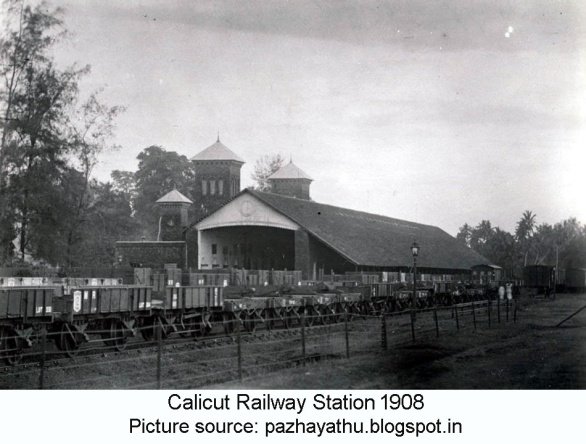 There is a temporary wooden bridge over the Kallai river. It will be replaced by the railway iron bridge which is so designed as to suit the local traffic as well. Near this bridge is a Government timber depot, where teak and saplings, from the Nilambur plantations, are floated down and stored.
The Conolly canal connects the Kallai with the Ellatur river and thus provides an uninterrupted line of water communication from Beypore to Badagara, a distance of 37 miles. A list of ferries in the taluk is given below :
|
First Class. |
Fourth Class. |
|
1. Mammallikadavu. |
20. Pulikkalkadavu. |
|
2. Chaliampula (Beypore ferry). |
21. Purakatirikadavu. |
|
3. Korapulakadavu. |
22. Putukkatkadavu. |
|
Second Class. |
23. Putiyottilkadavu. |
|
4. Elamaramkadavu. |
24. Parambilkadavu. |
|
5. Urakadavu. |
25. Cheruvattakadavu. |
|
6. Arapulakadavu. |
26. Mavalikadavu. |
|
7. Olasherikadavu. |
27. Chettukadavu. |
|
Third Class. |
28. Kurungotkadavu. |
|
8. Chakkumkadavu. |
29. Kudattayikadavu. |
|
9. Irupulinyikadavu. |
30. Kakkodikadavu. |
|
10. Kulumadamuku alias Puttanangadikadavu |
31. Tottattilkadavu. |
|
11. Irupulinyi Mokkakadavu. |
32. Tondinmelkadavu. |
|
12. Teyyattinkadavu. |
33. Attiyanmolikadavu. |
|
13. Kuliyatamokkakadavu. |
34. Kannanchinnanpalam. |
|
14. Manakadavu alias Kuttankadavu. |
35. Kunnattukaduvu. |
|
15. Puttekadavu. |
|
|
16. Pallikadavu. |
|
|
17. Parayangotkadavu. |
|
|
18. Manantalakadavu. |
|
|
19. Mukkuvarkandikadavu. |
|
In Edakkad amsam is a small Mappilla village known as Putiyangadi (new bazaar), about three miles from Calicut town. Here lives the Mappilla priest, called Putiyangadi Tangal of pure Arab extraction. There is a Jamatt mosque here said to be more than 130 years old, 72 by 30 feet in size. A festival is celebrated here annually. Though a small Mappilla hamlet, Putiyangadi possesses eight mosques.
In Panniyankara amsam there is a locality called Gomukham (cow's face) on the sea-shore where Hindus resort for ablutions as a place of sanctity on occasions of new moon and eclipse.
In Cheruvannur amsam at Mammalli, about 7 miles from Calicut, there is a coffee-curing establishment under European management.
There is in this amsam an important Hindu temple called the Cheruvannur temple dedicated to Siva, Subramanyan, Ayyappan, Ganapati and Dakshinamurtti. The roof of the shrine is copper plated. The temple is sculptured. On a beam is a comparatively recent Malayalam writing that the temple was built by the Uralars. The temple is 99 by 44 feet in size, and a festival is celebrated annually for 41 days called Mandala Vilakku in December and January.
In this amsam are the Marakkat works once noted for its iron manufacturies.
Beypore is a mall town in an amsam of the same name. It was formerly known as Vaypura and Vada Parapanad. Tippu Sultan named the town “Sultan patnam’’. It lies between Lat. 11° 10' N., and Long. 75° 60' 30" E. According to the census of 1871, there were 1,102 houses ; the population was 6,214. In the census of 1881 there were 1,119 houses with a population of 6,739 souls.
Though many attempts have been made to utilise the great natural advantages of its position, it was not until 1858, when Challiyam Island, on the opposite bank of the river, was made a terminus of the Madras Railway, that the town became of importance. Tippu selected it as the site of the capital of Malabar, but hardly a vestige of its short-lived importance has survived.
In 1797 sawmills, in 1805 a canvas factory, in 1848 iron works and, later still, ship-building works were started here, but all from one cause or another have failed. In 1858 the railway created the present town, and Beypore is every year becoming busier. But the extension of the railway to Calicut is likely to result in the reversion of Beypore to its old state of a fishing village.
The Beypore bar admits crafts of 300 tons to the river, and at low spring-tides, gives soundings of 12 to 14 feet and at high tides from 16 to 18 feet.
In Beypore amsam there are four Kovilakams called —
1. Manayatt kovilakam, | 3. Pudia kovilakam,
2. Nediyal kovilakam, | 4. Panangat kovilakam,
belonging to the family of the Beypore branch of the Parappanad family. There is also a Hindu temple containing sculptures and dedicated to Siva, Ganapati and Bhagavati with a laterite built tank and a Brahman feeding-house. The temple is 180 by 138 feet. There is a travellers’ bungalow as well as a Sea Customs office here.
There is a place of sanctity for Hindus on the sea-shore in this amsam, called Kotesvaram for purposes of ablution on occasions of new moon or eclipse.
In Valayanad amsam there is an ancient temple called Srivalayanad temple. The roof of the shrine is copper plated. It is 192 feet long by 144 feet broad. There are elaborate sculptures on the gopuram. The temple belongs to the Zamorin. An annual festival lasting for 8 days is celebrated in this temple in the month of Makaram (December-January), when the image of Bhagavati worshipped in the temple is taken in procession round the temple on an elephant’s back with great pomp.
At Tamarasseri, in Kedavur amsam, there is a palace belonging to the Kottayam Raja. Close to it is a tank which is 240 by 144 feet. It is not in a state of preservation, but there are indications of its having been built in laterite. As stated elsewhere, there is a Sub-Registrar’s office here as well as a chattram maintained by the District Board. At Putupadi, in this amsam, there is a chattram kept up by a native landlord. There is also a comfortable little hotel for Europeans travelling to and from the Wynad planting districts. Tamarasseri ghaut is much used for the export of coffee from Wynad.
In Kanniparamba amsam, there is a temple dedicated to Siva, Vishnu, Ganapati, Ayyappan and Dakshinamurtti. It is 132 feet square. It is a very ancient temple so much so that it is fabled to have been founded by Kannwa Rishi commemorated in the Maha Bharata.
In Kanniparamba amsam, there is on the rocky pinnacle of a hill a pit which is four koles square and half a kole deep, from which, according to native popular belief, holy water gushes out daily in the morning in the month of Edavam (April-May) for a nalika (20 minutes) when it miraculously becomes dry. It is also said that the holy water begins to flow on the occasion of Sivaratri festival in Kumbham (February- March). Pilgrims aggregating 3,000 in number assemble on this hill on such occasions. This hill has been noticed in Ward and Connor’s memoir.
Fairs and Markets.—At Karamparamba, in Kacheri amsam, a weekly fair is held on every Monday, when more than 1,000 persons resort to it from rural parts. A weekly fair on every Sunday is held in Manasseri amsam and at Kedayur every Tuesday. In the town of Calicut, the Municipality maintains two important markets There are also several petty markets in the town licensed by the Municipality.
Archœology.—Kaulanur desam in Annasseri amsam, 8 miles north of Calicut, there are two rock-cut caves. In Kannankara desam there are three menhirs and a stone circle.
In Nagaram amsam, in Machchinde mosque, is a slab let into the wall, having an inscription in Arabic, Canarese and an unknown language. It is much injured by time and weather.
In Chevayur, 3 miles north-east of Calicut, exists a sepulchral rock-cut cave ; an erect pillar stands in the middle of the main chamber. The hole at the top of the cave was covered by a block of stone which hid it from sight. Several pots and parts of a sword were found in it.
In Iringallur amsam, 3 miles east of Calicut, there is a dolmen. In the desam of Kottul, there are four such dolmens, and in Kayilamatham one. They are all surrounded by stone circles.
In Kanniparamba, 11 miles east of Calicut in the hamlet of Kalpalli, there is a toppikal or hat-stone. In Atuvatu and Mavur, there is a menhir in each, and in Palangat, a rock-cut cave.
In Karipuram temple, in Payipalasseri desam, Kilakkott amsam, 15 miles north-east of Calicut, there is an inscription in old Tamil on a slab.
In Koduvalli amsam, 16 miles north-east of Calicut in Chorgotur desam in the temple, is a granite slab with an inscription in old Tamil. There is also a menhir here as well as in Manapuram desam. In the temple at the latter desam, there is an inscription in old Tamil on a granite slab.
In Kovur amsam, 5 miles from Calicut, in Velliparamba desam, a cave was discovered in the backyard of a private honse. It was opened and closed again by the house-owner.
In Padinhattummuri amsam, 6½ miles north of Calicut, a number of very interesting rock-cut caves were excavated, from which a quantity of pottery was unearthed. An account, of the place with two plates of engravings was published in Vol. VIII of the Indian Antiquary. The articles found in the cells were sent to the Madras Museum.
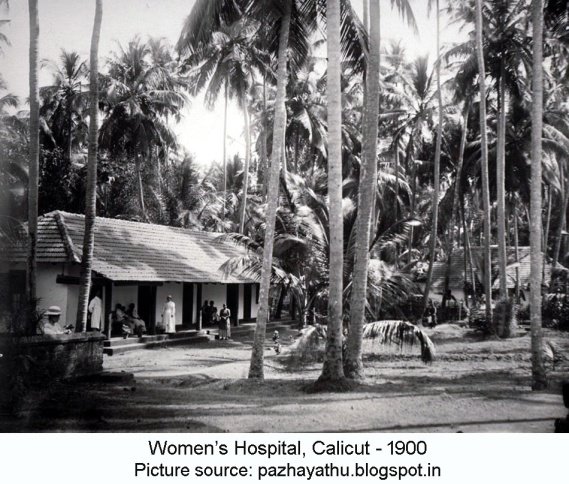 In Puttur amsam, 12½ miles east north-east of Calicut, in the temple in the Chokur desam, there is an inscribed granite slab with an old Tamil inscription. In the desam of Ketayantur is a dolmen and a rock-cut cave, and in Chokur desam there is a menhir. Picture source: pazhayathu.blogspot.in
In Talakulattur amsam, 8 miles north of Calicut, there is an old temple with an illegible inscription on a stone.
In Valayanad amsam, 2 miles east south-east of Calicut, in Konneri desam, there is a rock-cut cave now filled up.
Trigonometrical Survey Station—Pokkunnu in Valayanad amsam is the only Trigonometrical Survey station in the Calicut taluk.
Dams and Anicuts.—In Karannur amsam, there is a dam known as the Muliyar nada, which is constructed for the protection of cultivation.
At Putiyachira on the road to Chevayur, there was some time back a lock in the Conolly canal for the protection of cultivation from the influx of salt water. It is not now repaired as the water traffic is of more importance. The Conolly canal passes through the amsams of Kasaba, Kottuli, Kachcheri, Edakkad, Karannur, Makkada and Elattur, and connects the Kallayi with the Elattur river.
ERNAD TALUK
By V. Chappu Menon, B.A.
Boundaries.—This taluk comprises the two old taluks of Ernad and Cheranad. It is bounded on the north by Calicut and Wynad, on the east by the Nilgiri district, on the south by Walluvanad and Ponnani, on the west by the sea.
Area. — Eight hundred and eleven square miles, of which 140 square miles, or about one-sixth of the whole extent, may be said to be under cultivation. The remainder consists of waste lands and hilly tracts.
Population.—The total population, according to the census of 1881, was 296,143, of whom 148,521 were males and 147,622 females. Distributed according to sects, the population stands as follows:-
|
Hindus |
145,451 |
|
Muhammadans |
149,987 |
|
Christians |
699 |
|
Other classes |
6 |
This taluk contains the largest number of Muhammadans usually denominated Mappillas, comprising, as it does, a ratio of 23 per cent of the entire Mappilla population in the district.
The total number of houses in the taluk in 1881 was 60,596, of which 54,415, or about 90 per cent, were occupied and the rest unoccupied.
Physical Aspects. —The country is overrun with woods, hills and mountains. The eastern portion comprehending the Nilambur valley formed by the ghats and the Kunda mountains and the Wavul range extending to Chekkunnanmalai (ചെക്കുന്നൻമല), a high saddle-hill north-east of Ariakode contains teak and other timber in almost inexhaustible quantities and it is mostly from this valley that the largest timber is obtained. The central portion is here and there flat with mountain ridges running in different directions. The western portion, with the exception of a few miles from the coast, which is flat, is undulating intersected in all directions by extensive valleys of wet cultivation.
Mountains and Hills.—The most remarkable hills are—
(1) The Wavul range.
(2) The Chekkumalai or Chekkunnan hill, containing a Trigonometrical Survey station.
(3) The Pantalur hill whose ridge separates the Ernad from Walluvanad taluk.
(4) The Urothmala hill which formed the boundary of the old Cheranad taluk and which contains likewise a Trigonometrical station.
Forests.— Ernad taluk furnishes most valuable timber trees. Various exotics, such as mahogany and rubber trees, castilloa, hevea and ipecacuanha, are being planted and experimented with, and some of them have thoroughly been acclimatised and established there. At Nilambur, these experiments and plantations are under the management of the District Forest Officer located at that station. The following is a list of forests which are under the control of this officer :
|
No |
Name of forest |
Situation |
Area in square miles |
Whether Government or leased forest, and if leased from whom. |
|
|
Taluk |
Amsam |
||||
|
1 |
Karimpoya Reserve |
Ernad |
Nilambur |
6.18 |
Government forest |
|
2 |
Amarapolam do |
Do |
Do |
0.77 |
Do |
|
3 |
Chathamborai do |
Do |
Do |
1.09 |
Leased from Naduvatti or Wandur Nambudiripad. |
|
4 |
Nellikutta do. |
Do |
Do |
2.99 |
Leased from the Zamorin of Calicut. |
|
5 |
Valluvasheri block comprising – |
|
|
|
|
|
|
(1) Pokode |
Ernad |
Nilambur |
1.18 |
Leased from Trikkallur Devasam. |
|
|
(2) Panangode |
Do |
Do |
1.41 |
Do |
|
|
(3) Valluvasheri |
Do |
Do |
1.45 |
Do |
|
6 |
Nilambur block comprising - |
|
|
|
|
|
|
(1) Trevalikava |
Ernad |
Nilambur |
8.37 |
Leased from Trikkallur Devasam. |
|
|
(2) Anwakod |
Do |
Do |
||
|
|
(3) Edakod |
Do |
Mambat |
||
|
|
(4) Ellanjeri |
Do |
Nilambur |
||
|
|
(5) Ramalur |
Do |
Do |
||
|
|
(6) Mulataranna |
Do |
Do |
||
|
7 |
Erambadom |
Do |
Do |
.90 |
Leased |
|
8 |
Kanakut |
Do |
Do |
1.04 |
Leased from Trikkalur Devasam. |
|
9 |
Muriat |
Do |
Do |
2.75 |
Do |
|
10 |
Karien |
Do |
Do |
1.48 |
Do |
|
11 |
Mangalasseri |
Calicut |
Manasheri |
.01 |
Do |
|
12 |
Ambalakandy |
Do |
Pannikod |
.001 |
Do |
|
13 |
Arimbracutta |
Ernad |
Urangattiri |
.50 |
Do |
|
14 |
Puthalatha and Chittarikkal |
Calicut |
Manasheri |
.01 |
Do |
|
Total |
30.13 |
|
|||
The Nilambur teak plantations were first suggested in 1840 by Mr. Conolly, Collector of Malabar, who described their object as being “to replace those forests which had vanished from private carelessness and rapacity—a work too now, too extensive, and too barren of early return to be ever taken up by the native proprietor."
Great difficulty was at first encountered in getting the seed to germinate and many expedients were resorted to. These proved entirely unsuccessful. In 1843, Dr. Roxburgh suggested the method of sowing the seed at the beginning of the rains in shaded beds lightly covered with earth and rotten straw, and this system, which proved a success is now pursued with slight modifications suggested by experience.
The first attempt at planting was made in 1842 and was followed in regular succession under the able management, first of Chathu Menon, the native conservator, who for 20 years carried on the operations, and of Mr. Ferguson, whose skilled and unremitting attention during the long tenure of his office from 1863 to 1883 had brought the plantations to their present pitch.
The “Memorandum on the Conolly Teak Plantations’’, prepared by Mr. Atholl McGregor in 1877 (printed at the Travancore Government Press), and Lieut.Col. Beddome’s "Report upon the Nilambur Teak Plantations”, printed at the Government Press, Madras, in 1878, contain most valuable information in regard to the Nilambur forests. An extract from the former publication is printed at the end of this paper.
Rivers.—The following are the principal rivers in the taluk :
1. The Beypore river (also called the Ponpula or Gold river) which rises in the mountains south of the Naduvattam pass, and after meandering through Wynad, rushes down the ghats into the Nilambur valley, receiving in its devious windings, before reaching Nilambur (a) the Kalakkampula, (b) the Karkurpula, (c) the Sholayar or Cholayar on its right bank and (d) the Karimpula on its left bank. The last named is a formidable river fed by numerous streams rushing down from the crest of the Nilgiri and Kunda mountains. The union of these streams now forms one considerable river, which runs north of Nilambur, and after receiving in its serpentine windings and course several streams, such as the Kurampula and the Kudirapula, discharges itself finally into the sea at Beypore. The river is navigable all the year round up to Ariakode, but boats go up with ease to Nilambur during the monsoon, and smaller boats proceed even further up to Edakara, about 8 miles north-east of Nilambur. The distance from Calicut to Ariakode by land, according to the Route-book, is 27 miles ; from Ariakode to Edavanna 8 miles, from Edavanna to Nilambur 8 miles ; from Nilambur to Edakkara 8 miles ; and from Edakkara to Nadagani 10 miles.
2. The Kadalhundi (Kadal-tundi) river rises in the southern slopes of the Kunda mountains, enters the taluk near Chappanangadi, meanders westerly with many serpentine windings, and after flowing via Tirurangadi empties itself into the sea at Kadalhundi. One branch of the stream joins the Beypore river opposite to the place of that name and forms the island of Chaliyam.
Like other rivers in Malabar, the Kadalhundi river is known by different names in the different parts of its course, eg., at Malapuram, it is called the Anakayam river ; at Tirurangadi, the Tirurangadi river, etc. The bed of the river is exceedingly narrow and rocky with high banks fringed with wood and groves of areca, and other palms at intervals. Teak and other timber, also rafts of bamboos are floated down to the coast to the depots at Beypore and Kallai near Calicut.
Subdivisions of the Taluk for Administrative Purposes —The taluk is divided into 52 amsams, of which 35 are under the magisterial jurisdiction of the Tahsildar-Magistrate and 17 under the Sub-Magistrate of Tirurangadi.
Previous to the revision1 of the taluk establishments by Mr. Pelly there were 2 taluks, designated Ernad and Cheranad, but in the year 1860 they were amalgamated, a Deputy Tahsildar being appointed for the Cheranad division.
NOTEs: 1. G.Os., dated1st October 1860, No. 1751 and 3rd November 1860, No. 2038. END OF NOTEs
The taluk of Ernad was along with Walluvanad and the magisterial charge of Cheranad entrusted to Mr. Collett, the Assistant Collector and Magistrate, under Collector's proclamation, dated 12th November 1849. He remained in charge till April 1854, when he was appointed Special Assistant Collector and Magistrate and latterly Sub-Judge, Calicut.
In 1856, Mr. E. C. G. Thomas was appointed Special Assistant and was succeeded by Mr. A. MacGregor under the orders of Government, communicated in G.O , dated 20th October 1863, No. 1902. The Special Assistant was transferred to Coimbatore for employment on the Nilgiris and the office was revived, on the recommendation of Mr. MacGregor after the Kolattur outbreak, by G.O, dated 11th October 1873, No. 1629. A further reconstitution took place in 1886, whereby the Special Assistant, was placed in the revenue charge of Ernad and Calicut taluks and in the magisterial charge of Ernad and portion of Walluvanad (vide G. O., dated 15th February 1886, No. 126). The Divisional Magistrate's headquarter are at Malapuram in Ernad taluk.
Public Establishments.—The various offices located in the taluk are the following :
(1) The Special Assistant Collector and Magistrate ar Malapuram.
(2) The Tahsildar and his establishment at Manjeri.
(3) The Deputy Tahsildar and his establishment at Tirurangadi.
(4) The District Munsif of Ernad at Manjeri and of Cheranad at Parappanangadi.
(5) Assistant Superintendent of Police at Malapuram.
(6) Inspector, Special Police force at Malapuram.
(7) Inspectors of Police at Manjeri, Malapuram and Tirurangadi and Police stations at –
|
Manjeri. |
Edavanna. |
|
Nilambur. |
Wandur. |
|
Pandikad. |
Malapuram |
|
Kottakal. |
Kondotti. |
|
Ariakode. |
Tirurangadi. |
|
Parappanangadi |
Chaliyam. |
|
Feroke. |
|
(8) District Forest Officer and his establishment at Nilambur.
(9) Sub-Registrars of Manjeri, Malapuram, Wandur, Kondotti and Tirurangadi.
(10) Government Telegraph office at Malapuram and the Railway Telegraph offices at Beypore and Parappanangadi.
(11) Post offices at Manjeri, Malapuram, Nilambur, Kondotti, Parappanangadi and Beypore
(I2) Local Fund middle school at Manjerj.
(13) Local Fund hospitals at Manjeri and Nilambur.
(14) Local Fund Supervisor and Overseers.
(15) Vaccine staff.
(I6) Military detachment at Malapuram.
(17) Marine office at Beypore (Chaliyam) under the charge of the Port Officer, Calicut.
Towns and other places of importance.—There are no municipal towns constituted under the Act in the taluk. The places of importance are described below: —
Manjeri—in the amsam of the same name, is the headquarters of the taluk and is the seat of the Tahsildar, the District Munsif and the Sub-Registrar of Assurances. There are a Local Fund hospital, a public bungalow, a middle school and a chattram at this station. A weekly market is held which is generally-well-attended.
About a quarter of a mile to the south-east of the taluk is a pagoda called Srimuttra Kunnu alias Kunnath Ampalam, dedicated to Durga and situated on a low hill, and immediately below it is the residence of the Manjeri Karnamalpad. In the east wall of the temple is an inscription, dated K.A 827 (A. D. 1651), stating that Mana Vikrama built a matam. There is another near to the well to the north, dated K.A. 833 (A.D. 1657), by the same man.
It was this temple that was seized by the gang of Mappilla fanatics under Attan Kurikal in 1849, and Ensign Wyse, who lies buried on the taluk cutchery hill, was killed in an attempt to take the temple from the fanatics. There are several large dolmens, menhirs and rock-cut caves in this amsam.
Nilambur—which is about 16 miles from Manjeri, is an important station for timber traffic. It is the seat of the District Forest Officer who has charge of the extensive Government teak plantations, and contains a hospital, a Police station, a public bungalow and a Post office. The District Forest Officer is also a Special Magistrate for the trial of offences under the conservancy clauses of the Police Act.
The Nilambur and Amarampalam Tirumalpads who own extensive forests reside in the Nilambur amsam. There are two temples, one dedicated to Vettakkorumakan and the other to Siva. There is an inscription on a block of gneiss rock in the Cherupula river about 1½ miles below the junction with the Karimpula, known as "Eltu Kallu" or Eluttu Kalla, and used to determine the boundary between two janmis. The stone is in the middle of a forest far from any habitation, and the inscription is only visible in extremely dry weather, being below the ordinary low water level. There are numerous dolmens and menhirs and rock-cut caves in the amsam. Gold washing was carried on formerly at Nilambur and the gold so obtained was called channam.
Etakkara—on the river side 8 miles to the east of Nilambur on the road to Nilgiris, is an extensive plain of black rich soil, supposed to be once thickly populated judging from the remains, which are still visible, of ruined temples, houses, tanks, wells, etc. It is now covered with dense jungle, which is well stocked with game. The place is feverish at certain times of the year. There is a public bungalow for the accommodation of travellers going by the Karkur pass.
Wandur—in the amsam of the same name, is 12 miles from Manjeri, and is the seat of a Sub-Registrar of Assurances, who is also a Special Magistrate. There is a Police station, also a good public bungalow which was once largely used by passengers travelling by the Sispara or Chichchippara route to the Nilgiris. The road has fallen into disuse and is not now properly maintained. There is a mosque at this place ; also a Siva temple.
Pandikad—in the amsam of the same name, is 8 miles from Manjeri, and has a Police station, a small public bungalow and a weekly market. Iron ore is obtained to some extent in these parts.
Mambat—in the amsam of the same name, contains a Mappilla bazaar and is a place of timber trade.
Edavanna—in Tiruvali amsam, is a rising Mappilla town on the Nilambur river about 8 miles from Manjeri and has considerable timber trade. There is a mosque at this station, also a temple at Tiruvali about 2 miles from the Edavanna bazaar.
Ariakode—in Iruvetti amsam and about 11 miles from Manjeri, is a small Mappilla town pleasantly situated on the south bank of the Beypore river, and has considerable timber trade. There is a Police station and a good bungalow built on a hill about half a mile from the village for the accommodation of travellers going to Nilgiris via the Karkur pass. The scenery about the place is charming and plenty of easy shooting is available in the neighbourhood. There is a mosque at this station.
Trikkallur or Trikkalliyur—In Urangattiri amsam, is celebrated for a Siva temple standing on elevated ground. It was in this temple that Kutti Assan and eleven other Mappillas made a detenmned stand against the Police and the Military from the 27th to 29th December 1884. The temple was captured and the fanatics slain after breaking open the loopholed barricaded doors with dynamite. The temple owns large property managed by Kirrangat Ashtamurti Nambudiripad of Vallappula amsam, in Walluvanad taluk. Opposite the temple stands the Churoth mosque, in which the fanatics prayed before taking post in the pagoda. The Mappilla inhabitants of the amsams of Urangattiri, Mappram, Chikod, Iruvetti and Tiruvali were fined for this outrage under the provisions of the Mappilla Outrages Act XX of 1859.
Chembrasseri amsam.—Iron ore is found in this amsam, which is one of the biggest in the taluk.
Kottakal—in the amsam of the same name is 14 miles from Manjeri, and is the seat of the Kilakke Kovilakam Rajas, one of the three branches of the Zamorin's family. There are here the old fort, called Venkatakotta and a small bungalow built by the Raja for the accommodation of visitors. A weekly fair is held, at which areca-nut, arrow-root flour and ginger form the principal articles of trade. The Military camping ground at Klari is only 2 miles from this place.
Malapuram—-(literally mountainous place) in Kilumiri amsam, is a healthy military station about 7 miles from Manjeri and 31 miles from Calicut. It is the seat of the Special Assistant Collector, of the Assistant Superintendent of Police and the Special Police force and of the Sub-Registrar of Assurances. It contains, likewise, Post and Telegraph offices, a public bungalow, a D.P.W. halting shed, barracks for European troops, a Chapel, two Christian cemeteries, a small bazaar, and a weekly market well-attended.
Tippu had a fort here, which is now in ruins. Near the barracks there are good recreation and camping grounds for the troops. Malapuram is the centre of the country which has been fruitful in Maippilla fanatical outbreaks, and in consequence of two risings in 1841 and 1843, native troops were sent here; but as they proved useless during the outbreaks of 1849 and 1851, a detachment of European troops has been stationed here since 1852.
A description of the boundaries of the Military Cantonment for the European barracks at Malapuram will be found printed at page 172 of the Fort Saint George Gazette, dated 22nd February 1853.
The detachment was augmented and officers' quarters built since the Kolattur outrage of 1873. On more than one occasion, special Police corps1 were raised in Malapuram to deal with local outrages, but in the lull which followed the passing of the Mappilla Outrages Act, the work was transferred to the regular constabulary2. A special Police force has again been posted here since 1885.
NOTEs: 1. Vide extracts from Minutes of Consultation, dated 16th May 1854, No. 352.
2. G.O., dated 4th May 1860, published in the Fort Saint George Gazette of the same date. END OF NOTEs
At a short distance from the Malapuram barracks is the Malapuram mosque, which is a tiled building and is of some importance. An annual festival, called Nerchcha is held here usually in the month of Kumbham, supposed to be in commemoration of the death of 40 Mappillas who fell in an encounter with the neighbouring Hindu landlord, Para Nambi’s followers.
There are three Hindu temples in the amsam, known as (1) the Tripuranthakan temple near the barracks, (2) the Mannur Siva temple and (3) the Channath Siva temple. The sacred places of Muhammadans, in addition to the Malapuram mosque, are (1) the Hajiyar Palli and (2) Sayyid’s Jarum (സെയ്തന്മാരുടെ ജാരം).
Kondotti—in Kolattur amsam (17 miles from Calicut), is an important Mappilla town on the road to Calicut and contains the office of the Sub-Registrar who is also a Special Magistrate. There are besides a Police station, a Post office, and a public bungalow.
It is the residence of the Kondotti Tangal who is the Muhammadan high priest of the section of Mappillas known locally as Kondotti Kayikkars. There is a shrine here called Kondotti-thakkiya, which is supposed to have been built in 948 M. E. (A.D. 1773) by the then Tangal, named Muhammad Shaha and in which lie interred his remains. A Nerchcha is performed here annually in the month of Minam. The Tangals have been loyal to the British Government and their loyalty has been rewarded by the grant of a personal inam to the extent of Rs. 2,734 per year (vide G.O., dated 12th October 1865, No. 2474), and by permission to keep seven pieces of cannon (vide licence granted by the Government of India, under date the 15th September 1885, No 43, forwarded with Madras Government G.O., dated 29th September 1885, No. 2617, Mis.).
There are two mosques at this station which are largely attended.
Urakam-Melmuri contains the Uroth hill which was used as a heliographic station in February 1885 during the disarming operations then in progress. On the top of the hill stands the Tiruvarchchanam Kunnu temple dedicated to god Sankara Narayanan. The Ponmundam fanatics in May 1885 tried to occupy this hill after the murder of Cheruman Kutti Kariyan and his family on the 1st May 1885, but had to leave it for want of water.
The celebrated Mattattur mosque is situated in this amsam.
Tirurangadi (literally Tiru == sacred, ur = village, angadi = bazaar or the place of bazaar in the sacred country of Cheranad) in Trikkulam amsam, is the seat of the Deputy Tahsildar, of the Sub-Registrar of Assurances and of the Police Inspector of that division, and contains a Post office, a bazaar and a well-attended weekly market. The town, which consists of long and crooked streets, lies on the south bank of the river and has nothing remarkable about it, save that there are a jamath mosque which is attended by a large congregation and a Hindu temple dedicated to Siva. There are the remains of a fort dismantled several years ago. In the vicinity of this fort, a decided victory was gained by General Hartley over Tippu’s troops in 1790 (Vol. I, p. 470).
And it was in the same neighbourhood that Colonel Humberstone defeated and slew Mukhdam Ali, one of Hyder Ali’s Generals on 8th April 1782 (Vol I, p. 433). It is curious that the only two pitched battles fought in Malabar between the Mysoreans and the British took place on the same battlefield.
Mampram lies directly opposite to Tirurangadi, on the north bank of the river, in Kotuyayur amsam, and contains the mukham or tomb of a great Tangal buried there. It is on this account a place of considerable pilgrimage. The history of the Tangal who lies interred there is as follows : —
In the early part of the 18th century a Tangal named Sayyid Hussain Ibn Alabi Jiffiri Tangal, who is supposed to have come from Arabia settled at the place called Mampram or Mampuram which was then an extensive waste. It was reclaimed and planted with coconut trees for the growth of which the soil appears to be admirably adapted. He lived in a house called Taramal, and died in the month of Shaban in the Hejira 1169, leaving a daughter named Fattima.
In the fifth year after his death, there arrived at Mampram his nephew (sister’s son) and son-in-law (Fattima’s husband) named Sayyid Alabi Ibn Muhammad, whom in his lifetime the Mappillas served with the utmost devotion and whom after his death they have deified. His first marriage with Fattima was not fruitful, and he married, as his second wife, a woman from the Putiamaliakal house in Calicut.
His next marriage was with a woman of Quilandi, by whom he had, among others, Sayyid Fazl usually known as Pukkoya who was banished with his relatives beyond India on the 19th March 1852.
Sayyid Alabi’s fourth wife was a woman of Ponmundam m Ponnani taluk, who bore him a daughter.
The mukham or shrine intended and used primarily as a receptacle for the dead bodies of the principal Tangals is a rectangular building constructed on very solid foundations, and divided into large hall-like rooms. The building has upper storeys, in one portion there are three and in the other two storeys. The second floor of one of the rooms stands on a higher elevation than that of the other, and over it an upper floor stands, the circular wall of which is capped by the dome. On the foundation floor of the domed hall are laid 9 coffins, including in them those of Sayyid Alabi who died in 1019 M E (Hejira 1260), and his uncle and those of their nearest deceased relatives. The other hall is the place where verses from the Koran are read for the salvation of the souls of the deceased persons.
The shrine was built over the grave of his uncle by Sayyid Alabi in the third year after his arrival at Mampram or in the 8th year after the uncle’s death. The space in the interior which was originally of lesser dimensions than the foundation, was found not sufficient to allow of walking on it after the nine bodies had been buried there.
A certain Karachi merchant out of gratitude to Sayyid Alabi for his having been miraculously saved by the latter in a shipwreck at sea, had the room extended at his own expense so as to cover the entire space on the foundation. The dome having gone out of repair in recent years, it is now being put up anew and furnished by Putiyamaligayil Sayyid Abdulla Koya of Calicut, out of contributions for the purpose made by his co-religionists. This shrine has been frequently visited by Mappilla fanatics for the purpose of invoking the Varkkaths (blessings or aid) of the great Tangal buried there, previously to the execution of their designs. And it is also largely resorted to by other Muhammadans and by Hindus to invoke the great Tangal's aid in any enterprises in which they are interested.
Parappanangadi (literally the bazaar place in the Parappanad raj) is a small Mappilla village about 4 miles from Tirurangadi and is the seat of the Cheranad Munsif’s Court. It contains likewise a post office, a Police station and the Railway station of the same name. The palace of the Kshatriya family of Parappanad Rajas is situated at a short distance from the Railway station. It is from this family that the consorts of the Ranis of the Travancore family are usually selected.
Pepper, ginger, salted fish and areca-nut form the chief articles of trade and are exported in large quantities. The Munsif’s Court-house and the Railway station though usually known by the name of "Parappanangadi" are really located within the limits of the Netuva amsam.
Ferokh or (as Malayalis write it) Paramukka (written also Ferokabad in military department Route book), in Nallur amsam, contains a Police station and an important weekly market to which people from Calicut resort for the purchase of poultry, provisions, etc. Half a mile south west of it on an elevated spot are the rains of Ferokabad commanding two beautiful reaches of the Beypore river which flows immediately to the north of the fortress. It was planned by Tippu whose intention it was to make it the capital of Malabar, but his troops were driven out of it in 1790 before the design was fully carried out. He compelled a large portion of the inhabitants of Calicut to settle here, but on the departure of his troops they returned to their former abode.
The ferry at Ferokh is called the Mammalli ferry. The railway now in course of extension to Calicut passes through this place. An iron bridge on cylinders is being carried across the Mammalli (Beypore) river, and the bridge is to carry ordinary traffic as well as the railway. A railway station is also proposed at this locality. Two miles above the Mammalli ferry on the Ernad or south bank of the river lies Chattamparamba, a laterite hill containing numerous tombs of a long forgotten generation, some of them excavated from the laterite rock and others in the shape of huge earthen pots buried beneath the surface. From some of these, the interesting beads depicted in the illustrations at pages 180-81 of Volume I have been taken. Some of the beads are of agate with designs on them which take one back to the times of the Buddhists. The pottery, which is found in abundance in these tombs, is of a very varied character and quite different to anything manufactured in recent times.
Chaliyam in Palanchannur amsam (erroneously called Beypore, which is a contiguous amsam on the north bank of the river in the Calicut taluk) is an island formed by the Kadalhundi and Beypore rivers, and by the sea on the west. It is about ten miles in circumference. It is the present western terminus of the Madras Railway and contains a hotel, two public chattrams, a Police station, Post office, Marine flagstaff, a Protestant chapel and cemetery, a mosque and a petty bazaar. The travellers' bungalow and the Beypore Sea Customs office lie on the northern side of the Beypore ferry in the Calicut taluk. The Railway station has a flower garden and a small park kept in neat order by the railway company.
There is a rocky islet lying to the southward of the entrance to the Beypore river and connected with the mainland by a groyne. This islet contains two mounds, a northern and a southern one, and the Port Officer, Calicut, made excavations round the base of the former and discovered the remains of what appeared to be the remains of a fortress. Captain Gillham states as follows : —
"There is now no question or doubt but that the masonry was the commencement of foundations for a very formidable fortress for the protection of the entrance to Beypore river. The walls being the strongest on the west and north-west and north angles where the foundations were 13 feet across and from 2 to 3 feet deep, commencing on coarse sand and shelly bottom. The portion comprised between the south-west angle of the mound round by east to the north angle is of cut laterite stone built in chunam, and from the north angle to the south-east angle round by east, the foundations are cuttings and levellings on the upper surface of the laterite rock, with small portions of concrete and. masonry levellings in places. From the fact of the foundation having been commenced on a sandy soil, together with the fact that when excavations were being made into the base of the north mound, a considerable quantity of red soil was found, has led me to the opinion that the mounds on the islet are not natural, but artificially made from soil carried to the islet from the mainland.”
The Port officer also dug three wells with the object of ascertaining whether fresh water was obtainable on the isle. Of these three, two yield perfectly pure water, but the third proved brackish. It is likely that the foundations of the fortress discovered formed part of Tippu Sultan’s project for protecting his projected city at Ferokh.
Kadalhundi and Nirumkayitha kotta in Vallikunnu amsam are small hamlets of some note. The former contains a Mappilla bazaar and the latter the important temple known as Nirumkayitha kotta dedicated to god Ayyappan. The temple has a copper sheet roof and stands on the slope of an elevated hill. On the top of the hill called Melkotta, there is a deity which persons proceeding to the Nirumkayitha kotta temple go up to worship. The place is infested by monkeys, supposed to be a portion of the army with which Rama conquered Ceylon, left here by him on his return from his expedition.
The following temples and mosques which are not described above deserve notice :—
(1) Manjeri Amsam —(1) Arizhayi Siva temple, (2) Pantalur temple, (3) Manjeri mosque.
(2) Trikkalangot Amsam—contains the Trikkalangot temple dedicated to Vettakorumakan and certain inscriptions in Vatteluthu and five dolmens. The celebrated Karikkatt temple, dedicated to Subramania, also exists here.
(3) Ponmala Amsam—contains the important Ponmala temple and the Ponmala mosque.
(4) Intiannur Amsam—contains a temple, dedicated to Ganapathi and Siva.
(5) Kottakkel Amsam—contains (1), Kotlakkel Siva temple, (2) Pandamangalam Vishnu temple, (3) Vettakkorumakan temple.
(6) Netiyiruppu Arnsam—contains Pulikkad Bhagavathi temple.
(7) Alinjilam Amsam—contains (1) Pariapuram temple, dedicated to Subramania, (2) Palakkel Bhagavathi temple, (3) Karumaken kavu temple, (4) Ariyil Siva temple. (8) Nallur Amsam—contains the Nallur Siva temple which is of some importance.
(9) Chelembra Amsam—contains (1) Vennayur Vishnu temple, (2) Itavalikkel Ganapathi temple, (3) Tiruvangat Siva temple.
(10) Karat Amsam—contains Virali kavu temple.
(11) Puthur Amsam—contains Cherukunnath Bhagavathi temple, the deity of which is supposed to have come from the temple of that name in North Malabar.
(12) Valluvambram Amsam—contains Pullanur mosque.
(13) Netuva Amsam—contains Pisharikkel kavu temple alias Puthiarayara Nallur temple, dedicated to goddess Mukambika.
Christian Churches, and Cemeteries and scattered Tombs.—There are Roman Catholic and Protestant chapels at Malapuram and at Chaliyam (Beypore). There are also cemeteries at each of these stations. The scattered tombs in the taluk are the following.-
(1) Tomb near the District Forest office at Nilambur bearing fhe following inscription—“To the memory of Samuel Robert Clogstoun, Lieutenant in the 23rd Regiment, M.N.I. He was born on the 26th January 1824 and drowned in the Chellambore river (Nilambur) near this spot on the 13th August 1843. Generous, high spirited and of great promise ; he died deeply regretted. His brother officers, in testimony of esteem for his worth and sorrow for his early death, have erected this tomb”.
(2) Tomb of Ensign Wyse, who died at the hands ot Mappiila fanatics in 1849 in Manjeri amsam close to the District Munsif’s Court, bears no inscription.
(3) Tomb of Mary Elliot in the Valakkat coffee estate, in the jungly wilds of the Silent Valley in Chembrasseri amsam.
Soil and Productions.—The soil of the western portion of Ernad and on the heights, is red laterite intermixed with gravel ; in the valleys of cultivation, it is a rich brown free from gravel, so also in the cultivated tract in the interior. The dense coconut belt usually not more than 4 miles wide extending along the coast, runs up for 12 or 15 miles into very nearly the heart of the taluk about Malapuram, and the soil in these parts seems to be singularly well adapted to this tree and to other vegetable productions, among others, the pineapple which nowhere flourishes better than in these richly cultivated low-lying valleys in Ernad.
In the forests and mountains, the soil is a rich black mould owing to the constant falling of decayed leaves and rotten wood. Granitic gneiss is conspicuous on the face of the ghats and the mountains, to the east where it is seen to form a perfect barrier. The productions generally are rice of various sorts, and several species of dry grain and pulses ; pepper is produced but not in such abundance as in the tracts along the coast. The areca palm is cultivated extensively about the central parts and grows luxuriantly on the banks of all the rivers ; it is, however, scarce to the east of Nilambur.
Timber of many descriptions, also bamboos, honey and bees' wax are obtained from the forests.
Inams.—A list of inams of various descriptions granted in the taluk is appended.
|
No. |
Name of Inam holder |
Amsam in which Inam lands are situate. |
Amount |
Remarks |
||
|
Devadayam (or inams granted for Temples). |
Rs |
A |
P |
|||
|
1 |
Kapilkarimkali kshetrom. |
Nilambur |
1 |
3 |
3 |
For the expenses attending the usual ceremonies in the temple. |
|
2 |
Chementala Bhagavati kshetrom |
Do |
18 |
8 |
5 |
|
|
3 |
Wandur Siva kshetrom |
Wandur |
7 |
10 |
3 |
|
|
4 |
Punapalei Siva kshetrom |
Do |
6 |
0 |
11 |
|
|
5 |
Chatengam Kulangara Vishnu kshetrom |
Do |
3 |
11 |
9 |
|
|
6 |
Karikat kshetrom |
Do |
20 |
0 |
0 |
|
|
7 |
Do |
Irimpuli |
28 |
13 |
3 |
|
|
8 |
Irimbuli Vishnu kshetrom |
Do |
5 |
7 |
9 |
|
|
9 |
Mutrakunnu kshetrom |
Irimpuli |
32 |
2 |
6 |
For the expenses attending the usual ceremonies in the temple and for entertainments given to Brahmins. |
|
10 |
Karikat kshetrom |
Trikalangode |
19 |
1 |
1 |
For the expenses attending the usual ceremonies in the temple |
|
11 |
Meladatha kshetrom |
Do |
33 |
4 |
0 |
|
|
12 |
Mutrakunnu kshetrom |
Manjeri |
1,112 |
7 |
10 |
Do and for entertainments given to Brahmins. |
|
13 |
Arupiraya Siva kshetrom |
Do |
28 |
12 |
3 |
For the expenses attending the usual ceremonies in the temple. |
|
14 |
Vakethodi Karinkali kshetrom |
Do |
35 |
8 |
5 |
|
|
15 |
Tiruvidaikal kshetrom |
Do |
14 |
2 |
4 |
|
|
16 |
Orinadatha Siva kshetrom |
Do |
14 |
11 |
2 |
|
|
17 |
Pantalur Bhagavati kshetrom |
Do |
63 |
3 |
8 |
|
|
18 |
Potiyatu kshetrom |
Melmuri |
13 |
4 |
8 |
Do and for entertainments given to Brahmins. |
|
19 |
Kurumangote Iyyappan kshetrom |
Pandikad |
2 |
6 |
6 |
For the expenses attending the usual ceremonies in the temple. |
|
20 |
Naduvatha kshetrom |
Do |
9 |
3 |
6 |
|
|
21 |
Nechiparambeth Tripurandakan kshetrom |
Kilmuri |
31 |
4 |
8 |
|
|
22 |
Ulanam Siva kshetrom |
Neduva |
19 |
1 |
9 |
|
|
23 |
Chiramangalath Vettakkorumakan kshetrom |
Do |
19 |
12 |
0 |
|
|
24 |
Tirumandhan kunnu Bhagavathi kshetrom |
Porur |
7 |
1 |
5 |
|
|
25 |
Palaparamben kshetrom |
Kotuvayur |
12 |
5 |
6 |
|
|
26 |
Mutuvelur Bhagavati kshetrom |
Kulimanna |
7 |
11 |
6 |
|
|
27 |
Mannur kshetrom |
Vallikunnu |
98 |
13 |
4 |
|
|
28 |
Nerumkaithakotta temple |
Do |
311 |
6 |
4 |
|
|
29 |
Do |
Palenchennur |
9 |
6 |
10 |
|
|
30 |
Trikkolam kshetrom |
Trikkolam |
13 |
1 |
2 |
|
|
Total |
2029 |
12 |
0 |
|
||
|
No. |
Name of Inam holder |
Amsam in which Inam lands are situate. |
Amount |
Remarks |
||
|
Devadayam (or inams granted for charitable purposes). |
Rs |
A |
P |
|||
|
31 |
Cherukuticheri karapram chattram. |
Mapprom |
2 |
9 |
6 |
For the expenses attending the entertainments given to Brahmins. |
|
32 |
Do |
Chikod |
18 |
6 |
2 |
|
|
33 |
Keraladhiswarapuram |
Neduva |
125 |
0 |
5 |
|
|
34 |
Do |
Nannembra |
5 |
1 |
0 |
|
|
35 |
Do |
Valakulam |
18 |
8 |
8 |
|
|
36 |
Trikandiyur chattram |
Do |
2 |
11 |
5 |
|
|
Total |
172 |
5 |
2 |
|
||
|
Name of Inam holder |
Amsam in which Inam lands are situate. |
Amount |
Remarks |
||
|
Religious Institutions (or inams granted for mosques). |
Rs |
A |
P |
||
|
Malapratha Ajiyara Palli mosque. |
Kilmuri |
0 |
10 |
9 |
For defraying the expenses for lights. |
|
Malapratha Ajiyara Palli mosque. |
Mampad |
7 |
5 |
10 |
|
|
Mampad Cheria Jamath Palli mosque |
Do |
14 |
13 |
2 |
|
|
Ariakode mosque |
Iruvetti |
6 |
15 |
1 |
For the expenses attending the Vilakkatiyantram festival. |
|
Tannur Daraka Palli mosque |
Nannembra |
109 |
12 |
10 |
|
|
Quilandi mosque |
Trikkalangode |
191 |
14 |
11 |
For the support of the Quilandi Palli mosque. |
|
Do |
Manjeri |
745 |
13 |
2 |
|
|
Do |
Karakunnu |
862 |
3 |
11 |
|
|
Mampratha Palli mosque |
Kotuvayur |
2 |
0 |
4 |
For defraying the expense for lights. |
|
Total |
1,941 |
10 |
0 |
|
|
|
Name of Inam holder |
Amsam in which Inam lands are situate. |
Amount |
Remarks |
||
|
Personal (or inams granted for special services) |
Rs |
A |
P |
||
|
Kondotti Tangal. |
Kulimanna |
143 |
5 |
3 |
These inams were confirmed in 1865 to Ishtiyak Shah, the Kondotti Tangal, so long as he continues true and loyal to the government. |
|
Do |
Chikod |
1,125 |
2 |
3 |
|
|
Do |
Kolattur |
318 |
7 |
3 |
|
|
Do |
Karipur |
263 |
3 |
11 |
|
|
Do |
Olakara |
35 |
8 |
7 |
|
|
Do |
Kavannur |
58 |
13 |
9 |
|
|
Do |
Chirukavu |
13 |
3 |
2 |
|
|
Do |
Nediruppu |
32 |
0 |
3 |
|
|
Do |
Urangattiri |
73 |
13 |
1 |
|
|
Do |
Iruvetti |
251 |
14 |
8 |
|
|
Do |
Chengara |
135 |
15 |
3 |
|
|
Do |
Arimbra |
283 |
1 |
2 |
|
|
Total |
2,734 |
8 |
7 |
|
|
|
|
|
Amount |
Remarks |
||
|
Rs |
A |
P |
|||
|
Grand Total |
6,878 |
3 |
9 |
|
|
Mines, Minerals and Manufactures.—Iron ore is found in different parts of the taluk, chiefly in Chembrasseri and Pandikad amsams, but very little of it is actually worked. Gold ore is found in the beds of the rivers and streams running down from the ghats into the Nilambur valley. One of the principal branches of the Beypore river is called the Ponpula or gold river from an idea that a large portion of that mineral is washed down the stream during the rains. The manufactures in the taluk are of little moment and consist of some cloth of an inferior quality. The cloths formerly famous as shaleeats appear to have derived their name from Chaliyam, the present terminus of the Madras Railway, but the art of weaving them appears to have been lost. Oils from coconut and castor, coir on the sea coast, jaggery and arrack from toddy are manufactured almost everywhere.
Bungalows and Chattrams.—There are bungalows at (1) Kondotti, (2) Ariakod, (3) Etavanna, (4) Nilambur, (5) Etakkara, (6) Wandur, (7) Malapuram, (8) Pandikad (9) Manjeri ; and chattrams at (1) Manjeri and (2) Karimpula.
The bungalows at Pandikad and Manjeri are under the supervision of local fund overseers.
Railway Stations.—In the Ernad taluk there are railway stations at Chaliyam (erroneously called Beypore) and Parappanangadi and one proposed to be built in connection with the extension to Calicut at Ferokh.
Fairs.-There are fairs at –
|
(1) Manjeri, |
(2) Malapuram, |
|
(3) Kottakal, |
(4) Wandur, |
|
5) Vatapuram, |
(6) Pandikad, and |
|
(7) Ferokh. |
|
Trigonometrical Stations.— The survey stations to be preserved and annually reported on are named below (Board’s Proceedings, dated 28th July 1886, No 1706):-
|
Name of G.T. Station |
Situation |
Series |
Modern values |
|
|
Latitude |
Longitude |
|||
|
Chekkunnu |
Urangattiri |
Modern |
11°15' 27.71" |
70° 08' 22.58" |
|
Urot mala |
Urakam Melmuri. |
Do |
11° 05' 15.73" |
76° 03' 05.60" |
MEMORANDUM ON THE CONOLLY TEAK PLANTATIONS
AT NILAMBUR, ERNAD TALUK, MALABAR DISTRICT
By Atholl MacGregor, M.C.S., late Collector of Malabar.
The Nilambur Teak Plantations were first suggested in 1840 by Mr. Conolly, Collector of Malabar, who described their object as being to "replace those Forests which have vanished from private carelessness and rapacity—a work too new, too extensive, and too barren of early return to be ever taken up by the native proprietor.’’
Great difficulty was at first encountered in getting the seed to germinate, and many expedients were resorted to. It was argued that in the natural forest the hard outer covering of the seed was destroyed by the annual fires, and it was sought to effect the same object by covering the seed with a light coating of dry grass and setting fire to it. Soaking in water was also tried. In the one case the heat destroyed the vitality of the seed, and in the other the seed rotted. Removing the husk by hand was also tried, it being suggested that it was only the seeds in the forest which happened to be cleaned by white-ants that geminated.
 The transplantation of self-sown teak saplings had been simultaneously tried, but whether from injury to the trees in removal, or from attempting to grow too much under shade, or too near mature teak that had already exhausted the surface soil so far as regarded the constituents of teak, this also proved a failure, and Mr. Conolly, in a letter of 4th August 1842 reported that of 30,000 seeds sown none had come up, and that of 10,000, saplings transplanted more than half had died. Recourse was next had to a Mr. Perrotet, a French gentleman, Superintendent, Botanical Gardens at Pondicherry. His advice was to plunge the seed in water nearly boiling, and to uncover the roots of old stumps and cut them in places in order to cause the development of shoots ; this experiment came no nearer success.
The true method appears to have been first suggested by Dr. Roxburgh at the end of 1843. He advised sowing the seed at the beginning of the rains in shaded beds lightly covered with earth and rotten straw. The present method is given in an appendix, and it will be seen that 30 years have added little to the knowledge acquired in 1844—for except that the seed is sown 2 months before the rains, and artificially irrigated so as to give it an additional start the method is substantially the same.
Writing in 1845, Mr. Conolly described the experiment as at an end, and success achieved owing to the extraordinary healthy appearance of the young seedlings, 50,000 of which were raised in May, June, and July 1844.
The marginal statement gives the area planted annually arranged in periods of 10 years.
|
Years. |
Acres. |
Years. |
Acres. |
Years. |
Acres. |
|
1844 |
31 |
1853 |
55 |
1863 |
81 |
|
1844 |
63 |
1864 |
92 |
1864 |
121 |
|
1845 |
61 |
1865 |
100 |
1865 |
56 |
|
1848 |
100 |
1866 |
79 |
1866 |
128 |
|
1847 |
118 |
1857 |
36 |
1867 |
118 |
|
1848 |
182 |
1858 |
42 |
1868 |
145 |
|
1848 |
134 |
1859 |
39 |
1869 |
53 |
|
1850 |
132 |
1860 |
39 |
1872 |
235 |
|
1851 |
147 |
1861 |
86 |
1873 |
86 |
|
1852 |
38 |
1862 |
50 |
1874 |
84 |
|
10 years. |
1,006 |
10 years. |
617 |
10 years. |
1,107 |
|
Yearly average: |
100 |
|
61 |
|
110 |
The years 1870 and 1871 are not represented, operations having been carried on elsewhere. The statement shows that up to 1874 the area planted in this section aggregates 2,730 acres, or an average of 91 acres per annum for the 30 years.
The Nilambur valley is of the shape of a horse shoe, and is elevated about 400 feet above sea level. The hills surrounding it on three sides rise in the direction of Sissapara on the S.E., and the Camel's Hump on the N.W. to 8,000 feet, while to the N.E, the plateau of S.E. Wynad, which closes it in on that side, does not attain an average elevation of more than 3,000 feet.
The semi-circle of hills overhangs one vast amphitheatre of valleys of denudation converging on Nilambur, and a great part of the Valley, including almost always the river bank to a distance of several hundred yards, is an alluvial deposit of enormous depth ; the rocks are described by Mr. King as gneiss of quartzo-felspathic or quartzo-horn-blendic variety.
The rainfall is about 120 inches, falling chiefly between June 1st and November 1st. The temperature in shade ranges from 80 to 90 throughout the year, and there is a singular absence of high wind all the year round.
NOTEs: Rainfall on slopes of surrounding ghats is probably over 200. END OF NOTEs
The rivers are navigable by rafts up to January, and below Mambat, the most westerly point of the Plantation, the navigation is so easy that the largest rafts can be managed by one man. The river which, drains the valley empties itself into the sea at Beypore, and 4 miles from the mouth of the river a navigable canal communicates with another river which traverses the heart of the Calicut Bazaar, the best timber market on the west coast. This river is connected with the Calicut roadstead by a bar always open, so that the cost of conveying timber from the Plantations alongside ship may be regarded as at a minimum.
A good cart road is carried from Calicut through Nilambur up the Karkur Ghat to S.E. Wynad, whence the main line is carried on to Mysore, with branches on the north to the Devala gold fields and South Wynad, and on the south to the Ouchterlony Valley and to Ootacamund. The road skirts the plantations for 6 miles, having bridges over the two large rivers.
The climate of Nilambur is tolerably healthy throughout the year. The months of March, April and May are the fever months, but with due precaution fever is seldom1 contracted at Nilambur itself.
NOTEs: 1. The whole establishment has suffered badly in the current season. END OF NOTEs
Forests in Malabar are chiefly private property and the great bulk of the land in the Nilambur valley is the property of the Nilambur Tirumulpad, a wealthy landowner not likely under any circumstances to sell land, still less for the purpose of instituting a local industry of a character to compete with his own agricultural and timber operations for the limited supply of local labour. The plantations owed their existence to the accident that one of the many religious bodies holding temple lands happened to be in want of funds and to own blocks of land scattered here and there in this valley, many of which constituted the very best sites for planting that could have been selected had the whole area been available to choose from.
In considering, however, the difficulties which had to be contended with, it is necessary to regard as occupying a prominent position, the jealousy of a local Janmi of overpowering influence whose house and pagoda formed the only point of social attraction in what was otherwise a jungle.
At first, operations were confined to the narrow strips of river bank west of Nilambur, and when in 1853 these appeared to be exhausted, a point to the east, further up the river was selected, and became the scene of the operations of that year as well as of 1855 and 1856. The mistake was, however, made of including in the planted area several laterite hills over which the trees signally failed.
Accordingly attention was again turned to the lands down stream, and in the vicinity of the earlier plantations on the north bank land was found yielding sites for 1857-1862 inclusive, of fair quality, some being very good. In 1860, however, exploration had been set on foot further up stream than had hitherto been attempted, i.e., above the junction of the Shurly river with the Karimpula or main stream. Here there were found several pieces of land included in the Government Estate, with first-class soil and water carriage which formed a compact block adapted for further extension on a larger scale.
In 1863 Mr. Ferguson arrived bringing the knowledge of a forester trained in the extensive plantations of Perthshire, and operations were vigorously prosecuted for the ensuing 7 years, i.e., from 1863-1869, by which time 619 acres had been planted in this quarter. The area of suitable land here having been exhausted, the experiment was made of further extending at Nellikutta, 10 miles up stream and near the base of the hills in 1870 and 1871 rather more than 100 acres were planted.
The site, however, proved so unhealthy that it was abandoned owing to loss of life and invaliding among the establishment. Fortunately at this time an opportunity presented itself of acquiring by purchase a block of land containing some superior planting sites, and almost surrounded by Government land planted or in forest. Here operations have been carried on since. In order to make up for the break of continuity caused by the plantings of 1870 and 1871 having been carried out at a site that had to be abandoned, 235 acres were planted in 1872 so as to bring up the average to 80 acres for the 3 years, which average was maintained during 1873 and 1874.
During these last two years operations had been carried on simultaneously at the newly-acquired site at Amarapalam, so as to open up a different source of labour-supply through the village of Vandur, and create a basis of operations for further extension at the Karimpula site. It is, however, not advisable to go further into these particulars, but to confine observations to the area already described, amounting to 2,730 acres, the object of this paper being to investigate the actual position of the undertaking, with reference to the ascertained survey areas.
To determine the success of the enterprise the questions to be asked are : What have the plantations cost ? What do they now return ? What are they likely hereafter to return ?
Taking as a basis the calculations made in 1872 at the suggestion of Major Pearson, and adding the subsequent cost, the total outlay on the plantations is Rs. 2,29,0001, of which since 1863 a sum of Rs. 1,01,000 has been recouped by thinnings, leaving the net cost Rs. 1,28,000. The opponents of planting, however, maintain that up to the period when interest is returned the cost must include compound interest at 4 per cent on the original outlay.
As a matter of pure calculation of financial results this must be conceded, without, however, admitting that on the showing of absolute profit thus computed is to depend the question of whether a certain portion of the Forest Revenue is to be returned to the land in view to reproduction of timber.
NOTEs: 1. Labour has cost 4 annas a day for many years. In the earlier years the cost was less. It may be roughly estimated that at present rates planting costs Ra. 30 an acre—felling, burning, pitting, planting, and once weeding, nurseries and establishment being included. END OF NOTEs
If the net expenditure of each year is taken and calculated up to 1874, at compound interest, the debt against the plantations amounts to Rs. 2,35,000.
NOTEs: This includes payments for land, viz., in 1840 for lease from Pagoda Committee Rs. 9,000 and in 1871 for Chetumboria planting site Rs. 5,000. END OF NOTEs
To estimate fairly the position, annual extensions must be kept out of sight, and the capital account closed. In 2 or 3 years there would be no very young plantations unable to take care of themselves and entailing, therefore, heavy expenditure. The future outlay will then be restricted to fire-tracing, clearing parasites, watching and thinning out of saplings.
A third of the existing establishment might be debited to the plantations, leaving the remainder to be divided between the natural forest operations, and extensions of plantations on new site.
Altogether an annual expenditure of Rs. 5,000 would probably suffice.
An annual revenue from thinnings of Rs. 10,000 would thus cover the upkeep, and pay 4 per cent current interest on the actual outlay ; and the question is, do the facts lead to anticipate a steady income of this amount ? The actuals derived from the sale of thinnings have been as under:
|
1863 12,044 |
1870 4,173 |
|
1864 1,216 |
1871 5,583 |
|
1865 16,776 |
1872 843 |
|
1866 9,307 |
1873 7,378 |
|
1867 15,647 |
1874 11,162 |
|
1868 500 |
12 years 94,144 |
|
1869 9,515 |
Per year 7,845 |
The period from 1868 to 1872, inclusive, shows a falling off. This may be partly accounted for by the fact that in the first year or two, owing to previous neglect of thinning, the return may have been abnormally large.
A further explanation will be found in the fact that at about 10 years of age a plantation begins to yield profitable thinnings, and that if the old years' figures be scrutinised, it will be observed that the years that supplied annually to each of these 6 years a plantation for the first time yielding profitable thinnings were those in which a marked diminution in the average area of extension is apparent. Thus the acreage planted, 1858—1862 inclusive, was only 256 acres, or an average of about 50 acres compared to an average of 100 in the earlier period.
During the next 10 years, on the other hand, the annual acreage that will come under thinning each year is 110, and when in addition to this, allowance is made for older plantations requiring thinning for a 2nd and 3rd time, there seems a fair ground for anticipating a gradual increase of income from this source.
The following table shows the classification of thinnings for the market :-
|
Class |
Average diameter |
Average length |
Estimated yield |
|
|
Inch |
Feet |
Rs. A to Rs. A |
|
Superior |
3½ to 4 |
30 to 40 |
1 0 to 4 0 |
|
1 |
2½ to 3 |
30 to 45 |
1 0 to 2 0 |
|
2 |
2 to 3 |
30 to 40 |
0 12 to 1 4 |
|
3 |
1½ to 2 |
20 to 35 |
0 6 to 0 12 |
|
4 |
1 to 1½ |
15 to 30 |
0 1 to 0 8 |
During the last few years some saplings have been annually brought to market realising from Rs. 5 to 10 each. This class must undoubtedly increase in number rapidly, as the plantations increase in age ; and here a few remarks may be appropriately introduced as to the system that has hitherto guided the selection of trees for thinning. The idea of revenue has been entirely and most wisely ignored, the number removed being decided solely with reference to requirements of space and light, inferior trees being invariably, if possible, removed in preference to superior.
The original planting may be reckoned as giving 1,100 trees to the acre, of which a considerable number never make any show, being dwarfed in the first 3 or 4 years by exceptionally vigorous neighbours, or perishing from other causes.
The first thinnings are not worth removal. The trees remaining per acre at 10, 20 and 30 years may be roughly stated at 750, 500 and 150 respectively.
Thus each tree in a 30 years’ old plantation represents a selection, partly natural, partly in accordance with principles of forestry of 1 in 7.
The farther reduction that will ensue is a matter of somewhat uncertain conjecture ; but, if a final crop is taken at 80 years old, a clean cut being then made, block by block, it is estimated that the trees would be of a size to admit of not more than 50 to the acre, so that 100 trees per acre would be obtained from a 30 years’ old plantation before the final crop was taken—timber that would be suitable for minor building purposes, for sleepers and for bridge work of a certain class.
The finding of a market for the ordinary thinnings of the classes before noted is an important consideration, and on the success with which the thinnings are brought to market at the right period and judiciously disposed of, the income from this source greatly depends.
There is a limit to the extent to which this class of materials can command a local market, and it is only the exceptional demand at Calicut that has hitherto admitted of so large an income being obtained. Calicut is a great enterpot for the trade of the Persian Gulf and Arabian Ports, and a demand for poles and minor building materials is naturally great from these rainless regions, not to mention the demand for materials so suitable as these are for the rigging of Native craft.
As years advanced, of course, the numbers of the thinnings of the smaller classes would decrease ; but, on the whole, it is probable that taking into consideration the increase in the larger timber annually removed, the revenue would at least maintain itself at 10,000, and thus simple interest and working expenses be secured till the final crop was realised. It is even likely that this amount may be largely exceeded, and any excess will be so much towards extinguishing the debt.
Captain Seaton, whose estimate is the most careful and business-like of any I have yet seen, calculated the final crop at 100 acres a year, of 50 trees to the acre and 50 cub. ft, to the tree, and taking the rates realised at Rs. 1, 1½ and 2 a cub. ft. he shewed a profit of Rs. 40 per tree, or 2 lakhs annually.
The figures given in this report show that the average area planted annually for the 30 years has been 91 acres, and from this a deduction is necessary to cover spaces, where from some cause or another there has been failure, or where hereafter failure may occur. Looking at the long period of time that is to elapse, the area may, from this cause, bo reduced yearly 25 per cent, say to 70 acres. The yield per tree of 50 cub. ft. seems a moderate estimate, considering that exceptionally fine trees might now be pointed out in parts of the older plantations containing more than half that quantity1.
NOTEs: 1. Mr. Stanbrough, Assistant Conservator, took measurements in 1874, and calculated on them an average of 1,500 cub. ft. per acre of timber in the plantations of 1844-1863, inclusive—the maximum of a year being 2,500 and minimum 1,350. Further measurements and calculations are desirable. END OF NOTEs
Supposing the average price to be 1 - 8, a net profit of Rs. 40 leaves Rs. 35 for expenses, or 11 annas a cub. ft. This, if applying merely to felling and floating, is excessive, as it is well known that inferior woods, fetching no more than 4 and 5 annas a cub. ft. in the Calicut market, are profitably removed from forests further up the same rivers, and consequently more expensive to work.
Establishment charge, too, would dwindle to a very small figure per cub. ft. over such extensive operations.
It is doubtless safe to allow a wide margin in such calculations, but here there is sufficient to cover not only large excess in cost of operations but also a falling off in the number of trees per acre or in the price realised.
Regarding this last it seems very improbable that at such a distant date, when it may be presumed the natural supply of timber in the market will have so much diminished, an average rate of Rs. 1½ per cub. ft. will not be realised by teak of the clean, straight, sound growth, for which the Nilambur Valley teak is celebrated, a character which in the plantations promises to be fully maintained.
Colonel Beddome's apprehension that the quality of the timber will be found in a considerable degree inferior in the market to Anamala teak does not seem well grounded2, especially when the absence of heartshake and the economy of working secured by straight growth is considered. A comparison of the conditions under which the two classes of timber can be brought to market shows what a hopeless disadvantage the Anamala teak labours under.
NOTEs: 2. Here and there natural teak trees have been left standing, to the great detriment of saplings planted near them. They are from time to time felled, and a batch of such logs was seen by Colonel Morgan, Conservator of the Mudamala Teak Forest, and Mr. Douglas, Conservator of the Anamalas, while inspecting in 1872. A fair sample of the batch was judged by these two competent authorities to be some 60 years old and to contain 50 cub. ft. of timber worth, from its even growth and quality, Rs. 2 a cub. ft. in the market depot, to which Rs. 5 or 6 would suffice to transport it. END OF NOTEs
Speaking of the latter, in a letter, dated 14th May 1875, No. 128 (G.O., Madras Government, Public Works Department, 6th July 1877), Captain Campbell Walker observes that he doubts whether Rs. 1½ a cub. ft. for timber delivered in Coimbatore leaves any profit to the department, and Colonel Beddome, under date 19th April 1876 (vide same proceedings), wrote that it was very evident that those rates could not be remunerative or even cover working expenses.
In other words, the Anamala teak, despite its excellent quality, can scarcely be brought to market for the market value owing to the absence of perfect water communication between the forests and market depot. Hitherto the use of teak generally for bridge work has been on the west coast greatly discouraged by the difficulty of securing with certainty and with no very long notice a large number of beams of the necessary scantling, and hence either inferior sorts of timber are used or iron girders imported.
With these compact areas to work on, and the great number and uniformity of growth of the trees, it may be fairly expected that teak for bridge work will be much more extensively used when the plantations begin to mature their crop.
It must be freely admitted that all calculations of this nature are liable to error, but making all allowances, it seems impossible to resist the conclusion that eventually the result of the plantations must be to contribute to the wants of the country an immense stock of useful material, realising such a revenue as fully to reimburse the State for their outlay even after compound interest for the unproductive period is allowed. This result must be deemed a satisfactory outcome of the exertions of Mr. Conolly, the zealous pioneer of the enterprise, of the late Chattu Menon, the native Conservator, who for 20 years carried on the operations, and of Mr. Ferguson, whose skilled and unremitting attention during the last 14 years has brought the plantations to their present pitch.
APPENDIX.
A.—MEMORANDUM ON GROWING SEEDLINGS FROM TEAK SEED, PLANTING OUT, Etc
By Mr. J. Ferguson, Deputy Conservator of Forests, Nilambur.
1. Collect seed from trees with a clear stem free from decay and of vigorous growth ; February, the best month to collect in.
2. Preparation of Nursery Beds.—-Select good free soil, dig 12 inches deep, removing weeds, roots and stones. When caked, the soil should be reduced to a fine mould, and the nursery levelled ; line off beds, 3½ feet wide and one foot space betwixt each bed and its fellow, then raise an outer edging round each bed, 3 to 4 inches high ; beds when thus finished will be about 2½ feet wide between the edgings, and 120 seers of seed will suffice for 150 feet in length of the above-sized beds ; sow from 10th to 15th April, before sowing steep the seed forty-eight hours in water, then sow and cover with a thin covering of fine soil, nearly ¾ inch, then cover with straw to retain the moisture ; betwixt the soil and straw a few very small twigs without leaves to prevent the straw from being washed into the soil by water ; which, if allowed, is apt to destroy the young seedlings on its (the straw's) removal.
Water daily copiously, say a common earthen pot of water to each two running feet in length of bed, less or more, according to free soil or otherwise. ln this way the seed will germinate in from 10 to 15 or 20 days or more according to freeness of soil, waterless as the plant strengthens, but keeping up sufficient moisture till the monsoon sets in from the 1st to the 3rd week in June, when the plants will be from 4 to 8 inches high and ready for planting out permanently.
3. The site for planting should be selected and felled in December, allowed to dry till March, fired, then cross cut, piled, and burned off, and after the soil is softened by the rains, line and mark off the pits the required distance apart ; from 6 to 7 feet answers well, the pits dug from 10 to 12 inches square, and equal depth and filled in as dug with earth slightly raised around tops.
4. Planting.—The seedling should be put well down in the pit, taking care the tap root is not twisted and turned up (to prevent which the tap root is shortened to 6 inches as lifted from the bed) ; . when planting the cooly inserts his hand the required depth perpendicularly, taking out the soil and putting the seedlings with the other hand (as above without twisting or turning up the root), putting back the removed soil and pressing it firmly round (without damaging) the plant, and this prevents its being wind waved before taking root.
5. Planting should take place after the soil is well saturated with rain ; from the 10th to 30th June and 8th July is the best season, as afterwards the seedling’s tap root rapidly swells like a carrot and does not throw out fibrous roots, nor establish itself either so quickly or so well as before that state of growth.
When the planting cannot be finished by the 8th of July, the small vigorous seedlings, which continue to germinate up till August and will even germinate after twelve and fourteen months in the beds, should be selected in preference to the larger and more robust with the carroty roots.
Note by the Officiating Inspector
I am informed by the Conservator of Forests, Southern Division, Bombay, that he has tried transplanting Teak Seedlings in the nursery before planting out, with the best results, and as this plan mitigates the difficulty to which Mr. Ferguson refers with regard to the long carroty-roots, it appears worthy of trial where circumstances admit. The Conservator of Forests, Southern Division, Bombay, has promised a memorandum on the subject which will be circulated on receipt.
OOTACAMUND, (Signed) C. WALKER, Capt.,
26th March 1874. Offg. Inspector of Forests
B. MEMORANDUM on PLANTING EXPENSES
By Mr. J. Ferguson, Deputy Conservator of Forests, Nilambur,
Cost per acre of planting natural forest.
|
|
Rs. |
A. |
P. |
|
Weeding undergrowth preparatory to felling |
2 |
0 |
0 |
|
Felling |
5 |
0 |
0 |
|
Firing the jungle as first felled |
0 |
4 |
0 |
|
Cross cutting remains of first burn |
3 |
8 |
0 |
|
Piling and burning off clear |
10 |
0 |
0 |
|
Lining, marking, pitting and planting out |
3 |
8 |
0 |
|
Weeding and hoeing round the plants |
2 |
8 |
0 |
|
Second weeding |
1 |
4 |
0 |
|
Third weeding |
1 |
4 |
0 |
|
Fourth weeding |
1 |
4 |
0 |
|
Teak seeds 2 parrahs |
0 |
8 |
0 |
|
Preparing, sowing and watering nursery beds |
3 |
0 |
0 |
|
Contingencies |
2 |
0 |
0 |
|
Total |
36 |
0 |
0 |
Cost per acre of subsequent Maintenance.
|
|
2nd year |
3rd year |
4th year |
5th year |
6th year |
||||||||||
|
|
Rs. |
A. |
P |
Rs. |
A. |
P |
Rs. |
A. |
P |
Rs. |
A. |
P |
Rs. |
A. |
P |
|
First weeding |
2 |
8 |
0 |
1 |
8 |
0 |
1 |
0 |
0 |
0 |
12 |
0 |
0 |
12 |
0 |
|
Second do |
2 |
8 |
0 |
2 |
4 |
0 |
1 |
12 |
0 |
1 |
4 |
0 |
1 |
4 |
0 |
|
Third do |
2 |
8 |
0 |
2 |
0 |
0 |
1 |
4 |
0 |
1 |
0 |
0 |
|
|
|
|
Fourth do |
2 |
8 |
0 |
|
|
|
|
|
|
|
|
|
|
|
|
|
Pruning |
0 |
4 |
0 |
0 |
8 |
0 |
0 |
8 |
0 |
0 |
12 |
0 |
0 |
12 |
0 |
|
Total |
10 |
4 |
0 |
6 |
4 |
0 |
4 |
8 |
0 |
3 |
12 |
0 |
2 |
12 |
0 |
The above rates are for plantations formed from old natural forests, and should meet all charges on ordinary soil exclusive of superintendence.
If the soil is very fine, and has been previously cropped more than once, the coat of felling and burning will be reduced, but the cost of weeding will be increased for the 1st, 2nd and 3rd years, but as the plants begin to cover the ground the undergrowth decreases considerably. If the plantations are intended for first-class timber the thinning should begin from the 6th or 7th year.
NOTES
The memorandum on the Conolly Teak Plantations at Nilambur, by Mr. Atholl MacGregor, the late Collector of Malabar, in 1874, does not seem to have included the operations carried out at Nellikutta, Amarapalam, etc., which lie at some distance from Nilambur itself. Of course, at the period, viz., 1874, when the memorandum was drawn up, about three-fourths of the existing acreage of plantations had been finished, and almost all of this acreage was confined to the Nilambur, Valluvasheri and Chatamborai blocks all situated close to Nilambur.
The account of expenditure and revenue of these selected areas only has been given in the memorandum, whilst that recorded below treats of the whole plantation.
The system worked out and the figures adopted in the report No. 104 of 20th April 1878, by Colonel Beddome in reference to G.O. No. 2846, dated 24th September 1877, differ greatly from those adopted in Mr. MacGregor’s memorandum, and they embrace the whole plantation.
Colonel Baddome's system has accordingly been adopted and the annual figures are recorded below up to date in the forms therein prescribed.
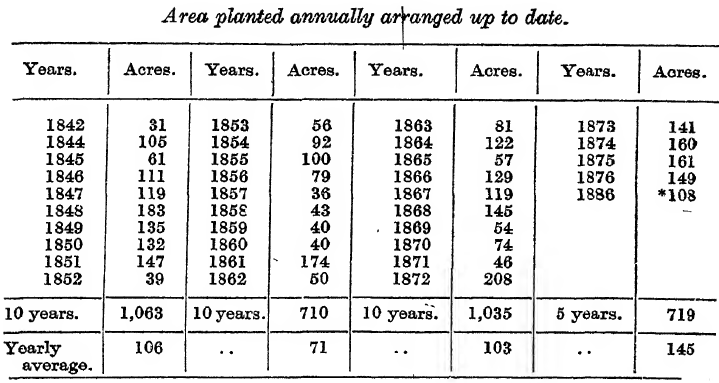
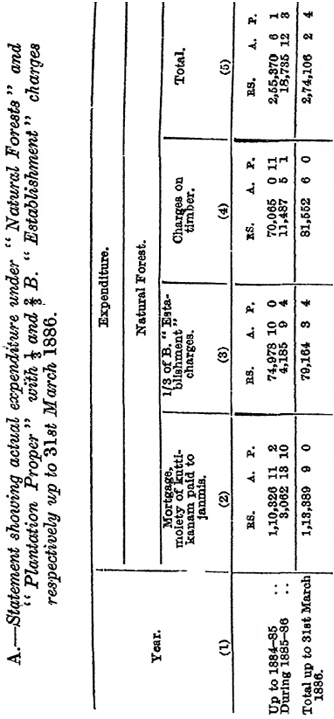
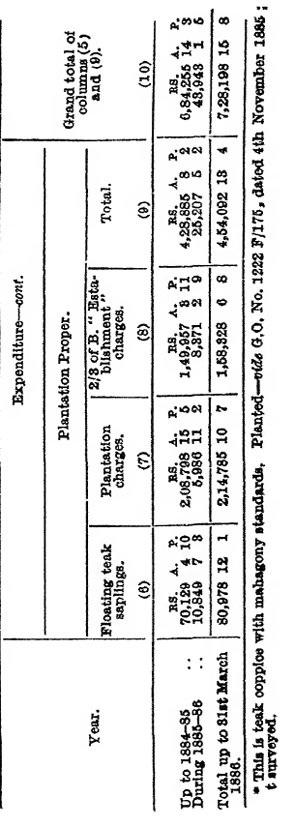
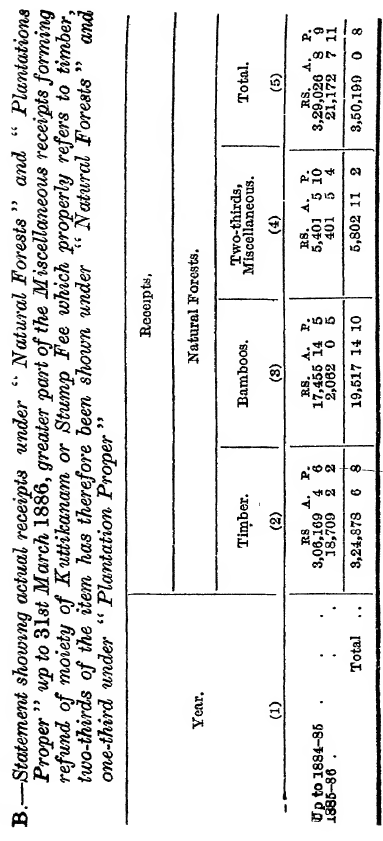
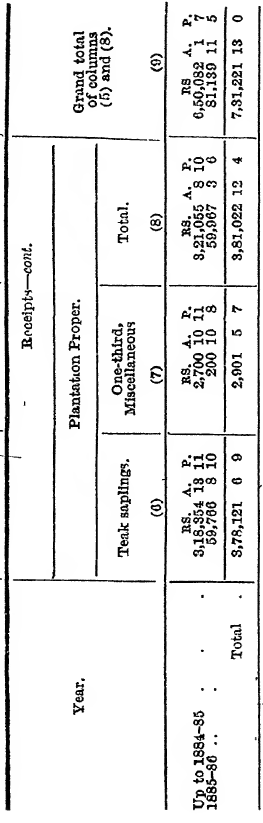
For the purpose of showing the valuation of plantations in the annual Code form No. 60, the total of column 7 in statement A above, viz., Rs. 2,14,786, has been adopted at the suggestion of the Conservator of Forests, as charges debited under A-VIII (d) in accordance with the Code para, 239. The amount, viz., Rs. 3,78,121 of the corresponding column 6 in statement B above, is the total revenue realised up to date from the thinnings, and this deducting the actual cost, viz., Rs. 2,14,786, shows a surplus revenue of Rs. 1,63,335 in favour of the plantations.
In the absence of any record of the revenue and expenditure under ‘‘Plantation proper” with 4 per cent compound interest up to date, it had to be worked out from the very beginning, and the following are the results obtained. In making the calculations to avoid tedious multiplication figures, fractions of 100 above 50 have been treated as 100, and fractions of 100 amounting to 50 or less have been omitted.
|
I |
Rs. |
|
Plantation outlay from commencement up to date calculated at 4 per cent compound interest is |
4,11,28 |
|
Plantation revenue from commencement up to date calculated at- 4 per cent compound interest |
5,20,734 |
|
Surplus revenue in favour of plantation |
1,09,440 |
|
II |
Rs. |
|
Grand total of the expenditure as per column 10 of the statement A above |
7,28,19* |
|
Grand total of receipts as per column 9 of the statement B above |
7,31,222 |
|
Surplus revenue in favour of division |
3,023 |
|
III |
Rs. |
|
Grand total of expenditure with 4 per cent compound interest recorded up to date |
12,86,640 |
|
Grand total of revenue with 4 per cent compound interest recorded up to date |
10,66,253 |
|
Balance against the division |
2,20,387 |
It will be advantageous here to quote paragraph 58 of Colonel Beddome’s report above referred to.
"The two following statements show all expenditure (establishment and working charges) and all receipts up to date. Mr. MacGregor, in his report which is only down to 1874, estimates all charges and receipts on the surrounding forests which are really part and parcel of the land handed over for planting, and he excludes the sale-proceeds on timber cut in these tracts and on timber cut on the tracts actually planted ; he also only debits a certain portion of the establishment charges (i.e., one-third) against the plantations. This does not appear to me the proper way to treat the question.
“Certain tracts of forests are taken up by Government for planting, and the felling and sale of the timber removed from the portions planted and the treatment as forest of such portions not adapted for planting are all necessarily part of the same transaction and cannot be treated separately. By the terms of the agreements we pay 30 per cent on the net proceeds of all jungle timber cut off plantation sites, and 50 per cent on the same cut in the "natural forests,” and a stump fee of one rupees on all teak and blackwood trees cut in the natural forest, so that to these operations two-thirds of the pay of establishment are also debited ; there is a loss instead of a profit ; so that Mr. MacGregor’s plan is a little in favour of the plantations although there is not much difference, but it leads to complication.”
The two statements referred to by Colonel Beddome in the above-quoted paragraph of his report are in much the same forms in which the statements A and B above given have been prepared, the only difference being that in A and B revenues and charges debitable respectively to “natural forests” and "plantations” have been at the suggestion of the Conservator of Forests more clearly brought out.
The following table shows the present classification of thinnings for the market with their estimated yield shown against each item :-
|
Classification |
Quarter girth on centre |
Average diameter at butt end |
Average length |
Estimated yield |
Remarks |
|
|
INCHES |
INCHES |
FEET |
Rs. |
|
|
Superior large saplings |
5 and more |
.. |
30 |
5 |
Dry saplings. Crooked do. Butt ends of broken saplings of the first four desriptIons. |
|
Do small |
|
7 |
30 |
3 |
|
|
1st class |
|
6 |
27 |
2 |
|
|
2nd class |
|
5 |
25 |
1 |
|
|
3rd class |
|
4 |
20 |
¾ |
|
|
4th class |
|
3 |
15 |
½ |
|
|
5th class |
|
2½ |
12 |
⅛ |
|
|
6th class |
|
|
|
⅜ |
|
|
7th class |
|
|
|
1/16 |
|
|
8th class |
|
|
|
⅛ |
The following tabular statements C to E are in connection with the preliminary working scheme for five years' thinning of the teak plantations, framed by the Conservator of Forests when he inspected the division in October 1885. This has been recorded in detail in his inspection report embodied in Board’s Proceedings, No. 3263, F-659, dated 30th November 1885. The system has been adopted during the year and the result is yet to be decided.
C. — Statement showing approximately the number of trees which should be removed and left standing in the Teak Plantations during quinquennial periods from the 11th to 61st year of growth.
|
Age |
Number remaining at each period. |
Number to be removed during each period. |
|
1 to 11 years |
*1,100 |
300 |
|
End of 11th year |
800 |
200 |
|
Do. 16th do. |
600 |
200 |
|
Do. 21st do. |
400 |
160 |
|
Do. 26th do. |
250 |
130 |
|
Do. 31st do. |
120 |
10 |
|
Do. 36th do. |
110 |
10 |
|
Do. 41st do. |
100 |
10 |
|
Do. 46th do. |
90 |
10 |
|
Do. 51st do. |
80 |
10 |
|
Do. 56th do. |
70 |
10 |
|
Do. 61st do. |
60 |
10 |
*N.B.—Trees planted per acre (allowing for casualties unreplaced, roads, and other unplanted spaces).
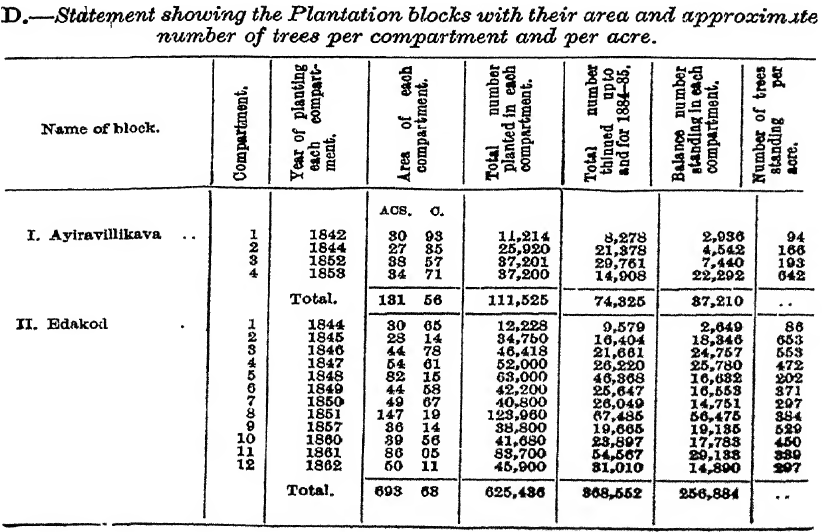
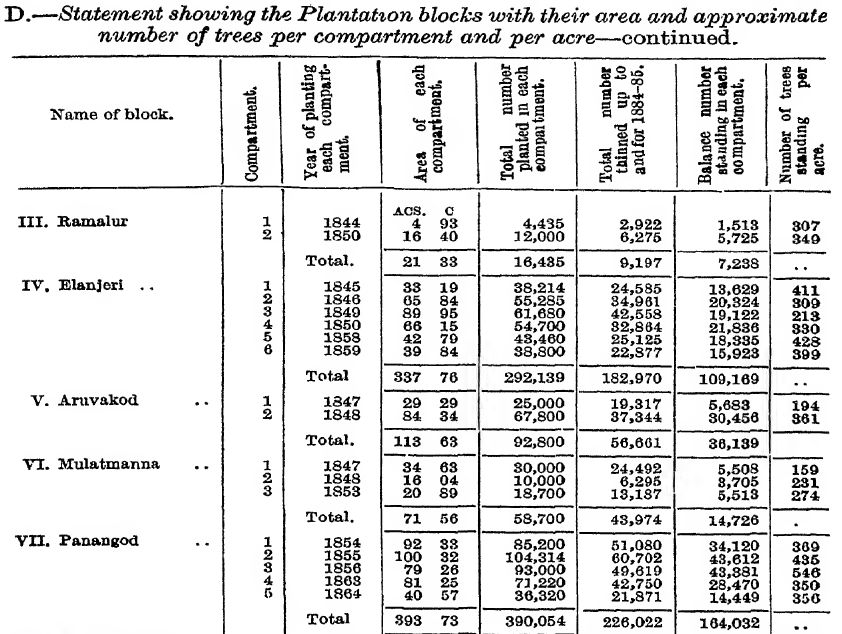
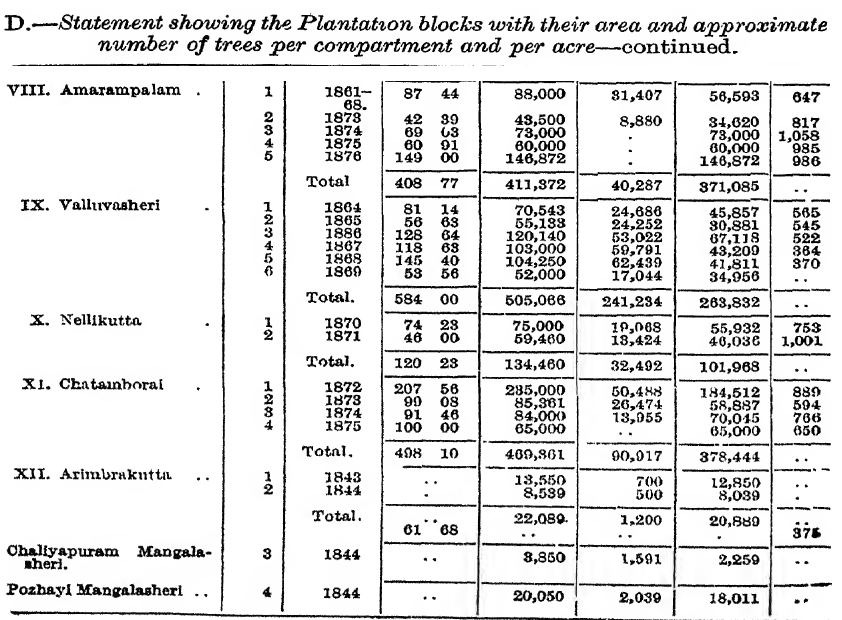
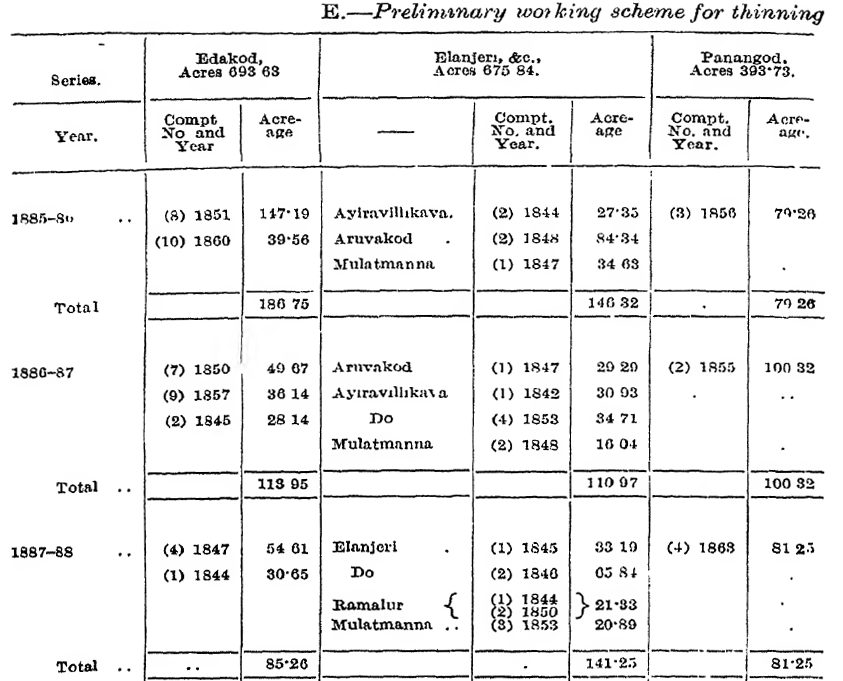
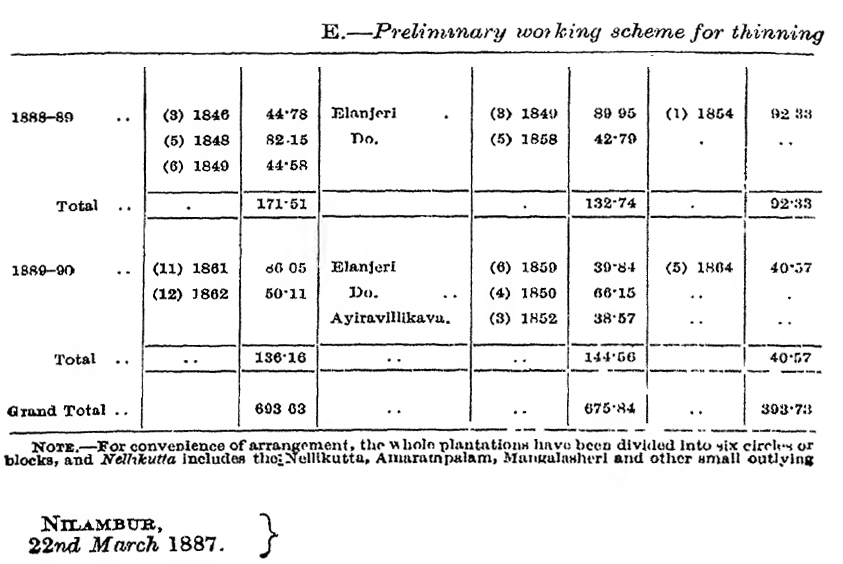
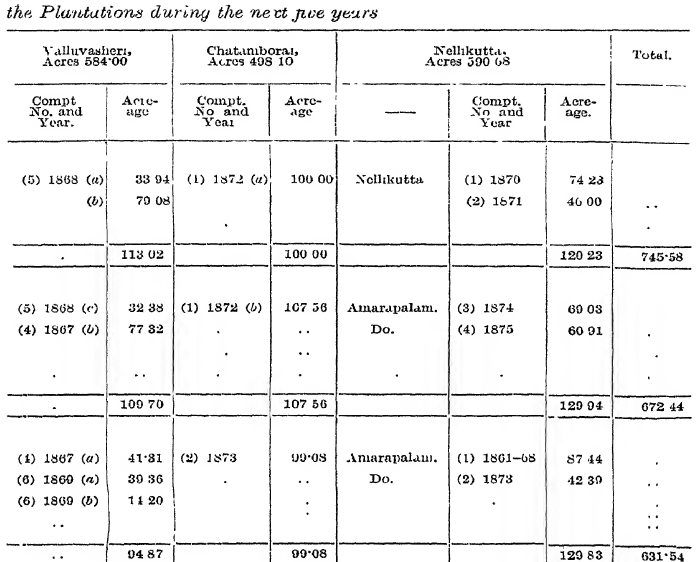
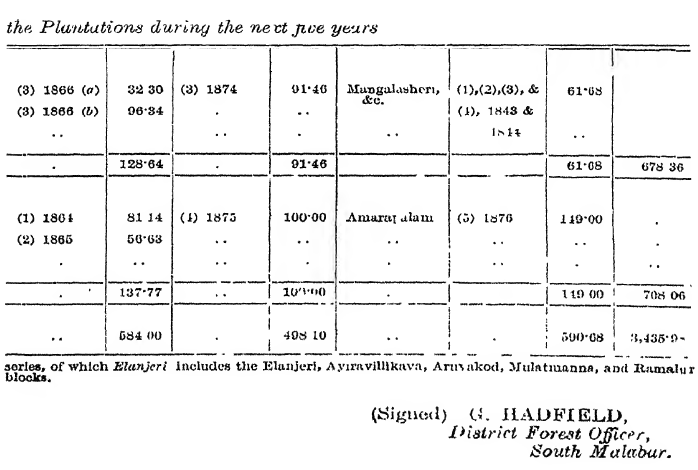
APPENDIX XXI
WALLUVANAD TALUK
By P. Karunakara Menon.
Boundaries.—The Taluk is bounded on the north by Ernad Taluk and a portion of Nilgiris district, on the east by Coimbatore district, on the south by Palghat Taluk, Cochin State and Ponnani Taluk, and on the west by the Ponnani and Ernad Taluks.
Area. —According to the figures adopted for the census of 1881, the total area of the Taluk is 963 square miles ; 137,417 acres or about 214 square miles of which are under cultivation, and 273,454 acres cultivable, while 3,000 acres represent the extent of hills and forest and other lands not cultivable.
Soil—The soil is chiefly red loam, except where black alluvial clay is found in the valleys.
Topography.-—The Taluk extends along the foot the Western Ghauts, many spurs of which run into it, e.g. in the amsams of Tuvur, Tiruvalamkunnu, Kottopadam, Arakurushi, Tenkara, Kumaramputtur, Kalladikkod, etc. A part of the Arakurushi amsam lies east of the ghaut and is known as the Attappadi valley which contains the head waters of the Baavani river. The area of the valley is estimated at about 200 square miles. The whole of it as well as the spurs and slopes of the ghaut are covered with valuable timber and other trees, and abound in elephants, bison, tigers, sambur, etc.
There are also several detached hills in the Taluk, such as Panakkodan mala, the Avunhikkadan mala, the Chirattamanna mala, the Anangan mala1, etc. The whole Taluk may be said to be one series of hills and dales, the latter being cultivable with paddy, while the borders of the former are covered with gardens containing jack, areca, and various other trees, in the midst of which stand the houses of the people.
NOTEs: 11. The origin of this word Anangan is interpreted in two ways—(1) picturesque (the Sanskrit word Anangan being a synonym for cupid), (2) without limbs (the Sankrit word signifying അൻ = without, and അംഗം = limbs) meaning that the hill is one single elevation without arms. END OF NOTEs
These hills are covered with scrub jungle or grass, and afford pasturage for cattle and thatching material for the houses of the poorer classes2. The principal rivers are the Ponnani or Walayar river which forms2 the southern boundary of the Taluk, the Malappuram or Anakkayam river which forms the northern boundary and the Mannarghat or Thutha river, a tributary of the Ponnani river. All those streams are perennial and are largely used for floating timber in rafts from the hills to the coast during the rainy season and are also passable for small boats for several miles except in the hot season.
NOTEs: 2. In the Nenmani hills experimental coffee cultivation is carried on. END OF NOTEs
The subjoined table gives the rainfall of the Taluk for a series of years.-
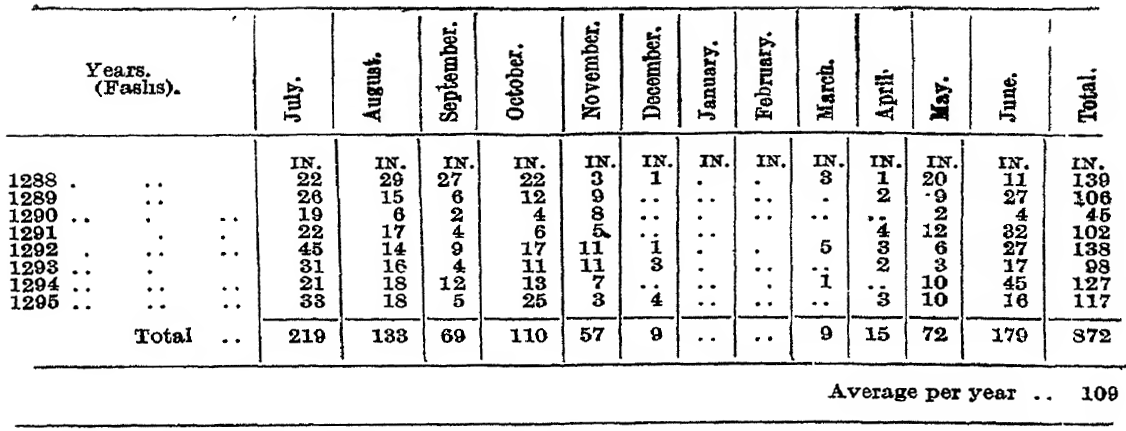
From all these it may easily be concluded that the climate is not very healthy, fever is present more or less throughout the year and is the chief prevailing disease. In the months of January, February and March generally a sort of malarious fever prevails throughout the Taluk, sometimes, attended with serious results.
Population.—The total population, as per last census is 308,102 against 292,482 in 1871. Of this number 153,236 are males and 154,866 females. Hindus number 225,075, Muhammadans 82,883, Christians 142 and "Others" 2. The average population per square mile is 320, but in reality it is far greater, inasmuch as Attappadi valley in Arakurushi amsam and the portion of the Taluk along the foot of the ghauts is very thinly peopled ; while a great part of the Taluk is not at all inhabited.
The total number of houses in 1881 was 57,220, of which 52,644 were occupied and 4,576 unoccupied. There were 55 occupied and 5 unoccupied houses in every square mile, and on an average 5.9 persons in every occupied house. As elsewhere in the district, all houses stand in detached "compounds,” except in the case of towns and bazaars, where they are built in the form of streets. The bulk of the people are occupied in cultivating the soil.
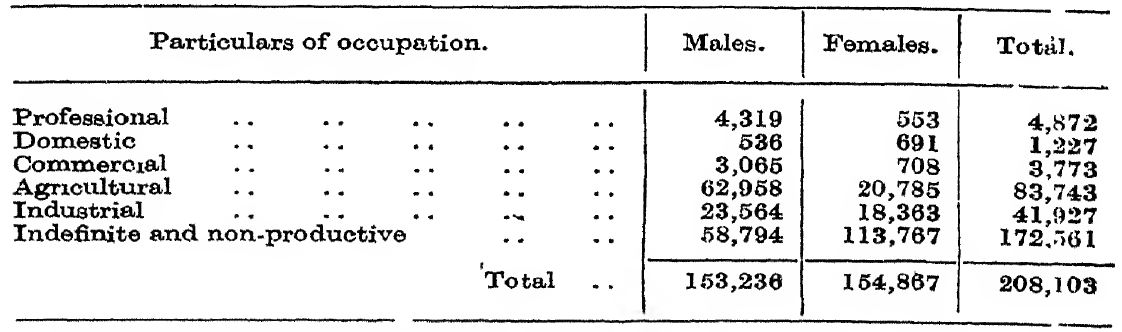
The figures in the above table against “agricultural” shows the largest number as compared with the other Taluks of the district.
The language spoken is Malayalam, except in the case of foreigners. In the Attappadi valley, however, the inhabitants, who are quite ignorant and without any education, speak a form, of Canarese.
Administrative Divisions.—For purposes of administration the Taluk is divided into 64 amsams, each having an Adhikari who collects the tax and is also Village Magistrate and Munsif, and who has under him an accountant (menon) and a couple of peons, except in one instance (Arakurishj amsam) in which the number of peons is four. There is of course a Tahsildar with the powers of a Magistrate of the 2nd class, whose headquarters are at Perintalmanna and who is assisted in his revenue work by a Deputy Tahsildar stationed at Cherupulasseri and usually invested with 2nd-class magisterial powders
Cultivation, etc. —The staple produce is rice, though arcea, jack, and plantains are also grown largely and coconuts on a small scale The areas under the several crops arc returned as follows —
Nanja 78,815
Gardens 23,116
Punja 35,486
"Punja" represents upland cultivation, such as modan, punam, gingelly, etc. The areas under each crop vary considerably from year to year, according to the nature of the season and other circumstances.
Particulars of Revenue —The subjoined statement shows the Revenue of the Taluk from various sources for a series of years.-
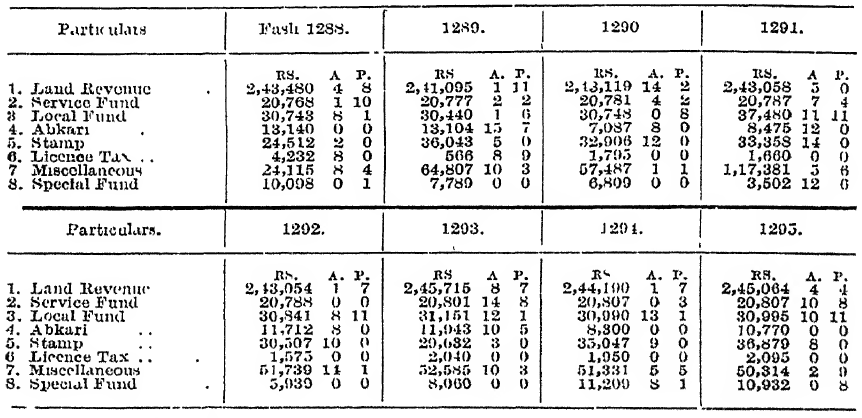
Roads.—The Taluk is intersected by 17 main roads :
The most important of these is road No. 7 from Palghat (via Parli), Pattambi, etc., to Ponnani, which enters the Taluk at the south-eastern corner and traverses its whole length along the southern boundary, a distance of 24 miles. Next in order comes road No. 6 from Calicut to Palghat via Kondotti and Malapuram ; the total length of it in this Taluk is 39 miles.
The Madras Railway passes through the Taluk nearly parallel to road No. 7. Pattambi, Shorannur, Ottappalam and Lakkidi are Railway stations in the Taluk. Pattambi is the nearest station to the headquarters of the Taluk from which it is distant 14 miles. The Deputy Tahsildar's station (Cheruplasseri) is about 13 and about 12 miles respectively by road from Pattambi and Ottappalam, while Shorannur and Lakkidi are farther off.
The subjoined list gives information regarding the principal festivals in the Taluk:-
|
No |
Name of festival |
Probable number of persons attending. |
Duration. |
Locality. |
|
|
Hindus |
|
Days |
|
|
1 |
Tirumandha Kunnath Puram |
8000 |
15 |
Angadipuram |
|
2 |
Cheruplasseri Utsavam |
2000 |
8 |
Cheruplasseri |
|
3 |
Mulayankavil Baghavati temple Kutu Puram |
2000 |
45 |
Kulukalur |
|
4 |
Muthassiarkavil Talappoli |
1000 |
23 |
|
|
5 |
Mundakot Kurusi Cheriya Mulankutkavil Kutu Puram |
1000 |
23 |
Mundakot Kurusi |
|
6 |
Mullanhur Kavil Bharni Vela |
1000 |
1 |
Mulanhur |
|
7 |
Tinakaturkavil Talappoli Puram |
2500 |
2 |
Do |
|
8 |
Ariankovil Kuttu Puram |
3000 |
21 |
Kunattara. |
|
9 |
Srikurumbakavil Uchcharal Vela |
1500 |
1 |
Kulappalli |
|
10 |
Mannarkatt Puram |
4000 |
8 |
Arakurussi |
|
11 |
Parianpatty do |
3000 |
7 |
Mutedath Madamba |
|
12 |
Panankumsikavil do |
2500 |
8 |
Chettallur |
|
13 |
Karimpuzha Utsavam |
1000 |
7 |
Karimbuzha |
|
14 |
Tiruvallayanatt Baghavati do |
1000 |
7 |
Do |
|
15 |
Nalussiri Baghavatikavil Puram |
1200 |
7 |
Ellampulasseri |
|
16 |
Tiruvegapuram Sivaratri |
2,000 |
14 |
Naduvattom |
|
17 |
Tutakkal Puram |
2000 |
25 |
Do |
|
18 |
Cherambatta Puram |
1000 |
7 |
Chalavara |
|
|
Mussulman |
|
|
|
|
1 |
Vettattur Kappil Nercha |
2500 |
8 |
Vettattur |
The following statement gives the particulars of weekly fairs or markets held in the Taluk :-
|
No |
Name of fair |
Amsom in which held |
Day of the week |
Distance from taluk headquarters in miles |
Number of people assembling |
Principal articles brought for sale |
|
1 |
Mangata |
Mangata |
Sunday |
6 |
100 |
Betel lead and nuts, curry stuffs and sundry miscellaneous article. |
|
2 |
Kulattur |
Kulattur |
Friday |
8 |
200 |
|
|
3 |
Tiruvegapuram |
Naduvattam |
Monday |
14 |
400 |
|
|
4 |
Cherupulasserai |
Cherupulasserai |
Wednesday |
10 |
500 |
|
|
5 |
Vaniamkulam |
Kunattara |
Thursday |
20 |
5,000 |
Betel lead and nuts, curry stuffs and sundry miscellaneous article and cattle, ginger (dried), etc. |
|
6 |
Ottapalam |
Chunangad |
Saturday |
21 |
400 |
Miscellaneous do. |
|
7 |
Pattambi |
Netrimangalam |
Tuesday |
14 |
600 |
Do |
|
8 |
Pattirippala |
Perur |
Sunday |
30 |
500 |
Do |
|
9 |
Srikrishnapuram |
Srikrishnapuram |
Tuesday |
16 |
200 |
Do |
|
10 |
Mannarkad |
Arakurussi |
Saturday |
18 |
500 |
Do |
|
11 |
Alallur |
Arakparamba |
Thursday |
10 |
200 |
Do |
|
12 |
Angadipuram |
Perintalmanna |
Sunday |
Headquarters |
1500 |
Do. and iron, cloths, oils, coconuts, etc., etc. |
CHIEF TOWNS OR VILLAGES
Perintalmanna.—Chiefly inhabited by Mappillas is the headquarters of the Taluk. There is also a Munsif Court, Sub-Registrar’s office, Post office and a school ; six miles from Perintalmanna is Mankata, the seat of the Walluvanad Raja, who enjoys a Malikhana of Rs. 13,400 from Government.
Angadipuram.—Has a beautiful temple called Tirumandhan kunnu situated on the top of a hill. In the well-known Mappilla outrage of 1849, the insurgents occupied this temple and were shot in the vicinity. In memory of two privates of H.M.’s 94th Regiment who fell in the action, the Walluvanad Raja, the owner of the temple, has caused a tomb to be erected over their graves in the compound of the public bungalow.
The tomb bears the inscription shown in the margin (below).
|
Within this tomb rest the remains of James Hart and Thomas Blake, late privates in the Grenadier Company H. M.'s 94th Kegimont. They fell in action on the 4th September 1849 while gallantly contesting with a band of fanatic Mappillas at a temple near Angadipuram, the property of Raja of Walluvanad who has caused this tomb to be erected in memory of the departed and as a small return for the services rendered him on that day by their surviving comrade of the Grenadiers. |
The following tradition is told of the origin of this temple.
The site of the temple was originally a forest. A female of the Cheruma caste while lopping the branches of a tree happened to sharpen her knife on a stone close by. Whereupon the stone began to bleed. This news was carried to one Kattilamittath Nambudiri, who believing in the sanctity of the stone, cleared the jungle around, while another (Chenamkandath) Nambudiri cleared the ground and a third, Pandalakkott Nambudiri, erected a pandal over the stone and commenced to make pujas and eventually a temple was erected at the spot.
There is an important mosque also in the place known by the name of Puthanangadi Palli about 3 miles west of the Taluk cutcheri. The mosque has an inscription in Arabic engraved on planks and set up in the walls explaining the benefits of erecting a mosque. This Palli consists of two separate buildings close to each other. Originally there was only a single building, but another was built close by subsequently for the following reasons given by tradition.
Karuvayur Mussad, the prime minister of the Walluvanad Raja, took oath to pull down the original mosque. On the other hand one Murikunnan Pokar Muppan also took oath that he would take off the head of the Mussad if he were to pull down the mosque, and exhibit the same for public view on the spot as a sign of revenge (വെന്തലകുത്തുക) and also that two mosques shall be erected in the place of one. The Mussad and both accomplished their respective aims. Hence the presence of two mosques now in the same compound adjoining each other.
Mannarkatt.—This is a jungly place. Horns, honey and wax are obtained abundantly and cheap. This place took its importance as the centre of commerce in olden times. The different products of the Attappadi valley are brought down here and taken to various places
Karimpozha.—This is the seat of the Eralppad or second Raja of the Zamorin family. The celebrated Hindu author, Thunchath Ezhuthassan, lived here. There are a number of families of Chettis who manufacture thin cloths of the patterns peculiar to natives (male and female) of Malabar and similar in kind, though inferior in quality, to those manufactured in Tinnevelly. The cloth is known by the name of "Karimpula Pavu.’’
Cherupulasseri.—There are the Deputy Tahsildar’s office. Sub-registry office, a school and a Post office here. There is also a temple called "Ayyappan Kavu."’ Vaniamkulam.—Has the most important fair in the district. Cattle, grains, nuts, fish (dried), cloths of various sorts and curry stuffs are obtainable at the fair. Elephants and horses are also brought here for sale at times.
Police.—The following is the list of Police stations in the taluk:-
|
Name of station |
Amsam in which situated. |
Remarks. |
|
1. Angatipuram |
Perintalmanna |
Headquarters of the taluk |
|
2. Kutattur |
Kulattur |
8 miles from do. |
|
3. Malattur |
Melattur |
10 miles from do. |
|
4. Allallur |
Arakparamba |
12 miles from do. |
|
5. Mannarkatt |
Arakurushi |
18 miles from do. |
|
6. Cherupulasseri |
Cherupulasseri |
Headquarters of the Deputy Tahsildar Magistrate. |
|
7. Srikrishnapuram |
Srikrishnapuram |
8 miles from do. |
|
8. Koppam |
Vilayur |
7 miles from do. |
|
9. Pattambi |
Netrimangalam |
10 miles from do. |
|
10. Cheruvannur |
Mundamuka |
14 miles from do. |
|
11. Ottapalam |
Chunangad |
11 miles from do. |
Religious Institutions.—-The following is the list of religious institutions in the Taluk :—
|
Name of institution. |
Amount of Inam grant from the government |
Amsam in which situated. |
|
||
|
Rs. |
A. |
P. |
|
||
|
1. Tirumandhankunnu temple |
222 |
6 |
11 |
Angatipuram. |
|
|
2. Andimahakalan do. |
9 |
0 |
0 |
Kalladipatta. |
|
|
3. Kallaribhagavati do. |
5 |
8 |
0 |
Vilayur. |
|
|
4. Chunangad do. |
10 |
0 |
0 |
Chanangad |
|
|
5. Tekkekavil Gurutiraman do. |
2 |
0 |
0 |
Do. |
|
|
6. Panamanna Sankaranarayana do. |
17 |
0 |
0 |
Do. |
|
|
7. Vettekorumakan do. |
1 |
0 |
0 |
Srikrishnapuram. |
|
|
8. Pariyanampatta Bhagavati do. |
6 |
8 |
0 |
Mutedath Madamb. |
|
|
9. Kodarmanna do. |
2 |
0 |
0 |
Srikrishnapuram. |
|
|
10. Vettekorumakan do. |
0 |
8 |
0 |
Eledath Madamb. |
|
|
11. Parizhakatt do. |
0 |
8 |
0 |
Do. |
|
|
12. Cherukettpulam Siva do. |
1 |
8 |
0 |
Kuattara. |
|
|
Total |
277 |
14 |
11 |
|
|
|
Sattram |
|
||||
|
Chunangatt sattram |
516 |
2 |
8 |
Immovable property paying the revenue is granted. |
|
Trigonometrical Survey Stations.
|
Name of G.T.S stations. |
Series. |
Modern values |
Remarks |
|
|
Latitude |
Longitude |
|||
|
1. Pranakod H.S |
Modern |
10° 58' 46.65" |
76° 20' 01.31" |
In Chettallur amsam about 7 miles from headquarters. |
|
2. Anangamalei H.S. |
Do. |
10° 49' 10.90" |
76° 25' 49.66" |
In Chunangad amsam about 16 miles from headquarters. |
List of Charitable Institutions in the Taluk.
|
Name of institution. |
No. of persons fed daily. |
Amount of Inam grant, if any. |
|
1. Angadipuram sattram |
60 |
Rs. A. P. |
|
2. Pattambi do. |
15 |
|
|
3. Mannarkkatt do. |
15 |
|
|
4. Srikrishnapuram do. |
25 |
|
|
5. Karimpuzha do. |
50 |
|
|
6. Cherupulasseri do. |
35 |
|
|
7. Chunangad do. |
30 |
516 2 8 |
|
8. Ottapalam do. |
35 |
|
|
9. Andimahakalan do. |
20 |
|
|
10.Tutakkal do. |
20 |
|
PALGHAT TALUK
By P. Karunakara Menon.
Position.—This is the easternmost Taluk of the District and lies between 10° 25' and 10° 55' N. Lat. and between 76° 27' and 76° 55' E. Long. It formerly comprised the Taluks of Palghat and Temmalapuram which were amalgamated into one in 1861.
Boundaries.—North, Walluvanad Taluk; east, Coimbatore and Pollachi Taluks in the Coimbatore District and Cochin State ; south, the Native State of Cochin ; west, the Cochin State and Walluvanad Taluk.
Area.—The Taluk not having been yet fully surveyed the exact area is not known ; but, for the purposes of the census of 1881, it was taken to be 613 square miles.
Soil—Topography.—The District not having been surveyed the true nature of the soil too is not known, but speaking in general terms it may be described as black loam. This Taluk is singularly diversified and interesting in its physical aspect, especially towards the hilly tracts along the Coimbatore and Cochin frontiers.
The most striking feature in its configuration is the extensive gap historically known by the name of the “Palghat Gap” in the otherwise unbroken great range of the Western Ghauts, about 25 miles across and more than 6,000 feet lower than the hills on its north and south and lying on the meridian of 76° 45' E and between the parallels of 10° 33' N. and 10° 52' N. This remarkable opening with the lofty Nilgiri Hills and the Anamalas on either side, overtopping the ranges by several thousand feet, the numerous projecting off-shoots of the main chain separating the Taluk from the neighbouring Coimbatore District with their heavy forests, extensive ravines and jungles stretching westwards the forest-clad uplands and the gradually succeeding flat rice fields fringed with high palmyra groves and the numerous mountain torrents and small rivers : all combined give an enchantment to the scenery.
Almost all these extensive and valuable forests are private property, except the two Government forests known by the names of the "Chenat Nayar” and the "Walayar” Reserves.
The former of these two reserve forests is a block of hill forest which originally formed portion of the Chenat Nayar escheat, while the latter comprises the "Varalapadi” and "Pulampara” forests which were purchased by Government some years ago with the special object of supplying the Madras Railway Company with wood-fuel. The Chenat Nayar and the private heavy forests in the Taluk, all contain more or less valuable trees, among others, teak and blackwood ; while cardamom, honey, gum, &c., constitute the chief minor produce which is collected in the case of the private forests by the resident jungle tribes and generally bartered in the plains for the necessaries of life.
The Government forests are under the charge of a Ranger stationed at Palghat, who is assisted in his work by 7 forest guards. Of the rivers intersecting the Taluk the most important are the Kalpathi (locally called the Nelanadi) the Kannadi and the Kollangod (locally designated the Gayathrinadi) rivers.
The first two rivers uniting near Parali take the name of the Ponnani river or Bharathapula and the last, viz., the Kollangod river, joins the Ponnani river a little farther on. The Kalpathi river has its source at a place called Chentamarakulam in the hills north of Walayar where the stream forms the boundary between the Malabar and Coimbatore Districts, while the other two are said to rise in the Kollangod bluff or the Malaya mountaim being the north-western extremities of the Anamalas.
Climate, Health and Meteorology.—During the dry season the climate is very hot, but during the rains it is pleasant and healthy. From November to February a strong east or land-wind blows almost incessantly through the Palghat Gap which makes the weather very trying. The water supply generally is satisfactory and the health of the people, as a rule, good. The prevailing diseases in the Taluk may be said to be smallpox and fever. The Walayar and other forests are malarious. Cholera makes its appearance occasionally.
Population.—The census of 1881 revealed a total of 342,454 inhabitants distributed over 56 amsams and dwelling in 60,351 houses. Classified according to religion, there were 306,662 Hindus, 32,330 Muhammadans and 3,462 Christians. The density of the population was per square mile 559 per amsam 6,115 and per house 5—7. The number of houses returned as unoccupied was 12,234. Of the total population the number of males was 165,311 and of females 177,143. The percentage of increase in population, as compared with 1871, was in respect of males 3.82 and in that of females 6.31 or 5.09, of both sexes. The appended statement shows the classification of the people according to their various occupations:-
|
Professional |
5,090 |
|
Domestic |
1,526 |
|
Commercial |
7,097 |
|
Agricultural |
93,841 |
|
Industrial |
51,477 |
|
Independent |
183,423 |
|
Total |
342,454 |
SUB-DIVISIONS OF THE TALUK FOR ADMINISTRATIVE PURPOSES
Revenue and Magisterial.—The unit of administration is as elsewhere the amsam, of which there are 56 in the Taluk, each being under an Adhikari assisted by a Menon and, except in one or two instances, by two peons. The Adikaris exercise also, as elsewhere, civil powers in respect of petty suits for sums of money not exceeding Rs. 20 and criminal powers in respect of petty cases of theft and assault, arising in their respective amsams.
The Tahsildar, assisted by a Deputy Tahsildar to whom are assigned certain specified amsams, has the general revenue charge of the Taluk. The two officers likewise exercise magisterial powers, the Deputy Tahsildar over the area constituting his division and the Tahsildar specially over the remaining portion of the Taluk. The former has his headquarters at Alathur and the latter at Palghat. This Taluk with its adjoining Walluvanad Taluk, forms a separate revenue division designated the "Head Assistant’s Division” placed under the charge of a Head Assistant Collector and Magistrate, whose headquarters are at Palghat.
Judicial, Civil.—There are two Munsifs’ Courts in the taluk located at Palghat and Alathur respectively, and also a Sub-Judge’s Court which is stationed at the former place.
Registration.-- For registration purposes the Taluk is divided into 4 sub-districts designated the Palghat, Alathur, Koduvayur and Mankara sub-districts, the Sub-Registrars’ offices being located at Palghat, Alathur, Pudunagaram and Parali respectively. The Koduvayur Sub-Registrar exercise also magisterial powers in respect of nuisance cases arising within the Pudunagaram town.
Police.- For Police administration, the Taluk is divided into two divisions each placed under an Inspector whose headquarters are at Palghat and Alathur respectively.
Railway Stations.—The Madras Railway enters the Taluk at Walayar through the remarkable Palghat Gap df the Western Ghauts. Its length in the Taluk is about 30 miles. The stations are as follow:-
1. Walayar— 15½ miles east of Palghat
2. Congecode— 8½ miles do. do.
3. Palghat.—This place is specially noted for trade in timber which from the Mannarghat forests, the Chenat Nayar, Government Reserve and the adjoining private forests, is largely brought to the depots belonging to Government and private merchants and then exported by rail to various parts of the other districts in the Presidency, and also to other places.
4. Parali.—5¾ miles west of Palghat. There is a Sub-Registrar’s office and a distillery here, and about 3 miles from the place there is a Police station and also an estate, called the Mankara Nayar estate under the Court of Wards, which was assumed charge of on 3rd December 1877.
IMPORTANT TOWNS AND VILLAGES
Palghat.—[Pala + kadu, a jungle of pala (echites scholaris) trees] — is the chief inland town in the District and a Municipality, and in respect of population stands next to the Calicut town in the district and 14th out of a total number of 227 towns as defined by the last census in the Madras Presidency. The business part of the town lies about 3 miles south of the Olavakod or Palghat-Railway Station and this, with its suburbs comprising the Municipality, covers an area of more than 9 miles and includes portions of Koppam, Puthur, Yakkara, Akathethara, Kavalpad, Vadakunthara and Kannadi amsams.
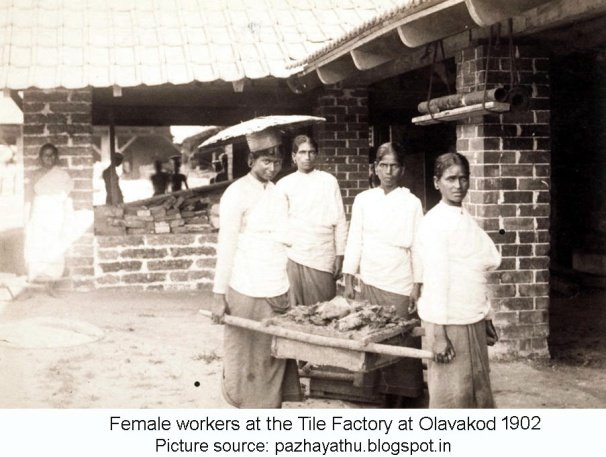 According to the last census, the total population of the place is 36,339 classified into 30,424 Hindus, 4,854 Muhammadans and 1,061 Christians. The male population returned is 17,673 and the female 18,666. The following statement compares houses, population and municipal revenue of the place during the 10 years previous to the last census : -
|
|
Houses |
Population |
Revenue |
|
1871 |
5,561 |
30,752 |
17,507 |
|
1881 |
6,081 |
36,339 |
15,725 |
|
Increase or decrease |
520 |
5,587 |
1,782 |
On the whole the town has an interesting appearance. Next to the big bazaar (also called Chethurangapetta) referred to, the most busy division of the place is Sultanpetta. Through this passes the main thoroughfare, by the side or in the vicinity of which are situated the chief public buildings of the place, viz., the Municipal school, the District Munsif's Court, the Head Assistant Collector’s dwelling house and his office, the Sub-Judge’s Court, tixe Municipal and Post office, the Roman Catholic Church; the Municipal hospital with its beautifully laid out garden, and the Protestant Church.
Here is also situated an old massive fort built of granite slabs and laterite pieces wherein are located the Taluk Cutcheri, the Sub Registrar’s office and the Police station. In-patients as well as outpatients are largely treated in the hospital referred to, the total number of beds available for in-patients being 16; 8 for males and 8 for females.
There is also an Assistant Police Superintendent’s office here. The trade is chiefly in tobacco, foodgrains, particularly, the dry grains, oil of all sorts, and various kinds of cloths. Timber is largely exported by rail. The place is specially famous for trade in Pullupaya (grass mats), generally known by the name of Palghat mats and may also be said to be the centre of tobacco trade in the District.
The Brahman community called Pattars almost all belong to this Taluk. There are no less than 19 separate settlements or gramams of this community within the Municipal limits. They are as follow:-
|
1. Kalpathi. |
11. Sekaripuram. |
|
2. Palaya Kalpathi. |
12. Ramanadhapuram. |
|
3. Chathapuram |
13. Tarakad. |
|
4. Govindarajapuram. |
14. Vatakkumthara |
|
5. Vaidyanadhapuram. |
15. Nurni |
|
6. Komarapuram. |
16. Nellisheri. |
|
7. Lakshminarayanapuram. |
17. Thondikulam. |
|
8. Mukka |
18. Pallipram. |
|
9. Chokkanadhapuram. |
19. Tirunilayi. |
|
10.Puttamkurshi. |
|
Of the numerous Hindu temples attached to these gramams, the most important is the Kalpathi Siva temple. A car festival lasting, for three days, is annually celebrated here in November, which gathers together a large crowd of people belonging not only to the various parts of this District but also to the neighbouring Cochin State and Coimbatore District.
Besides this, there are also two places deserving notice, one within the municipal limits and the other in the neighbouring Elappalli amsam, both of which are held in high estimation and largely resorted to by the people. The so-called holy places are respectively named Mukkai and Ramasara thirdham. The former is the place where the three mountain streams called the Palayar, Malayar and Walayar unite and take the name of the Kalpathi river ; while the latter is popularly believed to have been created by Rama, the hero of Ramayana, at the instance of his brother Lakshmanan in the days of their temporary retirement to the jungle for the purpose of bathing in the Ganges water.
Alathur—[alam + oor, meaning the city of alam trees, (വെഴ) Dalbergia used to make mortar], the headquarters of the Deputy Tahsildar of Alathur, is an important village situated in Kattusseri amsam about 13 miles from Palghat on the road from there to the Cochin frontier via Vadakkancheri. The place contains a District Munsif’s Court, a Sub- Registrar’s office, a Police station, a Post office, and a Middle class school.
There is also a small bazaar and a travellers’ bungalow here. In the vicinity of the place lies the “Alathur” Hill or "Velumalai,” one of the Trigonometrical Survey stations in the District, it contains a somewhat large cave and a natural spring higher up, which is never dry. There is also a ruined Hindu temple here. It is popularly believed that the cave was formerly inhabited. The existence of portions of walls dividing the cave into compartments of hearths and a small mill, all seem to support this tradition.
There is a mosque and a Roman Catholic Church here. They are tiled buildings and 140 and 107 feet in extent respectively. In the adjoining Vatakkethara amsam there is a Syrian Christian Church known by the name of the Melarkott Palli. This too is a tiled building about 210 feet in extent. The total population of the amsam is 3,517 of whom no less than 2,883 are Hindus. Of the remainder, 556 are Muhammadans and the rest Christians.
Vadakkancheri—[vadakku+cheri, means the northern village that is on the northern side of the hill-ranges separating the Taluk from the adjoining Cochin State]—is one of the chief Muhammadan villages in the Taluk, situated in the amsam of the same name about 7 miles south-west of Alathur. The amsam is hill-bound on its south and west. There is a travellers’ bungalow and a Police station here.
There is also a small bazaar which is chiefly inhabited by Muhammadans who have a mosque about 102 feet in extent. The building is tiled. The place contains also a small Roman Catholic church. This and the adjoining Kannanur pattola amsam are noted for the manufacture of coarse cloths of various kinds. Trade in the minor produce of the hills and also in timber is largely carried on here.
An important Hindu temple named "Tirunara” is situated in the vicinity. This is held to be of great antiquity, and the tank or spring popularly known by the name of Brahmakundam attached to the temple is held in great reverence by the people, believing it to be as the name implies, a place where “Brahma” performed yagam or sacrifice. A handful of earth taken from the bed of this sacred tank is believed to be essential to the performance of sacrifices by Nambutiri Brahmans.
The total population of the amsam is 11,496, classified into 9,141 Hindus, 1,611 Muhammadans and 744 Christians.
Kollangod—is an important village in Padinharathara amsam, situated about 12 miles south of Palghat. Hindus are the predominating race in the amsam, who represent 3,978 or 97 per cent out of a total population of 4,104 ; of the remaining 125 are Muhammadans and 1 Christian. The place contains a Police station and a travellers’ bungalow and was formerly noted as being the seat of a petty chieftain named the Venganatt Nambidi, who reigned in these parts of the Taluk before the administration of the district passed into British hands. The present representatives of this ancient family have their residence here.
There is an important Hindu temple named the Kachankurushi Temple here, dedicated to Vishnu. It is 264 feet in length and 180 in breadth. The Srikovil and the Nalambalam are both tiled, and the mandapam and the surrounding wall of the Srikovil painted all over with figures representing the various incarnations of Vishnu. As a preliminary stop to the performance of a yagam or sacrifice by any Nambutiri Brahman in the district, it is said that the intended sacrificer ought to come first to this temple and receive from the hands of the Venganatt Namhidi, the moon-plant (cynanchum acidum), the black wood (mimosa catechu) and the skin of a black antelope all of which are required for the purpose.
Six and three miles respectively from this temple on the hills (Tenmala), separating the Taluk from the neighbouring Cochin State, there are two natural springs called the Govindathirdham and the Sithakundu. Both of these are held in veneration and resorted to by the people. The origin of the former sacred spring is popularly ascribed to Devendra while in respect of the latter the tradition current is that it was created by Sita, wife of Rama, the hero of Ramayana, for the purpose of her bathing in Ganga, the water of the Ganges, during the time of their sojourn in those parts in the days of their retirement to the jungle for holy purposes.
Pudunagaram—[Pudu+nagaram, means new town]—is the most important and thickly inhabited Muhammadan village in the Taluk, It is situated in Koduvayur amsam about 6 miles south of Palghat. In respect of total population this amsam stands next to only the Palghat municipality while in that of Muhammadan population alone it ranks first in the Taluk. The total population is 14,030, classified as follows :—Hindus 8,855, Muhammadans 5,149 and Christians 26. The place contains a Police station and also a Jamath mosque (Jama musjed). It is a tiled building 240 feet in length and 180 in breadth. The Koduvayur Sub-Registrar’s office is located here. He is invested with magisterial powers to try petty cases of nuisance occurring in the village.
Palathulli—is a village in the amsam of the same name, situated about 8 miles south-east of Palghat. It is chiefly inhabited by Chettis. The place is one of the chief centres of cattle trade in the District. The cattle are exported from the adjoining Coimbatore District, especially from the Pollachi weekly market. The amsam contains a total of 5,861 inhabitants, of whom 5,293 are Hindus, 561 Muhammadans and 7 Christians.
Hindu temples.—The most important Hindu temples in the Taluk are —
1. Kallekkulam alias Emur Bhagavathi temple.—In Akathethara amsam. Dedicated to Jaladurgha. The roof of the Srikovil is covered with copper sheeting. The other portions are tiled. The temple is 132 X 114 feet in extent.
2. Kalpathi.—In Puthur amsam. Dedicated to Siva. The Srikovil is covered with copper sheeting. The other buildings are tiled. The temple is 288 x 120 feet in extent.
3. Madappallikavu .—In Yakkara amsam. Dedicated to Vanadurga. Tiled. 156 x 138 feet in extent.
4. Kachamkurussi.—In Padinharathara amsam. Dedicated to Vishnu. Tiled. 264 x 180 feet in extent.
5. Pallavur or Tripallavur.—In Pallavur amsam. Dedicated to Siva. Tiled. 500 feet in extent.
6. Tripalur.—In Vateketara amsam. Dedicated to Siva. Tiled. 532 feet in extent.
7. Kongad.—In Kongad amsam. Dedicated to Bhagavathi. Tiled. 192 X 150 feet in extent.
8. Tirunara.—In Vadakkancheri amsam. Dedicated to Siva and Vishnu. Partly tiled and partly thatched. 250 feet in extent.
9. Tiruvalathur.—In Tiruvalathur amsam. Dedicated to Durgha. The Srikovil is covered with copper sheeting. The other buildings are tiled. 366 X 330 feet in extent.
10. Kotamba.—In Tiruvalathur amsam. Dedicated to Subramaniyan. Terraced roof. 132 x 126 feet in extent.
Fairs and Festivals.—Some of the most important festivals celebrated and the fairs held on such occasions in the Taluk are shown below:-
|
Names of fairs and festivals. |
Month held |
Number of days lasting. |
Number of persons attending |
|
1. Kalpathi car festival |
November |
3 |
|
|
2. Tiruvalathur utsavam |
November and December |
9 |
|
|
3. Kotamba car festival. |
January and February |
3 |
|
|
4. Kongad puram festival. |
March and April |
8 |
|
|
5. Thachamkurushi utsavam. |
April and May |
10 |
|
|
6. Koduvayur car festival. |
December and January |
2 |
|
|
7. Pudukulangara kavu vela. |
March and April |
1 |
About 7,000 |
|
8. Parakkatt kavu alia Kavasseripuram |
Do |
1 |
About 12,000 |
|
9. Tripalur navarathri utsavam |
September and October |
9 |
|
Travellers' Bungalows.—There are four travellers' bungalows in the Taluk which are named below : —
1. Palghat, 3 miles from the Olavakod Railway Station.
2. Alathur, 13 miles from Palghat.
3. Vadakkancheri, 20 miles from Palghat.
4. Kollangod, 12 miles from Palghat.
Weekly Markets.—The trade of the Taluk is carried on by means of permanent markets in the Palghat town and a few other places and of weekly markets, the most important of which are as follow : —
1. Palathulli in Palathulli amsam held on Sundays.
2. Kongad in Kongad do. Mondays
3. Alathur in Kattisseri do. Wednesdays.
4. Vadakkancheri in Vaddakkancheri Thursdays.
5. Para Thursdays.
6. Palghat Fridays.
The chief articles of export are the various kinds of foodgrains, tobacco, Palghat mats and various kinds of coarse cloths manufactured in Vadakkancheri and certain other parts of the Taluk, while the chief articles of import are tobacco and various kinds of cloths, spices and cattle. The Palathulli market may be said to be the chief centre of cattle trade in the District, while the Kongad market is also noted for the same.
Trigonometrical Survey Station.—There are two Trigonometrical Survey stations in the taluk. They are –
|
Name |
Latitude |
Longitude |
|
1. Kurachimala S. |
10° 47' 10.15" |
76° 39' 29.61" |
|
2. Alathur H.S. |
10° 37' 30.07" |
76° 34' 26.80" |
PALGHAT FOREST
By Rhodes Morgan, District Forest Officer.
There are four tracts of forests which have been under the management of the Forest Department in the Palghat Range since 1883. The most important of these is the Chenat Nayar forest, which escheated in the early years of the century to Government. The area of this forest is 15,206 acres, of, which 12,263 acres are forest, and the balance, 2,962 acres, grass land and sheet-rock. These forests are situated in a rooky range of hills connected with the Western Ghats, which rise to a height of 5,000 feet (Elival peak). On the lower slopes, i.e., up to 1,000 feet elevation, the forests are deciduous, above that, evergreen. The principal trees in the lower zone of deciduous forest are teak (almost exterminated), rosewood, venghay, venteak, irul, etc. The evergreen forests (contain white and red cedar, iynee, poonspar, ironwood, etc.
The lower slopes are very malarious, but the open grass lands higher up are above fever range.
There is a forest rest-house on Karimala, at an elevation of about 4.000 feet and another, at the base, near Dhoni. The forests are worked on the "Jardinage" or selection-felling system, the only one feasible in a forest where any felling "of blocks might result in various landslips, and would end in the ruin of the forest. There is very little soil on these hills , which are composed of solid gneiss.
A small quantity of timber is now removed annually, not exceeding 15,000 cubic feet, the forest having been very recklessly worked in former years, and the more valuable trees almost exterminated. This forest has been surveyed and demarcated with cairns of stones, and posts.
The second forest is situated at Walayar on the line of rail. The area of this forest is 3,017 acres, of which 2,600 acres is productive, the rest being barren rock. The forest has been divided into two blocks and ten compartments, and each compartment further sub-divided into sub-compartments. It is worked for fuel for the supply of the railway, and teak poles.
The ‘‘coupes" are worked on a rotation of ten years, the produce being sold to contractors. A working scheme of this forest has been prepared. It is fenced in, and fire protected annually, and cattle are rigidly excluded. There is a special forest pound for stray cattle.
The remaining two forests are situated in the Walluvanad taluk. They are known as the Panakadan forest in the Tiruvalam desam and the Silent valley. The first of these is situated on a small rocky hill of about 1,000 acres in extent. The trees in it are deciduous and **** growth average, the villagers in the neighbourhood having been in the habit of pollarding the trees for manure for their paddy. In 1883, this was put a stop to and a forest guard appointed to look after this forest, which is very isolated. These are a few small hills in the neighbourhood and a considerable tract on the slopes of the ghats, the ownership of which has not been determined yet.
Panakadan hill is Reserved Land, and is under special fire protection. It is intended shortly to notify it as a reserved forest.
The Silent Valley is an enormous tract of mountain forest and grass land situated on the western slopes of the Khoondahs, and is most inaccessible. It is roughly supposed to cover an area of over 70 square miles. The forest on it is all evergreen, and the principal trees the same as those usually found in such forests in Malabar, viz, poonspar, iynee, ironwood, red and white cedar, wild jack, etc. These forests yield cardamoms, dammer, rattans, etc. The timber is not worked on account of the inaccessible nature of the locality. This forest will shortly be notified for reservation.
PONNANI TALUK
By P. Karunakara Menon
Position and Boundaries.-—-This is the southernmost taluk of the district proper. It formerly comprised the three taluks of Betatnad, Kutnad, and Chavakkad, which were amalgamated into one in 1861. The boundaries are north, Ernad taluk ; east, Walluvanad taluk and the native State of Cochin; south, the native State of Cochin ; west, the Arabian sea.
Area.—The district not having been surveyed, the exact area is not known. The approximate area, according to the census of 1881, is 258,154 acres or nearly 404 square miles. The extreme length of the taluk from north to south along the coast is 64 miles, while its width ranges from 3 to 20 miles in different parts.
Soils and Topography.—The scenery in comparison with that of the two neighbouring taluks of Ernad and Walluvanad, is flat and uninteresting, especially along the coast, while inland, low hills clothed sometimes with scrub jungle, but generally with grass and flat rice-fields interspersed with groves of coconut, areca-nut, jack and various other trees surrounding the dwelling houses of the inhabitants, constitute the principal varieties of the landscape.
The soil along the coast is poor and sandy, the only redeeming feature being that this open seaboard is fringed with groves of coconut trees. There is no granite in these parts, but in the interior parts the formation seems to be gneissic, traversed by granite veins, which generally prevails in the two adjoining taluks referred to.
Inland Water Communication.—The most striking feature of the taluk is perhaps the series of lagoons or — backwaters lying in a zigzag direction along the coast and affording, with the connecting artificial canals, an easy inland water communication. It extends southwards from the Tirur Railway station to Ponnani, Chavakkad and Cochin and thence into the Cochin and Travanoore States. The total length of this system of inland water navigation from the Tirur Railway station to Cochin is 93 miles (of which 77 lie in the taluk) as detailed below : Tirur to Ponnani section 16 miles ; Ponnani to Chavakkad section 17 miles ; Chavakkad to Cochin section 60 miles.
The boats in general use both for cargo and for passengers are the common country (dug-out) boats and they are manned generally by two men and will hold from 5 to 20 persons. The maximum charge per mile for a boat is 2 annas, and the average speed attainable 2½ miles an hour. Transit can be effected by day and by night. No cabin boats are available in the taluk. Now and then, one of them passes through it from Cochin to Tirur. Its average speed is 5 miles an hour, the charge for a boat varying from 3 to 5 and more annas per mile according to size. Owing to want of sufficient water in some parts of the canals connecting the backwaters, the speed in the case of the country boats is diminished, while that in the case of large cabin boats is entirely obstructed during the hot season in certain parts of them.
Rivers: In addition to the aforesaid chain of backwaters, the taluk is intersected by the Ponnani river and a few other minor streams. Timber from the Anamalas and the Mannarghat forests is largely floated down the river during the rainy season to the timber depots at Ponnani, belonging to local merchants as well as to the Cochin sirkar, for export to foreign places.
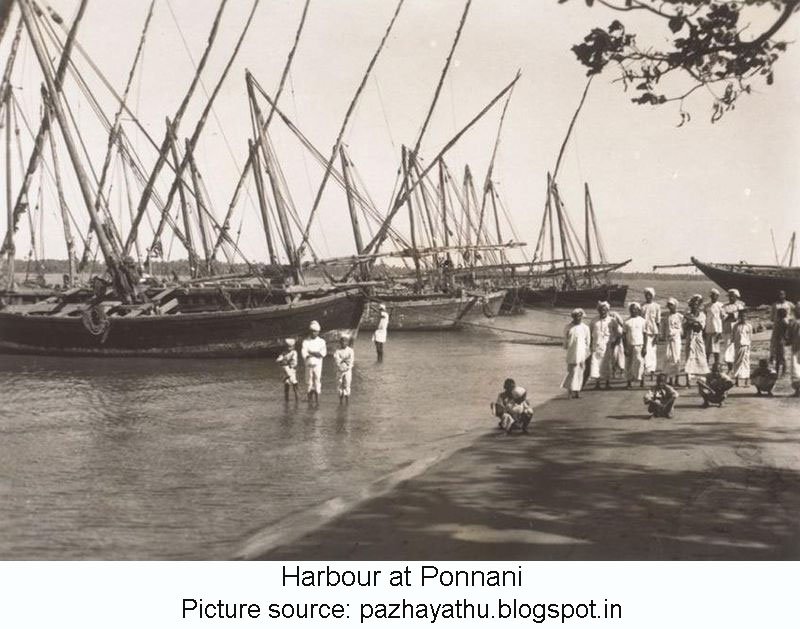 Lakes: There are also two large shallow lakes in the taluk. One of them the "Viyyattil" lake is situated about 3 miles east of Ponnani and the other familiarly known as the “Trichur" lake is about the same distance east of Chetwai and 8 miles from Chavakkad. They are respectively connected with the backwaters communicating with the sea at Veliyangod and Chetwai. Protected by strong artificial dams from tidal influence the beds of both the lakes are to a considerable extent cultivated with paddy after the monsoon. The "Viyyattil" lake lies entirely in this taluk, while the greater portion of the “Trichur" lake belongs to the Cochin State. The average extent of such cultivation and the amount of the revenue derived in the former are acres 7,920 and Rs. 10,865, respectively, and in that of the portion of the latter belonging to this taluk, acres, 2,292 and Rs. 2,960.
Climate.—The climate along the coast, generally, is temperate more or less throughout the year, while in the interior parts adjoining the taluks of Emad and Walluvanad, it is very hot in the of April and May.
Meteorology.—The subjoined statement shows the rainfall in the taluk in inches for eight years (1878—85).
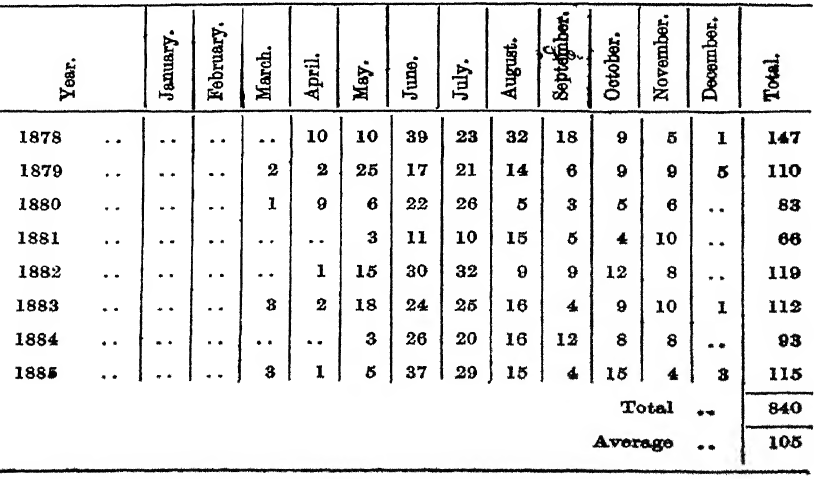
The Health Water Supply. The health of the people, as a rule, is good. The water supply is also good, especially towards the interior parts, but it is unsatisfactory in the towns of Ponnani and Tanur.
Sanitation. The conservancy of the chief towns is looked after by a staff consisting of 1 Sanitary Inspector, 1 maistry, 13 sweepers and 1 totti, paid from Local Funds. The Inspector, with his headquarters at Ponnani, supervises the work of the whole staff which is distributed as follows :—Ponnani, 4 sweepers and 1 totti ; Betatpudiyangadi, 3 sweepers ; Tanur, 1 maistry and 3 sweepers ; the remaining 3 sweepers being attached respectively to the three fish curing yards situated at Ponnani, Veliyangod and Tanur.
Population.—In the matter of population this taluk ranks first in the district. The total population (inclusive of the floating population) was, according to the census of 1881, 392,654, of whom 194,150 were males and 198,504 females. Classified according to race, Hindus predominated ; next came the Muhammadans and lastly the Christians, the number returned under each class being 231,402, 146,868 and 14,363 respectively, or 59, 37, and 4 per cent of the total population. The number of persons shown as belonging to other classes was 21.
Increase when compared with that returned by the census of 1871: The percentage of increase in the population as compared with that returned by the previous census of 1871 was 4.77 in respect of males and 4.78 in that of females ; the total increase in both the sexes being nearly 4.78. The average density of population to the square mile was nearly 972, and in this matter this taluk ranked second in the district, the first being Cochin. The proportion of males to females was in the ratio of 496.5 to 503.5 in every 1,000.
Houses.—There were 78,148 houses in all. Of these 70,625 were occupied and the remainder 7,523 unoccupied, the average number of persons per house amounted to about 5.6.
General Condition of the People.—The people generally are poor. There are a few rich and many indifferently off. The subjoined statement shows the number of persons following the various occupations as returned by the last census (1881) :
Classified according to occupation.
|
Professional |
5,750 |
|
Domestic |
1,306 |
|
Commercial |
8,696 |
|
Agricultural |
88,509 |
|
Industrial |
65,652 |
|
Indefinite |
222,741 |
|
Total |
392,654 |
Incidence of the Imperial Licence Tax.—The incidence of the Imperial Licence Tax for the past official year 1885-86 was as follows :—
|
Trade Dealing, Industry |
No. of persons charged. |
Amount of assessment |
|
Money lending |
103 |
1,520 |
|
Cloth bazaar |
6 |
90 |
|
In paddy |
5 |
90 |
|
In coconuts |
5 |
60 |
|
In coconut oil |
5 |
60 |
|
In rice |
2 |
20 |
|
In fish |
2 |
20 |
|
In salt |
2 |
20 |
|
In tobacco |
2 |
20 |
|
In timber |
2 |
20 |
|
Boat rent |
1 |
10 |
|
Miscellaneous |
3 |
30 |
|
Total |
138 |
1,940 |
Sub-divisions of the Taluk for Administrative Purposes.—
Amsams: For executive purposes this taluk is split up into 73 amsams. As Amsams elsewhere, the revenue work of each amsam is carried on by the Adhikari assisted by the Menon and a couple of peons. The Adhikaries likewise exercise civil and criminal jurisdiction, their civil powers extending to suits for money not exceeding Rs. 20 in amount, and the criminal to petty cases of assault and theft arising in their respective amsams.
General Revenue charge: The Tahsildar, whose headquarters are at Ponnani, has the general revenue charge of the taluk. He is assisted in his work by two Deputy Tahsildars stationed at Betatpudiyangadi and Kuttingal, to whom are assigned 21 and 28 amsams respectively.
Over these amsams they also exercise criminal jurisdiction, while the Tahsildar has the special magisterial charge of the remaining portion of the taluk. The taluk forms a separate revenue charge, designated the "Southern Division” under a General Duty Deputy Collector exercising also magisterial powers who has his head-quarters at Ponnani.
Agriculture.—The staple produce of the taluk is coconuts, though paddy is also largely cultivated. The subjoined statement gives the acreage under each head in fasli 1295. Average under each head.
|
Wet lands |
ACRES |
ACRES |
|
Nanja |
71,137 |
3,625 |
|
Punja |
13,782 |
21 |
|
Garden |
57,872 |
1,881 |
|
Total |
142,791 |
5,527 |
Thus the total area under cultivation is 148,318 or 232 square miles, or a little more than 57 per cent of the total area of the taluk (taking it to be about 404 square miles)—the extent under garden being 40 per cent the total area under cultivation.
The following table shows the demand roll of assessment for the same fasli :
|
Amount of Patta |
No. of holdings. |
Assessments. |
||
|
Rs. |
A. |
P. |
||
|
Under Rs 10 |
31,076 |
82,263 |
8 |
2 |
|
Rs. 10 under Rs. 50 |
5,240 |
1,07,195 |
10 |
7 |
|
Rs. 50 under Rs. 100 |
684 |
47,105 |
5 |
0 |
|
Rs. 100 under Rs. 250 |
316 |
45,461 |
14 |
2 |
|
Rs. 260 under Rs. 500 |
52 |
16,553 |
14 |
1 |
|
Rs. 500 and more |
15 |
12,236 |
2 |
11 |
|
Total |
37,383 |
3,10,816 |
6 |
11 |
Revenue.—The subjoined statement shows the revenue of the taluk derived from different sources for a series of the 8 Fasli years, 1288-95 :
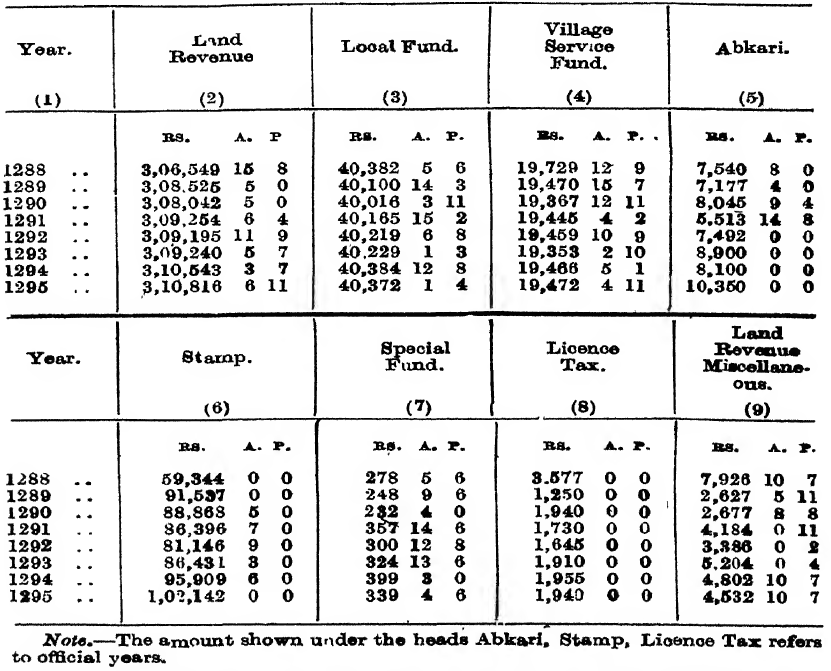
IMPORTANT TOWNS or VILLAGES WITH SHORT NOTICES OF TEMPLES, MOSQUES, CHURCHES, ETC., SITUATED IN or ABOUT SUCH PLACES.
Tannur—(a corrupted form of Thanniyur or Thanni + ur, meaning the village of Thanni trees, Terminalia bellerica, which are still very common here)—is a small town largely inhabited by Mappillas in Rayirimangalam amsam, situated about a mile west of the Tannur Railway station.
The streets and the lanes are narrow and generally in a dirty state. It is a seaport, and contains a Travellers’ bungalow, a Sea Customs office, a Police station, a Sub-Registrar’s office, a Post office and a chattram or mussaferkhana, the last three being situated close to one another, a quarter of a mile west of the Railway station, while all the rest lie in different parts of the town.
There are four mosques here, of which one is a jamath mosque (juma musjid). It is a tiled building, 186 feet in length and 93 in breadth, having the gate or gopuram covered with copper sheeting.
In the same (Rayirimangalam) amsam, about two miles to the south of the town, there is a famous Hindu temple known by the name of Keleswaram or Keraladhiswaram temple dedicated to Vishnu. As its name (Kerala + adhiswaran, the governing deity of Keralam or Malabar) implies, it is one of the most ancient Hindu temples in the district. It is about 50 feet in length and 35 in breadth, the Srikovil or shrine and the Vatilmadam or hall being tiled, and the nalambalam or the four wings of the temple thatched.
The total number of inhabitants in the amsam is 11,344, no less than 7,037 or 62 per cent of whom are Muhammadans, while Hindus and Christians number 4,305 and 2 respectively. In the matter of population this amsam stands next to Ponnani. In the adjoining Pariyapuram amsam, about 2 miles to the north of Tannur, there is another temple deserving notice This is called the Trikkayikkatt temple. The deities worshipped here are Siva, Bhagavati and Ayyappan. It is a tiled building and is about 33 feet in length and 28 in breadth. The figures of Siva, Brahma, Vishnu and Narusimhamurthi are painted on the wall of the Srikovil and two sculptures, representing the figures of Dowasthans (or door-keepers), are placed in front of the Srikovil.
Bettatpudiyangadi.—[Bettat + Pudiya + Angadi, means the New Town in Vettam. which name was given to the place in former days, for, here was the seat of the Raja of Betatnad. This family became extinct and the estate escheated in 1793.] The head-quarters of the Bettatpudiyangadi Deputy Tahsildar is a village in Talakkad amsam, situated about 3 miles from the Tirur Railway station along the road from there to Ponnani.
Muhammadans are the most numerous in the village, the Hindu and Muhammadan population being respectively, 3,156 and 3,179 total 6,335.
Besides the Deputy Tahsildar’s head-quarters, the place contains a Sub-Registrar’s office, a Police station and a chattram or mussaferkhana (now used as a Travellers’ bungalow). There is a Post office near the Railway station and a District Munsif’s Court and a Local Fund second class middle school about two miles from there on the road to Ponnani.
There are two jamath mosques (or jama masjid) and a minor mosque in the village, the most important of these being the Pudiyangadi jamath mosque, situated in the vicinity of the Deputy Tahsildar’s office. This is a grand building about 116 feet in length and 70 in breadth, the roof being tiled and the gopuram (the main entrance) being covered with copper sheeting. A granite slab on one of the steps of the northern gate bears an inscription. The writing has not yet been read.
At the Vellamasseri desam in the amsam there is a Hindu temple called the Garudan Kavu chiefly dedicated to Garudan (Vishnu’s Bird) and such dedications being rare, the temple is regarded with considerable reverence and is also largely resorted to by Hindu population for protection from any surpapida (visitations of serpentine displeasure in the form it is believed of various diseases), the deity being believed according to Hindu puranas to be the natural enemy of serpents.
In the adjoining Trikkandiyur amsam there is another ancient and famous temple called Trikkandiyur temple. It is dedicated to Siva, and is believed to have been founded by Parasu Rama. This temple is about 95 feet square. The Srikovil is a tiled building, the nalambalam being only thatched There is a big tank attached to the temple lying close to it.
Paronna—[a corrupted form of Paravannur, so called as being the place of residence in former days of Paravanur Panikkar, a desavali]— is a small Mappilla village lying by the side of the sea in Pachattri amsam about 3 miles to the west of Bettatpudiyangadi There is a jamath mosque (jama musjid) here. This is a tiled building, 140 feet in length and 58 in breadth. The total number of inhabitants in the amsam is 4,243, of whom 1,764 are Hindus, the remainder 2,479 being Muhammadans.
Kodakkal —[Koda + kal or kallu, meaning umbrella-stone. The place seems probably to have been so called because of the existence of several umbrella-stones in the neighbourhood.] It is a Basel Mission station situated in Triprangod amsam about 2 miles to the south-east of Bettatpudiyangadi. There is a church, a combined industrial and girls’ school and a weaving establishment here. The total population of the amsam numbers 5,393 divided into 2,724 Hindus, 2,398 Muhammadans and 271 Christians.
In the neighbourhood of this place are situated some of the most ancient Hindu temples in the district, viz., (1) the Triprangod Siva temple ; (2) the Hanuman Kavu ; (3) the Tirunavayi Vishnu temple and (4) the Chamravattatt Ayyappan Kavu. Of these the first two are situated in Triprangod amsam, while the last two lie in the neighbouring Atavanad and Pallipurani amsams, respectively.
All the temples are considered to be of great antiquity. (I) The Triprangod (called in Sanscrit Sri + vara + crod) temple is dedicated to Siva and lies about 2 miles to the south of Bettattpudiyangadi. The Srikovil is a tiled building about 105 feet in length and 75 in breadth. The raised stone foundation of a pillar of the building consecrated to Krishna here bears a long inscription. The writing cannot be deciphered locally.
The ceremony of Sanghabhishekam (pouring water on the head of the idol by means of a conch shell), is supposed to be the most acceptable offering to the presiding deity (Siva), and this is performed largely by the people under the honest belief that thereby their life will be prolonged.
(2) The Hanuman Kavu, as its name indicates, is dedicated to Hanuman (the monkey chief, deified). The rareness, comparatively, of dedications of temples to this deity, seems to enhance the value of this temple in the estimation of the people. The Srikovil and the mandapam are small tiled buildings, the surrounding wall of the former all over containing paintings of the devas and of vyalam, and it has also two statues of Dwasthanmar (door-keepers), placed one on each side of the entrance.
(3) The Thirunavayi (or Shri + naa + yogi + puram) Siva temple seems to have been so called on account of its having been, it is believed, founded by the 9 famous saints. The temple is situated on the northern bank of the Ponnani river on the road from Bettatpudiyangadi to Trittala. The place was in former days noted as being the locality where the Mahamakha Vela or ceremony was celebrated every 12th year. During the 28 days the festival lasted, the throne of the Zamorin was declared vacant, when a selected number out of the followers of this potentate, and also of the Walluvanad Rajah, being the rival claimant for the throne (all being well trained for the purpose), fought1 against each other for it in the interests of their respective masters. The ceremony is said to have been last performed in 1743.
NOTEs: 1. See pp. 162-69, Vol I END OF NOTEs
The Srikovil is a massive tiled building and has two big statues of Dwasthanmar as in the case of the Hanuman Kavu, one on each side of the entrance into it. This place is further famous as containing an institution founded and amply endowed by the Zamorin, where Hindu theology is extensively taught to the Nambutiri Brahman students. This instruction is imparted in a spacious building, called the Oththanmar madham, situated on the opposite side of the river, under the supervision of Tirunavayi Vadhyan, the Zamorin’s hereditary family priest.
Another point deserving notice in connection with this place is the existence of a small temple dedicated to Brahma, which is of very rare occurrence.
(4) The Chamravattam Ayyappan kavu, dedicated to Ayyappan, is situated on a small island near the Chamravattam ferry on the road from Tirur to Ponnani. The Srikovil is a small tiled building, but badly in want of repairs. This deity is supposed to possess a specially controlling power over rain, and people hence frequently make small offerings on behalf of this temple for rain when it is wanted and also to stop it when it is not required.
Kuttayi.—[Kutt + ali, meaning a junction and a bar, respectively.) It is said that there was here formerly a bar, where the backwaters lying along the coast from Tirur and Ponnani united and communicated with the sea. Hence the designation of the place as Kuttayi. It is a large Muhammadan village, situated by the side of the sea in Mangalam amsam about 4 miles to the south-west of Bettatpudiyangadi. Of the inhabitants, Muhammadans are the most numerous numbering 3,186 out of a population of 5,069, the remainder, viz., 1,883 being Hindus. There is a famous jamath mosque (or jama musjid) in the village which is a tiled building, being 105 feet in length and 48 in breadth. There is also a Jaram or mausoleum attached to it called the Nechchikkat Jaram, so named on account of its being surrounded by nechchi bushes. It is not known whose remains lie burried here, but it is held in considerable reverence, and is largely resorted to by Muhammadans, especially on the occasion of the annual Nercha festival, when the approximate attendance of pilgrims is estimated to be no less than 2,000.
Ponnani.— [The place is said to have been designated Ponnani, which is a corrupted form of "Ponnani" "Ponnanayam,'' meaning gold coin, as being the place where the gold coin, called the Arabikasu was first circulated in these parts of the district by the Arab and Persian merchants who possessed the trade between India and the west before the discovery of the sea route to India round the Cape of Good Hope by the Portuguese.] This town, the divisional and taluk headquarters, is large and populous, situated on the Ponnani river at its entrance into the sea. It contains also, the Kutnad District Munsif's Court, the Ponnani Sub-Registrar's office, a combined Post and Telegraph office, a Local Fund third-class middle school and a hospital and dispensary.
The amsam of Ponnani of which the town forms a part, contains 12,421 inhabitants, of whom no less than 86 per cent are Mappillas. The spiritual head, called the Makkadum of the Muhammadan population throughout the district, resides here. There are 27 mosques in the town, of which one is a jamath mosque (or jama musjid), deserving special notice as being also a place where Muhammadan theology is largely taught. The average daily attendance of students, belonging not only to all parts of the district but also to the native states of Cochin and Travancore and even South Canara, who receive instruction in the mosque, is about 400. The mosque is spacious four-storeyed bidding, 90 feet in length and 60 in breadth, said to have been build in Hejira 925 (A.D). 1510), by Said-ud-din Makkadum, and stands close to the jaram or mausoleum, which contains his own and his successors’ remains. Such of the students as attain proficiency in the Muhammadan religion here are called Musaliyars, the Makkadum alone having the privilege to confer that title. This jaram is held in great reverence and largely resorted to by the Muhammadan population all oyer the district. Ponnani is also a seaport. The principal articles of export are timber, bamboos, coconuts and coir, and the chief imports are salt and rice. Half a mile to the south of the bazaar there is a travellers’ bungalow, while a mile and a half to the east of the town there is a chattram or musaferkhana. The hospital and dispensary is under the charge of a civil apothecary and has accommodation for 10 in-patients (6 males and 4 females).
About half a mile to the south-east of the town, at Trikkavu in the adjoining Pallapram amsam, there is an ancient Hindu temple of considerable historical importance. It is dedicated to "Durgha Bhagavathi" and is believed to have been founded by Parasu Rama, the demi-god and hero, and made over by him to the Brahman colony at this place, being a sub-division of Sukapuram gramam, one of his 64 colonies.
Tippu is said to have plundered the temple during his invasion of the country, broken the idol into pieces, and used the Srikovil as his powder magazine while halting at this place. On the restoration of peace and order in the country, a few of the former owners of the temple who had taken refuge in Travancore on Tippu’s approach, returned and discovering in the temple well the broken pieces of the original idol, repaired and repurified it ; but later on, being unable to repair all the damages caused to the temple by Tippu, made it over to the Zamorin of Calicut, who seems to have carried out all the necessary repairs in M.E. 1037 (1861 A.D.).
Within the precincts of this temple there is another Srikovil, consecrated to Vishnu. The history of its foundation is interesting. Tradition has it that in olden days, while a Chetti and a Muhammadan were sailing in their ship laden with merchandise, a violent storm occurred, that they being apprehensive of the loss of their lives, took vows to build a temple and a mosque respectively, in the event of their being able to land safely and that they having so landed at this place, in fulfilment of their vows, founded this Vishnu temple and the present jamath mosque in the town. The temple is 112 feet in length and 72 in breadth. Both the Srikovil and the Nalambalam of Dhurga Bhagavathi have tiled roofs. The temple has also a high double-storeyed and tiled gopuram. There is a large public tank here about 400 feet in length and 300 in breadth. It was in a ruined state formerly, but has now laterite steps all round, these improvements having been carried out by Rama Kini, a late Tahsildar of this taluk.
Edappal, five miles east of Ponnani, is a large village, situated in the amsam of the same name on the main road from Ponnani to Palghat via Trittala. It is chiefly inhabited by Mappillas. The total population of the amsam is 6,595. Of this, 4,874 are Hindus, and the reminder Muhammadans. In the neighbouring Vattamkulam amsam, there is an important Hindu temple called the Sukapuram1 temple. It is believed to be of great antiquity and also to have been founded by the hero and demi-god Parasu Rama, It is dedicated to Dakshinamurthi or Siva, and is said originally to have been attached specially to the Nambutiri Brahmans of Sukapuram, which was one of the 64 gramams or settlements founded by Parasu Rama. Even to this day offerings are invariably made by the Nambutiris belonging to this gramam on occasions of marriage or other ceremonies among them, and none who have performed yagama or sacrifices are recognized as such until they are registered at this pagoda. This registration takes place once in 12 years. The Srikovil or Garbagraham (shrine) of the temple, is a massive laterite structure, 50 feet in length, 45 in breadth and 40 in height, the roof being covered with copper sheeting.
NOTEs: 1. Conf. pp. 120.21, Vol. I END OF NOTEs
About 6 miles to the north-east of Edappal village and about the same distance in the same direction from the Sukapuram temple, there is another famous ancient Hindu temple. It is situated in Chekod amsam. This also is believed to have been founded by the same hero and demi-god, Parasu Rama, being specially attached to the Nambutiri Brahman colony of Panniyur1 (another of the 64 settlements referred to). This temple is a small tiled building, the presiding deity being Varahamurthi (according to the Hindu puranas the 3rd incarnation of Vishnu). This is the chief temple of the Nambutiris, designated the Panniyur Gramakkar of the present day. They are said not to possess the prerogative of studying the Vedas, having, it is said, been deprived of the same owing to some of their ancestors in ancient days having placed a red hot vessel on the head of the idol of the presiding deity of the temple. In front of the temple there are some granite sculptures and also a slab of the same material bearing an inscription in Vattezuthu characters, some of which having now become indistinct, the writing has not been deciphered.
Trittala.—It is a small village in Kodanad amsam, situated by the side of the Ponnani river on the road from Ponnani to Palghat about 17 miles to the east of Ponnani. The total population of Kodanad amsam is 5,840. of whom 4,877 are Hindus and the remainder Muhammadans. There is a traveller’s bungalow and a chattram or musaferkhana here. It is also the station of a Sub-Registrar. A weekly market is held here. About four miles south of this place are the ruins of a mud fort, 200 yards in length and 176 in breadth. This fort appears to have been at one time the principal place in this tract of country for it has given a name—Kutnad—to the nad lying south of the Ponnani river, which prior to the reorganisation of taluks in 1861 formed the Kutnad taluk.
About three miles to the north-east of these ruins and by the side of the road from Padinharangadi to Shoranore, is a small building called Kattilmadam or Kaittalimadam, built entirely of granite slabs, and in the form of the Hindu shrine. It is ten feet square and of the same height, having a round dome formed of a single slab. Tradition ascribes its construction to supernatural agency. One popularly received account is that it was intended as the second storey to a pagoda about 4 miles off in Netirimangalam amsam of Walluvanad taluk on the other side of the river, and a comparison of the shape and size of the existing shrine at the pagoda with those of this curious structure certainly favours this theory.
There is another place in the neighbourhood of Trittala deserving notice. It is called Velliyamkallu and Is situated about a mile down the river from there and on the opposite side of it. It is considered by Hindus as a sacred place as being the spot where the Nambutiri Brahmin named the Melathur Akkithripad is believed to have performed a number of yagams or sacrifices and is hence largely resorted to by them for the performance of the anniversaries of their ancestors on Vavu (new moon) days occurring in the Malayalam months of Tulam and Karkitagam.
Chalisseri is a small village and a bazaar situated on the borders of Kappur and Kottachira amsams about 6 miles to the south of Trittala. It is chiefly inhabited by Syrian Christians. This community has a small church here. The place is noted for trade in arecanuts.
Veliyangod is a village chiefly inhabited by Mappillas, situated in the amsam of the same name, about 4 miles to the south of Ponnani. There is a Police station here and also a Sub-Registrar's office at Andathod in the adjoining Ayyur amsam. The total population of Veliyangod amsam is 6,826 of whom the majority are Muhammadans, numbering 3,771, the remainder being Hindus.
Kottapadi.—[Kotta or fort and padi or gate. The place seems to have been so designated on account of its being situated close to the seat, named the Punnathur Kotta of one of the feudatory chieftains of the Zamorin in ancient days, known by the name of the Punathur Raja.] It is a small village about 3 miles to the north-east of Kuttingal. It is chiefly inhabited by Syrian Christians who have a church here. The place is noted for trade in coconut oil and the rearing of country pigs by the Christians. These animals are generally transported to the Nilgiri hills and other distant places for sale. The present representatives of the above-mentioned chieftain's family still reside here.
Kuttingal, the Chavakkad Deputy Tahsildar’s headquarters, is a village in Palayur amsam lying by the side of the canal from Ponnani to Cochin, about 17 miles to the south of the former place. The total population of the amsam is 6,296 of whom 3,482 are Hindus, 2,456 Muhammadans and the rest 308 Christians (Syrian). The village also contains a District Munsif’s Court, a Sub-Registrar’s office, and a Post office. Half a mile north of the place there is a Local Fund 2nd-class middle school, and half a mile east of Kuttingal, there is a Syro-Roman Catholic church, called the Palayur church, which is noted as being one of the seven original churches of Malabar.
The congregation believe that St. Thomas the Apostle preached at the place, and it is noteworthy in connection with the suggestion made at p. 202 of Volume I, that in immediate proximity to the existing modern church there is a mound with small debris strewn about it, which is still known as the site of the "Jews’ church," and which was evidently occupied by a building of some kind in former times. The only relics of any age about the place now are some carved stones, including part of a Siva lingam stone and a worn-out Vatteluttu inscription, the spoils of a Siva shrine also in the neighbourhood. The modem church is a tiled building, 86 feet in length and 34 in breadth. It is under the See of the Patriarch of Babylon.
In the Palayur and the adjoining Chavakkad amsams there are also two mosques called after the respective amsams. The former is about quarter of a mile to the east of Kuttingal, while the latter is about a mile to the west of it. They are tiled buildings, 40 and 50 feet in length and 21 and 15 in breadth, respectively. There is also a jaram or mausoleum in Palayur amsam of some importance containing the remains of one Hydros Kutti1 who was, it is said, the Commissioner appointed by Hyder Ali, on his conquest of the district, to collect the revenue in these parts of the taluk, but who having subsequently espoused the cause of the people against his masters’ tyrannies, seems to have incurred that tyrant’s displeasure and fallen in battle with the forces sent against him oh the spot where the building now stands. It is held in reverence, and is also resorted to by the Muhammadan population in these parts of the taluk.
NOTEs: See Vol. I, p. 662. END OF NOTEs
Guruvayur.—[So designated after the famous temple of Krishna located there, which is believed to have been founded, as its name indicates, by Guru and Vayu, being, according to the Hindu Puranas, the preceptor of the Devas and the god of wind, respectively. ] It is an important Hindu village, situated in the amsam of the same name, about 2 miles to the north-east of Kuttingal. The amsam has a total population of 6,686 inhabitanta, of whom Hindus are the most numerous, amounting to 4,946, the remainder being divided into 527 Muhammadans and 1,206 Christians. The residents about the Guruvayur temple are chiefly the higher classes of Hindus, viz.. Brahmans and Nayars.
It is one of the most important Hindu temples in the district, and is held in great reverence, and also largely resorted to by the Hindu population (especially by the sick) throughout the district, as well as of the neighbouring native States of Cochin and Travancore. It is surrounded by a high laterite wall and has two lofty gopurams or entrances, one in the east and the other in the west. On the granite door-frame of the western one there is an inscription which indicates that it was built in 922 M.E. by one Panikkavittil Ittiraricha Menon Kariyakkar. A granite slab in the front part of the eastern entrance, too, contains an inscription in Sanskrit verse as noted in the margin. [Given here below]:
ഭൂപാലൈർവ്വെനജാദ്യൈ: കലിമലാഹി തൈരാർജ്ജിതാൻ പുണ്യലൊകാൻ ആരൊഢ നിഷ്പ്രയാസം നിജസുകൃതജിതാൻ ദിവ്യസൊപാനമാർഗ്ഗം തുംഗംഹൃന്നെത്രരമ്യം ഗുരുപവനപുരെശാഗ്രതൊ ഗൊപുരാഗ്ര്യവ്യാജെനാധൊക്ഷം ജാഘ്രൌകൃതമതിരകരൊഛൈലാവാരാർന്നിധീശ:
Both the srikovil (shrine) and the mandapam have roofs covered with copper sheetings, while the Nalambalam has tiled roofs. The temple flagstaff deserves special notice. It is 110 fleet in height. having a bell metal covering throughout, save about 9 feet from the top, which has a gold covering. The surrounding wall of the shrine is elaborately painted all over, in illustration of the various adventures of Vishnu as recorded in the Bhagavathapurana.
Chittatkara—is a small village chiefly inhabited by Syrian Christians, situated in Brahmakulam amsam about 4 miles to the south-east of Kuttingal. There is a small church belonging to this community here. The total population of the amsam is 4,179, of whom 2,256 are Hindus. Of the remainder, 1,582 are Christians and the rest Muhammadans. The chief articles of trade here, are coconut and coconut oil.
Enamakkal—is another village mainly inhabited by Syrian Christians in Venkitanga anisam, about 8 miles to the south-east of Kuttingal and 4 in the same direction from Chittatkara. Here, there is an important ancient Syrio Roman Catholic church. It is a tiled building, about 93 feet in length and 35 in breadth. The total population of the amsam is 6,416, of whom 1,770 are Syrian Christians, the rest being divided into 3,686 Hindus and 960 Muhammadans. The chief articles of trade here, too, are coconut and coconut oil.
Velappad—.is a village chiefly inhabited by Syrian Christians, situated in Pallipuram amsam about 17 miles to the south-west of Kuttingal. It contains a Police station and a Sub-Registrar's office. About a mile to the north of the place at Triprayar, in Nattika amsam, there is a famous ancient Hindu temple. It lies by the side of the inland water communication to Cochin and belongs to the Cochin State. The presiding deity here is Sri Rama. The temple is 342 feet square, and the roof of the shrine is covered with copper sheeting, the nalambalam being tiled. On a granite slab of the wall of the srikovil there an inscription, but it is very difficult to decipher the writing. A granite slab by the side of the eastern entrance, also, bears an inscription in Malayalam. The total number of inhabitants in Pallippuram amsam is 4,563, of whom 3,513 are Hindus ; of the remainder, 655 are Muhammadans and 395 Christians.
പഴഞ്ചെരിപനടനായരും - തൃപ്പുരയാറ്റ ദേശത്തും - പെരിങ്ങൊട്ടദേശത്തും - ആരിയപൊന്നിദേശത്തും ഊരാളരും കാരാളരും നെടുംകൊണ്ടവരും കടിഇരിമ്പാടതിരി.
Edathiruthi—is another Syrian Christian settlement situated in the amsam of the same name about 4 miles south of Valappad. The amsam has a population of 8,886 inhabitants, classified into 6,548 Hindus, 1,293 Muhammadans and 748 Syrian Christians. There is a small church belonging to Syrian Christians here.
Madilagam.—[The place is so called after the name of the temple, called the Trikkanna or Trikkata Madilagam temple, which existed there in ancient days and is believed to have been founded by Parasu Rama for the use of Trikkannapuram gramam, being one of the 64 Nambutiri Brahman settlements founded by him. It is said that it was subsequently destroyed by the Dutch who had formerly a settlement at Chetwai. Traces of the foundations of an old temple are still visible.] It is another Syrian Christian settlement in Pappinivattam amsam. There is an ancient church belonging to this community here. The total number of inhabitants in the amsam is 5,739, of whom 3,610 are Hindus ; of the rest, 1,737 Muhammadans and 392 Christians. The place contains also a mosque, and is situated about 9 miles south of Edathiruthi.
Police.—For purposes of Police administration, the taluk is divided between 3 Inspectors, who have their head-quarters at the Tahsildar's and Deputy Tahsildar’s head-quarters respectively. There are 17 Police stations in all, distributed in the three divisions as follows:-
Ponnani Division
(1). Veliyangod : In Eramangalam amsam, 5 miles from Tahsildar's headquarters.
(2). Ponnani : In Ponnani amsam, Tahsildar's head-quarters.
(3). Edappal : In the amsam of the same name 6 miles from Tahsildar’s head-quarters.
(4). Chiyyanur : In Othalur amsam, 10 miles from Tahsildar's head-quarters.
(5). Padinharangadi : In Kumaranallur amsam, 11 miles from Tahsildar's head-quarters.
(6). Kutnad : In Kodnad amsam, 16 miles from Tahsildar's head-quarters.
Chavakkad Division.
(1) Madilagam : In Pappinavattam amsam, 28 miles from Chavakkad Deputy Tahsildar’s head-quarters.
(2) Valappad : In Pallipuram amsam, 17 miles from Chavakkad Deputy Tahsildar’s head-quarters.
(3) Chavakkad : In Palayur amsam, Deputy Tahsildar’s head-quarters.
(4) Vylathur : In Vylathur amsam, 4 miles from Deputy Tahsildar’s head-quarters.
(5) Audathod : In Ayrur amsam, 8 miles from Deputy Tahsildar's head-quarters.
Bettatpudiyangadi Division
(1) Kuttayi : In Mangalam amsam, 4 miles from Bettatpudiyangadi Deputy Tahsildar’s head-quarters.
(2) Putiyangadi : In Talakkad amsam. Deputy Tahsidar's headquarters
(3) Tanur : In Rayirimangalam amsam, 6 miles fiom Deputy Tahsildar's head-quarters.
(4) Kalpagancheri : In the amsam of the name, 6 miles from Deputy Tahsildar’s head-quarters.
d) Vatakkumpuram : In Kattiparutti amsam, 16 miles from Deputy Tahsildar’s head-quarters.
(6) Kuttipuram : In Atavanad amsam, 8 miles from Deputy Talisildar’s head-quarters.
Festivals and fairs: The chief annual festivals celebrated in the taluk are shown below. On these occasions fairs are also held ; the most important being the one held on the occasion of the Guruvayur Ekadesi festival, and for a week or so after it is over. The chief articles changing hands are lasting copper and bell metal vessels of various kinds:-
|
1 |
Guruvayur Ekadesi festival |
3 days |
Vrischigam |
Nov. - Dec. |
5,000 |
|
2 |
Guruvayur Arat utsavam |
8 " |
Kumbham |
Feb.- March |
3,000 |
|
3 |
Triprayar Arat utsavam |
8 " |
Meenum |
March - April |
2,000 |
|
4 |
Trittala Sivaratri festival |
1 day |
Kumbham |
Feb.- March |
2,500 |
|
5 |
Trittala Arat utsavam |
7 days |
Dhanu |
Dec.- January |
2,000 |
|
6 |
Triprangod Sivaratrl utsavam |
1 day |
Kumbham |
Feb.- March |
4,000 |
|
7 |
Tirunavaya Arat utsavam |
7 days |
Medam |
Apl.- May |
4,000 |
|
8 |
Tirunavaya Karkataka Vavu festival |
1 day |
Karkatakam |
July - August |
5,000 |
|
9 |
Tirunavaya Thula Vavu festival. |
1 " |
Thulam |
Oct - Nov. |
5,000 |
|
10 |
Garudan Kavu Mandala Vela. |
5 Sundays |
1st Vrischigam to 10th Dhanu |
Nov.- Dec. |
1000 each day. |
|
11 |
Trikandiyur Thula Vavu festival. |
1 day |
Thulam |
Oct.- Nov. |
2,000 |
|
12 |
Kelaswaram Arat utsavam |
7 days |
Vrischigam |
Nov.- Dec. |
1,000 |
List of Charitable Institutions in Ponnani taluk
|
Amsam |
Name of institution |
Number of persons fed annually at the institution |
Amount of Land Revenue granted in Inam from Government for the institution |
Amount of private donation |
|||
|
Brahmans |
Travellers (Byragies) |
In land |
In money |
||||
|
Vettam Pallipram |
1.Chamravattam Sattram |
492 |
41 |
124 11 1 |
714 |
|
|
|
Trikkandiyur |
2.Vettakarumakan Kavu Sattram |
36,000 |
3,600 |
1,399 14 2 |
3,100 |
|
|
|
Do. |
3. Triprangod Samuham |
10,125 |
|
235 2 1 |
2,000 |
|
|
|
Rayirmangalam |
4.Keraladhiswarapuram |
61,200 |
12,240 |
2,704 13 4 |
3,819 |
|
|
|
Talakkad |
5.Vellikullangara Ayyappan Kavu Sattram |
5,250 |
750 |
|
575 |
|
|
|
Pariyapuram |
6.Ganapathiyankavu Sattram |
1,260 |
|
|
55 |
|
|
|
Nullasseri |
7.Peringatt Uttu Sattram |
4,380 |
1,095 |
|
60 |
|
|
|
Guruvayur |
8.Guruvayur Sattram |
29,200 |
|
|
1,095 |
|
|
|
Do. |
9. Tamarayur Sattram |
4,380 |
|
|
300 |
|
|
|
Vylattur |
10. Alakkal Brahmarakshasan Sattram |
3,650 |
720 |
321 0 1 |
3,270 |
|
|
|
Nattika |
11.Triprayar Sattram |
27,875 |
3,650 |
|
|
3,878 |
|
|
Vadanappalli |
12.Panayamkulangara Sattram of Ullanatt house |
7,300 |
3,650 |
|
5,502 |
|
|
|
Do. |
13. Panayamkulangara Sattram of Manhallavil house |
2,920 |
365 |
|
1,000 |
|
|
|
Kayppamangalam |
14. Mallikakkal Sattram |
|
1,825 |
|
|
228 |
|
|
Atavanad |
15. Tirunavaya Sattram |
7,200 |
720 |
|
|
660 |
|
|
Unmattur |
16. Kurumhikavu Sattram |
|
|
|
|
|
|
|
Do. |
17. Parakulangara Sattram |
900 |
60 |
|
800 |
|
|
|
Do. |
18. Kodali Sattram |
900 |
|
|
120 |
1,260 |
|
|
Kodanad |
19. Trittala Sattram |
9,000 |
1,080 |
|
|
|
|
|
Parutur |
20. Chembalangatt Samuham Kotikunni Sattram |
900 |
|
48 10 0 |
300 |
125 |
|
|
Irumbliam |
21. Perashannur Sattram |
900 |
|
|
|
|
|
|
Ayirur |
22.Kattupinath Vettekorumakan Sattram |
2,555 |
2,160 |
|
470 |
225 |
|
|
Iswaramangalam |
23. Tirumalassiri Kottayil Chavati Sattram |
|
1,800 |
|
1,000 |
|
|
|
Trikkandiyur |
24. Kumaramangalam Subramaniya temple Satram |
9,150 |
2,440 |
|
|
140 |
|
|
Koktanad |
25. Asuramahakalan temple Sattram |
720 |
|
|
|
|
|
List of Hindu Religious Institutions in Ponnani taluk in connection with which Government have remitted Land Revenue as Inam.
|
No. |
Name of institution |
Amount of Inam granted |
Date of grant |
Remarks |
|
Rs. A. P. |
||||
|
1 |
Trikavu Temple in Pallpram amsam |
334 1 0 |
|
Temples Nos.3 and 4 originally belonged to the Bettat Rajah, but were afterwards made over to the Zamorin, when the Rajah's estate lapsed to Government.
|
|
2 |
Guruvayur temple in Guruvayur amsam |
1,428 9 0 |
|
|
|
3 |
Triprangod temple in Triprangod amsam |
1,127 0 6 |
|
|
|
4 |
Trikandiyur temple in Trikandiyur amsam |
2,292 13 0 |
|
Weekly markets.—The subjoined statement shows the weekly markets held in the taluk. There are nine such markets. The majority of the traders being Muhammadans, and Friday being a holy day with them, no markets are held on that day. In all the markets, salted fish seems to be the chief article of trade, while vegetable and other articles are also largely sold.
|
Day held |
Where held |
Number of persons attending |
|
Sunday |
Trittala. Close to the travellers' bungalow |
2,000 |
|
Monday |
Madilagam. Half a mile south of the bungalow. |
2,000 |
|
Tuesday |
Andathod. In the neighbourhood of the Veliyangod Police station. |
1,000 |
|
Valancheri- In the vicinity of the Vatakkumbram Police station. |
1,500 |
|
|
Wednesday |
Kuttingal. Close to the Chevakkad Deputy Tahsildar’s office. |
2,500 |
|
Kalpagancheri. In the vicinity of the Police station there. |
1,500 |
|
|
Thursday |
Chalisheri. In the vicinity of the village of the same name. |
1,600 |
|
Saturday |
Valappad. Close to the Police station |
1,800 |
|
Kuttipuram. Close to the Police station |
1,500 |
Travellers' Bungalows and Chattrams.—There are five travellers’ bungalows and four chattrams or musapherkhanas in the taluk as shown in the following statement :
|
Name of Bungalow and chattram |
Situation |
|
Travellers' Bungalows |
|
|
Tanur |
A mile and a half to the west of the Tanur Railway Station. |
|
Ponnani |
In the town of the same name. |
|
Trittala |
By the side of the Ponnani river at the village of the same name about 4 miles to the west of the Pattambi Railway Station on the road from Palghat to Ponnani. |
|
Chetwai |
Four miles south of Kottingal by the side of the Chetwai river (or backwater) on the road from Ponnani to Cochin. |
|
Madilagam |
By the side of the inland water communication referred. About 23 miles south of Chetwai. |
|
Chattrams |
|
|
Tanur |
Two furlongs west of the Tanur Bailway Station, |
|
Bettatputiyangadi |
Close to the Deputy Tahsildar’s office of the place about 2½ miles south-west of the Tanur Railway Station. |
|
Ponnani |
A mile and a half east of Ponnani by the side of the road from there to Palghat. |
|
Trittala |
Close to the travellers' bungalow. |
G. Trigonometrial Survey Stations.-—There is only one such station in the taluk. This is called Kutnad or Kurungnt hill station situated about a mile to the south of Trittala in N. Lat. 10° 47' 32.64" and Long. 76° 08' 36.50". It is in good condition.
European Tombs and Burial Grounds.—There is only one isolated tomb and no European burial grounds exist in this taluk. The former is situated near Trittala and is in fair condition. It bears the following inscription : “Here rest the remains of Henreitta, the beloved wife of Captain James Falconer, H.M’s 74th Highlanders. She died at Trittala on 24th February 1855, aged 35 years. This stone has been placed here by her bereaved husband as a small token of affection."
A tombstone recording the death of the first Dutch commandant of the Dutch fort at Chetwai who died at that place in 1729 also exists, and has already been referred to in Vol I, p. 349. The site of this grave is unknown.
Statement showing old tombs or Pandu Kulis existing in Ponnani Taluk.
|
1. Nagalasseri |
1 |
1. Kappur |
1 |
|
2. Ozhur |
1 |
2. Kumaranelore |
1 |
|
3. Klari |
2 |
3. Tavanur |
4 |
|
4. Vadakumbram |
18 |
4. Alancode |
1 |
|
5. Mullasseri |
3 |
5. Nagalasseri |
10 |
|
6. Annakara |
1 |
6. Triprangode |
1 |
|
Text missing |
|
7. Kanmanam |
5 |
|
|
8. Melmuri |
10 |
|
|
|
9. Olur |
1 |
|
|
|
10.Klari |
6 |
|
|
|
11.Ponmundam |
1 |
|
|
|
12.Kattiparuthi |
2 |
|
|
|
13. Parutur |
1 |
|
|
Total |
62 |
Total |
44 |
COCHIN TALUK
By C. Kunchi Kannan.
Cochin was formerly a small place on the bank of a river, but in the year 1341 A.D., certain changes took place in the large backwater between the sea and the Western Ghauts, and whether from cyclone winds, or earthquake, or other cause not now traceable, the island of Vypeen was formed —a circumstance commemorated by an era of its own known as Putuvaippu or Putuveppu, meaning "new deposit".
The traditions of Cochin show that violent and uncertain changes have always been experienced in this neighbourhood in exceptional south-west monsoons. All along this portion of the coast important changes are quoted. Islands and lakes have been formed ; towns and harbours have risen and had their day of prosperity, but have now so completely retired that, after the comparatively small interval of five centuries their former sites and names are not recognisable. Cochin itself was built in the tenth, year after Vasco da Gama arrived on the coast, and its advantages being very apparent, the large colonies of white and black Jews and other important portions of the community quitted Cranganore, which from time immemorial had been the headquarters of trade and the most convenient harbour north of Quilon.
Cochin, which lies between Lat. 9° 58' 7" N., Long. 76° 17' E, is bounded on the north by the Native State of Cochin and by the backwater, on the south by the Cochin State, on the east by the river and the Cochin State, and on the west by the sea. In extent Cochin taluk, with its outlying pattams, is about 1½ square miles. The population of the town of Cochin in 1881 was 15,698 (8,374 males and 7,324 females) against 13,588 in 1871. The population of 1881 was classified as follows:
|
Hindus |
4,383 |
|
Muhammadans |
2,942 |
|
Christians |
8,360 |
|
Others |
13 |
|
Total |
15,698 |
of whom 1,262 were “under instruction,'’ 3,240 “instructed,” and 11,196 “illiterate, including not stated.” In the census of 1881, there were 2,411 occupied and 467 unoccupied houses, giving an average of 6.5 persons per occupied house. The population of Cochin, with its outlying pattams, was 17,161 in the census of 1881.
The revenue of the Cochin taluk in fasli 1295 (1885-86) was Rs. 14,467.
The Municipal Act was introduced into Cochin in 1866. The receipts of the Municipality during the official year 1885-86 amounted to Rs. 20,479, whilst the charges were Rs. 18,914. The Municipal receipts were chiefly derived from rates on houses and lands, taxes on arts, taxes on vehicles and animals and carts, licenses, income from markets, fees, fines, etc.
The expenditure incurred was for public works, education, sanitation and medical service, supervision and management, and miscellaneous.
There are nine Christian churches in the town of Cochin, two Protestant, six Roman Catholic and one Syrian.
And there are two Hindu temples, Ammankovil dedicated to Bhagavati and Janardana Devaswam in Amaravati, belonging to Chetties.
On 31st March 1886 there were 16 schools, middle, primary, aided and unaided, with an attendance of 996 pupils.
The town of Cochin is sub-divided into the following pattams:-
|
1 Kotta. |
8 Tirumala Dewaswam. |
|
2 Kottavadu. |
9 Vania Teruvu pattam. |
|
3 Vernede garden or Jatika Valappu. |
10 Valiya Pattayatodu pattam |
|
4 Mackenzie Valappu. |
11 Cheriya Pattayatodu pattam. |
|
5 Tamaraparamba pattam. |
12 Veliparamba pattam. |
|
6 Odattakal |
13 Chulikkal pattam. |
|
7 St. John pattam. |
14 Kalvetti. |
The outlying pattams subject to Cochin with particulars of their population, etc., are noted below:-
|
Names |
Number of houses |
Population |
Number of churches |
Remarks |
|
|
Males |
Females |
||||
|
1 Tumboji pattam |
15 |
30 |
34 |
|
Near Alleppy, about 30 miles south of Cochin |
|
2 Attalakkad pattam |
2 |
3 |
2 |
|
About 6 miles north of No. 1. |
|
3 Kattur pattam |
7 |
19 |
19 |
|
About 12 miles east of No. 2. |
|
4 Manakkodatt pattam |
21 |
37 |
47 |
1 |
About 8 miles north of No 2. |
|
5 Tekkeparampunkara pattam . |
4 |
13 |
10 |
|
Close to No 6 in the south |
|
6 Antony Femandez pattam |
1 |
4 |
2 |
|
About 4 miles south-west of No 7. |
|
7 Mundamveli pattam |
54 |
119 |
155 |
1 |
About a mile east of No. 8. |
|
8 Domingo Fernandez Palakkal pattam |
11 |
28 |
26 |
|
About half a mile east of Nos. 9 and 10 |
|
9 Teiveppu pattam |
35 |
77 |
79 |
1 |
South of No. 11 and adjacent to it. |
|
10 Santiyava pattam |
40 |
90 |
94 |
2 |
Do do. |
|
11 St Louis pattam |
5 |
15 |
17 |
|
About half a mile south of No 12- |
|
12 Belicho Bodrigues pattam |
1 |
2 |
3 |
|
About 2 miles south of No. 13. |
|
13 Duvadatt Louis pattam |
47 |
116 |
120 |
1 |
South of Nos. 14 and 15, and contiguous to them |
|
14 Sondikkal Guvankur Silva pattam |
1 |
2 |
2 |
|
West of No. 15 and adjacent to it. |
|
15 Hendrick Silva pattam |
42 |
161 |
108 |
|
About 3 miles south of Cochin. |
|
16 Raman Turutta pattam |
10 |
24 |
20 |
|
About 3 miles north-east. |
|
17 Pallipot hospital paramba |
7 |
28 |
21 |
|
About 15 miles north of Cochin. |
The town of Cochin, which is situated on the southern side of the entrance of the most considerable river in Malabar, is a place of consequence as a naval depot. The place was noted formerly for ship building and several ships were built here for merchants of Bombay, measuring from 600 to 1,000 tons. The land in the back of Cochin is all low. Facing Cochin to the north lies the island of Vypeen formed, as already noted, in A.D. 1341. The many old granite Dutch buildings give a picturesque appearance to the town.
Tradition asserts that St. Thomas, the apostle, extended his labours to Cochin in A.D. 52 leaving behind him the colony of Christians now called Nassaranis. It is further said that in the first year of the Christian era the Jews settled on the site of their present colony. Afterwards they established their headquarters at Cranganore (Kodungallur), where they remained until driven away in the sixteenth century by the Zamorin’s Mappillas. From copper plates still extant it is put beyond doubt that the Jewish and Syrian churches were firmly established in Cochin State by the eighth and ninth centuries.
In 1530, St. Francis Xavier preached here and made many converts. In 1557, the society of Jesus published at Cochin the first book printed in India. In 1585 Cochin appears to have been visited by the English traveller, Ralph Fitch, who with a band of adventurers came by the way of Alleppo, Bagdad and the Persian Gulf to India.
In 1663 the town and fort were captured from the Portuguese by the Dutch, and the English retired to Ponnani. The Dutch greatly improved the place and its trade, building substantial houses after the European fashion, and erecting quays, etc. In 1778, Adrian Van Moens completely altered the fort providing it with new ditches and building seven strong bastions.
In 1806 the English blew up the cathedral, destroying at the same time some of the quays, the best houses in the place and the fort. In 1814 Cochin was formally ceded to the English by treaty.
Tlie Protestant church (formerly the principal chapel of the Franciscan monastery, which escaped the general destruction above referred to) is a plain massive building with a nave 142 feet long by 51 feet broad. Its exact age is uncertain ; but from inscriptions on the floor it certainly existed before 1546, and is therefore the oldest European church in India, except perhaps the Calicut church. It contains some curious old Portuguese and Dutch tombstones. The facade of the church was surmounted by an ornamental bronze cross and a weather-cock, 6 feet high, which could be perceived some 10 miles off at sea ; but in 1865 these were pulled down. The building occupied as the Deputy Collector’s office was formerly the Roman Catholic convent.
The Custom house is situated on the boundary limits of British and native Cochin. The chief native quarters are Calvetti bazaar, peopled by Mappillas, and Amaravati, inhabited by chettis and goldsmiths.
In 1796 a fiscal (Dutch Superintendent of Police, Justice of the Peace and Attorney-General in criminal cases), a criminal and civil court and a court of appeal were constituted at Cochin. The college for the guardianship of orphans and minors (a Dutch institution answering to the Court of Wards), a separate orphan-house, an hospital for lepers at Palliport, and a matrimonial college were also continued. In 1800, Cochin was placed under the Malabar Commissioners ; in 1801, the Cochin Commission was abolished and it was placed under the principal Collector of Malabar.
The establishment at Cochin was afterwards reduced to that of a Principal Sadr Amin and Joint-Magistrate and of a Tahsildar-Magistrate. The hospital at Palliport, 15 miles north of Cochin, is still maintained.
The present officers of Cochin are a Deputy Collector with the powers of a 1st class Magistrate and Sub-Judge, a Sheristadar-Magistrate with 2nd class powers under the Deputy Collector, a Civil Surgeon, a Port Dfficer, an Assistant Superintendent of Sea Customs, and an adhikari with a menon and two peons. There are a Telegraph office, a Post office, a Police station, a jail, and also a travellers’ bungalow maintained by the municipality.
The Cochin light-house is on a small mound which formed the bastion of the old fort to the south of the harbour. It is a white laterite column, on which a fixed white catadioptric fourth order light is exhibited 100 feet above the sea level and seen 15 miles off.
This new light-house is 800 yards to the south-west by west of the port flagstaff, where the old light used to be hoisted on the top of the cathedral tower. The best anchorage in the Cochin roads is from 5½ to 6½ fathoms soft ground, 2 to 2½ miles off shore.
The stream of tide is very strong and its times of change are very irregular, influenced by the evaporation from, or the fall of rain upon, the immense area of backwater, of which the Cochin river-mouth is the outlet. At the anchorage abreast the bar, the ebb sets west north-west, but the tendency of that tide is to the north-west ; its racing over the sand-banks on the northern side of the river entrance always produces heavy breakers there, which a ship’s boats should avoid.
The bar at the river’s mouth is a narrow strip of land having 13 feet on it at low water, but the rise and fall being only 3 feet at spring tides, pilots will only take in vessels drawing less than 14½ feet. The bar is marked by two buoys. The best Channel does not always remain at the same spot. There Is at times a surf on the bar occasioned by the strong ebb running out against the sea breezes when there is any swell outside.
The river inside is deep 7 to 9 fathoms. Repairs to sailing vessels are executed at Cochin.
The parade ground of Cochin occupies the heart of the town beyond the Protestant church. Near the church is the old Dutch cemetery, a small square spot enclosed within high walls. The new burial ground is a mile and half from the town.
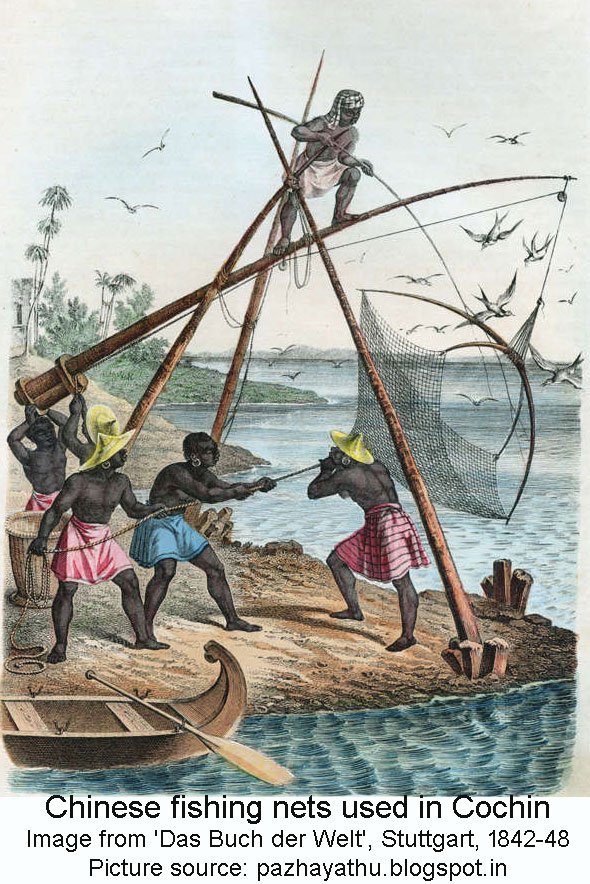 There are several jetties erected on coconut piles along the bank of the river, and the number of Chinese fishing nets, especially in Vypeen, is surprising. There is an interesting Roman Catholic church in the island of Vypeen.
The malady most prominently brought under one’s notice at Cochin is elephantiasis.
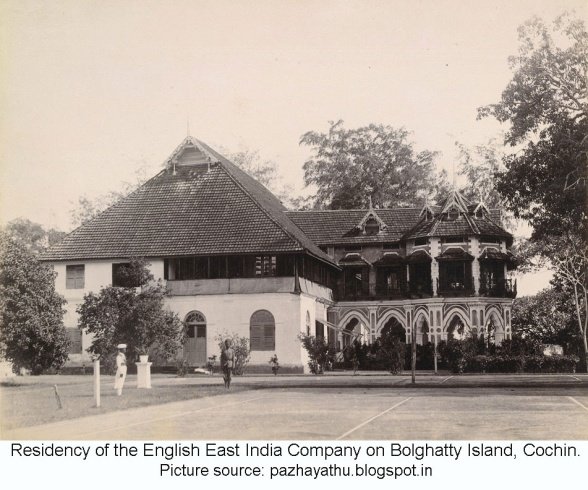 About a mile and a half from the fort, upon the island of Bolghatti, (Ponhikare) is the British Residency, a good type of a modern bungalow. The rooms, spacious and well furnished, open into a large and airy verandah, whence the view between the trees and over the wide sheets of water in all directions is most agreeable. The grounds are planted with a variety of trees, and covered with turf.
The Raja of Cochin has a palace at Mettancheri near Cochin. It is used on State occasions. Immediately adjoining the palace is the synagogue of the Jews, which has a belfry at one end in which a rude clock, said to be more than 200 years old, regulates their time. The floor of the synagogue is paved with very neat porcelain tiles.
Three miles north-west of the town of Cochin is Narakkal, which owes its importance to a mud bank, which stretches about 2½ miles seaward and is 4 miles long. Within this, vessels can run in the worst part of the south-west monsoon when all other ports on the coast are closed.
Two weekly English newspapers, the Western Star and the Cochin Argus, are published at Cochin, in addition to a Malayalam paper designated the Kerala Mittram.
Roads, Canals, etc.—The roads in Cochin lie within the town which is connected with Mattancheri, in native Cochin State, by a road running almost parallel to the river bank leading to Jews’ town.
The Calvetti canal is about 6 miles long. Starting from Calvetti it joins the river up at Kallancheri. Owing to silting, through navigation is possible only during monsoons.
The water supply of Cochin is bad and the supply of drinking water is brought by boats from Alwayi, 20 miles from Cochin.
Industry and Manufactures.—The industry of Cochin is now confined to the manufacture of coir mats and cordage and of coconut oil. A peculiar kind of coir-screen, intertwined with cuscus, is largely exported.
Dams and Anicuts.—Extensive protective works were carried on at Cruz Milagre where an opening from the backwater into the sea threatened by diminishing the scour on the Cochin bar to impair the value of the harbour.
Archæology—There are the ruins of an old church in the Municipal garden. In the backwater near the Master Attendant’s jetty are to be seen fragments of stone-pillars, archways, etc.
The ruins of the foundation of the Portuguese fort, first built by Albuquerque are traceable along the sea face.
One of the elders of the Jewish synagogue has in his possession the original copper plate deed by which in the eighth century at latest (according to Dr. Burnell) the Jews obtained lands at Cranganore.
On the west side of the Deputy Collector’s office at Cochin within the compound are to be seen two broken stones with inscriptions. Many slabs bearing inscriptions are utilised in the town for crossing the side drains into private houses.
Tangasseri and Anjengo are administratively subject to Cochin.
TANGASSERI
By C. Kunhi Kannan
Tangasseri is situated in Lat. 8°54' N. and Long 76° 38' 15" E., and is bounded on the north and north-east by the Travancore territory, and on the west, south and south-east by the sea. In extent it is only 96 acres. In 1871 its population was 1,562, whilst in 1881 it was 1,665 (784 males and 881 females). The inhabitants are almost exclusively Christians, there being 4 Hindus, 2 Muhammadans, 1,658 Christians and 1 other caste.
Tangasseri adjoins Quilon. It was a Portuguese possession from 1519 to 1661 when it was captured by the Dutch. The fort is built on a headland of laterite jutting into the sea. The length is about 2½ furlongs east and west, and the mean breadth 1 furlong. Portions of the old walls are still visible, as are also the ruins of an old Portuguese tower and belfry. The English Government came into possession of Tangasseri on the capture of Cochin in 1795. It has been leased to the Travancore Government for an annual rent of Rs. 2,447, which will be referred to hereafter.
In civil judicial matters the people are subject to the District Munsif's Court at Anjengo, which is again subordinate to the District Court of South Malabar. For criminal matters there is a resident Subordinate Magistrate under the immediate orders of the Deputy Magistrate of Cochin. The Sub-Magistrate also exercises the functions of a Sub- Registrar of Assurances.
A bank of hard ground called the Tangasseri reef extends 1½ miles to the south-west and 3 miles to the west of the Tangasseri point, and 6 miles along the coast to the northward. The bank should not be approached by vessels under 13 fathoms of water by day or 17 fathoms at night.
The origin of the word Tangasseri or Changacherry is involved in doubt. Changacherry was the former ruler of Kollam (Quilon), who was dispossessed in 1740 by Travancore. The place might have taken its name from this ruler ; ‘‘Changa” means conch and the name might imply conch-village. It is also conjectured that the name Tangasseri or gold village (tangam = gold) owes its origin to the circumstance of a large quantity of gold coins having been put in circulation by the Portuguese who settled there at first and who exchanged them for the goods purchased by them.
Tangasseri is level, crowded with houses, and very thickly planted with coconut, bread-fruit and other trees. There is no room for the cultivation of paddy or other grains.
Religious Institutions.—There are two sections of Roman Catholics at Tangasseri, the one owing allegiance to the Goa Mission, and the other to the Propaganda Mission of Verapoly. The church of the latter is very old, having been built, it is said, in 1789. It is 96 feet long by 66 feet broad.
The Propaganda Mission has since 1840 started an English and Vernacular boys’ school. A convent was added to the church in 1845 and a girls’ school was opened in 1885. Within the church at the foot of the altar lies a tombstone with an epitaph over the grave of the first Vicar Apostolic Bishop.
The church under the Goa Mission was founded in 1841 by the Archbishop elect of Cranganore, Don Manual De Sam Joquim Neves. It was, it appears, originally intended as a chapel for his burial, and built in a garden of his own. He died in 1849, and his body was interred in the centre ol the church which is marked by a tombstone bearing an epitaph. This church is now being enlarged. It is 122 feet by 52 feet.
There are two cemeteries in Tangasseri enclosed within walls. They are separated by the road leading to the flagstaff. One of them is a Protestant graveyard, which is looked after by a gardener on Rs. 5 per mensem.
Tangasseri is, as already observed, leased to the Travancore State for Rs, 2,447 per annum. The conditions of the lease are the following: —
That "all rents, customs, or jenkums, profits and produce, accruing from the said rented premises of all denominations, whatsoever, are hereby declared to become the sole property of the Travancore Sirkar during the full and entire period of three years. That the inhabitants, residing within the limits of the said village of Tangasseri, of all castes and descriptions, whatsoever, shall continue to be under the protection of the British Government in all cases of a civil or Police nature.
"That with the exception of the introduction of the monopoly of the sales ot tobacco and spirits, the Travancore Sirkar or its Agents are prohibited from imposing new taxes, levying unusual duties or arbitrary exactions of any kind on the inhabitants of Tangassari, and that an attempt to do so by the Travancore Sirkar, will forfeit all claim to a continuance of the Farm.
"The Police establishment at Tangasseri are to afford every aid and support to the servants of the Farm in the detection of frauds or attempts to introduce into Tangasseri any of the articles under Government monopoly.
"The Police will give all aid in securing peaccable execution of revenue processes as far as required and authorised by law so to do."
The lease was last renewed for three year on 10th July 1883.
ANJENGO
By C Kunhi Kannan
Anjengo1 lies between Lat. 8° 40' N., Long. 76° 47' E. It is bounded on the north and south by the Travancore State, on the east by the Anengo backwater, and on the west by the Arabian sea.
NOTEs: 1. The name is said to be derived from Anchutenga or five coconut trees. The origin of the word continues to be a matter of speculation. END OF NOTEs.
It is only 211 acres in extent. Its population in 1871 was 2,410 whilst in 1881 it was 2,534 (1,240 males and 1,294 females) classified as follows : —
Hindus 1,054
Muhammadans 165
Christians 1,315
Of this number 167 were returned as "under instruction"’, 216 "instructed”, and 2,151 illiterate, including not stated”. In 1871 there were 436 houses, whilst in 1881 there were 517 houses, of which 70 were unoccupied.
Anjengo is divided into two desams—the Kottadilli farm called in Malayalam Kodutala, and Vadikkakam or Anjengo proper, including Puttura.
Kottadilli is farmed to the Travancore Government for a sum of Rs. 1,450 per annum. The terms of the lease will be adverted to hereafter.
There is a Subordinate Magistrate at Anjengo who has his office in Vadikkakam or Anjengo proper. He exercises magisterial, civil, revenue, and registration powers. He has a small establishment. He is immediately subordinate to the Deputy Collector of Cochin. In civil matters, Tangasseri is subject to Anjengo.
There is an old European cemetery looked after by a gardener on a salary of Rs. 5 per mensem. It is enclosed within walls. There was a hospital in Anjengo which was abolished in 1880.
Vadikkakam and Puttura are free from land-tax and duties of customs.
Physical aspects.—Anjengo has a level surface. The soil is sandy and congenial to coconut trees with which it is planted up. There is very little of paddy cultivation and the outturn is poor. The water supply for drinking is indifferent and scarce.
Churches and temples.—-There are two Roman Catholic churches and two small Hindu temples. One of the churches, St. Peter’s is an ancient one, having very old paintings. It is 116 by 36 feet. It is under the jurisdiction of the Archbishop of Goa ; but when there were disputes between the Propagandists and Pedroists, some of the Christians seceded from the latter party and built a small church 42 by 20 feet, dedicated to St. Philomona.
In 1850, a reconciliation took place between the two antagonistic sections who submitted themselves to the Jurisdiction of the Vicar Apostolic of Quilon.
Of the two temples Sivan kovil belongs to the Iluvars, In which Siva is worshipped, the other Amman kovil belongs to Vellalas and is dedicated to Sakti.
Festivals are celebrated here in Kumbam (February- March) and Minam (March-April).
The Fort of Anjengo.-The fort of Anjengo is in Vadikkakam or Anjengo proper. Like Tellicherry it was of use to protect the Hon’ble E. I. Company’s trade at their factory established here in the end of the I7th century. And from this place was spread the English influence on native affairs in Travancore and Cochin, which has already in Volume I been fully described.
The fort is 36 yards square. It was built in 1695, the East India Company having obtained permission from the Rani of Attingal, a village 10 miles north-east of Anjengo, to occupy the site in 1684. A portion of the lower mast of the old flagstaff still stands on the north-western angle of the fort. The fort is now quite deserted.
Though the defects of the situation were from the first apparent, it was hoped that the facilities afforded for the collection of pepper, coir, and calico would compensate for the disadvantages. During the wars of the Carnatic, Anjengo was found of use as a depot for military stores and as the point from which the first news of outward-bound ships reached Madras.
The anchorage off Anjengo under 10 fathoms is foul rocky ground, and outside of that depth the bottom is sand and shells. Ships cannot therefore anchor under 10 or 11 fathoms, and the prevalence of considerable surf on the coast particularly to the southward, renders it unsafe for ships’ boats to land.
In 1792 Anjengo was reported to be in hopeless decline. In 1809 during the hostilities with Travancore its roadstead was blockaded, and in the following year the post of Commercial Resident was abolished and the station made subordinate to the Political Resident at Trivandrum.
Robert Orme, the historian, was born here in 1728. He was the son of a physician attached to the Anjengo factory who became afterwards chief of the factory ; and here lived Eliza Draper, to whom some of Sternes’ letters were addressed.
It has already been stated that Vadikkakam or Anjengo proper was acquired from the Rani of Attingal. Kottadilli was ceded to the English on 10th January 1731 under the following circumstances: —
When hostilities commenced between the Kariyakkar of Attingal and the English at Anjengo, Mr Walter Brown of the Bombay Council arrived at Anjengo, and it was agreed that as soon as the customary annual allowance to the Rani was paid all disputes should be laid in oblivion.
Accordingly, the Chief of Anjengo, Mr. Gyfford, with a party of ten persons marched to Attingal to offer presents to the Rani on 15th April 1721. A few invalids alone were left for the defence of the fort. Though Mr. Gyfford and his party met with a good reception at Attingal, they were all later on treacherously murdered, including Messrs. Gyfford Burton, Fleming, Cowes and others. After this the murderers made for the fort of Anjengo which was most valiantly defended by Gunner Ince, who repulsed every attempt of the besiegers to scale the walls. He kept the besiegers at bay until succoured by men sent out by Mr. Adams, Chief of Tellicherry. In satisfaction for this outrage, the Raja of Travancore and the Rani of Attingal granted the gardens of Palatadi and Kottadilli to the Honourable Company on 10th January 1731. The grant is given below :—
"Towards Cherreungne are the garden of Palatadi and Kottadilli which were formerly bought by the Commander of Anjengo, but when on 15th April 1721, he and ten other persons went to Atenga to make presents to the Queen, they were killed by the treachery of Pullays and Karikars who seized the money of the Honourable Company. Seeing the loss and damage thus done to the Honourable Company, we have ceded the same gardens to them giving up their revenues and the right of cutting trees and ail other privileges which the Company may take and they and heirs may enjoy these gardens without any obstacle or having any obstruction ; but we are obliged to ask for a free passage and protection on the part of the Honourable Company. Thus in truth we confirm (the grants) with our signatures to the Commander on the 10th January 1731."
The terms of the lease of the Kottadilli farm to the Travancore Government are given below.
That ''all rents and taxes with revenue arising from the sale of tobacco, salt and spirits, as well as all other profits and produce whatever accruing from the said rented premises are hereby declared to become the sole property of His Highness the Maharaja’s Government. That the inhabitants of the farm of Kottadilli of all castes and descriptions whatsoever shall continue to be under the protection of the British Government and amenable to its authorities in all cases of a police or civil nature and that the British Resident is empowered by the second paragraph of the Minutes of Consultation of the Government of Fort St. George, No. 90, under date the 25th Febiuary 1847, to interfere summarily in all complaints made by the ryots against the Sirkar officers.
“The Police establishment of Anjengo shall afford every aid and support to the Sirkar servants in the detection of frauds, or attempts to introduce into the Kottadilli farm, any of the articles under Sirkar monopoly and in the collection of the revenue of the village.”
Products and Industry.—Coconut is the staple produce. The majority of the people engage themselves in catching fish. They use drag nets. They go out to sea in the height of the monsoon in catamarans to catch fish. The owner of each net has to pay one-third of the price of fish caught every Friday to the church. This rate is called Friday contribution or Velliyalcha Kuru.
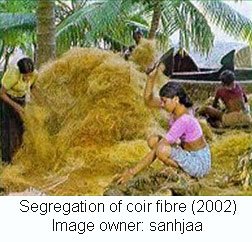 Lemon-grass oil and coir yarn are manufactured at Anjengo. The former is distilled on the Travancore hills and exported from Anjengo. The trade in this oil was once great, a dozen bottles of oil fetching as much as Rs. 100. But the trade is now on the wane.
The coir yarn turned out in Anjengo is superior to that made else where on the coast. Dried fish and hides are occasionally exported to Ceylon, where the majority of Anjengo Christians go to work on coffee estates.
Anjengo is still noted for its paintings.
Archæology.—There are several old tombstones in Anjengo. The earliest inscription is that raised over grave of the wife of the Commander of the Fort, John Brabon, in A.D. 1704.
There is uninterrupted inland water communication from Anjengo to Tirur, a Railway station in Ponnani taluk, a distance of nearly 200 miles.