
VED from VICTORIA INSTITUTIONS
It is foretold! The torrential flow of inexorable destiny!
First published online in 2016.
This webpage edition of this book published on the 19th of March 2026.
All rights reserved. ©VICTORIA INSTITUTIONS

VICTORIA INSTITUTIONS
Aaradhana, Deverkovil 673508
India
admn@victoria.org.in
admn@victoriainstitutions.com
Telegram: https://t.me/VICTORIA_INSTITUTIONS
The original work in Malayalam can be seen here.
The print version of this book is available on Lulu.com
An ephemeral glance at feudal languages! PRINTED Book.
All books in this series can be found on this webpage
The PDF digital book version of this book can be found on this webpage
This book — An Ephemeral Glance at Feudal Languages — is the first volume of a larger project that began many years ago as a personal effort to understand why the social atmosphere of the South Asian subcontinent feels so different from that of pristine-English-speaking societies. What started as scattered observations gradually revealed a single, hidden mechanism: the word-codes embedded within the native languages themselves.
These codes — invisible, yet extraordinarily powerful — do not merely reflect social hierarchies; they actively create, enforce, and perpetuate them. They shape not only how people speak, but how they think, feel, behave, and perceive one another. They are the software that programmes personality, dignity, compassion, competition, subservience, and even cruelty in ways that are almost impossible to detect until one compares them directly with the flat, egalitarian structure of pristine-English.
Volume 1 serves as the foundation: it defines the basic nature of feudal languages versus planar languages (such as English), explores their psychological and emotional effects on individuals and groups, traces how these codes have historically shaped — and continue to distort — social life in the subcontinent, and examines the profound conflict between the egalitarian ideals of the English-written Constitution of India and the feudal hierarchies that still govern everyday administration.
This text has been carefully proofread and edited with the assistance of Grok AI, which has helped refine the language, ensure consistency, and polish the flow while preserving the original voice and intent.
The later volumes will build directly upon this foundation, expanding the analysis into deeper historical, cultural, psychological, and contemporary dimensions. Readers can expect explorations of:
- the pre-English social order across the peninsula — the intricate caste hierarchies, matriarchal and patriarchal systems, and the mechanisms that maintained despotic control for centuries, including in-depth details of the various castes of Malabar (their layered internal structures, origins, mutual repulsions, matriarchal and patriarchal variations among groups such as Nairs and Thiyyas, and the verbal codes that defined and enforced their positions);
- the arrival and impact of English rule — how British administration inadvertently disabled many of the most tyrannical feudal codes and introduced a planar social ambience in regions under direct control;
- major historical upheavals, such as the Mappila Rebellion, not as simple communal or anti-colonial events, but as explosions of resentment caused by clashing verbal codes;
- the post-independence era — the return of feudal codes after 1947, the erosion of English in administration, the translation of the Constitution into hierarchical vernaculars, and the resulting distortion of its egalitarian spirit;
- the arrival of feudal codes in English nations — the gradual infiltration through mass immigration and cultural exchange, the subtle erosion of planar social harmony, the rise of mental imbalances, status-based resentments, and the risk of transforming egalitarian societies into repositories of the same sinister hierarchies that plague feudal ones;
- the supernatural software behind physical reality, life, mind, and emotions — how language codes function as transcendental programs that interface with deeper layers of existence, inducing schizophrenia-like states, creating multiple personalities, blurring human-animal boundaries, and interacting with forces such as mantras, evil eye, shamanism, and even technological extensions of the mind (AI, internet), with pristine-English offering a pathway to mental freedom and harmony with the transcendental.
This series is not an academic treatise filled with jargon or sterile citations. It is a direct, personal exploration — drawn from lived observation, historical reading, and a lifelong effort to understand why dignity, equality, and compassion seem so fragile in some social systems and so natural in others.
The journey begins here, in Volume 1, with the most fundamental revelation: language is not a neutral tool of communication. It is the hidden architect of human worth.
I invite the reader to walk this path with me.
VED from VICTORIA INSTITUTIONS
Deverkovil
January 2026
– Desperate Competition and the Nature of Feudal Languages
In the complex social fabric of the South Asian peninsula — encompassing what is now Pakistan, India, and Bangladesh — history is not merely a record of events, rulers, and invasions. It is profoundly shaped by invisible forces: the language codes embedded in everyday speech. These codes dictate not only how people communicate but also how they perceive status, dignity, relationships, and power. Before delving into the broader sweep of regional history, it is essential to examine these codes closely. They influence everything from personal interactions to societal structures, often in ways that remain unnoticed until highlighted.
A striking historical insight into this dynamic comes from Rev. Samuel Mateer, a 19th-century observer in his book Native Life in Travancore. He described the extraordinary efforts made by each caste to surpass others in perceived status through elaborate claims, stories, and invented traditions:
the amount of research bestowed by each to discover local traditions, verbal derivations, analogies in ceremonies or usages, or anything whatever that might enable them to out-vie rival castes — the contempt felt for the boasting of others — and the age-long memories of reported or imagined honours once enjoyed by them.
Although Mateer’s observations were specific to the Travancore Kingdom (in present-day Kerala), they resonate across the entire peninsula. This relentless pursuit of relative pre-eminence — a desperate scramble for higher social positioning — is not a mere cultural quirk. It stems from deeply ingrained linguistic mechanisms that create and reinforce hierarchies in every conversation. Words themselves become tools of elevation or degradation, turning social interactions into subtle (or overt) battles for stature. This phenomenon explains much of the region’s persistent social tensions, caste rivalries, and even interpersonal resentments that persist into modern times.
To truly understand this history, one must first gain a profound understanding of the language codes at play. These codes permeate minor and major aspects of behaviour, lifestyles, and relationships. They act as invisible software, programming how individuals view themselves and others.
Through extensive personal observations and experimentation over many years, I have come to categorise languages into two broad types. Languages like pristine English operate as planar languages — flat, egalitarian structures where words do not inherently encode superiority or inferiority based on social position. In contrast, many languages of the South Asian peninsula (such as Malayalam, Hindi, Tamil, and others) are feudal languages, embedding word-codes that assign feudal lowliness versus heights. A simple shift in a pronoun — for example, from a neutral “you” to a degrading or elevating form — can dramatically alter perceived status, trigger subservience, or provoke resentment.
I first explored this idea in draft form in 1989, leading to the book March of the Evil Empires: English versus the Feudal Languages, which was completed and published online around 2000. In that work, I proposed that languages function as software codes or applications, shaping human minds and societies in profound ways.
Later, after deeper direct examination of real-world language usage, I realised that the term “feudal” — while descriptive — might not be the most precise technical label. A more accurate description emerged: 3-D Virtual Arena-coded languages, reflecting how these languages create multi-layered, spatial hierarchies in perception and interaction (as elaborated in my later book Pristine-English: What is Different About It?). Nevertheless, I find “feudal language” more accessible and comfortable for most readers, so I continue to use it here.
The presence of Asian-style feudal hierarchies encoded in South Asian languages is not a novel discovery. It is a widely recognised reality among people in this region — everyone intuitively knows that certain words carry built-in deference, contempt, or elevation. Yet, when I attempted to document this on Wikipedia (e.g., in pages on languages or specifically Malayalam), the entries were swiftly removed or dismissed.
On the Talk page for the Malayalam language article, I requested acknowledgement of these feudal features. The response from an administrator was dismissive and sarcastic, implying that only “educated” experts belonged on Wikipedia, followed by the request being struck through and eventually deleted entirely.
In 2011, when the Kerala government made Malayalam compulsory in schools, I filed a writ petition in the Hon’ble High Court of Kerala challenging the order. My core arguments were that feudal languages violate the basic tenets of the Indian Constitution — particularly equality before the law (Article 14) and the right to personal dignity. Such languages inherently create at least three distinct levels of citizenship through discriminatory word-codes: one for superiors (e.g., respectful forms like “Adheham” or “Saar”), one for equals, and one for inferiors (e.g., degrading “Nee” or “Avan”).
I personally argued the case in court, highlighting Malayalam as an example of a feudal language. The government and opposing organisations (including Malayalam language advocacy groups) countered that no such concept as a “feudal language” exists in linguistic science. This denial is puzzling, as almost everyone in the peninsula is aware of these hierarchical encodings.
Linguistics does use the term “honorific” for polite forms, but this word falls far short. It is too mild and neutral to capture the full force of feudal languages — where words do not merely show respect but actively impose degradation, enforce subservience, and create mental and social imbalances. Honorifics imply optional politeness; feudal codes are compulsory, systemic, and often weaponised.
This distinction between planar and feudal languages is the key to unlocking deeper insights into South Asian history, society, and ongoing challenges. The following chapters will explore these codes in greater detail.
– The Hidden Social Design
As I begin to explore the history of the South Asian subcontinent, a pressing question arises: why must I repeatedly emphasise that the languages here are fundamentally feudal?
History records countless events, with individuals portrayed as wicked or virtuous, heroes or villains, and categorised in myriad ways. Yet, beneath these surface narratives lies a deeper truth: in any population, the common habits, mental reactions, emotional responses, and behavioural patterns — particularly among higher and lower social strata — are directly shaped by the social design codes embedded in the native languages spoken by the people.
I do not intend to delve deeply into this theme at this early stage. For now, I wish only to highlight the most distinctive features of the languages across the South Asian subcontinent.
It is worth noting that other regions of the world — Africa, Eastern Europe, Western Europe, Great Britain, South America, and other parts of Asia — may possess their own unique codes for structuring human relationships, differing markedly from one another. The feudal or hierarchical codes prevalent in many languages of the South Asian peninsula are distinctive in their intensity and pervasiveness.
A clear example lies in the splitting of the simple English pronoun “you”:
- In Hindi: Thoo (lowest/degrading), Thum (middle), Aap (highest/respectful).
- In Malayalam: Nee (lowest), Ningal (middle), Saar or Thangal (highest).
Similarly, the English “he” fragments dramatically:
- In Hindi: Uss (lowest), Unn (higher).
- In Malayalam: Avan (lowest/dehumanising), Ayaal (middle), Saar, Avaru, Adheham, Maadam/Medam (highest/respectful).
These are merely introductory glimpses; the subject is vast and intricate. I will not pursue the full details here.
One significant observation, however, deserves mention: there are profound differences in human dignity, stature, and relationships even between neighbourhood languages such as Malabari and Malayalam (the lingua franca of neighbouring regions in South Asia). These variations create stark contrasts in social dynamics, though I will not elaborate further at present.
In general terms, feudal languages impose enormous differences in human features when compared to English: repulsion towards fellow humans, extreme levels of feudal respect and subservience, a readiness to act treacherously once that subservience is removed, intense jealousy, a propensity to “stab in the back”, a markedly different understanding of discipline, and employer-employee relationships that bear little resemblance to those in English-speaking contexts.
Even mundane actions reveal this complexity. Feudal codes can dictate whether an individual is permitted to sit down in certain company. Simple tasks in English — such as an employer asking a subordinate to bring a glass of tea — often carry an immense social weight in feudal languages. Physically, the cup of tea is light; socially and emotionally, it can feel crushing, laden with hierarchies that demand deference, submission, or humiliation.
These embedded codes are not superficial; they form the invisible architecture of society, influencing everything from daily interactions to the broader course of history.
on Mind, Emotion, and Body
Before proceeding further, I wish to illustrate the powerful — indeed, almost supernatural — influence that feudal language codes exert on the human mind, emotions, and even physical bearing.
Consider this small but telling example.
A socially respected individual visits an IPS officer at his home to discuss a legal matter. After listening patiently, the officer responds: “Why did you want to do all this?” — but he uses Nee, the lowest, most degrading form of “you” in the local feudal language.
The intent is clear: to degrade and diminish. Yet, coming from one of the highest-ranking police officials, the effect is moderated — the visitor's stature dips slightly, but not catastrophically.
Later, as the man sits dejected on the veranda, a menial household worker approaches and asks the same question: “Why did you do all this?” — again using Nee.
The intent is the same: to push down and belittle. But now, from someone far lower in social hierarchy, the impact is devastating — the man's stature plunges into the deepest social canyons, leaving him profoundly shaken.
Feudal language codes may seem feeble in sound — mere whispers or soft syllables — yet they possess immense power. They can send a person tumbling from social heights or shatter their inner composure entirely.
The reverse is equally potent: imagine a police constable addressing an IPS officer with affectionate familiarity using Nee. The officer would experience a deep, core-shaking disruption, as if his very foundation were undermined. The word itself might be barely audible to an untrained ear, but its code reverberates through the mind and body like a seismic force.
These are not mere words; they are software commands that reprogram social positioning, emotional equilibrium, and even physical posture in real time. A single pronoun can elevate to divine heights or reduce to utter insignificance. This dynamic explains much of the emotional volatility, resentment, and hierarchical rigidity observed in feudal-language societies — effects that are largely absent in planar, egalitarian languages like pristine English.
Such illustrations reveal why language codes cannot be dismissed as trivial; they are the hidden machinery driving human interactions, mental states, and societal structures.
in Malabari and Malayalam – A Striking Illustration
To further illustrate the intricate workings of language codes, let us examine a seemingly minor but profoundly consequential difference between the Malabari language (spoken in the north Malabar region) and Malayalam (the lingua franca of neighbouring areas and the modern state language).
In Malayalam, the pronoun “you” offers a wide array of forms: Saar, Angunnu, Ningal, Thaan, Eyaal, Nee, and others, allowing nuanced gradations of respect, neutrality, or degradation.
In Malabari, however, “you” is far more binary: primarily Ningal/Ingal (on towering heights of respect) and Inhi (in the deep, dirty levels of degradation). (A very marked distinction exists between Ningal and Ingal, but it is not central here.)
Similarly for “he”:
- Malayalam provides multiple layers: Saar, Adheham, Angunnu, Angeru, Ayaal, Pulli, Pullikkaaran, Avan, etc.
- Malabari limits it to: Oru/Olu, Mupparu, Ayaal, and Oan.
The contrast is even sharper for “she”:
- Malayalam: Saar, Maadam/Medam, Avaru, Ayaal, Pulli, Pullikkaari, Aval, and others.
- Malabari: Primarily Avaru/ Oru (highest) and Olu (lowest), denoting two extremely opposite levels of social existence.
Focusing on “she” reveals the most disorienting social effects.
In Malayalam (particularly in Travancore), a working woman might be addressed or referred to with mid-level forms like Ayaal, Pulli, Pullikkaari, or even Ningal — the lowest Aval is often avoided to maintain a degree of dignity.
In Malabari, however, the system is more rigid and extreme. A woman deemed worthy of respect is addressed as Ningal/Ingal and referred to as Oru. But for those who cannot command such elevation — often due to social or occupational factors — the address becomes the demeaning Inhi, and reference shifts to the degrading Olu.
This binary structure has created a terrible disarray in the social atmosphere of Malabar. In many interior villages, women of even slightly higher status avoid local shops to evade the assault of lower-grade Olu and Inhi words. When walking past those with some dominance over them, many adopt poses of extreme, pretended humility and obsequiousness — a visible, physical manifestation of the code's pressure.
Yet the codes are not immutable. If a woman secures a position of stature — such as becoming a teacher — she can escape these tragic levels. Her social inhibitions often vanish, and her behaviour and individuality may flip 180 degrees: from suppressed humility to confident assertiveness.
A point worth pondering: In Malabari, a man may rise from Oan to Ayaal through effort or circumstance, but ascending to Oru is difficult or impossible for most. His wife, however, can leap directly to the highest Oru the moment she gains social elevation.
In Malayalam, the codes operate quite differently, with more gradations and flexibility.
This is merely a minor illustration of the thousands of word-codes that permeate feudal languages. In pristine English, such highly complicated, hierarchical codes are absent — a feature some feudal-language speakers have even described as a “failure” of English, missing the profound social control they provide.
of Degrading Word-Codes
Before delving into the history of this peninsular region, let us highlight the sheer hammering power of these word-codes when they assault individuals.
In the earlier example, a menial servant addressing a social superior with Nee (and referring to them as Avan/Oan or Aval/Oal) inflicts profound social suppression — a single word can diminish stature dramatically.
To draw a historical parallel: The Brahman class of yesteryears can be likened to today's higher government officials — commanding obsequious respect from those around them. Similarly, the Nairs of Malabar and Travancore eras resemble modern police constables: empowered to beat, abuse, and use lower-grade words like Nee/Inhi, Avan/Oan, Aval/Oal, Avattakal/Ittingal, or even mere names without titles.
Within Brahmins themselves, multiple levels existed — some assigned menial temple duties, much like layers in government service.
As one descends the caste hierarchy, the hammering power of degrading words (Nee, Eda, Edi, Avan, Aval, Avattakal — or in Malabari: Inhi, Oan, Oal, Ittingal) multiplies manifold. The lower the affected caste, the more layers of superiority above it — and thus the greater the cumulative force of the assault.
At the lowest levels, these word-codes acquire terrific, almost physical hammering power. The effects are often visible: on facial expressions, posture, body language, and overall demeanour — the person appears crushed, diminished, or withdrawn, as if struck by an invisible force.
These codes are not mere sounds; they function as precision tools of social engineering, enforcing hierarchies with devastating efficiency. Understanding their mechanics is essential before examining how they shaped — and continue to shape — the region's history.
– Social Buoyancy and a Historical Case of Transformation
Continuing our exploration of the hammering power of word-codes, one additional aspect deserves emphasis. Individuals assigned lower indicant words — due to their attachment to lower castes, occupations, or social positions — experience the crushing effects far more intensely.
For example, when a Brahmin of yesteryears addressed his own son with Nee, the impact was negligible. The son, buoyed by layers of deference from those below him, received constant “respect” that held him aloft socially. Moreover, when he in turn used degrading words like Nee (or Inhi in Malabari), Avan (Oan), Aval (Oal), and so on towards inferiors, the reaction created an uplifting social buoyancy — reinforcing his mental and physical stature like a constant counterforce.
In stark contrast, when a person already deeply suppressed by the caste hierarchy addressed his son with Nee or Inhi, the hammering impact was tremendous — amplified by the absence of any elevating buoyancy from below.
(Note: Various kinds of supernatural software codes interact to shape the human body and mind. Language word-codes are merely one category among many others, including non-verbal elements. A brief discussion of this broader theme appears in my book Software Codes of Mantra, Tantra, Witchcraft, Black Magic, Evil Eye, Evil Tongue &c.)
Reflecting along these lines, populations not subordinated to Brahminical religious and social structures may suffer less from these verbal assaults. For instance, Muslims and Christians in the subcontinent — who entered through religious conversion or other means — tend to feel the impact of such degrading codes more mildly. Nevertheless, the general “Satanism” inherent in feudal verbal systems may still affect them in subtler or different ways.
A striking historical illustration comes from the late 18th century. In the 1780s, a British naval ship was captured by the French navy, and its English sailors were handed over to Sultan Tipu (Tipu Sultan), a ruler in the South Asian subcontinent.
Among them was a young man named James Scurry (born 1766 in Devonshire, England). Taken by Tipu's subordinates, he was reduced to a menial servant in their household for approximately 10 years (1780–1790). He was forced to learn the local feudal vernacular, sit on the floor to eat alongside other servants, wear their worn-out clothes, and sleep on the ground. He endured constant degrading word-codes — lower indicants for you, he, him, his, and similar terms — from his masters.
Over time, his body features slowly transformed towards those of a typical Chekkan/Cherukkan (local servant boy) in the feudal vernacular. He became so accustomed to floor-sitting that he forgot how to sit on a chair. His English became broken and stilted, his skin darkened noticeably (described in accounts as taking on a “swarthy complexion”), and his natural posture of self-confidence and self-esteem — inherent to native Englishmen — eroded entirely.
 Image: James Scurry
When the British forces eventually defeated Tipu Sultan, Scurry returned to England. However, many Englishmen found it difficult to accept him as one of their own. His physical appearance, mannerisms, and demeanour had changed so profoundly towards those of a lower-class menial servant in the South Asian subcontinent that he appeared alien.
Reinstating his original personality took years. His memoir, The Captivity, Sufferings, and Escape of James Scurry (published posthumously in 1824), details these harrowing experiences, including forced cultural assimilation, servitude, and the lasting psychological toll.
This real-life case powerfully demonstrates how prolonged immersion in feudal language codes and subservient treatment can physically and mentally reshape a person — eroding dignity, confidence, and even bodily posture — far beyond mere words. It underscores the profound, transformative force of these codes, capable of overwriting one's very identity.
– Contrasting Experiences of Enslaved Africans
The photo below depicts one of the incidents in which the British West Africa Squadron intercepted a slave-carrying ship bound for the American continent around 1808, “rescuing” the shackled Black individuals onboard. These enslaved people originated from suppressed populations in African societies — or they may have been members of superior classes defeated in intertribal wars, captured, and sold by their own or rival groups to Arab slave-traders.
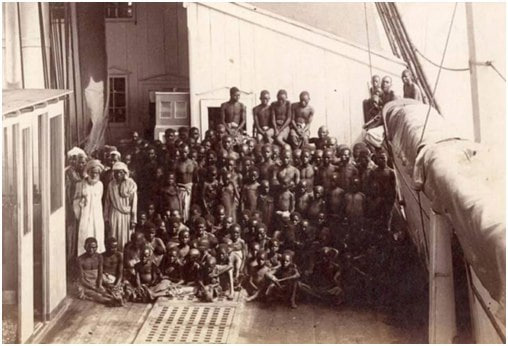 Picture: Historical depiction of the British West Africa Squadron capturing a slave ship and liberating Africans, c. 1808–1840s.
Although such enslaved individuals were trafficked to various parts of the world, those sold into English-speaking regions of the American continent underwent a profound mental-stature-enhancing experience. Upon learning English and beginning to converse with their masters in that planar language, most of the deep social and psychological suppressions they had endured in their native contexts began to dissipate. English, lacking the hierarchical word-codes of feudal languages, offered a degree of equality and dignity absent in their original tongues.
From this perspective, the actions of the British West Africa Squadron — as illustrated in the picture — cannot be categorically described as an unalloyed good. The Squadron, established in 1808 following Britain's abolition of the slave trade, patrolled West African waters and captured around 1,600 slave ships over its existence (to 1860), freeing approximately 150,000 Africans. Many of these liberated individuals were repatriated to Sierra Leone (e.g., Freetown) or other African locations, where they often returned to the same hierarchical, feudal social atmospheres they had escaped — systems marked by severe linguistic codes of degradation and subservience that modern native-English speakers largely remain unaware of.
Had these same people been sold into English-speaking areas of the United States instead, within a matter of 50 years, many would have acquired strong English proficiency and transformed into American citizens with enhanced personal stature and opportunities — despite the persistent racism and legal barriers they faced.
To grasp the true horror of traditional African social systems, one must understand the terrible feudal codes embedded in many native African languages — systems of hierarchical indicants, honorifics, and degrading forms that impose subservience far beyond mere politeness. Academic disciplines such as history, sociology, and psychology rarely address this dimension in depth, often treating such topics as sterile or peripheral.
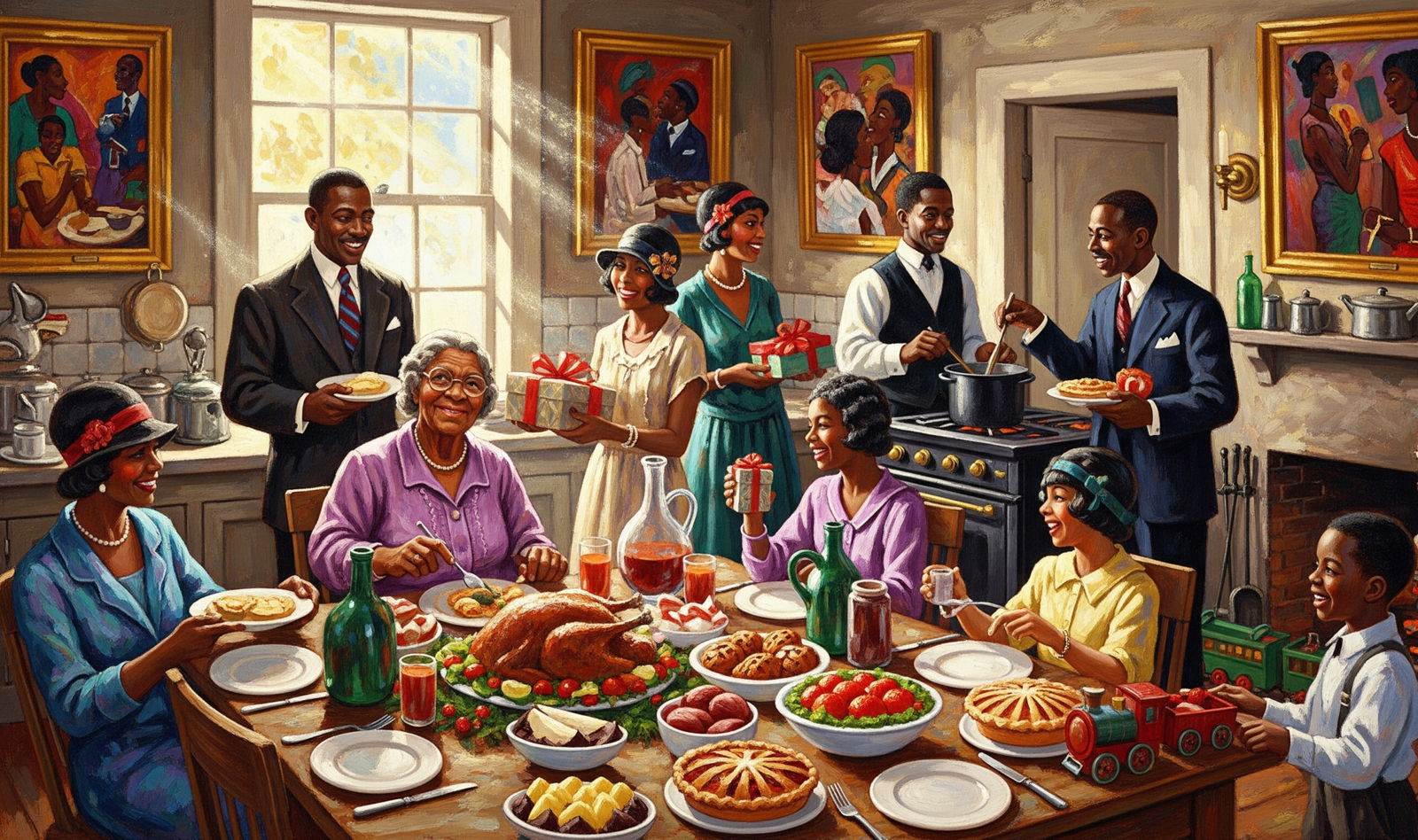 African Americans post-emancipation, having been compelled to learn English amid experiences of racism and trauma. Picture taken from publicdomainpictures.net/
The above image shows Black individuals who were “compelled” to study English and endure the traumatic ordeal of racism in America. Today, their descendants often voice complaints about ongoing inequalities — yet this contrasts sharply with the potential uplift that planar English provided, even under duress. Learning English dismantled layers of feudal degradation, fostering a sense of individual dignity and enabling social mobility that feudal codes actively suppress.
This comparison highlights the core thesis: planar languages like pristine English act as a solvent for hierarchical suppressions, while feudal languages — whether in South Asia, Africa, or elsewhere — perpetuate mental and social imbalances through their very structure.
– Ayitham and the Nature of Feudal 'Respect'
The story of James Scurry, with its profound physical and mental transformation under feudal verbal codes, raises another crucial aspect: ayitham — the deep-seated caste-based repulsion and enforced physical/mental distance in traditional Kerala society.
In earlier times, Nairs displayed overt and obligatory “respect” towards Brahmins (Nambudiris). Refusal to do so provoked intense consternation among Brahmins — akin to Indian police constables addressing IPS officers with the degrading Nee (lowest form of “you”) and referring to them as Avan/Aval (lowest forms of “he”/“she”). Such defiant Nairs would be viewed as repulsive, unfit for proximity — literally to be kept at a distance.
Nairs rarely dared this, however, for it would undermine the very social hierarchy that granted them superiority over lower castes. Meanwhile, those in the lower strata had no incentive to uphold a system that kept them degraded. They would eagerly abandon obligatory “respect” the moment an opportunity arose.
Feudal language codes demand that such “impertinent” lower castes be maintained at a physical and emotional remove — continually drained mentally and physically to prevent disruption. This echoes historical practices of ayitham (pollution/untouchability), where lower castes had to avoid coming within certain distances (often 24–72 feet, depending on caste) of superiors to prevent “polluting” them, or risk severe repercussions like violence or exclusion.
Another key observation: pristine English has no direct equivalent to the feudal concept of “respect”. The English word respect conveys a gentle, voluntary admiration — a subtle, even divine feeling arising from seeing something good or admirable in another person or institution. It is restrained and spontaneous.
In contrast, “respect” in feudal languages is compulsory, extracted through terror, intimidation, displays of physical prowess, enforced subservience, and other coercive means. It is not admiration but a forced deference that sustains hierarchies — a sinister mechanism rather than a soft virtue.
– Multiple Personalities and Schizophrenia-Like Effects
Feudal languages contain thousands of subtle features, as their verbal codes activate in virtually every word spoken by those immersed in them. I will elaborate further when the context arises, but here are illustrative examples to demonstrate their power.
A hallmark of feudal-language speakers is their multiplicity of personalities — a visible and felt fragmentation depending on context.
Consider an individual addressed by a senior (in age, social stature, or job position) with one of the varying forms of “you” — Nee (lowest), Ningal (middle), or Saar/Maadam/Thangal (highest). The addressed person visibly transforms to match that exact level — posture, demeanour, tone, and behaviour shift accordingly.
The same individual, addressed by someone of lower stature with the same range of forms, transforms again — often dramatically differently. Two codes interact here: the specific word-code used and the relative social stature of the speaker.
In this simple scenario, the person can exhibit up to six distinct personalities. In real life, the variations multiply further.
These shifts affect minute aspects of interaction: speaking softly or with thundering intimidation, sarcastically or scornfully, with praise or lies, punctually or unreliably, honouring commitments or breaking them. Every nuance depends on the verbal codes connecting the two individuals.
To express this more forcefully: Imagine someone habitually addressed as Saar (highest “you”) in Malayalam by those around them. Suddenly, one person uses Ningal (middle level). Immediately, personality features resembling those described as schizophrenia in psychiatry may activate — sudden mood swings, disorientation, or defensive aggression.
The most striking example occurs in a Kerala police station. An ordinary citizen enters and addresses the officers (especially an Inspector) with Ningal (middle “you”). The likelihood of the officer losing mental balance is high — often resulting in the citizen being slapped, thrashed, or worse. A single word can trigger homicidal mania!
In a government office, addressing employees with Ningal may not provoke overt abuse or violence, but it frequently leads to deliberate delays in paperwork. The employees harbour deep antipathy and anger towards the citizen — a simmering mental imbalance provoked by the code.
These imbalances and intense hostilities arise from soft verbal cues. It is not entirely fair to blame the individuals involved; the true culprit is the feudal language itself, which programmes such reactions.
These dynamics become strikingly clear when viewed through the lens of pristine English — a planar language free of such hierarchical triggers. Anyone fluent in both can easily observe how feudal codes fracture personality and induce mental distress in everyday communication.
– The Compulsion to Degrade in Absence
Another revealing illustration of feudal languages' inner workings concerns the urge to act traitorous or duplicitous. This tendency often arises not from inherent personal failing, but from the structural necessities imposed by the language codes themselves — everyday mechanisms that make such behaviour feel natural and almost inevitable.
Consider a commonplace social situation. When referring to someone of higher status — by social rank, official position, age, or financial standing — in their presence, one is compelled to use the highest indicant, “respectful” forms: Adheham (highest “he/him”), Avar (highest “he/him/her/she”), Saar (highest), Chettan (elder male), Chechi (elder female), and so on.
Failure to do so constitutes grave insolence, bordering on social indiscipline or even criminal disrespect. Correct usage, by contrast, is viewed as proper and virtuous.
Yet many who must exhibit this subordination find it deeply resented — it publicly reinforces their lower stature in the eyes of others. To soothe their wounded ego and restore a sense of mental equilibrium when the superior is absent, they switch to non-respectable, degrading verbal codes: referring to the same person as Avan/Oan (lowest “he/him”) or Aval/Oal (lowest “she/her”).
These powerful verbal code oscillations are especially common among those with limited authority or punitive power, yet who still claim some relative positional stature. In the superior's presence, they feel compelled to acknowledge subordination; once alone, they relish the opportunity to dismantle it — broadcasting the degradation loudly and clearly.
In planar languages like pristine English, achieving such rude or boorish behaviour requires deliberate use of profanity or insults — an overt act of misdemeanour. In feudal languages, however, the same effect is achieved seamlessly, without appearing to have done anything wrong.
Numerous similar mischievous verbal codes permeate social communication across the South Asian subcontinent. They have exerted a profound, often destructive influence on the historical trajectory of the region.
– The Dangers of Delegation in Feudal Systems
A further example of feudal language codes provoking traitorous impulses can be seen in the context of business management.
In English-speaking contexts, a widely recommended strategy is delegation of power: sharing authority by equipping subordinate staff with knowledge, protocols, and autonomy to handle operations without constant top-level approval. This fosters efficiency and growth.
In societies structured by feudal languages, however, such delegation can be extraordinarily dangerous — bordering on recklessness.
Feudal systems contain many unspoken terrors that gain free rein when subordinates are granted significant authority. If the business is large and replication costs prohibitive, subordinates may not immediately attempt to parasitise the platform and start their own venture — much as an ordinary Indian government clerk would not realistically aspire to usurp an IAS officer's position.
Yet where subordinates perceive a realistic path to overtake their boss, the verbal codes provide powerful provocations to strive for it. In such cases, it may be unfair to blame the individual alone; the mental software embedded in the language actively drives the impulse.
The mechanism operates like this:
In languages such as Malayalam, Tamil, and others, subordinates are reduced to Avan (lowest “he/him”), Nee (lowest “you”), or mere names — at times even Payyan (pejorative “lad” in Malayalam) or Tambi (similar in Tamil). In Malabari, equivalents include Inhi (lowest “you”), Oan (lowest “he/him”), Eda/Edo (terribly degrading without profanity).
The boss, by contrast, is Adheham, Avar, Saar, Chettan, and so on — highest forms that radiate a social halo extending to his wife (Avar, Maadam, Chechi — superior sister) and children, who enjoy obsequious, refined treatment from others.
The subordinate's wife is the wife of an Avan — reduced to Aval/Oal (lowest “she/her”), mere name without honorifics, compelled to stand when the boss's wife enters, show subordination in every code, and even endure Edi (female equivalent of Eda — highly degrading, no English counterpart).
Even if not consciously analysed, these comparative codings ripple through minds in shadowy ways, connecting to countless other bosses, wives, children, and subordinates across the social framework.
If subordinates and their families possess low self-esteem, they may accept their degraded status without complaint. But even a slight degree of self-esteem ignites problems. Despite any outward loyalty, the subordinate's mind — or that of his wife or children — continually urges him to overtake the boss, to rise as an independent entity.
This urge becomes acute when the subordinate has acquired deep business knowledge and acumen — precisely the scenario a trusting owner fears most.
Such mental impertinence, alone or in combination with other language codes, has repeatedly shaped the historical path of the South Asian subcontinent.
Author's Note
In all these arguments, there is no contention that the higher-placed persons are exploiters and the lower-placed persons are inherently better. Both groups are merely individuals positioned at different levels within the same feudal language system. That is all.
in Their Suppressed Location – The Paradox of Worship Under Brutality
Among the standard features of feudal languages, one stands out as particularly astonishing to native-English observers during the era of British colonialism in the subcontinent.
Feudal lords, landlords, and social superiors routinely subjected those known to perform menial labour under them to extraordinary severity: forcing them to sleep outdoors on the ground with minimal shelter or conveniences, providing meagre food, and treating them with stark harshness. From the perspective of planar English, such treatment bordered on brutality — rough, uncouth, and almost beastly.
Yet those subjected to this regime displayed no rancour, no vengeful mood, no simmering rebellion. Instead, they exhibited deep, worshipful devotion and obeisance toward their oppressors. The more intensely they were crushed, the greater their apparent reverence grew.
Englishmen who witnessed this strange social dynamic found it utterly confounding. They had no understanding of the invisible word-codes in the native languages — non-tangible mechanisms that actively generated and reinforced such emotions.
The mental attitude of becoming increasingly “respectful” and worshipful toward those who were overtly rude, impolite, and inconsiderate was a behaviour deeply embedded in the encoding of most feudal languages of the subcontinent.
The system demands that superiors be overbearing and suppressive toward those below them. Any softening of this stance risks diminishing the flow of “respect”. The person defined as needing to sit on the ground must be compelled to do so; simultaneously, the superior must receive escalating comforts and conveniences.
If individuals classified as “lower” are granted opportunities to rise, those at the upper levels lose their accustomed “respect”. When people who have consistently offered deep, worshipful deference — addressing and referring to superiors with the highest codes — gain the chance to improve beyond their traditional social, familial, or professional confines, they quickly realise no further obsequiousness is required.
For this reason, those in higher echelons withhold every possible opportunity for advancement from those below. So long as the lower-placed remain fixed in their degraded positions, they continue to provide “respect”. Once they improve, that deference transforms into disdain, disregard, questioning, and criticism.
From this word-code mechanism arises a distinct phenomenon — one without an exact English counterpart, though a partial connection exists in the term upstart. It will be examined in the following chapter.
– A Reactive Personality Born of Denied Dignity
Feudal languages contain words roughly translatable as “upstarts”, yet no precise English equivalent exists. The emotional and behavioural content they convey arises directly from hierarchical code structures absent in planar languages like English. (Celtic languages may offer closer parallels, though I have not studied this deeply.)
After careful reflection, I have found no exact English term that captures the full sense. The word upstart comes nearest, yet it lacks the depth of the human personality evoked in feudal languages. I cannot make a categorical assertion here, as this aspect has not received exhaustive analysis.
In local Indian English, expressions like “over-smart” or “small guy acting too big” approximate the idea, but they fall short of conveying the intense emotional charge carried by corresponding Malayalam or Tamil terms.
The phenomenon involves two opposing human personalities shaped by higher versus lower codes in feudal languages.
The “upstart” personality emerges when a person is systematically denied the dignity and “respect” granted to others through verbal codes. Individuals in professions defined as lower-grade in languages such as Malayalam, Tamil, Hindi, or Malabari are particularly susceptible — though in truth, this trait appears (visibly or hidden) across all levels and professions.
In candid terms: virtually everyone who speaks a feudal language will display “upstart” tendencies in some context or another. The rare exceptions are those who consistently receive only the highest codes of respect in every setting.
When manifesting as an “upstart”, the person seizes every opportunity to exhibit a distinctive form of over-smartness — a compensatory drive to assert superiority.
This personality often develops when someone is pulled into relatively lowest or lower levels of “you”, “he/him”, “lad”, “boy”, “guy”, and so on, due to their profession, job, or social position. No blame attaches to them personally; they, like everyone else in the subcontinent, are ensnared by the same pervasive, satanic language codes that grip mind and body.
Key features include a powerful urge, when dragged down by codes, to visibly “win” by overtaking others — through displays of physical prowess, acumen, bluffing, hinting at powerful connections, and other assertive tactics. This serves as an involuntary mechanism to reclaim lost heights.
Another dimension may also be noted: definite code interactions occur at the interface between codes of reality and the software codes of life. The time is not yet ripe to explore that domain.
“Upstart” behaviour is readily identifiable in everyday settings. Among vehicle drivers, it manifests as unnecessary, distressing honking; reckless bravado; deliberately blocking or disturbing others — all attempts to project dominance from a position of felt inferiority.
In Indian government offices, employees at levels that offer little personality enhancement often harass members of the public simply to extract the “respect” denied them elsewhere. This, too, is “upstart” behaviour operating at another level — a reactive assertion of power where dignity is otherwise withheld.
– The Battlefield of Everyday Conversation
Another manifestation of upstartedness appears among individuals in professions defined as lower-class in local feudal languages. When approached with polite, non-dominating demeanour, some respond with a thundering (in Malayalam, something akin to “shocking”) retort — barking rudely, firing back a rude question instead of a civil answer, or escalating tension unnecessarily. This too is a form of upstartedness: a defensive, aggressive assertion of stature when felt dignity is withheld.
Ordinary conversation in feudal languages often carries the undercurrent of a battlefield. A “battle cry” — thundering shouts, boisterous yells, satanic glaring, and other terrorising elements — becomes almost compulsory to intimidate and force submission from the other side. Piercing, dominating communication is built into the codes.
This dynamic vanishes only when a clear, stable hierarchy of higher and lower is perfectly established — superiors firmly suppressive, inferiors firmly obsequious.
Feudal societies have developed specific social codes to deal with those who seek to overtake or disrupt this order: either total avoidance of interaction with such individuals, or delegating communication to someone of their own (or lower) social level. The resulting competition stays contained at their level, preventing upheaval.
This seemingly minor practice has evolved into a major ideology of social communication. English administrators, who governed roughly half the subcontinent, showed at least partial awareness of this feature. They attempted — with varying success — to block or dismantle its satanic elements, creating mechanisms that curbed its operation or removed it entirely. That subject will be explored later.
Numerous codes tied to upstartedness exist in feudal languages; it is impossible to cover them all here. A minor illustrative example will follow in the next chapter.
It must be stressed that this upstartedness phenomenon has profoundly influenced the history of the subcontinent.
– Contrasting Social Stature in Malabari and Travancore
This book avoids unnecessary technical jargon or displays of extreme scholarship. The illustrative examples and explanations draw primarily from everyday social observations and lived experiences.
Here, a suitable real-life illustration demonstrates how language codes can lead to an upstartedness personality — and, more broadly, to a diffused or fragmented sense of self.
In the years immediately following my studies in Trivandrum (Thiruvananthapuram) during the 1980s, several college mates relocated to Malabar after securing government or bank jobs.
At that time in Malabar, although Malayalam was understood by those with formal education, the majority who had not pursued such education still used various dialects of the Malabari language for everyday communication.
What astonished newcomers from Travancore was the apparent “daring” of ordinary people in Malabar to address government officials with Ningal (middle-level “you” in Malayalam). They did not fully grasp the underlying phenomenon: in Malabari, two similar-sounding words — Ingal and Ningal — carried roughly equivalent respectful meaning, a nuance lost on them.
Malayalis found it incredible that private-bus staff addressed even police inspectors with Ningal — a level of verbal equality unthinkable in many Travancore contexts.
Many newcomers formed the impression that private-bus employees in Malabar possessed higher social personality stature than their counterparts in Travancore. In those days, private buses operated in interior Travancore areas, but the staff there often exhibited depreciated stature: a clamorous environment of shouting, verbal terrorising, beating on the bus body, and other aggressive behaviours.
By contrast, the government and bank employees newly arrived in Malabar perceived Malabar bus staff as having comparatively greater dignity. The buses themselves also appeared cleaner and better maintained.
(This perception was not entirely accurate, however. In the lower registers of Malabari — when dealing with those defined as lower-positioned — the word-codes remained terribly suppressive and oppressive.)
In a general sense, even among Mappillas (Malabari Muslims), who also spoke Malabari, the lowest codes — Inji (lowest “you”), Oan (lowest “he/him”), Oal (lowest “she/her”) — were applied in a more egalitarian manner within the language's constraints than among others. This may have reduced the mental strain caused by the hammering quality of those words, though other factors likely contributed.
This background sets the stage for explaining another phenomenon — one that shall be taken up in the next chapter.
and the Vanishing of Quality – Linguistic Degradation in Malabar
With the spread of Malayalam into Malabar, numerous changes permeated social communication. The positive aspects of Malayalam did not take root; instead, its more pernicious elements proliferated.
In earlier times in Travancore, a brighter feature characterised social interaction: there was no compulsion to use degrading words such as Nee (lowest “you”), Avan/Aval (lowest “he/she”), and similar forms indiscriminately toward anyone perceived as lower in age or status.
I witnessed instances of adults unknown to school students addressing them with Ningal (middle-level “you”) — a practice that astonished those from Malabari backgrounds.
In Alleppey, I observed parents referring to their own sons or daughters as Ayaal (middle-level “he/she”).
In schools and colleges, teachers frequently referred to students as Ayaal rather than resorting to the lowest Avan/Aval. Instead of Nee, teachers showed a noticeable inclination toward slightly higher forms like Thaan, Eyaal, or Ningal.
While Malabari exhibited a general tendency to crush down anyone seen as lower in some attribute, this urge was markedly less pronounced in Malayalam.
That said, Malayalam could be quite crude toward those engaged in physical or menial labour. Moreover, its abusive words, profanities, and expletives were unbelievably vulgar and substandard compared to Malabari — where corresponding usages were either absent or far milder.
Policemen, for instance, would shower recipients of Nee with extremely vulgar profanities in Malayalam.
This topic is deeply complex and multifaceted, requiring careful examination of many specific words and the intricate movements, pulls, and pushes they induce on surrounding language. For now, it must be paused.
– The Erosion of Malabari's Upper Communication Codes
In Malabari, communication at the highest social layer was relatively comfortable. The highest respectful form of “you” was Ningal/Ingal — no higher term existed, and none was needed.
With the arrival and spread of Malayalam, however, Ningal/Ingal became inadequate — even abusive — when used toward government officials, teachers, or those higher in workplace hierarchy. It literally dragged the upper layer of Malabari communication downward.
In earlier times, when an Indian policeman addressed a citizen with Injhi (lowest “you” — Ijj in Malappuram), the citizen could respond with Ningal (next level). But as Malayalam influence grew, Ningal became unacceptable to officials. Two new usages imported from Malayalam — Saar and Maadam — emerged above Ningal, creating an additional layer of elevation for the official and pushing the citizen further down.
These new forms also extended to third-person references (he, him, his, she, her, hers).
This shift worsened social communication codes in Malabar at the highest levels.
Historically, Malabar (both North and South) differed markedly from Travancore. During British colonial rule, Malabar fell under direct English administration, with public affairs conducted in the planar language English. This created — in relative terms — a softening of codes between officials and citizens.
Travancore, by contrast, remained an independent kingdom until 1947. Within its bureaucracy, feudal features were deeply entrenched. Caste served as a prominent marker defining access to government services. Although higher officials attempted reforms, the language system nullified such efforts, preserving intense hierarchies.
References:
1. Travancore State Manual (V Nagam Aiya)
2. Native Life in Travancore (Rev. Samuel Mateer)
Consequently, lower-grade Travancore officials never experienced the softening influence of English verbal codes in their interactions with subjects. This pattern persisted after integration into independent India, when Travancore subjects became Indian citizens.
Much more remains to be said on these matters, to be addressed in their proper context.
For now, an attempt will be made to describe the dramatic change that affected one specific work-environment behaviour.
Author's Note 1
There is a need to examine words such as Saar, Maadam, and similar terms more profoundly. However, that cannot be undertaken at present.
Author's Note 2
The reader of this work may possess considerable historical and sociological knowledge. Yet the aim here is not to rephrase or broadcast familiar information. The pathway of this writing is to redefine these phenomena from a wholly new perspective — and to bring forward items that have never before been subjected to profound study and research.
– Institutional Dignity vs. Degraded Stature
The previous two chapters offered a glimpse into how linguistic changes — particularly the spread of Malayalam codes into Malabar — profoundly altered the behaviour of commercial vehicle employees in the region.
The clamorous, aggressive behaviour traditionally associated with private bus employees in Travancore has now become commonplace in Malabar. Private bus staff desperately attempt to reclaim their despoiled human dignity through various disruptive means: rude shouting, terrorising voices, verbally hammering passengers as they disembark, creating distressing din by hitting the bus body, using ear-piercing horns unnecessarily, and more.
This phenomenon has a much wider background.
To understand it candidly, compare private bus employees with those working for KSRTC (the government-owned Kerala State Road Transport Corporation). In general terms, KSRTC employees do not exhibit the same upstartedness behaviours — especially those who have achieved job permanency.
According to the language codes, their stature of dignity differs markedly. They are not addressed or referred to by private owners with degrading forms such as Injhi/Nee (lowest “you”) or Avan/Oan (lowest “he/him”). (Supervisors and managers exist above them, of course.) The very definition of being a government employee reshapes the verbal codes, creating substantial elevation.
If KSRTC staff taunt or provoke ordinary citizens with offensive words, and the citizen retorts with Nee/Injhi, it is perceived as addressing a government official with the lowest form — an action the government will not tolerate. A specific historical development underpins this protection, which will be related later.
It would be extraordinary for a police constable to address a KSRTC driver with Eda/Nee/Injhi or refer to him as Avan/Oan. Conversely, it would be equally unusual for a policeman not to use such degrading codes toward a private bus driver.
In verbal disputes on the road between KSRTC and private bus employees, police handling of the two groups is typically very different — because the language codes accorded to each differ sharply.
The same disparity appears in arguments between bus employees and passengers: passengers soften their tone and use more “respectful” codes with KSRTC staff, while unleashing limitless discourtesy and degradation toward private bus employees.
For private bus workers, the shortest route to reclaiming some semblance of human dignity often lies in the loud, boisterous, rude behaviours described. In many cases, they have no other platform on which to proclaim equal stature in the nation.
– The Mechanics of Verbal Degradation
At the same time, government bus service employees retain their relative higher stature. A powerful institutional framework in the background holds them aloft.
Profound forces operate behind the scenes to create these behavioural differences, though the limited space here prevents a large-scale discussion. A few key items, however, can be highlighted.
First item: In all verbal fights, at least one side quickly drags communication codes to the very lowest levels — inserting words such as Nee/Injhi (lowest “you”), Eda/Edi, Enthada/Enthadi (degrading interrogatives with no English equivalents), Avan/Oan (lowest “he/him”), Aval/Oal (lowest “she/her”), and similar forms.
This lowering benefits the socially or professionally lower side. A simple repositioning of words is sufficient to pull a relatively higher individual or group down to their level.
This is the operation of a highly complicated verbal machinery. It is not easy to explain in brief, but consider: in a heated argument between private bus staff and unruly youths, the youths rapidly address the staff with Eda, Nee/Injhi, and so on — even if the staff are older. (This pattern is common in most escalating verbal conflicts; it is highly provocative and can ignite homicidal mania.)
It must be remembered that in the feudal languages of the subcontinent, age is a powerful defining factor. Disregarding any element that demands “respect” can provoke intensely.
Item number two: If individuals engaged in work defined as lower-grade in verbal codes behave in a soft, dignified, earnest, and intelligent manner, they receive no “respect”, consideration, “respectful” words, or reverence. Conversely, when those on higher verbal strata behave in the same soft, dignified, and intelligent way, people speak only good of them.
Item number three: The group known as school students is regarded as “untouchable dirt” by government bus employees. According to the language codes, they are identified as a very dangerous entity. With malicious cunning and ongoing conspiracy, this group has been placed as a burden on the heads of private bus employees — with government employees complicit in the arrangement.
If the reader reflects on these items together, many connected matters become readily graspable. Beyond that, many of these observations may already be familiar to readers.
Much more could be said about this topic. For now, however, the discussion of this specific item must pause.
– Fear of Breaking Hierarchical Chains
Language codes exert a profound influence on the design and structure of any social system.
Planar languages such as English naturally foster a sense of equality and openness in human relationships — a planar feeling that becomes strikingly evident in societies where pristine-English is the primary medium of communication.
This egalitarian dynamic creates great perplexity — and often resentment — among those unable to speak the language. They observe individuals who are evidently weaker in physical strength, voice power, social stature, influence, financial acumen, or even age conversing freely among themselves, without any trace of communication block or deference. Such freedom provokes antipathy in others — a common experience in hierarchical societies.
In this nation (India), those who speak English are rarely native-Englishmen. Instead, they are individuals fluent in their native feudal languages who adopt English primarily to overcome communication barriers, escape the higher-man–lower-man hierarchies of their mother tongues, and accomplish tasks more smoothly and efficiently.
This capacity is not an inherent personal trait; it arises from the smooth, liberating communication software of English — a capability accessible to anyone who learns it.
Yet many proficient English speakers in India actively work to prevent others from acquiring the language. The main impulse stems from the feudalism embedded in the native languages.
If subordinates — whether by social position, age, financial standing, or professional grade — learn English, the ancient strings binding them break or dissolve. Those above perceive this as a total breakdown of discipline and authority.
Learning English causes those at the top to descend and those below to ascend — but without disparagement or insult, for English contains no verbal codes for higher–lower individuals.
Paradoxically, the most vehement opponents of teaching English to the common man are often those who are themselves highly proficient in it. I have personally engaged in numerous online discussions with such individuals — conducted in English — on precisely this topic.
They demand, in reasonably good English, that Hindi, Malayalam, Sanskrit, or other native languages be prioritised for education. When confronted with their own mastery of English, they dismiss it as a “silly” or trivial language.
(It is noteworthy that no native of Malabar has ever been observed advocating that Malabari — a language with minimal Sanskrit or Tamil influence — be taught as a compulsory subject!).
– The Dilution of a Liberating Language
I have, for a brief period many years ago, experienced and slightly immersed myself in a genuine quality English ambience. From that background, it has become clear that the English generally taught in most government schools in India is merely a translated, substandard version of something else. To call it “English” is a grave misrepresentation.
Even some English-medium schools in the vicinity fall far short of the quality standards I once encountered.
This critique is not primarily about pronunciation or accent. It concerns English classical literature — intimately connected to pristine-English — which does not discriminate against or desecrate human qualities to the level of chicken litter. This is the English in which Victorian-age culture was embedded: a soft, lovely communication code that has defined England for centuries past.
(The works of Shakespeare, dealing largely with Continental European monarchy and royalty, need not be included in this assessment.)
Today, individuals with no genuine connection to this English earn college degrees, postgraduate qualifications, and even doctorates in the subject. They then disseminate a low-grade version under the guise of teaching English. Eventually, they — or their associates — question: “What is the use of English? It is a useless item.”
Indeed, what they propagate is obscene and degraded — far removed from the pristine-English linked to the pristine-England of old.
Moreover, people from other languages are flooding pristine-English with the depravities of their native social ambience, claiming they are “enriching” the language. Current-day English has become so licentious that virtually anything can be said without restraint. What these “enrichers” achieve is simple desecration and defilement of pristine-English.
They operate with the conviction that no one has the authority to halt their destructive endeavour.
Meanwhile, the native population of England — the true custodians of the language — remains largely unaware of the horrendous codes and vulgarities infiltrating their communication system.
of English Teaching? – Policy-Level Resistance
Since a preliminary discussion of the quality of English education has been initiated, it must be brought to a more complete examination.
The easiest target for blame would be the teachers themselves — a convenient scapegoat. Yet this is a hasty and superficial judgement.
In reality, teachers bear only limited responsibility for the growing inferiority of English education in this nation. The fact that many are themselves weak in English is not the central issue. Far more horrendous is the unspoken policy aim at higher levels: to discourage English from gaining genuine strength.
It is evident that policymakers lack understanding of the most attractive and effective teaching materials available for English. Textbook design for government schools is executed in a meticulously planned yet profoundly lacklustre and repulsive manner.
Government school English textbooks are extremely dull and unappealing. In most cases, they contain no engaging content drawn from English classical literature — or, if any appears, it is of the most unpalatable kind.
The impression is that policymakers have little or no conception of the true purpose of teaching English.
At first glance, private school textbooks might appear superior and attractive. Yet most (though not all) are crafted with glossy features driven primarily by marketing and profit motives.
During a brief period in Delhi many years ago, I gained direct insight into the workings of the textbook industry — a sector worth multimillions, bordering on billions. Many who have risen to prominence in this field did not do so through quality production. Their success stemmed from meticulously planned marketing techniques.
Numerous business secrets underpin this industry, but there is no intention to divulge them here.
For teachers to elevate English education to a high level, an enabling environment must first exist at the policymaking level — one that actively promotes and encourages excellence.
Such an ambience is conspicuously absent.
Those designing education policy should themselves possess awareness of quality English. The general impression they convey is that they do not.
Yet when approached directly, these individuals often appear innocent of malicious intent. The true culprit emerges as the low-grade English education they themselves received in their student days.
Tracing the blame upward through successive administrative layers eventually leads to the precise point where the delinquency originated. Further details on that location can only be revealed much later in this writing.
– The Constraints of Feudal Codes on Personal Capacity
As noted earlier, language codes exert a decisive influence on the design features of any social structure. A slight outline of the qualities of pristine-English has also been provided.
In Chapter 15, a brief discussion touched on the disastrous risks inherent in enhancing the personal calibre, capacity, and business knowledge of subordinate staff in feudal-language environments.
This dynamic has shaped not only the social structure of the South Asian peninsula but also its history.
In generalised terms, variations in personal capacity among Englishmen tend to be relatively minor. In most cases, the fabulous efficiency of English systems does not derive from the solitary brilliance of individual Englishmen. Rather, it stems from the collective personal qualities of the group — an insight that even they themselves may not fully recognise.
In the South Asian subcontinent and other feudal-language regions, however, social efficiency operates differently. Marked disparities in personal capacity appear, depending on an individual's social, professional, or age-based position. These differences can even manifest visibly in physical features.
Illustration:
Consider an individual with exceptional ability to manage tasks maturely and effectively. Yet he occupies a lower-grade position in the business. If sent to resolve a complicated issue, the outcome is often an even more tangled scenario.
This occurs because others communicate with him strictly according to his professional position. Should he display calibre beyond his role, it perplexes and disturbs those around him. They react with intense antipathy — a response deeply encoded in the word-codes of feudal languages.
Conversely, placing a high-calibre, well-informed person at the top of the business carries its own dangers. Within a short time, he can become a serious threat if he possesses the means to branch out independently. Even at his elevated level, the business owner's family, friends, and relatives acknowledge him only as an employee — a profoundly defining status in feudal verbal codes. He feels the taunts and teasing acutely.
– The Prerequisite for Advancement
In generalised terms, subordinates in a feudal language system are not assigned positions based on personal capacity or incompetence.
Instead, the top boss places individuals at higher levels only if they are willing — genuinely or performatively — to exhibit extreme subservience and obsequiousness toward him. They must also display this attitude openly, encouraging others to do the same.
This social philosophy creates a framework starkly different from that produced by pristine-English systems. In English, obsequious behaviour is regarded as a personality defect — there are no word-codes that demand or reward such attitudes.
In feudal language societies, organisations become rigid hierarchies in which each layer bends, bows, and displays cringing servitude — in words, body posture, and facial expression — toward those above. Those who ascend to higher layers adopt a suppressing demeanour toward those below, expecting the same obsequiousness in return.
Efficiency becomes secondary; the primary goal is to ensure and display this subservience to others. Work programmes prioritise the reinforcement of hierarchy.
Individuals suspected of exceptional mental or physical abilities are relegated to the lowest levels — unless they are willing to exhibit the required personality traits.
This principle has deeply influenced the caste system of the nation. Castes positioned just below the Brahmins — those granted commanding authority over lower groups — were those most willing to concede heavy doses of servitude. They offered whatever was demanded.
Conversely, populations perceived as capable of rising and overtaking them were placed at the bottom. These groups were often those unwilling to display natural “respect” and subservience.
From this perspective, the Pulaya caste may have reached its disastrous position in the hierarchy not due to any inherent ineptitude or incapacity, but precisely the opposite: they were seen as possessing too much potential or too much impertinence to show the expected levels of servitude.
Historical hints suggest such placements occurred in the past, though few seem interested in bringing these facts to light.
Anyone subjected to verbal hammering experiences at least some degree of stunting. Yet if not continually pressed down, they immediately strive to climb atop others. This is the automated operating programme of feudal language social ambience.
Many similar patterns can be uncovered in the history of this region, if sought. They can be discussed later.
Inside Feudal Languages – The Suppression of Compassion
These verbal codes influence virtually every aspect of individual human behaviour.
To express it more precisely: if native-English-speaking populations constitute one kind of human being, feudal-language speakers represent an entirely different kind. The differences manifest in thought processes, levels of aggressiveness, motivations rooted in compassion, and much else.
For example, when a person, group, animal, or group of animals is observed in pain or suffering, the reactions of the two groups diverge sharply.
The emotion of compassion itself may be similar in content for both. Yet when processed through the design codes of the social system, feudal-language speakers tend to refrain from significant involvement in others' problems. The reasons are varied.
First, there is the recognition that they themselves — and those around them — are bound in social chains and suffering. “Let them endure their own problems” becomes a common rationalisation.
Second, any attempt to help another person in distress exposes the helper to irritating, snubbing hierarchies embedded in communication. They must endure degrading verbal tones from various quarters — a painful experience that strongly discourages humanitarian action.
Many individuals who have endured such ordeals have shared their candid accounts with me.
Native-English speakers in their own societies face no such pitfalls. When they offer help to those in painful circumstances, they encounter no traps or hazards hidden in the language codes.
Moreover, they often have no qualms about sharing knowledge and technical skills with populations on lower planes. They remain unaware of the dangers posed by varying indicant codes in feudal languages.
Yet there is an element of gullibility — even foolishness — in such sharing. Feudal-language speakers rarely reciprocate by imparting technical knowledge or aiding those at the bottom.
They view their social environment as one in which individuals bite and claw at each other through verbal codes. All are acutely aware that granting opportunity for improvement to others is highly dangerous.
Providing any leeway to competitors — or to those connected through word-codes to oneself or one's family — risks strengthening them to bite back more powerfully.
Native-Englishmen remain ignorant of this reality. In their wildest imaginings, they have no inkling that language codes can contain mechanisms specifically designed for mutual crushing and mutilation.
– Broadcasting 'Divine' Attributes
It is impossible to catalogue every feature of feudal language codes as they relate to society and the individual — the focus of this writing lies elsewhere.
However, in my book March of the Evil Empires: English versus the Feudal Languages — first drafted around 1998, rewritten fully, and published online around 2000 (approximately 165,000 words in English) — I compared the characteristics of feudal languages with those of English in considerable detail.
The introduction to the present work must continue for a few more pages. Here, I will mention additional aspects of feudal languages.
In generalised terms, these languages require a degree of bluffing.
It is advantageous to possess “respect” and higher position both at home and in the workplace. To convey this status convincingly to the outside world, it is highly beneficial to have a very loyal individual who is obsequious, deferential, and submissive. Such a person's presence helps disseminate the superior's “divine” attributes.
If this servile companion accompanies his superior and successfully prompts others to address and refer to him with elevated terms such as Saar, Adheham, Avaru, Maadam, Medam, Chettan, Anti, Uncle, Mash, Teacher, Ji, Bhai, Ekka, Annan, Akka, Amma, Guru, and so on, the superior gains social prominence, “respect”, leadership, affection, and much else.
Even a simple action — such as the servile companion rising immediately from his seat upon the superior's arrival — can trigger significant shifts in the language codes when observed by others.
In the absence of such a loyal, subservient figure, the only alternative is self-promotion through bluffing: making seemingly inadvertent yet carefully planned name-drops connected to high-level persons, recounting incidents of receiving fabulous “respect”, or subtly hinting at rumours that disparage, insult, or accuse others.
When referring to others, the choice of indicant words (Avan/Ayaal/Avaru/Adheham/Saar — representing different levels of “he/his/him”) must be made with meticulous precision — either to strike down a rival or to enhance one's own features. This too forms part of the same endeavour.
– The Moral Irrelevance of 'Respect' Codes
Small verbal differences can produce enormous changes in social systems and in the human mind. The root instinct for liking or disliking a person often hinges not on character but on whether a term of “respect” is suffixed to his name or whether formal “respect” has been conceded. Personal standards of honesty, moral integrity, compassion, kindness, and rectitude have little or no bearing on this judgement.
These ideas are known — either clearly or hazily — to the people of this peninsular region. As such, they are not unique discoveries of this writer.
History in this region reveals that the activity of these verbal codes has triggered various kinds of uproar: street violence, outbursts, explosive situations, wholesale slaughters, rioting, communal clashes, and many other similar problems — all traceable to the sinister codes embedded in the native language software.
The most astounding fact is that native-English speakers have no inkling of the existence of these sinister codes within certain human languages.
This lack of awareness has lent many positive qualities to their private social environments. Yet with the mass entry of feudal-language speakers into their societies and nations, various negative features have gradually spread. Native-English speakers have not yet identified the reason for this new kind of evilness slowly infecting everyone.
– Fear, Trauma, and Hierarchical Ambition
Let me outline some of the contemporary social effects of feudal languages.
As previously noted, these languages impose controls and restrictions on social interactions — often in profoundly negative ways.
A deep-seated, enduring fear permeates the social system: the terror of incidents in which individuals positioned lower — socially, professionally, or otherwise — use words stripped of “respect”.
Without someone to provide an adequate introduction to another person or group, the consequences can be calamitous.
Judgements are made swiftly based on superficial markers: mere age, job quality or position, parental occupation, the monetary value of clothing, family financial standing, or the stature of companions. These cues trigger varying levels of indicant word-codes.
If a person perceives the indicant code or form used toward him or her as inadequate — failing to reflect his or her true grandeur — it can provoke enormous mental trauma.
Conditions labelled as “paranoia”, “phobia”, or similar in mental sciences may, in many cases, be visible adverse effects of these word-codes.
Individuals immersed in feudal languages are driven to various extreme cravings by these social fears.
In systems where financial acumen and social stature automatically elevate a person to Saar, Maadam, Angu, Adheham, Avar, and similar highest forms (for “he/she”), while those lacking such attributes are reduced to Nee, Ayaal, Avan, Aval, Avanmar, Avattkal, Cherukkan, Chekkan, and other lowest forms (for “you”, “he/she”), both humans and animals suffer vile mental distortions and afflictions.
In this nation, the intense ambition of many parents to steer their children toward becoming doctors arises directly from this kind of mental affliction. The moment a son or daughter qualifies as a doctor, they shift from a vulnerable position — where they can be bitten and degraded by verbal codes — to the higher bracket. From there, they can claw and pierce others using the same codes.
It is regarded as a great social achievement when viewed through the lens of feudal language codes.
Those who are thus clawed and pierced by verbal codes cannot retaliate in kind. Any such attempt would be defined as terrific impertinence and rascality by others — an action they will not permit.
The insidious operation of these codes is evident in the craving for government jobs, the subsequent disdain and repulsion felt toward ordinary citizens, the extreme desire to extract bribes, and similar behaviours.
Ordinary citizens find themselves unable to converse freely with government employees, discuss problems, or argue their version of events. This stems directly from the feudal codes in the native language: the verbal structures simply do not allow it. Any attempt is perceived as a deep offence by the official.
A brief glance through the history of this peninsular region reveals the vast number of disastrous incidents sown by these language codes in the social system.
Once this writing reaches the historical sections, many of these matters will be examined in detail.
– A Planar Document in a Feudal Landscape
We will leave the South Asian peninsula for a brief interlude and turn our attention to the newly formed nation of India.
Feudal languages are slowly forcing disarray into statutory rules and administrative conventions. More will be said about this later.
For now, before concluding this introduction, a few words may be offered about the Constitution of India.
Most government office staff (workers) behave toward citizens in a manner reminiscent of the old feudal classes' henchmen dealing with lower castes. They routinely use lower indicant words toward them.
This theme is highly complicated, so I will not enter that territory at present.
However, we can briefly examine the Constitution of India. When one scrutinises its fundamental and basic structure and tenets, they appear comparable to those of some of the most elegant constitutions in the world.
Here, I address only the basic structure of the Constitution of India for a brief examination.
The Constitution of India is a document written in English. Who authored the text is not under discussion here. There may be many things to say about that, but I will not enter that location now.
The Constitution of India is the most sacred and holy scripture of the nation. The country can be administered and run only in accordance with the rules etched within it. Any attempt to govern contrary to its prescribed rules, statutes, and conventions is equivalent to entering the sacred sanctum sanctorum of a place of worship and indulging in desecration and vandalism therein.
– Unwritten Conventions Under Threat
Great Britain has no written constitution. For a long time, administrative and legal procedures have followed conventions evolved over centuries. However, as of now, feudal-language speakers have swarmed into the nation. It is impossible to say with certainty whether the current situation — the absence of a formal constitution — can persist much longer in this newly emerging scenario.
Most social and administrative conventions in Britain have been designed by the philosophies inherent in pristine-English.
Even though a monarchy exists, neither the king nor queen of England has ever used different forms of “you”, “he”/“him”, “she”/“her”, or “they”/“them” to emphasise varying social positioning or discriminate among subjects.
Nor do government offices — including the police on Her Majesty’s Service — discriminate in this manner.
(However, nothing definite can be said about the future of Great Britain. A huge influx of people from outside, speaking other languages, is occurring in the kingdom. Even the quality of pristine-English is under threat as it is handled, manhandled, and manipulated by these newcomers.)
There is also no hint in pristine-English that government office workers (employees) stand a step above the common man.
– Equality and Dignity in Theory
The soul and spirit of the Constitution of India lie in the social philosophy inherent in pristine-English. The Constitution grants certain fundamental rights to citizens. Among those that can be mentioned here are equality before the law and equal stature before the administrative setup and law, as well as the right to dignity.
The mere mention of these two seemingly simple rights is sufficient to establish that the Constitution of India stands in total contradiction to the dictates of the various traditions and social structures of this peninsular region. The languages of this location encode social up-and-down levels. Traditions maintain different sections of people apart, with mutual or one-sided repulsions. Moreover, tradition includes the idea of kicking down those placed lower. The social structure itself is highly feudal and hierarchical.
The Supreme Court of India has declared that the Constitution possesses a fundamental or basic structure that cannot be altered (as established in landmark decisions such as Kesavananda Bharati v. State of Kerala, 1973). However, with regard to this issue, a great deal of legal clamour has occurred. In all these desultory discussions, it is doubtful whether anything of real depth or creative quality has emerged that truly proposes to improve the social stature of the citizen.
For I believe the Supreme Court did not clearly define what this basic structure of the Constitution of India really consists of.
– The Distortion of Constitutional Ideals
A few words from the Preamble of the Constitution of India are reproduced below:
QUOTE: JUSTICE, social, economic and political; LIBERTY of thought, expression, belief, faith and worship; EQUALITY of status and of opportunity; and to promote among them all FRATERNITY assuring the dignity of the individual… END of QUOTE.
In this Preamble, social justice, equality of status and opportunity, and fraternity assuring the dignity of the individual have been stated in clear, unequivocal terms.
It is possible to sense the spirit of the Constitution — its inner meaning, philosophy, soul, attitude, mentality, and living force — from this Preamble.
It is from this essence that Article 14 — the right to equality before the law — has taken birth.
There has been much discussion, writing, and intellectual clamour regarding this right among the higher echelons of Indian judicial punditry.
In India, law enforcement is attempted not only inside judicial courts. In any government office, even a lower-grade peon may eagerly try his or her hand at it. For the opportunity to exercise authority over others is a highly enjoyable experience in the Indian languages.
No judicial official or constitutional pundit has succeeded in directing them to read, study, or imbibe the essence of Article 14. It is doubtful whether these “learned” pundits themselves possess any profound insight or information on the matter. Or perhaps they are aware of its essential features but do not wish to inform others about them.
– The Visible Discrimination in Practice
The most vividly clear and basic feature of the Constitution of India is that it is a document written in English. Many of the varied equalities and statures of dignity it extends to citizens are possible and plausible only in English. This much is undeniable.
When three citizens enter a police station, the police department employees will differentiate them according to their profession or social level, using words like Nee (and similar forms such as Eda, Edi, Enthada, Enthadi, etc.) toward one person, Ningal toward another, and Saar (Thangal, etc.) toward the third. What has occurred is a terrible kind of discrimination and degradation — at least toward one of the three individuals. In the feudal languages of the nation, no one will see anything wrong or evil in this differentiated treatment of citizens.
When the words used for addressing and referring differ, the person addressed must behave and adopt a manner synchronised with those words — in sitting, standing, bending, bowing, choice of words, and more. There will be marked differences in what is demanded of him and in the tone, timbre, and volume of the voice used. If he receives a terrific slap on the face from police personnel, it is these verbal codes that determine whether the act was wrongful or merely a trivial matter unworthy of remark.
Everyone knows that it is not the various rules and dictums in the Police Act or Manual that truly decide these things. Any claim that the Police Act governs such matters likely stems from the superficial Civics textbooks taught in the schools and colleges of this nation.
Yet these discriminatory actions and definitions are profoundly haram (forbidden) deeds according to the tenets of the Constitution of India, written in English. They pointedly demonstrate that police personnel assign peanut value to this holy book.
It is equivalent to government employees saying: Nee poda! (“You get lost, you idiot!”) to the Constitution of India itself.
The stark reality is that most citizens — as well as police department staff — do not know English. They cannot even glimpse the issue in their actions. Even if a faint hint reaches them, they lack the means to interpret or address it properly.
The wider problem is that individuals unable to understand the Constitution are the ones ruling the nation. It is these kinds of persons who operate within the machinery of administration and hold positions of charge.
– The Desecration of Sacred Texts Through Translation
The Supreme Court of India has decreed that the basic structure of the Constitution cannot be altered. If this is the status quo, it is worth pondering the grave desecration inflicted upon the Constitution of India when that sacred document — written in English to protect the individual rights and dignities inherent in the English language — is translated into feudal languages, and the thus withered tenets are granted legal status.
Many years ago, I translated a Malayalam book on Vedic mantras, authored by a Vedic scholar, into English. When the verbal meanings of the Vedic mantras were rendered in English, they appeared denuded of all their innate divine aura and flavour.
In a similar manner, if the sacred Bismillah verse of the Islamic religion were translated into Malayalam or English and used for sacramental purposes, what would remain of its holiness?
It is possible that the supernatural and non-tangible codes encoded in them within their original languages become disabled or deactivated upon translation into another tongue.
This can be clarified through a very small illustration.
Consider the simple English sentence: “He beat him.”
This can be translated into a variety of forms in a feudal language:
1. He (Avan — lower “he”) beat him (Adheham — higher “He”).
2. He (Adheham — higher “He”) beat him (Avan — lower “he”).
When Avan (lower “he”) beats Adheham (higher “He”), it is an offence that can never be condoned or forgiven — a crime of the highest order.
When Adheham (higher “He”) beats Avan (lower “he”), it is understood that he truly deserved the beating. That is how others around them perceive it. In fact, he should be given a sound thrashing.
This problem has severely influenced the social consciousness of the subcontinent.
A very simple sentence in English can be mutated or pulled apart into a whole range of social meanings — many of them horrendous and horrible. Individuals are thrown into entirely different locations on the social ladder.
Is it permissible to translate the Constitution of India into languages that position some persons on the higher echelons of the social order — whereby they and all their actions derive a divine aura — while others are relegated to lower-grade, stinking locations?
Are not such translations satanic deeds that putrefy the divine aura of the holy book?
Is not being an accomplice to these kinds of deeds tantamount to partnership with the devil himself?
Much more could be said about this. However, this writing cannot linger here; it must move forward.
– A Direct Challenge to Feudal Language in Education
It should be mentioned here that, in the year 2011, a writ petition was submitted to the Hon’ble High Court of Kerala. It challenged the compulsory teaching of feudal languages in schools. The complete arguments submitted in that petition can be accessed here: https://www.victoria.org.in/viewtopic.php?t=119#p2752.
This petition represented a formal legal attempt to confront the fundamental conflict between the egalitarian principles of the Constitution (rooted in pristine-English) and the hierarchical codes embedded in native languages — a conflict that continues to undermine the rights and dignity of citizens in everyday administration.
by Means of Shortcuts – The Despoiling of the Constitution
As of now, the Constitution of India is being despoiled in the hands of a group of individuals who possess neither the calibre, capacity, urge, nor interest to understand, imbibe, or internalise its spirit and core ideology.
Instead of upgrading the quality of the population here — so that people might absorb the superb ideologies of this great book, which promote and proclaim various kinds of human rights and dignities not rooted in the traditions or antiquity of this subcontinent — these individuals are in a hurry to gather achievements through shortcuts.
The current-day administrators of this nation, rather than improving English standards among the people to match the glorious standards of the Constitution, are busy trying to bring down the quality of the Constitution itself — reducing it to the grasp of the very sinister language codes that have already degraded human quality here.
The action of translating the Constitution into Hindi and other feudal languages represents the pioneering steps in this direction. The people are told — and many believe — that this is a great pro-people measure. In the heights of their foolishness, they applaud it. They remain unaware that when the Constitution is translated into feudal languages, many of the superb rights and dignities assured to them simply vanish into thin air.
Political leaders have now proclaimed that, if need be, they will rewrite the Constitution to make it “in sync with Indian culture”.
I will try to give a brief hint of what the soul and spirit of such a “rewritten-into-Indian-culture” Constitution of India would be.
I have not seen the Constitution translated into “Indian” languages. Nor do I have much experience with governmental rules and statutory writings in feudal languages.
In these kinds of statutory Acts, Rules, and other writings, would not the words you, your, yours, he, his, him, she, her, hers, etc. be split into various levels of persons? Would not the people of this nation be thrown apart into different levels of citizenship, rights, and dignities?
In the judicial courts of the Hindi hinterlands, would not the common man be reduced to Thum and Uss? At the same time, persons of social, political, or governmental stature could not be contained within these words. If such a terrific infringement of the right to equal dignity encoded in the Constitution of India is taking place in a judicial court, can such courts be allowed to function?
If all governmental actions are to be conducted in accordance with the culture and traditions of this location, then what is the need for a Constitution, statutory laws, and rules?
and Traditions – The Legalisation of Hierarchy
If the Constitution of India were rewritten to align with the emotional tugs and pulls of local cultures and traditions, what would emerge would be a document with a totally different emotional direction.
The reality in the local languages — that individuals are not of equal status before the law and administrative setup — would appear in very powerful written form.
That Avan (lowermost “he”) / Aval (lowermost “she”) cannot be kept on an equal pedestal with an Adheham/Avar (highest-level “he/she”) would become a solid social truth — and also a part of national jurisprudence and the judicial apparatus.
With clasped hands in worshipful obeisance, Avan/Aval would have to stand when an Adheham enters the scene. Those who fail to do so would find not only justice denied to them, but many other things withheld as well.
Government office employees would give due regard to the words of Adheham/Avar. To the words of Avan/Aval, they would concede peanut value. Police department employees would do likewise.
Adheham would be extended “respect”. Avan/Aval would receive a severe verbal shaking. If possible, they would be subjected to troublesome ordeals even for the smallest governmental actions. In some cases, physical manhandling could occur.
In government documents and FIRs, individuals would be defined differently, with acute discrimination. When an Avan and an Adheham (as defined by government officials) confront each other in the governmental apparatus, the Avan would end up in a miserable state.
Adheham could demand many things from Avan/Aval — with few restrictions. Avan/Aval would be compelled to concede. If any Avan/Aval categorically refused, it would be deemed a most preposterous and impertinent stance.
In local schools, when a teacher enters the classroom, students rise from their seats in an automated display of “respect”. Those who show any disinclination are labelled rank rascals and delinquents — even if perfect and good in all other ways. The same logic would apply to the aforementioned instances of “impertinence”.
Government office employees would have a strong urge to enforce this cantankerous social philosophy on all common citizens — finding adequate support from the newly rewritten-into-feudal-languages Constitution of India.
In truth, this is already the manner in which most government offices in India — which operate on feudal languages — function today.
Only in the few offices where English is still used can one find a different attitude and functioning style. Yet this English ambience has not been experienced by around 99% of the people of this nation.
This is not how it should be. The fact that government office employees are mere workers — supposed to serve the people from inside government offices — is not known or understood even by the remaining 1% of the population.
For only those with reasonable command over English can absorb the information that the citizens of this nation should not be differentiated into Avan/Aval and Adheham/Avar.
The very powerful social design code — that individuals insidiously defined as Avan/Aval and Adheham/Avar are actually of one level of “he/she” — is not present in the feudal vernaculars of this subcontinent. Yet this code stands very powerfully encrypted in English.
Taken from the History of the Subcontinent
According to Buddhist legends preserved in texts such as the Ashokavadana (a Sanskrit hagiographical work from around the 2nd century CE), there was unrest in the important north-western city of Taxila (Takshashila, in present-day Pakistan) during the Mauryan period.
The Mauryan Empire, under kings like Chandragupta, Bindusara, and later Ashoka, administered vast territories through appointed high officials known as Mahamatras (or similar ranks). These officers were tasked with overseeing provincial affairs, collecting revenue, maintaining order, and promoting ethical governance (especially under Ashoka's later Dhamma policy). In practice, however, some officials may have abused their power.
The legends describe a revolt in Taxila during the reign of Bindusara (Ashoka's father, r. c. 297–273 BCE), attributed to the oppressive conduct of local administrators. The people reportedly rebelled against corrupt or tyrannical ministers, not against the king himself. Bindusara dispatched his young son Ashoka (then a prince, around 18 years old) to suppress the uprising.
In one version, the citizens welcomed Ashoka upon his arrival, declaring that their grievances were directed only at the "wicked ministers" who oppressed them, not at the royal family. The revolt was reportedly resolved without major bloodshed, and Ashoka handled the situation successfully, earning the goodwill of the people.
The native languages of the region during Ashoka's time were primarily Magadhi Prakrit (used in his edicts) and other Prakrits, with Pali as a literary form in Buddhist contexts. These languages had limited or no direct connection to the highly hierarchical Sanskrit of later periods, though regional variations and social structures likely influenced communication.
This legendary account illustrates a recurring theme in the subcontinent's history: the potential for resentment and uprising when officials — elevated by power and "respect" — abuse those below them. It is both the written and unwritten dictum in feudal-language systems that officials (the Adheham) must be extended all respect, and whatever they demand must be given.
If the Constitution of India were ever rewritten to align fully with traditional culture, a similar scenario could emerge: great political philosophies and social ideologies on paper, but with government machinery and officials operating through feudal languages, everything would function according to the codes of hierarchy — where the powerful demand deference, and the lower must submit without question.
– The Re-Emergence of Hierarchy in Modern Administration
The social and cultural traditions and heritage of the South Asian subcontinent remain fundamentally the same as the non-formal cultures of the new nations of Pakistan, India, and Bangladesh (though wide variations exist even within each country).
For a brief period, the natural egalitarian culture of English existed as a sort of formal overlay in certain locations. For instance, in Malabar (southern India), which was under direct British rule, officialdom followed many English conventions in bureaucratic procedures for some time. In contrast, the independent kingdom of Travancore had no such experience; its administrative traditions remained deeply feudal.
From now on, the nation is slowly edging back toward its native-land culture. The dusky, ominous shadow of emerging conventions is gradually spreading throughout.
There are many levels within the Brahmin caste. At the very top are the Brahmin Thamburans, who hold the divine right to conduct or lead ecclesiastical functions and ceremonies (pooja, homam, etc.). They can be compared to the IAS, IPS, and other elite ranks of the current-day Indian bureaucratic apparatus.
Below them are the Namboodiripad and groups referred to as “special” (Vishistar), the Bhattathiripad, and others. Then come the ordinary (saamaanya) Brahmins, followed by the Nambi and similar. Lower still are the Shanthikkaar (temple priests), generally known as Embraan, then the Namboori (Sapagrasthan). At the very bottom are the Papista Brahmins.
(Note: The above list and definitions may not be fully authentic or complete; they serve only as a general illustration.)
If these Brahmin levels are mapped onto the current-day bureaucracy, the Sub-Inspector of Police rank can be compared to the lowermost Brahmin level, while the topmost Brahmin ranks correspond to the IAS/IPS elite.
Those immediately below — the Ambalavasis, Unni, Nambishan, Pisharadi, Variyar, Chakkiyar, Nambiyar, and similar — can be likened to officials between Sub-Inspector and Constable: the ASI and Head Constable.
The Nairs, serving as a sort of executive wing for the above castes, can be compared to the Constables.
It was the Nairs who held direct command over the lower castes, wielding both verbal and physical power over them.
Now, a descriptive mention must be made of current-day ordinary citizens, who can be compared to the lower castes. This will be addressed in the next chapter.
to the Feudal Language Codes – The Return of a Caste-Like Pyramid
When the nation surrenders to feudal languages and the codes embedded within them, all the efforts and philosophies of the Constitution of India to maintain an egalitarian social environment will prove futile.
The strenuously and formally maintained planar form of social relationships — before the administration and judiciary — will be pushed aside. In its place will emerge a social arrangement with many layers, one atop the other, in a design resembling a pyramid. This is how both the judiciary and the national administration, including the police, will ultimately view the people.
Government employment will become strikingly similar to the age-old Janmi system (the feudal landlord-tenant structure of the South Asian peninsula): big-time feudal upper classes at the top, below them an array of minor upper-classes, and beneath them an immensity of their henchmen.
These henchmen can be compared to the current-day police inspectors, Assistant Sub-Inspectors, Head Constables, Constables, and government office Superintendents, clerks, and peons. It is from them that the common man generally receives the roughest part of governmental behaviour and attitude.
At the same time, individual officials above these layers will stand far removed from the approach of ordinary people. A peculiar type of untouchability will block access to them.
Most of the features of the old-time caste system can be found in the relationship between current-day officialdom and the people.
Rev. Samuel Mateer very candidly described the terrible content of the caste system in the Travancore kingdom in his famous book Native Life in Travancore. If one side of his description is replaced with current-day government officials and the other with the common people, it becomes clear that the old-time caste system more or less persists in the relationship between officials and citizens.
However, no one can be blamed for these kinds of untouchability. The people are being arranged according to the design codes inside the language. Each individual connects and reacts with others based on the codes attached to the slot assigned to him or her. He or she will behave, interact, and react accordingly.
He or she will shift from roughness to sweetness, and vice versa, depending on the attachment codes. He or she will terrorise or exhibit subservience. He or she will demand bribes or give bribes. He or she will act with discrimination toward different sections of people. He or she will find salvation in extending “respect” to some persons — and achieve self-satisfaction and profit from exhibiting obeisance.
Languages with rough and uncouth codes create rough and uncouth social ambience. There may be some minuscule locations within these rough systems where one might briefly experience refinement and softness. In these fleeting interspaces, one might find terrific and celestial beauty in the social ambience — a loveliness that compels one to fall in love with it and proclaim it to others.
– The Disconnect Between Ideals and Reality
The common people of current-day India are thus arranged:
They exist in a multitude of layers, with mutual repulsion and hatred between them. They oppress those they perceive as subordinate using lower indicant word-codes. Toward those they view as standing on a higher pedestal, they exhibit involuntary — or compelled — subservience.
It is an unwritten social code that those placed lower must be continually pressed down by various means. If this is not effectively done, they will push themselves upward into the locations of the higher classes, attempting to create upheaval in social or personal relationships by tumbling down word-code hierarchies. They will inflict disturbance through rough behaviours and manners.
This is how the social machinery operates in a feudal-language ambience.
It would be quite suicidal — socially, professionally, and even in terms of business survival — to interact and communicate with government officials while retaining and exhibiting one’s mental and physical stature. To get things done quickly and without hindrance, the best — indeed imperative — attitude is to display exquisite subservience and “respect” in all verbal codes and body language toward the feudal lord class known as government officials. This posture may be essential for the very survival of one’s business.
This is the newly emerging social philosophy in this new nation of India. The nonsense of citizens’ rights, right to dignity and stature, and similar ideals — as taught in sterile academic textbooks of social studies, political science, and related subjects — has no meaning at all.
These textbooks contain a great deal of useless writing: that the people have the right to equality before the law; that the people rule the nation; that the nation belongs to them; that they have a right to status and stature in this nation; and so on. The only beneficiaries of such empty talk are the textbook publishers. To everyone else, these themes have peanut value.
Alongside teaching these themes in the vernacular in schools and colleges, it is also indoctrinated — either deliberately or in a most inconspicuous manner — that superior persons exist in the social system: government officials, political leaders, doctors, and such are superior beings, the Adheham, Saar, Maadam, and so on (all meaning superior “he/him” or “she/her”); while ordinary people are the Avan/Aval, Avattakal, and similar — lower forms who come under these superiors and have relatively less value in the nation.
Students in schools and colleges are acutely aware that some among them are the children of Avan/Aval (lower “he/him”/“she/her”), while others are the children of Adheham/Maadam.
The technical word-codes used to denote the untouchability between the lower caste (known as ordinary people) and the higher castes (known as government office workers) will be very candidly mentioned in the next post.
– The Natural Rights Codified in English
When the nation of the United States was formed in 1776 (with the Declaration of Independence) and its Constitution adopted in 1787 (including the Bill of Rights in 1791), citizens of the USA often describe the document — along with its various human rights, right to dignity, and human stature — as a great novel discovery or achievement.
However, the fact remains that almost all the rights thus claimed in the US Constitution are already present in pristine-English — the native language of England — in a most natural and spontaneous manner. There is no written codification of these rights in England, for they are inherent in the language itself.
In English, both common citizens (who might be defined as big and small in feudal languages) and government employees are all defined by a single form of you, yours, he, him, his, she, her, hers, and so on. There is no feeling in English that the government worker is a superior “he” or “she”, while the common citizen is an inferior one.
However, this information was not known to the birdbrains who created the nation of the USA.
No history book appears to mention that George Washington was a foolish individual who was quite easily fooled, influenced, and seduced by cunning Continental Europeans. The absence of this information itself points to the fact that they lack access to a very powerful repository of knowledge and information on human social design codes.
– Uplifting Dignity and Disabling Feudal Codes
In the South Asian subcontinent, historically, the higher (divine) positions in verbal codes have been the hereditary right of officialdom. Individuals below them were assigned the lower (stinking) positions.
Among population groups possessing very high-calibre technical skills, one prominent example was the traditional carpenter class. During the period of English colonial rule — which covered roughly half the subcontinent — English officials expressed deep appreciation for the expertise of these carpenters.
These artisans, who had never attended any technical or engineering college, constructed massive architectural structures using tools that could be described as flimsy and feeble. Yet, in the eyes of officialdom (the higher castes/Adhikaris), they remained a class of low social value. They were invariably addressed with Nee (lowermost “you”) and referred to as Avan (lowermost “he”), Aval (lowermost “she”), and similar forms. They had no choice but to endure these words.
The public education disseminated under British rule was primarily aimed at erasing the immense social communication blocks and verbal evilness embedded in local society. Technical education and other forms of specialised learning came only after this foundational step.
What this meant was that a person could only advance to what is now generally termed higher education, technical qualifications, or higher government service after first disabling — or at least substantially weakening — the satanic codes of the local vernaculars within their mind. Only those with good command over English were permitted to become government officers, doctors, and so on.
It was the common man who derived the greatest benefit from this system. For only those who had neutralised much of the verbal codes that defined the common man as a form of excrement in their minds could occupy such positions.
The actual fact is that there is not even an iota of information about these fabulous aims and endeavours of English colonial rule in the subcontinent — neither in current-day England nor in Great Britain.
Meanwhile, the local political leadership, officials, and educational “experts” in Pakistan, India, and Bangladesh write histories of mere sterile content. They compel local students and government job seekers to study this nonsense for marks. These students and job seekers parrot it all without the slightest understanding that they are engaging in deliberate indoctrination and lies.
When the Language of Administration Is Made Malayalam – The Reversal of Servant-Master Dynamics
All over India, the functioning of state government offices has been converted into their respective local languages. It is possible that an “expert” committee provided a “comprehensive” study report in each state.
I do not know for certain what these “expert” committees studied regarding the various attributes of language change. However, there is a strong feeling that all such so-called expert studies are mere verbal blah-blah. I recall reading the “expert committee” report that recommended the compulsory imposition of Malayalam in state education. No profound study was evident in that report. I remember seeing the names of PhD holders among the committee members.
I have more or less enumerated around 30 problems that can arise when the language of administration is converted into Malayalam. These I have written down.
One among them I will mention here.
During the English rule period, government employees were defined as public servants.
In feudal languages, servants must extend respect to the boss, owner, landlord, employer, and so on. When the language of administration shifts to a feudal language, government office workers (government employees) would be required to extend words of “respect” toward the people/public/common citizen. The public/people/citizen would then be entitled to use degrading words toward government office workers (government employees).
However, government office workers (government employees) will not agree to this under any circumstance.
Not only that, a directive instructing government office workers (government employees) to extend “respect” to any common citizen entering a government office would be unacceptable to them.
I do not know what exact decision or advice the “expert” committee gave on this issue — if they pondered it at all. Which itself is doubtful.
At the same time, if the stance is that the members of the public must extend “respect” to government office workers (government employees), then it can safely be assumed that the “expert” committee has indicated that, as per the Constitution of India, the common citizen is statutorily a step below government office workers (government employees).
If there is a query as to whether the same problem would not arise if the language of administration were English, a great many things would need to be mentioned to answer it. However, there is no need to delve into all this now. The primary issue that emerges is: as per government statutes, which side — the common citizen or the government office workers (government employees) — comes above and which comes below? This must be very clearly stated with regard to the issue of “respect”.
If the government position is that neither side can be kept below the other, it is a proposition that cannot be enforced in Malayalam. For feudal languages maintain the employee and the employer in two very clearly demarcated levels.
This issue, which may seem quite silly here, actually has a very powerful link to a particular incident in the history of British-Malabar. I am not sure whether this incident has been recorded in the official history of India.
– Asymmetrical Expectations in Administration
For a government office worker (employee), if a common person entering the office does not stand with a bow and adequate “respect”, it constitutes a problem. In a feudal language, individuals who fail to exhibit “respect” are expected to behave in an impertinent manner. Feudal languages are not designed for prolonged conversation between equals maintaining mutual dignity and stature.
The government office worker (employee) claims the right to address the common person by name alone. Yet if the common person exercises the same right — addressing the official by name — it is perceived as abusive behaviour, impertinence, and absolute rowdy attitude.
In Malayalam, if a common person addresses a government office worker (employee) as Ningal (middle-level “you”), it is treated as rank rascality in most government offices.
At the same time, if the government office worker (employee) addresses the common man with Ningal, there is no issue. In stark reality across many village-level government offices in India, even the office peon has no qualms in addressing a wearied-out villager — desperate for some small official paper — with Nee (lowest-level “you”).
Conversely, if the common citizen were to address the government office worker (employee) with Nee, it would be treated as a grave criminal offence. Government office workers (employees) have collectively conspired and deliberately enacted written laws allowing such persons to be sent to jail.
What can be said about the “people’s representatives” who grant statutory validity to such irascible laws? Can anything be safely stated?
If anyone shows soft or considerate behaviour, it is quite natural — and indeed encoded in feudal languages — to respond with outrageous rudeness. Government office workers (employees) are acutely aware of this. They feel no sense of security unless they compel the common citizen standing before them to bend and bow.
If a common citizen enters a government office and addresses the employees with Ningal — and without any expression of subservience — it is very possible that many employees will exhibit some form of mental imbalance. In locations where they can physically assault a person, the common citizen would likely be thrashed. The government employee, having lost mental balance, may act in a homicidal manner.
However, the actual problem does not lie within either the government office worker (employee) or the common citizen. The true instigator is the native feudal language. It is not known what the “expert” committee — which recommended changing administration from English to Malayalam — stated on this issue.
The core issue here is: who should “respect” whom? The wider issue is that if the worker must be revered and treated with “respect” by the employer, the worker ceases to be a worker. This too is a problem that must be considered.
Some further points need to be made about the above. A bit of history might also be required. The other approximately thirty points can be mentioned at another time.
– The Defensive Roughness of Officials and Ritualised Subservience
When a person behaves in a very soft manner — without displaying pseudo power or authority — those in lower positions often respond in the nastiest way. To some extent, this is directly spurred by the upstartedness mentality created by feudal languages.
From this perspective, government office workers (employees) behave in a terrorising manner toward the common citizen precisely to forestall such reactions and to create a defensive shield. The situation is quite complicated. It is possible to untie the knots one by one and examine them, but I will not attempt that here.
The image below depicts the kowtow, the traditional Chinese ritual of extreme prostration — kneeling and knocking the forehead to the ground multiple times — as a profound expression of respect, submission, or worship. This was a deeply ingrained custom in imperial China (especially during the Qing Dynasty, 1644–1912, and earlier dynasties), and it did apply in formal interactions with government officials representing imperial authority.
 It can be very categorically stated that in any feudal-language location, if people are not clearly demarcated and placed in varying arrays of subordinated slots, things will be as described. Otherwise, they must be individually or collectively subordinated using artificial rudeness and rough behaviours.
Alternatively, it should be statutorily encoded that government officials are a kind of feudal lords. In the thus newly written-in-feudal-language Constitution, there should be clear instructions on what actions of obeisance and servitude the common man must exhibit toward each level in this feudal lord setup. The precise body language of subservience required for each level should be stated in the most unambiguous manner.
In local schools, teachers and students are connected in exactly this way. The rougher and more oppressive the teacher acts, the more the student exhibits “respect” and love for the teacher.
In such a social ambience, paying “homage” becomes a social ritual — and thus cannot be defined as a “bribe”.
This was the traditional social atmosphere of the subcontinent. Splintering of this system occurred only in areas where English rule came into prominence.
In most Asian locations — such as China, Japan, and others — language-wise, there was a feudal mentality encompassing the whole social system. Even today, this may continue powerfully. In such nations, the native word-codes possess the power to make a person bend his or her body toward the higher-positioned individual.
If the government office worker is declared a superior lord, and the people are made to acknowledge this with a sort of military regimentation, then the common citizen will stand with head bent before the government office worker. The government office worker would then hand over official papers in a pose of bestowing divine blessings.
The social system will automatically arrange itself according to the codes in that particular language of the society.
As per the feudal social atmosphere India has inherited from the antique traditions of the subcontinent, the most natural social structure is one in which common citizens are arranged in an array of hierarchical layers.
Among the Oppressed Sections – Division Instead of Unity
Revolution will come. Social reformation will happen. A new generation will rise. Social heights and lowliness will be erased. A new mankind will appear on the social scene.
One can feast and celebrate on these words, but the solid fact remains: in a feudal-language social setup, none of these transformations will truly occur.
If and when revolution takes place, the individuals holding the varying positions will simply change. That is all. The same old social ups and downs will return with the same rocklike stamina and stability.
The actual fact is that suppressed classes can easily join together, unite, and push down those who have traditionally held them down. Yet this is not how things happen.
It is among the most suppressed and repulsed classes that the most terrible mutual fights and competitions occur.
I cannot recall at this moment whether it was Edgar Thurston or Samuel Mateer who mentioned a very specific observation about this.
In the ancient caste system, the Brahmins and other higher castes very categorically defined the precise location, slot, or position of each caste — who was higher and who was lower at each level. However, about the lowermost castes, they deliberately left this hierarchy unclear.
This ambiguity led to continual competition among the lowermost castes — a spectacle that was most comical and hilarious to the higher castes, who watched with nonchalant amusement.
The attitude of the lowermost castes was not to unite and move against those who had traditionally suppressed them. Nor was there any urge to unite and develop on their own, ignoring the higher castes and classes.
Instead, they continuously argued and attempted to prove who was a higher caste compared to the others. That is, they would assemble a great deal of proof to disparage and demean the competing caste.
Illustrative theme:
In a college, there is a clear-cut hierarchy of positions: principal, professors, lecturers, lab assistants, and so on. However, at the very bottom of the array, there is no clear information on who is higher — the security guard or the gardener. Continuous verbal arguments arise between them as to who can command or order the other. Each claims superiority by enumerating supportive items: age, uniform, the higher position of their own superior, and so on.
These daily verbal claims are watched by the higher-up individuals with a great deal of curiosity and extreme enjoyment.
This was more or less the same manner in which higher-caste individuals watched with nonchalant hilarity the mutual competition, claims, and counter-claims among the lower castes.
There is a great deal of connection between the codes in feudal languages, the sympathy-deserving mental attitude of the lower-positioned persons, and the graceless attitude toward it by those higher-placed. Both sides are equally victims of the same satanic codes of feudal languages.
That a Lower ‘Him’ Might Become a Higher ‘Him’! – The Nightmare of Status Inversion
If a government office worker (employee) harasses a common man, most other common people would be quite happy. This is because, socially as well as by language codes, common people compete directly only with individuals at their own level. They have no mood of competition with government office workers (employees), who actually keep them subordinated.
To give a very brief explanation of this, I need mention only this much:
If an Adheham or Avar (both higher “he/him” / “she/her”) improves, no one experiences mental trauma. However, if an Avan / Aval (lower “he” / “she”) improves and becomes an Adheham or Avar, it becomes an event that cannot be borne mentally. It hurts.
For if this Avan / Aval (lower “he/she”) rises and changes into Adheham or Avar, then the other common individual and his family members will have to exhibit “respect” to this new divinity. He and his wife might have to stand up when the new Adheham / Avar (higher “he/she”) enters the scene. Moreover, both he and his wife would have to hold the new divinity high socially by using higher word-codes such as Saar, Saab, Adheham, Avar, and so on.
It is a terrible nightmare even to contemplate that the present-day Avan (lower “he”) would have to be “respected” as a Saar / Saab / Adheham / Unn in the future. For with this change, one’s own social position would literally collapse into the utter gutters of social communication.
For one of the very urgent programmes of the new Adheham (higher “he/him”) would be to see that the earlier-day social seniors (Adheham / Avar) are very fast converted into Avan/Aval (lowermost “he/she”). This compulsory degrading of others is a very powerful measuring tool to display one’s own social development.
It is a very lovely experience to define and treat those who had in earlier days used lower indicant words like Nee (lowermost “you”), Avan (lowermost “he”), Aval (lowermost “she”) toward oneself and one’s family members — and had made them sit on the floor outside their house — with the same degrading word-codes. The fabulous mental pleasure this gives cannot be understood by a native-English speaker in his or her wildest sweet dreams. Actually, they are not even aware that such an extraordinary sinister pleasure exists in this world.
At the same time, the new Adheham (highest “he/him”) cannot convert his own old-time Avan (lowermost “he”) and Aval (lowermost “she/her”) companions to his own level of Adheham / Avar (highest “he/him” / “she/her”), and so on.
The afore-mentioned emotions are totally unknown to native-English-speaking populations.
If there are emotions unknown to them even in human beings, then imagine the number of unknown emotions that might exist in beings currently defined as animals!
– Upliftment and Distress in British Malabar
Now, let me address the earlier-hinted historical event observed by English officials in Malabar.
Malabar district comprised two disconnected areas: North Malabar and South Malabar. Historical accounts note only very limited social interaction between these regions, separated by the Korapuzha river.
The population groups in these two areas differed significantly. The Nairs of North Malabar treated those of South Malabar with a degree of repulsion and barred marital alliances between the two groups. The reasons are not entirely clear, but they may relate to internal layers of hierarchy among Nairs or differences in origins.
Below the Nairs were the Thiyyas. A similar mutual repulsion existed among them. The Thiyyas of North Malabar (possibly with ancient Greek bloodline influences, though this is speculative) followed the Marumakkathayam (matriarchal) family system, where family property inheritance passed through the female line. Male members had practically no rights over family property. (There is more to explain about this system, but that is a separate subject.)
The Thiyyas of South Malabar were a distinct group, following the Makkathayam (patriarchal) system, with property inherited by male descendants.
Marumakkathayam Thiyyas barred all matrimonial alliances with Makkathayam Thiyyas.
From this perspective, it is clear that the two groups, despite sharing the same caste name, were in fact totally disconnected populations. More can be said about this, but that will be addressed later.
When English administration conjoined North and South Malabar into a single district, many social changes occurred.
In general terms, a comprehensive mental enhancement came upon the Thiyyas and some other lower classes. In many households, someone had joined government service as an official, worked in an English trading company, or served in an English household. English lacked degrading indicant words. Moreover, caste-based repulsion was absent among English people. All these factors acted as a great positive influence on the lower castes.
However, this enhancement of mental stature and acumen brought acute complications to the social structure, hierarchy, and discipline.
The English were enthralled by the opportunity to improve the lower-placed populations. They exhibited what now appears a foolish optimism, believing they were engaged in some great humanitarian activity.
Yet the English were totally unaware of the great distress and pain this activity caused the socially higher-placed populations. In fact, they acted as though they were birdbrains in this regard.
 The image shows Thiyya labour-class females working in a coir factory in Tellicherry in the 1800s. Source: Castes and Tribes of Southern India by Edgar Thurston.
Population groups previously addressed and referred to with repulsion as Inhi (Nee, lowermost “you”), Chekkan (low-class male), Pennu (low-class female), Enthane, Enthale, Ittingal (all low-grade addressing/referring) were now being allowed to rise. The English acted utterly foolishly. It should have been obvious that if these persons were permitted to advance, they would use the same terrorising, degrading words against their former social seniors to degrade them in return.
Among the two different populations known as Thiyyas, there were landowners and other slightly socially prominent persons. However, the vast majority were labour classes engaged in low-grade agricultural work and similar occupations.
The customary dressing standards and other social controls over Thiyya labour classes were tightly enforced. I do not have documents to speak categorically about the state of land-owning Thiyyas in this regard.
What created the very obvious mood of enslavement, tragic disarray in personality, utter dissolution, and degradation in the Thiyya females depicted above were the despoiling verbal codes such as Inhi ഇഞ്ഞി (Nee — lowest-grade “you”), Olu ഓള് (Aval — lowest-grade “she”), Ale അളെ (Edi — lowest-grade addressing), Oruthi ഓരുത്തി (low-grade female), Thiyathi തീയത്തി (low-grade menial servant), Ittingal ഐറ്റിങ്ങൾ (lowest-grade menial class “them”), and so on.
This continual and constant hammering came not only from social seniors, higher castes, and their children, but even from their own male family members and others, who themselves stood at the rock bottom of the social hierarchy.
Which Can Create Social Cataclysm – The Explosive Power of Indicant Shifts
Social security and the right to social protection were reserved only for castes from Nairs and upward. At the very top of the social hierarchy were the Brahmins, comparable to modern-day IAS officials. At the bottom of these protected layers were the Nairs, comparable to modern-day police constables.
When English rule spread throughout the Malabar region, these ruling groups and systems became redundant, useless, and unnecessary. This became more apparent when the English East India Company established a police department, judiciary, and written codes of law and judicial procedures.
A terrific change occurred in the social system when it became known that even lower castes had full rights to run trades or businesses. However, English officials were incapable of understanding that such changes were not in tune with the verbal codes in the native languages. Those codes carried directions and requirements of loyalty and respect synchronised with the age-old social order. Within no time, it became apparent that the verbal codes were generating social issues of an unknown type in the newly emerging order.
Even a simple sentence in the native feudal language, meaning in English “Where are you going?”, was enough to create a social disaster.
When a lower-caste man asked this question of a higher-caste man, the problem depended on the context: if asked from his lowly position with due “respect” encoded, it was one thing. But if the same lower-caste man stood on a higher social pedestal and asked the same question of a higher-caste man, social explosive was packed into the words.
The words for “you” would change from Ingal ഇങ്ങൾ (highest “you”) to Inhi ഇഞ്ഞി (lowermost “you”).
This is a very minuscule verbal sound difference. Yet this tiny change had the power to create a social earthquake. In the earlier days, English officials had little or no information about this, I believe. Later, however, some began to recognise that there was some kind of satanic error in the native languages of the location.
One can understand the terrible issues that would follow if, in the present day, a coolie man were to address a police constable with Nee നീ / Inhi ഇഞ്ഞി (lowermost “you”). No coolie man, commercial vehicle driver, or similar person would dare to do such a thing — unless some alternative social protection or security system were in place.
The illustrations mentioned here are plausible. In the writings and correspondences of English officials of those times, there are mentions of such erroneous social happenings. However, no clear-cut delineation of the actual irksome verbal codes in Malabari that created the havoc is given.
Yet when I — who can understand both Malabari and Malayalam — read these writings, I can very easily see through the events. I can clearly identify the verbal errors that could have created the problem.
In the catastrophic social change that was occurring, a lower-caste man would have no qualms in addressing a higher-caste child with Inhi ഇഞ്ഞി / Nee നീ (lowermost “you”), Eda എടാ or Edi എടി (degrading words), or Enthane എന്താനെ / Enthale എന്താളെ (degrading “What is it?”). He would refer to them as Avan അവൻ / Oan ഓൻ (lowermost “he/him”) or Aval അവൾ / Oal ഓള് (lowermost “she/her”). Words like Oruthan ഒരുത്തൻ / Oruthi ഒരുത്തി (degrading “one man” / “one woman”) could also be in their verbal ammunition.
Even in the present day, if it comes to the notice of government officials that a common citizen is using any of these words about them, it would be quite dangerous for him/her.
This is what happened in those days as well.
When a lower-caste man was reported to have used such words about a higher-caste individual (adult or child), the Village headman (Adhikari) would arrive with a group of henchmen. They would capture the rogue/rascal lower-caste man. He would be taken into a hut and tied up there. He would be given a sound thrashing that might even break a few of his bones. And he would remain thus for a few days, tied up in the hut.
of the Small-Time Despots in Malabar – The Role of English in Breaking Hierarchies
In the early days of English rule, officials had little understanding of how to address or control the social law-enforcement mechanisms embedded in local feudal languages. They themselves faced internal constraints that prevented decisive intervention.
During the initial phase of English rule in Malabar and other parts of the subcontinent, the East India Company issued stringent orders from its headquarters in London: officials were not to interfere in local social customs, religious practices, or caste hierarchies. The Company’s primary aim was trade and revenue, not social reform — direct meddling in such matters risked unrest and administrative complications.
A second factor compounded the difficulty: the information reaching English officials about incidents of caste-based oppression or verbal abuse came in the form of English translations. Reports might describe a lower-caste man using “abusive” words, but the true abusiveness lay in subtle indicant shifts (e.g., from Ingal to Inhi, or Adheham to Avan) — distinctions that could not be detected in translation. What appeared as mere rudeness in English was, in the native language, a profound social weapon capable of degrading stature, provoking trauma, or enforcing hierarchy.
In the present day, as administration, education, laws, rules, and even the Constitution itself are gradually converted into local feudal languages, officialdom would take meticulously planned steps to forestall any problems arising from these word-codes. The safeguards of English — its lack of degrading indicants — would be removed.
When English rule began to gather strength, the despotic powers of small-time kings, higher castes, landlords, feudal lords (Thamburans), and similar figures started to wither away. However, the English did not pave the way for lower classes to taunt or degrade higher classes in revenge. Instead, they refused to grant statutory status to the evil language that inherently created mental trauma in human beings and animals.
In areas where the egalitarian language English spread, social harmony followed. Yet in regions where English rule broke the backbone of caste hierarchy without the accompanying spread of the English language itself, social and communal problems began to raise their heads.
There is an important lesson to be drawn from history. In a social system where the Constitution promises all kinds of rights and equality, but the language system continues to maintain people in different levels, a small group of the lower-placed persons will gather strength and attempt to create explosive social problems.
There are no permanent solutions to any irksome social issues in feudal-language environments.
VED from VICTORIA INSTITUTIONS
The books can be read or downloaded from VICTORIA INSTITUTIONS’ website victoria.org.in, Google Playstore, archive.org and academia, apart from so many other locations. The printed version of these books can be bought from lulu.com
My most momentous work - The Hidden Architect of Human Worth
Commentaries attached to famous books
1. Malabar Manual by William Logan (my most popular book)
2. Native Life in Travancore by Rev. Samuel Mateer F.L.S
3. Castes & Tribes of Southern India Vol 1 Vol 1 by Edgar Thurston
4. Omens and Superstitions of Southern India by EDGAR THURSTON
5. Travancore State Manual by V Nagam Aiya
6. Mein Kampf by Adolf Hitler - A demystification! (annotations)
7. Oscar Wilde and Myself by Alfred Bruce Douglas
8. The Native Races of South Africa by George W. Stow
9. Kamasutra of Vatsyayana
Original writings
01. Software codes of mantra, tantra, &c.
02. March of the Evil Empires; English versus the feudal languages (my 1st book)
03. The Shrouded Satanism in feudal languages!
04. Codes of reality! What is language?
05. Software codes of Reality, Life and Languages!
06. A different perspective on International Relationship
07. The machinery of Homoeopathy
08. Feudal languages! What are they?
09. Vintage English
10. Entering the world of animals
11. Indian Culture! What is it exactly?
12. Indian Married Life: The undercurrents!
13. An urgent appeal for ENGLISH RACISM
14. Idiocy of the Indian Protection of Women from Domestic Violence Act!
15. VED’s Online Writings 2004 – ‘07 on a British website.
16. Prospects for research studies on language codes
17. Horrendous India! A parade of façade in verbal codes!
18. Hindi in Australia: Behold the future! / What is dangerous about it?
19. What is entering? (into England)
20. VEILED routes to resources in Computers & on the Internet, unVEILED!
21. British sailors in Indian stinking jails!
22. What is different about pristine ENGLISH?
23. Compulsory Formal Education: A travesty
24. Old Malayalam Film Songs’ Annotations in English
25. Gandhi and his ‘Ji’; Grooming up of a fake
English & Vernacular mix
1. The Prophet by Kahlil Gibran (English with Malayalam translation)
2. Words from Malabar Language
3. Writ Petition against Compulsory Malayalam Study: An argument against teaching feudal languages
4. Fence eating the crops! A treatise on the bureaucratic loot & swindle of India.
5. Why can’t you speak English? (English teaching digital book)
6. English Self-learning book (English teaching digital book)
7. Dangers of making Malayalam the language of administration in Kerala
Online blocks on my book