Victoria Institutions
The Travancore State Manual
V. Nagam Aiya, B. A., F. R. Hist. S., Dewan Peishcar, Travancore
Volume III — Agriculture · Economic Condition · Trade and Commerce · Means of Communication · Arts and Industries · Land Tenures and Land Taxes · Administration · Legislation · Gazetteer · Glossary · General Index to the three volumes
VICTORIA INSTITUTIONS
Aaradhana, Deverkovil 673508
India
www.victoria.org.in · admn@victoria.org.in
victoriainstitutions.com · admn@victoriainstitutions.com
The Travancore State Manual. By V. Nagam Aiya, B. A., F. R. Hist. S., Dewan Peishcar, Travancore. In three volumes — Vol. III. Trivandrum: Printed at the Travancore Government Press, 1906.
Other volumes: Volume I · Volume II. Printed versions of all books are available here. All books in webpage versions are available here.
This webpage edition was published on the 26th of September 2026. The text has been transcribed from scanned images of the original printed pages and checked against them; there is no claim that it is free of all error. The statistical tables, and a few passages in Malayalam, Tamil or Sanskrit script, are shown as pictures of the printed page so that every figure stays exactly as printed — tap a table to open it at full size. The page numbers of the printed volume are shown in grey brackets, like [25], so that references to pages (including the references in the Index) can be followed. The text of the Travancore State Manual is in the public domain.
Contents
Chapter XIII. Agriculture
- General
- Rainfall
- Systems of agriculture
- Garden lands
- Agricultural operations
- Implements
- Fallowing
- Ploughing
- Manuring
- Rotation of crops
- Seed selection
- Sowing
- Reaping
- Threshing
- Cattle and cattle breeding
- Crops
- Cereals or grains
- Pulses
- Condiments and spices
- Garden products
- Caravonica Cotton
- Edible Roots
- Vegetables
- Oil crops
- Sugars
- Sugarcane
- Hill Produce
- Tea
- Rubber
- Cardamoms
- Travancore Irrigation
- History of Irrigation Works in the South
- Existing irrigation
Chapter XIV. Economic Condition
- Peasant proprietors
- Two land-proclamations
- Ryot's Status
- Ryot's comforts
- Slavery abolished
- Rent or revenue
- Famines
- Rainfall and seasons
- Indebtedness
- Registration statistics
- Incidence of taxation
- Incidence of land-revenue
- Wet lands
- Garden lands
- Salt
- Abkari
- Tobacco
- Kudivaram rents or leases
- Rate of interest
- Paddy interest
- Agricultural helps
- Malabar kuri
- Agricultural exhibitions
- Agricultural labourers
- Wages
- Artisan's wages
- Price of food grains
- Summary
Chapter XIX. Administration
- General remarks
- Land Revenue
- Revenue Survey
- Revenue Settlement
- Legislation
- Police
- Administration of Civil and Criminal justice
- Criminal Justice
- Jails
- Registration of Assurances
- The Nayar Brigade
- Marine Department
- Forests
- Royal Timbers
- Depôt system
- Permit System
- Cardamom department
- Public Works Department
- Irrigation Department
- Marahmut Department
- Anchal Department
- Salt Department
- Stamps
- Tobacco
- Abkari
- Opium
- Customs
- Commercial Department
- Financial
- Devaswams or Religious Institutions
- Charitable Institutions
- Medical and Vital Statistics, Sanitation, &c
- Educational Department
- The Museum
- The Public Gardens
- The Observatory
- The Mint
- Elephant Department
- The Government Gazette
- Stationery
- Chemical Examiner's Department
- State Life Insurance
- Concluding remarks
- Glossary of Vernacular Terms
- Index
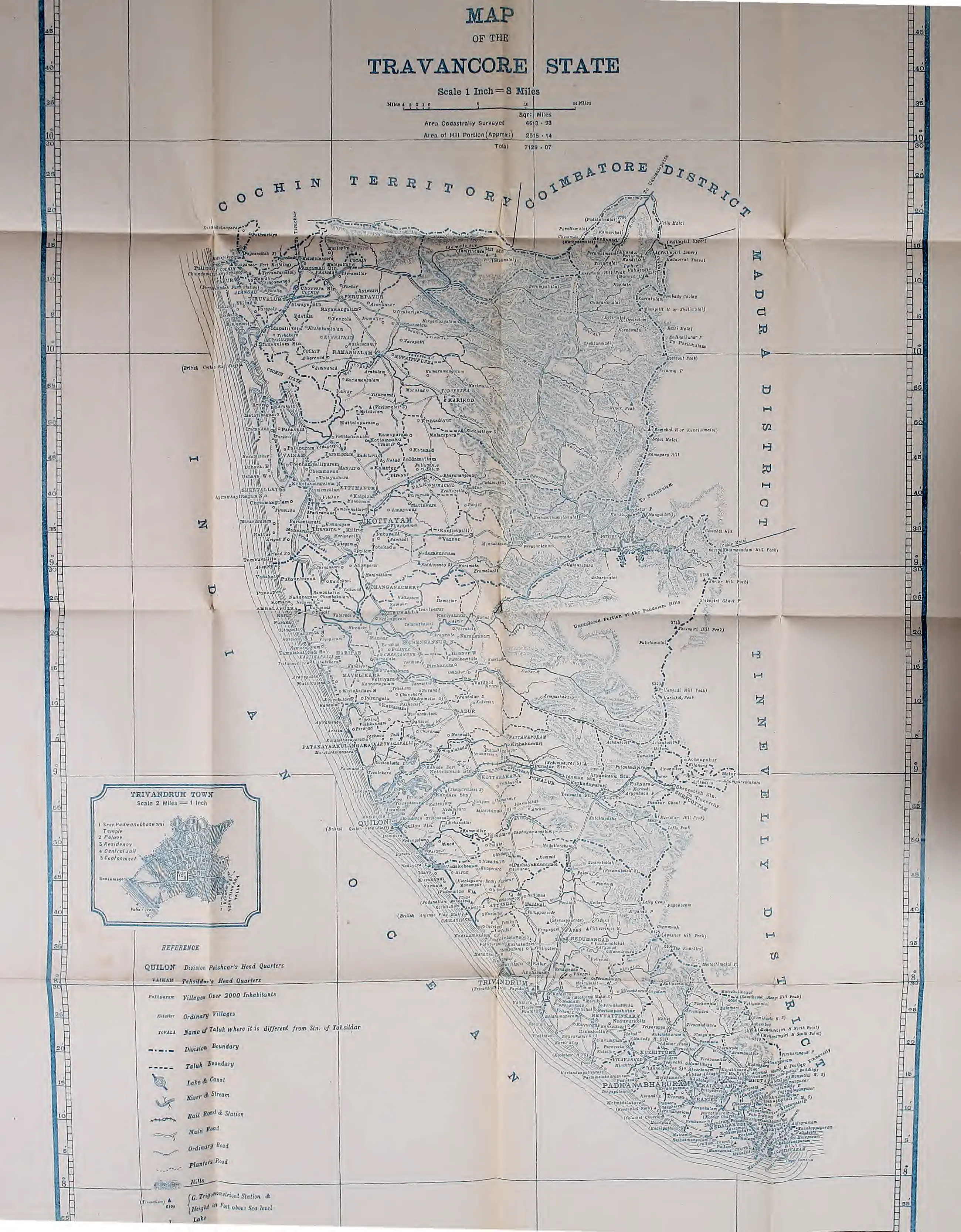
- Map of the Travancore State
- List of Illustrations
List of Illustrations
- Pandian Kal.
- Ponmanay Dam.
- Ponmanay Head-works.
- Attungal River Crossing.
- Railway Station, Quilon.
- Chakay Landing place, Trivandrum.
- Kulasekhara-Mantapam, Sri Padmanabhaswami’s Temple, Trivandrum.
- H. H. The Senior Rani's Marriage Pandal (Northern View).
- H. H. The Senior Rani's Marriage Pandal (Southern View).
- Potters at work.
- Vettoor, Wurkalay.
- Public Offices, Trivandrum.
- H. H. The Maharajah's Palace, Trivandrum.
- Map of the Travancore State
The plate “Cocoanut peeling as soon as the bunches are cut” (listed in the printed volume at page 49) is missing from the scanned copy from which this edition was made.
[1]
Chapter XIIIAgriculture.
"Here's the road to independence!
Who would bow and dance attendance?
Who, with e'er a spark of pride,
While the bush is wild and wide,
Would be still a hanger-on,
Begging favours from a throne,
While beneath yon smiling sun
Farms, by labour, can be won?
Up! be stirring, be alive,
Get upon a farm and thrive!
He's a king upon his throne
Who has acres of his own!"
A. M'Lachlan's Canadian song.
"If the ryot prospers, the king will prosper."
Auvayar at King Chola's coronation.
General. Travancore is pre-eminently an agricultural country, 47·2 per cent. of the population depending for their means of livelihood almost exclusively upon land. A feature peculiar to the agriculture of the Malabar Coast, particularly of Travancore, is the fact that the proprietors and tenants of the land live on the land itself. In addition to the proprietors of large estates, who themselves live in the centre of their domain, the tenants to whom the lands have been leased on Kanapattom tenure also live in the same lands from generation to generation erecting their own houses, sinking their wells and tanks, planting trees, renewing Kayala walls and otherwise fitting themselves up for a permanent residence there for all time to come. The practice of a number of people living in contiguous houses known as Gramam or Agraharam on the East Coast, is altogether unknown here; the packed streets that we meet with in the Capital and other large towns in Travancore are the result of latter-day colonisations from the East Coast. The system owes its existence to the peculiar social laws of the country and the nature of the cultivation.
[2]The following are the distinctive features of Travancore agriculture:—
(a) When the crops are of a permanent character like those of the cocoanut, the arecanut and the jack tree, their produce can be well secured only if the ryot lives on the spot. Thus living on the land has become a necessity with the Travancore ryot.
(b) Such permanent crops are better insured to the ryot by the regularity and abundance of the rainfall. This accounts for the Travancore ryot's contentment and consequent laziness.
(c) The climate and rainfall are specially conducive to the growth of trees, roots and yams, but not of rice and cereals. Hence the partiality of the Travancore ryot for his trees and plants and the extreme care with which he secures his garden by Kayalas or thatched walls of mud to protect it against man and beast.
(d) The light incidence of the ground tax and the tree tax is another factor in the partiality of the ryot for garden cultivation.
(e) The growing of wet crops is at a disadvantage in Travancore, as the wet lands are not protected by a system of perfect irrigation as in the dry districts of the other coast.
(f) The Travancore peasantry are extremely contented in the matter of clothing, food and drink.
(g) The absence of good cattle is most marked whether for cultivation or draught, or for the dairy. The climate is most inhospitable to good cattle. In consequence milk and ghee are insufficient to meet the requirements of the people.
(h) The absence of specialised agricultural implements for sowing seed in lines, inter-culturing, hand-hoeing, &c. is another characteristic.
(i) The existence of easy appliances for the draining of water from low flats for the cultivation of Punja paddy, is a speciality in Travancore. Recently steam has been introduced for draining purposes.
Messrs. Ward and Conner in their admirable Memoir of the State have given very valuable information on the soil, the course of husbandry and the different systems of agriculture prevalent.
Soil. "The irregularity of the soil is proportionate to the diversity of situation. That of the upper lands generally reposes on a basis of the laterite which frequently appears superficially in large masses. The more elevated parts of the hills present some variety of barrenness, producing only a coarse grass and a few meagre shrubs, but the soil of their sides and bases must be considered, as supporting so luxuriant a forest; that of a large share of the mountainous tract has sufficient depth to allow of cultivation and of this portion a considerable share has an easiness of declivity that would admit it.
[3]
"The soil of the lower parts of the valleys consists generally of a brownish coloured clay of some depth, but of course subject to great varieties, sometimes a vegetable earth having a loamy mixture washed from the neighbouring uplands; often porous, permeable, and readily giving to the plough, at other times a stiff clay (particularly where those valleys expand into the wider cultivated tracts) requiring some exertion to turn it.
"The soil of the coast is a fine whitish sand, with a mixture of calcareous clay as a lower stratum, combined with vegetable matter; it often (where less sandy or along the edges of little channels that intersect the more eastern parts) exhibits congeries of roots conglutinated by sediment. To an impregnation of marine salt may perhaps be attributed the luxuriant growth of the cocoanut, which is found deteriorated as it recedes from the coast. Much of the soil of Kutanaad seems composed of alluvial depositions (occasionally slightly sandy) formed by the flooding of the rivers that flow through it; each inundation would appear to add a new but scarcely perceptible layer of soil in the shallower parts. Nearer the mouths of rivers, stakes are occasionally planted, the interstices filled with weeds and straw retain the sediment which gradually collects, thus retrieving from the lake the space that had been enclosed. The soil of the Purrumboo lands is equally diversified; its general character however is red, coarse, gravelly, and comparatively thin, often only a few inches deep and infertile, at least when contrasted to that of the valleys. The uplands during the rains display some strength of vegetation, but are comparatively arid for nearly half the year;—no marine depositions or animal exuviæ contained in the laterite or lower strata have been observed in any instance.
"On the whole the soil of Travancore cannot be called rich, although perhaps they are more indebted to it than to their agriculture; it is superficial generally, but particularly on the Purrumboo grounds, the laterite throughout forms the second stratum, and it is probably penetrated by the large trees and forests that cover so great a part of the surface. The general return given by the best arable lands does not exceed twentyfold, but rarely reaches it; the ryot seldom acknowledges beyond twelve, between which and nine, he states it to fluctuate. The crops on the Purrumboo grounds do not give more than half that amount, and the husbandman thinks himself amply repaid if his best rice lands yield three-fourths of it. It has already been shown that a very small share is subject to cultivation; inclusively of the hilly tracts much of the waste space is probably abandoned to its natural state, as not capable of compensating the labour of tillage, but a large extent remains that might be cultivated with success."*
Rainfall. Reference has already been made in a former chapter to the two monsoons and the heavy rainfall in Travancore. The whole of Travancore, except the strip of country known as Nanjanad where artificial irrigation prevails to some small extent, depends for its agriculture upon these rains. The failure of rains for short intervals means destruction to several crops. In some parts there is scarcity of water throughout the year almost, while in other parts there is always too much. The rainfall is the lowest at Rajakamangalam where it is twenty inches, and this becomes higher and higher the further north we go reaching a maximum of 120 inches at Alleppey (except at Peermade which is a hill [4]station registering 207 inches). The normal fall at Trivandrum varies from sixty-two to sixty-six inches. Except in the southern taluqs paddy and other wet crops are raised only by means of rain in both the seasons of the south-west and north-east monsoons. In South Travancore there is a system of irrigation from tanks which is unique in itself, and the crops in this part may be said to be more permanent and certain. In other places paddy land suffers very often either from too much or too little of water. The yield here is also very poor as compared with Nanjanad.
* Memoir of the Travancore Survey—Lieutenants Ward and Conner Vol. I., pp. 58-60.
Systems of agriculture. There are three systems of agriculture followed in the country, viz., the Nanjanad system, the Kuttanad system and the Nilamkrishi. The Malankrishi and forest cultivation form a separate system altogether.
Nanjanad cultivation. The taluqs of Tovala and Agastisvaram in South Travancore are commonly known as Nanjanad. Lands upon which rice is grown are here known as Nanjai. They generally bear two crops, the tanks and water courses that irrigate them maintaining a constant moisture. The mode of husbandry in Nanjanad differs not materially from that common in the neighbouring district of Tinnevelly. The Pisanum is the most important crop; the seedlings transplanted in September or October reach maturity in February or March. The Kar crop, more precarious and less productive, is sown in March or April and reaped in August or September. The details of the practice and the varieties of the crops planted are dealt with a little later.
Kuttanad cultivation. Kuttanad comprises twenty-two Proverties, twelve in Ampalapuzha, four in Kottayam, three in Changanachery and three in Ettumanur. The rice lands throughout this marshy tract are termed Punja Padams, Punja being a denomination applied to dry lands on the other coast. The extent of fertility varies with the inundation to which it is annually subject, commencing in June and partly subsiding in September or October. When the cultivation season commences, much of this extent is under constant tillage; but as its fertility is found to diminish after a succession of crops, some portion is then allowed to remain fallow. The space thus left covered with water for a considerable time serves as a reservoir to the neighbouring fields. The population of Kuttanad being unequal to its cultivation, it is necessarily performed by the people of the surrounding districts: ten or twelve thousand Pulayas of both sexes are yearly engaged at it.
The level surface of this space is separated in divisions of various dimensions, generally from twenty to thirty acres, but the rank vegetation of [5]grass and aquatic herbs that here spring up during the rains must be first removed. This operation which is accomplished by scraping the bottom with a long hoe, is succeeded by passing the plough three or four times over the field, men and cattle (generally buffaloes) being more than half immersed in water during the performance of this labour. This is followed by encompassing the several areas with embankments.
"This is a tedious and difficult undertaking, commencing by fixing a double row of strong stakes measuring about twenty feet firmly in the bottom, where they are two and three feet asunder, but inclining inward; the breadth at the top diminishes to one-third of that distance, weeds and grass occupy the interstices in each row of poles, forming thus two slender divisions, the space between which is filled with mud taken from the channel along whose course they run. In this operation, the Polayan is frequently obliged to dive under water to some depth, when having collected as much soil as with both hands can be secured on his head, he rises half enveloped in his miry load; if of shallow depth, the soil is taken up with a large wooden hoe, the wall raised with such difficulty is elevated a few inches above the level of the water, as yet nearly in most places three feet deep, but which is now reduced to about as many inches by the chukram."*
This operation over, a couple of ploughings are then given, and the space divided and smoothed into beds is ready to receive the seed, which soaked in water for a period of five days becomes slightly germinated and is sown broadcast. The less watery seedlings are transplanted in the vicinity of the higher grounds where a few hot days are requiste to quicken the vegetation. This is accelerated by occasional inundations which are again repeated on the ninth or tenth day; the field remains overflowed for a month, when the water is drawn off for a short time and again restored, (the plant being about three-fourths covered) till the crop is nearly ripe. Kuttanad yields but one crop called Medapoo, reaped in the latter part of April or May. Rice is the only cereal sown; it yields more than twenty-fold. This tract is frequently liable to suffer from the vicissitudes of the weather, as an unexpected rise of the streams that intersect it (which a few hours' severe rain is sufficient to swell) forces the slender embankments guarding the crops and frustrates in a moment the hopes of the farmer. But the regularity of the seasons gives here a tolerable security against such accidents.
Reclamations have been going on on a large scale, especially during the last forty years, in the Vembanad Lake, and a good crop of paddy is reaped from the reclaimed lands. The following extract taken from the Malabar Manual regarding paddy cultivation in the Trichur Lake is equally applicable to that now being followed in the Vembanad Lake:—
* Memoir of the Travancore Survey. Vol. I., p. 67. Note. Sixteen cash make one chuckrum, and twenty-eight chuckrums, one Travancore Rupee.
[6]
"From the subsidence of the floods of one year to the commencement of the following rains, the space of time is barely sufficient for the garnering of a crop. At the close of the rains the water in the lake is drained off by ceaseless labour day and night with Persian wheels aided not unfrequently now-a-days by patent pumps driven by portable steam engines, whose fires glow weirdly across the waste of waters on dark nights while the incessant throb and rattle of the engines and machinery strive hard to dispel any illusions. Every foot of ground that can be thus reclaimed is protected by fences of wattle and mud and is planted up with well grown rice seedlings. Spaces are left between the fields, and into these channels the water drawn from the fields is poured, so that boats have to be employed for visiting the different fields, the dry beds of which lie some three or four feet below the level of the water in the canals. In the dry weather the lake presents a magnificent level green expanse of the most luxuriant growing rice, the pleasant effect of which to the eye is heightened by contrast with the snowy plumage of the innumerable cranes and other aquatic birds which here revel in a continual feast. With the early thunder harbingers of the S. W. monsoon in April, recommences the struggle with the slowly but steadily rising flood. Numberless Persian wheels bristle in their bamboo frame works for the contest with the threatening floods, and as the season advances, thousands of the population, many of them good caste Nayar women are perched high above the scene on these machines continuing the day and night struggle with the rising floods for the preservation of their ripening crops. The bulwarks of the fields are frequently breached and the unmatured crop drowned. Often a large area has to be reaped by simply heading the stalks from boats; but as a rule, an enormously rich crop rewards this remarkable industry." "This is truly 'a singular struggle of human industry against the forces of nature.'"
Nilamkrishi. The cultivated lands scattered among the low hills and slopes occupying the space between the lakes and the ghauts are termed Elas in the south and Virippu in the north. These are generally narrow valleys watered by small streams and are, from the soil, situation and moisture, in every way adapted to the cultivation of rice. The cultivation begins in the middle of April, seed being sown by the end of the month or early in May. The crop matures in about four months, the harvest occurring in September, immediately after which the field is again turned up and prepared for a second crop. This crop is reaped in January, its yield being estimated at eight fold or one-third less than the previous one. A third crop of gingelly (sesamum) or farinaceous roots very often succeeds; they come to maturity in March, and their culture is careless, cheap and comparatively unprofitable.
Mundagan lands are those occupying the borders of the lakes or stagnant waters, but slightly elevated above the Punja grounds; they retain considerable moisture and yield one tolerable crop, the fruit of comparatively difficult culture, it being necessary to work their tough soil with the spade. The paddy is raised from seedlings sown in June or July; transplanted in August or September, and reaped about the same period with the second crop of the Virippu lands. The grain grown [7]on those grounds is of an inferior bearded kind, and yields one-thirty per cent. of rice when husked.
Malankrishi. Lands on the summit and slopes of hills that are cleared of trees and shrubs for purposes of ordinary cultivation, are termed Cherikals. The jungle is cut immediately after the rains. They are left for two or three months to dry and set fire to in February. The ashes increase the fertility of the soil. It was the practice of the ancient days to cultivate these lands only once in twenty-nine years. The population having increased, the Cherikals are now cultivated once in twelve years, and more frequently even once in six years. After the jungle is burnt the ground is rudely turned up sometimes with a peg, more generally with a hoe, but with plough only on the lower slopes. On the commencement of the first rains the field is sown broadcast. The seeds sown are:— Chennellu, Karutta Manungora, Velutta Peruvala, Karutta Peruvala, Kuruka Kannalakan Kuruka, Elayanikadu, and Incha Kadan.
Of these the last two take less time to mature. After sowing, the field is strongly fenced to prevent attacks of wild animals, and a Pulaya is made to guard it resting on the top of some neighbouring tree. The weeding takes place after the fortieth day. If the ground is free from rocks or stones, a parah of these Cherikal lands yields about thirty parahs of paddy. The cost of cultivating one parah of land will come to about twenty parahs of paddy. In ordinary grounds a parah of seed can be sown in a space of 192 Perukkams.
The most valuable crop is rice. It is sometimes succeeded by a second one of inferior grain. The two seasons are then called Uzhavu and Kalai, the latter of which requires no manure. The rice crops can be gathered precisely after one hundred and forty days from the date of sowing. After the Kalai crops, gingelly and gram are raised in some parts. The cultivation of the same spot may be repeated for two successive years, when its exhausted fertility requires ten or twelve years' fallow to restore it. The produce of the first year is often very abundant. As there is immense extent of ground available for such cultivation, the second year's tillage is not generally repeated. As the labour of the men in this system is required for felling timber or erecting fences, a large part of the work of ploughing, weeding and reaping falls to the share of the women of the hills and those of the lower classes.
Garden lands. Parambu was the designation originally given to the low slopes of hills on which ordinary garden products were raised. Now almost every compound raises these, and the general name given to [8]such lands is Purayidam. The cultivation of these lands depends entirely upon the rains as the hill slopes cannot be irrigated artificially. Even where they can be, such irrigation is rendered unnecessary by the almost regular fall of rains throughout more than half the year. Various species of dry grains are sown with success, viz., horse-gram, gingelly, rice, &c., and roots such as tapioca, Chempu, Chenai, &c., Indigo is cultivated with success in the southern districts. Sugarcane to a small extent is grown on the banks of rivers and streams. There are two varieties of it differing only in size. Pepper and betel vines are grown in abundance. The former yields pepper to a large extent, the latter a good crop of leaves for people's daily use. The betel vine is grown in the southern parts and in the Shertallay taluq, where we have the cocoanut, and the arecanut. These are found in abundance throughout the land and the palmyra in portions of South Travancore adjoining Tinnevelly District. A detailed account of these is given elsewhere.
Agricultural operations. A marked agricultural feature of Travancore is the fencing which is almost universal in this country. Every field has its fence and every compound its Kayala, a low mud wall, topped over by a small thatched roof to protect it from rains. This is intended to prevent cattle trespass. The system of letting cows loose in the streets generally obtains here, so that the gates of houses have horizontal bars placed at a height of three feet between the door-pieces, visitors to the houses having to cross the bar when they wish ingress. The system of fencing with Kiluvai and other thorny plants including the prickly-pear obtains only in very small areas on the eastern portion of Nanjanad. Besides preventing cattle trespass, fencing serves the purpose of distinguishing boundaries and supplying fuel.
Implements. The agricultural implements used in the State and their cost are as follow:—
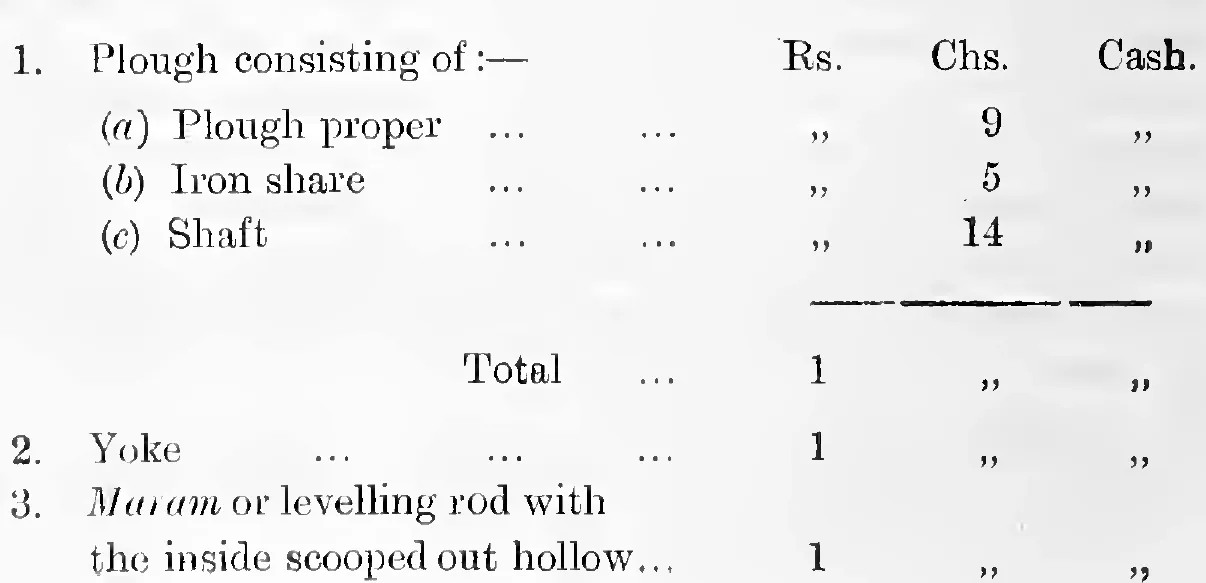
[9]
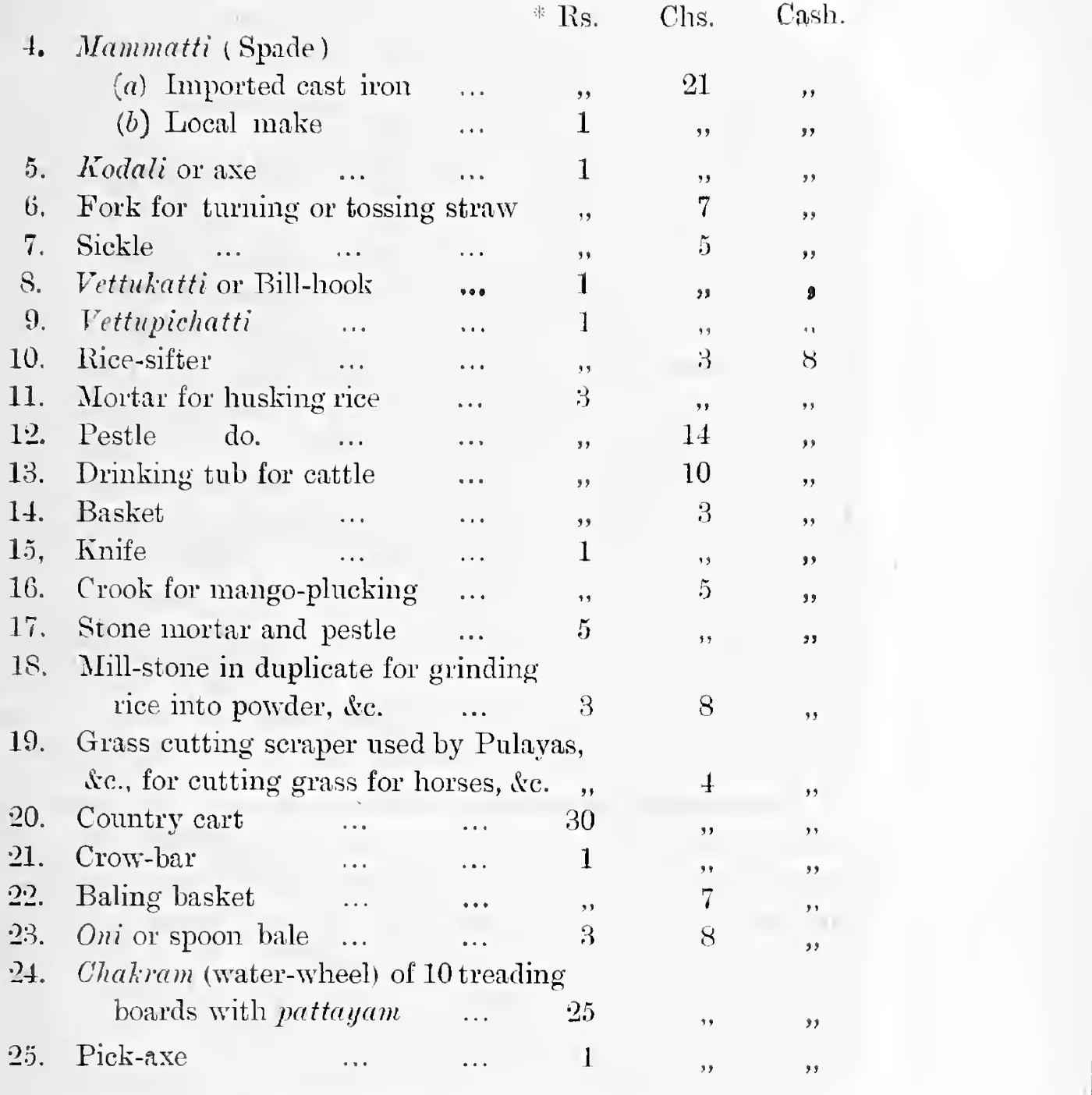
From the list it may be seen that the implements though apparently of primitive types are well suited to the present needs of the people. Though the main plan of each agricultural implement may be the same, yet minor variations are found, due to contact with surrounding districts, differences in soil and climate, and the habits and intelligence of the people. The plough in South Travancore for instance more resembles the Tinnevelly plough and consists of two bits of wood, one fitted to the other by means of another long peg-like wood, and there is nothing of the shape of a mould-board. In Trivandrum and other central districts the plough is one complete piece, but of wood, rather broader and having [10]the extremity shaped like a mould-board. Ploughs in the North are more suited to wet land cultivation known locally as the Punja cultivation. Mammattis of South Travancore require greater manual power in handling than those in and around Trivandrum; and the same instrument has a very long handle in northern taluqs and is known as the Toomba. A small instrument known as the Kalai-vettu mammatti is used for weeding in later stages of cultivation when the plants are fairly up. This, has the same appearance as the mammatti, but is smaller, so that it can be freely worked between plants. Bill-hook or Vettukatti used for cutting bamboos differs in shape and weight from that used for cutting leaves, &c., from palmyra trees. The sickle or reaping knife is a very light instrument with a wooden handle and has a greater curvature with the cutting surface marked with a number of serrations. The shape of the winnow is that of a square with the centre a little depressed. In other places the three sides, especially the middle, are higher than the rest, and one side is purposely opened out for getting out the chaff. In some cases cocoanut fronds are used by men for levelling by the hand after puddling is over when the area is small. This is called Madal Valikka in technical parlance. Introduction of labour-saving machinery is not considered beneficial to small peasant proprietary holdings.
Fallowing. The value of fallowing lands is well understood, and the rule is that lands should be ploughed immediately after harvest in Dhanu (Dec.—Jan.) and left uncultivated till Medam (April—May). The rains about the month of March or the beginning of April are taken advantage of, and lands are ploughed again to be ready for sowing on the 10th of Medam (end of April) or immediately afterwards. This applies only to fields where two crops are raised annually. There are, however, as noted above, large tracts which bear only one crop in the year, e. g., Kuttanad and the Malamkrishi lands. These remain fallow for a large part of the year, while Malamkrishi lands are left untilled sometimes for six, twelve or even twenty years. In some parts we meet also with the other extreme where the lands are under crops throughout the year. The months of Makaram, Kumbham and Minam (January, Febuary, March and April), the usual season for fallow, are utilised for a third crop such as gingelly. This practice is very injurious to the land. Gingelly is an exhausting crop, and where the practice is continued for a few years the lands become very unproductive. The farmer himself is not unaware of this. The paddy crop which immediately follows the gingelly crop is generally a failure, the cultivator not being able to recover even the ordinary expenses of the next crop by this harvest; especially is [11]this the case where the use of chemical fertilisers for manure is unknown.
Ploughing. The two chief faults of the native plough are its great draught, due to clumsy form and construction, and the necessity for repeated ploughings to obtain a proper tilth. The native plough has its own advantages in parts where it would be useless to bring up the poor subsoil, and a light turnover plough would effect a great saving in time and labour and thus turn the rains to better advantage. In the deeper soils, larger and heavier ploughs would be specially useful. Before planting the better class of crops such as sugarcane and betel vine, the land is ploughed repeatedly eight times or more A good tilth is thus obtained though at a great cost. In such cases European ploughs would be a source of saving and profit. But the cost of the European plough together with the cost and facilities for repairs in case the ploughs should get out of order, should be taken into consideration before advising our cultivators to launch money on such appliances. Where labour is cheap, labour-saving machinery is not desirable. One of the evil effects will be to throw several thousands of people at once out of work. On the other hand where there is a superfluity of capital and labour is dear, machinery is a blessing. The status, agricultural knowledge and the capital of the Travancore farmer should be improved considerably before any such step can be recommended to him.
Manuring. Manuring is yet in the empirical stage; ordinary manurial substances and their effects are perfectly understood; but the science of manuring, its mode of action, the improvements of the methods available, the return to the soil of all that is taken from it and the value of mineral manures are unknown. Special manures are used for special produce which are referred to under the different crops. Agricultural demonstration farms and educational institutions on the subject have yet to do much in the way of making improvements. The main reasons are probably the conservative tendency of the farmer and his aversion to and fear of new experiments.
Green manuring is unknown except in wet lands, and there too is used only in the form of wild shrubs from forests. The ryots unacquainted with the qualities of plants have no idea whatever of the nutritive capacity of the various leaves. The mango leaves though fibrous yet constitute fairly good manure. Thorny shrubs in some districts are made into a compost and then applied as manure.
The use of green manure to wet lands is practised with better [12]perfection in Nanjanad. Special topes exist for the cultivation of trees to get green leaves from. There are several stages in which green leaves are applied. First after ploughing, the leaves are chopped and applied to the soil so that they may mix with the earth and decay. The other stage is when the plants have fairly grown up. In this, four or five plants are taken en masse from the ground, and in that spot chopped leaves with mud are put in, and over this the plants are placed, so that they may strike root below in the manured ground. Leaves of certain kinds of trees are preferred to those of others, and especially mango leaves are applied, to make the soil blacker and more tenacious. Portia or Silanti (Thespesia populnea), Erukku (Calotropis gigantea), Mango (Mangifera Indica), Avarum (Cassia auriculata), wild indigo and leaves of jungle trees and others specially cultivated for the purpose are all used largely as manure.
Mr. B. S. Narayanaswami Iyer, B. A., writes to me thus*:—
"The Science of green-manuring can be viewed either from the stand-point of Agricultural Chemistry or from that of Bacteriology. The former view is a more comprehensive one and may be said to include the latter. Reduced to simplest limits, Agricultural Chemistry concerns itself with the investigation of ultimate and proximate chemical constituents found in plants and also those found in soils, and in determining how the latter go to build up the former. Modern Science has up to now determined ten chemical substances in plants, i. e., Carbon, Hydrogen, Oxygen, Nitrogen, Sulphur, Phosphorus, Potassium, Calcium, Magnesium, and Iron. Of these the first three are got by plants from the atmosphere. Sulphur, Magnesium and Iron occur only in infinitesimally small quantities and are practically procurable from all soils and in available condition, and so they may be neglected. So the remaining things that concern practical application are Nitrogen, Potassium, Calcium, and Phosphorus. Of these the last three come initially from the soil and hence do not present much difficulty. Some manures contain either Potassium or Calcium or Phosphorus singly or conjointly, either in a soluble or insoluble form. The question of applying Nitrogen is the only thing that presents much difficulty.
"Its initial occurrence in nature is in the form of free Nitrogen present in the atmosphere; and this, plants have not got the power to utilise. They require a medium to render it available to themselves. First rains, lightning and other natural causes tend to unite the free Nitrogen with Hydrogen, Oxygen and other substances and make compounds which falling down along with rain enter the soil and mix with the earth (technically called metallic bases) and form salts of Nitric-acid. It is only these soluble salts that can enter and fertilise plants and not free Nitrogen. Hence the starvation of the plant for Nitrogen in the presence of the plenty of free Nitrogen in the atmosphere. It requires a mediator and a process before the Nitrogen can be of use in its formation. The term organic is very often used to denote constituents containing Nitrogen, the term being a more generic and comprehensive one than the term Nitrogenous which is more a utilitarian word used with reference to the available Nitrogenous substance as manure.
* I am indebted to Mr. B. S. Narayanaswami Iyer, B. A., Superintendent of Government Agricultural Farm, Trivandrum, for valuable information on green manures and soils discussed in this chapter. Where the information was not furnished by him, he has helped me by reading through the proofs.
[13]
"Of the several thousands of natural orders of plants, modern Science has determined that a certain natural order known as Leguminosœ (Pulse Order) has the power of utilising the free Nitrogen of the atmosphere into its own constituents. This it does either directly by making the free Nitrogen unite with its own substances or indirectly by making it unite with other substances in the air and then utilising it for its own purpose. Whatever the real process may be and whether the same is determinable by Science or not, the fact is true that a soil grown with these plants contains Nitrogen compounds over and above the quantity supplied to them as manure. The fact remaining always true, the only conclusion is to assign this power to these species of plants.
"The Nitrogen-fixing power of these plants is demonstrated to be by certain minute micro-organisms known as Bacteria. These minute micro-organisms are not unfortunately all the same for all the plants of the order. Each plant has its own Bacteria, and each kind of Bacteria will fix Nitrogen for the plant of its own kind. For instance the Bacteria of horse-gram may prove a failure when tried on black-gram and vice versa. It is these Bacteria that have been made the subject of separate cultures by Bacteriological Department of Plant Industry in the U. S. of America, and these are supplied as soil-inoculating manures by the Agricultural Department. These have been tried with varying results in Madras, and their success is not as yet definitely pronounced. Unless it be conclusively established, it is better for the ryots (in my opinion) not to embark on this enterprise. The Nitrogen-fixing by these plants is by means of certain protuberances in roots known as tubercles—these tubercles should not be confused with similar microscopic diseased condition of the roots. So far as regards the Bacteriological aspect of the "Science of Green Manuring."
"Plants like animals are not all the same in their habits of storing their useful portions. Avoiding minor exceptions it is a general rule that the stem is richer than the root, the leaves than the stem, tender ones better than the old ones, flowers than the leaves until the maximum is reached in the fruit. The popular way to understand the principle of green-manuring is that the leaves if left undisturbed would culminate in a fruit by passing their nutritious materials into the latter. So the application of geeen leaves to the soil means the application of materials which would have resulted in fruit formation had this not been applied to the soil. In short, destroy a plant or a valuable portion of a plant to produce a richer plant. Popularly the term green-manuring is applied to all sorts of application of green leaves to the soil especially wet lands as in Nanjanad. But specifically and technically it is applied to the process by which a crop like horse-gram, &c., is grown solely with a purpose to produce leaves to get them ploughed in the soil before flowering and not for the sake of the grains. The practice is very good; and especially in places where manure in shape of green leaves is not procurable, it is a necessity and the only source by which the soil can be replenished in an economic way. The practice is not new and confined to what is now known as 'Improved Agriculture', but is very old though its rationalistic explanation in the light of Agricultural Chemistry may be modern. It is the same as what is known as the 'Pachaithol Valam' in Nanjanad."
Cattle-dung is the manure most extensively used by the people in paddy cultivation in low lands known as Yelais. The quantity supplied varies with the means and resources of the ryot. As much as twenty cart-loads* are supplied in some cases and even five cart loads in others per acre. The method of preparation of this manure may be said to be [14]defective from an improved agricultural point of view, but the superiority of the latter method is still to be proved by experiment. A pit is dug generally near the cattle shed, and all the dung is daily removed to the pit, and also the urine of cattle is made to flow into the same. When the pit is filled the manure is removed to the fields. Well-to-do farmers keep buffaloes and bullocks for manure and other agricultural purposes. Such as cannot command the resources, purchase manure from towns or from tenants holding no paddy lands for cultivation. The price varies from 5½ to 12 as. per cart-load according to season and locality. If cow-dung is required to be applied for vegetables, it should be always applied in a dried state, as otherwise the manure in a green state would breed pests and diseases. The cow-dung powder is mixed with ashes in different proportions according to the needs and circumstances of the plant, and then applied. Cow-dung is not frequently used as fuel in Travancore, properly because the long period of rains does not permit the dung to dry quick as on the other coast. The penning of sheep and goats for manuring purposes during nights in fields and dry lands is not so general here as on the other coast. Cattle do not thrive in large numbers here, and farmers owning large flocks of sheep and goats are unknown.
* A cart-load gives from 800 to 1000 lbs.
Village sweepings form the next kind of manure. These are never wasted. But it must be noted that these are not available in large quantities as the inhabitants live in scattered houses among their own fields and not in streets as on the other coast. The re-thatching of roofs every year gives bits of old leaves which together with other dried leaves form manure to the Medam (April—May) sowing.
Ashes are generally used for paddy fields as top-dressing. They serve often to drive away an unexpected attack of insects like the Eazhian. The quantity used varies with the means of the ryot. Salt is used for cocoanuts only on a small scale as its price is prohibitive for application on a large scale. Salt-earth, lime and river and tank silts may be largely used.
Fish refuse and slaughter house refuse may be more largely used than they are. Animal manures other than the excreta of stock are not used. Bones are collected and exported, but are not used in the country. Human excreta are not generally used as manure, though they are accumulated for the purpose in some parts of South Travancore where the people live in streets.
Rotation of crops. This is not generally practised; the same crops are grown every year on the same fields. Most of the crops on garden lands are of a permanent nature and do not permit of any rotation. It is [15]however understood that certain crops such as sugarcane, tapioca, &c., cannot be grown year after year, for they are found to exhaust the soil, and their cultivation is followed by that of cereals. In certain paddy fields it is usual to grow different kinds of pulses between two paddy crops, the period generally taken being the months of Makaram, Kumbham and Minam (January, February, March and April), and the stubbles of these latter are used as manure for the succeeding crops of rice.
Seed selection. Seed is generally selected for its good qualities, ordinary grain being used only when selected seed is not available. In paddy for example it is only the Talai-uthir-nel (the paddy which is collected at the first beating) that is used for sowing. Almost every farmer can tell what is good and what is bad for sowing.
Sowing. There are three modes of sowing, viz., broadcast in lines, by transplantation from nurseries, and from cuttings or roots. All sowing is done by the hand. Broadcast sowing is the general rule in the case of all cereals and grains, exception being made in the case of certain pulses which are sown in lines when grown along with other grains. Paddy is generally sown broadcast in Medam (April—May). But in Kanni (September—October) it is generally transplanted from nurseries. Sugarcane and tapioca are sown by cuttings, plantains from suckers, and turmeric, ginger and various edible roots from root cuttings. Details with reference to each particular in its varieties will be given later on.
Reaping. Reaping is performed in various ways. The general rule is that the plants are cut close to the ground. In certain cases where the stalks are not specially useful or where owing to the constant supply of water much reaping is not possible, only the ears of corn are cut, the stubble being left to rot in the soil. Maize stalks are used for fodder. Paddy straw is carefully stacked for sale or for fodder, the straw generally being a valuable commodity.
Threshing. Paddy sheaves are generally threshed twice, first by the hand and then by the cattle. The first is performed with great ease and celerity owing to paddy being cut when dead ripe; a good sized sheaf is handed over to a thresher, who in turn with a single motion passes a cord round it, strikes it with one heavy blow on the ground, and tosses it to the stack nearly cleared of grain. The grain which results from this threshing is the finest and ripest, and seed is always selected from it.
In the case of certain dry products, the ears of corn are stacked with straw for a few days, and then dried and threshed.
[16]The ears of corn with or without stalks are spread on the ground, and cattle tied together in threes and fours are made to tread on them; so that after a few hours' threshing, the grains drop off. The practice of threshing is primitive and is therefore capable of considerable improvement.
Cattle and cattle breeding. Travancore is more mountainous than pastoral; the cattle here are scanty in number and wretched in appearance. The black cattle like most of the animals of the country are diminutive; indeed the climate would appear to be unfavourable to the better kind of the other coast. Whereas in the Madras Presidency and Mysore, there are several breeds of cattle each having its own characteristic quality for milking or draft purposes, there is no specialised breed in Travancore for any specified purpose. Even imported animals are found to deteriorate in Travancore in spite of the richness of the vegetation and the consequent facilities for pasture. This is due among other causes to the innutritious character of the herbage which is abundant on account of heavy rains.
Cows and Bulls. It is well known that the Hindus regard the cow as a sacred animal, and the Travancoreans, pre-eminently a religious and conservative people, have always found a special divinity in the Kamadhenu. It was the practice here in former days to punish with death people who killed cows; but though such protective laws have now become obsolete, the sacredness attached to the cow still endures. The institution of Dharmappillu* in each taluq to the cows above all other animals testifies to the truth of the above statement.
The people of Travancore divide the cows into different breeds according to the locality to which they belong; e. g., the Vetchur breed hailing from the North is famous in Travancore for its milking capacity though extremely diminutive in size. The different breeds, however, do not present any great differences in their make or shape. There are also cross breeds from Nellore, Coimbatore, Guzerat, Konkan as well as Madura and Tinnevelly breeds; but these are very limited and are the result of importation by a few rich and prominent native and European officials and planters. The indigenous breeds are degenerate, small and wretched; their working power is very limited and milk poor in quantity. Their colour is generally black, but brown animals are also found. They do not grow taller than some of the calves of the Nellore breed.
* Literally charity grass. A small sum is spent by the Sirkar in providing grass for stray cattle in some towns.
[17]The cattle are generally better circumstanced in the country parts than in towns. In the former, as soon as the harvest is reaped the arable lands are thrown open to them, where they are left undisturbed to consume the long stubble, and when the village fields are sown and cultivated the cattle are driven to the nearest hills, whence they are led back at dusk and confined during the night in the farm-stead. The milch cows are supplied paddy, straw, grass, rice bran, tamarind seed soaked in water and cocoanut or gingelly oil cake, while the others are given only straw and rice water. In the towns, however, pasturage grounds are always at a discount, and even dry fodder is very dear. Hence in all but well-to-do houses the cows are driven out of the house to shift for themselves in the day time and are confined only during nights when fodder of very poor quality and quantity is supplied to them. A cow if it is properly fed should get per day 10 to 15 lbs. of green fodder, an equal quantity of straw, 2 lbs. of cotton seed, 1 lb. of bran or dholl husk, 1 lb. of oil-cake and an ounce and a half of common salt.
Cows generally calve for the first time in the fourth and sometimes also in the third year after birth. There is no particular breeding season. The prevalent opinion here is that cows bear only in the first quarter of the Malabar year, viz., between September and October, but this is not universal. The pairing season is generally after the rains when fodder is plentiful. Some cows yield calves once in fifteen or sixteen months; most yield calves only in alternate years. The Travancore cows yield milk for six or nine months after calving, and then for another six or nine months they do not pair, and the owner has thus to wait for an additional nine months before the cow can yield milk. The quantity of milk given by an average cow during the milking period is much less than half the quantity on the other coast, owing solely to insufficient food. If properly fed, the indigenous cows yield a very large quantity for their size, and the quality is also superior to that of the East Coast ones. Those cows are reckoned best in Travancore which yield milk for six to nine months. The average yield of milk per ordinary cow is about three Nalis a day, a Nali being nearly equivalent to thirty ounces.
The age of cows in Travancore is the same as elsewhere, viz., twenty to twenty-five years. The value of a cow varies from ten rupees to thirty-five rupees at the most.
Bulls are also diminutive in size compared with those of the East Coast. The indigenous ones are mostly used for agricultural purposes; for vehicles and carts, bulls are imported from the Tinnevelly and other [18]districts of the Madras Presidency and Mysore. The best bulls come from Mysore, Salem and Coimbatore. The condition of the indigenous draft animals is very poor, and the treatment accorded to them by the ryots anything but satisfactory. The ryots do not take any interest at all in breeding them or improving their condition, but the work they exact from these poor dumb creatures is unlimited. The practice of the ryots here, of most of them, is to hire bulls or buffaloes when the ploughing season comes, and those who do not hire go to the nearest market, buy some undersized wretched bulls having vitality just enough for the work of the season and sell them again soon after; such practice surely does not augur well for the future of cattle breeding in Travancore. Animals actually sick, too old and poor, with disabled limbs, sores and yoke-galls, are often mercilessly beaten, tail-twisted and otherwise cruelly treated for not doing the work which they are physically unable to do. The recent legislation regarding the prevention of cruelty to animals will, it is hoped do much towards ameliorating the condition of these poor animals.
Regarding their food, straw and grass of different kinds constitute the major portion. Cotton seed, horse-gram, tamarind seed, the husk of dholl or black-gram, peas, rice bran and oil-cake also serve as food in various quantities according to the means of the ryots. A good sized working bullock should receive per diem, if properly fed, three pounds of cotton seed, one pound of dholl husk, two pounds of rice bran, an ounce and a half of salt and twenty-five pounds of grass and straw each, or as much straw as it will consume.
Bulls of the indigenous breed can be had for Rs. 20 to Rs. 60 per pair. A pair of foreign bulls imported cost from Rs. 100 to Rs. 300.
Buffaloes. The Travancore buffaloes differ in no particular from those of other parts. They are very numerous and being of strong build constitute the chief support of the rural labourers. Male buffaloes are solely used for agricultural purposes; in fact they are better workers than bulls especially in wet lands. She-buffaloes are also used for agricultural purposes, but only until they begin to bear. These give nearly double the quantity of milk given by cows, and the milk itself is thicker and of better consistency. The buffalo milk and ghee are highly priced specifics against certain maladies caused by the damp climate. An ordinary middle sized pair of ploughing buffaloes cost from Rs. 50 to Rs. 60. Milch buffaloes are sold from Rs. 25 to Rs. 40 each.
Goats and sheep. Goats are not rare. They are generally reared by low caste people not so much for manure as for their flesh near towns. [19]In rural places, especially in South Travancore, they are generally kept for manuring purposes. They are also kept for milk as it is considered to possess many medicinal properties. He-goats are largely sacrificed to the inferior deities. A goat lives for ten years at the most. Its price ranges from two to five rupees. Sheep are common, but not abundant. The climate is too uncongenial for them to thrive and produce wool.
Horses and asses. Horses are exotics, and the ass is a rarity except in South Travancore. There is, however, a species of the ass resembling the horse along the frontier at Aramboly. These are good draft animals and form Nattu-mattam (the country horses) of Travancore. They are not used for agricultural purposes at all. The asses are mostly used by the washermen to carry their heavy loads. They are not found in North Travancore, i. e., north of Trivandrum. The tradition is that asses could not thrive here owing to a special curse of Parasurama. The current belief is that a Brahmin who dies in Kerala is born an ass in his next incarnation. Such must have been the dread created in the minds of the original colonists by designing persons who wanted to defeat Parasurama's repeated attempts at colonisation.
For the following general remarks on cattle breeding, I am indebted to the Venerable Arch-deacon J. Caley of the Church Mission Society at Tiruvalla:—
"Cattle are of immense importance both to the agriculturist and the community at large. And yet in Travancore the breeding and feeding of cattle is of the most haphazard and casual kind. Cows are needed for milk, and some people keep them for that purpose, and yet do not get a fourth part of what might under proper treatment be secured.
"The Travancore cattle are of a small kind, and therefore not of great value for agricultural purposes. For milking purposes, however, the small Travancore cow is far more valuable than a great many people think. Properly fed, she gives a very fair quantity for her size, and the quality of the milk is superior to all others.
"Besides the small cattle that really belong to Travancore there are several cross breeds from Nellore, Coimbatore, Guzarat, Konkan, as well as from Madura and Tinnevelly. The last mentioned, and especially such of them as are brought into Travancore, are the least desirable of all. If only milking cattle were required, the improvement of the small Travancore animal, without any intermixture of other breeds whatever, would be all that needs be aimed at. But as cattle are required for agricultural purposes as well as for milking, a stouter and stronger animal is needed, [20]so that the oxen may plough and the cows may be of a good kind for milking purposes. For this double purpose the best blood imported from Bombay to Alleppey and Cochin is what is needed. It should be distinctly borne in mind that the secret of successful cattle-breeding consists of two parts, viz., selection of good sires and the castration of all inferior bulls before they can serve cows. This is the A. B. C. of cattle-breeding. Without it there can be no improvement; whereas with it steady improvement is absolutely certain. But both parts must be faithfully observed to ensure success. In selecting a bull, we should always consider what his sire and dam were, as well as the animal himself.
"If this careful system of selection be pursued by farmers in any given district for a few years, they would most certainly see an enormous improvement in their cattle, and would find them far more useful and profitable. Although milk is so very valuable as an article of food, scarcely any reasonable trouble is taken in any family to secure a proper supply. They seem to think that the poor animals will give milk whether they be fed or not. Hence they starve the cow, which naturally starves both her calf and her master, and perhaps gives up milking after about six or nine months, and is so poor that she only takes the bull six or nine months after, and the owner has to wait nine months more before she gets anything to give him. Hence the cow, for one half or two thirds of her time, gives no milk at all, and when she does it she yields about half the proper quantity. Whereas, if properly fed, she will give a good supply of milk for a full year or more, and in about four months after she has ceased to give milk she will have another calf and continue full supply again. Many of the cows will continue to give one and a half bottle of milk per day till within two months of the time of calving.
"There is a very general opinion in Travancore that a cow will not give milk when she is bearing, but the opinion is only valuable as an evidence that the poor dumb animal has not been fairly treated. The reason why a cow does not bear when milking, is that she has not sufficient vitality owing to lack of food. Some people have an idea that cows only bear at a particular part of the year, which again shows the animals have not been properly fed. There are certain parts of the year when food is more plentiful than at other times, and those are the times when a large number of cows bear calf. When cows are well fed, they will generally have calves once in fifteen or sixteen months and may be relied upon to give milk for a full year, or three-fourths of their time.
"From the end of December till the middle of May milking cows [21]should have free access to a stock of good straw in addition to the provender and such grass, &c., as can be given to them. The cow is the friend of the house and the friend of the farm, and both the house and the farm should contribute to her welfare. During the time there is plenty of grass the cows will milk very well without any provender, but as soon as grass begins to fall short they should have every morning one Idangali of Uzhunnu (black-gram) bran, one bit of punnak (oil-cake) and one or two Idangalis of rice bran if available. During the dry season they should have this twice a day, and some fodder such as grass or straw as well. For every chuckram you give the cow she will give you two. As for the farmer and the man with a Purayidam, he gets it all back in the value of his manure and increase of his crops. It must always be borne in mind that one load of manure from animals fed on provender is worth four loads of provenderless manure.
"In England it is well known that the field grazed by the milking cows becomes richer year by year. This is partly due to the fact that the milking cows get provender and partly to the fact of the milking cow being a full grown animal; nothing is taken from the land to make the growing bones as in the case of the young animals. This, however, is a question that belongs more to Agricultural Chemistry than to an article on cattle-breeding, and is only mentioned as a hint to the farmer that his land is benefited as well as himself by the proper treatment of the cow."
Cattle diseases. Cattle are subject to a great many diseases. Three communicable diseases prevail in Travancore at certain parts of the year, viz., foot-and-mouth disease (Eczema epizootica), cow-pox (Variola Vaccinia), and cattle plague (Rinder pest). This last disease, whenever it breaks out, carries away many herds of cattle entailing severe loss to the agricultural ryot. No specific cure for this is as yet known, Mild cases, however, generally recover with proper care and nursing. Prevention is the best cure. Grazing in and frequenting once infected places should be avoided; every animal newly brought from cattle markets, &c., ought to be kept separate for some time, especially those coming from infected localities; all articles that come in contact with the diseased animal or herd should be disinfected and burnt if possible. Carcases should be burnt or buried under quicklime or at least over six feet below the surface of the soil. The affected cattle should be isolated from the rest and nourished with soft, easily digestible and nutritive food and stimulants and vegetable tonics. These same preventions ought to be adopted in the case of the other two diseases above mentioned, viz., cow-pox and [22]foot-and-mouth disease, from which scarcely any will die if properly nursed and taken care of. Free use of common salt should be allowed for the sick as well as the healthy ones.
Agricultural Stock. The following statement gives statistics of agricultural live-stock for the various divisions of the State during the year 1080 M. E. (1904-1905 A. D.). As this is the first attempt at collecting such statistics, it has not been possible to compare them with those of any preceding period:—
[23]
Agricultural stock in the State during the year 1080 M. E. (1904-05).
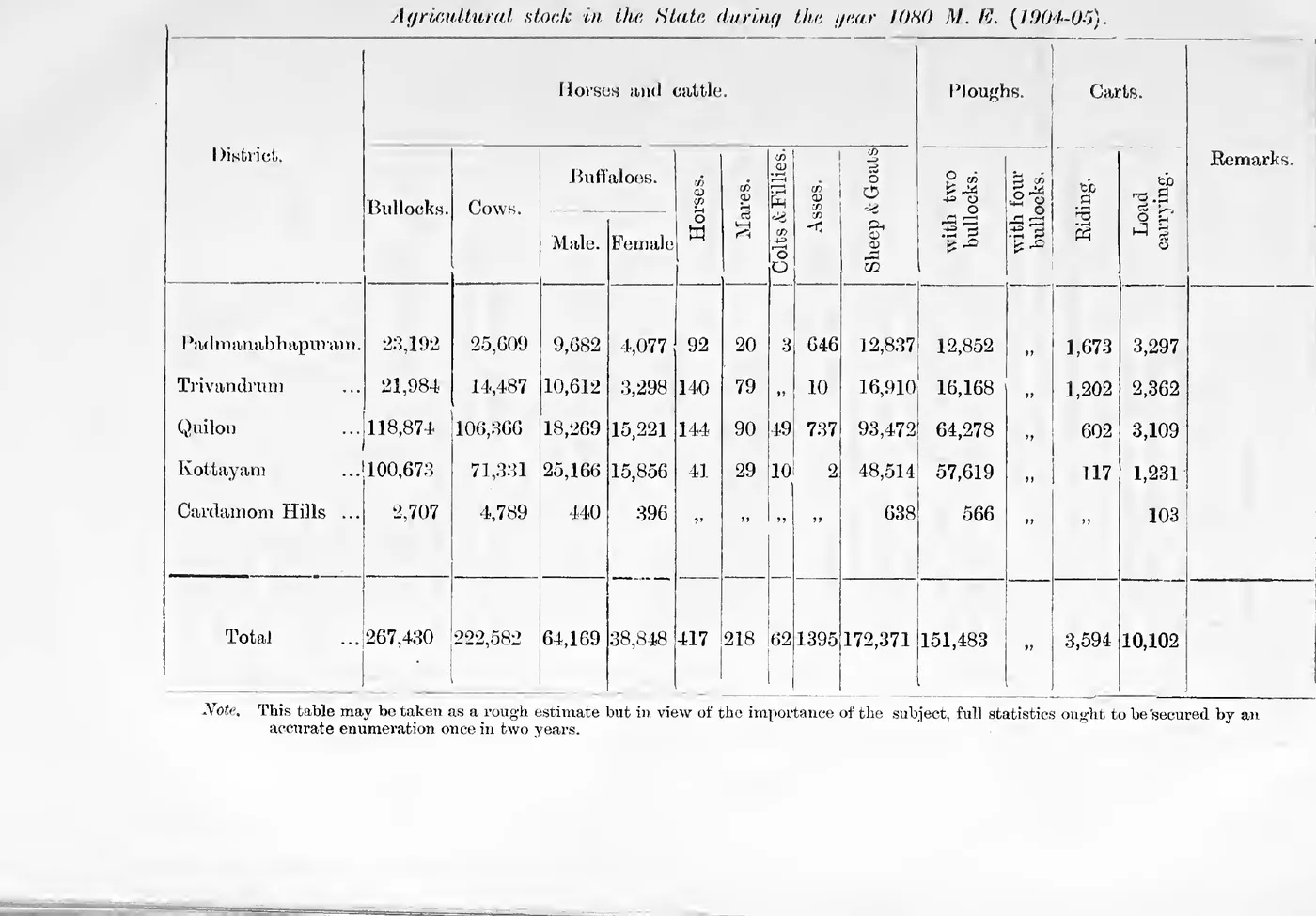
Note. This table may be taken as a rough estimate but in view of the importance of the subject, full statistics ought to be secured by an accurate enumeration once in two years.
[24]Crops. The following are the principal field and garden products of Travancore:—
A. Cereals or grains.
- (1) Rice or Paddy (Oryza sativa).
- (2) Great Millet or Cholam (Sorghum vulgare).
- (3) Raggee (Eleusine coracana).
- (4) Samai (Panicum miliare).
- (5) Italian Millet or Tenai (Seteria Italica).
- (6) Spiked millet, Cumboo (Penicillaria spicata).
- (7) Little Millet, Varagu (Panicum miliaceum) to a small extent.
B. Pulses.
- (1) Horse-gram (Dolichos biflorus).
- (2) Red-gram or Pigeon-pea (Cajanus Indicus).
- (3) Green-gram (Phaseolus Mungo).
- (4) Black-gram (Phaseolus radiatus).
- (5) Vadakkan Payar.
- (6) Kozhinji or Peram Payar, &c.
C. Condiments and spices.
- (1) Turmeric (Curcuma longa).
- (2) Pepper (Piper nigrum).
- (3) Betel (Piper betel).
- (4) Ginger (Zingiber officinale).
- (5) Cardamoms (Elettaria cardamomum).
- (6) Chillies (Capsicum annuum).
- (7) Tamarind (Tamarindus Indicus).
- (8) Onions (Allium cepa).
- (9) Garlic (Allium sativa).
- (10) Coriander (Coriandrum sativum).
- (11) Cummin seed (Cuminum Cyminum).
- (12) Mustard (Brassica juncea).
- (13) Fenugreek (Trigonella Fœnum-græcum).
D. Garden products.
- (1) Cocoanut (Cocos nucifera).
- (2) Arecanut (Areca catechu).
- (3) Plantain (Musa sapientum).
- (4) Mango (Mangifera Indica).
- (5) Jack (Artocarpus integrifolia).
- (6) Bread fruit (Artocarpus elongata).
[25]
- (7) Lime (Citrus medica).
- (8) Pomegranate (Punica granatum).
- (9) Cashew-nut (Anacardium occidentale).
E. Edible roots.
- (1) Chena, Elephant yam (Typhonium trilobatum).
- (2) Chempu, Egyptian Aram (Colocasia antiquorum).
- (3) Kachil, white (Dioscorea aculeata); red (Dioscorea rubellum).
- (4) Tapioca (Manihot utilissima).
- (5) Sweet potatoes (Ipomœa batatas).
- (6) Arrowroot (Curcuma angustifolia).
- (7) Seeva kizhangu (Not identified).
- (8) Chiru kizhangu. Do.
- (9) Potato (Solanum tuberosum).
F. Vegetables.
- (1) Brinjal (Solanum melongenum).
- (2) Cluster beans (Psyomopsis Psora Leoides).
- (3) Cucumber (Cucumis sativus).
- (4) Lady's finger (Hibiscus esculentus).
- (5) Snake-gourd (Trichosanthes dioica).
- (6) Bitter-gourd (Momordica Charantia).
- (7) Pumpkin (Cucurbita maxima).
G. Oil crops.
- (1) Gingelly (Sesamum Indicum).
- (2) Castor oil seed (Ricinus communis).
- (3) Laurel (Calophyllum inophyllum).
H. Drugs and narcotics.
- (1) Tobacco (Nicotiana tabacum).
- (2) Indian Hemp or ganja (Cannabis sativa).
I. Other crops.
- (1) Palmyra Palm (Borassus flabelliformis).
- (2) Sugarcane (Saccharum officinarum).
- (3) Cotton (Gossypium Indicum).
J. Hill produce.
- (1) Tea.
- (2) Coffee.
- (3) Cinchona.
- (4) Rubber.
[26]An attempt is made in the following pages to give a brief description of the cultivation of the most important of these crops.
Cereals or grains. Paddy or Rice. Of work connected with land, the most important and the one in which the bulk of the agriculturists of every part of Southern India are engaged, is the growing of paddy or the rice plant with the operations connected with it. I observed in my Report on the Census of 1891 thus:—
"The paddy cultivation of Travancore is much the same as in other parts of India, though the conditions of rainfall and manure are different except in the Nanjinad, where the rice cultivation is very ancient and well regulated and may therefore be said to have reached a most perfect state. The paddy cultivation in the other parts of the country is of a very primeval kind and the crops are generally precarious. The rice fields depend upon the falling rains for water, and this being a most unsteady natural agent the result is oftentimes very unsatisfactory. The rain sometimes comes too soon or too late, sometimes too scanty or too heavy. The Southern taluqs on the contrary enjoy the benefit of an almost perfect system of irrigation, but manure is their great stumbling block and every day it is becoming more and more scarce. The jungle valleys, on the other hand, have no end of manure in them. This is a great advantage, but the labour is scanty and the ploughing is difficult, which process requires strong cattle, for which however and for the workers the climate is unfavourable. In the sandy taluqs of Karunagappalli, Kartigapalli, Vykkam and Sherttala, the rice cultivation is most easy, labour is plentiful and ploughing is nominal, but the natural soil is poor and manure cannot be had except at great cost and labour. The Kuttanad is a rich region composed of alluvial deposits brought down by the rivers of Central Travancore and is particularly favourable to the growth of the rice plant, but the draining of the fields, always submerged, is a laborious process and the protecting them by bund-works from the brine-water which the flow of the seatide brings in daily is a most difficult and anxious work with the cultivator. Paddy is also grown on the mountain slopes and the cherikkals, but this is a haphazard cultivation, the labour being scantily invested and the chances of getting or losing the crop being equal. The ryot mainly calculates upon the conserved energy of the soil which has lain fallow for a period of 12 years, and on the falling rains. The Travancore ryot does not believe in deep ploughing, but understands the value of manure which he adapts to the peculiarities of his lands. Jungle leaves green and dry, cow dung and ashes and sweepings collected in houses form the most valuable and the most generally used manure. Salt, lime or chunam shells and fish are also used to correct certain defects in rice lands. On the whole, I should say, that the country is not well suited to the cultivation of the paddy."
Nanjanad or the two southernmost taluqs being the only portion of Travancore which has a nearly perfect system of irrigation works, a few details of the cultivation prevalent there are given below.
Wet lands in Nanjanad are cultivated, some of them only once a year (single crop lands), and the others twice a year (double crop lands). In the case of the former, sowing is done in the month of Mithunam (June-July), the plants (nurslings) are plucked and transplanted in Karkadagam [27](July-August) and the harvest is reaped in Makaram (January-February). The lands lie fallow for the remaining months of the year. The seeds generally sown are Varasaramundan and Anakkomban. These take for maturing full six months from the date of transplanting. The average yield per acre or Kotta (both are the same according to the settlement calculation) is about 15 Kottas, which comes to nearly three-fourths of the average yield of Kanni (September-October) and Kumbham (February-March) crops taken together. In the case of double crop lands there are two crops taken in the year the first in the month of Kanni, and the second in Kumbham. These are known as Kanni-poo and Kumbha-poo respectively.
After the Kumbham crop is gathered the lands are left idle for about a month or more, fully exposed to the effects of the sun and winds. Late in the month of Minam (April) the field is ploughed for the first time, and the stubbles left in the previous reaping are gathered and burnt. The field is then ploughed thrice continuously and levelled with a rake. Big clods or lumps of earth, if any, are broken into small pieces, and the field smoothed and levelled with a rake once more. Manure consisting generally of cow-dung, ashes and alluvium is then spread, from ten to twenty bandy-loads per acre according to the means of the cultivator. In some parts sheep are penned on the fields, and the leaves and branches of any jungle shrub or weed obtained in dry waste lands or fallows are also used as manure. The seed should be sown on or before the tenth of Medam (April) or the Pattam Udayam, as it is called in the Vernacular, the ordinary quantity being about 100 lbs. for an acre. Of course if the seed is of a superior quality the above quantity may be lessened. Immediately after sowing, the field should again be ploughed and smoothened. Raking should be repeated on the third, fifth and seventh days after sowing. The seed begins to sprout on the fifth day, but will be perceptible only on the seventh. The field is then fully exposed to the scorching sun for about twenty-five days, when the S. W. monsoon sets in bringing large quantities of water to the fields. It has to be noted that this crop is solely dependent on the S. W. monsoon. It is a matter of great importance to the rice plant that its drying should not be disturbed by falling rains during the twenty-five or thirty days after its sprouting, as the yield will suffer materially if rain falls during this interval. Fifteen days after the water has been supplied, weeds begin to appear along with the rice plants, and these should be removed some fifty days after sowing. About the begininng of Chingam (August) the crop comes fully into ear, and within a month after that time it ripens and becomes fit for reaping. All this time the fields are kept constantly [28]under water, which is allowed to stand in them about two inches deep. Just before the harvest season, however, the fields are drained off the water in order to facilitate reaping. A full grown plant attains the height of three or four-and-a-half feet; if it has thriven well it will have three or four shoots from the stem. The average yield per acre of fair land is 20 Kotahs each Kotah being equal to 70 Madras measures. The quantity of rice is always reckoned at one half that of the paddy produced. The seed is also sown thickly in seed-beds, i. e., fields where it is intended to prepare the nursery; and a month after the appearance of the seedlings above the ground, the crop will be about a foot in height and fit for transplanting. In this way the arrival of the monsoons may be anticipated by a month as but little water is needed for seed-beds and they can be cultivated before the monsoon breaks.
This method of cultivation is called Podivitai, which is the one prevalent in Tinnevelly. This is the one most in vogue in Nanjanad and is profitable to the ryot. Another method of cultivation is by means of wet sowing or Neervitai. Water should stand in the field always in the case of this mode of sowing from the time the field is ploughed down to the harvest season. The major portion of the cultivation in Nanjanad is under river-fed tanks, that under rain-fed tanks being very limited. The seeds sown for the Kanni (September-October) crop are:—(1) Panamkuruvai, (2) Chamba, (3) Mottakuruvai, (4) Arupathamkuruvai and (5) Veeti Vedankan.
The first three take for harvest four months from date of sowing, the fourth seventy days, while the fifth takes five months. As soon as the Kanni crop is harvested and the straw stacked, the fields are got ready for the next crop, that of Kumbham (February-March). Ploughing, raking and other operations are all done in water which has to be supplied in large quantities. The land as before is first spread off into plots of varying size (generally 30 to 40 yds. in length and breadth) and marked by ridges or small bunds, called Varappus, about 2 ft. high and 1 ft. broad. This plot after having been freely saturated with water from an irrigation source is thoroughly ploughed up and manured. The manure is chiefly refuse leaves from farm yards and the small boughs of various shrubs and trees which are ploughed into the soil, the yerukkilai (Calotropis gigantea) being the favourite shrub for the purpose. The ground thus prepared is covered over with water which is allowed to stand for about two inches above the bed, and is again ploughed up into a deep muddy mixture. A piece of board tied on to the yoke of a pair of [29]bullocks or buffaloes is then drawn over the puddle to make the surface evenly smooth. This done, the ground is ready to receive seed or seedlings. It is more usual to sow the seeds thick in small nurseries or seed-beds (Nauttankal) and transplant the seedlings in the fields got ready. Before sowing, the grain is soaked in manure and water for several hours, and then being put into a basket or vessel is covered with straw. A little water is then sprinkled upon it, and it is occasionally exposed for about three days, when it begins to germinate. The seeds are then sown, and water is allowed to stand in the soil for a day, after which it is drawn off for four or five days until the shoots have made a good start. From this time onwards the plant requires constant supply of water for its growth, which is served every alternate day, a couple of inches of water being always allowed to stand in the land until the time of ripening. The transplantation takes place after the crop has been about four or six weeks in the nurseries, when the plant will be about ten inches or a foot in height, and the seedlings are plucked with the root, well washed, tied in small bundles and planted in the smooth miry field. The planting is generally done by parties of women, at a distance of six or nine inches from each other. A few days later weeds begin to appear in the field, and they are at once removed. Weeding has to be repeated two or three times, when the plants are also thinned out, if necessary, to avoid overcrowding. The ears begin to form about a month before the crop is mature; and a fortnight before the harvesting which is generally begun after the whole plant, leaves and ear assume a yellow colour, the fields are drained off the water and allowed to dry. The harvest is gathered early in the month of Kumbham (February—March) which gives the name to the crop. The nursery system of cultivation is highly remunerative and much preferable to the ordinary broadcast sowing system. According to a well-known Tamil proverb, "நடவுக்குத்தெளி நாலத்தொன்று," paddy sown yields but a fourth of that planted. After the rice stalks have been cut by means of a short sickle they are tied into bundles and carried to a dry spot natural or prepared known as the kalam or threshing floor, where they are spread and beaten smartly with long bamboo sticks or trodden by cattle until the seeds separate from them. The straw is then formed into bundles, and the grain winnowed in some high and airy spot by holding baskets filled with paddy up above the head and allowing the paddy to drop, when the breeze blows the dust and chaff away. The stalk forms the chief dry fodder for cattle throughout the year.
The seeds sown for the Kumbham crop and the time each kind takes [30]up for harvest are:—
- (1) Varasaramundan
- (2) Anakkomban
- (3) Varakumulaku } Sowing in seed-beds takes place in Karkadagam (July-Aug) the transplanting in Kanni (Sept-Oct) and the harvest reaped in Kumbham (Feb-March).
- (4) Vellari Kiravi—Fields planted in Kanni and the harvest reaped in Makaram (Jan-Feb).
- (5) Veeti Vedankan—time for maturing, four months.
- (6) Jiraka Chamba and
- (7) Kattadi } Full six months.
The average cost of cultivation per acre of land comes to Rs. 26; the average yield per acre or Kottah is 15 Kottahs, and the average price of one Kottah is about Rs. 5 during the harvest season. The method of cultivation followed in Idanad or the three taluqs of Kalkulam, Eraniel and Vilavankod resembles that of Nanjanad in most of its features. The practice of Vettivaipu, a kind of transplantation, is peculiar to the former.
The following are the different varieties of paddy grown in Travancore:—
North Travancore
- 1. Adikkirali
- 2. Karutta chara
- 3. Velutta chara
- 4. Chuvanna chara
- 5. Aryan
- 6. Karipazha
- 7. Chempambu
- 8. Karuka
- 9. Chennellu
- 10. Nendrappalli
- 11. Vagalithrava
- 12. Jnavara
- 13. Chettiviruppu
South Travancore
- 1. Chambam
- 2. Varikkaramban
- 3. Ponnauchutti Aryan
- 4. Kunippan
- 5. Kattadi
- 6. Kolakkuruvai
- 7. Arakkan kuruvai
- 8. Ithi Kandappan
- 9. Varasaramundan
- 10. Anakkomban
- 11. Tattaravellai
A kind of paddy known as Urainellu or Urai is peculiar to Travancore. It has very long tails and is much preferred for fasts and other religious purposes.
Of the several kinds of crops grown for food consumption, paddy is unquestionably the most important as forming the staple food of a very large proportion of the population. It is estimated that nearly 600,000 acres are devoted to the cultivation of paddy in Travancore.
[31]Rice is a valuable food abounding in starch with a mixture of albuminoids and salts, easily grown, easily cooked and easily digested. It is, however, deficient in nitrogenous constituent, and on this account it is not so nourishing as wheat or other cereal grains, and demands the addition of leguminous seeds like dholl, gram, &c., and of milk or butter-milk or meat and fish in the case of some. It is deficient in fat and therefore requires butter or ghee to be added; salt also is ill-provided, hence it needs the aid of condiments, curries, chutneys, &c. In Travancore and in the Southern Districts of Madras, paddy is partially boiled and then dried before it is husked. For actual eating, the rice is first carefully cleansed with water and then allowed to boil slowly till the grain becomes soft, when the superfluous water is strained away, and the rice allowed to cool; it should not be overboiled into a pulpy mass, but the grains should be soft and not adhere to each other. The poorer classes live solely upon conjee, while among the higher classes, it serves as one of the light meals of the day either for breakfast or for tiffin; in the latter case it is generally a luxurious repast, accompanied by rich curries, horse-gram and fried crisp cakes and vegetables.
It is well known that insects form a great impediment to the successful growth of several crops, and paddy forms no exception to it. Of the insects destructive to the cultivation of paddy, the most important is the rice sapper (Leptocorisa Acuta), locally known as the Eazhian. Mr. B. S. Narayanaswami Aiyar, B. A., Superintendent of the Agricultural Demonstration Farm, has published in the Travancore Government Gazette of the 22nd October 1901 some interesting information on the entomology of the rice sapper of which the following is a brief summary:—"The Eazhians which have been identified with the rice sapper (Leptocorisa Acuta) belonging to the family Corsidæ of the Order Hemiptera, occur all over India. They commit a lot of havoc on early grown paddy. They have characteristic half elitra and bad smell; long proboscis not coiled as in the butterfly, but kept bent under the thorax through which they suck the tender juice of the just growing paddy ear heads. Their habits are decidedly aquatic. They spend their pupal stage during the growth of the plant in the leaves, closing the outer margins. The leaves thus affected get thoroughly bleached (devoid of chlorophyll) after the emergence of the moth leaving the residue inside the folded leaves. The plants also get perfectly white. A kind of beetle known as Ciciadella Sex punctata, commonly found in Travancore, can be utilised for the destruction of these insects. In certain parts of India the cultivators are said to strew the fields with fresh buffalo dung covered with buffalo buttermilk in which this beetle [32]is said to breed, which attacks and destroys the rice sapper. The remedial measures adopted in Travancore are (1) by means of charms and incantations, and (2) by the use of strong scented flowers the smell of which is antagonistic to the insects. The first method is referred to in the Atharva Veda Samhita where the insect is required to be caught and buried in the field with certain invocations to God that it may not injure the crops of the owner of the field. Locally the practised experts write something on small palmyra leaves and have them infused with certain powers, and these small bits of charmed olas are stuck up to two or three conspicuous places in the fields. This is supposed to hypnotise the insect and make it unable to suck the juice of the ear heads. This method is known as the Eazhian Vilakkal. Coming to the second method, the most common flower used as an antidote against the rice pests is that of a coniferous plant known as Chanai (ചണ[?]), which is tremendously odoriferous. The big cone or flower-head is split up into several pieces each of which is inserted in small sticks and placed in several conspicuous portions of the fields according to the direction of the winds. The strong smell of the kerosine oil is also found to be a partial remedy, especially in earlier stages. A long string, as long as the field, should be dipped in kerosine oil and then pulled across the field touching over the top of the plants, by two men holding the ends of the string. The best prophylactic treatment, however, is by observing carefully the seasonal conditions under which the crop should be grown. It is believed that early sowing in Punja paddy lands leads to the development of the pests. As the Superintendent remarks, "there is a regular history and tradition about the time for the growth of particular kinds of crops during particular seasons, underlying a world of long experience and wisdom, the violation of which will lead to diseased conditions. The fashionable improved agriculturist may as well adopt from his less favoured agricultural brethren some of the ancestral agricultural practices with advantage and make it his own."
Other cereals. Of these Cholam, especially the white variety, is grown in the southern taluqs adjoining Tinnevelly. This is cultivated dry in black loam. The ground is prepared about Medam (April-May) after ploughing several times and penning sheep for three or four nights, and otherwise manuring, and sown about Edavam (May-June); no nursery is required. The crop is dependent on rain, but a light rainfall is enough and the crop becomes mature in four months. A full grown plant is eight to ten feet high. The crop is cut low; the ears are removed and the grain after thrashing is separated from the chaff by winnowing. The straw is a favourite and excellent food for cattle. Under suitable irrigation, ploughing [33]and manuring, several crops can be secured in a year from the roots of the same plant. This requires comparatively little care. Hence the Tamil proverb 'சோம்பேறிக்குச்சோளம் வெள்ளாண்மை' which means,
'Cholam is the crop for the lazy man.'
Raggee, Samai and occasionally Tenai are grown in Punja (dry) lands and also in compounds in open places between trees. Cumboo or Kambam Pillu is very sparsely grown in the southern taluqs and Varagu is rare. Wheat is grown to a small extent only on the Cardamom Hills. Maize is not common, but is slightly found in parts adjoining Tinnevelly.
Pulses. Of these green-gram (ചെറുപയർ), black-gram (ഉഴുന്നു) and horse-gram (മുതിര) are alone described here, as they are the only largely cultivated grains in Travancore.
The black-gram and the green-gram grow luxuriantly in soils containing lime. Such soils are found in the outlying Taluqs of Shencottah, Tovala and Agastisvaram. Horse-gram is cultivated only in small quantities in open spaces on the hill tops and also in the interspaces between trees in compounds. Only the poorer soils are fit for it, and it hardly meets the local demand.
The mode of cultivation is the same for all three kinds of gram. The ground is first cleaned and made even and then divided into small plots. The soil is then ploughed and ashes thrown on it as manure if it is intended to grow black-gram or green-gram, and cow-dung in the case of horse-gram. The latter needs a good amount of cow-dung manure, no other manure being used. The seed is then sown, about five or six Idangalis for an acre of land, and the ground is ploughed again. Care should be taken in the selection of seeds which must keep their proper colour and whose sprouting portion must stand prominent, and should not be damaged. Grains smaller in size than the average ones are considered bad seeds. The cultivation of these pulses does not require much water. A kind of weed appears in the soil and hinders the growth of the plants, which must be carefully removed.
Only one crop of horse-gram is raised in Travancore. The sowing season falls in Kanni (September-October), and the harvest is reaped in Makaram (January-February). Of the black-gram and green-gram, two crops are raised, i. e., during the two monsoon periods. The S. W. monsoon cultivation takes a longer time for harvest than the other. In the one case sowing is done in Minam (March-April), and the crop gathered in Mithunam (June-July), while in the other sowing [34]is done early in Tulam (October-November) and the crop reaped about the close of Dhanu (December-January). Black-gram and green-gram generally grow to a height of one-and-a-half to two feet, while the horse-gram plant does not rise very high from the ground and grows at the most to a height of half a foot. The plants are plucked root and branch when the pods have all become ripe and are then dried and beaten, and the seeds threshed out and separated.
The cost of cultivation is very much the same for all classes of grams. At a rough calculation it will come to about Rs. 16 per acre. The out-turn varies from eight to thirty fold in the case of horse-gram.
There are two varieties of black-gram, viz., Erumu Oolunnu and Cheru Oolunnu. Of these the former takes up more time to grow. It is sown about the middle of Edavam (May-June) and can be cultivated only once a year.
Of the other grams the following are the chief:—
- 1) Perumpayar or Kozhinji.
- 2) Karinjanta.
- 3) Ilincha Kanni.
- 4) Pulamuntan.
- 5) Vadakkan payar.
- 6) Sixteen seeded payar, (grown more as a vegetable than as a crop.)
- 7) Chendantan.
- 8) Nadupayar (a creeping plant).
Kozhinji, Vadakkan Payar, sixteen-seeded-payar and Chendantan are peculiar to Travancore. Of horse-gram there are only the usual varieties, brown and black; the former is preferred to the latter.
Red-gram is also cultivated to some extent in Travancore. The local plant known as Malan Tuvarai produces big seeds which do not practically boil. It has a tendency to become a perennial shrub instead of an annual as on the other coast. Bengal-gram is not cultivated here at all.
Rats, birds, squirrels and fowls do damage to all kinds of pulses. The worms known as Munja, Oiyavu and Nedumpuzhu injure only the black-gram and green-gram, and this can be prevented by sprinkling ashes over the crops.
Condiments and spices. Most of these are imported into Travancore from outside. A brief account of the following special products alone is attempted here.
[35]Turmeric or Manjal. This is an underground tuber and can be cultivated during most parts of the year. The soil fitted for its cultivation is black loam or red soil, rich in decayed vegetable matter. The ground is prepared about April; it is ploughed four or five times, then hand-hoed and furrows opened in it. The cuttings or small portions of the fresh root are then planted on the beds thus prepared, about one-and-a-half to two feet apart. Water is allowed once in ten days, and the weeds are cleared and manure applied. When the plants mature, the stems and leaves become yellow and decay, the tuber alone remaining under ground. Ten months after sowing, i. e., about the end of January, the roots are dug out with small picks. The fresh root has a rather unpleasant smell, which goes off when it is dried. The dried roots or tubers are oblong shaped, tough and yellowish-grey externally, while internally they are of a deep yellow colour with an aromatic smell and a bitterish pungent taste. The yield is estimated at 2,000 lbs. or nearly 30 Tulams* of fresh root per acre. The cost of cultivation of an acre is estimated at a little more than Rs. 20.
The root is a common ingredient in curries. It is specially useful as a medicine, being considered a cordial and stomachic and prescribed by native doctors in diarrhœa. The root is also applied to fresh wounds, bruises and for cutaneous diseases. It is also useful in the preparation of dyes. Dry turmeric is manufactured just in the same way as dried ginger, only the outer skin is not removed as in the case of ginger before it is put in boiling water. Hindu women who are not widowed grind turmeric and rub it over their faces. It is a necessary ingredient in all marriage ceremonies and religious festivals.
Ginger (Mal. Injee). The northern Taluqs of Ettumanur, Minachil, Todupuzha, Muvattupuzha and Tiruvalla are specially noted for the cultivation of ginger. It is also cultivated in the southern Taluqs of Vilavankod and Kalkulam.
Ginger does not thrive in hot climates, nor in gravelly or swampy soils. The only suitable kind of soil is that which, being red earth, is yet free from gravel, and good and heavy. Rain is essentially requisite for the cultivation of ginger, but superfluity has to be very carefully avoided. The ground must first be turned or ploughed to a depth of one foot during the latter part of Dhanu (December) or the beginning of Makaram (January). In the beginning of Medam (April-May) the ground has to be slightly turned once more and harrowed. The cultivation generally begins about [36]the middle of May at the commencement of the S. W. monsoon after the ground has undergone a thorough process of ploughing and harrowing. Small beds 10 or 12 feet long and 3 or 4 feet broad are formed, and in them small holes or pits are made with the hand at one span apart, which are filled with powdered cow-dung. Ginger bits one and a half to two inches long are then thrown buried in the holes and covered with manure and a thin layer of earth. The whole of the beds are covered with a good thick layer of green leaves, which, while they serve as manure also keep the beds from unnecessary dampness which might otherwise be occasioned by the heavy fall of the monsoon rains.
* A Tulam is nearly equal to 13 pounds.
In the selection of seed care is taken to select such as contain a good number of nodes close to each other. The seeds are first preserved in a basket with husk in a smoky atmosphere, or in cases where large quantities are needed, they are spread on the ground touching one another, but not exposed to the sun. After three weeks they are collected and spread over a raised flat roof erected for the purpose five or six feet above the ground. This raised surface has to be protected from the sun. Dried leaves, rubbish, &c., are thrown under the roof and set fire to for smoking the seeds spread above. Shoots begin to appear in a fortnight at the different nodes, so that when they are taken for planting they should be cut into as many bits as there are shoots in the nodes, and these are planted then in the pits which have been got ready and well manured, not exceeding two bits in each.
When the young plant puts forth leaves it should be manured with wet cow-dung. After the cow-dung has become dried, the earth should be removed from the foot of the plant and fresh leaves and cow-dung powder put instead. After this, small bunds are formed round the foot of the plant, and water mixed with cow-dung poured in the pits; this should be repeated six or seven times or as often as the pits become dry. Care should also be taken to drain off superfluous water and avoid inundation which may sometimes be caused by heavy rains. The plant matures in eight to ten months. The height of a full grown plant is one-and-a-half feet. The leaves and stems then dry and wither away, when the tubers are dug out. This is generally about the close of Makaram (February). The tubers after gathering are washed and brought to market green or dried, a small quantity being preserved for next year and for medicinal purposes. For every ten Tulams of root sown in an acre the average yield is from 150 to 200 Tulams.
Ginger is mainly used for cooking and for medicinal purposes. The dried ginger, one of the important exports of Travancore, is prepared as [37]follows:—The different roots attached to the main root are first separated from one another and the outside cover or skin removed from each. They are then put into a big vessel containing boiling water, from which they are soon removed, mixed with ashes and spread on mats to dry. When it is well dried we get what is known as Sukku or dry ginger. There is a Tamil proverb:—சுக்கு அறியாத கஷாயம் உண்டா—"Is there any decoction without dried ginger?" Essence of ginger is made by steeping ginger in alcohol, and the rhizomes procured fresh and young and preserved in sugar constitute the preserved ginger of the shops.
The following table shows the total expense incurred for cultivating one acre of ginger and the net income derivable therefrom:—
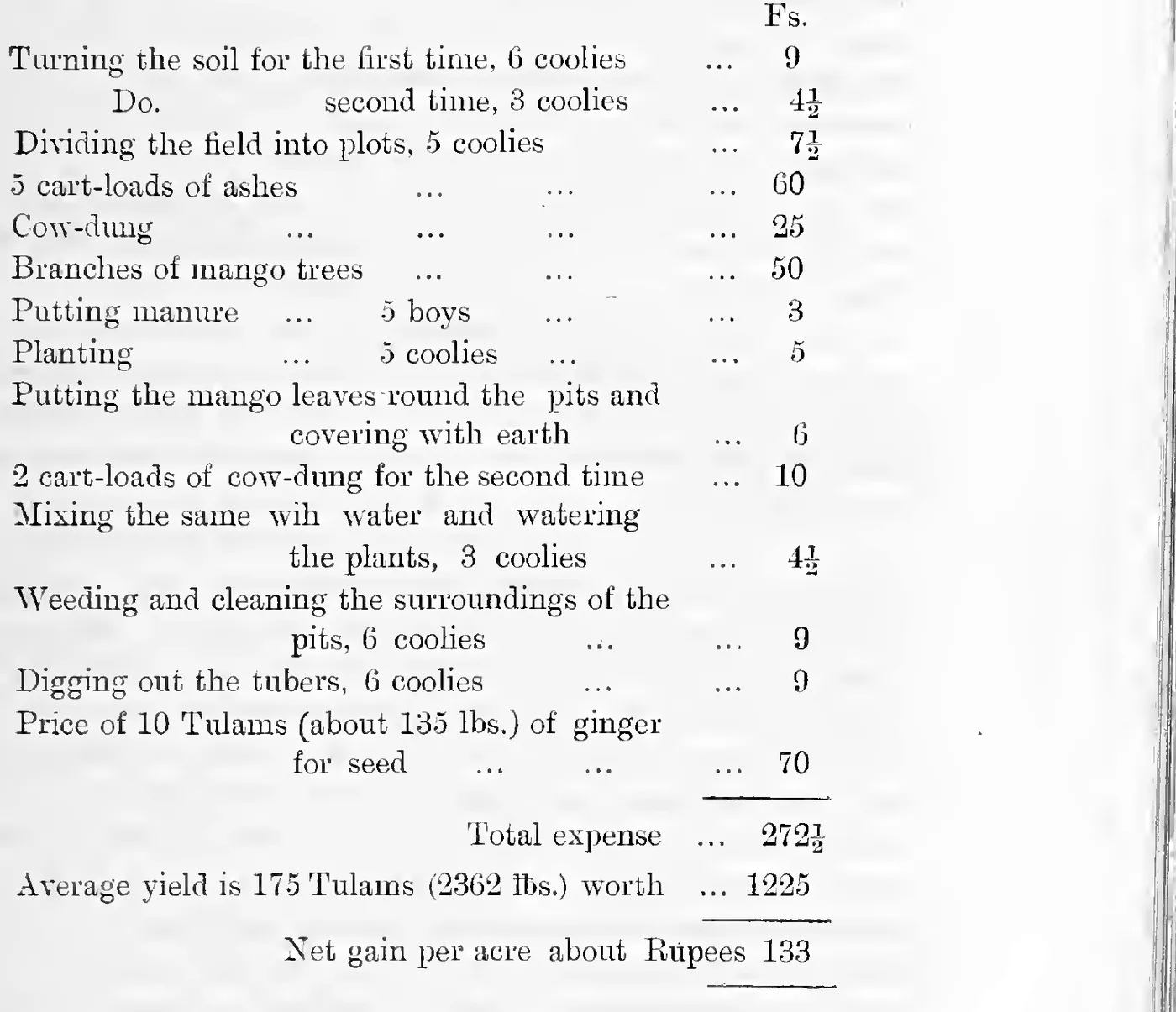
Pepper. Pepper (Skt. Pippali) is the general term for the dried pungent fruits of a number of perennial creeping plants of the Torrid Zone having certain common characteristics. Of the several kinds of pepper that are exported to Europe from India and the East Indies, that [38]which has so largely contributed to the wealth of Malabar and Travancore and with which we are at present concerned is the well known black pepper of the black pepper vine (Piper nigrum) indigenous to the forests of Malabar and Travancore. For centuries pepper has been an article of export to European countries from the Malabar Coast. History shows that the pepper of the Malabar Coast has had a great deal to do with the kindling of an enterprising spirit in Europe in the middle ages. Even in the days of the Roman Empire, pepper which became a luxury among the Romans largely contributed to the constant anxiety in Rome against the drainage of money into Eastern markets. The high price consequent on the growing demand for pepper continued in Europe till the whole continent was revolutionised by the discovery of a sea-route to India by Vasco da Gama who was stirred up by greed to get pepper cheap from Malabar, which is evident from the fact that his first cargo when returning to his native country was pepper. The Portuguese, the Dutch and lastly the English all sought the Malabar Coast with a view to have the sole monopoly of the pepper trade. The earliest relations between the English and the Travancore State were established by means of a pepper contract.
The Malabar Coast pepper has still maintained its high reputation for quality, though other countries like Sumatra and Penang produce greater quantity. The vine is also cultivated largely in South India, Siam, Malaya, Cochin China and other tropical parts of the East with a moist hot climate.
The Travancore or Alleppey pepper as known to Europe, is the highly wrinkled dry black fruit of the black pepper vine that is largely cultivated in the Northern and Central Divisions of Travancore from Parur in the north to Kalkulam in the south, the Karappuram and the sandy taluqs excepted because of their better paying cocoanut trees on their loose soil. The pepper exported from Malabar is of two varieties, the black and the white, the latter being made from the full-ripe berries of the same vine by the pulp being removed and the stones thus obtained bleached by a mechanical process. But Travancore does not export white pepper. The Travancore pepper consists of two general divisions, the Karuvilanchi pepper and the ordinary one. The Karuvilanchi pepper is superior in quality to the other and is sold at double the price of the latter. It is gathered in the month of Tulam (Oct.-Nov.) and the other in the month of Dhanu (Dec.-Jan.). The Karuvilanchi owes its superiority to the rain that it gets when it flowers, in the month of June and July, known in Travancore as the Tiruvatira jnattu rain.
[39]The cultivation of pepper is extremely simple. It generally thrives in tropical parts having a hot moist climate. A rainfall of hundred inches or more is necessary to produce a healthy crop. As for example, while the pepper vines of the Shencottah Taluq which is too far in the east to receive the heavy showers of the S. W. monsoon indispensable to the pepper plant, fails to produce any expected quantity whatever, the wooded regions of Minachil, Kottayam, Changanachery, Ettumanur, Muvattupuzha, Todupuzha, &c., which get the full benefit of this monsoon enrich the whole State with their luxuriant produce. The Edavappati or the Tiruvatirai-jnattu rain is so essential and helpful to the productivity of this plant that an old saying has become current in Travancore, viz., that every drop of this rain that falls on the pepper plant becomes a fruit, and that the Swati Tirunal Maharajah (1829-1847 A. D.) is said to have once humorously expressed that the Pandy people, may smuggle away the pepper vine beyond the Ghats, but could not take away the Tiruvatirai-jnattu rain that produces it.
There are three methods of cultivation that can be adopted:—
- 1. by planting the seeds in the ground,
- 2. by planting the cuttings from a matured vine, and
- 3. by propagation by the method of layering.
The layering process is the best and produces the best and the largest quantity of fruits. The plant if left free would propagate itself by running from tree to tree along the ground as is the case in the forests. The layering method is the same as this natural process of propagation.
The trees generally used for the support of the vine are the mango, jack, areca-palm, &c., which have a rough bark. The soil should be rich, and the ground though hilly must be wooded for the cultivation of this plant. Too much moisture is dangerous to the young plant as it may cause the root of the plant to rot in its contact. The vines grow to a height of twenty to thirty feet, but for the sake of convenience they are not allowed to grow more than twenty feet.
The Travancore cultivator adopts the two plans of sowing the seed and of planting the cuttings. The layering method may be roughly said to exist in so far as he insists upon taking the fresh grown vines from the root of the plant for new plantation, the difference being that he removes the vine with its root and plants it in a different place, whereas in the layering method there is no such wholesale shifting.
The manure that the Travancore cultivator uses for this plant is almost the same as that used for the cultivation of the betel vine; only [40]that in the case of pepper he prefers the pepper leaves themselves to any other manure that he knows of. He sometimes uses cow-dung, ashes of twigs, &c., but the leaf-mould manure is the most general. A small shallow ditch is dug round the root of the tree, in which the vines stand, and the leaf manure is put into it and slightly covered by earth. The ditch is allowed to stand with its leaf-manure during the rainy season, in which the water collecting round the tree rots the leaves already buried and those that fall from the vines, turning them into the required manure for the plant.
He plants at first two or three vines, which when young grow rapidly and put forth several subordinate branches besides the main ones. The vines climb the tree supporting themselves by striking roots on the bark of it, requiring man's assistance only in their first growth. "The main and subordinate vines grow up the tree to a height of 5 feet or more per annum. Luxuriant growth and free branching are encouraged by free application of good manure given annually for three years (the period required for one bearing fruit). Subsequently the pepper participates in the general cultivation given to the betel palm (in the Kanara District an application of manure is given for both crops every second year). The manure is heaped over the bared roots of the betel trees and pepper plants in a circle round the stems, and if plentiful, a big basketful is given to each betel palm, less being given if manure is scant. ... ... ... The best manure for pepper, betel-nut and all other crops of the garden is made from green leaves and twigs plucked or pruned in the monsoon and used as litter in the byres where buffaloes and other cattle stand, and thence removed to a deep manure pit every day or second day with the dung or urine of the cattle. This manure is sufficiently decayed by the following March and is applied in that month or in April."
The foliage in healthy plants is extremely dense and looks as though they have trebled the size of the tree. In long established plants where some of the older vines die away the density of the plant is kept up either by fresh planting or as is generally the case by the natural annual growth of several vines from the root of the tree—the new plants being brought into existence from the ripe berries falling from the plant into the ditch and sprouting forth without the aid of the planter. A plantation is in bearing three or four years after it is started, and if the old vines are replaced by the new layers as they get worn out, the plantation would keep in vigorous growth and bearing for a long period. The plant grown from cuttings bears fruit for seven years and that grown from seeds for fifteen years.
[41]As has been already observed pepper berries are plucked in two seasons; in the month of Tulam (Oct.-Nov.) from some vines and in Dhanu (Dec.-Jan.) from others. The time for plucking is determined by examining the berries, a few of which begin to change from green to red here and there near the root if the time has come. The dexterous cultivator in climbing carefully avoids disturbing the tender plant, which would otherwise be destroyed, using only a single bamboo pole which he adjusts in a slanting position between the ground and the tree. The cut off branches of the pole serve as steps in the ascending. He carries a long circular basket to put the plucked spikes in, which he keeps suspended from his sides by means of a string fastened round his waist. The vines in one palm when in full bearing yield in a good season about 1,000 clusters on an average which will yield about 7 seers of dried pepper, (1 seer = 80 tolas). An acre is known to bear 2,500 vines in Malabar.
The berries are then dried in the sun on mats till they change from a fleshy green appearance into wrinkled black grains known as black pepper (Kurumulaku or Nallamulaku). The black pepper thus made contains stoneless grains and other sweepings which must be removed before it becomes fit for commerce. In Kanara and other parts of the Malabar Coast the berries are allowed to become red ripe before plucking for the preparation of white pepper.
Pepper is one of the most useful medicines of the Hindu Pharmacopœia (the Ashtangahridaya and the Ayur-Veda). It forms the chief remedy for several diseases according to the Dravidian Medical Science (Chintamani). The English Pharmacopœia also has classed pepper among its remedies. In Europe it has been used for several centuries as a condiment, and even now this is the chief purpose for which it is imported.
The value of pepper exported from Travancore in 1079 M. E. (1903-04) amounted to Rs. 2,162,353 and formed one-tenth of the entire export of the country.
Betel Vine (Sans. Nagavalli; Mal. Vettila). This is cultivated throughout the State, especially in Pallipuram (Trivandrum), Venmani (Mavelikara) and Shertallay (Karappuram) where a superior variety is grown.
The betel vine is planted in rows, and requires a moist situation and a rich soil. Black sandy soil is the best suited for the cultivation of the vine. On red sandy soil and on soils with clay and red sand also it is said to flourish in some parts. It will not grow in elevated places. Cuttings [42]about three feet in length from vines two or three years old are made ready for plantation, the ground at the foot of the tree on which the vines are intended to be grown having been dug up to a depth of about a foot and a half or more according to the nature of the soil, and waste roots and rubbish removed therefrom. In this connection it should be stated that the betel vine in Travancore and Malabar is not cultivated in separate gardens as is the case in most other parts of India, and there is not the necessity to rear small trees like the Agatti (Sesbania grandiflora) for the creepers to climb up. The ground is levelled and low beds are made, and then the vines are planted, due care being taken so that the cuttings may be in the same position in which they were when attached to the branch. Two beds may be taken in 10 feet of land, each bed containing three strings with vines. The planting generally takes place in the months of September, October, April and May. The vines are daily watered and manured for one week, the manure used being the leaves of certain trees and plants, mosses, ashes of the mango leaves, &c.
Fresh shoots appear after a period of nearly three months. Poles are then fixed to the ground, and these shoots (three or sometimes four) are tied to them until they attain a height of five or six feet. The manure at the foot is then removed and the vines carefully separated from and lowered down and twisted at the foot of the pole, care being taken in this and subsequent lowerings that the original position of the vines is not reversed or disturbed in any other way. The ends or heads are again tied to the poles. They are watered and manured as usual. This process of lowering down the vines and twisting them round the feet of the poles is done two or three times in a year. When fresh shoots appear after these processes, the ends of three or four vines are attached to a string which is tied to the top or to a branch of the tree. One year after planting, the leaves may be plucked for use. They are generally plucked once in three days. The vines yield the maximum number of leaves during the rains in September, October, November, June and July.
There are three varieties of the vine, viz., the ordinary, the Tulasi Kodi and the Kanni Kodi. The first two yield after a year, while the third after six months. The leaves of the Tulasi Kodi are darker in colour and are so called on account of the Tulasi-like smell; the leaves of the Kanni Kodi are white and thick. Kanni and Tulasi varieties may be grown on trees, while the ordinary one is grown only on strings and consequently requires more labour. The Kanni yields the largest number of leaves, and as it yields also earliest, it is the most profitable. But there is this [43]disadvantage, viz., that the creeper dies after eight years, while the other varieties last much longer. The cultivation of the betel vine forms a chief occupation in Shertallay for Chovas and Christians and rarely to others. But such is not the case in the other Taluqs. The cultivation is a very profitable one though it involves a good deal of trouble.
The diseases that affect the vine are various; the chief enemy, however, is a kind of worm which eats away the roots and makes perforations in the leaves. Proper watering and manuring prevent the growth of these worms sticking to the leaves on the back. Sometimes, but very rarely, is to be found a deadly poisonous insect known as the betel serpent. This, if not carefully removed from the betel before rubbing the chunam on it, will kill the chewer. The best antidote for the poison is the juice of the Guava leaf.
The leaves are used in large quantities for chewing with arecanuts and chunam, and are stimulant aids to digestion. As stated already, the vine bears more leaves in the rainy season, but then they are thick and not tasteful. The best betel leaves are those plucked in the hot season; they are soft and tender. The leaves of the Pallippuram variety are bigger and more beautiful than those of Karappuram though decidedly inferior in quality. The fresh juice of the leaves is a valuable stomachic and is also prescribed along with musk in hysteria. The leaves are presented along with arecanuts to guests and visitors, on marriage and other festal occasions; bundles of betel leaves and arecanuts are distributed to the guests, often a considerable item of marriage expense. The leaves are always given with the Dakshina or money present in all religious Danams or gifts. The stem of the leaf (Njettu) is used in certain homams (burnt offerings) in connection with Mantravadams. Even in State ceremonials pan supari is distributed to the guests, European or Native, as a symbol of happiness and prosperity.
Cardamoms. A special paper on this valuable spice is inserted at the end of the chapter.
Chillies. This annual of a dark green colour is cultivated in gardens with brinjals along the borders of beds of other garden crops or by the sides of channels. There are numerous varieties, but only one sort is ordinarily grown, and that is the large dried red chilly of commerce. The ground is prepared about July and December or January when seeds a year old are sown in nurseries and the seedlings transplanted. When under growth weeds are cleared and water allowed every four or five days. It is [44]fully grown in about three months from date of planting, when it is two feet high and yields red chillies and continues to do so for three months. The chillies are gathered by the hand and then dried in the sun and stored. Dried chillies are sold in the market by weight at about Rs. 3 per tulam. Chillies are a principal ingredient in all curries and condiments, promoting digestion. The Tamil proverb says:—
"ஆனைக்குத்துறடும் அன்னத்துக்கு மிளகாயும் வேண்டும்."
i. e. "An elephant requires a goad and boiled rice a chilly."
Tamarind. This very useful tree grows wild and is also cultivated in red soil. Pits are dug, where the seeds are inserted by the hand; no nurseries are required. The plant is watered when young. It bears fruit in twelve years, and the fruits are gathered by persons climbing the tree and shaking the branches or beating with sticks. The fruits are then exposed to the sun for four days and then beaten with sticks, which separates the shell or outer covering. The pulp is a very indispensable item in curries, and the seeds are roasted or salted and eaten by the poor and are given largely for cattle. There is a considerable export trade of tamarind from Travancore; more than two lakhs of rupees' worth of it was exported in 1079 M. E. (1903-04). A sack of tamarind with the skins or pods weighing about 60 to 68 lbs. costs from 8 to 12 as. The prepared pulp alone is sold in the market at 12 to 14 as. per tulam. When there is plenty of tamarind crop any year, it is believed that there is a corresponding fall in the yield of mangoes and vice versa. There is a Tamil proverb illustrating this:—
"பொங்கும் காலம் புளிபூக்கும் மங்குங்காலம் மா காய்க்கும்."
i. e. "In propitious seasons the tamarind flowers, in times of scarcity the mango fruits."
Garden products. Cocoanut or Tengu. Of the garden products, cocoanut comes foremost and its cultivation forms an essential feature of the garden cultivation of Travancore. This intertropical tree is in Travancore extensively grown in sandy tracts along the coast, on the banks of rivers, lakes, tanks, and canals and in low lying valleys, in fact almost everywhere. It is the most favoured tree of Parasurama's land. With a little care it will grow on the hill tops, in deep ravines, in the precipitous slopes and in the interstices between rocks. It is ubiquitous, and the coast derives its name Keralam from the cocoanut palm. It may be safely said that there is not a single true Nayar ryot in Travancore who does not own at least one cocoanut tree to his name. It bears all the year round and its uses are infinite.
[45]All the Taluqs contain the cultivation of cocoanut to a greater or less extent. The Taluq of Shertallay is specially noted for its extensive cocoanut topes which form the chief wealth of the population. They are also thickly cultivated in Vaikam, Kartikapalli, Karunagapalli, Mavelikara, Tiruvalla, Chirayinkil, Trivandrum and Neyyattinkara. The thinly cultivated Taluqs are Todupuzha, Kunnatnad, Alangad, Kunnattur, &c. In other words it grows most luxuriantly in the coast-lying taluqs.
The most essential requisites for the proper cultivation of cocoanuts are a tropical sun, a saline atmosphere, a porous soil and abundance of fresh water. The cocoanut palm is thus in a great measure a littoral plant attaining earliest maturity, greatest size and greatest fruitfulness close to the sea, where if the soil be loose and friable, even though of the most meagre description, such as sand and shells, it grows luxuriantly without the aid of special cultivation, manure or the proximity of inhabited houses. In other places it grows well only on rich soils or in the proximity of dwellings. The following are considered suited for cocoanut cultivation, viz., soils mixed with sand either dark coloured or river-washed; sand mixed with clay, ferruginous earth or black mould clayey soils with sandy under-strata; sand and clay even when mixed with gravel and pebbles; sea shore and banks of backwaters, rivers, tanks and paddy fields; alluvium of rivers and backwaters; all level lands exposed to the sea-breeze when the soil is good as the valleys between hills, tanks and ditches which have been filled up; and lastly even the floors of ruined houses well worked up, and any place much frequented by cattle and human beings on account of the ashes and salts of ammonia from the urine, &c., deposited day by day in the soil.
Dried cocoanuts from middle aged trees (those from very young and very old trees should be avoided) are carefully collected and used as seed. Sometimes as soon as dried nuts are gathered, they are tied up in pairs and thrown over the roofs of houses and branches of trees, and left there exposed to the heat and moisture for about a month till they sprout. Before planting, the ground is prepared by turning the soil two feet deep and removing the roots of the underwood and other noxious rubbish left. Seed-beds are prepared two feet deep and the nuts planted one foot apart. The nuts are laid on their sides, two inches of their surface being left exposed. Ashes alone or ashes and salt, are freely placed in the trenches both for producing healthy seedlings and for preventing them from being attacked by insects. In Kari (black loam) lands, ashes, salt, sand and rice husks are added, but on the coast no salt need be mixed, ashes alone being sufficient. The beds are then watered once a day except in the rainy seasons till they take root, after which they are manured every month till they are [46]transplanted, which is done six or twelve months after the sowing. Seedlings six months old take earlier root and thrive in any soil; those nine months, or even three years old are sometimes transplanted. In Shertallay seedlings one year old and above up to six years are generally transplanted, but the latter only from the soils which are wanting in manure. Cocoanut palms even forty or fifty years old are transplanted often to secure additional convenience or safety to occupied houses and sometimes to give them a better soil. Some of the fibrous roots should be cut away, and manure together with a little salt placed in the pits into which it is intended to plant them. This is very often done in the northern taluqs of Travancore.
Three months previous to transplanting, pits fifteen to twenty feet apart are dug up. The Singhalese have a saying that "cocoanut trees only flourish when you can walk and talk among them." This evidently means that the trees must not be planted too close together, nor should any undershrubs be allowed to grow about their roots. Ordinarily the dimensions of the pits are 5 × 5 × 4 feet: in slightly elevated areas they are 6 × 6 × 6 feet and in Kari lands and coast tracts 2½ × 2½ × 2 feet. Ashes, dust of cocoanut husk and other manure are put into these pits and left to rot. In places where sand is not found in sufficient quantity it is advisable to mix sand, salt and ashes with the earth. On the coast and marshy land ashes alone would suffice. In Vaikam and other places arrow root and turmeric are grown near the foot of the cocoanut plants to prevent them from being destroyed by white-ants. In moist tracts the trees may be planted on the very day the pits are dug up. After transplantation the plants are watered daily till fresh sprouts appear, and the roots get firmly attached to the earth. During the first year they are manured once or twice every month. From the second onwards the watering and manuring are done only at stated intervals. In Chingam (August-September) the soil is turned throughout and heaps of sand raised all over the garden: in Tulam (October-November) after the monsoon is over, the Koompals or heaps are levelled, and in Dhanu (December-January) before the watering commences the ground is slightly deepened at the foot of the plants and manure put in. The watering is then done on alternate days and ends in Medam (April-May). In Edavam (May-June) the roots are dug up and the ground cleared of undergrowth and beds made to hold water and manure, which is left to lie over there till Chingam (August-September) exposed to the monsoons.
By the fourth year the stem begins to appear and has about twelve leaves; it is distinctly visible by the fifth year when the tree has about [47]twenty-four leaves. The spathes begin to be formed by the sixth year, when the stem is three to six feet above the ground, and in three or four more years the tree is in full bearing. Ten years form thus the maximum period required for a cocoanut tree to bear; six is the minimum, and in exceptionally favourable conditions the tree is known to bear in four years from date of planting. A full grown tree attains a height of thirty to one hundred feet with a diameter of about one-and-a-half feet at the bottom and one foot at the top. The produce of a tree in full health and properly attended to varies from fifty to a hundred and even two hundred nuts a year, the yield depending a great deal on the suitability of the soil and climate for its cultivation. An acre is calculated to bear a hundred trees on the average. The number of crops is generally four in a year: it may in some cases go to six and even seven. The tree yields the maximum number of fruits in Makaram, Kumbham, Minam, Medam and Edavam (January, February, March, April, May and June). The fruits during the Onam season are small in number as well as in size because of the fruits having been formed in the preceeding dry months. The age of a cocoanut tree is sixty years on an average; the productive power may be fixed at forty-five years. The tree sometimes lives up to a hundred years, yielding fruits from seventy to eighty years. It is in its highest vigour from the twenty-fifth to the thirty-fifth year of its age.
The chief varieties of the cocoanut are :—
(1) Ordinary—average yield per year 100 nuts.
(2) Chentengu—leaves and fruit light red; requires ten years for bearing; average yield 50 nuts.
(3) Gaulipatram—leaves and fruits light orange in colour; requires eight years for bearing; average yield per year 60 nuts.
(4) Eighteen Months' Tree (Nakkuvari or Nicobary)—A tree of stunted stature with very small fruits: period for bearing eighteen months; average yield 30 nuts.
(5) Kappal Tengu—Fruits very large; requires six years to bear, and average yield 20 nuts.
(6) Yappanam (Jaffna Cocoanut palm)—Size of fruits twice as big as that of the ordinary kind: in tender stages it yields sweet water of larger quantity, and the kernel when ripe contains a greater quantity of oil.
The Kappal, Chentengu and Gaulipatram are not used for curry purposes as they do not contain as much oily matter as the others.
[48]The cocoanut plants usually suffer from white-ants, beetles and worms. The white-ants affect the growth of the plant in its infancy, while beetles and worms appear later. Of the former there are two varieties. One is a huge curculio (Rhynchophorus sacha) called the red beetle from the red mark on the upper part of its breast; the other is the Oryctes rhinoceros so called from its projecting horn. The former attacks the nut, while the latter the terminal bed of the stem, on account of which the bud dies and the crown of the leaves falls off, leaving the cocoanut tree a mere bare stem. The same result occurs to the other palms, the palmyra and the areca, in which the top bud or cabbage as it is called is destroyed. Prevention is the only cure from these pests.
Parasurama when he reclaimed Kerala brought this palm, it is said, from Swarga (Heaven); it is therefore called Devavriksham or Kalpavriksham or the beneficent tree of Heaven. He meant to make his land a terrestrial Elysium. Legend apart, the cocoanut possesses all the qualifications essential to be classed among the best and most useful trees now extant in India. There is scarcely a part of the plant which cannot be applied to some use. The chief products of the palm are the oil from the nuts, the nuts themselves, the shells, the fibres, the leaves, the stem, toddy, sugar, &c.
To prepare the oil known in the Vernacular as Velichennai, the kernel is first separated from its shell, cut into small pieces and dried in the sun. The pieces are then put in a mill and subjected to pressure, when the oil floats on the surface and is extracted. Of late years the ordinary oil mills or Chekkus have been replaced by mills worked by steam and with the greatest advantages. 100 nuts will yield about 1½ gallons of oil. This is the method employed when the oil is required in large quantities for exportation. For medicinal purposes, the kernel of the fresh nut is taken, rasped and mixed with boiling water; this yields by pressure a milky juice, which, on being boiled until all the water has been evaporated, produces a clear edible oil. The oil is used for culinary purposes, burning lamps, &c., and in Europe for the manufacture of soap and candles. It is also much used for liniments and other external applications, and employed as a local application in baldness and in loss of hair after fevers and debilitating diseases. The freshly prepared oil is nearly as fluid as water, of a pale yellowish colour and almost inodorous, but after a time it acquires a peculiar rancid odour and taste. It freezes in the cold weather. Large quantities of oil are annually exported from Travancore. The oil-cake (Punnack) or the refuse after extracting the oil from the kernels is a very [49]fattening food to the fowls and cattle and form the best manure to young cocoanut trees, as it returns to the soil many of the component parts which the tree has previously extracted for the formation of the fruits.
The kernel in its young and green state contains a clear albuminous fluid which is refreshing and has an extremely pleasant taste particularly in the hot weather, and which laborers believe may be drunk to any quantity without injury to the system. The water of the tender cocoanut is used as a lotion for the eyes and for other medicinal purposes. But as the nut advances towards ripening, the fluid gradually diminishes in quantity until it disappears, and the hollow is filled by an almond-like dried albumen which is the germinating seed. The pulp or kernel when young, is used largely in curries or dishes and for making breads of various kinds. The juice or milk extracted from the fresh kernel is also used in curries and confectionery, for medicated oils for infants and for other medicinal purposes. When the kernels are cut into pieces and dried in the sun they are called Copra, which forms an extensive article of commerce.
The shell (Chiratta) or the outer covering of the kernel lies within the fibrous husk of the nut. It is very brittle, though its structure is somewhat fibrous. Cut in various ways, it may be formed into cups and drinking vessels, into pitchers, funnels and lamps. It is susceptible of a high polish and admits of being carved and turned into exquisite shapes. The shells which are tolerably circular in shape are used for the bodies of cups and vases, the feet and covers being made of wood or ivory. Common buttons, rings, chains, &c., can be made out of them. The shell when burnt forms a valuable charcoal used by goldsmiths for toning and melting metals and also as a tooth-powder in a finely powdered state. It yields also a medicinal oil useful for blistering purposes and a black paint which in fine powder and mixed with chunam is used for colouring walls and floors of houses.
Coir (Chakari) is the fibrous rind of the nuts, with which the latter are thickly covered. It is generally separated from the shell by forcing the nut upon the point of an iron spike or sharp piece of hardwood fixed firmly in the ground. The husks are then placed in salt or brackish water for about six or twelve months, and they are then scraped and cleaned for use. The coir is applied to many uses for stuffing couches and pillows, for cordage, saddles, &c. Large quantities are annually exported to Europe where it is made into brushes, mats, rugs, &c. The fibre is rather difficult to twist. Still it is made into ropes of various [50]sizes. It is one of the best materials for cables on account of its lightness, elasticity, strength, and durability. The pith or dust of the husks (Chakarippodi) is used as manure and the dried husks are used as fuel. The cocoanut husk has become a very valuable commodity in recent years.
The leaves when split through the middle or stalk are plaited into cadjans and are very largely employed for thatching houses. Cadjan roofs resist rain better than tiles and afford a cool shade in the hot season. The green leaves with the stalk serve as good fodder for elephants. The ashes of the leaves yield abundance of potash which is used by dhobies for washing cloths.
The stem (Tengin Tadi) of young trees of between ten and thirty-five years, i. e., during the period of most abundant growth, is soft and spongy at the centre and is merely used for fences, water-pipes, &c. But when the tree has become old and ceased to bear, the stem is useful for rafters of houses, bridges, beams, spear handles, small boats, &c., and also for picture frames and articles of furniture. The Kotumpu (the outer covering of the bunch of flower) is largely used as the only fuel in the preparation of medicated oils by native physicians, because it keeps up a uniform heat by a steady flame. It is also cut into small strips and used for tying purposes in thatching roofs, &c.
The toddy (Kallu) is obtained from the unexpanded spadix, the fleshy spike of flowers closely enveloped in a dense tough spathe called kotumpu. To procure the toddy the spadix is bound firmly round with the young leaves or strips of fibre from the under surface of the petiole and then struck all over with a small piece of wood or the handle of a chopping knife. This operation is repeated morning and evening regularly for four, five or six days, after which an earthen vessel is tied on to the spadix, two inches of which having previously been cut with a sharp knife. The fluid which begins to exude after two days or even later sometimes, is collected morning and evening, the extremity of the spadix being cut a little every day. This has a pure sweet taste, is very refreshing and delicious, taken early in the morning. Though fruit cannot be expected from the spadix subjected to this kind of treatment, yet for the first two years of its productiveness the fruit-bearing power of the tree is said to be improved by extracting toddy. Arrack is distilled from this toddy after it has undergone fermentation and has become sour. 100 gallons of toddy yield about 25 of arrack. To procure the sugar or jaggery, the sweet toddy is boiled down over a slow fire, when a luscious syrup is formed, which by further boiling yields a coarse brown sugar known as cocoanut jaggery.
[51]These are some of the important uses to which the several parts of the cocoanut palm are applied: so great and varied are the uses that they fully bear out the old saying "Be kind to your trees and they will be grateful to you." It has been well said that "Travancore yields palms sufficient to give to man flour and sugar; milk and honey-like fluids; demulcent drinks and fiery spirit; medicine and soup; fibre for cordage, sails and clothing, leaves for thatching and plaiting as well as wood for a variety of purposes."
The Areca palm (Kamugu or Adakka). The Areca palm is perhaps the most graceful and elegant of Indian palms, of remarkably erect growth with a slender cylindrical annulate stem the inner part of which is generally hollow, and a tuft of feathering leaves at the extreme top, the nuts hanging in bunches just below the leaves. It seems to be indigenous to Travancore and Malabar. The soil best fitted for its cultivation is stiff clayey marshy soil. Hence the areca is found growing luxuriantly on the banks of rivers, canals and backwaters and in low valleys. Unlike the cocoanut palm it will also thrive at high regions and at a distance from the sea. It is largely cultivated only in North Travancore where Christians, Izhavas and Chovas make it a profession. The Taluqs in which the areca is largely cultivated are Alangad, Minachil, Changanachery, Todupuzha, Muvattupuzha, Vaikam, Tiruvalla, Chirayinkil and Neyyattinkara. The areca of Aranmula in Tiruvalla is of the best quality. It is sparsely cultivated in the Taluqs of Shertallay, Kottarakara and Kunnattur, but is absent in Eraniel, Agastisvaram and Tovala, the driest parts of the country. Minachil has the largest number of palms.
Unlike the cocoanut palm the cultivation of the areca is far from being difficult to carry on. Ripe nuts are put into pits near the banks of tanks, rivers, canals and paddy fields. This is generally done in the months of Kanni, Tulam, Vrischigam, Dhanu and Makaram (September, October, November, December and January). No manure or watering is needed. Transplantation is only rarely resorted to. No attention is required as in the case of the cocoanut palm which requires constant tilling and digging round the roots, manuring, covering the pits with dry leaves and replenishing the soil so as to keep it in a healthy condition. The areca palm requires to be left alone in a jungly state. That is its best attention. Eight hundred areca palms can be planted in an acre of ground.
The period required for bearing fruit is ten years at the most, the minimum period being six years, and it continues to bear for twenty-five years. This palm yields per year three crops on an average, the maximum [52]number of fruits being obtained in the months of Kanni, Tulam and Vrischigam and the minimum in Chingam (Aug-Sept.)
Three varieties are known in Shertallay, viz.:—
(1) Kappal Adakka, the biggest in size and also crimson red in colour when perfectly ripe. The yielding capacity of this species is very little being ten to fifty, and it takes a longer time to bear than the others.
(2) The ordinary Karappuram palm bears earlier, and the yield varies from 50 to 300 nuts per annum.
(3) Kizhakkan (Eastern) or the Minachil nuts. The nuts are close grained and of superior quality; yielding capacity 80 to 350 per year. The nuts are collected while the fruit is tender; and the husk or outer pod being removed, the kernel, a round fleshy mass remains which is boiled in water. In the first boiling, if properly done, the water becomes red, thick and starch-like, and this is afterwards evaporated into a substance like catechu. The boiled nuts being then removed, sliced and dried, the red substance is rubbed on them, and when dried again in the sun they become of a shining black colour and are ready for use; or more generally, in Travancore whole nuts ripe as well as young taken in a raw state are used. Sometimes ripe nuts are preserved in water along with the pods, and the kernel after being separated from the pods is used by the people. The nut is one of the constituents of the famous masticatory, the betel-nut of the East. Betel leaf and chunam are mixed with slices of the nut and chewed together, to which is added in Travancore also tobacco. It is considered to strengthen the gum, sweeten the breath and improve the tone of the digestive organs. Reduced to charcoal and powdered, the nut forms an excellent dentifrice. The juice of the husk is sometimes used for certain medicinal purposes. The leaves are burnt into ashes to be used as manure. With the tough fibrous vegetable covering or spathe (Pala) stretching over the blossom of the tree, are made vessels for holding water, arrack, etc., baskets, caps, dishes and small umbrellas. The inside part which readily separates from the spathe looks like fine white China paper and can be written on with ink. The pala is also improvised into very simple fans. The flowers (Pookula) are used for adorning effigies of inferior deities and are offered in Pujas to them. They are very indispensable for Malabar Mantravadams or exorcisms. Lastly the stem is very elastic and useful for making articles of furniture, bows, spear handles and for scaffolding purposes.
On the mountains of Travancore and Malabar, a wild species of the areca (Areca Dicksonii) is found in abundance. The poorer classes eat [53]the nuts of this as a substitute for the common betel-nut, but no other part of the palm is employed for any useful purpose.
Plantain (Sans. Kadali, Mal. Vazhai). The cultivation of the plantain engages the attention of a good portion of our agricultural population, the country being admirably suited for its growth and development. It is carried on on a large scale throughout the country, almost every house-garden having a few plantains in it. The fittest soil for its cultivation is that in which sand and clay are found mixed together. The low banks of rivers with the silt deposited by the annual floods form the best soil. But it grows almost everywhere and with very little care, the only labour required being to put the shoots into the ground just before the setting in of the S. W. monsoon. It is only in the case of specially valuable species like the banana or Yettan some little manuring has to be done.
Several varieties of the plantain are known to exist, each having a special characteristic. The variety peculiar to the country is the banana or Yettan very rich in starch. The names of the others are :—
- Montan,
- Padatti,
- Palayankodan,
- Annan,
- Mangalapuram Annan,
- Koompilla Annan,
- Kadali,
- Tevan Kadali,
- Tuluvan (Puvan in some places),
- Nachingan,
- Kappa or Sevvazhai (Red plantain),
- Pachai Vettan,
- Malam Puvan,
- Then Kadali,
- Malavazhai (Kalmontan),
- Kalvazhai (wild plantain),
- Karum Kadali,
- Chenkadali,
- Chambal Montan,
- Peyan (Demon plantain),
- Kuzhivazhai (Mauritius plantain),
- Thondan Kadali,
- Chempa Kannan,
- Champai Annan,
- Ayirappuvan,
- Munkil,
- Kannan and
- Perumpadalai.
Of these the Montan, a large sized variety, is one of the commonest cooking fruits; Padatti, Annan, Palayankodan and Peyan are also largely used as vegetables for curry stuffs. All the varieties except Montan, Kalvazhai and Malavazhai are considered valuable as fruits, their prices varying from 3 as. to 12 as. per hundred according to the quality and size of the fruits. The Padatti, Tevankadali and the varieties of the Puvan are the most valuable ones for eating purposes. The Kappa fruits are considered very fashionable and cost nearly 12 as. per hundred. The fruits of [54]Malavazhai are useless for cooking; but if the inner pulp is sliced, the stony seeds having been removed and put in crystalline sugar, a sort of syrup is formed which constitutes a very good drink.
The ground prepared for the cultivation is at first properly enclosed by fences or by regular Kayala walls. It is ploughed and furrowed six inches deep; where the ground is uneven terraces are formed, the object being to prevent the manure in the elevated ground from being washed away by the rain. Pits are then dug each two feet cube, which are half covered with dry leaves and rubbish and earth, and into which the shoots or suckers are planted and the pits covered again with manure which generally consists of green leaves, ashes and dried cow-dung and earth. Minam (March-April) is the proper time for planting; Dhanu and Makaram (January and February) seem to be more favourable for the banana variety. About 500 plantains can be planted in an acre of ground. The plant is manured as soon as it puts forth two or three shoots, when the earth at the foot of the plant is removed and ashes mixed with cow-dung powder and dry leaves are put instead. This has to be done five times before the banana puts forth the flowers. In the case of the other kinds twice or thrice manuring will do. The Montan variety may be manured with cow-dung.
All the varieties generally take eight months to put forth flowers and two or three months more for the fruits to mature. A bunch will contain as many as 200 to 300 fruits in the case of some varieties, especially the Palayankodan; in the case of bigger fruits like the Kappa, a bunch will have only about 50 fruits on an average. The plant must be cut down immediately after the fruit is gathered; new shoots spring up from the old stems; and in this way, it will grow on, springing and bearing for nearly twenty years. It is generally believed that plantains naturally put forth their bunches to the north, and there is a strong superstition that if the fruits appear otherwise it will be ominous to the homestead. Hence the well known Tamil proverb :—வாழ்கிறவீட்டுக்கு வாழைவைத்துப்பார் :—
"Ascertain the prosperity of a family by planting plantain trees." But Travancorean knows no such superstition for his homestead abounds with plantains.
Plantain cultivation is an extremely profitable one. Each plantain tree will yield an annual revenue of not less than two annas to its owner, and this with the minimum of labour; and the poorest ryot if industrious can afford to grow enough trees either in his own land or in his Pattom landlord's, which will give him an income of 2 as. a day in addition to what [55]he may earn as daily wages. It is much to be regretted therefore that the Travancore ryot does not seem to appreciate these economic aspects of his life as he ought.
The plantain is considered very nutritious and wholesome either dressed or raw. The fruit contains every element of animal food mixed with fragrant principles. It is almost the only tropical fruit without stone or core of any sort, which can be eaten without inconvenience. In the green state it is sliced and made into curry, when it tastes not unlike potato which it approaches most nearly in its composition and its nutritive value. The nutritive value of the banana is considered even superior to that of the potato. "In its immature condition it contains much starch, which on ripening changes into sugar; and as a ripe fruit it has a sweet but somewhat flavourless taste. From the unripe fruit, dried in the sun, a useful and nutritious flour is prepared. The following represents the percentage of composition of the pulp of the ripe fruit :—Nitrogenous matter, 4·820; sugar, pectin, &c., 19·657; fatty matter, 0·632; cellulose, 0·200; saline matter, 0·791; water 73·900. An analysis of the flour by Dr. Murray Thomson yielded the following results :—Water, 12·33; starch, 71·60; gum and sugar, 6·82; nitrogenous matter, 2·01; cellulose, 5·99; oil, 0·50; salts, 0·64."*
Plantain meal is considered more digestive and strengthening than that of arrowroot, and hence more suitable for children and invalids. The natives also use in their curries the extremities of the flower shoots and the heart of the stem. The stems laden with the bunch of fruits are invariably placed at the entrance to the houses during marriages and festivals, as appropriate emblems of plenty and fertility. The stem yields a fine white silky fibre which is now much used in weaving. A detailed reference to the plantain fibre industry is given in the Chapter on Arts and Industries.
Mango (Sans. Amra). This is very abundant all over the country though the quality of the fruits is not anything like that of the East Coast ones, especially those in high latitudes. It is an evergreen tree blossoming from February to April according to situation, the fruit ripening from May to July. Two varieties are recognised in Travancore, namely, Pandy Manga and Nattu Manga. The latter, being more sour than the former, is preferred for curries and pickling. The term Varikka Manga is generally used for any good mango, free from acidity.
* Encyclopedia Britannica, Tenth Edition. Vol. III. Banana.
[56]The mango tree is best propagated by grafting, though it readily grows from seeds. Imported graft mango trees are cultivated in high class gardens more as a luxury than for profit. The graft mango thrives in this climate, but the great drawback is that the rains set in when the fruit ripens. In certain years when the monsoon rains fail or are unusually delayed, the mango fruit is greatly benefited and can compare very favourably with the best of its kind on the other coast.
Cashew-nut tree.* The cashew-nut is one of the most profitable of the fruit trees of the Torrid Zone. The tree is not indigenous to India or Ceylon. "Cashew", the French transliteration of the Native Brazilian word akaju, is applied in India and Ceylon to the valuable species botanically known as Anacardium occidentale. During the ascendency of the Portuguese in the East, under the name of Kaja, which is now universal, it was introduced by them from the tropical sea-board of the North-east of the continent of South America to the fertile maritime districts of Western India. It is known in Travancore as 'Kasuva-ma' or 'Undi-ma' or better still as 'Parangi-ma' showing its Portuguese introduction into India. The nut is most delicious food whether as a boiled dish as vegetables are, or fried when mature, but the true Travancore ryot dreads it in his garden as a detestable tree which sucks away all manure and turns it into a dreary waste. The Nayar ryot will tell you that a single cashew-nut tree and one 'methan' will suffice to ruin his Kara or village. It is never cared for as a garden tree, but the nut finds a ready market all over the country though little understood by our population. It grows wild all over the country. It got naturalised in process of time to the granitic sands, lateritic earths, and alluvial silts of Western India in an atmosphere charged with warmth and moisture and has run even wild throughout the forests of the plains that border the Arabian Sea. Travancore with its sandy or hilly surface seems to be most favourable to its luxuriant growth and it has become one of the most homely of its trees.
The plant is raised from seed, is a fast grower and attains to maturity in from five to seven years from sowing. It is an extremely hardy plant being able to withstand severe drought, lopping, the browsing of cattle and is remarkably capable of recovering from injury. It also coppices well up to an advanced age. It attains to a height of 40 ft. and a girth of 3 or 4 ft. at the base, develops a stem of moderate pertness and forms a more or less rounded crown, but on poor soils, dry earth and sands it [57]acquires a low tangled branchiness of habit and frequently trails its lower twigs on the ground. Cobras, vipers, and other reptiles, scorpions, stinging ants and the like usually seek shelter in the umbrage of forests of this tree.
* Partly taken from the Ceylon Times—Article by Mr. A. M. Sawyer of Travancore.
The cashew mangoes or apples, the cashew-nut, gum, bark and dry leaves form the only products of the tree. Of these the so called apples are only the swollen, abovoid red or yellow peduncles which bear at their widened campanulate extremities the nuts or real fruits of the plant. These nuts when mature, are hard and glistening, dark grey in colour, uniform in shape, and contain each a curved inch-long kernel. The kernel in turn consists of an embryo imbedded in the two dense milky cotyledons at the points of their contact with each other at the base. The cotyledons which resemble the best almonds in taste contain large quantities of a nutritious oil, which is worthy of exploitation for combustible purposes. It yields its fruits annually in the hot weather at the rate of about 20 pounds per tree; so that an acre stocked with the species planted out at distance of 30 ft. each way, would produce from about hundred trees, the enormous yield of 2,000 pounds per annum. Simple cold expression of the mature kernels yields from 50 to 60 per cent. of the oil which is lightly yellow, bland, thin of constitution, superior to olive oil, and equal to almond oil, for which it may be employed as an efficient substitute. The extraction of the edible oil is attended with great difficulty since in the pressing the shells of the nuts give out what is known as the vesicant principle. When the nuts are ripe they drop to the ground together with the fleshy peduncles that bear them. They are gathered in, separated from the latter, thoroughly washed and dried in the sun.
The kernel is used in all Hindu homes for making several preparations for meals, and the pulp or peduncle is eaten by the poor. The timber and the twigs are used as fuel but not deemed as of the best available kind for the purpose.
Jack. This is also a valuable tree both for its timber and for its fruits. It is largely grown throughout Travancore and costs very little labour. The mode of propagation is very simple. In some cases the whole fruit is put in the ground, and when the seeds germinate and grow up, the stems are tied together with straw and by degrees they form one stem which will bear fruit in six or seven years. The general practice is to sow the seeds in nurseries and transplant them in the rainy season when they are fairly up. The soil near the hill sides is most suitable for the growth of the jack. The fruit which grows to an enormous size hangs by [58]a peduncle from the stem and larger branches, and often forms a part of the stem touching the earth.
Two varieties are recognised, one known as the Koozhan, the fruits of which are generally used green as curry stuffs being not so delicious when ripe as the other sort Varikka or the honey-jack, which is eaten as ripe fruit. The Varikka is a delicious fruit, highly valued and always fetches a good price in the market, varying from six to twelve annas. The tender fruits constitute a good curry stuff known as Idichakka or Kottanchakka. Breadfruit is used only as a curry stuff.
The Jack tree furnishes a very valuable timber which has a beautiful yellow colour when cut and admits of extreme polish. The timber is largely made use of in Travancore for building houses for ceiling, door and window shutters, and for making articles of furniture, such as cots, carriages, tables, boxes, etc.
Caravonica Cotton. I believe the cultivation of this kind of cotton may raise the drooping fortunes of the agricultural ryot of Travancore. It is fitted for the low country and would appear to suit admirably the conditions of our soil and climate. It takes kindly to a warm moisture which is the characteristic of the atmosphere of this coast. The cost of production is not heavy; the returns appear to be extremely profitable. This is one of the tree cottons known and is a hybrid raised in recent times by an Italian horticulturist, named Dr. D. Thomatis, on his estate near Cairns, in North Queensland. Dr. D. Thomatis calls it the king of the tree cottons, and its chief characteristic is its extreme hardiness. According to him it grows best in a tropical region which has two distinct seasons, a rainy and a dry one. There are two varieties of it which the Doctor calls 'Caravonica I.' and 'Caravonica II.' The first is a wool cotton and excels in yield and value the produce of Egypt, America and India. It yields 1200 lbs. of ginned cotton per acre, each tree yielding from 300 to 500 bolls in a season. The bolls are so large that 70 of them will make 1 lb. This variety is the result of a cross between the "Sea Island" cotton of Mexico and that of Peru, is stronger and larger than either of the parents and has a tendency to flower all the year round, which tendency, however, has been checked by the Doctor subsequently. The second variety was obtained by hybridising the 'Caravonica I.' variety with kidney cotton from Peru. It is a silk cotton and its produce is of greater worth than that of the first variety. Its yield per acre is not clear.
As for its suitability for India, Dr. Thomatis observes :—
"In my opinion there should be no need for more experimenting, as I am [59]confident my tree cotton (especially 'No. I', wool cotton) will do well in South India, as it is doing splendidly already in Ceylon... I am certain it will be the best money crop and the surest, so that it will bring every year the money to meet the disastrous periodical failures through droughts of all your annual cereal crops; and then all Indian famines will be averted from the hundreds of millions of our fellow Indian subjects.... I want all India and Burma to grow the Caravonica cotton; it will enrich the millions of people and agriculturists; its crop is annually from £40 to £50 per acre net, and more if properly cultivated with abundance of labour as you have. The crop is sure. Floods will benefit the trees and drought will also be good, because the crop will be more perfect during drought. You just let me know the time of your dry months of drought and I shall direct the Caravonica growers how to handle the trees. I can make, by a special treatment, the trees bring the crop exactly during the dry months and put on wood and branches during the wet season. With the unlimited available native labour you have, the capabilities of Caravonica tree cotton in India are immense, untold, impossible to fully calculate. I could get 4s. per tree, or with 900 trees to the acre, I can get £ 200 per acre annually."*
It was objected to by some that the cotton leaves and bolls are damaged by worms to a considerable extent so that the yield has not been so successful as promised. But Dr. Thomatis has found a cure for this. He writes :—
"I am engaged in making a chemical mixture very inexpensive and simple, which on being burnt will emanate fumes that in being forced on the cotton trees will completely kill all germs of diseases, fungi, rust, worms, scales, &c. Probably it will do for diseases on all trees. Having no disease on my cotton trees here, I shall have to experiment my mixture on orange trees. I expect to soon have completed my investigations. This will be of great concern in India, where the cotton trees are badly attacked by pests."
The Deputy Director of Agriculture, Madras, writes in support thus :—
"This cotton is a perennial tree variety and has been developed by crossing other sorts. It grows, within the tropics, to the size of an orange bush. Like other tree cottons a light, rather than the heavy soil usually selected for cotton, appears preferable for this sort. That is, a sandy loam is the most suitable soil. The crop requires a well-drained soil and it is important not only that it should not suffer from water-logging about the roots but that the bottom of the stems should not be touched by standing water. In cases where there is any danger or risk in this respect, it seems advisable to plant the crop on hills. In no case should the plants be set out in sunken pits as is so commonly the practice in planting fruit trees in India. The best season for setting out the plants is during the rains and they should be made ready beforehand. The seed should be sown in pots, baskets, or a nursery, two or three months before they are required for planting out, and probably the most convenient way is to sow it singly in the ordinary bamboo transplanting baskets. Whilst young, the plants should be watered in moderation as required, and protected from hot dry wind by screens or windbrakes. The land intended to carry the crop should be thoroughly prepared, and, when a suitable time arrives, the seedlings may be set out at a distance of 3 feet apart in rows 6 or 7 feet distant from each other. Planted in this way, ultimately, if the crop grows well, one half the number will have to be removed. When planting out the seedlings, it has been found useful to lay a [60]basketful of leaves—not leaf-mould—at the bottom of each hole or pit, and care must be taken in setting the plants that the tap root is not injured or twisted. If baskets are used for growing the seedlings in, all that is necessary is to slit the basket down and to plant the whole without disturbing the roots. If, besides the leaves mentioned, a good supply of cattle manure can be placed in each hole before setting the seedling, the crop should obtain a good start. During the growth of the crop the land between the rows and plants should be kept clean and free; and it is possible during the first six months to take a catch crop; such as sweet potatoes or a pulse off it before the cotton plants grow large. It is stated that in six months this cotton will grow to 4 feet in height and begin to bear, that in a year it will attain to 12 feet and bear heavily. The planting out should be so arranged that the bearing comes off in the dry season. After the first year, it is recommended that the plants should be pruned back severely so as to leave only the main branches. This may be done as soon as the fruiting is over, or when the early rains come and new wood will then shoot and bear another crop in six months. The plants, if healthy, will live for many years and pruning renews their vigour."
* The Madras Mail, 6th March 1905.
Herein lies the salvation of the Travancore ryot if at all. Every condition required for the successful cultivation of Caravonica exists here. Soil, climate, manure, water and cheap labour are available. Time also is on his side, for a six months' crop cannot tax his patience. His imagination too is appealed to, for the profit is fabulous. Above all, Dr. Thomatis' genius and help are at his service.
Other tree products. The fruits of the Alexandrine laurel or Punnakkai are used for the extraction of an inferior oil used largely for burning lamps. The oil-cake makes an excellent manure. Both the white and red varieties of the Guava are met with, but the fruits are full of seeds and compare badly with the foreign varieties. Lime and pomegranate are found in gardens, though only to a very limited extent. The Murungai is largely cultivated, and its fruits known by the name of drum-sticks mostly resembling a drumstick, are used in making curries. In fact the climate, being very moist, is not suited to fruit culture except in the higher altitudes of the Ghauts.
Edible Roots. Chena. The soil of Travancore is specially suited to the cultivation of roots, and Chena (Elephant yam) is probably one of the oldest cultivated in the country. It is cultivated largely in the Taluqs of Minachil, Changanachery, Muvattupuzha, Kunnattur and Kottarakara.
The ground should be turned to a depth of about one foot and the clods broken. Pits each one foot square and ¾ foot deep should then be dug up at intervals of three feet, in which dried leaves are heaped and burnt. More than half of the pits should be covered with earth, and then the seed-roots cut into four or five pieces are each put in a pit and covered with earth, so that only a small portion of the piece of root may be visible.
[61]The seed-roots are generally gathered in the month of Dhanu (December). The fibres on their surface should be cut off and the roots themselves arranged one above the other in a part of the house where smoke always gets in. The planting season is the New-moon day in the month of Makaram (January). Sometimes the planting is also done in Kumbham (February) and Minam (March).
The seed begins to germinate in Medam (April). During Mithunam and Karkadagam (June and July), the earth at the foot of the plant must be removed so as to make the roots visible, and fresh cow-dung is placed in its stead. A sort of bund round the root should be formed with the earth so dug up there in order that the manure may not be washed away by the rains. The roots used for curries must be gathered in Vrischigam (November), while those to be used as seeds for future cultivation in the month of Dhanu (December).
Roots planted under a shade do not yield good sized Chenas, but grow well, i. e., the stem and leaves grow to a large size. Small pieces of stones are placed over the stem to prevent this. A full grown plant is 4 to 6 feet high; a yard from the root the stem branches off into smaller stalks, with leaves on all sides. A period of eight to ten months is required for the roots to reach full growth. Each pit will yield from 2 to 4 as. worth of the root. Some big-sized ones may fetch as high as 6 as. It is estimated that about 800 pits can be dug up in an acre of ground.
There is a variety of this yam called Kattu Chena (കാട്ടുചേന) (Dracontium polyphyllum) resembling the Nattu Chena in size. It presents a greenish white colour. It is not used for curries and it is exceedingly acrid. It is, however, a very valuable medicine in certain diseases especially piles.
Chempu or Egyptian Arum. There are several varieties of this tuber known as Tamarakannan, Karuttakannan, Veluttakannan, Injikannan, Nedumkannan, &c., each distinguished from the other by the colour, size and nature of the spots in the leaves. The method of cultivation is very simple. The ground is first ploughed, and small pits are dug up and manures thrown into them. The roots are then planted and earth thrown on them in small layers. Generally the roots mature in about a year. Some varieties, however, require only eight or nine months. The Kannan Chempu is the one most largely cultivated. A para of seeds is necessary for sowing one quarter of an acre of ground. It will yield from five to ten fold. The ordinary price of a para of seed is worth about 10 chuckrams or a little less than 6 as. This is cultivated for curries only. [62]The tubers which are small and pendulous should be cooked before eating, being acrid in the raw state.
Seevakizhangu or Kurka Kizhangu is a small plant with very small tubers grown chiefly in the northern taluqs. Its cultivation is the same as that of Chempu.
Kachil is a long irregularly shaped elongated tuber most esteemed in cooking. The creepers are allowed to trail on the branches of trees. Two varieties are recognised, one red and the other white. The latter is preferred.
This root is largely cultivated in Kottarakara, Pattanapuram, Changanachery, Chengannur, Tiruvalla, Minachil, Muvattupuzha, Kottayam, Todupuzha and Neyyattinkara. The seeds used may be either the roots dug out from the earth or the small tubers found on the creepers of the plant. The seed-roots should be gathered two months before planting, smeared with ashes, dried for five days and kept just above the fireplace in order that they may get smoked. The ground is first ploughed and small pits dug, in each of which one or two seeds may be planted. If the seeds have already sprouted they should not be covered with earth; if not, nearly one inch of earth should be thrown over the seeds in order to preserve them from being dried up. The sowing of the seed generally takes place between January and April.
The cultivation of the tuber will cost on an average about 12 cash (5 p.), while the price of Kachil taken from one pit is 2 chs. (1 a. 1 p.); thus the net income is 1 ch. 4 c. (8 p.) per pit. The root is considered very nutritious and is eaten largely. There is a tradition that all Travancoreans should eat this root in some form or other on the Kartiga day in the month of Vrischigam (November).
Tapioca (Mal. Marachini). This valuable tuber was introduced into Travancore only recently. Its present popularity is specially due to the exertions of H. H. the late Maharajah as First Prince. It is now largely cultivated throughout Travancore especially on laterite soils and has become the poor man's food par excellence. There are several varieties divisible into Aviyan that can be easily boiled and Maravans or dark ones requiring more time for boiling to remove the deleterious juice. The chief varieties are Vella Marachini, Chenkomban, Pacha Aviyan, Anai Maravan, Malai Elavan, Avanakku Elavan, Thuruvai, Mala Vellai, Olikari Maravan, Karimaravan and Kanya Marachini (roots are white and leaves crumpled).
[63]Tapioca thrives best in laterite soils and in those containing red clay, but not in sandy regions. A moist climate is essential to its successful cultivation. It is the favourite root with the agricultural ryot. The Pulayas, Shanars and other backward classes of South Travancore live mainly by this cultivation.
After the land is cleared and fenced, trenches are dug, in which cuttings are planted, generally during the two monsoon seasons, sometimes also in December, but in the latter case the plants require watering till they put forth two or three leaves. A dry situation is preferable, otherwise the roots may decay and perish. So instead of planting the cuttings in trenches the ryots turn the soil and plant them on heaps of earth with trenches round for water to gather or flow away. 500 trenches can be dug in an acre of land. The crop matures in nine to eleven months. The approximate cost of cultivation and the net income per acre of land is given below :—
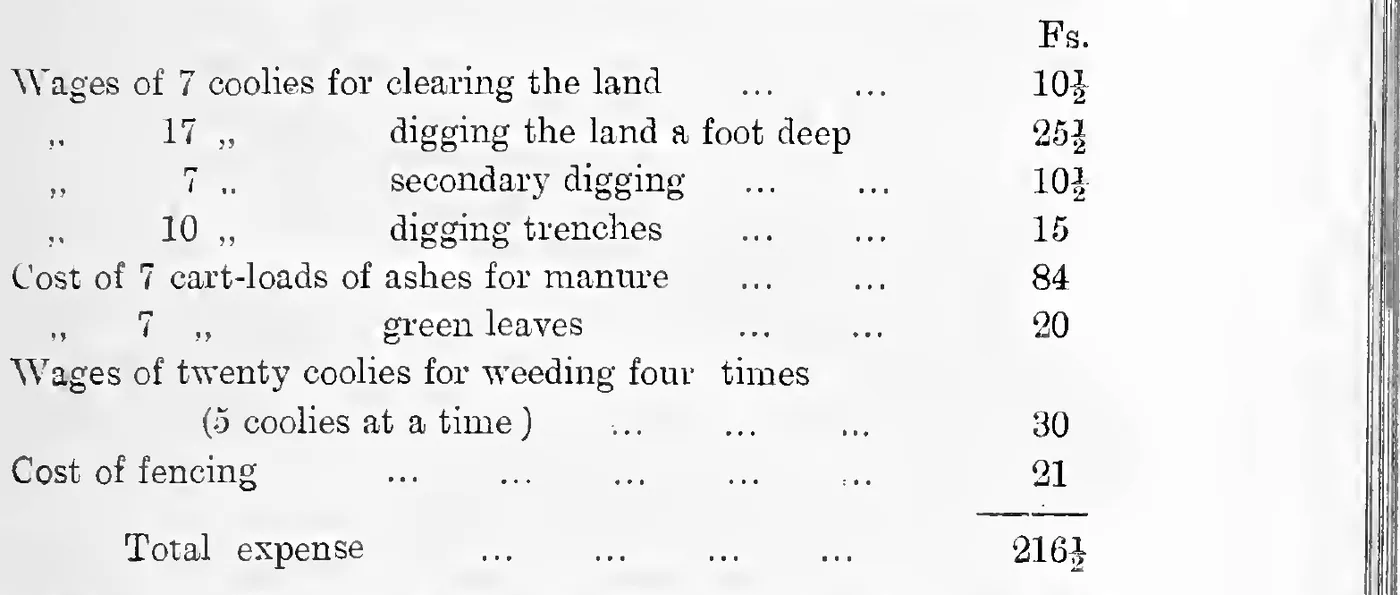
The total price of the tapioca at the rate of 1½ fs. per root for the 500 roots produced in an acre comes to fs. 750. Net income from the cultivation of tapioca in one acre of land is (750—216½) or 533½ fs., approximately Rs 75.
The tuber can be used for food in various ways. Its flour is now imported in tins from other countries to be used as food for children in Travancore. It is said to excel in quality many other kinds of flour manufactured in Europe. It is a slight, pleasant, digestible food much used in puddings and as a thickener for soups. So many other articles of food which were once very costly, but not so nourishing as this flour, have now lost their value, after the introduction of this useful food. Its dried leaves are used for manuring the banana plantains. Tapioca root freely enters the menu of the genuine Malayali for his conjee and meal. In [64]fact the poorer classes almost entirely live upon it. Cut into small bits and dried in the sun it can be kept for a long time without being spoiled.
Sweet potato (Sarkaravalli). This grows well in all lands where tapioca is cultivated. But generally wet lands with alluvium are used for raising this root. The field is divided into plots half a foot high from the surface. Plants or creepers are cut into bits of one foot in length with two or three nodes, and planted. Ashes and cow-dung mixed with earth constitute the chief manure. The planting takes place generally in May during the prevalence of the S. W. monsoon. If there be no rain the plants require watering once in eight days and the tendrils occasionally pruned. As the tubers ripen, the leaves and stems become yellow and the leaves fall off. The chief differences in the cultivation of tapioca and sweet potato are that in the latter case the pits must be covered with dry leaves two inches thick and then earth must be spread over the leaves so that they may not be blown away by the wind, and that the plants require watering once in a week or as often as necessary.
The plant thrives well in the rainy season and yields root at the latest in four months. The yield from a pit varies from one to four pounds and an acre of ground can hold more than 4,000 pits. There are generally two crops a year.
The tuber about 4 or 5 inches long and about 2 inches round resembles the potato though not so dry. It is sweet, palatable and nutritious containing saccharine matter. The herbage is employed for feeding cattle. There are two chief varieties, one with red tubers and the other with white. The former is the better food.
Potato (Urulakkizhangu) is an exotic and is not grown by the natives. The planting community have introduced it in small quantities on the hills.
Arrowroot. This grows almost wild and in great abundance, but its economic uses are not yet fully appreciated by the people. A farinaceous substance is procured from the roots, which resembles the English arrowroot both in appearance and virtues. The flour when finally powdered and boiled in milk is an excellent diet for invalids and children, and can also be used for cakes, puddings, &c. The mode of preparation is briefly as follows :— "The tubers are first scraped on a rough stick, generally part of the stem of the common rattan, or any plant with rough prickles to serve the same purpose. Thus pulverised, the flour is thrown into a chatty of water when it is kept for about two hours, all impurities being carefully removed from the surface. It is then taken out and again put into fresh water, and so on for the space of about four or five days. The [65]flour is ascertained to have lost its bitter taste when a yellowish tinge is communicated to the water, the whole being again stirred up, again strained through a piece of coarse cloth and put in the sun to dry. It is then ready for use."
Among other tubers, mention may be made of Cherukizhangu, Nanakizhangu, and Pidikizhangu, all roots of the same creeper species with very slight differences. Chanakizhangu and Mukkizhangu are other minor roots. All these are eaten by the natives in several preparations.
Vegetables. The common vegetables are the Brinjals (Kathiri), cluster beans (Chini Avarai), cucumber (Vellari), lady's-finger (Vendai), snake-gourd (Pudalai), bitter-gourd (Pavaikai), the drum-stick (Murungai), the pumpkin (Mattan), &c. All these are grown in compounds or in special gardens set apart for the purpose as in South Travancore. Special local varieties of the pumpkin, known as Mattan, Elavan, Tadiyan, Neikumpalan and Kumpalan, are also cultivated. In some parts sweet and water melons are mixed along with the above as an auxiliary crop.
Oil crops. Gingelly (Sans. Tila). This crop is generally raised on dry land. The ground is prepared about July or August; after ploughing the soil three or four times and manuring, the seeds are sown broadcast and ploughed in. No irrigation is needed. Two good rains with an interval of one month will give a fair crop. Weeding should be done while the plants are under growth, and four months after sowing they are pulled up and stacked for about a week. They are then exposed to the sun for three days but collected again into a heap at nights, and after every two days' drying in the sun they are kept a day in the heap. By this means the capsules covering the seeds burst of themselves and the seed falls to the ground. The seed is then sold to the oil-monger to press the oil out of it. Sometimes a sesamum crop is reared on paddy lands during the months of Kumbham, Minam and Medam (February to April), and a good crop is often obtained. But the tendency of the crop is to exhaust the soil.
The oil is expressed by means of the ordinary country mills or Chekku worked by bulls. There are two varieties of the seed, the black and the red one. The plant with the black seed stands first and yields the largest percentage of oil. The oil is one of the most valuable of Indian vegetable oils. It will keep for many years without becoming rancid in taste or smell. In South India it is chiefly used in cooking, for anointing the body, for burning lamps, for brightening and fixing colours. But [66]in Travancore the cocoanut oil is preferred for cooking and burning purposes. For medicinal purposes the gingelly oil is reckoned quite equal to olive oil, especially in the treatment of ulcers and wounds. The seed is gently fried and also made into flour, which is mixed with jaggery and formed into cakes. The oil cake or Punnack is given to the cattle; mixed with sugar it is also sometimes eaten.
The gingelly crops are peculiarly liable to attacks of sap-worms, blight, &c. The returns are always easy and quick. Hence the Tamil proverb:—
இளைத்தவன் ஏழு வருஷத்துக்கு எள் விதைக்கவேண்டும்.
"A poor man should sow gingelly for seven years."
Ground-nut (Nilakkadala). This also yields an oil which is a good substitute for olive oil and well adapted for the preparation of ointments. This oil is largely used for adulterating gingelly oil. But it is not grown in Travancore. Attempts are being made to introduce the seed in the Government Agricultural Demonstration Farm at Trivandrum.
Castor-oil plant (Amanakku). Two varieties of seeds are recognised, distinguished in the Vernacular as small and large. The oil made from the small seeded variety is viscid, nearly colourless and has a peculiar bland oily taste with a slight nauseous smell, that of the other is much thicker, more or less of brown colour and has an acrid and very disagreeable nauseous taste and odour. The former is the castor oil used for medicinal purposes while the latter is only used as a lamp oil. The crops are raised in South Travancore, but the major portion of the local demand is only met by importation from Tinnevelly and other parts.
Laurel (Punna). Brown soil is best fitted for the cultivation of the laurel tree. It is cultivated in gardens mainly for its oil which is commonly used for burning. The ripe fruits are made into garlands and hung over the hearth. When dried they are taken out and after the husk is separated are used as seed. The laurel trees are also planted in sandy soils. The only manures used are ashes and dry leaves. The young tree should be watered for three years. It yields two crops in the year, and when planted in suitable soils there is an annual yield of two lakhs of fruits per tree. The tree is grown in great abundance in the Eraniel Taluq. In good seasons the cost per thousand is 2½ chs. or 1½ as. There is another variety of laurel (Cherupunna) which yields better profit and better oil for lighting purposes. In South Travancore the tree is assessed at 12 cash (5 p.) per tree. Its cultivation is increasing year after year.
[67]The seeds contain nearly 60 per cent. of a fixed oil which is used for burning and medicinal purposes. It is manufactured in large quantities in Travancore especially in the Southern Division. The oil is of a dark green colour with a disagreeable odour.
Among other oils, the cocoanut oil has already been referred to in detail. One known as the Maravetti oil is extracted from the seeds of a certain tree of the same name. Oil is also extracted from the Iluppa (Bassia longifolia) seeds and used for religious purposes. Niger, linseed, safflower and rape-seed used for the extraction of oil are not indigenous.
Sugars. Palmyra. The palmyra is much planted in the drier districts of South Travancore. What the cocoanut is to North Travancore, the palmyra is to the southern districts. It is largely grown in the Taluqs of Tovala, Agastisvaram, Eraniel and Vilavankod.
The palmyra is a tall variety of the palm with a stiff radiating head of fan-shaped leaves; it is straight like the date and the areca, 40 to 100 feet high with a girth of nearly 5½ feet at the bottom and 2½ feet at the top, and hence it is the largest palm in India next to the Caryota Urens or Bastard Sago. It flourishes best in inferior and especially sandy and acrid ground where scarcely anything else will grow. The ground is first ploughed in furrows, and pits half a foot deep are dug in which the nut is planted. One fruit may contain from one to four nuts, which may be planted separately or collectively. The planting is generally done in March or April. No sort of manure is used to bring up the young plant; only the soil around is occasionally stirred. The planting should be done in an open space and slightly apart. The nut remains in the ground for three months when its outer coating decays, and the primary root shoots into the soil and the first leaves shoot up. The soil should then be raked and care taken to protect it from cattle. Sometimes a number of nuts are put into a pit for the purpose of utilising the first sprout called Panamkizhangu (palmyra-root) which is boiled and eaten by the poor. It is a favourite with the low caste people. If the fruit is allowed to remain for three months after its first appearance it becomes unedible.
The palmyra begins to yield from its twenty-fifth year; in exceptional cases when the soil is very favourable, it takes only fifteen or sixteen years. It is a common saying that the man who plants a palmyra never enjoys its fruits, which evidently means that it takes so long to bear. It is said to live and bear for a hundred years. It is always diœcious, that is to say, bearing male and female flowers on separate plants, one tree producing only barren [68]or staminiferous flowers, another bearing the pistil and fruits. The flowering season is generally the hot months of March and April. Some trees flower also in the cold season. "The male flowers are minute and are produced between scales closely set on a branched flower stalk; each stalk is estimated to bear 90,000, and as there are usually seven of these on each tree, the male flowers on a single tree are probably 630,000 in number, but not one of these produces a fruit, the fruiting or female palms bear on each flowering stalk from ten to twenty fruits, about ten of these branches are produced in a year, so that over 200 fruits are sometimes obtained from a single tree." The fruit is large, round and black and consists in the interior of an insipid gelatinous pellucid kind of pulp and generally contains three good-sized nuts or seeds.
The uses of the palmyra are manifold. A Tamil poem called the Taula Vilasam enumerates as many as eight hundred and one purposes to which it may be applied. Indeed it is reckoned inferior in usefulness only to the bamboo and the cocoanut. The best known among the uses is of the fermented liquor called toddy which constitutes the chief value to the native inhabitants.
The sap or juice is very abundant and is obtained by wounding the spadix or the young flowering branch and tying on an earthen chatty to the stump, into which the juice runs. Every morning it is emptied and replaced, the stem being again cut, the vessel placed as before until the whole has been gradually exhausted and cut away. The sap when collected before sunrise is known as Patani and is drunk as a mild saccharine refreshing beverage. But soon after sunrise it undergoes a vinous fermentation and becomes converted into the intoxicating drink, toddy. The vessel is generally plastered with chunam to prevent the fermentation, but if allowed to remain long the liquor becomes intoxicant. The sap is collected only for six months in the year ending with January. It is from this liquor that sugar is extracted; the juice is boiled down and solidified in cans placed near the hearth so that it may remain at a gentle heat. This is jaggery, Panavellam or Karuppatti. Three potfuls of liquor yield one piece of jaggery, which is worth from half to one chuckram. This is largely used for medicinal purposes and sweetening drinks. Arrack is usually distilled from the jaggery. The sugar is first broken up and put in water for four days to ferment. It is then boiled in an earthen pot, the vapour being caught in a bamboo tube which falls into another vessel in which the liquor is cooled and condensed. This operation is repeated a second time when necessary.
[69]The leaves which are cut after eight or ten years according to the nature of the soil, are used for thatching houses and making baskets, mats and fans; also for writing on with a style, for which purpose they are taken while tender, and the flat portions being cut into strips and freed from the ribs and woody tendons, are boiled and dried first in the shade and afterwards in the sun. They are then made smooth by being damped and then repeatedly drawn between two blocks of wood. All the Sacred Books of the Hindus, and all old State accounts are still secured, written on these leaves or Olas as they are called. Palm leaf books which are generally two feet long and two inches broad are said to last sometimes four hundred or five hundred years if well preserved. The petioles of the fronds yield strong and durable fibres which are employed for making twine and small ropes. The fruit when young and green is cut open, and the immature seeds are cut out of the fleshy part. Each seed then forms a thin, soft, pulpy shell filled with juice; the pulpy matter as well as the juice are cool, refreshing and pleasant to the taste, but when the fruit ripens, the nut hardens and the matter inside, becomes insipid. The stems when old are very hard and capable of taking a fine polish. For house-building and various domestic purposes the timber is very useful. It is used chiefly for rafters, pillars, joints and reapers protected from moisture and greatly esteemed especially when of good age. The timber of the female tree is the hardest and best, while that of the male tree is never used unless it be very old. From the structure of the fibres, the stem splits easily in the direction of its length, but it is capable of supporting very heavy cross strains. But hard as the wood is, the large Carpenter-bee (Xylocopa) delights in boring it.
The Naladiyar, an ancient Tamil work containing 400 verses or epigrams or morals, and considered of equal authority with the Kural, though inferior to it in sentiment and language, has the following stanza regarding the palmyra palm :—
கடையாயார் நட்பிற் கமுகனையர்; ஏனை
இடையாயார் தெங்கின் அனையர்;— தலையாயார்
எண்ணரும் பெண்ணைபோன் றிட்டஞான் றிட்டதே
தொன்மை உடையார் தொடர்பு.
In other words, friendship with some men must be daily cultivated, for otherwise it fails; of these the lowest type the areca palm is the emblem, for it requires daily care and irrigation. Others must be attentively considered for some time till friendship has become a fixed habit; of these the medium type cocoa palm is the emblem, for it requires constant care in its earlier [70]stages only. Others once friends are friends for ever; of these the highest type, the palmyra is the emblem. Planted in the sandy plain it requires no care and is of incalculable value to South India.
The areca requires daily care, the cocoanut occasional care, while the palmyra no care after planting though its uses are countless. This may be the case with the areca of the dry districts; but the Travancore areca requires no care whatever.
Sugarcane. This is cultivated on a large scale in the Taluqs of Alangad, Kottayam and Tiruvalla. It grows well on a good loam or light clay. The ground is prepared in August or September; the chief requisites are frequent ploughing of the soil, much manuring and careful removal of weeds; a too dry or too wet season is injurious to the sugarcane. Soon after the cutting season in February or March, the cane is made into cuttings, and these are planted in the sites got ready, after having been allowed to sprout by putting them in water and afterwards covering them with straw. They generally sprout in the course of five days. The cane attains its full growth in one year, when it is cut and sent to the mills for manufacturing sugar. The cane should be cut before it flowers, as the flower destroys the value of the cane. According to a Tamil proverb:—
“பெருங்குலத்தில் பிறந்தாலும் புத்தி அற்றவன் கரும்புப்பூபோல்.”
“Though born in a high family, a fool is like a sugarcane flower” (i. e., he kills the reputation of the family). The sugarcane is one of the largest of the grasses growing from 8 to 12 feet in height and acquiring a diameter of one to two inches, and the sugar is contained in the loose cellular juicy pith with which the stalk is filled. The juice is extracted by means of mills known as Aulai. “The native sugar mill is generally of wood with two uprights, one revolving round the other, between which the cane is pressed. Bullocks walk round and cause the mill to revolve. The cane is cut into pieces about two cubits long. These are inserted between the uprights, when the sap flows down, and the crushed cane comes out above. Each piece is crushed three times. A vat beneath the mill catches the juice. As soon as the vat is full, the juice is taken out in pots, poured into a vessel and boiled. When the juice has boiled for three or four hours it becomes jaggery. It is then poured into a long wooden trough and left to cool. When it has cooled it is stirred with wooden trowels to cause it to harden. It is then made with the hand into balls and so sold.” Six to eight pounds of the saccharine juice yield one pound of jaggery or molasses, and when properly ripe 16 to 20 bandy loads of canes ought to [71]yield a hogshead of sugar (750—1200 lbs.). In Travancore no sugar is manufactured, either coarse or refined, but only jaggery or molasses.
There are two kinds of sugarcane, the purple and the white. The white is succulent, yields a more watery juice than the other and is more largely cultivated. The red is hard rinded, yields a sweet and rich juice of a darkish colour though sparingly, and is hard to press. The latter is mostly used for religious purposes and in medicine. Two kinds of sugar are manufactured in Travancore, viz., Oondasarkarai (solid sugar made into small balls) and Patiyansarkarai (sugar in a semi-liquid form). A third variety known as Manattiri (of sand-like consistency), intermediate between the two, is also prepared sometimes for purposes for which the liquid sugar is used. Owing to the dampness of the climate even the solid sugar does not keep long without turning viscid. The planting seasons are Vrischigam (Nov.-Dec.) and Kumbham (Feb.-Mar.) and the milling season, the months of Dhanu and Makaram (Dec.-Jan.) extending to Kumbham in some cases.
The sugarcane is fattening and makes excellent fodder for cattle and horses which eat it greedily. The stalks are also chewed by the natives. The common raw sugar or molasses is more nutritious than the refined sugar, as crystallisation lessens its food value. It is estimated that the net profits amount to about Rs. 60 per acre of sugarcane cultivation.
Hill Produce. Planting industry. The history of planting industry* in Travancore is one of deep interest. About 1864 A. D. tea was tried as an experimental measure in the Government Gardens at Peermade along with coffee and cinchona. The plant flourished but not sufficiently well to induce the Government to continue the experiment without ultimate loss. The difficulty lay in the curing of the leaf as no sufficiently experienced manipulators were to be found to carry on the culture successfully. European planters had already settled in the country about Peermade, and the first clearing for coffee was made by Mr. J. D. Munro on the Hope Estate in 1862, followed immediately by General Stevenson on Woodlands, Robert Baker on Stag Brook and F. G. Richardson, Twyford. These were the pioneers of coffee planting in Travancore, of whom the last alone survives and still resides on Peermade which has been his home without a break for well nigh forty-three years. The Peermade Hills originally belonged to the Rajah or Chief of Punjar, from whom the Travancore Government took over the whole district [72]in exchange for a certain amount of paddy lands near Kottayam. The Government have rendered every help to the planters by opening up roads, traces, &c., throughout the district; which has led to the circulation of enormous European capital in the country and additional revenue to the State. ... ... There was a time, when, starting from Kottayam on his pony to ride to Peermade there were only six places on the long and weary track of 45 miles where a planter could obtain fire to light his cheroot! Now, however, along the whole length of the road there are houses and gardens, and a thriving population, the great majority of whom would, readily admit the fact that the origin of their prosperity was Peermade, or in other words, the planters.” There is now a properly bridged and metalled road right from Kottayam to the Peermade Ghauts constructed at an enormous cost.
* For the following account of the history of Planting in Travancore, I have mainly relied on a paper furnished to me by Mr. F. G. Richardson, one of the oldest of our planters on the Hills.
The coffee seed for the first three Estates mentioned above was procured from the Wynaad, while for the last, the proprietors secured seed and plants from some old coffee trees growing in native compounds of Kottayam, and being unable to commence work on the hills owing to the lateness of the season when they arrived in India, they made nurseries in the low country, and when their new clearing was ready had the plants carried up to the estate on coolies’ heads. Though the trees from which the seed was obtained were grown in the ordinary nature, never topped or pruned, the result was in every way highly satisfactory. “The first clearings not only did well and bore handsome crops for over 30 years, but the old trees are still in existence, having outlived hundreds of acres planted up subsequently on various estates with seed procured from all parts of South India. Owing to bad crops and worse prices, the old place has of late years been more or less abandoned, but will, doubtless, ere long, take a new lease of life and be as successful as a tea-garden as it had been as a coffee estate.”
In 1866 the proprietor of the Twyford Estate sold his share and migrated to the Periyar valley, some ten miles to the east of the Peermade plateau, where he opened up three blocks, viz., Chathee Karnum (the first block of land sold by auction under the first rules for the acquisition of land on the Travancore Hills), Chenkara and Pay Karnum. For about nine years grand crops were obtained, 10 to 15 cwts. per acre. Not only was the yield highly satisfactory, but the quality of the coffee also was particularly fine. “Nor is this to be wondered at, for the climate and soil of the Periyar valley is simply perfect for coffee. As to the soil, a finer it would be difficult to find, and in proof of the statement it may be mentioned that the writer has most successfully grown paddy with a [73]yield of seventy-five bushels to the acre; barley, pronounced by an English farmer to whom samples were sent, as equal to any he had ever grown pears, plums, peaches, figs, oranges, limes and every variety of English and native vegetables.” Coffee was the chief crop of the other planting districts also, which had been formed one by one. But bad times soon came, and in 1875 the leaf disease appeared and its ravages became terribly serious, and although every one hoped that by higher cultivation and by adopting every known means of killing the parasite, the pest would be eventually got rid of, their hopes were not realised, and the planters deserted their coffee estates one by one and took to the cultivation of tea for which the soil and climate of the country is so eminently fitted, and with the happiest of results. “With a soil and climate in every way suitable for its production,” continues Mr. Richardson, “it was not unnatural that the planters’ thoughts should turn to tea; and the glowing reports received from other parts of the country, of the successful cultivation of the tea plant, coupled with the strong recommendations of the writer, who had made a tour through the Nilgiris in the latter part of 1895 where he had met a very old friend who had large experience in tea in Assam and who had lately settled in Kotagiri, where he had introduced several improvements in tea culture and manufacture,—Mr. E. J. C. Brace of Catesfield is the planter referred to—induced Mr. J. M. Parker of Penshurst to open up a small clearing of twenty-five acres which he planted from seed procured from Catesfield. Mr. C. J. Maltby at the Mount and Mr. F. G. Richardson at the Ghauts, put down a couple of maunds of seed, which they procured from Catesfield, and in course of time seed from these trees was produced in large quantities, for which there was great demand throughout Travancore. In the case of the ‘Penshurst’ and ‘Mount’ seed, it simply proved the salvation of the proprietors who were enabled by the large and profitable sales made, to tide over several years of what, but for the tea seed, would have been terribly hard times.”
In the Peermade Districts there are now about 8,000 acres of tea, as compared with only 500 acres of coffee land of which a large proportion is scarcely remunerative. In later years Messrs. Parker and Acworth were the first to introduce the indigenous tea, procured from North India into the district, the latter having planted the whole of Arnakul from seed of that description.
So much for coffee and tea. About forty or forty-five years ago the services of Mr. McIver, the Superintendent of the Government Cinchona Plantations on the Nilgiris were placed at the disposal of the Travancore Government with a view to his reporting on the suitability or otherwise of [74]Peermade for the cultivation of Cinchona. That officer’s report was so unfavourable that many of the planters were deterred from experimenting further in the matter. But that this opinion was absolutely mistaken is clearly shown by the fact that about twenty-five years ago cinchona was again tried and largely planted on several estates, and only a few years ago, the Fair-field Estates harvested a nice crop of bark which realised very fair prices in the European markets.
In 1903 two clearings were made and opened in rubber by Messrs J. Murphy and H. D. Deane in a valley at the foot of the Peermade Hills, and now several applications for the cultivation of Rubber and superior varieties of cotton have been made to Government and are under consideration. From reports received there is every reason to believe that the cultivation of these new products will turn out a great success.
There are at present three main planting districts, namely the Kannan Devan Hills in North Travancore, the Central Travancore including the Peermade Hills, Minachil and Changanachery, and the South Travancore District including the sub-districts of Shencotta, Ponmudi and Ashamboo. The total number of tea plantations on the 31st December 1904 was 66, and the total area under cultivation was 24,711·57 acres, while the area taken up by planters, but not under tea cultivation, was 12,660·17 acres.
Tea (Thea viridis). As already stated, the first attempt to introduce the cultivation of the tea plant in Travancore was made in 1864 in the experimental gardens at Peermade, but it was only after the failure of the coffee cultivation on account of bad seasons and a virulent attack of the leaf disease in 1875 that the planters’ exertions were seriously turned to the cultivation of tea as a substitute for the now moribund coffee. Tea is extensively cultivated in the Kannan Devan Hills (North Travancore), Peermade Hills, Minachil and Changanachery (Central Travancore) as also the Districts of Shencottah, Ponmudi and Ashamboo (South Travancore).
Varieties. There are three marked varieties of the tea plant, the indigenous Assam, the Chinese and a hybrid between the two; of these the indigenous comes first in point of excellence, then the hybrid and only lastly the Chinese.
Climate and soil. The tea plant is a very hardy one and possesses an adaptability to all climates or soils though it will not thrive in all. Tea grows best in a warm, moist and comparatively equable climate where rains are frequent and copious; a climate that favours tropical profusion [75]of jungle growth is the most favourable for the cultivation of tea. The plant delights in sunshine and thrives best when subject to alternate showers and hot sun. It can scarcely have too much rain provided the water always runs off quickly, and hence sloping grounds are considered better than flat ones. Undulating well watered tracts where the rain escapes freely, yet without washing away the soil, are considered the most valuable for tea gardens.
The tea plant has no fascination for any particular soil, as it has a wonderful facility for adapting itself to any ground as in China where it is generally grown on land which will produce nothing else. But the plant does flourish better in some than in others. The following qualities in soils are recommended for the most successful cultivation of tea*:—
(1) It should be friable, i. e., easily divided in all its parts.
(2) It should have a small proportion of sand in it; not enough to make it what is called a sandy soil, but enough when spread on the palm of the hand, wetted and wiped off, to show sandy particles glistening in the sunshine.
(3) It should be of a porous nature as opposed to a clayey one, i. e., it should not be the sort of soil which, when it has been wetted and dried in the sun, cakes together and splits.
(4) It should be of the light garden mould nature absorbing moisture quickly, and easily pervious to air and heat.
(5) It must be of moderately ferruginous nature, i. e., the iron red must not be very much developed in it.
(6) It must be a rich soil with plenty of nourishment in it. It can scarcely be too rich. The best soil is that which is not very clayey and in which stones are found, as they facilitate drainage.
The question of elevation is an important one. The higher the estates are situated, the less the produce they generally yield. But the flavour of tea is decidedly improved by elevation; teas of 6,000 feet elevation will, other conditions being equal, have a higher and more delicate flavour than those of 4,000 feet.
Cultivation. The first thing to be done when commencing tea plantation is to clear the forest. This is usually begun in November during the dry weather and continues until December or January. The trees are felled [76]and their branches lopped off and the whole left to dry for about two months when the debris is burnt.
* Tea cultivation in India. Published in 1895[?] by Higginbotham & Co., Madras. Page 11.
In the meantime the nurseries are prepared either from seed got locally or from Assam or possibly the more valuable indigenous seed from Manapuri. Great care must be taken in the selection of the site for the seed-beds. Water must be procurable at an adjacent spot and a higher level, so that it can by cutting a channel in the ground be allowed to irrigate the bed plentifully, and soil must also be good. It should unite as far as possible the three essential qualities of lightness, friability and richness. If the elevation of the garden is above 4,000 ft, the nurseries should be placed on the lowest favourable site, and the aspect should be anything between East and South. The ground should be thoroughly well dug to the depth of a foot or so and laid out into beds raised a foot high and 3 ft. wide with a pathway between each. The seed is sown at intervels of from 3 to 4 inches and 3 inches deep in parallel trenches about 4 inches apart. The nurseries require much attention and watering. No separate manuring is required, the ashes of burnt debris forming the manure. The beds should be watered every fourth or fifth day; but too heavy a rush of water should be avoided.
In a month’s time the seedlings appear, when the beds should be watered slightly once a week, and this should be continued until a shower of rain renders it unnecessary. The plants have to be of nine or twelve months’ growth prior to being planted, and in the case of seed, it should be planted between June and October so as to be ready for transplanting from the nursery to the clearings.
The further operations are thus described by Mr. Justice Hunt in an article in the Malabar Quarterly Review on “Tea Cultivation in Southern India”:—
“The next step is the construction of roads and surface drains. At the same time the operation of ‘lining’ and ‘holing’ is commenced. The drains cut usually at forty feet intervals at a gradient of one in fifteen; this gives a diagonal line from the ridge of the watershed to the line of the water course. The roads are set at a gradient of one in eight to one in ten and are cut as required. Having thus mapped out the ground, the process of ‘lining’ and ‘holing’ is commenced. This consists of taking out the intervening spaces with parallel lines and crossing them so as to make out squares of four feet side from the centre of each hole. These holes are dug eighteen inches deep, and are filled in with surface soil, into which the shrubs are planted with the first rains of the south-west monsoon (i. e. in June). Once planted, the shrubs are allowed to grow for three years and are occasionally cut down so as to increase their lateral growth. Then at the end of the third year the plucking commences. I may mention that once the estate is in working order, the pruning takes place, ordinarily once in every eighteen months or two years. ... ...
[77]
“The operation of plucking consists of taking the tender shoots. These shoots comprise three to four leaves, inclusive of the tip or undeveloped leaf or ‘bud’. The plucker gathers the tip and the next two or three leaves below, taking care to leave one leaf on the stem, in order that the new shoot for the next plucking may spring therefrom. The tip and first leaf give what is known as orange pekoe, the second and third leaves yielding the blend known as pekoe and pekoe souchang.
“Having gathered the leaves in baskets, they are taken to the factory, where in a long upstairs room, they are spread out thinly on to jute Hessian tatties. These tatties are placed in layers one above the other at intervals of six inches distance apart. The surplus hot air from the ‘drier’ in the lower room is utilised by being drawn up into the withering room by means of fans to assist in the withering process. The withering process may be said to take about sixteen hours, but in a measure depends upon the weather. A good ‘wither’ reduces the leaf into the flexibility of a kid-glove.
“After the withering is complete, the leaves are taken downstairs, and are placed in a roller. This process lasts from about an hour to an hour and a half. This ‘roller’ is a machine consisting of a huge cylindrical brass box, the base of which is given a rotatory movement and has the effect of breaking the cells of the leaf and of giving it the necessary twist.
“The next stage is to allow the leaves to ferment for a short time after which they are put into the ‘drier,’ a very formidable looking machine, containing a dozen or so of wire gauze trays upon which they are spread. The machine is heated up to 220° Fahrenheit and the heat is drawn down through the trays by means of an exhaust fan, and the surplus air is filtered through the withering room above stairs in the manner already described. The tea leaves are now virtually ready for the market and the process of preparation is thus complete.
“The next phase is sorting the leaves into the different classes of tea, which is done by passing them through a wire mesh cylinder divided into compartments, each compartment containing a different size mesh. The finer the leaf, the finer the tea. The tea is then gathered and stored in different large bins and as the quantity stored becomes sufficient for a ‘break’ or one hundred chests, it is taken out, re-fired and packed for the London markets.”
Yield. The average annual yield per plant is very variable, but may be stated at about one-fifth of a pound of finished tea under favourable circumstances. An acre may contain from 2,100 to 27,00 mature plants and hence the yield per acre may be taken to be about 400 lbs. per annum. The cost of production and manufacture also varies in different plantations according to their condition and the care and skill displayed in their management. The average cost of cultivating a tea plantation in Travancore will be Rs. 600 an acre and the net profit Rs. 58.
Commercial varieties. There are two commercial varieties of tea, viz., black tea and green tea. Under the former are included, flowery pekoe, orange pekoe, pekoe, pekoe souchang, souchang, congou and bohea; while under the latter come gunpowder, imperial, hyson, young hyson, hyson skin and caper. The names under each variety indicate in general [78]a gradation of qualities from the fine and delicate product of the young leaf-bud up to the hard and woody expanded and partly-grown leaf. In Travancore as in the whole of India the manufacture of green tea is comparatively little prosecuted.
Insects injurious to tea. Of the insects injurious to the tea-plant, the most destructive, especially to the seedlings, is the Paddle-cricket which burrows itself to a great depth during the day and makes its raids in the plants at night nipping them off close to the ground and destroying thousands of seedlings in one night. These insects are destroyed either by digging them out of their holes or by inserting the poison (cyanide of potassium) therein and closing up the orifice with a stake firmly driven down it. There are also other enemies such as caterpillars, bugs and ants, especially the white-ant, but these are not injurious to such a degree as the Paddle-cricket. These are bred in myriads in the jungle wood cut down and allowed to lie and rot in the land.; the only method of checking their ravages therefore is by keeping the plantations perfectly clean without any dead wood. A kind of weevil also destroys the tea-plant by piercing the stem and boring a complete circle round it just at its junction with the surface of the soil. The plant attacked assumes a drooping posture with the leaves turned yellow. An application of lime and water or whitewash round the stem at its base may occasionally recover the plant by killing the insect.
Present prospects. The accompanying statement gives particulars of the production of tea in Travancore during the Calendar year 1904 as compared with that of the previous year. Though the number of plantations on the 31st December 1904 was only 66 against 71 of the previous year, yet there has been an appreciable increase under all the other items. The total area under tea cultivation was 24,711·57 acres against 24,579·75 acres; the quantity of uncured leaf amounted to 35,911,951 lbs. against 28,140,616 lbs., and the quantity of manufactured tea was 9,073,880 lbs. against 7,241,638 lbs. in 1903. The quantity of green tea manufactured is very small being only 1,595 lbs. against 9,072,285 lbs. of black tea.
[79]
Statement of the Production of Tea in Travancore during the calendar year 1904.
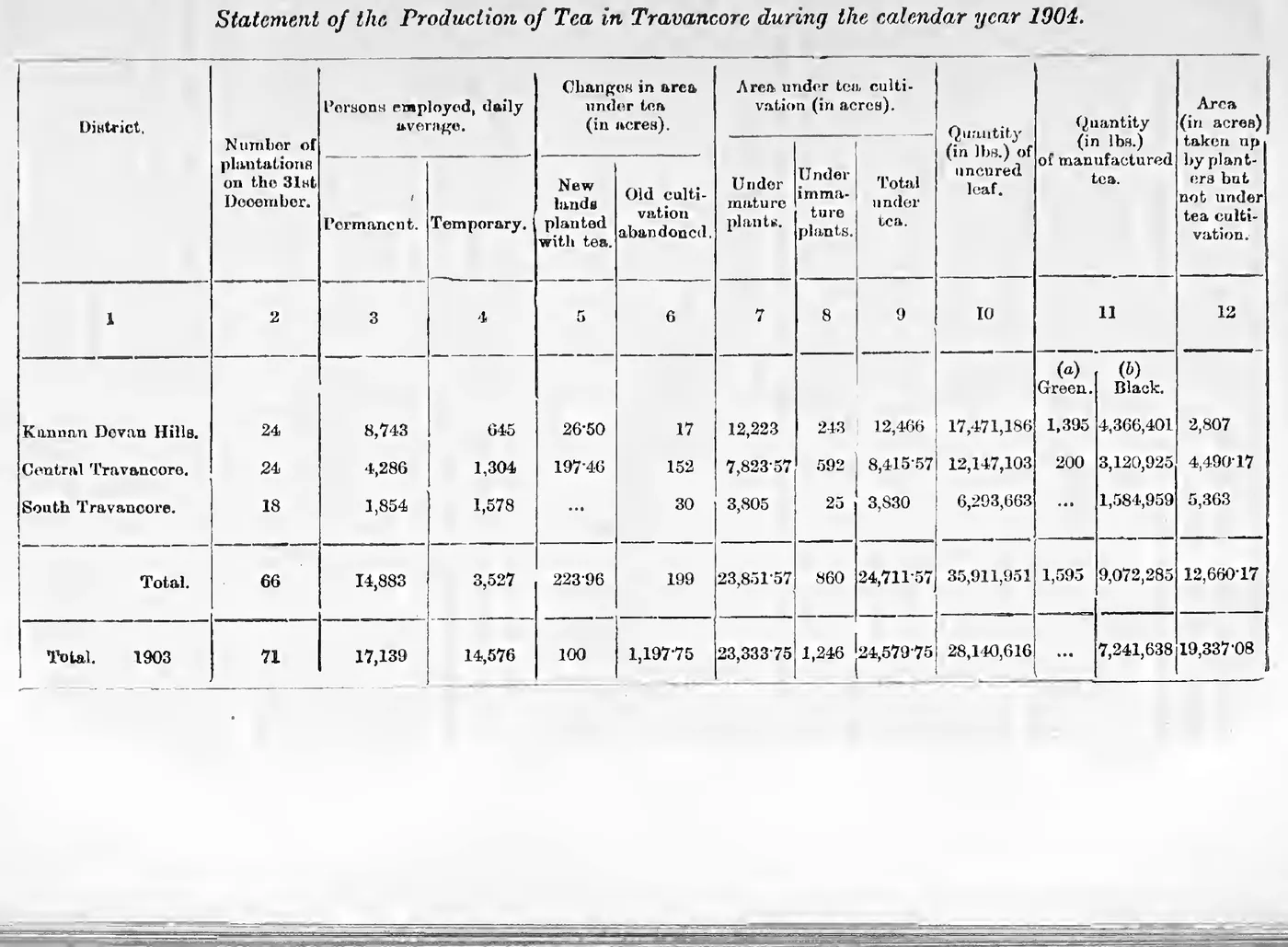
[80]A correspondent of the Madras Mail who has had many years’ experience in tea-planting in the Travancore Hills, recently supplied to that paper some interesting notes with reference to the prospects of the Travancore tea industry. The following are extracts from his letter:—
“I should say that tea prospects for 1905 are good as regards quantity, but the ‘wintering’ the bushes have had from the recent excessive drought is bound to mean abnormal flushes from now on to the burst of the monsoon, which will mean that the tea will be of comparatively poor quality. ... ... Teas from this District nearly all go to London, which for all practical purposes is the only place where financial arrangements can be made by planters. The four anna duty shuts us out of Colombo to all intents and purposes, as selling in Bond is always against the seller. As regards Calcutta, the cost of sending tea there is prohibitive, unless prices are a good deal ahead of Colombo or London, which they are not. Travancore teas vary considerably in the elevation at which they are grown, which is from 2,000 to 7,000 feet. Some of the teas grown on the higher slopes are very ‘flavoury’ and nice drinking teas, which, could the public get them direct, would command good prices. ... Most of our teas go in the Clan Line Steamers, as our shipping facilities are limited. A steamer arrives with, say, half a million pounds of South Indian tea. The big buyer then goes to my broker and says, ‘I want 100,000 lbs. of the South Indian tea that will arrive shortly by the Clan Steamer, provided you can buy under an average of 6d.’ Now, it stands to reason that it will pay my broker much better to place that order than to lose it by valuing my small lot by the same steamer at, say, 7_d_. There will be three or four leading blenders doing the same thing, and therefore it is certain that all the teas will be valued at about the same limit. The proof of this is easily seen by looking at Travancore sales, which rarely vary over a hal penny, whether the tea be grown at 2,000 or 7,000 feet, or whether it is made in a badly equipped factory or in one of the perfect High Range factories; whether it is made by experienced Ceylon men who have the best of Ceylon experience, or by a coolie on ten rupees a month.”
In order that it might be feasible to sell pure Travancore tea direct to the consumer from the producer in all large towns, he suggests that a blending factory would have to be erected on the coast where teas could be packed in bulk or in packages according to the requirements of the different British Depots, and concludes his notes as follows:—“I am quite certain in my own mind (and I have been at tea since 1880), that, from a consumer’s point of view, most of us make excellent tea; but it is a tea that should de drunk by itself and for itself, and, therefore, it is not a blender’s tea.”*
Rubber. The Rubber industry of Travancore though in its infancy, has apparently a great future before it, should lands be made available. It is interesting to note that a wardian case of rubber plants was sent to Trivandrum to the then Elaya Rajah in 1877 from the Royal Botanic Gardens at Peradiniya, Ceylon. These plants were of the “Para” variety, but what happened to them no one seems to know. The next move was [81]made by Mr. G. Anderson who planted a few plants at Shalliacary Estate in South Travancore about thirteen years ago, and these trees exist to the present day and are very fine specimens of the “Para” variety. Besides these a good deal of “Ceara” rubber was planted in the eighties in the Estates of Placard, Chenkara, and Wallardi and on these Estates a few very fine specimens of this rubber exist girthing ten feet, four feet from the ground. In 1902 the late Mr. R. S. Imray and Mr. H. D. Deane commenced prospecting for rubber land, and in August 1903 Messrs Thomson, K. Nicoll and J. Hunter commenced planting near Alwaye on the Periyar river banks. The growth here has been very satisfactory. The larger trees now three-and-a-half years old are 15 to 14 inches in growth 3 feet from the ground. Following on this plantation considerable acreages were opened in South Travancore in 1903-1904 and in the latter year Messrs. Murphy and Deane commenced planting rubber near Mundakayam, on Yendoar and El Dorado Estates. In every instance both in South and at Mundakayam the growth has been very satisfactory, and as far as it is possible to conjecture there is a great feature for this industry in this State. The approximate acreages in Mundakayam district in private hands are as follows; El Dorado Estate 600 of which some 500 are planted or being planted this season; Yendoar Estate 600 acres of which 350 acres are planted; Kutikal Estate 700 acres of which 400 acres are being planted; Vallinardu Estate 600 acres of which some 400 are planted or being planted; Kardamom Kollam 1200 acres of which 500 acres are planted or being planted; Kuppukayam Estate 800 acres of which 150 are being planted. Grahams land 300 acres of which 200 are being planted. In the South and South West there are the Peryiar Company, Rani Company, Shalliacary Company, also much rubber near Venture Estate and a good deal on the Ponmudi side.*
* The Madras Mail—22nd April 1905.
As the rubber industry is likely to develop fast in the near future some further facts may be given here with a view to enlighten the needy agricultural ryot of Travancore. The opinion of experts is:—
(1) That plantation rubber will always be preferred to indigenous or wild rubber.
(2) That even if the prices fall from 6s. per lb. to 1s., the plantation rubber would yield 5 per cent. on the capital invested, estimating a liberal cost of £ 24 per acre.
(3) That the price of plantation rubber could never fall so low as [82]1s. per lb. Even if it sells at 2s. per lb., 10 per cent. interest on the capital may be secured.
* For this account of the Rubber cultivation in Travancore I am indebted to Mr. H. D. Deane of Peermade.
(4) That the preparation of the latter which was formerly a question of months is now reduced to a question of hours, by perfect machinery.
(5) That the rubber seed will itself, to begin with, be a profitable article of trade for some time to come. It is believed that a valuable oil can be extracted from it.
A writer in the Indian Review observes:—
“The cost of laying out and maintaining a Hevea plantation in Southern India, where labour is both abundant and cheap, will not exceed Rs. 300 per. acre, during the first period of 5 years; i. e., one rupee per plant. The income obtainable in the early part of the sixth year, from the same area, at the first tapping, anticipating an yield of only half a pound of dry rubber per tree and valued at 4s. the pound, would be Rs. 450. Four tappings could, with safety, be made in the six months during which rubber could be tapped; so that the income at the close of the first year of tapping would amount to Rs. 1800 per acre. Allowing for an expenditure of Rs. 800, for the maintenance for the sixth year, the tapping of the product and its preparation for and transport to market, the cultivator would derive a profit of Rs. 1000 per acre, which is by no means small in a country in which the ryot feels rich on a tenth of that amount.”
It is a question, however, for deep consideration how far these sanguine calculations are well-founded. In the first place it is quite absurd to suppose that the price of 4s. per lb. will be maintained, especially as the whole available land of the world will be presently brought under rubber cultivation and the market will be so glutted with rubber that it may soon turn out to be an unprofitable cultivation. Enthusiasts jump from one discovery to another with a marvellous capacity for forgetting the harm they have inflicted on credulous ryots by their over-sanguine calculations in support of their hobbies which soon turn out to be huge failures. These may be good ventures for capitalists who are content with a 2 or 3 per cent. interest on their fabulous wealth; but in a poor country, where the ryot cannot borrow except at 18 per cent. per annum, greater caution is needed before a ryot can be asked to launch into new speculations far beyond his means. The coffee mania of Travancore has, I know, cost the Travancorean dearly, for it has been the grave of many fortunes—I mean such fortunes as may be said to have existed in the country. And those who advise the ryot to rush into unknown waters are taking too great a responsibility on themselves. These glowing pictures should therefore be taken with a grain of salt.
There is another aspect of the question which too often escapes our notice. These new ventures in cultivation, especially on the hills, cause [83]such a denudation of valuable timber standing in virgin forests that according to a Forest Officer, an acre newly brought under cultivation, say of rubber, coffee, tea, cardamoms or cinchona may mean a loss of something like 20,000 Rs.’ worth of timber which it might take ages to restore. He says there is nothing in the way of land taxes or duty or cooly wages to compensate Government for this tremendous loss. This also ought to make us pause.
Cardamoms.* Cardamoms are known botanically as Elettaria Cardamomum. Botanists recognize only two varieties, viz.:—
1. Var. Minor. Malabar, Travancore and Mysore.
2. Var. Major. Ceylon.
Cardamoms grow in clumps varying from six to thirty stems, and from six to eight and even twelve feet high, according to the quality of the soil. The leaves are long and narrow with a smooth dark green surface and a light velvety down on the under side, placed alternately embracing the stalks at their base. The leaves average 15 to 20 on an old plant. The flower is very beautiful, white in colour with purple markings which grow on long scarps or racemes thrown out from the bulbs along the ground. The fruit grows in small clusters on the raceme; in good seasons they are crowded together, but in bad seasons they are few and comparatively distant. The fruit is enclosed in capsules which are green till the fruit ripens, when they turn a dirty cream colour. The capsules are divided into three cells with a double row of dark seed in each cell surrounded with a sweet glutinous pulp. The seeds which were known in ancient times as “Grains of Paradise” have a strong aromatic flavour, somewhat hot. They are used as spice also as a flavouring material in confectionery, liquors, curries and medicines. Well-to-do natives eat them with their betel and when sending invitation, it is considered a compliment to accompany it with a few cardamoms. Mr. J. D. Munro says that in rare cases the stalk may flower, but has not been known to set, the writer has never seen this. He adds that the ryots have a superstition that when the stalk flowers, it is followed by death or some grave misfortune to the owner of the garden.
In Travancore cardamoms are known locally as Magara Aylum, Cunny Aylum and Mysore.
The Magara Aylum and Cunny Aylum in appearance and flower are very similar. The Periyar river seems to be the dividing line, Magara [84]Aylum growing on the eastern and Cunny Aylum on its western side. They differ as regards date of blossoming and fruiting and the appearance of capsules. This appears to be due to climatic causes; Magara Aylum District is at a somewhat higher elevation, the rainfall averages about 100 inches and the soil is usually a rich vegetable mould. Blossom appears from April to May and most of the fruit ripens in December and January. The capsule is long and contains from 22 to 32 seeds.
* Contributed by Mr. J. S. Sealy, Superintendent and District Magistrate, Cardamom Hills.
In the Cunny Aylum District the rainfall varies from about 150 to 200 inches: the soil is light and gravelly; the flower appears in April and the fruit matures in October and November; the capsules are inclined to be round and contain only from 18 to 22 seeds.
The term Mysore is a misnomer, as this variety appears to be unknown in that state. The peculiarity about it is that the racemes do not run along the ground; but grow erect from the bulbs. The racemes are shorter, the capsules closer together, the shell is thicker, the leaves larger, coarser and harder, not soft and velvety on the under surface as the Travancore and Malabar varieties, but smooth. The Mysore variety is more robust in growth and has been much cultivated of late years, especially by the European ryots. The flavour is distinctly less pungent than these other two varieties.
The Var. Major or Ceylon Cardamoms are distinguished by the coarser appearance of the leaf sheaths and leaves, the velvety softness on the under surface of the leaf is less marked, the stem is deeply marked by a pink tinge at the base and more or less traceable the whole way up the leaf-stalk. The fruit is very much larger than the Malabar or Travancore varieties. It is not cultivated, as it is of no commercial value.
Distribution. Cardamoms are grown in South India, Ceylon, Java, Sumatra, the Eastern Archipelago, Madagascar and West Africa, but the plant is indigenous to the evergreen forests of Travancore.
Up to the end of 1071, M. E. (1896 A. D.) cardamoms were a Government monopoly all over the State; in the following year the monopoly was renounced in the Cardamom and Periyar Reserve Forests.
The Cardamom Department. The cultivation of cardamoms seems to have been first actively encouraged by Government in the year 998 M. E. (1823 A. D.) when the nucleus of the Cardamom Department was formed by the establishment of a special Cardamom Staff attached to the Forest Department with its headquarters in the low country at Todupuzha. The Magara Aylum crop was transported by pack-bullocks along [85]rough cattle tracks, for there were no bridle paths to Vaikam via Todupuzha and thence by boat to Alleppey where the crop was garbled, sorted and eventually auctioned.
In the year 1044 M. E. (1869 A. D.) the Cardamom Branch was severed from the Forest Department and organised as a separate Department under Mr. J. D. Munro, who was given powers of First Class Sub-magistrate. His headquarters were at Kottayam for six months of the year and at Udumbanshola, the centre of the Magara Aylum Division, for the rest of the year.
Mr. Munro proceeded to open the country by cutting rough bridle paths in all directions and a main path to Peermade; when this was opened it was utilised for the despatch of crop to Kottayam by pack bulls and from there to Alleppey by boat.
From 1024 to 1071 M. E. (1849-1896 A. D.) a detachment of the Nayar Brigade consisting of one Jemadar, two Havildars, one writer, six Naigues and fifty-three sepoys, was sent up every year for six months to guard the bankshalls, Tavalams and the frontier with a view to prevent smuggling; this was supplemented by 103 watchmen employed for the same period; about half of these were stationed in the various villages in British India to keep a watch on the bad characters and report their movements to the officers on the Hills, while the rest were stationed at the Tavalams and frontier stations. These watchmen were paid month by month by the Sirkar, but the cost was eventually recovered from the ryots.
From 998 to 1015 M. E. (1823-1840 A. D.) the ryots received Kudyviley at the following rates per Tulam of 20 English or 18 Dutch pounds:—

In the year 1016 M. E. (1841 A. D.) the rate was reduced a little and up to the year 1044 M. E. (1869) they were paid:—

In 1045 M. E. (1870 A. D.) a change was made in the system and the ryots’ share was calculated as one-third of the Alleppey auction prices; [86]this continued till 1061 M. E. (1886 A. D.). The price of cardamoms had been falling steadily for several years, and it was clear that one-third of the sale proceeds no longer sufficed to make it profitable to the ryots to cultivate the spice. Government therefore raised the rate in 1062 M. E. (1887 A. D.) from one-third to two-fifths, and this continued till 1071 M. E. (1896 A. D.); for in 1072 M. E. (1897 A. D.) the monopoly system was abolished on the Cardamom Hills including the Divisions of Poopara, Udumbanshola, Vantenmettu and Malapara, but retained in all other parts of the State. The ryots were granted Pattas with occupancy rights only, old land being assessed at B. Rs. 6¼ per acre and new land taken up for cultivation at the rate of B. Re. 1 per acre for three years and Rs. 6¼ in the fourth year; this was sanctioned as a tentative measure for five years and proving a success the period was extended to twelve years from the date of registration of occupancy rights, when it will be competent to Government to renew it for a further period of twelve years at such rate of assessment as Government may fix.
During the last few years the value of cardamoms has seriously fallen in price owing to overproduction, chiefly in Ceylon, and the ryots have petitioned Government to reduce the assessment; this is now under consideration.*
Cultivation, soil, etc. A fine rich vegetable free soil is absolutely essential for the successful growth of cardamoms. They grow in Travancore from 2000 to 4000 feet, but the best elevation is from 3000 to 3500 feet. Cardamoms may be seen growing splendidly with a northern, southern, eastern and western aspect; aspect therefore appears to have no effect on cardamoms.
Cardamoms cannot stand wind. No matter how good the soil may be, the garden will be a distinct failure if exposed to wind; consequently the best results are obtained in sheltered ravines and hollows—in such [87]places the soil too is frequently of the best description—; if the lay of the land be steep, the forest trees left for shade are insufficient in themselves to protect the cardamom plants from being damaged by wind; the very clearing of the undergrowth in such places seems to cause a cold biting draught at some seasons of the year, which does irretrievable damage to the fruiting powers of cardamoms. They will grow on ridges and exposed situations, but the crop will always be poor and the cultivation unprofitable.
* The year 1079 M. E. (1903-1904 A. D.) was a particularly disastrous one for the cardamom ryots in two ways, viz., decline in the yield owing to drought during the blossoming season and the fall in the price of the spice owing to overproduction in Ceylon and elsewhere. The crop declined to 8,268 tulams against 30,776 tulams in the previous year. Last year, 1080 M. E. (1904-05), the crops amounted to 20,432 tulams, showing a considerable increase in the yield. But the average price is reported to have fallen from Rs. 12 to 8 per tulam, making it impossible for many of the ryots to pay their kists. As a result of the conference the Dewan held recently at Kambam with a large number of influential cardamom ryots European and Native, His Highness the Maharajah has been pleased to sanction several measures which are likely to improve the position and prospects of the cardamom ryots. Full proprietary rights have been granted to the holders in their cardamom buildings; they were allowed to pay the upset price of Rs. 10 per acre in the yearly instalments; the assessment was reduced from 6¼ per acre to Rs. 2; a sum of Rs. 10,000 was sanctioned for the purpose of opening outlet roads; the period of three years for which the assessment of the rupee per acre was levied was extended to four years, and several other minor concessions were also granted. It is hoped that these liberal concessions will induce the ryots to bring fresh lands under cardamom cultivation and to settle down on the Hills.
Cardamoms do not appear to be much affected by the actual annual rainfall. On the Palany Hills they thrive well with a rainfall of about 60 inches, in Ceylon with a fall of about double this. In the Magara Aylum District the fall averages 100 inches, in the Cunny Aylum District it is about 175 inches. But what is of the highest importance is that there should be a few good heavy showers to thoroughly moisten the soil between Makaram and Medam, middle of January to middle of May; a long hot dry season always means a bad crop; good showers in Medam, middle April to middle May, are of but little use, unless preceded by showers in the previous three months. A heavy south-west monsoon is considered favourable in Travancore.
Clearing. Having selected a favourable block of land the first thing to be done is to clear the undergrowth and fell a few of the large trees. This is best done in the hot weather and should be finished before the end of April; the object to be aimed at is an even-checked shade. The natives have a theory that the felling of big trees shakes the soil and does immense good: as a matter of fact it is the light that is let in that causes the benefit.
Formerly the ryots used to cut down the undergrowth and a few trees and leave the rest to nature, trusting to the spontaneous growth of cardamoms from seed in the soil and droppings from birds, etc.: they would return to their village for three years, when they would again visit their clearings, hack down the weeds and undergrowth and expect a small crop in the fifth year. Those with a trifle more energy would go to the expense of purchasing a little cardamom seed and after clearing the undergrowth scatter this broadcast and do nothing more till the fifth year. As the ryots now have to pay land tax they have considerably improved their system and adopted some of the European ideas. The European ryots heap the undergrowth and then burn it. The next work is lining.
Lining. The distance varies considerably, some prefer 6×6, others [88]7×7, 8×8 and even 9×9. This gives 1210, 889, 681 or 538 plants respectively to the acre. Feet 7×7 or 8×9 are the more usual distances; a peg is fixed where the pit is to be dug.
Native ryots never go to the expense of lining, but judge the interval with their eye when digging the pits.
Pitting. The size of the holes also varies. Some Europeans cut them as large as ft. 2×2×1, but this is larger than usual; the native ryots go to the other extreme and are content with a few cuts of a Mammatty. Pits 18″×18″×12″ are advisable.
Bulbs. Great care is required in the selection of bulbs; these should on no account be planted singly, but pairs attached together should always be used. They should not be taken from a stool that is fruiting. A hole should be cut a few inches from the stool from which it is decided to take bulbs and the earth cleared away by hand from below the bulbs, when they can be broken off in clumps; cutting should be avoided—the bulbs can then be divided by hand into pairs: at least 18 inches of the stem should be left attached to the bulb; if a short stalk is left it may rot down to the bulb and destroy it before the bulb has time to take root and throw out the new shoot. The youngest bulbs give the best result. As the removal of bulbs frequently causes the stool to cease bearing on the side from which they have been taken, some planters prefer to take up the entire stool and supply the spot with a new pair of bulbs. Bulbs can often be purchased on the Cardamom Hills at Rs. 10 per 1000, but they are generally carelessly taken by native ryots and considerable percentage are damaged. When buying bulbs, the purchaser should insist on having a portion of the leaves left on the bulb, or he may later on find that he has been sold and has bought the common jungle Koova, a species of wild tapioca with a somewhat similar bulb and stem.
Nurseries. This is an excellent way to raise plants, for it answers propagation of plants from strong healthy parents. The largest capsules should be selected from the strongest and most healthy stools. Be certain that the seed is fully ripe. The seeds should be squeezed out of the capsules by hand and the smaller seeds rejected. They are covered with a glutinous substance which causes them to adhere together; exposure to a current of air or to the sun will free them from this. When they become dry they should be steeped in water for a few hours. The ground of the seed-bed should be dug over to a depth of 1 ft. and all roots and stones picked out. The beds should then be marked off four feet wide with a space of two feet between each, and six inches or so of the earth in this [89]two-foot-path-way, heaped up on the beds. On the top of this a mixture of one part sand and one part vegetable mould should be placed and the selected seeds very thinly sown and lightly covered over with the same mixture. The nursery beds must be shaded with fern or what is better, with a water-tight sloping roof of thatch. The bed should be kept damp with occasional watering. On the Hills, cardamom seeds may take as much as three months to germinate, but is said to do so in as many weeks in the low country. Travancore seed is of very slow growth and apt to damp off; close attention is therefore necessary to the watering. Plants are more readily raised from Mysore than from Travancore seed.
One pound of fresh fruit averages about 13,000 seeds. One pound of fresh fruit gives about ¼ lb. of seed. Transplanting should be avoided; it is very risky work; therefore sow the seed thinly so that the plants may be kept in the nursery till a foot high. If absolutely necessary to pick out the seedlings, wait till they have their second leaves. The young plants are ready to plant in the clearing when they are a foot high.
Filling pits. In filling the pits all roots and stones should be picked out and the earth slightly heaped above the surface of the surrounding ground.
Planting. This is a most important work. Some of the double bulbs will get divided in transport and handling. Reject such and plant only double bulbs. Make a small hole with the hand in the centre of the mould of earth, carefully spread out the roots and plant the bulb with the stalk at an angle of about 45°; only about three-fourths of the bulb should be covered with earth which must be pressed down with the hand almost level with the surrounding ground. A quarter of the bulb should be exposed; if covered with earth it will rot. Do not plant the bulb on a high mould, for the drip from the trees will wash away the earth leaving too much of the bulb exposed, when it will die. Weeding coolies should watch this and replace earth if necessary.
Weeding. Clean weeding, as on a coffee or tea estate is unnecessary and probably unadvisable. In young clearings in Travancore, it attracts the attention of any animal to the only green thing there is, and the young plants run a risk of being eaten off. Three or four weedings a year are ample for old and young clearings, one of which should be in November before the crop ripens. When the stools are full grown there are practically no weeds but a creeping grass usually covering the ground.
Blossom. The scrapes or racemes begin to show in October or November and by February are of a good length—18 inches to 2 feet—[90]and give the best crop in the case of Malabar cardamoms; the Mysore cardamom throws out a much shorter raceme usually not more than nine inches to a foot. In Magara Aylum if the season is favourable the earliest blossom will appear in Chittirai (April-May), subsequent blossoms may appear up to Audy, the midde of August. If the blossom is followed by light rain it sets well. Occasionally as many as 50 capsules are found on a raceme, but this is very unusual in Travancore. The crop takes about five months to ripen.
Crops. Under the native system of clearing the land and then leaving it to nature, no crop could be expected for five years, and then only a poor one; the garden would not be in full bearing till the eighth year. If bulbs are planted, a small crop is gathered in the fourth year, but it is not in full bearing till the sixth year. The old native system of harvesting was most wasteful; if the crop happened to be good the ryot would perhaps take up a gang of coolies in November to cut down the weeds and clear the ground around the cardamom stools and then return to his village till the big blossom was ripe, generally towards the end of December and January. He would then come up with a gang of coolies, and after building a rough shelter for his coolies on a rock near the garden, put the coolies on to cut down the weeds; after them would come a gang to pull off the racemes which were taken to the rock and the capsules torn off; at the end of the day’s work the green cardamoms were measured by the peon in charge of the Tavalam. On the following day the cardamoms were spread on the rock to dry, and left out at night. If there was good sunshine the crop would dry in four to five days. The night dews are considered beneficial and to assist in bleaching the capsules. If there was rain while the cardamoms were drying, the capsules got a bad dark colour and fetched a much smaller price. Should wet weather set in the coolies were frequently taken back to their villages. When the cardamoms were dry, the next process was to remove the stalk and remains of the flower from the capsule; this was done by gently rubbing them on the rock. The cardamoms were then winnowed to separate the chaff and seeds from the capsules as overripe fruits invariably split in the drying.* No sorting was done, when a few ryots had completed the harvest; their crops were taken in charge of the Tavalam Peon and a Nayar Brigade guard to the headquarters of the division, each sack being marked by the ryot with his [91]name and number. When all the work at any Tavalam was finished the ryots set fire to their sheds, the idea being that if the huts were left standing elephants would very soon come and destroy the empty huts, and so be likely to do the same thing when occupied. As soon as the sheds were burned, elephants would come and greedily eat the ashes for the sake of the salt in them.
* The curing of cardamoms in the Dharwar District is described by Mr. E. C. Ozanne thus:— “Water is drawn from a well and taken to a suitable room. A large earthenware vessel is filled with the water, into which pounded antalkai, the fruit of soap-nut (Sapindus trifoliatus), and Sikikai (Acacia concinna) in the proportion of 2 lbs. of the former to ¼ lb. of the latter for about 5 gallons of the water are placed and well stirred. Another vessel contains a strong solution of common soap in the water of the well. The mixture containing 2 lbs. of pounded soap-nut and ¼ lb. of Sikikai suffices for 5 maunds (one maund = 26 lbs.) of Cardamoms. “Two women seated on tripods place a wide mouthed earthenware vessel between them, the washing tub as it may be styled. Eight lotafulls of the well water (a large supply of which is kept at hand) are poured into the tub and three lotafulls of the soap-nut or Sikikai mixture. The lota holds about one quart of water. “The tub then receives a basketful of Cardamoms weighing ten pounds. The two women plunge their hands into the tub and stir vigorously for about one minute and then suddenly rest for about the same length of time, and again stir for another minute. A thick lather results. This completes the first washing. The Cardamoms are baled out by hand and transferred to a basket, where they remain a few seconds till the water has drained off. The basketful is received by two other women sitting on tripods with a washing tub between them. This tub contains 7 quarts of the pure water, one quart of the soap-nut and Sikikai mixture and one of the soap solution. The Cardamoms are stirred as in the first washing with the same interval of rest and are baled out into another basket. When the water is drained off, the washed Cardamoms are thrown on to a mat. The heap becomes large after a few hours’ work. A woman is exculsively in charge of it and continually sprinkles the well water over it. She is relieved at night by another woman, who sprinkles the heap till morning, once every half hour. “Next day when the sun has risen, the heap is carried to the flat roof of the house, and the Cardamoms are spread on mats four or five hours to dry. “The next operation is to nip off the short stalks” by a woman provided with a large pair of English scissors. “This done the sorting begins. The small ill shapen Cardamoms are separated and only the well rounded ones packed for export to distant markets. “I must now return to the first washing. The mixture in the tub, after the first basketful has been baled out, is replenished by two or three quarts of the well water and a second basketful washed. The tub is then emptied and a fresh mixture made. The mixture for the second washing also does duty for two basketfuls. “Besides this bleaching now-a-days Cardamoms are starched. Starching was first introduced at Sirsi where bleachers had recourse to it, as they had to complete with the bleachers at Haveri, who were experts in the art of bleaching, and who had established their fame as such. The starched Cardamoms look whiter than the ordinary bleached Cardamoms of Haveri, and the bleachers of Haveri have therefore now taken to starching. The starch is prepared by pounding together rice, wheat, and country soap with buttermilk. The paste is dissolved in a sufficient quantity of water and the solution is sprinkled over the Cardamoms to be starched as they are being rubbed by the hand.”
At the commencement of each season a rough idea of the crop was formed. The Superintendent then fixed a day to meet the ryots at Kombay, when advances were given to each ryot to enable him to weed his garden and gather the crop. When all the crop was gathered from the division a day was fixed and the ryots summoned for the weighing; this was always done personally by the Superintendent and the Assistant Superintendent of the Cardamom Hills.
The ryots first placed the cardamoms in the sun to dry; while this was being done peons were engaged in numbering the despatching [92]sacks and preparing wax of black dammar and gingelly oil for sealing the loads for transport. The crop of each ryot was then weighed separately and entered in an account, with the numbers of the sacks. This was done in the presence of the Transport Contractor, who required some big and some small loads to suit the strength of his bulls. The loads averaged 2 Tulams or 40 lbs.; the sacks were carefully sewn up and then sealed with the Government seal in the presence of the guard; after this, each load was again weighed by the Superintendent and the weight recorded against the number of the load. These loads were then ready to despatch. This weighing was a slow and wearisome labour, but it was found to be a great protection to Government and the ryots. At Alleppey the loads were first counted and then weighed and the weights compared with the hill lists. The cardamoms were then dried, garbled and carefully sorted into “white”, “black”, “Thakolam” and “seed.” The crop of each ryot was kept separate so that he obtained the full benefit of careful curing on the hills. When the entire crop was thus dealt with, Government fixed a day and advertised the quantity that would be auctioned. Merchants often came to bid from distant parts of India to Alleppey for the purpose. After the auction, the average price of each class was made up; two-fifths of this value less 10 per cent. for rent was the ryot’s share. The value of each individual ryot’s crop was then calculated, the advances he had received and his share of the watch fund and Varem deducted and the balance paid over to the ryots by the Superintendent at Kombay. It frequently happened that a ryot received a larger advance than his share of the value of the crop would cover; in such cases a smaller advance was given in the following year. On the whole the ryots were found very honest. No doubt a certain amount of smuggling was carried on in spite of guards and watchmen, but this was generally the work of the professed smugglers, in which the ryots had no hand and who suffered with the Government. Government seldom lost anything through advances. The frequent intercourse with the ryots was very beneficial, the Superintendent got to know them well and they to know him and look on him as their friend and protector. Under the land tax system the opportunities of meeting are few and the old intimacy is lacking.
The native system of harvesting was most wasteful, for there are usually several blossoms, which appear in the course of three months; the ryots never attempted to gather the crop from the early blossom which was consequently always lost; on the other hand the late blossom was gathered unmatured and its full weight and value was not obtained. [93]If the crop was a poor one, many ryots did not come up at all and did no weeding while others came up late. Probably seldom more than half the crop was harvested.
The European method is very different. A gang of coolies is kept permanently on the estate and housed in good lines. The garden is frequently weeded and the fallen leaves from trees are removed from the stools; the racemes are carefully laid out so as to get the maximum amount of light, and when the first blossom becomes ripe, coolies are sent out with scissors to snip off the ripe capsules; this goes on from the beginning of October to the end of April: the whole crop is thus gathered as it matures. If the weather is fine the capsules are dried in the sun on a rock or on coir mats placed on raised Tattis. Should the weather be unfavourable for drying in the open air, harvesting is suspended and the green cardamoms are placed on a hessian sacking, in a stove carefully built for the purpose: all the crevices are filled up, so as to make it practically air-tight. Below the ground floor, furnaces are built to heat the air, and at the top of the stove fans are placed worked by steam power to draw off the damp air and suck in a current of fresh hot air—this system is expensive but ensures the whole crop being cured of a good colour and comparatively few of the capsules split. When the cardamoms are dry, the ends are rubbed on a rock or the inside of a basket to take off the ends of the flower and stalk. Some planters prefer to clip these off with scissors. The cardamoms are then ready for the last process. They are soaked in running water for a few minutes and then placed in trays in small wooden chambers with a chatty containing a charcoal-fire at the bottom; a small quantity of sulphur is then sprinkled on the fire, the door hastily closed and the cracks smeared over with damp clay to hermetically seal up the fumes. They are left in this chamber for 12 hours and when taken out are of a beautiful white colour owing to the bleaching effect of the sulphur fumes and the capsule itself is puffed out. Sometimes the sulphuring process is repeated.
The Malabar cardamoms do not stand this process as well as the Mysore variety. The Malabar variety has a thinner shell, and this is apt to burst in the sulphuring process, and frequently does not retain the full puffed out appearance it has when taken from the chamber; the difference in price of sulphured and unsulphured cardamoms is not large; the European ryots are giving up sulphuring the Malabars.
When the sulphuring is completed the capsules are sorted into sizes and then packed in wooden cases for transport.
[94]Since the introduction of the land tax system, the native ryots have taken much more interest in their holdings. They plant bulbs when opening new land and supply vacancies in their old gardens: they pay more attention to the weeding, but I have not yet heard of any of them gathering the crop as it matures.
Yield. The yield of cardamoms is usually very poor in Travancore as compared with other countries. On the other hand the cultivation is continued year after year for very long periods. Many of the gardens are said to have been in cultivation for sixty and seventy years, and as no attempt is made to manure the land, large crops cannot be expected.
In Coorg a garden ceases to be profitable after bearing for seven or eight years. The custom there is to fell a few big trees on top of the old stools when a garden shows signs of being worked out. Young plants then spring up and the old damaged stools throw out new stems and bear with renewed vigour for seven or eight years; the plants then become sickly and the same process is repeated. If a bulb sends out four racemes it is called a full crop, if three, three-fourths, if two, half and if only one, a quarter crop. If the crop is good, the branches are close together, if bad they are long and far apart. One raceme may have as many as 8 to 14 branches and each branch 3 to 6 capsules; this is a much larger yield than is obtainable in Travancore.
In Ceylon a yield of 150 lbs. or 7½ Tulams is expected per acre in the fourth year and 300 lbs. or 15 Tulams in the fifth year and with good season; this is expected to continue for seven or eight years, but from the official figures in Mr. Ferguson's handbook, I find the average yield for seven years, 1897 to 1903, was 80·2 lbs. or 4·01 Tulams per acre; in Travancore for the eight years 1897 to 1904 it averaged only 1·04 Tulams or 20·80 lbs. per acre. Large crops are not unknown in Travancore, for one young Estate gave at the rate of 11 Tulams or 220 lbs. per acre on 200 acres in 1903-1904 which was generally speaking a bad season and is giving a large crop again this season 1904-1905.
Before the land-tax was introduced no survey was made; the yield was therefore unknown, but from the survey figures it was calculated that the average crop for the five years, 1890 to 1894, was about English pounds 18 per acre.
On the Anamalais, the average yield is reported to be 2¼ Tulams or 45 lbs. per acre.
Price. The value of cardamoms appears to be most arbitrarily and despotically fixed by custom and appearance, for though Travancore [95]cardamoms undoubtedly have a stronger and more pungent flavour and contain more of the essential oil than those grown anywhere else, they are not appreciated in the Indian or home markets on their undoubted merits.
The Nattucotta Chetties who purchase practically all the Magara Aylum cardamoms from the native ryots give the highest price for cardamoms that have a greenish tinge, even though they may be a little shrivelled up. They do not care for the sulphured cardamoms and will only buy them in limited quantities, paying a slightly higher price than for good white sun-dried cardamoms.
In some parts of India high prices are paid for cardamoms that are cured with a coating of lime. In 1904 some of the European ryots sent their sulphured cardamoms for sale at Alleppey, and the merchants declined to buy them and absolutely refused to believe that these big handsome cardamoms were their old friends from the Magara Aylum Hills with a new face. Subsequently some were purchased. It will be very interesting to see whether a demand for them will spring up. In the home market the different qualities were appreciated in the following order in December 1904:—
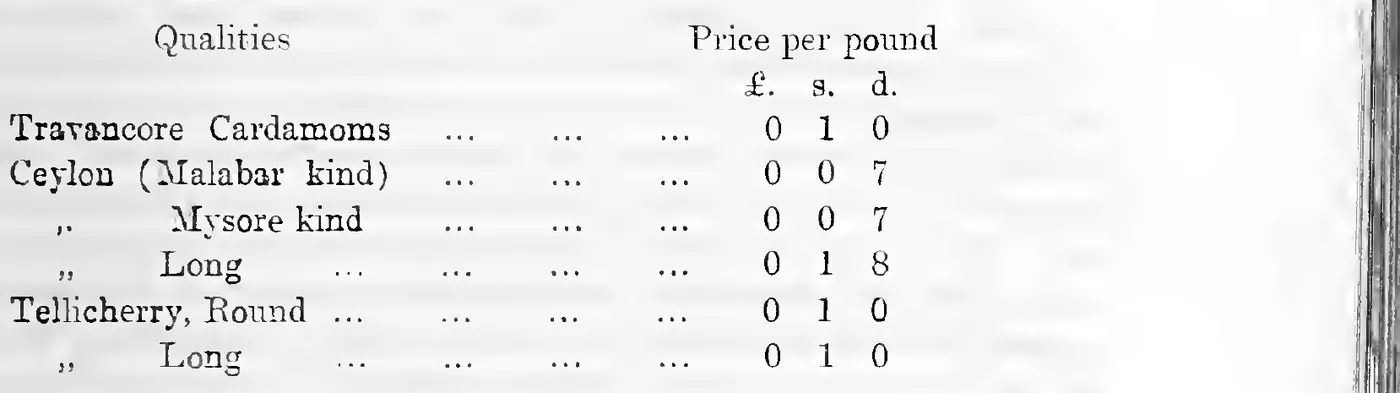
In appendices A. and B. the price realised at Alleppey sales for the different grades is given from 1072 to 1079 M. E., and the average price obtained by the ryots in Pandy from 1072 to 1079.
Pruning. This is a matter of importance and one which, strange to say, the ryots do not apparently understand. They have a theory that as soon as a stem has borne fruit it should be cut down, and they usually cut it off within a foot of the ground. Not living on the hills they do not have the opportunity of closely observing the results of their work. In Ceylon where the operation of all works is very closely studied, Planters assert that no stem should be cut off till it dies as the same raceme bears a second year, that no succulent stalk should be cut off even though partially damaged by wind or some animal, for the bulb being alive should [96]continue to bear fruit, but that dead stalks should be pulled out by hand, otherwise they rot and the rotting is apt to extend to the healthy portions of the roots and to other bulbs. When a portion of the stool begins to show signs of decay, they advocate pulling out the dying stalk, clearing out all decayed leaves and rubbish and throwing earth over the spot, which stimulates the growth of the remaining bulbs.
Manuring. Nothing is done in this way. The Singhalese consider paddy husk to be an excellent manure for cardamoms. Probably forking the earth round the stools would be very beneficial.
Enemies. The cardamom ryot has a good many enemies to contend against. First and foremost are the herds of wild elephants that are frequently found in the gardens; they do considerable damage trampling down and playfully uprooting the plants: fortunately they do not feed on the leaves. Bisons do occasional damage by eating the leaves and pulling up the bulbs in new clearings that are clean weeded. Herds of wild pigs do some damage in rooting about the bulbs; but fortunately do not eat them. Pigs have increased enormously of late years. Twenty-five years ago or so they were very plentiful, when swine fever or some such disease practically exterminated them.
Rats, squirrels, monkeys, porcupines, snakes, frogs and some birds eat the seeds, being partial to the sweet pulp that surround the ripe seed. In some dry seasons caterpillars eat the soft part of the cardamom leaves over large areas, leaving only the ribs and stalk untouched. They are irregular in their appearance, for in some seasons there are practically none. The native ryots do not trouble themselves about this pest, maintaining that they do no harm; but it stands to reason that the strain on the plant must be very severe and all the strength which should in the course of nature go to forming racemes, flower and fruit must be diverted to form new leaves. European ryots look upon these caterpillars as a serious evil and put on coolies to collect them. European and native ryots agree that they do no permanent damage.
The cardamom leaves are eaten to a serious extent by three varieties of caterpillars; one is of a pinky flesh colour 1¼″ to 3″ long with long thin hairs on the body and a brown hairless head. These feed during the night and during the day retreat to and are found near the ground amidst the thick stems. This is not identified.
A small green caterpillar does a lot of harm which is not clearly identified, as also a caterpillar covered with a flat tuft of black hair and also longer hairs, which is very common; this turns into a moth called Pangora Erosa.
[97]A small blue butterfly called Lampides Elpis according to Messrs. Marshall and Nice Ville's work on "Butterflies of India and Burma," feed on the fruit. The caterpillar is about half an inch long, slug shaped, of a dull green colour tinged with red on the back and with three narrow red streaks on the back. I am indebted to Mr. C. Holman Hunt for the names of these pests.
Wages. The ryots have to pay their coolies high wages. Men receive five annas a day, women four, children two and three and 10 per-cent. head money if a Kangany is employed to recruit them. They generally give their coolies a little tobacco also. The wages are equal to those paid by tea planters.
In weeding cardamom gardens coolies run some risk of snake bites; the most common is a green viper with a diamond shaped head and dark diamond markings down the back: its bite is not fatal.
Leeches are a source of great annoyance being very plentiful in the wet weather; the coolies protect themselves with a supply of tobacco, salt and water, which they smear on their legs from time to time.
Several kinds of nettles grow luxuriantly in the gardens; one called Chenthotty, in appearance is not unlike the common English nettle; it even stings through one's trousers, the irritation passes off in an hour or so: one however is most formidable. The Hill-men call it Aneyparutty and say the elephants avoid forests where it is plentiful: it grows to a big shrub of 12 to 15 feet high with drooping branches and large handsome glossy leaves and pendant flowers something like a poppoy; the sting of this often causes four or five days' fever and it is said in some cases, swelling of the part stung and even partial paralysis. Personally I have not seen such serious results; of its potent powers the writer is fully aware having very vivid recollection of having some years ago hastily gone to pick up a squirrel he had shot, and touched a leaf of this nettle; the pain was severe and remained for ten days or a fortnight; washing in cold water always brought on a return of the irritation.
Estimates. The following is the approximate cost to the native ryot of opening an acre of land:—

[98]European ryots do much better work and incur expenses which the native ryots avoid, such as supervision, roads, lines, bungalows and stores. An estimate of the cost is given, but it must be remembered that much will depend on the size of the garden and the ideas of the owner as regards buildings, other things being equal; a large garden can be worked cheaper than a small one.
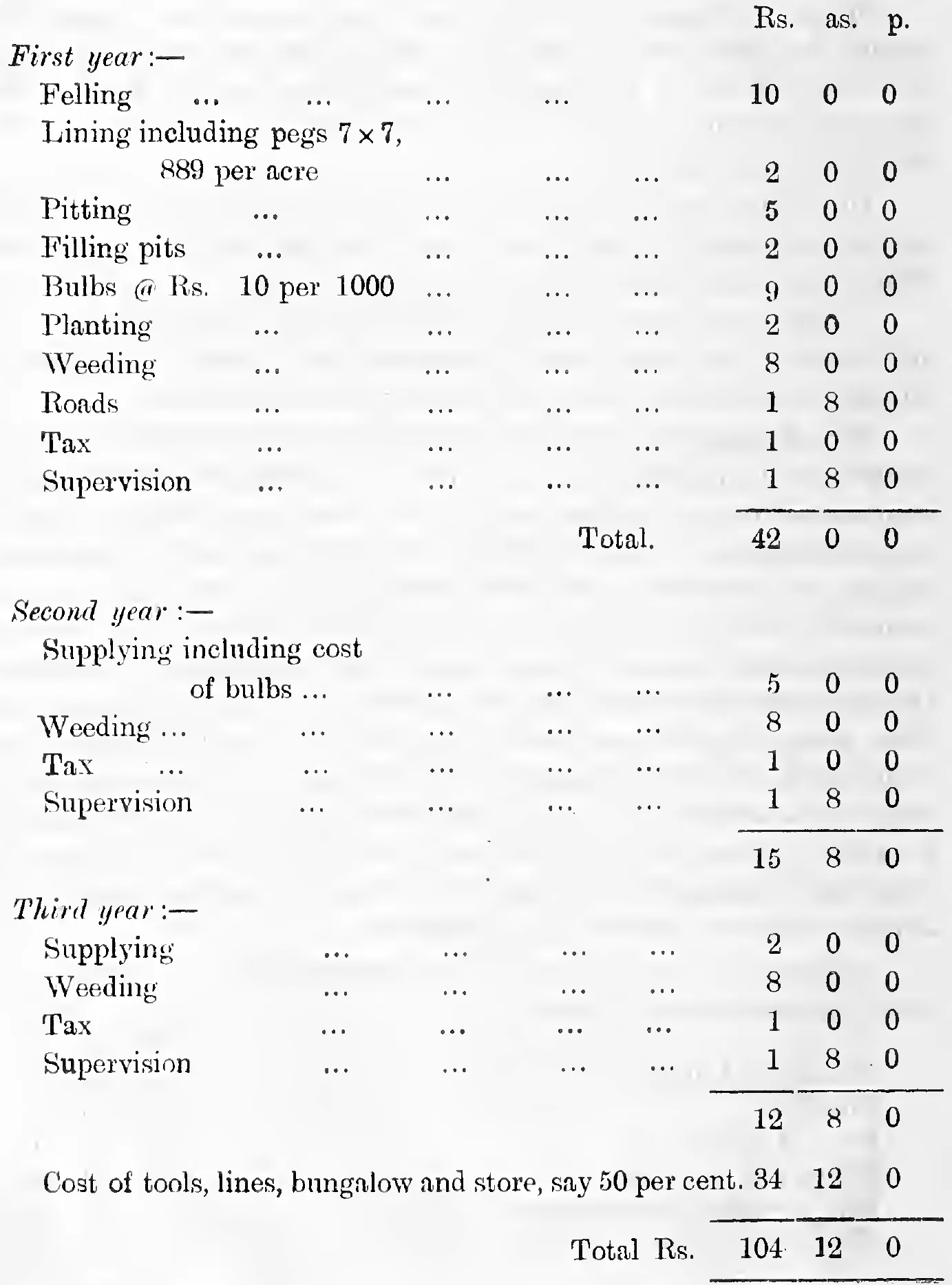
[99]
Appendix A.
Price of Cardamoms sold at Alleppey from 1072 to 1079 M. E.
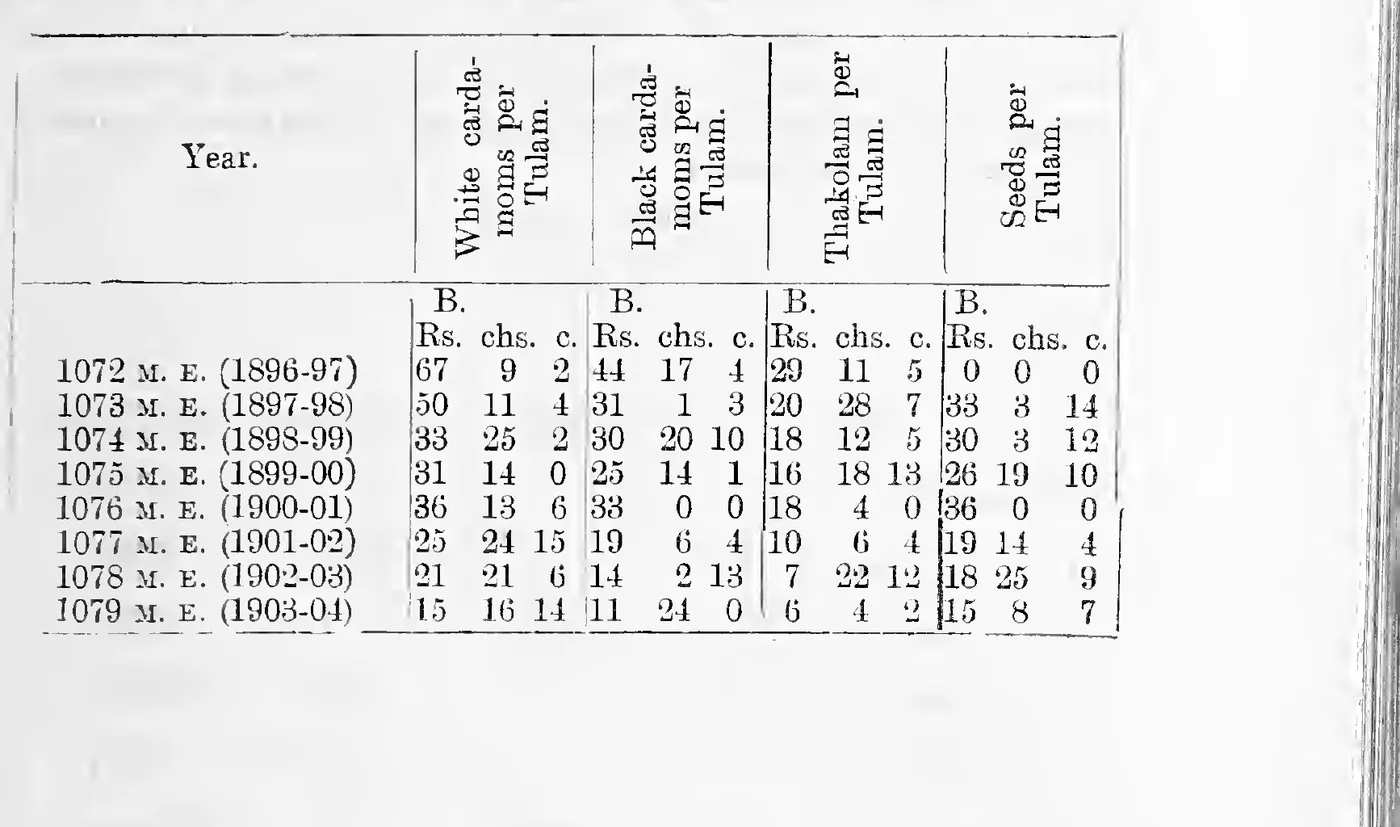
Appendix B.
Average price of Cardamoms in Pandy (including seeds) from 1072 M. E. to 1079 M. E.
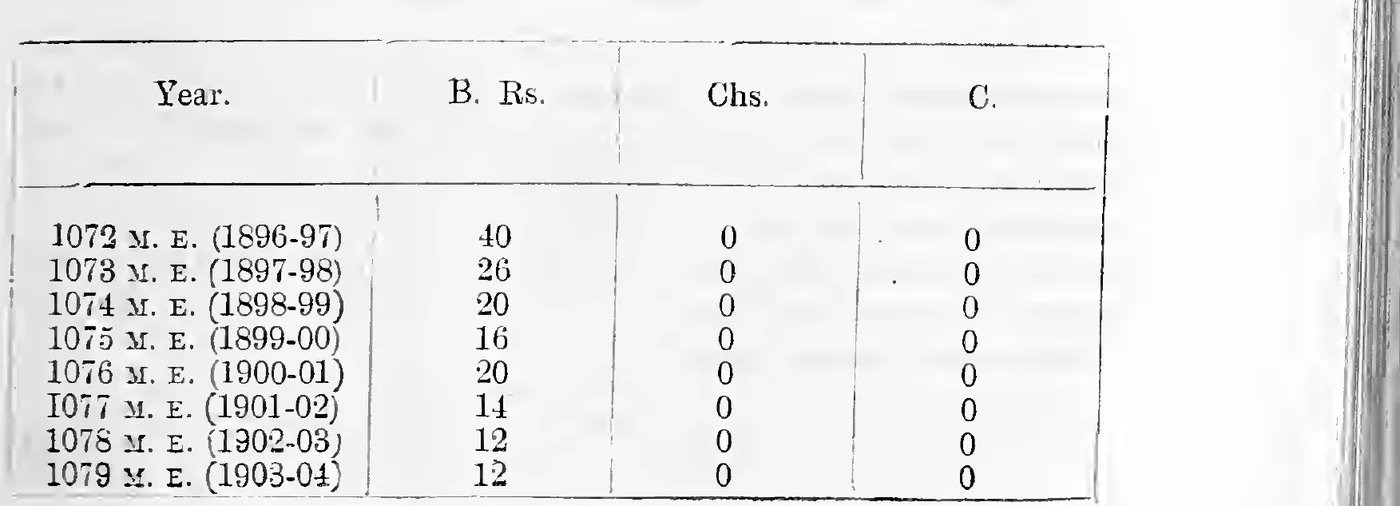
[100]Travancore Irrigation. The most considerable area of land that exists in Travancore for the successful cultivation of rice is in the Southern Division comprising the tracts locally known as Nanjanad and Edanad. The Taluqs of Tovala and Agastisvaram form Nanjanad which is an essentially agricultural district and may well be said to be the granary of the whole State. Mr. Horsley, late Executive Engineer of the State, in his "Report on the Supply of Water in South Travancore," calculated the total area of wet land there to be 34,694 acres distributed among the five Taluqs as under:—
Area in acres.*
Table I.
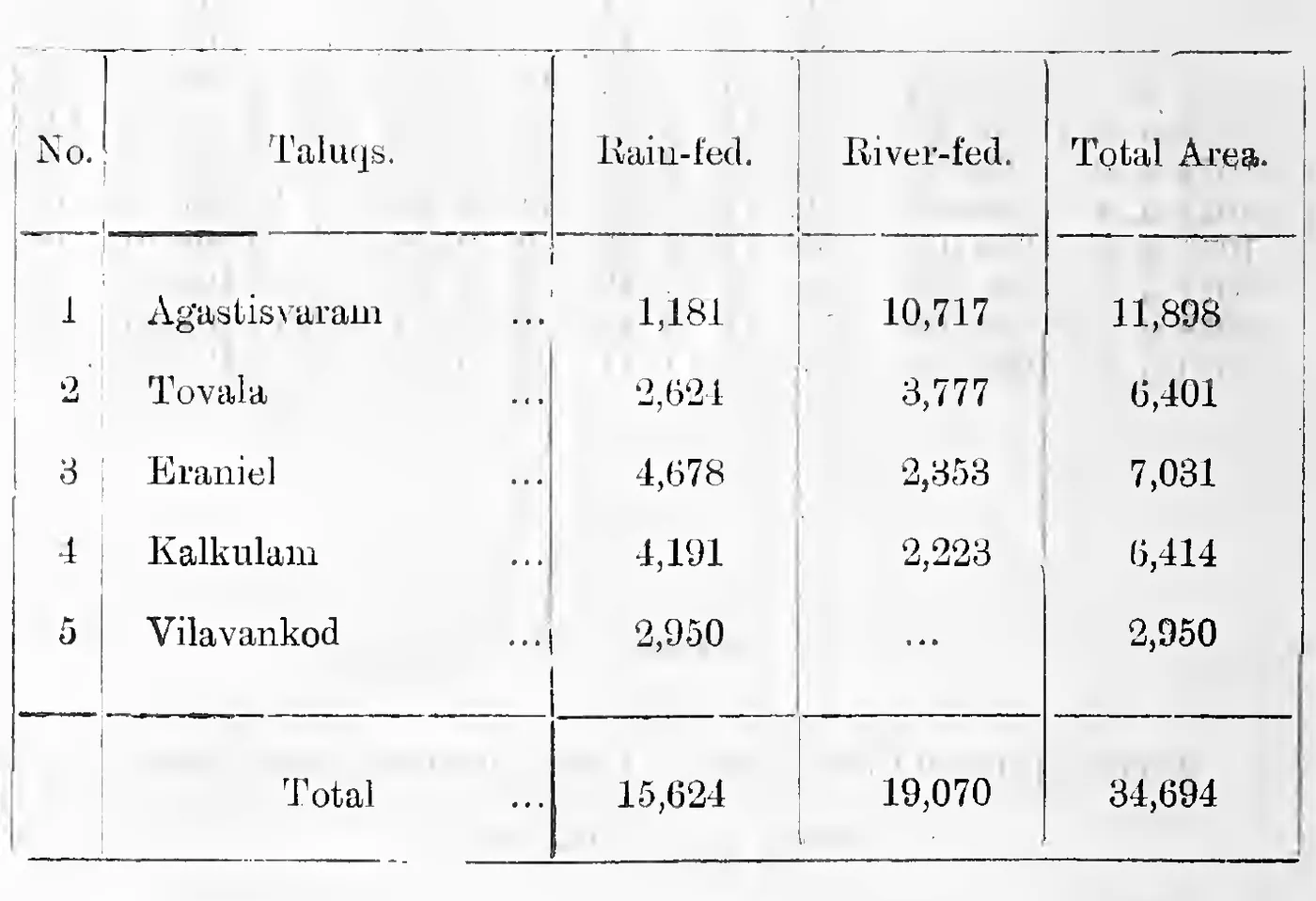
Agastisvaram and Tovala are thus the chief river-fed Taluqs and their wet cultivation is mostly dependent upon channels and channel-fed tanks, while that of the other three Taluqs is chiefly dependent on rain-fed tanks. The tanks, though numerous are in most cases mere Oornis containing water just enough for cultivating a few acres of land dependent on them, a state of things due to the irregular configuration of the ground rendering it impossible to make large tanks such as are seen in the flat districts of the Madras Presidency.
* The above figures though compiled from the best available accounts are yet liable to change with the completion of the Revenue Settlement. In the first two Taluqs where the Settlement work has been completed the area of wet land has shown an increase being 13258·62 and 10844·65 acres respectively. One Kotta = 5/6 of an acre.
[101]The following table taken from Mr. Horsley's account of Travancore irrigation and the opening of the Pandian Canal Head Works gives the number of tanks rain-fed and channel-fed for each Taluq and the area of wet land covered by them in each tank.
Table II.
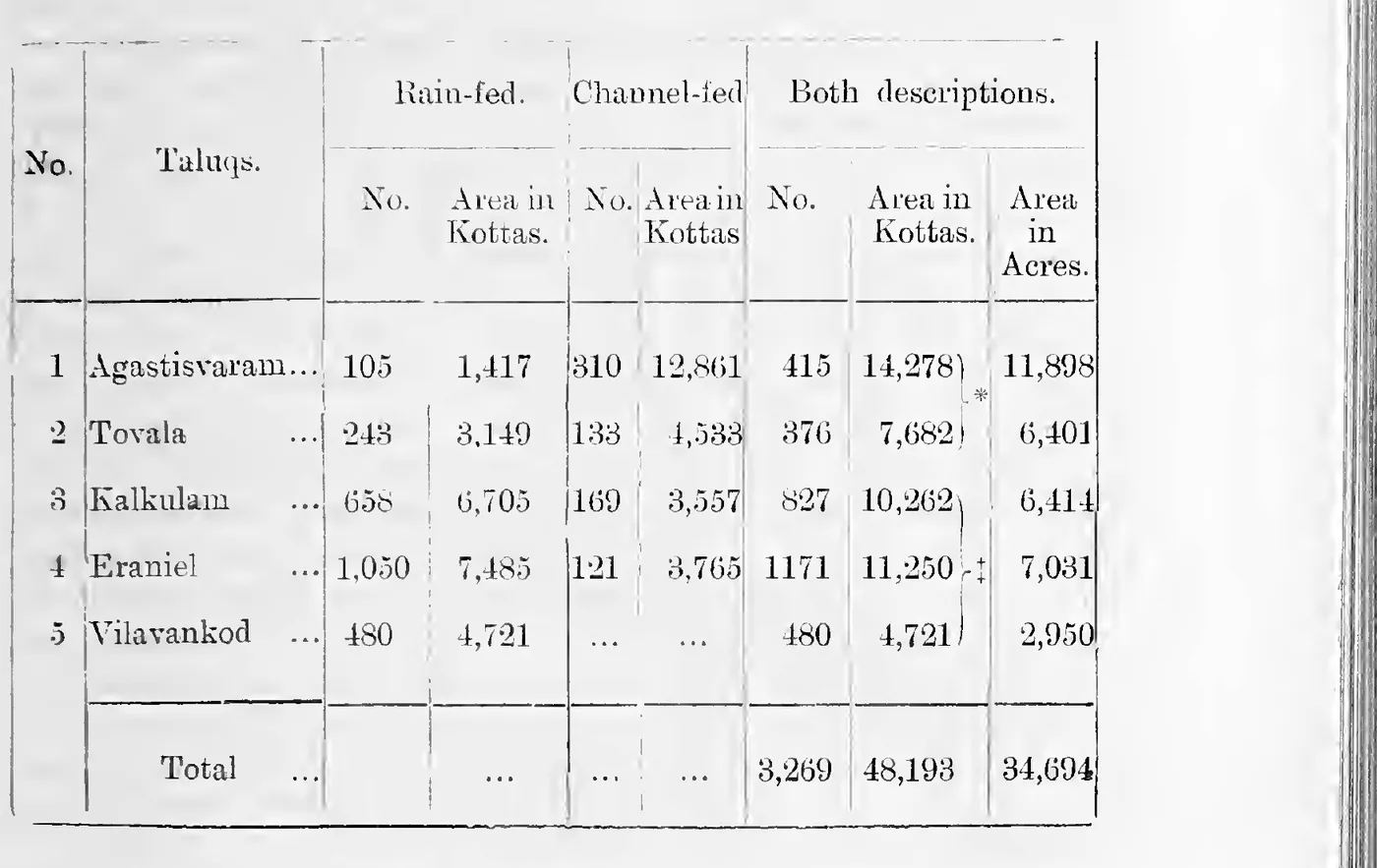
History of Irrigation Works in the South. There are three rivers flowing through South Travancore, viz., the Paralayar, the Kothayar and the Pazhayar. Much of the fertility of Nanjanad is due to the labours of the ancient engineers of the Pandyan ruler, who, about a thousand years ago, constructed a dam upwards of twenty feet in height, built of massive squared stones across the Paralayar, and cut a channel chiefly through solid rock for a distance of about two miles through the saddle forming the extreme western watershed of the Pazhayar. But for this ancient anicut and channel, a mighty work of genius and invention, Nanjanad would not have been what it is—one large paddy flat of smiling green dotted with numerous towns and villages: it would have been a famished district with a poor water supply dependent on a rainfall of 4 square miles of low land. [102]By the construction of the channel it now shares a proportion of water due to an additional catchment area of 50 square miles. The Pandyan Kal as the channel is called, pours its waters into the Pazhayar, whence it is distributed by eleven anicuts in a length of about 20 miles to eight principal channels, besides minor ones of a total length of about 64 miles. The success of the Pandyan dam induced a following generation to construct another dam about a quarter of a mile lower down the same stream, and this was designed to do for the Eraniel and Kalkulam Taluqs what the other one had done for the Nanjanad Taluqs. This dam, called the Puthen dam, is 270 feet long and founded on solid rock at a depth of from 6 to 30 feet below the crest. It raises the water of the Paralayar to a height of more than 20 feet from the bed of the river and is the means whereby the Kalkulam Taluq is supplied with river water. It is believed to have been built about 1750 A. D. A channel was also constructed in connection with the dam called the Padmanabhapuram Puthenaur, running for a length of 19 miles and giving evidence of the most wonderful perseverance and skill, for it is taken through saddles involving rock cuttings to the depth of from 30 to 50 feet and over a valley on an embankment at a point 40 feet high The boldness of its construction after facing and vanquishing almost superhuman difficulties and that at a period when scientific engineering and European appliances were perfectly unknown, elicits the admiration of modern engineers. Mr. Horsley, the Engineer of the Pandyan Canal Head Works and one of the ablest that the local D. P. W. even knew, in his address on the occasion of the opening ceremony of the work modestly observed:—
‡ One Kotta = 5/8 of an acre.
"In other countries, and in India also, an Engineer generally works on his own lines in developing any large scheme of irrigation, and naturally credits his own skill and perseverance with the success of his undertaking. Here, however, I have no hesitation in saying that it has been an unmixed pleasure to me from a professional point of view, to merely follow the lines of the original constructors of the Pandian Caul and Pulpanabapoorum Poothenaur, because the evidence of their skill and almost superhuman perseverance was so marked; and I have, in carrying out the works, felt contented and fully satisfied to follow in the footsteps of those whom I cannot but consider to have been masters in their art and facile princeps in irrigation engineering."
The example set by the constructors of the ancient works noted above and the fact that in course of time the demands for water far exceeded the supply naturally directed attention to the possibility of a similar scheme in the neighbouring river, the Kothayar. The Kothayar is further a more valuable source than the Paralayar for irrigation purposes, its catchment area above Pechipara being said to be about 90 square miles, [103]while that of the Paralayar above the Pandyan dam is only 60, its catchment basin being supplied with a fair fall of rain throughout the year unlike that of the other. The first attempt for utilising the Kothayar seems to have been made early in the last century. There is nothing on record on the subject, but the remains of a masonry dam, Kakachel, and several miles of channel now overgrown with jungle, prove the fact that the abortive scheme which, it is said, was designed to feed lands on the right bank of the Kothayar, as well as to feed the Southern Districts by diverting the water into the Paralayar, probably failed from a want of proper investigation and perseverance. The scheme was again investigated between the years 1837 and 1850 by General Cullen and Captain Horsley, R. E., and for two or three years the preliminaries connected with it were vigorously prosecuted; but shortly after, the matter seems to have been dropped again. In 1869 the Dewan, Sir T. Madava Row, K. C. S. I., wrote a memorandum on the subject of the insufficient state of the irrigation in South Travancore, which, while advocating attention to be given to irrigation matters generally, summed up by directing that attention should be given to the Kothayar scheme and to the possibility of constructing a large reservoir there which should in some measure make up for the admitted deficiency of the tanks. He wrote:—
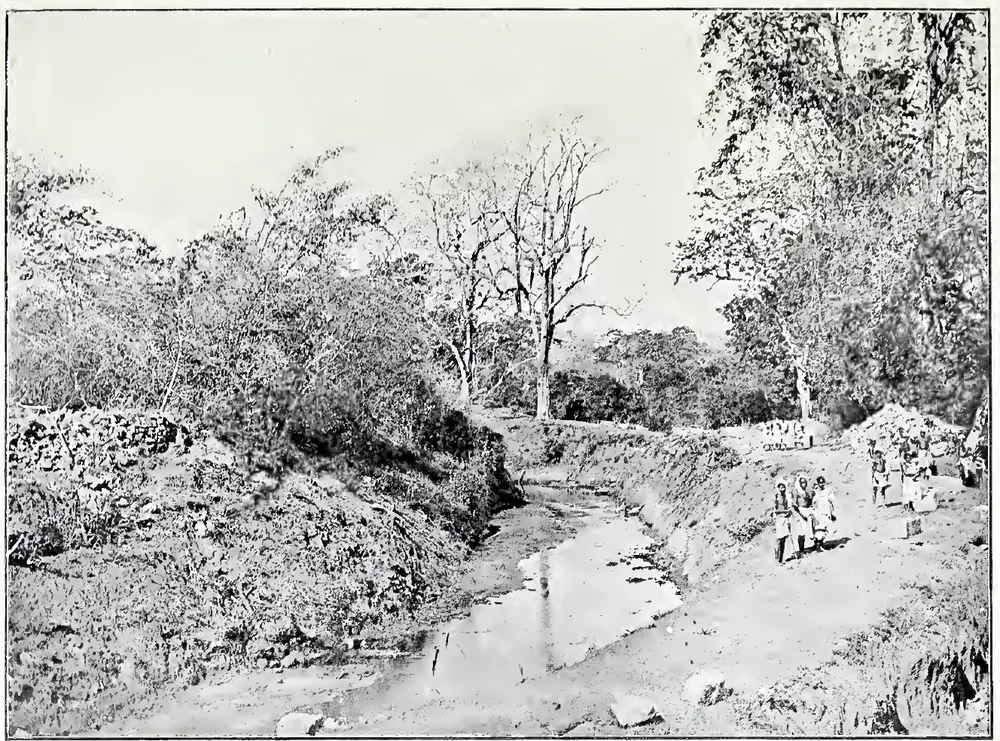
"To sum up the, then Chief Engineer should be called upon to give his opinion as to the feasibility of transferring water from the Codayaur to the Paralayaur, to tell us if the leakages in the anicuts across the Paralayaur can be stopped at a moderate outlay, to make arrangements in view to measure the quantity of flood water that runs to waste over the anicuts or to the sea, to consider and report generally on the means of storing up such water in the jungles, and particularly to prosecute his investigation in regard to the Parinjany reservoir and to consider whether the annual repair of the distributing channels may not with advantage be transferred to the Revenue Department under the orders of the Division Peishcar."
As a result of the above memorandum complete plans were made of the localities thereabouts for the reservoir, but nothing further was done, the scheme having been virtually abandoned in Dewan Sashiah Sastri's time.
The question of improvement of the irrigation works was again taken up in 1877 by Dewan Nanoo Pillay, who, in December of that year, announced to the Chief Engineer that "His Highness' Government would wish irrigation works in the south to be vigorously prosecuted, so as to prevent failure of crops resulting from the effects of frequently recurring droughts, alike injurious to the interests of the people as well as of the Government and to increase the grain production of the country." He [104]laid special stress on one important work which he wished to see undertaken first, viz., "the construction of a canal from the Codayaur, which is a fruitful source of water-supply, to irrigate the vast tracts of land in parts of Culcolum, Eraneel and Velavencode taluqs, which scarcely receive at present the benefit of irrigation, and which are far away from the existing irrigation channels." A scheme was accordingly prepared for diverting the Kothayar into the Paralayar by means of a dam 40 ft-high and a channel 12¼ miles long, at an estimated cost of 4¾ lakhs of rupees. This is the first practical step taken for utilising the waters of the Kothayar for irrigation purposes, though the estimate was obviously far too low. Mr. Jacob, the successor of Mr. Barton as Chief Engineer, who prepared the scheme observed:—
"The necessity of repairing the tanks and channels is now fully appreciated by Government, but it is still necessary, in my opinion, to increase the storage area. It was with the object of giving further and sure supply to the Nanjenad that the construction of the Perinjany reservoir was proposed. Such a scheme is, I think, premature till existing tanks and channels are put in order; the necessity or otherwise of the project will then be apparent."
One would naturally infer from the above extract that Mr. Jacob did not think highly of the Perinjany reservoir scheme or of any other reservoir scheme. But such was not Mr. Jacob's meaning. His report on the other hand advocated the undertaking of the Kothayar scheme, and the Government seems to have concurred. It was, however, deemed advisable, having regard to the nature of the project, to have it thoroughly investigated and reported upon by a competent hydraulic engineer.
In July 1881 Dewan Ramiengar made an official tour through the southern taluqs of Travancore in the course of which he minutely inspected the irrigation works in Nanjanad. He found that the Pandyan dam which is the key to the irrigation system of Nanjanad was leaking badly; that the channel taken from it, i. e., the Pandyan Kal was small and narrow; that the Puthen dam likewise was letting out a good deal of water into the river by leakage and that the channels were winding and tortuous in their course with no head works, no regular banks, and overhung with thick vegetation on both sides with the flow of water frequently impeded by the irregular bed of the stream, by silt, by fallen trees, &c. The Padmanabhapuram Puthenaur which is twenty miles long and has nearly Rs. 30,000 of revenue dependent upon it, was in a particularly unsatisfactory condition. The attention of the Chief Engineer was at once drawn to this state of things, and he was requested to take the most active and speedy steps to bring about an improvement. Government proposed four [105]works as being immediately necessary, viz.,
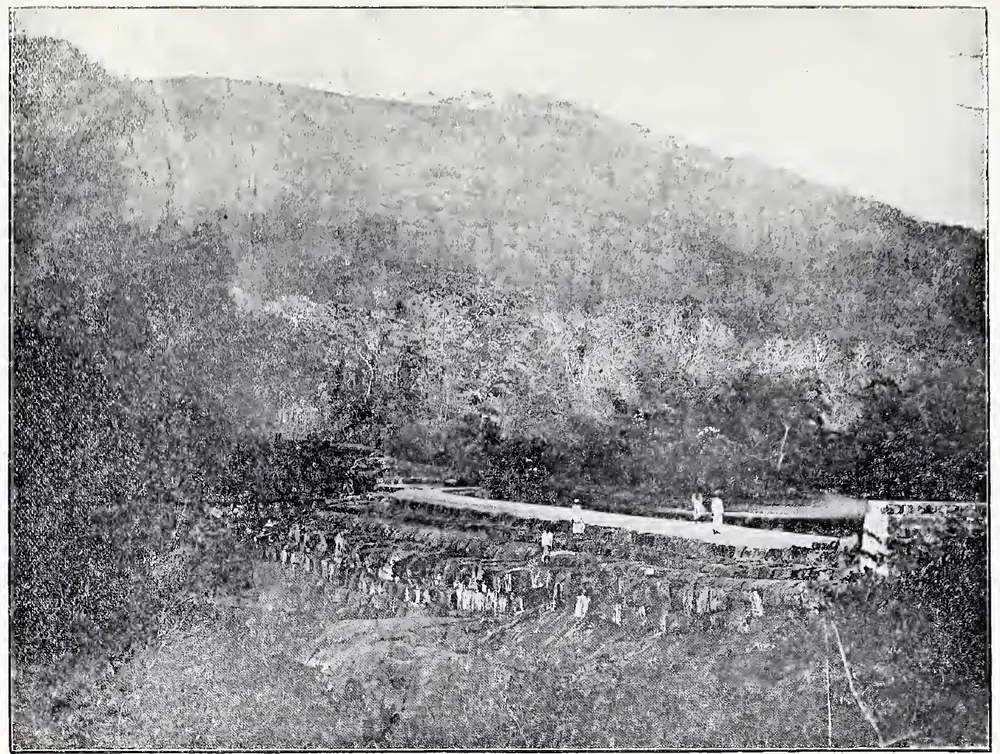
- (1) Stopping the leakage in the Pandyan and Puthen dams,
- (2) widening and improving the Pandyan Kal,
- (3) complete restoration of the Padmanabhapuram Puthenaur, and
- (4) cutting a new channel from the Kothayar at Triparappu for irrigating parts of the Vilavankod Taluq.
Mr. Horsley, the then Assistant Engineer in charge of the Southern Division and an exceptionally able officer, was at once relieved of his charge of roads and buildings in that Division and deputed exclusively to the Irrigation Branch of the Public works. He was sent out in December of the same year, 1881, to inspect the irrigation works in the Cauvery, Krishna and Godavery deltas that he might acquire a knowledge of the most important irrigation systems in Southern India. The necessary plans and estimates for the works contemplated were prepared and submitted to Government in January 1882, but before sanctioning them, Government wished to strengthen themselves with expert opinion of some eminent Hydraulic Engineer, who should report on the schemes already before Government, viz., (1) Mr. Barton's scheme for making a reservoir above the Pandyan Dam sufficient to contain two or three weeks' supply for the whole of Nanjanad, which, as we have seen already, Mr. Jacob, his successor, considered premature; (2) Mr. Jacob's scheme for bringing the waters of the Kothayar into the Paralayar and (3) the one proposed to be taken up immediately for making improvements in the existing dams and channels; he was also to be consulted on the irrigation system of South Travancore generally. Application was accordingly made to the Madras Government who thereupon placed the services of Major Mead, R. E., of their P. W. Department at the disposal of the former. This officer arrived in Travancore in February 1882, and after having examined the plans and estimates submitted by Mr. Horsley, seen the channels and dams to be improved on that scheme, and inspected the sites of the Kothayar and Perinjany schemes already referred to, submitted a detailed report on the various matters referred to him. The conclusions arrived at by Colonel Mead as the result of his investigation were briefly these:—In dealing with the general question of irrigation in the south, he observed, "there is little doubt but that the rivers, channels and tanks have not to any extent been improved, and I think it may be generally stated that the irrigation in South Travancore is in a very similar state to what it was a hundred years ago; probably in some places it has improved, in others it has deteriorated."
[106]The Perinjany scheme on which upwards of Rs. 70,000 had already been spent for mere preliminary investigations, he condemned altogether on the ground that the project was based on insufficient information and would prove a failure. Regarding the other special project, which had for its object the utilisation of the waters of the Kothayar, he considered that it was "a most serious undertaking, and one that should not be entered on without the most careful enquiry and consideration," and recommended that the work should be deferred for some years until the quantity of water available in the Kothayar could be definitely ascertained by means of gauges which he suggested should be put up at certain points. Of the four works proposed by Government he approved of the first three with certain modifications and urged that they should be put in hand at once. And on the general question of the practicability of the extension of river irrigation in Travancore he thought that until something was known of the amount of water available in the rivers by means of gauges, nothing should be done and most certainly nothing should be attempted until the question as to what should be done with the Kothayar water was settled.
The opinion of the special officer having been thus clearly given, Government at once gave orders for the vigorous prosecution of the works recommended, that is, improvement of the Pandyan Canal, improvement of the Padmanabhapuram Puthenaur, stopping the leakage in the Poothen Dam and the construction of head works for the two main channels; and work was accordingly begun that same year (1882) as soon as the cultivating season was over. Steps were also taken in the meantime towards the very necessary and important work of attending to the irrigation tanks. The Huzur Marahmut Sheristadar (Secretary, Public Works Department) was appointed Assistant Engineer in charge of the repair of all the tanks in the Southern Taluqs and with the distribution and the magisterial duties connected therewith. Hitherto the execution of tank repairs was entrusted partly to the Public Works Department and partly to a separate agency subordinate to the Division Peishcar, and the divided responsibility led to great neglect of the works. The object of Government in bringing all the works under one control was to ensure close and sustained attention to those numerous reservoirs that form so important a part of the irrigation system of the South and on which a large portion of the revenues of the State and the resources and well-being of the agricultural population depend. But this arrangement was changed in 1068 M. E. (1892—93 A. D.) when in consideration of the important agricultural interests involved and the resources commanded [107]by the Peishcar as the Chief Revenue Officer of the Division the latter officer was again entrusted with the distribution.
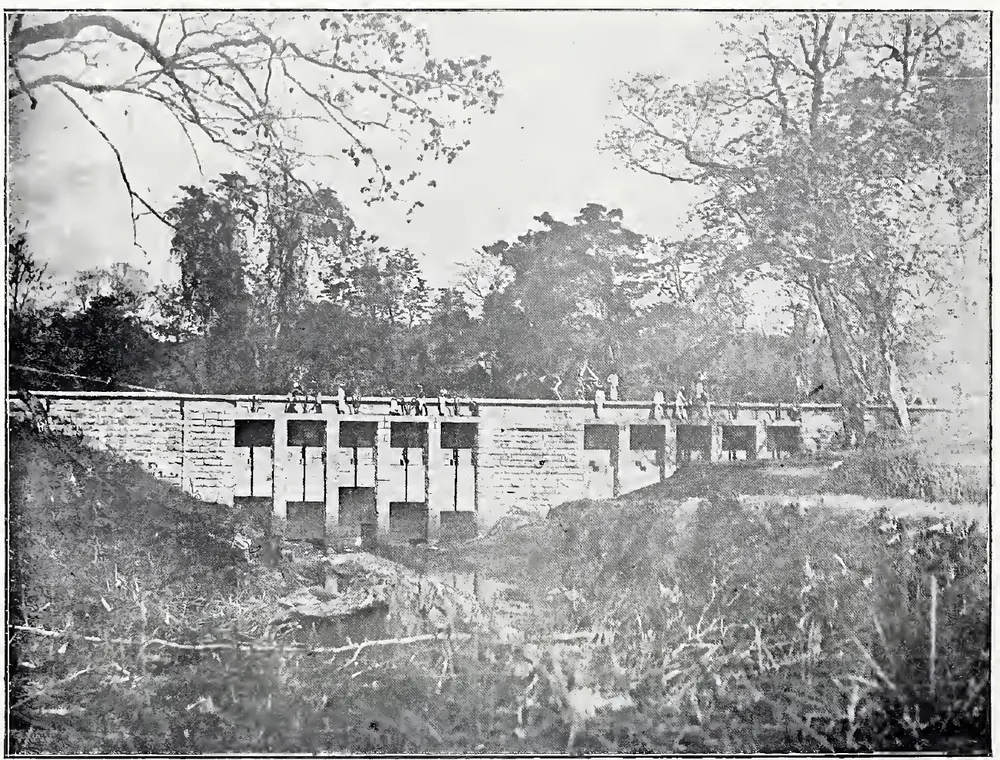
All the improvement works were completed about the beginning of 1885, and His Highness who had already evinced the greatest personal interest in their progress by visiting them in 1883, formally opened the works on the 5th March 1885. A brief description of the works may not be out of place here:—
(1) The Pandyan Kal. As already referred to, this ancient channel runs through a saddle of solid rock where its width was only about 12 feet, the width above and below being twice as great. It had now been cleared out, deepened to a uniform fall of 3½ feet per mile, widened to 26 feet at the bed level, its stops cleared of trees and vegetation and generally thoroughly restored so that it is now capable of holding thrice as much water as formerly. The cost of the work was Rs. 37,340
(2) The Padmanabhapuram Puthenaur. This old channel which excels in boldness of design the Pandyan Kal has now been thoroughly improved from end to end. It has had its level adjusted and its width made uniformly 15 ft. throughout and is capable of holding three times as much water as it could have done before. The original estimate for this work was Rs. 160,114, but the limit was far exceeded and the actual cost came to more than two lakhs of rupees. It became a very expensive undertaking owing to the large number of masonry works that had to be constructed.
(3) The Puthen Dam. Years of decay and neglect had the effect of washing out a great proportion of the hearting, and the dam was consequently leaking very badly, thus annually throwing off a good deal of precious water. Its efficiency had now been thoroughly restored by building a strong and water-tight face wall and by filling in the holes in the interior of the dam at a cost of Rs. 12,975.
(4) The Head Works. These consist of 5 vents each 6′ 4″ wide, and 5′ high for the Pandyan Kal and 3 vents of the same width and height for the Puthenaur, the two channels being separated by a division wall, and are built to a height that would admit of a depth of 10′ water flowing over the crest of the Puthen Dam. This is a most important part of the scheme as it enables the Department to control the depth of water in the channels so that in a flood no more than the safe depth of water may be admitted into the channels, and thus avoid the breaches that used to be of constant occurrence in the old irrigation system with so much loss to cultivation.
[108]The Kothayar Project. In spite of the improvements already effected in regard to the irrigation system of South Travancore, the precariousness of water supply still remained a palpable evil in the Nanjanad and in parts of Kalkulam and Eraniel. Owing to the defective means of storage large quantities of flood waters found their way uselessly to the sea, while the cultivation, especially of the Kumbham crop, cruelly suffered at times on account of deficient water supply. About 1892 Government took up the question again as to how best to prevent this wastage and secure a uniform supply of water to the above districts. A definite proposal was put before them by Mr. Horsley as Acting Chief Engineer to provide adequate storage by means of reservoirs at the foot of the hills. It provided at a cost of about nineteen lakhs for the construction of a number of reservoirs in the Nanjanad basin for supplementing the supply and for pumping the water of the Maycode Lake by machinery into the Padmanabhapuram Puthenaur channel for supplementing the Edanad supply. Dewan Shungrasoobyer, however, had convinced himself that the Kothayar presented very favourable facilities for a storage of water and with a view to take immediate action, instructed Mr. Walch, the Chief Engineer, to review Mr. Horsley's scheme and advise the Government. Mr. Walch reported entirely in favour of the Kothayar scheme, and the Government thereupon called for the necessary plans and estimates which were completed by Mr. Jacob, and work was actually started in 1895. It was this officer who had strongly advocated the project for several years past. The works comprised in the project were the construction of a masonry dam across the Kothayar near Pachipara, about six miles above Triparappu, of a channel eleven miles long leading from the Kothayar to the Paralayar above the Puthen Dam and the necessary head works. The dam was intended to be 72½ [?] feet high from the bed of the river to the crest and was so designed that it might be raised another 10 feet whenever found necessary, and was to form a reservoir with about four square miles of water-spread. The scheme thus indicated was calculated to supplement the water supply to 23,000 acres of existing channel-fed wet cultivation in Nanjanad and Edanad, and to irrigate about 15,000 acres of additional land. The estimated cost was Rs. 794,850.
It was found that after the works were started the site originally selected for the dam and its alignment were unsuitable for the purpose, and a fresh site was recommended by Chief Engineer Mr. Jopp, the successor of Mr. Jacob. It was also found on investigation that a very much larger area than 15,000 acres could be commanded by the project. He accordingly submitted a revised estimate for a larger scheme, [109]estimated to cost Rs. 2,805,450 and deemed sufficient to supplement the water supply to 23,000 acres of existing cultivation and to command an additional area of 55,000 acres. The leading engineering features of the revised project were thus described by himself in his Memorandum on the Kothayar Irrigation Project, 1899:—
"The river will be crossed by a masonry dam about 115 feet high at its highest point in the bed of river, and 1525 feet in length along its crest. This will form a reservoir covering an area of about 7 square miles. To permit operations in the deep bed of the river at the dam site it is necessary to make some arrangement for diverting the water. At a suitable spot, about a quarter of a mile up the river above the main dam site, a masonry dam 35 feet high is designed to be built, to divert the river along a channel on the left bank, down to a point below the main dam site. On each flank of the main dam, head-sluices are to be constructed, to regulate the supply of water to the channels. They will be capable of drawing off water to a depth of 45 feet below the full supply level in the reservoir and it is calculated that 4,480 millions of cubic feet of water will thus be impounded, and be available for passing down the channels.
"The channel taking off on the left flank will tail into the Paralyaur just above the Puthen Dam on its right bank; the water will flow across to the left bank, and will there enter the existing offtake to the Palpanabhapuram Puthenaur and Pandian channels and thence will proceed to the Edanad and Nanjinad. A new channel will branch off from the Palpanabhapuram Puthenaur at 5¼ miles and proceed via Travancore (Tiruvancode) into the Eraniel Taluq. Another small branch will take off at 16¾ miles.
"In the Nanjinad, extensions of the Anandanaur and the Parakkai are contemplated, as also an entirely new high level channel taking off from the Pandian channel at one mile 3180 ft. and proceeding towards Tovala as far as Variyoor.
'The channel taking off on the right flank will find its way to Parachalai in the Neyyattinkara Taluq and by means of distributaries irrigate lands in the Vilavankod and Neyyattinkara Taluqs."
The above estimate was sanctioned in January 1900. This too was subsequently found to be inadequate, and a further revised estimate was submitted by the late Chief Engineer Mr. C. A. Smith, amounting to nearly 70 lakhs of rupees for the whole project. He attributed this large excess over the first revised estimate "almost entirely to the very low rates allowed in that estimate and also to the requirements of the Project having been insufficiently investigated." Further investigations having shown the desirability of taking up the Tovala Channel first in preference to the Right Bank Channel, work in the latter was stopped and the revised estimate for the remaining items which came to nearly 54 lakhs was sanctioned in February 1904. The work is now in progress according to this revised estimate. The Right Bank Channel itself had to be subsequently abandoned on account of its prohibitive cost, although three miles of it had already been excavated at a cost of about Rs. 128,000. On the whole the Kothayar scheme has, as prophesied by Major Mead, R. E., more [110]than twenty years ago, turned out to be "a most serious undertaking;" and all the enquiries and investigations hitherto made seem to have been not satisfactory. It is not necessary to refer here to the loss of money and time incurred by commencing half investigated projects and abandoning them soon after.
Such in brief is the history of the Kothayar Project, its various vicissitudes of fortune since the idea was started almost a century ago and progress achieved so far. It is expected that the whole project works will be completed by the close of 1906, and if successfully completed the needs of South Travancore in the matter of irrigation will be fully and satisfactorily met. According to the latest calculation, the scheme will add to the supply of water to 25,550 acres of wet lands already under river irrigation and ensure a regular supply to 8,120 acres under rain-fed lands and 15,887 acres of uncultivated Poramboke and other dry lands, or in all, benefit about 50,000 acres. The amount spent on the Project up to the end of 1079 M. E. (1904) was more than thirty and a half lakhs of rupees. The Project forms the chief item of the amount annually budgeted for the Public Works Department.
Existing irrigation.* Channels in South Travancore. From table I, already given it will be seen that in Nanjanad, the river-fed area of wet cultivation is exactly four times the rain-fed one. Nearly the whole of this river-fed wet cultivation is fed by channels branching out direct from anicuts in the Pazhayar which is the chief supply channel. There are 14 such channels‡ all depending on the Pandyan Kal and capable of irrigating a total area of more than 15,000 acres. Agastisvaram contains only a very small extent of rain-fed land, and this is chiefly to be found on the eastern side of the Ghats. In Tovala on the other hand nearly one-third of the total area under cultivation is rain-fed, and the bulk of this irrigation lies on the left bank of the Pazhayar between anicuts (2) and (5), the whole of the paddy lands being purely dependent on local rainfall, while a small extent is found east of the Nanjanad Puthenaur in the embayment of the hills which culminates in the Aramboly Pass.
In Eraniel and Kalkulam, the river-fed area is only half of the rain-fed one, and this is dependent on the Padmanabhapuram Puthenaur which irrigates more than 3,000 acres and the Vulliyaur a small stream [111]rising in the western slope of the Vellymalais and a tract of the above channel which irrigates the remainder. The rain-fed land is chiefly confined to the valleys formed by the Pannivaikal the supply of which is supplemented by the Mambazhathorayar running in the south-east angle of the Vellymalais, the Vulliyaur, the Pamboory, the Neyyur Vaikal, the Allangy Vaikal and the Puttethy Vaikal. In Kalkulam the rain-fed land, if we except that dependent on the Vulliyaur which strictly speaking is only equal to a rain-fed stream, is not very extensive and is to be found in the valleys of the Thatcheracodaur and the Paruthy and Shencody Vaikals, which both find their way to the Paralayar below the Puthen dam.
* Adapted from Mr. Horsley's Report on the Supply of Water in South Travancore (1888)
‡ 1. Anandanaur. 2. Veerapoly tank. 3. Kuttikal. 4. Payode Kal. 5. Pulincondun Kal. 6. Nanjanad Puthenaur. 7. Arasayaur Kal. 8. Vilavady Kal. 9. Thera Kal. 10. Parakai Kal. 11. Suchindram Kal. 12. Manakudiyan Kal. 13. Pilapathoo Kal. 14. Mission dam.
Vilavankod is entirely dependent on rainfall, and its irrigation is for a very small area being confined to land west of the Kothayar.
Shencottah Irrigation. The only other tract of country in Travancore where artificial irrigation exists to some extent is the Shencottah Taluq, where the area irrigated is nearly 16,000 acres lying in patches and mixed up with British territory. Like South Travancore, irrigation in this part also is mostly carried on by means of tanks maintained by the Revenue Department. A sum of Rs. 15,000 is set apart annually for irrigation works in this Taluq.
North Travancore. North Travancore does not stand in need of any elaborate or costly irrigation works on account of its heavy and unfailing rainfall. Till the year 1062 M. E. (1886-87 A. D.) the expenditure on irrigation works was directed almost exclusively to South Travancore, while in North and Central Travancore the repair and restoration of channels and bunds serving irrigation purposes were left for the most part to the ryots themselves. But this arrangement as might be expected did not work well. Owing chiefly to the want of co-operation among the ryots all such works were neglected, and the damage to cultivation in consequence was very great. With a view to help the ryots, His Highness the Maharajah was pleased in 1062 M. E. (1886-87 A. D.) to sanction an annual grant of Rs. 20,000, subsequently raised to Rs. 30,000 for the Northern and Quilon Divisions and parts of the Trivandrum Division to be expended on irrigation and drainage channels by Division Peishcars in communication with the ryots interested, and to be rateably recovered from them together with the tax after the completion of the works. The rules also provided for a portion of the expenditure not exceeding one-half in each case being borne by the Sirkar, if on special grounds it was found necessary to extend such consideration to the ryots. This arrangement again did not serve the purpose intended: in no year were the funds availed of to any large [112]extent, nor had the expenditure of past years been fully recovered from the ryots concerned. The rules in force are now superseded by the provisions of Regulation III of 1072, which provide for the construction, repair and maintenance of irrigation works and for the conservation and distribution of water for purposes of irrigation. To quote the Administration Report of that year, "This important measure adopted after much deliberation and discussion brings the interests of agriculture throughout the State under a regulated system of even treatment in respect of irrigation with due regard to special local conditions. The scope and effect of its operations are calculated to be of far reaching benefit to the ryots."
Subsequent to 1062 M. E. (1886-87 A. D.) a series of very important original irrigation works had been completed by the Public Works Department, the more important of which were:—
(1) The Puthenvalikaray Reclamation Scheme, consisting of the construction of a pitched embankment and a masonry sluice to keep back the brackish water from entering a large area of valuable paddy cultivation. This was the first of the reclamation schemes carried out in North Travancore.
(2) The Vadavattur Reclamation Scheme. This consisted in the deepening of a rock cutting, originally commenced at a very ancient date, to a level enabling the Vadavattur paddy flats to be more quickly drained than they were till then, ensuring more land being brought under cultivation and the existing land to be cultivated more satisfactorily.
3. The Munampam Reclamation Scheme. This consisted in raising a short but deep bank across the backwater near the Palliport Bar and providing it with pitching to protect it against the strong waves beating on it, and thus securing a large area of shallow backwater against brine.
4. The Kaipuzha Scheme. This was shortly the prevention of the access of brackish water to the very large area of paddy land between Kottayam and Vallianapuzhai or Vaikam by bunding off the principal rivers as they enter the backwaters, diverting them to the present sour land, cleansing and sweetening the soil in the process;" and the construction of a nearly straight canal from Kottayam to Vaikam with a view not only of carrying freshwater into the paddy flats from the Kottayam river, but also to enable boats to proceed to and from Vaikam without encountering the long and at times dangerous journey through the Vembanad Lake.
5. The Kainagiri Embankment Scheme. This consisted in the improvement of the existing embankment and riveting the side exposed [113]to the backwater, so as to act as a preventive to the injury of the fields to the south from the ingress of brackish water from the Vembanad Lake.
6. The Parur Reclamation Scheme. This was another expensive one consisting of the construction of a pitched embankment about a mile in length with many sluices from the west entrance of the Parur canal southward and enclosing thereby a large area of land fit for paddy cultivation and preventing the salt water entering. The estimated cost was Rs. 89,246, but in actual construction the amount far exceeded the estimate. The bund was completed long ago, but after an expenditure of nearly Rs. 105,000, it was found that the scheme, the object of which was to keep out the salt water for purposes of cultivation, was found impracticable. It was resolved to have a regular survey of the whole area occupied and unoccupied comprised within the bund, on the completion of which the lands were subjected to the new settlement by a special agency appointed for the purpose. The scheme has since been allowed to lie over, further expenditure on the work being restricted to what is absolutely needed for maintenance.
(7) The restoration of the Kallada river banks in the Quilon Division was another important scheme commenced in 1065 M. E. (1889-90) and completed about 1069 M. E. (1893-94) at a cost of more than Rs. 22,000.
These reclamation works were calculated to be of immense benefit to the ryots rendering large tracts of land fit for cultivation and others secure against floods or salt water. But opinions are divided both among ryots and professional officers as to the utility of these schemes carried out at an enormous expenditure of labour and public funds.
[114]
Chapter XIVEconomic Condition.
"In their prosperity will be our strength, in their contentment our security, and in their gratitude our best reward."
Queen Victoria's Proclamation to Her Indian Subjects (1858).
"It is the Indian poor, the Indian peasant, the patient, humble, silent millions, the 80 per cent. who subsist by agriculture, who know very little of policies but who profit or suffer by their results, and whom men's eyes, even the eyes of their own countrymen too often forget-to whom I refer. He has been in the background of every policy for which I have been responsible, of every surplus of which I have assisted in the disposition. We see him not in the splendour and opulence nor even in the squalor of great cities. He reads no newspapers for as a rule he cannot read at all; he has no politics. But he is the bone and sinew of the country; by the sweat of his brow the soil is tilled; from his labour comes one-fourth of the national income; he should be the first and the final object of every Viceroy's regard."
Lord Curzon at the Byculla Club.
Peasant proprietors. The Travancore ryot is like his brother in other parts of India an intelligent, industrious, loyal and law-abiding peasant-proprietor but nevertheless by no means an affluent subject of the State. He still lives from hand to mouth, is burdened with a growing family and the never ending cares that go with it of domestic and social obligations, all entailing worry, expense and loss of time. He is besides a weak son of the soil, eating less, working less and therefore earning less than his compeer in British India. Nature however is kind to him, rains are regular and abundant and the earth yields a fair return for the light labour bestowed upon it. His wants are few; the rice conjee is his chief diet, and for the rest, esculent roots, with which the country abounds, supply the deficient sustenance; his clothing is scanty; jewels are nearly unknown; house-building is cheap as the ancestral Tarawad garden supplies the materials for the same; and the climate is mild and equable all through the year. Droughts and famines are very rare. Life and property are secure under His Highness' beneficent rule and trade restrictions are minimized. The Travancore products are much in demand in the markets of the world. The land-tax is light as compared with other countries. But litigation is plentiful and the Marumakkathayam law of inheritance is said to stifle the natural instinct for the acquisition of wealth. Be that as it may, all things considered the struggle for existence is neither severe nor keen. Hence the necessity for strenuous or sustained labour is non-existent, and the profits which he makes are much less than might have been.
[115]Two land-proclamations. All classes and castes of people from the proud Brahmin to the humble Pulaya go to form the ryot population. By the term 'ryot' is here meant one who owns land and pays tax directly to Government. Even in the case of Jenmam-lands, the payment of tax is directly to Government, though a rent locally known as michavaram is paid to the Jenmi; thus the Jenmi's tenants are also Sirkar ryots as well, in Travancore. There is no class of people in the country corresponding to the Polyapats or Zemindars of Tinnevelly or Madura. Time was when those who held lands of Brahmin Jenmis as well as those who held Government lands known as Pandaravagai pattom were merely tenants-at-will, but that tenure was completely changed by the Royal Proclamations of the 21st Vycausy 1040 M. E. (2nd June 1865 A. D.) and the 25th Karkadagom 1042 M. E. (8th August 1867 A. D.) which are therefore looked upon as the Magna Charta of the Travancore ryot. Dewan Sir T. Madava Row who was instrumental in getting these Proclamations issued wrote thus with reference to one of them:—
"The most important measure taken by the Sirkar in regard to land, yet remains to be noticed. It is that, by which a great extent of Sirkar Pauttom property has been enfranchised and put on the same footing as Ryotwary lands in the Madras Presidency ... ... ... This notification has effectually removed the uncertainties of the Pauttom tenure. The ryot in possession of Pauttom lands may hereafter feel that, in effect, he is the landlord. He can regard the lands as his own property; and the wholesome feeling of ownership thus generated is obviously of inestimable value."
Again,
"This description of lands has directly risen in the estimation of the people from the sense of perfect security that has been created. Sales are now freely effected between ryot and ryot. Those made in the course of the year, so far as known to the Sirkar represent the value of about Rs. 4,75,000. And it is a good sign of the increased value conferred on Pauttom lands by the Notification in question, that the litigation about them is increasing."
The other Proclamation which soon followed insured to the agricultural ryot of Travancore fixity of tenure, enjoyment of the products of his own labour and immunity from whimsical evictions thus completing his cup of human happiness and securing to the State that peace and prosperity which could only come of the contentment and gratitude of the agrarian population, tied to their farms and households by indissoluble bonds of affection and congenial and cherished occupations. Those who have read the history of evictions in Ireland in recent times can understand and appreciate the full import of this priceless boon.
In Travancore there has been from time immemorial a class of large landed proprietors called Jenmis, whose lands, as long as they were [116]not alienated, enjoyed an absolute exemption from taxation. But they were largely alienated on what is called Kanapattom tenure under which the tenants were subject to pay an annual rent called michavarom to the landlord. Under such tenure thousands of ryots had been occupying lands for generations, building on them houses and churches and carrying out various improvements as if the tenures were permanent. About 1040 M. E. (1864-65 A. D.) an important question was raised and pressed by the Jenmis whether they had not the right to eject the tenant on repayment of the consideration or Kanom amount received from them ages ago. Although it seemed probable that such a right originally existed or was reserved, yet it appeared as a matter of fact that it had not been practically exercised and that for generations the conduct of the parties on both sides had been such as to generate a belief that the tenant would not be disturbed so long as the stipulated dues were paid to the landlords. Hence it was thought undesirable to refuse to an industrious tenantry the benefit of the prescription that had thus arisen and that any such step would lead to a general unsettlement. This question of vital interest to agricultural prosperity underwent the fullest discussion commensurate with its importance. And singularly able papers were written on the subject by Dewan Sir T. Madava Row, by the First Judge of the Sadr Court, Mr. Sadasivam Pillay, and by the British Residents, Messrs. Fisher and Newill. As a result of these discussions a Royal Proclamation was passed under date the 25th Karkadagom 1042 M. E. (8th August 1867 A. D.) to the effect that tenures coming under the designation of Kanapattom were not redeemable or in other words, the tenant was a perpetual tenant and cannot be ousted and that the Jenmi or landlord was entitled to an annual rent and other fees and in certain cases to fines for renewal.
Sir Madava Row wrote in the Administration Report for that year thus:—
"The pledges thus established calculated as they are to promote fixity of tenure and to protect the Tenant in respect to the improvements made at his cost, must be scrupulously adhered to by successive administrations; and the land-tax continuing to leave, as it now does, a very fair margin of profit to the party or parties interested in agricultural property, the undoubted effect of this policy will be the attainment in time of a degree of prosperity even much higher than that hitherto attained."
This sound policy was thus commended by one of his eminent successors, V. Ramiengar C. S. I.:—
"Whatever may be thought of the theory of the origin and development of the relative rights of jenmis and tenants propounded in my friend Sir Madava Row's paper, there can, I think, be no question as to the soundness of the [117]conclusion at which he arrived, namely, that the arbitrary ejection of kanom tenants at the will of their land-lords was incompatible with the economic progress and improvement of the country. Holding this view, he very properly sought by means of the Proclamation (although I should have preferred a regular legislative enactment) to lay down the policy, I may say, the law which should guide the Courts in their disposal of cases involving the rights of jenmi and tenant, and thus arrest the mischief, which, in the absence of an authoritative declaration of such policy, the conflicting decisions of the established Courts were producing by setting aside prescriptive rights and long possession, and thus unsettling the minds of the agricultural population and jeopardising the best interests of the country. So far, therefore, as the aim of the proclamation is to impart a character of permanency to the tenure under which the kanapattom tenants hold their lands, I think it behoves the Government to adhere firmly to the policy already laid down."*
Ryot's Status. Since this emancipation of the ryot, there has been a keen competition for ownership of land which, always a badge of respectability as in other parts of India, has now become a boon and blessing to the Travancorean. Excepting the Pagodas and the Nambudiris, the bulk of whom are Parasurama's Jenmis, paying no tax to Government for lands in their own hands, which are entirely free-hold lands, all the others such as foreign Brahmins, Kshatriyas, Ambalavasis, Sudras, Chettis, Weavers, Izhavas, Kammalars, Shanars, Mahomedans, Christians, even Pariahs and Pulayas, furnish members to the ryot class in Travancore. The theory of course is that the Sovereign is the landlord of all land, lying outside the Jenmam-properties, but in practice, the ryot is to all intents and purposes the virtual owner having an indefeasible right to it, to use it, alienate it or bequeath it, or do anything with it, as he pleases, with the simple restriction that the Government tax is the first charge upon it.
The possession by every householder of a small bit of land, and the gladsome feeling of ownership it generates added to the fact that there are at least 500,000 tax-paying ryots for this small State impresses the traveller with a sense of general comfort and ease in the agricultural ryot not generally met with in the adjoining tracts of the East Coast. And this also explains the fact why the whole of Travancore looks like one big garden, for the secret lay in what Arthur Young called "the magic of property" which according to him "turns sand into gold."
Ryot's comforts. It is the proud boast of the well-to-do Travancorean that his homestead supplies him with every necessary of life except salt and tobacco. The rice that he eats grows in the valley below at the foot of his ancient residence. The ancestral garden in which his home stands produces the needful cocoanut, which in its manifold uses forms [118]the mainstay of his everyday life. It produces also in abundance the plantain leaves which serve as his eating plates, the useful quantities of edible roots, the jack fruit and the mango which form the solid portion of his daily meal. The open space on which the noon-day sun shines grows the necessary cereals, such as the green peas, the black gram, the Perumpayar and the gingelly. One corner is set apart for the rearing of the vegetables such as the brinjal, varieties of the gourd, the lady's finger and the chillies, all most essential items of his daily curry-stuffs. The arecanut, so indispensable to his perennial chew, drops day after day ripe from the tall areca palms, growing luxuriantly at the fringe of his spacious domain. The cocoanut leaves afford excellent material for a neat thatch every year to his old mansion. This annual renewing of the roof keeps the timber work of the building perennially fresh. Repairs to the mansion itself are undertaken with the timber cut within the estate. For purposes of bathing and drinking he has his own tank and one or two never-failing wells, within the enclosure. This accounts for the health and cleanliness of his family and the proverbial neatness of his surroundings. The agricultural cattle which he maintains can graze in his own grounds and are fed in the nights with the straw cut from his own paddy lands. The cows yield the needful quantities of milk and curd for the household. The ghee is of course eschewed by the true Travancorean, for to him the cocoanut oil is far dearer than the cow's ghee, both in its sweetness and in its flavour. This oil he uses largely in his meals, rubs on his body and burns for his lamp. It seasons his food; its use removes itch, softens the skin, grows the hair, prevents premature grey and as a burning oil, it gives a clear and mild light and perfumes the house. You cannot dissociate the Travancorean from the cocoanut. They are twins. They stand or fall together. The vines which parasitically cling to the bigger trees supply the betel leaf so universally in demand, among men and women, young and old, on this coast: similarly grows the valuable pepper grain, a spice which enters largely into the daily food of the Travancorean and which is so highly prized for its medicinal properties to keep off the ills inevitable to life in this damp climate. Above all, the dried branches and the decayed old trees, which are past bearing, supply the fuel for the household, an important item of domestic economy in which the Travancorean's lot is a real blessing as compared with that of his brother on the other coast. Those who know the hardships of a householder's life owing to paucity of firewood in the East Coast can appreciate the blessing of living in a Travancore garden, full of trees of various kinds, sizes and ages. Thus in all things great and [119]small, the life of the Travancore ryot is laid for him in happy Arcadian lines by an all-merciful Providence, who however has denied to him the strength of physique and sustained capacity for labour, which the denizens of more rigorous climates have inherited or acquired from their surroundings.
* Memo on Jenmis and Kanapattom tenants, in Travancore.
Slavery abolished. Added to these valuable privileges of permanence of tenure and the unrestricted continuity of enjoyment of his holding, was another boon which formed an equally important factor in the prosperity of the agricultural labourer, viz., the abolition of predial slavery which existed in Travancore until 1855 A. D. This boon has been thus described by Dewan T. Madava Row in a later Report:—
"In fact till June 1855, predial slavery existed in Travancore fully recognised by law. The fetters which were put on the aboriginal race when the Aryan penetrated this remote corner of India were broken in that year. The condition of those who thus regained their freedom has since been gradually improving. Their employers can no longer punish them otherwise than they can a freeman. The dungeon, the stocks, the lash have become obsolete. The law extends to them the same protection as to other members of the community. It enjoins that no public officer shall, in execution of any decree or order of Court, or for the enforcement of any demand of rent or revenue, sell, or cause to be sold, any person, or the right to the compulsory labour or services of any person, on the ground that such person is in a state of slavery. That no rights, arising out of an alleged property in the person and services of an individual as a slave shall be enforced by any Civil or Criminal Court or Magistrate within this territory. That no person, who may have acquired property by his own industry, or by the exercise of any art, calling or profession, or by inheritance, assignment, gift or bequest shall be dispossessed of such property, or prevented from taking possession thereof, on the ground that such person or that the person from whom the property may have been derived was a slave. That any act, which would be a penal offence if done to a freeman, shall be equally an offence if done to any person on the pretext of his being in a condition of slavery. These provisions in effect, entirely abolish slavery, and are fully in force. Many of the people for whose benefit they were enacted do indeed continue in the employ of their old masters, but this as a matter of choice and not of compulsion. Compulsion is utterly impossible in these days."
All these circumstances have contributed to make the lot of the peasant proprietor class in Travancore a happy one which, in the words of the Dewan, Sir. T. Madava Row "presents a most pleasing picture of light but diversified labour, health, content and comfort unruffled by anxieties, unembittered by rivalries." The whole description is well worth quoting and though it was written about forty years ago it still holds good in spite of increase of population, pressure for space, less certain seasons and keener competition with superior foreign capitalists.
"The natives of the country fondly cling to the fertile and well watered plains, and pursue agriculture after the manner of their forefathers. Forming [120]the great bulk of rural population, they continue contented and prosperous. The number of these tax-paying ryots may be approximately estimated at three hundred thousand. They are mostly peasant proprietors holding land permanently and on definite terms. They have thus every possible inducement to improve their little possessions, which are the sources of their subsistence. It is accordingly most interesting to enter some of these properties and behold the spectacle there presented of industry, fertility, neatness and comfort. The rice-lands lie in a rich valley watered by perennial streams of crystal purity. Not far, but on the slope of the next hill, the owner resides with his family in a garden of his own, from which he looks cheerfully upon his cherished inheritance. In this garden there is a simple but cool cottage, mostly a timber structure, the material used being, probably, the jack grown in the patrimony itself. The family has occupied this humble mansion for generations, and means to abide there for all time to come. Many useful trees have been fondly reared around, such as the cocoanut, the jack, the areca, the tamarind, the mango, the laurel. To some of these, the green pepper vine parasitically clings. Young trees are planted at intervals, in time to supply the old ones, and are watched with the tenderest solicitude. Where there is a little spare space, there are yams and other edible roots of various kinds and vegetables or some dry grains, carefully grown. The luxuriant plantain, in all possible places, spreads out its broad verdure and thickens the shade of the trees above them. Some heads of cattle are cheaply maintained. The milk of the cows is useful to the family, and the bullocks are used for the plough. The manure is carefully secured for the garden and for the rice-fields close by. Almost every member of the family takes part in the work of making the most of the property for the common benefit. Early in the morning while the trees are yet dripping with the dew, the mamooty is busily plied. In the cool moonlight in the evening, so charming after a brisk but passing shower, perhaps the enclosing wall is strengthened or repaired. Even the females and children have their appropriate and cheerful tasks in congenial privacy. The manure gathered from the stall and the ashes collected from the kitchen are distributed among the various trees. The garden is weeded, and fallen leaves are swept clean into a corner to be fired at leisure. The fibre of the cocoanut is prepared and spun into coir yarn. The fronds of that most cherished of all trees, are plaited and kept by for the annual thatching of the cottage. The harvested grain is occasionally taken out from the ancestral Pathayam (timber granary) and spread out to dry. Spare produce is taken to the neighbouring fair and exchanged for the few things which the property itself cannot supply. In short, the whole presents a most pleasing picture of light but diversified labour, health, content, and comfort unruffled by anxieties, unembittered by rivalries."
The value of what has been achieved for the Travancore peasant will be better appreciated when we compare his lot with that of the English peasant, described by Richard Heath:—
"Thus in the progress of modern civilisation, the English agricultural labourer has been a constant loser. From a condition in which he might hope, by industry and thrift, to become a small farmer, he can now hope for nothing better than to perform like a hireling his day, and then to find a pauper's grave. One privilege after another has gone, until at last he is driven from the land which the toil of many generations of his ancestors has rendered fertile, to burrow with his children in the slums of some outlying village, and thence to trudge with gaunt face and discontented heart to and fro from the scene of labour, no longer sweetened by bygone memories or future hopes."
[121]Rent or revenue. Sir F. A. Nicholson writes in the Coimbatore Manual thus:—
"The land in Coimbatore has always been held to be the property of the State or commonwealth; this property may be handed over for cultivation to the ryot, or withheld, but once handed over is, the ryot's indefeasible property to use, alienate, or bequeath, as he thinks fit, subject only to the payment of the assessment."
In Travancore as already pointed out there was no proprietorship in the land claimed by the Sirkar, except of those lands lying outside the domains of the Nambudiri Jenmis and of the Temples, and these lands fell under what was called the Pandara Vagai Pattom tenure. But by the Proclamation of 1040 M. E. (1864-65) these were enfranchised and became, like Jenmam and other private lands, the property of the Pandara Pattom tenants themselves, who were to look upon them "as private, heritable, saleable and otherwise transferable property" and
"That the aforesaid description of lands, will be resumable by the Sirkar like Jenmom and other private lands, only for purely public purposes, as for instance, for making roads, canals, public buildings, &c. and when resumed for such purposes, compensation will be paid by the Sirkar not for improvements only as heretofore but equal to the full market value of such lands."
From the foregoing it would appear that Travancore recognises no landlord's right over peasant proprietors in the State, that the Sovereign right of taxing the lands was the only one claimed and maintained for ages past. It is usual to speak of the Government in British India as virtually the 'great landlord' and as 'in fact proprietors' of the land; but the better informed opinion seems to be that laid down in the Despatch of the Court of Directors dated 17th December 1856:—
"The right of the Government is not a rent which consists of all the surplus produce, after paying the cost of cultivation and the profits of agricultural stocks, but a land revenue only which ought, if possible, to be so lightly assessed as to leave a surplus or rent to the occupier, whether he, in fact, lets the land to others or retains it in his own hands."
The Madras Government had proposed in accordance with ancient customary usage to fix the land revenue at a certain share viz., 30 per cent. of the gross produce. The Directors pointed out that the proposal to take a proportion of the gross produce was inconsistent with the principle that the right of Government was not even to the whole rent, but only to a share of it. In 1858 again, Lord Stanley the first Secretary of State for India re-affirmed the same principle. He remarked, "I am satisfied that it is quite impossible to ascertain, with any approach to minute accuracy either the gross or the net produce of each field; but I am at the same time convinced that, if either or both of these objects [122]could be accomplished, the right course would be to take a fixed proportion of the net and not of the gross produce."
In Sir Louis Mallet's Minute on Indian Land Revenue, he observed:—
"In a return to the House of Commons in 1857, on Indian Land Tenures, signed by Mr. John S. Mill, I find the following general statement:—'Land throughout India is generally private property, subject to the payment of revenue, the mode and system of assessment differing materially in various parts."
Lord Salisbury in his powerful minute of 26th April 1875 observed:—
"The practical difference between the word rent and revenue is very palpable to the cultivator. Under the rent theory his payments are a portion of his gross produce, limited by the condition of his first paying his wages and profits; under the tax theory they are unlimited either way, save by the power or mercy of the Government. It speaks loudly for the character of British rule that the advocates of the ryot call for the application of the tax theory. Under the Mogul they would have welcomed the rent theory as heartily as they would the tax theory now." "I agree, therefore, with Sir Louis Mallet in desiring that our present nondescript land dues should tend to the form of revenue rather than that of rent."
Mr. H. E. Sullivan, member of the Famine Commision of 1878 wrote:—
"Still more earnestly do I protest against the process of reasoning by which it is sought to uphold the theory put forward by Mr. Wilson that the land revenue of India is of the nature of rent, and is not raised by taxation. Rent is a payment made by the occupier of a property to the owner for the use of the same, and to establish the above possession it must be shown that the ownership of the soil in India vests in the State. It is there (in the Report) stated that the land revenue is therefore with more propriety regarded as a rent paid by a tenant, often a highly favoured tenant, to the paramount owner than as a tax paid by the owner to the State."
Mr Sullivan controverts this theory very strongly thus:—
"This idea of the Government of India being a vast landed proprietor and the occupiers of the soil its tenants, was repeatedly brought forward in the course of our discussions, and, although opposed by me to the best of my ability, has found expression here and elsewhere in the Report. I, therefore, now place on record my reasons for dissenting from a doctrine for which I believe there is no historical foundation, which the action of Government itself goes to disprove and which, if accepted, might lead to most mischievous results.
"That foreign conquerors did by force take such portion as they required may be conceded, but it is inaccurate to say that they were entitled to do so. The claim of the State is distinctly limited by Menu, the oldest authority on the subject. He says, the revenue consists of a share of grain and of all other agricultural produce. * * * * On grain, one-twelfth, one-eighth, one-sixth, according to the soil and the labour necessary to cultivate it. This also may be raised in cases of emergency, even as far as one-fourth. Now here there is not a word which can be twisted to show that the state has any right of ownership in the soil; all that it is entitled to is a certain fixed share of the produce; and on this ancient right, and on this only, our system of [123]land revenue settlement is based, as were those which we found in existence when the country came under our rule. Coming down from Menu to our own times, let us see if the British Government has ever asserted a general right of ownership in the land. When Railways were first commenced in India one of the concessions made by the State was the provision, free of charge to the companies, of the requisite land. If, as represented in the Report, the Government was the 'paramount owner,' and the agricultural community merely its tenants, all that it had to do was to exercise its rights of ownership, give its tenants notice to quit and hand over the land to the Railway Companies. But so unconsious was it of having such rights, that legislation was had recourse to and in 1850, 1857, 1860 and 1870, Acts were passed to enable the Government to acquire land for public purposes, and an elaborate code of procedure was framed to regulate the mode of acquisition and the price to be paid by Government to the owners. And if further evidence be thought necessary to support my view as to the relative positions of the Government and the people of India in regard to the land, I turn to that chapter of our Report which treats of tenures, and ask attention to paragraph 3 page 111 where the position of the ryot in the Madras Presidency is described. His proprietary right in the soil is there fully recognised, and it is explained that he is absolutely free to let, mortgage, sell, devise or otherwise alienate his holding; * * * * * if then the State be not the owner, the people cannot be its tenants, nor can the share of the produce of the land which they contribute towards the public necessity be designated rent. It is, therefore, a tax, and as such must be taken into the account in calculating the incidence of taxation."
The Travancore theory from the very early periods of its history has been in perfect accord with the view taken in the Madras Presidency as explained above viz., that it is the 'revenue', not 'rent', that is raised by the State from the ryot's land. The State is no landlord except in certain cases such as waste-lands and Nayar Viruttis, which are looked upon as the Government's own land and are disposed of to the best advantage.
Famines. Travancore is fortunately free from those terrible droughts and famines which so often devastate the other parts of India, and carry off their victims in myriads. Sir James Caird writes:—
"On returning from the hills to the plains, I had some conversation with the horse proprietor who posts this road. The famine had been very bad in the plain, and there was a constant flow of people up to the hills in the hope of finding something better. But as there was nothing to be got there, it was found necessary to station the police at the head of the Ghat, to turn them back, and hundreds then died in the woods or on the roads. At Metapollium, on the plain, the scenes of want and famine were dreadful, the starving people following the post-horses to pick up, and ravenously devour, any undigested corn dropped by the horses."*
We in this part of India have been spared such frightful visitations. The worst distress that has occurred in Travancore in the nineteenth century was that caused by the drought of 1036 M. E. (1860-61 A. D.) which led to high prices and unavoidable suffering but the Sirkar did [124]everything in its power to mitigate it. Sir T. Madava Row writes in his Budget Report for 1036 M. E., dated 19th March 1861:—
* India—the land and the people—by Sir James Caird, K. C. B., L. L. D., F. R. S.
"The year was of the most unfavourable on record. The periodical rains successively failed, much land in the southern districts was left waste; the crops to a considerable extent failed and in many cases the return when it was obtained, was far below the average. The price of food rose unprecedentedly high and although grain was imported in abundance in consequence of the suspension of the import duty on the part of the British Government and the Travancore Sirkar, great suffering among the lower classes was unavoidable as the price had risen so much as to make the usual supply of food inaccessible to the poorer customers. The land revenue of the State fell by more than two lacs of rupees owing to the large remissions which were imperative."
In the Administration Report of the same year (1036 M. E.) he wrote:—
"There was much distress in consequence of the failure of crops. The price of food rose higher than ever known before and thousands of men, women and children had no resource but charity to look to for bare existence. The Sirkar was not wanting in exertions to mitigate this distress as far as it lay in its power. Food was given gratuitously to the poor in several localities as also cloths, small sums of money and other similar aids. Such as were able-bodied were provided with work on the roads and canals. Private charity too contributed largely to the relief. And it is only right to notice here with every prominence the liberality of England at this juncture. The British Government kindly granted the request of the Sirkar to suspend the duty on the exports of grain and rice to Travancore from British territory and this concession in conjunction with a similar removal of import duty on the part of the Sirkar contributed to the influx into the country of a large quantity of food."
According to the Report of the Indian Famine Commission of 1878, there were 21 famines and scarcities recorded in the last 109 years; in each case on an average one-twelfth of the population of the whole country, that is about 20 millions, was affected. Omitting severe scarcities there have been 17 famines, affecting 20 years and occurring at an average interval of 5 years.
In fact the procedure adopted by the Travancore Government in 1861 A. D. was exactly what has since been recommended by the Famine Commission of 1878. For Sir James Caird writes in his book that the best management of famine by the British Government was that of the Behar famine in 1874. In this famine Government having provided the necessary food for the needy there was no need or desire on the part of the officials to impose with the old severity the tests which in former famines had effectually repelled multitudes from seeking relief. Work was offered to all who chose to accept it and uncooked food or money was given at their houses to the helpless and infirm. As a result of these and other arrangements there were no famine deaths nor the fatal epidemics which accompany and follow emaciated condition nor even that pauperised [125]character which is so commonly anticipated as a consequence of gratuitous relief.
Here is another fearful description of the 1877 Famine in India by Mr. W. S. Lilly:—
"During the first eighty years of the nineteenth century, 18,000,000 of people perished of famine. In one year alone—the year in which Her late Majesty assumed the title of Empress—5,000,000 of the people in Southern India were starved to death. In the District of Bellary, with which I am personally well acquainted, a region twice the size of Wales—one-fourth of the population perished in the famine of 1876-1877. I never shall forget my own famine experiences; how, as I rode out on horseback, morning after morning, I passed crowds of wandering skeletons, and saw human corpses lying by the roadside, unburied, uncared for, and half devoured by dogs and vultures: how, sadder sight still, children 'the joy of the world', as the old Greeks deemed, had become, its ineffable sorrow, and were forsaken by the very women who had borne them wolfish hunger killing even the maternal instinct. * * * Famine relief is organised now—at all events in the territories directly under British rule—in a way undreamt of then. The Government does not now allow its subjects to starve. Yet famine slays its thousands and hundreds of thousands in British India."*
In the matter of feeding the disabled poor, Travancore has always been prompt and considerate and as Sir James Caird remarks in another place, with no injurious effects on the self-reliance of the people.
"In all Indian famines the uniform experience has been that the people at once return to their usual avocations on the arrival of rain, in whatever form relief has been administered. In no instance does it appear that they have been pauperised by gratuitous help in time of famine."
In the great famine of the Madras Presidency in 1876-77, portions of its people moved towards Travancore in search of relief and a slight wave of that famine passed over the State itself; Travancore maintained the famine-stricken for several months, of which the Dewan wrote in the Administration Report for 1052 M. E. (1876-77 A. D.) thus:—
"The excess of expenditure of about Rs. 45,000 is owing entirely to the hospitality extended to 539 Brahmin families and distressed of other classes, who sought refuge in Travancore from the famine in British India, and includes charges of housing, sanitary supervision and medical treatment, feeding and clothing."
In the Administration Report for the next year 1053 M. E. (1877-78 A. D.) a fuller account of the relief operations is given. A relief institution on a large scale was established in the previous year in connection with the Agrasala (charity house for the Brahmins) already existing at the Capital, to feed, clothe and give medical aid to a large concourse of Brahmins who resorted to it impoverished by the effects of the dire [126]famine which prevailed in British India. The institution was maintained for three or four months of the year under review. Relief was administered to a large section of the pauper classes in South Travancore through Missionaries and others who resided in that part of the country. Liberal contributions were made to the medical Mission which does a vast amount of good in South Travancore to enable them to give food and at the same time Medical aid to the poor. Conjeepurahs were opened for the distribution of conjee to the poor at the Capital and out-stations. Arrangements were made for the admission of able-bodied paupers into the works of P. W. and Marahmut Departments. Funds were placed in the hands of the several Dewan Peishcars, the Superintendent of the Cardamom Hills &c. in order to feed and lodge exhausted paupers and to assist such as were willing to return to their country to go to the nearest relief camps in British Indian territory. Arrangements were made for the protection of orphans found on the roads.
* India and its Problems by Mr. W. S. Lilly, I. C. S.
The practice in other Native States seems to be more or less the same, for we read in the Baroda Administration Report for 1902-1903 and 1903-1904:—
"The next item of relief that has engaged the attention of His Highness' Government is the provision of gratuitous relief to the aged, the infirm, and the destitute, who are all thrown upon the bounty of the State with the contraction of private charity and the shrinking of family incomes. Relief by the distribution of village doles, and the housing of the destitute incapables in poor-houses, has been an acknowledged form of help in times of famine. Directly the period of tests and trials is over, the opening of Relief Works has to be largely supplemented by the starting of village doles and poor-houses in towns."
The feeding of the poor has always been recognised a sacred duty by all Hindu governments from of old. Manu speaks of it as one of the important duties of kings. "Though dying with want," he says, "a king must not levy a tax on Srotriyas, and no Srotriya, residing in his kingdom, must perish from hunger. The kingdom of that king, in whose dominion a Srotriya pines with hunger, will even ere long be afflicted by famine."
The Mahabharata says:—
"The Devas and Rishis praise only food (annam) from of old; for on food depend all the concerns of the world and the Vedic sacrifices. Gift equal to that of food there never was nor will there be. He who desires prosperity for himself should give food to great Brahmins and beggars even if his own family affairs are in distress."
Apastambha lays down as incumbent on a householder that "to all those who come for food at the end of the Vaisvadeva he shall give a portion even to dogs and chandalas." If he remembers at any time during dinner that he has refused a guest he shall at once leave off eating and [127]fast on that day." Gautama after prescribing the standard of merit required in those to whom presents of money may be given lays down:—"Prepared food must be given to other beggars." In the Vishnu Smriti it is laid down:—
III. (4) Let the king fix his abode in a district containing open plains fit for cattle and abounding in grain.
(5) And inhabited by many Vaisyas and Sudras.
(17) Let him appoint pious persons for performing acts of piety such as bestowing gifts on the indigent and the like.
(79) He must not suffer any Brahmana in his realm to perish with want.
(80) Nor any other man leading a pious life.
(98) That King who is pleased when his subjects are joyful and grieved when they are in grief will obtain fame in this world and will be raised to a high station in heaven after his death.
Again in LIX (18) it is laid down, "If there is food in the house he must not reject a mendicant, who arrives after he has taken his meal himself." Again Vishnu Smriti (XCII) lays down:—"(21) A giver of food obtains all the rewards enumerated above," (that is, the rewards named for twenty kinds of gifts preceding this one in the list). Again, "what is given to another than a Brahmana produces the same fruit in the world to come." In the Sankhayana Grihya Sutras, it is enjoined:—"When he has made his offerings to Gods, fathers (i. e. manes) and men, let him throw some food on the ground for the dogs, for the dog-butchers and for the birds."
This array of authorities will make it clear that the ancient Hindu lawgivers as well as the Puranic writers, though undoubtedly pro-Brahminic in their views unanimously enjoined on kings and householders the duty of feeding the poor and the distressed in the country, thus anticipating the principle maintained in these enlightened days by the casteless and cosmopolitan Briton, "that Government held itself responsible that no preventable deaths should occur."* In the Manual of Famine administration in the Madras Presidency (1905) it is taken as an axiom that in India, where the mainstay of the people is agriculture, the State is morally bound to do its utmost to avert the loss of human life which would otherwise inevitably ensue if means of subsistence were not afforded to those affected by failure of crops over a large extent of country for two or more seasons in succession.
* Sir J. Caird's India.
[128]"The necessity for State intervention being thus recognised, it remains to define its scope. It should be accepted, as a first principle, that the primary object of such intervention is to save life and that all other considerations are to be subordinated to this end. A secondary but none the less essential object is to keep up the spirits of the people and place them in a position to resume their ordinary pursuits with advantage to themselves and the State on the advent of better times. .. ... ... ... The primary object of State intervention being then to save life, no financial considerations must be allowed to stand in the way." This has been the recognised policy of all Hindu States.
This considerate treatment on the part of Native Governments to the poor of all classes in times of drought or famine must account to a great extent for the prosperity so evident in Native States to a casual visitor of which Sir James Caird writes:—
"Nothing struck me more than the greater liveliness and spirit, and general evidence of active industry in the capitals of native States, compared with towns of equal populations under our rule. The native gentlemen are more independent, the upper class in the British States having become to some extent gradually levelled down, and absorbed in the general community. The people in their cities are undoubtedly more prosperous and happy than ours."
It is a significant remark of Sir J. Caird's within the knowledge of other observers too that
"The upper class in the British States has become to some extent gradually levelled down, and absorbed in the general community."
In fact, the levelling tendency of the present age whether it be in British India or Native States means the pulling down of the high rather than the raising up of the low. Both processes seem to be going on simultaneously everywhere—the first perhaps more speedily as being the easier of the two. It may be that the process of pulling down does not proceed at such rapid pace in the Native States as in British India. One evil effect however of the pulling down process which I have sadly noticed during these many years past, is that the difficulty of administration especially of a polyglot and heterogeneous people like ours has been thereby indefinitely increased. In European countries the evil is more patent, for the pulling down process has taken there an aggressive form gravitating towards a positive intolerance of men of exalted birth or position, which often develops itself into lawlessness, as we find in the throw of the bomb at King Alfonso and President Loubet during His Majesty's visit to Paris last year. The Greek minister M. Delyannis was the victim of a brutal murder, for no other offence than that of attempting to put down [129]'gambling' by law. In a very interesting article in Macmillan's Magazine (May 1905), Mr. Moyana points out the pernicious influences of the West over Japan. He says:—
"Besides the changes in old qualities and ideas, there may be another difficulty in the way of the future development of Japan; a want of harmony between the Government and the nation. Much of the success of Japan has been due to the foresight, energy, and ability of the rulers, and the unquestioning obedience and implicit trust which the Government has received from the mass of the people. ... ... ... Thus in any speculation as to the future position which Japan may occupy among the Powers of the world it would be unwise to ignore the possibility that the new influences at work in Japan may to some extent impair the strong hardihood, simple force of character, the unswerving devotion to country and duty, and the wonderful unity of sentiment that have all contributed to raise Japan to the position she now holds. ... ... ... And as the Japanese adopt the ways of the West, it is hardly likely that they will not adopt some practices that will prove injurious to the preservation of the old simple character."
Mr. D. N. Mukerjee, M. A. Assistant Director of Land Records, Bengal, seems to have noticed the same change in the British Districts. He writes in his brochure on gold and silver work in the Bengal Presidency:—
"The tendency of British Rule is to level down, so that while the lower classes are better off with greater security and an immense development of trade to assist them, the rich luxurious—often the idle—class, the supporters of Art Industries is disappearing save in the Native States. In British territory, the court favourites, male and female, the patrons of the goldsmith and jeweller and of the worker in valuable tissues, are extinct."
Another friend of modern Japan, Mr. Henry Dyer speaking of the influences of foreign countries on Japan writes that the developments of industry and commerce have started forces which are causing many serious problems, not only of an economic but also of a social and moral nature, which will require very careful consideration. Lovers of Japan are somewhat dismayed at the disintegration of taste and ideals which is coming about in consequence of modern competition, and which is having very serious effects not only on the national life but also on internal relations. His satisfaction at the great success which has attended the work of the students of the Imperial College of Engineering has been damped, when he ponders over the problems which lie before Japan, but he finds consolation in the fact that without that work Japan as a separate nationality, would probably have disappeared under the aggression of Foreign Powers.
The moral I draw from this is, that in this age of pressure and keen competition, if a nation does not of its own accord throw off its old ideals and get out of its old grooves and readily merge itself into new influences, new ideas and ideals of life in such a way as to make even its own mother [130]not able to recognise it, that nation will soon be effaced under the pressure of external forces. This is Hobson's choice. The prospect is by no means encouraging.
This should be a warning to all administrators, who are perhaps unconscious advocates of a process of levelling down under a mistaken notion of helping on civilisation and good government. England itself is an instance in point. Its stable equilibrium of conservatism in national progress prevented its tumbling into the vortex of the French Revolution. 'The continuous good sense of the bulk of Englishmen,' says the historian Green, 'their love of order and law, their distaste for violent changes and for abstract theories, as well as their reverence for the past were rousing throughout the country a dislike of the revolutionary changes which were hurrying on across the channel.' This, I believe, is a correct reading of social forces and ought to be our guide.
Rainfall and seasons. It would be a mistake to take all the credit of warding off famines to the careful measures adopted in our past administrations, though undoubtedly there is much in them; the real secret however lay in the regularity and abundance of the Travancore seasons. It is the favoured land of nature. As the Madras Government remarked in their G. O. No. 191 dated Political 6th April 1905 on the results of the Travancore administration for the past year (1079 M. E-1903-04. A. D.), its "record revenue was indicative not of new burdens laid on the people but of the ever increasing prosperity of a favoured territory." In some of the districts of India the rainfall is so scanty and the difficulty of obtaining water is so great that water could not be procured for consolidating the gravel applied to the roads while there are several parts of Travancore so wet in certain seasons within my own knowledge that a few hours' sunshine is prayed for as a boon to secure a consistency to the metal put upon the road; but the rains must make a clean wash of the earth leaving the gravel alone to stand on the road for many days to the great inconvenience of travellers and hardship to animals. Such is the abundance of the rainfall; but where nature is hard-hearted and sterile as it is the case in several parts of India the ryot suffers terribly for no fault of his own though the Government under which he lives is undoubtedly the best he has ever had for centuries past. Notwithstanding the fine pictures of ideal Hindu rulers of prehistoric times recorded in his national literature representing a state of things never again to be recalled, when the population must have been sparse and the land one huge tract of virgin soil covered with dense forest and supplied with abundant rainfall, the rule itself characterised by much sympathy and consideration and one [131]identical in interest and sentiment with the ruled who cheerfully contributed to keep up the king's dignity and pageant as these did not touch their pockets deep, the ryot should remember that those rulers themselves if they had continued must have now been forced to change their inexacting natures. As the population increased and competition for space became keener and Government itself became more scientific and less elastic the ryots receded more and more from the favoured valleys and came to occupy the most inhospitable tracts with an exceedingly light and withal uncertain rainfall not more than 7 inches in some years. This should have certainly reacted on the rulers—a circumstance which the ryot often forgets.
The two monsoons occur here with characteristic regularity, but it is the South-West monsoon that contributes the greater rainfall. It bursts about the third week of May and is at its highest in June and July; it then gradually decreases until it practically disappears in September. The rainfall is generally highest in the hills and gradually diminishes towards the coast, and even along the coast-line it is more copious in the North than in the South. The two Northern Divisions, Kottayam and Quilon, together receive nearly twice as much rain as the two Southern Divisions, Trivandrum and Padmanabhapuram.
The bulk of the paddy cultivation of Travancore takes place during the best part of the South-West monsoon and except for a small tract in South Travancore where systematic irrigation exists to some extent, it is entirely dependent on the falling rains. A failure of that monsoon therefore cripples the yield if it does not entirely destroy the crops altogether. The vagaries of the seasonal rains react on the agricultural outturn and unfavourable seasons are not rare, though they are far from being very common.
Reviewing the rainfall and the agricultural statistics for the last 20 years, it is found that for 12 years* the season was on the whole favourable for agricultural operations, while for the remaining 8 years the rainfall was generally insufficient. The following statement gives the normal rainfall and the average rainfall during the favourable and unfavourable years for 4 of the most important stations in Travancore for the last two [132]decades viz., from 1060 M. E. (Aug. 1884-Aug. 1885) to 1079 M. E. (Aug. 1903-Aug. 1904):—
* It will be seen from the above that the average fall in the favourable period of 12 years compared to the unfavourable period of 8 years is as 3 : 2.
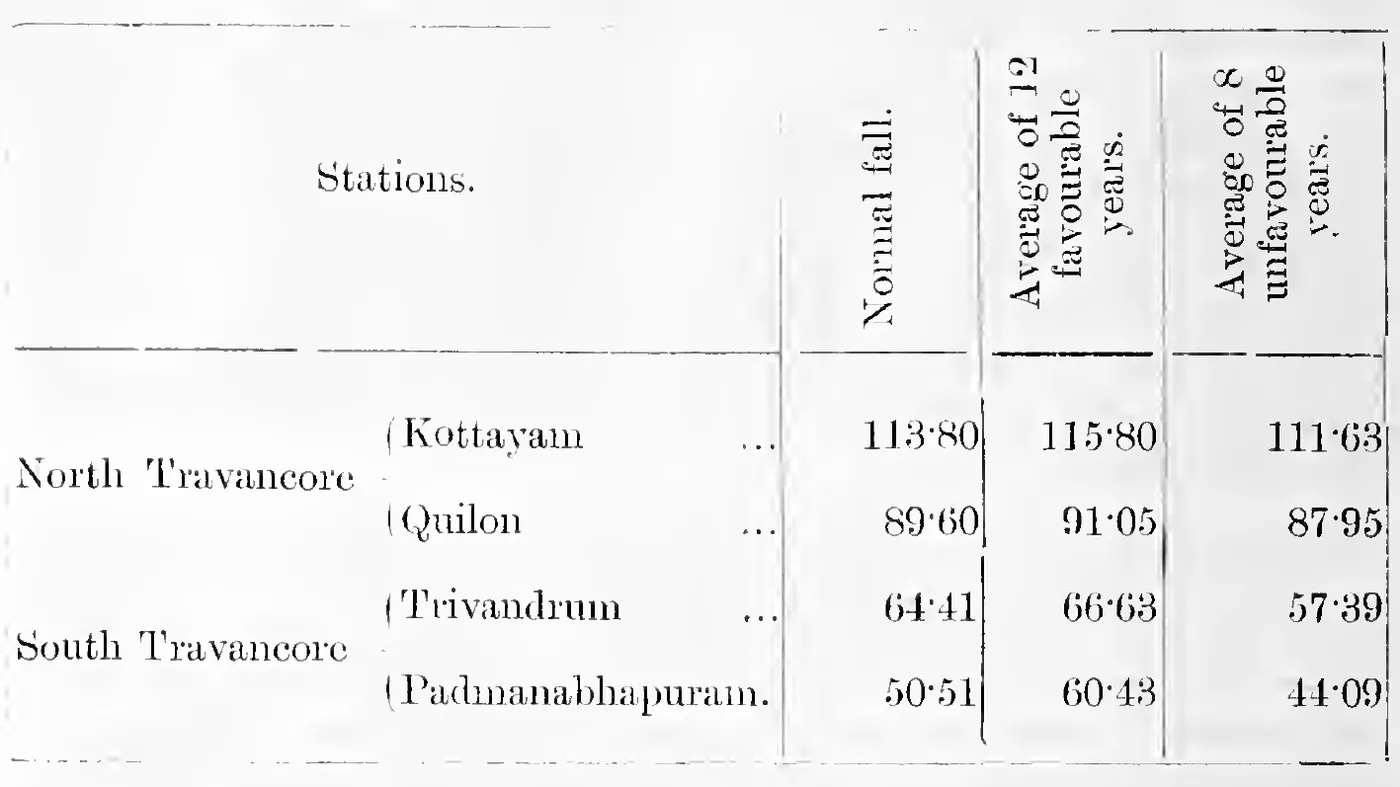
Insufficient rainfall is felt only in the Southern Taluqs, while for North Travancore the worst evil the crops have to face against is superabundance of rain and consequent heavy floods. Thus while in 1071 and 1072 M. E. (1895 and 1896) there were heavy floods in North Travancore which considerably damaged the crops and led to serious distress, the rainfall was insufficient in South Travancore during that period. During the unfavourable years again it was South Travancore that suffered most, while the north was almost free; in fact the rainfall there was "copious" and the harvest plentiful in 1075 M. E. (1899-1900). The scarcity and failure of crops in the south was partial in 1062 (1886-87), 1065 (1889-90), 1069 (1893-94) 1070, (1894-95) and 1075 (1899-1900) and considerable in 1068 (1892-93), necessitating in the last mentioned year large remissions of Government dues. In 1069 (1893-94) even drinking water became scarce, and relief works had to be started there to help the poor to tide over the prevailing distress. Except for 1062 M. E. and 1069 M. E. the prices rose high in all the eight years, and even in those two years they would have risen but for large imports of food grains into the country from outside. It was only in one year that there was a general rise in prices throughout the State and that was in 1066 M. E. (1890-91). It will thus be clear that the south falls within the zone of uncertain rainfall and suffers frequently from deficient water-supply. The vagaries of the seasons affect the south easiest, earliest and most intensely. Though there is a well devised system of irrigation in South Travancore yet actual experience during the last two decades has abundantly shown [133]that much yet remains to be done to ensure to those parts of the country protection against deficient or irregular rainfall. The Kothayar project under execution should if successful go a great way to meet this defect and His Highness' Government are anxious to secure to South Travancore protection against unfavourable seasons which nature so kindly provides to the Northern Taluqs.
Indebtedness. The comparative immunity from famines does not however mean that the Travancore ryot is in a state of affluence. On the contrary every ryot, nine out of ten of them, has always some debt standing against him, owing to a variety of causes. Either a plough-bull died just before cultivation and had to be immediately replaced; or the seed for the last crop had to be bought in the market as the store was consumed owing to special necessities, or the cultivation suffered on account of a costly Talikettu marriage ceremony in his house; or money was required to complete the construction of the ancestral mansion begun by his deceased uncle: or his mother's masom * ceremony had to be gone through in a decent style in order to stand well in the estimation of his orthodox neighbours and friends; or the bund of the Punja cultivation breached at an interesting stage of the paddy growth which if not heroically closed at any cost and trouble, the sustenance of hundreds of families for a year would have been irretrievably lost in half-an-hour, and his immediate co-operation therefore became unavoidable, all circumstances of an uncontrollable nature necessitating a recourse to the money-lender. The green manure required has receded more and more from his fields, as all the available waste lands near have been taken up and reclaimed by enterprising ryots; so the cost of obtaining it is become a heavy annual drain which cannot be met except by an occasional borrowing; or the village officer had sent in his demand-notice for the Sirkar kist at an awkward time when the opportunity for selling the paddy at a favourable rate had not arrived. Thus for one reason or another the ryot is obliged to borrow, a necessity, which even the best of them cannot avoid, justifying the Tamil proverb (உழவனுக்கு உழக்கு மிஞ்சாது) which means, the cultivator when he looks into his accounts will find that he has not a balance of even one-sixteenth of a measure of paddy left to his credit. But it is equally certain that no material portion of the ryot population in Travancore can be said to be in a state of what would be called ruinous indebtedness, nor are there cases of ryots owning land having gone down to the lower order of the agricultural labourers, as seems to be the case in some of the [134]British Districts. † It is however a well recognised fact that there are not many rich ryots in the sense of having a superabundance of wealth and influence as there are merchant princes here and elsewhere among Sindhikars, Komatties and Nattukottai Chetties wielding immense power over States. Agriculture even under the most favourable conditions never raises a man to this high pitch of prosperity nor does it bring him down suddenly to the depths of poverty or bankruptcy as in the case of a merchant prince like Antonio, who, when all his argosies were lost had to appeal to his friend "Sweet Bassanio, my ships have all miscarried, my creditors grow cruel, my estate is very low, my bond to the Jew is forfeit; and since, in paying it, it is impossible I should live, all debts are cleared between you and I, if I might but see you at my death."
* A 'masom' ceremony means the religious ceremonies performed by the heirs at the end of a year after death
One of the tendencies of the age seems to be to prevent concentration of wealth in isolated individuals and help better distribution amongst the community at large. There are not as many big men to be seen owning enormous wealth and commanding supreme influence over their fellowmen as in the olden days, when these shone out as high peaks with abject poverty and squalor surrounding them. Almost every man has now a few rupees to himself. The Hon'ble Mr. Chentsal Row wrote on the subject:—
"You may ask, why is it that, in spite of all the improvements I have mentioned, there is such a cry as that we are becoming poor. I fancy that this is due to three causes. One is, it is a fact that we now fail to see those 'big men' in the country who once existed with enormous wealth and great influence over the people. My grandfather once told me that when he was a Tahsildar, the Collector having on one occasion called upon him to expedite the revenue collections and intimated to him that if he did not remit at least Rs. 50,000 within a week, he would be dismissed, a single ryot paid all the money in advance and received it afterwards from the ryots in his taluq, almost all of whom were dependent on him. Such men of wealth and influence over the ryots do not now exist. This change has taken place, because the lower classes of ryots have slightly recovered from their extreme poverty and dependence upon the bigger men. I myself knew that in some villages of the taluqs of which I was the Tahsildar, there were one or two big men who paid all the taxes of the ryots of those villages and took possession of all the produce raised by them, lending them again small quantities of produce for their subsistence. Now such men have diminished in number, because the ryots are able to pay their own taxes and keep to themselves the little they could save, instead of sending it to the pockets of the rich men. Thus wealth is now more spread than it was, and this change is mistaken by some of us to be a sign of poverty. I do not mean to say that the disappearance of large capitalists is not a misfortune in itself, for I know that Rs. 1000 in the hands of a single individual may often do more good than Rs. 2000 distributed among 1000 persons; but all that I mean to say is that the aggregate wealth of the country has by no means diminished."
† Sir F. A. Nicholson's Manual of Coimbatore District.
[135]There is also another item of help from the Sirkar for which the agricultural population of Travancore is so thankful viz., that the Land Revenue to the State is payable partly in kind and only partly in money and in several small instalments. This acccording to Sir J. Caird is a great blessing, for he writes:—
"The change from payment of rent, or Government assessment, in kind, to payment in cash, is believed by many to have led directly to the almost universal dependence of cultivators on the money-lender. In the former plan, when a bad season came, the assessment declined, as it was a proportion of the crop. That proportion being much lower than is taken by native governments, the advantage of living under British rule could be clearly seen; and by payment in produce there would be no need of the costly system of re-assessment, as, if there was a general rise of price, the Government would obtain its fair share of that advantage on their proportion of the crop."
Mr. W. S. Lilly in his 'India and its Problems' writes in the same strain:—
"Personally, I incline to think that the rigid inflexibility of the land-tax is a greater evil than its weight. Under native rule the Government took a certain share of the gross produce; or rather in most cases, an uncertain share; for whatever the theory as to its amount, in practice as much was usually taken as could be got without breaking the ryot's back. But then, the claim of the Government did not arise till the crop was reaped. Under the present system—I am of course speaking of the districts where there is no permanent settlement—there is a rigid cash assessment on each field, payable before the crop is marketed, nay, possibly while it is still unripe. And to obtain it, the ryot goes off to the village Shylock. No doubt the intention of the British Raj in making this change was excellent. It was the result of a zeal for ordered Government and systematised administration. But unfortunately, the zeal was not according to knowledge."
In the Baroda Administration Report reference is made thus to the instalments of Kist as a very important consideration in times of famine:—
"Another provision is made for their protection in respect of instalments of revenue. The general rule is, that the annual revenue is payable in two or three instalments between January and April, when the crops are harvested; but an exception was made by Dewan Bahadur V. M. Samarath, and sanctioned by His Highness the Maharajah in April 1904, in the case of particular villages or tribes. The district officer was empowered to fix for their convenience a larger number of instalments not exceeding twelve, and falling within one month of each other. This provision came into operation in September 1904."
The Kistbundi in Travancore is very considerately regulated. For paddy lands, the tax of each crop is divided into 4 instalments or 8 instalments in all for the two crops. The tax of the September crop, is payable in the months of September, October, November and December; while that of the February crop is payable in another 4 instalments viz., in the months of February, March, April and May. Thus the paddy tax is paid in 8 instalments covering from September to May.
[136]The whole tax is calculated in paddy though only one-half is actually collected in kind. * The other half is payable in money calculated at a commutation rate. The money portion of the Kist on paddy lands is collected in 4 equal instalments, or two in the months of November and December and the other two in the months of April and May. The tax on garden lands or Parambus, as they are called in the adjacent District of Malabar, is all in money and is collected in 10 equal monthly instalments from Avani to Vycausy i. e., September to June. It is needless to add that this arrangement is a great boon to the agricultural ryots, though as a matter of fact many of them pay up their Sirkar dues in fewer instalments. The payment in kind is also a great convenience to the small holders of land. As soon as the crop is harvested, what is Caesar's due is kept separate in a big basket, to be taken to the Village officer's Cutcherry as soon as the weather permits and the balance is well dried and stored in the house-granary for use. It must be remembered that this system does not involve any of the evils of the Amani system, so full of hardship to the ryot wherever that system has existed. The money portion of the paddy kist is due only in the 3rd and 4th months after the harvesting is done when the market affords a better chance of sale for the ryot's paddy. The ryots of British Districts might well envy the Travancorean's better lot in regard to some of these privileges. Mr. Sreenivasa Raghava Aiyangar wrote that there was considerable hardship felt by the ryots in the way in which the kistbundi was regulated in British Districts and he ardently advocated a reform in it,
"By fixing the time for the payment of instalments of land revenue due to Government in such a manner that the ryots may not be put to the necessity of selling their produce prematurely. The relief afforded to the ryots by the changes made has been considerable; but the scope of the reform had to be restricted in consequence of objections raised by the Government of India on the score of difficulties likely to be felt by the reduction of cash balances at particular periods of the year. It is possible to introduce the change gradually so as to obviate these objections which ought not to be allowed to stand permanently in the way of a much needed reform of this kind. * * The present kistbundi for the Tinnevelly district, consists of four equal instalments beginning in February, and it is obvious that if the produce could be delivered only in the middle of May, three-fourths of the Government assessment is being demanded, even under the altered kistbundi, at a time when the ryot could not sell his crop to advantage. It is true the ryot does not take advances for the delivery of crops solely with a view to raise money to pay the Government assessment; but there can be no doubt, that if the kists were put forward he would be able to make better terms with the merchant than he does at present. In the case of the southern taluqs of Coimbatore where, as in Tinnevelly, cotton is an important article of produce, the kistbundi consists of four equal instalments beginning with January so that almost the entire revenue [137]becomes due before the ryot could sell his produce. A kistbundi fixed with reference to the actual conditions of the several tracts of country in regard to the time at which ryots deliver their produce to middlemen is therefore still a desideratum. The crops grown and the time for harvesting and selling them vary so much in different tracts that considerations of uniformity should not be allowed any great weight in fixing the kistbundi. A properly regulated kistbundi would undoubtedly be a great boon to the ryots."
* In some Taluqs only one-fourth of the whole is payable in kind.
The kistbundi in Travancore is so regulated as to cause the ryot the least inconvenience of the kind described as existing in the British Districts.
We are thus enabled to spare the ryots as well as our officers the pain and trouble inevitable in the working out of an ill-considered and inconvenient Kistbundi, which sometimes leads to a complaint in the newspapers like what the Revd. C. W. Posnett wrote in May 1905 of the Hyderabad officials.
"The armed servants catch hold of them and stand them in the sun with great stones on their bent backs and thus drive them in desperation to pay by all means in their power."
This is an incredible story of the state of things in the premier Native State of India, but it is likely that this is an exaggerated version of some little hardship experienced at the hands of some petty village official in an unknown corner of H. H. the Nizam's wide dominions.
This story was first circulated in the Report of the Hyderabad Wesleyan Mission for 1905 and reproduced in the Madras Mail; but as became an honourable missionary, the Revd. C. W. Posnett, readily came forward again and frankly contradicted his former statement * in the following words:—
"I am glad to say that, contrary to what was there prematurely stated, the Prime Minister of Hyderabad did visit these afflicted districts after being delayed a long time by public business, and he very much relieved the difficulties of the ryots. Under the circumstances, it is not fair to publish this story and I have written denying it to the subscribers to whom the Report was sent. I alone am to blame, and I have apologised to the parties and am doing my best to correct the mistake."
He does not distinctly contradict the portion of the story about great stones being placed on the bent backs of the ryots who were made to stand in the sun, but I have no doubt he meant that too. This however is no wonder to me at all, for knowing as I do the credulousness of these simple folk, the Christian missionaries, working against odds in the midst of low and unscrupulous classes of the native population, particularly in Native States, they are often the unconscious dupes of designing [138]persons to circulate unfounded stories. Speaking of the Nizam's Government, an old Brahmin of 75 years of age who happened to meet me some months ago at a ceremonial here and to whom, I noticed, great respect was being shown by the other assembled Brahmins on account of his age, sanctity and Vedic learning, told me that he had travelled far and wide for about 50 years of his life and that he never met with a more contented and prosperous people than the Brahmins of the Hyderabad State. On being reminded of the fact that H. H. the Nizam was a Mahomedan Ruler and that his statement required further confirmation, the old man smiled and said "I know that the Tanisha is a Mahomedan king but I am telling you what the Brahmins of scores of villages in his dominions have told me about him, that he had given them first class 'Mannibham' villages and that they were happy and prosperous and well cared for under his rule to which fact he could himself testify from their affluent style of living and their hospitalities to strangers like himself." The old Brahmin was an interesting person to talk to; he knew five languages and had travelled several times over 25 Districts of the Madras and Bombay Presidencies. He told me he was also a frequent visitor to the Telugu districts and the Baroda State. He was a Tamil Brahmin of Chola-desam, and a very spry and lively gentleman. At the close of the ceremony when the benedictions were pronounced the old man recited a long and difficult text from the Rigveda which took off his breath and raised the admiration of all the listeners including the present writer himself. It was a feat indeed for so old a man to perform.
* See Madras Mail dated the 10th June 1905.
Registration statistics. Statistics of Registration will to some extent help investigation into the condition of agricultural indebtedness. All the transactions except Danam (gift), endowments, Streedhanam settlements, partitions and other such mean the raising of money for the several needs of life. No man sells or mortgages or otherwise encumbers his property except as a rule to meet unavoidable expenses. It is seldom done for other investments or speculative purposes.
The total area of the State is 7,091 square miles and there are now 51 Registration offices i. e. one office for every 140 square miles; the average for the Madras Presidency being one to every 307 square miles. The number of documents registered in 1079 M. E. (1903-04) was 1,80,361 of which 97·1 per cent. related to immovable property. In the Madras Presidency the proportion of registered documents relating to immovable property has been uniform for the last 10 years viz., 96 per cent. or nearly the same proportion as in Travancore.
[139]The total value of the property concerned in the Registrations amounted to Rs. 39,339,478 in 1079 M. E. (1903-04). Thus the average value of a registered document comes to Rs. 220; the corresponding average value of a document in the Madras Presidency for the year 1903 was Rs. 223 Taking the total of all registered transactions, the rate per head of the population comes to Rs. 12·3 against the Presidency average of Rs. 5·4.
There were in Travancore for 1079 M. E. (1903-04) 24,550 instruments of sale whose aggregate value amounted to Rs. 59,32,197, and the average value of an instrument Rs. 242. Of these, 12,486 instruments were for sale of property valued at less than Rs. 100, of which the average value was Rs. 47 while in the case of sales of property valued at Rs. 100 and above the average value of a deed was Rs. 443. Of mortgages with possession there were 49,826 documents whose aggregate value was Rs. 95,23,228 and the average value of a document, Rs. 191. The mortgage deeds of property for less than Rs. 100 numbered 26,504 whose average value was Rs. 47; while in the case of mortgages with possession for Rs. 100 and above, the average value was Rs. 355. Of mortgages without possession, there were 50,957 documents whose aggregate value amounted to Rs. 1,06,87,733 and the average value Rs. 210; of these simple mortgages, those for less than Rs. 100 numbered 23,506 whose average value was Rs. 61 while the corresponding average value of simple mortgages of Rs. 100 and above was Rs. 337.
The total extent of debts registered in Travancore (mortgages and bonds) in 1079 M. E. (1903-04 A. D.) amounted to Rs. 2,04,42,704 and the total number of mortgage deeds and bonds registered was 1,02,476. The average value of a debt was therefore Rs. 199. The statement appended hereto shows the nature of debts in Travancore as compared with those in the Madras Presidency.
[140]
Statement showing the nature of debts registered in Travancore as compared with those of the Madras Presidency.
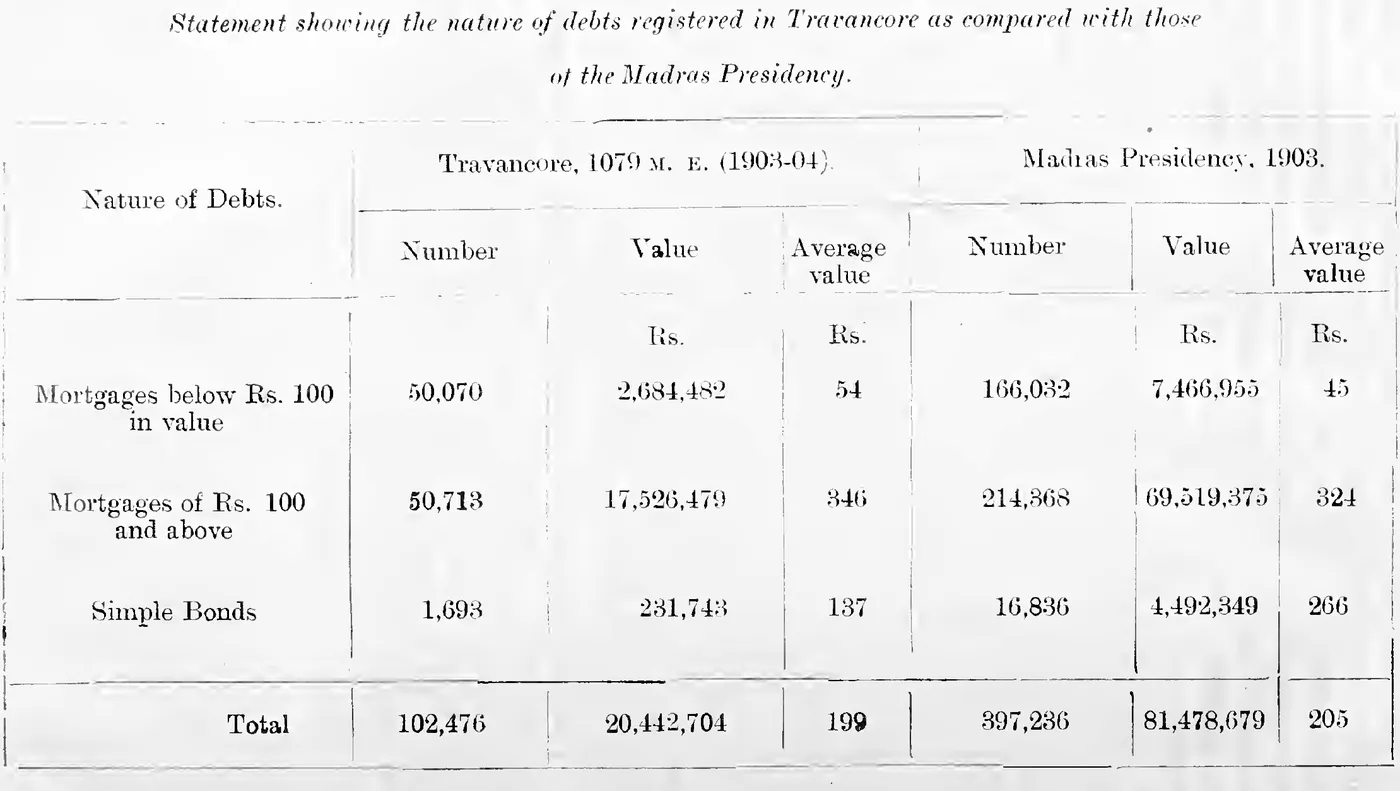
[141]In the Madras Presidency for the year 1891-1892, the total value of the property concerned in Registration transactions was 15·68 crores of rupees, out of which the total extent of debts registered, mortgages and bonds amounted to 7·27 crores of rupees. The late Mr. Srinivasa Raghava Aiyangar in his Progress of the Madras Presidency calculates that four times this sum or 29 crores of rupees represents the aggregate amount of debt of the Presidency. On the basis of this calculation the aggregate amount of debt of the Travancore State at present would be more than 8 crores of rupees, i. e., nearly equal to the debt of 5 to 6 Districts of the Madras Presidency. This looks highly improbable on its face, but may be taken as an index of the greater capacity of the Travancore people to borrow, for it is only a richer State that can afford to raise a larger debt. In other words the borrowing capacity of Travancore is equal to that of 5 British Districts. It means that though in size, Travancore is only as much as any average District of the Madras Presidency, each of such Districts is in wealth equal to only one-fifth of Travancore. Without however more accurate data to hand it is useless to carry on such speculations further. This may be taken as one index among others of the general prosperity of the State.
Incidence of taxation. The total revenue collected for the year 1079 M. E. (1903-04 A. D.) from land, salt, customs, stamps, Abkari and tobacco was Rs. 7,641,450. This revenue distributed over the whole population of 2,952,157 according to the 1901 Census gives the average incidence of taxation per head of the population at Rs.2-9as-3p. Thirty years ago i. e., in 1875 A. D. the total revenue of the state from the above mentioned sources was Rs. 4,132,909 and this distributed over the then population gave an incidence of Rs. 1-12-6 per head. In the Madras Presidency it was Rs. 2-4-5.
The incidence per head for each source of revenue is noted below and is compared with the results of 1891, 1881 and 1875.
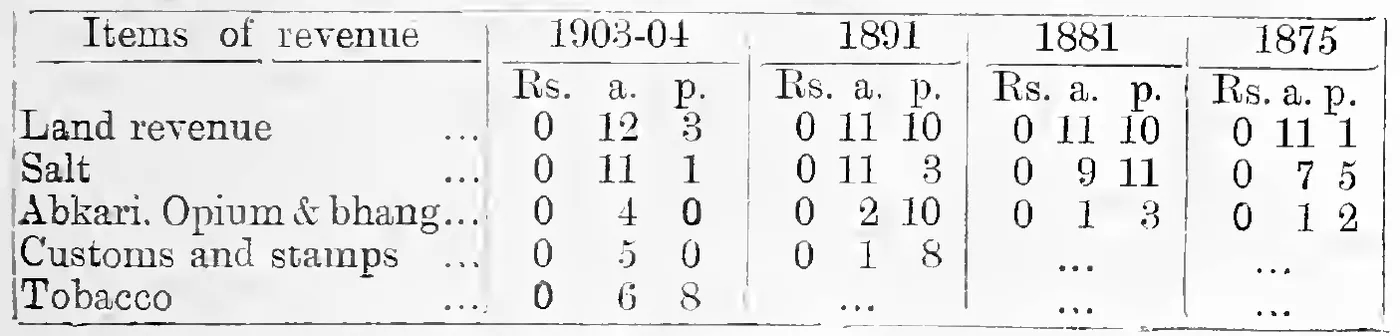
There is thus a steady increase in the average incidence under every head of revenue, except salt.
The average incidence of taxation in Travancore and that of all India is compared below:—
[142]
Statement showing the average incidence of taxation in Travancore as compared with that of All India:—
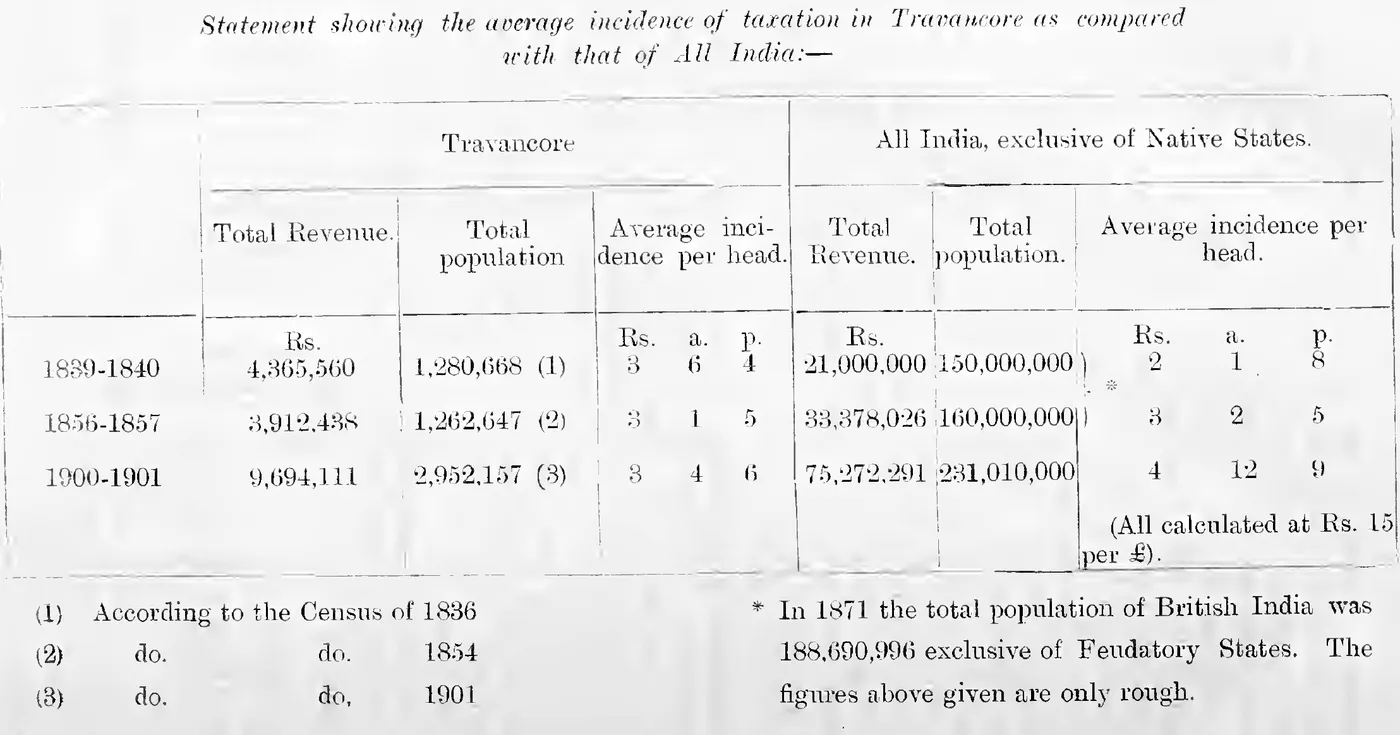
[143]As the Travancore Census figures of 1836 A. D. and 1856 A. D. are not reliable, the averages cannot be taken as indisputable. But the averages for 1901 are trustworthy and they show that the incidence of total taxation per head in British India is Rs. 4. 12 as. 9 ps. to Rs. 3. 4 as. 6 ps. in Travancore or nearly 50 per cent. more.
Incidence of land-revenue. The land-revenue system in Travancore presents several peculiarities. The tenures are many and varied and bear on their face the impress of ages, incidence of land-tax varying with them. The land-tax is collected partly in money and partly in kind and the land records have not been brought up to date. A revenue survey and settlement is in progress upon the completion of which only a real adjustment of the land revenue administration on a sound and satisfactory basis could be made.
The current demand for the year 1079 M. E. (1903-04) was Rs. 24,34,555 which gives an incidence of 13 as. 2 ps. per head of the population.
Wet lands The area of wet lands under registry at the end of 1079 M. E. (1903—04 A. D.) was 589,290 acres. The current demand on wet lands was Rs. 13,29,258. Thus the average assessment per acre comes to Rs. 2. 4 as.-0 p. Until the whole state is settled and the new Ayacut prepared the average cannot be relied on as accurate.
In the Dewan's official Note (September 1897) on the Land Revenue system of Travancore, the average incidence on wet lands in Travancore stands at Rs. 2 an acre, while in Malabar it is Rs. 2—15—5 ps. and in Tinnevelly it is still higher being Rs. 9—1—9 ps.
"In Malabar the Government, it is believed, share the gross produce equally with the Jenmi and this represents the assessment. Here only ⅛ of the assessment is levied on Jenmom property. In North Travancore the burden on wet land is generally light while in the Southernmost taluqs—Tovala and Agasteeswaram, it is comparatively heavy in the case of full assessment-bearing lands. (The highest assessment in Nanjinaud is Rs. 30 per acre whereas even in the fertile Tamraparni valley it is only Rs. 20,). But this high rate is only apparent for the full assessment bearing tenures form only 81 per cent. of the total area of the tract. Thus the actual incidence is considerably modified. In the case of these two taluqs where the revision of assessment has been completed under the present settlement the high rates on Pauttom land have been reduced so much so that the revenue has resulted in a fall from the Ayacut figure to the extent of a quarter of a lac of rupees."
Garden lands. The garden area for the whole State is not known, as in the previous Settlements the garden survey was confined to linear measurements which were not reduced to superficial area. Hence the average rate of revenue on garden land per acre cannot be given. Taking [144]the figures for the settled Taluqs, the average rate comes to Re. 1. 2 as. 9 ps. per acre. In Malabar according to the Madras Manual, the average rate is Re. 1 9 as. 8 ps., and in Tinnevelly Re. 0- 12 as. 4 ps. The dry area is in excess of the garden land in most of the interior Taluqs, hence the average incidence for the whole country must be lower still. As in Malabar, the tree tax forms a staple source of land revenue in Travancore. The maximum rate per cocoanut is 4 chs. while in Malabar it is 5¾ chs. and in Cochin 6 chs.; but even this 4 chs' rate is seldom levied in the present Settlement.
Unlike the ryots in the Madras Presidency the Travancore ryot has nothing to pay outside the land-tax. We have no road cess, village service cess, income tax, municipal tax, &c.
"There is no municipal tax at all nor the income tax. So far as salt goes, both Travancore and British ryots are perhaps equally situated. But even here the Travancore ryot has an advantage. The system of retail bank-shalls maintained by Government at interior centres of population equalizes the selling price and brings it much nearer the prime cost than is the case under the British system of wholesale disposal at the depôts or factories. So the condition of the Travancore ryot in point of taxation presents no unfavourable contrast to that of his brother in British India."
An attempt is now being made to introduce municipal taxation in the chief towns and that to a limited extent.
The average incidence of the total land revenue namely 13 as. 2 ps. per head compares favourably with that of any province in India or of all India. I quote the following from the Blue Book on the moral and material progress and condition of India in 1888 to 1889 A. D.
"The land revenue on temporarily settled estates is fixed periodically at intervals of 12 to 30 years; the longer period being the more common. For estates held by proprietary brotherhoods or large proprietors the revenue is assessed on the cultivated area of a whole village or estate, with an average area of about 800 acres and no additional revenue is demandable on account of extensions of cultivation during the term of the settlement. Thus, increases of revenue from such lands accrue only on the occasion of periodical revisions of the assessment; these revisions are called 'settlements'. The revising officer takes into consideration the extensions of cultivation, the variation of prices, and the change in rents since the last settlement. On lands held by petty proprietors, that is, on ryotwaree tenures, the State obtains yearly increases of revenue as cultivation extends; a settler usually enjoys his grant revenue free for a few years where the cost of clearing the land is heavy. At periodical settlements on ryotwaree lands the rates of revenue per acre are revised in some proportion to the change in prices since the previous settlement. At present the incidence of the land revenue on temporarily settled lands ranges according to the fertility and advantages of the soil, from six annas (7 d) on poor dry soils to six rupees (9s-6d) per acre on rich, irrigated lands; and the average incidence is approximately, 26 as. (2s-7d) per acre for all temporarily settled lands. This rate represents something less than half the gross rental of such lands as are let to tenants."
[145]The past policy of this Government has been to avoid undue pressure on the land-tax, or what Lord Salisbury so beautifully expressed 'bleeding' the cultivator of the land. He wrote:—
"So far as it is possible to change the Indian fiscal system, it is desirable that the cultivator should pay a smaller proportion of the whole national charge. It is not in itself a thrifty policy to draw the mass of revenue from the rural districts, where capital is scarce, sparing the towns, where it is often redundant and runs to waste in luxury. The injury is exaggerated in the case of India, where so much of the revenue is exported without a direct equivalent. As India must be bled, the lancet should be directed to the parts where the blood is congested, or at least sufficient, not to those which are already feeble from the want of it."
Salt. The salt tax has been reduced from Rs. 3 to 2 per maund bringing down the average incidence a good deal from what it was twelve years ago—a real benefaction for which the millions of India cannot feel too thankful to the British Indian Government; but what remains still is considered a hardship, for the salt tax, of all taxes, is the poor man's tax. Sir J. Caird writes:—
"If the salt tax, which bears with most crushing weight on the poorest, as it is a necessary of life which must be consumed by him as freely as by the rich, could be dispensed with, great would be the gain to the mass of the population. The wealthy Zemindars, merchants, rich natives, and highly-paid officials are lightly taxed, and enjoy the protection of Government without paying adequately for it. * * * * A saving might at the same time be made by employing fewer Europeans, and those only in the highest department and by substituting natives in all posts for which they are capable, and at native rates of pay."
It may be well also to bear in mind what the late Maharajah (Vishakham Tirunal) wrote to T. Rama Row, C. I. E., in September 1869 as First Prince:—
"I am very glad to find that you have recommended the establishment of bankshalls for the retail sale in the interior parts of the country. The State, it must be remembered, taxes an article without which no one can live, and taxes it enormously. It is a tax which can be justified only by the barest State necessity. While so, it will be increasing the hardship a hundredfold by neglecting to afford facilities to the poor people in out of the way parts of the country to purchase this great necessary of life even at high prices. I trust your recommendation will soon be adopted."
The value of this remark is enhanced when we come to appreciate the difficulties of the poor ryot in rural villages so correctly described by a correspondent to the Indian Patriot the other day. He writes:—
"It must be admitted that by this reduction the consumption of salt has increased. But the question to be considered is whether it has afforded the same measure of relief as expected by the Government; and how this beneficent act of Government can be made to relieve the poor classes from the wide spread misery on account of the high price of salt which not only impoverishes the cultivator, but also prevents him from utilizing it for manuring purposes and for procuring it for his cattle. As far as I am aware it is only the people living in [146]large cities and towns that have felt and realized the advantage of this reduction to the fullest extent. In the majority of instances this measure of relief has not reached the poorer classes living in rural parts who depend entirely for their supply of salt on petty retail dealers, and who are not in a position to find out how far the price has gone down by the reduction of duty on salt. There is no settled standard of price with them. It varies according to the class of men with whom they deal. These poorer classes of people most of whom being daily labourers, petty cultivators, and artizans cannot afford to purchase a large quantity of salt from big markets in the towns where owing to somewhat vigilant supervision, the price has been lowered to a great extent in view of the reduction of duty. They therefore as a matter of necessity have to purchase small quantities for their daily use from petty shops located here and there in their villages. It is greatly to be regretted that these poor villagers, on account of their ignorance and helplessness, of the unreasonable demand of these grasping dealers, and of the low standard of their moral integrity have not been profited by this reduction. ... ... ..The work of supervision can be better effected by the co-operation of the revenue and village officials with the Salt Department. In these days of famine and epidemic it is highly desirable that greater facility should be given to the poorer classes for enhanced consumption of salt. As the poorer classes of this country have been accustomed to consume a large quantity of this article of diet, and as they have not been able to procure it owing to the exorbitant price resulting from the burden of heavy taxation, their general health has to a certain extent been affected. This partly accounts for the high rate of death among these classes of people. The people of this country are looking forward with joy and expectation to the visit of Their Royal Highnesses the Prince and Princess of Wales. We may sanguinely hope that Their Royal Highnesses will signalize their visit by conferring upon the people the great boon of the abolition of the tax on this prime necessary of life which as Professor Fawcett said, should really be 'as free as the air we breathe and the water we drink.'"
Abkari The increased incidence under the head of Abkari in spite of the enormous growth of population shows that the number of drinking people is really on the increase in Travancore, a very unfortunate circumstance though a heavy tax is imposed on them.
There has been a great deal of controversy over the question of the Abkari Revenue administration of the British Indian Empire where too the increases in revenue are very considerable. Considering that the Hindus are a very abstemious people and the Mahomedans altogether debarred according to the injunctions of their religion from the use of alcoholic drinks, it is undoubtedly a satire upon the times that temperance has to be preached in the chief centres of Indian population. The increase of revenue may be partly due to an improved administration and the suppression of illicit distillation and sale. This surely cannot account
Note. A great excitement prevails among the common people owing to a rumour now current that the occasion of the visit of H. R. H. the Prince of Wales will be signalized by the total abolition of the salt tax—a boon which, if granted, will they think be the ryots' millennium. [147]for the whole of the increase. Illicit distillation and sale must have been going on in former years too. The Government of India are fully alive to the importance of the evil, for they distinctly disclaim any desire to make this the basis of enhanced revenue to the State. They have laid down (September 1905) that "their settled policy however is to minimise temptation to those who do not drink and to discourage excess among those who do; and to the furtherance of this policy, all considerations of revenue must be absolutely subordinated." In their opinion,
"The most effective method of furthering this policy is to make the tax upon liquor as high as it is possible, to raise it without stimulating illicit production to a degree which would increase instead of diminishing the total consumption and without driving people to substitute deleterious drugs for alcohol, or a more for a less harmful form of liquor. Subject to the same considerations the number of liquor shops should be restricted as far as possible and their location should be periodically subject to strict examination with a view to minimise the temptation to drink, and to conform as far as is reasonable to public opinion. It is also important to secure that the liquor which is offered for sale is of good quality and not necessarily injurious to health."
In the result, they enjoined the committee "to bear in mind that so far as present information goes, tari (toddy) is the least noxious of all the forms of alcohol in common use in India, and that it would be a grave evil to discourage its use if this result should be purchased at the cost of driving the people to more deleterious intoxicants. No considerations of revenue could be permitted to justify such a course." Finally they laid it down as their fixed opinion that "the summary justification for increase of taxation is that this is the most efficient method of discouraging consumption." Upon the report of the Excise Committee, which is anxiously awaited depends the welfare of millions in India.
But the Government of India had observed in an earlier despatch that the people of India generally are extremely abstemious, that the consumption of spirits is for the most part confined to the lower classes, even among whom there is "a condition of things which, if it existed in England, would be regarded almost as a millennium of temperance. Drunkenness in the English sense of the term hardly exists in India." It has to be remembered that the lower classes of the population who are the least accessible to the influence of British Rule in India are also those to whom the costly liquor imported from Europe is wholly beyond reach. The statistics prove that there is a considerable increase in the import of European liquor, due not to any perceptible increase of Europeans in the country, so much as to the increase of drinking among the refined and the more fashionable classes of the Native population. Mr. T. Padmanabha Row, [148]Peravagai Sheristadar, Dewan's Office, writes to say:—
"I enclose however a list of European liquor shops for the period, from which it may be guessed that the demand for the article is increasing year by year. I am afraid that drunkenness is on the increase. I believe among the higher classes (by higher classes I mean the well-to-do people) the foreign liquor is more used than the country liquor, as the latter is considered infra dig. 20 degrees (country liquor) I understand is even stronger than brandy and is purer than most of the foreign articles."
Thus it is clear that a predilection exists amongst the well-to-do drunkards of our country for imported liquor though that is declared to be inferior in strength and purity to the locally manufactured stuff. Such are the insidious influences of vice in the iron age in which we live. The use of alcohol is against the grain of the Hindu and the Mahomedan who together form 75 per cent. of the population and whose religion inculcates strict teetotalism. According to the Institutes of Manu, an orthodox Hindu "must not look at one intoxicated." The climate does not require it, and for ages past the lower orders of the labouring population were satisfied with a comparatively innocuous drink drawn from the cocoanut and the palmyra tree. How a new taste has so suddenly developed in our people, under what I should call clearly unfavourable conditions for its development, is unaccountable. It has, I fear, taken a firm hold on them. The only salvation out of the difficulty appears to depend on what may hereafter come from a reactionary movement against drink in England itself, where the most medical men are already preaching a crusade against it. Sir Frederick Treves, the eminent surgeon, in an address on "The physical effects of the use of Alcohol" the other day, said that:—
"Alcohol was, of course, distinctly a poison. It had certain uses, like other poisons but the limitations on its use should be as strict as on arsenic, opium and strychnia. It was a curiously insidious poison producing effects which seemed to be only relieved by taking more of it—a remark which applied to another insidious poison, morphia, or opium. It had a certain position as medicine, but in the last 25 years its use to the medical profession had steadily and emphatically diminished. People were often heard to say that alcohol was an excellent appetizer when taken before meals. But the appetite did not need artificial stimulation; if the body wanted feeding, it demanded food. As for its 'aiding digestion,' it hindered digestion even when taken in small amounts, as could be easily demonstrated. Then there was the idea that alcohol was strengthening. As a fact, it curiously modified the nourishment of the body; it greatly lessened the output of carbonic acid—a very important matter so that the drunkard was necessarily an ill-nourished man and to reach the acme of physical condition was impossible if any alcohol was used. Its stimulating effect was only momentary, and after that had passed off the capacity for work fell enormously. Alcohol, as it were, brought up the whole of the reserve forces of the body and threw them into action, and when these were used up there was nothing to fall back on. It dissipated rather than conserved bodily energy. It was a curious fact that troops could not march on alcohol. In the Ladysmith [149]relief column which he accompanied, the first men to drop out were simply the men who drank. The fact was as clear as if they had all borne labels on their backs. As for the statement that alcohol was 'a great thing for the circulation' it increased the heart-beat and reddened the skin by using up the body's reserve power but then the heart's action became emphatically weaker, a temporary effect being got at an enormous cost. The action of alcohol on the central nervous system was very definite, and was that of a functional poison, first stimulating and then depressing the nervous system. The use of alcohol was absolutely inconsistent with a surgeon's work, or with any work demanding quick and alert judgment. The last notion he would refer to was that alcohol kept out the cold that a 'little nip' was good when going out into cold air, and so forth. In the words of a great authority, alcohol really lowered the temperature of the body by increased loss of heart and to some extent by increased oxidation, and much reduced the power of the body to resist cold. Finally, he would say that the great and laudable ambition of all and especially of young men, to be 'fit' could not possibly be achieved if they took alcohol. It was simply preposterous to suppose that any young healthy person needed any alcohol whatever; and, indeed, he was much better without even the smallest amount of it. Having spent the greater part of his life operating, he would say, with Sir James Paget, that of all people those he dreaded to operate on were the drinkers. He hoped that what he had said would help his hearers to answer such absolute fallacies as 'a glass of port can do you no harm.'"
I wish these precious words of Sir Frederick Treves which form the new gospel of western medicine and are likely to soon produce far-reaching effects amongst the European nations will reach every man among the drinkers of India. Every true patriot should wish for such a consummation. If they take effect, the true millennium of temperance in India will be easily reached. The Abkari revenue may suffer, but the regeneration of the people which it implies will more than recompense the State for that loss. This is what the Government of India itself desires.
Tobacco. Tobacco, in one form or another seems to be a necessary luxury for man all over the world. It is used in its worst form when it is chewed with betel, arecanut and chunam as it is universally done on this coast. It is believed to be a valuable specific against toothache and other ills which arise from a humid climate. Whatever be its medicinal value or its stimulating properties upon which its right use can be justified, there can be no excuse at all for the habit being formed at a very early age by boys and girls all over the coast, nor for its indiscriminate and excessive use in after years causing an enormous waste of saliva which impairs digestion and induces loss of appetite and general debility which is so common a feature of public health in Travancore. It yielded about twelve and a half lakhs of rupees in 1079 M. E, (1903—1904 A. D.) and may be regarded as the backbone of the Travancore finances; and of the 26 sources of receipts shown in the financial statement of last year, it is the biggest item, next to land revenue and salt. It is also perhaps the most justifiable tax, and yields 6 as. per head per year. By a series of wise reforms and careful [150]administration, the revenue on this item has gone on increasing from year to year. Forty years ago the consumption of tobacco was about six thousand candies, yielding a revenue of seven and three-fourths lakhs of rupees. Now it is 13,322 candies yielding a revenue of twelve and a half lakhs of rupees. Perhaps a further reduction of duty is desirable in the interests of the consumer as well as of the public revenue. It has fulfilled the highest expectations formed of it by the great statesman, Rajah Sir Madava Row, who in his Report 42 years ago, wrote:—
"Under these accomplished arrangements, Tobacco of just that quantity and quality is imported as best suits the requirements of the country; it is supplied as cheap as free competition can make it; an unbroken and certain supply is kept up; the consumer in any part of the country is not confined to any particular kind of tobacco, but is at liberty to use that which he pleases according to his own taste or means; the sources of supply have been largely extended, and the supply itself therefore has been rendered still more certain; the commodity has been cheapened by reduction of taxation and brought more within the reach of the consumers; and smuggling has been largely checked in consequence of which also the public revenue must benefit considerably. Thus it will be seen, this source of Revenue, forming so important a part of the fiscal resources of this State, has been divested considerably, if not yet completely, of its most objectionable features and placed on a foundation much more stable than ever. It is to be hoped that the State will be able to effect a still further reduction of the duty on Tobacco, and thus still further add to the stability already attained. Such a consummation carried out, the Sirkar will have it in its power to point to this important branch of the public income as satisfying most, though not all, of the characteristics laid down by Political Economists as appertaining to a perfect form of taxtion"
Kudivaram rents or leases. By this is meant the rent which the cultivating tenant pays to the peasant-proprietor. In the case of nine-tenths of wet lands in Travancore, the rent paid by the cultivating tenant to the ryot or owner of the land is known as Pathivaram literally half of the gross produce as it stands on the land before harvest. The tenant comes and tells the landlord one or two days before the crop is harvested that the paddy is ripe and fit to be reaped. As a rule the landlord himself goes and superintends the reaping. The Tamil proverb showing the supreme importance of personal supervision in matters of agriculture runs thus:—
நெல்லுக்கு தானும் பொன்னுக்கு தோழனும், literally 'for paddy yourself and for gold your companion.' That is, in "matters of cultivation and reaping your paddy lands you should yourself go and do the thing; no deputy is of use. But a playmate of yours you could send to weigh gold and superintend the making of jewels. Your personal presence there is not so essential." When the grain is threshed out, the total yield is [151]measured, half to the owner and half to the tenant. The expenses of cultivation have been borne by the tenant. The straw also goes to the tenant. The tax to Government is paid by the owner. This is the most common practice in the country and corresponds with the Metayage system known to Italy and France. In some cases the land-owner's share is three-fifths of the gross produce and the cultivating tenant's two-fifths. In the high class wet lands of the Southern Taluqs of Travancore (Nanjanad) where the land is of a very valuable kind, the cultivating tenant takes it at so many fold 'Pattom' or what is called Kattukuttagai (literally contract) in the Tamil Districts. An acre which sows one Kottah of paddy will fetch to the owner in the Nanjanad Taluqs 12 or 13 Kottahs of paddy per annum, on the Kattukuttagai tenure. The owner is not called in to superintend the harvesting, nor does he pay the expenses of cultivation. The 12 Kottahs are paid in two half-yearly instalments. The Government tax is paid by the land-owner. When the crop is not a fairly full one, owing to heavy floods or deficient rainfall or late cultivation, the Kattukuttagai tenant breaks down and calls upon his land-owner to supervise the harvesting, and make a fair deduction in the Pattom amount agreed upon for the deficient crop. It should be borne in mind that the transaction between the landlord and his cultivating tenant is always paid in kind. I have found from experience that after such losses and variations in the Kattukuttagai terms have been calculated, the interest which a land-owner secures on his investment is one Kottah of paddy per year for Rs. 1000 which means, Rs. 28 for Rs 1,000 per year, or about 3 per cent. per annum. The ryot sometimes deludes himself with the blissful idea that he gets as much as 5 to 6 per cent. per annum upon his investment, when the paddy sells, as it sometimes does, at Rs. 5 per Kottah. * As the result however of accurate personal experience for several years as a land-owner, I can say that the investment in land is not a whit better than the investment in Government Pro-notes at three-and-a-half per cents, with this difference that in the latter case a man could save himself endless worry and annoyance and vexation. Mr. Srinivasa Raghava Aiyangar estimates that the land investment pays 5 per cent in the Madras Districts, which is a great deal more than what the best lands in South Travancore yield. But the ordinary ryot knows of no other safe investment than the purchase of land in his own village, for that carries with it, in spite of disappointing seasons and many other little ills incidental to agricultural life, a sense of comfort, dignity and importance which is as precious to him and his family as life itself. His affections have grown around his little [152]bit of land, which is either his cherished inheritance or what he himself had acquired during youth. Adam Smith hit off the right point in the Travancore ryot's mind when he said:—
* The Travancore Kottah is only 13/21ths of the Tinnevelly Kottah.
"A small proprietor who knows every part of his little territory, who views it with all the affection which property, especially small property naturally inspires and who upon that account takes pleasure not only in cultivating but in adorning it is generally of all improvers the most industrious, the most intelligent and the most successful."
So a genuine Travancorean must own land under any circumstances.
According to the foregoing calculation it is clear that one-half of the gross produce is the landlord's rental, and the Government revenue upon the land is 45 to 50 per cent. of the rental or about 25 per cent. of the gross produce.
In the case of gardens, the investment is more profitable and the income less precarious, as the trees are not so easily affected by slight variations in the rainfall like the wet lands. A two or three months' withholding of rain will not fatally affect the garden trees, while a three weeks' delay in the rainfall will in the case of paddy plant considerably reduce its yield, if not altogether annihilate the crop itself. So the Travancore ryot looks upon his garden as a surer source of sustenance to himself and his family than the paddy field, and the humid climate lends itself to the formation of topes and orchards and the growing of palm trees with much less trouble and cost. An acre of garden land in Travancore with, say, 100 cocoanut trees, 2 Jack trees and 10 areca trees, will cost about Rs. 700 to buy. Its lease will give the owner Rs. 45 a year, and the Government tax upon it will be Rs. 7, leaving a net income of Rs. 38 as interest upon invested capital i. e. about 5 per cent. per annum. This is a fair return which an industrious and careful ryot can always look up to from his garden land. For the leasing tenant looks after the trees, weeds the garden, renews its enclosure wall or fence and digs it up every year. He is not to cut or remove any tree without the express consent of the owner. It should be remembered here that every ryot has a bit of garden land to himself in which his family-house and his favourite trees stand. There may be many ryots owning a garden land without rice-fields but almost none owning rice-fields without a bit of garden land. In fact on the whole, the rice-flats form but a small fraction of the total area of the agricultural ryots' holdings in the State.
Rate of interest The terms and conditions of money loans are the same all over Travancore. 12 per cent. per annum is the usual rate of [153]interest for loans amounting to between Rs. 100 and Rs. 500; for loans between Rs. 500 and Rs. 1000 it varies from 12 to 9 per cent., and for loans above Rs. 1000 between 9 & 6 per cent., the rate of interest diminishing as the amount of the loan increases. On the other hand, for loans below Rs. 100 the rate of interest ranges between 12 to 18 per cent.; the rate increasing as the amount of the loan diminishes. A Rupee fetching 1 ch. interest per mensem i. e. 42 per cent. per annum is a very common rate charged by the money lending village women or by the petty traders in small transactions. These are the most usual rates, but in exceptional cases and for large amounts the rate of interest is occasionally less than 6 to 7½ per cent. In the case of small sums when the security offered is insufficient and the risk in recovering the loan great, the rate of interest is even higher than 18 per cent. Sometimes it is stipulated that when there is failure in payment of the loan together with the usual interest at the appointed time, and the solvency of the debtor becomes doubtful, a higher rate of interest shall be paid from the date of default. This condition is not, however, generally enforced except when the money has to be recovered by resort to the Courts. Taking all transactions together, the average rate of interest may, therefore, roughly speaking, be estimated at 12 per cent.
Paddy interest. This is of course much higher and prevails to an injurious extent in North Travancore i. e. all over Kuttanad, where wet cultivation known as the Punjah cultivation is carried on in the low swamps on the borders of the lagoons which are drained of their water and sown with paddy once a year or at longer intervals. Except for the draining of the water and the raising of the bunds, both of which are very troublesome and expensive operations, the Punjah cultivation is a simple enough process, needing no careful manuring nor repeated ploughing nor harrowing nor irrigating and other small processes so carefully attended to in the case of wet lands in the Southern Taluqs. But this simple cultivation nevertheless is an expensive one and is seldom managed without the ryot borrowing some paddy every season. This paddy interest is known as 'Polikadam,' literally a debt on the crop or gross yield of the field. In November (Thulam and Vrischigam) the ryot borrows the paddy on the security of his coming crop. In April (Kumbham and Meenom) is the harvesting and then the paddy is measured back to the creditor with 20 per cent. interest. The creditor comes to the harvesting field with his own measure and with a canoe to take the paddy due to him, as did Shylock with his knife and pair of scales. The creditor's measure it should be remembered is 10 per cent. bigger than the one with which he measured out the paddy in the preceding November, [154]which added to the 20 per cent. interest enables the creditor to make some thing like 30 per cent. on the quantity of paddy lent 5 months before. The principal and interest and gain thus made, let us say 130 parahs upon the 100 parahs originally lent, is lent again to the poor cultivator under the same terms in April to be returned to the creditor with another 20 per cent. interest in the following September (Kanni). The year's interest thus accruing is about 60 to 70 per cent. on the whole—an incredible state of things, but my informant who has furnished these details tells me he is himself a large lender of paddy on such terms in North Travancore. As the creditor gets back his paddy on the reaped field itself which is the agreement entered into, there is little scope for litigation and consequent worry and expense. Not even 10 per cent. of the 'Polikadam' transactions go to the Civil tribunals, for the debtor when he is sued against cannot come out of the suit without paying 200 parahs for the 100 parahs he may have borrowed. So it is not his interest to drive his creditor who is an indispensable factor in the village organisation and essential to his own existence, to the law courts. My informant is of opinion that there may not be more than one or two cultivators in a whole Taluq who can manage without the 'Polikadam' creditor's help.
The first impulse in one's mind is that the courts ought to refuse such usurious and extortionate demands of heartless creditors as Justice Mahmood did in the Allahabad case, Lalli versus Ram Prasad, in which an extortionate bond under which an original debt of Rs. 97 due by an agriculturist to a Mahajan had grown in 10 years to Rs. 991 after Rs. 157 had been paid, was set aside. Mr. Justice Mahmood said:—
"I am aware that a general notion prevails in the mofussil that ever since the repeal of the usury laws, the Courts of Justice are bound to enforce contracts as to interest regardless of the circumstances of the case, the relative conditions of the parties and irrespective of the unconscionableness of the bargain. Courts of Justice in India exercise the mixed jurisdiction of the Courts of Law and Equity, and in the exercise of that jurisdiction, whilst bound to respect the integrity of private contracts they must not forget that cases which furnish adequate grounds for equitable interference must be so dealt with, not because such a course involves any the least contravention of the law, but because by reason of undue advantage having been taken of the weak and ignorant, the contract itself is tainted with fraud in the broad sense in which that term is understood in the Courts of Equity—in England and America—a remark which seems to me fully justified by the rule of Justice, equity and good conscience which we are bound to administer in such cases."
In Travancore the law as regards interest awardable by courts stands thus:—
"Section 7 of Regulation I of 1010 M. E. (1834-35 A. D.). Munsiffs are hereby prohibited from allowing in their decrees a greater rate of interest [155]in any suit brought before them than Rs. 12 per cent. per annum, but if the interest mentioned in the documents be less, Munsiffs shall decree accordingly."
"Clause 5 of Section 17—Ibid. In decrees on suits the Munsiff shall allow in the decree the interest that may be due from the period the suit may have been instituted, to the day on which the decree shall be passed; but he is prohibited from decreeing on account of interest a sum exceeding the principal, if the claim be for paddy or grain, and only one-half exceeding the principal, if for money."
"Section 13 of Regulation IV of 1010. The rate of interest chargeable on any cash account decided by the Zillah Court to be regulated agreebly to Regulation I Section 7."
A valuable safeguard against the rapacity of the money-lending Sowcar seems to have been provided in the Baroda State according to Mr. R. C. Dutt's Report (1902-03 and 1903-04) in which we read:—
"The only restriction which His Highness's Government has thought fit to impose on these rights is one in the interests of cultivators. It has been enacted that when a money-lender seeks to execute his decree, and obtain possession of a cultivator's holding, a portion of the holding, sufficient for the maintenance of the cultivator and his family, shall be exempt from sale in execution of such decree. This provision is found to be a sufficient protection."
Agricultural helps. This naturally brings us to the question of how best to improve the condition of the agricultural ryot.
The following is an extract from Mr. Castlestuart Stuart's speech wherein he alludes to the economic difficulties of the Indian ryot thus:—
"The object which they all had in view was to promote the wealth of the people, or speaking economically, to increase the exchange value of the commodities produced in the country. The number of such commodities in this Presidency was mainly restricted to agricultural commodities, but were capable of considerable augmentation and improvement. According to Dr. Voelcker, two of the greatest needs of the country were improved irrigation and the removal of the existing difficulties in obtaining cheap money. They would all admit that a very great deal had been done in that way by the Government during the past ten years in regard to irrigation. The speaker quoted figures to show that the allotments made by Government towards Major Irrigation had during that time been steadily rising from Rs. 60 to Rs. 68 lakhs, and during the present year the allotment was no less than Rs. 90 lakhs, due of course, to the very great pushing forward of Irrigation schemes, the outcome of the Irrigation Commission. He next referred to the appalling extent to which trade, which ought to be in the hands of the people of the country was in the hands of foreign people, chiefly owing to a want of manufacturing facilities, and quoted statistics showing the value of exports, as raw products of jute, cotton, skins and hides and other commodities, and the value of the same imported as manufactured products into this Presidency during the past three years. If such products could only be manufactured in the country instead of being sent out to foreign countries, the augmentation of the wealth of the country would be enormous." *
* The Madras Mail, 3rd May 1906.
[156]Several nostrums have been suggested, all more or less of doubtful value so far as the Indian ryot is concerned, for he is the creature of custom and mamool and is loath to do anything howsoever beneficial it may be to him, if it in the least involves traversing over ground untrodden by his father and grandfather. The village money-lender whom political economists dread as the ryot's inveterate enemy and the leech that sucks up his life-blood is his friend and confidant, for he and his ancestors have likewise been such to his own father and grandfather. All the events in the ryot's family are recorded in the accounts of the Sowcar, for in connection with every such event there has been some money transaction with the Sowcar. He is the man who has helped him in the hour of need for the marriage of his sisters, for the funeral obsequies of his parents, for the payment of the Sirkar kist and the meeting of the demands of a pressing creditor who threatened to sue him. It is from such a friend and benefactor that the Government wants the improvident ryot to be weaned. The truth is, the ryot is ever in need and even when his lands yield a plentiful harvest he is still improvident incurring new debts even when the old debts are not fully wiped out. It is no use to find fault with the Sowcar nor with the impecunious ryot for being what they have always been for ages past, but what is wanted is that Government should come forward with some definite and positive plan of help to enable the ryot to overcome the misfortunes of his birth and surroundings and to oust the Sowcar from his affections, neither of which objects can be gained by any elaborated processes of fault-finding or moralising. The different remedies suggested as effectual nostrums are more or less the same though called under different names such as,
- (1) Agricultural associations,
- (2) Agricultural banks,
- (3) Co-operative credit societies, and
- (4) Agricultural loans.
(1) Agricultural associations. The Agricultural association exist in all civilised countries of Europe, America and Japan. In India too a beginning is being made and so long as Collectors, Sub-collectors, Tahsildars and Deputy Tahsildars co-operate there is every prospect of such associations taking root in the country and prospering. The educational attainments of the Indians is also another help. Mr. H. K. Beauchamp, C. I. E., points out in an admirable article in the Indian Review for July 1905, that we have arrived at a period when the first batches of Indian officials, vakils, pleaders, &c., educated on western lines have reached the [157]time of life when they can retire from active employment and devote their time and means and talents to other pursuits for the rest of their lives. A large proportion of these men instinctively turn to the land to afford them interest, occupation and livelihood for the remainder of their days, for it is in land that practically every native of India who has money to spare prefers to invest that money, from the prosperous Vakil and pensioned public servant to the returned coolie emigrant. Though the return on the capital invested may be small the predilection for land is such that that is cheerfully enough accepted. In the face of these encouraging signs, these associations ought no doubt to thrive in India, but I fear that it will take several decades before such a spirit created and fostered amongst the bona fide agriculturists of the land makes head against all the combined influences of national apathy, ignorance, conservatisim and an instinctive distrust of their neighbours to work on such broad rational lines so as to form an effectual check against the rapid deterioration of the agricultural class. If we wait till they combine and help themselves we might have to wait in vain.
(2) Agricultural banks. Mr. (now Sir) Frederick A. Nicholson has made a thorough study of lands and Agricultural banks in Europe and America and has submitted a report in 2 volumes to the Madras Government as to how far the experience of European countries could be made applicable to India. This report is a mine of information and is a record of indefatigable study and research. He is of opinion that the agriculturist whether of Europe, America or India must and will borrow. This is due to the fact that his capital is locked up in his land and stock and has to be temporarily mobilised. It is of importance that the credit required should only be so obtainable that the act and effort of obtaining it shall educate, discipline and guide the borrower. He thinks that so far as the Madras Presidency is concerned banks of all classes other than State banks with a decided leaning towards the co-operative system should be established. This should promote not only facile and safe credit but the fundamental virtues of thrift, providence, self and mutual help. A beginning is already found in the Nidhis which are the developments of the indigenous "Kuttu chit" system of this Presidency.
Sir F. A. Nicholson seems to object to State banks as impossible, and even if possible as inadvisable—an assertion which he himself will admit is not unexceptionable so far as a small State like ours is concerned in which the Government is in close touch with the subject population.
(3) Co-operative Credit Societies. The Government of India have started under Act X of 1904, a system of Co-operative credit societies [158]throughout the Indian Empire, solely intended for the improvement of the agricultural ryots' condition. In their Resolution of the 29th April 1904 the principles of this Act are elaborately explained, which may be briefly summarised here:— One of the most difficult problems with which the small agriculturist is everywhere confronted, is to obtain the money which is necessary for his operations at a reasonable rate of interest. This is a state of affairs by no means peculiar to India. The petty agriculturist of Europe is for the most part financed by borrowed capital and there too the money-lender takes advantage of the exigencies of the cultivator to demand exorbitant terms. In India however the problem is aggravated by the fact that Indian rates of interest are to some extent survivals from times when the security which the agriculturists had to offer was of far smaller value than at present, and also by the fact that the money-lender has not been slow to take advantage of the unwillingness of the Civil Courts to go behind the terms of a written bond. The attention of Government has frequently been drawn to the desirability of providing the peasants with some means of obtaining the requisite capital for the agricultural operations otherwise than at usurious interests. In 1882 and 1883 a scheme of agricultural banks to the Poona District was recommended to Government by Sir William Wedderburn, then a member of the Bombay Civil Service, and by several intelligent and public-spirited residents of the Presidency, but the scheme had to be given up for various reasons. In 1892 Mr. F. A. Nicholson was placed on special duty by the Madras Government for enquiring into the possibility of introducing into the Presidency a system of agricultural or other land banks and he accordingly submitted a report to Government. His report was forwarded by the Government of India to other local Governments for their opinions and remarks. The opinions of the local Governments were finally considered in June 1901 by a strong committee presided over by Sir Edward Law, the financial member of the Viceroy's Council. Government considered that no real advance in the direction contemplated was possible without a special legislation. The Government of India have kept two cardinal points in view in framing the Act viz., (1) simplicity; so that the classes for whose benefit it is intended may fully comprehend its scope and provisions, and (2) elasticity, only the general outlines being laid down, the details to be filled in gradually on lines that will be hereafter suggested by experience and the development of the institution at each locality or Province. The present Act is specially intended to assist agricultural credit rather than industrial credit, the agricultural problem being more serious and more difficult to deal with than the industrial problem. The [159]Bill was originally intended to exclude wealthy rent receivers, being limited only to agriculturists, on the supposition that men of light and leading and those of substance would assist these societies from outside as they have nothing to gain by memberships in them, since they would not desire to borrow. But the body of opinion in favour of a wider basis of membership not only in order to extend the scope of these societies as widely as possible, but also to secure that diversity of needs and interests which is desirable if their funds are to be utilised to the best advantage, was very weighty; and all restrictions upon the class of persons who may be members have therefore been removed. It is provided in the Act for the appointment of a special officer called "Registrar of Co-operative Credit Societies" for each Province to guide and control the societies especially in the early days of the movement, who for the first few years at least must be constantly visiting the societies, and watching their progress and who with the experience gained by studying the developments under various conditions will become an invaluable adviser. He will know what has succeeded here and what has failed there; he will be in a position to avoid the repetition of mistakes, to point out defects and their remedies and to extend to one part of the country methods which have proved successful in another. Loans are admissible to members only, an exception being allowed in the case of societies lending with the approval of the Registrar to rural societies. It was originally proposed to prohibit rural societies from advancing money against jewels as security, but the Registrar is empowered to allow any society which in his opinion can be trusted, to advance money upon jewelry. It was also resolved that loans upon mortgages should be allowed in the first instance, and the local Government be empowered to prohibit or restrict them generally or in particular instances if they consider it necessary to interfere. The number and value of shares to be held in the Co-opeative Society by a single individual is to be strictly limited and shares are not to be transferable until they have been in the possession of the holder for a fixed period. A general section has been added providing that the local Governments may by special order in each case permit any association whatever to be registered as a society under the Act and may exempt any society thus specially registered from any of its provisions or may modify any of these provisions in their application to any such society. The Government of India though fully recognising that there is a danger of obscuring the Co-operative principle by lending the societies State funds and that no societies wholly or mainly financed by Government can ever attain the objects in view, yet realise that such advances [160]will have a value beyond their mere use as capital, since they will be an earnest of the reality of the interest taken by Government in the movement, and will, under the conditions to which it is intended to subject them, stimulate the thrift and self-help which should be a condition precedent to their grant, and they doubt whether any substantial progress will be made by rural societies in many parts of the country unless such assistance is given. They therefore sanction advances to such societies to be made. The advances do not bear interest nor are recoverable during the first three years, and are thereafter recoverable by annual instalments not exceeding one tenth of the advance and to bear interest at 4 per cent. per annum.
The Government of India thus conclude the Resolution:—
"Such is the general character of the action which commends itself to the Government of India. They recognise that it is essential to start cautiously and to progress gradually. The whole matter is one in which we have to feel our way and to purchase our experience; and if action on a large scale were attempted in the first instance, it is possible that many failures might result which would fatally discredit the principle; while on the other hand a very few really successful instances will encourage imitation and set an example which will quickly spread. While the State help and support will be needed to begin with, the object to be kept in view is to teach the people to help themselves and we shall not have succeeded unless we are eventually able to withdraw that support. The Government of India have already insisted upon the absolute necessity for simplicity, if the system is to take root among the peasantry; they desire further to lay stress on the necessity of reducing the restrictions to a minimum, so that the people may be encouraged (subject to certain necessary safe-guards) to work out the problem on their own lines with such guidance and advice as can be given them. * * * In this manner the Government of India trust with the co-operation of the local Governments the scheme may be given a fair trial and neither suffer from the absence of that official guidance without which a successful start cannot be hoped for in this country, nor be prevented by too much supervision and too many restrictions from attaining its full development."
In this important Resolution, the Government of India have gone to the utmost length that it is possible for any English Government to go in the matter of helping the agricultural peasantry of India; but still they expect "the people to work out the problem on their own lines with such guidance and advice as can be given them." So far it is no solution, for the people are unfit to work out the problem on their own lines. That is the work of time, and if we stick to it, it practically amounts to saying that no help will be rendered by Government to the agriculturists of the present generation and the next. It will take at least another fifty years before agriculturists in this part of India move as a whole for purposes of mutual aid and effective co-operation.
[161](4) Agricultural Loans. To my humble understanding the most effective form of helping the simple and ignorant agriculturists is by extending the system of agricultural loans to the utmost possible extent by Government itself undertaking their supervision as a State department. Nothing short of it will answer the purpose. Co-operative Credit Societies exist to some extent in the country under the name of Chitties or Kuris. As for the Agricultural banks, all the paddy-lending Brahmins of Mankombu in the Ampalapuzha Taluq are so many banks maintained on sound economic principles and they drive a roaring trade. What is really needed for the prosperity of the agricultural ryot is substantial help in the form of agricultural loans directly from the State. We have in Travancore a Regulation (IV. of 1066 M. E./1891 A. D.) to advance loans for agricultural purposes. The transactions under the Regulation during these 14 years that it has been in force, show that there is some serious defect in it, which has neutralised the good intentions of His Highness' Government. The Dewan wrote in his Administration Report for that year:—
"It was thought necessary in the interests of the agricultural population that Government should come to their aid to stimulate their industry by offering them money at small interest, there being abundant scope both for improving the production of cultivated lands and for reclaiming land from our extensive backwaters and wastes. It is hoped that when the object of Government is well understood, the facilities offered will be largely availed of, though we have to combat the reluctance of the ryots to have the Government for a creditor."
These prophetic words of Dewan Rama Row have been realised; for excepting a few rupees (80 Rupees) lent in 1070 M. E. (1894-95 A. D.) the Regulation has remained entirely a dead letter. Dewan Shungrasoobyer wrote in his Report for 1071 M. E. (1895-96 A. D.):—
"There were no transactions under this Regulation during the year. In 1070 a small advance (560 fanams) was made. Considering the easy terms on which loans are grantable under the Regulation and the immense scope there is for improvement by way of construction and repair of irrigation tanks, wells, and other works, especially in South Travancore, it is surprising that the wholesome provisions of the law are not availed of by the ryots. Possibly they are not generally understood. The Peishcars should pay particular attention to this matter. During their tours of inspection they should explain to the ryots the scope and object and the advantages of the provisions of the Regulation. If the disinclination of the ryots to apply for loans is due to the elaborateness or stringency of the procedure or any defect in the rules, the same should be brought to the notice of Government with suggestions for modification."
So ended the question. But nothing further came out of it; for we find the same state of affairs deplored in the Administration Report for 1074 M. E. (1898-99). In 1075 M. E. (1899-00) the report simply states that no applications were received for loans and in the succeeding [162]reports no mention is made of the working of the Regulation at all. This seems to be an unaccountable mystery. And when to this is added the fact that in British India too the ryots do not take advantage of a similar law there to the extent that they should, the ryot's opinion about the Sirkar being a dangerous creditor to deal with may be taken as indisputably established. It should be our earnest endeavour to remove this opinion and gain the ryot's confidence.
The Regulation itself may be thus summarised:—Agricultural improvement means any work which adds to the letting value of wet land. The applications for loans should be made to the Tahsildar of the Taluq in which the land on which improvement is proposed to be made wholly or partially is situate, specifying the land, the nature and extent of the applicant's title to such land, the nature of the proposed improvement, the amount of loan applied for, and the security offered for the same. The Tahsildar should at once publish a notice calling for objections if any, either to the loan itself or to the security offered therefor and duly consider them, and make an order in writing either admitting or cancelling all or any of them. If no objection is forthcoming the Tahsildar shall make an enquiry into the application and submit the papers to the Dewan Peishcar with his opinion. The Dewan Peishcars are authorised to grant the loan if it does not exceed Rs. 250 after examining the records and making such further enquiry as they may deem necessary. If the amount exceeds Rs. 250, he shall submit the records to the Dewan with his opinion in writing, who after satisfying himself that there is no objection to grant the loan applied for may grant the same, provided the amount does not exceed three thousand rupees, in which case he shall get the sanction of His Highness. Every loan granted under this Regulation is repayable with interest by annual instalments (the number of instalments shall not ordinarily exceed ten if the amount of the loan does not exceed Rs. 500 or twenty in any other case). All loans granted under the Regulation, all interests (if any) chargeable thereon, and costs (if any) incurred in making the same shall be recoverable, (1) from the borrower or his surety (if any) as if they were arrears of land revenue due by him, or (2) out of the land for the benefit of which the loan has been granted or the property comprised in the collateral security (if any) as if they were arrears of land revenue due in respect of that land, provided that when any sum due on account of any such loan, interest, or cost, is paid by a surety or an owner of property comprised in any collateral security or recovered from a surety or out of any such property, such sum shall on the application of the surety or the owner of such property be recovered [163]on his behalf from the borrower or out of the land for the benefit of which the loan has been granted, in the manner specified above.
The following rules dated 4th September 1891 passed under the Regulation are in force:—
(1) "The interest charged on loans under these rules shall for the present be 4 per cent. per annum.
(2) The value of the security offered shall exceed by at least one-fourth of the amount of the loan.
(3) Only land and Government promissory notes shall be accepted as security for the re-payment of the loan.
(4) Loans may be granted either in a lump sum or in instalments according to the discretion of the authority granting the same.
(5) All works for which loans are made shall be inspected and reported upon by the Tahsildar as soon as possible after the date on which their completion was directed in the decision. If the work is one requiring professional skill, the Dewan may arrange for its inspection by a professional officer.
(6) The Dewan Peishcar should make provision for the proper and periodic inspection of the works for ascertaining that the loans are duly applied for the purpose for which they are granted.
(7) The loans shall be repayable with interest by annual instalments, which shall ordinarily be 10 if the amount does not exceed Rs. 500, or 20 in any other case.
(8) The first instalment shall be paid one year after the date fixed for the completion of the work in the decision or order granting the loan. It is of course open to any to repay the loan at an earlier date than that fixed in the decision.
(9) If at any time the Division Peishcar is satisfied that any person who has received a loan has failed to fulfil any of the conditions under which it was granted, he may with the sanction of the Dewan proceed to recover from such person or from the security of such person any sum which remains due together with any interest payable thereon."
This beneficent law ought to be made really operative; the defects in the Regulation should be at once removed. As it is a law entirely conceived in the interests of the ryot population, a simpler procedure should be adopted and loans should be quickly and easily grantable. The other day a respectable ryot of the neighbouring Taluq told me that he tried hard to obtain a loan of Rs. 3,000 from the Sirkar on the security of his lands, which I know are worth several thousands of rupees more, but he could not manage to get it, as the circumlocutory processes of inspection and reports, especially the necessity for reports from petty officials, were in the way and effectually defeated his object. Perhaps the help of a surety is not so easily procurable by a ryot and that may have neutralised the benevolent object of the Regulation: the land of the ryot should be the [164]only security required by Government; for the first three years there should be no interest charged; an alternative rate of smaller interest, say, 2½ per cent. or so, may be charged in cases where the ryot himself repays without fail. The number of instalments may be increased. I am told that the recovery of the loans like arrears of revenue is dreaded by the ryot; so that procedure should not be had recourse to ordinarily. Only where the ryot is obstructive or wishes to evade repayment that power should be given or exercised, the Dewan's sanction being taken in every such case.
In the Polikadom transactions, where the interest is ruinous, being about 65 per cent per annum, the Government can well lay out a lakh of rupees or so a year, taking 4 to 6 per cent. interest. The boon to the ryot will be immense, while to the Sirkar it would be clearly 50 per cent. more profitable than the investment in Government Promissory Notes. Later on, the rate of interest may be slightly lowered. For this purpose the Sirkar could itself raise a loan if so minded offering five per cent. interest from which the Agricultural loans to ryots herein advocated may be advanced, the loss by the transaction which must be a very inconsiderable item being borne by the Sirkar itself in consideration of the boon to the ryots intended. In a small State like ours the scheme ought to succeed. Sir F. A. Nicholson writes in his report referred to above that State Banks are of no importance or success except in petty principalities where the administration is carried on by the ordinary officers of Government and the area and population are insignificant. If so, his objection is evidently meant against the undertaking by the Government of India or Provincial Governments, not to small States like Travancore. I would recommend that the higher officers of Government should alone be competent to decide for themselves on personal investigation and scrutiny the status of the applicant and his means of repayment and the value of the lands which he means to improve. Minute and harassing enquiries into the improvements proposed or their reproductive value should be avoided. It should be enough if the borrower is a genuine agricultural ryot and owns land. The decision should be come to quickly, say in a week, so that the agricultural ryot may not go to seek the help of the paddy-lending banker who is more easily accessible to him, more obliging and courteous. As the ryot's needs are generally for small sums at short notices, these should be grantable readily. It is indispensable for the successful working of the scheme that the tortuous delays of the petty Revenue officials should be avoided. The ryot's distrust in the Sirkar is chiefly owing to them and that should be removed. This would not be on the [165]part of Government an actual engaging in trade nor taking up the functions of a landlord and would in my opinion be a far more effective help than the co-operative credit societies started in British India. The procedure should be simple and the rules elastic and sympathetically worked, so that the ryot may not say in his heart of hearts that he should have had nothing to do with the Sirkar or in the words of Professor Thorold Rogers make,
"The cultivator of the soil feel that he would have exchanged a landlord who is, after all, a human being with sympathy and consideration, at least at times, with some desire to live at peace and good-will among his neighbours, for a Government office the servants of which by a very natural impulse would manipulate the whole estate by a set of hard inelastic rules. They would by the very nature of their duties, be unaffected by all sympathetic influences. Their first object would be to earn the interest on the purchase-money, and to insist on its punctual payment, come what would."
What is meant is that the banking operations by whatever name called should be managed and financed by the State. Without such a paternal action being taken by the State, an agricultural population like that of Travancore or for that matter of any part of India cannot get on. They have no other means to fall back upon than the money lenders and if we by apathy allow the agricultural ryots to ruin themselves, the loss to Government would soon be even a greater misfortune than to the ryots themselves, for in an agricultural country the permanent well-being of the State depends on the prosperity of its agricultural population, as the land forms its most important and stable item of public revenue. Thus the evil would cut in both ways and should therefore be grappled with quickly and firmly. Mr. Baden-Powell writes on the merits of the land revenue as an important source of State income thus:—
"It is impossible to enter on any discussion as to the merits of the Land Revenue as a source of State income; it must suffice to say briefly, that no Government could, in the past, have for a moment contemplated giving it up; and it is in the last degree improbable that any future Government will be able to find a substitute. It is acquiesced in throughout the country, as part of the natural order of society: and that, in India, is a consideration of first rate importance. The first requirement of a good taxation is that the people should be accustomed to it, and that it should be collected with the minimum chance for oppression on the one hand and for evasion on the other. These considerations far outweigh any theoretical argument of political economy."
In Baroda the principle advocated above is already in operation. Mr. R. C. Dutt writes under the heading "Agricultural Banks" thus:—
"There are two agricultural Banks one at Songad in the Naosari District with a branch at Vyara, and the other at Hariji in the Kadi District. These Banks were opened in 1899-1900 and 1900-1901 respectively to help backward populations of these Taluqs, and though joint-stock in name are practically [166]financed and managed by the State. The banks make advances in cash and kind for all purposes to bona fide cultivators. Recoveries are made by the staff, but in cases of obstructiveness on the part of the borrowers the Revenue Department is authorised to help recoveries, thus avoiding a recourse to civil courts."
That such action is not beyond the province of Government is granted by Professor Sidgwick. He points out that this is a work which can be performed efficiently by official agency. He says:—
"Experience has shown that peasant cultivators are liable to become loaded with debt to money lenders who either through the absence of effective competition partly in consequence of a certain discredit that attaches to their business or perhaps sometimes through unavowed combination, are enabled to exact very onerous interest. The condition of debt tends to paralyse the productive energies as well as to cause distress; accordingly under these circumstances Government may operate for the benefit of the production, no less of distribution, by encouraging with special privileges the formation of commercial companies for the purpose of lending money on easier terms. Indeed, as was before said, the business of lending on the security of the land seems to be of a kind which might be undertaken by Government itself, under certain conditions, without the kind of risk that is involved in ordinary banking business. So too, where the pawn-broker is the normal resort, in an emergency, of poor labourers, Government by undertaking the business of lending money at a moderate interest may give sensible relief without offering any material encouragement to unthrift. These encouragements would tend to strengthen on the whole, rather than weaken, habits of energetic industry, thrift and self-help in the individuals assisted."
For as the late Dewan Bahadur Sreenivasa Raghava Aiyangar observed in his remarkable Memorandum on "Forty years' progress" of Madras,
"The economic condition of the country as a whole, though improving is at best a low one and is such as to tax the energies and statesmanship of Government to the utmost in devising suitable remedies for its amelioration."
The Government of India have themselves recognised the principle of helping the ryots by suitable money loans in their Resolution dated 29th April 1904 in which they observed that
"Though fully recognising that there is a danger of obscuring the Co-operative principle by lending the societies State funds and that no societies wholly or mainly financed by Government can ever attain the objects in view, yet realise that such advances will have a value beyond their mere use as capital, since they will be an earnest of the reality of the interest taken by Government in the movement and will under the conditions to which it is intended to subject them, stimulate the thrift and self-help which should be a condition precedent to their grant, and they doubt whether any substantial progress will be made by rural societies in many parts of the country unless such assistance is given."
Sir H. S. Cunningham, one of the Famine Commissioners of 1878 writing in his "India and its Rulers" lays it down as a maxim for the [167]Indian Government that "valuable industries have been called into existence, and brought into successful operation by the State acting as pioneer selecting the field of action, trying the experiment, demonstrating its success, and then handing over the business to private individuals." So he thinks in agriculture too, Government should help in an active and systematic way. For want of this energetic action he says the law for agricultural advances has been ineffectual for development of agriculture. He writes:—
"There has been for many years legal provision for the advance of public money for the purpose of agricultural improvement; but, speaking generally this has become almost a dead letter from one end of India to another. In the great Province of Bengal with tbe fifty-five millions of cultivated acres, less than fifty pounds were, in the year 1877-1878 advanced under the act; £. 1500 in Bombay, and £. 750 in Central Provinces. More activity was shown in the Punjab; and in Madras the famine, then prevalent, stimulated the concession of advances for well-digging, but, on the whole, the system cannot be regarded as in any material degree contributing to improved cultivation. ... ... The question has been considered by the Famine Commissioners, and the failure is, according to them, to be explained by various defects in the existing organisation by the obstacles created by inefficient native officials, to whom such grants give extra trouble; by the delays, expense and troublesome formalities accompanying the grant, by the charge of interest, the small number of years over which tbe payments are spread, the early date at which they commence, and the rigid rules as to punctual repayment."
He concludes,
"Another mode of helping the landowners through the season of pressure is the free use of the system of State loans for agricultural improvements, to which reference has already been made. This wherever it can be carried out, has the excellent result of enabling a land owner permanently to increase the resource of his land by giving employment at a time when thousands are out of work, when every rupee spent in wages goes far to lessen the general disruption of society and its attendant evils."
Dewan Bahadur Sreenivasa Raghava Aiyangar too points out that the stringency of the rules for making loans and recovering them has been in the way of successful working of the system of agricultural loans:—
"The Government, no doubt, has been anxious to lend money for land improvements at low rates of interest, and owing to the prevalence of drought during the last two years, the Government rules in this respect have been largely availed of by the ryot population. In ordinary seasons, however, the ryot has to fall back upon the assistants of the sowkar when he needs funds for purposes other than land improvement, and what is required is that the rate of interest for money needed by him for all purposes should be reduced. The present arrangement under which all prior claims are postponed to the claim of Government to recover the loan granted by it for agricultural improvement by the sale of the land to be improved, has the effect of impairing his credit with the sowkar in emergencies which, under the conditions of rural life in this country, are very common and it is not therefore surprising that the ryot should hesitate to avail himself of Government help except in seasons when [168]he is unable to obtain assistance from the sowkar. Another reason for the ryots not readily availing themselves of Government help is the stringency of the rules made with a view to ensure that loans are granted on adequate security and the instalments are punctually collected as they fall due."
I believe that enough has been said here to show that a ready and sympathetic system of money loans by Government to all genuine agriculturists is the most effective form of helping them. The applications of ryots should be generously accepted and quickly disposed of. No tests or enquiries of a repellent nature should be instituted. The ryot must feel that Government has a paternal interest in his welfare and is warm and earnest in rendering him every assistance in its power.
If this scheme of help to agriculturists on what I consider the most approved methods also fails, I do not know if it is possible to devise any measures by which their lot could be improved. The problem may be put down as one of those beyond human achievement. We must wait till the people are educated to combine and help themselves. There seems to be no other go. The Indian agriculturist is unlike the agriculturists of Europe or America. He will not work if he has got money in his hands for half-a-day's meal. This is the condition of all our working classes, whether labourers or artisans, though they are a wonderfully intelligent lot. They are too lazy to care to seek after wealth or affluence which their genius entitles them to. They will not put forth more energy than is just sufficient to earn a bare day's wage. Their summum bonum of life is to do the minimum of work with the maximum of ease. This is their natural inclination; and no Government should forget this important fact in dealing with them. His Highness the Gaekwar of Baroda observed from personal experience:—
"My experience teaches me that it is very difficult for a Government to provide industries for its people in the absence of a real business spirit amongst the people themselves. ... ... ... I have tried various measures in my own State, but I am sorry that the results are disappointing. A sugar mill, a cotton mill and and an ice factory were tried, but were not a success. A State fund for the advance of capital and other assistance to manufactures also failed."
Thus it is clear that government in India, whether of British territories or of Native States, have to reckon with the inherited natural defects of the people whose condition they desire to ameliorate.
Malabar kuri. As reference has already been made to the Malabar Kuris or Kuttu-chits as they are called in the East Coast, a brief explanation of that system of co-operation may be given here.
The Kuri, as it is locally known in Travancore, partakes of the nature of a Savings-Bank concern and some phases of it are peculiar to [169]this part of India. It is a voluntary association of individuals organised for stated periods on the principle of mutual co-operation and help. When a man wants to raise money for any purpose, such as the purchase of an estate, the celebration of a marriage, or the building of a house, instead of resorting to the money-lender, he starts a chitty in which he invites the co-operation of a number of friends or neighbours to take shares at so many rupees per share till the required amount is made up. He is called the foreman of the chitty. He makes the collections all to be raised by a particular date which the prospectus of the transaction has fixed, and in which all the sharers have signed. The sum thus raised is taken by the foreman with the consent of all the sharers—he being himself one of the sharers. In return for this favour of being permitted to take the amount of the first collection he manages the whole concern namely, collecting subscriptions at the stated intervals, superintending the drawing of the lottery chits, paying the money to each subscriber as it falls due, according to the lottery drawn, taking receipts and securities for the due fulfilment of the conditions of the transaction, finding other subscribers when some break down in the middle or paying such amounts due from his own pocket, and in every way holding himself responsible to every subscriber for the due management of the chitty transaction until it closes, all of which constitute an ample recompense for the confidence and favour shown him by the other members of the chitty. The system of payments by drawing lots generally entailed some loss on the later prize-winners. Hence as time went on a new device was adopted to compensate in some measure for this loss. This was to deduct a certain sum as interest at 12 per cent. per annum on the Kuri amount calculated for the period between one instalment and the next and to divide it equally among the non-winning members. At the last instalment no sum will be deducted and the whole sum collected will be paid to the last winning member. I will explain it by a concrete case of an interest-accruing chitty. A starts a chitty, say for Rs. 1000, ten shares of Rs. 100 each, payable once in six months by each sharer. This is a chitty as observed, in which some interest is secured to those who draw prizes later. Let us say the chitty begins on the first of January 1905. The foreman has collected and taken the Rs. 1,000 on that date. On the 1st of July 1905, i. e. the second chitty day, the foreman collects and places in the presence of the 9 subscribers, the Rs. 1000 to be given that day to the prize-winner in the lottery to be drawn on that date. The prize drawing by lottery is thus:—Punctually at the appointed time all the members come with their subscriptions to the house of the foreman and pay their respective dues to [170]him receiving vouchers for the same. The names of the various members are then neatly written on slips of cadjan cut into a uniform size, read out and put into a vessel, generally a Nali measure, and shuffled. The vessel is handed over to each member who is asked to shuffle to make himself sure that the shuffling has no trick in it. The Nali is then placed in an open space and a child generally 4 or 5 years old uninitiated in letters is asked to pick up one of the cadjan slips in the Nali with his eyes shut. The slip is handed over to one of the members present who reads aloud the name written on it. The person thus proclaimed is the lucky winner of the prize. The Rs. 1000 minus Rs, 60 which is the 6 months' interest at 12 per cent. on it for the period before the next day, is given to the winner. The Rs. 60 is divided among eight members who have to wait for their turn of chitty prize. This comes to Rs 7—8 as. for each member and is a slight abatement in the loss of interest which he has incurred by paying for the prizes drawn for two chitties or Rs. 200 in the transaction. In the next drawing which takes place in the 1st of January 1906, the six months' interest of Rs 60 will be distributed among the remaining 7 members and so on till the last winner, to whom the whole amount of Rs 1000 will be paid without any deduction. The last winner gets about 6 per cent. interest upon his several payments for the whole period. The same process is repeated at each subsequent instalment with this difference that the names of the previous prize winners are omitted from the drawing. The winner is then paid the collections of that instalment upon his executing an agreement to the foreman binding himself to pay punctually all his future subscrptions, in default of which to pay immediately in one lump, the various sums subsequently due. Another provision stringently observed against defaulters is that if he breaks down before the winding up the amount already subscribed by him will be refunded to him by the foreman only at the conclusion of the chitty and that without interest.
In recent years the Chitty transaction has taken another form which is known as the Lela (auction) chitty, according to which there is no drawing of the chitty-prize by lottery, but only bidding for the total amount agreeing to a large deduction in behalf of the non-competing members. That is, the nine members excluding the foreman who has taken the first collection are called upon to underbid for the chitty amount. If one man says he will take it at a present worth of Rs. 940, another might bid for a present worth of Rs. 900 or Rs. 850 and so on according to his pressing need for money, the difference between the 1000 Rupees' amount and its reduced present worth being distributed among the non-competing [171]members. In this concern an element of recklessness on the part of the underbidding member enters, giving a large dividend to the other members.
In most parts of Travancore a small commission styled Notta-cooly fee for coin testing levied at the rate of 1 per cent. on the total collection, was also deducted from the amount collected. This went to the foreman upon whom devolved the responsibility of testing coins.
There are Kuris not only for money but also for grain, vessels, and ornaments. The procedure adopted in these is precisely the same as in money Kuris. The Kuri for grain is generally conducted in the rural parts, and the instalments are made payable at harvest times, the most convenient season for payments in kind. In a Kuri of the above kind in which my informant had taken part he had to pay the full subscription only for the first and last instalments, while for every other instalment his payments ranged between 65 and 28 per cent. or on an average nearly 56 per cent. of the subscription due, the balance being made up by the dividends he got each time.
Agricultural exhibitions. The Travancore Government has been keen on the value of the Agricultural exhibitions to their ryots and with that view have held a series of such for nearly half a century past.
Agricultural labourers. According to the Report on the Travancore Census of 1901, nearly one-half of the population are now agricultural in their pursuits, and if to these we add the unskilled labourers who live on this occupation in a variable measure, we get nearly two-thirds of the entire population who look up to agriculture in one form or other for their means of sustenance. There is no comparison between the strength of this class and that of any other, so vast is the population subsisting by it. In 1881, the number of actual workers, male and female, recorded under occupations covered by the above class was 261,698 or 10·9 per cent. of the then population. The absolute strength of workers has nearly doubled during the last twenty years while the proportion on the total population has advanced by more than half, that is, to 16·8 per cent. a sure sign of the increasing exploitation of land.
Taking both workers and dependents together and comparing them with the 1891 Census, we note an actual increase of 342,140 persons in all. The increase is shared by pasture as well as by agriculture. The total under the former has gone up by 6,028 or 309·4 per cent. and that under the latter, by 336,112 or 31·8 per cent. The percentage on the [172]entire population, of persons who subsisted by these occupations amounted to 41·4 in 1891; now the ratio is 47·4 or a rise of 6 per cent.
What concerns so large a portion of our people—a number that is yearly increasing—is a matter of extreme importance to the economic condition of the State. Let us consider here whether their progress is commensurate with the general progress of the State in other directions.
The agricultural labourers are chiefly the Pulayas in Central and North Travancore and the Pariahs and the Shanars in South Travancore. They are a skilled class of people and indispensable for the cultivation of wet lands all over the country, being constitutionally well fitted to bear the inclemencies of the climate. The peasant proprietors of Travancore were in the habit of employing in their rice fields, the labour of their old bondsmen and slaves. Predial slavery having been abolished in 1855, this kind of labour has entirely died out though even now there are to be seen traces of the system. The Pariahs in South Travancore and the Pulayas in North Travancore may be found even at present attaching themselves as soil-serfs to their old estates. They do not wish to go off from them and are therefore content with whatever wages their old masters are pleased to give them.
Wages. The daily wages of the labourer has gone on increasing and is still on the increase in spite of large accessions of numbers to the labour-market, as a large part of the artisan population are turning to agriculture for want of sufficient encouragement and work in their own fields of pursuit.
Till 1860 A. D., the wages of labourers of every grade and class were low. Then came a sudden rise in them and they still seem to rise though in small degrees.
The wages for reaping one parah of paddy of wet-land varies from ten-and-a-half to twelve Idangalis of paddy. For transplanting, the wages are 2 to 4 Chuckrams* per day; for winnowing paddy the rate is one Idangali and for pounding it into rice, 2 Nalies for every parah. These items of work are done by females.
Ordinary day labourers get in the country parts, 4 to 6 chuckrams per day, and in towns from 7 to 9 chuckrams. Masons' wages in the country parts vary from 6 annas to Re. 1 while in towns they get half-a-rupee to one-and-one-fourth rupees per day.
* 1 anna = 1 ch. 12½, cash; 16 cash make 1 chuckram.
[173]Artisan's wages. In towns the carpenter gets half-a-rupee to two rupees, in country parts four annas to twelve annas. Blacksmiths, goldsmiths and metal workers have no daily wages; they are paid Adangal, i. e., according to the nature and quality of the work they are entrusted with. A blacksmith will earn from half to two rupees per day and a goldsmith from three-fourths to three rupees. The working capacity of the labourers of this coast is slightly lower than in the other coast, the enervating nature of the climate being the chief reason, but this deficiency is made up by superior intelligence.
The ordinary day-labourer is very thrifty. The labourer and his family generally live upon conjee and roots such as Kachil and tapioca &c. The average daily expenses of a labourer's family consisting of himself, wife and three children will come to nearly two fanams or four annas and a half i. e. about Rs. 7 to 8 a month. This family in which we shall suppose, the labourer, his wife and only one of the children go out for daily work will easily earn Rs. 12 to 14 a month, resting from work for 4 or 6 days in the month, the loss of pay during such days being more than made good by the two harvesting seasons of the year, when the work is lighter and more congenial and more remunerative. The house-thatching work done only by males is also a favourite form of labour where it is done for wages, as the unthatching, dusting and re-thatching of a house could be done among 4 to 6 labourers neatly and easily, in 3 or 4 hours, for which each of them gets about 3 to 4 as.—a half-holiday work as it were with them. Where it is not paid for in wages, the house-thatching is really a pleasant ceremony in which all the neighbours take part, at the conclusion of which they are feasted and sent away with plenty of chew. The work then is even lighter as it is distributed among a much larger number of people, including all the able-bodied members of the owner's family itself.
In the town of Trivandrum, where this portion of the book is written, no able-bodied day-labourer will come for work for less than 4 as. a day, and I can speak from personal experience that the least higgling to reduce the wages by even half-an-anna will drive away the coolies as they can get light work and good wages elsewhere easily within a radius of 5 miles from the capital, thus making them quite independent of the favour of their customary employers in the neighbourhood. There is no doubt that the labouring classes hereabouts are not only above want, but are in easy circumstances all the year round. The women day-labourers earn two-and-a-half to 3 annas a day and a boy of 12 or 13 years of age, three-fourths of a woman's wage. Compare with this the condition of the [174]English peasant labourer in the sixties of the last century, and it is easy to see how much better is the lot of the Travancore peasant living in a milder climate and on a cheaper vegetable meal:—
"Elihu Burritt, in his walk to Land's End, relates the result of a conversation he had with a hedger in Wiltshire. After detailing his own hardships, the man told him 'that his son-in-law had six children, all too young to earn anything in the field, and he had to feed, clothe, and house the whole family out of eight shillings a week. They were obliged to live entirely on bread, for they could not afford to have cheese with it. Take out one-and-sixpence for rent, and as much for fuel, candles, clothes, and a little tea, sugar, or treacle, and there was only five shillings left for food for eight mouths. They must eat three times a day which made twenty-four meals to be got out of eight pence, only a third of a penny for each."*
In the following table prepared sometime ago, are shown the wages prevailing in the different Taluqs of Travancore:—
* The English Peasant by Richard Heath (p-25)
[175]
Daily wages paid to agricultnral labourers.*
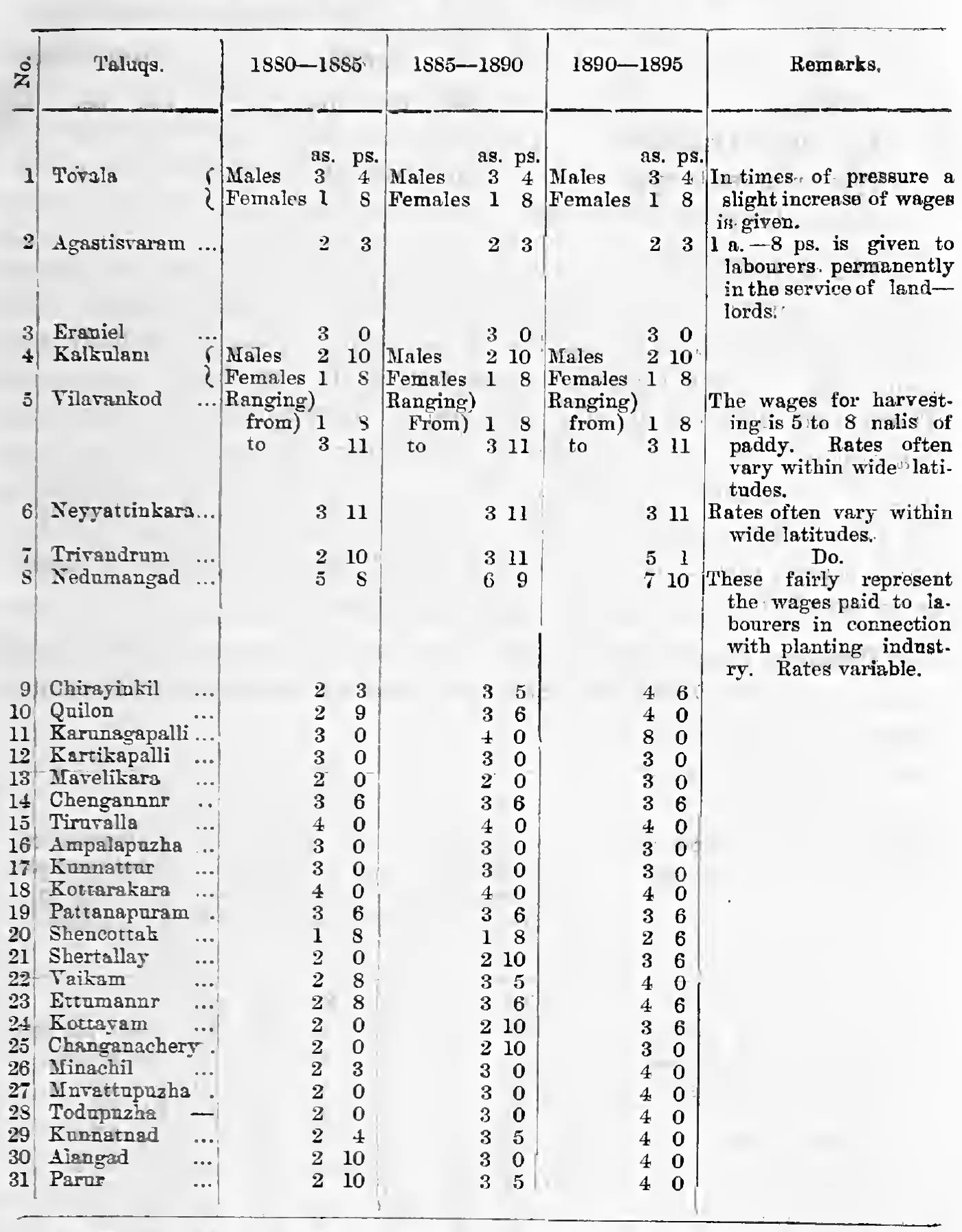
* This table was compiled from information snpplied by the Division Peishcars in reply to a requisition from the British Resident, dated 31st August 1896. As the seer varies for different localities, the measure which is uniform throughout the whole Presidency has been adopted and the calculations made accordingly. 1 Madras measure = one and one-fourth Travancore Idaugalis.
[176]In Madras the daily wages for 1894-95 were thus:—
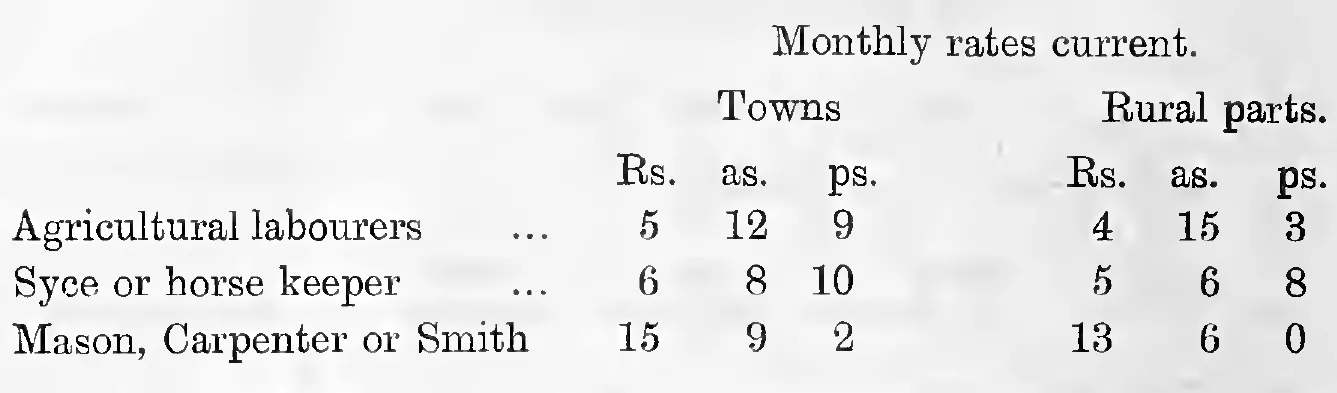
The agricultural labourer in Madras earns a little more than 3 as. a day in the towns, and about 2½ as. in rural parts; the horse keeper earns Rs. 6½ or Rs. 5½ a month, and the mason, carpenter and smith daily earn about half a rupee each in Towns and about 7 as. in the rural parts. There is no difference at all in this respect between the Presidency and Travancore. In some respects the Travancore labourer or artisan earns more. A carpenter here earns 10 as. a day, sometimes as high as Re. 1-8 as. Some masons earn 12 as. or even Re. 1--4 as. a day. In Australia, a good mason is said to earn 10 shillings a day, which of course is far ahead of the Travancore workman's wages.
Price of food grains. The following table gives the prices (niruk) of food grains in December 1874, as compared with those of December 1904:—
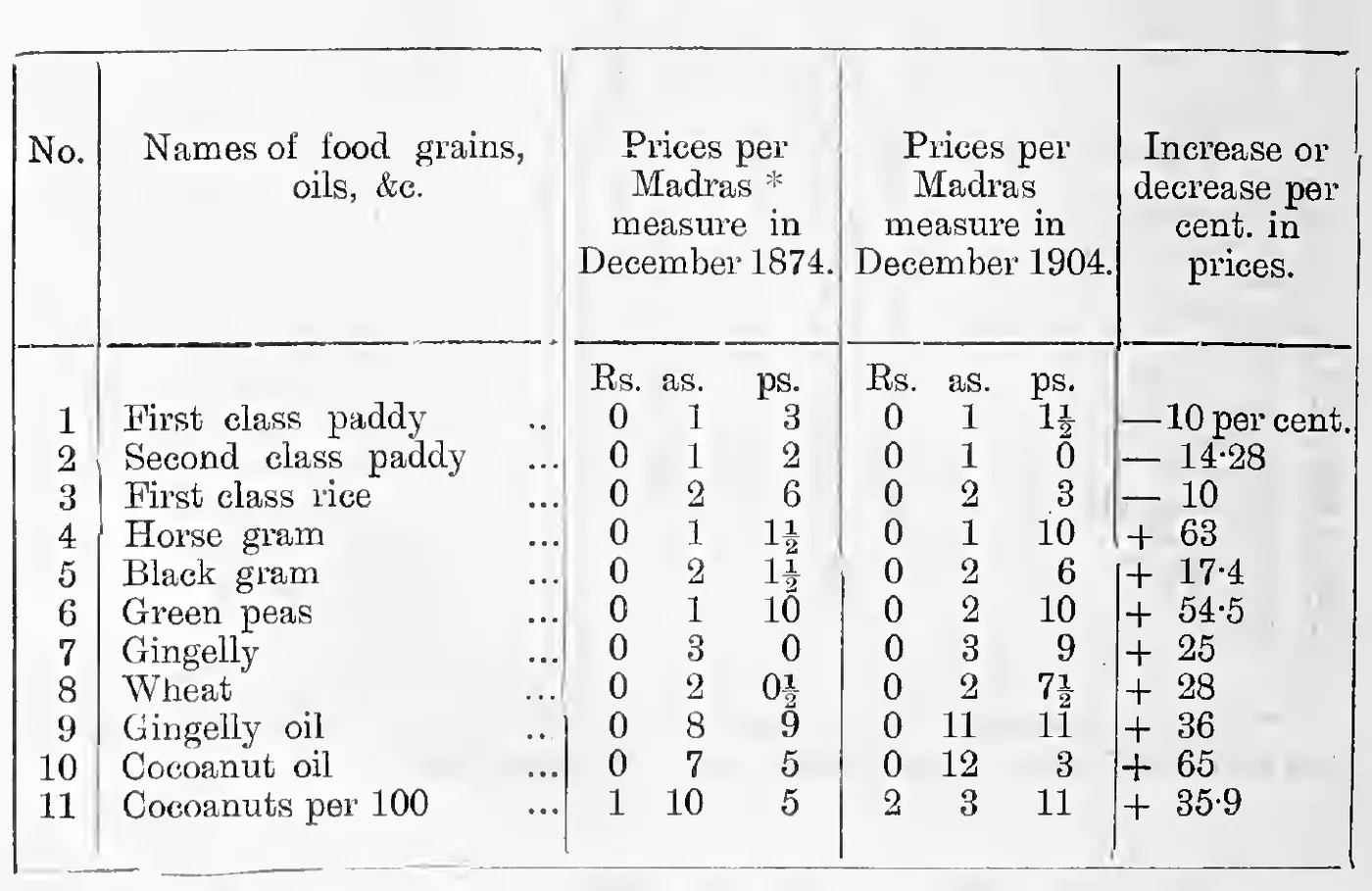
[177]It is gratifying to note that the most important articles of consumption viz., paddy and rice both of which have to be imported in large quantities cost less now than 30 years ago—a state of things entirely due to the greater facilities now existing to import them into Travancore; while other articles grown in the country itself and the cultivation of which has been greatly stimulated by the demand for them in foreign markets have risen very considerably in prices so much as 65 per cent. in the case of cocoanut oil, and 35 per cent in cocoanuts. Again there are increases in the prices of certain articles of diet, as they should rightly have increased, because they are not locally producible in abundance, such as wheat, green-peas and gingelly oil. These conditions indicate the directions into which the energy and application of the Travancore ryot and tradesman may flow with advantage to themselves and profit to the State. It is seldom that an agricultural country is fitted for high industrial developments, but Travancore is peculiar in this way that while it is almost wholly an agricultural region, it is capable of becoming a centre of great industrial enterprise as well, and if we only follow the example of Japan which is called the 'Britain of the East,' the little state of Travancore might become in the fulness of time a centre of great agricultural and industrial activities, the one acting and reacting with benefit on the other. Mr. Henry Dyer, C. E., M. A., D. Sc., the Emeritus Professor of the Tokyo University in his 'Dai Nippon' says that Japan wished to secure influence over Korea, because it was a rich agricultural country and because she wished to ensure a supply of food for those of her people who were engaged in manufacturing industries, as the development of industry in Japan made the country more or less dependent on the produce of other countries for the food of its population. With this one object in view, the officials of Japan, says Mr. Dyer, have worked with unremitting devotion and zeal since 1873 so as to make its influence felt in the councils of the world and qualify their country being called the Britain of the East and they not infrequently got laughed at by foreigners for what was considered their conceit. But few will now deny that they have gone a long way towards its realisation. Without such extraordinary exertions, however, Travancore might well reach an ideal state of agricultural and industrial eminence, owing to its rare natural advantages, if only the people will shake off their inborn lethargy and apply their means and intelligence, such as they are, to the amelioration of their social and material condition.
Summary. The economic condition of Travancore is thus on the whole hopeful. It is a country of small holdings and thriving peasants who number about 5,00,000 for the whole State. They are a contented lot [178]and so far as could be judged from their material condition not less prosperous than their brethren in other parts of India. They are industrious and law-abiding; they stick to their land from generation to generation and cultivate it after the fashion of their forefathers, with a full knowledge of the local conditions of rainfall and seasons, manure, nature of soils, their fertility and rotation of crops. Land is valuable and land-owning is a sign of respectability and is therefore much coveted. The investment however does not yield any large return to the ryot; 4 to 5 per cent. is the utmost interest obtained and is considered a fair profit on landed property in Travancore. Nature is kind to him, rains are plentiful and the earth yields abundantly as if grateful for the little labour bestowed upon it. The Government has done what it can to the agricultural population, in the way of legislative aids so as to maintain them in strength and independence against undue exactions and whimsical evictions by the landlord. The land tax is light and is payable in several small instalments. A portion of the tax is payable in kind and only a portion has to be paid in money. The kistbundi is considerately regulated. The ryot of course is not opulent but neither is he the victim of ruinous indebtedness. The interest payable to the lender of money or of paddy is very high, especially so in the latter case. It behoves Government to turn its attention to this question and relieve the ryot to some extent at least by working the Agricultural Loans' Regulation more liberally and more sympathetically. The fears of political economists are evidently out of place and ought not to enter into calculation in dealing with so small a State as Travancore. Agricultural banks and Co-operative Credit Societies are undoubtedly good in their own way but they are unsuited to the present condition of the agricultural classes in Travancore. The Registration statistics show that the ryot's capacity to borrow is greater than in British India, that is, that he has better credit than the agricultural ryot of the neighbouring British Districts. Slavery has long ceased to exist. The labourer is a free man though he sticks to his native valleys and his old masters. Labour is abundant in towns and villages and the daily wages of the labourer is fairly high. He never suffers from want of work nor does he ever suffer from the pinch of absolute poverty. Severe droughts and famines as in other countries are nearly unknown. There has been only one severe drought, not famine, during the last eighty years while in the country beyond the Ghauts there have been sixteen famines for that same period. The prices of food-grains then rose high, mortality from starvation however being extremely rare. The incidence of taxation shows that the use of tobacco and liquor has largely increased in recent years: both are of course injurious to the [179]public health, but the evil of increased drunkenness threatens to become a national disaster. The prices of agricultural produce have considerably increased in all items, during the last thirty years—thanks to the increased facilities for internal communication afforded and the natural development of trade. This has given a great impetus to agricultural prosperity, and a great increase of capital has followed. Though there are not many big men as of old, there are not so many poor men, nor is poverty so abject as in former years. This is a good sign of a healthy economic condition and the truest patriot could only wish that no rude shock may be given to the fabric which favourable circumstances have so successfully reared in past years. A careful and thoughtful administration is all that is required to follow up the happy results so far achieved.
[180]
Chapter XVTrade and Commerce.
"She (Commerce) may well be termed the younger sister, for in all emergencies, she looks to agriculture both for defence and for supply."
Colton.
"The natural result of free trade is to stimulate competition, invention, and variety of enterprise, whilst the natural result of protection is to establish routine methods."
J. S. Nicholson, M. A. D. Sc.
The commercial products of the Malabar Coast have in ages long anterior to the Christian era, acquired a wide reputation in the leading markets of the ancient world, and have ever since continued to be a fruitful source of attraction and inspiration to the commercial instincts of civilised nations. Though it may be a bold conjecture to postulate that the "cinnamon and cassia," which played an important part in the religious services of the ancient Jews, had been supplied from Malabar, it may however be taken as an undoubted historical fact that the adventurous sailors of King Solomon had found their way to these distant shores and returned to Syria with their tiny crafts laden with "silver and ivory and apes and peacocks." The military achievements of Alexander the Great and the foundation of his Asiatic Empire brought the East into closer relations with the West and sailors and merchants from the Greek cities of Phœnicia and Syria continued for a long time to do a busy and profitable trade with India.
"From the earliest days, India has been a trading country. The industrial genius of her inhabitants, even more than her natural wealth and her extensive seaboard distinguished her from other Asiatic lands. ... ... ... The brilliant mediæval republics of Italy drew no small share of their wealth from their Indian trade. It was the hope of participating in this trade that stimulated Columbus to the discovery of America, and Da Gama to the circumnavigation of the Cape of Good Hope. Spices, drugs, dyes and rare goods; fabrics of silk and cotton; jewels, gold and silver—these were the temptations which allured the first adventurers from Europe."*
On the dissolution of Alexander's Empire, the interest of trade with the East did not die out, but only passed into other hands; and Egypt under the rule of the Ptolemies, became the great emporium of trade and the centre of commercial enterprises. From the Ptolemies the heritage of Eastern trade passed to the Romans and under Imperial Rome, commercial relations with the countries of Southern India continued on an [181]extensive scale, as is evidenced by the large number of Roman coins found in Malabar and the adjoining districts. The decline of the Roman Empire and the rise of the Mahomedan power effected another diversion in the course of trade, and the Arabs and Moors with their piratical activities enjoyed the sole monopoly of Eastern trade in the Middle Ages. The Portuguese came in the fifteenth century to supersede the Moors and then came in the Dutch and the Danes. The French and the English followed in quick succession. Thus the great nations of the world have all struggled to secure the monopoly of Eastern trade, and among the precious articles of commerce procurable in the East, the pepper and the spices of the Malabar Coast have ever been the most conspicuous. Nations have come and gone with varying success, but Malabar has ever continued to retain the interest of the world in it on account of its valuable natural products. She now supplies the markets of the world not only with the best pepper and spices, but also with the best copra, coir and cocoanut-oil.
* Sir W. W. Hunter's India p. 555.
With regard to the details of trade and commercial administration in Travancore prior to the middle of the eighteenth century very little is known. Modern Travancore has come into existence only in the reign of the warrior-king Martanda Varma, who with the instincts of a true soldier and statesman subjugated and organised into a single political whole, the petty principalities into which the southern portion of Malabar was then divided. The first attempt at organising trade and establishing a separate commercial department was made in his reign, and the principle underlying the scheme was the introduction of State monopoly in most of the important articles of commerce. Under the able supervision of Rama Iyen Dalawa, warehouses were opened in several places in the State and in such warehouses superintended by a Vicharippukaran and guarded by the military, were stored, on account of the Sirkar, large quantities of pepper, tobacco, cassia, areca-nut and other articles, bought from the people at fixed rates of price established by Royal Proclamations. These articles were afterwards sold by the Sirkar wholesale as well as in retail, and private trade or transaction in any of these articles was declared criminal by special proclamations. A scheme for levying duties on articles of commerce was also set on foot and a number of inland and frontier Chowkeys were established at several convenient places in order to check the goods transmitted from place to place and to levy on them the duties prescribed by the Government. These measures were at first attended with great financial success and the Government in later years even proceeded to the length of embarking in trade and commercial transactions by building ships to convey the produce of the country to the profitable markets of Bombay, Calcutta and other British ports. But the introduction [182]of State monopolies and the imposition of duties on articles of internal traffic, were dictated mainly by the exigencies of an embarrassed financial condition. Not being based on sound principles of commercial policy nor calculated to induce the people in general to resort freely to commercial occupations, they curtailed the possibilities of free production and caused great distress and inconvenience to the people at large. The system perhaps worked well in the beginning and relieved the state from impending financial ruin, but owing to inherent imperfections it gradually worked itself out into an organised scheme for oppressive exactions and an uncertain source of public revenue. All over the world whether in India or elsewhere the early history of trade and fiscal policies seems to have been associated with an endless number of petty imposts and transit duties levied from village to village by an army of unscrupulous and pettifogging servants of old kings. The liberal principles of modern free-trade were wholly unknown in India before the advent of British Rule. The same seems to have been the condition in England, as the following will show:—
"At the time (1842) when Sir Robert Peel began his series of great financial reforms which ultimately led to the complete abolition of protection, there was scarcely a single article of foreign produce imported which was not heavily taxed. At that time our tariff contained nearly 1,200 import duties: nearly the whole of these have been repealed, and at the present time almost the entire amount of the revenue levied on commodities either of home or foreign growth is obtained from six articles—spirits, wine, beer, tobacco, tea and coffee."*
Writing of the old state of things in Baroda Mr. R. C. Dutt remarks of the rise and fall of Patan owing to the capricious action of its Native rulers.
"Silks, however, are the speciality of Patan, and the silk Potala of this town is largely in demand in all parts of Gujarat and forms the bridal trousseau of high caste Hindu women all over the Province. The rise of Ahmedabad diverted a part of the silk as well as the cotton weaving from Patan; but in the 18th century heavy duties were imposed on the Ahmedabad weavers by the Peshwa and the Gaekwar, and weavers in large numbers returned to their old home at Patan. In 1818, Ahmedabad became British, cesses on manufacture were abolished, and the export duty of 15 per cent. was reduced to 2½ per cent. The weavers of Patan, therefore, once more migrated to Ahmedabad, and Patan has never flourished since. The history of the weaving trade of Patan and Ahmedabad is a lesson which fiscal reformers and administrators should remember in Baroda."‡
The evils of the system with reference to the monopoly of tobacco were thus summarised by Dewan T. Madava Row in his Administration Report of Travancore for the year 1037 M. E. (1861-62):—
* Manual of Political Economy by the Right Hon'ble Henry Fawcett, M. P. 7th Edn. p. 136.
‡ Baroda Administration Report for 1902-03 and 1903-04 pp. 103 &104.
[183]
"The greatest elements of uncertainty and the greatest source of anxiety used to be the large revenue derived from the tobacco monopoly. The monopoly itself was open to grave objections in the form in which it was maintained. But apart from this, there were great difficulties in maintaining it with uninterrupted success in that form. The Sirkar used to enter into contracts with private merchants for the supply of but three kinds of commodity, for the consumption of each of which kinds a particular part of the country was appropriated. In the domain of each kind of Tobacco, no other kind was to be admitted on any account. The Sirkar storing these supplies in its warehouses, sold them at enormous prices to certain fixed wholesale dealers appointed to each subdivision of the particular circle. The evils of these arrangements it requires no great discernment to perceive. In the first place, the contracts for making the supplies to the Sirkar required for fulfilment such large command of money, influence, intelligence and practical experience, that under the best encouragement, only a very small number of persons could come forward to compete for such contracts. The field for competition having been so extremely circumscribed, the contractor generally contrived to stipulate for pretty liberal rates. This generally enhanced the price of the article, though not directly, to the consumer. Then again, it was the interest of the contractor to supply as inferior an article as he might force on the Sirkar; and the Sirkar was often under the necessity of accepting it, lest by rejection it should expose itself to great loss of revenue arising from a sudden failure of the contractor; a loss too great to be made good by any contractor, and a failure too sudden to be counteracted by engaging another contractor. Inferior article was thus in a manner forced on the consumer, and the smuggler came to enjoy the additional advantage of offering a superior article as if the lower price at which he was able to offer it were not in itself sufficient temptation The enormous price too at which the Sirkar sold the monopolised article occasioned extensive contraband trade, carrying in its train its too obvious evils. This illicit trade had naturally a great tendency to increase, and was able at favourable times and under circumstances but too prone to recur, to inflict considerable and sometimes unexpected losses on the Revenue. Even more uncertainty arose from another contingency. The contractor was too frequently liable to fail whether from bad faith or from too great a rise in the prime cost of the tobacco he had engaged to supply. A failure of the contractor was almost certain to be followed by heavy injury to the Revenue. This was not all. The consumer in each circle having been accustomed to but one particular kind of tobacco, when that failed, he would not consume another, and the Sirkar was left without resource."
About the Pepper monopoly the same Dewan observed:—
"Another great source of weakness in the financial system of Travancore used to be the Pepper monopoly. Under its operation, all Pepper grown in the country was deliverable in kind and at a fixed valuation to the agents appointed by the Sirkar. The Sirkar brought all the produce to its chief Commercial Depôt, and there sold it by public auction. Such a system also was full of various kinds of abuse; afforded opportunity for exaction, and promoted extensive smuggling."
Such was the state of commercial paralysis in Travancore during the earlier half of the last century. But with the administration of Sir Madava Row a new commercial policy based on sound economic principles was inaugurated in Travancore. Several of the oppressive monopolies and inland duties were abolished and a new system of levying customs-duties on articles was introduced instead. A great loss of public revenue [184]was of course the immediate result, but the abolition of the monopolies freed trade from vexatious interference, and under the healthy influence of free competition, the commercial resources of the country received an impetus never known before. The interference of the State with the freedom of private production or distribution was reduced to a minimum, and with the exception of salt, abkari and opium, which still continue as monopolies, the public have been given perfect liberty to import or export or deal in any article they like by simply undertaking to pay to the Government fixed rates of import or export duties at the few Chowkeys established by Government to levy the same. At present there are 32 custom-houses (Chowkeys) in the State, and each is under the management of an officer called Chowkeydar whose function is to assess the prescribed duties on the articles that pass in or out through the limits of his Chowkey and to submit a daily statement showing the quantity and the description of the goods assessed and the duties levied on the same to the Huzur where there is a separate branch called the Peravagai Department to check these returns.
The import duties of Travancore are regulated by the commercial treaty of 1864 entered into with the British Government. The circumstances that led to this treaty are thus explained in Sir Madava Row's Administration Report for 1039 M. E. (1863-64).
"The trade of Travancore is chiefly with British India.
"In a natural order of things the trade of Travancore with British India must chiefly be directly by sea between the ports of Travancore and those of British India. But, in reality, much of the trade has now been diverted from the Travancore ports to British Cochin; such diversion being due to the peculiar action, with regard to Travancore, of the fiscal rules of the British Government. Travancore being treated as a foreign State, exports to and imports from this country have to pay foreign duty at British ports, and this duty has been peculiarly heavy in recent years. But Travancore has free access by land to the port of British Cochin, excepting that the Cochin Sircar intervenes and levies a duty on goods in transit. This duty however is much less than the foreign duty of the British Government. The consequence is that it is found to be more advantageous to take Travancore goods by land to British Cochin, and thence transport them to other parts of British India under the freedom granted by the Interportal Act of the Indian Government, than to export them from Travancore ports direct by sea to British Indian ports. The same is the state of things where imports are concerned. A merchant finds it more advantageous to take goods destined for Travancore, to British Cochin in the first place, whither he can take them free of British duty under the Interportal Act, and thence by land to their destination, than to export them direct from a British Indian to a Travancore port.
"This unnatural diversion of trade has subjected it to trouble, expense and delay, while it has almost paralyzed the action of the ports of Travancore, especially of Alleppey with all its remarkable natural advantages which have [185]been largely added to by the construction of a first-rate Lighthouse and other improvements effected by the Sircar. But all this evil is not compensated by advantage to the British Government, which has to some extent missed its aim in point of revenue so far as this country is concerned, and has been unconsciously instrumental only in throwing a handsome revenue into the Treasury of the Cochin Sircar at the expense of Travancore."
On this having been represented a commercial treaty between Travancore on the one hand and the British Government and the Cochin Sirkar on the other was concluded. As a result of this the following notification was issued by His Highness the Maharajah:—
1 "Whereas it has been found expedient to revise, in communication with the British Indian Government and the Cochin Sirkar, the system of duties hitherto levied on the trade of Travancore, it is notified that, from and after the 1st of June 1865 / 20th of Vycausy 1040 no customs duties on account of this Sirkar will be levied on goods imported by land, sea, or backwater, into Travancore, and being the produce and manufacture of British India or of the territories of the Cochin State excepting on Tobacco raw and manufactured, Salt, Opium, Spirits, which will be treated as heretofore.
2. "The British Indian and Cochin Governments will also give up their customs duties on all goods imported by land, sea, or backwater, into Travancore from their territories. The British Indian Government will permit Bombay Salt to be exported to Travancore on the same terms as to the British Provinces, such as Malabar and Canara.
3. "On imported goods other than those which are the produce or manufacture of British India, or the territories of the Cochin State, the Travancore Government will levy the British Indian rates of duty, except when they shall have already paid duty to British India or the Cochin State, in which case they will be exempted from duty.
4. "The duty that this Government will levy on goods exported from Travancore will be 10 per cent. on Timber, Rs. 15 per candy of 500 English lbs. on Pepper and Betel-nut, and 5 per cent. on all other goods. But Tinnevelly cloths exported from Travancore to British India or to Sirkar Cochin will be free. And also, only a limited number of commodities will be liable to export duty at the Chowkies of Ramaswaremcottah, Bagavathycottah and Eddapully: the said commodities being notified from time to time.
5. "Neither the British Indian Government nor the Cochin State will levy any duty on goods imported into their territories from Travancore, whether by land, sea, or backwater, and whether the produce and manufacture of Travancore, or foreign goods which have already paid import duty to this State, excepting Salt, Opium, Spirits.
6. "The Sirkar will not tax Coimbatore or other British Indian produce passing through the Travancore backwater to British Cochin, or to the Cochin State, nor tax the produce of the territories of the Cochin Sirkar, directly proceeding through Travancore to British Cochin, or to some other part of the territories of the Cochin State itself.
7. "The British Indian Tariff of valuations will supersede the Tariffs hitherto in force in the Chowkies of this Sirkar."
[186]In consequence of this interportal arrangement there was a very considerable fall in the customs revenue. The British Government however engaged to pay annually to the Travancore Sirkar a sum of about Rs. 40,000, as compensation for the loss which it sustained by allowing free access into Travancore to goods other than the produce or manufacture of British India and which may have already paid duty at British Indian customs houses."
It may be noted here that the Government of England had in 1853 resolved that "Travancore and Cochin shall be treated in every respect in regard to their trade on the same terms as are applicable to British India."
By these measures trade was freed from various imposts and this greatly tended to its expansion, so much so that the exports which amounted in 1861-62 to Rs. 3,544,653 rose in 1868-69 to Rs. 7,276,200, i. e., they showed an increase of over cent. per cent in seven years. These improvements and aids to the commercial activity produced the desired effect, and it may be safely asserted that the present prosperous condition of trade in Travancore is mainly due to the timely reforms then introduced. The commercial policy which Sir Madava Row inaugurated has been carefully continued by his successors in office, and with a system of administration that sufficiently protects the wants and requirements of the trading public, by providing them with a perfect network of roads and backwater communications that make travelling and transport as easy as they are pleasant, with a line of railway that runs into the very heart of the country added to the natural convenience of a coast-line which affords excellent provision for the safe anchorage of ships during all seasons of the year, the present outlook of commercial prosperity in Travancore may be said to be in the highest degree hopeful.
The value of the entire trade of Travancore according to the latest figures in 1079 M. E. (1903-04 A. D.) amounted to Rs. 31,404,713 as shown below:—
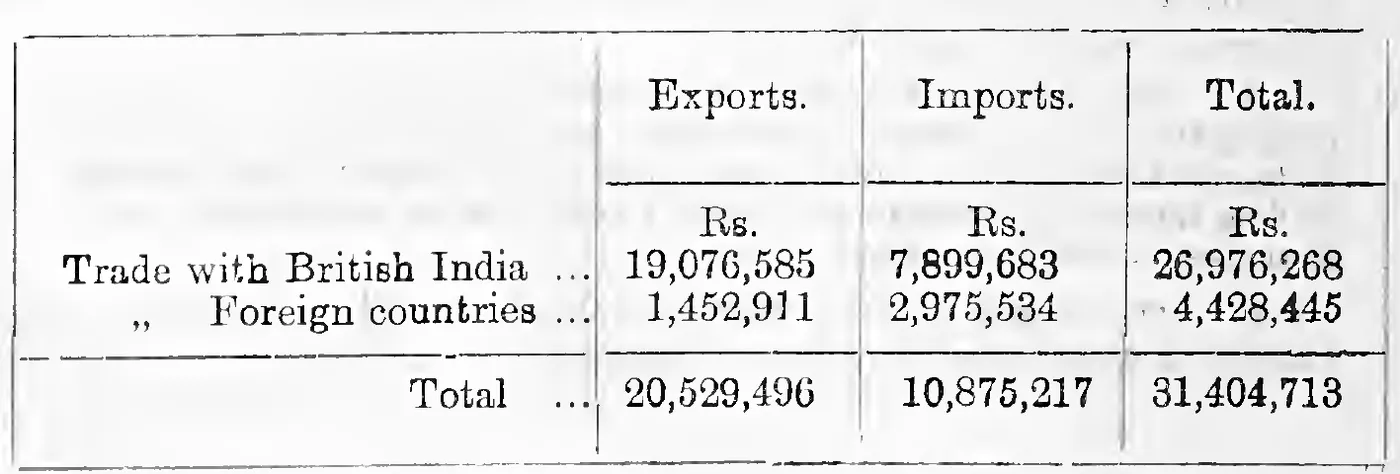
[187]Of this 37 per cent. was carried on by sea, 45 by backwater and 18 by land. The trade by land was mostly confined to the neighbouring British Provinces and the trade by backwaters with Cochin. The Trade by sea was with British territory and Foreign countries. The bulk of the trade is with British India. The following table shows the proportion of trade with British India as compared with Foreign countries:—
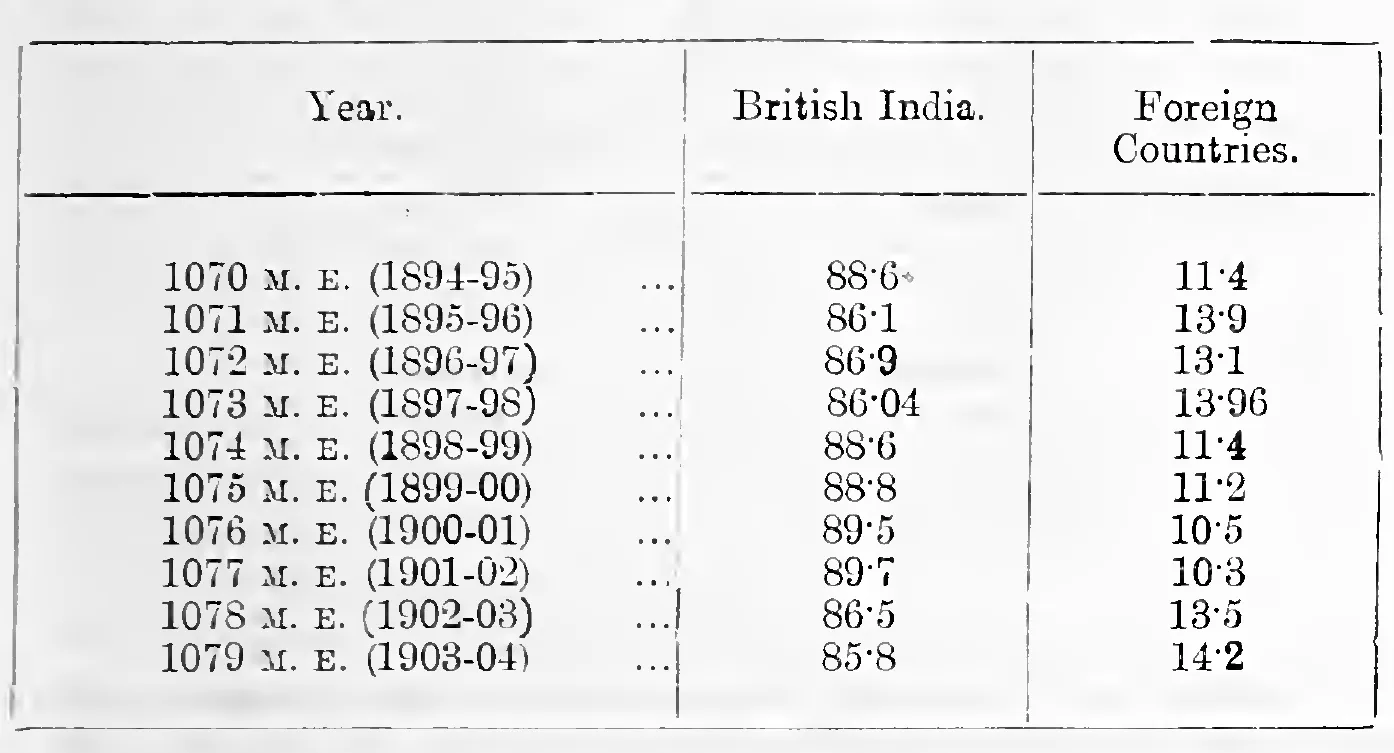
The principal British Indian ports to which shipments are made are Bombay, Tuticorin, Calcutta and Rangoon, and Colombo and Jaffna in Ceylon. The most important foreign ports dealt with are London, Hamburg, Bremen, Venice, Trieste, Genova, Marseilles, New York and Baltimore. The articles generally shipped to these ports are coir, copra, cocoanut-oil, pepper, ginger and tea. Coir and coir-matting are also sent to South Africa and Australia. Railway has been introduced only very recently and it is likely to give a fresh impetus to internal trade.
The chief imports and exports for 1079 M. E. (1903-04) are given below with their value:—
Imports.
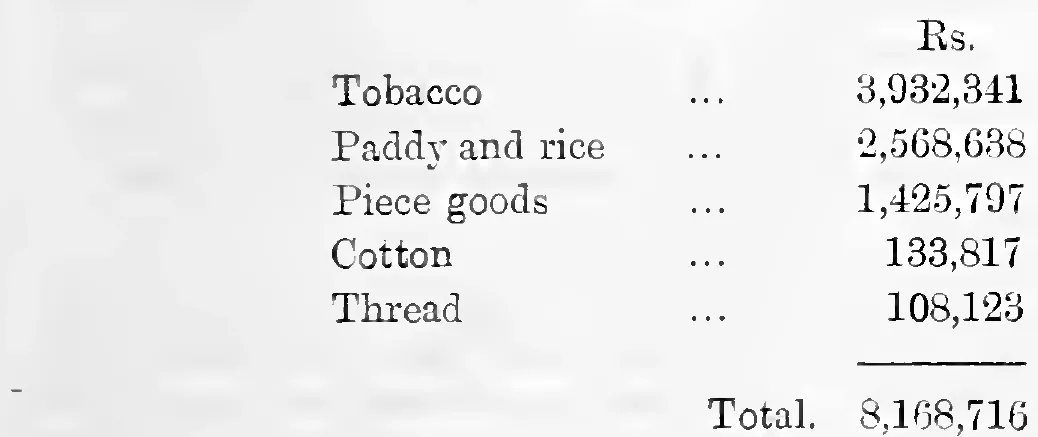
[188]
Exports.
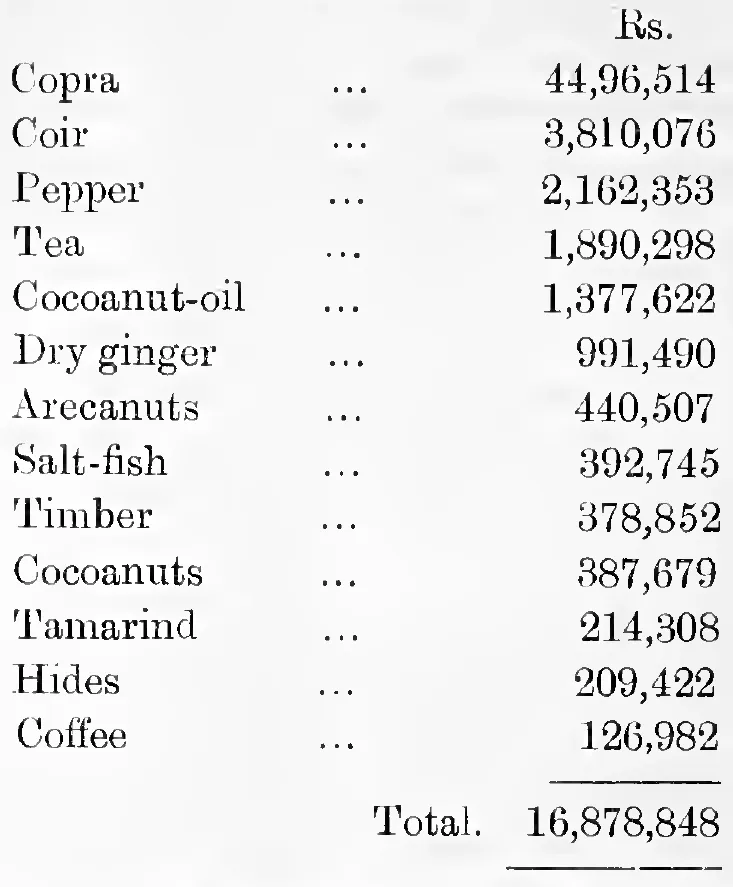
It will be seen from the above figures that the imports consist of the most important necessaries of life. Travancore soil is unfit for the cultivation of cotton and tobacco; hence it depends for these two essential commodities entirely on their import from outside. While very little cotton is produced within the State the establishment of a spinning mill at Quilon can only be accounted for by its easy accessibility to Bombay by sea and its water facility along the coast on account of which it gets its raw material with less cost for transport than it would be possible for mills situated far inland. Some of the yarn manufactured at this mill together with that imported from outside supplies the materials for weaving indigenous cloths. But as these meet but a small portion of the local need for clothes, piece-goods to the value of nearly 15 lakhs are annually imported into Travancore.
It may not be inappropriate to give here an extract from a speech delivered by the Hon'ble Mr. Castlestuart Stuart which though referring to the present industrial condition of India in general, is equally applicable to Travancore. He pleads for Swadesism in trade.
"The object which they all had in view was to promote the wealth of the people, or speaking economically, to increase the exchange value of the commodities produced in the country. The number of such commodities in this Presidency was mainly restricted to agricultural commodities, but were capable of considerable augmentation and improvement. According to Dr. Voelcker, two of the greatest needs of the country were improved irrigation and the removal of the existing difficulties in obtaining cheap money. They would all admit that a very great deal had been done in that way by the Government [189]during the past ten years in regard to irrigation. The speaker quoted figures to show that the allotments made by Government towards Major Irrigation had during that time been steadily rising from Rs. 60 to Rs. 68 lakhs, and during the present year the allotment was no less than Rs. 90 lakhs, due, of course, to the very great pushing forward of Irrigation schemes, the outcome of the Irrigation Commission. He next referred to the appalling extent to which trade, which ought to be in the hands of the people of the country was in the hands of foreign people, chiefly owing to a want of manufacturing facilities, and quoted statistics showing the value of exports, as raw products of jute, cotton, skins and hides and other commodities, and the value of the same imported as manufactured products into this Presidency during the past three years. If such products could only be manufactured in the country instead of being sent out to foreign countries, the augmentation of the wealth of the country would be enormous."*
Even in the case of paddy the produce of the State is insufficient to meet the whole demand and its import as well as that of rice comes to about 25 lakhs of rupees' worth a year. It might seem strange that a country with ample rainfall and large irrigation facilities should not be able to produce its own requirement of paddy. But it has to be remembered that the Travancore ryot takes more kindly to rear cocoanut and other trees than to cultivate rice fields, for they yield better profit, and are less liable to be affected by unfavourable seasons which may suffice to bring about a total failure of wet crops. And when to this is added the fact that gardens entail comparatively less trouble and cost and that there is an ever increasing demand for their produce, we can well understand the ryot's partiality for them, a circumstance which also accounts for the very large export of the produce of the cocoanut tree. But all the area fit for paddy cultivation has not been brought under the plough, nor have agricultural practice and the science of manuring reached such a stage of perfection under which two blades of grass can be made to grow where only one grew before. There is thus ample scope for the industrious Travancorean to raise on his own lands, the 25 lakhs of rupees' worth of paddy and rice now imported from outside.
As regards exports, the produce of the cocoanut tree, i. e., cocoanut, copra, cocoanut oil and coir fibre take the lead being over Rs. 100,79,795 i. e., 50 per cent. of the entire exports in value. The export of these is steadily on the increase and along with it also the demand for the same. The export of raw material in the shape of cocoanut, copra and coir fibre is however not a satisfactory feature of the economic condition of the country. With better enterprise and improved organisation it ought to be possible to work the raw produce within the State itself, thus creating [190]new industries for the sustenance of the people and to export only the manufactured products from them.
* The Madras Mail, 3rd May 1906.
Mr. W. S. Lilly explains the reason for the exports of raw products from India in the following words:—
"There can be no question whatever that the great development of machinery in England, in the early decades of the present century, was a terrible blow to the prosperity of India. Free Trade was a second. The native handicrafts, sustained by no capital, relying merely on traditional skill and personal initiative, perished, and hideous manufactured wares took the place of their beautiful products. And the Government, fast bound in the sophisms of the old 'orthodox' political economy with its gospel of Laissez-faire, did nothing to remedy the evil. It is certain that the neglect of Indian industries is one of the causes of the present distressed condition of India. The raw products of the country are exported, manufactured, and sent back to be sold in the Indian market. Foreign workmen thus take the bread out of the mouths of starving millions in India. Sir M. M. Bhownaggree very justly remarks, 'When it is remembered that most of the articles that form the export trade leave the country devoid of any native skilled manipulation, they ought to cease to mislead one into the belief that the industrial capacity of India is at all commensurate with her natural wealth of produce, or that the value of her exports of raw material can be at all an index of her inherent capacity for increased industrial production, if scientifically and technically trained, as it is too often mistakenly supposed to be the case.' There would seem to be two remedies for these evils. The first is, the introduction and maintenance by the Government of industrial and technical education. The fostering of the aluminium industry in the Madras School of Arts is a specimen of what might be done, and ought to be done, on a large scale; although we can hardly hope that it will result in the productions of such fabrics as the muslin of Dacca, the pottery of Sind, or the silk brocade of Ahmedabad. The second is the protection of Indian industries in respect of foreign competition. Surely it is high time that the stupid old shibboleths of Free Trade were discarded. Surely the wonderful progress made by the nascent industries of America, Germany, and Japan, under a protective tariff, should open the eyes of the most theory blind."
"India has an extensive and expanding trade with all the quarters of the globe, but it is carried on for the most part by foreign capital, with foreign labour, in foreign ships, and the children of the soil have very little share in it. The trade itself is by the excess of exports over imports indicative of a heavy and increasing annual drain which is exhausting the resources of the country. By the dislocation and partial collapse of the old industrial system, from a manufacturing country, she has become an agricultural one. Thrown on this one industry, the pressure of the population on land has increased beyond healthy limits, and agriculture itself has ceased to be a profitable occupation. The result is an 'acute', widespread, growing poverty all over the country, increasing severe distress among the lower classes and absence of economic staying power in the masses."*
That presupposes a long and excellently aimed course of Industrial and Technical Education widely spread among the classes of the community fit to receive the same, of which even a beginning has not yet been made [191]in Travancore. The initiation for this should come from Government as the people are indolent by nature and helpless financially.
* Indian Politics p. 46.
Regarding the future of the cocoanut industry Mr. G. T. Mackenzie I. C. S. remarks:—
"Then comes the cocoanut. I need not say that the cocoanut is the staple of Travancore, because the tree is all around us, shutting out the sky from our view. The other day I was reading a criticism of Thomas Moor's poems in which the critic said that clearly the author of 'Lalla Rookh' was never in India, because he speaks of the shady palm and everybody who has seen the East knows that the palm tree gives little or no shade. The critic who wrote that passage ought to come here and see for himself. Five years ago Pierre Loti was in Travancore and he spoke of the 'gloomy vault of the eternal palm' saying that in Travancore, with the palm trees arching overhead, he felt as if he were walking up the nave of a lofty cathedral. But I must not linger on the artistic aspect of the feathery palm. I wish to treat it as a cultivated orchard tree. It is the plain truth that Travancore lives on this tree. The wharves at Alleppy and Cochin are covered with the various products of the cocoanut, barrels of oil, tons of kernel, bales of coir, which from these ports find their way all over the world. The value of these products exported last year across the frontier of Travancore was about 100 lakhs or more than Rs. 3 for each head of the Census population of the State. Without the money obtained by this export of the cocoanut the people of Travancore could not buy from Burma the rice that keeps them alive or from Jaffna the tobacco that keeps them contented. Therefore as so much depends upon the cocoanut in Travancore, it is most important to enquire whether foreign nations by hostile tariffs could injure this trade and the answer must be that in their own interests they will not attempt to do so. In the first place they cannot get anywhere else cocoanuts so good as these are. I do not know the cause why the Travancore nut is better than, for instance, the Ceylon nut; but in the London market a ton of cocoanut-oil from the port of Cochin, that is to say, from Travancore, is worth some pounds sterling more than is a ton of oil from Colombo. In the second place they will not get coir so cheap. The cultivation of the tree and the preparation of the nut for export seem to be occupations specially suited to this West Coast with its dense population, its minutely subdivided holdings and its easy water carriage to market. Each man lives under his own pepper vine and palm tree, and every traveller by boat on the lagoon has seen to domestic labour at each threshold the whole family busy in severing the husk from the nut, in spinning the fibre into yarn, in spreading the kernels in the sun to dry and in gathering the shells into a heap for fuel. Then the canoe on the lagoon is laden and the stuff is put down on the wharf of the nearest port at a cost which defies the competition of machinery. In the third place if hostile tariffs do divert this trade from foreign shores, it is very doubtful whether foreign countries can obtain a sufficient supply. Something might be got from Madagascar, from the French and German Pacific Islands or from the Non-British West Indies; but not sufficient to meet the demand. At present the amount required is very great. Last year America took from the one port Cochin nearly 15 lakhs worth of cocoanut-oil and Germany alone took from the Madras Presidency 14 lakhs worth of oil, 14 lakhs worth of kernel, and 14 lakhs worth of coir yarn. Therefore it seems clear that foreign countries must have the cocoanut of this West Coast."
Pepper comes next in importance. The trade in this commodity has long remained almost stationary. This staple has greatly disappointed [192]the expectations under which the Government monopoly was abolished and the tax on it was successively reduced. The material relief thus afforded has entirely failed to stimulate production which indeed seems stationary, though it was thought that the abolition of the monopoly would greatly conduce to increased production.
The figures for tea and coffee are very significant. The export of coffee shows striking variations during the last ten years. The value of the export was Rs. 1,12,909 in 1070 M. E. (1894-95) and Rs. 1,26,982 in 1079 M. E. (1903-04). From 1070 it steadily declined reaching the lowest figure in 1073 M. E. (1897-98) viz., Rs. 41,467. It again rose gradually till it recovered the lost ground in 1076 M. E. (1900-01). It rose very high in 1077 M. E. (1901-02) viz., to Rs. 1,50,688 and again declined to Rs. 1,19,071 in 1078 M. E. (1902-03). It showed further decrease in 1079 M. E. (1903-04). These variations illustrate the vicissitudes of fortune of the coffee planting industry. According to a planter writing in the Madras Times, coffee is 'scarcely remunerative' and hence is gradually giving place to tea. That tea is becoming more popular and is slowly but surely replacing coffee is borne out by the trade figures for the last ten years. The export of tea has been showing a steady increase during this period. It was worth Rs. 10,74,268 in 1894-95 but in 1903-04 the value of the export was Rs. 1,890,298 or an increase of over 75 per cent. in ten years.
The total exports are considerably in excess of the imports in value, i. e., Rs. 20½ millions against Rs. 10¾ millions of imports. While the imports have with slight variations been almost stationary during the last 10 years, the exports have increased by about 25 per cent. during the same period. In 1070 M. E. (1894-95) the exports were nearly 63 per cent. in excess of imports while in 1079 M. E. (1903-04) the export, increased 26 per cent. more, i. e., they were over 89 per cent. more than the imports. It is found from the trade figures for British India for the year 1903-04 that the exports were nearly 40 per cent. over the imports in value. An excess of exports over imports is the normal condition of trade in British India where the excess is accounted for by the tribute which India pays to the British Exchequer in the way of pay and pensions, interest and profits on English capital invested in India and in a variety of other ways. These conditions also exist though only to a limited extent, in Travancore.
The foreign trade of a country represents the exchange of produce between that country and the other countries it deals with. As theoretically [193]exchange is only barter, exports and imports should equalise in value. In the absence of any disturbing causes this is or ought to be the normal condition of trade in any country. But where there is not this equalisation, the difference must be accounted for in some other way either by export of precious metals or by the country, against which the balance of trade stands, running into debt. A country like British India which largely employs foreign capital is in the position of a debtor while England which has invested a large amount of its capital abroad stands in the position of a creditor.
The salaries of the European servants of the State as well as their pensions, interest and profits on the foreign capital invested in the Quilon Railway and the plantations on the hills, the cotton and oil mills, the coir manufacture and other industries due to foreign enterprise may all be taken to form a tribute which this country pays to British India or the United Kingdom. The conditions then of trade here are more or less like those of British India. The exports of British India are 40 per cent. more in value than the imports. In Travancore the exports as already shown are nearly twice as much as the imports. Political economists. do not interpret such a state of things as healthy or prosperous. Professor Thorold Rogers says:—"If the community is doing well, the imports are always in excess of exports when interpreted in money value or prices." The statistics of European countries bear out the Professor's dictum, for we find the excess of imports is as follows: England 32 per cent., Denmark 40 per cent., Switzerland 28 per cent., Norway 42 per cent., Holland 22 per cent., Sweeden 24 per cent., France 20 per cent., Spain 9 per cent., and Belgium 7 per cent. What do these facts indicate in regard to the economic condition of our people? That we export nearly twice as much as we import, i. e., that the exports are cent per cent. more than the value of the imports compared to the increase of 40 per cent. in the exports over imports of British India, must be taken to mean that we are worse off than British India, which however is not a fact and can be testified to by any casual observer, for it is patent that the ordinary ryot of Travancore is more comfortably situated in every respect than his brother, beyond the Ghauts. It also shows that the Travancore ryot produces more than his brother of British India or consumes less than he and has thus more to spare for distant countries.
Fawcett says:—
"In no country has capital increased more rapidly than it has in England during recent years; the extension of our commerce and the increase of our [194]national wealth have been quite unprecedented. Numberless statistics may be quoted, each of which would prove a wondrous development of our commerce and trade. In twelve years, from 1849 to 1861, our exports advanced from 60,000,000 l. to the value of 120,000,000 l.; they were in 1881 297,000,000 l.; there has been a corresponding increase in our imports; for they have steadily advanced until in the year 1881 they reached the value of 397,000,000 l. The opinion is not unfrequently expressed that this remarkable growth of wealth has not been accompanied by any corresponding improvement in the condition of the labourers."*
So there has been in Travancore a rapid development in the export branch of commerce and trade in recent years, though not to that extent in the import branch. And nobody that knows something about the country can deny that the condition of the labourer has also commensurately improved in Travancore in recent years. But neither capital nor national wealth can be said to have perceptibly increased here as in European countries. Travancore sent out 20½ millions of rupees' worth of commodities and took in 10¾ millions of rupees' worth of commodities in 1079 M. E. (1903-04). Thus its one year's living cost 10¾ millions of rupees plus whatever was the consumed portion of the country's produce itself leaving in the hands of the Travancore people a balance of less than 10 millions of rupees, as the amount obtained by the sale of their products. This would scarcely be enough to maintain its population of three millions for three months out of the twelve. Under a different economic condition, where great capital was stored in the country and its inhabitants were characterised by enterprise and energy, the Travancore raw commodities might have been sold as manufactured products for say 30 millions of rupees instead of 20½ millions, and what cost the people 10¾ millions to buy might have been produced for 5 millions within the country itself, the loss on both accounts amounting to about 15 millions of rupees being thereby prevented and securing an additional staying-power of 4½ months' sustenance to its people. If Travancore had ships of its own the freight might have been earned to our credit, thus raising the value of the commodities exported to that extent beyond 20½ millions of rupees—that difference now being taken away by foreign ships for services rendered in the carriage of goods.
A time will come when the exports and imports become equal in value, for according to Fawcett:
"The principles which have been deduced from this assumption enable us to establish a complete theory of international trade ... ... In this case it is equally true that there is an equation of international trade which must be [195]satisfied; it is easy to show, by a method of investigation similar to that pursued when corn was supposed to be exchanged for iron, that the aggregate exports must ultimately pay for the aggregate imports". ... ... ... "When it is said that exports and imports must be equivalent in value because a country pays for her imports by her exports, it is tacitly assumed that a country has to make to foreign countries no other payment except for the commodities she imports and that foreign countries have, on their part, to make no other payment to her except for the commodities which she has exported to them. Upon this assumption it is easy to show that there must be a constant tendency in operation to make the exports from a country equivalent in value to the commodities imported. It, therefore, follows that when the exports exceed the imports a force is brought into operation to diminish the exports and this force will continue in operation until a position of equilibrium is attained and the exports are equal in value to the imports."
* Manual of Political Economy by the Right. Hon'ble Henry Fawcett, M. P., D. C. L,
Under present circumstances it may be fairly inferred that Travancore is steadily marching towards that consummation in trade. It may however be said generally in regard to all commercial and trade statistics that the figures do not pretend to be accurate in the sense that every transaction is recorded, that every weight or measure is exact or that every valuation rests on the true price. These general observations can only therefore be taken cum grano salis.
J. S. Mill says:—
It is, above all, the deficiency of town population which limits the productiveness of the industry of a country like India. The agriculture of India is conducted entirely on the system of small holdings. There is, however, a considerable amount of combination of labour. The village institutions and customs which are the real framework of Indian society, make provision for joint action in the cases in which it is seen to be necessary; or where they fail to do so the Government (when tolerably well administered) steps in, and by an outlay from the revenue, executes by combined labour the tanks, embankments, and works of irrigation, which are indispensable. The implements and processes of agriculture are however so wretched, that the produce of the soil, in spite of great natural fertility and a climate highly favourable to vegetation, is miserably small: and the land might be made to yield food in abundance for many more than the present number of inhabitants, without departing from the system of small holding. But to this the stimulus is wanting, which a large town population, connected with the rural districts by easy and unexpensive means of communication, would afford. That town population, again does not grow up, because the few wants and unaspiring spirit of the cultivators (joined until lately with great insecurity of property, from military and fiscal rapacity) prevent them from attempting to become consumers of town produce. In these circumstances the best chance of an early development of the productive resources of India, consists in the rapid growth of its export of agricultural produce (cotton, indigo, sugar, coffee, &c.) to the markets of Europe. The producers of these articles are consumers of food supplied by their fellow-agriculturists in India; and the market thus opened for surplus food will, if accompanied by good government raise up by degrees more extended wants and desires, directed either towards European commodities, or towards things which will require for their production in India a larger manufacturing population."
[196]But the national characteristics due to climate soil and tastes which affect the labour market will always remain the same. And what is completely an agricultural country cannot at once be turned into a manufacturing country however great the store of capital, the accumulation of wealth, and the spread of education.
1. Exports. Copra, the dried kernel of the cocoanut, is one of the principal articles of export. Large quantities are yearly exported to Bombay, Karrachi and other places. It is largely bought by the Bombay mill-owners who extract its oil, and to a certain extent by the general public for purposes of eating. Copra was first exported to European ports by Mr. Darragh of Alleppey about 1882, but he did not continue to do the business. About 1897 Messrs. Pierce Leslie & Co., of Cochin took up the trade and worked for four succeeding years when there was a break probably owing to lack of business. They revived the business again in 1904, and it is likely that they will continue. The following statement shows the quantity and value of copra export for the last ten years:—
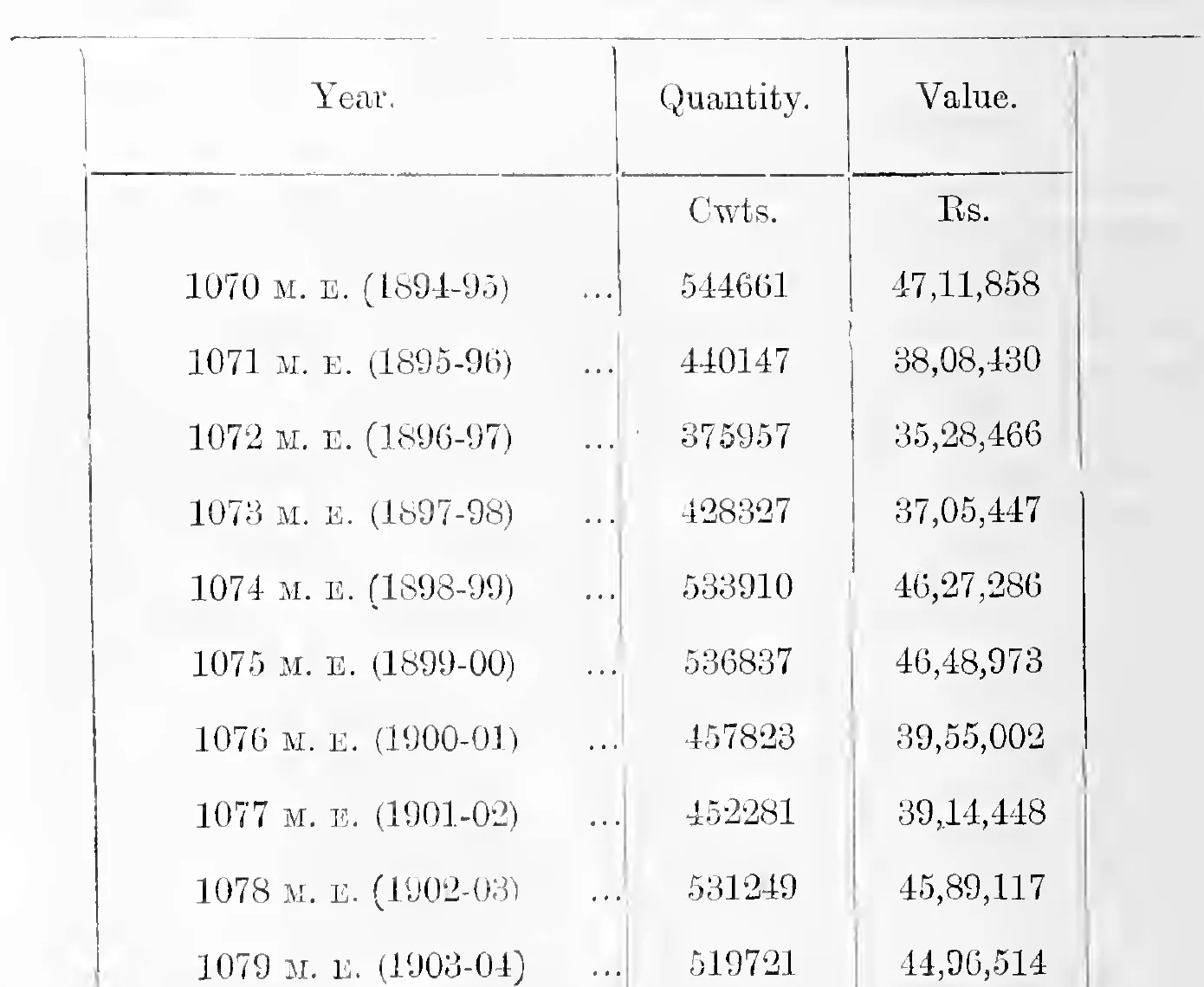
[197]Cocoanut-oil. Business in cocoanut oil was first started in Alleppey about 40 years ago by two European firms. But owing to prohibitive duties and absence of facilities for shipping they left for Cochin which offered better prospects. Almost the whole of the oil manufactured in this country goes to Cochin by Arukutty and the inland Chowkeys. Until lately the oil was wont to be extracted in country-mills drawn by bullocks, but about eight years ago an oil-mill worked by steam was opened by Messrs. P. John and Sons, and is now doing profitable business at Alleppey. Messrs. Darragh Smail & Co., have lately started an oil-business in Alleppey and have got down experienced coopers from Cochin to manufacture casks in which the oil has to be shipped to foreign ports. Two more oil-mills worked by steam power have been recently started in the same place. Another has just been started at Quilon by Messrs. Darragh Smail & Co. The following table gives the quantity and value of the cocoanut-oil export for the last ten years.
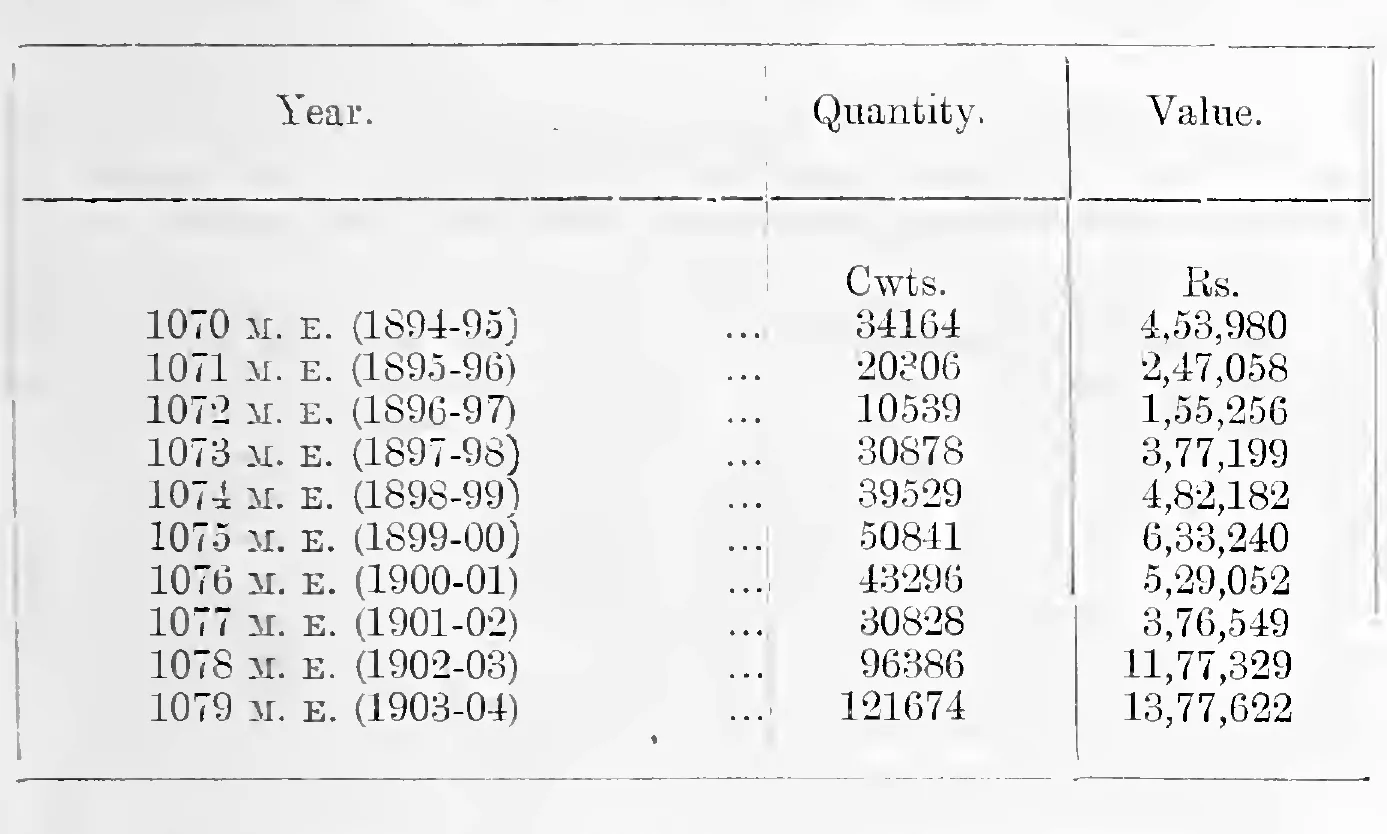
Coir. This is exported largely as coir-yarn and coir-matting. The coir-matting industry was first started by James Darragh about thirty-five years ago and has been successfully carried on ever since. A large number of native firms have also started the business and heavy shipments [198]are made every year to different parts of the world. The following table shows the quantity and value of the export for the last decade.
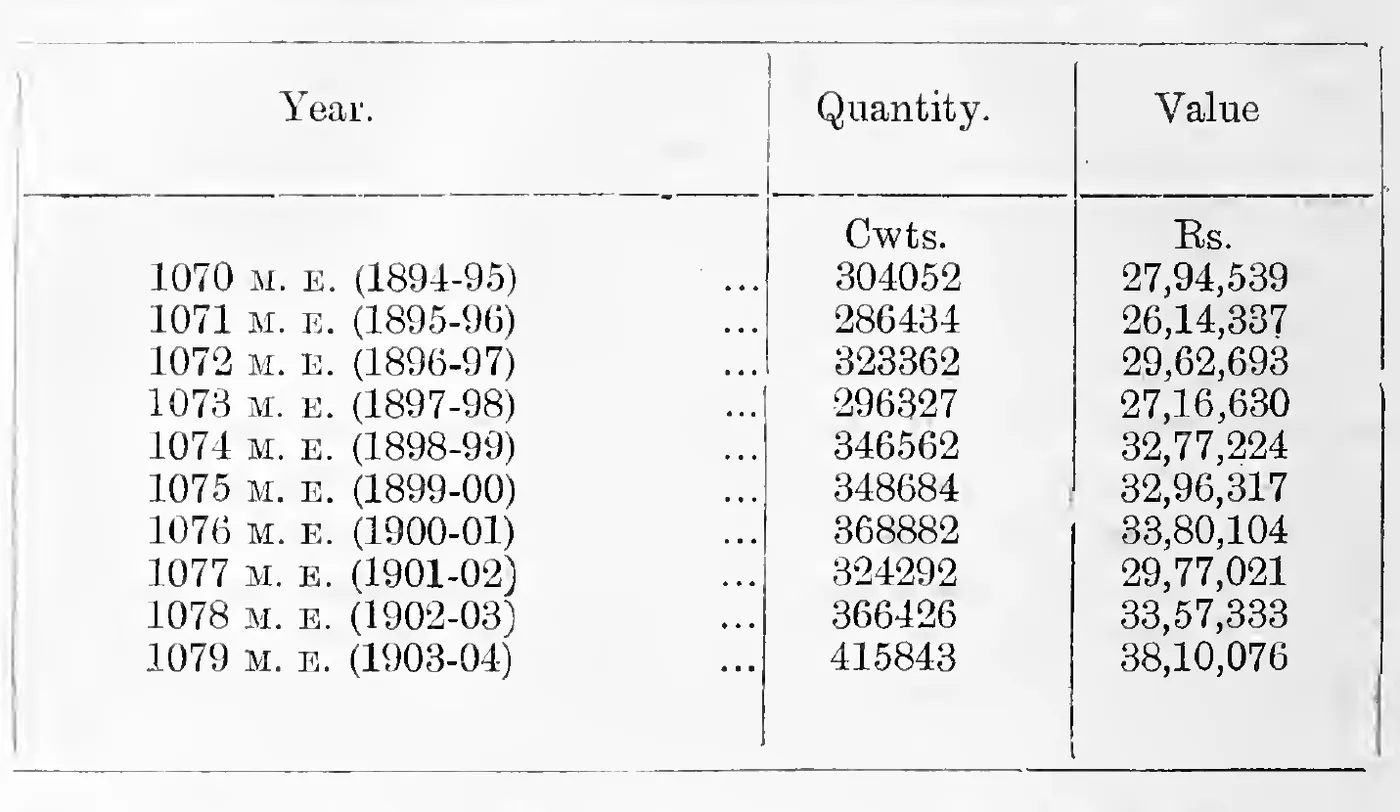
The coir-matting export has suffered by the action of the United States as Mr. Mackenzie observed in his address to the students of His Highness the Maharajah's College, Trivandrum last year:—
"Even now we feel in Travancore the effect of the protective tariffs of other countries, inasmuch as these tariffs hinder the setting up of local manufactures and some years ago we had an object lesson showing us what a hostile tariff can do to injure a manufacture that was already well established. Formerly the port of Alleppy sent a large quantity of coir-matting to the United States of America, but when the news came of the impending Mc.Kinley Tariff with the protective duty on manufactured coir, all that could be done at Alleppy was to work night and day to put on board ship the whole stock of matting that was in the warehouses and to hurry it across the Atlantic so that it reached New York and was passed through the customs house a few hours before the tariff came into force. Since then Alleppy has sent no matting to America except some of the finer qualities which even a protective duty does not enable the manufacturers of the United States to make at a price which can compete with Alleppy.
Areca-nut. This is a staple of great importance. It is chiefly to the contiguous districts of Madura and Tinnevelly that this produce is exported. A large quantity of areca-nut is consumed in Travancore itself. It being the invariable concomitant of tobacco of which such immense quantities are used by the population, 50 per cent. of the export may perhaps be regarded as a moderate estimate of the home consumption. [199]The following table gives the quantity and value of the export for the last ten years:—
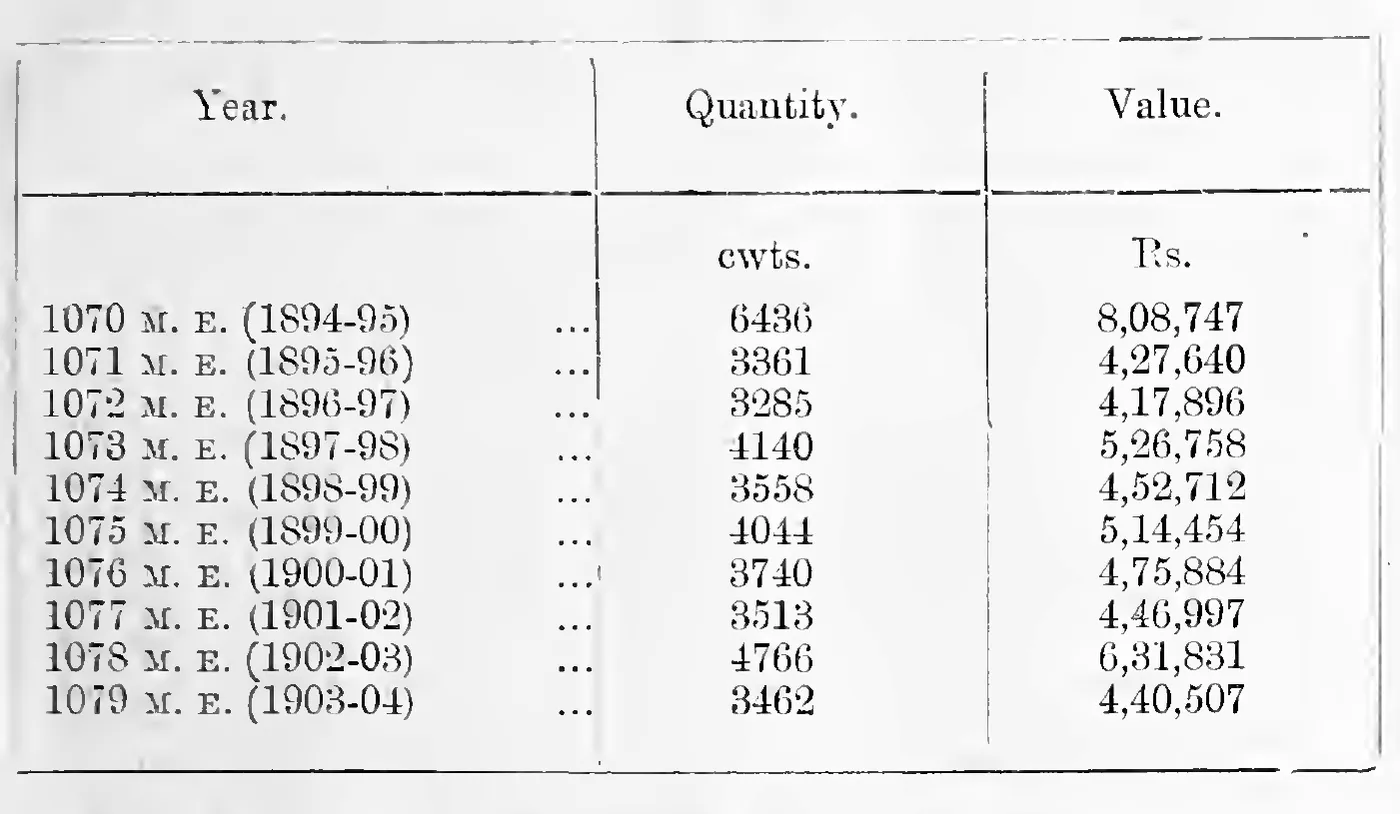
Coffee and Tea. The major portion of these articles is exported to British India, while a small quantity is sent to London and France. The trade is steadily rising, and has a good future. The following table shows the quantity and value of the export for the last ten years:—
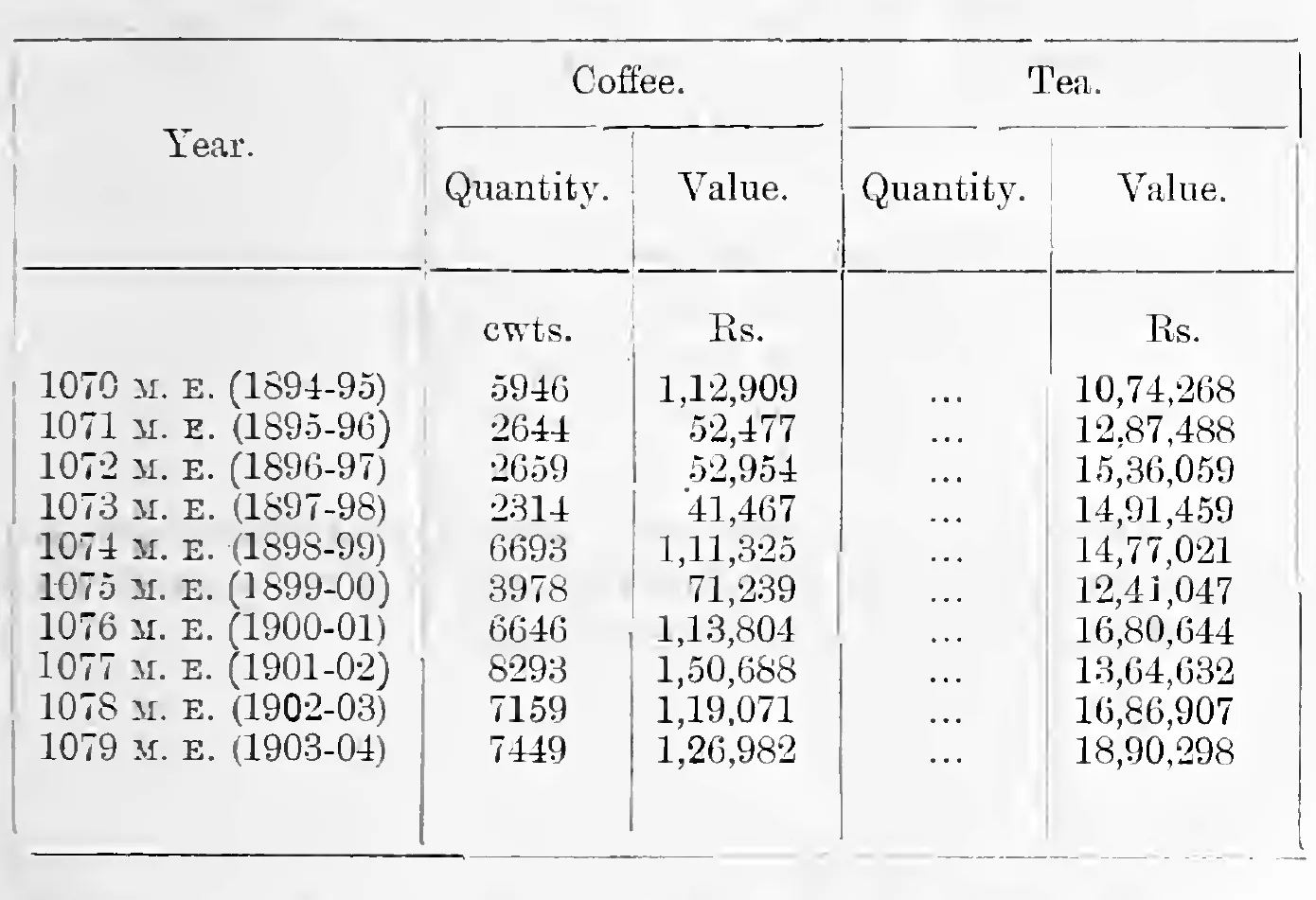
Jaggery and molasses. Trade in these articles is confined to British India and Cochin. Molasses is largely exported from North [200]Travancore and jaggery from the South. The following table illustrates the quantity and value of the trade for the last decade:—
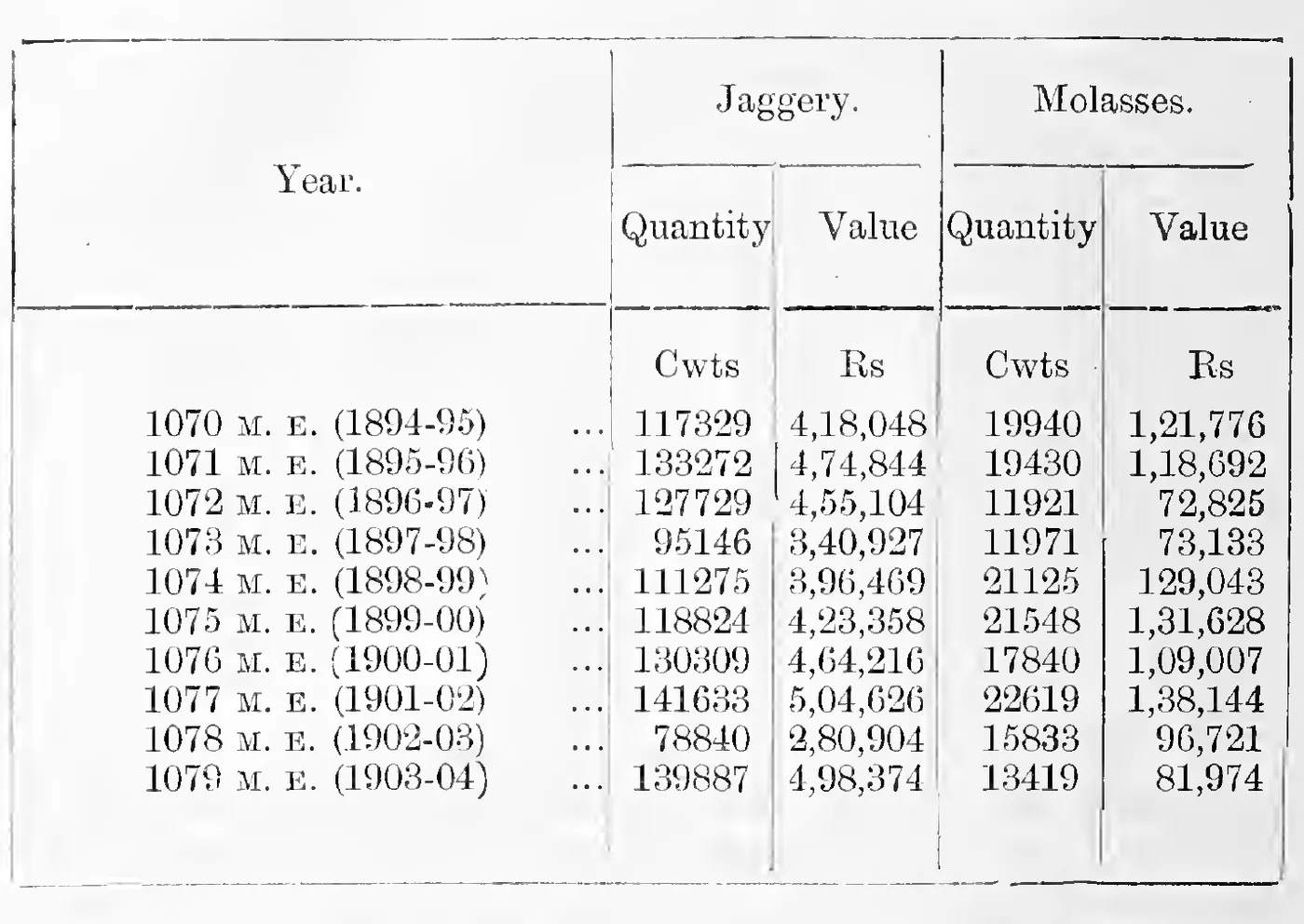
Ginger, Dry ginger, Turmeric. The export of ginger is wholly confined to British India. Dry ginger is exported to British India, Ceylon, Muscat, Pondicherry, London, France and New York. In 1079 M. E. (1903-04) the trade was distributed as follows:—
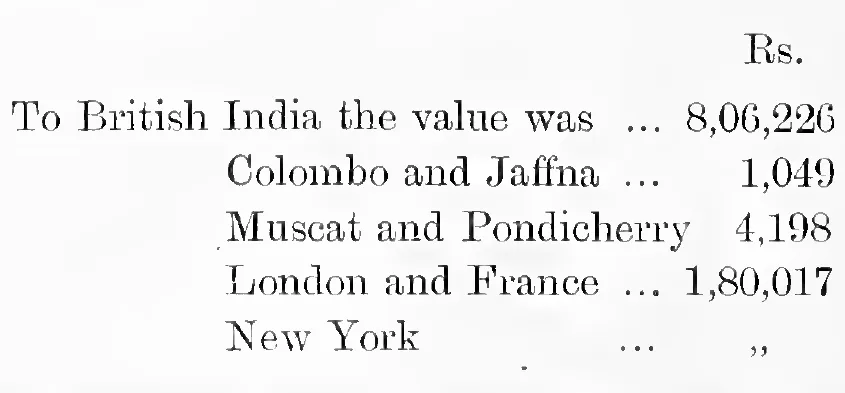
These articles are largely exported from the Kottayam Division where they grow very luxuriantly. The following table gives the quantity and value of these articles exported for the last ten years:—
[201]
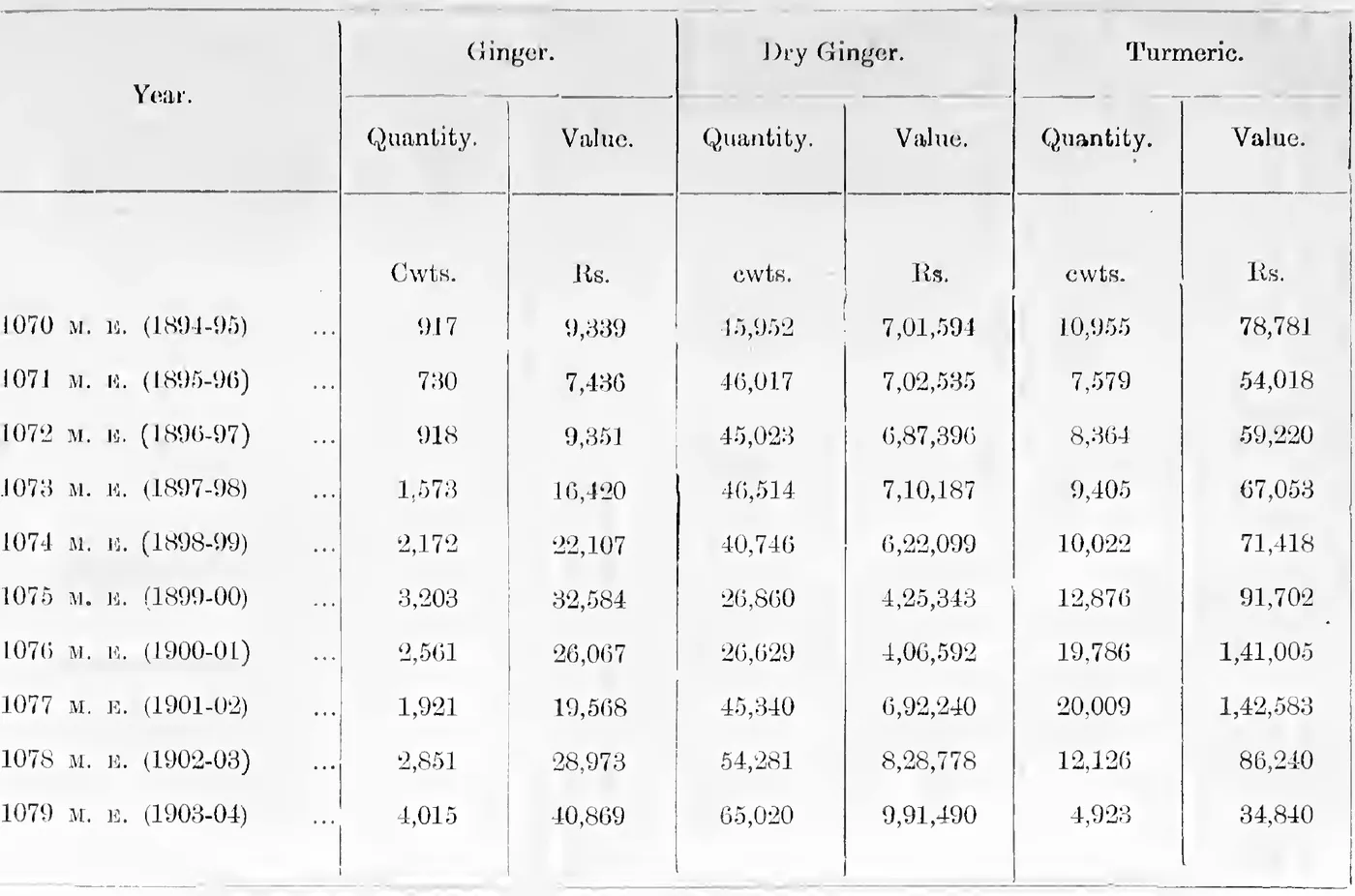
[202]Salt-fish and Hides. The trade in these articles is very thriving. Salt-fish is exported to British India and Ceylon; and hides to British India, London and France. The following table gives the quantity and value of the export for the last ten years:—
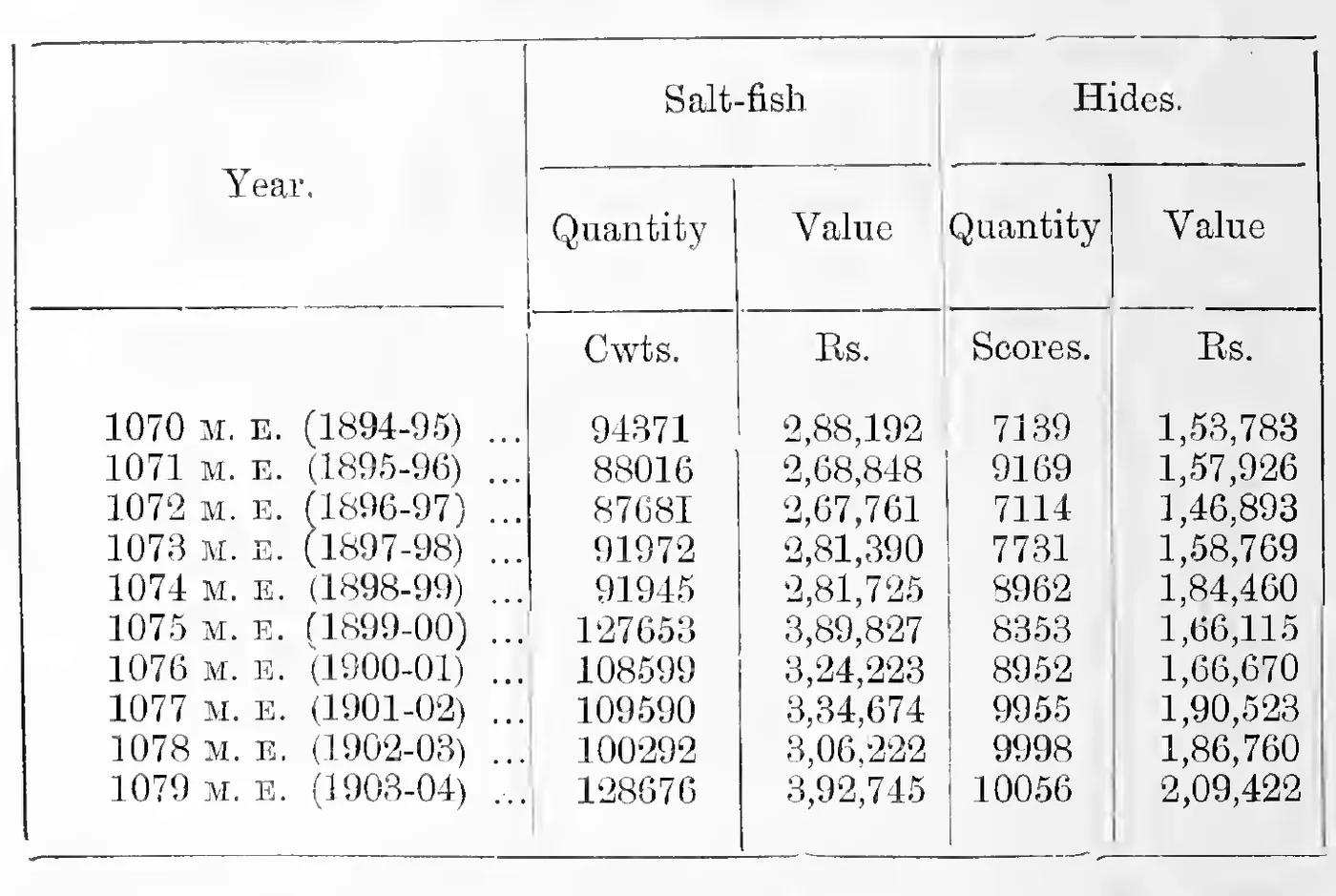
Timber. This is mostly exported to British India, a small portion being sent to Ceylon, Muscat and Pondicherry. The following statement compares the growth of this trade for the last ten years:—
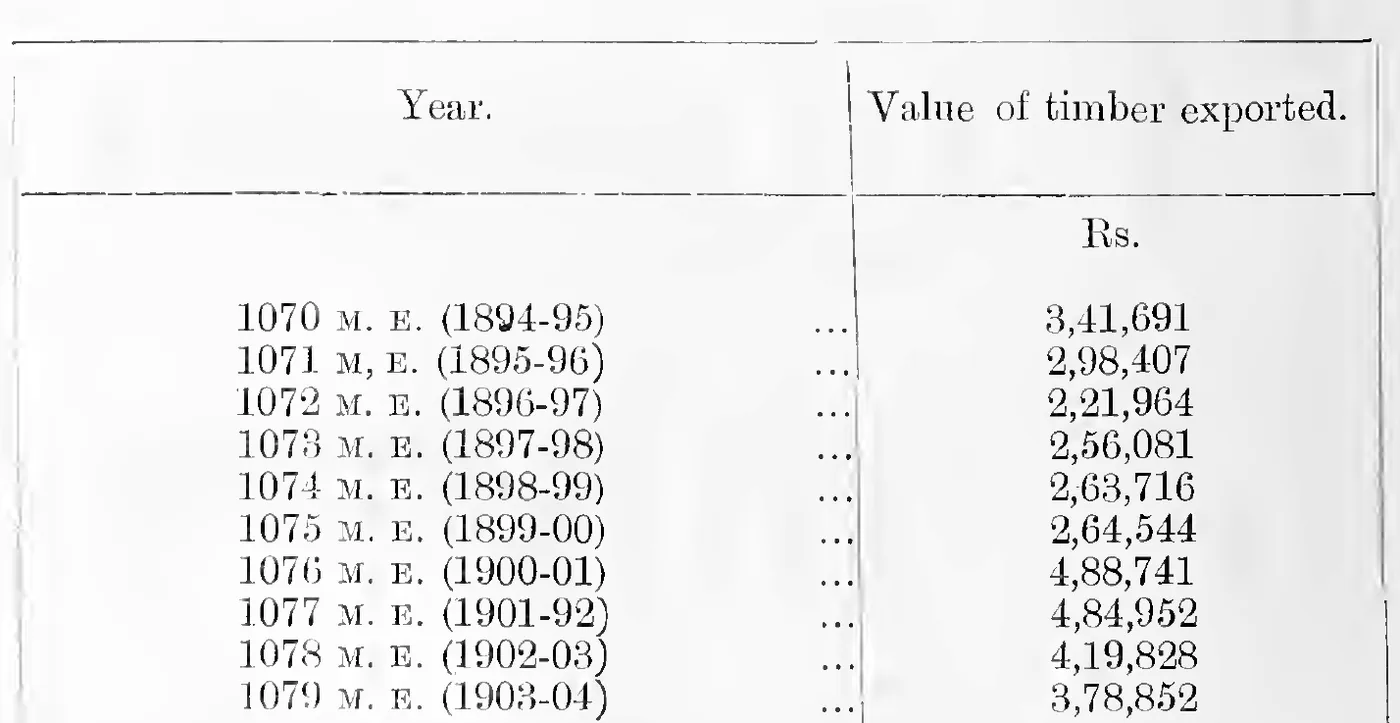
[203]Cardamoms. The trade in cardamoms shows a heavy decline. The following statement shows the value of the export for the last ten years:—
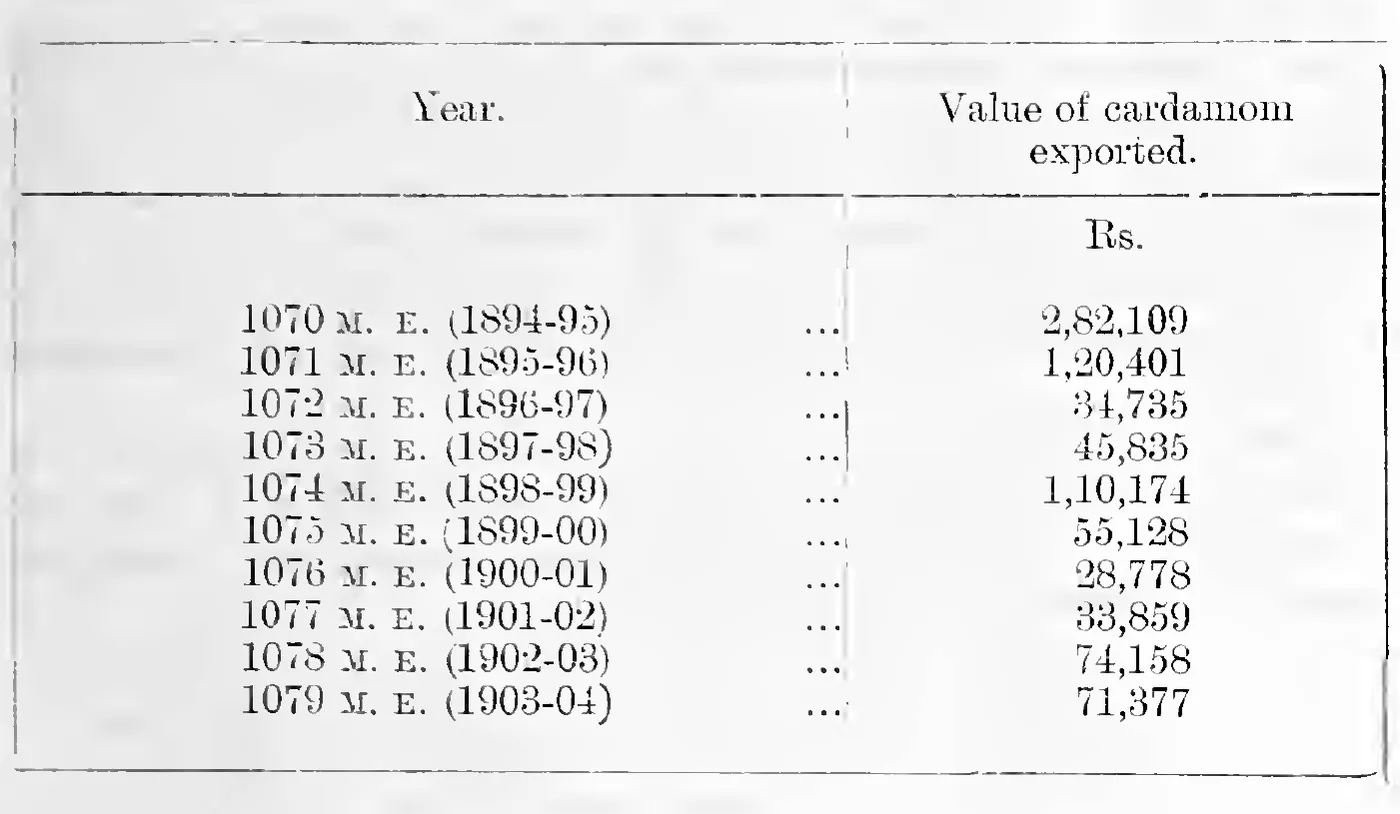
Pepper. Pepper is the only article which does not show any great fluctuations in the trade from year to year. It is plentifully produced in most of the taluqs of the State. It is exported to Bombay and other places in British India, as well as to Colombo, London and New York. The export trade has increased from 15,237 candies in 1070 M. E. to 21,244 candies in 1079 M. E. (1903-04). The following table shows the quantity and value for the last ten years:—
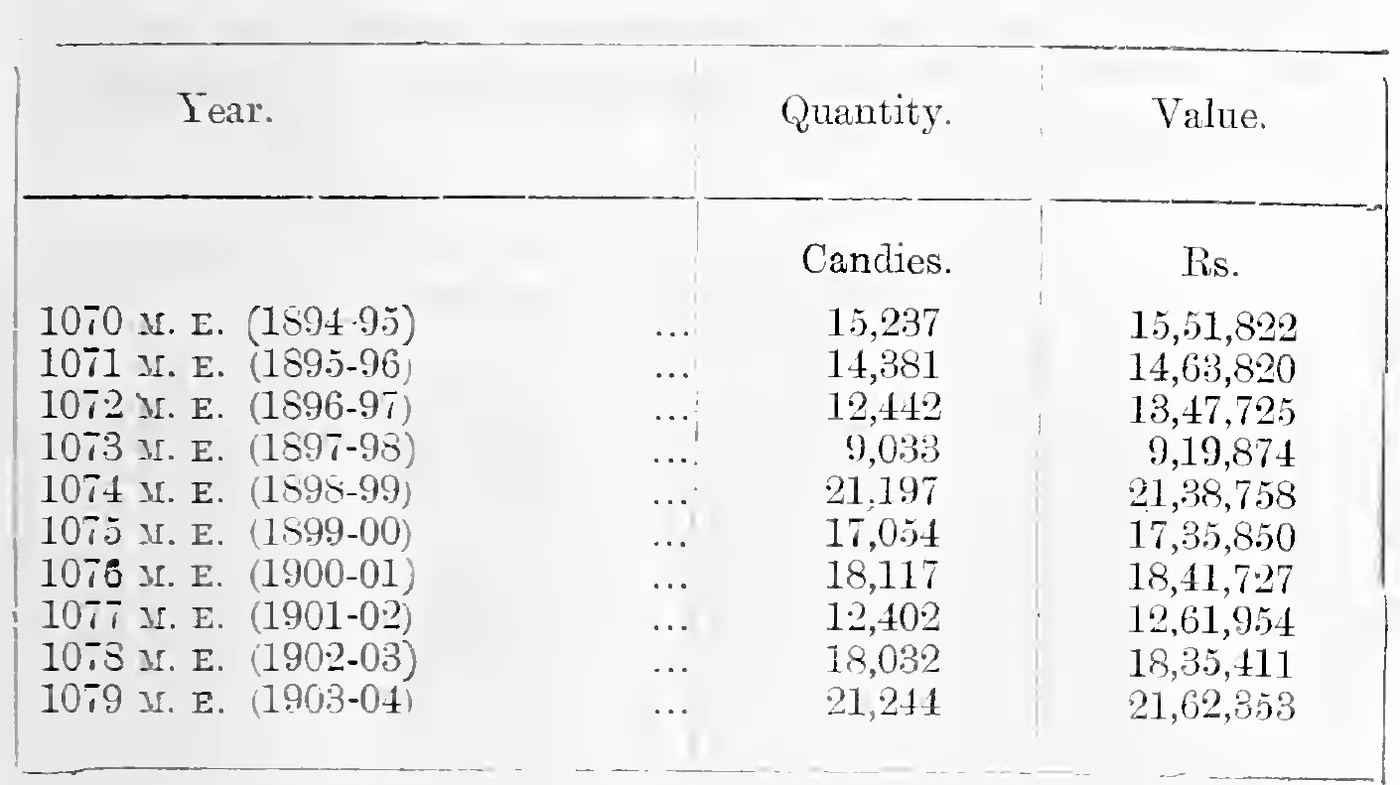
[204]On 'Travancore pepper' Mr. G. T. Mackenzie observed in his address to the students of His Highness the Maharajahs' College, Trivandrum:—
"When one considers the subject from this point of view, Travancore stands on fairly firm ground, because this State exports produce which is not easily procured outside the British Empire. We may take first the time-honoured crop, pepper; as far back as history and as legend go, this coast has been known as the pepper coast. It was pepper that attracted Vasco Da Gama to these shores 400 years ago and the same pepper is here still, growing round every homestead. Last year, Travancore exported Rs. 28 lakhs worth of pepper and if ever the hostile tariffs of foreign countries shut out the pepper of this coast, of Ceylon and of Singapore, I do not know where the Non-British world will get its supply of pepper."
Imports. Piece-goods. The value of import under this head has of late increased considerably, from 10 lakhs in 1070 M. E. (1894-95) to 14 lakhs in 1079 M. E. (1903-1904). The following table shows the figures for piece-goods for the last 10 years:—
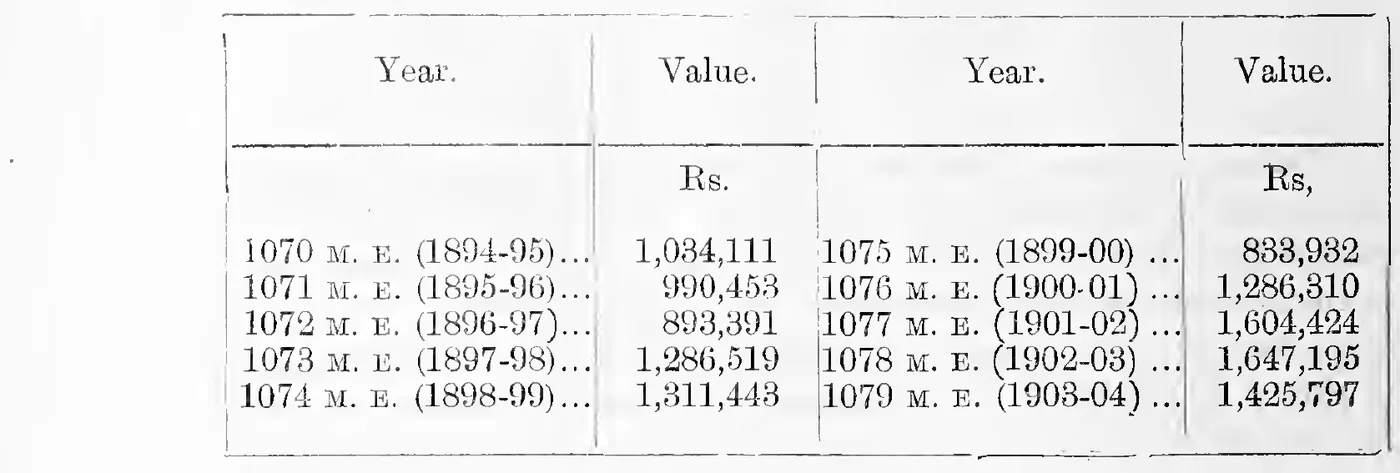
Paddy and rice, are both imported from British India. The import for the last 10 years shows considerable increases, as is illustrated by the following table:—
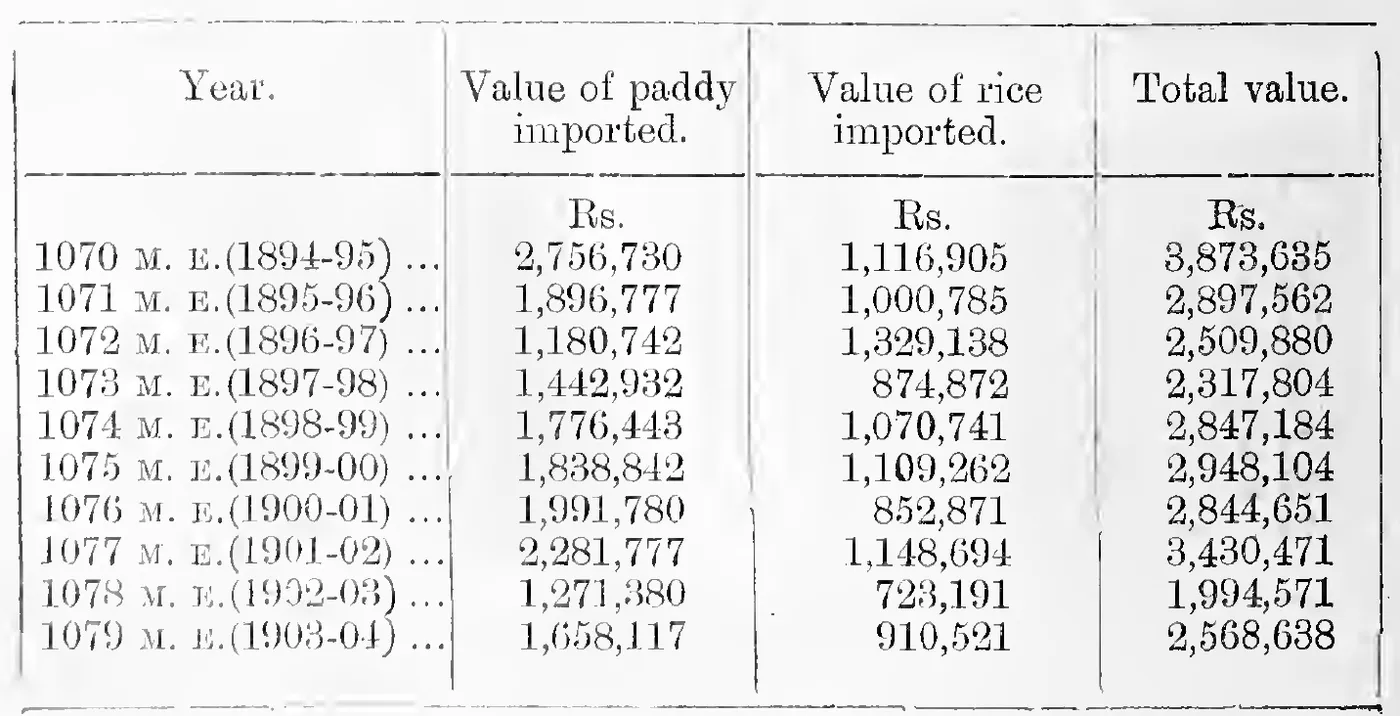
[205]Cotton. The import of cotton shows a regular increase. In 1069 M. E. (1893-94) the value of the import was Rs. 235,764; in the two succeeding years it doubled itself. In 1072 M. E. (1896-97) it rose up to 7 and odd lakhs of rupees, the highest on record. From 1073 M. E. to 1077 M. E. (1896-1902) the value of the import ranged between 3½ to 5 lakhs, and in 1078 M. E. the value was only Rs. 227,150 i. e., less than one-half of that of the preceding year; in fact all the articles of import have shown decline, probably on account of the large quantity imported in 1077 M. E. (1901-02). The entire quantity is imported from British India:—
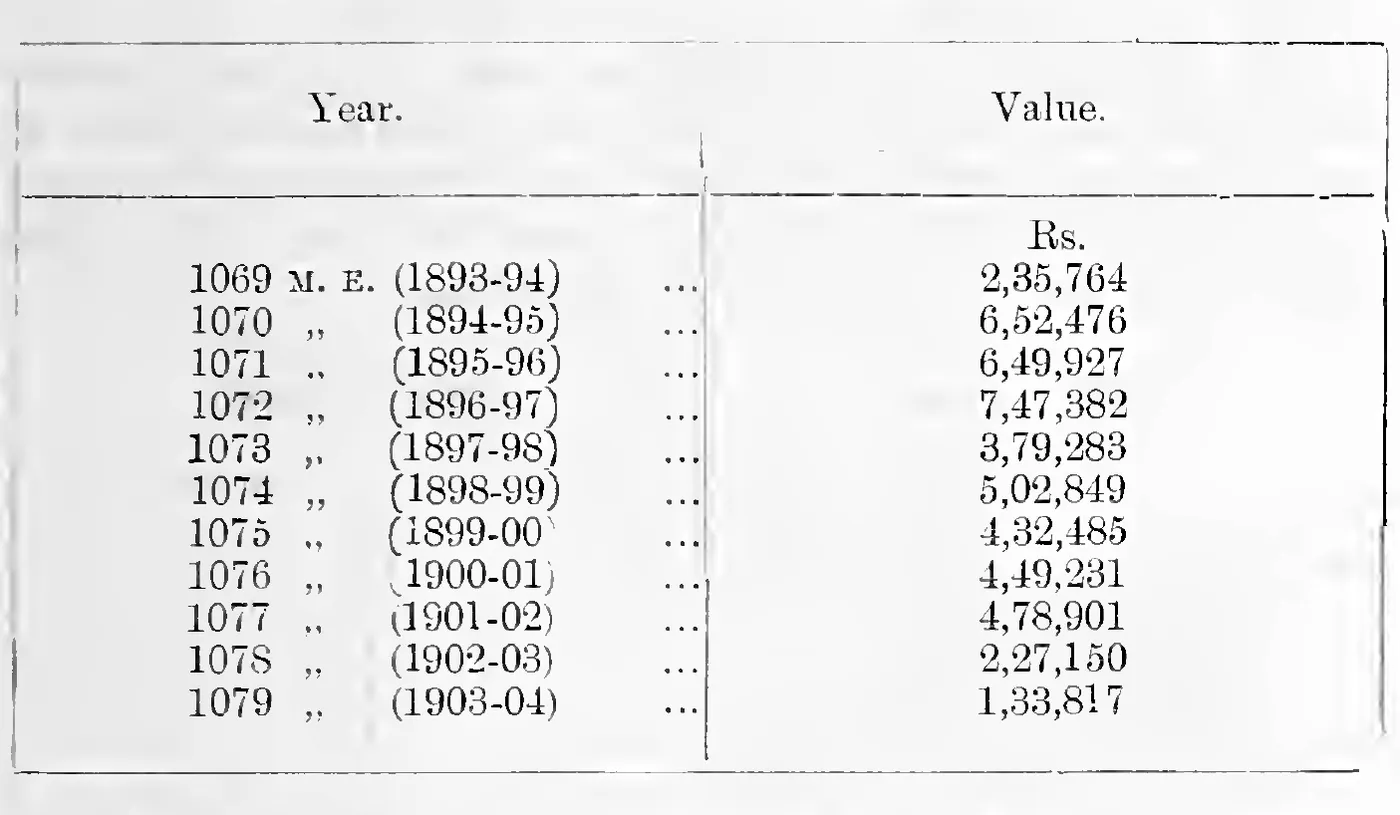
Thread. Thread is imported free, from British India. The following table shows the value of the import for the last ten years:—
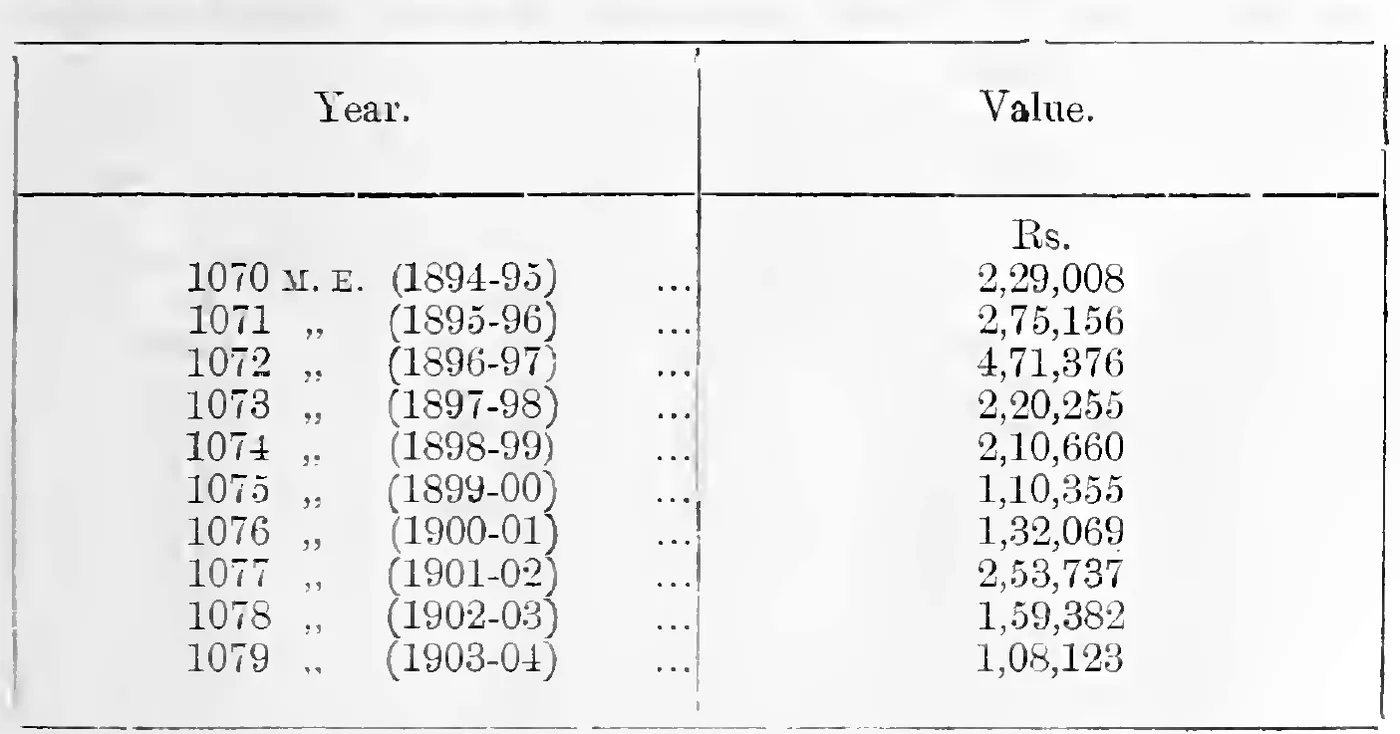
[206]Wine and Sugar. The figures for wine fluctuate very much from 885 gallons to 1,816 gallons. The duty levied on wine is Rs. 2½ for an Imperial gallon or 6 quart bottle. This duty is levied only on Champagne and other sparkling wines not containing more than 42 per cent. of proof spirit. All other sorts have to pay only Re. 1 per gallon. Ale, beer, port, cidar and other fermented liquors have a duty of 1 a. per Imperial gallon. Perfumed spirits in wood or bottle have a duty of Rs. 8 per gallon, which spirits when used in drugs, medicines, &c., pay only Rs. 6 per gallon.
The value of the import of sugar shows a regular increase in every year. In 1070 M. E. (1894-95) the value was only Rs. 16,889; in 1072 M. E. (1896-97) it was Rs. 90,951. The figures for the remaining years show an increase of between 7 and 8 times those of (1893-94) Several kinds of sugar are imported into the country and the duty on them varies from time to time. The duty generally fixed is 5 per cent. of the tariff valuation.
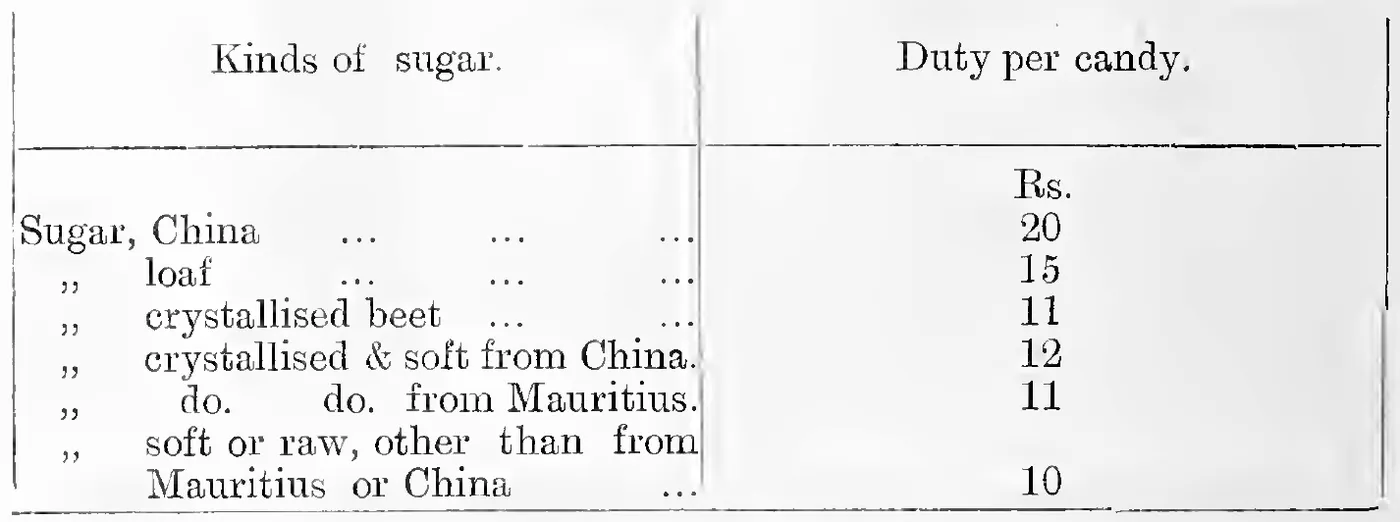
All other sorts including saccharine produce of all kinds and confectionery ad valorem. The following table shows the value of the import for the last ten years:—
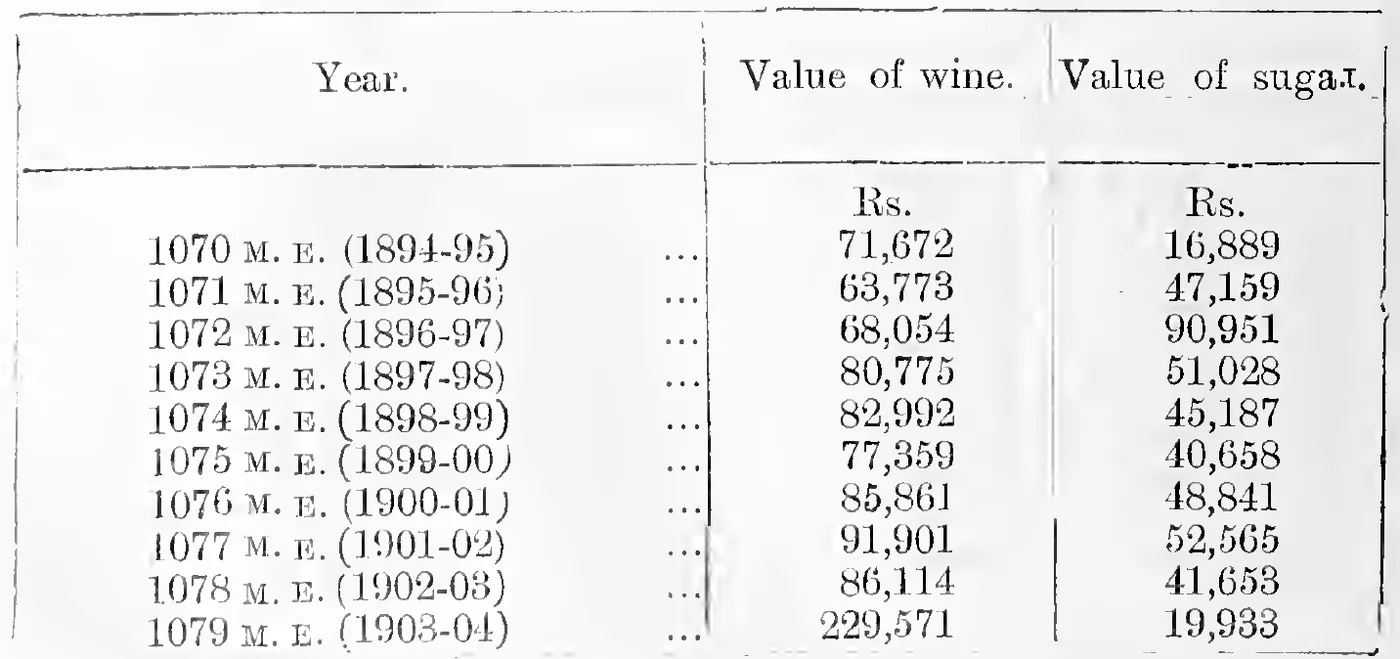
[207]
The total value of external trade.
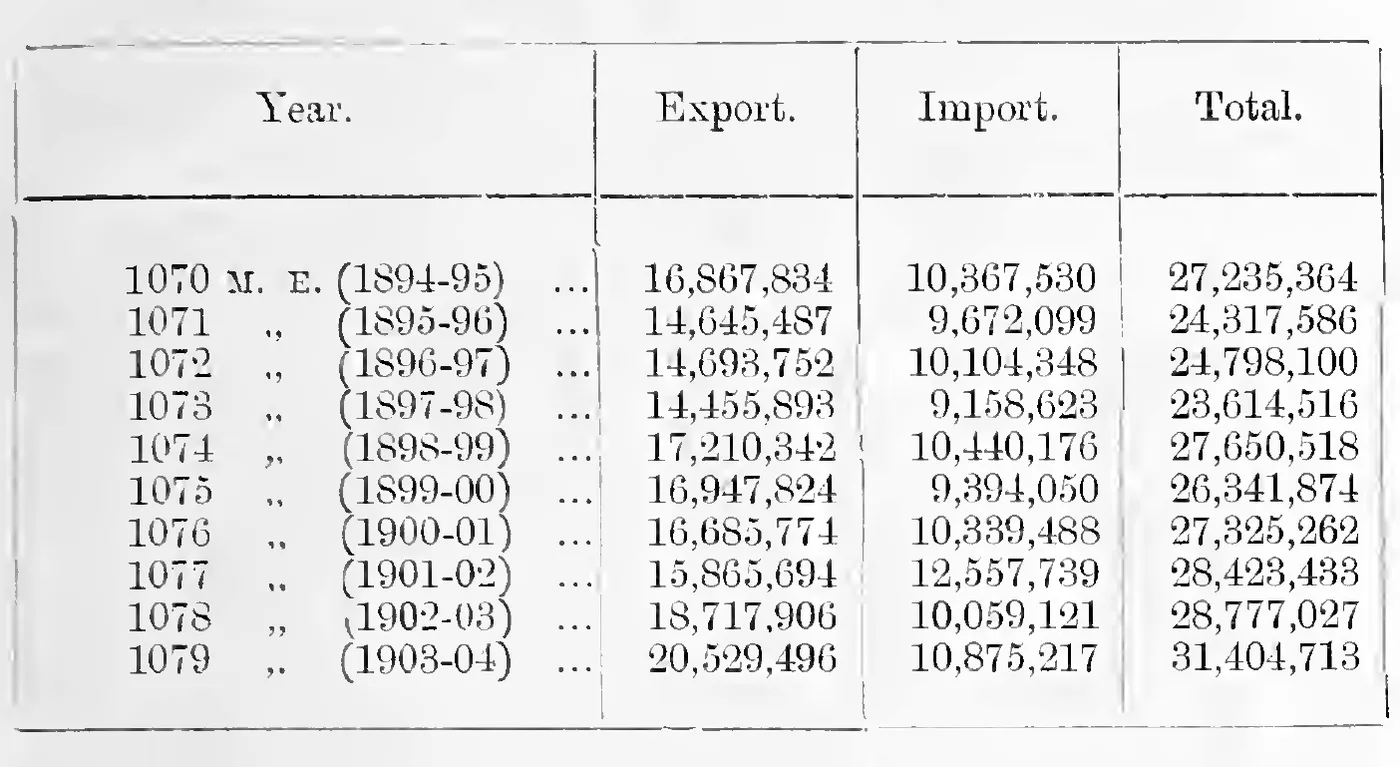
Customs Revenue for 10 years.
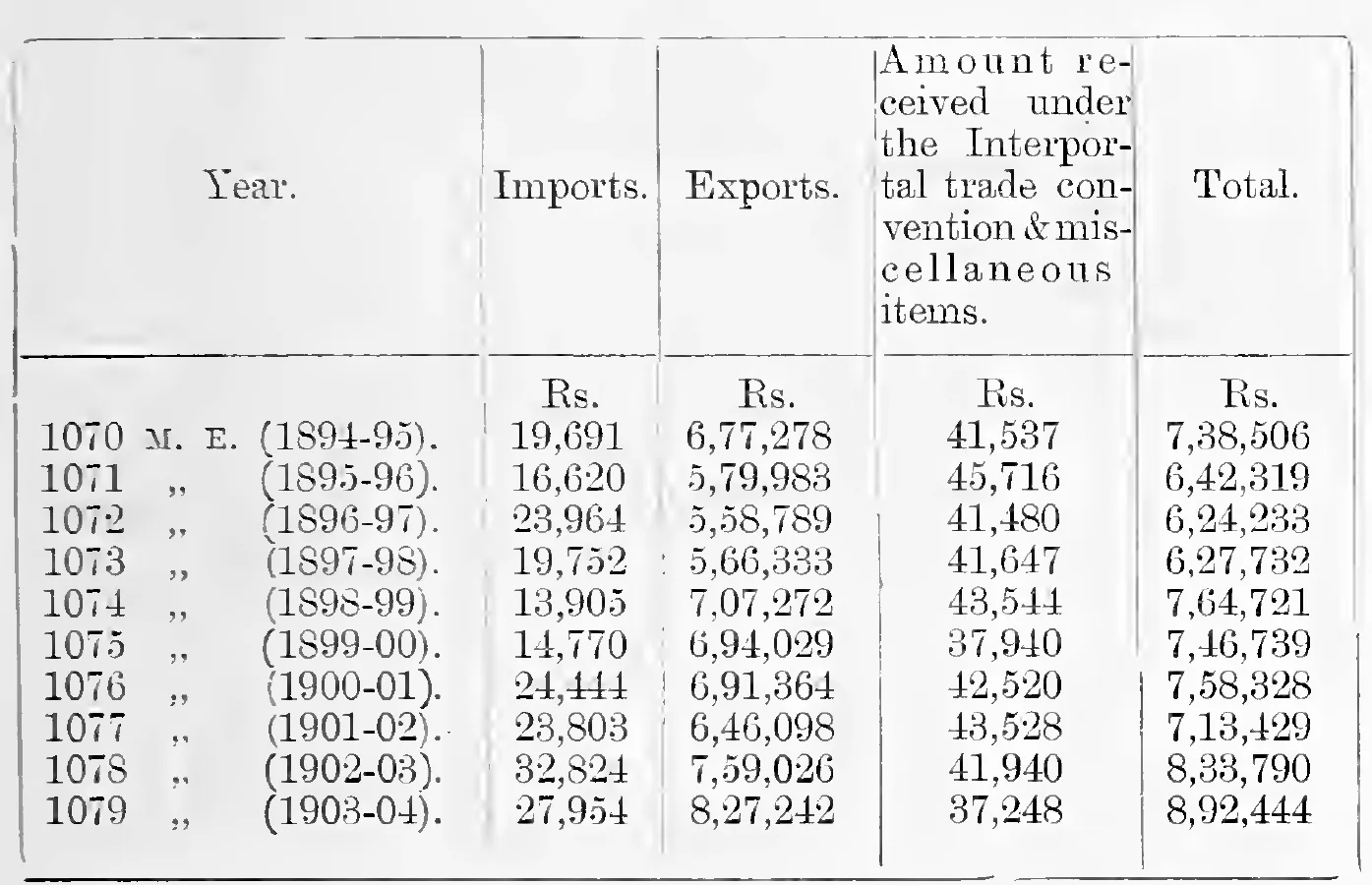
[208]
Customs Revenue by articles for 1079 M. E. (1903-04).
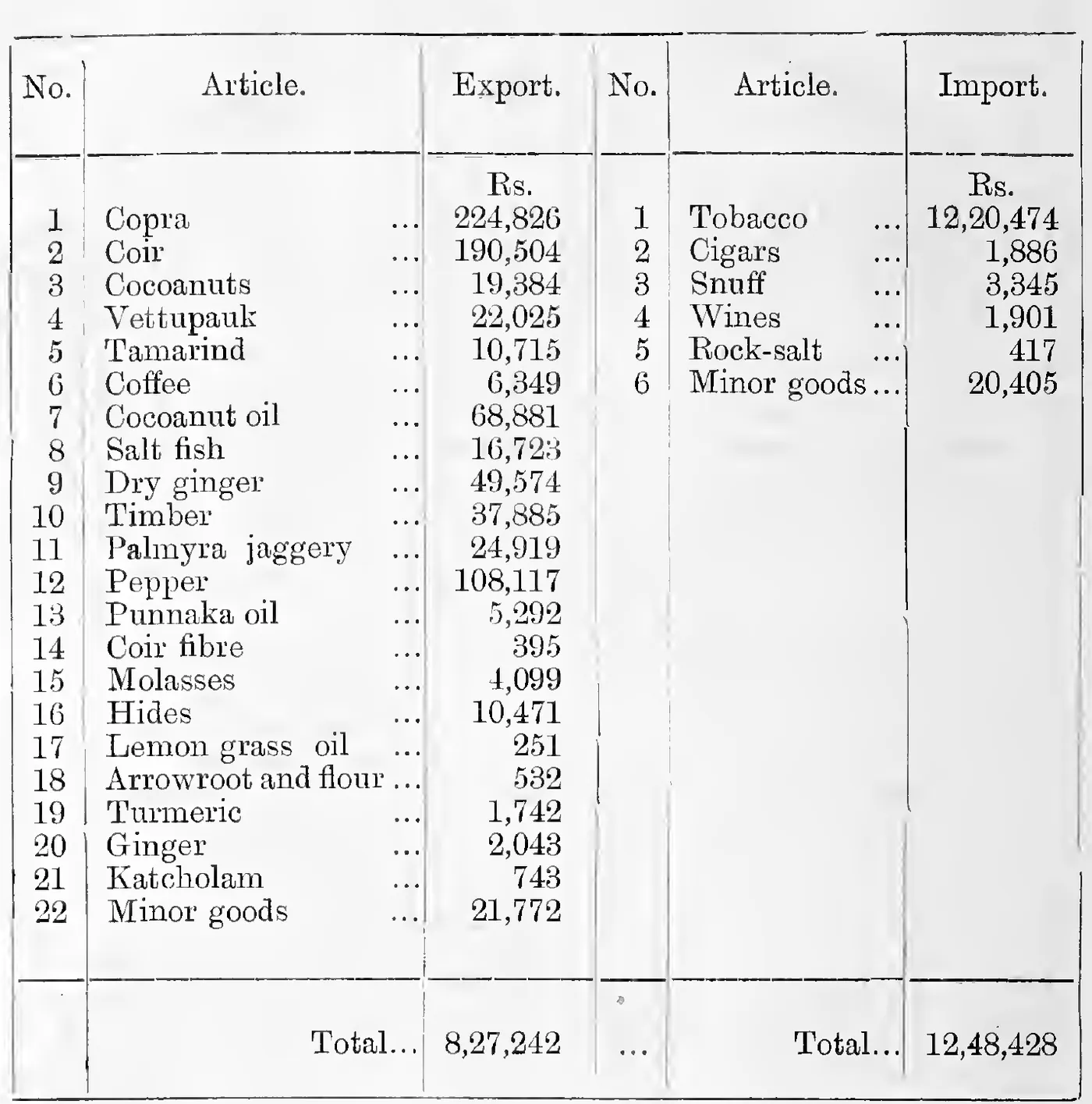
[209]
Statement showing the direction and percentage of entire external trade, Imports and Exports.
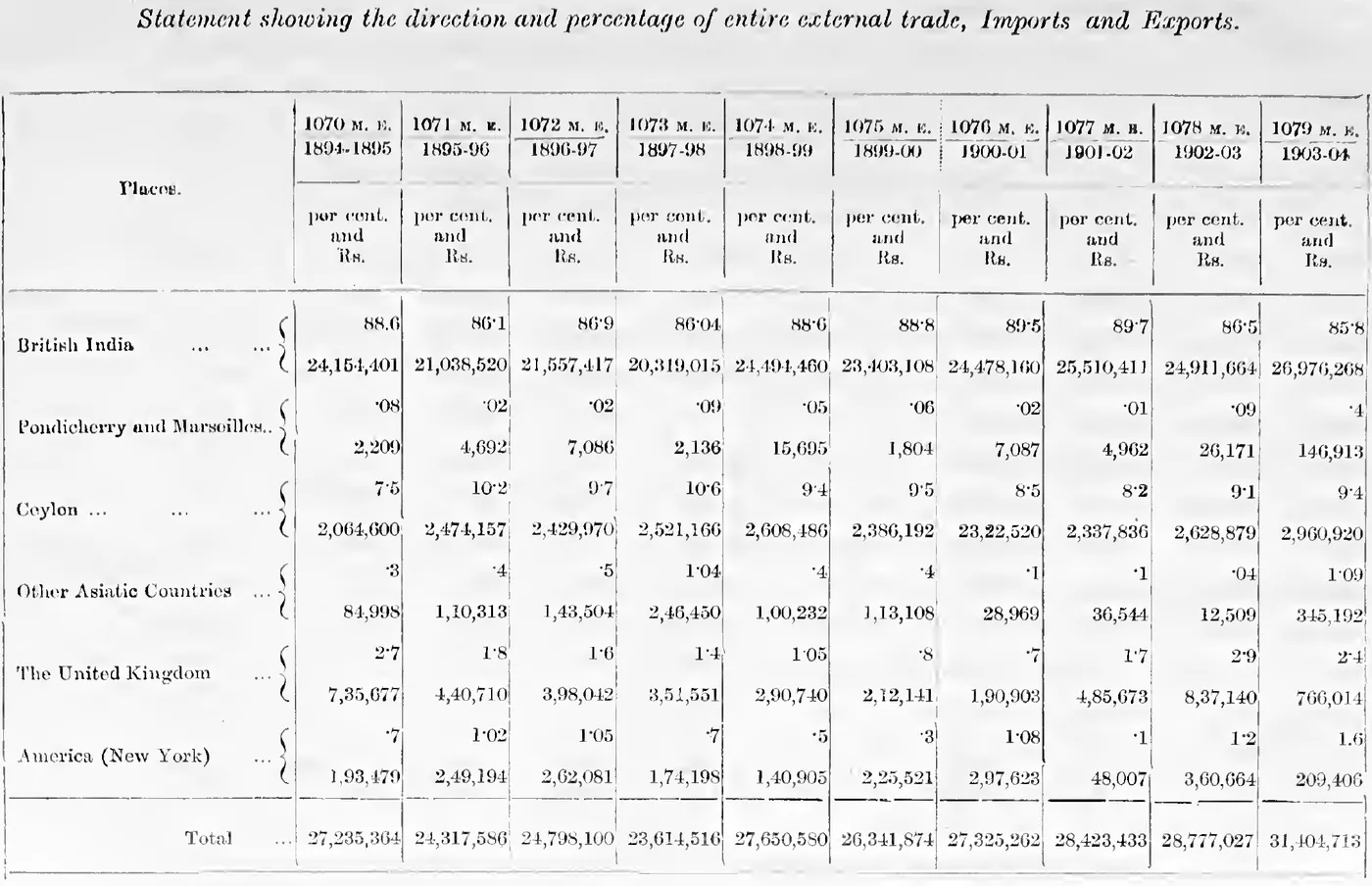
[210]
Statement showing value of the exports of the principal articles of merchandise for 10 years.
EXPORTS.
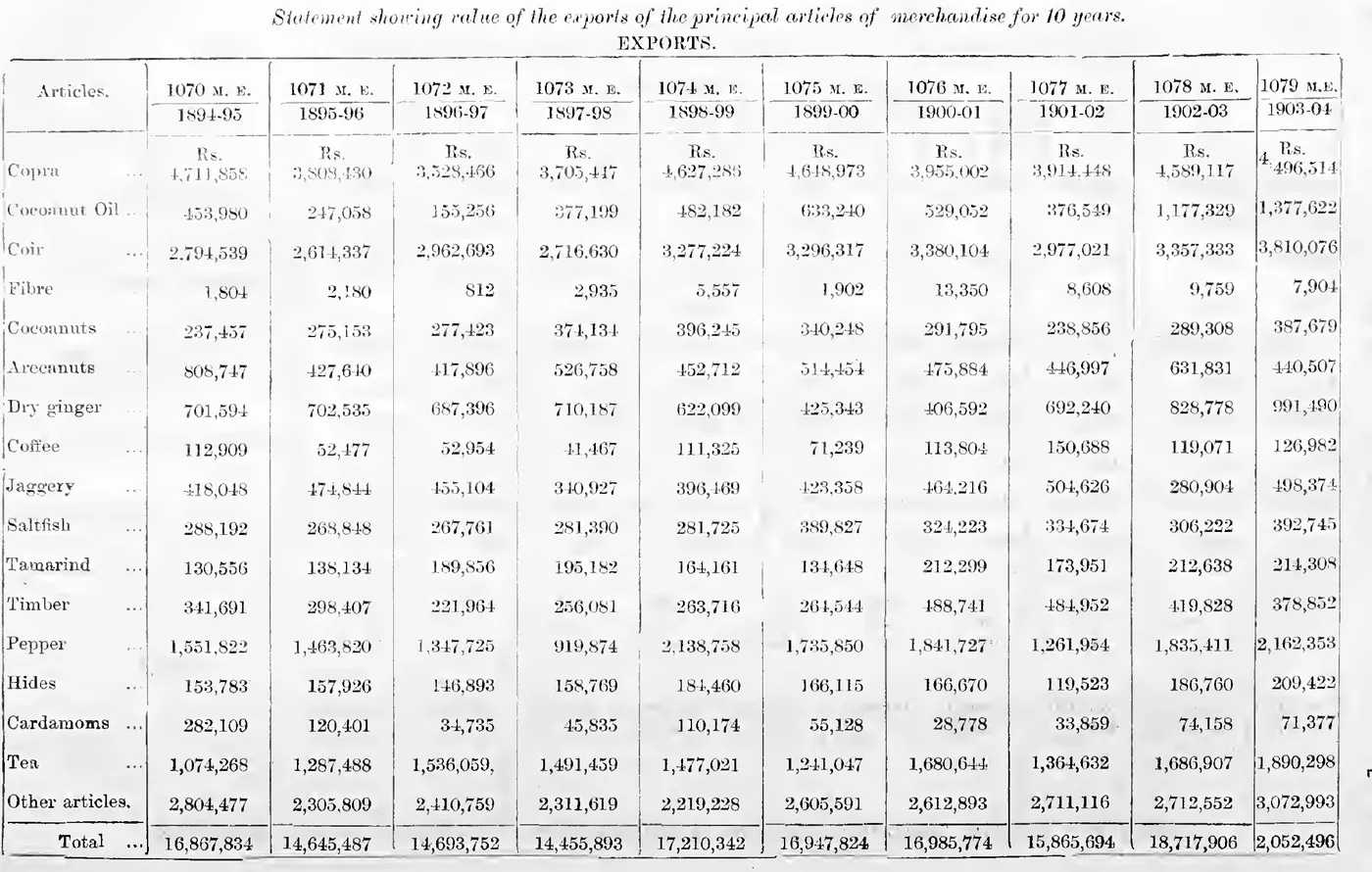
[211]
Statement showing the value of the principal articles of merchandise for 10 years.
Imports.
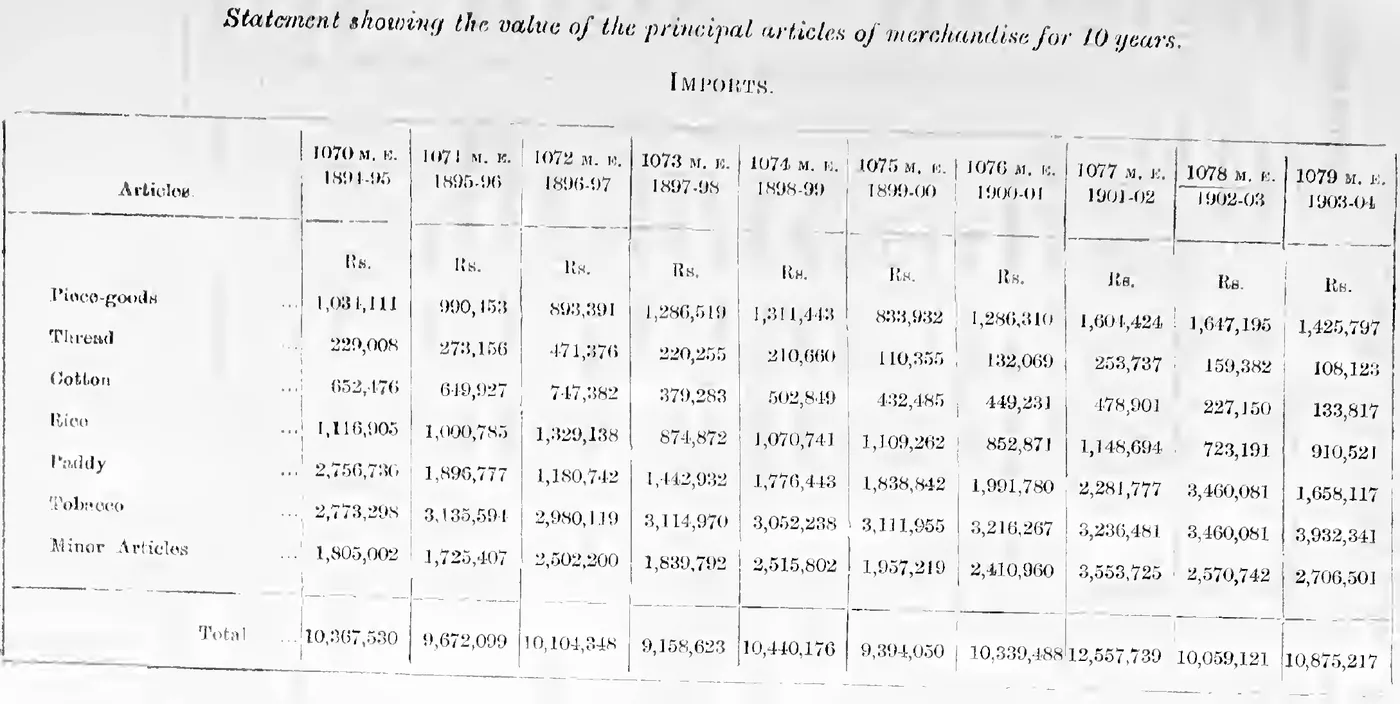
[212]
List of dutiable and undutiable articles.
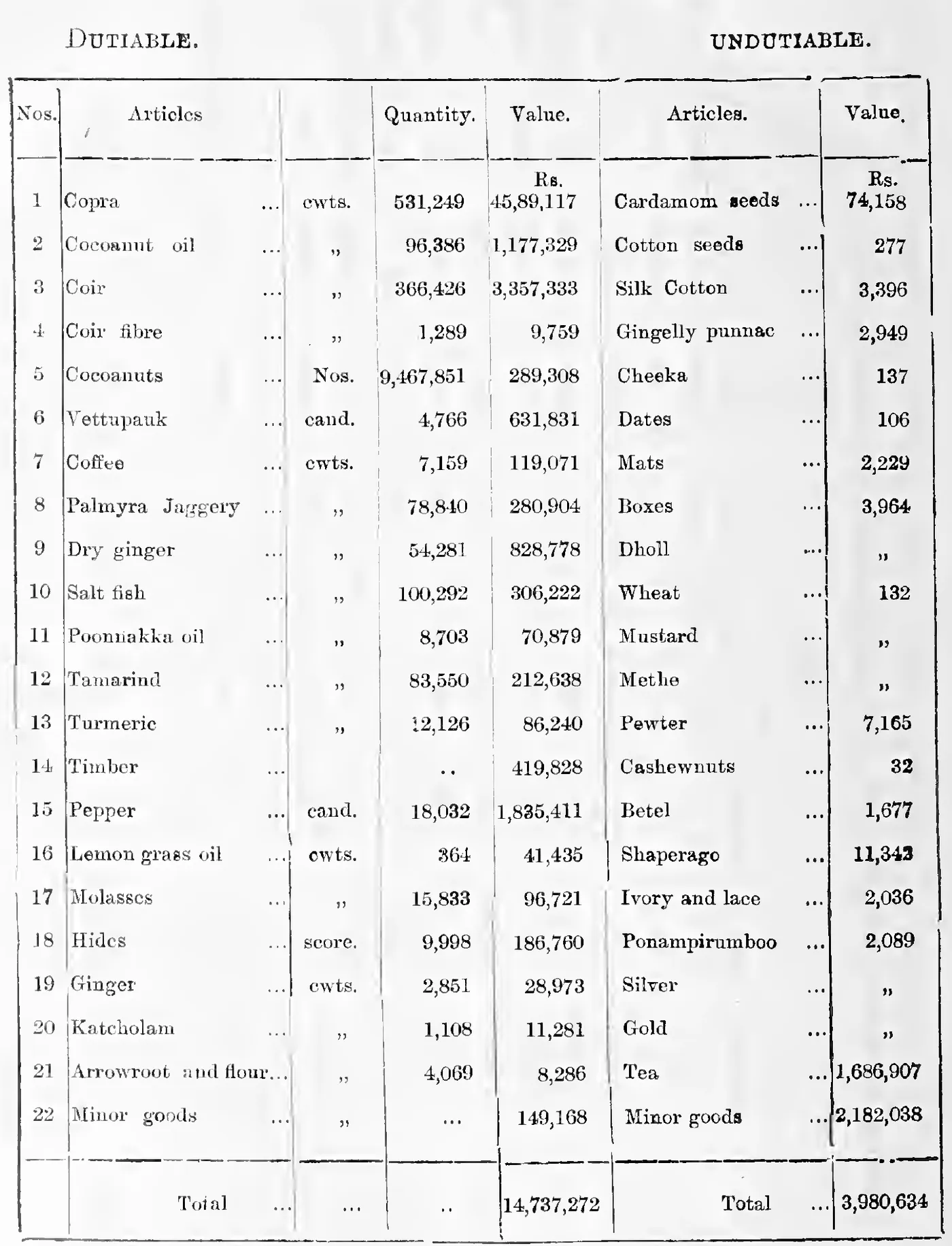
[213]
Export and Import compared.
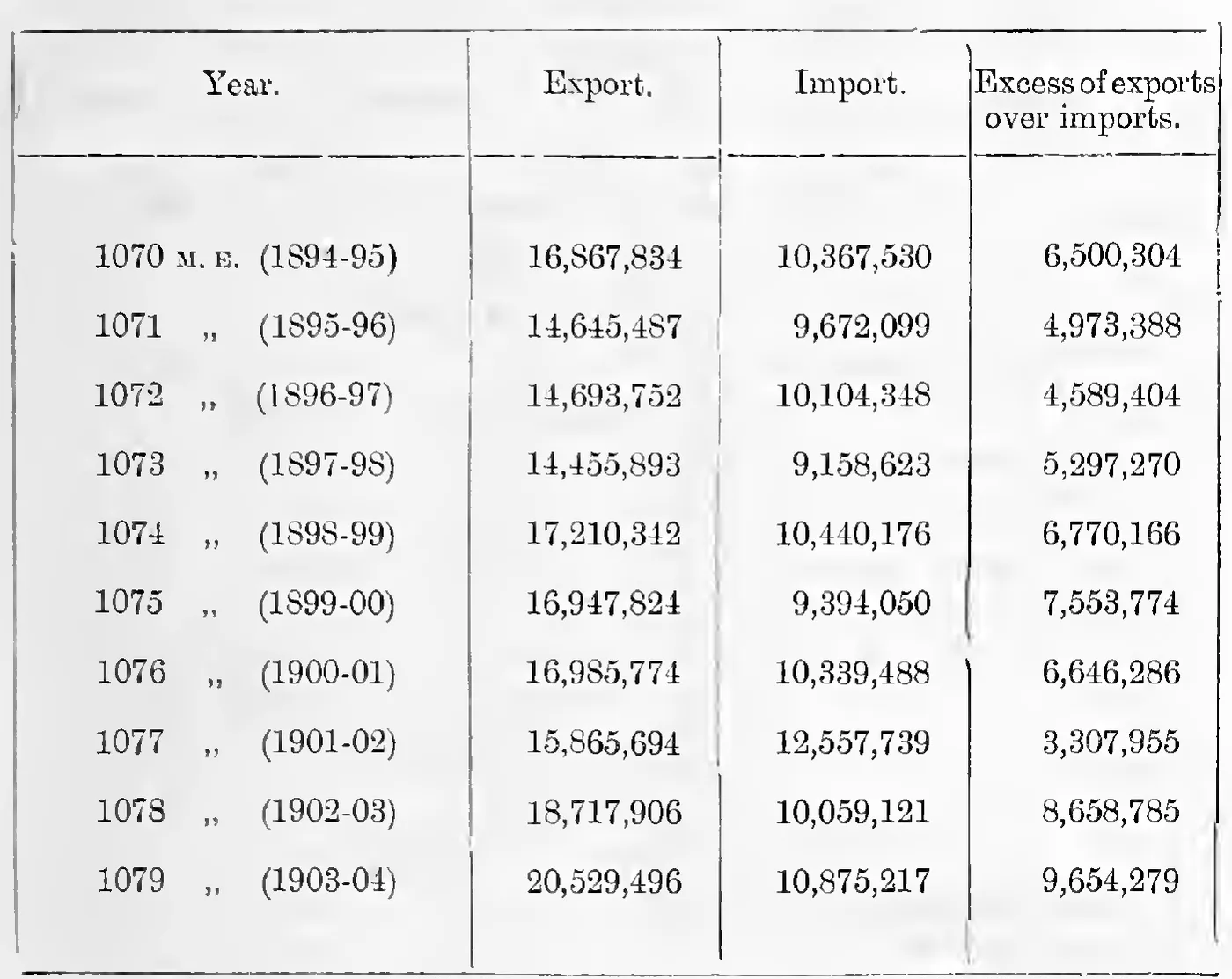
[214]
Comparison of exports and imports under particular heads 1079 M. E. (1903-04).
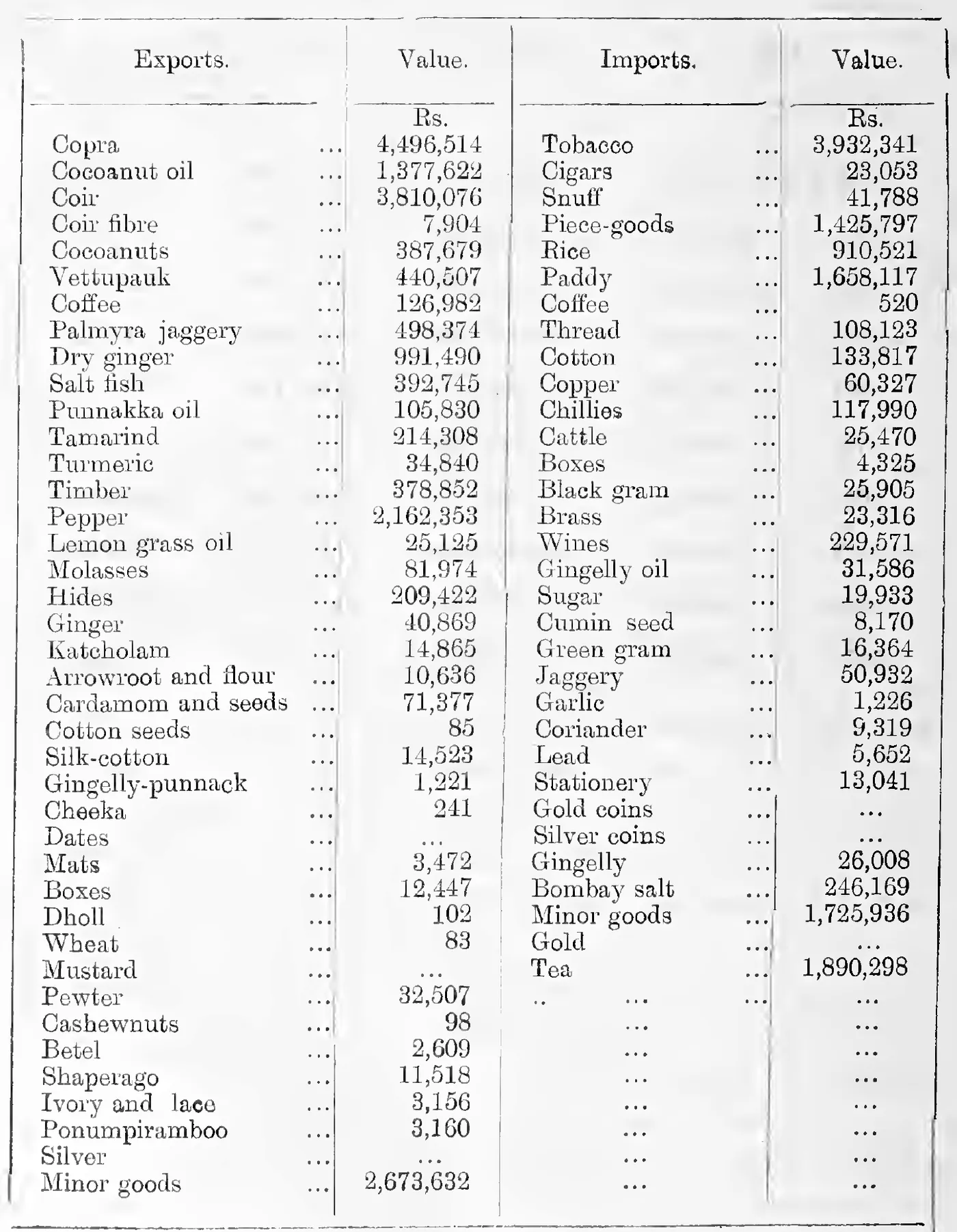
[215]
WEIGHTS, MEASURES, &c.
Reduced to equivalents in English denominations.
Weights.
- 1 Panam = 6 Grains (approximately)
- 13 Panams = 1 Kalanju = 78 do. „
- 13 Kalanjus = 1 Palam = 1,014 do. „
- 7½ Palams = 1 Rautel = 7,605 do. „
Grain measure.
- 1 Nali = 20 Cubic Inches.
- 4 Nalis = 1 Idangali = 80 do.
- 10 Idangalis = 1 Parah.
Liquid measure.
- 4 Thodams = 1 Nali = 20 Cubic Inches. (approximately)
- 4 Nalis = 1 Idangali = 80 Cubic Inches „
- 10 Idangalis = 1 Parah.
- 12 do. = 1 Chothana.
- 5 Chothanas = 1 Codum.
Measures of length applicable to land and timber, &c.
- 1 Angulam = 1¼ Inches English (approximately)
- 24 Angulams = 1 Kole = 30 Inches „ = 2½ feet „
- 4 Koles = 1 Thendoo = 10 „ „
- 800 Thendoos = 1 Nazhiga = 8,000 „ „
- 2,000 do. = 1 Crosam = 20,000 „ „
- 4 Crosams = 1 Yojana = 80,000 „ „
Weights of Copper, Iron, Nuts, Pepper &c.
- 16 Meeshams = 1 Panam.
- 10 Panams = 1 Kalanju.
- 16 Kalanjus = 1 Palam.
- 100 Palams = 1 Tulam.
- 20 Tulams = 1 Pauram.
Weights of Sugar, Tobacco, Opium, &c.
- 10 Meeshams = 1 Panam.
- 10 Panams = 1 Kalanju.
- 21 Kalanjus = 1 Palam.
- 5½ Palams = 1 Rautel.
- 24 Rautels = 1 Maund.
- 150 do. = 1 Toontoo.
- 4 Toontoos = 1 Candy.
[216]
Weight of salt.
- 1 Garce = 120 Maunds.
- 1 Maund = 3,200 Tolas or Rupees.
- 1 Parah = 1,050 Tolas.
- 1 Coomb = 1,68,000 Tolas.
- 1 Indian Maund = 82½ lbs. (Avoirdupois.)
Measure of salt.
- 10 Idangalis = 1 Parah.
- 160 Parahs = 1 Coomb.
Weights used at Quilon.
- 3 Palams = 1 Seer.
- 2 Seers = 1 Rautel.
- 20 Rautels = 1 Tulam.
- 28 do. = 1 Kutcha Maund.
- 30 do. = 1 Pucka do.
Grain Measures, used in Nanjanad.
- 360 Grains of Paddy = 1 Chevadoo.
- 5 Chevadoos = 1 Allackoo.
- 2 Allackoos = 1 Olluck.
- 4 Ollucks = 1 Puddy.
- 8 Puddies = 1 Marakkal.
- 21 Marakkals = 1 Kotta.
TRAVANCORE CURRENCY.
- 16 Cash = 1 Chuckram
- 4 Chuckrams = 1 Fanam
- 2 Fanams = 1 Anandarayan Fanam
- 3½ Anandarayan Fanams = 1 Sirkar rupee
- 7½ Travancore rupees = 1 Varahan (Gold coin)
Half and quarter rupee coins valued at 14 and 7 chs. respectively four and two chuckrum coins, copper coins for on chuckrum, eight cash, four cash and one cash have been coined and are now in circulation.
The British Indian silver coins are current in the State as also the British sovereigns, but the copper coins of British India are not current.
A British Rupee = 28 chuckrums and 8 cash of Travancore currency.
[217]
Chapter XVIMeans of Communication.
"Up to the very times of men now living all our locomotion was on the same old lines which had been used for thousands of years."
A. R. Wallace.
"One of the greatest talismans in the Arabian Nights is the Magic Carpet, on which if a man sat, he was transported wherever he wished to be. Railways do this now for all of us, and as we increase the range of what we see, we increase the richness of what we can imagine."
Sir John Lubbock.
Roads. One of the most important features of Travancore and one that adds materially to its wealth and prosperity is its extensive canal and backwater systems of communication to which reference has already been made in an earlier chapter of this book. The existence of an almost uninterrupted line of natural communication and the want of proper facilities for opening up the country, with its hills and dales and rugged ground, probably explain the great paucity of road communication in the country prior to the organisation of the Engineer's Department in 1860 during the administration of Dewan Sir Madava Row. The numerous petty principalities into which Travancore was split up during the earlier part of the 18th century with their chieftains living in a state of constant warfare among themselves and the frequent internal dissensions also go a great deal to explain the want of a regular system of road communication.
The first mention in history of the fact of roads having been made was in 926 M. E. (1750-51 A. D.) under the supervision of Rama Iyen Dalawa, when several good roads were opened for the convenience of the militia chiefly and for traffic and passengers as well. It should be borne in mind that traffic was conveyed on bullocks and donkeys before, cart roads being wholly unknown except on this side of fifty years, unlike the flat country of Pandy which afforded natural facilities for cart traffic all the year round except during the rains and until the crops were cut, after which the whole land became fit for cart traffic and was covered with cart tracks in all directions. But on this coast that natural facility being out of the question, the so-called roads were merely open tracks intended for foot travellers, the nobility travelling only on horse-back or palankeens.
[218]Fra Bartolomeo says that during Rama Varma's reign (1758-98 A. D.) several canals were constructed in order to unite the different rivers (backwaters?) with each other and with the sea and that by his desire a very beautiful road was also completed between Cape Comorin and Kodungallur (Cranganore) for purposes of speedy official information reaching him from the whole length of his territories. This road is also stated to have been provided with Tanneer pandals (water sheds) and caravansaries or inns at convenient places for the entire length. Lieuts. Ward and Conner in their memoirs of survey mention only a few routes for the whole country with a few general remarks on each, which are here reproduced with a view to enable us to better appreciate the progress made since. They are:—
1. Route from Panagudy to Trivandrum via Aramboly and thence to Quilon (length 102 miles).
From Pannygoody to the Arambully entrance good with avenue as far as Moopundel; a road strikes off to Cape Comorin on the left, the country open and cultivated with dry grain in enclosures. From Towally Nagercoil the road raised but indifferent during the rains; the country open and cultivated with paddy, Purla river 100 yds. wide is crossed by a substantial bridge. From Nagercoil and Kotar to Oodagerry road leads through broken ground and palmyra plantations and across paddy cultivation at intervals. From Oodagerry to Colitoray the road is good, waving on undulating ground and gravelly, some gentle ascents and either side extensive Palmyra and Punnay plantations, the high ground partly with brushwood and detached hills on either side; the Tambrapoorney river, 200 yds. wide is crossed during the periodical rains by a Jungar. On the road from Colitoray to Neyattunkurray the country partly open and the valleys well cultivated, the height undulating. From Neyattunkurray to Trivandrum the road upon an undulated gravel of easy and gentle ascents, the country open to Vanerampoor, the high grounds covered with brushwood; the Kurramunny river 40 yds wide is crossed over a stone bridge and the Killyaur, a small channel over a bridge across paddy fields.
From Trivandrum to Pullipooram low jungle and two difficult ascents before getting Culleecootum; the country is then flat and sandy and abounds with gardens and the road in general good as far as Pullipooram where a road strikes off on the left to Cunneepuram ferry towards Anjengo by water. From Pullipooram to Autunkal the country wavy and high covered with low wood; a channel is crossed over a bridge and the road in a few places indifferent. From Autunkal to Navoykolum the road tolerably good and little cultivation over waving height and wood; From Navoykolum to Quilon little cultivation, jungle to Shatnoor on the right, the road good to Quilon several nullahs with wooden bridges ascent and descent difficult on passing Navoykolum. The road throughout has been made by Pioneers and fit for gun carriages &c, and mile stones placed from Trivandrum Cantonment to Oodagerry.
2. Route from Quilon to Shencottah via Kottarakara and the Aryankavu pass (length 62½ miles).
From Quilon Cantonment to Coondry Keelialoor channel crossed over a substantial bridge before the entrance to the village of that name; the country [219]open with patches of cultivation and the road for the most part good. From Coondry to Kotarakurray very little cultivation, the country alternately open and close with jungle and has a few difficult ascents and descents crosses a Nullah over a bridge its entrance to the village; the road tolerable. From Kotarakurray to Puttanapuram the country open with bare heights, a few cultivated valleys intervening with some jungle; the road good through wood before coming to the Culladay river, 120 yds wide ascents and descents difficult.
From Puttanapuram to Maumblathoray the country intricate and close covered with forest, intersected by hill streams and several difficult ascents and descents, renders the road difficult for carriage; the elephants troublesome to travellers. From Maumblathoray to Ariankavu the road indifferent through woods and forest with difficult ascents and from Ariankavu to Shencottah the road tolerably good, the descent of the Pass to Pooliary easy and little cultivation, difficult for wheel carriages. The road in general good for detachment moving without artillery &c. as well as for merchants, laden bullocks, is frequented throughout the year.
3. Route from Quilon to Cochin via Alleppey and Shertallay in the interior (92 miles).
From Quilon the road sandy the country close with topes and gardens to the Iywickabar, a small stripe of paddy intervening; 1 mile south of it it is ferried across, then along the beach, then west a wooden bridge over a channel of the backwater to Shauvurra, the road over heavy sand. From Shauvurra to Kurnagapully closed by topes and gardens, avenue of Punnay trees, little cultivation cross an arm of the backwater over a wooden bridge at Cunneat, a ferry where travellers from the interior take load and proceed by water; the road good. From Kurnagapally to Koyenkulam, the country closed with topes besides the intervention of the little paddy cultivation; Woocherra tode crossed over a bridge and the road good but sandy. From Kayenkulam the country closed by cocoanut topes and gardens little cultivation to Kartigapully; Pootun tode crossed a mile north of it on a bridge; the road good. From Kartigapally to Poracad the country open with extensive paddy cultivation under water lands, cross Thotapully bridge over the backwater, the road indifferent on an elevated mound several bridges, thence through heavy sand along the coast.
From Poracad to Alleppey the road runs over heavy sand near the coast, scattered with brushwood. From Alleppey to Sharetalla the country on either hand close with topes and gardens low jungle and little cultivation on it; the road sandy with an avenue of Cashoo trees. From Sharetallay to Urroor topes and gardens on both sides, and alternately open, with little cultivation, road good but sandy; and from Urroor to Cochin, cross an arm of the backwater to Yeddacoochy 600 yds wide, several nullahs crossed and much cultivation; the road tolerable throughout. The road on this route in general good, indifferent for troops moving with heavy artillery &c. Corps or detachment from Quilon on passing the Iywica bar proceed along the coast to Cochin.
These were the main road communications. Some more are mentioned, more or less insignificant; viz.,
1. Route from Quilon to Erattupetta via Rannee and Kanjirapalli—69 miles.
This is not much frequented it is circuitous, and confined, but admits of laden cattle; confined to a path to Rannee where it crosses the Pumbay, thence [220]through a hilly and wild tract, the Munnymulla river is ferried over in small canoes, again through forest to Kanjirrapully; from thence to Errattapetia the road good being lately enlarged.
2. Route from Pantalam to Pattanapuram—16¼ miles.
This route is across wood and much frequented by merchants with laden cattle, from Pantalum it runs over open slopes and crosses some cultivated valleys to Yaluncolum, it then enters a forest and is confined in a valley, passes some fields to Kullinjoor through forest, again crosses some steep nullahs and slopes of paddy to Puttanapuram.
3. Route from Krishnapuram to Changanachery via Mavelikara and Tiruvalla—25 miles.
The road will admit of laden bullocks and passes through a populous tract, crosses the Achencoil, Pumbay and Munnymolla rivers ferried by boats, the country to the north of the Pumbay and to Chunganacherry is intersected by numerous channels crossed on temporary wooden bridges and extensive spaces of wet cultivation tending to make the road almost impassable during the rains.
4. Route from Kartikapalli to Achancoil pass via Mavelikara Pantalam and Konniyur—55½ miles.
The road is in general passable for laden cattle, is pretty even to Pantalam and also to Koneyur, from whence to the top of the pass it runs almost on the right bank of the Achankoil river in forest, crossed by no less than 26 mountain streams within a space of 20 miles which are crossed by forest passengers on the trunks of trees and the cattle during the rains made to swim them.
Route from Changanachery to Peruvantanam via Kanjirapalli—35 miles.
The first part of the road level and good and will admit of wheel carriages to Tonga nalla, and with a few exceptions to Neduncoor, from which to Valur it runs over low woody hills with a few steep ascents and descents; Kanjirapally from thence to Peermundanum through forest on slopes to the Munnymulea, on passing it a short way commences the ascent of the pass, rather easy and winding on a ridge to the latter place; this road is much frequented admitting the passage of laden cattle to Cummam in Dindigal.
We have now exhausted the list of roads that traversed the country about a hundred years ago. There were of course primitive foot-tracks connecting the various districts of the state impassable for carriages or even laden cattle and intersected by numerous streams and channels which had to be ferried across for want of bridges.
This state of affairs continued down to the time of Sir Madava Row, though spasmodic efforts are said to have been put forth from time to time for improving roads and building stone bridges here and there. It is within the memory of the present writer that even the main southern road from Trivandrum to Aramboly was not fit for cart travelling except with a deal of inconvenience and delay and oftentimes attended with danger to life and limb by the unevenness of the road.
[221]For a long time previous to 1860 when the D. P. W. was set on foot there was no organised and professionally qualified agency to carry on large and useful public works in the country. Not only was the importance of public works not sufficiently realised till then but the public finances also were in such a state of depression that the State could not afford to make any large outlay in the direction. To Sir Madava Row's genius is due the credit of having freed the country from its financial embarrassments and of having carried out several useful and important public works throughout the State, not the least among which was the opening up of the country with several hundred miles of roads in every direction which gave an extraordinary impetus to the development of trade and agriculture.
Though the department was formed in 1860, it was not until 1863 when the able and energetic Mr. Barton assumed charge as Chief Engineer that a substantial beginning was made in the matter of public works. As observed by Sir Madava Row, Travancore at this time presented an almost virgin field from an engineering point of view.
"There is ample scope for the exercise of the most versatile talents. Roads, bridges, canals, reservoirs, anicuts, harbours, wharfs, works of drainage, as well as of irrigation, salt works, Jails, hospitals and Public offices, and palaces setting an example to the country of some beauty and elegance, have to be constructed in a long succession in the order of their respective importance to the country. The benefits sure to follow the opening up of the country by means of short roads from the base of the ghauts to the coast must alone be incalculable. Parts of the country present admirable facilities for a net-work of canal communication. As it is, many parts of the country are sandy, deficient in communications, though it is true that we have about 500 miles of good road and canal communication. The deficiency in question is so great, that many foot paths are impracticable even for horses or palanquins and compel the traveller to resort to the most primitive of all means of locomotion."
Very good progress was made in road construction in the course of ten years, 1038-1047 M. E. (1862-72 A. D.)
The main southern road from Trivandrum to Aramboly (52 miles) which was in a very bad condition was the first to be taken up by the Department and at considerable cost maintained in excellent order, several improvements having been made by deviations from the original route and by the reconstruction of ruined masonry works; and in a short time the other existing roads throughout the State were all restored to good order i. e., made more than passable for carts. Several new roads were also undertaken. The following table gives a list of the important roads that have been newly taken up and either finished or in fair progress during this period:—
[222]
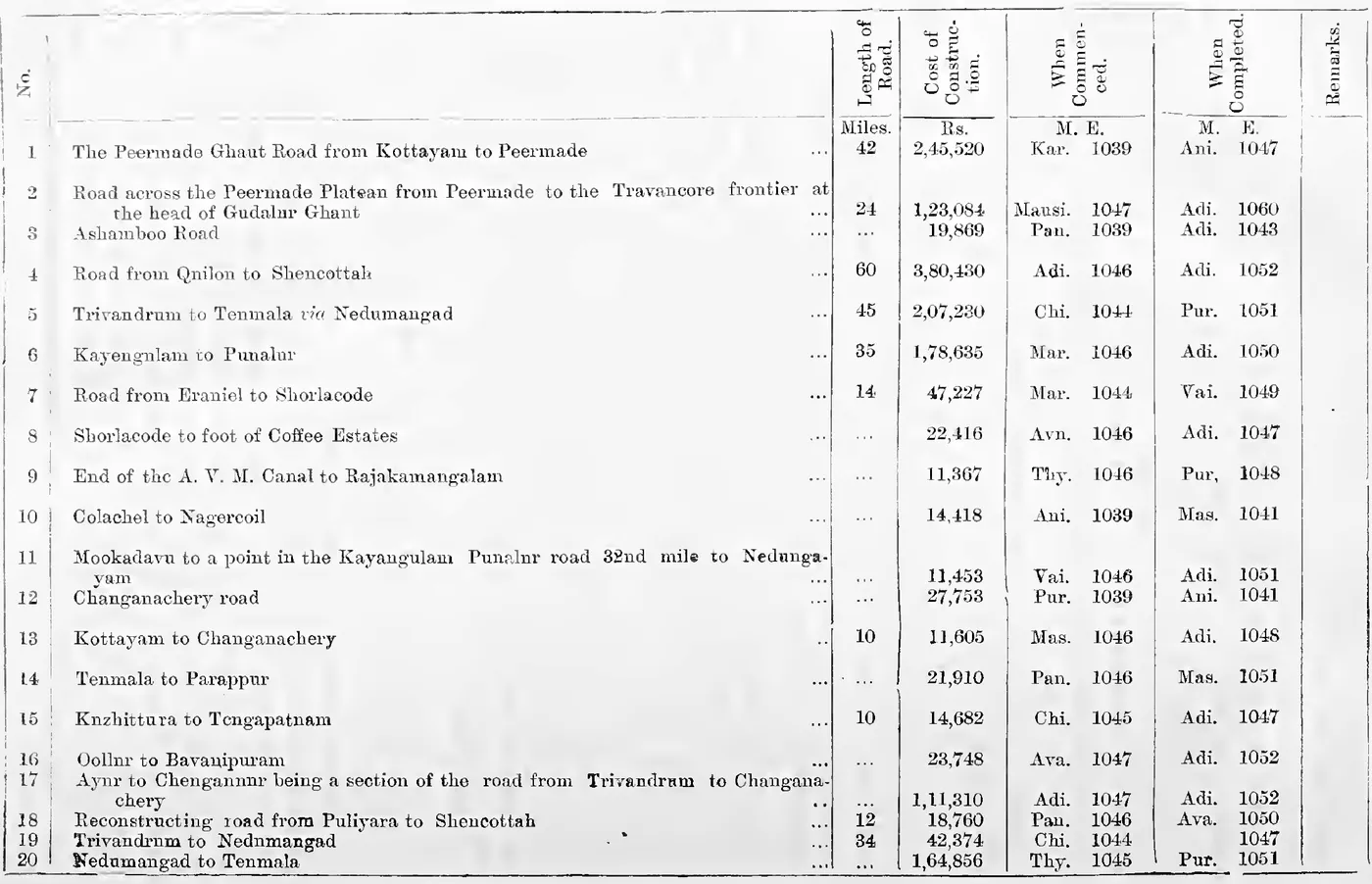
[223]It will thus be seen that very satisfactory progress was made in the way of opening up the country in all directions and the new roads had tapped an enormous tract of country hitherto almost inaccessible with the result that new trade began to spring up where it was before unknown or only very limited and free intercourse was established between the various parts of the State and with British India. A beginning was made for a new road from Trivandrum passing through the central part of the Quilon Division and extending to Kottayam with a view to extend this through North Travancore, the old route being most tortuous and perfectly impassable for carts. The road was designed not only as a main line of communication through the country but also to form connecting links between important inland towns and the nearest point of water communication. The Chief Engineer observed in his Departmental Report for 1047 M. E. (1871-72 A. D.):—
"Eight years ago, there existed but one cart road in Travancore, viz., from Trivandrum through the Aramboly pass. The whole traffic of the country, excepting close along the sea board, was by means of cooly porterage. It would be difficult to say, what amount of labour has been released by the introduction of carts and is now available for purposes of agriculture. It requires but a leisurely tour through Travancore to understand the beneficial effects of the new roads, and how thoroughly the country is being opened up; by the time the roads now in progress, or proposed and planned, are finished, we shall have close upon 1000 miles opened for cart traffic, and this may fairly be looked for in the course of another 18 months or 2 years."
Nearly 15 lakhs of rupees had been spent for original road works alone. A great deal was done in the matter of bridge construction also during this period. Of the bridges completed the iron girder bridge at Kuzhittura stands foremost having cost nearly 2 lakhs of rupees and of the bridges that had been started must be mentioned the suspension bridge at Punalur, a very fine specimen of engineering. It was to be 200 ft. clear span and water way. The construction was begun in 1047 M. E. (1871-72) but was brought to a close only in 1054 M. E. (1878-79) and cost on the whole Rs. 2,83,825.
The subsequent progress in road construction may be briefly noted. For about 5 years after 1047 M. E. (1871-72 A. D.) no new works were undertaken, the expenditure being mostly on original works already under construction and on repairs and maintenance. In 1052 M. E. (1876-77) 45 miles of road, commenced in previous years, were brought to completion; 100 miles of new roads were commenced and 136 miles of traces for new roads opened. The road from Peermade to Gudalur which was already opened for cart traffic though not yet completed according to the original [224]specification and estimate proved specially valuable during the famine of 1876, when with the fluctuating market in the Madura District, the produce of North Travancore found a ready outlet to the Famine district and transport which could find no employment near home came across the ghauts to find ample employment on the Travancore side. The main road from Kottayam to the Cochin frontier the first section of which had already been commenced in 1051 M. E. (1875-76) was taken up the next year in its entire length and was completed in 1053 M. E. (1877-78). This completed the main line of communication from Trivandrum to the Northern frontier and is an important line running through the centre of Travancore and calculated to greatly develop the internal trade of the country as it opens up vast fertile tracts highly advantageous to cultivation. The total length of the road is 156 miles. Simultaneously with the construction of this road traces for new roads running to the western frontier and to the foot of the hills to the east were also laid down. A new road from Vembaykonum to Nedumangad, Aryanad, Moonarray and Culliel and thence to Colasekaram and Shorlacode (length 45 miles) was taken in hand, as also another road from Kanjirapalli to the river bank at Coonoombagum [?]. While the former was intended to serve as a connecting link inland between the Trivandrum and the Southern Division following close along the foot of the hills and giving ready access to the various routes to the Coffee estates and the hills, the latter though only 7 miles in length would form a link between the Quilon and the Northern Division system of roads inland at the same time shortening by 15 miles the distance between the coffee estates and water communication. These two roads were completed and opened in the course of one year. And lastly several short lengths of useful roads were opened in Trivandrum itself. In 1053 M. E. (1877-78) eighty-three miles of roads were brought to completion, 96 miles newly commenced and 94 miles traced for new roads. In 1054 M. E. (1878-79) in addition to the roads already in progress, two branch roads connecting Quilon and the Varkala cliff with the main line of communication between Trivandrum and Shencottah were proceeded with. Several roads were opened about Trivandrum and the old road between Trivandrum and Quilon was rendered trafficable for nearly two-thirds of the whole distance. By the end of 1055 M. E. (1879-80 A. D.) the Northern Division which up to a few years ago had absolutely no cart tracks save the line from Kottayam to Mundakayam via Kanjirapalli had been opened with nearly 250 miles of road fit for cart traffic and with several miles of traces. The total length of roads maintained throughout the State at this time was 950 miles which in another 5 years had increased by 200 miles. The subsequent [225]progress in the matter of road construction is briefly told if we remember that in 1079 M. E. (1903-04 A. D.) the length of cart roads maintained was 2218 miles including 312 miles of Planters' roads, of which 726 miles were metalled and the rest unmetalled or fair weather roads, and that besides these, village roads measured 808 miles and traces for new roads 376 miles. The expenditure which in 1060 M. E. (1884-85) amounted to Rs. 144,544 for maintenance and repairs and Rs. 93,689 on original works had in 1079 M. E. (1903-04) risen to Rs. 318,128 and Rs. 307,899 respectively. The average cost of maintenance in 1903-04 was Rs. 135 per mile for cart roads, while in the case of village roads and traces it stood at Rs. 17 and Rs. 13 respectively. As observed by the Chief Engineer in his Departmental Report for 1078 M. E. (1902-03) Travancore has been liberally supplied with roads as compared with the Madras Presidency and although on account of heavy rainfall, especially in North Travancore, it is difficult to keep the roads in good condition, they compare very favourably in this respect with those in British India. He also draws attention to the important and extensive works already in hand in the three Northern divisions, viz., the thorough improvement of the Quilon—Shencottah road, the improvement of the road from Quilon to Madathura, the restoration of the cart road from Kottayam to Kumili and the erection of the bridge over the Periyar on that road, the construction of feeder and approach roads to the Railway Stations in Travancore of the Cochin-Shoranore and the Quilon-Tinnevelly Railways, the opening of the bridle-path from the High Range towards the west, the construction of the northern outlet road, the improvement of a portion of the road from Munnar to Bodi Mettu and the construction of the road from Vaikam to Udayamperur and other works. Again in his report for 1079 M. E. (1903-04) he observed:—
"The roads have also on the whole been maintained in fair condition, but there are still some of them which require special repairs, and some of the gravel roads, especially in the Trivandrum Town require to be metalled as the traffic on them is too heavy for gravel roads. As pointed out last year, the weakest point of the roads especially north of Trivandrum is the condition of the bridges, many of which are wooden platform bridges and need renewal. These old platforms are continually giving way and are always a source of anxiety. It is desirable that all except perhaps those on the unimportant roads should be replaced with masonry structures and it is very desirable that as large a sum as possible be devoted for this purpose annually until all the bridges are renovated. The progress made in this direction during the year under review has been on the whole satisfactory."
Calculating the area of the State at 7091 sq. miles and assuming that one third of this area is unfit for human habitation or are sparsely populated it is found that for each square mile of the remaining two-thirds of the [226]country there exists nearly half a mile of cart road under maintenance. This is considerably greater size for size than in any district of the Madras Presidency and their condition is an object of envy and admiration to the travellers in the adjacent British Districts. But there are still several portions of North Travancore, especially in the Taluqs of Shertallay, Vaikam and Ampalapuzha, which are in need of roads, in spite of the 211 miles of water-communication navigable throughout the year and which serve very largely the purposes of roads in those parts.
A considerable amount of work had already been done in the way of replacing old bridges, mostly wooden by more substantial structures. New lines of communication in North and Central Travancore and the improvement of the existing lines are now under the consideration of Government and as a beginning the construction of a road from Tiruvalla to Pullikkal has recently been sanctioned. In the main central road there are 5 streams yet to be bridged viz., the Periyar, the Muvattupuzha, the Ranni, the Manimala and the Vattar. It is proposed to shortly supply the deficiency in this respect and as a return for the heavy initial outlay in the construction of these bridges and the annual cost of their maintenance in the future it is also proposed to levy a light toll at these bridges when they are completed and thrown open to traffic.
We shall next notice briefly the principal roads that traverse the country at present with the routes, distances, bridges, Travellers' bangalows, &c., on the way:—
1. The Main Southern Road from Trivandrum to Aramboly—53¾ miles.
Starting from Trivandrum Fort we first cross the Killiar by means of a small bridge and then the Karamanai River which is provided with a very substantial stone bridge constructed about 50 years ago at great cost. From Trivandrum to Balaramapuram, a small busy commercial village, the distance is 8 miles and from here to Neyyattinkara is another 4 miles. The Neyyar is crossed by another small stonebridge. Passing Parassala, one of the London Mission stations, we reach the village of Kuzhittura after a distance of 23 miles. At a short distance from the village the river Tamraparni is crossed by the large iron girder bridge of 1160 ft. span already referred to. For about 20 years after the construction of the bridge there used be levied a light toll for all traffic intended to meet the enormous outlay [227]involved in the work. The toll was abolished in 1071 M. E. (1895-96) the Government having realised considerably more than the outlay.
From Kuzhittura to Udayagiri or Padmanabhapuram is 10 miles distant from which again Kottar or Nagercoil is 9 miles. Passing Nagercoil the Pazhayar is crossed by a recently built iron girder bridge and a few miles further north the Nanjanad Putten channel is crossed by a very small bridge. Proceeding on our way we next halt at Tovala and two miles later we pass through the Aramboly village and pass, after which the road passes for about 3 miles in Travancore territory and leaving the frontier at the 54th mile goes straight to Tinnevelly which is 93 miles distant from where we started.
This great trunk road has recently been metalled throughout and all the difficult gradients and ascents made as uniform as possible and is now maintained in very good order. It is no boast to say that this road is the finest of the roads in the whole of Southern India. It is throughout supplied with bridges, and avenue trees are planted for nearly the whole length. The Travellers' bangalows are at Neyyattinkara, Kuzhittura, Udayagiri and Nagercoil, all situated at intervals of nearly 12 miles. The road is also provided with what are called Vazhiambalams or halting places at convenient distances and wells at distances of 5 miles for the convenience of travellers. There are satrams or inns at all these places and also at Tovala, and choultries or feeding houses at Neyyattinkara, Parassala, Kuzhittura, Padmanabhapuram and Tovala. There are several roads branching off from the main road of which the most important are those leading to Vizhinjam, Puvar, Kollengode, Tengapatnam, Tiruvattar, Colachel, Tiruvancode, Eraniel, Bhutapandi, Balamore and Cape Comorin.
2. Road from Trivandrum to Courtallam via Shencottah, 67½ miles. This road passes through a very difficult country of hill and dale. The first halting place is Nedumangad, 12 miles distant from Trivandrum. Beyond Nedumangad is Pallode at a distance of 9 miles where the Manoor river is crossed by an 80 ft. span bridge. Three miles farther on, the line passes through another bridge across the Chittar. Madatturakkani is 32 miles distant from Trivandrum and Kulattupuzha 40 miles. The Parappar is crossed at the 45th mile stone, and a mile farther the road joins the Quilon-Shencottah road.
This also has been recently metalled and is in very good condition. The Travellers' bangalows are at Nedumangad and Kulattupuzha, and there is a lamp-shed at Pallode.
[228]3. Trivandrum to Quilon. 45½ miles. Kazhakuttam is the first village it passes through after crossing the Oolloor river; it is 10 miles distant from the Capital. Passing thence to Kaniapuram, Thonnekkal and Pallipuram, the road reaches the historically famous Attungal after a course of 21 miles. Crossing the Attungal river we next come to Navaikulam (27¾ miles) and then to Chattanur (36 miles), and after crossing the Ittikara river a mile farther on, reach Quilon after a distance of 45 miles.
4. Quilon to Shencottah, 59¾ miles. This is really a grand line of communication connecting Travancore with the British territory and passing through a very broken and rugged country. The construction of this road cost nearly 4 lakhs, of rupees and it is one of the most useful of the several public works carried out during the beneficent and eventful reign of His Highness the penultimate Maharajah. The credit of having planned the line goes to Rajah Sir T. Madava Row. The railway now runs by the side of this road. They cross each other at several points.
Starting from Quilon there is first Kundara, now a Railway station. Passing the village of Kundara (9 miles distant from Quilon) we come to Kottarakara (16 miles). From Kottarakara to Punalur the distance is 12 miles. The Kallada river is here crossed by the suspension bridge. The road then passes the village of Edamannur (33 miles) and thence to Ottakkal (39 miles), and 3 miles farther east it is joined at Tenmala by the road to Trivandrum. Leaving Camp Gorge (43 miles) and crossing the Kazhuthuritti and Anachady rivers the road passes through Aryankavu, 51 miles from Quilon. From Aryankavu, Puliyara is 4 miles distant and Shencottah 8 miles.
The Travellers' bangalows on this road are at Kottarkara, Punalur, Aryankavu and Shencottah, and there are choultries at Kottarakara, Punalur, Ottakkal and Aryankavu, besides a satram at Edamannur.
5. Main central road—from Trivandrum to the Northern frontier via Kottayam, 155 miles. The road first touches Vamanapuram after a course of 20 miles and crossing the Vamanapuram, Kilimanur, and Ayur rivers all of which have been bridged, passes Ayur (36 miles) and thence leads to Kottarakara where it crosses the Quilon-Shencottah road. The Kallada river is crossed at Yanathymangalam 4 miles from which the village of Adur is reached. Leaving Adur it crosses the Pantalam river. It reaches Chengannur after a distance of 74 miles. From here and after crossing the Ranni and Varraytyam and Manimala rivers by means of ferries it leads to Tiruvalla (80 miles) and Changanachery [229](85 miles) and thence crossing the Cunnenparur and Kodimatta rivers reaches Kottayam (96½ miles).
From Kottayam, the road crosses the Kottayam and Neelamangalam rivers and leads to Ettumanur. From Ettumanur to Muvattupuzha it is 28 miles distant, the Muvattupuzha river being crossed by a jungar and ferry. Starting thence it touches Perumpavur after another 11 miles and crossing the Tannipuzha Periyar also by a ferry it reaches the northern frontier and joins the Cochin road via Angamalai, after a total distance of 155 miles.
There are Travellers' bangalows at Kottarakara, Adur, Changanachery and Kottayam and camp or inspection sheds at Vamanapuram, Ettumanur Kozhai (111th mile), Kuttattukulam (120th mile), Muvattupuzha and Angamalai which is a Railway station, the Cochin-Shoranore Railway crossing it. This road is the longest in Travancore passing right across the heart of the country more or less parallel to the main water communication from Trivandrum to the north.
6. Kayangulam to Punalur, 35½ miles. This road first touches Pallikal 4 miles distant from Kayangulam and joins the main Central Road at the 16th milestone, which it leaves after a very short distance. The village of Adur stands at the 18th mile. From Adur to Pattanapuram the distance is 10 miles and from thence to Punalur 8 miles, where it joins the Quilon Shencottah Road. This road only crosses two streams and these are provided with bridges.
There are Travellers' bangalows at Pallikal, Adur, Pattanapuram and Punalur.
7. Kottayam to Gudalur via Peermade, 69 miles. As will be seen from the table, this was the earliest to be taken up by Dewan Sir Madava Row, the road from Kottayam to Peermade being first finished in 1047 M. E. (1871-72) and that from Peermade to Gudalur in 1060 M. E. (1884-85). As the road passes right across the Travancore hills its construction involved enormous labour, time and money. The first section took nearly 8 years and the second 13 years to finish, the two together costing nearly 4 lakhs of rupees.
This road passes through the villages of Vazhur, Kanjirapalli, Mundakayam and Peermade in Travancore and from Gudalur the line has been extended by the British Government, to Ammayanayakanur via Kumili, Kambam and Periakulam. All the rivers and streams except the Periyar have been bridged, the most important being that at Mundakayam. There [230]are Travellers' bangalows at Vazhur, Mundakayam, on the road to Peruvantanam village, the Periyar crossing, and the Gudalur Tavalam.
These are the main lines of communication. The other subsidiary roads are:—
- 1. Nedumangad to Shorlacode, 39 miles.
- 2. Anaud to Kullar and thence to Ponmudi, 22½ miles.
- 3. Pappanamcode to Cottur, 18 miles.
- 4. Nagercoil to Balamore,* 23⅔ miles.
- 5. Shorlacode to Aramboly, 15⅓ miles.
- 6. Nagercoil to Cape Comorin, 11⅔ miles.
- 7. Nagercoil to Colachel,* 13¾ miles.
- 8. Kuzhittura to Tengapatnam, 6⅘ miles.
- 9. Martandam to Colasegaram and Myloney, 17½ miles.
- 10. Colachel to Eraviputhoorcaday, 8½ miles via Karingal.
- 11. Thuckalay to Thadicarenconem via Shorlacode, 14⅛ miles.
- 12. Monday-market to Poothankaday via Karingal, 11¼ miles.
- 13. Ayur to Kullattupuzha, 16½ miles.
- 14. Pattanapuram to Konniyur, 11 miles.
- 15. Konniyur to Ranni, 14 miles.
- 16. Kumbala to Kozhanchery, 10 miles.
- 17. Kaipathur to Pattanamtitta, 4 miles.
- 18. Elankolum to Kaipathur, 7 miles.
- 19. Sastamkotta to 8th mile Kayangulam-Punalur road, 10 miles.
- 20. Sastamkotta to Pattakadavu, 4 miles.
- 21. Adur to Sastamkotta, 10 miles.
- 22. Quilon to Madatura, 35¾ miles.
- 23. Perumpavur to Alwaye, 10 miles.
- 24. Muvattupuzha to western frontier, 16⅛ miles.
- 25. Muvattupuzha to Todupuzha, 12 miles.
- 26. Ettumanur to Lalam, 10½ miles.
- 27. Changanchery to Vazhur, 19 miles.
Besides the above there is the High range Bridge path from Kotamangalam to Munnar, 58½ miles, the northern outlet road from Munnar to Chinnar 40 miles now being improved into a cart road, and the road from Munnar to Bodimettu bridle path 21 miles. These last are exclusively used by the planters. The outlet road which is now nearing completion is being constructed by the Kannan Devan Hills Produce [231]Company Ltd., under a special agreement with His Highness' Government who have promised to contribute 4½ lakhs of rupees for the same.
* T. B. at Thadicarenconom × T. B. at Colachel.
Town roads and lighting. Nearly 100 miles of roads traverse the various parts of the Capital alone, while for the other towns of Nagercoil, Quilon, Alleppey and Kottayam there are only 5, 20, 18½ and 11½ miles of roads respectively. It is only the town and village roads that are supplied with light. The lighting at the Capital is under the management of the Public Works Department. The mofussil stations are in charge of the Town Improvement Committees corresponding to the municipalities of British India but without the power of levying any municipal cesses, while the village road lighting is looked after by the Sanitary Department. The Trivandrum Town gets the largest share of the amount spent upon street lighting maintained by Government. All the main roads and the streets within the Fort are supplied with lamp-posts and lighted, a portion of which is lit up by gas. The gas light is now supplied from the Museum outer gate through the main road and the streets round the Palace and Pagoda. But there are still several portions especially the streets outside the Fort that have not yet received any share of the Government outlay.
Water communication. The canal and backwater system of Travancore has already been described in Chapter I in sufficient detail. There is uninterrupted water communication from Trivandrum to Trichur and Shoranore for a distance of 191 miles.
The total length of canals and backwaters maintained for navigation purposes exclusive of the navigable rivers which require no maintenance is 147 miles and the cost of their maintenance comes to nearly Rs. 150 per mile. The Travellers' bangalows along the backwater-route are at Quilon, Ayiramtengu, Karumadi and Alleppey; and there are choultries at Varkala, Paravur, Kadinangulam, Asramam in Quilon, Ampalapuzha and Vaikam.
We have already noted that the Victoria Ananta Martandan Canal was started in July 1860 but that after a time it had to be abandoned though considerable sums of money had been spent upon it. This was a grand scheme for connecting Trivandrum with the Cape and thus extending the water communication to the extreme south of the country. The section first undertaken was only a short link of that communication. The commencement was made by His Highness near Mundakad or Colachel and by 1039 M. E. (1863-64) the actual length completed was [232]17½ miles including 2½ miles of natural lakes or reservoirs met with in the line. A section of the line of 10 miles between Puvar and Tengapatnam was completed and opened in February 1864 A. D. A formidable barrier had to be overcome at Midalam, 32 miles south of Trivandrum, a series of rocky cliffs which were removed by blasting operations of a very expensive kind and the line was extended as far as Colachel about 1867 with the exception of an aqueduct by which the stream of the Allienjie Nullat was to be passed over. A further section was also commenced to extend the canal as far as Karichal but it was resolved to suspend this work until the more important Varkala barrier canal was fairly started.
Sir Madava Row wrote:—
"It is to be regretted that the necessity arose for suspending the extension of the Southern canal towards the capital, after clearing the line and making some progress in blasting an excavation. The Wurkullay junction canal was certainly entitled to prior attention, but it would have been more satisfactory if provision could have been made for simultaneously carrying on both the works. But it seems that it could not be made at the time. It is to be hoped, however, that the Chief Engineer will be in a position to resume ere long the work suspended. Two short and comparatively easy links of canal, with a short road between, have only to be supplied to connect the southern canal with the Trivandrum and the Northern system of water communication, extending up to the railway from Madras to Beypur, and to increase the traffic immensely. The longer this is delayed, the longer will be the postponement of the full development of the utility of the canal already made at a very heavy outlay."*
But since then no attempt has been made to revive the project and realise the benefits originally contemplated. Perhaps the numerous roads that have been constructed throughout the length and breadth of the country make the extension of the canal superfluous. Quite recently however the extension of the canal from Trivandrum to Tiruvallam has been undertaken and the work nearly finished, the object of the extension being primarily to secure an unfailing supply of water to the canal which at times gets scarce to the inconvenience of traffic.
To facilitate the safe passage of boats, lights are provided at convenient distances in the backwaters and canals, especially at the dangerous passages near the bars of rivers and in the crossings of big rivers which during the winter season flow in full flood. In this connection should be referred to what are called "Munro lights" put up in the large backwaters to perpetuate the memory of that distinguished Dewan Resident Colonel Munro, to whose administration the country owes a great deal. Of these the lights at Arecad and Pullum are the most conspicuous. They consist of a wrought iron tower, 25 feet high, illuminated by 3 lamps with reflectors [233]capable of being seen at a distance of 7 miles—lighting the way across the backwaters between Alleppey and Kottayam and from Cochin to each of these places. They were completed in 1054 M. E. (1878-79 A. D.)
* Administration Report of Travancore for 1045 M. E. (1869—70).
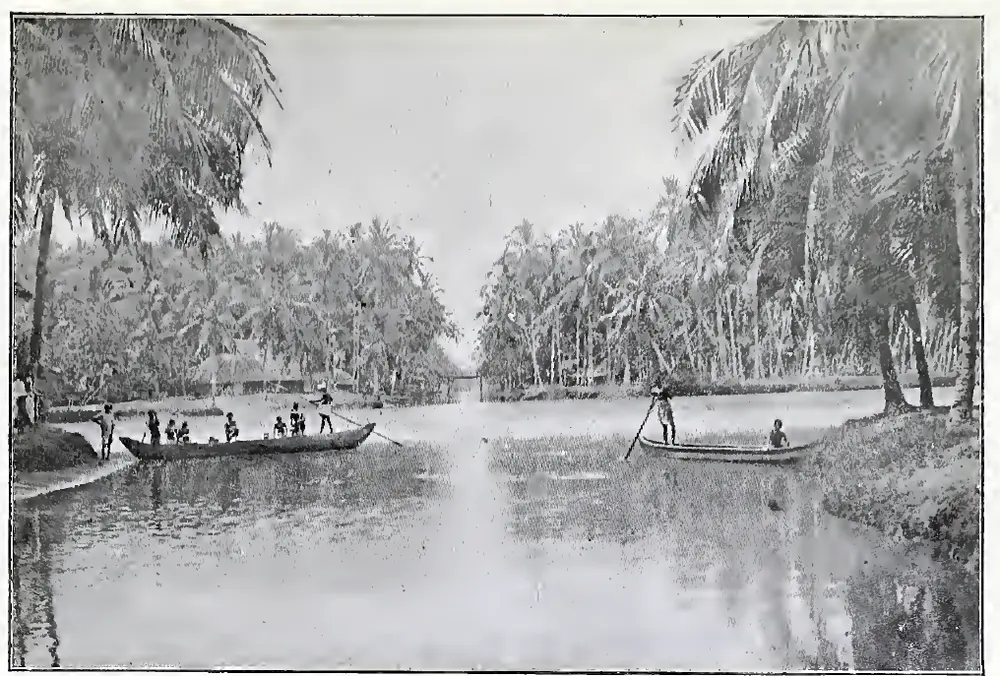
Railway extension into Travancore. The Tinnevelly-Quilon Railway. Though the introduction of the Railway into Travancore was first proposed by the Madras Government in 1873, the matter was taken up for serious consideration by His Highness the Maharajah only after his return from Calcutta in 1876. Mr Barton the Chief Engineer of the Travancore State, who was consulted on the point drew up a memorandum proposing a line to run west from Koilpatti through the Chittar valley entering the Travancore territory near Shencottah and thence to Trivandrum with a branch line to Quilon. The S. I. R. Company were inclined to make a survey of the Southern route via the Aramboly pass to Trivandrum, but as the balance of opinion was in favour of the Northern route, they obtained permission to survey that as well. Meantime the question of a broad gauge railway from Shoranore to the British port of Cochin which had been proposed about 1879 excited much controversy and Sir Madava Row suggested to the Government of Madras in an elaborate memorandum that a metre gauge Railway from Shoranore and another from Trivandrum towards the South Indian Railway would be more beneficial to the two Native States and the British Government. Dewan Ramiengar disapproved of this route and suggested that a line from Koilpatti to Quilon through Shencottah would be the one most advantageous. Mr. Puckle, the then Collector of Tinnevelly, also concurred with him in this view. In spite of several proposals and counter-proposals this view ultimately prevailed.
About the close of 1881 the Consulting Engineer for Railways issued instructions to the Chief Engineer of the S. I. R. for a trial survey and section of a line from Tinnevelly via Tenkasi and the Aryankavu pass to Quilon and to Trivandrum. Mr. Logan the Chief Engineer of the S. I. R. at once set to work and made a reconnaisance over the southern route from Trivandrum through the Aramboly pass. The preliminary trial survey and the section of the line by the northern route was completed by the end of April 1882. He issued a preliminary report in which he discussed the merits and demerits of the two routes and held that the Southern route which would work along a well cultivated and populous belt of country would be cheaper and more beneficial than the northern one. Early in 1883, he presented a further report of estimates and drawings which were forwarded to the Resident for obtaining [234]the view of the Travancore Government on the following points:—
(1) Whether His Highness' Government desire the construction of an extension of the S. I. R. into Travancore;
(2) If so, which of the two routes surveyed meets with approval; and
(3) What arrangements commend themselves to the Travancore Government for securing the construction of the line approved.
The Travancore Government replied that they would have the Railway extended to their territories through the northern by private enterprise.
In his memorandum dated 13th August 1883, Dewan Ramiengar was strongly in favour of the northern route and was of opinion that it would open up the interior of the country and better promote its commercial interests whilst the trade in the southern route was only of a local character and not capable of much development since Trivandrum was no important commercial centre.
The Madras Government approved of the northern route and ordered the S. I. R. Company to take action and submit definite proposals for the consideration of both the Governments. A careful survey was held and the total estimate amounted to nearly a crore of rupees for a distance of 106 miles. The Travancore Government deputed the executive Engineer, Quilon Division, to explore the country from Quilon to Shencottah and to find if an easier and less expensive line could be made with special reference to Quilon disregarding any consideration for Trivandrum. By certain alterations in the line he found it possible to cut down the estimate by 6 lakhs. The Dewan in forwarding the reports and estimates of the Chief Engineer reiterated his preference for the northern route in the commercial interests of the State. The Chief Engineer of the South Indian Railway to whom the matter was referred again wrote in favour of the southern route and prepared a comparative revised estimate based on the alterations proposed by the Travancore Government of which the following is a summary:—
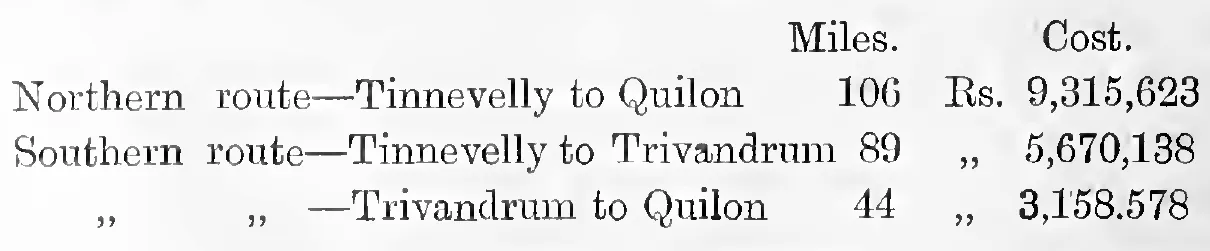
There was thus nearly a difference of 5 lakhs of Rupees between the 2 lines, in spite of the additional 27 miles traversed by the southern line. The Consulting Engineer also was of opinion that the southern line which [235]was the cheaper to make would be doubly advantageous in as much as it would serve both Trivandrum and Quilon. But though the facts and figures were on the side of Mr. Logan the weight of Travancore official opinion was against him. In their Order, the Madras Government intimated that the final selection of the route lay solely with the Travancore Government and that His Excellency the Governor in Council would be prepared to recommend to the Government of India, when the decision has been arrived at, for the construction of the portion of the line within British territory concurrently with the portion lying within Travancore. In accordance with this Order the papers were forwarded to the Travancore Government and Dewan Ramiengar in his exhaustive reply, dated 26th October 1886, decided that the Tinnevelly—Quilon route via the Aryankavu pass on the new line proposed by the Travancore Government should be the one adopted. The Government of India and the Secretary of State were all in favour of the Southern route, but still the Travancore Government persisted in having the Northern route opened. Considerable correspondence passed between the Travancore Government and the S. I. R. Company regarding the scheme but negotiations fell through as the Company would not undertake the construction without the necessary capital from the Travancore Government.
The matter was again taken up in 1895 and practical steps towards the construction of the line made in 1898 when the Madras Government ordered a resurvey of the Ghaut section and the Government of India sanctioned Rs. 13,000 and placed the services of Theodore Michell, Executive Engineer, at the disposal of the S. I. R. Company to take charge of the survey and construction of the line. Sanction was received from the Secretary of State for India in 1899 to commence work at once and the Government of India granted an allotment of Rs. 7,00,000 for construction work in the British section. The Travancore Government also advanced 17 lakhs as soon as the Company had raised debentures on the guarantee of the Government of India—a guarantee which the State had under-written in respect to the cost of the portion of the line passing through Travancore. The work was pushed on without any further delay.
Of the total length of the line, 108·27 miles, 50·33 miles are in British territory and 57·94 in Travancore. By September 1900 the survey work of the whole route was finished and construction begun. Through communication from Quilon to Tinnevelly was opened on the 26th November, 1904. The original estimate for the line was Rs. 101,62,018 for 103·33 miles, but this had increased considerably the latest estimate being [236]Rs. 157,71,766 for 108·27 miles, Rs. 45,06,129 for the British section and Rs. 112,65,637 for the Native State section of 57·94 miles. The increase is explained to be due to various unavoidable causes.
The railway runs over a difficult track and the work done on the Ghaut section is pronounced to be exceptionally good. There are altogether five tunnels all of which go through very hard granatoid gneiss. The longest tunnel is 2800 ft. in length. From Quilon station a sliding has been made to the backwater near the Residency so that the Railway may be in direct communication with the traffic on the backwaters.
The following is an abstract of the contract entered into between the S. I. R. Company on the one hand and the Travancore State and the Government of India on the other for the construction and working of the line:— The Company was unable to raise up loans at 2½ per cent. So the Secretary of State for India authorised it to increase the interest to 3½ per cent, the rate which was found absolutely necessary for raising debentures. The total interest on the capital raised was to be divided in proportion to the actual expenditure incurred on the British and the Travancore sections of the line and the sterling figures were to be converted into Indian currency at Rs. 15 per pound, the interest being payable from the State revenue during the construction of the line.
The following is the amount of interest paid on debenture bonds raised for the construction of the State section of the line for the last four years:—
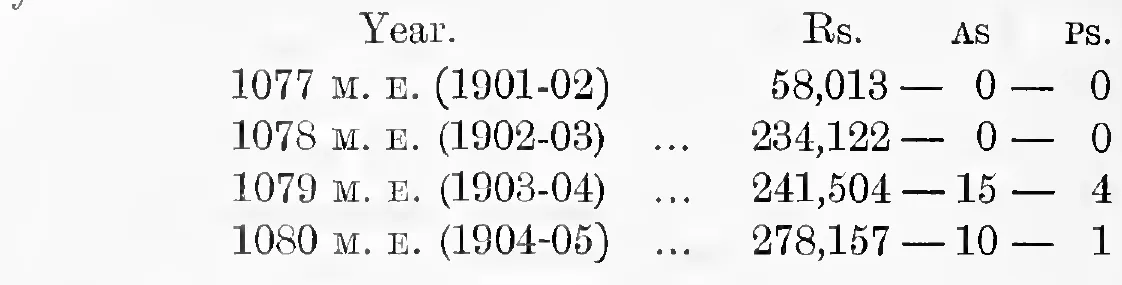
The Company had constructed the whole line including the rolling stock at the cost price and had undertaken to work it on completion at the same rate of expenses as obtains on the whole system, the cost of maintenance for two years opening to be debited to the capital. Any surplus profits obtained by working the line on the above conditions would after deducting the share payable to the Company be divided between the Government of India and the Travancore State in proportion to the lengths of the sections of the line in their respective territories and to bear any loss that may result in proportion to capitals invested on the construction of their respective sections. As regards the terms of purchase, the Government of India reserves to itself the option of purchasing the entire line at the end of 21 years, and thereafter at intervals of 10 years on 12 [237]months' notice, the purchase price being 25 times the yearly average net earnings not including rebate payments of the 3 years preceding the purchase, with a maximum price of 120 and a minimum price of 100 per cent. of cost price on a rupee basis. In the event of its being decided to exercise this right, the Government of India would offer to the Travancore State the option of purchasing the section of the line within its own territory, that Government and Travancore State each bearing a share of the total purchase price of the whole line proportionate to the capital cost of its own section. Should the State effect this purchase a choice between the two following courses would be given to it.
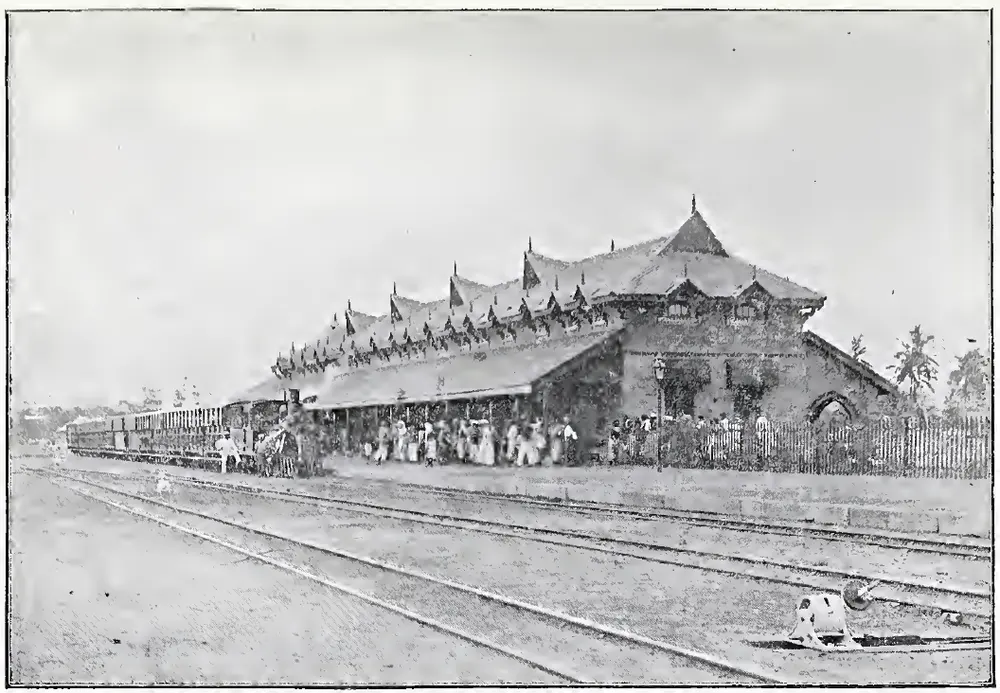
(a) It may work its own portion as an independent line or have it worked for it by the present line on its own responsibility and risk; or
(b) That the two sections may be worked by the Government of India as a single line, the net earnings thereof being divided in equal shares, and the Government of India (the proprietor of the best paying section of the branch) guaranteeing to the State out of that Government's share of net earnings of the Branch Railway such an amount as will make up the State's share to 3 per cent. upon its outlay on the purchases of its section."
Mr. Theo. Michell observed that though the Southern route was the cheaper to make, still it was probable that the Northern might better develop the traffic of Northern and Central Travancore according to Dewan Ramiengar's contention.
The Cochin Shoranore Railway. On the 20th of February 1879 the Resident Mr. Hannyngton forwarded to the Travancore Government copy of a letter from Messrs. Aspinwall and Company inviting their views upon the following points:—
(1) Whether they would permit a railway to pass through their territories;
(2) Whether they would give the land required; and if so on what terms; and
(3) Whether they would become shareholders.
There was a demi-official letter from the Resident also to the same effect. In reply to this, permission was given, the required land was promised and the Travancore Government undertook to invest in shares worth about 2 lakhs of rupees beyond the value of the land which was also to be paid in shares. Next the question of raising capital by State guarantee was moved and it was proposed that Cochin should pay 2 per cent., Travancore 1 per cent., and the British Government 1 per cent. The Travancore Government readily acceded to this proposal. The matter [238]was left to lie over for another year when the British Resident Mr. Macgregor said that the Madras Government were prepared to guarantee only ½ per cent. and proposed that Cochin should guarantee 2 per cent. and Travancore 1½ per cent. and added that considering the interests at stake and the advantages that they would reap, the Travancore Government should be prepared even to guarantee half of the 3½ per cent. The Dewan in a long memorandum replied that the interest of Travancore in the proposed line was too small even to justify the promised 1 per cent. and that they were already concerting measures to open up Railway communication between Quilon, Trivandrum and Koilpatti, which if made would facilitate and develop their trade much better than the Cochin-Shoranore line in question. Further, as with the native traders and producers speed was not so much a desideratum as cheapness of transit, an improved system of water communication would be better appreciated than an expensive broad gauge railway.
As the Resident still persisted, the Travancore Government finally agreed to guarantee 1½ per cent. on a capital restricted to £ 550,000 or 1⅓ per cent. on such capital as might be required, for 15 years. Next the Resident in forwarding a G. O. from the Madras Government requested to know if the Travancore Sirkar had any objection to hypothecate to the British Government an amount of Government securities calculated to yield an interest sufficient to cover the liabilities, about Rs. 99,000, per annum. After some hesitation the Travancore Government resolved to hypothecate Promissory notes for 15 lakhs of rupees. Each year's payment was to be made when it was due and on failure it was to be made good from the securities.
Travancore was saved from the situation by the timely interference of Sir Madava Row who, in an exhaustive memorandum to the Madras Government, pointed out that the broad gauge railway would not sufficiently pay and proposed that a metre gauge railway should be opened from Shoranore to Trichur and another from Tinnevelly to Trivandrum and that Travancore should in fairness be relieved of all obligation to guarantee for the Cochin—Shoranore railway, the main object of which was to connect a British Railway with a British port. As a result of this able contention, the Madras Government, in their Order dated June 1881, expressed their willingness to relieve Travancore of ½ per cent. of her guarantee by reducing the total rate of interest to 3½ per cent. of which the British and Cochin Governments would guarantee 2½ per cent. and Travancore 1 per cent., which was what she undertook before the [239]project was submitted to Government. At the same time it was stated that Cochin, notwithstanding her greater benefits, would be called upon to pay only Rs. 50,000 while Travancore which had a larger income should pay her full share of Rs. 99,000.
The Travancore Government expressed their disapproval and stated that as before agreed they were willing to guarantee for 12 years the liabilities which had now become reduced to Rs. 43,750 owing to the reduction of interest to 3½ per cent. from 4 per cent. or if the guarantee should be for 15 years the annual liabilities would become Rs. 35,000.
Reference was again made to the Travancore Government for their consent to a slight modification in the terms of the liability so as to guarantee 1 per cent. for 15 years on the actual capital spent in the construction of the line within a maximum sum of Rs. 66,00,000 (£. 550,000) subject to the condition that the liability so undertaken should not exceed Rs. 35,000 per annum. The Travancore Government agreed to this proposal and the papers were forwarded to the Government of India for sanction. In the meantime the question of the extension of the South Indian Railway to the State has been mooted and Travancore regretted having taken part in the Cochin—Shoranore line in which her interests were only very remote and insignificant. Fortunately for Travancore, the scheme fell through as it did not obtain the sanction of the Secretary of State for India. The project lingered on till 1885 when it was finally shelved as the Travancore Government refused to grant the concessions or even to take shares. The question was next taken up in 1898 by the Cochin Government which resolved to construct a metre gauge railway out of State funds. The preliminary survey and plans were soon got ready and in October 1899 the Travancore Government were requested to make the necessary arrangements to assume the lands within the State required for the purpose and make them over to the Madras Railway authorities who undertook to construct the Railway line on behalf of the Cochin Sirkar. A special Officer invested with the powers of a Dewan Peishcar under the Land Acquisition Regulation was at once deputed for the purpose and a declaration of cession of power and jurisdiction of all kinds over the lands so acquired was also executed by His Highness the Maharajah in the form prescribed by the Government of India and submitted to the Government. His Highness the Maharajah's Government also agreed to the usual charges on account of the Police on railways, viz., 3/10 of the charges to be defrayed by the two States, Travancore and Cochin, in proportion to their respective mileage therein.
[240]This Railway was opened for goods traffic on the 2nd June 1902 and for all kinds of traffic on the 16th July 1902. The length of the line passing through Travancore territory is 18 miles. Special arrangements have been made with the approval of the British Government for the protection of the customs revenue of the State by establishing custom houses at Angamalai, Alwaye and Edapally, the three stations in Travancore through which the line passes.
Ports. We have already dealt in detail with ports and shipping facilities in Chapter I. The sea-board of Travancore contains as many as 18 ports of which the principal ones are those of Alleppey, Quilon and Colachel, for each of which there is a Master Attendant.
The port of Alleppey was opened by Rajah Kesava Das during the reign of Rama Varma (1758-1798) and it has now attained to the position of the premier port in Travancore on account of the fine harbourage it offers to vessels even during rough weather. The wonderful smooth water anchorages in the vicinity of Alleppey render it capable of sheltering ships of any size with all the advantages that the people of Madras and Colombo have obtained artificially by laying out an enormous sum of money. Alleppey has a lighthouse and pier constructed at a heavy cost and in order to meet their maintenance charges a small toll is levied by Government on all ships visiting the port. A Regulation for the levy of port dues was passed in 1860 and rules were enacted for the boat service in 1874. The original pier was completely destroyed in the cyclone at the end of May 1879 and sanction was immediately accorded to the construction of an iron screw pile pier, which was completed about the middle of 1881. There is also a small line of railway connecting the pier with the town which is chiefly of service to the Government in carrying tobacco and salt from the pier to their respective bankshalls.
Quilon is the central port of Travancore. The survey of the roadstead was undertaken and completed by Mr. Rhode, Commercial Agent, in 1054 M. E., (1878—79) and he considered the general results satisfactory as all vessels, especially steamers, could approach and anchor very close to the shore. There are a flagstaff and live buoys put up to mark the dangerous rocks in the vicinity. Rules for boat service were framed and passed in the same year.
Steamers first commenced to call at the Colachel port only in 1872, when a Master Attendant was appointed by Government, though the port has been famous as a safe harbourage from very ancient times. A [241]survey of the port was also made in that year and the necessary rules for guiding boat-service were enacted in the year following.
Satrams or wayside inns. Besides the Travellers' bangalows which are mainly intended for European and other such travellers, there are 29 inns for the convenience of native passengers, built at convenient points on the main lines of communications.
They are at:—
- Tovala.
- Ozhuginasery.
- Cape Comorin.
- Thakalay.
- Kuzhitturai.
- Neyyattinkara.
- Trivandrum.
- Pallode.
- Madatturakani.
- Kulattupuzha.
- Varkala.
- Elamvalloor.
- Kottarakara.
- Punalur.
- Edaman.
- Ottakkal.
- Adur.
- Erumakuzhi.
- Maruthurkulangara.
- Klappana (Pallikavu).
- Pallatturithi.
- Vaikam.
- Pambadi.
- Kanjirapalli.
- Mundakayam.
- Peermade.
- Chottupara.
- Kuttattukulam.
- Muvattupuzha.
Oottupurahs or charitable feeding institutions. These institutions are 45 in number inclusive of the three conjee houses. The chief of them is at the capital. The others are distributed at convenient distances on the line of the road commencing from Aramboly in the South and ending at Parur in the North. Fuller information with regard to these institutions is given in chapter XIX, Administration.
Conveyances. In the matter of conveyances other than boats, Travancore is still very poor. The people till about 50 years ago used the most primitive form of conveyances. The country itself does not boast of good and clean kept cattle, which not being indigenous have to be brought from the adjacent British districts; nor were there many lines of communication fit for cart traffic, much of the trade and traffic of the country being carried by means of water communication, the rest by means of laden bullocks and cooly porterage, the roads used being only foot tracks not allowing any carriages to pass through.
Since the opening of roads for easy and free communication the means of conveyance have greatly improved. Spring carriages have [242]taken the place of the old Tomjons and a large number of country carts are met with in all parts of the State. Horse carriages such as phaetons, broughams, victorias, landaus, &c., have ceased to be rare at least in the towns.
Recently, bicycles and even motor cars have been introduced.
Before the introduction of Railway the transit carts were largely used by travellers to South Travancore and Tinnevelly.
Country boats play a very great part in the commercial development of the country, in as much as 45 per cent. of the entire external trade is being carried on by the backwater route.
Boats ply at all periods of the day from one part of the country to another. The baggage boats are generally larger than the ordinary passenger canoes. An ordinary boat is poled by two persons working by turns; in some cases two and even three work at the same time. The well-to-do travel in cabin boats. These are propelled by oars worked by ten to sixteen men.
The Government also maintain a small transit boat service mainly for the carriage of the heavy Anchal mails and also for passenger traffic. But it is not popular and the people always prefer to travel in private canoes which afford them greater convenience at a less cost.* From Quilon to Alleppey and thence to Cochin there is a steam launch service, maintained by a private firm of merchants, which is becoming increasingly popular. With the extension of the Railway to Quilon the necessity for extending the steam communication to Trivandrum has become very pressing.
Rates of charges for conveyances. The following rates have been fixed by Government with regard to each kind of conveyance, and are in force for Government purposes:—
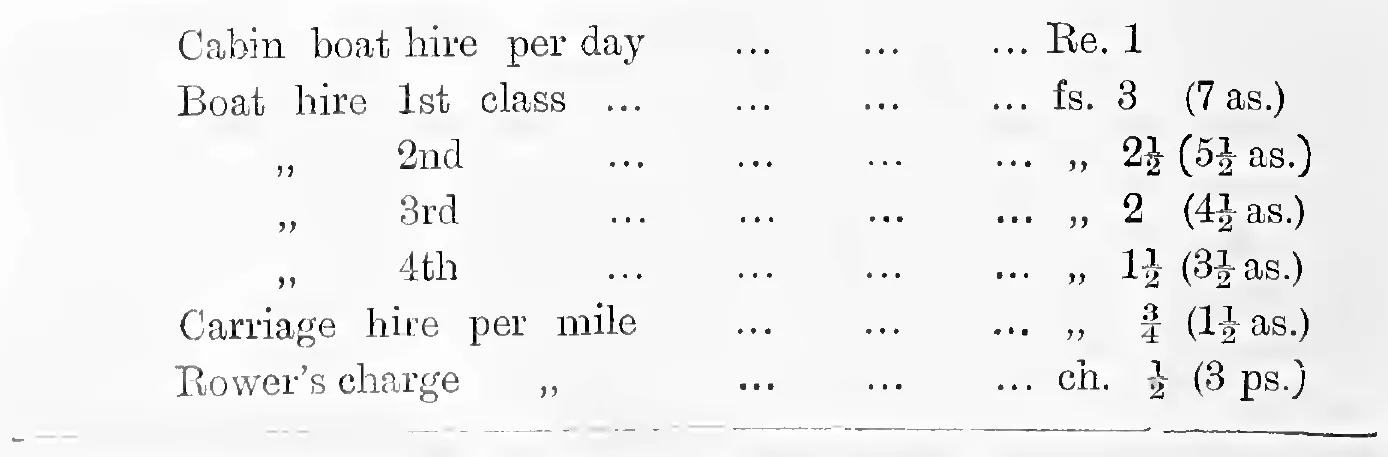
* The charge for a single passenger from Trivandrum to Parur i. e., for 144 miles, is 6¾ fs. or 15 as, and it takes nearly 3 days to finish the journey. The Sirkar transit Stations are:—Trivandrum, Chirayinkil, Varkala, Paravur, Quilon, Chavara, Klapana, Ampalapuzha, Alleppey, Vaikam, Arukutti, Ernakulam and Parur.
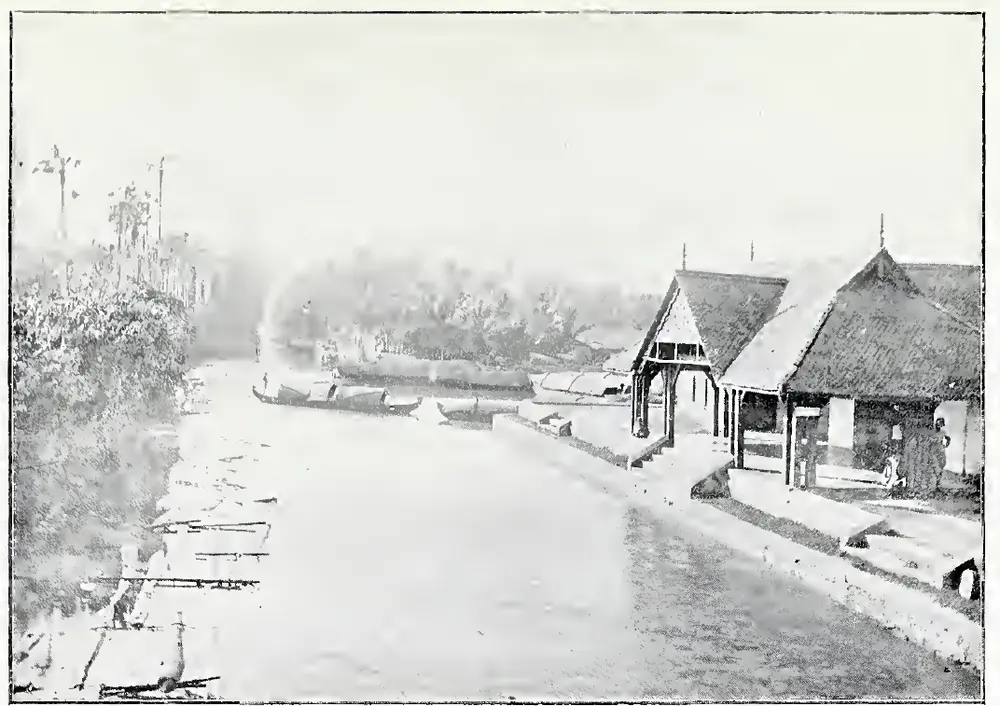
[243]

Post Offices. Postal communication was first introduced in Travancore in 1857 and at Alleppey was opened the earliest Post Office. The Trivandrum Office was opened only in 1863 that of Quilon in 1864 and that at Nagercoil in 1865. Travancore is for postal purposes constituted a separate Division under the charge of a Superintendent and under him there are two Inspectors in charge of the Trivandrum and Kottayam sub-divisions respectively. Besides the Trivandrum Head Office, there are 29* Sub-offices, besides 58 Branch Offices and two Experimental Branch Offices in Travancore, thus running into severe competition with the Anchal or local post. About 1882 at the instance of the Post Master General, Madras, a Postal treaty appears to have been concluded between Travancore and the British Government tentatively for one year with a view to bring the Anchal system to fuller reciprocity of action with the Imperial Post, but nothing more is traceable from the records.
Anchal. There are 150 Anchal Offices in the State and 185 letter-boxes. The Anchal rates of postage are decidedly less than the corresponding postal rates and greater facilities are enjoyed by the people.
Telegraphs. In 1863 the Government of India resolved upon connecting Cochin with Tuticorin through the Travancore territory by telegraphic communication and the Travancore Government readily permitted the line to pass through the State and also intimated that they had no objection to the British Government keeping the line passing through Travancore in their own hands equally with that through their own territories. In the course of a year the line was ready as far as Trivandrum and telegraph offices were opened first at Alleppey, then at Quilon and lastly at Trivandrum. The office at Nagercoil was the next to be opened in April 1865, but at the instance of the Director-General of Telegraphs the British Government insisted that before opening the office at Nagercoil, the Travancore Government should guarantee to pay annually the excess of any of the working expenses of the office over the actual receipts from messages, the amount of which to be duly communicated to the Sirkar, to which the latter assented considering the facilities and convenience [244]that would result both to the public and the Government.
* Alleppey, Alwaye, Anjengo, Attungal, Changanachery, Chalai Bazaar, Colachel, Colasegaram, Kallar, Kalthurutty. Kayangulam, Kottar, Kottarakara, Kottayam, Martandam, Mavelikara, Muvattupuzha, Nagercoil, Neyattinkara, Parur, Peermade, Puliyara, Punalur, Quilon, Shencottah, Shertallay, Tenmala, Thuckalay and Tiruvalla.
For nearly ten years there were only the four offices above mentioned but they entailed considerable losses to the British Government and about 1873 they proposed to close all the offices in the State and dismantle the line unless the Travancore Government guaranteed the loss resulting on their working, and the Sirkar eventually guaranteed a sum of Rs. 5000 annually on these four offices. This guarantee ceased to be enforced from 1886 as the offices had by that time become self-supporting. In 1874 there was a proposal to remove the Nagercoil office to Colachel as the former was a heavy charge upon the Sirkar paying only a small proportion of its expenses and this little was paid mostly by messages from Colachel which was then a port of rising consequence and a port of call for the British Indian Steam Navigation Company's vessels. But this proposal was not sanctioned by the Government of India as it involved the construction of a double line of wire about 8 miles in length at a probable cost of Rs. 5000 which they were not prepared to undertake. The Travancore Government, however, offered to meet this initial outlay and steps were taken to get the Government of India's sanction, but as the estimate had increased to Rs. 7000 the idea had to be abandoned by the Sirkar.
The next Telegraph office to be opened was at Kayankulam in Travancore. About 1888 sanction was obtained from the Government of India for constructing a line to Kottayam and establishing an office there, but as usual they demanded guarantee for a net revenue of Rs. 1100 per annum from the despatch of telegrams from Kottayam as the line had to be taken from Alleppey across the backwater which was a costly work. On this having been agreed to, the British Government consented to open at the same time a branch office at Colachel without a guarantee. The two offices were opened in 1889. The guarantee for the line to Kottayam was dispensed with on April 1898.
The Kottayam Peermade line was next undertaken and the Peermade office was opened in April 1894. The State guarantee for this line was Rs. 1800 per annum of which the planters, as the persons most benefited, undertook to defray a third. This guarantee continued up to the [245]end of March 1899, when it was dispensed with.
The following is a list of Telegraph Offices in Travancore at the end of the year 1905:—
Trivandrum—a second class office under a Telegraph Master.
- Alleppey, Quilon, Kayankulam, Chalai Bazaar (Trivandrum) — are second class combined offices.
- Kottayam, Parur, Peermade, Changanachery, Tiruvalla, Attungal, Mavelikara, Kanjirapalli, Puliyara — are third class combined offices.
- Thuckalay, Martandam, Colachel, Nagercoil, Neyyattinkara — are special third class combined offices.
[246]
Chapter XVIIArts and Industries.
"Life without industry is guilt, and industry without art is brutality ... ... but beautiful art can only be produced by people who have beautiful things about them, and leisure to look at them."
Ruskin.
"The hours when the mind is absorbed by beauty are the only hours when we really live, so that the longer we can stay among these things so much the more is snatched from inevitable Time. These are the only hours that are not wasted— these hours that absorb the Soul and fill it with beauty."
Jefferies.
Introduction. The arts and manufactures of India which from time immemorial have brought to this land fame and wealth from far off regions have remained the wonder and admiration of the world to this day. Whatever might have been the origin and whatever the uses of the traditionary arts and industries of India and their place in the industrial and economic life of her people, there can be no manner of doubt that history has given its impartial verdict in favour of their superlative beauty and excellence of workmanship. Western scholars have not failed to note this fact from a comparative study of the history of India with that of other countries and have given to the world the results of their observation in terms of sympathy and genuine admiration. In speaking of the Indian arts and manufactures Sir. W. W. Hunter observes:—
"In architecture, in fabrics of cotton and silk, in goldsmith's work and jewellery, the people of India were then unsurpassed."*
Dr. Buist, Editor of the Bombay Times, speaking of the history of Indian industry says in his Notes on India:—
"The carving of its wood work, the patterns, colours and texture of its carpets, shawls and scarfs, admired for centuries, have, since the Great Fair of the world, been set forth as patterns for the most skilled artificers of Europe to imitate. From the looms of Dacca went forth those wonderful tissues that adorned the noblest beauties of the Court of Augustus Cæsar, bearing in the eternal city the same designation sixteen centuries ago as that by which cotton is still known in India; and the abundance of Roman coin and relics up to our time occasionally exhumed, yet preserve traces of the early commercial connection between the two most wonderful nations in the world—those of the Cæsars and the Moguls."
Again, Martin in his Indian Empire says:—
"The gossamer muslins of Dacca, the beautiful shawls of Cashmere and the brocaded silks of Delhi adorned the proudest beauties at the courts of the Cæsars, [247]when the barbarians of Britain were painted savages. Embossed and filigree metals, elaborate carvings in ivory, ebony and sandal wood; brilliant dyed chintzes, diamonds, uniquely-set pearls and precious stones, embroidered velvets and carpets; highly wrought steel, excellent porcelain, and perfect naval architecture—were for ages the admiration of civilised mankind, and before London was known in history, India was the richest trading mark of the earth."*
* The Indian Empire—W. W. Hunter, p. 598.
This capacity for artistic excellence which has continued to exist more or less is not confined to any particular locality, but is to be found everywhere in India. The indigenous industries are carried on all over the continent. In every village until quite recently all the traditional industries were found thriving. The village community of India was a body corporate in which the artisans played an important part. The whole community was provided for; every man in it had his ordered place and profession. It was the stronghold of the traditional arts and industries. The occupations were hereditary and all persons following the same professions in course of time crystallised into the several castes. When the arts and industries passed out of the village, the caste system still afforded the best defence against the encroachment of foreign fashions. By its tenacity and exclusiveness the caste system has preserved the artisan classes from contamination and degeneracy, and the experience of ages gained in doing the same kind of work from father to son in an endless chain of succession, has stamped a hereditary capacity for artistic work in our artisan classes. So much so that "the mere touch of their fingers trained for 3000 years to the same manipulations is sufficient to transform whatever foreign work is placed for imitation in their hands, 'into something rich and strange' and characteristically Indian."*
The Indian caste has secured this wonderful result. As Mr. Sidney Low remarks in his Vision of India:—
"The caste provides every man with his place, his career, his occupation, his circle of friends. It makes him, at the outset, a member of a corporate body; it protects him through life from the canker of social jealousy and unfulfilled aspiration; it ensures him companionship and a sense of community with others in like case with himself. The caste organisation is to the Hindu his Club, his Trade Union, his Benefit Society, his Philanthropic Society. There are no work houses in India, and none are as yet needed. The obligation to provide for kinsfolk and friends in distress is universally acknowledged; nor can it be questioned that this is due to that recognition of the strength of family ties, and of the bonds created by association, and common pursuits which is fostered by the caste principle. An Indian without caste, as things stand at present, it is not quite easy to imagine."
* Martin's Indian Empire, Vol. I, p. 508.
* The Industrial Arts of India—Birdwood, p. 130.
[248]Though the indigenous industries were thus fostered and sustained, it was chiefly through the encouragement given by the ruling princes and chiefs and the cultivated tastes of the common people that the arts of India were brought to perfection. The rulers always maintained in their palaces skilled workmen from every part of India, and even during the rule of the Mahomedan conquerors court patronage was not wanting. Of the large number of skilled workmen in the court of Akbar were many "jewellers, inlayers in gold, silver, crystal, and carnelian; damascene workers, chiefly for ornamenting arms; enamellers; plain workers in gold and silver, and pierced workers; embossers; ......makers of gold and silver lace ... ... stone engravers, and lapidiaries; and other artists."† Every native ruler entertained a larger number of excellent master-workmen in his palace. They had their salary and daily rations for their lives from the exchequer and were provided with the materials for their work. It was under such a court patronage that the arts and industries grew and attained a high degree of perfection. As was justly remarked by Coleridge, "the darkest despotisms on the Continent have done more for the growth and elevation of the fine arts than the English Government. A great musical composer in Germany and Italy is a great man in society, and a real dignity and rank are conceded to him. So it is with a sculptor, or painter, or architect. ... ... In this country, there is no general reverence for the fine arts; and the sordid spirit of a money-amassing philosophy would meet any proposition for the fostering of art, in a genial and extended sense, with the commercial maxim—Laissez faire."‡
Since the advent of the European nations there came a change over the country; and when the country passed under British rule the overwhelming importation of European manufactures which followed in their wake worked immense ruin on the hereditary native craftsmen. Under the British rule which secures the freest exercise of individual energy and initiative, the restraints imposed by caste exclusiveness became considerably relaxed to the marked detriment of those handicrafts, the perfection of which depended on the hereditary processes and skill. The foreign rulers of India patronised the European manufactures even at the expense of native industries. The native rulers and nobles also imitated the ruling class in their tastes and filled their palaces and mansions "with flaming Brussels carpets, with Tottenham-Court furniture, with cheap Italian mosaics, with French oleographs, with Austrian lustres and with German tissues and cheap brocade." The village artisans, neglected [249]by the ruling classes and chiefs and nobles and unable to hold their own against the fierce and merciless competition of the Western manufacturers, were forced to abandon their hereditary occupations and turn to agriculture or mass together in hundreds and thousands in squalid and insanitary surroundings to assist in the manufacture of goods with the aid of machinery recently imported into India.
† The Industrial Arts of India—Birdwood, p. 141—142
‡ S. T. Coleridge's Table Talk. P. 122. 1894 Edition.
The evil that has been brought to bear upon the traditionary arts and intelligence of the artisan classes of India by the introduction of machinery, is pathetically deplored by Dr. Birdwood in the following words:—
"But of late years these handicraftsmen, for the sake of whose works the whole world has been ceaselessly pouring its bullion for 3,000 years into India, and who, for all the marvellous tissues and embroidery they have wrought, have polluted no rivers, deformed no pleasing prospects, nor poisoned any air; whose skill and individuality the training of countless generations has developed to the highest perfection; these hereditary handicraftsmen are being everywhere gathered from their democratic village communities in hundreds and thousands into the colossal mills of Bombay, to drudge in gangs, for tempting wages, at manufacturing piece goods, in competition with Manchester, in the production of which they are no more intellectually and morally concerned than the grinder of a barrel organ in the tunes turned out from it. I do not mean to depreciate the proper functions of machines in modern civilisation, but machinery should be the servant and never the master of men. It cannot minister to the beauty and pleasure of life, it can only be the slave of life's drudgery; and it should be kept rigorously in its place, in India as well as England."*
In summarising the causes of the decline of industry in India Mr. James Mill in his History of India speaks of the unfair competition that brought about such a decline in cotton and silk goods. He says:—
"It was stated in evidence that the cotton and silk goods of India up to this period (1813) could be sold for a profit in the English market at a price from 50 to 60 per cent. lower than those fabricated in England. It consequently became necessary to protect the latter by duties of 70 and 80 per cent. on their value, or by positive prohibition. Had this not been the case, the mills of Manchester and Paisley would have been stopped at the onset and could scarcely have been set in motion even by the power of steam. They were created by the sacrifice of the Indian manufacturers. Had India been independent, she would have retaliated. This act of self-defence was not permitted her. British goods were forced on her without paying any duty, and the foreign manufacturer employed the arm of political injustice to keep down and ultimately strangle a competitor with whom he could not have contended on equal terms."
To which Sir W. Hunter adds:—
"Many circumstances conspired to injure the Indian industry. In the last century, England excluded Indian cotton fabrics not by fiscal duties, but by absolute prohibition. A change of fashion in the West Indies, on the abolition of slavery, took away the best customer left to India. Then came cheapness of production in Lancashire, due to improvements in machinery. Lastly, the high price of raw cotton during the American War, however beneficial to the [250]cultivators, fairly broke down the local weaving trade in the cotton-growing tracts. ... ... The far-famed muslins of Dacca and of Arni are now well-nigh lost specialities.* The finer fabrics of cotton which from Surat at the beginning of the century were exported to the value of Rs. 360,000 a year dropped to the paltry sum of Rs. 6,332 in 1874. ... ... On the one hand, the downfall of the native courts deprived the skilled workman of his chief market; while on the other the English capitalist has enlisted in his service forces of nature against which the village artisans in vain try to compete. The tide of circumstance has compelled the Indian weaver to exchange his loom for the plough, and has crushed many of the minor handicrafts."†
* Industrial Arts of India—Birdwood. Page 136.
"One of the chief causes", said Sir Thomas Munro nearly a century ago, "which precluded the extension of the consumption of European articles in India is, I am afraid, the excellence of their own manufactures." Matters to-day have assumed a different aspect altogether.
Mr. Glyn Barlow, M. A., writes in his Industrial India:—
"In yonder street the village weavers are working at their trestles, laboriously stretching the warp which will afterwards be transferred to the primitive looms. The weavers work for a pittance—scarcely enough to keep body and soul together; and yet, although the labour is so cheap and although the cotton grows, perhaps, in neighbouring fields, yon village damsel at the well is draped in Manchester cloth! Why should this be? Mainly because the weavers are behind the times."
Again, he says:—
"It is in the cities—where crowds of educated men are gathered together, where the standard of living is far higher than in the fields, where skilled labour can be had and can be developed, and where the houses and the shops and the very streets are blatant with the productions of foreign enterprise—that enlightened citizens should be resolved to play their part.... ... ... The lamp by his side was made in Germany, the chimney was made in Austria, the oil was produced in Russia, and the match with which the lamp was lit was made in Sweden or in Japan. The clock that ticks on the shelf was made in America, and the watch that ticks in his pocket was made at Geneva. The ink in his inkstand was made in London, the nib in the penholder was made at Birmingham, and the pencil in his pocket was made in Bavaria. The broad cloth of the coat on his back was made in Yorkshire, and the socks on his feet were made in Germany. The scissors with which his wife has just cut out a petticoat were made at Sheffield—if not in Germany, the cotton cloth was made at Manchester, so is the thread with which she is sewing it, while the needle was made at Birmingham, and the silk of the jacket that she is wearing was made in France. ... ... ... The list is in no way complete, but it is long enongh for a reminder of India's dependence."
He might have added with grim satire that the liquor which he drinks and the cigars which he smokes, the scent which he puts on his handkerchief, the razor with which he shaves himself are all foreign-[251]made goods. He concludes:—
* "The value of Dacca muslins" says Sir William Lee Warner "exported in 1787 was 30 lakhs; but in 1813 it had fallen to less than 4 lakhs."
† The Indian Empire—W. W. Hunter. Pages 598-600.
"We will consider one more example. Suppose the reader should be passing a school at a time when the small scholars are trooping out, each perhaps with his whole library in his hand—a first reader, a primer of Arithmetic, a primer of Geography, a slate, and a six-pie ruled manuscript book for his exercise at home—and suppose the reader should stop one of the small scholars on his way and examine the exercise-book, it is almost certain that he would find the words 'made in Austria' inscribed on the front page. Surely it is quite anomalous that, with India's resources such as they are, it should be possible for a European country to send out paper exercise-books for the use of school-going population in India. Exercise-books may be small things in their way; but, bound as they are in gay wrappers, with the anomaly of a picture of the Emperor of India for the crest and the words 'made in Austria' for the motto, they are ubiquitous reminders that the paper industry in India is not what it might be. ... ... ... If it is profitable to import things into India, it should be still more profitable, under truly economic conditions, to manufacture them in India itself."*
There can be no question that machinery will eventually kill some of our handicrafts, but there are others to which manual labour is best suited, and these will thrive and bring up a contented and fairly prosperous class of artisans if they are sufficiently patronised by the higher and middle classes. Attempts are being made to resuscitate the lost arts, and "the history of the past 50 years in industries affords no ground for despondency but on the contrary is full of hope and encouragement for the future."† Such is the present state of industry in India, Travancore not excepted.
That Travancore has long been famous for the excellent workmanship of her artisans may be gathered from the following extract from a letter addressed to His Highness the late Maharajah by Colonel H. P. Hawkes, President of the Madras Committee of the London Exhibition of 1886:—
"We all feel that the best and most striking exhibits will come from Travancore. Your ivory carving is beyond doubt the best in all India. Your jewelry is approached by none that I have ever seen and I have been collecting patterns myself for years. The steel work inlaid with gold is peculiarly interesting as a South Indian Art and judging from the photograph Your Highness is good enough to send me your wood-carving must be very fine. In the museum are some specimens of embossed and perforated brass caskets in the same style as the splendid gold one Your Highness was good enough to send. These are very artistic and good."
Such excellence as Mr. Hawkes notes has been due to the great encouragement the skilled workmen have invariably received from the rulers of the land.
* Glyn Barlow's Industrial India Pages 86-101
† Mr. R. C. Dutt's Economic History of India.
[252]The kings and nobles still continue to patronise to some extent the old and indigenous workmanship and their tastes have not been corrupted by the example of the European goods imported to India. The people still continue, no doubt, to lead only a simple and peaceful life. Though the Western manufactures are pouring in and materially replacing the hand-made goods on account of their cheapness, yet taste for really good and superior workmanship still continues to influence the middle and upper classes. Indeed in respect of fine arts the patronage extended by the sovereigns has enabled Travancore to hold its own against the rest of India. The occupants of the throne have as a rule been personages of great learning and culture, and not a few of them have themselves been votaries of the arts they developed and patronised.
The presence of these favourable circumstances enables us to take a more hopeful view of the future of the Arts and Industries of Travancore.
Travancore Music. General Remarks. Music according to Herbert Spencer is the finest of the Fine Arts. He defines it as the idealised language of the feelings and also as the exaggeration of the natural language of the emotions. Music, says another great authority, is a universal language conveying the feelings and sentiments of a man in a remarkably effective manner to the hearts of all. Of the astonishing power which music is believed by the ancients to have had, not only over gods and men, but also over animals and inanimate things, Hindu legends like those of most ancient nations are redolent. Music was held in great esteem in ancient India, and even so early as the Vedic times it seems to have been cultivated as an art. As one of the fine arts it received special patronage through successive Hindu dynasties and was practised and cultivated by Pandits, princes and princesses and by the well-to-do householders. Religion bound up as it is with everything in India naturally exercised a most powerful influence upon music as upon other arts. "I know hardly any festivity in the country", said the late Justice Sir T. Muthuswamy Aiyar, "domestic or national in which an important part is not assigned to music." Its use in the temples and other religious institutions and on festive occasions is universal in India. The gods are said to have revelled in the music of the Sama Veda.
Indian music flourished during the sway of the Hindu rulers. It sank into a stationary state under the Mahomedan dynasties, and owing to the never ending strife between petty princes, music like other arts [253]decayed through want of encouragement. Happily for South India, the country was less under Mahomedan influence than the other parts of India and suffered less from internal commotions. The development of music was therefore not much retarded. It was owing to this circumstance that the school of music of Southern India known as the Carnatic School came into existence and attained to a high degree of excellence and elaborateness.
Note. Mr. T. Lakshmana Pillai, B. A., has helped me with information on the subject of music, himself being a musical composer of taste and ability.
The most important centre of musical activity in Southern India was Tanjore, where skilled musicians from all parts of India found a warm reception and ready encouragement at the hands of the Hindu Rajahs there. The result was that there sprang up a school of talented musicians, the best of whom was the famous Tyagaraja whose compositions are still looked upon as having reached the high-water-mark of South Indian music, likely to be remembered as long as Hindu music lasts. Musical light radiated from this centre and illumined all the surrounding regions. According to Mr. Day, a great authority on South Indian Music, Travancore owes to the influence of Tanjore much of its excellence in music and other fine arts. One Kannayya Bhagavatar, a pupil of the great Tyagaraja, lived many years in Travancore, and through him and his pupil Raghupati Bhagavatar attached to His Highness the Maharajah's palace, Tyagaraja's compositions became popular in this State. His songs are sung in the palace and in the bazaars, in the temple and the street. There is no musician entitled to the name who does not sing the great Tyagaraja's Kritis, and no girl in the kingdom, Brahmin or Sudra, who does not know some of his songs. They have taken a firm hold on the people's fancy even at this extreme south of the Peninsula. Such is the spell of the born artist.
Tyagaraja. That great man Tyagaraja was born a hundred and thirty years ago at Tiruvalur in a respectable Telugu Brahmin family. Pressed by family calamities, his father was obliged to quit Tiruvalur and change his residence to Tiruvadi, where with his wife and children he lived to the end of his life. Tyagaraja too lived and died there. This Tiruvadi is a beautiful and interesting little town on the banks of the Cauvery separated from Tanjore by a distance of only six miles. It was once the sanitarium of the Rajahs of Tanjore, and, being the chief residence of South Indian scholars and a seat of Sanskrit learning, men from different parts of the country flocked to it. Tyagaraja's music gladdened his father's heart, and when he died he blessed his son saying, "God will bless you to become a great poet and songster and [254]thereby become famous all over the world." Tyagaraja took lessons on music early in life from one Jenti Venkataramaiya, a famous Bhagavatar of the place. Thereafter a travelling Sanyasin initiated him into the secrets of the Rama-mantram which he recited 960 million times in eleven years, and it is said that he was inspired by the Divine Narada into the secrets of heavenly music. Tyagaraja married in his twentyfifth year, and five years later his father died. When his brothers pressed for a partition of the family property, he gave up all except an image of Rama seated at his coronation ceremony which was long owned by the family. His brothers were delighted at this offer, took him at his word, gave the image and parted with him. He became an ardent devotee singing only in honour of God, never in praise of man. Saraboji the then king of Tanjore offered 30,000 Rupees' lands, rent free, to any one who would compose a Kirtanam in praise of him. Tyagaraja knew of this and composed a Kirtanam in honour of God praying to be spared the sin of singing the praises of mortal man. One night as he was singing, he saw the king appearing there too in disguise and immediately stopped singing. The king felt ashamed and went his own way. In his sixtieth year Tyagaraja started on a tour of pilgrimage and visited Chidambaram, Conjeevaram, Tirupati, Kalahasti, Tiruvattiyur and other places of sanctity. Returning home, Tyagaraja relinquished the world and became a Sanyasin. He died in 1842 in the eighty-second year of his age. In all, he composed 10,000 songs; of these only 1,000 are now extant and available, and of these only 200 are now sung by the ordinary Bhagavatars. His compositions were in Telugu, a language which lends itself to music.
Schools of music and musicians in Travancore. The school of music in vogue in Travancore is the Carnatic. The Hindustani school has also been practised, but it has not taken a deep root here. It is now enjoyed only as a rarity. The names of Padmanabha Gosawi, Sulaiman Sahib and Halavati, all Hindustani musicians of note, are nearly forgotten. Besides these two systems, there is yet a third system known as soupanam. It is an indigenous style of music peculiar to Malabar and Travancore at present and is apparently a trace of the once prevalent Dravidian music. The soupanam is, however, confined to the temples in the country parts. The words Inniva, Puraneer and others applied to tunes which are foreign to Aryan music indicate clearly that the tunes to which they refer formed part of the aboriginal Dravidian style of music; for the word Inniva is still to be found in ancient Tamil devotional works, such as Tevaram and Tiruvachagam. The names of [255]some Travancore musical instruments, such as Chenda, Kidupidi, Mlavu, (Buzhavu), Udukka, Kombu and Nedumkuzhal are purely Dravidian words. These show that the origin of Travancore music is Dravidian. Hindu music has from time immemorial been patronised by the sovereigns of Travancore and has formed part of the curriculum of religious ceremonies performed in temples especially those under State management. Court musicians have also flourished and the opportunities have been offered them for studying and preserving the famed compositions of old. The names of many musicians who adorned the court of Rama Varma Kulasekhara Perumal Maharajah who reigned between 1829 and 1847 are still remembered. That illustrious Maharajah himself was a great musician and composer. He was in fact the father of mordern music in Travancore and in the words of His Highness the late Maharajah "his reign was the Augustan Era of Travancore." Not only were local musicians encouraged by His Highness, but talented foreigners from Palghat, Tanjore and other places were invited to his court and liberally patronised. His Highness the penultimate Maharajah (Ayilliam Tirunal) was another great musician and scholar and patronised music and the other fine arts with genuine enthusiasm. The most celebrated musicians of the day such as Maha Vaidyanatha Aiyar and Raghavaier were pets at his court and received liberal encouragement. This gave a great impetus to the development of music, His Highness the late Maharajah and His Highness the present Maharajah being connoisseurs and liberal patrons of the art.
The names of Vadivelu Nattuvan, Kannayya Bhagvatar and Parameswara Bhagavatar, all foreigners who adorned the court of Travancore, readily suggest themselves to the student of music and evoke his admiration. To these may be added the names of two local musicians of great talent, viz., Govinda Marar and Raghavaier. The former was a native of Ramamangalam in the Taluq of Muvattupuzha He is generally known as Shatkala Govinda Marar or Govinda Swami, and the surname "Shatkala" testifies to his ability to sing Pallavis adapted to six Kalas or modes of time—an accomplishment which few musicians possess. He had personally met the great musician and composer of Tanjore Tyagaraja, and won golden opinions from him. Tyagaraja who knew no rival, is said to have composed his famous song "Entharo mahanubhavalu" in commemoration of his meeting this Travancore musician.
Raghavaier was a native of South Travancore and latterly lived at Haripad, his wife's house. He spent a long time outside Travancore especially at Coimbatore, and hence he was known as Coimbatore Raghavier. [256]He was a daring and original genius who stamped the classical style of music with the impress of his own individuality. His style has been adopted by many eminent musicians after him. It was noted for its boldness, fertility and sublimity. He is said to have won in a contest with his rival Maha Vaidyanatha Aiyar, one of the greatest of South Indian musicians and unquestionably the best of his day. His Highness the late Ayilliam Tirunal, great as a musician and still greater as a musical critic, went into raptures over Raghavaier's singing which has hardly been equalled since.
It would be unjust to omit from the list of local musical celebrities the name of Kalyana Krishna Aiyar recently deceased, a great adept on the Veena. Travancore can still point to some good musicians, players on the Veena and Violin, due undoubtedly to the liberal patronage and support of our Maharajahs.
There were a few musical composers in Travancore whose names and compositions have come down to us, and the place of honour among them certainly belongs to Rama Varma 1 Swati Tirunal Maharajah already referred to. His Highness' works comprise all kinds of musical compositions in diverse ragas or tunes, and are dispersed over several languages such as Sanskrit, Malayalam, Telugu, Hindustani and Kanarese. One great merit in his compositions is the copious insertion of choice Swaraksharas. It is not too much to say that but for the influence which he exercised on the musicians of his day and which his name and works still continue to exercise, the history of music in Travancore would have been a very poor one. Himself a poet of a high order, His Highness threw his heart and soul into music, and hundreds of his compositions are still sung by the people both in and out of Travancore.
Eravi Varman Tampi, the poet of whom mention has been made in a previous chapter, was another composer of the time; but his compositions were chiefly imitations of his great Royal contemporary.
Kshirabdi Sastrial is the author of some compositions which are admired, and deservedly so, for their Vedantic import, but they are not considered of high musical value.
On a smaller scale Parameswara Bhagavatar, Nilakanta Swami, Ganapati Bhagavatar and Ponnayya Nattuvan were also composers. Parameswara Bhagavatar has composed some elaborate Varnams and Kirtanams which though not popular owing to their extreme involution and complexity are nevertheless valuable land marks in the musical chart. Some of the compositions of these musicians are sung to-day even outside Travancore.
[257]The late Kunjaru Tampuran of Mavelikara was acknowledged to be by far one of the best players on the Swarabit in South India.
The most honoured name among modern Travancore vocal singers is that of the late Parameswara Bhagavatar. His musicial talents elicited the admiration of Swati Tirunal Maharajah even when he was in his teens. He became a court musician and continued to be one till his death which occurred about his eightieth year. He was the soul that animated all the other minor musicians of his time, and his name is still esteemed not only in Travancore but throughout the Madras Presidency. He possessed an exceedingly sweet and mellifluous voice and was a great master of the science as well as the art of music. The penultimate Maharajah Ayilliam Tirunal said of him, that his voice was extraordinarily sweet and of great power of range and modulation. That master musician and genius Raghavaier is reported to have been a pupil of Parameswara Bhagavatar.
After Raghavaier's days Raghupati Bhagavatar, a disciple of Kannayya Bhagavatar, was an eminent vocal singer. It was chiefly through him that Tyagaraja's compositions were popularised in Travancore.
Before Raghavaier and Parameswara Bhagavatar the greatest masters of vocal music were Govinda Marar and Vadivelu Nattuvan both contemporaries of the great Tyagaraja. The former has already been referred to. Vadivelu, a native of Tanjore, was a court musician of Swati Tirunal Maharajah. He was a man of very high musical attainments and is said to have visited Tyagaraja in his native place by command of His Highness, and his singing is said to have been much appreciated and admired by Tyagaraja. Among Royal singers may be mentioned the penultimate Maharajah Ayilliam Tirunal and the late First Prince Martanda Varma, B. A. H. H. the present Maha Rajah and the late Vishakham Tirunal are great connoisseurs in the art.
Indian and European music—a comparison. Of the two styles of singing now in vogue in South India, viz., Desikam and Carnatakam, Travancore music corresponds to the latter. The Carnataka style is the more primitive and less advanced in point of complexity. The Desika represents the more complex and refined style which has grown out of the intercommunion of South Indian with North Indian music The indigenous system, i. e., Carnataka style not differing from Indian music in general, a comparison of the indigenous with the European music would exhibit the very same peculiarities as those which exist between the latter and European music. In the words of the late Justice [258]Sir T. Muthuswamy Aiyar, "The dominant factor in the Hindu system is melody and that in the European system is harmony. Harmony arises from the agreeable concord of simultaneous notes, whereas melody is produced under the Hindu system by the combination of successive notes into a relation of harmony."
The late Maharajah noted the distinction between the two systems in the following words:—
"In the Hindu system there are half notes, quarter notes, and minute and delicate shades, as in a painting by a master artist. The vocalist or the instrumentalist under the Hindu system often glides over a whole or half gamut backward or forward in one unbroken easy flow. In the European music there is no such thing as a system of Ragas or Raginas, whereas a Hindu, who has an elementary knowledge of music, will at once recognize the Ragum which the artist sings and a single misplaced note jars on his ear. The artist, though bound to adhere to the particular Ragum and its rudimentary gamut, is still at liberty so to manipulate them as to produce many varieties of melody."
Another point in which the Hindu system of music can claim equality with and even superiority over European music is in the production of arcs or fusion of two or more notes called Gamakas.
The curves or arcs are features which were only recently developed in European music, but they have been familiar to the Hindu musician from a very remote time. Ten varieties of Gamakas are described in treatises on music and their melody when interspersed here and there both in instrumental and vocal music is most fascinating.
There is another noteworthy mark of distinction as regards time or Talam. European musicians are content with simple modes of time while Hindus use many minute and complicated varieties or modes of time, some very difficult to follow and extremely attenuated.
Musical instruction. There is no school or college where Hindu music is regularly and exclusively taught in Travancore. But most of the leading musicians are private tutors. Girls in well-to-do families are also taught vocal and instrumental music in their homes by specialists engaged for the purpose. Violin is the most popular instrument, but Veena is a high class instrument of music and is also taught in many of the Vernacular girls' schools in the State; music and singing are taught generally to all the girls above the infant classes. Even in mixed schools where boys and girls are taught together, this is done to a limited extent. But the instruction given is of a very elementary character. In His Highness the Maha Rajah's College and High School for Girls systematic instruction is given in English music, but only very few of the Indian girls seem to take advantage of it. In order to improve the musical [259]instruction and afford better facilities for the pupils to learn European music, a lady musical teacher has been recently appointed in the Girls' College. There appears to be a growing desire for regular musical teaching in the girls' schools, but so far as the boys are concerned they have to attach themselves to one or other of the musicians as private apprentices for a period, if they are disposed to learn music. Music ought to be taught to all school-going boys and girls.
Musical Instruments. The common percussion instruments of Travancore are the Mritanga, Gajjali, Dolak, Udukka, Chenda, Timila, Idakka, Takil (Tavil), Gata vadyam and a few others.
The chief wind instruments are the Nagaswara, Nedumkuzhal, Karunkuzhal, Murali, Pullankuzhal, Sruti, Pambu Nagaswaram, Mukha Veena and Kombu.
The chief stringed instruments are Veena, Tambur, Sarangi, Swarabit and Violin.
The Chenda, Udukku, Timila and Idakka, are peculiar to Malabar and Travancore.
Painting. "Painting" it has been well said, "is the intermediate somewhat between a thought and a thing. The history of painting in Travancore is the history of the revolution that has been recently effected in India in that branch of the fine arts through the labours of western artists, an advance which has been kept up here by the genius of local talent and the traditions in that branch of fine art recording achievements from remote ages in the past.
That painting had reached a high state of excellence in India is clear from the old Sanskrit poets and dramatists, but the date of the high-water mark of that excellence or when it fell off is not easy to make out now. In Kalidasa's 'Sakuntala', Dushyanta paints the picture of his banished Queen. It is thus described.
Enter Chaturika hurriedly, with a picture in her hand.
Chaturika.
Here is the Queen's portrait. (shows the picture)
Mathavya.
Excellent, my dear friend, excellent! The imitation of nature is perfect,
Sanumati. (aside)
A most artistic performance! I admire the King's skill, and could almost believe that Sakoontala herself was before me.
* * *
[260]
Mathavya.
Tell me,—I see three female figures drawn on the canvas, and all of them beautiful; which of the three is Her Majesty Sakoontala?
* * *
King.
Which should you imagine to be intended for her?
Mathavya.
She who is leaning, apparently a little tired, against the stem of that mango-tree, the tender leaves of which glitter with the water she has poured upon them. Her arms are gracefully extended; her face is some-what flushed with the heat; and a few flowers have escaped from her hair, which has become unfastened, and hangs in loose tresses about her neck. That must be the Queen Sakoontala, and the others, I presume, are her two attendants.
* * *
Mathavya. (to the king)
Tell us, I pray, what else remains to be painted.
Sanumati. (aside.)
He longs, no doubt, to delineate some favourite spot where my dear Sakoontala delighted to ramble.
King.
You shall hear—
I wish to see the Malini pourtrayed,
Its tranquil course by banks of sand impeded;
Upon the brink a pair of swans: beyond,
The hills adjacent to Himalaya,
Studded with deer; and, near the spreading shade
Of some large tree, where 'mid the branches hang
The hermits' vests of bark, a tender doe,
Rubbing its downy forehead on the horn
Of a black antelope, should be depicted.
* * *
King.
My dear Mathavya, there is still a part of Sakoontala's dress which I purposed to draw, but find I have omitted.
Mathavya.
What is that?
Sanumati. (aside).
Something suitable, I suppose, to the simple attire of a young and beautiful girl dwelling in a forest.
King.
A sweet Sirisha blossom should be twined
Behind her ear, its perfumed crest depending
Towards her cheek; and, resting on her bosom,
A lotus-fibre necklace, soft and bright
As an autumnal moonbeam, should be traced.*
* Sakuntala or The Lost Ring-translated by Sir Monier Williams M. A., Act VI. pp. 172-177
[261]This scene from Sakuntala bears evidence to the high place which painting held in Kalidasa's time. He flourished in the first century before Christ. Alexander Von Humboldt says that Kalidasa was a contemporary of Virgil and Horace. This fact then means that painting was a highly developed art 1950 years ago.
That the chief object of painting in Kalidasa's time was to depict the beautiful and to enrapture the popular mind is evident from the following simile from his Sakuntala.
King.
I will describe her, my dear friend, in a few words.
Man's all-wise Maker, wishing to create
A faultless form, whose matchless symmetry
Should far transcend Creation's choicest works,
Did call together by his mighty will,
And garner up in his eternal mind,
A bright assemblage of all lovely things:
And then, as in a picture, fashion them
Into one perfect and ideal form.
Such the divine, the wondrous prototype,
Whence her fair shape was moulded into being."*
In recent years archæologists have rendered valuable services in this direction, chief among whom may be mentioned the name of Mr. Fergusson who has given full descriptions of the valuable paintings in the Caves of Ajanta.
He says that the characteristic of these caves is that they still possess their paintings in a state of tolerable completeness. From the fragments that exist, there is very little doubt that all the Buddhist caves were originally adorned with paintings, but in nine caves out of ten these have perished, either from the effects of the atmosphere, which in that climate is most destructive, or from wanton damage done by ignorant men. These pictures not only show the excellence to which the Indians reached in this branch of the fine arts, but present a more vivid picture of the feelings and aspirations of the Buddhists during their period of great extension in India than we can obtain from any other source.
In about half the Ajanta caves there are no remains of painting, and in those that are unfinished there perhaps never was any; but in about thirteen of them fragments of greater or less extent still exist, and most of these were no doubt originally covered with paintings. It is only, however, in about seven caves that the fragments left are large or of special [262]interest.
* Sakuntala or The Lost Ring-translated by Sir Monier Williams, M. A, Act II. Page 46.
These paintings belong to the sixth and seventh centuries, and the earlier ones may possibly date even as far back as the second—in the time of the Andhrabhritya kings, the great patrons of Buddhism in the first three centuries of our era.
The scenes represented are generally from the legendary history of Buddha and the jatakas, the visit of Asita to the infant Buddha, the temptation of Buddha by Mara and his forces, Buddhist miracles, the Jataka of king Sibi, Indra and Sachi, court scenes, legends of the Nagas, hunting scenes, battle pieces, &c. Few of these pictures have ever yet been identified, because no visitor has had the time to spare on the spot and the books at hand to refer to, in order to determine which story each represents.
A close study of these paintings will open out a vista of knowledge of the life of ancient India, its kings and queens, men and women, maids and slaves, Bhikshus and monks, their dress and jewels, their processions, festivities and recreations, all treasures of patient culture and civilisation of bygone ages. Of these works of art Dr. Birdwood writes:—
"They are quite equal in merit to the paintings of the same age in Europe, and have a strange resemblance in many ways to the almost contemporary frescoes of the catacombs at Rome."*
Of the evil influence of the Puranas on Indian art, Dr. Birdwood says:—
"The mythology of the Puranas is not an essential element in Hindu art, which, however, it has profoundly influenced. It lends itself happily enough to decorative art; but has had a fatal effect in blighting the growth of true pictorial and plastic art in India. The monstrous shapes of the Puranic deities are unsuitable for the higher forms of artistic representation; and this is possibly why sculpture and painting are unknown, as fine arts, in India. Where the Indian artist is left free from the trammels of the Puranic mythology he has frequently shewn an instinctive capacity for fine art. The ancient Buddhist sculptures of Sanchi, Bharhut, and Amravati display no mean skill, and some of the scenes from Buddha's life, in which he is represented in purely human shape without any ritualistic disfigurement, are of great beauty. Many also of the more popular scenes of the Ramanyana and Mahabharata, such as the marriage and honey moon of Rama and Sita, and Krishna's courtship of Radha and Rukmini, are free from the instrusion of the Puranic gods, and the common bazaar paintings of them often approach the ideal expression of true pictorial art."†
There had been, however, subsequent revivals of painting under the patronage of Hindu kings and Mahomedan emperors, but none of them had been of a lasting nature. Painting thrived in the court of Akbar, who patronised the fine arts by munificent gifts, but owing to the general unrest that followed in subsequent reigns, especially after the death of Aurangazeb, [263]it saw no other revival till the English conquest, and no painting of any real worth has come into existence. Under the English rule, however, which has imparted peace and knowledge to the millions of India, painting like all other arts has begun its course on truly rational lines. Travancore in the southern-most corner of India which has picked up this opportunity for the development of her arts has taken the lead, at least, in one of those arts the development of which alone measures the true progress of a people. Travancore has produced several painters of merit. It has had its Royal votaries too of the fine arts for some long time past. The people as a whole have a natural taste for fine arts.
* The Industrial Arts of India—Birdwood. Page 228.
† Ibid. Page 125.
We have no remnants of old painting on a large scale* except those on the walls and towers of temples and palaces which are only of recent date.‡
The recent Census of 1901 gave 919 as the number of painters for this little State. There are several families in Travancore distinguished for excellence in the art of painting. One such family is that of the Koil Tampurans at Kilimanur. Mr. Ravi Varma Koil Tampuran the well-known Travancore artist is the present head of this family. His uncle and grand-uncle were leading lights in their days.
The first impetus to painting on modern lines in Travancore was given by the talented Maharajah Swati Tirunal (1829-47 A. D.) who invited to his court along with other men of culture one Alagri Naidu, a native of Madura, considered to be the best painter of the day in India. A European artist too who visited the court about this time has left a painting of a Durbar on the presentation of a Royal autograph letter to His Highness, which now adorns the picture gallery of the Museum at Trivandrum. The picture is an excellent memento of the occasion. The Naidu from Madura trained young Raja Raja Varma of Kilimanur (artist's uncle) in the art of painting, in which the latter soon excelled his tutor. He became an adept and was largely patronised by the Maharajah. He trained a large number of pupils, dedicating himself wholly to the art of painting. The present artist Mr. Ravi Varma owes his early training to his uncle. It is scarcely necessary to add that Mr. Ravi Varma's [264]achievements have brought honour to himself and credit to the State. His name stands foremost among the artists of Southern India. His works have awakened a genuine interest throughout the length and breadth of the continent.
* "In the palace of Trivandrum there are miniature paintings of the ancestors of His Highness the Maharajah as far back as the early part of the last century, which have all the appearance of being the works of native artists." Fine Arts in India, Part II. Painting—Lord Napier.
‡ The paintings on the walls of the inner temple of Sri Padmanabhaswamy's pagoda, which were executed in purely native style are still fresh with colours and can be copied with advantage for preservation. They are perhaps the latest record of indigenous painting of the best sort on a somewhat large scale, being representations of scenes from the great Indian Epics, the Bhagavata and other Puranas.
Painting in oil colours was unknown in Travancore, and Mr. Ravi Varma is indebted for this attainment to the visit of one Theodore Jenson, an English portrait painter, to Travancore. This was a turn in Mr. Ravi Varma's life and from this period it may be said his real art career commenced. After a long course of experiment and perseverance he painted a picture of a Nayar lady at her toilette for the Fine Arts Exhibition at Madras in 1874. This won him the Governor's gold medal. He had a powerful rival in one Ramaswamy Naidu of Madura Naicks, a protege of His Highness the late Maharajah, then Heir-Apparent to the throne. It was generally admitted that Mr. Ravi Varma excelled in fancy pictures while Ramaswamy Naidu's special genius lay in portrait painting.
The first classical subject Mr. Ravi Varma painted was Sakuntala's love letter to King Dushyanta in 1878, which won the Governor's gold medal in the Madras Exhibition of that year and was purchased by the Duke of Buckingham, the then Governor. The next year he had the honour of painting a life size portrait of the Duke from life for the Government House. At the suggestion of the late Maharajah he painted Sita's ordeal of banishment by Rama, which was a picture true to life, and which led to Mr. Ravi Varma's reputation as a painter of Indian Puranic or mythological subjects. The same picture led to the artist's being invited to Baroda by the young Gaekwar, where he stayed for four months and painted several portraits. Mr. Ravi Varma's name as a painter was now well established and his services were much in requisition everywhere.
In 1890, he painted more pictures for Baroda; they were 14 in number, representing popular scenes from the Ramayana and the Mahabharata, the two great Indian epics. These were recognised as masterpieces of the art, Mr. Ravi Varma being assisted by his distinguished brother, the late Mr. C. Raja Raja Varma and a sister yet unknown to fame. He at once caught the public imagination. This was his tour de force. This success led to his establishing in Bombay an oleographic press under European supervision.
Rajah, Sir T. Madava Row who was then in Baroda, wrote exhorting him:—
"There are so many of my friends who are desirous of possessing your works, that it would be hardly difficult for you with only a pair of hands to meet such a large demand. Send therefore a few of your select works to Europe and have [265]them oleographed. You will thereby not only extend your reputation, but will be doing a real servcie to your country.”
There are at present a large number of painters of taste and skill of a high order in the State, who have received training under Mr. Ravi Varma and the late Naidu.
Mr. Ravi Varma’s oleographs are not believed to be paying, and since his brother’s death a year ago, Mr. Ravi Varma is heavily handicapped as he has to work single-handed in the business so excellently managed by both of them. Both the brothers have undertaken a deal of painting for the Mysore Palace recently built.
It will be interesting to give here the subjects of some of the masterpieces, excluding the protraits of Mr. Ravi Varma, which now adorn some of the principal art galleries of India. The following pictures adorn the Trivandrum School of Arts.
(1) “Damayanti-Hamsa.” Damayanti casts an affectionate condescending look at the Hamsa which offers to carry a love message to King Nala, whom she deeply loves.
(2) “Rukmangada-Mohini.” King Rukmangada about to cut off his child’s head with his sword drawn, casts a sorrowful pity-inspiring glance at Mohini who in fulfilment of a promise wants him to cut his child in twain.
(3) “Sakuntala-Gautami.” In this, Sakuntala while following Gautami and her mates turns as if to see if the pointed end of a grass has hurt her tender sole, but really to take the last covert glance of her lover hid behind a jasmine grove.
(4) “Draupadi-Kichaka.” Dharmaputra in the guise of a sanyasin and king Virata are at dice, when Draupadi pursued by Kichaka, Virata’s commander-in-chief, throws herself prostrate on the ground in their front. Then Kichaka who has been foiled in his attempt at carrying her off before she could have escaped into the royal presence has lifted up his right leg in anger to kick at Draupadi. The feeling of shame on the Virata chief’s face and that of sorrow and injustice at this violence in the Sanyasin’s face are most remarkably depicted.
(5) “Simhika-Draupadi.” Simhika, a Rakshasa woman allures Draupadi into the forests by presenting herself in the guise of a fair maiden and showing her the beauties of the forest.
The fourteen pictures that the artist painted for His Highness the Gaekwar of Baroda which were exhibited in the Government Museum at [266]Trivandrum are the following:—
(1) “Nala-Damayanti.” Nala and Damayanti in the forest during their exile. The former on whose lap Damayanti sleeps is slowly getting up without her knowledge to run away, forsaking her, under the influence of Kali.
(2) “Santanu-Matsyagandha.” King Santanu about to cross a stream is seated by the side of the ferry-woman Matsyagandha, with whose beauty he is fascinated and who stands by his side with an expression of shyness with the rudder in her hand by the side of her boat.
(3) “Draupadi-Vastrapaharana.”—The sorrowful figure of Draupadi in the crowded assembly of Duryodhana, with her cloth in the process of being unfastened by Dussasana in the presence of the enslaved Pandavas, with their heads bent down, and the horror-stricken and dull-headed councillors of Duryodhana.
(4) “Krishna-Devaki.” The new born child Sri krishna is seen by the parents in the light of a lamp in their prison-house.
(5) “Krishna-Vasudeva.” Sri Krishna is being transported to Gokulam, an adjacent hamlet, by Vasudeva, Krishna’s father.
(6) “Subhadra-Arjuna.” Arjuna in the guise of a Sanyasin, embraces Subhadra in love, to which the latter responds with a look of shyness and approval.
(7) “Kamsa-Maya,” King Kamsa as usual waved Maya, the child of Yasoda, taken to be that of Devaki, in the air to blow it against a stone, when suddenly the child slipped away from his hand and escaped into the atmosphere, whence it shines with great brilliancy, and Kamsa looks up to it in astonishment and wonder.
(8) “Young Bharata and the lion cub.” Bharata, Dushyanta’s son, as a child is playing in the forest with a lion and its cub.
(9) “Radhakrishna.” Sri Krishna combs and ties up the hair of Radha by standing behind her and casting a playful look at her lifted eyes.
(10) “Santanu-Ganga.” Ganga holds up young Bhishma, her child through Santanu, over the waters of the Ganges threatening to throw it in, when from a long distance king Santanu running towards her, shows signs that she should desist from doing it.
(11) “Kichaka-Draupadi.” Kichaka requests Draupadi to return his love, and her refusal and dread at the idea.
(12) Rama’s Swayamvaram in the court of Janaka.
(13) “Visvamitra-Menaka.” They live as a loving couple for many years in the forests.
[267](14) “Harischandra and Chandramati” on the cremation ground with the dead body of Lokitakhsa, their child, each not recognising the other.
The following pictures adorn the newly built art gallery in the new Palace of the Mysore Maharajah. They are the most recently executed among his masterpieces and most highly valued. The subjects are:—
(1) Sri Rama’s breaking the bow of Siva before the Swayamvaram to the astonishment of Janaka, Visvamitra, Sita and others.
(2) Sri Krishna’s message from the Pandavas to the Court of Duryodhana and the failure of the attempt of the Kauravas to enchain the divine messenger.
(3) Setubandhanam of Sri Rama. Sri Rama has drawn the bow and is about to send an arrow against Varuna who on having known this has hurried to the spot with great anxiety and begs pardon of Rama for his unforseen delay.
(4) Liberation of Vasudeva and Devaki by Sri Krishna after the death of Kamsa. Krishna liberates them from Kamsa’s prison-house at night. when they affectionately embrace him bathing him with tears of affection.
(5) Ravana’s triumph after Indra’s subjugation by his son, Indrajit.
(6) Ravana’s eloping with Sita and his encounter with Jatayu, whose wings are cut down at the spot with his sword Chandrahasa.
(7) Bhishma taking the vow of celibacy on the banks of the Ganges in the presence of the fisherman and Matsyagandha.
(8) Damayanti’s following the swan who is on his way with the message to Naishadha, till she meets with water, in this case her tears.
(9) Sairandhri’s unwelcome errand to Kichaka with Madhu or arrack.
The most notable of Mr. C. Raja Raja Varma’s prize pictures are:—
(1) “Music hath charms” (1884).
(2) “The water Carrier” (1898) representing a Malabar peasant woman carrying a water pot on her head and winding her way through the fields on a cold misty December morning.
(3) “The Lohagadh” (1899). One of Shivaji’s hill fortresses.
(4) “The Roadside Restaurant, (1899). A pretty low caste girl sitting in front of her tavern expecting visitors.
(5) “A Bombay street on a misty morning” (1900).
[268](6) “In honour of Baby’s Birthday” (1901). This represents a fair Nayar lady cutting vegetables for the birthday feast of her first-born baby lying on a cradle by her side.
(7) “A Rajput Gateway” (1902).
Mr. Ravi Varma has won prizes in the following Exhibitions:—
(1) Fine Arts Exhibitions of Simla, Bombay, Poona and Madras.
(2) The International Exhibitions of Vienna and Calcutta.
(3) The Indian, and Colonial Exhibition of London.
(4) The World’s Exhibition at Chicago.
For painting to be truly successful in India, “it must be national painting.” The success of Mr. Ravi Varma’s pictures has proved the truth of this statement, and the pictures themselves vestige the ideal of perfect painting which Lord Napier has so eloquently depicted:—
“In all schools of Painting there is a style which deals with the ideal and the allegorical. In this method, ... the virtues, the graces, the sciences, the arts, the powers of nature, the heavenly bodies and other abstract conceptions and agencies are clothed in human forms, which owe their purity, their majesty or their terrors to the Artist and which are employed in actions and offices proper to their characters. The Painters of Europe in compositions of this nature, have largely employed the apparatus of the Greek mythology: but Greece itself cannot supply ideal figures, more calculated to enchant or awe the mind, than those which adorn the mythology of the Vedic Period of India. In that primitive Pantheon, the powers of nature appear either as separate Divinities or as attributes of one. The waters which embrace the world, the rain which refreshes and nourishes mankind, the fire which vivifies or consumes, Death who opens his dark mansion to all living beings, the Earth, the Sky, the Seasons, Day, Night, and Dawn are all personified and glorified with their proper attributes and functions. In the portraiture of these powers with their appropriate accessories and duties how vast a field is opened for an Indian Pencil. The form of Indra, with his attendant breezes hovering over the famished plains of Hindustan, might surely more than rival the triumphal flight of the Italian Aurora with her galaxy of Hours.
“Next to the Vedic mythology as a source of Artistic Inspiration, come the two legendary Epics, the Mahabharata and the Ramayana, containing the most inexhaustible and diversified stores for pictorial representation which any country possesses. Transfused in detached and episodical forms from the classic original into the vernacular languages of India, these poems have become the popular currency of festivity and fancy, of learning and of faith. They are sounded by every musician, they are recited by every schoolboy, they are sculptured on every temple, they pass before the Rajah in his diversions, they are conned by the Brahmin in his books, they are married to the measured labour of the fountain, they are chanted to the cadence of the oar. All that is needed to promulgate their beauty and complete their fame is that in their purer and nobler passages and with the powers of European Art, they should engage the service of the national pencil as they have fastened on the national memory and animated the national voice. It would be vain for me to attempt any systematic enumeration of the pictorial incidents which succeed each other in this immense cycle [269]of heroic verse, but those who are acquainted with the use which the artists of Europe make in their compositions of motives derived from epic, legendary and dramatic poetry, may imagine that the Indian canvas will be occupied hereafter with subjects such as these—the meeting of the Rajah Dushyanta in the Forest with the daughter of the hermit, the Boy Bharata playing with the lions in the wilderness, the three daughters of the Rajah of Kasi carried in triumph to the city of Hastinapur, the strife of Kunti and Madri the wives of the Rajah Pandu for the privilege of dying beside the body of their husband, the great tournament in which the Pandavas and Kouravas display their splendour and dexterity before the ladies of the Court, the exile of the Pandavas, the triumph of the Pandavas over the Kouravas at the close of the great war, and the lugubrious scene where the bodies of the slain are burned by night on the field of battle. Nor would the episodical digressions of the drama be less fruitful of graphic suggestions. The story of Krishna is a gallery of romantic and pleasant incidents, in which the painter would distinguish all that is graceful, but leave the grosser elements untouched. In the Ramayana there are the ideals of Hindu life and character, and scenes of unsurpassed tenderness are detached by our memories from a narrative, in which to the severe and impatient taste of Europe there is much that is grotesque and tedious. Who has not admired the images of Rama and Sita gazing over the pleasant river Mandakini which flows among the villages and beds of water-lilies? Who has not rejoiced in the deliverance of the spotless Sita from the ordeal of the funeral pyre? How many analogies do subjects such as these present with the subjects which are selected by European painters from the song of the Nibelungen, or the Inferno of Dante, or the pre-historic dramas of Shakespeare. It may be regretted in the interests of truth that poets in lieu of annalists were the first historians of India. In the Hindu epics fable intermingles with fact as the parasite spreads over the branches of the tree and flowers upon its decay. But what is lost for truth is gained for art. ... ... It would be deplorable if the resources of art were circumscribed to the high ideal, to public events, to the passions and splendours of the great, to the triumphs of superior intelligence or superior arms. To many those subjects will never be truly sympathetic. Many will ever consider that the most intimate and the pleasing range of art motives is to be found in the portraiture of human emotions of ordinary life. ... ... ... The stairs of the village tank, the porticos of the pagoda, the resting stone by the high road where the way-farer removes his burden, the woman turning her spinning wheel at the cottage door, the weaver throwing his shuttle in the shade, the scornful ease of the Brahmin, the busy movement of the rustics with their cattle in the rice field, the fishermen mending their nets on the melancholy shore, the crowd and clamour of the religious procession, the mourners retiring from the place of incremation—in such scenes the native painter would work an abundant vein. I often regret that they have not more frequently attracted the pencil of the European, for they contain elements of beauty appreciable by all. ... ... ... It is not easy to transport one’s self into the mental condition of another and thus to verify how far the contemporary Hindu has a sense of the picturesque. That the Indians delight in groves and gardens is undeniable, but it may be doubted whether a taste for scenery in its wilder aspects is common. Deep shade, abundant water, seclusion, a certain formality in the distribution of the ground, and the presence of what is profitable as well as what is pleasing, are I am told the characteristics of the view most grateful to the Native eye. The sterner beauties of the Coast, the Ghauts and the Jungle are not so acceptable to the native taste, even when most developed, as they are to the taste of Europeans. We must not, however, interpret the capabilities of the Hindus for artistic appreciation by what actually exists. We must rather seek for a standard in the [270]past, in what once existed, in what might be revived again. The ancient poetry of the Hindus contains the finest and most discriminating descriptions of scenery in its sublime, romantic and picturesque forms. ... ... ... In the elements of this landscape which is essentially the basis of the English School, the plains of India are everywhere bountiful. I have seen nowhere more pleasing motives for painting than those which lurk in the country parts of the Carnatic between the village precincts and the adjacent waste, just where cultivation melts into the desert. There in the morning, the cattle are collected on the sward, the dew refreshes the foliage of the tamarind, and the spreading tank gleams in the rays of the level sun. Below you the thatch of the cottages peeps from a mantle of fruit trees, and the rustic pagoda lifts its mouldering tower. As far as the eye can reach the fields of emerald green extend softened by the rising mist. Above you the light streams along the barren hills broken by many a rock and glen. Such effects the Englishman will often witness, as he goes abroad for duty or for sport, and lament that this nature may still be silent to the people and is certainly unknown to art. ... ... ... ... In all countries the painter has a sure resource in the pride and tenderness of the human heart. Most men desire to be painted and all men desire to possess the likeness of those they love. There is no reason to suppose that these influences will be less powerful in India than elsewhere. The examples left by the old Venetian painters would prove, if visible proof was necessary, that there is nothing in the physiognomy or complexion of the Eastern nations which cannot be associated with portrait painting of a high order. In regard to costume, the Indians have only to preserve the stuffs, colours, dresses, jewels and arms of their forefathers and they will sit with much greater advantage to the painter than Europeans of the present day. But portrait painting among the upper classes of India may perhaps admit of more diversified combinations than with us. It may readily be connected with festivals and durbars, with trains of attendants and with accessories of animal life, caparisons, buildings and landscape which are more picturesque than the corresponding features of contemporary European life. In these respects the nations of the East have all the congenial materials for pictorial representation which Europe lost about the middle of seventeenth century and has never recovered since. Portrait painting might thus be practised in a very noble manner in India. The taste for it would not be wanting in Native Courts, while the opulent landed proprietors and the merchants of the great cities would feel the same impulses and offer the same encouragement. But the portraiture of the human figure, would not be the only resource of native painting in the incipient stage of art culture. The love of pictorial commemoration which I believe to be a natural feature in the Indian character would probably be found to promote local and landscape painting of a specific kind. Nowhere are there more sacred places than in India. The land abounds in shrines memorable as the abodes of holy men, or sanctified by the nearer presence of the Divinity or filled with salutary influences; and superstition is happy in the selection of her seats. A pilgrimage is the project and the recollection of a life. Consider the pleasant pool of Cottallam, Poponassam with its wilder rocks and mysterious depths, Seringam reflected in the beneficent waters of the Cauvery, Ramisseram and its purifying waves, the shrouded heights of Triputty which only a native unbeliever can ascend, or reflect on the more distant and celebrated scenes of religious association, on Benares the city of the holy river, of palaces and stairs, on Juggernath darkly seated on a desolate shore, on Vrindevana rife with pastoral legends and pleasant tales. There are a hundred such places and all India is astir towards them. The portraiture of sacred and celebrated sites was not unknown to the native arts of India. The painters of the future may find in this veneration for locality and this passion for pilgrimage, the means of life and subjects for art not insignificant though not the [271]best.”*
This dictum on the Fine arts, laid down by a former Governor of Madras, himself a cultured nobleman of great abilities imbued with the richness of a real Eastern imagination and gifted with eloquence of a rare order is the text that has always been followed by our Travancore artists, with this difference that while formerly their achievements were in water-colours, they are now in oil-painting; distinction in the latter branch was easily attained in recent years by Mr. Ravi Varma and his deceased brother. The field thus opened for the artist’s pencil appears to be an almost inexhaustible one.
Architecture. Architecture and sculpture have for several centuries been the most monumental industries of India and were kept in a most flourishing condition by the building of temples, stupas, &c. So long as the building of temples continued one of the chief items in the programme of the Hindu population, architecture and sculpture prospered as thriving industries. It has been steadily declining of late and may almost be said to have ceased at present.
Sacred Architecture. The prevailing style of architecture is the Dravidian. The limits within which it prevailed are about the same as those of the Madras Presidency. Though the Dravidians were great and enthusiastic builders and embarked during their best days on the most splendid architectural undertakings, yet, till they came in contact with the Mahomedans all their efforts in this direction were devoted to the single service of religion. Their style of architecture was different from any other found in India and has gone through a process of gradual change from the earliest times. The earlier specimens in almost all instances are the most perfect, and the changes have been from bad to worse. The temples constructed under this style almost invariably consist of four parts:—
1. The principal part, the actual temple itself, called the Garbhagriha is a square in shape surmounted by a pyramidal roof of one or more storeys; it contains the cell in which the image of the god or his emblem is placed.
2. The porches or mantapams which always cover and precede the door leading to the cell.
3. Gate pyramids or gopuras which are the principal features in the quadrangular enclosures which always surround the inner shrine.
* The Fine Arts in India. Part II. Painting.—A lecture delivered before the Native Christian Literary Society, May 19, 1871, by Lord Napier.
[272]4. Pillared halls used for various purposes, which are invariable accompaniments of these temples.
Besides these a temple always contains wells or tanks of water to be used either for sacred purposes or for the priests, dwellings for all the various grades of priesthood attached to it and numerous other buildings. A flagstaff is also an invariable accompaniment of every temple. The pillared halls are most exquisitely and delicately carved to represent Puranic stories. So are also the gopuras. Examples of such temples are to be found in Chidambaram, Srirangam, &c. Most of the temples in South Travancore are also of this style, notably those at Suchindram and Cape Comorin. The temple dedicated to Sri Padmanabha at the Capital is the best example of one such in the State. A detailed description of this temple has already been given in a former chapter.
Besides the temples in the Dravidian style there are a large number of temples constructed on a model peculiar to Malabar. In point of architectural grandeur they are not to be compared with the lofty structures of the East Coast. They are, as regards elevation, of a very diminutive size, but some of them are of great extent. The pediment is generally of laterite, but as wood worked with singular neatness enters largely into their composition they are not durable structures.
“Their style of architecture is sufficiently complicated, but never remarkable for design, elegance, or magnificence of dimensions; it consists of a series of low buildings encompassed by a strong wall, ... ... the centre is frequently occupied by a temple or temples, occasionally of a circular form and covered with a conical top, the whole often being roofed with copper though covered with minute complexity. ... ... They are surrounded with groves and tanks for the refreshment and devotion of Brahmins; their site is always well chosen on the bank of a stream, or verge of the lake, embosomed in the exuberant foliage of majestic trees; nothing can be more beautifully picturesque than their situation.”*
Such is the opinion of a European critic regarding the pagodas of Malabar. They have nothing peculiar in their architecture or design, but in the matter of ventilation, neatness, order and light our temples surpass the best on the other coast, which, though grander, costlier and richer, are often clumsy, ill-swept, ill-ventilated and ill-lighted. The temples at Tiruvalla, Chengannur, and Vaikam may be mentioned as good specimens of Travancore sacred architecture.
There is another class of temples hardly to be distinguished from dwelling houses to be found scattered throughout the country.
Secular and domestic Architecture. As has already been observed [273]the Dravidian architects confined their rich and noble designs to sacred buildings till they came in contact with the Mahomedans. So no civil structures of an early period are met with. After contact with the Mahomedans, however, a change took place, and we find palaces, Cutcherries and other edifices constructed by them which rival their temples in extent and splendour; of the latter, the Tirumalai Nayak’s palace at Madura is a splendid specimen. But the European conquerors of India “exhibited an indifference and at times a contempt which” says Dr. Birdwood, “might almost be described as criminal.” The example of Lord William Bentinck who wished to demolish the Taj and sell its marbles for what they might fetch in the market was an idea which should not be called by so bad a name as vandalism, but which at any rate must have been formed at an ill-moment, and which, thanks to the progress of the times, was totally condemned by the Government of India itself as is evident from Lord Curzon’s eloquent speech on Ancient Monuments in India. Here are His Excellency’s wise and weighty words which might have done honour to any highly imaginative oriental mind:—
* Memoir of the Travancore Survey. Vol. I, p. 20.
“In the days of Lord William Bentinck the Taj was on the point of being destroyed for the value of its marbles. The same Governor-General sold by auction the marble bath in Shah Jehan’s Palace at Agra, which had been torn up by Lord Hastings for a gift to George IV, but had somehow never been despatched. In the same regime a proposal was made to lease the gardens at Sikandra to the Executive Engineer at Agra for the purposes of speculative cultivation. In 1857, after the Mutiny, it was solemnly proposed to raze to the ground the Jumma Musjid at Delhi, the noblest ceremonial mosque in the world, and it was only spared at the instance of Sir John Lawrence. As late as 1868 the removal of the great gateways of the Sanchi Tope was successfully prevented by the same statesman. I have read of a great Mahomedan pillar, over 600 years old, which was demolished at Aligarh, to make room for certain municipal improvements and for the erection of some bunias’ shops, which, when built, were never let. Some of the sculptured columns of the exquisite Hindu-Mussulman mosque at Ajmere were pulled down by a zealous officer to construct a triumphal arch under which the Viceroy of the day was to pass. James Fergusson’s books sound one unending note of passionate protest against the barrack-builder, and the military engineer. I must confess that I think these individuals have been, and, wthin the more restricted scope now left to them, still are inveterate sinners. Climb the hilltop at Gwalior and see the barracks of the British soldier, and the relics, not yet entirely obliterated, of his occupation of the Palace in the Fort. Read in the Delhi Guide-books of the horrors that have been perpetrated in the interests of regimental barracks and messes and canteens in the fairy-like pavilions and courts and gardens of Shah Jehan. It is not yet 30 years since the Government of India were invited by a number of army doctors to cut off the battlements of the Fort at Delhi, in order to improve the health of the troops, and only desisted from doing so when a rival band of medical doctrinaires appeared upon the scene to urge the retention of the very same battlements, in order to prevent malarial fever from creeping in. At an earlier date when picnic-parties were held in the garden of the Taj, it was not an uncommon thing for the revellers to arm themselves with hammer and chisel, [274]with which they whiled away the afternoon by chipping out fragments of agate and cornelian from the cenotaphs of the Emperor and his lamented Queen. Indeed when I was at Agra the other day, I found that the marble tomb of Shah Jehan in the lower vault, beneath which his body actually lies, was still destitute of much of its original inlay, of which I ordered the restoration.
“That the era of vandalism is not yet completely at an end is evident from recent experiences, among which I may include my own. When Fergusson wrote his book, the Diwan-i-Am, or Public Hall of Audience, in the Palace at Delhi was a military arsenal, the outer colonnades of which had been built up with brick arches lighted by English windows. All this was afterwards removed. But when the Prince of Wales came to India in 1876, and held a Durbar in this building, the opportunity was too good to be lost; and a fresh coat of whitewash was plentifully bespattered over the red sandstone pillars and plinths of the Durbar-hall of Aurungzeb. This too I hope to get removed. When His Royal Highness was at Agra, and the various pavilions of Shah Jehan’s palace were connected together for the purposes of an evening party and ball, local talent was called in to reproduce the faded paintings on marble and plaster of the Moghul artists two and a half centuries before. The result of their labours is still an eyesore and a regret. When I was at Lahore in April last I found the exquisite little Moti Musjid, or Pearl Mosque, in the Fort, which was erected by Jehangir exactly three hundred years ago, still used for the profane purpose to which it had been converted by Ranjit Singh, viz., as a Government Treasury. The arches were built up with brick-work, and below the marble floor had been excavated as a cellar for the reception of iron bound chests of rupees. I pleaded for the restoration to its original state of this beautiful little building, which I suppose not one visitor in a hundred to Lahore has ever seen. Ranjit Singh cared nothing for the taste or the trophies of his Mahomedan predecessors, and half a century of British military occupation, with its universal paintpot, and the exigencies of the Public Works Engineer, has assisted the melancholy decline. Fortunately in recent years something has been done to rescue the main buildings of the Moghul Palace from these two insatiable enemies. At Ahmedabad I found the mosque of Sidi Sayid, the pierced stone lattice-work of whose demi-lune windows is one of the glories of India, used as a tahsildar’s kutcherry, and disfigured with plaster partitions, and the omnivorous whitewash. I hope to effect the re-conversion of this building. After the conquest of Upper Burma in 1885, the Palace of the Kings at Mandalay, which, although built for the most part of wood, is yet a noble specimen of Burmese art, was converted by our conquering battalions into a Club House, a Government Office and a Church. By degrees I am engaged in removing these superfluous denizens, with the idea of preserving the building as the monument, not of a dynasty that has vanished never to return, but of an art that, subject to the vicissitudes of fire, earthquake, and decay, is capable of being a joy for ever. There are other sites and fabrics in India upon which I also have my eye, which I shall visit, if possible, during my time and which I shall hope to rescue from a kindred or a worse fate.”*
The magnitude and thoughtlessness of this vandalism would be clear to the reader when he knows what the value of the buildings were which were thus treated. Here is an account from a mere cyclist, a pleasure-seeking tourist perhaps one of the greatest of the world, imbued [275]with the true love of the æsthetic in him. He writes:—
* Lord Curzon’s speech on ‘Ancient Monuments in India.’
“Now that I am home, and returned to civilization and starched shirts, I sometimes ask myself whether we really did see the glories of the Moguls, whether they were not the outcome of dreamy fancy, good dinners, and green chartreuse? The scene sails by like a surpassingly elegant picture, and a rhapsody dances in the mind. There was the Pearl Mosque, dainty and pure, of veined marble, quivering with loveliness. where powerful kings prayed while their ladies hid behind fret screens. There was the spacious Public Audience Hall; and we stood where Auranzib sat. We went to the Taj Mahal. Nothing in this world is so beautiful. Shah Jehan built it to his wife, Mumtaz Mahal, the pride of the palace. He loved her with a strange fervour, and the Eastern world was searched for treasure to glorify her mausoleum, and when it was finished he began a silver Taj. Then his son, desperate at the idea of the kingdom being impoverished, made him prisoner for seven years, and the old man died with dull eyes resting on the tomb of his wife. How lovely was the Taj—a monument of white marble, nothing but white marble! At first I did not comprehend; a fear crept into the heart that the loveliness was evanescent. After a time one realised it was the epic of architecture. The graceful sweep of the dome, the majesty of the minarets, the tracery of the kiosks were solid and not visionary. We went towards the Taj, climbed the white marble stairs, went into the subdued light of the hall. It was gloomy with a soft religious gloom. The tombs were poems in marble. All round were inset precious stones—the heavy jasper from the Punjaub, the deep-toned cornelia from Broach, bright turquoise from Tibet, agate from Yemen, lapis lazuli from Ceylon, coral from Arabia, garnet from Bundlecund, pale diamond from Poona, crystal from Malwa, onyx from Persia, chalcedonia from Asia Minor, sapphire from Colombo, conglomerate from Gwalior and Sipri—the whole world searched to adorn the Taj.”*
It is difficult to say whether this globe-trotter or our late Viceroy of India is the more poetic writer. To quote His Lordship again:—
“In the course of my recent tour, during which I visited some of the most famous sites and beautiful or historic buildings in India, I more than once remarked, in reply to Municipal addresses, that I regarded the conservation of ancient monuments as one of the primary obligations of Government. We have a duty to our forerunners, as well as to our contemporaries and to our descendants,—nay, our duty to the two latter classes in itself demands the recognition of an obligation to the former, since we are the custodians for our own age of that which has been bequeathed to us by an earlier, and since posterity will rightly blame us if, owing to our neglect, they fail to reap the same advantages that we have been privileged to enjoy. Moreover, how can we expect at the hands of futurity any consideration for the productions of our own time—if indeed any are worthy of such—unless we have ourselves shown a like respect to the handiwork of our predecessors? This obligation, which I assert and accept on behalf of Government, is one of an even more binding character in India than in many European countries. There abundant private wealth is available for the acquisition or the conservation of that which is frequently private property.
“Every, or nearly every, successive religion that has permeated or overswept this country has vindicated its own fervour at the expense of the rival whom it had dethroned. When the Brahmans went to Ellora, they hacked away the features of all the seated Buddhas in the rock-chapels and halls. When Kutub-ud-din commenced, and Altamsh continued, the majestic mosque that flanks the [276]Kutub Minar, it was with the spoil of Hindu temples that they reared the fabric, carefully defacing or besmearing the sculptured Jain images, as they consecrated them to their novel purpose. What part of India did not bear witness to the ruthless vandalism of the great iconoclast Aurungzeb? When we admire his great mosque with its tapering minarets, which are the chief feature of the river front at Benares, how many of us remember that he tore down the holy Hindu temple of Vishveshwar to furnish the material and to supply the site? Nadir Shah during his short Indian inroad effected a greater spoliation than has probably ever been achieved in so brief a space of time. When the Mahratta conquerors overran Northern India, they pitilessly mutilated and wantonly destroyed. When Ranjit Singh built the Golden Temple at Amritsar, he ostentatiously rifled Mahomedan buildings and mosques. Nay, dynasties did not spare their own members, nor religions their own shrines. If a capital or fort or sanctuary was not completed in the life-time of the builder, there was small chance of its being finished, there was a very fair chance of its being despoiled, by his successor and heir. The environs of Delhi are a wilderness of deserted cities and devastated tombs. Each fresh conqueror, Hindu, or Moghul, or Pathan, marched, so to speak, to his own immortality over his predecessor’s grave. The great Akbar in a more peaceful age first removed the seat of Government from Delhi to Agra, and then built Fatehpur Sikri as a new capital, only to be abandoned by his successor. Jehangir alternated between Delhi and Agra, but preferred Lahore to either. Shah Jehan beautified Agra and then contemplated a final return to Delhi. Aurungzeb marched away to the south and founded still another capital, and was himself buried in territories that now belong to Hyderabad. These successive changes, while they may have reflected little more than a despot’s caprice, were yet inimical both to the completion and to the continuous existence of architectural fabrics. The British Government are fortunately exempt from any such promptings, either of religious fanaticism, of restless vanity, or of dynastic and personal pride. But in proportion as they have been unassailed by such temptations, so is their responsibility the greater for inaugurating a new era and for displaying that tolerant and enlightened respect to the treasures of all, which is one of the main lessons that the returning West has been able to teach to the East. ... ... ... ... ...
“Meanwhile the Government of India was concerned with laying the foundations and extending the borders of a new Empire, and thought little of the relics of old ones. From time to time a Governor-General, in an access of exceptional enlightenment or generosity, spared a little money for the fitful repair of ancient monuments. ... ... How little the leaven had permeated the lump, and how strongly the barbarian still dominated the æsthetic in the official mind, may be shown by incidents that from time to time occurred.”*
* Round the World on a Wheel—J. F. Fraser, pp. 209-210.
Lord Napier, even before Lord Curzon, was for the same generous treatment of ancient monuments. “Make a sparing use of every thing” said His Lordship “that does not belong to us. Let us improve our own arts and sciences and at the same time preserve our nationality and style.” Under such an era of indifference and ignorance, civil architecture as a fine art may be said to have become quite extinct in the countries where the Dravidian style once prevailed. Even under Native governments like Travancore the example of the paramount Government of India found favour and preference as against their own indigenous style of superior art, [277]Travancore is the region of wood and in the ancient architecture of the land, wood entered largely in its construction. The older portions of the Palace at Trivandrum, the magnificent pile of Palace buildings at Padmanabhapuram are fair specimens of an indigenous art of a very picturesque and valuable order. which has been fashioned gradually in past ages to suit local conditions of labour and material and climate and rainfall. Under that style the solid portions of the structure were of laterite or brick but the detached and salient parts. the columns, the deep caves, the high pitched gables, the shady and protected verandhas, the overhanging balconies, were constructed of the splendid timber that the forests produced and with all the skill and cunning that the native artisan inherited from birth and developed by practice. Instead of following this well-understood style in the construction of the Public Offices and the durbar hall at Trivandrum, Lord Napier points out that the Government of Travancore created a costly edifice of the familiar plaster, classic type, which looks as if it had been designed in some European art academy in the second decade of the present century, a result, according to him, of the irresistible despotism of the foreign example. The criticism was happily followed by beneficial results. Many of the subsequent Government buildings here follow as far as possible the indigenous model and the ancient wood-work of the country. The Napier Museum, the Maharajah’s College and High School for Girls, the Mantapam at the Golf-links may be cited as instances of a healthy reaction. When the Government abandoned their old methods and ideals of building, the people altogether gave up their models as antiquated and unfashionable. It is not likely that in their case a reaction will so easily set in as want of resources and instinctive parsimony are against it.
* Lord Curzon’s speech on ‘Ancient Monuments in India.
The structure of private buildings differs considerably from that in the East Coast. The typical Nayar house is situated in a large compound enclosed by a wooden fence or mud-wall with thatched roof which is renewed every year thus avoiding the expense of rebuilding the wall often owing to the heavy rains. The extent of the compound varies with the circumstances of the owner, but is large enough in the villages. Though it is considerably less in the towns, yet it is almost impossible to find a Nayar house without a decent compound. The gateway opening into the compound is surmounted by an imposing structure called Padippura a framework of wood thatched or tiled, sometimes very attractively and artistically done. The house stands in the north-eastern portion of the compound mostly facing towards the east. At the south-western corner lies the Kavoo or grove of trees, dedicated to the abode of snakes—a portion considered sacred. To the east of the Kavoo is the bathing tank with the [278]Kulappura, a cool shed forming a canopy over the steps of the tank affording facilities for privacy and protection from the inclemency of the weather. There is also a splendid garden containing everything needed, to secure to the owner all the necessaries of life. The cocoanut, the jack, the areca, the plantain and the mango trees are the most important ones to be found in every garden. The pepper vine is invariably seen clinging to these trees. Edible roots such as chenai, tapioca and chempu are also to be found growing amidst the clusters of trees, and a tall Pezhu fence at one corner bears the betel leaf vine. Some gardens contain many more trees and plants, but these are very few. In the midst of this garden stands the Nayar house on an elevated basement, generally three feet in height. As one enters the premises the first thing that greets the eye is a well built chavadi or antechambar, the southern portion of which is an open hall with an ornamental plank ceiling above. At the northern end is a fine snug wooden room about ten feet square. Both the rooms are used by the Karanavan of the family who receives the visitors there. Beyond this is the big open yard called Mittam surrounded by a cluster of buildings. It is an oblong space not less than 30 × 40 ft. and is kept scrupulously neat. To the west of the open yard is the Tayi Veedu or the main house. The central portion of the main house is known as the Arappura, a strong building entirely made of wood and intended to secure the valuables of the house. It has only one door on the east, made of massive Anjili plank fastened by one or two terrific looking iron locks known as the Nazhipoottu. The door leads to an open verandah in front bordering the Mittam more than six feet broad and of the same length as the Arappura itself. The plank ceiling of the verandahs is in some houses, especially in ancient Tarawads, elaborately carved. Behind the Arappura is a big Nalukettu or several Nalukettus, the number varying according to the opulence of the Tarawad. These are provided with numerous comfortable rooms for all the women and children of the family, and the Karanavan seldom visits these parts of the house. On the north side is a detached building for the kitchen with an open hall used for dining, say 40 × 12 or 15 feet. In front of the kitchen, i. e., at its eastern side is the well from which all the water for drinking and cooking purposes is drawn. The cattle-shed, Tozhuttu, of the house is situated generally to the south or south-east of the main-house. Tekketu is a small building situated to the south of the main building and kept sacred for puja to the family deity. Every house has also a Matam where the Brahmin visitor is lodged and fed.
It will be seen from the foregoing description of a Malayali house [279]that every part of it opens towards the inner yard or the outer garden thus allowing free scope for air and light, an advantage in living far superior to that secured by the best dwelling houses of the other coast. To this circumstance may be attributed chiefly the cleanliness of our people. Filth, dirt and rubbish are absent in the Malayali house, and consequently we have much cleaner men and women among classes of people not far superior in the social scale to those similarly placed on the other coast. A Nambudiri’s Illam is not different from a Nayar house. It is the same in all respects except that in some cases it is a magnificent mansion unapproached in cost. timber and workmanship by the proudest Nayar house.
In contrast to these comfortable dwellings of the earlier settlers are the houses of foreign Brahmins, who cluster together in streets as in the East Coast and whose houses therefore have neither space nor plan nor any architectural pretensions. Light and air are admitted only from the street or the back-yard behind the house and as such are quite insufficient.
As we have already seen, woodwork entered largely in the construction of houses in old Malabar. “It is very much to be regretted that in the building of houses in Travancore beautifully carved wooden work is being replaced by ugly and commonplace gable of cement and tiles. And it is to be hoped that the educated classes will try to arrest the dying out of the old art in this and other directions before it is too late.”* A reversion to the old style of building is necessary not only to foster the indigenous art, but for purposes of health and convenience. And it is hoped that our people will have the good sense to realise this ere long.
Sculpture. Sculpture and architecture always go hand in hand, and it is by the delicately sculptured images of gods and goddesses in the temples, and on their stone pillars, that the architectural beauty of the shrines is judged. In India sculpture was seen at its best only in temples. There only was the scope for the sculptor’s art, in the making of images of gods and goddesses and of the sacred animals and birds like the monkey, the bull, the cow, the Brahmini kite (Garuda), the peacock, the swan (Hamsa), the parrot and the snake. All these were objects of worship and were profusely expressed in walls and pillars of the temples. The halls with 1000 pillars or Ayirankalmantapams as they are called in all the important temples have been the receptacle of the best specimens of the sculptor’s art. In the temple of Sri Padmanabhaswami at Trivandrum there is abundant evidence of excellent sculpturing. In the fine broad [280]open corridor in the form of an oblong supported by 324 stone pillars and covered with a terraced roof and known as the Seevali Mantapam, the two rows of granite pillars and the stone ceiling above have been made the receptacle of the talent of the sculptor’s chisel. Every stone pillar has the figure of a Nayar girl bearing a lamp in the palm of her hands joined together and raised above her waist. The niche of the lamp will hold four ounces of oil which is sufficient to keep the light burning for as many hours of the night. The top of every pillar is surmounted by the figure of a unicorn, an excellent piece of stone workmanship. For the construction of this corridor and the Ayirankal mantapam skilled artisans from all parts of Southern India were got down and the Maharajah personally superintended their work. The pillars on both sides of the main entrance leading from the Seevali mantapam to the inner shrine are richly and superbly carved. But it is in the Kulasekhara mantapam to the south of the flagstaff that the most exquisite specimens of sculpture in Travancore are to be found. The Maharajah it is said once handed over the chew to an artisan working at a delicate figure, when he called for his servant; the Maharajah did not wish an interruption to be caused to the work by the mason having to call for his servant again. Such was his enthusiasm for the excellent sculpture work going on under his direct supervision. The sculptor knew from the manner that it was not his servant who handed over the chew, and turning back found to his surprise that the king had acted the part of his servant. The sculptor, it is said, attempted to cut off his own finger, as it was the finger that had offended royalty in this wise. This was prevented though it is impossible to say how far this story is true, but it tallies with the popular notion of respect and dread for the king in those early days. The terrace of the central platform of this mantapam supported by the 28 pillars and the stone roofs which form a sloping canopy for the verandahs on the four sides, the whole mantapam built of granite, the roof, rafters, beams all of granite are studded with figures of lotus flowers worked with great skill. The outer verandah is supported by thirty-six pillars, each of which bears in front the figure of a woman holding a lamp in the palm of her hands as the figures on the pillars of the Seevali mantapam, but considerably bigger in size. The architrave in each pillar is a large stone four feet square with the figure of a huge lotus delicately carved on it. The twenty-eight pillars on the platform are real monuments of the sculptural art. They are so richly and delicately carved that words fail to express the delight and admiration which every visitor feels. Each pillar is a huge block of stone [281]about ten feet high supporting a layer of two or three stones forming the architrave worked in the form of a lion or unicorn. The bottom of these pillars is a pedestal about 3 feet high and 4 feet square with symmetrically indented sides, on which are worked several flowers and creepers with great neatness. On this pedestal stand four small round pillars one foot in circumference all surmounted by another pedestal like the one on which they stand, but more richly carved. The pillars at the four corners of the hall are different from the other pillars in having no central images, their places being taken by a large number of small pillars of which there are four double pillars, two in a row and a line of four separate ones in the centre. In the other pillars, within the space enclosed by the small pillars, stand complicated figures of gods and goddesses and of Puranic incidents wrought in high relief with a clearness, delicacy and profuseness really beautiful. These mythological sculptures consist of representations of the Avatars or collateral deities with their respective emblems. The allegorical designs they exhibit unfold to us the history of the early ages of Hinduism. The figures in front are the most magnificent and have received the best skill of the artist. The other sides of the pillars except the one facing the verandah also contain similar figures, but these are proportionately smaller in size and are not carved in such high relief though in point of artistic excellence and fineness some of them are even superior to the larger ones. It is a very notable point that though the temple is dedicated to Vishnu there are many figures of Siva and the allied deities in the Kulasekhara Mantapam and in the other parts of the temple, thus testifying to the spirit of cosmopolitanism prevalent here—a circumstance rarely to be met with in the Vaishnavite temples of the East Coast. To give only a few examples; one is a representation of Vishnu in a sitting posture; On his left sits his spouse and both are dressed and ornamented in the truly oriental fashion.* The God holds in his hands the Sankhu, Chakra and other emblems of divinity and at the back forming a towering canopy over him is a broad piece of stone bearing the figure of a tree with numerous intertwining branches studded with flowers and fruits. Here and there on these branches are to be found monkeys, parrots and squirrels busy eating the fruits. All these are most faithfully and artistically represented. Another is a figure of Maha Vishnu sitting on Adisesha who, with his five hoods, makes a canopy over the God. The minute and shining lines with the black marks in the hoods are very clearly visible. At the [282]sides stand Garuda and Hanuman in a reverential attitude. A third is the image of Vighnesvara, the eldest son of Siva with his portly belly and stout though diminutive limbs in a sitting posture, and at the sides stand three Potti Brahmins performing puja, one with nivedyam in his hand. The solid figure of the Potti Brahmin performing puja in a sitting posture, an image a foot and a half in height seems to me to be a most magnificent piece of artistic work. A fourth is the figure of Nataraja, an Avatar of Siva, dancing on the back of Apasmara who holds a serpent in his hands. The accompaniments of Siva such as the deer in his hand, the Moon and the Ganges in the form of a woman clearly wrought on the Jata or plaited hair done into a knot on the crown and other symbols are very exquisitely carved. A fifth is the figure of Vishnu with his two wives on his sides seated on the back of Garuda, his two legs being supported by the outstretched palms of that bird. A sixth is a goddess, sitting on a large lotus flower with five heads and ten hands armed with the Sulam (spear), Chakram (disc) and other weapons.
* An Address to the Students of the Law College Association on “Lawyers as a Social Factor” by R. S. Lepper Esq., M. A., L. L. M., Professor of History and Economics in His Highness the Maharajah’s College Trivandrum.
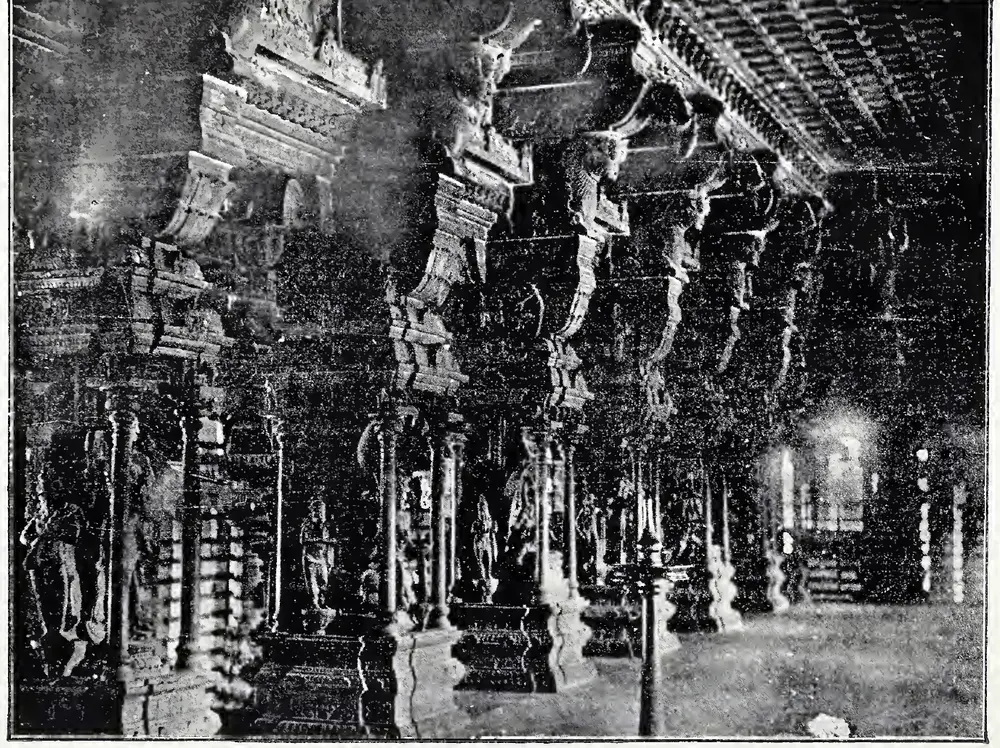
* While the cloth for the waist of both gods and goddesses reaches from the waist to the feet, the portion above the waist is left bare, the cloth for the waist itself being represented as very thin in texture.
Among the smaller figures on the sides of the pillars may be mentioned:—
Markandeya embracing Siva when confronted by Yama;
Krishna hiding with the cloths of the Gopis on the top of a tree, the Gopis themselves begging for them from below;
Krishna playing on the flute with the Gopis dancing;
Vishnu in the Avatar of Vamana measuring with his outstretched legs the earth and heaven in a trice;
Krishna dancing on a serpent’s head; and in another holding a mountain aloft to protect his people and cows from a heavy rain and storm.
Besides these figures, there are others worked in smaller relief, highly diminutive in size, exhibiting skill of a high order. The stone-beams supported by the pillars of the platform and those of the verandahs of this Mantapam have been made the receptacle of scenes from the Ramayana and the Bhagavata. The verandah beam begins with the first scene in the Ramayana and continues to represent the whole story in a connected manner till the coronation of Sri Rama in his own dominions. The Yagam (Putrakameshti), the presentation of Rama and Lakshmana made by Dasaratha to Visvamitra, the killing of Tataka in the forests, the Ahalyamoksham, the departure of Rama with Lakshmana and Sita for the forests, the crossing of the river Bhagirathi in a boat, the car that brought them from Ayodhya to the river stopping on the bank of the river, the [283]interview of Rama with the hermits of the forests, their joy over it, the stealing away of Sita by Ravana, the fight between Rama and the Rakshasas, the friendship of Sugriva, Hanuman and Sri Rama, the death of Vali, the rough sea with its huge waves and the crossing of it by Hanuman to Lanka, his setting fire to the city of Lanka (the smoke arising from the fire is most exquisitely represented in carving so that no one can, casually looking at it, mistake it for anything else), the fight, the killing of Ravana, are a few of the scenes that are so well represented on these beams. The beams of the platform, on the other hand, contain scenes from the Bhagavatam representing in a connected manner the whole story of Bhagavatam. Trees, bushes, parrots, squirrels, monkeys, elephants, &c., are all very artistically carved on them. Such a magnificent work of art cannot but excite wonder and admiration in the minds of the æsthetic among the connoisseurs of the West or the East.
Broadly stated, in these sculptured figures are correctly represented the elements embodied and the passions personified. Some are figures represented as grasping sceptres and shields, symbols of justice and ensigns of religion or weapons of war and trophies of peace. Some of them have aspects that inspire terror while others are distinguished by placid serenity and benignity of countenance, and some others again betray evident marks of dejection and inward anguish. The more conspicuous figures are all gorgeously arrayed after the Indian fashion with heavy jewels and are true to nature. Most of the figures are so delicately and admirably carved “as to successfully express in every instance the alteration which the form of the limbs undergoes, the muscular action and external impulse as well as the various effects of mental sensation upon the human countenance.”* Similar examples of carving are also to be found in the other temples of Travancore constructed in the Dravidian style, those at Suchindram and Tiruvattar being the most prominent among them.
The reference has so far been only to temples built on the Dravidian style. By the very nature of their construction the indigenous temples of Malabar have no architectural pretensions about them and have nothing to show in the way of architectural or sculptural attractions.
Carving. The art of carving has been known in Travancore for a long time. It is as ancient as the temple architecture, and a naturalistic style has sprung up in Travancore. Carving in stone has already been referred to in connection with sculpture. As has been observed under that head a high degree of skill and perfection has been attained in Travancore in stone [284]carving though only in imitation of the Dravidian style. Even now we have a few able stone-workers in Chengannur, a place noted for its excellent workmanship in granite. Splendid specimens of images, Nagaswara Kuzhals and rose-water sprinklers are still made out of this material by skilled artisans.
* The Indian Antiquary.
The most common substance on which the workman can exercise his skill is wood, of which Travancore has an abundant supply. Wood carving had long been practised in Travancore in connection with the construction of temples in indigenous Malabar style and in the construction of houses and other buildings. The well-to-do Nayar is most extravagant in the matter of house building. As wood enters largely in its construction the carpenter’s best skill is availed of to work it to the greatest advantage. The plank ceilings of the verandahs, the rooms and the halls, the doors, the portico at the gate and in fact wherever wood is used, are so artistically carved that the wages of the carpenters alone in some cases cost something like Rs. 10,000. In private houses to a small extent, but much more liberally in palaces and temples of old and in the buildings of ancient and rich Tarawads, opportunity has been taken to display native talent in wood carving, and this has led to great accuracy, elegance and finish in the art of carpentry—a circumstance which elicited the admiration of Lord Napier when he visited the Padmanabhapuram Palace in South Travancore. In the making of cars, palankeens, and Vahanams required in temple services and processions and always richly, minutely and delicately carved, the carpenter displays his consummate skill and high workmanship. Teak is the most popular wood, but others stronger and more durable though less costly are also used in the construction of houses, and all these lend themselves to the delicate touch of the carpenter’s tool. But sandalwood with its fragrant smell, being a very valuable wood, is generally selected to show the delicate touches of the carpenter’s art. The sandalwood carving of Travancore is perfectly naturalistic in style, and the skill displayed in carving elaborate details on sandalwood boxes has been much admired. Besides the conventional mythological designs of images of gods and goddesses, human beings, animals, birds, trees and flowers are also copied with much skill and dexterity.
When ivory carving was first introduced into Travancore is not exactly known. From the evidence that exists in the form of ivory works, such as palankeens which are known to have been more than two hundred years old, and of images of gods and representations of plants, animals, [285]&c., unequalled for their design and exquisiteness by any of those of the surrounding districts or for the matter of that, by those of any other country in India, we are led to infer that carving in ivory must have been if not indigenous, at least as old as the Aryan colonisation of Malabar.
“Goldsmiths from time immemorial had practised turning plain articles in ivory and horn and being accustomed to casting figures of the Hindu Pantheon according to the proportions definitely laid down in the Silpa Shastra, they turned their knowledge to account in making small ivory figures, especially of Ganesa and Hanuman, according to these proportions. The chief uses, however, to which ivory was put in early days was the decoration of palanquins. For this purpose thin plates of ivory about an eighth of an inch in thickness were laid over the wooden frames of the palanquins. The plates were engraved throughout with conventional designs, taken mostly from the Pagodas, and coloured with fast dyes. The plate to be engraved was coated with wax, the design was then cut in wax, lime juice was poured over it and was allowed to bite into the surface of the ivory, and various colours were then run in which fixed the design.”
Mr. Ferguson continues:—
“I am informed that palanquins ornamented in this way, and figures carved in ivory, worked by goldsmiths over two hundred years ago, are still found. though rarely, in the Palaces in Trivandrum, Changanachery and Haripad, also in some Pagodas in North Travancore, in the houses of rich Namburies and in the Mutts of Namburi Sanyasies. But though this was the main use in these earlier days to which ivory was first put, no doubt there were scattered here and there, goldsmiths who occasionally carved figures of the Gods in ivory, and also Namburi Brahmins, who in their leisure hours amused themselves by doing the same.”*
The development of carving, however, like the other arts in Travancore is attributable to the enormous encouragement given by the rulers of the State more than to anything else. It is said that in the early part of the reign of Swati Tirunal Maharajah (1829-47) “certain Namboori Brahmins from North Travancore brought, for the Rajah’s inspection, figures of the Gods and also of the sacred animals carved in ivory of so minute a size that they could be enclosed in a paddy husk; what rendered the work more remarkable was that the only tool which these Brahmins used to accomplish the task was a small knife.” They were all given suitable presents by the Maharajah. But as we have already observed that Maharajah was a great patron of learning and arts, and this incident aroused a great desire in him for the development of ivory carving in Travancore. Goldsmiths from Tiruvancode in the South and Haripad and Changanachery in the North were sent for for their knowledge of the art and employed along with carpenters who were skilled in wood carving, in making designs in ivory. The most important work that they [286]executed was a throne in ivory. This is an excellent piece of workmanship and still adorns the old Durbar Hall at Trivandrum. Many other works of minor importance were also executed in his time and many of the carpenter class were constantly employed at work, so that one or two families became professional ivory carvers and still continue to do the same work. His successor Martanda Varma Maharajah (1847-60) exhibited a still greater interest in the furtherance of the art, and as the result, so early as 1851, His Highness was enabled to send to Her Majesty the Queen an ivory throne elaborately carved and set with jewels. It was exhibited at the great Exhibition in London of that year and was much admired. It is a beautiful piece of workmanship thoroughly Indian in design and well worthy of the purpose for which it was intended. It has now found a fitting place in the State rooms in Windsor Castle.
* Memorandum on Ivory Carving in Travancore by Mr. H. S. Ferguson, F. L. S., retired Director, Government Museum and Public Gardens, Trivandrum.
The ivory work was patronised by successive Maharajahs, and specimens were sent to various Exhibitions in India and Europe, and the fame of Travancore carving thus spread abroad. Many enquiries and orders came in, and it became necessary to start a department of ivory carving under Government. This was done in 1048 M. E. (1872-73), and the department worked for 15 years when it was incorporated with the School of Arts where this work is still chiefly being carried on. Many of the private workers and goldsmiths who until recently were working in ivory have either ceased to work or have reverted to their original work in precious metals. Besides the Swami pattern work in ivory for which Travancore has become famous, the chief designs are the human figures, Yalis, lions, tigers, elephants, cows, bulls, deer, monkeys, squirrels, pigs and sheep among animals, swans, peacocks, and parrots among birds serpents, fishes, fruits, leaves, flowers, creepers and trees. It may be mentioned in this connection that some of the specimens of carving in ivory executed in Travancore are perhaps the finest that have ever been made in India. Their real merit consists in the most realistic representation of nature executed in so small a size, a thing very uncommonly met with in an Indian design. Human beings as hunters, boatmen, fishermen, musicians, kings, field labourers or people of the low caste working in forests, animals such as monkeys and lions, parrots and other birds, plants and creepers, fruits, seas, mountains, and lakes with fishes and boats are all most artistically and naturally represented in these carvings. Human figures carved in them are tall with well-proportioned limbs, with a natural grace of expression in the face which will do credit to the best artists of any age; there is nothing, stiff about them in the different postures in which they are shown, the bends [287]and folds of the limbs being depicted true to nature. The figures of plants and animals are also carved with the same high taste and naturalness.
Ivory carving is used in the School of Arts for the decoration of many articles of ordinary use such as the backs of brushes, hand glasses, combs, book racks, walking sticks, umbrella handles, pendants, &c. At one time English designs were partially followed, but they have now been given up and a reversion has been made to old designs, the excellence of which in decorative art is now thoroughly appreciated. The ivory required for this work is obtained within the State itself.
Besides wood and ivory, well executed designs are carved in cocoanut shells. The colour of the shell when polished is a fine dark brown which becomes darker with age. The shell itself is tough and requires great care and delicacy in carving, or the fine details carved are liable to crumble. It is commonly scraped and polished for domestic and culinary purposes. The shells are used to be ornamented with elaborate carvings and mounted with silver, gold or ivory. Cups, vases, snuff-boxes, sugar basins, teapots with fry saucers and bangles, watch chains, sticks, &c., are made out of them. In the Izhava Exhibition held at Quilon in 1905 admirable specimens of table ornaments and rose water sprinklers made of cocoanut shells and showing workmanship of great skill, were exhibited and much admired by the visitors.
Weaving. Next in importance to agriculture is the weaving industry, and among all the materials of our textile fabrics cotton undoubtedly holds the first place. For a long time it has been cultivated, spun and manufactured locally, and every village has had families of weavers and spinners who supplied all local demands and needs. But cotton spinning as an indigenous industry has nearly ceased to exist, as almost all weavers now use only imported twist.
Cotton spinning by machinery is carried on at Quilon. The Darrah spinning mills established in 1884 have been working ever since without interruption. It has 25,560 spindles running and turns out about 7½ lakhs of rupees' worth of twist annually. The raw produce is mostly obtained from Bombay, but cotton grown to the south and east of Quilon are also used. Some of the cotton produced in Tinnevelly and Madura districts finds its way to this mill. The yarn spun is esteemed to be of a fine quality and is very popular in the yarn market where it is held superior [288]to all other South Indian yarn.
The Izhavas, Saliars and Patnuls are the chief castes engaged in weaving, but there are also a few other castes who follow this profession. The following is the form of the loom in use by the majority of the weavers.
The principal parts of it are the sley, the healds and the reed. The sley with its reed is suspended by two cards from the roof of the house and the healds by two minor cards. The lower portion of the sley consists of a piece of wood two inches thick and almost circular in section with a groove cut along the top for the reception of the reed. At each end a short upright is fixed and passes through slots cut in the upper portion of the sley. This is a piece of common grained wood about 3 ft. deep and 2/3 ft. thick with a groove cut at the bottom to form a cup for the reed, to fix it in a vertical position. In the middle there is a handle for the weaver to grasp and beat up the waft with great force, after the healds have divided the warp. The healds consist of a series of loops linked together, the warp thread being drawn through the space formed by linking two heald loops. The shuttle with the waft in it, is thrown across by one hand and caught by the other and so on.
With this simple loom cloths are woven here. The different kinds of cloth woven are Neriatu, Tuppatta, Kavani, Kurikavani and Muri. The first three varieties are woven in fine thread and laced; their cost varies from 1 to 2 rupees ordinarily. But their value depends on the firmness of the thread and the quantity of lace used, and very costly cloths are only made to order. Sometimes the price goes up to Rs. 10 or 12 and even more for each cloth of about 6 cubits in length.
Excepting a small trade of a specially favoured kind of cloth in fashion among the nobility of the land and certain others of an inferior texture solely intended for home consumption, the bulk of our cotton stuffs are now imported from outside. The indigenous Kattimundu and Neriatu were fashionable cloths once, and even now some of the finest cloths of the latter kind are woven at Kottar and Eraniel which are the chief places for the manufacture of fine indigenous cloths. The Patnuls weave a superior kind of cloth fringed with gold or silver lace which fetches good prices. Coarse long cloths, Mundus, trusses, &c., are manufactured generally to a greater or less extent in all important localities, but such fabrics generally find a ready sale in the vicinity of the places in which they are made. The Tuvartu chiefly made in South Travancore, a kind peculiar to the West Coast, is a very useful cloth, but its [289]use is confined to the bathroom, and its manufacture though extensive is but a poor concern.
There has been a marked decline in the number of persons engaged in weaving as disclosed by the Census statistics. This shows that the indigenous product is fast losing its ground and is unable to compete with the cheap out-put of machine-made foreign imports. "The universal complaint among the Patnuls and the Saliars all over the land is that their bread is taken out of their mouths by the machine-made cloths of Europe."* While it is generally accepted that the power loom is too formidable a competitor to the hand loom there are still some who hold the opposite view. Mr. Havell the Principal of the School of Arts, Calcutta, in a recent number of the Indian Review refutes the assertion that in Europe the hand loom industry has been displaced by power loom. According to him statistics still show that there is a greater demand for skilled labour there than the supply. If the hand loom can compete with power loom in England where the cost of skilled labour is many times greater than what it is in India and where the most perfect weaving machinery worked by steam and electricity is in use, what greater profit there must be for it in India where we have an unlimited supply of the skilled labour of hereditary weavers content with comparatively cheap wages. There is therefore still ample scope for fostering and furthering the ancient weaving industry.
But there is one thing which needs to be attended to by our weavers. They must study the market, cater for it and improve the finish of their works and design. It is equally necessary that the rulers and nobles and persons of culture and high degree should patronise the indigenous industries for no improvement is possible without their co-operation.
The weaving of silk and woollen fabrics is unknown in Travancore.
Lace work. Lace is a term applied to a transparent network in which the threads of the waft are twisted round those of the warp. It may be made of silk, flax or cotton or even gold or silver thread and has usually a pattern worked upon it either during the process of making the lace or with a needle after this has been completed. As already observed the Patnuls weave lace cloths fringed with gold and silver and in the weaving of fine Neriatu, gold and silver thread is often used with very good artistic effect. The lace is used in varying quantities, very little in the case of some and rather profusely in others. This kind of work is not [290]confined to any particular locality, but is done in all those places where fine cloths are woven as in Eraniel and Kottar.
* Report on the Census of Travancore for 1891.
The lace work of Travancore carried on specially at Quilon and Nagercoil mostly under the guidance and patronage of Christian Missionary ladies has long been known. The materials necessary for a start are a few and cost very little. A cushion (or as it is commonly called a pillow and hence the name pillow lace) mounted on an oblong piece of plank, the cushion being raised about a foot high on one side and gradually decreasing in its height towards the opposite side into which the lace as manufactured is rolled and kept clean; a 100 or less number of bobbins made of teak-wood, ebony or even of an inferior sort of wood; a sheet of small pins and a quantity of thread; these are all the materials required. Strips of leather about 1½ yds. long and 2 or more inches broad (according to the width of the lace required) are perforated in curious and special ways, and these straps, or more correctly speaking, these perforations serve as a guide to the patterns of the lace. The first thing that has to be done is to fix the leather strap on the cushion firmly by means of 8 or 10 large pins. The thread is then rolled into the required number of bobbins necessary for the particular pattern of lace to be made. The cushion which is in a slanting position is then placed in front of the person, and the threads are all fastened at the top of the leather strap. The process of lace making then goes on by passing the bobbins to and fro and interlacing the thread in a particular manner, the twists and crossings made being fastened by means of small pins.
Originally the lace industry was very largely in the hands of the fishermen of the South. But latterly owing to competition the industry languished and was threatened with extinction. At this stage fortunately a few missionary ladies stepped in to reinstate this most important industry in the hope that it will be of help in fostering self-support among the poorer Christians. Under their management the industry has progressed with the result that good lace is now procurable only from these establishments. New patterns are being gradually introduced and wonderful results achieved. An exceptional demand is reported to have risen recently for this hand-made lace. European ladies purchase large quantities of it either for their own use or for sending it to their friends abroad. This lace is stated to be proportionately more costly than the European lace, and it is not clear whether the popularity is due to its durability or to its superior taste and workmanship. The lace manufactured by the Native Christian women of Nagercoil has proved itself of sufficient excellence to gain [291]medals at several Exhibitions, viz., those of London, Paris and Kensington. Of the lace sent to this last Exhibition, the Madras Times of December 1886 says, "the best collection of lace is certainly that sent from Nagercoil." The Committee in a recent Madras Exhibition stated that the lace of Nagercoil though knit by natives of the country was equal to the best French lace, and some of the visitors are reported to have said that it must have been made in France. In and around Nagercoil there are 600 women workers in lace. Nagercoil was the original centre of their manufacture, but the work has now extended to other places also. Some of the most important patterns woven are large head-dresses, gold lace lappet, silver-pin cushion cover, white lace coiffure, black collars and cuffs, black lace lappet, &c.
Fibres. Plantain fibre. The existence of fibre in the common plantain has probably been known in India from ancient times, but it attracted public notice only during the Crimean war, when owing to the stoppage of the importation of Russian hemp into England the Government of India ordered an enquiry into the capabilities of Indian fibres. But nothing serious was done in regard to plantain fibre owing to the abundance of other fibre-yielding plants and also to want of some simple and efficient machine for extracting the fibre. A few years ago the Government of Travancore deputed one of its officers to Ootacamund to acquaint himself with the methods of extracting the fibre, but for want of a suitable machine much good did not result from this mission. When weaving was introduced into the School of Arts the Government procured through its Forest Department fibres extracted from plantains grown in the State and asked the Superintendent of the School of Arts Trivandrum to test them with a view to ascertain their fitness for weaving purposes. A few experiments were made and the results of these experiments are noted below.
1. Of the 29 varieties of plantains ordinarily grown in Travancore, the fibres yielded by 12 were found to be the best for weaving cloths of fine texture and those of the remaining ones were only fit for coarse weaving and cordage. The fibres were silky in colour and glossy and sufficiently strong for a thread.
2. A few native and tanning colours were tried and found successful in dyeing the fibre fast.
3. Washing with alkali commonly used by native washermen and with soda and soap were tried in the fibre and the fabric woven with it. These were found only to increase the strength and pliability of the [292]material.
4. The fibre was found to possess peculiar advantages over other known varieties of fibres used for textile purposes. It possessed almost an exact resemblance to silk in the polish of the thread, which it is found to retain after it is dyed with any colour or boiled or washed.
5. The fibre needs no spinning operation like other fibres. It is ready for the loom after its extraction from the raw sheaths of the plantain trees.
It did not, however, prove quite satisfactory as warp thread as it showed signs of breaking. Wetting the warp with water to keep it cool greatly tended to decrease the chances of breakage, but it was not a complete success as warp thread. Weaving is now carried on in the School of Arts, Trivandrum with plantain fibre for the waft, making use of cotton for the warp. Notwithstanding this the cloths woven looked like silk and proved to be light and less costly than cotton fabrics, and have secured prizes in Exhibitions.
The machinery for extracting the fibre used in the Trivandrum School of Arts is simple in structure, comparatively cheap and easily portable being small and light. It can be carried to the plantain gardens where the trees are cut and would thereby save large expenditure in transit of the raw material. The framework is in teak. The scraping blade and the squeezing fluted rollers are fitted parallel to each other at the top and are worked by two separate strong steel springs controlled by foot levers. The additional mechanism for squeezing with the fluted rollers which work in advance of the scraping operation gives greater pliability to the plantain sheaths and renders the extraction of the fibre much easier. The fibre thus obtained can consequently retain the full length of the sheaths available, little or no breakage occurring in the process of extraction.
In the recent Izhava Exhibition at Quilon, good specimens of mats and pillows made of fine plantain fibre were exhibited and admired by the visitors. If for both the waft and the warp thread it is possible to use the fibre—and experiments are still being carried on with that end in view—the fabrics produced will give an entirely new aspect. It may then prove a cheap and permanent substitute for silk.
A Bengali gentleman Mr. Mannidranath Bonnerjee recently announced in the Amrita Bazar Patrika that he had discovered an easy and comparatively inexpensive chemical process for extracting plantain fibre. The advantages be claims for his method are chiefly the following:—
1. The fibre so extracted is stronger and more durable and is superior [293]in texture, quality and every other respect to that obtained by machine.
2. No large outlay or machinery is required, thus making it within the reach of all people to engage in this industry.
3. There is no loss or wastage; according to the advertisement four kinds of fibres are produced by this process, viz., first for cloth making, second for all purposes for which jute is used, (this fibre is hardly distinguishable from jute) the third and the fourth for cordage, matting, &c. The refuse may be used for manufacture of paper.
The Indian Economist for December 1904 in noticing this process understands that the European Planting community in Behar is exhibiting a keen interest in the matter. It goes without saying that the process deserves careful consideration at the hands of our capitalists, and if the advantages claimed for it are only true, then there is almost an unlimited future for the plantain fibre industry in Travancore.
Even as it is, the machine-made fibre industry yields a good profit. An enterprising Indian of Tanjore who took the trouble of having some samples of the fibre extracted by him sent to London, found them valued from £25 to £35 a ton. He estimates the cost of extracting the fibre at Rs. 55 per ton, and allowing another Rs. 35 for putting the same on the market or Rs. 90 altogether per ton, he calculates the profits at nearly £20 to £25 per ton. He states also that an acre of plantain garden yields one ton of fibre on an average. It has to be remembered that it has been usual hitherto to throw away the sheaths after reaping the produce, and if this refuse should yield so much as £20 per acre the industry should be a very paying one.
Plantain trees of different varieties are grown abundantly all over the State, and in fact almost every Malayali house has its own plantain trees behind it in the garden. The extraction of the fibre is only a simple process, and as it does not affect the edible and valuable portion of the plantain tree there is a vast field open for a new and paying industry which our capitalists will do well to put in hand before foreign capital steps in. Nor is it only in this one direction that patriotic enterprise is sadly wanting.
Cocoanut fibre or Coir. Malabar has been rightly called the "Land of the palms" and of these the cocoanut palm is the most important and widely cultivated. The cultivation of the cocoanut tree and the preparations of its various products seem to be occupations specially suited to [294]the Malabar Coast, its dense population, its minutely subdivided holdings and its easy water carriage to the market. Each man here lives under his own palm trees and every traveller by boat on the lagoon can see the domestic labour going on at each threshold, the whole family busy in severing the husk from the nut, in spinning the fibre into yarn, &c. Of the several industries connected with the cocoanut the coir industry is the most important. The thick pericarp or outer wall of the fruit yields the valuable coir fibre of commerce. The fibre is tough, elastic, springy, easily manipulated within certain limits and eminently suited for manufactures where lightness, cleanliness and great indestructibility are required. It will stand water, it is almost impervious to wind and wave or to damp and rain. Care should be taken to cut the cocoanut at the proper season. The fibre is much impaired by waiting for the nuts to arrive at maturity. The fibre is weak when cut earlier than is necessary and if later it becomes coarse and hard and requires a longer soaking and is more difficult to manufacture. The best season is to cut the nut in the ninth or tenth month. When the cocoanuts are cut the husk is separated from the nut and thrown into pools of fresh water and soaked for nearly two months. Travellers in boats can see heaps of these thrown into the backwaters all along the way and easily recognise the offensive smell emanating from them in those places where the cocoanut trees abound When thoroughly soaked the fibrous parts are easily separated from the wood by beating with a stick, resembling an ordinary rice-pounder but not so long, known as kottuvadi. This beating is invariably done by women. After separation the fibres are mixed and with the help of a rough country machine locally known as rattu (wheel) ropes are twisted. This is also largely done by women. The Izhavas are largely engaged in this business and their women are very dexterous in rope making. The chief centres of rope manufacture are Chavara, Panmana, Tevalakara, Quilon, Paravur, Kayangulam, Shertallay, Alleppey, and Vaikam. Of the uses to which the coir is capable of application the following extract from a pamphlet issued by an English trader will give a fair idea:—
"Coir is found suited to the production of a variety of articles of great utility and elegance of workmanship. It was at first only used for stuffing matresses and cushions, but its applications have been enlarged and its value greatly increased by mechanical processes. Instead of being formed into rough cordage only and mats made by hand, by means of ingeneously constructed machinery, the fibre is rendered sufficiently fine for the loom and matting of different textures and coloured figures is produced, while a combination of wool in pleasing designs gives the richness and effect of hearth rugs and carpeting. Brushes, and brooms for household and stable purposes, matting for sheep-folds, pheasantries and poultry yards, church cushions, hammocks, cordage of all sizes and strings [295]for nursery men and others, for tying up trees and other garden purposes, nose-bags for horses, mats and bags for seed crushers, oil pressure and candle manufactures are only a few of the various purposes to which the fibrous coating of the cocoanut is now applied."
Coir string is universally employed in other parts of India in the construction of bamboo houses. To these properties has to be added its great power of withstanding moisture on account of which it is in great demand for maritime purposes. Though it is thus capable of an infinite variety of uses it is mostly the raw produce that is exported from this country. It is not worked here to any great extent except for the manufacture of ropes and coir-matting. There are five factories working in all in Alleppey, two by hand power and three by steam power. Four of these are engaged in the manufacture of coir-matting while the remaining one is content with pressing coir for export. In the recent Izhava Exhibition at Quilon there were exhibited some very fine embroidered coir mats and cushions, coir rail-bag, and coir-mat easy-chair worked by some of the skilled artisans of the Izhava community.
The increasing cultivation of the cocoanut, the rare facilities of an uninterrupted chain of backwater communications and the easy availability of cheap labour should largely contribute to the development of this industry. A large number of persons are engaged in this occupation and the tendency is for the industry to expand. There is great scope for a profitable enterprise in this direction, and if native labour and organised capital and skill would apply themselves with vigour, Travancore will be made the home of a most potential undertaking pregnant with very beneficial results to its poor and industrious population.
Arecanut fibre. Besides the plantain and cocoanut fibres, the arecanut fibre is also used in the School of Arts Trivandrum as a substitute for wool, in the manufacture of carpets. When dyed it is hardly distinguishable from wool, and in fact, carpets woven with it look better and finer than woollen carpets while they are considerably cheaper. The discovery of the uses of this fibre is very recent and the work is at present confined only to the School of Arts, Trivandrum. It is to be hoped that its uses will be more generally known, and considering the very large number of arecanut trees grown in the State, the industry in this fibre ought to soon expand.
Oil-pressing. The number of people returned as oil-pressers and mill-workers are about 16,000 according to the Census of 1901. Next to coir making, oil-pressing, especially the manufacture of cocoanut-oil, is the most important industry in the State. The cocoanut-oil manufactured in [296]Travancore is considered better in quality than that produced in other countries. Mr. Mackenzie the late Resident in Travancore and Cochin observed that a ton of cocoanut oil from here fetches in the London market a few pounds more than that exported from any other country.
The oil is nearly white in colour and is largely used by the people of Malabar in cooking. It has a very agreeable smell and preparations made with it do not get spoiled while they taste better and keep longer. The oil is also used as medicine either by itself or boiled with other ingredients, and for burning lamps and anointing the body. It is said to promote the growth of hair, and hence it is much used in cases of loss of hair after fevers and other debilitating diseases. The fat yielded by the cocoanut-oil is largely used in Europe for the manufacture of candles, and according to 'Max', in the 'Capital,' "Experiments made in the Phillippines show that the oil can be made to produce a high quality of illuminating gas free from tar." The uses of cocoanut-oil are thus manifold.
The method of preparing it is as follows:—The ripe kernel of the cocoanut is cut off the skull and dried either by exposure to the sun or by artificial means. It is then known as copra. The copra is cut into thin slices which are put into the presses and oil is extracted therefrom. The apparatus of a native oil-press is very simple. It is made of the trunk of a large tree (either tamarind or jack) or a block of stone, which is hollowed into the form of a mortar and planted on a raised ground. In this a big pole works as a pestle round and round. A wooden beam about 16 feet long pressing at one end closely against the foot of this mill with a loud creaking noise has an arm projecting upwards at about a third of its length, which is attached to the head of the pestle. The mill is driven by men or oxen yoked at the farther end of the beam who pull it round and round. Every village has a few of these country mills, and accordingly they are to be found scattered throughout the country. In addition to these country mills, machines for extracting oil worked by steam power have been recently introduced; there are three of them established at Alleppey; a mill has been newly started at Quilon.
Though this is a very important industry, yet enough attention is not paid to it. Besides a large quantity of the oil required for home consumption, (32,000 rupees' worth of the oil being bought every year for the use of the pagodas and palaces of the State, which is exclusively produced by native mills, while it can be more conveniently turned out by machines,) a large quantity of copra instead of oil is exported annually to foreign countries to meet the demand for oil there. This [297]might be put a stop to and oil itself exported by the establishment of mills. There is thus a large scope for the expansion of this industry.
And yet curious to state that owing to an unaccountable apathy, a fruitful source of excellent occupation and profit is being thrown away. Take this capital town of Trivandrum itself. It can give sufficient work to several oil-mills; not a single one exists here, nor has any one thought of it for several decades past. A small oil mill if located somewhere in Trivandrum can command the copra produce of the coast from Karinkulam to Chirayinkil, a length of twenty-five miles. The sea-board for about a mile in breadth is thickly planted with cocoanut trees, and on a rough calculation there should be about 15 lakhs of bearing cocoanut trees in this area, yielding 600 lakhs of cocoanut fruits a year. Deducting one-third of this produce for local use for eating and cooking purposes, we have about 400 lakhs of nuts available as copra to be expressed into oil. An ordinary mill ought to be able to express 2 Candies of copra or 4,000 nuts a day equal to 60 Kalasams of oil or 240 Idangalis (80 gals). Working 25 days a month, a mill should yield 600 Parahs of oil a month, i. e., oil worth Rs. 3,000, at the rate of Rs. 5 per Parah. There is the value of the oil-cake and cocoanut shells besides, worth about Rs. 300 a month. The mill will thus earn Rs. 3,300 a month. The mill and machinery and housing, &c., which would turn out Rs. 3,300 a month, will cost Rs. 4,000 in all working with an oil engine, not steam engine. The interest of that is Rs. 30 a month, added to the value of copra to be purchased, viz., Rs. 2,500 a month and the cost of establishment and the wear and tear of the machinery Rs. 250 a month, in all the monthly cost to be deducted from the total earnings comes to Rs. 2,780, leaving a balance of Rs. 520 as net monthly dividend. This mill will require only 600 Candies or 12 lakhs of copra-nuts a year. As there are 400 lakhs of copra-nuts which are available in and near Trivandrum every year, there is enough work according to this calculation for 34 oil-mills of the description above given. And no greater argument is needed to show the extent of the industrial apathy when we remember that as yet not a single oil-mill has been started in Trivandrum. In this calculation the industry of candle making, another fruitful source of livelihood to the labouring classes has not been touched. This enterprise will no doubt greatly handicap the native oil-mongers.
Gingelly-oil is the next in importance. This is usually procured by giving the sesamum seeds frequent washings in cold water at first until all the brownish coloured matter is removed and they look quite white. They are then spread to dry in the sun, after which oil is pressed [298]from them in the same way as cocoanut-oil in country mills. The oil has healing properties. It is used for burning lamps and for anointing. Some use it for cooking purposes.
The laurel or Punnakka oil comes next in importance. It is expressed from the seeds of Calophyllum inophyllum (laurel tree) in country mills and used mostly for burning lamps, but as it gives but a dim light, Kerosine oil is fast superseding it.
The Castor oil is another important kind of oil largely used by the people. It is made from the large or small varieties of Ricinus communis. It is commonly used as a lamp oil and also for medicinal purposes. It is an excellent laxative and is generally administered as a purgative. For children's ailments it is, almost a sine qua non either by itself or prepared with other ingredients. Oil that is made for burning lamps is expressed in the mills, but for medicinal use it is prepared by boiling. The seeds are beaten in a mortar during which process balls of it are formed. These latter are put into an earthen pot containing boiling water and boiled till oil appears and floats on the surface when it is separated therefrom.
The Pultailam or the oil that is distilled from the lemon grass is in great demand in Europe. It has an extremely pungent taste and a strong odour of lemon. It is used by the people here to flavour curds; hence it is also called the buttermilk grass. The grass grows largely on the western slopes of the mountains north of Anjengo and is to be found in several parts of the State. Government periodically auctions the right to cut it when found in State forests. The industry in the preparation of this oil has long been established in Travancore which may be said at the present day to have monopolised the trade in lemon grass oil in European markets. It exports about 50,000 rupees' worth of oil annually on an average. The oil has very long been employed in English and Continental perfumery under the name of oil of Verbana from its odour resembling the sweet Verbana of English gardens. The discovery of the presence of citral in lemon grass oil has given it its present commercial importance. The price of the oil now ranges from 6d. to 7d. per oz. in England. There is a great demand for it in Germany and the supply is not equal to the demand. In suitable soil and under ordinarily favourable conditions the grass will grow without much trouble and it is specially well suited to our hills. The industry is a very promising one and there is ample scope for its expansion in Travancore.
Besides the above, oils expressed from the seeds of Pongamia glabra [299]and the fruits of Bassia longifolia are used for the burning of lamps. These are also prepared in country mills.
Veppa Ennai, the oil of the seeds of margosa prepared in the same way is of great medicinal value. So are also the following oils which are solely used for that purpose—Peacock oil, Deer oil, Serpent oil, Pig oil or ghee and Fish oil.
Besides these, many other medicated oils are prepared but only in small quantities and as occasion needs. It has not therefore been thought necessary to give a detailed account of their various preparations.
Metal work. Precious metals. Gold and silver are superbly wrought. The making of native ornaments gives the goldsmiths ample scope for the display of their artistic skill, and their workmanship is much admired. All classes of people wear ornaments in some form or other and in nothing do they display their naturally gorgeous and costly taste so much as in their jewelry which are not only fabricated of the richest and rarest materials but wrought likewise with all elaborateness, delicacy and splendour of design within the reach of art. The jewels of Southern India are common also to Travancore where the art is cultivated to much the same extent as in other parts of the Presidency. Silver filigree and veneering work of the best description is produced by the jewellers of Travancore. The silver work of Travancore and Quilon are in no way inferior to the best models of Southern India, and in the London Exhibition of 1886 the workmanship was much commended, especially the silver filigree work.
A gold girdle or oddyanam made in Travancore the other day was the admiration of the Madras ladies, and they were positive in their statement that no Madras goldsmith could have shown such finish in work. The oddyanam is a waist-belt worn by young women and this one was a small ornament weighing about £10 sterling, but the finish and the polish in it were unsurpassable; and yet this was the work of a goldsmith who earned only a rupee a day.
Besides wearing ornaments, plates, trays, vases, kujahs, spoons, dishes, rose-water sprinklers and other useful utensils are made of silver. Most of the vessels used in the worship of the household deity are made of silver and some even of gold. All the rich temples of Travancore have a large number of gold and silver vessels. The silver plates and vessels are always tastefully wrought and decorated with elaborate specimens of embossed flowers and leaves and designs of Puranic Gods. The worship of idols of pure [300]gold and silver, used mostly in the households, is stated to ensure special merit. The big Vahanams of gold and silver of Sri Padmanabhaswamy's pagoda amply testify to the great claim that Travancore has for artistic work in gold and silver. Maharajah Swati Tirunal (1829-47) had a gold car built for his ceremonial processions and also introduced several other fineries prevailing in other Native courts such as Mysore and Tanjore. Very lately a very beautifully carved golden umbrella was made for this temple to be used on the occasion of important processions. The workmanship displayed in its make is very admirable. The several ornaments with which the image of the God is adorned have been worked with exquisite skill. The goldsmiths in Trivandrum and Quilon are capable of making excellent ornaments in gold and silver and utensils of the same precious metals. Sometimes the Travancore goldsmiths are employed to execute gold work on a colossal scale, as for instance when the Maharajah performs the Hiranyagarbham or Padmagarbham ceremony. On these occasions, a large cow or lotus flower in gold has to be made of immense size, large enough to hold the person of the Maharajah in a sitting posture.
Brass, copper and bell-metal. Almost all the household vessels in a high class or middle class Hindu family are of brass, copper or bell-metal water vessels, tumblers, cups, dishes, cooking pots, plates, kujahs, lamps, bells and a lot of other vessels. These metals supply in a Hindu household the place of porcelain and glass of the European. Everywhere large numbers of metal vessels are made to meet local requirements. Very often they are elaborately ornamented with the images of gods and flowers and sacred animals etched or carved on them. Their skilful modelling and finish often excite admiration. The chief places noted for the manufacture of brass vessels are Mavelikara, Tiruvalla, Kodamallur, Nagercoil, &c.
Malabar has special reputation for its bell-metal vessels, and Travancore does not yield to the rest of Malabar in this respect. Nagercoil has long been famous for its ordinary domestic vessels made of Vellode or bell-metal the workmanship of which compares very favourably with that of those made at Dindigal in the Madura District. In Travancore bell-metal caldrons and copper cooking pots are prepared on a colossal scale as they are in great demand for the Oottupuras attached to the temples. Some of those in use in Trivandrum are so large that they can each contain condiments to feed 5,000 persons at a time and so deep that a boy can swim in them if filled with water. There are a large number of such vessels in the Trivandrum temple, and the other temples scattered [301]throughout the State also possess smaller vessels of the same description. There being thus a large demand for them the Government have established a special foundry in the Capital for making them. In the D. P. W. workshop also the casting of brass and copper vessels of any description is undertaken to meet the Government demand, and sometimes to supply vessels to private individuals on payment, which they do as far as possible during intervals when the work in the foundry is not very pressing. Brass nails, pipes, screws, lamps and vessels are cast in the workshops. Silver vessels required for temples and palaces are also cast here. Travancore may be said to have attained to a high degree of excellence in the art of casting when we consider the life-like bell-metal images of gods and goddesses that had been made here and preserved in hundreds of our temples and shrines.
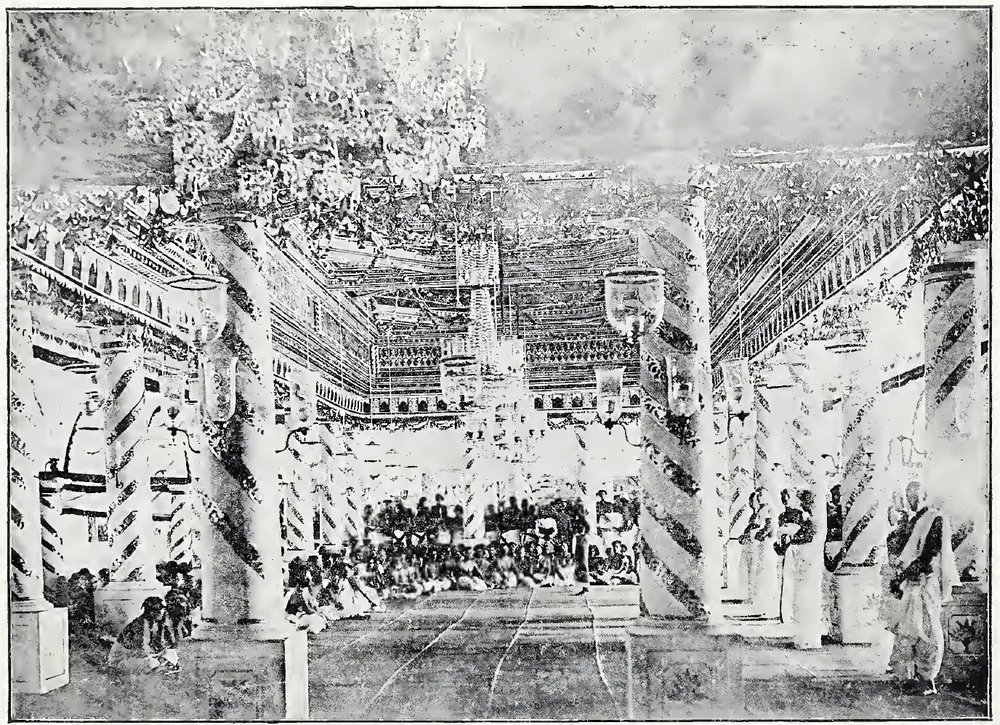
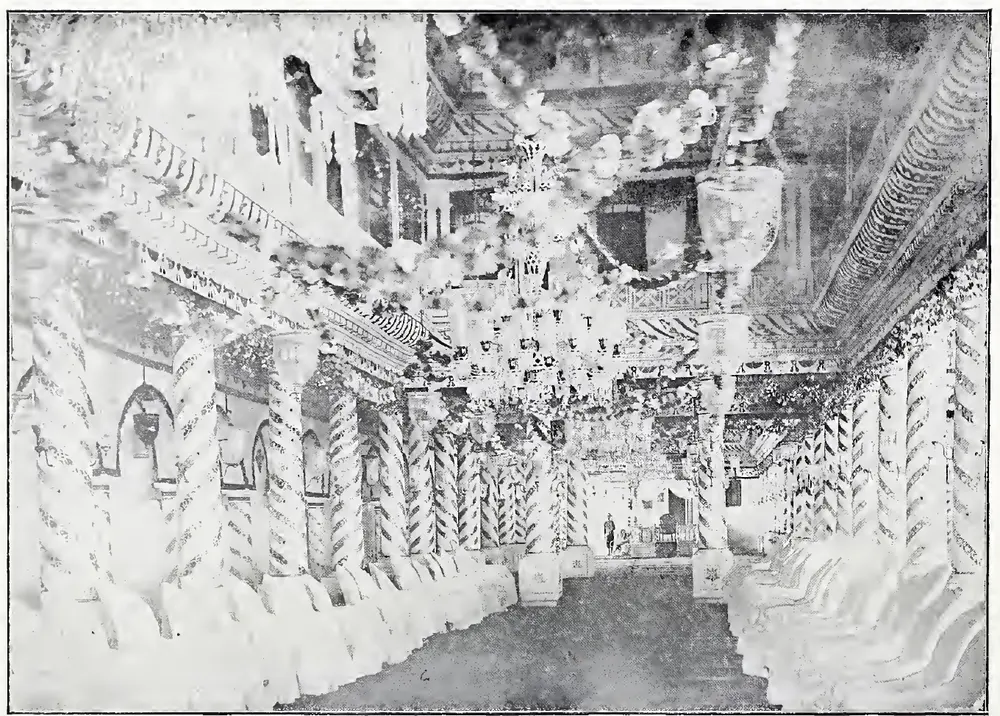
Iron and steel. Iron and steel are chiefly used for making agricultural implements, knives, razors, locks, &c. Superior knives on the English model are manufactured in Travancore, the chief places of their make being Mavelikara, Kottarakara and Nedumangad. The D. P. W. workshop does casting work in iron: lamp posts, pipes and other articles are cast there and most of the lamp posts used in lighting the town of Trivandrum are those made in the workshop.
Carpentry. In the construction of temples and houses the native carpenter plays an important part. The Tachchusastram or the science of carpentry prescribes in minute detail the rules of construction. The chief or head carpenters who prepare designs for buildings and have charge of the execution of the works know the whole of that science by heart. They are therefore the supreme authorities "on the dimensions of the rooms, the height and dimensions of the door frames, the inclination of the rafters and their number for the roof, the area of the open yards, the position of the beams and their sections;"* and indeed for every trifling detail to be followed in the construction. In giving their opinions they are not, however, guided by their own whims and fancies but base them on the written texts of the science. While they are thus well versed in the Sastras, it is not necessary to add that they have attained to a high degree of skill in carpentry. The abundance of good building timber found in the forests of Malabar and their extensive use in the indigenous style of architecture gives ample scope to the carpenter to display his ingenuity. The splendid wood carving for which Travancore is deservedly famous, which has already been referred to, owes its excellence to the dexterity and extensive technical [302]knowledge possessed by the carpenters. Partly owing to lack of technical knowledge and partly to want of opportunities to exercise his skill the carpenter of the East Coast is hardly to be compared with the Malabar carpenter in the matter of skilful workmanship, and it is due to this circumstance that the Malabar carpenters are largely employed elsewhere in the building of houses, of cars, &c.
* Report on the Census of Travancore for 1891, p. 268.
Boat building. A regular succession of lakes and backwaters connected by navigable canals and running in a direction with the coast for a considerable length is a most remarkable feature of the Malabar Coast. Almost all the important and busy towns in Travancore and Cochin are situated along this line of water communication and as might be expected every description of merchandise as well as the whole produce of the country is conveyed through backwaters in boats.
In marshy tracts and in most parts of North Travancore water is the only highway of communication, and a vallam or canoe is thus an indispensable piece of furniture in every house. Men, women and children go in these from one house to another or to the market or to attend to their respective avocations in the fields or elsewhere.
The coast-line from Calicut to Cape Comorin abounds in fish, and the huts of fishermen are to be found all along the beach throughout the entire length. Small canoes or boats are absolutely necessary to these fishermen for carrying on their occupation of fishing.
It will thus be clear that there must be a large demand for boats of which there are at least about 10,000 in the country. Accordingly we find that a large number of people are engaged in their construction and repair. The boats are of various sizes, but in most instances they are formed from a single tree the stem of which is hollowed out for the purpose. Teak, Anjili and Tambagam are the most important ones used in their construction, Anjili being the best and the most popular.
The baggage boats are the biggest and are used in the transport of merchandise. They are from 20 to 50 feet in length and 5 to 7 feet in breadth. Some of them carry about 100 tons. They are very valuable for service at the ports, and notwithstanding their size and heavy appearance they go tolerably fast, though not so fast as the boats used for travelling. The ordinary travelling boat is about 20 feet in length and 3 to 5 feet in breadth. The most common ones are propelled by two pole-men and sometimes more in the case of certain transit or other organised service boats. There is another class of boats known as cabin boats. These are very handsomely fitted up and richly carved. They contain comfortable [303]rooms which give all convenience as well as protection from the heat of the sun and the inclemency of the weather. They have 16 oars or more as may be necessary and when pressed their speed is increased.
In those parts where water is the only means of communication every house owns one or more boats. Those of the rich ones are bigger in size and are preserved with great care under roofs called Vallapuras But in other cases they are generally small, even so small that when landed the rowers carry them home on their heads. These small canoes go at the rate of 5 miles an hour.
The fishing boats are from 8 to 10 feet in length and 1½ to 2 feet in breadth. They are also employed in large numbers on the backwaters in taking sea fishes or country salmon.
The cost of construction varies according to the size and workmanship of the boat. The Royal cabin boats cost as much as Rs. 2,000 or more. The baggage boats cost from Rs. 500 to 1,000, the ordinary travelling boats from Rs. 150 to Rs. 500 and the small private canoes from Rs. 5 to Rs. 100.
Mining industry. There has been no geological survey of the State. The only minerals now worked are the plumbago and mica. The existence of plumbago was first discovered in 1845 by General Cullen, a former British Resident who traced it to the gneiss from the south of Trivandrum northwards as far as Cochin. Samples sent to the Asiatic Society were reported as too soft and scaly for the manufacture of pencils and from the specimens in the Geological Museum London, some experts are of opinion that the Travancore graphite could not be made available even for inferior purposes without much grinding and washing. Although the plumbago dug up has been pronounced to be of inferior quality, yet as the mineral occurs under geological conditions similar to those of the richer deposits now being worked in Ceylon, it is possible that by persevering better veins may yet be discovered. With this view mining works have been carried on in three mines known as the Vellanad, Cullen and Venganur mines. The Venganur mine was finally closed in November 1905 and the other two are still being worked by the Morgan Crucible Company by steam compressed air and also by hand power. The output for the last two years was:—
- Year. — Tons.
- 1077 M. E. (1901-02 A. D.) — 4,575.
- 1078 M. E. (1902-03 A. D.) — 3,394.
[304]The company pays a royalty of Rs. 4 to 6 per ton to Government according to the quality of the ore and the Sirkar realised in 1079 M. E. (1903-04 A. D.) a royalty of Rs. 11,134.
Mica is found at the bed of several tanks and in many places in the forests where water stagnates. But the quantity found is very small and the quality is reported to be poor. Attempts were made nearly a quarter of a century ago by a private individual to work the mineral, but for want of knowledge as to how to take the stuff in a purer state and also for lack of capital he abandoned it. With a view to afford facilities for finders of mica in private lands, to dispose of the article and for placing the mineral on the market the Government have authorised Messrs Parry & Co. to collect mica on behalf of the Sirkar from the ryots who may find them and export the quantity so collected on payment of a royalty of 3½ per cent. and an export duty of 1½ per cent. ad valorem after paying a reasonable remuneration to the finders.
Mica mining seems to have been carried on to a small extent in the Southern Taluqs, but the business has been altogether under foreign guidance and enterprise for a long time.
"During the administration of the late Dewan, Mr. Krishnaswamy Row, the Durbar became alive to the disadvantage under which the latter were placed, and with a view to encouraging them, passed (in a notification dated 10th April 1902) certain rules, as a tentative measure for two years, conferring on them thereby the right to carry on mining operations in private lands, with the privilege of placing the mineral on the market. Stimulated by these concessions, the local landholders, with a large outlay of capital, began in right earnest to try their fortune by opening large mines in different localities, affording thereby much relief to the poor working classes. For two years past the work was carried on with much vigour and zeal till the 13th April last, when the tentative period allowed by the Sirkar expired. The work had been certainly of an excellent kind, tending to develop the mineral resources of the country, whose rich mines of wealth are still unexplored and untapped by her sons. In fact, mica-mining work was—with much better results to these parts—what the plumbago mineralogical operations were to the people of Nedumangaud; in the northern parts. Now that the term of the concession has already run out, the work has been brought to a stand-still, with the result that many poor workmen, who earned their daily bread by the sweat of their brow in the mines have been thrown out of work and the land-holders who opened several mines at a large outlay of money, have sustained serious loss. Fresh applications, we hear, have already been made to the Durbar for a renewal of the concession for another period of two years or so."*
The results so far are poor and the Sirkar realised only Rs. 30 last year; unless a geological survey of the State discloses the existence of richer [305]veins of mica there is no prospect of a profitable industry in this direction.
* The Western Star—13th June 1905.
Besides these two minerals iron ore is largely met with. Some blacksmiths near the localities where the ore is found work it for satisfying local needs, and there has been no organised attempt to undertake work on a large scale.
Gold ore was found some years ago and tested, but it was thought not paying.
There can be no doubt that Travancore has a large mineral wealth, but the mineral resources of the State have not been exploited as yet and to this is chiefly due the almost entire absence of mining industry in the State. The Government have sent an intelligent graduate to England to study mining, and when he returns after the completion of a successful course of study there, the mineral wealth of the State will, it is hoped, be thoroughly exploited and useful industries undertaken. Until then much progress cannot be expected in the mining industry.
Manufacture of salt. Salt is a Government monopoly in Travancore as in British India, and in order to meet the wants of the people, salt is being manufactured by private contractors under an arrangement with the Sirkar according to which the expenses of the manufacture are borne by the manufacturers themselves. But the State carries out all the public works necessary for the general maintenance and improvement of the pans. The manufacturers sell all the salt manufactured by them to the Sirkar at a fixed rate. There are at present three ullams or factories so working in the State at Tamarakulam, Rajakamangalam and Variyur containing in all about 15,000 pans. The necessary brine supply is taken either direct from the sea or from the estuaries close by. There are two manufacturing seasons, viz., the hot months between the closing of the South West and the setting in of the North East monsoons and the interval between the North East and the South West monsoons extending over a period of 7½ months in all. The first interval being 2½ months and the second 5 months. The former season is the best as the salt then manufactured is generally pure, white and of large crystals. The produce from these factories would amount under favourable conditions to a maximum of 300,000 mds. per annum. This quantity is, it needs hardly be said insufficient to meet the entire local demand which comes to about 7,50,000 mds. (calculated at an average rate of consumption of 20 lbs. a head) or a little over double the quantity manufactured locally. The Government [306]therefore enters into contracts for the purchase of foreign salt mostly from Bombay and a small quantity from Tuticorin in order to meet the deficit in the local supply. The salt purchased by the Sirkar is stored by them in their godowns from which they transfer it in limited quantities to the bankshalls where the salt is sold to the public. There are now 68 bankshalls in the State. It may be noted here that the locally made salt is as good as the foreign stuff though there is a great predilection in favour of the latter in the northern taluqs of Travancore as is evidenced by an unsuccessful attempt made in 1068 M. E. (1892-93 A. D.) to introduce the former salt into those parts.
There is still a great scope for extending the area of the local manufacture and the Sirkar has been taking a keen interest in furthering this industry. Not long ago another private contractor was permitted to manufacture salt locally, and very recently a company of private traders has been formed. It has already begun work with 100 pans and the produce is said to be of very good quality. It has been decided to resuscitate and work the Colachel ullam which was given up a few years ago, and at a recent conference of salt officers held under the presidency of the Dewan it was resolved that the State should eventually be made independent of foreign salt by encouraging home manufacture. The future of the salt manufacturing industry is thus full of promise.
Pottery, Bricks and Tiles. Pottery is a very ancient and important industry. In the Hindu lore the profession is sanctified by Brahma the creator being designated the chief potter. There are no houses in the country even of the poorest classes who do not use earthen pitchers, water jars, cooking pots, frying pans, dishes and other vessels made by the potter. There is thus an immense demand for these in every village and the potter is, by virtue of his calling, an important factor in the village organisation.
The Indian potter's wheel is a very simple and rude contrivance, and of this primitive wheel comes every day in every part of India some of the finest pottery. It consists of a horizontal flywheel 2 or 3 feet in diameter loaded heavily with clay round the rim and put in motion by the hand. Once set spinning it revolves for 5 or 10 minutes with a perfectly steady motion. The clay to be moulded is heaped in the centre of the wheel and the potter squats down on the ground before it. When a few vigorous turns are given away spins the wheel round and round still and silent as a sleeping top, when at once the shapeless mass of clay begins to grow under the potter's hand into all sorts of faultless forms, which are then carried to [307]be dried and baked as fast as they are thrown away from the wheel. Any polishing is done by rubbing the baked jars and pots, with pebble. The Indian potter shows thoroughly artistic work in his creation and the red earthenware pottery of Travancore is one of the principal varieties of fancy pottery in which artistic effect is sought to be produced. Some very fine pottery is being wrought in the Trivandrum School of Arts. Various kinds of paper-weights, ink-bottles, table ornaments, ornamental vases, busts, cups, goblets, flower pots, wall and corner brackets, small figures of animals such as lions, elephants and cows and clay idols of Hanuman, Vighneswara and Lakshmi, all excellently worked, are some of the articles made there.
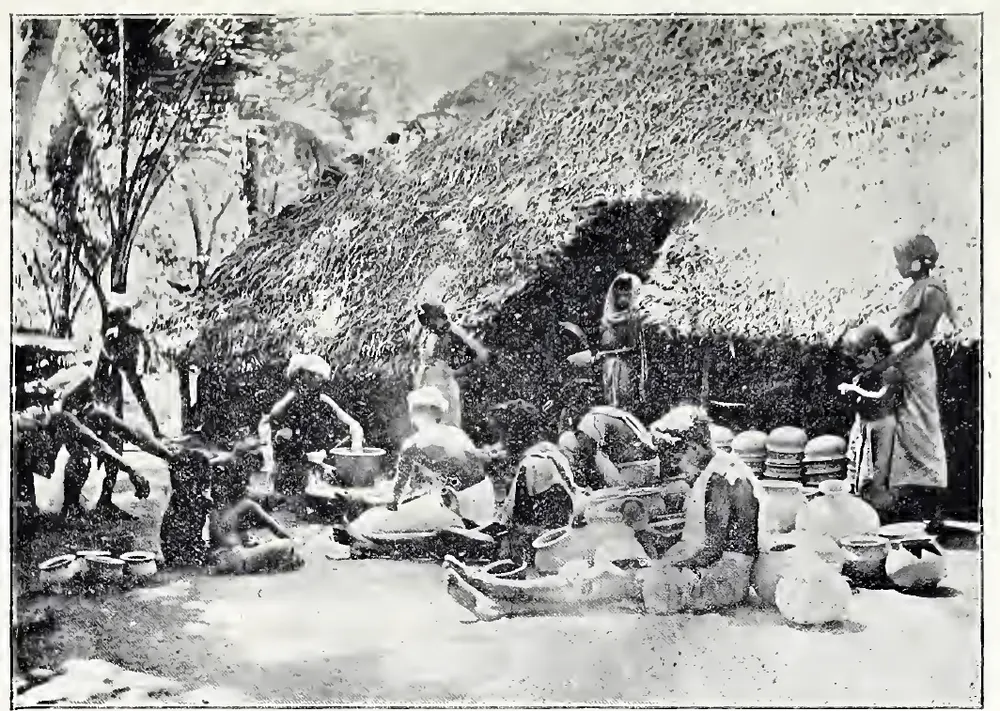
The round tube-like hollow tiles of the East Coast used only in South Travancore are also made in the potter's wheel. But the indigenous variety of tiles peculiar to Malabar are manufactured in the same manner as the bricks. The semi-solid mass of clay prepared according to the recipe known to every potter is spread on level ground and allowed to dry for two or three days. It is then cut into the required sizes and shapes by a sharp edged piece of wood or other instrument and left to dry a little more. The bricks or tiles are then collected and heaped into a kiln constructed in the form of a rectangle with a number of holes on all the sides. Dry twigs and firewood are strewn at the top and the bottom of the heap and also in one or more layers inside it and burnt. After sufficient burning they are removed and are ready for use. This is how the potter makes his bricks and tiles. Besides these, bricks are manufactured by the Public Works Department, which are exclusively used in the construction of Government buildings. There are 16 such brick-factories in Travancore. There are also 2 private factories established at Quilon worked by steam power where bricks are manufactured on a large scale. The indigenous tiles are going out of use, their place being taken by the machine-made tiles of the Mangalore pattern. The School of Arts turns out very fine flooring tiles with the aid of the machinery recently set up and excellent kaolin well suited for the manufacture of fine pottery has been discovered in and near Trivandrum, and this is being made use of in the Trivandrum School of Arts.
Toddy drawing. Toddy is a saccharine juice obtained by excision of spadix or young flowering branch of the palmyra, cocoanut, date, sago, and other palms of which the first two are the most important. The process of drawing toddy is as follows. When the spadix is a month or [308]a month and a half old the toddy drawer begins his work by binding the sheath to prevent its expansion, after which he cuts about an inch off the end and then gently hammers the flowers, which are thereby exposed, with the handle of the knife or a piece of hard wood or bone. Finally he binds up the end with a broad strip of fibre. The hammering is repeated both morning and evening for 8 to 15 days, a thin slice being cut away on each occasion till the spadix is ready to yield toddy which can be easily recognised by the chattering of birds, crowding of insects and other unmistakable signs. When ready the end of the spadix is fixed into a small pot and a small strip of leaf is pricked into the flower to catch the oozing liquor and to convey the drops without wasting clear into the vessel. The juice exudes and drops into the earthen pot. It is collected every morning, when the vessel is emptied and replaced as before, and this is repeated daily until the tree is exhausted and yields no more. The yield will be large about half a gallon a day in the beginning but will gradually decrease, and after a period of forty or fifty days stop. The juice of the cocoanut tree is known as sweet toddy. In the early morning it is a pleasant drink, but it ferments towards night and becomes an intoxicating fluid which is largely drunk by the lower classes and used as ferment. It is also to a great extent artificially brought to the vinous and acetous fermentation, and in the former state an alcoholic spirit is distilled from it which forms one of the arracks of commerce. It is said that 100 gallons of toddy produce by distillation 25 gallons of arrack.
Palmyra toddy, though agreeable, is inferior to that drawn from the cocoanut tree. It becomes on fermentation, which takes place in a shorter time than is required for the cocoanut toddy, one of the most intoxicating of country liquors and is very largely drunk by the lower classes.
These drinks, indulged in mostly by the poorer classes, are supposed to give them great relaxation after hard work in the fields or elsewhere. They are also used for purposes of medicine especially the cocoanut toddy before they undergo fermentation.
Sugar, Molasses and Jaggery. Coarse brown or black sugar is made by boiling down over a slow fire the juice or toddy drawn from the palmyra, the cocoanut, the date and other palms. Powdered lime is put into the vessel in which the toddy is drained, when it is intended to be boiled down to sugar or jaggery in order to arrest fermentation. The toddy is boiled for a considerable time till on taking out a little and rubbing it between the fingers it has a waxy feel, when it is taken off the [309]fire. The thick syrup is then poured into half cocoanut shells or presses and hardens into lumps. This is known as jaggery.
If sugar has to be extracted the boiling ceases a little earlier than is required for the making of jaggery, and when it is warm it is placed in baskets and allowed to drain. The watery portion or molasses drops into a pan placed below. This process is repeated a number of times until the jaggery or sugar becomes comparatively white and free from molasses. The sugar is then put to dry and broken up. Instead of placing the semi-viscid mass in basket, it is sometimes poured into earthen pots having a few holes at the bottom, which are placed on other earthen pots. The fluid escaping from this is called molasses, and to wash it out still more a little water is also added. The sugar is refined by dissolving it in water and boiling it with certain purifying substances the process being repeated till the necessary or required degree of refinement is attained. European methods of refinement are not adopted. A company is in course of formation at Kuzhittura for refining sugar by new methods with the aid of machinery.
Besides toddy, sugarcane juice is largely made use of in the manufacture of sugar. The juice is extracted from the cane in the country mills of which there are two varieties. One consists of two vertical cylinders wrought on a perpetual screw between which the canes are passed as they revolve upon each other and in doing so the juice is extracted. The other form of the mill consists of three iron cylinders standing on a line with each other either perpendicularly or horizontally, placed in the form of a triangle and so adjusted that the canes being passed twice between the cylinders have all their juice wholly expressed.
The juice extracted in this way is collected into a cistern which when filled is placed over a slow fire. Lime water or powdered lime is added to the juice to cause the feculent matter contained in it to separate. These impurities come to the surface at a certain temperature of heat and are then carefully skimmed off. The juice undergoes rapid boiling which by evaporating the watery particles reduces it to such a state of consistency that it will granulate when cooled. It is then treated in the same way, as the boiled toddy is, in regard to draining off molasses and as regards refinement of sugar.
Cadjan mat and Rattan work. Cadjan umbrellas are a peculiarity of this coast, and no other part of Southern India produces similar ones. They are cheaper, last longer, stand rougher wear and give more protection against sun and rain than cloth umbrellas, which are, however, [310]fast displacing them partly owing to the advantage of their being folded and partly to the fashion of the day. Cadjan fans are also largely used by all classes of people during the hot weather and they are very cheap. In addition to these uses cadjan leaves are woven into rough mats and the broad leaves of some varieties are largely used for palm-leaf books, which are still in great use here.
Mats of Travancore are made from the reed called Korai, but it is only the rough mats that are so made. The leaves of the pandanus, a wild kind of pine-apple plant, are also made into mats which are used as sails for conoes plying the canals and lakes, for drying grains, packing goods, roofing bullock carts, for screens and as mattresses by the poor. The leaves are also woven into very fine mats which are largely prized for their smoothness. Some of these cost as much as Rs. 2 to 3 per mat and considerably more, when they are artistically worked and coloured. The chief places of the manufacture of such mats are Vaikam and Kayangulam.
The rattan work of Travancore is noted for skilled workmanship. The Nedumangad hills yield very good canes, and the Koravars all along the base are very clever in rattan work. They make boxes, plates, baskets and other useful articles. Varkala and the surrounding region is famous for this kind of workmanship.
[311]
Chapter XVIIILand Tenures and Land Taxes.
"After the most careful review of all these considerations, Her Majesty's Government are of opinion that the advantages which may be reasonably expected to accrue, not only to those immediately concerned with the land but to the community generally, are sufficiently great to justify them in increasing the risk of some prospective loss of land revenue in order to attain them, and that a settlement in perpetuity in the districts in which the conditions required are or may be hereafter fulfilled is a measure dictated by sound policy and calculated to accelerate the development of the resources of India, and to insure in the highest degree the welfare and contentment of all classes of Her Majesty's subjects in the country."
Sir Charles Wood's (Secretary of State for India) Despatch—July 1862.
Land Tenures. The subject of land tenures in Travancore is one which requires careful study and thorough investigation for a full comprehension of its origin, development, intricacies and incidents. The land tenures of Travancore are similar in some respects to those obtaining in the adjoining Districts of Madura and Tinnevelly on the East Coast as well as to those of the neighbouring State of Cochin and the British District of Malabar on the north. They resemble the districts of the Madras Presidency in being ryotwari in their character and partake of the nature of the holdings in Malabar and Cochin in having had a common origin and development in ancient times before Kerala was divided into separate kingdoms ruled by independent chiefs.
Their origin. The theory in Malabar is that all land was reclaimed from the sea and made over to the Brahmin colonists brought by Parasurama from the other coast. Hence all land in Malabar theoretically belonged only to Brahmin Jenmis whose Jenmam or birth right to the lands dates from Parasurama's advent or prehistoric times. In later ages some of these lands passed over to the temples or charities which too acquired an indefeasible Jenmam right to them as the original Brahmin colonists themselves. All the present holders are therefore considered the descendants of those Jenmis or landlords or others who trace their title from them and the Sirkar owns only such lands or rights as have become escheated to it.
It seems reasonable to suppose that the Jenmis took for themselves all land nearest their dwellings and that the distant mountainous and jungle tracts were ownerless till the States grew up and acquired proprietary right over them. The ruling chiefs must have then claimed these tracts as their own along with others acquired by them as stated above, [312]and granted them to the ryots for cultivation. This explains how the Jenmam right in Travancore is recognised as antecedent to the sovereign's right to the land.
There is, however, another traditional account of the origin of Sirkar lands. In prehistoric times all the land of the State was owned by Nagas or Nayar chieftains when sovereignty was in a state of a tribal commune. Then there was no land tax or revenue levied on them, but each member of the tribe contributed a small portion of the produce as tribute for the upkeep of the tribal chieftain. Land was at a discount. The possession of land which subsequently became a power and a privilege was then of small account. As Ricardo so beautifully expresses it, "On the first settling of a country, in which there is an abundance of rich and fertile land, a very small proportion of which is required to be cultivated for the support of the actual population, there will be no rent; for no one would pay for the use of land, when there was an abundant quantity not yet appropriated, and therefore, at the disposal of whosoever might choose to cultivate it." At the time of the Nambudiri Brahmin colonisation of Kerala by Parasurama a change came over this state of things. The superior intellect of the new colonists and their priestly authority over the tribal chieftains and clans and their forming social relationships with the natives led to a new order of things in the holding and enjoyment of property. The natives with their joint family system and the common ownership of family property were ready to own the Nambudiris as their landlords and hold lands from them as tenants. It was thus that the ancient Jenmam right came to be held by the families of Nayar chieftains and those of the sacerdotal Brahmin Nambudiris and Pottis. The main body of the Nayars were content to get household or family allotments from the chiefs and Brahmins. They paid the landlords no rent or michavaram but some fee called Kanam or Kanikka in token of allegiance, and did not cultivate the lands themselves but through serfs or slaves. Thus arose a sort of feudal system in Malabar traces of which are still visible to-day.
This system, however, did not last long. The Nayar chieftains gradually became subservient to the growing colony of Brahmin settlers of the 64 villages and their estates became more extensive. With the advent of the Perumals a simple imperial tax was levied to defray the expenses of the Perumal viceroy. This was the origin of the modern Rajabhogam or royalty, a tax or rent calculated at 1/6 or 1/8 of the Pattam. The Nambudiri chieftains made also grants of lands to the Perumals which [313]ultimately became their Jenmam properties. Besides all the Pakuti or abandoned lands and the escheat properties as well as those taken or captured during the earlier wars of Travancore became the property of the kings or Perumals. Thus their lands increased from day to day and formed the nucleus of the present Sirkar lands. Towards the close of the Perumal period the country was parcelled out among the several chieftains who became independent rulers of their respective provinces. This state of things continued for several centuries until the whole country was conquered and consolidated by Martanda Varma Maharajah, when the rights of the several petty chieftains became vested in him as supreme lord of all Travancore. These conquests, however, did not affect the rights of the Brahmin landlords. Thus arose the two classes of lands now extant in Travancore, viz., Sirkar and Jenmam lands.
The origin and development of the lands and their tenures will thus be seen to have had a slow and gradual growth. The land tenures of Travancore bear therefore no analogy whatever to the English theory of property or the system of feudal tenure connected with it; nor do they exhibit any traces of the theory that the king was the first lord and owner of the soil. Property was owned and enjoyed long before the State or king came into existence. This explains the immunity of Jenmam lands from any taxes to the Sirkar. It will therefore be right and proper to speak of these lands first before we proceed to consider about the Sirkar lands of later origin and development.
Jenmam lands. According to the Keralolpatti, Parasurama after creating Kerala made it over to Brahmins (Nambudiris) for the expiation of the sin of the murder of his mother, Renuka. The land was parcelled out into 64 villages or gramams and each of them had an assignment of land as free gift to be enjoyed by him and his descendants as independent landlords. These Brahmins being quite new to the place and unable to cultivate the lands themselves entrusted them to certain classes of people for cultivation on the understanding that the shares of the produce due to them should be faithfully surrendered. Thus came into existence two classes of persons, viz., the Nambudiri Jenmis or proprietors and their Kudiyans or tenants and cultivators.
The word 'Jenmam' means 'life' or 'birth' and denotes technically a hereditary right to freehold lands subject to no state-tax at all. The character of these Jenmam lands was that they were liable to pay no taxes at all. They retained their normal condition so long as they remained in their Jenmis' hands or passed to other Jenmis for no money consideration. [314]The tenants cultivating them for the Jenmis did not alter their character but the Jenmam tenure ceased the moment such land passed into alien hands for money consideration, whatever be the nature of the transaction. The moment an alienation of the above kind takes place, the land becomes liable to a light tax called Rajabhogam amounting in the case of gardens to 1/6 or 1/8 of the full rental or Kandapattom and in the case of paddy lands to a similar proportion of the grain rent amounting to 1/2, 1/10 or 3/10 of the quantity of seed required to sow the land. This light tax once imposed sticks to the land for ever and continues even though the land is redeemed by the Jenmi himself. As a consequence of the original transaction, the land is registered in Sirkar accounts in the name of the tenant or cultivator and the tax levied from him only; and if he dies heirless, the property escheats to Government, the Michavaram or dues to the Jenmi continuing as a charge on the property. Similarly if the tenant abandons the holding as unfit for cultivation, then too the Sirkar takes up such lands as Nirthal and gives them on lease for a lower pattom as Sirkar lands. A word of explanation may be necessary for treating the cultivators as owners and recognising them as such in the Sirkar accounts. It had its origin in Brahmin Jenmis allowing their Kanam holders to continue in possession for indefinitely long periods in as much as they felt themselves comfortable and satisfied so long as their customary dues were paid. Such custom, long observed and understood as binding on both sides, in time acquired the force of law, so that in later days it became necessary to insert whenever required a clause reserving the rights of redemption. This tendency, to gradually strengthen the claims of the tenant against his landlord, gained in volume from the improvements made by the tenants in their several holdings which had to be compensated for in case the Jenmi wished to resume his lands.
The several classes of Jenmam lands. The Jenmam lands or more properly speaking the freeholds exempt as such from taxes of any kind may be divided into three classes:—
1. Jenmam lands that are entirely freehold and exempt from payment of any kind of tax to Government under any circumstances.
2. Jenmam lands which were originally exempt from payment of any tax, but subsequently became liable to it under certain conditions.
3. Jenmam lands paying a light tax called Rajabhogam from the very beginning.
Under the first class may be mentioned the Proverties and Desams as well as tracts and gardens of individual chiefs and families as well as of [315]some religious institutions which are entirely free from Government interference in matters of Revenue administration. They are also called freehold Jenmams and are chiefly the following:—
1. The Attungal and Idakkod Adhikarams and a few gardens in other places in the Trivandrum and Chirayinkil Taluqs belonging to the Sripadam Palace or the Ranis.
2. Kilimanur Adhikaram, the property of the Kilimanur family of Koil Tampurans—descendants of the Koil Tampuran who rescued the fugitive queen and her two infant children from the rebellious Ettuvittil Pillamars and Madampimars.
3. The Desams of Edapalli Rajah, representative of the Pallittevaram guardian of Cheraman Perumal in the Taluqs of Changanachery, Tiruvalla and Kartikapalli, outside the Edapalli Idavaga itself.
4. The Desam of the Punjar Chief.
5. The Desam of the Manikantesvaram pagoda in the Kottarakara Taluq.
6. The Desam of the Elankunnappan (Pattanapuram).
7. The Desam attached to the Kaviyur pagoda (Tiruvalla).
8. The Desam attached to the Pankod Krishnaswamy pagoda (Kottarakara).
9. The Desam attached to the Mannadi Bhagavati temple (Kunnattur and Pattanapuram).
10. The Desam of the Kongurpally Nambudiripad's Sasta and Bhagavati temples.
11. The Desam of the Panayanarkavil Bhagavati temple Tiruvalla.
12. The Desam of the Aghavur Namburipad (Kottarakara, Kartikapalli and Mavelikara).
13. The Desam of the Aghavur and Omanpally Namburipads (Quilon).
14. The Desam of Vanjippuzha Pandarattil (Chaganachery).
The peculiarity of these Jenmam properties is that their owners have absolute control over them in connection with their revenue and rents and they take from the ryots the pattom or rent as well as the Rajabhogam which in the case of other lands would go to the State. That is, the full pattom or a portion of it is taken according as the land is, Pattom or Otti while the Devaswam and Brahmaswam lands in these tracts pay their Rajabhogam or quit rent to these chiefs instead of to the [316]Sirkar. These tenures are in no way developments of the original Jenmam proper but are of the nature of pure Jenmam or freehold properties and had their origin in the gifts and cessions made by the ancient Rajahs and Chiefs.
Under the second class come the pure Jenmam properties belonging to the Brahmins (Nambudiris and Pottis) and Devaswams (Pagodas). These are called in the accounts Devaswam and Brahmaswam properties. The peculiarities of this kind of tenure are:—
1. That in their normal condition, such lands are absolutely exempt from taxation;
2. That this condition ceases the moment the land passes into the hands of those other than Devaswam or Brahmin Jenmis for a money consideration, though the mere letting out for a rent will not affect the tenure;
3. That on such alienation the lands become liable to a light tax called Rajabhogam which is apparently a fee paid by the tenant in acknowledgment of sovereignty;
4. That the property so taxed becomes subject to escheat and is then taken up by the Sirkar if the tenant should die heirless; all that the Jenmi could thereafter claim being only his Michavaram; and
5. That if the land be abandoned as Nirthal or unfit for cultivation, it is taken up by the Sirkar and dealt with as Sirkar pattom lands.
Under the third head are comprised all Jenmam lands owned by the chiefs and Madampimars who are non-Brahmins. These are generally gifts made on light assessment by the several chiefs all over the country for services rendered to them in former times. The peculiarities of this kind of tenure are:—
(1) The lands are subject to Rajabhogam from the beginning;
(2) The tenure holds good as long as the land is not alienated by sale; and
(3) If an absolute sale takes place, the tenure is extinguished and the land is then treated as an Otti holding. The following are some of the chiefs and families of Madampimars who own such lands.
- 1. The Cochin Rajah;
- 2. The Kodungalur Rajah;
- 3. The Punjar Rajah;
- 4. Pandarattimmars;
- 5. Tambrakkanmars;
- 6. Tiruvapadanmars; [317]7. Koilemmars;
- 8. Paliyattu Menon;
- 9. Vadayattu Menon:
- 10. Indigenous Madampimars;
- 11. Foreign Madampimars;;
- 12. Naickenmars; and
- 13. Varienmars.
The Jenmis and tenants From time immemorial the Jenmi-landlords being owners of extensive tracts of land seldom or never cultivated their lands themselves but simply leased them out to the tenants under conditions of mutual rights and responsibilities. This custom of the olden days when the relations between the Jenmis and their tenants were very smooth was soon disturbed by various causes, and in course of time the Jenmi began to complain that his dues were not properly paid nor in due time and the tenant that he was often compelled to pay more than he originally agreed to. This led to several disputes and litigations which in the then condition of things were decided by the courts according to the merits of each case. The demands of justice on both sides, the advance of civilisation and the policy of enlightened government alike demanded State interference to put things on an equitable basis; and after much enquiry and consideration a Royal Proclamation was issued in 1042 M. E. (1866-67) for this purpose. Under this Proclamation the tenant was secured against arbitrary eviction or demands from the Jenmi while on the other hand it secured to the Jenmi all his just dues. The Jenmi was no longer allowed to oust his tenant on the expiry of the lease but could readjust the rent, &c., according to rates sanctioned by custom and usage. If, however the tenant withheld the landlord's dues for twelve consecutive years, the Jenmi was entitled to sue not only for those dues but also for ousting the tenant, himself being obliged to pay for any improvements made by the tenants. The above Proclamation in its working proved highly beneficial to the tenants in securing to them continued and peaceful possession of their holdings and immunity from eviction while to the Jenmis its results were not equally advantageous. Their just dues were not easily recovered on account of the Courts strictly applying the limitation clause and the unavoidable expenses and delay of a civil suit for perquisites which in themselves were of but poor value. This led to hardship and consequent agitation by the Jenmis.
Dewan Ramiengar thus summarised the Jenmis' grievances:—"That the Proclamation however unintentionally has had the effect of leaving the tenant complete master of the situation and the Jenmi at his mercy must, [318]I fear, be admitted." The frequent complaints of the Nambudiri landlords led to inquiries about the working of the Proclamation; Mr. Ramiengar wrote a learned Memo on the subject and suggested the appointment of a Commission. Accordingly in 1060 M. E. (1884—85) a Commission was appointed to inquire into the condition and rights and responsibilities pertaining to Kanapattom tenures as severally obtaining in different parts of the country and submit a report suggesting measures for the better adjustment of their mutual relations. Their deliberations along with the evidence gathered in the course of their inquiries were submitted to Government and were soon after taken up for enactment. The outcome was the passing of Regulation I of 1071 M. E. known as "The Travancore Jenmi and Kudiyan Regulation." By this Regulation, the tenant's fixity of tenure was finally established and his right was also made heritable and transferable. However, eviction of the tenants was allowed in cases of non-payment of rent for 12 years, neglect or refusal to pay renewal fees and take a renewal in time, wilful denial of the Jenmi's title and persistence of the same at the first hearing and intentional and wilful acts of waste as may materially and permanently impair the value and utility of the holding. In the absence of any express contract to the contrary every lease was to be considered renewable in 12 years, when it was obligatory on the Jenmi to give and on the Kudiyan to accept a renewal of the lease along with the payment of the dues customary on such occasions. At every renewal of a Kanapattom lease, the following dues are generally paid by the Kanamdar, over and above the annual Michavaram or rent fixed by the agreement.
1. Adukkuvathu which is generally 10, 15 or 20 per cent. of the Kanam consideration.
2. Opputusi or fees for signing.
3. Olappanam, cost of the cadjan (now stamp paper) on which the renewal has to be drawn.
4. Ilantala Kanam or that which is due to the next senior male member.
5. Adukkala Kanam, dues to the ladies of the house.
6. Parah Kanam or fees for measuring.
7. Charipara Kanam or one full parah at the outset of every measurement.
8. Alakkada or that which is given at the end of every measurement—one or two parahs.
9. Onakkazhcha or present—for Onam.
[319]These dues are not invariably paid by all tenants all over the country but vary in their number and amount in different parts of the country. Besides these renewal fees, the Kanamdars have also to pay their landlords some perquisites on occasions of ceremonials in the Jenmi's family which are commonly known as the Aradiantram (six ceremonies). They are:—
- (1) Choroonu or the initial rice-giving to a child.
- (2) Upanayanam or investing with the Brahminical thread.
- (3) Samavartanam or the completion of the student period.
- (4) Veli or marriage
- (5) Pindam or ceremonies connected with funerals.
- (6) Masam or ceremony connected with the first anniversary after death.
The cost of payment on such occasions varies in different localities and is often governed by the special customs of each family. The payment is generally made in the form of supplies of provisions instead of money; it often comes to 15 or 20 per cent. of the Michavaram or rent. Generally these perquisites are named in the instruments without reference to the amount. It is so done by the parties agreeing to be governed by custom. These perquisites from their very nature appear to have had their origin in voluntary payments by tenants as a token of fealty on ceremonial occasions; they are now, however, considered indispensable and are paid in regularly.
Further demands are made when the holding happens to be a garden. In such cases, the following additional contributions or their value are levied by the Jenmi. This is generally known as Panchabhogam literally the five profits, viz.,
- (1) Kompu Chakka, a jack for each tree.
- (2) Kula Tenga, a bunch of cocoanuts.
- (3) Kula Adakka, a bunch of arecanuts.
- (4) Kula Vazhai, a bunch of plantains.
- (5) Vettu Ola, share in the cocoanut leaves, cut.
These contributions have to be made annually in the case of Jenmi landlords. Where however the lands or gardens belong to a pagoda these perquisites are required to be paid only at stated intervals and they also vary in character with reference to the requirements of the religious festivals or ceremonies.
Having dealt with the general character of Jenmi holdings it will be interesting to know the several other tenures under which they are held [320]and the modes in which they were formed or brought into existence. Besides the Kanam under which most of the Jenmam properties are held and enjoyed by the tenants, they may also hold it on (1) Verum Pattom, (2) Pattom and Kuzhikanam, (3) Otti (mortgage) (4) Otti and Kuzhikanam, and (5) Attipper.
(1) Verum Pattom is a lease without any debt or money consideration entering into the transaction. It may be oral or written, but the latter method is adopted when the term is for more than a year in which case it must be stamped and registered. Under this tenure the tenant takes possession of the property and pays an annual rent to the landlord as agreed upon. He is bound to quit the land on the expiry of his term.
(2) Pattom and Kuzhikanam. This tenure while resembling the Verumpattom confers on the tenant the right to make improvements on the land for which he is entitled to receive compensation on the expiry of his term. When no term is stipulated the period understood is twelve years.
(3) Otti or usufructory mortgage is a higher tenure than a lease. In this transaction an amount is borrowed by the Jenmi on the security of his land and the property is left with the Kudiyan for enjoyment of its produce as interest for the amount.
(4) Otti and Kuzhikanam is similar to the above and partakes of its characteristics, the only difference being that in the latter tenure Kuzhikanam or payment for improvements will be made on the expiry of the term.
(5) Attipper is the out and out surrender of the Jenmi's rights by sale. This surrender of the full rights of the Jenmi was in ancient days looked upon as very indignifying and hence such surrender whenever indispensable was made by slow degrees, so much so that when a Jenmi had unavoidably to sell his property all at once he was obliged to go through the several stages together. These stages are three in number:—(1) the Jenmi has to execute a Kaippada Otti or mortgage receiving almost the full value as debt. The purchaser then obtains possession of the property. But he is not a complete owner and therefore can neither cut a tree nor burn nor bury the dead in it nor sell it to others. After the first deed was executed two other deeds named (Ottikkumpuram) and (Kudimanir) should be executed in succession. The tenant now pays 20 per cent. of the value of the property. When these two deeds are also signed and delivered the Jenmi is considered to have lost and the purchaser to have gained 7/8 of the rights in or dominion over the property: [321]and the buyer can now cut wood or perform funeral obsequies in it. The last part of the transaction, viz., (Attipper) was then drawn up to complete the sale and transfer the full free-hold to the purchaser; for executing this deed the presence of the following six persons is required and the following ceremonies have to be observed.
- 1. A caste jenmi.
- 2. A near relation.
- 3. The heir.
- 4. The Rajah's or Sirkar's representative.
- 5. The person who writes or draws out the deed.
- 6. The Headman of the village.
All these assembled, the jenmi brings in a vessel of water (generally a kindi)* taken from the garden to be finally sold with some rice and flower put into it. The buyer then puts 2 fs. as (നീർക്കാണം) Nirkanam (water fee) into the kindi. The Jenmi then standing facing west and the buyer eastward, the Jenmi informs his heirs that he is going to make over his Jenmi rights to such and such a person and with their consent pours out the water saying "I give you the water of such a compound to drink." The purchaser receives the water in his right hand and drinks it; but if he be of a higher caste, he washes his face and feet with it. Before the above presentation of water, the purchaser pays 4 fs. (9 as). ഒപ്പുക്കാണം, Oppukkanam, to sign the four deeds and at the time of drinking water, the heir is given 4 fs. called അനന്തരവൻ നടുക്കാണം, Anantaravan nadukkanam (a present to the heir to give his consent). A (തൂശിക്കാണം) Tusikanam of 8 fanams is paid to the person who draws out the deed, (തൂശി Tusi is the iron style or instrument used for writing on cadjans. A present of 2 or 3 fs. should also be made to each of the 6 persons for their attendance. The whole transaction is then brought to a close by the payment of a fee both by the seller and the purchaser to the Sirkar the amount being 10 per cent. of the value of the property. This fee was in later times discontinued. If the heir above named objects to the sale, the business cannot be further proceeded with. This was the custom in early Travancore, nay, throughout Kerala. Major Walker says:—"In former times the transfer of Jenmam was made by presenting water before witnesses and the whole performance was verbal, but when the Kali Yuga commenced water and words were found insufficient." The ceremony of pouring water and drinking it seems to have had its origin from the fact that the land was reclaimed from water. [322]Whatever the origin, such a symbol of delivery of property is not peculiar to this country. The English common law requires delivery of a clod of earth to make a conveyance complete and this ceremony is known as the "Livery of Seisin." The above ceremony is no longer required for a sale of Jenmam right in modern days. The Stamp and Registration laws regulate such transactions.
* A pewter vessel with a tube through which the water flows. It is the most commonly used vessel in this country and is nearly unknown in the eastern districts.
Besides the tenures above named, there are a few denominations of tenure under this head prevailing though rarely in some parts of the country. The chief among them are:—
- 1. Ozhavupattom (ഒഴവുപാട്ടം)
- 2. Ozhavola (ഒഴവോല)
- 3. Vayalvazhotti (വയൽവാഴ ഒററി)
- 4. Ozhavotti (ഒഴവോററി)
- 5. Pattola (പാട്ടോല)
- 6. Marapattom or Karanmapattom (മാറാപാട്ടം or കാരാണ്മ പാട്ടം)
- 7. Vachupati pattom (വച്ചുപാതിപാട്ടം)
- 8. Kudippati pattom (കുടിപ്പാതി പാട്ടം)
- 9. Kuzhiyapattom or Varampadukkupattom (കുഴിയാപാട്ടം) or (വരമ്പടക്കുപാട്ടം)
- 10. Karam pattom (കാരാംപാട്ടം)
- 11. Verumpatta tettam (വെറുംപാട്ടതെട്ടം)
- 12. Pativaram (പാതിവാരം)
- 13. Vittupatitettom (വിത്തുപാതിതെട്ടം)
- 14. Vittittum kilachchupati or Ittupatipattom (വിത്തിട്ടും കിളച്ചുപാതി or ഇട്ടുപാതിപാട്ടം)
- 15. Chora otti or meela otti (ചൊരാഒററി or മിളാഒററി)
- 16. Tuyara otti (തുയരഒററി)
- 17. Irakkaranma (ഇറക്കാരാണ്മ)
- 18. Vachupati karanma (വച്ചുപാതികാരാണ്മ)
- 19. Anchurandu karanma (അഞ്ചുരണ്ടുകാരാണ്മ)
- 20. Ponnittu Karanma (പൊന്നിട്ടുകാരാണ്മ)
These different minor tenures are not very different from those above mentioned and described in extenso but are slight variations or modifications of those tenures adopted in different localities to suit special local conditions. Some of them partake of the nature of a Kanapattom tenure or of a lease and the variations in them are caused by special conditions imposed about rent or services to be rendered by the tenants. The irredeemability of property in some of these tenures and [323]the fixity of rent in others making it a fraction of the total produce are their special features. The last one, viz., the Ponnittu Karanma alone requires special consideration as it has the effect of a complete sale. It differs from other Karanma transactions in that it requires a special and additional consideration over and above the requisites of other Karanma deeds. This additional consideration is known as Ponnu meaning value, and forms its special feature and is necessary to constitute the transaction a real sale or transfer of the full Jenmam rights as in an Attipper. It is only in this Ponnittu Karanma and Attipper deeds that the words indicating transfer of full rights are put in. These words or expressions are peculiar to Jenmam deeds and indicate how even in primitive society it was thought necessary to put in words exhaustive of all possible rights in the soil. These words are:—

and mean "the properties named and the produce thereon either on the surface or in the sub-soil, the stones, the rugged rocks, the kanjiram tree, thorns, rough surfaces, the ferocious snake, the paths therein used by the public, the water courses, jungle of beasts, the groves of bee-hives, water, treasure troves, wells, the sky above and the nether strata below, &c." The list is complete and exhaustive giving no room for the quibbles of lawyers of later days and corresponds to the "esque ad caelumoe esquo ad solum" of English conveyance, meaning "from the centre of the earth to the heavens above."
Before leaving this part of the subject, it remains to examine one more class of leases made by the Jenmis with regard to their mountainous and jungle tracts. In the case of these lands which are lying waste, the person who wishes to bring such lands under cultivation first takes permission of the Jenmi and begins his work; and out of the produce the cultivator pays one-fourth to the Jenmi, no deduction being made either for the seed or cost of labour. This is called Varam or the rights or dues of the Jenmi. Afterwards besides the payment of pattom or rent, the Pattakkaran or lessee is obliged to perform certain gratuitous services to the Jenmi. In connection with the Onam festival he must pay two fanams. The usual period of such lease generally extends from 3 to 6 years, but the term can be extended if both parties agree; every lease, however, must expire with the life of the Jenmi and has to be renewed by the heirs on payment of a year's pattom and must suffer a deduction or addition of 13 per cent. on the Kanam amount, if any. A new deed is [324]executed when any Kanam is paid and has to be renewed on the death of the lessee also on the original condition if the Jenmi is willing to continue the lease to his heirs. When the Jenmi desires to recover the property from the lessee, he must return the Kanam amount and also pay compensation for Kuzhikanam or improvements made by the lessee. On the other hand if the tenant causes damage to the property diminishing thereby its income, such damages will be deducted from the Kanam amount. If, however, the tenant wishes to relinquish his holding before the lease expires, he is not entitled to the full Kanam amount but gets only a portion thereof, say 80 per cent. This is called sakshi amount. The Jenmi when he wishes to revoke his lease must return the Kanam amount, the expenses of executing the documents as well as double the value of the improvements. Both these can take place only with the mutual consent of the parties.
Sirkar lands. We have next to consider what the Sirkar lands are and how or under what different tenures they are held and enjoyed by the ryots. Broadly speaking all lands other than Jenmam properties belong to this class and are liable to assessment in some form or other. These are generally known as Pandaravagai as distinguished from the Sri Pandaravagai or properties belonging to the Padmanabha Swamy's pagoda at Trivandrum; but the tenures of properties under this head are the same as or similar to those of Sirkar lands proper, and hence these two classes of lands may with advantage be considered together. The theory and practice in respect to these lands is that Government is the landlord, and any rights in them owned by the ryots must have been derived from the State. If, as stated in a previous portion of this chapter, it be admitted that all land in Malabar once belonged to the Jenmis, then all the Sirkar lands too must have belonged to them and in course of time must have become vested in Government by escheat or otherwise. According to the Keralolpatti the Sirkar lands, owe their origin to the formation of deposits by the action of rivers, lakes and the sea and the voluntary cession to the king by the Jenmis for his maintenance. Whatever the theory and origin of these properties, "they are practically in the absolute possession of the occupants so long as the Government dues are paid. There are many and varied tenures under which these lands are held, of the origin or meaning of each of which it is not easy to ascertain at this distance of time as many of them are old and obsolete. Many seem to differ only in name; for the same tenure would seem to have been known by different names in the different small principalities which have merged into Travancore." But these can conveniently be grouped for our consideration [325]under the following principal heads, viz.,
- (1) Kandukrishi lands.
- (2) Kuttagapattom lands.
- (3) Venpattom or Sirkar Pattom lands.
- (4) Otti lands
- (5) Anubhogam or Inam lands.
- (6) Viruthi or Service Inam lands.
Of these six classes, the first two are virtually Sirkar lands though temporarily in the hands of ryots for purposes of cultivation. The Sirkar continues as Jenmi in respect of them and the cultivators are at best only mere lessees or tenants-at-will with no rights of alienation whatever. On the other hand, under the third and fourth classes comprising the Pattom and Otti tenures, the tenants are not only in possession of the lands but have absolute right over them to the extent of full alienation. The Anubhogam or Inam land-owners are absolute owners of their estate subject to the conditions of Inams or grants under which they are held, while the last class of tenure is one of holding for periodical State services.
Kandukrishi lands. These are literally the home-farm of the sovereign and are cultivated by the tenants on behalf of the sovereign himself. The tenants holding these lands are tenants-at-will who theoretically do not possess even the right of occupancy though as a matter of fact they are not interfered with so long as the Sirkar dues are paid. But no compensation for improvement is allowed when the tenant is ousted, and the assessment payable is generally much higher than the ordinary assessment on Sirkar lands. These form, for all practical purposes part of the State property and are managed by public establishments. The lands are situated in ten Taluqs of Travancore, viz., Trivandrum, Chirayinkil, Nedumangad, Neyyattinkara, Kalkulam, Agastisvaram, Kottayam, Ampalapuzha, Ettumanur and Changanachery; and these are managed and the assessment collected by two Tahsildars and Vicharippus under them. This tenure comprises 254 gardens and 115,682 parahs or about 16,000 acres of rice lands. In the case of these lands formerly it was the custom to give seed and labourers' wages as well as cattle required for cultivation, and the tenants used to get in return for their labour, a little more than half the gross produce after deducting the usual Sirkar dues or assessment as well as the Kozhulabham (the proprietor's share) calculated at the rate of 5 Idangalis for every parah of land. The system of supplying seed and wages ceased after a time and the Kozhulabham also was abolished by a Royal Proclamation of 1067 M. E. (1891-92 A. D.) The assessment on this class of lands is comparatively heavy, and for paddy lands the full [326]dues have to be paid in kind only. The assessment on gardens is partly in kind and the rest in money. These tenants have also to bear the burden of finding supplies for any important ceremony in the Royal household by paying extra cesses. The grain rent so collected is stored in several granaries from which rice is supplied to the Palace and the Agrasala at Trivandrum and any surplus left over and above the expenditure is generally sold and the proceeds credited to the general exchequer. Besides the lands in the above mentioned ten taluqs which are managed by two separate Tahsildars, there are Kandukrishi lands in the Mavelikara and Kartikapalli Taluqs belonging to the Cherukol and Aranali Nelpuras which are managed by the respective Tahsildars of those Taluqs. These Kandukrishi lands are classed in Sirkar account under three heads, viz., Kandukrishi tanatu, Kandukrishivaga Kuttagapattom and Kandukrishivaga pattom. Of these the last is like the Venpattom or Sirkar Pattom tenure and the holders under them can sell or mortgage such lands which are assessed on the same principles as Sirkar lands; but their assessed tax as already observed should be paid in kind.
Kuttagapattom. The next class of tenure is the Kuttagapattom lands. Properly speaking this comprises, as the name signifies such lands as are specially the Sirkar's own but are held by others on contract or lease. They are either purchases or acquisitions made by the State and as such held separate or the building sites and compounds of palaces, cutcherries and other public buildings scattered throughout the State. The purchases and separate acquisitions comprise according to Ayakut accounts the Palliport farm, the Pulinturutu lands, Arthangal lands and the Kadukaval lands.
Of these the Palliport farm comprises lands purchased from the Dutch in 964 M. E. (1788 A. D.) for 3 lakhs of rupees. Till 1869 they used to be leased out to the highest bidder in auction and he used to sub-lease it to tenants and collect rents from them. In that year the Sirkar took up the management into its own hands and after trial for a short time they were again leased out. The tenants or actual occupiers of gardens under this head pay their rent to the lessee, many of them have built and permanently settled in them although they have no proprietary rights. They are as such tenants-at-will though long settled there, and their rights therefore yet remained to be defined. They are now registered and treated as pattom lands.
The second or the tract known as Pulinturuttu is situated in the Alangad Taluq. This was acquired by the Sirkar from the Paliyattu Menon [327]as Attipper (absolute sale) about the beginning of the last century for about Rs. 20,000 and was leased out and the rent collected. These lands were once in 983 M. E. (1808 A. D.) registered as pattom in the names of the several holders, but as the taxes were not regularly paid on account of the high rates of assessment, they were again taken back and leased out. This too did not work well, the tenants growing unwilling to cultivate the lands and pay the light rent fixed. Consequently the whole tract was again brought back under Sirkar management in 1047 M. E. (1871-72) and the gardens and lands are since then leased out every year and the rents collected from the tenants. These are now registered in the names of the present holders.
The third class comprises small tracts of rice lands and gardens in the Shertallay Taluq called Aratungal lands. These are leased out annually and the proceeds collected.
The Kadukaval lands forming the frontier boundary near Cape Comorin were used to be formerly leased out; but owing to the indiscriminate destruction of all jungle by the renters, these lands, once clothed with thick forests, have become almost entirely denuded of vegetation and are now placed under strict conservancy under the supervision of the Conservator of Forests.
Venpattom or sirkar pattom lands. This is the most prevailing tenure, and, it is to this all other tenures in Travancore tend and ultimately merge into. The lands under this head are liable to full assessment or in the language of the accounts Kandapattom. Unlike the Kuttagapattom lands, the Venpattom tenants have absolute rights in their holdings and can transfer or sell them and such rights are heritable. As waste lands are planted or otherwise brought under cultivation, they are registered as pattom lands subject to the full assessment and as such the lands under this tenure are ever increasing. They are held on precisely the same terms as the ryotwari lands on the other coast. They are in the absolute possession of the holders as long as the Government demand is paid, but when this falls due, the land is liable to be attached and sold. Besides the waste lands that are being brought under assessment from time to time, there have been accretions to this class of tenure from various other causes. The chief among them are:—
(1) Properties belonging to favourable tenures escheated to Government;
(2) The Viruthi holding granted by Madampimars of old but which [328]after the extinction of their powers and status as separate rulers was subsequently assumed by the Sirkar;
(3) Properties reverted to the Sirkar after the death of individuals or extinction of families to whom they had been granted as a special case on favourable terms of assessment and afterwards assessed as pattom lands;
(4) Lands purchased or acquired by tenants from Jenmis or petty chiefs for money consideration and enjoyed by them as absolute property but subsequently escheated to the Sirkar as heirless.
Formerly the lands under this tenure were considered the absolute property of Government the holders thereof being considered no proprietors whatever; as such the tenants had power only to transfer their Nadavukur rights, viz., rights of compensation for improvements. This state of things was found detrimental to the material progress and improvement of the tenancy as the tenants in their then condition found no incentive whatever to improve their holdings as they might be ousted and the lands transferred to any other person. This abject condition of the ryots drew very early the solicitous attention of the State and with a view to place it on a firmer basis a Royal Proclamation was issued in 1040 M. E. (1864-65 A. D.) conferring proprietary rights on the holders who were since then entitled to transfer their lands by sale, mortgage, gift or otherwise the only restriction being the payment to the Sirkar of an ad valorem fee of two per cent. on every transfer. This fee, known as the Pattom fee, was subsequently abolished.
One important incident of this class of tenure was that a small deduction was made in the assessment on garden lands. This was called the Nadavukur or the planter's share, and this concession was allowed as in the case of the Jenmam lands to induce the tenants to plant or otherwise improve their gardens. This secured to the tenant a portion of the profits accruing from the trees planted by his labour and at his expense and operated as a direct stimulus to improvement. This compensation is generally one-fourth of the Kandapattom, but there were also exceptional cases where this deduction extended to 1/3, 1/2, 2/3, 5/8, or 7/10 of the full assessment. These exceptional rates were due to the special consideration of difficulties or expensiveness of rearing trees on poor soil, or jungle tracts which had to be cleared. This system of deduction (Nadavukur) involved in course of time complicate calculations and proved a source of abuse of power in the hands of subordinate officials at each revision of assessment in every twelve years. This allowed an undue latitude of action to the assessing [329]accountants. While it complicated the accounts, it was no great good either to the ryot or to the State. Hence with a view to simplify the accounts and take away one source of oppression to the ryots at the hands of subordinate officials, this system was abolished when the present revenue settlement of the State was organised and a moderate scale of assessment of trees introduced.
In the case of paddy lands a deduction of 20 to 30 per cent. was allowed permanently for adverse seasons of blights or floods of ordinary kind while in the case of extraordinary droughts or floods, temporary remissions were allowed. In the case of lands lying on the borders of backwaters or rivers, the pattom is remitted on fallows of alternate years once in three or four years. As the fallows were determined on the oath of the ryots the remission was called Satyakuravu. Similar remissions are also allowed for blighted or withered crops in Nanjanad where the water-supply is sometimes deficient. Some of the lands on this tenure are also subject to various other deductions such as Jenmikaram, allowances of charity institutions, pagodas, Desabhogam, &c., such amounts being left to be paid direct by the tenants themselves.
Different kinds of pattom tenure. Besides the Venpattom tenure properly so called there are:—
(1) Sanchaya pattom or miscellaneous leases. All escheat viruthi holdings and those of incompetent viruthikars are leased out under this tenure on a higher pattom till another is appointed for such service; also lands that cannot be permanently leased out or whose tenure cannot be easily settled are treated under this tenure. The holders in such cases are mere tenants-at-will and have no permanent interest in the properties concerned.
(2) Durghasu pattom comprises nirthal lands leased out at a lower pattom for a specified or unspecified period. They are liable to higher assessment at the discretion of the Sirkar. These leases are generally for ten years or lesser periods after which they are renewed. If the old lessee is unwilling to take it up once again the lands are auctioned and given on lease to the highest bidder. This, however, only applies to wet lands. In the case of garden lands they are given on Kanda pattom if it is higher than the Ayakut pattom or on the adjacent Ayal pattom itself if it is more. Failing to get tenants on either of these conditions, the gardens are let out to the highest bidder.
(3) Pandaravaga Payattu Pattom tenure includes such lands as are Sirkar waste and unassessed lands with no taxable trees thereon [330]which the ryots wish to bring under cultivation. They are then rendered liable to a pattom fixed by the Sirkar. This tenure is so called from the assessment being fixed according to the capacity of the ground for sowing Payar or green-gram in it. When, however, the lands begin to yield, the tenure is changed and brought under putuval or Sirkar pattom tenure bearing Vriksha pattom or tree tax till the next settlement.
(4) Vettazhivu pattom. This tenure appears common to Sirkar as well as to Jenmam lands, the Sirkar in its demand makes a deduction equal to the interest on the amount spent for bringing the waste under cultivation; while in the case of Jenmam lands, the Jenmi can redeem them on payment of the amount spent on improvements.
(5) Melvaramvilameladi and Adiyara Pattom. The cultivation of Malancherikals or hilly tracts known as cherikal in the Taluqs of Changanachery, Tiruvalla, Minachil, and Kottayam comes under this head. Once in twelve years the brushwood is removed and the ground cleared and sown with paddy or other grains. This cultivation is carried on for three years continuously. The first cultivation is called Ozhavu, the second and the third Kala and Kurumpuppu the first two cultivations are generally paddy while the third has sugarcane tapioca or some other minor produce. For Sirkar lands the tax levied for years of cultivation is 2/10 of the produce and the Paranel and Katta for every Cherikal, while in the Jenmi tracts, the Sirkar is entitled to only 1/10. These assessments are levied on measurements of cutivated areas made by the subordinate revenue officials at 2 fs. (4½ as.) for every parah of Sirkar land while it is just half in the case of Jenmam lands. However, in the slightly different Adiyarapattom tenures, the Jenmi having received an Adukuvatu or payment at the rate of 2 chs. (1 a.) per parah of land gets only 3/20ths of the produce as Varom in addition to Paranellu and Katta. No Varam is then paid for Kurumpuppu cultivation.
(6) Karikkur Pattom includes waste lands intercepted by channel beds and valleys overgrown with shrubs leased out for cultivation. In these cases, 1/4 of the assessment is deducted for the cultivator's trouble and the remaining 3/4 alone forms the Government demand. The tenant in such cases acquires full rights over the land.
(7) Pandaravaga Viruthi Pattom. This is the same as Sirkar pattom and differs only in that it was once a viruthi for some service which was no longer required and hence discontinued as such and brought under the pattom tenure.
[331](8) Pandaravaga Putuval Pattom includes the nirtal and waste lands given for improvement and cultivation. Tree-tax alone is levied for portions of ground containing taxable trees while mere Payattupattom or ground rent alone is levied on the grounds containing no such trees.
(9) Nadupattom includes such temporary leases to third persons of escheated properties pending inquiries into the rights of claimants if any.
(10) Viruthi Nerpati Pattom is a tenure in which one-half the Pattom is allowed for some service and the rest paid to Government.
(11) Vilakku Pattom includes such lands as were assessed to Sirkar as Pattom lands, but were formerly given for lighting some temples which have now been assumed by the Sirkar. Similarly we have Kazhaka Pattom and Palpayasa Pattom for other services in temples which in later times have been assumed by the Sirkar.
(12) Miteduppu Pattom is the tenure under which assessment is levied on the surplus of Viruthi lands.
(13) Toal Pattom is another tenure under which Sirkar forests were leased out for the supply of toal or leaf manure for paddy fields.
(14) Kudippullittanatu is another tenure peculiar to the Shertallay Taluq and is so called from the settlement made on the assurance of the ryots themselves after the land was made over by the Cochin State in the absence of any accounts.
A few tenures of this kind in the frontier Taluq of Shencottah are known by various other names such as Japti—Ayan zufti and Ayan included in the Layan (or frontier) from certain historical causes. The first is so called because those lands were once attached by the British as theirs, but were given back subsequently as the frontier disputes ended in favour of Travancore. The second class comprises lands ceded by the British in lieu of Malayankulam Desam lands given up by Travancore, while the third comprises accretions to Travancore from the outlying British District of Tinnevelly on a demarcation of the boundary line when disputes arose. As a consequence of such origin, these three classes of lands still retain their British character and are treated as such in the State accounts.
Similarly there are some special tenures of this kind current in South Travancore. These are chiefly:—
- (1) The Sirkar Devaswam Pattom.
- (2) The Ooranoma Devaswam.
- (3) The Narasingamatam Pattom.
[332]
- (4) The Matam Nandavana Pattom,
- (5) Tirumukhapattom.
- (6) Irayili Pattom.
The peculiarity of these tenures is that in none of these is the full assessment demanded on behalf of the Sirkar except in the first in which case the full assessment is taken by the Sirkar as the Devaswam expenses are defrayed by the State since the assumption of the institutions by the Sirkar. Under the other tenures a portion of the assessment is allowed for the purposes indicated by the names of the tenures and the rest goes to the Sirkar. The names merely indicate the original source or tenure which became converted into pattom in later times.
Otti, Tettam and Kanam. The next class of Sirkar land tenures for consideration is known as Otti. The word itself means a mortgage and denotes a class of holdings by ryots by virtue of certain transactions in which a debt or money consideration has entered. It is in no respect different from a simple mortgage transaction between a Jenmi who borrows and a tenant who lends the money. In this tenure the Sirkar stands as the mortgager and the tenant as mortgagee, the consideration for the parties being either actual or constructive debt by the State or something equivalent to it. Traces of actual borrowing by the Sirkar for lands given them are but rare and the drawing up of any instrument or the registering of any property on borrowing a sum of money is not in vogue these days. Most of these tenures appear to have originated from:—
1. The Sirkar having conquered and taken possession of tracts including properties given over to the ryots by the Rajahs and petty chiefs of old for sums borrowed,
2, The Sirkar succeeding by escheat to the rights of any mortgager of property dying heirless.
3. The Sirkar succeeding to the rights of certain chieftains whose properties were held by tenants for moneys advanced by them.
Adima, Anubhogam, Tiruvullum and other favourable tenures not transferable by the holders have been treated by the Sirkar as Otti for purposes of revenue when transferred to strangers for money consideration.
The lands under this head are charged with the full assessment but a certain debt is admitted by the Sirkar as being due from them to the owner or occupant of the lands for which they are found to pay interest at certain rates; and the interest thereon is deducted from the pattom; and [333]the remainder plus the Rajabhogam constitutes the net tax payable on Otti lands. The consideration for this kind of mortgage may be money due for admitted improvements effected on Pattom lands or mere State debts actually borrowed from the ryots at the time the lien was created or money handed down from the chieftains of the principalities which have merged in Travancore or debts or encumbrances due on escheats and on Devaswam properties assumed by the Sirkar. The interest thus due by the Sirkar is estimated at rates varying between 5 and 12 per cent. according to the circumstances and time when the obligations were contracted. Most of these, however, are several centuries old.
These lands unlike those of the Venpattom tenure were all along considered the property of their holders who were therefore competent to alienate them at will. But the moment they pass out of their hands by sale the conditions of the tenure become modified by a process called Ottivilakkam. The mortgage amount is reduced by 25 per cent. and the Government demand enhanced by the amount of interest on this deduction. This process being repeated at every succeeding alienation the result is the ultimate extinction of the debt and the enhancement of the Sirkar demand to the full pattom. This practice was prevalent almost throughout the State and operated as a check on the circulation of property so much that it prevented the seller from obtaining the full value of his property because the prospective reduction of the principal by 1/4 and the consequent enhancement of the pattom by the amount of the interest went to depreciate the value of the land. Hence it was evaded in practice by the transfers being never reported. The rules concerning these tenures and their transfer were complicate and varied in different parts of the State. The above process of Ottivilakkam did not obtain in all the Taluqs, it being confined in some Taluqs to only the tenures escheated to Government. Hence with a view to secure uniformity of treatment throughout the State and to relieve the ryots from the hardships caused by Ottivilakkam and thereby remove the obstacles which it interposes to the free and unrestricted transfer of property and at the same time simplify the accounts, the process of Ottivilakkam was abolished in the recent settlement. Rules were passed to the effect that no such debts will be recognised nor any reduction thereof or enhancement in the tax made.
Different kinds of Otti transactions. I. Melotti. This tenure is peculiar to South Travancore and under it the holder is given right only over the surface and a yoke's depth. It is redeemable at pleasure and cannot be subleased.
[334]II. Melotti or Melkanam. This is as it were a second mortgage by a Jenmi with power to redeem the previous mortgage by paying his Otti amount.
III. Purakkadam is an instrument given to an ottikkaran for any additional sum that may be required after the first Otti or mortgage. This tenure is mostly found in the Taluqs of Tovala and Agastisvaram.
IV. Kodali Viruthi. In this case, the tenant instead of the Michavaram due to the Jenmi has to fell trees or supply fuel or do any other work with the Kodali or axe.
V. Chora Otti or Meela Otti is only a resort of the Jenmi to part with his property instead of any sale as the sale of a Jenmam was considered below the dignity of Jenmis.
VI. Tuyara Otti is a tenure in which the property transferred is never redeemed. It is just like sale.
VII. Kayyoru Pati. Under this tenure the Ottikkaran or Pattakkaran takes on lease a property and makes improvements in it on condition of his being entitled to only half the cost of the trees reared by him, the other half being remitted in favour of the Jenmi.
VIII. Otti and Kuzhikanam. In this instance, the Ottikkaran gets also the lease of a property generally garden lands for the payment of a certain sum of money called Artham and gets into the possession of the property for a period of not less than 12 years; at the time of redemption, he must be paid the amount but together with the Ponnu or compensation for any improvements he may have made.
IX. Pattom and Kuzhikanam. This is just like the above tenure Otti and Kuzhikanam and applies mostly to Government lands.
X. Attotti. When a Jenmi gives away his property to a Kudiyan on receipt of a sum of money equivalent to its worth without any provision for Michavaram being paid to him, it is so called.
XI. Nerotti-Nerpattom. By this tenure, the Jenmi receives an amount from the Kudiyan that will secure to him an interest which will be equal to the Pattom of the property transferred. This can be redeemed but it is seldom done as the money received, which will have to be returned, is the full value of the property.
XII. Chittotti. Under this an Ottikkaran gives his Otti property to another either for the amount he has paid to the Jenmi or a sum less than that; in this case the Jenmi can redeem his land only through the first mortgagee.
[335]The next class of tenure is the Viruthi otherwise known as Irayili or Nayar Viruthi and constitutes a kind of service Inams in the country. The Keralolpatti describes the origin thus:—The 64 Gramakkars having found the necessity of a king to rule over them went to Karapuram and brought a Perumal and crowned him as king by assigning to him grants of lands called Nel Vizhattiya Nir which was corrupted into Nalla Vritti or Viruthi simply. From this assignment of lands to the Perumals for his maintenance arose the tenure called Viruthi. This institution is a modification of a former quasi-feudal system i. e., the Viruthi holders were originally bound to render military service. Originally these lands were given to Nayars in return for military services as soldiers in times of war. But when Rama Iyen Dalawa organised an army under De Lannoy this system was abolished and the Viruthi holders were set apart for the service of Devaswams and Oottupuras of the State. These lands are leased out at a light pattom plus Rajabhogam and are inalienable. The holders are entitled to undisturbed possession so long as they continued to discharge their services. The services obligatory on the owners of viruthi lands generally consist in supplying at certain fixed prices vegetables etc. ordinarily required for the feeding houses and on occasions of particular festivals in the pagodas and on certain ceremonial occasions in the Royal household, and also the duty of providing sheds and finding supplies during Royal tours, thatching certain pnblic building, assisting the Proverty officers in the collection of Kist and performing other miscellaneous functions. They receive advances from the public funds, supply provisions and settle accounts later on producing vouchers for the delivery of the provision or for work done. The Nayar viruthis are free from all other taxes except Rajabhogam-quit rent plus a fee called Chumattu panam which varies from 1 fanam (2¼ as.) to 3 fanams (4½ as.) for every viruthi holding being the commuted value of a load of vegetables which each viruthi holder was bound to bring. When a viruthi holder makes default in the performance of his service he renders himself liable to fine which may extend to a year's pattom of his holdings and if he fails to resume his service, the holding becomes liable to resumption by Government and transfer to another. If a viruthi holder dies, the lands pass to his next legal heir who must take up the service Inam subject to the payment of a succession duty and certain fees to the Sirkar on receipt of which the land is registered in his name. These fees are:—
I. Arayalam which is 50 per cent. of a year's rent or pattom in the case of garden lands and 2½ fanams (5½ as.) for every parah in the case of paddy lands.
[336]II. Adukkuvatu which comes to 10 fanams (about 1½ Rs.) and is meant for the grant of the Royal Neet or commission.
III. Neettu panam which comes to 10 fanams (about 1½ Rs.) and is meant for the preparation of the Royal Neet or commission.
IV. Vanchigay panam equal to 2½ fanams (5 as.) being the fee due to Sri Padmanabhaswamy.
V. Chitty Panam equal to one fanam being the fee for receipt given. If a Viruthi holder's family becomes extinct by failure of heirs, the tenure is either transferred on payment of a higher Adiyara or sold in auction to the highest bidder. The Adiyara or premium to be paid is generally a year's rent or pattom. This tenure is found in all the taluqs of the State except Tovala, Agastisvaram, and Shencottah. The general duties of the viruthikars are, as already stated, to supply provisions for the five ceremonials at Trivandrum and for the Oolsavams in the several temples as well as Oottupuras or feeding houses.
This system had in course of time lost much of its vigour and elasticity with which it worked in times of old and the condition of the viruthi tenants had greatly declined owing to their services having been requisitioned for more purposes on more occasions than those originally fixed; and owing to the high increase in prices and wages of labour while the viruthikars were paid only at the old rates fixed so many years ago. The exorbitant demands on them for failure of supplies or services made by the Sirkar servants added to their sufferings and rendered their condition quite abject and miserable. The sufferings of these serfs and the hardships they were put to under colour of demands of public exigencies very early attracted the attention of Government. Action to relieve them or alleviate their sufferings was taken by Dewan Ramaiengar who issuing a number of queries to the many experienced officers of His Highness' service and to other best informed men in the State obtained detailed and exhaustive information on the abuses, inconveniences and unsuitability of the old viruthi system to modern civilised times. The consensus of opinion in favour of its abolition then obtained was not however availed of for any practical action in connection with the Settlement operations that were then inaugurated and the settlement of this question was reserved for future consideration. The question was again taken up in 1063 M. E. (1887-88) and rules were then passed freeing the viruthi holders from the supply of provisions to Oottupuras and temples in the mofussil stations and confining their duties to all personal services as of old and to supplies of provisions and materials in connection with the five annual festivals, the [337]sexennial Murajapam, and other ceremonials of an occasional or exceptional character at the Capital or other demands of a customary nature. This state of things was not however allowed to continue long and the progress of Revenue Settlement work demanded an early solution of how these tenures and lands should be dealt with. Accordingly rules were passed to discontinue these tenures except in a few exceptional and indispensable cases, the lands being registered as pattom lands in the names of the former holders on payment by way of Vilayartham or the value amount. This Vilayartham was however in continuation of long possession and enjoyment by the holders or their families to be calculated as follows:—
1. If the possession extends to 50 years or upwards, the Vilayartham payable should be 25 times the annual assessment or pattom.
2. If the posseesion is for more than 25 years and less than 50 years, 30 times the pattom should be paid.
3. All others below 25 years' enjoyment were to be auctioned to the highest bidder. Exceptional cases however were to be treated at the discretion of Government. This procedure was adopted in some taluqs where settlement was completed and many properties were registered as pattom on payment of Vilayartham or sold in auction and the proceeds credited to Government.
Besides the viruthi holdings of a general character as above described and scattered throughout the state, there are also some viruthikars of a special kind whose services are confined to a particular supply or service in any local temple. As such they may with advantage be named here as their names themselves in most cases indicate the nature of the services to be rendered by their holders. They are chiefly:—
1. Kuthuviruthi or lands given to Chakiyars and Nangayars for the performance of Kuthu or story-telling in temples.
2. Kootturiruthi, Kuzhalviruthi and Kompuviruthi includes lands given for beating drums or blowing trumpets in temples.
3. Vallaviruthi comprises lands given for bringing boats of different kinds for festivals and ceremonies. This was chiefly in the Ampalapuzha Taluq whose early kings known as the Chempakachery Rajahs had made large grants for festivals and ceremonies in the Royal household and the Sri Krishnaswamy's temple at Ampalapuzha.
4. Anaviruthi or Malaviruthi or lands given for supply of elephants and garlands of flowers in the temple.
[338]5. Santiviruthi is that given to Pottis &c. for Santi or Puja in the temples.
6. Kayarviruthi includes lands given for the supply of the Kodikayaru or rope for hoisting the flagstaff during the Ootsavam and in some cases for drawing water from wells, &c.
7. Thaliviruthi or Chuluviruthi are grants to Ambalavasis, &c., for sweeping and other menial work in the temples.
8. Pattuviruthi or lands given for Kalamezhuttu (drawing the image of the Goddess and singing her praises) in Bhagavati temples.
9. Palviruthi or lands given for supplying milk to the temple.
10. Kizhazhmaviruthi or the lands given to low caste people for supplying Kothumbu and other things for festivals in certain temples.
11. Chempuviruthi is for the repair of copper vessels in the temples.
12. Kuraviruthi is for supplying the Kodikura or flag for the Kodiyettu ceremony in the temples.
13. Sankhuviruthi is for blowing the conch-shell in the temples.
14. Mahabharata viruthi or lands given for reading Mahabharatam and other puranas for the delectation of the public during festivals in temples.
15. Nadakaval viruthi is for guarding the temple gates.
16. Vedi viruthi for fireworks during Ootsavam and other ceremonies in the temple.
17. Parisa virutti includes lands given to some of the Taluq subordinates called Parisakkar for their work.
18. Kachcha viruthi or lands given for military training.
19. Munnila viruthi are grants of lands assigned to Munnilakkars or foremen of villages for helping the Proverty officials in collecting tax &c.
20. Paliyathu menon viruthi are grants of lands in this State made by the Paliyathu Menon for services to his family.
21. Kodungallur viruthi are grants made by the Cranganore Rajah for performing some special service. They were held by Travancore ryots.
22. Perumpadappuswarupam viruthi or grants by the Cochin Rajah to some of the Travancore subjects for some service or other.
These several minor viruthi holdings are now only of historical value in as much as they are not extant. They mostly pertained to the several mofussil temples in the State which have since been assumed by the Sirkar [339]when many of these holdings were assessed to Revenue, other arrangements being made by the Sirkar for services formerly rendered by these viruthi holders, and such of them as still exist are sure to be done away with when the present settlement is carried out.
Inams. The next class of tenures are the Inams. They are grants of lands made by the sovereign, petty chieftains or big jenmis from time to time either for some service rendered or to be rendered to the State or sovereign or as a mark of Royal favour. They are known under different names in the several parts of the State and vary very much in their incidents and characteristics. They are of two kinds, viz, personal inams and service inams. The service grants are from their nature like Nayar viruthis inalienable and are undisturbed so long as the prescribed services are performed. If the holder dies heirless the inam is conferred on somebody else on condition of his or her performing the service. The personal grants are of a charitable nature and given either as a reward for services rendered or as a mark of favour. They are of two classes, viz, those which by custom the holders are not at liberty to alienate and those which they may freely transfer at their pleasure. The former so long as they continue in the family of the holder are kept undisturbed, but when they are absolutely transferred to another, they cease to be inams and become subject to enhanced tax and are treated as Otti tenure for purposes of calculation of the assessment. The second class of personal grants may be transferred by sale, gift, or otherwise, the original tenure remaining unaltered. Of the personal grants some are rent-free altogether while the others are subject to the payment of either a quit-rent and Rajabhogam or Rajabhogam only.
With the commencement of the settlement operations throughout the State and with the abolition of the Ottivilakkam procedure for increased assessment at each alienation the following rules were passed:—
1. All service inams to be left undisturbed so long as the services are duly performed subject to the payment of Rajabhogam at the rate of 1/6 of the pattom and any michavaram due, but when the services cease to be performed the inams to be resumed and assessed with full pattom.
2. Of the personal Inams, those in the enjoyment of the original grantee or his heirs to be exempt from all interference and be continued as inams on payment of 1/6 pattom as Rajabhogam plus any michavaram alredy due.
3. If, however, any such personal inams be in the enjoyment of individuals or families other than those of the original grantee or his [340]descendants they should be charged with one half of the pattom assessment, any michavaram due being paid as usual.
After the settlement of the inams under those rules, the holders shall be at liberty to mortgage, sell or transfer them at their discretion subject only to the payment of any quit-rent fixed.
The following are some of the inams extant in the country:—
1. Anubhoga viruthi. These are lands given to the Kudiyans bearing a small rent or tax for their maintenance for no service of any description but simply as gifts to the good will of the sovereign.
2. Pazhanchottu viruthi. These are gifts made for the maintenance of officers and demestic servants of the sovereigns in former days.
3. Manibham are lands granted to those persons who rendered good services to the State.
4. Arthamanibham includes inam lands bearing half pattom only the other half being remitted as compensation for services rendered.
5. Karamozhivu Sarvamanibham. These are honorary grants given to persons of distinction for signal services rendered.
6. Adima or Anubhavam are lands granted by Rajahs or petty chieftains generally to their domestics for cultivation of lands and other personal services.
7. Tiruvilam Tiruvadayalam are lands granted by Rajahs or big Jenmis to their domestics for some special reasons or for some kind of work. Tiruvilam generally applies to lands held by women.
8. Gurudakshina are gifts offered by sovereigns to their Guru or teachers as rewards for educating the royal youths.
9. Rakshabhogam includes lands given to some Kudiyans by the Rajahs and Madampimars for rescuing them from dangers in perilous times.
10. Danapramanam are lands given to the Brahmins by Rajahs and barons for securing spiritual benefit.
11. Kudiyirippu are chiefly dwelling sites granted at pleasure in olden days and registered in the ryot's name and bearing a light assessment some times tax-free. The ryots have full rights in them and can alienate them as they like.
12. Kudumbaporuti are lands given to families of persons who have done distinguished services to the State, or special services in the temple.
13. Tirumukha Irayili or Aduttoon Irayili are other grants of lands [341]by kings or chiefs for services rendered by the grantees or other ancestors who lost their lives in war. They are seldom resumed by the Sirkar and descend to their heirs and representatives.
14. Kudijenmam tenure obtains in 23 taluqs and includes properties given for the maintenance of certain families. These correspond in a way to the Jenmam properties of Brahmins.
15. There are other Inam tenures peculiar to the border Taluq of Shencottah. They are about five in number and are known as Devadayam, Brahmadayam, Umpalam, Ubhaya umpalam and Udama umpalam.
i Devadayam includes lands granted on light assessment for the performance of Pujas in certain temples. They were given to ryots for cultivation but they cannot alienate.
ii Brahmadayam and Bhattaviruthi are grants made to Brahmins in former days. They bear a light quit-rent and are being freely alienated.
iii Umpalam includes lands granted by Rajahs in ancient days on a light tax. for some services rendered.
iv Ubhaya Umpalam includes lands given on light assessment in consideration of sums borrowed. These are subject to transfer between the ryots.
v Udama Umpalam are service grants given to Santikkars and others in lieu of their salaries. They are lightly taxed but the holders cannot alienate them.
16. Mantapakuratircha includes grants made to Mantapams or rest-houses for expenses to be defrayed when villagers meet for a common cause.
17. Nandavanapram. These are favourably assessed lands given to certain families for the supply of flowers to temples. They are inalienable.
18 Matapram. These are lands granted for distributing water in rest-houses, &c.
19. Dwadasipram are grants on a light tax for feeding Brahmins on Dwadasi days. The above three tenures are found chiefly in Shencottah.
Besides the Sirkar lands proper which have been described at length in the previous pages there are lands belonging to the Sri Padmanabhaswami pagoda which are known as Sripandaravaga. These lands and the income therefrom are shewn separate in the State accounts and are separately managed. These lands were formerly in the possession of the [342]Matattil pillamar who paid the michavaram to the temple. Subsequently they have been resumed and given to the ryots direct by the Sirkar. Of these some are given as Anubhogam to persons attached to or connected with the temple but the greater portion was given to the Kudiyans on high pattom bearing also a Rajabhogam of 1/8 of the pattom. The collection of this pattom is made by agencies different from the ordinary Revenue officers who however collect the Rajabhogam on these lands as Sirkar tax. The collection of the pattom above mentioned is wholly in kind and is made under the supervision of two Tahsildars between whom the jurisdiction of these revenues current in the several Taluqs, Trivandrum southwards is divided. They are known as the Melkanganam and Sanketam Tahsildars. Under the present settlement, 1/4 of these dues also is allowed to be paid in money in the taluqs of Nanjanad. The tenants have full right in these lands and they can sell, mortgage, or alienate them as they wish and further no Oozhiam service is attached to them as in the case of lands belonging to temples.
II. Land Taxes in Travancore. Early history. Taxation in the modern sense of the term did not exist in early Travancore or the whole of Malabar. The original Jenmam lands were free from tax and it was long before Sirkar or Pandaravaga lands came into existence or the alienated Jenmam properties were made liable to Rajabhogam. These were of gradual origin and growth as already set forth in the early portion of this chapter. The several petty principalities into which the country was originally divided were separately governed and the dues to Government wherever they existed were collected in different ways as suited to the habits of the people or the tastes and convenience of each chief. Thus in no two principalities did the tax or the mode of taxation and their collection agree. A large part of the State property was alienated by the chieftains to religious and charitable institutions. Hence even after the country was consolidated into a whole, the systems obtaining in the several places continued for a time until uniformity so far as possible was extended to the taxes and their collection. Coins and minting were almost unknown in ancient days nor could it have been possible to have a uniform coinage in the several petty states. This must have to a large extent contributed to the continuance for a long time of the early and primitive form of paying the Sirkar dues, namely in kind. It was first the tenant paying the master's share or the produce of his labour on the master's soil. With the advance of time and the introduction of coins, payment in kind gave place to payment in money.
Survey and Settlement. The basis of Sirkar taxes. The first [343]settlement of which we have any record is that of 948 M. E. (1772-73 A. D.) which applied to all cultivated areas both fields and gardens, but it could lay no pretensions to accuracy as it was but a Kettezhuttu or record of what was heard or obtained by personal conference with the holders of land. The next was in 978 M. E., (1802-03) or 30 years later which also comprised both fields and gardens. In this one also no actual measurements were taken but the area and assessment were fixed by local inspection and information. There were two more surveys in 993 M. E. (1818) and 1012 M. E. (1837) confined only to garden lands and assessment throughout the State as well as the administration of the revenue was based on the settlement of 1012. M. E. (1837 A. D.) The records of these surveys did not give with any accuracy the superficial contents of each holding, its exact boundaries or the classification of the soil. Both the area and assessment were given in a rough way in estimated quantities of seed required to sow each field; and the process of calculation of Sirkar revenue was subject to so many variations and deductions under an intricate and effete Revenue system that no one clearly knew how to assess the Government demand in particular cases. There were no field or village maps or sketches of any kind. The revenue accounts were not brought up to date with the transfer of properties registered and as such even the subordinate revenue officials could not know on whom to call for the payment of any arrears due. Much less the ryot could know in these circumstances what the extent and demand of any particular field or holding was, especially in the absence of any Patta or receipt given him. The authenticity of the Sirkar accounts when produced in court was as a rule questioned. No unit of measurement was recognised or followed. There was inequality of assessment without any reference to soil, facilities of cultivation or the produce grown therein. In some taluqs the Sirkar demand was so excessive that the ryots were able to derive but a bare subsistence from the land and the first adverse season reduced them to a struggle for existence; while in other taluqs it was but moderate. The periodical revision of garden lands and the consequent increase of Sirkar revenue once in 12 years contemplated in the Settlement of 1012 M. E. (1837 A. D.) were not being properly done and hence much revenue that should have accrued to the Government on account of the new plantations was lost. These and other drawbacks and difficulties called for early action and remedy; accordingly in 1876-77 a special department was organised to study and report on the question. One or two small tracts of country were then experimentally surveyed and the principles of settlement were discussed and certain proposals were made; [344]on which however no action was eventually taken. Various causes intervened before a resolve could be made. At last in 1885, after some more experiments and a thorough investigation into the existing tenures, holdings and conditions of assessment was made, and a very able and learned memorandum was drawn up on the subject by Mr. V. Ramiengar C. S. I. It was resolved to carry out a careful survey of the whole State and to conduct a Revenue settlement. These were inaugurated by a Royal Proclamation dated 14th Kumbham 1061, 24th February 1886.
The chief features of this new survey and settlement were then declared to be an accurate measurement, demarcation mapping out and valuation of properties of every description and registration of titles to properties as the basis of sound Revenue administration. This survey and settlement was to extend to the whole area of the State including the waste, uncultivated and unassessed tracts also unlike the previous measurements. A uniform standard of land measurement in acres and cents and of grains in Parahs and Idangalis was established. Many old cesses were abolished. The old varied and complicated tenures were simplified. Garden assessment was made permanent without periodical variation; the system of Nadavukur and the tax in kind from gardens were also abolished. Many taxes were made uniform throughout the State. Periodical revision of assessment on otti tenures was abolished and all excess above the pattom assessment in any demand was done away with. The Inams were ordered to be settled with due regard to their character as personal or hereditary grants or were possessed by the original grantees and their heirs or by strangers. It was further provided that on settlement being made each land-holder should be provided with a patta showing particulars of his land, the assessment due thereon, the deductions therefrom, the net demand, the kists or instalments and other items; and this settlement was declared permanent for 30 years. In pursuance of this proclamation Survey and Settlement Departments were organised, and have been at work these 21 years. Nearly the whole State with the exception of one taluq has been surveyed and ten taluqs already settled. Settlement is in various stages of progress in 15 other taluqs while the remaining 6 taluqs have yet to be taken up for settlement work.
Assessment and land-taxes. While on this subject we have to consider the assessment of lands made for purposes of Sirkar revenue. The system of taxation in Travancore has from the earliest days been to assess the land or fix the full pattom amount or revenue as if the property was a Sirkar or Venpattom land liable to full assessment and then ascertain [345]the portion of it which is taken as the Sirkar revenue with reference to the nature of the particular tenure or holding. The mode of fixing the assessment for paddy lands according to the present settlement is to estimate the gross produce for any land on the best possible data and deduct therefrom one parah for the seed sown and an equal quantity for the expenses of cultivation. From the remainder one-third is deducted for the cultivator's share and the remaining 2/3 is divided in the proportion of 6/10 to Government and 4/10 to the land-holder. Formerly this assessment was arbitrarily fixed in different ways in different taluqs as a consequence of which there was inequality of assessment not based on any rational principle. It was very heavy in Nanjanad being about Rs 18 or 16 per acre and generally heavy to the south of Trivandrum while in the north it was only double the seed on an average. The rates in the south sometimes went up even to ten times the seed though the average was only five. Wherever the rate went up to above ten times it was reduced to that level. Even as it was, the average rate of Sirkar assessment on the south was double that in the northern taluqs. But taking the productive capacity of the fields which are between 7 and 8 times the quantity of seed sown in the north and between 12 and 15 times the quantity of seed sown in the south, the burden of taxation in the north was a fourth of the produce while it was a third in southern taluqs. This inequality was not based on any rational principle and accordingly in the present settlement the rice lands are being examined and classified with reference to soil, situation, production and other considerations and the assessment is then calculated according to the method above described and the Sirkar rate fixed according to the scale sanctioned for each class. The wet lands are thus divided into 13 classes with varying rates of assessment and Sirkar tax. The following table shows the produce and [346]the assessment or rent for the 13 classes of lands for single and double crops.
Rates for wet lands for 1 parah or 14 per cent. of an acre.
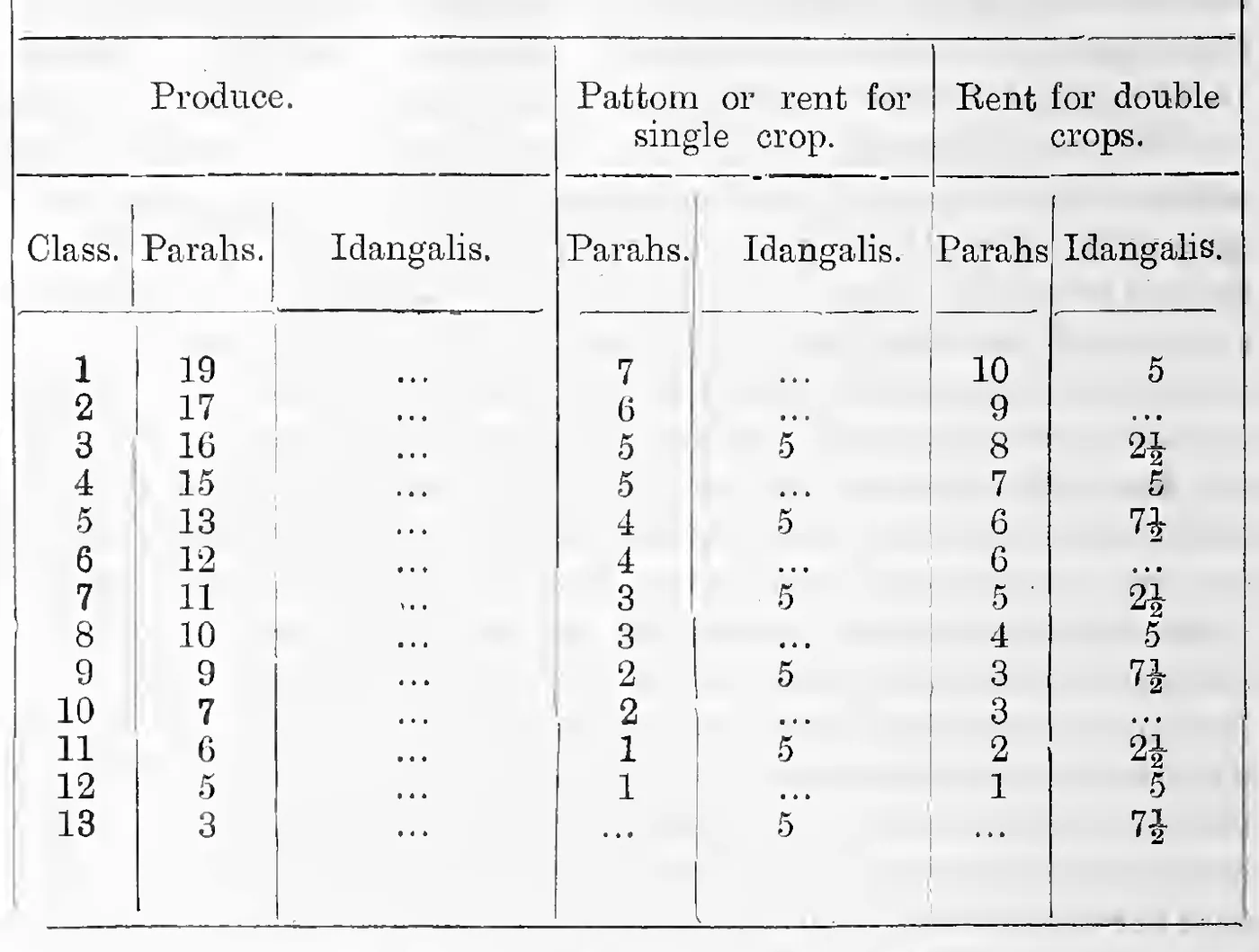
On working according to the above rates in the earlier taluqs the amount of tax fixed has been found materially differing from the old amount, hence subsequently the Government have ruled that the amount of the old tax also ought to be considered as a chief factor in fixing the new assessment. This rule is strictly adhered to. The assessment on a double crop is calculated at 1½ times the single crop rate and is divided between the collections of each crop equally. No additional tax was demanded if a third cultivation was ever made. Further it may be of note to mention here that the double-crop rate is demanded only for lands registered as such in Sirkar accounts the single crop lands cultivating a second crop in any year not being made liable for the additional demand probably on the ground that in the case of such lands a double crop is not a real [?] advantage to the ryot nor is there any system of the Sirkar maintaining an account of the cultivation of the lands from month to month. Although the assessment on paddy lands is fixed in quantities of the grain itself and was formerly collected wholly as such but now is partly so, [347]their commuted value is also shown in the accounts. This value was formerly different in different taluqs, but is now fixed at a uniform rate of 6 chs. per parah throughout the State.
Payment in kind or in money. The assessment on lands was in paddy and was in olden days collected all in grain, what the cause of it might have been is not now easy to decide with accuracy, probably the absence of a uniform coinage when the country was yet a group of principalities and other causes mentioned at the beginning of this chapter might have tended to its continuance for a long time. Dewan Ramiengar observes in his learned memorandum that "much of the state property had been alienated in favour of religious or charitable institutions and naturally the wants of these could be better met by contributions in kind than by payment in money. Besides such payments must have suited the pockets of a poor rural population better than money payments at a time when money was scarce and its purchasing power just the opposite of what it had been in the past quarter of a century. But in course of time a decline in the value of money and a rise in the prices of articles have turned the tables and rendered the continuance of the present system unsuited to modern times." This tendency of the times was perceived by the State early enough and changes were introduced but gradually so as not to take the people by surprise or inconvenience the supply to the religious or charitable institutions. Thus a fourth of the paddy tax was first converted into money and then one-half. This was not however introduced uniformly throughout the State on account of the varying conditions of the different localities and hence in different taluqs different proportions prevailed; in the same taluq too sometimes different rates existed for different villages and these proportions were also often disturbed by special orders issued from time to time. In the present Settlement these proportions were uniformly fixed for the whole State, which were with certain exceptions, at one half for the Trivandrum and Padmanabhapuram Divisions while they were one-fourth in kind and three-fourths in money for the Quilon and the Kottayam Divisions. But by a later Proclamation dated 13th Karkadagam 1064, M. E. (27th July 1888,) these exceptions have ceased to exist and the two sets of proportions are now prevalent in the northern and southern Divisions respectively.
Remissions and Pazhnilams. In the case of lands in Kuttanad bordering on the backwaters and those that cannot be cultivated every year on account of their being under salt water for nearly half the year and therefore require to be fertilised by the alluvial deposits [348]of the adjoining rivers, they are registered as cultivable once in two or three years and have to pay tax only for those years; but their assessment is entered in the Sirkar accounts annually as other lands, but subject to periodical remissions if not cultivated; when not cultivated in those years the same is ascertained by the village officials and remissions made in the accounts after reporting to the higher authorities and obtaining sanction. This entailed a regular examination field by field and report and correspondence and sanction had to be obtained for all the cases before the Kistbundi or the annual revenue demand statement could be closed. Hence in the course of the present settlement this kind of inspection and remission was abolished and the tax fixed for every year so as not to exceed the averages of former years.
Fallow remission for non-cultivation. Such remissions are not generally allowed; but they are recognised in respect of certain fields in Nanjanad alone, probably on account of such lands not being fit for cultivation every year.
Remission for failure of crops. This formerly used to be allowed in all the taluqs south of Trivandrum. But no such thing was recognised as a rule for the northern taluqs, there being no drought in northern or central Travancore and consequently no failure; but in cases of failure in those regions on account of too much rain or other causes, a concession was sometimes made postponing the collection of the Sirkar tax for that crop, to the next crop or year as circumstances required. But this was only as a matter of grace and not of custom or privilege. Such customary right recognised in the south of Trivandrum was in later times extended to the Taluq of Shencottah by a Royal Proclamation dated 4th Chingam 1070 M. E. (1894-95). According to this custom, the ryots in case of failure have to apply for remission by a particular date whereon the lands are inspected by the authorities and if found to have failed on account of proper causes, a remission of the tax for the particular crop is made.
Garden tax. The system of fixing the garden tax was from the earliest times to assess all occupied but unplanted land with a ground-rent called Payattupattom in the northern taluqs and Tarapattom in the southern taluqs. This rent varied from one (2 a.-3 p.) to ten fanams (Re. 1-7 as.) per parah in the northern taluqs while in the south it ranged from one to sixteen chuckrams per ploughshare, that is the extent of lands capable of being turned up by a plough in a day. The usual practice was for ground to be assessed with Payattupattom when first brought under cutivation, but when it was planted and the trees began to bear, the trees were assessed [349]and a tax imposed, the ground-rent being dropped. If, however, the trees planted were not bearing they were not taxed and the ground-rent alone continued. In the five Taluqs of the south Travancore, namely, Tovala, Agastisvaram, Eraniel, Kalkulam and Vilavankod, both tree and land taxes were levied at the same time, i. e., tax on bearing trees where they existed and tax on the land on which they stood was also levied.
Tree tax. Besides the cocoanut which was the most extensively grown and the most valuable of all the trees, there were also the areca, the jack, the palmyra, the tamarind, the punna, the mango, and the iluppa, yielding revenue to Government. Cocoanut was taxed throughout the State but the other trees were assessed early in certain parts of the State where they grew in abundance. Thus in the Quilon and Kottayam Divisions only the areca and the jack were assessed. In the Trivandrum Division, the palmyra was also included while in the southern taluqs all the 8 kinds of trees above named were brought under assessment. The rates of assessment for the various kinds of trees varied in different parts of the country. Thus in the Taluq of Chirayinkil, the areca and jack had been lightly taxed at the rate of 8 cash and 4 chuckrams respectively per tree. In the southern taluqs the jacks were divided into five classes, and had 24 different rates of assessment. The tax on areca varied from taluq to taluq. However under the Hookumnamah issued about 1012 M. E. (1836-37) a uniform rate was fixed on all trees other than the cocoanut, the jack and the areca. The rates were on an average as follow:—
- Palmyra ... ... 7 cash
- Punna ... ... 12¾ cash
- Mango ... ... 12 cash
- Tamarind ... ... 3 chuckrams
- Iluppa ... ... 1 chuckram
For the cocoanut which was the chief garden cultivation an elaborate classification was made. They were divided in the Settlement of 978 M. E. (1802-03) and 1012 M. E. (1836-37) into 4 classes and assessed at 4, 3, 2½, and 2 chs. respectively per tree. These rates were introduced in North Travancore; in exceptional cases, however, the fourth class was also assessed at 1½ chuckrams. But in the taluqs south of Quilon, the old state of things continued, the first class trees themselves being variously assessed at 8, 7, 6, 5, 4½, 3½, 3, and 2 chuckrams, while for the second class there were 3 rates of 4, 3½, and 3 chuckrams in Tovala, 3 and 3½ in Eraniel, 3 chuckrams in the Agastisvaram and Kalkulam Taluqs, 3 and 2½ chs, in Vilavankod, Neyyattinkara, Trivandrum and Chirayinkil and [350]2 chs. in the Nedumangad Taluq. There were similar variations for the 3rd and 4th classes also. These rates had been calculated at one-fourth the produce of such trees which had however to be gauged from the number of bunches of nuts and madals or fronds. Thus trees with 8 to 12 bunches and 30 to 64 fronds were placed in the 1st class.
5 to 7 bunches of nuts with 24 to 29 fronds in the 2nd class.
3 to 5 bunches of nuts with 16 to 23 fronds in the 3rd class.
2 to 3 bunches of nuts with 15 fronds in the 4th class.
Their elaborate classification led to much abuse and confusion of accounts. There was the further difficulty under the system of periodical remissions for enhanced rent to know for certain how many trees in a garden had come into bearing during the preceding 12 years. In the case of garden lands under pattom tenure, there was a further complication caused by deduction on account of Naduvukur or the planter's share or compensation which was generally 1/4 of the pattom or full assessment, but there were cases in which it was allowed at 1/3, 1/2, 2/3, 5/8, and 7/10. Another feature of the old assessment of garden lands was that in the case of the cocoanut and the areca the tax took the form of a portion of the produce. They were taxed at so many cocoanuts or so many fronds or both and so many nuts for each tree. This obtained in some taluqs and there were rates of cocoanuts and fronds for each class of cocoanut trees and for areca also, six distinctive rates of forty, thirty, twenty-five, twenty, fifteen and ten nuts for each tree. Cocoanut-oil was another form in which the garden revenue was assessed and levied. In the Taluqs of Chengannur, Vaikam, Ettumanur, Alangad, Parur and Shertallay, tax was levied in the shape of so much oil per tree on those set apart in certain gardens for the sovereign's due or at rates varying from 7 (4 as) to 9 chuckrams (5 as) when the Sirkar was not in need of oil. On failure to supply, the price at the current rate was to be collected and again there was inequality and unfairness in the commutation prices varying from 5 fs. (12 as) to 10 fs. (Rs 1-7 as) per 100 cocoanuts. A further and curious development of this system of payment in kind obtaining in the seven Taluqs of the Trivandrum and Padmanabhapuram Divisions was that the tax fixed in money was payable, partly in money and partly in kind the latter however consisting not of the produce of the tree taxed but of articles entirely foreign to it, such as pepper, ghee, betel or plantain leaves and fruits.
The above anomalies which gave room for abuse called for correction, and with that view to secure uniformity throughout the State, it was resolved in the Settlement now in progress to have gardens throughout the [351]State divided into blocks with reference to their situation, soil and productiveness and each garden charged with a distinctive rate carefully determined, but not to exceed 4 chs. (2¼ as) or fall short of 1 chuckram (½ a.) for every cocoanut tree. The tax on the jack and the areca was made uniform throughout the State and palmyra, punna, tamarind and mango trees were declared liable to tax only in certain places. Tax on the Iluppa was totally abolished as also the assessment in kind. The system of periodical revisions and Naduvukur was also abolished, the present settlement being declared permanent for 30 years. The rates for garden lands classified under 13 heads and those for the different classes of cocoanut trees and the uniform rates for the other kinds of trees are shown in the accompanying tabular statement.
Statement of garden assessment and rates for trees.
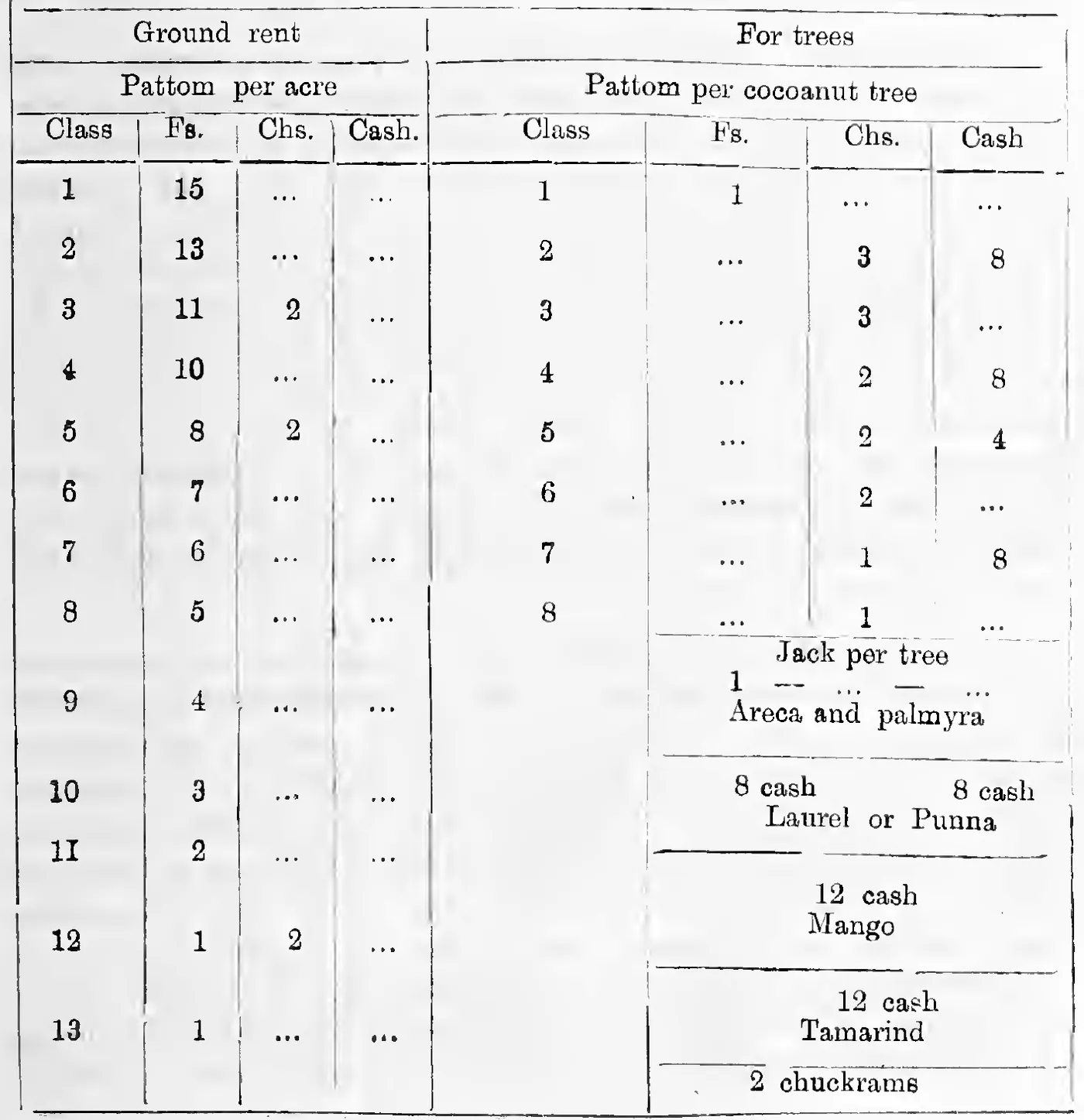
[352]Besides the garden and paddy land assessment in vogue throughout the State there were special rates obtaining under special conditions of grants for cultivations. Under this head, come the planter's estates which are taxed at the low rate of 12 as. per acre. In the case of cardamom estates in North Travancore a concession was made to levy tax at Re. 1 per acre for 3 years and after that period an assessment of Rs. 6¼ per acre was imposed. With a view to encourage reclamations from backwaters, a concession was made to allow cultivation free of tax for five years and to levy half-seed assessment until the next settlement. Another notification dated the 8th Mithunam 1063 M. E. (1887-88) allowed cultivation of tea on low elevations by natives of the country free of tax for five years and on payattupattom tax thereafter. Similar concessions were allowed for putuval or waste lands as well as for the registry of escheated and Pokudi or abandoned lands.
Extra cesses. Besides the land revenue properly so called, there were numerous petty extra taxes leviable on gardens as well as paddy lands. So many as about 100 of them were abolished in 1040 M. E. (1864-65). There were still more than 200 such taxes. Some of them were also personal in character while others were attached to lands and holdings. Many of these had since been abolished and a list of those still remaining at the time the present Settlement began is hereto annexed as statement A. In the present Settlement all cases which are personal or relate to profession as well as those falling on those who pay the full assessment for their lands are abolished. They are retained where the tax is less than the full pattom and incorporated with the full demand. A statement marked B. giving the revenue of the State, for garden and paddy lands since 1040 M. E. (1864-65) is hereto annexed to show the gradual growth of the revenue under these heads.
Collection. The taxes on paddy lands and gardens as well as the extra cesses above mentioned are collected by the Sirkar agency appointed for the administration of revenue. The tax on garden lands whether payable in kind or money was divided into 10 equal instalments beginning from the first month of the official year, i. e. from Chingam to Edavam corresponding to the months from August to May. On the other hand, the tax on paddy lands for the first or Kanni crop is collected in 4 months from Chingam to Vrischigam while that of the second crop is collected during the next four months, Magaram to Medom. However in some of the northern taluqs where instead of the Kumbham crop, they have the Minam or Medom crop, the instalment commences [353]in Minam and ends in Edavam in some exceptional cases running up to Mithunam also. Unlike the tax on garden lands, that for paddy lands of any crop is not equally divided among the instalments for that crop. The one-fourth or one-half assessment payable in kind is distributed over the several instalments of the crop but the portion payable in money is generally reserved for the last two instalments or one. This is an advantage to the ryot as at some distance of time from one harvest and before the commencement of the next, the prices of food grains are sure to be high and the ryot can then pay off his demand with the least quantity of paddy. In the collection of each instalment, the amount of money or the quantity of the paddy is required to be paid before the expiry of the month, failing which a demand notice is issued from the taluq calling upon the party to pay within a fixed time and stating that coercive process of recovery will be adopted if not so paid. The procedure of collection, &c., is now regulated by Regulation I of 1068 M. E. (1892-93) under which any arrears of revenue can after notice of demand be levied by distraint and sale of movables belonging to the defaulters or failing which by the attachment and sale in whole or in part of the immovable property in respect of which the arrears are due. In case of default in paddy tax the niruk or current market value of paddy and not the commutation rate of 6 chs. per parah will be demanded. According to the Regulation, the land, the buildings on it and its products are regarded as security for the public revenue on such land and such revenue is considered the first charge on the land and shall take precedence of every other claim.
Sri Pandaravaga lands. The assessment on the Sri Pandaravaga lands belonging to the Sri Padmanabhaswami's temple at Trivandrum is fixed like other Sirkar lands and are collected likewise, but there is this difference in that the whole tax for these lands has to be paid in kind except in Nanjanad where in connection with the recent Settlement the tax on Sri Pandaravaga lands is ordered to be collected one-fourth in money and three-fourths in kind.
Sripadam lands. In the same way, the tax on lands in the Attungal and Edakod Adhikarams belonging to the Sripadam palace or the Ranis are assessed likewise and the revenue collected in the same manner though by a different agency viz the Sripadam Manager and his subordinates.
Kilimanur and Edapally estates. The arrears of rents due to the estates of Kilimanur and Edapally though not belonging to the State are in accordance with old practice ordered by Regulation IV of 1068 M. E. [354](1892-93 A. D.) to be assessed as Sirkar lands and their revenue to be collected as arrears of public revenue. The local village officers, in these tracts collect the revenue demand in ordinary course and when these fall in arrears an application is made to the Tahsildars in whose jurisdiction such estates are situated for notice of demand. Further proceedings for the recovery of the arrears are taken under the orders of the Tahsildar as in the case of the arrears of public revenue:—
[355]
Statement A.*
Extra cesses Pandaravaga and Devaswom gardens.
Statement of extra cesses of gardens as per Ayacut of 1014 M. E., Travancore.
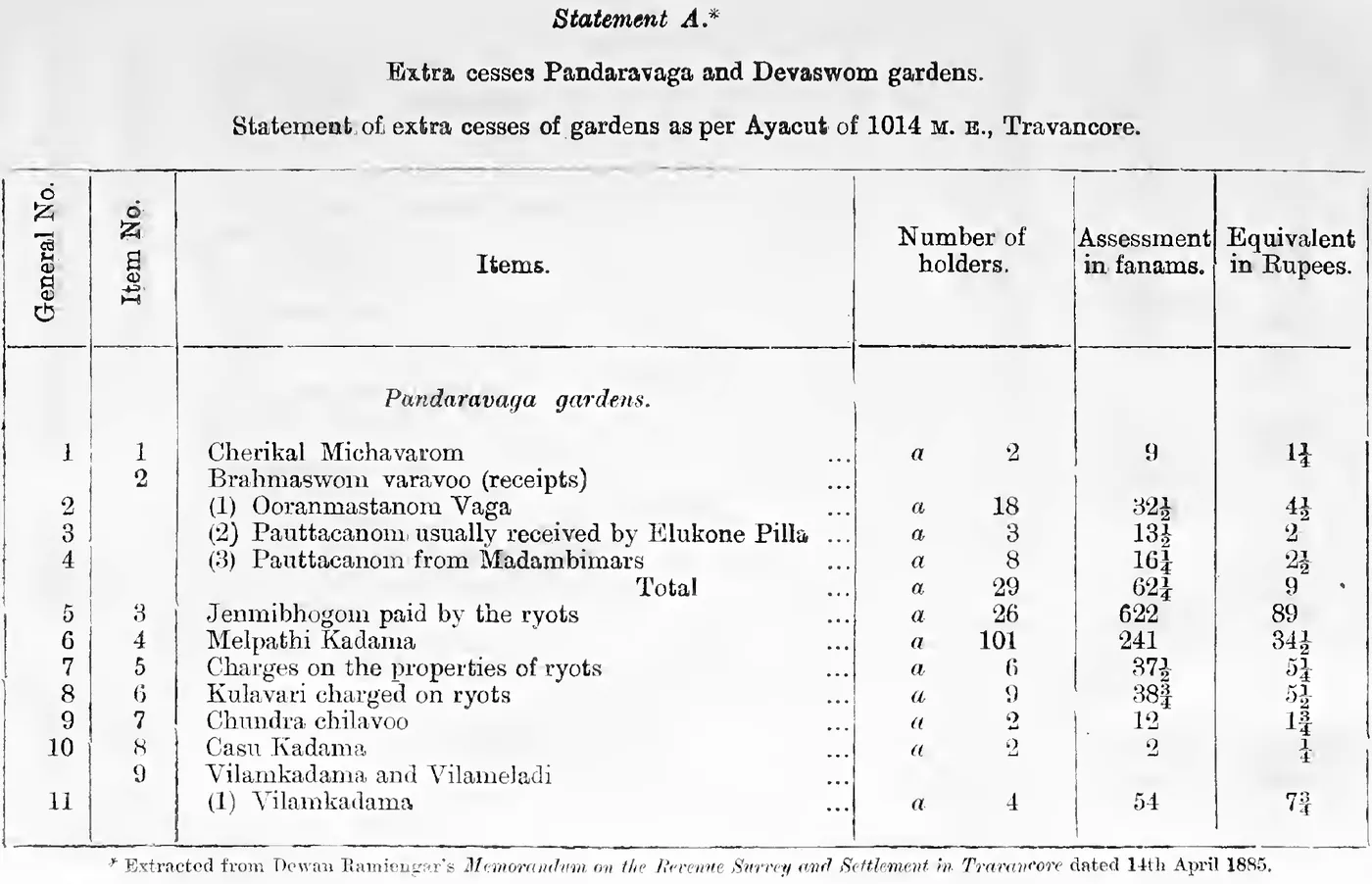
* Extracted from Dewan Ramiengar's Memorandum on the Revenue Survey and Settlement in Travancore dated 14th April 1885. Besides this amount, Rs. 325 in wet lands and Rs. 1,183 in Shencottah have been remitted in extra cess under the Proclamation, making the total remission Rs. 12,302.
[356]
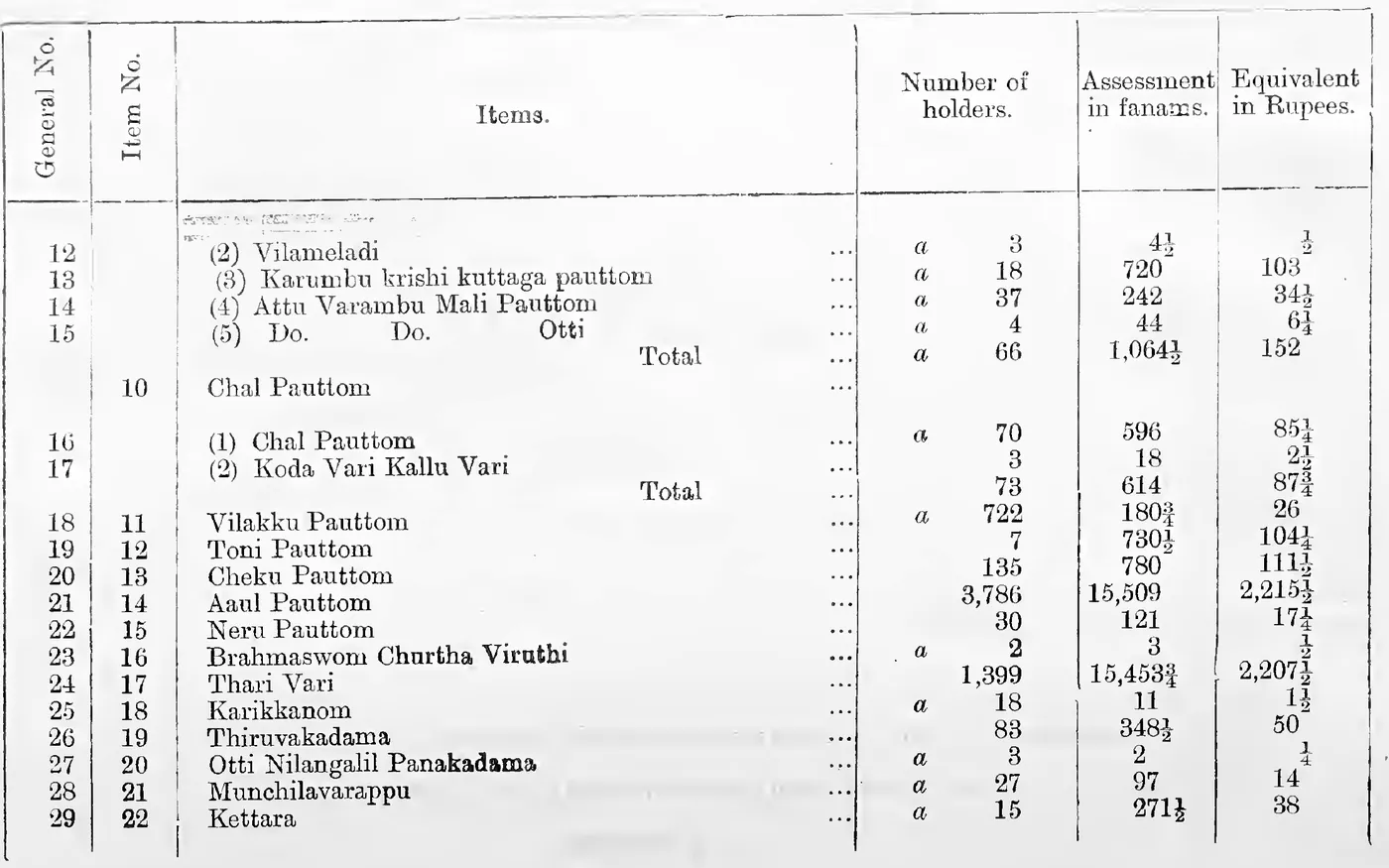
[357]
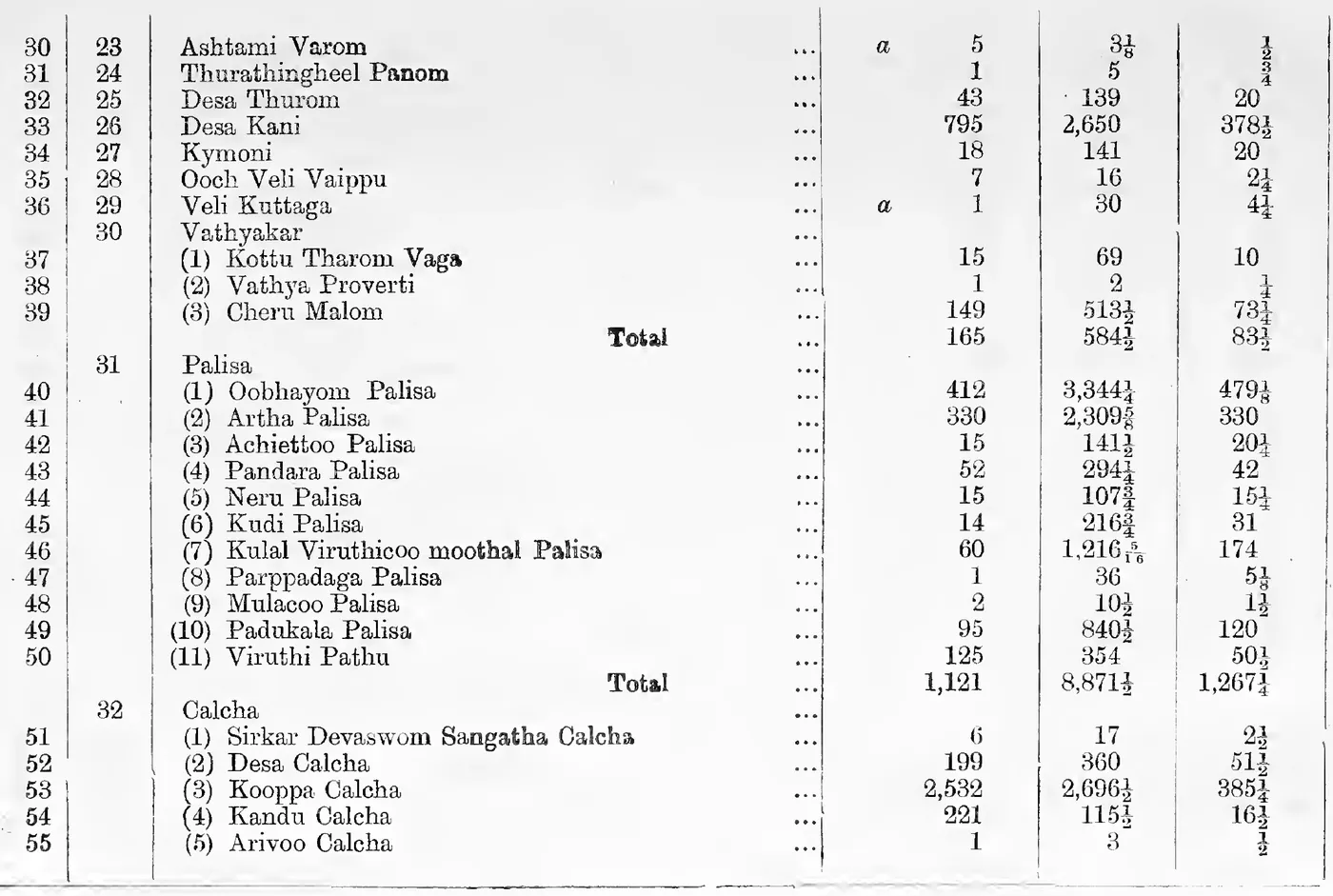
[358]
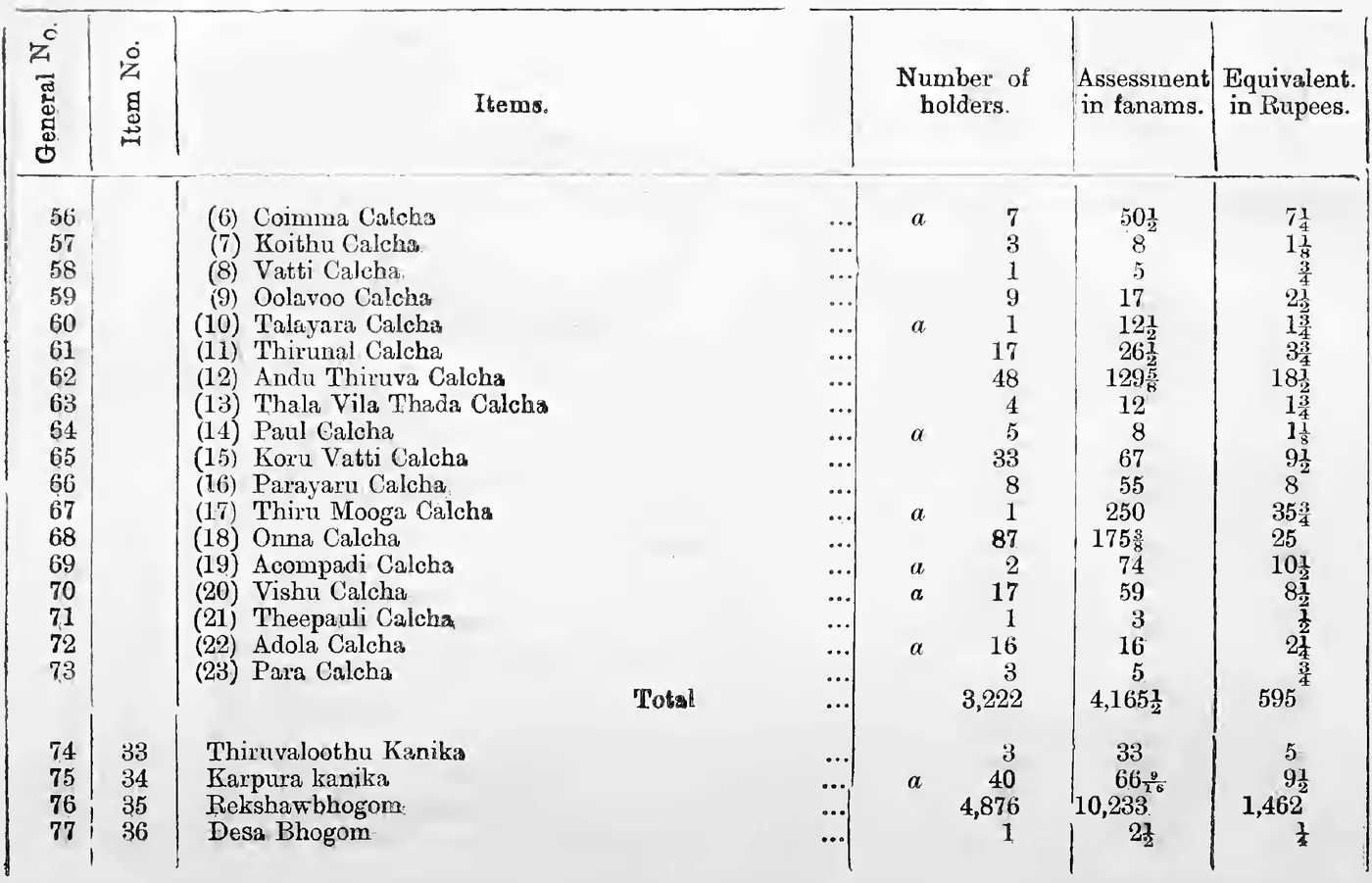
[359]
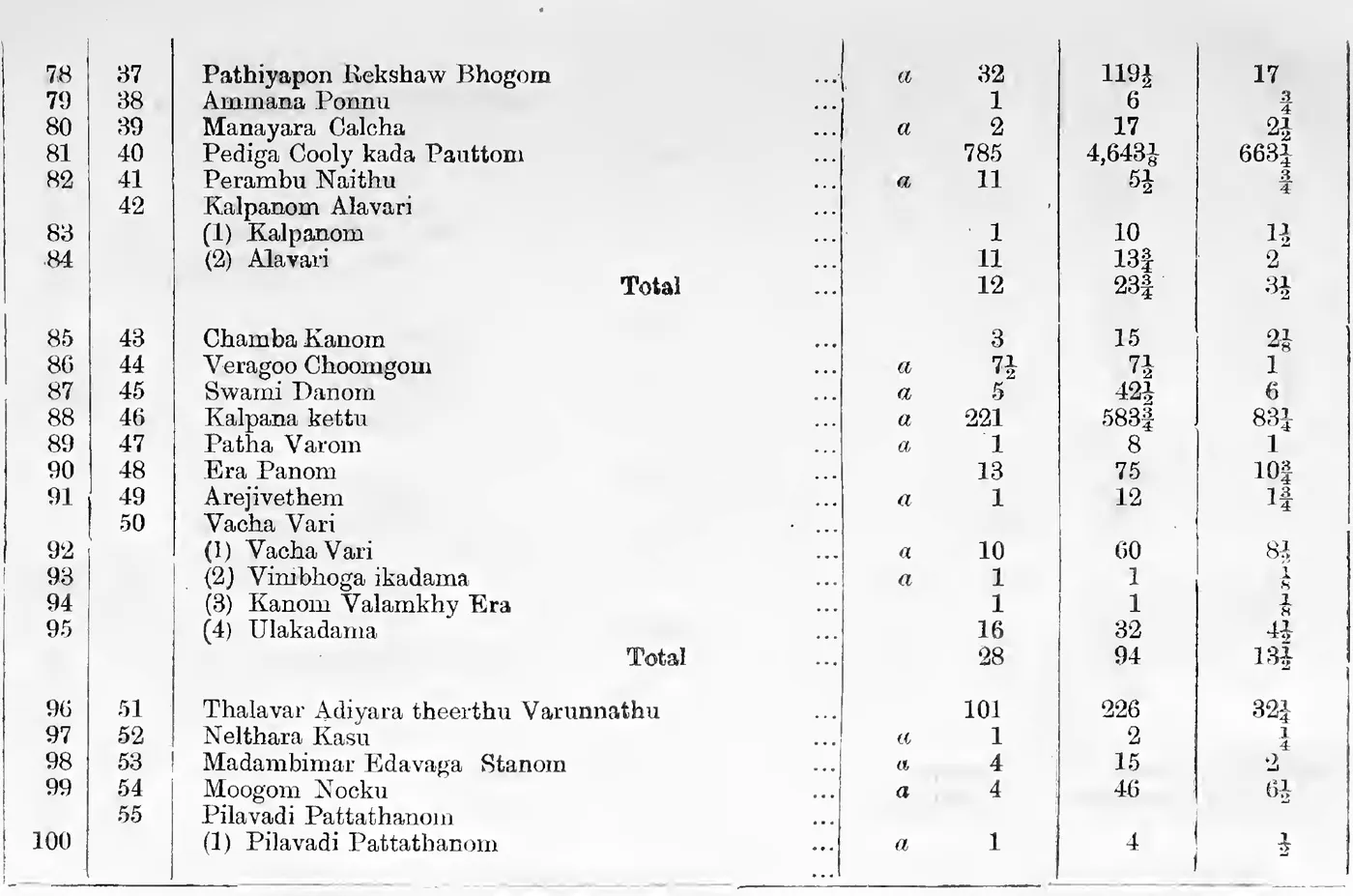
[360]
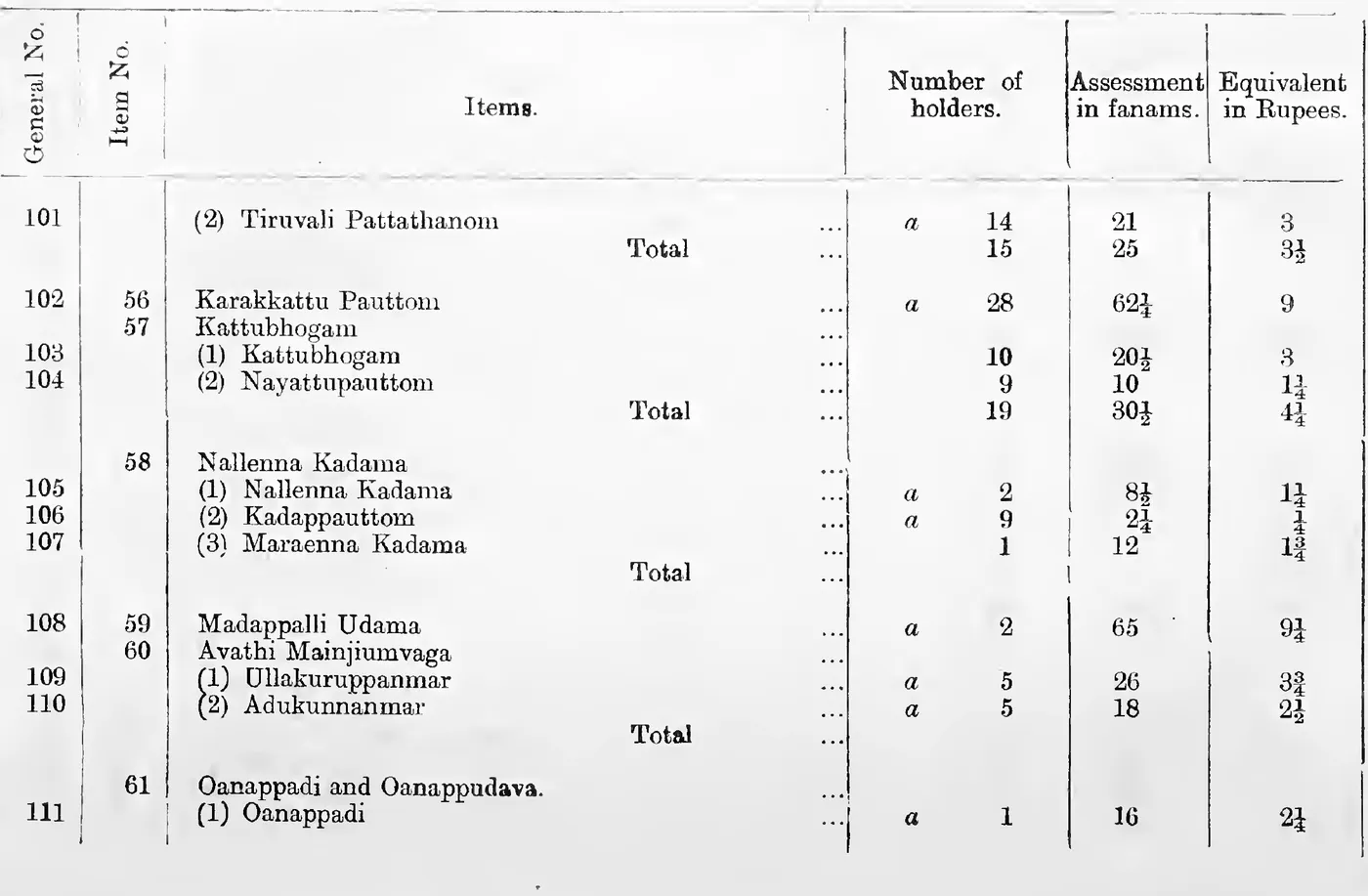
[361]
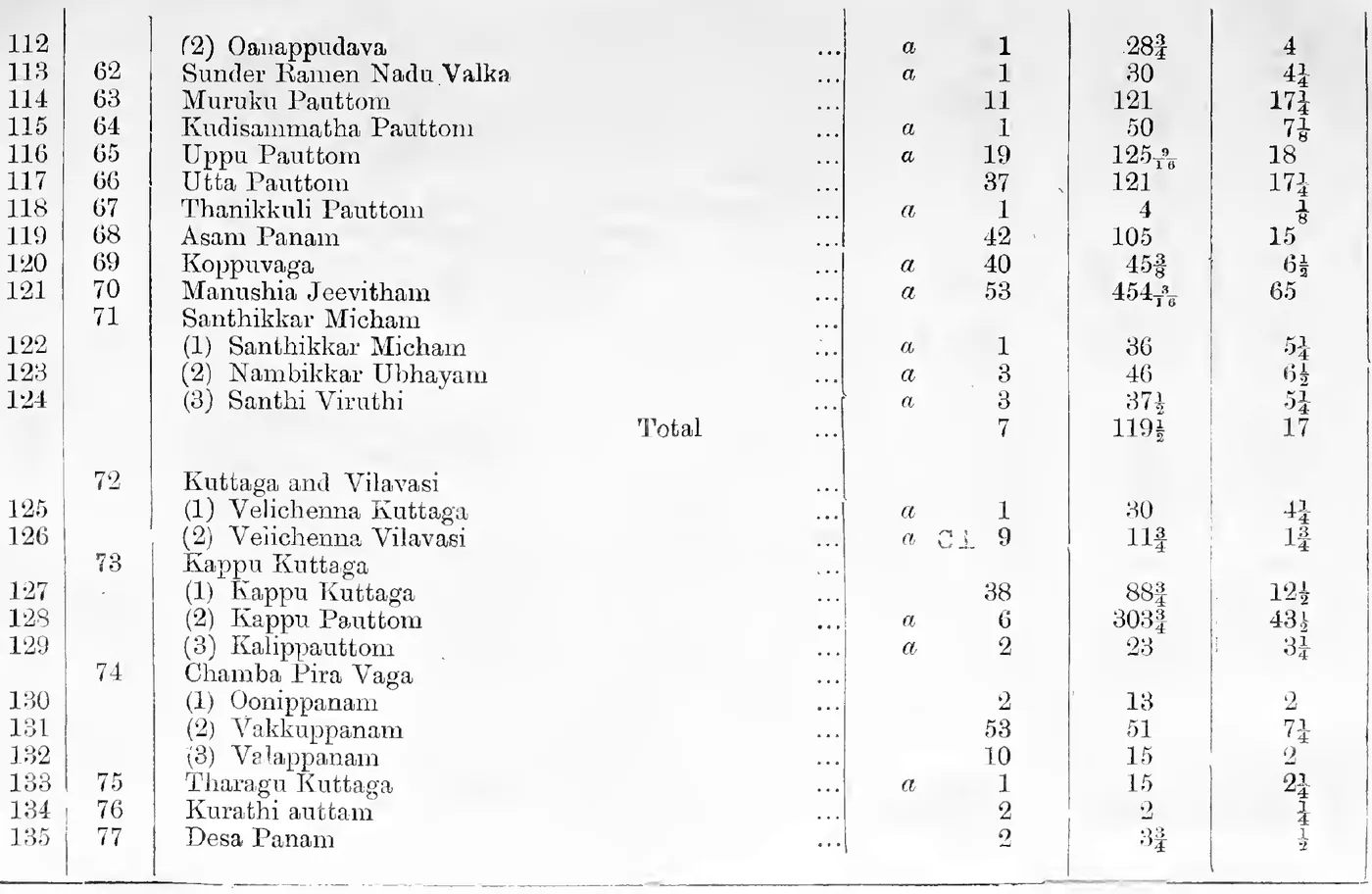
[362]
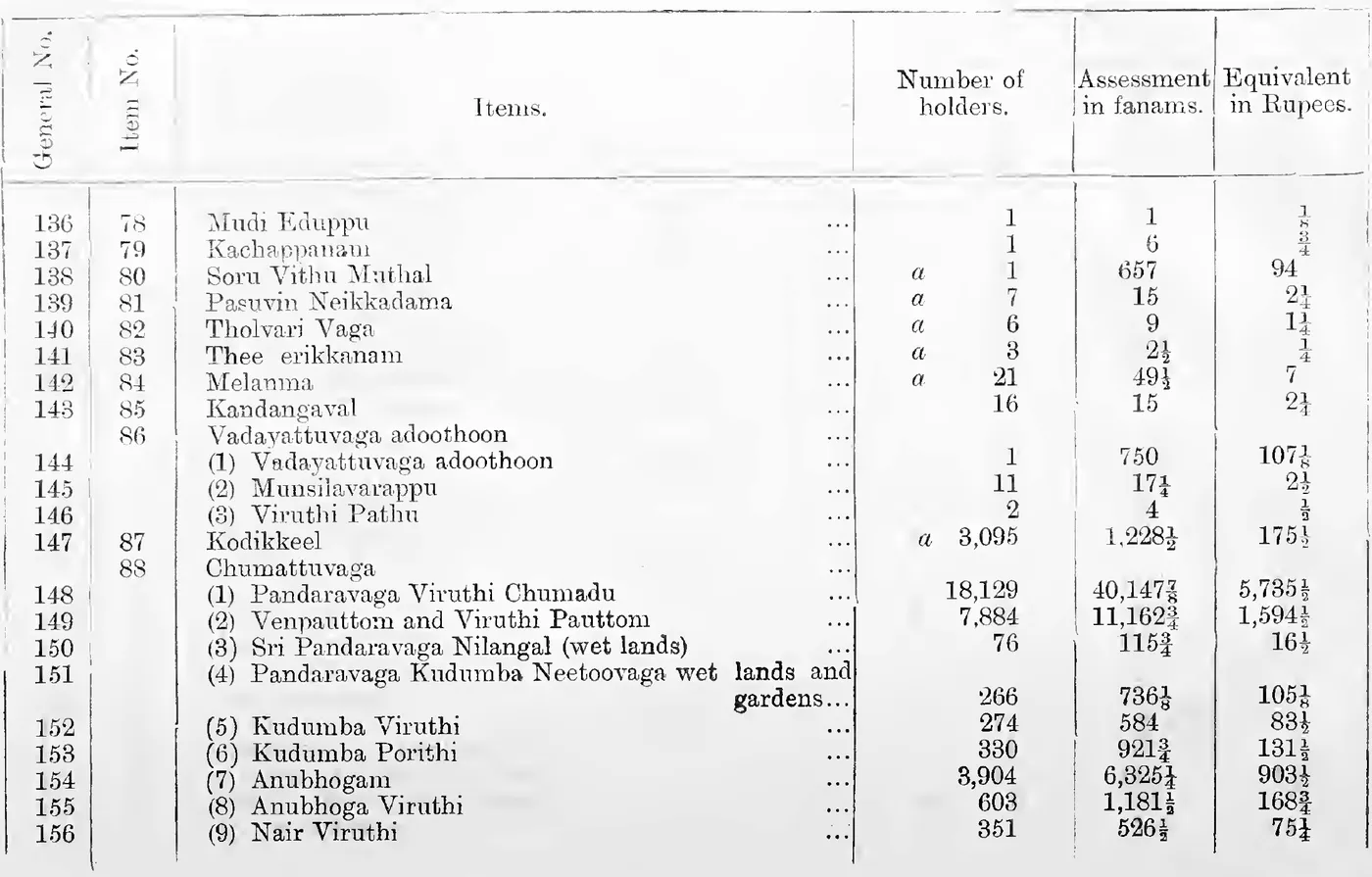
[363]
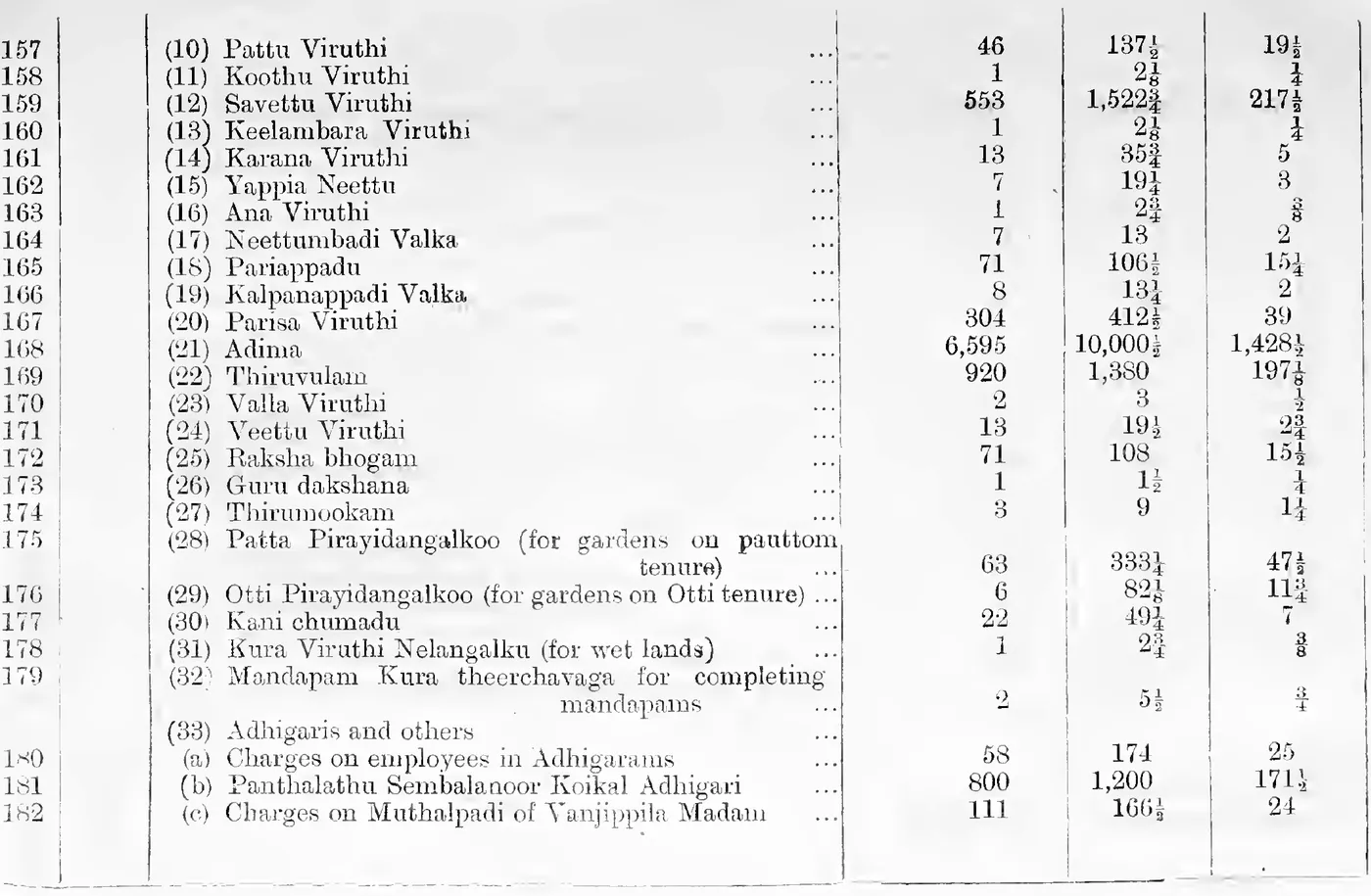
[364]
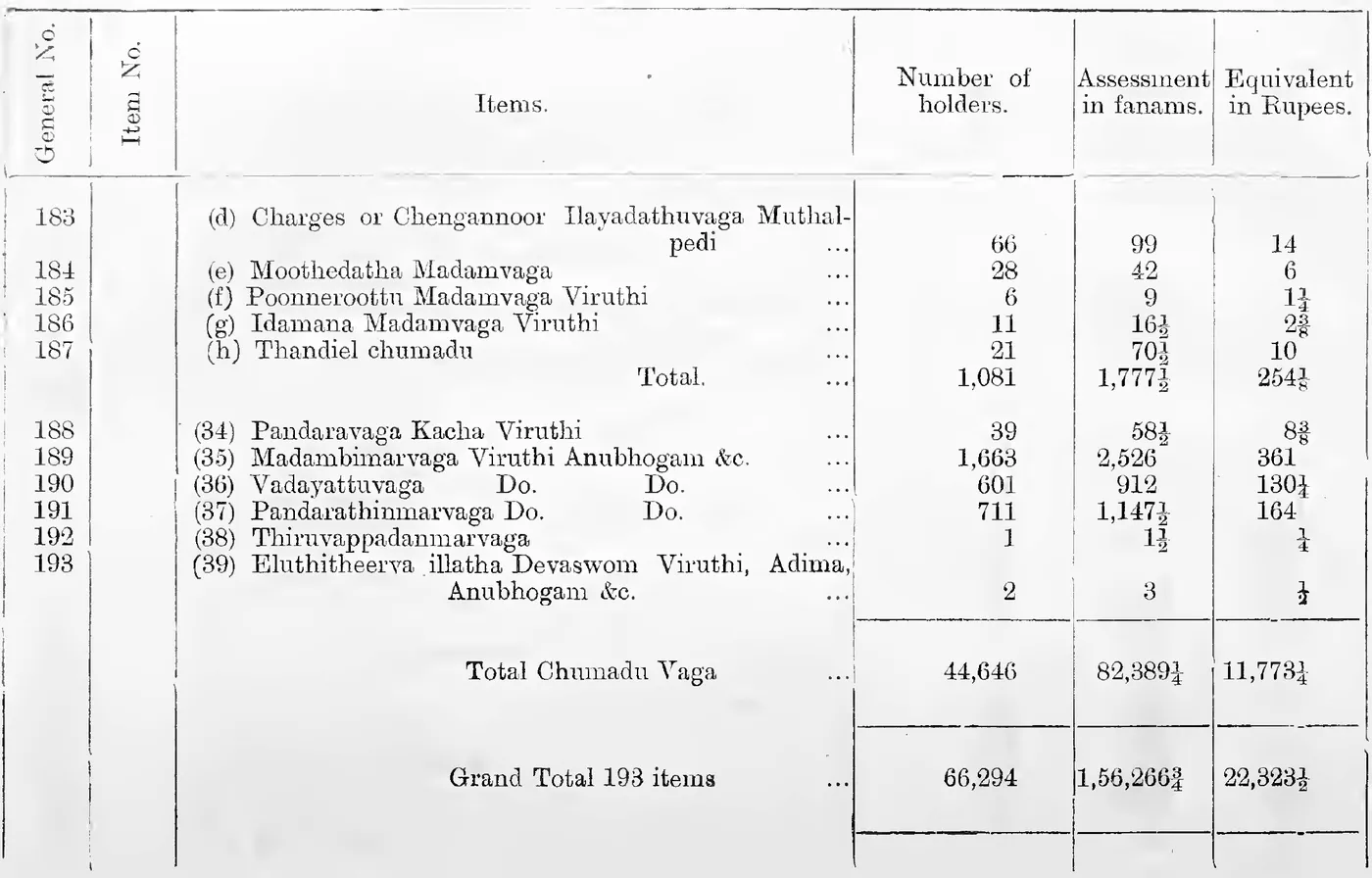
[365]
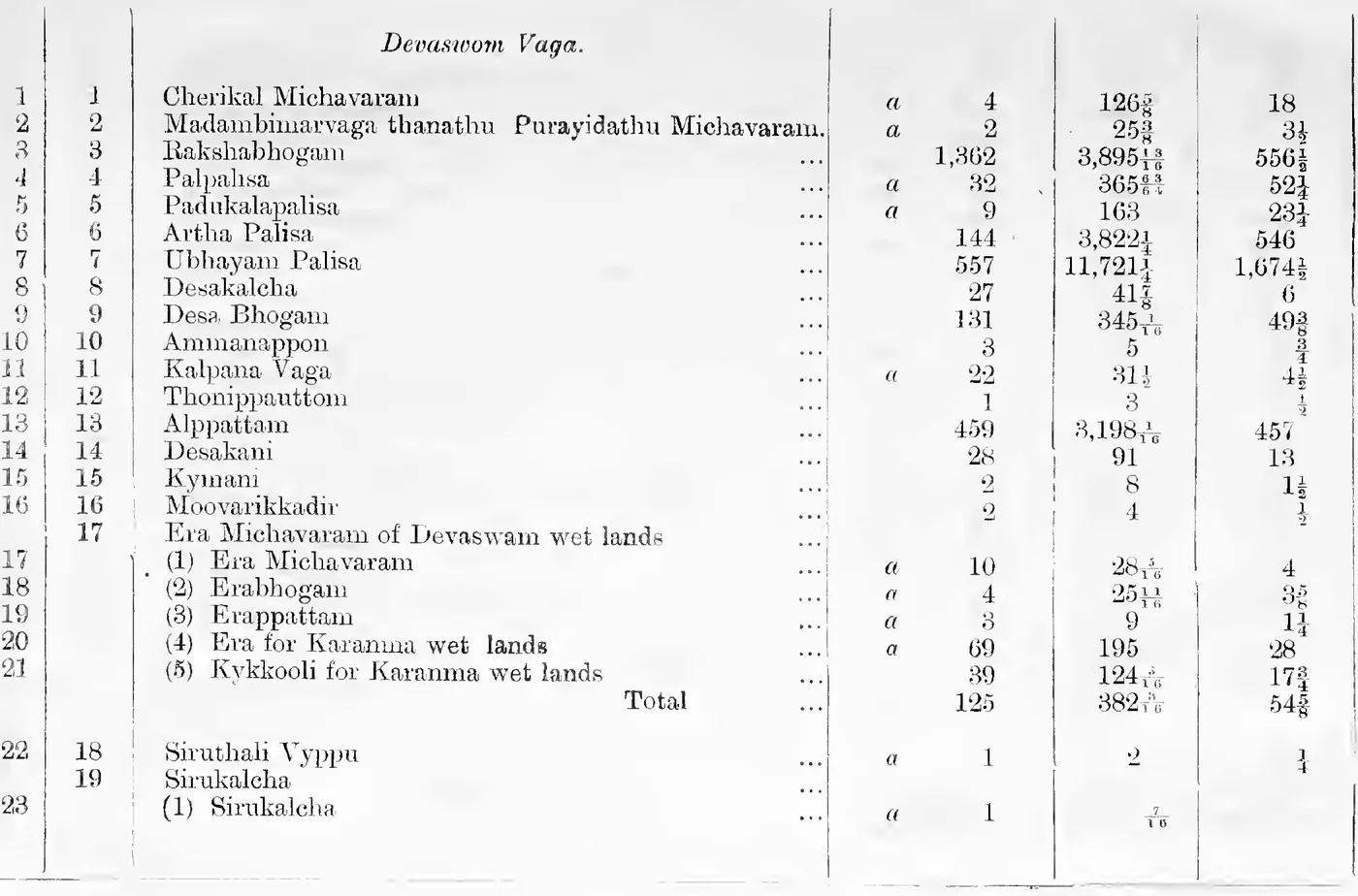
[366]
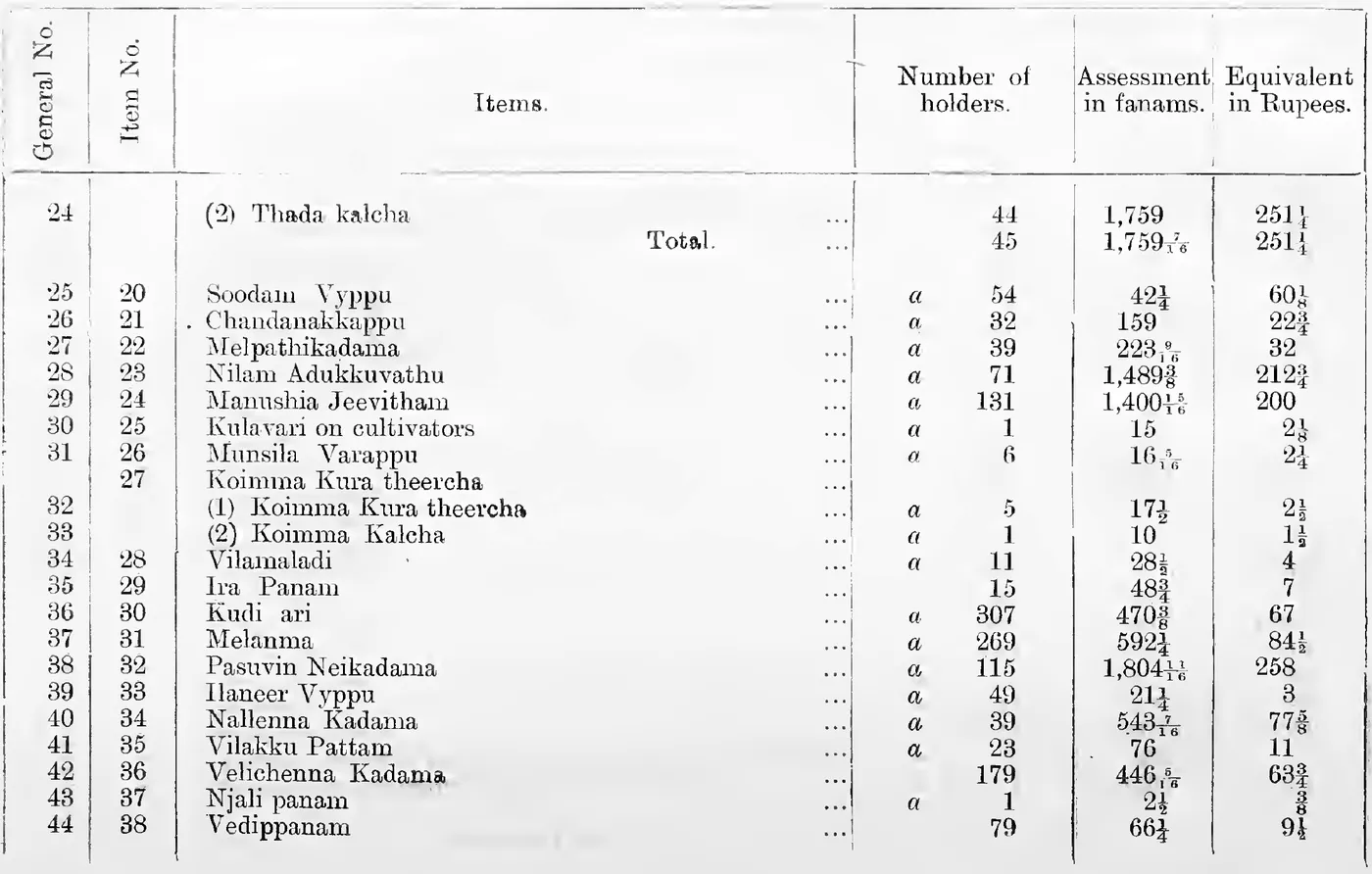
[367]
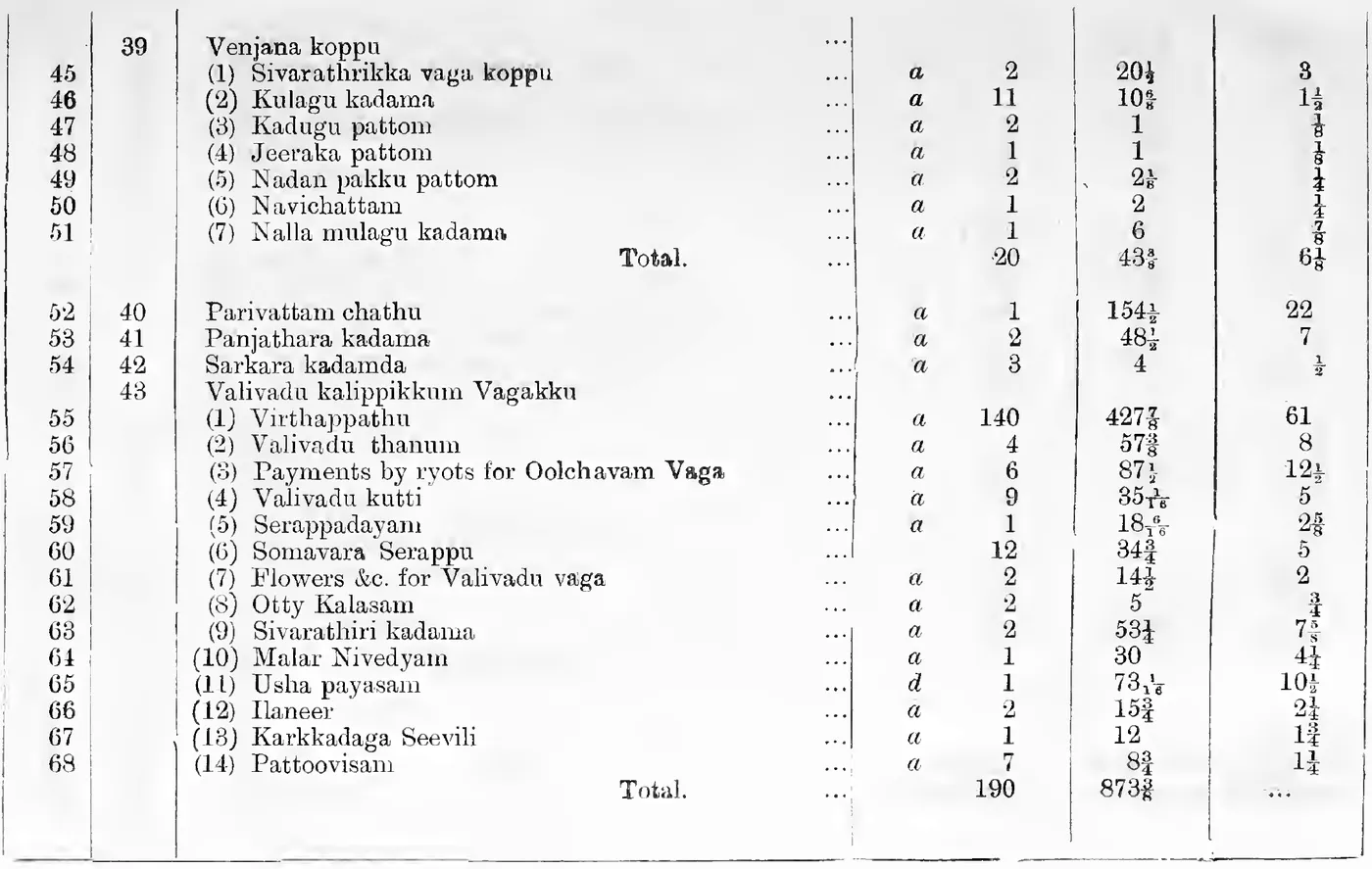
[368]
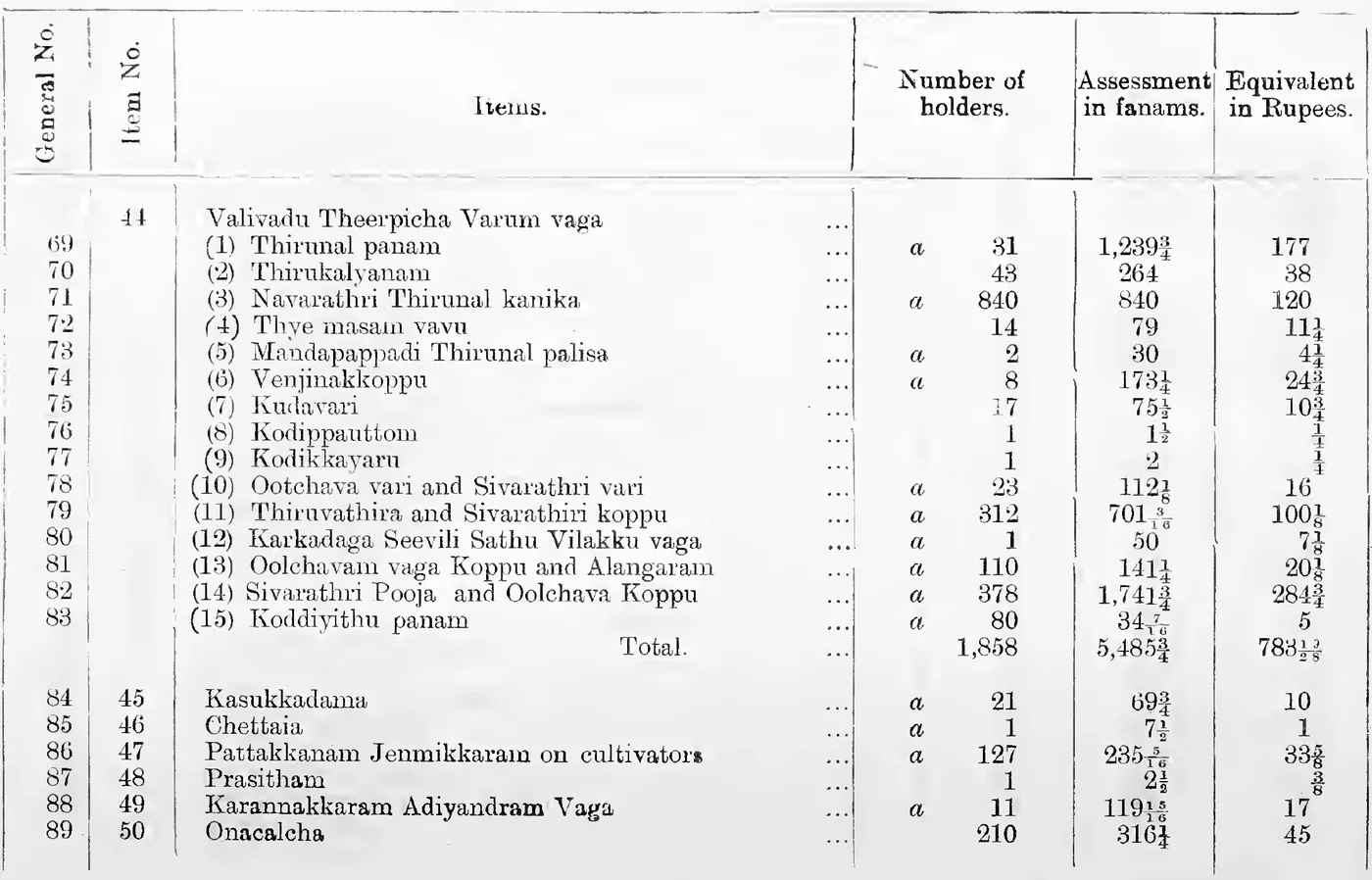
[369]
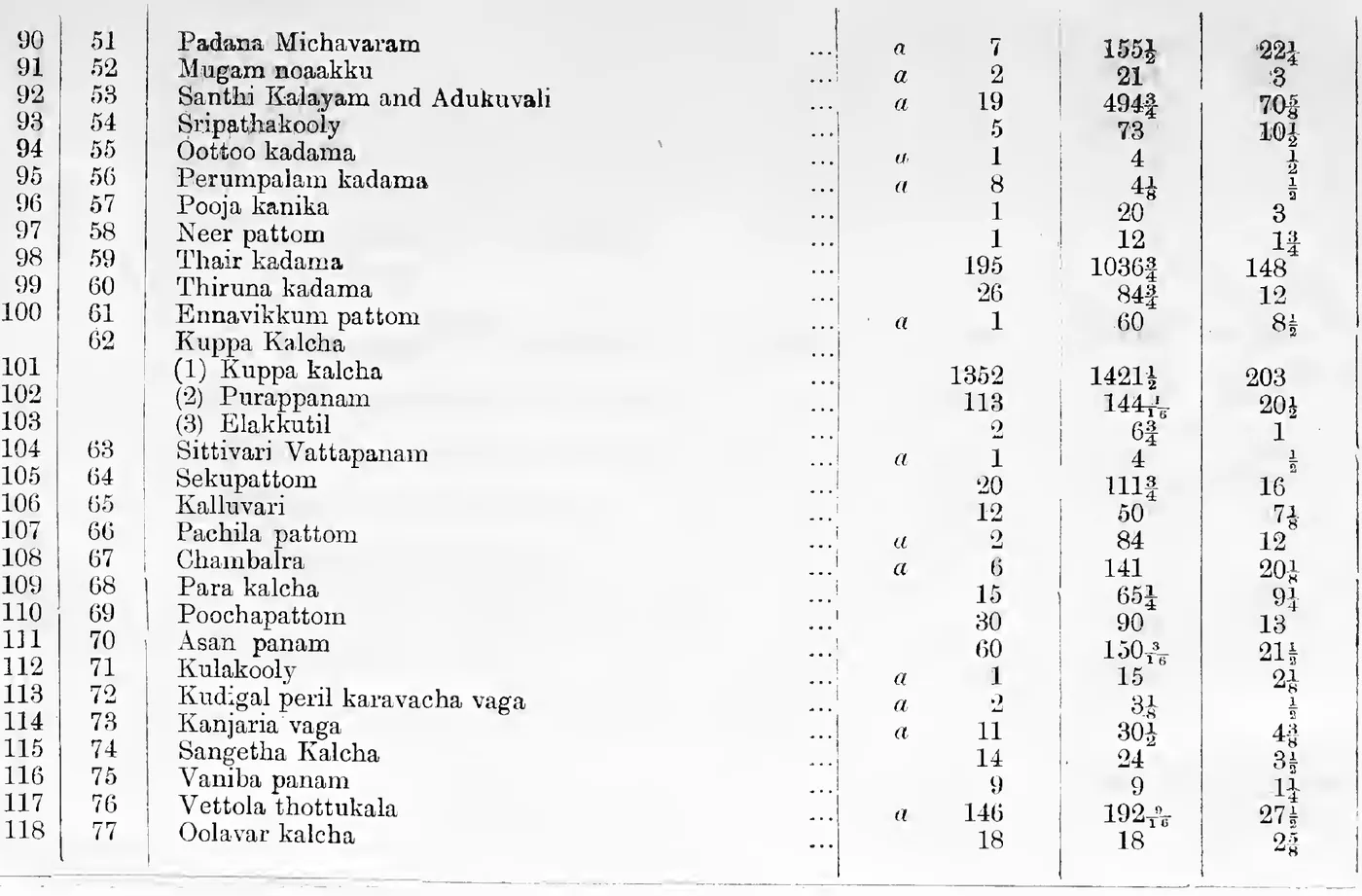
[370]
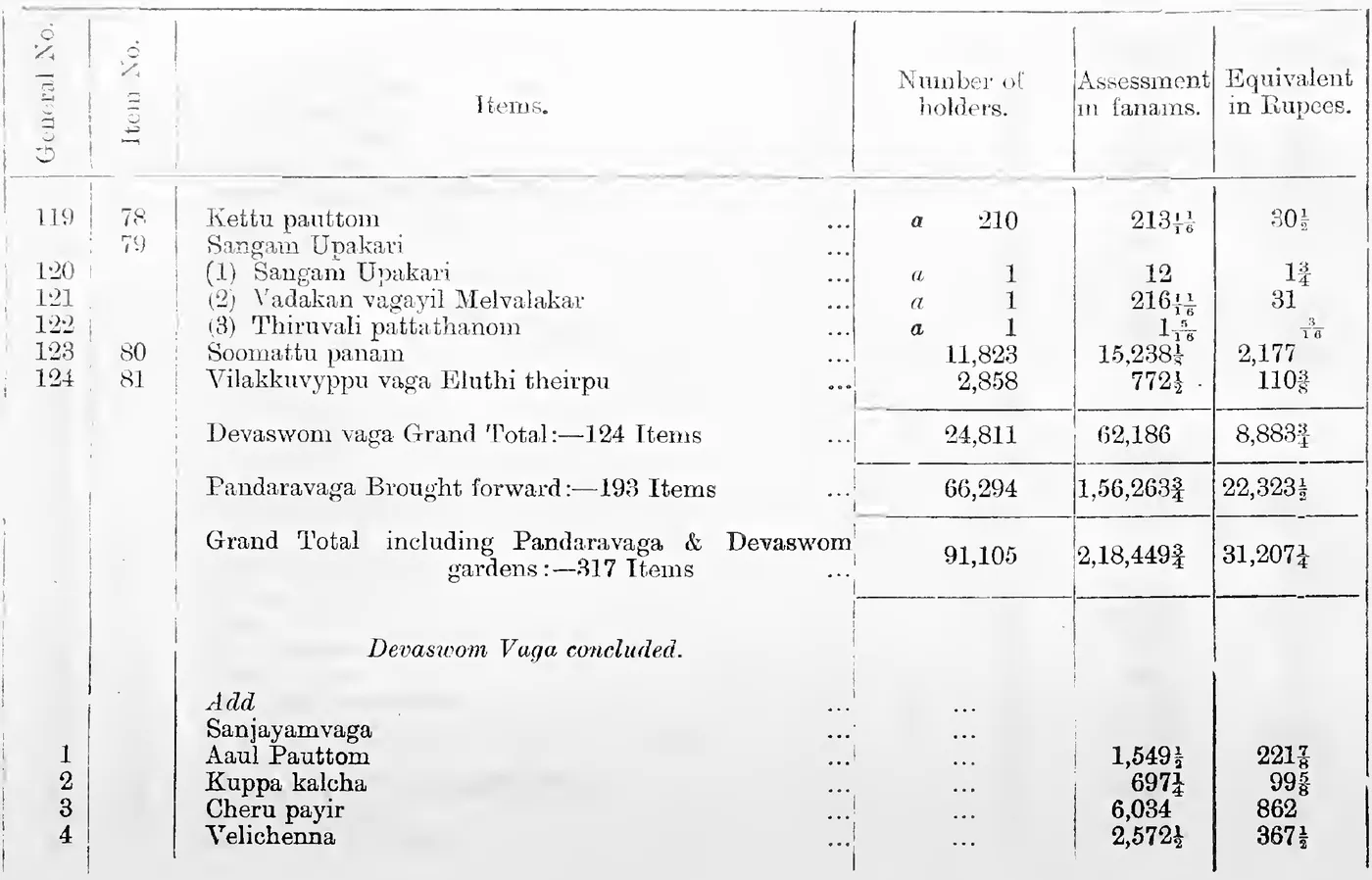
[371]
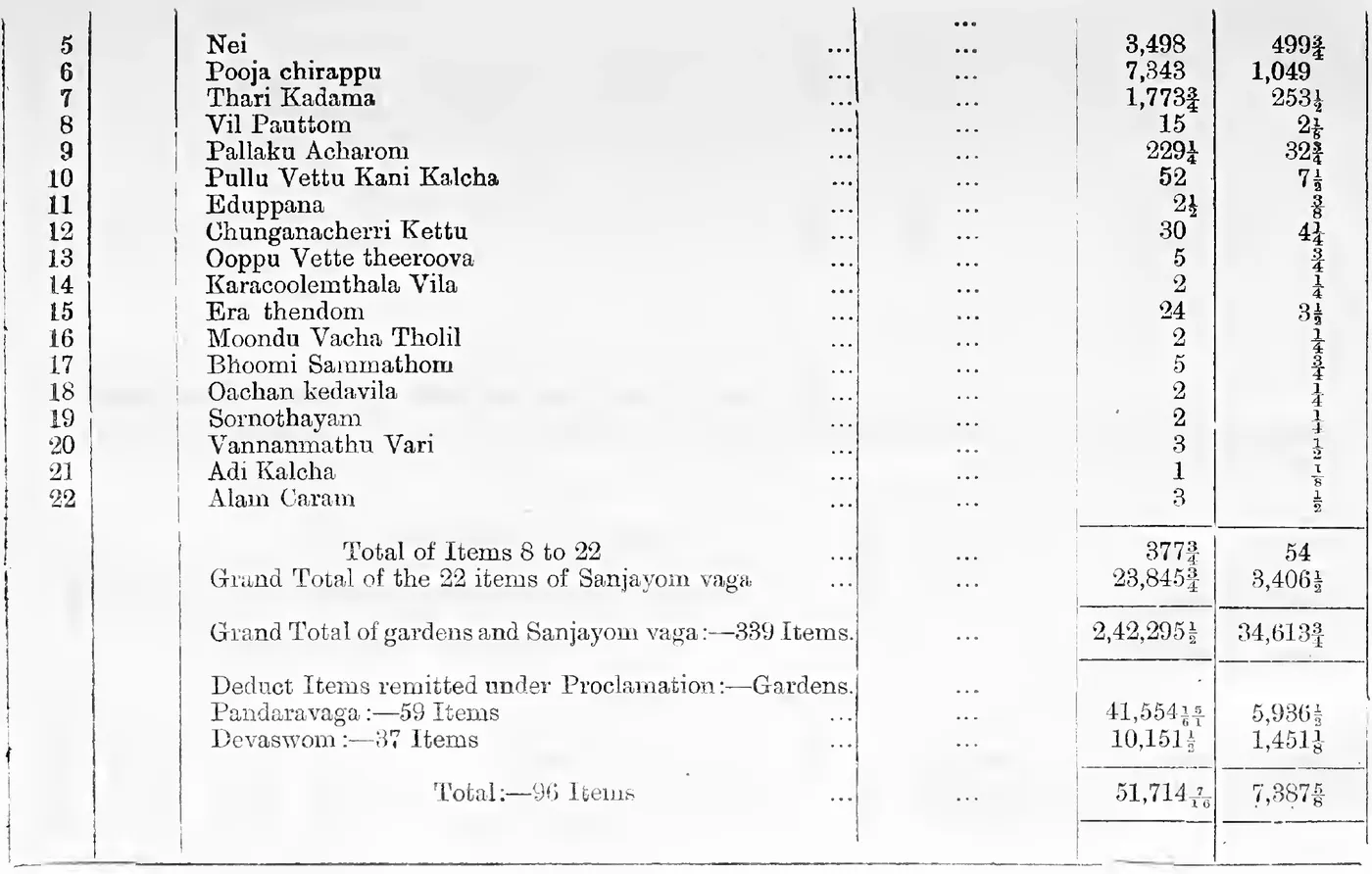
[372]
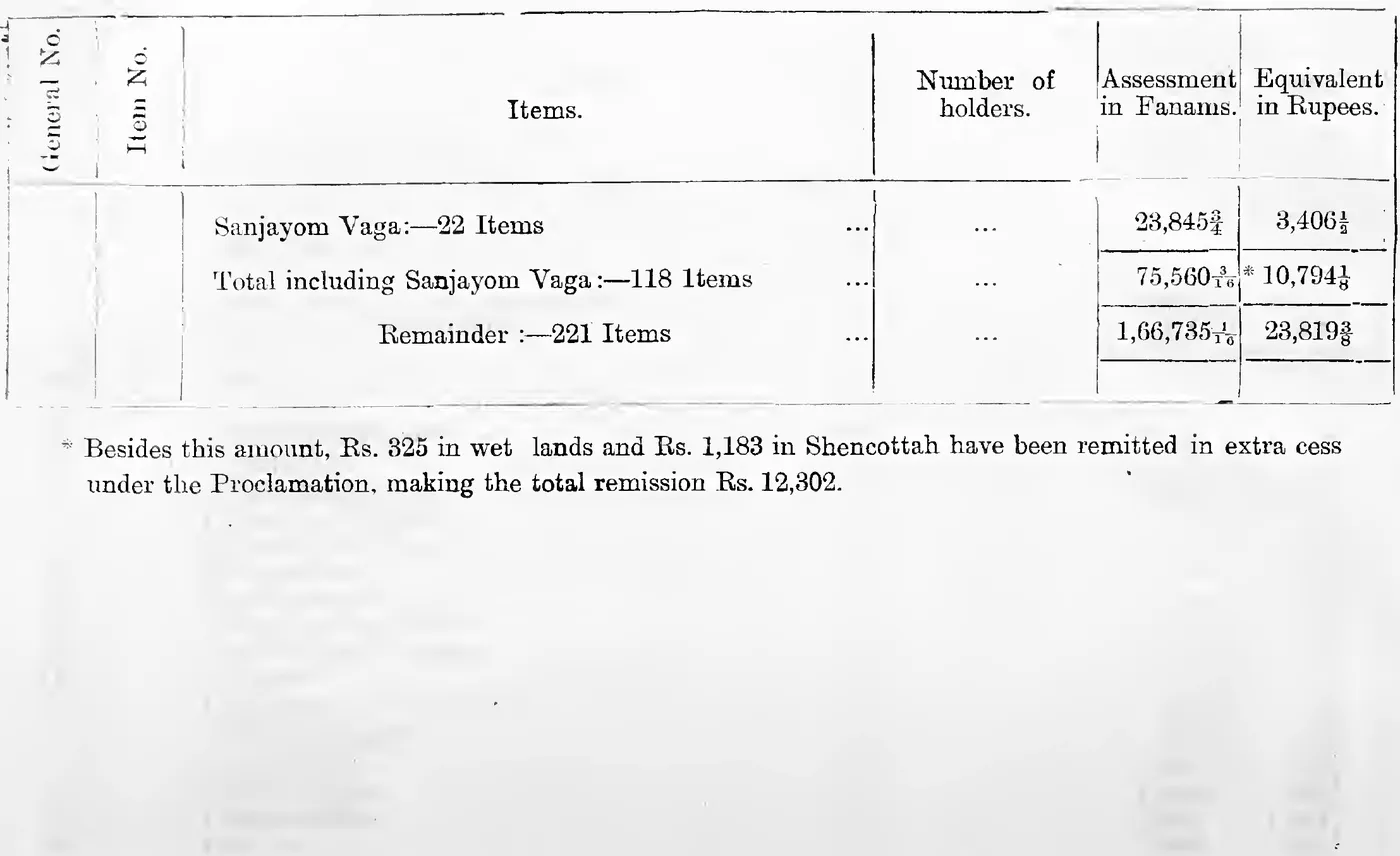
[373]
Statement B. of Land Revenue.
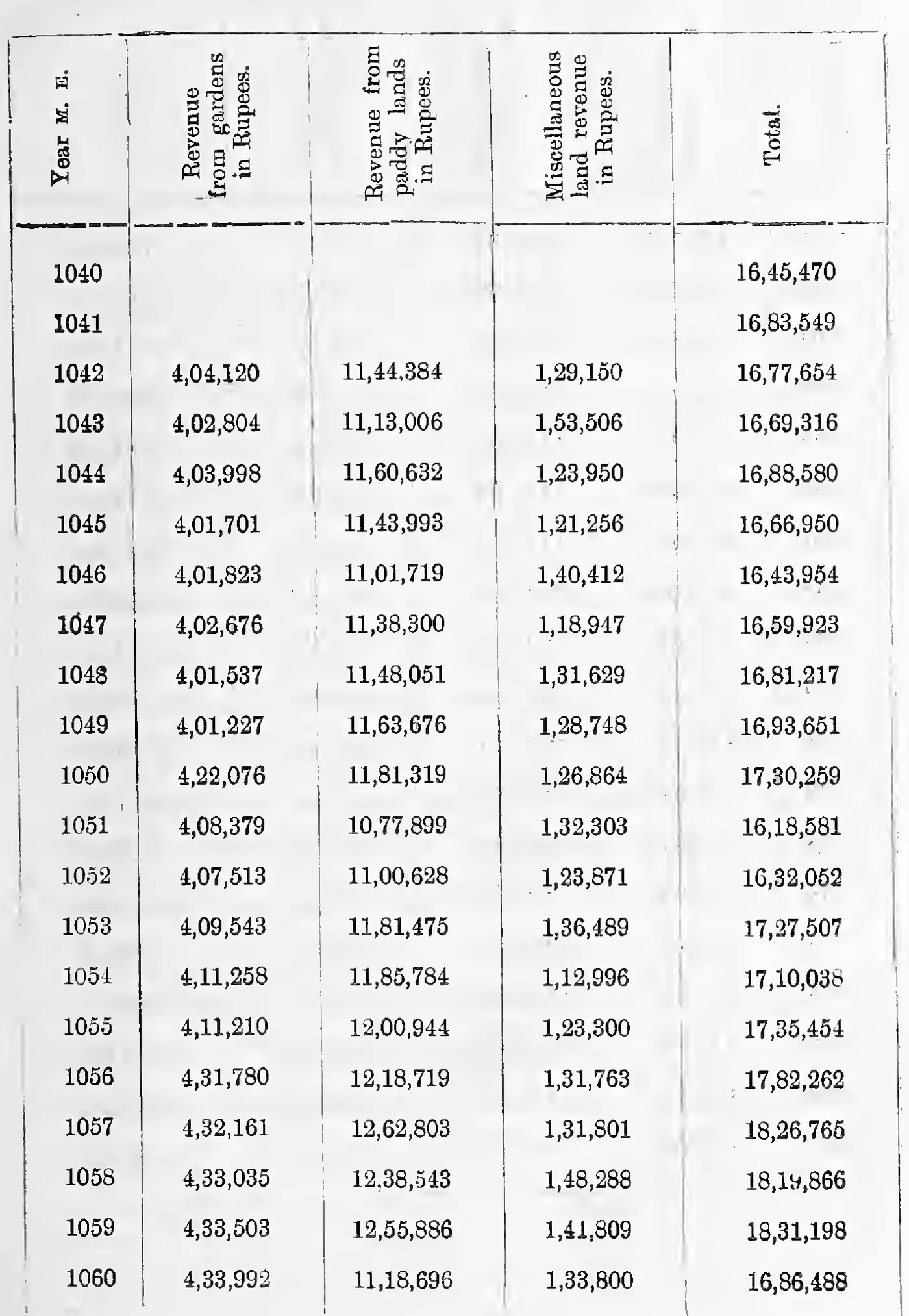
[374]
Statement B. of Land Revenue—Continued.
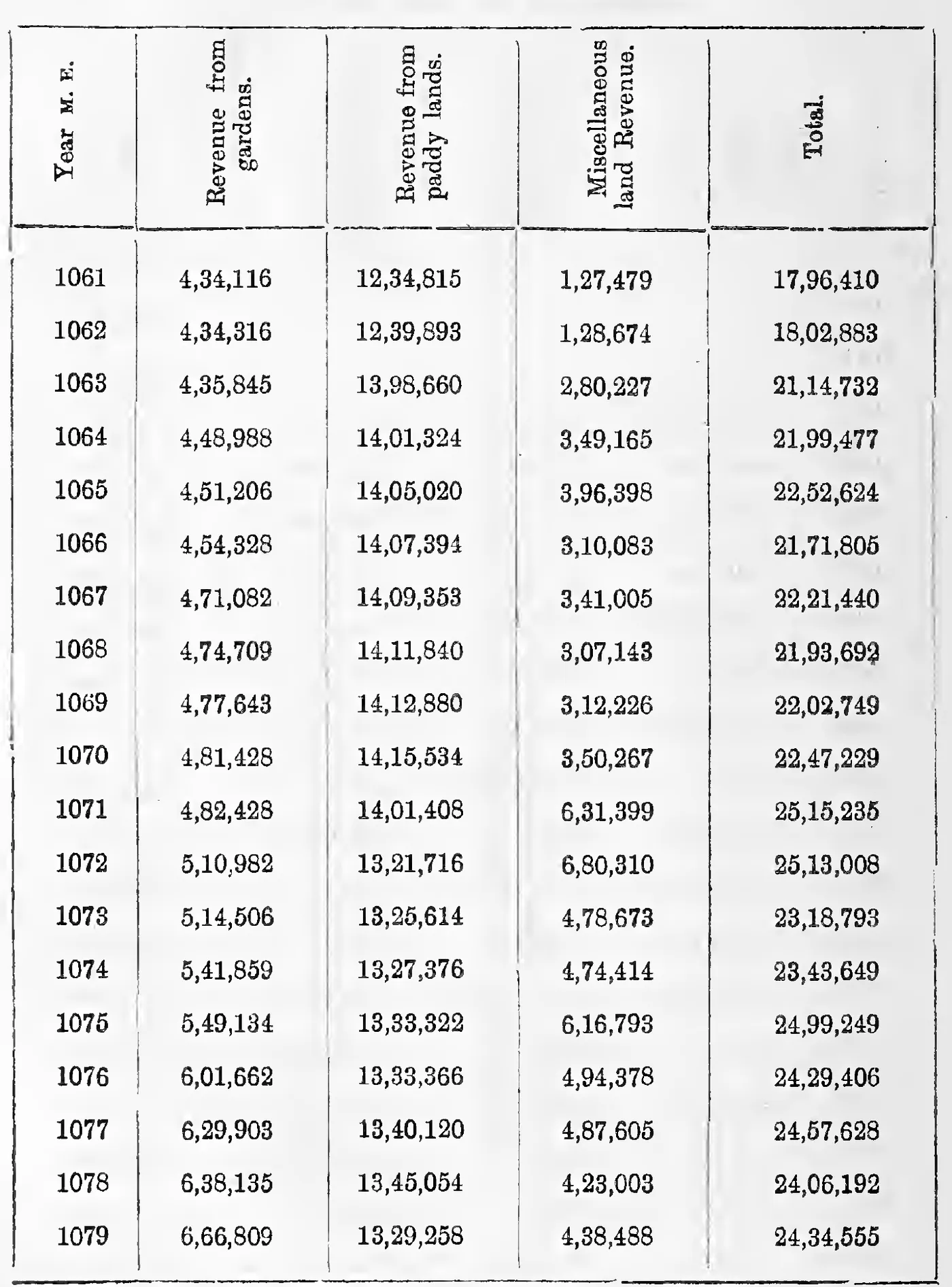
[375]
Chapter XIXAdministration.
"We live in deeds, not years; in thoughts, not breaths;
"In feelings, not in figures on a dial."
Bailey.
"The proper function of a Government is to make it easy for people to do good, and difficult for them to do evil."
Gladstone.
General remarks. Among the Native States of India, Travancore holds a unique position. This is the only Hindu State which retains unimpaired its ancient Hindu type and character though for a short while its administration by Colonel Munro the Resident-Dewan brought it directly under the supervision of the Madras Government to be restored again to Native rule. On account of its position in the extreme south of the Peninsula, it did not fall into the vortex of political strife which shook the rest of the Indian Continent. It also escaped coming under the Mahomedan domination all except in name. Another interesting feature is that the Hindu institutions in the State have for ages past co-existed with Christianity and the civilisation of Europe in a very striking manner. For, the Syrians, Romo-Syrians and the Roman Catholics have peacefully lived together for centuries under the protection, and even enjoyed the favour, of the Rulers of Travancore, and the Protestant Missions who came last have likewise been planted in the kingdom with grants of lands and privileges by the tolerant sovereigns of the country.
Very meagre information exists on the old systems of civil government in Travancore or the administration of its laws and usages, in early days. According to an ancient legend, Parasurama a Brahmin hero, said to be an Avatar of Vishnu, reclaimed a large tract of land from the sea and colonised it with thousands of Brahmins and Sudras brought from the banks of the Krishna, the Godavery, the Cauvery and the Narbada rivers. At first the country was ruled by the Brahmins themselves, a kind of constitutional hierarchy. Then certain distinguished families were chosen into a governmental association and power was placed in their hands. As this did not work well, the Brahmins themselves brought from among the Royal families of foreign countries a younger member to hold sway [376]over them for a cycle of 12 years each. This too did not give satisfaction. So the Brahmins of Kerala fixed upon a permanent king from Salem and anointed him as their Lord on earth. These were the Cheraman Perumals of Malabar. After the Perumal period Kerala was divided into three parts the southernmost portion being the share of the Travancore sovereigns. This compact kingdom which was split up and mostly lost during successive periods of popular revolt or internecine wars was restored to its original condition by the re-conquest of the petty principalities during the time of Maharajah Martanda Varma and his minister Rama Iyen Dalawa.
From early records we learn that prior to the year 1684 A. D. when King Ravi Varma ascended the throne the revenue of every petty district was roughly calculated and its local chief was made responsible for the due collection of the same deducting from it the amounts assigned for the performance of Devaswam and other religious ceremonies, for the maintenance of the militia and the expenses of collection of the revenue itself. The State establishment then consisted of one Valia Kariakar (Prime Minister), one Melezhuthu Pillai (Head Accountant), one Rayasam Pillai (Head Clerk) and several Rayasams and Kanakku Pillais (clerks and accountants). The Minister and all his establishment held office in the Palace and the Rajah presided over them. Every question, whether petty or important, was submitted for the King's decision, without whose order nothing was to be executed. King Ravi Varma curtailed the power of the local chiefs, appointed special agents in the various parts of the country to collect the revenue which was roughly estimated and fixed before they were sent out. All these agents were recognised as the King's officers. As King Ravi Varma's successor was unable to enforce this system generally, anarchy again ensued. But when Martanda Varma came to the throne his attention was first directed to the purifying of his public service, and with this object he formed a ministry consisting of able and trustworthy men of the country. He rebuilt the great temple of Padmanabhaswamy at Trivandrum and carried out useful irrigation works—the most important of which was the construction of the Puthen dam and a channel nearly 19 miles long in connection with it. Warehouses were opened in many places. The system of Chowkeys for levying duty on all articles transmitted and transported from place to place was introduced. An improved process of manufacturing salt was adopted. The sale of that article was restricted to particular stations where salt-stores and selling houses called Pandakasalas were opened. Rates for the purchase and sale of salt were at the same time fixed. The State expenditure was regulated in proportion to its income and a Pathivu Kanakku (permanent [377]account) was drawn up. Many Oottupurahs or charitable institutions were established in the vicinity of roads or renowned pagodas. The foundations of good government were strengthened by superadding to it a State religion and he made it sacred in the eyes of his people by performing the great Tiruppadi Danom or dedication of his kingdom to God Padmanabhaswamy and ruling it as his Deputy or Agent. From this day he assumed the title of Sri Padmanabha Dasa or a servant of Sri Padmanabha. After this dedication the name of taluq was changed and styled Mandapathumvathukal. The sexennial Murajapam ceremony was established. The coronation ceremonies of Tulapurasha danom and Hiranyagarbham were performed. A survey of the gardens and lands was commenced in 1751 and completed in 1754. And this led to the framing of the first trustworthy Ayakut account. Several roads and water communications were opened. An order akin to that of knighthood was instituted, and distinguished services were rewarded by the conferment of this honour. It was denominated Chempakaraman Stanom.
This Maharajah was succeeded by his nephew Rama Varma the long-lived, who found no difficulty in carrying on the government on the principles, rules and regulations laid down in the previous reign. The whole kingdom was made into three divisions each under a Valia Sarvadhikariakar; these again were subdivided and placed under Sarvadhikariakars. Each of these was again subdivided into districts over each of which a Kariakar was appointed. The districts were subdivided into Maniams, Kelvies, Adhikarams and Proverties and placed under charge of Manikarens, Adhikaries and Proverticars. This system of Government continued more or less till the middle of the 19th century, for, in his "Report on the countries of Travancore and Cochin, their condition and resources" dated Quilon, 20th December 1810, addressed to the Resident Colonel John Munro, Lieut. Arthur writes:—
"Some of its leading features and characteristic principles are discoverable from their manifest effects, and the first of these is a devoted attachment borne by all descriptions of people to the Rajah, to whose character they are taught to attach an idea bordering on the sacred, and from this principle their obedience to his commands, whether imposed direct or through agency of his Minister, who is generally known to them by the title of Dalwye, is implicit. Under the Dalwye, or Dewan, there is a chain of officers, all dependent on each other in regular gradations for the management of the revenues and all other affairs of Government, thus the whole country is parcelled into a certain number of grand divisions, over each of which a principal officer, termed a Vallia Surwadycar presides, and his authority extends to all matters of a Revenue, Commercial or Judicial nature. These grand portions of the country are again divided into a certain number of parts, each under the secondary controlling management of a Surwadycar, and these again are subdivided into districts under the [378]management of a Kauriacar, who has under him resident in certain principal places in his district, other officers, termed Prowerticars, who are the last in gradation among the managing officers of respectability; but under them again there are several inferior officers called Chundercars, Torrecars and Bellicars or Peons, who have each a distinct and separate office. Besides the above there is an officer appointed in each grand division, who is entitled the Malvejauripcar and the nature of his office is purely judicial, but in what particular cases his interference is required, I have not learned. Each of the principal officers named above has an Office establishment of writers, &c., for keeping the accounts of his Cutcherry; the Head Writer in the Cutcherry of the Kauriacar is entitled Terumpoochy Pillay and all those of inferior officers, Pillay."*
It was during the time of this Maharajah that the Prime Minister was granted the title of Dewan instead of Dalawah. A Revenue Survey of the whole State was commenced and completed in 1773 A. D. Some important roads were widened and repaired. Important irrigation works were also done.
It was about this period that Clive laid the foundation of the British Empire in India at the battle of Plassey. Every student of Indian History knows how a handful of English merchants who came to trade in the East Indies and whose relations with the native chiefs were of a purely mercantile nature interfered in their affairs, first as friends and then as arbiters between contending parties and ultimately as a supreme power invested with authority. We have already referred in detail in a previous chapter how the English East India Company helped the Travancore Rajah in the wars with Tippu. When this war was brought to a close the Rajah applied to the East India Company to have a permanent treaty concluded for the defence of his country. Accordingly a treaty of perpetual alliance was concluded on the 17th November 1795.
This Maharajah was succeeded in the year 1798 by his nephew Bala Rama Varma, born under the star Avittam. During his reign the treaty alliances with the Hon'ble East India Company were revised. A British Resident in the person of Lieut. Colonel Macaulay was appointed at the Rajah's Court. The amount of subsidy due to the East India Company was raised. The country was in utter disorder brought about by the weakness of the Ruler and the corruption and high-handedness of his Ministers, Velu Tampi and Oommini Tampi.
Fortunately, this state of affairs came to an end with the accession to the throne of Rani Lakshmi Bayi in the year 1811. One of the first acts of her reign was the removal of the Dewan Oommini Tampi who was in the words of the then Resident Colonel Munro "particularly obnoxious [379]to the Rani." Having decided to remove the Dewan she told the Resident that "there was no person in Travancore that she wished to elevate to the office of Dewan: and that her own wishes were that the Resident should superintend the affairs of the country as she had a degree of confidence in his justice, judgment and integrity which she could not place in the conduct of any other person."
* Selections from the Records of Travancore No. II.
In accordance with the Rani's wishes Colonel Munro, the Resident, assumed charge of the administration in June 1811. Colonel Munro's highest ambition was to introduce order into the country and give protection of life and property to all classes of the Rani's subjects. With this object in view he put an end to the division of power that existed in the country from very early times and substituted in its place a centralised form of administration conducted by the Dewan from headquarters with the co-operation of a staff of assistants of whom the foremost were two Dewan Peishcars newly created. A set of rules was drawn up for the conduct of the affairs of Government. It is gratifying to note from Colonel Munro's own testimony that "the arrangements which have been adopted under the sanction of Her Highness the Rani of Travancore for the conduct of the affairs of the Government correspond very nearly with the rules which the Hon'ble the Governor in Council has been pleased to prescribe upon that subject."
It may be stated at the outset that Colonel Munro reformed and reorganised every department of the State, the most important of which were the Huzur Cutcherry, the Financial, the Treasury, the Revenue, the Judicial, the Police and the Military.
"The Huzoor or the Dewan's Cutcherry, the chief controlling executive office, was aged upwards of three quarters of a century when Colonel Munro began to preside over it. It came down as a legacy of the olden times with its primitive organization. It contained no departmental division of labor. The staff of the Dewan were 'jacks of all trades'. They collectively superintended everything, while individually responsible for none. Colonel Munro found it expedient that the several branches of the Government should be formed into separate departments, constituted on a system and superintended by persons that would both secure the active discharge of the duties annexed to these departments and render them in some measure checks upon each other. ... ... For the due fulfilment of each day's work in the several Departments of the Huzoor Cutcherry, the Resident established a routine which operated as a further check upon all departmental heads. He ruled that all letters to the Huzoor Cutcherry should be addressed to the Resident and that all letters or orders issued by it should be written in his name and bear his signature. Letters received after being read to the Resident, were sent to the respective Departments on which answers under the orders of the Resident were prepared and brought to him for signature. This mode of correspondence was found absolutely necessary, for the authorities in the provinces were so fond of indirect channels of communication [380]that they seldom addressed their letters to the Resident, and the servants of the Cutcherry were eager to give themselves importance and perhaps to accomplish other views by being allowed to communicate orders in the Resident's name. The correspondence with the several authorities in the provinces on matters not appertaining to the Departments was conducted by the Resident himself through the agency of an office called the Rayasom Department. An important policy which Colonel Munro pursued was to make the transaction of business both at the Huzoor and the subordinate Cutcherries as open and public as possible."
It may be of interest to note here the rigid economy with which Colonel Munro accomplished the reorganisation of the Huzur Cutcherry:—
"The monthly cost of the establishment of the Dewan's Cutcherry including his own salary amounted on Colonel Munro's arrival in Travancore to upwards of six thousand rupees. This amount was shortly afterwards reduced to five thousand rupees by the abolition of some superfluous establishments. It was again retrenched by the removal of the Dewan and of the peon staff attached to him to one thousand five hundred rupees."*
The designations of Kariakar, Thirumukham Pidicha Pillai, &c., were changed into Tahsildars, Samprathy, &c.
The formation of a separate department for the exclusive superintendence of the accounts and finances of the Government; the rules with regard to payments, both from and to the treasury; the arrangements made for the proper management of the revenues; the rules laid down for the collection of revenue and the mode of account-keeping; the appointment of a Valia Melezhuthu Pillai or Accountant-General and Melezhuthu Pillai or Deputy Accountant-General to exercise supervision over all the three Departments of Treasury, Revenue and Finance collectively called the Jemabundy Department with a Shroff or Treasurer as the custodian of the State exchequer; these form some of the important changes in the Revenue and Account departments of the State. The establishment of the Judicial Courts for the first time; the establishment of chowkeys for the collection of land customs duties; the issue of Pattayams containing the extent, tenure, Government demand &c., of each ryot's holding; the compilation of a land register called Pattayapere; the abolition of many vexatious taxes; the censusing of the population of the State; the reorganisation of the Police, the Forest and the Commercial departments; the prohibition of the purchase and sale of slaves; the arrangements made for the construction of bridges and jungars for through communication are other reforms with which Colonel Munro's name is associated.
Another act of State with which his name is connected, was the assumption by the Sirkar of 378 Pagodas and the lands endowed for their maintenance. These lands consisted of 62,000 gardens and 5,48,000 [381]Parahs (68,500 acres) of paddy lands the former yielding a rental of about Rs. 50,000 and the latter Rs. 3,50,000. Out of this revenue a portion, viz., Rs. 2,50,000 (a sum according to the revised scale of Pagoda charges by Colonel Munro) went to meet the maintenance of the temples ceded to the State, while the balance of one and a half lakhs was the Sirkar's clear profit.
* A manuscript Sketch of the Progress of Travancore—N. Nanoo Pillay.
It may be remarked that the Pattom or rent on the assumed Devaswam landed property was not the only source of income, which the State had derived, from the arrangement; but there was also another of a fluctuating character which annually flowed into the Exchequer.
A Vaccination Department was organised and a European Physician designated the Durbar Physician was attached to the Royal household Colonel Munro's zeal and interest in the cause of vaccination will become patent to the reader from the following extract:—
"On the death of the second Tumbratty I was apprehensive that the Ranee herself might be attacked by the smallpox which then prevailed at Travancore. I therefore wrote to Her Highness earnestly requesting that she would allow herself to be vaccinated, and I sent a medical gentleman to Trivandrum for the purpose of performing the operation. The Ranee replied that as she formerly had the smallpox it was unnecessary to vaccinate her: if however I insisted upon her undergoing the operation, she would submit to it on my return to Trivandrum; and in the meantime the Doctor might vaccinate her husband, the two young Tumbratties and some other persons of her family. These persons were duly vaccinated. When I called the Ranee's attention to this subject she again affirmed that she had the smallpox and requested of me to make enquiries to ascertain this fact. I have made enquiries and have every reason to believe that the Ranee had the smallpox."
These acts of the Colonel had endeared him so much to the people of this country that when the sad news of his death reached India, the Travancore Government perpetuated his memory by putting up lights in all the backwaters of the State for the use of travellers and called them "Munro Lights."
Colonel Munro retired from the office of Dewan in 1814. Subsequent to this and before Colonel Munro's retirement from the Residentship in 1819, there were five Dewans for the State. Their names were Devan Pulpanabhan, Bappu Row, Shungu Annavy, Ramen Menon and Reddy Row. Mr. N. Nanoo Pillay in his interesting Sketch observes:—
"It may be asserted that though there were four successive Dewans during Colonel Munro's tenure of office as Resident in Travancore and after he had abandoned his ministerial office yet for all intents and purposes the administration was guided by him. So whatever blessings of good Government may have resulted during the period Colonel Munro was in Travancore either [382]as minister to the Native Ruler or representative of the Paramount Power (such period extended more or less over 10 years) it is certain that the credit of the progress achieved in the interval is due to him and to him alone."
In the Geographical and Statistical Memoir of the Survey of the Travancore and Cochin States executed under the superintendence of Lieuts. Ward and Conner from July 1816 to the end of the year 1820, we read:—
"The head of the States enjoys every possible consideration, and as much power and privilege as is necessary to the dignity of the station, or compatible with the happiness of the people. The Dewan, the head of the administration, is still invested with an extensive executive authority over all the departments of Government. The country is divided into thirty-two Mundatawaddakuls or districts, having a Tassildar at the head of each; under him a Sumpurdypully or the principal accountant of the district, and two or three Keelcootumpullies or assistant accountants; in addition to these are one cashkeeper, 6 or 8 peons employed in collections, 2 or 3 Vullathudecars who act as Hariakars; also several Provertycars in charge of smaller divisions, which have each a Chundrakar or cashkeeper and accountant. The villages of which those divisions are composed have their own proper officers exercising a domestic jurisdiction. The large establishment forming the Huzoor or Dewan's Cutcherry was formerly composed of the Dewan, the Dewan Paishkar, Tana Sheristadar, the Valia Meleluthu Pillai or accountant-general and under him the Meleluthu Pillamars and Gumastahs; or various ranks of accountants, Unjell Pillamars and two Moodelpedis of treasuries for receipts and disbursements.
"The authorities just enumerated act as only collectors of revenue. Justice is administered by a separate Judicial establishment. The Dhurma Shastras guide the decision of the Courts. There are eight Zillah Courts and one Appeal Court. Each Zillah Court is presided over by 2 Judges and the Appeal by Dewan. Their cognizance extends to criminal and civil affairs. Suits against Sirkar are instituted as in private cases. Five per cent. of the property in dispute is levied as fees. Every publicity is given to the proceedings of the Courts and a detailed account of the evidence on which their decrees are founded accompanied the report to them. These proceedings are brought under the review of the Resident. A Police force consisting of six or eight hundred men maintained the internal tranquillity of the country. This is a complete civil establishment under the immediate control of the Dewan. At the Cutcherry of each District are stationed a Naik and ten peons whose duties are, (1) to apprehend delinquents who when arrested are despatched for trial to the Zillah Court; (2) to carry into execution the sentence or order of these tribunals as regards the seizure of persons or property and on requisition of the Tahsildar or other servants of the Revenue apprehending such individuals as are indebted to it.
"A jealous vigilance confines the public servants who are further restrained by acting under security within limits of strict duty; collusion is anticipated by frequent change; aberrations from integrity are corrected by amercement; complaints are received with readiness; any individual can address them to the Dewan. The chief source of revenue arises from the assessment on lands and gardens. For this has been substituted a money rent, and a liberal commutation secures both the Sircar and the ryot against the frauds to which they were both equally exposed. The gardens are rated [383]agreeably to the number of areca or cocoanut trees; the produce of those plantations is liable to no additional tax except when in the shape of spirits."*
The monopolies at the time were tobacco, teak, pepper and salt. The customs were equitable.
This was the condition of the administration in the first quarter of the 19th Century. It has to be observed in this connection that on the death of Rani Lakshmi Bayi in 1814 the country was ruled by her sister Rani Parvathi Bayi till 1829 during the minority of Prince Rama Varma. These two Ranis being sagacious rulers identified themselves with the interests of their people. Their reigns were a blessing to the people and honour to themselves.
Prince Rama Varma was installed as ruler in 1829. According to Mr. N. Nanoo Pillay,
"He was every inch a king according to the lights of the times. His heart and soul were in the interest of his country, he hated corruption, was a patron of letters and a truly upright, righteous, and public spirited Ruler."
Martanda Varma was the next ruler; of whom the testimony of Mr Maltby British Resident at his court may be quoted:—
"It is not inappropriate here to mention that Martanda Varma reigned in Travancore for 13 years (1847–60). The abolition of slavery, the encouragement given to Education, many liberal acts for the benefit of his people, and above all the example set by His Highness in favour of female education in the persons of the Princesses of his family, entitle his memory to public respect. His amiable character will be remembered with esteem by those who knew him personally."
The Dewans of the period after Reddy Row were Venkata Row, Renga Row, Subba Row and Krishna Row.
Being an educated man blessed with intelligence and wisdom, Venkata Row carried on the administration on the lines laid down by the Colonel. His task was further lightened by the experience he had gained in the various departments as a Dewan Peishcar. He was a capable and experienced Magistrate and Revenue Officer. As regards Dewan Subba Row it is stated that "though he possessed no preliminary administrative experience, he was assisted by able Dewan Peishcars and kept steadily moving in the grooves which had already existed. His administration was by no means open to serious adverse comment and may be said to have been more or less a success."
His successor Renga Row is said to have administered the country satisfactorily. On his retirement, first Venkata Row and then Subba Row [384]were re-appointed to the Dewanship. The former resigned in 1839 owing to misunderstandings between himself and the Resident Captain Douglas. Subba Row's second administration which terminated in 1842 was a financially successful one.
* Selections from the Records of Travancore.
From this date up to the year 1848 there was no permanent Dewan to the State. In that year Krishna Row was confirmed in that office, "in spite of the claims of Kesava Pillai a legitimate candidate for that office." In this connection the following observations of Dewan Nanoo Pillai in his manuscript Sketch of the Progress of Travancore may be noted with interest:—
"A resume of the arguments exchanged between the Maharajah and the Madras Government in respect to the nomination of Krishna Row as Dewan discloses the policy of the Madras Government of the day with regard to the filling of a ministerial office in a Native State. When the Maharajah's proposal to select Krishna Row as his Dewan went before the Madras Government the latter, it is gratifying to reflect, advocated the principle 'Travancore for Travancoreans' for a query was put in these terms:—How it was that preference was given for the vacant ministerial office in Travancore to a native of Muslipatam a remote District on the Eastern Coast of the Madras Presidency and whose Travancore experience was but limited, over Dewan Peishcar Keshava Pillay who had headed the Travancore service list and been a Travancorean himself. The nature of the reply submitted is obscure. But it is presumed want of confidence on the part of His Highness on the Dewan Peishcar named constituted the main reason. The Madras Government was slow however to accord sanction to the proposal, for it was decidedly adverse to the principle of importation or rather the rapid advancement of a foreigner to the highest office in the realm. The next query which emanated from the Paramount Power was that taking it for granted that Keshava Pillay was ineligible, why could not Shungrawarrier, the Dewan of the neighbouring State of Cochin between which and Travancore there was little or no difference in respect to the mode of public business, manners and customs, be selected as Dewan of Travancore as one possessing higher and stronger recommendations. A reply in disfavour of this measure also was submitted when the Paramount Power found no other alternative than to acquiesce in the proposal seeing that the Maharajah had tenaciously and pertinaciously clung to his opinion. The arguments of the Madras Government that choice for the premiership in Travancore should fall on a native of the country speaks volumes for its breadth of view, equity and justice. What a cheerful contrast this policy on the part of a by-gone Government of Madras or local administrative agency of the East India Company presents towards Native States with that enunciated by the Government of Madras of the present day favouring the importation into Native States like Travancore of the alien Hindus of the Presidency town who whatever their British Indian qualifications might be are nevertheless novices in the local institutions, system of administration, customs, manners and habits of the people of these States."
Before we conclude our review of the administration of the country during this long period of nearly half a century some other reforms and improvements effected have to be noticed. They were the creation of Munsiff's Courts vested with jurisdiction in petty police cases and in civil suits up to Rs. 100; the formation of a Marahmut Department at the Huzur [385]Cutcherry with an executive branch to look after Palace buildings; the appointment of a special agency to look after the irrigation works in South Travancore; the opening of an English School at the Capital and District Schools in the mofussil; the opening of a Printing Press at Trivandrum; the impetus given to science by the establishment of Observatories at Trivandrum and the Agastyar Peak, and the Museum; the opening of hospitals; the survey and assesssment of garden and wet lands; the formation of Revenue divisions under the supervision of Dewan Peishcars; the connecting of backwaters by the opening of canals to facilitate internal communication; the abolition of slavery; and the adoption of two Princesses into the Royal family.
Though some of these reforms were effected in Dewan Krishna Row's administration, yet we are constrained to remark that his administration had fallen into bad odour.
Nanoo Pillai vehemently observes:—
"Scarcely a year had elapsed since Krishna Row had entered on the responsibilites of his office before the evils of a retrograde course of things began to manifest themselves. The moral tone of the service which prevailed with more or less vigour ever since the time of Colonel Munro of happy memory deplorably gave place to corruption and peculation. The Police, a constituted machinery for the maintenance of order and peace, was turned into an engine of oppression and torture. The Tahsildars and their understrappers in the up-country who bought their appointments in the head-quarter market made no scruple in recouping their losses in way of the prices of their offices by merciless exaction from the poor well-to-do ryots. The Tanahs or subsidiary jails were always crowded with prisoners many of whom were such as resisted the exactions of the Taluq Police Magistrates. The Judicial Courts meted out justice (if justice it may be called) to the rich party in a suit. The financial branch of the administration, the most essential element in the constitution of a State, deteriorated by maladministration to an extent that gave rise to the apprehension of failure of the subsidy to the Paramount Power: the accomplishment of which will be synonymous with the violation of the Treaty of 1805 and putting it in its power to avail itself according to the terms therein stipulated of the alternative of assuming the direct management of the country for the security of the funds destined to such subsidy."
Another writer of conspicuous talent observed:—
"Turning to the general administration of Travancore at the time, we may say without exaggeration that it in a measure rivalled that of Oudh before annexation. The Blue Book which we have placed at the head of this article presents to us the gloomiest picture which one could expect even in an Asiatic kingdom."*
Complaints of maladministration had frequently reached the Madras Government. The salaries of public servants were in arrears, convicted criminals were employed in high offices. One of the Missionaries complained [386]that "the whole of the Sircar officials with the Dewan at the head of them were in league to oppress and insult the Christians; that the good intentions of the Rajah were neutralised; and that appeals to the Resident were not only useless but marked the appellant for further oppression." The Police was a tremendous engine of oppression. Prisoners were repeatedly tortured in prison. Real criminals were suffered to be at large. Real complaints were unheeded. Men grossly and notoriously incompetent were posted to high appointments. On these complaints the Madras Government in consultation with the Marquis of Dalhousie "who was then seeking relief in the bracing climate of Nilgiris" addressed a letter of advice and warning dated 21st November 1855 to the Rajah. The letter observed:—
* A Native Statesman—an article in the Calcutta Review of 1872.
"It had become the duty of the Government to call the Rajah's attention in the most serious manner to the manifold abuses prevailing in his dominions; to urge an enlightened policy, and to warn him that it was to be feared that the contingency against which Article 5 of the Treaty was directed was not far distant unless averted by timely and judicious reforms."
On the receipt of this letter 5 lakhs of rupees were borrowed from Padmanabhaswamy Temple to pay off arrears of public salaries and other dues on pepper received from the ryots. The Rajah had made a solemn stipulation to replace this sum plus 50 per cent. in the way of lump interest in equal monthly instalments in the course of 5 years.
The writer in the Calcutta Review says:—
"We are fully justified in remarking that if Lord Dalhousie had continued a year more in India, if the great events of 1857 had not occurred and absorbed public attention and if Krishna Row's administration had been prolonged Travancore would long ago have been one of the richest Collectorates in Southern India."
But thanks to the stars that guided the destinies of Travancore, Dewan Krishna Row died in November 1857. It was during the sexennial Murajapam ceremony in Trivandrum. Madava Row, the Dewan Peishcar, was immediately put in charge of the Dewan's duties. At the end of one year he was confirmed in the Dewanship. The history of the administration of Travancore from this date is a history of enlightenment and progress. Two facts of historical importance to be noticed now are the demise of the amiable Maharajah Martanda Varma and the compulsory retirement of the British Resident General Cullen—both of which events took place in 1860. The Maharajah was succeeded on the throne by his second nephew Prince Rama Varma a highly intelligent sovereign "free from the bonds of self-imposed conservatism." The choice of a Resident fell on Mr. Francis Maltby a gentleman of great official [387]experience, eminent talents, excellent literary powers and a warm and generous heart. The cordial support and sympathy from these two quarters enabled Madava Row to carry on the administration with zeal and vigour.
One of the very first acts of his administration was the abolition of the pepper monopoly, at an annual loss of more than a lakh of rupees. In its stead an import duty was levied. This was at first fixed at 15 per cent. but was gradually decreased to 5 per cent.
The next monopoly abolished was that of tobacco. The first step taken was to lower the monopoly prices. In 1038 M. E. (1862-63), the monopoly system was altogether abolished. It was declared open to all dealers to import tobacco on their own account provided they paid the following import duty:—
- Jaffna Tobacco Rs. 190 per candy
- Tinnevelly do. " 140 "
- Coimbatore do. " 65 "
In consideration of the high rates of duty, importers were allowed by the Sirkar the privilege of keeping their goods in bond. Still further reductions in the import duty were made in 1039 M. E. (1863-64) and the following year.
In 1040 M. E. (1864-65) upwards of 100 minor taxes were abolished at an annual sacrifice of about Rs. 8,500.
The land tax in Nanjanad having been found to range excessively high, a maximum of 10 Kottahs of paddy per Kottah of seed land was fixed, and to this standard all excessive taxation was reduced involving a loss of revenue to the extent of about Rs. 15,000.
In 1039 M. E. (1863-64) export and import duties were largely reduced all round. Further duties were largely removed by the commercial treaty between the British Government and the States of Travancore and Cochin concluded in the same year. This led to a considerable fall in the Customs revenue of the country. The British Government agreed to pay a fixed sum annually in the way of compensation to the Native State of Travancore.
The debt of Rs. 5,00,000 borrowed from the Pagoda together with an interest of Rs. 1,57,000 was completely discharged in 1038 M. E. (1862-63) by the last payment of Rs. 1,57,000 in that year. Since then Travancore has had no public debt.
The total revenue of the State which seldom went up to even 40 lakhs [388]of rupees in the time of Madava Row's predecessor reached Rs. 51,54,007 in the last year of his administration.
The morality and the efficiency of the Civil Service were raised by raising their salaries to a respectable standard. The numerical strength of the establishment was also increased to meet the necessities of a progressive administration. A scheme of retiring pensions to public servants was sanctioned. Many little rights of the Sirkar for gratuitous services from the people were surrendered.
Public works were carried on by means of a special department organised in 1861 for its purpose from the current revenues of the State. Various were the works done by this Department. The erection and fitting up of the lighthouse at Alleppey with an illuminating apparatus of the most improved construction was one of the earliest works undertaken and satisfactorily executed. The trunk road from the Capital of Travancore to the southern extremity was thoroughly repaired. A splendid road connecting Quilon with the District of Tinnevelly across the Ghauts was made. Two other Ghaut roads were also opened. Besides these, many lines of useful village roads were opened under the orders of the Revenue Department. Another gigantic undertaking was the connecting canal across the Varkala barrier. This consisted of extending the water communication by deep cuttings in the hard laterite soil and of boring two tunnels where the crust was too deep for through cutting. Bridges were built across the Kuzhittura and other rivers. The lagoons were lit by means of beacon lights. A range of public offices and a fine hospital were erected. A commodious College building was nearing completion. Numerous District Cutcherries, hospitals, school-houses and Court-houses were also built.
Large sums of money were spent year after year on education. The old English School at the Capital was greatly enlarged; a collegiate department for training students for the B. A. Degree Examination of the Madras University was opened. European Professors of acknowledged ability were appointed to the College. 16 District Schools were started as feeders to this College. A scheme of Vernacular education was started with a Central School and a Normal School at Trivandrum. In course of time many District Schools were established besides four Girls' Schools, 2 at Trivandrum and 2 in the mofussil. To extend Vernacular education arrangements were made to open in each Proverty an elementary school.
Hand in hand with education medical dispensation was also given. [389]In the Capital itself there were four hospitals including a Lying-in-hospital and a Lunatic Asylum. About 10 hospitals were opened in the districts. Vaccination was also carried on under a special department.
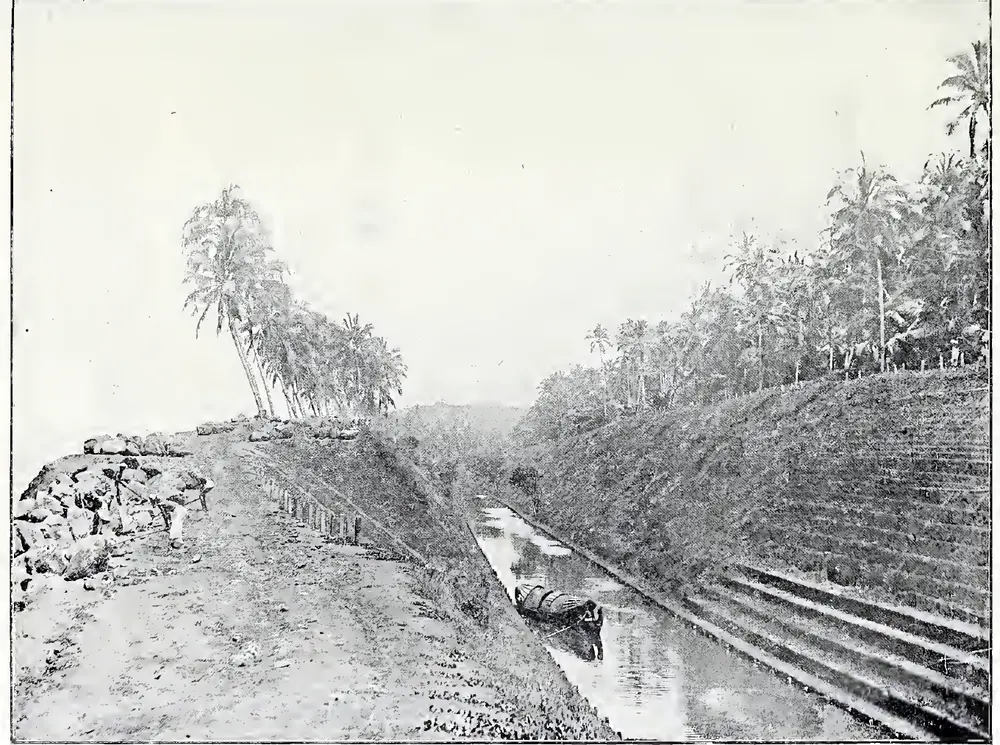
The land revenue of Travancore has all along been very moderate. In Madava Row's time it was in most cases below one-fourth of the net produce. More than one half of the cultivated lands belongs to private lands and temples. The Sirkar lands were called Sirkar Pattom lands. That is, the Sirkar had the absolute control of a landlord over these lands. As the Sirkar was not bound to respect possession it was easy for one ryot to dispossess another of his land by offering to pay a higher rent. This want of security operated to the marked deterioration of the lands. To remedy this evil His Highness the Maharajah issued a notification to the effect:—
"That the Sirkar hereby and for ever surrenders for the benefit of the people, all optional power over the following classes of lands, whether wet, garden, or dry and whether included in the Ayacut accounts or registered since:
Ven Pauttum,
Vettolivoo Pauttum,
Maraya Pauttum,
Mara Pauttum,
and all such Durkast Pauttum the tax of which is understood to be fixed till the next survey and assessment.
"That the ryots holding these lands may regard them fully as private, heritable, saleable, and otherwise transferable property.
\* \* \* \* \*
"That the holders of the lands in question may rest assured that they may enjoy them undisturbed, so long as the appointed assessment is paid."
Dewan Madava Row added:—
"The ryot in possession of Pattom lands may hereafter feel that in effect he is the land-lord. He can regard the lands as his own property: and the wholesome feeling of ownership thus generated is obviously of inestimable value."
Hand in hand with this wise measure improved rules for the sale of waste lands were introduced. And year after year the industrious ryots have been reclaiming these waste lands. Another noteworthy item to be mentioned is the extension of coffee and tea cultivation. An important question in connection with land was settled in the year 1042 M. E. (1866-67) by a Royal Proclamation dated 25th Karkadagam of the year (8th August 1867) to the effect:—
"While tenants hold lands of Jemmies for a consideration under such tenures as Kanapauttom—Ottee-Marayapauttom-Olavoo Pauttom-Kodalikani, &c., and so long as they pay the stipulated rent and other customary dues, they shall not be liable to action for ouster by the Jemmies nor shall the Courts give judgment in favour of such action."
[390]For the administration of justice the Civil Procedure Code, the Penal Code and the Criminal Code of British India were adopted with a few alterations. The salaries of the judges were largely increased. Men qualified by legal studies were appointed judges. The duration of suits in the Courts were brought down to the lowest standard consistent with soundness of justice. Qualified Vakils were admitted to plead. A law of limitation was passed as also a Registration Act on the lines of the British Indian Act. And for the great reforms that he introduced in this branch of the administration Dewan Madava Row was greatly indebted to M. Sadasiva Pillay, First Judge of the Sadr Court of Travancore. In the words of an eminent writer, "In moral rectitude, in judicial experience, in mature and dispassionate judgment, in the correct comprehension of the aim of legislation and in powers of application he has not his superior among the Natives of India."
The Police force was reorganised by (1) increase of pay, (2) increase in strength, (3) by introduction of method and discipline. Police Amins were appointed. Most notorious offenders were apprehended. Organised crime was put a stop to. In fact the energies of this Dewan were directed to every branch of the administration with a view to increase its efficiency and promote the welfare of His Highness' subjects. In the words of Sir Madava Row himself,
"The cherished aim of His Highness' Government is to provide for every subject within a couple of hours' journey the advantages of a Doctor, a School master, judge, a Magistrate, a Registering officer and a Post Master."
These reforms duly attracted the attention of the authorities both in India and in England. Year after year the Madras Government congratulated the Maharajah and his Dewan. In 1866 the Secretary of State for India remarked on the successful financial results of the administration.
In his letter dated Simla, the 6th August 1866, the Viceroy and Governor-General of India wrote to His Highness:—
"In recognition of Your Highness' excellent administration of the Travancore State, I have directed that Your Highness shall be addressed by the title of Maharajah in all communications from the British Government."
His Highness the Maharajah was presented with the insignia of a Knight Grand Commander of the Most Exalted Order of the Star of India to which His Highness had been previously nominated by Her Majesty the Queen in the Drawing Room of the Government House at Madras by the Governor on 1st February 1867. On the same day Dewan Madava Row [391]was also presented with the insignia of the Order of the Star of India in the Banqueting Hall.
The State of Travancore thenceforward came to be recognised as a "Model Native State."
Sir Madava Row retired from the office of Dewan in May 1872 on a pension of Rs. 1,000 per mensem.
Writing in 1891, Mr. J. D. Rees observed:—
"The great improvements effected in recent years in the condition of Travancore are due in no small measure to Raja Sir T. Madava Row, one of the most distinguished of its ministers, during whose terms of office every department of the administration was reformed and reorganised, while roads and canals were constructed in every direction."
A. Sashiah Sastri who was the Head Sheristadar to the Board of Revenue at Madras succeeded him in the office of Dewan. He worked quietly but energetically for a period of five years. His attention was first drawn to the increase of salaries in the several departments of the State. He defined the relations between the Dewan and the Heads of Departments. The Dewan was relieved of his magisterial functions by a Regulation passed at the end of 1872. He afforded an opening to the graduates of the Trivandrum College by entertaining them as attaches on a salary of Rs. 20 per mensem in his Office. He carried out a census of the population of the State. The abuses and corruption of the Salt Department were checked. The waste in the charitable institutions was minimised by proper supervision and control. During his administration also new roads were opened, irrigation works repaired, new tanks excavated and the Varkala tunnel completed. The Padmatirtham tank and the channel which supplies water to it were completely repaired and cleansed. The Padmanabhaswamy Temple and its tower were beautified. A Law Class for the B. L. course was opened. Primary Schools were established as State institutions. The system of grants-in-aid was introduced for the first time. The Museum and Public Gardens were improved and placed under proper management. For the trial of European British subjects special Magistrates were appointed. This was a special concession to Travancore secured on the strong representation of Sashiah Sastri.
One of the minor changes introduced by Sashiah Sastri was the substitution of paper in the place of palmyra leaves in all departments of the State. This greatly facilitated the conduct of public business. Increases of pay were given to the Peishcars, Judges, Tahsildars and to the employees of several other Departments. It was in 1872 that the Maharajah [392]of Travancore went for the first time outside the limits of the Madras Presidency.
In August 1877 Sashiah Sastri retired from the Travancore Dewanship on a pension of Rs. 500 per mensem. In accepting his resignation the Maharajah recorded his high appreciation of the several distinguished services, rendered by Sashiah Sastri during his five years' successful administration.
He was succeeded in the office by N. Nanoo Pillay who was not only a Dewan Peishcar at the time of his appointment but had also served the Maharajah for a period of 18 years. He had also acted for the Dewan on several occasions. Dewan Nanoo Pillay's was known to be one of the most financially prosperous administrations we have had in recent times.
In 1054 M. E. (1878-79) the constitution of the Sadr Court was re-modelled to afford further facilities for the disposal of work. The prosperous condition of the finances enabled the Maharajah's Government to devote to public works greater funds than in previous years. Two youths were sent to the Agricultural College at Saidapet to profit by the scientific education given there. Increases to pay were given to the men in the Nayar Brigade.
In the same year rules were framed for registering in the Government accounts the transfers of property that have taken place and those that might take place thereafter as well as for granting Pokkuvaravu Pattayams. These rules made it compulsory on the part of the land-holders to have their holdings registered in their names and to take Pattas, showing the assessment and extent of their holdings, the instalments in which the tax is payable, their situation, description, tenure, &c.
Thus was the administration of the State being pushed on vigorously in all directions, when a great calamity befell the country by the death of the Maharajah Rama Varma, G. C. S. I, (Ayilliam Tirunal) on the 31st May 1880. In announcing His Highness' demise, the Fort St. George Gazette of the 8th June 1880 observed:—
"His reign has been marked by the development of wise and enlightened principles of administration which have placed Travancore in the first rank of Native States."
His Highness' next younger brother being mentally incapacitated for the functions of sovereignty, the first Prince succeeded to the throne on the 17th June 1880 as Maharajah. In referring to the condition of the State at the time, His Highness observed in his Installation Speech:—
[393]
"The late wise, enlightened and beneficent reign had uniformly striven to strengthen the sinews of Government and to promote peace, happiness and useful progress among the subjects. The finances are easy and flourishing. The public service is generally much more effective than twenty years ago. Education by its civilizing agency is purifying the reservoir from which that public service is drawn and is rendering the subject population increasingly law-abiding. Works of importance of public utility have been promoting material prosperity at a rate which would have astonished a by-gone generation."
Among the first acts of the new reign may be mentioned the following :—
(1) Old arrears of assessment and other dues to the extent of between 8 and 9 lakhs of rupees were remitted.
(2) Further reduction of the import duty on Coimbatore and Jaffna tobacco was effected.
Soon after the accession to the throne of this Maharajah, Dewan Nanoo Pillay retired and was succeeded by V. Ramiengar of the Madras service where he had been Inspector-General of Registration for many years.
The first year of the new reign saw the introduction of the British Indian Penal and Criminal Procedure Codes as the law of Travancore with the necessary changes.
The rules regarding the system of recording transfer of landed property in the revenue accounts introduced in August 1879 were revised and simplified. Rules were laid down conceding mining rights in gold to holders of coffee lands on the higher hills on easy terms and to prevent the indiscriminate felling of forest for cultivation on the hills. People were freely permitted to fell, use and otherwise dispose of the palmyra, jack or other trees assessed to the revenue without the previous permission of Government provided they were the private property of the person wishing to dispose of them. A fee of two per cent. levied on the transfer of pattom lands was relinquished. The assessment on coffee lands was remitted and an export duty of 5 per cent. substituted in its stead. Many of the export duties on numerous petty articles were abolished. Public servants holding responsible appointments were prohibited from acquiring landed property within their jurisdiction without the sanction of Government.
The Police was completely reorganised and placed on a new footing in 1056 M. E. (1880-81). The objects achieved by this reorganisation were (1) the separation of the Police from the Magistracy, so as to leave the latter with an unbiassed mind in disposing of cases and (2) to [394]improve the personnel of the force. Though twenty-five years have elapsed since the reorganisation took place there are many who believe that the old Police met the requirements of Travancore very well. Writing of the old Police, Dewan Shungrasoobyer, C. I. E., in his letter of the 30th August 1903, observed :—
"Directly controlled as it was by the Magistracy, the system answered far more efficiently than the present one the purposes of suppression and detection of crime. As Police Sheristadar and District Magistrate I had no small experience in working the old Police. There was no such thing as friction at all. The occurrence of a grave crime against life or property evoked earnest and harmonious co-operation on the part of the all concerned from the village officer to the District Magistrate in bringing the offenders to justice. The co-operation of the public too with whom the Police were in better touch was a notable feature. What a District and a Taluk Magistrate had to do in the way of detection with all the resources which intelligence, influence of position and sense of responsibility could command is now generally entrusted to a low-paid constable. A separate organization independent of the Magistracy might perhaps answer well in a large Empire like British India but would hardly suit a Native State like Travancore. This was unfortunately ignored. Even in British India the new system is found defective in the matter of detection ; much more so here. Smart martial appearance, fine dress, regular drill and diary writing and endless reporting are the distinguishing features of the constabulary as now constituted. If these and these alone make up merit, the present system certainly claims it or rather is entitled to it."
Not only Mr. Shungrasoobyer but others also among the older set of officials seem to have a partiality for the old Police system. They believe that that Police served the purposes of detection better. But it must be admitted that the new Police have very much improved since the reorganisation a quarter of a century ago.
Legislative sanction to the reform of the Judicial system of Travancore was received in the year 1057 M. E. (1881-82). By these Regulations the jurisdiction of the Munsiffs was raised and they were also invested with small cause jurisdiction. The tone of the Judicial service was improved by raising the salaries of Judges and Munsiffs. The number of Magistrates which was unnecessarily large was reduced. The powers of Magistrates of all grades were increased to reduce the work of the Sessions Court. The principal changes in the Sadr Court were that the number of Judges was raised from three to five. The designation was changed to High Court. One Judge was empowered to make periodical inspection of various subordinate Courts. A bench of 2 Judges was required to dispose of all cases. This Court combined with it the functions of a Judicial Committee as three Judges were empowered to hear appeals to His Highness the Maharajah from the decisions of Division Benches. The ministerial establishments belonging to the Courts were reorganised. The Taluq and [395]Division establishments were completely reorganised by reducing the supernumerary hands and increasing the salaries of the remaining hands. Many vexatious taxes were abolished. The Salt Department was reorganised by placing it under a special officer, by increasing the salaries of the subordinate establishments and making proper arrangements for the storing of salt collected, &c. The sanitation of the Capital was improved.
Great attention was paid to the system of irrigation in South Travancore. At the request of the Travancore Government the services of a special officer, Major Mead, R. E., were placed at their disposal by the Madras Government. On the advice of this officer, arrangements were made for the improvement of the Pandyan Caul and the Padmanabhapuram Puthenaur stopping the leakage in the Puthen dam and constructing the Head Works. Work was actually commenced after the cultivating season of 1882 was over. Meanwhile an independent officer charged with the repair of all tanks in the District and with the distribution of water was appointed. The whole work connected with repair and the construction of the Head Works was over by 1884 and His Highness the Maharajah performed the opening ceremony on the 5th March 1885. We have already seen that the work of excavating the Padmanabhapuram Puthenaur and the construction of the massive dam which diverted its waters into the Paralayar was executed by Rama Rajah the nephew and successor of Maharajah Martanda Varma the Great. In the speech which he delivered at the opening ceremony His Highness observed :—
"The Pandian Dam and Channel are, under the safest calculation, about 8 centuries old when Akbar and Ahalya Bhaye, the most beneficent and wisest of Indian rulers were yet in the womb of time. It is these works by the kings of the Pandyan dynasty that chiefly stimulated my illustrious ancestor to construct the Poothen Dam and the Poothenaur Channel, facing and vanquishing almost superhuman difficulties and this in days when scientific engineering and European appliances, including steam power, were perfectly unknown."
He concluded :—
"May these works distribute the blessings of plenty far and wide! May the blessings of a prospering and contented population be our reward!"
In token of appreciation of the services of Mr. Horsley, the first Executive Engineer in charge of the restoration of the Head Works of the Pandyan and Puthen channels, His Highness presented him with a gold watch and observed :—
"I shall hope that you will long wear it and consider its ticks symbolical of the beats of the friendly heart of the donor."
The inauguration of a Revenue Survey and Settlement was another [396]important administrative measure of this period. The object of His Highness' Government in seeking to introduce a Revenue Survey and Settlement,
"Was not so much to increase the revenue—as to ascertain the extent and resources of the country ; to define and fix the boundaries of properties ; to obtain accurate registers of lands ; to investigate and record the various tenures under which property is held ; to fix and limit the Government demand, to equalize—and not to enhance—the pressure of the assessment on land ; to remove the various anomalies which now disfigure the revenue administration and press more or less on the springs of industry ; to give perfect freedom of action in taking up or relinquishing land ; to impart perfect security of title to the holders, and thus promote the well-being of the agricultural classes and the general prosperity of the State." *
The settlement of the boundary between Travancore and Cochin was another of the important events achieved during this period. Mr. Hannyngton, the British Resident, was appointed arbitrator. In five territorial cases the Travancore Government advanced the plea of Res Judicata but the arbitrator disallowed the plea. The Irinjalakoda case was decided in favour of Travancore by the arbitrator, and on Cochin's appeal the Madras Government upheld the arbitrator's decision. The remaining four cases were all decided in favour of Cochin by the arbitrator. Travancore appealed to the Madras Government. In the Idiaramad case they reversed the arbitrator's award. In the three Devaswam cases (Elangonnapuzha, Annamanada and Perumanam) the right of sovereignty was declared to vest in Cochin but the rights of management of the Pagodas and their endowments in Travancore.
Impetus was given to scientific study by the founding of a chair for Physical Science and Chemistry in the Trivandrum College. Liberal grants-in-aid were given to primary schools. A Normal School was opened for securing duly qualified teachers. The Book Committee was revived. These acts of reform met with the approbation of the British Government. And so Her late Majesty the Queen appointed His Highness to be a Knight Grand Commander of the Star of India. The presentation of the Insignia took place in the Madras Banqueting Hall on the 1st of February 1883.
Thus progressed the administration of the country by leaps and bounds when His Highness the Maharajah prematurely died on the 4th of August 1885.
It is no exaggeration to state that he lived not for himself but for his people and honestly endeavoured to secure good government and [397]progressive happiness to his subjects.
* Dewan Ramiengar's address to the land-holders dated 24th March 1883.
The late Maharajah was succeeded on the musnad by his nephew Rama Varma, the present Maharajah, on the 19th August 1885. His Highness the Maharajah referred to the state of the country at the time of his accession in the following terms :—
"This ancient kingdom under the fostering care of my predecessors has entered on a career of material prosperity never before known : the finances are in a flourishing condition and the foundations of future prosperity have been laid far and deep."
On the day of his accession to the throne arrears of tax to the extent of three-and-a half lakhs of rupees were remitted.
Though the Revenue Survey and Settlement were inaugurated by His Highness the late Maharajah yet the actual Proclamation sketching out the general plan and laying down the principles and procedure to be observed in carrying on these operations was issued under the Sign Manual of H. H. the present Maharajah. Another Proclamation issued at the beginning of the present reign provided for a searching enquiry into the condition of the holders of the Viruthi or service tenures to lay down the principles and procedure to be observed in re-arranging the Viruthi service in consonance with the present economic condition of the country. Rules were framed for the execution of the decrees in Travancore, of British India and Cochin State which also prescribed the form in which the Travancore Courts were to send up decrees for execution in those territories. A leave code for the Judicial Department and a set of rules prescribing the qualification for Munsiffs and Vakils were also passed. Ramiengar continued in office as Dewan under the present Maharajah for nearly a year and a half when he retired on a pension of Rs. 700 per mensem. He was succeeded by T. Rama Row, the Head Dewan Peishcar at the time. His administration was characterised by activities in several useful directions. The people were relieved from the obligation to pay penalties on documents executed on unstamped cadjans at a time when stamped cadjans were required to be used. Government relinquished their right to the fees leviable on the transfer of Pandarapattom lands effected prior to 1060 M. E. (1884-85). The mode of assessing cherikals or waste lands on the hills taken for cultivation was improved by substituting a money tax in the place of a tax on crop levied at the will and pleasure of the low-paid officials. Facilities were granted for taking up waste lands for cultivation. Rules were passed prescribing the procedure to be followed by the Peishcars in the disposal of Nirthal or abandoned lands, of [398]escheats to Government, revenue cases, &c. The Peishcars were ordered to remit at once tax on lands assumed for public purposes. Ryots were permitted to surrender any unremunerative holding, and orders were issued to have the tax on such lands remitted. The waste lands taken up for cultivation were ordered to be assessed moderately. Funds were sanctioned for holding annual Agricultural Exhibitions and cattle-shows and also for repairing irrigation and drainage channels in the northern Divisions of the country. The preventive establishment attached to the Customs Department was reorganised. A Medical School and Hospital for training midwives and sick nurses were established. Public lectures were instituted. Arrangements were made for placing the Account Department on an improved basis. Petition rules and leave rules were framed. A Legislative Council consisting of officials and non-officials for making laws and regulations was established. Government relinquished its right to a succession fee equal to one-fourth of the property left by a person under the Marumakkathayam Law of inheritance when he died leaving no direct heirs but only distant kindred to succeed to the property. A notification was issued rescinding the practice by which Jenmis or proprietors of entailed lands were deprived of their rights when their mortgagees or tenants died without heirs. Funds were sanctioned for the reclamation of lands from the sides of backwaters and also for granting loans to ryots at 4 per cent. interest per annum for the bona fide purpose of reclaiming portions of the lakes. These lands were to be free from tax for a period of five years and afterwards to have a moderate tax of about one-and-a-half rupees per acre until the next survey. The interest charged on arrears of instalments of tax of the same year was relinquished. Uniformity was ordered both in the measurement of waste lands and in the valuation of escheated lands. The Division Peishcars were invested with greater powers. The separation of the revenue and magisterial duties of a Tahsildar was experimentally tried in two taluqs. Arrangements were made for the better supervision of taluq and village accounts. The Viruthikars were relieved of supplying provisions at rates lower than those ruling in the market and of rendering certain gratuitous services in connection with the tours of His Highness the Maharajah, &c. They were afterwards completely relieved of the duty of supplying provisions to all the Oottupurahs and Devaswams in the out-stations, the local revenue officials being required to purchase them from the market. Several petty and oppressive cesses were abolished. The grain portion of the assessment payable on paddy lands was revised by a Royal Proclamation by which the proportion was made uniform, that is 25 per cent. of the total [399]assessment in the Quilon and Kottayam Divisions and 50 per cent. in the Trivandrum and Padmanabhapuram Divisions. To give stimulus to native medicine, grants-in-aid to a few select Vaidyans were granted to enable them to afford gratuitous medical aid to the poor. A Female Normal School and a Sanskrit College were established. The Industrial School of Arts was reorganised. Anchal labels and cards and embossed envelopes were introduced for the first time. A Mathematics chair was established in the College. Qualifications for entrance into the public service were declared and a Special Test for accountants was prescribed as also for entrance into the Police as Inspectors and sub-Inspectors. Sanitation of some of the important towns was attended to. The High Court was re-constituted by reducing the number of Judges from 5 to 4 and empowering a single Judge to hear and dispose of first appeals in civil cases whence a second appeal lay to the Royal Court. This was abolished subsequently during the same administration. Indigo cultivation was encouraged. A paper mill under the auspices of Government was started. Rules were also passed for registering transfers of lands and also with regard to salt. Reserve forests were extended. The Medical Department was reorganised. A qualified medical man was appointed Chemical Examiner to Government. The salaries of the officers and clerks of the Huzur Cutcherry were increased. The work in the Taluq Cutcherries was re-arranged and their salaries and those of Kandukrishi, Madapad, Sanketham, and Melkanganom departments were increased. A preventive establishment was appointed for the Cardamom Hills. Additional roads were opened. Additional Court-houses, cutcherries, school-houses, hospitals, &c., were built. Negotiations for financing the construction of a Railway from Tinnevelly to Quilon were concluded, the Travancore Government guaranteeing interest at 4 per cent. on the capital required to construct the line within the Travancore limits for a period of 15 years. The Law Class was strengthened by the addition of an Assistant Professor. The Observatory was again placed under a scientific Director. For the first time systematic operations with the aid of machinery were introduced. Arrangements were made for the extension of the Alleppey pier. A set of rules was passed to protect public servants against being arbitrarily dismissed or suspended. A new market known as the Connemara Market was opened at Trivandrum. Thus after five years and a half of vigorous and beneficent administration, Dewan Rama Row retired in August 1892, on a pension of Rs. 800 per mensem.
In the last Report on the Administration of Travancore which he wrote Dewan Rama Row modestly observed that he would ever in his retirement [400]"look back with pleasure and pride to his five years' service as Dewan—service which he humbly trusted had not been altogether barren of beneficial results to the State." The impartial historian must admit that Rama Row's rule was not only beneficial, but well-informed and sympathetic and therefore extremely popular.
The many-sided activities of the Maharajah met with due reward at the hands of Her Majesty the Queen Empress who appointed him to be a Knight Grand Commander of the Star of India in June 1888. The ceremony of investiture took place in the Banqueting Hall at Madras on 4th December 1888.
In his book, "The Duke of Clarence and Avondale in Southern India" Mr J. D. Rees says :—
"Sir Madava Row, whose recent decease all friends of India deplore, has found a worthy successor in his kinsman, the present Dewan, Mr. Rama Row, who labours with an honesty of purpose, which has made him some enemies among wrongdoers, to advance the prosperity of Travancore and the well-being of its people."
He was succeeded by Shungrasoobyer Settlement Dewan Peishcar. His administration began by granting considerable relief to Viruthi holders and by abolishing certain petty and oppressive taxes. To prevent irregularity and promote efficiency the Proverticars were charged primarily with the duty of conducting the initial procedure in Putuval applications. It was also decided that arrears of tax at settled rates should be charged on Putuvals from date of their entry in the Field Register. A Regulation was passed which provided for the sanitation of Towns, the prevention of fires and the registration of births and deaths. The working of this law was entrusted to local Committees appointed by Government. Rules were passed for the payment of batta and travelling allowance to complainants and witnesses. A Reformatory for juveniles was established at Trivandrum. With a view to enforce better discipline in the District Jails, the rules in force in the Central Jail were extended to them with some modifications. The four Inspectorial Divisions of the Anchal Department were reduced to three, and one of the Inspectors was deputed to attend to the working of the Transit Department. Some changes were made in the mode of exhibiting financial accounts. In the Educational Department the Offices of Superintendent of District Schools and Director of Vernacular Education were abolished and three Inspectors of Schools with Assistant and Sub-Assistant Inspectors were appointed. A new grant-in-aid code was introduced. An Educational Secretary to the Dewan was appointed. A First Grade English Normal School was established. A Vernacular [401]Elementary Examination was substituted in place of the Subordinate Service Examination. The Book Depôt was transferred to the charge of the Principal of the College. A Lady Principal was appointed to the Sirkar Girls' High School which was subsequently raised to a second grade college. The Kothayar Irrigation scheme was sanctioned and work commenced. The works comprised in the scheme are the construction of a masonry dam across the Kothayar river near Pachippara, about 16 miles above Triparappu, of a channel 11 miles long leading from the Kothayar to the Paralayar above the Puthen dam and the necessary Head Works. The first estimate sanctioned was Rs. 7,94,850. The tariff value of cocoanut oil was reduced. The export duty on green-gram, Perumpayar and horse-gram was abolished. A special department embracing Vaccination, Vital Statistics and Sanitation was formed and placed under the charge of a Sanitary Commissioner. The Law Class was separated from the Arts College and a separate Law College was established. An Agricultural Demonstration Farm was opened near Trivandrum. The Central Jail and the Registration Department were reorganised in accordance with the Prisons and Registration Regulations of 1071 M. E. (1895-96) as also the Public Works and the Forest Departments. A system of land tax in lieu of the Cardamom monopoly was introduced as a tentative measure. Under this system the ryots were allowed to appropriate to themselves the whole of the produce raised on payment of a uniform assessment of Rs. 6¼ an acre. A system of grants to private medical institutions was sanctioned. An Archæological Department was started. An Anthropometrical Bureau was opened. Educational Boards in various localities were established. The Conservancy Department in the mofussil was reorganised. An electrical apparatus for fixing the midday gun was fitted up in the Observatory. A scheme of State Life Insurance was introduced. Mr. Shungrasoobyer retired from the Dewanship in April 1898 on a pension of Rs. 800 per mensem, and he was succeeded by Mr. K. Krishnaswamy Rao the Chief Justice of the Travancore High Court.
One of the most gratifying incidents to be noticed with which Mr. Krishnaswamy Rao's administration began was the addition as a personal distinction of two guns to the salute of His Highness the Maharajah. With regard to the reclaimed portions of the Vembanad and other backwaters a modified notification was issued in view of the early commencement of the Settlement operations. Under this notification the lands reclaimed were declared to be tax-free for 5 years and to be subject to the light assessment of half a parah per parah for another 5 years and full [402]assessment thereafter. A Survey School for the training of revenue subordinates was opened at Trivandrum. In the Central Jail the system of taking anthropometrical measurements was discontinued and that of finger tip impressions substituted. The system of awarding good conduct stripes to warders was also introduced. In the Registration Department the post of Itinerant Sub-Registrar was abolished and two Probationary Sub-Registrars were appointed instead. To encourage the formation of joint-stock companies especially for charitable purposes, fees payable under the Regulation were reduced by one-half and the fee for the registration of companies formed for purely religious and charitable purposes was fixed at Rs. 5. In the Forest Department rules were passed on the following :—"(1) Deposit and security of forest officers ; (2) ground rent leviable on timber sold but not removed from depôts ; (3) demarcation of forests ; (4) accounts ; (5) uniform of forest officers ; (6) capture and training of elephants ; (7) management and working of State forests ; (8) distribution of areas between the Forest and Cardamom Departments ; (9) closure of reserves to permit-holders." In order to secure properly qualified men for service in the Forest Department, four scholarships were awarded to students to undergo training in the Forest School at Dehra Dun. The Trivandrum Town was lighted with gas.
The long-pending claims of the Punjar Chief regarding the Kannan Devan Hills and the Anjanad valley were amicably settled. An interesting tale attaches to his house.
The Punjar Chief belongs, it is said, to an ancient offshoot of the Pandyan dynasty of kings, that left Madura, their capital, and sought refuge in the fastnesses of the Western Ghauts, about 5 or 6 centuries ago. The tract of land called Punjar was purchased by them from the then holder, a Rajah of Thekkumkur. According to a petition, submitted by the Valia Rajah of Punjar in October 1897 to His Excellency the Governor, one of his ancestors, it would appear, fled from Madura, underwent a series of trials and tribulations in the then inaccessible regions of the West Coast, having been driven from place to place without a hospitable shelter. The conditions of such a life told on him and on many members of his family, who one by one succumbed to disease and death, till at last one descendant managed to discover their present land Punjar and settled down there. The law of succession also changed with the change in the fortunes of the family, incidental to a life in the midst of the Marumakkathayam population of the Malabar Coast. On the annexation of the territories of Thekkumkur and Vadakkumkur to Travancore, the [403]Punjar Rajah who had rendered valuable services to the Travancore Maharajah in their conquest, came to be considered as a subject ally of the Maharajah. But the relations between the Chief of Punjar and the Travancore Sirkar had never been clearly understood for a long time and the incidents in connection with Hyder Ali's conquest of some villages belonging to the Punjar Chief and the intercession of the Travancore Sirkar on behalf of the Chief in recovering for him the territories that had been encroached upon by a British Collector in 976 M. E., did not help either to clear up these relations, so much so, that even the Jenmam rights to certain lands in the neighbourhood of Anjanad were disputed and a Commission had to be appointed by the Travancore Sirkar to inquire into the history of the possessions of the Punjar family. All differences were thoroughly gone into and finally settled.
Negotiations regarding the construction of the Travancore Branch of the S. I. Railway and the Cochin Shoranore Railway were completed. The length of the Cochin-Shoranore Railway passing through Travancore territory is 18 miles. Letter cards were introduced. The price of Anchal cards was reduced. The export duty was abolished on timber wrought into articles such as almirahs, tables, door and window shutters, provided the articles were manufactured in the country. In the Registration Department the system of recording finger impressions, was introduced. A Committee of 8 members was appointed with a view to have the leading text-books which have been published for the use of schools examined and a selection made of such as are suitable to local requirements. This was in place of the old Book Committee. A History chair was established in the College.
A new scheme for an effective corps of the Nayar Brigade was sanctioned. A Public Works Department Code was passed and an Audit Branch was added to the Chief Engineer's Office. Rules were passed for transferring a portion of the Hundi work from the Taluq Cutcherries to the Anchal Department. Grants were made for local technical schools. The scholarships for the study in Europe of technical subjects were sanctioned. An annual prize known as the "Curzon Prize" of Rs. 500 was instituted in the Madras University for the best essay on any scientific subject. The coinage of the country was improved by the issue of silver coins of the value of 2 chuckrams and copper coins of the value of one-half, and one-fourth chuckrams. The Nayar Brigade was reorganised. The existing two battalions were amalgamated and styled the second battalion, the 16 companies being reduced to 14. The reduction would continue until [404]only 10 companies remain with a strength of 910 of all ranks. This reduction provided 500 men of all ranks for the new Battalion which is styled the "First Battalion" and is intended for purely military duties following as far as possible the interior economy and discipline of a British Native Infantry regiment. These are living in the permanent lines built for them. Mr. Krishnaswamy Rao was the first Dewan to visit the tract of country known as the Cardamom Hills and High Range. The following are some of the beneficial results of this visit :—
(1) Revision of the rules for the grant of lands for cereal cultivation so as to provide for a fixity of tenure and a uniform rate of 4 as. per acre for dry and Re. 1 for wet lands, the assessment being subject to revision once in 30 years.
(2) Special grants of sites, timber and other pecuniary help to induce cardamom ryots (belonging to the Madura District) to settle on the hills.
(3) Opening of a school at Munaar.
(4) Establishment of a Police station at Oodumpanshola.
(5) Provision of out-let roads from the Cardamom Hills.
A Committee was appointed for drafting an Account Code for the State. The Medical school established 4 years ago was abolished. In lieu thereof, 10 scholarships of Rs. 20 each were sanctioned for training in the Madras Medical College or in the Medical School at Tanjore. A class for the training of female compounders and sick nurses was established in the Women and Children's Hospital under the supervision of a Lady Doctor.
A revised curriculum of studies was introduced into all the schools of the State. The result is that a pupil who chooses to complete his education in a Vernacular school will when he leaves school acquire as much knowledge of English as one who has completed his course in the Fourth Form of an English school. Owing to the reduction of the B. L. course from 3 to 2 years, the staff of the Law College was reorganised. The Vernacular Elementary Examination was abolished and the Travancore Middle School Examination in English and Vernacular substituted in its stead.
On account of large demand for the new small coins, minted copper coins to the value of Rs. 1,06,839 and copper discs for the rest were obtained from Birmingham. Rules were passed for the prompt settlement of claims with regard to the State Life Insurance.
Mr. Krishnaswamy Rao retired from the Dewanship in March 1904, and was succeeded by the present Dewan Mr. V. P. Madhava Rao, B. A, C. I. E.
Since his advent several reforms have been started. To secure [405]greater efficiency in the Land Revenue administration, a Land Revenue Code has been introduced into the Legislative Council. A new scheme for the early closing of the Settlement operations in the State was framed. In the Jail Department the following innovations have been made :—
(1) All prisoners under sentence of imprisonment for three months and above were ordered to be transferred to the Central Jail at Trivandrum. (2) The system of conducting executions in public in mofussil stations was abolished. (3) The use of fetters was discontinued except as a matter of Jail punishment.
Trees standing in putural lands were ordered to be paid for at the time of registry instead of remaining the property of Government under the care of the ryots for indefinite periods. The tariff rates on jungle wood were raised as also the rates of seignorage. A uniform rate was paid for the price of wild cardamom collected by hillmen. An experiment was made to grow sisal, a valuable fibre. The Railway line from Quilon to Punalur on the Tinnevelly-Quilon extension was opened for traffic on the 1st June 1904. Brushes manufactured out of palmyra fibre were passed free and a duty of 2½ per cent. on prepared fibre and 5 per cent. on raw article was imposed. The tariff value of Rs. 1000 per cwt. on gum kino was reduced to Rs. 100 for one year.
The Account Committee appointed in 1901 completed their labours in June 1904 and submitted their report with suggestions for improving the old system of accounts and a draft financial code for adoption from the year 1081 M. E. (1905-06). The Government appointed a Financial Adviser to completely reorganise the system of accounts and finance. The following are some of the improvements effected :—
(1) Abolition of all the Departmental treasuries and reorganising on the British Indian model, the Huzur and Taluq treasuries, the treasury on the Cardamom Hills and the two Kandukrishi treasuries at Ampalapuzha and Trivandrum.
(2) Organisation of a Central Account and Audit Office.
(3) Introduction of a system of daily accounts from these treasuries and of daily audit and compilation and monthly consolidation of these accounts in the Central Account and Audit Office.
(4) Framing a set of rules for the guidance of Heads of Departments and officers in regard to the remittance of their revenue collections, &c.
Another important reform effected is the imparting of primary education free to all children in the State, irrespective of caste or creed. As a [406]first step Government have ruled that in regard to schools in which the majority of scholars come from the backward classes, the entire cost of primary education should be borne by the State. The State Life Insurance Committee was abolished and the work of the Committee was transferred to the Secretariat in the Huzur. The Law College was reorganised and the fees raised.
The total revenue of the State in the last year of our review, i. e., 1079 M. E. (1903-04) was Rs. 102,01,853. The total expenditure was Rs. 106,24,320.
About a century ago, that is, soon after the Treaty of 1805 with the East India Company the gross revenue and expenditure of the State stood at 30 and 29 lakhs of rupees respectively. This was in the year 983 M. E. (1807-08) when Velu Tampi was Dewan. In 985 M. E. (1809-10) that is during the second year of Oommini Tampi's administration, the gross revenue and expenditure were in round numbers 28½ and 28 lakhs of rupees respectively. In 988 M. E. (1812-13) the second year of Colonel Munro's administration the gross revenue and expenditure were in round numbers Rs. 34,00,000 and Rs. 33,90,000 respectively. The secret of the increase of revenue in Colonel Munro's time was the development of lawful resources on approved methods of administration and the gradual abolition of oppressive taxes.
The next decade after the Munro period (1821-31) opened with a gross revenue of 39 lakhs. It is stated that the general condition of the revenue during the decade was anything but progressive. One striking feature of the finances was the cash balance or the reserve fund of 11½ lakhs of rupees which the decade in question inherited from its predecessor and to which each successive year (with the exception of two) continuously added. The provision of a cash balance or reserve fund began with Colonel Munro.
The growth of the reserve fund was sustained during seven years of the decade from 11½ lakhs to 30 lakhs of rupees when in two out of the remaining three years the expenditure exceeded the revenue and the deficit in each case had to be made up by drawing on the reserve fund.
The financial results of the third decade (1831-1840) were little or no improvement on those of its predecessor. The maximum revenue amounted to close upon 40 lakhs of rupees while the minimum to nearly 34½ lakhs. The total expenditure in the beginning of the decade fell short of that of its predecessor by 3 per cent. During the first half of the decade the expenditure kept continually below the receipts, while the reserve fund grew from 24¼ to 30¾ lakhs. In the second half the expenditure invariably [407]exceeded the revenue, a circumstance which tended to the reduction of the reserve fund from 30¾ to 16¾ lakhs, by reason of draughts made on the fund to make up deficits. This unsatisfactory state of the finances is attributed to the frequent changes of Dewans during the period.
The fourth decade (1841-50) started with a revenue greater than its predecessor by 13·50 per cent. The maximum and minimum revenues were in round numbers Rs. 42,00,000 and Rs. 38,00,000. During six years of the decade the expenditure was kept within the income while in the remaining four years the expenditure exceeded the revenue, and the deficit on each occasion was met from the reserve fund. This fund reached its maximum figure 19½ lakhs in the second year of the decade under review. At the end of the decade it stood at 11 lakhs of rupees. From this date down to the end of Dewan Krishna Row's administration, that is, during a period of seven years the condition of the finances became more and more unsatisfactory. The minimum revenue amounted to Rs. 33,96,869 against a minimum expenditure of Rs. 36,80,685. As the reserve fund had now dwindled to a little more than two lakhs of rupees, the deficit had to be met by a loan of 5 lakhs of rupees from the Trivandrum Temple in January 1856.
It has already been pointed out how the finances were improved by the great Indian Statesman Rajah Sir Madava Row, known as the Turgot of India, who not only liquidated the debt completely, but left the State treasury groaning under the weight of a plethora of riches. Since then the revenues have gone on increasing steadily ; the expenditure too has steadily increased, but not beyond the income.
A statement* of receipts and expenditure together with the cash balances of the last year of each Dewan's term of office from the time of Rajah Sir T. Madava Row, K. C. S. I., downwards is given below :—
* Since writing the above, the Administration Report for 1080 M. E. (1904—05) has been issued. Mr. V. P. Madhava Rao, C. I. E. the Dewan writes :— "The year opened with a balance of Rs. 85,49,236 and closed with Rs. 77,53,718 to the credit of Government, resulting in a deficit of Rs. 7,95,518. The budget for 1081 is also a deficit one, Rs. 8,26,200 being estimated as the probable deficit and Rs. 69,27,518 as the closing balance." In his 'Daily life of an Indian Prince', Mr. J. D. Rees C. I. E. (I. C. S.) M. P. writes in a recent issue (July 1906) of Macmillan's Magazine :—"No expenditure of public money is permitted without the Maharajah's general or special sanction, and this personal attention to economy accounts in no small measure for the satisfactory condition of the finances. A State which owes nothing, and until recently generally had a balance of a year's revenue in hand, is not heard of every day."
[408]
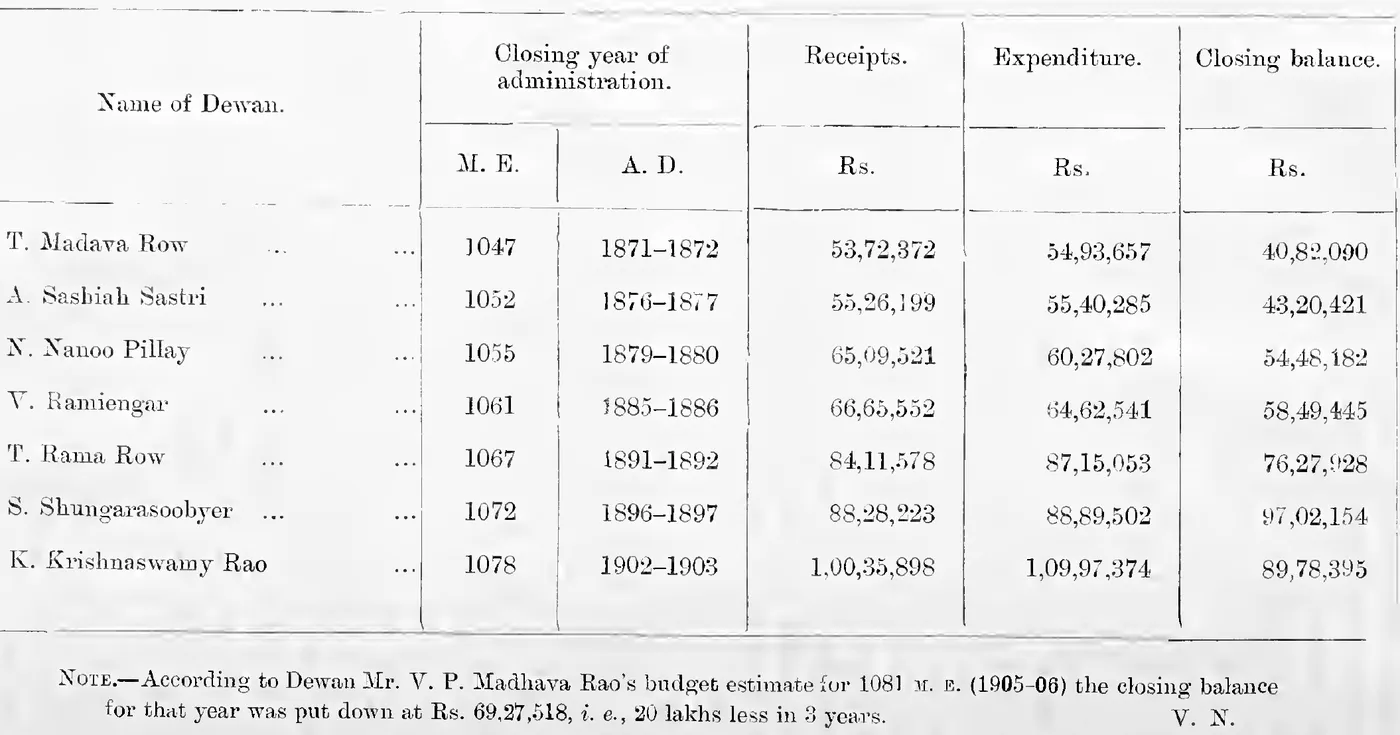
Note.—According to Dewan Mr. V. P. Madhava Rao's budget estimate for 1081 M. E. (1905-06) the closing balance for that year was put down at Rs. 69,27,518, i. e., 20 lakhs less in 3 years.
V. N.
[409]It is gratifying to note from the above statement that successive Dewans have endeavoured successfully to increase the reserve fund. But in recent years, deficits have been reported. In the year 1072 M. E. (1896-97) Dewan Shungrasoobyer stated that the expenditure exceeded the income by Rs. 61,167. In the following year a deficit of Rs. 5,61,243 was reported. During the next three years the expenditure was within the income. But in 1077 M. E. (1901-02) there was again a deficit of Rs. 2,67,073. In 1078 M. E. (1902-03) the last year of Mr. Krishnaswamy Rao's administration the deficit amounted to Rs. 9,60,382. In 1079 M. E. (1903-04) when both Mr. K. Krishnaswamy Rao and Mr. V. P. Madhava Row were in charge of the administration this deficit came to Rs. 4,29,159.
It is of the utmost importance to a Native State like Travancore that the expenditure should be within the income and that there should be a large reserve fund to meet unforeseen and unavoidable charges. This has been recognised again and again. Sir T. Madava Row wrote so early as 1038 M. E. (1862-63) :—
"It is also clearly of vital importance to this State to have a good reserve to fall back upon in times of financial difficulty. Though such times are by no means likely to recur often under honest and judicious management, yet it is a duty to be fully prepared for a possible contingency, especially as such a contingency might otherwise carry in its train penalties of far greater magnitude than ordinarily apprehended."
Again in his report for 1041 M. E. (1865-66) he observed :—
"This healthy state of the finances is, obviously, in itself, the greatest possible security to the Paramount Power for the punctual payment of the stipulated Subsidy, which has, hitherto, been paid with unerring certainty on the appointed date, though it is the largest subsidy paid to the British Indian Government, with but one or two exceptions."
Dewan Nanoo Pillay observed :—
"The importance of such a fund can scarcely be over-rated as one which the State can fall back upon in any emergency, a draught on the reserve fund to meet current charges by any State financier can scarcely afford justification to him while the ordinary income more than meets all ordinary charges."
Dewan Ramiengar wrote :—
"Of course in a Native State like Travancore it is of the utmost importance that there should be a good reserve to fall back upon in emergencies."
Dewan Shungrasoobyer stated as his opinion that :—
"Having regard to the limited resources of the State and the conditions under which it has to work, the soundness of its financial policy and the possibilities which that policy implies lie in recognising the important principle of not merely maintaining an equilibrium between the year's income and expenditure but of securing a margin, however small, on the right side of the account."
[410]Mr. Krishnaswamy Rao was also of opinion that "a good reserve is necessary to meet unforeseen contingencies and unavoidable obligations."
The financial result of the last 3 years, viz., 1079, 1080 and 1081 M. E. is, not in keeping with the recorded opinions of these Dewans as the reserve fund has been reduced during this short period by a solid sum of 20 lakhs of rupees.
The Legislative activity of the State has been great in recent years. Since the establishment of the Legislative Council many useful laws have been enacted which will be referred to more fully in another chapter. Among them may be mentioned the following :—
- (1) Agricultural Loans Act.
- (2) High Court Regulation.
- (3) Penal Code.
- (4) Prisons Regulation.
- (5) Departmental Enquiries Regulation.
- (6) Towns Conservancy and Improvement Regulation.
- (7) Regulation regarding Wills.
- (8) Press Regulation.
- (9) Hindu Religious Endowments Regulation.
- (10) Prevention of Cruelty to Animals Regulation.
With an area of 7,091 square miles and a population of 29,52,157 Travancore is an independent Native State in subsidiary alliance with the British Government. The annual subsidy is Rs. 8,00,000. Our relations with the British Government are controlled by a treaty. The Government of Madras is the direct referee in all political matters.
His Highness the Maharajah is the recognised fountain of law. According to the late Viceroy, Lord Curzon,
"The Native chief has become by our policy an integral factor in the Imperial organization of India. He is concerned not less than the Viceroy or the Lieutenant Governor, in the administration of the country. I claim him as my colleague and partner."
Lord Napier a former Governor of Madras, addressed the then Maharajah :—
"The Government of this Presidency do not only consider Your Highness as a political ally :—they recognize you as a friend in thought and in heart, as an auxiliary in promoting the civilization and welfare of a portion of the great nation which has been committed to Her Majesty's general and superior charge."
The Maharajahs of Travancore have always maintained this high standard of duty. Lord Connemara in referring to His Highness the present Maharajah observed in 1887 :—
[411]
"Travancore has been very happy in its rulers and for a very long time, I will not say how long, they have been distinguished by enlightenment and devotion to public duty."
In Travancore the Maharajah is to the people the embodiment of sympathetic interest, of personal authority and of active benevolence. He guides the machinery of the State and imparts tone to its administration. This fact has been testified to again and again. Dewan Sashiah Sastri writing in 1875 observed :—
"Coming as I did at the invitation of His Highness, a stranger to the country and its administration, I feel it but due to my Sovereign to acknowledge the utmost assistance I have ever received, the most valuable advice and information which I could not have got from other quarters so readily and correctly, and the support which was accorded to every measure of reform. Few have better means of judging of the actual share of the work of the administration which falls to the Sovereign, than I have, and it is nothing but the statement of a bare truth to say that that share has been greater and far more anxious and heavy than mine."
As regards the late Maharajah, the British Resident said that his entire abilities and energies were devoted with a single eye to the welfare of his country. His Highness the present Maharajah has closely followed in the footsteps of his illustrious ancestors. Dewan Rama Row in acknowledging his indebtedness to the Maharajah referred "to the constant and cheerful support extended to me by my Gracious Sovereign whose sympathy with and ready sanction to every measure calculated to advance the welfare of his subjects has enabled me to effect whatever of improvement and progress is recorded in the preceding pages".
Lord Connemara the late Governor of Madras in his Banquet Speech said :—
"I know very well that in the administration of affairs His Highness has been of late extremely successful."
The present Dewan, Mr. V. P. Madhava Rao, observed :—
"But with an enlightened cultured and patriotic Ruler like His Highness the Maha Rajah whom I have the privilege now to serve any defects have only to be brought to his notice to have them removed promptly and a better system introduced. My work during the nearly nine months that I have been here has been considerably lightened by the wise guidance and hearty support I have at all times received from His Highness."*
The Dewan is the chief executive officer who conducts the administration of the State on his own responsibility in all ordinary and under the written commands of His Highness the Maharajah in all important matters relating to expenditure, such as involving additional taxation, remission or modification of existing taxation, changes of existing modes of [412]management as well as all matters involving changes of existing law or usage relating to any branch of the administration. According to Dewan Rama Row,
* Administration Report for 1079 M. E. (1903-04).
"One of the chief duties imposed on me by my Commission of apppointment was to maintain and promote the good relations which have always existed between the Native State and the Paramount Power, upon which depends so largely the prosperity and advancement of the State itself."
I give below the translation of the Commission given to Rama Row on his appointment as Dewan :—
"Whereas from this day, the 2nd of Makarom 1062, we have appointed you as Our Dewan to administer the affairs of Our land, you shall from this day manage all matters concerning the revenue, expenditure and the general administration of this State having due regard to the laws now existing or may hereafter be made by Us ; you shall expend the sums of money assigned for the usual and extraordinary expenditures for the Devaswom, the Oottuperah, the Palace, the salaries to public servants and contingencies ; shall pay to the English Government the usual amount of subsidy due from this State on the prescribed dates ; shall get the accounts for receipts and disbursements prepared ; shall hold yourself responsible for the balance of money in the Treasury ; shall spend with Our sanction the amount of money required for purposes other than the usual ones and for Public Works &c. ; shall neither make, without Our sanction, any alterations in the existing Laws, relating to the general administration of the State, nor introduce any new law into the country, but whenever it may be found necessary to make any such alteration or introduce any new law, shall duly make known to Us the reasons for the same and introduce the alteration and make the new law as We are pleased to sanction ; and shall keeping Us informed of all matters and receiving the salary assigned to your office, so administer the land that the long-standing relations of friendship and confidence mutually existing between Us and the Honourable English Government, may be fostered and cemented, and the general prosperity of the country and the welfare of the subjects may be increased and that charity and justice may thrive in the land.
Issued to Sackarama Row Rama Row this 2nd day of Makarom 1062 under Our
Sign Manual."
The Dewan is also the sole channel of official communication with all heads of departments connected with the State and with the British Resident. In the Huzur Cutcherry which is the Dewan's office he has officers to help him in the work of administration. Among them may be mentioned the following :—
- One Chief Secretary to Government ;
- One Educational Secretary to Government ;
- Two Under-Secretaries in the Huzur English Office ;
- One Assistant Secretary to Dewan in the Huzur English Office ;
- Three Assistants to the Chief Secretary in the Huzur English Office
- One Melezhuthu in the Land Revenue Department ;
[413]
- One Sheristadar in the Marahmut Department ;
- One Sheristadar in the Peravagai Department ;
- One Sheristadar in the Devaswam Department ;
- One Superintendent for the English Records ;
- One Superintendent for Stamps and Stationery ;
- The Huzur Treasury is under the charge of a Treasurer.
Besides these there is a Law Officer to Government who is known as the Head Sirkar Vakil. He superintends and controls the proceedings of the several Sirkar Vakils who are attached to the Zillah Courts and who conduct all Criminal prosecutions as well as all Civil Suits in which the Government is a party. He himself is chief public prosecutor in all Criminal, and chief advocate on behalf of Government in all Civil, cases which come up in appeal or otherwise before the High Court.
The Resident in Travancore and Cochin is the political officer representing the British Government. The following were some of the duties that were enjoined on the first Resident appointed at the Court of the Travancore Rajah :—
1. "You are to stimulate the Maharajah and his minister, to the necessary exertions for placing without delay the whole of the military force of Travancore in a forward state of preparation, for the purpose of effectual co-operation with the Company's armies in the event of hostilities with Tippu Sultan.
2. "You will urge the Rajah's immediate compliance with the requisitions contained in my letter to him.
3. "You will call upon him, in my name, to give every possible encouragement to the bringarries and bazaar dealers of his country to repair, with supplies to the army on the coast of Malabar, by such routes, and at such period as you shall recommend.
4. "As the army under General Stuart will eventually be in great want of coolies for the purpose of assisting in the transport of provisions and stores up the ghauts, you will endeavour to prevail on the Rajah to send as many of this useful class of people to the army as you may judge requisite.
5. "You will correspond constantly with Lieutenant General Harris and with Lieutenant General Stuart, and you will endeavour to comply with such requisitions as they shall severally make to you for supplies.
6. "In the event of hostilities with Tippu Sultan, you will exert yourself to engage the Rajah to employ his military force in the manner, which shall appear to you best calculated to promote the common cause, or according to such directions as you shall receive either from Lieutenant General Harris or from Lieutenant Stuart.
7. "You will carefully endeavour to prevent the Rajah from committing any aggression against the State of Mysore until hostilities shall have actually commenced between the Company and Tippu Sultan.
[414]
8. "I understand that the Rajah entertains in his service several French and other European natives or subjects of countries at war with Great Britain. You will therefore represent to the Rajah and his minister in the most forcible terms the great danger to his own Government from the mischievous principles of the French, and impropriety of his extending favor and protection to the inveterate enemies of the English nation. You will pursue this representation by an assurance, in my name, that the Rajah cannot better consult his true interests or my satisfaction, than by immediately dismissing from his service, and sending out of his country all Europeans of the character described. Should he wish to replace the foreigners employed in his military service by British subjects I shall be prepared to receive an application from him to that effect.
9. "You will transmit to me as soon as possible, an account of the military forces and equipments of the Rajah, including a report of all Europeans in his service and you will regularly advise me of all material transactions in the Rajah's dominions, and in the adjacent countries."
This letter dated the 16th January 1799 is signed 'Mornington'.
For purposes of revenue and administration the country is divided into four Divisions. Each Division is under an officer called a Dewan Peishcar who combines in himself the duties of a District Collector and Magistrate in British India. He is charged with the collection of the revenue from land and other sources ; he is also a revenue and criminal appellate authority. Police, Jails, Marahmut buildings, Village roads, Irrigation, Devaswams, Oottupurahs, avenues, sanitation and taxation are all under him. What was said of a District Collector by Sir William Hunter applies as well to the Dewan Peishcar of Travancore. "He should be a lawyer, an accountant, a financier and a ready writer of State papers. He ought also to possess no mean knowledge of agriculture, political economy and engineering," to which may be added in Travancore he should be one well posted in all questions of Temple management, of the feeding of Hindu travellers, of an accurate knowledge of Hindu ceremonies and customs, and of commissariat arrangements for distinguished European visitors. The enquiries and opinions of these officers form the ground-work for the decisions of the executive government in all matters connected with the administration. Each Division is subdivided into a number of Taluqs presided over by Tahsildars. These also exercise revenue and magisterial functions. The village officers subordinate to the Tahsildar are known by different names in different parts of the country, such as Proverticar, Adhikari or Monigaren. He is the unit of administration in the country. In my Report in the Census of Travancore for 1891, I wrote :—
"They are expected to be ubiquitous. Whether it is a royal procession or the lighting of a village temple, or the decoration of a pandal for the reception of a British Commander-in-Chief, or the supplying of provisions to a Namburi dignitary, or the selling of a broken over-hanging branch of an avenue tree, the [415]Proverticar is the one official that is in constant requisition. All this is in addition to the never-ceasing pressure for collection of taxes, current and pending, and for replying to endless references from the Tahsildar and Peishcar."
The Judicial administration of the country has been all along on a high level of efficiency. So also have been the various departments of the State. Hence as observed by the present Dewan, Mr. V. P. Madhava Row,
"The distinctive glory of Travancore lies in the fact that, while tradition and loyalty tended towards rigid conformity to a well-defined type, the Sovereigns especially those who have reigned since the dawn of the 19th century and come under the influence of western ideas have given the country laws and adopted administrative measures which, while allowing the original character to be retained, have made Travancore one of the most progressive Native States in India, whether considered from the stand-point of the spread of education, the wise and enlightened arrangements made for the administration of justice, the protection of life and property and above all equality of treatment to all religions. Travancore is thus an object lesson of what a Hindu State, when brought under the influence of enlightened and progressive ideas from the west, can achieve without losing the distinctive character imprinted upon it." *
European engineering has given to the people of this country fine metalled roads of easy gradients across mountainous and hilly tracts. Free canal communication throughout its length has been secured from Trivandrum to Cochin, by the boring of tunnels through the Varkala Barrier. The ghauts too have been bored for the "Iron horse" to pass through. The most inaccessible parts of the country have been laid open for purposes of cultivation. European science has done much for the alleviation of human misery and prevention of disease. The establishment of English Schools and Colleges has enabled the youths of the country to benefit by the knowledge of the Westerners whether in art, science, literature or history. It is not necessary to adduce evidences in support of this statement except to call attention to such patent facts as the lighting of the Capital with gas, or the progress made in archæology or the improvement in agriculture or the impetus given to the study of forestry and science by sending stipendiary students to the School at Dehra Dun and the Universities of Great Britain and America and establishing prizes for original research in the Madras University. These improvements have attracted attention far and wide and have been duly given credit for by authorities like the Viceroy and Governors and distinguished visitors like the late Duke of Clarence and Avondale and Lord Roberts. The Maharajahs of Travancore have also for about 50 years past received considerable benefit by travelling outside their [416]dominions, the advantages of which they have faithfully reflected in the administration of their peoples.
* The Dewan's Address to the Sri Moolam Popular Assembly, 1904.
The constant aim and endeavour of the Travancore Maharajahs have been to secure the friendship and support of the British Government since 1757 A. D. the year of Plassey when Clive laid the foundation of the British Empire in the East. In this endeavour of unswerving loyalty to the paramount power and a course of beneficence to their own subjects, they have been uniformly successful. More than a century later, Lord Napier the Governor of Madras bore testimony to this fact when he addressed the penultimate Maharajah in these eloquent terms :—
"In this state of prosperity, in this career of usefulness, you are overshadowed and defended by the friendship, the protection and counsels of our August and Gracious Queen, who has this day sent you by my hands the highest token of her approval and regard."
The record of administration during these many centuries, the last one hundred years of which have been characterised by great and solid improvements to the State as summarised above, will convince any unprejudiced reader that side by side with the institutions and ceremonials of a bygone archaic age, to which the sovereigns and peoples are alike so committed and which no native Ruler may discard without forfeiting the affections and regard of his subjects, have been introduced and fostered in Travancore systems of administration and procedure alien in origin and character but so necessary for the amelioration of their subjects and bringing themselves into line with the requirements of modern civilisation. Such are the institutions of Courts of Justice, of hospitals, schools and colleges, public roads and public works, agricultural exhibitions and irrigation schemes, the celebration of the Queen's Jubilee, of the Coronation Durbar of the King-Emperor, all on the most approved and modern patterns, along with and by the side of the management of the Temples and Oottupurahs, the celebrations of the Murajapam, the Bhadradipam, the Tulapurushadanam, the Hiranyagarbham, the temple Ootsavams, the Dhwaja Pratisthas et hoc genus omne whose origin is lost in remote antiquity but whose perpetuity is bound up in the people's memories with religion and state.
In the following pages of this chapter a history of all the principal departments of the State is given. Though the narrative is perhaps capable of amplification it will be apparent that what is given here is as complete and succinct a history as possible from the materials to hand. In a future edition of the book it may be possible to achieve more completeness of detail.
[417]Land Revenue. A detailed description of the various tenures under which land is held and the various taxes connected with them has been given in a former chapter.
For purposes of revenue administration the State is divided into 4 Divisions, 31 Taluqs and 245 Proverties. Each Proverty has a responsible officer called Proverticar whose salary ranges from Rs. 14 to 20; under him are 3 to 5 village accountants with a salary of Rs. 7 or 8 per mensem and 2 to 4 village peons with a salary of Rs. 4 per mensem. The village establishments, humble and low-paid as they are, do a vast amount and variety of work, both important and unimportant. They have to collect the Sirkar land revenues and keep and render accounts connected with them. They have sole charge of Sirkar granaries and have to account for receipt and expenditure of grain. Whenever members of the Royal Family or high dignitaries go on tours, they have to get up all the necessary sheds, provisions, coolies and other supplies. They are required to report all heinous offences and to assist the Police or the Magistrate when required, to hold inquests. They are also the officers of first instance for reporting and taking charge of escheated lands. They are also called upon to assist the Taluq Sampratis or other officers who go out for examining and bringing to book all Putuval or newly taken up lands or hill cultivation (Kumari). They also, in connection with their Revenue duties, examine and report all cases of failure of crops or lands left waste or flooded, &c. In connection with the custody and expenditure of public money and grain, they have a heavy responsibility and sometimes incur heavy losses, which ruin them and their families for ever. All of them have to find good security of Rs. 1,000 or Rs. 500 in cash for their offices and so have their subordinate clerks for the sum of Rs. 400 or Rs. 200 in cash. Dewan Sashiah Sastri writes :—
"The above enumeration of duties shows also the many opportunities which are thrown in their way and which few scruple to take advantage of, their salaries being obviously utterly disproportionate to their constant duties and never-ending responsibilities. Formerly these officers who after all constitute the ground-work of the Administrative Agency under all changes were held in great respect, and the position was recognised, not unwisely as one of honour."
In my Report on the Census of 1891 I wrote :—
"The Proverticaran used to be looked upon with great respect by the ryots in former times, as the embodiment of Government authority in their village. He moved about in great state through his jurisdiction, carrying a huge cadjan umbrella, a 'changalavatta' lamp, a betel box called 'chellom', and a pewter vessel, with water in it, known as the 'pidimonthai' to gargle and wash his mouth, which is now and again required on account of the chewing [418]of betel, nut and tobacco, perpetually going on during all the hours he is awake. These and a particular suit of clothes worn were the privileges of his high office and emblems of authority, still extant in the remote rural parts and still coveted by the bulk of our Nair population. Some are 'Maura Parvathyom' or Proverticarships permanently held by certain well-to-do families of Sudras in the country, more on account of the dignity which they conferred than their gain—a fine institution in my opinion, though latterly this hereditary privilege does not appear to be respected by the authorities."
Of the work of the Taluq establishments it is needless to say much. They have to work the village agencies to the utmost and themselves to work in respect of all revenue matters in addition to Magisterial duties and the charge of treasuries and cash accounts, matters of supplies for Government service as well as for travellers, and affairs of Devaswams and Oottupurahs besides extraordinary duties.
The Division officers form a superintending agency over the Tahsildars, and direct, control and check their work in every branch of the service. Though free from cash responsibilities or direct responsibility with the accounts of revenue and collections, it is their duty in connection with them to visit and examine the treasuries and also to inspect and see that the accounts in the Proverties and Taluqs are correctly kept and rendered; all correspondence passes through them and their enquiries and opinions furnish the ground-work for the decisions of the executive Government in all matters connected with the administration.
The powers of the Peishcars and Tahsildars are mainly the following :—
POWERS OF PEISHCARS. Appointments and dismissals.—The Peishcars shall be at liberty to appoint and dismiss, without reference to the Huzur, all public servants in their respective Divisions whose monthly salary does not exceed Rs. 20 provided that it shall be competent to the Dewan to appoint or dismiss any such public servant, recording his reasons for doing so.
Suspension and fine.—The Peishcars shall be at liberty to suspend any public servant in their respective Divisions, other than a Tahsildar or Police Amin (Sub-Magistrate), for a period not exceeding one month, making temporary provision for the conduct of the duties of the public servant suspended, or they may fine him a sum not exceeding a month's salary as an alternative punishment.
It shall be competent to the Peishcars to fine a Tahsildar or Police Amin to the extent of Rs. 5 at a time without reference to the Huzur.
Criminal Prosecution.—The Peishcars shall have the power of sanctioning the criminal prosecution of any of the public servants referred [419]to in section 1; that is, all those whom they are empowered to appoint or dismiss.
Transfer.—The Peishcars shall have the power of transferring, from one place to another within their respective Divisions, all public servants whose monthly salaries do not exceed Rs. 20 provided that servants who have any outstandings against them in the public accounts shall not be so transferred until such liabilities have been cleared off.
Leave.—Casual leave not exceeding in the aggregate for 15 days in the year, may from time to time be granted by the Peishcars to any subordinate in their respective Divisions.
The Peishcars shall be at liberty to grant privilege leave not exceeding one month in the year to all officials in their respective Divisions except Tahsildars, provided the applicant has had no such leave for eleven months preceding the application. They may likewise grant accumulated privilege leave to the extent of three months to all except Tahsildars after a continuous service of 33 months, provided the acting arrangements made do not entail any extra expense on the State.
It shall be competent to the Peishcars to grant sick leave on medical certificate to public servants referred to in section 1, to the extent of six months. Leave so taken entails forfeiture of half pay.
The Peishcar is at liberty to make such acting arrangements as may be necessary, provided that no additional expenditure is entailed.
Appeals.—Any public servant, aggrieved by any act of the Peishcar in the exercise of the powers vested in him by the above sections, shall be at liberty to appeal to the Dewan.
Sale of unclaimed property.—The Peishcars shall be at liberty to order the sale, by public auction, of all unclaimed property within their Divisions, and credit the proceeds thereof in Government account, except where the property belongs to a foreigner or to a Brahmin, in which case the matter shall be referred for the orders of Government. Provided that if any portion of such property of such foreigner or Brahmin be of a perishable character or consist of live stock, such property or such portion may be sold and the proceeds placed under Anamuth, pending the orders of Government.
Sale of unserviceable property.—The Peishcars shall be at liberty to order the sale of all unserviceable articles belonging to the Sirkar, and credit the proceeds in Government account.
Santis.—Subject to established procedure, the Peishcars shall be at liberty to appoint in all pagodas the Santis and Kazhakakars who are [420]now appointed on the Dewan's own authority, but sanction shall be applied for in all cases in which the appointments are made by a Tiruvezhuttu. Provided that where the Adiyara of the Santi or Kazhakakar exceeds Rs. 100 application shall be made to the Huzur for sanction, and provided further that reference shall be made to the Huzur for sanction from the Palace where it is desired to continue in office a time-expired Santi or Kazhakakar.
It shall be competent to the Peishcar, subject to the established usage, to order payment of Tirukkivalukkam and Tirukicherappu to dancing girls at Shencottah and in the Southern Division without any reference to the Huzur.
Marahmut Works.—All Marahmut works which may be necessary to execute during any year should be included in the Budget submitted to the Huzur for the year. In sanctioning the Budget, a margin of Rs. 500 will be added to provide for unforeseen contingencies. The Budget grants shall not in any case be exceeded without express sanction from the Huzur, and it is to be understood that in all cases prompt and correct accounts of expenditure shall be submitted to the Huzur.
Renewal of leases of Kuttakapattom gardens—It shall be competent to the Peishcar to renew leases of minor Kuttakapattom gardens where the rental does not exceed Rs. 100 and for periods not exceeding those of the expiring leases. All such renewals with particulars of auction shall be promptly reported to the Dewan, who shall have the power of cancelling any lease within a month from date of receipt of the report.
Grant of Nirthal lands &c.—Division Peishcars are empowered to dispose of applications for Nirthal or abandoned lands, Putuval or unassessed waste lands, and lands escheated to Government. Appeals against their decisions or orders lie to the Dewan.
Remission of tax.—Division Peishcar are authorised to remit the assessment on lands assumed for public purposes and on lands washed away by sea, river, or backwater whenever such cases are brought to their notice by the ryots concerned, reporting the circumstances to the Huzur.
The Division Peishcar should be on circuit for at least 4 months in the year to inspect public institutions in his Division, redress grievances, meet and confer with the leading ryots and ascertain from them their wants and wishes. He should visit every Proverty in his Division at least once a year and must stay at least seven days in each Tahsildar's Office to [421]examine the office records. He should also examine Taluq Treasuries. Peishcars are entitled to batta at the rate of Rs. 3 per day and mileage at 6 as. a mile.
TAHSILDARS.—These are the responsible heads of Taluqs. They combine magisterial and revenue authority; formerly they were superior Police Officers too. They are empowered to fine their subordinates within a limit of two rupees and may suspend their Proverty accountants for a period of three months. The nomination and the dismissal of the Proverty peons on a salary of Rs. 4 per mensem rest with them. The Tahsildars must visit every Proverty in their Taluqs at least once every quarter. Besides inspecting the records and accounts of the Proverty, and examining the cash chest and granary, the Tahsildars should while on circuit inspect the village roads and canals in their charge, as also the public tanks and wells, and generally take note of the condition of the Proverty in regard to sanitation, education, means of communication, &c. Tahsildars are not entitled to any travelling allowance.
It has already been stated that the tax on paddy lands is collected partly in grain and partly in money, the money tax being fixed at the commutation rate of 6 chs. (3½ as.) per parah. The proportion in which the grain is collected varies in different Taluqs and depends on the needs of the neighbouring temples and feeding houses. In the olden days this rate varied from 3 to 4½ chs. The average market price of one parah of paddy is 14 chs. The taxes on gardens are collected in money in settled Taluqs and in most of the unsettled Taluqs. The collection of cocoanuts as tax is followed in a few localities. Tax on gardens is payable in 10 equal instalments beginning from Chingam (August-September) and ending with Edavam (May-June). For paddy four kists are allowed for each crop (Poo) for the grain portions of the tax.
Kannipoo.—Chingam, Kanni, Tulam and Vrischigam; Kumbhapoo, Makaram, Kumbham, Minam and Medam.
The money portion is accepted only in two instalments. Kannipoo—Tulam and Vrischigam. Kumbhapoo. Minam and Medam.
For the summer crop which is called Medapoo or Punjakrishi three instalments are allowed, Medam, Edavam and Mithunam for the paddy and two, Edavam and Mithunam for money.
The taxes are paid to the Proverticars who grant receipts. The grain is stored in Sirkar granaries while the money is sent to the Taluq Treasury once a month.
[422]Regulation I of 1068 M. E. (1892-93), provides for the recovery of revenue from ryots. The procedure is the same as that adopted in British India. Regulation IV of 1068 M. E. (1892-93) gives the benefit of that Regulation to the estates of Edapalli and Kilimanur.
For Revenue administration there are at present,
(1) Four Divisions, namely, Kottayam, Quilon, Trivandrum and Padmanabhapuram each under a Dewan Peishcar whose salaries range from Rs. 500 to Rs. 700 per mensem;
(2) 31 Taluqs each under a Tahsildar whose salaries range from Rs. 125 to Rs. 200; and
(3) Village establishments in Proverties which are the following :—
(a) A Proverticar called also an Adhikari or Monigar on a salary ranging from fs. 100 (about Rs. 14) to fs. 140 (about Rs. 20);
(b) 3 to 5 village accountants on British Rs. 8 each;
(c) 2 to 5 Thandakkars on fs. 28 (about Rs. 4) each;
(d) 1 sweeping woman on fs. 2 to 7 (4 as. to Re. 1)
(e) 8 to 12 Mullakkars who are given lands free of tax subject only to Rajabhogam.
Revenue Survey. A regular Department consisting of a Surveyor with an establishment was organised in January 1865 for the Survey of coffee estates.
In 1058 M. E. (1882-83) the constitution and personnel of the Department underwent a reform. His Highness' Government had long entertained an intention to carry out a complete and systematic survey of all the lands in the State as the basis of a Revenue Settlement. So far back as 1864 Dewan T. Madava Row wrote in his Administration Report for 1038 M. E. (1862-63) :—
"Before leaving the subject of land Revenue, it is desirable to repeat that a survey and reassessment of paddy and garden lands will be highly beneficial. The operation need not aim at high scientific accuracy unattainable in practice except at a great expenditure of time and money incommensurate with its object."
This prophecy has been fulfilled, for a scientific and accurate survey it was that was finally resolved upon and started in 1882. A great expenditure of time and money incommensurate with the object has been the result. The survey is still not completed though it was started twenty-three years ago. For this purpose the services of a professional officer were secured in Mr. J. T. Tomlinson, an Assistant Superintendent in the Madras Presidency. Before the close of the year an establishment was organised to take the field.
[423]When the Survey and Settlement establishments were organised the first question that presented itself was whether the work of demarcation should be entrusted to the Settlement or the Survey Department. At first it was entrusted to the Settlement Department and afterwards made over to the Survey. The minor triangulation of Travancore which is the basis of the Revenue Survey operations was commenced in October 1883. The cost of the Department including the expenditure on demarcation since its transfer to the Survey Superintendent amounted in 1059 M. E. to Rs. 83,131. There were great difficulties experienced in the speedy working of the Department. Dewan Ramiengar in his Report for 1060 M. E. (1884-85) observes :—
"Writing on the 1st of October 1884, the Superintendent of Survey stated that owing to the exceptionally small area of holdings in Travancore and the irregularity of field-boundaries, not more than 1/6 of a square mile per man per mensem could be turned out, and that, from various causes, even this out-turn was practically unattainable."
In the Administration Report for 1062 M. E. (1886-87) it was stated :—
'Points of triangles were selected and observations taken over an area of 381 and 485 square miles respectively when the work had to be stopped owing to the British Government having entered into correspondence with this State with a view to undertaking a topographical survey of Travancore at their expense."
During the year 1063 M. E. (1887-88) His Highness' Government introduced the new method of "Plane Table" survey adopted in British India. Mr. Tomlinson the Superintendent observed :—
"The introduction of the new system of survey, which has proved so decided a success as regards celerity of working and economy in expenditure in the districts where it has been tried by the Madras Survey, will, I have no doubt, prove equally successful here."
Requistions made by the Settlement Department for aid of the Survey party in certain miscellaneous items gave rise to correspondence between the two departments, and rulings were passed by Government in 1072 M. E. (1896-97) defining the procedure to be followed. In the following year the Miscellaneous Survey Department which had been specially charged with the survey of coffee and tea estates was amalgamated with the general Survey Department.
A Survey school for the training of the revenue subordinates was opened at the Capital during the year 1074 M. E. (1898-99). The Assistant Superintendent at headquarters was put in charge of the school without prejudice to his own duties, under the general supervision [424]of the Superintendent. Towards the close of the year arrangements were made for the admission of private candidates also.
The Superintendent Mr. Tomlinson retired on 17th Vaikasi 1078 M. E. (June 1903) and was succeeded by Mr. G. N. Krishna Row, the present Superintendent.
By the end of 1079 M. E. (1903-04) the field survey of 30 taluqs excepting 3 villages and the boundary survey of all the 31 taluqs excepting one proverty have been completed. There remain to be done only the boundary survey of Kondur proverty in Minachil Taluq and the field survey of Minachil Taluq and two villages of Todupuzha Taluq
A scheme for the maintenance of survey records was under consideration when the year closed.
The cost of the Department during 1079 M. E. (1903-04) was Rs. 87,602 against Rs. 91,354 in the previous year.
The Department now consists of a Superintendent on Rs. 500 with an Assistant and a field establishment.
Revenue Settlement Dewan Sashiah Sastri writes thus in his Administration Report for 1048 M. E. (1872-73) and 1049 M. E. (1873-74) :—
"The earliest Survey* (or Ayacut) remembered by the oldest living Accountant is that of the year 914 M. E. (1738) when Travancore was within its own ancient limits. There were, of course, several surveys both anterior and subsequent. But the surveys now extant on which the present Revenue arrangements are based are those of the year 948 M. E. (1772) which was a very comprehensive one and embraced nearly the whole of the lands, gardens and paddy fields, now belonging to the State, and the later one, of the year 978 M. E. (1802) superseded it except in a very few instances. The gardens, however, were re-surveyed in the years 993 M. E. (1817) and again 1012 M. E. (1836). The paddy fields were left as in 978 M. E. (1802) without re-survey or measurement of areas.
"In the case of new paddy lands brought to book subsequent to 1012 M. E. (1836) regular measurements were taken from year to year as they were assessed.
"The measuring rod used was a pole 10 English feet long and equal to 4 local coles of 2½ feet each. A square of 8 × 5 poles or 40 squares was taken as one parah of Paddy land. A square of 8 × 8 poles or 64 squares was taken for Edangali of Payattoo pattom land or 640 squares to the parah of dry land."
Again :—
"It is impossible to say that the Ayacut rates of assessment of paddy lands have been fixed on a uniform plan or principle, but a very minute local appraisement by arbiters and Sircar Officers seems to have preceded the operation of determining how the land shall be classed with reference to its productive powers. Each field expressed by the quantity of seed it took to sow was rated at so many [425]parahs of produce and commonly expressed as double, treble, quadruple, &c. North of Trivandrum, the average rate of rent was about double the seed. In the South, Nanjanad, it went up to beyond 10, but the average was probably 5 times and in recent years all excessive rates above 10 were reduced to that level. The average gross produce north, might be stated at between 7 and 8 and that south, between 12 to 15 fold. Sircar share is thus about a fourth in the one case and a third in the other. In Shencottah a sarasari or average rates deduced from 10 years' grain-rent were determined in 998 M. E. (1822)."
* Note :—The term is used in its broad sense as a Revenue Settlement which does not necessarily imply a measurement of land.
Since then nothing had been done with regard to the measurement or assessment of lands until 1876 when a temporary "Agency was organised to arrange the preliminaries in connection with a scheme of survey and settlement of gardens to be undertaken ere long. The work done by this Agency consisted in sorting and arranging the records connected with the last assessment. It also made experimental surveys in some parts of the Trivandrum Taluq adjoining the Capital with the view to see how the results compare with those of the last Settlement." After a little time the Agency was recast on a more efficient basis into a Central Office connected with the Huzur Cutcherry and under the orders of the Dewan. Three officers of considerable revenue experience were selected to preside over the Department. They submitted proposals on which no action was eventually taken. But when Dewan Ramiengar assumed charge of the administration, the subject engaged his special attention. In his address to the leading land-holders dated 24th March 1883 he observed :—
"I have had the advantage of discussing it not only with my colleagues but also with an experienced officer of the Madras Settlement Department. More than all this, I have had the benefit of His Highness the Maha Rajah's own opinion and advice in the matter. During the long period he was First Prince, though in no way connected with the administration, yet with an inquiring and thoughtful mind, with strong sympathies with the country and its people, and with great powers of observation, he turned his opportunities to the best account and acquired a degree of familiarity with the condition and wants of the State of which few can boast, and which has enabled him to form definite and sound opinions on most important public questions. On this question of a Revenue Survey and Settlement His Highness is so impressed with the importance of the work that he is opposed to any half measures, and is of opinion that to be effective, it should be comprehensive and complete and embrace all lands."
Entertaining these views Government resolved upon a Survey and Settlement.
The Revenue Settlement Department came into existence in the middle of 1883 and Mr. Shungrasoobyer, an experienced revenue officer, was put in charge of it as Settlement Dewan Peishcar. One of the first steps taken was to form a class for training hands for employment as demarcators, field surveyors and classifiers. The operations were commenced in the Trivandrum Taluq with a staff consisting of 1 Supervisor, [426]4 Deputy Supervisors, 9 Classifiers and 20 Demarcators. Detailed rules for the guidance of classifiers and for registration of titles were laid down and widely published. In his Administration Report for 1059 M. E. (1883-84) the Dewan observes :—
"Demarcating properties by means of stones was a novelty to the people. They did not like it also on account of the expense it entailed upon them and showed great lukewarmness in doing their part of the work ... ... ... gradually, however, this State of things had given way."
The modus operandi was changed by transferring the work of demarcation from the Settlement to the Survey Department. Then the work of the Department consisted of the following :—
(1) The forming of survey fields for preparation of eye-sketches and land registers, the erection of boundary stones alone being left to the professional department;
(2) Registration of titles; and
(3) Counting of trees.
"These important operations being completed beforehand in each taluq, the demarcation of boundaries and fields by the Survey Department will follow and the taluq is then ready for settlement." At the close of the year 1060 M. E. (1884-85) the Setttlement Department had in hand 13 taluqs.
Dewan V. Ramiengar wrote :—
Registration of titles, as it is the most important, so it is the most difficult of the duties of the officers of the department. Transfers of land have not, as a rule, been registered for half a century. This circumstance adds very considerably to the difficulties and delay arising from the peculiar laws and usages governing rights of succession in this country, from the multiplicity of land tenures and from the adjustments of Government claims involved in the transfer of registry in the case of particular tenures."
During the year 1061 M. E. (1885--86) the principles and procedure to be observed for carrying out the assessment and in treating and settling the various tenures were determined and laid down. By this the rates of assessment in the case of rice lands in Trivandrum Taluq have been reduced from Rs. 16 an acre to Rs. 9. The proportion of tax payable in grain was reduced to one-half from three-fourths. Under the system of assessment by blocks a uniform rate of tax for the cocoanut tree was applied to tracts of similar soil and productive conditions. This has resulted in the average rate of assessment being reduced from 2 chs. 9 cash to 2 chs. The varying rates on the jack and areca were altered to a uniform rate of 4 chs. and ½ ch. respectively.
[427]In his Report on the Administration of Travancore for 1062 M. E. (1886-87) Dewan Rama Row wrote :—
"As observed in the previous year's report, by far the largest and most trying item of work previous to settlement is the registration of titles and the disposal of various revenue cases, the investigation of which involves much time and labour. This is properly speaking a work which should have been done by the local revenue authorities. But as there was a very large accumulation of arrears and as the settlement could not progress till they were disposed of, the duty was devolved on the Dewan Peishcar of the Settlement Department."
In the following year an arrangement was made by which the Settlement Department was required to devote itself exclusively to the disposal of revenue cases in the unsurveyed taluqs which were in its charge at no great distance from the central office, a special agency being appointed for the disposal of such cases in the Kottayam Division which was far away from the headquarters of the Settlement Department.
In the beginning of the year 1068 M. E. (1892-93) Dewan Peishcar Mr. V. Nagam Aiya, B. A., was put in charge of the Settlement Department. An additional Assistant was also appointed. In the non-surveyed taluqs the field operatives were exclusively occupied with the arrears of Putuval and other revenue cases outside their proper sphere. As the process they followed was not conducive to the interests of the Settlement scheme the arrangement was discontinued in 1068 M. E. (1892-93). During the year Government passed special orders with regard to the settlement of Tovala and Agastisvaram Taluqs, which present a striking contrast to the rest of Travancore in point of physical features and agricultural conditions. These were the following :—
The maximum rate of 10 Kottahs per Kottah of land was lowered to 9½ Kottahs with regard to lands under Pattom tenure. A uniform standard Kottah measure was adopted with reference to the acre. In Nanjanad no Rajabhogam is levied on Jenmam tenures. This existing usage was ordered to be followed. The Ooranma tenures also were ordered to be settled according to existing usage. Out of the tax levied in Sri Pandaravaga lands one-fourth was ordered to be levied in money at the commutation rate and three-fourths in grain. In the place of many extra cesses on wet land a single cess in the shape of a water rate at two-and-a-half fanams (5 as. 7 p.) per acre on all river-irrigated areas and one fanam (2 as. 3 p.) per acre on those under rain-fed tanks was levied. There is a tract of dry area on the Tovala frontier known as Chathurbhagom Punja measuring upwards of 3000 acres and "comprising numerous holdings in the possession of different ryots, though in the Government [428]account the whole extent is entered in the name of a single individual who has the right as an assignee to a certain proportion, 22½ per cent. of the revenue collected." Besides, the demand depended on the crops raised at each time. Government ordered to bring this tract under permanent assessment and also to effect a severance of the assignee's interest on the land by determing a fixed annual grant to him.
In 1068 M. E. (1892-93) a special agency called the Olugu Form Agency was appointed for sifting the old accounts and checking the entries made from them. The preparation of the Olugu forms which are of material help to the process of registration was arranged for through the local revenue officials even in taluqs not brought under settlement operations. During this year provision was made in the pension rules for the benefit of the Survey and Settlement employees of a certain grade.
In the following year an additional assistant was appointed and detailed for settlement of Viruthi lands.
In 1070 M. E. (1894-95) the Settlement Deputy Peishcar was placed on special duty in connection with the settlement of Viruthi lands. The ryots were allowed the option of severance from the obligations of the Viruthi service wholly or partly and of relinquishing the grants in that connection to a corresponding extent. The relinquished lands were to be settled in favour of the holders if they were of the families of the original grantees or if they had undisturbed possession for 50 years or more, subject to the payment of a valuation determinable according to a fixed standard and of the annual assessment according to the revision made at the Settlement. In other cases the lands were to be sold by public auction. One Assistant was placed in charge of the northern taluqs and the other in charge of the southern taluqs. A uniform method of treatment in the revision of the system of fallow remissions in Tovala and Agastisvaram was sanctioned in the year, as also a permanent assessment with regard to certain areas of backwater cultivation in the northern taluqs of Travancore known as Pazhanilam.
In 1071 M. E. (1895-96) the field establishment was strengthened by the appointment of additional hands and an Assistant was also added.
In para 97 of his Report on the administration of Travancore for 1071 M. E. Dewan Shungrasoobyer observes :—
"The Settlement operations have been pushed on to the utmost degree of expeditiousness which experience could suggest and the local conditions could permit. There is not a single taluq completely surveyed, which has not been entered upon by the Settlement Department. As regards concurrency of [429]operations in one and the same village, the scheme laid down does admit of the utmost possible combination. As field-to-field inspection is proceeded with, a rough chittah is prepared to form the ground-work for registration. The registration enquiry itself is expected to be attended to along with field work as far as facilities exist for the purpose. The filling in of the Olugu form involving the collection and collation of data from the old accounts proceeds apace. The counting of trees, another item of field-work, and the dividing process, so far as this bears on the demarcation register, which are sometimes put off to a later stage, may well be undertaken on the combined system. After the field-work is finished in all its details, the classifiers are brought together to a central station in the taluq and put on registration duty under the immediate eye of the supervising staff. Building accommodation is provided for the whole party and for the convenient attendance of the ryots and for safe custody of the records. To keep the classifiers dispersed in the villages would be to leave them to themselves, with little effective check against their scamping or fudging work, with free scope for irregularity and with almost insuperable difficulties in the way of proper inspection and control. In dealing with registration cases the classifiers have nothing more than a mechanical process to follow. They merely record the facts and evidence in regard to each application for transfer or grant of Puttahs, noting and verifying the field numbers covered by it. The records are then made over to the supervising staff who pass their decisions. Clear departmental rules exist simplifying the whole procedure. The cases that go up for appeal to the head of the Department are hardly more than 2 per cent.—a feature which warrants no misgivings on the score of the classifier's part of the work. However simple the procedure, it must be admitted that registration is a tardy process, relating as it does to every Puttah land. It forms the foundation for the building up of the Ayacut, and it cannot bear being treated on the rule-of-three principle. The work depends not on the mere strength of the field party or on the energy and vigor of control, but also on other and altogether foreign conditions. The ryots must attend, but punctuality in this respect is generally of no easy attainment. The ploughing and harvest times, the monsoons, the outbreak of epidemics, absence from home, family feuds and court litigation, and numberless other causes have their counteracting influence. Any estimate of time for completing the settlement throughout the State, which totally discounts these considerations, must prove disappointing, as it has proved in the past."
In 1071 M. E. (1895-96) the lands benefited by the Parur bund were settled. The settlement resulted in an annual revenue of Rs. 4,109. The noteworthy feature in this settlement was the levying of an extra cess on all the occupied wet areas at Rs. 2½ per acre. In the following year also the scale of the establishment was revised.
One important measure carried out during the year 1072 M. E. (1896-97) in connection with the Viruthi settlement was the abolition of the Mudalelpu In 1073 M. E. (1897-98) sanction was accorded for the amalgamation of the Viruthi settlement with the general Settlement Department and the method of dealing with the Viruthi lands was also modified for the benefit of the ryots thus :—
"Under the old arrangement all Viruthi lands which were not in the continuous enjoyment of a family for fifty years or above had to be sold in auction. The period of enjoyment which gives the privilege of securing proprietary rights [430]over such lands by payment of Vilayartham has been now reduced from fifty to twenty-five years, so that only lands which have not been in the possession of the same family continuously for 25 years or more will be hereafter sold in auction. The Vilayartham payable for lands of which the period of possession extends from 25 to 50 years is now fixed at 30 times the full assessment, the former rate of 25 times the assessment being continued for lands held for 50 years and above. The benefits arising from immunity from sale and enfranchisement on payment of Vilayartham are also extended to holdings for less than 25 years, if there are on them houses places of worship or valuable improvements made at the expense of the ryot the rate of Vilayartham being fixed with special reference to the circumstances of each case."
The form in which the field registers of the settled taluqs should be prepared for printing was decided in the year.
In 1075 M. E. (1899-1900) a special establishment for the examination of block statements was sanctioned.
As the land tenures of the Shencottah Taluq was of a peculiar nature a special report was called for, which was received and disposed of during the year 1077 M. E. (1901-02). In reviewing the work of the Department the Dewan wrote in his Administration Report for 1078 M. E. (1902-03) thus :—
"The Peishcar has dwelt at length on the quantity and quality of work done by the department since he took charge of it 11 years ago. In view of the nature and magnitude of settlement operations, the results hitherto obtained are creditable."
In his Report on the Administration of Travancore for 1079 M. E. (1903-04) the Dewan observed :—
"The slow and unsatisfactory progress of the Settlement work has been causing anxiety to the State for some years past and has also formed the subject of adverse criticism by the Madras Government in their annual reviews. The question also attracted my attention almost within a few days of my assuming charge of the Dewanship of the State."
In reference to the slow progress of the Settlement work the following may be quoted from the Administration Report for 1068 M. E. (1892-93) by Dewan Shungrasoobyer, who was himself Settlement Peishcar for 10 years :—
"In fairness to the Department it should be stated that for several years the field operatives in most of the taluqs were put on extraneous work. They were simply in the position of a supplemental staff to the local Revenue Establishment, clearing the arrears of business that have been accumulating through long neglect. The compact system of work originally intended suffered to a palpable degree."
Again :—
"It is the recordation of rights or the process of determining the Pattadars that forms the most absorbing item of business. The degree of accuracy attending this work is the proper measure of success of the Settlement. The field [431]numbers of a village run serially—a ryot may have fifty numbers situated here and there all of which have to be dealt with together. The distribution of work is necessarily limited by the condition of one classifier for one village. When the field-to-field inspection is over he has rough Chittah ready for the whole series of numbers to be brought under Puttahs. Guided by this record he summons the parties to attend with their title-deeds and proceeds with his enquiries. The village Karnam assists him with information from the existing accounts as regards tenures, the rights of Government involved in transfers and so on. The task is a trying one and has to be gone through with care and patience. With a view to effect a thorough revision of the rent-rolls throughout the State, a former administration undertook the organisation of a special Department costing about a lac of Rupees annually. The Department had soon to be discontinued as the undertaking was found too vast to be coped with successfully, except at a general Revenue Settlement. It is this item of business which has hopelessly fallen into heavy arrears that taxes the energies of the Settlement Department with many others of kindred nature. If the ground had been cleared so far as the present land-records go, the Settlement process would be by far simpler and easier and would have decidedly made greater progress at a comparatively small cost. But as matters now stand, the whole cost and delay cannot be fairly laid at the door of the Settlement Department. Apart from this view, it is not too much to say with reference to the financial results of the two completed taluqs that an average taluq may be expected to yield a sufficient return to bear the entire cost of its Survey and Settlement."
A new scheme was framed towards the close of the year 1079 M. E. (1903-04.)
In the same year the operations of the Department extended over 15 taluqs; the total cost amounted to Rs. 2,04,751.
At present the Department consists of the following :—
(1) One Dewan Peishcar on Rs. 900 per mensem;
(2) Two Deputy Settlement Peishcars on Rs. 300 each;
(3) Three Assistant Settlement Peishcars, one on Rs. 250, and two on Rs. 200 each; and a staff of Supervisors, Deputy Supervisors, Classifiers, &c., for field work.
Legislation. In 1063 M. E. (1888) a Regulation was passed to provide for the establishment of a council for the purpose of making Laws and Regulations. The Council was to be composed of a maximum of eight members of whom not less than two were to be men outside the service and was to be presided over by the Dewan or in his absence by the senior official member present. Any Bill introduced was first to be considered and passed by the Council after which it was to be submitted to His Highness the Maharajah for approval. It becomes Law when the Sign Manual is affixed and the Act published. Provision is made for inviting public opinion by publishing the Bill before it passes the Council. On an emergency a Regulation may be passed without the Council but it will be in force for a period of only 6 months. Before the establishment of the [432]Council all measures of State were made known by Royal Proclamations, Sattavariolas, Hookumnamahs and Regulations under Sign Manual. A set of rules was also passed for the conduct of business in the Council. The Regulation was amended by Regulation V of 1073 M. E. The maximum number of members provided by this Regulation was 15, of which two-fifths shall be non-official. At present the Council consists of 6 official and 4 non-official members and a Secretary with the Dewan as ex-officio President. A special chapter is devoted to Legislation and Statute-book in another part of this Manual.
Police. Dewan Sashiah Sastri observes in his first Administration Report that "there is no distinct organised Police such as has of late years been introduced into British India". Colonel Munro the Resident-Dewan stated that prior to his time the Police was "without order or regulation and the peons scarcely possessed any knowledge of their proper duties". This Police force which was 200 strong was organised by his predecessor Oommini Tampi. Colonel Munro increased the establishment and reformed the Police.
The first Regulation with regard to the police was passed so early as 1010 M. E. (1834.) The next Regulation on the subject was that of 1023 M. E. (1847-48). When Revenue Divisions were formed in 1030 M. E. (1854-55), and Dewan Peishcars were placed in charge of them they were invested with powers of general control and supervision in all matters revenue, magisterial and police, subject to the orders of the Dewan as Head of the Administration and Chief Magistrate. Though these officers and Tahsildars were the supervising and controlling agency in matters police, the mass of the force had all along a distinct footing and been occupied exclusively on police duties. This force consisted of some purely Police Officers such as Cotwalls, Police Naiks, Aminadars, Mudalpers, &c. On account of the peaceable character of the people and also the peculiar distribution of the whole country, this Police force had done its duty satisfactorily to the public. Security of person and property existed in the country. Dewan Sir. T. Madava Row in his Administration Report for 1042 M. E. (1866-67) wrote :—
"In conclusion, it may be generally stated, without fear of contradiction, that a very high degree of security of person and property has now been attained in Travancore. The inhabitants build houses far out of towns and live there without fear. Men and women, the latter with costly ornaments, travel by the highways night and day without apprehension. Isolated Bazaars are often found in charge of mere boys or girls. The crops in the fields are guarded only against beasts or birds by women or children. Men move about without arms of any kind for protection Cattle are let loose to graze, and return, [433]often without any one to look after them. But such evidentiary facts need not be multiplied."
But Dewan Ramiengar was of a different mind and wished to reform the police in Travancore.
I am obliged to Mr. O. H. Bensley, B. A., Superintendent of Police Travancore, for the following short sketch of the history of the reformed Police Department with which he has favoured me :—
"Until the year 1056 M. E., the Police were directly under the Magistracy and formed part of their official staff. Each Taluq Magistrate had under him one Police Naik; from one to four Moodapares and a number of Peons varying in proportion to the importance of the Taluq.
"Besides these there were officials employed in the more criminal districts who were known as Extra Police Officers. Each of these had a range comprising two or three Taluqs and was assisted by a staff of Naiks, Moodapares and Peons.
"These officials were under the immediate orders of the Division Peishcars or District Magistrates; they were expected to proceed to the scene of every grave crime and investigate the same. The salaries paid were 10 Sircar Rs. for a Naik, Rs. 5 for a Moodapare and Rs. 4½ for a peon. Extra Police officers drew from Rs. 30 to Rs. 65.
"The strength of the Police under the old system was as follows :—
Superior Officers 43, Naiks &c. 52, Moodapares and Peons 1,970.
"His Highness the late Maharajah placed the reorganization of the Police system, as one of the first measures to be undertaken in his reign, and entrusted Dewan Ramiengar with the task of drawing up a scheme for carrying out this design. Dewan Ramiengar accordingly embodied in a minute dated 31st January 1881, his ideas as to the lines upon which the reorganization should proceed.
"The main points to be achieved were first the separation of the Police from the Magistracy, so as to leave the latter with an unbiassed mind in disposing of cases and secondly to improve the personnel of the Force.
"As the prosperity of Travancore increased by leaps and bounds, the price of food stuffs advanced proportionately, and the rates of wages correspondingly rose. The small salaries that sufficed to satisfy the Naiks, Moodapares and peons of by-gone times were found insufficient to secure honest and efficient service under more advanced conditions, a service, therefore, was desired which should attract a better class of men. The new force accordingly was to be recruited by men who were known to possess certain qualifications, and after joining they were to undergo training and discipline. All ranks were to be better paid and a graded force upon the model of the Madras Police was to be introduced.
"In 1056 M. E. (1880-81) therefore, the Police Regulation (Regulation IV of 1056) was enacted, while Regulations II and III of 1056 made mutatis mutandis the Penal Code and the Criminal Procedure Code of British India law in Travancore.
"In 1057 M. E. (1881-82) the reorganisation was completed and the Force as it now exists has been twenty-one years in working.
"The Police Force as now constituted consists of a Superintendent, three [434]Assistant Superintendents, 46 Inspectors, 172 Head Constables and 1,523 Constables.
"The qualifications required in the recruits are a standard of 5 feet 5 inches in height and chest measurement 32 inches. They must know how to read and write and must produce a certificate of good character from the Magistrate or Police Inspector of their native Taluqs. After having satisfied the Superintendent of Police on the above points, they are medically examined by the Surgeon in charge of the General Hospital. Upon receipts of his certificate the recruits are enlisted and given the sunnad required by the Police Regulation when they are put through a course of school and drill. After a few months' training at headquarters they are sent to take up their work as Police Head Constables or Constables wherever they may be required.
"The following examinations are open to them. The Constables' Test held by the Superintendent and Assistant Superintendents. The Station House Officers' Test held once a year on papers set by one of the First Class Magistrates or other officials of similar standing. The Inspectors' Test conducted by the Government through the Educational Department.
"The cost of the Department is just over 2¼ lakhs of rupees per annum (Rs. 2,28,296 in 1077 M. E. i. e. in 1901-02) while the Police under the old system according to Dewan Ramiengar's computation involved an annual expenditure in 1056 M. E. (1880-81) of Rs. 1,84,896. Within this period various duties have been added to the Department which were not called for under the former system.
"The High Range has come into cultivation and Police stations have been opened there as well as at Peermade and on the Cardamom Hills. Treasure Escorts are provided every month; and certain duties formerly performed by the Nayar Brigade have been transferred to the Constabulary.
"For the last twenty-one years the Government has been steadily providing the Department with substantial buildings on standard plans. In some places where out-side accommodation is from various causes hard to obtain the men are provided with well-built lines, and a Police Station of the present day bears a very different appearance from the quaint tannahs of former days.
"Though the Police of Travancore come in for an amount of abuse in common with their brethren the wide world over, the Government is unable to meet the demands for the establishment of Stations."
Administration of Civil and Criminal justice. CIVIL JUSTICE. It wil be remembered that in times of old, the judicial system was anything but regular. It was crude and patriarchal, and had no provision for the dispensation of justice in the form of independent tribunals. The judiciaries were the executive officers. These were the Village and Taluq officials, the Sarvadhikariakar, the Valia Sarvadhikariakar and the Dalawa. To these may be added, the village and taluq Thudassers (arbiters) and a Divisional officer designated Melvicharippukar whose duties were purely judicial.
The Dewan Oommini Tampi a short time before Colonel Munro's arrival in Travancore, had in imitation, it is said, of the arrangements in the [435]Company's territories, established a certain number of courts or as they were denominated here Insuaff Cutcherries for the dispensation of justice. There were four courts; and each of them was composed of a Nayar Judge with a clerical staff. But no regulations were furnished for the guidance of the courts; no mode was established for the execution of their decrees and the men at their head were accused of ignorance and corruption. When Colonel Munro became Resident he abolished these courts and took upon himself for the time being the dispensation of justice. He encouraged the people to take their suits to him. They flocked to him at first, in considerable numbers and a great part of Colonel Munro's time was employed in hearing evidence on both sides of cases, criminal and civil, that came before him and adjudging them on their merits. In the execution of his decrees he had to contend with grave difficulties. For he referred the execution of his decrees to the Dewan and the officers acting under him but the latter were so little disposed to carry them into effect that at the period of the Dewan's removal the people had almost discontinued going to Colonel Munro. The Dewan was no sooner removed than the people flocked to him again in crowds for the redress of their complaints. Colonel Munro remaks :—
"About a hundred persons come to me every day demanding justice. I hear the representation of all these people. I generally investigate fully one or two cases every day assisted by some Pundits; and I send the rest of the complaints to the Kariakars with orders for their being settled by means of Punchayat."
It may here be remarked that the law that guided the administration of justice was the Hindu law and the Mamool of the country. It punished the killing of a cow with death and sanctioned trial by ordeal. In one of Colonel Munro's papers we read :—
"I have collected near me some of the most learned Pundits in Travancore to assist my judgment on the complaints that are preferred. An appeal was lately made to me from the decision of a Kariakar, who had directed certain property to be given up to a man upon his oath. Upon referring the case to the Pundits they reported that the decision of the Kariakar was right; but as the oath was rendered void by the circumstance of a cow having died in the house of the man who took it, before the term of 40 days had expired, the property must be given to the opposite party."
The drift of the Hindu law on the point is that had the oath been true there would be no such unpropitious occurrence in his house within 40 days of its administration as the death of a cow. To reform this state of affairs Colonel Munro drafted a Regulation and requested the Pundits for their perusal and free expression of opinion. It is gratifying to note that they unanimously expressed their approval of the entire text [436]of the law. He submitted the Regulations to Her Highness the Rani and requested that she would assemble a body of Brahmin Pundits and in concurrence with their judgment form her opinion upon the subject.
Her Highness the Rani addressed the following letter to Colonel Munro on the subject on the 30th Avani 987 M. E. (1811-12 A. D.)
"On the 29th I received by Tappa Shastri a letter as well as the Regulations enacted for the guidance of the courts to be established for the trial and decision of the suits which may be instituted by the inhabitants of this country and understood the contents thereof. I have received specific instructions appointed for the establishment of the courts and for the trial of all suits. Having received a verbal communication on the subject at Attungal and now a letter to that effect, I feel a great satisfaction at the measures adopted for the speedy decision of the complaints of the inhabitants by the courts at different places. I request that you will appoint proper officers for the courts and cause the suits of the complainants to be decided without delay. In cases of doubts it has been customary formerly to let a party to dip his hand in the melted butter or to receive melted lead into his hand. Whenever a doubt was entertained in the cases of Namburis on the Malabar Coast the fact is ascertained by letting the party to take his oath by dipping his hand in the melted butter at a holy place called Soochindram so that it would be proper to preserve the same rule in case of the occurrence of similar circumstances. A true translation (signed) C. Rengiah interpreter."
It will be seen from the foregoing letter that Her Highness the Rani approved of the Regulations with the exception of that part which prohibited the trial by ordeal. Colonel Munro's remarks on the trial by ordeal may be reproduced here with interest :—
"This mode of trial is very common in Travancore and appears on some occasions to have been productive of salutary effects in restraining the excesses of a cunning, avaricious and cruel people. But the trial by ordeal was useful in consequence only of the absence of a fixed system of justice and law, and will be discontinued entirely in a short period of time. The faith of the Hindus in the efficacy of that species of trial appears to have extended to other sects, for a Jew complained to me of having been in opposition to his earnest entreaties subjected by order of a former Dewan to that mode of determining in a dispute with a person of his own religion. This poor man was obliged to put his hand into a vessel full of boiling oil; and he lost his cause and very nearly the use of his hand."
But, however, Colonel Munro's scheme of Judicial legislation has it that in compliance with the Rani's request and the prejudices of the country a paragraph would be inserted in the Regulation providing that it might be used in particular cases under the express sanction of the Dewan.
The year 987 M. E. (1811) is memorable in the history of Travancore, for it was in that year that what were called Zillah Courts were first established. There were 7 of them and all these were placed under the orders of the Dewan, who was the supreme head [437]of all departments. The term 'Regulation' or 'Act' had not then come into use. All measures of State were made known by Royal Proclamations under Sign Manual or Sattavariolas or Hookumnamahs. These Courts were simply to enquire into all cases brought before them whether Civil, Criminal or Police and report to the Dewan who passed orders on each case.
In 990 M. E. (1814) an Appellate Huzur Court was formed for the hearing of appeals from the decisions of the Zillah Courts. This was still an appendage of the Dewan's Cutcherry.
In 993 M. E. (1817) Tahsildars, who were exclusively Revenue officers were for the first time invested with jurisdiction in petty cases of Police. This was tentatively introduced in the Taluq of Shencottah adjoining British territory.
In 1007 M. E. (1831) Munsiff Courts were created and vested with jurisdiction in petty Police cases and in Civil suits up to Rs. 100.
In 1010 M. E. (1834) a general scheme of Judicial administration founded on the analogous arrangement of the Madras Presidency was conceived and carried out by means of five regulations.
Regulation I prescribed the general powers and the functions of Munsiffs and laid down the rules of procedure to be observed in the trial of suits. They were empowered to try all cases up to Rs. 100 and under, except suits against the Sirkar, suits in which a European or American was a party and suits for damages for defamation of character or personal injuries. There were 25 Munsiffs appointed.
Regulation II provided for the adjudication of suits by Panchayets.
Regulation III laid down the procedure for the execution by Munsiffs of decrees passed by all the Courts.
Regulation IV revised the powers and the constitution of the Zillah Courts. Each Court was to consist of one Hindu Judge, one Christian Judge and one Sastri and its pecuniary jurisdiction was unlimited. By this Regulation the number of the courts was reduced from 7 to 5.
Regulation V created the Appeal Court (known first as the Sadr and subsequently as the High Court). There were to be four judges (3 Hindus and one Christian) a Sastri and a Mufti. All the four Judges were required to be present at the investigation of cases but two with the aid of the Sastri and the Mufti were declared competent to decide.
In 1023 M. E. (1847) Sub-officers of Police were appointed to [438]exercise the powers of a Police Officer (Tahsildar) during his absence for the commitment of cases.
In 1025 M. E. (1849) a Regulation was passed reducing the number of Munsiffs and relieving them of the duty of executing decrees passed by the Appeal and Zillah Courts. In the same year a law was passed to enable parties to sue in forma pauperis.
In 1037 M. E. (1861) a Civil Procedure Code was passed on the lines of the British Indian Act. As a result of this the Sadr Court was constituted, the name of Appeal Court being disused.
In 1040 M. E. (1865) a Regulation was passed defining the status of Vakils, their discipline and rights in relation to courts.
By Regulation I of 1041 M. E. (1865) a single Judge of the Zillah Court was empowered to try and determine both criminal and civil cases. Regulation II of the same year raised the jurisdiction of Munsiffs to suits of 200 rupees' value.
Regulation I of 1047 M. E. (1872) provided for the better conduct of business in the Sadr Court. In 1049 M. E. (1873-74) a Zillah Court was established at Alwaye presided over by a single Judge.
In 1054 M. E. (1876) the constitution of the Sadr Court was entirely remodelled. The number of Judges was reduced from four to three and a single Judge was empowered
(1) to hear and decide all regular appeals valued at Rs. 700 and below;
(2) to call for information from the lower courts as to any cases on their files, and to correct any error of law or practice. Should the Judge find on perusal of the records that general circulars were required to be issued for the guidance of the lower courts touching such error of law or practice he was to lay the matter before the whole court for disposal;
(3) to transfer cases civil or criminal from one court to another;
(4) to dispose of small cause references and appeals from orders, and all other matters not expressly provided for;
(5) to preserve any question of law or practice for the opinion of another Judge or of the whole Court; and
(6) to refer to the whole Court all cases where his opinion is opposed to any former decision of the Court.
This constitution of the Sadr Court did not give satisfaction, for, Dewan V. Ramiengar in his memorandum on Judicial Reform, dated [439]30th June 1881., wrote :—
“The result is, there is no proper and efficient supervision of the Courts below, which, left to themselves are in a condition which can scarcely be said to be creditable to the administration. I have seen some of the Courts; and if they may be taken as specimens of the state of the Courts generally in Travancore, I cannot claim credit for much attention having been bestowed upon them. In the first place, most of the Courts are, I believe, without decent buildings, the furniture in them is of the most wretched kind, the surroundings are miserable; there is no arrangement and no provision for the safe custody of records (the Sadr Court in this respect is, I am sorry to say, no exception to this state of things); the establishments, ill-paid and ill-controlled, prey upon the litigants; the places of confinement for prisoners are miserable holes in which males and females and convicts and under-trial prisoners are promiscuously huddled together. In short, the appearance and internal economy of our abodes of justice are not such as to impress one forcibly with the dignity of the Bench or the majesty of the Law.
“In the next place, no doubt the Judges, whether in the Munsiff or Zillah Courts do their best in their respective places, but the order, the regularity, the despatch, decency and correctness of procedure which should prevail in them and which can only be secured by frequent and intelligent supervision are, as a rule wanting.”
In 1057 M. E. (1881-82) the whole judicial machinery of the State was reconstituted. Regulation I of 1057 M. E. called the “Travancore Civil Courts Regulation” was passed on the 11th October 1881 to consolidate and amend the law relating to the Zillah and Munsiff Courts, and was followed on the 18th January 1882 by the passing of Regulation II of 1057 M. E. (1881-82) for reconstituting the Sadr Court and for making provision for the better administration of justice. By the 1st of these enactments the number of Munsiff Courts was reduced from 19 to 18. The number of Zillah Courts remained the same but the number of Judges was reduced from 14 to 9. The Munsiffs were graded into three classes and their salaries raised as follows :—
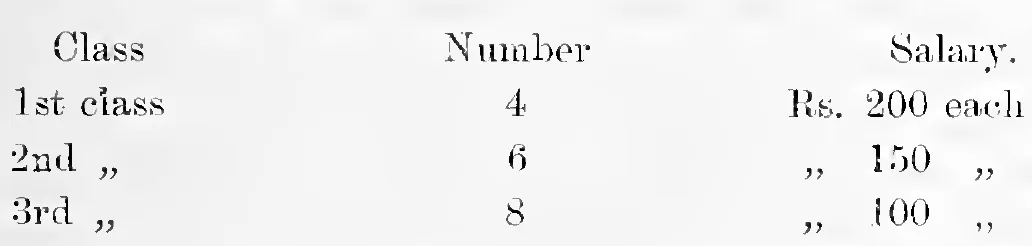
The salaries of the Zillah Judges were fixed at Rs. 400 for the first Judge and Rs. 300 fer the Second Judge. The pecuniary jurisdiction of the Munsiff was raised from Rs. 200 to Rs. 500. They were also invested with small cause powers in personal suits of the value of Rs. 20 and under, and have been empowered to follow the small cause procedure. Their decisions in such cases are final.
The principal changes made in the constitution and powers of the old Sadr (now called High Court) are that the number of judges was raised [440]from 3 to 5; one Judge was empowered to make a periodical inspection of the various subordinate courts; and a bench of two Judges, instead of one as formerly, required to dispose of all appeals civil and criminal, applications for transfer of cases and references made by Small Cause Courts and by Criminal Courts. Again the Chief Court of Judicature also combined with it the functions of a judicial committee as three Judges were empowered by the new Regulation to hear in certain cases appeals made to H. H. the Maharajah from the decision of Division Benches.
Regulation II. of 1061 M. E. (1885-86) was passed to empower a single Judge of the High Court, when sitting as vacation Judge to dispose of applications for staying execution of decrees of the Civil Courts and to suspend sentences of Criminal Courts.
Regulation IV of 1061 M. E. (1885-86,) was passed to authorise the execution in Travancore of the decrees of the Civil Courts in British India and the Cochin State, His Excellency the Viceroy and Governor-General and His Highness the Rajah of Cochin having granted similar concessions to the decrees of the Travancore Courts.
In this year, a set of rules was passed prescribing the qualifications for Munsiffs and Vakils. Another set of rules was also passed in the year for regulating leave and leave allowances to Judicial officers. Rules were also framed in the year prescribing the mode of preferring complaints against Judicial officers.
By Regulation I of 1065 M. E. (1889-90) the number of Judges in the High Court was reduced from 5 to 4. Under this enactment a single Judge of the High Court was empowered to hear appeals against the decisions of the District Courts in suits of the value of Rs. 2,500 and upwards and an appeal to the Sovereign from his decision was provided, the remaining 3 Judges of the High Court sitting as a Judicial Committee to hear such appeals. This Regulation was revised and amended by Regulation I of 1067 M. E. (1891-92). According to this law the intermediate appeal was abolished and a Full Bench of 3 Judges was empowered to hear and determine all Civil appeals from the decisions of the District Courts subject to the confirmation of their decree by the Royal Sign Manual.
In 1068 M. E. (1892-93) a Regulation was passed which prescribed the mode of valuing suits for the purpose of determining the jurisdiction of courts and of assessing Pleader’s fees for purposes of taxation of costs. Regulation V of 1068 M. E. amended the Limitation Regulation II of 1062 M. E. The Civil Procedure Code (Regulation II of 1065 M. E.) was [441]amended by Regulation II of 1070 M. E. (1894-95). This Regulation prohibits Civil Courts from taking cognizance of suits relating to Kandukrishi, Viruthi or Service Inam lands without special order of Government permitting the plaintiff to seek such redress. It contains a similar prohibition in regard to suits connected with pensions. It also provides a definite procedure for the institution of suits by or against Rulers of Native States under the suzerainty of Her Majesty the Queen Empress of India and the execution of decrees passed against them.
Regulation II of 1071 M. E. (1895-96) extended greater protection to Judges, Magistrates and others acting judicially.
Regulation III of 1075 M. E. amended and consolidated the law relating to Vakils. This amended an old Regulation passed in 1040 M. E. (1864-65).
Regulation I of 1077 M. E. amended the Civil Courts Regulation I of 1057 M. E. The ordinary jurisdiction of the Munsiffs was raised from Rs. 500 to Rs. 1,000 and power taken to raise their small cause jurisdiction from Rs. 30 to Rs. 50 in individual cases on the recommendation of the High Court. In the exercise of this power the small cause jurisdiction of ten Munsiffs was raised from Rs. 30 to Rs. 50.
Criminal Justice. As stated under the head of Civil justice, in 987 M. E. (1811) certain courts designated Zillah Courts were established which enquired into police and criminal cases as well as civil, and submitted their proceedings to the Dewan.
In 990 M. E. (1814) the Appellate Huzur Court was formed for the hearing of appeals from the decisions of Zillah Courts.
In 993 (1817) and 1007 M. E. (1831) Tahsildars and Munsiffs were successively invested with jurisdiction in petty police cases, but it was in 1010 M. E. (1834) that the foundation was laid for anything like a proper administration of Criminal justice. By Regulation VI of 1010 M. E. the Tahsildars became heads of Police and as such were empowered to hear and decide all cases of a trivial nature such as assaults or abusive language and all petty thefts and to commit all cases of heinous offences to the Zillah Courts. It also empowered the Dewan to supervise the work of the Police and Magistracy.
Police officers were debarred from cognizance of cases of adultery; and the Dewan to whom alone such complaints were to be preferred was to issue orders for their investigation agreeably to the usage of the country or caste of the parties, report being made to the Huzur and decision passed [442]afterwards.
Regulation VII of 1010 M. E. (1834) defined the powers of the Zillah Criminal Courts. The Judges of the Appeal Court were appointed Circuit Judges. One of the Judges was required to proceed on circuit once every six months to the different Zillah Courts where they were empowered to investigate and decide all cases requiring a higher punishment than it was competent to them to award. The powers of the Circuit Judges were :—
Fine up to Rs. 200, imprisonment to three years; and whipping 36 lashes. Cases calling for a higher punishment and those in which the Shastri differed from the Circuit Judge went before the Sadr Court. The powers of the Sadr Court were unlimited but they were required to submit for the confirmation of His Highness all cases requiring capital punishment, or imprisonment for more than 14 years, or more than 36 lashes.
In 1030 M. E. (1854), a class of officers with powers of general control and supervision in all magisterial and police matters under the Dewan’s orders was introduced. These were the present Dewan Peishcars who were till then attached to the Dewan’s Cutcherry at headquarters but were in that year sent out to be in charge of Divisions.
In 1032 M. E. (1856-57) the Circuit Courts were abolished and in their room 3 Sessions Courts were established to which the Zillah Criminal Courts were made immediately subordinate. These Sessions Courts were abolished in 1037 M. E. (1861-62) and their powers merged into those of the Zillah Criminal Courts.
Regulation I of 1041 M. E. (1865-66) revised the constitution of the Zillah Criminal Courts. They were to consist of two Judges, one a Hindu and the other a Christian, an extra Judge being appointed when necessary. A single Judge was declared competent to try and determine both civil and criminal cases.
Regulation III of 1041 M. E. (1866) legalised the admission of approvers in criminal cases. In 1043 M. E. (1867-68). Vakils were admitted for the first time to plead in criminal cases. In 1047 M. E. (1871-72) there was a redistribution of magisterial powers; and the Zillah and Sadr Courts were invested with certain appellate and revisionary powers over the proceedings of the Magistracy. The Dewan, while left by virtue of his office to exercise full administrative and executive control over the Magistracy and Police, was relieved of his functions [443]as a magistrate, but he might still be “specially empowered and commanded by H. H. the Maharajah to conduct any extraordinary enquiry in any particular case from time to time.” The Dewan Peishcars were constituted Magistrates each in his own Division in the place of the Dewan and their powers and those of the Sub-Magistrates were defined and laid down.
Regulation I of 1052 M. E. (1876-77) was enacted in the interests of the Christian subjects of the State. This Regulation made a second marriage during the lifetime of the husband or wife punishable in certain cases.
Regulation II of 1052 M. E. (1876-77) vested co-ordinate jurisdiction in all Magistrates, and in Sub-Magistrates specially notified.
Regulation III of 1054 M. E. (1878-79) altered the constitution of the Sadr Court and the changes effected on the criminal side of this Court were as follows:—Two Judges sitting as a bench hear and dispose of all regular and special appeals and referred criminal cases where sentence of death or imprisonment for life is awardable. A single Judge was competent to dispose of all other matters with power to reserve for the opinion of another Judge or of the whole court any question of law or practice, and bound to refer to the whole Court any point in which he may differ in opinion from a prior decision. Criminal cases requiring reference to the Sadr by the Zillah Judge are restricted to those where capital sentence or imprisonment for life is awardable. An appeal lies in other cases and the prisoner can claim to be heard by two Judges of the Sadr if the sentence awarded exceeds 7 years. The powers of the Zillah Criminal Courts were increased by the same Regulation. It laid down that it was competent to those Courts to try and dispose of all cases committed to them by the Magistrates which required a smaller punishment than death or imprisonment for life. All cases in which death or life imprisonment was awarded should be referred to the Sadr Courts. All other sentences were final, subject of course, to appeal. The Sadr Court might alter or reverse any sentence and enhance punishment. In questions of fact, only one appeal was allowable.
In 1056 M. E. (1880-81) two Regulations were passed which adopted mutatis mutandis the Indian Penal Code with the Whipping Act and the Criminal Procedure Code as the law of Travancore. The introduction of the British Indian Penal and Criminal Procedure Codes, and the separation of the functions of the Police from those of the Magistracy, during the year 1056 M. E. (1880-81) necessitated a complete reorganisation of the different grades of criminal courts. At the beginning of the year 1057 [444]M. E. (1881-82) there were 61 subordinate Magistrates whose punitive powers were limited to passing sentences of imprisonment not exceeding 30 days and fines not exceeding Rs. 10. 31 of these were Tahsildars and Taluq Magistrates, and the remaining 30 Sub-Magistrates or Police Amins as they were designated. Both these grades of officers were also Heads of Police in their respective ranges. There were, besides, 8 superior Magistrates, whose powers extended to passing sentences of imprisonment not exceeding 3 months, fines not exceeding Rs. 50 and whipping up to 12 lashes. Offences requiring a higher punishment were committed to the Zillah Criminal Courts. These superior Magistrates were also Heads of Police. During the year, 14 of the 30 Police Amins were dispensed with while five new Courts were established. Of the 8 superior Magistrate’s Courts one was abolished and another was converted into a 2nd Class Magistrate’s Court. The remaining 6 were made 1st Class Magistrate’s Courts and invested with nearly all the powers of District Magistrates. Two of the Magistrates had each an assistant given to him with the powers of a first Class Magistrate. The number of Zillah Judges exercising the powers of Sessions Judges was reduced from 12 to 5.
By Regulation V of 1067 (1891-92) the law relating to Criminal Procedure was amended on the lines of the British enactment with some modifications to adapt them to local conditions.
The Travancore Penal Code was passed by Regulation I of 1074 M. E. (1898-99).
Regulations II and III of 1074 M. E. (1898-99) amended the Criminal Procedure Code (Regulation V of 1067 M. E.)
The above is a brief sketch of the history of the judicial administration in the State from the earliest times. The judicial machinery at present consists of the following :—
The High Court presided over by a Chief Justice on a salary of Rs. 1,200 per mensem and 3 Puisne Judges with salaries ranging from Rs. 750 to Rs. 900.
District and Sessions Courts. There are 5 District and Sessions Courts. They are at Trivandrum, Nagercoil, Quilon, Alleppey and Parur. Each Court is presided over by a District and Sessions Judge. The Trivandrum and Alleppey Courts alone have a Second and additional Judge on Rs. 350 each per mensem. The District and Sessions Judge of Trivandrum is drawing a salary of Rs. 600 per mensem while those of Nagercoil, Quilon, Alleppey, and Parur draw Rs. 500.
[445]Munsiffs’ Courts. There are now 21 Munsiffs’ Courts in the State. The Munsiffs are graded into 3 classes. In the first class there are 7 Munsiffs on a salary of Rs. 250 each per mensem; in the 2nd class 7 Munsiffs on Rs. 200 each per mensem; in the 3rd class 7 Munsiffs on Rs. 150 each per mensem. Besides the above, the Superintendent and District Magistrate of the Cardamom Hills and the Tahsildar and 2nd Class Magistrate of Shencottah exercise the powers of a Munsiff in their jurisdiction.
Criminal Courts. For the administration of Criminal Justice in the country there are in the State 6 District Magistrates, 7 First Class Magistrates, 37 Second Class Magistrates and 8 Third Class Magistrates. In addition to these there are 4 Special Magistrates and one Appellate Judge for the trial of European British subjects. These special Magistrates were appointed by a Royal Proclamation dated 16th Edavam 1050 M. E. (28th May 1875) by His Highness the Maharajah and vested with the powers of a Magistrate of the First Class under the Indian Penal Code to try all ordinary cases and in committable cases to commit (in virtue of their contemporaneous appointment by the Viceroy as Justices of the Peace) either to the British Resident as a Court of Sessions or to the High Court at Madras. A Royal Proclamation issued on 2nd Tulam 1051 M. E. (6th November 1875) provided for the appeals from the decisions of Special Magistrates by constituting the Christian Judge of the Sadr Court (now the High Court) being a European British subject, Special Appellate Judge to hear and dispose of such appeals as well as to revise their proceedings. The same Proclamation defined what cases of contempt of Court by European British subjects were cognizable by the ordinary courts and what were not so cognizable.
It was in 1837 A. D. that the question was first mooted whether the Europeans residing in Travancore were subject to the civil and criminal jurisdiction of its courts. The matter was referred to the Government of India by the Madras Government at the instance of the then British Resident in Travancore and Cochin. They decided that “Europeans residing in the territories of Native States not being servants of the British Government must be held to be in all respects and in all cases, civil and criminal, subject to the law of the country in which they reside.” The question came up again in 1868 A. D. when John Liddel, a European British subject and in the employ of the Travancore State holding the office of Commercial Agent on a salary of Rs. 1,000 per mensem was charged with the embezzlement of a large amount of public money placed under his control. A special Commission was appointed to try him. The Committee unanimously found him guilty and sentenced him to two years’ imprisonment. [446]Mr. Liddel immediately complained to the Resident that the State had no jurisdiction over him. The Advocate-General to whom the Madras Government referred the petition pronounced the conviction bad and Mr. Liddel was immediately released, under the orders of the Madras Government. Sir T. Madava Row, K. C. S. I., the then Dewan of Travancore, addressed a series of very able letters to the Madras Government in support of his position that Travancore was an independent Native State. These letters which completely refuted the Advocate-General’s arguments received the support of the legal opinion of Mr. J. D. Mayne, an authority not less eminent than the Advocate-General himself. As a result of these powerful papers the Resident wrote to the Dewan on the 9th December 1868 as follows ;—
“In accordance with this opinion, His Excellency the Governor-in-Council sees no reason to question the legality of sentence passed upon Mr. Liddel by the Travancore Courts, and resolves to cancel the former order on the subject.”
The Travancore authorities thought that they had seen the last of this business. But it was not so. On the 10th of February 1874 the Resident wrote :—
“In consequence of communications from His Excellency the Governor-General of India in Council, I am directed by the Madras Government to explain to H. H. the Maharajah of Travancore, with every compliment, that His Excellency the Governor-in-Council having regard to the position of Her Majesty as Paramount Power in India and to the Treaty engagements entered into with Travancore, does not recognise the position assumed by the late Dewan, Sir T. Madava Row, in the discussion that took place in Liddel’s case (viz., the exercise of jurisdiction over European British subjects is an inherent right possessed by the Government of Travancore) and that the altered condition of law respecting the trial of European British subjects for offences committed in Native States, requires some alteration in the practice which has hitherto prevailed. It is observed that when the jurisdiction of Travancore in 1837 was recognized there were difficulties in the way of trying in British Courts European British subjects for offences committed in Native States. These difficulties have been removed by different Acts of the Imperial and Indian Legislatures, and the question is thereby placed on a different footing to that on which it formerly rested.”
It was to carry out the Governor-General’s wishes conveyed in this letter that the Royal Proclamation of the 28th May 1875 above referred to was passed.
The character of the judicial institutions of a country is undoubtedly the best test of good Government and judged by that test we have no hesitation in declaring that the administration of Travancore has reached a high state of efficiency.
[447]Jails. From the Description of the administrative system of Travancore, we learn that formerly there were only two Jails, one at Trivandrum and the other at Quilon for securing the convicts maintained by the Sirkar and employed to repair the roads, etc. everyday. The following is the statement of Jail establishments in Travancore in 1844.
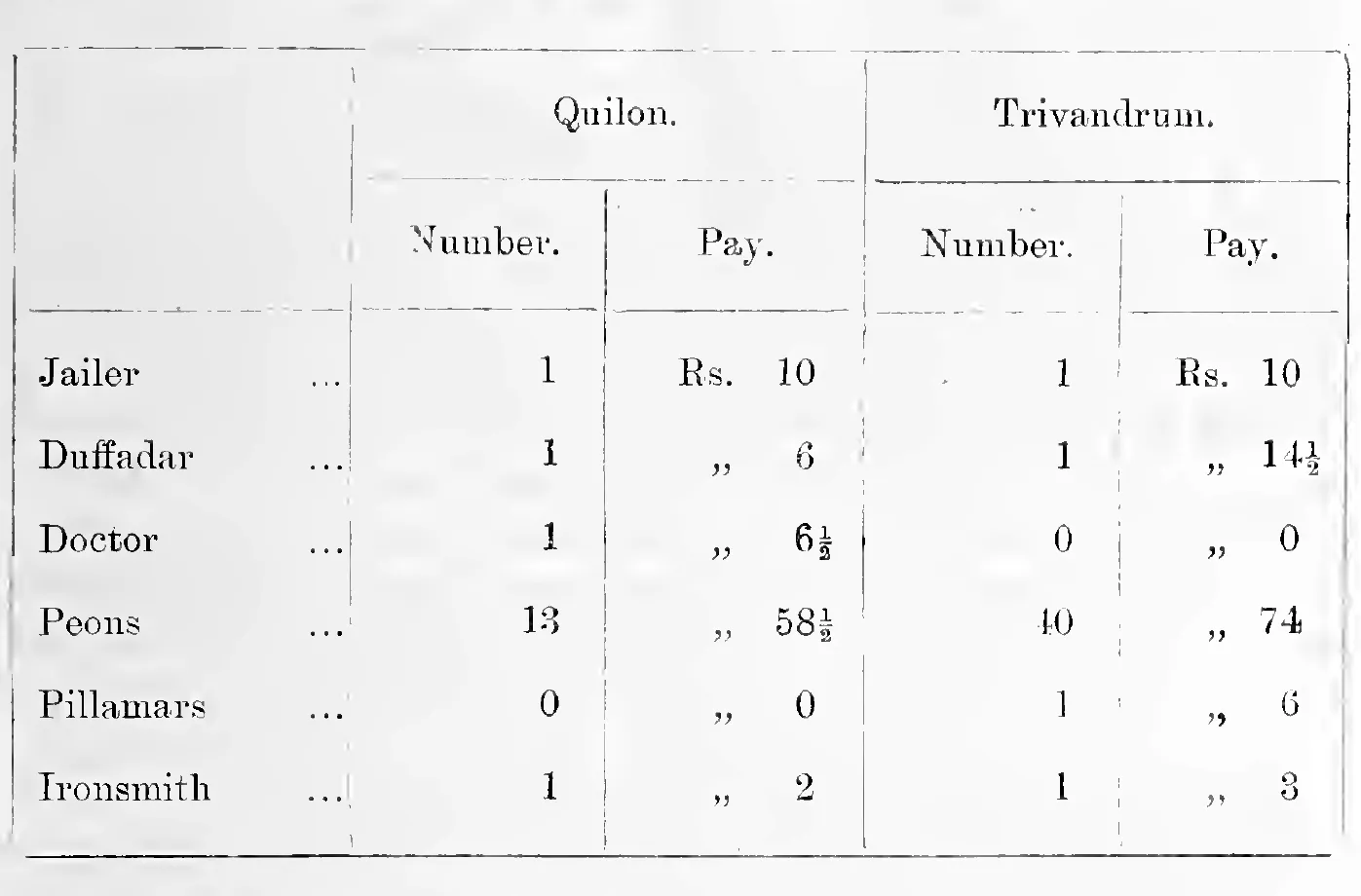
The Jails were formerly under the medical charge of native physicians drawing a mere pittance of Rs. 6 or 7 per mensem and the consequence was uncleanliness and excessive mortality. The medical charge was transferred to the Durbar Physician about 1860 A. D. as principal Medical Officer of Government and medical subordinates were attached to each Jail.
The Administration Report for 1038 M. E. (1862-63) mentions three jails, the principal one at Trivandrum, another at Quilon, and the third at Alleppey besides small jails attached to the Zillah Criminal Courts chiefly for the confinement of prisoners under trial. In the same year (1862-63) very energetic measures were taken by Dr. Ross the Durbar Physician, to arrest the progress of mortality in these jails.
By 1048 M. E. (1872-73) the number of jails had risen to 4, all under the general control of the Dewan, two at Trivandrum, the Central Jail and another, a kind of supplement to it; one at Quilon and one at Alleppey. The charge of the jails was vested in Superintendents or Jailers: the Central Jail was under a Superintendent and an Assistant drawing Rs. 85 (including Rs. 15 horse allowance), and Rs. 30 respectively: [448]the supplemental jail under another Superintendent drawing Rs. 30: while those of Quilon and Alleppey were under Jailers drawing Rs. 20 each.
The Central Jail at Trivandrum was situated at the north-western angle of the Fort. This building before the occupation of the jail served as the barracks for the Nayar Brigade, in which men of short terms of imprisonment were confined.
The prisoners were locked up at night and were guarded by Jail warders and brigade sepoys. Prisoners sentenced to simple imprisonment had no work while those sentenced to rigorous imprisonment had work of various kinds. A large number of them were employed in the making and repairing of roads both at the Capital and at Quilon and in sweeping them; others were told off in small parties from day to day for garden work in the Palaces, Hospitals, Sirkar buildings and Public gardens, while some were engaged in carting their own daily provisions, drawing water for cooking and cleaning purposes, in making their own fetters, &c. while a few were also employed to saw timber in the Marahmut workshop and a few in ivory and wood carving. Brahmins and females of all classes were by the custom of the country exempt from hard labour or labour of any kind.
Prisoners undergoing rigorous imprisonment were allowed 26¾ oz. each of rice and a rupee weight of table salt, besides 8 cash for condiments; those under simple imprisonment were allowed only 21¼ oz. of rice per day and a rupee weight of table salt and 8 cash for condiments. Brahmins were fed by choultry rice brought by Brahmin servants from the choultry. Civil debtors were paid by their creditors at the rate of 5 chs. each per day through the Courts. Prisoners under trial got 2½ chs. a day including the allowance for condiments. All prisoners except civil debtors were given a cloth every six months and a Jamakal (carpet) every third year.
To the Jail there was attached a hospital located in a separate building where the prisoner taken ill was removed. During seasons of epidemics all those attacked were removed to the Jail Hospital while ordinary patients were treated within the Jail building itself. The Jail medical establishment consisted of a Sub-Assistant Surgeon with one or two Apothecaries to assist him. The surgeon was required to attend daily and one of the Apothecaries was supposed to be always on duty. Prisoners were permitted to converse and communicate with their pleaders and relatives when necessary in the presence of, or through the Jail officials from 6 to 7 A. M. and 4 to 5 P. M. everyday. There were no remissions of terms of imprisonment or other rewards. The Superintendent of the Central Jail was [449]authorised to inflict 6 cuts on the back with a rattan for insubordination or breach of Jail discipline; but there was no deprivation of food as one of the punishments. Summary powers were also given to the Town Sub-Magistrate of Quilon and the Magistrate of Alleppey. The Superintendent was required to visit the Jail daily, sign and send reports and returns &c. to the Huzur to admit and release prisoners at the close of their terms, investigate and decide all petty quarrels and assaults among the convicts, inspect the sanitary arrangements, superintend the work of the convicts and do other miscellaneous duties. In these he was assisted by two assistants drawing Rs 35 and Rs. 30 respectively a Jamadar and a Duffadar on Rs. 10 each, two clerks, one on Rs. 8 and the other on Rs. 6, and 118 peons on Rs. 5 each; of these the 2nd Assistant, the Jamadar, 2 head-peons, one of the additional clerks and 33 peons were in charge of the Sub-Jail at Pujappura.
There was no authorised code of Prison Regulations in force.
The Sub-Jails were :—
- 1. Quilon Station Jail.
- 2. Quilon Court Jail.
- 3. Alleppey Jail.
- 4. Nagercoil Court Jail.
The Quilon Station Jail was under the control of the Superintendent of Police, who periodically inspected it. The immediate charge was in a Jailer drawing Rs. 20 per mensem assisted by a Naick on Rs. 8 and a certain number of peons with salaries ranging from Rs. 4 to 5. The Jailer was authorised to put prisoners in the stocks, or substitute heavy iron for light ones or have them manacled in case they became refractory, reporting the circumstances to the Superintendent. The Jailer kept a register of the prisoners under his charge, as also of their release, death, &c. and apportioned work daily for each batch. He had to muster them after work and see that proper batta was given them. He had to sleep in the prison on alternate days and go frequently to inspect the batches on work. The Naick had to conduct the prisoners to their working places and back again to the Jail and also had to sleep in the prison on alternate days.
The Alleppey Jail was under the charge of one Jailer on Rs. 25 per mensem, one Naick and 14 peons and was superintended by the Judges of the Court. The Magistrate who directed the sanitary arrangements of the Jail attended also to the complaints of the prisoners. The ration allowed in these Sub-Jails is generally 2½ measures of rice and 8 cash [450]per day per head. Civil debtors were allowed 5 chs. a day and those under trial 2½ chs. The prisoners were allowed to buy the necessary things from the dealers who were let into the Jail premises under the strict supervision of the Jail officials. In all these district jails sanitation was carefully attended to and general cleanliness maintained both within and without the premises. Prisoners were regularly vaccinated soon after admission and sick prisoners were removed to a separate room and treated by the local medical subordinates.
In 1880 the Superintendent of the Central Jail was sent to the British Jail at Canannore to study the jail discipline and the system of jail administration in vogue there. He returned in December of the same year and submitted a report on the reforms to be introduced. Consequently intramural labour was slowly and gradually introduced in the Central Jail. Native cloths, cotton carpet, coir rugs, chain-fetters and carts for jail use were manufactured by convict labour in addition to carving in wood and ivory. The scale of dietary was revised and improved and assimilated as far as circumstances permitted to that obtaining in the British jails. A printing press was established inside the Jail in 1057 M. E. (1881-82). The new rules provided for the inspection of the jail by official visitors, regulated the punitive powers of the officer in charge and defined his duties and those of his subordinates. Provision was also made for the release, under sanction, of convicts suffering from incurable diseases disabling them for ever from the commission of crimes. The system of serving out doles of raw rice to each convict with cash for purchasing firewood and condiments was put a stop to and a scale of dietary was adopted under which cooked food was distributed.
In 1062 M. E. (1886-87) the present Central Jail at Pujappura, a very handsome and commodious structure standing on a conspicuous position, was occupied. This enabled Government to abolish the Sub-Jail hitherto stationed there and to reduce the guards. In the same year the Jail establishment was revised and placed on a better footing.
In 1066 M. E. (1890-91) H. H. the Maharajah sanctioned a set of rules under which a small money grant was given to destitute convicts on their release to enable them to reach their homes instead of begging in the streets and committing offences which would bring them back to the jail. The Superintendent was given a permanent advance of Rs. 15 a month for the purpose. A Committee was appointed with the Durbar Physician as President to examine into the working of the jail system in Travancore with a view to reduce the cost and introduce wholesome improvements.
[451]Regulation I of 1071 M. E. (1895-96) was passed with effect from the last quarter of the year to regulate the management of the prisons in the State and an elaborate code of rules also was passed to regulate the details. But it was found not possible, however, to introduce all the changes involved at once. The Regulation being a close adoption of the British Indian Enactment (Act IX of 1894) the Superintendent was sent on deputation to Madras and Vellore to acquaint himself with the details of prison administration obtaining there. In 1072 M. E. (1896-97) some of the more important recommendations of the special Jail Committee were adopted, viz.,
- 1. Introduction of convicts’ ticket;
- 2. Do. of fortnightly weighments;
- 3. Do. of night guarding inside the sleeping wards;
- 4. Commencement of gardening operations in the jail premises;
- 5. Introduction of several new Jail Registers;
- 6. Adoption of steps for the recognition of habitual offenders;
- 7. Introduction of the dietary prescribed in the Prison rules.
In 1073 M. E. (1897-98) the Prisons Regulation was fully brought into operation. The following were some of the important changes introduced :—
1. The Jail establishment was reorganised and graded and the Police guard attached to the Jail disbanded, the military however continuing to guard the Tower and the main Gate;
2. To fully carry out the reforms under the new Regulation, another Jailer on Rs. 70 was appointed;
3. In the place of the Mundoos which were formerly supplied to the convicts, uniforms similar to those in use in British Jails were issued.
4. Extra-mural labour was entirely stopped except in very rare cases the inmates being wholly engaged in the workshop, garden, &c;
5. Steps were taken to introduce the Remission system to study which, as also the system of keeping Jail accounts an Asssistant Jailer was sent to the Penitentiary at Madras;
6. The system of taking finger impressions of the convicts was also introduced towards the close of the year.
The District Jails still continued under the old system as it was found expedient to defer the extension to them of the provisions of the Prisons [452]Regulation until more experience was gained in its working in the Central Jail.
In 1074 M. E. (1898-99) the system of taking anthropometrical measurement of the convicts introduced in 1072 M. E. (1896-97) was discontinued and that of finger tip impressions substituted in its place. The system of awarding good conduct stripes to warders was also introduced in that year.
The health of the Jail in spite of the efficient arrangements with regard to dieting became very unsatisfactory. In 1076 M. E. (1900-01) the mortality was high, as also the sick rate, being 7·04 per cent. and 4.33 per cent. of the average strength respectively. A special committee was therefore appointed to enquire into and report on the subject.
On their report a caste Hindu was appointed Jailer and changes were introduced successfully in the dietary. Strict and unremitting attention was paid to the supply of provisions, the preparation and distribution of food and thorough cleaning of the cooking and eating vessels, so that by the close of 1078 M. E. (1902-03) the mortality had fallen to 4·21 per cent. The sick rate however showed a slight increase, viz., 4·28 per cent. this being attributed to the unusual heat and seasonal changes which marred the effect of the special precautionary measures adopted in the recommendations of the Jail Committee.
A large influx of Marava convicts connected with the Sivakasi riots which extended to the borders of Travancore increased the sick rate and the death-rate of the Central Jail. The fault was not so much in the dieting or other precautionary measures taken for the health and comfort of the Jail population as in the unsuitability of this damp climate to the hardy Marava, born and bred in the dry atmosphere of Pandy and inured to a vigorous open-air-life of roaming over the dry plains at a pace incredible to the dwellers on this coast. When shut up, the best of them pine and die. One of the greatest safeguards against the Marava dacoities on the Travancore frontiers being not more frequent than now is the fear of incarceration in the Travancore Jails which the Marava believes is death to him. Such is the dread which the thieving Marava entertains for an enforced residence in the climate of Malayalam.
The total strength of the convicts in 1079 M. E. (1903-04) was 976. There were besides 66 under-trial prisoners and 75 civil debtors confined in the Jail. The average daily strength was 438·34.
In the same year the total expenditure inclusive of hospital charges was Rs. 46,814-16 chs.-1 cash and the average cost per head was [453]Rs. 106-24 ch.-11 cash. The earnings from Jail manufacture were Rs. 6,082-3 ch.-13 cash and the value of extramural labour came to Rs. 10,464-17ch.-8 cash, so that calculated in the net expenditure the average cost per head was Rs. 69-2ch.-14 cash.
As for the District Jails, viz., Quilon and Alleppey, the cost amounted to Rs. 6,184 and Rs. 6,414 respectively and the value of extramural labour to Rs. 1,703 and Rs. 1,320 respectively.
No statistics are available with regard to the crime of the convicts and their periods of imprisonment in the latest Report.
The Central Jail is under the control of a Superintendent and the District Jails of Quilon and Alleppey are under the Quilon Dewan Peishcar and the Commercial Agent respectively.
The management of the Central Jail has always been favourably commented upon by high authorities as the following extracts from the Central Jail Visitor’s Book will show. General Sir Henry Prendergast, British Resident, observed (13th July 1887):—
“The Jail seems to be well designed and well-built. If possible there should be sheds within the walls for stone breaking and other works.”
Mr. J. C. Hannyngton, Resident, wrote (5th June 1890):—
“The premises in good order and the prisoners well attended to as far as can be judged from their appearance.”
Mr. H. B. Grigg, Acting Resident, remarked (31st July 1890):—
“I found the Jail premises in excellent order. The prisoners appeared to be well fed and well cared for.”
Lord Wenlock, the Governor of Madras wrote (1st November 1892):—
“I visited the Central Jail on October 31st and was much pleased with the good order and general cleanliness of the Jail, and the good condition of the prisoners. But I was much surprised to find that all the prisoners with few exceptions, were made to live night and day in fetters.”
Mr. J. D. Rees, Resident, observed (10th June 1895):—
“Visited Jail this morning. All was very clean and satisfactory.”
Mr. J. Thomson, Resident, remarked (23rd September 1905):—
“Saw all inmates and the buildings. Those not in hospital in good physical condition—better I think, than incarceration for crime warrants. ... ... The buildings are clean and orderly. I had not time to examine the books.”
Sir A. E. Havelock, Governor of Madras, observed (20th October 1897):—
“Was shown over the Central Jail by Mr. Duthie the Superintendent. The [454]plan of the Jail is good, having regard to the fact that the separate system does not exist. Its situation is excellent. The wards are well-built and well-ventilated. The enclosure is too small, if intramural labour on a large scale is to be introduced. Various improvements and additions are, I am informed, in contemplation such as separate accommodation for females and juveniles, a close prison, &c. &c., and I understand, that it is intended to follow more closely in some respects, the prison system of Madras Presidency. The prisoners were paraded. They appeared to be in good condition. The health of the gaol is good. Clothing &c. are excellent. Order and cleanliness are remarkable. The Institution is a credit to the Government.”
Mr. F. A. Nicholson, Acting Resident, wrote (12th June 1899):—
“The new additions seem very large and costly; on this a separate note will be recorded.”
“The females still seem to have no sufficient employment: it would be kinder to give them full work. There must be work which they can do; e. g., the rice for the Jail is bought as rice, i. e., cleaned; if it or a portion were bought as paddy, the women might husk it, and save the cost of their labour. Other employments are possible.”
Mr. J. Andrew, Resident, remarked (7th September 1905):—
“Went over the Jail and saw the prisoners at work. Everything seemed well conducted and the discipline of the Jail guard impressed me very favourably.”
Registration of Assurances. It was in the year 1042 M. E. (1866-67) that H. H. the Maharajah passed a Regulation for establishing an improved system of Registration of Deeds in Travancore. The old system provided a regular agency of village notaries who derived their appointments from and acted under, the orders of the Sadr Court. These people were remunerated by fees levied upon the instruments which they registered. The stamped cadjans used to be supplied to them through the Munsiff’s Courts and the proceeds credited to the State. The village registrars (Oorkanakans) had power to make summary enquiries into objections against the execution of the deeds and to refuse registration in case they were deemed not valid. They were also prohibited from registering whenever they found that the Sirkar had liens on the property, such as for arrears of Revenue or had them already under attachment or that they were Service or Personal Inam tenures. This unpaid agency did not work either to the profit of the State or to the satisfaction of the public who were subjected to much annoyance, delay and extortion.
Hence a reformation was much needed and this was introduced by the Regulation above referred to. This Regulation was modelled on the British Indian Act for the Registration of Assurances. Under this Regulation all deeds relating to immovable property and to rights [455]connected with such property (with one trifling exception) must be registered. The registration of deeds relating to movable property was not compulsory, though free scope was given for such registration.
This Regulation came into operation on the 1st of Dhanu 1043 M. E. (14th December 1867). 31 Registering Offices were established throughout the State besides a Central Office at Trivandrum to supervise the whole machinery. No part of the establishment was remunerated with fees. All have fixed monthly salaries varying according to the importance of each District. In this year the average interval between the presentation of a document and its registration was 7½ days. The total collections of the Department for those 8 months amounted to Rs. 33,022. Sir Madava Row writes :—
“The people undoubtedly feel that the new system of registration thus auspiciously introduced is beneficial to them and accordingly they cheerfully conform to its provisions.”
During the year 1049 M. E. (1873-74) certain rules were passed under the sanction of H. H. the Maharajah for the better working of the law in respect of attendance of parties, disposal of unclaimed instruments, cancelment of Powers of Attorney, &c.
Regulation I of 1042 M. E. (1866-67.,) was amended by Regulation III of 1052 M. E. (1876-77). Among other things provided in the new enactment the time for registering a document executed out of India was extended from 3 to 6 months, and documents in English were allowed to be registered in the Trivandrum Office irrespective of the place of execution or the situation of the property embraced therein. H. H. the Maharajah was also pleased to sanction as an encouragement to the Registrars an extra emolument over and above their fixed salaries of a commission of 5 per cent. on the amount of fees collected in each District.
In 1063 M. E. (1887-88) the status and salaries of some of the Registrars were raised. They were enjoined to send to the Tahsildars direct copies of registered documents with Razenamahs obtained from the executors to enable the Tahsildars to enter the transfers in the Revenue Registers and to record all landed transactions involving increase of quit rent due to the State.
It was in the year 1063 M. E. (1887-88) that a Regulation was passed to provide for the incorporation, management and winding up of trading companies and other associations. The object was to encourage the combination of capital and skill in industrial and other undertakings [456]which are too much for the individual.
Regulation I of 1070 M. E. (1895) which amended the law relating to the registration of documents came into operation from the beginning of the second quarter of 1071 M. E. (1895-96). The official designation of the head of the department was changed from “Huzur Registrar” to “Director of Registration” as provided in the Regulation. The whole department was reorganised in pursuance of the new Regulation. Two grades of District Registrars on Rs. 125 and Rs. 115 respectively and four grades of Sub-Registrars with the salary raised to Rs. 80, 60, 50, and 40 respectively were sanctioned. Opportunity was taken to abolish altogether the system of partial remuneration by commission on fees.
The system of recording thumb impressions for purposes of identification was introduced in the year 1075 M. E. (1899-1900.) and tried as an experiment in 7 offices. It was extended to all the offices in the following year.
In view of the increasing work of the Department, sanction was accorded to the entertainment of 30 additional clerks towards the close of the year 1076 M. E. (1900-01.)
The present machinery of the Registration Department consists of :—
- (1) A Director of Registration on Rs. 450.
- (2) 3 District Registrars on salaries ranging from Rs. 115 to Rs. 125.
- (3) 51 Sub-Registrars on salaries ranging from Rs. 40 to Rs. 80.
There is also a Registrar of joint-stock companies on a salary of Rs. 100 per mensem.
The Nayar Brigade. Prior to 1757 Travancore consisted of a number of petty States more or less independent. These petty chiefs were in a constant state of warfare not only among themselves but with the Rajah of Travancore. With a view to their suppression the Rajah of Travancore raised a militia to form which every householder was obliged to furnish one individual; they were armed with bows, arrows, swords, axes, and spears. With the assistance of this militia the Rajah of Travancore attacked, subdued, and annexed these petty States until he extended his territories from Cape Comorin to Kuriapalli. As the State of Travancore was thus enlarged the peace and safety of the conquered provinces demanded a permanent military force, to obtain which the Rajah forcibly enlisted his subjects as he could [457]not apparently obtain them otherwise. This permanent force supplemented apparently the militia, but there is nothing authentic on record. Besides these, companies of Maravars raised from time to time under the orders of Maharajah Martanda Varma especially during the early part of his reign for suppressing the refractory nobles and the Ettuvittil Pillamars of the land as well as for guarding the eastern frontiers constituted a regular army and were found to be trustworthy soldiers in those troublous times. They seem to have fought several battles under the Travancore flag, and a regiment of these men raised by Rama Iyen Dalawa, during the wars with Kayangulam were of great Service in the conquest of that territory. In 1740, the Dutch attacked Colachel but were defeated, whether by the militia or the permanent force or both, is not known. The earliest record of the strength and composition of the military forces of Travancore dates from about the year 1757. There was then an army of 30,000 Nayars (10,000 regular and 20,000 irregular infantry) under the command of Martanda Pillai. When the Dutch were defeated at Colachel two individuals were taken prisoners, the one named De Lannoy, the other Donadi. They were well treated by the Rajah who was so much impressed by the military knowledge of De Lannoy that he appointed him a Captain in his service, and when in 1761 Martanda Pillai died, he succeeded him. He is reported to have constructed modern fire-arms, swords, guns, &c., built a fort at Udayagiri establishing an arsenal there and to have instructed the Travancore troops in the art of war. He made everything that was requisite for the defence of the country, introduced some of his own countrymen as officers and thoroughly reorganised the whole military force. He is reported to have driven the Zamorin of Calicut on the other side of the river from Alangad to Kodungallur, assigned a small spot to the Rajah of Cochin for his support, made himself master of all the fortresses, put the troops on the same footing as Europeans, divided among them the conquered lands, caused them frequently to march through the country with full military parade in order to keep the people in subjection, and after Rajah Martanda Varma’s death gave the kingdom in which perfect tranquillity was restored, to Rama Varma who had just entered on the 34th year of his age. DeLannoy died in 1777 and was buried inside the Fort at Udayagiri which he had constructed, and his tomb may still be seen in the ruined chapel inside the Fort now overgrown with jungle. It bears this inscription :—
“Hic Jacet Eustachius Benedictus De Lannoy qui tanquam dux Generalis Militiæ Travancotidis præfuit ac per annos XXXVII ferme summa fidelitate Regi inserviit cui omnia regna ex Caincolam usque [458]ad Cochin vi armarum ac terrore subjecit. Vixit annos LXII menses V et mortuus est die Junii MDCCLXXVII.
“Requiescat in pace !!”
“Here lies Eustachius Benedictus De Lannoy: who was Commander of the General Travancore Army and for nearly thirty-seven years with the greatest faithfulness he served the King, to whom by the strength and fear of his armies he subjected all kingdoms from Caincolam to Cochin. He lived 62 years and 5 months and died 1st day of June 1777.
“May he rest in peace !!”
In 1780 the Travancore forces consisted of about 50,000 men disciplined according to the European manner in addition to which the State could command 100,000 Nayars and Chogars armed with bows, arrows, spears, swords, and battle axes. A portion of the army was known as the Carnatic Brigade. Its origin is uncertain. It would appear from the Treaty of 1795 that the Travancore army did not consist of Nayars only, but contained also men from the other side of the Ghauts. Whether the Carnatic Brigade took its name from the presence of these men, or whether it was a remnant of a force sent by the Nawab of the Carnatic to assist Travancore during internal troubles is not known. By the Treaty of 1795 Travancore was bound to aid the Hon’ble East India Company in its wars with troops other than Nayars. So the probability is that the Carnatic Brigade were the troops formed and kept for this purpose, a portion of which was employed with the British Troops in Lord Cornwallis’ operations against Tippu Sultan. Its head quarters were at Alleppey and consisted of 5 Battalions of Infantry and 1 Battalion of Artillery. It was commanded by Colonel Daly (1789-1809). The rest of the forces were under native Commanders.
The whole of the Travancore army was paid partly in money and partly in kind, but on the plea of deficits in the public revenue they were deprived in about 1804 of most of their usual benefits by Dewan Velu Tampi who acted thus on the suggestion of Lt. Col. Macaulay. Dewan Velu Tampi’s action caused a spirit of revolt and discontent and resulted in all except about 8,000 men who had remained loyal, being disbanded. Among the men who remained loyal were the Carnatic Brigade. Soon after this revolt a new treaty was concluded with the East India Company (1805) by which the Rajah was relieved of his obligation of lending his troops to assist the British in their wars; at the same time however it was stipulated that the Rajah should pay to the Hon’ble East India Company a sum [459]equivalent to the expenses of 4 regiments of Native Infantry in addition to the sum then payable by the treaty of 1795 for the maintenance of 3 regiments of Sepoys. One company of European Artillery and 2 Companies of Lascars and 4 Regiments of the Company’s army were brought into Travancore and quartered at Quilon and Colonel Macaulay became the first Resident in Travancore. A few years of seeming peace followed but it was evident that Velu Tampi was working secretly to undermine the authority of the British. Friendly with Colonel Macaulay as long as it suited him, he, when he thought he had possessed himself of the full control and resources of the country, found some pretext for quarrelling with him. He in 1808 represented to the Resident that the State was unable to bear the additional burden imposed upon it by the maintenance of the Company’s troops and further complained that the treaty of 1805 had been extorted from the Rajah—besides which he became violently opposed to some political measures proposed to him. Colonel Macaulay endeavoured to persuade Velu Tampi to retire to Calicut on a pension from the Hon’ble East India Company; it was only however when the Resident insisted on his retirement that he expressed his willingness to retire to Calicut and this was purely to gain time and to lull suspicion for he was all the time endeavouring to inflame the minds of the people and to bring about an insurrection. Having heard reports of the disaffection which prevailed in the country and various rumours of rising of the whole people having got abroad, the Resident summoned aid both from Trichinopoly and Malabar. On the day appointed for the departure of Velu Tampi, Colonel Daly, commanding Carnatic Brigade who had been deputed to accompany Velu Tampi out of the country as a bodyguard for his personal safety attended at the Cutcherry by appointment and was horrified to hear from the Dewan that he had ordered the assassination of the Resident and glorified in anticipated success declaring that even then as they conversed “Colonel Macaulay’s head was kicking about the streets of Cochin.” What had happened was this, Velu Tampi having heard that troops were coming to put down the rising and were near at hand, was anxious to strike a blow before they arrived, he therefore prepared in secret a body of armed men and directed them to surround the house at Cochin where the Resident was living and to attack him. This they did on the night of the 28th December 1808. Colonel Macaulay being aroused appeared at the window and was immediately fired at but without effect. Perceiving his danger the Resident hastened to hide himself in a small room where he remained in safety during the whole night. On the following morning a vessel appeared containing a portion of the troops which had been despatched from [460]Malabar and Colonel Macaulay took refuge on board the vessel. As soon as news of the failure of his murderous attempt on the Resident reached him, Velu Tampi, chafing with disappointment appeared in open insurrection. He butchered an assistant surgeon of the subsidiary force, seized on the backwater and drowned in sacks 32 Europeans of His Majesty’s 12th Regiment who were driven by stress of weather into the port of Alleppey and whom he had disarmed by treachery. He ordered Colonel Daly to lead the Carnatic Brigade to Quilon and attack the Company’s troops stationed there. On Colonel Daly refusing to do so he was imprisoned and kept in close confinement for 7 weeks having been in imminent peril of being put to death. Although unsuccessful in obtaining the services of the Carnatic Brigade he managed to get the rest of the troops to obey his orders. The total military establishment of Travancore at this time consisted of 12 Battalions commanded by Europeans or the descendants of Europeans, so that Velu Tampi after deducting the Carnatic Brigade could not have had more than 5 regiments of regulars; the rest of the troops probably consisted of the militia before referred to. A few engagements took place between Velu Tampi’s troops and the British force at Quilon and other regiments that were brought into the country to crush the revolt. The fight at Aramboly on the 10th February 1809 proved completely decisive and brought the insurrection to a close. In all these engagements the Travancore troops suffered severely.
The British troops, being now able to communicate with one another gradually converged towards the Capital and eventually encamped in what is now known as the Cantonment Trivandrum where they afterwards built the barracks now occupied by the Nayar Brigade. The Rajah alarmed at the near approach of the British troops hastened to tender his submission to the Resident, and the Dewan fled to the jungles, and being pursued from place to place committed suicide to avoid capture. So ended the revolt of 1809 and with it the comparatively large Travancore army ceased to exist, for with the exception of 700 men of the first Nayar Battalion all including the Carnatic Brigade were disbanded. The few men who remained were left for purposes of state and ceremony and were allowed to retain possession of a few unserviceable muskets. With this exception possession and manufacture by individuals of arms and ammunition were strictly prohibited and enforced.
The remnant of the Nayar troops were placed under the command of Subadar Maha Singh an officer of the Madras Cavalry and formed the nucleus of the present Nayar Brigade on the organisation of which a few [461]years later (1818) it became the 1st Battalion of H. H. the Rani’s troops. It was not until the year 1830 that the designation Nayar Brigade was used.
On the disbandment of the troops, guards over all important posts were furnished by the British regiments in Trivandrum and were ordered to stand fast until tranquillity was restored throughout the country and all signs of commotion had passed. This arrangement continued until 1817. In that year the Rani represented to the Resident that the remnant of the old army of Travancore was of little utility and were without arms or discipline and that she was anxious to effect a reorganisation and to increase the strength and efficiency of her force and to have a British officer to command. She was supported by the Resident and the reorganisation was eventually sanctioned in 1818 the Rani being given permission to increase her force by 1200 men, and Captain MacLeod an officer who was at the time employed as Killadar of the Fort at Trivandrum and in command of the Rani’s escort of cavalry having been sent by the Commander-in-Chief for the purpose, was appointed the first British Commandant of H. H. the Rani’s Nayar troops. Captain MacLeod proceeded with the reorganisation and raised a second Battalion by the voluntary enlistment of men of the Nayar caste and also formed a detachment of Artillery. He, however, it seems, wrongly interpreted the permission to increase the Rani’s forces by 1200 and is reported to have raised 1200 in addition to the old remnant of 700, but on reference to the table which follows it will be seen that the total reorganised forces amounted to 2316 of all ranks, so that deducting the old remnant, 1616 new men were enlisted. One British Officer being found insufficient for the reorganised troops the Resident asked the Madras Government for the services of four additional officers one for each Battalion as commandant and one for each Battalion as adjutant, but only one officer Captain Gray of the regular army who was on half pay was available, and he was appointed. To fill the other appointments local officers were selected. These were Henry Daly a son of Colonel Daly of the old Carnatic Brigade who was appointed Lieutenant commanding the 2nd Battalion, William Sheriden a relative of an officer of the subsidiary force at Quilon who was appointed Lieutenant commanding the 1st Battalion and W. F. Nixon from Trichinopoly who was appointed Lieutenant and Quarter [462]Master. The reorganisation was completed in 1819, and the strength of the Nayar troops was as follows :—
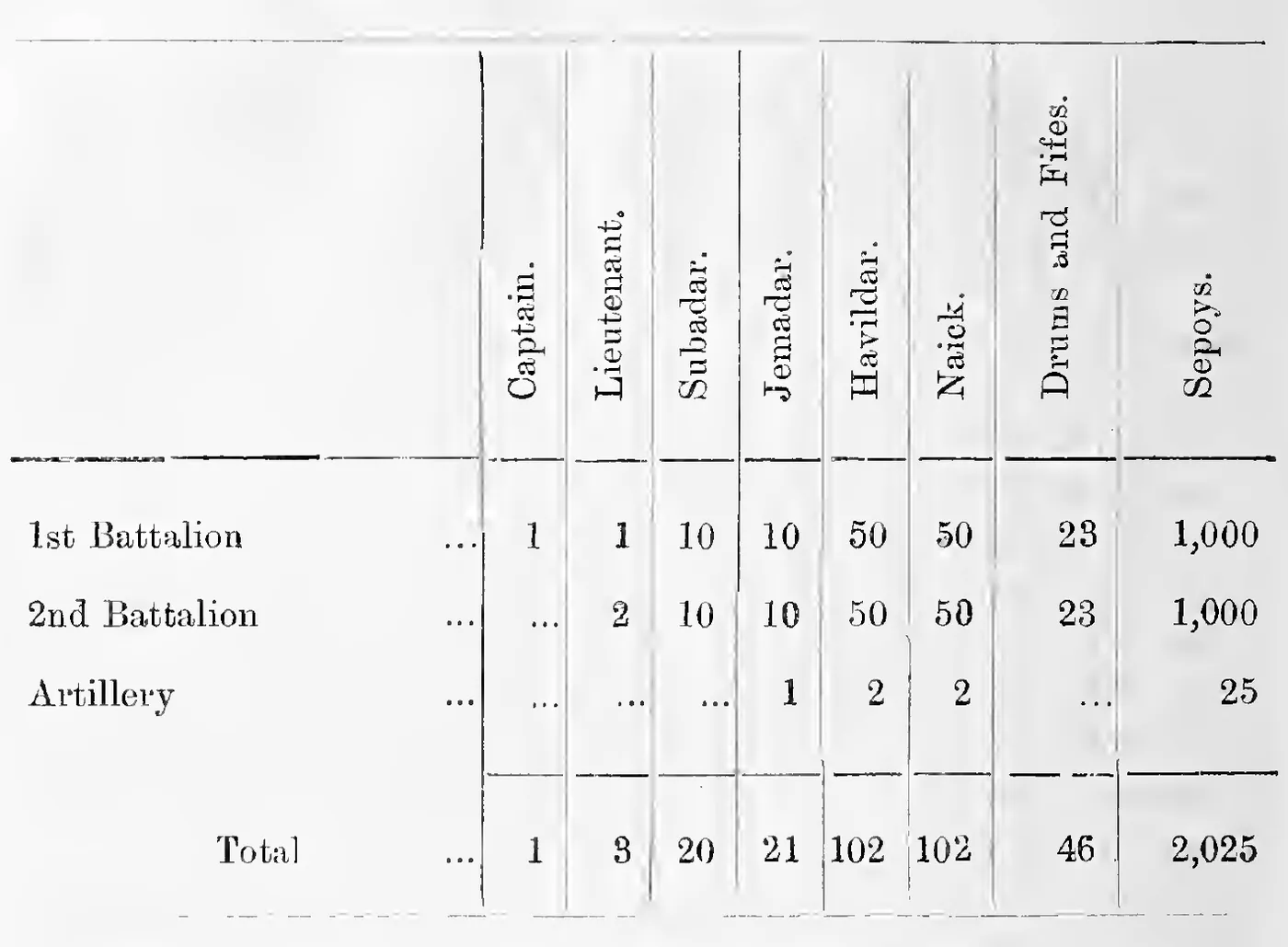
They were armed with repaired rifles and bayonets and a Brigade of brass six pounder guns, these latter for firing salutes; the necessary supply of gun-powder was also obtained all being issued by the British Government on payment. The duties of the Nayar troops after the reorganisation were of a civil or police nature. They were employed in guarding prisons, taking charge of prisoners and others in course of transit from station to station, preventing smuggling, seizing robbers and men charged with offences, assisting civil officers in the collection of revenue, serving as guards and orderlies to civil officers, and in employment about the temples on various duties during festivals. The number thus employed in 1820 amounted to 773 at 66 different stations the remainder of the troops being at Head quarters. In the execution of their duties the men frequently came into collision with the civil authorities.
This state of affairs was brought to notice by the Commandant and he pointed out how it affected the efficiency of the men. As a result the Government in 1826 reduced the troops by 500 men to provide funds for the employment of police for the performance of the duties until then undertaken by the military. Four years later in 1830 a further reduction of 100 men took place. In 1836 all the British troops in Travancore with [463]the exception of one regiment which was left at Quilon were withdrawn and the Travancore troops took over all the duties till then performed by them. The following extract from Brigade orders by Major Campbell (who had succeeded to the command) dated Headquarters, Trivandrum, Thursday the 22nd September 1836 is interesting as showing the duties then performed at out-stations.
Extract from Brigade orders dated 22nd September 1836 Under instructions from the Dewan, the following revised distribution of the Detachments to the South is ordered, consequent on the intended removal of the Company's Troops from Oodagherry and Nagercoil.
Distribution.
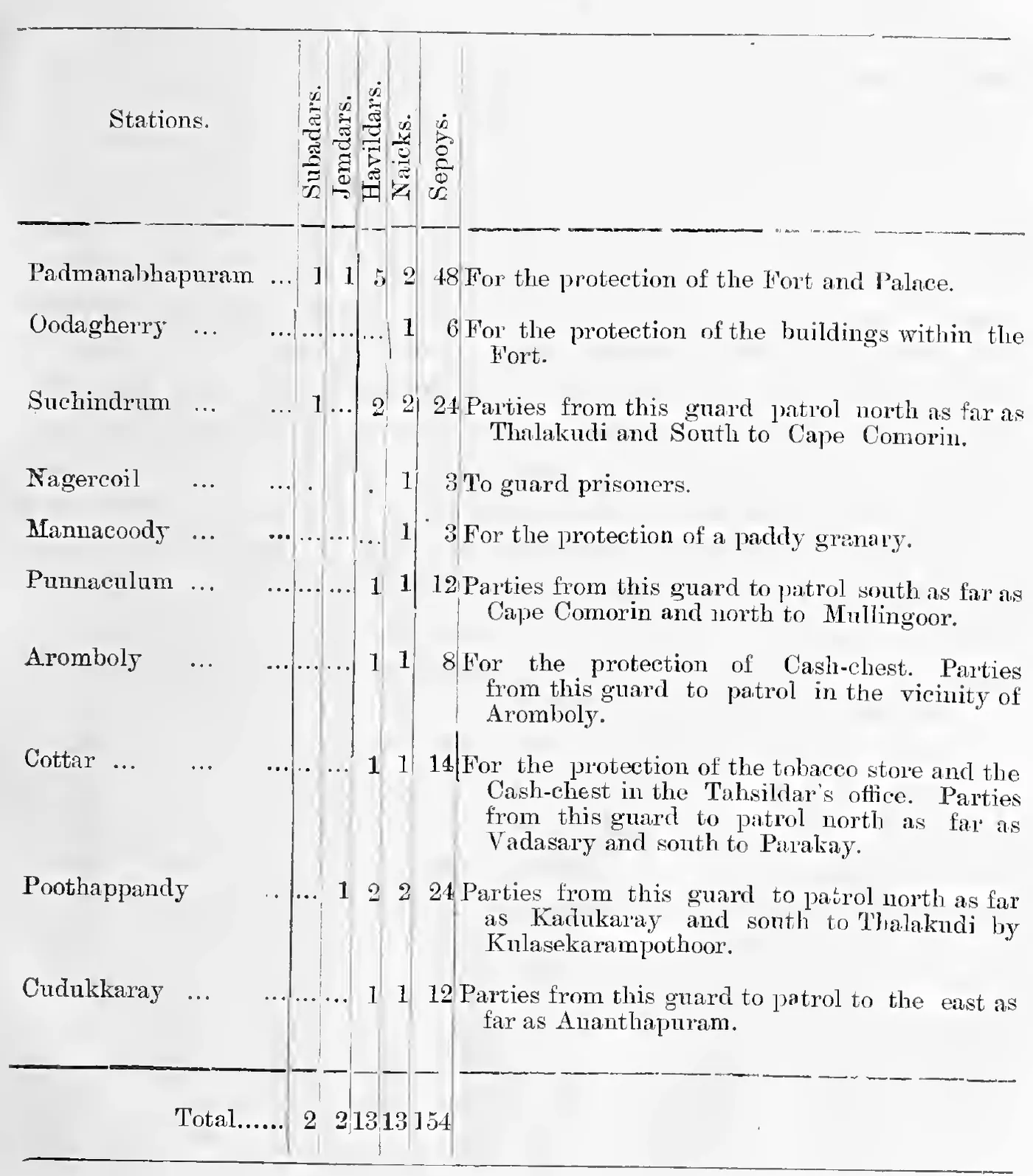
[464]
All the above mentioned guards will be directed to be prepared to suppress disturbances and repel marauders, and upon the verbal order from any appointed civil authority, will use their arms, and if directed to fire, will do so unhesitatingly, and, if possible, with effect; the civil authority, of course, incurring all responsibilities. The men required to complete the foregoing commands will be taken from the 4th Company, 1st Battalion and march this after-noon. Each man composing the above detachments, Padmanabhapuram excepted, will be furnished with twelve rounds of ball cartridge and one flint.
Subadar Major Cullupram Matheven Pillai, 1st Battalion, will accompany the above party, place the detachments, and show the routes for the patrols.
The Subadar Major will remain with them a month for the purpose of ensuring the duties being properly conducted.
Various attempts were made from time to time to appoint local officers as was done in 1819, but the Hon'ble East India Company steadily set their face against this and insisted on Officers holding British Commissions being appointed, and from 1831 down to the present time with only one exception (an Officer of the Home Reserve of officers), officers from the British service have been appointed. Since the withdrawal of the British troops peace and quietness have prevailed in Travancore and the Nayar troops still retain the old partial liberty which existed in bygone days by the old militia living in their own houses and attending to the cultivation of their fields and gardens when not required for military duties. The harmony was only broken once in 1850 when a new Officer who did not fully comprehend the habits of the men and constitution of the Brigade issued stringent orders regarding the performance of guard and other duties somewhat similar to those in the British service and in consequence many men deserted or took their discharge. However it was nothing serious and on the Resident intervening, matters were soon put right. Very little remains to be told, for until 1901 the constitution of the Brigade remained very much what it was on reorganisation in 1809, and the duties now performed are practically what they were then except that they no longer assist in the collection of revenue and no guards or orderlies are supplied to civil officers. Generally stated their duties may be said to be ceremonial. Owing to the possible withdrawal of the British regiment at Quilon, the Travancore Government with the sanction of British Government decided in 1900 to reorganise the Brigade and to provide a body of men for purely military duties and who would be available for emergencies such as the quelling of disturbances &c., and similar duties. The reorganisation commenced in 1901. It was decided to amalgamate the old 1st and 2nd Battalions and to call them the 2nd Battalion and to reduce their strength by 500 of all ranks in order to obtain men for the new Battalion. As this reorganisation had long been [465]foreseen and in contemplation, no new enlistments were made so that when the amalgamation, of the old Battalions took place, there were nearly 150 vacancies and 100 young men were at once enlisted to serve in the New Battalion without any compulsory retirements being made from the old Battalions. The reorganisation is to be spread over five years, a new company being raised each year. The men will live in Government Lines and be subject more or less to the same discipline as that prevailing in a British Native Infantry Regiment. They are armed with smooth bore Snider Carbines.
In the history of the Nayar Brigade the following dates stand out prominently. They are :—
1835—The Durbar Physician was appointed to supervise Brigade Hospital in addition to his other duties in the place of native doctors who had till then treated the men according to the native system.
1841—The British Officers were relieved from attendance with the Brigade at State ceremonies of a religious character.
1847—A regular system of pensions on a small scale was introduced and remained in force till 1871.
1851—A separate Medical Officer (a civilian) was appointed to the Brigade in the place of the Durbar Physician.
1863—The third reduction of the Brigade took place. It consisted of :—
- 1 British Officer.
- 20 Havildars.
- 20 Naicks.
- 260 Sepoys (24 were almost immediately re-enlisted).
The object of the reduction was partly to make a further addition to the Police and partly to raise the pay of the Brigade.
The strength of the Brigade after reduction was
- Subadars ... 16
- Jemadars ... 17
- Havildars ... 83
- Naicks ... 83
- Sepoys ... 1,209
- Drummers, Fifers & Buglers. ... 46
1868—The Old Brigade barracks were pulled down and the Brigade permitted to use the barracks which they now occupy and which were built by the troops who came to Trivandrum in 1809, on condition that they [466]were vacated on the shortest notice whenever required by the British Government.
1870—The old flint lock muskets supplied in 1818 were replaced by percussion muskets obtained from England (none being available in the Madras Arsenal) together with sword bayonet and accoutrements; these were of black leather. At a subsequent date buff leather was substituted. Two or three years after receipt, the fire-arms and accoutrements were condemned as being of most inferior description; they are however still in use but are in a very unserviceable if not dangerous state. Application has been made for new ones with ordinary bayonet (Carbine B. L. S. B., Foot Police) and brown leather accoutrements; they have not however yet been received.*
1871—Pension rules were revised.
1875—A graduated system of pay was first introduced.
1877—An increase of 2 Havildars and 16 Sepoys was made in the strength of the Brigade in consequence of an addition to the strength of the Cardamom Hill Detachment.
1882—An Officer from the I. M. S. was appointed in the place of Dr. Sperschneider deceased.
Present Strength of the Nayar Brigade.
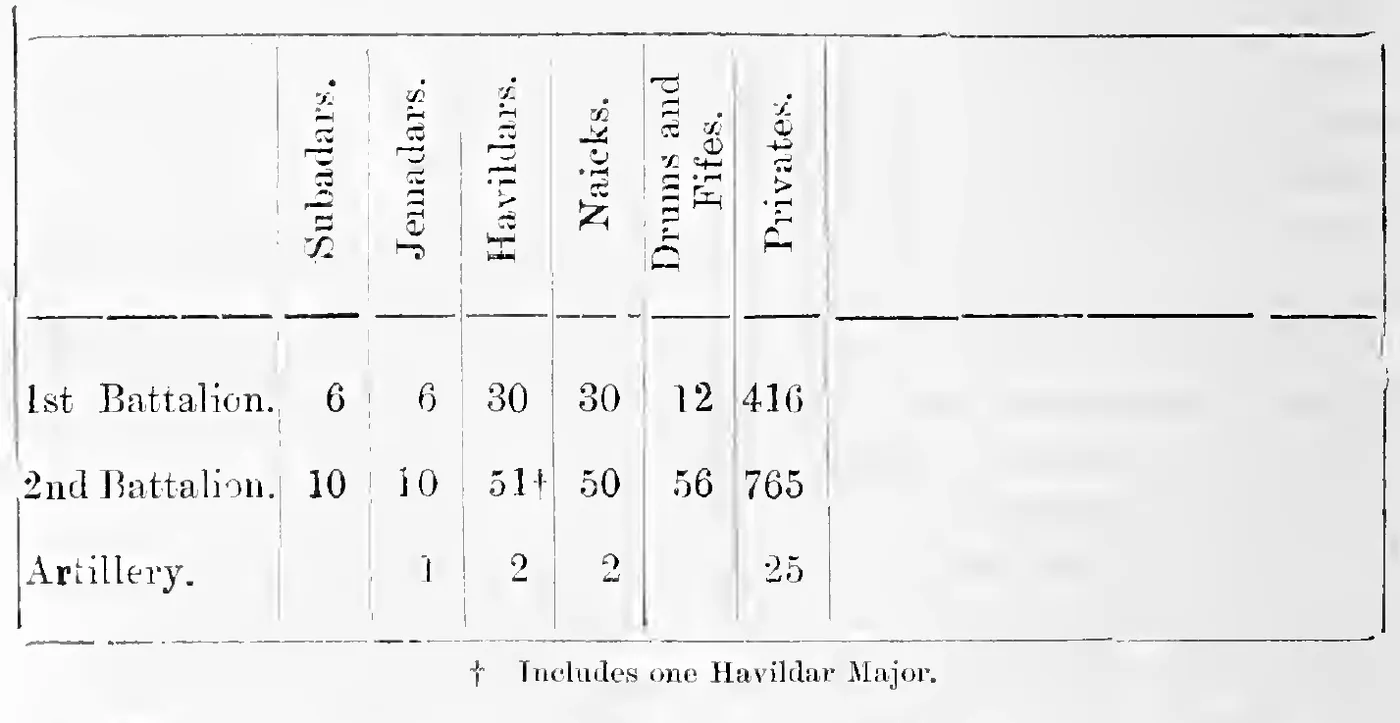
Marine Department. In 1054 M. E. (1878-79) His Highness' Government proposed the organisation of a Marine Department placing the three ports of Colachel, Quilon and Alleppey under one superintending agency whose duty was to collect and arrange returns of the shipping, receive reports of vessels arrived and departed, see to the [467]enforcement of Port rules and generally to direct the work of the master attendants. The Commercial Agent was himself the Master Attendant at Alleppey.
* Since received.
There are at present 13 ports* (including the Sri Mulapuram Port near Cape Comorin) of which the most important are those of Colachel, Quilon and Alleppey. A Register of Meteorological observations is kept up at the Commercial Office, and weather reports are published regularly. A Regulation for the levy of Port dues was passed in 1860 and rules were enacted for the Boat service for the port of Alleppey in 1874 and for the ports of Quilon and Colachel in 1878.
The Alleppey lighthouse was constructed in 1852 and is at present maintained in a high state of efficiency and is of the greatest service to mariners, the light employed for its illumination being visible for a distance of 22 miles. The original pier was completely destroyed in the cyclone at the end of May 1879. A temporary jetty was soon constructed to afford facility for landing. In 1881 the construction of an iron screw pile pier was undertaken at a cost of Rs. 59,000 with a view to meet the increasing wants of the trade of Alleppey which was daily growing in importance. It was thrown open to the trade that same year. In 1892-93 an extension of the same was called for owing to the recession of the sea or shifting of the mud-bank and was soon completed.
Pier and warehouse rules for the port of Alleppey were passed in December 1896; in Alleppey there is a short line of tramway connecting the pier with the town which proves very useful to the merchants and to the Government in carrying tobacco and salt to their respective bankshalls.
Each of the chief ports is in charge of a Master Attendant, the Commercial Agent being the Master Attendant of the Alleppey Port.
During the year 1079 M. E. (1903-04), 577 vessels called at the several ports of the State. The collections under port dues, pier toll and tramway hire amounted to Rs. 12,875.
Forests.† Travancore has been a country of forests from the earliest times. There are evidences which go to show that the whole country was at one time covered with trees. Mr. T. F. Bourdillon the Conservator of Forests in his very interesting and able Report on The Forests of Travancore writes:—
"The first reliable information as to the working of the forests comes from
* Cape Comorin, Manakudi, Colachel, Pattanam, Puvar, Vizhinjam, Trivandrum, Anjengo, Paravur, Quilon, Alleppey and Munampam.
† Note. Mr. A. P. Smith, Deputy Conservator of Forests, has kindly read the proofs of this section. V. N.
[Pages 468 and 469 of the printed volume are missing from the scanned copy from which this edition was made.]
[470]recommended the formation of a Keddah system on the plan of Mr. Sanderson's keddahs in Mysore and he was deputed to go and visit that place. On his return a site was selected on the Katar river near Konniyur and the work was commenced in 1050 M. E. (1874-75). The Keddah was opened in 1052 M. E. (1876-77), was used till 1060 M. E. (1884-85) by which time 100 animals were caught; but though it was very successful at first, its existence became known to the elephants and latterly there were few captures; so it was closed temporarily.
Since the control of the forests near Shencottah was handed over to the Forest Department in 1047 M. E. (1871-72) various changes were introduced in their management. Thus in 1047 M. E. the timber was delivered at the depot and sold by auction as already stated. In 1049 M. E. (1873-74) the people were allowed for one year to fell the timber for themselves on permit. The period was subsequently extended by 2 or 3 years. As a result of these the forests suffered severely. In 1054 M. E. (1878-79) we find the old system again in force and timber sold by Government from a depôt. This depôt system was continued till 1058 M. E. (1882-83) when we find a return to the old seignorage system, merchants being allowed to fell timber on permits. But in 1060 M. E. (1884-85) a Superintendent was appointed on Rs. 100 a month and the depôt system was introduced again.
Up to the year 1051 M. E. (1875-76) the teak and blackwood felled in the forests either departmentally or by contract had all been delivered at Alleppey and was sold there by auction at prices ranging from Rs. 14 to Rs. 18 per candy. In this year an enterprising Bombay firm contracted with the Travancore Government to purchase large quantities of teak and blackwood. In 1053 M. E. (1877-78) and 1056 M. E. (1880-81) other contracts were entered into with the same firm for further quantities of teak. In 1058 M. E. (1882-83) the same firm took a contract for 10 years for as much teak and blackwood as we could deliver to them within that time. About the year 1058 M. E. (1882-83) the felling of Kol-teak by the Taluq authorities was stopped and the work was transferred to the Forest Department, the Sirkar demand per candy being raised to Rs. 8 from Rs. 6 exclusive of the cost of cutting and delivery.
On 6th Minam 1056 M. E. (18th March 1881) an important Proclamation was issued defining the limits of hill-cultivation. This in part reaffirmed the Proclamation of 1045 M. E. (1969-70), but gave permission to the people to clear the land within four miles of inhabited places, a most [471]vague limit so long as the definition of an inhabited place was not given. This Proclamation assigns no punishment for the infringement of its clauses, though it makes provision for the confiscation of the produce raised upon the land. In 1057 M. E. (1881-82) the Conservator resigned the duties of a Magistrate to try Forest offences as the High Court did not uphold his convictions which were not passed under any special law.
In 1058 M. E. (1882-83) the forests on the western slopes of the Mahendragiri Hills were handed over to the Forest Department, and an Aminadar and staff were appointed to protect them. In the same year an attempt was made to open a sandalwood plantation a few miles off Quilon, but it proved a failure.
On the 22nd Minam 1058 M. E. (3rd April 1883), an order was published forbidding the burning of grass in the forests adjoining Tinnevelly. In the same year notices were issued by the Conservator directing that all timber sold by the Department should be stamped and that receipts given by the Department should all be on printed forms.
At the beginning of 1059 M. E. (1883-84) the forests of South Travancore near Virappuli were transferred from the Revenue to the Forest Department and a special Assistant Conservator was appointed. The year is also remarkable for the appointment of a special Commission to discuss the management of Forests and to draw up suggestions for their better administration. The Commission sat for about a month, examined witnesses and collected evidence and then drew up a Report, which among other things, recommended the appointment of two Deputy Conservators, the abolition of the seignorage system and the substitution in its stead of a depôt system for the sale of timber other than the "royalties." It also prepared the draft of an Act very much on the lines of the Madras Forest Act of 1882. On 12th February 1884, a notice was issued placing an assessment of 2 fanams (4½ as. nearly) a parah on all Government land cleared for paddy. At the beginning of 1060 M. E. (26 August 1884) the depôt system was introduced. This change did not in itself prove much of an improvement on the old seignorage system. One of the disadvantages was that the contractors engaged sub-contractors who did almost as much mischief as the old permit holders did and they were found just as difficult to control. Another disadvantage was that poor people who in the old days could take out permits for small quantities of timber were obliged to go to the depôts often far distant from where they wanted the timber and to buy wood which was perhaps not what they required. [472]This depôt system was abolished in 1063 M. E. (1887-88) and the old seignorage system was reintroduced with much higher rates, the charge being levied per candy and not per log as formerly. In this year the first real Forest Act was passed as Regulation IV of 1063 M. E. (1887-88). A depôt at Kumili and four new sub-depôts near Shencottah were opened this year. Towards the end of the year the Conservator issued a notice regarding the particulars required from applicants for free permits to remove timber grown on private tax-paying land. The year saw also the completion of the demarcation of the boundary between Travancore and Tinnevelly, Madura, Coimbatore and Cochin respectively.
The first Forest Reserve in accordance with the Forest Act was proclaimed in the year 1064 M. E. (1888-89). This is estimated to contain 300 square miles, the place selected being near Konniyur. Since then many tracts have been declared Forest Reserves. In September 1890 the supervising staff was strengthened by the appointment of an Assistant Conservator who had attended the course of lectures at the Dehra Dun Forest School. In May 1891 a student was nominated by Government to attend the Forest course at Government expense at the same institution. In the year 1067 M. E. (1891-92) a grant of Rs. 1,000 was made to Mr. Bourdillon to enable him to form a herbarium of dried specimens of flowers and fruits.
Regulation II of 1068 M. E. (1892-93) was passed for the better protection and management of forests and was a very comprehensive measure.
New hands were entertained in connection with the opening of a watch station at Vellanad in the Nedumangad Taluq to check the timber taken to the plumbago mines by Messrs. Parry & Co.
Towards the close 1068 M. E. (1892-93) uniform rates of batta were sanctioned to the subordinate staff of the Department. Formerly travelling allowance was paid only to a few of them, and that under special sanction.
In 1069 M. E. (1893-94) an additional Deputy Conservator was appointed as also a Sheristadar on Rs. 70. It was in this year that Mr. Bourdillon submitted a special and comprehensive Report on the Travancore Forests. Referring to this the Dewan says :—"Notwithstanding the long time elapsed and which is satisfactorily explained, it is none the less valuable as a standing record of useful and interesting information for which the best acknowledgments of Government are due to [473]the author. It goes thoroughly into the present system of forest administration and is replete with suggestions as to the scope for reform, which will no doubt materially help Government in working out the needful improvements."
Complaints having arisen of the boundaries of reserves being fixed so as to take in regularly cultivated and occupied areas Government had to interfere and lay down restrictions in the interests of cultivation. A special Forest and Survey Officer was appointed and charged with the duty of preparing sketches specifying the boundaries of tracts to be reserved preliminary to the cases being referred for investigation by the Settlement Officer. The Settlement officers too are required to sift the boundaries with a view to the exclusion of cultivated holdings. The restrictions are intended to apply not only to future cases but also to those pending before Settlement officers. This arrangement allayed all alarm on the part of land-owners in the interior parts. As the exclusive system of selling timber in a lump by public auction was found to work a hardship on poor people standing in need of materials for their own purposes, daily sales were arranged for to meet individual requirements.
The most noteworthy event in the year 1070 M. E. (1894-95) was the passing of rules under the Forest Regulation of 1068 M. E. (1892-93). These rules came into force on the 1st of Medam 1070 M. E. (1894-95).
The Forest Department was completely reorganised in the year 1072 M. E. (1896-97). The whole country was divided into three Divisions, two of them to be under the Deputy Conservators and the third directly under the Conservator. This was again subdivided into two Divisions each under the immediate charge of an Assistant Conservator. The establishment was divided as permanent and temporary. The permanent establishment consisted of the Conservator, 2 Deputies, 4 Assistants, 10 Rangers, 8 Deputy Rangers, 14 Foresters and 80 Forest guards. Including those of the temporary branch the new staff consisted of 494 hands against 515 under the old system.
In the year 1074 M. E. (1898-99), rules were passed regarding,
(1) Deposit and security of Forest officers.
(2) Ground rent leviable on timber sold but not removed from depôts.
(3) Demarcation of forests.
(4) Accounts.
(5) Uniform of Forest officers.
(6) Capture and training of elephants.
[474](7) Management and working of State forests.
(8) Distribution of areas between the Cardamom and Forest Departments.
(9) Closure of reserves to permit-holders. It was also decided to depute at Government cost four students for training in the Imperial Forest School at Dehra Dun with a view to qualify them for employment in the Forest Department of the State.
The new Account Code for the Forest Department was brought into force from the beginning of the year 1075 M. E. (1899-1900). During this year rules were passed prohibiting shooting within reserves and requiring Forest officers to stamp timber removed from private holdings, thereby relieving the subordinate Revenue officers of that duty.
In the year 1078 M. E. (1902-03) rules regarding the procedure to be adopted by Forest Settlement Officers were revised in view to providing facilities for the speedy disposal of claims. Rules were also passed on the following subjects :—
(1) Maintenance and feeding of trained elephants;
(2) Permission to owners of estates to cut cotton-wood on payment of seignorage;
(3) Levy of the value of trees on waste lands at fixed rates;
(4) Prohibition of the destruction of teak saplings on registered lands by ryots.
In this year an additional Division and 3 Ranges were newly constituted.
In 1079 M. E. (1903-04) Forest rules were revised and the duties of Forest Settlement Officers better defined. Special concessions were granted to hillmen to induce them to settle down in fixed localities, and plots of land were specially allotted to them within the reserved forests for purposes of cultivation.
The tariff rates on jungle wood were raised in view of the large demand for timber. The rates of seignorage were also raised.
A uniform rate was fixed for the price of wild cardamoms collected by hillmen. Trees standing on putuval lands were ordered to be paid for at the time of registry instead of remaining the property of Government under the care of the ryots for indefinite periods.
The superior staff of the Department consists at present of one Conservator on Rs. 800 per mensem. 4 Deputy Conservators on salaries [475]ranging from Rs. 250 to Rs. 400 per mensem and three Assistant Conservators on salaries ranging from Rs. 100 to Rs. 125 per mensem.
Thus the whole forest area of Travancore is divided into 5 Divisions :—
- 1. Northern Division.
- 2. Kottayam „
- 3. Konni „
- 4. Quilon „
- 5. Southern „
There are 27 Watch stations and 14 Depôts throughout the State.
The following are the present rates of Kuttikanam (seignorage) fixed for the different classes of timber.
1st class
- Anjili, Jack, Thambagam, Venga, Pathiri — B. Rs. 2 per candy in log and Rs. 4 for sawn timber.
II class
- Thembavu, Agil, Irumullu, Ventekku, Punnappamara, Cherupunna — B. Rs. 1½ per candy in log and Rs. 3 for sawn timber.
III class.
- Madagiri Vembu, Karintagara, Trees of the Vaga species, Mayila, Manjakadambu, Manimaruthu, Puvannu — B. Re. 1 per candy in log and Rs. 2 for sawn timber.
Other kinds of timber Re. ½ per candy in log and Re. 1 for sawn wood.
Mango planks in private gardens Re. ½ per candy.
Nedunar per log Re. ½
Bamboo per 100, Rs. 2.
Canoes
- Anjili, Jack—8 as. per quarter girth
- Cheeni, Ilavu—6 as. per quarter girth
- Boats made of other kinds of wood — 4 as. per quarter girth.
No permits are given for boats made of Thambagam, Venga and Thembavu.
The Forest Department besides having control over the Depôts and [476]the management of timber operations have also certain miscellaneous functions attached to it, the most important of which is :—
(1) the capturing of wild elephants,
(2) the collection of ivory; The ivory that is collected is to be forwarded to the Commercial Office where it is sold along with the annual Cardamom auction. A reward of Re. 1 per lb. is paid as Kudivila for all ivory brought in;
(3) Collection of Cardamoms from near Konniyur gardens. The money paid for Cardamoms is nominally ⅖ of the selling price.
(4) Collection of bees' wax.
This is a Government monopoly and the collector is paid a Kudivila of 45 fs. (Rs. 6½) per Tulam of 20 English pounds.
(5) Collection of lac, dammar and honey, and
(6) Collection of other minor produce such as tamarind, firewood, &c.
No charge is levied on firewood over the greater part of the country but if taken by water in rafts a charge of Re. 1 per twelve pieces is levied though firewood taken in boats is free.
Royal Timbers. The Royal timbers are :—(1) teak, (2) Kol-teak, (3) black-wood, (4) Ebony and (5) sandalwood. These cannot be felled by any person without the permission or license obtained from the Conservator of Forests. They can only be felled by Government agency or by contract; any person violating the rule is punished with a prohibitive assessment for the trees he has cut down. But an exception is allowed in favour of the managers of coffee estates who are at liberty to use the royal trees growing on their properties on payment of certain fixed rates after obtaining previous permission to fell the trees. Teak and blackwood were originally felled by Government agency but since 1054 M. E. (1878-79) felling of timber is almost entirely done by contract. The contractors specify the quantity of timber to be supplied and also the depôts at which they are to be delivered. The Contractors send their men to the forests and the timber is prepared. A pass is given by them to the nearest watch station specifying the quantity of timber and number of pieces despatched. A way bill is given in return for the pass and is checked at each station till timber reaches the depôt where it is measured and entered in the stock-book when the contractor to whom printed receipts are given becomes entitled to receive payment at once on all the good timber that he has delivered, the bad ones being rejected.
Depôt system. The rates paid for the supply of timber at the different [477]depôts are not uniform.
(1) Puliyara Depôt. Timbers delivered are teak, blackwood, kongu, venga, ventekku, mayila, &c.; rates vary from Rs. 6½ to 7½ per candy.
(2) Quilon. Rs. 9¾ per candy, teak, venga, kongu and thambagam.
(3) Trivandrum. Rs. 9 to Rs. 10 per candy, thambagam, venga, thembavu and blackwood.
(4) Nagercoil. Rs. 5¾ to Rs. 12 per candy, teak, kongu, nangu, vengu, mayila, anjili and ventekku.
(5) Peermade. Here the contractors engaged not only to bring their timber to the depôt to be measured but also remove it for sale themselves on payment of Rs. 5 or Rs 4½ per candy.
The rates at which teak is sold are Rs. 17, 13 and 10 for the 3 classes
- 1st class above 15 inches quarter girth;
- 2nd „ „ 12½ „
- 3rd class Kol-teak below this
Blackwood sells at Rs. 18 and Rs. 15 according to class, the former for log above 15 inches quarter girth and the latter for logs below it. The other timbers are obtained on permit in Central and North Travancore and from the depôts at Puliyara and in South Travancore where they are sold at certain fixed rates.
Permit System. Permits are given to persons on payment of the necessary fees to fell trees on their application specifying
- (1) the quantity required;
- (2) the kind;
- (3) whence they are to be felled;
- (4) means of transport; and
- (5) length of time required for removal.
In the case of Forest Reserved or unreserved a permit is given to the applicant to enable him to enter and fell the timber. The rates charged run from 5 fanams (12 as) for common timber up to Rs. 2 a candy for Anjili, Jack, Thambagam in log and nearly double for sawn materials. The charge is 3 fanams in the case of mango planks and Rs. 1¼ for log of Nedunar while for bamboo it is Rs. 2 per hundred. The permit holder after getting the timber ready brings it to the river-side or road whence they are to be transported. The Ranger of the Range stamps them after measuring the logs and enters the measurements on the back of the permit. The timber is then allowed to be removed by route specified in the permit after being stopped [478]at each successive watch station for examination. Owners of tax-paying lands are at liberty to fell and use any trees, royalties of course excepted, growing on their properties free of charge so long as the timber is used on the land or conveyed by land in which case a free permit has to be obtained; but if taken by water, seignorage has to be paid. The petty chiefs, large land-holders or Jenmis and owners of coffee estates are allowed to fell and use any timber growing on their lands free of charge; but once the timber is removed outside their lands and estates whether by land or water, it becomes liable to seignorage and permits have to be obtained in just the same way as if the timber is brought from Government lands.
Cardamom department. The Cardamom Hills form a solid territory in the North East of Travancore. Till 1044 M. E. (1868-69) the Conservator of Forests was in charge of these Hills. In that year a new officer was appointed to the charge under the designation of Superintendent and Magistrate of the Cardamom Hills with an establishment. His principal duties were to collect the cardamoms grown; to prevent smuggling; to see growers fully and promptly paid their dues; to bring about the extension of the cultivation of this spice; to conserve the forests in his charge; to establish and administer depôts to sell timber; to collect grazing fees; to make bridle paths and to act as a Magistrate for the summary disposal of cases as they arise; he has also to superintend the entrapping of elephants.
Cardamom being a State monopoly the lands where this stuff is grown were leased out to the ryots who had to deliver the produce to Government at a fixed valuation. In order to derive a revenue from this produce various steps were taken gradually by increasing the rate of payment to the cardamom ryots, augmenting the production and extending the area of cultivation. A liberal scale of remuneration was given to the ryots to induce them to take greater interest in the raising and collecting of the produce.
In 1046 M. E. (1870-71) an Overseer and 12 additional peons were appointed to assist the Superintendent in the operations of felling timber in his charge.
Up to 1053 M. E. (1877-78) it was the custom to burn the chaff or light cardamoms collected with the crop, with the object of putting them out of the power of the ryots to get possession of them and make use of them to cover smuggling of the superior article. In 1053 M. E. (1877-78) the inferior produce was sold at Alleppey, due precautions having been [479]taken to see the article shipped off from Travancore without any possibility of its finding its way to the ryots. Hitherto the ryots used to gather the crop at a single picking in which the racemes with ripe and unripe fruits were pulled off the plants, the capsules being subsequently stripped off the racemes. This tended to a limited out-turn of superior quality spice, the bulk being of a very inferior and depreciated quality.
In 1050 M. E. (1874-75) Government proposed to increase the ryots' share to two-fifths of the outcome of his crops and introduced experimentally in one of the Cardamom gardens an improved system of picking by which only the ripe pods should be picked. Though the result attained was a clear profit no further action was taken to extend the improvement to other gardens until 1060 M. E. (1884-85) when owing to the continued complaints of the ryots, their share was raised to two-fifths.
In the early part of 1063 M. E. (1887-88) an Assistant Superintendent and First Class Magistrate was appointed with a small establishment under him. This appointment was felt necessary partly to assist the Superintendent during the crop in taking over the produce of new fields which had recently come into bearing at considerable distance from the old fields and partly to provide a Magistrate for the Anchanad valley situated at the extreme end of the Superintendent's jurisdiction and removed from his headquarters by several days' journey.
In 1066 M. E. (1890-91) a Preventive Inspector was appointed with a small staff under him to prevent smuggling which had been carried on on a large scale.
In 1069 M. E. (1893-94) a regular survey of the cardamom gardens was started and completed within 3 months; the total area of the occupied tract was found to be 9,767·68 acres.
The abolition of the cardamom monopoly having been for long time under the consideration of Government the necessary arrangements were completed in 1071 M. E. (1895-96) and the land-tax system was introduced tentatively for 5 years with effect from 1072 M. E. (1896-97). Under the new system the ryots were allowed to appropriate to themselves the produce raised, subject to the payment of a uniform assessment of Rs. 6¼ per acre. Rules regarding the payment and the recovery of the assessment and regulating other matters connected with the new measure were also passed. It covered only the Makara yelam gardens while the Kanni yelam gardens continued under the old system. Government with a view to encourage extension of cardamom cultivation also sanctioned the grant of lands for the purpose within the cardamom reserve on a light tax of one [480]rupee per acre for the first 3 years and the full assessment of Rs. 6¼ thereafter. The abolition of the monopoly necessitated a reduction of the establishment and this was done from the beginning of 1073 M. E. (1897-98). The saving on that account amounted nearly to Rs. 12,000 per annum. The Headquarters of the Superintendent was removed from Peermade to Devicolam which is becoming and promises ere long to develop further into an important centre of planting activity. The office of the Assistant Superintendent and First Class Magistrate was also abolished.
In 1074 M. E. (1898-99) the areas about the Peermade plateau, the Cardamom hills and Anchanad (including the Kannan Devan Hills) and over which both the Cardamom and Forest Departments exercised some jurisdiction were distributed between the two Departments so as to avoid dual control and secure administrative efficiency. The existing Cardamom rules were revised and amended to meet the increasing demand for cardamom cultivation. Under the new rules the cardamom gardens within the surveyed area for which Pattahs had already been granted to ryots would continue to pay an assessment of Rs. 6¼ per acre for 5 years from the date of the introduction of land-tax, i. e., till the end of 1076 M. E. (1900-01), and thereafter a renewal of the lease was to be granted for 7 years with an assessment of Rs. 8. As for the new lands taken up outside the area a light assessment of Re. 1 per acre was levied for the first 3 years and Rs. 8 from the commencement of the fourth year; and at the expiry of 12 years Government would have the right to resume the lands or renew the grant on such assessment as they might fix, it being however provided that a renewal would be granted to such holders as have regularly paid assessment in full during the 12 years, for a further period of 12 years at an assessment not exceeding Rs. 10 per acre. In 1075 M. E. (1899-1900) the last provision, viz, the enhancement of assessment from Rs. 8 to 10 per acre at the end of the 12th year from date of Pattah or registration was cancelled.
In 1076 M. E. (1900-01) the Cardamom Aminadars were made Deputy Tahsildars and invested with certain powers under the Revenue Recovery Regulation. The First Class Magistrate of Peermade was made an Assistant to the Superintendent to assist him in his revenue work. The grazing rules were revised, and 3 new Chowkeys were opened.
In 1078 M. E. (1902-03) the rules for the grant of waste lands for wet and dry cultivation were revised and very liberal terms were granted. The rules regarding the grant of cardamom lands also were revised so as to afford facilities for the relinquishment by the ryots under certain [481]conditions of these portions of their holdings which being found unprofitable were not entered upon. Provision was also made for preventing the unauthorised opening of lands by the ryots before issue of Pattah.
The total area under cultivation by the close of 1079 M. E. (1903-04) was 13,693·39 acres.
The whole Department is under a Superintendent who is a District Magistrate and Justice of the Peace on a salary of Rs. 600 per mensem, under whom there are one Assistant to the Superintendent and First Class Magistrate on a pay of Rs. 200 per mensem, one Tahsildar-Magistrate on Rs. 100 per mensem and one Government Agent on Rs. 49-16 chs. per mensem with an office establishment.
Besides cardamoms, the Cardamoms establishment has charge of the collection of ivory, bees' wax, dammar, honey and other minor forest produce.
The total receipts from cardamoms, ivory, wax and other goods amounted in the year 1079 M. E. (1903-04) to Rs. 1,07,783.
Public Works Department. There was no distinct agency for the execution of Marahmut or Public Works up to the year 1008 M. E. (1833), when a Marahmut Department was formed at the Huzur Cutcherry with an executive branch known as Panivagai Marahmut which exists to this day and is located in the Trivandrum Fort. It was originally intended to look after the Palace buildings. The Tahsildars had the supervision of the Marahmut works at the outstations. In 1010 M. E. (1835) a special agency was organised to look after the irrigation works in South Travancore with a Superintendent at its head. For a long time previous to this there had existed a body of 500 pioneers whose duty it was to clear and conserve the irrigation channels in addition to making and maintaining the roads and doing other miscellaneous works. In 1011 M. E. (1836) Lieutenant Horsley an officer of the Madras Army was appointed Civil Engineer on a salary of Rs. 600 per mensem and continued in office until 1841 when he was placed in charge of the Tinnevelly and Madura Districts under orders of the Madras Government with permission to occasionally visit and inspect the works in Travancore for which he drew an allowance of Rs. 600 per annum with travelling charges. His connection with Travancore continued till 1854 during which period some very valuable public works were either executed or restored. From the Selections from the Records of Travancore we learn that an East Indian Surveyor was employed by the Sirkar to supervise, report upon and give directions regarding the irrigation works [482]in the country, that there were in 1844 two native Marahmut Superintendents, one in the southern and the other in the northern districts, besides a Sheristadar attached to the Huzur Cutcherry, a Marahmut Tahsildar, a few Aminadars and several Vicharippucars or Overseers at the Capital to assist the Sheristadar in making repairs or additions to the Palace, the pagodas and other public buildings at the Capital. It was in 1033 M. E. (1860) that the Public Works Department as understood at present was organised and Mr. Collins was appointed Civil Engineer of the State. The annual allotment was then only one lakh of rupees. But with the improvement in the finances more funds were allotted and a systematic method of executing public works was introduced. A small establishment consisting of a surveyor and a draftsman which was attached to the Residency and which worked under the orders of General Cullen was absorbed into the Engineer's Department thus newly formed. Mr. Collins who retired in 1862 was succeded by Major Greenway who in turn was succeeded by Mr. Barton, an officer of remarkable zeal and energy in 1038 M. E. (1863). In that year Rs. 216,764 was sanctioned for the Public Works. Sir Madava Row, the then Dewan, wrote :—
"In an engineering point of view, Travancore presents an almost virgin field. There is ample scope for the exercise of the most versatile talents. Roads, Bridges, Canals, Reserviors, Anicuts, Harbours, Wharfs, Works of Drainage, as well as of Irrigation, Salt works, Jails, Hospitals, Public Offices, and Palaces setting an example to the country of some beauty and elegance, have to be constructed in a long succession in the order of their respective importance to the country. The benefit sure to follow the opening up of the country by means of short roads from the base of the Ghauts to the coast, must alone be incalculable. Parts of the country present admirable facilities for a network of canal communication. As it is, many parts of the country are sadly deficient in communications, though it is true that we have about 500 miles of good road and canal communication. The deficiency in question is so great, that many footpaths are impracticable even for horses or palankeens, and compel the traveller to resort to the most primitive of all means of locomotion."*
The small establishment originally sanctioned expanded gradually during the administration of Mr. Barton. The first step taken by Mr. Barton was to reform the staff which till then consisted of a few executive subordinates, men untrained and ignorant of the rudiments of their profession. To remedy the existing defects the Chief Engineer submitted a scheme for improvement. The following arrangements were thereupon sanctioned by Government :—
1. A sum of 2 lakhs of rupees to be devoted annually for the purpose [483]of public works and to be guaranteed for 5 years in continuation with an extra lakh for any special undertaking.
* Administration Report for 1038 M. E. (1862-63)
2. An establishment the cost of which not exceeding Rs. 20,000 annually to be entertained, being formed of qualified persons procured from any service—5 years' certain employment being offered to the members joining in the Department.
3. The scale of pay and establishment then sanctioned was as follows :—
- 1 Assistant Engineer on Rs. 250,
- 2 Supervisors on Rs. 150 each,
- 3 Overseers on Rs. 100 each,
- 4 Assistant Overseers from Rs. 40 to Rs. 80 each,
- 5 Sub-overseers from Rs. 20 to Rs. 30 each,
- Headquarter establishment Rs. 254.
In 1040 M. E. (1864-65) Government sanctioned an amended establishment and a permanent allotment of 3 lakhs of rupees per annum with a reserve of an extra lakh for any special undertaking. Subordinate executive agencies were appointed and the Department was strengthened in 1042 M. E. (1866-67) by the appointment of an Assistant Engineer and a staff of Supervisors. The Chief Engineer's pay was raised to Rs. 1,000 in 1041 M. E. (1865-66) with travelling allowance at the rate of Rs. 5 per diem. In 1044 M. E. (1868-69) the executive establishment was increased.
Ten years of Mr. Barton's work is thus reviewed by Dewan Sashiah Sastri in his Administration Report for 1048 and 1049 M. E. (1872-73) and (1873-74) :—
"The effects of the large outlay on public works are already manifesting themselves in various directions. The new roads of which very nearly 1000 miles have been either completely opened or are in various stages of progress have tapped an enormous tract of country hitherto almost inaccessible giving fresh impetus to agriculture. New trade is springing up where it was before unknown or exceedingly limited and intercourse is being established and extended at various points and between this State and British India, and in this place it may not be inappropriate to record the great zeal and untiring energy with which our Chief Engineer Mr. Barton has labored and successfully brought to completion works which will do lasting credit to his name."
The following extract from a later Report confirms the high appreciation of Mr. Barton's work by the Government of Travancore. Dewan V. Ramiengar wrote :—
"It is due to the retired officer, Mr. Barton, to record that during the 17 years he was at the Head of the D. P. W. in Travancore, he rendered eminent service to the State. To him are due the devising the system of roads that [484]now covers the country, designing and superintending of the Public Offices, Durbar Hall, College and Civil Hospital at the Capital, and numerous Cutcherries, Schools and Hospitals in the Districts. The large Coolithoray Bridge in the South, the fine suspension bridge over the Poonalur river, and numerous similar works in other parts of the country and the tunnelling through the only barrier intercepting inland navigation in the State are due to his unwearying exertions and professional skill."*
In 1054 M. E. (1878-79) an Audit Section was opened in the Huzur. It was resolved that instead of the District officers submitting all their accounts direct to the Huzur to be scrutinised and checked, certain Divisional returns be submitted for the immediate information of Government, the whole including duplicates of the returns sent to Government going direct to the Chief Engineer's Office there to be checked, embodied in one complete form and submitted to the Huzur supported by the Divisional accounts with all the vouchers connected therewith. Thus the general accounts of the Department were to be audited after they had passed the Chief Engineer's hands, the divisional expenditure being directly obtained from the District officers. In the Huzur, the Marahmut Sheristadar was selected Auditor with a staff of clerks to aid him.
In 1056 M. E. (1880) the improvement of the irrigation system in South Travancore was seriously taken up by Government, the existing irrigation work not satisfying the requirements of the people. Mr. Stephen Horsley, Executive Engineer, was put in exclusive charge of the works in Nanjanad and deputed to Godavery and Krishna to study the irrigation system there. There were at that time 3 schemes before Government to improve the Nanjanad irrigation; (1) the construction of a reservoir above the Pandyan dam sufficient to contain two or three weeks' supply of water for the whole of Nanjanad; (2) bringing the waters of the Kothayar into the Paralayar by a canal; and (3) putting the existing channels and tanks into good order. Government resolved upon the immediate improvement of the principal channels and repair of the Poothen dam. The necessary plans and estimates being prepared by Mr. Horsley, the services of a competent Hydraulic Engineer were indented for from Madras to report on all the schemes, plans and estimates. The works recommended by him were the improvement of the Pandyan canal, the Padmanabhapuram Puthenaur, stopping the leakage in the Poothen dam and the construction of the Pandyan canal Head Works. The works were soon commenced and the whole scheme was completed by the close of 1885 when the Head Works were opened by H. H. the Maharajah in person.
* Administration Report for 1055 M. E. (1879-80)
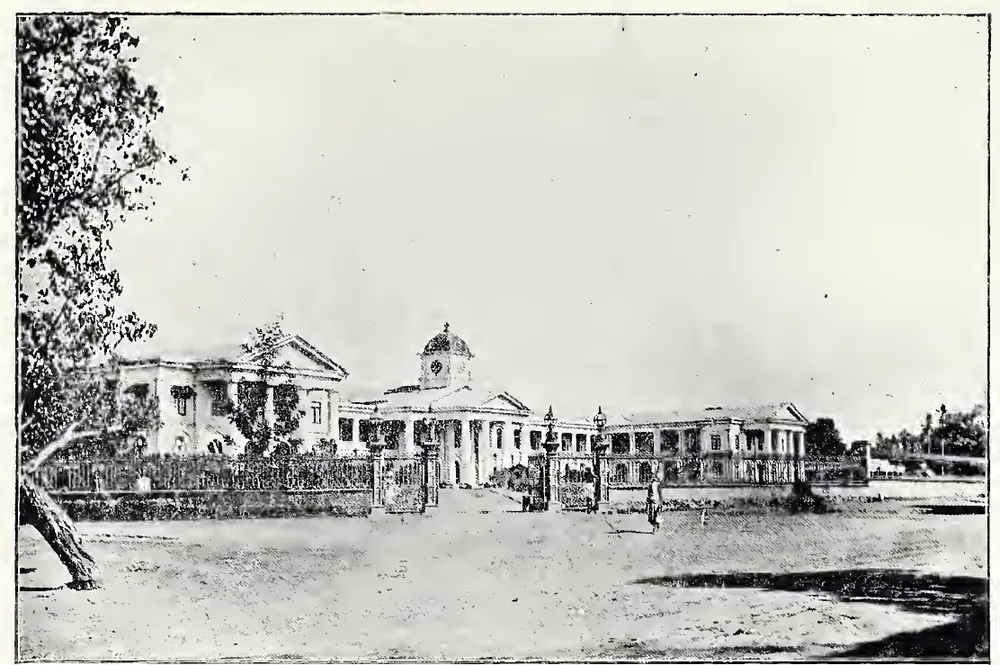
[485]The attention of Government was next drawn to irrigation works in North Travancore. The more important of them were:—
- (1) The Vadavathoor Reclamation Scheme,
- (2) The Puthenvalikaray Reclamation Scheme,
- (3) The Munampam Reclamation Scheme,
- (4) The Kypuzhay Reclamation Scheme,
- (5) The Kynagary Embankment, and
- (6) The Parur Reclamation Scheme.
In 1068 M. E. (1892-93) a definite proposal was put forward by Mr. Horsley as Ag. Chief Engineer to provide for adequate storage of water by means of reservoirs at the foot of the hills. Another scheme was to bring the water of the Kothayar into the Paralayar and thereby increase the supply for irrigation purposes. Both these schemes having been carefully taken up by Mr. Walch, Chief Engineer and Secretary to the Madras Government in the Irrigation Department, whose services were engaged and who assumed charge of the P. W. D. as Acting Chief Engineer in July 1893, the Kothayar Project was finally resolved upon and sanctioned. The original estimate for the Project was 8 lakhs.
In the same year a revised scale of establishment was sanctioned for the Department. The establishment as revised stood thus:—
- 1 Chief Engineer,
- 2 Executive Engineers,
- 1 Assistant Engineer,
- 2 Sub-Engineers,
- 3 Supervisors,
- 3 Assistant Supervisors,
- 5 Overseers,
- 7 1st class Asst. Overseers,
- 7 2nd ... Do. Do.
- 10 Sub-overseers;
besides a supernumerary establishment which was intended to be a temporary one fluctuating with the annual allotment for the Department and liable to be entirely dispensed with when the annual allotment went down to 10 lakhs of rupees or less.
In 1071 M. E. (1895-96) a new system of account keeping was introduced on the lines of what obtains in the Madras P. W. D.
A revised scale of executive and office staff was also sanctioned in the same year in order to ensure greater efficiency and place the Department [486]on a more systematic basis. For administrative purposes the Department was divided into 5 divisions, each being under the control of an Executive Engineer, viz., Northern Division, Quilon Division, Trivandrum Division, Southern Division and Kothayar Division. The establishment under the new system was as follows:—
- 1 Chief Engineer,
- 5 Executive Engineers,
- 8 Assistant Engineers,
- 2 Sub-Engineers,
- 5 Supervisors,
- 21 Overseers,
- 26 Sub-Overseers.
The expenditure of the Department had risen to nearly 12 lakhs of rupees.
In 1073 M. E. (1897-98) the number of Divisions was increased to six, a new one called Head Quarter Division being established in charge of an Executive Engineer who was also Assistant to the Chief Engineer for the supervision of the stores and workshop. In the same year a few rules were also passed in view to enforce expenditure being covered by duly sanctioned estimates.
In 1074 M. E. (1898-99) negotiations regarding the construction of the Travancore branch of the South Indian Railway and the Cochin-Shoranore Railway were completed; and to facilitate the early construction of the former, His Highness' Government promised a loan of 7 lakhs of rupees without interest and paid during the year Rs. 1500.
In 1076 M. E. (1900-01) a P. W. D. Code on the lines of the Madras P. W. D. Code but with slight modifications to suit local conditions was submitted by the Chief Engineer and was after necessary revisions sanctioned by His Highness' Government. An Audit Branch was created in the Chief Engineer's Office to audit in detail the accounts of the Division officers, the whole to be consolidated into one account before submission to the Huzur for final audit.
In 1078 M. E. (1902-03) the Southern Division which was established was reconstituted and was charged with the execution of all road and building works in the six southernmost Taluqs of Neyyattinkara, Vilavankod, Kalkulam, Eraniel, Agastisvaram and Tovala, the Kothayar Division retaining charge of the Project works, the already existing irrigation works and some miles of road near the site of the main dam.
[487]In 1079 M. E. (1903-04) the Tinnevelly-Quilon extension of the South Indian Railway was completed and opened to traffic. The Railway runs over difficult country and the work done over the Ghaut section is pronounced to be exceptionally good.
The outlay on Public Works amounted to Rs. 26,83,081 in 1079 M. E. (1903-04).
The present annual cost of the establishment comes to about 2½ lakhs of rupees.
Irrigation Department. Full information under this head is given in chapter XIII, "Agriculture and Irrigation."
Marahmut Department. In tracing the history of the Public Works Department, we have incidentally referred to the Marahmut Department. I have seen that the agency was started in 1008 M. E. (1833) in the Huzur Cutcherry with an executive staff located in the Fort, now known as Panivagai Marahmut Department. After the establishment of the Public Works Department the Marahmut Department attached to the Huzur remained unchanged and was employed in the ordinary and original works, or repairs in connection with offices, palaces and temples, Oottupurahs, village roads, irrigation tanks and channels, &c., and such other works generally as do not require scientific knowledge. But subsequently the Marahmut Department was entrusted with the construction of buildings and other works requiring professional skill. The Napier Museum, a very handsome structure and an ornament to the Capital was constructed under the supervision of the local Marahmut Department.
The controlling agency was and still is at the Huzur Cutcherry under the immediate orders of the Dewan and there were executive establishments for carrying out the works placed under the orders of the Division Peishcars.
In 1049 M. E. (1873-74) a general increase of salaries was given to the servants of the Department.
In 1054 M. E. (1878-79) the Marahmut Sheristadar was authorised to audit the Chief Engineer's accounts. In the same year the budget system was introduced. Hitherto it was usual for Government to make allotments without the guidance of a budget.
The various works at the Capital were conducted on what is called the Maikad system under which works were executed without estimates and a very large number of labourers and artisans were simply mustered everyday and told off to various works. This was abolished some years back [488]and in 1054 M. E. (1878-79) important improvements such as punctual submission of a monthly account, Current and Progress Report to the Huzur were introduced instead of the old rough statement showing the month's charges upon the works in the aggregate under the head of labour and materials.
In 1057 M. E. (1881-82) an Assistant Engineer being appointed for the restoration of tanks, the distribution of water for irrigation purposes in the South was placed under the direct supervision of that officer, the Peishcar being relieved of all responsibility. But in 1068 M. E. (1892-93) in consideration of the important agricultural interests involved and the resources commanded by the Peishcar as the chief Revenue Officer of the Division the old arrangement was restored.
The various executive agencies grouped together under the head 'Marahmut' at present are:— the Panivagai and the Copper Foundry Department in the Capital under the supervision of the Huzur Marahmut Sheristadar; the Division Marahmut under the respective Division Peishcars; the Commerical and the Cardamoms and Marahmut in charge of those Departments; and the Irrigation Tank Departments in South Travancore and Shencottah under the control of the Division Peishcars. The work of the Panivagai Department under the immediate supervision of a Sheristadar is chiefly confined to the palaces, religious institutions, the Residency and the Sirkar bungalows in the Capital. This Department is entrusted with the erection of pandals and triumphal arches on occasions of the visits of important personages and putting up marriage pandals.
The Copper Foundry Department has charge of the manufacture and repair of copper, brass and bell metal vessels required for the Palaces, Oottupurahs and religious institutions in the State.
The Division Marahmut has charge of minor village roads, culverts and bridges therein, temples, some mofussil palaces, chuttrams and inns and minor buildings.
The Commercial Department has with the exception of temples and irrigation works a similar charge within the town of Alleppey while the operations of the Cardamom Department extends to the opening and maintenance of paths in the hilly tracts for the transport of timber and cardamoms, the construction and maintenance of camp sheds &c. and to works in the teak plantations and cardamom gardens. The Irrigation Tank Department is in charge of the restoration and [489]maintenance of irrigation tanks in the Taluqs of Tovala, Agastisvaram, Eraniel, Kalkulam and Shencottah.
The outlay under Marahmut amounted in the year 1079 M. E. (1903-04) to Rs. 4,33,399.
Anchal Department.* The Sirkar Anchal is one of the oldest institutions in the country. Shungoonny Menon in his History of Travancore says that "in 959 M. E. (1784) His Highness Rama Varma after his return from Rameswaram improved the Anchal and established it on better principles." This was long before the days of Sir Rowland Hill's penny-postage and the reform of the postal system of the world which he achieved. In the early years of the last century Rowland Hill's mother dreaded the visit of the postman, as there was not money enough at home to pay the postage, for the penny-postage of Hill was introduced only on the 10th January 1840.
Very little is known about its early history. Its original functions were confined to the transmission of:—
- (1) Service covers from and to mofussil stations;
- (2) Vegetables from certain mofussil stations to the Capital for the use of the Palace; and
- (3) Flowers &c. from out-stations for the use of the principal Pagoda at the Capital.
These still form a large part of the business transacted by the Department.
The Department was under the immediate control of the Dewan. There were a few main lines connecting the principal stations in the interior of the country with the seat of Government.
In 1844 A. D. the establishment formed part of the Huzur Rayasam Department and consisted of one Melvicharippukar on 147 fs. (Rs. 21) 2 Sekharippus on 45 fs. (Rs. 6½) each; two clerks, one Cashier, 2 peons, 47 Anchal Pillamars or Anchal Masters and 170 runners. The Melvicharippukar besides being a general superintendent appeared to have exercised a sort of magisterial authority in inflicting corporal punishment on delinquent runners. The Sekharippus were entrusted with the duty of distributing pay to the establishment. The salaries of the Anchal Pillamars ranged from 15 fs. (Rs. 2) to 25 fs. (Rs. 3½), while those of the runners from 10 fs. (Rs. 1½) to 25 fs. (Rs .3½) each. The number of [490]Anchal stations was 46. Anchal Masters generally conducted the duties of both the master and the delivery peon. At important stations the services of Viruthicars were also utilised, though official covers were delivered only by the Anchal Masters. There were delivery peons only at the Capital. As the covers delivered were chiefly Sadhanams (which means a Vernacular communication addressed by the subordinate officers to the Dewan and other superior officers) the delivery peons were, and are still known as Chilavu Sadhanakars which means those who deliver the sadhanams. The runners were required to traverse 2 miles an hour. For every hour delayed, a fine of 1 chuckram (½ a.) was levied; but if the mail be 'express' the fine was 2 chs. for every hour. The total extent of mail communication was then 365¾ miles.
* I am indebted to Mr. S. Thiraviam Pillay, Superintendent of the Anchal Department, for information regarding this Department.
In 1848-49 the Department which was hitherto confined purely to Sirkar business, was thrown open to Government servants and petitioners, the private covers of Government servants and the petitions of the inhabitants being carried free. As this free Anchal led to too many anonymous petitions being received, the petitioners were later on required to attest in writing to the satisfaction of the Anchal Masters that they were only genuine grievances addressed to the authorities.
There were at the time two systems of cadjan letters in vogue. One was that the letter was written on a piece of cadjan, enclosed in covers of China paper or Shencottah paper, on which was given the address; the other was to write the letter on long pieces of cadjan (a full cadjan being used in cases of official reports to superiors, the sharp ends not being cut), to roll the cadjan from one end and write the address on the part most exposed. In the Anchal Offices the letters were sorted and the rolls to a particular station were stringed together and several garlands were thrown in a gunny-bag which was sealed and handed over to the runners.
In 1860-61 the posting of private covers was allowed at the rate of 1 chuckram per cover irrespective of weight and distance. Separate receipts were granted for every letter posted and at the same time nominal registers of covers posted were kept. The system of carrying expresses at the rate of 1 f. (2¼as.) per mile was also introduced in the same year. The distinction between letter and Bhanghy (parcel) mails was for the first time introduced this year. A Superintendent was appointed on a salary of Rs. 40 per mensem.
In 1861-62 postage on letters, &c., was regulated. Four Inspectors were appointed who travelled about constantly and made reports to the Superintendent. They also distributed the pay of the runners and [491]the out-station establishment. Towards the close of the year the system of charging Nadacooly or rural delivery at the rate of ½ chuckram (3 pies) per letter per mile, on letters delivered beyond a radius of two miles from the Anchal Office was introduced.
In 1862-63 Branch Offices were opened for the conveyance of service covers and of letters for the public in general. A Gumastah in the Taluq Cutcherry, Tobacco or Salt Bankshall, was entrusted in adition to his legitimate duties with the charge of collecting letters, &c., for despatch to the nearest Anchal Office and to receive from such offices covers for delivery at the station through Viruthicars and peons attached to those Cutcherries. As the correspondence in those places gradually increased Anchal Masters were appointed.
In 1865-66 the system of registering covers was introduced on payment of seven chuckrams (about 4 annas each).
In 1868-69 a Boat Transit was sanctioned from Trivandrum to Shoranore the nearest station on the Madras Railway, the distance as measured by the map being about 180 miles. Dated stamps and clocks for important offices were supplied in 1871-72 and 1872-73 respectively. The following year saw the introduction of paper in the place of cadjan.
In 1875 travelling allowances were sanctioned to Inspectors. The salaries of all runners on the main line were raised, a number of delivery peons were added and sorting offices were established.
In 1875-76 postage on newspapers weighing 10 tolas and below was reduced from 2 chuckrams to 1; and 5 Anchal Overseers on Rs. 10 each were appointed. Their duties were to travel in their respective ranges and see that the mails were carried by the runners without delay.
In 1881 an experienced officer of the British Postal Department was selected and placed at the head of the Department on a salary of Rs. 100 per mensem.
In 1881-82 new Anchal rules were passed. Increases of pay were allowed to the establishment. The Registration fee on letter was first reduced to 6 chs. from 7 chs. and subsequently to 3 chs. Registration of book and pattern packets was allowed on payment of 3 chs. The system of obtaining acknowledgment receipts from addressees on payment of a fee of 2 chs. was introduced. Complaints against the Anchal Department were allowed to be carried free. The local delivery of official covers was discontinued.
[492]In 1888-89 Anchal stamps and cards were introduced. The 'bearing' system was also introduced, as also service cards and pillar boxes. An Anchal Regulation was passed.
In 1889-90 the Registration fee of 3 chs. and acknowledgment fee of 2 chs. were reduced to 2 chs. and 1 ch. respectively. Embossed envelopes were also introduced in this year. In the following year reply cards were introduced. Postage on British Indian money order receipts received in the Anchal Office for delivery was reduced from one to half a chuckram. Postage on newspapers weighing 5 tolas and below was reduced from one to half a chuckram.
In 1892 the Madras Government suggested the amalgamation of the Anchal with the British Postal system. As it would have caused great incovenience to this State the amalgamation was not given effect to.
In 1894-95 a Dead Letter Office was opened. Postage on book and pattern packets was reduced to half a chuckram. In the following year stamps of half a chuckram value for letters weighing one-fourth tola and below and wrappers of half a chuckram value for newspapers were introduced. The Registration fee on letters was raised to 3 chs.
In 1897-98 many Village Offices in charge of local schoolmasters were opened. Quinine and Chlorodyne were placed in the Anchal Offices for sale. The Registration fee on letters was raised from 3 to 3½ chs.
In 1898 Letter-cards were introduced and the price of cards was reduced from 8 cash to 5 cash. In the following year 'Nadacooly' system (rural delivery) was abolished and the price of wrappers was reduced from 8 to 6 cash.
In 1900-01 the Anchal rates underwent a further revision:—
- Old rate. New rate.
- For half a tola 1 ch. 12 cash.
- For 1 tola 2 chs. 1 ch.
Registration fee was reduced from 3½ chs. to 3 chs.
In 1901-02 the Money Order system was introduced. Provision was made in the money order form for the payee to communicate anything to the remitter, a privilege which is not allowed in the British Postal Department. This is a distinct improvement on the British system.
In 1902-03 the price of cards was reduced from 5 cash (2 pies) to 4 cash (1¾ pies)—the cheapest postage in India.
[493]In 1903-04 the total number of Anchal Offices was 150 and the number of letter boxes 179. The total number of private and official covers posted during the year was 49,01,609. The total length of mail communication was 928 miles. The price of letter-cards was reduced from 1 ch. to ¾ chuckram.
The Department is now under the control of a Superintendent on a salary of Rs. 250 per mensem; under him are six Inspectors. The Travancore Anchal is one of the best managed Departments in the State.
Salt Department. Though the Travancore Government appears to have derived a revenue from salt so early as the middle of the 18th century, yet salt was made a State monopoly only about the end of the year 988 M. E. (1813 A. D.) by a Royal Proclamation signed by the Resident-Dewan Colonel Munro. By that Proclamation all salt manufactured by the ryots and traders and merchants at the date of the notification was required to be given up to the Sirkar within 20 days at a fixed price, on pain of heavy penalties. A special department was organised for the superintendence and collection of the salt revenue; salt depots were established all over the country to place the article within easy reach of the people and to facilitate sale, and what was produced in the country was supplemented by import from abroad. The monopoly price was fixed at Re. 1-1-0 per maund for the white salt produced in the southern pans and at Re. 0-11-2 per maund for the black salt manufactured in the northern pans on the margin of backwaters. In 1036 M. E. (1860-61) Government undertook to bear all wastage in the transport of salt by sea from the southern pans to the northern sale depots.
Towards the close of the year 1040 M. E. (1864-65), an arrangement was concluded with the British Government by which Travancore raised the selling price of salt to an equality with the British Indian rate and promised to maintain that equality. At the time the price was assimilated with the British rate it became necessary to discontinue the production and sale of the black salt which from its bad quality could not be sold at the same price with the rest.
In 1041 M. E. (1865-66) the Government fixed rates of Kudivaram and Melvaram at 40 and 60 per cent. respectively for what are known as Kudippattis or the pans of private individuals, or at 20 and 80 per cent. for Pandarapattis or Government pans. Again this Kudivaram which had been paid in what are known as Shencottah Rupees (an imaginary currency which depreciated the value of his share) was commuted for the first time into terms of Travancore rupees. The [494]Government further transferred its right in Government salt pans by sale in favour of private individuals. Another improvement introduced was the creation of the post of Salt Sheristadar with magisterial powers to superintend the salt pans. He was first placed directly under the orders of the Huzur Cutcherry but was subsequently transferred to the control of the local Peishcar.
In 1042 M. E. (1866-67) the salaries of the bankshall establishments were raised. In the following year Government again opened a selling depot in Shencottah.
In 1048 M. E. (1872-73) Government decided that, pending final arrangements for the prompt acceptance of and payment for the salt of each season, 50 per cent. of the price of the estimated quantity should be paid in advance immediately the salt is gathered in. The next important step taken for improving the Salt Department was the substitution of weight for measure in all salt transactions. This was introduced in 1051 M. E. (1875-76). Another important change was the introduction of the bagging system under which the scope for petty thefts and adulteration was very much diminished.
In 1052 M. E. (1876-77) graded salaries were fixed for the establishments in Kuduchandrams. In 1057 M. E. (1881-82) the advance payment made for salt, not stored, was raised from 50 to 75 per cent.
During the administration of Dewan V. Ramiengar the Salt Department was completely reorganised. As a first step towards reform the Department was placed under a special officer who had exclusive charge of it and acted under the orders of the head of the administration at the beginning of the year 1058 M. E. (1882-83). The changes introduced during that year were:—
- 1. The subordinate establishments were thoroughly reorganised by the assignment of better salaries.
- 2. Salt, the manufacture of previous years allowed to remain exposed on the banks of the salt works, was taken into store and arrangements were made for receiving into store thereafter of all salt as soon as it was ready.
- 3. A preventive guard was formed and rules were laid down for the proper watch and ward of the factories.
- 4. Instead of the payment due to the manufacturers being indefinitely delayed arrangements were made for paying them immediately on the salt being taken over by Government.
- 5. A survey of the pans was commenced to be followed by a registration of titles.
[495]Regulation VII of 1063 M. E. (1887-88) provided for the better administration of the salt monopoly. The original law on the subject was that of 1010 M. E. (1834-35) which did not prohibit the manufacture of salt for individual consumption.
In 1063 M. E. (1887-88) a license was granted for the manufacture of salt under an improved system to Messrs. Manickan Naidu & Co., of Madras; and they began operations at certain pans in Rajakamangalam which were long lying unused owing to the destructive action of the sea. Several works for improving the salt pans were carried out during the year.
In Travancore, the home made salt, it is believed, is not liked by the bulk of the population though every year a steady improvement is maintained in the quality of the salt and though the selling price of the country salt is somewhat lower than that of foreign salt. So an attempt was made to introduce country salt into the northern taluqs during the year 1068 M. E. (1892-93). This did not prove successful. In the same year relief was granted to the salt manufacturers of Tamarakulam and Rajakamangalam by the abolition of the fee of Rs. 2-1 ch.-8 cash which used to be levied on every 1000 maunds of salt produced, as carriage charge.
Since then no changes of importance have been introduced. The Department now consists of the following:—
A Deputy Peishcar on a salary of Rs. 300 per mensem assisted by 2 Superintendents and 1 Deputy Superintendent for the Ullams. There are throughout the State 4 Kuduchandrams or store-houses situated at Alleppey, Quilon, Trivandrum and Munampam. In these is stored the salt required for the consumption of the people. Each Kuduchandram is under the control of a Superintendent, with a small establishment. From these store-houses the salt is issued to 65 bankshalls scattered throughout the State for the convenience of the public. These bankshalls and store-houses are all under the orders of the Division Peishcars who have under them Inspectors who periodically inspect these institutions.
The salt required for consumption in the country is procured partly by importation from Tinnevelly and Bombay and partly from home manufacture. The greater portion of the required salt comes from Bombay, because the people of North Travancore have a predilection for Bombay salt. The required supply in either case is obtained through merchants who are invited to contract for the same. The contract is put up to auction after due notice and the most favourable offer is accepted. [496]The contractors are granted certificates under the seal and signature of the Dewan or of the Commercial Agent which they present to the British Indian authorities at the port of shipment and arrange to make their own purchases. The salt is allowed to be shipped free of duty under the terms of the Interportal Convention. When it arrives at our ports and is landed, our officers furnish a certificate of landing, specifying the quantity delivered and if there is any deficiency the proper duty is levied upon the deficient quantity and entered in such certificate. This document the contractor is bound to produce before the British Indian authorities within two months from date of export, failing which no further shipment by the defaulting party is permitted.
The following account show how salt is manufactured in Travancore:—
"There are at present four Ullams or factories in the State for the manufacture of home salt. Of these, three are now worked. They are Thamarakolum Ullam, Rajakkamungalam Uliam and Variyur Ullam, containing in all about fifteen thousand pans. These factories are generally situated in low grounds and are close to the sources of brine supply. The factory at Variyur gets its supply direct from the sea, while the other two depend for their brine supply, on estuaries close to the bar. Thamarakolum possesses more of the conditions necessary for good manufacture than the other two stations. The estuary or the Manakudi lake serves as the outer reservoir for Thamarakolum, from which brine is conveyed through a channel to the inner reservoir. From this, pans are irrigated according to requirements. The factory at Rajakkamangalam, the biggest in area, is also similarly situated in respect to its brine supply.
"For the manufacture and improvement of home salt, we have not the full supply of strong brine at all times during the working season. The estuaries are inconstant as a source of brine supply; for example, they often silt up; the percentage of sodium chloride they contain is very variable. Sometimes they are filled with fresh water; estuary brine varies in level from month to month, and its variations cannot always be foreseen. As salt manufacture is limited to the dry summer months, the whole question turns on the usual state of the estuary during that period; which requires to be considered and the supply of strong brine has to be guaranteed by having recourse to embankments constructed at some cost for ensuring the full supply during the working season.
"There are two manufacturing seasons, namely the hot months between the closing of the South-West and the setting in of the North-East monsoons, and the interval between the North-East and the South-West monsoons. The first is known as the Purattasi Pani and extends over a period of 2½ months generally, while the other known as the Thai Pani lasts for nearly five months.
"When salt pans have to be formed newly, the following process is observed:—
(1) removing weeds or vegetation of the saline tract and levelling the ground,
(2) digging it up if the soil be hard and breaking up the clods,
(3) letting in as much brine as to make it soft mud, and
[497]
(4) treading, pumping and puddling it under foot, irrigating sufficient brine until it becomes hard and impermeable, without cracking.
"This process takes about two weeks. But in the case of abandoned salt pans, or those which have not been in use for some years, only slight repair of the pans and the last puddling process are gone through. The salt pans are 16 ft. by 14 ft. on an average. Before manufacture is resumed the pans are repaired, i. e., their floors are brought to a smooth, hard, clean and impermeable condition, without adding more sand than they themselves contain; also their surrounding small banks, with mud taken from the mounds on the pan ridges, or elsewhere close by: the brine in the inner reservoir is made use of for this purpose, if sufficient brine is not left in the beds. The supply canals, ridges and pathways are also repaired. The above pan work is generally commenced when symptoms of slight spontaneous formations of salt are seen in the beds by the heat of the sun and wind, after the rains. Thus the first season or Purattasi Pani commences after the drizzlings of Ani have ceased, and continues till Thulam next. The second season or Thai Pani begins after the Thulavarsham has closed, i. e., about the middle of Kartigai if the weather be not frowning or later on, and lasts till Idavapathi sets in, or to the end of the year if the weather be favourable. After the repairs, the pans will be allowed for about two days to dry. They are then irrigated with 5 or 6 inches of brine from the inner reservoir, or brine pits, if there are any, whichever is of higher density, or from other beds, if they are irrigated beforehand, and kept for the purpose of condensation. When the pans are thus irrigated, it takes from 7 to 12 days for scraping salt and the salt thus scraped, when the mother liquor marks about 30° Beanme, is half or one maund per bed. The beds are again irrigated with a fresh charge of brine and the same process repeated. The yield in succeeding scrapings, though slightly better than the first gathering on account of the reservoir brine having attained a higher degree of density, never goes beyond three maunds per bed, which as well as the poor result of all the pans in general, are due to the low density of the reservoir brine with which they are irrigated, which is 5 or 6° Beanme. The above is a single irrigation system in vogue in our Ullams. Evaporation is quickest and is most effective in the latter part of the Puratasi season. Salt manufactured in this Pani is generally pure, white and of large crystals, while in the Thai Pani the crystals are small, owing to the coolness of the beds caused chiefly by the heavy showers of Thulam and by the injury done by the dew. This evil can be warded off to a great extent, if ring canals round the pans are provided to drain off rain water.
"The Ullams being worked under the monopoly system, the expenses of the manufacture are borne by the manufacturers themselves, but the State carries out all the public works necessary for general maintenance and improvement of the pans.
"The maximum produce from these 3 factories under the present circumstances of brine supply comes up to 3 lacs of maunds under favourable season.
"With a permanent supply of strong brine and by extension of the area of manufacture for which there is ample scope, I have no doubt that in the course of a few years, the entire demand for salt in the State, can be adequately met."*
The gross receipts from salt amounted in the year 1079 M. E. (1903-04) to Rs. 19,27,837 against Rs. 20,42,591 in the year previous. This decrease is owing to the reduction of the selling price of salt from [498]Rs. 3 to Rs. 2½ per maund according to the interportal convention with the British Government. This revenue amounts to 10 as. 5 ps. per head of the population according to the Census of 1901. In Travancore, salt is used in a variety of ways more than in Madras. That is, for fish curing, for the rearing of cocoanut plantations, for manuring imperfectly drained paddy lands and for the food of the labouring classes which consists in some seasons almost entirely of tapioca, yams, and other farinaceous roots. I observed in my Report on the Census of Travancore for 1891 that there is no item of revenue levied from the people upon which the masses are so sensitive as on this heavy taxation of what is the chief necessary of life. Since then there has been a slight decrease in its selling price which, calculating the incidence upon the total population, may be said to be almost nothing.
* Account prepared by Mr. S. Rama Rew, Salt Peishcar, Travancore, for the census of 1901.
Stamps. In his Administration Report for 1059 M. E. (1883-84.) Dewan V. Ramiengar writes:—
"The reduction of duty on tobacco in the latter part of 1055, the lowering of the selling price of salt in the latter part of 1058 under the terms of the interportal convention with the British Government., and the relaxing of many stringent rules affecting the land revenue, however beneficial in the long run, involved an immediate sacrifice of revenue. These reductions, coupled with the precarious state of the cardamom revenue rendered it necessary in the interests of progressive administration and with the survey and settlement in hand, to seek for some new source of revenue, and His Highness' Government resolved on imposing a moderate stamp duty as the least objectionable mode of levying such additional revenue and as affording, with registrataion, an additional protection against forgery."
With this object in view a Stamp Regulation was passed on 24th Makaram 1059 M. E. (5th February 1884) generally on the lines of the British Act modified where necessary to suit local circumstances. Under an old law penalty used to be levied on unstamped conveyances when produced before the courts so that "the stamp duties" in the words of the Dewan "possessed the additional recommendation of not being altogether novel to the people." This Regulation came into force on the 1st Edavam 1059 M. E. (11th May 1884). The first supply of stamps required for giving effect to this Regulation was supplied by the Madras Government. The net revenue for the three months of 1059 M. E. (1883-84 A. D.) during which the Regulation was in operation amounted to Rs. 22,511.
Rules were framed for the custody of stamps, &c. The Huzur Treasurer, the Head Samprati of each Taluq and such other officers as might be appointed from time to time were declared to be ex-officio vendors and such persons as might be licensed by the Dewan or other officer empowered [499]by him to grant licenses were to be licensed vendors who were allowed a discount for stamps purchased by them.
The first supply of stamped paper received from Madras having been exhausted they sent a further supply of water-marked paper from their stores which was stamped with Travancore stamps specially manufactured for the purpose.
In 1061 M. E. (1885-86) His Highness' Government commenced making their own stamp paper. The stamp paper was specially manufactured under arrangement with Messrs. Alexander Cowan & Sons in England.
In 1063 M. E. (1887-88) a Regulation was passed amending the penal clauses of the old Regulation and offering further facilities for the refund of stamp duties by empowering the Division Peishcars to order a refund without reference to, and sanction by the Dewan.
In 1064 M. E. (1888-89) a Royal Proclamation was issued exempting Vakalaths for the transfer of registry of lands from stamp duty.
In 1067 M. E. (1891-92) His Highness the Maharajah was pleased to sanction the remission of stamp duty leviable on copies or extracts of Survey plans and measurements.
Since the introduction of Anchal stamps, cards, &c. this Department has been issuing them.
During the year 1079 M. E. (1903-04) the stamps yielded a revenue of Rs. 4,49,673-9 as.-8 ps.
This is a Department attached to the Huzur. A Superintendent on a salary of Rs. 100 with a small establishment is in immediate charge of it.
Tobacco. This leaf which affords a narcotic chew is in great demand among the native population. It being used by the bulk of the people and used much in proportion to the means of the consumer up to a certain point and also it being an article of import and not growing in the country itself, tobacco has been looked upon by the financiers of Travancore with the same degree of favour as the poppy plant has been viewed in other countries. Accordingly it formed for a considerable time the subject of a vigorous monopoly in Travancore as also in the neighbouring territories of Cochin, Malabar and Canara where the people are equally addicted to its use.
According to the monopoly system the Sirkar made direct purchases of tobacco of various kinds by entering into contracts with individuals for the supply of the requisite quantities, the contract prices being mostly [500]determined by public competition. These supplies were to be brought into the country by certain appointed routes and at certain stipulated periods. Tobacco so supplied was bonded in large warehouses whence it was distributed to certain Bankshalls where it was sold at monopoly rates to private dealers. These in their turn sold the stuff by retail throughout the country at still higher prices. As the monopoly rates were very high compared to the prime cost, there existed a great temptation for smuggling to prevent which various devices were adopted.
The three places from which tobacco for the use of Travancore was chiefly obtained were Ceylon, Tinnevelly and Coimbatore. The Ceylon and Coimbatore stuff came into the country in an almost dry state, but the Tinnevelly tobacco came after being soaked in a solution of jaggery. In consequence of this preparation the monopoly rate of sale on Tinnevelly tobacco was much lower than that of the Ceylon tobacco.
When the monopoly was in a prosperous condition the gross revenue realised under this item was one-half of the aggregate revenue of the State from all other sources. But this received a severe check when a similar system which existed in the British Province of Malabar was abolished. In consequence of this abolition it was open to any one to land under the protection of the British Government any quantity of tobacco at the town of Cochin and the hamlets of Anjengo and Tangasseri situated in the hearts of the Native States of Cochin and Travancore and thence to smuggle it with dangerous facility into these Native States. This entailed a decline of the tobacco revenue. Rajah Sir T. Madava Row says that when he took charge of the administration in 1858 he found the monopoly in a sinking state; illicit traffic was carried on with increasing boldness; and the preventive service deeply demoralised. The first step taken to remedy these evils was the lowering of the monopoly selling rates considerably. It was attended with fair success. This success encouraged further progress in the same direction with the result that in 1038 M. E. (1862-63) His Highness the Maharajah was able to sanction the abolition of the monopoly and the substitution of an Import duty. The Import duties first imposed were:—
- Ceylon Tobacco Rs. 190 per candy,
- Tinnevelly Tobacco Rs. 140 per candy,
- Coimbatore Tobacco Rs. 65 per candy.
Tobacco was allowed to be brought into the country by the following [501]routes only:—
- 1. By Aramboly in South Travancore
- 2. By port of Quilon
- 3. By port of Alleppey } Central Travancore
- 4. By Arukutty backwater
- 5. By Alwaye estuary } North Travancore
Any person is at liberty to bring tobacco by these routes. The Customs officers posted on the routes or at the ports inspect the tobacco brought, determine its description and weight, and send it under a pass and guard to the bonding warehouses conveniently situated in the country for purposes of issue. The commodity is thus lodged in bond till the owner wishes to take it out. According to his own convenience, he takes out the whole or any part of his tobacco, paying to the officer in charge the stipulated duty due. This is an arrangement which our dealers much value. It enables them to pay the duty by degrees as they are able to effect sales of their goods. In fact the owner of the tobacco in bond does not pay the duty himself but simply gets the purchaser of the tobacco to pay the duty to the Sirkar as well as the price to himself.
Since the introduction of the Excise system the Maharajah's Government have reduced the Import duty on tobacco according as the finances of the State permitted.
In 1063 M. E. (1887-88) a Regulation was passed to amend and re-enact the law relating to the trade in tobacco. This Regulation was amended by Regulation II of 1066 M. E. (1890-91) in such a way as to make punishable the possession, sale, &c. of contraband tobacco with guilty knowledge and regulated other matters in connection with the trade.
Regulation II of 1076 M. E. (1900-01) was also passed for the effective checking of smuggling. At present there are 7 bonding warehouses situated at Kottar, Quilon, Alleppey, Muvattupuzha, Alwaye, Parur and Trivandrum. Of these seven, those at Kottar, Quilon and Alleppey are under the charge of a Superintendent while the others are under the charge of a Vicharippu.
The present rates of duty are:—
- Ceylon Tobacco, Rs. 90 per candy,
- Tinnevelly Tobacco, Rs. 130 per candy,
- Coimbatore Tobacco, Rs. 30 per candy.
The net revenue from tobacco during the year 1079 M. E. (1903-04) amounted to Rs. 11,81,411. The average consumption of tobacco per [502]head of the population was 4·06 lbs. reckoning 33 per cent. as children or abstainers from the use of tobacco.
Abkari. The Department was originally under official management. The Dewan had the chief management of its affairs, the revenue derivable from this source being collected by a Vicharippucar, Pillamars and others employed for the purpose. Since the year 1010 M. E. (1834) the Abkari farm was leased out to the highest bidder invited by advertisement. In the Northern Districts, the toddy is drawn by the Izhavas and in the South by the Shanars and a fixed number of shops was allowed to each contractor who employed his own peons and collected the monthly instalment of the rent and paid the same into the District or Huzur Treasury. In the event of no person coming forward to hold the farm, the work was managed by the Tahsildar and in some places by a Vicharippucar, a Pillay and two peons employed for the purpose and from the total collections, the expenses were deducted and the remainder credited to the Sirkar. In the Huzur Cutcherry there was a separate establishment to supervise this Department.
In his Administration Report for 1048 and 1049 M. E. (1872-74) Dewan A. Sashiah Sastri writes:—
"The Revenue from Abkary is derived from and managed, much as in British India; that is, the Monopoly of selling Toddy and country liquor is farmed out, Taluq by Taluq, to the highest bidder, who enters into certain stipulations which are almost identical with those in force in British India. The contractors are forbidden from selling below the following rates: Toddy, ½ fanam or 1 anna; Sweet toddy, same per Edungali; Liquor, 1st sort, 3¾ fs. or 8½ as."
"No separate establishment is maintained. The Tahsildars recover the rents from the Contractors in 10 equal monthly instalments, the last two months of the year being left out. If the Contractor chooses to register his sub-contracts or sub-leases before the Tahsildar, the latter officer could interfere to help the former in enforcing recovery of his dues by summary process. Fifty-seven years ago the Revenue from this source was Rs. 41,124 and continued fluctuating between that sum and Rs. 59,448 up to end of the year 1033 M. E. (1857-58). Since then it rose rapidly till it reached Rs. 106,591 in 1047 M. E. (1871-72)."
In 1054 M. E. (1878-79) a Regulation (I of 1054) was passed clearly defining the system of collecting the Abkari revenue and approximating it as nearly as possible to that obtaining in British India. The Regulation provided for the manufacture, sale, transit and possession of liquor within the limits of the State.
Shops for the sale of European liquors which were fast multiplying were now subjected to the restriction, of a license renewable year by year. This new Regulation came into operation in 1055 M. E. (1879-80). The farms were rented on triennial leases, and on the expiry of the period [503]they were put up to auction and given to the highest bidder.
In 1073 M. E. (1897-98) the Excise system was introduced experimentally in the Trivandrum Taluq to enable the Government to extend the system if the experiment proved financially successful; the remaining taluqs of the Trivandrum Division were farmed out only for two years. The taluqs in the other Divisions were as usual rented out on the triennial lease. The system adopted in Trivandrum may be thus described. The exclusive privilege of manufacture and supply of arrack was disposed of by tender and was granted to the tenderer who offered to Government the largest share of the prescribed still-head charge. The privilege of sale of arrack was sold by auction. Within the town the right of sale was assigned to the highest approved bidder for each shop. The whole area outside the town was assigned to one vend-renter, who was the highest bidder and could open as many shops and in such places within the vend-area as he may be required, or permitted to do, by Government. The manufacturer was bound to supply the vend-renter and independent shopkeepers at the prescribed rates per gallon; and the latter were bound to obtain the arrack required only from the manufacturer. The exclusive right of sale of toddy throughout the taluq was separately sold by auction and granted to the highest bidder. This experimental arrangement introduced in the Abkari administration necessitated the passing of Regulation I of 1073 M. E. (1897-98) as an emergent measure. It empowered certain Abkari officers to conduct searches and arrest persons in certain cases under the Abkari law. Later on in the year, Regulation IV of 1073 M. E. (1897-98) was passed. This Regulation which amended the Abkari Regulations I of 1054 M. E. (1878-79) and I of 1055 M. E. (1879-80) is a close adaptation of the Madras Act I of 1886.
A special establishment consisting of an Inspector, 4 Sub-Inspectors, 4 Petty Officers and 31 peons was maintained during the year.
The farming system continued throughout the State with the exception of the Trivandrum Taluq where the Excise system which was experimentally introduced in the previous year was confirmed in 1074 M. E. (1898-99). In addition to the special establishment, a preventive force consisting of one Petty Officer, 4 peons and 4 boatmen was also maintained for patrol in the Kadinangulam backwater. The results of the Excise system in the Trivandrum Taluq having been found to be very encouraging, the whole of the Trivandrum Division was placed under that system since the beginning of 1075 M. E. (1899-1900). An establishment [504]consisting of 8 Sub-Inspectors, 9 Petty Officers and 62 peons was maintained for the Excise tracts in addition to the establishment already maintained for the Trivandrum Taluq. The patrolling agency at Kadinangulam had to be abolished, as the Chirayinkil Taluq was also brought under the new system. The total cost for the whole Division now amounted to Rs. 12,588.
The Abkari revenue under the Excise system having been found to have substantially increased, the Southern Division also was brought under the Excise system from the commencement of 1076 M. E. (1900-01)
Thus at present the farming system continues in the Kottayam and Quilon Divisions, while the collection of revenue in the other two Divisions of Padmanabhapuram and Trivandrum is continued under the Excise system. The present establishment consists of an Inspector and 10 Sub-Inspectors for each Division together with a number of Petty Officers and peons.
The gross revenue collected during the year 1079 M. E. (1903-04) was Rs. 673,872 against Rs. 594,654 in the year previous. This revenue amounts to 3 as. 8 ps. per head of the population. These figures will convince all that there is a rapid increase in the numbers of the drinking population as well as excessive indulgence in liquor by those who were in the habit of using them. Many years ago I wrote:—
"This is an evil which it behoves a Hindu Government in particular to arrest. The prevailing religions prohibit it; modern medical opinion is decidedly opposed to it; the administrators of law discountenance it; and past practice is against it."
The correctness of this opinion has since been confirmed by so high an authority as the Government of India who in their Resolution dated September 1905 have in appointing the Excise Committee under Sir James Thomson, K. C. S. I., laid down their policy in the following words:—
"Their (the Government of India's) settled policy, however, is to minimise temptation to those who do not drink and to discourage excess among those who do; and to the furtherance of this policy all considerations of revenue must be absolutely subordinated."
Opium. Opium is a State monopoly in Travancore. It was an article of free trade up to the year 1037 M. E. (1861-62) subject however to an import duty of 10 per cent. on a tariff valuation of Rs. 13-2 as. per lb. The farm is licensed by Government on a system analogous more or less to that of the Abkari.
The drug is not a produce indigenous to the country. It is obtained [505]generally from Bombay and sometimes from Malwa. The Sirkar contractor has to apply for the necessary permit which will be obtained for him from the British Resident. The application should state the quantity required, the port or place in British India from which the drug is to be conveyed and also the place in Travancore to which it is to be conveyed and also the period during which the permit is to be in force. A single contractor usually holds the farm for the whole State. No opium is permitted to be imported which is not under cover of a certificate granted by duly empowered authorities in British India. The party holding the monopoly subleases the privilege of vending opium and ganja to a great number of persons in the chief towns and elsewhere.
All opium imported into the State is weighed on arrival at the Customs House and if the number of packages is correct and if it is found to be of the weight specified in the pass (subject to a reduction of ¼ per cent. on account of drying) it is made over to the contractors, the pass being retained by the Customs Officer for submission to the Resident through the Dewan.
The Bombay opium costs the monopoly contractor Rs. 12 per lb. He sells the same to his sub-lessees at Rs. 17 and Rs. 14¾ respectively.
The farm is leased for three years at a time at the end of which the lease is renewable. The collection of this revenue is done by the Revenue authorities.
In 1059 M. E. (1883-84) the import duty of 10 per cent. which used to be levied on all opium imported into Travancore was abolished. This duty had the effect of encouraging a contraband trade in the article through Cochin in which no import duty was levied.
In 1063 M. E. (1887-88) a Regulation (VI of 1063) was passed to amend and re-enact the existing law. The only law on the subject was a Proclamation passed in 1036 M. E. (1860-61). This itself was imperfect in many respects. The present law provides for the import, export, possession, manufacture or sale of opium or bhang and for the punishment of persons found offending against the provisions thereof.
Customs. Up to the year 988 M. E. (1812-13) the Customs establishment consisted of three Divisions, Northern, Southern and Eastern. In 989 M. E. (1813-14) regular Chowkeys were established for the collection of the Customs duties which were 5 per cent. on the exports and 8 per cent. on the imports passing the frontiers and 5 per cent. on all goods conveyed from one part of the State to another, which was called "Transit or Inland [506]duty." The number of chowkeys so established was 79.
In 1012 M. E. (1836-37) the inland transit duties were abolished and the frontier and sea board chowkeys alone whose number was 7 were retained. Each of these chowkeys was under the charge of a Chowkeydar with one or two Pillays, one Shroff and two to four Masapadicars or peons.
About 1038 M. E. (1862-63) the administration of this branch of the revenue was greatly purified with the result that larger revenue was collected and the triple evil of delay, expense and vexation to trade which had till then prevailed to a considerable degree was minimised to an appreciable extent. The Customs revenue had now come to a little more than 5 lakhs of rupees and this exclusive of the duty on pepper and the tax on the import of tobacco. The salaries of the Customs establishment were raised in many instances. The pay of the highest officer of the Customs at the Chowkeys which was hitherto only Rs. 10 was raised to Rs. 57 to Rs. 70 a month; the head of the Customs Department in the Huzur Cutcherry who used to be paid only Rs. 35 a month is now a Sheristadar drawing a salary of Rs. 100 a month. These and other measures tended in no small degree to bring about a more honest and more fruitful administration of the Customs revenue.
The trade of Travancore was, as it still is, chiefly with British India. By Act VI of 1848 the coasting trade of British India was freed from all duties but Travancore did not come within the scope of the measure. Consequently the trade of Travancore suffered considerably and the action of the Travancore ports was paralysed. These facts were forcibly brought to the notice of the British Government by the then Dewan Sir Madava Row.
To remedy these evils a commercial treaty was concluded between the Travancore and British Indian Governments to the effect that from and after the 20th of Vaicasy 1040 M. E. (1st of June 1865) no customs duties on account of this Sirkar will be levied on goods imported by land, sea or backwater into Travancore and being the produce or manufacture of British India or of the territories of the Cochin State, excepting on Tobacco, raw and manufactured, salt, opium, spirits which will be treated as heretofore. The British Indian and Cochin Governments also granted similar concessions. Under the new arrangement the fiscal restrictions were removed and trade was considerably relieved. The British Government engaged to pay annually to the Sirkar an adequate compensation for the loss it sustained by allowing free access into Travancore to goods other than the produce or manufacture of British India and which [507]might have already paid duty at the British Indian customs-houses.
In 1041 M. E. (1865-66) the subject of limiting the duties to a comparatively small number of articles engaged the attention of Government. By the close of that year a notification was issued to the effect that the following goods alone were subject to export duty when carried to British India and the Cochin State.
- 1. All produce of the cocoanut tree.
- 2. Arecanuts in every form.
- 3. All produce of the palmyra tree.
- 4. Paddy and other grain and oil seeds.
- 5. Oils of all kinds.
- 6. Butter, ghee, fat, lard, &c.
- 7. Hides and horns of all kinds.
- 8. Wood in logs, beams, planks, &c.
- 9. Ginger, green and dried and galingale.
- 10. Salt-fish.
- 11. Coffee.
- 12. Tamarind and crab fruit.
- 13. All produce of the sugar-cane.
- 14. Arrowroot in root and flour.
- 15. Turmeric, Pinjal, Mara manjal and Munjana.
- 16. Kacholam.
- 17. Jute, hemp, and other vegetable fibrous substances.
- 18. Fishing nets.
- 19. Pepper.
- 20. Shells and chunnam.
Another important reform of the year was the reduction of the excessive duty on the export of arecanuts from Rs. 15 per candy to Rs. 5 so as to place it on a level with the ordinary rates paid by the other products of the country.
In 1042 M. E. (1866-67) the pepper duty was reduced. Pepper was a monopoly till 1036 M. E. (1860-61) when it was abolished and superseded by an excise duty of Rs. 15 per candy levied in the taluqs. In 1042 M. E. (1866-67) it was reduced to Rs. 9 and again in 1044 M. E. (1868-69) to Rs. 5 per candy.
In 1051 M. E. (1875-76) the Travancore tariff was revised consequent on the revision of the tariff in British India. The valuations of timber and a few other articles which had been left unchanged for nearly half a century were also revised. A large number (120) of very petty [508]articles were also struck out of the export tariff as a relief to commerce generally. The export duty on coir matting, a new branch of industry that had just then taken root in the country was also abolished as a measure of encouragement to that branch of industry.
In 1052 M. E. (1876-77) the export duty on coffee which was 5 per cent. previous to its abolition in 1875 A. D. was revived at the modified rate of 2½ per cent. A Royal Proclamation was issued on the 12th May 1877. Grants of land for coffee cultivation had been made on the stipulation that it was open to the Sirkar either to increase the land tax or to levy export duty on coffee in common with other produce of the State. The choice having been left to the planters they preferred the re-imposition of a reduced import duty to increasing the land tax.
In 1053 (1877-78) 29 articles were exempted from duty in keeping with the arrangements effected in British India according to the inter-portal trade convention. A revision of duty on rock salt was also made pursuant to the altered arrangements in British India.
In 1054 M. E. (1878-79) Government revised the Tariff on 17 articles adopting the British Indian valuation. In lieu of the duties hitherto in force with reference to Fire Arms and parts thereof, the duties mentioned in section 8 of the Indian Arms Act No. XI of 1878 were introduced and it was resolved that Alleppey should be the only Port of import of such arms. A complete set of rules was introduced for the better management of Boat service in the port of Colachel and Quilon. For Alleppey a Regulation for the levy of reduced Port dues had been passed in 1860 and rules were framed for Boat service in 1874. In 1055 M. E. (1879-80) the heavy duty on Jaffna tobacco which had the effect of keeping down the revenue and increasing smuggling was reduced from Rs. 110 to 90 per candy. The import tariff was revised in that year in respect of 15 articles assimilating their rates to those of the British Government.
In 1057 M. E. (1881-82) the import tariff was again revised and again assimilated to that of British India with effect from 1058 M. E. (1882-83). Opportunity was at the same time taken to exempt from export duty several petty articles. The only articles that still remained subject to duty were salt, tobacco, opium, liquors, arms, ammunition, and military stores.
In 1058 M. E. (1882-83) stringent measures were adopted to prevent contraband trade by strengthening and improving the preventive service and employing paid rowers for the boats used by that service in the [509]place of the unpaid labour hitherto employed for the purpose.
In 1059 M. E. (1883-84) the export duty of another set of 30 petty articles was abolished. In 1060 M. E. (1884-85) the import duty of 10 per cent. on opium was given up as it was found to encourage illicit importation of the article from Cochin.
In 1069 M. E. (1893-94) the import tariff was again revised. The question of giving up the export duties came up before Government. This is what Dewan Shungrasoobyer, C. I. E., wrote on the subject of Customs as a source of revenue:—
"As regards customs as a source of revenue, exports are to Travancore what imports are to British India. From the proportion—97 per cent.—which the exports bear to this revenue as a whole, it is obvious that Travancore depends almost entirely on the export duty, and to give up this duty would be to give up this source of income altogether as there is no means of recouping from imports. The receipts under the latter may not even cover the establishment charges.
"Even if the export duty is not entirely abolished, but only on what are termed manufactured articles, the sacrifice must affect the bulk of the customs revenue. In the first place, no exact line can be satisfactorily drawn, in my humble opinion, between raw and manufactured articles. If the term 'raw' is taken to apply to products more or less in the shape in which they are parted from the soil, the dutiable items of this class will be comparatively few, as ginger against dry and bleached ginger, cocoanuts and cocoanut husks against copra, cocoanut-oil, fibre, coir and coir-matting. The latter set of articles represent various stages of production from raw materials and embrace with others of similar description the stable items which now yield 5 lacs of Rupees out of a total of 6 lacs falling under exports. Even the small margin left is liable to disappear as raw materials will cease to be exported, having to pay duty as against the free export of manufactured goods.
"In due regard to the limited resources of the State and the well-recognised principle of maintaining a proper equilibrium between the year's income and expenditure, all that this Government can do is to effect a gradual revision of the export Tariff valuation, so as to create a sufficient inducement for the expansion of manufacturing industry.
"There is at present a question before Government of reducing the duty on cocoanut oil so as to help the introduction of oil mills into the country, and Government are in hopes of taking early action in this direction.
"In giving expression to the foregoing views it is not at all intended to oppose or under-rate the principle of free-trade. No doubt, to release trade from all taxation would be to ensure its full development and prosperity, and export duties are more open to objection than import duties. All that is meant to be advanced is that, as matters stand, Travancore has no choice between the two classes of imposts, and that, with all its surplus receipts, it cannot afford to give up any of its sources of income, limited as they are, without impairing its financial condition and the means for meeting the growing demands of progressive administration." *
* Administration Report for 1069 M. E. (1893-94)
[510]In 1070 M. E. (1894-95) the export duty on cocoanut oil referred to above was reduced from Rs. 14 to Rs. 12. The export duty on green gram, Perumpayar and horse gram was abolished and a move was also made for the abolition of the export duty on paddy and rice, which was given effect to in the following year. The tariff value of Elavu wood largely used for making tea chests was also reduced from Rs. 4 to Rs. 2 per candy in the interests of trade.
In 1072 M. E. (1896-97) the export duty on all kinds of palmyra fibre was temporarily abolished to encourage this growing industry. In 1073 M. E. (1897-98) a tariff value of Rs. 2 was fixed for squirrel skins which were largely exported in view chiefly to prevent indiscriminate slaughter of that beautiful animal. In 1074 M. E. (1898-99) an export duty of 5 per cent. was imposed on a tariff valuation of Rs. 1000 per cwt. on all gum kino exported. In the same year export duty was abolished on timber wrought into articles such as almirahs, tables, door and window sashes provided the articles are manufactured in the country and the cost of labour represents not less than 25 per cent. of their value.
In 1075 M. E. (1899-1900) an export duty of 1 anna per cwt. was imposed on firewood exported from the country as an alternative to the seigniorage recommended by the Conservator which would affect the fuel consumed in the country. The export duty on salt fish was reduced by 50 per cent. as a tentative measure for 3 years in view to developing the fishing industry carried on in the coasting villages.
In 1076 M. E. (1900-01) the export duty on fire wood was reduced from one anna to 10 pies per cent. The tariff values of the several classes of timber exported were raised with due regard to their market values. An export duty of 2 per cent. was imposed on canes and rattans.
In 1078 M. E. (1902-03) the export of deer, bison and antelope horns and of jewellers' sand being considerable a five per cent. duty was imposed on these articles the Tariff valuation being fixed at Rs. 11 and Rs. 2 per cwt. respectively. The tariff valuation of bulb turmeric was fixed at Rs. 5 per cwt. and at the instance of the British Government an export duty of ¼ pie per lb. was imposed on all tea exported by sea.
In 1079 M. E. (1903-04) the tariff value on cocoanut oil exported was reduced from Rs. 12 to Rs. 10 per cwt. as also that of gum kino was reduced from Rs. 1000 to Rs. 100 per cwt. as an experimental measure for one year. Brushes manufactured out of this article were passed free of all duty; and a duty of 2½ per cent. on prepared fibre and 5 per cent. on [511]raw fibre were imposed.
There are at present 50 chowkeys in the State and 9 Mettu stations for collecting the customs revenue. The Commercial Agent at Alleppey acts as Customs Master of Alleppey. There are four Superintendents of customs for Alleppey, Quilon, Arukutty and Aryankavu, one for each Range. There are besides an Inspector of Salt and Customs Revenue for the Southern Division; a Customs and Bankshall Superintendent for the Trivandrum Division and a Preventive Superintendent for the Kottayam Division.
During the year 1079 M. E. (1903-04) the total Customs Revenue amounted to Rs. 8,92,444.
Commercial Department. This Department has been in existence from the beginning of the 19th century, though it is not known exactly when the Department was actually started. Captain Robert Gordon of the Bombay Engineers was the first Commercial Agent. He was also the Conservator of Forests and had in addition the charge of the collection of the Cardamoms in the Hills. Shortly after, the duties of the commercial Agent and the Conservator of Forests were separated. The Selections from the Records of Travancore gives the following account of the duties of the Commercial Agent in the early days of its existence:—
"The duty of Commercial Agent is to receive charge of the various articles of Sircar monopoly and Hill produce collected at and forwarded from the Forests and the different Districts, as well as of the foreign Salt purchased by the Sircar for consumption in Travancore, which is generally landed at the Port of Alleppy.
"That Officer has also to find purchasers for the above-mentioned Sircar articles, and to procure articles required for the use of the Government; articles of Sircar monopoly stored at Alleppy are Pepper, Cardamom, Timber, Salt, both foreign and manufactured in Travancore, etc. etc.
"The Commercial Agent has a kind of supervision of the Land and Sea Customs at Alleppy, and duties of these branches are to be conducted by him according to established Regulations. ... ... ...
"The Commercial Agent has also to report to the Dewan the usual time for publishing Advertisements or Notices inviting Tenders for the purchase of (certain) articles, * ... ... as also for the supply of Salt, Sugar and other articles required for the use of the Travancore State.
"All the articles of Sircar monopoly are collected by the Conservator of Forests, with the exception of Pepper, which is gathered by the ryots and delivered to the Sircar servants employed for the purpose at the different Pepper Depots under the supervision of the Tahsildars, who forward the annual collection [512]of Pepper of each District to the Commercial Stores at Alleppy as already explained.
"Besides the above, the Commercial Agent is to procure supplies for the use of His Highness the Rajah, such as Silks, Cloths, Laces, Karshobee, Killet, Muttaby, &c, which amount to nearly Rs. 80,000 a year."
* The articles are pepper, cardamoms, timber, ivory, wax-candles, bees' wax, dammar, saltpetre and sticklac.
To these were added the duties of the petty Police for the town of Alleppey, and an Assistant was appointed to help him in this and other functions.
Later on the duties of the Commercial Agent were summarised as follows by Dewan Nanoo Pillay in his Report on the Administration of Travancore for 1053 M. E. (1877-78)
"In his commercial capacity, he serves as the medium of purchases from and sales in foreign markets of various foreign commodities required by the State and such indigenous forest products of Government monopoly as timber, ivory, cardamoms, &c. respectively, and exercises supervision over the bonded warehouse for tobacco as well as over the importation, storage and distribution of Bombay salt. He is also ex officio the local Master Attendant, Police Superintendent, Magistrate, Conservancy Officer, Special Magistrate and Justice of the Peace."
Since the reorganisation of the Police in 1056 M. E. (1880-81) the Commercial Agent has ceased to be a Police Superintendent.
Since 1058 M. E. (1882-83) the sale of timber collected by the Forest Department has been independent of the Commercial Office. At present the Department consists of a Commercial Agent on Rs. 600 per mensem with an establishment. The Commercial Agent exercises the powers of a District Magistrate and the Assistant those of a First Class Magistrate.
Financial. Under this head is published in the annual Administration Reports of the State the total receipts and expenditure as also the causes which contribute to the decrease or increase in both the items.
In one of his Reports on the Administration of Travancore, Dewan N. Nanoo Pillai wrote:— "The system of account now in force is what has existed from times of yore." It is stated that when Colonel Munro became Dewan he found that the accounts of the country were in a state of extreme intricacy and confusion. He formed a separate Department for the superintendence of the accounts and finances of the State.
"The Department was charged with the duty of keeping an exact account of all the receipts and disbursements of the country; of examining and checking the expenditure of subordinate officers; of keeping the accounts between the Sircar and the British Government and preparing Reports of the resources and expenditure of the State. One main feature of the Financial Department was the [513]opening up of a Mahratta Account Department at the Huzur Cutcherry as well as in the Nanjanad (Talooks of Thovalay and Augusteeswaram) on the line of the constitution of the Collectors' Cutcherries of the day, whose duty was that of book keeping in Mahratta of the Land Revenue of the country. Colonel Munro laid down rules that no payments from the Treasury should be made without due authority and proper examination; and that bills for all the payments of the State excepting for a few fixed charges in the provinces should be prepared in the Finance Department certified by the signatures of the person at its head and his deputy and after being counter-signed by the Resident should be carried to the Treasury, the bills constituting the only legitimate vouchers for the issue of the public money. The Superintendent of the Finance Department was distinctly apprised that he would be held personally responsible for the correctness of all bills that were certified by his signature." *
The improvement of the system of accounts has long been on the tapis. In 1879 an officer of experience in the Travancore system of accounts was sent to Malabar and Madura. That officer proceeded to those places and on his return submitted a report to Government. In 1062 M. E. (1886-87) the Account Department was separated from the Revenue Department and placed under a separate officer trained in the Madras system of Account-keeping. In 1064 M. E. (1888-89) a test for accountants was prescribed and it was notified that none but those who pass the test were eligible for appointment or promotion in the Account Department. In 1066 M. E. (1890-91) the Taluq Sampratis were charged with the work of the Taluq accounts.
As this state of account-keeping did not give satisfaction, Government appointed a Committee in June 1901 "to carefully examine the system of accounts in all the Departments of the State and submit a report clearly describing the existing system and suggesting such modifications as in their opinion are expedient and necessary," and to suggest improvements. In June 1904 they submitted a draft Account Code. The Committee was composed of Messrs. P. S. Muthukaruppa Pillai Valia Melezhuthu and N. Raman Pillai, B. A., Melezhuthu with Mr. V. Nagam Aiya, B. A., Settlement Dewan Peishcar as President. And the following extracts from their Report will no doubt be read with interest.
"The Travancore Accounts' Committee,
Trivandrum, 17th June 1904.
Despatched 19th June 1904.
"To
The Dewan of Travancore.
Sir,
We, the President and members of the Travancore Accounts' Committee, have the honour to report that we have carefully considered the existing system [514]of Travancore Accounts and have drafted an Account Code, herewith forwarded, showing the modifications and improvements we deem desirable in that system, as ordered in the Proceedings of His Highness the Maharajah's Government No. 4238/G. 1540 dated 12th June 1901.
1. Preliminary remarks. The first meeting of this Committee was held under the Presidentship of the late Mr. Thanu Pillai, M. A., Chief Secretary to Government and Huzur Dewan Peishcar, on the 9th August 1901. Ninety-four meetings of the Committee have been held in all up to date, of which nineteen were under the late Thanu Pillai's Presidentship and seventy-five meetings under Mr. Nagam Aiya's, since his appointment as President on the twelfth May 1902. The labours of the Committee have occupied thirty-three months since the first meeting was held, and this has been achieved in spite of the numerous obstacles which the work met with, owing first to the death of the late talented President Thanu Pillai, and subsequently to the death of another able member of the Committee, the late Mr C. M. Madhavan Pillai, B. A., Dewan Peishcar. Mr. Madhavan Pillai was besides absent on tour duty to Delhi for about four months and was thereafter transferred to the Kottayam Division in May last; so the Committee have worked without the benefit of his services for about sixteen months out of thirty-three. Mr. N. Raman Pillai, B. A., the Secretary of the Committee was also absent for about four months owing to his severe illness last year, but was able to rejoin the Committee in their deliberations seven months ago. There was no meeting during Mr. Raman Pillai's illness. Mr. Muthukaruppa Pillai, the Valia Meleluthu, has been the only member available to take part uninterruptedly in the Committee's labours throughout, as the present President himself has done since his appointment two years ago.
It may be pointed out here that the drafting of the Cochin Code occupied Dewan Bahadur Mr. S. Swaminatha Aiyar, B. A., Special Account Officer, 32 months, and he writes in his Report to the Cochin Dewan dated 14th April 1900, that he 'had to work very hard throughout this period to get through the work.' He was a full-timed officer and could devote himself solely to this one work, while the members of the Travancore Accounts' Committee are all heavily worked officials in charge of important Departments of the State. Government will thus notice that the 33 months' time which the Committee have taken for the work in spite of the unavoidable delays and obstacles pointed out is by no means too long.
We beg to quote here the President's letter to the Dewan dated Trivandrum, 3rd July 1903:—
'My dear sir,
In reply to your D. O. of the 28th ultimo I beg to report progress of the Accounts' Committee work.
The Committee was appointed 2 years ago (vide Proceedings published in Government Gazette dated 18th June 1901) under the Presidentship of the late Mr. Thanu Pillai, M. A. The first meeting held by him was on the 9th August 1901. He held 19 meetings during a period of 10 months.
Since my appointment as President of the Committee 12 months ago, I have held 38 meetings; my first meeting was on the 25th July 1902.
The Code will be divided into 5 parts of 40 chapters on the whole, of which we have drafted 30 chapters. The Appendices or Tabular Forms also [515]remain to be drawn up. Owing to the serious illness of the Secretary of the Committee (Mr. N. Raman Pillai, B. A.), I am not able to give fuller details.
I beg to point out that this is very expeditious work considering that in the Cochin State the preparation of the Accounts' Code took about 3 years of a full-timed officer, specially deputed for the purpose, while here the Committee members are all heavily worked officials in charge of important Departments of the State.
I am, &c.
V. Nagam Aiya.'
The Account Code is divided into 5 parts of 38 chapters. We expect the whole book, rules and forms included, not to exceed 500 pages of a single volume of the size of the Madras Civil Account Code.
In the drafting of the Code we have been guided by the Madras Civil Account Code and the Cochin Financial Code adapting the provisions in them as far as possible to the conditions of the Travancore system of Accounts. We have not been able to consult the Mysore Code, a copy of which has been applied for and promised, but the receipt of which is delayed probably owing to the book not having been yet issued from the Press.
We may be permitted to add that the Committee's labours have received considerable help from the circumstance that two of our members, viz., Messrs. Muthukaruppa Pillai (Valia Meleluthu) and Raman Pillai, B. A., (Assistant Meleluthu), are specialists trained in the Travancore system of Accounts, the former having been in the Huzur Account Department for 33 years out of his total of 40 years' service in the State. He has had the further opportunity of strengthening his knowledge of local accounts by a 2 years' study of the British system of Account-keeping in Madras and Malabar, to which places he had been deputed by Government for the purpose 20 years ago. He had then submitted his views for the improvement of the Travancore Accounts in an exhaustive memorandum, which also had been utilized by us in preparing this draft code. The memo itself is herewith forwarded for easy reference. The latter (Mr. Raman Pillai, B. A.), was a Tahsildar first and then for the last 2½ years in the Huzur Account Department as the Valia Meleluthu Pillai's Assistant.
II. The existing system of accounts in Travancore. A few remarks are necessary here to explain the present system of account keeping in Travancore to help the better understanding of the modifications and improvements we have recommended in the draft code. The system has stood for ages past and undoubtedly has excellences, especially in the matter of scrutiny of the State expenditure by a process of strict post auditing according to which, no item will be passed, however small, unless supported by reliable vouchers to the entire satisfaction of the Huzur Account Department. But it has however been found in practice that this theoretically excellent system, owing partly to the laches of the several Departments concerned in times past, and chiefly to the pressure put upon the Huzur Account Branch for expeditious working by the many needs of modern administration, has not been able to cope with present day requirements. The system is sensitive enough to discover fraud or error in the State transactions, but for one thing we regret to observe that the accounts, such as they are, have not been brought up to date. This may not be the fault of the system so much as the fault of the officials concerned. Be that as it may, we are satisfied that the adoption of the Account Code we now submit is more suited to the complex transactions of the advanced state of modern administration, sufficient though the old system may have been to a primitive age when Government [516]transactions were more simple and less numerous, being confined to a few heads of receipts and expenditure of a limited public revenue.
The chief defects of the system may be pointed out here.
The first point we noticed in the accounts was the confusion between Revenue and Treasury accounts. In British India the Revenue and Treasury accounts are kept separate throughout and their controlling authorities are also distinct. This distinction is not fully observed here. Some of the important accounts such as Pattola (പട്ടോല), Thirattu (തിരട്ട്) are combinations of Revenue and Treasury accounts.
Thirattu is an account showing the transactions of the year with full details. It first treats of the demand according to the Revenue Settlement up to the close of the year, secondly of the revenue collected during the 12 months, thirdly of the arrears at the end of the 12th month, fourthly of the expenditure and fifthly of the balance. It is generally compiled from the annual Thavana Mudakkam (an account showing in detail the demand collected and arrears of revenue of the past year) and the Pattola accounts.
The idea underlying the whole system is that there is only one State Treasury in Travancore, viz., the Huzur Treasury, and that all collections must be paid or remitted to it and all disbursements made from it. Besides the Huzur Treasury, there are now 48 other subordinate treasuries in account current with the Huzur Account Department. They are regarded as collection depots, and all their collections must be remitted to the Huzur Treasury. No disbursements are allowed from any of the subordinate treasuries out of its own collections, such disbursements being made from the Huzur Treasury direct or out of monies sent for the purpose from the Huzur Treasury.
The expenditure in the State is divided into Pathivu (fixed) and Viseshal (extra). The Pathivu expenditure includes expenditure directed to be incurred as Pathivu under a Royal Neet. All the rest is Viseshal. The latter has a sub-heading Thanchilavu (തഞ്ചിലവ്), i. e., contingent. The Pathivu is merely the budget prepared and sanctioned about three-quarters of a century ago when the items of expenditure were few and no great variation occurred in them from year to year.
The rule that no disbursements are allowed from any subordinate treasury out of its collections has of late been relaxed in practice. Payments are now allowed to be made from the sub-treasuries out of the collections of those treasuries. But they are not recognised payments. All payments made by subordinate treasuries out of the collections of those treasuries are shown as Vivaram (വിവരം) in the accounts, which include all payments that require future adjustment as well as all advances that are of the nature recoverable. Pre-audited payments in the Huzur Treasury are debited under the appropriate heads. Those in sub-treasuries out of funds from the Huzur are also debited under proper heads. Others are exhibited as Vivaram. All paddy disbursements and small items of cash payments of the subordinate treasuries in Trivandrum and all payments of all other subordinate treasuries, whether paddy or cash, whether fixed or unfixed, are made unaudited and debited in the accounts under Vivaram.
The Vivaram payments from the Huzur Treasury are not made on bills but on orders from the Dewan. For these too, receipts are taken which are called Arivuchitty (അറിവുചീട്ടി) as distinguished from Pattuchitti (പറ്റുചീട്ടി) which are taken in the case of pre-audited payments.
* A manuscript Sketch of the Progress of Travancore — N. Nanoo Pillay.
[517]
The post-auditing of Vivaram payments takes place only after the close of the year in which the payments are made. For this purpose as also for preparing the Financial statement, accountants are indented for from the Taluqs to the Huzur and detained there for months.
There are two ways of post-auditing Vivaram payments:—First by bills passed by the Valia Meleluthu Pillai. Secondly by Neets issued to the Dewan and the Huzur Treasurer under Sign Manual. If the expenditure is of a fixed or an ordinary nature the former practice is followed and in all other cases, the latter.
In the case of fixed charges, bills are prepared by the accountants of the subordinate treasuries and these are passed by the Valia Meleluthu Pillai. The bills passed are taken by the accountants to the Huzur Treasurer who grants them receipts as if the whole amount had been paid by them into the treasury, and the amount is credited in the Chittah under the head 'Remittances'.
The accountants at the same time prepare and give a receipt for the same amount to the Huzur Treasurer as if they had received the amount from the Huzur Treasury and the account is debited in the Chittah as if remitted to the particular treasuries. The receipts are written on blank sheets of paper which the accountants bring with them signed by the treasury officer or the cash-keeper as the case may be.
In the case of payments other than fixed charges, the procedure is more elaborate. The accountants first prepare a memo of all payments with full particulars and authority for payment &c., and take the memo to the account branches of the several Huzur Departments. An auditing subordinate called Kaimattam Pillai (കൈമാറ്റംപിള്ള) examines the memo comparing the cash items with the vouchers and if satisfied prepares a statement (which is generally a copy of the memo) of the expenditure, signs it and hands it over to the accountants to whom the vouchers are also returned with the word Kaimari (കൈമാറി) written in each. The accountants then prepare bills in duplicate and present them to the Huzur Account Department with the statement obtained from the Kaimattam Pillai. Another subordinate examines the bills with the statements and gets the original bills passed by the Valia Meleluthu Pillai. The passed bills are then taken by the accountants to the Huzur Treasury and the amount is credited and debited as in the case of other bills. The rule as to this method of audit, namely examining the vouchers &c., is not observed in the case of Kaivazhichellam, Nithiachilavu, Jupadakshina, Stable, Mint, Brigade, Marahmut, Police, and Peravagay Departments. In their cases the bills in duplicate with lists of payments are submitted to the Huzur Account Department and after the bill is pased by the Valia Meleluthu the usual credit and debit take place.
In regard to this Kaimattam (കൈമാറ്റം) procedure, it may be remarked that if the accountants of the subordinate treasuries failed to produce any voucher connected with the whole payment or if the Kaimattam section is not satisfied with the genuineness &c., of the voucher, the entire payment is refused audit. If it is borne in mind that Kaimattam has been in arrears since 1035 M. E. i. e., for the past 44 years and there are no rules as to the preservation of vouchers, the difficulty of Kaimattam can be conceived. Any payment for which Kaimattam is refused becomes a liability to be recovered from the officer who made the payment. This however is seldom done. A considerable amount covering several lakhs of rupees remains thus unaudited now.
Another circumstance connected with the Vivaram payments is that retrenchments are treated as liabilities against cashkeepers though they only disburse the monies under orders from the Treasury Officers.
[518]
The conception that Vivaram payments do not represent actual expenditure but are mere advances has led to great laxity in the matter of ordering as well as disbursing such payments. There is no limit indicated as to the amounts which should be disbursed as in the case of estimates previously passed, such for instance as in the cases of expenditure incurred for the reception of State guests.
The financial statement Pirivum Chilavum Kanakku (പിരിവും ചിലവും കണക്ക്) as it is called, which was adopted in 1035 M. E. (1860 A. D.) contains actual and not audited payments. It does not tally with the Thirattu (തിരട്ട്) where the audited amounts alone are shown under the several heads of expenditure. The first four months of the year are now taken up with the preparation of the Pirivum Chilavum Kanakku. Until these accounts are finished nobody can say what the year's receipts and disbursements are:—
The classification of receipts and disbursements in the Financial Statement is different from that adopted in the Thirattu accounts. In the Thirattu accounts there are only five major heads of receipts and eight major heads of expenditure.
The former are:—
- 1. Ayacut or (Settled Revenue).
- 2. Sanchayam (Miscellaneous or fluctuating Revenue).
- 3. Kudichikapirivu (Collection from arrears).
- 4. Iruppilpirivu (Collections from past liabilities).
- 5. Pokkuvaravumuthal.
The latter are:—
- 1. Devaswom (Religious Institutions).
- 2. Thingal (Charitable Institutions).
- 3. Palace.
- 4. Contingencies.
- 5. Public works.
- 6. Salaries.
- 7. Pensions.
- 8. Remittances.
From the above heads, the figures for the several heads of the Financial Statement have to be deducted and this involves as already observed the labour of an army of accountants from throughout the State for several months. If the procedure, herein suggested in the draft code, is adopted the Financial Statement will be ready as soon as the year itself closes.
Another principle which is followed is that the collections of each department should be paid in the first instance into its own treasury or if it has no treasury into some subordinate treasury appointed by Government, before being ultimately remitted to the Huzur Treasury. These rules have in practice been relaxed in recent years but no corresponding change in the system of accounts has been made, and considerable complications have resulted in consequence. In the case of remittances from one sub-treasury to another, similar complications exist.
At present the preparation of the State Budget is a mere routine. Much value is not attached to it as no reference to it is insisted upon in incurring expenditure. This will not be permitted in future.
Deposits and Vivaram transactions are not entered in the general cash [519]chittah. Hence the balance in the general cash chittah will not tally with the actual cash balance in the treasury. In order therefore to know the actual balance of any particular day, the total of the Vivaram amounts remaining unaudited should be deducted from the total as per cash chittah and to the difference should be added the total of the deposit amounts.
Deposit accounts are now kept distinct from the general cash accounts. A separate chittah is kept for recording deposit transactions. The daily totals of the deposit transactions are not carried to the general cash chittah.
Deposits comprise the following:—
- 1. Security deposits:—This is a large sum now.
- 2. Revenue paid into treasuries other than those where it is due is credited to deposit.
- 3. Deposits proper:—Amounts that ought to be refunded to private parties, and could not therefore be included in the revenues of the State.
- 4. Amounts that should be ultimately included in the revenue collections but are credited to deposit accounts owing to the non-settlement of certain questions.
- 5. All amounts regarding which the Treasury Officers entertain doubts as to the head under which they are to be credited.
Such being in short the state of the accounts as at present kept, it will be admitted that a necessity exists to modify and improve it to suit altered circumstances. The improvement has been attempted in the draft code which we fully believe meets all requirements.
Concluding remarks. Having now briefly dwelt on the chief features of the new system of accounts advocated by us in the Draft Code, we wish to point out that there are only two points which may be considered as drawbacks to what otherwise may be taken as a perfect Code. One is the collection of tax in kind, which being a matter of administrative convenience to the State is beyond our province to consider. Though this has been pointed out to us as a serious inconvenience to the easy working of the Code, we have omitted it from consideration as beyond the range of our deliberations. We are aware that certain inconveniences are incidental to this system of levying tax in kind, but we have left it out of notice suiting the account system we advocate to the present practice. Another less important matter is the Viruthi advances which still go on in the unsettled Taluqs. We recommend that this may be stopped at once and the contract system of supplying provisions, now adopted and working so satisfactorily in the eight settled Taluqs, may be extended to all the unsettled Taluqs of the State where Viruthi continues and provisions are supplied to the public ceremonials at Trivandrum under the Viruthi system. The Viruthi lands may be dealt with under the Settlement when the Settlement in those Taluqs comes into force, but the Viruthi service itself may be immediately stopped. The quantity so supplied from these Taluqs is only a fraction of the total required for the ceremonies in Trivandrum. So the change cannot be considered material to any extent, for the bulk of the provisions are already supplied under the contract system. The Viruthi lands will be liable to the full Pattom assessment from the date the system of supplies is stopped. The property-rights of the Sirkar on the Viruthi lands will of course continue as heretofore and will be finally dealt with at the time of the Settlement.
We recommend that the new Code should come into operation from the [520]1st Avany 1081 M. E. The Draft Code should be printed and copies circulated for the remarks of the Heads of all Departments so that their suggestions, if any, might be incorporated into the Code itself before it is finally adopted by Government.
All the accountants of the State should be trained in the new system and subjected to a thorough examination before it comes into operation. The examination should be open to other servants of the State as well. Every office should have at least one accountant trained in the new Code. For this purpose the Code should be finally adopted before the end of this year (1079 M. E.), allowing the whole of the Malabar year 1080 for purposes of training and examination of the Government servants.
We have had it under consideration to prepare Revenue Manuals for the villages and taluqs of Travancore after the model of the British India Manuals; but we have not found it practicable to do so, as the forms and statements required for them can only be adopted after the Revenue Settlement of the State is wholly finished. This has therefore to be deferred for the present.
With these observations, we beg to forward herewith the Draft Code which has engaged our earnest attention for about 3 years and which we trust His Highness' Government will recognise as good work done by us in spite of the serious obstacles pointed out above and the high pressure for time caused by our own heavy Departmental duties.
We have, &c.
(Signed) V. Nagam Aiya
President.
Do. P. S. Muthukaruppa Pillai
Member.
Do. N. Raman Pillai
Secretary."
On receipt of the Report and the Draft Code which accompanied it, Government appointed a Financial Adviser with the object of introducing the Code at once, and he entered on his duties in June 1904.
The progress made during the three months he has been working is given below:—
(1) Abolition of all the Departmental treasuries and reorganising on the British Indian model the Huzur and Taluq Treasuries, the Commercial Treasury at Alleppey, the Treasury on the Cardamom Hills and the two Kandukrishy or Crown Land Treasuries at Trivandrum and Ampalapuzha.
(2) Organisation of a Central Account and Audit Office.
(3) Introduction of a system of daily accounts from these treasuries and of daily audit and compilation and monthly consolidation of these accounts in the Central Account and Audit Office.
(4) Forming a set of rules for the guidance of heads of departments and offices in regard to the remittances.
[521]The Central Account and Audit Office consists of the following officers:—
(1) One Financial Adviser on Rs. 900 per mensem;
(2) One Officer in Charge on Rs. 300 per mensem;
(3) One Assistant Melezhuthu on Rs. 200 per mensem;
(4) Two Superintendents on Rs. 150 and 100 respectively per mensem; and
(5) The Huzur Treasurer drawing a salary of Rs. 200 per mensem.
Devaswams or Religious Institutions. There are numerous Temples in Travancore both under Sirkar management and under that of the villagers, which latter are called Ooranma Devaswams. The State had no concern with the management of any temples before the year 987 M. E. (1811-12), when the landed property of 378 temples was assumed by the State and the management taken over. This was during the time of Colonel Munro, the Resident-Dewan. The lands which belonged to these Pagodas were then leased out to the ryots on the tenure known as Sirkar Pattom. Several minor temples, 1171 in number, which had no property, were also assumed either before or at that date. The expenditure, establishments, the routine of ceremonies, rules for the management, &c., of these temples were settled on that occasion on a permanent basis.
This important measure carried out after the military occupation of these territories by the British Government has undoubtedly done much good by rescuing from capricious and corrupt management a vast extent of valuable real property estimated to yield a revenue of nearly 4½ lakhs of rupees and placing it under the systematic control of the Government of the country.
According to Dewan Sashiah Sastri:—
"* The lands thus assumed now yield a revenue of Rs. 4,30,000, while the annual expenditure on the 378 pagodas concerned with them amounted to Rs. 3,92,000 in 1049 and the annual grants for the (minor temples) amounted to Rs. 28,000. The expenditure Rs. 3,92,000 included also the cost of establishment which amounted to Rs. 80,000 the remainder being incurred on account of rice offering, lighting, feasts, feeding of Brahmins. The expenditure incurred in connection with the Trivandrum Pagoda out of the Treasury is on account of the two Ootsavams, the Badradeepams and a few other periodical ceremonies which comes to about Rs. 80,000. There are 23 Pagodas of note outside Travancore, which receive annual contributions from this State.
"The interest of Government in respect of these institutions is for the most part only that of a Trustee, and even were it otherwise, this State will be bound [522]as every other country in the world does to maintain a Church establishment out of public revenue."
* Report on the Administration of Travancore for 1048 M. E. (1872-73) & 1049 M. E. (1873-74)
The State expenditure has now increased to the amount of Rs. 6,49,665 in 1079 M. E. (1903-04) due chiefly to the supplies having been purchased at ruling rates in the open market instead of from the Viruthikars at very low rates fixed at the time the endowments were assumed by Government.
"The Pagodas that are under the immediate control of the Sircar have two Shanthecaurs or Shanthies (Officiating Priests) who are on the receipt of a salary of 20 or 25 Fanams each, per mensem, besides an allowance of a certain quantity of paddy. These Shanthies are employed for six years only in some Pagodas and for three years in others, and after the expiration of the fixed period of their employment in one Pagoda, they are generally transferred to another. These Shanthies, who are Poties by caste, when first appointed to that office have to pay a fee to the Sircar called Adyarah, and the amount of such fee varies according to the income of each Pagoda, and in the event of their being removed to another Pagoda, they must, of course, pay a fee commensurate with the income of such Pagodas.
"There are also hereditary Shanthies who enjoy the same emoluments both in money and paddy as the other Shanthies above alluded to.
"The office of the Shanthies consists in performing self-ablution every morning very early, and in going immediately afterwards direct to the Pagodas to open the doors of the rooms in which the Sawmys are kept, to remove the faded flowers, &c., with which those Sawmys had been adorned on the preceding night, to clean the place and adore the image, after purifying themselves, and then to commence the Poojahs or daily ceremonies according to the established custom which is observed throughout Malabar. In some Pagodas there are Coda Shanthies who have umbrellas given them as honorary marks from the Pagodas. The Shanthies should invariably abstain from all intercourse with women and are prohibited even from speaking to them during their duty as Shanthies, either for six or three years, as the case may be, and when they come out of the Pagodas, people should retire to a distance to prevent polluting them. These Poties are not even allowed to resort to any other places but to the Pagodas and their own quarters.
"In some Pagodas there are three or four Assistants to the two Shanthies of each Pagoda, according to the extent of the work of cleaning utensils, cooking the meals, &c., for the purposes of the Poojah. The pay of these Assistant Shanthies is from 10 to 30 Fanams each per month.
"The same rites and ceremonies are observed in the Village Pagodas as in the Sircar Pagodas. The Poties or Brahmins generally employed as Shanthies, are natives of Mangalore and other parts of Canara; others again are natives of Malabar, and those of this country, Travancore, are called Thirroovellah Daseyer Poties. There are Numboories also entertained in some Pagodas. These speak exclusively the Malayalim language, and those of Canara the Thooloovoo language, which is chiefly spoken in that country, and these latter mentioned Canara Poties are not accompanied by their families in their visits to Travancore, but some of them associate with the Nair females during their stay in this country, giving them a portion of their allowances, and remitting the rest to their families, in Mangalore, while others take up their residence altogether in Travancore, and never return to their native country.
[523]
"Each Pagoda has a Manager, called by either of the three different titles, Aunavaul, Shreecaureyem, Samoodauyem, according to the usage of the country in which the Pagoda is situated. His salary is from 10 to 50 Fanams a month, and all the other servants of the Pagoda are under his control. He should report to the Tahsildar any extraordinary occurrence in the Pagoda, and that officer again to the Dewan, by whose authority the Manager is appointed.
"There is also a Pillay employed on a monthly pay of from 3½ to 40 Fanams, to keep an account of the income and expenditure of the Pagodas. In some, there are two Pillamars or Accountants, one of whom holds his office by right of inheritance and is called 'Sthana Canacoo,' and these have to prepare comparative statements of the receipts and disbursements of the Pagodas for every two successive years.
"There is also a Shroff or Cash-keeper attached to each Pagoda, whose duty is to be in charge of the cash and paddy supplied from the District Cutcherry for its use, and to keep an account of the same, corresponding with that kept by the Pillamars, the one serving as a check upon the other. Besides these, there are petty servants employed in each Pagoda as attendants, whose designations are given below. They are all on the receipt of very small allowances, generally receiving from five to as low as 3 parrahs of paddy monthly.
- 1. Calavaracauren or Store-keeper,
- 2. Vellaccoo Veppoo or person who keeps the lights,
- 3. Ambalavassees, or sweepers of the interior of the Pagoda,
- 4. Also 4 or 5, sometimes 8 Nair women for sweeping the Pagoda premises, who have no particular designation but one, commonly called Atcheemaurs.
"The Ambalavassees, who are of the caste of 'Moothathoo Warrier' call themselves higher in caste than Nairs, and this office is hereditary. They have each their share in the victuals prepared for the Poojah, and the surplus victuals are sold and their proceeds brought to the credit of the Sircar.
"The expenses of every one of the Pagodas are invariably defrayed, half in paddy, and the other half in money for both the Poojah expenses and servants' wages; cash is generally paid for the supply of cocoanut oil, sugar, &c. These articles are procured by the Shreecauryacaren, the Shandracaren, or the Shroff of the Pagoda. There are also Peons allowed; they are called Thundacars, Massapuddycars, Palavalee Coonjoony, and Cherrya Coonjoottacars.
"In the Southern Districts of Travancore, viz., from Kulcolum Southward, dancing girls and musicians, (Pandy Vatthecars) with their instruments are entertained at the Pagoda, and they attend five times every day, viz., early in the morning, at forenoon, at noon, in the evening and at night; on all these occasions, one or two singers also attend the Pagoda, who are paid 25 and 30 Fanams respectively, per mensem.
"No dancing girls or musicians are employed in the Pagodas situated to the North of Velavancode, but only two or three men with drums; except in some of the principal Pagodas * where musicians, with five discriptions of instruments, † are employed.
"Whatever presents or offerings are received into any of these Pagodas [524]from the inhabitants should be carried to the credit of the Sircar. These consist of silk, money, gold and silver images of snakes, and jewels, which are secured in the Pagoda, and a correct account of them furnished every month to the District Cutcherry, besides an annual statement or report of the receipts of the whole year.
"In some large Pagodas there are Vunjees or Treasure Coffers, which are not opened and cannot be opened, until they are filled to the very brim. They are placed in front of the Pagodas, between it and the Mundapom or Porch, and the person bringing any offering should himself put it into the coffer." *
* Vurkalay, Areepaud, Ambalapuley, Vyekam, and Yetmanoor.
† Chunk (Shell Bugle), Shenkolul (Flageolet), Kye Muthalom (Hand drum), Kye Munny (Cymbals), and Muthalom (Drum).
According to Dewan Sashiah Sastri the total number of persons employed in the temple is 4,455. All the Devaswams and other establishments except that of the Padmanabhaswamy Pagoda at Trivandrum are subordinate to the Division Peishcars who manage the affairs through the Tahsildars, and submit reports to the Dewan. The Padmanabhaswamy Pagoda is under the management of the Yogakkars but its affairs are actually administered by the Maharajah. There is a Superintendent in immediate charge of the Temple affairs with a small establishment of accountants, who is subordinate to the Palace Sarvadhikariakar.
In justification of maintaining these institutions Dewan Sashiah Sastri writes:—
"So far as the people are concerned it is to them a source of the deepest gratification in a religious point, and to thousands of the poor of all classes and creeds, they are the means of furnishing a subsistence and affording to several thousands more, totally unconnected with the temples, cheap bread. One instance of what is meant here will suffice. The rice offering in the pagoda at the capital after being sold for whatever it will fetch, generally about Rs. 60 a day is thrown on the market, and the poorest classes avail themselves of it and when the day's labors are over, are enabled to buy for 2 chuckrums or 1 anna, enough of rice for two meals. In this view, universal concurrence is not to be expected of course, but the fact, nevertheless, is beyond question." ‡
In 1079 M. E. (1903-04), a Regulation was passed (Regulation III of 1079) which provided for the better administration of Hindu Religious Endowments other than those under the management of the Sirkar. The total number of such institutions is 7,758. The landed property of these Devaswams may be put down as worth 1 crore of rupees; the movables may be valued at about ⅓ of a crore of rupees excluding the buildings. All these are properties known to the public accounts before 1012 M. E. (1836 A. D.). This Regulation enables Government to exercise such superintendence in the management of these institutions as would best fulfil the object of the trust.
* Selections from the Records of Travancore.
‡ Administration Report for 1048 M. E. (1872-73) and 1049 M. E. (1873-74).
[525]Charitable Institutions. OOTTUPURAHS. There are at present 45 such institutions including 3 Conjee houses, distributed at convenient centres throughout the State and intended chiefly for Brahmins, so that any one travelling from Tovala to Parur is never in want of food the whole way. The chief of these is of course that at the Capital, known as the Agrasala which is intended to feed all comers both day and night, while the others are intended for travellers only.
In the Selections from the Records of Travancore vol. iii, it is stated that "Oottooperrahs were originally established in Travancore, sometime between the years 930 and 950, by the Dalavah Ramaiah," but as Sir Madava Row observed in one of his letters dated 27th July 1871 to the British Resident, the majority of the Oottupurahs maintained in the country are very ancient institutions, their origin in fact being lost in remote antiquity. Dalawah Rama Iyen no doubt established some Oottupurahs in addition to those already existing and probably augmented the expenditure in the older ones. The system of management of these institutions is still traced to that great warrior-statesman, the founder of modern Travancore. Sir Madava Row says:—
"These institutions doubtless were in vigorous existence when Travancore conquered or acquired the several little principalities which diversified the territories north of the Warkalay barrier. And when these territories passed under the domination of Travancore, the religious and charitable institutions were maintained intact. I find that the Rajahs of Parur and Alengad when they ceded their right of sovereignty to Travancore by treaty expressly stipulated for the due protection and perpetuation of the foundations of charity and piety which existed at the time in their little principalities. And apart from such obligations the Maharajahs as Sovereigns of a purely Hindu State have always regarded it as a religious duty to keep up such institutions."
The following translations of the deeds by which the Rajahs of Parur and Alangad transferred their right of sovereignty to Travancore, were forwarded by Sir Madava Row to the Resident.
"Paroor. Whereas we, of our own accord, have given you from the 2nd Meenam 939 M. E. all our dominions comprising Paroor, Parakadavoo and Thottaparah and the properties, royalties, dignities and honours, &c., appertaining thereto within these dominions and also all the territories, dignities and honour we possess beyond the above said dominions, you shall from this day enjoy all our dominions and the properties and royalties within and without these dominions and you shall protect the people, the Gods and the Brahmins according to previous custom. You shall protect us also."
"Alengad. I hereby agree to His Highness the Maharajah of Travancore administering from Kumbham 937 M. E. territory of Mungatranad bounded on the east by Munjaparah, on the south by Variapally, on the west by Thattapully and on the north by Kochukadavoo together with all properties therein situate, slaves and all kinds of honorary privileges, also all such properties and dignities [526]without those limits. His Highness shall be in full enjoyment of these. His Highness shall protect the Gods, the Brahmins and people in these territories. His Highness shall also protect us and our families."
It has to be observed that though Oottupurahs are not specially mentioned in these they are really embraced in the comprehensive stipulation 'to protect the Brahmins' the protection to Brahmins according to purely Hindu notions includes their gratuitous feeding when they ask for it.
In one of his letters to the British Resident, Sir Madava Row wrote:—
"The gratuitous feeding of Brahmins is, I believe, enjoined by Manu himself and the purely Hindu states have striven to follow the great Law-giver's precepts in practical administration. The feeling in this direction is so ancient and deep-rooted that the aristocracy of the land still maintain their own Oottupurahs."
The amount of expenditure of these Oottupurahs was fixed in the year 994 M. E. (1818-19) both in respect of money and supplies.
We shall first briefly describe the Agrasala at the Capital.
This is a very large institution unique of its kind in the whole of India. The extensive corridors and galleries of Padmanabhaswamy Pagoda serve as the dining halls. The number fed daily is on an average 1500 at breakfast and an equal number at supper. The arrangement for supplies, custody and account of stores for cooking, serving &c., are very perfect and self-acting as it were. Now that the Viruthi service has been abolished in all the settled taluqs and nearly so in others, the whole quantity of rice, vegetables, condiments, &c., is procured on the contract system, the man bidding the lowest amount and promising to supply the required quantity being engaged as the contractor by the Sirkar. The establishment consists of 103 hands controlled by a Tahsildar of the Second Class whose almost sole duty it is to look after and manage this institution. He is subordinate to the Division Peishcar. The Valia Melezhuthu Pillai acts as the Dewan's Secretary in the responsible charge and control of the Oottupurah expenditure.
The annual scale of expenditure includes the cost incurred in maintaining a subsidiary feeding house attached to the Palace specially for the feeding of the petty servants there and is virtually part payment of the Palace menial establishment, which comes to more than Rs. 40,000. It also includes raw rice periodically distributed to such of the Brahmins as will not take their meals in the Agrasala; it also includes boiled rice distributed to the several Palace establishments and to various persons, not Brahmins, to whom such [527]grants were expressly made by Royal favour from time to time. It also includes allowances originally allowed in kind but now commuted into money payments to various persons as marks of Royal favour.
The establishment in the Agrasala for the ordinary daily work is engaged by the Sirkar, but for special festival days such as the annual Ootsavams, the Bhadradipams and for the Birthday feasts work is apportioned out among the several important villages of the State more especially those at the Capital and in South Travancore, who are charged with conducting the dining arrangements for which they are paid at the fixed rates. But nowadays the villagers themselves do not perform the work except in a few cases but engage contractors for the work who are made directly responsible to the Sirkar. The village Samuhams or associations get in return a fixed amount from these contractors which may be taken to represent the goodwill of the service. The apportionment is so perfect that even the petty details are very carefully taken into account, so that the whole system acts automatically and without a hitch. Without such a perfect system for which the people still gratefully thank Dalawa Rama Iyen, such a great Institution as the Trivandrum Agrasala cannot be maintained with efficiency and success.
The daily meal given in the Agrasala is a homely fare and is unchanged from day to day. It consists of cooked rice prepared in huge copper vessels with tamarind soup, a vegetable curry made either of the plantain or pumpkin, a little salt and a highly diluted buttermilk. A slightly better meal is served on five or six days in the month which are generally of religious importance in the bright or dark fortnights, or on the returns of particular asterisms of departed sovereigns. On festive occasions the meal consists of crisp cakes, fruit, sugar, honey and sweet kells; the vegetable curries are richer and more numerous; the rice is finer and the butter-milk less diluted with water; sometimes it is curd itself.
The number of other wayside Oottupurahs are 41 of different kinds; in 21, breakfast alone is given; in some supper alone; in the rest both meals are given one of which being in a few cases conjee only.
The standard expenditure of these is Rs. 83,300 per annum, but their actual cost comes to a slightly higher amount. The establishment in each of these Oottupurahs consists of:—
1. A Bharippucaran or Superintendent who has to superintend the cooking and serving arrangements and to see that all supplies [528]are regularly received and the travellers are cared for. Salary per mensem 9 parahs of paddy (about Rs. 3).
2. A Mandapa Pillai or accountant whose duty is to write an account of the number of Brahmins daily fed and the quantity of rice and other provisions consumed daily. Salary 12 fs. (Re. 1-11 as.).
3. A Perezhuthu, another servant employed for taking a list of the names of the Brahmins who daily come to the Oottupurahs, particularising those who come from the North and those who come from the South.
4. One to four Brahmins employed to cook victuals on an allowance of 15 fs. (Rs. 2-2 as.) a month each. Besides, a Dubash or interpreter is also employed in some of the important Oottupurahs to interpret the Malayalam language to the Gosavees or northern pilgrims who are likewise either fed or supplied with provisions. His allowance is 12 fs. per mensem and one Idangali of rice daily. There are some other petty servants such as storekeepers, watchmen, sweepers, &c., whose pay is very trifling but are all supplied with boiled rice. In the Agrasala at the Capital there are several thousands of Nayars and other Sudras who for services of various kinds connected with the Pagoda and the Agrasala are all fed.
CONJEE HOUSES. The principal one is at Tovala where all classes and castes of travellers (not Brahmins) however low, are fed. Another is at Shencottah and the third at the Capital which is confined to the very poorest of all classes and creeds and chiefly to the dumb, the lame, the sick and the blind. Besides, in all Oottupurahs Dharma Conjee is always supplied to the Sudras and the poor people who may happen to resort to them.
OTHER INSTITUTIONS. At Kottayam there is a special institution intended solely for the support of Nambudiri students of the Vedas. The expenses of all water pandals maintained throughout the State are also borne on the general head of Charitable Institutions. Under this head comes also the cost of Japadakshina or the allowances and salaries paid to a numerous staff of Brahmins employed for performing special religious services like the Iswara Seva, Seva Puja, &c. These people get a small monthly allowance each. These are employed in some of the important temples of the State. The Oottupurahs are subordinate to the Revenue Department which is responsible to Government for their good management.
At various stations cows are also fed with green grass everyday.
The expenditure under this head amounted in 1079 M. E. (1903-04) to Rs. 4,06,641.
[529]Medical and Vital Statistics, Sanitation, &c. Full information with regard to these is given in chapter XII. on "Public Health."
Educational Department. Full information with regard to this Department is given in Chapter XI. on 'Education.'
The Museum. The idea of establishing a Museum was started by Mr. J. A. Broun, a former Director of His Highness the Maharajah's Observatory at Trivandrum, who in addition to his usual duties greatly interested himself in science and art generally. The gentleman shortly after his arrival in Travancore in 1852, suggested the desirability of founding a Museum in Trivandrum to the then British Resident General Cullen, another ardent votary of science and art. He also offered a part of his bungalow for purposes of this Museum. This arrangement was agreed to by the Sirkar and the earliest contributions were specimens of the Travancore rocks supplied by General Cullen.
To place the Museum on a surer and more satisfactory basis, a Society was formed in 1855 with His Highness the Maharajah as Patron, the Resident General Cullen as President, the Elaya Rajah as Vice President and Mr. Broun as Secretary to the Society and Director of the Museum. A small allowance also was sanctioned by the Government for the establishment. Several of the members, notably General Cullen, Major Heber Drury and Mr. Broun contributed valuable papers which were printed with the proceedings of the Society. But the Society became dormant latterly, and as the members had to leave Trivandrum, it died out.
In 1059 M. E. (1883-84) His Highness the Maharajah sanctioned a sum of Rs. 2000 for the purchase of models of machinery and scientific apparatus. Subsequent additions were made both by Government and private contributors, including foreign as well as native ornamental work in silver, ivory and sandalwood. The Museum continued to be located in the Government Bungalow occupied by Mr. Broun and was removed temporarily to the large hall of the Public Offices in 1873.
The foundation stone for the new edifice was laid on the 20th March soon after the opening of the new College. The building was designed by Mr. Chisholm the Architect to the Madras Government and was estimated to cost about Rs. 70,000. The new building was occupied in 1880. It is a very handsome building and the design while it answers all the purposes of light and ventilation retains some of the striking characteristics of native architecture on the Malabar Coast.
[530]Attached to the Museum there is a Public Library started so early as 1836. In 1856 according to the agreement entered into between the Travancore Government and the subscribers of the Library, the Library which was lodged in the late Travellers' Bungalow was transferred to the Museum. In 1865 the Institution was considerably enriched by the transfer to it of the Scientific works in the Observatory.
In 1879 an important change was effected in the charge of the Museum. The Curatorship was abolished and the management of the Institution and that of the Public Gardens was placed under a Committee with the British Resident and three European members, one of whom was the Honorary Secretary. A Superintendent on Rs. 100 was also added. In the year 1070 M. E. (1894-95) His Highness' Government thought it not proper to avail themselves of the gratuitous services so cheerfully given for many years by the gentlemen constituting the Committee of the Museum and Public Gardens, and therefore placed the Instituton under the sole charge of the Secretary who was to act in direct communication with Government.
In 1073 M. E. (1897-98) the Institution was placed under an officer called "Director of the Government Museum and Public Gardens." At present the Institution is under an Honorary Director.
During the year 1079 M. E. (1903-04) the number of visitors to the Museum was 1,195,023.
The Public Gardens. Like the Museum the Public Gardens also came into existence on the suggestion of Mr. Broun. The scheme was sanctioned by His Highness the Maharajah in 1859, and Mr. Broun was asked to direct the formation of the Gardens. He drew up a plan and laid out some paths but had soon to go on furlough. In July 1864 a European Head Gardener was appointed on a monthly salary of Rs. 70 to look into the execution of the Gardens. The management was for a short time vested in a Committee which resigned in 1865.
There is a Zoological collection attached to the Gardens. The first collections were presented by General Cullen, which were supplemented by the transfer of the Maharajah's private menagerie to the Gardens. Considerable additions have since been made by purchase, exchange, capture in the local forests and presents from private gentlemen.
Several interesting specimens are reared in the Gardens, for which seeds and cuttings have been procured from Bangalore and other places. Seeds of useful and ornamental plants and shrubs were also secured. At [531]present the Public Gardens are also under the charge of the Honorary Director of the Museum.
The Observatory.* The Trivandrum Observatory owes its origin to the interest in science of Maharajah Rama Varma (Swati-Tirunal 1829-47) and to the encouragement given to it by the then British Resident, General Stuart Fraser. The idea was originated in 1836 by Mr Caldecott the then Commercial Agent at Alleppey who brought to the notice of the Maharajah the advantage that might accrue to science by the establishment of an Observatory in Travancore which offered special facilities for it as the Magnetic Equator passes through the country. His Highness, himself an ardent devotee of science took the subject into favourable consideration and sanctioned the construction of an Observatory at Trivandrum. A building was soon designed and constructed. Mr. Caldecott himself was appointed Government Astronomer and was authorised to furnish the Institution with the best instruments from Europe. Pending the construction of the Astronomical instruments, Mr. Caldecott while still in Europe received the Maharajah's sanction to purchase others wherewith to furnish a Magnetical and Meteorological Observatory which was built in 1841. Mr. Caldecott continued to be in charge till 1849 when he died and was succeeded by J. Allan Broun, F. R. S., who took charge of the Institution in 1852.
In 1853 a temporary Observatory was established on the summit of the Agastyar peak about 6210 ft. above the sea-level and conspicuous for its height and isolation among the peaks of the Western Ghauts. The cost of the Observatory amounted to nearly Rs. 15,000 per annum. Some idea of the work done in the Observatory may be gathered from the following description by the Director of the transactions of the Department, in 1038 M. E. (1862-63).
"1. The usual work of the Observatory was continued, consisting of observations in Magnetism and Meteorology made hourly; the number yearly being upwards of (200,000). These have been reduced, partly corrected and also in part tabulated."
"2. The monthly Abstracts of Observations were written out and computations of daily and hourly means were performed."
"3. Differences for Meteorological means were obtained for the past year."
"4. Effects of the moon upon the atmospheric pressure were obtained from means during the years 1853-57."
* Note. Dr. A. C. Mitchell, (D. SC.) F. R. S. E. Principal of H. H. the Maharajah's College and Honorary Director of the Trivandrum Observatory has kindly read the proof pages of this section. V. N.
[532]
"5. Tables of means of Meteorological observations for 1862 were made out.'
"6. Differences of hourly observations of the Bifilar for 1856 for the moon's hour angle and for different declinations of the moon, were computed."
"7. Calculations of a more accurate temperature, coefficient of Bifilar No. I from differences of daily means of 3 years, 1860-2, were performed."
"8. Reductions and entries of daily and hourly means of evaporation in and out of the shade, were made, as well as for the temperature of the water, during the years 1857-60."
"9. Daily and hourly sums of velocities of wind for the different points of the compass with resolved velocities to the cardinal points were obtained for the years 1856-7-8 and 9."
"10. The daily and hourly positive and negative sums and means, positive and negative numbers, mean differences, &c. of the hourly differences of Magnetic declination were computed for the years 1854-8."
"11. Calculations for the moon's effect on the Magnetic declination for the year 1860, were begun."
"12. Transit observations were made chiefly for the time required for the Observatory, and for the fall of ball or flag."
"13. Tables for the Trivandrum Almanack for 1864 are in an advanced state."
"14. The Director was occupied during nearly 2 months at Agastier,"
i. in superintending the repairs of the Observatory there,"
ii. in observations for the Magnetic Elements of Magnetic declination, horizontal force, and inclination at different heights.
"15. The repairs of the Agastier Observatory were completed as far as that was possible under the circumstances which have been referred to on a former occasion."
"16. The observations were made frequently at a height of about 4900 feet, several times on a summit (6200) and twice at heights of 1000 to 1500 ft., exclusive of the observations at Trivandrum, before and after, at a height of 200 ft."
17. "In connection with the observations at the standard station (4900 ft.) a short base line was measured and the height of the station on the peak above the standard station was determined trigonometrically. Observations also were made for the depression of the horizon from the standard station as well as for the latitude and time."
In 1038 M. E. (1862-63) the Sirkar determined as the result of mature deliberation to close the Observatory without much delay, the interval being employed in winding up any important series of observations which could not be brought to an abrupt termination. The following are the reasons for closing the Observatory:—
"The Astronomical instruments in the Observatory have become so far out of date, that observations made with them, cannot possibly be expected to compete in point of accuracy with those made elsewhere with instruments of recent construction. To procure a new set of instruments would of course prove exceedingly costly, and the Sircar might well pause before incurring so great an outlay in the presence of much nearer and more urgent demands on the public Treasury. It is also to be recollected that the geographical positions of the Madras and Trivandrum Observatories do not differ so far as to make it probable [533]that two institutions so closely situated will be able to effect more for science than one. A good proportion of the funds saved by the Sircar by closing the Trivandrum Observatory will, it is hoped, be cheerfully devoted to the further propagation of a sound and liberal education among the subjects of this Principality."*
The year 1040 M. E. (1864-65) saw the closing of the Institution. The Director Mr. Broun retired on a handsome pension. Most of the instruments were offered for sale, except the transit, the equatorial and one or two primary instruments which were kept up to ascertain local time to aid educational purposes and so on. In this connection the following remarks of Mr. Broun may be interesting:—
"The establishment of an Observatory in Travancore was the setting up of an intellectual Pharos amidst an ocean of mental darkness, which showed to other nations the desire of the Prince to enroll his country and himself in the great army of progress, and which directed the thoughts of a people lying in ignorance and superstition to something higher than their daily wants, for 'Man shall not live by bread alone.' It was a first and great step towards every species of moral and intellectual advancement, and a pledge that other steps would follow.
"I believe it will be seen from the preceding Report that such an institution with a scientific chief may be useful directly to the material interests of the country in which it exists, and therefore that it was a narrow view of the way to give prosperity to Travancore to propose its abolition."†
At Mr Broun's suggestion, however, arrangements were made to keep up a limited series of observations the results of which were to be communicated to him for purposes of tabulation and investigation. Mr. Broun was engaged while in Europe in publishing his observations for a series of years (1852-69) in a number of volumes, the first of which was received in 1874. The Observatory then consisted of the Magnetic and the Meteorological Departments in which the usual observations continued to be taken and duly recorded. The work was besides limited to the determination of local time, the calculation of eclipses and the furnishing of other information annually required for the Almanac.
In 1059 M. E. (1883-84) in view to securing the accurate registration of rainfall throughout the State all the taluqs were supplied with a rain gauge and the returns were to be tabulated in the Observatory. The establishment now consists of:—
- An Officer in Charge on Rs. 50
- An Assistant " " 20
- A Computor " " 10
- 2 Peons " " 13
This small staff continued to do their ordinary routine work, but [534]having been without the supervision and guidance of a competent scientific head were naturally not able to prosecute any original investigation, devise new methods of observation or otherwise keep pace with the march of scientific progress.
* Administration Report for 1038 M.E. (1862-63).
† Trivandrum Magnetical Observations—J. A. Broun. F. R. S. Vol. I. p. 557.
In view of the fact that the work previously turned out in the Observatory under the direction of Mr. Broun was acknowledged by competent authorities to have been of high scientific value, Government appointed A. C. Mitchell Esq., D. SC., F. R. S. E., as Honorary Director of the Institution in 1891. and on his recommendation the services of an additional Assistant were secured and the purchase of new instruments sanctioned by Government.
From January 1892 a new series of observations was instituted in the Meteorological Department for which suitable instruments were secured from England. On the recommendation of the Royal Society of Edinburgh and after consultation with the Royal Meteorological Society and the authorities at Greenwich and Kew Observatories the British Government sanctioned as a special case, the publication at the expense of Her Majesty's Treasury of observations made at Trivandrum by the late Mr. Broun who prior to his death had directed all his manuscript papers to be handed over to the Royal Society of Edinburgh. The Meteorological Reporter to the Government of India was entrusted with the task of editing, and he accordingly visited Trivandrum in 1892 to inspect the instruments used by Mr. Broun and obtain information regarding the position of the different localities in which he made observations.
The following meteorological observations are now daily made:—
1. 24 hourly readings of the following instruments:—
- Barometer Fortin
- Thermometer ...
- Do. Radiation black bulb
- Do. Do. bright do.
- Do. Do. exposed do.
- Hygrometer
- Anemometer
- Ozonometer ...
2. 24 hourly observations of clouds (species, amount and direction), wind (direction and force) and state of sky.
3. 6 observations of amount of rainfall.
[535]4. 1 observation of maximum thermometer new
1 Do. minimum Do. new
5. (a) Total duration of sunshine. (b) observations of the amount of evaporations
These observations are used for the daily telegram to the Meteorological Department of India at Simla and Madras, the rainfall reports of the Huzur and the Chief Engineer, the weekly report for the Government Gazette. The whole of the readings are besides tabulated in a systematic manner for the purpose of deducing from them, by proper mathematical methods, the scientific information they contain.
The collection of rainfall statistics for the State generally also forms an important part of the work of the Observatory. In all, there are 62 stations throughout the State at which daily rainfall observations are made. The returns from these stations are compiled at the Observatory and forwarded to the meteorological Department under the Government of India. The Observatory stands approximately in Latitude 8° 30′ 32″ N, Longitude 5 hrs. 7 minutes 59 seconds E.
It occupies the crest of a small hill 195 ft. above sea-level, commanding a magnificent view all round, the sea itself being within about 4 miles at the nearest point towards southwest.
At present it is under the Honorary Director with an Assistant and a small staff.
The Mint. The Travancore Mint which, Sir Walter Elliot, the eminent Numismatist, referred to in one of his letters to the Resident as "the only Hindu Tankasalai still maintained in its original form," was established in the year 965 M. E. (1789-90) at Padmanabhapuram. The coins usually issued from the Mint were silver chuckrams, copper cash and gold coins called Anantarayam panams. Of these last there were two sorts, one weighing 1½ manjadies, 5 touch pure, another weighing ¾ of a manjadi and during the administration of Dewan Kesava Das, Anantarayan Pagodas were also coined of the weight of 9 to 13½ manjadies and 7 touch fine. Up to 988 M. E. (1812-13) the silver for chuckram was procured from Bombay in Rupees and the chuckrams coined of this silver were of 9½ touch. In later years silver was bought in different coins such as Spanish dollars of 9 touch, German dollars of 8½ touch and Surat rupees of 9¼ touch, which were melted together with a proportion of pure silver and coined into chuckrams of 9¾ or 9½ touch. This system obtained till 998 M. E. (1823), and since then the chuckrams [536]had been coined out of Spanish dollars in certain fixed proportions.
In 985 M. E. (1809-10) double and half chuckrams were coined by order of the then Dewan Oommini Tampi, but these were discontinued after a very short time. In 991 M. E. Copper cash, in 1006 M. E. copper cash of a different die from the above and in 1014 M. E. the present copper cash were issued. Besides the above there were formerly coined quarter and one-eighth chuckrams but since discontinued.
During the time of Lieuts. Ward and Conner (1816-20) the following coins were current:—The largest was the gold Anantarayan Panam, the Gally (Cullian) also gold (which had become a nominal coin by that time but which was largely used in calculation and in which the Sirkar revenue accounts were kept); the silver chuckram and copper coins of different value. There were also commonly used in accounts the Rasi Panam worth 10 chs., and Kutcha Rupee worth quarter of a Pagoda; but these were only nominal coins. But there were several coins current in Travancore from the earliest times. They were:—
- 16 Copper Cash = 1 Chuckram.
- 4 Chuckrams = 1 Cullian.
- 2 Cullians = 1 Anantarayan.
- 3½ Anantarayans = 1 Madras Rupee.
The Mint which was first established at Padmanabhapuram was afterwards shifted to Trivandrum, thence to Mavelikara, thence to Quilon, thence to Paravur, and was finally re-established at Trivandrum in 1824. The Department was abolished in 1827-28 but was again revived shortly after:—
In 1844 the establishment consisted of
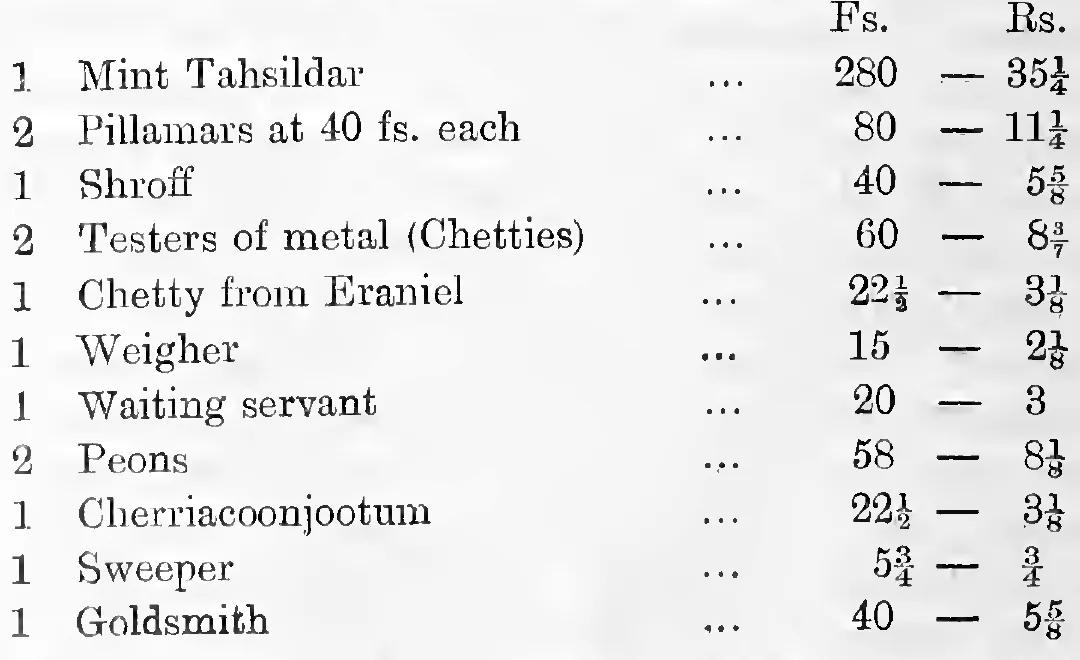
For some years after 1019 M. E. (1843-44) the operations of the Mint [537]were very limited in consequence of no bullion being imported by merchants, and the work was confined almost to copper coinage. Further the British Indian Rupee being legal tender in Travancore had become to be extensively used and the business of the Mint was limited to the making of small coins only.
In 1860 the idea of issuing a new coin to the value of the Gally Fanam or 4 chs. was suggested by the Dewan and approved by the Resident. A couple of stamping presses to be worked by a screw and fly-lever were ordered from Madras through the Mint Master in 1863.
The following account of the Travancore Mint supplied to the Resident on the 27th August 1869 in answer to the memo issued by the Madras Government may be of interest:—
"His Highness the Maharajah has a mint of his own which has been in existence from a very long time and has been regarded as one of his prerogatives. Silver and copper small coins are struck at this mint. No gold is used in these days. In silver, chuckrams and fanams are issued, and in copper cash. The British Indian Rupee, half and quarter rupees are also freely current. The annual out-turn of the mints on an average of the past 5 years is:—
- No. of pieces.
- Chuckrams 1,168,847
- Fanams 90,556
- Cash 101,348
The value of a chuckram is 6·74 pies; of a fanam 2·295 as.; and that of a cash is 0·42 p. The process of manufacturing chuckrams is simple:—After purifying, the silver is alloyed and the alloyed silver is melted in large crucibles and poured from a certain height into cold water over an earthen vessel well oiled. The molten metal suddenly cooled resolves itself into small grains. The object of this is to weigh off just the required quantity of metal for such coin. Then a number of boys each provided with a very small pair of scales weigh off the quantities of these grains of silver and put each lot into one of the holes of a peculiar kind of crucible. This crucible is of the form of a round plate with close small holes made in numbers by merely pressing the finger while the material of the crucible is wet and plastic. This crucible contains 4000 holes. When all the holes are filled, the whole is exposed to fire which reduces each lot of the silver grains to a single globule. These globules are sucessively placed on an anvil on which is cut a die for the impression on the obverse side of the coin over which is placed a piece of steel with the die for the impression on the reverse side cut at the lower extremity. This piece of steel is struck with a hammer and the coin is thus flattened, and receives impressions of the design on both sides. In coining fanams regular machines are employed. The copper cash are made upon a principle analogous to that which governs the coinage of the chuckram. The Sircar buys in the bazaars the copper required, so also silver. 12 rare coins are current both in Travancore and Cochin. The fineness of the chuckram and fanam is 94·53125."
In January 1870 a notification was issued by the Travancore Government enjoining the acceptance of the British Indian coins in the [538]Sirkar Treasuries and by the public as media of exchange.
In 1870 the question of having a uniform currency throughout India came up for discussion but after mature consideration of the subject the idea had to be given up as the following extracts from the Proceedings of the Government of India show:—
"The Governor General in Council is convinced that, however desirable and beneficial a uniform coinage for all India may be, it is not possible to introduce a scheme for this purpose, unless the Mints in Native States were closed or their management be taken under the control of the Government of India. The objections to such a course both on political and general grounds are so great that His Excellency in Council deems it inexpedient to take any action in the matter at present beyond instructing Political Agents to point out to Native Chiefs as opportunity arises, how advantageous it would be for them to co-operate in making the Indian coinage more uniform, and in assimilating it, as far as possible to that of the British Government... ...It is, perhaps, not to be expected that the principal Native States should willingly surrender the right of coining which is one of their most valued prerogatives and H. E. in Council is not prepared to sanction any authoritative interference in the matter. But if a Native Chief should show a disposition to close his mint, and to ask the Government of India for assistance in changing his coinage, he should receive every encouragement to do so. At the same time those Chiefs who may express a determination not to close their mints should be informed that the Government of India is willing to help them as far as it can to procure good machinery and improve their assay and process of coining. Although His Excellency in Council has no wish to press any restrictive measures on Native States, he thinks it right to declare that where mints have either been suppressed altogether or have not been in active use within the last five years, their revival or opening cannot be permitted. Moreover His Excellency in Council cannot permit the establishment of a mint by any State which has not up to the present time continuously exercised the right of coining without question by the British Government."
In October 1872 the Government of India passed a Resolution regarding the conditions on which the coins of Native States may be admitted as legal tender in British India. The Resolution on being communicated to the Sirkar the Dewan replied on behalf of H. H. the Maharajah, that the Travancore Government did not intend to enter into the arrangement in respect of coinage indicated in the Proceedings dated 25th October 1872, "as the arrangement will not only destroy one of H. H.'s prerogatives of having a perfectly independent coinage of his own but will lead also to much confusion in Government and native mercantile accounts without any great compensating advantage."
In 1877 the gold coins called Travancore Varahan and half Varahan were struck and declared legal tender. The obverse of the coins contained the inscription "R. V." Travancore and the Malayalam and English years, and the reverse the Shank (the emblem of Travancore) and a flag. The money equivalent of the coins was Rs. 7½ and Rs. 3¾ [539]respectively. But this gold currency had soon to be stopped, having failed in its object there being hardly any circulation.
To meet the difficulty in securing old and standard Venetian Sequins frequently wanted for temple offerings, Dewan Ramiengar suggested the coinage of a token gold coin which was to be merely a token and not a part of the State currency. The suggestion being approved of by the Maharajah, the coins were ordered to be struck at the Bombay Mint in October 1882, but were actually struck at the local mint. The coins were of two sizes, one equal to the English sovereign in weight and purity and the other equal to the English half sovereign which was to be used in lieu of sequins.
10,000 Anantarayan* panams, 1000 sovereigns and 2000 half sovereign token coins were ordered to be struck.
In 1064 M. E. (1888-89) two more copper coins were struck, viz., 4 cash and 8 cash pieces.
In 1076, M. E. (1900-01) owing to the facilities which the silver chuckrams afforded to counterfeiting, it was resolved to discontinue the minting thereof and to issue silver coins of an improved pattern and of the value of 2 chs. each and copper coins of the values of one, ½ and ¼ chuckram for the convenience of the public in their monetary transactions. A Royal Proclamation was accordingly issued that silver coins of the value of 2 chs. and copper coins of the value of 1 ch, ½ ch., and ¼ ch., be struck and issued in addition to the coins already in use. The minting of the single silver chuckram was discontinued, as it was the intention of Government to put a stop to the circulation of this coin altogether after a time. But the Proclamation at first created a considerable scare among the people as the market was flooded with counterfeit silver chuckrams which were being withdrawn and the Government was not able to supply the new coins instead. Commerce was at a standstill and the people especially the poor suffered. The crisis was most felt in the interior taluqs of the State. The operations of the Mint were consequently considerably increased to meet the large demand for copper coins. Minted copper coins to the value of Rs. 106,939 and copper discs in large quantities were obtained from Birmingham and thus the public inconvenience was gradually removed.
Travancore Currency. The King's Rupee, weighs 180 grains and contains 165 grains of pure silver and 15 grains of alloy.
Half and Quarter and ⅛ rupee pieces are also legal tender. Their [540]weight and degree of fineness are:—
* 1 Anantarayan Panam =8 chs. or 4 as. 6 p.
- Weight. pure silver alloy
- ½ Rupee 90 ... 82½ ... 7½
- ¼ Rupee 45 ... 41¼ ... 3¾
- ⅛ Rupee 22½ ... 20⅝ ... 1⅞
The British Indian copper coins are not legal tender in Travancore except in the outlying Taluq of Shencottoh where,
- 4 pies = 1 Thootoo
- 48 Thootoos = 1 Rupee
- 48¾ pies = 1 Vellapanam
The Vellapanam whose commutation rate is 8¼ Travancore fanams was till recently current in the public accounts of the State. The established rate of exchange is 28½ chs. per King's Rupee. The Travancore Rupee which is no coin is commuted at 28 chs. The silver chuckram now no longer current, weighed very nearly 6 grains and the silver of which was 94·53128 per cent. fine and therefore 2·86459 or nearly 3 per cent. better than that of the King's Rupee which is only 91⅔ fine. Hence the established rate of exchange, i. e., 28½ chs. per King's Rupee is therefore nearly 4 per cent. less than a fair equivalent.
The Sirkar currency is as follows:—
- 16 cash = 1 chuckram
- 4 chs. = 1 fanam
- 7 fs. (28 chs.) = 1 Travancore Rupee.
Half and Quarter Rupee coins valued at 14 and 7 chs. respectively, four and two chuckrams silver coins and copper coins of the value of one chuckram, eight cash, four cash and one cash have been coined and are now in circulation. The mint is under the immediate control of a Superintendent on a salary of Rs. 85 per mensem.
Elephant Department. In the Memorandum on the Administrative System of Travancore drawn up by V. Krishna Row he wrote:—
"This Department had originally been under the immediate orders of the Dewan, with a separate Establishment, consisting of Mael-Vizaripoocaren or Head Overseer and several Pillamars; but in consequence of a large number of Elephants being required for the Forest works, it was deemed expedient to place this Department under the Conservator of Forests which arrangement was however found to be attended with inconvenience, so that the former system has been resorted to ... ... The elephants attached to the Forest and Commercial Department and the Stables are supplied with Forage &c., from those Departments respectively, and the accounts of the expenses for maintaining the remaining are kept by the Mael-Vizarippoocaren of the Elephant Department."
[541]There was an establishment for superintending the pits for catching elephants; when an elephant is captured in any of the pits belonging to the ryots, the Sirkar incur an expense of 75 fs., but when in a Sirkar pit the expenses do not exceed 500 fs. The Superintendent of the Elephant Department transacts under the orders of the Dewan all correspondence in connection with the capture, the feeding, the training of the elephants and other matters connected with their distribution for various works.
In 1050 M. E. (1874-75) the Conservator of Forests was deputed to Mysore to take notes of the system of capture in Keddahs. A Keddah was newly established at Konnee in 1052 M. E. (1876-77).
In 1062 M. E. (1886-87) Government sanctioned the establishment of a Veterinary Hospital for horses and elephants. At the end of the year 1079 M. E. (1904) the total number of elephants was 115. The receipts for the year amounted to Rs. 5,584 and the charges to Rs. 32,313. There is a special agency in the Huzur to control the expenditure and general management of these animals.
The Government Gazette. Dewan V. Ramiengar wrote:—
"The Travancore Gazette was a strictly official publication containing only appointments and dismissals, leave of absence and ordinary Government notifications or advertisements and certain departmental returns. The attention of Government was directed during the year to rendering this official organ a more attractive and useful publication and placing it within the reach of the subordinate officials and the more educated and intelligent classes of the people. With this view an agricultural sheet has been added in which useful information from the 'Indian Agriculturist' and other publications is extracted. All important official circulars and orders affecting the general administration and select papers from the official records are also published. The rate of subscription was reduced in the case of the lower servants and ryots 50 per cent."*
Besides the Gazette proper and the usual Agricultural and Police Sheets, supplements are also from time to time published containing Draft Bills and Regulations, Proceedings of the Legislative Council and of the Town Improvement Committees, &c. It is also made the means of disseminating useful information on sanitary and other important matters. In 1063 M. E. (1887-88) Government reduced the subscription to 12 fs. (Re. 1-11 as.) a year to those drawing salaries below Rs. 25 a month. This lower rate was abolished in 1070 M. E. (1894-95).
In 1079 M. E. (1903-04) the number of copies of the Gazette struck off was 1340. There were 310 subscribers paying Rs. 4 a year and 554 subscribers paying Rs. 2 a year.
Stationery. This heading finds a place in the Administration Report [542]for the first time in 1069 M. E. (1893-94). Till then the expenditure alone was noted in the Financial Statement. The expenditure on this item previous to the general introduction of paper in 1049 M. E. (1873-74) must have been very little.
* Report on the Administration of Travancore for 1056 M. E. (1880-81) Note. Mr. A. M. Muthunayagam Pillai, B. A. B. L., Head Sirkar Vakil, has kindly read the proofs of this chapter. V. N.
Government had been, since the opening of the Punalur Paper Mills, purchasing almost all the paper required from them. In 1067 M. E. (1891-92) Government had also advanced money to the Quilon Paper Mills Company for the manufacture of paper. To check the illicit use of Government paper, the paper was specially water-marked with the words 'Travancore Government.' Some of the writing materials such as paper-weights, ink-stands, rulers, scraper &c., were manufactured in the School of Arts. Of European articles a limited quantity of superior paper alone for writing and printing was procured from Bombay and from local merchants.
The purchase of stationery for the first half of 1069 M. E. (1893-94) was made in British India and the local bazaars, but with a view to economise expenditure on this head and secure a superior quality of paper, arrangements were made for the first time in that year to obtain a supply direct from England. The first supply was received towards the close of 1069 M. E. (1894); the quality of the articles was superior to what was hitherto purchased locally and price comparatively less. The supply from England was continued till 1072 M. E. (1897) when the stationery required for the year was mostly purchased from a Bombay firm. Now the whole supply is received on contract from Messrs. Dickinson & Co., England.
The charges for stationery in 1079 M. E. (1903-04) amounted to Rs. 59,223; the value of the articles issued to the several Departments amounted to Rs. 69,196-1 a.-0 p. This Department is also attached to the Huzur Office and is under the management of the Stamp Superintendent.
Chemical Examiner's Department. Until 1066 M. E. (1890-91) the duties of a Chemical Examiner were performed by an Apothecary under the direction of the Durbar Physician. In that year, a separate and independent department was organised and Assistant Surgeon Subrahmony Iyer, M. A., M. B. & C. M., was appointed Chemical Examiner to Government. In 1070 M. E. (1894-95) he was permitted to attend the Indian Medical Congress. He also visited the Chemical Laboratories of Madras, Calcutta and Agra.
In 1072 M. E. (1896-97) arrangements were made for a well equipped permanent Laboratory being built for Chemical and Bacteriological [543]Examinations. In 1074 M. E. (1898-99) the Chemical Examiner was given a monthly allowance of Rs. 50.
In 1079 M. E. (1903-04) Surgeon E. Poonen was appointed Chemical Examiner to Government. Under Medico-legal, 45 cases requiring an examination of 198 articles were attended to and under Miscellaneous two cases of water analysis.
State Life Insurance. With a view to enable public servants, especially those in the subordinate grades of the service, to make some provision for their families, a scheme of State Life Insurance was introduced with effect from 1st Makaram 1073 M. E. (1898). Its main features are:—
1. It applies to all persons holding permanent appointments, who are not above 45 years of age or whose monthly salary is not below Rs. 10.
2. Insurance is optional in the case of those who had entered the service before the 1st Makaram 1073.
3. Persons entertained in the service after the said date are bound to submit proposals for insurance.
4. Proposers have to undergo medical examination provided Government may in particular cases dispense with such examination and admit the acceptance of such a certificate of health from a competent medical officer.
5. The premium or contribution is 5 per cent. of the pay of the insured to be recovered and credited to Government every month till he shall complete 55 years of age or till death. On that a certificate of heirship granted by a Tahsildar may be accepted as satisfactory evidence for settlement of claims. It was also declared that policies may be recognised by formal deeds.
In 1079 M. E. (1903-04) the Committee of management was abolished and the work transferred to the Secretariat in the Huzur. The number of policies at the end of 1079 M. E. (1903-04) was 1,281 and the total premia amounted to Rs. 41,559-20 chs.-10 cash.
Concluding remarks. The foregoing account of the main machinery of Government is fairly exhaustive and gives the required information on every one of the principal departments of the State, showing their uses and varied activities. Progress and improvement are apparent in every branch of the machinery. It will be clear even to the most superficial observer that no part of the State-machine is worn out or [544]clogged. It moves smoothly and well and is throughout kept in admirable order. Making it more complex or quickening the pace may injure it without materially improving the condition of His Highness' subjects. Too much division of labour and an unnecessary decentralisation may not be an unmixed blessing to a simple and rural population like that of Travancore. Already there is a feeling in the public mind that Government is aiming at too much technical excellence by the multiplication of departments. This is not necessarily accompanied by high efficiency in the service or additional comforts to the people. Within my own experience the problem of administration is becoming more and more difficult.
[545]
Chapter XXLegislation and Statute-book.
"When you become King, do nothing, but let the laws rule."
Quesnay's Advice to the Dauphin.
"We need feel no surprise, then, that in their efforts to cure specific evils, legislators have continually caused collateral evils they never looked for. No Carlyle's wisest man, nor any body of such, could avoid causing them."
Herbert Spencer.
Introduction. Travancore is one of the very few Native States in India that have for ages past been under the uninterrupted sway of Hindu rulers whose government and laws are closely modelled after the Dharma Sastras. His Highness the Maharajah is the recognised fountain of law and justice though the administration of the law is entrusted to a staff of revenue, magisterial and judicial officers of the State. Up to the time of Colonel Munro there were no regularly constituted courts in the country. All civil matters were heard and decided by the District officers or Sarvadhikariakars as they were called or by Panchayats appointed by the Maharajah or his minister (variously designated Valia Sarvadhikariakar, Dalawa or Dewan) and their decisions reported to the Dewan on whose sanction alone the decrees could be executed. In criminal and police matters, local officers made investigations under orders from their immediate superiors and reported the result to them; and the result had to be submitted to the Dewan who alone had the authority to pass sentence. There was no regular scale of punishments according to the heinousness of the offence, but they varied according to the caste and social position of the offender. The Hindu code regarded many delinquencies as capital offences, which the other codes would not countenance; e. g., the killing of a cow is according to the Hindu code heinous and punishable with death. So with other countries too, severity of punishments seems to have been a characteristic feature of the earlier ages—replaced in course of time by humane ones—as H. A. D. Phillips (B. C. S.) writes in his Introduction to Comparative Criminal Jurisprudence (vol. II):—
"The rule as to strict construction of penal statutes doubtless originated in [546]the extreme severity of punishments. As late as 1837 there were as many as 37 capital offences on the Statute-book; now there are but four—murder, treason, piracy by the law of nations, and setting fire to dock-yards."
It was not unusual to have theft punished with mutilation of limbs, and whipping was freely resorted to in some class of cases. The system of corporal punishments awarded by Velu Tampi Dalawa is still remembered with horror. Besides the Dharma Sastras, local or customary law also prevailed to a great extent and was legally recognised, as an interesting survival of which at the present day may be mentioned the exemption in favour of Brahmins and women of all classes from capital punishment and the prohibition of the award of capital punishment to more than one person concerned in the same offence.
Early history. According to Walter Hamilton, the then existing compilation of Hindu Law in Travancore was named Vyavaharamalika said to have been drawn up by one Mahesamangalam Sankaran Nambudiri, an inhabitant of Perumanum in the territory of Cochin, about 1496 A. D. comprising the rules of procedure for trial and judgment with detailed exposition of the Sanskrit texts. The sovereign in the exercise of his legislative authority seems also to have promulgated special laws and rules under the designation of Sattavariolas for the administration of the affairs of the State; the earliest of which we have any record appears to be the one passed in 951 M. E. (1776 A. D.) in the reign of the famous Rama Rajah or Kilavan Rajah. All important measures of State were as now also made known by proclamations under sign manual.
Establishment of Courts. The establishment of courts for the first time in Travancore was in 1811 A. D. by Colonel Munro the Resident-Dewan and it marks a distinct epoch in the history of legislation in the State. With a view to thoroughly reform the general administration in all its branches, he consulted able and experienced men of the country and framed a set of rules for the guidance of revenue, criminal and civil officers founded partly on the dharma sastras and partly on the regulations then in force in the Company's territories. These were called Sattavariolas and were duly promulgated under the sanction of Rani Gouri Lakshmi Bayi on the 30th Chingam 987 M. E. (Sept. 1811) The Kariakars (corresponding to the modern Tahsildars) who combined in themselves the functions of revenue collection, administration of justice and chastisement of offenders were relieved of their judicial functions and were reduced to the position of mere revenue officers. Seven Zillah Courts were established and placed under the orders of the Dewan who was then the supreme head of all the departments.
[547]The duty of these courts was to enquire into all cases brought before them, civil, criminal or police and to report to the Dewan whose approval in each case was necessary to give effect to their proceedings. This system remained in force till 1814 when an Appellate Huzur Court was established for the hearing of appeals from the decisions of the Zillah Courts, but that court still formed more an appendage to the Huzur Cutcherry than an independent court of justice.
It was only in 1834 when a general scheme of Judicial administration was conceived and carried out, founded on the arrangements then obtaining in the Madras Presidency, that the term Regulation came first into use. Seven regulations were passed in that year under sign manual, all relating to judicial matters, viz., powers and jurisdiction of Munsiffs, the assembling of District Panchayets, execution of decrees, jurisdiction of Zillah Judges, constitution of the Appeal Court, the investing of Tahsildars with police powers and creation of Circuit Judges and the laying down of the procedure to be observed in the trial and commitment of criminal cases. The development of codified law begins from this period, and a regular series of regulations were passed. During Sir Madava Row's time (1858-1872), legislation made great progress and his successors have all put forth their best efforts in the same direction and endeavoured to bring the Travancore laws into line as near as possible with the British Indian Code of enactments, giving due consideration to the peculiar and special usages of the country. The draft of the regulations was under the initiative of the Maharajah prepared either by the Dewan himself or the Sadr Court and used to be published in the official Gazette to invite the opinions of the public and then only submitted to His Highness for the requisite sanction. Sometimes a Committee would be appointed to enquire into particular defects of the existing law or usage and prepare draft regulations suggesting improvements which in due course received His Highness' sanction.
The Legislative Council. In January 1888 Dewan T. Rama Row proposed to His Highness the Maharajah the organisation of a Legislative Council for the State as it was thought, to quote his words, desirable, "that the Dewan should have the benefit of discussing with and taking the opinion of responsible officers associated with him in matters of legislation, which as being one of the most important functions of the Government, should receive the most careful consideration before being submitted to the Sovereign to be passed into law." His Highness whose reign had already been distinguished for deep interest in the welfare of [548]the people and intense solicitude for their happiness and prosperity, readily approved of the Dewan's recommendation and a Regulation was accordingly passed under date the 30th March 1888 (19th Minam 1063) providing for the establishment of a Legislative Council in Travancore for the purpose of making laws and regulations. According to the Regulation,
"The Council is to be composed of a maximum of eight members, of whom not less than two are to be men outside the service, and is to be presided over by the Dewan, or, in his absence, by the senior official member present. Any Bill introduced is first to be considered and passed by the Council, after which it is to be submitted to His Highness the Maharajah for His Highness' approval. It becomes law when the sign manual is affixed and the Act published. Provision is also made for inviting public opinion by publishing the Bill before it passes the Council. On an emergency, a Regulation may be passed without the Council, but it will be in force for a period of only 6 months."
The inaugural meeting of the Council was held on the 23rd August 1888. The Council Regulation has since been superseded by Regulation V of 1073, passed by His Highness the Maharajah on the 9th Minam 1073 (21st March 1898). This important measure provided for the enlargement of the Council, defined its constitution and powers and enabled Government to frame rules for the selection of non-official members. The distinguishing features of the new Regulation may be briefly summarised:—
(1) The maximum number of members fixed by the old Regulation was only 8; the maximum is now fixed at 15 and the minimum 8.
(2) While according to the old law the number of non-official members was fixed at not less than two, it is now not less than two-fifths of the total number.
(3) By section 5, the Dewan is enabled with the previous sanction of His Highness the Maharajah to frame rules from time to time laying down the conditions under which all or any of the non-official members may be elected, thus following the Indian Councils Act of 1892 under which the duty of framing the rules is left to the executive to avoid the inconvenience of frequent appeals to the Legislature whenever the rules are found defective. Power is also reserved to His Highness to veto the nomination of an elected member in order to prevent the admission of men of questionable character into the Council.
(4) As the old Regulation contained no provision for dismissing members whose proved misconduct might render their retention in the Council highly inexpedient, the defect is remedied by section 7, [549]according to which,
"When any member of Council is convicted of any offence involving moral turpitude, or is declared insolvent, or claims under section 337 of the Civil Procedure Code, to be discharged from liability to pay his debts on the ground of insolvency, his office shall become vacant. ... ... The decision of Our Government as to whether the offence of which a member may be convicted involves moral turpitude is final and shall not be called in question in any Court of Law."
(5) Section 8 provides that a member not attending three consecutive ordinary meetings shall be declared to have vacated his seat.
(6) Under the old Regulation there was only one proviso to section 11, which dealt with the nature of the business to be transacted at meetings and that is, "that it shall not be lawful for any member to introduce without the previous sanction of the Dewan any measure affecting (a) the public revenues of the State or by which any charge shall be imposed on such revenues." To this is now added also (b) "the religion or religious rites and usages of any class of our subjects." The second proviso to section 12 is also new and excludes from the jurisdiction of the Council certain subjects which are to be regulated with special reference to the policy of the Paramount Power.
They are measures affecting:—
(a) the reigning family of Travancore,
(b) the relations of the Travancore Government with the Paramount Power or with foreign Princes and States,
(c) matters governed by treaties, conventions or agreements now in force or hereafter to be made by this Government with the Paramount Power,
(d) extradition of criminals,
(e) European vagrants,
(f) European British subjects,
(g) the regulation of affairs relating to seaports,
(h) imperial Post Office and Telegraphs and Railways,
(i) the Nayar Brigade and the Maharajah's Bodyguard.
The present Regulation thus confines the sphere of the Council to legislation of a non-political and local character. With respect to the subjects outside the jurisdiction of the Council, section 14 of the new Regulation enacts that "the Dewan may frame and submit to us any Regulation and every such Regulation, if assented to by us, shall have the force of law."
(7) Section 16 supplies a defect in the old law, for it says:—
"No Law or Regulation passed by the Legislative Council shall be deemed [550]invalid by reason that the proportion of non-official members hereby provided was not complete at the date of its introduction into the Council or its enactment."
The business of the Council is conducted according to certain well considered and comprehensive rules passed by His Highness the Maharajah, under section 2 of the Regulation. It is enough to give here a brief resume of the different stages which a Bill has to go through before it becomes law.
Any member may move for leave to introduce a Bill into the Council after giving six clear days' notice. Then he has to send in the Bill with the statement of objects and reasons and all the papers connected with it, to be published in the Government Gazette. When this is done a copy of the Bill is sent by the Secretary to each member. Fifteen days are allowed to elapse, when the member in charge of the Bill introduces it after giving six clear days' notice and moves that the Bill be read in Council. The principle and general provisions of the Bill are then discussed and if the motion be carried, the Council then considers the question of referring it to a Select Committee and if that is decided in the affirmative, the Council appoints the Committee and directs it to submit its report within a specified time. It is only after the Select Committee sends up its report, and a copy of it is forwarded to each member that the Bill is again taken up for discussion in the Council. If, however, the Council deems it unnecessary to refer it to a Select Committee it does not take up the Bill for consideration until the expiration of fifteen clear days from the date of the introduction of the Bill. In this case, it is not found necessary to make a formal motion that the Bill be taken into consideration. Any member wishing to propose an amendment affecting the substance of a Bill shall send a copy of the proposed amendment to the Secretary, but it shall not be necessary to give previous notice of amendments of a purely verbal character or of amendments consequential upon, or moved in respect of, amendments which have been carried. When the amendments proposed by the Select Committee, and such other amendments as may be proposed by any of the members before the Council, have been considered by the Council, the member in charge of the Bill, or in his absence any other member may move that the Bill as amended be taken up and passed at a subsequent meeting. At this stage no amendments other than those moved on behalf of Government are permitted. Then the Bill is passed by the Council. The Secretary forwards it to the Dewan for submission to His Highness. The Dewan then communicates His Highness' assent or dissent to the Council by a certificate [551]in writing at the foot of the Bill. No member is permitted to make any motion upon the exercise by His Highness of the prerogative of withholding assent to the Bill. When the Bill receives the assent of His Highness under section 13 of Legislative Council Regulation of 1073 M. E. (1898) it is published in the Government Gazette in English and Malayalam.
Though the Regulation referred to above had provided for a maximum number of 15 members of Council, the Council was composed till recently of only 8 members, 5 officials and 3 non-officials. In 1079 M. E. (1903-04) His Highness the Maharajah was pleased to appoint two more members, thus making the total, 10. As at present constituted, there are besides the Dewan (who is Ex-officio President) 6 official and 4 non-official members. The Council has been in existence for 17 years and as a result of its active labours, more than 60 Regulations have either been newly enacted or amended. Generally the Travancore legislature takes the British Indian enactments as its model and alters their provisions where necessary to suit local requirements and usages. The Council is still active, and judging from its work in the past one may naturally fear whether the State may not have soon to complain of over-legislation, an evil much greater than the want of legislation, especially in a country where the bulk of the people are still peaceful and contented and do not wish to push on fast. Rajah Sir Madava Row even so long ago as 1865 feared that over-legislation might do harm though he himself desired legislation in more than one direction. He wrote:—
"While, in a State like Travancore, it is particularly desirable to avoid the error of over-legislation, it is evident that some effective legislative action is required without delay in certain directions. For instance, either the existing system of Registration of Deeds should be improved, or a better one created in its stead. Nothing could confer greater security upon transfers of landed and other valuable property, or more effectually check unnecessary litigation and crimes connected with the falsification of instruments of evidence. Then again, it has to be declared lawful for any member of a Malayali (native) family to insist upon a division of common property so far as he or she is individually concerned, if he or she wishes to separate. Not that such a law would be generally acted upon at once. The feeling in favour of relatives living together in an undivided state of property is too strong to yield to reason in the present generation. But it is obviously the province of Government to see that a general feeling of the kind does not operate as an instrument of tyranny over individuals. It is equally desirable to make some beginning, no matter how small, to procure the assistance of a jury in the administration of justice."*
The evil of believing in the omnipotence of legislation is severely exposed by Herbert Spencer in the following terms:—
"This worship of the legislature is, in one respect, indeed, less excusable [552]than the fetish-worship to which I have tacitly compared it. The savage has the defence that his fetish is silent—does not confess its inability. But the civilized man persists in ascribing to this idol made with his own hands, powers which in one way or other it confesses it has not got. I do not mean merely that the debates daily tell us of legislative measures which have done evil instead of good; nor do I mean merely that the thousands of Acts of Parliament which repeal preceding Acts, are so many tacit admissions of failure. Neither do I refer only to such quasi-Governmental confessions as that contained in the Report of the Poor Law Commissioners, who said that—'We find, on the one hand, that there is scarcely one statute connected with the administration of public relief which has produced the effect designed by the legislature, and that the majority of them have created new evils, and aggravated those which they were intended to prevent. I refer rather to confessions made by statesmen and by State departments."
* Report on the Administration of Travancore for 1040 M. E. (1864-65.)
Among the many acts which shed lustre on the reign of His Highness the present Maharajah, the institution of the Legislative Council stands foremost. To quote Dewan Rama Row who was chiefly instrumental in bringing it about:—
"It gives to His Highness the advantage of considering the great measures which affect the well-being of his subjects in the light of the deliberations of some of his ablest and most experienced officers with the correctives which a body of men unshackled by the trammels of office and acquainted with the wants and feelings of the people are able to apply."
It has to be noted that Travancore was the first among the Native States of India to recognise the value of a Legislative Council as an indispensable adjunct to a civilised and enlightened Government. It is contemplated, according to the latest Baroda Report, to organise a Council for the purpose of making Laws and Regulations in that State. Mysore is still without a Legislative Council.
Statute-book. As already observed, the term Regulation came into use only from 1010 M. E. (1834-35), and our Statute-book proper begins only from that date. There have been 127 Regulations on the whole, of which 82 are in force now. A chronological table of the Legislative Enactments passed up to the end of 1079 M. E. (1905) is appended for convenience of reference:—
[553]
Chronological Table of the Legislative Enactments of Travancore.
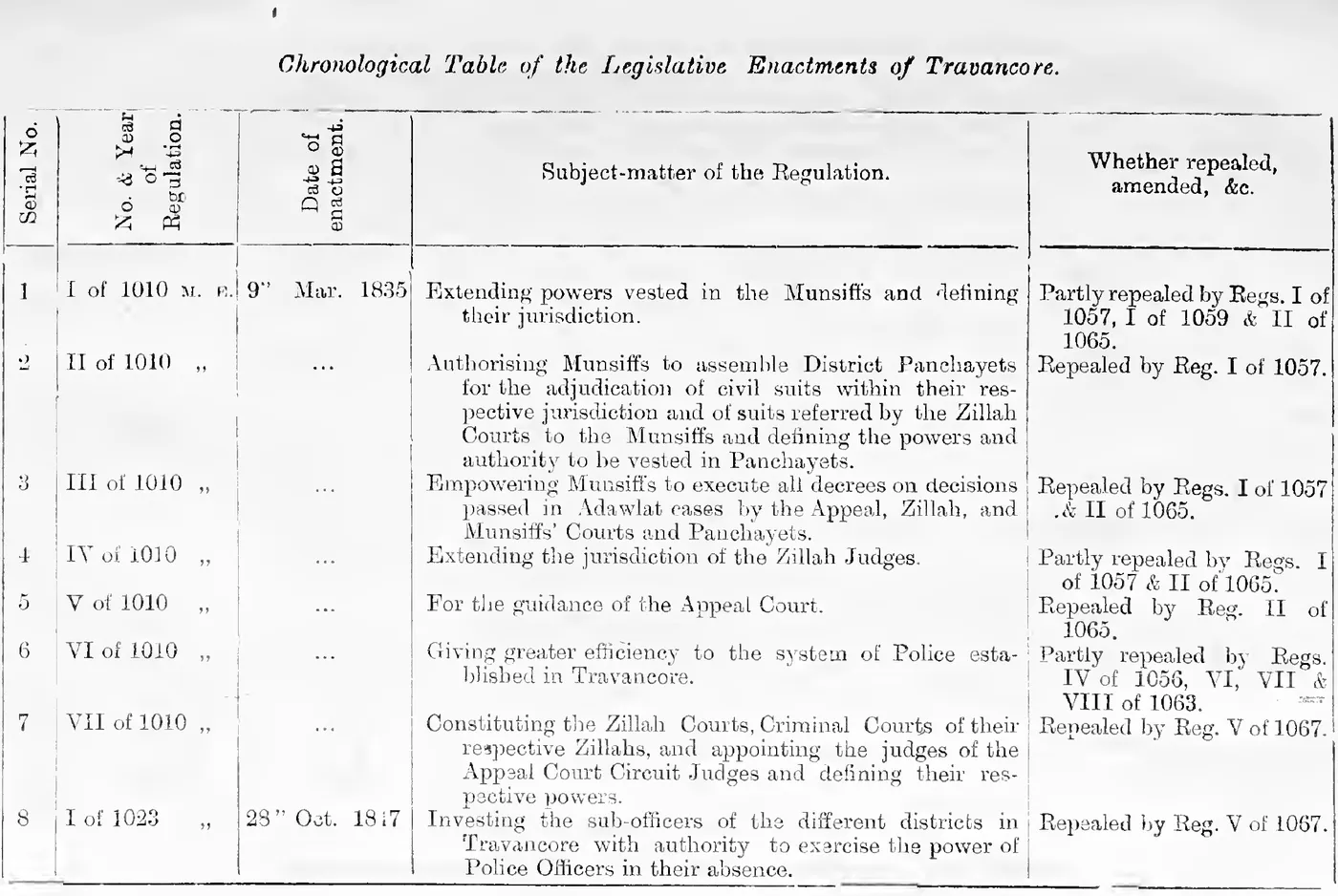
[554]
Chronological Table of the Legislative Enactments of Travancore.
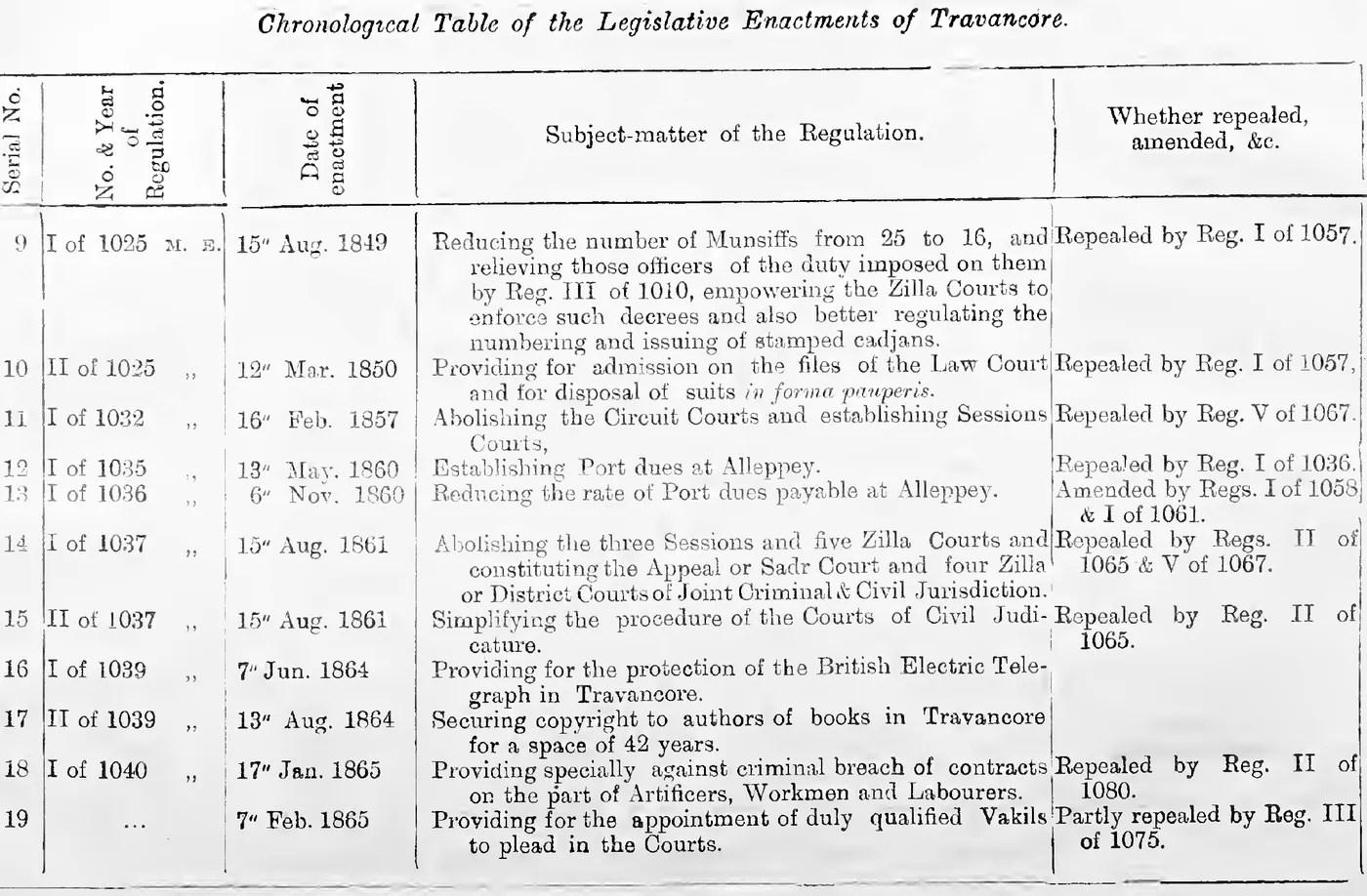
[555]
Chronological Table of the Legislative Enactments of Travancore.
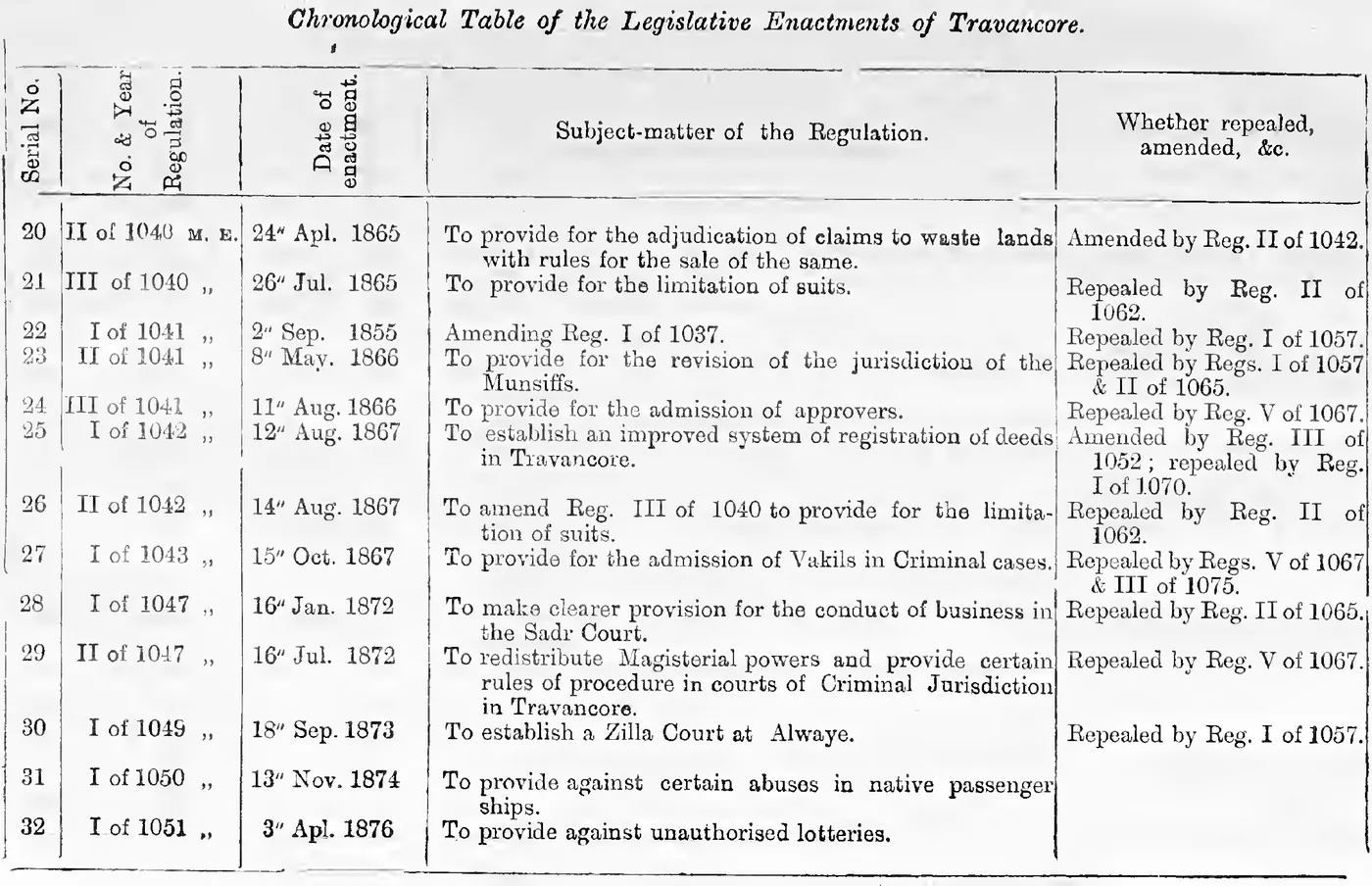
[556]
Chronological Table of the Legislative Enactments of Travancore.
[557]
Chronological Table of the Legislative Enactments of Travancore.
[558]
Chronological Table of the Legislative Enactments of Travancore.
[559]
Chronological Table of the Legislative Enactments of Travancore.
[560]
Chronological Table of the Legislative Enactments of Travancore.
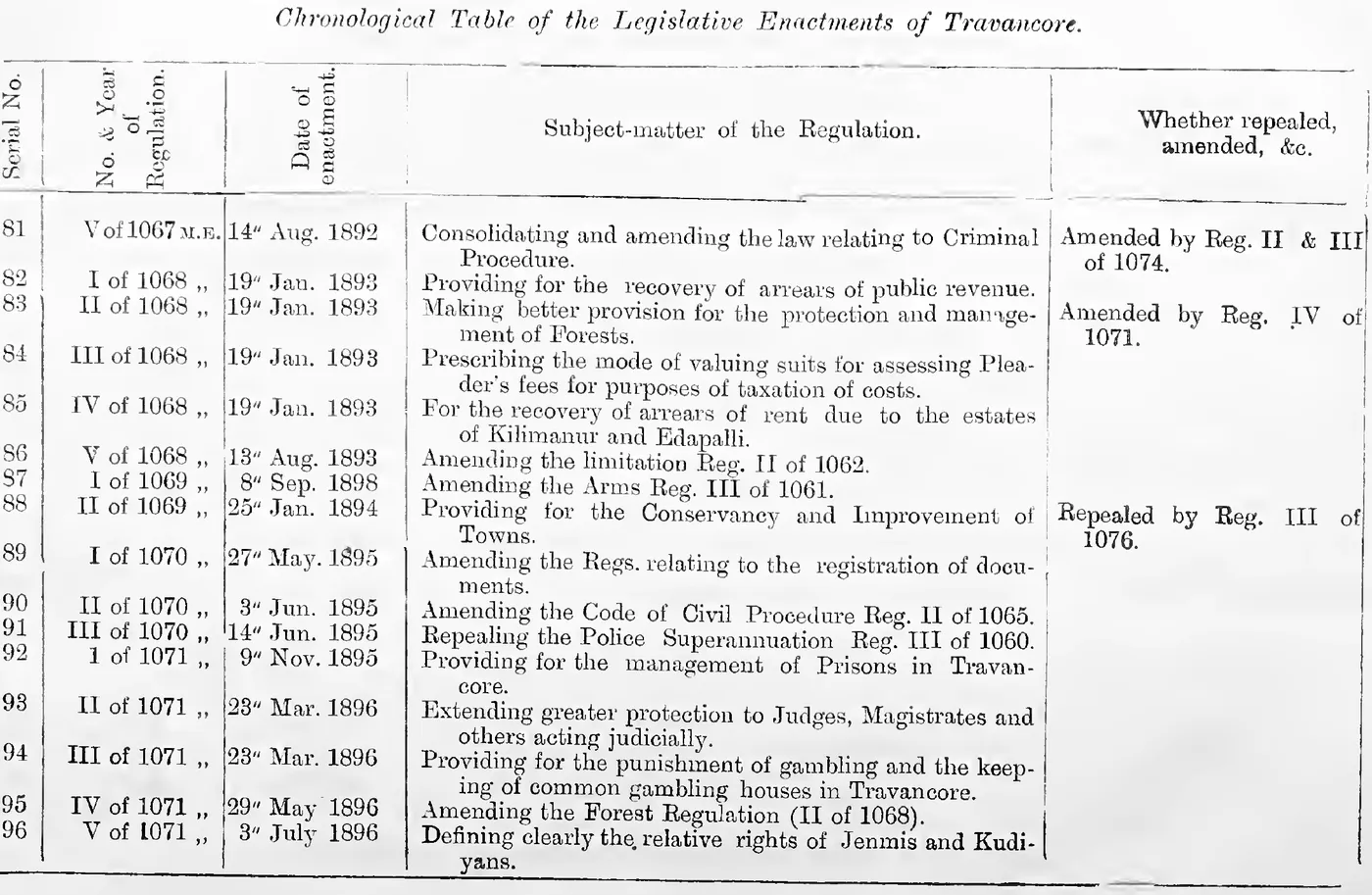
[561]
Chronological Table of the Legislative Enactments of Travancore.
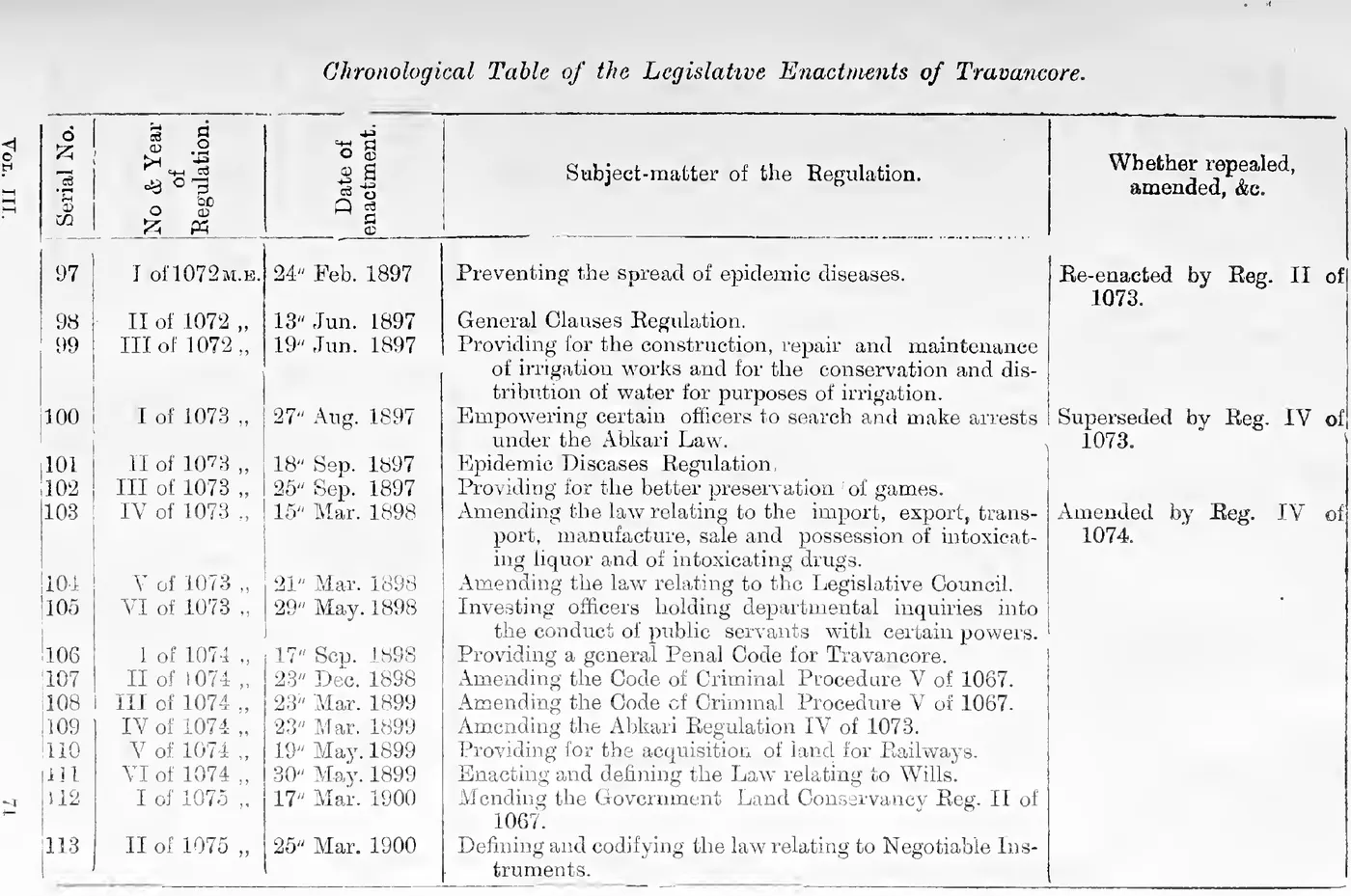
[562]
Chronological Table of the Legislative Enactments of Travancore.
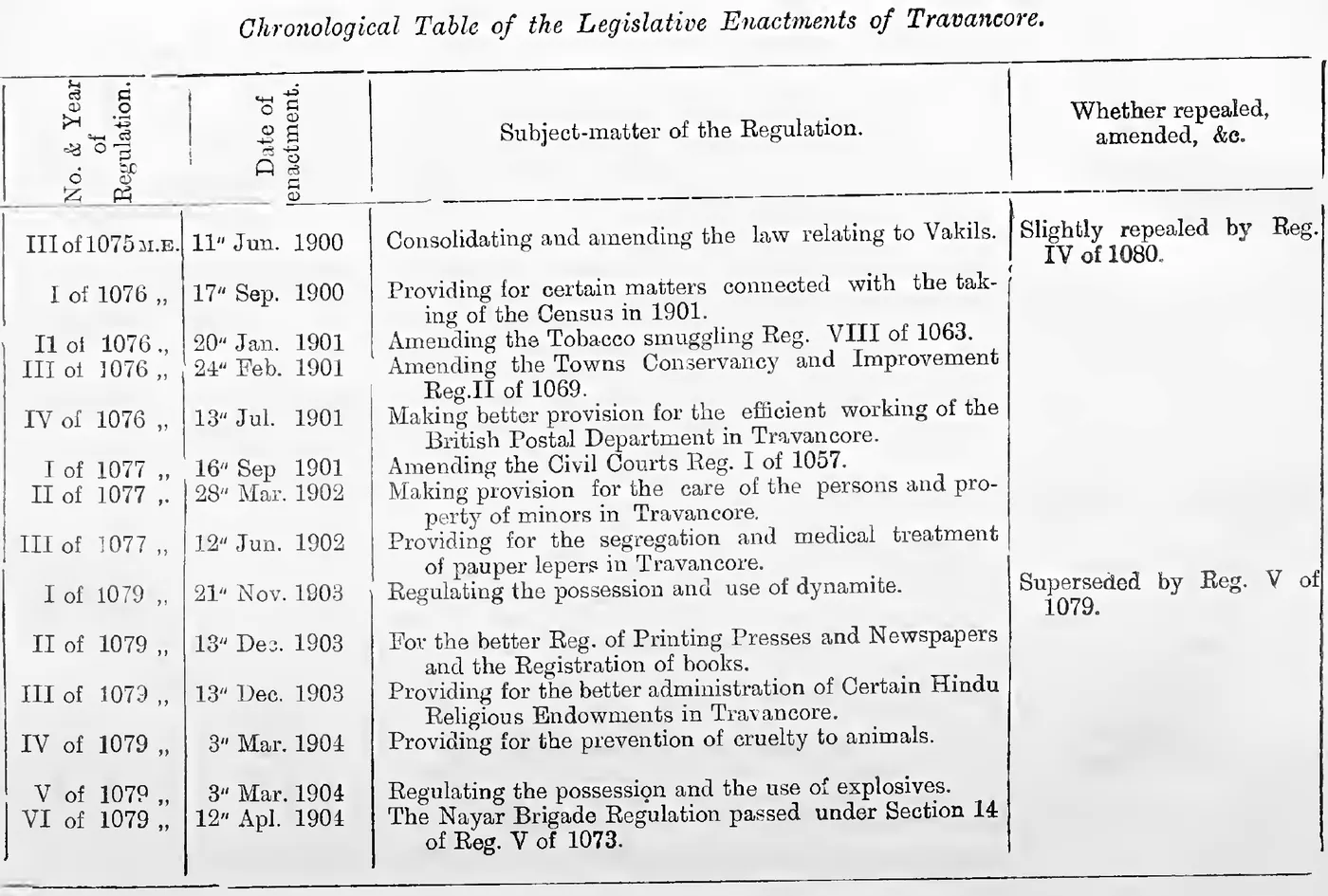
[563]Royal proclamations and Notifications. Reference has already been made to the fact that Colonel Munro with the sanction of Rani Lakshmi Bayi promulgated a series of enactments called Sattavariolas for the guidance of officers of Government and with a view to ameliorate the condition of the subject population. One of the earliest of such proclamations was that dated 21st Vrischigam 987 M. E. corresponding to 5th December 1811 A. D. prohibiting the sale and purchase of slaves, and the levying of a tax on them. The Sattavariola, dated 30th Chingam 987 M. E. (1811 A. D.) established Courts of Justice for the first time in Travancore. An attempt is herein made to present a list of all the available proclamations subsequent to 987 M. E. (1811) but the list does not pretend to be exhaustive, though every endeavour has been made to make it complete. These proclamations are promulgated under sign manual and have the force of law. There are 107 of them in force according to the best search made. They are:—
1. Proclamation dated 1st Karkadagam 990 M. E. (July 1815) abolishing polltax and rent on fishing nets.
2. Proclamation dated 16th Dhanu 991 M. E. (Dec. 1815) notifying that all ryots possessing Viruthi lands should render the usual Oolium services to the Sirkar and excepting the Syrian and other Christians from performance of Oolium duties to Devaswams.
3. Proclamation dated 21st Makaram 991 M. E. (Jan. 1816) requiring the submission of the Syrian Christians to the control of Mar Dionysius the Metropolitan.
4. Proclamation dated 26th Dhanu 992 M. E. (Jan. 1817) proclaiming Mar Philoxenos a Metropolitan vice Mar Dionysius deceased.
5. Proclamation dated 8th Makaram 992 M. E. (Jan. 1817) permitting all classes of the inhabitants and merchants to have their houses tiled.
6. Proclamation dated 22nd Dhanu 993 M. E. (Jan. 1818) sanctioning the administration of Mar Dionysius in consequence of the ill-health of the Metropolitan Mar Philoxenos.
7. Proclamation dated 16th Kumbham 993 M. E. (Feb. 1818) proclaiming that the Mudalis and Ambalakars of Nanjanad are deprived of all the honorary privileges enjoyed by them.
8. Proclamation dated 30th Kumbham 993 M. E. (March 1818) installing the Rt. Revd. Don Fre Thomas de Noronha Bishop of Cochin.
9. Proclamation dated 10th Minam 993 M. E. (March 1818) discontinuing the practice of exacting money by the Izhavas of Tovala and [564]other districts on the plea of their being chiefs once.
10. Proclamation dated 19th Medam 993 M. E. (May 1818) permitting Sudras, Izhavas, Shanars &c., to wear gold and silver jewels agreeably to the usages of their respective castes.
11. Proclamation dated 8th Kanni 994 M. E. (Sept. 1818) notifying that as the Bishop of Cochin has assumed possession of the new Church and others under the jurisdiction of the Vicar Apostolic of Verapoly, the parishioners of those churches are required to place themselves in obedience to him.
12. Proclamation dated 22nd Makaram 994 M. E. (Feb. 1819) notifying that the four churches of Kottayam, Changanachery, Alleppey and Parur respectively are placed exclusively for the use of the Roman Catholic congregations of those places.
13. Proclamation dated 1st Karkadagam 994 M. E. (July 1819) requiring that all foreign carpenters residing in Travancore should before the 30th of that month produce before the Appeal Court the documents held by them for the honorary privileges granted to them and have the same registered there.
14. Proclamation dated 21st Chingam 995 M. E. (Sept. 1819) notifying the abolition of certain fees hitherto levied from the Chetties and other castes.
15. Proclamation dated 4th Kanni 997 M. E. (Sept. 1821) requiring that the Shanar converts to Christianity of Nanjanad should, Sunday excepted, always attend to Oolium duties with the exception of those relating to Pagodas.
16. Proclamation dated 10th Medam 997 M. E. (April 1822) permitting the ryots to bring any complaint they might have, to the notice of the Resident if they did not obtain redress from the District and other officers.
17. Proclamation dated 2nd Makaram 998 M. E., (Jan. 1823) notifying the appointment of a certain individual as Archbishop of Cranganore and Acting Bishop of Cochin and requiring the Catholic community in Travancore to give due obedience to that personage.
18. Proclamation dated 8th Dhanu 999 M. E. (Dec. 1823) and 10th Makaram 999 M. E. (Jan 1824) prohibiting all molestations on the part of the several churches against the inhabitants and keeping fetters within the churches to annoy the people and notifying that any person found with fetters or other kinds of punishment would be fined Rs. 100.
[565]19. Proclamation dated 30th Minam 999 M. E. (April 1824) proclaiming a certain individual as Ecclesiastical Governor of Cranganore and Acting Bishop of Cochin.
20. Proclamation dated 11th Kumbham 1002 M. E. (Feb. 1827) notifying the appointment of a certain individual as Metran of Cranganore.
21. Proclamation dated 21st Makaram 1004 M. E. (Feb. 1829) permitting the inhabitants of Kalkulam and other Districts to lay any complaints they might have before the Dewan.
22. Proclamation dated 23rd Makaram 1004, M. E. (Feb. 1829) containing rules for the guidance of the Shanars residing in Kalkulam, Eraniel and Vilavankod in their behaviour and putting restrictions on the dress of the Christian women, the building of places of worship &c.
23. Proclamation dated 30th Kumbham 1004 M. E. (March 1829) notifying the nomination of Mar Dionysius as Metran.
24. Proclamation dated 10th Medam 1004 M. E. (April 1829) notifying that Her Highness had delivered over charge of the Government to H. H. Rama Varma.
25. Proclamation dated 3rd Kumbham 1007 M. E. (Feb. 1832) relating to the election of a Metran over the Christians of the Diocese of Verapoly.
26. Proclamation dated 6th Makaram 1010 M. E. (Jan. 1835) notifying that Christian converts from the Shanar caste of Nanjanad should be required to work in excavating tanks there except on Sundays.
27. Proclamation dated 24th Mithunan 1011 M. E. (July 1836) re: renewal of the Abkari Contract for the year 1012 M. E.
28. Proclamation dated 13th Dhanu 1012 M. E. (December 1836) re: the assessment of the Travancore Gardens.
29. Proclamation dated 27th Edavam 1012 M. E., (June 1837) re: renewal of Abkari lease.
30. Proclamation dated 20th Vrischigam 1014 M. E. (December 1838) proclaiming remission of taxes on account of scarcity of rainfall and water-supply.
31. Proclamation dated 30th Edavam 1019 M. E. (June 1844) re: procedure with regard to petitions to Government and the Courts by ryots and others.
32. Proclamation dated 25th Tulam 1023 M. E. (November 1847) permitting ryots, merchants and others to tile their houses, shops &c., as they please in accordance with the Royal Proclamation dated 8th Makaram [566]992 M. E. (Jan. 1817) as a protection against the frequent outbreaks of fire.
33. Proclamation dated 19th Mithunam 1024 M. E. (July 1849) notifying the introduction of new copper coins of one cash, 2 cash and 4 cash as currency.
34. Proclamation dated 5th Vrischigam 1025 M. E. (November 1849) fixing the Sirkar prime cost of pepper at 8 fanams (Rs. 1-2¼as) per Tulam of 20 lbs.
35. Proclamation dated 15th Karkadagam 1027 M. E. (July 1852), stating that the Patriarch of Antioch has appointed Mar Athanasius successor of Mar Dionysius as Metran and requiring all Syrian Christians to subject themselves to him as such.
36. Proclamation dated 8th Medam 1028 M. E. (April 1853) fixing the price of Coimbatore tobacco imported into Travancore.
37. Proclamation dated 30th Kanni 1029 M. E. (October 1853) notifying the emancipation of slaves in Travancore.
38. Proclamation dated 24th Tulam 1030 M. E. (November 1854) notifying that a certain individual is appointed Vicar Apostolic of Quilon.
39. Proclamation dated 12th Mithunam 1030 M. E. (June 1855) notifying the abolition of slavery in Travancore.
40. Proclamation dated 21st Edavam 1031 M. E. (June 1856) fixing the monopoly price of pepper at 10 fanams (Rs. 1-7as) per Tulam.
41. Proclamation dated 10th Kanni 1032 M. E. (September 1856) promulgating certain rules with regard to the execution of decrees passed by the Appeal, Zillah and Munsiff Courts.
42. Proclamation dated 12th Karkadagam 1034 M. E. (July 1959) granting certain concessions to the Shanar females in the matter of their dress.
43. Proclamation dated 3rd Kanni 1035 M. E. (Sept. 1859), notifying the appointment of a certain individual as Vicar Apostolic of Verapoly.
44. Proclamation dated 5th Tulam 1036 M. E. (Oct. 1860) notifying the introduction of silver fanams as State currency.
45. Proclamation dated 30th Tulam 1036 M. E. (Nov. 1860) abolishing Pepper monopoly and substituting an export duty of Rs. 15 per candy.
46. Proclamation dated 6th Vrischigam 1036 M. E. (Nov. 1860) notifying an increase of reward for the capture of elephants from 750 to 1050 fanams per elephant.
[567]47. Proclamation dated 16th Edavam 1036 M. E. (June 1861) making opium and ganja as a source of revenue for the first time in Travancore by a system of leases given to the highest bidder.
48. Proclamation dated 19th Edavam 1037 M. E. (June 1862) reducing the price of Tinnevelly tobacco in the warehouses at Balaramapuram and Kottar at 2 fanams per lb.
49. Proclamation dated 25th Edavam 1037 M. E. (June 1862) notifying the recognition of the Government of India Promissory notes as legal tender throughout Travancore.
50. Proclamation dated 23rd Karkadagam 1037 M. E. (Aug. 1862) notifying the reduction of the price of Jaffna tobacco to 3 fanams per lb.
51. Proclamation dated 7th Chingam 1038 M. E. (Aug. 1862) notifying the reduction of northern tobacco to 1¼ fanams per lb.
52. Proclamation dated 17th Karkadagam 1039 M. E. (Aug. 1864) notifying a change in the dies for the silver fanam.
53. Proclamation dated 1st Chingam 1040 M. E. (Aug. 1864) introducing a scheme of retiring pensions to public servants.
54. Proclamation dated 14th Edavam 1040 M. E. (26th May 1865) re: interportal trade convention.
55. Proclamation dated 21st Edavam 1040 M. E. (2nd June 1865) regarding the enfranchisement of Sirkar Pattom lands.
56. Proclamation dated 19th Mithunam 1040 M. E. (1st July 1865) extending the benefit of the Proclamation dated 12th Karkadagam 1034 M. E. (July 1859) to women of the Izhavas and other subordinate castes who were not then at liberty to cover the upper parts of their persons.
57. Proclamation dated 13th Karkadagam 1040 M. E. (27th July 1865) notifying the total remission of long standing arrears of land tax up to 1030 M. E., which were heavily hanging upon the ryots.
58. Proclamation dated 22nd Karkadagam 1040 M. E. (5th Aug. 1865) abolishing a number of minor taxes which used to be a source of vexation and embarrassment.
59. Proclamation dated 27th Karkadagam 1040 M. E. (10th August 1865) prescribing a certain maximum rate of land tax and ordering that all existing taxation in Nanjanad in excess of the maximum should be reduced at once to that standard.
60. Proclamation dated 17th Edavam 1041 M. E. (June 1866) reducing the excessive duty on the export of arecanuts, viz., Rs. 15 per candy to [568]Rs. 5 only, thus lowering it to a level with the ordinary rate paid by the other produce of the country.
61. Proclamation dated 25th Karkadagam 1042 M. E. (8th August 1867) affirming the status quo generally of Jenmis and tenants and removing certain admitted grievances of the system of Kanapattom.
62. Proclamation dated 26th Kanni 1044 M. E. (Oct. 1868) reducing the export duty on pepper.
63 Proclamation dated 17th Mithunam 1044 M. E. (29th June 1869) notifying the relinquishment by the Sirkar of its claims to property left by a deceased person being a Hindu by religion and leaving no heirs but such as have become converts to a different religion and allowing the property to descend to the natural heirs of the deceased independently of religious considerations.
64. Proclamation dated 6th Karkadagam 1044 M. E. (July 1869) notifying the adoption of a uniform duty of Rs. 110 per candy to both Jaffna and Kalameni tobacco.
65. Proclamation dated 10th Kanni 1050 M. E. (24th September 1874) prohibiting the practice of appointing relations of Peishcars, Tahsildars and other superior officers to situations in their own Cutcherries, Divisions or Districts.
66. Proclamation dated 28th Medam 1050 M. E. (9th May 1875) abolishing the duty of 5 per cent. hitherto levied on the export of coffee.
67. Proclamation dated 16th Edavam 1050 M. E. (28th May 1875) notifying the arrangements settled upon with regard to Criminal Jurisdiction over European British subjects.
68. Proclamation dated 22nd Tulam 1051 M. E. (6th November 1875) re: arrangements for the hearing and disposal of appeal from the Special Magistrates appointed under the provisions of the preceding Proclamation.
69. Proclamation dated 23rd Kumbham 1051 M. E. (4th March 1876) notifying that the Proclamation dated 15th Adi 1027 M. E. (July 1882) was not to be considered as in any way precluding the entertainment and decisions by the ordinary Courts of Law of any questions as to the rights in or ownership to any churches or property connected therewith as to the power of appointment or removal of officers connected therewith.
70. Proclamation dated 31st Medam 1052 M. E. (12th May 1877) levying a duty on coffee exported from the kingdom at the rate of 2½ [569]per cent. on Tariff valuation.
71. Proclamation dated 31st Vrischigam 1053 M. E. (14th August 1878) making vaccination compulsory on all Public Servants, students, vakils, Hospital patients, Jail convicts &c.
72. Proclamation dated 24th Karkadagam 1054 M. E. (7th August 1879) extending the time for the issue of licenses under Regulation I of 1054 to the 1st Tulam 1055 during which the Abkary contractors engaged by the Government are authorised to grant provisional licenses in their own names to their sub-renters and manufacturers and vendors.
73. Proclamation dated 30th Karkadagam 1054 M. E. (13th August 1879) promulgating certain rules for registering transfers of property and for granting Pokkuvaravu Pattayams
74. Proclamation dated 5th Vrischigam 1055 M. E. (19th November 1879) extending the period for making the applications for transfer of registry under the preceding rules from 4 months to 8 months.
75. Proclamation dated 31st Minam 1055 M. E. (11th April 1880) granting a further extension of time for the purpose above stated.
76. Proclamation dated 19th Mithunam 1058 M. E. (1st July 1880) promulgating rules for grants-in-aid for the repair of Ooranma pagodas.
77. Proclamation dated 5th Chingam 1056 M. E. (19th August 1880) relaxing one of the rules issued under date 13th August 1879 and directing that the fact of a document having been executed on unstamped cadjan while stamped cadjans were in use shall be no bar to its being produced and received in evidence in connection with Pokkuvaravu enquiries and that no penalty shall be levied on any such document on the ground of its being executed on unstamped cadjan.
78. Proclamation dated 2nd Mithunam 1055 M. E. (14th June 1881) notifying that all rights in metals and minerals throughout the State by whomsoever and under whatever tenure the lands containing them may be held, are Royalties belonging to the Crown and cannot be enjoyed, sold, leased or otherwise appropriated without the permission of Government and subject to such Regulations or Rules as have been or may hereafter be enacted by the Government.
79. Proclamation dated 9th Edavam 1058 M. E. (21st May 1883) repealing the Proclamation dated 8th Kumbham 1033 prohibiting the subjects of the State under penalties from felling palmyra, jack and other assessed trees without the permission of Government with the exception of Teak, Cole-teak, Blackwood, Ebony, and Sandalwood which were [570]reserved as Royalties.
80. Proclamation dated 14th Edavam 1058 M. E. (26th May 1883) re: introduction of Revenue Survey and Settlement and calling upon all proprietors and occupants of land and upon all revenue officers to aid and co-operate in the work.
81. Proclamation dated 16th Kanni 1059 M. E. (1st October 1883) notifying the remission of tax on coffee and raising the export duty instead, from 2½ to 5 per cent.
82. Proclamation dated 27th January 1884 raising the duty on Tinnevelly dry tobacco from Rs. 120 to Rs. 150 a candy.
83. Proclamation dated 5th Karkadagam 1059 M. E. (19th July 1884) abolishing certain fees levied on the transfer of Sirkar Pattom lands imposed by the Proclamation of the 2nd June 1865.
84. Proclamation dated 30th Karkadagam 1059 M. E. (13th August 1884) relinquishing the import duty of 10 per cent. levied on opium.
85. Proclamation dated 14th Kumbham 1061 M. E. (24th February 1886) sketching out the general plan of the Revenue Survey and Settlement and laying down the principles and procedure to be observed in carrying on these operations.
86. Proclamation dated 4th Edavam 1061 M. E. (16th May 1886), providing for a searching enquiry being instituted in the course of the Revenue Settlement into the condition of Viruthi holders and laying down the principles and procedure to be observed in rearranging the Viruthi Service in consonance with the present economic conditions of the country so as to check all abuses, remove hardships and give to the holders of these lands such relief as may be found necessary.
87. Proclamation dated 1062 M. E. (1887) relinquishing the right to arrears of fees due on transfers of Sirkar pattom lands prior to 1060 (1884-85), the fees on transfers subsequent to that date having been already remitted by a Royal Proclamation in 1059. M. E. (July 1884).
88. Proclamation dated 1062 M. E. (1887) remitting certain penalties recoverable on documents engrossed on unstamped cadjans at a time when the law required certain classes of instruments to be engrossed on cadjan bearing a Government stamp.
89. Proclamation dated 18th Mithunam 1063 M. E. (30th June 1888), abolishing the Adiyara or succession fee hitherto paid by the Marumakkathayis and others to entitle them to inherit the property of their Kuttukars or distant kindred.
[571]90. Proclamation dated 13th Karkadagam 1064 M. E. (27th July 1889), fixing the assessment on paddy lands in money and in kind and making the proportion uniform.
91. Proclamation dated 16th Tulam 1065 M. E. (31st October 1889) authorising the coinage of a Travancore rupee and half and quarter rupee pieces in the local mint and legalising the currency.
92. Proclamation dated 17th Kanni 1065 M. E. (1st October 1889) relinquishing the right to recover outstandings held against Viruthicars up to the end of 1064 which were rateably charged to them in consequence of their failure to supply provisions &c., for religious ceremonies and festivals in the Capital.
93. Proclamation dated 6th Edavam 1066 M. E. (18th May 1891), imposing a tax of 2 as. per acre on all forest lands granted for coffee cultivation on which the customary tax had been remitted in consequence of the depression of the coffee industry.
94. Proclamation dated 1st Edavam 1068 M. E. (13th May 1893), removing certain doubts in paras 6 and 7 of Section 24 of the Royal Proclamation dated 14th Kumbham 1061 (24th Feb. 1886), in respect of Inam lands.
95. Proclamation dated 24th Karkadagam 1068 M. E. (7th August 1893), lightening the burden of the Viruthi Service by reducing its scope as far as compatible with the conditions of the Viruthi tenures and securing substantial benefit to the Viruthicars.
96. Proclamation dated 14th Chingam 1070 M. E. (29th August 1894), extending to the Shencottah Taluq the system of remission of tax for perished crops which under Proclamation dated 22nd Karkadagam 1024 M. E. and the existing practice applies to all taluqs from Tovala to Trivandrum.
97. Proclamation dated 23rd Vrischigam 1070 M. E. (8th December 1894), declaring that all unrealised balances credited in the courts on account of court fees, fines &c., from 1010 to 1047 M. E. (1834-1872) be remitted and written off the accounts.
98. Proclamation dated 11th Karkadgam 1070 M. E. (25th July 1895), declaring that no demand shall be made in respect of the principals as well as the interests recognised in the accounts as loans advanced in remote times by the State and Devaswams, and of all arrears of [572]interest which may remain unpaid after the 32nd Adi 1070 M. E. (15th August 1895) and that all such principals, interests and arrears shall be written off the accounts.
99. Proclamation dated 15th Karkadagam 1070 M. E. (29th July 1895), abolishing the extra cess known as Rakshabhogam.
100. Proclamation dated 22nd Karkadagam 1070 M. E. (5th August 1895), changing the dates within which applications for remission of tax for perished crops should be represented to Government.
101. Proclamation dated 28th Kanni 1072 M. E. (12th October 1896), abolishing the cess known as Mutalelpu, i. e., the payment in grain due from Viruthicars on account of advance made to them in remote times, as well as all arrears under that head as well as all services in that connection.
102. Proclamation dated 13th Vrischigam 1074 M. E. (27th November 1898), repealing Proclamation dated 23rd Makaram 1004 (Feb. 1829) and regulating the erection and use of new places of public worship.
103. Proclamation dated 26th Kanni 1075 M. E. (11th October 1899), relieving the ryots of the burdens on account of arrears of revenue under certain heads.
104. Proclamation dated 9th Kanni 1075 M. E. (24th September 1899), declaring that the tract known as Anjanad and Kannan Devan Hills is an integral portion of Travancore and all rights over it belong to its Government.
105. Proclamation dated 16th Chingam 1076 M. E. (31st August 1900), re: adoption of Sethu Lakshmi Bayi and Sethu Parvathi Bayi as Junior Rani and First Princess of Attungal respectively.
106. Proclamation dated 15th Karkadagam 1076 M. E. (30th July 1901), commanding that silver coins of the value of 2 chs, and copper coins of the value of one chuckram, 8 cash and 4 cash be struck in the local mint and issued for circulation as legal tender in addition to the coins in current use.
107. Proclamation dated 6th Vrischigam 1078 M. E. (21st November 1902) stopping the currency of silver chuchrams as legal tender.
Concluding remarks. A total of 234 enactments in all, Regulations, and Proclamations included, is not a formidable list, especially if we bear in mind that in spite of 20,000 statutes in England the work on the legislative anvil has not yet abated: but it behoves a wise government not to add to its statute-book unless pressing necessity is made out. [573]This is all the more incumbent on us in this country as we have unfortunately to deal with a very litigious population who in spite of every reason to the contrary seem to delight in resorting to Courts. The population is pauperised, but the evil is still growing.
[574]
Chapter XXIGazetteer.
The things to be seen and observed are: the courts of princes, especially when they give audience to ambassadors: the courts of justice, while they sit and hear causes: and so of consistories ecclesiastic: the churches and monasteries, with the monuments which are therein extant: the walls and fortifications of cities and towns, and so the havens and harbours: antiquities and ruins: libraries, colleges, disputations, and lectures, where any are; shipping and navies: houses, and gardens of state and pleasure near great cities; armories, arsenals, magazines, exchanges, burses, warehouses; exercises of horsemanship, fencing, training of soldiers and the like; comedies, such whereunto the better sort of persons do resort; treasuries of jewels and robes, cabinets and rarities: and to conclude, whatsoever is memorable in the places where they go."
Bacon.
"There is in every constitution a certain solstice when the stars stand still in our inward firmament, and where there is required some foreign force, some diversion or alteration, to prevent stagnation. And as a medical remedy, travel seems one of the best."
R. W. Emerson.
General remarks. Travancore with its area of 7091 sq. miles and a population of 2,952,157 is for purposes of administration divided into four Divisions, each under the charge of a Dewan Peishcar, who is a District Magistrate as well—like the District Collector of the Madras Presidency. Each of these Divisions is again subdivided into several Taluqs, over each of which is placed a Tahsildar with the powers of a Second Class Magistrate. These taluqs are again subdivided into Proverties, Maniyams, Pidakas and Adhikarams over each of which is appointed a Proverticaren or village officer, entrusted mainly with the collection of kist. Each Proverty is again subdivided into Desams, Karas or Muris.
Travancore bears on its face evident signs of peace, prosperity and civilisation whether one looks at its pretty towns with their picturesque topes and tanks, their gardens and rice-fields or their temples, churches and mosques, their crowded bazaars and well-stocked markets, their ports and docks, their Public Offices, schools, colleges and hospitals, their fine metalled roads and navigable canals and lakes, a railway spanning the breadth of the land from mountain to sea, chuttrams and oottupurahs or the well-ordered daily life of its law-abiding, intelligent and cleanly population.
Higher up on the hills live tribes of men and women, half-savages strong, sturdy and simple, clad in barks of trees or their leaves strung [575]together round their waist, living in huts erected on tree-tops and subsisting mainly on what their native jungles yield. In such a country, there is a great deal to say in the way of a geographical and topographical description of towns, taluqs, villages, ports and hill-stations but only a brief alphabetical list of places of importance or interest is attempted in this book, to be developed into a fuller and more comprehensive one on a future occasion.
Agastisvaram—Taluq, Padmanabhapuram Division. Area 94 sq. miles—Population 93,513. Subdivided into 6 Proverties or Pidagas. This is bounded on the north by the Tovala Taluq, east by the Tinnevelly District, west by the Eraniel Taluq and south by the Indian Ocean. There are no hills except the Maruttvamala; the soil is generally loose but sandy near the coast. Extensive paddy cultivation is carried on by the people who are chiefly ryots. There are numerous traders and artisans at Kottar who are mostly silk-weavers, Saliyars and Mahomedans. The Taluq exports palmyra jaggery. The sources of water-supply are Pazhayar, Puttanar, and Anantanar. There are large irrigation tanks at Suchindram, Parakka and Teroor. The chief places are Cape Comorin, Mahadanapuram, Manakudi, Variyur, Vattakotta, Marungoor, Tamarakulam, Suchindram, Asramam, Myladi, Parakka, Kottar, Nagercoil, Vadivisvaram, Ozhuginasery, Vatasseri, Parvatipuram, Erachikulam, and Ochapidaram.
Agastisvaram—Village, is situated 5 miles south-east of Suchindram and is a place of small note. Suchindram is the headquarters of the Tahsildar. The Taluq has a numerous Brahmin population. It has frequently been the scene of activity of the Pandyan kings of Madura.
Agastyakutam—one of the chief peaks of the Travancore hills said to be the abode of the sage Agastya. Elevation 6,200 feet. There was formerly a magnetic observatory here.
Azhagiapandipuram—a small village in the Tovala Taluq, Padmanabhapuram Division, situated 7 miles from Tovala N. N. W. There are 2 Brahmin Agraharams. It was the headquarters of the Koravars who ruled over Nanjanad for a time and of the Mudaliyars who succeeded them in sovereignty. It is a place of archæological interest.
Alangad.—one of the northernmost Taluqs of Travancore, Kottayam Division. Area 99·87 square miles. Population 73,900; subdivided into 6 Proverties; bounded on the north by the Cochin State, on the east by Cochin and Kunnatnad south by Kunnatnad and on the west by the Parur [576]Taluq. The soil is productive. Sugar is largely manufactured here. The name Alangad probably indicates its extensive forest area in olden days. The Taluq is irrigated by the Alwaye river
The chief places are:— 1. Alangad. 2. Manjali with its ruined Syrian church where a fair is held annually. 3. Alwaye. 4. Angamali a populous and commercial village now a railway station. 5. Chengamanaud. 6. Parakadavu. 7. Kotakulangara a large Nayar village.
Alangad—village, 5⅜ miles distant from Parur. It was once the capital of the Alangad Rajahs. When the Travancore forces drove the Zamorin beyond Valluvanad, the Cochin Rajah to fulfil his promise handed over the suzerainty over Alangad to Travancore along with the tracts of Parur and Karapuram in the reign of the great Rama Varma. The remains of the largest Romo-syrian church in Malabar are still seen here.
Alleppey. Lat 9° 29' 45" N; Long. 76° 22' 31" E. Chief seaport town of Travancore, Ampalapuzha Taluq, Quilon Division. Area 3·54 square miles. Population 24,918. It is the third town in Travancore in point of population but first in point of commercial importance. There is a fine natural harbour affording anchorage during greater part of the year. It was opened to foreign trade in 1762. It has long been the chief sea-port in the State. This town lies between the sea and an extensive tract of paddy fields bordering the Vembanad Lake with which the port is connected by a channel passing through the centre of the town at right angles to all the main streets. It is the chief depot of the Travancore Government for the sale of hill and forest produce and is a place of considerable inland and foreign trade. It is a centre of great industrial activity. Coir-matting oil-pressing, manufacture of tiles, and other industries are carried on here on a large scale. A lighthouse was constructed for the convenience of mariners in 1862 by Captain Hugh Crawford. It is the seat of the Commercial Agent, the District and Munsiff Courts, a Government High School, &c.
Alwaye is a first class sanitorium on the banks of the Periyar, Alangad Taluq, Kottayam Divison. It is resorted to during the hot season by the well-to-do inhabitants of Travancore and Cochin. There is an annual fair held here at the time of Sivaratri. Baskets and palmyra leaf umbrellas are manufactured here on a large scale. There is a fine Residency and for the use of His Highness the Maharajah, a palace constructed on the bank of the river. It was named, Fiera'd Alva by the early Portuguese. [577]Not far from this place is the village of Kaladi reputed as the birthplace of the great religious reformer Sri Sankaracharya.
Ampalapuzha—Taluq, Quilon Division. Area 115·74 square miles; population 105,927; subdivided into 10 Proverties. Bounded on the north by the Shertallay Taluq and the Vembanad Lake, east by the Changanachery and Tiruvalla Taluqs, south by the Kartikapalli Taluq and west by the Arabian Sea. A great portion of this Taluq is flooded with water during the monsoon period. The soil is fertile and productive. The cultivation known in these parts as Punja cultivation is carried on by raising bunds and drawing the water from the fields. The crop matures with the natural damp and one or two rains. The fields will be mostly flooded with water as the plants get ripe. There is a limited trade and industry going on in native cloths. Elephantiasis is very prevalent in the Taluq. This Taluq formed the principality of Chempakasseri which was annexed to Travancore in 929 M. E. (1753-54 A. D.). The chief places are. 1. Alleppey. 2. Ampalapuzha. 3. Poracad. 4. Champakulam, where a large boat-race is held annually. 5. Tottapalli, formerly a scene of battle. 6. Takazhi, noted for its temple dedicated to Sastha to which persons possessed of the devil or suffering from cutaneous diseases resort for cure.
Ampalapuzha—Town, headquarters of the Tahsildar. It is 8 miles from Alleppey with which it is connected by a canal. It was the capital of the Ampalapuzha or Chempakasseri principality which was annexed to Travancore in 1754 by Rama Iyen Dalawa in the reign of the famous Martanda Varma. Here is a large Vishnu temple of importance dedicated to Sri Krishna a small but neat and costly edifice erected on the centre of a mound of earth two furlongs square having an entrance on each side. The annual festival is held in April. The place is noted for its local trade. Here it was that Fra Bartolomeo protested against the compulsory attendance of Christians at Hindu festivals.
Anamudi-Mountain, plateau of the Anamalais, Kottayam Division and Coimbatore District, highest point 8837 feet. It is the highest peak in Southern India. Situated in the upper ranges of the Anamalais 7,000 feet above the level of the sea with a climate similar to Ootacamund. Between Anamudi and the next plateau there is a vast grass plain watered by several small streams.
Anchanad—tract of country, Kottayam Division. Area 231 square miles; comprises a valley and a hill range; and has extensive tea, coffee and cinchona plantations.
[578]Anjengo—Village, Lat. 8° 39' 40" N. and Long. 76° 45' 15" E., Chirayinkil Taluq, Trivandrum Division. A small fishing port and village belonging to the British Government. The first political and commercial relations between Travancore and the East India Company began in 1673 when a factory was established at Anjengo. In 1684 the Rani of Attungal gave permission to the Company to build a fort here for purposes of trade and then for a while Anjengo ranked as a very important station as being one of the earliest factories of the Hon'ble Company. The factor was second in council in Bombay and the ports of Colachel, Vizhinjam and Edava were placed under its control. In 1731 Cottadilly garden was ceded to the English in satisfaction of the murder of the chief and his retinue. There are many ancient monuments mostly Dutch, the earliest of which is dated 1704 A. D.
During the negotiations with the Nawab of the Carnatic it was useful as a depot for military stores and famous as the place from which the English were able to gradually exercise supremacy over Travancore. During the Velu Tampi insurrection in 1809, the town which had already begun to decline was completely blockaded and in 1810 the station was subordinated to the British Resident at Trivandrum. The village is now in ruins with the remnants of a fort and a flag-staff, a British factory and some old monuments. The Sub-Magistrate's Court here is directly subordinate to the Deputy Collector of Cochin. It has now been placed under the British Resident. It was here that the historian Robert Orme was born in 1728. Eliza Draper the object of Sterne's rhapsodies was the wife of a chief of Anjengo and lived here for a time. There are two Roman Catholic churches. Lemon-grass oil, cocoanut oil and coir-yarn are manufactured and exported. The population consists mostly of fishermen.
Aramboly—Village, Tovala Taluq. Padmanabhapuram Division. It is a frontier Chowkey station. The pass forms the most convenient entrance into the State from the Tinnevelly District. It gives its name to the fortified lines guarding the southern entrance to Travancore. There is a frontier station here for levying customs duties on imports.
Aranmula—Village, Tiruvalla Taluq, Quilon Division, lies 12 miles to the east of Tiruvalla. The Aranmula Rajahs, allied to the Royal family of Travancore, now live here on a small pension from the Sirkar. The village is famous for its metallic mirrors, arecanut, &c. There is a large temple dedicated to Parthasarathi Swami, under Sirkar management considered to be of great sanctity.
Aryanad—Pass, village, Nedumangad Taluq, Trivandrum Division, [579]6¼ miles east from the Nedumangad village. There was formerly a petty chieftain here called Aryanattu Pillai who lived in a small fort on the banks of the Karamana river. He was reduced to subjection and killed by Martanda Varma about 1748 A. D. The village is now in ruins. The communication with the Pandyan kingdom by this Pass was closed long ago.
Aryankavu—Village, Shencottah Taluq, Quilon Division, 37 miles from Trivandrum N. N. E. lies on the main road from Quilon to Shencottah, in a circular valley about a mile from the head of the pass of the same name. This is famous for its temple dedicated to God Sastha (forest deity), to which hundreds of pilgrims from the neighbouring parts resort every year in the month of Margaly when the Mandalapuja is celebrated. It was once a flourishing place now mostly in ruins. It is among the principal passes leading to Travancore from Tinnevelly. The Tinnevelly-Quilon Railway crosses the Ghaut here through a number of tunnels. The view from the pass commands a most magnificent scenery.
Ashamboo—Plateau on the Mahendragiri Hills, Tovala Taluq, Padmanabhapuram Division. There are extensive coffee estates and Europeans resort to this place for health. Near this is the famous water-fall Olakkayaruvi.
Ashtamudi—Backwater, Quilon Taluq, very near Quilon and connected with the sea by the Neendakara Bar. The name Ashtamudi is derived from the eight creeks into which the lake branches off. The extreme length is 10 miles, breadth 9 miles, area 20 square miles. The Kallada river empties itself into this backwater. It is of sufficient depth for the passage of small vessels and may by Government enterprise be converted into a very fine harbour. Small country crafts are made on the banks and launched into the sea through the bar.
Achankovil—Pass and village, Chengannur Taluq, Quilon Division. The village is situated in an exceedingly wild part of the hills. Here is a celebrated temple dedicated to the forest deity Sastha. The pass connects the Tinnevelly and Madura Districts with Travancore, but being a difficult ascent for a mile from the plains is seldom used for traffic.
Attungal—an important village in the Chirayinkil Taluq, Trivandrum Division, 20 miles north of Trivandrum. Headquarters of the Tahsildar and Munsiff. This ancient village stands on the Attungal or Vamanapuram river and is the hereditary domain of H. H. the Senior Rani of Travancore who formerly possessed the sovereignty of the country and with whom the English first entered into negotiations. It now consists of two [580]Adhikarams of the Chirayinkil Taluq and is the private property of the Rani who manages the domain by a manager. There is an ancient palace and a pagoda to which the Maharajah of Travancore pays annually two visits to propitiate the family deity. The village is said to have been founded in 430 M. E. (1254-55). Even now the Maharanis of Travancore are known as Attungal Tampurans.
Balaramapuram—Village, Neyyattinkara Taluq, Trivandrum Division. A flourishing commercial village founded in 1810 A. D. by Oommini Tampi Dalawa in the reign of King Balarama Varma after whom it was named. Country cloths are manufactured here on a large scale.
Bhutapandi—Village, Tovala Taluq, Padmanabhapuram Division. It lies at the foot of the Ghauts about 8 miles north-west of the Aramboly Pass. It is the headquarters of the Tovala Tahsildar. It is an ancient place founded by one of the Pandyan sovereigns. There is an old pagoda on the banks of the Pazhayar dedicated to God Bhutanata. The temple is of archæological importance having several inscriptions in it. There are two Brahmin streets. Monkeys are found here in large numbers.
Cadiapatnam—Village and port, Eraniel Taluq, Padmanabhapuram Division. The anchorage here is unsafe lying between the shore and two rocky islets. There is a lighthouse here for the guidance of mariners. The bay at the adjoining place Muttam affords some shelter from the north-west winds (Vide Physical description Chap. I p. 30).
Cardamom Hills—Range of hills lying between 9° 27' and 10° 4' N. Lat. and between 76° 52' and 77° 17' E. Long. with an average height of from 2000 to 4000 feet above the sea. The hills are divided into the Makara Aylum and Kanni Aylum groups both very thinly peopled and unhealthy. Area 972·43 square miles. Population 21,589. The chief produce is cardamoms which thrive best in this tract at an elevation of 3000 feet. There are also a few small coffee estates on the southern slope. The Superintendent of the Cardamom Hills is invested with the powers of a Division Peishcar in Revenue and Criminal matters and has his headquarters at Peermade.
Changanachery—Taluq, Kottayam Division. Bounded on the north by Kottayam Minachil and Todupuzha Taluqs, east by the hills, south by Tiruvalla and west by the Ampalapuzha Taluq and the Vembanad Lake. Area 501·88 square miles. Population 94,307. It is subdivided into 7 Provertis. The Taluq is in some parts hilly and in others low with paddy fields. The soil is very productive. The chief places are:—1. Changanachery, [581]2. Kanjirapalli, 3. Peermade, 4. Tirukotisthanam famous for its temple. There is a large trade with Alleppey, Cochin and other places in pepper, turmeric and cloth. Pepper and sugarcane are largely cultivated.
Changanachery—Town, population 14,264; headquarters of the Tahsildar, built on rising ground on the eastern border of the Kuttanad delta. Several canals lead to it and there is free water communication with Quilon and Alleppey. It was formerly the capital of the Thekkumkur Rajahs. After the annexation of that principality, Changanachery declined in importance. It is at present the seat of a family of Koil Tampurans allied to the Travancore Royal House. It is a centre of Christian influence, and possesses the grandest Syro-Roman church on the Malabar Coast. The place is noted for a large fair, one of the best attended in all north Travancore, which carries on a considerable trade. Very good bronze vessels and brass boxes are made here.
Chengânnur—Taluq, Quilon Division. Bounded on the north by Tiruvalla and Changanachery, east by the hills, south by Shencottah, Pattanapuram, Kunnattur and Mavelikara and on the west by Mavelikara. and Tiruvalla. Area 757·56 square miles. Population 1,08,540, subdivided into 7 Proverties. The soil is productive being fertilised by the two great rivers the Pampa and Kolakkadayar and affords an excellent ground for the cultivation of sugarcane, banana and all kinds of edible roots, especially yams. The hills forming the greater portion of the Taluq yield good timber such as blackwood, ebony, teak, sandalwood and akil. The Mahomedan population is very large in this Taluq. It forms the southernmost Gramam of the 64 villages into which Kerala is supposed to have been divided by the great sage Parasurama. The Taluq is also noted for its excellent workmanship in granite. The celebrated temples of Sabarimala and Achankovil dedicated to Sastha are all situated in this Taluq. The chief places are:—
1. Chengannur, 2. Pattanamtitta which trades with Pandy and is the seat of a Magistrate, 3. Sabarimala famous for its Sastha temple, 4. Omallur where a large fair is held annually for the sale of bulls, 5 Budhanur a historic village, 6. Achankovil, and 7. Ranni which has a Syrian church situated on a rock overhanging the river.
Chengannur—Village, Tahsildar's station. There is a large and famous pagoda dedicated to the Goddess Bhagavati in which there is celebrated annually a festival lasting for 28 days. The country around [582]is opened and well cultivated and the scenery very beautiful and picturesque. The village of Chengannur and the precints of its temple abound in several poisonous snakes of different varieties and snake-bite appears to be common here. It was once famous for its excellent carving in granite stones but the industry is now on the decline.
Chirayinkil—Taluq, Trivandrum Division. Bounded on the north by Quilon, east by Kottarakara, south by Nedumangad and Trivandrum and on the west by the sea. Area 146·47 sq. miles. Population 112,823. Subdivided into 11 Proverties. The Taluq is partly hilly and partly interspersed with backwaters and lagoons, viz., Anjengo, Kozhitottam and Edava. The soil is lateritious. The Attungal or Vamanapuram river flows through the Taluq. The chief industries are fishing, coir-making and manufacture of lime; copra and cocoanut oil are largely exported. This Taluq is one of the chief seats of Islam, the largest proportion returned in the whole State being 833 per 10,000.
The places of importance are:—1. Attungal, 2. Chirayinkil, 3. Varkala, 4. Edakkod, 5. Kilimanur, the jaghir of the Koil Tampurans, and 6. Edava, formerly a Dutch settlement.
Chirayinkil—Village, formerly the Tahsildar's station. There is a large palace and a pagoda. This village has a large Nayar population.
Colachel—Port, Eraniel Taluq, Padmanabhapuram Division Lat. 8° 10' 45" N. and Long. 77° 13' 30" E. This is an ancient seaport situated in a small bay. One of the Perumals is believed to have left for Mecca from this Port. It was a Dutch factory and on the defeat of the Dutch, the port came into the possession of Travancore. Bartolomeo refers to it as Colachy, Coleci the 'well-known port known to the ancients'. Small vessels anchor here and export coffee and salt to Ceylon and the coast. There is a master attendant and a sub-magistrate. It was the scene of a desperate battle fought with the Dutch in which they were completely routed in 1751 A. D.
Comorin—Village, cape, place of pilgrimage, sanitarium; Agastisvaram Taluq, Padmanabhapuram Division Lat. 8° 4' N., Long. 77° 36' 45" E.
This cape is the southernmost point of India. In the Periplus, reference is made to a harbour here which has now disappeared. At the end of the Cape, there is a small pagoda dedicated to the Goddess Bhagavati and in front of it is the Brahmin street. To this day this is a famous place of pilgrimage and thousands of pilgrims come here to bathe in the holy waters of the sea and worship the Goddess Kannyakumari (the Virgin Goddess), this being one of the five renowned holy places. There are several [583]matams and choultries for accommodating pilgrims and travellers. At a little distance from the temple there is the Residency which is frequently resorted to as a sanitarium. There are also habitations of Shanars and fishermen a little away from the street. Comorin was the scene of Francis Xavier's (1543 A. D.) labours in the cause of the fishermen converts in the neighbourhood. The village was originally included in the Pandyan kingdom; then for a time it was owned by the Dutch, and then by the English from whom Travancore acquired the tract. The temple is also a place of great archæological importance as are also the churches on the coast, the chief of which is the Roman Catholic church at Kumarimuttam. Sand of different colours is found here. The legend is current that the God Siva at Suchindram wanted to marry the Goddess Kannyakumari but the marriage negotiations were broken off and the rice and grains, turmeric and other articles got for the occasion were converted into sand. The South Travancore line or Vattakotta commences on the coast ¾ of a mile north of the cape.
Covalam—a very small village port with a bay which affords a tolerably safe landing in fine season. It is now used as a sanitarium. It was once the seat of an English factory.
Diamper or Udayamperur (Sanskrit Udayapura)—Christian village, Vaikam Taluq, Kottayam Division, remarkable as having been the scene of the famous synod at which Menezez the Portuguese Archbishop of Goa compelled the Syrian Christians of Saint Thomas in 1599 A. D. to submit to the Pope and burnt their ritual and books.
Edapalli—A petty principality situated near the Travancore frontier between Alwaye and Triuppunittura in the Kunnatnad Taluq belonging to the Edapally chief, who is a Nambudiri Brahmin of rank having wide spiritual but limited temporal authority. The principality is formed of two small parts viz., Edapally Thekkumbhagam and Vatakkumbhagam. The chief is regarded as the family priest of the Travancore Royal family. There is a palace built in the old style. The village is largely inhabited by Nayars.
Eraniel—Taluq, Padmanabhapuram Division. Area 98 square miles. Population 1,10,161. Bounded on the north by Vilavankod and Kalkulam, east by Kalkulam and Agastisvaram and on the south and west by the sea. Subdivided into 8 Proverties. Agriculture is the chief occupation of the people, a large portion of whom are also engaged in the manufacture of jaggery and weaving. The chief places are 1. Eraniel, 2. Colachel, 3. Tiruvitankod, the former capital of Travancore, and 4. Talakkulam. [584]There is a large Nayar as well as foreign Sudra population in this Taluq The Taluq is noted for its manufacture of fine cloths or Neriyathu.
Eraniel—Town; Tahsildar's headquarters, about 3 miles to the west of the main road from Nagercoil to Trivandrum, chiefly inhabited by weavers and Chettis who are engaged in the manufacture of cotton cloths. There is also a large cattle market in the vicinity. This place was formerly the residence of the Travancore Royal family before they removed to Padmanabhapuram. There is a local tradition that one of the ruling princes suddenly disappeared while sleeping in the old palace, in which the stone couch on which he was said to have last slept is still preserved and near which a lamp is kept burning incessantly. The name Eraniel is a corruption of Ranasinganallur the town of Ranasimha or the lion in battle, probably the title of one of the earlier sovereigns. Cloths of very fine texture—plain, bordered and laced are manufactured here.
Ettumanur—Taluq, Kottayam Division. Bounded on the north by Vaikam and Muvattupuzha, east by Minachil, south by Kottayam and on the west by the Vembanad Lake. Area 137·06 square miles. Population 94,869. Sub-divided into 6 Proverties. The Minachil river irrigates the Taluq. This Taluq contains the largest proportion of Nambudiri Brahmins. The chief places are:—1. Ettumanur; 2. Kitangur, the chief seat of the Ooranmakar who were formerly independent and the place where the great Malayalam poet Kunjan Nambiyar was born; 3. Mannanam, the chief seat of Romo-Syrian worship; and 4. Kumaranallur famous for its pagoda.
Ettumanur—Village, headquarters of the Taluq. Chiefly inhabited by foreign Brahmins who are engaged in trade. There is a celebrated Siva temple next in importance only to Vaikam.
Haripad—Village, headquarters of the Tahsildar, Kartikapalli Taluq, Quilon Division. Situated on a fertile and populous tract of country famous for the sacred shrine of Subrahmanya in which the annual festival is held in April lasting for 10 days.
Kalkulam—Taluq, Padamanabhapuram Division. Bounded on the north by the Tinnevelly District, east by the Tovala Taluq, south by Eraniel and west by Vilavankod. Area 169 square miles. Population, 70,247; subdivided into 8 Proverties. The Kuzhittura and Kothayar rivers flow through this Taluq. Agriculture forms the chief industry and the palmyra palm is largely grown in this Taluq. Weaving is carried on in a small scale. Chief places are:— 1. Kalkulam, the headquarters of [585]the Tahsildar, 2. Padmanabhapuram, 3. Udayagiri or Puliyurkurichy 4. Thuckalay, 5. Kulasekharam, 6. Tirunandikkara, 7. Tiruvattar, and 8. Muttukuzhivayal a famous sanitarium.
Kandiyur—Village, Mavelikara Taluq, Quilon Division. This is an ancient historical village near Mavelikara, the field of battle in which Travancore gained a decisive victory over the Kayangulam Rajah, which led to the annexation of Kayangulam. There is a large ancient pagoda and a palace here. The temple is considered one of the oldest in Kerala, supposed to be consecrated by the renowned Cheraman Perumal himself. It was the common property of the Shraicore and Madathumkur Rajahs and the management entrusted to 6 Ooralers who formed into a Yogam having Koimmasthanam. After the Kayangulam Rajah was defeated and his territory annexed, the Rajah discontinued visiting the temple and the western door was thereafter closed and it remains so even to this day. In those days there used to be conducted once in a year a sham fight between the two Karakkars under the respective leadership of the two Rajahs which has now ceased to exist.
Kanjirapalli—(Caguarapalli of Bartolomeo) village, Changanachery Taluq, Kottayam Division. Stands on the main road from Kottayam to Madura, at the foot of the Ghauts. The population consists chiefly of Christians and Mahomedans; the latter carry on trade with the East Coast. There is a large Romo-syrian church here.
Karamana—Village, Trivandrum Division, forms part of the Trivandrum town; lies on the bank of the Karamana river and has a large Brahmin population living in several large Agraharams.
Kartikapalli—Taluq, Quilon Division. Bounded on the north by Ampalapuzha, east by Tiruvalla and Mavelikara, south by Karunagapalli and west by the Arabian sea. Area 74·26 sq. miles; population 96,755. Subdivided into 10 Proverties. The soil is alluvial and the Taluq is well watered by canals and streams. Cattle are abundant here.
The whole of Trikunnapuzha Proverty belongs to the Edapally chief. The principal places are, 1. Haripad, 2. Kayangulam, 3. Trikunnapuzha containing a temple and a palace.
Karunagapalli—Taluq, Quilon Division; bounded on the north by Kartikapalli and Mavelikara, east by Kunnattur, south by Quilon and the west by the sea. Area 93·15 sq. miles; population 1, 24,312., subdivided into 8 Proverties. This is a thickly populated Taluq. The soil is alluvial being well watered by small canals. This Taluq is famous for [586]cocoanut and areca plantations and extensive paddy fields which yield double crops. Good screw-pine mats are made in this Taluq. Chief places are:—1. Patanayarkulangara the seat of the Tahsildar's cutcherry. 2. Krishnapuram the seat of a District Munsiff. 3. Karunagapalli, inhabited largely by Mahomedans, containing a large mosque. There are to be found here the ruins of a small fort and a palace.
Kaviyur—Village, Tiruvalla Taluq, Quilon Division, has a regular street of Nayars and is famous for a large pagoda dedicated to Hanuman, the Monkey-God. Hence the name of the village. There is also a large tank adjoining the temple.
Five furlongs north-east of Kaviyur is a granite rock Tirukkenkudidevan which is very skilfully excavated into a dome supported by two sculptured pillars and is dedicated to Ganapati. The doorway sculpture represents Bhiman with his massive club, the whole displaying exquisite workmanship.
Kayangulam—Town Lat. 8° 53' 28" N., Long. 76° 36' 59" E., Kartikapalli Taluq, Quilon Division. Population 5,745. This was formerly the capital of the Kayangulam Rajahs. The Dutch captured it in 1061 M. E. (1885-86). In 1745 the Rajah surrendered to Travancore and the state was annexed in 1746. Remains of some irregular fortifications are seen to the north of the town. It is now a place of considerable commercial activity being connected with all the important places in the State by means of roads and backwaters. Through the bar of the same name small coasters arrive, and it was owing to this that its importance as a port from very ancient days was derived. The Syrian church was founded here so early as 829 A. D.
Kilimanur—Village, Chirayinkil Taluq, Trivandrum Division. This is the residence and the Jaghir of the Koil Tampurans granted to them in 903 M. E. (1727-28 A. D.) by the Travancore Rajah in recognition of the heroic services rendered by Kerala Varma Koil Tampuran in protecting the life of the Senior Rani and her son Rama Varma when they were waylaid between Trivandrum and Attungal at the instigation of the Ettuvittil Pillamars. It has an area of 17·80 sq. miles. According to tradition the village was owned by the Kunnumel Rajah a turbulent chief of the Pandalai caste. The Fort of Kilimanur and the temples of Deveswaram and Mahadeveswaram are said to have been built by the Rajah. During the insurrection of the Ettuvittil Pillamars the Rajah plotted against the Travancore King and was consequently dispossessed [587]of his estate, which was added to Travancore.
Kottar—A flourishing town, Agastisvaram Taluq, Padmanabhapuram Division, situated on the main road from Trivandrum to Cape Comorin. There is held a very busy market here and the town is also otherwise famous for its commercial enterprises. There are numerous shops and streets and also a weaving colony. Country cloths of fine texture are made here and sent to all important places in the State. During the days of Pandyan and Chola supremacy, Kottar was frequently the scene of conflicts between the rival powers. It was called Rajendra Cholapuram from the great Rajendra Chola. There is in the heart of the town an ancient pagoda and a church founded by Francis Xavier. There is a Government High School and a District Hospital. Though it is large enough to be reckoned a separate town by itself, it is really only a suburb of Nagercoil and the celebrated village of Vadivisvaram is another suburb not far away.
Kottayam—the northernmost Division of Travancore comprises 11 Taluqs, viz, Shertallay, Vaikam, Ettumanur, Kottayam, Changanachery, Minachil, Muvattupuzha, Todupuzha, Kunnatnad, Alangad and Parur. Area 3285·11 square miles. Population 10,41,217. The largest division in Travancore in extent and second in regard to population, Quilon being the first.
Kottayam—Taluq bounded on the north by Ettumanur and Minachil, east by Minachil and Changanachery, south by Changanachery and on the west by the Vembanad Lake. Area 172·84 square miles. Population 94,327. Subdivided into 7 Proverties. The soil is fertile being drained by the Minachil river. The chief industries are copra, coir, pepper, dry ginger and molasses. The chief places are, 1. Kottayam, 2. Vijayapuram, 3. Tiruvarpu, and 4. Pallam. The Taluq is an important centre of Syrian Christians and Mahomedans.
Kottayam—Town. Lat 9° 36' N. Long. 76° 34' E. Headquarters of the Division Peishcar and the Tahsildar. Area 5.8 sq. miles. Population 17,552. It lies on the Minachil river in the centre of very fine scenery and crowns the bank of a large navigable stream. It is on the main road to Peermade, thus attracting considerable trade. It was formerly the capital of the Kottayam Rajahs. This town is important as the headquarters of the Church Mission Society since 1816. It is also the chief seat of Syrian worship and has one of the most ancient Syrian churches in Malabar. The C. M. S. maintains a second grade College founded in the early years of the 19th century. Large quantities of molasses are [588]manufactured here. The town is also famous for its native physicians who are very great proficients in the Ashtangahridaya system of medical science. Syrian Christians form a large proportion of the population of the town.
Kottarakara—Taluq, Quilon Division. Bounded on the north and east by the Pattanapuram Taluq, south by Nedumangad and west by the Quilon and Chirayinkil Taluqs. Area 202·03. Population 77,065. Subdivided into 8 Proverties. The Ittikkara and Kallada rivers flow through this Taluq. The chief places are, 1. Kottarakara, 2. Velinallur where an annual fair is held, and 3. Vettikkavala famous for its temple.
Kottarakara. A small town formerly the capital of the Elayadathu Swarupam and now the headquarters of a Tahsildar and the District Munsiff. The town is surrounded by a picturesque scenery and has a pagoda, a palace and an ancient Syrian church.
Krishnapuram—Village, contains a District Munsiff's Court. This was the former military station of the Kayangulam Rajahs and it was here that the Rajah was defeated by the Travancore army. This is a populous village and contains a palace and a large square fort in good repair to the west. The temple is dedicated to Sri Krishna. The annual festival lasts for 30 days.
Kunnatnad—Taluq, Kottayam Division. Bounded on the north and south by the Cochin State, east by the Muvattupuzha Taluq, and west by Alangad and Parur. Area 242·23. sq. miles. Population 1,24,974. Subdivided into 9 Proverties. The Taluq is irrigated by the Alwaye river. This is one of the hilly Taluqs of the State. The chief places are, 1. Perumpavur, the seat of the Tahsildar situated in an open tract, 2. Trikkakkara, where there is a very large but ruined pagoda, 3. Kaladi famous as the birthplace of the great Sri Sankaracharya, 4. Puttenkurisu a populous village inhabited mostly by Christians, 5. Cheranallur, a large Nayar village having a large pagoda on the banks of the Periyar, and 6. Edapally the capital and residence of the Edapally chief.
Kunnattur—Taluq, Quilon Division. Bounded on the north by Mavelikara and Chengannur, east by the hills, south by Pattanapuram, Kottarakara and Quilon and west by Karunagapalli. Area 242·21. sq. miles. Population 82,014. Subdivided into 9 Proverties. The Kallada river flows through this Taluq. The chief places are, 1. Kunnattur, 2. Poruvazhi, 3. Sastamkotta which contains a very famous pagoda dedicated to Sastha and where a weekly fair is held, 4. Mannadi famous as the place where Dalawa Velu Tampi died; and 5. Adur, seat of the Taluq Cutcherry. There [589]is a fresh-water lake known by the name of Sastamkotta Kayal.
Kuzhittura—A small town; Tahsildar's and District Munsiff's station, Vilavankod Taluq, Padmanabhapuram Division, has a large Nayar population. The famous Chitral rock-cut temple has many Jaina sculptures and some inscriptions. The Tamraparni river flows immediately to the east of the town and is crossed by a large iron girder bridge constructed by the Sirkar at considerable expense.
Lalam or Palai village, Minachil Taluq, Kottayam Division. Tahsildar's station. Inhabited chiefly by Romo-Syrian Christians who trade in arecanuts and pepper. There is a small fort, a palace and a church.
Mahendragiri—Lat. 8°23"N. Long 77°32"E. This is the southernmost peak of the Travancore Ghauts. Elevation 5370 ft. Superior tea is grown here. Tradition relates that it was from this peak that the Monkey-God Hanuman jumped to Lanka in his search for Sita.
Manakudi—Village and port, Agastisvaram Taluq.
Mannarsala—Village, Kartikapalli Taluq. Famous as being the principal seat of serpent-worship in Travancore. It contains the largest and the most important temple dedicated to the Serpent-God with an extensive Kavu or sacred enclosure consisting of a thick shady grove infested by several living cobras. The temple itself contains several images of the Snake-God numbering about 30,000 and attracts thousands of worshippers on festival days.
Mavelikara—Taluq, Quilon Division. Bounded on the north by Tiruvalla and Chengannur, east and south by Kunnattur and west by Karunagapalli and Kartikapalli. Area 111·43 square miles. Population 1,16,541. Subdivided into 9 Proverties. Chief places are, 1. Mavelikara, 2. Pantalam, 3. Kollakkadavu where a monthly fair is held, 4. Tamarakulam or Madhavapuram, 5. Kandiyur, and 6. Pallikkal.
Mavelikara—Town, Tahsildar's station. It was the former capital of the Mavelikara principality and even now is the residence of the Mavelikara Rajahs who are very closely allied to the Travancore Royal House. It bears signs of having once been a place of some importance and has the remains of a large fort built of red-stone and mud about two miles in circumference with 24 bastions, each side having a gateway in the centre. There are an ancient pagoda and a spacious palace and several public buildings. It has a large Nayar population. It is also famous as the place where the great Rama Iyen Dalawa died.
Minachil—Taluq, Kottayam Division. Bounded on the north and east [590]by Todupuzha, south by Changanachery, Kottayam and Ettumanur and west by Muvattupuzha. Area 222·76 square miles. Population 77,776. Subdivided into 6 Proverties. This Taluq is very hilly; pepper, ginger and turmeric are largely grown. Arecanut forms an important article of trade, the soil being peculiarly adapted to its growth. This Taluq has a numerous Mahomedan population. The chief places are, 1. Minachil 2. Lalam or Palai, 3. Punjar, the residence of the Chief of Punjar, and 4. Erattupetta, a centre of the Mahomedan population.
Minachil—Village, formerly the residence of several petty Chiefs.
Muvattupuzha—Taluq, Kottayam Division. Bounded on the north by the Cochin State, east by the Todupuzha and Minachil Taluqs, south by Ettumanur and west by Kunnatnad and Cochin. Area 398 square miles. Population 1,27,721. Subdivided into 7 Proverties. This is one of the largest Taluqs of the State. The two large rivers, the Periyar and the Muvattupuzha river flow through it. Arecanut is the principal produce and is largely exported. The tract between Muvattupuzha and the Tekkumkur principality (which comprised Ettumanur, Kottayam and Changanachery) was formerly the Vadakkumkur principality which was annexed to Travancore in 930 M. E. (1754-55 A. D.). The chief places are, 1. Muvattupuzha, 2. Kotamangalam formerly of importance on account of trade with Tinnevelly and Dindigul. 3 Trikkariyur containing a large pagoda and a Brahmin population, and 4. Kuttattukulam where there is a Sub-Registry Office.
Muvattupuzha—Village, headquarters of the Tahsildar. This is agreeably situated at the junction of two rivers and in the neighbourhood of a third, all the three together constituting the Muvattupuzha river. It is inhabited by Christians and Mahomedans and trades largely in arecanut and copra.
Mandakad—Village, Eraniel Taluq, Padmanabhapuram Division. Here is a temple dedicated to Bhadrakali; the annual festival in March attracts thousands of pilgrims from all parts of Travancore.
Muttam—Village and port, a rocky promontory in the Eraniel Taluq. There is a lighthouse intended to mark the vicinity of the Crocodile-rock. Palmyras abound on the coast.
Mylaudy—Village, Agastisvaram Taluq, Padmanabhapuram Division; this is famous as containing the first Protestant church in Travancore built in 1810 by the enterprising Missionary the Reverend Mr. Ringeltaube.
[591]Nagercoil—Town, Lat. 8° 11' North, Long. 77° 28' 41" East, Agastisvaram Taluq, Padmanabhapuram Division. Population 25,782. Area, 3·29 sq. miles. This is the second town in Travancore as regards population. This is the headquarters of the District and Sessions Judge and the centre of a large Christian population. The Town comprises a number of straggling villages, Kottar, Vadivisvaram, Ozhuginasery and Vatasseri. It was once the seat of the Travancore Government.
The London Mission Society has a Second Grade College which has grown out of the Nagercoil Seminary, the first English school established in Travancore and a Printing Press also the first of its kind in Travancore. The pagoda is dedicated to the Serpent-God. Inside the temple and without it are numerous stone images of snakes. It is believed that within a circuit of a mile from the temple no snake-bite will prove fatal as the God is being propitiated very devoutly by the people. The town has an established reputation for fine lace works executed by the Mission converts. The oldest newspaper in the State 'The Travancore Times' was started here.
Nanjanad—This comprises the two Taluqs of Tovala and Agastisvaram. The name is derived from the extensive paddy fields that are found in this tract as contrasted with the other parts of Travancore. There are several irrigation tanks and reservoirs. This district belonged to the Pandyan Empire in its palmy days and subsequently passed to the Cholas when they conquered the Pandyans. About the twelfth century the country seems to have passed to Travancore. During the 13th and 14th centuries the country was possessed by the Nanjai Kurava chieftain and his descendants and then for a time by the Vellalas from whom the country passed to Travancore. There is a tradition that the name Nanjanad is itself derived from the Kurava Chief Nanjai-Kuravan.
Nedumangad—Taluq, Trivandrum Division. Bounded on the north by the Kottarakara and Pattanapuram east by the Ghauts, south by Neyyattinkara and west by Trivandrum and Chirayinkil. Area 365·97 square miles. Population 67,771. Subdivided into 8 Proverties. This Taluq is mostly hilly. The Karamana and Killiyar rivers rise in the hills here and flow through this Taluq. There is a water-fall at Aruvikara and a sanitarium at Ponmudi. This Taluq was formerly called Elavallurnad, a petty State, the race of whose Chief is now extinct. The chief places are, 1. Nedumangad seat of the Tahsildar, 2. Aryanad once a flourishing market, 3. Ponmudi, 4. Pallode, and 5. Kallar. Umayamma Rani with her surviving son stayed [592]here for a time during the early years of the Ettuvittil Pillamar's rebellion.
Neyyattinkara—Taluq, Trivandrum Division. Bounded on the north by Trivandrum and Nedumangad, east by the Tinnevelly District and Vilavankod, south by Vilavankod and on the west by the sea. Area 225·36 square miles. Population 1,399,52. Subdivided into 10 Proverties. This Taluq is the 3rd in the State in regard to population. It contains the largest number of Nayars next to Trivandrum. Weaving of coarse cloth is carried on in a small scale. The chief places are, 1. Neyyattinkara 2. Parassala founded by Dalawa Mallan Chempakaraman Pillay, contains a Brahmin street and a large Christian population, 3. Vizhinjam, a port of former days, now deserted 4. Tiruvallam contains a sacred temple 5. Balaramapuram, 6. Puvar a village port, 7. Nemam and 8. Covalam, a sanitarium.
Neyyattinkara—Town, has a dense Nayar population. The headquarters of a Tahsildar and the seat of a District Munsiff's Court. There is a temple dedicated to Sri Krishna and in this temple is a historic jack tree in the bottom of which the warrior-king Martanda Varma hid himself and escaped death at the hands of the Ettuvittil Pillamars who followed him in close pursuit. The town contains besides a palace and a travellers' bungalow. Unni Kerala Varma unable to put down the rebel chieftains Ettuvittil Pillamars removed his residence to Neyyattinkara, to avoid falling a prey to their violence.
Ochira—a village in the Karunagapalli Taluq, Quilon District. This is famous for what is known as Ochirakali—a mock fight exhibited during the annual festival in commemoration of battles fought on the spot by the Kayangulam and Chempakasseri Rajahs. The festival falls about the 15th of June each year and lasts for two days, when a cattle fair is held.
Oodyagherry (Udayagiri) or Puliyurkurichi Hill—Fort and village, Padmanabhapuram Division, Lat. 8° 14' 30" N.; Long. 77° 24' E. This was formerly one of the principal military stations of the State. The fort was built by the Dutch General D'Lannoy whose tombstone still stands in the chapel inside it. It is built of strong granite blocks round a lofty isolated hill and lies a little to the south-east of the town of Padmanabhapuram. Formerly a detachment of the Company's troops was stationed here. Inside the fort are the ruins of a church and outside it at the foot of the hill there is the Brahmin village of Puliyurkurichi.
Oollur—a small village in the Trivandrum Taluq about 4 miles to the north of the Capital, famous for its temple of Subrahmanya Swami to [593]which hundreds of pilgrims resort.
Padmanabhapuram—This is the Southern Division of Travancore, and comprises the Taluqs of Tovala, Agastisvaram, Eraniel, Kalkulam and Vilavankod. Area 613 square miles. Population 3,85,915.
Padmanabhapuram—Town, headquarters of the Division. This was the capital of Travancore for a very long time. This was the seat of the Government previous to its removal to Trivandrum. It still contains the old palaces of the Rajahs constructed mostly of timber and admirably carved. The town is surrounded by a square fortification of stone about 2½ miles in circumference intended to defend the palaces and the celebrated pagoda within. There are several Brahmin streets and a celebrated pagoda with a tank in front of it. There is a local tradition that there is an underground passage from this palace to the Charode palace. The town has now greatly declined in importance.
Pantalam—Village, comprising two Proverties, one in the Mavelikara Taluq and the other in the Chengannur Taluq. It is the residence of the Pantalam Rajah who was formerly independent but now only a nominal chief. This was formerly called Iroor Swarupam and was subjugated in 931 M. E. (1756 A. D.) and finally assumed in 1812, with the usual Oottupurahs for Brahmins.
Patanayarkulangara—Village and headquarters of the Karunagapalli Taluq. This was a possession of the Kayangulam Rajahs who used it as a military station.
Paravur—a small village on the coast about 8 miles south of Quilon inhabited largely by Izhavas. A Sub-Magistrate holds his court here. Coir-yarn industry is carried on here by the enterprising Izhavas. Close to this is the Paravur backwater.
Parur—Taluq, Kottayam Division. Bounded by Cochin on all sides except on the east where it is bounded by Alangad. Area 53·96 sq. miles Population 70,644. Subdivided into 6 Proverties. The soil is sandy and cocoanut trees are largely cultivated. The Periyar waters a portion of this Taluq. This Taluq formerly belonged to Cochin but was made over to Travancore in 1762. The famous Travancore lines which were originally intended to defend the northern frontier of Travancore pass for 3½ miles through the Taluq. The chief places are:—1. Parur. 2. Palliport once a Dutch possession. 3. Ayacotta; here the Travancore army resisted and repulsed Tippu. Ruins of the fort are visible now. 4. Kannankulangara; 5. Verapoly the chief seat of Romo-Syrian worship. and 6. Puthenchira the residence [594]of the Bishop of Kodungallur.
Parur—Town, Latitude 10° 10' N. Longitude 76°16" E., Kottayam Division, headquarters of the Taluq. It has a District and Sessions Court and a Government High School. Population 12,962. This was formerly the capital of Parur Rajahs and a large military station and dates its decay from the invasion of Tippu who destroyed the Town and its pagodas and churches. It is still a trading centre. It once belonged to Cochin but was made over to Travancore in 1762 A. D. and it is almost surrounded by Cochin teritory.
Pattanapuram—Taluq, Quilon Division. Bounded on the north by Kunnattur and Chengannur, east by Shencottah and south by Kottarakara and Nedumangad and west by Kottarakara. Area 425·67 Sq. miles Population 49,575. Subdivided into 7 Proverties. This Taluq borders the Ghauts. Tea and coffee are grown on the hills. The Chief places are:—
1. Pattanapuram on the banks of a fine river, one of the trade centres carrying on trade with Tinnevelly.
2- Kulattupuzha famous for a pagoda in which oaths are taken and considered to be very sacred.
3. Aryankavu also famous for its temple dedicated to Sastha.
4. Punalur, the headquarters of the Tahsildar.
5. Pattazhi where there is a famous temple dedicated to Bhagavati.
Peermade—Sanitorium and hill station, Changanachery Taluq, Kottayam Division. Europeans resort to it for health. It is the centre of coffee and tea industry. It is said to have been once the residence of a Mahomedan saint Peer Mahomed. Hence the name of the place.
Periyar—This is the finest and the largest river in Travancore. It first flows north and afterwards west falling into the sea near Cranganore.
Perumpavur—Village headquarters of the Tahsildar of Kunnatnad Taluq. This is a flourishing village inhabited by many foreign Brahmins.
Poracad—Village and port, Lat. 9° 21' 25" N., Long. 76° 23' E. Ampalapuzha Taluq, Quilon Division. There was formerly a separate principality known as Chempakasseri. It passed to Cochin in 1678 A. D. and thence to Travancore in 1746. Both the Portuguese and the Dutch had a factory here and the remains of the Portuguese fort and factory are still to be seen at low water. Steamers call here when Alleppey is closed during the [595]monsoons. The port has declined with the opening of Alleppey for foreign trade.
Punalur—Village and headquarters of Pattanapuram Taluq, Quilon Division, on the main road from Quilon to Shencottah. It is now a railway station on the Tinnevelly-Quilon Railway. There is a paper-mill here conducted solely by native enterprise. The Kallada river is here crossed by a suspension bridge, a fine piece of engineering work.
Punjar—(Poonniat) Village, Minachil Taluq, Kottayam Division. Residence of the chief of that name who holds sway over an immense hilly tract inhabited by a few migratory tribes.
Quilon—one of the Divisions of the State. Area 2395·90 sq. miles. Population 10,70,283. This comprises 11 Taluqs, viz., Kottarakara, Pattanapuram, Shencottah, Quilon, Kunnattur, Karunagapalli, Mavelikara, Chengannur, Tiruvalla and Ampalapuzha. This was formerly ruled by the Rajahs of Kottarakara, Kayangulam and Pantalam, and was annexed to Travancore by the great warrior statesman Rama Iyen Dalawa.
Quilon—Taluq. Bounded on the north by Karunagapalli and Kunnattur, east by Kottarakara, south by Chirayinkil and west by the sea. Area 143·25 sq. miles. Population 1,29,658. Subdivided into 7 Proverties. This Taluq is traversed by backwaters; the ground is undulating and the soil productive. Fishing industry is carried on in the coast and much trade in copra, timber and other articles. The chief places in the Taluq are:— 1. Quilon, 2. Paravur, and 3. Tangasseri, a British settlement.
Quilon—Town and port, Lat. 8° 53' 28" N., Long 76° 36' 59" E. Headquarters of the Division Peishcar and District Judge, Tahsildar's station and Cantonment. Area 4·24 square miles, population 15,691. This is one of the oldest towns on the Malabar Coast. Its natural position made it one of the greatest ports of trade even in the early centuries of the Christian era. It is the Coilum of Marco Polo and Columbum of Friar Jordanus who was consecrated Bishop here in 1330. It appears in Arabic as early as 851 A. D. under the name Kaulam-mall, when it was already frequented by ships from China. Throughout the Middle Ages it was one of the chief Seats of the St. Thomas Christians. The Portuguese established a factory and a fort here in 1503, which the Dutch captured a century and a half later. The town was at different periods subject to Cochin and Travancore and in 1742 the Quilon Rajah ultimately surrendered. Till 1829 this was the capital of the State, the Dewan, the Appeal Court and the British Resident all holding their headquarters here. [596]From 1803 to 1830 a strong British garrison was stationed here; but it was subsequently reduced to one native regiment. The Port of Quilon has now declined to a great extent though there are good prospects of its revival with the opening of the Tinnevelly-Quilon Railway of which it forms the western terminus, and the construction of the harbour now under contemplation. It has still a considerable inland trade. Cotton spinning and the manufacture of tiles are its chief industries. There are two palaces, a Residency and other public buildings. The cantonment lies to the east of the town. There is an oil-mill here very recently started by native enterprise.
Ramamangalam—Village, Muvattupuzha Taluq, Kottayam Division. There is a sacred temple on the bank of the Muvattupuzha river.
Ranni—Village, Chengannur Taluq, Quilon Division. This stands on the bank of the Pampa river with a mixed population. The Syrian Christian church is situated on a rock overhanging the river.
Shencottah—Taluq, Quilon Division. Bounded on the north by Chengannur and the Tinnevelly District on the east by Tinnavelly and on the south and west by Pattanapuram. Area 102·81. Population 38,970. Subdivided into 8 Maniyams. The soil is productive and all kinds of grain are grown in this Taluq. There are small artificial canals and reservoirs for irrigation purposes. This is the only Taluq lying on the eastern side of the Ghauts; and it is peopled by the Tamils entirely. It is said that in the beginning of the third century M. E. (12th century A. D.) the tract was under the sway of one Kulasekhara Rajah who held his capital near Tenkasi; that in the early part of the 8th century one Alagan Perumal, a descendant of Kulasekhara Perumal. conlcuded a treaty with the princes of Kottarakara, Pantalam and Kayangulam and the chief of Edamanai ceding Shencottah, Karkudi and Puliyara to the Rajah of Kottarakara, Samburvadakaray to the Raja of Kayangulam, Ayikudi and Klangad to the Edamanai chief and Elattur, Sivanallur and Mekara to Pantalam in consideration of their allowing free export of pepper, cardamoms and other articles; and that subsequently the country passed to Travancore with the subjugation of the respective principalities. The Taluq afterwards came under the Nawab of the Carnatic from whom it again passed to the hands of the Travancore Sirkar who undertook to pay annually 3000 white Madura Chuckrams by way of Nuzzur (exclusive of Durbar charges) in three equal kists. The chief places are:— 1. Shencottah, 2. Puliyara, a village at the foot of the Aryankavu pass, 3. Elattur, an extensive village on the bank of a large reservoir, [597]4. Samburvadakara. formerly the possession of a Poligar; 5. Malayankulam, and 6. Aryankavu.
Shencottah—Town, Lat. 8° 59' N. Long. 77° 17' 45" E. Area. 3·20 sq. miles. Population 9,039. Headquarters of the Tahsildar who also exercises the functions of a District Munsiff. Lies at the foot of the Ghauts on the main road from Tinnevelly to Quilon. There is a large Brahmin population. There are several coffee estates in the neighbourhood and it is an important centre of trade. This is an important station on the Tinnevelly-Quilon Railway. Within a distance of 3 miles are the celebrated Courtallam falls, a sanitorium, where is a famous Siva Temple and a choultry maintained by the Maharajah of Travancore.
Shertallay—Taluq, Kottayam Division. Bounded on the north by the Cochin State, east by the Vembanad Lake, south by Ampalapuzha and on the west by the sea. Area 117·86 square miles, population 1,40,888. Subdivided into 7 Proverties. Agriculture and fishing are the principal means of sustenance to the people. The soil is low and sandy. There are extensive cocoanut plantations throughout this Taluq. The climate is very unfavourable. Elephantiasis and leprosy are the most prevalent diseases. This Taluq is a centre of the Konkani population. This formerly comprised the island of Palliport, and the whole known as Karappuram was ceded to Travancore by Cochin along with Alangad and Parur in 937 M. E. (1761-62). The greatest number of houses were enumerated in this Taluq at the last census. The chief places are:—1. Shertallay; 2. Arukutty, stands on the frontier between Travancore and Cochin and is the seat of a chief Customs Officer or Preventive Superintendent; 3. Thottapalli; during the invasion of Tippu the fanatic Mahomedans of the neighbourhood set fire to the temple belonging to the Edapally Chief; 4. Turavur, having two large temples, the only place in the Taluq where there are many Nambudiri Brahmins; 5. Madattinkara, formerly one of the principal residences of the Cochin Rajah. The palace was captured by Rama Iyen Dalawa in 1754. 6. Tannirmukkam contains a large temple and an inn. It is said that formerly ships found a tolerably good anchorage in the backwater. 7. Tiruvizhai has a famous temple of Siva, to which persons from different parts congregate. (For a fuller description of this temple vide supra Chapter on Religion, vol. ii. p. 90.)
Shertallay—Town, headquarters of the Taluq, lies at the southern extremity of an inland branch of the backwater by means of which [598]communication is maintained with Alleppey, Cochin and the interior. It has a pagoda and a Syro-Roman church, the latter built about 1,550. The population consists of Brahmins, Nayars, Konkanis, and Syrians. It was at the eastern limit of this town that the famous Rama Varma while Elaya Rajah encamped with his forces in 1754 on his march from Kumarakam. There was formerly a large Jewish colony here, but their synagogue is now in ruins. This town is famous for its Bhagavati temple where the annual festival known as Shertallay Puram is celebrated in April, lasting for 8 days (for a description of this festival vide supra Chapter on Religion, vol ii. p. 90.).
Sabarimala—Peak, Chengannur Taluq. This is famous for its temple dedicated to God Sastha which is largely resorted to for religious vows. The country around is a dense forest abounding in wild animals.
Suchindram—Town, headquarters of the Agastisvaram Taluq, Padmanabhapuram Division, has a large Brahmin population. There is a famous pagoda dedicated to Sthanumurti built in the Dravidian style and profusely carved with the figures of the Hindu pantheon. This temple is of great archæological interest as there are several inscriptions inside it. Next to the Padmanabhaswami pagoda in the Capital, this is the richest temple in the State. According to tradition, Indra was absolved of his sin and freed from its effects by worshipping the deity in this temple. Hence the name of the place which literally means "Indra purified".
Tazhakudi—Village, Tovala Taluq, Padmanabhapuram Division, is noted for its earthenware vessels.
Tiruppappur—Village 10 miles to the north of Trivandrum from which the Travancore kings take their title, "Tiruppappur-swarupam." From a religious point of view this is an important place as the Travancore Maharajahs have to go there and worship in the temple at the time of their coronation. There was formerly a family of independent kings ruling over Travancore. This family was subsequently merged in the Kizhapperur Swarupam from which the present Royal family has Sprung.
Tengapatnam—Lat. 8° 13' 30" N., Long. 77° 10' E., village, port, Vilavankod Taluq, Padmanabhapuram Division; stands at the mouth of the Tamraparni river behind Encium Island. The Dutch had formerly a factory here.
Trikunnapuzha—Village, Kartikapalli Taluq, Quilon Division, belonging to the Edapally Chief. There is a pagoda and a palace on the beach.
Tirunandikara—Village Kalkulam Taluq, famous for a pagoda [599]dedicated to Siva and for a rock of a peculiar geological formation.
Triparappu—In the Kalkulam Taluq is a small village near Tiruvattar, and being at the foot of the hills is used for training elephants. This has a fine pagoda on the Kothayar dedicated to Siva.
Tiruvalla—Taluq, Quilon Division. Bounded on the north by Changanachery, east by the hills, south by Chengannur and west by Ampalapuzha. Area 172·18. sq. miles. Population 1,40,926. Subdivided into 8 Proverties. This is the first Taluq in the State with regard to population. The chief places are:—1. Tiruvalla; 2. Aranmula; 3. Niranam, containing one of the most ancient Syrian churches; 4. Kaviyur; 5. Kallupara belonging to the Edapalli chief; 6. Airur where a market is held which is frequented by Tinnevelly merchants; and 6. Mannar, formerly famous as the scene of a battle.
Tiruvalla—Town and headquarters of the Taluq. Stands on the Manimala river. Formerly a place of commercial importance, but since 1795 it has declined. There is a large ancient pagoda of great celebrity, traditionally said to have been founded so early as 84 B. C. This place has a large Nayar population.
Tiruvancode (Srivazhumkodu, the town of prosperity)—village, Eraniel Taluq, Padmanabhapuram Division. This was once the capital of Travancore, hence the name of the State also. It is now almost deserted. There are still the remains of an old fortress. It is now largely inhabited by Mahomedans. There is also a very old Siva temple here.
Tiruvattar—Village and place of pilgrimage, Kalkulam Taluq. This is a very ancient village and the pagoda dedicated to Adikesava Perumal, is one of the oldest in Southern India. The river Tamraparni here winds round the pagoda. The pagoda contains several inscriptions which reveal many interesting facts of the early history of Travancore.
Tiruvallam—A small village in the Neyyattinkara Taluq, about 4 miles to the south of Trivandrum. It stands at the junction of the Killiyar and the Karamana rivers and has a pagoda of great sanctity dedicated to Parasurama and Trimurtis.
Todupuzha—Taluq, Kottayam Division. Bounded on the north by Muvattupuzha and the Coimbatore District, east by the hills, south by Minachil and Changanachery and on the west by Muvattupuzha and Minachil. Area 1230 sq. Miles. Population 32,571. Subdivided into 5 Proverties. This is the largest Taluq of the State though the poorest as regards population. The chief places are:—1. Karicode, 2. Todupuzha, 3. Neriamangalam, an old commercial village, and 4. Devicolam, the headquarters of [600]the Superintendent of the Cardamom Hills.
Todupuzha—Village, stands at the foot of the Ghauts and is almost entirely inhabited by Mahomedans engaged in trade. Much hill produce is collected here.
Turavur—Village, Shertallay Taluq, Kottayam Division, stands on a long narrow strip of sandy tract inhabited by Konkanis who have settled here for trade. There are two large temples here. The village has a large Nambudiri population.
Tovala—Taluq, Padmanabhapuram Division. Bounded on the north and east by the Tinnevelly District, south by Agastisvaram and west by Kalkulam. Area 115 sq. miles. A large portion of the Taluq consists of hills and mountains, those to the north and east being overrun with forest and quite uninhabited. Population 32,410. This is one of the smallest Taluqs and the least populated. Subdivided into 6 Proverties. The northern portion is covered by dense forests. Coffee and tea are produced in the hills. The chief places are:—1. Tovala, 2, Azhagiapandipuram, 3, Bhutapandi, 4, Thazhakudi and 5. Aramboly.
Tovala—Village, has a pagoda, an Oottupura and a Conjee house.
Trivandrum—This is the smallest Division of the State comprising the Taluqs of Neyyattinkara, Trivandrum, Nedumangad and Chirayinkil. Area 835·06 sq. miles. Population 454,742.
Trivandrum—Taluq bounded on the north by Chirayinkil and Nedumangad, east by Nedumangad, south by Neyyattinkara and west by the sea. Area 97·26 sq. miles. Population 134,196. This Taluq presents a variety of aspects consisting of hills and dales, river-sides and sea-shore, &c.
Trivandrum Town—Lat. 8° 29' 3" N., Long. 76° 59' 9" E. Area 9·89 square miles. Population 57,882. This is the capital of the State and the residence of His Highness the Maharajah and the headquarters of the Government and of the British Resident; the seat of the Huzur and the Division Cutcherries and of the High Court. The celebrated pagoda of Sri Padmanabhaswami and the palaces of the Maharajah and the Ranis are all situated inside the Fort which is the most crowded part of the town. There are extensive Brahmin streets both within the Fort and without it. "These buildings are picturesque in their irregularity and display the local characteristics of pitched gables projecting ridges, deep caves, over-hanging balconies, verandahs with massive wooden pillars and elaborate wood carving, testifying alike to the [601]profusion of timber and the skill of the artisans." The Cantonment, the Public Offices, the residence of the upper classes, European as well as native, are all beautifully located on small eminences, commanding beautiful scenery all round. The town has greatly improved of late in point of structural grandeur and municipal efficiency. Among the chief buildings may be mentioned, the Napier Museum constructed on plans embracing the chief features of Malabar architecture, the Public Library, the School of Arts, the Victoria Jubilee Town Hall, the Maharajah's College for boys as well as girls, the Public Offices, the General Hospital, the Lunatic and Leper Asylums, the Central Jail at Pujappura, the Observatory, the Kanagakunnu Palace, and several others. There are 114 miles of public roads in Trivandrum town of which 11 are metalled, 103 gravelled and there are besides 25 miles of village roads and traces mostly in the outskirts.
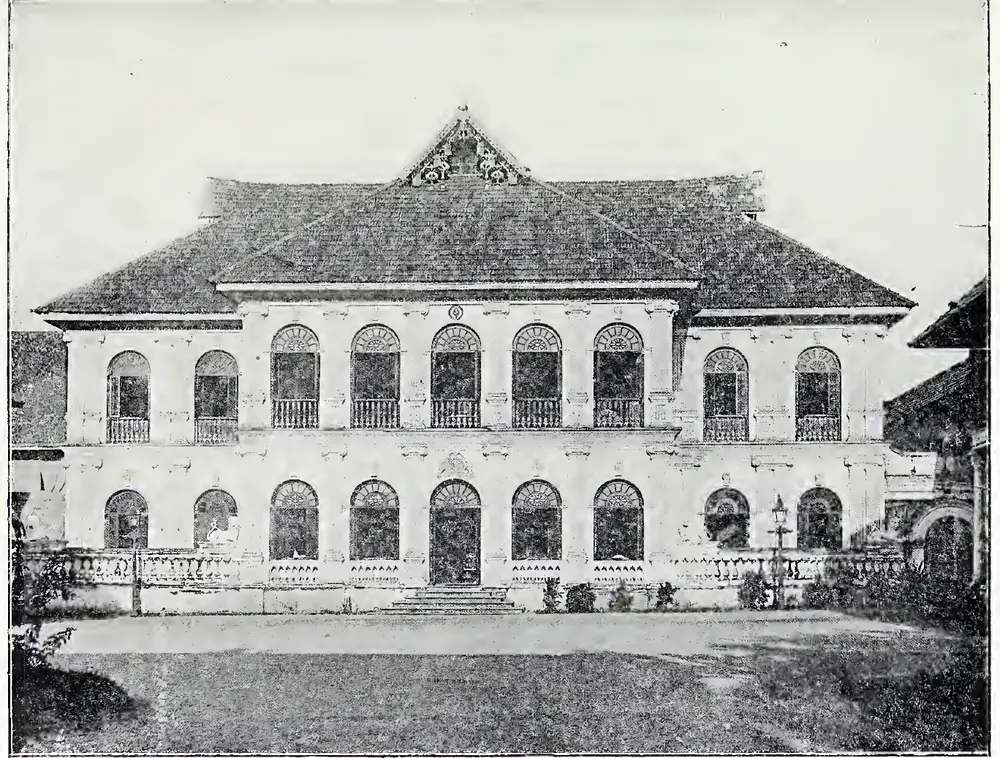
The temple is of great antiquity and is held in very high regard. It enjoys a land-revenue to the extent of Rs. 75,000 per annum independently of the State. There are two important festivals held every year, the Aurat (in April and May) and Pujaveppu (September-October) attended by large concourses of people. A sexennial festival, Murajapam, attracts a large number of Nambudiri Brahmins who are sumptuously fed for a period of 56 days. The temple and the large choultry attached to it in which thousands of the poor among Brahmins are daily fed, attract every year a considerable number of Brahmins chiefly from the Tinnevelly and Malabar Districts. Karamana is a suburb on the bank of the river of the same name where there is a large Brahmin colony.
As regards commercial importance Trivandrum ranks very low. It is the southern terminus of the uninterrupted line of water communication that extends as far north as Tirur in North Malabar. Since the opening of the Tinnevelly-Quilon Railway Trivandrum shows signs of increased commercial activity.
Tangasseri—Village, situated in the Taluq of Quilon, is a British possession. It was a Portuguese possession from 1552 to 1665, then came under the Dutch from whom the English secured it in 1795 on the capture of Cochin. The ruins of a fort and the Portuguese tower are still visible. The village is now declining. The population consists chiefly of Eurasians and fisher-converts. As regards Civil matters the people are subject to the District Munsiff of Anjengo, while as regards criminal matters they are subject to a local Sub-Magistrate who is immediately subordinate to the Deputy Magistrate of Cochin. There are two sections of Roman Catholics here, one subject to the Goa Mission and the other
[Page 602 of the printed volume (the end of Chapter XXI) is missing from the scanned copy from which this edition was made.]
Glossary of Vernacular Terms.
Aar—River.
Abdika—A religious rite performed by the Brahmins for the propitiation of the manes of departed relatives on the first anniversary of death.
Abhisheka—The daily washing of the images of gods in temples accompanied by the chanting of mantras.
Achan—A title of honour held by some Nayar families of Cochin and Malabar.
Acharams—The daily observances of the Hindus prescribed by the Dharma Sastras.
Acharya—The religious preceptor or priest among the Paradesa or Non-Malayala Brahmins.
Adakka—The Vernacular term for the betel-nut, the nut of the areca palm (Areca catechu). It is sometimes applied for the tree itself.
Adangal—The system of hiring labourers by contract as opposed to that of daily wages. It is the same as piece-work where the wages of the labourer are rated upon the amount of work done and not upon the number of hours for which he is engaged.
Adhikaram—The administrative subdivision of a Taluq under a petty revenue officer; synonymous with Proverty, Pidagai, Kelvi and Maniam.
Adhikara Olivu—Jenmom lands in an Adhikaram that are entirely freehold and exempt from the payment of any kind of tax under any circumstances.
Adhikaris—Village Revenue Officers under the Tahsildar in charge of an Adhikaram. They are the units of administration in the country. They are known by different names such as the Proverticarens or Manikarens in different parts of the country.
Adhyans—A subdivision of the Nambudiri Brahmins, distinguished from the ordinary Nambudiris by their special privileges.
Adikesava Perumal—The first great God who destroyed the demon Kesi; an incarnation of God Vishnu.
Adikkirali—A variety of Paddy grown in North Travancore.
Adikkiravi—A variety of paddy grown in Nanjanad.
Adikkudi—Village service in early Nanjanad.
Adima—Slavery; a slave. (For another meaning of the term, see Anubhavam).
Adisesha—The thousand-headed serpent God of the Puranas, who forms the bed and cushion of God Vishnu in the lying posture and makes a canopy over the God's head with his thousand hoods.
Adiyal—A humble servant.
Adiyammamar—The Adikal (Adiyal) women.
Adiyar—Slaves.
Adiyara—A succession fee in Travancore equal to one-fourth of the value of the property left by a person under the matriarchal (Marumakkathayam) system of inheritance when he died leaving no direct heir, but only a distant kindred to succeed to the property: also a stipulated amount of money the Potti or the Puja-performer has to pay in Travancore, before he is [Glossary ii]appointed to any Santi or Temple-Puja, the amount varying according to the income of the particular temple to which he is appointed.
Adiyarapattom—A kind of tenure prevalent in the State.
Adukkala kanam—The dues paid to the ladies of the house by the Kanamdar at every renewal of a Kanapattom lease.
Adukkuvatu—A fee due to the Sirkar from the heir on his succession to the Viruthi holding (Service Inam holding). It amounts to 10 fs. (Rs. 1½), and is meant for the grant of the Royal Neet or Commission.
Adumpatrams—Dancing girls.
Advaita—The doctrine of non-duality in Hindu philosophy; Sri Sankaracharya was the chief exponent of this doctrine.
Advaitists—The followers of the doctrine of non-duality.
Agada—A section of the Ayurveda treating of the administration of the antidotes for poisons—mineral, vegetable and animal.
Agathammamar or Antarjanam—Literally those who keep to the inside of the house: the Nambudiri women are known by this term.
Aghasuravadham—The killing of the demon Aghasura by God Sri Krishna, (from the Bhagavata Purana).
Aghavur Manakkal—The Brahmin dignitary belonging to the house or Illam of Aghavur.
Agnichayana Yaga—A sacrifice consisting of making burnt-offerings to the Gods, performed by the Nambudiris.
Agnihotris—A subdivision of the Visishta Nambudiris: literally those who perform the Agnihotram (a sacrifice in which burnt offering forms an important part).
Agnyadhana—A kind of sacrifice performed by a section of the Visishta Nambudiris.
Agraharam—The name of rows of contiguous houses in the East Coast.
Agrasala—The large feeding house attached to Sri Padmanabha's Temple at the Capital.
Ahalyamoksham—The emancipation of Ahalya from her husband's curse whereby she had been turned into a rock.
Ahimsa paramo dharmah—Kindness (to animals) is the greatest duty of man.
Ainkoody Cummalers—Artisans of the village of Ainkudi.
Aiyar or Aiyar Pandaram—The hereditary families of priests among Shanars.
Aiyen—A suffix generally attached to the name of a Smarta Brahmin, sometimes also as Aiyer. The Pattattiyars also add this suffix to their names.
Aiyengar—Literally those who have undergone five purificatory ceremonies (Angas): the title used by the Vaishnavite Brahmin.
Akakkoyimma—The person appointed as the regulator of order in a Smarta Vicharam or enquiry into the sexual offences of a Nambudiri woman.
Akkittiris—Those who have performed the sacrifice known as the Agnichayana Yaga; a subdivision of the Agnihotri Nambudiris.
Akravu—A spice used largely as medicine in native pharmacopœia.
Alageruthu—A kind of tax levied by the rulers of Nanjand in the 14th century.
Alakerpan—A contractor.
[Glossary iii]Alakkada—A fee given by the tenant or Viruthi holder at the end of every measurement—one or two parahs.
Alamaram—The banyan tree (Ficus Bengalensis).
Alwar—A Vaishnava saint; a king or ruler in ancient Kerala.
Amangali—A widow.
Amani—A system of land tenure.
Amavasya—The new-moon day.
Ambalakar—Persons doing services in temples in South Travancore corresponding to the Ambalavasis of the North.
Ambalam—A temple; an inn.
Aminadar—A Police Officer. Amin, a Sub-Magistrate.
Ammachchan Pattu—A song usually sung during Nayar marriages by the maternal uncle (Ammachchan) praying for prosperity to the married couple.
Ammana—A small light ball generally of metal, highly polished and hollow inside, used in a play called Ammanayattam peculiar to Malabar. See Ammanayattam.
Ammanayattam—A play which forms the chief amusement of the Ambalavasi or the temple-servant caste of Travancore and Malabar. It is held in several of the important temples in Travancore during festivals and affords one of the most favoured of recreations to the people. The Ambalavasis are the chief players on such occasions, who get themselves specially trained for the purpose. They perform wonderful feats with these balls in the throw-and-catch play in which six or even more than six balls are used by an Ambalavasi at a time. It is generally followed with music and drumming. In the play with six or more balls, the player throws the balls up in pairs or one after another in rapid succession from his hands to the measure of the drum and the cymbal and never misses catching the balls when they come down and throwing them up again into the air with a dexterity and ease that can be attained only by a life-long practice of the play. This is one of the most innocent of several of the amusements in which the Malayali takes great delight.
Ammavan—A maternal uncle in a Marumakkathayam family. He is the head and manager of the family according to the matriarchal system of Malabar.
Ammavi Amma—The bride's maid who ties the Tali or marriage badge round the neck of the girl in a Nayar marriage.
Amritettu—Literally 'he tastes ambrosia'; the meal of the Nambudiri or the Rajah is termed thus in Malabar by men inferior to them in the social scale.
Anacharams—mal-observances; the sixty-four observances enjoined upon the Nambudiris by their Smritis are termed so by the Non-Malayala Brahmins whose daily observances slightly differ from those of the former.
Anachavu—Death caused by an elephant.
Anaivari—A kind of tax levied on the people by the higher castes or Government in early Travancore; perhaps a tax levied on the people for supplying elephants to the army in times of war.
Anakkomban—A variety of paddy grown in South Travancore.
Anamadams—Huts built upon the branches of huge trees by means of bamboos and twigs by the Kanis or hill-men of the Travancore forests for affording them shelter against the attack of elephants.
[Glossary iv]Anamuth—means "unclaimed."
Anandavalli—The Hindu Goddess Bhagavati; Siva's Spouse.
Anantankadu—The forest of the Eternal Being (Mahavishnu) or of Adisesha (the Serpent God). The great thick forest that once covered the tract of country now known as Trivandrum (Tiru-Ananta-Puram). Evidently the name Ananta still survives, the Kadu (forest) having been cleared and turned into a Puram (town).
Anantara Samskara—The funeral rites of a Brahmin.
Anantaravan—A nephew in a Marumakkathayam (matriarchal) family of Malabar. He is the natural heir to the property of his uncle.
Anantaravan Nadukkanam—A present given to the heir to get his consent for any transaction.
Ananta Rayan Panam—A gold coin valued at 4 as. 7 p., frequently issued by Travancore sovereigns of the fourth and subsequent centuries of the Christian era.
Anantasayanam—God Vishnu lying on the Ocean of Milk upon Adisesha, the serpent deity, who makes with his thousand hoods a canopy over the God. The occasion is attended by all the great devotees of the God as depicted in the Puranas. This scene from the Puranas is a favourite theme with the poets and painters of Travancore. Also the name by which Trivandrum (Tiru-ananta-puram) is known to the Hindu pilgrims from all India as the place of God Vishnu's final rest upon Adisesha and hence of great sanctity.
Ananta Varahan—A gold coin worth Rs. 3-15-5 (British currency) that was current in Travancore in the fourth and subsequent centuries of the Christian era.
Ananta Vritam—A festival in honour of Ananta Padmanabhaswami held in the month of Sravanam (September).
Anaval (also Anavaul)—The manager of a pagoda who is generally a Brahmin.
Anaviruthi or Malaviruthi—Lands given for supplying elephants and garlands of flowers in temples.
Anchal—The local system of postal communication in Travancore.
Anchali—An authorisation in writing to collect taxes from the people, current in early Travancore.
Anchampura—A separate shed in a Nambudiri house to which a woman suspected of sexual error is transferred before the commencement of the Smarta's enquiry into her conduct in a Smarta Vicharam.
Anchurandu Karanma—A system of land tenure prevalent in some parts of Travancore.
Anchu Tampurakkal or Panchavar—The deities worshipped by the Pulayas. These are the five great Pandavas, the heroes of the Mahabharata.
Andi Namaskaram—Prostrating before God and worshipping Him in the evening at sunset.
Angams or Angas—Purificatory ceremonies. See Aiyengar.
Angavastram—An upper garment.
Anjali—A tax on paddy lands levied in early Nanjanad by the Travancore sovereigns.
[Glossary v]Anjaneya—The monkey god Hanuman of the Ramayana.
Anjili or Ayani Pilavu—(Artocarpus hirsuta)—A timber tree largely used in building boats and houses.
Ankana—A special religious rite of the Madhva Brahmins which consists of stamping the forehead and other parts of the body in twelve places with the symbols of Vishnu.
Annam—A swan; a huge image of the celestial swan or Brahma's vehicle, built of timber and bamboos, covered with cloth and tapestry and fitted with wheels to be drawn by the people. Such images are specially made and drawn or carried in procession by the Karakkars to be presented to the deity during festivals in the chief temples of North Travancore.
Annan—A variety of the plantain tree.
Annaprasanam—The ceremony connected with giving the first dole of rice to a child usually celebrated after its 6th month.
Antaralars or Antaralajatis—The people that occupy an intermediate position in the social scale; these are the Ambalavasis, from their being regarded as below the Brahmins and above the Sudras in the social scale.
Antarjanam—See Agathammamar.
Anubhavam—Allowance in lands, money, or rice and vegetables, given from the Sirkar for services rendered to palaces or temples in Travancore: also lands granted by Rajahs or petty chieftains generally to their domestics for cultivation of land and other purposes: known also as Adima.
Anubhoga viruthi—These are lands given to the Kudiyans bearing a small rent or tax for their maintenance for no service of any description, but simply as gifts to the good will of the sovereign.
Anugraham—Blessing.
Anujna—A preliminary rite in all religious ceremonies of the Paradesa Brahmin, which consists in making gifts of money to Brahmins and receiving their blessing and permission for their proper performance.
Anulomas—Issue resulting from the unsanctioned sexual union of interdicted classes in India.
Appam—A cake made of pounded rice, molasses and cocoanut which are mixed together in certain proportions and roasted in small bits in ghee over a fire. This is a favourite dish in Travancore and is largely offered as Nivedyam in temples.
Aradhana—Worship of God.
Aradhana Sraddha—Sraddha or religious rite performed in honour of a deceased Sanyasin or religious mendicant.
Aradiantram—Literally six ceremonies, being the six ceremonial occasions on which the Kanamdar has to pay some perquisites to his landlord.
Arakkal crop—The Kanni crop or the crop gathered in the month of Kanni (September-October).
Arakkan Kuruvai—A variety of paddy grown in South Travancore.
Aranyakas—A subdivision of the Vedas.
Arappura—The strongly built central portion of a typical Nayar house or Nambudiri Illam entirely made of wood and intended to secure the valuables of the house.
Arasu (Ficus religiosa)—A sacred tree of the Hindus.
[Glossary vi]Arattu—Same as Aurat.
Aravanai—A preparation of rice boiled with ghee and molasses to which plantain fruits and honey are added. It is a favourite Nivedyam or offering to God Vishnu.
Arayalam—is the fee of 50 p. c. of a year's rent or pattom in the case of garden lands and 2½ fanams (5½ as.) for every parah in the case of paddy lands due to the Sirkar from an heir on his succession to the Viruthi holding.
Ardhajamapuja—The last course of puja or worship performed by the Pujari or Santikar in temples. It usually begins at about 8 P. M. and closes before 10 P. M.
Ardhanarisvara—(God whose half is woman); God Mahadeva symbolical of duality and unity of the generative act and production of the Universe from the union of the two eternal elements, Prakriti and Purusha.
Ardhodayam—A day of festival among Brahmins of the East Coast.
Ardradarsanam or Tiruvatira—A day of festival common to the East and the West Coast, held in honour of Siva. The day is observed with fasting and prayer to God Siva by the old and the young alike. It falls in the month of December-January on the day of the asterism of Ardra or Tiruvatira.
Arival-petti—The knife box of the Shanar made from the sheaths of the spathe of the palmyra and fastened round with rattan.
Ariyittuvazhkai—An annual ceremony celebrated in the Bhagavati temple at Koikkal in Attungal which is attended by the Maharajah every year, the Goddess being one of the family deities of the Travancore Royal house.
Arpu—A particular form of shouting in Malabar and Travancore indicative of joy made simultaneously by a large number of men during marriage and other festive occasions.
Artham—A certain sum of money paid by the Ottikkaran or mortgagee of a garden land to obtain possession of the property for a period of not less than 12 years.
Arthamanibham—Inam lands bearing half pattom only, the other half being remitted as compensation for services rendered.
Arupathamkuruvai—A sort of paddy seed used for sowing in the lands in Nanjanad.
Aryan—A variety of paddy grown in North Travancore.
Asan—A pyall school or Village schoolmaster of the old type in Travancore.
Asari—An artisan.
Asariravakku—In the Puranas, words heard from the sky believed to have been addressed as directions or commands by some divine agency.
Ashtadikpalakas—The guardian deities of the eight quarters of the sky according to the Puranas.
Ashtagraham houses—The eight great houses of the Adhyan Nambudiris of Malabar.
Ashtakshara Mantra—A prayer or hymn consisting of eight letters of the alphabet.
Ashtamangalyam—This consists of eight articles symbolical of marriage or Mangalyam, carried usually on a large metal plate during marriages or Thalapoly offerings of the Malayalis. These articles are:—rice, paddy, the tender leaves of the cocoanut tree, an arrow, a looking glass, a well-washed cloth, burning fire (usually a small cocoanut oil or ghee light), and [Glossary vii]a small round and wooden box called Cheppu made in a particular form.
Ashtami—The eighth day of the black fortnight in the month of Vrischigam, which is held to be highly sacred to God Siva in Travancore: the celebration of the Ashtami festival in the Vaikam temple in North Travancore is on a grand scale. People come in for the festival from all parts of Travancore and even from Malabar and Pandy.
Ashtami Rohini—The birthday of Sri Krishna coming on the eighth day of the dark half of the month of Sravana (July-August).
Ashtamudi—'Having eight creeks or bendings'. The backwater so called.
Ashtangahridaya—The famous Sanskrit work on medicine written by the great scholar and physician Vagbhatacharya.
Ashta Sraddha—The eight Sraddhas or religious rites performed by the Kerala Brahmins in honour of a departed relative in the course of the first year after his death.
Ashtavaidyans—The eight celebrated physicians of Malabar belonging to eight separate Illams or families who were ordered by Parasurama to devote themselves entirely to the study and practice of medicine. These are:—the Ilayadathu Taikad Musu in Cochin, Cheerutu Musu at Kottayam, Planthode in Northern Kottayam, Taikat Musu at Trichur, Kuttancheri Musu of Malabar, and Alathur, Velloodtu, and Karathodu Nambis in British Malabar.
Asmarohana—A marriage rite observed by the Brahmins in which the bride is made to tread over a grinding stone with her right foot by the bridegroom, indicating the firmness with which they must cling to each other in life as husband and wife.
Asramas—Stages of life of a Brahmin as ordained by the Sastras. They are four, viz., life as a student, as a householder, as a dweller in the forests and lastly as a mendicant.
Asu—A big drum beaten by the Maran or the temple musician in measure to the Pani (hand-drum) during the Sribhutaveli in making offerings to the attendant deities of a temple.
Asuram—The class under which the marriages of Nanjanad and the Makkavazhi Vellalars are catalogued.
Asuras—The demons; the enemies of the gods.
Asvamedhayagam—The great horse sacrifices that were conducted by the early Kshatriya kings of India.
Asvati Tirunal—Prince born under the asterism Asvati.
Asvattha—The Arasu or Ficus religiosa.
Asvinikumaras—The celestial physicians.
Ata—A cake made of rice and black-gram, molasses, &c.
Atirudram—A cremony in honour of Rudra or Siva conducted by the Paradesa Brahmins during birthday celebrations, especially those of the 60th and the 82nd year. 121 Brahmins perform puja during this ceremony for which they are fed and given danams or mony doles by the performer of the ceremony.
Atithi—A guest.
Atma-Brahmam—The Universal Spirit that is identical with the Atma or soul of every living being in the universe according to the Vedantic philosophy.
Attazhapuja—The puja or worship of the deity in the first part of the night [Glossary viii]in a Malabar temple.
Attipper—The out and out surrender of the Jenmi's rights by sale.
Attotti—The giving away of his property by a Jenmi to a Kudiyam on receipt of a sum of money equivalent to its worth.
Aulai—A native mill.
Aupasana—A worship of the fire by a Brahmin householder or Grihastha.
Aurat—An important temple festival held on the last day of the Oootsavam or Kodiyettu in a West Coast temple. It was instituted by Parasurama to be celebrated in all temples of Kerala. The word means bathing, and the ceremony consists in taking the God in procession to the nearest tank or river or sea with the accompaniment of music and tom-tom and washing the image and making oblations to the god in the presence of a large concourse of people. The one at Trivandrum in Sri Padmanabha's temple is attended by the Maharajah himself who moves in procession along with the gods to the sea as Sri Padmanabha's Dasa or servant.
Avahamantram—A mantram or hymn for attracting a spirit into a particular thing in Mantravadams or exorcisms.
Aval—Beaten rice.
Avalteetti—A refreshment or tiffin with Aval or beaten rice.
Avaroda-Kulakams—Electing assemblies in ancient Travancore.
Avarodhana—An elaborate purification ceremony by means of which the Tachchoda Kaimal, a Nayar of the Kuruppu subdivision is raised to the rank of a Brahmin Sanyasin.
Avarum—(Cassia auriculata)—The leaves of this tree are lagely used for green-manuring.
Avatar—An incarnation. Avatars mean the ten incarnations of Vishnu in Hindu mythology.
Avergal—A term of respect added to the names of respectable persons.
Avittam Tirunal—Prince born under the asterism of Avittam in Travancore.
Ayacut—Old settlement register in Travancore.
Ayacut Pattom, Ayal Pattom—Systems of land-tenure in Travancore.
Ayan lands are those ceded by the British in lieu of Malayankulam Desam lands given up by Travancore.
Ayani Oonu—A sumptuous banquet given by the bride's people to the selected bridegroom or Manavalan in a Nayar marriage. The same item of ceremony is gone through in a Nambudiri marriage also.
Ayan Zufti lands are those transferred from the British territory in exchange.
Ayikkarayajamanam—A descendant of the Pulaya chief who ruled at Ayikara in ancient days. He still commands great respect from the Pulayas of North Travancore where he is their acknowledged chieftain and lord.
Ayilliam Tirunal—Prince born under the star Ayilliam. The popular way of distinguishing the Kings and Princes of Travancore is by referring to the asterisms under which they were born. This paricular designation always refers to the penultimate Maharajah Rama Varma (1860-1880 A. D.)
Ayirakkal Mantapam—A large Mantapam or corridor built of granite with artistic representations of Puranic scenes and deities carved in the granite pillars and ceiling, usually attached to the great Dravidian temples of South [Glossary ix]India. Literally a mantapam containing 1000 pillars. The one in Sri Padmanabhaswamy's temple is generally known by the name of Kulasekhara Mantapam.
Ayirappuvan—A variety of the plantain.
Ayurveda—The Veda of life, a part of the Holy Scriptures of the Hindus, forming the medical science on which all their treatises on medicine are based.
Ayushya homam—A sacrifice with burnt offerings generally performed of birthdays by Brahmins for prolonging life.
Azhachai Nellazhivu—A damage to paddy.
Azhi—The place where the backwater meets the sea, the opening being permanent throughout the year.
Azhvancheri Tampurakkal—The lordly Nambudiri Brahmin belonging to the illustrious house of Azhvancheri in Malabar. The Maharajah shows great respect to him when he is invited for the Murajapam ceremony.
B
Balasvagandhadi oil—A medicinal preparation of the gingelly oil according to the directions given in the Ashtangahridaya; it is largely prescribed by the native physicians of Malabar in diseases of the lungs to be rubbed on the head and body before bathing.
Balipeetom—The platform in front of a temple on which the Velikkal or a big piece of stone artistically worked representing the chief angel attending on the God, is placed.
Banalingam—A kind of stone taken from the rivers of Northern India, which is bought by the Brahmins and preserved in their houses as valuable heirlooms representing deities to be worshipped everyday by the family.
Bauddha Matam—means Mahomedanism or Buddhism, more probably the latter.
Bauddha Sastram—sometimes understood to be the Mahomedan Scriptures, but more correctly Buddhistic writings.
Bayi—A title of honour affixed to the names of the Ranis of Travancore, as in Rani Lakshmi Bayi.
Bhadradipam—A half-yearly ceremony in the temple of Sri Padmanabhaswami at Trivandrum, inaugurated in the time of the great King Martanda Varma. It is celebrated in the months of January and July and lasts for seven days.
Bhadrakali—Goddess Bhagavati represented in a frightful mood.
Bhadrasanam—Chief seat in an assembly.
Bhagavati—Goddess; Siva's spouse.
Bhagavati Seva—A religious worship inaugurated among the people of Kerala by Parasurama. The goddess worshipped is Bhagavati, the great Goddess Parvati or Parasakti of the Brahmins.
Bhajanam—Any worship of God. In the East Coast Bhajanam means singing in praise of God and repeating His names. In the West Coast Bhajanam specially means a course of fasting and prayer practised in a temple with some object (e. g. to get oneself cured of some incurable chronic malady) for a fixed number of days, the Bhajanakkaran or the devotee living all the while within the precincts of the temple.
Bhakta—A devotee.
[Glossary x]Bhakti—Devotion.
Bhakti Sastras—The Ramayana and the Mahabharata.
Bhaktivilas—The name of the official residence of the Dewan of Travancore outside the Trivandrum Fort.
Bhandarathil—belonging te the Bhandaram (Royal Treasury).
Bhanghy—Parcel.
Bhara—The composition of the Atharva Veda is called by this term.
Bharani—An asterism which coming in the month of Minam (June-July) is considered sacred to Goddess Bhagavati. The same day in the month of Kumbham also is celebrated with great feasting and lighting in some temples in North Travancore.
Bharani Vela—Ceremony performed in temples in the months of Kumbham and Minam under the Star Bharani.
Bharata Nattyam—The native dance.
Bharata-Yuddham—The great battle of Kurukshetra fought between the Kauravas and the Pandavas, as described in the Mahabharata.
Bharippukaran—A dignitary who has to superintend the cooking and serving arrangements in the Oottupurahs and to see that all supplies are regularly received and the travellers are cared for. (Literally one who manages.)
Bhasmam—The holy ashes, prepared by burning cowdung.
Bhattatiris—The class of philosophers among Nambudiris who study and propound the science and sacred lore of the early days.
Bhiksha—Alms.
Bhikshapatram—A vessal for begging.
Bhikshu—A Sanyasin who lives by begging.
Bhimans—Huge images built and ornamented temporarily for sight-show during temple festivals. They are generally representations of the Pandavas of the Mahabharata.
Bhogi Pandigai—The last day of Margasira (Dec.—Jan.) religiously observed by the Non-Malayala Brahmins.
Bhootakalam—A feast given to the bridegroom and his party by the bride's family during marriages of Nayars of South Travancore, the peculiarity of which is that the guests partake of the meals out of the same vessel as against the Hindu observances of rules of sanctity.
Bhootas or Bhutams—Beneficent demons who are believed to wait upon gods and goddesses in Malabar.
Bhumi-devas—The lords of the earth, Brahmins.
Bhutathan—An inferior divinity worshipped in the West Coast.
Bhutavidya—The restoration of the faculties from a disorganised state induced by demoniacal possession.
Bilva—[Ægle marmelos]. The tree sacred to Siva.
Bilvadilehyam—An electuary for dyspepsia prepared according to the directions given in the Ashtangahridaya very largely prescribed by the native physicians of Malabar.
Bodhayana Sutrakars—Brahmins belonging to the section who follow the rites prescribed in the Bodhayana Sutra.
[Glossary xi]Brahmacharya—Stage of a Brahmin's life in which he studies the Vedas.
Brahmadanam—Gifts of lands made to Brahmins by Rajahs and barons free of tax for special benediction.
Brahmadayam and Bhattaviruthi are grants of land made to Brahmins in former days. They bear a light quit-rent and are being freely alienated.
Brahmakshetram—The land of the Brahmins.
Brahmalayam—The residence of Brahmins.
Brahmalokam—The world up in the heavens where Brahma resides engaged in the work of creation according to the Puranas.
Brahmankal—the central pillar in a marriage Pandal or shed of the Shanars.
Brahmarakshas—The ghost of a Brahmin who had been murdered, which is believed to pursue the murderer like his shadow wherever he goes.
Brahmanasahasra-bhojanam—Distribution of victuals daily to a thousand Brahmins.
Brahmaswam—Belonging to Brahmins. Also lands and other properties belonging to the Brahmin Jenmies of Kerala.
Brahmopadesam—The teaching of the holy Gayatri to the boy by the father and the priest in a Brahmin Upanayana.
Brindavan—A platform in which the Tulasi plant (Osimum sanctum) is planted for the daily worship in every Brahmin house.
C
Cadinas—Cylindrical iron tubes ½ to 2 ft. in height and 2 inches to 3 ft. in circumference with a small hole at the bottom of the tube, used for firing with gun-powder in the temples of Travancore and Cochin.
Cash or Kasu—A small copper coin current in Travancore, valued 1/1456 of a British Rupee. Also means any coin.
Cegos—A corruption of Sevaka, i. e., Chogas or Chovas (Izhavas).
Chakari—The fibrous rind of the cocoanut.
Chakarippodi—The pith or dust of the cocoanut husk.
Chakatam—A wheeled carriage.
Chakkiyar—A man of the Ambalavasi caste whose duty is to recite stories from the Puranas to large gatherings of men, especially during temple festivals in Malabar and Travancore.
Chakkiyar kuthu—The recitation of Puranic stories to an assembly of men by the Chakkiyar during temple festivals.
Chakram—A water wheel (the Persian wheel). One of Maha Vishnu's weapons as stated in the Puranas.
Chakravalli or Sarkaravalli—The sweet-potato largely cultivated in Travancore.
Chalpans—(A corruption of Chalukya), a Telugu speaking people that have settled themselves in Trivandrum not long before and are slowly emerging from the low beggarly condition in which they originally migrated to Trivandrum, by their industry. They are the palankeen bearers and vegetable mongers of the town.
Chama—(Panicum miliacium)—A cereal grown very rarely in Travancore.
Chamba—A variety of paddy seeds sown for the Kanni (Sept.—Oct.) crop.
Chambal Montan—A variety of plantain having the ash-colour.
[Glossary xii]Chambam—A variety of paddy grown in South Travancore.
Champai Annan—A variety of plantain.
Champu—A kind of composition in Sanskrit in which poetry intermingles with prose.
Chamunti—An inferior female deity worshipped in Travancore by some classes of Hindus.
Chanai—A coniferous plant whose flower is very odoriferous and is used as an antidote against rice pests.
Chanakizhangu—An edible root.
Chandalas—People who occupy the lowest position in the social scale among the Hindus.
Chandalakuttu—The religious rites that have to be performed by the Nangyars (Nambiyar women) during the funeral of an Agnihotri Nambudiri on the cremation ground.
Chandrakaran—A temple-officer in Travancore whose duty is to see that the materials are properly supplied for the pujah to the deity.
Changalavatta—A portable metal lamp peculiar to Malabar. It forms an appendage of dignity to men of high position in the social scale when carried before them by a servant, others being prohibited from using it in the same manner.
Charalcrop—Crop gathered in the month of Kumbham from paddy lands, otherwise known as Kumbham crop.
Charchamata dattu—A form of adoption current among Nambudiris, in which a dry twig of the Arasu (Ficus religiosa) finds the chief part.
Charipara kanam—One full parah at the outset of every measurement.
Chartu—A memo or note generally written on a cadjan slip.
Chathan or Kuttichathan—A malevolent low-caste deity who delights in mischief making.
Chathee Karnum—The first block of land sold by auction under the first rules for the acquisition of land on the Travancore Hills.
Chattu—A hymn or mantram recited by the Kanikkar exorciser of spirits in driving away the genii from an affected person.
Chaturdasi—The 14th day after a full-moon or new-moon day.
Chaturvarna—The four castes.
Chavadi—An antechamber attached to a Nayar's or Nambudiri's house.
Chavar or Chavu—Literally the dead or death. These are spirits worshipped by the Hill Tribes.
Cheeka or soap nut is used for washing purposes.
Chekkus—Native mills for oil-pressing or pressing sugarcane. It is generally worked by bulls.
Chellam—A small brass box for keeping the chewing materials in.
Chempakannan—A variety of the plantain.
Chempakaraman—A local knighthood; the title so called.
Chempakaraman Puja—A kind of puja or worship offered by Bhutala Vira Rama Varma (c. 1586 A. D.), the Senior Tiruvdi of Siraivoy in the Parakai Temple perhaps for the prosperity of his family.
[Glossary xiii]Chempakaraman Stanam—The knighthood of Chempakaraman.
Chempakasseri—The old name of Ampalapuzha.
Chempambu—A variety of paddy grown in North Travancore.
Chempu—A copper vessel with a narrow head and a big bulb in the middle.
Chempu—The Egyptian Arum (colocasia antiquorum).
Chempu Viruthi—Lands given for the repair of copper vessels in temples.
Chenai—(Tacca). The elephant-yam or elephant's-foot.
Chenda—A kind of drum peculiar to Travancore and Malabar.
Chendamurian—Sliced pieces of the banana fruit boiled with molasses, pepper and salt.
Chendantan—A variety of gram cultivated in Travancore.
Chenkadali—A variety of the plantain.
Chenkara—Blocks of land sold by auction on the Travancore Hills.
Chennallu or Chennellu—A variety of paddy seed sown in Malankrishi (Hill cultivation).
Chentengu—A variety of the cocoanut tree with their fruits having a red colour in their bunches.
Chenthotty—A stinging plant, the common nettle.
Cheppu—A small round wooden case for keeping turmeric powder in.
Chera or Chira—Marshy land or land covered by water for most part of the year but drained for the purpose of paddy cultivation.
Cheries—Villages.
Cherikals—Lands on the summit and slopes of hills that are cleared of trees and shrubs for purposes of ordinary cultivation.
Cherukizhangu—An edible root.
Cherumas—The term by which the Pulayas are known in North Travancore.
Cheru Oolunnu—A variety of the black-gram.
Cherupayar—The green-gram.
Cherupunna—A variety of the laurel.
Chettiar—A subdivision of the Hindu caste.
Chettiviruppu—A variety of paddy grown in North Travancore.
Chevaka—corruption of Sevaka (a servant).
Chikitsa—The therapeutic branch of the Science of Ayurveda.
Chilavu Sadhanakar—The men entrusted with the delivery of letters in the local system of Post known as the Anchal.
Chingam—The Malayalam month corresponding to August-September.
Chinnappanam—A gold coin minted in the time of the great Rama Varma in Travancore.
Chintamani—The Dravidian medical science.
Chiratta—The shell or outer covering of the kernel of the cocoanut enclosed by the fibrous husk.
Chirunagappu—The flower of a tree used largely as medicine in the Ashtangahridaya and Chintamani systems of treatment.
Chiruthen—Honey of the small bee, considered superior to that of the large [Glossary xiv]bee (Perunten) for medicinal as well as edible purposes.
Chitragupta puja—Puja or worship offered to God Chitragupta.
Chitrapadapattu or Mantravastram—Silk cloth worn by the Travancore King on the coronation day.
Chitra Vishu—The Tamil New-year's Day. The Kani (the auspicious sight) of Malabar on this day, is not held by the Paradesa Brahmins generally, though a few observe it, being accustomed to such festivities by their long residence in Malabar.
Chitties—A sort of co-operative credit societies which partake the nature of a Savings Bank concern.
Chittotti—Under this form of mortgage an Ottikkaren or mortgagee gives his Otti property to another either for the amount he has paid to the Jenmi or a sum less than that; in this case the Jenmi can redeem his land only through the first mortgagee.
Chittrakudam—The stone-basement in a Kavu or grove of trees, on which granite-stone idols of serpents are placed for worship.
Chitty Panam—A fee of one fanam due to the Sirkar (for the receipt given) from an heir who succeeds to a viruthi holding.
Cholam—A kind of grain cultivated in the Southern taluqs adjoining Tinnevelly.
Chonnan—in Malayalam means 'he said.'
Choomkom—The duty on certain articles levied by the Sirkar.
Chora Otti—A system of land-tenure prevalent in some parts of Travancore.
Choroonu—The initial rice-giving to a child celebrated by the Nayars and other people of Malabar, corresponding to the Annaprasanam of the Brahmins.
Chovan or Chogan—The term by which the Izhavas are known in North Travancore.
Chouviram—A poisonous medicine used in the treatment of cutaneous diseases.
Chowkey—A custom-house in Travancore.
Chowkeydar—A custom-house officer.
Chowlam—The tonsure ceremony of the Brahmin generally celebrated when the child is five years old.
Chuckram—The earliest and the smallest silver coin that was current in Travancore, now substituted by copper coins of the same denomination.
Chuluviruthi—The grants made to Ambalavasis and other temple servants for sweeping and other menial work in temples.
Chutrams or Sathrams—Inns for the accommodation of travellers.
Chuvanna chara—A variety of paddy grown in North Travancore.
Conjee—Rice together with the water in which it has been boiled, a favourite form of food with the Malayali. The broken rice conjee with condiments constitutes a luxury with the rich.
Conjee-purahs—Charitable institutions in Travancore where Conjee is freely distributed to the poor.
Copra—The dried kernel of the cocoanut, a valuable article of cmmerce very largely exported from Travancore.
Cotwall—A Superintendent of bazaars invested with police authorities for the proper conduct of them, appointed by Colonel Munro.
Curry slokams—Recitation of certain poetic compositions during Nayar [Glossary xv]marriages.
Cunny Aylum or Cnnny Elum—A local variety of cardamoms in Travancore.
Cutcherry—A Government Office.
D
Daivamattam—Dancing in the disguise of a god.
Dakshina—Money present given in religious gifts to Brahmins.
Dalawa—A title used in the 18th century to designate the head of the administration, corresponding to the Dewan of the present day and the Valia Sarvadhikariakar of the 17th century in Travancore.
Danam—A religious gift.
Danapramanam—Lands given to the Brahmins by Rajahs and barons for securing religious benefit.
Danda—A stick got from the Arasu (Ficus religiosa), presented by the preceptor to the Brahmin boy during the time of his Upanayanam.
Darbha—A kind of long grass used by the Brahmins in all religious rites. It is so indispensable that no religious rite can be performed without it.
Darikavadham—The killing of the demon Darika by Bhadrakali, a Puranic story.
Darogas—A special corps of officers created by the Resident-Dewan Colonel Munro for the conduct of Police duties in Travancore. They were placed directly under the orders of the Dewan independent of the judicial and revenue department.
Dasa—A servant.
Dasabali—The rites performed on the tenth day of a deceased Nambudiri.
Dayadis—Agnates.
Deenapura—A shed for patients. During the Murajapam ceremony in Trivandrum a shed for the Nambudiri patients is provided, where they are given the necessary diatetic meal.
Deepavali—A Hindu festival.
Desabhogam—A certain sum of money due from the tenants of lands falling under a peculiar form of tenure.
Desam—A topographical subdivision of a country. Also a local administrative subdivision.
Desa Olivu—Jenmom freeholds from which no tax is paid to the Government.
Desikal—Literally those who belong to some other country, or emigrants from other countries, specially the Brahmin emigrants who were murdered at Nilaimelkunnu in Chirayinkil Taluq in early times.
Devadanam—Grants of land made to temples by kings or nobles free of tax to Government.
Devadayam—Lands (inalienable) granted on light assessment for the performance of pujahs in certain temples.
Devalayam—The residence of gods, temples.
Devalokam—The world of the gods; heaven.
Devapuja—A daily course of worship made to Salagramams and other images of gods in Brahmin households.
[Glossary xvi]Devas—The gods of the Hindus.
Devaswam—Lands and properties belonging to temples and other religious institutions in Travancore.
Devavriksham—A celestial tree; the name applied to the cocoanut tree as it is in many ways useful to the Travancore ryot—identical with Kalpavriksham by which name also it is sometimes known in Travancore.
Dewan—The present official name of the head of the administration in Travancore. This title was first adopted in lieu of Dalawa by Rajah Kesava Das.
Dewan Peishcar—An Officer next in rank to the Dewan in the State, who is generally in charge of the administration of a Division.
Dhanu—The Malayalam name for Margali corresponding to the English month December-January.
Dhanvantiri—One of the incarnations of Vishnu, the God of Hindu medicine.
Dharma—Duty; means also charity in Travancore.
Dharmarajah—Literally the king who was celebrated for his charity.
Dhuli—A native vehicle resembling a hammock.
Dhwajapratishta—The planting of a flagstaff in temples attended with grand religious ceremonies. A Dhwajam is a flagstaff planted in front of a temple for hoisting the flag during festivals. In most of the large temples of Travancore it is a permanent pole of teak or other valuable wood about 80 to 100 feet in length covered with plates of copper, silver or gold.
Dhwajastambhom—A flagstaff.
Dhyanam—Meditation.
Digambara—God Siva or Mahadeva, literally God whose cloth is the sky.
Diksha—A life of abstinence gone through by a high-caste Malayali with observances of religious rites in the first year after the death of the father or mother.
Diparadhana—A worship with lights, considered to be of special sanctity and benefit to the worshippers.
Dipastambhom—A lighthouse.
Dolak—A kind of percussion instrument of music.
Dubash—An interpreter employed in some of the Ootupurahs and other charitable institutions to interpret the Malayalam language to Gosayis or northern pilgrims.
Durghasu pattom—comprises nirthal lands leased out at a lower pattom or rent for a specified or unspecified period.
Durmantrams—Hymns for the propitiation of malevolent deities whereby to cause injury to others; witchcraft.
Durva grass—A kind of grass that grows in small clusters known as Arukampullu in Malayalam. A homam or burnt-offering with it is believed to be of special benefit. It is very largely used in Malabar homams.
Dwadesipram—Lands granted on a light tax for feeding Brahmins on Dwadasi days. A tenure chiefly found in Shencottah.
Dwarapalakas—(Guards at the gate)—Figures of demons or angels carved in granite and placed at the gates of temples as guards.
E
Eazhian—The rice sapper (Leptocorisa acuta), a kind of insect very destructive to the growth of paddy.
[Glossary xvii]Eazhian vilakkal—The practice of writing charms in small bits of cadjan leaves and burying them in several parts of the paddy field. This is believed to protect the paddy crop from the ravages of the rice sapper.
Edankai or Idankai—The left-hand caste as opposed to Valankai or the right hand caste who were considered superior to the former in social status, in the early days of Travancore.
Edavam—Month corresponding to May-June.
Edavappati—The South-west monsoon which generally commences about the middle of Edavam (May-June) in Travancore.
Ekadasi—The eleventh day after a full-moon or a new-moon day religiously observed by the Hindus.
Ekodishta Sraddha—The rite performed to the departed soul on the eleventh day after death by the Paradesa Brahmins.
Elangah—An inferior divinity worshipped in Travancore.
Elas (Yelais)—The cultivated lands scattered among the low hills and slopes occupying the space between the lakes and the ghauts, are termed Elas in the south and Virippu in the north of Travancore.
Elassu—Golden amulet used as charms against attack of devils.
Elayanikadu—A kind of paddy seed used for Malankrishi.
Elaya Rajah—The Heir-apparent to the throne of Travancore.
Elunayum Puliyum—A kind of dice largely indulged in by the Nambudiris.
Emprans—Pottis or Brahmins that come from Tulunad and Mangalore in Malabar.
Enangan—A relative who ties the Tali in marriages among Nayars.
Entram and kuzhal—A gold oanament worn on the neck by women.
Erattarasi—A kind of coin that was current in Travancore in ancient days.
Erukku—(Calotropis gigantea) a plant whose leaves are used for green manuring in South Travancore, and whose fibre for making cloths. Its flowers are considered sacred to Siva.
Erumu Oolunnu—A variety of black-gram.
Ettarayogam—(Literally the Council of eight and a half votes); a committee of management for Sri Padmanabha's temple that played an important part in the early history of Travancore. It consisted of 8 Pottis and the Maharajah, the former having each one vote and the latter half a vote thus making up the total eight and a half votes.
Ettuvittil Pillamars—Literally Nayars belonging to eight families. The eight Nayars that played a notorious part in the times of Rama Varma and his successor Martanda Varma the Great, in heading insurrections against the ruling monarch.
Ettuvittu Nadakkal—Nadars or Shanars belonging to eight families.
Etuppu—A deed that has to be executed by a Nanjanad Vellala before he can marry a widow, agreeing to pay her either on his death or at divorce a sum of money for her maintenance.
F
Fanam or Panam—A small silver coin of the value of 4 chuckrams now current in Travancore. This was first minted in 1035 M. E. (1860 A. D.). 1 f. = 2 as.-2·947......p.
[Glossary xviii]Fouzdar—An Officer in the Palace whose duty is to sign death warrants on behalf of the Sovereign, when criminals are sentenced to suffer the extreme penalties of law.
G
Gajjali—A percussion instrument of music common in Travancore.
Gamaka—An arc or fusion of notes very commonly used in Hindu music.
Ganapati Homam—A worship with burnt offerings for the propitiation of God Vighnesvara instituted in Malabar by Parasurama.
Ganesa or Vighnesvara—(in Tamil Pillayar)—The belly-god of the Hindus, the son of Siva and Parvati. He has the head of an elephant and a huge belly. He is worshipped in Travancore both in temples as well as by performing homams in private houses and homapurahs specially erected by the Sirkar for the purpose. He is the first worshipped among the gods in all religious rites of the Brahmin. He is the god to whom people pray for the removal of all their difficulties in their undertakings.
Ganesaya namah—The usual prayer offered to Ganesa; it means 'I make my namaskaram (bow) to God Ganesa.'
Gandharva—Celestial beings whose chief attributes are music and personal beauty. They are worshipped in Travancore by some classes of people but not very generally.
Gandharva Vivaha—A form of Hindu marriage conducted between lovers, and not necessarily with the consent of their parents or other relatives.
Garbhadhanam—Ceremony performed on the consummation of marriage by Brahmins; nuptials.
Garbhagriham—The Sri-Koil or the inner sanctuary of a temple in which the image of god is placed. In Malabar it is generally a square shaped building surmounted by a pyramidal roof covered with copper plates and supplied with a gold stupa at the top. It is sometimes circular.
Garbhasriman—'King even in the womb'. Maharajah Swati Tirunal was known as such in Travancore.
Garuda—The Brahmini kite, considered sacred to God Vishnu, being his Vahanam or Vehicle.
Garuda Panchami—A day sacred to Garuda, observed as a day of fast by Brahmin women.
Garvakkattu—An amercement made to a temple for overbearing conduct.
Gata Vadyam—A percussion instrument of music.
Gaulipatram—A variety of the cocoanut tree whose fruits are considered highly sacred to God Siva.
Gauri Vritam—A day of fast observed by the Sumangalis or husband living women of the Paradesa Brahmins for the propitiation of Goddess Parvati. It is attended with elaborate feeding of Brahmins with cakes and sweetmeats.
Gayatri—The first sacred hymn that is taught to every Brahmin boy by the Guru or priest during the Upanayanam ceremony which he is to repeat throughout life in his everyday prayers.
Gayatri japam—The chanting of the Gayatri hymn. Also the special prayer by which the Brahmins expiate the sin of omission of prayers in the previous year. This consists of repeating the Gayatri 1008 times on a particular day.
[Glossary xix]Ghoshayatra—A scene from the Mahabharata in which the Kauravas go to the forests feigning to enquire about their cows and cowherds but really to torment the Pandavas that live in the forests. The object fails, and Duryodhana and his retinue are saved from the clutches of a Gandharva by the intervention of the magnanimous Pandavas. The Northern Karakkars of Travancore lead a mock Ghoshayatra during temple festivals.
Gokulashtami or Srijayanti—Day of festival sacred to Sri Krishna, being the day of his birth, religiously observed by the Paradesa Brahmins.
Golla—A cow-herd.
Gopichandanam—Sandal paste used by the Paradesa Brahmins in putting on their caste-mark.
Gopuram—The tower of a temple in South India. It is often a huge pyramidal structure in front of a temple, wherein also, as in the Ayirankal mantapam and stone corridors, the skill of the Hindu artist is displayed. Also the gate-tower of temples.
Gosavees or Gosayis—Wandering pilgrims from Northern India, who have no settled homes and who are considered as special devotees of Sri Rama, the hero of the Ramayana. Their language is Hindustani.
Gotrams—Families or gens.
Govardhanoddharanam—The act of Sri Krishna's having lifted up the hill of Govardhana for protecting his flock and mates from the storms brought about by Indra. (A scene from the Bhagavata.)
Gramakar—Villagers.
Gramams—Villages; same as Agraharams.
Grantha—A kind of characters of which the modern Malayalam and Tamil characters are outgrowths. Also old cadjan manuscripts of Puranas or other writings. Also a sloka or verse.
Granthavari—Old cadjan manuscripts preserved in houses, palaces or temples from of old, which are found useful in the elucidation of their origin and history.
Grihapravesa—The first entering into the husband's house, celebrated by the Paradesa Brahmins with great feast and ritual during marriage or after marriage.
Grihasanti—A ceremony performed by the Paradesa Brahmins for the prosperity of the griham or house, usually celebrated on the birthday of the chief member of the house.
Grihastha—A householder.
Grihasthasrama—The stage of a Brahmin in which he is to be a householder.
Guru—Religious preceptor; tutor.
Gurudakshina—Remuneration given to a preceptor generally when the disciple has completed his course of studies.
H
Hamsa—The swan; a bird of some importance in Hindu mythology. It is represented as the romantic bearer of the love messages of Damayanti to her lover Nala. It is a celestial bird and is credited with the power of imbibing milk alone if it is given a solution of water and milk. On the whole in the Puranic stories a certain amount of romantic significance always attaches itself to this bird.
[Glossary xx]Harati—Waving a vessel containing water reddened with turmeric and chunam before a child or grown up person, which is an indispensable item in all auspicious ceremonies of the Brahmins.
Harih Sri Ganapataye Namah—The first prayer offered by the people of Malabar in initiating a boy into learning, or reading or writing anything. It is a prayer to God Vishnu and Ganesa.
Harikars—Brahmin peons.
Harikathas—Entertainments with the recitation of Puranic stories in songs and prose in which music forms the chief part.
Hastam Tirunal—Prince born under the asterism of Hastam in Travancore.
Hiranyagarbham—A purificatory ceremony inaugurated in Kerala by Parasurama; it consists in the Maharajah's seating himself inside a large cow or lotus of gold specially made for the occasion.
Hiranyasraddham—Making presents of money to Brahmins in the place of Sraddha or rite to the manes of departed persons.
Holi Pandigai—A festive day observed by the Mahrattas.
Homakundam—A pit made in houses or temples on the floor for performing homams and making burnt-offerings to gods.
Homam—Burnt offerings usually made in all sacrificial rites of the Brahmins.
Homaparas—Special institutions for the conduct of daily Homams or sacrificial worship of God Ganapati.
Huva—A corruption of Malayalam Oovvu meaning 'yes'.
Huzur Cutcherry—The Dewan's Office.
Hyderabad Pailvans—Wrestlers that came from Hyderabad.
I
Idakka—A percussion instrument of music used largely in temple service in Travancore.
Idanad—The three Taluqs, Kalkulam, Eraniel and Vilavankod, are known by this common name.
Idangali—A grain and liquid measure in Travancore containing 80 cubic inches. Also as Edangali.
Idankai valankai Panam—The left hand and the right hand tax, meaning the tax given by the left hand or inferior castes and the tax given by the right hand or superior castes.
Idavaga or Idavagai—A ducal possession.
Idayil Adhikarikal—Revenue Officers belonging to the intermediate position.
Idichakka—The tender fruit of the Jack tree used as a curry stuff.
Idiyans—A subdivision of the Kudimi Chettis.
Ikkaraiar—People of this village.
Ilantala kanam—The due given by the tenant over and above the annual Michavaram to the next senior male member of the Jenmi's household.
Ilayor-Ammamar—The women of the Ilayatu caste.
Ilinchakanni—A variety of gram grown in Travancore.
Illam—A house. The Vernacular name for the house of a Nambudiri Brahmin as also of a few other high castes of Malabar. Also a subdivision of the Nayars.
[Glossary xxi]Illattammamar—The Chakkiyar women are called thus.
Iluppa—(Bassia longifolia). The fruits of this tree give a lamp oil when expressed.
Inchakadan—A kind of paddy seed used for Malankrishi.
Injikannan—A variety of the Egyptian Arum (Arum Colocasia).
Inniva—A Vernacular term applied to tunes which are foreign to Aryan music.
Irakkaranma—A kind of land tenure prevalent in some parts of Travancore.
Irayili pattom—A kind of land tenure prevalent in Central and South Travancore.
Iruppazhivu—Waste caused by keeping grain for a long time in a certain place.
Isvara—God.
Isvara Seva—Religious sevices in temples for the performance of which a large number of Brahmins are employed by the Sirkar. They are given salaries and some special allowances for the purpose; any of the special forms of worshipping the gods current in Malabar.
Ithi Kandappan—A variety of paddy grown in South Travancore.
Itihasas—The Epics of the Hindus, the Ramayana and the Mahabharata.
Ittupati Pattom—A kind of land tenure prevalent only in some parts of Travancore. This tenure is known also as Vittittum-kilachupati-pattom.
J
Jada or Jadam—matter.
Jalajapam—Hymn to God Varuna recited by standing knee-deep in water. This is generally performed during the Murajapam ceremony in Trivandrum.
Jamakal—A country carpet.
Jananamarana kanakku—A register of births and deaths.
Janardana—An incarnation of God Vishnu.
Jangadas—Perhaps military officers appointed in former times to guard temples, and their treasures.
Japadakshina—The allowances and salaries paid to a numerous staff of Brahmins employed for performing special religious services in temples.
Japam—The chanting of hymns or prayers.
Japti—A kind of land tenure prevalent in the frontier Taluq of Shencottah. This is so called because the lands under this tenure were once attached by the British as theirs, but were given back subsequently as the frontier disputes ended in favour of Travancore.
Jata—A method of dressing the hair by plaiting and doing it into a knot usually adopted by girls and young damsels in Southern India.
Jatakarmam—The birth ceremony that every Brahmin father celebrates on the birth of a child.
Jatakas—Buddhistic writings named so.
Jati—Caste.
Jatinirnayam—A book that defines the castes.
Jemabundy—A name used in Travancore for the three Departments of Treasury, Revenue and Finance.
Jenmam—The right of proprietorship which the owner has over his property. [Glossary xxii]It literally means 'birth-right'. A kind of ownership instituted in Kerala by Parasurama.
Jenmi—The Vernacular name for the proprietor of the land.
Jenmikaram—A certain due to be given by the tenant to the Jenmi (proprietor) in some forms of land tenure.
Jepamantapam—The Mantapam or platform in front of the Sri-Koil or inner sanctuary for the Brahmins to perform their japams on.
Jiraka Chamba—A kind of paddy seed sown for the Kumbhom crop.
Jiva—Spirit, life.
Jivatma—The soul of a living being.
Jnana—Supreme knowledge. Perfect knowledge of the Universe.
Jnavara—A variety of paddy grown in North Travancore. It is used in fasts and as medicine in paralysis and other varieties of rheumatic affections.
Jonakans—A sect among Mahomedans.
Jungars—Conveyances for crossing unbridged rivers in high floods.
K
Kachcha—A kind of cloth used in Malayali marriages or Sambandhams.
Kachchaviruthi—Viruthi lands given for military training.
Kadaipallikudam—A village school.
Kadali—A variety of the plantain.
Kadi—A kind of drink used by the Uralis and other Hill Tribes.
Kadukusarkara—A paste made of molasses, mustard, &c., of which images are made.
Kaikottikkali—Dancing with clapping of hands in measure to the dance and songs.
Kaikottippattu—Singing and dancing practised by Nayar women.
Kailasa—Mount Kailasa in the Himalayas, which is the abode of God Siva.
Kailasavasis—Dwellers of Mount Kailasa, the name by which the Variyars are designated in Keralolpatti.
Kaimmal or Kaimal—The name given to the fighting masters among Nayars in ancient Kerala. Now it is a mere title attached to the names of members of certain Nayar families.
Kaippada Otti—A system of mortgage in which the Jenmi or mortgager receives almost the full value as debt.
Kaippizha—A local denomination of the Swarupam Nayars.
Kakkakuravan—A subdivision of the Kuravars.
Kal or Caul—A channel.
Kalachikali—Playing with marbles.
Kalai—The cultivation of paddy or some inferior grain in the same land after the first cultivation of rice known as Ozhavu is over; also weed.
Kalai-Vettu-Mammatti—A small instrument used for weeding in later stages of cultivation when the plants are fairly up.
Kalam—The threshing floor where the rice stalks are spread after reaping and beaten smartly or trodden over by cattle to separate the seeds from the stalks.
[Glossary xxiii]Kalam—A grain and liquid measure used in Nanjanad.
Kalamezhuttum Pattum—A kind of worship practised in Travancore in the Bhagavati and Sasta temples in which representations of the respective deities are made on the floor by means of coloured powders and the deities praised by singing and praying.
Kalanji—A measure of weight. See Vol. iii. p. 215
Kalapurusha—A representative image of Kala or God of Death.
Kalari—A military club where soldiers were trained for battle in early Travancore. Parade grounds.
Kalas—Modes of time in Hindu music.
Kalasam—A purificatory ceremony performed in temples. Also a liquid measure holding about four Idangalis or 1⅓ gallons.
Kali—Bhadrakali or the Goddess of Fury.
Kali—God Saturn.
Kaliputtirar—Literally the sons of Kali.
Kaliyamarddanam—A Puranic story often represented in paintings and sculpture in Malabar temples. The story is about Sri Krishna's stamping over the hoods of the serpant Kaliya while yet a child.
Kaliyana Mantapam—The marriage shed.
Kaliyattam—Dancing and singing in praise of Bhagavati practised by women. This was first instituted by Parasurama.
Kaliyuga—The Yuga or cycle of time represented by Kali or Saturn according to the Puranas.
Kaliyugarajan or Kaliyugarayan Panam—The Panam or silver coin issued by the King who reigned at the beginning of the Kaliyuga.
Kallan or Kallasari or Kaltachan—The stone mason.
Kallu—Toddy.
Kallur Illam—The Nambudiri house named Kallur situated in North Malabar.
Kalpa—The general heading in the fifth section of the Ashtangahridaya, under which the subject of poisons and their antidotes is treated. Also a bitter medicine which the Hindu Yogins are believed to take in small doses for freeing themselves from all sorts of human cravings.
Kalpalakadavu—A Trivandrum landing-place is called by this name.
Kalpavriksham—The celestial tree, the beneficent tree of heaven, a name applied to the cocoanut tree in grateful appreciation of its valuable uses.
Kalvazhai—A variety of the plantain.
Kamadeva—The Cupid of the Hindu Mythology. He is represented as shooting his shafts of flowers at lovers by standing in the heavens.
Kamadhenu—The celestial cow which enables its owner to accomplish all his wishes.
Kambampillu—A sort of grain very sparsely grown in the Southern districts of the Peninsula.
Kambar—A great Tamil poet.
Kambithayam—A kind of dice played by the Nambudiris.
Kammalars—Artisans.
Kamugu—The areca palm (Areca Catechu).
[Glossary xxiv]Kanaganaire—A variety of Kaitha (aloes) grown in Central Travancore.
Kanakkans or Muthasaries are the chief among the Kammalars who are versed in the scientific measurements of carpentry and house building.
Kanakkar—The supervisors of the Nad or the territorial organisation of the ruling Nayars in ancient Malabar.
Kanakku—Accounts. Also a title used as a prefix to names instead of the suffix Pillay, a title of honour conferred on persons by the King.
Kanakku Chempakaraman—A higher title than Kanakku, and corresponds to the knighthood of mediaeval ages. It was instituted by Maharajah Martanda Varma.
Kanakku Pillamars—Accountants.
Kanam or Kanikka—A fee; a fee in token of allegiance.
Kanamdar—The tenant or one who holds land of another.
Kanapattom—A kind of tenure prevalent in Travancore.
Kanathava—A variety of paddy grown in the hills of Travancore.
Kandapattam—The full rental due from the tenant to the Jenmi.
Kandukrishi—A kink of tenure prevalent in Travancore.
Kanduzhavu—Lands held on a particular form of tenure.
Kani—A peculiar Malabar observance which is held on the Chittra Vishu day. It literally means auspicious sight.
Kani—A settlement of the Kanikkar on the hills. Also the Kanikkars themselves.
Kanikanuka—Seeing the Kani or sight.
Kanikka—A sum of money presented to a temple. A fee in token of allegiance. See Kanam.
Kanikkar—A Hill tribe.
Kaniyan—The Malabar astrologer.
Kanjiram—The nux vomica tree.
Kannan—A variety of the plantain.
Kannan Chembu—A variety of the Egyptian arum; (Arum Colocasia).
Kanni—The Malayalam month corresponding to September-October.
Kannikodi—A variety of the betel vine which begins to yield after six months
Kannipoo and Kumbhapoo—The two crops of paddy, the one taken in September-October and the other in February-March from double crop lands.
Kanthari Amman—A goddess of the inferior order worshipped by the Hindus.
Kanyakadanam—The giving away of the bride.
Kappa—A variety of the plantain.
Kappal Adakka—A variety of the areca-nut.
Kappal Tengu—A variety of the cocoanut tree.
Kappalvari—Ship money. A tax levied for maintaining the navy or building ships.
Kar—The Kanni crop or crop gathered in the month of Kanni, (Sept. Oct.).
Kara—An administrative subdivision of a Proverty in Travancore corresponding to a British village.
Karaipattu—A kind of tax levied by Government in former days in Travancore.
Karakkar or Pidagakkar—The people of a Kara or Pidaga (a village) in Travancore. Pidaga means a village in South Travancore.
[Glossary xxv]Karakshetram—Temple belonging to the Kara or village.
Karam-dulu—A kind of grass used in performing some religious rites.
Karamozhivu Sarvamanibham—These are honorary grants made to persons of distinction for signal services rendered.
Karam Pattom—A kind of land-tenure prevalent only in certain parts of Travancore.
Karana—A term in Hindu Astrology denoting the relative positions of the sun and the moon calculated for determining an aspicious time.
Karanavan—The head of a Malayali Marumakkathayam family.
Karanavar—In ancient Malabar it meant the head of a Tara or Nayar organisation often containing more than two villages.
Karandakam—A small metal case for holding 'chunam', a necessary adjunct for chewing betel and nut.
Karanmai—Freeholds directly under the control of Government.
Karanma Pattom or Marapattom—A kind of land-tenure prevalent in some parts of the State.
Karappuram—The term by which Shertallay Taluq is known.
Karayalan—Literally one who rules over a Kara or village. Karayalans were chiefs appointed by Government and entrusted with the collection of taxes in Karas or villages into which Nanjanad was divided at the time of its annexation to Travancore.
Kariakar—.The administrative head of a taluq in former days. In Travancore it always meant the administrative head of a Mandapathumvathukkal—a tract of country corresponding to the modern taluq, with judicial, revenue, and magisterial powers. He came next in rank to the Sarvadhikariakar who was in charge of a Division. The Kariakar was deprived of his judicial and magisterial functions by Colonel Munro, and the designation was changed into 'Tahsildar'.
Kariasthans—Managers or stewards of Malayala Brahmin Jenmis (land-owners).
Karikkur Pattom.—This includes waste lands intercepted by channel beds and valleys overgrown with shrubs leased out for cultivation.
Kari lands—Black loam beds.
Karinjanta.—A variety of gram cultivated in Travancore.
Karipazha.—A variety of paddy grown in North Travancore.
Karkadagam—The Malayalam month corresponding to July-August.
Karma—Action.
Karmabhumi—The land where sin can be expiated by good deeds as opposed to Punnyabhumi where redemption from sin can be effected by mere birth. Kerala is known as Karmabhumi and the East Coast as Punyabhumi.
Karnamantram—The mantram or hymn recited into the right ear of a dead person in a Brahmin funeral.
Karnatakas—People belonging to the Carnatic country.
Karnattan—The priest of the Krishnanvagakkars is known by this name, as also by Asan.
Karnavedha—The ear-boring ceremony of the Hindus which takes place usually during the first year after the child's birth.
Karta—One who performs a rite.
Kartavu—A military title given to certain Nayar families in earlier days.
[Glossary xxvi]Kartigai—Name of an asterism; also the name of the month which corresponds to November-December; the day of the asterism in the month is a day of festival in some of the Bhagavati temples.
Karu—A preparation believed to be made out of the dead body of man and certain animal and used by Mantravadis or the votaries of the Black Art in Malabar for enchanting and alluring other persons or animals. Any means which enables a man to entrap another.
Karuka—A variety of paddy grown in North Travancore.
Karumadi Kuttan—The Kuttan (a pet name given to boys among Nayars) of the place called Karumadi; the usual personified name given to a granite statue of a Buddbistic or Jaina saint, that has been standing in water near Karumadi in Ampalapuzha from time immemorial. The image has the size of an ordinary man and no more, and has led to the legend current in Travancore that a disobedient Pulaya who would not give way to a travelling Nambudiri dignitary was cursed and turned into stone like that. It is also believed that the Kuttan will always have the water below his shoulders, meaning that no flood would rise above his shoulder level. This image serves the purpose of a water level indicator to boatmen on the backwaters.
Karum kadali—A variety of the plantain.
Karunkuzhal—A wind instrument of music.
Karuppasami—A minor deity; also the name by which Sasta, the chief mountain deity of the Travacore Hills is known to the low caste.
Karuppatti—Jaggery.
Karuthedathu Pazhur Nambudiripad—The Brahmin dignitary belonging to the Karuthedathu Illam in Pazhur.
Karutta Chara—A variety of paddy grown in North Travancore.
Karutta kannan—A variety of the Egyptian Arum (Arum colocasia).
Karutta manungora, Karutta Peruvala—varieties of paddy sown in Hill cultivation.
Karuvelappura Palace—A section of the Maharajah's palace at Trivandrum which was built by Velu Tampi Dalawa.
Karuvilanchi—The superior variety of pepper grown in Travancore.
Karyasthan (Kariasthan)—A manager.
Kasiyatra—A rite or ceremony observed by the Paradesa Brahmins during marriages. It means pilgrimage to Benares.
Kasu or Cash—see cash.
Katcholam—A medicine used in Ashtangahridayam treatment.
Katha-kali—The Dramatic performance peculiar to Travancore.
Kathanar—The title applied to the fully ordained secular priests of the Syrian Church in Travancore.
Katirumantapam—A raised floor with a groined roof beautifully decorated with pictures, mirrors and glass globes, erected inside the Pandal, in which the actual weddidg takes place in Nayar marriages.
Katta or Paranellu—Small sums due to the Jenmi from his tenant besides the Varom.
Kattadi—A variety of paddy grown in South Travancore.
Kattimundu—A native-made cloth.
[Glossary xxvii]Kattom—A kind of dice played by the Nambudiris.
Kattukuttaga—Pattom; literally contract.
Kaulan—A preparation of dish made of thick buttermilk boiled with pepper and salt and sometimes with sliced bananas also.
Kaumarabritya—A section of the Ayurveda, treating of the management of children and treatment of their diseases.
Kaupina—A truss.
Kavacham—An armour. Any covering for the body with plates of metal.
Kavadi—An offering of sandal, rose-water, or eatables to God Subrahmanya, carried in pots over the shoulders of the vower, the pots being suspended from the ends of a pole well decorated with tapestry and peacock feathers.
Kavadi-Eduppu—The carrying of a Kavadi to a temple by the devotee.
Kavani—A thin piece of native-made cloth.
Kaval—Watching.
Kavu or kavoo—A grove of trees dedicated to the abode of snakes and considered very sacred.
Kavyam—Any literary composition in Sanskrit.
Kayachikitsa—The Science of medicine in general, a section of the Ayurveda.
Kayal—A lake or lagoon.
Kayala—A low mud wall topped over by a thatched roof to protect it from the rains.
Kayarviruthi—This includes lands given for the supply of the Kodikayaru or rope for hoisting flag during Ootsavams and in some cases for drawing water from wells, &c.
Kayyorupati—Under this tenure the Ottikkaran or Pattakkaran takes on lease a property and makes improvements in it on condition of his being entitled to only half the cost of the trees reared by him, the other half being remitted in favour of the Jenmi.
Kazhaka Pattom or Palpayasa Pattom—Lands assessed to Sirkar as Pattom lands for services in temples which in later times have been assumed by the Sirkar.
Kazhakkuttam Panam—A due levied from the marrying parties by Pattaryars of Kazhakkuttam to be given to Government.
Kazhuttitukki—'Kept in the shoulders'.
Keertanam or Kirtanam—A musical composition.
Kelvi—The administrative subdivision of a Taluq—; same as Adhikaram.
Kerala—The name by which the land created by Parasurama is known. The name is derived from Sanskrit Kera (a cocoanut) the country having plenty of cocoanut trees.
Keralacharams—The customs and usages of the people of Kerala.
Kerala-mahatmyam—A book treating of Kerala and its people.
Keralolpatti—An ancient work describing the origin of Kerala.
Kettezhuttu—The recordation of what was heard or obtained by personal conference with the holders of lands.
Khandams—Territorial divisions or continents.
Kharita—A Royal letter.
Kidupidi—The name of a percussion instrument of music in Travancore.
[Glossary xxviii]Kilavan Rajah—'The old king'. The great Rama Varma was known by this name as he lived to a long age.
Kilipattu—A kind of Malayalam composition in verse with peculiar metres and style invented by Ezhuttachchan. The peculiarity of this kind of composition is that the author puts himself in the capacity of a listener to the story recited by a parrot whom he requests to narrate it at the beginning of every chapter. The parrot allegorically represents the great Puranam story-teller Sukabrahmarishi.
Kil-santi—An assistant Santikaran or puja-performer in a temple.
Kil-Talayadri—Inferior ruler.
Kil-taly—Lesser palace.
Kiluvai—A common shrub very largely used for fencing in Travancore.
Kindi—A small pewter vessel with a spout in the middle for the water to flow through. It is the most commonly used vessel in this country for washing and religious purposes and is nearly unknown in the Eastern districts. This is the vessel invariably used in temples for the puja and other purposes.
Kiratas—Hill-men or dwellers in the forests.
Kiriyam—A subdivision of the Nayars.
Kirtanam—Same as Keertanam.
Kizhakkan Adakka—A variety of arecanuts largely grown in Minachil and other adjoining Taluqs.
Kizhakkan Pulayas—The Eastern Pulayas.
Kizhazhma Viruthi—Lands given to low caste people for supplying Kothumbu (dried spathes of the cocoanut flowers) and other things for festivals in certain temples.
Kochchuvalans—Literally small Valans.
Kodai—A temple festival.
Kodali—An axe.
Kodali Viruthi—A system of land-tenure under which the tenant instead of paying the Michavaram due to the Jenmi has to fell trees or supply fuel or do any other work with the Kodali or axe.
Kodikkura—Flag for the Kodiyettu ceremony in temples.
Kodivilakku—A hand lamp of metal carried before some temple dignitaries as a mark of honour. The lamp has a very long handle and is peculiar to Malabar.
Kodiyettu—The ceremony of hoisting the flag in temples for indicating that the temple festival called Ootsavam has begun.
Kodungalur Viruthi—Grants made by the Rajah of Cranganore for performing some special service. These were held by Travancore ryots.
Koimmasthanam or Koyimmasthanam—The position of a Koyimma or the Government representative in the affairs of Ooranma temples.
Kolakkuruvai—A variety of paddy grown in South Travancore.
Koleluttu or Malaiyamai—was the kind of character largely used in Travancore till the last century.
Kolundu—Myrtle.
Kombu—A wind instrument of music.
Kompu Chakka—In cases where the viruthi holding is a garden the tenant will have to pay the jenmi a jack fruit for each tree. This is one of the Pancha- [Glossary xxix]bhogams of the Jenmi.
Komuraipad—Literally 'Royal-Justice-income,' an old tax which may be taken to mean the court fees and judicial revenue of modern times.
Koompals—Heaps.
Koothambalam—A mantapam specially built in a temple, where the Chakkiyar performs his Koothu.
Koothu—The Chakkiyar's characteristic recitation of a Puranic story in temples during festivals.
Koova—A species of wild tapioca with a somewhat similar bulb and stem.
Koozhan—A local variety of the jack tree the fruits of which are largely used green as curry stuffs.
Koppu—An allowance of rice, vegetables, &c., given to particular persons from palaces or temples.
Korai—A kind of reed largely used for making mats.
Korava or Kurava—A low caste people in Travancore.
Korava or Kurava—Ululations made by women during marriage and other occasions of rejoicing.
Kotta—A grain measure equivalent to 70 Madras measures; also means a fort.
Kottanchakka—Tender fruit of the jack tree used as curry stuff.
Kottappadivu Kanikkai—Perhaps tax levied on the people for the building and repairing of forts.
Kottappanam—A tax for the repair and building of forts.
Kottar Chetties—Merchants of the Chetty caste belonging to Kottar.
Kottaram—The mansion of a Rajah or Prince.
Kottuvadi—A wooden hammer.
Kottuviruthi, Kuzhalviruthi, Kompuviruthi—includes lands given for beating drums or blowing trumpets in temples.
Kotumpu—The outer covering of the bunch of the cocoanut flower.
Kovilagam—The house of a Kshatriya in Malabar.
Kovilammamar—The Pandala women.
Koyimma or Mel-Koyimma—A Government Officer for representing the interests of Government in the administration of temples managed by Ooranmakars.
Kozhinji—A kind of gram peculiar in Travancore.
Kozhulabham—The proprietor's share of the produce of the land that is due to him from his tenant.
Kozhukkatta—A kind of bread made of rice and cocoanut, round in shape, which is a favourite dish of the Nambudiri.
Krishnamriga—The black antelope whose skin is used by the Brahmins on the occasion of the Upanayanam.
Kritayuga—A cycle of time represented by Krita. Of the four cycles or Yugas into which the period of the earth is divided according to the Puranas, Krita yuga comes the first, the remaining Yugas being Treta, Dwapara and Kali.
Kritis—Kirtanams or compositions in music.
Ksheerabala yogam—A medicinal oil prepared according to the prescription given in the Ashtangahridaya, and largely administered in rheumatism.
[Glossary xxx]Kshetra Palakas—Two human figures with clubs in hands cut in grantie stone and placed on both sides of the main entrance gate of a temple in Travancore.
Kshudraprayogan—The practice of the Black Art for the purpose of doing harm to others.
Kudijenman—A system of land-tenure which obtains in 23 taluqs and includes properties given for the maintenance of certain families. These correspond in a way to the Jenman properties of Brahmins.
Kudikkaris—The local name for Dasis in Nanjanad.
Kudima—Husbandry.
Kudimanir—The execution of a mortgage deed in the Attipper or the out and out surrender of the jenmi's rights. This is the third deed to be executed by the jenmi preliminary to the complete surrender of his jenmam rights.
Kudipathis—Salt pans belonging to private individuals as opposed to Pandarapathis or Government pans.
Kudippati pattom—A system of land tenure prevalent in some parts of the State.
Kudippullitanatu—A system of land tenure peculiar to the Taluq of Shertallay; so called from the settlement made on the assurance of the ryots themselves after the land was made over by the Cochin State in the absence of any accounts.
Kudivaram—Dues to Government from the owners of private salt pans. Also remuneration made by Sirkar to the hill-tribes for their supply of forest produce to the State.
Kudivazhichcha Dattu—A form of adoption prevalent among the Nambudiris in which an old man or woman surviving a whole family seeks after an heir from among the distant kindred for the performance of their obsequies and the perpetuation of the family.
Kudivila—is the amount paid to the cardamom ryots for the collection of the spice.
Kudiyans—Tenants and cultivators.
Kudiyar—Husbandmen. Same as Kudiyans.
Kudiyirippu—are chiefly dwelling sites granted at pleasure in olden days and registered in the ryot's name and bearing a light assessment sometimes tax-free. The ryots have full rights in them and can alienate them as they like.
Kuduchandrams—are storehouses for keeping salt.
Kudumbas—Families.
Kudumi—A tuft of hair.
Kujahs—Small fashionable vessels generally made of bell-metal or silver.
Kula Adakka—One of the Panchabhogams or five profits due to the Jenmi from the tenant. The word literally means a bunch of arecanuts.
Kulakams [Kazhakams]—Assemblies of men.
Kulangi—A subdivision of the Marans.
Kulappura—A cool shed forming a canopy over the steps of the tank affording facilities for privacy and protection from the inclemancy of the weather.
Kulasekhara mantapam—A stone Mantapam or corridor erected in front of Sri Padmanabhaswami's temple in which great works of art are displayed, [Glossary xxxi]This corresponds to the Ayirankal Mantapam of the temples of the East Coast This is called after the name of Kulasekharaperumal Maharajah, the great Rama Varma, who built it.
Kulavazhai—A bunch of plantains. One of the Panchabhogams or five profits.
Kumbhams—Pitchers of metal. In singular it means the name of the Malayalam month corresponding to February-March.
Kumkumam—The saffron or turmeric powder.
Kundalam—Ear pendants.
Kungugi—The suffix affixed to the names of the women of the Pattattiyars.
Kunippan—A variety of paddy grown in South Travancore.
Kunjukuttakars—Old name for the revenue peons of a Taluq.
Kunthirikkam or Kunthrikkam—Dammar.
Kuppayam—A jacket.
Kuraviruthi—Lands granted for supplying the Kodikura or flag for the Kodiyettu or flag-hoisting ceremony in temples.
Kurikkavani—A kind of cloth woven in Travancore.
Kuris or Chittis—Raffles. These form a kind of co-operative credit societies.
Kurisani—A kind of medicinal plant.
Kuruka, Kannalakan Kuruka—Varieties of paddy seed used for Malamkrishi.
Kurumpoopu—The third cultivation in a paddy field, generally tapioca or sugarcane.
Kurumulaku—Black pepper.
Kuruppu—A title generallay denoting an ancient section of the Nayars charged with functions of varied interest. Their chief function was of a military character.
Kuruthi—An offering to a deity; sometimes animals such as goats, cocks, &c., are offered in sacrifice.
Kusa grass—Darbha grass used in religious rites by Brahmins.
Kuthuviruthi—Lands given to Chakkiyars and Nangyars for the performance of Kuthus or story-telling in temples.
Kutivaikkal—Literally settling in life. A ceremony performed along with Sambandham by Variyars in which the woman is taken to the husband's house where she becomes a member of the husband's family as against the matriarchal system of marriage.
Kuttagapattom—The name of the subdivision of lands which fall under a particular form of land-tenure.
Kuttakai—A kind of tax levied in ancient Nanjanad.
Kuttanad—comprises 22 Proverties, 12 in Ampalapuzha, 4 in Kottayam, 3 in Changanachery, and 3 in Ettumanur.
Kuttiyum Kolum—A kind of cricket practised by the Nambudiris, in which a short oval peice of wood is used instead of the ball.
Kuttichathan—See Chathan.
Kuttodu Swargam—Transportation to heaven with the mortal coil.
Kuttu-Irikkuka—To keep company with.
Kuttuva—Funeral music of the Shanars.
Kuzhal—A pendant for the neck. Also the native flute.
[Glossary xxxii]Kuzhiapattom—system of land-tenure prevalent only in some parts of Travancore.
Kuzhikkanam—The payment made to the tenant at the end of the period of mortgage for the improvements brought about in the land.
L
Lajahomam—A homan or sacrifice to fire with fried rice offered to it. It is one of the marriage rites of the Brahmins.
Lakshadipam—A sexennial festival celebrated at the close of the Murajapam in Trivandrum. It literallay means a lakh of lights, and there is a grand illumination and procession of the gods in Sripadmanabha's temple on this day.
Lanka—The island over which the king of the Rakshasas, Ravana, ruled according to the Ramayana. It is recognised to be the modern island of Ceylon.
Layan—Frontier.
Leelas—Sports or pranks.
Lehyam—An electuary in Hindu medicine.
Lekkom—Number in Vernacular.
Lela Chitty—Literally an auction raffle, in which the members bid for the amount.
Lingam—The phallus. An idol.
Lokaguru—Literally the preceptor of the world. The great Sankaracharya who was given this title on account of his unsurpassed learning and knowledge of the Vedas is styled as such.
Lokam—World.
M
Machchampikars—The members of certain well recognised families among the Nayars, from whom the bridegroom for tying the Tali is selected in their Kettukalyanam or Talikettu marriages.
Madakkars—Families of men.
Madal—The fronds of the cocoanut tree.
Madal valikka—Levelling the ground by the help of cocoanut fronds.
Madam—The house of a Brahmin.
Madampimar—Nayar chieftains of Travancore in earlier days.
Madappalli—The kitchen room in a temple or house.
Madasami—An inferior deity worshipped by the lower orders among the Hindus.
Madhvites—The followers of Madhva among Brahmins.
Mahabali Chakravarti—Emperor Mahabali, an Asura king whose reign was believed to have been one of 'uninterrupted peace, plenty and prosperity,' according to the Puranas.
Mahabharataviruthi—Lands given for reading Mahabharatam and other Puranas for the delectation of the public during festivals in temples.
Mahaganapati-homam—A great sacrifice performed in honour of Mahaganapati or the great God Ganapati in Travancore.
Mahalaya Amavasya—The New-moon occurring in the month of Bhadrapada.
[Glossary xxxiii]Mahalaya Paksham—The fortnight ending with the Mahalaya Amavasya, which is observed with fasting and prayer by the Paradesa Brahmins.
Mahamagham—A ceremony instituted in Kerala by Parasurama. Also a day of festival among the Paradesa Brahmins.
Maha-Mrityunjapam—A prayer to Mrityu or God of Death.
Maharshi—A great sage.
Maharudram—A grand prayer to Rudra or God Siva celebrated by Paradesa Brahmins along with Shashtyabdapurti (60th birthday) or Satabhishekam (100th birthday) celebration. It consists of praying and giving dakshinas or danams to Brahmins and feasting.
Maha Sivaratri—A day of fast and festival, sacred to Siva, coming on the 14th day of the dark fortnight of Magha (February).
Mahatmyam—Kerala Mahatmyam, a treatise on Kerala.
Maha Vishnu—God Vishnu, one of the Hindu Trinity.
Mahishasuramarddanam—The killing of the demon Mahishasura. He was killed by Bhadrakali according to the Puranas. The scene is described by poets and largely depicted in temple painting and sculpture.
Mahodayam—An annual festival observed by the Paradesa Brahmins.
Mahunt—A temple dignitary at Tirupati in the East Coast.
Mailanchi—A red colouring vegetable substance.
Makara Aylam—A variety of cardamoms.
Makaram—Malayalam month corresponding to January-February.
Makarasankranti—A day of festival among Brahmins considered sacred to Siva.
Makayiram Tirunal—Prince born under the star Makayiram.
Makkathayam—A system of inheritance in which the sons inherit the property of the father.
Makkavazhi—The system of inheritance in which the property descends to the children, i. e., sons.
Mala Adiyars—One of the Hill tribes that are mostly found along the Periyar valley in Travancore.
Malam Puvan—A variety of the plantain.
Malancherikals—Hill tracts known as Cherikal in the Taluq of Changanachery, Tiruvalla, Minachil and Kottayam.
Malan krishi—The cultivation of jungle lands or hilly tracts which have not been brought under plough.
Malan Tuvarai—An indigenous variety of the red-gram.
Malar—Fried grain or rice.
Malavazhai—A variety of the plantain.
Malayars—Hill tribes.
Malikhana—An allowance of money given to some families of Rajahs of Travancore by the British Government, corresponding to their pension from the Travancore Government.
Mallakas—Wrestlers.
Mammatty—A spade.
Mamool—Ancient custom.
Mana—A Brahmin house.
[Glossary xxxiv]Manakkal—The Numbudiri's Illam.
Manalvari—A variety of paddy grown in Nanjanad.
Manattiri—A kind of molasses manufactured in such a way as to have a sand-like consistency and semi-liquid form.
Manavalan—The bridegroom in a Nayar Talikettu ceremony is known by this name.
Manavara—A decorated apartment in the inner part of the house, where the bridegroom and the bride are required to remain under a sort of pollution for three days during a Nayar marriage.
Manavatti—The bride in a Nayar Talikettu ceremony.
Manayammamar—The Muttatu women are called thus. Literally the women of the Mana—a Brahmin house.
Mandalapuja—A ceremony in temples dedicated to Sasta.
Mandapam or Mantapam—An earthen or stone platform with a roof and pillars decorated for celebrating a marriage or conducting plays, and various other purposes.
Mangalapuram Annan—A variety of the plantain.
Mangalyadharanam—The ceremony of wearing the Mangalyam or Tali, the marriage symbol.
Mangalyam—Tali or marriage symbol. In plural the female members of the priestly families among the Krishnanvagakkars.
Mangamma—An ancient queen of the Tamil country.
Maniams—Proverties or Adhikarams.
Manibham—Lands granted to those who had rendered good services to the State.
Manipam—Same as Manibham.
Manipravalam—A kind of Vernacular composition in verse in which Sanskrit words are commingled with pure Malayalam words, their respective endings being their own.
Manjadi—A gold weight.
Mannans—One of the Hill tribes of Travancore.
Mannarsala—A village in North Travancore celebrated for its serpent Kavus and the Ayilliam festival for the snakes.
Mannattukanna—A ceremony performed by the Nambudiris during marriage.
Mantalu—Women of the Nambidis are called by this name.
Mantapakuratircha—Grants made to Mantapams or rest-houses for expenses to be defrayed when villagers meet for a common cause.
Mantapathumvathukkal—The old name for Taluq, given by the great Martanda Varma. It literally means 'the door-way of god's Mantapam'; for the first Revenue Cutcherry was held in front of Sri Padmanabha's temple.
Mantrajapam—The muttering of mantrams.
Mantram—A hymn or prayer to god generally in Sanskrit.
Mantrasala—The council-hall at Ampalapuzha. Literally a council-hall.
Mantravadam—The controlling of spirits and devils by means of spells, incantations and penances. (For description see p. 62. vol. II.).
Mantravadi—The exorciser of spirits.
[Glossary xxxv]Mantravastram—See Chitrapadapattu.
Manvantara—A cycle of time consisting of four Yugas through which the earth lasts. The present Manvantara consists of Krita, Treta, Dwapara, and Kali.
Marachini—Tapioca, an edible root.
Marahmut—Department of public works.
Marakkal or Marakal—A grain measure used in Nanjanad.
Maram—A technical word for the levelling rod with the inside scooped out hollow.
Maran—A temple servant corresponding to the Ochchan of the East Coast.
Marapanikkan—Worker in wood generally known as Asari.
Marapattom—A kind of land-tenure prevalent only in some parts of Travancore.
Marava—The name of a caste in the Tamil districts of South India.
Mariyamma—An inferior deity worshipped in Travancore by some classes of people.
Marumakkathayam—A system of inheritance by which the property descends from the uncle to the nephew.
Masapadicar—A peon in a Customs Office.
Masom—Ceremony connected with the first anniversary after death. Also a month.
Masyam—A rite performed every month for the welfare of the manes of departed persons.
Matam—The house of a Brahmin. In a Nayar house, a separate building for the accommodation of Brahmin visitors.
Matam Nandavana Pattom—A special tenure current in South Travancore.
Matapram—Lands granted for distributing water in rest-houses.
Mathalpanam—A kind of tax imposed on the people in early Nanjanad; an exchange commission.
Mathan—The pumpkin; special local varieties are:—Mathan, Elavan, Tadiyan, Neikumpalan, and Kumpalan.
Matras—Periods.
Mattupongal—A festival of the East Coast Brahmins coming in the month of Magaram.
Maya—Prakriti according to Hindu Philosophy. See Prakriti.
Medapoo—Crop reaped in the latter part of April or in May.
Medam—Month corresponding to April—May.
Meela Otti—A system of land-tenure.
Melkanganam and Sanketam.—The management and supervision of lands belonging to Sri Padmanabhaswami's temple.
Melkanom, Melotti—A second mortgage by a Jenmi with power to redeem the previous mortgage by paying his Otti amount.
Mel-koimma—Same as Koyimma.
Mel-mundu—An upper cloth. A cloth to cover the body above the waist.
Mel-santi—The head-priest or puja-performer in a temple.
Melvaram—An allowance of paddy given by the Sirkar to families who have [Glossary xxxvi]rendered services to the State. A tax in kind levied on paddy fields in addition to the ordinary due paid to the Government.
Melvaram Vilameledi and Adiyarapattom—A kind of pattom tenure.
Melvicharippucar—A Division Officer whose duties were purely judicial during the time of Colonel Munro.
Menavu—A palankeen peculiar to Malabar and Travancore.
Merassi—Land.
Merassidar—A Jenmi or owner of a land.
Methan—A Mahomedan.
Mezhukkupuratti—Literally something smeared with oil. It means a curry prepared of vegetables boiled with salt in water and then fried with cocoanut oil over fire.
Michavaram—Rent due to the jenmi from the Kudiyan or tenant.
Milavu—A kind of drum used in Chakkiyar Kuthu. It is peculiar to the West Coast.
Mimamsakars—Nambudiris well-versed in law who are appointed for deciding cases in Smarta Vicharams.
Minakshi—Another name for the Goddess Parvati.
Minam—Month corresponding to March—April.
Minnu—The wedding jewel or the Tali.
Miteduppupattom—The tenure under which assessment is levied on the surplus of viruthi lands.
Mithunam—Month corresponding to June—July.
Mittam—The courtyard.
Mlavu—Same as Milavu.
Mlechchas—Mahomedans.
Modaka—A sweetmeat.
Moftee—A judicial officer in early times.
Moksha—Salvation.
Montan—A variety of the plantain.
Moola Kazcha—A grand annual festival at Ampalapuzha during which boat-race forms a chief amusement. It is held on the day of the Moolam asterism, and the boat-play indigenous to the land of backwaters presents a very interesting sight.
Mottakuruvai—A variety of seed sown in the Kanni crop.
Mritanga—A percussion instrument of music.
Mrityu—Yama or God of Death.
Mrityunjapa—A prayer to the God of Death.
Mrityunjaya—God Siva who killed Mrityu.
Mudalelpu—The payment in grain due from Viruthicars on account of advance made to them in remote times as well as all arrears under that head including all services in that connection.
Mudalrpe—A head peon.
[Glossary xxxvii]Mudra—Stamp or seal. Also branding by the Acharya or preceptor with red hot iron of the symbols of Vishnu Sankha and Chakra on the arms of a Vaishnava Brahmin.
Muhurtam—An auspicious hour.
Mukhadarsanam—A rite in Nambudiri marriages in which the marriage couple are brought face to face with the chanting of Vedic hymns.
Mukhaveena—An instrument of music.
Mukkampala—(Alstonia scholaris). Tree with an inferior timber.
Mukkizhangu—An edible root.
Mukkodi Ekadasi—One of the most important of fast days of the Brahmins. This Ekadasi comes in the month of Margasira and is otherwise known as the Vaikunta Ekadasi.
Mukunda Mala—A poem in Sanskrit said to have been written by Kulasekhara Perumal, a king of Travancore. It is written in praise of Sri Padmanabha.
Mundagan—Lands occupying the borders of lakes and stagnant waters.
Mundu—A native cloth.
Muni—An Indian sage.
Munja—Worms injurious to the black-gram and green-gram.
Munkil—A variety of the plantain.
Munnilaviruthi—Grants of land assigned to Munnilakars or foremen of villages for helping the Proverty officials in the collection of taxes.
Munnulaksha Sahasranamam—The ceremony of repeating the thousand names of Isvara three lakhs of times.
Munsiff—A subordinate judicial officer presiding over the first court of incidence for civil cases in Travancore.
Munsiff's Court—A small cause court which is also the court of first incidence for civil affairs.
Muppidari—An inferior divinity worshipped by some people in Travancore.
Mura or Murai—A course of recital of Vedic hymns requiring eight days for being completely gone through.
Murajapam—A ceremony conducted every sixth year in Trivandrum for the propitiation of the gods and the prosperity of the country. It consists of chanting Vedic hymns and other mantrams for 56 days, the chief reciters being Nambudiris who are all sumptuously fed.
Murali—A wind instrument of music.
Murari—The enemy of the demon Mura, i. e., Sri Krishna.
Muri—subdivision of a Proverty.
Murti—A god, the personality of a god.
Murti puja—Worshipping a god or goddess invoked by mantrams.
Murungai—The horse-radish tree better known as the drumsticks (Moringa pterigospermum).
Muthasaris—Those who are versed in the scientific measurements of carpentry.
Muthira—Horse-gram.
Muthucheri—A variety of paddy grown in Malankrishi.
Mutibas—Children born of parents of different castes.
Muttam—A courtyard.
[Glossary xxxviii]Muvattupuzha—Literally a channel or stream formed by the confluence of three rivers.
Mysore Aylum—A local variety of the cardamoms.
N
Nachingan—A variety of the plantain.
Nad—The territorial organisation under a Nayar chieftain in ancient Malabar; a country.
Nadacooly—The system of rural delivery of letters.
Nadakaval viruthi—Lands granted for the guarding of the temple gates.
Nadan—The head-men or priests among the Shanars are called by this general term. Also another name for Shanars.
Nadar—'Rulers'.
Nadavukur rights—The right of compensation for improvements done in the land or garden.
Nadupattom—Temporary leases to third persons of escheated properties pending enquiries if any.
Nadupayar—A variety of gram cultivated in Travancore.
Naduvathu muri—'There is a cut in the middle.'
Nagachaturthi—A day of festival among the Paradesa Brahmins. It is considered sacred to the Serpent Gods.
Nagalokam or Patala—The nether world which is believed to be the abode of the Serpent Gods or Nagas according to the Puranas.
Nagapadam—A kind of ornament worn by Nayar women.
Nagapratishta—The consecration of a Naga or stone idol representing the serpent god generally under an Asvattha tree in the hope of expiating all sins and thereby getting issue.
Nagar or Naga—A serpent, also a gold ornament of the Brahmins, which has the appearance of a hooded serpent.
Nagarajah—The king of serpents, i. e., Adisesha worshipped in temples or Kavus.
Nagathans—Minor divinities worshipped by some classes of Hindus in Travancore.
Nagaswara—A wind instrument of music mostly resembling the flute, very popular among the Hindus of South India.
Nagayakshi—An inferior divinity worshipped in Travancore.
Naicker—A leader (from Sanskrit Nayaka).
Naidu—A caste in South India, who form an exogamous sect by themselves.
Nainan—The local chieftain of Chengannur who is said to have built the temple now existing there.
Nakkuvari—A variety of the cocoanut, brought down from the Nicobar Islands.
Nakshatrahoma—An offering to the gods through the medium of fire, generally made during the birthday festivals of the Paradesa Brahmins.
Nalannans—A section of people among the Vellalars of Nanjanad.
Nalayiraprabandham—Literally 'four thousand verses; also a Tamil work called by the name Tiruvoy-mozhi.
[Glossary xxxix]Nali—A grain and liquid measure in Travancore.
Nal-kulakams—Four courts or assemblies.
Nallamangai—An inferior divinity worshipped in Travancore.
Nallamulaku—Pepper.
Nallur Varu—A common Taluq house-name.
Nalpamaram—A tree whose bark is used as medicine.
Nalpamaramottu—(നാല്പാമരമൊട്ട്). The flower bud of the Nalpamara tree.
Nalukettu—The main central portion of the Nayar house, consisting of four contiguous halls with a yard in the middle. This is the chief feature of the Malayali house. The word literally means 'four roofs'; and the four roofs of the four halls meet together forming the yard or mittam inside.
Nalungu—An amusement in the marriages of Paradesa Brahmins. The bride and bridegroom are made to be rolling a metal cocoanut between themselves to the accompaniment of music and tom-tom in the midst of a large assembly of women and children.
Naluteruvu Vellalars—Literally 'the Vellalars of the four Streets'.
Nalvali—The daily accounts in an Office.
Nama—Name.
Namakaranam—The ceremony of naming a child.
Namaskaram—Making obeisance to elders. Also the feeding of a few Brahmins in temples in Travancore everyday.
Nambi—The head-priest of a temple in Travancore.
Nambi Potti—Same as Nambi.
Nambudiripad—A Nambudiri dignitary is generally called a Nambudiripad instead of a Nambudiri.
Nanamundu—A towel used for bathing purposes.
Nanakizhangu—An edible root.
Nanchinattu Rajah—A ruler of Nanjanad.
Nandavanapram—are favourably assessed lands given to certain families for the supply of flowers to temples. They are inalienable.
Nandi—The first rite performed during a religious ceremony of the Brahmin constituting the auspicious beginning of the ceremony.
Nandimukham—The first ceremony performed during Brahmin marriages for the propitiation of the manes of departed ancestors and some deities.
Nanga—A woman.
Nanja or Nanjai—The name of lands in Nanjanad in which rice is grown.
Nanjanad—The Taluqs of Tovala and Agastisvaram. Literally 'the land surrounded by Nanja fields' or 'land fortified by Natural barriers.'
Nankudama—The maintenance money to which a woman of the Nanjanad Vellala is entitled on her husband's death out of his property.
Nannul—A work on Tamil Grammar.
Narasimha or Nrisimha—An incarnation of Vishnu having a lion's head and a man's body.
Narasingamatam pattom—A special form of land-tenure prevalent in South Travancore.
Narayana—Another name of God Vishnu.
[Glossary xl]Natakam—A dramatic composition in Sanskrit or Malayalam.
Nattars—The people of Nanjanad called themselves so. The word means 'ryots.' It literally means the people of a Nad or country.
Nattu manga—A local variety of the mango.
Nattu mattam—A country horse.
Nauttankal—Seed-beds or nurseries.
Navakam—A special puja performed in temples on certain days, the chief item of which is the Abhishekam with milk, honey, &c., to the image of the deity.
Navadhanyam—Nine kinds of cereals used in various religious rites of Brahmins.
Navaprajapatis—Nine gods attendant on Brahma.
Navaratri—A festival which begins on the first and ends on the tenth day of the bright half of Asvini (September); this is observed with fasting and prayer to the Goddess Sarasvati for the nine days by the Hindus, especially the Brahmins and Kshatriyas. There is a grand festival in connection with this in Trivandrum.
Navaratripuja—The worship made to Sarasvati on the nine nights of the Navaratri.
Nayaka—A leader.
Nayaris—Nayars.
Nayars—A people of the West Coast or the Malabar Coast who follow the matriarchal system of inheritance.
Nayatis—A Hill-tribe found near Sabarimala.
Nazhipoottu—A large sized country padlock resembling a Nali (or the grain measure).
Nedumkannan—A variety of the Egyptian Arum.
Nedumkuzhal—A wind instrument of music.
Nedumpuzhu—A worm injurious to the cultivation of gram.
Neduvan—An edible root.
Nee—'Thou' in Malayalam, plural Ningal, 'you', in Malayalam.
Neervitai—Wet sowing.
Neet—A Royal writ or Commission.
Neetezhuttu Pillay—Secretary to the Valiya Sarvadhikariakar, the old name for the Dewan of the present day.
Neettu panam—A fee of about ten fanams (Rs. 1½) meant for the Royal Neet or Commision.
Nel Vizhattiya Nir—Corrupted into Nalla Viruthi and then to Viruthi simply; lands assigned to the first Perumal who was crowned king by the 64 Gramakkars or village men of Kerala.
Nendrapalli—A variety of paddy grown in North Travancore.
Neriyatu—A native cloth of very fine texture.
Nerotti-Nerpattom—A system of land-tenure in Travancore.
Nichajatis—The low castes.
Nidana—A section of the Ashtangahridaya treating of the investigation of the causes and symptoms of diseases.
Nilamkrishi—The cultivation of paddy fields.
Nilavari—A tax levied by Dewan Rajah Kesava Das on Sirkar pattom lands.
[Glossary xli]Nirainazhi—Literally 'a measure full of rice'. This consists of a grain measure such as a Nali, Idangazhi or Parah filled with paddy or rice, a lamp and the cocoanut flowers in some cases, placed in a separate place in the house marking the auspicious beginning of every Hindu ceremony of a semi-religious nature.
Nirkanam—Water-fee (about 2 fs.). A fee of a little more than 4 as. to be given by the jenmi on surrendering the entire rights of his land.
Nirmalyam—Flowers and garlands that have adorned the image of a god on the evening are termed Nirmalyam the next morning and are consequently removed from the image and distributed among the worshippers. Nirmalyam literally means 'used up flowers and garlands'.
Nirthal—Unoccupied lands or lands abandoned by the tenants as unfit for cultivation are taken up by the Sirkar as Nirthal.
Niruk—A settled price.
Nishkramana—A ceremony performed at the fourth month after a child's birth by the Nambudiris, which consists chiefly of making the child step over the root of a jack tree in the compound of the house.
Nitya Taly—Chief house or palace.
Nityayoga—A term in Hindu Astrology denoting the different stages through which the sun and the moon pass in their course towards their union (which takes place on the new-moon day).
Nivedyam—Oblations of rice, &c., made to the gods.
Niyogam—An order.
Njettu—A leaf stalk.
Nooli—A kind of edible root.
Nooran—An edible root.
Noorum palum—Rice flour and milk offered to the serpents.
Notta cooly—A fee given for the testing of coins at the rate of 1 per cent. on the total collection made in a Chitty or raffle.
Nunajatis—Inferior castes.
Nuzzer or Nuzzur or Nuzzoor—A tribute.
O
Oathillathavar—Nambudiris who are not authorised to recite and study the Vedas.
Oathu—The Vedas.
Oathullavar—Nambudiris who are authorised to study the Vedas.
Ochchans—Temple musicians of the East Coast.
Ochirakkali—A mock fight exhibited during the annual festival at Ochira.
Oddiyanam or Oddyanam—A waist belt made of gold or silver worn by women.
Oiyavu—A kind of worm injurious to the growth of green-gram and black-gram.
Ola or Olai—A dried cadjan leaf prepared for writing on; an old cadjan manuscript preserved in palaces, temples or houses; plaited cadjan leaves for thatching houses.
Olan—A favourite dish in Malabar, prepared by boiling slices of pumpkin, ash-pumpkin, Arum colocasia, brinjal, peas (Perumpayar), &c., in salted [Glossary xlii]water and flavoured by cocoanut milk and oil.
Olappanam—Cost of the cadjan (now stamp-paper) on which the renewal of the lease has to be drawn.
Olugu—Sifting of old accounts and checking the entries made from them.
Olungu—The old system of settlement that prevailed in Tanjore before the present system was carried out.
Om—The great mystic word of the Vedas.
Om Namo Narayanaya—My salutation to God Narayana.
Onachelavu—Tax levied in old Travancore for meeting the expenses connected with the Onam festival in the palaces of the Royal family.
Onakazhcha—Presents for Onam due to the jenmi from the tenant.
Onam—The great Tiru Onam festival of Malabar that comes in the month of Chingam (August-Sept.)
Oni—A spoon bale.
Onnam Parisha—A subdivision of the Ilayatus.
Oograchakra—Literally the furious missle of Vishnu. A kind of Salagramam.
Oolsavam or Ootsavam—A temple festival which lasts for ten days in some cases and seven days in others in Travancore. It is also designated as Kodiyettu (ceremony of hoisting the flag) as the latter ceremony is an indispensable item in every Ootsavam festival.
Oondasarkara—Molasses in round balls.
Oonjal—A plank suspended by means of ropes from a high beam for people to sit on and swing about. See Unjole.
Oonjal Pattu—A song specially composed for being sung when women are engaged in a swinging play (Oonjal), peculiar to Malabar.
Ooranma—Literally administration by the people of the village.
Ooranma Devaswams—Religious institutions or temples founded or managed by the Ooranmakars or villagers. Also a special form of land-tenure prevalent in South Travancore.
Ooranmakars—Landlords or jenmis who are in sole management of certain temples of Travancore.
Oorkanakkans—Village registrars.
Oorkar—A villager.
Ootsavam—see Oolsavam.
Oottu—Offerings of food in temples, a religious ceremony instituted by Parasurama.
Oottupurahs—Charitable institutions where free meals are given to Brahmins.
Oozhiyam or Oozhiam—Service in return for lands or other grants made.
Oppukanam—Fee for signing. A fee of 4 fanams which the purchaser has to pay to the seller to sign out four deeds requisite for the out and out surrender of a property.
Opputusi—Fees for signing; dues from the tenant to the jenmi or proprietor over and above the annual Michavaram or rent.
Orupoo Melvaram—A fixed tax levied on paddy lands.
Othirai tax—A kind of tax that was levied in old Travancore.
Ottakkal mantapam—Literally a platform of one single granite stone. This is a large granite platform placed inside Sri Padmanabha's temple, Trivandrum,
[Glossary xliii]Otti—Mortgage.
Ottikkumpuram—The name of the second and third deeds to be executed in an Attipper or out and out surrender of property.
Ottivilakkam—Prohibition from mortgage.
Ozhavola—A system of land-tenure prevailing very rarely in some parts of the State.
Ozhavu—The name of the first cultivation.
Ozhavupattom—A system of land-tenure prevailing only in some parts of Travancore.
P
Pachaitholvalam—Manuring with green leaves. Green-manuring.
Pachai Vettam—A variety of the plantain.
Padaippanam—Tax levied for maintaining an army.
Padam—A song or musical composition.
Padappanad—Country full of jungles; the name by which Kalkulam was known in olden days.
Padatti—A variety of the plantain.
Padavaram—A kind of tax that was levied in early Nanjanad.
Padayani—A torch-light dance practised by the Karakkars or village people held after the Aurat procession in the Shertallay temple-festival, expressive of a mock fight kept up to commemorate the heroic deeds of the goddess against a host of Asuras or demons.
Padinjaran Pulaya—The Western Pulaya.
Padinjarumukham—One of the three Divisions into which Travancore was divided in the time of the great Rama Varma.
Padippanam—A kind of tax that was levied in early Nanjanad.
Padippura—A gateway in a Nayar house usually surmounted by an imposing structure. Also a gate-house, i. e., a room leading into the courtyard in front of a Nayar house.
Padmagarbham—A grand religious ceremony performed by the Maharajah after accession to the throne, which consists in the Maharajah's seating himself inside a large lotus of gold made specially for the occasion. This is attended with enormous gifts of money to Brahmins.
Padmam—Lotus.
Padmasanam—A posture in which the religious devotee sits with his legs crossing each other in a peculiar fashion
Padmatirtham—The tank attached to the temple of Sri Padmanabha at Trivandrum.
Padmavilasam—The name of a building specially constructed for the Dewan's residence at Trivandrum.
Padukalam—Debt bonds.
Pakarcha—An allowance of fresh cooked rice and curries sent to the houses of some dignitaries from the temple or Palace in token of honour.
Pakel Velooka—A corruption of Pakal Vilakku (a midday lamp) a mark of dignity usually associated with some Malabar dignitaries.
[Glossary xliv]Pakuthy or Pakuti—An administrative subdivision of a taluq.
Pala—The tough fibrous vegetable covering or spathe stretching over the blossom of the arecanut tree.
Palaharams—Cakes.
Palam—A Travancore weight.
Palasa—(Butea frondosa)—A sacred tree the twigs and leaves of which are used for religious purposes by the Brahmins.
Palayankodan—A variety of the plantain.
Pallavas—A sect of people mentioned in the Puranas.
Paliyathu Menon Viruthi—Grants of land in Travancore made by Paliyathu Menon for services rendered to his family.
Pallas—Pariahs.
Pallathurithi River—The Pamba river near its mouth is called by this name.
Pallavi—In native music a complicated tune which requires great scientific skill for singing.
Pallichantam—A royal gift of lands to the deities of other religions at the special request of their adherents.
Pallikettu—The marriage of a Travancore Rani or Princess is termed by this name.
Pallitevaram—Images of gods worshipped by the King of Travancore in his own palace. The household gods of the Royal family of Travancore. Also puja performed to these gods. Palli is an honorific prefix denoting royalty.
Pallivettai—A mock-hunt in the temple Ootsavam of Sri Padmanabha's temple at Trivandrum, in which the Maharajah takes the chief part.
Palpayasam—Rice boiled in milk with sugar, or milk porridge, which is a favourite offering made to God Vishnu.
Palpayasapattom—Lands ceded to the Sirkar for services in temples which later on have been assumed by the Sirkar itself.
Palunku—Red beads.
Palviruthi—Lands given for supplying milk to the temple.
Pambu Nagaswaram—A wind instrument of music.
Pampadam—An ear ornament used by the Izhava women.
Pana—A poetic narration of a festival in Malayalam with a peculiar metre and style of its own.
Panakam—Perhaps more correctly Paniyam which is a drink made of water, molasses and spices.
Panam or Fanam—A silvar coin equivalent to 4 chuckrams; a coin.
Panamkizhangu—The root of the palmyra tree in its tender stage, which is roasted and eaten by the poor.
Panamkuruvai—A kind of paddy seed sown for the Kanni crop.
Panapilla Amma—The honorific prefix or title added to the names of Royal consorts of Travancore generally of the Nayar caste.
Panavellam—The sap from which jaggery or palmyra sugar is made.
Panchabheda—A religious theory of the Madhvas.
Panchabhogam—Literally 'the five profits'.
[Glossary xlv]Panchagavyam—A preparation of the five essences of the cow for purification purposes.
Panchagavya Nambi—The Nambi or head-priest who is entrusted with the preparation of Panchagavyam in Sri Padmanabha's temple, Trivandrum.
Panchakshara—A mystic word consisting of five letters of the alphabet meaning 'salutation to Siva'.
Panchali-Swayamvaram—The marriage of Panchali with the Pandavas, a scene from the Mahabharata.
Panchapallavam—Five kinds of tender leaves used in certain religious ceremonies of the Brahmins.
Panchavar—The Pandavas.
Panchiveru (പാഞ്ചിവേരു[?])—The root of a kind of plant.
Pandakasalas—Factories. Storehouses.
Pandals—Thatched sheds temporarily put up.
Pandaram—A professional mendicant. One of a sect of men who follow begging as a profession in Travancore.
Pandarappattis—Salt pans owned by the Sirkar.
Pandaravagai—Belonging to the Sirkar.
Pandaravagai pattom—Lands owned by the Sirkar and let out to the tenant under a particular system of land-tenure.
Pandaravaga payattu pattom—A system of tenure which includes such lands as are Sirkar waste and unassessed lands with no taxable trees on them which the ryots wish to bring under cultivation. This is so called from the assessment being fixed according to the capacity of the ground for sowing Payar or green-gram in it.
Pandaravaga putuval pattom, Pandaravagaviruthi pattom—Systems of land tenure.
Pandavas—The five heroes of the Mahabharata.
Pandits—Learned men.
Pandi manga—A variety of the mango inferior to the indigenous variety called Nattumanga.
Pani—Work.
Pani—A small drum giving a shrill note when beaten, which is used in beating to the accompaniment of the Tantram passes of the Tantri in giving oblations to the inferior deities in temples. A hand-drum.
Panigrahanam—The joining of the hands of the bridegroom and bride by a recital of the mantras accompanied by the benediction of the assembled Brahmins in Brahmin marriages.
Panikkan—Another name for the Malayalam Kammalars.
Panivagay Sheristadar—An Officer entrusted with the work of repairing palaces and temples in Trivandrum.
Pantals—Same as pandals.
Pantiradi puja—The puja in temples performed in the forenoon. Pantiradi literally means 'twelve feet', i. e. when man's shadow is twelve feet long. One of the methods of calculating time in olden times was by measuring one's shadow by one's feet and adding and subtracting certain fixed numbers, which would give an approximate time after sun-rise.
[Glossary xlvi]Papam—The evil deeds that one commits now or has committed in a pervious birth.
Para, Parah or Paray—A grain measure holding ten Idangalis.
Paracheries—Villages of Pariahs that are situated away from the quarters of the higher castes.
Paradesa—A foreign country.
Parai—A drum.
Parakali—A kind of game with pebbles indulged in by the Numbudiris.
Parah kanam—Fees for measuring; a due from the tenant to the Jenmi over and above the Michavaram.
Parakrama Pandya Sandhi Puja—A special puja or worship to be performed in the evening instituted by Parakrama Pandya Deva.
Parambu—A garden.
Paranel—Certain dues to the Sirkar in grain or money from Cherikal lands.
Parangi-ma—Cashew-nut tree (Anacardium occidentale).
Parangi-Varahan—A Portuguese gold coin.
Parasakti—Maya or Prakriti personified as a goddess.
Parasu—An axe.
Parisa Viruthi—Lands given to some of the Taluq subordinates called Parisakar for their work.
Parpadagapullu—A kind of grass that grows in small clusters and is used as medicine.
Parpadam—Crisp cake made of black-gram and salt.
Patakam—An entertainment with the reciting of Puranam stories usually held in Sri Padmanabha's temple and some other temples of Travancore during temple festivals.
Patala—The nether world of the Hindus.
Patani—The delicious sap of the Palmyra tree taken from the spadix.
Pathayam—A wooden granary for storing and preserving grain.
Pathinaluvrittam—A Malayalam poetic composition invented by Ezhuttachchan containing fourteen kinds of metres.
Pathivu or Pathivu-Kanakku—A system of budget fixing the allotments for the expenditure on Devaswoms, Ottupurahs, Palaces, Revenue and Military establishments, Pensions, Purchase of goods and miscellaneous charges made by the Great Rama Iyen Dalawa. The word means fixed or permanent account.
Patippura—An outhouse. Same as Padippura.
Patitajatis—The degraded castes.
Pativaram—In the case of wet lands the rent paid by the cultivating tenant to the ryot or owner of the land; literally half the gross produce.
Pativu—Same as Pathivu 'fixed account'.
Pativu Kanakku—Same as Pathivu Kanakku.
Patiyan Sarkara—Molasses in a viscous condition.
Patta—A receipt.
Pattah—A document or plate given to every land holder by the Sirkar after a settlement, specifying the boundaries and situation of his property and the [Glossary xlvii]tax to be levied thereon.
Pattakkara—A laced cloth.
Pattam Udayam—The 10th of Medom (April).
Pattan—Title assumed by the monied among the Tamil Kammalars.
Pattanapravesam—A procession through the streets of a town.
Pattar Brahmin—A Paradesa or Non-Malayala Brahmin.
Pattayam—A document.
Pattemar—A small vessel fitted with one or two sails for carrying goods over the sea. A small ship.
Pattola—A form of tenure prevalent only in some parts of the State.
Pattom—A kind of lease.
Pattu—Singing hymns for the propitiation of deities in temples instituted by Parasurama in Kerala. A poetic composition intended to be sung. Most of the early Malayalam poetical works were songs of this nature.
Pattukayyal Dattu—A kind of adoption prevalent among the Nambudiris.
Pattunulkars—Silk manufacturers who form a separate class or caste in South India.
Pattuvrittam—A kind of poetic composition newly introduced into Malayalam by Ramanujan Ezhuttachchan. Ten kinds of metres are adopted for this composition.
Pavazhamalli—A kind of tree with red stalked white flowers. It is called Parijatakam in the Vernacular.
Payasam—Porridge. A preparation of rice boiled with molasses and cocoanut milk to which are added ghee and fruits.
Pay Karnam—A block of land in the Periyar valley.
Pazhanchottuviruthi—Gifts made for the maintenance of officers and domestic servants of the sovereign in former days.
Pazhanilam—Certain areas of backwater cultivation in the northern taluks of Travancore.
Peetham—A platform or a raised seat. Anything intended to serve as a seat.
Peishcush—A tribute paid to the Nawab of the Carnatic by the Travancore Government.
Perezhuttu—A petty officer in an Ottupurah whose duty is to take a list of the Brahmins fed therein.
Periyapuranam—A Tamil work.
Perukkam—A measurement of timber.
Perumal Vazhikkar—The Shanars who follow the Vaishnavite form of worship.
Perumpadalai—A variety of the plantain.
Perumpadappu Swarupaviruthi—Grants by the Cochin Rajah to some of the Travancore subjects for some service or other.
Perumpattu—A local denomination of the ryots in early Nanjanad.
Perumpayar—A kind of gram.
Perumthen—The honey obtained from the large variety of the bee, as opposed to Cheruthen, honey of the small bee which is superior to the former for medicinal purposes.
Peyan—A variety of the plantain.
[Glossary xlviii]Pezhu—A kind of tree whose wood is considered of very inferior quality.
Pidaga or Pidagai—An administrative subdivision of a taluq; same as Adhikaram or Maniam.
Pidagakkar—The people of a pidaga or village in South Travancore corresponding to the Karakkar of North Travancore.
Pidaga Mudaliyar—The Mudaliyar who was at the head of the people of the pidagas of the Nanjanad.
Pidikizhangu—An edible root.
Pillai—A title of distinction conferred on persons who have won the Royal pleasure in ancient days. Now a common title affixed to the names of all persons who wish to have it. It also means an 'accountant'.
Pillayar—God Ganesa as styled in Tamil.
Pinappakadu—A cereal grown by the Kanikkars.
Pindam or Pinda—Ceremonies connected with funerals.
Pisanam—The Kumbham (Jan.-Feb.) crop of paddy.
Pisharasyar—The Pisharati women.
Pitara Tiruvadi—A temple officer of olden times.
Pitari—A lower divinity worshipped by the lower orders in Travancore.
Pitranmar—A sect among the Adikals who perform priestly services in Bhadrakali temples.
Pitris—The manes of departed ancestors.
Podivitai—A method of paddy cultivation prevalent in Tinnevelly and Nanjanad.
Pokkuvaravu—A system of transferring registries introduced by Dewan Nanoo Pillay for the settlement of the State Revenue.
Polikadam—A sort of paddy interest.
Pongal—A Hindu day of festival.
Ponnanchutti Aryan—A variety of paddy grown in South Travancore.
Ponnittu Karanma—A system of land-tenure very rarely prevalent in Travancore.
Ponnu—Compensation for improvements made on the land.
Pooja or Puja—Worship or oblations offered to the gods.
Pookula—The flower of the arecanut tree.
Pootana Moksham—The despatching of the demon Pootana to heaven.
Potti—A puja performer in temples. Also a class of Brahmins in Travancore.
Pozhi—An opening between the sea and backwater in Travancore, which is not permanent.
Prabandham—A Malayalam or Tamil Verse.
Prabhakara—The sun.
Prachandakanikkai—A kind of tax imposed on the early Christians by the Hindus of South Travancore.
Pradakshinam—Circumambulation about a temple or other objects.
Pradosham—The thirteenth day of the fortnight which is considered sacred to Siva.
Prakriti—Maya, the great negative energy with which the union of Purusha has brought about the Universe.
Prameha—Gonorrhœa.
[Glossary xlix]Pranavam—The mystic word Om.
Prasadam—Literally 'God's pleasure' which is shown to the worshippers in a temple by distributing among them the used up flowers and sandals of the deity.
Prathamasamvatsara Jenma Nakshatra—The first annual birthday of a child which is calculated by the recurring of the asterism under which the child was born.
Pratigraham—Danam or free-gift made by a Brahmin for the expiation of sin.
Pratikranam—A territorial organisation of the Izhavas consisting of a certain number of Karas and Muris, i. e., villages and subdivisions of villages.
Pratiloma—Issue resulting from the mixture of castes.
Pratisara or kappu—A string tied round the wrist for the performance of certain rites, which constitutes the beginning of most of the religious ceremonies of the Brahmins.
Pratisarabandham—The wrist-ring, same as Pratisara.
Pratishta—Consecration of an idol in a temple, or anything else such as a flagstaff in temples, &c.
Prayaschittam—Atonement for a fault or crime committed intentionally or unknowingly.
Preta—The stage of the soul of a person during the first 10 or 12 days after his death.
Proverticaren—A village officer subordinate to the Tahsildar, entrusted with the collection of tax.
Proverty—An administrative subdivision of a Taluq.
Pudamuri—Otherwise known as Pudavakoda or Sambandham. This is the marriage proper among the Nayars.
Pudavai—Cloth worn by a woman.
Pudavakoda—Same as Pudamuri.
Puja—See Pooja.
Pujaris—Puja-performers or Potti Brahmins employed to perform the daily round of puja in temples.
Pujaveppu—A religious ceremony in the month of Kanni (Sept-Oct.) lasting for 9 days held in honour of Sarasvati, the Goddess of Learning.
Pukkasas—A caste inferior to Brahmins and Kshatriyas.
Pulamuntan—A variety of gram.
Pulassaniyazhcha—A special Saturday allotted for the Pulayas to worship and make their offerings in some high caste Hindu temples of Travancore. Of course the Pulayas are allowed to worship only by standing at a great distance from the precincts of the temple.
Pulichavu—Death caused by tiger.
Pulikudi—The ceremony of the Nayar corresponding to the Simantam of the Brahmin. This is the chief ceremony performed during pregnancy of a Nayar woman.
Pulisseri—A dish made of buttermilk, vegetables and cocoanut, very favourite with the Malayalis.
Pullankuzhal—A wind instrument of music.
[Glossary l]Pullavans—Low-class sorcerers in Malabar and North Travancore.
Pumsavana—A religious ceremony performed in the third month of conception of a Brahmin woman, the object being the begetting of male issue.
Punchavaddium or Panchavaddium—Five kinds of musical instruments played simultaneously, considered a mark of dignity in Malabar.
Punja lands—Wet lands in Travancore, lands lying submerged in water, which are drained off and cultivated every other year; also known as Punjappadams.
Punnak—Oil-cake; the dried up matter left out after extracting the oil.
Punnakai—Laurel fruits.
Punniam or Punyam—Good deeds performed by a person in this or previous life that enable him to attain salvation.
Puntram—One of the special purificatory ceremonies performed by the Vaishnavites, which consists in their Acharyas putting on the caste-marks in twelve different parts of their bodies.
Punyabhumi—The land where mere birth goes a great way towards redemption from sin, said of the East Coast, as opposed to Karma-Bhumi
Punyaham—A purificatory ceremony performed to free anything from pollution
Punyahavachanam—Same as Punyaham.
Purakkadam—An instrument given to an Ottikaran for any additional sum that may be required after the first mortgage, mostly in Tovala and Agastisvaram Taluq.
Purakkoyimma—The representative of the sovereign who is one of the members of the committee of enquiry or Panchayat that conduct a Smarta Vicharam.
Puram Vela—Ceremony performed in some temples of North Travancore in the month of Kumbham under the star Puram, the anniversary of the death of Kama or Cupid.
Puraneer—The name of a tune foreign to Aryan music.
Purattayanad—'Country outside Venad', a name given to the tract of country east of Kottar in ancient days.
Purayidam—A garden land or land used for the cultivation of garden trees.
Purna kumbham—A pot adorned with leaves and flowers and filled with water over which hymns from the Vedas have been chanted.
Purohit—A religious preceptor.
Purusha—One of the duality in the generative act. One of the two eternal elements that have produced the Universe by their union according to Hindu philosophy, the other being Prakriti.
Pushpanjali—An oblation of flowers made to a god.
Puthanmalika—'Newly built palace'—One of the buildings in His Highness the Maharajah's palace, that was built by Swati Tirunal Maharajah.
Puttari—Literally 'the new rice'—This is the new-crop day religiously observed by all classes of Hindus in Travancore.
Putuval—Unclaimed lands.
Puvan—A variety of the plantain.
R
Ragas—Tunes in music.
Raja-amsam—The giving of land with water and flower, of the nature of an [Glossary li]out and out free-gift made by Parasurama to Brahmins is called the Raja-amsam.
Rajabhogam—Royalty: a tax or rent calculated at ⅙ or ⅛ of the Pattom.
Rajasuyam—The Rajasuya yagam performed by the Pandavas.
Rajasuyayagam—A sacrifice performed by the ancient Kshatriya kings. A great Yagam of this kind was performed by the Pandavas according to the Mahabharata.
Rajyam—Kingdom.
Rajyasrama Muni—A sage whose Asrama or forest residence was his kingdom.
Rakshabhogam—This includes lands given to some kudiyans or land-holders by Rajahs or Madampimars for rescuing them from dangers in perilous times.
Rakshapurusha—A protector of the people.
Rama mantram—Repeating the name of Sri Rama.
Ramanamatam—The name of an old building outside the precincts of Sri Padmanabhaswamy's temple, by the western side of the Padmatirtham tank.
Ramanuja Daya Patram—The first words that begin the invocatory verses of the Vadagalai Vaishnavites.
Rangavilasam—A place built by Swati Tirunal Maharajah, which is situated inside the Fort.
Rasa—Essence of anything; sap.
Rasayana—A section of the Ashtangahridaya which treats of the universal medicine. The Elixir that will render life perpetual and health permanent. An electuary prepared according to certain directions given in the Ashtangahridaya.
Rasi—A gold coin said to have been first coined by Parasurama.
Rattu—A wheel.
Ravikai—A bodice.
Rayasom Pillay—The Assistant or Under-Secretary to Government in the early times. The word now means a clerk.
Revati Tirunal—Prince born under the star Revati.
Rishi—A sage.
Ritusanti—The purificatory ceremony performed in connection with the Garbhadhanam of a Brahmin.
Rudra—God Siva.
Rudra Ekadasi—A ceremony conducted for propitiating God Siva.
Rudraksha—Beads used in counting Japams or chanting hymns, or worn on the body. These are considered very sacred to Siva
S
Sabha—An assembly of persons.
Sabhajnita—The chairman of an assembly.
Sadacharam—Good conduct.
[Glossary lii]Sadar Court or Sadr court—The name given to the Chief Court or Appeal Court of Trivandrum by Sir Madava Rao. This name was subsequently changed into 'the High Court'.
Saddis—Banquets or feasts.
Sadhanom—A vernacular communication addressed to the subordinate officers from the Dewan or other superior officers. Any vernacular communication between Government Offices.
Sahasrakalasam—Literally 'thousand pots'. A grand ceremony conducted in temples especially in the one at Vaikam in which grand pujas and abhishekams are performed to the deity and a great number of Brahmins sumptuously fed.
Sahasranamajapam—Repeating the thousand names of Vishnu.
Sakalari (ശകലരി)—A kind of grain used for Mantravadams and other purposes.
Sakatasuravadham—The killing of the demon Sakatasura by Sri Krishna.
Sakshi—A witness
Saktan Rajah—Literally 'the powerful king'. Maharajah Swati Tirunal was so called on account of his great learning, and his knowledge of mesmerism and magic.
Saktas—Those who worship Sakti or Parasakti
Salagramam—(For a description vide Vol II. page 58.)
Salakkai—A kind of coin that was current in ancient Travancore.
Salakya—A section of the Ashtangahridaya dealing with the treatment of diseases of parts situated above the clavicle, such as diseases of the eye, mouth, nose, ear, &c.
Saliyars—The caste that dyes cloths and weave cloths.
Salya—A section of the Ashtangahridaya dealing with surgery including the methods of removing foreign bodies, using surgical instruments, &c.
Samai—A kind of cereal grown in some parts of Travancore, but very rarely.
Samanoms—Articles.
Samanta—A caste in Travancore the members of which are said to have been descended from the Kshatriyas.
Samanta-Panchakam—Otherwise known as Kurukshetram, the scene of the great war in the Mahabharata.
Samanyas—A sect among the Nambudiris.
Samavartanam—The ceremony performed at the close of the student period of the Brahmin, when the Brahmachari or student gives up his austerities of a bachelor's life.
Samavedins—The Brahmins that have taken up the Sama Veda for their special study. Similarly the Yajurvedins and Rigvedins mean those who have taken up the Yajus or Rig Veda for their special study.
Samayam—An oath.
Samba—A variety of paddy.
Sambandham—Marriage alliance. The marriage proper of the Nayars.
Samhara—Destruction.
Samhitas—A collection of Vedic hymns forming a subdivision of the Vedas.
[Glossary liii]Samidadhanam—The Brahmachari's daily worship of the sacred fire corresponding to the Grahastha's Aupasana.
Samoodayam—The manager of a pagoda. The word literally means an assembly.
Sampradi or Samprati—Chief accountant or manager of an office.
Samskaras—Certain purificatory rites performed by all Brahmins in life, which forms an exceptional feature of the Brahminical creed. These are said to purify their bodies and conduce to the purification of the inner soul.
Samuhams—Organised village associations of Brahmins in Travancore and Malabar.
Samuhattu matams—Religious institutions in Malabar and Travancore founded by the Brahmin settlers from the East Coast for the performance of pujas as to Sasta and Bhagavati the special deities of Kerla.
Sanchayana—The collection and disposal of the remains of the deceased (bones left after cremation, on an auspicious day.
Sanchaya Pattom—A land tenure under which the holders are only mere tenants-at-will.
Sandesa—A poem in Malayalam in imitation of the Sanskrit work 'Megha Sandesa' of Kalidasa.
Sandhyavandanam—Oblations performed in the morning or evening.
Sangilimadan—A minor divinity worshipped by some people in Travancore.
Sanisvara—Saturn who is specially propitiated as he influences every man's life at some part of his existence.
Sankalpa—Literally determination before doing a thing. A preliminary rite before beginning to perform any religious ceremony, in which the Karta or performer proclaims in Sanskrit what he is to do after.
Sanketam or Sankatham—A place of sanctity. Lands held on a certain form of tenure in Travancore.
Sankha or sankhu—The conch shell, the state emblem of Travancore; also used as trumpets in temples.
Sankhachakram—The conch shell and the disk which are the emblems of God Vishnu.
Sankhuviruthi—Lands granted for blowing conch shell in temples.
Sankranti—The second day during the festival called Pongal in the month of Margasira.
Sankuttali—The tali or the wedding ornament blessed by the priest is called so by the Shanars who attach one or two shells also to it.
Sanmantram—Beneficent mantras or hymns repeated for controlling the minor deities in Mantravadam or sorcery.
Sanmurtis—The beneficent deities who can be propitiated by Sanmantrams alone.
Santi—The performance of pujahs or oblations in temples for which special priests are appointed. Also a Santikar or the Santi-performer.
Santikaran or Santikar—The pujah performer in a temple.
Santiviruthi—Land given to Potti Brahmins or Santikars for the performance of pujas in temples.
[Glossary liv]Sanyasa Asramam—The fourth stage of life of a Bahmin in which he is enjoined to lead the life of a religious mendicant by the Dharma Sastras.
Sanyasin—A religious mendicant.
Sapagrasthas—Literally ‘those who have received the curse’. These form a subdivision of the Nambudiris.
Sapatnis—Co-wives or sister-wives.
Sapindas—Agnates.
Sapindikarana Sraddha—The religious rite performed on the twelfth day after a Brahmin’s death for the prosperity of the manes of the dead.
Saptapadi—A religious rite performed during a Brahmin marriage, in which the bridegroom holding the bride by the hand leads her seven steps and exhorts her to be devoted to him throughout life.
Saptarishi—The seven great Aryan sages worshipped in marriage and other ceremonies by Brahmins.
Saptarsha or Sastra Samvatsara—An era begun in North India in earlier days, of which the Kollam or Malabar era might be an aadptation.
Saradu—
Sarangi—A stringed instrument of music.
Sarkara pongal—Rice boiled with molasses and ghee, a common preparation of the East Coast to be offered to the gods
Sarkarapurattupperi—Banana sliced and salted, fried in coconut oil and mixed with sugar.
Sarmans—Names of Brahmins.
Sarpabali—An offering to the serpent god.
Sarvadhikariakar—A district officer under the Valia Sarvadhikariakar (or Dewan) in the early times corresponding to the Division Peishcar of the present day with additional power of judges of appeal. This office was abolished by Col. Munro in his reforming the courts.
Sarvamanyam—Universal respectability; a privilege of honour and religious sanctity conferred on a family of Nambudiris by Parasurama.
Sarvani—Distribution of money doles to Brahmins.
Sarvasvadanam—A kind of marriage prevalent among the Nambudiris, in which a daughter with all the property belonging to her father is given over to a Brahmin by the widow of her father whose obsequies are performed by this Brahmin as there are no other issue in which case alone such an adoption is made.
Sasanam—A Royal Proclamation preserved in copper plates or cadjan leaves or granite pillars.
Sasta—The most important deity of the forests of Travancore. He is largely worshiped in Travancore by all classes of people.
Sastra—Surgical instruments mentioned in the Ashtangahridaya.
Sastra Bhiksha—Alms of weapons.
Sastri—A Pandit or learned Brahmin. A Brahmin learned in the Dharma Sastras who was appointed judge in courts in early Travancore.
Satabhishekam—A ceremony celebrated on a Brahmin’s attaining the 82nd year of age. The word literally means ‘purification by bath on attaining the hundredth year.
[Glossary lv]Satayam Tirunal—Prince born under the star Satayam.
Sathrams or Satrams—Wayside inns.
Sattavariolas—Formerly a collection of rules and laws framed for the guidance of the various Sirkar officials. Ordinances of Government were also designated by this term. The word literally means ‘a cadjan writ containing a law of the State.
Satvic—Mild and guileless.
Satyakuravu—Remissions made to the ryots for adverse seasons; so called because the fallows were determined on the oaths of the ryots.
Satyam—Taking the oath or swearing; ordeal. Truth.
Savirtrimantram—The hymn into which a Brahmachari is initiated in the Upanayanam.
Savukanikkai—A kind of tax imposed on the people of Nanjanad in early times Literally ‘death dues.’
Sayakars—Professional dyers.
Seemanta or Simanta—A religious ceremony celebrated usually at the sixth or eighth month of pregnancy of a Brahmin woman.
Seevalimantapam or Sivali Mantapam—The outer carridors of Sri Padmanabha’s temple at Trivandrum.
Sekharippn—Officers in Anchal Offices who are entrusted with the duty of distributing pay to the establishment.
Seshakaran—The heir to the property in a Marumakkathayam family, who is the nephew of the Karanavan, the head of the family. Nephew.
Seshahoma—An oblation to fire at the close of a Brahmin marriage.
Setusananam—A holy bath in the sea at Ramesvarm which is believed to impart special sanctity to the person of the pilgrim.
Setubandhanam—In the Ramayana, the building of the anicut across the sea from the continent of India to Lanka, the island of Ravana.
Sevakan—A servant.
Sevvazhai—A variety of the plantain.
Shadakshara—The six mystic letters forming a word which is repeated by the Saivites with the hope of getting special benefit.
Shanar kasu—The Venetian sequins are popularly known in Travancore by this name. Brahmin women take special delight in procuring these gold coins for tying them by strings round there necks.
Shankha—Same as Sankha.
Shashtyabdapurti—The completion of the 60th year of a man, at which the Brahmin celebrates the ceremony is known by this name.
Shembagavalli—An inferior divinity worshipped in Travancore.
Shenker Gadar Padma—Shankha, Gada, Padma, i. e., Conch shell, the club and the lotus that are the emblems of Vishnu.
Sheristadar—The Vernacular name for an officer having the powers of an under-secretary of a department, or a manager subordinate to the head of a department.
Shodalamadan—An inferior divinity or devil worshipped by some classes of people in Travancore.
[Glossary lvi]Shodasadanams—The Shastraic sixteen danams or gifts that have to be made by a true Hindu before he can free himself from the sin committed by him in this world.
Shodasakriyas—The sixteen religious ceremonies that a Brahmin has to perform in life in conformity with the teachings of the Shastras.
Shodasa Upacharams—The sixteen rites or oblations that a Brahmin should perform to a god in offering puja.
Shreecauryem—The manager of a temple.
Silanti—The portia tree whose leaves are used for green-manuring and whose timber for making some articles of furniture
Silpasastram—The science of carpentry of the Hindus.
Singara Tope—Literally ‘a beautiful garden.’ This is a park situated a mile off from the Capital, where the earlier Maharajahs used to give audience to European visitors.
Sirkar Devaswam Pattom—A special kind of land-tenure current in South Travancore.
Sirkar Pattom—Lands held by tenants of the Sirkar who was supposed to have the absolute dominion of a landlord over them. The disabilites arising from this relation were put a stop to by a Royal Notification of 1865 declaring such Pattom lands to be considered as private.
Sivadiksha—The ceremony conducted by the Variyars before becoming Grihasthas.
Sivadvijas—The puja performersof the East Coast temples who are considered inferior to the ordinary Brahmins in social status.
Sivalipurahs—Same as Seevalipurahs.
Siva Nirmalyam—Offerings made to God Siva that have become, or considered used up or old.
Sivaratri—A day of fast sacred to God Siva.
Slokam—A verse in Sanskrit or Malayalam.
Smartas—A section of the Brahmins who follow the doctrine of Advaita expounded by the great Sankaracharya; also one versed in the Smrits or Dharma Sastras of the Hindus.
Smarta Vicharam—The system of enquring into sexual offences prevalent among the Nambudiris, which is conducted by a Smarta or judge versed in the Smritis.
Smriti-Kartas—Authors of the Smritis.
Smritis—The Dharma Sastras of the Hindus which contain the rules of conduct and the code of law to be followed by the Hindus.
Soota—A venerable sage according to the Puranas who was a great story-teller to the other sages.
Soupanam—A system of music indigenous to Travancore.
Sraddham—An oblation to the manes of deceased ancestors.
Sravanam or Upakarmam—The renewal of the sacred thread on a particular day of the year accompanied with the performing of homams, chanting of hymns and worshipping the gods and the manes of ancestors among Brahmins.
Sreddha—Devotion.
Sreepadam Palace—The palace in Trivandrum where the Ranis reside.
[Glossary lvii]Sri—A letter constituting a word by itself which means ‘the Goddess of Fortune or Lakshmi’. This is the first letter used in all old inscriptions documents, Granthas or cadjan writs of the Hindus. Even now this is the letter written first in the letters to friends and relatives among the orthodox. This letter first used always indicates an auspicious sequel.
sribhutaveli—An oblation of rice, water and Tulasi leaves (leaves of the Ocimum Sanctum) made by the Tantri Namburi or Tantri to the attendant deities in a big temple, which are represented by stone idols placed all around outside the inner temple or Sri-Kovil. Such oblations are made with special attention shown to the peculiar ways of offering them and the drumming accompanying them, any inadvertent mistake being considered to be of great danger to the Tantri; for the Bhutams or the attendant deities are believed to be irritated at the slightest mistake of the Tantri. This is attended by the great god inside the Sri-Koil who is taken out and led in procession round the temple as if to have an inspection over the feeding of his servants. Sribhuthaveli or Sivali during festivals is a very grand item of ceremony and is attended by a large concourse of people in all important temples of Travancore. The one at Trivandrum in Sri Padmanabha’s temple is of great importance and would afford a grand and curious spectacle to an observant stranger.
Srikovil—otherwise known as the Garbhagraham of a temple in Travancore, is the sanctum sanctorum in which is the image of god set up. It has generally got a conical or pyramidal roof covered with copper plates and topped over by a small minaret of gold or copper called a Stupa.
Sripadam lands—Lands belonging to the Ranis of Travancore.
Sri Padmanabha Dasa—The servant of Sri Padmanabha.
Sri Pandara Kariyam Chaivargal—Those who are deputed to do the work of Sri Padmanabha. The name by which the State servants came to be styled ever since Maharajah Martanda Varma dedicated his country to God Sri Padmanabha.
Sri Pandara Vagai—Lands belonging to Sri Pandaram or Sri Bhandaram, the Treasury of Sri Padmanabha.
Sri Rama Navami—The birthday of Sri Rama coming on the ninth day of the bright half of Chaitra (April).
Sruti—Literally that which was heard means the Vedas.
Stanapati—An ambassador.
Stanika—A supervisor or manager enjoying privileges by virtue of his position.
Stanumurti—God Siva.
Sthanathil Pottis—The traditional trustees of Sri Padmanabha’s temple.
Sthanulingam—The image of Siva.
Stupas—Domes; cupolas.
Subhadraveli—The account of the famous marriage of Subhadra by Arjuna.
Subhaswikaram—The thirteenth day ceremony after a Brahmin’s death, which is also called by the name Grahayajnam, i. e, the oblation to fire for the purpose of purifying the house from pollution.
Suddha-bhojanan—The ceremony of the Nambudiris corresponding to the Subhaswikaram or Grahayajnam of Paradesa Brahmins. It consists of feeding some Brahmins and purifying the house.
Sukku—Dried ginger.
[Glossary lviii]Sulam—A spear; the trident.
Sumangali Prarthana—A ceremony performed by the Paradesa Brahmins for the propitiation of the manes of departed women who had died when their husbands were living.
Sunnad—A document or agreement.
Sutra—Principles of grammar, philosophy and other allied subjects treated in a very condensed form in Sanskrit. Also the rules and observances set up by a certain Brahmin ancestor to be exactly followed by his descendants.
Sveta—White.
Swami—A superior; king; God.
Swamidroham—Treason; blaspheming the deity.
Swarabit—A stringed instrument of music.
Swaraksharams—The seven characters that represent the notes in music or the Saptaswarams of Hindu music.
Swaram—A note
Swarga—Heaven.
Swargavatil Ekadasi—Otherwise known as the Vaikunta Ekadasi or the Mukkodi Ekadasi; this is an important day coming on the eleventh day of the bright fortnight in the month of Margasira.
Swarupakars—A subdivision of the Nayars.
Swati Tirunal—Prince born under the star Swati. This refers to Maharajah Rama Varma who reigned from 1829 to 1849.
Swayamvaram—A form of marriage that was prevalent among the ancient Kshatriyas, in which free choice of a husband was allowed to the girl.
T
Tachchan—A carpenter.
Tachchoda Kaimal—An ecclesiastical dignitary in the Irinjalakoda temple in Malabar. (see footnote to page 344. Vol. II).
Tachchusastram—The science of carpentry (in Vernacular).
Tadastars—Assessors in connection with Revenue matters.
Tahsildar—The administrative head of a Taluq, under the Division Peishcar. This officer corresponds to the old Kariakar except that the Judicial authority of the latter has been separated from him.
Takil—A percussion instrument of music
Taksha—A servant.
Talai-uthir-nel—The paddy which is collected at the first beating and which is generally used for sowing.
Talam—Time in music.
Talappoli or Thalapoli—An offering made to Goddess Bhagavati in the temples of Travancore.
Talayadri—The head or ruler of a village.
Tali—Lands under a special form of tenure in Nanjanad; the neck ornament, the seal of marriage alliance.
Talikettu—The ceremony of tying the Tali round the neck of the bride during [Glossary lix]marriage. The marriage itself, as Talikettu is the most important part of the ceremony. A formal marriage prevalent among the Nayars which consists in performing the ceremony of tying the Tali to a girl but is not considered binding, the marriage proper coming when the girl attains her maturity.
Talipodi—The leaves of some plants, powdered for washing off the oil from the hair in oil baths of the Hindus.
Taluq—An administrative subdivision of a Division in Travancore, presided over by a Tahsildar. Travancore is divided into 31 Taluqs each Taluq being under the rule of a Tahsildar who does the revenue and magisterial work. The Taluqs were called Mandapathumvathukkals when the country was made over to God Padmanabha by Maharjah Martanda Varma.
Tamarakannan—A variety of the Egyptian Arum.
Tamasha—A pageant.
Tambur—A stringed instrument of music.
Tamburatti or Tampuratti—A female superior. A Rani or queen. Also a goddess.
Tamil Padam—A subdivision of the Nayars.
Tampi—A title of distinction attached to the names of the Nayar sons of the sovereigns of Travancore. The title descends to the members of the family.
Tampurakkal—Kings or gods
Tampuran—A king; a god; a word used by a lower caste in addressing one of the higher caste.
Tangals—The Mahomedan priests in Travancore.
Tanittandam—A kind of tax that prevailed in Early Nanjanad.
Tankasala—The mint (the old name).
Tannahs—Prison houses in olden days.
Tannier Pandals—Sheds or temporary thatched houses by the side of roads in Travancore provided by the Sirkar for giving water to thirsty passengers.
Tannir Amartu—Offering of cakes, etc. to gods, first instituted by Parasurama in Kerala.
Tantram—In offering oblations to the god in the temples of Malabar and Travancore, there are particular forms observed in doing it, any deviation from which or mistake is believed to prove fatal to the person of the performer. It consists in pouring water over the god, offering Nivedyam or rice and flowers, and several other observances all to be done in accompaniment to the proper muttering of mantrams or hymns. It requirs rapid and skilful movements of hand and limb for the performance of a tantram. Also the right of performing tantram in a temple.
Tantri—One privileged to perform tantram in a West Coast temple.
Tantri Nambudiripad—A Nambudiri dignitary or Vadhyan who is authorised to perform tantram in a temple.
Tapas—Penance.
Tara—A Nayar organisation in ancient Malabar consisting of two or more villages which formed a tribal Government under the patriarchal rule of their karanavar, these karanavar or tribal chieftains forming the ‘Six Hundred’, the supervisors and protectors of the Nad.
Taragoo—Brokerage.
[Glossary lx]Tarakasura—The demon who was killed by God Subrahmanya according to the Puranas.
Taravad or Tarawad—A Nayar family.
Taravattukar—The members of a Taravad.
Tari—Toddy.
Tarippanam—A kind of medicine.
Tarpanam—Oblation of water and sesamum to the manes of ancestors.
Tarru—A kind of wearing the cloth in which one end of the cloth is tucked in between the legs and fastened behind
Tattaravellai—A variety of paddy grown in South Travancore.
Tatteri Achan—A Pulaya chieftain in Travancore.
Tattis—Screens.
Tattudukkuka—A form of wearing cloth in Malabar.
Tavalams—Halting places.
Tayi Veedu—The main house or the chief building.
Tazhikakkudam—A stupa or cupola generally of gold or copper placed on the summit of temples in Travancore.
Tek—South.
Tekken Pisharati—The Pisharatis belonging to the south.
Tekketu—A small building situated to the south of the main building in a Nayar house and kept sacred for performing puja to the family deity.
Tekku—Teak.
Tekkumukham—The Southern Division of Travancore in the time of the great Rama Varma Maharajah.
Tempraka—The nut of a kind of tree.
Tenai—A kind of grain.
Tengin Tadi—The trunk of the cocoanut tree.
Tevan-Kadali—A variety of the plantain.
Tevaram—Devotional compositions in Tamil. Household gods.
Tevarampuja—Worshipping the household gods.
Thachchudaya Kymal—(Tachchoda Kaimal).
Thakolam—A kind of medicine.
Thali—Sweeping and purifying the floor of temples.
Thaliviruthi—Grants to Ambalavasis and others for sweeping, clearing and other menial work in temples.
Theertham—Water made holy by reciting mantrams over it; holy water.
Thekkathu—Same as Tekketu.
Thenkadali—A variety of the plantain.
Then Kombu—Bamboo joints adopted for holding honey.
Thirtankaras—The priests among the Jains.
Thiruvatirakkali—A kind of dance with songs practised by the Malayali women on the day of Thiruvatira; a day of festival in Malabar.
Thodam—A liquid measure equal to ¼ of a Nali.
Thoduthen—A variety of honey collected by Hill-men.
[Glossary lxi]Tholasi or Tulasi—Leaves of the Ocimum sanctum, considered sacred to Vishnu.
Thondan Kadali—A variety of the plantain.
Thudassers—Arbiters.
Thulam or Tulam—A weight; also the month corresponding to October.—November.
Thulavarsham—The South-west Monsoon that commences in the month of Thulam in Travancore.
Thullal—An action song peculiar to Malabar, first invented by Kunjan Nambiyar, a poet of great genius.
Thullal Pattu—The song used in acting the Thullal.
Thye Amavasya—The New-moon that comes in the month of Thye (Jan.—Feb.) and is held specially sacred by the Brahmins.
Thye Poosam—The day on which the Star Pushya falls in the month of Thye. This is held sacred to Siva by the Saivites.
Tilakam—A mark put on the forehead by Brahmin women as caste mark.
Tilaparvatadanam—A gift of heaps of sesamum and gold and money made to Brahmins by kings to free themselves from sin.
Timila—A percussion instrument of music.
Tirandukuli—A ceremony performed by the Hindus when a girl attains the age of puberty. This is performed by the rich on a very grand scale.
Tira Taravu—A permanent lease.
Tiri—An honorific suffix attached to the names of some of the Malabar Brahmins and other high castes above the Nayars.
Tirtha—Same as Theertham.
Tiru Anantapuram—The town of God Ananta. Ananta means the great serpant god Adisesha or the Eternal Being. This has been corrupted into Trivandrum.
Tirumadampu—The Upanayanam of the Princes of Travancore is termed thus.
Tirumadams—Houses of temple-servants in the Tamil country.
Tirumadurapanakam—A preparation of rice and sugar boiled with ghee, spices and fruits which forms a special offering to Vishnu.
Tirumukha Irayili or Aduthoon Irayili—Grants of land made by kings or chiefs for services rendered by the grantees or their ancestors who had lost their lives in war.
Tirumukha Pattom—A kind of tenure in South Travancore.
Tirumukham Pidikkuka—The ceremony of granting the title of ‘Pillay’ by the king was known by this name.
Tiru Onam or Onam—is a grand festival of the Malayalis celebrated in the month of Chingam.
Tiruvatira—A day of festival among the Hindus, coming in the month of Margali (Dec.—Jan.).
Tiruvatira Jnattu—The Edavappadi rain (the North-east Monsoon) that is very helpful for cultivation.
Tiruvachagam—A devotional song in Tamil.
Tiruvezhuttu—A letter written by His Highness the Maharaja. Tiru is an honorific prefix used when speaking of kings and princes as also Palli.
[Glossary lxii]Tiruvilam Tiruvadayalam—Lands granted by Rajahs or big jenmis to their domestics for special reasons or for some kind of work done. Tiruvilam generally applies to lands held by women.
Tiruvullam—A kind of favourable tenure.
Tiyas—Izhavas are called by this name in North Malabar.
Tiyattu—Ceremony of runnig over fire instituted in Kerala by Parasurama. The Tiyattunnis perform Tiyattu in the houses of Malayalis who have made this vow to Bhadrakali. This consists in depicting Goddess Bhadrakali on the floor by means of coloured powders, performing prayers to the Goddess and dancing with torches in hand and singing in her praise.
Toal pattom—A tenure under which Sirkar forests were cased out for the supply of toal or leaf manure for paddy fields.
Toomba—A spade with a long handle.
Toraikarans or Torakars—Officers in the time of Maharajah Martanda Varma and Rama Varma the Great who were placed in charge of Torams or store houses and depots established in the country. These were placed under the Sarvadhikariakars.
Torams—Store houses in old times established by Rama Iyen Dalawa for storing pepper, salt, tobacco, cassia, arecanut, &c.
Tozhuttu—A cattle house; a sty.
Tretayugam—The second of the great yugams or cycles of the Puranas.
Trikalapuja—Worship at dawn, noon and sunset set up in Kerala by Parasurama for propitiating Goddess Bhagavati.
Trimurtis—The Hindu triad.
Trippuvarattu—The bathing of the goddess at Chengannur after the pollusion caused by what is believed to be a mensus of the goddess.
Tripundram—The horizontal Saivite caste mark on the forehead.
Tulabharam—The ceremony of weighing the Maharajah against gold. Same as Tulapurushadanam.
Tulapurushadanam—A ceremonial occasion when the Maharajah is weighed against gold and the gold is distributed among Brahmins.
Tulasi—Ocimum sanctum.
Tulasi kodi—A variety of the betel vine.
Tulasi Madam or Vrindavanam—A platform erected in every Brahmin house in which is planted a Tulasi plant for daily worship.
Tula Snanam—The act of bathing early in the morning in the month of Tulam practised by Brahmins with the object of getting special benefit from Heaven.
Tulukkans—Turks or a set of Mahomedans who have settled themselves long since in Travancore.
Tuluvan—A variety of the plantain.
Tuppatta—A native-made cloth generally of a very fine texture used as an upper garment.
Tusi—The iron style used in writing on cadjan leaves.
Tuvartu—A native-made towel or cloth.
Tuyara Otti—A kind of land-tenure prevalent only in some parts of the State.
[Glossary lxiii]
U
Ubhayam Palisa—A kind of tax imposed on the Nanjanadians in early times.
Ubhaya Umpalam—Lands given on light assessment in consideration of sums borrowed. These are subject to transfer between the ryots.
Udakapurvam—A religious ceremony that has to be performed in a Brahmin marriage, in which the father of the bride pours a little water into the hands of the bridegroom through those of the bride muttering some mantrams.
Udaya Martanda Nadar—A title given to some families of Nadars or Shanars by some Travancore sovereign.
Udaya Martanda Sandhipuja—A worship instituted by a sovereign named Udaya Martanda Varma.
Udama Umpalam—Service grants given to Santikars and others in lieu of their salaries, lightly taxed and inalienable
Udukka—A common percussion instrument of music.
Udvasana mantra—A hymn recited by the Mantravadi in Malabar at the close of a Mantravadam for invoking the goddess to quit the lamp.
Ukantudama—A small portion of the property of a Marumakkathayam Vellala that descends to his sons on his death or to his divorced wife and children in case of divorce is called by this name. This may be of his ancestral property or of property self-acquired.
Ullams—Salt factories.
Umpalams—Lands granted by Rajahs in ancient days on a light tax for some services rendered.
Unchamantapams—Stone mantapams or platforms situated at the four corners of the Seevalimantapom outside, in Sri Padmanabha’s temple.
Undi-ma—The cashew-nut tree (Anacardium occidentale).
Unjole or Oonjal—A contrivance for men to sit on and swing about. A favourite form of amusement for the Malayali women during the Onam festival is to sit upon the Unjole and swing about singing particular songs composed for the purpose. An Unjole generally consists of two high posts vertically planted on the ground with a beam joining them at the top from which are hung two big coir strings holding a plank at the bottom between the posts. Women seat themselves on this plank and swing about in the air forward and backward singing songs as they do so.
Unjole pattu—Songs in Malayalam composed for being sung by women during the Unjole swinging play.
Upakarmam—Otherwise known as Sravanam.
Upanayanam—The ceremony by which a Brahmin is invested with the sacred string after which his education in the Vedas begins.
Upanayana Samskara—The Upanayanam, which is one of the Samskaras or duties that a Brahmin should perform in life.
Upanishkramana—The ceremony of bringing out the child to see the sun for the first time, among Brahmins. This is now going out of use.
Uparasas—Subdivision of rasas or essences of medicines.
Upperis—A dish prepared of banana sliced, salted and fried in cocoanut oil over a fire.
Urainellu or Urai—A kind of paddy peculiar to Travancore.
[Glossary lxiv]Ural or Uranmai—Lands subject to the control of village associations as opposed to Karanmai or lands or freeholds directly under the control of the State.
Uranmai—See Ural.
Urdhvapundra—The vertical Vaishnavite mark.
Urumal Kettu—Tying a cloth round the head which is observed as a ceremony by the Shanars. The head cloth.
Utsavam—Same as Ootsavam.
Uttarasthana—The last section of the Ashtangahridaya which treats of those subjects that are not included in the previous sections, especially of diseases affecting the most important parts of the body.
Uttarayana—The months of the year in which the sun is in his northern course in the heavens, as opposed to Dakshinayana when the sun follows his southern course.
Uttariya—An upper garment.
Uttradam Tirunal—Prince born under the asterism of Uttradam.
Uzhavu—Cultivation. In Malankrishi the name of the first cultivation.
Uzhunnu—The black-gram.
V
Vachupati Karanma, Vachupati pattom.—are systems of land-tenure prevalent in some parts of Travancore.
Vadaganganyars—Literally people belonging to the northern banks of the Ganges.
Vadais—Cakes made of black gram and fried in cocoanut oil.
Vadakkanpayar—A kind of gram that comes from the north.
Vadakkumukam—An administrative division of Travancore in the times of the great Rama Varma, corresponding to the present Division over which the Division Peishcar rules.
Vadanas—Holes.
Vadavilakku—A lighted lamp kept burning for all the days during a marriage or any other religious ceremony indicating the prosperity that is to attend the ceremoney. Any accidental stoppage of its burning is looked upon as inauspicous and indicative of bad luck by the Hindus.
Vadhyans—Nambudiri dignitaries enjoying sacerdotal privileges and acting as priests or hierarchs among the Nambudiris.
Vadukans—A people of Madura who contributed largely to the army under the Nayaks in ancient days.
Vagalithrava—A variety of paddy grown in North Travancore.
Vahanams—Vehicles very artistically worked out in wood and plated with gold or silver used for carrying in the image of the deity in temple processions during festivals. Also any vehicle.
Vaidikans—Men of great learning and ecclesiastical privileges among Nambudiris, who act as the expounders of the Vedic canons and exact punishment for infringements. They are at the head of caste Government over the Nambudiris.
Vaidyans or Vydyans—Native physicians.
Vaidyasala—Hindu medical dispensaries conducted in accordance with the teachings of the Ayurveda and the Ashtangahridaya in Travancore.
[Glossary lxv]Vaisvadeva—A certain religious rite daily performed by which a Brahmin gives offerings to his dead ancestors.
Vajikarana—A subdivision of the Ayurveda which describes the means of promoting the increase of the human race, by increasing the virile power and giving tone to the weakened organs of generation.
Vajrayudham—India’s thunderbolt.
Vakapodi—The powdered bark of a tree called Vaka.
Vakka—The headmen among the Mutuvans.
Valanjiyars—Feudal barons of the eighteen districts of the ancient country of Venad.
Valankai—The right hand caste or the superior caste. Also the tax paid by them to Government in ancient days.
Valankai Uyarvu Kondar or Valankai Uya Kondar—Those who were superior on account of their being a right hand caste.
Valans—A low caste residing in the plains of Travancore.
Valeyadathu—Literally belonging to an important place.
Valia Dewanjee—The great Dewan—Raja Kesava Das.
Valia Kappithan—The great Captain. The surnane of Captain De Lannoy who served in the Tavancore army in the earliar times of its history.
Valia Melezhuthu—The head of the Finance or the Accountant General of Travancore
Valia Sarvadhikariakar—The head of the administration in the 17th century corresponding to the Dalawa of the subsequent days and Dewan of the present day. The name seems to have been changed into Dalawa first during the reign of Rama Varma 1724-1728. Political correspondence between the neighbouring states and Europeans was carried on by this Officer.
Valiya Nambi—The head-priest of Sri Padmanabhaswamy’s temple.
Valkalam—A bark-garment. This was the dress used by the Rishis of the forests for covering the body in ancient days.
Vallam—A canoe. A country boat.
Vallapuras—Shed for keeping in the canoes.
Vallaviruthi—Lands granted for bringing boats of different kinds for festivals and ceremonies. They are mostly in the Ampalapuzha Taluq.
Valli—Sarkaravalli or sweet potato.
Valluvans—The priests of the Pariahs are called by this name.
Vamana—Vishnus’ fifth incarnation.
Vanchi—A canoe.
Vanchigay panom—When a Viruthi holder dies and his heir succeeds to the property he should pay a succession duty and certain other dues to the Sirkar. Vanchigay panam (or money for the Treasury) is a fee of 2½ fs. due to Sri Padmanabhaswamy.
Vanchippattu—A kind of Malayalam songs specially composed to be sung during boat-race on the backwaters, which is a characteristic amusement of the Nayars during festivals.
Vanikjatiya—Mercantile classes.
[Glossary lxvi]Vannyasrama Muni—A sage who has his abode in the forests.
Vara—Powdered rice used in drawing Kolams or figures on the floor for a Mantravadam or devil-exorcism.
Varagu—A kind of grain.
Varaha—A boar
Varahan—A Travancore coin.
Varahamurti—The third incarnation of Vishnu.
Varakumulaku—One of the seeds sown for the Kumbham crop.
Varam—The rights or dues of the Jenmi, according to which the cultivator pays him one-fourth of the produce without making any deduction for seeds or labour.
Varampadakkapattom—A kind of pattom tenure very rarely prevalent in some parts of Travancore.
Varanom—A marriage rite consisting in offering and receiving the bride.
Varappus—Ridges or small bunds of earth dividing small plots of ground of varying size in a paddy field.
Varasaramundan—A variety of paddy grown in South Travancore.
Varikka—The honey-jack; a local variety of the jack.
Varikka manga—Any good mango free from acidity.
Varikkaramban—A variety of paddy grown in South Travancore.
Variyam—The house of a Variyar.
Variyassar—A Variyar woman.
Varnam—A musical composition in a particular Raga or tune containing almost all the possible permutations and combinations of the number of notes contained in that particular tune, so that it serves as a scientific guide in teaching that tune to the student. It requires a thorough scientific knowledge of music to make such compositions.
Varnasankara—Mixture of castes.
Varshabdika—The Abdika or Sraddha at the end of one year after a person’s death among Brahmins. It is an oblation to the deceased attended with grand feeding and feeing of Brahmins.
Varunadevata—God Varuna, God of the waters.
Vataroga—A rheumatic affection.
Vathi—The priest among the Izhavas, a corruption of Tamil Vathiyar.
Vathil-thura-Pattu—‘Song for opening the door’; a custom among the Nayars to be observed during marriage consisting in the bridegroom’s friends singing songs of entreaty to the bride’s people inside of a room for opening the door of the house. This is celebrated in imitation of Sri Krishna’s entreating his spouse Rugmini to open the door when he went late home one night. There are several songs called Vathilthura pattus composed by poets for the purpose.
Vatsan—A kind of sweetmeat prepared of molasses, honey-jack, rice flour, and cocoanut, the whole thing being boiled in water.
Vattakkamanam—The marriage shed of the Krishnanvagakkars.
Vattals—Crisp cakes fried in cocoanut oil.
Vatteluttu—A kind of characters used in old times.
[Glossary lxvii]Vattukali—A kind of play with small wooden wheels prevalent among the Nambudiris.
Vayalvazhotti—A kind of land-tenure very rarely prevalent in some parts of Travancore.
Vayattupongala—Otherwise known as Pulikudi, is the ceremony of the Nayar women during pregnancy corresponding to the Seemantam ceremony of the Brahmins.
Vazhippu—A ceremony performed by the Izhavas dissolving the marriage or Talikettu.
Vazhivadu (വഴിവാട്[?])—A vow made to God consisting of offerings of rice or fruits or anything that the vower thinks fit to be made.
Vazhiyambalams—Halting places at short distances built along the public roads for the convenience of travellers; wayside inns or rest houses.
Vedars—Hill-men.
Vedi Viruthi—Grants of land made for displaying fire works during Ootsavams and other ceremonies in temples.
Veena—A stringed instrument of music.
Veera-kals—Figures of heroes and representations of village goddesses, demons, &c.,
Veeravali Pattu—A highly valued native-made silk often presented to the temples by kings. It is presented also as a royal favour to persons when they receive titles of honour as Chempakaraman, &c.
Veeti Vedankan—One of the seeds sown for the Kanni (Sept.-Oct.) crop.
Vel—A spear with a double edged flat point considered to be the weapon of God Subrahmanya, who is consequently styled as Velayudhan (God whose weapon is the Vel).
Vela—Lesser ceremonies in temples attended with feasting and amusements; also making some offerings to the god.
Velakali—A mock fight in which Nayars peculiarly dressed and wearing shields, wooden swords and banners pretend to fight against a host of enemies imagined to be arrayed against them in front. This is a peculiar feature during the Ootsavam festival in the temple of Sri Padmanabhaswami in the month of Panguni (Mar.-Apl.).
Velakkuneettu—The Royal writ of retirement issued to an officer making him retire from Government service.
Velans—A class of professional exorcisers of devils whose aid is resorted to in cases of evil-eyes.
Veli—An oblation to the deceased.
Veli—Marriage.
Velichennai—Cocoanut-oil.
Velikkapurai—A room just at the entrance into the central portion of a Malabar temple, in front of the Japamantapam, which is set apart for the chief of the attendant angels to reside. This archangel is represented by a big piece of stone artistically carved to which are offered the Belis or oblations of rice by the Tantri during the god’s processions.
Vella or Sweta—White.
Vellalar—A people in Nanjanad.
Vellanivedyam—Rice cooked with no molasses or spices which is made a special [Glossary lxviii]offering to God Sri Padmanabha.
Vellarikiravi—A kind of seed sown for the Kumbham (Feb.-Mar.) crop.
Vellavalam—A kind of cereal grown in the Hills.
Vellode—Bell-metal.
Velutha chara—A variety of paddy grown in North Travancore.
Veluthadans—Washermen.
Velutta Kannan—A local variety of the Egyptian Arum (Arum colocasia).
Velutta Peruvala—A kind of paddy seed used for Malankrishi or hill-cultivation in Travancore.
Venadoo—Venad; the ancient country of Venad.
Venpattom—The form of land tenure most prevalent in Travancore. It is to this form that all other tenures tend and finally merge into.
Veppa Ennai—The oil of the seeds of the margosa (Azadirachta Indica.).
Verna-kulakams—Assemblies of the representatives of the four castes.
Verumpatta tettam—A kind of land-tenure very rarely prevalent in some parts of Travancore.
Verumpattom—A lease without any debt or money consideration entering into the transaction.
Vettai—A mock hunt performed on the day previous to the Aurat or the last day of a temple-Ootsavam. The one at Trivandrum is attended by His Highness the Maharajah himself who conducts the hunt.
Vettazhivu pattom—A system of land-tenure.
Vetti Kotta Illam—A Nambudiri family in North Malabar.
Vettila—The betel leaf.
Vettivaippu—A sort of transplantation in paddy fields.
Vettukathi—A bill-hook.
Vettu-Ola—Share in the cocoanut leaves cut. This forms one of the ’five profits’ or panchabhogam.
Vettu Pauk—Arecanuts cut into small pieces and dried.
Vettu Pichathi—A country knife for common use.
Vibhuti—Holy ashes
Vicharippucars—Literally supervisors. A managing officer or a steward. Formerly officers in charge of store-houses wherein were stored tobacco, pepper, cassia, arecanut, &c., which were Government monopolies at the time. These were also known as the Torakars.
Vidumuri—A divorce-deed exchanged between a husband and wife among the Vellalas for effecting a divorce.
Vidu—House; generally the house of Nayar is called Vidu.
Vidyarambham—Initiation into the letters of the alphabet which is attended by a ceremony.
Vijayadasami—The last day of the Navaratri festival in September.
Vilakkus—Lamp illuminations in temples, instituted by Parasurama.
Vilakkupattom—Lands granted from the Sirkar for lighting temples, which were subsequently assumed by the Sirkar.
Vilayartham—The value-amount of a holding.
[Glossary lxix]Vilvamangala Matam—A mutt or hermitage in North Malabar.
Vina—Same as Veena.
Virabhadran—An inferior divinity worshipped in Travancore.
Virippu—The name by which the cultivated lands scattered among the low hills and slopes occupying the space between the lakes and the ghauts are known in North Travancore.
Virukachattam—The pouch of the civet cat containing civet.
Viruthi—Service Inam lands.
Viruthicars—The Viruthi holders.
Visakham Tirunal—Prince born under the star Visakham. The King designated by this title is the late Maharajah who ruled from 1880 to 1885.
Vishnu Sankha—The conch shell which is an emblem of God Vishnu.
Vishu—The Hindu festival held on the first day of Medam (April), which is the astronomical new-year’s day. The chief rite in the festival in Malabar is the Kani, a collection of agreeable objects presented early in the morning to the members of the Taravad to be seen first by them.
Visvedevas—The manes of ancestors that are propitiated by Sraddhas or oblations.
Vittittum Kilachupati, Vittupathi tettam.—are forms of land-tenure prevailing only rarely in some parts of Travancore.
Vivaha—Marriage.
Vriddha Trayi—‘The old triad’, applies to three great writers on medicine, viz., Atreya, Susruta and Vagbhata.
Vrischigam—The Malayalam month corresponding to November-December.
Vritam—A fast.
Vritti—rites.
Vritticars—Same as Viruthicars.
Vyavaharamalika—A Book on Hindu Law.
W
Wuckoo—A plant of the Crotalaria species largely grown in Shencottah and the northern taluqs of Travancore, whose fibre known as the Wuckoonar, is largely employed in the manufacture of nets and tackle.
Y
Yagam—A Hindu religious sacrifice.
Yaggnopavita or Yajnopavitam—The holy thread of the Brahmin.
Yagnyas—Sacrificial offerings to the gods.
Yair-Petti—A water-tight bag made of plaited palmyra leaves carried by the toddy-drawer for collecting toddy from trees.
Yajamanan—A superior.
Yajurvedins—Brahmins who have taken up the Yajurveda for their special study.
Yakshi—An inferior divinity worshipped by people of the lower order.
Yali—Unicorn, a fabulous animal, represented as a lion with the trunk of an elephant.
[Glossary lxx]Yatrakali—A kind of amusement very popular with the Nambudiris.
Yatrakalikkars or Yatra Nambudiris—Nambudiris that perform the Yatrakali.
Yappanam—Jaffna, a town in Ceylon; one of the varieties of the cocoanut tree.
Yerukkalai—The leaves of the plant calotropis gigantea used for green manuring and extracting fibres.
Yerisheri—A sauce prepared of banana and tacca or other yams and fruits—a very popular dish in Malabar.
Yethirer—A return pelt in Mantravadam, meaning that an evil done by a Mantravadi is made to revert to the doer himself by counter-mantrams.
Yettarayogam—Same as Ettarayogam.
Yoga or Yogam—An assembly or congregation.
Yogasala—A council-hall.
Yogi—One who practises Yoga, a life of severe austerity and concentration of mind.
Yogini—A female Yogi.
Yojana—A linear measure in olden days.
Yuga—A cycle of time according to the Puranas.
Yugadi—A festival celebrating the commencement of a Yuga.
Yunani—The Grecian school of medicine prevalent in Travancore. This was introduced by the Mahomedans from Arabia.
Zilla Court—The first Civil Court of appeal; is also a Court of Criminal Sessions. Zilla = lit. a district.
Index.
Abd-er-Razzak, mission of, to the Zamorin, i. 226; account of Malabar by, i. 281.
Abel, Miss, Head-mistress of Girls' School, ii. 476.
Abkari, increased revenue under the head of, iii. 146; the Policy of the Government of India regarding the administration of, iii. 147; the statistics of, iii. 147, increase in the consumption of liquor, iii. 148.
——Department, administration of, iii. 146; 502-4; Regulations for the improvement of, iii. 503.
Abraham, Mar., the doings and detention at Goa of, ii. 165; the escape of, ii. 165; the reappointment of, ii. 167; the letter about Mar Simeon by, ii. 168.
Abulfeda, a geographer, reference to, i. 269.
Account and Audit Office, Central, organisation of, by Dewan V. P. Madhava Rao, iii. 405, 520; the progress of work in, iii. 520; abolition of all departmental Treasuries, iii. 520; the Officers comprising, iii. 521.
——Code, extracts from the report of the Committee for drafting, iii. 513-20; the chapters of, iii. 514-5; the labours of the members of the committee, iii. 515; the existing system of accounts, iii. 515; the defects of the old system of accounts, iii. 516; the drawbacks of suggestions for training accountants, iii. 520.
Achankovil, Pass and village, the situation of, iii. 579; temple dedicated to Sasta in, iii 579; Madura and Tinnevelly linked with Travancore by, iii 579.
Acharams i. 216, 236; ii. 267.
Achyuta Pisharadi (1545 A. D.), author, Sanskrit grammarian and astronomer, ii. 432.
Adhikaram or Proverty, a subdivision of a district, i. 370; iii. 315, 377, 574.
Adhikaries, the duties of, iii. 377.
Adhyans, Nambudiris of the order of, ii. 249; peculiarities in the dress of the women among, ii. 252-3.
Adikal a caste, the Pitranmar and Pattali Moossatus come under, ii. 335; the meaning of the term, ii. 335; traditionary origin of, ii. 335; Sri Sankaracharya's miracle among, ii. 335; social status of, ii. 335; practice of sorcery and exorcism of, ii. 335.
Adima, the meaning of, i. 219; a favourable tenure, iii. 332, 340.
Adilshah, Sultan of Bijapur, i. 245.
Adi Parva, a section of Mahabharata, struggle between the Brahmins and Kshatriyas noted in, ii. 235.
Adisesha, mentioned, ii. 57.
Aditya Varma, King, Acharams laid down by, i. 216; mention made of, i. 221; Ruler of Venad, i. 303; the burning of the palace of, i. 304.
——, i. 278.
——, Prince Champaka, (1455 A. D.), i. 276-7.
——, Sri Vira, i. 300.
——Tiruvadi, ruler of Venad (1333 A. D.) i. 263; conversion of Krishnan Koil at Vatesseri into Adityavarma Chaturvedimangalam by, i. 263.
——II, Sarvanganatha, i. 265.
Adiyara, ii. 72, iii. 420, 522; a premium paid for the transfer of property, iii. 336; Proclamation abolishing, iii. 570.
——pattom, the tenure known as, iii. 330.
Administration, an account of, in Travancore, iii. 375-544.
Adoptions, into the Travancore Royal Family, from Kolathnad, i. 260; i. 315; i. 324; i. 363; i. 385; from the Mavelikara Royal Family, i. 520; i. 637; sunnud of adoption, i. 550.
Adukkalakanam, mentioned, iii. 318.
Adukkuvatu, iii. 318, 330, 336.
Agada, a portion of Ayurveda, ii. 548.
Agastisvaram, Taluq, area, population, boundary, exports, irrigation works and chief places of, iii. 575; a numerous Brahmin population in, iii. 575; historical importance of, iii, 575.
Agastya, the sage, i. 212, ii. 557.
[Index ii]Agastyakutam, one of the chief peaks of Travancore, elevation of, iii. 575; the location of an observatory at, iii. 575.
Agastyar Peak, mentioned, i. 14.
Agathammamar or Antarjanam, Nambudiri women are known as, ii. 252; Smarta Vicharam of, ii. 272; Gosha system of, ii. 272.
Agni Purana, Anuloma and Pratiloma (mixed castes) recognised in, ii. 238.
Agraharam or gramam, a collection of contiguous Brahmin houses in the East Coast known by the name of, iii. 1.
Agrasala, the large, charitable feeding house in the Capital where Brahmins are daily fed, i. 473; the description of iii. 526; the location of, iii. 526; the number of people fed in, iii. 526; supply for, iii. 526; the personnel engaged in, iii. 526; the managing establishment of, iii. 526; Valia Melezhuthu Pillai in charge of the expenditure of, iii. 526; the daily meal given in, iii. 526-7; the annual scale of expenditure in, iii. 526; the raw rice distribution in, iii. 526; arrangement during special days of festivity in, iii. 527.
Agriculture, an account of, iii. 1-99; the distinctive features of, iii. 2; systems of, iii. 4, 5; a list of implements used for, iii. 8, 9; a list and account of the chief field and garden crops, iii. 24-99.
Agricultural Associations, the value of, iii. 156—7.
——Banks, the utility of, iii. 157; necessity of State help, iii. 165.
——Exhibitions, the holding of, iii. 171.
——Labourers, the number of, iii. 171; condition and prosperity of, iii. 171; who constitute, iii. 172.
——Loans, importance of, iii. 161; Regulation IV. of 1891 in Travancore regarding, iii. 161; rules passed for, iii. 163; suggestions for, iii. 164; resolution of the Government of India regarding, iii. 166.
——Stock, table of, iii. 23.
Agur, Mr. C. M., author of 'Church History' of Travancore, i. 207.
Ahalya, Indra's guilty love towards, ii. 81.
——Moksham, mentioned, iii. 282.
Ahatalla, Ignatius, Bishop of Thomas Christians in India, ii. 182; the career of, ii. 182; the fate of, ii. 183; account of in Boletin or Gazette of Goa, ii. 183; the unfortunate end of, ii. 184; a letter by Pope Alexander VII. about, ii. 184.
Ahikshetram, the place of, i. 213.
Aitchison, Collection of Treaties, Engagements and Sunnuds of, i. 427.
Aiyappan Pillai, Mr. P., Lecture on Raja Kesava Das by, quoted, i. 385-6.
Aiyappan Martanda Pillai, Dalawa, 1758 to 1763 A. D., i. 370.
Akakkoyimma, Regulator of order in the trial of Smarta Vicharam, ii. 273.
Akbar, painting and fine arts patronised by, iii. 248, 262.
Alageruthu, the tax of, i. 198.
Alagri Naidu, services of, to Travancore Painting, iii. 263.
Alakkada, definition of, iii. 318.
Alangad (Taluq), area of, iii. 575; population, boundaries and soil of, iii. 576; sugar manufacture in, iii. 576; chief places in, iii. 576; (village), handing over the suzerainty of, to Travancore by the Rajah of Cochin, iii. 576.
Alberuni, Mahomedan traveller; referred to in regard to the origin of the term 'Malabar', i. 2, 245; opinion of, regarding the Indian Vedas of his time, ii. 230.
Albuquerque, Alfonso D', Commentaries of, i. 284; 'Collection of Early Voyages' by, quoted, i. 285; establishment of a commercial depot and factory by, i. 285; recall of, i. 286.
Alexander Cowan & Sons, Stamp paper manufactured under arrangements with, iii. 499.
Alexander of Macedon, mentioned, i. 233, 238.
Alexius de Menezes, Archbishop of Goa, ii, 171, 172; dispute about the use of the Latin Rite, ii. 173, 174; landing at Cochin of, ii. 174; Father Nicholas Pimenta's views about, ii. 176, 177; the support given by the Raja of Cochin and the Raja of Porcat to, ii. 179; election of, as the bishop of the diocese of Angamale by the Thomas Christians, ii. 180.
[Index iii]Al Idrisi, the greatest of Arab geographers, information regarding Malabar by, i. 267.
Al Kazwini (1263-1275 A. D.), a Mahomedan geographer, an account of India by, i. 268.
Alleppey, port of, i. 25; importance, commercial and otherwise of, iii. 576; topographical description of, iii. 576.
Alliance, Treaty of perpetual, with the East India Company, iii. 378.
Almeyda, the Portuguese Viceroy of India, i. 286.
Alvar, a place three miles to the south of Padmanabhapuram, inscription at, i. 266.
Alvarez, the priest of Goa, the story of, ii. 200.
Alwar, Manalikarai, the temple of, i. 197.
Alwaye, a first class sanitorium, ii. 428, iii. 576; annual fair in, iii. 576; palmyra leaf umbrellas manufactured in, iii. 576; topographical description of, iii. 576.
Amaru, Prince of Amritapura, the reanimation by Sankaracharya of the dead body of, ii. 100.
Amavasaya or New-moon, mentioned, ii. 307; special observances on, ii. 307; religious importance of, ii. 307.
Ambalavasis, or Antaralars, social scale of, ii. 329; subdivisions of, ii. 329; duties of, ii. 329, iii. 523; sub-sects among, ii. 329; marriage, inheritance, education and occupation of, ii. 330.
Ampalapuzha, Conquest of, i. 345, 346; topographical description of, iii. 577.
Ampthill, Lord, Governor of Madras, i. 639.
Amritettu, the dinner of a Nambudiri Brahmin or that of a Rajah, ii. 275.
Anaivari, a tax, i. 196.
Anamudi, the highest peak in Southern India, topographical description of, iii. 577.
Anamuth, explained, iii. 419.
Anandan Chakrapani, one of the triumvirate of Nanjanad, i. 253.
Ananda Row, Mr. T., the compiler of the Mysore Census Report (1901), Population theory by, ii. 10; quoted, ii. 246.
Anantankadu, the forest of, ii. 82.
Anantaravan Nadukkanam, explained, iii. 321.
Anantarayan Panam, a gold coin of the value of about 4½ as., iii. 216, 535.
——Pagoda, the coining of, iii. 535.
Anantavritam, the festival of, ii. 310.
Anasuya, testing the chastity of, ii. 80, 81.
Anaviruthi, definition of, iii. 337.
Anchal, the number of offices and letter-boxes for, iii. 243.
——Department, the administration of the, iii. 489—493; the original functions of, iii. 489; the establishment in 1844 A. D. of, iii, 489; the two systems of cadjan letters formerly in vogue in, iii. 490; the regulation of postage, iii. 490; the rate for posting private covers, iii. 490; the opening of Branch offices, iii. 491; introduction of the registering of letters in the, iii. 491; the passing of new rules for the, iii. 491; reduction of postage on books, pattern packets, &c, iii. 492; revision of Anchal rates, iii. 492; Anchal postage the cheapest in India, iii. 492; the total number of Anchal Offices in 1903-04, iii. 493; the total number of covers, &c., passing through, iii. 493; the management of, iii. 493.
Anchampura, in Smarta Vicharam the suspected woman is removed to a separate shed known as, ii. 273.
Anchanad, topographical description of, iii. 577; tea, coffee and cinchona plantations in, iii. 577.
Anchorages, Smooth-water, descripiton of, i. 46-47; iii. 576, 580.
Ancient India, reference made of, ii. 235.
Andikuttupattu, mentioned, ii. 426.
Andrew Mr. J., I. C. S., observation of, on free Primary Education, ii. 444; his opinion on the conduct and discipline of the Central Jail, iii. 454.
Angelus Francis, Father, appointment of, as Vicar Apostolic of Malabar, ii. 189; consecration of, as bishop by Mar Simeon, ii. 190; changes of jurisdiction during the time of, ii. 191.
Animism, an account of, ii. 39-41; definition according to Professor Tiele of Leyden, ii. 39.
Anjengo, port and village, i. 23; the acquisition of, by the English, i. 314; erection [Index iv]of a fort at, i. 315; topographical description of, iii. 578.
Anjuttikars, (the five hundred), a sect of Native Christians, ii. 119; their contentions with the Elunuttikars, another sect of Native Christians, ii. 119; memorials presented to the British Resident by ii. 119; their importunity to the Compiler of the State Manual for not giving undue importance to their opposite sect over them, ii. 120.
Anquetil du Perron, mentioned ii. 128.
Antiquary, Indian, reference made to i. 232; passage quoted from i. 255; a passage quoted from 'Early sovereigns of Travancore' an article in i. 258; quoted in regard to the Chengannur temple, ii. 90.
Antoninus Pius, Indian envoys witb precious presents sent to, i. 242.
Anubhogam, a favourable tenure, iii. 332.
Anubhogaviruthi, explained, iii. 340.
Anusasana Parva, preservation of society from confusion of castes enjoined in, ii, 237.
Apastamba, progressive and retrogressive evolution of castes believed in by, ii. 233; giving food to the hungry and the feeding of even dogs and Chandalas enjoined by, iii. 126.
Appellate Huzur Court, the formation of an, iii. 437, 441; the establishment of iii. 547.
Appu Nedungadi, 'Kundalata' by, ii. 440.
Arabia, trade with, i. 28.
Arachnida, classification of, i. 159-161.
Aradiantram, enumeration of the six ceremonies constituting, iii. 319; the various contributions due from the tenants to the Jenmi for the, iii. 319.
Aramboly, Frontier Chowkey Station at, iii. 578; the pass of, iii. 578.
Aranmula, pensioned Rajahs of, iii. 578; the sacred temple dedicated to Sri Parthasarathi Swami in, iii. 578; the manufacture of metallic mirrors in, iii. 578.
Arappura, a room entirely made of wood-work in a Nayar house for securing the valuables of the house ii. 254; iii. 278.
Aratungal lands, account of, iii. 327.
Arayalam, the fee known as, iii. 335.
Archæology, a detailed account of the subject of, in Travancore, i. 164-208; classification and description of, i. 164; starting of a Department for, iii. 401.
Architecture, description and styles of, i. 165, 166; temple, ii. 78; history of, iii. 271; decline of, in modern days, iii. 271; sacred, iii. 271; the prevailing Dravidian style of, iii. 272; the Malabar style of, iii. 272; specimens of, in temples, iii. 272; secular and domestic, iii. 272, 273; Mahomedan influence on secular, iii. 273; Lord Curzon's speech on 'Ancient Monuments in India', iii. 273; preservation of ancient, iii. 273; wood, an element of, in Travancore, iii. 277; specimens of renovated, ancient and indigenous styles of, iii. 277; private dwellings and houses, iii. 277, 278, 279.
Ardhajama puja, the daily round of pujas at night in temples known as, ii. 76.
Ardradarsanam or Tiruvatira, the festival of, ii. 311; the duration of the festivities of, ii. 311.
Arecanut, the reduction of duty on the export of, iii. 507; Proclamation reducing excessive export duty on, iii. 567.
——fibre, the use of, as a substitute for wool in the Trivandrum School of Arts, iii. 295; carpet manufacture out of, iii. 295; the future of, iii. 295.
Areca palm, (Kamugu or Adakka), an account of iii, 51; where grown and how, iii. 51; the period of bearing, iii. 51; varieties of, iii. 52; the uses of, iii. 52.
Argalon, a district bearing the name of, i. 240.
Aris or Dutans, a small community confined to the Tovala Taluq known as, ii. 329; prohibition of entry into the inner sanctuary of temples, ii. 329; pollution period of, ii. 329; language of, ii. 329.
Arivuchitty, explained, iii. 516.
Ariyittuvazhkai, a religious rite performed by the Maharajah at Attungal, ii. 95.
[Index v]Arpu, explained, ii. 90, 260.
Arrian, quoted, i. 240.
Arrowroot, cultivation of, iii. 64.
Arthamanibham, explained, iii. 340.
Arthur, Lieutenant, the division and administration of Travancore described by, iii. 377-8.
Arts and Industries, account of, iii. 246-310; excellence in workmanship of Indian, iii. 246; influence of caste system on, iii. 247; how encouraged by ruling princes, iii. 248; effect of western influence on, iii. 248; effect of machinery on, iii. 249; attempts at the revival of, iii. 251; patronage of Travancore Rulers, iii. 252.
Arts, School of, the establishment of, ii. 485; subjects taught in, ii. 485; reorganisation of, ii. 486; opening of a weaving class in, ii. 486.
Arulala Perumal, the temple of, at Conjevaram, i. 258.
Aryanad, subjugation and death of Aryanattu Pillai the chieftain of, iii. 579; the ruins of the village of, iii 579; the closing of the pass of, iii. 579.
Aryan Ezhuttu, Grantha characters known as, ii. 424.
Aryankavu, topographical description of, iii. 579; the Tinnevelly-Quilon Railway runs through the pass of, iii. 579; the natural scenery at, iii. 579.
Aryapattars, account of, ii. 317-8; two families of, ii. 317; the original abode of, ii. 318; the social status of, ii. 318; the language spoken by, ii. 318; marriage and other customs prevalent among, ii. 318.
Asan, the village schoolmaster, a description of, quoted from the Census Report of 1891, ii. 453, 454, 455; ii. 479.
Ashamboo, coffee estates in, iii. 579; the Olakkayaruvi waterfall near, iii 579.
Ashtamangalyam, mentioned, ii. 90; explained, ii. 260, 354.
Ashtami, the festivals of, in the Vaikam temple, i. 25; ii. 88.
Ashtamudi Backwater i. 24; iii. 579; the derivation of the term, iii. 579; the area and depth of, iii. 579.
Ashtangahridayam, an account of, ii. 549; the popularity of; ii. 551; immunity from danger in the use of the medicines prescribed by the system of, iii. 552; the decline of, for want of sufficient encouragement, iii. 553; Vayakkara Musu, an expert in the healing art of the school of, iii. 554; sample prescriptions of, iii. 566, 567, 568; diet prescribed in, iii. 568, 569, 570.
Ashtangasangraham, the work of Vagbhata, ii. 549; the plan and treatment in six sections of, ii. 549; principles propounded in, ii. 551; lessons inculcated by subjects treated in, ii. 551.
Ashtasraddhas, explained, ii. 264.
Asmarohana, explained, ii. 261.
Asoka, referred to, i. 231; edicts of, i. 239, 247.
Asseman, Simon Joseph, 'Bibliotheca Orientalis' by, ii. 141.
Assessment and land taxes, account of iii. 344-6; the past and present modes of fixing, iii. 345; the division of wetlands into 13 classes, iii. 345; table of assessment and produce for 13 classes of lands for single and double crops, iii. 346; the assessment of, double crop lands, iii. 346.
Asuras, celestial demons, i. 211
Asvalayana, castes with special reference to Gotras (families) and Pravaras (order) noticed in the Srauta Sutra of, ii. 233; the general duties of castes prescribed in the Smriti of, ii. 237.
Asvatha, the pipal tree, the worship of, ii. 57; the religious importance of, ii. 57-8.
Asvati Tirunal, poet and scholar, born 1756 A. D., died in his 32nd year, i. 363, 385; ii. 435.
Aswamedha-yagam, Yudhishtira's, i. 229.
Atchan Namburi, Natuvattu, author, mentioned, ii. 441.
Atharva Veda, as ii. 46, 47; evidences to the existence of castes in, ii. 232.
——Samhita, method of warding off the destruction caused by insects injurious to cultivation, referred to in, iii. 32.
Atma-Brahma, the Universal Spirit, mentioned, ii. 96.
Atri, an ancient Indian sage, i. 212.
Attazha-puja, an evening puja in temples known by the name of, ii. 76.
Attipper, the out and out surrender of [Index vi]the jenmi's rights by sale, iii. 320; the three stages of, iii. 320; the six persons necessary for completing the transactions under, iii. 321; the ceremonies necessary for completing, iii. 321; 'Livery of Seisin' of English Common Law compared with, iii. 322; twenty different minor tenures under, iii. 322.
Attotti, explained, iii. 334.
Attungal, amalgamation of Travancore with, i. 338; topographical description of, iii. 579; the hereditary domain of H. H. the Senior Rani of Travancore, iii. 579; the two annual visits of the Maharajah to propitiate his family deity at, iii. 580; the foundation of the village in 430 M. E. (1254-55), iii. 580.
Augustus, Emperor, an embassy sent from the West Coast to, i. 231; referred to again, i. 241; a temple of, at Kodungalur, i. 242.
Aunavaul, the manager of a temple, referred to, iii. 523.
Aurat, mentioned, i. 336, 337, 418; description of, ii. 85, iii. 601.
Aurei, gold coins of Augustus, Tiberius, Caligula, Claudius and Nero, referred to, i. 231.
Authors, Malayalam, vide under 'History of Literature.'
Auvayar, quoted in regard to prosperity of the ryot, i. 1.
Avahamantram, mentioned, ii. 264.
Avaroda Kulakam, electing assemblies, mentioned, i. 220.
Avatars, incarnations of Vishnu, ii. 50; iii. 281.
Avidya, mentioned, ii. 108.
Ayacotta and Cranganore, the purchase from the Dutch by the Maharajah of Travancore of, i. 390; agreement for the purchase of, i. 390, 391.
Ayacut, the old Settlement accounts, i. 359; the compilation of a new Settlement register, i. 422; iii. 326.
——pattom, mentioned, iii. 329.
Ayal pattom, mentioned, iii. 329.
Ayani Oonu, the feast given in a Nambudiri marriage to the bridegroom elect and his relations, ii. 259.
Ayan zufti, exaplained, iii. 331.
Ayilliam Tirunal Maharajah, vide under Rama Varma.
Ayiramkalmantapam, mentioned, i. 168; description of, iii. 279, 280.
Ayiramtengu Kayal, backwater, noted, i. 24.
Ayurveda, Science of medicine, account of, ii. 547, 548, 549; divine origin of, ii. 547; the 8 subdivisions of, ii. 548; the great writers on, ii. 549; development of, ii. 549.
Ayyippilla Asan, Malayalam poet, the poems of, ii. 423, 427; story about, ii. 427.
Azhagiapandipuram, the headquarters of the Korava chiefs of Nanjanad, iii. 575; a place of archæological interest, iii. 575.
Azhi, explained, i. 23.
Backwaters, an account of, i. 22-26; the total length and cost of maintenance of, iii. 231.
Bacon, quoted, i. 333; the things to be noted by a traveller, by, iii. 574.
Badagas, invasion of Travancore by, i. 297, 298.
Badarayana, the founder of Uttara Mimamsa system of philosophy, ii. 106.
Baden Powell, Mr., Merits of Land Revenue as State income, iii. 165.
Bailey, quoted, iii. 375.
——, Mrs., the educational labours of, ii. 475.
——, Revd., the founder of the Kottayam Press, ii. 493.
——, Mr. T. A., testimony to the excellent management of the Leper Asylum borne by, ii. 544.
Baines, Sir J. A., quoted in reference to population, ii. 8, 9, 13; note on Christianity by, ii. 116; account of caste in the Census Report of 1901 by, ii. 228.
Baladevapattanam, an important town of Kerala, i. 231.
Balaramapuram, the foundation of, and the colonisation of weavers in, i. 448; topographical description of, iii. 580.
Bala Rama Varma, Ruler of Travancore, i. 417-454; the administrative reforms of, iii. 378; Balaramapuram named after, iii. 580.
Ballard, Mr. G. A., British Resident, i. 624.
Bamboo, description of, by Capt Drury, quoted, i. 95, 96.
Banalingam, the worship of, ii. 58.
[Index vii]Bana Perumal, metioned, i. 222.
Bannerman, Major, mentioned, i. 389, 392.
Bappu Row, Acting Dewan after Devan Padmanabhan, i. 468.
Barbosa, Duarte, description of Brahmins and their customs by, i. 292, 293; of kings and their laws, i. 293-294.
Barlow, Mr. Glyn, quoted, iii. 250-251.
Bars, noticed, i. 23,24,26.
Bartolomeo, Fra, referred to, i. 2, 351; an interview with Rama Varma Maharajah described, i. 387-388; account of Maharajah Rama Varma's reign, i. 412-413; the road from Cape Comorin to Kodungalur opened during Rama Varma's reign (1758-98), mentioned by, iii. 218; protest against compulsory attendance of Christians at Hindu festivals by, iii. 577.
Barton, Mr., mentioned, iii. 104; appointment of as Engineer, iii. 482; appreciation by Government of Travancore of the work of, iii. 483.
Bashyas, Sankaracharya's master-pieces of philosophic disquisitions known as, ii. 101.
Battacharya, Jogendranath, quoted, ii. 243.
Bauddha Matam, doctrines of, i. 222.
——Sastram, mentioned, i. 222.
Becare, referred to, i. 240.
Bellalas, mentioned, i. 251.
Bell-metal or Vellode, the chief centre of the manufacture of vessels and articles of, iii. 300; Malabar specially noted for its vessels of, iii. 300.
Benati or Venad, Quilon and the neighbouring districts referred to as, i. 244.
Bensley, Mr., Head-mastership of, in the Rajah's Free School at Trivandrum, ii. 448.
——, Mr. O. H., history of the reformed Police Department sketched out by, iii. 433-434.
Bentinck, Lord William, attempts at the demolition and sale of the marble in the Taj Mahal by, iii. 273.
Berma and Besnu (for Brahma and Vishnu), mentioned, i. 293.
Betel vine, account of, iii. 41; where grown, iii. 41; the varieties of, iii. 42; diseases of, iii. 42.
Bhadradipam, the ceremony known as, ii. 84; iii. 416.
Bhadrakali, a Hindu deity, i. 217.
——Pattu, a Malayalam song, mentioned, ii. 426.
Bhadrasanam, the privilege of chief seat in an assembly called, ii 249.
Bhagavata, the transition of castes found in, ii. 238; the growth and decay of castes indicated in, ii. 238; the predominance of caste maintained in, ii. 238.
Bhagavati, the Goddess Durga or Parvati, where worshipped, i. 217, 218; ii. 53; other names of, ii. 53.
Bhairavas, a clan of religious people of loose morality, ii. 101.
Bhaktimanjari, a Sanskrit devotional work by Rama Varma (Swati Tirunal) Maharajah, i. 482.
Bhanam, a species of dramatic composition, mentioned, ii. 439.
Bhanu Vikrama, mention made of, i. 170; King of Kerala crowned at Srivardhanapuram, i. 216.
Bharippucaran, the duties of, iii. 527-528.
Bhaskara Ravi Varma (700 A. D.), the last Perumal, mentioned, i. 227, 249.
Bhasmam, ashes, mentioned, ii. 253, 557.
Bhattatiris, the philosophers called, ii. 250; ecclesiastical subdivision of, ii. 250.
——, Ilayadathu, mentioned, ii. 278.
——, Tekkedathu, mentioned, i. 347; ii. 278, 279.
Bhavishyat Purana, institution of castes even to serpents noted in, ii. 238.
Bhiman, the second of the 5 Pandavas, ii. 91.
Bhishma Parva, the duties and qualities of 4 castes described in, ii. 236.
Bhuman bhupoyam prapya, a chronogram by which to calculate the Kali year, i. 221.
Bhumi Devi, the Goddess of the earth, i. 212.
Bhutapandi, topographical description of, iii. 580; inscriptions of archæological interest in, iii. 580.
Bhutala Vira Kerala Varma, mentioned, i. 299.
——Rama Varma, i. 299.
Bhutaraya Pandy Perumal, mentioned, i. 221.
[Index viii]Bhutavidya, a department of Ayurveda, ii. 548.
Bidpai, the Fables of, quoted, ii. 39.
Bilhana, author of Vikrama Deva Charitam, i. 232.
Bilva, the leaves of, used in the worship of Siva, ii. 58.
Birds, enumeration of the varieties and description of, i. 125-133.
Birdwood, Dr., eulogy on Indian arts and industries by, iii. 247, 248, 249; Indian painting compared with European by, iii. 262; influence of the Puranas on Indian art by, iii. 262.
Birthday observances, the celebration of annual, ii. 312; the Nakshatrahoma, Ayushyahoma, RudraEkadasi, the Maharudram, the Atirudram and other ceremonies performed in connection with, ii. 312; Mr. W. E. H. Lecky on, ii. 312; the celebration of the sixtieth birthday, ii. 313; a detailed account of, ii. 313.
Birth-rate, noted, ii. 501, 502.
Blandford, Miss. Augusta M., 'The Land of the Conch Shell' by, quoted, i. 310-311; senior lady of the Church of England Zenana Mission and Head-mistress of Fort Girls' School, ii. 220; the educational labours of, ii. 476.
Blown Sands, described, i. 44-45.
Boat Transit, sanctioning of, iii. 491.
Bodhakar, explained, ii. 132.
Bohtling, Professor, mentioned, i. 231.
Bommayya Koravan, mentioned, i. 262.
Bourdillon, Mr. T. F., Observation on the Flora by, quoted i. 77, 78, 79; 'Report on the forests of Travancore' by, iii. 467, 468, 472; grant of Rs. 1000 for forming a herbarium to, iii. 472.
Bouttari, S. J., Father, mentioned, ii. 129.
Brahma, the creative principle, mentioned, ii. 49; temples of, ii. 49.
——or Brahman, explained, ii. 108.
Brahmachari, an unmarried religious student, ii. 257.
Brahmacharya Asramam, explained, ii. 256.
Brahmadayam and Bhattaviruthi, explained, iii. 341.
Brahmakshetram the land of Brahmins, (Travancore), i. 215.
Brahmalokam, one of the 14 worlds according to the Hindu Puranas, ii. 86.
Brahmanas, a collection of Vedic hymns, ii. 47; description of castes in, ii. 232; mixed castes in, ii. 233.
Brahmanipattu, explained, ii. 426.
Brahmarakshas, the ghost of a Brahmin, referred to, ii. 86.
Brahmi, an aquatic herb, ii. 94.
Brahmins, account of, ii. 247-317.
Brahma Samrajyam, a high privilege of honour and religious sanctity among the Nambudiris, ii. 249.
Brahmavarchas, explained, ii. 249.
Brahmaswam, explained, iii. 316.
Brahma Vivarta Purana, mention of castes and Varna Sankaras or mixed classes made in, ii. 238.
Brass, household vessels made of, iii. 300; the modelling and finish of articles of, iii. 300; ornamentation of vessels and articles of, iii. 300; the chief places noted for the manufacture of vessels of, iii. 300.
Bricks and tiles, manufacture of, in P. W. D. and School of Arts, iii. 307; the factories at Quilon for the manufacture of, iii. 307.
Bridges, mentioned, iii. 226—231.
Brighu, a sage, referred to, i. 210.
Brinjaul Hill, mentioned, i. 30.
British subjects, Proclamation notifying the arrangements regarding criminal jurisdiction over, iii. 568.
Broun, Mr. J. A., F. R. S., a description of the monsoon in Travancore by, i. 70; successor of Mr. Caldecott as Government astronomer, i. 488; quoted, i. 536; the founding of a museum suggested by, iii. 529; valuable papers contributed by, iii. 529; foundation of the Public Gardens suggested by, iii. 530; the retirement of, iii. 533; the importance of an observatory noted by, iii. 533; magnetical observations of, iii. 533.
Buchanan, 'Christian Researches' of, passage quoted, ii. 124.
Buckingham, the Duke of, Governor of Madras, iii. 264.
Buddha Smriti, Samskaras or purificatory rites and the duties of the four castes treated in, ii. 237.
Buddhism, the history of, ii. 224; the spread of, in Travancore, ii. 224; the decline of, ii. 224.
Buffaloes, noticed, iii. 18.
Buist, Dr., appreciative estimate of Indian industry by, iii. 246.
[Index ix]Burnell, Dr., mentioned, i. 231, 237, 239, 243; the date of the copperplate documents as fixed by, ii. 125; suggestion regarding the origin of St. Thomas Church in South India, ii. 137.
Butler, Alban, 'Lives of the Saints' by, referred to, ii. 138.
Cabral, mentioned, i. 282, 283.
Cacolon, a name of Kayangulam, i. 290.
Cadiapatnam, port, mentioned, i. 30; topographical description of, iii. 580.
Cadjan, umbrellas, fans and mats made of, iii. 309-310.
Cadogan, E., Lieut. Colonel, Acting British Resident, letter quoted, i. 484-485.
Caird, Sir James, 'India—the Land and the People' by, quoted, iii. 123, 125, 127, 128, 145; taxation in kind and money by, iii. 135; note on salt tax by, iii. 145.
Calabothros, referred, i. 231, 239, 240.
Calacaud, mentioned, i. 295; battle of, i. 354, 355, 356; disputes about the districts of, i. 375; treaty with the Nawab of the Carnatic, i. 379.
Calavaracauren, the duties of, iii. 523.
Calcutta Review, quoted, i. 365-6; an estimate of Raja Sir T. Madava Row from, i. 559 561; quoted, i. 563; iii. 386.
Caldecott, Mr., first Government Astronomer in Travancore, i. 488; the labours of, in the organisation of an observatory, iii. 531.
Caldwell, Dr., referred to, i. 164; i. 209, 241, 250, 299.
Caley, J., Venerable Archdeacon, account of cattle-breeding by, iii. 19, 20, 21.
Callecoulam, a name of Kayangulam, i. 283.
Campbell, Sir Archibald, Governor of Madras, i. 389.
——, Major, the out-station duties of army defined by, iii. 463.
Cana, Thomas, mentioned, ii. 129, 138; also called Thomas Cananeo, ii. 139; the grant of Cranganore to, ii. 140.
Canals, description of, i. 22-26: Parvathi Bayi canal i. 22; of Quilon, i. 24; of Chavara, i. 24; of Eravipuram, i. 24; of Paravur, i. 24; the Victoria Ananta Martandan canal, i. 26; the opening of, iii. 385.
Cardamom, an account of the cultivation of, iii. 83; Botanical varieties of, iii. 83; three Travancore varieties of, iii. 83; distribution of, iii. 84; abolition of the monopoly system, iii. 86; the pitting of, iii. 88; selection of the bulbs of, iii. 88; nurseries of, iii. 88; the crop of, iii. 90; beneficial effect of dew on, iii. 90; native system of harvesting, iii. 92; European method of harvesting, iii. 93; the sulphuring of, iii. 93; the yield of, in Travancore, iii. 94; the yield of in Coorg and Ceylon, iii. 94; price of, iii. 95; pruning of, iii. 95; manuring of, iii. 96; enemies of, iii. 96-97; wages for the coolies, iii. 97; cost of opening one acre of land for, iii. 97.
——Department, the administration of, iii. 478; the duties of the officers of, iii. 478; the revenue from, iii. 478; the increase of the establishment in, iii. 478; improved system of picking introduced, iii. 479; the completion of survey of gardens in, iii. 479; abolition of the Government monopoly, iii. 479; introduction of a new tax system, iii. 479; abolition of the post of Assistant Superintendent, iii. 480; the revision of Cardamom rules, iii. 480; the grade of assessment on cardamoms, iii. 480; Aminadars converted into Deputy Tahsildars to collect revenue in, iii. 480; the opening of Chowkeys, iii. 480; the offices of, iii. 481; other duties in charge of, iii. 481; total receipts from, iii. 481.
——Hills, topographical description of, iii. 580.
——tax, concessions to, iii. 352.
Cards, Anchal, the introduction of, iii. 492; reduction in the price of, iii. 492.
Carmelite Mission, history of, ii. 193.
'Carmen of Ebedjesus,' a book of Oriental Church, ii. 162.
Carnatakam, a style of South Indian music, iii. 257; the characteristics of, iii. 257.
Carnatic, the school of music known as, iii. 254.
——Brigade, origin and history of, iii. 458; the disbandment of, iii. 460.
Carnivora, account of, i. 120, 121.
[Index x]Carnopoly (for Karunagapalli), mentioned, i. 309.
Carpentry, account of, iii. 301—303; wood-carving in, iii. 301; boat-building, iii. 302; boats made of Teak, Anjili, Tambagam, &c, iii. 302; baggage and cabin boats, iii. 302; fishing boats, iii. 303; cost of constructing boats, iii. 303.
Carving, account of, iii. 283-287; antiquity of, iii. 283; Travancore style of, iii. 283, 284; skill and perfection of, iii. 283, 284; encouragement by State given to, iii. 285; ivory carving department started in 1872-73 A. D., iii. 286; realistic representation of nature in ivory, iii. 286; imitation of English designs in, iii. 287; reversion to old types, iii. 287.
——, Cocoanut shell, excellence of workmanship in, iii. 287; objects made in, iii. 287; admirable specimens presented in the Izhava Exhibition of Quilon in 1905, iii. 287.
——, Ivory, antiquity of, iii. 284; images of gods and goddesses, iii. 284, 285; Brahmin carvers in ivory, iii. 285; the ivory throne in the Durbar Hall, Trivandrum, iii. 286; ivory throne exhibited in the London Exhibition of 1857, iii. 286; works of ivory exhibited in Europe and India, iii. 286; Swami patterns in, iii. 286; animals, birds, human beings and plants, exhibiting great artistic taste and excellence done in, iii. 286.
——, Stone, works of, iii. 283-284.
——, Wood, images of gods and goddesses made in, iii. 284; the abundance of wood in Travancore greatly facilitating, iii. 284; temples, cars and vahanams, iii. 284; teak the most popular wood used in, iii. 284; sandalwood used in, iii. 284.
Cashew-nut tree, account of, iii. 56; local names of, iii. 56; the annual yield of, iii. 57; the uses of, iii. 57.
Caste, population according to, ii. 21-22; as based on the Hindu sacred writings, ii. 228-238; on Buddhistic writings, ii. 238; on early Greek-accounts, ii. 239; on the opinions of modern scholars, ii. 239-245; an account of castes in Travancore, ii. 245-420.
Castlestuart Stuart, Mr., suggestions to help agriculturists by, iii. 155; Swadesism in trade pleaded by, iii. 188-189.
Castor-oil, the medicinal uses of, iii. 298; the process of expressing, iii. 298.
——plant, account of, iii. 66; varieties of, iii. 66; the uses of, iii. 66.
Castro, Thomas de, Vicar Apostolic in Travancore, ii. 188.
Cattle, an account of, iii 16-20; breeding of, iii. 19; the diseases of, iii 21.
Census of 1816, ii. 1; of 1836, ii. 1; of 1854, ii. 1; of 1875, ii. 2; of 1881, ii. 2; of 1891, ii. 2; of 1901, ii. 3.
Cereals or grains, the cultivation of, iii. 26-33.
Ceremonies, enumeration and description of, in temples, i. 218.
Cesses, enumerated, i. 317.
——, extra, abolition in 1864-65 of, iii. 352.
Chakkiyar, mentioned, ii. 89; account and detailed description of the manners and customs of, ii. 332-334; description of a Chakkiyarkuthu in the Census Report of 1891, quoted, ii. 332-334.
Chakram, the divine disc of Vishnu, ii. 50.
Chalukyas, mentioned, i. 232, 247.
Champu, a kind of composition in prose and verse, ii. 424, 426.
Chanai, the use of, iii. 32.
Chanda Saheb, invasion of Nagercoil, Kottar and Suchindram by, i. 343.
Chandrakaran, mentioned, i. 370; the duties of, ii. 77.
Chandu Menon, author, the works of, ii. 440.
Changanachery, topographical description of, iii. 580; cultivation of pepper and sugarcane in, iii. 581; historical importance of, iii. 581; centre of Christian influence, iii. 581; a large fair and the grandest Syro-Roman church of Malabar in, iii. 581; manufacture of bronze vessels in, iii. 581.
Channels, account of the irrigation of, in South Travancore, iii. 110.
Charaka, the author of Charakasamhita a work on Ayurveda, ii. 551; classification of diseases and methods of treatment by, ii. 552.
Charipara Kanam, explained, iii. 318.
[Index xi]Charitable institutions, the administration of, iii. 525—528; the total number of, iii. 525.
Charity, Hindu, the giving of, ii. 314-317.
Charvaka, the philosophy of, ii. 109
Chathan, a malevolent deity whose aid is sought by low-caste people in witchcraft and sorcery, mentioned, ii. 65.
Chathurbhagom punja, a tract of dry area on the Tovala frontier known as, iii. 427.
Chattukutti Mannadiyar, Champattil, translations by, from Sanskrit, ii. 439.
Chaturthi, Vinayaka, the birthday of Vinayaka or Vighneswara, ii. 103, 309.
Chavu or Chavar, a class of spirits, ii. 40.
Chelapparampu Namburi, author, the works of, ii. 434.
Chellam, a portable brass box of small size generally used for keeping betels, i. 421.
Chemical Examiner's Department, account of, iii. 542; appointment of a Chemical Examiner, iii. 542; equipment of a laboratory for, iii. 542; the work and salary of the Chemical Examiner, iii. 543.
Chempakaraman, a local knighthood, i. 361.
——Pillay, a Dewan of Travancore, i. 419.
——Stanom, the institution of a local knighthood called, iii. 377.
Chempu or Egyptian Arum, the cultivation of, iii. 61; the varieties, method of cultivation and yield of, iii. 61; the price per Parah of, iii. 61.
Chempuviruthi, explained, iii. 338.
Chena, the elephant yam, the cultivation of, iii. 60; where largely cultivated, iii. 60; the varieties, yield and uses of, iii. 61.
Chenda, a percussion instrument of music in Malabar, iii. 255, 259.
Chengannur, temple at, ii. 89, granite workmanship in, iii. 284, 581; topographical description of, iii. 581.
Chengodu, or Shencottah, i. 246.
Chentsal Row, the Hon'ble Mr., his views on Indian poverty, iii. 134.
Chera, the kingdom of, i. 232.
Chera Mandala, or South Travancore, i. 233.
Cheraman Perumal (the last), king, mentioned, i. 225; tradition and story of the conversion of, i. 235, 244; conferring of privileges on Thomas Cana, by, ii. 138; the pilgrimage to Mecca and death of, ii. 138; discussion of the date of, ii. 138—40; the alleged conversion to Islam of, ii. 110; copperplate grant to Syrian Christians by, ii. 193; the original home of the Perumals, iii. 376; the temple at Kandiyur consecrated by, iii. 585.
Chera Udaya Martanda Varma, (1444 A. D.) king of Travancore, i. 267.
Cherikal, explained, iii. 7, 330; the method of cultivation of, iii. 330; the levy of tax on, iii. 330.
Cherusseri Namburi, author, 'the Morning Star of Malayalam Literature,' ii. 429; the works of, ii. 429.
Cherutali, a kind of necklace, mentioned, ii. 252.
Chillies, account of, iii. 43.
China, trade witb, i. 28; relations between Quilon and, i. 271.
Chinganad, a name of Quilon, i. 328.
Chintamani, a school of Native medicine, ii. 551; centre of, ii. 551; nature of the ingredients of, ii. 552; adoption of the system by Western scholars, ii. 553; Sage Agastya the reputed author of, ii. 557; the main divisions of medicine in, ii. 557; the total number of drugs in use in, ii. 557; the use of mineral drugs in, ii. 557.
Chirayinkil, topographical description of, iii. 582; chief industries in, iii. 582.
Chisholm, Mr., the design for the Government museum prepared by, iii. 529.
Chitaral, description of the temple of, ii. 224-225.
Chittira Vishu, account of, ii. 311; importance in Malabar and Travancore of, ii. 311.
Chittotti, explained, iii. 334.
Chittrakudam, explained, ii. 60.
Chitty Panam, explained, iii. 336.
Chola, the kingdom of, i. 232.
Cholakeralapuram, a name of Kottar, mentioned, i. 260.
Cholas, the supremacy of, i. 248.
Cholera, account of, ii. 504-506.
Chora Otti or Meela Otti, explained iii. 334.
[Index xii]Chowkeys, custom-houses, establishment of, at the frontiers, i. 359; the total number of, iii. 184; the establishment of, for the collection of land customs duties, iii. 380.
Chowkeydar, explained, iii. 506; the duties of, iii. 506.
Christianity, the author's note on, ii. 114-134; the history of, in Travancore, ii. 135-223.
Chuckrams, (coins), gold, i. 172; silver, the earliest silver coin of Travancore, i. 172; the coining of two-chuckram pieces, i. 172; iii. 539; the discontinuance of silver, iii. 539; Proclamation stopping the currency of silver, iii. 572.
Chumadu Tangi, explained, i. 195.
Chumattu Panam, explained, iii. 335.
Chunk, a temple musical instrument, iii. 523.
Church, Ancient, the origin of, ii. 136; Proclamation prohibiting molestation by the churches, iii. 564.
——Mission Society, account of, ii. 220; the building of chapel and college at Kottayam by, ii. 220; subordination to the Bishop of Madras of, ii. 220; the opinion of Bishop Gell regarding, ii. 220; the solution of the difficulty regarding, ii. 220; the work of, ii. 545; Leper Asylum started by, ii. 545.
Churchill, 'Collection of Voyages and Travels' by, quoted, i. 306, 307, 308, 309, 310.
Ciciadella Sex punctata, a kind of beetle, mentioned, iii. 31.
Cinchona, the plantations of, ii. 73, 74.
Civil Courts Regulation, the passing of the Travancore, iii. 439.
Civil Justice, the administration of, iii. 434-441; the personnel for the conduct of, iii. 434; five Regulations for, iii. 437.
——Procedure Code, the passing of the, iii. 438.
——Service, the raising of the morality and efficiency of, iii. 388.
Clarke, atrocities of Tippu quoted from 'A Life of the Duke of Wellington' by, i. 396.
Claudius, referred to, i. 242.
Clement VII., Pope, mentioned, ii. 159.
—— VIII., the Brief of, ii. 178.
——XIV, Pope, message to the Maharajah Rama Varma by, i. 387.
Cliffs, Varkala, described, i, 22.
Climate, description of, i. 55-75.
Coast-line, described, i. 26-27.
Cochin, Treaty with, i. 370-371; the terms of the Treaty, i. 371; war waged by the Zamorin against the Rajah of, ii. 151; capture by the Dutch of, ii. 186.
Cocoanut, account of, iii. 44-51; where grown, iii. 45, method of planting, iii. 46; yield and varieties of, iii. 47; the uses of, iii. 47; pests that affect the growth of, iii. 48; legendary origin of, iii. 48; the products of, iii. 48, 49, 50, 51.
——Oil, the preparation of, iii 48, 296; the industry in, iii. 295; the good quality of, in Travancore, iii. 296; the high value and profit in London market of, iii. 296; the colour and taste of, iii. 296; medical and domestic uses of, iii. 296; candles manufactured from the fat of, iii. 296; production of illuminating gas from, iii. 296; necessity for mills for the manufacture of, iii. 297; estimated cost and profit in the manufacture of, iii. 297; the reduction of the tariff value on, iii. 510.
Coffee, account of cultivation of, iii. 71-74; trade in, iii. 192, 199; the re-imposition of import duty on, iii. 508; Proclamation levying export duty on, iii. 468; the raising of the export duty on, iii. 570.
Coilum, a name of Quilon, i. 268; Kaulam, i. 269; Kolumbum, i. 270; Coleon, i. 281; Colon, i. 290; are other names.
Coins, a history of Travancore coins, indigenous and foreign, i. 170; gold, i. 170; silver, i. 172; copper, i. 173; zinc, i. 173; Buddhistic, i. 174; European, i. 174; South Indian, i. 174; Ceylon, i. 175; the minting of, i. 405; the introduction of two-chuckram silver coins, iii. 403; half and one-fourth chuckram copper coins introduced in the State, iii. 403; Proclamation issuing silver chuckram and copper eight-cash and four-cash pieces, iii. 572.
Coir (cocoanut fibre), the industry of, iii. 293, 294; the quality of the cocoa-[Index xiii]nut fibre, iii. 294; the centres of manufacture of, iii. 294; the uses of, iii. 294, 295; strings, ropes, mats, cushions, rail-bags and easy chairs made of, iii. 295; hand-power factories at Alleppey for the manufacture of, iii. 295; steam-power factories for, iii. 295; scope for enterprise in coir, iii. 295.
——Matting, the abolition of export duty on, iii. 508.
Colachel, battle of, i. 342; defeat of the Dutch at, i. 342; topographical description of, iii. 582.
Coleoptera, enumeration and classification of, i. 150-153.
Coleridge, S. T., 'Table Talk' by, quoted, iii. 248.
College, Trivandrum, Optional Branches opened in, ii. 449; speech by H. H. Ayilliam Tirunal Maharajah on higher education, ii. 449-450; construction of, ii. 449; opening of the B. A. classes in, ii. 449.
Collins, Mr., appointment as Civil Engineer of P. W. D., iii. 482; retirement of, iii. 482.
Colton, quoted in reference to 'Health,' ii. 498; quoted in reference to 'Trade and Commerce,' iii. 180.
Columbus, mentioned, i. 234.
Commercial Agent, the first, iii. 511; separation of the duties of Conservator of Forests from that of a, iii. 511; the duties of. in early days, iii. 511, 512; the salary, powers and establishment of, iii. 512.
——Department, the administration of the, iii. 511.
Communication, Means of, account of, in Travancore, iii. 217-245.
Comorin, vide under Kanyakumari.
Comte, Auguste, caste system commended by, ii. 239-240.
Conjee, a liquid preparation of food, ii. 253.
——Houses, an account of, iii. 528; the number and location of, iii. 528.
Connemara, Lord, Governor of Madras, the visit of, i. 614; the opening of a market in the name of, i. 614.
Conservancy and general sanitation, ii. 532-536; formation of a committee for managing, ii. 533; special staff for controlling, ii. 533; five divisions of the town for the purposes of, ii. 533; the establishments and staff of, ii. 534; reorganisation of the Department for, iii. 401.
Converts, Proclamation regarding the working days of Shanar, iii. 565.
Conveyances, Travancore still very poor in the matter of, iii. 241; primitive form of, iii. 241; improvement since the opening of roads, iii. 242; baggage, ordinary and cabin boats, iii. 242; Transit Boat service, iii. 242; steam launch, iii. 242; the necessity for steam communication, iii. 242; boat hire, iii. 242.
Coonan Cross, swearing before, ii. 125.
Co-operative Credit Societies, account of, iii. 157-160; started by the Government of India, iii. 157; lending of State funds by Government of India for, iii. 159; Resolution of the Government of India regarding, iii. 168.
Copper coins, the coining of new 4-cash and 8-cash pieces, iii. 539; minting of, in Birmingham, iii. 539; Proclamation introducing the new, iii. 566.
Coral reefs, described, i. 45.
Cornwallis, Lord, Governor-General of India, i. 392, 393, 396.
Correa, Gasper, referred to, i. 270.
Cosmas Indicopleustes, Alexandrian traveller, i. 243; the account of Christians by, ii. 141.
Cottonara, a name of Kottarakara, mentioned, i. 240.
Cotton, Caravonica, a detailed account of, by Dr. Thomatis an Italian horticulturist, iii. 58; suitability of India for, iii. 59; Deputy Director of Agriculture, Madras, on, iii. 59.
——, Sir Henry, the appreciation of caste-system by, quoted from 'New India,' ii. 240.
Cotwall, the appointment and duties of, i. 465.
Coulao, a name of Quilon, i. 284.
Courtallam, the water-fall and sanitorium of, iii. 597.
Courts, first establishment of, in 1811 iii. 546; establishment of seven Zillah Courts iii. 546; the duties of these, iii. 547.
Couto, De, 'Asia' by, mentioned, ii. 139.
Covalam, topographical description of, iii. 583.
[Index xiv]Cows, account of, iii. 16; the supply by Government of free grass to, iii. 16, 528.
Cranganore, Port of, i. 238; the history of Christianity in and the end of the connection of the Society of Jesus with, ii. 192; account of Baldacus, Dutch Chaplain, regarding, ii. 192.
Crawford, Mr., opinion of, regarding mudbanks, i. 47, 48.
Criminal Justice, administration of, iii. 441; Regulation passed for the conduct of, iii. 441; abolition of Sessions Courts and admission of approvers in criminal cases, iii. 442; admission of Vakils in criminal cases, iii. 442; the Dewan relieved of magisterial functions, iii. 443; changes introduced in the magisterial functions of the department of, iii. 444; classification of Magistrates for the conduct of, iii. 445; the appointment of a Christian Judge, iii, 445; jurisdiction over European British subjects of the State, iii. 445; the Liddel Case, iii. 446.
——Procedure Code, the passing of a Regulation for the adoption of the British Indian, iii. 443; Regulation amending, iii. 444.
Crocodile Rock, mentioned, i. 30.
Crops, rotation of, iii. 14; a list of, iii. 24.
Crustacea, description of, i. 160-163.
Cuddalore, sandstones at, i. 37-42.
Cullen, Lieut. General, discovery of graphite by, i. 51; British Resident of Travancore, i. 491; the retirement and death of, i. 531-532; Revd. Abbs's view of, i. 533-534; the investigation of the Kothayar Project Scheme by, iii. 103; compulsory retirement of, iii. 386; the founding of a museum suggested to, iii. 529.
Cunningham, Sir A., quoted, i. 174.
——, Sir H. S., one of the Famine Commissioners of 1878, 'India and its Rulers' by, quoted, iii. 166, 167.
Currency, Travancore, account of iii. 539-540; the weight, quality and composition of King's rupee, iii. 539; the legal tender of half, quarter and one-eighth of a rupee, iii. 539; British Indian copper coins not legal tender anywhere in Travancore except Shencottah, iii. 540.
Curzon, Lord, description of Travancore by, i, 5; on the resuscitation of ancient monuments quoted, i. 199; description of Native States by, i. 451; the Banquent speech of the Viceroy, i. 638; words of sympathy for the Indian peasant by, iii. 114; Speech on Ancient monuments by, iii. 273, 274, 275. 276; the position of Native chiefs defined by, iii. 410.
——Prize, the institution of, i. 638; ii. 489; iii. 403.
Customs, the administration of, iii. 505, the three divisions of, iii. 505; establishment of Chowkeys, iii. 505; abolition of inland duties, iii. 506; commercial treaty between Travancore and British Government regarding, iii. 506; the removal of fiscal restrictions, iii. 506; export duty on some special articles, iii. 507; the revenue for 1079 M. E. (1903-04) under, iii. 511.
Cycads, Eentha (Cycas Circinalis), mentioned, i. 94.
Dalhousie, Lord, the attitude of, towards Travancore, i. 513.
Daly, Colonel, Commander of the Travancore Forces (1789-1809) mentioned, iii. 458; refusal to fight with the Hon'ble East India Company's forces by, iii. 460; imprisonment of, iii. 460.
Damodaran Nambiyar, Kalakkattu, literary works of, ii. 437.
Danam, a gift, i. 212; iii. 43.
Danapramanam, explained, iii. 340.
Dancing girls, the duties of, in pagodas, ii. 385; iii. 523.
Danda, twig of the Palasa tree (Butea frondosa), ii. 258.
Danvers, 'The Portuguese in India' by, i. 287.
Darghas Pattom, explained, iii. 329.
Dharma Sastras or Smritis, ii. 48.
Darragh Smail & Co., oil-mill opened at Alleppey by, iii. 197.
Darwin, Charles, 'Observations on the early progenitors of man' quoted, i. 118.
Dasabali, explained, ii. 264.
Dasis, an account of, ii. 383-385; different names of, ii. 383; subdivisions of, ii. 383; marriage and [Index xv]other customs prevalent among, ii. 384; social position ancient and modern of, ii. 384; musical attainments of, ii. 384; temple duties of, ii. 385; the accomplishments of the Tamil Dasis, ii. 385.
Dasivicharam, explained, ii. 273.
Dattatreya, the son of Anasuya, mentioned, ii. 81.
David, King, mentioned, i. 237.
Davies, quoted, ii. 108.
Day, Mr., the author of 'Land of the Perumals', comments on the Treaty of Mavelikara by, i. 349; 'Land of the Perumals' by, quoted, ii. 124; excellence of music in Travancore due to its relations with Tanjore, iii. 253.
Dayadis, agnatic kinsmen known as, i. 363.
Dead Letter Office, the opening of, iii. 492.
Death-rate, account of, ii. 502-503; proportion of infantile mortality, ii. 503; causes of death, ii. 503-508.
Dehra Dun, Forest School at, iii. 472; the nomination of a Government student to study at, iii. 472.
Deli, Mount, mentioned, i. 223.
Demon, worship of, ii. 55.
Denarii, a coin, i. 245.
Denison, Lady, 'Varieties of Viceregal Life' by, quoted, i. 551, 552.
——, Sir William, Governor of Madras, referred to, i. 492, 502; visit of, to Travancore, i. 550.
Deposits, defined, iii. 519.
Depot system, mentioned, iii. 476-477.
De Sá, Antonio, mentioned, i. 286.
Desam, mentioned, i. 219, 249; iii. 314, 315.
Desikal, Brahmin emigrants, i. 264.
Desikam, a style of Indian music, iii. 257.
Desinganad, an old name for Quilon, i. 338.
De Sousa, the looting of the temple of Tebelicare, (Tevalakara) led by, i. 298.
Devadaram Kerala Varma, Sri, i. 254.
Devadayam, explained, iii. 341.
Devalokam, the abode of the gods, i. 219.
Devan Narayanan, the name of the God at Ampalapuzha and the emblem of the Ampalapuzha Brahmin chief, i. 345.
Devas, mentioned, i. 211.
Devasagayam, ii. 129. Vide Nilakanda Pillay.
Devaswam, (tenure) explained, iii. 316; the peculiarities of, iii. 316; (garden) extra cesses of gardens as per Ayacut of 1014 M. E. regarding, iii. 365-372; the administration of, iii. 521-524; (Ooranma) explained, iii. 521; original assumption of landed property by Sirkar belonging to, iii. 521; the tenure of land belonging to, iii. 521; the revenue from lands belonging to, iii. 521; the management of pagodas, iii. 522; Regulation for the better administration of religious endowments, iii. 524; Government supervision over, iii. 524.
Dewan, the change of the name from, Dalawah to, iii 378; the functions of iii. 412; the official staff of the, iii. 412-413.
Dharmapillu, explained, iii. 16.
Diamper, Udayamperur or; meeting of the Diocesan Synod at, ii. 124, 175; Father Nicholas Pimenta's letter, quoted, ii. 176-177; the proceedings of the Synod in Hough's 'Christianity in India,' ii. 178; La Croze's 'Christianisme aux Indes' on the synod of, ii. 178, 179; topographical sketch of, iii. 583.
Dickinson & Co., the supply of stationnery to Travancore Government by, iii. 542.
Diet, (Ashtangahridaya), account of, ii. ii. 568-570; (Hindu), five kinds of, 558-563; the superiority of vegetable, ii. 558; the Sathwika, ii. 559; notes by a correspondent to the Madras Mail on, ii. 561-562.
Diksha, mentioned, ii. 253.
Dionysius, Rev. Mar, Syrian Metropolitan of Malankara, ii. 129.
Diparadhana, explained, ii. 76.
Dipavali, the festivity of, ii 308; observances, ii. 309.
Diptera, classification and enumeration of, i. 143.
District and Sessions Court, the constitution, personnel and pay of the officers presiding over, iii. 444.
Divinities (Inferior), the worship of, ii. 54.
Divisions, details of administrative, [Index xvi]iii. 422.
Dolak, a musical instrument, iii. 259.
Donato, Father Francis, mentioned, ii. 181.
Donnely, Mrs., Head-mistress of Girls' School, ii. 476.
Dormer, Sir James, Commander-in-chief of Madras, i. 629.
D'Orsey, 'Portuguese Discoveries' by, mentioned, ii. 215.
Douglas, Captain, Resident of Travancore mentioned, i. 490; the misunderstandings of Dewan Venkata Row and the British Resident, iii. 384.
Drury, Major Heber, origin of sandbanks, quoted, i. 47; mentioned, iii. 529.
Dubash, mentioned, iii. 528.
Dubois, Abbe, description of caste-system, by ii. 241-242.
Duff, Sir M. E. Grant, Governor of Madras, i. 606-607.
Durga Devi, mentioned, i. 217.
Durmantras, evil incantations, ii. 265.
Dutch, the. an account of, i. 306-308; peace with, i. 307; the settlements of, i. 307; destruction of tho Forts by, i, 314; other settlements, i. 331; Dutch interference, i. 340; war with, i. 342; peace conferences of, i. 347; a Travancore treaty with, i. 390; the purchase of certain forts from, i. 390; ecclesiastical history of, in Travancore, ii. 187-192.
Duties, reduction of, on exports and imports, iii. 387.
Dutt, R. C., a description of Dandaka forest, by, quoted, i. 76; 235; 'Religion and civilisation of Hindus' by, ii. 43; observations regarding compulsory education by, ii. 480; the opening of Agricultural Banks in Baroda, iii. 165-166; the Administration Report of Baroda by, quoted, iii. 182; efforts to resuscitate ancient industries, noticed by, iii. 251.
Dwadasipram, explained, iii. 341.
Dwajam, mentioned, i. 360.
Dwaja Pratishta, explained i. 194.
——Stambha, explained, ii. 78.
Dyer, Mr. Henry, the influence of foreign countries over Japan by, iii. 129.
Earthquakes, account of, in Travancore, i. 73-75 a description by Mr. Broun, quoted, i. 74.
East India Company, reference to, i. 209; treaty alliance with, i. 378; perpetual alliance of Travancore with, i. 401, 402.
Eazhian, mentioned, iii. 31, 32.
Eclipses, the popular conception about and the performance of rites on the occurrence of, ii. 309.
Economic Condition, account of, iii. 114-179; general remarks on the, nature of, in Travancore, iii. 178.
Edankai, mentioned, i. 196.
Edapalli, topographical description of, iii. 583.
Edawa, the grant of, i. 328; copy of the grant, quoted, i. 328.
Edison, mentioned, ii. 560.
Education, history of, ii. 443; Missionary enterprise in, ii. 445; Government efforts, ii. 447; early administration of, ii. 457; reforms of 1894, ii. 458; grant-in-aid, ii. 458; subsequent changes, ii. 459; free education, ii. 459; educational institutions, ii. 459-469; H. H. the Maharajah's College, iii. 461; Second grade College for Girls, ii. 461; Sanskrit College and Schools, ii. 463, 464; Law College, ii. 464; Reformatory School, ii. 466; Public Lecture Committee, ii. 467; Agricultural Demonstration Farm, ii. 467, progress of, ii. 469; education by classes, ii. 471; female education, ii. 472; Census of 1901 on, ii. 477; Primary, ii. 478; of backward classes, ii. 480; technical, ii. 484-489; scholarships and prizes, ii. 488; constitution of a department in Huzur for conducting, ii. 490; Inspecting agency of, ii. 490; general remarks, ii. 492; Printing Press, ii. 493, 494; the reforms in, iii. 388; the opening of the B. A. classes, iii. 338; the starting of a scheme for Vernacular, iii. 388.
Eggeling, Professor, referred to, i. 231.
Ekadasi, explained, ii. 103; account of, ii. 307; the scrupulous observance of, ii. 307.
Elas or Virippu, explained, iii. 6.
Elassu, explained, ii. 252.
Elayadathu Swarupam, explained, i. [Index xvii]340; annexation of, i. 341.
Elephantiasis, account of, ii. 508; localities affected by, ii. 508.
Elephants, Proclamation prohibiting the shooting of, iii. 469; the opening of Konniyur Kedddah, iii. 470; the catching of, iii. 470; establishment for superintending pits for catching, iii. 541; study of the Keddah system of Mysore for capturing, iii. 541; Hospitals for, iii. 541.; Proclamation notifying increase of reward for the capture of, iii. 566.
——Department, account of, iii. 540; the original management of, iii. 540; the feeding of the elephants, iii. 540; the Managing establishment of, iii. 540.
Elizabeth, Queen, the Charter of, i. 332.
Elliot, Sir Walter, Numismatist, mentioned, iii. 535.
Ellis, Mr., the divisions of Malabar noted by, i. 249.
El Masudi, Arab traveller and merchant, i. 245.
Elphinstone, Mountstuart, mentioned, i. 502.
Elunuttikars, a class of Native Christians, ii. 119, 120.
Emerson, R. W., quoted in reference to the healthy effects of travel, iii. 574.
Encyclopædia Britannica, quoted in reference to the subject of population, ii. 8, 47; also iii. 55.
Enfranchisement of the ryots, noticed, iii. 115, 389,
Engineering and Science, benefits of Western, iii. 415.
English, the, the first settlement in Travancore of, i. 302; other English settlements, i. 314; murder of the English factors, i. 324-327; the rise of. i. 331, 332; interference of, in the Political affairs of Travancore; i. 355-358; relations between the Nawab of Arcot and, i. 373; relations with Travancore in the reign of Rama Varma Dharma Raja, i. 379; defeat of Hyder with the help of the Travancore troops, i. 381-384; alliance of Travancore with, i. 384; relations strengthened by Kesava Pillai, i. 386, 387; a fresh alliance of Travancore with, i. 389-390; their relations with Travancore brought about by the invasion of Tippu, i. 396-404; further relations with Travancore, i. 423-428 & 438-441; Church history of, in Travancore, ii. 211-219.
Eraniel, topographical description of, iii. 583; commercial importance and history of, iii. 584.
Eratosthenes, referred to, i. 232, 239.
Erattamalai, mentioned, i. 252.
Erattarasi, an ancient coin, i. 198.
Eravi Varman Tampi (Ravi Varma Tampi), poet, the works of, ii. 437-438; musical compositions of, iii. 256.
Ettarayogam, a committee having control in the temple of Sri Padmanabhaswamy, ii. 84.
Ettumanur, temple at, ii. 88; topographical description of, iii. 584.
Ettuvittil Pillamar, mentioned, i. 288, i. 303; the reign of terror of, i. 311; account of their conspiracy and their final overthrow, i. 334-338.
Eupoli, account of the Portuguese at Quilon by, i. 284-285.
Europeans, the cold-blooded massacre of, by Velu Tampi, i. 438-439; Proclamation by Madras Government, i. 440.
Excise System, experimental introduction of, iii. 503; the encouraging results of, iii. 503; the revenue under, iii. 504.
Expenditure, the total of, in the State, for 1079 M. E., iii. 406; a retrospective survey of, iii. 406, 407, 408.
Export duty, abolition of, with regard to 30 articles, iii. 509; reduction of, on certain articles, iii. 510.
——and Import duties, the reduction of, iii. 387.
Exports, account of, iii. 196-204; copra, iii. 196; cocoanut-oil, iii. 197; coir, iii. 197; arecanut, iii. 198; coffee and tea, iii. 199; jaggery and molasses, iii. 199; ginger, dry ginger and turmeric, iii. 200; saltfish and hides, iii. 202; timber, iii. 202; cardamoms, iii. 203; pepper, iii. 203; Mr. G. T. Mackenzie's address to the students of the Maharajah's College, quoted, iii. 204.
Extent of Kerala (c. 1100 A. D.), i. 246.
Ezekil Rabbi, a Dutch representative, i. 347.
[Index xviii]Fabre, Mr., a description of Hymenoptera by, referred to, i. 138.
Factory, at Anjengo, Brinjohn and Ruttera, i. 23, 314; at Quilon, i. 288.
Fallowing, mode of, iii. 10.
Famines, account of, iii. 123-130; absence in Travancore of periodic, iii. 123; description of the famine of 1860-61, i. 539; iii. 124; help rendered by Travancore Government during the Madras Famine of 1876-77, iii. 125, 126; the scope of State intervention, iii. 128.
Fanam, a silver coin, mentioned, i. 172; Proclamation notifying the introduction of the silver, iii. 566; the change in the dies of, iii. 567.
Fandarina or Northern Quilon, i. 268.
Faria, De, 'The Portuguese Asia' by, ii. 138.
Farming system (Abkari), the prevalence of, iii. 503, 504.
Fauna, general description and enumeration of Travancore, i. 118-163; Mammals, i 120-125; Birds, i. 125-133; Reptiles, i. 134-136; Fish, i. 136-138; Hymenoptera, i. 138-143; Diptera, i. 143; Lepidoptera, i. 143-150; Coleoptera, i. 150-153; Neuroptera, i. 153-154; Orthoptera, i. 154-157; Rhynchota, i. 157-158; Thysanoptera and Thysanura, i. 158; Myriapoda, i. 159; Arachnida, i. 159-161; Crustacea, i. 161-163.
Fawcett, The Right Hon'ble Henry, condition of trade in England by, iii. 182; the increase of capital in England, iii. 193-194; equalisation of export and import, iii. 194-195.
Ferguson, Mr. Harold S., F. L. S., F. Z. S., the chapter on Fauna contributed by, i. 118; 'Ivory carving in Travancore' by, quoted, iii. 285.
Fergusson, Mr., description of paintings in Ajanta caves by, iii. 261-262.
Fetishism, mentioned, ii. 40.
Fibres, account of the manufacture and uses of, iii. 291-295.
Fichte, the doctrine of absolute Ego of, as compared with Kapila, ii. 107, 108.
Financial Adviser, the appointment by Dewan V. P. Madhava Rao of, iii. 405, 520.
——Department, the organisation and administration of, iii. 512-521.
Firewood, the reduction of export duty on, iii. 510.
Fish, classification and description of, i. 136-138.
Fisher, Mr. W., British Resident, Travancore, quoted, i. 624; Kanapattom tenure by, iii. 116.
Flora, description of Travancore, i. 76-117; Introductory remarks, i. 76; a detailed description of valuable timber trees in Travancore, i. 80-91; of trees yielding gums, resins and dyes, i. 91-92; of avenue trees, i. 92-94; of cycads and palms, i. 94-95; of bamoobs and reeds. i. 95-97; of fibrous plants, i. 97-99; of medicinal trees and plants, i. 99-111; of flowering and ornamental plants, i. 111-114; the abundance of forest wealth in Travancore, noticed, i. 114-117.
Florentius, Bishop, Vicar Apostolic, ii. 193.
Foote, Mr. Bruce, description of geological formation, quoted, i. 35-37, 39-46.
Forests, the administration of, iii. 467; Cardamom establishment, iii. 468; wax and cardamoms as Government monopolies, iii. 468; royalty on Kolteak, iii. 468; the prohibition of cutting teak from, iii. 468; levy of duty per log, iii. 469; planting of teak, iii. 469; hill cultivation, iii. 469; abolition of the contract system of timber cutting, iii. 469; revised rules for delivery of timber, iii. 470; the working of the seignorage system, iii. 470; the reintroduction of Depot system, iii. 470; Proclamation defining the limits of hill cultivation, iii. 470; sandalwood plantation, iii. 471; the prohibition of the burning of grass in, iii. 471; the transfer to Forest Department of South Travancore forests, iii. 471; the appointment of a special commission to discuss the management of, iii. 471; the introduction of the Depot system, iii. 471; the disadvantages of the Depot system, iii. 471; abolition of the Depot system, iii. 472; the reintroduction of seignorage system, iii. 472; the demarcation of the boundary between Travancore and Tinnevelly, &c., iii. 472; Proclamation for having a Forest [Index xix]Reserve, iii. 472; appointment of an Assistant Conservator of, iii. 472; the passing of a Regulation for the protection and management of, iii. 472; the appointment of a Deputy Conservator of, iii. 472.
——Department, reforms in, iii. 402; four Dehra Dun scholarships instituted, iii. 402; the appointment of a special officer for Survey, iii. 473; the reorganisation of, iii. 473; the divisions, appointments, &c, iii. 473; the new Account Code for, iii. 474; the passing of new rules for, iii. 474; the establishments under, iii. 475; the miscellaneous functions attached to, iii. 476.
Forts, a list of, i. 204-206.
——and military works, description of, i. 200-203.
Fowler, Sir Henry, a former Secretary of State for India, quoted, i. 415.
Francis, Mr. W., I. C. S., quoted on the subject of population, ii. 8.
Fraser, J. F., description of Indian architecture especially of the Taj by, iii. 275.
Fraser, General Stuart, British Resident, the encouragement given in formation of the Observatory by, iii. 531.
French, the, attempts to acquire a settlement at Colachel by, i. 350.
Fry, Dr., mentioned, i. 164.
Gabriel, Nestorian Bishop, the episode of, ii. 203-211.
Gaekwar of Baroda, referred to, ii. 486; iii. 168, 265.
Gait, Mr., quoted on the subject of population, ii. 5, 6, 7, 9.
Gajjali, a musical instrument, iii. 259.
Gamaka, explained, iii. 258.
Ganapati, Ganesa or Vighneswara, the name of a deity, i. 217, 218; ii. 51.
——homam, explained, ii. 52.
Ganapati Bhagavatar, a musical composer, mentioned, iii. 256.
——Sastrial, mentioned i. 483, ii. 464.
Ganapatyas, mentioned, ii. 102.
Gandharva, explained, i. 210; ii. 59.
Ganesa Pillai, T. S., Travancore Archæological Surveyor, referred to, i. 175, ii. 148.
Garbhagriham, explained, iii. 271.
Garcia, Francis, Jesuit Archbishop, ii. 182, 183, 184; the revolt of Syrian Christians against, ii. 185, 186.
Garden tax, ancient system of fixing, iii. 348; Payattupattom and Tarapattom, ii. 348; the variation of rent, iii. 348; garden tax in five taluqs of South Travancore, iii. 349.
Garuda (Brahmini kite) worship of, ii. 57.
Garuda Panchami, explained, ii. 310.
Garvakkattu, mentioned, i. 264.
Gas lighting, mentioned, iii. 402.
Gasper Correa, referred to, i. 270.
Gatavadyam, a musical instrument, iii. 259.
Gauri Vritam, explained, ii. 310.
Gautama, an ancient sage of India, i. 212; ii. 81.
——the founder of the Nyaya system of Philosophy, ii. 106; food to beggars prescribed by, iii. 127.
——Buddha, the founder of Buddhism, ii. 238, 239.
Gayatri, the sacred mantram of the Brahmins, ii. 256.
——japam, mentioned, ii. 308.
Gazette, publication, of, ii. 495; scope of, iii. 541; as the vehicle of important Government information, iii. 541.
Gazetteer, iii. 574-603.
Geddes, Michael, 'History of the Church in Malabar' by, ii. 212; the impression of Dr. Burnett regarding, ii. 212.
Gell, Bishop, quoted, ii. 121.
Genealogical tree, Travancore Royal house, i. 333.
Geology, description, i. 32-54.
——proper, description, i. 32-33.
——, Economic, i. 51-54.
Geological formations, recent, tertiary and azoic, i. 33.
George, Fort St., 'Ancient Records of', quoted, i. 355-358.
Georgius Syncelles, the 'Chronographia' of, i. 242.
Ghauts, the Western, described, i. 6, 7, 9, 10, 11.
Ghoshayatra, explained, ii. 91.
Gibbon, the historian, quoted, i. 237; ii. 141, 147.
Gingelly, account of, iii. 65; the characteristics of, iii. 65; the varieties, uses and diseases of, iii. 65-66.
[Index xx]——Oil, the method of preparation, iii. 297; the healing properties of, iii. 298; the uses of, iii. 298.
Ginger, account of; iii. 35, 36; cost of cultivating 1 acre of, iii. 37.
Girls' Schools, the establishment of, ii. 474, 476; iii. 388, 389; No. of, ii. 476.
Gladstone, W. E., on the proper functions of Government, iii. 375.
Gneissic series, described, i. 33-37.
Goa, the Council of, ii. 168, 169.
Goats and sheep, account of, iii. 18.
Gokarnam, mentioned, i. 212, 216.
Gold, ore of, i. 51; ornaments of, iii. 299; skill in making ornaments, &c., of, iii. 299; vessels for worship made of, iii. 300; images, idols and Vahanams made of, iii. 300; the car of Swati Tirunal Maharajah made of, iii. 300; golden umbrellas for temple use, iii. 300; the unprofitable nature of the ore of, iii. 305.
Goldstucker, Professor, referred to, i. 231.
Gonsalves, John, the casting of Malayalam-Tamil types by, ii. 169; the first book printed in India by, ii. 169.
Gopala Aiyen, Dalawa, mentioned, i. 382.
Gopalakrishnaswami, building of the temple at Trivandrum of, i. 265.
Gopalan Ezhuttachchan, author, mentioned, ii. 433.
Gopichandanam, sandal paste, ii, 253.
Gopuram, described, i. 166, 360; ii. 78; the gate pyramids called, iii. 271.
Gotras (gens), mentiond, ii. 271.
Gouri Lakshmi Bayi, Rani, account of the reign of, i. 455-470; remarks on the ordeal of melted butter and molten lead by, iii. 436; Sattavariola promulgated by, i. 462; iii. 546.
Gouvea, 'Jornada' by, ii. 138, 139.
Government, Civil, the old systems of, in Travancore, iii. 375.
Govinda III., mentioned, i. 247.
Govinda VI., conqueror of Kerala, i. 232.
Govinda Bhatta, the Guru or preceptor of Sri Sankara, ii. 99.
Govinda Marar (Shatkala), a musician, iii. 255.
Govinda Pillay, Mr. A., B. A. & B. L., translations by, ii. 440,; speech by, quoted, ii. 451.
Govinda Vikraman, one of the triumvirate of Nanjanad, i. 253.
Grail & Co., Messrs., mica described by, quoted, i. 53.
Granite, where found, noted, i. 53.
Grant-in-aid, introduction of, i. 571; iii. 391; account of, ii. 455, 490.
Greek accounts, early, i. 238; about castes, ii. 239.
Greeks, commerce with the, mentioned, i. 209.
Griffith, estimate of Sir Madava Row by, i. 557; quoted, i. 606; translation by, quoted, ii. 237.
Grigg, Mr., Resident of Travancore referred, i. 622; remarks on the management of the Central Jail, iii. 453.
Grihastasrama, the married state of a Brahmin, ii. 258.
Ground-nut, the oil from, iii. 66; the uses of, iii. 66.
Gunas, explained, ii. 107.
Gundert, Dr., quoted, i. 228; referred to, i. 250; ii. 127, 421; Malayalam Grammar and Dictionary of, ii. 441.
Gupta, the inscription of, i. 231.
Guru, a preceptor, ii. 256, 257, 258.
Gurudakshina, explained, iii. 340.
Haklyut Society, books edited by, quoted, i. 291-294.
Hamilton, 'New account of the East Indies' by, i. 325; quoted, i. 338.
Hamilton, Walter, the description of Hindu Law by, iii. 546.
Hannyngton, Mr. J. C., British Resident in Travancore, i. 571; as Arbitrator, i. 597; estimate of Maharajah Visakham Tirunal by, i. 601; invites the views of the Travancore Government regarding the Cochin-Shoranore Railway, iii. 237; Central Jail management noticed by, iii. 453.
Hanuman, the monkey-god, ii. 55.
Hanxledon, Father John Ernest, life of, ii. 192-193; Sanskrit Grammar, Life of Christ in Malayalam, and a Portuguese-Malayalam Dictionary by, ii. 193.
Haripad, topographical description of, iii. 584.
Harivamsa, a section of the Mahabharata, referred to, i. 230.
Harris, Lord, a former Governor of Madras, i. 524, 525.
[Index xxi]Harvey, Dr. R., a former Principal of Trivandrum College, quoted, i. 623.
Havelock, Sir A. E., Governor of Madras, remarks on the conduct of Central Jail by, iii. 453-454.
Hawkes, Col. H. P., excellence in ivory carving in Travancore noticed by, iii. 251.
Health, Public, account of, ii. 498; vital statistics, ii. 498-524; vaccinations ii. 524-532; conservancy and general sanitation, ii. 532-536; medical relief, ii. 536; Native medicine, ii. 547.
Heath, Richard, English peasant life described by, iii. 120; condition of the English peasant by, iii. 174.
Herodotus, the historian, reference to cinnamon and cassia from Malabar, i. 230.
Heterocera Moths, described, i. 147.
Heytor Rodriguez, Portuguese captain, i. 288.
High Court, creation of the, iii. 437; the changes effected in the, iii. 439-440; the powers of Circuit Judges, iii. 442.
High Ranges, description of, i. 12-13.
Hill produce, iii. 71-99.
Hill Tribes, Miss. A. M. Blandford's 'Land of the Conch-shell' quoted, ii. 407; Kanikkars: where largely found, ii. 407; their social status, ii. 408; present habitation, ii. 408; their physique, and scenting power, ii. 408; dress ii. 408; ornaments, ii. 408; language, ii. 409; food and drink, ii. 409; addicted to opium eating, ii. 409; government, ii. 409; occupation, ii. 409; marriage, ii. 410; polygamy, ii. 411; inheritance, ii. 411; religion, ii. 411; habits and customs, ii. 411; Miss Blandford's view on their decrease, ii. 412; Uralis: traditonal account, ii. 413; abodes, personal appearance, dress and ornaments, ii. 413-414; marriage customs, food and drink, religion, customs and ceremonies, ii. 414; funeral rites, ii. 415; inheritance and occupation, ii. 415; language and education, ii. 416; Rev. Henry Baker's efforts in educating them, ii. 416; their character and total number, ii. 416; Ullatans: origin and designation, abode and occupation, ii. 416; food and habitation, ii. 417; marriage customs, ii. 417; Hill Pandarams, ii. 417; primitive condition of, ii, 417; clothing of tree barks, ii. 417; language, ii. 417; Mannans: their habits and customs, religion, language, total number, abode, dress and ornaments, food and drink, ii. 417-8; Mutuvans: origin and designation, abode, dress and ornaments, government, religion, inheritance and total number, ii. 418-9; Malayarayans: their stature, occupation, abode, food, language, customs and total number, ii. 419.
Hindu Code, classification of crimes and punishments according to ancient, iii. 545.
Hindu diet, ii. 558-563.
Hinduism, a detailed account of, ii. 39-109; Hinduism proper, ii. 41-45; Animism a variety of, ii. 39-41; the Vedas and other sacred writings of the Hindus, ii. 45-49; worship in, ii. 49-70; orthodoxy in, ii. 70-71; Hindu pagodas, ii. 71-95; sects and sectarianism, ii. 95-96; Sri Sankaracharya's life and teachings in, ii. 96-102; Hindu fasts and festivals, ii. 102-103; Hindu moral code, ii. 103; Transmigration and law of Karma, ii. 103-104; Hindu culture, ii. 104-109.
Hindustani, the school of music known as, iii. 254.
Hippalos, mentioned, i. 239,240.
Hiram, King of Tyre, i. 237.
Hiranyagarbham, mentioned, i. 216, 217, 224, 361; iii. 377.
Hirschberg, Dr., remarks on Indian Plastic surgery by, ii. 564.
History, an account of Travancore, i. 209-648; general remarks on, i. 209; Ancient, i. 210-236; Early, i. 237-332; Modern, i. 333-648; of Christianity in Travancore, contributed by G. T. Mackenzie Esq., I. C. S., (Retired), late British Resident in Travancore and Cochin, ii. 135-223; of Buddhism, ii. 224; of education, ii. 443-445; of Malayalam Literature, ii. 425-442; of Irrigation works in the South, iii. 101-110; of Travancore Administration, general remarks, iii. 475-416.
Holi pandigai, explained, ii. 312.
Holland, Mr., Governor of Madras, i. 391, 392, 396.
[Index xxii]Homam, explained, i. 370; ii. 51, 254.
Homapura, mentioned, ii. 51; also Homakundam, (ibid).
Horses and asses, account of, iii. 19.
Horsley, Lieutenant, estimate of Rani Lakshmi Bayi by, i. 470; the account of Travancore Irrigation by, iii. 101; his speech at the opening of Pandian Canal, iii. 102; the investigation of the Kothayar Project by, iii. 103; deputation of, to Cauvery, Krishna and Godavery irrigation works, iii. 105; plans for South Travancore irrigation work submitted by, iii. 105; proposal for storing the Kothayar water by means of reservoirs by, iii. 108; report on existing irrigation by, iii. 110; the presentation of a gold watch by the Maharajah to, iii. 395; appointment of, as Civil Engineer, iii. 481; the irrigation work undertaken by, iii. 484; irrigation scheme by, iii. 485.
Hortus Malabaricus, a book on Botany by Van Rheed, i. 305.
Hoysala Ballalas, conquest of Kongu territories by, i. 273, 274.
Hundred, Seven, Five, Three—Divisions of Latin Catholics into, ii. 166.
Hunt, Mr. F. J. R. V., Bar-at-law mentioned, ii. 466.
Hunter, Sir W. W., mentioned, ii. 115; estimate of caste system by, ii. 240, 241; Indian trade by, iii. 180; appreciation of Indian arts by, iii. 246; the decline of Indian industry by, iii. 249, 250.
Hyder Ali, the invasions of, i. 380, 382-384; the religious intolerance of, i. 381.
Hymenoptera, a descriptive classification of, i. 138-143.
Hyppalus, mentioned, ii. 123.
Ibn Batuta, a Mahomedan traveller, account of Malabar and of Quilon by, i. 271, 272.
Idakka, a musical instrument, iii. 259.
Idangali, a grain measure, iii. 215.
Idankai and Valankai, the left-hand class and the right-hand class, ii. 296.
Ikkavu Amma, Tottakkat, Malayalam authoress, mentioned, ii. 441.
Ilaiyummakkuttiyar, Iraiyummakkuttiyar, two queens, mentioned, i. 301.
Ilangallur Illam, a historic house, i. 369.
Ilantala Kanam, explained, iii. 318.
Ilayatu, the social status of, ii. 327; subdivisions, ii. 327; caste-government, ii. 328.
Illam, a Nambudiri's house, ii. 249, 349.
Iluppa (Bassia longifolia), the uses of, iii. 67, 299.
Imhoff, M. Van., Dutch Governor of Ceylon, i. 341.
Imports, piece-goods, iii. 204; paddy and rice, iii. 204; thread, iii. 205; wine and sugar, iii. 206.
——, Tariff, regulation of, iii 184; the revision of, iii. 508-509.
Inam, explained, iii. 339; two kinds of, iii. 339; the rules regarding, iii. 339-340; the various Inams extant, iii. 340, 341.
Indebtedness, the causes of among peasants, iii. 133.
Indian Penal Code, passing of a regulation for the adoption of, iii. 443.
India Orientalis Christiana, referred to, ii. 124.
Inja (Acacia Intsia), i 98, 114; ii. 282.
Inniva, explained, iii. 254.
Inscriptions in Travancore, i. 175-200.
Insectivores, description of, i. 122.
Insurrection, the Northern, i. 352.
Interest, normal rate of, iii. 152, 153; abnormal rate of, in small loans, iii. 153; paddy interest, iii. 153.
Invertebrates, classification and division of, i. 138.
Iravi Korttan, Iravi Corten, Eravi Carthen, mentioned, i. 243; notes on, ii. 125-127; ii. 144.
Irayili Pattom, explained, iii. 332.
Iron ore, where found, noted, i. 52; no organised attempt at finding, iii. 305.
Iron and steel, agricultural implements made of, iii. 301; the centres for manufacture of the articles of, iii. 301; the manufacture by D. P. W. of lamp-posts, pipes, &c., iii. 301.
Irrigation, account of, iii. 100-113; the total area of wet lands in South Travancore, iii. 101; history of irrigation works in the South, iii. 101.
——works, a list of, in North Travancore, iii. 111, 112, 113.
Islam, the introduction of, ii. 110; [Index xxiii]characteristics of, ii. 111; the religion of, ii. 111.
Issoof Khan, Mahomed, mentioned, i. 373, 374.
Isvara Seva, mentioned, i. 218, iii. 528.
Itihasas (Hindu epics), Kerala referred to in, i. 230; ii. 48; mention of caste in, ii. 234, 235, 236.
Ittirarissa Menon, Mantavappallil, Malayalam author, mentioned, ii. 436.
Ives, Surgeon, description of Anjengo fort by, i. 315.
Ivica river, or Azhimukham, mentioned, i. 29.
Izhavas, origin, number and distribution of, ii 398; other names of, ii. 398; Ceylon the original home of, ii. 399; Dr. Caldwell's opinion about, quoted, ii. 399; four classes of, ii. 399; Illam classification of, ii. 399; religion and ceremonies of, ii. 399; peculiarities of marriage customs, ii. 400; Vathis the priests of, ii. 400; law of inheritance, ii. 400; polygamy and polyandry, ii. 400; widow remarriage, ii. 400; customs of funeral, ii. 400; social organisation, ii. 400; penalties for violating caste rules, ii. 401; appearance, dress and ornaments, ii. 401; food and drink, ii. 401; occupation, ii. 401; cocoanut palm cultivation by, ii. 401; coir-manufacture and rope-making industries, ii. 401; agriculture, weaving, boat rowing, medicine, sorcery and astrology, ii. 401; language and education, ii. 402; Census Report of 1901 on, ii. 402; Sanskrit High School maintained by, ii. 402; Proclamation regarding the dress of the Izhava women, iii. 567.
Jabali, an ancient sage of India, i. 212.
Jack, account of, i. 84; iii. 57; varieties of, iii. 58; the uses of, iii. 58.
Jacob, Mar, Syrian Christian Bishop at Cochin, ii. 154, 156, 158, 160.
Jacob, Mr., the undertaking of the Kothayar Scheme by, iii. 104.
Jacobites; ii. 128;
Jails, substitution of finger tip impressions in, iii. 402; reforms made by Dewan V. P. Madhava Rao in the department, iii. 405; the administrative reforms in, iii. 447; the original and modern number of, iii. 447; measures for the arrest of mortality in, iii. 447; arrangements in Central Jail, iii. 448; the ration to prisoners in, iii 448; treatment of Brahmin prisoners in, iii. 448; the treatment and feeding of civil debtors, iii. 448; clothing and bed to prisoners, iii. 448; hospitals, iii. 448; treatment of prisoners during epidemics, iii. 448; the Jail sales, iii. 450; the introduction of intramural labour, iii. 450; manufactures in, iii. 450; establishment of a printing press in Central Jail, iii. 450; money grants to destitute convicts on their release, iii. 450; reforms and rules for improvement, iii. 451; discontinuance of anthropometric measurements of convicts iii. 452; the appointment of a caste Hindu as Jailer in the Central Jail, iii. 452; the management of the Central Jail, iii. 453.
Jaimini, the founder of the Purva Mimamsa system, ii. 106.
Jamadagni, Parasurama's father, i. 210.
——, as a Vedic Rishi, i. 235.
Janardana, the God at Varkala, ii. 50, 86.
Janardanam, the modern Varkala, i. 230.
Jangama, the name of a Rishi, i. 222.
Japadakshina, explained, iii. 517, 528.
Japti, explained, iii. 331.
Jarri, S. J., Peter, 'Thesaurus Rerum Indicarum' of, ii. 137.
Jatavarman Kulasekhara Perumal, ruler of North Travancore, i. 254.
Jatavarman Parakrama Pandya, grant of land by, i. 265.
Jatila Varma, identified with Sundara Pandya, i. 261.
Jatimatras, explained, ii. 250; the classification of, ii. 250.
Jatinirnayam, a work on Hindu caste system, ii. 245.
Java, Emperor of, i. 245.
Jayamambha, place of residence of Kirti Varma II., mentioned, i. 232.
Jayasimha Deva, ruler of Kerala, i. 258,
Jayasimha Deva II., i. 278.
Jayasimhanad, the land round Quilon, i. 259, 267.
Jefferies, beauty in art described by, iii. 246.
[Index xxiv]Jemabundy, the department styled, iii. 380.
Jenmam and Jenmi, explained, iii. 311, iii. 313, 314, 317.
——Lands, origin of, iii. 313; the several classes and subdivisions of, iii. 314, 315: the peculiarity of Jenmam properties, iii. 315.
Jenmis or tenants, the immemorial leasing of lands by, iii. 317; the change of original custom, iii. 317: disputes and litigations of, iii. 317; the Proclamation relieving the difficulties of, iii. 317; the grievances of, iii. 317; Commission appointed to enquire into the tenures of, iii. 318; Regulation I. of 1071 regarding, iii. 318; Sakshi amount, iii. 324.
Jenson, Theodore, the invaluable services in oil-painting in Travancore by, iii. 264; help to Raja Ravi Varma from, iii. 264.
Jesujabus Adjabenus, a Nestorian Patriarch, ii. 141.
Jewels, Proclamation permitting certain classes the use of, iii. 564.
Jews or Anju Varner, mentioned, i. 237; account of, ii. 226-227.
Jivakarudaiyan Gunavira Panditan, mentioned, i. 296.
Jivatma, explainad, ii. 96.
John, Bishop, the career of, ii. 205-208; the story by Anquetil du Perron about, ii. 206.
Jopp, Mr., fresh site for Kothayar dam recommended by, iii. 108; the leading engineering features of the revised project described by, iii. 108, 109; sanctioning of the estimate, iii. 109.
Jordanus, Friar, of Severac, Bishop of Quilon, i. 270; ii. 145; iii. 595.
Joseph, Mar, Syrian Bishop, career of, ii. 161-165; preface to a collection of Sermons by, ii. 162, 163; deportation and release of, ii. 163.
——, Bishop, Commissary Apostolic of Malabar, career of, ii. 186-187; the loss of influence of, ii. 186; the regaining of the influence of, ii. 186; departure to Goa of, ii. 187.
Judicial reforms, the adoption of the Civil Procedure Code, the Penal Code and the Criminal Code of British India, iii. 390; a law of limitation passed, iii. 390; further reforms, iii. 394.
Julianus, referred to, i. 242.
Justinian, referred to, i. 242.
Kaccha Viruthi, explained, iii. 338.
Kachil, the cultivation of, iii. 62; the uses of, iii. 62; the belief in the eating of, iii. 62.
Kadaikkal, temple at, the Tiruvatira festival, mentioned, ii. 95.
Kadukaval lands, situation, iii. 327; the conservancy and supervision of, iii. 327.
Kaimal, Tachchoda, an ecclesiastical dignitary of Irinjalakkuda in Cochin, mentioned, ii. 344.
Kaimattam, explained, iii. 517.
——Pillai, the duties of, iii. 517.
Kaippada Otti, explained, iii. 320.
Kaivazhichellan, explained, iii. 517
Kaffir, mentioned, ii. 111.
Kakkasseri Bhattatiri, poet, anecdote about, ii. 430.
Kala, explained, iii. 255.
Kaladi, the birthplace of Sri Sankaracharya, ii. 96, 97.
Kalai or Kala, mentioned, iii. 7, 300.
Kalam, a measure, i. 266.
Kalamezhuttu, explained, ii. 54; iii. 338.
Kalanji, a coin, i. 198.
Kalanju, a weight, iii. 215.
Kalaris, mentioned, i. 217.
Kalidasa, the famous Sanskrit poet, i. 230; quoted, ii. 49; iii. 259, 260, 261.
Kali Kunra Peralan, a civil officer of Nanjanad, i. 253.
Kalkoulang, another form of the word Kayangulam, i. 309.
Kalkulam, the capture of, i. 318; topographical description of, iii. 584.
Kalliana, mentioned ii. 141.
Kallur Namburipad, an author, mentioned, ii. 436.
Kalyana Krishna Iyer, an expert Veena-player, mentioned, iii. 256.
Kamadhenu, the celestial cow, i. 212; ii. 57; iii. 16.
Kama Sastra, the science of love, ii. 100.
Kambar, a great Tamil poet, i. 209, 246.
Kamesvara Aiyar, Mr. B. V., M. A., the biographer of Sir A. Sashiah Sastri, i. 578.
Kammalars, subdivisions, ii. 388; origin and designation, ii. 389; usual title of, ii. 389; Tamil Kammalars, [Index xxv]ii. 389-390; Malayalam Kammalars, ii. 390-392.
Kanada, author of the Vaiseshika system of philosophy, ii. 106.
Kanakasabhai Pillai, mentioned, i. 251.
Kanakku Pillamars, clerks and accountants, i. 330; iii. 376.
Kanam or Kanikka, referred to, iii. 116, iii. 312.
Kanapattom, explained, iii. 1, 116; iii. 318.
Kandam, the five ancient divisions of Kerala, ii. 286.
Kandapattom, explained, iii. 314.
Kandiripandi Vilai, mentioned, i. 197.
Kandiyur, topographical description of, iii. 585.
Kandukrishi lands, explained, iii. 325; occupancy right of, iii. 325; management of, iii. 326; situation, iii. 326; acreage, iii. 326; tenure, iii. 326; the land and garden assessment of, iii. 326; duties of tenants holding, iii. 326; classification under 3 heads in Sirkar accounts of, iii. 326.
Kandukrishi tanatu, explained, iii. 326.
Kandukrishivaga pattom, explained, iii. 326.
Kanikkars; vide under Hill-tribes.
Kanjirapalli, topographical description of, iii. 585.
Kannadiyan Caul, mentioned, i. 253.
Kannassa Panikkar, author, ii. 423.
Kannayya Bhagavatar, mentioned, iii. 253, 255.
Kannipoo, explained, iii. 421.
Kantha-bharana-Cheran, Kandappa Raja, Gondophares, King of Chera, ii. 123.
Kanyakumari, description of, i. 31; ii. 88; the virgin Goddess of Cape Comorin, ii. 88, 89.
Kapalikas, a sect of religious people, ii. 102.
Kapila, the founder of Sankhya system of philosophy, ii. 106, 107.
Kappalvagai panam, a tax, i. 196.
Kappalvari, a navy tax, i. 279.
Kara, the smallest revenue subdivision of a taluq, ii. 15.
Karaipattu, royalty, i. 260.
Karamana, topographical description of, iii. 585.
Karam-dulu, a kind of grass, i. 222.
Karamozhivu Sarvamanibham, explained, iii. 340.
Karamukattalai, a tax, i. 196.
Karanavar, the patriarch of a Nayar family, i. 249.
Karandakam, explained, i. 421.
Karanmai, a tenure, i. 255.
Karappuram, annexation of, i. 352.
Kariakkar, mentioned, i. 370, 460, 461, 463; iii. 377, 378, 380, 546.
Karikkur Pattom, explained, iii. 330.
Karma Bhumi, derivation of the term, i. 1, 213.
Karnamantram, explained, ii. 263.
Karna parvam, Anulomas and Pratilomas, mentioned in, ii. 237.
Karoura, mentioned, i. 231, 241.
Karta, explained, ii. 264.
Kartaviryarjuna, a Kshatriya king, i. 211.
Kartikai, mentioned, ii. 309.
——Tirunal Maharajah, the works of, ii. 434, 435.
Kartikapalli, described, iii. 585.
Karu, mentioned, ii. 65.
Karumpuppu, explained, iii. 330.
Karunagapalli, topographical sketch of, iii. 585-586.
Karunakaran Ezhuttacchan, author, works of, ii. 433.
Karunkuzhal, mentioned, iii. 259.
Karuvelankulam, the wars at, i. 266.
Karuvelappura, mentioned, i. 422.
Kasu or cash, copper, i. 173; for Shanar Kasu, vide under Sequins.
Kasyapa, an ancient sage of India, i. 212.
Katam, a league, mentioned, i. 246.
Kathakalippattu, explained, ii. 425.
Kathanar, Syrian secular priests, ii. 127.
Katta, explained, iii. 330.
Kattukuttagai, explained, iii. 151.
Kaumarabhritya, a department of Ayurveda, ii. 548.
Kavacham, explained, i. 473.
Kavadi, explained, ii. 52.
——Eduppu, ii. 52.
Kaviyur, topographical description of, iii. 586.
Kavyams, explained, ii. 426.
Kayachikitsa, noticed, ii. 548.
Kayal, backwater, description of, i. 22-26; Veli, i. 23; Kadinangulam, i. 23; [Index xxvi]Anjengo, i. 23; Nadayara, i. 24; Paravur, i. 24; Ashtamudi, i. 24; Panmana, i. 24; Ayiramtengu, i. 24; Kayangulam, i. 24; Vembanad, i. 25: Kodungalur, i. 26; Sasthankotta, i. 26; Vellani, i. 26; Manakudi, i. 26.
Kayal, a town, i. 292.
Kayala, explained, iii. 2.
Kayangulam, war with, i. 339; peace concluded, i. 340; annexation of, i. 344; topographical sketch of, iii. 586.
Kayarviruthi, explained, iii. 338.
Kayyoru Pati, explained, iii. 334.
Kazhakakars, the appointment of, iii. 419.
Kazhakapattom, explained, iii. 331.
Keilhorn, Dr., quoted, 244, 249, 264, ii. 126.
Kelu Nair, Kookel, mentioned, ii. 125.
Kelvi, a division of a taluq, i. 370.
Kennedy, Mr., referred to, i. 237.
Kerabothros for Keralaputra, mentioned, i. 231; 241.
Kerala, derivation of the term, i. 2: reference to, in the Epics, i. 229-230 its antiquity, i. 229; referred to in the Old Testament, i. 230, referred to by Patanjali and Katyayana, i. 231; referred to in the edicts of Asoka, i. 231; referred to in Strabo's works, i. 231; referred to by Varaha Mihira, i. 231; referred to in Brihat Samhita, i. 231; its age fixed, i. 234.
——Mahatmya, a book, referred to, i. 209;
Keralapuram, the temple of, i. 198.
Keralaputra, mentioned, i. 239.
Kerala Varma, the Elaya Rajah and Heir-apparent of Umayamma Rani, i. 313.
——Kulasekhara Perumal, ruler, i. 267.
—— Sri Vira Ravi, of Venad, i. 197.
——Raja, the 'Philip Sidney' of Malabar, the warrior poet, ii. 433.
——, Unni, Ruler of Travancore, i. 324.
—— C. S. I., Valia Koil Tampuran, i. 225; Kerala Kalidasa, ii. 421, 424, 425; literary career and fame of, ii. 438; literary works of, ii. 438, 439; President of the Committee of Sanskrit Examiners, ii. 464.
Keralolpatti, mentioned, i. 209, 210, 217, 234, 249.
Kern, the translator of Varaha Mihira, i. 231.
Kerobothros, vide Kerabothros.
Kesava Das, Rajah, an account of the life and career of, i. 385, 407; the grant of the title of Raja to, i. 407; a review of the administration of, i. 416; the retirement and death of, i. 417; letter of the Court of Directors regarding the death of, i. 418.
—— Pillai, K. C., of Paravur, author, mentioned, ii. 440.
Kettukazhchas, explained, ii. 91.
Keya Perumal, 1st. Perumal, i. 221.
Khandom, ancient divisions of Travancore, i. 216.
Kharita, referred to, i. 389.
Kidupidi, mentioned, iii. 255, 259.
Kilimanur, origin and history of, i. 329; the siege of, i. 344; topographical description of, iii. 586.
——and Edappalli estates, the collection of rent and taxation of, iii. 353, 354.
Kilippattu, a Malayalam metre, ii. 424.
Kil Tala'yadri, an inferior ruler, i. 220.
Kiluvai, explained, iii. 8.
King, Dr. W., Geological Survey of, mentioned, i. 32; quoted with reference to the geological formation of the country, i. 33-35, 37-38, 49, 50, 51.
Kingdoms, Ancient Hindu, according to ancient Epics, i. 229.
Kirtanam, a song, iii. 256.
Kirti Varma I (489 A. D.—567 A. D.), an ancient King mentioned, i. 232.
Kistbundi, the regulation of, iii. 135, 136; collection by instalments of Kist in Baroda during famine, iii. 135; time for the collection of, iii. 136; the evils of the Amani system absent in Travancore, iii 136.
Kizhazhma Viruthi, explained, iii. 338.
Kochchadaiya Varma, Ruler of Nanjanad, i. 260, 261.
Kochunni Tampuran, of Kodungalur, author, ii. 439.
Kodai, an epithet of kings of Travancore, i. 252; a costly periodical sacrifice offered to a deity, ii. 54.
Kodai Aditya Varma, Ruler of Venad, i. 250.
——Kerala Varma, Sri, Ruler of Venad, i. 252.
——Devan, a minister of South Travancore, i. 253.
——Martanda Varma, i. 244,
[Index xxvii]Koda Kerala, Sri, king of Venad, j. 260.
Kodali Viruthi, explained, iii. 334.
Kodikura, explained, iii. 338.
Kodipattars, description of, ii. 328; social status, occupation, dress and ornaments, inheritance, religion, language and customs of, ii. 328.
Kodi-vilakku, a portable metal lamp, ii. 77.
Kodiyettu, the ceremony of, ii. 84, 85, iii. 338.
Kodungalur Viruthi, explained, iii. 338.
Koduntamil, explained, ii. 421.
Koikkal temple, in Attengal, ii. 95.
Koikkal, Tevarattu and Valia, the residence of the Ranis of Travancore, i. 313.
Koil Tampurans or Koil Pandalas, account of, ii. 319; the origin of, ii. 319; the granting of Kilimanur to, ii. 320; six families of, ii. 321; the immigration of the families of, ii. 321; the manners and customs of, ii. 321; the ceremonies of, ii. 321, 322; the law of inheritance of, ii. 322; marriage customs, ii. 322; character and education, ii. 322.
Koimmasthanam, mentioned, iii. 585.
Kolathiri Families, i. 223.
Kolathunad, noted, i. 251, for adoptions from, see under 'adoptions.'
Kolezhuttu, or Malayazhma, a variety of Vattezhuttu, i. 181.
Kolidaikuru or Kulikod, a place near Padmanabhapuram, i. 254.
Kolkhoi, referred to, i. 240.
Kombu, a musical instrument, iii. 255, 259.
Kompuviruthi, explained, iii. 337.
Ko-muraipadu, (Royal justice income), a kind of revenue, i. 259, 260.
Konangi Koravan, a ruler of Nanjanad, i. 261, 262.
Konkani Brahmins, origin, designation number and distribution, ii. 385; emigration from Konkan, ii. 385; the original home of, ii. 385; a subdivision of Pancha Gaudas, ii. 385; traditionary colonisation of ten families by Parasurama, ii. 385; their migration from the North into Cochin and Travancore, ii. 386; appearance, dress and ornaments of, ii. 386; religion, ii. 386; marriage and other ceremonies, ii. 386; resemblance to Vaishnavites, ii. 387; caste organisation, ii. 387; Vaishnava Mutts at Kasi and Gokarna, ii. 387; Yogakkars or managers of temples, ii. 387; Yogasala or Council Hall, ii. 387; occupation, ii. 387; language and education, ii. 387; condition and status, ii. 388; honorific titles; ii. 388.
Koova, mentioned, iii. 88.
Korai, mats made of, iii. 310.
Koran, Mahomedan scripture, ii, 111.
Korava, ii. 260. (vide Kurava below.)
Koshi, Rev. K., First native Archdeacon of the Anglican Church, ii. 220; conferring the degree of D. D. on, ii. 220.
Kothayar Project, descriptive account of, iii. 108, 109, 110; vicissitudes of the fortune of iii. 110; future prospect and cost of, iii. 110
Kotta, a grain measure, i. 266.
Kottar, mentioned, i. 251; topographical description of, iii. 587.
Kottarakara, topographical description of, iii. 588, vide Elayadathu Swarupam.
Kottayam, topographical description of, iii. 587, 588.
Kottayattu Tampuran, author, ii. 434.
Kottur Unnittan, author, ii. 433.
Kovunni Nedungadi, author, ii. 438.
Koyimma or Mel Koyimma, the functions of, ii. 72.
Kozhukatta, a bolus-like cake, ii. 253.
Kozhulabham, explained, iii. 325.
Krishna, the incarnation of Vishnu, i. 234; temples dedicated to, ii. 79-80; mentioned, ii. 234, 236;
Krishnajina, mentioned, ii. 258.
Krishnanvagakkars, origin and abode, ii. 370-371; migration into Travancore, ii. 371; the presentation of the image of Sri Krishna to the Maharajah, ii. 371; the installation of Sri Krishna in Tiruvampadi Temple; ii. 371; conferring the title of Ananta Padmanabha Kshetra Pallava Rayan on the leader of, ii. 371; duties in temples, ii. 371; manners, customs and law of inheritance, ii. 371; marriage customs, ii. 371, 372; occupation and education, ii. 372.
Krishnapuram, topographical description of, iii. 583.
Krishna Rayar, Anagumte, referred to, [Index xxviii]i. 223.
—— Row, Acting Dewan of Travancore, i. 493; Dewan, i. 507; death of, i. 521; the Dewanship of, iii. 383, 384; the administrative reforms of, iii. 384, 385; the shortcomings in the administration of, iii. 385, 386; memorandum on the Elephant Department by, iii. 540.
Krishnaswamy Iyer, Mr. C. N., 'The Life and times of Sankara' by, ii. 44, 98.
——Rao, Dewan, H. H. the Maharajah's note to, i. 642; career of, i. 643-644; Sir Philip Hutchins's letter to, i. 644; the administrative measures during the time of, iii. 401-404, the revenue and expenditure during the time of, iii. 407; the necessity for a reserve fund noticed by, iii. 410.
Krishna Variyar, Katattanat, Malayalam author, ii. 441.
Kshatriyas, Malayala, account of, ii. 319-325.
Kshirabdi Sastrial, the musical compositions of, iii. 256.
Kshudraprayogam, mentioned, ii. 65.
Kudijenmam, explained, iii. 341.
Kudima, explained, i. 219.
Kudimanir, explained, iii. 320.
Kudippatti, explained, iii. 393.
Kudippullittanatu, explained, iii. 331.
Kudivaram rents or leases, noticed, iii, 150; garden investment, iii. 152. 493.
Kudivila, explained, iii. 468.
Kudiyans, tenants, i. 219; iii. 313.
Kudiyiruppu, mentioned, iii. 340.
Kuduchandrams, noticed, iii. 494-495.
Kudumbaporuti, explained, iii. 340.
Kudumi, a tuft of hair, ii. 256.
——Chettis, origin and abode, ii. 388; subdivisions, ii. 388; religion, marriage and funeral ceremonies, ii. 388; dress and ornaments, ii. 388; occupation, inheritance and education, ii. 388.
Kulam, another name of Quilon, i. 245.
Kulasekhara Alwar, one of the Vaishnava saints, i. 223.
——mantapam, described, i. 168; iii, 281-283.
——Nambirattiyar, a Queen of Kupaka family, i. 227.
——Perumal, installation of, i. 223; i. 235.
Kulottunga Chola, the reign of, i. 248, 251, 273.
Kumarilla Bhatta, a religious teacher, ii. 99-100.
Kumari-muttam, granite pillars at, inscriptions referring to grants to Roman Catholic Church, i. 195.
Kumbhapoo, explained, iii. 421.
Kumkumam, saffron, ii. 253.
Kundalam, an ear ornament, ii. 252.
Kunjan Nambiyar, Malayalam poet, ii. 435-436.
Kunjaru Tampuran (of Mavelikara) mentioned, iii. 257.
Kunjikuttan Tampuran of Kodungalur, the works of, ii. 440.
Kunnatnad, topographical description of, iii. 588.
Kunnattur, topographical description of, iii. 588.
Kunte, Mr. M. M., quoted, i. 226.
Kupadesam, the country about Attungal known as i. 254.
Kupakas, Travancore sovereigns, i. 251.
Kurandi, the inscription of, noted, i. 263.
Kurava, loud ululations made by women in Malabar on occasions of festivity, ii. 396.
Kuravars, subdivisions, ii. 402; marriage and other customs, ii. 402; education, ii. 402.
Kuraviruthi, explained, iii. 338.
Kuri (Malabar) or Kuttu Chits, explained, iii. 168, 169, 170, 171.
Kurukkals, origin and original abode of, ii. 341; the duties of, ii. 342; expulsion of certain families, of ii. 342; Palli Tevara, ii. 342; manners and customs of, ii. 342; the import of Upakarmam to, ii. 343; ceremonials of marriage and funeral inheritance, ii. 343; occupation ii. 344.
Kuthu, explained, ii. 333-334; iii. 337.
—— Viruthi, explained, iii. 337.
Kuttagapattom, explained, iii. 326.
Kuttanad (cultivation), account, of, iii. 4.
Kuttikanom, or seigniorage, the present rate of, iii. 475.
Kuttikunju Tangachi, authoress, Attakathas and Pattus of, ii. 441.
Kuttichathan, a malevolent spirit, ii. 63.
Kuttodu Swargam, ascending to Heaven [Index xxix]with this mortal coil, i. 223.
Kuzhalviruthi, explained, iii. 337.
Kuzhikanam and Otti, explained, iii. 334.
Kuzhittura, topographical description of, iii. 589.
Lafrenais, Mr. J. E., Headmaster of the Trivandrum English School, ii. 448; educational improvements by, ii. 452; Sir Madava Row on the sense of duty of, ii. 452-453.
Lajahomam, mentioned, ii. 261.
Lake, Asramam, i. 24; Loch Lomond or Kureepuzha, i. 24.
——, Mr. Philip, description of mudbanks by, quoted, i. 48.
Lakshadipam, mentioned, i. 577; ii. 284.
Lakshmana Pillai, Mr. T., contribution to Music by, iii. 252.
Lakshmi Bayi, Gouri, (1811-15), accession of, i. 455; the speech of, i. 457; reforms of, i. 460-465; donation to Kottayam College by, ii. 447; administrative reforms of, iii. 378-383; the promulgation of Sattavariolas by, iii. 563.
Lakshmi Bayi, Rani, C. I., the late Senior Rani of Travancore, ii. 477.
Lakshmi Bayi, Sethu, Proclamation regarding the adoption of, as Junior Rani, iii. 572.
Lalam, noticed, iii. 589.
Lally, mentioned, i. 397.
'Land of the Perumals', mentioned, ii. 138.
Land Revenue, average incidence of total land revenue compared with that of All India, iii. 144; the Notification surrendering power over certain classes of lands, iii. 389; Royal Proclamation against ousting tenants, iii. 389; the administration of, iii. 417.
——Code, the introduction of, by Dewan V. P. Madhava Rao, iii. 405.
Land taxes, incidence of collecting, iii. 143; incidence on wet lands, iii. 143; incidence on garden lands, iii. 144; absence of road cess, village service cess, income tax, municipal tax, in Travancore, iii. 144.
Land tenures and land taxes, history of, iii. 311-374; traditionary origin of, iii. 311-312; the resemblance to ryotwari tenure in the Madras Presidency, iii. 311; theoretical ownership of land, iii. 311; antiquity of ownership of land, iii. 311; the jenmam right of Nayars, iii. 312; advent of the Perumals, iii. 312; imposition of an imperial tax, iii. 312; grant of lands to the Perumals, iii. 312; how the land became the Sirkar's, iii. 313; rights of petty chieftains vested in the sovereign, iii. 313; the origin of Sirkar and jenmam lands, iii. 313; the King's ownership a later growth, iii. 313.
Lannoy, Eustachius De, referred to, i. 343, 353, 355, 358, 384; ii. 130; the extension of Travancore Frontier under the leadership of, ii. 193; reference by Du Perron to, ii. 193; death and burial in Udayagiri church of, ii. 194; the inscription on the tomb of, ii. 194; Commander of Travancore forces, iii. 457; the construction of fire-arms, fort at Udayagiri, &c., by, iii. 457; epitaph over the tomb of, iii. 458.
Laurel, account of, iii. 66; the method of cultivation, iii. 66; the manures used for, iii. 66; varieties and uses of, iii. 66; the tax on, iii. 66.
Law College, the reorganisation of, iii. 404; the raising of fees in, iii. 406.
Layan, explained, iii. 331.
Lee Warner, Sir William, opinion of, quoted in regard to the export of Dacca muslins, iii. 250.
Legislation, the progress of, iii. 431, 432; account of, in Travancore, iii. 545; the Maharajah the fountain of legislation, iii. 545; ancient method of, iii. 545; carrying out of a scheme of Judicial reforms, iii. 547; the use of 'Regulation', iii. 547; codified law, iii. 547.
Legislation and Statute-book, account of, in Travancore, iii. 545-573.
Legislative Council, the enactment of useful laws since the establishment of, iii. 410; the constitution of, iii. 431; the organisation of, in Travancore, iii. 547; the benefits of, iii. 547; the sanction and passing of a Regulation for establishing, iii. 548; the holding of the inaugural meeting, iii. 548; the selection of non-official [Index xxx]members for, iii. 548; important measures for the enlargement of the Council, iii. 548; power of veto, iii. 548: the number of members official and non-official, iii. 548; removal of members, iii. 549; dismissal, iii. 549; the protection of religious rites and usages, iii. 549; the exclusion of certain subjects from its jurisdiction, iii 549; its non-political and local character, iii. 549; the different stages of a Bill in the Council, iii. 550; the publication of a Bill, iii. 551; the number of Regulations passed by, iii. 551; prospective fear of over-legislation, iii. 551; Travancore early recognised the value of a Council, iii. 552; comparison with Mysore and Baroda, iii. 552.
Legislative Enactments, a detailed list of, iii. 553-572; Legislation in England; iii. 572; litigious nature of the population, iii. 573.
Leitch, Dr., the efforts in medical help of, ii. 544-545;
Lela-chitty, explained, iii. 170.
Lepidoptera, descriptive classification of, i. 143-150.
Lepper, Mr. R. S., M. A., L. L. M., quoted in reference to ancient style of architecture, iii. 279.
Letter-cards, the introduction of, iii. 403.
Liddel, Mr., his trial, iii. 446; the opinion of the Advocate-General regarding his case, iii. 446; jurisdiction over British subjects, iii. 446.
Life Insurance, State, introduction of a scheme of, iii. 401; account of, iii. 543; the introduction of a scheme of, iii. 543; the main features of, iii. 543; abolition of the Committee of management by Dewan V. P. Madhava Rao, the number of policies in 1903-1904, iii. 543; the total premia, iii. 543.
Lighthouse, the construction of, at Alleppey, iii. 467.
Lighting, length of roads benefited by, iii. 231; management of gas lighting, iii. 231; system of, along canals, iii. 232, 233; 'Munro lights' at Aryad and Pallam, iii. 232, 233.
Lilly, Mr. W. S., quoted in reference to famines in India, iii. 125; 'India and its Problems' by, quoted in reference to taxation in kind and money, ii. 135; the reason for the export of raw products from India argued by, iii. 190.
Limestone, noted, i. 53.
Limurike, mentioned as the Tamil-Malayalam country, i. 231.
Lingam, mentioned, ii. 51, 269.
Literature, History of Malayalam, ii. 425-442.
Logan, Mr., author of Malabar Manual, mentioned, i. 221-222; quoted, i. 223, 224, 225, 239, 246, 248, 249, 274, 275, 295, 296, 315, 349.
London Mission Society, account of, ii. 221; the Shanar converts made by the, ii. 222; the question of wearing the upper cloth, iii. 222; the intervention of Madras Government, iii. 222; the encouragement of Native industry, iii. 222; the Society's labours in rendering medical aid, ii. 544.
Louis, Bishop, Vicar Apostolic, ii. 195; dispute with Romo-Syrians, ii. 195.
Low, Mr. Sidney, his views regarding the Indian Universities, ii. 450; 'Vision of India' by, quoted in reference to the beneficial results of caste-system on India, iii. 247.
Lowell, quoted, ii. 114.
Lubbock, Sir John, quoted, iii. 217.
Ludovico di Varthema, an account of a visit to India by, i. 290; ii. 152.
Lunatic and Leper Asyiums, account of, ii. 543, 544.
Lushington, Mr., Governor of Madras, i. 485.
Lyall, Sir Alfred, 'British Dominion in India,' by, quoted, i. 331.
Maabar, mentioned, i. 269.
Macaulay, Lieut. Col., British Resident, i. 420, 451; ii. 213; iii. 378; the condition of the army during the Residentship of, iii. 458, 459; failure of Velu Tampi's attempt at assassination of, iii. 459.
——, Thomas Babington, quoted, i. 209, ii. 421.
McCarthy, Mr. Justin, 'The condition of English women by, i. 480.
McDowall, Colonel, mentioned, i. 473.
[Index xxxi]Mac Gregor, Mr. Athol, mentioned, i. 587; iii. 238.
McGuire, Mr. Patrick, biographer of Rama Varma Visakham Tirunal, quoted i. 521.
Mackenzie, Mr. G. T., mentioned, i. 299, 300; Note on Mr. G. T. Mackenzie's 'Christianity' by the author, ii. 114-134; 'History of Christianity' contributed by, ii. 135-223; the future of cocoanut industry, iii. 191; coir-matting trade and export, iii. 198; Travancore pepper by, iii. 204.
Mc Leod, Captain, Commandant of the Nayar Brigade, i. 477, 478.
Madal Valikka, a system of levelling known as, iii. 10.
Madampimars, attack on Anjengo by, i. 315. mentioned, i. 327, 330, 333, 334, 338; iii. 316, 317.
Madasami, mentioned, ii. 41.
Madava Row, Raja Sir. T., historical compilations of, i. 210; review of Rama Varma's reign in the 'History of Travancore', i. 410-411; appointed tutor to the princes in Travancore, i. 508; letter on Shanar disturbances, i. 528, 529, 530; retirement from Dewanship, i. 556; his career, i. 559-568; opinion on Indian caste by, ii. 229, 230; estimate of intellectual capacity of natives by, ii. 448; views on female education by, ii. 475; ravages of cholera recorded by, ii. 504; Memorandum on Irrigation and Kothayar Scheme by, iii. 103; two land proclamations issued by, iii. 115; Proclamation regarding Kanapattom tenure issued by, iii. 116; Report on the abolition of predial slavery by, iii. 119: prospects of peasant proprietors, iii, 119, 120; account of famine by, iii. 124; remarks on tobacco revenue, iii. 150; evils of tobacco monopoly system summarised by, iii, 182, 183; pepper monopoly, iii. 183; inauguration of sound commercial policy, iii. 183; on the cirumstances that led to the commercial treaty with British Government, iii. 184; opening of several hundred miles of road, iii. 221; review of the opening of the Victoria Ananta Martandan Canal by, iii. 232; reduction of the railway guarantee from 1½ to 1 p. c. by the intervention of, iii. 238; economic objection to broad-gauge railway, iii. 238; suggestions to Raja Ravi Varma for oleographing his pictures in England, iii. 264, 265; Dewanship of, iii. 386; the administrative efficiency noted by, iii. 390; the conferring of K. C. S. I. on, iii. 391; retirement of, iii. 391; the condition of finances during the administration of, iii. 407; the importance of reserve fund noted by, iii. 409; the beneficial effect of land survey noted by, iii. 422; the security of person and property noted by, iii. 432; letters to Madras Government concerning the Liddel Case, iii. 446; Forest reforms, iii. 468; report on P. W. D. improvements in Travancore, iii. 482; the condition of charitable institutions noticed, iii. 525; Deed of Transfer of Alangad and Parur translated and sent to the Resident, iii. 525, 526; the avoidance of over-legislation recommended, iii. 551; effective legislation advised by, iii. 551.
Madavurpara, a rock-cut temple near Trivandrum, ii. 225; the site of, ii. 225; description of the rock by Mr. T. Raja Rama Row, B. A., ii. 225; description of the temple cut in the rock, ii. 225-226; sculptural works found in it, ii. 225, 226; dimensions of the temple, ii. 226; popular notions about the origin of the temple, ii. 226.
Madhava Rao, Mr. V. P., B. A., C. I. E., appointed as Dewan, i. 644; address to the Sri Mulam Popular Assembly, quoted, i. 648; the starting of reforms by, noted, iii. 405; introduction of a Land Revenue Code by, iii. 405; revised scheme of Settlement operations introduced, iii. 405; Jail reforms, iii. 405; Putuval lands registry rules modified, iii. 405; certain tariff rates and the rates of seignorage revised, iii. 405; an experiment to grow sisal, iii. 405; railway opened, iii. 405; reform of the Account system and Department, iii. 405; steps in advancement of primary education, iii. 405, 406; State Life Insurance Committee abolished, iii. 406; Law College reorganised, iii. 406; increase in deficit, iii. 406 (footnote); the wise guidance and hearty support [Index xxxii]bestowed by H. H. the Maharajah noted, iii. 411; the effect of Western influence on Travancore, iii. 415.
Madhvas, mentioned, ii. 293; the doctrine of duality adopted by, ii. 293; the theory of Pancha Bheda of, ii. 293; the three Samskaras of, ii. 294; the Bhakti or devotion to Vishnu of, ii. 294; the cardinal belief of, ii. 294.
Madhvaitism, the doctrine of duality according to Madhvacharya, ii. 96.
Madura, referred, i. 239, 240, 241, 242, 243, relations between Travancore and, in the 12th century A. D. i. 251, 302, 303, 316, 324, 327, 331.
Mahabharata, Translation by J. Muir, quoted, ii. 228; the principles, duties and virtues of castes noted in, ii. 234, 236; the origin and establishment of castes noted in, ii. 235; feeding of the poor enjoined by, iii. 126.
Mahabharata Viruthi, explained, iii. 338.
Mahakuta, description of, i. 232.
Mahalaya Paksham, mentioned, ii. 309.
Mahamakham, referred, to i. 216.
Maharajah, conferring the title of, on Rama Varma (Ayilliam Tirunal), iii. 390.
Mahasingh, Subadar, Commander of the Nayar troops, iii. 460.
Maha Vishnu, mentioned, i. 250.
Mahendragiri, the hills of, i. 11, 14; as a peak of the Western Ghauts referred to in the Ramayana, i. 230; the west slopes of the hills of, under Forest Department iii. 471; southernmost peak of the Travancore Ghauts, iii. 589.
Mahlai, a name of Quilon, i. 244.
Mahmood, Mr. Justice, condemnation of abnormal interest on loans, iii. 154.
Mahomedans, the early, (travellers and merchants), i. 244-246; 267, 268, 271, 272; invasion of South India by, i. 274; the Bahmani Kingdom of, i. 274; an invasion of Travancore by, i. 312-313; the introduction of Islam in Travancore, ii. 110; their religion, ii. 111; characteristics of their religion, ii. 111; festivals, 112-113.
Mahomet, the Prophet of Islam, i. 235; ii. 110; the five precepts of, ii. 112.
Mahopadhyaya, a college examination in Sanskrit, ii. 464.
Mahuan, Account of Malabar by, i. 280.
Mailanchi, explained, ii. 263.
Mailtaly, explained, i. 220.
Mainwaring, Miss, mentioned, ii. 476.
Malabar, Settlement of, i. 400.
——Manual, quoted, i. 274, 275, 325, 326, 371; reclamation of submerged lands, mentioned, iii. 5, 6.
Malanad (hill country), Malabar, i. 248.
Malankrishi, cultivation of hill-lands called, iii. 7.
Malaviruthi, explained, iii. 337.
Malayalam, derivation of the term, i. 1; name of the country, i. 1.
Malayalam Language and Literature, account of, ii. 421-442.
Malayarayans, description of, ii. 419; fixity of occupation of, ii. 419; abodes of, ii. 419; profession, ii. 420; food, ii. 420; language, ii. 420; customs and ceremonies, ii. 420.
Male, a name of Malabar, i. 243, ii. 141.
Malibar, another form of Malabar, i. 245.
Malik Ben Habeck, a Mahomedan missionary, i. 245.
Malik Kafur, invasion of, i. 259, 274.
Mallet, Sir Louis, the minute on Indian Land Revenue by, iii. 122.
Malpans, Syrian priests, ii. 198.
Maltby, Mr., F. N., mentioned, i. 519, 534, 624; an appreciative estimate of Martanda Varma's rule by, iii. 383; appointed as British Resident, iii. 386.
Mammals, enumeration and description of, i. 120-125.
Manakkals or Illams, the houses of Nambudiris, ii. 253.
Manakudi, village and port, i. 303; iii. 589.
Manavedan Raja of Calicut, author, ii. 427, 428.
Mana Vikrama Ettan Tampuran, author, ii. 440.
Mandakad, village, noticed, iii. 590.
Mandalapuja, explained, ii. 53; iii. 579.
Mandana Misra, or Suresvaracharya, mentioned, ii. 100.
Mangalesa (597-610 A. D.), mentioned, i. 232.
Mango, account of, i. 86; iii. 55-56.
Maniam, a subdivision of a taluq, i. 370.
Manibham, explained, iii. 340.
Manigramam, mentioned, i. 243.
Manikaren, the duties of, iii. 377.
Manika Vachakar, Tamil poet, referred to, ii. 138.
[Index xxxiii]Manipravalam, explained, ii. 424.
Mannans, origin and history, ii. 417, 418; dress and ornaments, ii. 418; food and drink, ii. 418; ceremonies, ii. 418; religion, ii. 418.
Mannar, the Treaty of, i. 344.
Mannarsala, the serpent worship and Kavu at described, ii. 60-62, topographical description of, iii. 589.
Mannattukanna, explained, ii. 261.
Mantapakuratircha, explained, iii. 341.
Mantapam, explained, i. 167, 168; ii. 78; iii. 271.
Mantapa Pillai, a temple accountant, iii. 528.
Mantapathumvathukkal, a name of a taluq; the change into, of the name of taluq, i. 363; iii. 377.
Mantara, an ancient king of Kerala, i. 231.
Mantravadam, an account of, ii. 62-69; books on, ii. 63, 265.
Mantravadi, explained, ii. 63.
Manu, mentioned, i. 421, iii. 126.
Manuring, iii. 11; different kinds of manures discussed, 11-14.
Manu Smriti, mentioned, ii. 238.
Marahmut Department, the creation of, iii. 384; history of, iii. 487; the original duties of, iii. 487; the progress of, iii. 487; introduction of the Budget system, iii. 487; the Maikad system of payment for coolies, iii. 487; various executive agencies grouped under, iii. 488; the Copper Foundry Department, iii. 488; Division Marahmut, iii. 488; Commercial Department, iii. 489.
Marans, the functions of, ii. 77, 369; social status, ii. 369; subdivisions, ii. 369, 370; manners and customs, ii. 370; occupation, ii. 370; practice of sorcery, ii. 370.
Maravarman Sri Vallabha, Pandyan king, i. 253, 260.
Maravars, raising of an army of, by Maharajah Martanda Varma (the Great), i. 334-335; iii. 457; influx of Marava convicts, iii. 452.
Maravetti oil, mentioned, iii. 67.
Marcellinus, Bishop, a history of the Church in Malabar by, ii. 200.
Marco Polo, Venetian traveller, referred and quoted, i. 268, 269; account of Quilon, Comorin and Malabar by, i. 269, 270; account of Nestorian Christians by, ii. 144, 145; Quilon mentioned by, iii. 595.
Mar Cyril, consecration by Bishop Gregory of, ii. 208; imprisonment by Mar Thomas of, ii. 208; the escape of, ii. 208; the pitiable career of, ii. 217; the suit by, ii. 218.
Mar Dionysius IV., career of, ii. 214-217; dispute between Mar Athanasius and, ii. 215; breaks connection with the C. M. S. missionaries, ii. 216; sinks into obscurity, ii. 217.
——V., the suit against Mar Thomas Athanasius by, ii. 218; decree in favour of, ii. 219; the suit for possession of Cheriapalle Church, ii. 219; the success of, ii. 219.
Marichipattanam, a town of Kerala, i. 231.
Marignolli of Florence, account of Malabar by, i 273; account of Quilon by, ii. 146.
Marine beds, described, i. 42-44.
Marine Department, the administration of, iii. 466; the organisation of, iii. 466; the number of ports, iii. 467; the Alleppey lighthouse, iii. 467; pier and warehouses, iii. 467; the call of vessels, iii. 467.
Martanda Pillai Dalawa, i. 370.
Martanda Varma, Sri Vira Kerala, of Kilapperur King of Kerala, i. 266.
Martanda Varma, the Senior Tiruvadi of Tiruppappur, i. 266.
——, Sakalakalai, ruler of Venad, i. 278.
——, B. A., (Asvati Tirunal) the premature demise of, i. 638; Lord Curzon's views regarding, i. 639; accomplishment in music of, iii. 257.
——, founder of modern Travancore, an account of the reign of, i. 333-368; the conquest and consolidation of petty principalities by, iii. 376.
——Uttram Tirunal, Sovereign of Travancore, account of, i. 504-537; early education and attainments, i. 504, 505; amélioration of slaves by, i. 508; London Exhibition of 1851, i. 509; the interest evinced and encouragement given to ivory carving and the presentation of an ivory throne to Queen Victoria by, i. 509; iii. 286; the administrative reforms, of, iii. 383; administrative abuses of, iii. 384-386; warning [Index xxxiv]from Madras Government, iii. 386.
Mar Thoma Christians, ii. 128.
Martin, Father, S. J., mentioned, i. 298.
—— 'Indian Empire' by, quoted, iii. 246, 247.
Marungur, in South Travancore, i. 294.
Masapadicar, explained, iii. 506.
Masom, explained, iii. 133.
Masya, mentioned, ii. 264.
Matam, explained, i. 364, ii. 73.
Matam Nandavana Pattom, explained, iii. 332.
Matapram, explained, iii. 341.
Mateer, Revd., 'Native Life in Travancore' and "The Land of Charity" by, i. 225, ii. 222.
Maten, M. A., mentioned, i. 340.
Mathu Panikkar, a chief of Ampalapuzha, mentioned, i. 347.
Mattheus, building of a church at Ernaculam by, ii. 188.
Mathew or Mar Athanasius, Metropolitan of Malabar, ii. 216; the dispute between Mar Dionysius IV and, ii. 217.
Mault, Mrs., the educational efforts of, ii. 475.
Mavelikara, Treaty of, i. 348-349; i. 353-354; topographical sketch of, iii. 589.
Max Müller, the estimate of Sankara's age by, ii. 98; quoted, ii. 108; Indian excellence depicted by, ii. 493.
Maycereni, a distorted form of the word Mahesvara, i. 293.
Mazeliere, Marquis De La, the appreciation of caste-system by, ii. 243, 244.
Mazhamangalam Namburi, mentioned, ii. 434.
Mead, Major, R. E., report on Kothayar and Perinjany schemes submitted by, iii. 105, 106; the engagement of the services of, iii. 395.
——, Mr., Civil Judgeship at Nagercoil of, ii. 222.
——, Mrs., mentioned, ii. 474-475.
——, Revd. C., educational efforts of, ii. 446, 447; founding of an Industrial School by, ii. 484; the first printing press established by, ii. 493; as Superintendent, Government Press, ii. 494.
Meadows, General, Governor of Madras, i. 400.
'—— of Gold and Mines of Gems,' a book, i. 215.
Mecca, noted, i. 222, 225, 226; ii. 111.
Medapoo, the one crop yield of Kuttanad, iii, 5; iii. 421.
Medical Department, sketch of, ii. 536; hospitals and dispensaries under the charge of, ii. 536; Leper and Lunatic Asylums added to, ii. 536; compared with Madras Presidency, ii. 536; the opening of General Hospital, ii. 537; Lying-in Hospital, Charity Hospital and Jail Hospital, ii. 537; increase of the establishment of, ii. 537; purchase of a bangalow for Lunatic Asylum in 1869, ii. 538; removal of the Lunatic Asylum to Oolampara, ii. 538; Medical School opened in 1869, ii. 438; scale of salaries revised in 1873, ii. 538; Victoria Medical School and Hospital for women at Quilon, ii. 538; reorganisation of, ii. 539; strengthening of the Durbar Physician's establishment, ii. 539; grant-in-aid institutions, ii. 540; Women and Children's Hospital, ii. 540; Lady doctor appointed, ii. 540; entertainment of Lady Apothecaries, ii. 540; Leper Hospital constructed in 1897, ii. 540; reorganisation in 1073 M. E. of, ii. 540; opening of a medical School at the Capital in 1074 M. E., ii. 540; training of two Hindu students at Edinburgh, ii. 541; the total number of officers in, ii. 541; system of grants to dispensaries and Vaidyasalas, ii. 545; grant-in-aid institutions, ii. 546; the liberal and enlightened policy of Travancore Government towards, ii. 547; medical aid, iii. 389.
—— School, the abolition of the, iii. 404.
Medicine, different schools of, ii. 551.
Medlycott, Bishop, mentioned, ii. 200.
Megasthenes, mentioned, i. 232, 247; ii. 239.
Melezhuthu Pillai, explained, iii. 376, 380.
Melibaria, a name of Malabar, i. 281.
Melkanam or Melotti, explained, iii. 334.
Melmundu, mentioned, i. 222.
Melvaram, explained, i. 364; iii. 493.
Melvaramvilameladi, explained, iii. 330.
Melvicharippukar, explained, iii. 489.
Mendes, Silvester, a Dutch representative, i. 347.
Menezes, Alexius de, mentioned, i. 201, [Index xxxv]ii. 16, 124, 125, 169; career of, ii. 171-180.
Metal work, description of, iii. 299-301; Malabar noted for, iii. 300; the foundery at the Capital for making vessels of brass, copper and bell-metal, iii. 301; D. P. W. workshop for manufacturing metal work, iii. 301.
Metayage, the system of, iii. 151.
Metcalfe, Sir C., quoted, i. 432.
Meteorology, described, i. 55-75.
Mica, mentioned, i. 53; attempts for quarter of a century at the mining of, iii. 304; facilities afforded by Travancore Government towards the mining of, iii. 304; export duty on, iii. 304; mining of, in Southern Taluqs, iii. 304; poor prospect of, iii. 305.
Michavaram, explained, iii. 115, 116, 312, 316.
Michell, Theodore, survey and construction of the Quilon Railway undertaken by, iii. 235; advantage of the northern route noted by, iii. 237.
Middle School Examination, the introduction of, iii. 404.
Miguel Vaz, Father, the conversion of 20,000 persons by, ii. 152, 153.
Miles, Mr. Eustace, remarks on scientific diet by, ii. 560, 561.
Military guild, reorganisation of the Brahmins of Kerala into, i. 223.
Mill, Mr. James, on the decline of Indian industry, iii. 249.
Mill, John Stuart, private nature of property in India noted by, iii. 122; quoted iii. 195.
Milton, quoted. ii. 114.
Mimamsa, explained, ii. 48.
Mimamsakar, lawyers, ii. 273.
Minachil, topographical sketch of, iii. 589, 590.
Mining industry, absence of geological survey, iii. 303; centres of, iii. 303; closing of Venganur mine, iii. 303; State scholarship for the study of, iii. 305.
Mint, an account of, iii. 535; the history of, iii. 536; the establishment of, iii. 536; different coins struck in, iii. 536; process of coining, iii. 537; notification of acceptance of British Indian coins, iii. 537, British Indian Rupee as legal tender, iii. 537; attempt of the Government of India for uniform currency, iii. 538; conditions for admitting as legal tender the coins of Native states in British India, iii. 538; the disapproval of the idea by Travancore, iii. 538; the stopping of gold currency, iii. 539; the use of Venetian Sequins in temples, iii. 539; the coinage of copper coins, iii. 539; Travancore currency, iii. 540.
Minto, Lord, mentioned, i. 445; policy of, quoted, i. 446, 447.
Mirabilia Descripta, mentioned i. 270, ii. 145.
Miruvan Sapir Iso, mentioned, ii. 144.
Missionaries, Early Mahomedan, i. 222; Early Christian, i. 243-244 (vide History of Christianity); Buddhistic, ii. 224.
Mitchell, Dr. A. C., educational progress summarised by, ii. 471; Honorary Director of Government Observatory iii. 534.
Miteduppu pattom, explained, iii. 331.
Mitranandapuram, mentioned, i. 255; ii. 74.
M'Lachlan, 'The Canadian Song' regarding agriculture by, iii. 1.
Mlavu, a musical instrument, iii. 255.
Mogul, vide under Mukilan.
Mohurrum, the ten days of festivity observed by the Shiahs in memory of Hussain, the grandson of the Prophet, ii. 113.
Money Order System, the introduction of, in the Travancore Anchal, iii. 492.
Monier Williams, Sir, referred to, i. 232; advantages of caste system by, ii. 240, translation by, quoted, iii. 261.
Monopoly system, abolition of, i. 540; iii. 182, 183; iii. 387.
Moors, mentioned, i. 282, 285.
Morgan Crucible Co., the labours of, in plumbago mining, iii. 303.
Mornington, Lord, mentioned, i. 407.
Mountains of Travancore, noted, i. 11.
Moyana, Mr., the influence of the West over Japan depicted by, iii. 129.
Mrikandu, an ancient sage, i. 212.
Mritanga, a musical instrument, iii. 259.
Mudalelpu, the abolition of, iii. 429; Proclamation abolishing the cess, iii. 572.
Mudbanks, described, i. 47, 48, 49.
Muhurtam, mentioned, ii. 259.
Mukerjee, Mr. D. N., mentioned, [Index xxxvi]iii. 129.
Mukhadarsanam, explained, ii. 260.
Mukha Veena, a small musical instrument, iii. 259.
Mukilan, invasion of South Travancore by, i. 312; forcing of Mahomedan customs on Malayali Sudras by, i. 313; defeat of, i. 313.
Mukkunnimala (Brinjaul hill), mentioned, i. 30.
Mukti, explained, ii. 101.
Mukunda Mala, mentioned, i. 223.
Mulam Tirunal Maharajah, His Highness the present Maharajah. Vide under Sir Rama Varma.
Mummudi Chola, mentioned, i. 251, 252.
—— Cholanallur, a former name of Kottar, i. 251.
Mundagan, explained, iii. 6.
Munja, explained, ii. 258.
Munnila viruthi, explained, iii. 338.
Munro, Colonel, mentioned, i. 22; Resident of Travancore, i. 449; Dewan, i. 458; the reforms of, i. 460-465; resigns Dewanship, i. 466; retirement of, i. 472; Census of, ii. 7; grant of land by, ii. 446; the installation of "Munro lights" in memory of, iii. 232-233; as Resident and Dewan, iii. 375; reorganisation of several departments of State by, iii. 379-380; the zeal and interest with regard to vaccination shown by, iii. 381; revenue and expenditure during the time of, iii. 406; absence of proper police noted by, iii. 432; the increase and reform of police by, iii. 432; the dispensation of civil justice, iii. 435; Regulation for administering Civil Justice by, iii. 435, 436; remarks on trial by ordeal, iii. 436.
——, Mr. J. D., mentioned, iii. 85.
—— Island, mentioned, i. 473.
—— Lights, in memory of Colonel Munro, the Resident-Dewan, iii. 381.
——, Sir Thomas, mentioned, i. 397; appreciation of Indian manufactures by, iii. 250.
——, Mr. U. V., the first Conservator of Forests, iii. 468.
Munsiffs' Courts, the creation of, iii. 384, 437; the powers and functions of, iii. 437; the reduction of the number of, iii. 438; number, grade, salary and duties, iii. 445.
Murajapam, the inauguration of, i. 361; as a State ceremony in Padmanabhaswamy's temple, ii. 275-276; a detailed description of, ii. 275-284.
Murali, mentioned, iii. 259.
Museum, Napier, referred to, i. 180, 571; an account of, iii. 529; the first location of, iii. 529; the gathering of specimens, iii. 529; formation of a Society for working the, iii. 529; sanctioning of an establishment for the management of, iii. 529; sanction by Government of Rs. 2,000 for models and scientific apparatus for the, iii. 529; private contributions, iii. 529; removal to the Public Offices, iii. 529; the design and cost of the building, iii. 529; native architecture displayed in the building of, iii. 529; Library attached to, iii. 530; the abolition of the Curatorship, iii. 530; appointment of a Committee of management, iii. 530; Honorary Director, iii. 529; the number of visitors, iii. 530.
Mushaka, mentioned, i. 232.
Music, history of, iii; 252-259; Herbert Spencer's definition of, iii. 252; in ancient India, iii. 252; the decline of, iii. 252; the development of, iii. 253; different scheols of, iii. 253, 254; Dravidian origin of the indigenous music in Travancore, iii. 254, 255; account of Travancore musicians. iii. 255-257; European and Indian music compared, iii. 257; instruction in music in Girls' Schools, iii. 259; suggestions for teaching music, iii. 259; instruments of, iii. 259.
Musiris or Muziris, mentioned, i. 239, 240, 241.
Muslim, mentioned, ii. 111.
Mutal-mura, explained, ii. 251.
Muthalom, explained, iii. 523.
Muthuswamy Aiyar, Sir T., 'The use of music in domestic and national festivities' by, iii. 252; melody a dominant factor of Hindu music, noted by, iii. 258.
Muthuvirappa Nayak, mentioned, i. 302.
Mutiny of the Nayar troops, noticed, i. 423, 424.
Muttam, port, topographical description of, iii. 590.
[Index xxxvii]Muttamil, mentioned, ii. 428.
Muttatu, account of, ii. 326-327.
Mutuvans, origin, ii. 418, 419; abodes, ii. 419; dress and ornaments, ii. 419; religion, inheritance, &c., ii. 419.
Muvattupuzha, topographical description of, iii. 590.
Mylaudy, village, noticed, iii. 590.
Myriapoda, description of, i. 159.
Nad, a territorial organisation, i. 249.
Nadacooly, the introduction of the system of, iii. 491; abolition of, iii. 492.
Nadakaval Viruthi, explained, iii. 338.
Nadavukur rights, explained, iii. 328; the abuse of, iii. 328; abolition of, iii. 329.
Nadupattom, explained, iii. 331,
Nadus, Twelve, mentioned, i. 248.
Naduvathu Muri, mentioned, i. 312.
Nagachaturthi, noticed, ii. 310.
Nagakals, serpent figures, i. 169.
Nagam Aiya, Mr. V., B. A., the first systematic Census of Travancore by, i. 572; the Acting Dewanship of, i. 644; as the first graduate from the Trivandrum College, ii. 448; appointment of, as the Settlement Dewan Peishcar, iii. 427; as President of the Accounts' Committee, ii. 513.
Nagapratishta, mentioned, ii. 59.
Nagas, a race of hill-tribes, i. 215.
——, (serpent worshippers), ii. 59.
Nagaswaram, mentioned, iii. 259.
Nagathan and Nagaraja, minor divinities, ii. 59.
Nagercoil, topographical description of, iii. 591.
Nainans, chieftains of Chengannur, ii. 89.
Nali, explained, iii. 17, 215.
Nal-kulakams, assemblies, i. 219.
Nambidis, origin and caste derivation, ii. 325; Cochin Census Report on, ii. 325; subdivisions, ii. 326; social customs, ii. 326.
Nambirattiyar Ammai, mentioned, i. 301.
Nambis, explained, ii. 74.
Nambiyars, subdivisions, ii. 334; origin, ii. 334; marriage, dress and ornaments, ii. 335.
Nambudiris, account of, ii. 247; origin and designation, ii. 248; subdivisions, ii. 248-251; another classification of, ii. 251; general appearance, ii. 251; dress and ornaments, ii. 252; food and drink, ii. 253; residence and occupation, ii. 253-5; chief ceremonies, ii. 255-263; funeral ceremonies, ii. 263; religious worship and festivals, ii. 264; sorcery and witchcraft, ii. 265; inheritance, ii. 265; adoption, ii. 265; different kinds of adoption, ii. 265-266; customs and manners, ii. 266; Anacharams, ii. 267-271; caste government, ii. 271; Smarta Vicharam, ii. 272-274; amusements, ii. 274; language, ii. 275; their national character, ii. 285; religion and morals of, as depicted by Mr. Fawcett, ii. 286; reflections on the life of, ii. 286.
——, Visishta, mentioned, ii. 250.
Nandavanapram, explained, iii. 341.
Nandi, mentioned, ii. 57, 263.
Nandimukham, explained, ii. 260.
Nangyars, ii. 334, 335; lands given to, iii. 337.
Nanjanad, mentioned, i. 251, 330; the history of, i. 260-263; advent of Tirumula Nayak, i. 302-303; other Nayak invasions, i. 316; topographical sketch of, iii. 591.
—— cultivation, account of, iii. 4.
Nanjanad Vellalars, ii. 372-380; Nanjanad colonisation, ii. 372-373; history of, ii. 373-375; marriage of, ii. 375; funeral ceremonies of, ii. 376; social organisation and law of inheritance, ii. 377; Ukantudama allowance to women, ii. 378; Etuppu or second marriage deed, ii. 378; caste and social status, ii. 378; thread wearing during religious ceremonies, ii. 378; occupation, ii. 379; language and education, ii. 379; residence, ii. 379; dress and ornaments, food and drink, ii. 379;
Nanji Koravan, an ancient feudatory chief of Nanjanad, i. 252, 261, 262.
Nannul, explained, i. 248, 250.
Nanoo Pillai, Dewan, historical writings of, i. 210; Travancore affairs depicted by, i. 449; 'Sketch of the Progress of Travancore,' i. 456, 460, 466; Dewan of Travancore, i. 585; retirement of, i. [Index xxxviii]590; career of, i. 590-594; quoted on the subject of population, ii. 7; Irrigation projects in South Travancore revived during the time of, iii. 103; an appreciation of Resident-Dewan Colonel Munro's administration by, iii. 381, 382; the capabilities of Rama Varma noticed by, iii. 383; the claims of local talent for Dewanship advocated by, iii. 384; his view of Krishna Row's administration, iii. 385; the necessity for a reserve fund noticed by, iii. 409; the duties of a Commercial Agent summarised by, iii. 512; the old account-system described by, iii. 512.
Nantunippattu, explained, ii. 426.
Nanukutti Menon, Ezhupattu, Malayalam author, ii. 438.
Napier, Lord, Governor of Madras, i. 554; visit of, to Trivandrum, i. 555; painting depicted by, iii. 268, 269, 270, 276; the relationship between a native ruler and the Imperial Government, described by, iii. 410, 416.
Narada, a celestial sage and songster, i. 212; ii. 86.
Narasappayya, mentioned, i. 418.
Narasimha Jayanti, mentioned, ii. 310.
Narasingamatam Pattom, explained, iii. 331.
Narayana Bhattatiri, poet, mentioned, ii. 432, 433; the story of the career of, ii. 432, 433; specimen verses from Narayaniyam, ii. 441, 442.
Narayanan Kamala Vahana Panditan, mentioned, i. 296.
Narayanaswami Aiyar, Mr. B. S., mentioned, ii. 467, 468; opening of an Agricultural School through the efforts of, ii. 468; silk worm rearing by, ii. 468; agricultural improvements made by, ii. 468; suggestions for the improvement of the Agricultural Farm, ii. 469; paper on green-manuring contributed by, iii. 12, 13.
Narmuda, mentioned, i. 210.
Nataka, mentioned, ii. 426.
Natesa Sastri, Pundit S. M., mentioned, ii. 266.
Natika, explained, ii. 426.
Native medicine, account of, ii. 547-570.
Nattars, resolution regarding the Madura invasions by, i. 319-23.
Nattu-mattam, country horses, iii. 19.
Nattupattans or Pattarunnis, origin of, ii. 340, 341; law of inheritance among, ii. 341; dress, ii. 341; religion, ii. 341.
Nauttankal, explained, iii. 29;
Navadhanyams, food-grains, ii. 253.
Navami, Sri Rama, mentioned, ii. 103, 308.
Navaratri, the Dusserah, ii. 103, 256, 308; the worship of tools and implements during, ii. 308.
Nawab of Arcot, i. 373.
—— of the Carnatic, i. 379; tribute to, i. 517.
Nayar Brigade, the strength increased, i. 477, 478; an account of, iii. 456-466; first formation of, iii. 456; the enlistment of a permanent force, iii. 457; the Marava Contingent, iii. 457; the earliest record about the strength of the Nayar force, iii. 457; the construction of firearms, iii. 457; the designation of, fixed, iii. 461; raising of a second Battalion of, iii. 461; appointments in the, iii. 461; the reorganisation of the, iii. 461; the strength of the troops in 1819, iii. 462; the duties of the Nayar troops, iii. 462-3; the reorganisation in 1901 of the, iii. 464; reforms and changes, iii. 465; flint lock replaced by percussion musket in, iii. 466; present strength of, iii. 466.
Nayars, organisation of, in Malabar, i, 249; descriptive account of, ii. 345-369; rank in social scale, ii. 346; Mr. Elie Reclus' 'Primitive Folk,' quoted, ii. 346; Cochin Census Report of 1891 on, ii. 346; number and distribution, ii. 347; origin and caste derivation, ii. 347, 348; 'Kerala Mahatmyam' on, ii. 347; Kerololpatti on, ii. 347, Mr. Balakrishnan Nair's opinion quoted, ii. 348; Mr. Fawcett's opinion about, ii. 348; subdivisions, ii. 348-350; the 5 main subdivisions of, ii. 349; the 12 occupational subdivisions of, ii. 350; general appearance of, ii. 350; 'Malabar Law and Custom' on, ii. 350; dress and ornaments, ii. 351; tattooing among, ii. 351; food and drink, ii. 352; birth ceremonies, ii. 352; marriage ceremonies, ii. 352; the origin of Talikettu by H. A. Stuart, ii. 353; the age of the girl to be married, ii. 353; the Macchampi institution in Travancore, [Index xxxix]ii. 353; the function of the astrologer or Kanian in marriage, ii. 353; the marriage pandal of, ii. 354; the Ayani Oonu and other preliminaries, described, ii. 354; the Kappukettu ceremony or Pratisarabandham by Maran or Brahmani, ii. 354; Subhadra Veli song by Brahmanis during marriage, ii. 354; the Katiru Mantapam, ii. 354; the use of Ashtamangalyam during the marriage, ii. 354; the Tali-tying ceremony, ii. 355; the Bhootakalam feast, ii. 355; the feast to Pidagakkars or Karakkars, ii. 355; Pidakakkars' presents to the Karanavan, ii. 355; the procession, ii. 355; concluding ceremonies and the removal of the Kappu string, ii. 356; dismissal of the bridegroom with presents, ii. 356; the cutting of a cloth in twain as a symbol of divorce, ii. 356; the bride's observance of a sort of pollution on the death of the bridegroom, ii. 356; Sir T. Muthuswamy Aiyar on Talikettu and the absence of religious element, ii. 356; Tirandukuli ceremony, ii. 357; Sambandham or marriage proper, ii. 357; absence of religious element in Sambandham, ii. 357; presents to Brahmins, ii. 358; the presentation of cloth, ii. 358; divorce, ii. 358; remarriage among Nayars, ii. 358; freedom of choice of a second husband, ii. 358, 359; absence of formality during second marriage, ii. 359; about polyandry among, ii. 359; Mr. Logan on conjugal fidelity of the Nayar women, ii. 359; pregnancy ceremonies, ii. 360; funeral ceremonies, ii. 360-361; Diksha observance, ii. 362; abstinence from eating flesh during Diksha, ii. 362; law of inheritance among, ii. 362; the merits of the Marumakkathayam system, ii. 363; the drawbacks and disadvantages of the system, ii. 363; the rights and duties of a Karanavar, ii. 364; Malabar Marriage Commission on Marumakkathayam, ii. 364; national festivals, ii. 364-367; Onam, ii. 364-365; Tiruvatira, ii. 365-366; amusements and recreations, ii. 367; names common among men and women, ii. 367; titles, ii. 368, 369.
Nayar House, the construction and parts of, iii. 277, 278, 279.
Nayatis, mentioned, ii. 416.
Nayinan Kunra Peralan, mentioned, i. 253.
Nazzer, a royal present, i. 383.
Neacyndon, mentioned, i. 240.
Neale, Dr. J. M., Apostolic origin of church in Primitive Liturgies by, ii. 140; 'Primitive Liturgies' of, ii. 170; account of Abbot Hormisdas by, ii. 170.
Nedumangad, topographical description of, iii. 591.
Nedumkuzhal, mentioned, iii. 259.
Neetezhuthu Pillay, mentioned, i. 329.
Neettu Panam, explained, iii. 336.
Nelkanda, probably Neendakara, i. 239.
Nel Vizhattiya Nir, explained, iii. 335.
Nerotti-Nerpattom, explained, iii. 334.
Nestorian, mentioned, ii. 122, 158, 159.
Neuroptera, classification of, i. 153.
Newill, Mr., contribution regarding Kanapattom tenure by, iii. 116.
Newspapers, Regulation for the conduct of, ii. 497; postage on, iii. 491; the reduction of postage on, iii. 492.
Neyyattinkara, mentioned, i. 238; topographical description of, iii. 592.
Neyyoor Hospital, account of, ii. 545.
Nicholson, Sir Frederick A., British peasant's indefeasible proprietary right noted by, iii. 121; suggestions for Agricultural Banks by, iii. 157; objection to State Banks by, iii. 157; the special report by, iii. 158; note on the management of the Central Jail by, iii. 454.
——, J. S., M. A., D. Sc., 'Free-trade versus Protection' by, iii. 180.
Nicolo Conti, mentioned, i. 280-281.
Nieuhoff, 'Voyages and Travels to the East Indies,' i. 306; account of an interview with the Queen of Quilon by, i. 307.
Nilakanda Pillai, conversion by Father Bouttari, S. J., of, ii. 194; imprisonment of, ii. 194; the shooting and death of, ii. 194; maltreatment of the corpse of, ii. 194; burial of the ashes in St. Francis Xavier's Church at Kottar, ii. 194.
—— Swamy, a composer of music, iii. 256.
Nilamkrishi, explained, iii. 6.
Nilavari, explained, i. 405.
[Index xl]Nilkanda or Neendakara, in Quilon, the bar of, i. 24, 239, 241.
Nirkanam, explained, iii. 321.
Nirmalyam, explained, ii. 75.
Nirthal, abandoned lands called, iii. 314, 316.
Niruk, explained, iii. 353.
Nirvana, mentioned, ii. 91.
Nirvitai, mentioned, iii. 28.
Nisreyasu, explained, ii. 106.
Nithiachilavu, explained, iii. 517.
Nityanadai, the war of, i. 266.
Nitya Taly, mentioned, i. 220.
Nivedita, Sister, an appreciation of Sri Sankara by, ii. 102; impressions of the East in the 'Web of Indian Life' by, ii. 230-231; homage to Epics described by, ii. 235; appreciation of caste system by, ii. 244, 245.
Nivedyam, explained, ii. 75.
Nordists, a social subdivision of Christians, ii. 127.
Northbrook, Lord, Viceroy of India, referred, i. 576.
Norton, Mr., Civil Judge at Alleppey, ii. 222.
——, Mrs., educational attempts of, ii. 475.
——, John Bruce, estimate of Sir Madava Row by, i. 523; referred, i. 588.
Notta-cooly, explained, iii. 171.
Nyaya, Logic, ii. 48.
Observatory, the establishment of, iii. 385; account of, iii. 531; sanction for the construction of, in Trivandrum, iii. 531; the design and construction of the building, iii. 531; the appointment of a Government astronomer, iii, 531; the purchase of instruments for, iii. 531; the establishment of a temporary, iii. 531; the description of Agastyar Peak, iii. 531; the closing of, iii. 533; the sale of the instruments of, iii. 533; the reduced function of, iii. 533; registry of rainfall by, iii. 533; the appointment of an Honorary Director for, iii. 534; the daily observations made in, iii. 534; the publication of Mr. Broun's observations in, iii. 534; the managing establishment of, iii. 535; for observation statistics, see vol. i. pp. 55-75.
Ochira, village, and Ochirakkali, a mock fight in the same village mentioned, iii. 592.
Odoric, Friar, visit to Malabar of, i. 270-271.
Oil crops, iii. 65.
Oils, kinds of, iii. 65-67, 295-299; cultivation of seeds used for the extraction of, and the methods of extraction of, iii. 65-67 and 295-299; the ecomomic aspect of the question of native extraction of, iii. 295-297.
Olappanam, explained, iii. 318.
Oligarchy, description of, according to Keralolpatti, i. 219.
Olugu, explained, iii. 428.
—— Form Agency, the appointment of the, iii. 428.
Onakkazhcha, explained, iii. 318.
Oodyagherry, topographical description of, iii. 592.
Oolium, mentioned, iii. 563, 564.
Oollur, village, noticed, iii. 592.
Oommini Tampi, Dewan of Travancore (1809), i. 448; the removal and deportation of, i. 459; corruption and high-handedness of, iii. 378; the revenue and expenditure in the time of, iii. 406; the organisation of Police by, iii. 432; administrative arrangements of, iii. 434-5; two-chuckram pieces and half-a-chuckram pieces coined in the time of, iii. 536.
Ooranma, the system of, ii. 71.
—— Devaswam, explained, iii. 331.
Ooranmakars, village administrators, ii. 71.
Oorilparisha-moosanmar, mentioned, ii. 251.
Othillathavar and Othullavar, mentioned, ii. 251.
Ootsavam or Oolsavam, mentioned. i. 337; ii. 84.
Oottupurahs, number and distribution of, iii. 241; the total number of, iii. 525; the original establishment of, iii. 525; Sir Madava Row on, iii. 525; the expenditure on, iii. 526; Agrasala, iii. 527; the total number of wayside, iii. 527; the standard expenditure for, iii. 527; establishment in, iii. 527-8.
Opium, the administration of the [Index xli]Department of, iii. 504; State monopoly of, iii. 504; the licensing of the farm by Government, iii. 504; the Bombay opium, iii. 505; leasing out of, iii. 505; abolition of the import duty on, iii. 505; passing of a Regulation for controlling the sale of, iii. 505.
—— and Ganja, Proclamation leasing out, iii. 567; the abolition of import duty on, iii. 570.
Oppert, Dr., referred to, i. 242.
Oppukkanam, explained, iii. 321.
Opputusi, explained, iii. 318.
'Oriente Conquistado,' the reception of Xavier by the Travancore Raja described in, i. 298; the doings of the Portuguese narrated in, ii. 164; 'Mission work' quoted from, ii. 166.
Orme, Dr. Alexander, father of the historian Robert Orme, the covenant of the English with the Prince of Neyyattinkara, i. 325.
Ormsby, Dr., Professor in Law College, mentioned, ii. 464.
Orthoptera, enumeration and classification of, i. 154-157.
Orupoo-melvaram, remission of a fixed tax of, i. 302.
Othirai, a tax, i. 198.
Ottakkal, mentioned, i. 9; a monolithic slab, i. 335.
—— Mantapam, mentioned, i. 335, 362.
Otti, explained, iii. 315; families holding lands under, iii. 316; the characteristics of, iii. 320; the meaning of the term, iii. 332; the origin of, iii. 332; the different classes of, iii. 332; the antiquity of, iii. 333; difference between Venpattom and, iii. 333; twelve different kinds of transactions under, iii. 333, 334.
—— and Kuzhikkanam, the characteristics of, iii. 320.
Ottikkumpuram, explained, iii. 320.
Ottivilakkam, explained, iii. 333; the process of alienation of lands under, iii. 333; the varied and complicated nature of rules regulating, iii. 333; abolition of, iii. 333.
Ozhavu, explained, iii. 330.
Pachappa Naicker, Mr. C., old Law Class established by, ii. 466.
Pacheco, Don Pedro, Bishop of Cochin, ii. 189; expulsion by the Dutch, ii. 189; seeking refuge at Anjengo, ii. 189.
Pachu Muthathu, the boundaries of Travancore defined by, i. 227.
Padaippanam, army tax, i. 279, 296.
Padayani, a torchlight dance, ii. 91.
Paddy, cultivation of, iii. 26; varieties of, iii. 30.
Padippura, explained, ii. 254.
Padmanabha Dasa, Sri, assumption of the title of, by Martanda Varma (1750 A. D.), i. 362; iii. 377.
Padmanabha Menon, Mr. K. P., quoted, i. 238, 243.
Padmanabhan Tampi, Mr. K., 'Early accounts of Travancore and Malabar' by, i. 238.
Padmanabhapuram, topographical description of, iii. 593.
—— Fort, described, i. 202.
—— Puthenaur, description of the works of, iii. 107.
Padmanabha Row, Mr. T., the increase of drunkenness among higher classes noticed by, iii. 148.
Padmanabhaswami, Sri, the description of the temple of, i. 166, 167, 168; the building of the temple of, iii. 376; dedication by Martanda Varma of Travancore to, i. 362; iii. 377.
Pagoda debts, the discharge of, iii. 387.
Pagodas, Hindu, ii. 71; a list of, with the name of the deities, ii. 78, 79, 80; assumption of, by the Sirkar, iii. 380, 521.
Painting, definition of, iii. 259; history of, iii. 259; Western influence on, iii. 259; excellence of ancient, iii. 259; the scene in Sakuntala that makes mention of, iii. 259, 260; the antiquity of Indian, iii. 261, 262; the object and conception of, iii. 261; services of archæologists to the preservation of ancient, iii. 261; excellence of, as exhibited in the caves of Ajanta, iii. 261; revival of, under Hindu and Mahomedan kings, iii. 262; English influence on, iii. 263; number of painters according to the Census of 1901, iii. 263; families in Travancore devoting attention to, iii. 263; miniature paintings in the Maharajah's palace, iii. 263; in Padmanabhaswami's temple, iii. 263; progress of painting, iii. 263; inexhaustive field for, iii. 271.
[Index xlii]Palaharams, mentioned, ii. 253.
Paliathu Menon Viruthi, explained, iii. 338.
Palk, Mr. Robert, Governor of Madras, i. 378.
Pallavaraiyan, Kerala Santosha, one of the triumvirate in Nanjanad, i. 253.
Pallavas, mentioned, i. 247.
Pallichantam, a religious gift of lands, mentioned, i. 296.
Palliport, the assumption of the direct management of, by the Sirkar, i. 556; lands comprised in, iii. 326; the purchase of, from the Dutch, iii. 326; the management of, by the Sirkar, iii. 326; the treatment of, as pattom lands, iii. 326.
Pallippuram, mentioned, i. 25.
Pallivettai, a temple ceremony, ii. 84.
Palmyra, account of, iii. 67; where largely grown, iii. 67; the yield of, iii. 68; the uses of, iii. 68; a delicious drink from, iii. 68; jagerry from, iii. 68; the use of the cadjan, iii. 69; the diseases of, iii. 69.
Palpayasam, explained, ii. 75.
Palpayasa Pattom, explained, iii. 331.
Palviruthi, explained, iii. 338.
Pambu Nagaswaram, mentioned, iii. 259.
Panam, Kaliyuga Rayan, referred to, i. 170, 171.
——, a tax, as Padippanam and Padavaram, i. 196.
Panchabhogam, explained, iii. 319.
Panchagavyam, explained, ii. 67.
Panchayat system, the duties and functions of, iii. 545.
Pandakasalas, the opening of, iii. 376.
Pandalas, mentioned, ii. 345.
Pandanus, sail mats for boats made of, iii. 310; valuable mats for domestic use made of, iii. 310; the uses of, iii. 310; the chief places of manufacture of mats, iii. 310.
Pandarams, Hill, primitive condition of, ii. 417; language, dress and abodes of, ii. 417.
Pandarapattis, explained, iii. 493.
Pandaravagai, belonging to the Sirkar, i. 362; Sirkar lands known as, iii. 324; statement of extra cesses of gardens as per Ayacut of 1014 M. E. belonging to, iii. 355 to 364.
—— Pattom, a land tenure, iii. 121; Proclamation of the enfranchisement of the ryots, iii. 121.
—— Payattu Pattom, explained iii. 329, 330.
—— Putuval Pattom, explained, iii. 331.
—— Viruthi Pattom, explained, iii. 330.
Pandion, mentioned, i. 240.
Panditan, Guruvira and Kamala Vahana, Jaina priests, mentioned, i. 195.
Pandyan Kal, description of, iii. 107.
Pandyas, referred, i. 232.
Pani, a kind of drum, ii. 77.
Panigrahanam, explained, ii. 261.
Pantalam, mentioned, i. 254; topographical description of, iii. 593.
Pantiradi, explained, ii. 76.
Paper, the substitution of, for palmyra leaves, iii. 391, iii. 491; the watermarking of, iii. 542.
—— mills, the opening of, at Punalur, iii. 542; the paper manufacture of Quilon, iii. 542.
Paradesa or Non-Malayala Brahmins, description of, ii. 288; who comprise the, ii. 288; number and distribution of, ii. 288; appearance, dress and ornaments of, ii. 288; caste-marks, ii. 289; a list of ornaments used by, ii. 289-292; food and drink, ii. 292; religion, ii. 292; ceremonies and observances among, ii. 294-297; customs and usages, ii. 297; social intercourse of, ii. 298; marriage, ii. 302; monogamy and polygamy of, ii. 302; prohibition of widow marriage among, ii. 303; infant marriage among, ii. 303; the birth and death pollutions of, ii. 302; the system of inheritance among, ii. 302; funeral ceremonies of, ii. 303; fasts, feasts and festivals of, ii. 304; a list of feasts among, ii. 306; occupation, language and education of, ii, 317.
Parah Kanam, explained, iii. 318.
Parakrama Pandya, ruler of Nanjanad, i. 265.
Parali, a river in South Travancore, i, 240.
Paralisan, mentioned, i, 240.
Paramatma, mentioned, ii. 96.
Parambu, explained, iii. 7.
Parameswara Bhagavatar, a Brahmin musician at the court of Travancore, iii. 255; musical composer, iii. 256; Varnams and Kirtanams of, iii. 256; the popularity of the songs of, iii. 256,
[Index xliii]Parameswaran Pillai, Mr. G., "Representative Men of Southern India" by, quoted, i. 557.
Paranellu, explained, iii. 330.
Parasang, a Persian measure of length, i. 243, 245.
Parasara, an ancient sage of India, i. 212.
—— Smriti, the four Asramams indicated in, ii. 238.
Parasu, mentioned, i. 211.
Parasurama, traditional history connected with the reclamation and the colonisation of Kerala by, i. 210-219; referred to, i. 221, 233, 251; ii. 63, 267; iii. 375.
—— Kshetram, mentioned, i. 1, 213.
Paravur, coir-yarn industry in, iii. 593.
Pareamakal, Thomas, disputes regarding the appointment of, as Archbishop of Cranganore, ii. 195, 196.
Pariahs, origin and derivation of, ii. 402; appearance, dress and ornaments, ii. 402; religion and ceremonies, ii. 402, 403; Valluvans, the priests of, ii. 403; Tali of shanks and shells, ii. 403; custom and usage, ii. 403; divorce and widow remarriage among, ii. 403; burial of the dead among, ii. 403; food and drink, ii. 403; occupation, ii. 403; education and social status of, ii. 403; Paracheries, the houses of, ii. 403; Christian Missions among, ii. 403; abodes of, ii. 403.
Parisa viruthi, explained, iii. 338.
Parur, topographical description of, iii. 593; decline of, from the time of Tippu's invasion, iii. 594.
Parvathi Bayi, Rani, Regent (1815-1829), i. 471; demise of, i. 511; the blessings of the reign of, iii. 383.
—— Junior Rani, i. 520, 585, 630.
——, Sethu, Proclamation regarding the adoption of, iii. 572.
Passes, Bodinaickanur, Tevaram, Kambam, Gudalur, Shivagiri Ghaut, Achankovil, Aryankavu, Shanar Ghaut, Aryanad, Mottacchimala, Tirukkurangudi, Aramboly, Yedamala, described, i. 14, 15, 16.
Patanayarkulangara, mentioned, iii. 593.
Patanjali, the founder of the Yoga system, ii. 108.
Pathak, Mr. K. B., Sri Sankara's date fixed by, ii. 99.
Pathivaram, explained, iii. 150.
Pathivu, explained, iii. 516.
—— Kanakku, fixed budget, i. 360; the maintenance of, iii. 376.
Patiramanal or 'the mysterious sand of midnight,' mentioned, i. 25.
Pattanapuram, taluq, topographical description of, iii. 594.
Pattaryars, origin and social status of, ii. 380; protest against the information in 1901 Census regarding, ii. 380-382; religion, customs and festivals of, ii. 382; worship of Aryan deities, ii. 382; observance of Tiru Onam festival by, ii. 382; subdivisions, ii. 382; food and drink, ii. 383; language and education of, ii. 383; Kadai-pallikoodam of, ii. 383; places of residence of, total number of, ii. 383; marriage, ii. 383; customs, ii. 383; inheritance among, ii. 383; Elphinstone on the occupations of castes, ii. 383; the meaning of the term Pattarya, ii. 383.
Pattas, explained, iii. 392.
Pattattiyars, described, ii. 318; marriage among, ii. 318; name and suffixes of, ii. 318; origin of, ii. 318-319.
Pattayam and Pattayapere, explained, iii. 380.
Pattola, explained, iii. 516.
Pattom, explained, iii. 312; Pattom tenures, described, iii. 329.
—— and Kuzhikanam, the characteristics of, iii. 320; explained, iii. 334.
Pattuchitti, explained, iii. 516.
Pattus, earliest forms of Malayalam verses called, ii. 425; several varieties of, ii. 425; the characteristics of, ii. 425.
Pattuviruthi, explained, iii. 338.
Pavitram, mentioned, i. 222.
Payasam, explained, ii. 64.
Payattupattom, explained, iii. 331.
Payment in kind or money, the ancient method of payment in kind and the reasons, iii. 347; the inconvenience of payment in kind, iii. 347; conversion of quarter and half portions of paddy tax into money, iii 347; proportions uniformly fixed in the present Settlement with certain exceptions, iii. 347; Proclamation abolishing the exceptions, iii. 347.
Pazhanchottu Viruthi, explained, iii. 340.
Pazhanilam, explained, iii. 347, 428.
[Index xliv]Peasant proprietors, account of, iii. 114.
Peermade, topographical description of, iii. 594; coffee and tea industry in, iii. 594; origin of the name, iii. 594.
Peet, Rev. Mr., mentioned, ii. 130.
Peishcar, the duties and powers of, iii. 418-421.
Pension, the sanctioning of a scheme of, iii. 388; Proclamation introducing a scheme of, iii. 567.
People in ancient Malabar, described, i. 250.
Pepper, the abolition of the State monopoly of, i. 518, 540; iii. 387; account of, iii. 37-41; varieties of, iii. 38; methods of cultivation of, iii. 39, 40; trade in, iii. 191, 203; reduction of duty on, iii. 507; the levy of an excise duty on, iii. 507; further reduction of duty on, iii. 507; Proclamation fixing the cost of, iii. 566; reduction of export duty on, iii. 568.
Perai, mentioned, i. 266.
Perezhuthu, the duties of, iii. 528.
Periplus, referred to, i. 231.
Periya Puranam, referred to, i. 226.
Periyar, river, noticed, i. 17; iii. 594.
Periyavittu Mudaliar of Tazhakudi, forms a conspiracy, i. 262; edict of remission of tax preserved in the house of, i. 302.
Permit system, the issue of permits, iii. 477; the charge levied, iii. 477; stamping of logs, iii. 477; the payment of seignorage, iii. 478.
Peroz, Mar, mentioned, i. 244.
Perron, Anquetil du, 'Zend Avesta' by, ii. 190; reference to Mar Simeon by, ii. 190.
Perumals, history of the, i. 219-229.
Perumpadappuswarupam Viruthi, explained, iii 338.
Perumpalam, island, i. 25.
Perumpattu or Pandaravagai-pattom, Sirkar property, i. 303.
Perumpavur, village, iii. 594.
Pestalozzi, note on education, quoted, ii. 443.
Peterhead, barbour, mentioned, i. 49.
Peter Paul, Father, Vicar Apostolic of Malabar, ii. 189; the help to the Carmelite Mission by, ii. 189.
Peutingerian Tables, referred, i. 242.
Phillips, H. A. D., quoted, iii. 545-546.
Philosophy, Hindu, a discourse and a contrast, ii. 104; different schools of, described, ii. 106.
Phœnicians, visit of, to the Malabar Coast in 1000 B. C. in quest of ivory, sandalwood and spices, i. 232, 237.
Physical features, described, i. 1-32.
Pidagas, divisions of Nanjanad, i. 261.
Pigot, George, The Hon'ble Mr., referred, i. 356.
Pilappalli, derivation and origin of, ii. 336; dress and ornaments of, ii. 336; birth and death pollutions among, ii. 336; inheritance, ii. 336.
Pillamar: see under Ettuvittil Pillamar.
Pimenta, Father Nicholas, S. J., quoted, ii. 176, 177.
Pinate or Benate (lord of Venad), the name of the king of Quilon, i. 268.
Pirivum Chilavum Kanakku, explained, iii. 518.
Pisharati or Azhati, origin and derivation of, ii. 336; Professor Sundaram Pillai's views regarding, ii. 336; the Travancore Census of 1901 on, ii. 336; ceremonials, customs and manners of, ii. 337; Ashtakshara prayer by, ii. 337; marriage customs of, ii. 337; Pisharasyar the name of their women, ii. 337; funeral ceremonies of, ii. 337; refraining from service in Saivite temples, ii. 337; occupation, inheritance and education of, ii. 337; Asans or tutors among, ii. 337.
Pitris, mentioned, ii. 260.
Plantain, cultivation of, iii. 53, 54; varieties of, iii. 53; the period of bearing, iii. 54; the uses of, iii. 55; the composition of, iii. 55.
—— fibre, industry in, iii. 291; knowledge in ancient times of, iii. 291; public notice attracted by, during the Crimean war, iii. 291; Government of India's enquiry into the capabilities of Indian fibres, iii. 291; very little attention paid to, iii. 291; the deputing of an officer to Ootacamund for extracting, iii. 291; absence of machine to extract, iii. 291; experiments on, iii. 291, 292; 12 varieties of, good for weaving, iii. 291; tanning colours used, iii. 291; Alkali found useful for washing, iii. 291; silky nature of, iii. 292; weaving of, in the Trivandrum [Index xlv]School of Arts, iii. 292; simple machinery invented for extracting, iii. 262; the mechanism of the machine, iii. 292; specimens of mats, pillows, &c, of, exhibited at the Izhava Exhibition, iii. 292; the recent discovery of an easy method of extracting, iii. 292; the cost of the industry, iii. 293; profit from the industry of, iii. 293; samples of, sent to London, iii. 293; the advantages of, iii. 293; the inexhaustible field for industry in, iii. 293.
Planting Industry, the history of, by F. G. Richardson, iii. 71, 72, 73, 74; the present planting districts, iii. 74.
Plants, Fibrous, described, i. 97, 98; 99.
——, Flowering and ornamental, i. 111.
——, Medicinal, i. 99.
Plateaux, i. 13.
Pliny, referred, i. 231, 239, 240.
Ploughing, account of native, iii. 11.
Plumbago, discovery in 1845 of, i. 51; iii. 303; the unsatisfactory quality of, iii. 303; the centres of mining of, iii. 303; the out-put for 1901-03 of, iii. 303; royalty paid by Morgan Crucible Company for, iii. 304.
Podivitai, explained, iii. 28.
Pokkuvaravu Pattayams, mentioned, iii. 392; Proclamation for the granting of, iii. 569.
Police, the administration of, iii. 432-434.
Polikadam, paddy interest otherwise called, iii. 153, 154; advantages and disadvantages of, iii, 153, 154, 164.
Political organisation in Malabar, i. 249.
Polltax, the abolition of, iii. 563.
Pongal or Sankranti, the festival of, ii. 311; Mattu-Pongal, ii. 312.
Ponmana dam and the Puthenar dam, noted, i. 336.
Ponnambalam Pillay, Mr. T., M. R. A. S., referred to, i. 115.
Ponnayya Nattuvan, a musical composer, iii. 256.
Ponnittu Karanma, a tenure, explained, iii. 322-323.
Poonen, Dr. E., Lecturer in Medical Jurisprudence, ii. 465; appointment of, as Head of the Victoria Medical School and Hospital at Quilon, ii. 539; the appointment of, as Chemical Examiner, iii. 543.
Pope, Alexander, quoted, ii. 37.
Population, ii. 4; movement of, discussed, ii. 4-12; increase (in 1901) of, ii. 12; density of, ii. 15; the emigration and immigration of, ii. 18; distribution of, by religion, ii. 19; sects, ii. 20; age distribution of, ii. 24, 30; Sex and civil condition of, ii. 28, 30; literacy of, ii. 32; occupational classification of, ii. 35.
Poracad, the battle of, and the final overthrow of the triumvirate, i. 351; topograhical description of, iii. 594.
Ports: Alleppey, Poracad; Tangasseri; Quilon; Anjengo; Covalam; Puntora; Vizhinjam; Cadiapatnam; Colachel; Muttam; Rajakamangalam; Sri Mulapuram (Cape Comorin); Manakudi, i. 27-32; account of, iii. 240, 466; the number of, iii. 240; Master Attendants at the, iii. 240; Survey of, iii. 241; rules for Boat-service passed, iii. 241; 467; levy of port dues, iii. 467; a Master Attendant for Alleppey Port, iii. 467.
Portugal, King of, dispute about the ecclesiastical patronage of, in the East, ii. 201; the end of the dispute, ii. 201.
Portuguese, an account of, i. 281-290; depredations by the, i. 298, 399; war between the Queen of Malabar and, i. 300; the fight with the Dutch, and the end of the influence of, i. 307; influence exerted by, in the spread of Christianity in Travancore, ii. 148-187; 201-202.
Porus, mentioned, i. 242.
Posnett, Rev. C. W., the collection of Kist in Hyderabad described by, iii. 137.
Post Offices, account of, in Travancore, iii. 243; first introduction of, in 1857, iii. 243; Trivandrum Head Office opened (1863), iii. 243; the Sub and Branch Offices, iii. 243; Postal treaty of 1882, iii. 243; a list of, iii. 243 (footnote).
Potato, noticed, iii. 64;
——, Sweet, cultivation of, iii. 64; the yield of, iii. 64; the varieties of, iii. 64; the uses of, iii. 64.
Pottery, the ancient industry of, iii. 306; description of a potter's wheel, [Index xlvi]iii. 306; the artistic work in, iii. 307; articles made in the School of Arts, Trivandrum, iii. 307; kaolin, iii. 307.
Pottis, temple priests; the priests in Sri Padmanabhaswami pagoda called Nambis, ii. 73; account of, ii. 286-288; the three classes of, ii, 286; Tulu Emprans the third class of, ii, 287; resemblance to Smarta or Vaishnava Brahmins, ii. 287; Tiruvalla Desis the second class of, ii. 287; Oathu Nambudiri, the chief priest of Malayali Pottis, ii. 287; their distinction from Nambudiris, ii. 287.
Potuvals, the meaning of the term, ii. 344; the origin of, ii. 344; Potuvattimar or Potuvalachimar, the women of, ii. 344; duties of, ii. 344; special service to Tachchoda Kaimal by, ii. 344.
Powell, Mr. E. B., the great educationist of the Madras High School, i. 560.
Powney, Mr. George, first Political Agent, i. 390, 391, 392; description of Tippu's attack by, 395.
Pozhis, defined, i. 23; of Veli, Paravur and Edawa, i. 23.
Prachandakanikkai, a kind of tax, i. 296.
Pradakshinam, explained, i. 222; ii. 57, 282.
Pradosham, a fast in honour of Siva, ii. 103.
Prajapatis, Nava, the nine creators, ii. 86.
Prakriti and Purusha, explained, ii. 50; the evolution of Prakriti through different stages, ii. 107; the function of Purusha, ii. 107.
Prasadam, explained, ii. 76.
Prayaschittams, expiatory ceremonies called, ii. 274.
Prendergast, Sir Henry, Resident, note on the management of the Central Jail by, iii. 453.
Presses, Printing, account of, ii. 493-495; the establishment of the first Press, ii. 493; organisation of the Government Press, ii. 494; the scope of the working of the Government Press, ii. 494; Lithographic Press, ii. 494; Laws to regulate the working of, ii. 494; the number of Presses in Travancore, ii. 495; the opening at Trivandrum of, iii. 385.
Price of food grains, a tabular statement of, iii. 176.
Primary Education, the free imparting of, to children, iii. 405.
Proclamation, Royal, defining mining right, i. 54; two Proclamations regarding the ownership of land and fixity of tenure, iii. 115; account and list of administrative measures carried out by, iii. 563-572.
Promissory notes, Government of India, Proclamation notifying the recognition of, as legal tender, iii. 567.
Proverticars, mentioned, i. 370; iii. 377, 417, 418.
Proverty, mentioned, iii. 4, 314.
Ptolemy, referred, i. 231, 241.
Publications, by Travancore Government Gazette, ii. 496; Almanac, ii. 496; Annual Administration Report, ii. 496; Travancore Law Reports, ii. 496; supervision over private, ii. 496; Regulation to encourage private, ii. 496; penalties for infringing rules, ii. 496; copyright of private publications, ii. 496; books, pamphlets, &c., ii. 496.
Public Gardens, the origin of the, iii. 530; sanction to the formation of, iii. 530; appointment of a Head gardener for, iii. 530; the management of the, iii. 530.
Public Works Department, vide under P. W. D.
Puckle, Mr., mentioned, iii. 233.
Pudavai, the garment of a woman, ii. 252.
Puja, explained, i. 217.
Pujari, a temple priest, ii. 83.
Pulakesi II., i. 232.
Pulakesin II., a Chalukya king, i. 247.
Pulayas, origin and designation, ii. 403; their number according to 1901 Census, ii. 404; Aikarayajamanan, the chieftain of, ii. 404; subdivisions, ii. 404; Tanda Pulaya the lowest among, ii. 404; Valluvans the priests of, ii. 404; leafy garment worn by Vettu Pulayas, ii. 404; the wearing of sedge-apron a sign of puberty among, ii. 404; religion and ceremonies among, ii. 404; Pulasaniyazhcha or Saturday worship of, ii. 405; marriage before puberty of, ii. 405; burial of the dead, ii. 405; birth and death pollutions, ii. 405; Cochin Census on [Index xlvii]pollution among, ii. 406; divorce among, ii. 406; polygamy common among, ii. 406; village organisation among, ii. 406; food and drink, ii. 406; occupation, ii. 406-407; language, ii. 407; original slavery, ii. 407; dress and abode, ii. 407.
Pulinturutu, explained, iii. 326,
Pullalan Aiyan, a minister of South Travancore, i. 253.
Pullankuzhal, a flute, iii. 259.
Pulney Andy, Dr., mentioned, ii. 524.
Pulpanabhan, Devan, Dewan after Col. Munro, i. 468.
Pulses, account of, iii. 33; varieties of, iii. 34.
Pultailam or Lemon grass oil, the preparation of, iii. 298; where mostly grown, iii. 298; the taste and odour of, iii. 298; the uses of, iii 298; the out-look of the industry in Travancore, iii. 298; the value of the annual export of, iii. 298; the cause of the commercial importance of, iii. 298; the price of, iii. 298; demand in Germany for, iii. 298; the promising nature of the industry of, iii. 298.
Punalur, village, mentioned, iii. 595; suspension bridge over the Kallada River, iii. 595.
Punam Namburi, Malayalam poet, ii. 434.
Punjappadam, explained, iii. 4,
Punjar Chief, mentioned i. 254; the Settlement of the claims of, i. 637; iii. 402; origin of the, iii. 402, 403.
Punjar Village, noticed, iii. 595.
Punnakka oil, ii. 66; the uses of, iii. 298.
Puntanam Namburi, Malayalam poet, ii. 432.
Punya Bhumi, mentioned, i. 213.
Punyaham, explained, ii. 74, 263.
Purakkadam, explained, iii. 334.
Purakkoyimma, the king's representative in Smarta Vicharam, ii. 273.
Purali, mentioned, i. 231.
Puranas, ancient name of history, ii. 48; a list of, ii. 48; mention made of castes in, ii. 238.
Puraneer, mentioned, iii. 254.
Purattayanad or Murattanad, mentioned, i. 316; an account of edict regarding, i. 317.
Puravari Alvar, the temple of, i. 254.
——Chaturvedimangalam, a temple, i. 253.
——Vinnavar Alvar, the temple of, i. 252.
Purayidam, garden compound, iii. 8.
Purudismasrayam, the name of a year, i. 223.
Pushpanjali, mentioned, ii. 75.
Putharikandam, mentioned, ii. 83.
Puthencottah, a fortress, i. 304.
Puthen Dam, description of the works of, iii. 107; the building of, iii. 376.
Putuval, explained, iii. 330.
P. W. D., Irrigation works completed by, iii. 112, 113; the passing of a Code for, iii. 403; administration of, iii. 481-489; history of, iii. 481; appointments in, iii. 482; official and administrative arrangements made in, iii. 482; the sanctioning of a new scale of pay for officers in, iii. 483; the appointment of subordinate executive agencies in, iii. 483; the opening of an Audit section in Huzur for, iii. 484; revised scale of establishment for, iii. 485; introduction of new system of account keeping in, iii. 485; 5 administrative divisions in Travancore for the purpose of, iii. 486; the establishment of, under the new system, iii. 486; the increase of the number of divisions in, iii. 486; sanctioning of a P. W. D. Code for, iii. 486; administrative changes, iii. 486.
Quarterly Magazine of the Kottayam College, quoted in regard to the origin of Kerala, i. 213.
Queen of Attungal, the grant to the East India Company by, i. 327.
Quesnay, quoted, iii. 545.
Quilon, the factory and fort at, i. 288, 289; the siege of the Fort of, i. 289; first conquest of, i. 338, 339; second invasion of, i. 339; the battle of, i. 343; annexation of, i. 344; renewal of Treaty by the Portuguese with, ii. 152; description of the Division of, iii. 595; account of the port and town of, iii. 595; decline of the port of, iii. 596; the extension of the S. I. Railway to, iii. 596; cotton spinning, tile manufacturing and other industries at, iii. 596; project of a harbour at, iii. 596.
[Index xlviii]Rae, Milne, Professor, 'Syrian Church in India' by, ii. 213.
Raghavaier, Coimbatore, an expert South Indian musician, iii. 255; the richness and sublimity of his music, iii. 256; Maharajah Ayilliam Tirunal enraptured by the music of, iii 256.
Raghavan Nambiyar, Kalakkattu, Malayalam author, ii. 437.
Raghava Pisharadi, Kallakkulangara, Malayalam author, ii. 436-437.
Raghupati Bhagavatar, Tyagaraja's songs popularised by, iii. 253; a clever vocal singer, iii. 257.
Raghuvamsa, a poem by Kalidasa, i. 230.
Railway, the Tinnevelly-Quilon, iii. 233-237; first proposal in 1873 of, iii. 233; different routes proposed for the, iii. 233; the opinion of the Madras Government, iii. 234; the pecuniary advantage of the Southern route noticed by Mr. Logan, iii. 234, 235; the survey of the Ghaut section, iii. 235; the advance of Rs. 17 lakhs by the Travancore Government for, iii. 235; the total length of the line, iii. 235; tunnels crossed by, iii. 236; contract between the S. I. R. Company and Travancore Government and the Government of India regarding the conduct of, iii. 236; the amount of interest paid by Travancore Government to, iii. 236, the terms of the purchase of, iii. 236-237.
——, the Cochin-Shoranore, iii. 237-240; arrangements regarding the extension of, iii. 237; discussion and correspondence regarding, iii. 237, 238; the guarantee of, iii. 239; settlement of the question, iii. 239; the opening of, iii. 240; establishment of custom, iii, 240.
Rainfall, territorial distribution of, i. 65; annual variation of, i. 66; periods of deficient, i. 66, 67; account of, iii. 3.
——and seasons, effect of, on economic condition, iii. 130, 131; prices during the season of deficient rainfall, iii. 132.
Raja-amsam, explained, i. 215.
Rajabhogam, explained, iii. 312, 314, 315, 316.
Rajakesarivarman (Rajendra Chola Deva) ruler, mentioned, i. 251.
Raja Narayana, the descendant of Nanji Koravan, i. 264.
Raja Raja Kesari Varma, the Chola king, i. 198.
Rajaraja Varma Koil Tampuran, Mr. A. R., M. A., information on Malayalam Language supplied by, ii. 421; the Malayalam and Sanskrit works of, iii. 439.
——Mutha Koil Tampuran of Haripad, the works of, ii. 439.
——Koil Tampuran, Mr. C., brother of the artist Rajah Ravi Varma, iii. 264; untimely death of, iii. 265; the seven prize pictures of, iii. 267, 268.
——Raja, Mr. M., M. A. & B. L., translation of Goldsmith's 'Hermit,' 'Tennyson's' 'In Memoriam', and other works in Malayalam verses by, ii. 440.
Rajas or Tampurans, account of, ii. 322; the seven distinct families of, ii. 322; history of the immigration of, ii. 323-324; the Mavelikara family of, ii. 323; the Malikhana of, ii. 323; manners, customs and ceremonies of, ii. 324; the Talikettu or marriage of, ii. 324; wedding observances of, ii. 324; Kuttuirikkuka (or keeping company), a remarriage, ii. 324; the names prevalent among, ii. 325; education among, ii. 325.
Rajasimha, a Pandyan king, mentioned i. 251.
Rajasuyam, a Kshatriya sacrifice, 229.
Rajendra Choleswara, the temple of, i. 252, inscription of, i. 260.
——Udaya Nayanar, the inscriptions of the temple of, i. 260.
Rakshabhogam, explained, iii. 340; abolished, iii. 572.
Raksha Purusha, explained, i. 219.
Rama, Sri, an avatar of Vishnu, i. 210.
Ramacharitam, the oldest Malayalam poem extant, ii. 426.
Rama Iyen Dalawa, appointment as Dalawa, i. 338; career of, i. 338-363; death of, i. 363; early career of, i. 363-366; an appreciation by Maharajah Visakham Tirunal of, i. 365, 366; roads made during the time of, iii. 217; abolition of the old Viruthi system by, iii. 335; consolidation and reform in the time of, i. 358; iii. 376; the raising of a Nayar regiment to attack the Dutch by, iii. 457; the annexation of Chempakasseri Principality to Travancore by, iii. 577.
[Index xlix]Rama Kuruppu, a former Malayalam Pundit of the Trivandrum College and the author of 'Chakkisankaram' a Malayalam drama, ii. 439.
Ramalinga Mudaliyar, account of the cold blooded murder of Soobba Iyen i. 430.
Ramamangalam, village, noticed, iii. 596.
Raman Menon, Dewan of Travancore, i. 471; subsequently the Fouzdar, i. 471; an estimate of, by N. Nanoo Pillai, i. 472.
Raman Nambiyar, Kaviyur, translations of, ii. 441.
Raman Pillai, Mr. C. V., B. A., author of 'Martanda Varma' a historical romance in Malayalam, ii. 440.
Ramanujan Ezhuttachchan, Tunchattu, poet and scholar, ii. 423, 424; stories of the birth of, ii. 430, 431; the works of, ii. 431, 432.
Ramapurattu Variyar, poet and founder of Vanchipattu, ii. 437.
Rama Row, T., Dewan of Travancore, i. 621; his remarks on Travancore administration, i. 621; the Maharajah's opinion about, i. 621; Resident Mr. Grigg's note on, i. 622; the career of, i. 623; Resident Mr. Fisher on, i. 624; Resident Mr. Ballard on, i. 624; Raja Sir Madava Row on, i. 625, 626; Sir Sashia Sastri on, i. 626; conferring of C. I. E. on, i. 627; death of, i. 627; character of, i. 627; remarks by, in the Administration Report on agricultural loans, iii. 161; the appointment of, as Dewan, iii. 397; administrative measures passed by, iii. 397-400; improvement of assessment on Cherikals, iii. 397; establishment of a Legislative Council, iii. 398; the conclusion of the negotiations regarding the opening of the Tinnevelly-Quilon Railway, iii. 399; opening of the Connemara Market, iii. 399; the retirement of, from the Dewanship, iii. 399; i. 621; translation of the commission of appointment given to, iii. 412; observations on the registration of titles by, iii. 427; organisation of a Legislative Council proposed by, iii. 547; the advantages of a Legislative Council pointed out by, iii 552.
——, Mr. S., Salt Peishcar, note on the manufacture of salt by, iii. 496, 497.
Ramaswami Naidu, portrait painting of, iii. 264.
Ramaswami Sastrial, Ilattur, mentioned, ii. 438.
Rama Varma, (1724-28) the reign of, i. 327.
——, (1758-98) alias Dharma Rajah or Kilavan Rajah, Ruler of Travancore, the birth of, i. 324; an account of the reign of, i. 369-416; relations between Travancore and Cochin during the reign of, i. 370; swearing of alliance with, by the Rajah of Cochin at Suchindram, i. 371; relations with the Nawab of Arcot and the English during the reign of, i. 373; the dispute about the districts of Calacaud, i. 375; threatened invasions of Hyder Ali, i. 380, 382; Pilgrimage of, to Ramesvaram, i. 385; the Pope's message to, i. 387; Tippu's schemes against Travancore, i. 389; purchase of Ayacottah and Cranganore, i. 390; Tippu's atttack, i. 394; the attitude of the Madras Government, i. 396; Retreat of Tippu, i. 398; reforms during the reign of, i. 404; demise of, i. 407; character of, i. 408; Sir Madava Row's review of the reign of, i. 410, 411, 412; the pedigree of, ii. 319; summary of the administrative measures of, iii. 377; the earliest Sattavariola passed by, iii. 546.
——, (1829-1847) alias Swati Tirunal, and Saktan Raja (strong king), the coronation of, i. 480; reforms of, i. 486-490; First code of Regulations, i. 487; abolition of minor duties, i. 488; Census of 1836, i. 488; opening of the English School, i. 488; the Trivandrum Observatory and Hospital, i. 489; interference of Resident Cullen reported by, i. 494; 495, 496, 497; the demise of, i. 500; the character and estimate of, by Rev. Mr. Abbs, i. 501; the Maharajah as a patron of fine arts in Travancore, ii. 437; iii. 257, 263, 285; mentioned, iii. 383; the impetus given to the formation of an observatory by, iii. 531.
——, Ayilliam Tirunal, (1860-80) Sovereign of Travancore, i. 538; Installation speech of, i. 539; fiscal reforms of, i. 540; trade, i. 541, 542; judicial reforms, i. 543; land tenure [Index l]reforms, i. 543; summary of administration by Sir Madava Row, i. 545; Review by Madras Government, i. 546; Secretary of State's Despatch, i. 546, 547; laying the foundation stone of the Public Offices, i. 547; educational progress, i. 548; Public works, i. 549; visit to Madras, i. 553; the visit of the Cochin Rajah, i. 553; the title of 'Maharajah' conferred on, i. 553; the title of G. C. S. I. granted to, i. 554; the Maharajah's 3rd visit to Madras, i. 556; demise of, i. 585, 586, iii. 392; impression of Dr. W. H. Russel about, i. 586; The Rev. T. Pettigrew's opinion about, iii. 586.
——Visakham Tirunal, (1880-85), Sovereign of Travancore, i. 587; the Installation speech of, i. 588; attainments and early career of, i. 588; reforms of, i. 594; the Travancore-Cochin boundary, i. 597; chief political events, i. 598; personal traits, i. 599; literary contributions of, i. 599, 600; demise of, i. 600; estimate of Mr. Hannyngton, i. 601; estimate of Sir Madava Row, i. 602; Lord Roberts's estimate of, i. 603; Sir Grant Duff's estimate of, i. 603; reforms, iii. 393—396; Installation speech on the beneficent reign of Ayilliam Tirunal Maharajah, iii. 393.
——, Sir, Mulam Tirunal, the present Maharajah, accession, i. 604; early studies, i. 604, 605; description by Lady Denison, i. 605; by Mr. Griffith, i. 606; Golden Jubilee Kharita from the Viceroy, i. 613; Lord Connemara's visit to Travancore, i. 614; the Maharaja's tour to Bombay and Madras, i. 614; conferring of K. C. S. I. on, i. 615, iii. 396; visit of Albert Victor, Prince of Wales, i. 615; the Maharaja's tour to Benares, Calcutta and Upper India, i. 615; Tulapurushadanam and Padmagarbham, i. 616; chief reforms, i. 616; the relinquishment of Adiyara or succession fee, i. 617; Review of the Resident in 1889, i. 618; Madras Government Review of Travancore Administration, i. 619; uniform assessment on paddy lands, i. 619; encouragement of Native Vaidyans, i. 619; establishment of the Female Normal School, i. 619; reorganisation of the Medical Department, i. 620; the Diamond Jubilee of 1897, i. 629; opening of the Reformatory School, i. 631; Sirkar Girls' School raised to a second grade College, i. 631; inauguration of the Sanitary Department, i. 631; organisation of the Town Improvement Committees, i. 631; grants to Medical institutions, i. 632; introduction of State Life Insurance, i. 632; addition of 2 guns in the salute, i. 636, iii. 401; Lord Elgin's note, i. 637; the construction of the Tinnevelly Quilon Railway i. 637; adoption of two princesses, i. 637; the visit of Lord Curzon, i. 638; Death of Queen Victoria and His Highness' speech, i. 639; conferring of the title of K. C. I. E., i. 640; coronation of the King Emperor celebrated, i. 640; summary of results of the reign of, i. 640, 641; speech on the condition of the country, iii. 397; remission of taxes amounting to 3 lakhs and a half, iii. 397; passing of a Leave code for the Judicial Department, iii. 397; conferring of G. C. S. I. on, iii. 400; treaty with British Government, iii. 410; the happy rule of, noticed by Lord Connemara, iii. 411; Dewan Rama Row's appreciative estimate of, iii. 411; Dewan V. P. Madhava Rao's acknowledgment of the wise guidance and hearty support from, iii. 411; engineering improvements accomplished and educational reforms effected during the reign of, iii. 415.
——Chathayam Tirunal, the late Elayah Rajah of Travancore, i. 639.
——Koil Tampuran of Gramam Palace, poet and scholar, the literary works of, ii. 440.
Ramayana, the distinction and dignity of castes recognised in, ii. 234; account of the avatars of Vishnu in, ii. 234; the social and moral duties of castes marked out in, ii. 234; classification and profession of castes noted in, ii. 235.
Rameswaram, pilgrimage to, of Rama Varma, Dharma Raja (1734), i. 385; of Visakham Tirunal Maharajah, i. 598.
Ramiengar, V., Dewan of Travancore, i. 594; retirement of, i. 608, 609; the [Index li]British Resident Mr. Hannyngton's estimate of, i. 609; history and career of, i. 609; Sir Charles Trevelyan's opinion on, i. 611; Sir Alexander Arbuthnot on, i. 611; Lord Napier's note on the title of C. S. I. to, i. 611; death of, i. 612; the proposal of irrigation works in South Travancore by, iii. 104, 105; 'Memo on Kanapattom tenants and jenmis' by, iii. 116, 117; the railway route through Shencottah favoured by, iii. 233; Memorandum of, in favour of the northern route, iii. 234, 235; Jenmis' grievances summarised by, iii. 317; appointment of a commission to enquire into the grievances of Jenmis, iii. 318; the inquiry into and the abolition of the abuses of Viruthi tenure, iii. 336; Memorandum on Survey and Settlement by, iii. 344; the Dewanship of, iii. 393; administrative reforms during the time of, iii. 393-397; the introduction of the Indian Penal Code and the Criminal Procedure Code in Travancore, iii. 393; concession of mining rights by, iii. 393; conservation of forests by, iii. 393; export duty levied on coffee, iii. 393; abolition of several export duties by, iii. 393; prohibition of public servants from acquiring landed property, iii. 393; the reorganisation of Police, iii. 393; the number of Judges raised from 3 to 5, iii. 394; the change of Sadr to High Court, iii. 394; the reorganisation of the Salt Department, iii. 395; irrigational reforms in South Travancore, iii. 395; the inauguration of Revenue Survey and Settlement by, iii. 395, 396; the founding of a chair for Physical Science and Chemistry during the time of, iii. 396; retirement of, iii. 397; the importance of a reserve fund noticed by, iii. 409; difficulties of the work of Survey noticed by, iii. 423; address to land-holders by, iii 425; note on demarcation operations, iii 426; note on Registration of titles, iii. 426; the dissatisfaction at the constitution of the Sadr Court expressed by, iii. 438, 439; the appreciative estimate of Mr. Barton's work in P. W. D. by, iii. 483, 484; the changes introduced in the Salt Department by, iii. 494; the advantages of Stamp duty pointed out by, iii. 498; the improved management, wider scope and usefulness of the Government Gazette noted by, iii. 541.
Ramzan, an account of, ii. 112.
Rangacharya, Mr. M., address by, referred, i. 233; advocacy of caste organisation by, ii. 237; law of heredity explained by, ii. 237.
Ranni, village, iii. 596.
Rasayana, explained, ii. 548.
Rasi, gold coin of Parasurama, i. 170.
Ratta or Rashtrakuta, i. 247.
Rattan, Travancore noted for work in, ii. 410, iii. 310; articles of, made by Koravars, iii. 310; the places of the manufacture of articles of rattan, iii. 310.
Ravi Varma, King, i. 300.
——Kulasekhara Perumal, ruler of Kerala, i. 259; i. 263.
——, Sovereign of Travancore, i. 314; curtailment of the power of local chiefs by, iii. 376; special agents to collect revenue appointed by, iii. 376.
——Koil Tampuran of Lakshmipuram Palace Changanachery, Malayalam poet and scholar, ii. 439.
——, the Attakathas of, ii. 436.
——, Artist, the greatest Indian painter, iii. 263, 264; the early training of, iii. 263; the characteristic excellence of, iii. 264; the influence of Theodore Jenson on, iii, 264; Governor's gold medal awarded to, iii. 264; oleographic press for printing pictures established in Bombay by, iii. 264; Governor's gold medal awarded to Sakuntala's Love Letter by, iii. 264; Puranic subjects painted by, iii. 264; invited by the Gaekwar of Baroda, iii. 254; 14 puranic pictures sold to the Gaekwar of Baroda, iii. 265, 266; 5 pictures by, adorning the Trivandrum School of Arts, iii. 265; 9 masterpieces of, adorning the palace of the Maharajah of Mysore, iii. 267; four Exhibition prize pictures of, iii. 268.
Ravi Varman Tampi, a Malayalam poet, the poetical works of, ii. 437.
Rayasom, a clerk, i. 330.
——, Huzur, Anchal formed part of the [Index lii]department of, iii. 489.
——Pillai, an undersecretary, i. 329, iii. 376.
Reaping, an account of, iii. 15.
Receipts and expenditure, noticed, iii. 408.
Recreations, a list of, prevalent among Nambudiris, ii. 274, 275.
Reddy Row, Dewan of Travancore, (1819 A. D), i. 472; the chief enactments of, i. 472; the resignation of, i. 474; Dewan a second time, i. 493; resignation, i. 498.
Reed, different kinds of, i. 97.
Rees, Mr. J. D., quoted, i. 5, 6; an article in the 'Nineteenth Century' by, quoted, ii. 116; article in 'The Nineteenth Century' quoted in reference to caste, ii. 229; Hindu education by, ii. 469; appreciative estimate of Sir Madava Row's administration by, iii. 391; an estimate of Dewan Rama Row by, iii. 400; visit of, to Central Jail iii. 453; financial condition of Travancore noticed by, iii. 407.
Regency, of Rani Parvathi Bayi (1815-1829), i. 471-481.
Regiat, mentioned, i. 225.
Registration, the administration of, iii. 454; the inconvenience of the ancient method of, iii. 454; the passing of a Regulation for improved methods of, iii. 454; the establishment of 31 offices for, iii. 455; the improvements with regard to, iii. 456; the raising of the status of Registrars, iii. 455; the passing of a regulation for trading companies, iii. 455; the change of the title of Huzur Registrar into Director of Registration, iii. 456; the reorganisation of the Department of, iii. 456; introduction of thumb impression for identification in, iii. 456; the present machinery of the Department of, iii. 456; a Registrar for joint-stock companies, iii. 456.
——Statistics, the value of, iii. 138, 139; a detailed list of, iii. 139.
Religion account of, in Travancore, ii. 37-227, Hinduism, ii. 39-109; Mahomedanism, ii. 110-113; Christianity, the author's remarks, ii. 114-134; History of Christianity in Travancore, ii 135-223; Minor religions, ii. 224-227.
Remissions and Pazhnilams, noticed, iii. 347; fixity of taxation with regard to, iii. 347; fallow remissions exceptionally treated in Nanjanad, iii. 348; Royal Proclamation regarding, iii. 348.
Renga Row, Dewan of Travancore, mentioned, i. 490; iii. 383.
Rent or Revenue, definition and conception of the terms, iii. 121, 123; condition in Travancore of, iii. 121; the Travancore theory, iii. 123.
Renuka, mentioned, i. 210.
Reptiles, classification and description of, i. 134, 135, 136.
Reserve Fund, the origin, growth and decline of, iii. 406-410.
Resident, British, duties of, defined, iii. 413.
Revenue, total of, in the State, iii. 406; a retrospective survey of Travancore revenue, iii. 406, 407, 408.
——, Land, two forms of payment of, by people, iii. 135; payment in money and in kind of, iii. 135; referred to again, iii. 373, 374; administration of, iii. 417-422.
Rheede, Van, Dutch Governor of Ceylon, account of the state of Malabar by, i. 305; assistance to build a church at Ernaculam rendered by, ii. 188; 'Hortus Malabaricus' by, ii. 188.
Rhodes, Mr., Observation on mudbanks, quoted, i. 48.
Rhopalocera, described, i. 144-147.
Rhynchota, (Hemiptera), classification of i. 157, 158.
Ricardo, first ownership of land described by, iii. 312.
Rice, Mr. Lewis, date of Sri Sankara by, in Mysore Gazetteer, ii. 99.
Rigveda, a hymn to Varuna, quoted, i. 55; quoted ii. 39; ii. 46, 47; account of castes in, ii. 231; the origin of castes according to Purusha Sukta ii. 231.
Ringletaube, Rev. William Tobias, first missionary to Travancore, ii. 221; story about, ii. 221; Rev. Sidney Smith quotes a letter by, ii. 221; English School founded by, ii. 446 tho first Protestant Church in Travancore built by, iii. 590.
Rishyasringa, an ancient sage of India, i. 212.
[Index liii]Risley, Mr. H. H., opinion of, ii. 9; definition of Hinduism according to, ii. 40; Report on the Census of India on Caste by, ii, 228; the difficulty of the study of caste by, ii. 228.
Rivers, the Periyar, Minachil River, Muvattupuzha River, the Ranni or Pamba River, Kallada River, Manimala River, Achankovil or Kulakkada River, Attungal or Vamanapuram River, the Itthikkara River, the Killiyar, the Karamana River, the Neyyar, the Paralayar or Kuzhittura River, the Kothayar, the Vatasseri River, i. 17-21.
Roads, account of, iii. 217-231; a list of, iii. 218; length and condition of, during 1903-04, iii. 225; the principal roads noticed in detail, iii. 226-230; list of subsidiary roads, iii. 230; hill roads, iii. 230, 231; town roads, iii. 231.
Roberts, Mr., First Headmaster of the Raja's Free School at Trivandrum, ii. 446; opening of first English School at Trivandrum, ii. 447; retirement in 1855 of, ii. 448.
Robertson, Dr., referred, i. 239.
Rodents, described, i. 123.
Rogers, Professor Thorold, agricultural help advocated by, iii. 165; the prosperous relation of exports and imports in any country, iii. 193.
Rohini, Ashtami, or Sri Jayanti, mentioned, ii. 103.
Rome, mentioned, i. 239; relations between South India and Rome, i. 241; iii. 180.
Roots, account of, iii. 60.
Ross, Mr. John, Principal of Trivandrum College, ii. 448.
Royal timbers, explained, iii. 476; the rules for felling, iii. 476; the punishment for infringing rules regarding the felling of, iii. 476; exceptions, iii. 476; the contract system of, iii. 476.
Royalty, the rights in metals and minerals considered as, iii. 569; in teak and other wood, iii. 569, 570.
Royle, Dr., discovery of specimens of graphite by, i. 51.
Rubber, the planting of, ii. 74; account of the industry of, iii. 80; plants of, from Ceylon, iii. 80; 'para' and 'ceara' varieties of, iii. 81; estates growing, iii. 81; expert opinion on the growth of, iii. 81; oil extracted out of, iii. 82.
Rugmini Bayi, Princess, the marriage of, i. 474; Ayilliam Tirunal, Uttradam Tirunal, Visakham Tirunal, the sons of, i. 499.
Rupakas, explained, ii. 426.
Rupee, half and quarter, i. 172; Proclamation authorising the coinage of one, half, and quarter rupees, iii. 571.
——, King's, the value and use of, iii. 540.
Ruskin, John, the function of true architecture by, quoted, i. 166; quoted in respect of education, ii. 443; quoted in reference to the value of æsthetics, iii. 246.
Ryot, the meaning of the term, iii. 115; the status of, iii. 117; comforts of, iii. 117; in Travancore, iii. 117, enfranchisement of, iii. 389.
Sabarimala, temple to Sastha at, ii. 53; described, iii. 598.
Sabha Parva, the duties of Kshatriyas prescribed in, ii. 236.
Sadasiva Pillai, Mr. M., Chief Justice of Travancore, mentioned, i. 543; the irredeemability of Kanapattom tenure emphasised by, iii. 116; an appreciative estimate of by Sir Madava Row, iii. 390.
Saddi, explained, ii. 84.
Sadhanam, explained, iii. 490.
Sadhanakkars, Chilavu, explained, iii. 490.
Sadr Court, the re-modelling of the constitution of, iii. 392; 438.
Sago, Bastard (Caryota urens), mentioned, iii. 67.
Sahadeva, mentioned, i. 230.
Sahar Mukhal, mentioned, i. 225.
Sahasrakalasam, a grand temple ceremony, ii. 87.
Sahasrnama-japam, mentioned, i. 410.
Sakshi, explained, iii. 324.
Saktas, mentioned, ii. 101.
Sakti, the creative principle of the universe, ii. 96.
Salagramam, an account of, ii. 58.
Salakkai, a coin, mentioned, i. 198.
Salakya, a portion of Ayurveda, ii. 548.
Salisbury, Lord, Minutes of, quoted, iii. 122; the 'bleeding' of the Indian cul-[Index liv]tivator observed by, iii. 145.
Salt, reduction of the tax on, iii. 145; the 'Indian Patriot' quoted in regard to the reduction of tax on, iii. 145, 146; the Government monopoly of, iii. 305; the places of manufacture of, iii. 305; the seasons for the manufacture of, iii. 305; the annual produce of, iii. 305; insufficient local supply of, iii. 305; purchase of, from Bombay and Tuticorin, iii. 306; private enterprise for the production of, iii. 306; special conference for meeting the local demand for, iii. 306; the promising future of, iii. 306; the manufacture of, iii. 496-497; the gross receipt of (in 1903-04), iii. 497; the uses of, iii. 498; the tax on, iii. 498.
——Department, the administration of the, iii. 493; State monopoly of salt in 1813 A. D., iii. 493; Royal Proclamation for collection of salt, iii. 493; organisation of a separate Department for the superintendence and collection of salt, iii. 493; the establishment of depots for the collection of salt, iii. 493; the raising of the price of salt, iii. 493; appointment of a salt Sheristadar, iii. 494; substitution of weight for measure, iii. 494; introduction of the bagging system, iii. 494; changes introduced in 1058 M. E., iii. 494; granting of licenses for the manufacture of salt, iii. 495; attempt to introduce country salt, iii. 495.
Salvation Army, mentioned, ii. 222.
Salya, mentioned, ii. 548.
Samanams, things in general, a list of, used for exorcism, ii. 66-69.
Samanta-Panchakam (Kurukshetra) the land of the Kauravas, i. 214.
Samantas, origin and description of, ii. 344; Mr. Stuart in Madras Census Report on, ii. 344; subdivisions of, ii. 345; Matams and Kottarams of, ii. 345; caste-government, ii. 345; marriage and other ceremonies, ii. 345; manners and customs, ii. 345; social scale, ii. 345; vegetarianism, ii. 345; dress and ornaments, ii. 345; occupation and inheritance of, ii. 345.
Samanyas, the function of, ii. 250.
Samavartanam, mentioned, i. 214.
Sama Veda, mentioned, ii. 46; account of caste in, ii. 231; the music of, iii. 252.
Samavedin, followers of Sama Veda, ii. 271.
Samayem, an oath, i. 220.
Samhita, collection of Vedic hymns, ii. 47.
Samitadhanam, mentioned, ii. 258.
Samprati, an accountant, i. 462.
Samudayam, explained, ii. 72, iii. 523.
Samudragupta, mentioned, i. 231.
Samu Menon (of Chittur), mentioned, ii. 441.
Sanchayanam, explained, ii. 264.
Sanchayapattom, explained, iii. 329.
Sandesa, a species of Malayalam verses called, ii. 426.
Sandhyavandanam, mentioned, ii. 258.
Sanisvara, (Saturn) the evil influence of, ii. 57.
Sanitary Department, organisation of, ii. 499; appointment of a Sanitary Commissioner, ii. 534; the reorganisation of the conservancy establishment, ii. 534; Town Improvement Committee, ii. 534; scale of salary revised, ii. 534.
Sankalpa, explained, ii. 267.
Sankaracharya, Sri, the saint, i. 235, 244; the history of, i, 250; ii. 96-102; the age of, ii. 98; the year of the birth of, ii. 98; the doctrine of, ii. 101; Kaladi in Alwaye the birthplace of, mentioned, iii. 577.
Sankaranarayana Iyen, Subbien, (Sankuannavi), Dewan of Travancore, (1815 A. D.), i. 471.
Sankaran Namburi, (Udayari) Jayantan, the career of, i. 417; Dewanship of (1799 A. D.), i. 418; end of his ministry, i. 419.
——, Mahesamangalam, Vyavaharamalika drawn up by, iii. 546.
Sanketam, explained, i. 303.
Sankha, mentioned, i. 171; ii. 50.
Sankhuviruthi, explained, iii. 338.
Sanmantram, explained, ii. 63.
Sanmurtis, benevolent spirits, ii. 63.
Santanu, mentioned, iii. 266.
Santi, mentioned, ii. 74; iii. 419; iii. 522.
——Viruthi, explained, iii. 338.
Sanyasam, asceticism, ii. 249.
Sanyasa Asramam, mentioned, ii. 102.
Sanyasin, the duties of a, ii. 270.
Sapindikarana, explained, ii. 264.
Sapir Iso, mentioned, ii. 128.
Sapor, Mar, a Persian bishop, i. 244.
Saptapadi, explained, ii. 261, 296, 297.
[Index lv]Saptarsha, mentioned, i. 244.
Sarada, a woman philosopher, ii. 100; the spiritual arguments with, by Sankaracharya, ii. 100.
Sarangi, mentioned, iii. 259.
Sarkara, temple and Bharani, festival, in, ii. 89.
Sarman, mentioned, ii. 275.
Sarvadhikariakar, the duties of, i. 330; iii. 545.
——, Valia, an old officer corresponding to the modern Dewan, i. 329; the function of, iii. 377, 545.
Sashiah Sastri, A., Dewan of Travancore 1872, i. 568; the reforms of, i. 569; Varkala tunnel, i. 570; opening of the Napier Museum, i. 571; opening of the Law College, i. 571; Criminal Jurisdiction over British subjects, i. 572—576; the Imperial Durbar and presentation of the Imperial Banner, i. 577; retirement of, i. 578; career of, i. 578-585; the abandonment of Kothayar scheme during the time of, iii. 103; the administrative reforms of, iii. 391; the solicitude for people's welfare of Maharajah Ayilliam Tirunal pointed out by, iii. 411; note on the duties of revenue officers by, iii. 417; note on Revenue Settlement by, iii. 424, 425; absence of organised Police noted by, iii. 432; appreciation of Mr. Barton's work in P. W. D., iii. 483; the revenue collection under Abkari described by, iii. 502; the revenue from Devaswam lands reported by, iii. 521; the existence of religious institutions justified by, iii. 524.
Sasta or Aiyappan, the forest deity, i. 217; ii. 53.
Sastra-biksha, mentioned, i. 217.
Sastri, explained, ii. 464.
Sati, mentioned, i. 212, ii. 271.
Satrams, wayside inns, iii. 241; a list of, iii. 241.
Sattavariola, explained, i. 406, 407, 462 iii. 546.
Satyakuravu, explained, iii. 329.
Sauptika Parva, the inevitableness of change of profession noted in, ii, 237.
Sayakar, mentioned, i. 196.
Schools, Vernacular, grant-in-aid for, ii. 455, 456; inauguration of, in Proverties, ii. 456, 457; for backward classes, ii. 482; institution of scholarships for backward classes, ii. 482; conditions of Government grant, ii. 483.
Sculpture, classification of, in Travancore, i. 169; Buddhistic, i. 169; Jaina, i. 169; Brahminical, i. 170; history of, in Travancore, iii. 279; images of gods and goddesses and objects of worship, iii. 279; description of sculptural works in Travancore, iii. 279-283.
Seasons, description of, i. 56-59.
Sect and sectarianism, ii. 95.
Seed selection, noticed, iii. 15.
Seevali Mantapam, description of sculpture in, iii. 280-282.
Sekharippu, mentioned, iii. 489.
Sequins, Venetian, (or Shanar Kasu), existence and use of, i. 171, 174; the use of, in temples, iii. 539.
Sernaperimal, a form of Cheraman Perumal, i. 291.
Settlement, the endeavours of Dewan V. P. Madhava Rao in expediting the operations of, iii. 405.
——, Revenue, account of, iii. 424—431; the introduction of, iii. 425; the framing of a new scheme of, iii. 431; the personnel of the Department of, iii. 431.
Sewell, referred, i. 170; i. 243.
Shakespeare, quoted, i. 164.
Shanars, origin and designation, ii, 392; traditionary account of, ii. 392; titles of, ii. 393; appearance, dress and ornaments, ii. 393; ethnological description of, ii. 393; marriage and other customs, ii. 394; inheritance, ii. 395; religion and ceremonies, ii. 395; funeral ceremonies, ii. 396; palmyra cultivation and climbing, ii. 397; agriculture, ii. 398; language and education ii. 398; condition and status, ii. 398; missionary work among, ii. 398; Christian converts among, ii. 398; distribution, ii. 398.
Shanar women, the question of the dress of, i. 526; Proclamation conceding certain privileges in the matter of dress to, iii. 566.
Sheikh Zinuddin, referred to, i. 226.
Shencolul, mentioned, iii. 523.
Shencottah, Taluq and town, topographical description of, iii. 596, 597.
——Irrigation, account of, iii. 111.
Shertallay, temple at, ii. 90; Taluq and town, topographical description of [Index lvi]iii. 597.
Shiah and Sunni, mentioned, ii. 113.
Shodasadanam, mentioned, i. 361.
Shodasakriyas, mentioned, ii. 45.
Shreecaureyem, explained, iii. 523.
Shroff, the duties of, iii. 380, 506.
Shungaran, Narayanan, a minister of South Travancore, i. 253.
Shungoony Menon, History of Travancore by, referred, i. 172; 210, 224, 244, 251, 254, 260, 264, 267, 304, 359, 361—362, 367; estimate of Rama Varma Swati Tirunal by, i. 482; the date of copperplates fixed by, ii. 125, 126.
——Variyar, an account of Chengannur temple in the 'Indian Antiquary,' ii. 90.
Shungrasoobyer, S., Dewan of Travancore, (1892-98), i. 628; the title of C. I. E. conferred on, i. 632; resignation of, i. 632; Maharajah's note on, i. 633; Madras Government on, i. 633; career of, i. 633; Calcutta Review on, i. 634; Sashiah Sastri on, i. 635; an address by, i. 635; character of, i. 636; First Director of Vernacular Education, ii. 455; observation on compulsory vaccination by, ii. 532 opinion of, regarding agricultural loans, iii. 161; opinion of, regarding the old police, iii. 394; the appointment of, as Dewan, iii. 400; Sanitary Regulation passed during the time of, iii. 400; establishment of a Reformatory, iii. 400; appointment of Inspectors of Schools; the appointment of an Educational Secretary, iii. 400; establishment of a 1st grade English Normal School, iii. 400; Girls' School raised to a College under a Lady Principal, iii. 401; the sanctioning of the Kothayar Irrigation scheme, iii. 401; the value of a Reserve Fund noticed by, iii. 409; the appointment of, as Settlement Dewan Peishcar, iii. 425; the slow progress of Settlement noticed by, iii. 428, 429; 430, 431; observation on customs revenue by, iii. 509.
Sidgwick, Professor, Government help to agricultural ryots recommended by, iii 166.
Silver, the filigree and veneering work of, iii. 299; temple and domestic vessels made of, iii. 299; Vahanams and images of gods made of, iii. 300.
Simeon, Mar, the Patriarch of the East, ii. 148; the doings of, ii, 168, 169; the arrest of, ii. 169; the confinement of, ii. 169; death of, ii. 169; ii. 190.
Simhadhwaja Charitam i. 536.
Singan Rangan, a chieftain of Pasunkulam, i. 252; as Prime minister of Vira Kerala Varma II., i. 253.
Singnaty or Coulang, another form of Quilon, i. 309.
Sirkar Devaswam Pattom, explained, iii. 331.
——lands, account of, iii. 324; varied tenures of, iii. 325.
——Pattom, the enfranchisement of lands under, iii. 567; abolition of transfer fees for lands under, iii. 570.
S. I. Railway, the completion of negotiations for constructing the Travancore branch of the, iii. 486; the completion and opening to traffic of, iii. 487.
Sita, mentioned, i. 230.
Siva, mentioned, i. 211; the destructive principle of the triad, ii. 50.
Sivaguru and Aryamba, the parents of Sri Sankaracharya, ii. 97.
Siva Purana, mentioned, ii. 238.
Sivaratri, Maha, mentioned, i. 408. ii. 103, 310.
Sivelipura, mentioned, i. 360, ii. 78.
Six Hundred, an assembly of Venad, i. 197, 249, 255.
Six Years' Party, a body of Christians, ii. 223; the decline of, ii. 223.
Slavery, the abolition of, by Proclamation, i. 465; iii. 119, 385, 566.
Smallpox, account of, ii. 506, 507, 508.
Smartas, priest-judges of Nambudiris, ii. 272; expiatory ceremonies prescribed by, ii. 272; a section of Tamil Brahmins, account of, ii. 292.
Smarta Vicharam, explained, ii. 272.
Smith, Adam, quoted, iii. 152.
——, Mr. C. A., Revised estimate for the Kothayar scheme by, iii. 109.
Smriti, Vishnu, mentioned, iii. 127.
Smritis, ii. 48-49; duties of castes prescribed in, ii. 237.
Soarez, a Portuguese viceroy, i. 287.
Soils, description of, i. 46; iii. 2.
Soleyman, a merchant, mentioned, i. 245.
Solomon, mentioned, i. 237.
Soobba Ayen, Dalawa, i. 382; the foul murder of, i. 430.
Soupanam, mentioned, iii. 254.
[Index lvii]Sovereigns, half and full, the coining of, as token coins, iii. 539.
Sowing, account of, iii. 15.
Spencer, Herbert, remarks on the nature of diet by, ii. 560; function of legislation and legislators noted by, iii. 545, the imperfections and drawbacks of legislature by, iii. 552.
——, John, Chief of Anjengo, quoted, i. 356.
Sperschneider, first Superintendent of Government Press, ii. 494.
Spices and condiments, account of, iii. 34.
Spiritism, definition of, ii. 40.
Sraddham, mentioned, ii. 264, 265, 304.
Sravanam or Upakarmam, account of, ii. 307; method of observances for, ii. 307, 308.
Srijayanti or Gokulashtami, account of, ii. 307.
Srikovil, explained, ii. 75.
Sri Moolam Popular Assembly, Dewan V. P. Madhava Rao's address to, iii. 415.
Srimulastanam, mentioned, i. 210.
Sringeri, mentioned, ii. 100.
Srinivasa Raghava Aiyangar, reform in British Districts of the collection of Kist, iii. 136, 137; profit from land investment noticed by, iii. 151; stringent rules for granting loans, a bar to progress, observed by, iii. 167, 168.
Sripadam lands, mentioned, iii. 353.
Sri Pandaravagai, the properties of Sri Padmanabhaswami known as, iii. 324; the tenures of, iii. 324; iii. 341; the fixing of the assessment of, iii. 353.
Srivardhanapuram, the temple at, i. 216.
Sruti, mentioned, iii. 259.
Stabilini, Bishop, mentioned, ii. 201.
Stadia, a measure of length, i. 243.
Stamps, the introduction of Anchal, iii. 492; the administration of the Department of, iii. 498; the passing of a Regulation for, iii. 498; Government arrangement for making, iii. 499; Stamp duty, iii. 499; the remission of Stamp duty on copies of Survey plans and measurements, iii. 499; the revenue from, iii. 499; the establishment in Huzur for, iii. 499.
State debts, liquidation of, iii. 387.
States, minor, conquest of, i. 350, 351.
Stationery, account of, iii. 541, 542; the original management of, iii. 542; the local manufacture of, in the School of Arts, iii. 542; the limited European supply of, iii. 542; the management of the Department of, iii. 542.
Statistics, Vital, statements of, ii. 508.
Statute-book, its beginning in Travancore, iii. 552; the regulations in force. iii. 552; list of legislative enactments, iii. 553.
Stavorinus, mentioned, i. 341, 349.
Sthana Canacoo, explained, iii. 523.
Sthanu Ravi Gupta, referred, i. 227, 244, 249; ii. 144.
Strabo, mentioned, i. 231, 242; ii. 239.
Stuart, Mr., Compiler of the Madras Census Report for 1891, quoted on the subject of population, ii. 5.
Stupam, mentioned, ii. 78.
Suarez, the story of, ii. 200.
Subba Row, tutor to Rama Varma, Swati Tirunal, i. 482; Dewan of Travancore, i. 483; iii. 383, 384; the abilities of, iii. 383; the, reappointment of, as Dewan, iii. 384.
——, Mr. T., Sri Sankara's date fixed by, ii. 98.
Subrahmanya, a Hindu deity, ii. 52.
——Aiyar, Mr. N., referred to, ii. 5, 9, 10; Report on cholera by, ii. 505-506; the appointment of, as Chemical Examiner, iii. 542; visit to the Chemical Laboratories of Madras, Calcutta and Agra, iii. 542.
Subrahmanya Sastri, Mr. S., M. A., referred to, ii. 109.
Subsidy, the total of annual State, iii. 410.
Suchindram, mentioned, ii, 81; topographical description of, iii. 598.
Sudarsanam, the discus of Vishnu, i. 213.
Suddha-bhojanam, mentioned, ii. 274.
Suddhists, a social subdivision of Syrian Christians, ii. 127.
Sugarcane, the cultivation of, iii. 70; the manufacture of sugar from, iii. 71; varieties of, iii. 71; uses of, iii. 71.
Sugar, molasses and jaggery, the detailed method of manufacture of, iii. 308, 309.
Sugars, account of, iii, 67-71.
[Index lviii]Sugriva, Commander of the monkey hordes under Sri Rama, i. 229.
Sulacca, Simon John, the martyrdom of, ii. 161.
Suliman, the Arab merchant referred to, i. 226.
Sullivan, Mr. H. E., Acting British Resident in Travancore, i. 626; the opinion on Revenue theory in India by, iii. 122, 123.
Sumangali Prarthana, mentioned, i. 364.
Sundarachola Chaturvedimangalam, a new name of Suchindram, i. 261.
Sundaram Pillai, Professor, the researches of, i. 175; the use of inscriptions noted by, i. 195; opinion quoted, i. 227, 244, 252, 255; quoted again, i. 256—258; surmises regarding Vira Pandya Devar, i. 259; i. 265; the opinion of, regarding the age of Sri Sankaracharya, ii. 98.
Sundarar, a Saiva saint, i. 227.
Sundararama Iyer, M. A., Professor, date of Sankaracharya by, in Malabar Quarterly Review, ii. 97.
Suppu Menon, Katiyankulam, Malayalam works of, ii. 437.
Surgery, Hindu, history of, ii. 563; the high state of perfection of, ii. 563; writers on, ii. 563; the ancient instruments and appliances of, ii. 563; the ancient Hindu Rhinoplasty, plastic surgery and cataract-couching, ii. 564; classification of surgical operations, ii. 563-564; decline of, in India, ii. 565; causes for the decline of, ii. 565.
Survey and Settlement, account of, iii. 343; the organisation of a Department to study and report on, iii. 343; Royal Proclamation for the inauguration of, iii. 344; details of the new, iii. 344; abolition of Nadavukur, iii. 344.
Survey, Plane Table, the introduction of the new method of, iii. 423.
Survey, Revenue, an account of, iii. 422—424; amalgamation of Miscellaneous Survey with general Survey Department, iii. 423.
Survey School, the opening of a, iii, 402, 423.
Suryanarayanan Ezhuttachchan, the works of, ii. 433.
Susruta, mentioned, ii. 549; list of herbs enumerated by, ii 552.
Sutras, the duties of castes marked out by, ii. 48, 233, 271.
Swarabit, a musical instrument, iii. 259.
Swaram, intonation in reciting Vedas, i. 214.
Swati Tirunal Maharajah, vide under Rama Varma (Swati-Tirunal).
Swayamvara, a form of marriage, i. 229.
Syrian Christians, different classes of, ii. 135, history of the Separated Syrians, ii. 202-203.
T
Tahafit-ul-Mujahideen, Sheik Zeenuddin's work, i. 245.
Tahsildars, the status, duties and powers of, iii. 421-422.
Tailappa II., mentioned, i. 273.
Tailor, Rev. A., quoted, ii. 121.
Takazhi, temple at, ii. 92.
Takil, a drum, iii. 259.
Talakkulattu Bhattatiri, treatise on astronomy and astrology by, ii. 429.
Talam, time in music, iii. 258.
Tali, the Devaswam property, i. 303; a wedding ornament, ii. 252.
Talikettu, mentioned, ii. 318, 324, 325, 352, 383, 399; iii. 133.
Talipodi, the use of, ii. 282.
Tamarind, account of, iii. 44.
Tambur, mentioned, iii. 259.
Tamil, Old, described, i. 181.
Tampans and Tirumulpads, the origin and meaning of the appellation, ii. 325; the chief centres, ii. 325; occupation, manners and customs, ii. 325.
Tampis, Pappu and Raman, the insurrection and discomfiture of, i. 334; punishment and death of, i. 337, 338.
Tampurakkal, the meaning of the term, ii. 249.
Tampuran, mentioned, ii. 275.
Tangals, priests of Mahomedans, ii. 113.
Tanneer Pandals (watersheds), mentioned, iii. 218, 528.
Tantram, mentioned, ii. 249.
Tantri, a priest, ii. 74.
Tapas, penance, i. 212, ii. 87.
Tapioca, the introduction of, by Maharajah Visakham Tirunal, iii. 62; the cost of cultivation of, iii. 62; varieties and uses of, iii. 62.
Tara, a Nayar organisation, i. 249.
Tarawad, the property of a Nayar land-[Index lix]owner, i. 249.
Taravattukar, explained, i. 219.
Tarru, mentioned, i. 222.
Tattudukkuka, explained, ii. 252.
Taxation, incidence of, iii. 141; total revenue collected, iii. 141; the incidence per head, iii. 141; steady increase in average incidence, iii. 141; average incidence compared with All India, iii. 142.
——in kind, Proclamation fixing the, iii. 571.
Taxes, collection of, the method of, iii. 352, 353.
——, Land, early history of, iii. 342; the abolition of minor, iii. 387.
Taylor, (Rev. William) quoted, i. 233.
Tazhakudi, village, iii. 598; earthenware vessels in, iii. 598.
Tea, the cultivation of, iii. 71, 74; varieties of, iii. 74; the qualities of soil requisite for, iii. 75; method of cultivation of, iii. 75-77; Mr. Justice Hunt on, iii. 76-77; yield and commercial varieties of, iii. 77; insects injurious to the growth of, iii. 78, trade in, iii. 192, 199.
Teak, the royalty on Kol-teak, iii. 468; the plantation, growth and felling of, iii. 469.
Telegraphs, the opening of offices for, iii. 243; the proposal of Madras Government for the payment by Travancore of extra cost, iii. 244; extension of the line of, iii. 245; list of offices in 1905, iii. 245.
Temperature, how caused, i. 55, 57; variation of, i. 59; diurnal oscillation of, i. 60; annual variation of, i. 60; maximum variation of, i. 60, 61; the mean diurnal range of, i. 61; the mean actual daily and monthly, i. 61; the mean hourly, i. 61.
Temples, the religious endowments of, ii. 73; ceremonies of, ii. 74; a list and account of, ii. 80-95.
Tengalai, the distinguishing characteristics of, ii. 293; allegiance to Sri Ramanuja and nine Alwars, ii. 293; predominance of Prabandhams of Alwars among, ii. 293; the invocation of Sri Saila Daya Patram, ii. 293.
Tengapatnam, village, Dutch factory in, iii. 598.
Tenures, noticed, iii. 337.
Thalapoli, explained, ii. 90.
Thaliviruthi or Chuluviruthi, explained, iii. 338.
Thanchilavu, explained, iii. 516.
Thanoo Pillai, Mr. P., speech by, ii. 443
Theft, the ancient punishment for, iii. 546.
Thia-uj-uddien, mentioned, i. 225.
Thirattu, explained, iii. 517; classification of into Major and minor heads, iii. 518.
Thiraviam Pillai, Mr. S., information about the Anchal Department supplied by, iii. 489.
Thomas, Archdeacon, a manifesto of Syrian Christians appointing, ii. 185; conferring of a bishopric by Gregory on, ii. 187; the assumption of the name Mar Thomas I., ii. 187.
Thomas Cana (Kona Thomas) referred, i. 233, 243.
Thomas Christians, a special class of Christians, ii. 120.
Thomas I., Mar, the consecration as Bishop of, ii. 202.
Thomas III., Mar, Syrian Metropolitan, ii. 128, 203.
Thomas IV., Mar, the letters of, ii. 203, 204, 205.
Thomas V., Letter to the Pope by, ii. 205, 206, 207.
Thomas VI., Mar, (alias) Dionysius I., letters to Rome by, ii. 209; the letter of Propaganda to, ii. 210; Paulinus of St. Bartholomeo's impression of, ii. 210; the debt of, to the Maharajah, ii. 211; the submission of, to Catholic Church, ii. 211; Dr. Buchanan's impression of, ii. 212; death of, ii. 213.
——, Saint, a Christian Missionary, i. 232; ii. 122; the apostle, ii. 136, 137; the Syrian account of, ii. 137.
Thommen, Kudarappallil, the vision of, ii. 131.
Thomson, J., Resident, opinion on the management of the Central Jail, iii. 453; iii. 504.
Three Hundred, an assembly of Venad, i. 197.
Threshing, the method of, iii. 15.
Thudassers, explained, iii. 434.
Thurston, Mr. Edgar, referred to, i. 174.
Thye-poosam, mentioned, ii. 311.
Thysanoptera and Thysanura, classification of, i. 158-159.
[Index lx]Tiles, old method of making, iii. 307; the manufacture of Mangalore, iii. 307; the making in the School of Arts of different kinds of, iii. 307.
Timber trees, an enumeration and discription of, i. 80-91.
Timila, a musical instrument, iii. 259.
Tinnevelly, referred to, i. 239, 241, 248; conquest of the District of, by Bhutala Vira Sri Vira Udaya Martanda Varma, i. 295; under the sway of the Nawab of the Carnatic, i. 354; boundary between Travancore and the District of, settled, i. 510.
Tippu Sultan, the schemes of, against Travancore, i. 388; invasion of Travancore, i. 393 394; treaty of Seringapatam with, i. 399.
Tirtam, mentioned, ii. 87.
Tirumadura-Panakam, mentioned, i. 252.
Tirumala Nayak, the first advent into Nanjanad of, i. 302, 303.
Tirumeni Nambi, mentioned, i. 301.
Tirumukha Irayili or Aduttoon, explained, iii. 340, 341.
Tirumukhapattom, explained, iii. 332.
Tirunandikara, the temple of, i. 198; village, iii. 598.
Tiruppadi Danam, the dedication of Travancore to Sri Padmanabhaswami, iii. 377.
Tiruppappur, village, described, iii. 598.
Tiruppatisaram, mentioned, i. 303.
Tiruvalla, topographical description of, iii. 598.
Tiruvallam, village, described iii. 599.
Tiruvancode, village, noticed, iii. 599.
Tiruvathirakkali, a national Malayalam dance, ii. 425.
Tiruvathirappattu, explained, ii. 425.
Tiruvattar, the battle of, i. 313; temple at, ii. 95; village, noticed, iii. 599.
Tiruvaymozhi, a religious work in Tamil, i. 223.
Tiruvezhuttu, explained, iii. 420.
Tiruvilam Tiruvadayalam, explained, iii. 340.
Tiruvizhai, temple at, described, ii. 92-94.
Tiruvullum, explained, iii. 332.
Tiyattunnis, traditional origin of, ii. 341; inheritance, customs and ceremonies of, ii. 341.
Toal Pattom, explained, iii. 331.
Tobacco, administration of revenue under, iii. 149; the use of, iii. 499; abolition of the Sirkar monopoly of, iii. 387, iii. 499, 500; imposition of import duty on, iii. 500; reduction of import duty on, iii. 501; Regulation for checking the smuggling of, iii. 501; the present rates of duty on, iii. 501; average consumption per head of, iii. 502; Proclamation fixing the price of Coimbatore, iii. 566; raising the duty on, iii. 570.
Toddy drawing, the method adopted in, iii. 307, 308.
Todupuzha, Taluq and village, topographical description of, iii. 599.
Tolkapyam, a Tamil work, i. 248, 250.
Tombs and monuments, places containing, i. 207.
Tomlinson, Mr. J. T., the services of, to Land Survey, iii. 422; remarks on Plain Table Survey by, iii. 423; the retirement of, iii. 424.
Toomba, explained, iii. 10.
Toraikarans, revenue officials, i. 370.
Tottanpattu, explained, ii. 426.
Tovala, taluq and village, described, iii. 600.
Town Improvement Committee, the germ of, laid, ii. 533; annual expenditure on account of, ii. 535; improvements suggested for, ii. 536.
Tracy, Mr., referred, i. 243.
Trade and Commerce, account of, iii. 180-216; history and progress of, iii. 181; first attempt at organising, iii. 181; modern free-trade unknown to ancient India, iii. 182; commercial paralysis during the earlier half of the 19th century, iii. 183; abolition of monopolies and levy of customs duties introduced, iii. 183; the commercial treaty with the British Government, iii. 184; notification for the conduct of, iii. 185; fall of customs revenue, iii. 186; trade relations with regard to England, iii. 186; the railway and backwaters, iii. 186; exports and imports, iii. 187, 188; the unsuitability of the soil for cotton and tobacco, iii. 188; relation of exports to imports, iii. 192; the position of India to England in reference to, iii. 193; rapid development of the export trade, iii. 194.
Transmigration, explained, ii. 103.
Travancore, origin of name, i. 1, 2, 3; shape of, i. 3; the general features [Index lxi]of, i. 4-32; the Divisions of, i. 308, 309, 310; account of Nieuhoff, i. 308; description of Quilon, i. 309; amalgamation with Attungal of, i. 338; the four administrative Divisions of, iii. 414; Proclamation declaring Anchanad and Kannan Devan Hills as integral portion of, iii. 572; a general description of, iii. 574.
——Penal Code, the passing of, iii. 444.
Travankoor, a name of Travancore.
Travellers, European and Mahomedan, referred to, i. 232; accounts of early travellers about Malabar, i. 267-273; i. 280-281; i. 290-294.
Traveller's Bangalows, a list of, iii. 228, 229, 230, 231, 241.
Treaty of 1805, the ratification of the revised, i. 425, 426, 427; fixing of the subsidy, i. 428.
Trees, yielding gums, resins and dyes, i. 91--92; avenue, i. 92.
Tree tax, the trees coming under, iii. 349; the rates of assessment in different places, iii. 349; fixing uniform rate on certain trees, iii. 349, 350; the difficulty of periodic remission of, iii. 350, distinctive rate for each garden fixed, iii. 351; the uniformity of tax on jack and areca, iii. 351; abolition of periodic revisions, iii. 351; permanency of the Settlement declared for 30 years, iii. 351.
Treta Yugam, mentioned, i. 210.
Trevelyan, Sir Charles, Governor of Madras, mentioned, i. 527; ii. 222.
Treves, Sir Frederick, evil effects of alcoholic beverages pointed out by, iii. 148, 149.
Tribhuvana Devi, mentioned, i. 253.
Trikkunnapuzha, village, iii. 585, 598.
Trimurtis, the Hindu Triad, ii. 49, 80.
Trinangoto, a name of Travancore, i. 291.
Triparappu, mentioned, iii. 599.
Tripundra, explained, ii. 96.
Trivandrum, temple at, ii. 82; topographical description of, iii. 600, 601.
Tulabharam, description of, i. 171.
Tulapurushadanam, mentioned, i. 216, 224, 361; iii. 377.
Tulasi, Ocimum sanctum, i. 107.
Tullalpattu, explained, ii. 425.
Tulu Nambis, mentioned, i. 222.
Tunnels, Varkala, described, i. 23; Aryankavu, iii. 579.
Turmeric or manjal, account of, iii. 35.
Tusikanan, explained, iii. 321.
Tuyara Otti, explained, iii. 334.
Tyagaraja, the history and musical career of the great musician, iii. 253; the popularity of the songs of, iii. 253; time and place of birth of, iii. 253; initiation by a Sanyasin to Ramamantram, iii. 254; relinquishment of family property, iii. 254; image of Sri Rama the sole patrimony of, iii. 254; pilgrimage of, iii. 254; asceticism of, iii. 254; acquaintance of, with Govinda Marar, iii. 255.
Tweedale, Marquis of, Governor of Madras, mentioned, i. 494.
U
Ubhaya Umpalam, explained, iii. 341.
Udakapurvam, explained, ii. 260.
Udama Umpalam, explained, iii. 341
Udayagiri Fort, description of, i. 32, 201.
Udaya Martandapuram, the site of the temple of God Janardanaswami, i. 258.
Udaya Martanda Varma, i. 278.
Udaya Martanda Vinnavar Emperuman, the inscriptions of the temple of, i. 264.
Udayavar, mentioned, i. 249.
Udaya Varma, king of Kola (Kolattunad or South Canara), i. 217.
——Raja, Kadathanattu, the poems of, ii. 439.
——, B. A. (of Mavelikara) author of a novel and translator of Tennyson's Locksley Hall, ii. 440.
Uddanda Sastry, story about, ii. 430.
Udukka, a musical instrument, iii. 255, 259.
Udvasana Mantra, a prayer, ii. 64.
Ullams, explained, iii. 495.
Uma Devi, queen of Jayasimha (ruler of Venad), i. 258.
Umayamma Rani (1678-1884 A. D.), the Queen of Attungal, i. 310; the murder of five sons and heirs of, i. 310.
Umpalam, explained, iii. 341.
Unarvu Sabha, Society founded by Vidvan Kutti, ii. 131.
Ungulates, mentioned, i 123, 124.
University Commission, observation on Higher Education by, iii. 450.
Unnayi Varar, Attakkathas of, ii. 436.
[Index lxii]Unni or Pushpakan, account of, ii. 331.
Unni Kerala Varma, (1632-1650) grant of Vizhinjam to the East India Company by, i. 302.
Upacharams, Shodasa, mentioned, ii. 75.
Upadhyaya, mentioned, ii. 464.
Upanayana, Census Report of 1901 on the ceremony of, ii. 257.
Upangas, explained, ii. 48.
Upanishads and Upavedas, mentioned, ii. 47; mention of castes in, ii. 233.
Urainellu or Urai, a kind of paddy, i. 255.
Uralikunnam, temple at, ii. 92.
Uralis, vide under Hill-tribes.
Urdhvapundra, the Vaishnavite castemark, ii. 96.
Usha, the morning puja, ii. 75.
Uttarayana, mentioned, ii. 256.
Uttram Tirunal, Martanda Varma, sovereign of Travancore (1847-60), i. 504-537.
Uzhavu, mentioned, iii. 7.
V
Vaccination, account of, ii. 524: Maharajah's speech on, ii. 524; introduction of calf lymph for, ii. 525; maintenance of a depot for, ii. 525; the progress of, ii. 526-527; Royal Proclamation regarding, ii. 531; iii. 569; the organisation of Department for, iii. 381.
Vadagalais, distinguishing characteristics of, ii. 293; allegiance to Sri Ramanujacharya and Alwars, ii. 293; veneration to Vedas and Prabandhams acknowledged by, ii. 293; worship of Sri Vedanta Desikacharya, ii. 293; the invocatory verses, Sri Ramanuja Dayapatram of, ii. 293.
Vadaserikkarai, the temple of, in Varkala, i. 258.
Vadivelu Nattuvan, a court musician of Travancore, iii. 255.
Vagbhatacharya, the author of Ashtangahridayam, ii. 549.
Vahanam, explained, ii. 85.
Vaidikans, priest judges of Nambudiris, ii. 272.
Vaidyans, Native, the usefulness of, ii. 553; account of, in Hindu households and families, ii. 553; Ashta Vaidyans of Malabar, ii. 551.
Vaidyasalas, grants sanctioned for, ii. 545; supervision entrusted to Durbar Physician, ii. 545; the statistics of patients treated, ii. 546; an account of, ii. 546, 547.
Vaidyanatha Aiyar, Maha, an expert South Indian musician, iii. 255.
Vaikam, noticed, i. 25; ii. 87; topographical description of, iii. 603.
Vaishnavas, account of, ii. 292; the special purificatory ceremonies of, ii. 293; the caste-marks of, ii. 293.
Vajikarana, a department of Ayurveda, ii. 548.
Vakapodi, powder of the bark of Acacia speciosum, ii. 282.
Valanjiyars, the feudal barons of Venad, i. 255.
Valankai, mentioned, i. 196.
Valia Kariakar, mentioned, iii. 376.
Valia Koil Tampuran, mentioned, i. 590; the pedigree and marriage of Kerala Varma, C. S. I., ii. 321.
Valignano, Alexander, mentioned, ii. 169, 170.
Valiya-Nambi, ii. 74.
Valkala, explained, ii. 86.
Vallabha, an ancient king, i. 247.
Vallabha Pandya, Sri, (1190 A. D.) ruler of East and West Vembanad, i. 253.
Vallappattu, boatmen's, song, ii. 426.
Vallaviruthi, explained, iii. 337.
Valmiki, an ancient sage, the author of Ramayana, i. 230.
Vamanapuram, village, described, iii. 602.
Vana Parva, the necessity of Brahmin advice for Kshatriyas set forth in, ii. 236; division of castes according to virtues, ii. 236; promiscuous intermixture of castes deplored in, ii. 236.
Vanchigay panam, explained, iii. 336.
Vanjipuzha, a small Idavaga of a Potti, iii. 602.
Varaha Mihira, a great Hindu astronomer, i. 231.
Varahan, a coin, i. 171; declaration as legal tender of gold, iii. 538; the silver equivalent of, iii. 538.
Varalakshmi Vritam, mentioned, ii. 210.
Varghese Mappilla, translation of Shakespeare's 'Taming of the Shrew' by, ii. 441.
Variation, diurnal, of vapour and humidity, i. 63.
Variyar, origin and caste derivation of, [Index lxiii]ii. 338; subdivisions among, ii. 339; manners and customs, ii. 339; Siva Diksha of, ii. 339; inheritance, ii. 340; marriage and other ceremonies among, ii. 340; occupation, ii. 340.
Varkala, the sandstone series of, i. 37, temple at, ii. 87; description of the village of, iii. 603.
——Barrier, the tunnelling of, iii. 338.
——Hills, referred, i. 240.
Varna Kulakams, an assembly, i. 220.
Varnam, mentioned, iii. 256.
Varuna, the god of rain, i. 212.
Vasco da Gama, expedition under, i. 282; visit of, 1498 A. D., ii. 124; the help to Christians by, ii. 150, 151.
Vasishta, Vamadeva, Vedavyasa, Visvamitra, ancient sages of India, i. 212.
Vasu Bhattatiri, poet, ii. 427.
Vatasseri, i. 279; the history of, iii. 602.
Vatsan, a sweetmeat, i. 215.
Vattakotta Fort, i. 31, described, 203.
Vattezhuttu, old classical Tamil characters, i. 180; mentioned, ii. 424.
Vayakkara Musu, the poetical works of, ii. 440; an historical account of, ii. 554-556; the knowledge in medicine of, ii. 555; marvellous cures effected by, ii. 555, 556.
Vayu Purana, reference to Kerala made in, i. 230.
Vazhiambalams, explained, iii. 227.
Vedangas, explained, ii. 48.
Vedas, an abstract of, ii. 45; subdivision into Samhitas, Brahmanas and Upanishads, ii. 47.
Vedi Viruthi, explained, iii. 338.
Veena, a stringed instrument of music, iii. 259.
Veera-kals, figures of goddesses and heroes, i. 169.
Vegetables, account of, iii. 65.
Vel, the spear of God Subrahmanya, ii. 53.
Vela, explained, ii. 91.
Velakkuneettu, a royal writ of retirement, i. 417.
Vellaccoo Veppoo, the duties of, iii. 523.
Vellanad, plumbago mines at, i. 51; iii. 303.
Veli, a measurement, i. 198; or Sraddha, explained, ii. 264.
Vella-nivedyam, offer of cooked rice, ii. 61.
Vellapanam, the value and use of, iii. 540.
Velu Tampi, commercial minister, i. 419; appointed Dalawa, i. 420; exploits of, i. 420; methods of government of, i. 421; intrigues against, i. 422; the insurrection of, i. 433; the Proclamation of, i. 434-436; the flight and death of, i. 441-445; the corruption and high-handedness of, iii. 378; the revenue and expenditure in the time of, iii. 406; the disaffection of the army during the time of, iii. 458; the proposal of retirement made to, iii. 459; insurrection, failure and defeat of, iii. 459; the blockading of Anjengo during the insurrection of, iii. 578.
Venad, mentioned, i. 250.
Vencata Row, Dewan of Travancore (1821 A. D.) i. 22, 474, 475; administration of, i. 478; estimate of, by Resident Mr. Newall, i. 478, 479; the title of Rai Raya Rai conferred on, i. 483; reappointment of, as Dewan for a second time i. 490; the Dewanship of, iii. 383; the capabilities of, iii. 383.
Venkayya, Mr., quoted, i. 244; i. 249; the translation of Madras Museum plates by, i. 261, 297; referred, ii. 126.
Venpattom or Sirkar Pattom, a detailed description of, iii. 327, 328, 329.
Veppa Ennai, (Margosa oil), the medical value of, iii. 299.
Verapoly, the English permitted to build a factory at, i. 379; village, account of, iii. 602.
Vernacular Elementary Examination, the abolition of, iii. 404.
Verumpattom, the characteristics of, iii. 320.
Veterinary Hospital, account of, ii. 544; the statistics of, iii. 544.
Vettazhivu Pattom, explained, iii. 330.
Vettikkottu Illam, history of, ii. 60.
Victoria, Queen, Proclamation to Indian subjects of, quoted, iii. 114.
Vidvan Koil Tampuran, the works of, ii. 437.
Vidvan Kutti (Justus Joseph), the career of, ii. 131-134; invention of a new language by, ii. 133; the writings of, ii. 134.
Vijayanagar, a king sent to Travancore from the Hindu kingdom of, i. 223; the dynasty of, 274; relations of Travancore with, i. 296, 297, 298, 299.
[Index lxiv]Vijayadasami, mentioned, ii. 103, 256.
Vijayapuram, village, described, iii. 602.
Vikrama, a conqueror of Kerala, i. 232.
Vikramaditya I., (c. 670-680 A. D.) and II., mentioned, i. 232, 247.
Vikrama Pandia Devar, Sri, an ancient king, i. 198.
Vilakku Pattom, explained, iii. 331.
Vilavankod, taluq, described, iii. 602.
Vilayartham, explained, iii. 337.
Vinayaditya, referred, i. 247.
Vinayaka Chaturthi, mentioned, ii. 309, 310.
Violin, a musical instrument, iii. 259.
Virahatyadosham, explained, i. 212.
Vira Kerala Varma, 1st Emperor of Kerala, i. 224.
——, ruler of Venad, i. 250.
——I., of Venad, 252.
——II., ruler of Venad, i. 253.
——Tiruvadi, Sri, ruler, i. 264.
——III., Sri, or, Sri Devadaram Kerala Varma (368 M. E.) ruler of Venad, i. 254.
——IV., the gifts by, i. 265.
——, Raja of Elayadathu Swarupam, (1734 A. D.), i. 340.
Vira Kerala Varma, Bhutala, i. 297.
Vira Kodai Aditya Varma of Kilapperur, mentioned, i. 277.
Vira Martanda Varma, Sri, i. 264.
Vira Padmanabha Martanda Varma Tiruvadi, Sri, ruler of Venad, i. 258.
Vira Raghava, (1744 A. D.) an ancient king, i. 243.
——Chakravarthi, 774 A. D., the deeds of, i. 249; ii. 128.
——Sri, the gift of Manigramam village to Ravi Carthen by, ii. 126.
Vira Rama Martanda Varma, Sri, of Trippapur and Siraivoy, i. 296.
Vira Rama Martanda Varma Kulasekara, Sri, (1468 A. D.), ruler of Travancore, i. 276.
Vira Raman Kerala Varma, Sri, ruler of Venad, (1209-1214 A. D.), i. 255.
Vira Rama Varma (alias) Champaka Rama Varma (1468 A. D.), mentioned, i. 277.
Vira Ravi Varma, Bhutala Vira Sri, the grant of lands by, i. 296.
Vira Ravi Kerala Varma, Sri, the Proclamation of, quoted, i. 256.
Vira Ravi Ravi Varma, Sri, (of Trippapur), gifts by, i. 278.
Vira Ravi Ravi Varma, Sri, (1595-1607) ruler of Travancore, i. 301.
Vira Ravi Varma, Sri, Senior Tiruvadi of Tiruppappur, (1383 A. D.) ruler of Venad, i. 265.
Vira Ravi Varma, Sri, ruler of Venad, referred, i. 252, 253.
Vira Ravi Varma, Sri, i. 302.
——(1628-1647) ruler, mentioned, i. 302.
Vira Ravi Varma, ruler of Venad, i. 302.
——(1416-1417 A. D.), mentioned, i. 276.
Vira Rama Varma Tiruvadi, ruler of Venad, (1196 A. D.), i. 255.
Vira Rama Udaya Martanda Varma, Sri, (1336-1342 A. D.) the Senior Tiruvadi of Shiraivoy, ruler of Venad, i. 263.
Virata Parva, functions of caste noted in, ii. 236.
Vira Udaya Martanda Varma, Sri (1173 A. D.), ruler, i. 254.
Vira Udaya Martanda Varma Tiruvadiyar, Sri, (alias) Vira Pandya Devar, ruler of Venad, i. 259.
Vira Udaya Martanda Varma, Bhutala Vira, Sri, (1835 A. D.) alias Puli Martanda Varma, i. 295.
——Sri, ruler of Travancore, (1567-1587), i. 300.
Vira Umayammai, the daughter of Sri Vira Raman Kerala Varma, the temple at Kadinangulam constructed by, i. 255.
Vira Unni Kerala Varma, Sri, (1559-61) ruler of Venad, i. 300.
——Aditya Varma, Sri, gift to Rameswaram temple by, i. 300.
——Vira Unni Kerala Varma, Sri (1612-1623), Sovereign of Travancore, i. 301.
Viruthi, mentioned, i. 220, 221; other names of, iii. 335; what constitutes, iii. 335; case of lands under, iii. 335; the services of owners of land under, iii. 335; the fees levied from holders of lands under, iii. 335, 336; the abuse and decline of the system of, iii. 336; concessions to the holders of lands under, iii. 336; the discontinuance of, iii. 337.
Viruthicars, the utilising of the services of, for the delivery of Anchal letters, under the old system, iii. 490.
Viruthi Nerpati Pattom, explained, iii. 331.
——Settlement, remarks on the, iii. 429, 430.
[Index lxv]Viseshal, explained, iii. 516
Vishnu, mentioned, ii. 50. For temples dedicated to, vide 'Temples'.
——Vardhana, king of the Ballalas, i. 274.
Visscher, 'Letters from Malabar' by, ii. 138, 203.
Visvamitra, an ancient sage of India, i. 235; iii. 266.
Vital Statistics (or Janana Marana Kanakku) account of, ii. 498; the registration of, ii. 499, 500; difficulties of collecting, ii. 500, 501.
Vittala, king of Vijayanagar, i. 297, 299.
Vivaram, explained, iii. 516; the payments of, iii. 516; the post-auditing of, iii. 517.
Vizhinjam, mentioned, i. 251; as the first English settlement in Travancore, i. 302; port, topographical description of, iii. 602.
Vriddha Trayi (old triad), Atreya, Susruta, and Vagbhata collectively called the, ii. 549.
Vrishabham, the bull of God Siva, i. 213,
Vunjee, explained, iii. 524.
Vyaghrapadapuram, another name for Vaikam, iii. 603
Vyasa Navami, the celebration of, ii. 311.
Vyavaharamalika, Travancore Hindu Law, mentioned, iii. 546.
W
Wages, the growing increase of labourer's, iii. 172; artisan's wages, iii. 173; daily wages of agricultural labourers, iii. 175; Madras daily wages, iii. 176.
Walch, Mr., Report in favour of Kothayar Scheme by, iii. 108; the engagement of the services of, iii. 485.
Walhouse, Mr., referred to in the 'Indian Antiquary', i. 170
Walker, Major, the ceremony of the transfer of Jenmam lands described by, iii. 321.
Wallace, A. R., quoted, iii. 217.
Ward and Conner, Lieuts., referred to, i. 3, 4, 5, 200, 201; description of soil by, iii. 2, 3, 5; the routes mentioned in the 'Memoir of Survey' by, iii. 218, 219; 'method of administration' by, iii. 382-383; the coins current during the time of, iii. 536.
Watts, Mr. W., mentioned, ii. 466.
Weaving, account of, iii. 287; cotton spinning, iii. 287; the classes of people engaged in, iii. 288; the principal parts of a weaving machine, iii. 288; the method of, iii. 288; decline of local industry, iii. 289; silk and woollen weaving unknown in Travancore, iii. 289.
——, Lace, the method of, iii. 289; the classes of people engaged in, iii. 289; the cloths woven, iii. 289; where most practised, iii. 290; fishermen originally engaged in lace industry, iii. 290; missionary enterprise in, iii. 290; places of lace manufacture, iii. 290; Lace in the exhibitions of London, Paris and Kensington, iii. 291; the excellence of Travancore lace, iii. 291.
Weber, Professor, referred to, i. 231.
Wedderburn, Sir William, a scheme of agricultural banks recommended by, iii. 158.
Weights and measures, iii. 215.
Wellesley, Marquis of, Governor-General of India, i. 423.
Welsh, Col., The Military Reminiscences' of, i. 478.
Wenlock, Lord, Governor of Madras, note on the management of Central Jail by, iii. 453.
Whipping, offences punishable with, iii. 546.
Whitehouse, 'Lingerings of light in a Dark Land,' by, referred, ii. 180.
Whiteway, 'The rise of the Portuguese Power in India' by i. 299.
Wilks, 'History of Mysore' by, quoted, i. 395.
Williams, Miss S. B., M. A., Lady Principal of Girls' College, ii. 476.
Williams, Sir Monier, comprehensiveness of Hinduism described by, ii. 42; on fasting, ii. 102.
Wilson, a condemnation of the transaction between the British Government and Travancore by, quoted, i. 447, 452.
——, Bishop, Christian caste difficulties by, ii. 121.
Wilson, Professor, Mackenzie Collection of Oriental Manuscripts, i. 218, 219, 231; quoted, ii. 102.
——, H. H., 'Medical and Surgical science of the Hindus' by, ii. 565.
[Index lxvi]Wind, the general character described by Mr. J. Elliot, i. 69; variation of the velocity of, i. 69-70.
Wise, Dr., Review of the History of Medicine by, ii. 564.
Woman, Hindu, the virtues of, ii. 298; the accomplishments of, ii. 298; Mrs. Benson in the Saturday Review about, ii. 298; education and culture of, ii. 298, 299, 300, 301, 302; criticisms by Mrs. Steel, ii. 300; comparison with the women of the West, ii. 302.
——, Brahmin, culture of, by an English woman, ii. 473-474.
Wood, Sir Charles, Secretary of State for India, i. 535; Note on Land Revenue and Settlement by, iii. 311.
X
Xavier, Francis, advent of, into Travancore, i. 297; missionary work of, ii. 153; 'Oriente Conquistado' by, ii. 153; the letters of, ii. 155, 156, 157.
——, ——, Father, the Carmelite Missionary, ii. 197; the capture of, ii. 197; the release of, ii. 197; the recapture of, ii. 197; the escape of, ii. 197; arrest at Goa of, iii. 197; Bishop of Verapoly, iii. 197; death and burial of, iii. 197.
Y
Yagam, a sacrifice, i. 213, ii. 87, 249.
Yagnyopavitam, mentioned, i. 214.
Yajur Veda, ii. 46, 47; account of caste in, ii. 232; the two divisions of, ii. 232; social distinction and professions marked out in, ii. 232; mixed castes noted in, ii. 232; the followers of, ii. 271.
Yattrakalippattu, explained, ii. 426.
Yelais, explained, iii. 13.
Yogakkars, account of, i. 303, 304; mentioned, i. 312, 314, 330, 333, 334.
Yogam, Ettara, a committee of 8½ votes in Sri Padmanabhaswami's temple, i. 304; ii. 84, 286.
Yogams, the two Nambudiri Mutts called the Trichur and Tirunavayi, ii. 272.
Yojana, a distance of 10 miles, i. 213.
Yudhishtira, the eldest of the five Pandavas, i. 229.
Yugadi, mentioned, ii. 309; the reading of Almanac on, ii. 309.
Yule, Col., Travels of Marco Polo by, i. 231, 269, 270; opinion quoted, i. 275; Hakluyt edition of the Mirabilia of mentioned, ii. 145.
Yunani, a school of medicine, mentioned, ii. 551.
Yuyomayans, a sect of Christians, account of, ii. 130-134.
Z
Zamorin (of Calicut), reception of the Portuguese by, i. 282; invasion of Cochin by, i. 353; defeated by the Travancore troops, i. 371.
Zeiruddeen Mukkadom, the history of, i. 225.
Zera Jabus, a Nestorian partiarch, i. 233.
Zillah Courts, the establishment of, iii. 436.
Zoological collection, the first presents by General Cullen, Resident, iii. 530; the transfer of the Maharajah's private menagerie, to the museum, iii. 530; the help of private gentlemen towards, iii. 530.
Map of the Travancore State