Victoria Institutions
The Travancore State Manual
V. Nagam Aiya, B. A., F. R. Hist. S., Dewan Peishcar, Travancore
Volume II — Census and Population · Religion · Caste · Malayalam Language and Literature · Education · Public Health
VICTORIA INSTITUTIONS
Aaradhana, Deverkovil 673508
India
www.victoria.org.in · admn@victoria.org.in
victoriainstitutions.com · admn@victoriainstitutions.com
The Travancore State Manual. By V. Nagam Aiya, B. A., F. R. Hist. S., Dewan Peishcar, Travancore. In three volumes — Vol. II. Trivandrum: Printed at the Travancore Government Press, 1906.
Other volumes: Volume I · Volume III. Printed versions of all books are available here. All books in webpage versions are available here.
This webpage edition was published on the 26th of September 2026. The text has been transcribed from scanned images of the original printed pages and checked against them; there is no claim that it is free of all error. The statistical tables, and a few passages in Malayalam, Tamil or Sanskrit script, are shown as pictures of the printed page so that every figure stays exactly as printed — tap a table to open it at full size. The page numbers of the printed volume are shown in grey brackets, like [25], so that references to pages (including the references in the Index) can be followed. The text of the Travancore State Manual is in the public domain.
Contents
Chapter VIII. Religion
- General remarks
- Return of Religions
- Section A.—Hinduism
- Animism
- Hinduism proper
- The Vedas and other Hindu Scriptures
- Hindu worship
- Brahma
- Vishnu
- Siva
- Tutelary deities
- Demon-worship, worship of inferior deities, &c
- Worship of animals and plants
- Serpent Kavus
- Mantravadams
- Is Hinduism Idolatry?
- What is Hindu orthodoxy?
- Hindu Pagodas
- Puja in a West Coast temple
- Temple architecture
- Sects and sectarianism
- Sri Sankaracharya, the great Reformer
- Hindu fasts and festivals
- Hindu moral code
- Transmigration and Law of Karma
- Hindu Culture
- Section B.—Mahomedanism
- Introduction of Islam
- Characteristics
- Their religion
- Section C.—Christianity
- History of Christianity in Travancore
- The Ancient Church
- The Portuguese period
- The Dutch period
- Cranganore
- The Carmelite Mission
- Portuguese patronage
- The separated Syrians
- Episode of the Nestorian Bishop Gabriel
- The English Period
- Church Missionary Society
- The London Missionary Society
- Salvation Army
- Recent Sects
- Section D.—Minor Religions
- Buddhism
- Chitaral
- Madavurpara
- The Jews
Chapter IX. Caste
- Introduction
- Castes in Travancore
- Brahmins
- Nambudiris
- Origin and Caste Derivation
- Subdivisions
- General Appearance
- Dress
- Ornaments
- Food and Drink
- Residence
- Chief Ceremonies
- The Murajapam Ceremony
- Pottis
- The Non-Malayala or Paradesa Brahmins
- Number and distribution
- Divisions
- Appearance, dress and ornaments
- Ornaments
- Food and drink
- Religion
- Ceremonies and Observances
- Minor Ceremonies
- Customs and Usages
- Funeral Rites
- Fasts, Feasts and Festivals
- Hindu Charity
- Occupation
- Language and Education
- Aryapattars
- Pattattiyars
- The Malayala Kshatriyas
- Manners and customs
- Ceremonies
- General remarks
- History
- Manners, customs and ceremonies
- General remarks
- Manners and customs
- Nambidis
- Customs and manners
- Muttatu
- Ilayatu
- The Kodipattars
- Aris
- The Ambalavasis
- Sub-divisions
- Occupation
- Social and religious ceremonials
- Inheritance
- Chakkiyars
- Manners, customs and ceremonies
- Occupation
- Nambiyars
- Adikal
- Customs and manners &c
- Pilappalli
- Pisharati
- Ceremonials, manners and customs
- Variyar
- Origin and caste derivation
- Subdivisions
- Manners and customs
- Nattupattans or Pattarunnis
- Tiyattunnis
- Kurukkal
- Manners and customs
- Ceremonials
- Inheritance
- Potuvals
- Samantas
- Nayars
- Number and distribution
- Origin and Caste derivation
- Subdivisions
- General appearance
- Dress and ornaments
- Food and drink
- Ceremonies
- Marriage Ceremonies
- Kettukalyanam or Talikettu
- Tirandukuli
- Sambandham
- Divorce
- Remarriage
- Polyandry
- Pregnancy Ceremonies
- Delivery
- Funeral ceremonies
- Law of inheritance
- National festivals
- Amusements and recreations
- Names
- Titles
- Marans
- Subdivisions
- Manners and Customs
- Occupation
- Krishnanvagakkars
- Origin
- Manners and customs
- Nanjanad Vellalars
- History
- Marriage among the Nanjanad Vellalars
- Funeral ceremonies
- Social organisation and law of inheritance
- Caste and social status
- Place of residence
- Dress and ornaments
- Food and drink
- Occupation
- Language and Education
- Population
- The land revenue system in Nanjanad
- Pattaryars
- Caste
- Subdivisions
- Religion, customs and festival
- Marriage
- Law of inheritance
- Occupation
- Food and drink
- Language and Education
- Places of residence
- Dasi
- Konkani Brahmins
- Appearance, dress and ornaments
- Religion
- Marriage and other ceremonies
- Caste organisation
- Occupation
- Language and Education
- Condition and status
- Kudumi Chettis
- Kammalars
- Tamil Kammalars
- Religion and worship
- Marriage
- Funeral rites
- Food and drink
- Manners and customs
- Inheritance
- Language
- Malayalam Kammalars
- Religion
- Marriage
- Inheritance
- Food
- Dress and ornament
- Profession
- Funerals
- Language
- Population
- Shanars
- Appearance, dress and ornament
- Subdivisions
- Marriage
- Inheritance
- Religion
- Customs and ceremonies
- Funeral ceremonies
- Occupation
- Language and Education
- Condition and status
- Food and drink
- Distribution
- Izhavas
- Divisions
- Religion and ceremonies
- Other customs and usages
- Social organisation
- Appearance, dress and ornaments
- Food and drink
- Occupation
- Language and Education
- Kuravars
- Pariahs
- Appearance, dress and ornaments
- Religion and ceremonies
- Custom and usage
- Food and drink
- Occupation
- Education and status
- Population
- Pulayas
- Divisions
- Appearance, dress and ornament
- Religion and ceremonies
- Customs and observances
- Caste organisation
- Food and drink
- Occupation
- General remarks
- Kanikkars
- Dress
- Ornaments
- Habitation
- Language
- Food and Drink
- Government
- Occupation
- Marriage
- Funeral rites
- Inheritance
- Habits and Customs
- General remarks
- Population
- Uralis
- Personal Appearance
- Dress and Ornaments
- Food and Drink
- Marriage
- Religion and worship
- Customs and ceremonies
- Funeral rites
- Inheritance and occupation
- Language and Education
- Character
- Population
- Ullatans
- Food and Habitation
- General Remarks
- Population
- Hill Pandarams
- Mannans
- Dress and Ornaments
- Food and Drink
- Ceremonies
- General Remarks
- Population
- Mutuvans
- Dress and ornaments
- Ceremonies
- General Remarks
- Population
- Malayarayan
- General Remarks
Chapter XI. Education
- History
- Missionary Enterprise
- Government efforts
- Early Administration
- Reforms of 1894
- Subseqent changes
- Educational Institutions
- Progress of education
- Education by classes
- Female Education
- Primary Education
- Education of the backward classes
- Technical Education
- Scholarships and prizes
- Government Control
- The Printing Presses
- Publications
Chapter XII. Public Health
- Birth-rate
- Death-rate
- Causes of death
- Statistics
- Infirmities
- (b) Vaccination
- Progress of Vaccination
- (c) Conservancy and General Sanitation
- (d) Medical Relief
- Staff of the Department
- Special institutions
- Aided institutions
- Native medicine
- Ayur Veda
- Ashtangahridayam
- Different schools of medicine
- Vayakkara Musu
- Chintamani
- Hindu diet
- Hindu surgery
- Prescriptions
- Diet
- List of Illustrations
List of Illustrations
- Kumaraswamy's Procession, Trivandrum.
- Anandavalli's Temple and Tank Mantapam, Padmanabhapuram.
- SRIKANTESWERAM TEMPLE Dedicated to Siva. Scale 1 Inch = 32 Feet
- VALIA UDESWERAM TEMPLE Dedicated to Siva. Scale 1 Inch = 32 Feet
- KOSAKODE TEMPLE Dedicated to Siva TIRUMALAI. Scale 1 Inch = 32 Feet
- Velakali, Trivandrum.
- Bhimasena Image, Temple Ootsavam, Trivandrum.
- Syrian Christian Metran. Syro-Roman Catholic Bishops. Protestant Missionary, Pastors and Catechists, L. M. S.
- Church at Mavelikkara.
- The Senior Rani's Marriage Pandal with a dais and State-chair inside.
- Nayar girls pounding paddy.
- Moola-kazhcha, Ambalapuzha.
- Hill tribes.
- Hill Kani's safety-hut on tree top.
- Ottum Thullal.
[1]
Chapter VIICensus and Population.
"A struggle for existence inevitably follows from the high rate at which all organic beings tend to increase. ... ... ... There is no exception to the rule that every organic being naturally increases at so high a rate, that, if not destroyed, the earth would soon be covered by the progeny of a single pair. Even slow-breeding man has doubled in twenty-five years, and at this rate, in less than a thousand years, there would literally not be standing-room for his progeny. ... ... The elephant is reckoned the slowest breeder of all known animals, and I have taken some pains to estimate its probable minimum rate of natural increase; it will be safest to assume that it begins breeding when thirty years old, and goes on breeding till ninety years old, bringing forth six young in the interval and surviving till one hundred years old; if this be so, after a period of from 740 to 750 years there would be nearly nineteen million elephants alive, descended from the first pair."
Darwin.
Previous Censuses. It was in 1816 that the first attempt to enumerate the population of the State was made, when the numbers were returned at 906,587. Lieutenants Ward and Conner in their Memoir of the Survey of Travancore give interesting particulars regarding population taken with great care and attention. But still that Census must have been only a very rough attempt at enumeration. The next recorded enumeration was in 1836, conducted under the supervision of the Tahsildars, when the population was returned at 1,280,668. The third Census was undertaken in the year 1854 when the population was returned at 1,262,647. Examining these figures, we find that between 1816 and 1836, i. e., in the course of twenty years, the population has increased by 41 per cent or by an annual rate of about 2 per cent; while between 1836 and 1854, i. e., in a course of eighteen years, the population has decreased by a perceptible extent, while we should have expected an increase of 36 per cent judging from the rate of increase above referred to. As observed in my Report on the Census of 1875, "such a violent arrest to the law of increase in a period not marked by any extraordinary adverse seasons or exceptional visitations of droughts or epidemics is totally inexplicable except on the ground of its gross inaccuracy". The figures returned at the three Censuses being thus found to be unreliable for purposes of statistical discussions, a fresh [2]and systematic Census was determined upon about the close of 1873. The preliminary work in connection with this having been commenced in March 1874, the final enumeration was finished throughout the State between 6 and 9 A. M., of the 18th of May 1875, returning a population of 2,311,379. The systematic and leisurely manner in which the people were enumerated at this Census as contrasted with the rough and ready modes adopted in the previous Censuses, leads us to confidently assert that the figures returned by the Census of 1875 were entirely reliable. The next systematic Census was taken in 1881 along with the general Census of the British Indian Empire. After a preliminary house-to-house enumeration extending over twenty-nine days, the final synchronous Census of the whole State was taken on the 17th February 1881. The population was returned at 2,401,508, thus showing an increase of 3·8 per cent during a period of about six years. The third systematic Census was taken in 1891 simultaneously with the decennial Imperial Census of India. This was even more methodical and elaborate than the two previous ones, accurate and systematic as they themselves were, and received the commendation of the Imperial Census Commissioner and His Highness the Maharajah's Government. The final Census was taken partly on the night of the 26th February 1891, and partly on the morning of the 27th idem, as a night Census throughout the State as in British India was specially difficult and even impossible in a State like Travancore on account of the wildness of the country and the peculiarly isolated condition of the bulk of its houses, more than 80 per cent of which are situated within enclosures. The night Census comprised the enumeration of (a) all travellers &c., found at Chutrams, (inns), Ambalams, Oottupuras, Cutcheries, Pagodas and other such public places, (b) of all persons travelling by road on that night and the houseless poor, and (c) of all passengers in ships, Pattemars &c., in dockyards; while all people put up in houses properly so called or in other buildings which they looked upon as their permanent places of abode were included in the day Census. One special feature of this Census was that the limits of the chief towns were defined and each of them separately censussed. The final Census gave the following results:—
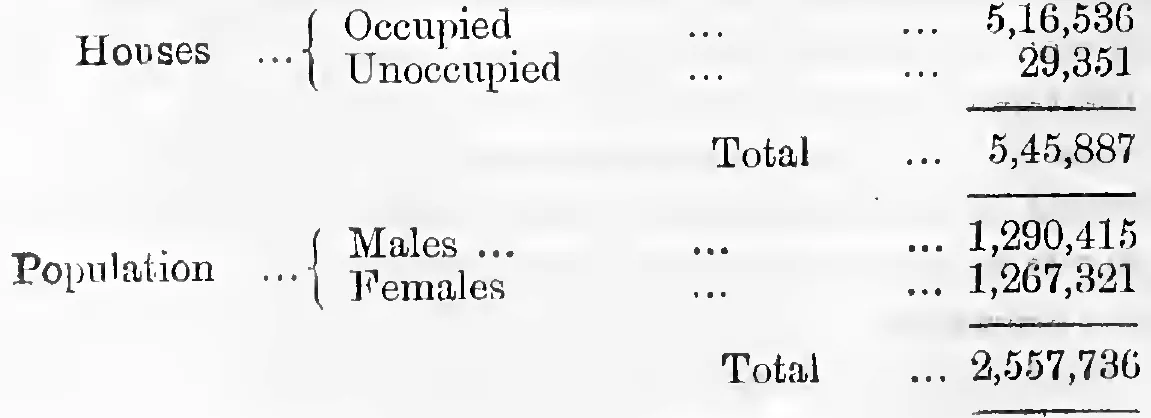
[3]giving on an average 4·6 souls for each house.

the rate of increase over the preceding Census being 6·5 per cent.
The area of Travancore being taken as 6,730 square miles according to the old calculation, the average density of the population was 380·05 persons to the square mile as against 356·7 in 1881 and 343·4 in 1875.
Census of 1901. The fourth systematic Census was taken on the morning of the 2nd March 1901, the operations having been commenced in September 1900. The State was marked off into several Census divisions, the Kara which corresponds to a British Indian village being taken to be the Census unit—the smallest area for which separate statistics were arranged to be compiled. Of the Census divisions, there was first the Block to which was appointed an enumerator, above it came the Circle under a Supervisor, then came the Charge constituting a Taluq under a Tahsildar who was responsible for the conduct of the entire Census operations within his charge. The plains were divided into 747 preliminary enumeration blocks which were grouped into 46 circles. Separate arrangements were made for the Census of the hill tracts and plantations. The Census was taken up in three stages:—
(1) House-numbering and preparation of house or building registers. The work was begun on the 31st October and completed on the 18th December 1900.
(2) Preliminary enumeration of habitual residents and the entry of particulars in the Census schedules. These had to be conducted by a specially paid agency, and occupied sixty-four days beginning on the 19th December 1900.
(3) Final synchronous enumeration. This was taken by day only, as on previous occasions.
For the final Census, each Taluq was divided into a number of blocks of such size as could be traversed in two or three hours and circles were constituted of these. There were in all excluding the hill tracts, 16,098 blocks distributed over 1,520 circles on an average, each block containing 37 houses and each circle 10 blocks. Separate censussing of plantations, mines, factories, &c., was one of the special features of this Census. Special arrangements were made for ensuring accuracy of the figures returned under the [4]several heads and for exercising strict scrutiny over the work of the subordinates. Instead of the old system of marking and counting by strokes in the work of abstraction, the slip system was successfully introduced by which, "for every person enumerated, all the particulars recorded in the schedules were extracted on a separate slip with the exception of the entries relating to the religion, sex and civil condition. Religion was indicated by the colour of the slip, and sex and civil condition by its shape. When the slips were written up, they were checked and sorted into heaps corresponding to the columns in the Tables to be compiled." A scheme of Natural Divisions, as adopted by the Imperial Census Commissioner, was adopted here also for the discussions and examination of Census statistics. The whole State was split up into two Natural Divisions based chiefly on the leading geographical and meteorological features, the Western or lowland division and the Eastern or upland division, fifteen Taluqs comprising the former and sixteen the latter.
Population generally. The total population of the State, as returned by the Census of 1901, is 2,952,157—1,490,165 males and 1,461,992 females. Compared with other Native States of India, we find that Mysore with four times the area of Travancore has less than double our population; Hyderabad with twelve times the area has only four times our population; Baroda with slightly larger territory has less than two-thirds; Kashmir of the same size as Hyderabad is less thickly peopled, and Gwalior with more than thrice the extent has nearly 20,000 persons less.
Of the four Divisions, Kottayam is the largest in extent having a population only second to that of Quilon, namely 35·3 per cent as against 36·2 per cent, while Trivandrum and Padmanabhapuram follow the order of their areas with a population of 15·4 per cent and 13·1 per cent respectively of the total population of the State. The mean population of a Division is 738,039. Among the Taluqs, Tiruvalla is the most populous, having a population of 140,926 (4·8 per cent). This is closely followed by Shertallay whose population is less by only 30 inhabitants. Then come Neyyattinkara (139,952) and Trivandrum (134,196), each with a percentage of 3·8 and 4·5 on the total population. Todupuzha and Tovala are the least populous Taluqs having only a population of 32,571 and 32,410 respectively. The mean population of a Taluq comes to 92,255, nineteen Taluqs showing averages above and the rest below this figure.
Movement of population. The following statement shows the variations in population between the Census of 1901 and the previous Censuses:—
[5]
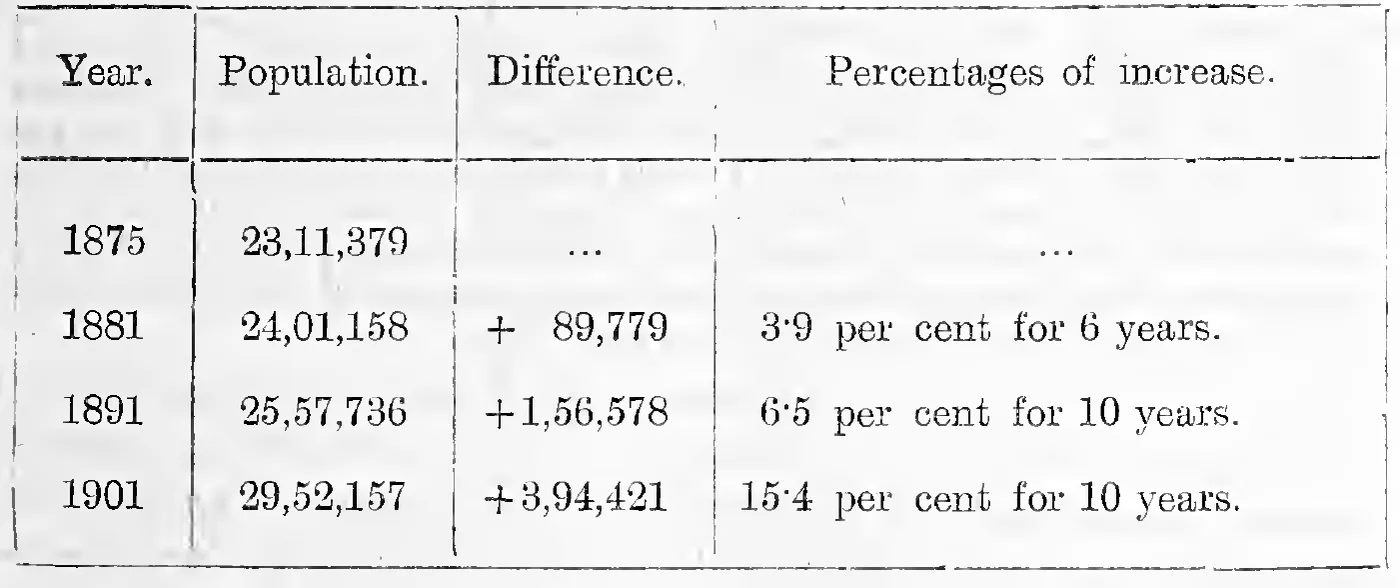
We find that the rates of increase have not been uniform, the increase during the last decennium being nearly two-and-a-half times that of the decade preceding it. Between 1875 and 1881 the increase was 3·9 per cent for six years, which gives a rate of about ·65 per cent per year. Between 1881 and 1891, the increase was 6·5 per cent for ten years or ·65 per cent per year, i. e., identically the same rate of increase for both the periods separately censussed. Between 1891 and 1901, the increase has run up to 15·4 per cent for ten years. Mr. N. Subramhanya Aiyar, the Census Commissioner for 1901, explains the abnormal increase in the population of 1901 as due to under-estimation in the Census of 1891 and quotes in support of his statement Mr. Stuart, the Madras Census Reporter for 1891, who observed:—"It is certainly remarkable to find so low a rate of increase in Travancore between 1881 and 1891." It is scarcely necessary to establish the accuracy of the normal increases of the Travancore population in the counts of 1881 and 1891, especially where they persistently point to a uniform rate in successive enumerations. It is a well-ascertained phenomenon of the Indian Censuses that a rapid rise in the birth-rate happens only after any unusual catastrophe. Such a catastrophe is generally the famine—a scourge to which the other parts of India are so much exposed, but from which Travancore is fortunately free. The Imperial Census Commissioner (Mr. E. A. Gait, I. C. S.) writes:—
"We have seen that the main influence causing fluctuations in the rate of growth of a community at different periods is its material condition, and in a country like India, where two-thirds of the people are dependent on agriculture, this varies with the state of the harvests. When the crops are good the people are prosperous, but when they fail, the pinch of scarcity is at once felt. It has been repeatedly shown, in discussing the movement of population in the different provinces and states, how intimately the variations which have been revealed at succeeding enumerations are connected with the occurrence of famine. When there has been a famine in the period between two censuses, the population [6]is stationary or decadent, but when there has been no famine, it is progressive. The rate of growth is greatest during a period of good crops following close on the heels of a famine. The reason for this is partly that a calamity of the sort causes a high mortality, chiefly amongst the very old and the very young and other persons already of a feeble constitution, so that when it is over, the population contains an unusually high proportion of healthy persons at the reproductive ages, and partly because, by reducing the number of dependents to be supported, its ultimate effect is to improve the resources of the poorer classes and so encourage them to have larger families." *
The only other factor of importance which affects the movement of population is immigration or emigration. In this respect "the adverse balance", according to the Imperial Census Commissioner, "forms a very small fraction of the total population, and migration may, therefore, be neglected when dealing with the movement of the population in India as a whole". This 'adverse balance' in Travancore was only a 'favourable balance' to the extent of one per cent increase of population in 1901. This then may be dismissed as an insignificant factor. There has been no famine or pestilence in Travancore since 1875 of such a magnitude as to affect the birth-rates abnormally. Hence one could only look forward to a normal increase of population. I find it therefore not easy to believe in the accuracy of the present increase of 15·4 per cent during the last ten years. If the Census of 1891 stood by itself and had nothing before it to compare with, it would have been a different matter, but when that enumeration is taken along with the two distinct enumerations of 1881 and 1875, all showing a uniform increase of about ·65 per cent per year, it requires an effort of the mind to believe that those three successive Censuses were wrong, but that the count of 1901 alone was correct. As the net result of immigration against emigration was only one per cent in the Travancore Census of 1901, the total of increase for ten years could only have been 7·5 per cent instead of 6·5 per cent; and there is no other way in which so sudden an increase as 15·4 per cent could be accounted for. To say that there has been an under-estimation in the Travancore Census of 1891 is a mere statement, for if the under-estimation of 1891 was a fact, the comparison with the two previous Censuses would have clearly brought it out. The result of 1891 would not fit in so well as it does with the two Censuses of 1875 and 1881. Then the only other alternative that remains is to contend that there must have been a regular and proportional under-estimation in all the three previous Censuses which argument cannot of course be set forth. Mr. Gait himself admits the accuracy of the figures of 1891 furnished by the advanced Native States like Travancore in the following words. He says:—
* Report on the Census of India (1901). Page 83.
[7]
"In 1881, more elaborate precautions were taken, and the omissions were fewer in number, but the count was still not as thorough as it was in 1891, when, except in tracts newly added and in a few of the more backward Native States, a high standard of accuracy was reached which could not easily be surpassed."
His Highness' Government in their review of Mr. Subramhanya Aiyar's rates of growth of population under different religions dismiss his statement of under-estimation with the remark, "This is a point on which authoritative pronouncement may well be deferred until the next Census".
Mr. Nanoo Pillai, already referred to as the author of a fragmentary sketch of Travancore History, while granting that my "Census of 1875 was the result of a systematic scheme and operation," made the following observations:—
"By the advice and under directions of Colonel Munro, the population of the country was counted by the State in 1816; a novel administrative operation which Travancore had ever experienced. The number of population was found to be 906,587—a figure on the accuracy of which the Reporter of the Census of 1875, that is late in the second period of this sketch, comments upon. He argues on the stand-point of the results of succeeding Censuses not corresponding with the principles of the law of increase of population. He remarks, 'including the present one, we have had in all four Censuses taken within the last sixty years—three of which being at the end of each vicennial period more or less enable us to compare and note the increase of population. For the first twenty years after the Census of 1816, we find that the population increased at the rate of about 2 per cent per annum. For the second vicennial period we find there is no increase at all, on the contrary there is a considerable decrease in the population. This period however is not marked by any extraordinarily bad season, severe droughts or diseases. For the third vicennial period there is a sudden rise again, and the population recovers what is lost in the second period. From these data it seems clear that no principal of increase of population can be laid down. Their sudden rise and fall, the capricious results of the increase and the immoderately high percentage disclosed by a comparison between the different Census statistics, are perfectly consistent however only with the fact of their gross inaccuracy'. The Census Reporter of 1875 brings under his sweeping remarks in the above para the results of the Census of 1816,—the first census also."
He concluded:—
"It can scarcely be denied that the Census of 1875 was the result of a systematic scheme and operation." *
The correct percentage of increase for the last decade cannot therefore be more than 7 to 8 per cent, which rate I believe will not be much exceeded in the next two or three Censuses to come, unless some disturbing factor suddenly appears of a kind heretofore unknown. I do not lose sight [8]of the fact that a Railway now runs to Quilon from Tuticorin and this may bring in a large population as labourers or settlers before the Census of 1911. Without meaning to detract from the value of the result of the last Census (1901), an operation involving labour and trouble of a most trying kind so well known to me by personal experience, it may be safely stated that we should wait for the next two Censuses before the rate of increase now discovered to be 15·4 per cent can be relied upon as correct. It would be unsafe to rush to general conclusions from the result of one solitary Census standing out so oddly from its three immediate predecessors. As pointed out by Mr. W. Francis, I. C. S., "It seems useless to endeavour to prognosticate the exact rate at which it will increase in each of these tracts in the future, as all calculations are liable to be rudely upset by the failure of a monsoon or two." I am personally of opinion that our last Census result is not decisive. The increase in the neighbouring District of Malabar between 1891 and 1901 was only 5·6 per cent and there is no reason to believe that that Census was wrong. According to Sir J. A. Baines, the increase of population for all India in the 1891 Census was 10·96 per cent, while that in the west coast Native States of Madras was 9·30 per cent. With regard to the 1901 Census of Madras, Mr. Francis remarked:—"Between 1871 and 1881, owing to the great famine of 1876, the population of the Presidency decreased by 1·5 per cent. In the next ten years there was a rebound after the famine and the rate of increase was 15·7 per cent, which was undoubtedly higher than the normal. In the past decade the increase has been 7·2 per cent." The increase in the United Kingdom for the decade ending with 1901 was only 9·9 per cent. In the United States, the increase according to the twelfth Census (1900) was 20·7 per cent; in this result the immigration factor must have played of course a very important part. To say that our increase during the last decade is three times that of the adjoining Malabar District and more than twice that of the whole Presidency and three-fourths of that of the United States of America with its huge proportion of immigrants is quite untenable. As the writer of the article in the Encyclopædia Britannica remarks:—"The results of the twelfth Census (1900) further refute the argument that would maintain the eleventh Census to be inaccurate, because it showed a smaller rate of increase in population during the preceding decade than had been recorded by other Censuses during earlier decades. The rate of increase during the decade ending in 1900 was even less than that for the preceding decade; and it is impossible that a falling off so marked could in two successive enumerations be the result of sheer inaccuracy." * [9]I myself pointed out to Mr. Subramhanya Aiyar at the time (September 1902), that his figure was unreliable, that the argument was a long and laboured one, which itself would show a weak case, that the old Census could not be wrong because it did not tally with the result of the new Census, unless he could show that his census was perfectly invulnerable in every respect which it was not, that if an increase of 24 per cent was justifiable in the Trivandrum Town he would have to show that the same increase occurred in the towns of Quilon and Alleppey where the conditions for increased population were even more favourable than in Trivandrum, and that if the increases there were much less than in Trivandrum, his argument counted for little, and that the reliability of his figures could only be determined after another two Censuses.
* I wish to point out here that I have not called into question the accuracy of Col Munro's Census of 1816 A. D. I only remarked that the comparison of the figures of the three successive Censuses of 1816, 1836 and 1854 showed that "no principle of increase of population can be laid down".
* Encyclopædia Britannica, 10th Edition.—Vol. XXVI. Page 634.
That the figures are not invulnerable may be easily tested in another way. It is a well-understood truth among Census authorities that the greatest increase of population takes place in the least densely peopled tracts and the smallest increase in the most densely peopled ones, unless counteracted by some abnormal disturbing causes. The reason for this is clear. There is a natural migration to tracts which contain a good deal of spare land especially when the most fertile tracts have become quite filled in and the point of utmost immigration has been reached and the struggle for existence has begun to be keenly felt. Mr. H. H. Risley remarks:—"On analysing the figures by natural divisions, it appears that the sparsely peopled territory owes its growth to the filling up of spare land in Chota Nagpore and the Sub-Himalayan tracts and the reclamation of the Barind in Northern Bengal." *
Again Mr. Gait writes in his Provincial Report:—"In East Bengal the greatest absolute increment has taken place in thanas with 800 to 900 persons per square mile and the greatest proportional growth in those with from 400 to 500, and then in those with from 900 to 1000." † Sir J. A. Baines wrote in his 1891 Census Report:—"In both sections of the statement the most distinctive feature is the way the rate of growth decreases as the density rises ... ... the rate of increases varies with remarkable regularity inversely as the specific population. The most thinly peopled tracts, such as those of Sindh, Lower Burma and the Assam Hills, show a rate nearly double the mean. This diminishes to about one and a half times that rate as the North-West and Central [10]Provinces hills, the western plains of the Punjab, and the southern portion of the Brahmaputra valley in Assam, come on to the list; and here it remains, until the mean density is nearly reached." *
* Report on the Census of India—1901, Vol. I. Page 50.
† Ibid pp. 74 and 75.
Mr. T. Ananda Row, the Mysore Census Reporter (1901), says:—
"A close study of this analysis will further show that among the taluqs of the Eastern Division the increase in population has generally been in inverse proportion to the density per square mile; in other words the lower the density class, that is to say, the sparser the population, the more has that population increased. Taking the Eastern Division as a whole, while the more densely populated Districts have become denser in a fair proportion (10 to 17 per cent excluding cities), the sparsely populated Districts of Tumkur and Chitaldrug have improved in a much larger proportion (16 to 20 per cent.) This only reflects the conditions which prevailed during the decade 1891-1901 which were favourable to the growth of an agricultural population, viz., no famine and no privation from want of food, fair harvests, high prices, security of person and property and few epidemics." †
Judged by the dicta laid down by these Census authorities, the results of the increase of population as compared with density in Mr. Subramhanya Aiyar's Census of 1901 may be said to require confirmation.
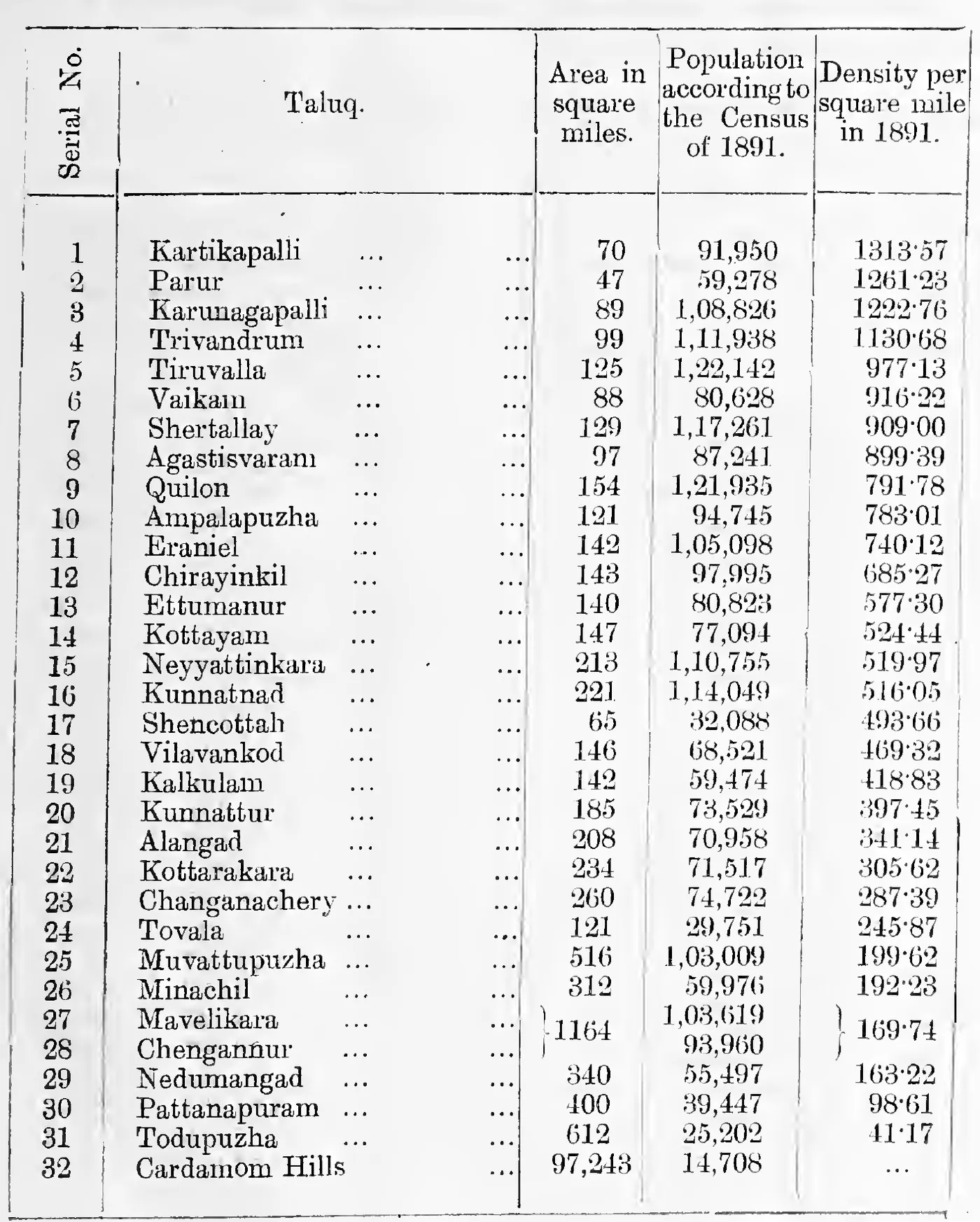
The density of population for each Taluq according to the previous Census (1891) is shown in the following Table. The Taluqs are arranged in the order of their density.
* Report on the Census of India (1891). Page 75.
† Report on the Census of Mysore (1901). Part I. Page 22.
[11]
A. Statement showing density of population in 1891, Taluqwar.
[12]The rates of increase of population since the Census of 1891 are shown in the following statement. The Taluqs are arranged in the order of their proportions of increment:—
B. Statement showing the increase of population in the 1901 Census as compared with the 1891 Census, Taluqwar.
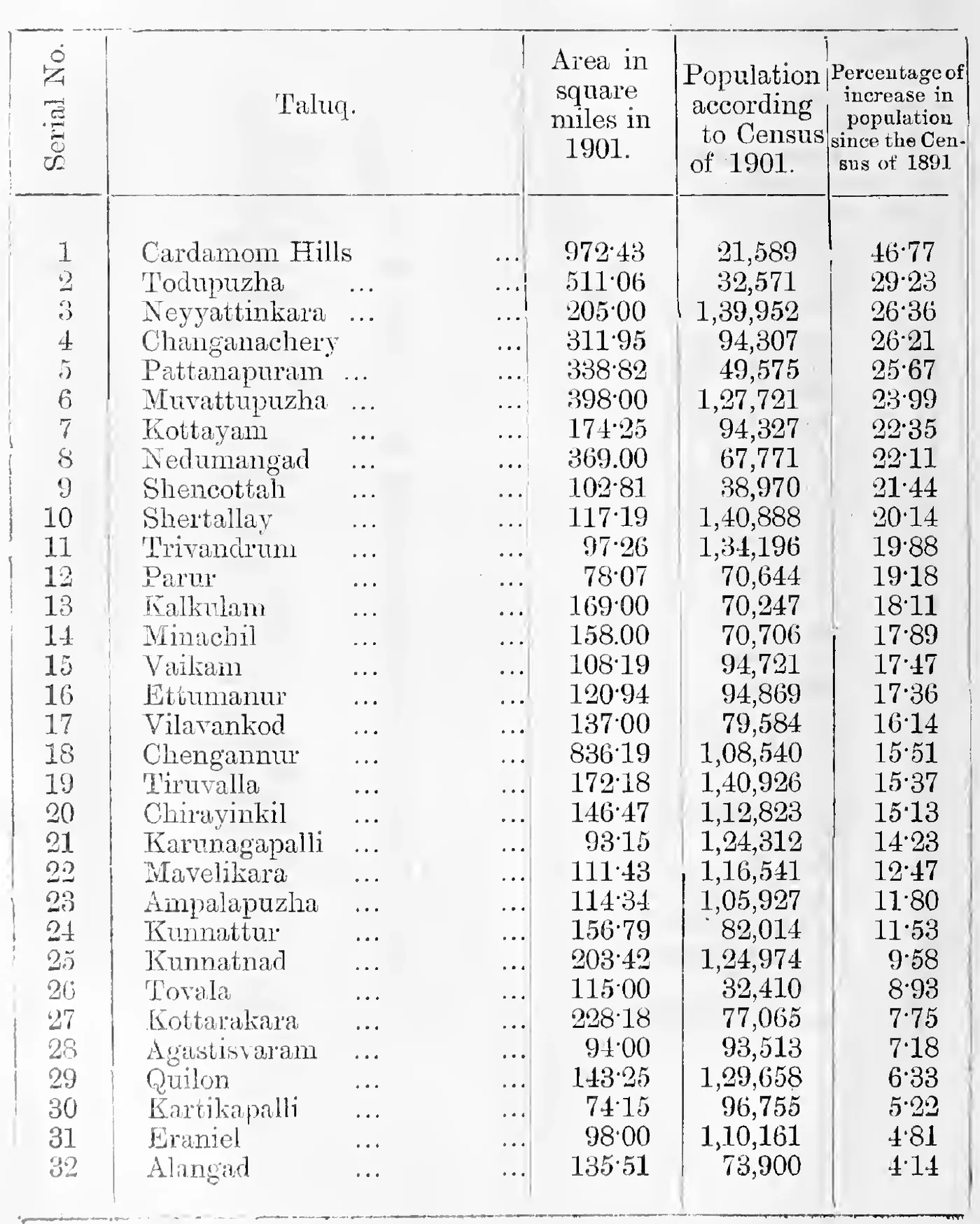
[13]A study of these two Tables will show that the general law deducible from Census statistics, as already set forth, does not hold good in the case of our 1901 Census figures. A Taluq which stands at the top of the one table, viz., the density table, should stand at the foot of the other table viz., the increase of population table. This is the result which one should be entitled to expect if the figures were perfectly accurate. Such is not however the case. For instance, the rich Taluq of Kartikapalli which stands first in Table A having a density of 1,313 per square mile has an increase in population to the extent of 5·2 per cent since 1891, while the Taluq of Eraniel whose density was only 740 per square mile or about one-half of that of Kartikapalli shows an increase of only 4·8 per cent and Agastisvaram with a density of 899 per square mile has an increase of 7 per cent. The small Taluq of Parur which had a density of 1,261 per square mile in the previous Census shows now an increase of 19·1 per cent over the former population. Again Kottarakara which has a density of 325 per square mile with an enormous spare space for filling in shows an increase of only 7·7 per cent and Alangad with a density of 341 per square mile shows an increase of only 4·1 per cent. That is, Eraniel which stands as No. 11 in density (Table A) ought to stand as No. 22 in increase (Table B); but it stands as No. 31 in Table B. Agastisvaram which stands as No. 8 in density should stand as No. 25 in increase; but it stands as No. 28. Parur which stands as No. 2 in density should stand at No. 31 in increase; but it stands as No. 12. Kottarakara which stands as No. 22 in density should be No. 10 in increase but it stands as No. 27. Alangad which stands as No. 21 in density should stand as No. 11 in increase; but it stands last as No. 32. Karunagapalli which stands as No. 3 in density should stand as No. 30 in increase; but it stands as No. 21. Tiruvalla which stands as No. 5 in density should stand as No. 28 in increase; but it actually stands as No. 19. And lastly Shertallay which stands as No. 7 in density should stand as No. 26 in increase; but it stands as No. 9. Further discussion is unnecessary. I shall only add here that that eminent Census authority Sir J. A. Baines, the Imperial Census Commissioner for 1891, has borne the following testimony to the accuracy of the 1891 Census. "The Travancore State seems to have secured a trustworthy and complete census."
[14]
C. Taluqwar statistics of area and population.
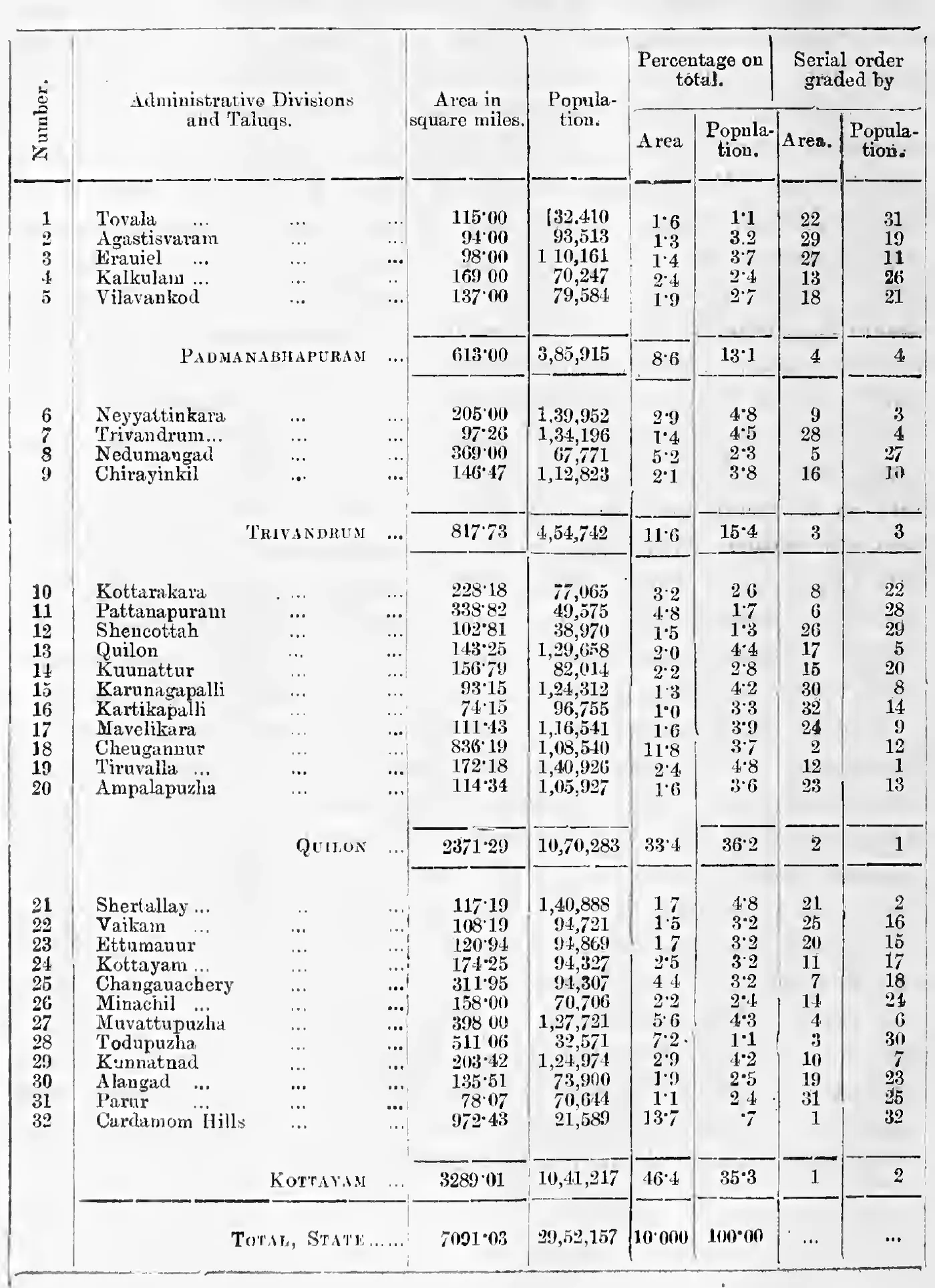
[15]Density. Taken as a whole Travancore has a density of 461 persons to the square mile, the total area according to the latest measurements being 7,091 square miles. Since 1875, the density has been steadily increasing.
Compared with the leading Provinces of India, Travancore shows a greater density of population than all of them excepting Bengal (density 494), and the United Provinces of Agra and Oudh (445); and among the Native States it comes second only to Cochin (density 596 per square mile). Twenty-one Taluqs in the State have each a density above the average (416), of which six have a mean density of more than 1,000 per square mile, viz., Trivandrum (1,380), Karunagapalli (1,335), Kartikapalli (1,305), Shertallay (1,202), Eraniel (1,124) and Mavelikara (1,046). The least dense Taluqs are those of Nedumangad (183), Pattanapuram (146), Chengannur (130) and Todupuzha (64).
Towns, Villages and Houses. 6·2 per cent of the total population has been returned as living in towns and 93·8 per cent as living in villages. Nine places were censussed as towns. They are
- Trivandrum ... ... 57,882
- Nagercoil ... ... 25,782
- Alleppey ... ... 24,918
- Kottayam ... ... 17,552
- Quilon ... ... 15,691
- Changanachery ... 14,264
- Parur ... ... 12,962
- Shencottah ... ... 9,039
- Kayangulam ... 5,745
The average population of a town is 20,426. 59·1 per cent of the total urban population live in towns with more than 20,000 inhabitants, 32.9 per cent in towns with a population of 10,000 to 20,000 and the remaining 8 per cent in towns with less than 10,000 inhabitants.
The total number of villages (the old indigenous unit Kara being taken as a village) excluding those uninhabited is 3885. The Kara is the smallest revenue subdivision of a Taluq and is the real unit for purposes of tax collection under the Provertikar. Each village covers an average area of 1.81 square miles and is situtated 1.4 miles apart from one another. The average population of a village is 712. There are 2,006 villages having less than 500 inhabitants, 1,646 with less than 2,000, 225 with a population of between 2,000 and 5,000 and only 8 villages, [16]having a population above 5,000 in each. Of these last named, Shertallay and Udiamperur or Diamper, a place of historical importance where Alexis De Menezes held the famous Synod of 1599, are the most important.
The total number of occupied houses is 580,899, the greatest number being found in the Shertallay Taluq (32,580); Tiruvalla (26,411) comes next, while Todupuzha and the Cardamom Hills (6,572 and 4,130 respectively) contain the least number. Of the total number, the urban areas contain 5·9 per cent and the rural 94·1 per cent of the population. The average number of houses is 3,777 per town, 140 per village and 81·9 per square mile. The number of persons per occupied house for the whole State is 5·08—5·40 in the urban areas and 5·06 in the rural. The average area per occupied house is 7·81 acres. The number of families recorded at this Census amounts to 583,742 and gives 1·005 families to each occupied house and 5 persons to a family. Of unoccupied houses there are 32,994 or 5.3 per cent of the total. The following statement shows particulars of houses, population, etc., in towns:—
[17]
D. Statement showing particulars of houses, population, &c., in Towns.
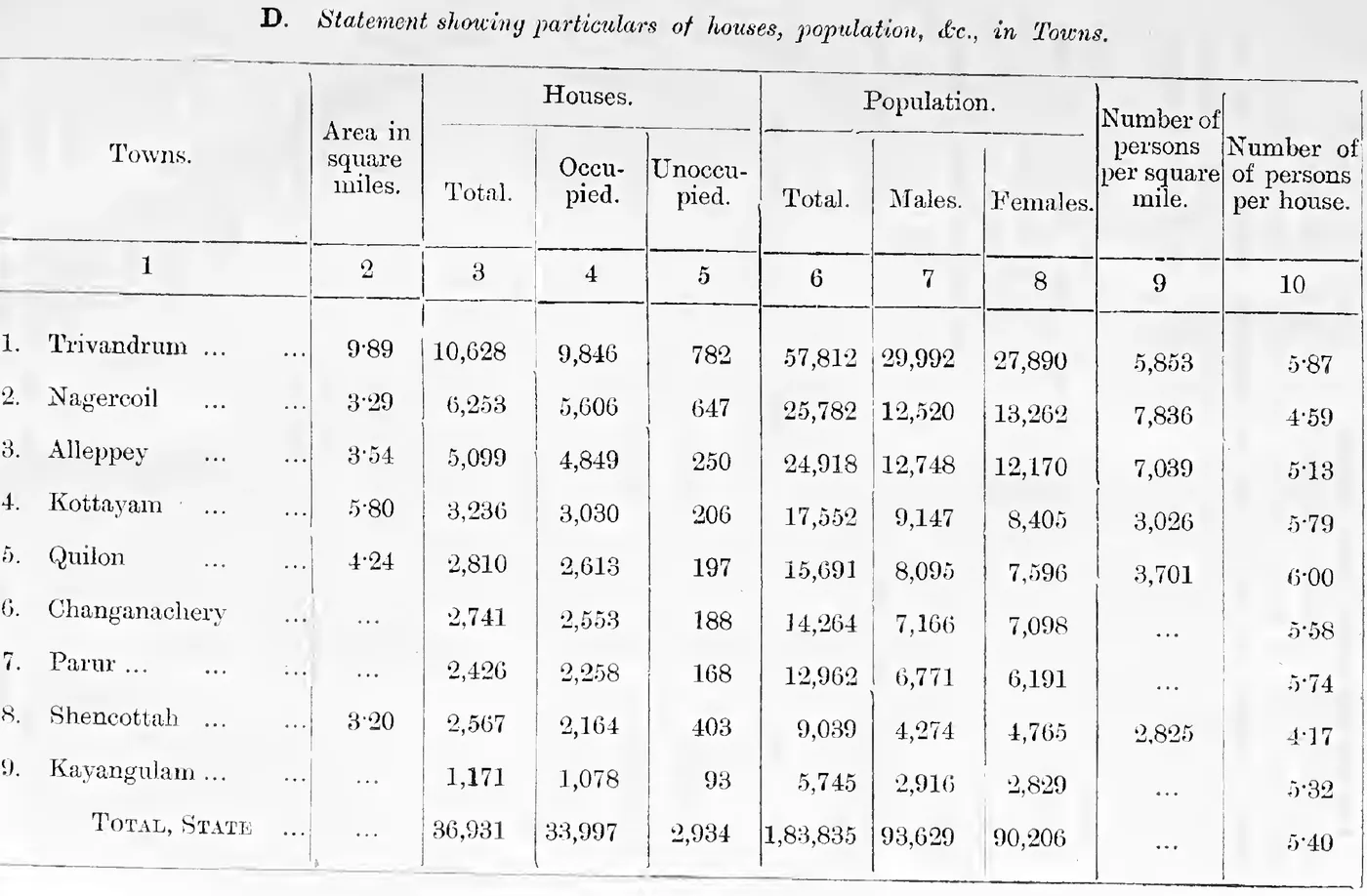
[18]Immigration and emigration. Of the total population, only 54,903 persons or 1·9 per cent are returned as immigrants. Of these 54,129 are from all parts of India and 724 from beyond India. The Madras Presidency contributes the largest number, viz., 47,995 of which more than half belong to the Tinnevelly District (25,862), the remainder being supplied by the Cochin State and the Districts of Malabar, Madura, Trichinopoly and Madras.
The emigration returns show only 24,490 Travancoreans as being enumerated elsewhere. This small percentage (·8 per cent) points clearly to the stay-at-homeness of the Travancorean. It is interesting to note that, even of this small number, 15,442 or more than 63 per cent have not gone beyond Cochin, while only 83 persons have been enumerated outside Madras (74 in Mysore, 8 in Coorg and 1 in Baroda).
Religion, Sect and Caste. The following Table gives the distribution of population by religion.
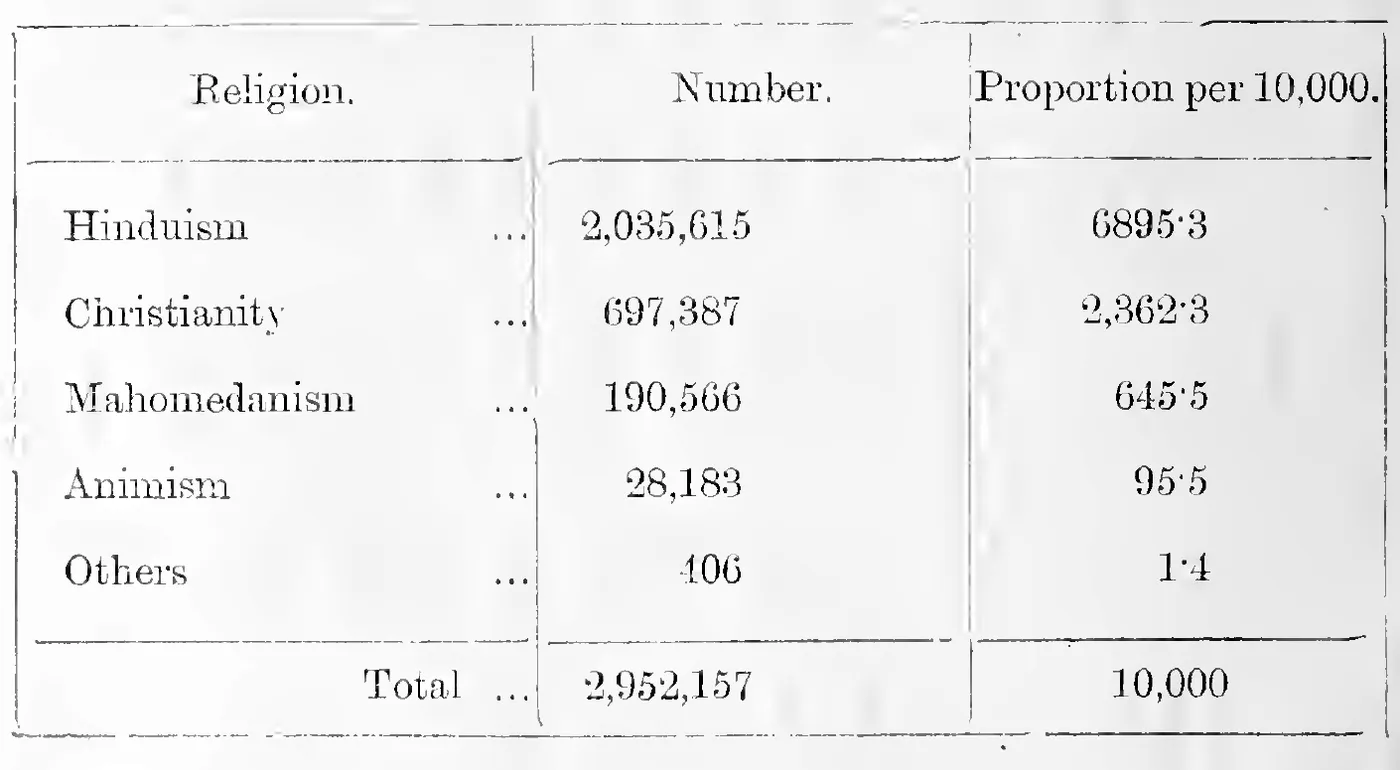
Hinduism is thus the chief religion of the State, more than two-thirds of the entire population professing it; next comes Christianity which is the religion of about a fourth, and then Mahomedanism, the religion of about one-sixteenth. Taking the three religions together, we find that for every ten Hindus there are three Christians and one Mussalman. As the Census Commissioner observes:—"A remarkable fact in connection with the statistics of religious beliefs is the high proportion of the Christian element. At the roughest, fourteen centuries may be taken as the age of Christianity in this land, and what with the real charitableness of the Hindu rulers, the unrestricted sympathies of the higher for the backward classes, and what with the religiously and socially degraded condition [19]of the latter, Christianity has had a prosperous career, and now with the single exception of Cochin, Travancore is the most Christian territory in all India."
The distribution of population in each Taluq according to religion is shown in the following statement:—
E. Distribution of population according to the main religions.
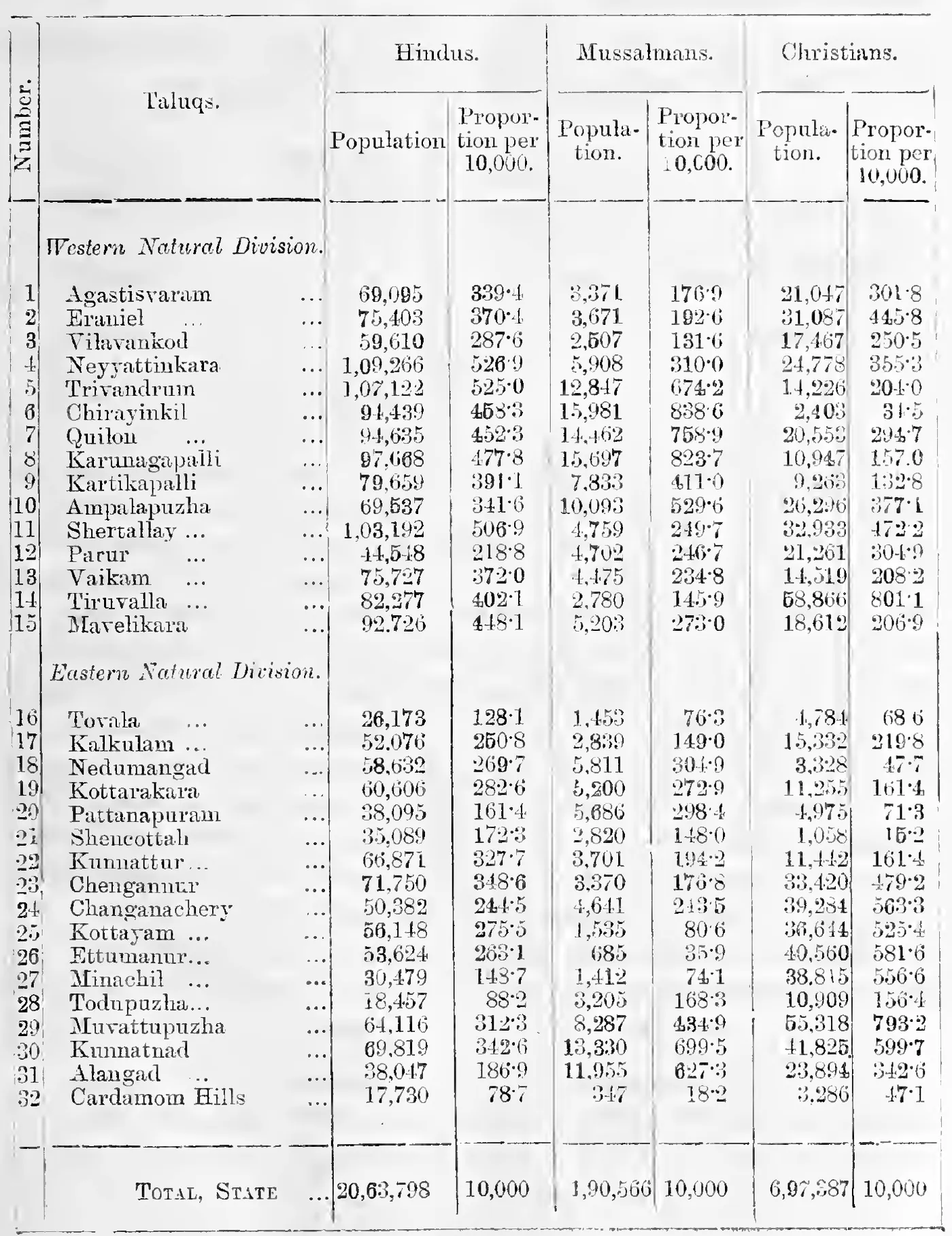
[20]The Christian element is relatively strongest in the Taluqs of Tiruvalla, Muvattupuzha, Ettumanur, Minachil and Changanachery, while the chief seats of Islam are Chirayinkil, Karunagapalli, Quilon, Kunnatnad and Alangad. As regards Hinduism, it may be noted, Travancore is distinctly weaker than any other State or Province except Kashmir, the Panjab, Bengal, Assam and Cochin, while it takes a high place in the proportion of Mussalmans.
The following figures, denote the relative growth of the three main religions and their variations for the two decennial periods:—
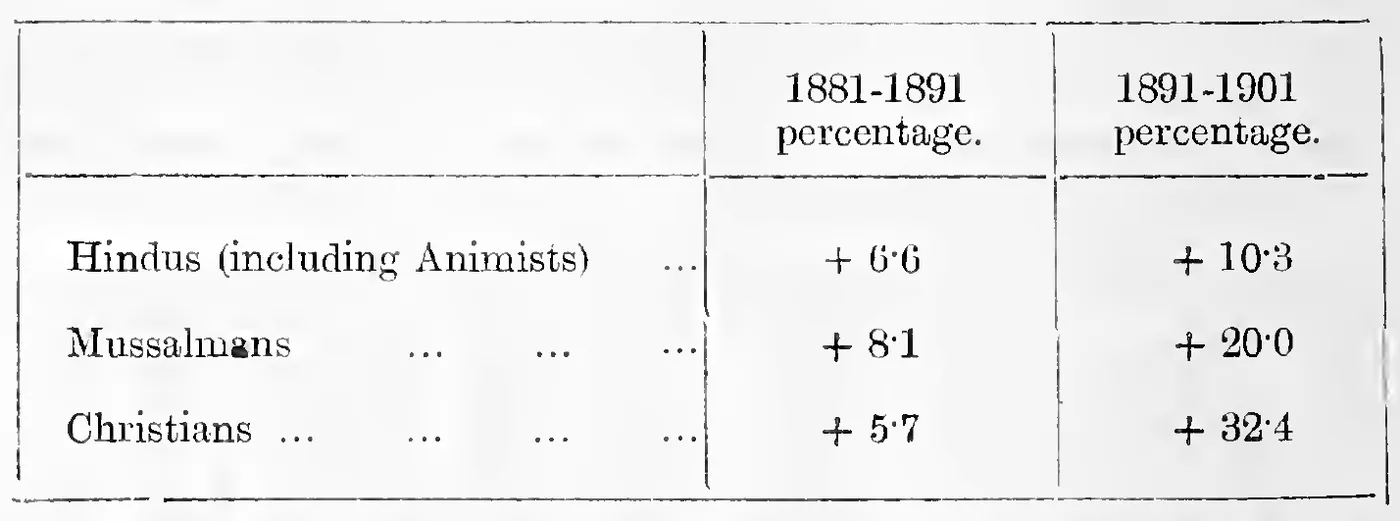
The disparities are striking and lead one to the inference that the results of 1901 are not after all correct. Even if there had been an under-estimation in previous Censuses for which no special reasons exist—except perhaps the wickedness or incapacity of the enumerating staff, which, however, is a constant quality affecting all Censuses alike, that could only have been to an inappreciable extent. Valued in any light, the increase observed is abnormal as has been pointed out in a previous page.
Among the minor religions there are returned 227 Buddhists, 171 Jews, 15 Sikhs, 1 Zoroastrian and 3 Atheists, and two persons returned as 'not stated'. Nearly all the Buddhists who came to work in the Planters' Estates have since left Travancore; of the Jews, 133 belong to the Parur Taluq, their numbers having been once considerable in the State, while all the Sikhs were immigrants from Upper India.
Sects. Six sects have been returned by the Hindus, and their numbers are shown below.—
- Smartas ... 66,415
- Saivites ... 82,933
- Vaishnavites ... 15,641
- Madhvites ... 4,141
- Advaitists ... 6
- Saktas ... 210
- Total ... 169,346.
[21]In other words, only 8·3 per cent of the total Hindu population have returned their sects.
The Mussalman sect may be divided into two heads Sunni and Shiah, the former being subdivided into Shaffei, Hanafei, Humbali and Maleki. The figures are given below:—
- Sunni ... Sunni ... 45,176
- Sunni ... Shaffei ... 81,279
- Sunni ... Hanafei ... 22,132
- Sunni ... Humbali ... 4
- Sunni ... Maleki ... 12,832
- Total ... 1,61,754.
Thus 85 per cent of the Mussalman population have returned their sects.
Twenty-four sects have been returned under Christians and are grouped under the following thirteen main heads.
- Anglican Communion ... 78,886
- Baptist ... 80
- Congregationist ... 11
- Indefinite beliefs ... 1,051
- Lutheran and allied denominations ... 11
- Methodist ... 3
- Minor denominations ... 6,726
- Presbyterian ... 26
- Roman ... 132,588
- Salvationist ... 3,547
- Syro Jacobite ... 181,932
- Do. reformed ... 37,199
- Do. Roman ... 232,439
- Denominations not returned ... 22,888 or 3·3 per cent.
- Total ... 6,97,387.
Almost the whole of this population is of indigenous origin, the Syrian sects, Jacobite, Reformed and Roman being wholly composed of natives.
Caste. The total Hindu population is returned under 192 heads of caste, and there were in all nearly 1,050 different subdivisions named. The most numerous of the castes are the Nayars who aggregate 520,941 or 25·6 per cent of the population. Several divisions are comprised under the general head, Nayar. Over a hundred and thirty classes [22]have been returned in the Census schedules. The main divisions are only five, namely, Kiriyam, Illam, Swarupam, Padamangalam and Tamilpadam. The Izhavas come next in point of numbers—491,774 (24·2 %). The largest number of Izhavas is returned from Shertallay (59,711). They may be divided into three classes, the Izhavas of the Tamil Districts, the Chovas and Tiyars of Malabar. Next come the Shanars who number 155,804 or 7·7 per cent of the population. The Pariah, Kurava and the Asari number between 50,000 and 1,00,000 while the Vellalas, the Brahmins, the Maran and the Kollan between 20,000 and 50,000. Of the hill tribes, the Malankuravans are the most numerous (11,492), the Malavedans number 7,013 and the Kanikkars 4,139.
Among the Mahomedans 47 divisions have been returned, of which the Methans comprise the largest number, 552,140 or 29 per cent of the Mussalman population. Next come the Tulukkans (52,206 or 27 %) and the Jonakan (48,026 or 25 %).
Grouped according to race, the Christian population is divided into,
- (1) Native Christians 694,364 or 99·7 of the Christian population.
- (2) Eurasians ... 1489
- (3) Europeans ... 534
- Total ... 697,387.
Language. Forty-one languages are returned as spoken in the country. They may be divided as follows:—
- Vernacular languages ... 2
- Other Indian Vernaculars ... 24
- Vernacular of Asiatic countries beyond India 5
- European languages ... 10
- Total ... 41.
Malayalam is the mother-tongue of more than four-fifths of the population being spoken by 2,420,049 or 1,219,635 males and 1,200,414 females; Tamil is the language of 492,273 (247,735 males and 244,538 females) or 16·67 per cent, while Marathi, Telugu, Hindustani, &c., are spoken by the remainder. The following Table indicates the distribution of the principal languages:—
[23]
F. Distribution of Languages, Taluqwar.
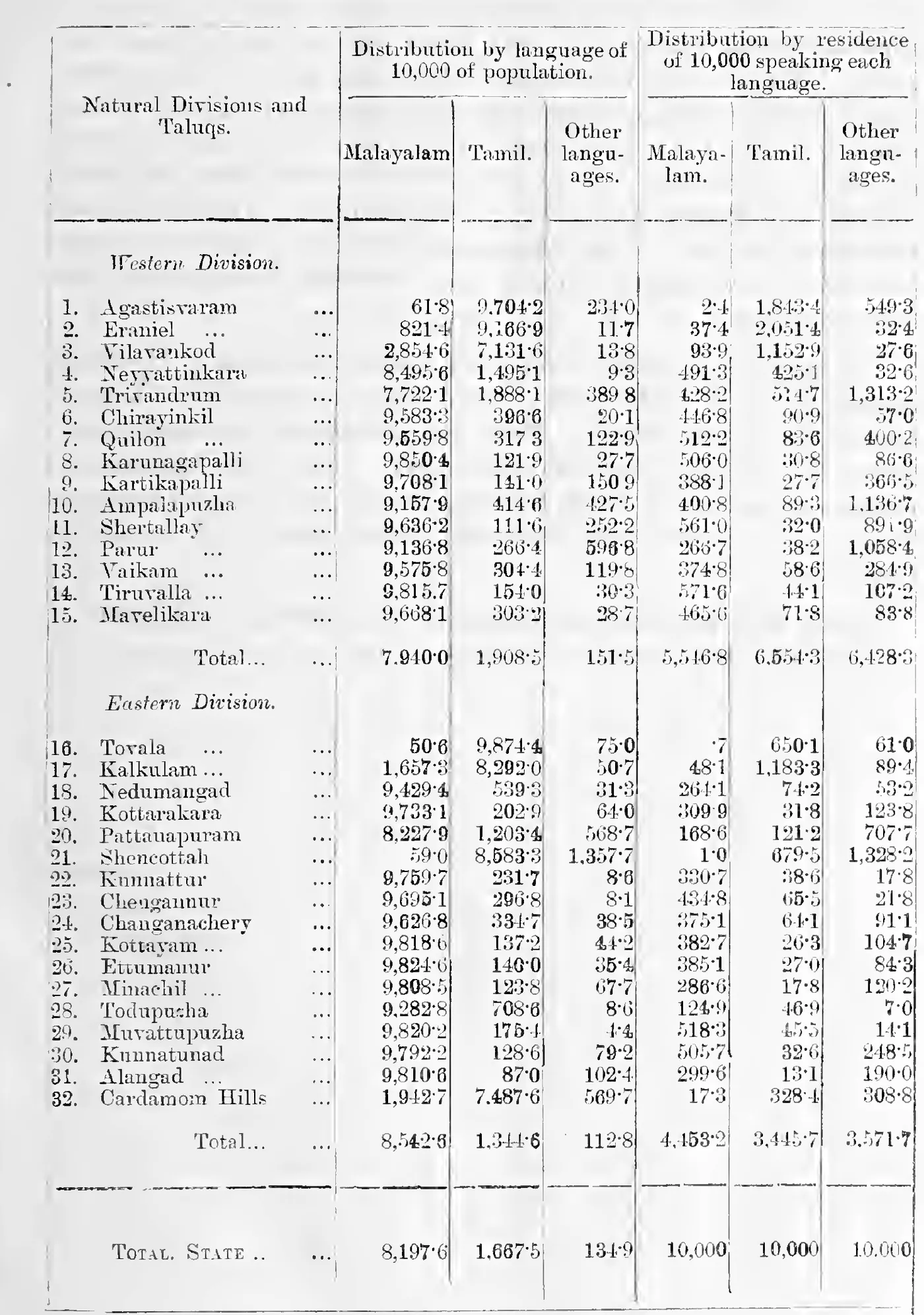
[24]In each of the Taluqs of Karunagapalli, Ettumanur, Muvattupuzha, Kottayam, Tiruvalla, Alangad and Minachil, more than 98 per cent of the population speak Malayalam. The proportions are low in Eraniel, Kalkulam, Vilavankod and the Cardamom Hills, and lowest in Tovala, Shencottah, and Agastisvaram where Malayalam is the mother-tongue of between and 6 per cent. But in these latter Tamil is the predominating language, its strength diminishing as we proceed north. The Taluqs of Tovala, Agastisvaram, Eraniel and Shencottah, with 98·7, 97, 91·6 and 85·8 per cent respectively, exhibit the largest proportion of Tamilians, while Alangad, Shertallay, Karunagapalli, Minachil and Kunnatnad represent the other end of the scale.
Among other Indian Vernaculars, Konkani is spoken by the largest number, viz., 10,278 and is most prevalent in Parur, Shertallay and Ampalapuzha. Then come Marathi which is the language of 7,588 persons, Telugu of 7,460 and Hindustani that of 5,944. All the other languages together are spoken by 5,194 persons. Among the European languages English is, of course, the largest spoken, 1,045 males and 858 females returning it.
Age, Sex and Civil condition. The following statement shows the age-distribution of 10,000 of either sex at the last three Censuses:—
[25]
G. Statement showing age-distribution.
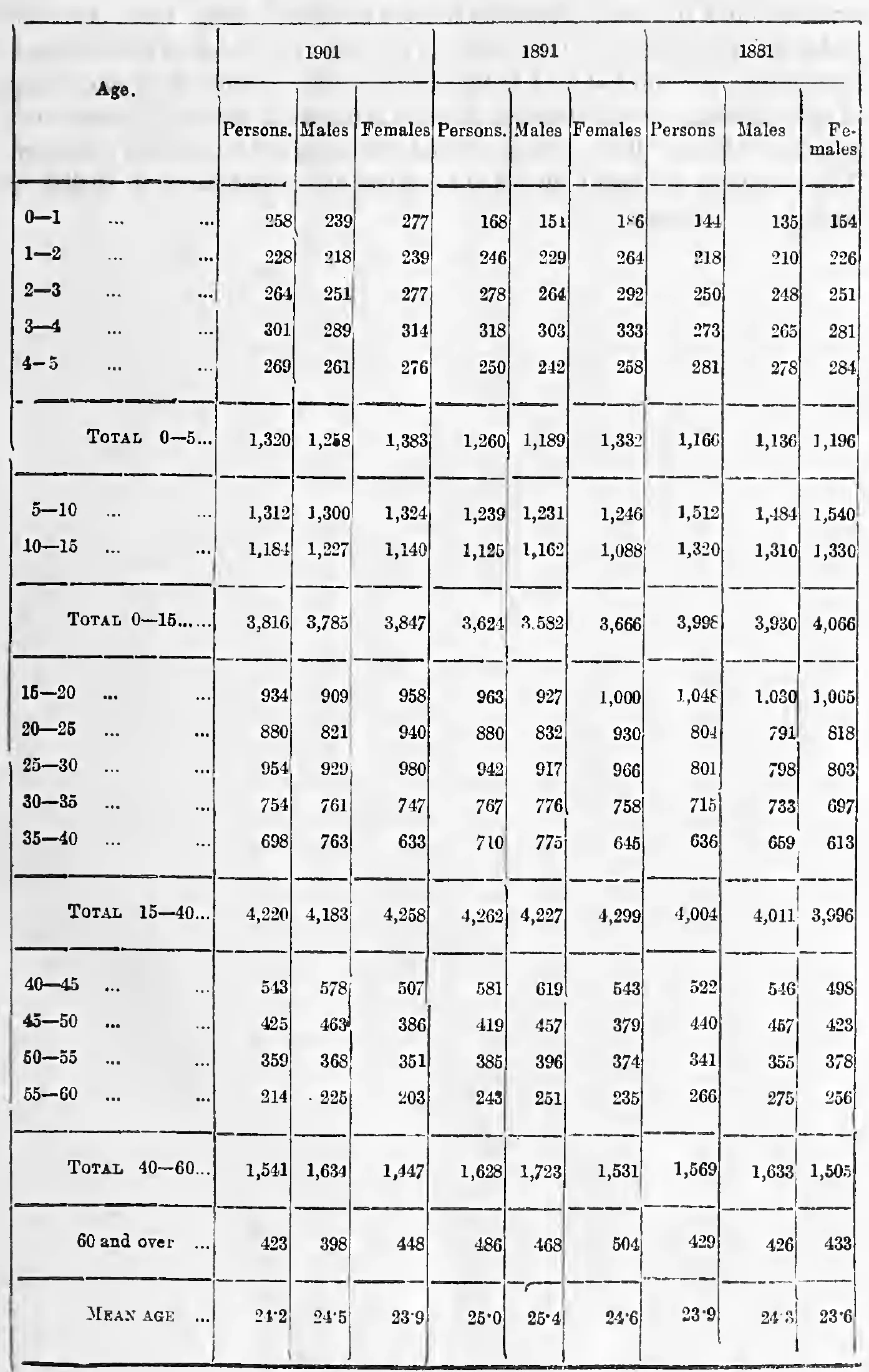
[26]Thus in a total of 10,000 of either sex, there are 2,558 males and 2,707 females under 10 years. Again at the age of 60 and above there are 398 males and 448 females. The excess of females over males at the advanced ages is thus one-third of that at the earlier years. Above 10 a narrowing of this difference in the strength of sexes is observed which is accelerated between 15 and 40, a period of trial and suffering for women generally. The following statement shows in brief the age-distribution of 10,000 of each sex by religion:—
[27]
H. Age-distribution of 10,000 of each sex by religion.
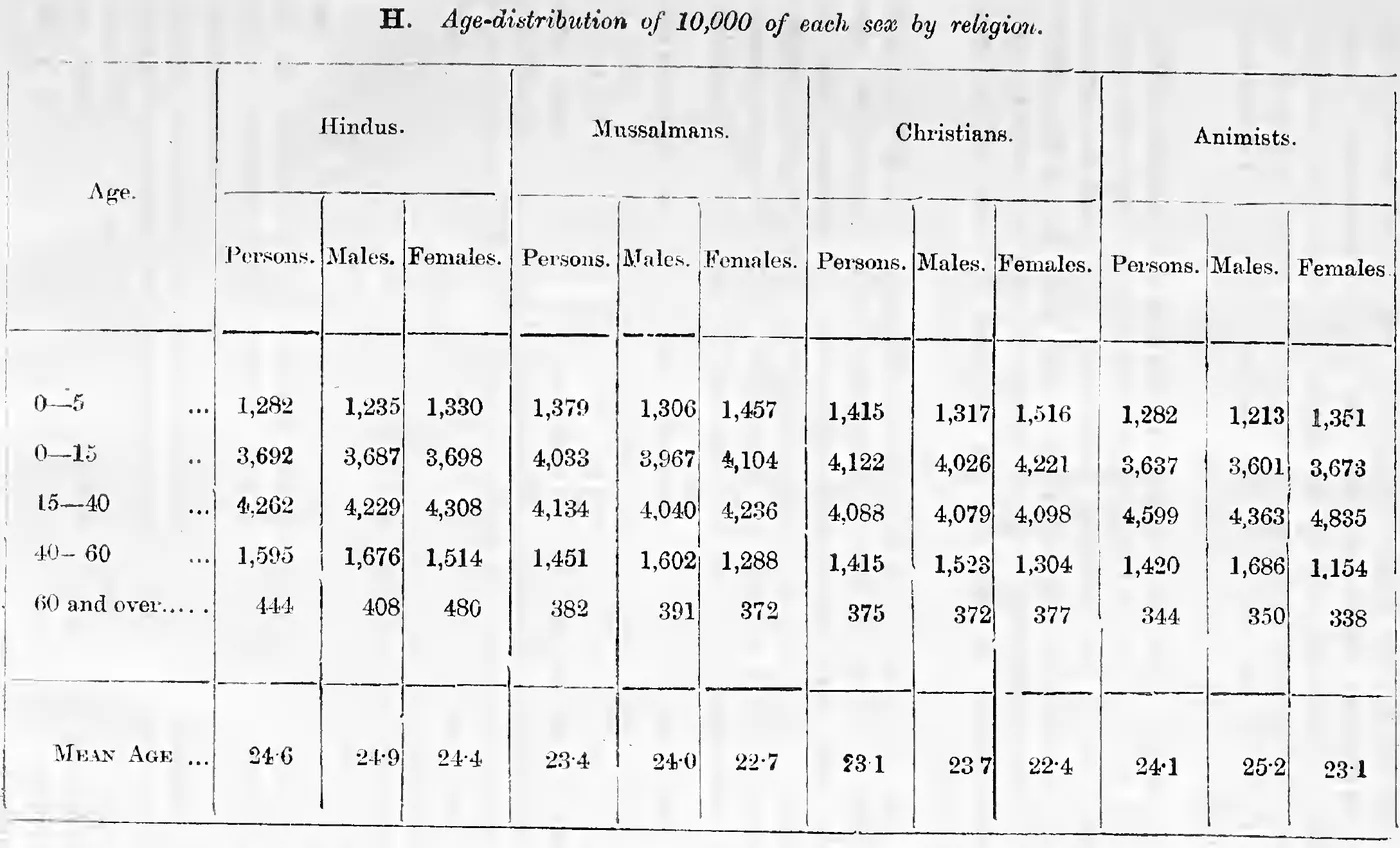
[28]Examining these figures, the largest number of children (0-15) are found among the Christians and then come the Mussalmans and Hindus. Turning to the other end of life, the reverse order is observed, Hindus coming first returning 444 persons, Mussalmans second, returning 382, and Christians last with 375. Thus the longevity of the Hindus more than counterbalances the fecundity of the other religionists.
Assuming that all males between 15 and 60 and all females between 15 and 45 are capable of earning their own livelihood, the percentage of supporters to the total population amounts to 57·6, of which the effectives among the males constitute 58·2 per cent and those among the females 57·1. The corresponding figures for Madras, Mysore and Cochin are 54·1 and 54·9 per cent, 54·7 and 54·4 per cent and 55·5 and 55·7 per cent respectively.
The mean age of the population is 24·2 years. It is 24·5 for males and 23·9 for females. The average duration of life is longest in the case of the Hindus (24·6), and shortest in the case of the Christians (23·1), 19 persons—5 males and 14 females having been returned as centenarians. The highest age is returned by a Shanar (120), while of the three persons returned as aged as 110, one is a Nayar and the other two are Chakkalas.
Sex. The population of the State is made up of 1,490,165 males and 1,461,992 females, the proportion being 981 females to 1,000 of males as against 982 females to 1,000 in 1891. The accuracy of an Indian Census is generally judged by the nearness with which the female total approaches that of the males. But successive Censuses have only shown a deficiency in respect to the number of females. In 1901 the proportion of all India was only 961 females to 1,000 males. This deficiency is aways accounted for by assuming that the women must have been less carefully enumerated than the men. But in Travancore those causes which might contribute to the above result are entirely absent, considering the social condition of the people as a whole, the absolute freedom enjoyed by the Marumakkathayam females who form the majority of population, and who are regarded as of equal if not of greater importance with men, and the total absence of the Purdha system, excluding of course the very small proportion of Nambudiri and foreign Mussalman females. It may therefore be confidently asserted that the figures returned are quite accurate and reliable. In the Madras Presidency the proportion is 1,028 females to 1,000 males, but Travancore compares favourably with most of the other States and Provinces, Mysore coming almost abreast of it with a proportion of 980 females to 1,000 males.
[29]The following statement gives the proportion of the sexes at different ages for 1901 and 1891:—
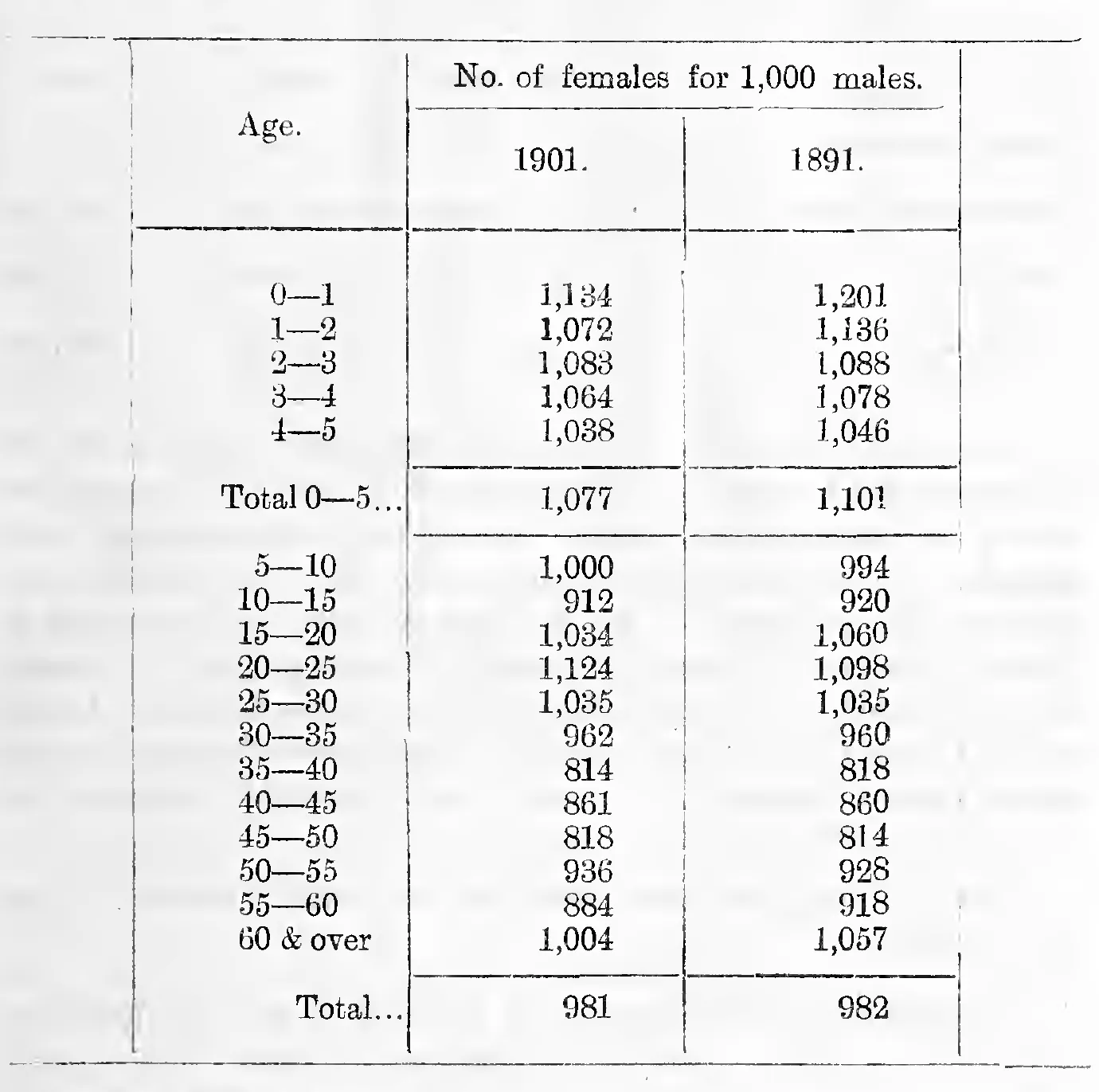
These proportions show that in the ages below 5 there is an excess of girls over boys (1,077 to 1,000), the excess being most marked under one year where there are 1,134 females to 1,000 males. With regard to the other age-periods, we find that there is a preponderance of
- males between ... 5—15 years
- females ... 15—30 "
- males ... 30—60 "
- females ... 60 and over,
female life sinking lowest between 35 and 40.
Viewing the sex statistics by religion, the ratio of females is found to be the highest among the Hindus (990 to 1,000) and the lowest among the Mussalmans (935 to 1,000).
[30]Civil Condition. The figures indicating the civil condition of the total population are given below:—
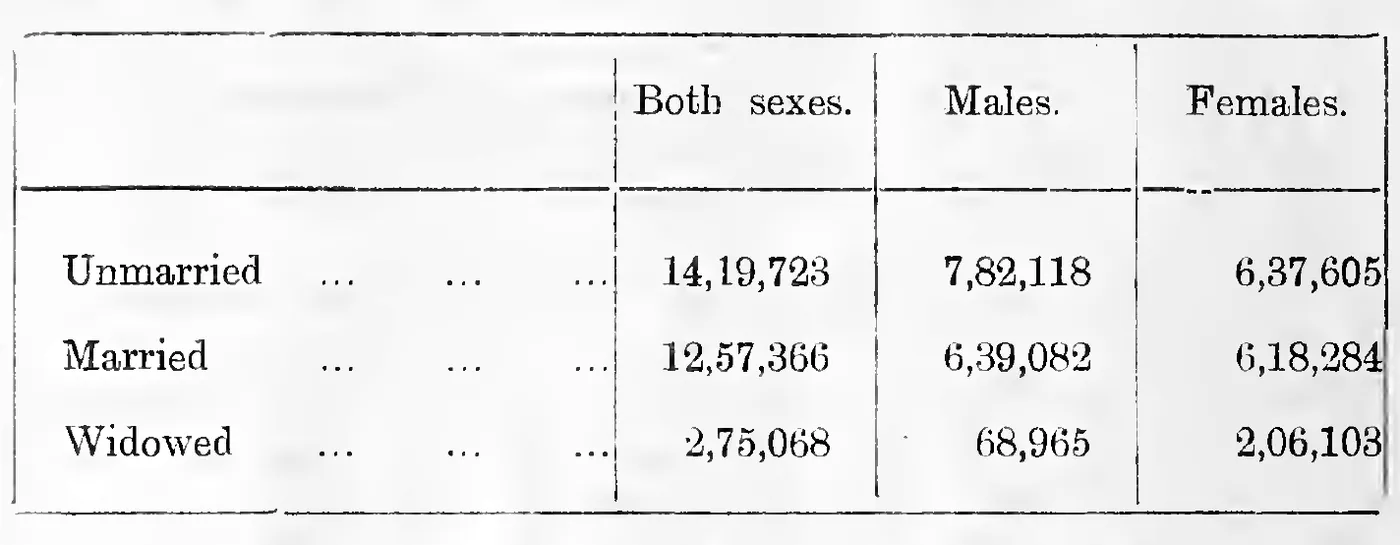
Of the total population, 42·6 per cent are returned as married, 48·1 unmarried and 9·3 widowed. The proportion of the married is nearly the same in both sexes forming 42·9 per cent of their respective totals, while among the widowed, the females are more than thrice as many as the males. This may be explained by the fact that the bulk of the population are Hindus, a portion of whom are governed by a rigorous system of compulsory widowhood. Comparing Travancore with other States and Provinces, the Census Commissioner observes, "marriage is relatively less universal, juvenile marriage less common and immutable widowhood less prevalent here than elsewhere".
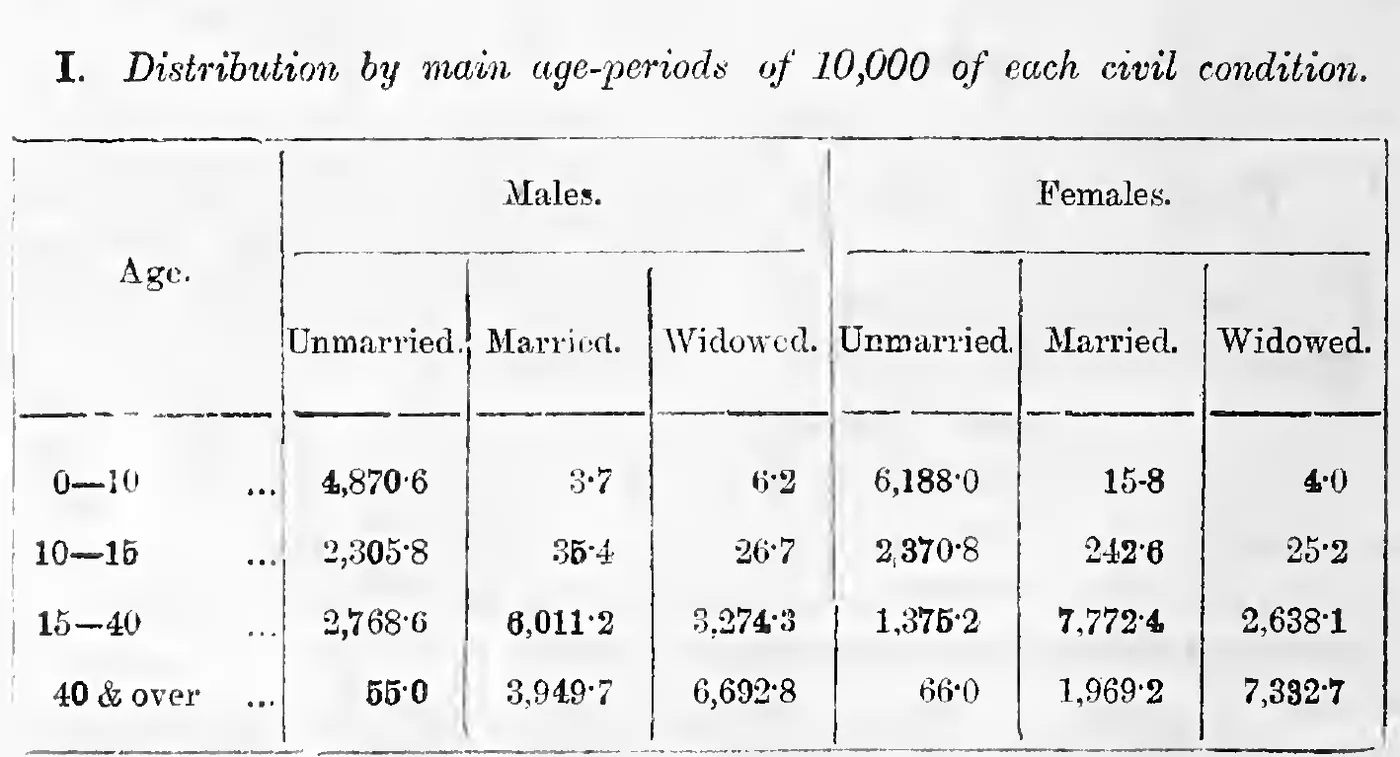
The two subjoined Tables illlustrate the relation between age and civil condition.
I. Distribution by main age-periods of 10,000 of each civil condition.
[31]
J. Distribution by civil condition of 10,000 of each age-period for each sex.
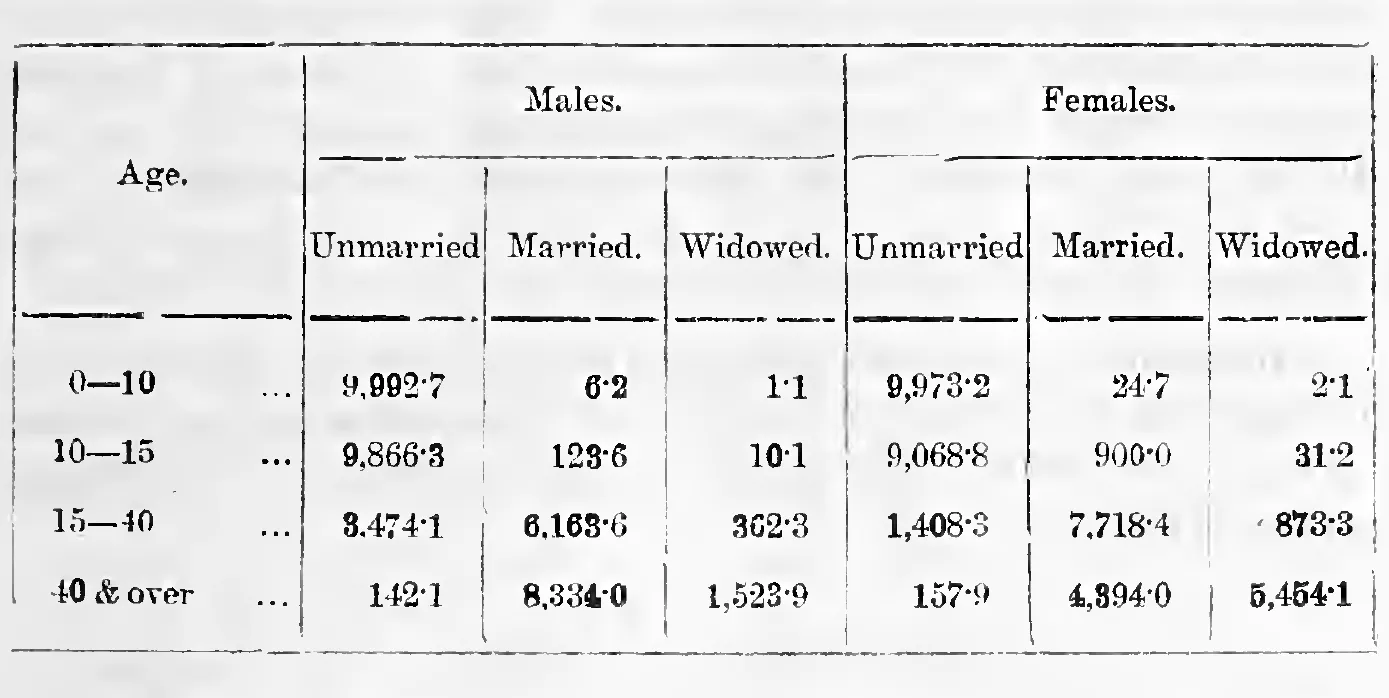
The first table shows the number of persons in each civil condition distributed according to age. It will be seen from the figures that the married state is very scarce below 10, only 3·7 females and 15·8 females being returned as married out of 10,000 of each sex. The rates at the next period (10—15) is 35·4 males and 242·6 females and the largest number is returned between 15 and 40, where the proportions tend to approach each other; beyond 40 there are twice as many married males as there are females. Widowhood is nearly absent below 10, there being only 6 widowers and 4 widows out of every 10,000 widowed in each sex. The ratios are very low in the next age-period also, but there is a considerable rise between 15 and 40—26·4 per cent for females and 32·7 per cent for males—which reaches its maximum above 40, the ratio of widows to widowers as 73·3 per cent against 66·9.
The second table shows the number of persons at each age distributed according to civil condition. It will be seen that early marriage in Travancore is very rare, there being only 6·2 married males and 24·7 females out of a total of 10,000 of either sex under 10. The next period 10—15 marks the beginning of the marrying tendency, girls entering the wedded life sooner and in distinctly larger numbers than boys, 900 girls as against 124 boys. Above 15 the tendency is seen more and more, the married exceeding the unmarried, till 40 in the case of females and the subsequent periods for males. During the last period the unmarried state is practically nil only one per cent preferring single life. Child-widowhood is also very rare, the greatest number of widows being returned only at the advanced ages of 40 and over.
[32]Examining the statistics of civil condition by religion, it is found that marriage is more prevalent among the Christians who return 45·5 per cent of the males and 45·1 per cent of the females. With the Hindus and Mussalmans, marriage is equally common in respect of males (42 per cent), though in respect of females the Mussalmans show a slightly higher ratio, 42·7 against 41·2 per cent. In respect of the unmarried state, the Mussalmans of both sexes come first; Hindu bachelors are relatively more numerous than Christian ones, while in regard to spinsters the reverse state is observed.
Literacy. Of the total population 87·6 per cent are illiterate, only 12·4 per cent being able to read and write. This general average is made up of 21·5 per cent for males and 3·1 per cent for females as the following statement shows:—
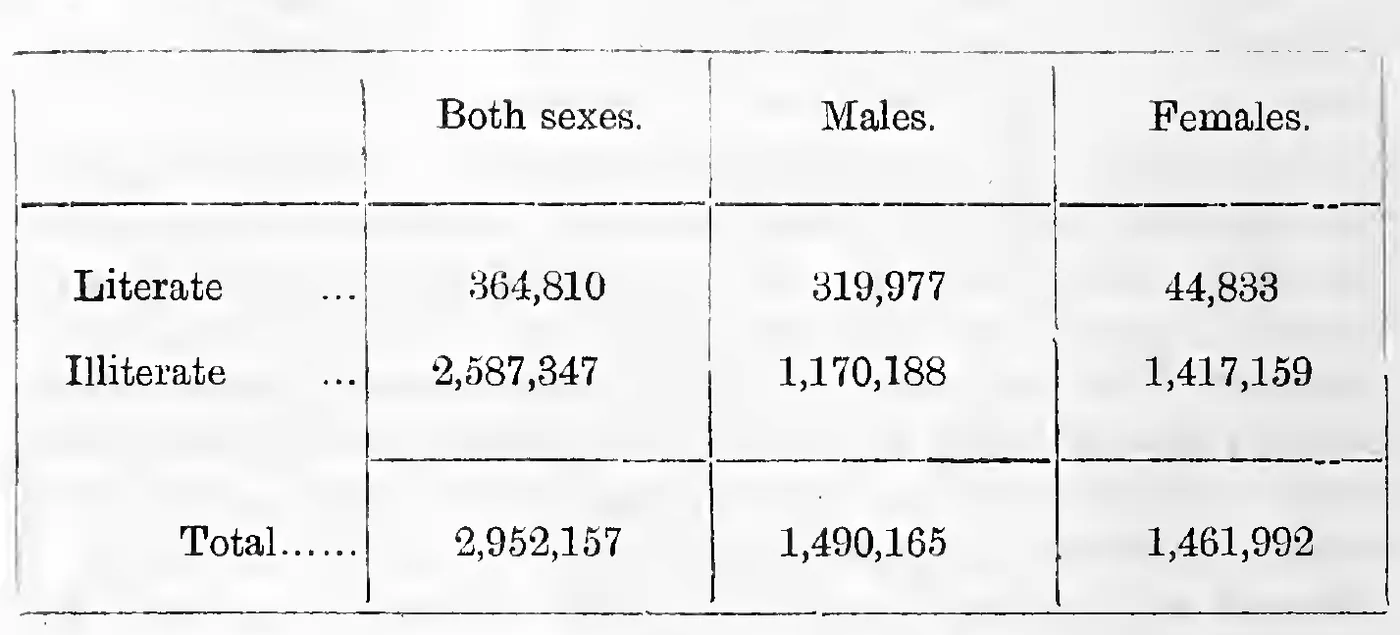
Compared with other States and Provinces, Travancore occupies the first rank in respect of the total population of literates. While Travancore returns one literate for every 8 persons, Baroda returns one for every 12 persons and the Bombay Presidency one for every 14 persons only; in the Madras Presidency the return is lower still, only 6·3 per cent of the population being able to read and write. In respect of female education, too, Travancore holds the same position; even Bombay, the leading Province in point of education, returns only 1·1 per cent. But in English education she is superseded by Ajmere-Merwara and Bombay and equals Madras and Mysore all others coming behind.
The following Table indicates the literacy of the general population by age and sex:—
[33]
K. Literacy by Age and Sex.
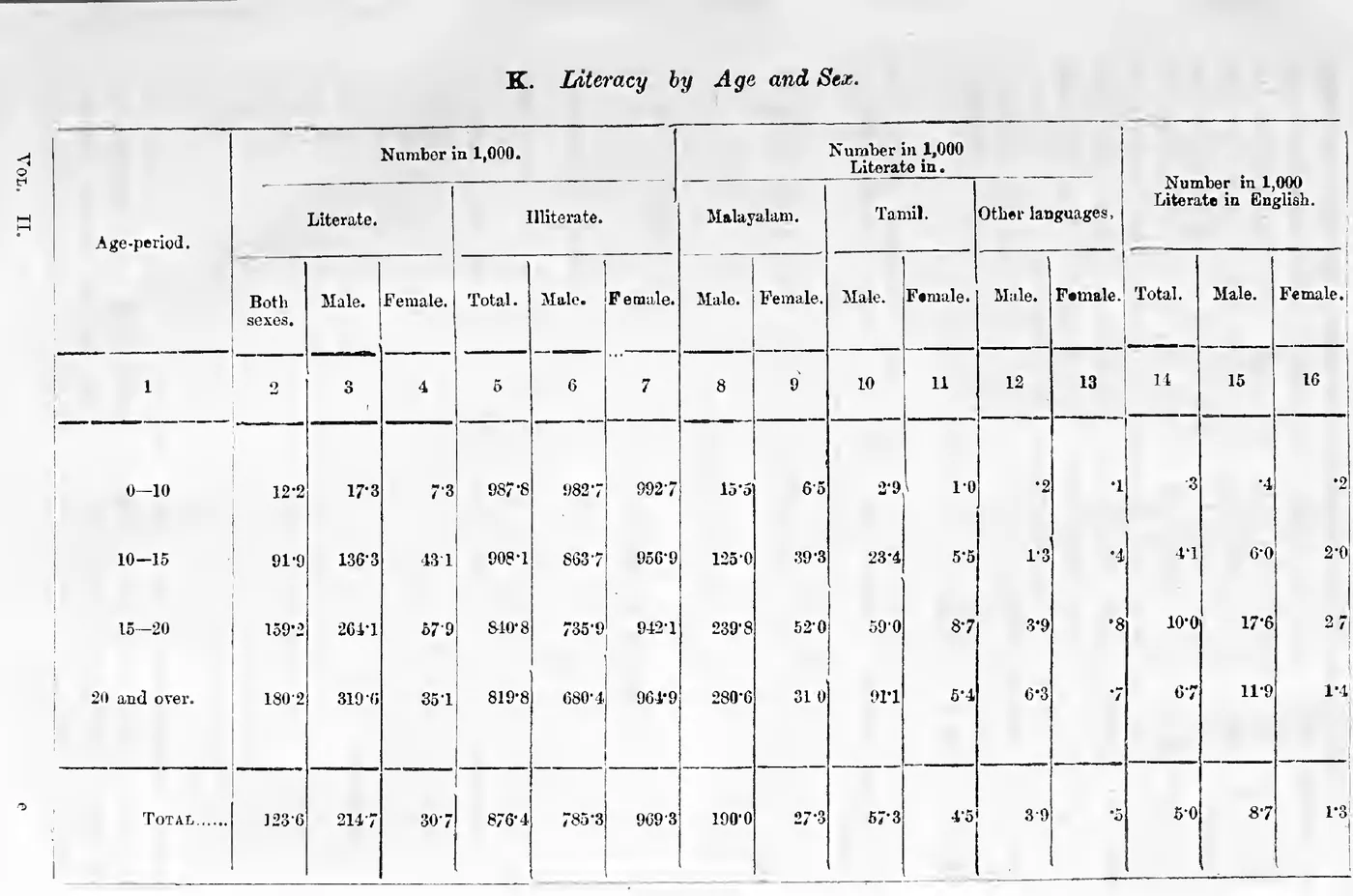
[34]A steady increase is observed at each succeeding age-period in point of literacy, the maximum literacy in both sexes taken together being found at age 20 and more, viz., 18 per cent and the minimum below 10. While in respect of males there is a gradual rise, we find that with females literacy is highest between 15 and 20, there being a sudden fall above 20. 14,869 persons are returned as possessed of literacy in English, of which 1,452 are Europeans and Eurasians. Omitting these latter there are 13,417 persons—12,196 males and 1,221 females who can read and write English. In other words, about 99·2 per cent of the males are entirely ignorant of English, while among the females only one in every 1,000 of the entire population can read and write that language. Among the Vernaculars Malayalam of course claims the largest number of literates, 190 males and 27·3 females for every 1,000 of either sex.
Considered with reference to religion, the Christians return the largest percentage of literates, viz., 15·7, the Hindus and Mussalmans returning only 11·7 per cent and 8·6 per cent respectively.
The following Table illustrates the order of literacy among some of the important communities:—
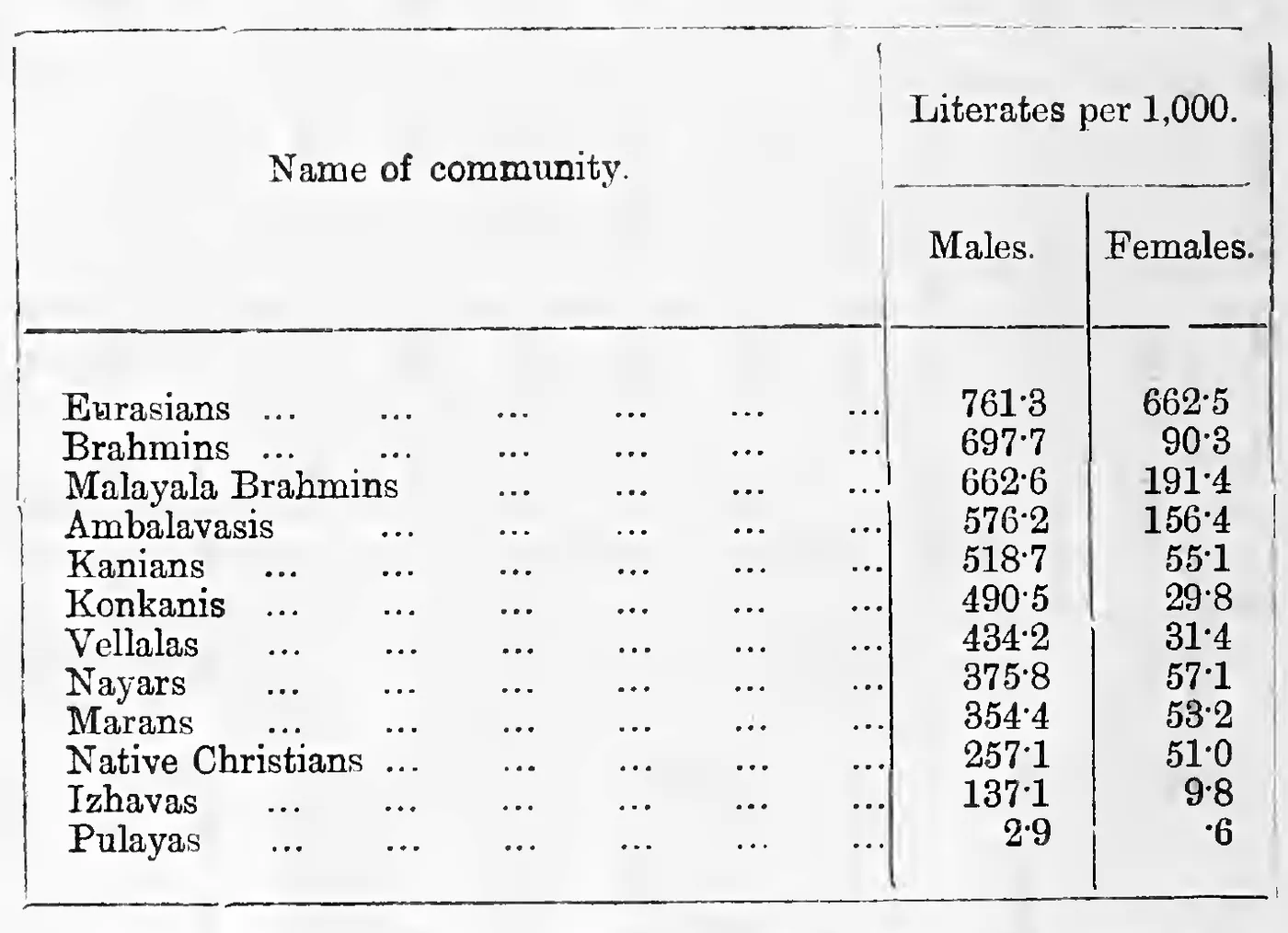
From the above we find that the Eurasians have more literates, the Brahmins come next and then come in order the Ambalavasi, Kanian, Konkani, Vellala and the Nayar. The Izhavas, a large and industrious [35]community, return 13·7 per cent male literates and ·93 per cent female; while the Pulayas are the most backward community in point of education.
Distributed among Taluqs, Kottayam returns the highest average, viz., 36·8 per cent of the male population, Tiruvalla and Minachil coming close to it with 35·6 per cent and 34·5 per cent respectively. In point of female education Parur is the most advanced where there are only 13 illiterates to one literate. Kottayam and Changanachery come second with 16 illiterates, while the least advanced Taluq is Shencottah where there is only one female literate for every 125 of her sex.
Occupation. The total population is grouped under eight main classes which are divided into twenty-four orders and seventy-nine sub-orders. The following statement shows the distribution of population under the main groups:—
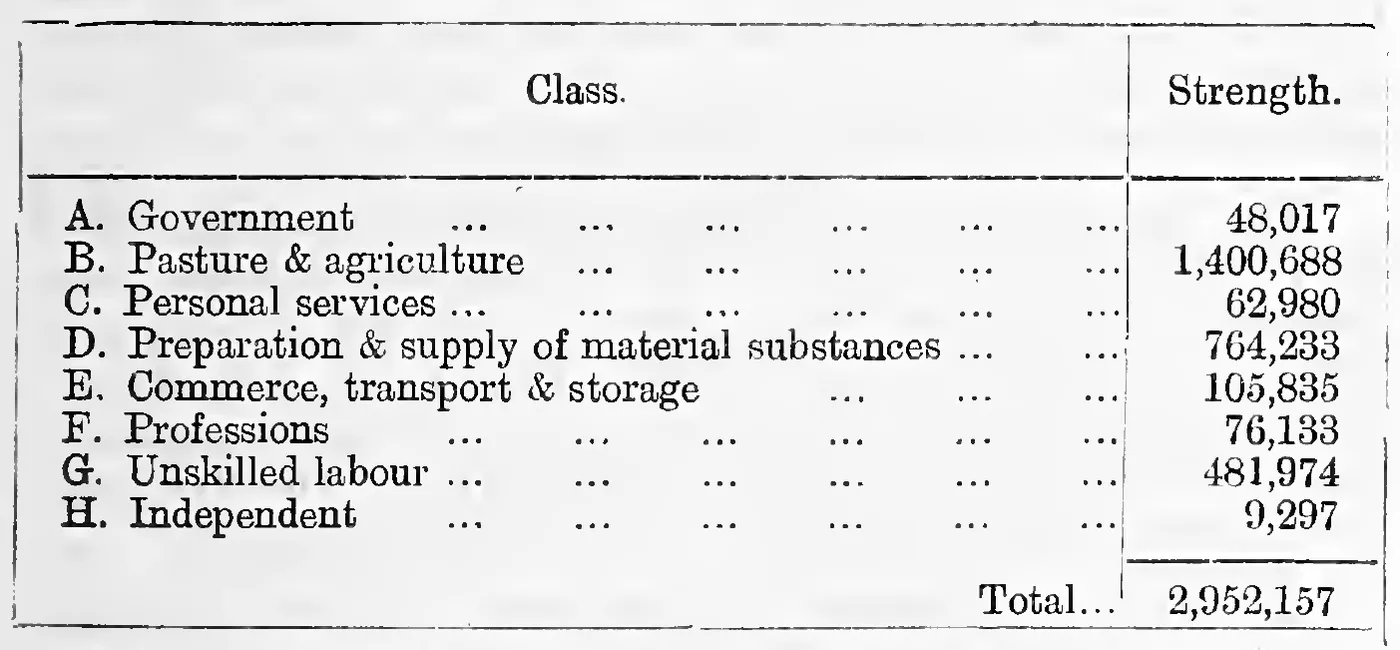
Pasture and agriculture claim the largest number, viz., 47·4 per cent of the total population. Of this 37·1 per cent are either landholders or tenants and the rest are field labourers or growers of special products. The importance of agriculture in Travancore may be judged by the fact that as many as 1,392,712 persons or 47·2 per cent of the total population subsist almost exclusively by it. Next come those who subsist by the preparation and supply of material substances, mostly the raw products of the earth lightly worked upon and relating to the absolute necessaries of life. These return 25·9 per cent of the population. The low percentage returned as engaged in commerce (2 %) leads us to the conclusion that commerce is still in its infancy and that the commercial spirit sadly lacks development. The actual number supported by it is only 78,140, the rest being engaged in transport and storage. The learned and artistic professions take up 2 per cent of the people and Government 1·6 per cent. Of the total population 43 per cent are actual workers and the remaining 57 per cent depend on them for [36]their sustenance. Taking the actual workers by sex, 403,528 or 32 per cent are females, and these are most numerous in class D (preparation and supply of material substances).
Concluding remarks. On the whole the Census of 1901 records a highly satisfactory state of affairs. In respect of education Travancore claims the foremost rank among all the States and Provinces of India; the total number of persons under instruction for 1080 M. E. (1904-1905 A. D.) was 195,999, i. e., the percentage of total population under instruction was 6·6 and of this 76·6 per cent were boys and 23·4 per cent were girls. It compares very favourably with 1·99 in Mysore, 3·0 in all British India, 3·09 in Madras, 4·0 in Bengal and 6·2 in Bombay. As we have already seen, in respect of female education, too, Travancore stands first, female literacy in Travancore being thrice that of Bombay, the most advanced Province of British India. Considering the large number of schools maintained by Government and the still larger number receiving grants-in-aid, Travancore is destined to rise still higher in the scale.
The figures under civil condition also present encouraging features. Early marriage and child-widowhood that are the bane of Hindu society elsewhere are comparatively rare. Here a greater latitude exists to the females of the Marumakkathayam people who make their own choice of husbands and among whom social restrictions are less severe as compared with the Makkathayam populations of the East Coast. The Marumakkathayam people form the majority of the Travancore population.
The very large percentage of the Christian population points conclusively to the religious tolerance of our ancient kings. The spirit of commercial and industrial enterprise is still in its infant stage, but with the lapse of time and higher educational achievements better results may be expected.
[37]
Chapter VIIIReligion.
"For modes of faith let graceless zealots fight:
His can't be wrong whose life is in the right."
Pope.
General remarks. Religious worship in its primitive simplicity still obtains in a variety of forms in Travancore. The worship of the unseen powers of Nature, of plants and animals, and of demons and the manes of ancestors are to be found here side by side with the higher forms of Hindu faith. The people of the country are, as a class, extremely conservative in their nature and this is specially noticeable in their religious forms and observances. Hinduism, the religion of the State, is coeval with the colonisation of the country by the Brahmin sage and warrior Parasurama, and has long remained untainted by foreign influences. Isolated as the country has been from the rest of the Peninsula both by its physical barriers and national peculiarities, Travancore has escaped the successive waves of foreign domination which have passed over the rest of the Indian continent working rack and ruin. But in the field of religion, missionaries of all creeds have exploited the country and always found in it a welcome home. They have lived and worked among the people, have exercised considerable influence over them for ages past and have left behind them monuments which will probably survive to the end of time. It is certainly remarkable that from the earliest periods of the history of Travancore, the Hindu, the Mussalman and the Christian have all equally enjoyed the protection, the friendship and the sympathy of the Native Government, while, on their part, they have all willingly laboured for the well-being and prosperity of the commonwealth without any of those fanatical outbursts of bigotry or the unpleasant asperities and collisions, that have disfigured and disturbed the friendly relationship of their co-religionists elsewhere. This happy co-existence of the different sects of the population in spite of the diversity of their creeds is attributable chiefly to the universal tolerance and charity practised by the sovereigns of Travancore, who have always striven "to show consideration to the low, and equity and tolerance to all." This harmonious co-operation existing among the [38]different religionists extends also to the subsects under each religion. Among the Hindus especially, sectarianism is rarely met with and the fresh orthodox Brahmin immigrant from the East Coast finds here little of those petty jealousies and schisms for subtle differences in the forms of worship, for priority in the administration of the holy water (Theertham) and for a host of other minor details, which play so conspicuous a part in his own country. Here the learned Nambudiri or the cultured Nayar does not take an exclusive or bigoted sectarian view in regard to the conceptions and worship of the various forms of the one Supreme deity. The former are generally worshippers of Siva but not to the exclusion of Vishnu. They have also temples dedicated to Krishna, Narasimha, Bhagavati, Sasta and rarely perhaps also to Brahma. So are the other castes. Again the large number of pagodas under Sirkar and private management—some renowned for their great age and sanctity, the munificent endowments attached to them and the zeal and regularity with which the several rituals and ceremonies prescribed from the earliest times are still conducted, amply testify to the religious sentiments of the rulers and the ruled and the interest they both evince in the preservation of their ancient institutions and forms of worship.
Return of Religions. Nine religions have been returned in the last Census, of which only four call for special remark, viz.,
- Animism ... ·95 per cent of the total population.
- Hinduism ... 68·95 per cent do. do.
- Mahomedanism ... 6·45 per cent do. do.
- Christianity ... 23·62 per cent do. do.
An account of the population classified according to religions has already been given in the previous chapter.
[39]
Section A.—Hinduism.
"Who is the God to whom we shall offer sacrifice?
He who gives breath, He who gives strength, whose command
All the bright gods revere, whose shadow is immortal,
Whose shadow is death... ... ... ...
He who by His sun first looked even over the waters
Which held power, and generated the sacrifice,
He who alone is God above all gods."
(Rig Veda).
"Though from thy grasp all worldly things should flee,
Grieve not for them, for they are nothing worth.
And though a world in thy possession be,
Joy not, for worthless are the things of earth.
Since to that better world 'tis given to thee,
To pass, speed on, for this is nothing worth."
The Fables of Bidpai.
Hinduism is a very comprehensive term and has many shades and degrees of varying hues in it ranging from Brahminism, the highest, the purest and the most philosophical form of theism, to the fetish worship of the aboriginal castes, which is religion of the crudest type imaginable. One such shade is Animism and it would be a mistake to treat it as a separate religion.
Animism. It was only recently, when the study of comparative religions by eminent Western scholars revealed the similarities and differences between the various branches of the world's faith, that Animism has been taken out from the general category of Hinduism and assigned a distinct place in the religious systems of India. In the Census of 1891, there was no separate numbering of the Animists as apart from the Hindus. An attempt has however been made in the Census of 1901, but the figures returned cannot be taken as quite correct, considering that no clear line of demarcation could be drawn between the Animists and the Hindus, and a correct classification of overlapping religions was naturally too much for the ordinary enumerator.
Animism is an exceedingly crude form of religion in which magic or the propitiation of the unknown predominates. It is considered as the oldest of religions or as preceding the beginnings of religions strictly so called. In its full development it includes the belief in souls, in a future state, and in controlling deities and subordinate spirits. According to Professor Tiele of Leyden, "Animism is the belief in the existence of souls or spirits of which only the powerful—those on which man feels himself dependent, and before which he stands in awe—acquire the rank of divine beings and become objects of worship. These spirits are conceived as [40]moving freely through earth and air and either of their own accord, or because conjured by some spell, and thus under compulsion appearing to men (Spiritism). But they may also take up their abode, either permanently or temporarily in some object, whether lifeless or living it matters not and this object as endowed with higher power is then worshipped or employed to protect individuals or communities (Fetishism.)." It differs from Fetishism to which in point of ceremonial it seems to bear a close resemblance, in that "whereas in the former the objects of worship are the unknown powers, impersonal and elemental in their character, abiding in some material objects but capable of detaching themselves from them, the latter consists in the worship of tangible inanimate objects believed to possess in themselves some kind of mysterious power." What the Animist worships and seeks, by all means, to influence and conciliate is the "shifting and shadowy company of unknown powers or influences making for evil". Both Animistic and Fetish ideas have entered largely into the popular conceptions of Hinduism, and Animistic tribes have in their turn adopted some of the rituals and forms of Hindu worship.
Indeed in the enormous range of beliefs, practices, religious usages and philosophical ideals which are included in the term Hinduism, it is impossible to draw a clear line of distinction between Hinduism and Animism. As a result of his attempt to arrive at some definiteness in this direction, Mr. H. H. Risely, I. C. S., is only able to say that "Hinduism is Animism more or less transformed by the philosophy," and he assigns to the latter religion the lowest place in Hinduism. In such circumstances to say that Animism is a distinct religion is to create a distinction where none really exists, and the results of the last Census in view of such impossible distinctions cannot be of much value. If, however, the distinction should be retained, then the hill tribes of Travancore, generally, and the Kanikkars in particular among them, may be regarded as Animists for the reason that they believe only in certain souls that have powers over them and have hardly any conception of a Supreme Being presiding over the universe. They worship three kinds of deities, viz., Spirits, minor divinities and superior divinities.
The spirits worshipped are known as Chavu or Chavar (literally death or the dead), whose aid is always piously invoked by the hill tribes when oppressed by disease or starvation. They are of two classes, (1) those who have met with violent deaths as Anachavu or Pulichavu (death caused by an elephant or tiger), and (2) those who have died before the age of seven. Whenever any calamity befalls a family, all the members assemble and pray to their deceased ancestors to avert it, each of them repeating [41]a long list of the names with vehemence and fervour. Similar propitiation of the Chavars is resorted to before felling trees in the forest, at the beginning of the cultivation season and at the time of harvest. Even the places where any of their ancestors may have met with death are approached only with reverence and awe.
The minor deities are known by the names of Madasami and Karuppasami, &c. These have neither priests nor temples. The offerings which include animal sacrifices and intoxicating drinks are made by the eldest member present, and certain forests and trees are taken to be the abode of particular deities.
Among the superior divinities, only Sasta and Bhagavati are worshipped. The former is looked upon as a beneficent deity ever ready to do good to his devotees and is hence more largely worshipped.
There is no worship of animals among them, but the elephant is held in special regard as it is considered not only sacred to Sasta but also as the very manifestation of the deity and is never molested by the hillmen. Dense groves, caverns and thick forests are always looked upon with special veneration and fear. No trees are allowed to be cut in the forests before the spirit of the forest is first propitiated. All the hill tribes especially the Kanikkars, the Mannans, the Pulayans and the Arayans worship also their weapons and tools, such as bows, knives and sickles in the month of Vrischigam (i. e., the harvest season). Sorcery and witchcraft are also very common amongst them.
Hinduism proper. The most characteristic feature of Hinduism is that a Hindu is born not made. No amount of confessions or expiatory ceremonies can convert a non-Hindu into a Hindu. This is true of all the castes of Hindus. Still it is a very cosmopolitan religion affording within it shelter for free thought and action to all shades of people. It has survived successive shocks from conflict with diverse and more powerful creeds, such as Buddhism, Mahomedanism and Christianity, and still maintains its individuality by the side of the superior Western civilisation and Western science. There seems to have set in a reaction in favour of philosophic Hinduism, a Hinduism less ritual and less ceremonial than that of the mediæval ages and more akin to the simpler faith of the original Aryans.
The one noteworthy trait of the Hindu religion is that it is all-tolerant. It knows no intoleration. There is absolutely no faith or belief that it will not include within its all-embracing arms. It accepts all religions as [42]true and necessary to the progress of humanity and has no quarrel with any. It gives to every one what is suited to his mental development and places before him higher and higher ideals and leads him on through successive stages of progress to the highest that a man can attain. This cosmopolitan nature of Hinduism is admirably described by Sir Monier Williams in the following words:—
"It is a remarkable characteristic of Hinduism that it neither requires nor attempts to make converts. Nor is it by any means at present diminishing in numbers. Nor is it at present being driven off the field, as might be expected, by being brought into contact with two such proselytising religions as Christianity and Muhammedanism. On the contrary, it is at present rapidly increasing. ... ... Another characteristic of Hinduism is that it is all-receptive and all-comprehensive. It claims to be the only religion of humanity, of human nature, of the entire world. It cares not to oppose the progress of any other system. For it has no difficulty in including all other religions within its all-embracing arms and ever widening fold. And in real truth, Hinduism has something to offer which is suited to all minds. Its very strength lies in its infinite adaptability to the infinite diversity of human characters and human tendencies. It has its highly spiritual and abstract side suited to the metaphysical philosopher—its practical and concrete side suited to the man of affairs and the man of the world—its æsthetic and ceremonial side suited to the man of poetic feeling and imagination—its quiescent and contemplative side suited to the man of peace and lover of seclusion. Nay, it holds out the right hand of brotherhood to nature-worshippers, demon-worshippers, animal-worshippers, tree-worshippers and fetish worshippers." *
"It may be asserted with confidence," says an able writer in the Calcutta Review, ‡ "that throughout the long Vedic, proto-Brahminical, Buddhistic and Neo-Brahminical periods of the religions of India, independence of enquiry, extreme latitudinarianism, philosophic atheism and unbounded tolerance have been the rule and the practice." In European countries they are only now reaching that level of imperial tolerance in matters of religious belief which the Hindus have ever professed and practised for centuries towards other religionists, being by nature and creed entirely opposed to the spirit of propagandism which has been the main motive power of the progress of the other religions of the world. The one distinctive peculiarity of the Hindu religion is that it traces it to no particular founder like Mahomet or Christ, Buddha or Confucius, as in the case of other religions. The Hindu religion is absolutely impersonal. It has in its course of evolution from nature worship to its present form passed through various phases, has come in contact with all the other religions of the world and has imbibed something from all. It is in fact "all-tolerant, all-compliant, all-comprehensive, all-absorbing".
* Brahmanism and Hinduism—Preface. Page xi.
‡ Vol LXVI, January 1878. Page 191.
[43]Hence it has been found difficult to exactly define what Hinduism means. It has been defined only negatively as "including the beliefs of all natives of India, who are not either Mussalmans, Christians, Jains, Sikhs or Buddhists". One definition of it is that it means "the religious doctrines and rites of the Hindus". But this does not help us to understand what Hinduism is. As a term of religious significance, the word "Hindu" is restricted to the followers of the Vedas in which are included the Puranas and Itihasas which together go by the name of the fifth Veda. Hence Hinduism may be taken to mean the religious beliefs, doctrines, rites, and codes or rules of conduct contained in the Vedas, Smritis, Puranas, Itihasas, &c., and all those who follow the authority of these are Hindus.
Hinduism is synonymous with orthodox Brahminism in its widest sense, and the different castes of Hindus other than Brahmins aspire to come up to their level in belief and ritual by closely imitating them in their observances, such as the donning of the sacred thread, early bath, wearing caste-marks, dress, prayers, higher studies and the like. What then is orthodox Brahminism? It is easier to point out one hundred orthodox Brahmins in a town or village than to define what orthodox Brahminism is. Then again Brahminism is only of later growth. The earliest form of the Hindu religion was the simple Vedic faith which consisted in the worship of the elemental gods. The clear blue sky, the glorious dawn, the magnificent and resplendent sun, the all-pervading air, the indispensable fire, the mighty sea, the storms, thunder and lightning which strike awe and terror into the primitive man's breast, the beneficent rain which gladdens all animal creation and clothes the earth with green verdure and fills it with plenty; these were the gods worshipped in the early Vedic age. Singing of hymns and the offer of sacrifices formed the essentials of worship. As observed by Mr. Romesh Chunder Dutt, C. I. E., "The conception of nature gods and the simple and manly fervency with which they were adored, argue the simplicity and vigour of a manly conquering race, as well as the culture and thoughtfulness of a people who had already made a considerable progress in civilization. The very conception of the Vedic gods argues an elevated sentiment, a high tone of morality in the men who conceived such deities." * At this time sacrifices constituted the main creed of Hinduism. Every householder lighted the sacrificial fire in his own house and made offerings to it. There was then no priestly class as such. Every one was himself the warrior, the priest and the cultivator. But in course of time the sacrifices increased not merely in number but also in their elaboration of ritual. Religion [44]degenerated into mere ceremonial observance with the majority of the people; then the priestly class arose, and through their example and influence religion came to control every phase of existence from birth to death. Even during the time of the simple and pure Vedic faith, there were a few souls who rose higher than the level of their fellows and boldly declared that the different gods were but different manifestations or different names of the one Supreme Being. Now under the altered circumstances when with the multitude religion was little more than the observance of unmeaning ceremonies, books of elaborate ritual sprang up by the side of books of bold freethinking. Outward form was more valued than inner worth with the result that the ignorant classes became more and more ignorant and superstition-ridden. The more sensible began to feel dissatisfied with the current religious ideas and tendencies and to care more for divine contemplation and practical moral virtues as opposed to the extravagances of sacrifices. There was a deep-seated longing for change or purification of the existing system of religious worship. It was at this time that Buddhism came into the world. "The teaching of Gautama was but a developed form of the thoughts and theories found in the Upanishads with the freshness and vigour of his own humanity and zeal added to them." * Buddha preached against animal sacrifices and pleaded for mercy towards all living beings. His earnest exhortation for practising righteousness and self-renunciation, his message to the people in their own vernaculars and his able advocacy for the abolition of caste made his religion very popular, and it spread with electric speed. But in the course of a few years the new religion degenerated and became rigid and corrupted. "Gross idolatry in practice, formal atheism in doctrine, a regular army of monks and nuns everywhere eating up the substance of the industrious and charged with the worst evils of decayed monasticism, were only a few of its bad features." *
* Ancient India.—R. C. Dutt, Vol. I. Page 137.
In the meantime the Hindus, i. e., such of them as had remained in their old faith had become split up into a large number of sects, each intolerant of the other and a few charged with very detestable practices and observances. There was discord and dissatisfaction all round and an intense desire to revert to the good old days of pure and simple Vedic faith. In this jumble of religions and creeds, a unifying influence was sorely needed, and to Travancore belongs the credit of having supplied a great and illustrious philosopher and reformer, who overcame the alien faith, evolved order out of chaos and brought together the straggling herds of diverse and [45]opposing sects into one harmonious whole. Sankara's philosophy is known as the Vedanta and will be dealt with later on. It is enough to say here that Sankara is followed by a majority of the Brahmins forming a distinct division under the name of Smartas. It is due chiefly to Sankara's labours that Buddhism in its grosser form lost its hold on India—the land of its birth, and Hinduism was reformed and re-established on a firm basis.
* Life and Times of Sankara—C. N. Krishnaswamy Iyer, M. A., L. T.
In spite of the welding together of a large number of people into one mass, the people continued, however, to follow diverse creeds and to perform countless ceremonies, sacrifices and rites which it is as difficult to account for as to follow to their very letter in the altered circumstances of the present day. Nothing could therefore be postulated definitely as to what constitutes Hinduism. The religion of the Hindus, as now practised, means and includes as its characteristic features distinguishing it from other religions:—
The study of, and a belief in, the Vedas and the Smritis; the observance of the Shodasakriyas (sixteen ceremonials or rites); worship of gods and goddesses in temples; belief in incarnations of the godhead, in visits to places of pilgrimage, in bathing in holy waters and in daily bathing itself, in expiatory and propitiatory ceremonies, in mantras, fasts, and feasts; caste distinctions; propitiation of the manes of ancestors; belief in the transmigration of souls and the Law of Karma; belief in the efficacy of danams (gifts) and charities; strict conformity to orthodox usages, descending to such minutiæ as forms of dress among men and women, wearing of the sacred thread, caste-marks, ideas of holiness and pollution, peculiarities of diet, abhorrence to take animal life, and special veneration for the cow; belief in omens, in good and bad days; belief in horoscopy, and astrology, and all other observances or forms of conduct prescribed in the Hindu scriptures or followed by orthodox Hindus.
The Vedas and other Hindu Scriptures. It may not be inappropriate to give here a short abstract of the scriptures which the Hindus consider binding on them. No other race in the world has shown more reverence to the past than that branch of the Aryan family that had settled down in India centuries ago and had attained to a marvellous development of knowledge in several of its departments, which is so well attested to by the extent and quality of their scriptures and literature. The love of the past and reverence to ancestors have not borne better fruit in any other part of the world than in this land of the Vedas. [46]Man's first prayers and hymns to the several manifested forces of nature culminating in the idea of one Supreme God above all other gods was neither so happily conceived nor so beautifully expressed and handed down to any other nation in the world by its ancestors as had been done by means of oral tradition to the Brahmin by his Aryan forefathers. If there is anything in India of which she may be rightly proud, it is that she has, by her habit of revering the past and collecting the ancient wisdom, built the most magnificent edifice to the memory of this wonderful race in the form of the Vedas.
The term Veda (from विद्, to know) is defined as 'knowledge' or (sacred) 'lore' embracing a body of writings the origin of which is ascribed to divine revelation. The Veda is called Sruti (literally, that which was heard), and forms the foundation of the Brahminical system of religious belief. These sacred canons are divided into three, and according to a later scheme, into four co-ordinate collections likewise called Vedas. These are:—
- (1) The Rig Veda, the lore of hymns,
- (2) The Yajur Veda, the lore of prayer,
- (3) The Sama Veda, the lore of chants, and
- (4) The Atharva Veda or the lore of Atharvan who was appointed by Brahma to protect inferior beings.
The Rig Veda is considered to be the most ancient and the Atharva the latest of the four Vedas. According to Sir William Jones, it is at least 1,500 years older than Christianity though some of the most ancient hymns must belong to the epoch when the North Pole was inhabited by human beings. The Yajus and Sama belong to a subsequent date. They are mostly reproductions of texts from the Rig Veda and are not of so much interest to the historian as the Rig Veda.
The Rig Veda is derived from a word meaning praise and it expresses the relations between man and god. The Yajus, from a root meaning 'worship,' contains instructions for sacrifices. The Sama Veda is derived from a word signifying 'a prayer arranged for singing' and contains pieces of texts arranged as chants. The fourth and the latest, the Atharva Veda, contains forms of imprecation, prayers and hymns and fifty-two theological treatises called the Upanishads. The composition of this fourth Veda is called Bhara as distinct from those of the Rig and the Yajus. It treats of the sacrifices to the fire and contains injunctions regarding the dead and what is to be done with them. The fourth Veda is not quite popular with [47]the Brahmins. The difference between the Rig and the Yajur Vedas is that while the texts of the former should not be read by using rules of Sandhi, those of the latter can. The Sama Veda is noted for its sweetness of chant.
"The state of religious thought among the ancient bards, as reflected in the hymns of the Rig Veda, is that of a worship of the grand and striking phenomena of nature regarded in the light of personal conscious beings, endowed with a power beyond the control of man, though not insensible to his praises and actions. It is a nature worship purer than that met with in any other polytheistic form of belief we are acquainted with,—a mythology still comparatively little affected by those systematising tendencies which, in a less simple and primitive state of thought, led to the construction of a well-ordered pantheon and a regular organisation of divine government. To the mind of the early Vedic worshipper the various departments of the surrounding nature are not as yet clearly defined, and the functions which he assigns to their divine representative continually flow into one another. Nor has he yet learned to care to determine the relative worth and position of the objects of his adoration; but the temporary influence of the phenomenon to which he addresses his praises bears too strongly upon his mind to consider the claims of rival power to which at other times he is wont to look up with equal feelings of awe and reverence. It is this immediateness of impulse under which the human mind in its infancy strives to give utterance to its emotions that imparts to many of its outpourings the ring of monotheistic fervour." *
The Vedas are subdivided into what are termed (1) the Samhitas or collections of Vedic hymns, (2) the Brahmanas and (3) the Upanishads. Every Veda has its Samhitas or collections of hymns and prayers to the gods, its Brahmanas and its Upanishads. The Brahmanas are the parts of the Vedas written in prose and added to the Samhitas in later years and are devoted to pure teaching of the religion by describing the customs, sacrifices and ceremonies to the people. The Upanishads (literally, something that underlies) are portions of the Vedas that are argumentative and philosophical in their nature and are of later growth than the Brahmanas. They form the basis of all the subsequent philosophical speculations of the Hindus.
The Vedic literature continued with changes of style and development of thought in its course for several centuries till at last it reached the Sutra period when brevity was considered the most important virtue in writing. The Sutra period extended from B. C. 600 to B. C. 200.
Besides these divisions, subdivisions of the four Vedas were drawn from them, four Upavedas; one on Medicine from the Rig Veda, one on Arms and implements of war from the Yajur Veda, one on Music from the Sama Veda and one on the sixty-four Mechanical arts from the Atharva Veda. This marks the subsequent development and further classification of [48]knowledge as time went on. These Upavedas are all now lost. Subsequently were formed six Vedangas or 'limbs of the Vedas' to interpret the sacred scriptures. They were Pronunciation, Grammar, Prosody, Explanation of difficult words or phrases, religious and ceremonial, and Astrology. Subsequently were added to these four Upangas or additional limbs, viz., History (Purana), Logic (Nyaya), Moral philosophy (Mimamsa) and Jurisprudence (Dharma Sastras).
* Encyclopædia Britannica, Vol. IV. Page 202.
Thus with the advance of time knowledge increased, and along with the increase of knowledge, set in, as is natural everywhere, a strong tendency to systematise that knowledge, and Sutras came to be written for all branches of science. Thus from the ancient lore handed down by oral tradition for centuries past were formed the treatises on the several departments of human experience which known as the Vedas and the limbs of the Vedas formed the body of 'divine revelation', so called out of the natural reverence and gratitude which the Aryans felt for their great ancestral benefactors and for the knowledge they bequeathed.
The Puranas of the Hindus form one of the Upangas of the Vedas. They have taken up as their theme the deeds of heroes and gods which must have been handed down to their authors by oral tradition. The term Purana signifying 'old' applied originally to prehistoric or cosmogonic legends and then to collections of ancient traditions generally. But the existing works though regarded very ancient are all productions of much later years. They all recognise the Brahminical doctrine of Trimurti or the triple manifestation of the deity.
The Puranas are eighteen in number, besides several works of a similar class, called Upa-Puranas or minor Puranas of which also there are eighteen. The Puranas are:—Brahma, Padma, Vishnu, Siva, Bhagavata, Narada, Markandeya, Agni, Bhavishyat, Brahma Vaivarta, Linga, Varaha, Skanda, Vamana, Kurma, Matsya, Garuda, and Brahmanda.
The Mahabharata and the Ramayana, the two grand epics of the Hindus, are called the Itihasas or Bhakti Sastras. They are also termed as Maha-Puranas. These are older than the eighteen Puranas mentioned above. They are held in the highest veneration by the Hindus. They are also called sometimes the fifth Veda.
The Dharma Sastras or Jurisprudence of the Hindus form one of the Upangas of the Vedas. They are derived from the Vedas and are said to have been composed by twenty sons of Brahma. They are classed as Smritis and their authors called Smriti-kartas:—They are Apastamba, Parasara, Satatapa, Samvarta, Daksha, Vasishta, Angiras, Yama, Vishnu, [49]Manu, Yajnyavalkya, Atri, Harita, Likhita, Sankha, Gautama, Brihaspati, Katyayana, Vyasa, and Usanas. Of these, Manu and Yajnyavalkya are the most important, the modern Hindu Law being based upon their works.
The later Hinduism with its six schools of philosophy are considered as but the result of the development of the subtle portion of the Vedas, the Upanishads and the Aranyakas through the labours of great philosophers, the scriptures continuing to have their authority throughout for all times.
Hindu worship. The one Supreme Being is worshipped in three aspects as Brahma, Vishnu and Siva, representing respectively the threefold function of Creation, Preservation and Destruction (Srishti, Sthiti and Samhara). These three forms of the Godhead together constitute the Trimurti or the Triad of the Hindus. According to higher conceptions of Hinduism, all the three are equal no one taking precedence over the other; their functions are sometimes interchangeable so that each may take the place of the other. Unlike in other parts of India the fullest toleration is observed in the matter of worship in Travancore, the worship of Siva being considered of as much importance as that of Vishnu.
Brahma. The Creative principle is the first in the Hindu Trinity. Along with Vishnu and Siva, Brahma forms the Trimurti or the triune aspect of the Hindu godhead. Brahma has no temples anywhere in Travancore set apart for his exclusive worship, as he generally figures only as one of the Trimurtis. There are temples to Brahma attached to those of Vishnu and Siva, at Kuzhittura, Tiruvallam and Valia Chalai. At Mitranandapuram, inside the Trivandrum Fort, however, a small temple is built specially dedicated to Brahma. This is the exception not the rule. On the margin of the sacred lake Pushkara near Ajmere, there stands one temple to Brahma and another at Idor; thus there are only three temples dedicated to Brahma throughout India. The absence of Brahma temples in this age (Kaliyuga) is attributed to the incapacity of the masses to understand the creative principle in the godhead. Sir W. W. Hunter writes:—"Brahma, the Creator, was too abstract an idea to be a popular god." With regard to this statement I have only to observe that there is no more capacity in the masses to understand either the preserving or the destroying principles in the godhead, Vishnu and Siva, a whit better than the creative principle. This truth is forcibly brought out in Kalidasa's Kumara Sambhava thus:—
[50]
"In those the Persons the one God was shown—
Each first in place, each last—not one alone;
Of Siva, Vishnu, Brahma, each may be
First, second, third among the blessed Three."
(Griffith's Translation).
Vishnu. The Preserving principle of the universe is the most popular of the triad, and the most human in character, attributes and sympathies. He is generally represented in an ordinary human form with four hands, one of which holds the club, another the Chakram (circular missile weapon with pointed edges), the third the lotus or the emblem of creation, and the fourth the Sankha or conch-shell. This last is the national emblem of Travancore. The ten incarnations or Avatars of Vishnu undertaken with the express object of delivering the world from the threefold miseries of life, (1) from the diseases incident to the body and mind, such as result from lust, anger, avarice, &c., (2) from the miseries inflicted by material environment—by beasts, snakes, wicked men, &c., and (3) from those due to the influence of unseen demoniac agencies, are all too well known to need any detailed description here. In Travancore, Vishnu is worshipped as the national deity. There are about fifteen chief temples dedicated to Vishnu of which the most important is that of Sri Padmanabha in the capital. Here the deity is represented in a reclining posture upon a huge snake coiled up to form a couch and stretching its several heads upwards as a canopy over him. The temple at Tiruvattar of Adikesava Perumal is of great sanctity and age. Another important and very ancient temple is that at Varkala where the god is worshipped under the name of Janardana.
Siva. Siva is the third of the Triad. He represents the twofold character of the Destroyer and Regenerator. He is represented at different times in a variety of forms and his functions are said to be innumerable and his nature all-comprehensive. He is called Mahadeva (the Great God), Samba (the Auspicious), Isvara (the Supreme Being), Digambara (One whose clothing is space only), Ardhanarisvara (God whose half is woman), symbolical of "duality and unity of the generative act and production of the universe from the union of the two eternal elements, Prakriti and Purusha, Maya and Brahmam". He is also the typical ascetic and self-mortifier who has attained the highest perfection by abstract meditation and austerity, in which character he teaches men by his own example that the power to be acquired by mortification of the body, suppression of the passions, and abstract contemplation leads to the loftiest spiritual knowledge and ultimately to effect union with himself in Kailasa the celestial abode.
[51]The Lingam or phallus, with its usual accompaniment, is now the universal and sole emblem of Siva worship. There are in Travancore nearly twenty famous Siva temples, of which those of Stanumurti in Suchindram, and of Mahaveda in Vaikam and Ettumanur are the most important.
Tutelary deities. Besides the three superior divinities named above, there are many others allied to them, to whom unquestioned homage is paid by the higher castes of the Hindus. These are Vighnesvara, Subrahmanya, Sasta or Aiyappan, Hanuman, and Bhagavati. These are held in great veneration and regularly worshipped by the whole people.
Ganesa or Vighnesvara is the most popular god worshipped by the Saivites. He is the eldest son of Siva. Small images of Ganesa may be seen in temples dedicated to Siva, while there are many specially erected for him. Vighnesvara means 'Remover of obstacles' and his blessings are invoked for success in the performances of religious acts, and in fact before beginning any undertaking. He is looked upon as an embodiment of sagacity, shrewdness, patience and self-reliance, all those qualities that lead to success in life. Hence his extreme popularity. Every Indian book opens with the words Ganesaya Namah, and it may be noted that here in Travancore the children on being put to school begin with the invocation, Harih Sri Ganapataye Namah instead of Om Namo Narayanaya, as in the Tamil districts. There are what are called Homapuras in Travancore, where Homams or sacrifices are daily offered to Ganesa for the prosperity of the country. It has been already observed in an earlier chapter that Ganapati-Homam was introduced into Kerala by Parasurama. This Homam is daily carried on in every Nambudiri's house and in all well-to-do Nayar houses in North Travancore. On particular days sacred to Ganesa and on days on which they choose to do so, they perform special Homams to propitiate the god. Endowments have been made to maintain these institutions, and in every Homapura the Potti or priest appointed by Government performs every morning the said Homam and distributes the rice and sweetmeats left after the offering, among the children of the village that come from the neighbouring houses. The Homa-Kundham or pit for the sacrifice is about 4 ft. × 2 ft. × 2 ft., and is made in the central part of the room called Homapura. Fire is lit in the pit with dried jack wood and cocoanut husks, and the sacrifice consists in throwing the rice, fried rice, cocoanuts, plantain fruits, sugar-cane, sugar, honey, ghee and sweetmeats &c., into the fire, which [52]offering propitiates Ganapati or the Belly-god. The throwing of the victuals is accompanied by the recitation of Mantras. I have sometimes sat on the pyalls of Nambudiri Illams just outside the Homapura and have often wondered at the genius of Parasurama who discovered this simple but marvellous disinfectant which cures the houses of the ills peculiar to this land of water and jungle. The smoke of the Ganapati-Homam fills the house with a healthy and sweet fragrance all round. The Maha-Ganapati-Homam is celebrated only at distant intervals as it involves great cost and trouble.
Subrahmanya is equally popular and may be said to be in some respects special to the Tamil and Malayalam country. He is the God of war and the leader of the celestial hosts. He is the second son of Siva and it was he who destroyed Tarakasura and his army and freed the Devas from the indescribable torments they had to suffer at their hands. He is regarded as a most beneficent deity conferring boons, protecting the helpless and avenging the wronged. The chief temples in Travancore dedicated to Subrahmanya are those at Kumara Kovil and Oollur in the south, and Haripad, Udayanapuram and Munnam in the north.
The most general form in which vows are undertaken to propitiate Subrahmanya is the Kavadi-Eduppu or carrying of Kavadi which generally consists of two pots suspended from a pole carried on the shoulder of a man; the pots are filled with milk, honey or rose-water. It is generally decorated with ornamental wood-work, tapestry and peacock-feathers. The temple of Subrahmanya at Udayanapuram, a mile north of Vaikam, now receives the largest number of Kavadi pilgrims every year, Kumara Kovil, Oollur, Kadakkavur and other temples coming next in importance. Kavadis are also carried by Travancoreans to the celebrated Subrahmanya's temples at Pazhani (Pulney) and Tiruchendur in British territory. Brahmins are sometimes hired by the other classes of people, especially the Sudras, for the purpose of carrying their Kavadi offerings. It requires a preliminary Vritam or preparation by fasts and personal purity for forty-one days for a man to carry out the Kavadi vow. During these forty-one days he should abstain from all sorts of luxury and confine himself to a sparing diet of raw-rice and fruits. On the last day the deity is invoked by means of puja and incense and on the pilgrim is placed the Kavadi which he must himself carry on his own shoulders till he reaches his destination, the journey sometimes occupying several days. Sometimes boys of six and seven years of age take Kavadis to distant places. The offering may be of any stuff which the vower fixes upon and is generally cow's milk, [53]rose-water, sandal paste, rice or other preparations or anything which happens to be the devotee's food or dainty. It is said that if the pilgrim had been pure of mind and body during his Vritam, the milk, sandal or rose-water or other things carried by him to Subrahmanya's temple as his offering would be quite fresh and pure though many days may have elapsed before he reaches the temple. But if he was impure the things intended for the god would become putrid and rotten and would not be accepted in the temples for which they were intended, and the vow is considered lost. It goes without saying that other miracles are attributed to the Kavadi carrier who has won the god's favour. For instance, he pierces his body through with the Vel * unhurt. It is believed that cooked fish taken by a vower whose devotion was unimpeachable jumped out as live fish from the Kavadi vessel when presented to the god. Similar stories are current with regard to milk or porridge or other offerings which in the ordinary course of things should have become decomposed or putrid or otherwise unserviceable.
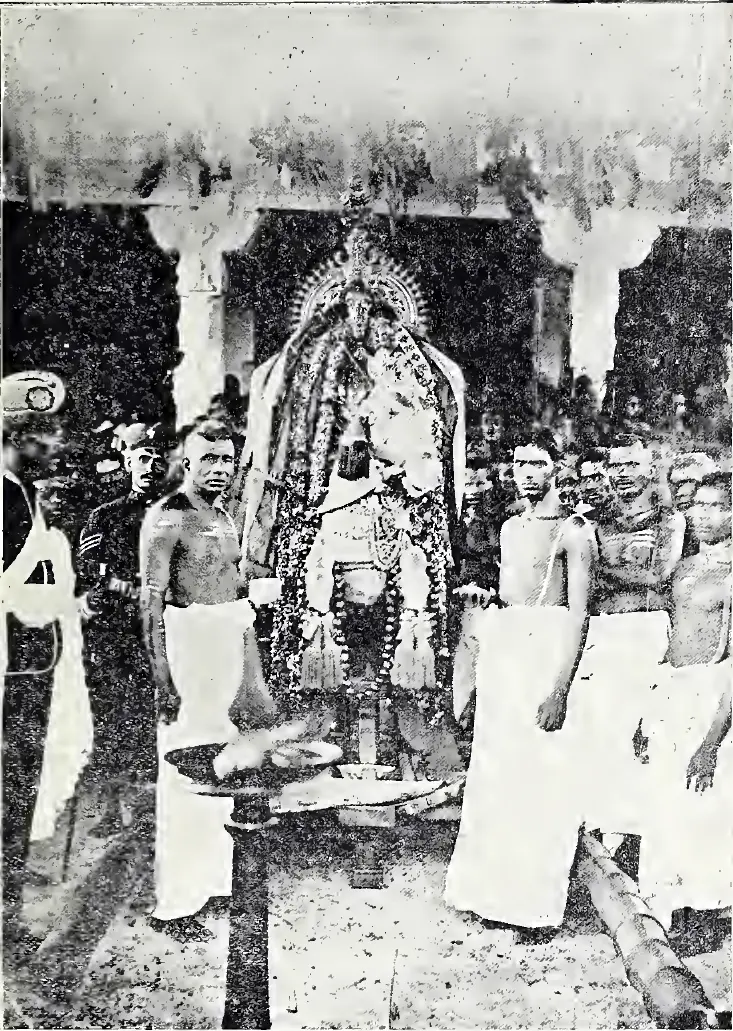
The income to these temples obtained from Kavadi pilgrims is immense.
Sasta or Aiyappan. This deity is peculiar to the extreme south of India, especially to Malabar and Travancore where he has the largest number of worshippers. According to the Keralolpatti, Parasurama with the object of guarding the newly created country, is said to have established several temples dedicated to Sasta along the Ghauts and several others to the Goddess Bhagavati along the coast. The chief temples of Sasta are those at Achankovil, Kulattupuzha, Aryankavu and Sabarimala, all situated on the Ghauts and that at Takazhi, four miles distant from the sea. The most important of these is that at Sabarimala in the Chengannur Taluq. It attracts numerous pilgrims (over 10,000) early in the month of Makaram during the annual Mandala-puja which lasts for forty-one days. The temple is situated on the summit of a high and steep hill difficult of ascent.
Bhagavati. In most of the temples dedicated to Siva, there is always an image of his consort Parvati or Durga consecrated for worship. The goddess Durga is worshipped in different localities under different manifestations. In Travancore she is worshipped under the name of Bhagavati, the supreme Parasakti of the Brahmins, and in several forms of lower divinities such as Kali, Mariamma, Mutharamman, Kanthari amman, Pitari, Yakshi, &c., by the ignorant classes. Some of the [54]important temples dedicated to Bhagavati are very ancient, tradition ascribing their origin to Parasurama himself. The chief Bhagavati temples are those at Kanyakumari (Cape Comorin), Pozhiyur, Sankumukham, Sarkara, Paravur, Anandavallisvaram, Mullakkal and Shertallay, all situated on the coast. The goddess is supposed to rule over the minor divinities or demons worshipped by the lower orders of Hindus and her presence in a village is believed to protect the people from the epidemics and other disasters, and from the evil influence of devils. She is propitiated by the villagers periodically, and special offerings and ceremonies are performed whenever cholera or small-pox breaks out appears in the village.
* A 'Vel' is a small spear said to be the weapon of the god Subrahmanya.
An important temple of this class is that at Mandaikad near Colachel where an annual festival (Kodai) is held in March in honour of the goddess to which thousands of pilgrims from all parts of Travancore and Tinnevelly resort, many of them in fulfilment of vows previously made. The last Tuesday in Kumbham is the most important day of the festival. Sacrifices of sheep and fowl form the chief feature of the worship. The goddess is held in special veneration by the Sudras, Shanars, Izhavars and other lower orders, though the higher classes (excepting the Brahmins) freely attend the festival which generally lasts ten days. Similar temples are found in several other places. According to the Census of 1891, the total number of temples dedicated to these inferior deities was 3,205, the largest numbers being returned by the Southern Taluqs of Kalkulam, Agastisvaram, Eraniel and Tovala. Among inferior divinities worshipped in Travancore are Elangah, Yakshi, Bhutathan, Shodalamadan, Nallamangai, Muppidari, Shembagavalli, Mariamman, Karuppaswami, Sangalimadan, Kanthariamman, Maragathavalli, Chamundi, &c. The worship of these deities is exclusively confined to the non-Brahmin Hindus and even here the Malayali Sudras do not revere them to the same extent as their brethren of the East Coast. It may be added that the lower orders of the Malayali population have as a rule more refined notions of orthodox Hinduism than the corresponding classes of the other coast.
In the temples of Bhagavati, Sasta or other minor divinities, there are celebrated what are called Kalamezhuttum Pattum in propitiation of them at certain periods of the year. Representations of deities are made on the floor by means of coloured powders in their respective temples and the devotees sing in praise of the deity to the accompaniment of a lute-like musical instrument sounded along with the songs. This is more common with the ignorant classes, but such festivals are not tainted with the killing of animals for sacrifice.
[55]Hanuman, the trusted servant of Rama, is a favourite of the followers of Madhvacharya, and they have a number of temples exclusively dedicated to him. But the deity always finds a place in all Vaishnavite temples.
Demon-worship, worship of inferior deities, &c. A belief in and a constant dread of the influence of demons and evil spirits on human beings have been from the earliest times an essential element of Hindu religious thought, and the worship of the tutelary deities is the outcome of this dread. Demonolatry is confined only to the lower orders and is absolutely unconnected with the higher forms of Hinduism, but a belief in the power for mischief possessed by the devils is widespread and even the Brahmins are not free from it. Demon-worship in its most conspicuous forms is found in Southern India, in Tinnevelly, Travancore, Malabar and South Canara.
In Travancore, devil-worship is most common among the Shanars and is to be found chiefly in the southern Taluqs where they live in large numbers. The spirits of depraved men or of those who have met with a violent death by drowning, hanging or other means are believed to become demons and wander about inflicting injury in various ways upon mankind. It is supposed that these having been cut short of their legitimate existence in this world before the expiry of the full period allowed them, their spirits have to spend the unexpired portion of their lives before they meet with reward or punishment adequate to their deeds. At noon as well as at midnight the devils are supposed to lie in wait for seizing or 'possessing' those who walk in lonely places or under the tamarind trees or on the shores of tanks. Iron rings, iron staffs or leather shoes are considered to afford protection against their influence. At night the devil is believed to call loudly in order to allure people out of their homes into distant jungles, there to kill them. Hence calls at night are never responded to until the fourth repetition, for devils would not call more than thrice. At the period of puberty and after childbirth women are peculiarly liable to the attacks of demons and these are the cause of convulsions and similar disorders. The sudden illnesses of children and adults are also believed to arise in the same way. The devils which have such power to afflict mankind are appeased by sacrifices and their influence averted by charms and incantations. The greater number of them are supposed to reside in trees, many are constant wanderers, while others are dwellers of houses. The trees and other places believed to be thus haunted are always approached with very great fear and none dare approach them during nights.
[56]In addition to these several precautions, the devils are also systematically worshipped especially by the ignorant classes. The following account of devil-worship is interesting:—
"The priests who officiate in the worship paid to evil spirits do not belong to any hereditary or exclusive class like that of the Brahmins. Any one, even a woman, may act as priest or devil-dancer, if they are duly inspired by the demon invoked. The 'Peycoils' or devil temples, are very numerous throughout the country. They bear no resemblance to the large Brahminical temples. Images are no essential element in demon-worship; where they are found they have been adopted from the Brahminical worship. In front of the devil temple, or sometimes without any covered edifice, there stands a small pyramidal erection or obelisk four or five feet in height, generally built of brick and stuccoed, which is always associated with this worship, and takes the place of an image. Inside some temples are placed the implements and symbols of demon-worship, dancing-sticks or wands, the priests' garments, trident, &c. In others are found one or more images of the demon to whom the temple is dedicated. The devil-dancer's garments consist of a high conical cloth cap, with tapes hanging down on either side, probably to represent long shaggy hair; a jacket with embroidered representations of devils worked in red, to denote their blood-thirsty character; and a pair of short drawers, corresponding in style, with small bells attached to the border. A thick club and long wand ornamentally painted and having iron rattles or jingling brass rings at either end, are also held in the hand while dancing; with sometimes a trident, sacrificial knife, bangles for the ankles with brass bells, and occasionally other instruments or ornaments. The principal feature of the worship consists in animal sacrifices and libations of blood. Doubtless human sacrifices were once offered; but the custom in South India now is to offer in sacrifice on important occasions, sheep, goats, fowls, and pigs. Connected with the sacrifices is devil-dancing, in which the demoniacal possession is sought. Certain ceremonies are at times observed in order to drive out and dispossess a devil, but on these occasions it is desired to bring him into the soul of the worshipper; who is then considered to become his inspired oracle and to utter prophecies and give other information for the guidance of the assembled crowd of worshippers. These more important sacrifices and festivals are held annually; or occasionally as may be considered necessary, in times of prevalent disease, or in fulfilment of vows previously made. Funds for the necessary expenses are contributed by those interested. Night is the season chosen for the principal performances and the festival usually continues for two or three days and nights. The officiating priest, whoever he may happen to be, is dressed for the occasion in the vestments and ornaments appropriate to the particular devil worshipped. The musical instruments frequently used in the devil-dance are the tom-tom or the ordinary Indian drum, and the horn, with occasionally the addition of a clarionet. But the favourite instrument is that which is called 'the bow'. A series of bells of various sizes is fastened to the frame of a huge bow, the strings are tightened so as to emit a musical note when struck, and the bow rests on a large empty brazen pot. This instrument is played on by a plectrum, and several musicians join in the performance. One strikes the string of the bow with the plectrum, another produces the bass by striking the brazen pot with his hand, and a third keeps time by a pair of cymbals. When the preparations are completed and the devil-dance is about to commence, the music is at first comparatively slow, and the dancer seems impassive and sullen, and either stands still or moves about in gloomy silence. Gradually, as the music becomes quicker and louder, his excitement begins to rise. Sometimes he [57]uses medicated draughts, cuts and lacerates his flesh till the blood flows, lashes himself with a huge whip, presses a burning torch to his breast, drinks the blood which flows from his own wounds, or drinks the blood of the sacrifice, putting the throat of the decapitated goat to his mouth. Then as if he had acquired new life, he begins to brandish his staff of bells, and to dance with a quick, but wild and unsteady step. Suddenly the afflatus descends; marked by a glare of the eye and leaps of the body. The dancer stares and gyrates. The demon has taken possession of him. Though he retains the power of utterance and of motion, both are under the demon's control, and his separate consciousness is in abeyance. The bystanders signalize the event by raising a long shout, attended with a peculiar vibratory noise, caused by the motion of the hand and tongue or the tongue alone. The devil-dancer is now worshipped as a present deity; and every bystander consults him respecting his disease, wants, the welfare of his absent relatives, the offering to be made for the accomplishment of his wishes, and in short respecting everything for which superhuman knowledge is supposed to be available." *
One of the principal devil temples is situated at Agastisvaram near Cape Comorin, the temple of Muttaramman, which is said to have been built in ten days by the aid of demons. This is also the headquarters of the Shanar tribe, where their Nadan or chieftain resides, who was formerly allowed the privileges of having a fort, of riding in a palanquin and of retaining a hundred armed attendants.
Worship of animals and plants. To a Hindu mind all organic life is sacred. Ahimsah Paramo Dharma is his creed. A true Hindu especially of the higher class abhors the idea of killing any animal even for his maintenance. Even plants are respected and some are regarded with special reverence as the abode of, or as being sacred to, particular deities. The animals that are regarded as objects of worship are the cow, the serpent, the bull and the Garuda (Brahmini Kite). The cow is Kamadhenu, the giver of all things. The serpent is worshipped as Adisesha who supports the earth and is the cot of Maha-Vishnu. The bull (Nandi) is Siva's vehicle and is therefore specially sacred to Saivaites. Garuda is the vahanam of Vishnu and is highly venerated by the Vaishnavites.
Among the plants and trees, the following are the most important. The Asvattha, Ficus religiosa, round which pradakshinams (perambulations) are performed chiefly on Saturdays. It is believed that doing so will ensure the birth of children and the tree is therefore held in high veneration by the high-caste Hindu women. Perambulations are also made by men and women around the Asvattha tree for averting the evil influence of Sanisvara (Saturn), under which every man suffers during some period of his life, which period varies according to the star of his [58]birth. The twigs of this tree are indispensable in all Yagnyas (sacrificial offerings to the gods).
* The Madras Manual of Administration, Vol. I. Page 81.
(2) The Bilva (Aegle marmelos), is sacred to Siva. Its leaves are eagerly sought after and used in the worship of Siva.
(3) The Tulasi (Ocimum sanctum) is sacred to Vishnu. It is generally planted in the centre of the courtyard of a Brahmin's house on an elevated basement called Tulasi-matam (Brindavanam). In fact it is a domestic divinity worshipped daily by the women. Its wood is used for making rosaries which are worn round the neck and are used for counting prayers as a help to calculation in the same way as arithmetic tables are used in mercantile firms.
Among other objects, mention may be made of the Salagramam and Banalingam stones worshipped daily by Brahmins in their household puja. They are supposed to represent the several divinities. These Salagramams are generally purchased from the Gosayi pilgrims coming from the north and are brought by them from the bed of the Gandak, the Jumna, and the Ganges rivers, where they are said to be found in large numbers. Great circumspection is to be used in purchasing good Murtis recognisable by the marks and indentations on the stone. Woe to him who makes a bad choice, for ruin and misery follow in the wake of a bad stone. *
* The use and value of Salagramams is thus explained by a correspondent to the Madras Mail:— "Salagrams are fosssil cephalopodes such as Anammonite or Blenorite, and are found chiefly in the bed of the Gandak river, a mountain torrent which, rising in the lofty mountains of Nepaul, flows into the Ganges at Salagrami, a village from which they take their name, and which is not far from the sacred city of Benares. In appearance they are small black shiny pebbles of various shapes, usually round or oval, with a peculiar natural hole in them. They have certain marks and often are flecked and inlaid with gold. The name Salagram is of Sanskrit derivation, from sara chakra, the weapon of Vishnu, and grava, a stone, the chakra or chakram being represented on the stone by queer spiral lines, probably believed to be engraved thereon at the request of Vishnu, by the Creator Brahma, who, in the form of a worm, bores the holes known as vadanas and traces the spiral coil that gives the stone its name. ... ... The mystic river Gandaki is within the jurisdiction of the Maharajah of Nepaul and is jealously guarded on both banks, while the four special places where the sacred stones are mostly picked up are leased out under certain conditions, the most important being, that all true Salagrams found are to be submitted to the Maharajah. These are then tested, the selected ones retained and the others returned to the lessee. The first test of the Salagrams to prove if they are genuine is very simple, but later they are put through other ordeals to try their supernatural powers. Each stone, as it is discovered, is struck on all sides with a small hammer, or, in some cases, is merely knocked with the finger. This causes the soft powdery part produced by the boring of the worm, to fall in and disclose the vadana or hole, which may, in those of the more valuable Salagrams, contain gold or a precious gem. ... ... There are over eighteen known different kinds of true Salagrams, the initial value of which varies according to the shapes and markings of the stone. The price of any one Salagram may be so enhanced after the further tests have been applied that even a lakh of rupees will fail to purchase it, and should experience prove the stone a lucky one, nothing will, as a rule, induce the fortunate owner to part with it. The three shapes of Salagrams most highly prized are known as the Vishnu Salagram, the Lakshmi Narasimha Salagram, and the Mutchya Murti Salagram. The first has a chakram on it, the shape of a garland and bears marks known as the shenker gadur padma, or the weapons of Vishnu, and is peculiar to that god. The second has two chakrams on the left of the vadana and has dots or specks all over it. This stone, if properly worshipped, is believed to ensure to its owner prosperity and eternal life. The third, the Mutchya Murti, is a long shaped flat stone with a vadana that gives it a resemblance to the face of a fish; it bears two chakrams, one inside and one outside the vadana, and also has specks and dots on it in the shape of a shoe. There are four or five varieties of this species and it, also, if duly worshipped, will infallibly enrich its possessor. One Salagram there is which has no vadana and is known as the Oogra chakra Salagram. It is quite round with two chakrams, but it is not a particularly safe one to possess and is described as 'furious Salagram', for if not worshipped with sufficient ardour, it will resent the neglect and ruin the owner. There are many other kinds, but space will not admit of a detailed description of them. ... ... Again, possession of them without worship is believed by all Hindus to be most unlucky, and as none but Brahmins can perform the worship, none but Brahmins will retain the stones in their keeping. For an orthodox Brahmin household, the ownership of three or more stones is an absolute necessity. These must be duly worshipped and washed in water, and the water drunk as tirtha, and sacrifice of boiled rice and other food must be daily performed. When this is done, speedy success in all business of life will fall to the lot of the inmates of the house, but otherwise ruin and disgrace await them."—The Madras Mail, 2nd march 1906.
[59]Serpent Kavus. To the Hindu the serpent has been the object of worship and propitiation from very early times. No orthodox person would dare to kill or otherwise hurt a snake especially a cobra, for it is a very common belief that those who accidentally or wilfully kill a cobra will be punished in this life and in the next either by childlessness, leprosy or ophthalmia. Even to this day it is a custom in Southern India for the barren and the childless to propitiate the serpent deity by performing the ceremony called Nagapratishta or consecration of a Naga or stone idol representing the serpent-god, generally under the Asvattha tree, in the hope of getting issue. Every village has by the side of its tank or river one or two Aswattha trees with a number of such idols placed on an elevated masonry basement around, and every morning a number of women may be seen after bath going round and round the tree muttering prayers.
A serpent Kavu or an abode of snakes is an indispensable adjunct to every Nayar house. Lieuts. Ward and Conner estimated the number of Kavus at 15,000 nearly ninety years ago, but there must have been additions since, especially when the Hindu population moved into the interior for want of space and reclaimed the forests for purposes of living and cultivation. Minor divinities such as Nagathans, Nagarajas, Yakshis, Gandharvas and Sastas also find a place in these Kavus. Some are of great age and repute, and are richly endowed. A mythological origin is ascribed to the serpent worship in the Keralolpatti. The first colonists brought by Parasurama finding Kerala uninhabitable and unimprovable, abandoned it and returned to their old country. The Nagas (serpent-worshippers) of the lower world, called in popular language Nagalokam or Patala, took possession of the newly reclaimed land which they found vacant and settled there. The runaway colonists returned only to find that the Nagas had usurped their lands. Thereupon a fight ensued between the two and [60]Parasurama who arbitrated between them prevailed upon the colonists to set apart a corner of every occupied compound to the abode of the serpent-gods. Hence the origin of the Kavus. Parasurama is further stated to have ordained that the places allotted to the Nagas were to be left untouched by the knife or the spade, thus enabling the underwood and creepers to grow luxuriantly therein. It is to such places that the name of Kavu (or grove) is given. In it are generally planted several granite-stone idols of serpents on a stone basement called Chittrakudam, and sometimes a low wall is thrown round to prevent cattle or children straying into that space. The propitiation of serpents is deemed essential for the well-being and prosperity of the householder and periodical offerings are made to them. There is a most important Kavu at Mannarsala. The following description of the Mannarsala Kavu is mostly a reproduction of what I wrote in my Report on the Census of 1891.
According to a local tradition, a member of this Illam married a girl of the Vettikkottu Illam, where the serpents were held in great veneration The girl's parents being poor could give her nothing in the way of dowry. They therefore gave her one of the stone-idols of the serpent, of which there were many in their house. The girl was enjoined to take care of this stone and to worship it regularly. In a short time, it is said, the girl became pregnant and gave birth to a male child and a snake. The snake child was located in an underground cellar of the house and brought up. The Illam prospered from that day. The woman and the snake are believed to be the cause of the affluence of the family, and to this day to the surname of the male members of that house are added, by way of distinction, the names of the serpent-gods and that of the female. * After a time when the serpent child grew and gave rise to a numerous progeny, they were all removed to a spot on the south of the house where a magnificent grove has since been grown. In this spot are stone idols put up for the king and queen of snakes, known as Nagaraja and Naga-Yakshi, and for various members of the family which, according to my informant, number about 3,000. There are as many stone images in this grove now. In the cellar of the house, as well as in the grove where the stone images are placed, a solution of Noorum palum (rice flour and milk) is offered once a year, that is on the day following the Sivaratri festival in the month [61]of Kumbham. The same kind of offering is made to the Chittrakudam also. About twelve and one-fourth Edangalis of dough and milk are mixed together and kept in the cellar. Thereafter the door of the cellar is shut for three days, and lest any body should pry into what passes within the cellar, the women of the household cover the crevices and holes of the door by the big cadjan umbrallas of the female inmates of the Illam. On the third day the door is opened, and whatever remains in the vessel of the dough and milk placed there, is thrown into a tank as unfit for human use. The mixing up of Noorum palum and the performing of the pujas are done by the eldest female member of the Illam. The Noorum-palum is made of rice flour, saffron powder, cow's milk, water of the tender cocoanut, fruit of the Kadali plantain and ghee. In the Nalukettu of the house, offerings of Noorum palum and cooked rice, as well as Kuruthi (a red liquid composed of flour, saffron and chunam), take place every Ayilliam (star) day. Every morning the king and queen of serpents are washed, and an offering of fruit and milk is made to them; in the noon offerings of Vella-nivedyam (cooked rice) and afterwards of fried grain (malar) follow. During the month of Vrischigam (November) a special puja called Navakam and an offering of Noorum palum are daily observed. On the Sivaratri day, in the month of Kumbham, the customary five pujas and Navakam are performed, and in the evening of the same day sacrificial offerings to the serpants and Kuruthi (offering), as stated above, are made, and at the conclusion of the day's puja, the idols are taken in procession round the temple. On the day of Ayilliam (star) in the months of Kanni, and Tulam (September and October), all the serpent-idols in the grove and the temples therein are taken in procession to the Illam, and offerings of Noorum palum, Kuruthi and cooked rice are made there in propitiation of the serpent-gods. The person who carries the idol of the Nagaraja is the eldest female member of the family, and the procession is conducted with great pomp and rejoicings. According to my informant, the eldest female member of the house, though married, is expected to lead a celibate life when she becomes the oldest female in the family. During the festive days at Mannarsala, about 5,000 people assemble to worship and propitiate the serpent-gods, and their offerings include gold and silver coins, and gold, silver, copper or stone effigies of snakes, grains of all kinds, pepper, salt, saffron, tender cocoanuts, bunches of Kadali plantains, melons, oil, ghee, sandal-wood, silk and other things. On Ayilliam days, Pulluvans * come there, and sing and dance either on their own account or for pay from the other pilgrims. On the day previous to the Ayilliam [62]ceremonial, about two or three thousand Brahmins are fed. The annual expense of this institution and worship at Mannarsala is estimated at about Rs. 2,000. The Kavu has its own paddy fields and gardens, from the revenues of which it is maintained. All the land about it measuring a mile square is said to belong to it. This would be enormous property, as the Taluq where this Kavu is situated is one of the richest in Travancore. A trifle is also given by the Sirkar every year. If more funds are required, the Nambiyadi is expected to meet them from his own private income. The grove and its temples cover an immense oblong space measuring about sixteen acres in extent. The inmates of the Illam are the priests of the gods in the grove. It is believed that whenever the puja is not performed with the strictest personal purity or care to small details, the serpent-gods get offended, which feeling is exhibited by the largest cobras coming out of the grove. It should be remembered that, as a rule, the serpents are not seen out of their holes, though hundreds of them are known to exist in these large groves. When any is seen, especially if a real cobra, the village astrologer is consulted, who readily finds out the cause of the wrath of the serpent-gods, and steps are taken immediately to pacify them by propitiatory ceremonies. The people believe in these ceremonies most implicitly. That is not a mere form with them. In a house in North Travancore where I lived some years, there used to be seen now and again snakes of all kinds, and in answer to my request to the servant of my landlord to keep the Kavu neat, he invariably said, "Please, sir, order some lights and milk to the Kavu"; for this man most sincerely believed that this was the only effective way of keeping out the snakes from view. He did not seem to believe that there was any good in keeping the premises neat and clean.
* The head of this Illam in 1891 was Vasuki Sridevi Krishnan Nambiyadi. The first part of the name, Vasuki, is one of the well-known names of the snake-god. Sridevi is a female name and represents the original lady who brought the dowry of stone idol to the house. Krishnan was the name of the proprietor and Nambiyadi was his caste-name.
* A class of low-class sorcerers in North Travancore and Malabar.
Mantravadams. * As stated already, a belief in the existence of spirits and ghosts appears to be as old as the belief in the supernatural, which is one of the inherited notions of the human race. The idea is prevalent even amongst the most advanced people of the present age, though the belief varies in intensity with different individuals, and all adopt some forms of ritual, custom and litany to propitiate the spirits and ward off their evil influences. Witchcraft, spirits and sorcery are referred to in the Christian scriptures and in the accounts we have of the Egyptians, Persians, Jews, Mahomedans, Greeks, Romans and the Chinese. They held special sway over Europe during the middle ages and it is noteworthy that the belief has not entirely died out there even to-day.
* The account here given is condensed from a Lecture which I delivered on the subject some years ago under the auspices of the Public Lecture Committee, Trivandrum, instituted by the Travancore Government.
[63]Mantravadam should, however, be distinguished from the worship of the devils above referred to. There are vital differences in the conception of the deities, in the object and methods of worship. While demonolatry is confined to the lowest castes, Mantravadam is practised mostly by Brahmins. The object of Mantravadam is not merely to propitiate the spirit but also to control it by spells, incantations and penances, which are supposed to compel the spirits to obey the commands of the Mantravadi or exorcist. The method of worship is not by annual sacrifices but by homams and japams as in the worship of Siva and Vishnu. Some Mantrams are supposed to have great efficacy, and by constant repetition with the necessary ceremonial, the worshipper is believed to acquire the power of controlling the actions of spirits.
The belief in such spirits and in Mantravadams is particularly strong in Malabar and Travancore. As observed by a writer in the Indian Antiquary for January 1876, "Malabar is the land par excellence of sorcery and magic; the most powerful Bhootas and demons reside here." Here the ways in which spirits affect mankind and the ways of dealing with them have been developed into an elaborate science called Mantravadam (Mantra-sastram) secrets of which Sri Parasurama is said to have imparted to two families in Kerala, the Sanmantrams (beneficent Mantras) to Kallur Illam and the Durmantrams (evil Mantras) or the black art to Kattu Madathil Illam. There are several works extant on the subject, the best known of which are Prapanchasaram, Saradatilakam, Mantrasaram, Prayogasaram, Yantrasaram and Belikalpam. The majority of the Mantravadins are not versed in these texts but derive their knowledge in the art either through Guru-upadesam or transmission from a long line of ancestors by a strict observance of the ceremonials enjoined, with implicit faith in their efficacy.
The deities thus propitiated are of two classes, (1) the benevolent spirits (Sanmurtis), capable of good actions, and (2) malevolent ones, always intent on evil. Vighnesvara, Subrahmanya, Anjaneya, Narasimha and Bhagavati belong to the former class. Kuttichathan is the most important of the latter class which also includes the spirits of deceased persons and devils and demons. Each deity has a particular Mantram which to be efficacious has to be repeated a required number of times, generally 100,000. After this is done, the votary acquires the necessary power, or he has to persist in repeating the Mantram till he succeeds.
The services of persons who have attained mastery over the spirits are in constant demand in Hindu households, for every malady or distress is attributed to some spirits of departed persons, male or female, hovering [64]about the house or village having possessed the sufferer. The nature of the malady and the particular spirit affecting the patient being divined by the astrologer, the Mantravadi is called in to expel the spirit and the process of exorcism is a long and tedious ceremonial extending over many days. In a ceremonial personally witnessed by the writer, one of the rooms of the house was especially set apart for the purpose and a large arabesque figure (കോലം [?]) of the form known as Padmam (lotus) was made on the floor with powders of five different colours (white, yellow, red, black and green). The central part of the lotus was covered with two measures of paddy over which was spread one measure of rice and on it a handful of Darbha grass and a brass lamp with twelve wicks filled with oil. The lamp and the figure on the floor known as the Peetham were then consecrated by hymns and the worship began with a prayer to the goddess to present herself in the lamp. This was followed by Murti-puja or puja to the goddess invoked and the offering of Nivedyam which consisted of Payasom (rice boiled in ghee and sugar to which are added plantain fruit and cocoanut). The materials required for the pujas are water, sandal-paste, flower, incense and light. The puja was performed three times a day, in the morning, at noon and in the evening, occupying about two or three hours each time. This was repeated for seven days. The lamp that was lit up early morning was watched with superstitious care so that it might not be extinguished before the Udvasana-mantra was recited at night invoking the goddess to quit the lamp. Along with the brass lamp was also placed a gold leaf about three inches square with a sacred diagram and a charm inscribed on it, and it was handed over to the patient after the whole ceremonial was over to be permanantly worn by him on his person. The ceremony was imposing and had a beneficent effect on the superstitious mind of the patient who showed wonderful signs of improvement in health in a few days and was cured completely not long after.
The devil exorciser gets such a mastery over the devils that he could compel them to state their names and history and command them to leave the patient's body never more to molest him. The devils state their own conditions and they are always properly propitiated before quitting their temporary abodes. Some disclose treasure by the aid of the elementals they have overpowered and some foretell the future. But in all these there is always an element of uncertainty and suspicion and while there may be a few genuine exhibitions of psychic power, there are a host of enchanters and impostors who prey upon the credulous instincts of ignorant people and live at their expense.
[65]The influence of evil eyes is a source of perpetual fear to the common people and the services of the exorcist are in constant requisition all over the country to ward off its injurious effects. A class of people known as Velans have arisen to supply this demand. Their exorcism is called (ഒഴിപ്പ)[?] in Malayalam, and the ceremony is interesting in its own way. The Velan has his special mystic formula which he repeats in a sing-song fashion accompanied by the beating of drums; he too performs homam or sacrifice, consisting of offerings of rice, paddy, vara or powdered rice, salt and flowers to the sacred fire.
The Mantras are also successfully employed to remove poisonous effects of snake-bite, rat-bite and scorpion-sting, and to cure intermittent fever and some other diseases.
We have thus dealt with what one should call 'beneficent exorcism.' But the arts of witchcraft and sorcery form an equally important branch of the Mantravadams of Malabar. The Durmantrams which include the powers of witchcraft and sorcery are commonly used to work evil against one's enemies. The chief malevolent deity is known as Chathan, a low-caste demon who delights in mischief-making, such as pelting stones, breaking pots in houses, throwing dirt inside rooms or on victuals, tearing off or burning valuable clothes, setting fire to houses, untying and letting loose cattle from the stalls, causing vessels to knock against one another and breaking them, producing hideous noises and committing a number of similar nuisances. It is generally only low-caste people that seek the aid of this and other evil spirits.
One method of propitiation of these evil spirits is to visit the village burial-ground at dead of night soon after a recent burial and take hold of some dead bodies answering to a particular description. These are regarded as possessing special efficacy in the exercise of the Black Art. The dead body of an infant seven or eight months old is said to be specially valuable. An oily preparation called Karu is extracted from the dead body of human beings or of certain animals and the use of the loathsome ingredient is supposed to enable the Mantravadi to acquire special proficiency in the art of evil-doing.
A very favourite form of Kshudraprayogam (working evil with the aid of low genii) is the burying of an earthen pot under the threshold of the house of the person who is the object of hatred. The pot is filled with human hair, flowers, charcoal, bones, &c., and a small silver, brass or copper plate inscribed with a diagram containing mystic letters, to which [66]puja had been made for a number of days, is always added and sometimes an effigy of the victim as well. If the victim crosses or recrosses the threshold a number of times, it is believed that he will be either destroyed or paralysed for life or subjected to other incurable maladies. At the time of writing this portion of the book, I understood from a Sudra servant of mine that he had put himself to an expense of 200 fanams (B. Rs. 28) which in his case is a serious drain, to rid himself of the ill effects of a wicked sorcery of some unknown enemy against himself and his wife. He read out to me a list of expenses incurred by him for the purpose on the recommendation of eminent exorcists in his village, and it is gratifying to note that the poor man and his wife feel considerable relief after the exorcism was gone through. The list of Samanams (things) prepared for the exorcism is given below. The act of exorcism is called Yethir-er literally a return pelt or a hit at the enemy. The ceremony consists of puja to Ganapati, a homam of jack-wood faggots, medicinal herbs, bazaar medicines, roots, grains, fruits, honey, ghee, dried cocoanuts, peacock-feather, cotton seeds, vegetable stuffs, horns of different kinds, eggs, spices, &c. At the conclusion of the homam is the sacrifice of two cocks finishing up with an illumination of lighted wicks and torches. The list includes all the articles required for the several stages of the ceremony. The object is to secure the householder and his family against the machinations of evil spirits set up by enemies. These beliefs are almost universal and are acted upon by more than 95 per cent of our people. Even the educated man is not free from the beliefs he has inherited from ages past.
My servant's list of things prepared for exorcism was thus :—
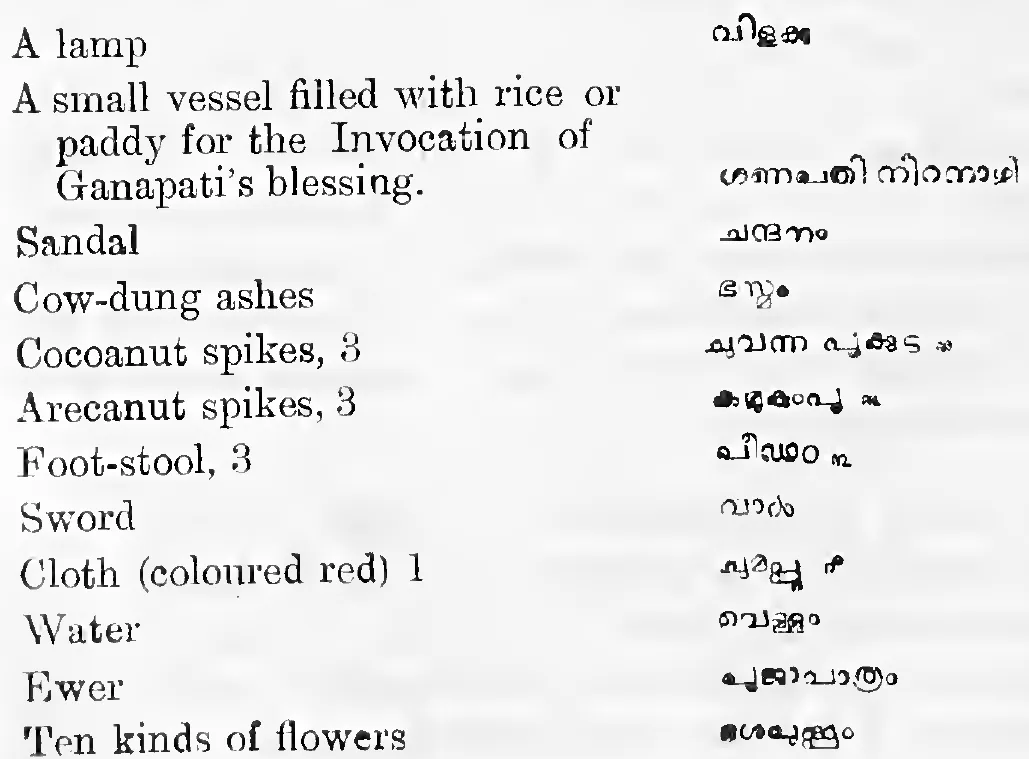
[67]
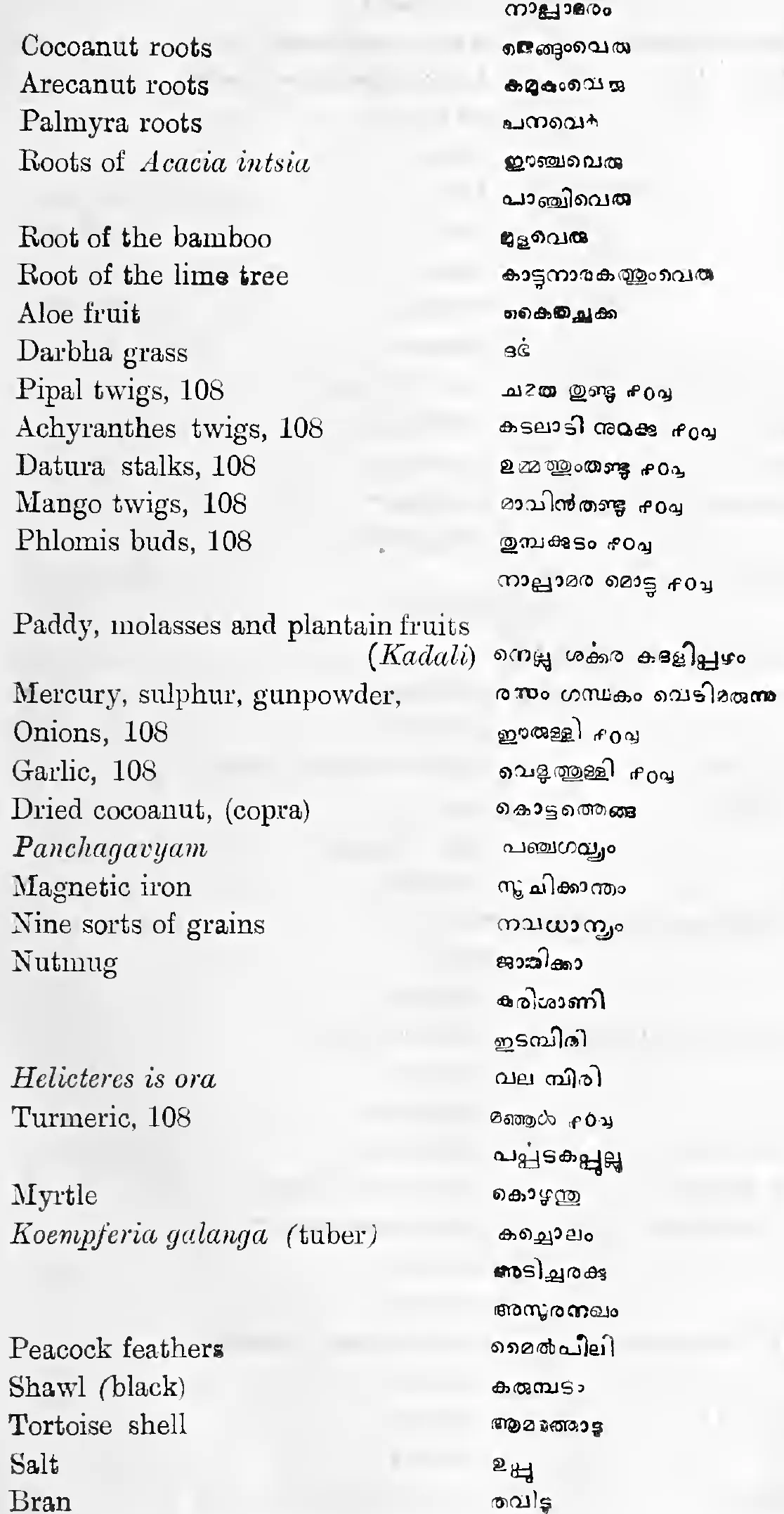
[68]
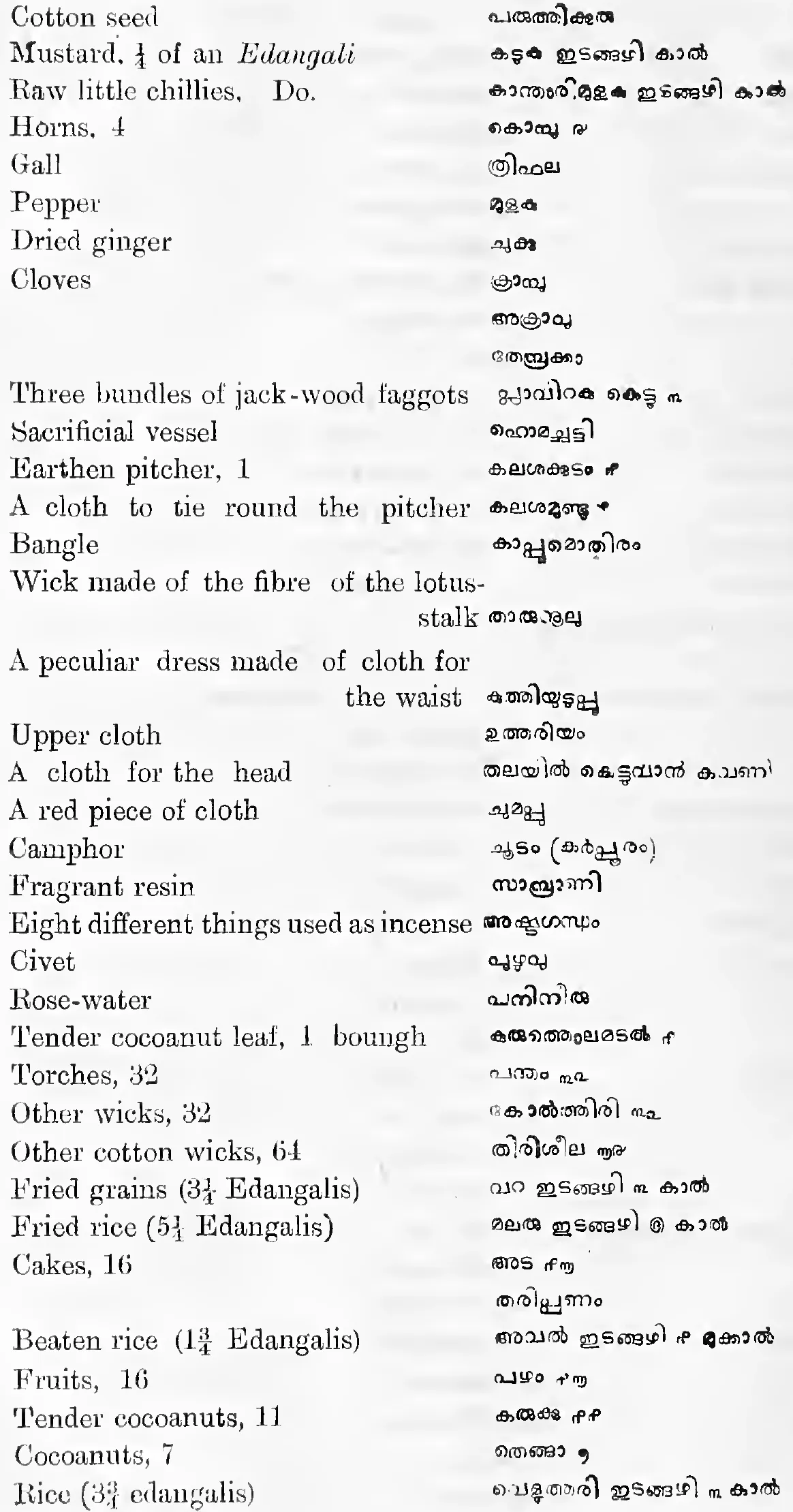
[69]
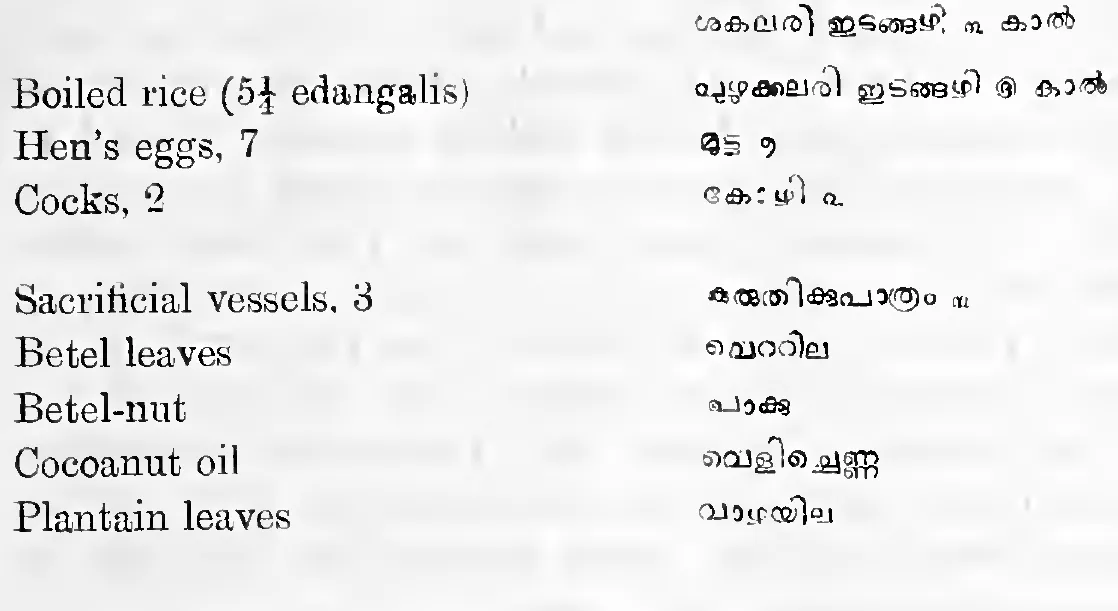
Is Hinduism Idolatry? The answer to this question must be in the negative. Outside opinion about Hindus being idolaters arises from a confusion of ideas. The Hindu temples, their huge gods and goddesses, the daily puja and the prescribed round of ceremonies in them, form a gigantic organisation intended for various purposes—religious, social, educational and political. A Hindu temple is the great centre where all the racial and political elements in the early Aryan days coalesced and were fused together into one national whole. As religion in its pure and philosophic form was beyond the capacity of the non-Aryan races to follow, and as their merging into the Aryan nation and Aryan ideals was a necessary step for political unification, the temples were brought into existence as the best media to serve that purpose. But the creation and maintenance of temples can no more justify Hindus being called idolaters than the existence of churches and mosques could justify Christians and Mahomedans being styled such. Take the case of the Brahmin, the highest type of a Hindu. What do you find in his own house and in his daily puja? Nothing which would justify his being called an idolater. After bath and the morning prayers and before breakfast (I am talking of course of the orthodox Brahmin), he sits before a small brass-box ten inches long by six inches broad and four inches high, which contains a small Salagramam-stone and one or two necessary pewter or brass vessels for washing the Salagramam and anointing it with sandal and such other purposes. The Brahmin recites some Vedic texts as he washes the Salagramam with water or anoints it with a little sandal or places one or two flowers on it and offers a grape or a plantain fruit as Nivedyam. This completes the daily puja. Then he reads a few slokas from an old cadjan Purana—the Salagramam-stone and the Puranam having been handed down to him as valuable heirlooms from remote ancestors. Where then is idolatry in this? In the first place there is no image to begin with. When the [70]Brahmin travels beyond his native village and he finds it difficult to carry the brass-box above referred to, he generally finishes his puja on the bank of the river or tank where he bathes, making a mound of sand to represent the Salagramam and goes through the routine of worship as described above. The Brahmin women water the Tulasi plant in their yard and go round the basement on which it is planted a few times by way of worship. This is called Brindaban. As the creed of the Brahmin is the ideal towards which all Hindu castes gravitate, it is a misnomer to call Hinduism idolatry and Hindus idol-worshippers. Hinduism is Brahminism and Brahminism is far above idolatry. In the large percentage of Brahmin houses, image worship does not form an essential element in the Brahmin's daily puja.
What is Hindu orthodoxy? The 'mild Hindu' is a term well-known to us all. He is not bigoted like the Mahomedan, nor stiff like the sectarian Christian. He lives and lets others live. He bears peace and good-will to all mankind. This he is by birth, race, food, climate and above all, by his religion. He has deep faith in his own creed, but tolerance to the followers of other creeds is his first and highest tenet. If he is so himself, his orthodoxy is even more genial and less stiff than he, for Hindu orthodoxy is most elastic and inexacting. The orthodoxy of Calcutta and Bombay is not the orthodoxy of Madras, and the orthodoxy of Madras is not anything so exacting as that of the mofussil towns in the Presidency, nor of the conservative Hindu States of Travancore and Cochin. The orthodoxy of the Nambudiri again stands aghast at what passes for orthodoxy in the town of Trivandrum, nor is the orthodoxy of to-day what it was fifty years ago. There lived a hundred years ago in the village where I was born, a Brahmin youth who never went to worship the village god, and whenever questioned by his playfellows why he did not go, he used to say that going to the temple upset him and produced headache, and that he had no faith in the paraphernalia of puja and worship in the village god's temple. And yet the whole village put up with him as a philosopher and a saint and let him live unmolested. This was in the early days of British rule. So great is the tolerance of Hinduism towards its votaries of every shade and colour. A simple conformity to his fellows in outward form in the manner of dress and living and a real abstinence from prohibited food and prohibited drinks and a nominal allegiance to caste rules is all that Hinduism expects of its followers. It is a gentle task master and one most easily pleased, as the discipline to be observed is neither stiff nor difficult. The highest European civilisation of to-day cannot take credit for a higher standard of religious or political tolerance.
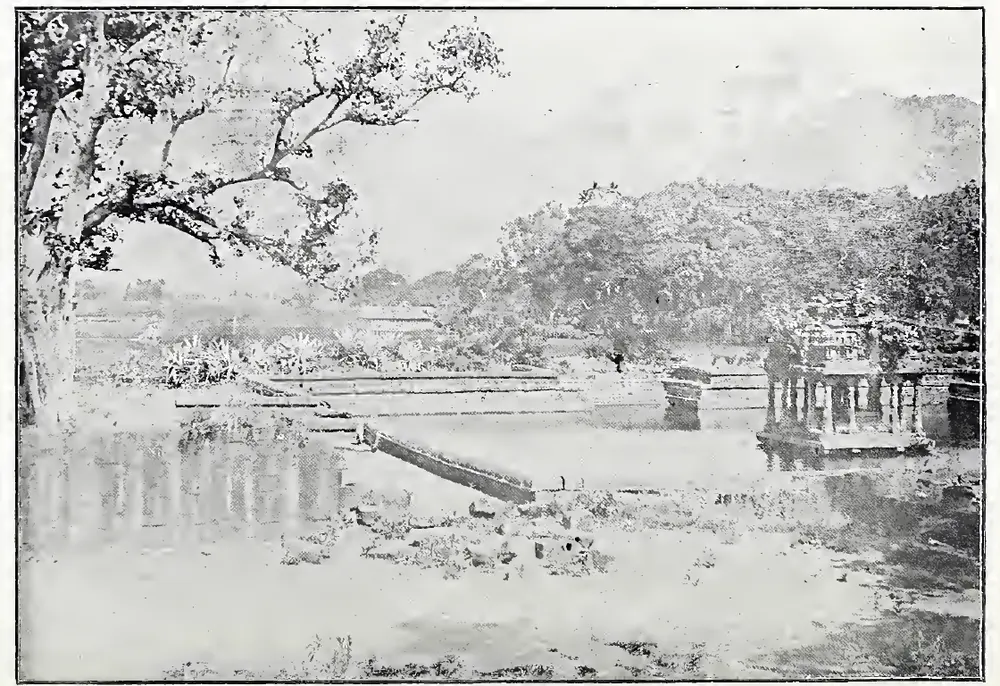
[71]Hindu Pagodas. In my Report on the Census of 1875, I wrote:—
"There is nothing more impressive to the fervent admirer of nature than the spectacle of a Hindu Pagoda in Travancore. Viewed either in respect of its religious importance, its architectural beauties, its health and commodiousness or the feeling which it creates in the human mind of the imposing scene around, it is alike useful and instructive. Unlike the habitations of men, the habitations of the gods are like Olympus of old on the tops of distant hills, among cool groves, in secluded valleys, and by the side of beneficent waters. The religious devotee, the Brahmin Pundit, the student of the Vedas, the numerous votaries for the favours of the God, alike find it pleasant and sufficing for their purposes. On its festive occasions which send a thrill into the neighbourhood and call forth those great social gatherings unknown otherwise in the country, it alike attracts the commerce, the youth and the fashion of the land. The procession of the God, the illumination of the temple, the devout attitude of the old, the clasped hands of the thousands, the happy faces of the children, the solemn stillness around, all fill the mind with serene emotion and relieve the monotony of life."
There are several temples in Travancore dedicated to the superior deities, many of which are renowned for their antiquity. The antique character of their architecture and the quaintness of their inscriptions give some clue to the age of our temples, though their definite ages are not available. The temples of Suchindram, Cape Comorin, Tiruvattar, Trivandrum, Varkala and Vaikam are some of the oldest in Travancore. Of the numerous temples in the country, some are under Sirkar management, while others belong to private individuals or societies called Ooranmakars. These are corporations of Nambudiri Brahmins or Pottis, and in a few instances of well-to-do Sudras also, who, from the surplus accumulations of their private property, have contributed from time immemorial to the religious edification of their village communities.
The word Ooranma literally signifies the administration by the people of the village. The Ooranma system is principally of two kinds, viz., Devanadi Ooranma in which the persons vested with the right of governing the temple affairs are appointed by the founder of the temple and its properties, and Ooranma Adi devan in which the family which originally built the shrine and acquired properties for its maintenance exercise authority over it even now. The exact date of the origin of this system is not known. The Ooranma temples are all very old, at least as old as the Sirkar temples. The Ooranmakars who are generally in very affluent circumstances manage the affairs of the temple without remuneration or profit for themselves, though a few instances may be found of poor persons who live on the temple revenues, rendering the services which are generally done by paid servants. They execute documents and carry on suits on behalf of the temple, the Sirkar also having a voice in its administration its interests being represented by an officer who [72]is known as Koyimma or Mel-Koyimma. The number of Ooranmakars generally varies from one to twenty each member having a vote, which being hereditary is divisible into parts in the same manner as the properties of the family. A manager known as Samudayam is appointed, who represents the Ooranmakars in the conduct of the temple affairs, the appointment being made by the collective votes of all the Ooranmakars.
The system of temple worship in Malabar is unique. While caste distinction in other parts of India permits of certain elasticities, it is very rigidly observed here, to the extent of one of a higher social scale being considered polluted if touched by another of a lower status. That being so, the method of worship is necessarily strict. The Santikaran or officiating priest in a temple is polluted if touched even by a Tamil Brahmin and can get rid of the pollution only after dipping himself in cold water, because bathing in warm water is always considered not sufficiently holy.
In Travancore there are, it is calculated, nearly 10,000 temples and 15,000 other places of worship in the shape of groves of serpents, &c. Many of these are private institutions, having been endowed by pious Hindus hundreds of years ago. When starting the temples, the custom was to hand over landed properties of considerable value to members of their own families or other trustees who met the necessary expenditure for the temples from these properties. Thus a large amount of property, valued at about two crores of rupees,* is held by these temples. One item of expenditure in all these temples is the feeding of a few Brahmins, called Namaskaram, the number varying from two to twenty, according to the scale of expenditure fixed. Besides these, there are also other temples that are under the immediate control of the Sirkar. This class of temples has two Santikars or officiating priests who are in receipt of a salary of rupees three to three and a half per mensem, besides an allowance of a certain quantity of paddy. They are employed for definite periods of six or three years, and after the expiry of the fixed period in one temple they are eligible for re-employment in the same or in any other temple. By caste they are Pottis (Brahmins) and when first appointed they have to pay a certain stipulated amount of money as Adiyara, the amount varying according to the income of the particular temple to which they are appointed. There [73]are also hereditary Santikars who enjoy the same emoluments both in money and paddy. Their work consists in performing self-ablution very early every morning, and in going immediately afterwards direct to the temples to open the doors of the rooms in which the images are kept, to remove the faded flowers, &c., with which they had been adorned on the preceding night, to clean the place and adore the image, after purifying themselves, and then to commence the daily puja according to the established custom observed in Malabar. In some temples worship is begun as early as 3 o'clock in the morning, before the faded flowers are taken away and immediately as the doors are opened. This is considered specially propitious, and it is believed that early worshippers of this class receive the special blessings of the deity.
* In my speech before the Travancore Legislative Council on the Hindu Religious Endowments delivered on the 2nd December 1899, I estimated the value of Temple Endowments at about two crores of rupees. I said :—"Before concluding, I will say one or two words on the magnitude and importance of the interests at stake. The State had no concern with the management of any temples before the year 987 M. E., when the landed properties of 378 temples were assumed by the State and the management taken over. 1,171 minor temples which had no property were also assumed either before or at that date. The expenditure establishment and the routine of ceremonies, rules for management, all were settled for these 1,549 temples on this occasion by Col. Munro, the Dewan-Resident, on a permanent basis. But this number, 1,549, represents only a fraction of the temples of the State. Deducting the number under Sirkar management (viz., 1,549), we get 7,758 temples beyond the pale of Government management. That is, 17 per cent of the total temples of the State are under Government management, while 83 per cent are outside it. This number is exclusive of 'Kavoos' and 'Thekkathoos' of Malayali houses, whose number is legion. Lieutenants Ward and Conner give 22,900 'religious temples and places of worship' independent of churches, musjeeds and synagogues. But in the statistical table appended to their Report, one of the columns under which alone, 15,000 are returned, is 'temples and groves dedicated to minor divinities'. The groves and thekkathoos have been excluded in the Census, and hence the difference between the two results. "The property owned by these 7,758 temples is also vast. According to the settlement of 1012, which comprised only a settlement of garden lands these private Devaswoms owned 54,155 gardens, tax-free. The temples within the boundaries of Adhigara Olivu and Desa Olivu tracts are excluded from this calculation. The assessed rental of these 54,155 gardens came to Rs. 79,496. It can be safely estimated that the present assessment on them will come to 1½ lacs of rupees. Multiplying this sum by 25, we get the figure 37½ lacs of rupees—the capitalized value of those gardens. The paddy lands of the same may be estimated to be worth about 60 lacs of rupees,—in all, the landed property of the Devaswoms whose welfare it will be the object of this Bill to promote, may be put down as worth 1 crore of rupees. The movables of these temples may be valued at 1/3 of a crore, excluding the buildings, almost all of which are in different stages of decay throughout the country. These are the properties known to the public accounts before 1012. Properties purchased since then in the name of those temples, or properties dedicated to them, or to other charities before that date if paying Sirkar tax, cannot be discovered from the Sirkar accounts. These also will swell the property of these institutions. It may not be far wrong if I estimate that the total value of the endowments meant to be dealt with is about two crores of rupees. I trust this will give the Council an idea of the magnitude and importance of the question we are dealing with. If you permit, I shall introduce a Bill at an early date."
Puja in a West Coast temple. It may be interesting to give here an account of the daily round of pujas in a typical first class temple on this coast. We will take one dedicated to Vishnu. The puja performer is called a Potti. Scrupulous personal cleanliness and purity are expected of him. He is also expected to live within the precincts of the temple. In the Trivandrum temple he is called the Nambi-Potti. For a term of six years he is not to leave the temple or his own dwelling-home called a matam near it. During the day's puja, he is not to allow himself to be touched by any one, not even by other Brahmins in which case he should [74]have a fresh bath for resuming the puja. Such scrupulous observance of personal purity is a characteristic feature of all the West Coast temples. The accidental entry of a person of any caste lower than the Sudra into the four walls of these temples requires a purificatory ceremony known as the Punyaham, and that into the Sri Padmanabha's temple would require a most expensive one. Every temple of importance has got its Mel-Santis (head priests) and Kil-Santis (assistants) for the daily performance of its pujas; but on festive occasions the help of a Tantri or a Nambudiripad or any such dignitary specially deputed from of old for the several ceremonies such as the Sribhutaveli, Kodiyettu or Kalasam is indispensable.
The Sri Padmanabha's temple at Trivandrum has as its functionaries two Sanyasins, representatives of the Vilvamangala Matam, two Nambudiripads, four Nambis or arch-priests (two for Sri Padmanabha's puja and two for Narasimha's and Krishna's) and thirty-five Kilsantikars or assistants to the head priests. The two Nambis of Sri Padmanabha's temple called the Valiya-Nambi and the Panchagavya-Nambi make a permanent stay for six years in the houses assigned to them at Mitranandapuram close to the temple during the time they are appointed to act as priests. The other two Nambis are appointed only for three years. These Nambis ought to be chosen only from certain established families of North Malabar. The two Sanyasins are monks of the Nambudiri caste and being specially connected with the origin of the temple, as already stated in another part of this chapter, are looked upon both by the Maharajah and the people with high respect and unstinted veneration. Special matams to live in have been assigned to them at Mitranandapuram. These Sanyasins and Nambis and the minor priests get their daily allowance of rice and pativus from the temple. The Nambis must lead a celibate life in seclusion during their term of priesthood. They are also expected to be highly religious and pure. On their way after bath to the temple which is connected with Mitranandapuram by a foot-path three to four feet in breadth, paved with granite stones specially intended for these priests to walk on, they carry a cadjan umbrella, the emblem of their office, and are led by a guard to the temple in fear of being polluted by passers-by. The Sanyasin (one of the two) who goes to the temple every morning is led by two Brahmins with a small bronze ewer and a wooden seat in their hands for him to perform his puja, and these two Brahmins call out to the passers-by so as to let the Sanyasin go to the temple unpolluted. The Tantri Nambudiripad, the highest dignitary of the temple, makes his appearance only on festive occasions.
The puja in the temple may be said to begin at 4 A. M. daily for [75]the doors of the inner shrine are opened at that hour. The Nambi after bath enters the temple with his assistants, and after a preliminary purification ceremony consisting of the sprinkling of water and Panchagavyam* purified by hymns over the Ottakkal Mantapam in front of the inner shrine or Srikovil, opens the doors of the Sanctum sanctorum in which the god resides, to the loud booming notes of the conch-shell by the Maran. The Panchagavyam is then sprinkled on the floor all round the image of Sri Padmanabha with the object of purification and an image of the god (one in the standing posture to which the daily puja is offered, the other great image with Adisesha for bed being too large to be handled) is taken out, the old flowers (Nirmalyam), cloths, and jewels placed on it the previous night are removed and then brought out of the mantapam for Abhishekam. The image is then washed with water and Panchagavyam which are poured in dribblets as the purificatory mantrams are recited. After Abhishekam the deity is offered a Nivedyam or breakfast of fried rice, dried-up cocoanuts and plantain fruits. Then a piece of lighted camphor is waved round in front of the image several times. After this the image is taken in and placed in its usual place. It is then decorated with silk cloths, jewels and garlands of flowers and a Pushpanjilli or an offering of Tulasi leaves (the favourite flower of Vishnu) ensues. This occupies several minutes and by the time this closes the milk porridge and the sweet porridge with pickled mangoes are ready and offered as Nivedyam to the deity. This closes the Usha or morning puja.
At 7 o' clock in the morning, the Swamiyar pays his visit to the temple and offers a Nivedyam of plantain fruits to the deity. Then the Nirmalyam flowers and the water and the Panchagavyam used in washing the image are given by Pottis to all the worshippers that have assembled by this time at the shrine. Between 8 A. M. and 9 A. M., the members of the Royal family visit the temple to worship. After His Highness the Maharajah has returned to the palace, the second course of puja begins, called the Palpayasa-puja.† The details of each course of puja are not easy to describe and will therefore be omitted. It consists of washing the image, ornamenting with flowers, waving of lights and camphor, fanning the god and offering Nivedyam, in all sixteen forms of propitiation known as the Shodasa Upacharams, all accompanied by [76]Mantrams and Tantrams. During this second puja an enormous quantity of milk porridge prepared with eight parahs of raw rice and milk is offered to the deity along with other sweet preparations of sugar rice, ghee and fruits, all distributed among the Brahmins who wish to partake of them.
* Literally the five essences of the cow, being a preparation of milk, curds, ghee, cow's dung and cow's urine, the last two being mixed in extremely small quantities.
† Palpayasam or milk porridge is a preparation of raw rice, milk and sugar boiled, and is one of the favourite forms of Nivedyam to Vishnu. In Ampalapuzha the porridge Nivedyam is made of about forty parahs of milk with fine raw rice and sugar daily.
At about 11 A. M., commences the Pantiradi or forenoon puja. The same items of puja are gone through as in the previous one with this difference that on this occasion the deity is offered a special Nivedyam of cooked rice (twelve Kotahs or about fifty parahs of raw rice) along with sweet porridge, sweet cakes (Appams), tender cocoanuts, salted mangoes and curries, betel leaves and nuts and spices. At the conclusion of this puja one hundred and twenty Potti or Nambudiri Brahmins are fed inside the temple. Such feeding is called Namaskaram and obtains in all the temples more or less in Travancore. Then a special small image representative of the deity is carried in procession by the assistant Santikar on his head three times round the temple with the accompaniment of the temple music. During the procession Sribhutaveli is offered to the lesser divinities. At the close of the procession the mid-day puja begins. Rice and sweet porridge are now offered and the day-time worship ends with this puja.
The evening puja begins at 6 P. M. or even earlier. After the noon-day puja which is generally over by about 12-30 or 1 P. M., and before the doors are opened again for the evening puja, there is a perfect lull in the temple for about four hours or so. There are two pujas in the evening called the Attazha-puja, and the Ardhajama-puja. The former commences just after the evening Diparadhana (waving of lights), which is one of the most important occasions for worship. The image is then magnificently decorated with jewels, sandals, flowers, silks and cloths and the inner shrine is brilliantly lighted. It is at this time that the temple is most crowded, for no one would miss the Diparadhana if he possibly could manage to be there at the time. Men, women and children muster in thousands at this juncture on important festive days. The Diparadhana is accompanied with flutes playing, drums and bells ringing, and the devotees sing verses and slokams in praise of the deity. Prasadams are then distributed to the worshippers. There is nothing special to be mentioned with respect to this puja or the one next to this, viz., the Ardhajama-puja, the course of worship being mostly the same as has been described above. The Nivedyam alone is different and consists of Aravanai (ghee, rice and sugar boiled), sugared cakes (Appams) cooked rice (two [77]parahs), sweetened beaten rice, honey and fruit, tender cocoanuts, betel leaves, &c. The daily round of puja closes with this at about 10 P. M., and all the priests and servants leave the shrine, the Nambi being led by a servant with a Kodi-vilakku or a portable metal lamp which is another emblem of his dignity and status.
It has to be added that only the Nambis are privileged to touch the image to which pujas are offered. The Kilsantikars can only assist him in his work. This is a great privilege, for in the temples of this coast no worshipper, however exalted his position may be, can touch the image or anoint it or place flowers over it. The East Coast temples are not so scrupulous in these observances, probably due to the several ways of conquest which that land had been exposed to with its concomitant intervals of anarchy, evils of loss of privileges and wanton temple desecrations from the fanatics of alien creeds.
It should be remembered that the salted mango is an important offering in the daily puja at Sri Padmanabha's temple, for that was the first offering of the Vilvamangalam Swamiyar in the early days of the legendary origin of the deity.
During Ootsavams and other special ceremonial occasions, the Tantri Nambudiripad performs the Sribhutaveli which is an important item during these ceremonies. It is believed that any mistake however small in the performance of this rite, whether committed by the Tantri or the drummer who beats his drum in measure to the quick Tantram-passes of the Nambudiripad, will seriously injure the Tantri the drummer and the Bhutams whom the pujas are said to propitiate.
Besides the priests and their assistants referred to above, every temple has got its staff of servants and servant-maids, such as the light-carriers, the musicians, the Marans whose business is to sing and sound the conch-shell, the flute, the Takil or drum and the Pani (another drum that gives a shrill note), the sweepers, the vessel-cleaners, the cooks, the water-drawers, the accountants, the Chandrakarans, the guards, the hereditary singers, the flower-garland makers, &c. As a result you find that a Hindu temple on this coast is a centre of attraction to the old and the young, by its perfect system of worship, by the sweet fragrance and peace it breathes, the health and recreation it affords, its remarkable neatness, its marvellous punctuality and regularity in all its varied functions, the active beneficence which it dispenses and, above all, by the devotion, the reverence and the order which it silently inculcates on the thousands of votaries that visit it.
[78]Temple architecture. The temples are all located in the best possible sites in the country, either on the top of a hill or in a secluded grove of magnificent trees or by the side of a large lake, a roaring cataract or a running stream. Go to any part of Travancore, and you will observe the temples are all built on the most lovely spots. Most of them are unlike those of the East Coast neat and simple in structure and provide for a plenteous supply of light and fresh air. This is an undoubted superiority in the temple architecture of Travancore and most essential to the conditions of a Hindu temple. But even the largest of our pagodas cannot approach the magnificent temples of the other coast either in grandeur, elaborateness or cost. The style of architecture generally prevalent has already been described. Herewith are annexed plates showing the ground plan, section and elevation of three typical temples near Trivandrum. An ordinary temple consists of the following :—
(1) The Srikovil or temple proper. It is generally square in plan and surmounted by a concial roof covered with copper plates with a Tazhikakudam or Stupam of gold or copper gilt at the top. Inside this the image is placed. We also meet with instances of circular Srikovils in some of the older temples as at Vaikam, Ettumanur, &c.
(2) The Mantapam in front of the Srikovil.
(3) Corridors or pillared halls used for several purposes.
(4) Gopuras or towers containing carvings of serveral deities and mythological persons. These marvellous designs of various patterns also adorn the pillars &c., of the mantapas. The powers of design of the Dravidian architect are fully displayed in the ornamentation of the temples.
(5) Sivelipuras or broad corridors between the gateway and the inner shrine, the two rows of pillars and the stone ceiling above having been made the receptacle of the talents of the sculptor's chisel.
(6) Dhwajastambha or Flagstaff. In some temples where there are no flagstaffs temporary ones are used on Ootsavam occasions. There are besides wells and tanks used for sacred purposes and a series of low buildings used for diverse other purposes.
The following is a list of the important Hindu pagodas in Travancore :—
Place. — To whom dedicated.
- 1. Bhutapandi — Bhutalingaswamy (Siva)
- 2. Tiruppatisaram — Perumal (Vishnu)
- 3. Suchindram — Stanumurti (Siva)
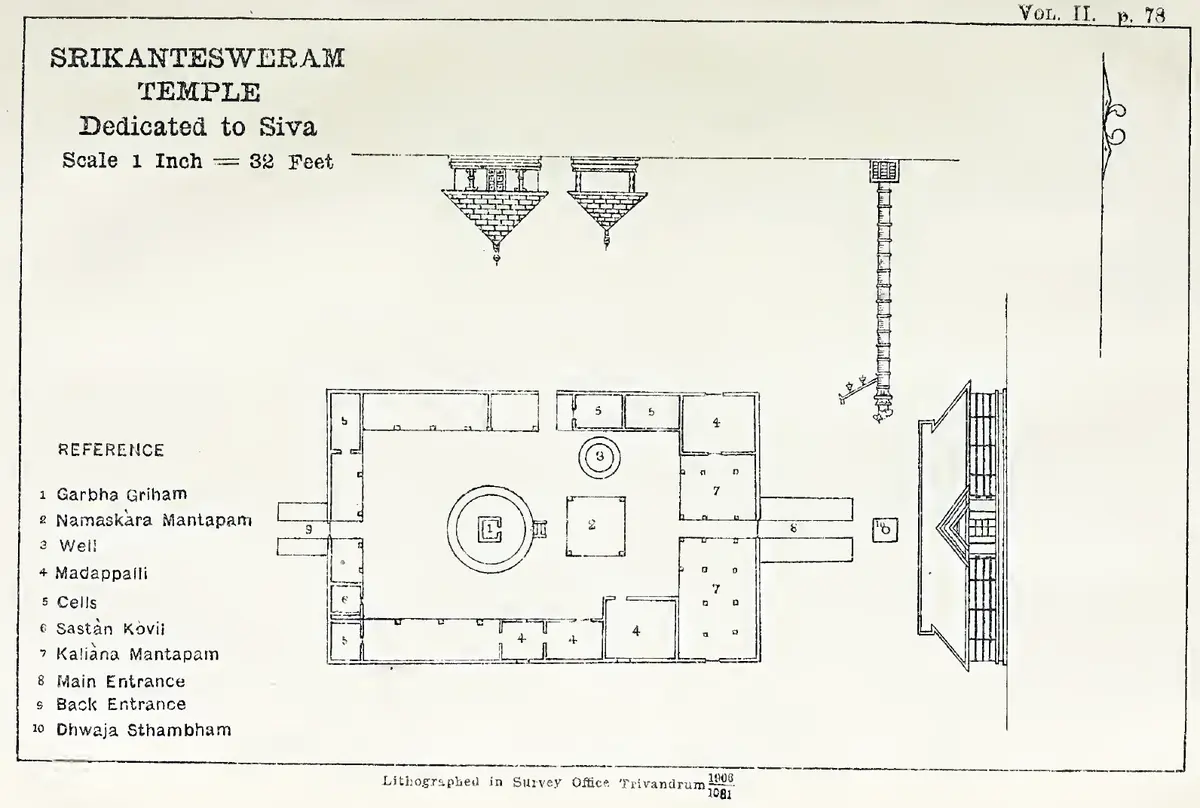
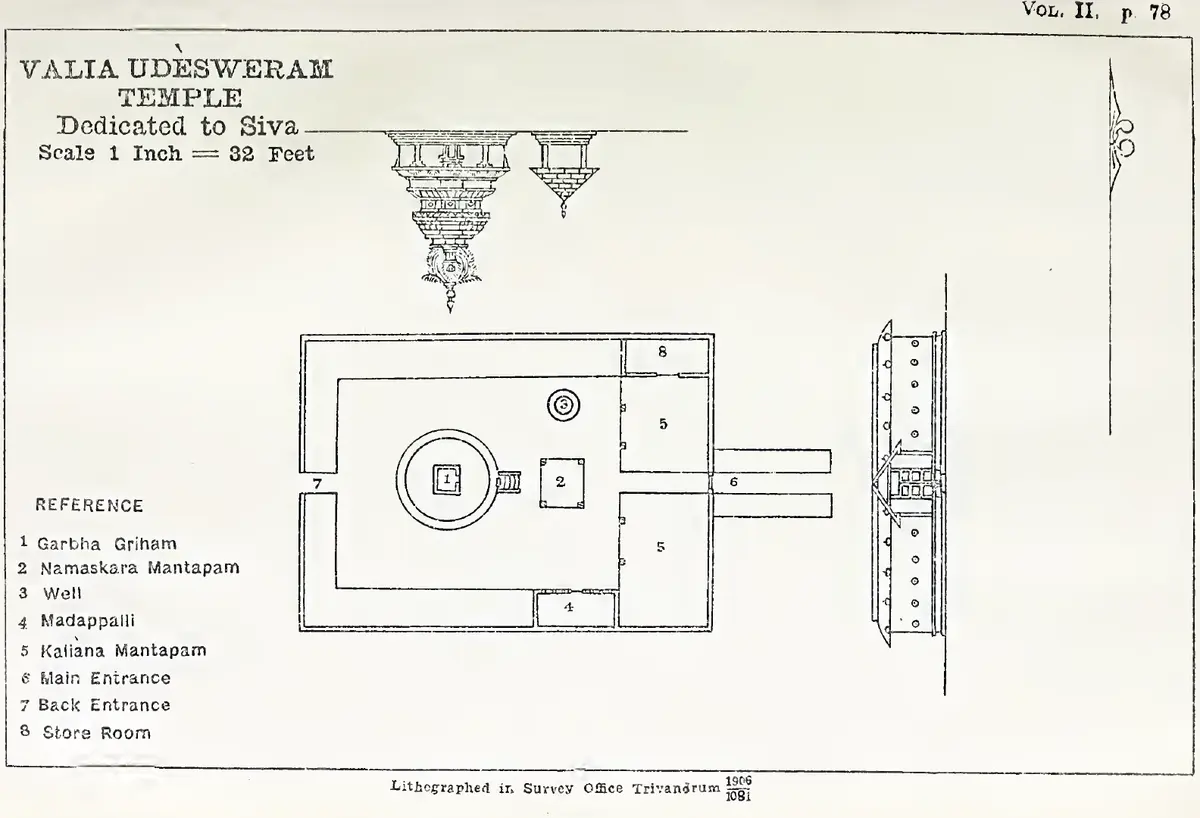
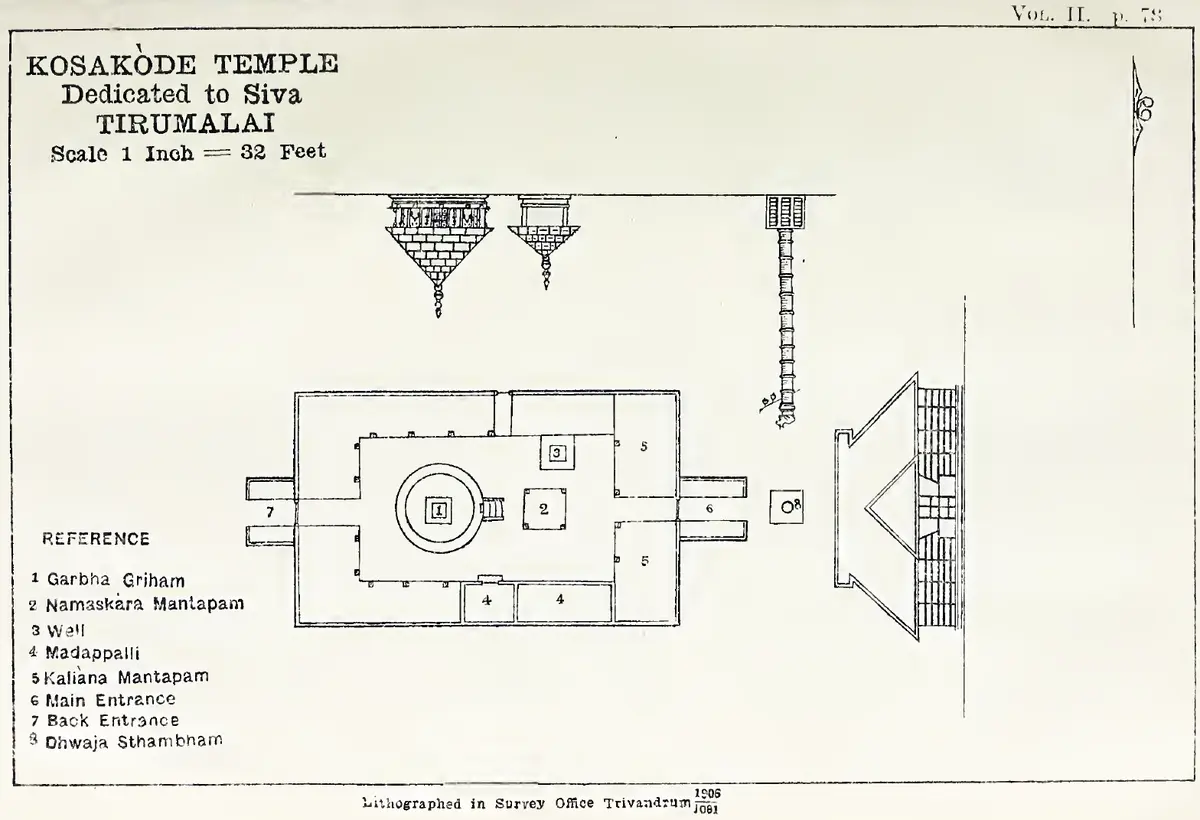
[79]Place. — To whom didicated.
- 4. Cape Comorin — Bhagavati
- 5. Vatasseri — Krishna
- 6. Nagercoil — Nagaraja
- 7. Mandaikad — Durga or Bhagavati
- 8. Parakai — Madhusudana (Vishnu)
- 9. Tiruvancode — Siva
- 10. Kalkulam — Nilacanta and Ramaswamy
- 11. Tiruparappu — Siva
- 12. Kumarakovil — Subrahmanya
- 13. Tiruvattar — Adikesava (Vishnu)
- 14. Keralapuram — Siva
- 15. Munchira — Siva
- 16. Parassala — Mahadeva
- 17. Neyyattinkara — Krishna
- 18. Malayinkil — Krishna
- 19. Tiruvallam — Parasurama and Trimurti
- 20. Valia Chalai, Trivandrum — Trimurti
- 21. Trivandrum, Fort — Padmanabha, Krishna & Narasimha
- 22. Valiyakoikkal (in Trivandrum) — Vettakkaruman (Siva in the form of a hunter)
- 23. Srivaraham (in Trivandrum) — Varahamurti (Vishnu's third incarnation)
- 24. Srikantesvaram — Siva
- 25. Oollur — Subrahmanya
- 26. Attungal — Bhagavati
- 27. Varkala — Janardana (Vishnu)
- 28. Aryankavu — Sasta
- 29. Aruvikkara — Murari (Bhagavati)
- 30. Kadakkal — Bhagavati
- 31. Mukattalai — Murari
- 32. Sarkara (Chirayinkil) — Bhagavati
- 33. Quilon — Anandavalli (Goddess)
- 34. Kottarakara — Ganapati
- 35. Vettikavalai — Sasta
- 36. Mavelikara — Vishnu
- 37. Kandiyur — Siva
- 38. Mannadi — Bhagavati
- 39. Chengannur — Siva & Bhagavati
- 40. Achankovil — Sasta
[80]Place. — To whom didicated.
- 41. Kulattupuzha — Sasta
- 42. Sabarimala — Aiyappan (Sasta)
- 43. Aranmula — Parthasarathy (Krishna)
- 44. Tiruvalla — Vishnu
- 45. Haripad — Subrahmanya
- 46. Ampalapuzha — Krishna
- 47. Vaikam — Mahadeva
- 48. Turavur — Siva
- 49. Udayanapuram — Subrahmanya
- 50. Tiruvarpu — Vishnu
- 51. Vazhapalli — Ganapati
- 52. Ettumanur — Mahadeva
- 53. Kadutturitti — Mahadeva
- 54. Elangunnapuzha — Subrahmanya
- 55. Peruvaram — Siva
- 56. Trikkarur — Siva
- 57. Evoor — Siva
- 58. Udayamperur — Siva
- 59. Tirunakkara — Siva
- 60. Shertallay — Bhagavati.
A short account of a few of the ancient temples may be given here:—
SUCHINDRAM. The following tradition is current in regard to the origin of the place and the temple. Sage Attri and his wife Anasuya renowned for her chastity were doing penance in a hermitage near the modern Suchindram. The Trimurtis desirous of testing the chastity of Anasuya came here in the guise of three Brahmins when Attri happened to be absent from home and requested Bhiksha (alms) of her. According to the rules of Hindu hospitality, an Atithi or guest is a divine person and should be propitiated at any cost. She received them with due hospitality and when they were seated for meals they informed her that all three of them had made a vow that they would not eat anything if served by a person who wore any garment, in other words she should serve them nude. Finding herself in a predicament and at the same time confident of her own purity, the holy matron sprinkled a little holy water upon them all with a prayer to the Almighty that they be immediately converted into babes. This was effected and she fed the babes with milk and nursed them. While she was thus fondling these children, Parvati, Lakshmi and Saraswati, the respective wives of Siva, Vishnu and Brahma, came to the spot in search of their lords and finding them all in this condition gave [81]themselves up to severe penance. God Mahadeva appeared before them and granted their request. The three babes were converted into three Gods and Anasuya found before her the Trimurtis, Brahma, Vishnu and Siva in their own forms. Anasuya fell at their feet, asked forgiveness for having made them children and prayed that she should have three similar children, and accordingly a son called Dattatreya was born to her who combined in himself all the essential virtues of the Trimurtis. It is in commemoration of this event that all the three deities, Brahma, Vishnu and Siva are worshipped here.
The place is also famous as the one where Indra was relieved of the curse inflicted on him by Sage Gautama for his disgraceful conduct towards Ahalya; hence the name Suchindram (literally, the place where Indra was purified). Indra, to testify his gratitude, built the temple and dedicated it to Stanulingam. To the south of it he set up the image of Brahma and a little further south that of Vishnu. To this day it is believed that Indra offers daily worship at nights to Stanumurti at Suchindram. It is believed by the orthodox that you hear the sound of the bells at dead of night during the course of Indra's puja.
Parasurama on his arrival here constructed towers and mantapams to the temple and arranged for the celebration of the annual festivals. The management was entrusted to the Brahmins, and eleven Saivite Brahmins were asked to do personal service to the deity.
Some of the inscriptions found in the temple show that it must be at least 1,000 years old. The management now belongs to the Travancore Sirkar which spends a considerable sum of money every year. This is considered next in importance to the Padmanabhaswamy pagoda in the capital and is the second largely endowed temple in the State. There are two festivals celebrated yearly, one in the month of Medam (April) and the other in Dhanu (December). The latter is the more important and is largely attended by people from all parts of Travancore. It lasts ten days; during these the Brahmins are fed very sumptuously and on the ninth day the huge temple cars are drawn in procession through the streets round the temple. The car festival is very important, the whole operation being superintended by Government officials. Its supposed importance to the welfare of the State may be gauged by the fact that the Maharajah himself is required to fast on that day until the cars are returned to their original station after the procession, the information being conveyed by means of the electric telegraph and signal cannon.
Connected with the temple is a large choultry in which a number of Brahmins are fed free day and night.
[82]Trivandrum. This pagoda is of very great antiquity and is held in the highest veneration. Trivandrum is the contracted form of Tiru-anantapuram (the town of the sacred snake) and is also called Anantasayanam. The legend regarding the origin of the temple is stated as follows :—
The spot where the Trivandrum temple now stands was formerly a jungle called Anantankadu. In this jungle lived a Pulaya and his wife who obtained their livelihood by cultivating a large rice-field near their hut. One day as the Pulayan's wife was weeding in her fields, she heard the cry of a baby close by and on a search found it to be a beautiful child which she took to be a divine infant and was at first afraid to touch. However after washing herself, she fed the baby with her breast milk and left it again under the shade of a large tree. As soon as she had retired, a five-headed cobra came, removed the infant to a hole in the tree, and sheltered it from the sun with its hood, as the child was an incarnation of God Vishnu. While there, the Pulayan and his wife used to make offerings to the baby of milk and conjee in a cocoanut shell. Tidings of these things reached the ears of the sovereign of Travancore who immediately ordered a temple to be erected at the place.
There is another version of the origin of Padmanabha's temple in Trivandrum, which is handed down from generation to generation as a lullaby song still sung by the Brahmin women in the course of their daily domestic duties. That version may be given here :—
The Vilvamangalam Swamiyar to whom is attributed the consecration of many temples in Malabar, used to perform his daily pujas to his Salagramams. During the puja he used to close his eyes for a long time in deep meditation of Maha-Vishnu, when a young child would interrupt him every day by displacing his Salagramams and flowers and annoying him in a hundred other ways; but when the Swamiyar opened his eyes the child always disappeared. One day finding the child's interruption intolerable, the Swamiyar in a fit of temper, while his eyes were yet shut, removed the meddling child by the back of his left hand. The child took umbrage at this and before the Swamiyar could open his eyes had told him that the child whom he had thus disregarded was none other than the deity that he had been intently praying to see and that he could not meet him anywhere else than at Anantankad, a place of which the Sanyasi had not heard of. The Sanyasi woke from his meditation, found everything was lost and in his distress ran with all possible speed towards the direction which, he imagined, the child must have taken. He now and then heard the distant jingling [83]of the child's waist-ornament and saw where there was loose sand the little foot-prints of the child. After several days' running in this wise without satisfying the cravings of hunger or thirst, the Swamiyar heard the cry of a child in the wilderness. He repaired to the spot from whence it came and discovered a solitary Pulaya woman threatening her weeping babe with the words, "if you continue weeping like this, child, I will throw you out into Anantankad". The Swamiyar's joy at the mention of this name (Anantankad) knew no bounds and on enquiry he was shown by the Pulaya woman the place which he wanted. Before he had gone a few paces more, the sound of the waist-ring bells was heard again and a huge Iluppa (Bassia longifolia ) tree came down with a loud crash which marked the spot of the deity's final rest. Vishnu was found lying on his Adisesha with all his four arms in splendour and serenity, extending from Tiruvallam to Tiruppapur (തിരുപ്പാപ്പുരം [?]) with his middle portion at Tiru-anantapuram or Trivandrum. Then the Swamiyar was pardoned and blessed and he prayed for the deity's contracting himself into a small compass so that he might offer his pujas and make his circumambulations easily. The deity shrank accordingly in compliance with the Bhakta's request and the Swamiyar performed his pujas and pradakshinams to his heart's content. It is also said in this connection that the tree that fell indicating the spot of Vishnu's final rest was afterwards carved into the image of Vishnu in repose, the very same one that we now find inside the temple of Sri Padmanabha at Trivandrum, and a temple was erected over it by the then Travancore king. It is also said that the cocoanut shell in which the Vilvamangalam Swamiyar offered rice oblation to the deity is now represented by a golden bowl of the same shape in which even to-day rice offering is made to Sri Padmanabha. The Pulaya woman who husked the paddy with the hand for oblation by the Swamiyar was presented subsequently by the orthodox and munificent king of Travancore with a patch of paddy field for her family to live upon. This field is now called the Putharikantam in front of the Eastern Fort-gate, Trivandrum. And to this day it is the custom in Trivandrum that the Nambudiri Sanyasins perform pujas to Padmanabha in addition to the Pottis or Pujaris specially appointed for the purpose and great respect is shown them by the people as well as by the Maharajah.
The greater part of the buildings in the temple are not of very great antiquity, though the place itself has been regarded as sacred and has been used as a place of worship from time immemorial. The earliest inscription we have in the temple belongs to 340 M. E., and this refers evidently [84]to later additions and repairs and not to the original founding of the temple. The more costly portions of the temple including the grand tower (Gopuram) in front were built in the reign of Martanda Varma (1729-1758 A. D.). A detailed description of the temple has been given in a previous chapter.
This temple is under the management of a committee known as Ettarayogam (literally, an assembly of 8½), composed of eight Brahmin jenmies with one vote each and the Maharajah who has but half a vote. It enjoys a land revenue of more than Rs. 75,000 a year and is absolutely independent of the Sirkar. The temple coffers are supposed to contain large quantities of money, gold, jewels and precious stones—the offerings of ages. To this temple is attached the Agrasala, the largest feeding-house in the State, where a simple meal of rice, curry and buttermilk is given to all Brahmins twice a day—the meal is so homely that none but the poorest as a rule resort to it. On festive occasions such as the Ootsavams, the birthday of the Maharajah, the Bhadradipam ceremony, &c., there are what are called Saddis or feasts when better meals are served.
There are two Ootsavams celebrated annually, one in the month of Minam (March) and the other in Tulam (October), each lasting ten days. The first day called the Kodiyettu or hoisting of the God's flag and the last, the Aurat, are attended with elaborate ceremonials and these occasions draw thousands of spectators from the neighbouring villages. Every day both in the evening at about 4 P. M., and in the night at 8, the gods with all their attractive paraphernalia are taken in procession round the Sivelimantapam at which the Maharajah and all the Hindu officers of the capital and thousands of people of both sexes attend. The ninth and the tenth days of the festival are the most important ones. On the night of the ninth day, the Maharajah goes in procession in front of the God for what is called the Vettai (hunt) to a place a furlong outside the temple which in the ancient days must have been thick jungle infested by wild animals. The appearance of the mock-hunt is well kept up as perfect silence is observed till the place is reached, where the Maharajah draws a bow and shoots with arrows at three cocoanuts placed there symbolic of wild beasts. The Maharajah does the hunting as the God's deputy. As soon as the arrows are shot, music and tom-tom are sounded and the procession is resumed back to the temple amidst the deafening noise of the infantry band and other musical instruments playing. After this ceremony known as Pallivettai, the gods are accommodated in a separate place and are taken to their original seats only after the Aurat or bath which comes off on the next day is over. The Vettai and the next day's [85]Aurat probably signify a pollution caused by the taking of life in the hunting expedition and the consequent necessary purification required by bath in the sea.
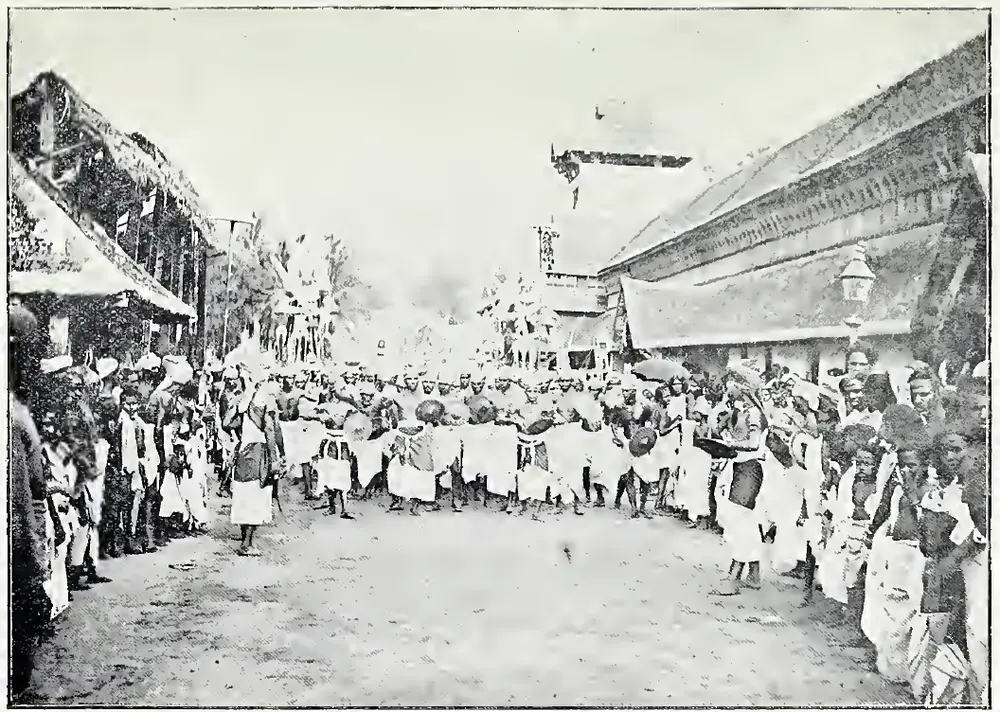
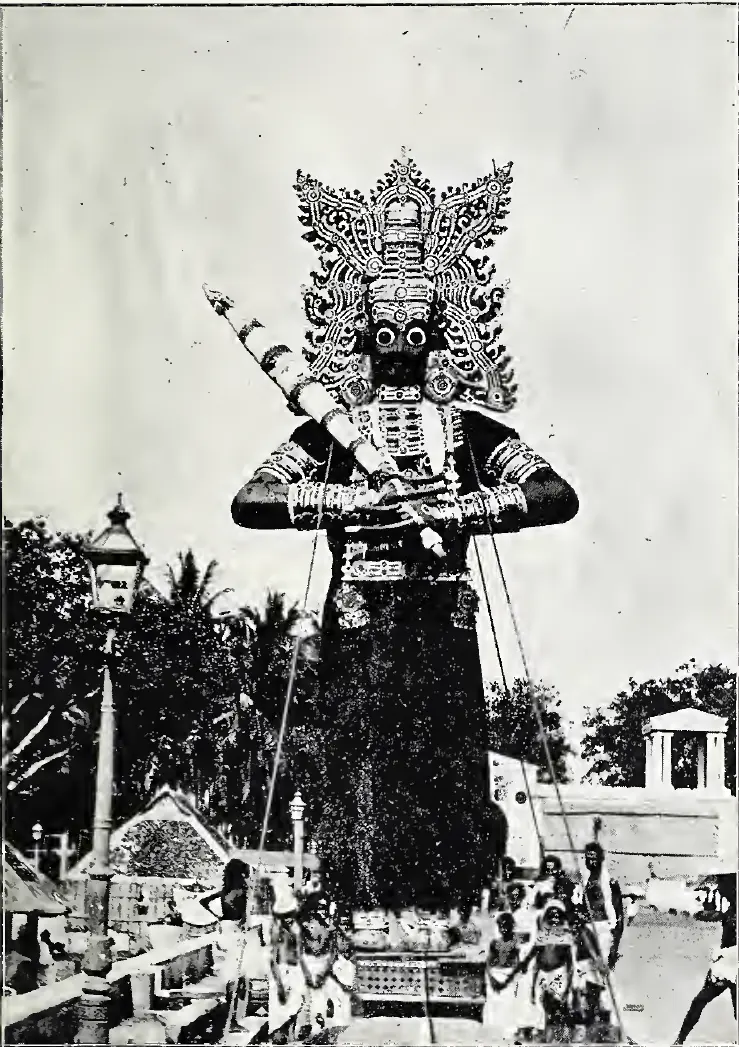
The Aurat is an imposing ceremony. After the usual rounds in the temple, the Gods Padmanbha, Krishna and Narasimha seated in different Vahanams (conveyances) are carried in a grand procession to be bathed in the sea, the procession being headed by the Maharajah, sword in hand, accompanied by the other male members of the Royal family, his personal attendants and body-guard. The Nayar Brigade with their arms, banners flying and band playing, the huge State elephants and horses and richly caparisoned, besides other paraphernalia of the State and the temple, all the Hindu officers of the State, the Sudras before the Sovereign and the Brahmins behind him, but all in front of the gods. An immense concourse of people of all castes and religions line the road-sides to view the procession, a magnificent sight possible only in a Hindu Native State. On the morning of the Aurat day, several thousands of people from the neighbouring villages flock to the capital to witness the procession and pay homage to their Sovereign. The road-sides from the temple to the beach and the adjoining sandy plains are literally crammed with men and women come for sight-seeing. The procession (including the Maharajah) moves on foot all the three miles from the temple to the sea, thus giving an opportunity for all people for a leisurely look at the Sovereign and the temple-gods. On reaching the beach, the Vahanams are taken down and placed in a stone mantapam erected for the purpose. After sunset the images are taken to the sea and bathed when the Maharajah also bathes, and the festival closes with the return of the gods to the temple and the hoisting down of the flag (Kodiyirakkam). The concluding portion of the tenth day's Ootsavam ceremony which is over by 10 P. M. on that day forms its most charming item.
Besides these, there are two other ceremonies called Bhadradipam (prosperous lights) in the months of Mithunam (July) and Dhanu (January) every year, the festival lasting for seven days. These and the sexennial Murajapam ceremony followed by Lakshadipam were devised in the reign of the great Martanda Varma on the advice of an Ecclesiastical Council to expiate the sins of war and conquest and to insure the peace and prosperity of the country. The first Murajapam was celebrated in 925 M. E. (1749-1750 A. D.), and the one celebrated last year(1905) was the twenty-sixth of the series. An account of the Murajapam ceremony is given in another chapter.
[86]Varkala. The following tradition is current about the origin of the place and its ancient temple dedicated to Janardanaswamy :—
On one occasion, Sage Narada went to the abode of Narayana and thence after paying his respects he went to Brahma. The Rishi as was his wont travelled all along from one lokam (world) to another sounding his Vina, the tunes of which so much enraptured Vishnu that he quietly followed the Rishi unobserved. When Narada had reached Brahmalokam, Brahma saw Narayana following and immediately offered salutations to him on which Vishnu realised his delicate position and suddenly disappeared. Brahma, when he got up, found himself to his surprise prostrating before his son Narada. The Nava-Prajapatis who were present at the scene excited Brahma's anger by jesting at his expense. This put him out and he cursed the Nava-Prajapatis that they should become human beings and suffer the miseries of birth and death. Narada consoled them and advised them to do penance at a place he himself would select for them by throwing his valkalam (bark garment), which fell on a tree now identified with the spot in front of the temple. Hence the name Varkala, a corruption of Valkala. A temple was built by them near the place and was consecrated to Vishnu. But this is said to have been washed away by the sea. Long after this a Pandyan king happened to come to this place. He was haunted by a Brahmarakshas or ghost of a Brahmin whom he had killed unawares, and to expiate the sin he performed several ceremonies and went to several places of pilgrimage, all of no avail. To his surprise the king found that as soon as he came to this place he cast only one shadow, his own. This naturally excited his curiosity and on enquiry he was advised to build a temple here in the place of the one washed away. The temple was soon under construction and one night the god appeared to him in a dream and told him that on a particular day there would be some flowers floating on the sea at a particular spot, where at the bottom there would be found the original idol which the king was asked to consecrate in the new temple. Accordingly the idol was taken by a fisherman but with the right arm broken. The broken arm was caused to be attached to the body by golden leaves. An auspicious hour was fixed for the consecration and everything was got ready, but at the appointed time all the assembled persons fell into a trance and Brahma himself came there and after consecrating the idol disappeared. The king being very much gratified, stayed here for some time, endowed the temple liberally and after entrusting the management to a body of trustees, the chief of whom was Karuthedathu Pazhur Nambudripad, returned to his native country. For a time the Nambudripad usurped all the powers to himself and in the [87]reign of Umayamma Rani, the management was taken over by the Sirkar. There are several holy Tirtams (waters) near the place whose origin is variously stated.
Varkala is now resorted to by persons from all parts of India on account of its antiquity and sanctity, being considered equal to Gaya in point of religious importance. It is believed that Brahma performed a great Yagam (sacrifice) there and the strata of lignite and the mineral waters found in Varkala are attributed to this Yagam.
Vaikam. This is a very famous shrine dedicated to Mahadeva and is a typical example of Malabar architecture. The following is the tradition regarding this temple :—
When the Rakshasa Khara was devoutly engaged in Tapas at the temple of Chidambaram, God Nataraja appeared to him and gave him three Lingams (idols) enjoining him to consecrate them at such places he thought fit. Carrying the three idols, one on his right arm, another supported on the neck by his chin and the third on his left hand, he travelled southwards and when he reached the place now called Vaikam, he felt the Lingam in his right arm unbearably heavy and consequently dropped it at a particular spot. After a time, he tried to lift it up but in vain. Suddenly an aerial sound (Asariravakku) was heard to the effect that he need not remove the one he had already dropped and that he might consecrate the others at places one yojana apart from one another southwards. The place where the first Lingam was dropped is Vaikam, the second Kazhuthidukki (corrupted into Kadutturitti) and the third at Ettumanur. Contemporaneously with Khara, there was performing penance at Chidambaram another devotee, Sage Vyaghrapada. On his entreaty to the deity to point out a Lingam for his daily puja till the end of his earthly career, he was also directed southwards and on his coming to the place now called Vaikam, Kharan requested him to take charge of the Lingam he had dropped, which he accordingly did. Hence the place came to be known as Vyaghrapadapuram—the city of Vyaghrapada, now corrupted into Vaikam.
When Parasurama came to the spot he found the idol under shallow water and selecting an elevated ground a few yards off, built a temple there. This is the present temple of Vaikam, of course, with subsequent structural additions both by the managers and subsequently by the Sirkar. Parasurama is said to have stayed here for one full year performing Sahasrakalasam ceremony and feeding a number of Brahmins daily. It is certainly remarkable that even to-day the daily feast to the Brahmins is [88]continued without interruption, the devotees defraying the expenses in satisfaction of vows previously made. The management of the temple affairs was handed over to a committee of Brahmins who exercised considerable powers. Even now, on the evening previous to the commencement of the Ashtami festival in the month of Vrischigam, the temple elephant is taken to each of the street doors of the various Illams of the place as a sign of invitation to attend the ceremony of Kodiyettu. The Nambudiris assemble in the temple and only after their consent is given the flag is hoisted and the festival commenced.
On the 18th Vrischigam 504 M. E., the Ooranma managers met the Rajah of Travancore at Attungal and granted him the right of appointing Mel-Koyimma over the temple, which was subsequently transferred to the chief of the Vanjipuzha House who now sends as his representative or Samudayam as he is called, a Potti Brahmin. The temple affairs are now managed by the Sirkar, the Ooranmakars having lost all their power, though they still receive all their Anubhavams regularly for their usual functions.
The two chief festivals of the temple are the Ashtami festivals in the months of Kumbham and Vrischigam celebrated in commemoration of the fact of Lord Siva having appeared to the Sage Vyaghrapada and granted him the boons he desired at daybreak on the Ashtami or eighth day after the Full Moon. Thousands of pilgrims from all parts of Southern India attend the latter festival, while the former one having been discontinued for a time was renewed by the Sirkar only in 1035 M. E. (1860 A. D.)
Ettumanur. We have already referred to the traditionary origin of this temple. Originally, the temple buildings were very humble, the place around being uninhabited, as the people were greatly afraid of the divine wrath of Siva who used to send down thunder and lightning. In 460 M. E. (1285 A. D.), at the request of the people, another temple was dedicated by the Vilvamangalam Swamiyar to Sri Krishna. This had the effect of mitigating the divine wrath, and in course of time people settled here and a grand temple was constructed by the Ooranmakars between 717 and 720 M. E., as evidenced by an inscription inside the temple. A little after the invasion of Tippu, the Maharajah of Travancore made some costly presents (7½ gold elephants) in memory of the victories he had achieved. In 987 M. E., the temple management fell into the hands of Government.
Kanyakumari or Cape Comorin. Kanyakumari means "Virgin Goddess." Pilgrims from all parts of India come here to worship the goddess [89]and bathe in the holy waters of the sea, this being one of the five sacred bathing places of India. One peculiar feature of the locality is that sand of different colours resembling rice and other grains is found here. The legend is that the God Siva at Suchindram wanted to marry the goddess, but the marriage negotiations being broken off the rice and other grains provided for the occasion were converted into sand.
The temple is now under Sirkar management and is liberally endowed by the Maharajahs.
Sarkara. This is another famous temple dedicated to Bhagavati where an annual festival called the Sarkara Bharani is celebrated in the month of Panguni or Minam on a grand scale. Hundreds of people from the neighbourhood resort to this temple for worshipping the goddess and enjoying the tamasha. The ceremony commences the evening previous to Bharani (star) day, and ends the next day. The chief features of the festival are the grand procession of the villagers accompanied by music, fireworks, the illumination known as Bharani lights, dancing and minor sports. On the night of the festival, the goddess is carried on an elephant preceded by two rows of hundreds of young girls from six to twelve holding lights in their hands, and the close of the procession is marked by a splendid display of fire-works.
Chengannur. The tradition is that when a sage by name Sakti Rishi of great spiritual powers was performing penance here, God Siva appeared to him in person and asked of him what boon he wanted. The sage prayed that Siva and his Consort Parvati should consent to be consecrated there. The sage Agastya also had previously obtaind a boon to that effect. So Siva took this opportunity to satisfy both of them and came down to the hill with Parvati, when Sage Agastya consecrated them both. Long after this, the local chieftains known as the Nainans built the present temple which with their fall came to the hands of the Potti jenmies. It has since passed to the Sirkar.
It appears that there was originally a Koothambalam (a mantapam where the Chakkiyar performs his Koothu) of peculiar structure and a gopuram with five storeys, both of which were destroyed by fire on account of Siva's wrath, which was subsequently appeased by propitiatory puja and prayers.
There is a very important periodic ceremony performed in the temple. This is known as തൃപ്പൂത്ത് [?] or purification ceremony in connection with the menstruation of the goddess which is believed to take place about [90]eight or ten times a year. The cloth wrapped round the metal image of the goddess is found to be discoloured with red spots exactly as in the case of menstruation. The discoloured cloth is sent up to the ladies of the Vanjipuzha or Talavur Potti houses for examination and on being passed by them, the image is removed to a separate shed, the inner and principal shrine being closed for the period. The cloth is given to the washerwoman and never used again for the goddess. There is a great demand among the people for the discoloured cloth which is passed as a holy relic. It is only after the purification ceremony is performed on the fourth day that the goddess is taken back to the shrine. Incredible as the account may appear, it is implicitly believed in by the people and we are even told that when Col. Munro came here to fix the Pativu amounts for the temple, he refused to sanction the expenditure under this item. But the next day the goddess happening to be in her menses, the cloth was shown him and he caused it to be examined by an English lady. He was satisfied and sanctioned the amounts. Much importance is attached to the fact that the expenditure under the item bears the seal and signature of Col. Munro. The Ootsavam ceremony of this temple lasts for twenty-eight days and sometimes longer if the above ceremony occurs in the meanwhile.*
Shertallay. The Goddess Bhagavati is believed to be consecrated and the temple constructed by the Vilvamangalam Swamiyar. The Ootsavam is celebrated every year in Minam and lasts for eight days. The three previous days to the Kodiyettu are concerned with what are called Thalapoli. This means that offerings consisting of rice or paddy and flowers of the areca palm are placed in pans with a small light in the middle and the pans are carried by females, (one from each house in the Kara) of all ages arrayed in their best robes and richest jewels. A male member with an Ashtamangalyam and light in hand leads the line and a huge concourse of males with Arpu and females with Kurava cries accompany them. The procession reaching the temple, they go round it five times and emptying the contents of the Thala on a mat spread at the eastern gate of the temple, the females retire hurriedly so as to give time to the males who then begin their procession singing all sorts of voluptuous and obscene songs.
The Thalapoli over, the sacred flag is hoisted on the fourth day of the Ootsavam ceremonies. Unlike the other temples there are during all the [91]days, except the first and the last, two Aurats daily, all in different tanks situated each a few miles off the temple. The real festivities commence from the fifth day (Ayilliam star), when what are known as Kettukazhchas are arranged in their proper places. They comprise several stalwart figures with rudely fashioned mustaches and big staring eyes seated on wheeled dais holding tremendous clubs in their hands called the Bhimans and the symbolic representations of the Puranic scenes mounted on chakatams or four-wheeled chariots, which are drawn from one place to another. On the night a procession is formed called Ghoshayatra of the northern Karakars from near the bazaar to the temple accompanied by the beating of drums, the clash of cymbals and the blowing of horns and pipes, singing and dancing. Then after the usual Aurat and Sivelis begins what is known as Padayani (പടയണി) or torch-light dance with more than a thousand lighted torches held in their hands. The Karakars begin the dance frantically with the beat of drums, tappus, &c., and singing indecent songs. This is brought to a close by a pyrotechnic display. This Padayani is a mock fight kept up to commemorate the heroic deeds of the goddess against a host of Asuras.
* In the Indian Antiquary for May 1889, Mr. Sankunni Wariyar gives the following account regarding the Chengannur temple:—"The following is an interesting, if unpleasant, variant of the legend of the 'bloody cloth' attached to so many Saints in Europe. At Chengannur there is a temple to Siva of considerable celebrity. In it there is an image of Parvati, his consort. Parvati being female, of course menstruates (!), and periodically a red spot appears on the cloth worn by the image. Whenever this happens the temple is closed for three days and no worship allowed in it. In the works of Revi Varman Tampi, a celebrated Travancore poet of the beginning of this century, is to be found an allusion to this in some of his very elegant verses."
There is another tamasha called Vela. This is an offering to the goddess in which the Karakars draw their Annams (huge images of the celestial swan or Brahma's vehicle) round the temple and make them bow to the deity. On the sixth day before the Vela commences, a grand procession is formed by the Cochinites who enter the temple by the western entrance and after going one round disperse to take part in the Vela. After Karapuram had been ceded to Travancore, the Annams remained to the Travancore Sirkar, and instead of the Cochinites, the northern Karakars themselves take part in the Vela which begins at 2 P. M. The Sirkar Annam is first drawn to the temple with the Tahsildar seated on it as a representative of the Maharajah with a cadjan umbrella and then follow the other Annams in the order of rank.
Representing the anniversary of the Pratishta (consecration) is the gala day for the people who congregate from distant parts to witness the show. All sorts of obscene songs are given vent to by the people with the belief that the deity's favour would be won thereby. All the songs cease, the Annams and Bhimans are removed from the temple precincts, and on the morning of the eighth the whole scene changes. The Aurat in the evening is a calm and splendid sight worth seeing. The three deities are mounted on elephants and bathed in a tank with offerings and pujas on its banks. They are after the bath again mounted on well-caparisoned elephants, [92]and the procession slowly nears the temple with torch-lights and pleasant music.
In addition to the temples enumerated above, there are some special temples resorted to by those suffering from chronic diseases that have defied medical treatment. The chief among these are :—
(1) Uralikunnam Temple of Siva in Kottayam to which persons suffering from mental disorder resort.
(2) Takazhi Temple to which persons possessed by the devil or suffering from grave cutaneous diseases go.
(3) Tiruvizhai Temple in Shertallay. That people can be won over by charms and drugs is an ancient belief among mankind. Shakespeare refers to it in one of his famous tragedies, where Othello says :—
"Yet, by your gracious patience,
I will a round unvarnish'd tale deliver ;
Of my whole course of love ; what drugs, what charms,
What conjuration, and what mighty magic, —
For such proceeding I am charg'd withal, —
I won his daughter.
... ... ...
"She lov'd me for the dangers I had pass'd,
And I lov'd her that she did pity them.
This only is the witchcraft I have us'd. —"
(Act 1. Scene 3).
This belief is still widely prevalent in India. In almost every household there are complaints of sons being won over by daughters-in-law at the machination of their mothers, of men in high authority being won over by servants and dependents, of pretty women being likewise won over by paramours and harlots winning over married men. Both men and women are employed as agents for this purpose. Under this belief innocent folks are duped to submit to enormous expense in the vain attempts to influence their would-be victims and medicines and drugs are administered to them at unguarded moments, which sometimes brings about untoward results, such as making the victims physical cripples or intellectual idiots in which state they become passive tools in the hands of their druggists, more than any intelligent or useful instruments for achieving anything practical. In my Mantravadams of Malabar I said :—
"There are also Mantrams to remove poisons like those of snake-bites the rat-bite, the sting of the scorpion, the centipede, and other animals, for hydrophobia, and such like diseases. In every case of headache, fever, derangement of the brain, rheumatic pains, paralysis, disorder of the lungs and other diseases; it is the Mantravadi and the Kaniyan that are first called. Doctors are had recourse to only as a last resort."
[93]These are not rare and solitary instances in Hindu society. A great deal of worry is thereafter caused and pujas and vows are undertaken in behalf of those thus injured, which lead to further expenditure and endless trouble. Bhajanam in temples is generally prescribed for getting rid of the evil effects of charms and spells in addition to medical treatment. The temple at Tiruvizhai in North Travancore is one of the noted places in the country where Bhajanam is considered effective in cure. I give the result of a recent experience of a friend of mine who visited the place with his daughter and son-in-law for this object. This temple is not far from Shertallay and is about a league's distance from the Chenkanda backwater.
The administerer of the drug received a heavy fee for his service and in return he gave his client the necessary doses to be administered in sweets or fruits or milk or ghee to the unsuspecting victim. Sometimes it is given with the betel chew. The drug administered is prepared out of various vegetable and animal substances, some of them poisonous and all having injurious effects on the human system. In a few cases the desired effects, they say, are produced; but in the majority of instances more harm is done than good. The drugged persons become generally dull and moody, they lose their appetite and eventually fall victims to the most incurable diseases. It is to such sufferers that the temple at Tiruvizhai gives effectual relief.
This temple is an Ooranma one under the control of a Nambudiri landlord. It is situated in a secluded spot far away from any town of importance and in the centre of a large sandy tract in the Shertallay Taluq. There is nothing peculiar about its architecture. It is like all other temples in Malabar, plain, simple, well-drained and admitting plenty of light and air. There are two large tanks, one to the east of the temple and the other to the west of it, where the devotee can wash and purify himself before entering the holy precincts. The principal shrine is dedicated to Siva while there is also a minor shrine dedicated to Yakshi outside the former. The Yakshi, it must here be observed, belongs to the train of minor deities attendant on Siva to do his behests. Special facilities are given to votaries by the temple servants in the matter of accommodation and supply, and they are as a body very obliging.
Those who resort to the temple for cure have to announce themselves to the temple authorities the previous evening and they are expected to pass the night in out-houses near the temple. A fee of Rs. 2 per head is charged on every person who resorts to the place for treatment [94]Orders are at once given to the proper servant to be ready on the morrow with the necessary medical herb duly prepared. It must here be observed that the medicinal herb is a profound secret known only to one of the temple servants who keeps the secret most religiously. Even the Santikar is kept out of the secret as he himself told my friend. It is guessed that the herb is an aquatic called Brahmi (ബ്രഹ്മി) which is crushed and mixed with milk for potation. It is extremely bitter to the taste. Early next morning the special temple servant referred to comes to receive the fee for the medicine and for the (വഴിപാട്) offerings and the puja to the deity on such occasions and directs the party to be ready after the usual purificatory plunge bath and the morning ceremonies to take the medicine. After the morning puja in the temple is over which is done by 7-30 A. M., the priest brings the medicine in a metal ewer and hands it over to the patient to drink. It is done outside the temple to avoid the necessity of purification should the patient throw up owing to the extreme bitterness of the medicine. The patient after the medicine is given is asked to perform perambulations round the temple as long as he feels a tendency to vomit. Hot water is got ready in the temple and is given freely to the patient to facilitate the vomiting. After a few rounds, the expected vomiting takes place bringing with it in an undigested state the food stuff in which the drug was administered. After the midday puja is over in the principal shrine, the puja to the Yakshi follows and the Nivedyam offered to her is sweet porridge. This kell is then given to the persons who have been under treatment that morning and they are advised to partake freely of it. The moment the kell goes in, vomiting again follows and the balance of any of the deleterious drug inside the stomach is immediately thrown out. This is the personal experience of my informant who went to Tiruvizhai temple last month (January 1906). His patients vomited some preparation of milk and sugar. He saw on that occasion a Bhattatiri gentleman who also vomited undigested plantain fruit along with some two ounces of ghee. In addition to vomiting, the parties had also free motions twice or thrice. After the whole thing was over, which was by 2 P. M., hot conjee (gruel) was given to them and a little later the usual meals. My informant and his patients left the temple by 4-30 P. M. that day.
The temples at Vaikam and Ettumanur are also frequented by patients from distant parts of Travancore for effecting cure of maladies. Several hopeless cases of chronic dyspepsia and stomach-ache are reported to have been cured by simply making a temporary residence in the pagoda at Vaikam and eating the rice supplied by the Potti priest. The Ettumanur God [95]Siva is a celebrated exorcist of devils and evil spirits, and persons possessed of devils can be seen every evening making their perambulations or otherwise worshipping the god inside the temple and often breaking into hysterical weeping or laughter. Numbers of saddis or feasts celebrated in these temples by vowers and the enormous expenses entailed in their celebration attest to the truth of these faith-cures for which they are so highly celebrated.
The Adikesava Perumal Temple at Tiruvattar is considered to be of equal sanctity with that at Trivandrum dedicated to Sri Padmanabha, though much older. The God Adikesava is stated to have taken his rest at Tiruvattar after having killed an Asura who had been the cause of immense misery to the world. He is represented as Vishnu seated as against the lying posture of Sri Padmanabha at Trivandrum. The temple is one of the largest in Travancore and with its large corridors adorned with rows of stone-pillars and excellent sculpture works on them forms a magnificent piece of ancient Dravidian architecture. It is situated on a high level and flights of steps lead up to its precincts from all sides. In the manner of daily pujas and worship, it clearly resembles Sri Padmanabha's temple at Trivandrum. There the Ootsavam ceremony is celebrated in the month of Vrischigam as in other Vaishnavite temples; and the temple owns large endowments to it, though not quite as much as those at Suchindram or Trivandrum.
The Koikkal Bhagavati temple at Attungal is situated on the bank of the Vamanapuram river. This is important as being dedicated to Bhagavati, the household goddess of the Ranis of Travancore who are still called the Attungal Ranis. Every year the Maharajah of Travancore visits this temple and celebrates the ceremony known as Ariyittuvazhkai.
The Bhagavati Temple at Kadakkal is celebrated for the annual festival known as the Kadaikkal Tiruvatirai, on which day people from distant parts visit the temple to offer their respective vows in the form of sheep or fowl. This festival is attended with a great deal of animal sacrifice.
The Bhagavati temple at Kodungalur (Cranganore) is also one of the foremost in receiving a large number of victims offered in sacrifice by low-caste pilgrims.
Sects and sectarianism. Six sects have been returned by the Hindus in the last Census, viz., Smartas, Saivites, Vaishnavites, Madhvas, Saktas and Advaitists. We have already referred to the total absence of sectarianism with the majority of the people of Travancore. [96]The very fact that only 8·3 per cent of the total Hindu population have returned their sects also points to the same conclusion. The people here generally attach no meaning at all to sects; they wear both the Urdhvapundra or the vertical Vaishnavite mark and the Tripundra or the horizontal Saivite mark and observe the fasts and ceremonies connected with both Saivaitism and Vaishnavaitism. Even the temples here are of a cosmopolitan character containing images of both Siva and Vishnu. Of the six sects mentioned above, Madhvaitism, Vaishnavaitism, Saktaism and Saivaitism may be dismissed with a few words, as they are followed only by a very small number of people. Madhvaitism is the doctrine of duality as propounded by Madhvacharya and declares the human soul to be quite distinct and inferior to the Supreme Soul. Vaishnavaitism and Saivaitism as propounded by Ramanujacharya and Srikanta Sivacharya respectively may be taken to be a side development of Sankara's philosophy showing special leanings towards Narayana and Siva and agreeing in the identity but not the equality of the Jivatma with the Paramatma or Supreme Soul. Saktaism is the worship of Sakti—energy or the Creative principle.
The Smartas who are the largest in number believe that man's spirit is identical with the universal Spirit (Atma-Brahma) which is only cognisable through meditation and self-communion, and regard that Spirit as the highest object of all religious knowledge and aspiration. They recognise the Trimurti, Brahma, Vishnu and Siva, but only as co-equal personalities of the one Supreme Being, that one Eternal Spirit, and as destined ultimately to be re-absorbed into that Spirit and so disappear. This is the true orthodox form of Brahminism, the best oxponent of which was the great teacher Sri Sankaracharya.
Sri Sankaracharya, the great Reformer. In the history of Indian religious reform, no name stands out so prominently side by side with Gautama Buddha as that of the great Brahmin sage and reformer, Sri Sankaracharya. The work of Sankara has been the expounding of the Vedantic creed and the establishment of the Vedas as the ultimate basis of Hinduism. As the greatest and the latest expounder of the Brahminic creed, the authority of which has continued unshaken to this day throughout the length and breadth of the Hindu world, a short account of Sankara's career and teachings will not be out of place here. Much as we are interested in him from the historic and religious standpoints, we are still more so from the fact that an otherwise insignificant village Kaladi in North Travancore claims him as his birthplace.
[97]Kaladi is a small village in the Kunnatnad Taluq of the Kottayam Division, situated at a distance of six miles from the Alwaye Railway Station on the Cochin-Shoranore line. Sankara was a Nambudiri Brahmin belonging to the Kaipalli Illam (family) which is now threatening to become extinct. This Illam has now in its possession a plot of ground that his mother was said to have obtained in her life-time, in which is found a crematorium marking the spot where her dead body was burnt. There are manuscripts existing in several Nambudiri Illams of North Travancore, especially some at Pazhur, a small village in the Vaikam Taluq, which show that Sankara was removed while an infant from his father's house at Kaladi to his mother's known as the Melpazhur Illam in Pazhur. It is also stated that Sankara was brought up in the latter house under the guardianship of his maternal uncle who celebrated all the Brahminical ceremonies for the boy up to the Upanayanam. The officiating priest in the temple of Badarinath established by Sankara on the Himalayas has been a Nambudiri from Malabar for a long period, and no one remembers the date when he was otherwise. The presence of the Nambudiri in the temple, as can be easily explained by his kinship to the founder, attests to Sankara's nativity in Malabar. Other towns such as Conjeevaram, Chidambaram and Cranganore also put forth their claims for the distinction of his nativity which can however be overlooked in the face of the undoubted evidences in favour of Kaladi for his birth-place.*
His parents Sivaguru and Aryamba (more probably Agni Sarma and Sri Devi, the other names being not common among Nambudiris,) were both devout worshippers of Siva. They were for a long time childless and after many years of prayer and penance were blest with the birth of a son whom they named Sankara after their favourite deity,
* With a view to preserve the ancient monuments and objects of historic importance and national interest in Travancore, Government have recently (27th January 1906) ordered the acquirement, for the use of the public, the Kundakara Purayidam Lekkom No. 115 registered in the name of Kaipalli Namburi and in the possession of Tekkematam Swamiyar, and other lands in Kaladi Kara, Manjappra Proverti, Kunnatnad Taluq, "which are associated with Sri Sankaracharya the great religious teacher and reformer, containing sites which are known as his birth-place, the site on which his house stood and the site on which the remains of his mother were cremated". To quote the Government Proceedings on the subject :—"As another step towards the introduction of this scheme (of the preservation of ancient monuments), Government consider that measures should be adopted for the preservation of the birth-place of Sri Sankaracharya the great religious teacher and reformer whose name is held in veneration throughout India. It is situated in the village of Kaladi, Manjappra Proverthy, Kunnathnad Taluk, on the banks of the Alwaye river. The locality is treated as Sankathum or place of sanctity, none but high caste Hindus being allowed to reside or acquire land within the Sankathum limits. There is a walled enclosure in a compound close to the river which according to tradition is the site on which the remains of Sri Sankaracharya's mother were cremated, and the ghat in the river close by is also held sacred as having been used by the great reformer in performing the obsequies of his mother."
[98]For want of decisive historic evidence, the period of his birth is still unsettled and variously estimated by scholars. The late talented T. Subba Row, B. A., B. L., in his article on "Sri Sankara's Date and Doctrines"* concludes that Sankara must have belonged to some centuries before Christ and makes him, as Chela (disciple) to Patanjali, contemporaneous with the latter who belonged to the Sutra period of the history of Sanskrit literature, i. e., before 500 B. C. In support of this view Subba Row quotes the opinion of the Tibetan and Indian initiates who have assigned 510 B. C. (51 years and 2 months after the date of Buddha's Nirvana) to Sankara's birth, and asserts that the inscriptions at Sringeri, Jagannath, Benares, Kashmir, and other places will also give the same date if properly deciphered. Mr. C. N. Krishnaswamy Aiyar, M. A., L. T., in his Life and Times of Sankara, arrives at the conclusion that 788 A. D., the date accepted by Professors Max Muller and Sundaram Pillai, must be the correct date of Sankara's birth. His arguments may be quoted. He says :—
"The exact year of his birth is perhaps lost to us for ever, for the horoscope given in Madhava's book is a mere imitation of Rama's and is therefore worthless. Two views are generally held as to the probable time of the Guru's advent, viz., 788 A. D., which is accepted by one school of thinkers and the close of the sixth century, which is held by the others. It need hardly be observed that nothing conclusive has been arrived at by either party, nor is it likely to be until better data become available. The Sringeri Mutt undoubtedly of the Guru's founding has a list of his successors; but unhappily it is an imperfect list, for, besides other errors, it assigns to Suresvaracharya, the immediate successor of the Guru, a period of 700 years or more! Still as the time of the monk's birth at the close of the 8th century of the Vikrama Era, if we make some allowance for somebody's carelessness herein, it is easy perhaps to reconcile small discrepancies and take 788 A. D., as the year of the Guru's birth as Max Muller does. Two additional reasons would also seem to support this. Madhava's book locates the Buddhists mainly in Cashmere or more generally in the Himalayan regions; and Magadha does not seem to have figured in Sankara's days as the stronghold of Buddhism, or even as a province where the Buddhists were numerous, though in the minority. Now as Hiouen Thsang had found in the middle of the 7th century that Magadha was still dominantly Buddhistic under Siladitya II, a period of about 150 years is not too long for this change that had come over this province. Again if the date assigned by the late Professor Sundaram Pillay to Sambandha could be accepted as the proper date, and if the allusion said to be found in one of Sankara's devotional songs is real reference to that Tamilian saint, then the year here accepted is probably the right date. Telang, it must be noted, very ably pleads that Sankara must have been born somewhere towards the close of the 6th century from a remarkable allusion in his Sutra Bhashya to a Purna Varman, who was a Buddhistic king of Magadha at about the time. ... ... For the present, we may proceed on the supposition that 788 A. D. indicates the year of Sankara's birth."
Professor Sundaram Pillai agrees with Mr. K. B. Pathak, B. A., in assigning the date of Sankara's to Kali Era 3889 (788 A. D.). The manuscript [99]on which Mr. Pathak has based his arguments contains the following passage regarding Sankara's life :—
* A Collection of Esoteric Writings.
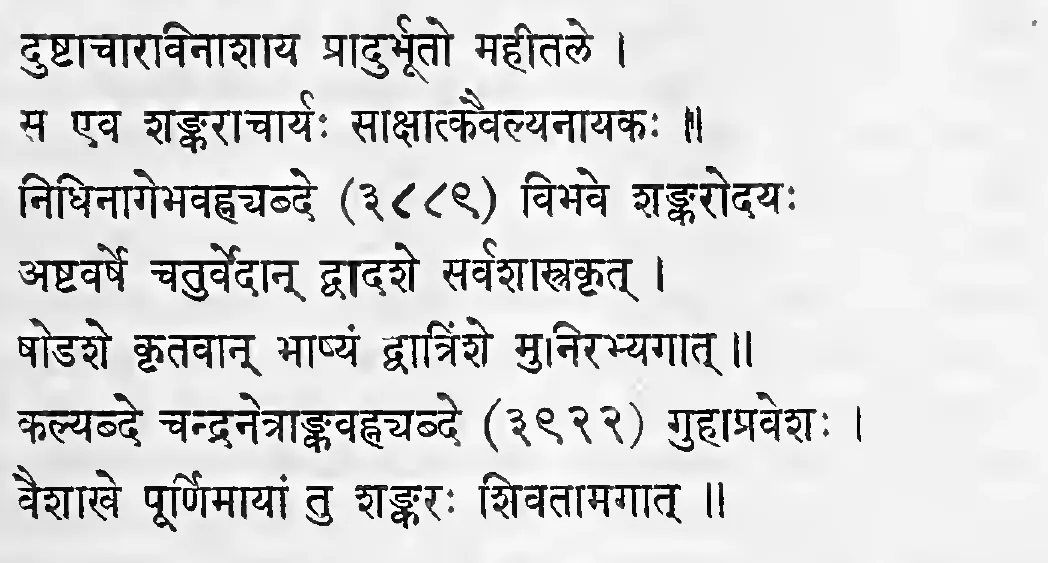
Mr. Logan, the author of the Malabar Manual, takes him to be contemporaneous with the last of the Cheraman Perumals whose date he fixes to be 825 A. D. Others again fix it in the 3rd century A. D., and according to orthodox tradition Sankara's age is fixed at forty-five years before Christ. Professor Sundararama Aiyar, M. A., in an able article in the Malabar Quarterly Review, comes to the conclusion "that Sri Sankaracharya refuted and discredited the philosophical schools of Buddhism just when they flourished most and began to get popularised and that this took place about the close of the first century B. C." Again Mr. Lewis Rice, C. I. E., the author of the Mysore Gazetteer, fixes the date of Sankara between 737 and 769 A. D., basing his argument upon the Sringeri list of successors. In the midst of such conflicting opinions among scholars it is inexpedient to fix upon any particular date with authority. I should be inclined to give Sankara's Vedantism an age of about 2,000 years in India.
In his eighth year Sankara's Upanayana Samskaram was performed, and after the usual course of the Brahmacharya discipleship, Sankara renounced the world in his sixteenth year and became a Sanyasin under the spiritual tutelage of one Govinda Bhatta (whom Sankara always styled as Govinda Bhagavatpada), who had established a hermitage on the banks of the Narmada. On the advice of his Guru, Sankara travelled throughout India preaching the Vedantic creed and successfully refuting the professors of other religions of India at the time. He established several monasteries and Mutts (Matams), the chief of which are those at Badarinath in the north, Jagannath in the east, Sringeri in the south and Dwaraka in the west. He set up a Lingam at Kedarnath and returned by way of Ayodhya, Gaya and Jagannath to Sri-Saila, where he encountered Kumarilla Bhatta who is said to have ground the Buddhas and Jainas in oil-mills—[100]an old-world story often repeated in the case of other great men of India also by their narrow-minded or unworthy disciples. Kumarilla declined to argue with Sankara but referred him to Mandana Misra who was married to his younger sister, Sarada, said to be an incarnation of Saraswati on account of her great learning. Sankara introduced himself to Mandana whom he defeated in argument in the presence of his wife. The latter subsequently challenged him on all the Sastras with a view to discomfit him. Sankara still remaining invincible, she hit upon the expedient of testing him on the science of love or the Kama Sastra as it is called. Being unable to meet her in argument, Sankara obtained a short respite to enable him to study the subject. He thereupon went to Amritapura and animated the dead body of its Prince, Amaru, in whose form he gained familiarity with the science and returning to Sarada he answered her questions and won her approbation and was declared victorious. The throne of Saraswati to occupy which he was declared fit by virtue of his triumphs in the dispute is still shown at Kashmir. Consecrating Mandana Misra as a Sanyasi under the name of Suresvaracharya, he bound Saraswati with spells and conveyed her to Sringeri where he established her throne. Ever since this incident Sankara became famous in all the Indian States of the time and this led to his further achievement. But in one of his tours through Hindustan, he contracted a dangerous disease and passed away from its effects at the early age of thirty-two, according to some accounts, or thirty-eight according to others. Among the several places that contend for the honour of having been his last resting-place, viz., Badarinath, Conjeevaram, Kedarnath and Sringeri, preference may be given to Kedarnath in consideration of the reliability of Madhava's account of Sankara on such matters, though manuscripts exist in favour of the other places also. Sankara is also believed to have returned to his native village to see his mother in her last days and perform her obsequies. We are told that he was refused any assistance from his villagers and kinsmen at his mother's death and was put to many difficulties and hardships on that account.
There are several curious customs and ceremonies among the Nambudiris which are attributed to Sankara's spirit of retaliation on those who by standing aloof caused him endless trouble and inconvenience in the performance of his mother's funeral rites. But the Nambudiris of Pazhur, his native village in Vaikam, were the worst in their treatment of him showing him extreme unkindness and even positive antipathy in the hour of his trial. They therefore received Sankara's curse in that they are prohibited from becoming Sanyasins themselves or receiving Sanyasins as [101]guests in their village, a disability which continues to this day. Others again are prohibited from reciting the Vedas. Some of the hardships which Sankara suffered from by the cruel ostracism of his fellow-caste men still stick to their community as a whole in the form of stereotyped customs, partly perhaps by way of respect to the memory of the illustrious savant and reformer and repentance for their own silly conduct towards him, but more probably as peculiarities inseparable to so sparsely peopled a community as that of the Nambudiris. One is that Sudras can help at funerals, a custom which would be reprobated in the East Coast. Another is that in imitation of the great reformer's disposal of his mother's dead body by cutting it into pieces and placing them on the funeral pyre, every dead Nambudiri's body is touched with a knife at so many points to show that the same procedure is followed now though there is no actual need for doing it, as in the case of the reformer's mother. Another custom is that the outer fronds of the green plantain are still placed on the pyre which Sankara had to do and with which he was able to cremate his mother's body, as he was wholly unable to get the necessary fuel for the purpose being left alone and helpless at the time. How the green plantain frond ignited is of course attributed to Sankara's miraculous power. This observance of placing plantain frond with the fuel is, I am told, still kept up though the reason for it has also long ceased to exist.
His immortal masterpieces of philosophic disquisitions are the Bhashyas on the three Prastanas, viz., the Bhagavat Gita, the Upanishads, and the Vedanta Sutras. The sect of Vedantists founded by him is the most unsectarian admitting all objects of worship as but manifestations of Mahadeva, the Great God.
"The Vedantic system advocated by Sankara is pantheistic and based on the doctrine of Advaita or non-dualism, which means that the universe is not distinct from the Supreme Soul. Its leading tenet is the recognition of Brahma Para Brahma as the only really existing Being, the sole cause and supreme ruler of the universe, and as distinct from Siva, Vishnu, Brahma, or any individual member of the pantheon; to know Him is the supreme good. The attainment of complete wisdom results in Mukti or liberation, and re-union with the divine essence. But as the mind of man cannot elevate itself to the contemplation of the inscrutable First Cause and Only Soul, he may be contemplated through inferior deities and sought through the prescribed rites and exercises. This creed thus tolerates all the Hindu deities and the worship of the following was, by Sankarachari's express permission, taught by some of his disciples :—that of Siva, Vishnu, Krishna, Surya, Sakti, Ganesa and Bhairava."*
The low state of morality to which Hindu society had sunk at this time, as evinced by the existence of innumerable religious sections of the Hindu community like the Saktas, the Bhairavas, the [102]Ganapatyas and the Kapalikas perpetrating their abominable malpractices on the plea of texts of the Vedas existing, which they interpreted as they wished, required the strong hand of a learned and divinely inspired reformer like Sri Sankara to bring about unification of thought and conduct in the Hindu world. Sankara's chief work consisted in his attack on and overthrow of the tenets of the decaying Buddhism of the time. In connection with this statement it will have to be remembered that the popular legends representing Sankara as having been chiefly instrumental in the extermination of the Buddhists from the Himalayas to Cape Comorin are absurd and unhistorical. His argument on the other hand was purely dialectical and polemical. According to Wilson, "the object of his writings was the refutation of all other doctrines besides his own". His attempt at the unification and reconciliation of divergent and conflicting systems of thought among the learned of the time was very successful. He re-established the Sanyasa Asramam among his co-religionists. Sankara successfully endeavoured to reform the morals and manners of the various sects and sections of orthodox Hinduism. He preached kindness to all living things, truth-speaking, purity of life, restraint of the senses, love to God and to the Guru, while confirming the worship of the deities peculiar to each sect, and also the modes of practically realising the universal God through Sreddha, Bhakti, Dhyana, Jnana and Yoga.
* Mysore Gazetteer (Revised edition)— Lewis Rice. Page 472.
This brief notice of Sankara's life and teachings may fitly be concluded with the following estimate of him formed by Sister Nivedita—one of the few English lady-scholars who seem to have instinctively got at the right way of appreciating the genius of the Hindu nation and their philosophical teachings. She says :—
"Western people can hardly imagine a personality like that of Sankaracharya. In the course of a few years to have nominated the founders of no less than ten great religious orders, of which four have fully retained their prestige to the present day; to have acquired such a mass of sanscrit learning as to create a distinct philosophy and impress himself on the scholarly imagination of India in a pre-eminence that twelve hundred years have not sufficed to shake; to have written poems whose grandeur makes them unmistakable, even to foreign and unlearned ears; and at the same time to have lived with his disciples in all the radiant long and simple pathos of the saints—this is the greatness that we must appreciate but cannot understand. We contemplate with wonder and delight the devotion of Francis Assisi, the intellect of Abelard, the virile force and freedom of Martin Luther, and the political efficiency of Ignatius Loyola; but who could imagine all this united in one person?"
Hindu fasts and festivals. There are several fasts and festivals observed in Southern India. With regard to the custom of fasting, Sir Monier Williams observes, "It may be worth while to point out that no Christian man—be he the Roman Catholic, or Anglican—not even the [103]most austere stickler for the most strict observance of every appointed period of humiliation and abstinence, can for a moment hope to compete with any religious native of India, Hindu or Mahomedan—who may have entered on a course of fasting, abstinence and bodily maceration.” *
Foremost among the fasts comes the Ekadasi (11th day in the fortnight) particularly connected with the worship of Vishnu, and the Pradosham which comes off on the thirteenth day of the fortnight connected with the worship of Siva. Among the other fasts and festivals may be mentioned the Maha Sivaratri coming on the fourteenth day of the dark fortnight of Magha (February), when a fast is observed in the day and a vigil kept at night all through which the Sivalingam is worshipped; the Srirama Navami or birthday of Rama coming on the ninth day of the bright half of Chaittra (April); Ashtami Rohini, the birthday of Krishna coming on the eighth of the dark half of the month of Sravana (July-August); the Vinayaka Chaturti on the fourth day of the bright half of Proshtapada (August and September); the Navaratri beginning on the first and ending on the tenth day of the bright half of Asvini (September), the last day of which is called Vijayadasami when the Goddess Saraswati is worshipped; the Chitragupta-puja (April and May), the Makara Sankranti in celebration of the sun entering the Uttarayana (January) when the Sun-god is worshipped, &c. A short description of these is given in the next chapter.
Hindu moral code. Having referred to the chief features of Hinduism and described the several forms and objects of worship, let us now see how the Hindu religion has affected the Hindu individually and collectively. The people of Travancore are extremely conservative and orthodox and follow very strictly the rules of conduct practised by their ancestors of centuries back. Any deviation from the existing mamool is viewed by them with suspicion and superstitious dread, and if possible it is never allowed. It is often asserted that there is no connection between a Hindu’s creed and his moral conduct. This is not correct. To the Hindu as to the other religionists, morality is the inseparable concomitant of religion.
Transmigration and Law of Karma. The belief in the transmigration of souls as caused by the Law of Karma is the main basis or groundwork of the Hindu religion, and in fact it is its chief and distinguishing characteristic. The Law of Karma translated into plain language is nothing more than the familiar adage, “As we sow, so shall [104]we reap.” So long as this doctrine is the basis of a Hindu’s belief, it is a safe guide inciting him to do good and deterring him from evil. Every moment of his daily existence the pious Hindu is reminded of the Law of Karma that “every deed in his life, every karma leads to its legitimate results in one’s future life, whether it be in another world or in another existence in this world.” Self-righteousness lies at the root of Hindu religious belief, and no man is counted righteous except through his works, acts and thoughts.
* Brahmanism and Hinduism. Page 426.
Manu says:—“Action of every kind, whether of mind or speech or body must bear fruit entailing fresh births through multifarious conditions in highest, mean and lowest transmigrations.”
Again, “Single is each man born into the world. Single he dies, single he receives the rewards of his good deeds, and single the punishment of his evil deeds. When he dies his body lies like a fallen tree upon the earth but his virtue accompanies his soul. Wherefore let man harvest and garden virtue so that he may have an inseparable companion in traversing that gloom which is hard to be traversed.”
These sublime truths are deeply impressed in the mind of every pious Hindu and form the chief incentive to virtuous deeds and a primary check to vice. Again the Puranas and the Itihasas that are the chief guides of Hindu moral conduct abound with lessons on morality of a very high order by setting him the highest types of good men and women that have lived in past ages and have fully discharged their duties in life in all directions to God, to relations and to fellow-men. Morality is summed up in one dictum, viz., “good thoughts, good words and good deeds”, and these are enjoined on every man. Thus to the Hindu whatever is enjoined in the sacred writings becomes his duty to follow, whatever is prohibited therein is to be avoided as immoral and vicious. The influence of Western thought and Western education is slowly leavening this ancient civilisation the effect of which it is too early to judge. The mass of the population still remain unchanged.
Hindu Culture. A brief discourse on the leading principles of Hindu philosophy as compared with the Western systems may next be attempted.
The golden age of Hindu learning is past and gone. The Hindu mind which 2,000 years ago made wonderful progress in science and civilisation, now lies low and passive, though slowly awakening to the new civilisation of the West. The achievements of the ancient Hindus in the [105]special departments of science were indeed not so thorough and comprehensive as the modern developments made in the West, but in Poetry and Literature, and especially in Philosophy, they have achieved immortal fame, which still interest and instruct modern scholars. As Hindu philosophy is the best and ripest product of the Hindu intellect, as it permeates through and through Hindu life and conduct, individual and social, it might be taken to represent the whole of Hindu learning. In the progress of Hindu thought, science and religion have always gone hand in hand, supporting and supplementing each other, and this necessary interdependence of science and religion which with the Hindu mind was an axiom at the very root of all intellectual activity, has cost modern savants so much pains to prove.
The simplest answer to the question “what is philosophy” is that it is the solution of the ultimate problems of existence which reflective consciousness necessarily entertains. Man, Universe and God are the most fundamental conceptions of the human mind. To understand these in their true relations, is the problem of philosophy. Philosophy in its real sense is that science which furnishes ultimate explanation to experience considered in its most comprehensive character, including both moral and religious aspirations, and which thus teaches us to know and be ourselves.
The orthodox systems of Indian philosophy are distinctly pervaded by the stoical spirit. They teach self-control and self-sacrifice as the only means of rising above the storms of life and of attaining perfect bliss which never shifts and perishes. The Hindu philosophy has sprung not merely from the love of contemplation natural to the Hindu mind, but also from an extreme sensitiveness to human suffering. With Hindu philosophers, as with Socrates and his contemporaries, philosophy was inseparable from ethics, knowledge from virtue. And consequently the doctrines of Karma and Transmigration of Souls are the cardinal principles of Hindu philosophy. According to the former of these doctrines, every conduct leaves its effects behind on the individual and cannot be undone. Every man must reap the natural consequences of his conduct, whether it takes the form of thought, word or deed. The accumulated effects of one’s actions for a whole life-time are conserved and transmitted to another life when the soul enters on it after the dissolution of the body with which it has been originally bound up. The gradations of successive lives will be determined by the conduct of previous lives, and the forms of life through which any soul may pass lie between two extremes, the philosophic and the inanimate. Independent of its ultimate philosophical value, this doctrine is very valuable inasmuch as it clearly recognises the subtle effect of the thoughts, words and deeds of men as persisting in their [106]constitution after their fleeting causes die out, and furnishes a sanction for morality, namely the consciousness of the natural consequences of one’s doings, which Herbert Spencer regards as the only truly moral sanction.
The systems of philosophy usually recognised in India are six. They are not antagonistic, but complementary to one another. They are orthodox as being based on the Vedas, and are one in spirit which of course is Hindu. Their common aim is to teach man how to escape from the limitations and sufferings consequent on earthly life and attain heavenly beatitude, which is all tranquillity, all happiness and all light. Each of them comprises logic, psychology, ethics, philosophy and religion, and thus practically illustrates the organic relation between these various topics. These six systems are known as the Vaiseshika of Kanada, the Nyaya of Gautama, the Sankhya of Kapila, the Yoga of Patanjali, the Purva-Mimamsa of Jaimini and the Uttara-Mimmamsa of Badarayana. Of these systems, the Vaiseshika, Sankhya and Vedanta have alone been regarded as essentially philosophic, as affording distinct solutions of the problems of philosophy. The Vaiseshika explains the origin of the universe by the theory of atomic agglomeration, the Sankhya by the theory of evolution and the Vedanta by the theory of illusion.
The Vaiseshika is one of the twins, to the other of which, the Nyaya, it is a complement. Gautama, the founder of the Nyaya system and whom Dutt calls the Aristotle of India, describes the summum bonum of life as Nisreyasu (Perfect bliss) which is to be attained by a knowledge of truth. The Nyaya formulates the rules founded on the nature of thought and being, by which truth can be ascertained. The Vaiseshika philosophy works up the doctrines of Nyaya into an explanation of the universe. The cardinal principle of this philosophy is that all material substances are aggregates of atoms. The atoms are eternal; the aggregates are perishable by disintegration. Under an unseen law, the atoms combine to make a compound and in this way the earth, water, air, light and ether are produced. This doctrine presents a striking resemblance to the atomic doctrine of Democritus of ancient Greece, and if Gautama was the Aristotle of India, Kanada was certainly the Indian Democritus.
The next pair of philosophic systems is the Sankhya and the Yoga. The former explains the universe as the evolution of a spiritual principle organically bound up with a material world. It starts with the duality of spirit and matter, Purusha and Prakriti; Prakriti which potentially possesses an unlimited capacity of evolving differences, is one and eternal, but differentiates itself into many when the equipoise of its inherent [107]Gunas namely Satva, Rajas and Tamas is disturbed. Prakriti thus passes from a static to a dynamic condition and evolves through well-marked stages, viz., Buddhi, Ahankara, Manas, Indriyas and Tanmatras. But this evolution acquires meaning only when the system of Prakriti thus unfolding itself is presented to a Purusha or self-conscious intelligence. The Purusha who is co-eternal with Prakriti is not one but many, and the evolution of Prakriti without the Purusha in whose consciousness the evolution appears, would be like the performance of a drama without an audience to witness the performance.
Kapila has recognised the duality of existence, viz., Purusha and Prakriti or intelligence and nature as fundamental. Purusha and Prakriti are, according to him, ultimate existences possessing incompatible attributes, and the one cannot be evolved out of the other although Prakriti exists only as the object of intelligence. Prakriti out of which, by means of a primitive disturbance of its inherent Gunas, Buddhi, Ahankara, &c., have evolved, cannot be identified with a material principle as distinct from the psychic, but on the contrary is the indeterminate, homogeneous, and incoherent something which represents infinite possibilities of development on the physical as well as on the psychical side. It is that which acts out the drama of creation of which Purushas are the spectators. The Purusha who, to begin with, is eternal in principle and spiritual in character, gradually identifies himself with the details of Prakritic changes, and the phenomenon of human life results. In a moment of self-forgetfulness, Purusha attends the drama of Prakriti and while witnessing the drama as a passive spectator, sympathetically moves on to the stage, becomes one of the characters and thus falls a victim to the allurements of life with its natural consequences of pain and sorrow. This is the origin and explanation of human life which Kapila offers, and consequently he formulates the highest end and aim of life as the eternal desire on the part of the Purusha to separate himself from the self-constituted bondage which in a moment of weakness he subjected himself to. Knowledge and experience are the means to break through voluntary bondage and the Purusha who has regained freedom by true and clear knowledge, stands firm and unmoved, no longer fascinated by the ceaseless mutations of Prakriti. Perfect freedom of the Purusha is measured by the consciousness: “Neither I am, nor aught is mine, nor do I exist.” For, there can be no thought when the Purusha is unmoved. If the Purusha says, “I am”, it has really become other than itself, and really says, “I am that,” “I am this”, &c.
Kapila’s doctrine of Purusha and Prakriti and their relation with one another strongly reminds one of Fichte’s doctrine of the absolute Ego [108]positing a non-ego, with a view to develop and perfect itself, though to Kapila Nature was not, as to Fichte, a dead inert substance, but a ladder on which the spirit rises to itself. Kapila’s system has been regarded by some as the anticipation of modern German philosophical systems, for instance, Davies says:—“The latest German Philosophy is a reproduction of the philosophical system of Kapila in its materialistic aspect presented in a more elaborate form, but on the same fundamental lines. In this respect the human mind has gone over the same ground that it occupied more than two thousand years ago.”
The Yoga of Patanjali is the complement of the Sankhya; it is not a system of philosophy in the real sense of the word, but only a body of rules and precepts regarding the control of bodily movements with the object of attaining the liberation of the spiritual Purusha from the bondage with the non-spiritual, which according to Sankhya is the highest goal of rational life. The Purva-Mimamsa also hardly deserves the name of philosophy, though it is supposed that practice, according to the Vedic rites and sacrifices with the interpretation and elaboration of which it is chiefly concerned, is a preparation for such knowledge as is taught in the Uttara-Mimamsa or the Vedanta.
The Vedanta is the highest achievement of the subtlety of the Hindu mind. Prof. Max Muller says, “The Vedanta Philosophy is a system in which human speculation seems to have reached its very acme.” According to the Vedanta, the ultimate explanation of existence is Brahma, who is eternal and immutable, indivisible and infinite. He is pure being, pure thinking and pure bliss. For him knowledge is existence and existence is knowledge, and there is no duality of subject and object. The universe of our knowledge and experience which is manifold and multiform, is an emanation from Brahman, under the influence of Maya. The Brahman is identical with itself, it undergoes no change or modification of any kind when the universe manifests itself. The universe is not identical with Brahman and the fact that we sometimes think it is, is because we mistake the appearance for the reality. The universe is only the phenomenal expression of Brahman under the influence of Maya, Avidya or Nescience. When the unconditioned Brahman is reflected through Maya, then creation or rather manifestation begins, and Buddhi, Ahankara, Manas, Indriyas, and Tanmatras appear in succession.
The individual, according to the Vedanta, is only the Brahman shrouded by Avidya, and the differences among individuals are due to the play of Maya and its many forms. Through Avidya or ignorance, the individual [109]identifies himself with the phenomenal life and regards it as the whole and the most precious possession. The highest function of man is to know himself that he is Brahman and to be free, for by such knowledge alone could one escape from the bondage of Karma and from the successive lives and the miseries incident thereto.
The substance of the Vedanta Philosophy as outlined here has its analogue in the speculations of Hegel in Germany. According to him the whole Universe including man is but the expression of the Absolute and represents the several stages of its realisation. The absolute or the unconditioned is moving and acting only in order that it may return to itself. The Brahman, likewise self-forgetful for a time, views the manifestations of the universe as its own, only that it may come back to itself and be Brahman again.
The Vedanta Philosophy like other orthodox systems of Hindu philosophy, has essentially the same ideal, viz., the emancipation of the soul which is Brahman, from the vicissitudes of life and final absorption of the soul into Brahman, and teaches the same lesson in regard to the realisation of the same, viz., right knowledge. But the Tat twam asi of the Vedanta is distinctly Vedantic and affords the most stable foundation for ethics. To realise that all men are in reality one or merely different modes of existence of Brahman is to efface the distinction between Meum and Teum and to rise above the desires and wants of the sentient individual, which are the sources of all conflict and vice. Not even the universal brotherhood of mankind approaches the Vedantic principle of the identity of all men.
We should not however suppose that Indian thought moved only in one groove, for we find Humian Nihilism, and Epicureanism represented in the Charvaka Philosophy. According to Charvaka, reality does not go beyond the senses and perceptions and the ideal of conduct goes higher than pleasure, and social philosophy and ethics are represented in Buddhism. *
* For the information on this subject I am indebted to a learned paper drawn up by Mr. S. Subrahmanya Sastri, M. A., Lecturer in His Highness the Maharajah’s College, Trivandrum.
[110]
Section B.—Mahomedanism.
“God is the God of all creatures, not of one section only.”
Mahomet the Prophet.
Introduction of Islam. The question of the age of Mahomedanism in Malabar is still unsettled. It is generally believed to have been introduced into Kerala before the 9th century A. D. The event is generally associated with the alleged conversion of the Cheraman Perumal to Islam and his supposed pilgrimage to Mecca. But we have already referred to it and dismissed the story as groundless and unauthenticated. The fact is that it was not the last Cheraman Perumal that embraced Islam, went to Mecca and died on his way, but only one of the Zamorins of Calicut of the 9th century. That the Arabs had an important share in the extensive commerce carried on between Malabar and the West and that these commercial relations laid the foundation for the spread of Mahomedanism on this coast may be taken as established. The Mahomedan religion is said to have been first brought in by a party of pilgrims headed by Malik-Ibn-Dinar about 224 A. H. (about the middle of the 9th century A. D.). They were all received hospitably at Cranganore and given lands to build mosques upon. Another party headed by Malik-Ibn-Habil is said to have landed at Quilon to spread and propagate Islam, where a great mosque was founded by Hussain, one of the sons of Malik-Ibn-Habil. But individual Mussalmans had already settled themselves in Malabar before this. A Mahomedan inscription at Pantalayini Kollam in North Malabar records the death of one Abbi Ibn Udthorman in Hejira 166. The Masudi of Bagdad (890-956 A. D.) records that during the 7th and 8th centuries there were Arab merchants in Malabar and the Arab name was held in high respect. Other early travellers and writers also refer to the extensive commercial dealings between Arabia and Malabar. The Arab merchants always received every encouragement and protection for their property and religion from the Native kings. During the time of Ibn Batuta (14th century A. D.), every town in Malabar had its quota of rich Mussalman merchants. He also refers to “the five mosques which stood as an ornament to the noble emporium of Quilon” and bestows high praise on the generosity and power of its Hindu sovereigns.
The advent of Hyder Ali and Tippu Sultan into the peaceful domains of Malabar with their terrible alternatives of conversion into Islam [111]or massacre and devastation of course added to the number of Mahomedan converts. Again, history also records that when the sea-port of Alleppey was opened for trade by H. H. Rama Varma with a view to destroy the commercial monopoly of the Dutch at Poracad, a large number of Mussalmans from Sindh, Kutch and Guzerat were invited to settle and trade in Travancore.
The following account regarding Mahomedanism appeared in my Report on the Census of 1891 and is reproduced here as standing information on the subject for there is nothing to add to it.
Characteristics. Mahomedanism is called the great antagonistic creed, antagonistic, I think, to Christianity, and to every other religion besides. Intolerance is its chief characteristic and as a necessary consequence, we find that the Mahomedan races all over the world are more or less fanatical and fierce. They are as intolerant to their sectarian brethren as to the infidels. Sometimes the quarrels between the Sunnis and Shiahs develop into an open outburst of ill-feeling and lead to breaches of the peace. The bigotry of the creed breeds Fakeerism and stifles all philosophical thought and enquiry. A religious schism among them is sufficient to estrange the feelings of their kith and kin from the schismatics. To the schismatics the term ‘wanderers from the truth’ is applied, the faithful adherents alone being entitled to the name of Muslim (Moslem) or the believers. The outside world are called infidels or Kaffirs, a broad term conveying within it Christians, Jews, Hindus, Buddhists and all other religionists. Again, towards the infidels or Kaffirs the free use of the sword is sanctioned by the Koran, the text running as follows:—“But for the rest, the sword is not to be sheathed till they are exterminated or submit to the Faith which is to become superior to every other religion.” (Sura IX.)
Their religion. The Koran is their holy scripture and is looked upon by the Moslems as the fountain of all science, knowledge and laws. Mahomet is their Prophet, called by them their Nabi. The great doctrine of their faith is that “there is no God but God and Mahomet is the Prophet of God.” This is the characteristic tenet and foundation stone of Mahomedanism. The Mahomedans are characterised by piety and devotion; their behaviour in mosques is said to be of an exemplary character—the utmost solemnity and decorum being observed in their public worship. Mecca, the birth-place of Mahomet, is the Kasi (Benares) of the Mahomedan world and pilgrimage to the holy city is one of the chief aims of a Moslem’s life. If he is a faithful Mahomedan he prays five times every day as stated below:—
[112]
- (1) Subuhir—Before sun-rise.
- (2) Lokar—Afternoon, i. e., 3 ft. shadow to 8 ft. shadow.
- (3) Asar—Before 5 P. M. or 9 or 10 ft shadow.
- (4) Makurib—After sunset or before 6. 30 P. M.
- (5) Isha—At 9 P. M. or before 3 A. M., if very late.
He does not care for his surroundings at the house of prayer. Mahomedans will begin their devotions in the midst of a crowd. They will stop their business transactions and whether in the store or in the field they will drop down on their knees and pray. For prayer a Moslem may sit or stand; but generally he sits on the calves of his legs (a posture reprobated among Hindus) over a cloth spread on the floor with his face turned towards the temple of Kaaba in Mecca, which is their Kebla or point of adoration in the same manner that the Brahmin’s prayers are made towards the sun. Friday is the most important day of the week with the Mussalman and all the village Mahomedans are on that day expected to join in their prayers at the mosque—absence being punished by fines. Before praying, the Mussalman must wash his hands and feet with water, or where that is not possible sand may be used, a substitute invented, I think by the genius of Mahomet to suit the climatic condition of Arabia, the cradle of the Mahomedan religion. But no prayer can be had after sexual intercourse without bathing.
The five important precepts ordained by the Prophet on every Mahomedan are:—(1) Belief in God or Allah, (2) worship at the stated hours, (3) alms-giving, (4) the fast of Ramzan and (5) the pilgrimage to Mecca; and as described above they are very strict in the observance of these precepts. The chief occasion for the giving of alms to the poor are during the Ramzan fast lasting thirty days, on the 70th day from it Hadj, during the Mohurrum season, and the 15th day of Shabban called Barath and on the 27th day of Rajap.
The fast of Ramzan comes in the 9th month of the Mussalman year.
Every day from sunset to 4 A. M., it is allowable to break the fast, but from 4 A. M. till sunset eating or drinking is forbidden. This should be continued throughout the month and every Mahomedan is required to spend his day and night in devout contemplation of Allah. In the mosque every evening twenty ceremonial prayers are recited in the presence of all, and on the last Friday a special Khootba or farewell sermon is read. On the 27th night when the Koran is said to have been revealed, the people should sit up all night burning frankincense, praying and reading the Koran.
[113]Among the other important religious festivals of the Mahomedans the Mohurrum requires mention. The Mohurrum festival is celebrated in the first month of the Hejira in commemoration of the martyrdom of Hussain the grandson of the Prophet. This festival is special to Shiahs, though the Pathans who are Sunnis also observe it but without its fanatical features. The festival commences on the evening of the day on which the new moon becomes visible and lasts for ten days. Every night funeral prayers are recited at the temporary sheds erected for the purpose. On particular days especially on the ninth night, processions are formed carrying the taboots specially constructed, when the streets are illuminated and various kinds of diversion are arranged. A distinguishing feature of the festival is the large number of men chiefly of the lower classes dressed up representing different characters greatly to the amusement of the people and to their own profit. During the whole period, the Mahomedans do not work, drink no intoxicating liquors and do not marry. The Jonaka Moplas observe only the ninth and tenth days.
According to the Census of 1891, there were 453 mosques in Travancore. The priests who are known under the name of Tangals exercise considerable influence over them.
[114]
Section C.—Christianity.
“Moravian hymn and Roman chant
In one devotion blend
To speak the soul’s eternal want
Of Him, the inmost friend;
One prayer soars cleansed with martyr fire,
One choked with sinner’s tears,
In heaven both meet in one desire,
And God one music hears.”
Lowell.
“That glorious form, that light unsufferable,
And that far-beaming blaze of majesty,
Wherewith He wont at heaven’s high council-table
To sit the midst of Trinal Unity,
He laid aside; and here with us to be,
Forsook the courts of everlasting day,
And chose with us a darksome house of mortal clay.”
Milton.
[Prefatory Note. For this Monograph on the ‘History of Christianity in Travancore’, which appears in its entirety in this section of the chapter on Religion, I am indebted to Mr. G. T. Mackenzie, I. C. S., the late British Resident in Travancore and Cochin. It is easy for even a casual reader to see that the Paper is the result of much study and research for which Mr. Mackenzie has had special opportunities during his long stay in Travancore, extending over a period of five years and four months. The article, as it now appears, has been thoroughly revised by him, this being its third edition, his earliest one having been published so long ago as October 1901. In the Preface to that edition, Mr. Mackenzie observed:—
“The Travancore Durbar proposes to publish an official Manual of the Travancore State and has entrusted to Mr. Nagam Aiya, Settlement Peishcar, the task of compiling this Manual. ... ... Some time will elapse before the other chapters of the Manual are completed and therefore His Highness the Maharajah has permitted the manuscript of this chapter to be printed for facility of perusal and correction, on the understanding that it will be regarded only as a paper written by me and not yet as part of the official Manual.”
The article in its present form was finally corrected and handed over by him in November 1904, just as he was leaving Travancore.
The subject is one of great importance not only from a socio-religious point of view but from an administrative one as well. According to the Census of 1901, the Christians number 697,387 or 24 per cent of the total population of Travancore. This large proportion of Christians in the State is evidence at once of the earnest labours of the various missionary [115]bodies working in Travancore and of the praiseworthy tolerance of this Native Government from remote ages. In Madras the Christians form 2·6 per cent of the population. Travancore is thus ten times more Christian, pro rata, than the British Province of Madras directly ruled by British Christian officers. As I remarked in my last Census Report, (1891),
“All religions have existed side by side in Travancore from the remotest ages under the wise and tolerant policy which has always characterised its Native government long before the English or any other European nation came in contact with it, either on account of political or commercial relations. It is a remarkable proof of this religious tolerance that in Travancore 20 per cent of the population are Christians against 2 per cent in the Madras Presidency. From the earliest ages of the sway of Hindu monarchs in Malabar, the Hindu, the Mussalman, the Christian and the Jew have equally enjoyed the protection, the friendship and sympathy of the Government, while on their part they have all willingly laboured for the prosperity of the commonwealth without any of those unpleasant asperities and collisions that have disfigured their later relationships elsewhere.”
The late Sir W. W. Hunter, the greatest modern Historian of India, observed:—
“The large Christian population is a distinctive feature of the country (Travancore). The Syrian Christians date from the earliest centuries of our era; the Roman Catholics of the Latin rite are the result of the European Missions of the Jesuits and Carmelites during the last 300 years.”
In Travancore the Hindus form 69 per cent of the total population; in Mysore 92·5 per cent; Gwalior 85 per cent; Baroda 79 per cent; Madras 89 per cent; Coorg 89 per cent; Central Provinces 83 per cent; United Provinces of Agra and Oudh 86 per cent; Bombay 73 per cent, and in Hyderabad 89 per cent. Thus we have the rare phenomenon that the conservative Hindu State of Travancore is much less Hindu than even the Mahomedan State of Hyderabad. The reason for this is not far to seek. The distinctions of caste and creed here are clear and sharp and the barriers between one caste and another insuperable. If so, the lower orders have nothing to lose but everything to gain by giving up their position in the Hindu social scale. Continuance in their birth-religion means to them a continuance of their present degraded condition for all time to come. No wonder then that they have transferred their allegiance to the European missionary and his religion which has brought with it deliverance to them from the trammels of the old-world civilisation. If by some sudden diversion of energies into fields of new work the Christian evangelizing bodies were withdrawn from our midst to-day, what would it mean to the majority of these new converts who have not had time to be grounded in their social regeneration? Only a [116]return to their former condition of squalor and poverty and abject dependence on the higher castes. Under this condition of things, the Hindu population is bound to fall off in numbers by the gradual elimination of its weak limbs at the lower fringes.
Sir J. A. Baines, K. C. I. E., I. C. S., the eminent Census Reporter of the Indian Census of 1891, wrote:—
“The greatest development (of Christianity) is found where the Brahmanic caste system is in force in its fullest vigour in the south and west of the Peninsula and amongst the Hill Tribes of Bengal. In such localities it is naturally attractive to a class of the population whose position is hereditarily and permanently degraded by their own religion; as Islam has proved in Eastern Bengal and amongst the lowest class of the inhabitants of the Punjab.”
Again Mr. J. D. Rees, M. P., C. I. E., I. C. S., (Retired) writes thus in a recent issue of The XIX Century and After:—
“Of the Christians, two-thirds are found in Madras and the neighbouring Native States. Of the two-thirds, four-fifths of the Christians in Madras proper are found in the southern districts of that Presidency, and in Travancore and Cochin they amount to 25 per cent, of the population. As I have served many years in these British districts, and was British Resident in Travancore and Cochin, I may be allowed to express concurrence with the Madras Census Commissioner, Mr. Francis, when he says that converts are recruited almost entirely from the lowest classes of Hindus, who have little to lose in forsaking the creed of their forefathers, and that, so far from anticipating the general conversion of the population expected in certain quarters, there is, on the contrary, reason to believe that the rate of increase will slowly decline as the limit is approached of those to whom the advantages of espousing Christianity appeal. At the same time the increased supply of missionaries familiar with the vernaculars and with the religion and literature their predecessors have too often affected to despise, and the energy, education, intelligence, and improved status of the Native Christians are factors which it would be equally unjust and erroneous to leave out of account.”
There is no doubt that, as time goes on, these neglected classes will be completely absorbed into the Christian fold, especially as the only other proselytising faith, viz., that of Islam, is now practically quiescent in the matter of conversions. Such a state of things, however, must add to the difficulties of administration in a country like ours which is quite unlike England or America or China where the Governments have to deal only with peoples homogeneous in thought, race and religion. Throughout India the same political difficulty exists as in Travancore, for there too we have not one nation but a congeries of nations, cut up into innumerable races, sects and castes with conflicting instincts and interests. In this Native State the difficulty of the problem is probably a great deal more intensified by the peculiar circumstances of its position. This fact seems to have been fully recognised in the Viceroy’s Banquet speech at [117]Trivandrum in November 1900, in the course of which H. E. Lord Curzon remarked:—
“Planted amid these idyllic scenes is a community that has retained longer than any other equally civilised part of the Indian continent its archaic mould; that embraces a larger Christian population than any other Native State; and that is ruled by a line of indigenous princes who are one in origin and sentiment with the people whom they govern. Well may a Viceroy of India find pleasure in turning hither his wandering footsteps; good reason has he for complimenting such a ruler and such a State. ... ... In one respect His Highness enjoys a position of peculiar responsibility; for he is the ruler of a community that is stamped by wide racial differences, and represents a curious motley of religions. In such a case a prince can have no higher ambition than to show consideration to the low, and equity and tolerance to all. In the history of States no rulers are more esteemed by posterity than those who have risen superior to the trammels of bigotry or exclusiveness, and have dealt equal mercy and equal justice to all classes, including the humblest, of their people. In this category of Princes His Highness, who has given so many proofs of liberality of sentiment, may attain a conspicuous place, and may leave a name that will long be cherished by later generations.”
The facts set forth in this chapter, it need hardly be said, constitute a most eloquent testimony to the “liberality of sentiment” and “equity and tolerance to all”, so characteristic of the rule of His Highness the present Maharajah and that of his illustrious predecessors for a continuous period of twenty centuries.
In the Report on the Census of 1891, I wrote of the work of the Christian missions in Travancore thus:—
“By the unceasing efforts and self-denying earnestness of the learned body of the Christian missionaries in the country, the large community of Native Christians are rapidly advancing in their moral, intellectual and material condition. ... ... The working castes among Hindus, particularly those embraced within the operations of missionary labours, have received a fresh impetus in the matter of education since the Census of 1875. Those who have directly come under their influence, such as the Native Christians, have already doubled the number of their literates since 1875. But for these missionaries, these humble orders of Hindu society will for ever remain unraised. Their material condition I dare say will have improved with increased wages, improved labour market, better laws, and more generous treatment from an enlightened Government like ours; but to the Christian missionaries belongs the credit of having gone to their humble dwellings, and awakened them to a sense of a better earthly existence. This action of the missionaries was not a mere improvement upon ancient history, a kind of polishing and refining of an existing model, but an entirely original idea, conceived and carried out with commendable zeal and oftentimes in the teeth of opposition and persecution. I do not refer to the emancipation of the slave, or the amelioration of the labourer’s condition; for these always existed more or less in our past humane Governments. But the heroism of raising the low from the slough of degradation and debasement was an element of civilisation unknown to ancient India. The Brahmin community of Southern India are not doing to the lower classes what the casteless Britisher is doing to them. I do not mean that our cultured Brahmins, like the late Rajah Sir Madava Row, or the living Sir T. Muthuswamy Iyer or the Honourable Sashiah Sastri, are a [118]whit less sympathetic to them than the most refined or the most kind-hearted Englishman of the day. But what I mean is that our organization as the chief caste of the Hindu community does not provide systematic help, or means of relief to them. We have regular institutions all over India, for instance, for doing charity to Brahmins, but none such either inculcated in books or practised by recent ancestors to the Chandalas. This is an undoubted defect. The credit of this philanthropy of going to the houses of the low, the distressed and the dirty, and putting shoulder to the wheel of depraved humanity, belongs to the Englishman. I do not think the Brahmins, or even the high caste non-Brahmins, can claim this credit. It is a glory reserved to this century of human progress—the epoch of the happy commingling of the civilization of the West with that of the East.”
More than twelve years have elapsed since I bore the foregoing testimony to the work of the missionary bodies in Travancore, and my experience since then confirms me in my old admiration of their strenuous efforts to still further improve the material and moral condition of their proselytes. Driving about the Town of Trivandrum, one could easily see the sense of comfort and freedom which sits on the face of these low-caste converts. I often wonder at the natural ease with which the Pulayas and Pariahs, particularly the women among them, walk the King’s highways and barter on the road sides, as if they had enjoyed the privilege unmolested from the time of Parsurama. So easy has been the acquisition of freedom, so fast have they shaken off the thraldom of ages. I am not sure that these poor people are yet intellectually emancipated enough to appreciate the pearls of the Christian faith placed before them, but no man in his senses can for a moment doubt that they are living a new life and breathing a freer atmosphere. So much has the conversion to the Christian faith helped to raise them in the social scale, and naturally enough they gratefully swarm to swell the ranks of the classes embraced by missionary labours.
The importance of the work of Christian evangelization in Hindu Travancore, which has prospered so well as to give His Highness the Maharajah to-day a population of 697,387 Christian subjects of all denominations, may be better understood if we bear in mind that the fact is of as much moment as, nay even greater than, if there were 8 millions of Hindus in England and Wales (which according to the Census of the 31st March 1901 returned a total population of 32½ millions) distributed over every county, district and parish, owning 30,000 temples having endowments of lands and gardens attached to every one of them, and severally dedicated to Siva or Vishnu or the Goddess Bhagavati, and having close by numerous tanks and rivers provided with neat and spacious bathing-ghats which only a Hindu could rightly appreciate, and wells reserved for cooking and drinking purposes, and groves of the Ficus religiosa and the Nim [119]tree or their more congenial substitutes suitable to an English climate growing luxuriantly on their banks, with stone images of Ganesa and the snake-gods planted under them and a perennial flow of devout Hindu worshippers, men in their multi-coloured dhoties and scarves and women in their charming silk saris and velvet bodices richly embroidered with gold lace and pearls, their raven-black flowing hair smoothed with fragrant unguents and tied into large knots covered with the sweet-smelling jessamine and the rose, their foreheads beautified with the distinguishing caste-marks of either the ancient ‘tilakam’ or the perfumed sandal or the crimson ‘Kunkumam’ illumining their gladsome faces, which remind you of the milky way in the sky, “a meeting of gentle lights without a name”, and carrying in their hands on well-cleaned silver basins flowers and fruit-offerings to the temple deities, and all laden from top to toe with elegantly wrought and resplendent jewels of gold and silver, pearls, diamonds and rubies after the fashion of their fellow-religionists in India, making their morning rounds of prayer and puja to their hearts’ content, or celebrating the car-festival of the temple god or accompanying in thousands the procession of the idol with native music, sounding of bells and beat of drums with the usual accompaniments of torches, cadinas and pyro-technics—all unmolested and unhindered, under the protection of the English police and the English magistracy, and let the reader fancy that this happy state of things has been going on in Christian England from A. D. 52, what would be the impression that the scene will produce on the prosaic European mind, and what testimony may this not mean to the wisdom and tolerance of former English administrations since the time of the Druids? The same credit may, I think, be justly claimed on behalf of this Native Government for the present prosperous condition of its numerous Christian population.
Added to the importance of the subject, the publication of Mr. Mackenzie’s pamphlet gave it a further importance in the eyes of the common people, due undoubtedly to the high position of the author. This roused a spirit of rivalry among some of the Christians who, fancying that their status might suffer if they remained inactive, took the opportunity of writing memorials and counter-memorials and starting discussions in the public prints. The Elunuttikars (literally 700) and the Anjuttikars (literally 500) were the contending parties in this matter. Both the parties addressed Mr. Mackenzie; only the latter wrote to me (25th November 1903) warning me against the danger of giving undue importance to the sect opposed to them in an official document like the State Manual of Travancore. They said:—
[120]
“We have the honour to state that we lately sent a memorial to G. T. Mackenzie Esq., British Resident in Travancore and Cochin, with regard to certain class disputes between the seven hundred Christian community and ourselves, known as the Anjuticars, the occasion for this representation being the submission of a memorial to the British Resident by the former asserting that they are the descendants of the Thomas Christians. This was in reference to certain statements made by Mr. Mackenzie relating to the Latin Christians mentioned in his pamphlet re: Christianity in Travancore. We have fully disproved their ancestry in our memorial, and as we understand that you are the compiler of the Travancore Manual of which the British Resident’s publication is a chapter on Christianity, we have taken the liberty to depute the bearer of this, Mr. E. W. Nigly, as our representative to interview you in our behalf and to do the needful in conformity to the object of our memorial.”
To Mr. Mackenzie they wrote a tediously long and contentious letter even acrimonious in form, in which they said that the Native Christians in Malabar known as the ‘Seven Hundred’ were not descended from the Thomas-Christians of the Syrian Rite, and their attempt to trace their ancestry from them was absolutely untenable, unhistorical and irrelevant, that they wished to create a confusion between the two classes of fishermen who may be found along the sea-board of Cochin and Travancore, that the Native Christians living along the sea-board of these two sections were partly fishermen, either by caste or by profession, that all the authorities on the Early Church were unanimous in the statement that there were Christians of the Syrian Rite on the sea coasts between Quilon and Cranganore before the arrival of the Portuguese, that their object was to strengthen the theory of their social supremacy and that the ancestors of the ‘Seven Hundred’ were converted by the Portuguese.
It is useless to pursue their argument further. After disproving the claims of their opponents the Elunttikars (700), the memorialists proceeded to give a statement of their own case as the descendants of the Thomas-Christians. They wrote that they belonged to a village called Anyur situated at the extreme north of the Cochin State, which is one of the 30 Desoms of Chittilapilly Proverty in the Trichur Taluq and was one of the places included in the Apostolate of St. Thomas; that they were persuaded by the Portuguese to adopt the Latin Rite; that many of them were induced to adopt fishing as their occupation; that there is a sharp distinction between fishermen by caste and fishermen by profession; that the adoption by the working class of a community of a particular profession does not militate against the social position of that community as a whole; that they are descended from the primitive Christians of St. Thomas; that some of their customs are the characteristic features of the costume and ornaments worn by the Hindu ancestors of Thomas-Christians; that the ‘Seven Hundred’ cannot claim them as those practised by [121]their ancestors, and that their social equality is still maintained by intermarriage between them and the Syrians.
This is the gist of their contentions, and they took advantage of this occasion of the publication of Mr. Mackenzie’s pamphlet to ventilate their grievances and press their claims for higher recognition. The ‘Five Hundred’ seem to lay special stress on the fact that only some of them are fishermen and this too only by profession, and not like the ‘Seven Hundred’ fishermen by caste. These contentions remind one of the Poet’s lines,
“Strange all this difference should be,
Twixt Tweedledum and Tweedledee.”
The more so as the undisputed Syrians do not by their tradition appear to support the claims of either of these parties. But it should be remembered that these small differences are of vital importance in the opinion of the communities concerned and agitate their minds deeply, causing them no little pain and distress when interfered with as all missionaries who have laboured among the lowly placed people in India know so well. Bishop Wilson wrote in January 1835:—
“The impassable barrier which Caste presents to this must be removed. There must be no impassable barrier when you sit at Church; but a pious, cleanly, learned Pariah Catechist must be allowed to sit where he pleases without offence. ... ... If seven or eight Soodras were kneeling there, a Pariah must be allowed to come up and kneel too without confusion or dissension. All this is so simple and clear that, when agreed to and carried out practically, you will wonder why you made so much difficulty about it. Then also the country priest will receive all who come, and will live amongst his flock. The Catechist will do the same. When meetings are held on Church matters, all may attend. ... ... I do not interfere with your national customs or with matters of dress and food. But old heathenish customs must be relinquished.”
Great progress has of course been made on this point since Bishop Wilson’s days. Bishop Gell, however, added in September 1868:—
“Considering the antiquity and strength of the Institution against which we have to contend, we have great cause to thank Almighty God for having so blessed the past efforts of His servants that they have gained the ground which has already been gained. Yet truly much remains to be won; and we have need to pray for more abundant blessing in time to come.”
The missionaries whom His Lordship consulted were not unanimous on the feasibility of interfering with such ancient and deep-rooted prejudices in their flock; for one of them (Rev. A. Tailor, S. P. G.) writing on 29th July 1867 from Secunderabad, observed:—
“It appears to me that the Hindu Religion gives a colouring to all institutions and observances of its followers, and that it is only in this way that social distinctions have become connected with it; that as they have been found [122]beneficial to society, the support of Religion has been added to give them increased strength and stability. Hence when a Hindu becomes a convert, he naturally desires to keep his place in Hindu society, while he at the same time most sincerely renounces his former creed and all observances connected with it.
“It may be difficult for others to disconnect the religious element from mere social distinctions; but a sincere convert may conscientiously think that he is both able to do so, and has actually, in his own case, done so. ... ... Whilst therefore I would suggest the necessity of discouraging caste distinctions in our Boarding Schools, in regard to the presentation of food, I would take the liberty of stating that any measures for the renunciation of caste among our Catechists, Schoolmasters, &c., ought not to be attempted, as they are likely to do much harm to the cause of Christianity.”
Mr. Mackenzie, however, has referred to the several sects only thus:—
“The Raja of Porcat also withdrew any prohibition and gave the Portuguese free access to his dominions where they made numerous converts, in the year 1570 baptizing seven hundred persons. These converts received by the Portuguese clergy from the Hindu population followed the Latin Rite and the fact that these converts came from different castes gives the most likely explanation of the division of the Latin Catholics to this day into bodies known as the Seven Hundred, the Five Hundred or the Three Hundred.”
I may be permitted to add here, by way of supplementing the information given in this Paper, a few facts and observations with regard to the early Christians of Travancore, of whom I have made a special study since my first Census Report of 1875. These observations are merely of historical interest based as they are on antiquarian studies—the materials for which are available to every student of Travancore history—but none requiring a knowledge of church doctrine and church government, so much beyond the competency of a Hindu official to speak with authority.
There are four important landmarks in the inquiry into the history of early Christianity on this coast which may be stated thus:—
- (1) The Apostolic origin of the Native Christians.
- (2) The existence of Nestorian influence here.
- (3) The Synod of Diamper.
- (4) The swearing at the Coonan Cross.
These four points will be briefly referred to.
(1) There is no doubt as to the tradition that St. Thomas came to Malabar and converted a few families of Nambudiris, some of whom were ordained by him as priests such as those of Sankarapuri and Pakalomattam. For in consonance with this long-standing traditional belief in the minds of the people of the Apostle’s mission and labours among high-caste Hindus, we have it before us to-day the fact that certain Syrian [123]Christian women particularly of a Desom called Kunnamkolam wear clothes as Nambudiri women do, move about screening themselves with huge umbrellas from the gaze of profane eyes as those women do, and will not marry, except perhaps in exceptional cases and that only recently, but from among dignified families of similar aristocratic descent. This is a valuable piece of evidence of the conduct of the community corroborating the early tradition extant on the coast. According to the same tradition the Apostle, it is said, came with a merchant Abbanes and if so, it must have been in a trading vessel to Malabar which lay on the direct route of the trade-winds to India, while Karachi probably was in those days more difficult of access. Pliny says that in his day voyages were made to India every year, the average length of a voyage being forty days. This became possible owing to the great discovery of the monsoon winds of the Malabar Coast by Hippalus, whose name was therefore given to the wind itself. It should also be remembered here that the discovery of the trade-winds by Hippalus was just before St. Thomas’ visit to Malabar, which tradition fixes at 52 A. D. Thus the route of communication then most used was quite favourable to the voyage of St. Thomas to South India. With regard to the King Gondophares, mentioned in the Acts of St. Thomas and who is supposed by Dr. Rae as having probably ruled the region about modern Karachi and whose coins have been found at Kabul and Kandahar, Punjab, Sindh and Seistan, it may be stated that there was in Malabar one ‘Kantha-bharana-Cheran’, forty-seventh King of Chera—the same probably as the Kandappah Rajah referred to in the Tamil translation of the Acts of St. Thomas. If Gondophares is identified with this King, the coins of that King could well have been found in the north-west of India as the trade-route in those days, before Hippalus’ time was by the coast of India, Afghanistan and Persia. The two facts are not inconsistent with each other and do not militate against the received tradition of the Apostle’s earliest labours having been in Malabar especially if that King had ruled before the Apostle’s visit. We must wait for further light from archæological researches before this point can be considered as finally set at rest.
(2) Unfortunately all that we have in the shape of history of the Syrian Christians for a period of about 800 years (700 A. D.—1500 A. D.) is no more than a few stray names said to be of bishops struggling hard for spiritual sway over Malabar. Mr. Mackenzie’s remark that “the history of this Christian Church during the following six centuries is almost blank” is only too true. During these centuries of absence of regular intercourse with the Mother Church, the Syrians fell off in doctrinal purity [124]to such an extent that they were ready to accept the help and counsels of any Christian missionary or sect that came from the West and it is probable that, from time to time, Nestorian bishops, Jacobite patriarchs and Latin missionaries found a tractable and obedient flock in Malabar. In fact, almost every Christian sect now flourishing in Malabar claims to be the legitimate representative of the ancient Syrian Church and for corroborative evidence points to some one or other of the several Christian missionaries as having preached or propagated, during these centuries of unrecorded history, doctrines that form the distinctive cult of that particular sect. Mr. Mackenzie himself refers to Nestorians, Jacobites and Roman Catholics as having been all in Malabar during the period in question and posed more or less as directors or controllers of the Syrian Church. Of these the Nestorians are believed to have predominated, though there is little evidence to show that the Syrian Church as a whole ever unquestioningly accepted their complete supremacy.
(3) Mr. Mackenzie believes that when Vasco da Gama and his priests arrived in 1498 A. D., they found the Malabar Christians all Roman Catholics, only they were Roman Catholics not of the Latin Rite but of the Syriac Rite. And all the trouble was to make them Roman Catholics of the Latin Rite. This is contested by the Syrians. Mr. Mackenzie admits that “this new departure, this joining the Jacobite Patriarch of Antioch was a clear breach with Rome,” and adds:—“Why at this juncture a Jacobite bishop came is not easy to explain. There is some slight, very slight, ground for the theory put forward at the present day by the Jacobites in Travancore that the Patriarch of Antioch had jurisdiction here. Day in his Land of the Perumals, p. 216, mentions a Jacobite bishop from Alexandria who came to India in 696. In a note on page 25 of India Orientalis Christiana it is said that Renaudot quotes Allatius as saying that the Patriarchs of Antioch claimed to have jurisdiction in India, but that there is no record that they ever sent bishops there.” The Syrians, however, quote a passage from Buchanan’s Christian Researches which they rely upon as an indisputable piece of evidence for their case. The passage runs thus:—“In a conversation with the Portuguese the Syrians said, ‘we are of the true faith whatever you from the West may be; for we come from the place where the followers of Christ were first called Christians (Antioch).’” This undoubtedly shows that Buchanan at any rate believed (in the early years of the nineteenth century) that the Syrians of Vasco da Gama’s time were Jacobites and not Roman Catholics. Mr. Mackenzie’s opinion, therefore, that Menezes’ work at the Synod of Diamper was one merely of reforming and changing [125]the language of the ritual of the Syrians and not of converting them to the allegiance of the Roman Pontiff will not be accepted by many as a final settlement of the question.
(4) With regard to the ‘Coonan Cross’ swearing too, there is a difference of opinion as can naturally be expected from the above-mentioned dispute about the scope of Menezes’ work. Mr. Mackenzie says, “the Syrian Christians assembled and took a solemn oath before the Coonan Cross in Matancheri never again to obey the Jesuits”, while the Syrians proper say that the oath was taken never to obey the Roman Catholics who brought about the untimely and sad death of the bishop sent by the Antiochian Patriarch. It is not likely however that any present day historian of the Christian Church in Malabar can succeed in securing for his conclusions a consensus of opinion of all the factions in it, zealously vying with one another for a pre-eminent notice in a bare official record at the cost of their opponents.
With regard to the two copper-plate documents in the possession of Syrian Christians referred to in the chapter, one as the older being dated 774 A. D., according to Dr. Burnell, and the other 824 A. D., the more correct reading of the documents will give 230 A. D., for the first and 321 A. D., for the second. Both documents contain internal evidences as to dates and donors easily decipherable by Native astronomers. P. Shungoonny Menon, the Historian of Travancore, confirms the accuracy of the first date and Kookel Kelu Nair the second date. The document given to the Jews by Sri Bhaskara Iravi Varma is the oldest being dated 168 A. D.
The first copper-plate document is an interesting one and may be given here in full. It runs thus:—
“Beginning from Sri Veera Kerala, the Earth Ruler, the Man-lord, the Emperor, the Sceptre has been swayed through a regular succession of many hundred thousands of years, when Sri Veera Raghava Chucravurti (the Emperor Veera Raghava) was in possession of the country and was seated in the Royal Palace, (the following grant was made) in the year when Jupiter was in Capricornus on the 21st of the month of Meenom, Saturday, when, (as it is further implied) Saturn was in Pisces and on the day of Rohani the 4th Asterism. We have given Manigramom (the village called Mani) to Iravi Corten (Curten) of the Town of Mahadevor, the grand Chettiar (Merchant) of the Cheraman’s country. We have also given to him the right of Peelavata, of having the Pavanatungum house Pillar and of receiving Purooperooma and Kadatoo and further the honour of having Valinchiyem and Tanichett in Valinchiyam and moreover of having the privileges of Moora Cholloo and Moomata and Puncha Vaddium and Changoo and Pakel Veluka and Pavata and Aymtolom and Coda and Vadooca Para and Idopati and Toranom and Tanichett, over the four Cheries, in the city of Manigramom—moreover we have given him as slaves the oil manufacturers and the [126]Ainkoody Cummalers, we have given to the Lord of the Town, Iravi Corten, the Taragoo and Choomkom of all that may be meted by the Para, weighed by the balance or measured by the string, of all that may be counted or carried, in a word of all from salt to sugar, and from musk to lamp oil within the Codungalore harbour and the Town between the four Talis and gramoms (villages) adjoining thereto, we have written and given this Copper Plate with water &c., to Iravi Corten the Cheraman lokapperroom Chettian and to his sons and sons’ sons, in regular succession. With the knowledge of the Panniyoor and Chovoor Gramom we have given it; with the knowledge of Venadoo and Onadoo have we given it; with the knowledge of Ernadoo and Vulwanadoo have we given it; we have given it for the time that the Sun and Moon shall endure. With the knowledge of the above has this been written and engraved by the hand of Nambi Chadayen Grand Goldsmith of the Cheraman country.” *
This conjunction of planets as stated in the copper-plate must have taken place, according to Hindu astronomers, 1,216,665 days after the Kali Yuga or the Kali Era commenced, i. e., the 3,331st year of the present yuga. To-day (10th September 1905) we are in 5007 Kali Era. Thus then the date of the copper-plate is 5007—3331=1676 years ago, i. e., 229, but as we have only three months to finish the present year 1905 A. D., against seven months for the Kali year 5007 to run out, and as the gift was in Minam—the date of the document must have been 230 A. D. This is indisputably established.† P. Shungoonny Menon arrives at the same conclusion. He says:—
“We find on consulting a learned Astronomer of Travancore, that the date of the first document is Kali year 3331 (230 A. D.). This was found by an astronomical process, calculated from the data given in the first document, the working of which cost no small labour to the Astronomer. The period and date specified in the plate is 21st Meenom, Saturday, Rohini Asterism, Jupiter in Capricornus. This phenomenon occurs once in twelve years. From this current Kali year the Astronomer calculated back to the first day of the Kali year, and from that day he calculated forwards and ascertained the year in which Jupiter was in Capricornus on the 21st of the month of Meenom, Saturday, Rohini Asterism, and by this process he fixed the Kali year 3331 to be the date on which all the given conditions were found to exist. From this it may be inferred that this document was executed by the successor of the first Perumal Cheraman Keralan, or the date given in the Kerala Ulppathy of the installation of Ceya Perumal was Kali year 3316 (216 A. D.), so that this document was executed fourteen years after the commencement of the Perumal Viceroyalty. The author finds that the calculation of the Astronomer agrees with that of Kookel Keloo Nair, the late Munsiff of Calicut.”
Briefly the copper-plate document purports to be a gift of the village of Manigramam by the Emperor Sri Vira Raghavan to one Ravi Carthen (Sun-lord) popularly known as Eravi Carthen of Mahadevarpattanam, the grand merchant (Chetti) of Salem with a number of rights [127]and privileges enumerated in the document. The gift was with water and flowers as usual with Hindu gifts, which means an out-and-out gift with no thought of taking back or expecting a consideration in return.
* The wording is as given by Kookel Kelu Nair in the Madras Journal of Literature and Science.
† But Dr. Burnell and Messrs. Kielhorn and Venkayya contest this date. (Vide Page 244 of Vol. I. Foot-note).
The witnesses were the Panniyur and Chovur Brahmin villagers. The Travancore Rajah was also one of them. There were others too who attested. The engraving on the copper-plate was by the hand of the Nambi Chadayan, grand goldsmith of Salem, in the service of the Emperor. There is nothing to show in the name of Eravi Carthen that he was a Syrian Christian, but Mahadevarpattanam to which he belonged was a village solely inhabited by the Syrians and the title even now applied exclusively to Kaseesas or the fully ordained secular priests of the Syrian Church, Kathanars, is according to Dr. Gundert derived from Carthen. This title probably contains and continues to be an acknowledgment of the leadership of Eravi Carthen, by the members of the community, who under the necessities of increase in numbers had to leave their original settlement to form themselves into new parishes under the auspices of the central authority at Mahadaverpattanam, as the Kathanars were the presidents and leaders of the different congregational centres under the organisation for the internal government and unity of the community. So Eravi Carthan must have been a Syrian. From what Shungoonny Menon says, it would appear that no village was given him but only ‘Manigramaputtom,’ which would mean that the ‘title of Manigramom’ was given to Eravi Carthen’s village, an honorific distinction similar to the gramams of Parasurama’s Brahmin colonists.
As to the heralds allowed in the plate, it is remarkable that even now there is a family of (വീരാടിയാൻ പണ്ടാരം) ‘Vira-adiyan-Pandaram’ caste at Vazhapalli, near the town of Changanacheri, with relatives in more southern Taluqs who live by alms of Syrian Christians for repeating the privileges conferred by the copper-plate when the Pandarams visit the houses of the members of that community.
With regard to the Northerners and Southerners referred to in the chapter, there appears to be some confusion of ideas. The terms Nordists and Suddhists have been used to denote the social subdivisions, in the statistics supplied to the Travancore English Almanac (vide pages 126 and 127 of the Travancore Almanac for 1897). Custom does not permit intermarriage between these sections. There is another division among the Nordists themselves into ‘Mahadevarpattanamites’ and ‘Korakkenicollamites’. This is not a social division as they freely intermarry and is clearly a local distinction. This distinction was invariably cited in all [128]purchase deeds and even kanapattom documents secured by Syrian Christians so long as the old Tamil or 'Nana-mona' letters were used in documents before the introduction of the Registration Department. * Anquetil du Perron was evidently confusing this local division with the social division, as the Mahadevarpattanam party was confined to the north of Llappalum near Changanacheri and the Korakkenicollam party to the south of that channel. Of the seven churches founded by St. Thomas, Neranam, Quilon and Chayal are south of Changanacheri and may have been a separate ecclesiastical division under a head at Quilon, the then Southern Metropolis; while the other four northern churches may have formed another ecclesiastical division under a head at Mahadevarpattanam the Northern Metropolis. This explains the existence of sixty-four Christian families at Mahadevarpattanam on the arrival of Thomas Cana there and the existence of a Church at Quilon on the arrival of Sapir Iso. Of the three Christian parties who had the privilege of copper-plates, the first party was headed by Eravi Carthan during the reign of Viraraghava-Chakravarti, the second was headed by Thomas Cana in the reign of the King Kocurangan, and the third by Sapir Iso during the reign of King Sthanu Ravi Gupta. As to the Quilon era referred to, it is natural that the era adopted by the government of the country was adopted by their Christian subjects too, and, as far as enquiries can reach, this is the only local era used in the civil documents of Syrian Christians in general, though in religious documents the Christian era is also mentioned. There appears to be no strong ground for supposing that the Northerners kept a later era dating from 1341 A. D., especially as their Metropolis (Cranganore) had priority of existence and they claim it from the arrival of St. Thomas himself.
It has been pointed out to me that Mar Thomas III held office for two years—not ten days as stated in this chapter.
There was protracted litigation between the Jacobites and the Mar Thoma Christians with regard to the existing Syrian churches and church property. One suit filed by Mar Dionysius in 1879 was decided by the Travancore High Court in 1889. As explained by Mr. Mackenzie, the decision of the Travancore High Court was thus:—
"The two Brahmin Judges, as the majority on the bench, pronounced judgment that this Church is under the Jacobite Patriarch of Antioch who is the only authority competent to consecrate bishops of this Syrian Christian Church in Travancore, that Mar Dionysius was ordained by this authority and, further that he was accepted at the meeting in 1876 by a majority of the community. On these grounds they gave Mar Dionysius a decree and placed him in possession at Kottayam and the party of Mar Thomas Athanasius was ousted."
* Shungoonny Menon's History of Travancore. Page 47.
[129]Since this was written, I learn that a Full Bench decision of the Cochin Chief Court including a European Barrister-at-law has also been obtained by the Dionysian party in the Arathattu Church Case on the lines of the Travancore decision referred to above.
With regard to the Syrian endowment of 3,000 pagodas invested by Colonel Macaulay with the East India Company as a perpetual loan at 8 per cent, the High Court of Travancore have assigned it to the Jacobite party.
The most Rev. Mar Dionysius, the Syrian Metroplitan of Malankara asks me to note:—
"While in respect of Roman Catholics, the C. M. S. and the L. M. S., references are made to their convents, educational institutions and printing establishments, nothing is said about Syrian Institutions. A foreigner who happens to read the Manual is likely to regard the Syrian community as an uneducated superstitious body and the Syrian Church as a lifeless Church. In Travancore we have two English High Schools (the Mar Dionysius Seminary at Kottayam, which is second to none in the State in the matter of strength, and the Mar Gregorious Memorial High School at Thiruvellah), and in the Cochin State we have one High School namely the Mar Ignatius High School at Kunnankulam, besides several English Middle Schools and a large number of Vernacular schools in both the States. English education is spreading rapidly in our community. The first Syrian B. L. (Mr. M. Mathew, Vakil, Quilon), the first Syrian B. C. E. (Mr. K. Kuruvila, retired Executive Engineer) and the first Syrian M. A. (Mr. Pathros Mathai) are all Jacobite Syrians. The oldest existing Newspaper (The Western Star) and the only daily Newspaper (The Malabar Daily News) are all Jacobite adventures. Such facts, I think, deserve mention in the Manual."
The Mar Thoma Syrians maintain a Seminary at Kottayam, two High Schools and eighty-seven Vernacular Schools in addition to a Malayalam monthly Magazine.
There is just one other statement also in Mr. Mackenzie's Paper to which exception may be taken as based on insufficient evidence, that is, the martyrdom of Devasagayam. He himself refers to it only as the 'story of the Travancore martyr'. The man, it is said, was originally one Nilakanda Pillai an official attached to the household of the Rajah. He was baptised in 1745 by Father Bouttari, S. J.
"For sometime past he had been disposed to become a Christian and he had obtained some instruction by conversations with Lannoy. On his baptism he took the name of Devasagayam. Four years afterwards he was imprisoned because of his change of religion and after three years of imprisonment he was shot in 1752 by order of the Rajah at Aramboli, about the fifty-first mile on the road from Trivandrum to Tinnevelly."
It is difficult to believe such a story as this. It looks to my mind most improbable on its face. It is one evidently started by the later converts, from a habit of apotheosizing their ancestors or heroes so common [130]among our people. For the Belgian officer Eustace de Lannoy was the Commander-in-Chief of the Rajah's forces and had great influence with him and would not have allowed a convert who took instruction from himself to have been imprisoned or shot. Lannoy's influence with the Rajah was so great that he made him wage war against the Anjengo Chief to obtain his daughter in marriage for himself. The truth therefore must have been something like this. Probably as a Palace official, Nilakanda Pillai was detected tampering with political secrets, on the strength of which action must have been taken against him years after he was converted to Christianity. Baptism could not have had anything to do with it especially in a State like Travancore ruled by Rajahs whose ancestor Cheraman Perumal in the fourth century had given away land and privileges to Thomas Cananeo and had inscribed them in copper-plate documents; "the King himself came and saw and sent for the chief man Thomas, and he disembarked and came before the King who spoke graciously to him. To honour him he gave his own name, Cocurangan Cananeo, and he received this honour from the King and went to rest in his place. And the King gave him the city Mogoderpatnam for ever. ... ... And the King granted him seven kinds of musical instruments and all honours and the right of travelling in palanquin and that at weddings his women should whistle with the finger in the mouth as do the women of kings, and he conferred on him dignity and the privilege of spreading carpets on the ground and to use sandals and to erect a pavilion and to ride on elephants." In the face of this evidence and the well-known attitude of the Travancore Rajahs towards the Christians or other religionists, the story of Devasagayam's martyrdom may be dismissed as apocryphal.
Yuyomayans. I will conclude these prefatory remarks with a Note on the interesting sect of Christians known as the 'Yuyomayans' of Travancore, whose headquarters was in Kannetti, Karunagapalli Taluq, to supplement what Mr. Mackenzie has said about them in perhaps too brief a form at the end of his Paper, but which within my own personal knowledge created at one time a great stir amongst the Christian population of North Travancore and as such deserves a fuller account.
About two centuries ago a Tinnevelly Brahmin with his family had settled down in the Kunnattur Taluq. One of his descendants with his wife and six sons received baptism in 1861 in the C. M. S. Church at Mavelikara at the hands of Rev. Mr. Peet. The father died in 1863. The conversion of a family of Brahmins to Christianity naturally produced at the time a great sensation among the Syrian Christians and Missionaries in Central Travancore; but it was nothing as compared with what the eldest [131]of the six sons popularly known as Vidvan Kutti (the learned youth) was to create a few years hence, by the declaration that he was commissioned 'as the servant of all' to prepare men for the Millennium referred to in the Visions of Daniel the prophet and John the disciple of Jesus Christ. A Syrian Christian 'Kudarappallil Thommen' had sometime in the latter half of 1874 A. D., a vision which Vidvan Kutti interpreted as meaning the immediate advent of the end of the world, which event all Christian Societies believe may happen at any moment. There was nothing extraordinary about Thommen till the date of this vision; but thereafter he often fell into a trance and saw visions. Losing consciousness often during moments of intense religious frenzy he would utter incoherent and enigmatical sentences which Vidvan Kutti alone undertook to interpret. The news spread like wild-fire through the land; and hundreds of men and women, from among the Reformed Syrians, the Protestants and the Jacobites and also such low castes as carpenters, goldsmiths and even Pulayans flocked to hear the visions of Thommen and their marvellous interpretations by Vidvan Kutti. Vidvan Kutti's younger brother, Jacob by name, * and a certain Luke, a Syrian Christian of Neranam, both gifted with remarkable powers of speech in Malayalam, were nicknamed by the followers of Vidvan Kutti as 'the sons of thunder', for they distinguished themselves as the most eloquent preachers of the new plan of salvation. Philipose, another brother of Vidvan Kutti, added the gift of a musical voice which did a good deal to impress the audience with the soul-stirring compositions of Vidvan Kutti. Thus powerfully supported, Vidvan Kutti began a movement, which starting as a revival preaching of the need of practical religion (the earliest name of the movement was only Unarvoo Sabha, the awakening society) ended in the formation of a new sect of Christians, different in doctrine and ritual and to a certain extent in social customs also from every other Christian sect in the land. The letters that the successful revivalist addressed on the importance of his God-given commission, to the Metropolitan of the Reformed Syrians, the Patriarch of Antioch, the Pope of Rome and the Archbishop of Canterbury brought no response; but the enthusiastic followers, that flocked from far and near to hear his words of wisdom and eloquence, increased fast as days passed on. The movement may be said to have started as a new sect on the 16th of [132]October 1875. The chief tenet of this new Church was that the personal government of the Messiah was to commence on the 1st of October 1881. Hence they were popularly known as the five and a half years' party or more widely the six years' party. Actively believing in the immediate advent of the Millennium, i. e., the personal government of the Messiah as the ruler of the believers, men and women danced with fervent zeal in response to the soul-stirring prayers, songs and addresses of Vidvan Kutti and his co-workers, and open confessions of the most heinous sins were the order of the day. Vidvan Kutti and his brothers and some among the followers were given suitable offices in the creed as prophets or Bodhakars (awakeners); they toured from place to place mostly in the tract lying between Kottayam, Kayangulam and Mavelikara. Kannetti, the residence of Vidvan Kutti and a forgotten village till that period, became the headquarters of the new sect and the scene of several well-attended mass-meetings.
* I have since met this Jacob and Vidvan Kutti's widow and have talked to them on their present condition and the tenets of their new faith. Neither of them struck me as remarkable persons but of course they have very much changed since Justus Joseph's death and appeared to be in distressed circumstances. Jacob was not in good health either; but I have never met Vidvan Kutti.
What powerful hold the teachings of Vidvan Kutti had upon his flock may be inferred not only from the open confessions already referred to but also from the fact that several well-to-do believers, relying upon the advent of the Millennium in 1881, sold all their belongings and spent the proceeds in the exercise of their religion. In obedience to a call from their leader, respectable Syrians despoiled their children without hesitation of all ornaments, and their wives of even the sacred Tali (neck ornament—the seal of marriage alliance) which no Syrian wife will part with so long as life lasts. Such was the fanaticism instilled into their mind by the dispensation. On another occasion Vidvan Kutti ordered, probably with a view to make his men never boast of high birth and to impress upon them the brotherhood of man, that for a certain period every male member of his following should earn his livelihood by actual house-to-house begging with a cocoanut shell in his hand and singing after the manner of ordinary beggars a song that he composed for the purpose. His followers did obey him and in spite of threats and entreaties from unbelieving relatives whose vanity was wounded by this procedure, they did beg and earned their livelihood by begging for a few days as commanded by their leader.
The successful career of Vidvan Kutti met with its first reverse on the failure of his prophecy that as a preliminary to the advent of the Messiah there would be, for a space of three days and three nights, darkness such as had never been seen before. The date of prophecy came; but the sun shone all the same in the firmament as clearly as before. This was a rude shock to the believers and Vidvan Kutti's followers fell off in [133]hundreds from that evil day, and his society gradually declined. He however explained that the darkness that he prophesied as the preliminary to the advent of the Messiah, was not physical darkness but spiritual darkness, the want of faith and spiritual light which his followers displayed in abandoning him and his creed, and thus his prophecy was really fulfilled. The ingenious explanation did not however much help to stem the tide of his waning popularity. The society which had between 12,000 and 15,000 followers dwindled to about a third of that number. Then came the 1st of October 1881, the long-looked-for date when Christ was to begin his personal government on earth and man was to be freed from the thousand and one ills that he is heir to. Again Vidvan Kutti failed; he however explained that the spiritual government of a spiritual ruler would be discernible to the eye of the faithful alone; and that the carnal man would perceive no change in the order of nature. This too was of little avail. His followers left him as they came—in crowds. The several 'Mutts' that had been constructed as prayer-houses were converted into shops or private houses, and about the close of 1891 the society did not perhaps muster more than 500 followers. The Census of 1901 gives the strength of the sect at 1,051.
Vidvan Kutti or, as he was latterly called, Justus Joseph was still believed to preach in accordance with what, till then, he had proclaimed, but to the outside world it became clear that the society was doomed. The period of waiting over, the name six years' party was no more appropriate and Justus Joseph christened his sect as the Yuyomayam, a term compounded of the initial letters of Jehovah, Jesus, Justus and John. Justus Joseph dying about the year 1887 his younger brother Justus Jacob, one of 'the sons of thunder' as he was called, assumed government of the sect and continues to this day the highest authority among them on religious and social questions. Their doctrines are, as they are now preached, mystical. The Christian Bible is still respected as among other Christian societies; but some of the writings of Justus Joseph are given a place along with the Old and New Testaments. Every verse, almost every word in the Bible, is explained to have an exoteric as well as esoteric meaning; and man, according to them, is a compound of two immortal but opposing Atmans (souls), one of which always chooses the good and the other always the bad. The Sanskrit language, prose and verse, was freely used in prayers during the earlier period of the society; but to authenticate the Bible saying that a 'new' tongue will come into vogue, Vidvan Kutti invented a new language with entirely new words of which the rules of grammar bear some affinity to Sanskrit. This new [134]language is now used for their religious purposes. The attempt was to make the sect as completely different from every other Christian society as possible. The believers are strict vegetarians and are prohibited from wearing any sort of ornaments, and their women enjoined to wear coloured clothes somewhat after the fashion of Brahmin women. They are divided into Gotrams and practise exogamous marriage—parallels again to the practices of the Brahmin community. Having no church or other place of public worship they meet in some convenient private houses generally on Sundays, though they do not observe the Sabbath as the Christians do. Reading a chapter or two from the Bible, recital of prayers in this new celestial language, saying prayers extempore in Malayalam, singing of songs at intervals, delivery of an address explaining some peculiar feature of the creed, distribution of consecrated water and bread, the latter not necessarily a preparation from wheat but substitutes of bread of rice-flour, of boiled edible roots or even cocoanut being generally used—these form the routine of worship. The presence of a priest is necessary for baptism and marriage; but a burial can be attended to by elders appointed for the purpose. The dead are buried in their own premises.
The writings of Vidvan Kutti alias Justus Joseph are many and varied and possess no mean literary merit. He was a man of great originality and force of character, very learned in Sanskrit and Malayalam, and in subtleness of intellect had probably no equal among the recent converts to Christianity. His songs are admittedly of surpassing excellence; and such as are not objectionable in matter have found their way into the authorised hymnals of the Reformed Syrians and Protestants in Travancore. His prose writings are powerful and would have been even more popular but for the objectionable sectarian colour they reflect.
I have added a few foot-notes in the course of the Chapter; some are merely corrections of the copyist's or printer's mistakes.
V. N.]
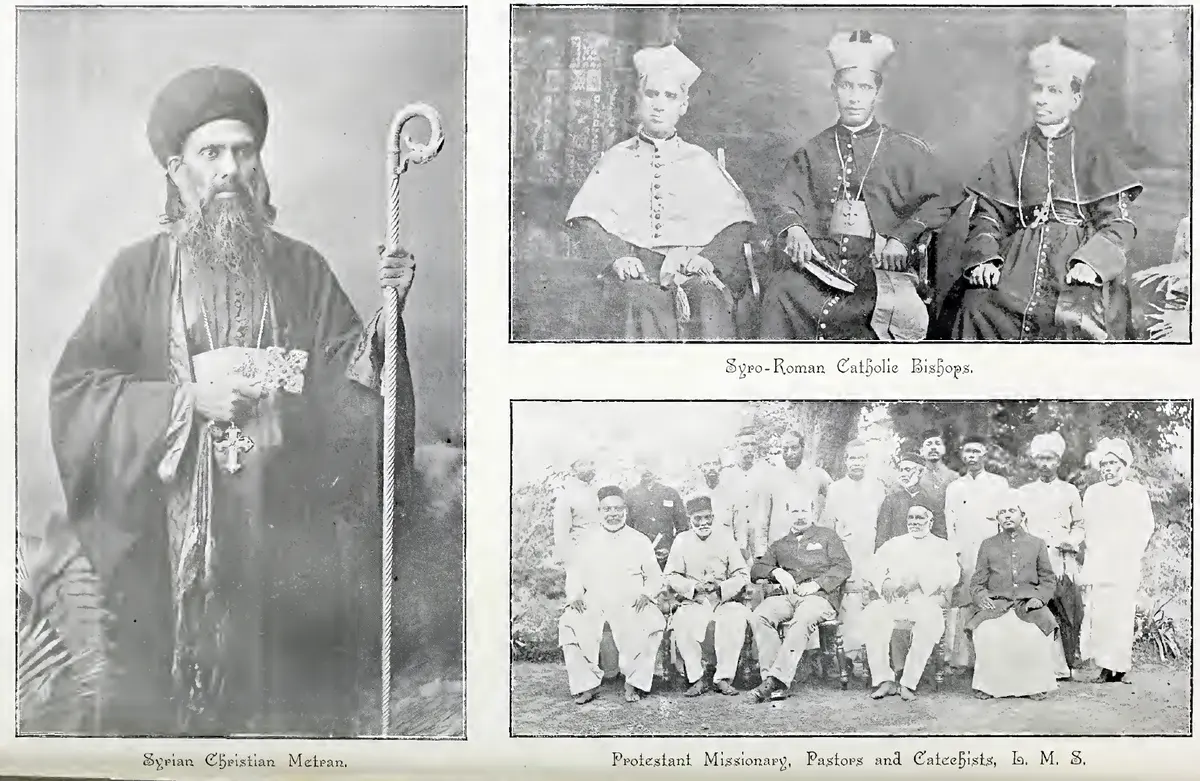
[135]
History of Christianity in Travancore.
Contributed by
G. T. Mackenzie Esquire, I. C. S. (Retired).
(Late British Resident in Travancore & Cochin.)
The history of Christianity in the Travancore State is a subject of special interest, not only because there is ground to believe that from early times a Christian Church has been in existence on this coast, but also because at the present day nearly one-fourth of the people of Travancore are Christians. The Census of 1901 gave the population of the State as 29,51,132, of whom 6,97,387 or 23·6 per cent were Christians.
Of these Christians in Travancore, 4,51,570 or two-thirds of the whole number are shown in the Census returns as Syrian Christians. These Syrian Christians, so called, are the representatives of an ancient Oriental Church that flourished in this part of India. They are Hindus by race and they speak the Malayalam language which is spoken by their neighbours. This name Syrian is given to them in common parlance, not because of any racial traits but because in their churches they still use Syriac or Chaldaic liturgies. As will be narrated at length, they appear in the middle ages to have been Nestorian, but after the arrival of the Portuguese on this coast these Syrian Christians became Roman Catholic, and the bulk of them are still Roman Catholic, following, however, their own Syriac Rite. When the Dutch took the place of the Portuguese on this coast, about one-third of the Syrian Christians quitted the Roman obedience and passed under the Jacobite Patriarch of Antioch. After the English took the Dutch settlements on this coast, a portion of these Jacobite Syrians were influenced by the teaching of the C. M. S. Missionaries and broke off from Antioch. These are usually called the Reformed Syrians. Some thousands went further and formally became members of the Church of England, giving up their Syriac liturgy. Such are the present divisions of the Syrian Christians in Travancore. There is also a large number of Roman Catholics who follow the usual Latin Rite. Some of these may be the descendants of Syrian Christians who adopted the Latin Rite, but the great mass of the Latin Catholics are descendants of converts who, during the last four centuries, have come [136]over to Christianity from the Hindu population. If the Dutch did any mission work on this coast no trace of it now remains, but since the English ousted the Dutch a considerable number of converts have been made by Missionaries of the Church Mission Society, the London Missionary Society and the Salvation Army.
The Ancient Church. Tradition assigns the origin of the ancient Christian Church on this coast to the preaching of St. Thomas the Apostle. All the Syrian Christians firmly believe that St. Thomas in the year A. D. 52 landed at Cranganore, a place which now is an obscure hamlet twenty miles north of the town of Cochin, but in those days was the flourishing seaport called by ancient geographers Mouziri. It is said that St. Thomas founded seven churches on this coast at Neranam, Quilon, Chayil, Chokkamangalam, Maliankara, Kottakawe and Palur, and that in the year 67 he was put to death at St. Thomas' Mount and he was buried at Mailapur, near the modern city of Madras. There is in this tradition nothing that is improbable. All authorities concur in saying that after the dispersion of the Apostles St. Thomas preached among the Parthians, and the Oriental Churches in Syria and Mesopotamia have always attributed to St. Thomas the preaching of the gospel in Asia even as far as China. At that date there had long been commerce between Europe and India not only by caravans, which took the land route through Persia, but also by ships down the Red Sea or the Persian Gulf. The tradition is that St. Thomas journeyed down the Red Sea and halted at Socotra, whence he went on to Cranganore. The truth of this tradition is tenaciously maintained by all the Syrian Christians in Travancore and they bitterly resent any expression of doubt regarding it. If the tradition be critically discussed it must be admitted that several ancient writers mention India as the scene of St. Thomas' labours. Thus St. Ephraem the Syrian (A. D. 300-378) in a hymn about the relics of St. Thomas at Edessa, depicts Satan exclaiming, "The Apostle whom I killed in India comes to meet me in Edessa!" St. Gregory Nazianzen, (329-389), in a homily says, "What! Were not the apostles foreigners? Granting that Judæa was the country of Peter, what had Saul to do with the Gentiles, Luke with Achaia, Andrew with Epirus, Thomas with India, Mark with Italy?" St. Ambrose, (340-397), writes, "When the Lord Jesus said to the Apostles, 'Go and teach all nations,' even the kingdoms that had been shut off by barbaric mountains lay open to them, as India to Thomas, as Persia to Matthew."
Numerous other passages could be cited from various old liturgies and martyrologies which refer to the work of St. Thomas in India, and [137]these passages at least show that the tradition that St. Thomas died in India was wide-spread among the early Churches. But, notwithstanding these passages, recent authors are disposed to doubt whether St. Thomas ever came to Southern India. They point out that the word India in those days denoted the Indus valley and they incline to the theory that the Apostle landed near the site of the modern Karachi and penetrated by the Indus valley into the country of the Parthians. A curious support to this theory is found in the fact that the Acts of St. Thomas, (a fictitious but doubtless very ancient work), mentions a King Gundaphar and that coins of a King Gondophares of that date have been found at Kabul and at Kandahar, in the Punjab, in Sindh and in Seistan. However, it is possible that the authors who in libraries in Europe compile these theories do not give sufficient weight to the tradition so warmly held by the Syrian Christians, a tradition which they told centuries ago to Marco Polo and to the Portuguese and have maintained to this day.
The Syrian Christians relate this tradition with curious details. They say that St. Thomas ordained priests from among two families of his converts. One of these families, named Sankarapuri, has died out, but the other family, named Palomattam, existed down to the last century and supplied to this Church hereditary Archdeacons in the Portuguese period and Bishops in the Dutch period. Regarding the continuance of this priesthood after the death of the Apostle, there are conflicting traditions. Some say that after the death of the priests ordained by the Apostle, this Church had only laymen and no sacrament except baptism. Others say that presbyter laid hands on presbyter and so continued the priestly office. One Latin writer * gets over the difficulty by saying that the Apostle founded in the East eight Archbishoprics, of which Malabar was one, but he stands alone in this assertion.
Some Portuguese writers say that after the death of the Apostle there was a persecution of the Christians he had left at Mailapur on the East Coast and that the survivors fled thence to the Malabar Coast and joined the Christians that were here, but no authority is cited for this story. The eminent Orientalist, Dr. Burnell, doubted the tradition that St. Thomas founded this Church and he suggested that the origin of this Church in South India may have been gnostic or Manichæan. There seems to be no ground for this surmise and the Syrian Christians themselves have a tradition to the contrary, that the infant Church was persecuted by Manichæans. They say that the Christians were sorely tried [138]by a conjuror, (perhaps the poet Manika Vachakar), that ninety-six families yielded and were called Manigramakar and that only eight families stood fast and were called Dhariyaikal. Some of the Manigramakar lived in a village near Quilon until recent times. †
* Peter Jarri, S. J., Thesaurus Rerum Indicarum, 2. 3. Pt. B. Page 339.
Day, in his Land of the Perumals, 215, speaks of a bishop named Frumentius with episcopal authority in Southern India, about 365, but Hough, in his Christianity in India, i. 62-68, shows this bishop was in Ethiopia and not in India. §
The earliest fact which can be cited as history is that in 325 one of the bishops present at the Council of Nicea signed the decrees of the council as John, Bishop of Persia and Great India. Of this bishop we know nothing except what his signature tells us, and from that signature he appears to have been a Persian bishop. That part of his diocese which he calls Great India may be the India near the river Indus.
Twenty years after that date, in 345, a merchant named Thomas Cana is said to have come upon this Church as he traded from the Persian Gulf down this coast. He brought to Cranganore from Bagdad, Nineveh and Jerusalem a colony of four hundred Christians among whom were several priests and deacons and a bishop named Joseph. The Syrian Christians say that Thomas Cana found at Cranganore sixty-four families of Christians who had remained steadfast in the faith from the days of the Apostle. The Ruler of Cranganore, Cheruman Perumal, is said to have conferred privileges upon Thomas Cana and the Christians, and this tradition is supported by grants inscribed on copper-plates which were in existence in recent times. The exact date of this intercourse between Thomas Cana and Cheruman Perumal is a disputed point. Some writers place it in the ninth century and say that Cheruman Perumal went on pilgrimage to Mecca and died on the journey. But Day, in his Land of the Perumals, 43, says that Cheruman Perumal reigned from 341 to 378 and then went on pilgrimage. De Faria, in his Portuguese Asia, i. 100, says that the pilgrimage was a Christian pilgrimage to Mailapur to the tomb of the Apostle. Visscher, in his Letters from Malabar, 167, says that he retired to a pagoda in Cochin territory, A. D. 352.
The copper-plates upon which were recorded the grants from Cheruman Perumal to Thomas Cana must have been in existence when the Portuguese arrived. Gouvea at page 4 of his Jornada says that [139]the Syrian Bishop, Mar Jacob, entrusted these copper-plates for safe custody to the Portuguese factory at Cochin and that through carelessness they were lost. De Couto in two passages in his Asia says the same thing, Seventh Decade, i. 15, Twelfth Decade, ii. 283. Gouvea at page 97 of his Jornada says that when Archbishop Menezes was at Tevalicare the Christians spoke to him of these plates. De Couto in his Asia, Twelfth Decade, last part, 283, gives a translation of these grants and Bishop Medlycott, in a manuscript volume in the British Museum, dated 1604 and containing reports from Jesuit missionaries, found a fuller version which is as follows:—
† Madras Journal, XIII. 146.
§ See Alban Butler's Lives of the Saints, under Oct. 27th, and Wright's Early Christianity in Arabia, 31-32, for St. Frumentius.
"May Cocurangon be prosperous and have long life and live a hundred thousand years, divine servants of the Gods, strong, true, just, full of good works, reasonable, powerful over the whole earth, happy, conquering, glorious, prosperous rightly in the service of the Gods, in Malabar in the city of the great Idol.
"During his reign in the time of Mercury, on the 7th day of March before the full moon, the same King Cocurangon, being in Carnellur, there landed Thomas Cananeo, a chief man, who arrived in a ship, wishing to see the furthest parts of the East. And some men, seeing how he arrived, told the King. The King himself came and saw and sent for the chief man Thomas, and he disembarked and came before the King who spoke graciously to him. To honour him he gave him his own name, Cocurangon Cananeo, and he received this honour from the King and went to rest in his place. And the King gave him the city of Mogoderpatanam for ever. And the same King, being in this great prosperity, went one day to hunt in the forest and the said King enclosed the whole forest. And he hastily called Thomas who came and stood before the King in a propitious hour. And the King consulted the Astrologer. And afterwards the King spoke to Thomas that he should build a town in that forest. And he made reverence and answered the King: 'I require this forest for myself.' And the King granted it to him for ever. And forthwith another day he cleared the forest and he cast his eyes upon it in the same year on the eleventh of April and in a propitious time and day gave it to Thomas for a heritage in the name of the King, who laid the first stone for the Church and for the house of Thomas Cananeo, and he built there a town for all and he entered the Church and prayed there on the same day. After these things Thomas himself went to the feet of the King and offered his gifts and after this he asked the King to give that land to him and to his descendants. And he measured out two hundred and sixty-four elephant cubits and gave them to Thomas and his descendants for ever, and jointly sixty-two houses which immediately were erected there and gardens with their circumferences and their paths and boundaries and inner yards. And he granted him seven kinds of musical instruments and all honours and the right of travelling in a palanquin and that at weddings his women should whistle with the finger in the mouth as do the women of kings, and he conferred on him dignity and the privilege of spreading carpets on the ground and to use sandals and to erect a pavilion and to ride on elephants. And besides this he granted five taxes to Thomas and his posterity and to his companions both men and women, and for all his relations and to the followers of his faith for ever. The said King gave his name and these princes witnessed it."
Then follow the names of eight witnesses and a note by the translator that this is the document (escritura) by which the Emperor of all [140]Malabar gave the lowland of Cranganore to Thomas Cananeo the Armenian and also to the Christians of St. Thomas. The manuscript in the British Museum goes on to say that it is a thousand two hundred and fifty and eight years since Perumal died on the first of March. That would give A. D. 346 as the date of the death of Cheruman Perumal.
Whether that date be accepted for the reign of Cheruman Perumal or it be placed five centuries later, all indications point to the existence of a Christian Church on this coast from the fourth century onwards and the only point that is disputed is the origin of this early Church, whether it really did come down from converts made in that locality by St. Thomas or whether it was founded at Cranganore by Nestorian Christians who in the fourth century may have come down the coast from Persia. One strenuous upholder of the Apostolic origin of this Church is the Anglican Dr. J. M. Neale in his Primitive Liturgies. It is usually supposed that the Liturgy which the Christians on this coast used was the Liturgy of all the Apostles, composed by St. Adaeus and St. Meris. This Chaldean Liturgy was adopted by the Nestorians when they were expelled from the Roman Empire and fled into Persia. Dr. Neale, however, maintains that the Liturgy used on this coast was collateral with, rather than derived from, the Chaldean Liturgy of All Apostles and is clearly a much earlier form, of a most remote antiquity much earlier than the fifth century, and at the very latest, of the beginning of the fourth century, but which may have come from Apostolic times. In the Liturgy of St. James there is a phrase "gave to us His Apostles and disciples", which is cited to show that the Liturgy was written by St. James himself. So in this Liturgy there is a passage which has no parallel in any known Eastern Rite and may possibly have been written by the Apostle St. Thomas himself. The passage is, "Grant, moreover, My Lord, that the ears which have heard the voice of Thy songs, may never hear the voice of clamour and dispute. Grant also that the eyes which have seen Thy great love, may also behold Thy blessed hope." For fuller information upon this subject of the Liturgy used on this coast reference may be made to Le Brun's Explication de la Messe, iii. 374, to Bergier's Dictionnaire de Theologie, sub voce Liturgie et Nestorianisme, to Hough's Christianity in India, iv. 319, and to Howard's The Thomas Christians and their Liturgies. At the Alleppey Orphanage Press the Bishop of Cochin is publishing a Subsidium to the Bullarium Patronatus Portugalliæ, and this contains a Latin version of the Nestorian Mass and of the Malabar Mass in parallel columns for comparison.
The first mention in any book of the Christians on this coast is by the [141]Alexandrian traveller, Cosmas Indicopleustes, who in the sixth century visited the East. He says:—
"We have found the Church not destroyed but very widely diffused and the whole world filled with the doctrine of Christ, which day by day is propagated and the Gospel preached over the whole earth. This, as I have seen with my own eyes in many places and have heard narrated by others, I, as a witness of the truth, relate. In the island of Taprobane in the interior India where the Indian Ocean is, there exists a Christian Church where clergy and faithful are to be found; whether also further beyond I am not aware. So also in the Male, as it is called, where the pepper grows. But at Kalliana, so named, there is a bishop, usually ordained in Persia. Likewise in the island of Diascoris, situated in the same Indian Sea, where the inhabitants speak Greek and are settlers there deported by the Ptolemies, successors of Alexander the Macedonian, you find priests ordained in Persia and sent there; there are also a number of Christians."
In this passage Taprobane means the modern Ceylon and Diascoris means the modern Socotra. Kalliana is probably not Quilon but Kalyan near Bombay. Male * is supposed to mean Malabar.
The coming to India of bishops ordained in Persia seems to have been interrupted in the seventh century by a revolt of the Persian Metropolitan against the Nestorian Patriarch of Babylon, the Metropolitian of Seleucia. The Nestorian Patriarch Jesujabus Adjabenus, who was Patriarch from 650 to 660, wrote:—
"Not only India, which extends from the shores of the kingdom of Persia as far as Quilon, a space of more than twelve hundred parasangs, but also your own country of the Persians lies in darkness, deprived of the light of divine doctrine which shines forth through bishops of the truth."
In the eighth century one of the bishops in India obtained the rank of Metropolitan. This dignity seems to have been granted by Saliba-Zacha, who was Patriarch of Babylon from 714 to 728. Our knowledge of this period is gained from the pages of the Bibliotheca Orientalis, a ponderous work in four folio volumes by Simon Joseph Asseman. He was a Syrian Christian of the Maronite Rite, employed in the Vatican Library as Scriptor of the Syriac and Arabic languages. In 1715 he was sent by Pope Clement XI to travel in quest of oriental manuscripts, and the result of that labour and of his researches in the Vatican Library was these four volumes, published in 1719, 1721, 1725 and 1728. There is a copy of this work in the library of the Syrian Vicar Apostolic of Trichur [142]and another at Veropoly. A nephew, Joseph Aloysius Asseman, Professor of the Syro-Chaldaic language in the College of Propaganda, published in 1775 a Commentary on the Chaldean and Nestorian Patriarchs, which also is an authority, but the work of the uncle is better known and any citation of Asseman is understood to refer to the Bibliotheca Orientalis. Another ponderous Latin work is Le Quien's Oriens Christianus, published in 1740 in three folio volumes. There is a copy in the C. M. S. Library at Kottayam. Le Quien was a French Dominican who undertook to narrate the history of the Church in the East. He died before his task was finished and these three folio volumes were published posthumously from the materials which Le Quien had collected. These materials are not always well arranged or digested, and the Oriens Christianus as an authority is inferior to the Bibliotheca Orientalis.
* Gibbon writes (Decline and Fall of the Roman Empire, Vol. 1. Page 556, Chandos Classics—Warne & Co.):—"Theophilus had been given in his infancy as a hostage by his countrymen of the isle of Diva, and was educated by the Romans in learning and piety. The Maldives of which Male, or Diva, may be the Capital, are a cluster of 1900 or 2000 minute islands in the Indian ocean. The ancients were imperfectly acquainted with the Maldives; but they are described in the two Mahomedan travellers of the ninth century, published by Renaudot." V. N.
However, in the vast mass of information about various Eastern Churches contained in these tomes, the names of no Indian bishops of this period are recorded except in the case of two bishops, Mar Sapir and Mar Prodh, who landed at Quilon about the year 825. Tradition represents these two bishops as saintly men and workers of miracles, but very little is known about them. To this day the Syrian Christians keep up a social division into two parties, the Northerners and the Southerners, and the explanation which is usually given of this division goes back to some cleavage among the followers of Thomas Cana at Cranganore, but the French traveller, Anquetil du Perron, * in 1758 pointed out that the Southerners kept the Quilon Era dating from August 825, and that the Northerners kept the Vaipin Era, dating from September 1341, so perhaps the origin of this cleavage may be the two reinforcements of the Syrian Christians, one under Thomas Cana at Cranganore and the other under these two bishops at Quilon.
The Council of Nicea laid down a rule that all bishops should meet the Patriarch in an annual Synod. This rule was from time to time relaxed and finally in a Synod held under Theodosius, who was Patriach from 852 to 858, the obligation upon the more distant Metropolitans was reduced to sending a letter and founds every sixth year. The words of the decree of the Synod are quaint:—
"But other Metropolitans, that is to say, of the Chinas, of India, of Persia and of Samarcand, situated in very distant countries, hindered by mountain ranges infested with robbers and by seas fatal with shipwrecks and tempests, so that they cannot come to us so often as they otherwise might wish, shall take care to send, every sixth year letters of consent and union, and in the same letters [143]to set forth any business of their country which requires an opportune remedy: and they shall take trouble that from all cities, great and small, be sent to the Patriarch what is right according to the ability of each man and the canons of the Fathers for the expenses of the Patriarch's house."
* Perron evidently was misinformed as pointed out in my prefatory note. V. N.
Some light upon the condition of the Church on this coast at this period may be obtained from four documents which have been preserved to this day. They are two grants inscribed on copper-plates and two inscriptions on stone slabs. These stone slabs can be seen in the Valiapalle Church at Kottayam. That church is only about three-hundred years old, but these slabs are said to have been brought there from a much older church near Cranganore. On each of the stone slabs is carved a Cross with an inscription. The older stone in the Kottayam Church has the inscription in the Pahlavi language, which was the official language of the Sassanides dynasty in Persia. The letters of this inscription are said to be of date about the second half of the seventh century. A similar stone slab with a similar cross and inscription is in the church at St. Thomas' Mount near Madras, and it is said that the letters on this older stone at Kottayam resemble the letters of portion of the inscription on the well-known stone in China, erected in 781 to record the arrival of some Chaldean missionaries in 636, which stone will be found described in Bury's edition of Gibbon's Decline and Fall, Vol. v. Appendix 7, and in the Hakluyt Society's Cathay and the Way Thither, 181, note x, and in the Dublin Review for October 1902. Attempts have been made to translate the inscription on the older stone at Kottayam. Dr. Burnell's version is:—"In punishment by the cross was the suffering of this one, who is the true Christ God above and Guide ever pure." The translation by Dr. E. W. West is: "What freed the true Messiah, the forgiving, the upbraiding, from hardship? The crucifixion from the tree and the anguish of this." Dr. Haug of Munich translates it as follows: "He that believes in the Messiah and in God in the height and also in the Holy Ghost is in the grace of Him who suffered the pain of the cross." The other stone in the Valiapalle Church at Kottayam is said to be of later date, probably about the tenth century. Above the cross is half of the Pahlavi inscription of the older stone, "The Messiah and God in the height and the Holy Ghost", and below the cross is a Syriac version of Galatians, vi. 14, "Let me not glory except in the cross of our Lord Jesus Christ." The copper-plate grants are in the seminary of the Jacobite Syrians at Kottayam. In favour of the authenticity of these documents must be remembered the fact that the colony of Jews who have been for more than a thousand years settled in the Cochin State possess similar grants on copper-plates. The plates which the Christians now hold are said to have been deposited with the Portuguese for safe [144]custody by the Syrian Bishop Mar Jacob. They were found in 1806 in the record room in Cochin town on a search ordered by the Resident, Colonel Macaulay. A description of these plates with a translation will be found in Madras Journal, xiii. 121. The older grant is on a single copper-plate, said by Dr. Burnell to be of date 774. It is a grant by King Vira Raghava Chakravarti to Iravi Korttan of Cranganore, making over to him the territory of Manigramam and giving him the rank of merchant. It is in old Tamil letters with some Grantha letters intermingled. The later document was on five sheets of copper fastened together by a ring. Of the ten pages of copper thus furnished, seven pages are written in Tamil and two pages are written in Pahlavi and Arabic with Kufic characters. Four of the signatures are in Hebrew. This five-plate grant is said to be of date 824. It recites that with the permission of King Sthanu Ravi Gupta one Miruvan Sapir Iso gives certain land near Quilon to the church. Unfortunately one of the five plates of this grant has recently been lost, but facsimiles of the nine inscribed pages of this grant will be found at page 146 of Madras Journal, xiii. From these inscriptions on stone and copper it appears that the Christians of that time built and endowed churches and had a recognised position in the country.
The history of this Christian Church during the following six centuries is almost blank. The Saxon Chronicle relates that in 883 King Alfred the Great of England sent to India alms for St. Thomas and St. Bartholomew. Le Quien's Oriens Christianus, ii. 1275, gives 880 as the date of Mar Sapir and Mar Prodh at Quilon and says that after their death the Catholicus of Babylon or Bagdad consecrated three bishops, of whom one, Mar John, was Metropolitan and Archbishop of Cranganore, while the two others were his suffragans, Mar Dua being Bishop of Socotra and Mar Thomas Bishop of Massina, i. e., China or Cathay. No reference is cited in support of this passage. The same work, ii. 1275, quotes from the Chronicle of Albericus a story that in 1122 a bishop named John came to Rome, calling himself Patriarch of India. Le Quien disbelieves this story and says that Jacobite and Nestorian and even Armenian bishops sometimes usurped the title of Patriarch. The Venetian traveller, Marco Polo, about 1295, speaks of Nestorian Christians in Malabar and mentions the tradition that St. Thomas died in India. He says:—
"The Christians who have the administration of the church possess forests of trees that bear the Indian nuts and from them they draw the means of livelihood. As tax they pay monthly to one of the Royal brothers a groat for each tree."
[145]The first Latin missionary who is known to have visited India was John of Monte Corvino, afterwards Archbishop of Cambalec in Cathay. Sent out by Pope Nicholas IV as a missionary to China, he on his way halted in India about the year 1291. In a letter which he wrote from Pekin in 1305 he says:—"I remained in the country of India, where stands the Church of St. Thomas the Apostle, for thirteen months and in that time baptized in different places about one hundred persons."
In another letter dated 1306 he says of Malabar, "There are a few Christians and Jews and they are of very little weight. The people persecute much the Christians and all who bear the Christian name."
The next Latin missionary of whom we find mention is a French Dominican Friar named Jordanus. About the year 1323 or earlier with other friars, both Dominican and Franciscan, he found his way to the Bombay coast where his companions were put to death by the Mahomedans. After various adventures Friar Jordan returned to Europe and wrote a small book called Mirabilia, describing the wonderful things which he saw in the East. An interesting discussion regarding Friar Jordan will be found on page vii of Col. Yule's preface to the Hakluyt edition of the Mirabilia. See also Cathay and the Way Thither, i. 184. In the Mirabilia the only mention of Christians is as follows:—
"In this India there is a scattered people, one here, another there, who call themselves Christians but are not so, nor have they baptism, nor do they know anything about the faith. Nay! They believe St. Thomas the Great to be Christ! There, in the India I speak of, I baptized and brought into the faith about three hundred souls."
In 1328 Pope John XXII at Avignon consecrated Friar Jordan as Bishop of Quilon and in 1330 sent him forth with two letters, which are given in Oriens Christianus, iii. 1371 to 1376. One letter is addressed to the Christians of Molephatam, a town in the Gulf of Mannar. The other letter is addressed to the chief of the Nazarene Christians at Quilon. In these letters Pope John XXII says:—
"Praying we beseech that division cease and clouds of error stain not the brightness of faith of all regenerated by the waters of baptism: and that the phantom of schism and wilful blindness (perfidia intemeratæ fidei) to faith unsullied darken not the vision of those who believe in Christ and adore his name."
The same ideas are repeated in varying form, urging to unity with the Holy Catholic and Universal Church of Rome. The Pope also commends to their kindness Bishop Jordan and the Friars Preachers and Friars Minors living among them or coming thither (in dictis partibus commorantes vel adhuc venientes). At the close of the letter the Pope [146]thanks the people for the hospitality already shown to the missionaries. Bishop Jordan set out with these letters but it is not known if he reached his destination or if he had any successors in the See of Quilon. Another traveller, Friar Odoric, collected the bones of the martyred companions of Friar Jordan and in 1321 passed down this coast. He says that there were Christians at Quilon and that at Mailapur there were fifteen houses of Nestorian Christians.
Some years later there arrived at Quilon John de Marignoli, on his return journey from a mission to China. He says:—
"On Palm Sunday, 1348, we arrived at a very noble city of India called Quilon, where the whole world's pepper is produced. Now this pepper grows on a kind of vines which are planted just as in our vineyards. These vines produce clusters which at first are like those of the wild vine of a green colour and afterwards are almost like the bunches of our grapes, and they have in them a red wine which I have squeezed out on my plate as a condiment. When they have ripened they are left to dry on the tree and when shrivelled by the excessive heat the dry clusters are knocked off with a stick and caught upon linen cloths and so the harvest is gathered. These are things that I have seen with mine eyes and handled with my hands during the fourteen months that I stayed there. And there is no roasting of the pepper as some authors have falsely asserted, nor does it grow in forests but in regular gardens, nor are the Saracens the proprietors but the Christians of St. Thomas. And these latter are the masters of the public weighing office (qui habent stateram ponderis totius mundi), from which I derived, as a perquisite of my office as Pope's Legate, every month a hundred gold fanams and a thousand when I left.
"There is a Church of St. George there, of the Latin communion, at which I dwelt, and I adorned it with fine paintings, and taught there the Holy Law. And after I had been there some time I went beyond the glory of Alexander the Great, when he set up his column. For I erected a stone as my land-mark and memorial, and anointed it with oil. In sooth it was a marble pillar with a stone cross on it, intended to last till the world's end. And it had the Pope's arms and my own engraved on it with inscriptions both in Indian and in Latin characters. I consecrated and blessed it in the presence of an infinite multitude of people and I was carried on the shoulders of the chiefs in a litter or palanquin like Solomon's. So after a year and four months I took leave of the brethren (valefaciens fratribus).
In this passage the statement that the Christians had control over the public weighing may be connected with that portion of the older copper-plate grant which gives to Iravi Korttan "the brokerage and due customs of all that may be measured by the para, weighed by the balance, stretched by the line, of all that may be counted or carried." (Madras Journal, xiii. 119). The brethren of whom Marignoli took leave may have been some of the friars of whom Pope John XXII speaks. The pillar which Marignoli erected may be the pillar which the Dutch chaplain Baldaeus saw more than three centuries later:—
[147]"Upon the rocks near the sea-shore of Coulang stands a stone pillar, erected there, as the inhabitants report, by St. Thomas. I saw the pillar in 1662." Day in his Land of the Perumals, 212, says that this pillar still exists and Howard in his Christians of St. Thomas and their Liturgies, 9, note, says, Mr. D' Albedhyll, the Master Attendant at Quilon, told me that he had seen this pillar and that it was washed away only a few years ago.
It is said by the Syrian Christians that during this period they were governed by a dynasty of Christian Kings. Asseman, iv. 442, has mention of this:—
"In process of time the prosperity of the Christians of Quilon and Cochin so increased that they gave themselves a King. The first, Baliartes, called King of the Christians of St. Thomas, reigned in Malabar; and when after him some of his sons had reigned, at last by the law of adoption the dynasty passed from the Christians to the heathen Kings of Diamper. When the Portuguese first came to these shores the Malabar Christians were obeying the King of Cochin."
However, Oriente Conquistado, ii. 69, says that Beliarte was not a Christian, that the Christians paid him tribute only because he had assisted them in a war against the Mahomedans and that the Christians obeyed that King in whose territory they happened to dwell. It is conjectured that the name Baliartes or Beliarte may be a corruption of the Malayalam valeyadattu or valyarvattam. Another remark that may be made is that the older copper-plate grant elevates Iravi Korttan to the rank of a prince and it may be that the headman among the Christians received princely honours. That would explain the existence of a sceptre which the Christians preserved until the arrival of the Portuguese. It was a red rod, tipped with silver, having three small bells at the upper end. The Syrian Christians say that it was the fame of this Christian dynasty that caused Pope Eugene IV in 1439 to send to this Christian King envoys with a letter. The letter is given at page 60 of Wadding's Annales Minorum and commences as follows:—
"To my most beloved son in Christ, Thomas, the Illustrious Emperor of the Indians, Health and the Apostolic Benediction:—There often has reached us a constant rumour that Your Serenity and also all who are the subjects of Your Kingdom are true Christians."
The envoys bearing this letter did not reach India. Whatever may be the facts about this legendary king, it is certain that the Christians were numerous * and were found from the Cochin State to Cape Comorin. In a list of inscriptions which has been sent in to the Travancore [148]Durbar by the Archæological Surveyor, Mr. T. S. Ganesa Pillai, it is stated that at Cape Comorin on the south and southwest of an old church called Tomaypalli or Thomas-church, there are two granite pillars with inscriptions recording edicts in favour of Christians. The dates given are equivalent to A. D. 1494 and A. D. 1526. The inscriptions are translated as follows by Mr. T. S. Ganesa Pillai:—
* Gibbon says that when the Portuguese first opened the navigation of India, the St. Thomas Christians of Malabar had 1,400 churches and 200,000 parishioners. V. N.
"The following are the contents of a royal edict which was issued to the church and to the chief of the fisher Christians on the 15th day of the month of Sittrai in the Kollam era 669, concerning the grant from the harbour dues for the expense of cocoanut oil for lighting the lamps in the church at Kumari Muttom. A tax on nets in the harbour, a toll of one fanam on every ship that touches at the port, and one fanam on every laden boat that leaves the port, the toll on rice and all other perquisites in the harbours at Kumari Muttom and Kovalam, and the tithe of fish caught in or brought to these harbours. The exemption of the left hand and right hand tax (idankai valankai panam) and other imposts of all sorts and the cess to maintain the army and to reward the soldiers, is granted to all who live within the four boundaries. This inscription was engraved by me and was set up at the four boundaries, so that it may hold good so long as the moon and stars endure. Our subjects are enjoined to protect them in the same way as we have protected."
"On the twentieth day of the month Pankuni in Kollam era 701 the Sovereign who flourished as the senior member of Jayatunkanada was pleased to issue orders to the party of Mutta-kankan and Ilaya-kankan, (i. e., the senior member and junior member of the Hindu fisher community,) among His servile people of the port at Muttom, that they should not have fighting, injustice, wicked ruling, ill-treatment or fish-stealing towards their neighbours and that they should constitute themselves as an asylum for the oppressed."
The Portuguese period. We come at last to the period for which there is in European libraries some documentary evidence. In 1504 certain bishops in India wrote a report to the Nestorian Patriarch of Babylon and this Syriac report is in the Vatican Library with a Latin translation dated 1533 of the report and of an addition to the report. This addition gives the history of these bishops and of their companions, and from this document we learn that in 1490 three faithful Christian men set out from the remote regions of India to ask Mar Simeon, Patriarch of the East, to give bishops for their provinces. One of the three travellers died, but the two survivors, Joseph and George, appeared before the Patriarch and stated their errand. Two monks were selected from the Monastery of St. Eugene and were consecrated by the Patriarch under the names Thomas and John. The Patriarch furnished the two bishops with letters under his hand and seal and sent them forth with prayers and blessings to seek the shores of India. The four travellers arrived safely and were received with great joy by the Christians, who ran to meet them and carried before them the Book of the Gospels, the Cross, torches and a thurible. The two bishops consecrated altars and ordained [149]a large number of priests, because for a long time there had been no bishop there. Mar John remained in India but Mar Thomas, with Joseph, returned to the Patriarch taking first fruits and offerings. In 1493 Joseph returned to India but Mar Thomas remained for some years in Mesopotamia. The Patriarch Simeon died in 1502 and was succeeded by Elias, who chose three monks from the monastery of St. Eugene to be consecrated as bishops for India. Of these three, David, who took the name of Jaballah, was Metropolitan. The others were George, who took the name of Denha, and Masud, who took the name of Jacob. The four bishops journeyed to India, found Mar John still living and in 1504 they wrote a long report to the Patriarch in the following words:—
"There are here about thirty thousand families, common in faith with us, and they pray God for your prosperity. Now they have commenced to build more churches and there is abundance of all things and they are mild and peaceable. Blessed be God. Also, the Church of St. Thomas is now again inhabited by Christians. It is distant a journey of twenty-five days, situated on the sea near a city called Meliapor in the province of Silan. Our province in which the Christians dwell is called Malabar and has about twenty cities, of which three notable and firm cities are Carangol, Palor and Colom, and others nearly come up to them. In all these the Christians live and churches have been built. Near by there is a large and rich city, Calecut which the infidels inhabit. .. ... .. ... About twenty Portuguese live in the city of Cananor. When we arrived from Ormuz at Cananor, we presented ourselves to them, said that we were Christians and explained our condition and rank. They received us with great joy, gave us beautiful garments (vestes) and twenty drachmas of gold, and for Christ's sake they honoured our journey more than it deserved. We remained with them for two and a half months and they ordered us that on a fixed day we also should perform the holy mysteries, that is, should offer the Oblation. They had prepared a fitting place for prayer and their priests every day sacrifice and complete the Holy Oblation, for that is their custom and rite. Wherefore on Nosardel Sunday (seventh after Pentecost in the Chaldean calendar), after their priest celebrated, we also were admitted and performed the Holy Rite and it was pleasing in their eyes. Setting out thence we arrived at our Christians who dwell at a distance of eight days from that place".
Joseph, one of the men who went to the Patriarch in 1490, took passage for Europe from Cochin in 1501 with the Portuguese Admiral Cabral. Arrived at Lisbon this Joseph was an object of much interest He went to Rome, where he had an audience of Pope Alexander VI, to Venice, to Jerusalem, again to Lisbon and so back to India. From the information obtained by persons who spoke to Joseph a book was published which gives a description of the Malabar Christians, which may be taken for what it is worth. The book was in Latin and was appended to the Fasciculus Temporum, according to Gouvea, but it was soon translated into other languages. An Italian version appeared at Vicenza in 1507 called Paesi novamente retrovati. It is also cited as Navigatio noviorbis and as the Travels of Joseph the Indian. This book says that the Church was under [150]the control of a supreme head (summus antistes), who had under him twelve Cardinals, two Patriarchs and many Archbishops and Bishops. There were priests, deacons and subdeacons. The priests shaved the whole of the upper part of the head as a tonsure. The churches were similar to those in Europe, with vaulted roofs and adorned by cross but by no pictures. The faithful were called to prayer not by a bell but by the voice. Baptism is administered when an infant is fourteen days old unless there is danger of death. Unfermented bread is used in the Eucharist. They have Confession but not Extreme Unction. Both Advent and Lent are kept as strict fasts. Their festivals are Sundays, the festivals of the Apostles, Ascension, Trinity, Christmas, Epiphany and the Purification, Assumption and Nativity of the Virgin Mary. Their greatest festival is the Octave of Easter, because on that day St. Thomas put his hand in the wounded side of Christ. There are monasteries, a supply of books and eminent teachers. In the palace of the Zamorin at Calicut are four large halls, one for Hindus, one for Mahomedans, one for Jews and one for Christians. This description of the Church in Malabar by the hearers of Joseph has been cited by many writers but it is doubtful if the description be trustworthy. There is no certainty that the persons in Europe who spoke to Joseph understood or accurately remembered what he said to them. It must be admitted that Joseph Aloysius Asseman, in his Commentary on the Chaldean and Nestorian Patriarchs, Preface, pages x and xxiv, treats Joseph the Indian as a serious authority, but there is in the Trivandrum Library a Collection of Voyages and Travels, London: Thomas Astley, 1745, where on page 48 there is the following note on Cabral's voyage to Cochin.
"This Joseph lived to get to Portugal and is the Josephus Indus under whose name there is a voyage given by Grynæus, containing twelve pages: but properly it is no more than an account of Kranganor and its inhabitants, (particularly the Christians and their religious rites), but very short and not very satisfactory. Nor is this any wonder, since Grynæus, or whoever took the relation from Joseph's mouth, tells us he could scarce understand him."
In 1498 Vasco da Gama anchored at Calicut but on that occasion he had no intercourse with the Christians. The Portuguese did not know of the existence of these Christians and their discovery on this coast of a Christian community came on them as a surprise. On Da Gama's second voyage to India he arrived at Cochin on December 7th, 1502. The Christians applied to Vasco da Gama for assistance against their Mahomedan neighbours and they presented to him the above mentioned sceptre of their former kings, as a sign that they now became the vassals of the King of Portugal. Da Gama fully saw the advantage of securing on his [151]side a party on this coast, and although he had no present assistance that he could give, he made ample promises with as much solemnity as was possible. He dressed his ships with flags, assembled around him his most brilliant suite, fired a salvo with all his artillery, formally accepted the sceptre in the name of the King of Portugal and dismissed with gifts the Christian envoys, assuring them that fleets more powerful would shortly arrive, able to free them from the molestations of their neighbours. Thus commenced the Protectorate of the Portuguese King over the Syrian Christians of the Malabar coast, a protectorate which lasted for a hundred and sixty years.
Cranganore had been the seaport of this coast, but in September 1341 the sea broke through at Vypeen into the lagoon and this became a deep channel, the opening at Cranganore silting up. Vasco da Gama saw that the new opening at Vypeen would be the port of the future, and he fixed on that spot as the site for a Portuguese settlement. A Factor was left there and in 1503 the brothers Albuquerque arrived from Portugal with orders to erect a fort. At this date the Zamorin of Calicut took the side of the Arabs in their jealousy of the trade of the Portuguese and the Zamorin waged war against the Raja of Cochin who was friendly with the Portuguese. The brothers Albuquerque gave assistance to the Raja of Cochin and in return for this service rendered, obtained permission to erect their fort. Afonso D' Albuquerque, afterwards the second Viceroy of Goa, left his brother to complete the fort and sailed south to Quilon. Discovering the Mahomedan fleet moored in the Neendakarai estuary, he attacked and destroyed it. Landing at Quilon he found twenty-five thousand Christians there and he made a treaty with the King of Quilon, in which, among other things, it was stipulated that the ancient privileges of the Native Christians should be restored to them. These privileges were that the civil and criminal jurisdiction should be vested in Christians and that the Christians should have in their keeping the seal and the standard weight of the city. The Commentaries of Afonso Dalboquerque Hakluyt Society, 1875, i. 14, has a passage describing the Christians of Quilon.
"And the Christians of the land had to take care to govern and rule the church, which was called 'Our Lady of Mercy.' The native Christians said that two saints, who were buried there, in two chapels, had made the church in a miraculous manner. There were three altars on which stood three crosses, the centre one of gold, the two others of silver. The Christians of the place had destined one of them for the King, Dom Manoel, and when they wished to send the golden one, Afonso Dalboquerque told them he would take only a silver one, as a sign that there were Christians in that land who worshipped the cross whereon Our Lord Jesus Christ had suffered, for this was, as it were, the gold [152]wherewith the King of Portugal would be most pleased: and when he arrived in Portugal, the King should send them many ornaments for their church, as was the usual custom between Christians. They were highly delighted at this and desired Afonso Dalboquerque to give them a picture of St. James and a bell, which he gave them immediately. And because it was necessary to leave there some person who might educate them in the rites of our holy faith, he desired Fr. Rodrigo, of the Order of St. Dominic, who had accompanied him, to remain there, and he consented for the service of God."
Returning to Cochin Afonso D' Albuquerque assisted his brother to complete the fort and then they entered into a close alliance with the Raja of Cochin, who, in return for their military support, undertook to procure for them supplies of pepper sufficient to load their ships for Europe. When the victories gained by Albuquerque were formally reported at Rome, Pope Leo X held a solemn thanksgiving at which a set oration in praise of Albuquerque was delivered in the Pope's presence. The orator said, "Did he not restore their kingdoms to the Kings to Cananor and Cochin? Did he not deliver from heavy thraldom the Christians who live in India?"
During the following forty years the Portuguese were busy in establishing their power along the coast and their annalists say but little of the Christians. One traveller Ludovico di Varthema, who passed down this coast about 1505, gives us a glimpse of the country. At Kayenkulam, about twenty miles north of Quilon, he says:—
"In this city we found some Christians of those of St. Thomas, some of whom are merchants and believe in Christ, as we do.... They keep Easter like ourselves and they all observe the same solemnities that we do. But they say Mass like the Greeks. They use four names John, James, Matthew, and Thomas."
In 1516, September 25th, the Portuguese renewed with the Queen of Quilon a treaty under which the Hindu Government agreed to rebuild at their own expense, in the same style, and in the same place as before, the church of St. Thomas which the Mahomedans in a recent tumult had destroyed. The Government of the Queen of Quilon also agreed to favour and protect the Christians as formerly, to pay five hundred 'bahars' of pepper and not to export any drugs or spices without the consent of the Portuguese. About the year 1532 there came to Cochin a deputation of seventy men from the fishermen who lived on the coast between Cape Comorin and Ramnad. They complained that they were oppressed by the Mahomedans and they solicited the aid of the Portuguese expressing their willingness to become Christians. The Portuguese took this opening, baptised the seventy men who had come to Cochin and then established garrisons on the Tuticorin coast. Father Miguel Vaz, afterwards Vicar General of Goa, with other priests, was sent to the spot and baptised [153]twenty thousand persons, the population of thirty villages. Ten years later, in 1542, Francis Xavier landed at Goa and in 1543 he was sent to Cape Comorin to look after the converts of Father Miguel Vaz. During that year Francis worked on the Tuticorin coast and in the following year, 1544, he turned his attention to the adjacent country of Travancore. In a letter dated March 20th 1544 Francis speaks of a splendid opening and in a letter dated four days later he writes in anger because his plans to enter Travancore had been thwarted by the annoyance of the Raja at some misconduct of Portuguese officials. After this he entered Travancore territory near Cape Comorin and worked under the protection of the prince of Tala (Tovala?). In July 1544 the Madura troops invaded the Travancore State entering by the Aramboly pass. The story that Francis Xavier went to meet them, crucifix in hand, and that they retired before him is told in Oriente Conquistado, i. 143. Father Coleridge in his Life and letters of St. Francis Xavier, i. 214, and Father Martin, S. J., in Mission du Madure, iv. 18, place this incident on the plain two miles north of Kottar town. Local tradition says that the church at Kottar is built so that the altar and sanctuary are the site of the hut in which Francis Xavier lived and taught. Letters written by Francis on August 19th and 20th show that he did take an active part in forwarding to Tuticorin the envoy who was sent by the Raja of Travancore with terms of peace. About this date Francis had audience of the Raja who was anxious to receive assistance from the Portuguese and therefore was favourably disposed towards him. The name of the Raja was Marthanda Varma, but Francis in his letters calls the Raja by the curious name Iniquitribirim, a name which has puzzled Father Coleridge. A possible explanation is that this phrase stands for Enakku Tamburan, meaning our Prince. That is vulgar Tamil, but from the words of the Lord's Prayer in Tamil which Francis gives in one of his letters, it appears that Francis spoke the vulgar Tamil, which alone would be understood by his fisher converts on the coast. It is said that before the close of 1544 Francis had founded forty-five churches in Travancore. In a letter dated 2nd September 1544 he says:—"We find this nation of the subjects of the King of Travancore more easy to persuade and better disposed than any other in all that concerns the interests of religion."
The Carmelite author, Paul of St. Bartholomew, tells us that where Francis made any converts he erected first a cross and then a booth of branches and palm leaves, which was in time replaced by a church built with stone and cement. The letters written by Francis show that his great anxiety was to provide a schoolmaster at each of these churches. [154]After Francis left the neighbourhood of Cape Comorin, things did not work so smoothly. The Raja changed his attitude of favour and we find a letter from Francis dated 19th October 1548 exhorting the Jesuit missionary left in charge of these converts not to despond and not to quit his post. In 1571 and 1574 the Senior Rani of Travancore at Attingal became alarmed at the growing power of the Portuguese and set on foot an agitation against the Christians in the course of which three churches were burned down. But the converts of St. Francis Xavier remained steadfast through every vicissitude and their descendants in South Travancore are Christians at this day. In Pearson's Memoirs of Claudius Buchanan, 238, there is a letter, dated November 1st 1806, which says:—
"There was last year an insurrectien of the Nayars in Travancore against the Rajah; three battalions of the Nayar body-guards revolted and sought to kill the British Resident and the Rajah and the present minister. Colonel Macaulay fled to Cochin. The Rajah called in the Christian fishermen from the coast to defend him against the Nayars. They assembled at Trevandrum in immense numbers each man armed with a short bludgeon. The bowmen from the hills appeared at the same time in the Rajah's behalf and the Nayars laid down their arms and fled. About fifty of the ringleaders were seized and hanged. The battalions were broken and the Rajah accepted of a subsidiary force from the English."
When Francis Xavier returned to Cochin at the close of 1544 he gave his attention to the Syrian Christians. Following the example set by Vasco da Gama, the Portuguese authorities had maintained friendly relations with these Christians. In the Vatican Library is a Syriac New Testament transcribed at Cranganore in 1510 by the Syrian bishop Mar Jacob, and this Mar Jacob is said to have entrusted to the Portuguese for safe custody the ancient copper-plate grants of the Syrians. The Portuguese respected the Syrian Christians as allies and good soldiers. Gouvea, 28, says:— "Because the Christians of St. Thomas are the best warriors, more courageous and handy with the musket, in the whole of Malabar."
In the absence of any direct evidence on the point, it is difficult to say what was the precise attitude of the Portuguese towards the ecclesiastical position of this body of Christians, but one may conjecture that at this date the Portuguese, although bitterly hostile to Jews and Mahomedans, were gently disposed towards these Oriental Christians. The five bishops whom the Portuguese found ruling this flock had been sent here by the Nestorian Patriarch, but the Nestorian Patriarchs had before this sought reconciliation with Rome and it was very possible that they might do so again. As the years of this century rolled on one can see a change in the feelings of the Portuguese, but at the commencement of the century they were friendly. John D' Albuquerque, who came to Goa in 1530 as the first bishop, sent to Cochin a Franciscan Friar Vincent de Lagos, with [155]instructions to work among these Christians. For sometime Father Vincent preached among the Syrians, Gouvea says without success, and at last he gave up that itinerant work and settled at Cranganore, the homestead of the Syrians, where he opened a seminary for any Syrian youths who wished to study for the priesthood. Francis Xavier had come across a body of Oriental Christians on his voyage to India and in a letter written on his arrival at Bombay he thus describes the Christians in Socotra:—
"The Island is exposed to great heat from the Sun. The people are Christian in name rather than in reality, wonderfully ignorant and rude—they cannot read or write. They have consequently no records of any kind. Still they pride themselves on being Christians. They have Churches, crosses and lamps. Each village has its Caciz, who answers to the Parish priest. These Caciz know no more of reading and writing than the rest. They have not got any books, and only know a few prayers by heart. They go to their churches four times a day at midnight, at daybreak, in the afternoon and in the evening. They use no bells but wooden rattles, such as we use in Holy Week, serve to call the people together. Not even the Caciz themselves understand the prayers which they recite: which are in a foreign language (I think Chaldean). They render special honours to the Apostle St. Thomas, claiming to be descendants of the Christians begotten to Jesus Christ by the Apostle in these countries. In the prayers which I have mentioned they often repeat a word which is like our Alleluia. The Caciz never baptise any one nor do they know the least what baptism is. While I was there I baptised a number of children with the utmost goodwill of their parents. Most of them showed great eagerness to bring their children to me. They also begged me to remain with them, promising that every single person in the island would be baptised. So I begged the Captain to let me remain where I found a harvest so ripe and so ready to be gathered in. But as the island has no Portuguese garrison and is exposed to the ravages of the Mussulmans, the Captain would not hear of leaving me, fearing that I might be carried off as a slave. So he told me that I should soon be among other Christians, who were not less, perhaps more, in need than the Socotrians of instruction and spiritual assistance, and amongst whom my work would be better spent."
In a letter written from Cochin, dated 20th January 1545, to John III, King of Portugal, Francis Xavier says:—
"The College of Cranganore, which is the work of Fra Vincenzo, makes great progress and will advance from good to better if Your Highness continues to favour it as heretofore. There is really the truest reason for giving constant thanks to God for the great fruit to the service of Christ our Lord which has arisen from that holy College. There is a very probable hope that it will send forth religious men who may make the whole of Malabar, which is now sunk in vice and error, feel a saving shame at its own state of misery, and may bring the light of our Lord Jesus Christ to the benighted minds of the people and make His Holy Name manifest among them all, by the work and ministrations of the disciples of Fra Vincenzo."
Four years later, on January 14th 1549, Francis writes to Ignatius Loyola,
"There is a town called Cranganore, which belongs to the Portuguese about twenty miles from Cochin, where Fra Vincenzo, of the Most Holy Order of St. [156]Francis, who is also socius to the Bishop of Goa and a most true friend to our Society, has founded a really fine seminary, where quite as many as a hundred native students are maintained and are formed in piety and learning. In his goodwill towards our Society, Fra Vincenzo does not surpass the Bishop of Goa himself, who now has jurisdiction over the whole of India, who is very devoted to us and who desires to have your friendship: and so I should like you to write to him. But to return to Fra Vincenzo, he told me, out of the kindness which exists between us, that he wishes to entrust and hand over his seminary to our Society: and he has asked me again and again to inform you of his intention and to provide a priest of the Society who may teach grammar to the students of this seminary, and preach to the inmates and the people on Sundays and festivals. There is reason for this, because, besides the Portuguese inhabitants of the place, there are a great many Christians living in sixty villages in the neighbourhood, descended from those whom St. Thomas made Christians. The students of this seminary are of the highest nobility. In this town there are two Churches, one of St. Thomas, one of St. James. Fra Vincenzo, whom I have mentioned, hopes very much that you will get each of them a plenary indulgence once a year from the Holy Father, on the feasts of St. Thomas and St. James, and the seven days after each. This would be to increase the piety of the natives who are descended from the converts of St. Thomas and are called Christians of St. Thomas."
Fourteen days later, Francis wrote a similar letter to Simon Rodriguez:—
"There is a town of the Kings called Cranganore, fifteen miles from Cochin. There there is a fine college, which was built by Fra Vincenzo, the socius of the bishop, where as many as a hundred youths, children of the native Christians, who are called Christians of St. Thomas, are educated: for there are sixty villages of these Christians of St. Thomas around the town and from them the students I speak of are derived. If you ask what sort of a place it is, it looks really very handsome, whether as regards the site or the elevation of the building itself. Fra Vincenzo has done a wonderful work in these parts. He is extremely friendly to me and to our whole Society. He assures me that he is taking measures to leave the administration of the college in our hands when he dies. He is very urgent in asking for a priest of our Society well versed in grammar to teach the students and to preach to the people on festival days. We must do as he wishes and I beseech you to send out such a priest as he wants, who may do exactly as he tells him in everything. At Cranganore there are two churches: one of St. Thomas, which is very piously frequented by the the Christians of St. Thomas, and another of St. James, adjoining the college. Fra Vincenzo wishes very much that indulgences should be obtained for both these churches to be a consolation for these Christians and to increase piety. So I beg you very much to procure, either through our people at Rome or through the Pontifical Nuntio at Lisbon, an annual plenary indulgence for each, beginning from the vigil of St. James and the vigil of St. Thomas respectively, and lasting for eight days. I would have this indulgence offered only to those who may have duly approached the sacraments of Penance and Holy Communion and then piously and devoutly visited these churches at Cranganore."
Of the five bishops whom the Portuguese found on this coast, only one, Mar Jacob, was now alive. In a letter of St. Francis Xavier to King John III of Portugal, dated at Cochin, January 26th 1549, mention [157]is made of this bishop. The letter is in the Collection Pombal, cod. 420, fol. 703. in the National Library of Lisbon.
Huum bispo d' Armenea, por nome Jacome Abuna, a corenta e cinquo anos que serve a Deus e a V. A. destas partes, homem muito velho, virtuoso e sancto; e juntamente desfavorecido de V. A. e case de todos os da India. Faz-lhe Deus merce, pois elle por si o quer favorecer, sem usar de nos como meios pera consoleseus servos, caa soomente favorecido, dos Padres de S. Francisco e dos Padres he tao favorecide, que nao pode ser mais; e se nao fora por elles, jaa o bom e sancto velho estivesa descansando com Deus. Escreva-lhe V. A. huma carta de muito amor, mandando por ella encommendal-o em hum capitulo aos gouornadores e veedores da fazenda e capitaes de Cochin, pera que lhe facao a honrae gasalhado que merece quanda vier a requerer alguna cousa. Isto nao escrevo a V. A. por necessidade que o bispo tenha, porque a charidade dos santos Padres de Sao Francisco acode largamente a suas necessidades com o zelo de charidade que tem: mais deve-lhe V. A. escrever, encomendando-lhe muito cue tenha cargo que o encomende a Deus, pois mais necessidade tem V. A. de ser favorecido do bispo em oracoes, do que tem o bispo necessidade do favor temporal de V. A. Tem muito trabalhaos em os Christaos de Sao Thome, e agro em sua velhice e muito obediente aos costumes da sancta madre Igreia de Roma. N'as cartas que V. A. escrever aos Padres de ordem de S. Francisco, juntamente com ellas pode escrever huma carta de muitos contentamentos a este Bispo.
"A bishop of Armenia, by name Jacob Abuna, for forty-five years has served God and Your Highness in these parts, a very old, a virtuous and a holy man: and at the same time unnoticed by Your Highness and by almost all in India. God rewards him because He wishes Himself to favour him without making use of us as means to console His servants. He is noticed only by the Fathers of St. Francis and they take so good care of him that nothing more is wanted. If it were not for them, the good and holy old man would before this have slept with God. Let Your Highness write him a letter of much love and in one of the paragraphs of the letter let orders go to the governors and the inspectors of revenue and the captains of Cochin to honour and to receive him as he deserves when he comes to require anything. I do not write this to Your Highness because of any need the bishop has, for the charity of the holy Fathers of St. Francis, with the zeal for charity which they have, suffices amply for his wants. But Your Highness ought to write to him, strongly recommending him to burden himself with commending you to God, for Your Highness has much more need to be remembered by the bishop in his prayers than has the bishop need of any temporal favour from Your Highness. He has laboured much among the Christians of St. Thomas and now in his old age he is very obedient to the customs of the Holy Mother Church of Rome. In the letters which Your Highness writes to the Fathers of the Order of St. Francis, Your Highness can at the same time write a letter with many civilities to this bishop."
These letters of St. Francis Xavier have been cited recently by some of the Romo-Syrian clergy in Travancore in support of a contention which they advance that their ancestors, the Syrian Christians on this coast, were not Nestorian heretics, but were Chaldeans of an Oriental Rite in communion with Rome and holding the Catholic Faith. They say that saints are notoriously keen in detecting heresy and they contend that the aged bishop whom St. Francis describes as serving God for forty-five [158]years in this country cannot during that period have been a heretic, and also, that the Syrian Christians for whom St. Francis asks indulgences cannot have then been in schism. Moreover, they point out that the Portuguese garrison at Cannanore heard the Syrian Mass of the bishops and that the Syrian Christians at Quilon paid money to Marignoli as the Pope's legate. They deny that the Portuguese can claim the credit of converting the Syrian Christians to the Catholic Faith, and they add that the word Nestorian is very loosely used by the Portuguese historians and often denotes only Orientals and not necessarily heretics.
This contention is novel and the opposite idea has possession of the ground. The Protestant writers, Geddes, La Croze, Hough, Day and Whitehouse saw in these Syrian Christians little but opposition to Rome and the Latin writers all agree in describing them as Nestorian in their doctrine. However, there is no reason why the question may not now be discussed impartially upon its merits. Whatever may have been the origin of this Church and whatever may have been its history in the obscure centuries of which we have so little knowledge, we come at last to the historical fact that they obtained five bishops from the Patriarchs of Babylon. These Patriarchs of Babylon, originally Catholic, fell into the Nestorian heresy and almost all the East became Nestorian. Rome did not set up rival Patriarchs and appears to have regarded the Partriarchs of Babylon as the lawful Patriarchs of the East, temporarily gone astray. From time to time the Patriarchs were reconciled with Rome. There was one such reconciliation in 1318 and there was another in 1551. But on referring to the latest book on the subject, Giamil's Genuinæ Relationes inter Sedem Apostolicam et Ecclesiam Chaldeam, there were between these dates eight Patriarchs of Babylon omni vinculo abrupto, with no connection with Rome, and among these eight come Simeon and Elias who sent the five bishops to India. Thus it would appear that these five bishops were sent by Patriarchs not in communion with Rome and as they reported to the Patriarch that these Syrian Christians were common in faith with them, it seems to follow that these Syrian Christians were Nestorian in doctrine. That being so, the gifts to Marignoli may have been courtesy, the hearing the Mass at Cannanore may have been curiosity, the praise given by St. Francis Xavier to Mar Jacob may mean that the aged bishop had encouraged the Syrian Christians to follow his own example in submitting to Rome and the indulgences were probably for the Syrian Christians converted to the Catholic Faith, who attended the two churches which the Portuguese had built near Cranganore. This is the view usually taken of the question in dispute.
[159]On the other hand it must be conceded that the epithet Nestorian is loosely used by the Portuguese writers and sometimes denotes a member of the Oriental Church without connecting any idea of heresy. Thus in the index of the first and second volumes of the Bullarium Patronatus Portugalliae, Angamale is described as the seat of the Nestorian Syro-Chaldaic Church and Mar Abraham is described as the last Nestorian Bishop of Angamale. Such instances prevent us from attaching the note of heresy to the epithet Nestorian when used by Portuguese authors. Also, the phrase of Giamil, omni vinculo abrupto, may possibly mean only that difficulties hindered any communications with Rome. In the bull of Pope Julius III appointing Simon Sulacca to be Patriarch, the Pope nominates him to the Patriarchate rendered vacant by the death of Simon Mamma of good memory. This Simon Mamma was one of the series of eight Patriarchs omni vinculo abrupto, but it is doubtful if the phrase bonæ memoriæ would be used of a bishop in schism and heresy. Again St. Francis Xavier in his letter praising the good work done by Mar Jacob for forty-five years says not a word to show that he had ever been a heretic. What St. Francis does say is that the aged bishop conformed to the customs of the Roman Church. This indicates a change of Rite, not a change of doctrine. Moreover, Vasco da Gama when he accepted the offer of the Christians to be vassals of the King of Portugal and Albuquerque when at Quilon he accepted from their church a Cross as a present for the King, say nothing about the heresy of these Christians. King John III, on August 15th 1533, wrote to Pope Clement VII describing the state of India at that date. The King says, "There are also found some islands, opposite the Indian shores, of which the inhabitants profess to be Christians, but they differ much from the rites of the Roman Church.' Here there seems to be no accusation of heresy but only an indication of the strong preference which the Portuguese had for the Latin Rite. This may perhaps be the true explanation of the matter. Some information can be obtained from a history of the Franciscan Order compiled in 1701. Historia serafica da Ordem de S. Francisco, na Provincia de Portugal, Composta por Fr. Fernando da Soledade. Lisboa: 1705. Tomo III. pages 488 to 521. The author gives the names of the Franciscan friars who landed from the ships of Vasco da Gama and narrates their labours. They worked from Cochin as a centre and baptised with all solemnity a great number of the natives of the country. It is also mentioned that some of the friars occupied themselves in the extirpation of the errors of the old Christians of St. Thomas. These Christians were stained with intolerable errors by reason of the false doctrine and the most [160]bad government of Chaldean or Armenian bishops who came from Babylon. At the date of the arrival of the Portuguese these poor Christians were under a Bishop or Archbishop of Cranganore. He yielded to the truths put before him by the Franciscan friars, and in a few months he and all his diocese submitted to unite themselves to the true Catholic Church and solemnly to promise obedience to the Roman Pontiff. The friars then began their reform of the belief and customs of these Christians. They introduced the use of Holy Penitence and two other sacraments which these Christians denied and they deterred them from the abominable error of consecrating in the Mass the sacred Body and Blood of Christ in lumps of rice and palm wine. Also they made them restore the cult of images which they had given up through heresy. The friars preached to them the Gospel and expurgated their books from any heretical matter. This work continued during the life of that bishop by his authority and support. The same went on in the time of Bishop Jacob, a Chaldean by birth, but who recognised the Pope as Head of Christianity and because he had much devotion towards the Franciscan Order, passed his last days in their Convent at Cochin. In after years the work was hindered by bishops who were always contaminated with heresies and fomented the ancient errors, pulling down what the friars built up, until some remedy had to be found other than constantly changing the bishops. This Franciscan narrative was written nearly two hundred years after the events, and the author cites no authorities to show us where he obtained his information, but the book is entitled to some weight. It may still be contended that the Thomas-Christians wished to cling to their Chaldean Rite and that the Portuguese, who wished them to adopt the Latin Rite, regarded their fondness for the Chaldean Rite as a leaning towards the Nestorian heresy. At the present day no doubt exists that the followers of an Oriental Rite may be Catholics as good as those who follow the Latin Rite, and the Latin missionaries in the East are forbidden to induce Catholics to change from an Oriental Rite to the Latin Rite; but four hundred years ago the Portuguese had not instructions so definite from Rome, and from the date of their arrival until the synod of Diamper, they attempted to persuade the Syrians on this coast to adopt the Latin Rite. Thus it appears that the present contention of those of the Romo-Syrian clergy, who maintain that the Thomas-Christians before the arrival of the Portuguese were not Nestorian heretics, is a possible view which can be argued.
We have seen that in 1549 St. Francis Xavier wrote to the King of Portugal about Mar Jacob. Before that year was over the aged Mar Jacob died in the Franciscan convent at Cochin, and six years passed by [161]before the arrival of another bishop for the Syrian Christians. Meanwhile great changes were taking place in the Eastern Patriarchate. In 1551, on the death of the Patriarch Simon Mamma, his nephew came forward to receive him, but the party who were in favour of union with Rome rejected the nephew and chose as the successor of the deceased Patriarch a monk named Simon John Sulacca, who was accordingly sent to Rome with letters to the Pope. Sulacca reached Rome and Pope Julius III formally appointed him to be Patriarch of the East in succession to Simon Mamma. However, the party who were opposed to union with Rome adhered to the nephew of the deceased Simon Mamma and induced a local bishop to consecrate him as Patriarch. Thus from this date there has been a division and two distinct lines of succession of Patriarchs of the East, the Chaldean Patriarchs holding the Catholic Faith and in union with Rome, and the Nestorian Patriarchs not in communion with Rome and adhering to the Nestorian heresy. The newly appointed Chaldean Patriarch, Simon Sulacca, returned to his country and in 1554 was put to death by the Mahomedans. To him succeeded as Chaldean Patriarch in union with Rome a cleric named Ebedjesus who went to Europe and took part in the Council of Trent. At that council he made a formal profession of faith and in this profession of faith he enumerates the dioceses of his Patriarchate, including, "In India, but subject to the Portuguese, Cochin, a metropolis, Cananore, a metropolis, Goa, a metropolis, Calicut, a bishopric to which is subordinate the city of Cranganore, which is still possessed by idolaters and wicked men." This appears to be an inaccurate enumeration of the Sees on this coast, although in so formal a document. It called forth the following protest from the Orator of the King of Portugal at the Council:—
"Whereas in the aforesaid profession of faith and obedience of the above mentioned Patriarch of the Assyrians, the Patriarch asserts that he has under him the following Churches, namely, Cochim, Cananore, Goa, Calecut and Carongel, which are under the power and possession of the Most Serene King the most illustrious Lord, the Orator of the aforesaid most Serene King says and protests that these very Churches recognise no Patriarch as their superior but are subject only to the most reverend Lord the Archbishop of Goa, who is the Primate of all India."
This Chaldean Patriarch Ebedjesus consecrated as Archbishop of the Syrian Christians on this coast a priest named Joseph, a brother of his predecessor, the martyred Simon Sulacca. Mar Joseph went to India and took charge of his diocese among the Syrian Christians. At the very outset he fell into a dispute with the Portuguese clergy regarding the use of the Latin language and he refused to ordain the students of their [162]Cranganore College on the ground that they had not been taught Syriac. In this dispute Mar Joseph seems to have had right on his side. He was a bishop of an Oriental Church in communion with Rome, using an Oriental Rite which was permitted by Rome. Here it may be observed that some authors in discussing this period, especially the Rev. A. J. D. D'Orsey in his Portuguese Dependencies, write as if the use of the Latin Rite is the distinctive mark of a Roman Catholic. This is a mistake. There are no less than eleven Oriental Churches in union with Rome which follow their own Oriental Rites. However that may be at the present day, the Portuguese of that date appear to have regarded the stand made by the bishop for his Chaldean Rite as an unfavourable sign, and before long they denounced Mar Joseph as a teacher of Nestorian doctrine. Thereupon the authorities brought Mar Joseph to Goa and thence sent him to Portugal. On the voyage he spent his time in copying portions of the Syriac Liturgy and the Carmen of Ebedjesus, a well-known book of the Oriental Church. A volume of his work, dated at Mozambique the 8th July 1556, is in the Vatican Library. Arrived in Portugal, Mar Joseph made so favourable an impression upon Queen Catharine, the Infanta Mary and the Cardinal Don Henry, that he was permitted to return to India, giving a promise to the Cardinal that he would clear his diocese of all heresies. On arrival in India he remained for some time in the Franciscan Convent at Bassein, where in 1557 he finished another book which he may have written on the way out. This is a collection of the Canons passed by synods of the Patriarchate of Babylon. This manuscript in the handwriting of Mar Joseph is in the Vatican Library and Asseman found it useful as supplying the gaps on the torn leaves of an older collection of the Canons. The preface which Mar Joseph wrote to this manuscript is a curious specimen of Oriental hyperbole.
"By the help of our Lord and God, this book was finished on Thursday the 17th December 1557. To God be the glory and may His pity and grace descend upon me for ever. The above mentioned book has been written under the shadow and protection of the blessed and illustrious Saint Francis, whom in our language we call Mar Franse: where there is a home of holiness, an asylum for pilgrims and paupers, a gate for benefactors and a refuge for the afflicted, in the blessed city of Bassein, which is distant sixty leagues from the great and celebrated city of Goa, whose inhabitants may, I pray, be preserved by the Lord the Spirit from all evils, hidden and open. In the name of that holy, most celebrated, blessed St. Francis, whom we interpret as Mar Franse, in this place of the Indians, blessed and endowed with the faith of St. Peter, are collected seven Convent buildings, magnificent and glorious, and in these seven buildings dwell nearly one hundred monks, in their mode of life to be compared with Father Anthony, Father Macarius and Father Paul whose prayers, I beseech, may be a wall and bulwark for the whole world. Amen. There is also in this blessed city of Bassein another church, very high and glorious, under the [163]name of St. Mary: and another convent, of which no tongue can tell the magnificence, called St. Paul's. Besides, in the same city is seen another monastery which is called St. Sebastian's, the like of which eye has not seen, and another church, called of Mercy and Grace. Moreover, this blessed country of the Indians has altars, holy buildings, churches and monasteries, of which the number is known to none. The aforesaid buildings and churches are full of monks, distinguished by the gravity and sanctity of their conduct, whose conversation and deeds in virtue and in number surpass created speech. I implore that their prayers may benefit me and weak men like me. Amen. In these altars, buildings, churches and monasteries, a perpetual and daily oblation of the Body and Blood of our Lord is diligently offered. May their prayers, I beseech, be with us. Amen. But Goa is the Metropolis of the whole country of India and in it resides the Syncletus, that is, the Supreme Prefect of the great and victorious King, King of Portugal, who is called Don Guan and in our language is called Sultan Jochanan. May the Lord grant him a kingdom on Earth and also in Heaven. Amen. And may the Lord avert all punishments and rods of anger from this city Goa, holy and blessed and endowed with the faith of St. Peter. These papers were spit out, that is, were corrupted by that lowest sinner, vile and unhappy, abject and contemptible, slothful and ignorant, lazy and muddleheaded, more than imbecile, dung and scab, maw-worm, doer of abominations, smirched with the mud of vices, far removed from virtues, disobeying orders and working iniquity, dross and refuse of all the sons of Adam; whose name ought never to be remembered before men, unless perchance that it may deserve a prayer from all those who will read these vile lines, the poor and miserable Joseph, bearing the name of Bishop and Metropolitan, but empty of and remote from the duties (of that office), as far as the East is distant from the West, and the North from the South, and the Creation from the End of all created things."
It has been mentioned that there were at this time two Patriarchs, the Chaldean Patriarch Ebedjesus, who had sent Mar Joseph to this coast, and the Nestorian Patriarch. When the Portuguese deported Mar Joseph to Portugal and the Syrian Christians were without any bishop of their own, they wrote letters to the Nestorian Patriarch, Simeon VI, asking for a bishop and he sent them a cleric named Abraham. This Mar Abraham travelled in disguise by a circuitous route to avoid the Portuguese and arrived among the Syrian Christians. Thereupon the Portuguese authorities at Goa, thinking that a bishop nominally Catholic is better than a bishop openly Nestorian, released Mar Joseph from his detention at Bassein and sent him into his diocese. They also contrived to arrest Mar Abraham and to ship him off for Portugal. At Mozambique Mar Abraham escaped from the ship and he made his way by Ormuz to the Persian Gulf. Presenting himself before the Chaldean Patriarch Ebedjesus, he craved reconciliation with Rome. The Patriarch sent him on to Rome with a letter to Pope Pius IV, and the Pope, believing that he was sincere, accepted his submission and sent him back to the Patriarch with directions to make him Archbishop of Angamale and to divide the Christians of St. Thomas in Malabar between Mar Abraham and Mar Joseph. [164]In Giamil's Genuinae Relationes, 70, is given the letter dated 23rd February 1565, from Pope Pius IV to the Patriarch Ebedjesus:—
"As we know that he has been brought back (reductum) by you to the Catholic Church and that you honour him for his merits, let us hope that his work will be the more useful in bringing back others."
While these things were passing at Rome, Mar Joseph was at work in his diocese among the Syrian Christians. Judging by his writings, the Archbishop seems to have been a devout man. There is in the Vatican Library an Old Testament which Mar Joseph transcribed at Angamale in 1558. But the Portuguese on this coast did not like him and, indeed, a feeling of dislike to all the Syrian Christians seems to have arisen. The chief authority for this period is Oriente Conquistado, a work written by the Jesuit Fathers at Goa which narrates the doings of the Portuguese in the East down to 1585. Two passages from Oriente Conquistado may be cited:—
"After the Portuguese had become masters of this coast from Cranganore to Quilon, many of these Christians came down from the mountains to live in our fortresses; but as they were of a different rite and were schismatic and we wished to compel them to eat meagre food on our days of fasting and to begin Lent on Ash Wednesday, and as we would never suffer their clergy to celebrate with leavened bread, they wished to go back to their mountains to live among their own people. And now, after they have been reduced, they find so strange our judicial procedure that they cannot make themselves at home with us. And the Portuguese may well despair of gaining the good will of Oriental nations in matters of justice, until they decide cases with greater expedition and brevity, as do the nations of the North, who much better adapt themselves to the disposition of the people of this country."
"From this year 1558 there governed the Christians of St. Thomas one Mar Joseph, with the title of Archbishop, and this Archbishop in order to show himself a Catholic and to gain the good will of the Portuguese, put the affairs of the Serra into better order, so far as concerns the Mass and Divine offices. He introduced vestments in the Roman style, for before that they had celebrated covered with an amice and over that a stole. He gave orders to use our hosts and our wine, for before that they had consecrated lumps (bolos) kneaded with oil and salt, and sweet wine (mosto) squeezed from moistened raisins. He removed other abuses and ignorances and to obtain greater credit he often came down to Cochin and he took into his employ Portuguese pages. Teaching them one day, he recommended them to have great devotion towards the Virgin Mary, but told them not to call her Mother of God, but Mother of Christ; and that they should never say, Holy Mary, Mother of God, but Holy Mary, Mother of Christ, Pray for us. The young Portuguese boys disliked this new doctrine and coming into Cochin, told what had passed. It was the intention of this wolf in sheep's clothing, a subtle heretic within, and very humble and modest without, to secretly pervert the few poor places near Cochin and Quilon, that through constant contact with the Portuguese professed the Roman Faith. And, as he was eloquent and cautious, he would easily have succeeded in his design if God had not disclosed it."
[165]At last the Portuguese authorities again accused Mar Joseph of Nestorian tendencies in a report to the Cardinal Don Henry, Regent of Portugal, who induced Pius V to issue a Brief, dated 15th January 1567, ordering the Archbishop of Goa to enquire into the doctrine and conduct of Mar Joseph. In accordance with these instructions was held in 1567 the first Provincial Council of Goa. The charges against Mar Joseph were found to be established and in 1568 he was sent to Portugal, whence he went on to Rome. There his learning and his pious demeanour roused a feeling in his favour and there was some talk that he would be made a Cardinal, when his death put an end to any such project, if it existed. Oriente Conquistado says:—
"In Rome this wolf succeeded once more in clothing himself with the fleece of a sheep, so much so that they deemed him worthy of a Cardinal's hat: but God, with His high and admirable providence, cut short the thread of his life in that city."
When in 1568 Mar Joseph was leaving Goa for Portugal, Mar Abraham appeared at Goa with his credentials from Rome and Babylon appointing him Archbishop of Angamale. These credentials included letters from Pope Pius IV dated February 28th 1565 to the Archbishop of Goa and to the Bishop of Cochin, directing these two Portuguese prelates to receive Mar Abraham as a brother. These letters are given in Giamil's Genuinæ Relationes. Upon a perusal of these documents the Viceroy and Archbishop of Goa regarded Mar Abraham as a man who had deceived the late Pope by an untrue and time-serving profession of conformity, and they detained Mar Abraham in the Dominican Convent at Goa, intending to send reports to Rome informing the present Pope of what they considered to be the true character of this clerical adventurer. Le Brun, in his Explication de la Messe, iii. 334, says:—
"But as soon as he returned they looked into his papers and saw that he had used ruses in order not to abjure the Nestorian error; for in the profession of faith, in confessing that the Word has taken human nature, he made use of the Syriac idiom which properly signifies person and not nature."
However, on the night of the Thursday before Easter, 1568, when all his custodians were in the Convent chapel, Mar Abraham escaped from the convent, before any reports had been despatched to Rome, and he made his way to his diocese. Thence he made pacific overtures, writing letters to the Viceroy and to the Portuguese Archbishop in which he professed his obedience to the Roman Church. The Portuguese authorities relinquished the idea of reporting him to Rome and he proceeded to exercise jurisdiction over the Syrian Christians, as Archbishop of Angamale appointed by the Chaldean Patriarch at the request of the Pope.
[166]There is a curious passage in Oriente Conquistado, ii. 71, which seems to show that some Syrian priests said Mass in Syriac when in Mar Abraham's diocese and in Latin when in the Portuguese territory. Of course, this could be done with permission. At the present day some of the Romo-Syrian priests have permission to say Mass in Latin at their option. The passage is as follows:—
"When we were masters of the coast of Malabar, there were clergy who in the churches of the interior said Mass in the Syrian tongue, but when they came down to Cochin in Latin, although the ceremonies are very different the one from the other."
There are two other passages in Oriente Conquistado, i. 108 and ii. 29, which show that the Portuguese had now undertaken mission work among the Hindus. In 1560 the Raja of Cochin opened his territory to the Portuguese clergy and they received each month about a hundred converts, among whom were some Brahmans and Nayars. The Raja of Porcat also withdrew any prohibition and gave the Portuguese free access to his dominions where they made numerous converts in the year 1570, baptising seven hundred persons. These converts received by the Portuguese clergy from the Hindu population followed the Latin Rite and the fact that these converts came from different castes gives the most likely explanation of the division of the Latin Catholics to this day into bodies known as the Seven Hundred, the Five Hundred or the Three Hundred.
Seven years passed in which we hear nothing of Mar Abraham, who was quietly at work among his flock, and in 1575 he received a summons to attend the second Provincial Council at Goa. He refused to attend and thereupon arose a correspondence which resulted in a victory for Mar Abraham. The Council assembled at Goa resolved to move the Pope to order the Archbishop of Angamale to attend the Provincial Councils of Goa, but meanwhile Mar Abraham had induced the Raja of Cochin to send to Pope Gregory XIII a letter in Italian, dated 2nd January 1576.
"Our subject, Mar Abraham, Archbishop of Angamale and head of the Christians of St. Thomas, received an invitation from the Archbishop of Goa to attend a synod there. But as he was once before ill-treated at Goa by the Portuguese and was twice thrown into prison, he informs me that he did not attend the synod and cannot therefore abide by the resolutions passed at the synod. That his action may not be misinterpreted he desires me to inform Your Holiness, that he is an obedient son of the Apostolic See, that if granted a safe conduct by Your Holiness, he will be present at the councils of these States and will work together with the Portuguese priests and prelates for the great benefit of that Christian flock. His Archdeacon, George of Christ, asks me to obtain from Your Holiness some Indulgences for a church which he has newly [167]built in honour of the Assumption in the month of August. May this petition be favourably received by Your Holiness."
The messenger who took this letter fell ill at Lisbon, but the letter was forwarded to Rome and on 21st December 1576 Pope Gregory XIII wrote an answer as follows:—
"About the Archbishop of Angamale we can decide nothing, because we do not know by what injuries he is hindered from going to the Provincial Synod, to which, as appears by your letter, he was summoned, nor why he was twice imprisoned. So soon as we receive certain information we shall decide what we shall find to be just and right and we shall not suffer that he be oppressed or injured. The Indulgences that you ask for in the name of the Archdeacon George, we grant with pleasure and we have given orders to write and despatch special letters about them. If there be anything else in which we understand that we can gratify you we shall not be wanting."
After the complaints of the Provincial Council at Goa had reached Rome and had been considered, the Pope despatched three letters. The first letter, dated 20th November 1578, is addressed to the Archbishop of Goa:—
"Also, we wish that in the Provincial Synod you receive kindly our venerable brother, the Archbishop of Angamale, and that you will contrive that here and elsewhere he may experience your humanity and love. We understand that this is due to a brother and we consider it of great importance in order to bring these nations to the Catholic Faith and to extend the honour of Christ."
The second letter, dated November 29th 1578, is to Mar Abraham. In it the Pope expresses his joy at the Catholic Faith of Mar Abraham, advises him to attend the Goa Council as it is the only council which he can attend, and exhorts him to convert others:—
"But you know that this is the firmest foundation of salvation that a bishop should not be content only with his own salvation, but should labour to snatch others from the fraud and impiety of Satan and to add them to the Catholic Church and to Christ."
The last letter, dated 3rd December, is to the King of Portugal, in the following words:—
"We recommend also to Your Majesty the venerable brother, the Archbishop of Angamale, who, we are told, has been grievously vexed by some persons. It will give us much pleasure if you will order the Viceroy and Governors of India to protect him and to take steps that he be not oppressed with any injury."
The effect of these Papal letters was such that for fourteen years from their date there was no open breach between Mar Abraham and the Portuguese clergy. Also, documents in the Vatican show that during this period Mar Abraham was in direct correspondence with Rome. There is among these documents a profession of faith by Mar Abraham dated 1577, also a petition in 1578 from three Syrian priests saying that Mar Abraham [168]could not visit all the churches and asking that the Patriarch be directed to send them five bishops as was done in old times. A third document is a letter to Mar Abraham dated December 1st 1579 from Pope Gregory XIII empowering Mar Abraham to give absolution in cases of usury without insisting upon the usurer making restitution of his ill-gotten gains. A fourth document is a memorandum by the officials of the Vatican upon an application from Mar Abraham for the pallium (a vestment of lamb's wool, worn on the shoulders by some Archbishops to whom Rome sends it). The memorandum points out that it is not usual to send the pallium to Archbishops of an Oriental Church appointed by the Patriarch of that Church. There is another interesting letter from Mar Abraham to the Pope, dated the Ides of January 1584, in which Mar Abraham reports that in virtue of a faculty conceded to him by the Chaldean Patriarch he had chosen his Archdeacon George, Bishop elect of Palur, to be his coadjutor and successor and he asks the Pope to confirm this appointment. These documents are found in Genuinae Relationes.
In the year 1578 there arrived on the Malabar coast one Mar Simeon, taking the title of Metropolitan of the Thomas-Christians. The best authorities say that he was sent by the Nestorian Patriarch to oppose Mar Abraham, because Mar Abraham had gone over to the Chaldean party and had ben reconciled to Rome. This intruding bishop, Mar Simeon, made his headquarters at Carturte and he obtained a considerable following among the Thomas-Christians. Mar Abraham reported this intrusion by a letter to Rome and in reply Pope Gregory XIII, on March 5th 1580, wrote a letter warning the Christians of St. Thomas against this Simeon, who without lawful mission had come amongst them.
"But be obedient in the Lord to Mar Abraham, your Archbishop, and to George, the Bishop of Palur, and in sincerity of faith and simplicity of manners, persevere and live in the unity of our Holy Mother, the Church."
At the third Provincial Council of Goa, Mar Abraham was present and the Council attempted by the following decree to hinder the coming to India in the future of similar bishops:—
"The matters of the Archbishopric of Angamale and the Christianity which is called of St. Thomas, in parts of Malabar.
"That those who come from Chaldea shall present letters to the Archbishop, Primate of India.
Forasmuch as Our Lord has said in His Holy Gospel that he who enters, the sheepfold not by the door but by some other way is a thief and a robber, and forasmuch as some persons have come from Chaldea to this Church and this Christianity and have introduced themselves as bishops, although in truth, [169]as afterwards appeared they were not so, and have caused in it schism and troubles, and the same thing may happen again: it appears to this Council that henceforth no man may be received as a bishop or Catholic prelate or approved unless he first presents letters addressed to the Archbishop of Goa, as Primate of India and the East, and unless these letters come from His Holiness or from a Patriarch who is a Catholic and renders obedience to the Roman Church and is approved by it, as formerly did the Archbishop D. Mar Abraham, when he came appointed Archbishop of Angamale by the Pope Pius IV of happy memory and he who does not present such letters will be regarded as an intruder and as such will be dragged out of the Church: and the council humbly begs His Holiness to approve this order and to direct the Patriarch of Chaldea to whom this pertains, to issue orders likewise, as this is most important for the good of this Christianity and of the Holy Roman Church."
The Council also resolved to remove Mar Simeon from this coast. He was arrested and was sent through Goa and Portugal to Rome. Before he left the country he appointed a Syrian priest named Jacob to be his Vicar General among the Thomas-Christians and this Jacob continued to teach Nestorian doctrines among them for twelve years after this. When Mar Simeon arrived at Rome, Pope Sixtus V ordered an enquiry to be held into his case and on receiving the report on this enquiry, the Pope pronounced a decision that Simeon should retire into a convent for instruction. Simeon was then handed over to Philip II, who by this date was King of Portugal in addition to Spain, and Philip II placed him in a convent at Lisbon, but the seclusion cannot have been very strict, for Simeon in Lisbon kept up a correspondence with his Vicar General Jacob in India. In 1594, when Archbishop Menezes was about to sail for India, the King offered Simeon to the Archbishop, in case any use might be found for him in the East, but the Archbishop would not have Simeon who remained in the Franciscan Convent at Lisbon and died there in 1599.
Alexander Valignano, Visitor of the Jesuits, came to India in 1574 with forty-four priests of that society and in an interview with Mar Abraham he obtained the permission of that prelate that the society might enter his diocese. Also, the Raja of Cochin, in the reply which on January 6th 1579 he wrote to the Pope's letter, asked that the Jesuits might be permitted to assist Mar Abraham. The Jesuits accordingly in 1581 opened a College and built a Church and set up a printing press at Vaipicotta or Chennamangalam, about one mile south from Cranganore. This was not the first press in India. In 1577 a Spanish lay-brother, at Cochin, John Gonsalves, was the first to cast Malayalam-Tamil type, with which he printed a catechism. Oriente Conquistado says:—"This was the first printed book that India saw born on her own soil, and by its novelty it not a little helped to gain the good will of the natives."
[170]In 1583 Father Valignano was appointed Provincial of this province of the Jesuits and he at once arranged for the systematic instruction of the Syrian Christians. With the approval of Mar Abraham the Jesuit fathers preached and catechised throughout his diocese. We find in Oriente Conquistado that Aquaviva, the General of the Society, kept up a friendly correspondence with Mar Abraham and sent him a beautiful reliquary, and also that in this year, 1583, the Jesuit fathers induced Mar Abraham to convoke a diocesan synod. At this synod Mass was said in Syriac and in Latin, Mar Abraham made a profession of the Catholic Faith, the decrees of the Council of Florence were read, several points of reform were agreed upon, and a Jesuit father acquainted with the Syriac language corrected the Syrian Missal. In the following year, 1584, a Seminary was added to the College at Vaipicotta. The practice of teaching the students only Latin, which Father Vincent had adopted in his college at Cranganore was abandoned, because the Jesuit Fathers saw that priests who did not know Syriac were not acceptable to the Thomas-Christians, and in this Seminary at Vaipicotta the Syrian students were taught Portuguese, Latin and Syriac. At this period the relations between the Jesuit Fathers and Mar Abraham seem to have been most cordial. In Genuinæ Relationes is a petition to the Pope, without date, evidently written by one of the Jesuit Fathers, which praises the good disposition of Mar Abraham and of the Archdeacon George, suggests that in case of the death of the Archbishop the Archdeacon be appointed administrator of the diocese and asks that Indulgences be granted for the Church of St. Hormisdas in Angamale recently erected by the Archbishop.
There are in the Roman Calendar two saints named Hormisdas. One was Pope from 514 to 523. The other was a Persian nobleman, who suffered martyrdom in 420 and is widely venerated. See Alban Butler's Lives of the Saints, under August 8th. But the Nestorians held in honour the memory of an Abbot Hormisdas who died in 630. In Dr. J. M. Neale's Primitive Liturgies, seventh edition, page 178, note (22), it is said that "Hormisdas, a celebrated ascetic in Malabar, bears the same relation to the Church of India that S. Anthony does to Egypt, S. Sabbas to Palestine or Tekla-Haimanoth to Ethiopia." Because of this note the Syrian bishops in Travancore were asked for information about this ascetic Hormisdas and they replied that they have never heard of him. No reference is given by Dr. Neale to show where he obtained the information conveyed in his note.
In 1585 was held the third Provincial Council at Goa and Mar Abraham attended the Council. His teaching and his management of his [171]diocese were discussed. He made a profession of faith which was accepted by the Council and all that the Council did in his regard was to direct him to ordain anew or to supply certain ceremonies in the ordination of some of his priests, as the Council considered that the ceremonies which he had omitted were essential parts of the ordination. On his return to Angamale he added these ceremonies in the presence of the Jesuit Fathers. A Portuguese writer, Gouvea, is responsible for the amazing story, which Geddes, Hough and Day repeat, that the Nestorian Patriarch called on Mar Abraham to explain his making at the Council a profession of the Catholic Faith and that Mar Abraham replied to him that the Portuguese were over his head like a hammer over an anvil, but that he would send to the Patriarch the confession of faith which he had made in order that the Partiarch might see how he had fooled the Portuguese bishops. Whatever truth there may be in this story, it is certain that after this date the relations between Mar Abraham and the Portuguese clergy were not so friendly as they had been. In 1590 he refused to ordain the students of the Vaipicotta Seminary and in 1592 when he was summoned to attend the fourth Provincial Council he refused to attend. The Portuguese sent to Rome unfavourable reports of his conduct. His life, however, was now drawing to a close. Le Quien in his Oriens Christianus, ii. 1280, cites Jarri's Historia Indiarum Orientalium, ii. 532, and says:—
"Abraham returned to India and when he was unwilling to abjure the Nestorian stain, he sought regions remote from the Portuguese influence, where he died of old age after the year 1595. He had asked from the Catholicus of Mosul another Metropolitan who might succeed him. However, being seized with a grave illness and seeing his last hour approch, he called together his clergy and in the presence of the archdeacon, of the principal laymen of his church and of certain Catholic priests, he openly professed not only the primacy of the Roman See to which he commended his flock, but also the orthodox faith, abjuring the Nestorian errors which happened in the year 1595."
Other writers say that Mar Abraham recovered from that illness, that in 1596 he wrote to the Nestorian Patriarch for a successor and in 1597 died a Nestorian, refusing admission to the Jesuit Fathers who went to his death-bed. He is buried in the Church of St. Hormisdas at Angamale. About the same time died the Nestorian, Jacob, Vicar General of the deported Mar Simeon.
At this date Portugal had passed under the sovereignty of Philip II and in 1594 one of the preachers at the court of Philip at Madrid, Father Alexius de Menezes, a young man of thirty-five years, was appointed to be Archbishop of Goa. In the following year, 1595, he landed in India. The reports adverse to Mar Abraham which had been sent to Rome caused the Pope to entrust Archbishop Menezes with a Brief, dated 27th January 1595, [172]empowering him to enquire into the matter and upon a vacancy to provide for the administration of the diocese. The following translation of the opening clauses of the Brief has been made from an authenticated copy of the Latin original in the Vatican records:—
"Clement VIII, Pope, to the venerable Brother the Archbishop of Goa: Health and the Apostolical Benediction.
"Lately we have heard, not without heavy grief of our mind, that Mar Abraham the Archbishop of Angamale in the kingdom of Cochin and in Malabar or the Indias of St. Thomas, who formerly had embraced the Catholic doctrine, had shown obedience to the Apostolic See and in the Provincial Synod of Goa had treated of the reduction of the whole of that diocese to the Catholic Faith and to the obedience of the same See, recently miserably fell into his former errors of the Nestorian heresy, and that being warned he refused to retract and much less to permit the Chaldean books, full of the same errors, which books are used in the churches of his diocese and province, to be emended and corrected, and, moreover, that he has committed several simonies."
The Brief goes on to empower Archbishop Menezes to enquire into the life, conduct (mores) and doctrine of Mar Abraham and, if he be found guilty, to take him to Goa and keep him in custody, reporting the matter for the orders of the Holy See. This Brief was followed by another Brief, dated 21st January 1597, by which power is given to Archbishop Menezes, upon the death of Mar Abraham, to appoint a Vicar Apostolic to administer the diocese until the Holy See should provide for it. Before the Archbishop had taken any action on these powers which he held, he received intelligence that the aged Mar Abraham had applied to the Patriarch to send a successor and Archbishop Menezes at once obtained orders to have all the ports watched. These precautions were successful. A bishop and a priest on their way to the Malabar coast were stopped at Ormuz and were sent back to their own country. The Archbishop was on tour in the north of the Portuguese territory when he received the news of the death of Mar Abraham. In virtue of the powers he held under the Papal Briefs, the Archbishop appointed Father Francis Roz, S. J., a Spaniard and the Rector of the Vaipicotta Seminary, to administer the vacant diocese. The Council at Goa withheld the publication of this appointment as unwise in the present temper of the Syrians, and the Archbishop on hearing the views of the council cancelled his appointment of Father Roz and appointed the Syrian Archdeacon George, directing him to make the usual profession of faith. There had been an intention some years previously of consecrating this Archdeacon George as Bishop of Palur, but this had not been done. However, these Syrian Archdeacons, who held office with some sort of hereditary succession from uncle to nephew, occupied a peculiar position in this Syrian Church. So far as an opinion can be formed from the scanty [173]materials that have come down, these Archdeacons conducted the routine work of the Church and obtained bishops from over seas chiefly to confer holy orders. Be that as it may, the Archdeacon considered that the administration of this vacant See fell to him of right and he said among his people that the appointment by Archbishop Menezes gave him only what he already held. Before long his attitude of independence took the shape of an agitation in favour of the Chaldean Rite and against any Latin influence in his Church. The students and priests of the Vaipicotta Seminary who followed the Latin Rite were refused entrance into the Syrian Churches, and at a public meeting resolutions were passed to receive no bishop but one who came from the Patriarch. Although some of the Portuguese clergy supported the Archdeacon and induced him to comply with the letter of the Archbishop's orders by giving an oral consent to a profession of faith which was read out to him in the Vaipin Church, the Jesuit Fathers and Archbishop Menezes regarded this movement against the Latin Rite as a prelude to a return to the Nestorian heresy and the Archbishop determined to go to the spot himself and settle the affair. Both Archbishop Menezes and the Jesuit Fathers of Vaipicotta still held the idea that the use of the Latin Rite would preserve the Syrians from danger of lapse into Nestorianism. There is in the Vatican Archives an Italian version of a letter which Archbishop Menezes, on December 19th 1597, wrote to the Patriarch of Jerusalem who appears to have been in Rome at that date. This letter shows the Archbishop's views at that time:—
"In another letter of Your Excellency you informed me that His Holiness fearing the death of the aged Archbishop of Angamale, had sent me a Brief about the Government of that Church, lest the Patriarch of Alexandria should attempt to provide for that Church, as he has done at other times. In this is to be seen more clearly the assistance of the Holy Ghost to the Head of the Church in the watchfulness and pastoral care which His Holiness has over all the Churches. At the time I received the Brief the Archbishop was dead and there was in charge the Archdeacon to whom, on the death of the Archbishop, all had taken an oath of obedience. Although the Portuguese had always laboured to bring these Christians into obedience to the Roman Church, they had been for many years nourished in heresy and in Nestorian errors which they always held and in this matter they put pressure on the Archbishop (et sforzono a questo l'arcivescovo). The priests with many people held a meeting and took an oath that in case His Holiness appointed a Syrian bishop, they would obey him, but if he sends a Latin bishop, (this is the important point), they will consider what course they will adopt. Also, I heard that when the name of Our Lord the Pope was mentioned in prayer in church, one of their priests rose and publicly forbade mention of the name of Our Lord the Pope. About which I have written to the Archdeacon, threatening to chastise him.
"To remedy all these evils and to provide for the wants of so many thousands of souls, in order that the Holy Mother Roman Church may be obeyed by all, I have not yet made any provision for the administration of that bishopric and I shall myself go to be in the midst of them and myself shall visit all [174]their churches which are scattered over two hundred leagues of land in various infidel countries. I have friends and confederates in that State and I have my own authority, because I am the second person in this State and the infidel King will be friendly to serve his own interests, and I propose to purify all the churches from the heresy and errors which they hold, giving them the pure doctrine of the Catholic Faith, taking from them all the heretical books that they possess, and, finally, to hold a synod of all the priests and to persuade them to give obedience to the Roman Church with an oath to receive the bishop whom His Holiness will give them.
"I take with me learned persons and some Jesuit fathers who have experience of these Christians and of their language. I believe that this journey will be of great service to God and the Roman Church. It is toilsome and dangerous and I must stay there six or seven months, so I shall have to set out in April, when the business of this State ceases for the winter interval, and I shall remain there until October, waiting to see if a bishop for this Church will come with the ships, so that I can more easily introduce him into his bishopric.
"If the new bishop for this Church is not yet made, I advise Your Excellency that it is a matter of great importance to select a Jesuit Father, as the Fathers of the Company of Jesus are there already. I humbly suggest that he be instructed to extinguish little by little the Syrian language, which is not natural. His priests should learn the Latin language, because the Syrian language is the channel through which all that heresy flows. A good administrator ought to replace Syrian by Latin. What is most important of all is that the bishop be a suffragan of this city, as is at present the Bishop of Cochin, his nearest neighbour.
"The power to provide for this Church has never rested with the Patriarch of Alexandria, as has been thought, but, which is much worse and a fruitful source of error and ignorance, with the Patriarch of Babylon, a public Nestorian heretic, with a thousand other errors, inasmuch as he refuses to retract and is openly schismatic. And such was the late Archbishop who thus lived and died without wishing to retract, nor did he wish to receive the jubilee of His Holiness which I brought with me, although it was published in some of the churches near and was received by the people with great devotion, because I had recommended it to some fathers of the Company who have a College in that neighbourhood."
Archbishop Menezes landed at Cochin on February 1st 1599 and was met by the Archdeacon George, who accompanied him for some portion of his tour through the diocese. The narrative of the Archbishop's journey was written in Portuguese by Gouvea and was published at Coimbra in 1606. This narrative shows that he entered upon his task with much energy. The whole diocese was visited and the Archbishop spared no pains to make the Syrian Christians understand what was the choice which he laid before them, on the one hand communion with the Holy See and membership in the Catholic Church, on the other hand schism and participation in the Nestorian heresy. To an impartial observer it would seem that a third course was open, to permit the Syrian Christians once more to receive a bishop from the Chaldean Patriarch who was in communion with Rome, a course which apparently would [175]have satisfied the wishes of the Syrians, but it must be remembered that this experiment had been tried and that the Portuguese clergy believed that both Mar Joseph and Mar Abraham had not been faithful to their trust. However that may have been, the Archbishop went on his own way and a perusal of Gouvea's narrative gives an impression that Archbishop Menezes must have been an exceptional man of great influence over all with whom he came in contact. Difficulties which would have foiled an ordinary man seemed to disappear before him. As an example may be quoted Gouvea's description of the Archbishop's visit to Carturte (Kadathuruthu) which had been for seven years the seat of the Nestorian Bishop Simeon and for twelve years more of his Vicar General Jacob:—
"Next day, which was Holy Saturday, the Archbishop performed the ceremonies in his Pontifical robes with much solemnity, which was seen by all the people, and he gave Holy Orders to many, a thing which had never happened in time past and showed that the threats of the managers (regedores) had no force there. All swore to the Faith and swore obedience to the Roman Church, as others had done, so that from this time the party of the Archbishop increased and acquired more strength in the Christian community. Late in the evening of that day arrived Father Francis Roz, of the Company of Jesus, (who is now the very worthy bishop of these people), whom the Archbishop was very glad to see, because Father Francis Roz was well known to all the Christians and was by them held in much reverence, as he preached to them in their own language and in the College of Vaipicotta was Professor of Chaldaic and Syrian. Coming up to the Archbishop he gave thanks to God, saying, 'Is this Carturte, which I know so well? Only a few months ago, when I came to halt here, they shut the door of the church in my face and I had it opened by the police (regedores da reyna). When, in saying Mass, I elevated the Most Holy Sacrament they all covered their eyes. They thrashed one of my pupils because in the church he named the Pope, and a few years ago, when I showed them an image of Our Lady, among the same people many closed their eyes, crying out to take away that filth, that they were Christians and did not worship idols or pagodas, which they considered all images to be.' The good Father, seeing such a change, embraced all, saying, 'Is it possible? Is this Carturte? Is Carturte no longer schismatical? Do they no longer adore the idol of Babylon? Have they given obedience to the Roman Church?"
At length, on June 20th 1599, the Archbishop assembled the Syrian Christians in a diocesan synod which met at a village called Udayamperur, in history Diamper. The Archbishop gave way as regards the use of the Syrian language but the Syrian Mass was altered, so that the arrangement of the prayers in the Mass differs from the arrangement in the Mass used by Nestorians, and this Mass, thus altered at the synod of Diamper, is the Mass which the Romo-Syrians use to this day. The Service books of the churches were expurgated, all Nestorian passages being expunged, and the popular Nestorian books of devotion were burned. As is usual at such synods, resolutions had been prepared beforehand by the Archbishop's [176]secretaries and these resolutions abjuring Nestorian errors, adhering to Rome and reforming the whole discipline of the diocese, were accepted and were signed as decrees of synod by one hundred and fifty-three Syrian priests and by six hundred lay proctors on behalf of the Syrian community. After the conclusion of the synod, Archbishop Menezes continued his visitation of the diocese, going as far south as Quilon and then returned to Goa. The following letter, dated December 21st 1599, from Father Nicholas Pimenta, S. J., at Goa to Father Claudius Aquaviva, General of the Society of Jesus, gives his view of the Archbishop's action.
"It was no small comfort to all that Alexius Menezes, the Lord Archbishop of Goa, moved by his zeal for the salvation of souls and at our persuasion undertook to visit the ancient Christianity of St. Thomas spread throughout the hill tracts of Malabar. There was in fact great danger after the death of Archbishop Abraham at Angamale and the succession of the Archdeacon George, according to ancient usage, to the administration of that Church, that she would lapse again under the sway of Nestorian bishops: nor were there wanting persons of ecclesiastical rank and possessed of means, who proposed to proceed to Babylon and bring thence a new Archbishop.
"The Archbishop of Goa, to whom not only by Metropolitan right, but also in virtue of Apostolic letters, appertained the right to assume the administration of that Church, sede vacante, in order to avoid a schism took upon himself the task of retaining the vacillating Archdeacon in due submission to the Holy See. He therefore issued instructions to the Rector of the Vaipicotta College enclosing a letter of appointment naming the Archdeacon as Administrator of the diocese, provided he in the presence of the Rector made a solemn profession of faith. The Archdeacon expressed his satisfaction on receiving the intimation and promised to make the profession demanded on a feast day. But later he would neither make the said profession nor would he accept the nomination of Administrator of the diocese, because it came from the Archbishop. This he said he did on the advice of some.
"Having gained over the Governor of Cochin, a meeting composed of lay and ecclesiastical persons was held at Vaipin, to which the Magistrates of Cochin and the Clergy of the Cathedral were invited. Our Fathers were excluded because it was said that the Archdeacon objected to their presence. The Archdeacon is warmly received at the meeting, saluted cordially and flattered: music is struck up as an opening to the ceremony: the Governor and the bishop's vicar (the bishop himself was absent in Ceylon and afterwards disapproved of the meeting being held in his absence) were given prominent seats, while the rest were also seated on benches: a leading ecclesiastic rises and introduces the Archdeacon, whom he declares by no means to be, as some perhaps might think, a schismatic nor one holding any error against the Catholic Faith, since he had carefully examined him, and adds that the Archdeacon now presents himself to make the profession of faith. The meeting having been thus addressed, the Archdeacon drops on his knees, somebody reads a profession of faith in Portuguese, of which the Archdeacon is incapable of understanding a single word: he is asked if he admits all this, to which he replies in Malayalam Huva Yes! So, though he declined to receive the office of Administrator from the Archbishop or the Apostolic See, he is nevertheless adjudged a Catholic and obedient to the Holy See, and publicity is given to this announcement.
[177]
"It is time now that I should turn to the Christians of St. Thomas. After taking counsel with our Fathers the Archbishop decided on visiting the archdiocese of Angamale to induce that Church to receive a prelate from the Sovereign Pontiff. The enemy of the human race, however, perceived this to be the one means of bringing an effective remedy to all existing troubles, so he exerted himself to raise technical difficulties of every sort to hinder this good prelate's design. ...(This passage probably refers to the war then raging with the Zamorin of Calicut, which probably was the cause why Archbishop Menezes let 1598 pass by). The supposed dangers and difficulties were pressed upon him with such pertinacity, that the Archbishop wrote to me saying that heaven and earth had conspired against his project. Despising these, however, with singular firmness and prudence, and supported by Divine aid, he began, continued and completed his arduous visitation.
"The Archdeacon after endless subterfuges and artifices—so that little remained but that he should be excluded from the communion of the faithful—returning to better sense, promised finally that he would live under the obedience of the Holy See.
"During this visitation the Archbishop, as is known, laboured much on behalf of and greatly promoted the welfare of souls. In the first place he secured the valid administration of the Sacraments; he expurgated the Nestorian books, which were very numerous, of six hundred errors and statements opposed to Catholic truth; any passage that denied the supreme authority of the Holy See he ordered to be deleted; finally, he caused capable priests—rare to be found—to be diligently sought out and these he placed in charge of parishes. The means adopted which chiefly enabled the Archbishop to secure his end were the following: he visited personally the churches; he established eighty parishes; he summoned a diocesan Synod, at which according to ancient usage the Clergy of the archdiocese were invited to attend, and only our Fathers besides; at the Synod, assisted the Governor of Cochin, Dom Anthony Noronia, and the chief dignitaries of the city who on behalf of the King of Portugal had taken on themselves the task of the protection of these Christians. How important is the step and how much it is in the future to promote the interests of the Portuguese crown, none can gainsay who is aware of the effect of binding, to the cause of Portugal and of bringing under the obedience of the Roman See, this race which from the days of St. Thomas has alone in India held the faith and can place in array thirty thousand armed men. What greatly helped in effecting this, were the zeal displayed by and the exemplary life of this prelate. He in the space of nine months did more, as our fathers attest, to promote the spiritual welfare of these people than had been done by the occupants of that See from the Apostle's time to our days. How well disposed this prelate is towards ours, who labour in that section of the Lord's vineyard, is shown by what he writes in the following letter which he addressed to me:—'The visitation through the Serra had often left me exhausted; but I keep in mind what the Holy Ghost has said, Et bene patientes erunt ut annuntient. In what state I was able to leave the affairs of these Christians, and what has been done, the Fathers must have written you, so I say nothing. One thing I will say to Your Reverence—had I spent the winter here in Goa, those churches would have been lost: nor would I have saved my conscience at a time when the flock was mine and was sadly in need of pastoral care and Catholic teaching, had I abandoned it and had I not rather fed it with healthful doctrine, as I did, and as I do, with the fathers of the Society who accompanied me."
It is not usual in Rome that a Diocesan Synod be formally approved but this Synod of Diamper was praised in the Brief of Pope Clement VIII, [178]Divinam Dei Omnipotentis Providentiam, dated May 19th 1601. This document has not been published but it is to be found in the Vatican, Secret Archives, Briefs of the tenth year of Clement VIII, Arm. xliv., Tom. 45., f. 131. The following extracts are interesting:—
"To the Venerable Brother the Bishop of Angamale and to the Clergy and people of the Christians converted by St. Thomas the Apostle in the province of the Serra, Clement VIII Pope.
"The divine providence of Almighty God, ... ... ... For it was not enough for eternal salvation that you were called by the Christian name, unless you were also Catholics united to Christ the invisible and immortal Head and joined together under the visible Head, the Roman Pontiff, His Vicar on Earth. ... ... ... Therefore when formerly you wandered as sheep without a shepherd, ... ... ... you were led astray in various doctrines, by the wile of Satan and by the guile of perverted men who by an appearance of piety deceived souls and sowed broadcast amongst you manifold and most pernicious errors. ... ... ...But in this has marvellously shone forth the providence of God and the singular clemency towards you of Him who has led you out of that dense darkness of errors. ... ... Wherefore we were filled with great joy and with great gladness in the Lord when from letters written on this subject we learned that our Venerable Brother the Archbishop of Goa held among you a Synod which was attended by your priests and by the chief men of your nation, in which Synod, by the influence of the Holy Spirit, with a great unanimity of mind, the errors of the impious Nestorius were by you rejected, anathematized and condemned. ... ... ... But, which is of the utmost importance, that you acknowledged and professed that the Roman Pontiff, the common Father of the Faithful, is the head of the whole Church. ... ... Wherefore, beloved sons, we congratulate you on this so pious, so holy and salutary deliberation. ... ... Therefore, We have given you a Bishop."
The entire proceedings of the Synod of Diamper can be perused in English in Hough's Christianity in India. There is one point that may be noticed. The twenty-second decree of the third session places the Angamale diocese under the jurisdiction of the Inquisition at Goa. It would be unhistorical to read this decree with any preconceived notion that the Inquisition was at this date a dreaded tribunal. It had jurisdiction at Goa and it had been extended to Cochin town because the Jews there gave trouble, but until this decree was passed it had no jurisdiction in the Angamale diocese, and even after this decree there is no record to show that any Thomas-Christian was brought before the Inquisition. This decree was intended as a benefit to the Syrian Christians and probably it was accepted as such. The decree requests the Holy Office, the Inquisition at Goa to confer upon some priests in the Angamale diocese powers to give absolution in heinous reserved cases. This would do away with the necessity for a tedious reference to Goa or to Rome in such cases.
In Christianisme aux Indes, which La Croze published at The Hague in 1723, there is a dissertation upon the work done by the Synod of [179]Diamper and in 1728 Asseman, iv. 391 to 406, answered La Croze. Asseman by that date had acquired much knowledge of Oriental Churches and must be regarded as an authority. He admits that the Synod of Diamper did make some mistakes, (1) in thinking that the passages wanting in the Syrian Bible had been wilfully omitted, whereas scholars afterwards saw that these gaps agree with gaps in some old manuscripts in Europe, (2) in the matter and form of Holy Orders, (3) in mistaking for the formula of baptism a proclamation that the child was baptised, (4) in saying that Holy Oils were not used and that Confirmation was unknown, (5) in saying that Masses for the dead were unknown, (6) in forbidding the eating of meat on Saturday and (7) in making unnecessary changes in the Syrian Liturgy. Asseman attributes these mistakes on the part of the Portuguese Clergy who managed the Synod to their ignorance of the Syrian Rite and of ancient Oriental Churches, or to an excessive study of the Roman ceremonial and a wish to wean these Christians from a ritual which had been associated in their minds with Nestorian error. Asseman goes on to admit that before the Synod of Diamper the Thomas-Christians knew nothing of Confession or Extreme Unction, that matrimony was not considered to be a sacrament, that they denied the presence of the Body of Christ in the Eucharist, that they were unwilling to reverence the images in the Portuguese churches and that they impugned the supreme power of the Roman Pontiff and some other traditions of the Roman Church. But from his long study of the Oriental Churches, Asseman was able to assert that these were errors which had crept into the faith and practice of the Malabar Church through the sloth or ignorance of their teachers, because the Nestorians in Syria held all Roman doctrine even the Primacy of the Roman Pontiff, and went astray only upon the Nestorian heresy.
There are some incidental matters which may be mentioned here before passing on from the Synod of Diamper. The Raja of Cochin and the Raja of Porcat gave to Archbishop Menezes so much support that he obtained for them from the King of Portugal the title of Brother in Arms. During his tour in the interior, the Archbishop heard of the existence of tribes on the mountains, and he sent up two Syrian priests who came upon a colony of Thomas-Christians at the foot of the hills and also baptised some men of a hill tribe. (Gouvea's Jornada, 80-83.) In July of the following year, 1600, Father Stephen de Brito and another Jesuit Father set out following with the Syrian Archdeacon George to visit these converts. Passing through Pooniat they left at the foot of the mountains to await their return, the Archdeacon George, who was an older man and who was ex itinere defatigatus, quod tres leucas, pluvio coelo cadente, pede confecisset [180]For an interesting discussion on the later history of these hill Christians, see Whitehouse, (Lingerings of Light in a Dark Land), pp. 123 to 132. At the Synod of Diamper the point of a Syrian ritual had been conceded and thenceforth there was no more attempt to induce the Syrian Christians to use Latin, but it is not clear what then became of those Syrian Christians who had already changed to the Latin Rite. Gouvea, 38, shows that there were some such, for the passage says that the Archdeacon George said that Archbishop Menezes might ordain the Latin Candidates. Probably the Syrians who had become Latin remained Latin and were the ancestors of one of the present divisions of the Latin Catholics on this coast.
Before Archbishop Menezes returned to Goa he had called on the Thomas-Christians to vote for a bishop to succeed Mar Abraham in the Angamale diocese. The Christians chose Archbishop Menezes himself and he sent on this nomination to Europe along with his resignation of the See of Goa, expressing his willingness to spend the rest of his life among the Thomas-Christians. This proposal was not accepted in Europe, because Archbishop Menezes could not be spared from his post at Goa. It was resolved, however, not again to entrust the care of the Thomas-Christians to an Oriental bishop. By a Brief dated 20th December 1599, Pope Clement VIII reduced the See of Angamale to a bishopric, removed it from the Chaldean Patriarchate and made it suffragan to Goa. The King of Portugal offered to provide an endowment for the See and therefore Pope Clement, by a Bull dated August 4th 1600, granted the patronage to the King, who appointed to the vacant See, Father Francis Roz, S. J., the Rector of the Vaipicotta Seminary. Afterwards Pope Paul V, by his Bull dated December 22nd 1608, restored the See to the grade of an Archbishopric and by another Bull dated December 3rd 1609 transferred it to Cranganore.
Archbishop Roz of Cranganore diligently visited the whole diocese and maintained the reforms instituted by the Synod of Diamper. For the use of his flock he translated into Syriac the offices in the Roman Missal for Ash-Wednesday and Holy-Week and added these offices to the Syriac Missal which had been altered by the Synod. Among the Syriac manuscripts which were in possession of the Christians, the Archbishop found a book written about A. D. 1200 by Mar Abedjesus, Bishop of Xigar and afterwards Metropolitan of Zuba in Armenia. In this book were fifty canons of the first Nicene Council. The existence of the book is of interest as showing that this church had some intercourse with the churches of Syria in past centuries. There is no record of any conflict between [181]Archbishop Roz and his flock until 1618, when the Archbishop having occasion to visit Goa, named the Rector of the Vaipicotta Seminary to administrate the diocese during his absence. This was viewed by the Archdeacon George as an infringement of his hereditary rights and in 1620, with a large body of his people, he broke off communion with the Archbishop and for four years himself exercised episcopal powers for his followers. Father Stephen de Brito had been named as coadjutor to the Archbishop and he strongly advised the Archbishop to conciliate the malcontents. At length in 1624 the Archbishop, stricken with a fatal illness, hearkened to this advice and named George as the Administrator of the diocese after his death. Pacified by this overture, the Archdeacon George ended the schism and the diocese was once more united before the death of Archbishop Roz, which took place on February 18th 1624. He was succeeded as Archbishop by Stephen de Brito who to outward appearance worked amicably with his old acquaintance, but letters which are on record in Europe show that the Archdeacon was intriguing against him. Germann, 440, gives a letter dated January 1st 1628 from the Archdeacon to the Papal Envoy at Lisbon, complaining that he had received no answer to a letter which he had written twenty years before about the spiritual wants of his people. He said that two hundred thousand Christians in his jurisdiction had for forty years been under the Jesuits, an Order which could show no martyrs and no success in converting the heathen and which jealously kept at a distance all other Religious Orders. He asked that other Orders be admitted into the Cranganore diocese and that there be appointed a Coadjutor who should not be a Jesuit. For this post he suggested the name of Father Francis Donato of Carturte. Also, he wished that a larger number of natives be ordained as priests. The Papal Envoy at Lisbon forwarded this letter to Rome on June 8th 1630, with the remarks that Archdeacon George was a man of great authority among the Thomas-Christians, that he was not on good terms with the Portuguese and with the Jesuits, that it was true that the Jesuits did not admit any other Order into the diocese and that Father Francis Donato was a fit person for the post of Coadjutor. The congregation of Cardinals on September 16th 1630 passed orders that other Religious Orders be admitted into the diocese, that more native priests be ordained and that Father Donato be consecrated as a bishop of a titular See. On the 19th December 1632 the Archdeacon assembled at Idapalle the principal priests and laymen of the diocese and despatched to the King of Portugal a memorial against the Archbishop. Afterwards in 1634 Father Francis Donato set sail for Europe. The ship in which he sailed was taken by pirates, who put Father Donato to death.
[182]Archdeacon George died in 1637 and was succeeded by his relative Parambil Tumi or Thomas de Campo, and in 1641 the Archbishop Stephen de Brito died and was succeeded by Francis Garcia. In the most favourable circumstances some friction would be expected between the hereditary Archdeacon of the Syrian Christians and the European Archbishop of the diocese, and possibly the conciliatory tone of Archbishops Roz and De Brito had avoided many matters of dissension, for, now under the Archdeacon Thomas and Archbishop Garcia, things became much worse. The Archdeacon Thomas is described by contemporary writers as a proud and turbulent mischief-maker, and there is a tradition among the Latin clergy that Archbishop Garcia had a sarcastic manner which the Syrian Christians greatly disliked. In December 1645 the Viceroy from Goa and the Superior of the Jesuits attempted to arbitrate between the Archbishop and Archdeacon and drew up a formal award settling several disputed points of ecclesiastical etiquette, but it does not appear that matters improved. The Archdeacon could not have recourse to the Chaldean Patriarch who must have permission from Rome for any interference and, at last, the Archdeacon went beyond his allegiance to Rome and wrote secretly to the Nestorian Patriarch of Babylon, to the Jacobite Patriarch at Antioch and to the Coptic Patriarch in Egypt, asking each of them to send a bishop to the Thomas-Christians.
In response to the Archdeacon's letter the Jacobite Patriarch at Antioch sent a bishop whose name in Syriac was Ahatalla, which means God-given, in Greek Theodore and in Latin Adeodatus, but this bishop while in India took the name of Ignatius with the title of Patriarch. He landed at Surat in the early months of 1652, habited as a simple monk, and put up in the Franciscan Convent. Seeing that he was regarded with suspicion he made his way by land to Mailapur and put up in the house of the Jesuits. Here again he was looked upon with suspicion and he was detained in the house of the Jesuits, but the custody cannot have been very strict, because, through two Syrian clerics who had gone from this coast to Mailapur on a pilgrimage to the tomb of the Apostle, he managed to send to the Syrian Christians a letter in which he describes himself as the Patriarch of India sent to them by the Pope. The Carmelite Eustache gives the following version of this letter:—
"Behold! I, Ignatius, Patriarch of all India and of the Chinas, send you a letter by the hand of deacons who came here from your country. When you have read this letter, send to me two priests and forty men: whom, however, if you wish to send, send them cautiously, quickly and as soon as possible, that seeing these you may let me go without hindrance. Come, my sons, hearken unto me and learn of me, that all power is given to me by our Lord the Pope; [183]for you must know that Ignatius is endowed with all power. Now have no fear, because I have come bearing in my hands much treasure and many other riches according to your necessity. Wherefore, do your utmost to bring me there. Priests and deacons and all magnates, in the name of Mary, the Mother of God, know ye that I came to this city of Mailapur, because I learned that here resort many priests and men who could conduct me to your country of the Indias. On August 2nd 1652 I arrived at Mailapur at the monastery of the Jesuits. In the same monastery I pass my time and they treat me very kindly. May their reward be increased, here and there. Peace be with them and with you and with us always. Amen. Ignatius, Patriarch of all India and of the Chinas."
On receipt of this letter the Syrian Christians assembled at Diamper and invited Archbishop Garcia to meet them in conference. The Archbishop did not go to Diamper but he wrote them a letter pointing out that this stranger, calling himself a Patriarch, had appeared in India with neither Papal mandate nor despatches from Portugal as credentials. While this discussion between Archbishop Garcia and the Syrian Christians was in progress, the Portuguese authorities at Mailapur placed Ahatalla on board the fleet which was sailing for Goa and this fleet, with Ahatalla on board, touched at Cochin. The Syrian Christians, hearing that the bishop was so near to them, marched upon Cochin and demanded that he be given over to them. The Captain of Cochin closed the gates of the town and manned the walls for defence and he maintained this attitude until the fleet sailed for Cochin. About the subsequent fate of Ahatalla there are three stories. To this day the Syrian Christians believe that he was drowned in the sea at Cochin. Some Latin authors say that he was tried before the Inquisition at Goa and was condemned to be burned. Both these stories cannot be true and probably both are untrue, because the records at Goa show that the civil authorities there dealt with him as they had dealt with other bishops and sent him across seas to Portugal. The Boletim or Gazette of Goa in its issue dated October 11th 1872 prints the memorandum that is in the records of the Inquisition at Goa about this Ahatalla.
"Arrived at Goa he was found to be a schismatic. He could produce no paper to show that he had been sent by the Holy See and, on the contrary, he admitted that the Patriarch who sent him is schismatic. He also admitted that he found this Christian community with an actual prelate in residence exercising his office. The danger in which these Christians are of returning to their ancient errors from which the Archbishop rescued them, induced the Viceroy, Count D'Obidos, to send him to Portugal and he put him on board a ship which was then ready to set sail. He arrived safely and he was sent to Rome."
The Boletim goes on to quote a despatch from the King of Portugal, dated 7th October 1653, acknowledging the Viceroy's letter of the 28th January. The King says that there are difficulties in the way of trying Ahatalla at Lisbon and that he is sending him to Rome. The Carmelite [184]Eustache (Istoria del Mgr. Gioseppe, 53,) says that Ahatalla died at Paris on his way from Lisbon to Rome. In the Brief Gratum Nobis, dated 20th January 1660, which Pope Alexander VII addressed to these Syrian Christians, the fourth paragraph is as follows:—
"And we have caused this to be made known to you, Our sons, that a certain man named Ignatius Caltrimensis, Ahatalla or Adeodatus, a schismatic, calling himself a Patriarch, who is said to have been arrested in Mailapur, was sent there neither by Innocent X of happy memory nor by any other Roman Pontiff Our predecessor: but under the pretext of an untrue Apostolic legation he attempted to deceive your simplicity, by which he might involve you in errors in which he himself was miserably involved."
Whatever may have been the subsequent history of Ahatalla, the Syrian Christians before the walls of Cochin town were deeply angered because the Portuguese had thus intercepted the bishop on his way to them. The Syrian Christians put this down to Archbishop Garcia and to the Jesuits, whom they called the Fathers of St. Paul, because of their College of St. Paul near Cranganore. They sent to the Captain of Cochin town a letter in which they said,
"Moreover, Captain, we beg your honour that for the love of God and the service of the Christian community you now work hard to bring back the Patriarch whom the Fathers of St. Paul have taken from us, so that the truth may be known and that this whole Christian community may obey: and in case the Patriarch cannot be produced, he having been killed by the Fathers of St. Paul, let any other person of any of the four Religious Orders come here, by order of the Supreme Pontiff, a man who knows Syrian and can teach us and help us in our offices, except the Fathers of St. Paul whom we do not at all desire, because they are enemies of us and of the Holy Mother Church of Rome; with that exception let any body come and we are ready to obey without hesitation."
Finding that the Portuguese Captain of Cochin town would not give way and that he supported Archbishop Garcia, the Syrian Christians assembled in Matancheri, a suburb outside the walls of Cochin, and deliberated on the situation. They said that they had received a letter from Ahatalla providing that if he were hindered from coming to them the Archdeacon Thomas might be Archbishop in his place. Professing still to believe that Ahatalla was sent to them by the Pope, the assemblage affected to regard this letter as an order from the Pope, and before they dispersed they took a solemn oath before the Coonen Cross in Matancheri never again to obey the Jesuits. The Captain of Cochin reported the affair to the Viceroy at Goa in the following words:—
"The Archdeacon of the Serra formed an assemblage with all the Christians and the Cattanar clerics, and the assemblage agreed that the Archdeacon be made Archbishop in virtue of a letter which they say they have received from that Patriarch in which he wrote that in case he did not come to the Serra, he nominated [185]the Archdeacon as Archbishop in virtue of the powers which he held; and as these Christians of the Serra never were Christians in more than name, they hugged this schismatic letter and thus were all sworn never to receive as their prelate the Archbishop nor any Jesuit in the Serra."
The Captain wrote also a long letter to the Raja of Cochin pointing out that for one hundred and fifty years the King of Portugal had been Protector of these Christians, that the informal election of an Archbishop without permission from Rome or from Lisbon would be most displeasing to His Majesty, that the Raja was Brother in Arms of the King and that the credit of ending this rompimento would be given to His Highness. He therefore asked the Raja to issue a proclamation throughout his dominions that no Christian should obey the Archdeacon or recognize him as Archbishop and that all should obey their lawful prelate, the Archbishop of Cranganore. This letter produced no response from the Raja. Perhaps the Raja now looked beyond the Portuguese to the steadily advancing power of the Dutch. The Syrian Christians were not interfered with and their revolt against the Jesuit Archbishop continued. They still professed to act in accordance with powers received from Rome, but, as there was no bishop available to consecrate the Archdeacon, twelve Syrian priests on May 22nd 1653 laid hands on the head of the Archdeacon Thomas and solemnly set him apart as their Archbishop. The manifesto which they published on this occasion says:—
"Therefore, since our people who went to San Thomé and met the said patriarch received at his hands and brought to us a letter and a patent, by which as it has come here, we are governed, and as we have made an Archbishop by the order and command of the Patriarch, who came by the mandate of the Supreme Pontiff and of the Holy Mother Church of Rome, we shall live with the said Archbishop, and on that account the Fathers of St. Paul may preach in their pulpits and may say that we are heretics."
The manifesto goes on to say that nobody had listened to the complaints which they had made in Cochin, and it continues:—
"Therefore, we here assembled ordain that since they have paid no attention to the mandate of the Supreme Pontiff and of the Holy Mother Church of Rome and of our prelate, and as the Fathers of St. Paul are enemies of us and of the Holy Mother Church of Rome, we shall never hold friendship with them until we see the Patriarch with our own eyes, and we shall pay no attention to the Archbishop of that Order."
In accordance with this declaration of their views the Syrian Christians worshipped under their own Archdeacon and without allegiance to Archbishop Garcia, but continuing their accustomed Romo-Syrian ritual. The revolt against the Jesuit Archbishop was very complete. In the whole number of Syrian Christians, computed to amount to two hundred thousand persons, it is said that only four hundred remained under the rule of Archbishop Garcia.
[186]When the news of this revolt reached Rome, Pope Alexander VII sent to the assistance of Archbishop Garcia a selected party of Carmelite monks who came by the Persian Gulf and arrived at Palur on the 22nd of February 1657. The instructions with which they had been furnished from Rome directed them to reconcile the Archdeacon Thomas and his followers to Archbishop Garcia. Proceeding inland they met Thomas and had conferences with him. He was obstinate but many of his followers were willing to submit to Rome, though not to the Jesuit Archbishop. Prominent among those who were favourably disposed was a relative of the Archdeacon, named Parambil Chandy or Alexander de Campo. Before the close of the year the Carmelite Fathers had persuaded forty-four churches to submit, but the reconciled Christians stood out for some bishop other than Archbishop Garcia. Leaving the other Carmelite Fathers to continue this work of reconciliation, the leader among them, Father Joseph, in December 1657, set out for Rome to give a personal report on the state of affairs. When his report had been considered it was resolved to give to the Syrians a bishop not of Portuguese nationality, and Father Joseph on December 15th 1559 was consecrated as Bishop of the titular see of Hierapolis. The consecration was secret lest the Court of Lisbon might take offence, this being the first bishop sent to India without the request of the King of Portugal. The ceremony took place in the Vatican, the consecrating prelate being Mgr. Landucci, the Pope's sacristan, with two priests as assistant bishops. By a Brief dated 24th December 1559, Bishop Joseph was appointed Commissary Apostolic in the province of Malabar with power to consecrate two other bishops and appoint them as Vicars Apostolic. Vested with these powers he set out for India and landed at Cochin on May 14th 1661, to find that in his absence Archbishop Garcia had died on September 3rd 1659. For twenty months Bishop Joseph with considerable success continued the work of persuading the Syrian Christians to quit the Archdeacon Thomas. Eighty-four churches returned to the Roman obedience and only thirty-two remained under the Archdeacon.
In January 1663 the whole situation was changed by the capture of Cochin town by the Dutch. Not only the Portuguese clergy but also the Italian Carmelites were ordered by the Dutch to quit this coast. In this emergency Bishop Joseph fell back upon the powers which he held from Rome. There was no order to the Syrian clergy to depart and therefore Bishop Joseph, summoning to his side Parambil Chandy, the leader of the reconciled Christians, consecrated him Bishop and appointed him Vicar Apostolic. In the ceremony of consecration two Portuguese priests took [187]the part of the assistant bishops. This is an interesting point for Rubricists. At a consecration it is customary that three bishops be present, one as consecrator and two as assistants, and it was a moot point in discussions among theologians whether the presence of the two assistant bishops is necessary for the validity of a consecration. The consecration of Bishop Joseph in 1659 was secret and the fact that two priests took the part of assistant bishops was not known and was not discussed. But the consecration of Bishop Chandy in 1663 was public and the facts were known. In the Salamanca Course of Moral Theology the instance of Bishop Chandy's consecration is cited as the leading case on this point and it is held that the procedure of Bishop Joseph was justified by the urgency of the occasion. But Bishop Joseph acted in accordance with the words of the Brief of 24th December 1659. Cum assistentia duorum sacerdotum, etiamsi episcopi non fuerint, servatis in reliquis ceremoniis in Pontificali prescriptis. This consecration accomplished and Bishop Chandy left in charge of the Syrian Christians, Bishop Joseph obeyed the orders of the Dutch and sailed for Goa. Arrived at Goa, his stay there was not long because he received from the Viceroy a friendly warning that orders for his arrest had come from Portugal. Bishop Joseph therefore returned to Europe and did not again come to India.
The Dutch period. The Dutch at Cochin concerned themselves little about the Syrian Christians except from political reasons. They exacted an oath from the clergy to pay no allegiance to the King of Portugal but further than that they did not go. They tolerated Bishop Chandy and they appear to have disliked the Archdeacon Thomas who kept aloof from them inland among his own adherents who had refused reconciliation with Rome. With regard to the Latin Catholics on the coast, the Dutch took from them the churches in Cochin town, so that the Catholics had to go to Vaipin to worship, but the Dutch did not actively molest them. Two years afterwards, in 1665, the position of the Archdeacon Thomas was altered by the arrival on this coast of a bishop named Gregory, Patriarch of Jerusalem, sent by the Jacobite Patriarch of Antioch, Ignatius XXIII, the quarter whence had come Ahatalla thirteen years previously. This Bishop Gregory consecrated as bishop the Archdeacon Thomas, who from this date may be called Mar Thomas I. As he was now definitely separated from Rome, the story of his flock will be more conveniently told hereafter.
In course of time some of the Carmelite fathers whom the Dutch had compelled to quit, quietly returned and worked among the Syrian Christians under Bishop Chandy. The Dutch officials knew of this and [188]took no notice of it; indeed, one of the Carmelite fathers, Mattheus, struck up an acquaintance with the Dutch Governor, Van Rheede, a taste for botany being the common ground on which they met, and Father Mattheus assisted Governor Van Rheede in the compilation of his Hortus Malabaricus, a ponderous work in twelve volumes which was published at Amsterdam in the years 1676 to 1693. This Father Mattheus in 1673 was permitted by Van Rheede to build a church at Chattiata near Ernaculam, the first church which the Carmelite Fathers had built. They obtained from Bishop Chandy an order exempting this church from his own episcopal jurisdiction, and it is worthy of note that Bishop Chandy signs this paper, not as Vicar Apostolic, the post to which he had been appointed by the Pope, but as Metropolitan of all India, following the style of the former Syrian bishops. In the same year 1673, was built a church at Verapoly on land given rent free by the Raja of Cochin. On this land at Verapoly is the residence of the Carmelite bishops to this day. As Bishop Chandy was growing old, the permission of the Governor Van Rheede was obtained in 1674 for the appointment of a coadjutor-bishop and in 1675 powers came from Rome to four Carmelite Fathers to select this coadjutor. Bishop Chandy wished that his nephew Mattheus be selected and probably this nominee was personally qualified, for we find him in 1694 as Vicar General of Cranganore, but there was an impression at Rome that one of the causes of the constantly recurring difficulties in working with the Syrian Christians was the hereditary succession of members of one family to the post of Archdeacon, and part of the instructions given to Bishop Joseph was that he should endeavour to abolish the hereditary succession of the Archdeacons, so that the four selectors shrank from establishing a precedent of the succession of members of this family to the office of bishop. They therefore passed over Mattheus and selected a priest among the Latin Catholics, Raphael Figueredo Salgrado, of mingled Portuguese and Hindu descent, who was consecrated at Calicut in 1677 by Bishop Thomas de Castro. This Thomas de Castro, a Brahmin by race, was a priest at Goa and in 1675 was consecrated as Bishop and appointed Vicar Apostolic in Travancore, Tanjore and other provinces on this side of the Ganges. Probably he had jurisdiction over the Christians of the Latin Rite near Cape Comorin, descendants of the converts of St. Francis Xavier. He died July 15th 1684.
The choice made by the four selectors of Bishop Raphael was not successful. If it had been difficult for a Europeon bishop, trained in Europe, to work smoothly with the Syrian Christians, the task was much more difficult for a Eurasian, born and educated in this country. The [189]aged Bishop Chandy died in 1676, so that his influence was not present to make for peace. Friction increased on every side. Pope Innocent XI by Brief dated 6th February 1687 sent a bishop as visitor to enquire into and report upon the disputes that had arisen between Bishop Raphael and the Carmelite missionaries. In 1692 Bishop Raphael excommunicated the Syrian priest George, who had been Vicar General under Bishop Chandy. These matters being reported to Rome, Bishop Raphael was deposed by a Papal decree dated 16th January 1694 and Bishop Custodius de Pinho, Vicar Apostolic in the dominions of the Great Mogul, was named Vicar Apostolic in Malabar. Before this decree could be executed Bishop Raphael died on the 12th October 1695. In the following year Bishop Custodius was relieved of his task and a Carmelite, Father Peter Paul, titular Archbishop of Ancyra, on September 20th 1696, was appointed Vicar Apostolic.
From the arrival of this Father Peter Paul, Archbishop of Ancyra, dates a great change in the prospects of the Carmelite Mission on this coast. He was a son of Prince Palma and his mother was a sister of Pope Innocent XII, who was Pope from 1691 to 1700. Peter Paul entered the Carmelite Order in 1673 and came to Malabar in 1678. The Emperor Leopold I appointed him Ambassador at the Courts of the Great Mogul and of the Kings of Persia and India. Thus when in 1696 he became Vicar Apostolic, he was a man well known in Europe and his uncle was Pope. Through the good offices of the Emperor Leopold I, Father Peter Paul obtained from the Senate at Amsterdam a decree, dated 1st April 1698, permitting one bishop and twelve priests of the Carmelite Order, being Italians, Germans or Belgians, to reside in the territory but not in the town of Cochin. In accordance with this arrangement, which cancelled the expulsion of 1663, every Carmelite bishop who came to this coast throughout the eighteenth century sent to the Dutch authorities in Cochin town his Bull of appointment and obtained from them permission to reside at Verapoly. Also in return for this concession to the Carmelites, the Dutch Government obtained from the Emperor a toleration of the Calvinist religion in Hungary. These mutual concessions, however, in no way applied to the Portuguese. Dom Pedro Pacheco in 1694 was consecrated Bishop of Cochin and in 1699 arrived at Cochin. He was expelled by the Dutch and took refuge in the English settlement of Anjengo, whence he attempted to exercise jurisdiction over his flock of Latin Catholics.
Father Peter Paul died on January 4th 1700 in the Franciscan Convent at Surat and in his place another Carmelite, Father Angelus Francis, was appointed Vicar Apostolic of Malabar. There was a difficulty [190]in finding a bishop to consecrate Father Angelus Francis. The Portuguese Archbishop of Goa and the Portuguese Bishop of Cochin refused to consecrate him, as they considered his appointment to be an infringement of the right of patronage held by the King of Portugal. In this emergency the Carmelites made use of a bishop who had arrived from an unexpected quarter. The Syrian Christians, on the death of Bishop Raphael, had once more sent an application to the Chaldean Patriarch to send them a bishop. Years passed and at last the Patriarch sent Mar Simeon, Archbishop of Aden, who had been rescued from a Mahomedan prison by the Capuchin missionaries in Arabia. Mar Simeon arrived at Cochin and, as Father Angelus Francis had bulls from Rome enabling his consecration by any bishop in communion with the Holy See, Mar Simeon was invited to officiate and on May 22nd 1701, in the church at Allangada he consecrated Father Angelus Francis as bishop, a curious episode in the history of Roman Orders. From a passage in Anquetil du Perron's Zend Avesta, saying that the officiating prelate was "Mar Simeon, a Chaldean Bishop, attached to the Holy See, who in the Liturgy used unleavened bread", it would appear that he used the Latin Rite. This Mar Simeon had instructions from his Patriarch to take charge of these Christians, but it is probable that the Carmelite Fathers persuaded him that this would not be in accordance with obedience to Rome, and he went by sea to Pondicherry where dwelt some of his acquaintances, the Capuchin missionaries. At Pondicherry Mar Simeon spent nineteen years of quiet. Father Norbert in his Historical Memoir printed in 1744 for Benedict XIV describes the Archbishop as saying, in the church at Pondicherry, Mass "which was served by his Malabar Christian servant with his turban on his head". The same author says that Mar Simeon with his own money built the church at Ariankupam, one league from Pondicherry. The following curious entry is in the register of burials in the church of our Lady of Angels, Pondicherry:—
"To-day, the sixteenth August 1720, I have buried in our Church of Our Lady of Angels, Monseigneur Simeon, Chaldean Archbishop of Aden, who, this morning, wishing to draw water from his well to wash his face, unfortunately fell in and there was drowned, there being nobody to help him except a child of six or seven years, who then was asleep and when he was not asleep was not able to help. The accident happened about five o'clock in the morning. He was a native of Diarbekir, the capital of Mesopotamia and lived here for the last twenty years, having come here from Rome by Spain and Portugal, whence he passed to Goa, from Goa to Surat and from Surat he came in company of Father Francis Mary of Tours to Cochin and Verapoly, where he consecrated the bishop who was a Carmelite Father named Padre Angelo, who had received from Rome his bulls to be Bishop of Verapoly. He came here to Pondicherry, not being able to enter the interior (la Sylvie), to enter which by [191]the order of his Catholic Patriarch Mar Joseph he had undertaken so long a journey, because of some difficulties which they set up for him with the Government of Cochin, seeing which he determined at last to come here, where he had died as said above. R. I. P. He has been buried in our choir, in the middle."
The Government of Cochin mentioned in this burial register is probably the Dutch Government. So much has been said of this bishop, because in 1787 the Syrian Christians complained to the Raja of Travancore against the Carmelite missionaries, declaring, as one article in the indictment, that the Carmelite missionaries had caused Mar Simeon to be put to death at Pondicherry. Thereupon the Carmelite bishop at Verapoly and his clergy wrote to the French Governor at Pondicherry, who at once sent an official and emphatic contradiction of this absurd accusation.
Bishop Angelus Francis, Vicar Apostolic at Verapoly, held office for twelve years from 1700, and in these twelve years there were great changes of jurisdiction. Since the death of Archbishop Garcia in 1659, the Carmelite missionaries had been practically in charge of the diocese of Cranganore without any interference, because no successor came out to take his place. Five nominations to the vacant See were made at various times by the King of Portugal, but the nominees did not come to India. One nominee, Father Diego, was consecrated in Protugal in 1694 and he appointed as his Vicar General Mattheus, the nephew of Bishop Chandy, but after five years Archbishop Diego resigned. At length by a Brief of Clement XI, dated December 5th 1701, Father John Ribeiro, S. J., was appointed and he came out to India. On the arrival of Archbishop Ribeiro, Bishop Angelus Francis told his flock that his own jurisdiction had ceased and that they must now obey the Archbishop. This the Syrian Christians refused to do. On June 20th 1704 they held a meeting to protest and they sent to Rome a petition in which they said that through the labours of the Carmelites there were now 71 churches in complete union and 18 churches in partial union with Rome and only 28 remaining in schism. The Dutch authorities also opposed the return of the Portuguese Archbishop and "wrote letters to the neighbouring Rulers to refuse all access to the Jesuits". Pope Clement XI, on January 15th 1707, wrote to the King of Protugal, acquitting Bishop Angelus Francis of any blame in the matter and asking the King to use his influence with the States General of Holland to remove the obstacles which hindered the Archbishop from taking charge of his diocese. Apparently the Dutch were obstinate, for Clement XI, by a decree dated March 13th 1709 [?], extended the jurisdiction of Bishop Angelus over the diocese of Cochin and Cranganore, and the Pope gave as the reason for this action that the Dutch refused to tolerate [192]Portuguese bishops and that the Christians threatened to return to their schism rather than obey them. Upon this Archbishop Ribeiro retired to Ambalakada in the territory of the Zamorin of Calicut, where he was out of the power of the Dutch, and there he carried on his work.
Cranganore. Thus ended the connection of the Society of Jesus with the historic site of Cranganore, which is now a desolate spot with hardly a crumbling ruin as a trace of its former greatness. Probably it was the ancient repute of this place, as the cradle of Christianity in India, that led the Portuguese clergy to come here. When they came, there was still in existence at Cranganore, an old Christian church called The House of St Thomas. This was destroyed in 1536 by the troops of the Zamorin of Calicut and the Portuguese then built two churches there under the title of St. Thomas and St. James (Lendas da India). These are the churches for which St. Francis Xavier asked Indulgences. As Cranganore was an important strategical point, the Portuguese built there a fort which was afterwards maintained by the Dutch and this fortress was attacked or besieged repeatedly from the time it was built down to the incursions of Hyder Ali and Tippu Sultan. It was surrendered by the Dutch to the English in 1795 and now there remains, overhanging the lagoon, only some fragment of the ramparts covered with tangled vegetation. The Jesuit College at Palliport to the south of Cranganore was converted by the Dutch into a Leper Asylum, the Cochin Lazar-house, as the stone tablet on the wall still tells us, and in 1795 the Dutch stipulated in one of the articles of surrender that this Leper Asylum be maintained by the English. The stipulation has been observed and the old site of the Jesuit College at Palliport is to this day a a Leper Asylum maintained by the Madras Government. The College at Cranganore had no such worthy fate and of it there is no trace. What it once was may be seen from the following passage in the Travels of the Dutch Chaplain Baldaeus who wrote in 1663:—
"On the capture of Cranganore by the Dutch, we found there a noble college of the Jesuits, with a stately library belonging to it. Besides the Church of the Franciscans, they had a stately Cathedral, adorned with the tombs of the Archbishop of this place. Without the walls of Cranganore was the college of Chanotte, famous for the resort of the Christians of St. Thomas hither, who exercise their religious worship here in the Syriac tongue. Having erected a school for the education of youth they had several masters and priests of their own."
Although repulsed from Cranganore, the Jesuits at Ambalakada worked as jealously as if they were fighting a winning and not a losing battle. As a sample may be sketched the life of Father John Ernest Hanxledon, a Hungarian, who came to India in 1699 and died in 1732. [193]He learned Malayalam and Sanscrit from two Brahmins at the once famous Sanscrit College at Trichur, now a wretched hostel, and he was undoubtedly the first European who was a Sanscrit scholar. He composed the first Sanscrit Grammar, which is in Latin and was not printed. One copy is at the Propaganda and another is in the Vittorio Emmanuele at Rome. The Malayalam writings of Father Hanxleden are in verse and are of great literary merit. The best is a poem on the life of Christ. He also commenced a Portuguese-Malayalam dictionary and brought it down to letter T. It was completed by Archbishop Pimental who succeeded Ribeiro, and manuscript copies of this dictionary are in the two libraries above mentioned. Father Hanxleden is buried at Pazhaiur church, about eight miles south of Trichur.
The Carmelite Mission. Bishop Angelus Francis died in 1712 and was succeeded by Bishop John Baptist, who was Vicar Apostolic until his death in 1750, when Bishop Florentius succeeded and held the office until 1773. In the days of Bishop Florentius, in 1758, the young French traveller, Anquetil du Perron, passed down this coast and in his Zendavesta gives us a glimpse of the state of things at that date. The Dutch at Cochin refused him permission to visit Verapoly, so he went without leave and spent a day with Bishop Florentius. From him Du Perron got a Sanscrit (?) version of the copper-plate grant by Cheruman Perumal to the Syrian Christians. Du Perron showed this Sanscrit version to a Syrian priest at Matancheri, who in bad Portuguese gave him an oral translation which Du Perron produces in French at page 175 of his book. This version in no way resembles the Portuguese version which has already been given. Bishop Florentius told Du Perron that the number of Christians was two hundred thousand, of whom one hundred thousand were Romo-Syrians, fifty thousand Latin Catholics and the remaining fifty thousand under the separate Bishop, Mar Thomas. About this time the Raja of Travancore in the south was extending his frontier and conquering one after another the Chiefs whose territories lay between Travancore and Cochin. The Raja's troops were commanded by a Belgian officer, Eustace de Lannoy, who had been taken prisoner when Travancore took Colachel from the Danes and had afterwards taken service under the Raja of Travancore. Du Perron repeats the Dutch gossip which he heard at Cochin and says that Lannoy was practically a prisoner in the hands of the Raja wishing to escape from the country but unable to do so. In another passage he tells a story that Lannoy wished to marry the daughter of an official in the English settlement of Anjengo, that the father would not consent and that Lannoy induced the [194]Raja to threaten war against the English and thus obtained his bride. The name of this Belgian officer is connected with the story of the Travancore martyr. One of the Jesuit priests of the Madura Mission, Father Simon Carvalho, in the year 1708 founded a mission station at Neman near Vadakenkulam, on the Tinnevelly frontier of South Travancore. This station from 1743 was under Father Bouttari, S. J., who in 1745 baptised one Nilakandan Pillai, an official in the household of the Raja. For some time past he had been disposed to become a Christian and he had obtained some instruction by conversations with Lannoy. On his baptism he took the name of Devasagayam. Four years afterwards he was imprisoned because of his change of religion and after three years of imprisonment he was shot in 1752 by order of the Raja at Aramboli, about the fifty-first mile on the road from Trevandrum to Tinnevelly. His corpse was thrown into the jungle, but the Christians got possession of the corpse, burned it and buried the ashes in a tomb which still exists in the centre of the Church of St. Francis Xavier at Kottar. General de Lannoy, with the Raja of Travancore, visited Verapoly which had become Travancore territory, and it is said that the Raja then confirmed the rent free tenure of the ground which the Raja of Cochin had given to the mission in the previous century. The General is buried in the church within the fort at Udayagiri, in South Travancore, and his tomb bears the following inscription:—
"Hic Jacet Eustachius Benedictus De Lannoy qui tanquam dux generalis militiæ Travancoditis præfuit ac per annos XXXVII ferme suma felicitat regi inserviit cui, omnia regna ex Caiancolam esque ad Cochin vi armorum ac terrori subjecit. Vixit annos LXII menses V et mortuus est dii Junii MDCCLXXVII. Requiescat in pace."
Another inscription records the death of his son who was killed in an expedition against Madura.
At the time of the incursions of Mysore troops under Hyder Ali and Tipoo Sultan several churches were burned down. The archives at Verapoly were hurriedly removed by boat and during the hasty removal were lost in the lagoon. The loss of these documents is the reason why so little information is forthcoming about the management of the Carmelite Mission during the administration of the two bishops who ruled it from 1712 to 1773, a period of sixty-one years. One document which is available in Europe is a very important order issued on August 31st 1771 by Propaganda, requiring a stricter discipline among the Christians. Students admitted to the Seminary must be at least seventeen years of age and all candidates for the priesthood, both Latin and Syrian, must be educated together in the central Seminary at Verapoly. [195]The European missionaries are ordered to visit every church, remaining at least twenty days at each church. The ignorance and negligence of the Native clergy are deplored and rules are laid down to remedy this.
Bishop Florentius died in 1773 and at his funeral there arose between the Latin and Syrian clergy a dissension which was not healed for many years from that date. Other causes hindered the work of the mission. The successor of Bishop Florentius was Bishop Francis, who was consecrated in Europe and arrived in India in October 1775. This bishop was Bavarian and the missionaries at Verapoly were Italian. For this or for some other reason there were constant quarrels beween the bishop and the Italian missionaries and at last Bishop Francis left India and retired to the monastery on Mount Carmel, where he died July 25th 1787. When the disputes between Bishop Francis and the missionaries had become acute, Bishop Charles of Bombay, who had been Coadjutor at Verapoly from 1764 to 1773, returned to his old diocese and tried to bring about a reconciliation but without success. After Bishop Francis left India, this Bishop Charles for some time administered the diocese with the consent of the Dutch. As the Dutch records call him Bishop Vanischt, he probably was Flemish and probably spoke Dutch.
The next Vicar Apostolic was Bishop Louis, who held office from 1785 to 1802, a period of very bitter disputes with the Romo-Syrians The history of this period is very obscure and all that can be done is to set out what facts are known. At this time there were on this coast three centres of Roman Catholic authority. There was the Carmelite Bishop at Verapoly, appointed by Rome as Vicar Apostolic of Malabar, tolerated by the Dutch. There was the Portuguese Bishop of Cochin, driven by the Dutch to take refuge at Anjengo or Quilon. There was also the Portuguese Archbishop of Cranganore, compelled by the Dutch to reside at Ambalakada. This Cranganore diocese was at this time in difficulties. The receipt of funds from Europe ceased in 1755, the Jesuits were expelled from Portugal in 1759 and the Society of Jesus was dissolved in 1773. The last Jesuit Archbishop of Cranganore died in 1777, but Administrators of the diocese were appointed by the Archbishops of Goa. A Syrian priest, Joseph Cariatil, who had more than once been to Rome, was nominated as Archbishop but he died of fever at Goa in 1786. Another Syrian cleric, Thomas Pareamakal, was then appointed to administer the vacant See and he came to Ambalakada and entered upon his office. This Thomas Pareamakal seems to have become a centre for all the dissatisfied Syrian Christians. They held a meeting at Angamale on February 1st 1787 and passed a resolution which is printed on page 308 of Whitehouse's [196]Lingerings of Light in a Dark Land. In this document they brought atrocious accusations against the Carmelite missionaries, even saying that they had caused the death of Joseph Cariatil at Goa in the previous year. The resolution goes on to say that the Syrians are determined to have for themselves, as all other Churches have, a bishop from among their own people, that they have selected Thomas Pareamakal as their bishop, and that, if Portugal refuses this request, the Syrians will transfer their allegiance to Mar Joseph, the Catholic Chaldean Patriarch of Babylon. These complaints against the Carmelite missionaries were enquired into by the Rajas of Travancore and Cochin. According to India Orientalis Christiana, the book written by the Carmelite Paulinus of St. Bartholomew, and according to the Dutch records of Cochin, the Rajas acquitted the missionaries on all heads, but the Syrian Christians produce original documents of that date showing that the Rajas gave permission that Thomas Pareamakal be consecrated as bishop. However, the authorities at Rome would not listen to the request for a Chaldean bishop and in a letter dated 6th October 1790, Cardinal Antonelli informs Bishop Louis that he has obtained from the Court of Lisbon an assurance that Thomas Pareamakal would not be consecrated bishop. Thomas continued to administer the Cranganore diocese. He sent some of his students to the Portuguese Bishop of Cochin at Quilon for ordination and afterwards sent one of his adherents, Pandari Pailo, to Bagdad where he obtained episcopal consecration from the Chaldean Patriarch, without any sanction from Rome. In 1799 Thomas Pareamakal died, but the diocese continued to be administered by priests nominated by Goa. One of these, Father Paul, a Dominican, was consecrated at Goa on March 4th 1821. He died on December 19th 1823 and is buried at Changanacheri. In 1886 the diocese of Cranganore ceased to exist, but the honorary title of Archbishop of Cranganore is borne by the Portuguese Bishop of Damaun.
Bishop Louis at Verapoly was succeeded in 1802 by Bishop Raymond, during whose tenure of office Dr. Claudius Buchanan, the author of Christian Researches, toured among the Syrian Christians. Dr. Buchanan visited Verapoly and was told by Bishop Raymond that he had sixty-four churches while the Vicar General of Cranganore had forty-five churches. In the year 1816 Bishop Middleton of Calcutta visited Verapoly and was told that under the Vicar Apostolic were eighty thousand souls in sixty-six Romo-Syrian and eighteen Latin churches. Bishop Raymond died on July 7th 1816, and an Irish priest, Father Miles Prendergast, was selected as successor. His zeal for the maintenance of discipline among the clergy made him unpopular, so that Pope Leo XII, by orders dated 26th May 1827, recalled Bishop [197]Prendergast to Rome and appointed to Verapoly Bishop Stabilini, the Coadjutor of the Vicar Apostolic of Bombay. Mgr. Stabilini brought with him from Bombay a priest of the fisher caste and in the Verapoly diocese he wished to ordain men of that caste, which created an opposition so bitter that in 1831 Bishop Stabilini obtained the permission of Pope Gregory XVI to retire from the Verapoly diocese. After these two unsuccessful appointments Propaganda sent to Verapoly Father Francis Xavier of the St. Anne, a well known priest of the South Canara District. Born in Genoa, April 25th 1771, in 1798 he set out for India as a Carmelite missionary. Passing by Siena he obtained the blessing of the aged Pope Pius VI, then a prisoner in the hands of the French. Sailing from Leghorn in a neutral ship he was captured by a French privateer and was carried into Elba. Released by the French Consul the ship proceeded on her voyage, but was captured a second time by a French frigate and was taken to Malta, where they were detained lest news should by this ship reach Egypt of the expedition which Napoleon was preparing. Finding his further progress barred, Father Francis escaped from Malta in a fishing boat and was landed in Palestine at the foot of Mount Carmel. By land he made his way through Aleppo and Bagdad to Bussorah, where the friendly captain of an English ship gave him a passage to Bombay. Going on to Goa, he was there arrested at the request of the English as a French spy, but after a time was released and made his way to Sunkery in the Canara District, where he worked for thirty-one years. In 1815 when the health of Bishop Raymond gave way, Father Francis was nominated to Verapoly but declined the burden. Now, in 1831, he was ordered to take up the post and for the remaining thirteen years of his life he administered the Verapoly diocese in the midst of constant difficulties caused by the separated Syrians, by disobedient priests of his own flock and by the upholders of the claim of the King of Portugal to an exclusive patronage over Indian missions. At the request of the Collector of South Canara, the Madras Government in 1812 gave Father Francis a pension of Rs. 25 per mensem, which in 1821 was increased to Rs. 50 and in 1831, when he became bishop, to Rs. 70. Bishop Francis was the author of several works, amongst which is a learned treatise on the Hindu Calendar. He died December 7th 1844 and was buried at Verapoly.
Bishop Louis of St. Theresa was Vicar Apostolic from 1844 to 1852 and in his time the mission was divided. Propaganda by a despatch dated 12th May 1845 formed the district of Quilon into a separate charge and appointed as the first Vicar Apostolic of Quilon Father Bernardin, who was made Archbishop of the titular See of Pharsalia. In 1852 Archbishop [198]Bernardin was transferred to Verapoly, where he remained until his death in 1868. The rule of Archbishop Bernardin was very strict and his great effort was to bring about the reform in the matter of seminaries which Propaganda had ordered in 1771. There was among the Syrian Christians a system under which certain priests, called Malpans, educated in their houses a few young men whom they prepared for the priesthood. This title may originally have been bestowed for merit. In the record rooms of the Cochin State is a notification dated 1793, granting under the authority of Pope Pius VI the title of Malpan to one Chankuriakal Verghese, a student of the Seminary of Pope Urban VIII. But in India there is a tendency for everything to become hereditary and among the Syrian Christians when one of these Malpans died some nephew usually took over his library and his privilege of training candidates for Holy Orders. Archbishop Bernardin, in accordance with the instructions of Propaganda, wished to abolish these domestic seminaries and he refused to ordain any candidates but those who came from the four large seminaries of Elturuttu, Varakulam, Mannanam and Puttempally. One result of this strictness was that some of the Syrians once more made overtures to the Chaldean Patriarch. The leader in this movement was a priest named Thondanattu Anthony. Born in 1819 and ordained priest in 1850 by Bishop Louis, he had inherited from an uncle the privilege of a domestic seminary. Under his roof he had fifteen youths studying for the priesthood, and when he took these youths to Verapoly, Archbishop Bernardin refused to ordain them. Angered at this refusal, Father Anthony in 1858 set sail for the Persian Gulf, accompanied by two priests, three clerics and twelve seminarists. Some of the party died on the journey, but Anthony and the survivors returned in 1861, bringing with them a Chaldean bishop named Roccos, taking the name of Mar Thomas. This Bishop Roccos on May 13th 1861 wrote to the Resident signing the letter as "Mar Thomas, Metropolitan and Commissioner of the Roman Catholic Chaldean Syrians in Malabar." The Resident, Mr. Maltby, on December 31st 1861 wrote to the Diwan of Cochin a memorandum upon "the subject of the contested jurisdiction of the Bishop of Verapoly and of the newly arrived Metran, Mar Thomas." Bishop Roccos obtained some following among the Romo-Syrians, but his coming to India was vigorously denounced by Rome as a breach of ecclesiastical discipline and at length Bishop Roccos himself was persuaded by the Verapoly missionaries that his conduct was wrong and in 1862 he sailed from Cochin. The departure of Bishop Roccos from India did not put an end to the movement. There was a party among the Syrians who yet hoped to get a Chaldean bishop and some of these men [199]were influential and wealthy. The Chaldean Patriarch, himself, sympathized with the movement. This Patriarch, Joseph VI, was appointed in 1846 by Pius IX and was in communion with Rome, but he held a strong opinion that the Malabar coast, which was taken from his Patriarchate in 1600, ought to be restored to him. His claim was considered more than once at Rome and was rejected but the Patriarch tenaciously adhered to it. Meanwhile the party among the Syrians who were anxious to have an Oriental bishop put forward Thondanattu Anthony as their candidate. Perhaps with some recollection of the career of Thomas Pareamakal, he seems to have made overtures to the Goanese clergy, for Mitras Lusitanas no Oriente says that on April 17th 1863 Anthony made his submission to the Padroado jurisdiction. It is probable that he received no encouragement from the Portuguese clergy, because he went a second time to the Persian Gulf and applied to the Chaldean Patriarch for consecration. In the face of the repeated orders received from Rome, the Patriarch dare not himself consecrate Anthony, but he sent Anthony to the Nestorian Patriarch who consecrated him as bishop. Anthony then returned to India, wearing the insignia of a bishop and taking the name of Mar Abedjesus. After some time he made his submission to the Vicar Apostolic of Verapoly, and laying aside his episcopal insignia worked among the Syrians as a parish priest. The Chaldean Patriarch, Joseph VI, went to Rome in 1870 to attend the Vatican Council and at the Council he renewed his efforts to get the Malabar coast once more included in his Patriarchate, but without success. Nevertheless, in 1874 he took the serious step of sending to the Malabar coast a bishop named Mar Elias Mellus. In his letter to the churches in Malabar the Patriarch introduced Bishop Mellus as a Roman Catholic and Bishop Mellus himself, on his arrival at Trichur, gave out that he was a Roman Catholic. But when Rome issued orders that Bishop Mellus must quit India, he refused to obey and in due course he was suspended and excommunicated. It was at this troublous period that Thondanattu Anthony, resuming his episcopal insignia, joined Bishop Mellus who had a following at Trichur and elsewhere. In 1877 the Chaldean Patriarch made a formal submission to Rome and sent orders to Bishop Mellus to quit India. It is said that these official letters of recall were accompanied by private letters from the Patriarch to Bishop Mellus telling him to remain at his post. However that may be, Bishop Mellus did leave India in 1877, but he left Mar Abedjesus and Chorepiscopus in charge of his adherents at Trichur. (Chorepiscopus is a title in Oriental churches denoting a rural subordinate of a bishop). Twelve years later, in 1889, Bishop Mellus made his submission to Rome, but his lieutenant Mar Abedjesus was never again [200]reconciled and kept up at Trichur and elsewhere what he called the Independent Syro-Chaldean Church of Malabar. Bishop Medlycott filed a suit to regain possession of the church at Trichur and that suit is still pending in the Cochin State courts. From the pleadings filed by the defendants in that suit it appears that the flock of Mar Abedjesus now repudiate the authority of the Chaldean Patriarch, because he has submitted to Rome. Mar Abedjesus at Trichur consecrated more than one bishop. He consecrated for an Asiatic diocese a bishop named Denha who was killed by the Kurds in the massacres of 1895--6, and it is said that he also consecrated the Chorepiscopus at Trichur. He also consecrated Suarez, whose story is as follows:—Alvarez, a Brahman by descent, an educated man and the editor of a Catholic journal, was a priest in the diocese of Goa. Failing to maintain amicable relations with his Archbishop, Father Alvarez left the Roman Catholic Church and joined Mar Dionysius, the Jacobite Metropolitan at Kottayam, who consecrated Alvarez as bishop. After a time Bishop Alvarez went to Ceylon, where he has assumed the title of His Holiness Julius I, Metropolitan of the Independent Catholic Church of India and Ceylon. He otherwise describes his Church as the Latin branch of the Syrian Church of Antioch. Suarez was a cleric at Goa. He joined Alvarez who ordained him as priest. Suarez then left Alvarez and was consecrated by Mar Abedjesus of Trichur as Bishop of the Chaldean Church in Madura and Tinnevelly, taking the title of Mar Basilius. He died in June 1903. Mar Abedjesus died at Trichur on the 16th November 1900, leaving the Chorepiscopus to preside over the dwindling remnant of his flock.
In 1868, on the death of Archbishop Bernardin, Archbishop Leonard became Vicar Apostolic at Verapoly. He thought that the Latin Catholics would form a charge sufficient for himself, and therefore obtained a coadjutor, Bishop Marcellinus, for the separate charge of the Syrian Catholics. This Bishop Marcellinus wrote in Malayalam a history of the Church in Malabar, but in this book he did not accept the tradition that this Church was founded by St. Thomas and therefore the book was not well received by the Syrians. In 1886 Bishop Marcellinus was relieved of his charge, (he died at Verapoly, March 21st 1892), and two Vicars Apostolic were appointed, Bishop Medlycott to Trichur and Bishop Lavigne, S. J., to Kottayam. This arrangement lasted until 1899, when the oft-repeated request of the Syrians to have bishops of their own race was at last granted by Rome. The European Vicars Apostolic were withdrawn and three Syrian priests, Fathers John Manacheri, Aloysius Pareparambil and Mathew Makil were consecrated by the Papal Delegate and [201]were posted as Vicars Apostolic to Trichur, Ernaculam and Changanacheri.
Nothing that was said by La Croze in his Christianisme aux Indes roused Asseman to anger more than did the assertion that monastic institutions were unknown among these Syrian Christians. Asseman points out that the Nestorians in Asia had numerous monks, that the bishops sent to these Syrians were all monks and from this he contends that these Syrians must have had monks. But, except a mention of monasteries by Joseph the Indian, there is nothing to show that these Syrians had monks among them. However, the monastic idea has of late years taken deep root among the Syrians. The corner stone of the first monastery at Mannanam near Kottayam was blessed on May 31st 1831 by Bishop Stabilini and there are now ten or eleven monasteries. The Order is called the Carmelite congregation of the Syro-Malabar Rite under the title of the "Servants of the B. V. Mary Immaculate of Mount Carmel." The members of this Order were specially zealous in resisting the Chaldean party in the time of Bishop Roccos, and for this service they received the thanks of Pope Pius IX in a rescript dated 5th September 1861. There are also six convents of Romo-Syrian nuns in the Changanacheri diocese and four in the Ernaculam diocese.
Portuguese patronage. The dispute about the ecclesiastical patronage of the King of Portugal, a dispute which had lasted more than two hundred years, came to an end in 1886. When the Portuguese came round the Cape of Good Hope to India, successive Popes gave to the King of Portugal the patronage of the churches in these countries, and no missionary was permitted to go to the East save through Lisbon and Goa. This arrangement worked well for a century and a half, but when the Dutch began to take from the Portuguese territory in India, some other arrangement became necessary, because the Dutch expelled from their sphere of influence all Portuguese priests. Rome was therefore compelled to send to India missionaries of other nationalities whom the Dutch would tolerate. The Portuguese Government never consented to the presence in India of these missionaries and regarded their coming as an infringement of the rights of Portugal. At length, on June 23rd 1886, a concordat was signed between Pope Leo XIII and the Most Faithful King. The Archbishop of Goa has the rank of Primate of the East and Patriarch of the East Indies. The Bishop of Damaun has the honorary title of Archbishop of Cranganore. The Portuguese Bishop of Cochin, a suffragan of Goa, has a diocese along the sea-coast of the Cochin and Travancore [202]States. The Vicars Apostolic at Verapoly and Quilon became Archbishop of Verapoly and Bishop of Quilon.
The separated Syrians. We now return to the history of the Syrians who in 1653 revolted from the rule of Archbishop Garcia. As already stated, the majority returned under the leadership of Bishop Chandy, but a minority remained obdurate under the Archdeacon Thomas and would not be reconciled. In 1665 there came from the Jacobite Patriarch of Antioch, Ignatius XXIII, a bishop named Gregory, Jacobite Patriarch of Jerusalem, and he consecrated as Bishop the Archdeacon Thomas, who from this date may be called Mar Thomas I. This new departure, this joining the Jacobite Patriarch of Antioch, was a clear breach with Rome under whose obedience they had been for at least more than a century, and the public opinion of the Syrians seems to have noted this, because the adherents of Mar Thomas I were henceforth called the New Observants and the flock of Bishop Chandy received the name of Old Observants. Why at this juncture a Jacobite bishop came is not easy to explain. There is some slight, very slight, ground for the theory put forward at the present day by the Jacobites in Travancore that the Patriarch of Antioch had jurisdiction here. Day, in his Land of the Perumals, p. 216, mentions a Jacobite bishop from Alexandria who came to India in 696. In a note on page 25 of India Orientialis Christiana, it is said that Renaudot quotes Allatius as saying that the Patriarchs of Antioch claimed to have jurisdiction in India, but that there is no record that they ever sent bishops there. On page 94 of that work Nilus Doxopatrius is quoted as saying in 1043 that the authority of Antioch extended over Asia, the East and the Indias, but that the Patriarch sent no bishops. Lastly, Joseph, the Indian, said that his Church was under the Patriarch of Antioch. On the other side must be set the known fact that the bishops who were here when the Portuguese arrived had come from the Nestorian or Chaldean Patriarch. Probably the simple explanation is that the Archdeacon Thomas was willing to accept consecration from any Oriental bishop, whatever his creed, and that the Jacobite Patriarch of Antioch, who had sent Ahatalla in 1652, was the only one who responded to his letters asking for a bishop. However, Asseman says that his Bishop Gregory brought with him a Jacobite creed and Asseman gives the articles of this creed. Bishop Gregory remained here five years and died in 1670 two days after the death of Mar Thomas I, who was succeeded by his brother who held office as Mar Thomas II until 1686. His nephew Mar Thomas III held office only for ten days and was succeeded by Mar Thomas IV, who lived till 1728.
[203]During these years several clerics followed Bishop Gregory and came from across seas. In 1676 a Jocobite named Andrew Alvaeus arrived and professed to be a Patriarch sent here by the Pope. In 1682 he fell into a river and was drowned, Ebrius in flumen prolapsus est, says a Carmelite historian. Three years later there came from the Jacobite Patriarch of Antioch two bishops named John and Basil. Bishop John died in Kothamangalam ten days after his arrival, but Bishop John, an author whose poems in Syriac are still extant, lived until 1694 at Mulanturuttu and is said to have consecrated Mar Thomas III and Mar Thomas IV.
Episode of the Nestorian Bishop Gabriel. These prelates were sent by the Jacobite Patriarch of Antioch and doubtless found willing listeners, but in 1708 discord was introduced by the arrival of a Nestorian bishop named Gabriel, who until the day of his death in 1731 caused much trouble, not only to these separated Syrians but also to the Syrian Catholics. This Gabriel was Archbishop of Oburbigan, a See under the Nestorian Patriarch. In 1704 he sought reconciliation with Rome and sent to Rome a profession of faith, which profession, upon scrutiny, was rejected as insufficient. Afterwards the Patriarch Elias X, who was Nestorian Patriarch from 1700 to 1722, sent Mar Gabriel to Malabar where he arrived in 1708. As he had four years previously made overtures to Rome, Propaganda sent him peremptory orders to quit India, but he paid no attention to these orders. There is an interesting passage at page 103 of Visscher's Letters from Malabar:—
"At present there are two bishops, Mar. Gabriel and Mar Thomas, who did not agree well together, as each of them, especially the latter, claims authority over the other. Mar Gabriel, a white man and sent hither from Bagdad, is aged and venerable in apprearance, and dresses nearly in the same fashion as the Jewish priests of old, wearing a cap fashioned like a turban and a long white beard. He is courteous and God-fearing and not at all addicted to extravagant pomp. Round his neck he wears a golden crucifix. He lives with the utmost sobriety, abstaining from animal food. He holds the Nestorian doctrine respecting the union of the two natures in our Saviour's person. Mar Thomas, the other bishop, is a Native of Malabar. He is dull and slow of understanding. He lives in great state, and when he came into Cochin to visit the Commandeur, he was attended by a number of soldiers bearing swords and shields, in imitation of the Princes of Malabar. He wears on his head a silken cowl, embroidered with crosses, in form much resembling that of the Carmelites. He is a weak-minded rhodomontador and boasted greatly to us of being a Eutychian in his creed, accusing the rival bishop, of heresy. According to his own account, he has forty-five churches under his authority, the remainder adhering to Mar Gabriel."
Mar Thomas IV was annoyed by this Bishop Gabriel so much that in 1709 he wrote a letter to the Jacobite Patriarch of Antioch complaining of the intrusion of Mar Gabriel. He entrusted this letter to the Dutch authorities at Cochin for transmission to Mar Gabriel, but the letter [204]did not reach its destination. When the letter arrived at Amsterdam it puzzled the Dutch authorities there and at last they handed the letter as a curiosity to Dr. Charles Schaaf, Lecturer in Oriental Languages at the University of Leyden. Dr. Schaaf in 1714 published the letter with a translation and then entered into a correspondence with Mar Thomas IV. In 1720 Mar Thomas IV wrote a second letter to the Patriarch in similar terms. Asseman found a copy of this second letter in the archives of Propaganda and he gives the letter in Syriac with a Latin translation.
"To my Lord Ignatius, Patriarch of Antioch, I, the poor Mar Thomas, fifth bishop of the Syrians in India, writes and says:—
"In the name of Him who is eternal and of necessity exists, Thomas, the humble bishop of the orthodox Syrians of the India of St. Thomas, to him who sits in the seat of the Pontiff, holy and glorious and magnificent, upon the throne of the principality of Peter the Prince of the Apostles; whom Our Lord by his grace has called and by his mercy has collected and has made to sit firmly. Most beloved Father of Fathers and Pastor of Pastors, who bindest and loosest with thy power in the highest and the lowest, holy and holily sanctifying and resplendent with the triumph of the Apostles: who rulest upon the glorious soil of Antioch, which is celebrated and lovely through all the four quarters of the globe in the world to come. Amen. Because thou art Patriarch, the head of then universal Church of Christ, as was ordered by the three hundred and eighteen Fathers who were assembled at Nicea, and the steward of the house of God, obtaining the full order of the Apostolic Church: and forasmuch as thou dost worthily govern the sheep, which are in the Oriental flock, always introducing all the sheep of thy flock into the fold by the gate, and when of them all one perishes thou dost bitterly grieve, but when thou dost see it again thou dost greatly rejoice. Our Father, who was elect in the abundant blessings of Sion. Therefore I wish thee to be as a vessel chosen to receive the grace of the most high God. I beseech, my Lord, that with thy right hand full of graces thou mayest bless me and I shall hear whatever may be said or enjoined to me by thy benign mouth worthily, and I subject myself to the power of thy paternity. Wherefore may God bless thy See for ever and ever. Amen.
"Lord, I am not worthy to write to thy greatness. But we write and we send letters because of the necessity of the orthodox Syrians of India, and we pray that thou mayest send to us one Patriarch and one Metropolitan and twin priests, who may be philosophers and may understand the interpretations of the holy and divine scriptures. Previously there came to our country Mar Gregory, the fifth Patriarch of Jerusalem, and after him Mar Andeas Alvaeus and after him came a certain Maphrian, Mar Basil Catholicus, and with him Mar John the Metropolitan and the Rabban Matthaeus.
"Since their death we drift like a boat without a pole. If thou wilt come to us, then, as God the Father promised to the sons of Isreael, so may Jesus Christ the Merciful and the Ruler, deal with you and so may the Holy Spirit the Paraclete console you. Amen.
"In the year of our Lord one thousand seven hundred and nine, there came a Metropolitan by name Gabriel the Ninivite, whom Mar Elias Catholicus sent to me. But he held such a faith as that Christ had two natures and persons: and therefore we did not believe him, except a certain priest called Mathew Beticutel and a few Portuguese Roman Catholics (paucos quosdam homines [205]Francos Romanos). We, however, have not wisdom that we may answer him. Therefore we report it to thee, our Lord.
"Charles, a Dutch Doctor, an Orientalist of repute, a learned man and a proved philosopher, our dearest and most beloved companion, dwells in Amsterdam, the first city of Holland. He has advised us that we may proceed in this matter with one mind. We have written to him in order that this matter may be made known to Antioch: that you, through the mercy of God, may write one letter to the honorable Commandant who dwells in Cochin, which town is subject to the King of all India, and another letter to us: that it may bring us help against all our enemies and the infidel kings for ever: and that above all you will with the utmost care supplicate King Comphocius, who greatly honours the Dutch and is very illustrious among kings. This King gives judgment in accordance with equity and receives the petitions of the poor and greatly honours all this nation. And all these honour Antioch and despise Rome and they are right. Amen. My Lord, brilliant Ignatius, (Domine mi Ignati ignee), take action without delay and diligently look after all this business, forgetting no part of it, through the living God. Amen. Especially pray, so that we may obtain a blessing through your prayers. Pray to the beloved Father and to the merciful Christ and to the Holy Spirit the Protector, and to the Virgin Mary, Mother of God, and the Saints. Amen. In the year of our Lord one thousand seven hundred and twenty, this epistle is written from Pharabur Patona, a church of St. Thomas the blessed Apostle, on the twenty-fifth day of the month Elul (September). Amen. Our Father &c. The Gate of all India."
This signature, The Gate of all India, is a form of signature used in former times by the Oriental bishops who came to India. Perhaps it dates from the days when Cranganore or Quilon bore that name. It will be noticed that in this letter Mar Thomas IV calls himself the fifth bishop of the Syrians in India. The explanation may be that he reckons Ahatalla as the first. He seems to draw a distinction between the teaching bishops who came across seas, Gregory, Alvaeus, Basil and John, and the ruling bishop, of whom he is the fifth. There is nothing on record to show that this letter reached the Jacobite Patriarch at Antioch or that any response was made to it. Mar Thomas IV died in 1728, having selected as his successor his nephew, Mar Thomas V.
As the Nestorian Bishop Gabriel died in 1731, Mar Thomas V was freed from that source of disturbance, but he appears to have been uneasy in his own mind because of his lack of valid episcopal consecration. In order to remedy this defect he asked the Dutch authorities to bring a bishop from the Persian Gulf, promising to pay Rs. 4,000 as his passage money. Before the Dutch authorities took action in this matter, a Matancheri Jew named Ezechiel brought over from Bassora a bishop named John, who on all sides is described as a most disreputable character. The Dutch records show that upon arrival Bishop John wrote to say that he found the ignorance of the Syrian Christians to be gross and their mode of living beastly. He therefore asked for money to bring [206]priests from Antioch. The Dutch were willing to pay this money, because these new priests would prove a good obstruction to the Roman Catholics, but before they paid the money Bishop John was arrested by the Raja of Cochin for having robbed the moneys of three or four churches. India Orientalis Christiana, p. 111, doubts whether this disreputable man can have been a Christian, suspects that he was a Jew, masquerading as a Christian bishop, and says:—
"The heretic Iconoclast in the schismatic churches burned with fire the images of the saints and even of our Lord Christ and also Crosses. He gave wives to the priests, he stole the silver plate of several churches, he drank wine to excess and when drunk he caused various disturbances."
The French traveller, Anquetil du Perron, when at Cochin in 1758 picked up the following gossip about this bishop:—
The schismatic Christians of St. Thomas, tired of obeying Mar Thomas a simple Archdeacon, asked permission from the Dutch to get a bishop from Syria. The Council of Cochin consented and gave an order to the Dutch ships of Bassora to catch the first bishop that they found. They showed them a bishop named John, who had been driven out of Ethiopia and whom a Franciscan friend had just got out of the prison of Bassora by paying for him five hundred guineas. The prelate arrived at Cochin in 1747 and was received with the noise of cannon and with extraordinary honours, for the Dutch have always shown more regard for the Hereticks than for the Catholics. The passion which this bishop had for wine soon made him contemptible in the eyes of the Malabar Christians. They were even obliged to rescue from the hands of the Jews the Cross of a church and a censer which he had given them in payment of a sum which he owed them. One day this prelate embarked on a boat drunk and ordered the boatmen to take him to Cochin: there he sent them to fetch a bottle of brandy, drank this and fell asleep. The Faithful, who were searching for him everywhere, at sunrise found him in this boat. The Commandeur, hearing this story, put Monseigneur under arrest in Cochin and in 1751 sent him back to Bassora, very nearly in the same condition in which he was when he left the prison of that town. Notwithstanding these gross vices, this bishop had never been willing to consecrate Mar Thomas."
It was probably in disgust at this failure of his attempt to obtain episcopal consecration that led Mar Thomas V to make overtures to Rome. The Dutch records depict Bishop Johannis and Mar Thome as at variance and there is in the Vatican a Syrian letter which Mar Thomas wrote to the Pope:—
"In the name of the Eternal, Everlasting and Necessary. To my Lord the Pope who reigns and sits on the venerated throne of Peter in renowned Rome I, the humble bishop and abject one of Malabar, unworthy to write to your greatness, briefly expound to your charity the tribulations, crimes and confusions of this our diocese, for you are the legate and bind in Heaven and on Earth, you love the poor and console the afflicted. Amen. I declare that in the year of our Lord 52 there came to India St. Thomas, who preached and gave baptism, and our fathers received Holy Orders from the sainted Apostle, who deputed them to govern this Church. Afterwards came Syrian Archbishops and Bishops [207]of worthy memory, who preached here and followed the rites and the custom from which we never departed. From which time we never changed from our rites and customs until the year 1598 when not having a bishop of our own we followed the Latins. Since then we were overwhelmed with much tribulation and bitter sufferings and we stood in grand distress of mind, until Mar Ignatius the Patriarch came from Antioch the celebrated. The Portuguese opposed him so that he should have no intercourse with us and put him in prison, but secretly through the hands of two of our deacons he sent us word to make the Archdeacon my father an Archbishop. Afterwards they fastened a stone to his neck and threw him into the depth of the sea. Because of which thing we have sworn an oath that there will never be peace and union between us and the Portuguese. We then made the Archdeacon an Archbishop in the year of the Lord 1653 and we wrote a letter to our Lord Pope Alexander VII then sitting on the glorious and brilliant throne of Rome, upon the tribulations which overwhelmed us at that time, and he responded by a letter by the hand of Bishop Joseph, who did not follow the Portuguese. Afterwards some of our people followed the Carmelites and some followed the Portuguese, whence it comes that our people are divided into three parties and neither charity nor union is found amongst us. At last we got a bishop without knowing whence he came or what he did and some of our people have followed him. Now I supplicate you in the name of St. Peter the Apostle, Head of the Apostles of Christ, as is written in the Mass of St. Peter, to concede here the use of leavened bread, as has been conceded to the Greeks. We supplicate to concede this use to us for all the churches of our diocese, and if Your Holiness will grant this favour we shall all be at one in obedience to your throne. Command the Carmelites to help us and remove the Portuguese bishop from this diocese. May this favour be conceded and may the mercy, pity and glory of the living God descend upon us. Amen. The year 1748 in the church of S. Maria. Thomas, Head of India."
In reply to this letter there came to the Vicar Apostolic at Verapoly a letter from the Cardinal Prefect of Propaganda, dated September 5th 1750, which said that Father Boniface had brought the above letter and had laid before the Pope and Cardinals all the advantages of a reconciliation of the Archdeacon Thomas and his followers, numbering thirty thousand souls. No matter how desirable this object might be, the tone of the letter had created doubts as to the sincerity of the writer. There is not a word of sorrow for the separation of the Church and for the sacrilegious consecration. This doubt is strengthened by the request to drive away the Portuguese bishop. As for the prayer to concede the use of leavened bread, that concession had been given to the Greeks but could not be given to these Chaldeans, because in the time of Archbishop Menezes they had all accepted the use of unleavened bread and they had taken up the use of leavened bread only recently on the teaching of a Jacobite Bishop John. The Cardinal fears that this present desire to become a Catholic is only a move against the Iconoclast Syrian bishop who had come into these parts. He asked for a further report on the disposition of the Archdeacon.
Meanwhile the Dutch authorities at Cochin had moved in the matter of getting an Oriental bishop to consecrate Mar Thomas, and on April [208]23rd 1751, there landed at Cochin three bishops, Basil, Gregory, and John with a Chorepiscopus named George. They brought written orders from the Jacobite Patriarch at Antioch to the disreputable Bishop John to quit this country at once, which orders he at once obeyed. Although these three bishops had thus arrived, the consecration of Mar Thomas was delayed by a dispute about their passage money. They refused to consecrate him until it was paid, and he did not pay it, and the Dutch Governor becoming impatient threatened to send all the four bishops to Batavia as defaulting debtors, unless somebody paid him the money which was outstanding in his books. This breach between Mar Thomas V and the three bishops was never healed. They remained in this country, Basil at Kandanate, Gregory at Mulanturuttu and John at Kayenkulam. In 1758 the French traveller Anquetil du Perron speaks of them. He says that the Chorepiscopus George was a clever and polished man of thirty-five or forty years, a native of Alleppo with Arabic as his mother-tongue, but speaking Portuguese well and understanding Latin and Ethiopian. The mission to Malabar was a cloak to hide the commercial operations of George, which took up most of his time. George presented Du Perron to the Archbishop Basil and, in interpreting, made the most of what the prelate said, but Du Perron soon saw that the Archbishop was only an ignorant monk whom poverty had compelled to leave his own country. Nevertheless Du Perron says that the Christians preferred these bishops from Antioch, who lived at their expense, to the Catholic prelates who themselves helped the Christians from their own purses.
There was a party among his flock hostile to Mar Thomas V, and Bishop Gregory consecrated the leader of this party who took the name of Mar Cyril. Upon this Mar Thomas promptly threw his adversary into prison, but Mar Cyril escaped from custody and fled to the extreme north of the Cochin State where he founded the diminutive See of Anyur or Tholyur. This curious little See exists to this day in the British District of Malabar, each bishop of the See having consecrated a successor, and the bishops of that See came forward last century to consecrate bishops when vacancies occurred in Travancore. The succession of the bishops of this See has been Cyril I, Cyril II, Philoxinos I, Philoxinos II, Cyril III and Cyril IV.
In 1757 Mar Thomas V consecrated his nephew and on his death in 1765 this nephew succeeded as Mar Thomas VI. Bishop Basil died in 1763, Bishop Gregory in 1772 and Bishop John in 1794. The Raja of Travancore had intervened to bring about a reconciliation between Mar Thomas and the bishops, and the result of this reconciliation was that in [209]1772 Mar Thomas VI was consecrated at Neranam by Bishops Gregory and John. From that date he took the name of Dionysius I, and he had undoubtedly valid consecration as a bishop, but, nevertheless, his mind was ill at ease on the question whether he was in schism, which led him to make repeated overtures to Rome. In the instruction of Propaganda dated 31st August 1771 is a passage saying that the Sacred Congregation were willing to solace (alleciar) Mar Thomas by procuring for him a Brief conferring the ecclesiastical rank of Protonotary and to concede to him the temporal but not the spiritual administration of the Chaldeans his dependents. At Verapoly there are two letters in Portuguese, dated 18th August and 11th October 1773, from Archbishop Salvador dos Reis, S. J., the last Jesuit Archbishop of Cranganore. The Archbishop tells the Vicar Apostolic of Verapoly that he has as much work as he can do, that at his age he does not wish to take up fresh work, that Mar Thomas is like a camel with its mouth open and that the Archbishop more and more doubts if Mar Thomas is sincere. On July 22nd 1774 the Congregation of Propaganda formally discussed the case of Mar Thomas and sent to the Vicar Apostolic at Verapoly instructions empowering him to offer to Mar Thomas the temporal but not the spiritual superintendence of his subjects and to succour his poverty by an annual allowance of one hundred or more, but the Vicar Apostolic will be well advised to admit no discussion concerning the desire which this nation has to have a bishop or head of their own rite. In 1779 Mar Thomas sent to Rome by the hands of two Syrian priests, Joseph Cariatil and Thomas Pareamakal, the folllowing letter:—
"When I took charge I understood from the Jacobites who came during the rule of my predecessors, as well as from the learned priests of the Roman Catholic Church, that I had the true ordination and that the priesthood I received at the hands of my predecessors was not valid and therefore humbly hearkening to their admonition, in 1772 I received anew in the Church of the Blessed Virgin Mary at Neranam all the Holy Orders from the tonsure to the episcopal consecration, from the Jacobite Metropolitan, Mar Gregory. Further I was convinced from the learned priests of the Catholic Church, as well as from the books of the Sacred Councils, that the creed which I have received is not orthodox, and also, that no one can be saved without the Catholic Faith, which from the days of our Lord to the present day remains spotless and immaculate. Through the medium of the above-said priests I made an earnest prayer to Don Salvador dos Reis, Jesuit Archbishop of Cranganore, and to Fra Florentius of Jesus, the Carmelite Vicar Apostolic of Malabar, asking them to receive me together with my people into the communion of the Catholic Church and to absolve us from the excommunication which had befallen us in the days of our fathers. And further, I asked them that in case they could not receive me, they would kindly send my request to the Apostolic See of Rome, but they refused to give attention to my prayer. So I sent for Father Joseph Cariatil, of our nationality, a student of the Propaganda College, and with tears in my eyes and [210]with deep sorrow I revealed my mind to him and put the salvation of my soul into his hands, and he promised me, saying, 'I shall go to Rome a second time for you, even at the risk of my life on the way.' With him therefore I send eight other persons from among my Syrian people, of whom some are priests and others secular, to represent me before the Apostolic See and to inform the Sacred Congregation of the Propaganda of my petition. So far as it lies within my power, I with my people swear before the Omnipotent God and promise to embrace and believe with our whole strength what the Catholic Church embraces and believes."
In delivering this letter at Rome the deputation made it clear that Mar Thomas stipulated for his recognition as bishop. This appears from the following letter dated March 11th 1780, from Propaganda to the Vicar Apostolic at Verapoly.
"Sono giunti in Roma due Sacerdoti asserti deputati di 72 communita catholiche di rito Caldeio del Malabar, cioé D. Giuseppe Cariati e D. Thomaso Paremakel, paroco di Collate Diocesi di Cranganore, i quali hanno representato che l' asserto Archivescovo Nestoriano o Giacobita di Nerman, ditto Mar Thoma o sia Mar Dionisio, da molto tempo desidera di venire all'unione con la Chiesa Cattolica, e instantamente ne chiede la reconciliazione. In attestato di cio hanno essi recato la professione di fide del suddetto, nella quale abjurati gli errori promette perpetua obbedienza alla S. Sede, e lettere nisieme delle mentovate communità catholiche quali priegano a volerlo benignamente ricevere nel grenibo della Chiesa, ed a conservarlo nella supposta Episcopale sua guirisdizione e dignità.
Thereupon the Carmelite Vicar Apostolic wrote his views and Propaganda on September 28th 1782 replied that the question of the sincerity of Mar Thomas would be referred for the opinion of the Portuguese Bishop of Cochin. This step delayed any decision because the Bishop of Cochin had gone to Goa to take charge of that vacant See. Meanwhile the Carmelite missionaries at Verapoly seem to have become still more distrustful of the good faith of Mar Thomas. On December 22nd 1785 Paulinus of St. Bartholomew had an interview and thus describes it:—
"When I entered his chamber, I saw an old man seated among his Cattanar priests, with a long white beard, holding in his hand a silver crozier curved at the top in the Greek style, wearing a Pontifical cope, on his head a round mitre, such as the Oriental bishops wear, bearing a cross worked on it Phrygian fashion, from which a white veil flowed from head to shoulders. I tried him in a long discourse. I found him shrewd enough, talking grandly of his house and dignity, the matter of his conversion putting by for some other occasion, and striving that his nephew may suceed him. I knew the beast by its horns (novi feram excornubus) and having left it, I hastened on my journey.
At last on April 26th 1792 the Archbishop of Goa wrote to the Vicar Apostolic at Verapoly, saying that in accordance with the instructions of Propaganda dated ten years previously he had sent the Bishop of Cochin to visit Mar Thomas and that the Bishop reported that Mar Thomas still held out for recognition as bishop and for spiritual authority over his flock. [211]Four more years passed, and on September 19th 1796 the Bishop of Cochin writes to say that Mar Thomas and his principal priests had come in to make their solemn submission. A conference was held at Quilon but the Portuguese bishop found that Mar Thomas expected that all the Syrians, both his own flock and the Romo-Syrians, would be under his jurisdiction and therefore the conference broke up without result. In order to understand the frame of mind of Mar Thomas throughout these twenty-five years of negotiation, it must be remembered that Mar Thomas was of the Palomattam family which supplied Archdeacons to the Church of Malabar and that the feeling of these Syrians seems always to have been that their hereditary Archdeacons ruled their Church and that the bishops who came from across seas were useful in the matter of giving valid orders and were to be treated with all courtesy, but did not govern the Church. This seems to be the explanation of much in the history of these Christians. But that notion could not fail to be repugnant to every Roman ecclesiastic. Finally on March 17th 1798 the Archbishop of Goa wrote to the Vicar Apostolic at Verapoly:—
"Ja me nao embaraco com a conversao do Mar Thoma. Estou persuadido que tudo rodaba em huma intriga profunda para deixarem o Arcebispado em hum puro schisma."
The narrative of the efforts of Mar Thomas to obtain terms from the Catholic Church ends with a disreputable story. He was now deeply in debt and the Raja of Travancore pressed him for payment. In this difficulty he had recourse to a wealthy Romo-Syrian layman named Mathu Tharagan who relieved him of his liabilities on condition that Mar Thomas signed a bond under penalties to submit to the Catholic Church. Mar Thomas signed the bond, and on June 22nd 1799 in the Church of St. Michael at Tattampally he abjured his heresy, made a profession of faith and was absolved by Bishop Pandari Pailo, a bishop whom the Chaldean Patriarch had consecrated at the request of Thomas Pareamakal the Administrator of Cranganore. After some time Mar Thomas recanted and paid the penalties of the bond.
The English Period. When the English took the place of the Dutch on this coast, these Syrian Christians attracted attention and in 1805 the Government of Madras sent Mr. Kerr, one of their Chaplains, to investigate this Church and report on it. Mr. Kerr did not go below the surface and his report throws no light on the history of these Christians. In 1806 Dr. Buchanan a Calcutta clergyman, visited Travancore and made a tour among the Syrians. He saw Mar Thomas who discussed with him the possibility of a union between [212]his flock and the Church of England. When Dr. Buchanan returned to Europe, he published in 1811 his Christian Researches in Asia, a book which first brought to the knowledge of the British public the existence of these Syrian Christians in India. The first book written on the subject was by Gouvea. He was the Prior of the Augustinian Convent at Goa and in 1603 he wrote in Portuguese a narrative of the tour of Archbishop Menezes and the Synod of Diamper. This was published at Coimbra in 1606 and is usually cited as Gouvea's Jornada. This book supplied the materials for Geddes' History of the Church in Malabar. Michael Geddes was an Edinburgh Graduate and was one of the first batch of Scottish students who came to Balliol College, Oxford. In 1678 he went to Lisbon as Chaplain to the English factory there, and it was doubt, less while he was at Lisbon, that he read Gouvea's Jornada. After eight years' residence at Lisbon Geddes was forbidden by the Inquisition to continue his work as Chaplain. The English merchants at Lisbon appealed to London against this as an infringement of treaty rights, but before this appeal was heard, James II came to the throne and Geddes was suspended. After the arrival of William III and the promotion of D. Burnett to the See of Salisbury, Geddes in 1691 became Chancellor of Salisbury, and in 1694 he published his History of the Church of Malabar. Burnett in his History of the Reformation, iii. 306, says of Geddes:—
"He was a learned and a wise man. He had a true notion of Popery as a political combination, managed by falsehood and cruelty, to establish a temporal empire in the person of the Popes. All his thoughts and studies were chiefly employed in detecting this."
As might be expected of a man with those views and with that history, Geddes, in taking his facts from Gouvea, narrated them with a Protestant bias against the Portuguese. Sixteen years later, in 1710, was published Oriente Conquistado, by the Portuguese Jesuit Fathers at Goa, a book which gives much interesting information down to the year 1685, but seems to have been unknown in England. The next book, La Christianisme aux Indes, was published by La Croze in 1723 at the Hague. La Croze depicts the Syrian Church on the Malabar coast as a Church of primitive purity corrupted by contact with Roman Catholics. This view is controverted by Asseman in the fourth volume of his Bibliotheca Orientalis, published in 1728. These books, however, were buried in libraries and the first popular work on the subject was the Christian Researches of Dr. Buchanan. The circulation of this book was very large and numerous editions were printed. Afterwards the Rev. Mr. Hough, a Chaplain on the establishment, in his Christianity in India gave space to the story of these Syrian Christians and there are two other books, Day's [213]Land of the Perumals and Whitehouse's Lingerings of Light in a Dark Land. These three authors follow the tone of Geddes. Another Anglican clergyman, the Rev. Mr. Howard, in his Christians of St Thomas and their Liturgies, is free from that tone. A later book is Professor Milne Rae's Syrian Church in India. It deals chiefly with the separated Syrians and has little information about the Romo-Syrians.
Mar Thomas VI alias Mar Dionysius I died in 1808 and was succeeded by his nephew, Mar Thomas VII, whom he had consecrated in 1796. This nephew lived only one year more and is said to have consecrated on his death-bed in 1809 a prelate who succeeded as Mar Thomas VIII and held office for six years until his death in 1815. Colonel Macaulay, the first British Resident in Travancore, took much interest in these Christian communities and in 1808 invested with the East India Company, as a perpetual loan at eight per cent, three thousand pagodas for the Roman Catholic Mission at Verapoly and a like sum for the flock of Mar Thomas. These endowments are enjoyed to this day. Whence came the money which was thus invested is not known. The next Resident was Colonel Munro, who also took much interest in these churches. In 1813 at the request of the Madras Government he put a series of questions to Mar Thomas VIII. The original replies of Mar Thomas VIII are not forthcoming, but there are translations of the replies in the Records of Fort St. George and these translations show that Mar Thomas VIII answered that his Church was under the Patriarch of Antioch. Colonel Munro continued to befriend the Christians and most of the endowments still enjoyed by the London Missionary Society, the Church Mission Society and the Syrians in Travancore date from his time. It must, however, be admitted that these two Residents, Colonels Macaulay and Munro, were disposed to be despotic. There is in the record-room at Ernaculam a proclamation of 1807, intended to compose the disputes between the Roman Catholics of different jurisdictions. Unfortunately the list of churches that was appended to this proclamation is not forthcoming.
"Regulation passed for the better discipline of the Roman Catholic Churches and priests situated within the territories of Travancore and Cochin:—Whereas, because of ill-will and misconduct, public damage and many detriments to religious observances and to the interests of the Travancore and Cochin State have unfortunately happened throughout the Roman Catholic Churches established from early times in these States, and whereas it has been found necessary to put a stop to such malpractices, and, so far as is possible, to prevent similar evils: Therefore, be it known to all concerned that the churches situated within the territories of Travancore and Cochin will from this day forward obey the Superior named in the document annexed hereto and will manage their [214]religious affairs accordingly. Obeying the said Superior, they will not, as heretofore, obstinately persist in harmful changes. The purpose and intent of this regulation is that none of the churches in Travancore and Cochin shall change—those in Travancore without the joint and previous consent in writing of the British Resident and Ram Rajah, and those in Cochin without the joint and previous consent in writing of the British Resident and the Rajah of Cochin."
Taking so much interest in the Christians, Colonel Munro saw that the separated Syrians required a helping hand. The Latin Catholics and the Romo-Syrians had European missionaries to keep them up to the mark, but the separated Syrians had been under a series of hereditary rulers who let their Church sink into apathy and ignorance. The present Bishop, Mar Thomas VIII, was a man of no force of character. In these circumstances Colonel Munro asked for clergymen of the Church of England to instruct the separated Syrians and in 1816 the Church Missionary Society sent out Messrs. Bailey, Baker, Fenn and Norton to Travancore.
Meanwhile Bishop Mar Thomas VIII died in 1815. He is said to have consecrated a successor, Mar Thomas IX, but, if this was so, that successor was put aside and a Syrian priest named Joseph was consecrated by Mar Philoxenos of Tholyur and took the name of Mar Dionysius II. In 1816, as the first C. M. S. missionaries were arriving in Travancore, Mar Dionysius II died and the post again became vacant, as he had consecrated no successor. Recourse was again had to Mar Philoxenos of Tholyur, and he in 1817 consecrated a priest named George, who took the name of Mar Dionysius III. This bishop was well disposed towards the English missionaries, handing over to them the College which the Syrians, with the aid of the Rani, had erected at Kottayam and permitting the missionaries to preach and teach in his Syrian churches. In return for this, the Syrian bishop in May 1818 was granted a salary from the College funds. The C. M. S. missionaries worked smoothly among the Syrians until 1825, when Mar Dionysius III died and was succeeded by a priest named Philip, who took the name of Mar Dionysius IV. By this time the party among the Syrians who disliked the teaching of the English missionaries began to make themselves heard. The liturgy and ritual of this Oriental Church embodied doctrines which missionaries of the High Church school of thought in the Church of England would probably have rejoiced to see, but the C. M. S. missionaries were of the extreme Low Church or Evangelical school of doctrine in the Church of England. They regard this Syrian Church as a primitive church corrupted by contact with the Roman Catholic tenets and they wished to remove all ritual and doctrine which could not be "brought to the test of the rule of [215]Scripture." Fuller information on this subject can be found on pages 96 to 108 of Howard and on pages 329 to 346 of D'Orsey's Portuguese Discoveries. Hough, in his Christianity in India, iv. 326, speaks of "the design to raise this prostrate Church from its degraded condition and weed it of the errors and superstitions which the Church of Rome had introduced into it," As a sample of the difference of opinion may be told the anecdote of the missionary who lectured to a class of Syrians and told them that Mary was the mother of a family born after Christ. Returning to the lecture-room he found a Syrian priest undoing his work and instructing the class that Mary never knew man and remained ever Virgin The teaching of the C. M. S. missionaries clashed with the ideas of men who had a conservative liking for the ritual of this Oriental Church, and in 1825 letters from the dissatisfied party reached the Jacobite Patriarch at Antioch, who thereupon sent to India one Athanasius as Metropolitan of Malabar to check the intrusions of the Protestant missionaries. This prelate reached Bombay and there was stranded for lack of money but he had the good fortune to meet Bishop Reginald Heber of Calcutta who treated Mar Athanasius with extraordinary courtesy and helped him on his way to Travancore. Arrived at Kottayam, Mar Athanasius soon showed that his object was to undo the ten years' work of the C. M. S. missionaries. He denounced and threatened to ex-communicate Mar Dionysius IV and the aged Mar Philoxenos. The discord reached such a height that the Travancore Darbar, with the consent of the Resident, ordered Mar Athanasius to quit the country. When Bishop Heber heard of this step he wrote to the Resident in remonstrance, saying that the sending of Mar Athanasius across seas was on a par with the conduct of the Portuguese, but before this protest was received by the Resident, the deported Mar Athanasius had sailed from Cochin.
For fifteen years after this date the dissatisfied party among the Syrians continued to send messages to the Patriarch at Antioch, but no other bishop was sent to support their views. In 1830 the venerable Mar Philoxenos died and when his influence was no longer present Bishop Mar Dionysius IV gradually became hostile to the Protestant missionaries. Efforts made by Bishop Wilson of Calcutta and by others to restore harmony proved fruitless. Anong the proposals of the Protestant clergy were rules that the Syrian bishop should not ordain any candidate without a certificate of fitness given by a C. M. S. missionary and that the accounts of each Syrian church should be audited by a person to be nominated by the Resident. The Syrians regarded such conditions as a bondage and they refused to accept them. Finally in 1837, Mar Dionysius IV broke [216]off all connection with the C. M. S. missionaries and declared that his Church was in communion with the Jacobite Patriarch of Antioch. Thereupon three arbitrators were named by the Church Mission Society, by the bishop and by the Travancore Darbar to divide the property. In 1840 these arbitrators gave their award, certain funds and property going to either side. Mar Dionysius retained the endowment of three thousand star pagodas and the College at Kottayam. The bishop had not formally in writing submitted to arbitration although he seems to have named one of the three. He now addressed the Madras Government who held that the arbitration was final. Mar Dionysius then wrote to the Court of Directors, who replied that the arbitration was irregular and that the dispute ought to be settled by a court. Before this order of the Court of Directors was received, the Resident had made over to the C. M. S. missionaries the property awarded to them. They refused to refund this property and the Syrian bishop took no further steps.
Although the Syrians, headed by their bishop, had thus formally parted company with the Church Missionary Society, the teaching of the missionaries for more than twenty years had not been without result and there was among the Syrians a party who were influenced by that teaching. Some of these openly abandoned the Syrian Ritual and became members of the Church of England. Others remained Syrian but formed themselves into a faction opposed to Mar Dionysius IV. This party took a lesson from the previous tactics of their opponents and they determined to send an envoy to the Jacobite Patriarch at Antioch. As a suitable messenger they chose a young Syrian deacon named Matthew, who had formerly studied in the College at Kottayam and had been selected by the C. M. S. missionaries to complete his studies at Madras. His course at Madras came to an end as he was expelled for misconduct and he returned to Travancore. He was now despatched to Antioch with credentials signed by a number of Syrians. Arriving in 1841 at the residence of the Patriarch, he remained for some time in his household, where his presence is mentioned in Badger's Nestorians and their Rituals. After some time the Patriarch Elias ordained Matthew as priest, consecrated him as bishop and sent him back to Travancore with his written appointment as Metropolitan of Malankara or Malabar. Bishop Matthew landed in 1843, took the name of Mar Athanasius and claimed his bishopric, but Mar Dionysius IV refused to move. He was in possession and he had the support of the Darbar and of the Resident. If Mar Dionysius IV had been content to maintain this defensive attitude, he probably would have retained his office for the rest of his life, but he resolved to [217]make a counter attack and he sent memorials to the Patriarch saying that the Patriarch had been grossly deceived, that he, Mar Dionysius, was submissive to the Patriarch and that Matthew, Mar Athanasius, was one of the party inclined towards the Protestant missionaries. Thereupon the bewildered Patriarch in 1846 sent his secretary Mar Cyril to Travancore with full powers and the Patriarch gave to the secretary a set of blank papers already signed in order that Mar Cyril might have power to issue a decision in the Patriarch's name. On arrival in Travancore Mar Cyril joined Mar Dionysius IV and reported in his favour to the Patriarch who replied exhorting them both to work together and expel Mar Athanasius. Soon afterwards the Patriarch died and there succeeded a new Patriarch who was impatient to see results. In order to satisfy these expectations and to drive Mar Athanasius from the field, Mar Cyril filled up his blank papers with an appointment of himself as Metropolitan of Malabar. Mar Dionysius IV, taking part in this scheme, made over his office to Mar Cyril and reported to the Resident that he had done so. This unwise scheme was his undoing. The Travancore Darbar appointed a committee to report whether the credentials of Mar Athanasius or the credentials of Mar Cyril were genuine. The committee reported that the credentials of Mar Athanasius were genuine, that the credentials of Mar Cyril were forged and that Mar Dionysius IV was privy to the forgery. Upon this report the Travancore Darbar, in 1852, placed Mar Athanasius in office and thus a victory was gained by the party among the Syrians who were in favour of the reforms suggested by the C. M. S. missionaries. Mar Dionysius IV sank into obscurity and nothing more about him is on record. He is said to have died in 1855. Mar Cyril was ordered by the Resident to quit these States. He wandered from church to church, begging his bread.
While the committee was sitting, the Patriarch, impatient at the want of success on the part of Mar Cyril, sent to Travancore in 1849 a bishop named Stephen. His arrival caused dissensions among the Syrians and the Resident ordered him not to interfere with the Syrian churches. Against this order Mar Stephanus appealed to the Court of Directors and in 1857 a despatch was received from London forbidding any interference saying that the Syrians must be left to settle their own disputes as they pleased. Upon receipt of this despatch Mar Cyril reappeared, after five years of quiet, and raised up a party against Mar Athanasius. In February 1863 the Travancore Darbar gave notice that any persons who wish to follow Mar Cyril were at liberty to do so, but that they must build for themselves churches and must leave the adherents of Mar Athanasius [218]in peaceful possession of the existing churches. Probably it was because of this proclamation that Mar Cyril filed a law suit, which was conducted for him by Joseph, a priest of Kunnankulam in Cochin, but without any success. Defeated in this effort, the party of Mar Cyril in 1865 sent the priest Joseph to the Patriarch of Antioch and the Patriarch consecrated Joseph as Metropolitan. Landing in Travancore in 1866 and taking the name of Mar Dionysius, this new Metropolitan claimed the office and on July 4th 1866 received from the Travancore Darbar a reply telling him to come to a compromise with Athanasius or else file a suit. Thus Mar Athanasius remained in possession and in 1868 he strengthened his position by consecrating as his successor his cousin, Thomas, and he also made a will leaving everything to his coadjutor and successor. Having thus provided for the future, Mar Athanasius died in 1877 and was quietly succeeded by Mar Thomas Athanasius.
Meanwhile the other party had not been idle. In 1869 Mar Dionysius made an application to the Government of Madras but they declined to interfere on his behalf. Three years later the Patriarch died and was succeeded by Peter who took the name of Ignatius XXXIII. The new Patriarch was by no means disposed to submit quietly to what he considered to be the loss of an important part of his Patriarchate. In 1874 he went to London and there had interviews with the Archbishop of Canterbury and other personages, with the result that the Secretary of State sent out a despatch forbidding any interference by the executive. The Patriarch then came to Travancore in 1874 and in June 1876 at Mulanturuttu he presided over a mass meeting of his adherents which passed resolutions against Mar Athanasius. Towards the end of 1876 the Patriarch left this coast and returned to Mardin.
In accordance with the instructions issued by the Secretary of State, the Travancore Darbar on March 4th 1876 issued a proclamation that the Darbar abstained from any management of the Syrian Church and that claims to appointments or to property must be tried in the courts of law. Acting under this proclamation, Mar Dionysius on March 4th 1879 filed in the Travancore courts a suit to recover from Mar Thomas Athanasius the Kottayam Seminary and other property. The suit was before the courts for ten years and in 1889 the final judgment was pronounced. The appellate court was composed of two Brahman and a European Judge. The European Judge, Mr. Justice Ormsby, pronounced a minority judgment in which he said that after the breach with Rome in 1653 this Church in 1665 did obtain episcopal Orders from the Jacobite Patriarch of Antioch but that this Syrian Church in Malabar remained [219]an autonomous Church, with a custom that each bishop consecrates his successor, and that the consent of the Jacobite Patriarch of Antioch is not required for the regular consecration and for the due succession of prelates in this Church. He therefore held that the plaintiff's suit must fail. The two Brahman Judges, as the majority on the bench, pronounced judgment that this Church is under the Jacobite Patriarch of Antioch, who is the only authority competent to consecrate bishops of this Syrian Christian Church in Travancore, that Mar Dionysius was ordained by this authority and, further, that he was accepted at the meeting in 1876 by a majority of the community. On these grounds they gave Mar Dionysius a decree and placed him in possession at Kottayam and the party of Mar Thomas Athanasius was ousted. This decision was followed in two other suits. Mar Dionysius filed a suit to obtain possession of the Cheriapalle Church at Kottayam and he got a decree. The Secretary of State filed an interpleader suit to determine which party is entitled to the interest on the 1808 investment of three thousand star pagodas and the court gave a decision in favour of Mar Dionysius. The aged prelate still lives at Kottayam and rules the Syrian Jacobites in Travancore and Cochin with the aid of several suffragan bishops. Although they are called Jacobites, they say that they anathematize the heresy of Eutyches and hold the whole Catholic Faith. They say that the only difference between them and Roman Catholics is that they do not admit the jurisdiction of the Bishop of Rome and that they do admit the jurisdiction of the Patriarch of Antioch. They follow the Old Style in their calendar and use the Syriac version of the Liturgy of St. James the less. This Liturgy was originally in Hebrew but was translated into Syriac and Greek. The Syriac version used in Travancore agrees so closely with the Missale Surianum juxta reitum ecclesiæ Antiochenæ Syrorum, Romae: typ. Congr. de Prop. Fide, 1843, that some of the Jacobite priests in Travancore use that edition. The party of Mar Thomas Athanasius, ousted by the decree of 1889, remains as a body entirely separated from the Jacobites. In 1893 Mar Thomas Athanasius died and in 1894 Titus Mar Thoma was consecrated as his successor. This bishop resides at Maramana and presides over those Syrian Christians who have been influenced by the teaching of the C. M. S. missionaries. They call themselves the Christians of St. Thomas and profess to have returned to the primitive purity of their Church but in common parlance they are known as the Reformed Syrians. They still use the Syrian Liturgy of the Jacobites but from it they have expunged all the passages that involve prayer for the dead, invocation of the saints or transubstantiation. Some are disposed to go further and to deny other doctrines.
[220]Church Missionary Society. After their rupture in 1837 with the Syrian Christians, the C. M. S. missionaries turned their efforts to direct evangelical work among the surrounding people, and with the funds that fell to them in the arbitration they built a new College and Chapel at Kottayam. As was stated above, some of the Syrians joined the Church of England and from among these adherents came many of the native pastors of the Church Missionary Society in Travancore. The headquarters of the mission remain at Kottayam where are the College, the Cambridge Nicholson Institution for the training of mission agents and some Girls' schools. There has been much mission work done in the districts round Kottayam and the number of adherents which in 1851 was less than four thousand rose by 1900 to thirty-six thousand. At first the C. M. S. missionaries were under the Bishop of Calcutta, but from the printed account of the visitation in 1840 of Bishop Spencer of Madras it appears that the missionaries took licenses from him. They remained under the Bishop of Madras for nearly thirty years. Bishop Gell of Madras held an opinion that the Madras diocese could be divided only by an Act of Parliament and the Secretary of State was unwilling to introduce such a Bill. The difficulty was got over by regarding Travancore and Cochin as places outside the Queen's dominions, and in 1879 the Rev. J. M. Speechly was consecrated Bishop in Travancore and Cochin under the Jerusalem Bishopric Act, an Act which was passed in 1845 to enable the Queen to give the Royal mandate for the consecration of Anglican bishops without her dominions. Thus British Cochin, Tangacheri and Anjengo are still portions of the Madras diocese. Upon the resignation of Bishop Speechly the Rev. E. Noel Hodges succeeded him as bishop. The Chaplain at Trevandrum and Quilon was withdrawn and an allowance of Rs. 250 is given by the Madras Government towards the salary of a clergyman for those stations. In 1885 the Rev. J. Caley was appointed as Archdeacon of Kottayam and the Rev. K. Koshi as Archdeacon of Mavelikara. Archdeacon Koshi was the first Native of India whom the Anglican Church had appointed to that dignity. For his services in Bible revision the Archbishop of Canterbury in 1891 conferred on him the degree of D. D. He died in 1900 and the Rev. C. Mamen was appointed Archdeacon in his stead. A Lambeth D. D. was also given to the Rev. W. J. Richards, who came out in 1871 as Vice-Principal of the College, for his services in the revision of the Bible and Prayer-book.
Several ladies of the Church of England Zenana Mission work in Mavelikara and in Trevandrum, of whom the senior is Miss Blandford [221]who has worked in Travancore since 1861 and has since 1864 kept up a girls' school in the Fort at Trevandrum.
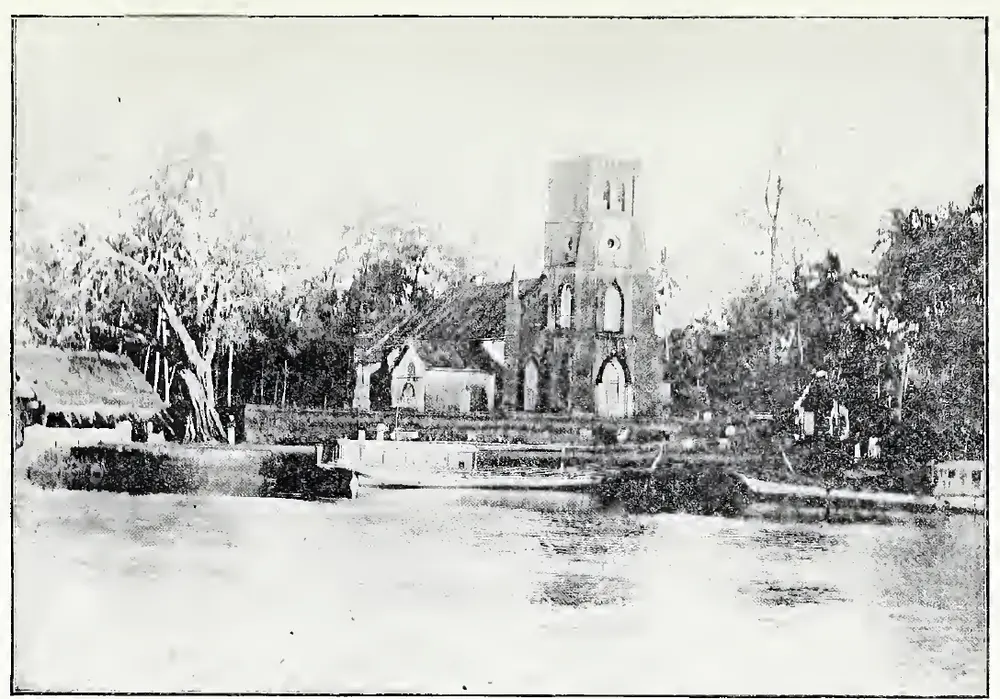
The London Missionary Society. The first missionary of the London Missionary Society to enter Travancore was the Rev. William Tobias Ringletaube, a native of Prussia. He had been for some time at Calcutta in the service of the Society for promoting Christian Knowledge, but, for some reason, he quitted that work and returned to Europe. In 1804 he came to India a second time, sent by the London Missionary Society and he took up his station at Tranquebar. Meeting with a pilgrim who had come from Travancore, his attention was drawn to this State, and in 1806 he visited Trevandrum to see if there was an opening for him here. The Rev. Sydney Smith in an article in the Edinburgh Review of 1808 quotes a letter written by Ringletaube in June 1806 saying that only the influence of Col. Macaulay enabled him to set foot in Travancore. He settled at Mailady near Cape Comorin and for ten years worked among the people of South Travancore, travelling incessantly, teaching, preaching and baptizing. His Report for 1813 gives the number of communicants in his flock as 617. In the year 1816 he suddenly left Travancore. Hough, in his Christianity in India, iv. 285, says:—
"No one seemed to know why, only that something appeared to have come into his head of some more hopeful work somewhere to the eastward. At Madras he called on the Rev. M. Thompson, with whom he spent the evening in a very ordinary costume, for even then he had no coat, although about to undertake a sea-voyage: the only covering for his head was something like a straw hat of native manufacture: yet, wild as was his appearance, Mr. Thompson was greatly interested in his conversation and helped him on his way. Thus did poor Ringletaube close his missionary career. No one knew whither he went, nor was he ever heard of again."
Although this passage shows that the eccentricity of Ringletaube jarred upon the decorous chaplains, yet the legends which have come down to this day among the Christians in South Travancore show that Ringletaube was of the stuff of which Apostles are made and that the shabby German missionary, without a coat to his back, had something of the spirit of St. Francis Xavier, in whose country he worked.
The native Catechist whom Ringletaube left in charge of his flock proudly paraded them when Bishop Middleton of Calcutta in 1816 came over the Aramboli pass on his way to Travancore, and this handful of Christians was the nucleus of the sixty thousand that the Society now number in Travancore. In 1818 Messrs. Mead and Knill arrived to carry on the work and they received substantial assistance at the hands of the [222]Resident, Col. Munro, who obtained for them from the Darbar gifts of land and money. The Resident tried a curious experiment in appointing Mr. Mead to be Civil Judge of Nagercoil and Mr. Norton of the C. M. S. to be Civil Judge at Alleppey, but this experiment lasted only for one year, because the Committees in London of the Societies forbade any such assumption of civil duties.
The years immediately succeeding were years of great prosperity to this mission and by 1820 there were under instruction three thousand persons, mostly Shanars. As time went on the converts benefited by the education given them and by the protection of the mission, and they advanced in the social scale until the jealousy of their neighbours was excited. There were riots and damage was done to churches and schools, but one point on which the jealousy of other castes took action is curious. The local custom by which women of the lower castes in Travancore wear no clothing above the waist was regarded by the Christians as indecent and the Christian women clothed their breast and shoulders. This departure from custom was looked upon as an offensive assumption of social position and was made an excuse for maltreating converts until in 1859 Sir Charles Trevelyan, Governor of Madras, interfered and induced the Darbar to issue a proclamation granting permission to women of the lower castes to clothe themselves as they wished. During these years of progress the missionaries gave special attention to education. A school was maintained at Nagercoil which has sent out two boys who rose to be Diwan. That school is now a Second-grade College. At Neyoor a hospital was established which with its branches now relieves annually eighty thousand patients. Mr. Mateer, a missionary of this Society, published two books, The land of Charity and Native Life in Travancore, which are standard works of popular information about this State. The manufacture of lace by native women was commenced very early in the history of this mission and has spread into Tinnevelly. The most remarkable feature in this mission is the extent to which the European missionaries have made over to a native ministry the care of the various churches.
Salvation Army. The Salvation Army came to Travancore in 1889 and now has about six thousand adherents. Their work includes a hospital which is under a qualified medical man from England, ambulance classes for first aid, orphanages and village banks.
Recent Sects. Mention must be made of some curious recent outbursts of misdirected fervour among the Protestants. A Tamil Brahman with his family was baptized by the Rev. Mr. Peet of the C. M. S. [223]in 1861 at Mavelikara. His eldest son, Justus Joseph, in 1875 announced that the Millennium would commence and that Christ will reign from October 1st 1881. This body of Christians was known as the Six Years Party. In Tinnevelly another body of Christians held that Christ would appear on the 30th September 1881 and this idea spread among the people of the London Missionary Society in South Travancore. When the dates passed by the numbers of these two parties diminished but some still adhere to Justus Jacob, the brother of Joseph.
[224]
Section D.—Minor Religions.
According to the latest Census (1901 A. D.) there were in Travancore only 227 Buddhists (mostly immigrants), 151 Jews, 15 Sikhs, 2 Parsis and 1 Jain.
Buddhism appears to have formerly flourished in Malabar and Travancore. We are told in the Keralolpatty that during the time of Bana Perumal, a band of Buddha (Buddhist or Jaina) missionaries came to Malabar and by their persuasions were able to convert many people including the king himself. The Brahmins being greatly alarmed sought the assistance of six Paradesa Brahmin apostles to overthrow the aggressive faith and re-establish Hinduism. These six apostles were by their arguments able to defeat the missionaries and drive them out of the land. Hinduism was re-established in the country and the Hindu gods were reinstated in the Buddhist temples. In Travancore there are to be seen a few relics of Buddha worship. The temple at Chitaral near Kuzhittura and that at Madavurpara near Kazhakuttam are instances in point and still retain many of their Buddhistic features.
Chitaral. This temple is at present dedicated to Goddess Bhagavati. The following description is from a Report submitted by me to Government in 1881 :—
"The temple faces west and stands on a rock, which is the most elevated in the neighbourhood. The place is known as Chitaral, and the temple is dedicated to a goddess and is called Bhagavathi Coil. The place is marked in Ward and Conner's map as 'Sharaul', and lies north-west of Kulithorai. There is a brick tower gopuram of a small size, but the temple and the tower are in a most dilapidated condition. They will not stand another three monsoons. There is a water spring on the rock in front of the pagoda within a few yards. This supplies all the water for the pagoda, and the officiating priest, Potti, uses it as a bathing tank as well. The tantri of the pagoda is a Nambiyan, but the Potti performs the poojas as the Nambiyan's deputy. I mention this circumstance of the Nambiyan being the tantri to show the origin of the pagoda as being foreign, which it must be if it is a Buddhist temple. The entrance door is guarded by two figures, Kshetra Palakas, as it is usually the case in Hindu temples. The pagoda is a simple building with a hall in front, divided by two rows of stone pillars. The Sree Coil is divided into three compartments, and between the hall and the line of compartments there is a small space left open to all the rooms. There is no skilled workmanship in stone of any kind. It is all plain work. The Sree Coil including all the rooms is cut out of a large rock under which stand all the images in the rooms. The rock is polished and plastered with chunam inside. The chunam work has fallen off to some extent. The hall and the narrow line in front of the Sree Coil are outside the rock. Of the three rooms all facing the west, the one at the northern end contains 6 images: a female deity standing [225]with two boy figures facing west; a grown-up girl figure facing north, and a male deity on the right side, facing south. Behind the female deity is the figure of a lion representing her vehicle Vahanom. In the central room are four figures. The most important is the image of a Muni facing west, sitting in a posture called Padmasanam on an elevated stone plinth quite naked, having no tuft of hair, no beard, face quite shaven-appearance, no brahminical thread, marks of ashes on the forehead, said to be the work of the pagoda priests, and of recent origin; his bald head is banded round with a string of beads made of holy tholasi wood; there are two disciples behind this image. On the right hand is an image of Vishnu facing south. The Muni is adorned with a teir of 3 umbrellas looking like a triple crown, or the tiara of old with the snake entwining the pole of the umbrella. In the southern room is also a Muni of the same fashion as in the central room with two figures of disciples. The images are all made of a hard paste called Kadukusarkkara; the frame work is evidently of teak or other wood bandaged strongly with coir and a kind of rough cotton cloth. The paste is what is seen outermost and has evidently stood for ages past and promises to stand for a long time to come. The images are of course not subjected to daily ablutions (abhishekom) as they will be, in case they are of metal or stone. To the north of the pagoda, the rock is cut in, and the plain surface is protected from rain by the uncut portion overhanging; thirty-two figures are cut out on this plain surface in bas relief, being mostly repetitions of the images in the pagoda. There are three inscriptions on this plain surface of this rock in the space left between the figures. There is another inscription on a piece of broken pillar used as one of the stone steps, and a fifth inscription on a pavement stone in front of the pagoda." His Highness the late Maharajah who had visited this temple wrote to me (5th June 1881) regarding this description :—"I read the copy you sent to the Dewan, and having myself seen the temple, can say that your description is correct. The Brahmins have appropriated and adapted to their purposes this Buddhist temple, as they have done many others. What you call a Muni is nothing but the figure of Buddha-Gautama. The inscription which you have appended to your report to the Dewan is in the Koleluttu or Vatteluttu characters, that is, the old Malayalam-Tamil; you will come across numerous similar inscriptions in South Travancore, and they are of considerable value, as they always tell a true tale of past ages".
It may also be probable that these figures represent Jaina images. "The tier of three umbrellas" and the absence of the thread are characteristic of a Jaina image. Perhaps the inscriptions found outside the temple, which still remain undeciphered, may explain the true origin of the temple.
Madavurpara. This temple is situated near Kazhakuttam, ten miles north of Trivandrum, and is a very ancient place of worship.
"The Pauray or rock is a huge boulder several hundred yards long and broad and about 180 ft. high,...and from the top commands a very distant view. The foot of the rock is reached by ascending a number of laterite and granite steps and the rock itself is surrounded by tall jungle trees and a cane jungle. In the southern face of it are two cave-like hollows, one of which is closed by means of large pieces of granite and the other is a Siva temple. This temple is a little more than 50 ft. from the foot of the rock and we get to it by scaling about 20 steep and dangerous steps. At the top of these steps is a platform 6 ft by 12, and a portion of this is railed in and formed into an ante-room; on the right and left walls of which are two large figures, one of Vighneswara and the other of [226]Subrahmanyaswamy. In the centre of the other wall is the entrance into the cave or temple where the figure of Siva is scooped out from the rock itself and on either side of this entrance are two large figures (Dwarapalakas). The cave temple is oblong and its dimensions are 12 ft. long, 4 ft. wide and 7½ ft. high. There are no engravings of any kind except the figures already mentioned, which according to the tradition of the place were self-cut, were dim and illegible at one time but have come into bold relief at later years and continues to do so year after year. The temple is the property of a jenmi by name Kuvalla Mayssari Potti who when qustioned about its origin and history and about the Granthavari which would throw light upon these said that beyond the tradition already explained he knew nothing whatever and that there were no records."*
An undoubtedly true image of Buddha is still to be seen on the roadside between Mavelikara and Kandiyur. There is another stone figure in water on the Canal near Karumadi called by the Canoe-men 'Karumadikuttan'. It is possible that more relics of the kind exist in Travancore.
The Jews. They are now found in the Parur Taluq. There was a time when there was a considerable number of Jews in Travancore, mostly in Kayangulam and Shertallay. The following account of their history is reproduced from a very old paper found in the Huzur English records, Trivandrum :—
"After the destruction of the second Temple in 3828th year of Creation, 3168th of Tribulation, 68th of the Christian Era, about 10,000 Jews and Jewesses came to Malabar, and settled themselves at Cranganore, Palloor, Mahadam and Paloothoo; three-fourth population remained at Cranganore, then called Mahodrapatna, and subsequently Chingley under the Government of Cherumproomal.
"In that year 4139th of Creation, 3479 of Tribulation and 379th of Christ, Cherumproomal Eravy Virma granted to the Jews the honour and privileges they were to exercise and which was engraved on Copper Plates called Chempeda in Malayalum and thereby appointed to Joseph Rabban at the head of the Jews and called him Srianandan Mopla, and that the same Rajah divided his country into eight divisions which (he) bestowed as will be seen in the following translate of the Copper plate.
"To that God who of his almighty will and pleasure created this world, and I, king Eravy Virma lift up my hand in adoration and bestow this grant as from time immemorial our sovereignty existed on the day of the 36th year of our reign at Cranganore, and thus I do hereby ordain and give all manner of power to Joseph Rabban to wear of five different colours to be saluted by firing of guns, to ride on elephants and horses, the call on the roads to make converts of nations, to use of lamp of the day, to walk on carpets, cloths spread on the ground to adorn houses, to use of Palankeens, High Parasols, Kettle-drums, trumpets and small drums, and of all these privileges. I grant unto him and seventy-two of their houses free of ground rent and duty scales and appoint him as the head of all the subjects and churches in whatever part of country they may be established and all the above cited privileges are hereby and without any of the least differences or contradiction fully granted by the Copper Plates unto the said five [227]coloured* Mr. Joseph Rabban and his heirs, male and female bride and bridegroom, to hold and exercise as long as the sun shines on the face of the earth and his descendants shall exist and may God grant his blessings to the under-mentioned witnesses Princes of kings of Travancore, Tekencore, Badcancore, Quilon, Nrengoot, Samorin, Paliatachan and Colastria; written by Kelumbe Keluppan and as Perumpadappa the Cochin Rajah is my heir, his name is not including in this Signature."
* Extract from a Report submitted to Government in July 1881 by Mr. T. Raja Rama Row B. A., while he was in charge of the Trivandrum Division.
* Anju-Varner is the Malayalam word used in the deed for the Jews. It means the fifth caste as these formed a new caste outside the pale of the Hindu system of Chatur-Varna or that of the four castes of the great Law-giver Manu.
[228]
Chapter IXCaste.
"The principles of duty lie
Enveloped deep in mystery.
On what can men their conduct found?
For reasonings lack all solid ground;
The Veda with itself conflicts,—
One text another contradicts;
No muni old, however wise,
A sure unerring norm supplies.
The only rule is :—ne'er forsake
The beaten road the many take."
Mahabharata—(J. Muir).
Introduction. It is well nigh impossible to write anything new on the subject of the Indian castes. It has been so exhaustively dealt with in the numerous treatises that have been written on it here and elsewhere. In Travancore itself, the four Census Reports issued since 1875, of three of which I claim the authorship, have treated it in more or less detail. The monograph on Indian Castes by Mr. H. H. Risley, C. I. E., in the Report on the Census of India (1901) is a valuable contribution to the ethnography of the Indian continent, not to speak of Sir J. A. Baines' masterly treatment of the subject in his Report of 1891 and other books by eminent Indian and English writers. At the same time it would be wrong for the general reader to suppose that the last word on the subject has been already said, for that consummation could be reached only by a life-long study and research not possible to achieve for the hard-worked official or the much-travelled scholar in the circumstances of our age. Thus the last word on the subject has not been, but still remains to be, said, though the European reader of the present day may, by a few days' diligent study of the official Indian Census Reports alone, learn all that is possible or necessary for him to know, of the widely diffused yet highly complicated system of Indian castes. The difficulty of the study is great as is so well pointed out by Mr. Risley :—
"The origins of these types are hidden in the mist which veils the remote era of the Aryan advance into India. Within that dim region evidence is sought for in vain. Our only guides are tradition and conjecture, aided by the assumption, which the history of the East warrants us in making, that in those distant ages types were formed by much the same processes as those that we find in operation to-day. Such are our materials for a study of the evolution of the Indian people."*
* Report on the Census of India (1901). Page 507.
[229]Added to which is the Mississippi of error and falsehood which filters down through a thousand ignorant and corrupted channels of information to the pages of the hastily written review by the European tourist rushing through the Indian continent for a brief space of three months. Again, the information on Caste is generally derived from people who have the least attachment to it, for as Mr. J. D. Rees, M. P., C. I. E., writes :—
"However that may be, it (caste) is the bed-rock of Hinduism; and the difficulties of understanding India, her people, religions, habits and customs experienced in Britain are vastly enhanced by the fact that the Indians who visit England are necessarily the worst possible witnesses in this behalf, and were they angels from heaven, could not be impartial judges of the merits of systems they have abandoned, of habits and customs they have renounced, and of people by whom they and all their works, however admirable and enterprising, are utterly repudiated."*
It is therefore the duty of every educated Hindu, especially of the high-caste Hindu. whenever opportunity offers, to let in a little light on this difficult subject by contributing his quota of information which from his vantage ground of birth, national literature, national religion, mother-tongue or caste traditions he can well claim as lying within his own special province and which if turned to good account might not only prove of incalculable aid to the general student of ethnology, but serve to rehabilitate the people in their traditional faiths, habits and occupations. If authority were required for this statement, I have only to refer the reader to the opinion of Rajah Sir Madava Row, statesman and reformer, imbued with the spirit of English culture and English learning and by no means a bigot in any sense. He said :—
"Thinking men must beware, lest the vast and elaborate social structure which has arisen in the course of thousands of years of valuable experience should be injured or destroyed without anything to substitute or with a far worse structure to replace it. The destructive spirit is prompted by an alien education. It is also felt to be a good deal remunerative. It is commended and even applauded by foreign agencies, especially appointed and liberally paid for the work of destroying local religion and sociology, or at least for greatly altering them on foreign and unfitting models. But the conditions of sound progress require that what exists must be vigorously defended by those who know, appreciate and value it. Under the circumstances stated above, the defensive or preservative spirit is not exercised with sufficient vigor. In short, if the existing good be not adequately defended, destructive action might succeed much more than it ought. I think it, therefore, the duty of such of the native community as know the value of the existing system, the growth of incalculable years of natural special development, to be much more active and vigorous than they appear to be in defending what they value against thoughtless or prejudiced aggression. This work of defence cannot be as remunerative as the other, but it would be on that account all the more patriotic or praiseworthy. Is it really [230]patriotic, I ask, to depreciate, to despise, and to denounce everything connected with your country, with your countrymen, with your forefathers from time immemorial, with everything connected with your religion, with your sociology, with, in short, everything your own? And yet you must admit that patriotism is a virtue necessary for self-preservation, self-contentment, self-love, self-respect, self-hope, and self-progress. Pray, find out who taught you to abdicate the noble virtue of patriotism and to adopt its dismal contrary. If you find him out, erect for him a statue of the blackest marble or metal."
* The XIX Century and After—December 1904.
It is in this sympathetic spirit that the discussion of the subject is attempted here. Caste is an old edifice of massive strength which though tossed about and tempest-torn since it was founded thousands of years ago, has well stood the shock of ages, and its impact with the more vigorous if hostile faiths of later times has still left it nearly all intact. A system which has endured so long and so well and that in spite of so many and such powerful opponents may be credited with having a marvellous amount of vitality which constitutes perhaps its best claim to the loyal homage of its adherents. We often hear of the 'changeless East', and so it undoubtedly is when we consider how tenaciously the caste system of India sticks on in spite of overwhelming obstacles. The Mahomedan traveller Alberuni speaking of the Indian Vedas of his time (10th century) said :—
"Veda means knowledge of that which was before unknown. It is a religious system which, according to the Hindus, comes from God, and was promulgated by the mouth of Brahman. The Brahmins recite the Veda without understanding its meaning, and in the same way they learn it by heart, the one receiving it from the other. Only few of them learn its explanation, and still less is the number of those who master the contents of the Veda and their interpretation to such a degree as to be able to hold a theological disputation. The Brahmins teach the Veda to the Kshatriyas. The latter learn it, but are not allowed to teach it, not even to a Brahmin. The Vaisya and Sudra are not allowed to hear it, much less to pronounce and recite it."
This description of the Veda is as true to-day as when Alberuni saw India thirty generations ago. Surely the East is changeless, for "Time writes no wrinkles on its brow".
"The hauteur of the East lies in the very knowledge that its civilisation has nothing to fear from the social and intellectual experiments of its youngsters, or even from such complete changes of mental raiment as amongst newer peoples would constitute revolutions of thought, for the effort of Eastern civilisation has always been to the solitary end of moralising the individual, and in this way it differs essentially from Western systems of culture, which have striven rather for the most efficient use of materials. If Alexander, capable of organising the largest number of his fellows most effectually for a combination of military, commercial and scientific ends in that most difficult form, an armed expedition over hostile territory — if Alexander be taken as the type of Occidental genius, then, as the culminating example of the Oriental, we must name Buddha; for clear and intense conceptions of perfect renunciation and inner illumination are the hidden springs of Hindu living, around which the home itself is built. These it is, of [231]which the Epics are the popular vehicles, these it is which give its persistence to Indian civilisation through the centuries, and this is why no examination syllabus, no alien's kindly inspiration, no foreigner's appreciation or contempt, can ever hope to have one iota of permanent influence on the national education at its core."*
An attempt will here be made to trace caste from its prehistoric beginnings, when the Aryans first settled in India and when the Vedas were first received by them, down to our own days when caste finds itself nonplussed in a variety of ways by enemies from abroad and heretics from within. We shall then be the better able to judge for ourselves whether caste has been the bane of India, as it is so often represented to be, or has served some really useful purpose as a necessary milestone in the march of Indian society towards its ultimate goal.
In the Rig Veda, generally looked upon as the oldest of the Vedas, the division of the Hindus into four well-defined castes is prominently mentioned and the duties of each definitely assigned. The earliest account of the four castes. Brahma, Kshatriya, Vaisya, and Sudra, is furnished by the Purusha Sukta or Hymn of the Primeval Male and also by Taittariya Samhita (VII. I); the Brahmin who emanated from the mouth of Brahma was, therefore, accorded precedence in rank and special privileges were granted to him as a priest for addressing the gods in hymns. He was charged with the intellectual and spiritual enlightenment of the people. The Kshatriya who sprang from the puissant arms of Brahma formed the regal and military class. The Vaisya, who is described to have sprung from the thigh, is given charge of agriculture and trade. To the Sudra, who is described to have shot forth from the feet of Brahma, is assigned the duty of serving the other three castes. Thus the four castes formed, as it were, the four pillars of the edifice of the Hindu social and religious polity and kept the wheel of the Hindu world going smoothly on in peace and plenty. No distinctions of the kind attributed by the modern critics were recognised then. Each class contributed its quota of labour towards the well-being of the body-politic. Every class was independent by itself. The whole machine was made to run harmoniously. The same conditions were kept up more or less in the succeeding ages.
In the Sama Veda† the Brahmin is referred to as the officiating priest. The positions of Kshatriya, Vaisya and Sudra are mentioned as in the Rig Veda.
* The Web of Indian Life—Sister Nivedita. Page 126.
† The Sama, Yajur and Atharva Vedas are supposed to have been compiled about B. C. 1400 to B. C. 1200.
[232]The Yajur Veda is divided into (1) Krishna (or Black) Yajur Veda and (2) Sukla (or White) Yajur Veda. In the former the predominance of the Brahmin in sacrifice is recognised, but some social distinctions are also set forth, such as Brahma, Rajanya (prince), Mahishi (the wife of an anointed king), Parivrikti (concubine), Senani (general), Suta (charioteer), Gramani (villager), Kshatta (guardian of females), Sangrahita (treasurer), the Bhagadugha (collector of taxes) and Akshavapa (dice player). Other professions were also recognised and these in course of time formed separate castes. They come under Samkara or mixed castes. In the Sukla Yajur Veda, the different functions of the Brahmin and Kshatriya are recognised, but mention is also made of Kshetrapati (proprietor of fields) Suta, Taskarapati (probably master of a subjugated tribe), Kullanchapati (those who dwell in mountains), Shvapati (master of hounds), Vratapati (master of a multitude), Senani (leader of the army), Taksha (carpenter), Rathakara (coach builder), Kulala (potter) and Nishada, (hunter). These classes are all treated as belonging to separate castes, being the outcome of mixture of the higher with the lower castes. No less than one hundred and fifty-nine distinct classes with professions marked out for them are clearly noted, thus showing the various combinations and permutations caused by division of labour, birth and rank.
The Atharva Veda also abounds in evidence as to the existence of the distinct castes. The Sudra is marked out as distinct from the Arya as in the Rig Veda. The caste system is seen in a developed form.
Passing on to the period of the Brahmanas (B. C. 1300-1100), the second part of Vedic literature, we find that the Aitareya Brahmana clearly marks out the first three castes of which the Brahmins as a pre-eminent class are particularly brought to notice. In 6-1-6 a description of the four castes as in the seventh Khanda of Krishna Yujur Veda, is given. The Kshatriya is given all the power of arms, since he is created out of them. The Vaisya is expected to supply food for the Brahmins and Kshatriyas. The Vaisya's position was not thereby lowered. If a Brahmin could work out the spiritual and the Kshatriya the physical welfare of the community, the Vaisya's easy duty of supplying food for these was equally dignified. The Sudra again was to serve in his turn the other three superior castes referred to above. The Sudra did not complain as his whole welfare was looked after by the higher castes. Coming to the end of the fourth Anuvaka (section) of the first Adhyaya (chapter), we find a set of new castes different from the four castes, called Anuloma and Pratiloma. Taksha and Sudra are mentioned as necessary for sacrifices, but only as workers for the common good of all. All the three [233]castes are given the privilege of performing sacrifices but the performer or the presiding priest is the Brahmin by universal acceptance. The Sudra participates in the fruits of the sacrifice including the spiritual. The Andhras, Pundras, Shabaras (hunters), Pulindas and Mutibas, whatever might have been their origin, were the result of mixture of castes, and their existence at this epoch is clearly indicative of distinctions with regard to profession and rank.
In the Chandogya Upanishad associated with the Sama Veda, we find for the first time scrupulosity as to food brought into prominent notice. In the Taittariya Upanishad, a passage exhorts other castes to pay due respect to Brahmins. The passage runs thus, "Brahmanas who are better than we, it ought to be thy effort to provide with a seat."
The Sutras (800-300 B. C.) form a connecting link between the Brahmanas and the Smritis. In the Srauta Sutras, the Sudras as well as the mixed castes are declared not to have the right. (Adhikara) of sacrifice enjoyed by the Brahmin, Kshatriya and Vaisya, but are only enjoined to render service towards sacrifices. According to the Samayacharika or Dharma Sutras, the Kshatriya and Vaisya too who had the right to perform sacrifices were to do so only in a particular manner and with specially prescribed materials. The method was not to be uniform with all, i. e., the Brahmin Upanayanam should take place in the seventh year after birth, the Kshatriya's in the eleventh and the Vaisya's in the twelfth. Again with regard to living, the Brahmin was prohibited from entering the profession of a merchant or shop-keeper as that will be trenching upon the rights of the Vaisya community. The Brahmin is enjoined to avoid intercourse with the Sudra or other non-Aryan woman, which, as we shall see later on, was changed to suit the altered conditions of life. The Sutras clearly forbid the rules of one caste being followed by another, as for instance, the Brahmin is strictly forbidden to handle the sword or carry arms (which are the special privileges of the Kshatriya) except in self-defence. In the Apastamba Samayacharika Sutra and Dharma Sutras the ceremony of Upanayanam is enjoined only on three castes. Apastamba clearly believes in the progressive evolution of castes rising from the lowest to the highest by good and meritorious acts as well as in a retrogressive evolution or falling off which happens in cases of malpractices and misdeeds and the abandonment of one's own assigned duties. In the Asvalayana Srauta Sutra, castes with special reference to Gotras (families) and Pravaras (order) are noticed. In the Manava Kalpa [234]Sutras the Brahmin who usurps the function of other castes is enjoined to be treated as a Sudra.
The whole polity thus turned mainly on division of labour which is the recognised pivot of modern civilisation as well.
We come next to the Epic Age (1400-900 B. C.). The Epics containing full accounts of the Avatars of Vishnu form a long plea for the distinction of castes and their dignity as well; for the godhead appears again and again among men, as a member of this or that caste. Rama was born a Kshatriya, Vamana a Brahmin, Parasurama a Rishi's son, Krishna a Golla or cow-herd and Narasimha half-man, half-lion. Sometimes the Avatar appeared as a fish, a tortoise or a boar, showing the process of evolution from non-organic to organic and then from lower organic to higher, thus raising the status of the whole creation and adding dignity to every member in it as divine. In the Ramayana, Vishnu took the form of a Kshatriya with the avowed object of putting down the lawless Rakshasas, of protecting the Rishis in their innocent Tapas (penance), of upholding the Dharma of castes and the order of their respective duties, of showing to the world object-lessons on the constancy and fidelity of married life, the dutifulness to parents and brothers, the value of adherence to a plighted word by kings even at the cost of their crown and life, the loyalty of the people to their sovereign—in fact, the Ramayana labours through its 24,000 slokas to show us what a model house, a model hermitage, a model king, a model husband, a model son, a model wife, a model brother, a model people and a model State should be, as in the Mahabharata the godhead has shown us the duties we owe to others as a friend and counsellor, as an ambassador, a warrior, a host, the duties to one's rival dayadis (agnates), to one's trusted allies and dependents, to the enemy in the battle-field, to prisoners of war, to members of other castes and to occupations other than, one's own, and he has held up to us as examples, to follow the great ideals of virtue, such as valour, truth and chivalry, loyalty to the king, of tenderness to the weak and the helpless, of heroism in war, the merit of sacrifices, the law of Swayamvara marriages among Kshatriyas, the faithful performance of religious duties even in times of trouble and difficulty, the utter worthlessness of human ambition and human aims, and the attainment of Moksha or liberation of the soul from its worldly bonds. These varied phases of man's life are faithfully represented in its chief characters like those of Sri Krishna, Yudhishtira, Duryodhana, Bhishma, Drona, Karna, Arjuna, Abhimanyu, Draupadi, Sisupala, Balarama, Kunti [235]Gandhari, Sakuni, Jayadrata, and others too numerous to mention, all forming a unique encyclopædia of life and knowledge of ancient India and teaching its sons "to strive by kindly action, gentle speech, endurance long", to attain that "brighter life and holier future which unto sons of men belong". In the beautiful words of Sister Nivedita all India pays its due homage to the Epics :—
"What philosophy by itself could never have done for the humble, what the laws of Manu have done only in some small measure for the few, that the Epics have done through unnumbered ages and are doing still for all classes alike. They are the perpetual Hinduisers, for they are the ideal embodiments of that form of life, that conception of conduct, of which laws and theories can give but the briefest abstract, yet towards which the hope and effort of every Hindu child must be directed."
She continues :—
"The story of the Mahabharata would be less easy to recount. Mighty warriors, beautiful women and great saints move to and fro across its scenes in a glittering melee. The local colour is rich to a fault. The poem abounds in descriptions of social customs, domestic comfort, the fashions of old armour and similar details. But it is in the conception of character which it reveals that it becomes most significant. Bhishma, the Indian Arthur, is there, with his perfect knighthood and awful purity of soul. Lancelot is there — a glorified Lancelot, whose only fall was the utterance of a half-truth once, with purpose to mislead—in the person of the young king, Yudhishtira. And Krishna, the Indian Christ, is there, in that guise of prince and leader of men that has given him the name in India of 'The Perfect Incarnation'. One of the rival houses consists of a family of no less than a hundred children, so that the multiplicity of persons and incidents is best left to the imagination. Yet certain main features belong to the treatment of all characters alike. For the attention of the poet-chronicler is fixed on the invisible shackles of selfhood that bind us all. He seems to be describing great events; in reality he does not for one instant forget that he is occupied with the history of souls, depicting the incidence of their experience and knowledge on the external world."*
The Ramayana says that eighty-eight classes of people with distinctive professions accompanied the loving Bharata when he went to offer back his father's throne to his exiled brother Rama. The first book gives a connected description of classes of people called Palhavas, Shakas (Scythians), Yavanas (Iones or Greeks), Kambojas, Varvaras, Haritas, Kiratas and Mlechchas. The Chandalas (the Gondaloi of Ptolemy) are more than once mentioned as a defiling caste.
The Mahabharata contains frequent references to the institution of caste, some historical traces of the manner in which it acquired its ultimate establishment, and theoretical speculations as to its origin. In the Adi Parva or first section, there is an account of a struggle between the Brahmins and Kshatriyas illustrating the enmity which their mutual [236]contest for supremacy must have generated. In the Sabha Parva the carrying out of war at all hazards is declared to be the duty of the Kshatriya. In the Vana Parva the necessity of a Kshatriya having a Brahmin for instruction and advice is emphatically set forth. The story of Parasurama and his relation to the Kshatriyas is also depicted in detail. The episode of Nahusha is full of information on the question of caste. In the course of a conversation between Yudhishtira and the Serpent-king some of the principles of caste as affected by the progress of Indian society, are fully set forth. Yudhishtira says :— "He in whom are seen truth, liberality, forgiveness, virtue, innocence, austere devotion and compassion is according to the Smriti a Brahmin. When in a Sudra there is a mark of virtue and it is not in Dvija, the Sudra is not a Sudra and the Brahmin is not a Brahmin, and the person in whom it is not seen is a Sudra." He further says that "the caste of mankind is difficult to determine, owing to the general confusion of classes. Men of all castes are continually begetting children in women of all castes, the speech, the mode of propagation, the birth, the death of all men are alike."
* The Web of Indian Life, Page 118.
In the Virata Parva we have a distribution of functions for the four castes respectively as mentioned by Swayambhu Manu. In the Bhishma Parva occurs the well known Bhagavat-Gita or the Song Celestial containing the discourse between Sri Krishna and Arjuna. The respective duties and qualities of the Brahmin, Kshatriya and Vaisya castes are declared here in the usual form. The Gita bears conclusive testimony to the existence, necessity and the good conduct of the Chatur-varnas (four castes). Speaking of the imperative need to avoid mixing of colours and the consequent confusion of castes so abhorred by even the degenerate Hindu of to-day, the Gita says in the words of Arjuna :—
कुलक्षये प्रणश्यन्ति कुलधर्माः सनातनाः ।
धर्मे नष्टे कुलं कृत्स्नमधर्मोऽभिभवत्युत ॥ ४० ॥
"In case the family is ruined, the everlasting family virtues are (all) destroyed; and when virtue is (so) destroyed, unrighteousness of course overcomes the whole family."
अधर्माभिभवात् कृष्ण प्रदुष्यन्ति कुलस्त्रियः ।
स्त्रीषु दुष्टासु वार्ष्णेय जायते वर्णसङ्करः ॥ ४१ ॥
"Family-women become highly polluted in consequence of (their) being overpowered by unrighteousness, O Krishna; and when the women are polluted, there will arise (the evil of) Varnasankara, O Krishna."
In these texts, the racial basis of the Hindu caste system and its importance are thus well recognised. The ancient histories of Rome and [237]Greece bear evidence to the fact that the priest as the upholder of religion and the warrior as the upholder of the state, were the higher and lower layers of the aristocratic stratum of society, and the same seems to have been the case with the Aryan invaders in India. The marriage was the most important factor of life to preserve his race-purity and the proud Aryan therefore cut off the non-Aryan community from his own in this essential particular. Prof. Rangacharya, M. A., thinks that this original organisation was well aimed and well adapted to serve the common good of the people as a whole and was maintained to preserve the character of individuality by heredity as "it has been ascertained that both saintliness and criminality run in the blood which men inherit from their parents".
In the Karna Parva it is stated that, in the appointment of Karna to succeed Drona as general, Brahmins, Kshatriyas, Vaisyas and Sudras were unanimous. Special mention is made of the two classes of Anulomas and Pratilomas as the result of unsanctioned sexual unions with women of interdicted classes. In the Sauptika Parva, Asvatthama, the son of Drona, a Brahmin, apologises for his knowledge of war and of the tactics of the Kshatriyas by pleading his own poverty as the sole cause of his abandonment of the Brahminical rites. In the Anusasana Parva as well as in the Shanti Parva, there are several notices of caste. In the former, Prithu, son of Vena, is enjoined to preserve society from confusion of castes. The distinctive duties of the various classes are clearly defined to prevent feuds and dissensions.
The following text from the Mahabharata (XII. 11,811), clearly shows that castes had become well recognised by that time :—
"Through knowledge men redemption earn,
And never more to earth return.
Such knowledge seek, — make this thy task,
From Brahmans, Kshatriyas, Vaisyas ask,
Yea, e'en from lowly Sudras learn,
And so shalt thou the truth discern.
Be full of faith: whoe'er believes
The fruit of holy lore receives.
The humble Sudra none should scorn;
For though from different members born
All castes alike from Brahma spring,
And so are Brahmans all, O King."
Griffith.
Coming next to the Smritis or Law-books, we find that Asvalayana Smriti treats of the general duties of castes; Buddha Smriti treats of Samskaras or purificatory rites and the duties of the four castes. In the [238]Manu Smriti is set forth in detail an array of the Acharas or the duties of the different castes and the origin of the mixed castes. Parasara Smriti also indicates the tenor of the four Asramams as also Samvartaka Smriti and the Smritis of Usanas, Yajnavalkya, Vishnu and Vyasa. The Samskara Mayuka of Kamalakara Bhatta treats of the duties of the four Asramas and the general duties of the four castes.
In no one of the Puranas is there any relaxation of the well-laid distinctions of caste. In the Siva Purana all castes are recognised on a position of equality in offering worship to Siva and Linga. In the Bhagavata, God is said to be well pleased with a Sudra for the fulfilment of his duty. The ground principle of the social order was left undisturbed even down to this time. The transition from one caste to another either on account of lapses of legitimate duties of each caste or change of profession on the score of convenience, is seen in many distinguished cases. The change from a Brahmana to a Kshatriya is evidenced in the sons of Manu, Krishadra, Karusha, and Dhrishta, who attained Brahminhood afterwards. Another descendant of Manu called Nabhaga, son of Dhrishta, became a Vaisya. More instances may be cited as indicative of the natural growth and decay of caste from the ancient times to our own. Both in the solar and lunar dynasties of kings such transformations of castes are noticeable. But down to the days of the Bhagavata the caste predominance has been studiously maintained both by the people and the rulers. Agni Purana recognises castes including Anuloma and Pratiloma (due to mixture of races), Bhavishyat Purana goes to the length of instituting castes even to serpents. The Brahmin Cobra de capello is either white or tawny, the Kshatriya red or yellow, the Vaisya black, &c. The Brahma Vivarta Purana gives the usual statement of castes and certain Varna—samkaras or mixed classes called Gopa (cowherd), Bhilla, Modaka, Kulras-Tambulas and Vanikjatiya (mercantile classes), who are recognised as Sudras. Nearly fifty separate classes as due to mixture of Brahmin, Vaisya and Sudra castes are mentioned.
Gautama Buddha found the system of Indian caste in full and vigorous operation. In the oldest works of his disciples treating of his life and teachings, frequent mention is made of Brahmins, Kshatriyas, Vaisyas and Sudras and often in opposition to the Chandalas or non-Aryan classes. The Brahmins are alluded to as de facto superior to the other classes in status, learning, religious practice and austerities. They are recognised as being acquainted with the four Vedas, as in possession of all the Mantras and as the dispensers and conductors of sacred rites to princes and people. The [239]Kshatriyas are referred to as the governing class, while the other castes such as those of the Venukaras, Rathakaras, Pukkasas, Barbaras, Ahiras or herdsmen are viewed as inferior both in status and privilege to the Brahmins and Kshatriyas. Buddha with his non-theism wished to reduce castes to one level. He could not do away with it but suffered its existence in Indian society. He argued that baseness or elevation of birth was due to Karma (sin or merit) of former birth. Thus while caste was derided technically, the doctrine of Karma was given full swing and asceticism was acknowledged.
The Greek account of Megasthenes divides the population of India into seven principal divisions or classes, viz., those of the Philosophers the Agriculturists, the Shepherds and Hunters, the Artizans, Hucksters. and Bodily labourers, the Warriors, the Inspectors, the Counsellors and the Assessors of the king. Thus we find not only the four Vedic castes under the guise of a fresh nomenclature with unmistakable duties assigned to each, but other castes also according to their profession have been brought to our view. Strabo says that Megasthenes divides Philosophers into Brachmanes and Garmanes, i. e., Brahmins and Shramanakas or Buddhists, but the Brahmins are set forth as of greater repute than the Shramanakas.
We shall next refer to the opinions of some of the distinguished modern scholars on the caste organisation. Auguste Comte, a name of first rate importance among social philosophers of Europe, thus commends the caste system :—
"We owe to it the first permanent division between theory and practice by the institution of a speculative class, invested with grand prerogatives of dignity and leisure; and to this period we must refer the primitive elements of genuine knowledge it being that in which the human mind began to regulate its general course. The same may be said of the fine arts then carefully cultivated not only for the sake of their charm, but as tributary to dogma and worship on the one hand and information and religious propagation on the other. The industrial development was the most remarkable of all, requiring no rare intellectual qualifications inspiring no fear in the ruling class and furnishing, under the reign of peace, forces adequate to the most colossal undertakings. The loss of many useful inventions before the preservative institution of caste arose, must have suggested the need of it, and has proved its advantage afterwards in securing the division of labour which was here and there attained. No institution has ever shown itself more adapted to honour ability of various kinds than this polytheistic organisation, which often exalted into apotheosis its commemoration of eminent inventors, who were offered to the adoration of their respective castes. In a social view the virtues of the system are not less conspicuous. Politically, its chief attribute was stability. All precautions against attack from within and from without were most energetically instituted. Within, all the castes were united by the single bond of their common subordination to the sacerdotal caste from which each derived all that it had of special knowledge [240]and perpetual instigation. There never was elsewhere such a concentration for intensity, regularity, and permanency of human power, as that possessed by the supreme caste, each member of which (at least in the higher ranks of the priesthood) was not only priest and magistrate, but also philosopher, artist, engineer and physician. ... ... ... As to the influence on morals this system was favourable to personal morality, and yet more to domestic; for the spirit of caste was a mere extension of the family spirit. The condition of women was improved and their seclusion was the first token of homage and of their assignment to a position more conformable to their true nature. As to social morals the system was evidently favourable to respect for age and homage to ancestors."
Sir. Henry Cotton in his New India writes in very appreciative terms of the caste system. He says :—
"The old Hindu polytheism is a present basis of moral order, and rests upon foundations so plastic that it can be moulded into the most diverse forms, adapting itself equally to the intellect of the subtle metaphysician and to the emotions of the unlettered peasant. It combines in itself all the elements of the intensity, regularity, and permanence. Its chief attribute is stability. The system of caste, far from being the source of all the troubles which can be traced in Hindu society, has rendered the most important services in the past and still continues to sustain order and solidarity. The admirable order of Hinduism is too valuable to be rashly sacrificed before any Moloch of progress. Better is order without progress, if that were possible, than progress with disorder. Hinduism is still vigorous, and the strength of its metaphysical subtlety and wide range of influence are yet instinct with life. ... ... Caste still exercises a predominant influence among all classes of community. Even those who are outside the pale of Hindu caste seem anxious to organise an institution resembling caste among themselves. The Eurasian community seem to have already formed into a caste, and the native converts to Christianity as well as the more self-assertive portion of the Brahmo community, appear to be in the course of forming into new castes. Even a Khalsa Sikh will be found after a time to assume an attitude of marked respect towards Brahmins, and to entertain the most delicate scruples on the subject of caste. And Mahomedans have been so far infected that they have broken up into separate castes with Jus Connubii as distinct as it is amongst Hindus. Caste is thus the existing basis of social order, as the Brahminical polytheism is of Hindu morality. Supplemented by such sister institutions as the joint family and the village community (both of which are also in transition and have been greatly changed), it has already been subjected to modifications and is destined to be still further modified by the external influences which are brought to bear on it."
Sir Monier Williams thus briefly puts the advantages of caste system :— "In India, caste has been useful in promoting self-sacrifice, in securing subordination of the individual to an organised body, in restraining from vice, in preventing pauperism."
Sir W. W. Hunter refers to the system thus :—
"There is, therefore, a plasticity as well as a rigidity in caste. Its plasticity has enabled caste to adapt itself to widely separated stages of social progress, and to incorporate the various ethnical elements which make up the Indian people. Its rigidity has given strength and permanence to the corporate [241]body thus formed. Hinduism is internally loosely coherent, but it has great powers of resistance to external pressure. Each caste is, to some extent, a trade-guild, a mutual assurance society and a religious sect. As a trade-union it insists on the proper training of the youth of its craft, regulates the wages of its members, deals with trade delinquents, and promotes good fellowship by social gatherings. The famous fabrics of mediæval India and the chief local industries in our own day were developed under the supervision of caste or trade-guilds of this sort. Such guilds may still be found in many parts of India, but not always with the same complete development."
The French Missionary Abbe Dubois, the greater portion of whose life was spent among the Hindus of South India, has left behind him a rich heritage of wisdom in his description of the Hindu castes. He says :—
"I believe caste division to be in many respects the chef-d' oeuvre, the happiest effort, of Hindu legislation. I am persuaded that it is simply and solely due to the distribution of the people into castes that India did not lapse into a state of barbarism, and that she preserved and perfected the arts and sciences of civilization whilst most other nations of the earth remained in a state of barbarism....
"After much careful thought I can discover no other reason except caste which accounts for the Hindus not having fallen into the same state of barbarism as their neighbours and as almost all nations inhabiting the torrid zone. Caste assigns to each individual his own profession or calling; and the handing down of this system from father to son, from generation to generation, makes it impossible for any person or his descendants to change the condition of life which the law assigns to him for any other. Such an institution was probably the only means that the most clear-sighted prudence could devise for maintaining a state of civilization amongst a people endowed with the peculiar characteristics of the Hindus.
"We can picture what would become of the Hindus if they were not kept within the bounds of duty by the rules and penalties of caste, by looking at the position of the Pariahs, or outcastes of India, who, checked by no moral restraint, abandon themselves to their natural propensities. Anybody who has studied the conduct and character of the people of this class—which, by the way, is the largest of any in India—will agree with me that a State consisting entirely of such inhabitants could not long endure, and could not fail to lapse before long into a condition of barbarism. For my own part, being perfectly familiar with this class, and acquainted with its natural predilections and sentiments, I am persuaded that a nation of Pariahs left to themselves would speedily become worse than the hordes of cannibals who wander in the vast wastes of Africa, and would soon take to devouring each other.
"I am no less convinced that if the Hindus were not kept within the limits of duty and obedience by the system of caste, and by the penal regulations attached to each phase of it, they would soon become just what the Pariahs are, and probably something still worse. The whole country would necessarily fall into a state of hopeless anarchy, and before the present generation disappeared, this nation, so polished under present conditions, would have to be reckoned amongst the most uncivilized of the world. The legislators of India, whoever they may have been, were far too wise and too well acquainted with the natural character of the people for whom they prescribed laws to leave it to the discretion or fancy of each individual to cultivate what knowledge he pleased, or to [242]exercise, as seemed best to him, any of the various professions, arts, or industries which are necessary for the preservation and well-being of a State.
"They set out from that cardinal principle common to all ancient legislators, that no person should be useless to the commonwealth. ... ... These ancient lawgivers, therefore, being well aware of the danger caused by religious and political innovations, and being anxious to establish durable and inviolable rules for the different castes comprising the Hindu nation, saw no surer way of attaining their object than by combining in an unmistakable manner those two great foundations of orderly government, religion and politics. Accordingly there is not one of their ancient usages, not one of their observances, which has not some religious principle or object attached to it. ... ... Nothing is left to chance; everything is laid down by rule, and the foundation of all their customs is purely and simply religion. It is for this reason that the Hindus hold all their customs and usages to be inviolable, for, being essentially religious, they consider them as sacred as religion itself."
Abbe Dubois further says :—
"And, be it noted, this plan of dividing the people into castes is not confined to the law-givers of India. The wisest and most famous of all law-givers, Moses, availed himself of the same institution, as being the one which offered him the best means of governing the intractable and rebellious people of whom he had been appointed the patriarch."*
Egyptian history throws no inconsiderable light on the divisions of people into castes. As with the Hindu, the distinctions were occupational in the main and the occupation was hereditary. More than one profession or even a change from one profession to another was forbidden. Similar distinctions are discernible among the Greeks. Cecrops divided the people of Athens into four tribes and Solon the great law-giver strengthened it. Ancient Rome, no less than ancient Greece, formulated similar classification. The Romans and Sabines were formed into different classes and castes. This combination sunk natural differences which existed previously and harmonised the community to the new conditions. The Arabs and Tartars too had a kind of distinction in common with the majority of ancient nations. To quote the Revd. Abbe again :—
"Another advantage resulting from the caste system is the hereditary continuation of families and that purity of descent which is a peculiarity of the Hindus and which consists in never mixing the blood of one family or caste with that of another. Marriages are confined to parties belonging to the same family, or at any rate the same caste. In India at any rate, there can be no room for the reproach, so often deserved in European countries, that families have deteriorated by alliances with persons of low or unknown extraction. A Hindu of high caste can, without citing his title or producing his genealogical tree, trace his descent back for more than two thousand years without fear of contradiction. He can also, without any other passport than that of his high caste, and in spite of his poverty, present himself anywhere; and he would be more courted for a marriage alliance than any richer man of less pure descent."†
* Hindu Manners, Customs and Ceremonies—Dubois and Beauchamp. Vol. I. Page 30.
† Ibid Page 34.
[243]Jogendranath Bhattacharya, M. A., D. L., the author of the Commentaries on Hindu Law, refers to the caste system thus :—
"There is no ground whatever for the doctrine that caste is the outcome of the policy embodied in the Machiavellian maxim, 'Divide and Rule'. ... ...
There is no ground whatever for the supposition that in primitive India all classes of people were united as one man, and that the 'unnatural and pernicious caste system' was forced on them by the Brahmans with the diabolical object of sowing dissensions among them. The more correct view seems to be that the legislation of the Rishis was calculated not only to bring about union between the isolated clans that lived in primitive India, but to render it possible to assimilate within each group the foreign hordes that were expected to pour into the country from time to time. ... ... The authors of such legislation deserve certainly to be admired for their large-hearted statemanship instead of being censured for selfish ambition and narrowness."*
In a remarkable essay in French on the Evolution of Indian Civilisation, Marquis De La Mazeliere, a writer who, according to the Times "displays a rare synthetic power and is a philosophic student who has already attained distinction," observes :—
"Let us sum up those two thousand years which comprise the history of ancient India. Two facts by their importance overshadow all others. First, the formation of castes. Caste is the solution that India has given to the problem of her national and social unity. Every country finds its own solution, which corresponds with the spirit and temperament of its people. As Greece and Rome had the city combined with slavery, as China had the partiarchal regime, India has caste; and, indeed with its climate, with the extent of its territory, with the numbers of its population, with the diversity of its races, no other form of society was possible. In ancient India castes were neither so numerous nor so exclusive as they are to-day. But they already represented what they still represent, a social and political hierarchy uniting heterogeneous tribes, peoples and even races; an organization similar to guilds and societies of mutual assistance the caste council making up in ill-governed States for the deficiencies and injustices of the criminal police, and its prescriptions replacing non-existent civil law; the fusion of religion and social organisation, religion giving a sacramental character to caste regulations and the formation of new sects producing the formation of new castes. That is what caste represents. But the principle itself which produced caste must be sought in the constitution of the Aryan family with its patriarchal regime, its cult of the hearth, its ancestral worship, its peculiar conception of marriage, of the rights of agnates and of property. Seen in this light the origins of caste explain why Buddhism failed to destroy it. Buddhism was the conscious expression of the great movement which produced with the first empire a Hindu race and a Hindu civilisation. But the complete triumph of Buddhism would have brought about anarchy and civil war. Once caste destroyed, there would have remained the other races of India which were not yet fused into the Hindu race, and, within the Hindu race itself, diversity of temperaments, inequality of intelligence, conflicting tastes and wants. What regime could have replaced caste; Hinduism protects the lowest as well as the highest castes; it protects them politically in checking the tyranny of kings; it protects them socially in giving to the lowest a society of equals; it protects them economically [244]in securing to each one the monopoly of its trade against the pretensions of all the other castes, even of Brahmins and of kings. For the Sudras and the baser castes, the real conquest to be aimed at was not the destruction of castes, but that they should be given castes of their own, each with its own share of rights and privileges. Buddhism was an individualistic religion which enjoined the repudiation of all the duties of public and private life in order that each one should devote himself exclusively to his own salvation. On such a principle an ecclesiastical system could be built up, not a social system. On the other hand the Hindu religion imposes no dogma, and its moral code is merged in the observance of customs. Thus, as the first effort directed by individualism against caste, Buddhism proved unable to hold its ground for any length of time in a society based on the principle that the individual must be subordinated to the community. In this first stage of Indian civilisation modern science would doubtless recognise a phase in which society is unable to differentiate clearly the structure and the function of its organs. To borrow a comparison from Spencer, it is a body in which the elementary organs are developed, but the nervous system is still imperfect; in which, as is the case with worms, the separate fragments of the mutilated animal regenerate themselves and continue to live an independent life. The caste system permits only the juxtaposition of political and social elements, but does not produce their fusion; they mingle but they do not combine."
* Hindu Castes and Sects. Page 5.
Sister Nivedita writes very appreciatingly of the Indian caste system :—
"Caste ought to stand translated as honour. With Oriental quaintness, it is true, India has given a certain rigidity to this idea, but her analysis of the thing itself is as profound as it is acute. ... ... Even a cursory reading of the Laws of Manu displays Indian society as united in a great co-operation for the preservation of the ancient race-treasure of Sanskrit literature. The feeling must have grown up when the Vedas alone required conserving, and the families entrusted with various portions were encouraged to become in all ways dependent on the community, that every energy might be devoted to the task in hand. This is the real meaning of prostration at the feet of Brahmins, of the great merit acquired by feeding them, and of the terror of the crime of killing one. It is not the man, it is race-culture, that is destroyed by such an act. As ages went on and the Upanishads and other things were added to the store, that which was hitherto memorised became entrusted to writing. The Vedas became Scriptures—and now the methods of psychology, of astronomy, of mathematics, made themselves felt as integral parts of the Aryan treasure, in common with Sanskrit literature. This widened the conception of culture without liberalising the social bearings of the question, and the Brahmin caste continued to be recognised as the natural guardian of all learning, the old religious compositions being still regarded as the type. ... ... For it is fundamentally the physical instinct of a vigorous type to protect itself from fusion. And both sides participate in the revulsion. Here we have the secret of rigid caste, for the only rigid caste is hereditary, and of hereditary caste the essential characteristic is the refusal of intermarriage. ... ... ... They desired above all things to preserve the honour of their daughters from marriage with lower and savage peoples. Exclusion from marriage with any but one's own caste became the rigorous rule, the penalty fell on the father and the family that permitted a woman to go unguarded on this head. To this day, if a son marry beneath caste he degrades himself; but if a daughter be wrongly given, the whole family becomes out-casted. ... ... We must not forget, in the apparent harshness of this convention, its large factor of hygienic caution. The aborigines were often carrion-eaters, and always uncleanly in comparison with their neighbours. It was natural enough, therefore, that [245]there should be a refusal to drink the same water, and so on. ... ... In view, then, of the necessity of safeguarding the system of manners, grew up the restrictions against eating with those of lower caste, or allowing them to touch the food and water of their betters. The fact that the Aryan could eat food cooked by Aryan hands alone, implied that the strictest preliminaries of bathing had been complied with. By a continuous crystallisation, all caste laws—from being the enunciation of broad canons of refinement as between Aryan and non-Aryan—came to be the regular caste barriers between one class and another of the same race. In this way they lost their invidious character. ... ... ... As is the nature of caste, mere social prestige constitutes a perpetual stimulus and invitation to rise, which means in this case to increase the number of daily baths and the cleanliness of cooking, and to restrict to purer and finer kinds the materials used for food, approximating continually towards the Brahmin standard. For is it not true that noblesse oblige? This fact it is that makes Hinduism always the vigorous living banyan, driving civilisation deeper and wider as it grows, and not the fossilised antiquity superficial observers have supposed. ... ... ... ... Neither, amongst a people familiar with the process of self-organisation, would it prove any barrier to efficient co-operation. For the one essential to this power is an established habit of ignoring all points of mutual difference not germane to the matter in hand. What we call good breeding or what India calls Caste, ought to make this easier. ... ... My own observation has been that the Hindu people are capable enough of vigorous co-operation along the lines natural to them, those of the undivided family, the village community, and others. ... ... It is an institution that makes Hindu society the most eclectic with regard to ideas in the world. In India all religions have taken refuge—the Parsi before the tide of Mussalman conquest; the Christians of Syria; the Jews. And they have received more than shelter—they have had the hospitality of a world that had nothing to fear from the foreigner who came in the name of freedom of conscience. Caste made this possible, for in one sense it is the social formulation of defence minus all elements of aggression. Again, surely it is something that in a country conquered for a thousand years, the doorkeeper of a Viceroy's palace would feel his race too good to share a cup of water with the ruler of all India. We do not easily measure the moral strength that is here involved, for the habit of guarding the treasure of his birth for an unborn posterity feeds a deep, undying faith in destiny in the Hindu heart. 'To-day here, to-morrow gone', says the most ignorant sotto voce as he looks at the foreigner, and the unspoken refrain of his thought is, 'I and mine abide for ever'. Caste is race: continuity; it is the historic sense; it is the dignity of tradition and of purpose for the future.'*
Castes in Travancore. There are practically speaking about 1,050 subdivisions of castes in Travancore. The Jati Nirnayam, however, makes mention of only 72 principal castes in Malabar, viz.,
- 8 classes of Brahmins
- 2 ,, Nunajatis
- 12 ,, Antaralajatis
- 18 ,, Sudras
- 6 ,, Artisans
- 10 ,, Patitajatis
- 8 ,, Nichajatis
- 8 ,, Extra Jatis.
* The Web of Indian Life. Page 147.
[246]In the following pages only some of the important castes in Travancore are dealt with; more is not necessary as in the case of the Census.
It may be remarked that the castes are taken up in the order of their social precedence as understood by the bulk of our people, whatever may be the crude notions of latter-day writers on that point. I consider an alphabetical order of castes a meaningless arrangement and a reflection on the common sense of the Hindu community wherein castes have existed and have been well recognised for ages past. The arrangement now adopted was the one followed by me in former Censuses in conformity with prevailing ideas. It may not be absolutely correct nor is perfect acquiescence in it to be expected from all the members of the community. Mr. T. Ananda Row, B. A., the able Census Reporter of Mysore, observes :—
"As the society now stands, with castes multiplied almost indefinitely, the place due to each community is not easily distinguishable; nor is any common principle of precedence recognised by the people themselves by which to grade the castes. Excepting the Brahmins at one end and the admittedly degraded castes like the Holeyas at the other, the members of the large proportion of the intermediate castes think, or profess to think, that their caste is better than that of their neighbours and should be ranked accordingly. Even in the case of the Brahmins, the ground is not altogether undisputed, for, though finding themselves on the pinnacle of Hindu society, they stand clear away from all the rest, there are some of the latter, who keep on murmuring that, if they had their rights, they would be accepted as Brahmins, quite as Vedic and genuine as those who now pass as such; and others there are who, imbued with more humble aspirations, feel aggrieved that their claims to the ranks of Kshatriya and Vaisya Dwijas have not been so widely recognised as they deserve to be."*
Therefore it would be enough to state here that the arrangement ccording to precedence followed in this section holds good only so far as the major groups go, for there are often as much differences of status set up among the different sects of a group, as among the groups themselves. All that is meant is that there is no logical accuracy claimed for the arrangement; for instance, the Konkani Brahmins and the Kudumis are taken up separately without reference to precedence as the latter community stands by itself; so also with regard to the Malayala and the Non-Malayala Brahmins. The latter surely will not admit their inferiority to the former.
Again the information given under each caste may be taken as notes for the guidance of the sociological student of the future to enable him to draw his own inferences and conclusions rather than laying down accurate [247]or authoritative dicta of clear land-marks or exclusive traits between the different communities of Hindus now peopling the State.
* Report on the Census of Mysore (1901). Page 190.
Brahmins. The term Brahmin* is derived from Brahma the Creator from whose mouth the Brahmins are said to have sprung and hence their caste name. They are also termed Dvijas and Bhumi-devas meaning the twice-born and the lords of the earth respectively.
There are ten divisions of Brahmins in India of which a group of five is known as the Pancha Gaudas and the other group of five the Pancha Dravidas, the latter term being generally applied to those living south of the Vindhya range. The Pancha Dravidas are :—
- (1) Malayala Brahmins.
- (2) Tamil Brahmins.
- (3) Canarese Brahmins.
- (4) Telugu Brahmins.
- (5) Maharashtra Brahmins.
These claim higher sanctity than the Pancha Gaudas on account of their better religious observances and complete abstinence from animal food, while the latter are permitted to eat fish in which circumstance they themselves acknowledge the superiority of the Dravida Brahmins. The Malayala Brahmins are the most sacerdotal among the Pancha Dravidas, the other four divisions scattered over the Indian continent not being able to maintain that high ideal of religious seclusion chracteristic of the first owing to their contact for centuries with the followers of alien faiths whom successive waves of invasion brought from the outside and deposited in the land. The Malayala Brahmins (Nambudiris &c.,) will be dealt with first. The others will be separately treated under the name of the Non-Malayala Brahmins.
Nambudiris. The Nambudiris are an exclusive caste of Brahmins peculiar to Malabar, who, more than any other class of Brahmins, still retain their primitive habits and high sacerdotal position. They "form the socio-spiritual aristocracy of Malabar and as the traditional landlords of Parasurama's land are everywhere held in great reverence." They are believed to be the truest Aryans in Southern India.
The Nambudiris are found scattered in almost all the taluqs of Travancore, but their chief centres are Muvattupuzha, Alangad, Ettumanur and Kunnatnad. They numbered 5,326 at the last Census.
* Brahmin is a contraction of Brahmana which means also the man that has realised the Brahman—the Para Brahman, that something of which the universe is a manifestation according to Hindu philosophy.
[248]Origin and Caste Derivation. The origin of the Nambudiri has been the subject of much conjecture and various derivations have been suggested. The generally accepted one is that the word is derived from Nambu (sacred or trusted) and Tiri (an honorific suffix among Malabar Brahmins, and other castes above the Nayars, e. g., Akkittiri, Somatiri, Samutiri, Unniatiri, &c.). Another is from Nam 'knowledge' and Purayati, 'one who imparts', thus alluding to the extreme Vedic learning which the Nambudiris as a class can justly claim and which alone according to them constitutes true knowledge.
The Brahmins of Malabar are supposed to be the descendants of a colony of sixty-four villagers brought down by the renowned sage and warrior Sri Parasurama from all parts of India. Their original place of settlement was known by the name of Ahikshetram whence they are said to have migrated to the city of Aryapuram in the plains of Kurukshetra whence again Parasurama brought them to Malabar and settled them in sixty-four villages* and made them sovereign jenmies of the land thereof, endowing them with high privileges and honours. To enable them to make their stay permanent he is also said to have made certain innovations in their customs and manners. The first batch of colonists was subsequently joined by others from the banks of the Narmada, the Krishna and the Kaveri. The bulk of them are believed to have come from the regions between the Krishna and the Godavari rivers. The Nambudiris themselves believe that most of them came from those regions, a fact confirmed not only by tradition but also by the ancient books on Kerala. The Tarananallur Nambudiripad, one of our greatest Nambudiri dignitaries, is clearly of Telugu extraction. The Nallur Varu is a very common Telugu house-name, and this gentleman crossed the river Krishna at the instance of Parasurama to which circumstance is due the fact of his being called Tarananallur meaning literally the Nallur-house-man who crossed (the river Krishna). Many were brought from the banks of the Kaveri, while a few came from the Mahratta and Canarese countries also.
The question as to when the Nambudiris first settled in Malabar has already been discussed in another chapter. The orthodox tradition places their first advent into Malabar in the Treta Yuga, or the second great Hindu cycle of the four Yugas of this Manvantara.
Subdivisions. In the order of rank and social importance, there are seven subdivisions among the Nambudiris :—
* Of these, 32 are situated to the north of Perumpuzha, the inhabitants of which are known as Embrans; the Brahmins inhabiting the villages from Perumchellur, south of Perumpuzha to Ambalapuzha are known as Nambudiris while those occupying the villages to the south of Ambalapuzha are called Pottis.
[249]1. The House of Azhvancheri. The lordly Brahmins of the illustrious house of Azhvancheri are the most important of the Brahmins of Kerala. According to popular tradition, the Azhvancheri Nambudiri on his way home from the Hiranyagarbham ceremony, with a gold-cow from the ruling sovereign of Kerala was accosted by a Pulaya thus :—"We are the rightful claimants to dead cows, not Brahmin dignitaries. If this cow should be yours you had better make it walk home." On this affront being offered, the Nambudiri by his great mantric power sprinkled water upon the golden cow and gave it life. The wondering Pulaya exclaimed, "you are indeed a Tampurakkal", and it is believed that this title of Tampurakkal (Sanskrit Samrat meaning sovereign, having reference to their temporal as well as spiritual sovereignty) belongs to them from that time. Parasurama is said to have conferred on them the four highest privileges of honour and religious sanctity, viz., (1) Bhadrasanam, the chief seat in an assembly; (2) Sarvamanyam, univeral respectability; (3) Brahma Samrajyam, Brahminical sovereignty; and (4) Brahmavarchas, authority in Vedic lore and consequent halo of sanctity. They lead the most orthodox and pure lives, ever engaged in prayer, devotional exercises and meditation. The tongue of scandal has not touched them.
Once in six years for the Murajapam ceremony, the Azhvancheri Tampurakkal is the first to be invited by the Travancore Maharajah who accords him the highest honours and shows the utmost respect and attention.
2. Adhyans. These, also known as Nambudiripads, belong to the eight Illams* of Poovalli, Olappaman, Varikkacheri, Koodalloor, Porayannoor, Oralacheri, Meppattu and Edamana. They live a very secluded life and spend their time in expounding the Vedas and practising acts of piety, charity and benevolence. They do not perform Yagas (sacrifices) nor can they enter the Sanyasam or the fourth order of a Brahmin's life. They do not receive any danams or gifts of any kind. There are two families in Malabar to whom Parasurama gave the high privilege of Tantram or position of ruling priest to all the chief temples of Kerala, one of them is the Tarananallur Nambudiripad, the ruling priest in most of the principal temples of Travancore.
The Adhyans are always addressed by other classes of Nambudiris with the title of 'Namburi' attached to the family name. Their women are distinguished from other Nambudiri women by peculiarities of dress and [250]caste-marks and they have the rare privilege of wearing silver bangles, while others are allowed to wear only pewter or bell-metal bangles. The Adhyans form with the Tampurakkal an endogamous community.
* A Nambudiri's house is known as the Illam, synonymous with Illam in Tamil and Illu in Telugu.
3. Visishta Nambudiris. These are of two classes, the Agnihotris and the Bhattatiris. The former again are of three classes, Akkittiris (those who have performed the Agnichayana-yaga), Aditiris (those who have performed the ceremony of Agnyadhana), and Somatiris (those who have performed the Soma sacrifice). Only married men are qualified to perform sacrifices. The Nayar is an indispensable factor in the performance of these sacrifices. In fact, in everything religious, social and domestic, the services of Nayars are necessary to the Nambudiri.
The Bhattatiris are the philosophers who study and propound the sciences and sacred lore of early days, viz., Tarka (Logic), Vedanta (Religious philosophy or Theology), Mimamsa, Vyakarana (Grammar), Bharata, and Prabhakara. They were the religious teachers of Malabar and had always a large number of disciples about them. Under this head come the Vadhyans or heads of Vedic school, the Vaidikans or expounders of caste canons and the Smartas whose special duty is to investigate in cases of sexual offences. Reference will be made to these ecclesiastical subdivisions under the head 'Caste-Government.'
4. Samanyas. Samanyas are the ordinary Nambudiris who study the Vedas, perform religious services in temples and practise mantravadams. Some are also Tantris in temples.
5. Jatimatras or nominal Brahmins. Under this head come :—
(a) Ashta Vaidyans or the eight physician-families who were ordered by Parasurama to devote themselves entirely to the study and practice of medicine. They are also called Namburi, Nambi, and Moosu.
(b) Yatrakalikkars or Sastra Nambudiris who are believed to have accepted the profession of arms from Parasurama and who may hence be said to be half Brahmin and half Kshatriya.
(c) Gramani Nambudiris, i. e., those that undertook the duties of protecting the Gramam (Brahmin villages) at the instance of their founder.
These three classes having been deputed by Parasurama to special functions, such as the practice of medicine, of fighting and administering, were not able to devote all their time to Vedic recitations. Hence in course of time they became lowered in the social scale and were regarded as unworthy of Vedic study. They of course undergo their first study or [251]Mutal-mura (reading the Vedas or hearing them recited once). The Brahmins of this class though considered inferior to the rest of the community are still admitted to bathe in the same ghat, take meals in their company and assist in the preparation of food. This class includes also those who have abandoned Vedic study owing to poverty, diseases, &c., or through passions and evil desires.
6. Sapagrasthas (literally receivers of the curse) are the Nambudiris who were cursed by Parasurama for having questioned his divine origin. They are not entitled to any caste honours nor to study the Vedas, nor are they allowed to mix with the foregoing classes of Brahmins and partake of the Nivedyam rice in the temples.
7. Papishtanmars are the last order of the Nambudiri Brahmins, who have by their conduct disentitled themselves to respect and equal rights with the other Brahmins. Such are the Oorilparisha-moosanmars who accepted the gift of land from Parasurama; such are those who countenanced the murder of Bhuta Raya Perumal, one of the sovereigns of Malabar; such are the villagers of Panniyur who were guilty of scandalising the feelings of other Brahmins by offering insult to their idol (Varaha-Murti), and the Nambidis who murdered the sovereign to please the Brahmins.
Another classification of the Nambudiris may be noted. All Nambudiris may be divided into two broad classes, viz., Oathullavar and Oathillathavar. The former are entitled to recite and propound the Vedas and perform the sixteen ceremonials (Shodasa Kriyas); the latter on the other hand can neither study the Vedas nor superintend the performance of the Shodasa Kriyas. The Jatimatras and the Sapagrasthas belong to the latter class. The women of the one class do not mess with the women of the other class; in all other respects the observances of the two classes do not differ.
General Appearance. As a body the Nambudiris are fair in colour and intelligent in appearance, cases of deformity or hideousness being rarely known. The Nambudiris like all other Malabar castes, have their tufts of hair in front, an innovation supposed to have been introduced by Parasurama. They are the fairest people in Malabar. They are generally well-nourished and rotund, lean people being seldom found. They are passionate growers of finger-nails especially of the left hand which are in some cases more than an inch long and are trimmed with great care. A Nambudiri is seen at his best in his quiet and secluded retreat, remote from towns and cities which he instinctively dreads. He would be entirely out of his [252]element in a large town where one can easily detect him by his queer looks and awkward manner. The Nambudiris are simple, innocent, unobtrusive and unassuming. As Mr. N. Subramhanya Aiyar the Travancore Census Reporter of 1901 says, :—"In connection with the general appearance of the Namputiri it has to be said that there is, about his good old person and his quaint working dress and jewelry, a satvic (mild and guileless) beauty which the eye delights to dwell on."
Dress. The dress of the Nambudiris is extremely simple and consists of purely white cloth with a coloured or a slightly laced border for both the sexes. Locally made articles alone are used and silk and coloured cloths are not worn by either sex. The ordinary civil dress of the males resembles that of a Malayali Sudra and consists of two pieces of cloth, one tied round the waist and the other thrown over the body. While engaged in religious avocations they dress themselves in what is called Tattudukkuka, i. e., the cloth worn, generally eight or nine cubits long, has a portion passing between the thighs and tucked in at the front and behind with the front portion arranged into a number of characteristic reduplications. Sanyasis wear red ochre-coloured cloths and walk on wooden sandals. The cloth of the females is called Pudavai as in the other coast, about ten cubits in length and two cubits and a half in breadth. The manner of wearing the cloth, also known as Tattudukkuka is by passing one end of the cloth between the legs and fixing it in the waist behind, while the other end is wrapped round. The upper part of the body is left uncovered while at home, but they cover themselves properly and decently in addition to the protection afforded by a big cadjan umbrella when they move out of their Illams. The Ravikka or bodice common among the women of the other coast has not yet entered into the toilette of the Nambudiri women. The Nambudiri women are strictly gosha and are styled Antarjanam or Agathammamar' those who keep inside the house. They should not look on the face of any of the male sex except their husbands, fathers or other such close kindred and when compelled to travel, they are invariably preceded by Nayar women and are also protected by huge cadjan umbrellas as referred to above.
Ornaments. The only ornaments used by the males are plain golden finger rings and Elassu (golden amulet) attached to the waist-string. The Vaidikans such as Akkittiri and Somatiri wear Kundalams or big ear-pendants but none others wear ear-rings though all the Nambudiris have their ears bored. The women are not extravagant in ornaments. Their usual ornaments consist of the Tali or the wedding ornament, a kind of necklace called Cherutali consisting of a number of [253]gold coins through the eyes of which a silk cord is passed, a pair of gold ear-rings of a peculiar shape and make, and hollow bangles of brass or bell-metal (silver being allowed only for the Adhya women.) The nose is never pierced nor is any ornament worn on it. Widows retain most of their ornaments and their heads are not shaved.
Tattooing and the use of turmeric are prohibited for the Nambudiri women. The caste marks for the males are three horizontal lines of Bhasmam or holy ashes and the vertical Vaishnavite marks with Gopichandanam (sandal-paste). The females put on three horizontal lines of Sandal paste after bath, which take a crescent shape in the case of Adhya women. Widows wear holy ashes and sandal given in temples. Kunkumam or turmeric powder is not in vogue among them, but eye-salves are used.
Food and Drink. The staple food of the Nambudiri is rice and vegetables. He is a strict vegetarian. The dishes consist of cooked rice or cakes and sweetmeats prepared with one or more of the Navadhanyams or grains, as is the case with all other Brahmins. Milk is not generally taken except as a porridge. It is scarcely necessary to add that liquor and animal food are forbidden.
Conjee or rice-gruel is the Nambudiri's favourite luncheon. Of the Palaharams or cakes, what is called the Kozhukkatta, a bolus-like preparation of boiled rice flour with cocoanut scrapings put into it is in great favour. They only drink water boiled and flavoured with coriander and dried ginger and cummin seeds. Ghee is carefully eschewed except on rare occasions and gingelly oil never enters into their dishes. The Nambudiris, as a class, like sour and sweet things very much and are averse to pungent dishes. Every Nambudiri must bathe and offer his Vedic prayers before taking his meal. This, it is due to them to say, is very religiously observed. The food is generally served by the wife on a plantain leaf and before he rises from the meal she must by way of taking charge of the leaf touch it by her right hand, the husband touching it by the left hand. If a third person is present the serving is done by a male member. Widows can eat only once a day. Though the Nambudiri may and does eat food prepared by a foreign Brahmin, the women are more exclusive, for they do not touch the food prepared by him. Persons observing vows, as for instance during the Diksha and the Brahmacharya periods are prohibited from using certain articles of food-stuff, such as the drum-stick, milk, chillies, gram, dholl, crisp cakes &c.
Residence. The Nambudiris are essentially a rural people living in the most secluded parts of the country free from the bustle and turmoil of town life. Their houses, called Illams or Manakkals are generally [254]situated in sites most picturesque and beautiful, on the slopes of hills or on the banks of rivers flowing through a rich and mountainous region. A Nambudiri's house, like the house of every true Malayali, stands within a large compound of his own situated in the centre of his large jenmam properties and commanding an extensive view. Every house has got a spacious garden in which all the ordinary garden trees such as the mango, the jack, the tamarind, the laurel and the cocoanut grow in luxuriance, while plantains of all varieties as well as yams of various kinds are cultivated in their respective seasons. Every house has got its own bathing tank and well, inseparable adjuncts, and in the case of the rich families there may be three or four of them attached to it. Towards the north-western corner of the house is what is called the Kavoo or the abode of snakes, another indispensable adjunct to a high-caste Malayali house. The houses themselves are in some cases magnificent mansions unapproached in cost, or workmanship by the proudest Sudra houses in the country.
A Nambudiri house generally faces the east and being situated in the midst of a compound is entered through a gate or padippura (a gate-house), as it is called in all the larger houses consisting of a single room and some open space adjoining where the servants of the house keep watch during the night. In front of the house there is a spacious yard, square and flat and kept scrupulously clean, and descending from the gate-house by a flight of steps generally of granite.
The house itself is quadrangular or square in form and consists of several courtyards in the centre with rooms on all sides. On the east or the west of the main courtyard, a room having the space of ordinary rooms, is made up which serves as a drawing-room and also the dormitory of the bachelor members of the house. It is to this part of the house alone that strangers are invited, the rest being zenana. Right on the opposite side of the room beyond the central courtyard is the Arappura, entirely made of wood-work where the valuables of the house are secured. There are two rooms on either side of this, which serve as the storehouse and the bedroom respectively. The kitchen is situated generally on the northern side of the central courtyard, and is tolerably spacious. There are also other rooms set apart for studying the Vedas, for the worship of the family god, for performing sacrifices or homams, funeral ceremonies &c. The gate and the main houses used to be formerly thatched, but now very often they are tiled. The furniture of a Nambudiri house is, as might be expected, extremely scanty, a characteristic which gives an air of commodiousness and comfort to the Illam, for the Nambudiri believes with Schopenhauer that "care should be taken not to build the happiness of [255]life upon a broad foundation, not to require a great many things in order to be happy; to make extensive preparations for life no matter what form they may take is one of the greatest and commonest of follies." Cots hung from the ceiling by means of iron or bell-metal chains are quite common in well-to-do Nambudiri houses. Skins of spotted deer to sit on during prayers also form part of the Nambudiri's furniture.
The traditional occupation of the different subdivisions of the Nambudiris has already been referred to. For the most part the Nambudiris are landholders owning a great extent of Jenmam property, i. e., property in which they have a proprietary interest without paying tax. Many are also temple head-priests. The Nambudiri does not generally enter into any of the ordinary avocations of present-day life. He is theoretically a lifelong student of the Vedas; he spends the greater part of the day in his religious exercises and devotions. He does not wish to emulate the East Coast Brahmin in his desire to join the Government service nor would take up any of the learned professions. Life with him continues to be one of ease and quiet and peace and harmony as in the primitive days of Parasurama. Though the Nambudiris form the proudest landed aristocracy in the world and are worshipped by their tenants not simply as a landlord, but as their royal liege and benefactor, their household deity, their very god on earth, yet their credulousness, simplicity and innocence make them mere tools in the hands of their designing Kariasthans (managers or stewards) and often lead them into ruinous litigation and lifelong indebtedness.
Chief Ceremonies. The ceremonies of the Nambudiris, as with the Brahmins elsewhere in India, begin with the very birth of the child. The first ceremony is the Jatakarmam ceremony (birth ceremony). Thirty-six hours after the birth of a child, its father after having had a look at its face bathes, and then placing the child on his lap he gives away gifts to Brahmins in propitiation of the Pitris and Visvedevas, as well as in commemoration of the happy event. He then mixes a little quantity of ghee and honey together and puts it into the mouth of the infant with a golden spoon or rod to symbolise good fortune. This is accompanied by a recital of Vedic hymns.
Namakaranam (naming ceremony). This ceremony comes off on the twelfth day after the birth of the child. After the usual preliminaries the father placing the child on his lap gives away money presents and whispers the name of the child in Sanskrit in its right ear. This latter act is gone through by the mother also in her turn.
Then comes what is called Nishkramana. When the child is four months old it is taken out on an auspicious day; after the usual initiatory [256]rites the child is taken by the parents to the front of a jack tree at the root of which it is made to step, after which it is taken indoors.
Annaprasanam. This is the first feeding of the child with rice. This is done on an auspicious day when the child is six months old. Amid a group of friends and relations, the food is consecrated by means of certain hymns and the child is fed by the father with a little rice, sugar, honey, ghee and water out of a silver vessel.
Chowlam or Tonsure means shaving the child's head for the first time and is performed both on boys and girls in the third or fifth year of their age, the object of this ceremony being, it is said, the prolongation of life. In the case of boys the ceremony is the fixing of the kudumi or tuft; in the case of girls it is only chipping one or two hairs. The Maran acts as barber and is presented with paddy, rice, cloth and money. A Sudra servant has also to be in attendance to remove the shaven hair in his cloth. The child is then anointed with oil and bathed.
Vidyarambham or initiation into the letters of the alphabet is gone through generally in the fifth year of the boy's age. It is usually settled to take place on the Vijaya Dasami day (10th day of Dusserah) in October, but other auspicious occasions are also selected. After the propitiation of God Ganesa and money presents to Brahmins, the father or guardian of the boy takes, him on his knees, writes with a piece of gold, generally a ring, on his temple and whispers the sacred word into his ears. Then the fifty-one letters of the alphabet are taught by the father, the letters being drawn on rice spread out on the floor, by the child's ring-finger which is moved by the father. This is done in the presence of the Goddess Saraswati who is herself propitiated for nine days previous to the ceremony (the Navaratri-puja). The letters written on the tongue are Hari Sri Ganapataye Namah, an invocation to Vishnu, Lakshmi and Ganesa, the popular belief being that high intellectual attainments can only be secured by the blessing of the gods.
Upanayanam (literally, leading a boy to his Guru) is the investiture of the boy with the sacred thread and is generally performed in the eighth year. It is the performance of this ceremony that constitutes the regeneration of the youth, without which he is not entitled to the designation of Dwija or twice-born, he cannot take part in any religious rite, he cannot repeat the Gayatri, in fact he is no better than a Sudra. The right to study the Vedas begins only with the Upanayanam and the boy then enters into a new order of life called the Brahmacharya Asramam. An auspicious day is selected in the Uttarayanam period, i. e., the half year in [257]which the sun is in his northern course from the equator. The ceremony of investiture is thus described by Mr. N. Subramhanya Aiyar :—
"A Namputiri Upanayana begins with the presentation, to the Ezhuttachchan, or the Nayar or Ampalavasi teacher who had been teaching Vernacular to the Namputiri, of a Dakshina or consolidated fee. The boy stands on the western side of the sacrificial fire facing the east and the father stands beside him, also turning in the same direction. The second (Uttariya) cloth is thrown over the head of the boy and his right hand being held up, the sacred thread to which the skin of Krishna Mriga (the black antelope) is attached, is thrown round his shoulders and underneath his right arm, while he stands reverentially with closed eyes. The Yaggnopavita and the Krishnagina are wrapped up in the cloth and are not to be seen by the boy. He is now taken to an open place where the priest introduces the new Brahmachari to the sun and invokes him to cover his pupil with his rays. The boy then goes back to the sacrificial altar and himself offers certain sacrifices to the fire. He then saluting his preceptor and obtaining his blessings, requests to be initiated into the Savitri mantram. After a few preliminary ceremonies, the Guru utters into the right ear of his disciple the sacred letter 'Om' which is known as the Pranavam or the primeval sound from which the whole manifested creation is believed to have developed, and then the Gayatri mantram which the teacher repeats nine times. The Guru then instructs his pupil in certain maxims of conduct which he is to cherish and revere throughout the Brahmacharya stage. Addressing the pupil the Guru says, 'you have become a Brahmin, you have become entitled to the study of the Vedas; perform all the duties that pertain to the Asrama you are about to enter. Never sleep during the day; study the Vedas by resigning yourself to the care of your spiritual instructor.' These exhortations though made in Sanskrit are explained in Malayalam as well, to enable the pupil to understand—a feature unknown to Brahmins on the other Coast. With these words of advice the preceptor gives him a Danda or stick, as if to keep him in perpetual memory of what would follow if any of these directions be disregarded. The boy then goes and makes his obeisance to his parents and to all his relations, after which he is given a brass vessel, the Bhikshapatra (alms pot), in which he collects, by a house-to-house visit, food for his daily sustenance during the Brahmacharya stage. He proceeds first to the kitchen of his own house with the vessel in one hand and the stick in the other. The boy, making his obeisance in due form to his mother who stands turning to the east, says 'Bhiksham Bhavati Dadatu' (Mayst thou be pleased to give me alms). The mother places five or seven handfuls of rice in the vessel and after receiving similar contributions from the other elders there assembled he takes it to the father who is the first Guru saying 'Bhaikshamidam' or 'This is my alms collection.' The father blesses it and says 'may it be good'. After the Gayatrijapa, there is the ceremony of Samidadhana which is the Brahmachari's daily worship of the sacred fire corresponding to the Aupasana of the Grihastha, and has to be performed twice every day. After another Homa in the night, the cloth that covers the Krishnajina and the sacred thread is removed and the consecration of his food is then done for the first time."*
This concludes the Investiture ceremony, and the boy is then launched into the world as a Brahmachari, i. e., an unmarried religious student. The Brahmacharya period generally lasts for a period of six years from the age of eight to fourteen, during which the boy is not even allowed to see [258]a female except his mother and is required to lead a strictly celibate life throughout. He should wear only a kaupina and in addition to the strap of Krishnajina worn like his thread and the danda or stick of the Palasa tree (Butea frondosa) in his right hand, he should wear a twist of munja grass round his waist. He is not to use betel nor deck his person with sandal or ornaments, nor is he allowed to have his meals in other houses on festive occasions or sleep during the day. The Brahmachari must every day bathe and perform his Sandhyavandanam at the three Sandhyas (sunrise, noon and sunset), which he has been taught during the Upanayanam ceremony and the Samitadhanam (oblation of fuel to the sacred fire). The Vedas or Oathu, as it is called, form the most important part of this course. It is understood that during the whole course of the studentship, the boy should reside with his Guru or spiritual father.
* Report on the Census of Travancore (1901). Page 309.
Samavartanam. This marks the completion of the Brahmacharyasrama of the youth. On an auspicions day selected the Brahmachari bathes early in the morning and goes through the morning ablutions. He then performs Nandi and Homams, after which he parts with the symbols of the Brahmacharyasrama, viz., Krishnajina and the grass waist-ring, which he delivers into the hands of the preceptor and another Brahmin. He then gets himself shaved for the first time after the Upanayanam, and after bath dresses and decorates himself and wears caste-marks. Then the Homam is concluded. The whole of that day he has to remain indoors without exposing himself to the sun's rays. In the evening he gets out and looks at the moon and stars, after which he is said to have passed the stage of Brahmacharyam and become qualified for the Grihasthasrama or marital state.
Marriage. It is only the eldest son of a family that is allowed to marry; while the younger members may contract informal connections with women of castes below them down to the high-caste Nayar. It is only under very exceptional circumstances that a second member of the family marries in his own caste. If a Numbudiri has no issue by one wife he may marry another, but he is not allowed to have a fourth wife, in which case he must get his next younger brother to marry. This strict law of entail is assured by the outcome of a desire to maintain the family property intact and to avoid the disintegration of property by division which the marriage of all the collateral heirs may necessitate. It resembles in some respects the law of primogeniture which obtains in European countries but is only a qualified form of it with many variations. The marriage of a daughter or of a younger sister is one of the incumbent duties of a well behaved Numbudiri. Numerous daughters in a family are looked upon as a [259]serious misfortune, for the responsibilty of giving them away to proper husbands is always a most difficult and anxious one and besides, for every bridegroom a very heavy dowry has to be given, and this coupled with the fact that only the eldest male member of the family can marry, thus making the field available for selection extremely limited, renders the lot of a Nambudiri father really miserable. He often marries several wives in exchange for his daughters or sisters whom he must somehow dispose of. But there is a safety valve to this severe hardship, viz., that the Nambudiri women need not be married before puberty—an undoubted advantage compared to the custom of the other coast, which gives the Nambudiris time and scope for a more leisurely and better choice of bridegrooms. Again, women may remain unmarried without any social stigma attaching to them and there are Nambudiri women who die unmarried at an advanced age; though such instances are very rare. But it seems that the dead body of a Nambudiri woman who dies celibate cannot be cremated without the semblance of a marriage ceremony being gone through; consequently a tali is tied round the neck of the corpse by a competent relative and when such a one is not available by at least an East Coast Brahmin. A similar custom obtains among the Todas of the Nilgiris. A dead Toda girl is not allowed to go to her last rest unmarried. The whole responsibility in connection with the marriage of a Nambudiri woman devolves upon her father. When he has fixed on a likely young man, he gets his horoscope and confers with a learned astrologer (Vadhyan) who has to decide on the agreement or otherwise of the horoscope of the young man with that of his daughter. If the decision of the Vadhyan is favourable, the father of the bridegroom-elect is then invited to his house and both parties after talking over the matter with their respective friends and well-wishers settle the marriage. This done, a formal announcement is made by the Vadhyan on an auspicious day selected for the purpose in the bride's house in the presence of a large assembly, when the nature and extent of the dowry to be bestowed upon the bride is also settled. The amount of the dowry is generally Rs. 2,000, but sometimes it is higher. The dowry being settled, the Vadhyan has to fix an auspicious Muhurtam for the celebration of the marriage.
The ceremony proper commences with a party leaving the bride's Illam to invite the bridegroom and his party to the wedding. Before starting to the bride's house—and here again an auspicious moment is selected—the bridegroom has to shave and bathe and partake of a feast prepared on a grand scale along with his relations and guests. This is known as the Ayani Oonu, the expenses of which are borne by the bride's [260]father. The bridegroom then makes the customary obeisance to his elders and receiving from his mother a few fried grains of paddy, a cake and a garland starts in procession for the bride's house, with all his friends and relatives and a number of Nayars, some of them engaged in sword-play, himself with a consecrated string tied round his right wrist, carrying a bamboo with sixteen joints in his right hand symbolical of the married state, a mirror as an omen of good luck, an arrow to guard his bride against evil spirits, four cloths and the Tali or the hymeneal cord. The Arpu and Korava* form an important feature of the procession. At the gate of the bride's Illam a number of respectable Nayar women (it is said that Nayar women are dressed as Nambudiri women to represent the Nambudiri women of the bride's Illam, who on account of their gosha system are unable to come out and welcome the bridegroom and consequently do so by proxy) receive the bridegroom with what is called Ashtamangalyam. They wave a burning lamp and offer him the Ashtamangalyam, a plate on which are kept paddy, plantains, betel leaves, cocoanut, flowers, and other things. He is then received by the father of the bride who holding his hands offers him his daughter in marriage by pronouncing certain texts which mean, "I present my daughter to you: you may wed her after bathing", which the latter accepts at once. The bridegroom then bathes, dresses himself in a new cloth and Angavastram (upper-garment) presented by the bride's father and then goes to the place arranged for the performance of the various rites and seats himself on a plank placed for him. The Nandimukham ceremony is then performed for the propitiation of the minor deities and the Pitris (manes), and the house is purified and made fit for the sacred rite. The father of the bride makes due obeisance to the bridegroom and then walks to the sacrificial altar and goes through a few preliminary ceremonies. At the auspicious hour the Tali brought by the bridegroom is tied round the bride's neck by her father and not by the husband as in the case with the East Coast Brahmins and other tali-tying communities. A Nayar woman then waves a light with several burning wicks before the bride who now appears dressed in a new cloth and decked with jewels but fully veiled (her whole person being concealed by a cloth). She then walks on to the altar preceded by the Nayar woman and her pan light. The next item of the ceremony is what is called Mukhadarsanam, in which the pair are brought face to face with the chanting of Vedic hymns. Next comes what is called Udakapurvam, i. e., the father of the bride pours a little water into the hands of the bride-groom through those of the bride, accompanied by the words [261]Saha dharmam charatha (may you both tread the path of duty together) repeated thrice. Then follows the bestowing of the dowry, then the Panigrahanam or the joining the hands of the pair by a recital of the mantras accompanied by the benediction of the assembled Brahmins.
* These are shouts of joy made by men and women respectively.
Lajahomam or the oblation of fried grains and circumambulations round the sacred fire come next. This is followed by Asmarohana, i. e, the girl's treading upon the grinding stone, her right-foot being lifted there to by the bridegroom, the meaning of which is explained by the text recited on the occasion, "Be thou my beloved as firm as this stone. Be thou chaste. Be thou faithful to me." Then comes another important ceremony, the Saptapadi, when holding the bride by the hand the bridegroom leads her seven steps (one for force, two for strength, three for wealth, four for well-being, five for offspring, six for the seasons, seven as a friend), and then exhorts her to be devoted to him and bear him many sons who may live to a good old age. These formed the essential part of the marriage ceremony of the ancient Aryans and even now this is considered as the binding portion of the marriage ritual in other parts of India; but in Malabar the Udakapurvam and the Panigrahanam are the most important.
Thus ends the marriage proper. The bride then goes to the bridegroom's house with the sacrificial fire, and there the next three days' ceremonies are performed. Of course during all the four days of the marriage the friends and relations of the bridegroom are treated to a sumptuous feast by the bride's party. The nuptials or consummation generally takes place on the night of the fourth day, but if it happens to be an inauspicious one, on a succeeding auspicious day. On the evening of the fourth day both the bridegroom and bride bathe after having previously anointed themselves with oil, and perform the Nandi (the initiatory step in every religious ceremony being a purificatory rite), and then sit before the sacred domestic fire and perform a homam. After these ceremonies they enter the nuptial chamber, dressed in the same clothes as on the marriage day at the bidding of a Nayar woman, who stands at the gate and says Akattu ezhunnallanam which means (Your Highnessess may enter here).
There is one curious rite observed by the Yajur-Vedic Nambudiris that deserves a passing mention. On the morning of the fifth day both husband and wife stand in water knee deep and with a small cloth as the net, catch small fish called in Malayalam Mannattukanna. The significance of this custom has been variously interpreted. Sir W. W. Hunter [262]referring to this custom speaks of the Nambudiris as a 'despised' class having had fishermen as their ancestors. He says :—
"Parasurama having found it very difficult to colonise Kerala with Brahmins is said to have taken the net of the aboriginal fishermen and torn them into shreds which he twisted together into sacred thread and tying it round the shoulders made the whole population of fishermen, Brahmins. In process of time colonies of the true caste came down from the north and the aboriginal Brahmins sunk into a despised class."*
He also refers to their polygamy, their post-nubile marriage, the prohibition of matrimony among all but the eldest son and to the ceremonial fishing as part of their marriage ritual, as the relic and record of a pre-Brahminic stage. As Mr. Fred. Fawcett observes :—
"The little ceremony of catching fish, which is a very important part of the wedding, may look like a preservation in meaningless ceremonial of something real in the past, but it only shows that in an endeavour to interpret ceremonial we must be far from hasty. They are, it seems, the truest Aryans (if we may use the term) in Southern India, and hold a position for sanctity and respect far above that of all other Brahmins. There is, I should say, nothing of the Aryan in the Malabar fisherman."†
The same custom obtains among the Bodhayana Sutrakars of the East Coast Brahmins. The popular and correct interpretation seems to be that fishes are caught as emblems of the fertility wished for by the parties of the union. Even otherwise it is satisfactorily explained by the well-known fact that in this case, as in others, the Brahmins of Malabar retain with them some of the very ancient customs which pertained to the Aryans in the old country when they left it, among which may be mentioned flesh and fish eating which undoubtedly existed there though very far back in time. The marrying after puberty, the keeping of the women's hair and the putting on of the sandal paste caste-marks on the forehead by the widows, the wearing of white clothes among husband-living women, the marrying on Saturdays, the fixing of a Muhurtam (auspicious hour) for the Sanchayanam and other practices of the Malabar colonists to-day represent an epoch of history in the old country now quite forgotten. The Gauda Brahmin of the north undoubtedly Aryan in his birth and type eats fish to this day. Thus there is nothing in this ceremonial fishing of the Nambudiri's marriage which should shock the sociological student as inconsistent with the community's purely Aryan origin.
Post-nuptial Ceremonies. After the marriage the wife lives in the husband's house.
* Hunter's Orissa, Vol. I. Page 254.
† Madras Museum Bulletine, Vol. III, No. 1. Page 66.
[263]Pumsvanam ceremony, the object of which is the begetting of male issue, is performed in the third month of conception on a Sunday, a Monday or a Thursday. A solemn sacrifice is performed and the clarified butter remaining at the end of the homam is swallowed by the wife accompanied by the repetition of a Vedic hymn.
The Seemanta ceremony comes next and is performed on the sixth or eighth month of pregnancy. After the usual preliminaries of homam and Nandi, the husband takes a porcupine quill which he passes gently over the head of the wife dividing the hair into two parts repeating the while certain Vedic verses.
Immediately after delivery the babe is bathed in cold water. The mother is tended by a Sudra woman and her presence even at the time of meals entails no pollution to the Nambudiri woman. Garlic, pepper and other bazaar medicines, some medicinal herbs and plants are usually administered to Nambudiri women after delivery. Rice and ragi boiled together is the daily diet prescribed for them. On the eleventh day after delivery both the mother and child become purified after the Punyaham ceremony, and then the mother changes her clothes. It is only after forty days that the mother is allowed to take part in domestic or religious services.
Funeral Ceremonies. When death is felt to be imminent the body is removed from the bed and placed on a Kusa grass on the floor. Then what is called the Karnamantram is whispered into the right ear and a few sacred hymns are also recited so that the parting soul might quit the world with the name and remembrance of God. After life is extinct, the blood relations of the deceased bathe and with wet clothes on place two pieces of the stem of the plantain tree one by the head and the other near the foot of the corpse. The hair of the head and face is shaved a little and the corpse is bathed in water wherein turmeric and Mailanchi (a red colouring vegetable substance) are dissolved. After the caste marks (Gopichandanam and sandal paste) are put on the various parts of the body and flowers and garlands are thrown over it, the body is dressed in a new white cloth and then placed in a bier made with bamboo and covered with another cloth. The bier is carried on the shoulders by four of the near relatives of the deceased (not within the pollution circle) to the cremation ground in the deceased's own compound where it is laid on the pyre of the wood of a mango tree felled for the occasion. The corpse is then uncovered and rice is scattered on the face by all the blood relations present and pieces of gold are thrust into the [264]nine openings of the body, while vedic texts are being recited by the Vadhyan. A homam is performed and the fire taken from it is placed on the chest of the deceased and is lighted in three places. In all these ceremonies the eldest son is the Karta or the chief performer of the crematory rites, while the younger members have simply to stand by while the rites are being gone through. Then the chief mourner carries an earthen pot round the pyre, which is then smashed and flung away after the water in it is transferred to another vessel through a puncture made in it, and poured on the pyre itself. This part of the ceremony is supposed to be symbolical of the fact that the deceased has had the ablutions in the water of the Ganges and that Agni was witness to the same. When the body is nearly burnt to ashes, the Karta and his brothers, if any, bathe once more and taking some earth from the neighbouring tank or stream makes it a representation of the remains of the deceased by a few Avahamantrams as they are called. In all these ceremonies the Maran's services are indispensable. He has to hand the Kusa grass and the sesamum seeds for the oblation.
Pollution is observed for ten days. The Sanchayanam ceremony, i. e., the collection and disposal of the remains of the deceased takes place on the fourth day. There is what is called a Dasabali on the tenth day and on the eleventh all the members of the family go through the Punyaham or purificatory ceremony. The pollution ceases from this day and the daily Sraddha or Veli begins. On the twelfth day is the Sapindikarana Sraddha after which the dead person is supposed to pass from the stage of Preta to that of a mane or spirit. There are then the monthly ceremonies called Masyas and Ashtasraddhas. The performance of the annual commemoration or the Abdika and the daily Sraddha for the first year of the deceased parent is looked upon as a duty of the highest religious importance and is most scrupulously discharged by every Nambudiri son in the land, which often leads to unstinted sacrifice of time, money and energy for the purpose. The life of abstinence including such minute observances as sleeping on the bare floor, the wife too doing the same separately from the husband, abstaining from chewing tobacco, betel and nut, so indispensable to the Malayali, allowing the hair to grow for a year without a shave, and others comprised by the term Diksha, is an inevitable item of existence, to which every Nambudiri subjects himself when he loses either of his parents.
Religious worship and Festivals. The Nambudiris are true Vedic Brahmins with the Vedas as their scriptures. Sectarianism is as we have already said in the chapter on religion is rarely, if ever, known [265]to the majority of the Hindus in Malabar. In fact the Nambudiri or the Nayar does not concern himself with the subtle sectarian differences. All the South Indian gods are objects of their worship and propitiation. Of these Siva, Bhagavati, Vishnu, Sasta and Ganesa are their favourite deities.
Sorcery and Witchcraft. Malabar is believed to be par excellence the land of sorcery and witchcraft. The Nambudiri is the high priest of all Malabar; he is also the recipient of powers over evil and good spirits. Mantravadam is an elaborate science, the secret of which Sri Parasurama is said to have imparted to two families in Kerala, the Sanmantras or beneficent mantras to Kalloor Illam and the Durmantras or evil mantras or the Black Art, to Kattu Madathil Illam. A detailed account of the Mantravadams of Malabar has already been given in the previous chapter.
Inheritance. Among the Nambudiris the eldest male member inherits the property and has complete control over it. As we have seen the eldest son alone is allowed to marry in his caste while the other members can only contract informal marriages with Kshatriyas or Nayar women. Of course the manager of the family is bound to maintain the younger members. Impartibility is the fundamental principle of the system. The woman joins the family of her husband and to this belongs her children too. If the father dies before the son comes of age and if there are no adult males to look after the family affairs till he attains his majority, the eldest female member of the house succeeds to the right of governing the family. If a Nambudiri father dies without male issue leaving only a widow and an unmarried daughter, the widow may cause a Brahmin to perform the obsequies of her late husband and may give him her daughter and the whole of the property. Such a marriage is called a Sarvasvadanam, and the person thus adopted into the family assumes the place of the son and performs the Sraddhas and other ceremonies in honour of the deceased and perpetuates the family. If an elder brother dies leaving only an unmarried daughter, the next brother should take a lawful wife to continue the line. The orphan daughter should be married with a fair portion of the property being given as dowry.
Adoption. Adoption is permitted only if the chief of the family has no legal heirs, either his own sons or his brothers' sons or some other male descendants or distant collateral relations. Adoption is performed in any of the following ways :—
(1) Pathu Kayyal Dattu, i. e., adoption in which ten hands or five persons take part, viz., the parents who adopt, the parents [266]giving away and the boy given away. If the boy belongs to a different Gotra the adoption must take place before his Upanayanam, but if he is of the same Gotra as the adoptor's, there is no age limit to the boy to be adopted. The two families (the family that adopts and the one that gives away) are equally entitled to the performance of the funeral ceremonies and obsequies by the son. According to the ordinary Hindu Law if the adoptor subsequently begets a son, then the adopted son gets only one-fifth of the property while the other son gets the remainder. Among the Nambudiris, however, if the adoption is performed religiously and with the recital of mantras, the adopted son alone inherits the property in preference to the natural son.
(2) The second form of adoption is the Charchamata Dattu or that in which a dry twig of the Ficus Religiosa finds a part. There is no limit to the age of the person to be adopted. The only rite of this form of adoption is that a twig of the tree above mentioned, about nine inches long, is offered to the god of fire in the Homakundam and no other rite is needed. This form of adoption relieves the adopted son of all ceremonial functions towards the natural parents.
(3) Kudivazhichcha Dattu. This form of adoption is resorted to only in the case of an old man or widow surviving. For the due performance of their obsequies and for the perpetuation of the family an heir is sought after from among the distant Sapindas and collateral relations with their consent as well as that of the king and the priest. The person so adopted performs the funeral rite of the old man or the widow when he or she dies, and succeeds to his or her property as the legal son. He gets himself married to a Nambudiri girl, as the head of the family.
(4) The Sarvasvadanam kind of adoption has already been referred to.
Customs and Manners in general. The manners and customs of the Nambudiris differ from those of the Brahmins of the other coast in several important particulars. There are, it is commonly said, sixty-four rules of conduct observed by the Nambudiris, which the foreign Brahmins derisively call so many Anacharams or mal-observances. But as Pandit Natesa Sastri recently observed in one of his articles in the Madras Mail, entitled A 'new study of the Nambudiris', "It is difficult to understand why the East Coast Brahmin derisively calls the whole body of these observances, Anacharams or unorthodox observances, as not a few of them are rules prescribed by his own code, though it must be said to his discredit, he is not so strict in following them as the Nambudiri who is untouched by their [267]civilisation." The Nambudiris follow all these 64 rules of conduct strictly to the very letter. Though tradition attributes the introduction of these customs to the great Vedantist and reformer Sri Sankaracharya, a few of these evidently owe their origin to Parasurama himself. It will be observed that though in common parlance it is believed that Malabar has four acharams and sixty anacharams, only some of these anacharams are peculiar to Malabar and can strictly be called Keralacharams.
(1) You must not cleanse your teeth with sticks.
This is very common on the other coast. The substitute employed by the Nambudiri, in fact by the generality of people in Malabar, is the charred husk of paddy.
(2) You must not bathe with clothes worn on your person.
This practice is repugnant to the other Brahmins whose codes forbid bathing in a nude state, and would be impossible in the more peopled parts of the East Coast.
(3) You must not rub your body with the clothes worn on your person.
(4) You must not bathe before sunrise.
(5) You must not cook your food before you bathe.
(6) Avoid the water kept aside during the night.
This rule is not peculiar to the Nambudiris.
(7) You must not have any particular objects in view while you bathe or make no Sankalpa preliminary to a bath.
The other Brahmins must make the Sankalpa, an invocation to the water-goddesses for the bestowal of the spiritual benefit of the bath, the reason for the difference of custom being probably found in the fact that the Nambudiri who invariably bathes in the tank attached to his own garden has no deities presiding over sacred waters to propitate.
(8) The remainder of water taken for one purpose must not be made use of for another.
(9) You must bathe if you touch another.
(10) You must bathe if you happen to approach any of the polluting castes.
(11) You must bathe if you touch polluted wells or tanks.
(8) and (10) are not peculiar to the Nambudiris who of course observe them more scrupulously than their brethern of the other coast. A Nambudiri only wants an excuse for bathing. In fact a thirst for bathing very often takes the form of a mania with him.
[268](12) You must not tread over a place that has been cleansed with a broom unless it has been sprinkled over with water.
This sprinkling with water after the sweeping with a broom is not required in the East Coast unless the ground has been specially polluted or is to be used for the performance of a religious rite.
(13) Put on a particular mark on the forehead with ashes (put three horizontal lines on the forehead with pure burnt cow-dung).
This shows that, to the Nambudiri, Siva is the supreme deity though he worships other gods also. The East Coast Brahmins use other substances also for their caste-marks.
(14) You must repeat mantras yourself.
This means that the Nambudiri shall be his own priest, not repeating the mantras to the dictation of a priest. The other Brahmins must have an officiating priest even if the Karta knows the mantras himself.
(15) You must avoid cold-rice.
(16) You must avoid leavings of meal of children.
(17) You must not eat anything that has been offered to Siva.
(18) You must not serve food with your hands (must not touch the food with the hand when serving it).
The same rule obtains in the East Coast also.
(19) You must not make use of the ghee of buffaloes for homams.
(20) You must not use the buffaloe's milk or ghee for funeral ceremonies.
No such prohibition seems to be observed by the other classes of Brahmins though preference will of course be given to the cow's milk or ghee.
(21) A particular mode of taking food (not to put too much in the mouth because more must be taken back.)
This is a very wholesome habit most religiously observed by the Numbudiris. Even the most ceremonious Brahmins of the other coast will be content with putting aside the remnant of a handful in a corner of the leaf on which the food is served. This will not do for the Numbudiri.
(22) You must not chew betel, while you are polluted.
(23) You must observe the conclusion of the Brahmachari period.
This is the Samavartanam ceremony already referred to and should be celeberated at the conclusion of the Brahmacharyasramam. Another version of this rule is, "Brahmacharyasramam should be strictly observed [269]till its end, i. e., with the punctual and regular performance of the prescribed ceremonies and observances."
(24) You must give presents to your Guru or preceptor.
This means that the Brahmachari before formally concluding the Brahmacharyasramam should give presents or Dakshina to his Guru or preceptor.
(25) You must not repeat the Vedas on the road.
(26) You must not sell women (receive money for girls given in marriage).
This is an unnecessary prohibition in the case of the Nambudiris as matters now stand.
(27) You must not fast in order to obtain fulfilment of your desires.
Absolute fasting is unknown in Malabar.
(28) Bathing is all that a woman should observe if she touches another in her menses. (A woman touching another who is in this state should, it is said, purify herself by bathing). A man should change his thread and undergo sacred ablution. Women in their menses are not required to keep aloof as with the other Brahmins.
(29) Brahmins should not spin cotton.
(30) Brahmins should not wash clothes for themselves.
On the other coast no religious Brahmin will touch clothes washed by the washerman without their being first dipped into water.
(31) Kshatriyas should avoid worshipping the Lingam.
(32) Brahmins should not accept funeral gifts from Sudras.
(33) Perform the anniversary ceremony of your father (father's father, mother's father and both grandmothers).
(34) Anniversary ceremonies should be performed on the day of the New Moon.
(35) The funeral ceremony should be performed at the end of the year counting from the day of death.
(36) Diksha should be observed till the end of the year after the death.
(37) Sraddhas should be performed with regard to the stars.
The anniversary of a person's death is regulated not by the age of the moon as on the other coast but by the star.
(38) The funeral ceremony should not be performed until after [270]the pollution caused by childbirth has been removed.
(39) An adopted son should perform Sraddha for his adopted parents as well as his natural parents.
In other parts of India the adopted son is relieved of the obligation to his natural parents.
(40) The corpse of a man should be burnt in his own compound (and not in public cremation grounds as among the East Coast people).
This custom is supposed to have been initiated by Sankaracharya himself who being refused help by the Nambudiris in the cremation of his dead mother was driven to the extreme necessity of disposing of the corpse by burning it in the compound of his own house.
(41) Sanyasis should not look at women.
(42) They should renounce all worldly pleasures.
(43) Sraddha should not be performed for deceased Sanyasins.
Aradhana Sraddhas are performed in their honour by the other coast Brahmins.
(44) Brahmin women must not look at any other person beside their own husbands.
(45) They must not go out unless accompanied by maid-servants.
Nayar women always go in front of Nambudiri females to warn people of their coming and keep men out of their way.
(46) They should wear only white clothing.
No husband-living Brahmin female of the other coast will wear white clothes.
(47) The nose should not be pierced.
Outside Malabar the noses of Brahmin women are always bored.
(48) Brahmins should be put out of their caste if they drink any liquor.
(49) They should forfeit their caste if they have intercourse with other Brahmin women besides their wives.
Both these rules every Brahmin is required to strictly observe, but the infringers are seldom punished with social ostracism which they rightly deserve.
(50) The consecration of evil spirits should be avoided (otherwise said to be that worship to ancestors should not be done in temples.)
Another version is :— Within the walls of a pagoda idols should not be consecrated, nor temples endowed to the ghosts of ancestors who have died violent or accidental deaths.
[271](51) Sudras and others should not touch an idol in a temple.
(52) Anything that is offered to one god should not be offered to another.
(53) Marriage &c., should not be done without a burnt-offering (homam).
(54) Brahmins should not give blessings to each other.
(55) They should not bow down to another (should not salute each other).
Namaskarams or making obeisance to elders and Anugrahams or blessings in return are very common in the East Coast.
(56) Cows should not be killed in sacrifice.
(57) Do not cause distraction, some by observing the religious rites of Siva and others those of Vishnu.
Sectarian controversies in regard to Siva and Vishnu are strictly prohibited. The people of Kerala are to hold both in equal veneration. In fact the mission of Sankaracharya was to establish Hinduism on a non-sectarian basis.
(58) Brahmins should wear only one sacred thread (irrespective of their civil condition).
(59) The eldest son alone is entitled to marriage.
(60) Ceremony in honour of a deceased ancestor should be performed with boiled rice.
(61) Kshatriyas and other castes should perform funeral ceremonies to their uncles.
(62) The right of inheritance among Kshatriyas, &c., goes towards nephews.
(63) Widows should lead the lives of Sanyasis (strict celibacy).
(64) Sati should be avoided.
The lawgiver of Malabar has made a clear advance upon the custom of the old country, which at the time of the colonisation of Kerala permitted Sati.
Caste Government. The Nambudiris like their brethren of the East Coast belong to different Sutras, Gotras or septs and follow different Vedas. The most important Sutras are Asvalayana, Bodhayana, Apastamba and Kausika; the best known Gotras are Kasyapa, Bhargava, Bharadwaja, Vasishta and Kausika. A few of the Nambudiris are Samavedins and Yajurvedins but most of them are followers of the Rig Veda, [272]The Rig-Vedic Nambudiris, in fact all the Malayala Brahmins belonging to the thirty-two southern villages, own spiritual allegiance to two ecclesiastical heads or Vadhyans as they are called. These two heads are known as the Trichur and the Tirunavayi Vadhyans and belong to two ancient Nambudiri families, viz., the Yerkara and Changiliyodu Illams, tracing their supremacy to the time of Parasurama himself. The two Yogams or mutts (Trichur and Tirunavayi) own immense estates endowed from very ancient times, the proceeds of which are spent by the Vadhyans upon their Vedic institutions containing hundreds of Nambudiri youths who are fed and lodged there and who may remain there as long as they wish to continue the study of the Vedas. These mutts are thus the seats of Vedic learning in Malabar. Every youth who goes there for the purpose first commences allegiance to the mutt by obeisance to the Vadhyan and from that day he belongs to that Yogam. All Nambudiris may be divided into two branches as belonging to either the Trichur or Tirunavayi Yogam.
Besides the two Vadhyans there are also attached to these Yogams, six Vaidikans and six Smartas or judges. The Vaidikans are men of great learning and ability and are well posted in all matters relating to caste as laid down by the Smritis and long-established usage, and it is with them that the whole caste government of the Nambudiri absolutely lies. For heinous infringements of caste rules, the offenders are punished with excommunication, while for smaller aberrations expiatory ceremonies such as fasts, baths, japam, danam and penalties are prescribed by the Vaidikans.
Smarta Vicharam. The Smarta Vicharam or the system of enquiry into sexual offences prevalent among the Nambudiris is one of the most important of their institutions and perhaps one of the most cruel. The Nambudiri women are guarded with more than Moslem jealousy. They are kept in the strictest Gosha. Among other virtues chastity is reckoned as of the highest importance, the least suspicion either in man or woman entailing loss of caste, social position and separation from the family. The enquiry into these cases among the Nambudiris is conducted by the Smarta and hence the name of the caste trial itself.
The moment a Nambudiri woman is suspected of adultery, the caste neighbours should be informed of the same by the master of the house and they should be guided by no considerations of personal affection or public policy. The person suspecting may happen to be the father, brother, mother or son of the suspected victim and the consequence of betrayal may be ruinous to the family means and reputation, but no attempt is made by any one at concealment, and the master of the house [273]is at once intimated of the suspicion, who is no less bound to communicate it to the community at large and await its decision. Such is the Nambudiri's simplicity, love of truth and regard for personal honour. The suspected woman is transferred to a separate shed, called Anchampura, in the compound itself but apart from the main building; and all the persons implicated in the crime are placed under an interdict. A preliminary enquiry called Dasivicharam is held by the woman's male relations together with the Brahmins of the neighbourhood who interrogate the Dasi or maid-servant attached to the suspected woman. This concluded, the matter is laid before the King whose sanction has to be obtained before beginning a Smarta Vicharam. A fee of sixty-four fanams or Rs. 9 has to be sent in along with the application for sanction, which fee is credited to the treasury of Sri Padmanabhaswamy, as whose deputy or vassal, the Travancore Maharajah is supposed to rule. A committee of enquiry or Panchayat is then appointed consisting of a Smarta or judge, two Mimamsakars (persons versed in law), one Akakkoyimma (regulator of order at the trial) and one Purakkoyimma (who is the representative of the sovereign). In all parts of Malabar except Travancore, one of the recognised six Vaidikans has to accompany the Smarta to the place of enquiry which is generally the neighbouring village temple, and the Smarta merely conducts the enquiry as the deputy of the Vaidikan, but in Travancore where there is no Vaidikan, the Smarta's authority is supreme. The Mimamsakars are Nambudiris well versed in the law and are selected by the Smarta himself to help him in the enquiries. The Akakkoyimma or village chieftain holds his appointment by heredity, while the Purakkoyimma was formerly the Maharajah himself, but now his deputy, generally a Taluq or village officer.
On the day appointed the Smarta begins the formal investigation. The procedure is thus. The Smarta presumes nothing against the suspected female but on the contrary he does not even know that the suspected woman is confined in the out-house and proposes to go over there. But at the entrance he is prevented by the maid-servant who stands at the door and tells him that her mistress is inside. The Smarta expresses surprise and demands an explanation, when he is told that such and such a woman being accused of adultery is placed in the room. The accused, who is strictly gosha, is questioned through the maid-servant and by repeated interrogations, the enquiry lasting for several days, she is made to confess her guilt. It is not always easy to extort a confession and a verdict of guilty can be passed only on the accused giving a circumstantial confession of her guilt, which is usually brought [274]about by the novel position she is placed in, the scanty food allowed her, the fatiguing and minute examination, to which she is subjected, and the entreaties of all her relatives and generally by the expostulations and promises of the Smarta who advises her that it is best for her to confess her crime. Once the confession is obtained, the rest is easy. The woman is at once outcasted. She is thereafter considered as dead to the family and her funeral ceremonies are performed. The other members of the family then perform certain Prayaschittams or expiatory ceremonies as prescribed by the Vadhyan and with the usual purificatory ceremonies, a Suddha-bhojanam or feast is held in token of the purification of the family, to which the members of the committee as well as other Brahmins are invited, and this closes the ceremony. It has to be mentioned that all males who have been proved to be implicated in the offence are also outcasted. In all these cases the decision of the Smarta or judge is publicly proclaimed by a foreign Pattar Brahmin (no Nambudiri would do it for any consideration). This enquiry is a most expensive affair; during the whole course of the trial which very often takes great length of time, the master of the house has to feed the committee of enquiry and as a result suspected families are generally ruined whether the enquiry ends in conviction or acquittal.
Amusements and Recreations. As there is nothing more to be added to what I wrote under this head in my Report on the Census of 1891, I may be permitted to quote the same here:—
"The men have little time in the day after their religious avocations to spend for pastimes or recreations. The 'Yathrakali' is a great national amusement, something like a dramatic performance, in which the talented Namburis take part. It is a favourite form of recreation patronised largely by the Brahmins, the Kshatriyas, the Ambalavasis and the Sudras of Malabar. It is a socio-religious performance. The songs, the show and the attire are of a very antique style, as old as Parasurama's time itself. I do not think the play has received any improvement even in any of its small details during the several centuries which have elapsed since it was originally started. Everything about the Namburi society is hoary with age. The young men amuse themselves with the football at certain seasons with the 'Kuttiyum kolum', 'Chelakali' or 'Kalachikali' (playing with marbles). The fashionable and the less religious people show a partiality for the game of chess, cards or dice, or the one known as 'Kattom' or Kambithayam or 'Elunayum puliyum'. Some of them also affect the 'Kathakali' or the national dramatic performance. The women enjoy themselves more. The 'Thiruvathira kali' is their favourite pastime. There is a very pretty dance in which a large number of Namburi women of all ages, except widows, take part. The Ambalavasis and the Sudra women also dance and sing with them. The dance is done in the proper air in the spacious yards of their houses, but quite protected from the outside gaze by the 'chavadi' in front of the Illom and the high compound walls beyond it; it is accompanied by songs of different sorts known as Pathuvrittam, Pathinnaluvrittam; Panas and Keertanoms—all of them recitals of stories of the heroic actions of the gods [275]mentioned in the Puranas. This game is chiefly indulged in on Thiruvathira day in the month of Margaly and at night. I am told that the actors in the scene do not sleep the whole night. Their other games are Parakali, Vattukali, Ammana and Unjole or swinging with its accompaniment of the Unjole Pattu. These are their only exercises in addition to the domestic duties which the Namburi females get, not very much below what their other coast sisters can boast of. Except the gosha, the difference between the two communities of Brahmin women is not much; singing is never cultivated by Namburi females as an art. The songs are all in a monotonous beaten groove more or less religious, excellence and proficiency being nearly unknown. What little they may have attained is due to their close intercourse with the Nair females, whose accomplishments are of course of a higher order."
Language, Pronunciation and Names. The Nambudiri speaks the ordinary vernacular Malayalam in its chastest form. When talking with his equals he speaks on equal terms, but when he is speaking with a Nayar or any other in caste inferior to his, he assumes a superior air and certain conventional expressions of respect are used by the low-caste men towards him; as, for instance, the low-caste man has to speak of himself as a foot-servant, his rupees and silver fanams as copper cash, his house as a heap of rubbish, &c., while the Nambudiri should be referred to as Tampuran (Your Highness), his word as command, his house should be referred to as Illam or Manakkal, his eating should be Amritettu, 'he tastes ambrosia' and the like.
There are several peculiarities in the matter of pronunciation. They hardly utter a word in full. The intonation is very peculiar. The ellipses and elisions form another striking feature.
Some of their names too are peculiar and are rarely to be met with on the other coast. They are Vishnu, Jayantan, Devadattan, Kiratan, Prabhakaran, Dattatreyan, Kadamban, Chitran, Jatavedan, Bhavadasan, Srikumaran, &c. Sridevi and Savitri are the two most common names of the Nambudiri women. There are other non-classic and humorous names such as Nambiyattan, Ittiyattan, Uzhutian, Tuppan, Nampotta for males; and Nangaya, Nangeli, Pappi, Ittichchiri, Unnimaya and Chiruta for females.
Ordinarily the Nambudiris call themselves by the names of their Illams. They use their Sarmans or proper names only in deeds. The suffix Nambudiri is only very sparingly used; it is used only if the addressee happens to be an Adhyan.
The Murajapam Ceremony. This is an important State ceremony celebrated in Padmanabhaswamy's Temple at Trivandrum, once in six years, having been begun so long ago as 925 M. E. (1750 A. D.) by Maharajah Martanda Varma, the founder of modern Travancore. Thus it has [276]been celebrated twenty-seven times in all, the last occasion being in December 1905, when this part of the book was being revised for the Press. A fuller account of the ceremony than I had intended is therefore given.
Of this ceremony, I had given an outline in my Census Report of 1881 in these words:—
"It may perhaps be of some interest, were I to attempt here to give the result of my observation of these Namburis during the two months of the last Morajepom ceremony, in the conduct of which I took a part; for instance, to tell the outside world how these Brahmins bathe and say their prayers standing in knee-deep water every day, how after ablutions crowds of them go from the tank into the temple and sit there in groups for at least 3 hours every morning, reciting without a fault either in manner or expression the Vedas handed down to them by word of mouth from a remote and venerable antiquity, to state what table arrangements are made and how instead of covers being laid thousands of plantain leaves are spread on the bare floor from which to eat off, how they sit in parallel lines facing each other in long and magnificent stone galleries in which the vista opens as one walks along; to describe the meal itself which is a strictly vegetable diet; and how fastidious they are in appreciating the nice differences in the preparation of the meal as it varies from day to day or from one Morajepom feast to another, some veteran eaters among them carrying their memories back to even the details of the dishes served half a century ago; what perfect silence prevails during the meal owing I suppose to the absence of the battle of 'forks and knives'; what contentment sits on the face of these innocent people after meals, how they spend the afternoon, what recreations they like best when they meet again in the holy Tank for the evening ablutions, what Vedic hymn is then recited, its meaning and object, what respect is shown to them by the Sovereign and members of the Royal family, what money rewards they get during their two months' stay, how they go shopping in the town mistaking brass rings for gold ones, their opinions of officers of State, their gross ignorance of the world, and in some cases their unpardonable excesses, their notions of other castes, their accommodation into large temporary sheds in which hundreds of them spend their nights together without molesting each other, all these no doubt would be additional information not contained in the former Report and perhaps not uninteresting; but even a brief description of them, such as I can give, would take more time and space than now available, granted that the matter will not be considered foreign to the scope of this Report".
The outline then sketched may here be filled in with advantage to the general reader.
After the subjugation of the several petty principalities which formed the nucleus of modern Travancore, Martanda Varma, in 919 M. E. (1744 A. D.) with a view to expiate the sins of war and annexation of territory and for the increased welfare and prosperity of his kingdom, held a council of learned men and on their advice instituted two half-yearly Bhadradipam ceremonies and when twelve such had been duly performed a Murajapam prayer accompanied by feeding and feeing of thousands of Malayala Brahmins the original landlords of Kerala, and concluding with a grand illumination in the temple called Lakshadipam was also fixed upon. The first Murajapam ceremony came off in 1750 A. D. [277]It was not only a religious expiation for the atonement of sins involved in the spilling of human blood, the conquering of less powerful neighbours and robbing them of their land and goods; it was also in the manner of a peace offering, a political concession to the barons and landlords of the subdued principalities and a bid for transfer of their allegiance and fealty to a better king on more favourable terms. The Murajapam is one of the forms in which this object was intended to be gained.
The word Murajapam signifies a course of prayer, Mura, literally, "a course of recitation" each taking eight days to go through, and Japam meaning "prayer or chanting of Vedic hymns." The Murajapam thus instituted consists of seven courses and lasts for fifty-six days, closing with a grand illumination of the temple called the Lakshadipam or 1,00,000 lights but really several hundreds of thousands. It attracts many thousands of pilgrims from all parts of India. For the Japam or course of prayers, only the Malayala Brahmins, who form the ancient aristocracy of Kerala, are invited and these are treated with the special consideration due to distinguished guests. No Non-Malayala Brahmin is asked to recite the Veda of the Murajapam prayer, nor is he treated with the princely hospitality shown to the former.
Just a year before the Murajapam, the astrologer attached to the Maharajah's Palace fixes an auspicious day for the commencement of the ceremony upon which His Highness the Maharajah issues a Malayalam communication called the Neet to the Dewan to make arrangements for the proper conduct of the Murajapam. The following is the translation of the one issued in 1904 for the last Murajapam:—
We are pleased to forward to you herewith Ananthakrishna Josier's chartu (memo or note) fixing Monday the 5th Vrischigam 1081 M. E. (1905 A. D.) in the asterism of Makha on the 8th day of the last fortnight when the Nityayoga and Karana are Mahendra and Varaha respectively as the auspicious day to commence the Murajapam ceremony in Sri Padmanabhaswamy's temple at Trivandrum. We are further pleased to command that all arrangements be made for the proper conduct of the ceremony according to Mamool relying on God's help for its successful performance. This neet is issued under date the 11th of Tulam 1080, to Dewan Visvanatha Patankar Madhava Rao as commanded to do.
In the terms of His Highness' Neet, orders were issued to the Dewan Peishcars, Tahsildars, Marahmut and Panivagai Sheristadars for the speedy commencement of the preparations for the important festival and work was begun.
A few days before the commencement of the ceremony, which generally begins on the fifth of Kartigai corresponding to the twentieth of November of the Murajapam year, writs of invitation are issued from [278]the palace under the Sign Manual of His Highness the Maharajah to the two Vadhyans or ecclesiastical heads of the two yogams or groups into which the whole of the Malayala Brahmin population of Malabar is divided. The writs are sent by the hands of the palace Harikars (Brahmin peons) which is a mark of honour announcing the date of commencement of the ceremony and requesting their presence in the capital along with the Vedic Brahmins of their respective Yogams. The Mattur Bhattatiri and the Ilayadattu Bhattatiri are generally commissioned to invite the Vadhyans on behalf of the Maharajah and these Bhattatiris start from Ampalapuzha with Harikars and cabin boats to fetch them from Trichur and Tirunavai, the headquarters of the two Vadhyans. Similar writs from the palace go also to the six Vaidikans, to the Azhvancheri Tampurakkal and the Tekkedattu Bhattatiri. These ten invitations are indispensable. Writs of invitation are also sent to others who have applied for permission to see the Murajapam ceremony. All these guests are treated with every respect and consideration throughout the tour. By a special order from the Huzur, all the Tahsildars from Parur to Trivandrum are instructed to receive the guests at their stations and make every arrangement for their accommodation, feeding and comfortable journey. They travel as State guests. On their arrival at Trivandrum they are lodged in the buildings arranged for them. Their reception is quite after the truly oriental fashion with flutes playing, blowing of the conch-shells accompanied by a display of bucklers and swords and wooden seats carried in front by their retainers. They are invariably carried in palankeens or on the back of elephants. An order in Malayalam called the Neet is also issued by the Maharajah to the Dewan for the proper conduct of the Murajapam. The one issued on the last occasion was in November 1905 and was addressed to Mr. V. P. Madhava Rao, Dewan. It was to the following effect:—
It is proposed to celebrate the Murajapam at Trivandrum from the 5th Vrischigam this year. A communication has already been sent to you to make the necessary arrangements as on former occasions so that the ceremony may be duly celebrated. Mathur Bhattatiri and Ilayadattu Bhattatiri and the Harikars have as usual, been deputed with the customary communications to invite the Vadhyans, Vaidikans and vedic reciters and others of the Trichur and Tirunavai yogams as also the Azhvancheri Tampurakkal. Please instruct the Tahsildars of Trivandrum, Chirayinkil, Quilon, Karunagapalli, Kartigapalli, Ampalapuzha, Shertallay, Kottayam, Ettumanur, Vaikam, Alangad and Parur to provide the messengers with the necessary conveyances for travelling from Kalpalakadavoo up to Karuvapadanna and Chowghat, and also to arrange for the usual supplies of rice, vegetables and other provisions, to the Vadhyans, Vaidikans, Adhyans and Nambudiris at the several landing places where they break the journey, to arrange for conveyance of boats, [279]Vanchis, Palankeens, &c., suitable to the dignity and status of the guest; and to charge to current accounts the expenses incurred for the same. This neet is issued to Dewan Visvanatha Patankar Madhava Rao under date the 3rd Thulam 1081 as commanded to do.
The quaintness of style observable in the neet is due to the fact that the form of the communication is exactly what has been in vogue for centuries past.
There were forty-eight such privileged guests during the last Murajapam including the two Vadhyans, the six Vaidikans,* the Azhvancheri Tampurakkal, the Adhyans and the Tekkedattu and other Bhattatiris. The presence of the Vadhyans and the Vaidikans is indispensable for the ceremony as also that of the Tekkedattu Bhattatiri. The Adhyans have no special functions allotted to them and they come and go as honoured guests of the Maharajah. The Tekkedattu Bhattatiri is a very important functionary inasmuch as he is the person who should start the feeding inside the temple. He takes His Highness' personal commands to begin the feeding. He generally arrives two or three days before the commencement of the ceremony and from the day of his arrival the menu of dishes changes in the temple feeding. This illustrious guest represents the ancient Rajah of Ampalapuzha and it may be, in grateful recognition of the services rendered by the ancestors of the Bhattatiri family in connection with the conquest of Ampalapuzha, that he is so much honoured. His Illam is at Kodumalur. The Tarananallur Namburipad, the Aghavur Manakkal and other Namburipads also receive special attention. Every Nambudiri or other Malayala Brahmin is welcome to attend and take part in the grand ceremony, is sumptuously fed and honoured throughout his journey and on coming to the capital accommodated in spacious sheds specially erected for the purpose. The Nambudiris who came down for the last Murajapam numbered about 1,643, and the Pottis and Emprans numbered 2,561 and there were besides more than 500 persons who had come down solely for the purpose of meals without any duty or function devolving upon them in the Murajapam. These were the Gramanis, Yatra Nambudiris, Tirumulpads and Tampans. Thus there were on the whole, about five thousand guests assembled in the capital on the last occasion. While the more respectable ones were given separate buildings to live in, all the rest were accommodated in a number of very large temporary pandals or sheds erected in different localities inside the fort. There were eleven such sheds at the last Murajapam, the largest of which measured 145 ft. by 30 ft. All the guests are [280]furnished with cots,* bed-sheets, mattresses, blankets, vessels and lamps for their use. They are besides given cloths for wearing, and perfect police and sanitary arrangements are made for their health and comfort. The privileged guests, viz., the Vadhyans, the Vaidikans and others, are supplied with cots, cushions &c. of a superior sort, and special Harikkars and servants are posted to wait upon them and they are also supplied with Government carriages for driving about the town, whenever they ask for them. The Azhvancheri Tampurakkal is supplied with elephant for riding. Special medical officers are deputed to look after the health of the Nambudiri immigrants and afford them timely medical help. Besides the special English dispensaries opened in several parts of the town, a native medical hospital is also opened under the superintendence of an expert native medical practitioner,; generally one of the Ashtavaidyans of Malabar is in medical charge of them.
* Viz., Pantalattu Vaidikan, Cherumukku Vaidikan, Perumpadappu Vaidikan, Kaimukku Vaidikan, Kaplingatu Vaidikan and Taikkattu Vaidikan.
There are four kinds of Japam to be gone through every day:—
(1) The Murajapam or recitation of the Vedas in the morning inside the temple. A course of recitation is finished in eight days. Thus there are seven courses of Japam during the whole period;
(2) The Mantrajapam, also in the morning along with the Murajapam;
(3) The Sahasranamajapam or repeating the thousand names of Vishnu also in the temple, at 2 P. M.; and
(4) The Jalajapam performed in the evening in the Padmatirtham tank in front of the temple.
The Vadhyans superintend and see to the proper performance of all these Japams. All Nambudiris who have come for the occasion are eligible to be enrolled as reciters of the Murajapam without being required to subject themselves, like the Pottis and Emprans, to a preliminary examination in their Vedic attainments. Every Nambudiri on arrival at the capital should present himself before the Japadakshina authorities i. e., those who superintend the distribution of the Dakshina (fees) and get his name enrolled under the particular village to which he belongs, and it is the duty of the Vadhyans to enrol the members for the several Japams and distribute the daily Dakshinas (fees) for the same. They should also see that the Vedas are properly chanted and must arrange for the whole course of the Vedic recital being completed within the fixed period of eight days. The Vadhyans must also supervise the Sahasranama [281]japam and Jalajapam of the men belonging to their respective yogams. Thus their presence is indispensable throughout the course of the ceremony as also that of the Vaidikans in their capacity of purohits or preceptors having control over their caste regulations. In the case of Emprans and Pottis, only those that go through the preliminary examination by the Vadhyans, are enlisted with the Nambudiris for the Murajapam, the others being enrolled for the other Japams. Those who are enrolled for the Murajapam are not generally permitted to present themselves for the Mantrajapam but those selected for the latter are at liberty to take part in the other Japams as well.
* The cots are made of jungle wood and coir and are of a very flimsy nature being worth only a few annas each.
The remuneration (Dakshina) for each kind of Japam per day is fixed as follows:—
- Murajapam 2 fanams or 4½ as. per day per head.
- Mantrajapam 1 fanam or 2¼ as. do. do.
- Jalajapam 1 fanam or 2¼ as. do. do.
- Sahasranamajapam, ½ fanam or 1⅛ as. do. do.
Thus a man enrolled for the Murajapam gets 3½ fanams or 7⅝ as. per day, while one not so enrolled gets only 2½ fanams or 5½ as. at the most. Besides, each Nambudiri is entitled to other perquisites, viz., twenty betel leaves, two ripe arecanuts, eight dried seasoned betel-nuts every day and two leaves of prepared tobacco every week. Each gets also for the whole period four white cloths and two under-vests, a coir cot, a rush mat, a carpet and a counterpane. The Tampurakkal, Vadhyans and Vaidikans are given each twice or thrice the usual Dakshina for each kind of japam and they also receive as a sort of batta consisting of the Dakshinas of two, three or four persons enrolled for the japam graduated according to the position of the recipient, which is intended as a sort of remuneration for those who come as camp followers of the respective Nambudiri dignitaries. Besides the daily Dakshina, each Nambudiri also gets two danams or money doles of the value of 27 fanams or Rs. 3⅞ (22 fs. as Varahan and 5 fs. as Pratigraham) on the last day of the Bhadradipam when His Highness undergoes a holy ablution in the temple and distributes the danams to Brahmins. Those who go away in the middle of the ceremony will be given their dakshina for the days they were present, by the Vadhyans of their respective yogams who are entrusted with the proper disbursement of the same.
It may be interesting to give here the daily routine of the Murajapam Nambudiri's life in Trivandrum. Early in the morning he bathes and performs his morning ablutions in the large tank known as the Padmatirtham [282]which is reserved for their exclusive use. Oil is supplied for bath in another tank on all days except Ekadasi, Dwadasi, new-moon and full-moon days, with the usual accompaniments of Inja (Acacia Intsia) Tali podi or powdered green leaves having an alkaline property and Vaka podi, powder of the bark of Acacia speciosum. Between 6 A. M. and 8 A. M. the Murai or course of recital of Vedic hymns is gone through in the corridors of the temple when the Maharajah makes a Pradakshinam round the Vedic reciters while paying his customary worship to God Padmanabha. Then begins the feeding, a gigantic business certainly unparallelled anywhere in the world. The arrangements made for the huge undertaking of feeding of about five thousand guests day and night for fifty-six days, though of a primitive type, are certainly equal to the necessities of the occasion, the whole machine working automatically as it were. The feeding also is witnessed by the Maharajah and commences a little after 8 A. M. in the Sivelippuras or corridors of the temple and then in the huge temporary sheds put up for the occasion in the open spaces of the temple. Particular care is taken in the preparation of the various dishes which form the best menu of the Malayala Brahmin. Rice forms the staple item of the menu. The other dishes for breakfast are:—kaulan, a sauce made of sour curd, chembu, cucumber and cocoanut; Parpadams (crisp round cakes); several varieties of Upperis (fried vegetables); and Vattals (salted and then fried) Chendamuriyan (pieces of the banana fruit boiled); several kinds of pickles of which those of ginger and limes play a prominent part; besides ghee, sugar, salt, boiled butter-milk or thick sour curd all served in any quantities required. The breakfast continues till 12 or 1 P. M. and at 2 or 2-30 P. M. commences the second course of japam called the Sahasranamajapam in the temple when also the Maharajah goes round in a Pradakshinam walk alongside of the chanting Nambudiris. After this they are treated to a light tiffin or conjee for which Chendamuriyan or boiled bananas, Parpadams, Sarkaraputtupperi or banana fried and sugared, and plantain fruits are served. In the evening at about 5-30 to 6-30 P. M. comes the third course of Japam called the Jalajapam which the Nambudiris perform standing in knee-deep water in the Padmatirtham tank, when too the Maharajah and the members of the Royal family followed by the chief Brahmin officers of the capital walk round the tank. The Jalajapam is intended mainly for the prosperity of the state and protection from enemies and is an invocation to Varuna, a course of prayer commenced soon after the conquest of all the petty principalities by Maharajah Martanda Varma. The mantram for the Jalajapam when translated reads thus:— "May Varuna Devata, [283]Manyu Devata, enable us to earn the two kinds of wealth which are together. May enemies flee as though defeated, through mental fear." This over, all the Nambudiris repair to the temple in a body for the supper, the menu for which consists of, besides cooked rice, a dish called Yerisheri a preparation of plantains, Chenai (tacca) and cocoanuts, powdered pepper well seasoned with cocoanut oil and ghee, Puliseri or Kaulan (sauce made of butter-milk), Olan (a curry prepared by boiling sliced pieces of ash pumpkins, brinjals with cocoanut milk and oil), a number of comestibles and pickles and butter-milk, ordinary and boiled. The supper lasts till 9 P. M. and there is also a light refreshment after supper which consists of sweetened aval or beaten rice to which is added molasses, cocoanut, dry ginger powder and cumin seeds. On Ekadasi days Samai (a cereal) takes the place of rice supplemented by tender cocoanuts in the afternoon and night.
The guests have also the option to resort to the conjee-house (dietetic treatment lodge) both morning and evening in case they feel unwell or desire for a change of diet, the items prescribed for each meal being so uniformly stereotyped as to make the alternation of conjee and Deenappura meal absolutely necessary.
In the case of the privileged guests referred to above, they are each given a daily allowance of koppu, uncooked rice and vegetables and gingelly oil, fixed according to the status and position of the guest besides what is known as Pakarcha or a dole of cooked rice and dishes for immediate consumption. The Tampurakkals get each a Koppu allowance of 14½ measures of rice and the requisite vegetables; the Vadhyans and Vaidikans 7¼ measures, while the Adhyans have theirs regulated according to their dignity and usage.
In the matter of amusements and recreation for the Nambudiris, special arrangements are made for Patakams and Chakkiar Kuthus being discoursed, and the reading of Puranams and action songs in all of which they take keen interest. They play chess, cards and other indoor games. In recent years it should be remembered that during the intervals of the various courses of the daily Japam, the Nambudiris walk about the Town much gratified with the sight-seeing which the highly civilized capital (Trivandrum) affords, particularly the Zoo of the Public Gardens, some of the most innocent among them addressing caressing words to the tigers, lions and bears in them.
As soon as the Bhadradipam feast is commenced i. e. during the last eight days of the grand ceremony, the foreign Brahmins hitherto relegated [284]to a place outside the temple precincts known as Ramanamatam, are allowed to mess with Nambudiris in the feeding inside the temple, which includes additional items of cakes called Vadais, Suhiyans, appams, &c. The Nambudiris, if they so choose, might prefer their usual meal which is served in the upper storeys and in the huge temporary sheds, but, as a rule, they leave Trivandrum when the first forty-eight days of the ceremony of the Murajapam are over. They loathe eating pell-mell with the noisy Paradesa Brahmins to whom the last eight days of the feeding are specially dedicated. The number daily fed during the last eight days is from ten to twelve thousand. Some idea of the feeding in connection with the Murajapam ceremony may be formed from the fact that about six hundred extra Brahmin servants are employed for the kitchen and in the serving of food besides the Gramakars or villagers who come to work for the last week. The Sarvani or distribution of money doles to all Brahmins, 2 fs. (4½ as.) for each Paradesa Brahmin and 4 fs. (9. as) for each Malayala Brahmin in the afternoon of the day after the grand Lakshadipam illumination in the temple, concludes the Murajapam ceremony. The guests leave Trivandrum immediately, the most prominent ones being as before sent back to their homes with all hospitality, special conveyances and special arrangements being made for their comfortable travelling and halt at the various stations en route. The Vadhyans, the Vaidikans and the Adhyans when they take leave of His Highness the Maharajah are given suitable presents such as gold bangles, rings, shawls The Tampurakkal alone is visited at his lodgings by the Maharajah, when he is presented with puja vessels of gold and silver and a purse of 2,000 fs. (Rs. 286).
This ancient ceremonial is full of meaning and interest to the people of the present generation, especially to those who are sympathetically inclined towards ancient institutions, who not only look upon them with approbation but even veneration as marking the different stages in the political history of the state, but who nevertheless fear that as Time goes on, these old-world symbols of a by-gone civilisation showing the earliest supremacy of the Eastern Aryan races in the land, will all fade away. In this view, universal assent is, of course, not to be expected. The future historian whose life will be cast under entirely different environments and who will therefore be less in touch with these existing conditions, may look upon them with a sneer—at any rate, not with respect or sympathy; for O tempora! O Mores!
Other details. I extract below what I wrote under this head in my Census Report for 1891:—
[285]
"The Numburis are a good-natured people, distinguished for their civility, hospitality and charities. ... ... ... ... The Numburi's hospitality and charity are proverbial. The Brahmin guest in the family, especially if he combines with that character some little influence, is most kindly treated, and in spite of the uncouth manners and queer conversation which he may meet with, he is certain to carry away the happiest recollections of the Illom. On entering the gate of the extensive property in the midst of which is situated the palatial mansion with its suburban buildings severally dedicated for the household god, the younger members of the family, the cutcherry of the Proverty officers and for the wearied Brahmin traveller, the visitor is received by the Lord of the manor, who in his native simplicity enquires if he has bathed, without any further ado, about the health or other concerns of his guest. If the answer is in the negative, he himself leads the guest to the bathing tank with its cool shed and refreshing waters, most politely enquiring if oil, enja (Acacia intsia), and thali are required—all the time innocently gaping at the dhowti, the walk, the arrangement of the hair, the moustaches in the face, the absence of the nanamundu and the conventional waist string, and undercloth, while the stranger accustomed to more formal societies smarts with shyness at the queer looks of his host. The Numburi must be asked to leave the bath for a short time before he can be expected to go. The visitor is next led into the Illom and asked to sit before the leaf spread out, not where the inmates generally eat, but in one of the outer rooms, respectable though, but the inevitable thought occurs that you are treated like an out-caste. Even the ghee and dhol-eating propensities of the visitor are attended to, though they are carefully eschewed and even disliked by the Numburi in his own meals. Before serving rice, the Numburi enquires if the morning prayers are over, which he thinks improbable on account of the speed with which the visitor has returned from the tank, and feels a conscientious but unexpressed hatred of the light manner in which religious observances are regarded by the Brahmins of the other coast. The feeding of Brahmin travellers is not, however, such a rare or difficult business with the Numburi. It is a matter of course with him; he makes it a rule of his life to treat the hungry Brahmin; the traditions of his family are full of the proudest feats of charity and hospitality, and the number which he daily feeds is limited only by the measure of his affluence. Or as was happily expressed by the Hon'ble A. Sashiah Sastri in one of our Administration Reports: 'The proud Numbudri Brahmin landlord, who traces his ancestry and his tenure through several thousands of years, and whose anxiety to preserve the diginity of the family is indicated by the strict law of entail by which the disintegration of his property is prevented is yet a victim of indebtedness, caused chiefly as elsewhere in India by the ruinously expensive character of the marriage of his daughters and by his unbounded charity and hospitality'. It may be interesting to give here a programme of a Numburi's every-day life—that of one of the simplest, quietest and best-conducted gentlemen I know of in that community. He rises an hour or so before daybreak and proceeds to the bathing ghat where, after the preliminary ablutions, he bathes and says his prayers. Returning home at about 8 o'clock, he recites the rest of the prayers and offers up sacrifices to the sacred domestic fire. Then comes the study of the Bhagavadgita, and after that the recital of certain hymns and mantras. It takes him till midday to finish all this and sit to breakfast. On days of anniversary ceremonies or when there are guests with him, it takes him so late as 2 o'clock sometimes to sit to the morning meal. The meal over, he recites certain portions of the Ramayana, walking. He next lays himself down for a while, but does not sleep during the day. This is followed by the reading of Bhagavatha and other sacred books, and the reciting of prayers and the holy name of Rama. The evening bath then engages his attention. The oil bath, too, is generally of an evening. This and the subsequent religious services take up [286]about another 2 or 3 hours. Then comes the supper—either a light one of cakes and sweetmeats or at times a substantial meal at about 8 P. M., and lastly the retiring to rest at 10 or thereabouts, after once more repeating the sacred names. This programme is followed more or less by hundreds of other Numburis in the land, which will show the reader the ideal towards which the whole community gravitates."
This account of the Nambudiris may be appropriately closed by the following concluding observations of Mr. Fawcett:—
"The moral element certainly enters largely into the life of the Nambutiri. And, if it be true, as there seems little reason to doubt, that a religion may be classed high or low according as it does or does not influence the morals of a people, we must class the religion of the Nambutiri high, for his whole life, his moral life, we will say, is dominated by it. A peace-loving people, and devoted to their religion, the Nambutiris are beyond doubt. Long may they remain as they are, untouched by what we hear called 'progress', but which is really change—for better or worse, who knows? Long may they be what they are, the only undisturbed vestiges of Vedic Brahminism."*
In this hope all lovers of Malabar will heartily join, for the Nambudiris are still the salt of the earth, though one cannot well shut his eyes to the deplorable fact that the so-called spirit of the times is slowly sending forth its darts and assailing the stronghold of this secluded community of saints and philosophers living in the fastnesses of our mountains and valleys, anxious to avoid the busy haunts of civilised society in cities and marts. If unable to resist these insidious and unceasing attacks from without they break down and cease to exist, then the finest landed aristocracy in the world will have disappeared bringing in its trail a harvest of discord and unrest where peace and plenty reigned before.
Pottis. The term Potti is a Tamil word signifying reverence and is used to designate all Malayala Brahmins except the Nambudiris. There are three classes of Pottis corresponding to the three periods of their respective settlements into the country.
The first class comprises that section of the Brahmin immigrants who settled in what is called the Pottikhandam, the southernmost of the five khandams† or portions into which Kerala is said to have been divided. They are the greatest landholders in Travancore and correspond to the Nambudiri jenmis of British Malabar. The seven families of Sthanathil Pottis,‡ the traditional trustees of Sri Padmanabha's temple, and the Pattillathu Pottis would come under this division.
* Madras Museum Bulletins, Vol. III. No. 1. Page 85.
† 1. Nambikhandam. 2. Nambidikhandam. 3. Nambudirikhandam. 4. Nambiyadikhandom. 5. Pottikhandom.
‡ Their names are:— 1. Kupakkara Potti. 2. Vanchiyur Attiyara Potti. 3. Kollur Attiyara Potti. 4. Muttavila Potti. 5. Neyseri Potti. 6. Karuva Potti and 7. Srikaryattu Potti. These together with the Maharajah, the Nambudiri Swamiyar attached to the temple and a Nayar nobleman called Karanattakuruppu constitute the Yettara Yogam or Council of 8½ members.
[287]The seven Sthanathil Pottis having held quasi-sovereign rights over their respective lands, have evidently omitted to keep up their religious life and study with the same rigour as their Nambudiri brethren. The Pattillathu Pottis, however, being the Purohits of the Royal family and hence called Tiruveli Pottis (i. e., Pottis that attend at the religious rites offered to the manes of the king's ancestors), have kept up their religious study, and enjoy the same rank as the Nambudiris for purposes of State privileges.
Under the second class come the later immigrants into Travancore from the Canarese country who have become assimilated with the general body of Nambudiris in manners and customs. These are the Tiruvalla Desis, so called because their first home in Travancore was in or near Tiruvalla. The term may be also explained as being a corruption of Tiruvilla, i. e., without a Tiruvu or subdivision, which explanation is in consonance with the fact that the Tiruvalla Desis, all of them, belong exclusively to one Sutra, Bodhayana. The gramams of Chengannur and Venmani are the two important groups of Tiruvalla Desis with the Mampalli Pandaram, the head of the latter.
The Malayali Pottis perform all the ceremonies which the Nambudiris perform, and in these ceremonies the Oathu Nambudiris (i. e., those learned in the Vedas) officiate as chief priests. Their caste-government is the same as that of the Nambudiris, and the Nambudiri Vaidikans and Smartas have the same social and religious control over them as over the Nambudiris themselves. The Samavartana ceremony takes place three years after Upanayanam, and a Potti becomes a Snataka by his twelfth year unlike a Nambudiri. Another point of difference between a Nambudiri and a Potti is that the women of the latter class wear silver bangles, while those of all the Nambudiri classes except the Adhyans wear only brass bangles. Again the Pottis perform no sacrifice, they never become Sanyasis and they do not master the Vedas, but only go through a formal first recitation. In their laws of inheritance, their habits, social relations, religion, &c., they very closely resemble the Nambudiris. The Malayali Pottis are largely found in the Taluqs of Tiruvalla, Kartikapalli and Chengannur.
The third class are the Tulu Embrans of the Taluqs of Uppinangadi and Kasaragod in South Canara. These are only sojourners and do not form a settled section of the population of the State, as they come in batches and occasionally return to their homes. In their manners, customs, &c., they do not differ from the Smarta or Vaishnavite Brahmins of the other coast. They officiate as priests in temples or [288]do service as assistants under the Nambudiris. The term Potti, commonly applied to these Brahmins, is a misnomer.
The Non-Malayala or Paradesa Brahmins. The remaining sections of the Pancha Dravidas according to our general classification are the Brahmins speaking the Tamil, the Kanarese, the Telugu and the Maharashtra languages and are designated here as the Non-Malayala Brahmins. They are also called Paradesa Brahmins in Travancore, meaning thereby that they are the later immigrants from the neighbouring countries.
These Brahmins who settled here followed the natural law of migration in India right from north to south and were also perhaps attracted by the far-famed charities of the rulers of Travancore. The Tamilians were the earliest to come, attracted by agriculture and trade in the land. The Maharashtras and Kanarese were mostly official immigrants.
Number and distribution. According to the last Census there were 35,801 Paradesa Brahmins in Travancore. They are found in all the taluqs of the State, but the largest number are in the Trivandrum Taluq. A few are only temporary sojourners staying here for purposes of study or trade or other employments, but many have become permanent settlers in the country.
Divisions. They form a heterogeneous class split up into several divisions and subdivisions with well-marked distinctions.
1. Taking the most common division according to language, these Brahmins are chiefly divisible into the Tamils, the Telugus, the Mahrattas and the Kanarese. But this division is hardly important.
2. Dividing them according to their religious or more correctly speaking, sectarian faith, they fall under three heads, viz., Smartas, Madhvas and Vaishnavas. Vaishnavas are subdivided into Vadagalais and Tengalais. The differences between the Tengalais and the Vadagalais, though important, are not so great as to make the two exclusive of each other and stand out as distinct classes.
Besides the main divisions noted above there are several subdivisions under each class which are mutually exclusive so far as intermarriage is concerned, though less scrupulous in the matter of interdining.
Appearance, dress and ornaments. The Brahmins are considered to be the only representatives in Southern India of the Aryan race. They have therefore all the characteristics peculiar to the Aryan type. But owing to the influence of climate and surroundings and on [289]account of the extensive fusion with the Dravidian races a few characteristics of the latter are also to be found among them. The Brahmins are generally distinguished from the rest of the community by their fair complexion and marked and intelligent features. The dress of the men of all sects is similar. But the arrangement of Brahmin women's clothes slightly differs with the different divisions. All of them bring one end of their cloth between the legs and tuck it up into the waist behind. The Tamil Saivite women catch up three or four folds of the cloth together and bunch them on the left side and then pass the rest of the cloth round the waist, while the Vaishnava women simply tie it round without bunching it. The Telugu and Smarta Karnatakas pull the end to be tucked up behind rather tightly, and over it pass another fold of the cloth round the body. The Mahrattas and Madhva Karnatakas wear this end of the cloth outside the rest of the folds at the back tucking it into the waist-band last of all. The other end of the cloth which covers the breast is carried over the right shoulder in the case of Tamilians and Tengala Vaishnavas and over the left shoulder with the others, but the Mahrattas draw it over the head just covering the plaited hair when they go out.
In the matter of caste-marks on the forehead also the three sects differ. The marks of Vaishnavites resemble a trident and consist of two white perpendicular lines with a red one in the centre. The Tengalai and Vadagalai marks differ, the latter resembling U and the former Y. The Madhvas make a straight black line on the forehead like the central red line of the Vaishnavas, with the charcoal from the incense offered to god, with a black dot in the centre. They also have the symbols of Vishnu upon their forehead, shoulders and breasts. The full mark of the Smarta is formed of three horizontal lines on the forehead with Vibhuti (sacred ashes) or sandal paste with a round mark of turmeric at its centre. The Vaishnava women wear a perpendicular red mark and a horizontal white one at its foot between the eye-brows. The Smarta and Madhva women have a round mark of Kumkumam (turmeric) in the centre of the forehead.
Ornaments. The men generally wear ear-rings, waist-cord of gold or silver and rings for the fingers. The women on the other hand are very extravagant in the matter of ornaments. Their desire for them is unbounded, insatiable and generally out of proportion to their husbands' income or means. There are ornaments for the head, nose, ears, neck, arms, hands, finger, waist, feet, and in fact for almost every part of the body. The whole appearance of a woman in every well-to-do household is [290]one mass of gold and silver sparkling with gems, rubies, diamonds, &c. The following is a list of the ornaments commonly used:—
Peeli— Small rings of silver with a few solid balls of the same metal fixed at the top so as to be visible and heard, are worn on the toes one on each leg.
Metti— Plain solid silver rings with a broad circumference are generally worn on the toe in each leg, which produce a jingling sound in walking.
Kappu— Plain hollow or solid circular rings of silver or bell-metal are worn round the ankles. One variety of it is known as Kona kappu.
Golusu.— An intricately worked silver ornament for the ankle with a uniformly indented surface sometimes composed of hollow beads of fanciful shapes attached to one another by silver wires and known as Attikka golusu or Velangu golusu after the shape of the beads. These ornaments being intended for the leg are not generally made of gold but only of silver — cheap German silver sometimes replaces pure silver in the case of poor people.
Oddiyanam—gold or silver girdle, half to an inch and a half, in breadth with a hook in front sometimes beautifully engraved. The front of the girdle is bored into small holes at the bottom from which hang gold or silver beads in clusters of two or three for each hole.
Kappu—bracelet of gold.
Pattil—a wristlet in which a thin leaf of gold goes round the wrist and at the hook are placed two plates of shining gold, half an inch square connected together by a screw beautifully worked and sometimes jewelled.
Valai and kankana—glass bangles.
Vanki—A complexly worked ornament of gold worn like a bangle on the upper arm, three or four inches from the shoulder. It is worn on both the arms but more commonly on the one which is not hidden by the cloth.
The necklace forms the most important ornament and there are several varieties of it. The Tali or the wedding ornament is of course the most important. It consists of an M shaped piece of gold solid or hollow, hanging on either side of a rod shaped pendant or a circular disc of gold leaf, the whole thing hanging by a gold or even a cotton string. The Tali is never removed so long as the husband is alive.
The Kärai is a common ornament and consists of a gold wire pretty stiff with twelve or fifteen uniformly indented gold beads half on each side of [291]the hook. The beads themselves are separated from one another by small gold rings encircling the wire.
Saradu or Addiyal comes round the neck and is rather close-fitting. It is made of fine gold thread artistically woven. A Patakkam set with rubies and diamonds is usually attached to it.
Kasumalai is, as its name implies, a garland of gold coins and hangs down to the bosom. The five-franc French coins are the most common; so also were the Shanarkasu or Venetian gold coins once very common here; half sovereigns and full sovereigns are also rarely used, their heaviness contributing to their unpopularity. The number of coins used vary from fifty to one hundred. To each coin is fixed at the top a small loop of gold through which a gold string passes, holding them together. This jewel is a great favourite with women and costs at least Rs. 500.
Munnulkodi. A triple string of gold worn round the neck.
Pavazhamalai. A garland of coral pieces strung together by a silver or gold wire.
Mukkutti or nose-screw is worn on the right nostril, a small hole being bored through the skin for the purpose. The ornament is made of gold with a diamond or other brilliant at the top.
Nathu—A circular ring set with pearls and rubies sometimes worked in fanciful shapes of birds, flowers &c. It is now out of fashion.
Bullakku—This hangs from the nose and is almost triangular in shape. It is made of gold and set with rubies or diamonds and to the angle at the base is attached a big pearl. This is a most common ornament and is generally worn only by women below the middle age.
Kammal or Olai is the most common ornament for the ear. A large hole is bored in the lowest part of the ear and in this is inserted the Kammal—a circular ornament made of gold either plain or set with rubies or diamonds.
Murugu comes next though it is becoming unfashionable. It is a broad triangular gold ornament set with a large number of small rubies or diamonds.
Jimiki—A pendent in the shape of an inverted cup made of gold sometimes set with rubies all over and with clusters of pearls hanging from the bottom.
Rakkudi—An elaborately carved round shaped gold ornament kept in position on the crown by the plaited hair. In front of this on either [292]side are two small gold ornaments one circular and the other crescent-like; but these are used mostly for children.
The most important ornament for the plaited hair is the Jatasringaram which consists of a series of admirably carved gold ornaments almost square in shape attached together by gold wire and hooks so as to look like a single ornament; it is attached to the plaited hair by hooks.
Nagar is a delicately worked gold ornament shaped like a hooded serpent, generally placed at the back of the crown. This now supersedes the Rakkudi.
Below the Nagar are the Talambu, Koppu, Jadabillai, &c., some minor ornaments in gold, in imitation of rose and other flowers.
Food and drink. The Brahmins are strict vegetarians and teetotalers. Rice is the staple article of food and the other grains such as pulse, black, Bengal and green grams and dholl enter largely into their daily meal. They use all kinds of vegetables, but onions, potatoes and other exotics are eschewed by the orthodox who would not use English vegetables either. Milk, curd and ghee and all vegetable oils are largely used. Now-a-days there is much laxity in the matter of food and drink. Though in Madras and other large towns and in British districts generally there may be found a few heterodox Brahmins who indulge in "forbidden" food and drink, here in Travancore such specimens are rare.
Religion. The religion of the Paradesa Brahmins is not quite the same as that of the several other Hindu sects among whom they live. Their religion is more philosophical and, as already remarked, they are divided into three principal sects according to their religious or sectarian belief, viz., the Smartas, the Vaishanavas and the Madhvas.
The Smartas are the followers of Sri Sankaracharya who taught Advaita or non-duality. He did not introduce any change in the ritual or mode of worship or social practices as did Ramanujacharya and Madhvacharya, the founders of the other two sects. But it was he who shielded Hinduism from the attacks made on it by Buddhists and other schools of thinkers and re-established it on a firm and philosophical basis. The Smartas are very tolerant and freely mix and dine with the members of the other sects but do not intermarry with them. They are the most numerous among the Paradesa Brahmins in Travancore.
The Vaishnavas are divided into two classes, viz., Tengalais and Vadagalais, but they form only a sparse community in Travancore They have all the ceremonial rituals and observances common to the other non-Malayala Brahmins, but they have to undergo five [293]special purificatory ceremonies in addition, which the males undergo after Upanayanam and the females after marriage. These are:—
1. Puntram or the putting on of the caste-marks in twelve different parts of the body by their Acharya.
2. Mudra, i. e., the branding by the Acharya with red hot symbols of Vishnu-Sankha on the left and Chakra on the right arm.
3. Nama or giving the disciple, so branded, a new name implying that he is a dasa or servant of Vishnu.
4. Mantra, i. e., initiation in the essence of Bhagavadgita and the Srivaishnava mantram (consisting of eight letters and hence called Ashtakshara) which when translated would run thus: "our salutation to Narayana". This Mantram is whispered by the Acharaya into the ears of the disciple and its utterance is said to assure eternal salvation, as it was originally taught by the great Ramanuja himself.
5. Aradhana or worship of Vishnu. The Acharya teaches the disciples the mantras, &c., which they are required to repeat at the time of worshipping the deity or on other ceremonial occasions.
These five angams or purificatory ceremonies are very essential to the Vaishnavas who are therefore called Aiyengars.
There are some differences in the observances of Tengalais and Vadagalais, one of which namely, difference in their caste-mark has already been adverted to. Of the others the following are important:—
1. Both the Tengalais and Vadagalais acknowledge the leadership of Sri Ramanuja and own allegiance to the nine Alwars and venerate the Tamil verses composed by them in praise of God Vishnu as manifested in the numerous temples visited by them. But while the Tengalais almost exclusively devote their attention to the Prabandhams or Tamil verses composed by these Alwars, even to the extent of declaring the Vedas to be inferior to them, the Vadagalais venerate both the Vedas and the Prabandhams, the former rather more than the latter.
2. Another point of difference is that the Vadagalais adore Sri Venkatacharya or Vedanta Desikacharya, and their invocatory verses begin with the words Ramanuja Daya Patram while the Tengalais adore Manavala Mamuni Swami and begin their invocatory verses with the Sri saila Daya Patram.
The Madhvas are the followers of Madhvacharya who was born in 1,119 A. D. He taught the doctrine of duality and expounded the theory of Pancha-bheda, viz., that God, Jiva (spirit) and Jada (matter) [294]are separate and different from one another and co-existent from the beginning, and that individual spirit and particles of matter are likewise distinct among themselves. The Madhvas also have three special Samskaras over and above what are common to all Non-Malayala Brahmins and these are:—
1. Ankana, i. e., stamping the forehead and other parts of the body in twelve places with metallic discs representing the Sankhachakram, Padma, and other symbols of Vishnu.
2. Namakarana, i. e., naming the children after one or other of the names of Vishnu, Hanuman, Vayu, Bhima and other purely Vaishnavite deities.
3. Bhajana, i. e., singing in praise of god with musical accompaniments and narrating his exploits the repetition of his holy names and the reading of the holy scriptures.
According to Madhvacharya, Bhakti or single-hearted devotion consists in believing that Vishnu is full of excellent qualities, is superior to all other deities and is identical with the avatars who are only his incarnations. The cardinal belief of Madhvaism consists in holding that all men are not equal, that their inequality is permanent and that consequently only some have the chance of entering heaven, the abode of eternal bliss, i. e., the Madhvas are the chosen seed and to the other classes is assigned eternal damnation.
Ceremonies and Observances. Samskaras. An exceptional feature of the Brahminical creed is the performance of certain religious rites at every new phase of life from conception till death and after. These rites are called Samskaras which literaly mean "those which do good" and the object of their performance is the purification of the bodies of those on whom they are performed. Twelve of these are very important and are strictly performed by the Brahmins.
Garbhadhanam or ceremony performed on the consummation of marriage or nuptials. On the forenoon of the day selected, a purificatory ceremony known as Ritusanti is performed in which the husband pours consecrated water on the head of his wife. The sacred fire is kindled and offerings of rice, ghee, &c. made to it. In the evening the girl is brought to the husband's house in procession. The father makes presents to his daughter and son-in-law. The presents to the daughter are numerous and costly, of course varying with the means of the father and include a complete set of all domestic utensils, a cot with mattress, cushions, a few silver vessels and a number of ornaments. In the night after supper, [295]the husband and wife enter the decorated nuptial chamber and sit side by side on the bed, a few ceremonies are gone through there, the husband repeating and reciting some mantrams, after which the priests and others retire leaving the husband and wife in the room. The women assembled outside keep up music and dancing till a very late hour. The next morning again the sacred fire is propitiated and the girl is made to serve to the assembled guests some sweet dish generally Payasam. The husband and wife have now entered on conjugal life and henceforward live together in the former's house.
Pumsavana, or the sacrament which causes a male child to be born, and consists in the husband's, pressing into the right nostril of his wife, after oblation to the sacred fire, the juice of the bud of the banyan tree and this takes place in the third, fourth, or sixth month of pregnancy.
Simantam, or parting of the hair in the seventh month of the first pregnancy of the wife. Its performance is supposed to ensure the birth of an intelligent son.
Jatakarma, or ceremony performed at the birth of an infant. Soon after birth the father bathes and distributes paddy, sugar and pan Supari with dakshina to Brahmins.
Namakarana is the ceremony of naming the child on the eleventh day after birth. The birth pollution lasts for ten days. On the eleventh day the mother and child are bathed, and, after the usual preliminary invocatory ceremonies, the sacred fire is kindled and worshipped and a name given to the child. The giving of the paternal grandfather's and grandmother's name to the child according as it is a boy or a girl is very common, except with the Telugu Brahmins who consider it objectionable if the grand parents are alive as such a course is supposed likely to shorten the latter's life.
Upanishkramana or Surya Avalokam is the ceremony of bringing out the child to see the sun. This is the first time the child is taken out and is observed in the fourth month after birth. The observance has now fallen into disuse.
Annaprasana, i. e., feeding the child with rice. This is done after the sixth month.
Chowla or tonsure is performed in the third or fifth year after birth. If done in the latter year it is generally coupled with Vidyarambha or initiation into the mysteries of letters. The last day of the Navaratri, i. e., the Vijayadasami day is the most auspicious day for the latter [296]ceremony. It consists in the worship of Sarasvati, the Goddess of learning, as represented in the letters written on a cadjan leaf. The father teaches the child a well-known text. If tonsure is done in the third year Vidyarambha is separately celebrated in the fifth year.
Upanayana or investiture with the sacred thread is generally performed in the eighth year. It is the most important purificatory ceremony and it is only after this ceremony that the boy gains the status of a Brahmin. It consists of a series of homams, pujas and other ceremonies the most important of which besides the wearing of the sacred thread is the Brahmopadesam, i. e., the teaching of the holy Gayatri to the boy by the father and the Guru or priest. After the investiture is over the boy begs a doleful of rice from his mother and the other relatives and guests assembled, indicating that thenceforward he should devote himself exclusively to the study of the Vedas maintaining himself and his Guru by begging. The ceremony generally lasts for four days and every day the boy has to propitiate the sacred fire and do a few other ceremonies.
Vivaha or Marriage. This is next in importance to the Upanayana. It lasts for five days and is wound up by the bridegroom and bride being carried in procession through the village. On the marriage day the bridegroom dressed in orthodox fashion with a cadjan book and a bundle of rice on his shoulder pretends to set out for Benares there to lead an ascetic life, and the girl's father meeting him begs him to desist from the enterprise, to accept the hand of his daughter and to live happily. He is then taken to the marriage booth. The sacred fire is prepared and worshipped with oblations of ghee and the blessings of gods are invoked. The father of the girl then makes a gift of her to the bridegroom. The Tali or wedding ornament after being consecrated and sent round for being blessed by the elders, is then tied by the bridegroom round the neck of the bride to the accompaniment of songs and music. The tying of the Tali, though of the utmost importance, does not however complete the marriage, and two more ceremonies have to be gone through to give it full binding force, viz., Panigrahanam and Saptapadi. After tying the Tali the couple, who were till now facing each other, take their places side by side, the wife keeping to the right of her husband. The latter holding his wife's hand repeats certain mantras which amount to a promise on his part, in the presence of the sacred fire, the gods invoked and the Brahmins assembled, that he will have his wife as his inseparable companion and be faithful to her and so forth. This is known as Panigrahanam or the taking of hands. This over, the couple go round the sacred fire and the husband reciting some mantras makes her take seven steps and [297]mounts her right foot on a mill-stone placed on the north side of the marriage booth fixing a silver ring on her toe. This is the ceremony of Saptapadi, or seven steps which makes the marriage tie irrevocable.
Minor Ceremonies. In addition to these important ceremonies there are some minor ones such as Grihapravesa (which takes place on the evening of the first day or in the case of some classes of Brahmins on the evening of the fifth day of the marriage, and consists in the bride being taken to the temporary quarters of the bridegroom) and Seshahoma (performed on the morning of the fifth day before day-break and consisting in a sacrificial offering to the consecrated fire). Nalungu, Oonjal and other pastimes gone through every day are scenes of mirth and frolic in which the women, especially the girls, indulge at the expense of the bride and bridegroom. The young girls are tacitly allowed to have much liberty on marriage occasions and how well they avail themselves of the opportunity every bridegroom knows only too well to his cost.
Customs and Usages. Marriage between near blood relations is prohibited and this prohibition extends also to relationship by affinity, fosterage and adoption. But intermarriage with a daughter of a maternal uncle or paternal aunt, is not only very prevalent but is also claimed as a matter of right on either side in some classes, while marriage with a sister's daughter is not uncommon. The rules also prohibit marriages between Sapindas and Sapravasas, and this restriction is very strictly adhered to even to this day though the observance of rules relating to the prohibited degrees of relationship has become lax.
Girls are married very young and should be married in any case before puberty on pain of excommunication and degradation from caste. The Dravidian Brahmins are, as already stated, divided into a large number of endogamous subdivisions which cannot intermarry, and within these subdivisions connections within the same Gotra are strictly forbidden. The choice of bridegrooms being thus limited to a few families the desire to secure the best boy often accelerates the lowering of the age limit in the case of girls and leads to another and more serious evil of what is practically the "purchase of the bridegroom" by payment of a large sum of money. Formerly it was the purchase of the bride. Curiously enough, this custom seems to be growing in spite of the rapid spread of education among the members of the community, and in fact the educated members are the worst offenders in this respect. The marriage, such as it is, is only a betrothal. The girl resides in her father's house until she attains puberty and goes to live with her husband only after the performance of the nuptial ceremony.
[298]Social intercourse. I have elsewhere described fully the Hindu wife, her duties, her excellences and her environments. It is not too much to say that she has ennobled "domestic duty" into a religion. Her duty to parents, to brothers and sisters and elders generally; her duty to neighbours, to priests, and to religious mendicants; hospitality to guests; her duties to the village temple and the household deity; her duty to herself, including personal cleanliness and purity and religiousness; lessons on female modesty and chastity, instruction with regard to the noble examples of such recorded in ancient books which pass like current coin from mouth to mouth; lessons on the Punyam and Papam of daily acts, the effect of which, she is told, is carried through all future births; her duties to her mother-in-law and to her husband; her duties as a good and dutiful housewife; and then her duties as a mother, nurse and guide to her children; these are considered the highly essential accomplishments of a Hindu girl. No doubt the young girl of to-day is able to add to her list of accomplishments, by a course of training in modern schools, some elementary knowledge of reading and writing, though the number so educated is still very limited. It is this want that has caused much concern to some generous hearted Anglo-Indian ladies who wish to learn at first hand all the excellences and hardships of Hindu women at home. One of such ladies (Lady Benson) recommended that all native ladies should learn English to facilitate social intercourse between themselves and the Hindu women. This of course is natural and I may be permitted to offer here some observations which I committed to writing sometime ago (20th July 1903) on this suggestion. I wrote:—
I have read with much pleasure the article in the Saturday Review on Anglo-Indian women by Mrs. Benson in reply to Mrs. Steel's criticisms. Mrs. Benson recommends that all native ladies should learn English, the Empire-tongue as she calls it, and thus facilitate social intercourse between themselves and the English women in India.
Mrs. Benson is known to be (I have not seen her) one of the best ladies of her class in India, and by nature, sympathies and culture, one of the best fitted among Anglo-Indian women to dive into the Indian zenanas and elevate the Indian women amidst whom her lot has been happily cast for 30 years as she herself says. A lady of her position will be received into the Indian households with open arms, and in that respect she is better situated than the many hundreds of missionary ladies in India against whom there may be in aristocratic Indian families at least a lurking suspicion on the score of Evangelistic work so much misunderstood in a purely orthodox Hindu population.
[299]Mrs. Benson says in that charming article of hers in the Saturday Review that the first few years of a young Anglo-Indian lady's life in India is taken up with child-bearing and domestic concerns, and therefore she does not possess the leisure which would be required to cultivate a close intercourse with her Indian sisters. In that respect, I must beg her pardon to have to observe that the Indian woman, even if highly educated in English as she (Mrs. Benson) wishes her to be, will have less leisure than Anglo-Indian ladies; for soon after 15 or 16 years of age, she becomes a mother and goes on begetting children three times as fast as an English woman can in this climate. To the Anglo-Indian lady comes a time of respite, as Mrs. Benson so beautifully observes, when the bairns have all been sent away to England. Such a time never comes in the life of the Indian lady, for, when after 35 or 40 she herself ceases to bear, her daughter-in-law has come home and her children become her wards and are a source of continuous care and worry to her, and the best cultured Indian lady in the land has thus no time which she can call her own, free from the perennial cares of the household. An evening drive to a high caste Hindu lady is a luxury, which she can indulge in only once in the way; and even that requires a deal of previous preparation and arrangement, while the Anglo-Indian ladies never allow a day to pass in the year without spending at least two hours in a drive and what Mrs. Steel so well calls 'frivolities'. If she could take away an hour from this evening drive and snatch another hour of the mornings and devote that time to the study of the native language and to visiting Indian ladies in their houses, the greatest conceivable benefits will accrue to the Indian women and lasting friendships formed which will take away the ennui from the lives of many hundreds of Anglo-Indian women, during a dreary course of thirty years' exile, in what is often miscalled the 'land of regrets.'
Mrs. Benson speaks of Indian ladies not being able to hold conversation among themselves, on account of the diversity of languages in Southern India. This must be the exception, not the rule; for the women, as a rule, in several hundreds of highly placed families in Southern India can all converse in two or three languages. In the present writer's own personal knowledge there are several hundreds of families where the women know and can talk with ease and fluency Telugu, Tamil, Malayalam, Canarese and a smattering of Maratti. If an Anglo-Indian lady can devote two hours a day to the study of Telugu and Tamil, she can in the first five years of her life in India, easily master these two tongues and thus be well equipped to go about with her heavily worked Civilian husband, anywhere in 20 [300]districts out of the 22 in the Madras Presidency. For only in two Districts, viz., South Canara and Malabar, Telugu and Tamil will be of no use to the Civilian's wife. In the other Districts these two languages are the main vehicles of thought. Is this asking too much of the Anglo-Indian lady? If Mrs. Benson had done so, I will not deign to say what invaluable services she may not have rendered to the cause of female India during the twenty-five years of her later life, shedding light and culture, wherever she goes, in the midst of thousands of Indian families whose women will crowd round her with genuine affection and esteem as around one of their own benignant deities. So the responsibility of cultivating closer intercourse with Indian women chiefly rests with the English ladies in the land—a responsibility which, I fear, they have not yet fully perceived. Mrs. Steel's criticisms are therefore not altogether unfounded. They are meant in good part and I pray they will be so construed by the wives of the Indian Civilians, who are a very powerful body and can, if they are so minded, do a world of good to their Indian sisters.
Are Hindu women uneducated because unlettered? Though closer intercourse with Anglo-Indian women is desirable in the interests of our Indian sisters, in as much as this will elevate them and open their eyes to the higher sphere of usefulness occupied by the woman-kind of Western countries and enable them to see better their recognized influence in society, morals, religion and politics, their active participation in the work of their husbands through all the grades and ranks of life from the prince to the peasant instead of a humble, passive, unexpressed subordinate co-operation, their real independence, their healthy love of exercise and open air, their self-reliance and a manly spirit of 'go' in them and above all their force of character due to their nationality and the special environments in which they are placed, it would be a gross mistake to suppose that Eastern women are all savages, ignorant of their rights and duties and altogether incapable of discharging their responsibilities in life, because they have not been taught the three R's or carried through the curriculum of Kindergarten and dancing considered so essential to the bringing up of girls, all over Great Britain and Ireland. Such a statement would amount to a calumny, not only to the Hindu women but to the whole nation. How can Hindu mothers be called barbarous if their sons are among the greatest administrators, judges, lawyers, orators, preachers, philosophers, scientists, mathematicians, merchants, men who would have done honour to the most civilized countries of Europe or America? Is such a state of things consistent with the law of heredity as understood in our age? To call Hindu women ignorant argues ignorance on those who say so. It is [301]a misnomer. Not to be able to read and write is a defect, of course a mechanical defect, not an intellectual one. Reading and writing is only a means to higher education, not an end by itself. How can these women be called 'uneducated' when their intellects have been deeply ploughed and their natures cultivated under a system of education long in vogue in India, though very different from what is known to us at the present day. Otherwise how can they be the mothers of a race of men like Rajah Sir Madava Row, Sir Dinkar Row, Sir Seshiah Sastri, Rangacharlu, Gopal Rao, Ranade, Telang, Darakanath Mitter, Jagadish Chunder Bose, Rammohan Roi, Keshub Chunder Sen, Sir Muthuswamy Iyer, Ramiengar, Ranganadam and a host of others who have illumined the pages of Indian History? In other words how can uncultured women beget highly intellectual sons? How can the intellect of the race have been kept up under the supposition that one half of the community is in a state of barbarism? How do you account for a Hindu woman who does not know to read and write being able to quote a text of Manu, which lays down that pregnant women, children and old people should be fed in the house first even though the Deva Puja is not performed? If a Hindu woman knew the whole code of ethics as contained in the Dharma Sastras of Manu and the whole of the Puranic literature of the Ancient Brahmins, and if she knew the gist of the discussion that took place in Ravana's council of ministers as to how an ambassador should be treated, how Sri Krishna and the other kings met at the Hastinapura council to decide what questions should be asked and what message should be conveyed to Duryodhana's court, if she knew how the apple of discord was sown in king Dasaratha's household by the hunch-back maid-servant Manthara, and if she had been able to intelligently follow the fortunes of the royal house thereafter, including such minutiæ as the relentless Kaikeyi's boon, the distress and grief of her sapatnis, Kausalya and Sumitra, the old king's helplessness, the young Rama's determination to obey his father's behest even if it cost him his crown and his queen, the devotion of Sita, her jungle life, her trials and privations and finally her abduction and cruel incarceration at Lanka, the war of destruction that annihilated the Island King Ravana and his forces, the crowning of Vibhishana on his brother's throne, the triumphant return to Ayodhya, the joy of the people, Rama's grateful salutations to his step-mother Kaikeyi first and then to his own mother, the coronation ceremonies, the uncommon devotion and dutifulness of his step brothers to Rama and all the incidents in full detail of what took place thousands of years ago with such clearness and precision as if they had taken place in her own village and street and under her very eyes, a knowledge [302]acquired not in one day or by a hurried reading as the present day student's knowledge is of one of Marie Corelli's fascinating novels, but acquired from girlhood day after day and deeply impressed on her memory by listening to Pundits declaiming it from the temple portals and the street verandahs during fifty years of her life to thousands of men and women of her kith and kin and repeated to her, times without number, in bathing ghats, in temple processions and social gatherings and in the felicitations of every day life by her mother and sister, by her father and brother, by her mother-in-law and father-in-law, her uncles and aunts in a manner as to make the philosophy of ages part and parcel of her nature, to call such a woman ignorant or uneducated is the grossest calumny imaginable. The Hindu woman appears to my humble understanding to be the most cultured of her sex in any part of the world. They may all be fitly called George Eliots and Misses Edgeworths minus their arts of reading and writing, for their ancient education has given them the power "to lift themselves upwards from the merely sensual and etherealize the common wants and uses of life."
The Paradesa Brahmins are as a rule monogamous. Though the Sastras permit polygamy it is resorted to only on the death of the first wife or in certain exceptional cases such as absence of a son by her, or incurable diseases, immoral conduct or incompatibility of temper on her part. When the second marriage is only for the begetting of a son, the first wife generally remains a member of the family though in course of time the second wife supplants her in her husband's affections. No divorce is allowed for the woman. She can however repudiate her husband when he becomes an outcaste, but then she is not allowed to remarry. In such a case or when the husband has disappeared and is not heard of for a fixed number of years, he is considered as dead and the necessary ceremonies are performed as if he were really dead and the wife is treated in all respects as a widow. Widow marriage is unknown. Sastras strictly enjoin a widow to submit to a complete shave of her head by a barber on the eleventh day of her husband's death and all classes except the Tengalai Vaishnavas strictly follow this injunction. Of late, however, infant widows are permitted to keep their head unshaven till they attain their puberty, and in a few cases till their sixteenth, seventeenth, or even twentieth year. The lot of the widows is no doubt hard, but many of them submit to the inexorable laws of fate without murmur and spend the rest of their days in the careful bringing up of their children or if they have none, in the self-sacrificing work of ministering to the wants and requirements of their parents, [303]brothers, sisters, and the relations of their husbands. The large number of young widows is due to infant marriages, and the more advanced among the Native States of India, such as Mysore and Baroda, have recently restricted the marriageable age of girls by legislative enactments with a view to remedy the evil. In one case of a young Brahmin widow remarried by her brave and enterprising father, a man of note in South Travancore, who faced tremendous social opposition and ostracism for the sake of his widowed daughter, it was the daughter that in later years was the foremost to repudiate her affectionate father's daring act, as she said it was a clear mistake on his part to have deprived her of the privileges of using the village temple and the tank and holding free communion with her numerous kith and kin and the social amenities of daily life which went with it, which she considered would have gone far to lighten the privations of her widowed life, more than the living with an indifferent second husband, who in this case turned out to be a most unfortunate failure. She said it was a fearful sacrifice to give up her 'one kotah of rice relations' for such a remarried life, meaning of course a numerous host of relations whom it would require one kotah of rice to feed at a meal.*
The birth and death pollutions are observed for ten days and at the time of puberty and during the monthly periods women live in a separate room of the house for three days, and during this time their very sight after bath is considered by the more orthodox among the men and women as pollution requiring immediate bath before anything in the house can be touched; but in any case their near approach pollutes, and this has to be cleansed by a bath and change of sacred thread.
A peculiarity of the earliest East Coast Brahmin settlers in the villages of North Travancore is their setting apart a small fund for what are called Samuhattu matams where they periodically celebrate pujas and festivals in honour of Sasta and Bhagavati, the two deities of Kerala whom they were taught to propitiate. Some of these Samuhattu matams own large properties and are managed by councils appointed by the village Brahmins. Every such matam or union has a humble home where they meet to settle such pujas and other village affairs. The Brahmin traveller is also accommodated in that home.
The system of inheritance is Makkathayam. The ordinary or common tie of the Brahmin family is the joint family though partitions are freely had recourse to.
Funeral Rites. When a person's life is despaired of, Prayaschittam [304]and Danam are performed; some presents including a cow are given to Brahmins and sacred mantras are muttered in the ears of the dying man. By these means his soul is supposed to have an easy progress towards heaven. After life becomes extinct, the corpse is bathed, dressed and decorated with flowers by the relatives of the deceased. Sacrificial fire is kindled and offerings made. The corpse is then borne to the cremation ground by the near relatives. The son or nearest sapinda or agnate takes the sacrificial fire in front of the corpse to the cremation ground where after oblations to fire and repetition of sacred mantras he places the fire on the breast of the dead body, which is then cremated. The next day the Sanchayanam is gone through. Water is poured over the ashes and the bones are carefully collected and put into a pot and buried in the river or near the bed of a tank where there is no river. Such, as can afford, send the bones to be thrown into the Ganges or other sacred streams. A stone is fixed on the ground either in the house or in the garden to represent the deceased and offerings are made to it every day for ten days, after which it is removed and thrown away. On the eleventh day Yekodishtam is performed and on the twelfth Sapindikaranam, the whole being wound up by Subhaswikaram on the thirteenth. The son or the nearest Sapinda has to perform these ceremonies. If the deceased left a widow her Tali is removed, her jewels taken away and her head completely shaven on the morning of the eleventh day, though this last is not in vogue among the Tengala Vaishnavites. Then at the expiry of a month a religious ceremony is performed called Masyam when offerings are made to the dead and Brahmins fed. This ceremony is repeated every month, the one performed at the close of the year being the grandest and known as the Varshabdikam. The monthly ceremonies are observed only in the first year, and thereafter once a year Sraddha is performed on the anniversary of the day of death.
* One Kotah of rice will feed about 600 persons at a meal; on ceremonial occasions a great deal more is cooked and distributed at a meal.
Besides the twelve samskaras above mentioned, there are some more observances which it is not necessary to dilate upon. Some of them are religious and others not so, though customarily observed by all.
Fasts, Feasts and Festivals. The Brahmins, as a class, are obliged to keep frequent and often prolonged fasts. Even old age, infirmity or sickness, unless it be of a very serious nature, will not excuse their non-observance. Some of them require the Brahmin to fast the whole day but in all cases he has to perform special pujas and ceremonies and has to take his meals, if allowed, only at a late hour. It may be stated as a general rule that the Mahratta and Madhva Brahmins have the largest number, the Telugus coming next, the Tamilians next to them and last of all the [305]Vaishnavites who have very few to observe. It is not, however, to be supposed that the list is exhaustive. There are many others, and a detailed account of all is impossible within the limited space at my disposal. I may, however, note two which are largely observed though not strictly by all, nor considered absolutely binding. Tula-Snanam, i. e., taking an early bath in a sacred river or stream or a sea-bath in sacred places, such as Varkala, Tiruvallam, Kanyakumari, &c., every day in the month of Tulam or Asvayujam is believed to ensure special merit and numbers of Brahmins may be seen going to distant places for the purpose. In the month of Margasira most of the Brahmins likewise take an early bath and perform puja to the household deity before daybreak or very early in the morning offering as Nivedyam, a special dish known as Sarkara-pongal—rice boiled with milk and cocoanut with sugar or molasses and spices. In addition to these annual festivals and observances there are a few which take place at long intervals, i. e., Mahamakham, Ardhodayam Mahodayam, &c. As has been observed by many European writers the Brahmin's life is one round of ceremonial and is closely intertwined with religious observances. The daily ritual occupies the greater part of the forenoon and is burdensome. As might be expected in these days of struggle for existence and keen competition the several observances are "more honoured in the breach than in the observance" by the secular portion of the community, and if any are still observed by them they have lost much of their original significance, their form alone surviving as an unmeaning relic, and they are gone through more as a matter of mamool. It should not, however, be forgotten that there are still many learned and orthodox Brahmins and a few among the votaries of Western education and science who find proper reason and justification for, nay, even merit in, such observances and perform them in all seriousness.
[306]The following is a list of some of the important fasts, feasts and festivals with the sects which observe them.
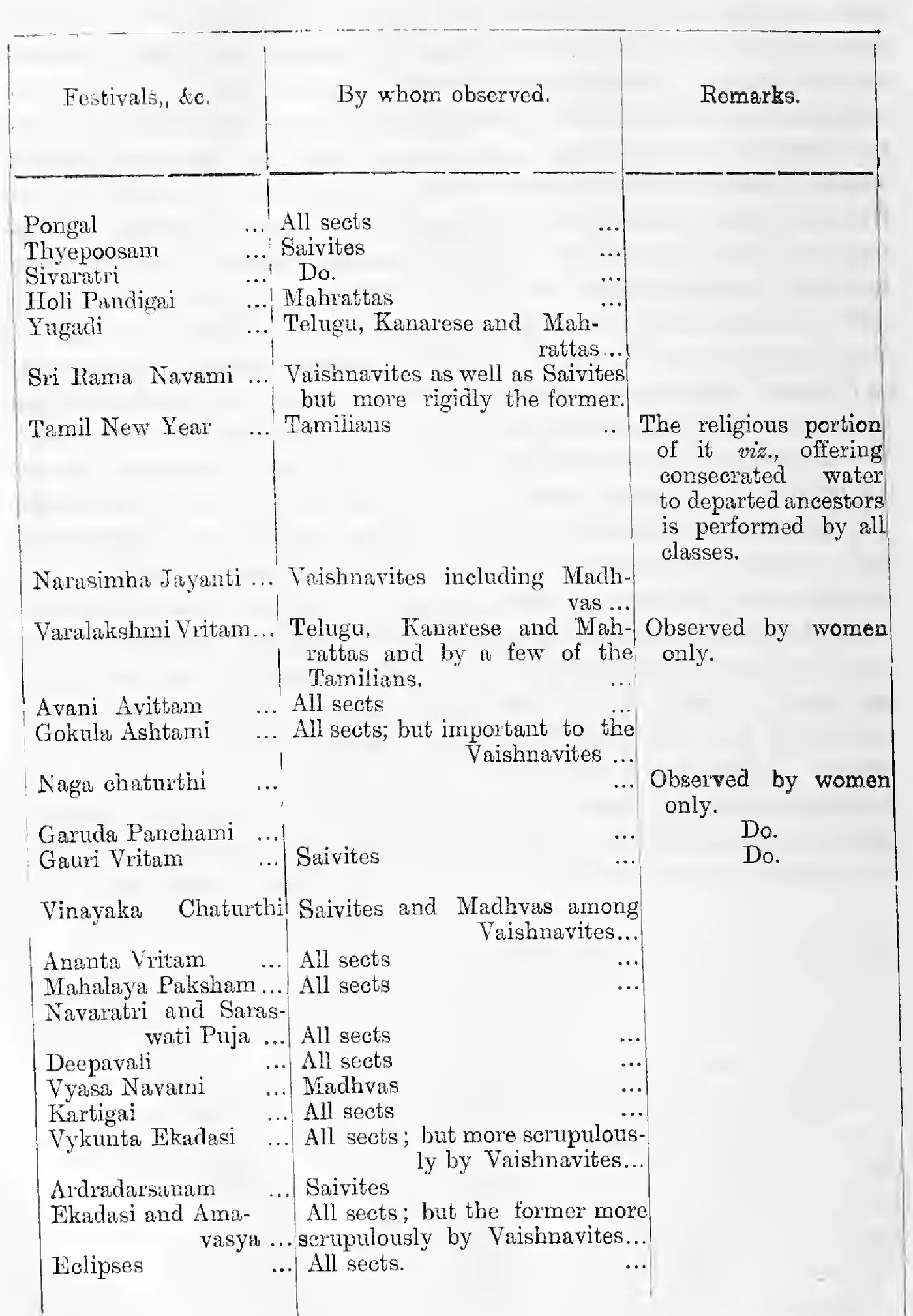
[307]Ekadasi. The eleventh day of the fortnight is religiously observed as a day of fast by all Brahmins. On this day they give themselves up wholly to religious observances, such as the chanting of mantras and reading of holy texts. In addition they keep awake at night. Early in the morning of the following day, i. e. Dwadasi day, they perform Puja and feed at least one Brahmin before breakfast. It is now generally observed by the old and religiously disposed among males and by elderly women especially widows. The Madhva Brahmins observe the fast more scrupulously than others. The most important of all Ekadasis is that which falls on the eleventh day of the bright fortnight in the month of Margasira known as the Vaikunta Ekadasi or the Mukkodi Ekadasi. This is generally known in Travancore as the Swargavatil Ekadasi. It is believed that the person who observes this Ekadasi obtains the punniam of having observed three crores of Ekadasis. On this day an important festival takes place in the temple of Sri Ranganatha at Srirangam, to witness which a large number of people from all parts of the Madras Presidency assemble. Similiar festivals take place in other Vaishnava temples, though on a smaller scale. This particular Ekadasi is most scrupulously observed in Travancore by all classes of Brahmins alike.
New-moon or Amavasya. This is a very important day of religious observance. The Brahmin performs Tarpana or libation of water and tilam (gingelly) for the manes of his departed ancestors. He takes only one meal that day. Thye Amavasya and the Mahalaya Amavasya or the new-moon occurring in the months of Pushya and Bhadrapada respectively are held specially sacred.
Gokulashtami or Srijayanti. This falls on the eighth day after the full-moon in the month of Sravana the day on which Krishna (an Avatar of Vishnu) was born. The devotee fasts during the day and after the performance of Puja and reading the Bhagavata Purana relating to the birth of Sri Krishna partakes of a light refreshment at about mid-night.
Sravanam or Upakarmam. This generally falls in the month of Sravana for the followers of the Rig and Yajur Vedas. But the followers of the Sama Veda have their Sravanam on the asterism Hastha in the month of Bhadrapada. On the Sravanam day the Brahmin renews his sacred thread. The Brahmacharis take a shave in the morning, and all Brahmins young and old assemble in the village temple by the side of a tank or river, where after a purificatory bath and worship of the Saptarishis, the sacred thread is renewed. This is followed by Tarpana [308]to the Rishis and Pitris or departed ancestors. The ceremony is wound up by presents to the priest and a grand feast in every household.
The Gayatri Japam falls on the next day after the full-moon in the month of Sravana. It consists in repeating the sacred Gayatri one thousand and eight times after an early bath and is believed to absolve the Brahmin of all his sins.
Sri Rama Navami. This is the anniversary of the birthday of Sri Rama, an avatar of Vishnu. It falls on the ninth day of the bright half of the month of Chaitra. The image of Rama is adorned and worshipped and portions of the Ramayana relating to his birth and exploits are read and Harikathas and Bajanas performed. This festival is observed in Vishnu temples, especially those dedicated to Sri Rama, for ten days ending with the birthday. It is usual after the puja is over to invite a few Brahmins and present them with dakshina, fans, &c., and feed them with panakam* with butter-milk and sweetmeats. The more religiously inclined observe it as a fast but the others treat it more as a festive day.
Navaratri including Sarasvati-puja. This is a nine days' festival held in the month of Asvayuja beginning from the day next after Mahalaya Amavasya. In every house women assemble in the evenings and sing songs in praise of the Goddess Sarasvati. On the ninth day puja and Nivedyam are made to books, which are collected and kept together for the purpose. All the women of the village are invited to one another's house in the evening. On the last day puja is made to the Goddes of learning. All the books, especially the religious ones and those in Sanskrit, are piled up to represent the goddess and worshipped. The artisan classes offer puja to the tools and implements used by them in the exercise of their professions. In all temples there is profuse decoration and special pujas and offerings to the deity.
Dipavali.† This is a most important festival and is universally observed by the people of all classes high and low, rich and poor, on the East Coast. It falls on the fourteenth day of the dark fortnight in the month of Asvayuja, the anniversary of the day on which Sri Krishna destroyed the cruel demon Narakasura who ruled the earth and greatly oppressed the people. In Travancore its observance in the orthodox form is confined to those who originally came form the East Coast, but all the higher classes observe it in some form or other. The chief observance [309]at this festival is an oil-bath early in the morning which is considered equivalent to a bath in the Ganges. After bath the men, women and children dress themselves in new clothes and take light refreshments. The children's delight in the Dipavali celebrations chiefly consists in letting off crackers of various designs—large quantites of which are imported from China every year.
* Panakam or more correctly Paniyam is a drink made of water, sugar (molasses), dried ginger and spices.
† Sir M. M. Williams says:—"Dipali is a festival with illuminations on the day of new moon in the month of Asvini or Kartiga". The literal meaning of the word is 'a row of lights' according to him.
Kartikai. A festival similar to the Dipavali, occurs on the full-moon day in the month of Kartikai when the moon enters the constellation Kartikai. Most of the observances of the Dipavali are observed in Kartikai also, such as giving presents to daughters and sons-in-law. The one important feature connected with this festival is the display of lights. The fronts and the tops, the pyalls and the roofs of houses are studded with innumerable lights and the Brahmin streets present a very gay and brilliant appearance.
Eclipses. The solar and lunar eclipses are also held sacred among Brahmins. At the commencement of an eclipse the Brahmin bathes, performs his Tarpana, and then repeats the Gayatri or some other mantra, for it is believed that these mantras become efficacious if repeated during the period of an eclipse. A sort of pollution is observed during the eclipse and a bath at the close is believed to restore the original purity. If the sun or moon sets before the close of the eclipse, there is fasting the whole night or day as the case may be and the fast is broken only after they are seen next free from the eclipse.
Mahalaya Paksham. This is the name given to the fortnight ending with the new-moon of the month of Bhadrapada, known as the Mahalaya Amavasya. During this period Sraddhas, Tarpanas and Hiranya Sraddhas (or presents of money &c. instead of regular Sraddhas) are performed.
Yugadi. This falls at the end of March or beginning of April. It is the first day of the new year for the Telugu, the Kanarese, and the Mahratta Brahmins. After an oil-bath and puja early in the morning, every person partakes a little of a mixture made of molasses or sugar and tender nim leaves. In the evening the family priest reads the new year's almanac and narrates the fortunes of the year. Sometimes the whole village meets in the village temple or other central locality where the almanac is read out.
Vinayaka Chuturthi. This occurs on the fourth day in the month of Bhadrapada and is in honour of Vinayaka, son of Siva, who is worshipped by all the Saivites as the remover of difficulties from all [310]their undertakings, and hence called Vighnesvara. On this day a clay image of the deity and of a mouse his vehicle are made, duly consecrated and worshipped in every house.
Gauri Vritam. This is held on the third day in the month of Bhadrapada. Gauri is another name for Parvati, the consort of Siva. The festival precedes Vinayaka Chaturthi. An image of Gauri in turmeric powder, decked and ornamented, is consecrated and puja and offering of sweetmeats, cakes &c., made to it. It is performed only by husband-living women and it is believed that this puja conduces to the long life and happiness of their husbands and their own in consequence.
Varalakshmi Vritam. This comes about in the month of Sravana. This is a festival observed by women who have their husbands living and its performance is believed to ensure the longevity of their wifehood. The woman bathes early in the morning and, after cleaning a copper vessel and coating it with Chunam, draws on it the figure of Lakshmi and decks it with jewels. A Tali is tied round the neck of the chempu and a cocoanut besmeared with turmeric powder is placed over it on a bed of mango leaves. The image so set up is adorned with ornaments and flowers. Puja is then performed and offerings of sweetmeats, cakes and fruits made. The woman then invokes the Goddess' blessings for the long life and prosperity of her husband.
Naga Chaturthi and Garuda Panchami. These are celebrated in the month of Ashada. These are performed by women, who on these days proceed to the Asvatha tree (Ficus Religiosa) around which are placed images of serpents for worship, and make puja and offerings of milk, plantains and cakes made of rice flour and cocoanut, sugar, &c., to them. The objects of these festivals are to ensure the longevity of the performer's children and of her brothers respectively.
Ananta Vritam. This is a festival in honour of Ananta Padmanabhaswamy held in the month of Sravanam (September).
Narasimha Jayanti. This is held in honour of Narasimha, an Avatar of Vishnu, who destroyed the giant Hiranyakasipu. Fasts are observed and Pujas made as on the occassion of Sri Jayanti.
Sivaratri. This festival held in honour of Siva falls in the month of Magha (March) and the ceremonies consist of special abhishekams followed by the chanting of mantrams to Siva. The worshippers fast the whole day and spend the night in making Pujas and reading the Siva Purana.
[311]Thye-poosam. This is a day sacred to Subrahmanya the second son of Siva and commander of the celestial army and is mostly observed by the Saivites. A great festival is held at Pulneys in the Madura District and it attracts a large number of pilgrims from far and near. Special offerings are made on this day in all Saivite temples and in those dedicated to Subrahmanya; the festival is celebrated for ten days ending with the asterism of Poosam or Pushya.
Chittra Vishu. This is the Tamil New-year's Day and is observed by the Tamilians in the same way as the Yugadi is by the Telugu people. This is also a day sacred to the Pitris; So oil-bath is despensed with and Tarpanam performed. In Malabar and Travancore its importance is even greater than on the East Coast. It is here believed that a man's fortune for the whole year depends upon the nature of the first thing or things that he sees on this morning. Accordingly on the previous night a Kani, which literally means a sight, is arranged and kept ready for the inmates to look at as the first thing the next morning. It consists chiefly of a sacred book, some fragrant flowers (as the Kani flower) a little rice, a few fruits, gold and silver coins, jewels &c., all auspicious things neatly arranged in front of the household deity. At four in the morning the inmates rise, look at the Kani and prostrate before the household deity. The Kani being a peculiar Malabar observance it is not observed by all the Paradesa Brahmins but only by those who have long been settled in Malabar.
Ardradarsanam or Tiruvatira festival. This is held in the month of Margasira (December and January) and is sacred to Nataraja. It is a ten days' festival ending with the asterism of Ardra, in all Siva temples and especially those at Chidambaram in South Arcot and Perur in Coimbatore District which attract a large number of visitors from all parts of South India. In every Saivite household special pujas are performed and offerings made.
Vyasa Navami, sacred to Madhvas, is in honour of Vyasa the Guru of Madhvacharya the founder of their religion.
Pongal. This is a three days' festival commencing on the last day of Margasira. The first day is the Bhogi Pandigai and on the second is the Sankranti or Pongal. This is one of the most important of festivals in South India. It is observed by all classes of people and is even more popular than the Dipavali. On this day the people boil milk and rice in new pots or vessel, bought for the occasion. The sun is worshiped and the cooked milk-rice and another variety of the same [312]boiled with sugar are offered as Nivedyam. There is feasting in every house to which near relatives are generally invited. The third day is known as the Mattu-Pongal. The horns of cows and bulls are painted and strings of cocoanuts and fruits and garlands of flowers hung on them. They are sumptuously fed and allowed to run about freely. Working them on the Pongal day is strictly prohibited.
Holi Pandigai. This is celebrated on the full-moon of the Phalguna month (March) and is intended to commemorate the destruction of Kama or Cupid by Siva. At the close of this festival which lasts for ten days ending with the full-moon, an effigy of Kama is made and burnt, and the votaries go into mourning and observe pollution for an hour and a half and are purified after bath. It is only the tenth day that is observed in Mahratta households as a festival day.
The Birth-day observances. Birthdays are celebrated all over the world by all religionists. The ancient Greeks and Romans and Aryans had attached special importance to the anniversaries of their birthdays as do the modern highly civilized nations of Europe and America. There is, however, this one fact to be noted that while the westerners observe the day as one of mirth and gaiety, of feasting and drinking, the Brahmin looks upon it as a religious day and devotes it in offering thanks to the Almighty for the past help and invoking his special blessing for the future. It is with this object in view that the Brahmin of to-day performs, according to his means, the Nakshatra Homa, the Ayushya Homa, the Rudra Ekadasi, the Maharudram the Atirudram and other ceremonies prescribed in the Smritis and the Srutis. As W. E. H. Lecky so well observes:—
"The close of the year or a birthday is to them merely a time of revelry, into which they enter in order to turn away from depressing thought. They shrink from what seems to them the dreary truth, that they are drifting to a dark abyss. To many the milestones along the path of life are tombstones, every epoch being mainly associated in their memories with a death. To some, past time is nothing—a closed chapter never to be reopened.
The past is nothing, and at last,
The future can but be the past.
To others, the thought of the work achieved in the vanished years is the most real and abiding of their possessions. They can feel the force of the noble lines of Dryden:
Not Heaven itself upon the past has power,
But what has been has been, and I have had my hour.
He who would look Time in the face without illusion and without fear should associate each year as it passes with new developments of his nature; with duties accomplished, with work performed. To fill the time allotted to us to the brim with action and with thought is the only way in which we can learn to watch its passage with equanimity".*
* Map of Life.
[313]Every father celebrates the first anniversary of his child's birth, however poor he may be. This is known as the Prathama Samvatsara Janma Nakshatra. The previous night Pratisara is tied round the wrist of the child. On the birthday the child is bathed in a river, invested with a gold waist-ring, dressed in a silk-cloth and sprinkled with holy water. Then it is taken in procession round the village with music, the procession stoppping at the houses of friends and relatives for the Harati, an indispensable item in all auspicious ceremonies of the Brahmins. The child is then taken home and Grihasanti, Nakshatra Homam, Ayushya Homam, the worship of the gods and the feeding of Brahmins follow. Towards the evening the child is again taken round the village in a grand procession in a palankeen to the accompaniment of music.
Some celebrate birthdays every month on the day on which the star of birth falls when what are termed Ayushya Homam, Mrityunjaya Homam and Nakshatra Homam are performed, accompanied by feasting and feeing of Brahmins. The object intended is the prolonging of life and averting the evil influence of some stars and planets that rule over their lives.
Annual birthdays are celebrated on a grander scale, the same homams for the propitiation of the deities and stars being performed as in the monthly celebrations. There are also feasting and danams to Brahmins. The completion of the sixtieth year of age is celebrated by all Brahmins with great feasting and danams to Brahmins, and Pujah and prayer to the gods. This is known as the Shashtyabdapurti (the completion of the 60th year). This is generally celebrated on the 61st birthday. Besides the homams, that are performed in propitiation of the gods and the planets there is also performed what is called Santi in which pots of water purified by Japams and pujas are poured over the Karta or performer. There are also performed special pujas in propitiation of ten deities of whom Rudra is the presiding one. These gods are represented by ten Brahmins, the Purohit representing Rudra. These Brahmins are given danams of money, vessels, cloths, ghee-lights, umbrellas, at the close of the ceremony. The Abhishekam or the purification of the Karta by pouring over him eleven Kumbhams or metal pots of water is the most important part of the ceremony. These eleven pots of water representing eleven deities viz., the Ashtadigpalas (the eight guardian angels of the quarters), Rudra, Mrityu and Mrityunjaya are adorned with Panchapallavam (five sorts of leaves, mango forming the chief of them) cloths &c, and over every pot is placed an image of the particular deity which it represents, carved in a gold or silver plate. Eleven Brahmins are deputed to perform pujas over the pots and after the puja, the images along with some [314]money doles are given to these Brahmins as remuneration. As soon as the Abhishekam and danams are over Brahmins are treated to a rich feast and the ceremony is brought to a close with great rejoicing and congratulations. Along with this, some celebrate another ceremony in honour of Rudra which is not indispensable though it adds to the efficacy of the whole ceremony. This ceremony is called Rudra Ekadasi or Maharudram or Atirudram as there are 11 or 121 or 1331 Brahmins employed in reciting the mantras during the ceremony. The last one is a most costly ceremony and is celebrated only by the most affluent.
The next important ceremony in connection with the birthday of a Brahmin is the Satabhishekam (Abhishekam or bath at the completion of the hundredth year) which is generally celebrated in the 82nd year of age when the Karta has seen one thousand full moons after his birth. The items of this ceremony are the same as those of Shashtyabdapurti, only the Karta is carried round the village in procession in a palankeen accompanied by all his relations and friends and the deities to be propitiated are different on this occasion. Homams, Japams, several minor ceremonies as the Punyahavachanam, Anujna &c., in which the Karta purifies and makes himself fit by propitiating Brahmins and receiving their permission and blessing, giving danams to Brahmins, Santi or Abhishekam with eleven metal pots filled with water and consecrated to eleven deities and feasting form the various details of the ceremony. A grand procession in the evening closes the ceremony. Along with this ceremony also is celebrated the Rudra Ekadasi or Maharudram or Atirudram in honour of Rudra, consisting of Japams and Danams. But this is not an indispensable item and may even be omitted. Generally the Karta performs one of these also along with the ceremony as it would propitiate Rudra the most important deity in such ceremonies. The expenses vary from Rs. 500 to Rs. 5000 or more as it is celebrated singly or along with any one of these three ceremonies. A special homam with the durva grass is considered to be of great efficacy in averting any danger to life and is generally performed along with this ceremony.
Hindu Charity. It is not every man that is fit to receive a danam or religious gift, nor will an orthodox Hindu give away a danam to any person he meets with. The accepted text on the subject of gifts is, "you may give food to every man who wants it, but danam only to one worthy of receiving it". So the recipient of a religious gift should be a person qualified for it by learning and meritorious life. The king's gifts are reserved only to the learned Pandits who visit his court or to men who lead religious and pure lives of acknowledged piety and sanctity. [315]These latter may not be learned in the arts or sciences, but they are rewarded with danams as being men of Sadacharam or highly pure conduct, men who are living examples of ideal lives to their lesser countrymen. But the king's charities may be distributed to all castes and classes alike, up to Chandalas. This is the recognised standard of a well regulated orthodox Hindu life. Nor does it follow that all gifts will be readily accepted by the deserving. He must possess the necessary mental discipline to overcome the sin implied by the acceptance of it, to make up which loss would require a long course of contemplation and expenditure of merit acquired by severe penance, otherwise he falls low in his caste status as well as in the estimation of his fellows. The accepting of a gift is looked down upon as an act of self-abasement. The other day an instance came to my own notice in which a strictly orthodox Brahmin declined to take the gift of a well-made brass lamp, filled with ghee and with wicks lighted, though there was a regular scramble for other kinds of danams on that occasion. The man who was offered the lighted lamp thought over it for a moment and then declined it, saying that he felt unequal to the acceptance of such a gift. The officiating priest who sat near nodded assent, as the texts, he said, lay down that all danams, except two, were acceptable to the wise Brahmin. The lighted lamp was one of the prohibited two. I know of another instance in which a Brahmin who took a gift of Tilaparvata danam literally 'a mountain of gingelly seeds' (sesamum) accompanied by a munificent money-present at a holy watering place from a Hindu king, was not permitted by his own daughter to enter her house, as the news rang through the district that the Brahmin's avarice had got the better of him and blinded him to the immense sin of accepting such a gift, though the daughter of course was naturally very sympathetic and attentive to her father and fed him daily in the outer pyall of her house. This sentiment seems to be a long-standing one, as tradition points to similar cases of ostracism and subsequent repentance on the part of the danam recipients even in times of yore, for several big endowments of public beneficence seem to have originated from such recipients of danams from kings. The well-known Kannadian Kal is an irrigation channel of the highest agricultural value in the Tinnevelly District and is the result of an endowment by a poor Kanarese Brahmin who lived on the banks of the Tamraparni and who had received a munificent danam from a Hindu king of old in consideration of his highly religious and saintly life. The king, so the tradition goes, set up a colossal image of Kala-Purusha as it is called, and filled it with gold and gems and offered it as a danam to be accepted by the best Brahmin of his time, [316]Many Brahmins came forward but went back, for they could not approach the dread image which had become fierce with the life-giving incantations made on it. The pious Kannadian, however, stepped forward boldly, for he knew no fear, as his was a life that was pure and holy and had been sanctified by the regular and punctual performance of the Brahmin's daily duties. It is said that he who observes the three sandhyas (prayers) punctually need not fear even the Trimurtis. Such is the high value set upon the regular observance of the Brahmin's daily prayers by the orthodox Hindus. He looked at the image but feared not and advanced towards it to take possession of the image and its valuable contents. The iron image looked fiercer than ever and as the Brahmin came up, the monster pointed his three fingers at him, meaning thereby, "Will you give up the Punniam (merit) of your three daily Sandhyavandanams". The Brahmin shook his head in dissent. Then the image raised its two fingers followed by the same answer 'nay'. Then at last the image showed one finger at the Brahmin meaning, "Please give up for me the Punniam of at least one prayer out of your three every day", to which the Kannadiân assented, and the erect image thereupon fell down prostrate before him. The king gave away the precious danam and thus rid himself of all sin, but the poor Kannadian who thus became possessor of fabulous wealth was overtaken by remorse, and felt that, in giving away one-third of the merit of the Brahmin's daily prayer, he had given away a great deal more than could be recompensed by the king's whole treasure; and he therefore went up to the ghauts to perform penance to Agastya and to take his advice as to how best to expiate the sin of having received the king's danam. Agastya appeared and gave him due counsel. The Brahmin determined to spend every cash of this unwholesome wealth upon some act of public beneficence giving himself up again as before to a Brahmin's austere life of prayer and penance. The result was the magnificent Kannadian-Kal of the Ambasamudram Taluq in the neighbouring District of Tinnevelly, a never-failing channel on whose banks I have stood and wondered on many a July evening when all the water-channels of Pandi are filled to the brim by the plentiful rains flowing down the Travancore Hills, how a poor Brahmin could have handed down to future generations his name engraven in the hearts of a grateful people and in a manner worthy of the envy of crowned heads or merchant-princes of the richest country in the world. It is further said, apocryphally of course, that the line of the channel was pegged out by the Kannadian in accordance with Agastya's advice to follow a cow whom he would meet with at the foot of the hills and whose footsteps were to mark [317]the course of the water; wherever the cow passed urine, sluices were to be built, and where at last it laid itself down and rested was to be the last tank fed by the channel.
There are in this Town of Trivandrum itself sixty-four well-built wells due to this same spirit of penitent benevolence.
In a village not twenty miles north of Trivandrum there is a small temple and an adjoining tank, the fine granite pavements of both of which owe their origin to a similar spirit of benevolence, in the mind of its officiating priest, who, not able to remove his arrears of paddy-pay for several years, given him in a lump, on account of difficulties of transit in the olden days, spent the whole in providing magnificent granite stone work to the temple and the adjoining fresh-water tank used by the temple priests and the population of the neighbourhood.
Occupation. Their original occupation was attending to the spiritual wants of the people. But they have now taken to other intellectual occupations. Some engage themselves in commercial pursuits; as much as 20 per cent are returned under 'learned and artistic' professions. The Paradesa Brahmins occupy many of the high and important posts in the State service. It may be added here that Travancore owes its present high position to the courage, ability and fidelity of many East-coast Brahmins in the past. The Paradesa Brahmins follow all the professions except those considered menial or degrading. Many of them are merchants, school masters, vakils, Government servants, landholders, &c.
Language and Education. Tamil is the mother tongue of the Tamilians including Iyengars, Telugu of the Telugus, Kanarese of the Kanarese, Mahratta of the Mahrattas. But many of the Paradesa Brahmins in Travancore are acquainted with Malayalam also as a knowledge of it is indispensable for dealings with the people of the country. They stand second in point of literacy in the State as nearly 70 per cent. of the males are literate as per last Census (1901). But only 9 per cent. of their females are returned as literate. As to their literacy in English the percentages are 21 for males and 3 for females as against 17 and 3 respectively in the Madras Presidency.
Thus the Paradesa Brahmins of Travancore are better educated than their brethren on the East Coast.
Aryapattars. The term means 'superior Brahmins', but their actual position in society now is very far below it. They form only a very small body in Malabar. There are only two families now in all Travancore and these live in the Karunagapalli Taluq. Ramesvaram is considered [318]to be the seat of Aryappattars where their present status is distinctly inferior to Brahmins owing probably to their having accepted gifts from Sudras and openly assumed their priestly charge. The first batch of these Brahmins appears to have been brought into Kerala at the instance of the Rajah of Kodungalur (Cranganore).
From their service as priests, they gradually acquired power and influence and became consorts in families where the Nambudiris alone had the privilege. In course of time they seem to have been ousted by the Nambudiris, first from their Sambandhams and then gradually even from their right to perform the Talikettu. They now perform the rite of Talikettu among the aristocratic families of Nayars.
The Aryapattars speak Malayalam as their vernacular and closely resemble the Malayala Brahmins in point of dress and personal habits. The males marry the Potti women who on account of this alliance fall in rank and status. But the daughter of an Aryapattar, though a Malayala Brahmin woman cannot be married to a Malabar Brahmin; she is taken out of Malabar and married to a regular Aryapattar in the Tinnevelly or Madura District, where of course she adopts the dress of the country. Here the Aryapattars follow the Kerala system in all their rites and ceremonies and the Nambudiri Vaidikas are their guides and referees in all matters of caste government. The Nambudiris and Aryapattars can eat together. 47 persons have been returned by the last Census.
Pattattiyars. A class of Brahmins called Pattattiyars and peculiar to the Todupuzha Taluq are allied to the Aryapattars. These resemble the Nambudiris in every respect except that their women are married not by the Nambudiris but by the East Coast Brahmins. The males marry Nambudiri women, but the latter as is the case with the Aryappattars fall in social rank by this union. The Pattattiyar females never go to live in their husband's houses nor are their children entitled to any patrimony. Inter-dining with Brahmins is allowed but not between women. The males add the suffix Aiyen to their names and the females Kungugi.
Their origin is thus stated. About two-hundred years ago, the Nambudiris fearing that their exclusiveness would be seriously damaged by the advance of Western civilisation and the establishment of road communications and shops in all parts of the State, resolved upon leaving their ancient seats in a body for a secluded place. The members of one of such families, all women, arrived later than the others to the new destination. On arrival the other Nambudiris did not consider this family to be socially equal to them and refused to recognise them on a footing of equality. [319]This family had therefore to seek protection at the hands of the Rajah of Vadakkumkur and settled themselves in the Todupuzha Taluq which then formed part of his territory. With all his influence the Rajah failed to get Nambudiri husbands for these women. He then invited a number of Aryapattars and asked them to marry these. Hence the name Pattattiyar. The Rajah settled a pension on the family which is continued by the Travancore Government even to this day. They numbered only 29 in all, in the last Census.
The Malayala Kshatriyas. This is an important caste group including under it (1) the Koil Tampurans (2) the Rajahs or Tampurans and (3) the Tampans and Tirumulpads.
The total number of Malayala Kshatriyas according to the last Census (1901 A. D.) was 1575, Tiruvalla, Vaikam and Mavelikara being their chief centres.
(1) The Koil Tampurans, also known as Koil Pandalas form a small community made up of the descendants of the immigrant Kshatriya families from certain parts of Malabar lying north of Travancore and Cochin. There are now ten such families of Koil Tampurans in Travancore, viz., those of Kilimanur, Changanachery, Anantapuram, Pallam, Chemprol, Gramam, Paliyakkara, Karama and Vadakkematom. Of these, the Kilimanur Koil Tampurans were the earliest settlers in Travancore. It is not known definitely when they immigrated into the country. As already stated in the History chapter, four children, two princes and two Princesses, were adopted into the Royal Family in the reign of Umayamma Rani. These were the children of a Koil Tampuran of Tattari Kovilagam and belonged to the Putiapally Kovilagam house, a branch of the Kolattunad Royal family. The elder of the two princesses having died soon after, the younger was married to a nephew of the same Koil Tampuran, her father, and as a result of this union Martanda Varma the Great was born in 881 M. E. (1705 A. D.,). Again in the reign of Unni Kerala Varma the elder of the two adopted princes, another lady was adopted and was given in marriage to one Ravi Varma Koil Tampuran, another member of the Tattari Kovilagam family. The issue of this marriage was Rama Varma the Kilavan Rajah who was born in 899 M. E. (1723 A. D.) and ruled for 40 years. It was while this prince and his mother the elder Rani were being conveyed to Attingal from Trivandrum, under the escort of the Koil Tampuran that a strong party of the rebels who lay in ambush near Kazhakoottam rushed to attack the Royal party. The brave Koil Tampuran who got scent of the plot contrived to send the Rani and the prince in safety to Attingal, himself staying behind to give fight to the enemy. [320]When the insurgents whose main object was the assassination of the Rani and the Prince found that their foul plot had been frustrated they fought furiously but were entirely routed by the Koil Tampuran and his followers. The success, however, was a dearly bought one, for the hero (the Koil Tampuran) received a deep sword-cut across his abdomen and succumbed to it. This was in the month of December 1727 A. D. (903 M. E.). In recognition of this act of heroism and self-sacrifice the estate of Kilimanur was granted as a free-hold to the descendants of the Koil Tampuran. The grant is enjoyed to this day. It was from this time that Kilimanur became the permanent residence of the Koil Tampurans of that name. All the sovereigns of Travancore from Unni Kerala Varma to Parvathi Bayi (Regent) who ruled for a period of more than one hundred years were the offspring of the Kilimanur Koil Tampurans—a fact of which they are so proud to this day.
Next came the Changanachery stock, including the families of Changanachery, Anantapuram, Pallam, Chemprol, Gramam and Paliyakkara. Their history may be thus briefly stated. Among the chiefs and Rajahs that fled from Malabar and sought refuge in Travancore owing to the persecution of Tippu Sultan about the close of the 18th century, was a branch of the family of Aliakkotu comprising 8 persons—3 males and 5 females. The generous Maharajah Rama Varma received them hospitably and gave them the place called Neerazhikkottaram of the Tekkamkur chieftain who had been subjugated by Rama Iyen Dalawa. As the family increased in numbers they found it inconvenient to live under the same roof. One of the ladies, probably the eldest remained at Changanachery along with the youngest, while the others migrated to convenient localities and lived away. One lady settled at Gramam in the Mavelikara Taluq, another shifted to Pallam in Kottayam and the third to Paliyakkara in Tiruvalla. A son of the lady settled at Gramam, Kerala Varma, had the good fortune of marrying Uttram Tirunal, a princess of the Travancore Royal family in 969 M. E. (1793 A. D.) and thus, for the first time a relationship was established between the immigrant stock and the Travancore Royal house. This was strengthened by further alliances, as we shall see later on, of which the most important was the marriage of Raja Raja Varma, the eldest son of the lady who stuck to Changanachery with Rani Lakshmi Bayi in 979 M. E. (1803 A. D.). Raja Raja Varma's sister had two sons and three daughters. The eldest daughter's issue removed first to Kartikapalli in 1040 M. E. (1886 A. D.) and thence to Anantapuram Palace in Haripad which was built for them in 1046 M. E. (1870 A. D.). The eldest lady had three sons and five daughters of whom the eldest son [321]was the father of His Highness the present Maharajah and the second daughter's son is the present Valia Koil Tampuran, Kerala Varma C. S. I., the consort of the late Senior Rani. The third daughter and issue removed to Chemprol in Kartikapalli in 1041 M. E. (1865 A. D.) while the second continued to live at Changanachery. Thus there came into existence six families of Koil Tampurans viz., those of Changanachery, Anantapuram, Pallam, Chemprol, Gramam and Paliyakkara.
We have already referred to two alliances between this stock and the Travancore Royal House. In 981 M. E. (1805 A. D.) another princess of the Royal family, Hastam Tirunal, daughter of Uttram Tirunal was married to a Koil Tampuran of Gramam. Again in 995 M. E. (1819 A. D.) the son of the lady who settled at Paliyakkara in Tiruvalla, Rama Varma, married Rugmini Bayi, daughter of Her Highness Lakshmi Bayi. This Rama Varma Koil Tampuran was the father of the late and penultimate Maharajahs and their sister, the mother of H. H. the present Maharajah. Thus nearly all the branches of the Changanachery stock have had marriage alliances with the Travancore Royal family.
About 1856 A. D. three more families viz., those of Cherukol, Karama and Vadakkematom immigrated from North Malabar.
Manners and customs. The Koil Tampurans are all related by blood and observe birth and death pollutions with reference to each other like Dayadis among Paradesa Brahmins. They are an exogamous community; the males marrying into the families of Rajahs or taking Nayar wives, and the females being married to Nambudiri Brahmins. They follow the matriarchal system of inheritance. In the matter of dress and ornaments, the males resemble the Nambudiris, while the females those of the other non-Brahminical classes in Malabar. In regard to their ablutions, habits of cleanliness, religious discipline and complete abstinence from animal food and spirituous liquors they take after the Nambudiri Brahmins. Caste-government is in the hands of the Nambudiri Vaidikans. Tattooing is unknown among their women.
Ceremonies. The Koil Tampurans have the usual Brahminical Samskaras—Jatakarma, Namakarana, Annaprasana Vidyarambha &c. The Upanayanam is celebrated in the sixteenth year of age. The chowla or the tonsure ceremony takes place only on the morning of the Upanayanam. It is formally done by the Nambudiri priest just as the father does to his son among the Brahmins, and afterwards left to be completed by the Maran who, it may be observed, does the ceremonial shaving at all the Samskaras of the twice-born classes. It is the Nambudiri priest that [322]invests the boy with the holy thread and initiates him into the Gayatri hymn. The Koil Tampurans have to repeat the Gayatri hymn morning, noon and evening like the Brahmins, but only ten times on each occasion. The Samavartanam is performed any day after the fourth day of the Upanayanam, generally on the seventh day.
The Koil Tampurans being Marumakkattayees have the usual Talikettu marriage, the bridegroom being an Aryapattar or Nambudiri, now generally the latter. The tali-tier is not necessarily the spouse in actual life. But if there be mutual consent, he can enter into Sambandam with the bride, or another Nambudiri unites himself to her. If the tali-tier dies, the wife and sons observe pollution and perform funeral ceremonies. The bride has no longer the right to wear the Tali; she becomes an amangali for all socio-religious purposes, but this entails no further privations. Pollution is observed for eleven days and Diksha is gone through for a year. The Nambudiris perform purificatory ceremonies and officiate as priests for the Pinda, Sraddha and other ceremonies.
General remarks. The Koil Tampurans as a class are good, hospitable and learned—most of the members being well educated in Sanskrit, and well posted in one or other of the fine arts. The eldest born is always named Raja Raja Varma; the other names are Rama Varma, Kerala Varma, Ravi Varma, Udaya Varma, Goda Varma, &c. Kuttan, Kunjunni, Cochchappan, Cherunni, &c. are some of the household pet names. The Tampurattis have generally the names of Amba, Ambalika and Ambika; their household names are Ittyengala, Kunjikutti, Kochukunji, Kunjikkavu, Ikkavu and Amma. It may be added here that in a population so highly intellectual as that of the Malabar coast, the Koil Tampurans and Rajahs in it seem to possess almost a monopoly of brains and good manners, particularly so the few families of that class settled in Travancore. One of the Junior members of the Koil Tampurans' family is an M. A., and before long several more are expected to emulate his success.
(2) Rajahs. These like the Koil Tampurans with the exception of Pantalam and Punjar Rajas are all related to each other by blood, the connection between some of them being so close as to require their observing birth and death pollutions as among members of one family. They live in seven distinct families in Travancore each known by the locality in which they reside. They are (1) Mavelikara (2) Ennakad (3) Prayikkara (4) Mariappalli (5) Tiruvalla (6) Kartikapalli and (7) Aranmula.
[323]History. The original home of all these families is Kolattunad, in North Malabar, and their immigration into Travanore was in the main contemporaneous with the invasion of Malabar by Tippu Sultan. The first family that came into the country was that of Putiya Palli Kovilagam from which as we have seen, four children, two Princes, and two Princesses, were adopted into the Travancore Royal house. The members of this family then settled at Kartikapalli, the last of whom died in 1030 M. E. (1854 A. D.)
The next family that migrated was Cheriya Kovilagam between 920 M. E. (1744 A. D.) and 930 M. E. (1754 A. D.). These also came in for adoption, but their right was disputed by another house, Palli Kovilagam and they then settled at Aranmula. The third batch of immigrants came during the persecutions of Tippu Sultan in Malabar in 964 M. E., (1788 A. D.) when all the Rajahs living there sought and obtained hospitable shelter in Travancore of whom many, however, went back to their homes after peace was restored.
One family belonging to the Chenga Kovilagom, came from Tellicherry and settled themselves at Mavelikara. For a time all the members lived together in a palace at the landing ghaut now known as Arattu Kadavu. Dissensions having broken out among them, one branch settled at Ennakkad, while a second shifted to Prayikkara. The present chiefs of Ennakkad and Prayikkara are thus the descendants of the two branches which separated from the Mavelikara stock. The main stock of Mavelikara became in course of time subdivided into four branches now known as (1) Vadakke Kottaram (2) Puthenkottaram (3) Mannoor Madathil Kottaram and (4) Tekke Kottaram. This last branch is said to have recently become extinct while the remaining three branches now reside at Mavelikara. The Mavelikara family is closely related to the Royal House of Travancore; Their Highnesses the late and present Senior and Junior Ranis have all been adopted from this family in 1033 M. E. (1875 A. D.) and 1076 M. E. (1900 A. D.) respectively. Most of the members of this family own estates and are in well-to-do circumstances. Besides the pension they receive from this State, they have also Malikhana from the British Government. The ladies of these families take husbands from the Changanachery, Anantapuram, Kilimanur, Pallam and other families of Koil Tampurans.
The Kartikappalli family was another of those that took refuge in Travancore to escape from the persecution of Tippu and avoid the too painful alternatives of death or conversion into Islam. It is said that [324]three sisters with some male members fled from Kolattunad in 963 M. E. (1787 A. D.) of whom the first settled at Kottarakara and her descendants were the Rajahs of Kottarakara. This family became extinct in 1027 M. E. (1851 A. D.) The younger sisters settled at Mariappalli and Tiruvalla respectively. Internal dissensions arose among the members of the Mariappalli and Tiruvalla families. The Tiruvalla branch of the family became extinct in 1068 M. E. (1892 A. D.)
Manners, customs and ceremonies. The Rajahs like the Koil Tampurans belong to the Yajurvedic section of Dvijas but follow the Bodhayana Sutra. They have all the Brahminical Samskaras, the Brahmin priest who belongs to the class of Malayali Pottis called the Tiru-veli Pottis i. e. (Pottis that attend at the religious rites of the Royal family) doing most of them on their behalf. As with the Koil Tampurans, Chowlam or tonsure is performed along with Upanayanam. The Samavartanam is performed on the fourth day of the Upanayanam. Instruction in arms is then given to the boy and is supposed to be continued until he has attained proficiency in it. The Rajahs are to repeat the Gayatri ten times at each of the three Sandhya prayers together with the Panchakshara and Ashtakshara mantras.
The Talikettu ceremony is celebrated between the years seven and twelve but there is no objection in performing the ceremony after the girl has attained puberty. The bridegroom is selected from the family of Koil Tampurans and he may thereafter live with her as her partner in life. The Talikettu ceremony is a Hindu marriage having many points in common with that rite among Brahmins; the wedding observances are Varanom or the offer and acceptance, Udakapoorvam Saptapadi, Talikettu or Mangalya Dharanam, Pani-grahanam and Laja-homam. The Kanyaka-danam or the giving away of the bride, is done by the brother of the bride and not by the priest. The males of course take Sudra wives. If the first husband dies or leaves otherwise, another Koil Tampuran, generally the brother of the first may be accepted. But this is not called marriage but only Kuttu-irikkuka i. e. keeping company.
The dead are cremated. Pollution is observed for eleven days. At the annual Sraddhas, the Karta or the performer of the ceremony simply throws a flower as a mark of spiritual homage at the feet of the Brahmins invited to represent the manes and greets them by a Namaskaram, the priest doing the other ceremonies. But the oblations of cooked rice after the entertainment of the Brahmins are offered to the ancestors by the Karta himself.
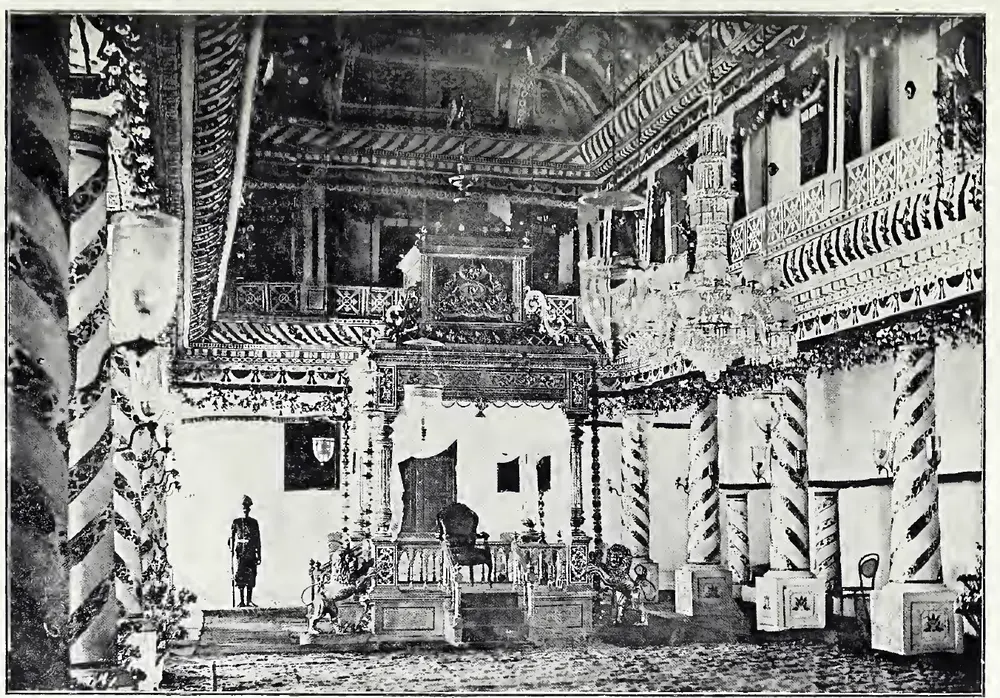
[325]General remarks. The names prevalent among the Koil Tampurans are also prevalent among the Rajahs. In the Travancore Royal house the first female member takes the name of Lakshmi and the second that of Parvati. As regards their general characteristics they very closely resemble the Koil Tampurans. As a class they are intelligent and well educated and many have attained proficiency in Sanskrit. In the study of English too, they have recently made great progress. There is a special school for them at Mavelikara, the Headmaster of which was for some time one of their own caste, a Graduate of the Madras University. Among other members of the Mavelikara stock prominent mention may be made of two, both of whom are M. A., B. L s one belonging to the Madras Provincial service, and the other to the Travancore Educational Department.
(3) Tampans and Tirumulpads. The word Tampan is a contraction of Tampuran. It is believed that at one time they were a ruling class. Thier chief seat is Vaikam. The word Tirumulpad indicates those that wait before kings. Shertallay and Tiruvalla are their chief centres.
Manners and customs. All the Tampans, like Dayadis among Paradesa Brahmins, observe birth and death pollutions but not the Tirumulpads of whom there are three or four different sections having no relationship of this kind. Their manners and customs are exactly like those of the other Malabar Kshatriyas already referred to. They are invested with the sacred thread at the age of sixteen and they are allowed to repeat the Gayatri ten times, thrice a day. Pollution is observed for eleven days. The Nambudiri is the family priest. The Talikettu may be performed between the seventh and fourteenth year of age. The Tali is tied by the Aryappattar, never by the Nambudiris who recite the Vedic hymns while the former goes through the ceremonial. Their consorts are usually Nambudiris and sometimes East Coast Brahmins. Tampans and Tirumulpads are often the personal attendants of the Travancore Maharajahs, whom they serve with characteristic fidelity and devotion. The Tirumulpads also perform the tali-tying ceremony in the aristocratic Nayar households. Their names are the same as those of the other classes of Kshatriyas, the title Varma being uniformly added to them.
Nambidis. Origin and caste derivation. According to tradition the Nambidis were originally Nambudiris, their progenitors having, it is said, been degraded for the sin of having murdered one of the Perumals or Viceroys of Kerala.
"One of the Perumals or Viceroys of Kerala having proved troublesome, the Brahmins resolved upon his removal. In the struggle that followed, the Perumal [326]was killed by the Brahmins. When those who had slain him returned to the place the Brahmins had met in solemn conclave. They were gladly welcomed and asked to sit in their midst, but feeling that they had committed a heinous crime and thus disqualified themselves to sit along with the other Brahmins, they volunteered to sit apart on the threshold of the council room saying 'Nam padimel' (we on the threshold) which fact is supposed to account for the origin of their name, Nampadi, corrupted into Nampidi short for nam-padimel. They and their companions have since been regarded as having lost their social status as Brahmins and they are now classed along with the intermediate castes having but a few privileges other than those enjoyed by the group"*
Customs and manners. The Nambidis are of two classes,—those that wear the thread and those that do not; the former having their own priests while for the latter the Ilayatus perform the priestly functions. The thread-wearing Nambidis are allowed to mess with Brahmins though not in the same row while the others are practically Nayars having only the title Nambidi affixed to their names as a mark of honour. But they abstain from eating flesh. Inheritance is in the female line and their women called Mantalu ( Manolpads ) are married to their own castemen or the Nambudiris unite themselves in Sambandam with them. The males are allowed to consort with Nayar females. Pollution is observed for twelve days. The chief man among the Nambidis is the Karanavarpad of Karkkat in the Cochin State.
Muttatu. The term means elder and is generally used to indicate a community the highest among the Ambalavasis just as the term Ilayatu has been interpreted to mean the lowest of the Malayali Brahmins. In the Census of 1891 this caste was classed among the Ambalavasis. There is still considerable difference of opinion, as to their exact social status. The latest opinion on the subject seems to be that the Muttatus should be classed as degraded Brahmins and are supposed to have undergone social degradation by their having tattooed their body with figures representing the weapons of the God Siva and partaken of Sivanirmalyam i. e., the offerings made to God Siva. As Mr. Subramhanya Aiyar says in his Census Report:
"Considering the nature of the duties pertaining to temples, such as cleaning the steps leading to the shrine, the prohibition of commensal relations between them and any recognised section of the Brahmin community, their dependence on Nambudiris who of course would not even touch them without being polluted, for priestly service as well as for caste-government, one cannot place them under the head of Brahmins. But their manners, customs and ceremonials are so like those of the Malayala Brahmins, and the theory of their origin as a separate caste that places them in identical relations with the Nampiyans or Sivadvijas of the East Coast is apparently so free of all possible objections, that one should hesitate to place them under Ambalavasis, in regard to whom the primeval sin, [327]according to tradition, is of a more heinous kind than the priesthood of a Siva temple or the acceptance of the offering dedicated to that deity."
* Cochin Census Report for 1901.
The Muttatus are also classed as Avantara Dvijas or Agriman and Akappoduval. In regard to marriage, inheritance, dress, ornaments, food &c., they resemble the Nambudiris. Widow marriage is prohibited and adultery is punished with social excommunication as in the case of Nambudiris. Birth and death pollutions last for ten days. Nambudiris officiate as priests at marriage and purificatory ceremonies though for Sraddhas their own caste men perform the priestly functions. The highest class of Nambudiris can cook and take meals in the houses of Muttatus and members of the Ambalavasi caste can partake of the food cooked by them. The Muttatu's house is called an Illam and his women are called Manayammamar ( i. e., ladies of the Mana, a Brahmin house ), and are Gosha.
Their daily duties consist in carrying the idol in procession, guarding the idol and the temple properties, including valuables, washing the temple steps, getting ready the things for the offeringes &c. At the Suchindram temple dedicated to Sthanumurti, the chief image alone is served by a Nambudiri Brahmin who, however, is not to give Prasadam to any body. The minor deities are served by the Muttatus who alone can give Prasadam even at the principal shrine.
There are according to the latest census 585 Muttatus in the State, the largest number being returned in the Taluq of Ettumanur.
Ilayatu. These were formerly Nambudiris who suffered social degradation for having accepted the priesthood of the Nayars. Once upon a time a Nambudiri dictated to a Sudra the funeral obsequies to be performed in honour of his deceased ancestors which was unbecoming him as member of the Brahminical order. He was in consequence thrown out of caste, along with his family whose progeny are supposed to be the Ilayatus so named on account of the demeaning nature of their calling. There are two classes of Ilayatus:—
(1) Onnam Parisha or those of the first order i. e., those officiating for the higher classes of Sudras.
(2) Randam Parisha or those of the second order i. e., those officiating for the lower order of Sudras. The two classes do not intermarry. The males interdine but not the females. Those of the second class cannot take part in the ceremonies of the first.
The Ilayatus closely resemble the Nambudiris in respect of food, clothing, jewelry, festivals and ceremonies. They wear the sacred thread and [328]have the privilege of repeating the Gayatri from twenty-four to thirty-six times. But they are not entitled to study the Vedas. Their women called Ilayor-Ammamar are zenana ladies observing the seclusion and enjoying the privileges of Nambudiri women. They have their own priests for all their ceremonies. Their caste-government is in the hands of the Nambudiri Vaidikans. A Numbudiri is not allowed to cook and take meals in an Ilayatu's house, though he may do so in the house of a Muttatu, as in the case of the latter the purification or Punyaham ceremony after a death pollution is performed by the Nambudiri himself. But he can perform certain propitiatory rites such as Iswara Seva and Sarpa-bali in the Illam of an Ilayatu.
The bulk of the Ilayatus live upon their traditional occupation, viz, officiating as priests for the Sudras and initiating them in certain Brahminical rituals. They also officiate as priests in the temples dedicated to Bhadra Kali and the snake-deity.
Tradition fixes the original habitations of the Ilayatus to a place bounded on the south by the Onad (Kayanulgam), on the west by the sea, on the north by Muvattupuzha and on the east by Ozhikkal a tract of country belonging to the Punjar chief. Three hundred and ninety families are said to have originally settled there.
The total number of Ilayatus returned at the last Census was 3,361.
The Kodipattars. These are a class of Tamil Brahmins who at a very early period seem to have lost their Brahminical status for having taken up the cultivation of betel-vine as their occupation. In the matter of general appearance, dress, ornaments, wearing of thread, ceremonies and inheritance, they do not differ from the Tamil Brahmins. They do not study the Vedas but recite the Gayatri hymn without the first syllable known as Pranavam. The Tamil Brahmins officiate as priests for them.
Their funeral ceremonies are unaccompained by any Mantras or by any rites. Anantara Samskara (deferred funeral rites) is performd after the lapse of ten days as in the case of persons excommunicated. They perform annual Sraddhas but no Tarpanam or offerings of water on the new-moon day.
They speak Malayalam as their mother-tongue and their household deity is Sasta. Their chief seat is Vamanapuram, a quiet hill-side village about twenty miles north of Trivandrum.
[329]The total number of Kodipattars at the last Census was 85 as against 423 in 1891.*
Aris. The Aris (contraction of Arya) or Dutans as they are called, form another small but interesting community confined to a village in the Tovala Taluq. They very closely resemble the Tamil Brahmins in their dress, ornaments and diet. They perform all the Brahminical ceremonies under the guidance of Brahmin priests and claim a position equal to that of the Arya-pattars; but they are not allowed to dine with Brahmins nor enter the Mantapam in front of the Garbhagraha or inner sanctuary of a Hindu temple. Their period of pollution is strangely enough, the same as that observed by the Nayars. Their language is Tamil. The total number of Aris returned at the last Census is 41.†
The Ambalavasis. The term Ambalavasi means "a dweller in a temple," and is a generic name applied to all classes of temple-servants in Malabar and Travancore to which this caste is peculiar. Socially they occupy an intermediate position between the Brahmins and the Sudras, some regarding them as fallen Brahmins and others as advanced Sudras. They are therefore called Antaralars There are several sub-divisions of this caste, to which are assigned different services in the Hindu temples, such as the preparation of garlands, the sweeping of the floor, the fetching of firewood, the carrying of the idol in procession, singing, dancing and so on. But all these castes are not connected with pagodas nor do the Moottatus, who are mainly engaged in temple service, belong to the Ambalavasi group. Strictly speaking, most of the sub-sects of the Ambalavasis are supposed to have grown out of prohibited sexual relations between members of the higher and the lower castes and are hence Anulomajas and Pratilomajas (i. e., issue of a female of a higher caste with the male of a lower one).
The Ambalavasis may be broadly divided into two classes, viz.,
1. Those that wear the sacred thread, and
2. Those that do not wear the sacred thread.
To the former class belong the Adikal, Chakkiyar, Nambiasan, Pushpakan, Puppalli, Tiyattunni &c., and to the latter belong the Nampiar Pisharati, Variyar, Poduval &c. The threaded classes perform the Upanayanam and pronounce the Gayatri. All the sub-castes abstain from animal food and intoxicating drinks. Some affect the Brahmin mode of dress while the others adopt generally the Nayar dress. As regards marriage [330]all of them have only Sambandam or marriage dissoluble at pleasure like the Nayars, and with very few exceptions, which will be referred to later on, follow the Marumakkattayam law of inheritance. All except the Pisharatis burn their dead. Their priests are either Brahmins or, more commonly, the more orthodox among themselves. They observe the Diksha for a year in honour of a deceased mother, uncle, elder brother and elder sister and not in the case of a father. The offerings of rice dcles are made every day for the first twelve days after death and they perform monthly and yearly ceremonies. Pollution is observed only for twelve days but in some cases it may extend to thirteen or fourteen days but never to sixteen days as in the case of Sudras. In the matter of literacy the Ambalavasis hold a very prominent place coming next only to the Eurasians and Brahmins, the literates numbering 371 per 1000 of the population. As regards occupation 1809 persons were returned at the last Census as following the traditional occupation i. e., nearly 26·4 percent of their numbers.
* The Kodipattars must not be confounded with the Kaduppattans who are only a class of Malayali Sudras found in North Travancore.
† This caste should not be confounded with the Ares of South Canara.
The total strength of the Ambalavasis in the State according to the Census of 1901 is 6853, almost all of them being found in Central and North Travancore
Sub-divisions. The following sub-sects are included in the generic name of Ambalavasis:—
- 1. Nambiasan
- 2. Pushpakan
- 3. Puppalli
- 4. Chakkiyar
- 5. Brahmani or Daivampadi
- 6. Adikal
- 7. Pilappalli
- 8. Pisharati
- 9. Nambiyar
- 10. Variyar
- 11. Nattupattar
- 12. Tiyattunni
- 13. Kurukkal
- 14. Poduval
Nambiasan, Pushpakan, Puppalli and Brahmani. These four sub-castes are comprised under the general heading Unni or Pushpakan, a name based on their traditional occupation of preparing garlands for the temples. According to Malabar tradition this caste arose out of intercourse of a Brahmin with his wife during her menses. The caste-men immediately excommunicated them and the child born after that (a daughter) was brought up by Parasurama to supply flowers to temples. Two other theories are also current regarding the origin of the Pushpakans.
One is that they are the offspring of a Brahmin woman who contrary to the law of early marriage then in force was not married till after puberty. This cannot be correct for it does not appear that the Nambudiris at any time married their girls before puberty.
[331]The other is that they are the offspring of a Brahmin wife whose husband was suspected of adultery when she was pregnant. This sin extended to the wife also and she was declared lower in caste and hence her issue became a separate caste.
Occupation. Pushpakans who live to the south of Evur in the Kartikapalli Taluq are called Puppallis whose occupation like that of the Pushpakans proper is sweeping the inner premises of temples, clearing the utensils, collecting flowers and making garlands. The Nambiasans (called also Nambiars or Nambis) have at present no temple service of any kind, though formerly they followed the profession of garland making in temples which is still observed by them in Cochin and Malabar. They keep gymnasia and schools of training and teach fencing and other athletic exercises. The occupation of the Brahmani or Daivampadi is to sing and to do certain priestly or Brahminic functions at Nayar marriages.
The children born of a second husband have the same right to the property of the first as the latter's own. Birth and death pollutions are observed for ten days. They perform the monthly ceremonies and the annual Sraddhas and observe Diksha for various terms from forty-one days to a whole year. For all usual ceremonies they select priests from their own caste. Their caste-government is in the hands of the Nambudiri Vaidikan. The Brahminis, however, have Ilayatus for their priests.
Inheritance. They generally follow the Marumakkattayam law of inheritance but there are Makkathayees also among them. In the latter case, the dowry of a woman goes to the family of her husband if undivided or to her alone if divided. The sons inherit the property of both the father and mother. In default of sons, the grandsons, if any, inherit, and in their default the brothers and sisters.
Their favourite amusements are Ammanayattum (the tossing up and catching metal balls of superior polish specially made for the purpose) [332]and Kaikotti Kali (dancing with clapping of hands). Both these require great skill and agility which their practice gives them.
Chakkiyars. Origin and caste derivation. The word Chakkiyar is derived from Slaghya Väkukär (those gifted with excellence in words) or Slaghya Kulakkär (men of respectability). They are said to be the descendants of Nambudiri Brahmins that were formerly excommunicated for certain sexual offences. The Cochin Census Report for 1901 says:—" The Chakkiyars were originally Paradesis belonging to the Suta caste i. e., the members of which were born of a Kshatriya father and a Brahmin mother. The tradition is that a family of this caste migrated to Kerala in very ancient times. When the family was about to be extinct the issue of an adulterous Brahmin woman born during the period of her criminal intimacy with other caste males, but before detection were adopted into the family and came to be recognised as a separate caste."
Manners, customs and ceremonies. The Chakkiyars perform the Chowlam, Vidyarambham, and the Upanayanam ceremonies and wear the sacred thread, the number of times the Gayatri may be repeated being ten. They celebrate Kettukalyanam for girls within the twelfth year, choosing a bridegroom of their own caste, after which they live either with the tali-tier or form a Sambandham with a Nambudiri Brahmin. The Chakkiyars may choose a wife from among the Nambiyars. Their females are all called Illattammamar. Their own caste people officiate as priests but the Brahmins do the purification of houses after birth or death pollution which lasts for eleven days. The funeral ceremonies are the same as those of the Pushpakans. Inheritance is likewise in the female line.
Occupation. Their occupation consists in the recitation of Puranic stories in a quasi-dramatic style for the delectation of their audience (Brahmins and Sudras). Their performance known as Chakkiyar Kuthu is considered a religious performance and never takes place outside a temple wall. It is an important item in all temple festivals especially in North Travancore. It generally commences at 2 P. M. and ends at about 5. P. M. The Nambudiris are passionately fond of this. In my Report on the Census of Travancore for 1891, I wrote thus about the " Chakkiyar Koothu ":—
"The Chakkiyar Koothu is one of the chief elements of enjoyment in a temple Ootsavam. affording intellectual recreation to the middle aged and the old that frequent it on such occasions. When the bustle of the morning poojah is over and the visitors have been sumptuously fed and the noon Seevali (the procession of the God round the pagoda inside the premises) is done, there is a perfect still within the pagoda for about three or four hours in the afternoon, [333]which still is broken only by the Chakkiyar's performance called Koothu. The Chakkiyar is generally a middle aged man well versed in Sanskrit and Malayalam. The theme of his discourse, which usually extends over a space of three hours, is generally one of the scenes of the Ramayana or the Mahabharata, such as the birth of Rama, his marriage to Janaka's daughter, Hanuman's visit to Seeta and the burning of Lanka, Panchali-swayamvaram, Subhadraharanam or the great Rajasuya-yagam or Krishna's mission from the Pandavas to Duryodhana for the partition of the Raj. The Chakkiyar is well up in the art of humouring his audience. The one that I heard is particularly a great master of that art, being considered one of the very ablest performers in Malabar. He is well read and can himself compose in Sanskrit or Malayalam. The delivery is extempore and the Chakkiyar himself told me that he knows by rote about 15,000 Sanscrit slokas. He is a man of genius and can, therefore, adjust himself to his audience at a moment's notice, whether that audience consists of Princes, Nambudiri dignitaries, or the common people. He keeps them spellbound for the span of three or four hours, during which he is continually speaking without a pause. He is something like the great orators of Britain who are said 'to enchant and enchain their audiences'. The performance is considered religious, for the recital never takes place outside the walls of a temple. One portion of the pagoda is specially dedicated for the Chakkiyar's Kuthoo and is known as the Koothambalam. This is generally a structure of great architectural value in the big temples. One of the prettiest Koothambalams in the country will be here described. It is 52 feet long by 38 feet broad. The centre of this is a raised dais 14 feet square supported by massive pillars and the wood panelling above is worked with elaborate designs representing scenes in the Ramayana, the Mahabharata and other Puranas. In one place there is Vishnu riding on his favourite vehicle Garuda; in another is Brahma on his swan. Here Parameswara is represented on his Nandi bull proceeding on a tour of blessing his votaries, and there is Sasta on the back of a tiger.
Carvings of snakes, swans, boars and other animals are found upon the beams; Mahishasuramardanom, Nrisimham (the lion-god), Dhanwantiri (one of the subsidiary incarnations of Vishnu), and Darika-Vadhom also are scenically represented. All the scenes of the Bhagavata from Devaki's marriage with Vasudeva up to the annihilation of Kamsa, including the intermediate leelas of Krishna, are most beautifully engraved upon the side-panels—some of them such as Krishna's birth, his shifting by night to Nanda's house, Pootanamoksham, Kaliyamarddanam, Aghasuravadham, Devaki and Vasudeva's imprisonment and distress, Krishna's amorous intrigues with the shepherd girls, his stealing butter and ghee, his lifting up a mountain (Govardhanoddharanom) Sakatasuravadham, killing the washerman, the elephant and the Mallakas, and the granting of Kubja's request, being fully elaborated. Again you have the scene of Anantasayanam and the ten avatars of Vishnu also fully shown. In the centre are engraved on a big scale the forms of Brahma and the Ashtadikpalakas, while the pillars are filled with many quaint figures of gods and goddesses. In the centre of the raised dais sits the Chakkiyar on a wooden throne, like Soota of old before the Rishis, and delivers his performance. The seat is a three-legged stool far older than the one upon which the two kings of Brentford are said to have sat. The dress of the Chakkiyar is also of a very antiquated fashion, but I thought his crimson cloth turban with its gold rim and silk embossments in the centre was very pretty. On his right sat his pretty wife known as the Nangyar in her simple and neat white dress and pretty knot of hair in front sounding the cymbal in her hand. Her presence is indispensable in a "Chakkyarkoothu". She was the only person I noticed who kept serenely still when the audience was roaring with laughter or ringing with cheers. The etiquette is that the Nangyar [334]should not break silence during the Koothu. Behind him sat the drummer with his drum called the 'milavu' which was sounded once in 15 minutes or so and which produced a dull and antique sound. The instrument evidently has not undergone any change since it was originally invented in Parasurama's time. I do not think anything similar to it exists in any other part of India. The Chakkiyar criticises men in authority and their measures in terms of scathing sarcasm whenever he gets an opportunity for doing so, or when he feels sufficient confidence in the good sense and tolerance of the officials who listen to him. Even princes and nobles are not spared. H. H. the late Maha Rajah once listened to a performance by this same Chakkiyar in one of the Koothambaloms attached to a most important pagoda in North Travancore. This Koothambalom was in a very neglected condition. The roof was riddled with holes. Wishing to draw His Highness' attention to the wretched condition of the roof, the Chakkiyar quietly remarked in the course of his performance that the occasion* was not only honoured by the presence of the august Maharajah and his officials, but even by the moon and the stars resplendently shining through the roof. This had a most wholesome effect, for the building was taken in hand the next day and put into thorough order; but he is neither vulgar nor offensive in his criticisms. He utters nothing base. He has a charming manner of pointing out foibles, for he is a most amiable critic, but he is more happy in detecting excellences and praising them. This was probably the method adopted for conveying public criticism in ancient days, and was, I believe, more effective than the Newspaper press of modern times on account of the agents being more qualified and the occasions more select. The Chakkiyar is also a very contented gentleman, for he gives you this magnificent performance for the small sum of three rupees and a quarter, which is generally paid by one of the audience, the remaining hundreds of spectators enjoying the amusement gratis. The performance continues for several nights during the Ootsavam season, and is given in nearly all the big temples of the country. The Chakkyarkoothu is one of the most popular institutions of the land".
Nambiyars. The term Nambiyar is applied to four classes of people.
1. Nambiyar proper or Chakkiyar Nambiyar
2. The Tiyattu Nambiyar or the Tiyattunni
3. Nair Nambiyar (so called from having once been chiefs of territories, e. g. the Iruvanattu Nambiyar of Malabar).
4. Pushpaka Nambiyar (or Pushpakans, already described.)
We are here concerned only with the Nambiyar proper or Chakkiyar Nambiyar. This caste is but a variety of the preceding and these are also alleged to be the issue of unholy connections. While in the case of Chakkiyars the offence to which the first Chakkiyar owes his position in society was, it would appear, brought to light after the due performance of the Upanayana Samskara, in the case of the Nambiyars the lapse was detected before the performance of the above ceremony. They do not therefore wear the sacred thread. Their women are called Nangyars and have only the Sambandham form of alliance with their own castemen, [335]Nambudiris, Tirumalpads or Chakkiyars. Their wedding ornament is called Pollattali and the other neck ornaments are the Entram and Kuzhal. The males of the two castes, Chakkiyars and Nambiyars interdine but not their women. In the case of the death of an Agnihotri Nambudiri, the Nangyar has to perform some rites in the cremation ground, called Chandalakkuttu.
* The Chakkiyar was then describing a marriage scene in the Puranas.
The Nambiyars assist the Chakkiyars in their discourses by beating a drum of a peculiar shape at intervals while the Nangyars keep time. Both of them get a small fee for the work they do. The Nangyars also assume the figure of mythological characters and perform a sort of pantomime in the Chakkiyar's stage.
Adikal. These are said to have been Brahmins originally who underwent social degradation by having officiated as priests in temples dedicated to Bhadrakali and other goddesses that receive offerings of liquor. Their practice of sorcery and exorcism is also said to have contributed to their degradation.
The term Adikals literally means slaves or servants. The tradition regarding their origin is very interesting. It is said that Sri Sankaracharya to test the fidelity of certain Brahmins to the established ordinances of caste went to a liquor shop and drank some stimulants. Seeing this the Brahmins that accompanied him made this an excuse for their drinking too. Sri Sankaraacharya thereafter went to a foundry and swallowed a cup of molten metal and handed another to the Brahmins who had apparently made up their minds to do all that might be done by the Acharya. The poor Brahmins begged to be excused and apologised to him as Adiyals or humble servants and accepted social degradation in expiation of their sinful presumption.
Customs and manners &c. As already stated, the Adikals officiate as priests in temples dedicated to Bhadrakali. The Pitranmar and Pattali Moosatus who also perform priestly service in Bhadrakali temples also come under this class. But the three castes do not intermarry or interdine. They have the Upanayana ceremony and wear the sacred thread and are to repeat the Gayatri ten times. Birth and death pollutions are observed for eleven days. They are their own priests. Their females called Adiyammamar wear the same jewelry as the Nambudiri women but they are not Gosha and do not screen themselves by a cadjan umbrella when they go out in public nor are they accompanied by Nayar maids.
[336]Pilappalli. This is an interesting caste almost confined to Travancore. It appears that in the palmy days of the Chembakasseri Rajah, the attendant on duty at the time was entitled to any offering placed before the Royal presence. On one occasion a rare fish was laid as an offering and the Brahmin attendant was compelled to accept it. This brought on him social degradation and his descendants have since been known as Pilapalli, the word itself being said to be a corruption of Balal-Thalli (forcibly ejected), a derivation which may be taken to suggest an unmerited punishment. Some are of opinion that they were Sudras of the Palappallil house, that have been elevated in their status under certain circumstances not definitely known.
The wedding ornament of the Pilappalli women is the Kumalattali and not the Cherutali as in the case of Nambudiris. Vattachuttu is their neck ornament. They observe birth and death pollutions for ten days. They follow the matriarchal system of inheritance.
Pisharati. Origin and caste derivation. The origin of this caste is interesting. A certain Nambudiri was about to embrace the life of a Sanyasin or recluse when having cast off his sacred thread and completed the preliminaries before taking off his tuft of hair, he ran away probably in dread of the severe life of penance and privation a Sanyasi's would entail and is said to have returned to the householder's life. Since he had arrived at this stage of the proceedings, he was known as Pisharakkal, and because he ran away the expression Pisharakkal-Odi (the Pisharakkal ran away) which was originally applied to him became afterwards corrupted into Pisharati and was applied to his descendants who became a separate caste. The late Professor Sundaram Pillai writing in his Early Sovereigns of Travancore rejects this derivation and traces the Pisharatis to the temple officials of the Buddhistic period. He says:—"I would allow again the Buddhist Monk, Bhattaraka, to go through his social evolution of Bhattaraka Tiruvadi, Badara Tiruvadi, Balara Tiruvadi before I identify him with our modern Pisharati, whose puzzling position among the Malabar castes, half monk and half layman is far from being accounted by the silly and fanciful derivation of Pisharakkal plus Oti, Pisharakal being more mysterious than Pisharodi itself." Referring to this, Mr. Subrahmanya Aiyar says:—" There appears to have once existed an officer called Pitara Tiruvati attached to every important temple, the nature of whose duty cannot now be ascertained. He received large perquisites and to the Bhattaraka of Nelliyur extensive paddy lands were given. If Bhattaraka the Tretayuga type of an apostate Brahmin be the original Pitara, then Pishara Oti may be a contraction of Bhattaraka Tiruvati. At the same [337]time it must be said that the usually accepted derivation is not wholly improbable."*
Ceremonials, manners and customs. Azhati is another name applied to this caste; those to the north of Quilon being called Pisharati and those to the south Azhatis or Tekken Pisharatis. The Pisharatis do not wear the sacred thread and hence they have no Upanayanam. There is however in the place of the Upanayanam and Gayatri, an initiation into a Vaishnavite Mantram called Ashtakshara. A pot of water duly consecrated is poured over the lad's head as a preparatory sacrament. Immediately afterwards the Pisharati dressed in what is called the Thattu form, makes a feint of proceeding on a pilgrimage to Rameswarm, which of course corresponds to the termination of the Brahmacharya stage. It is only after this ceremony he is allowed to enter the Grihstasrama. A Pisharasyar (this being the name by which a Pisharati female is called) may enter into wedlock before or after puberty. The bridegroom himself ties the Tali round the bride's neck. Panigrahanam or the ceremony of taking the bride's right hand in that of the bridegroom is the most important portion of the marriage ceremonial. The planting of the jasmine shoot is also an indispensable item. The consummation takes place on the 4th day of the marriage as in the case of Nambudiris.
Their funeral ceremonies are peculiar. The dead are only buried, not cremated. The body is placed in a sitting posture and buried in a pit with salt, ashes and sand. This is a relic of the Sanyasi order and is done in memory of their Sanyasi ancestor thus confirming the popular derivation of the caste as against Prof. Sundaram Pillay's learned one. Pollution is observed for twelve days. They have their own priests. The Nambudiris do only the purification ceremony. On the eleventh day a ceremony corresponding to the Ekodishta Sraddha of the Brahmins is performed.
The Pisharatis are strict Vaishnavites. The Vaishnavite Ashtakshara is their sacred mantra. The Saivite Shadakshara is never uttered and in no Saivite temple does a Pisharati hold office.
The Pisharatis generally follow the matriarchal system of inheritance, but the inheritance may be also patriarchal by special compact. The husband and wife have the absolute right of divorcing each other. Their occupation is. like that of the Pushpakans, to prepare garlands of flowers for temples. They are generally good Sanskrit scholars and are hereditarily employed as tutors in aristocratic families and go by the name of Asans or teachers. They are very conservative and seldom dine out; [338]and if at all, eat only from the hands of Brahmins, Kshatriyas and Muttatus. Among Pisharatis and Variyars both the males and females interdine, but they do not intermarry nor do they join with one another on caste ceremonial occasions.
* Travancore Census Report for 1901.
Variyar. This is an important sub-caste of the Ambalavasis and is the most numerous of them, being found mostly in the Taluqs of Kottayam Kunnatnad and Kartigapalli.
Origin and caste derivation. As many as five distinct derivations are given regarding the origin of this community. The most accepted theory is that they are the descendants of a Brahmin married to a Sudra wife, the term Variyar being supposed to be a corrupt form of Parasava i. e., the son of a Brahmin duly married to a Sudra wife. A second derivation of the word Variyar is from Varijas meaning 'sprung from water'. It is said that Parasurama having brought in Brahmins from outside to colonise Malabar, detailed the Sudras to do menial service for them. On the Brahmins complaining that the Sudras were unfit for temple service being meat-eaters, Parasurama created out of water a new caste for Pagoda service. A third derivation of the name is from Varuka 'to sweep' of which two different accounts are given. One is traceable to the fact of the hereditary occupation of the Variyars being to sweep the inner courtyard of the temple. According to the other account a certain Sudra woman was doing menial service in a pagoda. She was ordered by the Brahmins employed there to sweep a bone that lay within the temple precincts. She did so and in consequence her caste people excommunicated her from their own order. But the Brahmins allowed her to remain in the pagoda service apart from her own caste people. She and her descendants were permitted to live on terms of Sambandham with Brahmins, thus constituting them into a separate caste and forbidding them to interdine with Brahmins. Thus the excommunication only favoured this caste. The fifth account is perhaps the most curious of all. According to the Bhoogola Puranam there lived in Trichoor a certain old Nambudiri Brahmin married to a young Brahmin girl. Wishing for progeny, she commenced a course of devotion to the village god, one portion of which was the preparation of flower garlands daily for the god. This is considered one of the modes of propitiating a Hindu deity. In due course the prayer of the pious girl was heard by Him, and she thereupon conceived. Her old husband suspected her of infidelity and discarded her. Her flower garlands would no longer be accepted. She was, however, resolute in her pious work and placed the garlands daily on the temple steps and mentally offered them to the service of the god. The garlands which she [339]so left used to be seen on the person of the god's image day after day. This miracle attracted the notice of the villagers who thereupon declared her immaculate and concluded that her conception was the result of god's blessing. She was not, however, taken back into her own community but a separate caste was started for her, known as the Variyars with the occupation of making flower garlands and doing other temple services of a similar nature. The child born of her was, it is said, brought up by the Azhvanchery Tampurakkal and was accommodated in his Patippura (outhouse). There is a distinct subdivision called Patippura Variyar and even to-day one of this sub-caste acts as the trusted attendant of the Tampurakkal.
Subdivisions. Eight sub-classes are named under Variyars. They are:—
- 1. The Onattukara Variyar.
- 2. The Tekkumkur Variyar.
- 3. The Vatakkumkur Variyar.
- 4. The Ilayatattunat Variyar.
These four are based on territorial distribution and represent the four principalities north of Venad, extending from Idava to Parur.
- 5. The Atatinni Variyar.
- 6. The Atatinnatta Variyar.
- 7. The Patippura Variyar.
- 8. The Chelayil Kutiya Variyar.
There is an interesting tradition with regard to these sub-castes. It appears that on one occasion when the Kavalappara Nayar chieftain was travelling in his palankeen he met a body of Variyars and mistaking them for Brahmins got down from the palankeen to do them the customary obeisance. But finding out his mistake he took umbrage and by way of revenge he compelled them to eat the Ata (a kind of cake) they had with them in the presence of himself and his palankeen bearers. Some fearing social degradation fled. Those who ate the cake became the Atatinni Variyars and those that fled away the Atatinnatta Variyars.
Manners and customs. The Variyars resemble the Pisharatis in many respects; but they are strict Saivites as the Pisharatis are strict Vaishnavites. They have no Upanayanam nor do they wear the sacred thread. But there is a ceremony called Siva Diksha at the age of sixteen, after which alone a Variyar is qualified to become a Grihasta. Dressed in the orthodox Brahminical style and decked with the Saivite marks of Vibhuti (holy ashes) and Rudraksha, the Variyar goes like a Brahmachari [340]for Bhiksha (alms) and walks seven steps in a northern direction, as a symbol of Kasiyatra or pilgrimage to Benares.
The Variyars with the exception of the Onattukara subdivision follow the Marumakkattayam law of inheritance; with regard to the latter there may be a combination of inheritance through both males and females, the system of inheritance depending upon the nature of the Sambandham ceremony. This may be of two kinds:— (a) the ordinary Sambandham, (b) the same ceremony accompanied by what is called Kutivaikkal (settling in life), in which case the woman is taken to the husband's house and she thereafter becomes a member of the husband's family, and her children inherit the family property. "If after the woman is taken to her husband's house she becomes a widow, she may remarry and her children by the second husband also inherit the property of the first husband's family. If a brother marries and brings and 'settles' the wife in his family, but his married sister is not taken and 'settled' in her husband's house, but left in her own and there visited by her husband, the children of both the brother and the sister inherit the same property in equal shares; the brother's children can claim nobody else's property and the sister's children cannot claim their father's property."*
The Variyars have priests of their own caste. The Ilayatus are said to have been their priests for some time. but now the two communties are dead opposed to each other. They observe pollution for twelve days, the purification ceremony being celebrated by Brahmins, and perfom the Sraddha for the parents and maternal uncle. The offerings are made to the deceased ancestor who they believe is the servant of Siva and a member of the Gotra of Kailasa. In fact the Variyars are referred to in the Keralolpatti as Kailasavasis or dwellers in Mount Kailasa.
Their occupation is, as already stated, temple service. Some of the Variyars are skilled in astrology and like the Pisharatis most of them are learned in Sanskrit and are often appointed to teach Sanskrit in the families of Malabar noblemen. The house of a Variyar is called Variyam and the Variyar women is called Variyassar corresponding to the Pisharassar.
Nattupattans or Pattarunnis. Formerly in the house of an Adhyan Nambudiri belonging to one of the Ashtagraham houses there was an unmarried girl of eighteen. She fell in love with a foreign Brahmin boy attached to her Illam. This love was reciprocated and the two were married according to the Gandharva form of marriage. In [341]course of time the woman became pregnant and consequently the two fled together to the southern country for fear of detection and caste persecution. From them arose a separate caste called Pattarunni (the term itself meaning a Pattar child). This sub-caste follows the Marumakkattayam law of inheritance. They have their own priests though once the Ilayatus officiated for them as such. The purification ceremony is done by the Nambudiri Brahmins. Pollution is observed for thirteen days. Cherutali is their wedding ornament as in the case of the Nambudiris. They wear the sacred thread and recite the Gayatri ten times.
* Madras Census Report for 1891, page 270.
Tiyattunnis. These were originally Brahmins said to have degraded themselves by their profession. Their traditional origin is thus stated. Frightened at the dreadful sight of Bhadrakali fresh from her bloody victory over Darikasura, Siva asked one of his attendants to appease her by propitiatory hymns. The Tiyattunnis are believed to be descended from this attendant and hence their traditional occupation, Tiyattu (i. e. painting the figure of Bhadrakali on the floor and propitiating her by singing songs in her praise and performing pujas to her). Their dancing and services are in special requisition in Brahmin and Kshatriyas houses during the prevalence of small-pox, and for removing the effects of the 'evil eye' and sundry other ills, for which they perform certain propitiatory ceremonies in honour of the Goddess Bhadrakali.
They wear the sacred thread and perform the Upanayanam between the ages of seven and eleven. Girls are married before or after puberty. When the first husband dies the woman cannot again contract a Sambandham alliance with one of her own caste but can live with a Brahmin. Divorce is permitted among them on mutual agreement for any reason. They are mostly patriarchal by inheritance. They observe pollution for ten days. They have their own priests, though for purification ceremonies the Nambudiris officiate as such.
Kurukkal. The Kurukkals are probably of Tamil origin (Gurukkal is the correct word). They were conducting Pujas in temples dedicated to Siva and officiating as priests of the Non-Brahminical Hindus. In early times the Variyars and other recognised temple servants of Malabar were not available for temple service in South Travancore. Twenty families or Madakkars of Kurukkals are believed to have been imported into Travancore from among the 48,000 Tirumadams in the Tamil country. Their original abode was Chidambaram and they had front tufts. Of the imported families, ten Madakkars were appointed to do service in the Padmanabhaswamy temple and the other ten attached to the service of [342]the Palli Tevaram in the Royal House of Travancore. They are also styled Adiyars of the Padmanabhaswamy temple.
The Kupakkara Potti, one of the Yogakkars, desirous of getting the Tantram (chief ecclesiastical function) of Sri Padmanadhaswamy's temple for himself, directed the Kurukkal, whose duty it was to convey the formal intimation about the dates of the temple festivals to the Tarananallur Nambudiripad living about two hundred miles away from the capital, to deliver it so late as would make it impossible for him to arrive in time. The Kurukkal accordingly delivered the formal message only on the day previous to the festival. The Tantri was not to be baffled. By the aid of his family deity he was able to cover the whole distance in one night and reach Trivandrum in time. The Kurukkal was cursed for having colluded in this unworthy manner, and the ten families were, under the command of the Maharajah, sent out of the kingdom which then extended only as far as Quilon in the north. These families settled themselves north of Quilon, at Chavara, Panmana and Tevalakara. They are styled Kolla Kurukkals (i. e. Quilon Kurukkals). Thenceforward they had no temple service. The other Kurukkals at Trivandrum do not admit them into their community. This expulsion is believed to have taken place about 907 M. E. (1732 A. D.). The Kurukkals that are now found at Trivandrum, Neyyattinkara, Nedumangad, etc., are the descendants of the ten families of Palli Tevara Kurukkals.
Manners and customs. Their dress and ornaments are in most respects like those of Nayars among whom they live. The females wear the cherutali round the neck and their ear ornament is the toda. Their original dress and ornaments were of the Tamil fashion. Tattooing is in great favour among them. Their homes are now called Vidus and sometimes Madams, though first they were called Tirumadams as is evidenced by a royal neet now existing dated 18th Adi 939 M. E. (August 1764 A. D.). They have priests among themselves. The priest or Vadhyan is granted a neet by the Maharajah authorising him to perform all the religious and other functions pertaining to his caste. The profession is hereditary. Formerly a Rajabhogam of one fanam per year was being paid by a Vadhyan to Government; it is now abolished. The caste-government of the Kurukkals is in the hands of the Yogakkars of the Sri Padmanabhaswamy temple, the chief of whom is the Kupakkara Potti already referred to. Difficult questions regarding the observances and ceremonies are referred to the Nambudiri Vadhyans, Akkittiris, Somatiripads and the Kupakkara Potti under the command of the Maharajah. The Tiru Onam day in the month of Chingam is sacred to them as it is [343]to the East Coast Brahmins and allied castes, being the day of an important religious festival called Upakarmam which for them is no more than the renewal of the sacred thread.
The Punyaham or purification ceremony is performed by the caste priests and not by the Nambudiri Brahmins as in the case of all other Ambalavasis. This is the important distinction between the Kurukkals and the other Ambalavasis, and the former claim therefore a social precedence over the others, and do not like to be included among the Ambalavasis.
Ceremonials. The Kurukkals observe nearly all the ceremonials of the East Coast Brahmins though they have no special mantras for them. On the day previous to the Upanayanam the family priest performs the Punyaha and ties the Pratisara string (Kappu) round the boy's right wrist. On the second day is the tonsure. The next day the Yajnopavita or sacred thread is worn and the Gayatri hymn is first recited. For four succeeding days the Samitadhana or worship of the sacred fire is observed. Ten Gayatris may be recited each time.
The Talikettu ceremony of a girl is done between the ages of eight and twelve. If the tali-tier himself continues to be the husband for life, the female and her eldest son observe pollution and make funeral offerings at his death. The Kurukkals also observe the Pulikudi ceremony of the Nayar in the place of the Pumsavana and Simanta ceremonies of the Brahmins. Pollution is observed for twelve days, the Punyaham ceremony being performed on the thirteenth day. After a person's death the Samskara, Sanchayanam, Dasabali, Pindam, Punyaham and the Sapindi Sraddham are performed. There is one notable point of distinction between the Kurukkals and the indigenous high castes of Malabar and that is, neither at the tonsure nor at the funeral ceremonies is the assistance of the Maran required in the case of the former.
Inheritance. The system of inheritance is in the female line. The Kurukkals were originally Makkattayis. The circumstances connected with their change into Marumakkattayis are thus explained. A certain girl became a widow and the Kupakkara Potti married her. The caste people wanted to outcaste her. Whereupon the Potti called together the Vadhyans and Somatiripads and decreed that a widow might contract Sambandham with a Brahmin or one of her own caste. The Kurukkals had calmly to submit to the decision though with reluctance; they dared not go against the Potti, as he was himself an influential Yogakkar and as they had service in his temples and in those under his [344]management. There are even now a few families in South Travancore who follow the Makkattayam system of inheritance and who adopt the Tamil dress.
Occupation. Their profession is the preparation of garlands for temples. Some are priests at the non-Brahminical temples such as at Mandakad in South Travancore. In the Kara Kshetram at Anjamada in Trivandrum, a Kurukkal performs the pujas even now.
Potuvals. The term Potuval means a common person or general servant and is applied to two classes of people having wide social differences i. e., Mälapotuvals (garland makers) and Chendapotuvals (drummers). This caste is believed to have sprung from a Brahmin's connection with a Nayar woman.
The Potuvals resemble the Nayar in several respects. The females are called Putuvattimar or Potuvalachimar. The males are generally employed in temples as store-keepers or managers, and in certain other duties of a miscellaneous nature. It is said that at Irinjalakkuda it is a Potuval that has to shave the Tachchoda Kaimal.* Pollution is observed for thirteen days, as in the case of Pattarunnis. Their males and females do not interdine or intermarry with Pisharatis or Variyars.
Samantas. As the word itself signifies, the Samantas were once petty chieftains ruling over varying extents of territory. The Samantas claim to be descended from those Kshatriyas who cast off the holy thread to escape detection and slaughter by Parasurama. To quote Mr. Stuart, "The Samantas assert that they are the descendants of Kshatriyas, who fled from the wrath of Parasurama, and divesting themselves of the sacred thread, lived in jungles without repeating their daily mantrams, whence their name of Samanta, or those without mantrams. Neither philology nor anything else supports this fable".† It is supposed that they are the descendants of the children of the Perumals and their Kshatriya followers with high class Nayar women. They do not wear the sacred thread nor perform the Vedic rites. The total number of Samantas is 461.
The Samantas are most of them natives of British Malabar, who migrated into this country at the time of the invasion by Tippu.
* "An ecclesiastic dignitary comparable to the Mahant at Tirupati having supreme control over the Kudalmanikkam shrine at Irinjalakkuda in the Cochin State. He is by birth a Nayar of the Kuruppu sub-division raised to the sacerdotal diginity and social privileges of a Brahmin Sanyasi by means of an elaborate purification ceremony known as Avarodhana. The Kaimal is nominated by the Maharajah of Travancore whom he represents at the temple of which he is in charge". (Travancore Census Report for 1901) page 270.
† Madras Census Report for 1891.
[345]Subdivisions. The chief subdivisions are (1) Adiyodis (2) Unyatiris (3) Pandalas (4) Eradis (5) Vallodis and (6) Nedungadis. These subdivisions do not materially differ in their manners and customs. The Unyatiris and Pandalas are the longest settled in Travancore, the chief seats of the former being Vaikam and Ettumanur, and that of the latter Mavelikara. The Vallodis and Nedungadis are found only in Alangad, and of the Eradis there are none in Travancore. The Unyatiris consider themselves as higher than the rest of the Samantas as they have an Aryappatar to tie the tali of their girls, the other five subdivisions employing only Tirumulpads for the purpose. The Pandalas appear to have once been ruling chieftains of small territories; the name is derived from Bhandarattil or belonging to the Royal treasury and their women are known as Kovilammamars or ladies attached to palaces or Ranis. The Eradi, the Vallodi and the Nedungadis are British Malabar castes, taking their names from their settlements in Ernad, Walluvanad and Nedunganad respectively. Some of the Eradis as also certain other Samantas of Malabar are called Tirumulpads a title which should be distinguished from the Kshatriya Tirumulpads already described.
Manners and Customs. The Samantas closely resemble the Nayars in their manners and customs, though they are generally believed to hold a higher position in the social scale. They abstain from animal food and liquor. The women wear the three special ornaments of the Kshatriyas viz., the Cherutali, the Yantram and the Kuzhal. Inheritance is in the female line. The occupations of the Samantas are chiefly personal attendance on the male and female members of the royal families. Some are landlords and a few have taken to the learned professions. Their houses are generally called Matams while those of a few families, who are or were till recently rulers of territories, are called Kottarams or palaces. The Nambudiris officiate as priests and the caste-government is in the hands of the Nambudiri Vaidikas, as in the case of the Kshatriyas. All ceremonies are performed without mantras. Birth and death pollutions are observed for eleven days. The talikettu ceremony is as already stated performed by the Tirumulpads. The age period for this ceremony is from the seventh to the twelfth year. The Sambandham takes place only after puberty, the women consorting with Nambudiri husbands or Tirumulpads. The Samantas have no Pumsavana and Simanta ceremonies like the Kshatriyas and Brahmins, but have only the Pulikudi ceremony of the Nayars.
Nayars. General remarks.—The Nayars are the Sudras par excellence of Malabar and hold a position in respect of caste next in rank only [346]to the Brahmins, the Kshatriyas and the higher classes of Ambalavasis. They were formerly a military caste and were celebrated for their martial virtues. They invariably carried arms with them which consisted of swords, shields, bows, arrows, hand-grenades, &c. Mr. Elie Reclus says in his Primitive Folk that "the Nayars of the ancient type were so many Spartan warriors, so many knights of a Court of Love. All knew at least how to read and write, but the chief part of their education was carried on in the gymnasium and the fencing school, where they learnt to despise fatigue, to be careless of wounds and to show an indomitable courage, often bordering upon foolish temerity. They went into battle almost naked, threw the javelin with equal address backward and forward, and drew the bow with such skill that their second shaft often split the first. Their extraordinary agility made them the terror of every combat in forest or jungle. On the smallest provocation they devoted themselves to death, and having done so, one would hold his ground against a hundred. Those attached by the prince to his person made it a point of honour not to survive him." To quote another writer:—"The military dress of the Nair is a pair of short drawers, and his peculiar weapon is the instrument with a thin but very broad blade, hooked towards the edge like a bill-hook or a gardener's knife, and about the length of a Roman sword, which the weapon of the chiefs often exactly resembles. This hooked instrument, the inseparable companion of the Nair whenever he quits his dwelling on business, for pleasure or for war, has no scabbard and is usually grasped by the right hand, as an ornamental appendage in peace and for destruction in war. When the Nair employs his musquet or the bow, the weapon which has been described, is fixed in an instant by means of a catch in the waist-belt, with the flat part of the blade diagonally across his back, and is disengaged as quickly whenever he drops his musquet in the wood or slings it across his shoulders for the purpose of rushing to close encounter with this terrible instrument."
In Travancore the Nayars with the other indigenous castes formed a huge militia and there was a large standing army composed of many thousands of Nayars maintained by the State. So late as the end of the eighteenth century, Maharajah Rama Varma had "a hundred thousand soldiers, Nayars and Chegos, armed with bows, spears, swords and battle axe". A century and more of peaceful and beneficent rule has wrought material change in the character of the people. The Nayars have now become engrossed in agriculture, government service or their own affairs and have won for themselves the name of loyal peaceful citizens. Nearly seventy-five per cent of the total Nayar population are engaged in agricultural pursuits.
[347]Education has very largely spread among them in which they occupy a very prominent place in the scale of castes. To quote the Cochin Census Report for 1891:—"No class of the community is availing itself of the benefits of modern education as the Nayars, who are fast becoming conspicuous in every literate walk of life. In every department of the State and in all the learned professions, they form a respectable majority and the only people who successfully compete with them in this respect are the Brahmin immigrants from the other coast. While a large number of the Nayars have thus exchanged the sword for the pen, a still larger number have exchanged it for the plough. Excepting Government service and the learned professions, agriculture and domestic service are almost the only pursuits in which they are largely engaged." The above remark is equally applicable to Travancore.
Number and distribution. The total number of Nayars including the Adichans and Chakkalas, is according to the last Census 536,186. They are found in all the Taluqs of the State, except Shencottah, Tovala and Agastisvaram where there is no indigenous Nayar population. Trivandrum, Neyyattinkara, Mavelikara, Tiruvalla and Quilon are their chief centres, each returning more than 30,000 of them.
Origin and Caste derivation. Various theories are advanced with respect to the origin of this interesting caste. According to the Kerala-Mahatmyam, the Nayars are the offspring of the union of the junior members of a Nambudiri family where the eldest son alone is permitted to marry in his own caste, with Deva, Gandharva and Rakshasa women brought in by Parasurama. The Keralolpatti is more rational and says that the Nayars are the descendants of the Sudras who accompanied the original Brahmin immigrants from outside Kerala. But as the latest Cochin Census Report says:—
"While perhaps the ancestors of a few high caste Sudras might probably have come originally as dependants of the Nambudiris, the majority of the Sudras of the present day must have come into being out of the original population. The infusion of Aryan blood has been freely allowed in the Nayar community as a whole, whose blood, on the other hand, has been guarded against inter-mixture with that of the lower orders. This was effected in a singular manner by establishing a sort of atmospheric pollution if they approached the lower orders within certain specified distances. Thus the Nayars are almost a new race having become what they are by this mixture of elements, Aryan and Dravidian. The process has been going on from the date of conquest to the present day."
The term Nayar is believed to be derived from the Sanskrit word Nayaka, a leader, and is therefore allied to the Dravidian term Naicker or Naidu. The most generally accepted theory is that the Nayars are [348]Dravidians and belong to the same race and family as the bulk of the present inhabitants of Southern India, and that they issued at a very early period, long before the Aryan immigration, from the eastern Tamil districts, crossed the intervening range of ghauts and gradually spread themselves as far south as Trivandrum. "They practised polyandry and were serpent worshippers, and they either brought with them or adopted the Malayalam language, a language which is closely akin to if not perhaps originally identical with Tamil".* But considering that Nayars in their outward appearance, customs, habitations, mode of life etc., are so entirely different from their brethren of the East Coast, one is apt to doubt whether they really belong to the Dravidian group. Mr. Fawcett in his Nayars of Malabar suggests a new theory from the fact of the close resemblance of the district of Ganjam, more particularly the northern part of it, where the people are almost entirely Aryan. He says:—
"The resemblance between these, the Uriyas of Gumsoor and thereabouts, a fine fighting stock, and the Nayars of Malabar is very striking. It is not, perhaps, a mere coincidence that in these two furthest remote corners of the Presidency alone, the people at large are to be seen wearing umbrella hats to protect them from the sun."
From the prevalence to a large extent of serpent worship in malabar some writers identify the Nayars with some of the Naga tribes of Scythian origin. In support of this theory is mentioned the fact that the present Singhalese, who are supposed to be the descendants of Naga settlers, reckon kindred through females as do the Nayars and that the peculiar institutions regarding the union of the sexes and inheritance prevalent among the Nayars are supposed to be the vestige of the state of society in which their Scythian ancestors lived. But it is not proved that the Nayars of Magadha were polyandrous, nor is it explained why the Naga settlers of Malabar alone came to be known as Nayars. Again serpent worship is not peculiar to Malabar; in fact it was also prevalent among the ancient Dravidians.
From a similarity of marriage customs and institutions pointing to a polyandrous state of life, some writers suggest that the Nayars might have come from Tibet, while for the same reason and from the similarity in the style of architecture, others have suggested that the Nayars might be identical with the Newars of Nepal and have migrated from thence. Thus the question as to the origin of the Nayars is still unsettled.
Subdivisions. Several divisions are comprised in the general term Nayar. During the last Census as many as 130 classes were returned under Nayars. The main subdivisions are only five, and they are:—
* Mr. Balakrishnan Nair in the Quarterly Review, 1902
[349]1. Kiriyathil Nayars. These belong more to Cochin and British Malabar than to Travancore and are supposed to represent the highest class.
2. Illákkars. These are found in large numbers in Travancore and may be taken as the highest class of the Travancore Nayars. They are so called on account of their being originally attached to Nambudiri Illams for special services, religious and domestic. Even now some of this class are attached to particular Brahmin Illams, such as the Azhvanchery, Pattazhi, Sripadam, Kumaranallur, Kollur, Neduvazhi and Tennur. These are not to use fish, flesh or liquor. Priestly service at the hands of the Ilayatu and purificatory rites by the Maran are taken to distinguish the Illakkars from the other sections of the Nayars.
3. Swarupam Nayars. These are the attendants of the Kshatriya families of Travancore. They are next in rank to the Illakkars and consist of various local denominations, such as the Kaippizha, Pattazhi and Vembanad. The Swarupakkars correspond to the Akattu-Chernna and Purattu-Chernna Nayars of British Malabar.
4 & 5. Padamangalam and Tamil Padam. It is believed that the Padamangalam and Tamil Padam Sudras were not originally Nayars but later immigrants from the Tamil country. These are confined to a few localities in Travancore and until recently there was a distinctive difference between them and the ordinary Nayars in regard to dress and ornaments. The occupation of the Padamangalam Nayars is temple service such as sweeping, cleaning, carrying lamps during processions, etc.
The distinctions among these subdivisions are nice and even capricious. Sometimes the men and women of one division do not partake of the meals prepared by the members of another class, nor sit for eating together in the same row though they have no objection to eat in the presence of those others or sit with them in different rows. A Swarupam Nayar can take meals in the house of an Illam Nayar, but among the latter only the male members take meals in the house of the former.
Generally it may be said that though males of all sects take meals in each other's houses, the female members do not. In the matter of marriage a woman can never unite herself with her inferior in caste status. She may do so with one of her own clan or with one of a superior clan. If she marries one from the latter, she is not permitted to freely enter the kitchen apartment in her husband's house. The Nayars of North Malabar consider themselves to be socially higher than those of South Malabar clan for clan. Besides the above, the following subdivisions based [350]on their traditional occupations are also included under the general head Nayars. They are:—(1) the Idacherry or herdsmen, (2) the Marans who correspond to the Occhans of the other coast and who play on the Pani (a kind of drum) and other musical instruments during temple service, (3) the Chembukottis or makers of copper vessels, (4) the Odathu Nayars or tile-makers, (5) the Kalamkottis or potters, (6) the Vattakkadans or Chekkalas, dealers in oil, (7) the Pallichans or palankeen bearers, (8) the Asthikkurichis or undertakers, (9) the Chettis or traders, (10) the Chaliyans or weavers, (11) the Veluthadans or washermen and (12) the Vilakkittalavans or barbers. All these castes are of course inferior to the genuine Nayars in the social scale, their traditional occupations themselves being the cause of their degradation.
General appearance. "The appearance of the well-nourished Nayar is perhaps one of the finest in all India. The climate and the nature of their occupation, added to the situation of their houses which nestle as it were under a canopy of trees are such as ought to ordinarily promote complexion and general appearance."* With whatever feelings Brahmin alliances with Nayar women may now be looked upon, there is no gainsaying the fact that but for the free admixture of Aryan blood in that community in the past, there would not have come into existence such a fine race of people as the Nayars of to-day. To quote the words of the author of Malabar Law and Custom, "this intermingling of the races has been most felicitous in producing a fine body of men and women in Malabar". One conspicuous feature of the Nayars of both sexes is the scrupulous attention they pay to personal cleanliness, and in this respect they form a striking contrast to their brethren of the other coast. As I wrote in my Census Report for 1875:—
"The men and women among Nairs are models of neatness and simplicity particularly in their dress, food and living. The men keep a small tuft of hair hanging in front which they tie in a knot and throw behind, while the women have long black hair growing luxuriantly which they keep neat and orderly by constant bathing, rubbing of oil and the use of the comb. They tie it in a large knot suspended on the left side in front. This is a very pretty observance and one that is worth imitation in more civilized countries."
Dress and ornaments. The ordinary costume of the Nayar is remarkably simple and primitive. The males wear a Kaupinam and a single strip of cloth, four or five cubits in length by three in breadth, known as Mundoo round the loins, with a second one thrown over the shoulders. The cloth is not tucked in between the legs as is done in other parts of India, but simply hangs straight to the ground. The upper cloth [351]is generally a Neriatu which is sometimes tied round the head when they walk out. The dress of the women is not generally distinguishable from that of the men, though occasionally they dress themselves in thattu of double cloth, the ends of which are passed betwixt the thighs and twisted round the waist as with Brahmin women. They do not as a rule cover their bosom while at home and in North Malabar even to-day there is prevalent the idea that no respectable woman should cover her bosom. But in the more civilised parts of the south, no Nayar woman will walk out without an upper cloth. At times they wear a Pudavai nine or ten cubits long and cover themselves with a rich Pattakkara (a laced cloth). The Ravikkai or corset worn by the East Coast women is just finding its way among the Nayars. Here in Travancore it was formerly the custom that Sudra women had 'as a mark of respect' to remove their upper cloth in the presence of members of the Royal family or persons of high rank and in religious processions in token of obeisance. But the Royal proclamation of 1865 put an end to that custom and allowed them to cover themselves in any manner they pleased.
* Travancore Census Report for 1901.
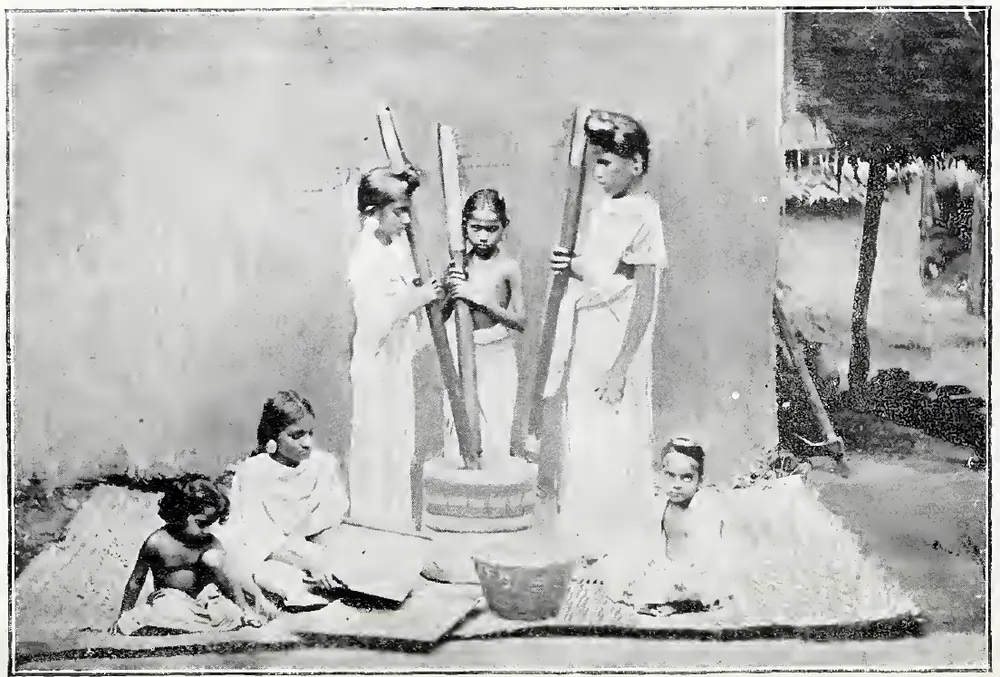
The Nayars do not wear much jewelry. As a rule the ornaments worn by Nayar women are few and cannot be considered expensive as compared with those of their sisters in the neighbouring provinces. The following ornaments are in vogue among them. For the neck they have the Kantasaram, Nalupanti, Addiyal, Ponnu-nool, Nagapadam (the oldest ornament of the Nayar lady), Arimbu-mani, Jnali-kuzhal, Minnum-maniyum, Arasilattali, Pacchakkaltali, Pulinakhattali, Kasumala, Kuzhalmala, Rasi-tali, Padakkatali, etc. It need hardly be said that even the richest lady does not wear more than two or three of these at a time. For the nose they have pendants called Mukkuttis set with ruby or diamond, with Undanattu, Ottakkal-nattu or Ottanattu; for the arms they have bangles, Kattikappu, Maniyilakappu or Swarna-Sangala Muduku; for the waist they have waist-nugs or Kachchappuram which are now giving way to the Odyanom of the East Coast; for the feet they have Thanda, Padasaram and Kolusu, but these are worn by young girls only. The only ear-ornament is the Takka, a huge cylinder-like ornament, in the case of the less civilised, or its modern representative the Toda (a two-lipped biconvex disc holding the inside of the ear-lobe in its circumferential groove and set with precious stones on its front surface), in the case of the civilized. They do not wear jewels on their head like their sisters of the other coast.
Tattooing does not find favour with the North Travancore Nayars. In fact it was little known in Malabar in olden times. The custom prevails only among the Nayar women living to the south of Quilon.
[352]Food and drink. Boiled rice and rice Conjee (gruel) form the staple articles of food. The cocoanut, jack, plantain, mango and other vegetable products, yams, are used for their curries, and cocoanut oil is largely used for frying, seasoning curries, &c. Ghee and dholl are seldom used except on festive occasions and in well-to-do families. Conjee or rice-gruel in the morning, dinner at noon and supper after sunset form the daily routine of the middle class Nayars. Animal food is unobjectionable and fish in many houses is an article of daily consumption. But there are several families in the country, especially in North Travancore who are understood to be total abstainers from animal food. Intoxicating drinks are prohibited though some resort to them on the false pretext of their being recipes for certain diseases.
Ceremonies. As soon as a child is born and the umbilical cord cut the babe has to undergo a rite of purification. The babe is placed on the naked floor and its father or uncle sprinkles a few drops of cold water on it. Pollution is observed for fifteen days after delivery, by all the members of the Tarawad, during which period they are prohibited from entering temples and holy places or performing any ceremonies.
The Namakaranam is performed on the twenty-seventh day after the child's birth, when the Karanavan of the family gives to the child a spoonful or two of milk mixed with sugar and then names the child by calling it in the ear by the name three times. The Annaprasanam or Choroonu takes place on an auspicious day in the sixth month, when the uncle or the father of the child first feeds it with rice. It is only after this ceremony that the child can be fed with rice. The Karnavedha or ear-boring takes place at the end of the first year after the child's birth, and the Vidyarambham or initiation in reading and writing in the third or fifth year.
Marriage Ceremonies. Marriage among the Nayars may mean either the formal ceremony of tying a tali round the neck of a girl, accompanied by festive celebrations, known as the Talikettu or Kettukalyanam, or the ceremony of actual alliance as husband and wife known as the Sambandham or Pudavakoda (literally cloth-giving).
Kettukalyanam or Talikettu. This is an indispensable rite in the case of every Nayar girl before she attains puberty. The ceremony bears close resemblance to the marriage ceremonies of the East Coast Hindus, but the essential elements to a marriage, the religious and legal sides, are wanting. Regarding the probable origin of this unique institution, Mr. H. A. Stuart says:—
[353]
"One cannot fail to be struck by the strong resemblance that the incidents of the Talikettu marriage bear to the marriage ceremonies of the East Coast Hindus in essential points of form, and it is sometimes asserted that the Talikettu marriage peculiar to Malabar is a survival of a real marriage ceremony, but it seems to me far more probable that this ceremony is an innovation of the Brahmans and that in Malabar it was never allowed to grow beyond a mere form, as the Brahmans preferred, for their own purposes, the orginal polyandrous system which they no doubt found in force on their arrival. It is incredible that the people of Malabar, having once abandoned the loose unions of polyandry, should have returned to that system, and that the people of Malabar were orginally polyandrous is, I think, incontestable."*
The details of the ceremony are different in different parts of Malabar, but the following may be taken as correct so far as the observances of the bulk of the Nayars in Travancore are concerned.
The age within which a girl ought to undergo this ceremony is eleven though in the case of the poor it is sometimes put off. As the celebration of the ceremony is costly, advantage is taken of a single occasion in course of ten or twelve years to marry all the girls in a Tarawad, irrespective of their ages, even infants included. The bridegroom who ties the Tali can only be selected from certain well recognised families in the village called Machchampikkars. These are the members of the earliest Nayar families appointed for this purpose by Royal writs. Each Kara or village has three or four such families and the members divide among themslves the customary services in that Kara. Enangans or relations may also take the part of bridegrooms. The Machchampi institution is absent in North Travancore, where the Aryapattar, Tirmulpad, Nambiyadi or Ilayatu is employed for the purpose. These latter are privileged to tie the tali on a number of girls at the same time while an Enangan or Machchampi never ties the tali on more than one girl at a time.
A day is fixed for arranging the preliminaries of the wedding, when all the relatives and men of the village are invited as also the astrologer (Kaniyan), who forthwith fixes the most auspicious day for the celebration of the ceremony and, noting it down in what is called a chartu or cadjan-writ, hands it over to the uncle or Karanavan of the family who then dismisses him with presents. The chartu states that a boy should be selected as bridegroom whose natal star agrees with the girl's and also decides what star would be agreeable and fixes a muhurtam for the ceremony as well as for fixing the main pillar of the marriage pandal. A few days before the commencement of the building of the pandal invitations are sent round to all the relatives, friends and villagers. In response to this they generally come and render substantial aid in the construction of the pandal. The main pillar is generally made out of the jack or Mukampala [354](Alstonia scholaris) tree which is cut for the purpose that same day and raised at the southwest corner of the pandal, which itself has to be built on the eastern side of the house. The pandal is generally in the shape of a square or oblong; and if the family be one of rank and influence what is called a Katiru Mandapam i. e. a raised floor with a groined roof beautifully decorated with pictures, mirrors and glass globes, is erected inside the pandal, and it is here that the actual wedding takes place.
* Madras Census Report for 1891.
The first item in the celebration is what is called the Ayani Oonu, a sumptuous banquet given by the bride's people to the selected bridegroom or Manavalan as he is called. On the morning of the first day of the marriage the girl is taken to the bathing tank in regular procession headed by one of the Machchampi women well dressed and decked with costly ornaments and holding a plate containing the girl's wearing apparel to be used after bath, a mirror and other toilette articles in her left hand, and a metal hand-lamp peculiar to Malabar called Changalavatta in her right. After bath the girl is taken back to the house and seated in a separate room, and then the assembled guests are served with a rich feast. Then comes the rite called Kappukettu or tying the Pratisarabandham (a piece of string symbolical of a solemn resolve to do a particular act) round the wrist of the girl. This is done by the Maran, the Brahmani or sometimes the brother of the girl, accompanied by a song called Subhadra Veli (the account of the famous marriage of Subhadra by Arjuna) by the Brahmanis, a class of Ambalavasis, who are accommodated inside the Katiru Mandapam. Then the bride's mother goes to the bridegroom's house and placing a garland round his neck formally invites him to start for the marriage pandal. A procession is then formed at an auspicious hour from the bridegroom's house, the bridegroom mounted on an elephant or walking on foot and holding in his hand a sword covered with a palmyra leaf or sword case. He is received at the gate of the Pandal by a few female members with the Ashtamangalyam* in their hands and is then conducted to a seat of honour in the centre of the pandal where his feet are washed by the brother or maternal uncle of the girl. The girl is then brought by her brother, covered up like a gosha woman holding in her hand an arrow and a looking glass and seated either next to him on the left side or in front of him, both facing the east. At the auspicious hour fixed by the astrologer who is in ready [355]attendance, the bridegroom receives the Minnu (the wedding jewel) with the string or tali at the hands of the Asan or village schoolmaster (in Cochin and Malabar it is the Ilayatu that officiates as priest and hands over the tali) and places it round the neck of the bride, whereupon the bride's maid known as the Ammavi Amma ties it round the neck of the girl. All this is done amidst music, tom-toms and loud hurrahing of men and women. A song known as the Ammachchan Pattu (or the song by the maternal uncle) is then sung, presumably an invocation by the uncle for prosperity to the married couple. At the end of these ceremonies one of the bridegroom's own men, a Machchampi, bears the girl into the Manavara, a decorated apartment in the inner part of the house, where both the bridegroom and the bride (or the Manavalan and the Manavatti) are required to remain under a sort of pollution for three days. The master of the house then distributes pan supari to all the guests present on the occasion, and on all the four days of the marriage every new visitor is greeted with presents of betel leaf, areca nut and tobacco. Then follows a sumptuous meal in which the women are served first. During the four days of the marriage various sports and amusements are arranged for the delectation of the visitors. In South Travancore a feast known as the Bhoota Kalam is given every night during the marriage. It is served on a huge plate and partaken by the bridegroom and his party including all the Machchampikkars. This is believed to be a relic of a Mahomedan ceremony imposed on the Sudra inhabitants at the time of the encampment of a Mahomedan force headed by a Mogul Sardar in 1680 A. D. On the second day of the marriage no public feast like that of the previous day is given, but there is a feast on a small scale given to all the relatives and those that choose to present themselves on that day. On the third day a feast is given to the Karakkars or Pidagakkars whose duty it is to cook and serve, the owner of the house having only to supply the articles required. This is a gigantic feeding business especially with the well-to-do classes of Nayars. Even the village artisans, the field labourers and the poor of all castes and religions are fed on this day. After the meals the Pidagakkars and friends make presents of money, cloths, etc. to the Karanavan of the family, each according to his means. On the night of this day a procession is formed from the girl's house to a friend's where the bridegroom and party are served with a light meal of beaten rice, fruits, sugar and other comestibles, known as the Avalteetti. The procession is accompanied by music, to which is added is a display of fire-works and illumination. When the Manavalan returns after the light repast, the bride shuts herself up in a room where [356]songs of entreaty called, Vathil-thura-pattus (literally open-the-door-songs) are sung by his friends to open the door. Reply songs are sung from within the room, which means that the bride suspects her husband's coming home at so late an hour. This completes the third day ceremonies. On the fourth day is formed a procession of some importance called the Mannu-neer-korikondu-varika (bringing of water from a neighbouring tank or well to the marriage house) attended with songs, music, and much pomp. On this night the females closely related to the girl make presents of sweetmeats. That same night the Maran removes the Kappu or string tied on the first day from the hands of the bridegroom and bride and performs certain purificatory rites, after which the couple betake themselves to the neighbouring tank to bathe. This part of the ceremony is also attended with some pomp. The water brought during the evening will now be utilised to purify the bride and bridegroom. Then the bridegroom is dismissed with presents of rings, ear-rings etc., money and cloths by the father and uncle of the bride. This concludes the marriage ceremony.
* The Ashtamangalyam consists of eight articles symbolical of mangalyam or marriage. These are rice, paddy, the tender leaves of the cocoanut tree, an arrow, a looking glass, a well-washed cloth, burning fire, and a small round wooden box called Cheppu made in a particular fashion. These articles are generally carried on a large metal plate.
In some parts of Malabar after the bridegroom and bride have taken their supper, usually in the same leaf, on the fourth night, they proceed to the pandal where a cloth is severed into two parts and each bit given to the bridegroom and the bride in the presence of relations and friends. This is believed to constitute a formal divorce. There is one curious adjunct to the marriage in some places and that is a sort of pollution is observed by the girl on the death of the Manavalan if he happens to be of her caste. Even to this day it is observed by the Illakkars and Swarupakkars of Trivandrum and Changanachery. In South Malabar the theory is that the Manavalan has the right to take the girl as his wife and is the proper person to enter into Sambandham with her, but practically the right has ceased to exist. Otherwise the ceremony is meaningless and possesses no legal or social force. As the late Sir T. Muthuswamy Aiyar observed:—
"In relation to marriage it has no significance save that no girl is at liberty to contract it before she goes through the Talikettu ceremony... ... ... In some parts of south Malabar, however, there is a belief that it is a marriage; but even there the custom is to tear up a cloth called the Kachcha on the fourth day of the ceremony, as a symbol that the marriage has been dissolved. A ceremony which creates the tie of marriage only to be dissolved at its close suggests an intention rather to give the girl the merits of a Samskara or a religious ceremony than to generate the relation of husband and wife."
But as we have already said even the religious element is wanting. To quote the same eminent jurist:—
"They are not regarded as constituting a religious ceremony or Samskara or sacrament in the Hindu or European sense of the term. There is no officiating [357]priest in attendance; there is no formula to be repeated; there is no Vedic, Puranic or religious chant or exhortation and there is no formal benediction."
In cases where the celebration of a Talikettu is beyond the means of a Tarawad the ceremony may be gone through along with a similar ceremony in the house of a well-to-do relation or neighbour. Sometimes the girl is taken to the nearest temple or the house of the village chieftain and the tali is tied by the mother without any ceremony, while in a few cases a sword is made to represent the bridegroom and in its presence the tali is tied by the mother.
Tirandukuli. This is the ceremony connected with a girl's attaining the age of puberty, and in all well-to-do families this is celebarated on a grand scale. When a girl attains puberty she is seated in a separate room where a lighted lamp and a brass pot with two paras of paddy and a bunch of cocoanut flowers is kept for four days. On the third day the girl's relatives are treated to a feast which generally consists of milk-conjee or milk-pudding. On the fourth day she is taken to a tank to bathe, after which the pollution is over: but she is not permitted to get out of the house or see the males until the Thali (purification) is over, which is done by the Maran who sprinkles some Panchagavyam over the girl's person. In the case of families connected with the Royal house the ceremony is brought to a close by a grand procession called Pattanapravesam. During these days the relations and villagers who go to see the girl take with them some raw rice and jaggery as presents.
Sambandham. This is the marriage proper. The ceremony is also known by the name of Pudavakoda or Pudamuri (literally the giving of cloth). There is no religious element attached to the ceremony. The custom allows a man to cohabit with a woman of an inferior social status while it prohibits the woman to exercise the same liberty. Marriage outside the same caste subdivision is rare in Travancore, while in Malabar marriage of a woman with a man of an inferior caste or subdivision of caste is alone prohibited. The Sambandham is usually arranged by the Karanavans of the two families. A proposal is first made by the husband or his relations to the intended wife or her relations. This done, the horoscopes of the bridegroom and his intended bride are examined by an astrologer (Kanian), and if the stars are found to agree, an auspicious day for the union is fixed by him. The date being fixed, the bridegroom with his friends and relations goes to the bride's house where at the gate he is received by the bride's party and is conducted to the special seats provided for them in the southern hall of the house which is beautifully decorated for the occasion. There will be placed in the hall two big brass lamps and two paras of paddy with a [358]bunch of cocoanut in front of each of the lamps, and between these lamps a little raised seat is provided for the bridegroom. At the auspicious hour presents are given to Brahmins, and on the bride being led out by her aunt or other elderly lady, the bridegroom after duly bowing to his elders particularly his uncles, father and brother, formally presents her with the costly wedding-cloth kept in a silver plate together with some red silk. After receiving the cloth the bride makes obeisance to the bridegroom and the assembled elders and returns to her chamber where amidst the korava cry she is dressed with the new cloth. The bridegroom and party are then treated to a sumptuous feast and the whole ceremony comes to a close with the distribution of flowers and pan supari to the assembled guests, after which they disperse. Another day is generally fixed for the actual consummation, when too, the bridegroom goes to the bride's house accompanied by a few friends and relatives who are all sumptuously fed for the night.
In South Malabar and North Travancore the wife is rarely taken to the husband's Tarawad, the husband visiting her in her house in the night and going home the next morning; while in South and Middle Travancore the rule is the other way, the husband always taking his wife to his own Tarawad.
Divorce. The theory is that the marriage connection lasts during pleasure and is dissoluble at will, but as the Sambandham is always an affair carefully arranged and settled after consulting the wishes of both the parties, divorce is a very rare occurrence. Permanent attachment is always the rule. The dissolution can take place only on sufficient reasons being put forward and with the consent of the Karanavans of both the parties. If the husband wants to dissolve the Sambandham he sends two respectable persons to give the intimation or he himself goes there and apprises the wife's Tarawad of his intention assigning his reasons at the same time; but if the wife wishes it she manages to bring it to the notice of the Karanavan and with his consent tells the husband in the presence of her relatives her reasons for the same. Misconduct and incompatibility of temper generally bring about a divorce. In cases of divorce the children always go with the mother, their legal guardian being their uncle or Karanavan of the mother's house. As a matter of fact public opinion among the community is found to be sufficiently strong to prevent arbitrary dissolution of a Sambandham, which is always regarded as degrading and dishonorable.
Remarriage. The Nayar women, in the event of separation from their husbands by divorce or death, are free to remarry; but the [359]second and subsequent marriages are not celebrated with as much formality as the first. Widowhood is not observed as understood among the Makkathayam communities.
Polyandry. A few words may next be said about polyandry and the charge of infidelity to the marriage tie so freely levelled against the Nayar women. Mr. Fawcett writes in his Nayars of Malabar already referred to:—"The Rev. S. Mateer, author of a well-known book on Travancore, where he resided something over a quarter of a century I think, informed me ten years ago he was speaking of polyandry amongst the Nayars of Travancore—that he had 'known an instance of six brothers keeping two women, four husbands to one, and two to the other'. ... ...I have not known an admitted instance of polyandry amongst the Nayars of Malabar at the present day, but there is no doubt that if it does not exist now (and I think it does here and there): it certainly did not long ago." That polyandry does exist to some extent in Malabar must be admitted as a fact. Justice Mr. Narayana Marar of Cochin writes in an article in the Malabar Quarterly Review for 1902:—"There is nothing strange or to be ashamed of in the fact that the Nayars were originally of a stock that practised polyandry, nor if the practice continued till recently. Hamilton in his 'Account of the East Indies' and Buchanan in his 'Journey' say that among the Nayars of Malabar, a woman has several husbands, but these are not brothers. These travellers came to Malabar in the 18th and beginning of the 19th centuries. There is no reason whatever to suppose that they were not just recording what they saw. For I am not quite sure whether even now, the practice is not lurking in some remote nooks and corners of the country". Polyandry is not heard of except in remote country parts and among some poor families, where a number of brothers keep the same wife on economical grounds, but the community as a whole has shaken off this practice.
Regarding the conjugal fidelity of the Nayar women, I cannot do better than quote the words of Mr. Logan, who was for several years Collector of Malabar and had had ample opportunities of knowing Malabar and its folk:—
'This part of the Malabar Law, has, in the hands of unenquiring commentators, brought much undeserved obloquy on the morality of the people. The fact, at any rate of recent years, is that, although the theory of the law sanctions freedom in these relations, conjugal fidelity is very general. Nowhere is the marriage tie, albeit informal, more rigidly observed or respected, nowhere is it more jealously guarded or its neglect more savagely avenged. The very looseness of the law makes the individual observance closer; for people have more watchful care over the things they are most liable to lose. The absence of [360]ceremonial has encouraged the popular impression; but ceremonial, like other conventionalities is an accident, and Nayar women are as chaste and faithful as their neighbours, just as modest as their neighbours although their national costume does not include some of the details required by conventional notions of modesty."*
My long experience of Tavancore confirms this view of Mr. Logan. Conjugal fidelity and self-sacrifice are generally admitted excellences in the Nayar women of the country.
Pregnancy Ceremonies. Pulikudi. This is the first ante-natal ceremony of importance which the pregnant woman has to perform in the seventh month of pregnancy or sometimes in the ninth month. On an auspicious day selected by an astrologer a tamarind plant is transplanted in an adjoining garden belonging to the woman's relatives. Next day or so soon as they can manage to find an auspicious moment, the pregnant woman, well-decked and clad in new clothes, is conducted to the spot by three other girls also similarly decked, the whole party moving with music and tom-tom under a silk canopy held out above them by some relatives or friends. The pregnant woman after bathing is made to stand on a plank with her face towards the sun, when her brother or in his absence a Maran, administers to her an infusion made from the tamarind previously planted, by dropping it three times over a knife into her mouth. After this the party return home with music as before. Meanwhile rice is preparing in seven sanctified vessels in her house, where the rest of her relatives and friends await her return. The whole ceremony is then wound up by a sumptuous feast to all the friends and relatives of the family collected there. The Pulikudi or Vayattu-Pongala is performed only at the time of the first pregnancy.
Delivery. At delivery, the women of the barber caste‡ officiate as midwives. Pollution is observed for fifteen days. The purificatory ceremony is performed on the fifteenth day by the Maran who sprinkles on the woman a liquid mixture of oil and Panchagavyam with gingelly seeds. Then the woman takes a bath in an adjoining tank or river and returns purified. But forty-one days must elapse before she can enter a temple. The cloths used by her at the time of delivery are all burnt and she puts on new cloths washed by the washerman.
Funeral ceremonies. The dead bodies of persons above sixteen are burnt, while of those below that age and of persons dying of cholera or small-pox are only buried. When a person is about to expire all the [361]members of the Tarawad pour into his or her mouth a few drops of the Ganges water or other holy water to purify the departing soul. The body is then removed to the bare ground-floor and "the names of gods or sacred texts are loudly dinned into his or her ears so that the person may quit this world with the recollections of God, serving as a passport to Heaven". Soon after the last breath goes out, the corpse is covered from top to toe with a washed cloth and placed on the floor with the head towards the south. Two lamps are kept burning, one near the head and the other near the feet of the dead body and here the neighbours come to take a farewell look at it. All the junior male members (for it is an invariable rule that no member of the Tarawad, male or female, who is older than the deceased, shall take any part whatever in the ceremony) then bathe and without wiping the head or body remove the corpse which will have already been washed, besmeared with holy ashes and clothed, to the yard or Muttam and placed on long plantain leaves spread on the floor.* Then comes the Pattum Kachayum Iduka or the placing of new cloths over the body by all relatives outside the Tarawad. In the case of certain recognised families of the State, the Maharajah sends a piece of silk and cotton cloth to be thrown over the corpse. The body is then removed to the cremation ground in the south-eastern corner of the Tarawad garden, where the funeral pyre is prepared of the wood of a mango-tree cut for the occasion. The corpse is generally carried by the Machchampikkars on a bier made of bamboo or in the case of a rich Tarawad, on a palankeen or Menavu. The body is placed on the pyre with the head towards the south. The junior members go round the pyre three times, throw paddy and rice over the dead body, prostrate at the feet of the corpse and then set fire to the pyre, the senior Anantaravan, who is next in age to the deceased, leading them. When the body is burnt the funeral party bathe, and then follows the breaking of the pot. This consists in the chief mourner carrying on his head an earthen pot filled with water with a small hole at the bottom, thrice round the pyre and then breaking the pot near the head of the corpse. When the water thus trickles down from the pot the junior members direct the particles to the corpse, probably to purify it.
* The Malabar Manual, Vol. I. Page 136.
‡ Men and women of the barber caste are in many parts of Travancore credited with a fair knowledge of medicine and midwifery and in the East Coast villages, physicians invariably belong to the barber caste.
The Sanchayanam or the collection of the cremated remains takes place generally on the seventh day. The bones are collected in the new pot and deposited at the foot of a fig or jack tree, and at the next convenient opportunity removed therefrom and thrown into the waters of a sacred [362]river. The ground itself, where the body has been cremated, is dug up and sown with grains or planted with a cocoanut tree. After the Sanchayanam funeral cakes are offered to the manes of the departed, in which the Maran officiates as priest.
* It is a custom among some classes of the Nambudiris also to cover the dead body with a plantain leaf for a while.
Pollution is observed for fifteen days by the members of the Tarawad and by the widow and children of the deceased. The sixteenth day is the day of purification. On that morning the Pidakakkars, friends and relatives assemble at the house of the deceased. The village washerman brings a washed cloth and spreads it on the ground. First of all the male members stand on this cloth and the Maran sprinkles three times a mixture of Panchagavyam and oil in which have been put some gingelly seeds, over their persons, and they then rub the oil the Maran has poured over their bodies and go for bath. Then the women do the same. Until this has been done the members of the Tarawad cannot enter the temple or other sacred precincts. After the purification bath the chief mourner offers Pindam or bolus of cooked rice to the manes of the departed.
On the night of the sixteenth day a grand feast is given to all the Karakkars and relatives and friends of the Tarawad, in which the Maran and the Machchampikkars are served first. In certain parts of North Travancore, Diksha is observed by the chief mourners for forty-two days, sometimes for six months or a year. During this period he must abstain from fish, flesh, wine, women and shave.
Law of inheritance. Of the several customs peculiar to the people of Malabar, the law relating to the inheritance of property is the most important. Marumakkathayam, as the system of inheritance is called, reckons descent and inheritance in the female line.
A Malabar Tarawad or family which corresponds to the Roman gens differs from it, however, in that the members of a Tarawad trace their descent in the female line from a common ancestor. Its constitution is very complex. A mother and all her children, all the children of her daughters, all her brothers and sisters, and the descendants on the sister's side, in brief, all the woman's relatives on the female side, however remote in kinship, live together in one Tarawad and enjoy together the common Tarawad property. So long as the common property remains intact any number of families hang together under one Tarawad. Suppose A, a common ancestress, has six children, three of whom X, Y and Z are males and the other three B, C and D females; X, Y and Z being the sons of A are members of that Tarawad, but their children do not belong to it nor do they stand in any recognised legal relations either to their father or to the property of [363]their father's Tarawad. But the daughters belong to the family of A, though they may each have a family and their daughters may have further families in turn and so on, the word family being used in the sense of the issue (male and female) of any female descendant in the female line only of A. In short, the family ends with a male. His issue belong to his wife.
The eldest male member of such a Tarawad is by legal right the Karanavan or the managing head and is succeeded by the next senior male member to whatever branch of the family he may belong. Every member, male or female, has an equal interest in the Tarawad, but cannot claim his or her share of it. The Karanavan is legally responsible for the well-being, control and management of the Tarawad members, and is bound to meet their wants arising from their social status. But he has no right to alienate the immovable property of the family without the consent of all the members, at least of all the adult male and female members. The internal management of the Tarawad is vested in him; he holds the family purse and is practically the family itself rather than its agent or representative. The disposal of the movable property of the family is solely under his control, and he is not bound to account except when he habitually wastes the property or does not administer it for the benefit of the other members, in which case a suit may lie to depose him from the Karanavanship. An individual member cannot claim any specific portion of the property as his share, nor will any debts incurred by a junior member of the family or for the matter of that by the Karanavan himself, except for the benefit of the family, be binding on the property. Partition of family property can be effected only with the consent of all the grown up members in it.
The great merit of this system over other systems of family-law is that it is eminently calculated to conserve family property and has tended to produce a strong body of contented landed tenantry though not a landed aristocracy. Again, the freedom and independence of Nayar women, their influence in the family and absence of conventional restrictions, such as child marriage, a demure life in the husband's house, widowhood and other customs that exercise so baneful an influence upon Hindu society elsewhere, are other advantages that swell the excellence of the Nayar system of life. The Nambudiri's life is constituted on the same pattern with but one difference in as much as his is the Makkathayam system of inheritance instead of the Marumakkathayam. But the system, has its drawbacks and disadvantages. According to the grumblers the benefits of legal marriages, parental rights, domestic rule, [364]the obligation to support wife and children—these are ignored. The individual members of a Tarawad have only the right to maintenance. The system, it is said, fosters a spirit of idleness which cannot but strike at the root of national prosperity. The Karanavan is the autocrat of the Tarawad, possessed of unlimited power over the family. The junior members of the Tarawad are practically voiceless, and the Karanavan is not bound to provide for them and improve their moral and intellectual condition. In a Tarawad, composed of members, many of whom are many degrees remote so far as the Karanavan and his direct heirs are concerned, it cannot be expected that the Karanavan should possess feelings of love and affection for all the members as for his direct and immediate relatives. Again, the arbitrary and absolute power of the Karanavan naturally tends to foster a feeling of discontent among the other members regarding the management of the Tarawad and leads to quarrel and ruinous litigation. Hence the system requires to be materially changed to suit the altered conditions of society. The causes which might have originally necessitated that form of family life and inheritance, are gradually disappearing, and the modern tendency is to care more for the interests of the wife and children and bestow on them a high level of affection. The system is also detrimental to the advancement of indigenous industries for want of capital among the junior members who have individual interests, but who are not entitled to their separate shares of property, which they might invest and utilise for such purposes. As the Malabar Marriage Commission observed:—
"With the advance of education Marumakkathayam is becoming hopelessly unworkable. It offends against every principle of Political Economy and of healthy family life. It is based upon the doctrine that there is no merit in female virtue and no sin in unchastity and of this doctrine the very founders of this system are heartily ashamed. By freeing a man from the obligation of maintaining his wife and offspring, it sanctions the reckless propagation of the species, destroying all motives of prudence and forethought, and forces up the population to the point whence it must be put down by the actual want of the means of subsistence."
National festivals. Onam. This is a very important Malabar festival and is celebrated in commemoration of the reign of Mahabali Chakravarti, an Asura King whose reign is believed to have been a period of "uninterrupted peace, plenty and prosperity". It occurs about the last week of August or in the first week of September. The origin of this festival is thus stated. The Devas grew apprehensive of Mahabali's increasing prosperity and wanted to put an end to his reign. With this object they went to Vishnu and entreated him to grant them some boon to secure the fulfilment of their desire. Thereupon Vishnu appeared before him in the [365]form of Vamana (Vishnu's fifth incarnation). When the monarch, out of his unbounded pride, asked him what he wanted, the youth replied that he wanted nothing more than a plot of three feet of earth. The prayer was granted at once, but the monarch soon found to his cost that he could not satisfy the request, for, the boy immediately assumed a gigantic form and having measured the earth and heaven in two feet, claimed his third foot of ground upon the head of the monarch and pushed him down to the regions below. Grieved at the loss of their beloved king the people prayed to Vishnu, who allowed the king to visit his dear land once every year, and this is popularly believed to be on the Tiru-onam day in the month of Chingam.
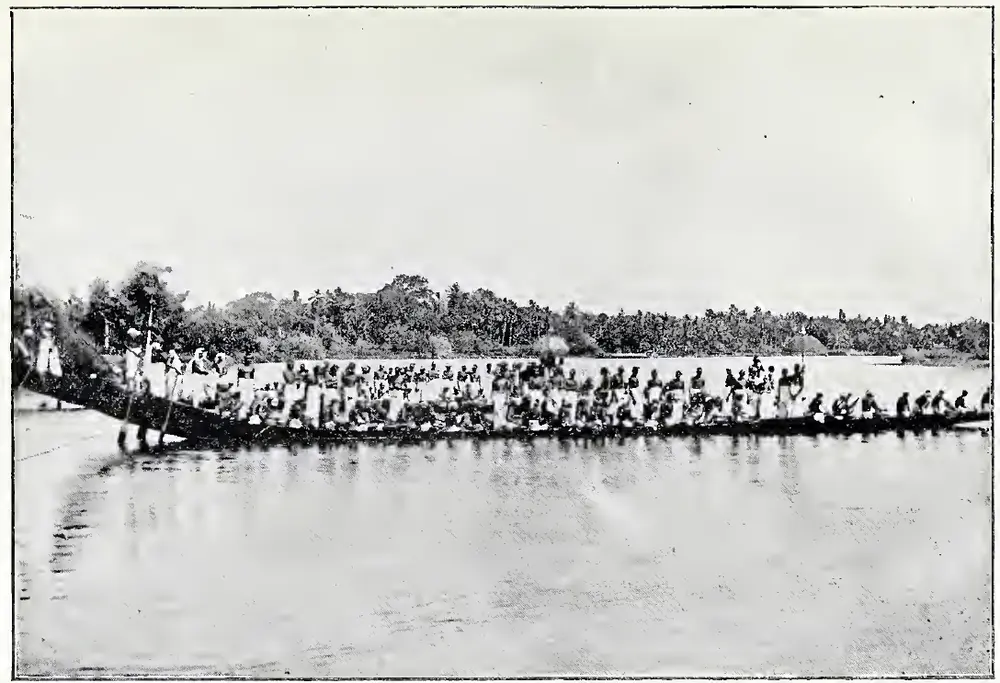
The festival is generally confined to four days, the whole period of which is spent in mirth and enjoyment. About ten days previous to the festival every house puts on a gay appearance. On the night previous to the Tiru-onam day, clay images of peculiar shapes are made, adorned with flowers and kept in a prominent place in the house amidst the Korava cry of the family group, thus practically proclaiming the approach of Onam.
The Onam festival is an occasion for all the members of the Tarawad to gather together, and the period of four days is marked by one round of of feasting and enjoyments of various kinds. Even the poorest Malayali arranges to have a rich meal on these days. The Karanavan of the family gives presents of cloths to all the other members and dependents including the agricultural and other labourers. In the afternoons the men engage themselves in sports of various kinds of which the national football takes the lead. The women too have their own amusements and recreations. Feast, wearing of new clothes, Oonjal swinging, music and other amusements and sports form the chief feature of this festival.
2. Tiruvatira. This is another great national festival of Malabar and comes off in the month of Dhanu (December and January) on Tiruvatira day. This concerns exclusively the Malayali women and is said to be in commemoration of the death of Kamadeva, the Cupid of Indian mythology, by the burning fire of the third eye of God Siva. Early in the morning of the festive day all maidens hasten to the nearest tank or river to bathe. All of them amuse themselves during the bath with what are called Tiruvatirakalipattu, i. e., songs accompanied with a regular splashing of water supposed to be symbolical of beating the breast on account of the grief they feel for Cupid's death. At daybreak all of them return home, don the richest attire and proceed to the nearest temple for worship. After refreshing themselves with a slight breakfast a [366]number of them again assemble and proceed to enjoy the Oonjal or swinging exercise during which special songs are recited. They derive immense pleasure in this gentle exercise of swinging backwards and forwards. The family dinner comes off at noon, the essential ingredient of which is the banana sliced and fried in cocoanut oil and seasoned with salt which is distributed among relatives and friends in the afternoon. After dinner the ladies spend the remaining part of the day also in dancing and merry-making. On this day and on the day previous, all women abstain from rice and take only wheat, Chama (Panicam miliacum), green peas, or arrowroot powder. They keep awake all night.
Vishu. The next important festival is Vishu which falls on the first day of Medam (April) which is the astronomical new year's day. In former times it was customary for all subjects of ruling princes to pay their respects to their royal masters with some new year's gifts. Though this institution has long since fallen into disuse, we find in its place presents made by tenants and dependents to their landlords on the day previous to the festival, which generally consist of cocoanuts, plantains and other curry stuffs as a contribution to the celebration. But these latter are not compulsory.
Being the commencement of the new year it is observed with superstitious veneration. It is popularly believed that a man's whole prosperity for the year depends on the nature of the objects, auspicious or otherwise that he first happens to see on the morning of the day. It may be stated here that certain things are from their very nature believed to be auspicious and capable of producing prosperous results e. g., reigning princes, oxen, cows, gold and silver coins, cocoanuts, &c.; while others there are that are regarded as inauspicious, producing just the reverse effect, e. g., ashes, firewood, oil, cat. Prompted by this belief the people prepare what is called the Kani a group of agreeable objects, on the night previous to the festival, so that it may be the first thing that the whole family shall see the following morning.
"A small circular bell-metal vessel is taken and some holy objects are systematically arranged inside it. A Grandha or old book made of palmyra leaves, a gold ornament, a new-washed cloth, some 'unprofitably gay' flowers of the Konna tree, a measure of rice, a so-called looking-glass made of bell-metal, and a few other things, are all tastefully arranged in the vessel and placed in a prominent room inside the house. On either side of this vessel two brass or bell-metal lamps filled with cocoanut oil 'clear as diamond sparks' are kept intensely burning and a small plank of wood or some other seat is placed in front of it. At about 5 o' clock in the morning of the day some one who has got up first wakes up the inmates, both male and female, of the house and takes them blindfolded so that they may not gaze at anything else, to the [367]seat near the Kani. The members are seated one after another in the seat and are then and not till then asked to open their eyes and carefully look at this Kani. Then each is made to look at some venerable member of the house or sometimes a stranger even."*
This is what is known as Kani Kanuka (seeing the Kani) in Malabar.
All high caste people rise at 3 P. M. on the Vishu day and go to the village temple to worship before daybreak.
At daybreak the head of the family distributes money presents to all the junior members of the Tarawad and servants of the household. At Trivandrum, all the important Hindu officials of the State, including those in the Districts who come for the purpose, attend the levee held by H. H. the Maharajah at 6 o'clock in the morning, after which they disperse and again meet at the Dewan's official residence where the Dewan, in behalf of the Maharajah, distributes to them sandal and pan supari. At noon the Maharajah distributes gifts of varying amounts from a sovereign to a few fanams to all the important officers of the State, as also to all the members and dependants of the palace household.
Like other festive occasions, the Vishu is marked by a grand feast to which all the tenants and dependants of the family are invited. The agricultural labourers, the family workmen, all these are given paddy or rice, oil, &c., on the previous day so as to enable them to have their own celebrations.
Amusements and recreations. The Nayars participate in all the amusements of the Nambudiris. The Kathakali, which had been much in favour with them till recently, has now given place to the Natakam or drama proper. In marriage and other ceremonies involving a huge feeding, the Nayars amuse themselves with the recital of what are called Curry Slokams (songs describing cooking and serving) especially during the cutting of vegetables for the feast, which sometimes occupies a whole night. Hunting is also a favorite source of recreation for the Nayar residing at the foot of the hills. The women learn and recite the Kaikottippattu, the Tiruvatira pattu and the Oonjal pattu. The Oonjal is a very favourite form of amusement with the Nayar ladies.
Names. The most common names are Raman, Krishnan, Kesavan, Govindan, Narayanan, Velayudhan, Aiyappan, Sankaran, Gopalan, Padmanabhan, &c.; such names as Kali, Ummini, Kochchappi, Adichchan, &c. are now losing favour and are replaced by Chandrasekharan, Atchyutan, Vasudevan, &c. Contractions and abbreviations are also common. Women [368]had formerly purely vernacular names like Cochchupennu, Chiruta, Kunji, &c.; they are now replaced by those of Janaki, Gauri, Lakshmi, Kalyani, Sarasvati, Kartyayani, Devaki, &c.
* Malabar and its Folk—Gopal Panikar.
Titles. Full and detailed information of these is given in the latest Census Report. The account given below is abstracted from it.
1. Pillai. The most common title in Travancore is Pillai, which was once a distinction granted as a mark of Royal favour. "The ceremony of investiture was known as Tirumukham Pitikkuka and the honour it conferred on the person was so highly esteemed that even a Brahmin Dewan Sanku Annavi had it bestowed on him and his family. It is enjoyed to this day by his descendants now living at Vempannur in the Eraniel Taluq. An individual so honoured is, however, not styled in formal communications with the suffix Pillai, but with the title Kanakku prefixed to the name, e. g. Kanakku Raman Krishnan."
2. Chempakaraman. This is a higher title than Kanakku and corresponds to the knighthood of the medieval ages. It was first instituted by Maharajah Martanda Varma. A description of ceremonies connected with the investiture of this title has already been given. (Vide chapter VI. Supra). The honour is now rarely conferred; still, there are several ancient houses in Travancore to which the honorific title (Kanakku Chempakaraman) is attached in perpetuity.
3. Tampi. This is a distinctive title attached to the names of the Nayar sons of Travancore sovereigns, though it is conferred upon others too as a recognition of rare merit and devotion. The Tampis alone among the Nayars are allowed the privilege of using palankeens and appearing before the king without a head-dress. The Maharajahs' consorts are usually selected from these families. If a lady from outside has to be taken, she is generally adopted into one of these families before or soon after the alliance.
4. Karta. This title is found attached to the names of several families in North Travancore. The Tekkumkur and Vadakkumkur Rajahs are said to have first conferred this title on certain influential Nayar families and constituted them into petty chieftains subject to their suzerainty. All these families belong to the Illam subdivision of the Nayar caste.
5. Kuruppu. This title, though sometimes assumed by castes other than Nayars, denotes really an ancient section of the Nayars charged with functions of varied interest. Some are, for instance, instructors in arms [369]to the Royal family of Travancore while others are superintendents of maid-servants in temples and Royal households. When the Maharajah enters into a matrimonial alliance, it is a Kuruppu that has to call out the full title of the Royal consort Panappilla Amma as soon as the presentation of silk and cloth is over.
6. Panikkars. The word is derived from Pani meaning work. The name does not at present indicate any particular section of Nayars. The Panikkars formerly kept Kalaris (gymnastic and military schools) in North Travancore, but as the institution of Kalaris is now a thing of the past, they have taken up to the teaching of letters instead.
7. Kaimmals. These are according to tradition the fighting masters of Malabar. They were formerly in charge of the Royal treasury.
8 & 9. Unnittan and Valiyatan. It is supposed that as the Nayar sons of the ruling kings of Malabar were called Tampis, the sons of those Kshatriyas who had no territorial sovereignty were called Valiyatans and Unnittans.
10. Eman (corruption of Yajamanan) is another title affixed to the names of certain influential families in central Travancore.
11. Menon or Menvan (literally, a superior person). This title seems to have been conferred upon several aristocratic Nayar families by the Rajahs of Cochin and corresponds to the Pillai in Travancore, referred to above.
Marans. These are the temple servants and drummers of Malabar. They are inferior to the Ambalavasis, but by their neat habits and abstinence from flesh they are considered superior to the other Sudras. But the Sudras themselves do not only assert their own social precedence but go even further and consider them positively inferior to them. The two castes neither interdine nor intermarry.
Subdivisions. Various kinds of subdivisions are given of Marans in Travancore. One variety goes by the different sections of the Nayars to whose ceremonials the Marans have to minister, e. g., Illattu Marans and Karuvelattu Marans. Another is territorial such as Kataikkal Maran, Karunat Maran and Tekkumkur Maran. The third mode of subdivision is based on occupational difference. The Asupani Marans are those entitled to sound the musical instruments, Asu and Pani. The Atimittam Marans are those that sweep the inner courtyard of the temple. The Sitikan and the Attikkurichchi are solely engaged in ceremonial attendance on Nambudiris. The Mangala Marans have to carry the [370]Ashtamangalyam at the Talikettu of the Nayars. The Ochchans are those invested with that designation by the Travancore Sovereigns as a mark of Royal favour. The Pottivans are those Marans who attend on all castes from the Ambalavasis to the Sudras.
The real social divisions are:—
1. Orunul Maran. One peculiarity of this subdivision is that the person that ties the tali is the rightful husband of the girl in whose default no second Maran can be accepted, but only a Brahmin or one of a distinctly higher caste than her own.
2. Irunul Maran. In regard to this subdivision the tali-tier is not necessarily the husband, nor is a second Maran husband forbidden in default of the first.
3 & 4. Cheppat and Kulangi. These were once local varieties, but have now become separate subdivisions.
5. Muttal Maran. This class is found only in the Kalkulam Taluq.
Manners and Customs. All classes of Marans are believed to be total abstainers from animal food and intoxicant drinks, but only those engaged in the service of temples and Nambudiri homes really observe the injunction. In the matter of marriage, inheritance, the period of pollution, &c., they closely resemble the Nayars. They have their own priests, but for purification after pollution the Nambudiris officiate as priests.
Occupation. As already observed the playing of musical instruments is their chief occupation. At the funeral ceremonies of Nambudiri, Kshatriya and Ambalavasi families they are an indispensable factor, while in the case of Nayar funerals and for their purification both after birth and death pollutions, they officiate as priests. Some practise also sorcery and witchcraft and officiate as priests in temples dedicated to Bhadrakali.
Krishnanvagakkars. These are a class of Sudras confined to South Travancore and are supposed to have formed part of the great pastoral caste of South India, which, after a time, became mainly agricultural. They live in large communities, each group having a Karyasthan assisted by an accountant and a treasurer; these offices are elective and honorary. The total number of the Krishnanvagakkars in Travancore is 8,999 according to the last Census.
Origin. Tradition attributes their origin to a place called Ampadi, the place of Sri Krishna's birth and early boyhood, whence they are said to have migrated first into Conjeevaram and then into Travancore [371]before the commencement of the Quilon Era. Seventy-two families are said to have settled in Travancore. It seems they presented to the then king of Travancore, an image of Sri Krishna which they had brought with them from Northern India and which the Maharajah commanded to be placed in the Tiruvampadi temple (inside the Padmanabhaswamy pagoda). Their leader was given the title of Ananta Padmanabha Kshetra Pallava Rayan as a mark of Royal favour; the management of the temple of Krishna was entrusted to them and they were permitted to reside in Vanchiyur near Trivandrum. During the days of their pollution occasioned by the birth or death of near relatives they pleaded that the image they brought with them was also affected and that therefore during such days the daily pujahs could not be performed within the precincts of the pagoda. As there were frequent hindrances to the puja the community was asked to remove to a place separated from Trivandrum by at least three rivers. They therefore settled at Eraniel and Kalkulam. Since then they were allowed to supply peas to the Tiruvampadi temple at Trivandrum most probably as a tax in kind upon land cultivated by them. The privilege is said to have been granted them in the first year of the present Malabar era. It has since been disallowed.
Manners and customs. There are two divisons of this caste, one following the Makkathayam system of inheritance and the other the Marumakkathayam. The former imitate the Vellallars in respect of clothing and ornaments, the only peculiarity being the wearing of the Mukkutti, the characteristic nose ornament of the Nayar women, while the latter imitate the Nayars. Tattooing was in olden days very common among the women.
The Marumakkathayam section resembles the Nanjanad Vellalars in their system of marriage. The marriage of the Makkathayam section is thus described:—
"After the usual horoscope consultation, a day is fixed for the betrothal On the day of the marriage the bridegroom goes in procession to the house of the bride sword in hand, superbly and martially clad. ...... The bridegroom's sister carries a plate containing a cloth and the tali and enters the apartment where the bride is seated in marriage attire. The bridegroom is conducted to the pandal called Vattakkamanam, where the relatives and villagers are all assembled. In the room where the bride is seated the bridegroom's sister ties the tali round her neck amidst the Kurava and other sounds of joyous music. The maternal uncle conducts the bride to the marriage mandapam and seats her by the side of the bridegroom. A plantain leaf is spread before the couple and paddy, raw rice, two cocoanuts and two Kappu strings are placed on it. God Ganesa is then solemnly invoked and the _Kappu_strings are tied one round the right wrist of the bridegroom and the other round the left wrist of the bride [372]The maternal uncle then recants the name of all ancestors of both the parties and loudly declares that the daughter of such and such a man in such a family is wedded in holy matrimony to a member of such and such a family. He winds up the ceremony by pouring water into a cadjan leaf held by the bridegroom and the bride, the water flowing from the hands of the bride towards the hand of the bridegroom. The bridal pair thereafter retire from the gathering. The feasting and rejoicing usual on such occasions over, the bridegroom returns with the bride in procession to his own house where the rest of the festivities, which last for seven more days are gone through. On the third day the bride's party go as if in search of the girl to the house of the bridegroom with the appearance of burning indignation and every effort is enacted to appease them but without avail. The bride's party returns abruptly without even partaking of the proffered hospitality. On the seventh day the married couple repair to the bride's house. The marriage so celebrated is alone legal and binding. The husband immediately obtains the status of legal guardian and is entitled to keep her at home however young she may be, consummation being of course deferred till after puberty."*
When a girl attains puberty the Asan or priest sprinkles raw rice on the head of the girl seated in a room with a light in front of her and presents the purificatory oil with which she anoints herself. This is done on the tenth day after menstruation, the pollution lasting for full ten days. There is no special ceremony for consummation. The tali is not removed on the husband's death. If any one of his brothers is alive, he may take her to wife even though younger than herself. The issue of such a union is considered as the legitimate issue of the deceased having full rights of inheritance to his property as well as to that of his natural father, provided the latter has no offspring by his duly married wife.
The dead are cremated, but no ceremonies are performed on the first two days. The offering of oblations begins on the third day and the Sanchayanam is performed on the tenth. Pollution is observed for fifteen days and purification takes place on the sixteenth day. Their priest is called a Karnattan or Asan, of whom there is only one family at present living at Mepra in Eraniel. The female members of the priestly family are called Mangalyams and observe a certain amount of exclusiveness with regard to marriage and messing. The Krishnanvagakkars are mostly engaged in the cultivation of land. Some have now taken to trade. In respect of modern education they are still very backward.
Nanjanad Vellalars.‡ Nanjanad and its colonisation. Years ago when a shepherd living in the locality now called Nanjanad east of Aramboli desired to celebrate the wedding of his daughter Auvai, the [373]celestial Yogini commanded her devotees Cheran, Cholan and Pandyan to repair to the spot and conduct the ceremony themselves, whereupon they put up the marriage pandal and celebrated the marriage in which immense ornaments and dowries were presented by the respective sovereigns. When, after the completion of the festivity, they asked permission to return to their countries, they were told by Auvai that the wild region lying to the west of Muppandal (the place where the three kings erected pandals for the marriage ceremony as to the date of which there is no evidence), was a very fertile territory and that they could all assume sovereignty over it.
* Report on the Census of Travancore for 1901.
‡ For information under this caste, I am indebted to the late Sivan Pillai of Padmanabhapuram.
Subsequent to this, tradition says that several families from Pandy, migrated to this land and clearing the jungles by degrees, colonised it and gave it the name of Nanjanad. There is no data to ascertain the period of the first colonisation. It is conjectured that it might have been in the beginning of Kaliyuga. There are, however, epigraphical evidences to indicate that each of the kings mentioned above had temples constructed at this place and dedicated to various deities. Emigrants from Pandy settled in Nanjanad from time to time and the absence of any permanent habitation of the Malayalis in Nanjanad confirms the fact that it has been colonised solely by people from the Coromandal Coast.
The term Nanjanad denotes a double connotation, one that it is the land environed by Nanja lands, and the other that it is one fortified by natural barriers.
History. The import of the names of Azhagiyapandipuram, Cholapuram, Kulasekharanputur, and Kurattiyara warrant the inference that these villages should have been the capitals of these several rulers. It is generally believed that in course of time a Kuravan conquered the country and ruled it; hence his name Nanjikuravan. This Kuravan was known to be a great alchemist. The ancestors of the present Mudaliyar of Azhagiyapandipuram were the stewards of these Kurava chiefs.
The last Kuravan ruler insisting upon his marriage with a girl of the Mudaliar's family, the Mudaliar and the people (Nattars) became indignant at the Kurava's audacious proposal and in order to revenge themselves upon him, feigned to agree to the inglorious alliance and got a huge pandal erected of granite stone with mechanism for its sudden collapse at a given signal. At the auspicious time for wedding, the girl and all her relatives were asked to come round the Pandal in procession, the Kuravan's relatives remaining in it, when at the right moment a button was pressed and in an [374]instant the Kuravan with his whole family, officers and adherents were buried under the granite stones and crushed. Nanjanad at once became free and was declared the commonwealth of the people. The remnants of the granite structure are extant to this day at the village of Kurattiyara.
While the government of the commonwealth was being conducted by the people themselves, negotiations between the ruler of Travancore and the Nanjanadians were opened, which were concluded with the result that the Nanjanadians agreed to place themselves under the Travancore Government with a certain share in the administrative functions providing for their own requirements and convenience. There are epigraphical evidences defining the method in which they were to be governed e. g. believing that the levying of any tax on the house compound in the twelve Pidagas of Nanjanad will convert them into Sircar property and desiring that the proprietory rights of the localities of habitation should be vested in the holder of the property, they were exempted from any such impost. As these lands belonged to the people, the latter were called Nattars.
Again in the reign of Martanda Varma when an attempt was made to introduce some reforms and changes in Nanjanad, the people assumed a hostile attitude and demanded the cancellation of the attempted legislation, threatening an immediate emigration to Pandy in a body. The Maharajah, however, realising the gravity of the situation relaxed his orders and gave the Nattars assurance of confining himself to the spirit of the stone inscriptions found at Kudirapintivila at Ozhuganachery, Veeravilla and Nattumadam.
Several Neets exist to show that Travancore Maharajahs sent out special invitations to the Nattars of Nanjanad to go to Trivandrum and discuss state questions.
Their relations to the ancient Maharajahs were characterised by much loyalty and fidelity especially in the troublous days of Travancore before 984 M. E. (1809 A. D.) In addition to being faithful and loyal, the Nanjanadians were skilled in accounts and to this superiority is due the fact that one of their class is always given the post of Valia Melezhuthu (Accountant-General). Whenever they come to Trivandrum on business of State there is the practice even to this day to give them from the palace treasury an allowance of twenty rupees every time they visit His Highness, whether under His Highness' command or some other reason. There are Neets preserved which testify to the fact that prior to the year 984 M. E. (1809 A. D.) the Maharajahs used to consult the Nanjanadians in the affairs of Government. A sample Neet of invitation is subjoined.
[375]
"It is made known to you that Tiruvattar Nilakanthan Chempakaraman Pillai and Parthivapuram Padmanabhan Chempakaraman Pillai, having proved themselves obnoxious to Government have been shut up under guard in the Udayagiri Fort after due information had been given to the British that they had been re-arrested after an escape. But some of the Kunjukuttacars* from Padmanabhapuram, Udayagiri and Keralapuram having collusively set them free and joined them, the said Nilakanthan Chempakaraman Pillai and Padmanabhan Chempakaraman Pillai are marching to Trivandrum without giving us previous information. As we have to consider this matter in conference with you, you are all required to start immediately on seeing this Sadhanam and Neet and be here without delay. This is sent to Tenveeti Nadu-Mayinta and others on the 8th Kartigai 980 M. E. as His Highness' party Neet."
The Nanjanadians were always the trusted subjects of the Maharajahs of Travancore. When the Tampis or the sons of the Maharajah assisted by the Ettuvidans and Madampis with their retainers raised rebellions in the state in times of state festivals like Pallikettu, Tirumadampu and coronation, and even attempted the extermination of the Royal family to which they always bore a grudge, in the time of the heroic king Martanda Varma, these Nanjanadians were ready to help their sovereign. That some of the Naluteruvu Vellalars of Padmanabhapuram were established at Trivandrum to train Maharajahs in military exercises and to act as body guards, is evidenced by the documents given to them by the Maharajah in which this fact is acknowledged. As a relic of this old custom, the Nalannans are still invited to act as body guards being provided with arms.
There are also many Neets to show that when ruling Maharajahs fell seriously ill, information was given to the Nanjanad Nattars about the state of affairs. When the Maharajah Rama Varma, known as the Kilavan Rajah, went on a pilgrimage to Ramesvaram a body of Nanjanadians was taken by him for his personal escort. In deference to this custom the late Maharajah Visakham Tirunal too took along with him a few of these people in his foreign journeys.
Marriage among the Nanjanad Vellalars. The class under which the marriages of Nanjanad and Makkavazhi Vellalars are catalogued is called Asuram. The essential feature of the ceremony is the presentation of money to the parents of the bride before the marriage. In cases of second marriage the bridegroom has to offer, according to his social status, a sum of money to the father of the bride-elect for feasting purposes and a new cloth to the bride, the presentation of which is the essential feature of the ceremony. The necessity for the second marriage arises from the chances of extinction to which families, wherein women [376]may become widowed without any issue, may be exposed, from the absence of the custom of adpotion among the Marumakkathayis of this kingdom and from the harrowing spectacle of virgin widows to their parents and guardians. The women marrying a second time do not dislodge the tali.
* Revenue peons of the Taluq.
A second marriage is allowed for a woman where the husband having lived away from his wife for a very long time owing to incompatibility of temper marries a second time or where the first marriage is dissolved by the exchange of a Vidumuri (divorce deed) between the parties concerned.
The Nanjanad Vellalars, though still following the old system of Makkathayam, while the class as a whole has taken up Marumakkathayam,- conduct intermarriages freely between the Makkathayis and the Marumakka-thayis. Those who adopted the Marumakkathayam system agreed to intermarry with the other class in remembrance of their old relationship or in consideration of the validity of marriage among their families in ancient days. Because of this practice of intermarriage between the two sects of the Nanjanadians themselves and because of later immigrants from Pandy freely marrying from both kinds of Nanjanadians, intermarriage between the two classes became a recognised custom. In this sort of intermarriage the marriage between a Marumakkathayi husband and a Makkathayi wife became very rare. This is because, if a Marumakkthayi husband has a Makkathayi wife, the wife and her children can inherit only a part of the man's property. In the case of a Makkavazhi man marrying a Marumakkavazhi girl, she is only the gainer from her husband's system of inheritance. But even this is not so general as of old.
Certain features of a Nanjanad Vellala Marriage:—
(1) Girls are married usually after puberty but sometimes even before.
(2) The preliminary ceremonial in a marriage is the purchase of turmeric.
(3) The bride is presented with an iron writing style and a knife, besides a Mundu and Neriyatu, the usual Malabar dress.
Funeral ceremonies. The son performs the funeral rites and in his absence the nephew. The Sanchayanam (the collecting of bones) takes place on the second day. Pollution lasts for sixteen days. The Karta (the performer of the ceremony) wears the holy thread during the sixteen days. It is to be noted that the Karta does this on occasions of anniversaries also. The purification ceremony is performed by Brahmins.
(a) Evidences as to whether the Nanjanadians were Makkathayis:— The descendants of the Mudaliar who was the head of the twelve Pidagas or villages of Nanjanad and the heads of the villages are even now Makkathayis. The purohits of Pandi Vellalars and Nanjanad Vellalars are also Makkathayis. The language, ornaments, marriage and funeral obsequies of the Nanjanad Vellalars are those of the Makkathayis. Though many of the Nanjanad Vellalars became Marumakkathayis, several of them and all the people of the other castes are Makkathayis. This establishes the fact that the Nanjanadians were originally Makkathayis.
(b) How the Nanjanadians who were Makkathayis became Marumakkathayis:—There was once a dispute as to the sovereignty of Nanjanad between the Pandian and the Travancore kings. It was contended by the Pandian king that the whole of Nanjanad was under his sway, that a dam that had been constructed across the Paraliyar with feeding channels for irrigating the paddy fields, went by the name of Pandian Anai in memory of the king who constructed it, that the king of Travancore and his subjects were Marumakkathayis, that the inhabitants of Nanjanad were Makkathayis like the Pandy people and that for these reasons the sovereign right vested in him. This contention was opposed by the Travancore king who argued that the inhabitants were Marumakkathayis, that the Pandian dam was constructed by the Travancore Government, that with a view to perpetuate the memory of the Pandian king who was in sincere intimacy with his contemporary king of Travancore the dam was called by that name, and that as the land where the dam stands is indisputably included in the Travancore territory, permission could not have been granted to construct it for the benefit of an alien sovereign. The dam was soon after destroyed and made unserviceable. The Nanjanadians deposed to their having become Travancore subjects, and their ancestors having adopted the Travancore law of succession, viz., the Marumakkathayam law, they did not desire to be the subjects of the Pandian king or follow the Makkathayam law of inheritance. To this effect they made a solemn statement in the Madura Temple.
In the manuscript records in Padmanabhaswamy's temple at Trivandrum it is stated that this happened in 282 M. E. (1106 A. D.) The Tamil song regarding this is translated by Mr. T. S. Ganesa Pillay thus:—
"On Wednesday the 11th of Chingam, in the Kollam year 282, when Jupiter was in capricornus, the king of Kupaka (Venad) defeated king Rajasimha of Tamil Pandy and broke the Parali dam and conquered the country of Kottar and Nanjanad."
[378]After returning from Madura a general consultation was held between the king, Nattars and Shastris as to the modifications required in the Nattars' custom, the result being the adoption of Marumakkathayam and widow marriage customs obtaining in Malabar and continuation of the other Makkathayam customs as they had been followed heretofore.
Change in inheritance. At the death of a member of the family his wife and children become entitled to a fourth portion of the family property to which the deceased is entitled on partition. The remaining property and titles descend to the brothers and sisters of the deceased. In the Marumakkathayam system the sons are entitled to a small portion of the property self-acquired and ancestral. This goes by the name of Ukantuduma (inheritance or right by love). In the case of divorce also the wife and children should be given this Ukantuduma. If more than a fourth of the estate has to be given in this manner, permission of all the heirs has to be secured. If the widow is without issue and too old to enter into a new marriage, she is entitled to maintenance out of her husband's property. A divorced woman, if issueless, is similarly entitled to maintenance. This is called Nankuduma (property of the nanka or woman). The Nankuduma is not claimable by the widow if at the time of her husband's death she does not live with him. When a widow remarries or accepts a Sambandham, the second husband has to execute a deed called Etuppu agreeing to pay her either on his death or at divorce a sum of money. The Ukantuduma from the first husband in this case will not go to the sons of such a woman.
[379]Place of residence. When Kayangulam and Ambalapuzha were annexed to Travancore their kings destroyed all accounts relating to revenue. The work of reorganisation entailed great difficulty and required the services of able men. The Maharajah sent to several places the Nanjanad people who were in those times better qualified to do the work of revenue accountants. In time they settled down in those parts of Travancore. Those who were thus made to settle in other places have still their Tarawads in Nanjanad. At present they are found in Nanjanad, Vaikam, Mavelikara, Chengannur and the Trivandrum town where they crowd for education, government service, and trade.
Dress and ornaments. The men are generally front-tufted like the Nayars. The women wear white cloths even when their husbands are alive like the Nayar women, and also have the toda for their ear as against the coloured cloth and the pampadam of the Pandy Vellalars. While the Nayar woman wears separate pieces of cloth for her waist and the upper portion of her body, the Nanjanad Vellala woman wears only one long cloth like her Pandy sister.
Food and drink. The Nanjanad Vellalars are not strict vegetarians, but they do not take to intoxicating liquors.
Occupation. Agriculture is their chief occupation though they often prove to be good Government servants, accountants, tradesmen, &c.
Language and Education. Tamil is their mother tongue. Originally they had schools in their villages, to which they sent their children for reading, writing and reckoning. Now higher education is making rapid progress among them.
Population. The total number of Nanjanad Vellalars is 18,203 according to the last Census.
The land revenue system in Nanjanad. When Nanjanad was annexed to Travancore it was divided into Karas; the chiefs of Karas were fixed upon and were entrusted with the collection of taxes. These chiefs were given Neets, making them Karayalans. The Karayalans along with the Pidaka Mudaliyar used to go to the Maharajah to pay their share of tax-collection.
This system not working well, the Maharajah consulted the people on the matter of governing them more efficiently. This goes a great length to prove that the people had a sort of village autonomy among themselves by virtue of which they must have enjoyed a great deal of independence, which they might have acquired either on account of the [380]half conquered condition of Nanjanad, or on account of the extreme kindness of the Maharajah towards them owing to their loyalty and fidelity.
After the year 984 M. E. (1809 A. D.), the Nanjanadians have been beaten in the competition for government service by other castes. Their number in the public service has been rapidly decreasing. Whatever be the amount of tax payable according to Ayacut to the lands of Nanjanad, the system of tax collection before 984 M. E. (1809 A. D.) was as follows;— When the corn was ripe the Proverticar visited the place with three or four respectable arbitrators of the locality. He made an approximate account of the amount of produce in a particular piece of land. If the holder of the land held it from another Jenmi on mortgage, he was asked to pay two shares, and if the holder was at the same time the owner of the land, he was to pay only one share to the government as tax. From 984 M. E. forwards the whole tax according to the Ayacut was exacted every year the land was cultivated. This proceeding proved a great hardship to the people. When slavery was abolished and wages became high the cost of cultivation rose very much. Under such conditions it became necessary for the whole Tarawad to work on their lands. This prevented their youths from obtaining a fair English education and passing university examinations. Want of water and scarcity of falling rains caused damage to crops. Nevertheless the Nanjanadians may be said to be an industrious and hard-working people.
Pattaryars. Their origin and social status. This is an interesting community now claiming social precedence over the Saliyars in a well written protest against the last Census Report (1901) by a graduate member* of that community, according to whom the Pattaryars are silk-weaving Vysias and not Saliyars. He writes:—
"I, a Pattarya, beg leave, on behalf of the Pattaryars of the Pannicode street and Chempakaraman Pututheruvu (Eraniel) and Oonnamalakkadai Kilateruvu (Vilavancode), to approach you with the prayer for amending, by the State Manual, a certain mistake touching us which has often been committed by Census Commissioners in the Chapter on the classification of castes and which we have already applied to the kindness of the Ethnographic Superintendent for correcting. The last Census Report (Page 238 of part II), for instance, speaks of us Aryans as a subdivision of the Saliyars. This, I humbly submit, is not correct. The word 'Aryan' means (in its restricted sense) Vaisya (vide Amaresam). This meaning tallies with the views of the historians. E. Marsden for instance, in his History of India for Junior Classes (page 17), after describing the origin of the Brahmins and Kshatriyas continues:—'The rest of the tribe who tilled the ground, wove cloth, and did other work were called Vaisyas. They were the third class or caste among the Indian Aryans.' We are also sometimes known [381]as Vadaganganyars which is indicative of the fact that our original home was on the northern banks of the Ganges."
"(Vide Document A, copy of Cheraman Perumal's Pattayam (missing) which Pattayam appears to have been seen in 1010 M. E. by the Temple authorities of Sree Padmanabha Swamy Kovil as can be gathered from Document B, copy of the decision by the said authorities in answer to a prayer by our forefathers for putting Prasadams into their hands and which Pattayam again is referred to by the Cherumukku Vaidikan Krishnan Akkithiruppadu Avergal in his letter No. 42 of 1067 Doc. B. B.) which he gave in favour of a certain Saliyan or Chetty of Shertalay, mistaking him, as an effect of misrepresentation, for a descendant of those people that presented Cheraman Perumal with the Mantravastram to be worn on the occasion of his coronation.
Another Document, copy of a sale deed purporting to have been executed at Oudh on Friday the 11th of the Siva Prathama Month of the Thrapta year.
The Olai we are in possession of cannot certainly be the original. It must be the result of a process of transcription or translation from the original. But our commonest name is Pattarya which may be thus explained. The word 'Patta' (perhaps a corruption of some Sanskrit word) means 'colonisation'. The copy of the Pattayam already mentioned (Document A), speaks of our having in ancient days resided in various parts of India among which are Thiruvanchikulam and Quilon. Our former residence in Quilon is obvious from Documents D, E & F dated respectively 812 M. E. (1636 A. D.), 813 M. E. (1637 A. D.) and 864 M. E. (1688 A. D.) which evidence a series of emigrations from Quilon to Veeranarayanaseri in the Eraniel Taluq during the 9th century M. E. Even at a comparatively recent date our ancestors completely emigrated away from Veeranarayanaseri and Kottar (where too our ancestors resided) and their holy temples in the two places (viz., Sri Padmanabhaperuntheru Ganapathy Kovil and Veeramarthandanperuntheru Ganapathy Kovil) together with the estates attached to each, are now under our management. That our ancestors once resided in Kazhakoottam too may perhaps be inferred from the fact of our having till some twenty years ago systematically levied from marrying parties what was known as Kazhakoottam Panam. Thus the colonizing nature of the class may be taken to be an explanation of the name 'Pattarya' which explanation is further supported by Document, G. dated 26th Audy 949 M. E. (August, 1774 A. D.) where it is written as பட்டஆரியன். Another explanation of the name will be afforded by the supposition that our usual occupation in ancient days was silk-weaving instead of cotton weaving.
"And in order to distinguish us from the so-called Veerava Nallur Pattaryars of the British parts and the so-called Kottar Pattaryars (both of whom are flesh eaters and between whom and us there is neither inter-marriage nor inter-messing) we are particularised by the name Kerala Pattarayars (Vide Document B) or Malayalam Pattaryars on account of our ancestors having been brought down from Northern India by the king of Kerala (viz., Cheraman Perumal) for the purpose of providing him with Chitrapadapattu or Mantravastram on the occasion of his coronation which last having, as they say, taken place on an Onam day is still memorized by our observing for over ten days Tiru Onam as the greatest of our national festivities. As a mark of our gratitude towards that great sovereign and his posterity, to this day the Birthday of His Highness the Maharajah is observed by us as a day of festivity. What I have already said together with a reference to the various documents hereto annexed is enough to produce the firm conviction that we are neither Pattaliars (which name too appears side by side with "Aryan" in page 238 of part II of the late Census Report) nor any section of the Saliyans.
* Tampuran Tozha Pillai B. A.
[382]
I beg leave to interpose here that "Adaviar" which is wrongly given in the same page of the Census Report as a section of the Saliyar is merely a title generally added to their names by the Veerava Nallur Pattaryars."
As further arguments, he adds:—
1. "If identity of profession were the test, Pattunulkars, Kaikkalavans and other weavers would equally fall under 'Saliyans.'
2. "The different Sections of the Saliyans interdine with one another but we do not dine with them.
3. "The different sections of the Saliyans reside in the same street indiscriminately, but no Pattarya will reside in the midst of Saliyans nor will a Saliyan be allowed residence in a Pattarya street. I beg leave to point out in this connection that in Oonnavilakkadai (Vilavancode) where the Saliya street (consisting of several sections of Saliyans) and the Pattarya street are adjacent to each other, an old wall erected by the Pattaryars has been standing between the two streets for the purpose of making the public understand that the Pattaryars and Saliyans are totally different classes.
4. "The Guru of the Saliyans is different from the Guru of the Pattaryars—the latter being at the same time Guru to the Vellalars of several places.
5. "I have heard of Saliyans trying to pass for Pattaryars. (An instance of this is to be found in the case which called for the letter of the Cherumukku Vaidikan already spoken of). But the converse case has never occurred and is sure never to occur as it would entail degradation."
Caste. They are Vaisyas according to him. His reasons are:—
1. "The very name Pattarya proves it (vide Amaresam).
2. "The holy string (an emblem of the Vaisyas as of the other two superior classes) which is now worn only on religious occasions is referred to in Cheraman Perumal's Pattayam. The constant wearing of this must have ceased on account of its inconvenience to the profession. This will be easily understood by those who are acquainted with the Pattunulkars in their homes who are often found putting aside their string while seriously at work."
Subdivisions. They are divided into:—
1. "Kerala Pattaryars (got down from North India by Cheraman Perumal),
2. "Kalakad Pattaryars (sometimes known as Veeravanallore Pattaryars), and
3. "Kottar Pattaryars (much degenerated)."
Religion, customs and festival. The existence of holy temples in Kottar, Veeranarayanasseri and Pannikodu established by Kerala Pattaryars, viz., Sri Padmanabhaperunteru Ganapati Kovil, Veeramartandanperunteru Ganapati Kovil and Trivikrama Vinayakar Kovil, the estates attached to which are now under their management, bear testimony to the fact that they were worshipping the Aryan deities about the 9th century M. E. And the oldest of matams attached to the holy temple at Trichendur established by them in 911 M. E. (1736 A. D.) also show that they were of the Aryan religion. The grandest of their national festivals, is the Tiru Onam which lasts ten days.
[383]Marriage. No widow marriage is allowed among the Kerala Pattaryars or the Kalakad Pattaryars, but among the Kottar Pattaryars widows are allowed to marry and courts of justice decide to that effect.
Law of inheritance. The Pattaryars are all Makkathayis and the property of the father descends to his sons.
Occupation. The young man adds:—"'It is a general rule,' says Elphinstone (in his History of India 5th Edition, p. 17) on the strength of the Code of Manu (Chap. X 99,100) 'that in times of distress, each of the classes may subsist by the occupation allotted to those beneath it, but must never encroach on the employments of those above it. Having been thus once adopted, the profession has continued on.' The fact that they presented the Mantravastram to the king on his coronation day and the name Pattarya itself which indicates that they might have been Aryans whose occupation was silk-weaving instead of cotton-weaving indicate that their profession was weaving which has continued to this day."
Food and drink. The Kerala Pattaryars are strict vegetarians, while the Kalakad Pattarayars and Kottar Pattaryars have taken to flesh eating.
Language and Education. "Tamil is their mother tongue and education has had its attraction for them from early times which is testified to by the establishment by their ancestors of one of the oldest Tamil schools in Eraniel (namely Kadai-pallikoodam)."
Places of residence. The present abodes of the Kerala Pattaryars are:— (a) Eraniel (Pannicode and Chempakaraman Puthu Theru) and Vilavankod (Unnamalakkadai-Keezhatheruvu).
(b) The present abodes of the Kalakad Pattaryans are Veeravanallore, Pattamadai, Koranad, &c. and
(c) The Kottar Pattaryars are confined to Kottar.
According to the last Census Report of Travancore the Pattaliyans (more correctly Pattaryars) altogether numbered 1,399, which is given under the subdivision, Saliyans.
Dasi. The Dasis or Deva-dasis or Devaradiyars (which literally means servant-maids of God) are female servants attached to some of the temples in Travancore. They are locally known as Kudikkaris and are referred to officially as Adumpatrams (Dancing girls). Those attached to the Sri Padmanabhaswamy temple at Trivandrum are drawn from the Padamangalam caste of the Sudras and this subdivision also supplies the temple servants in the Agastisvaram Taluq. But the class to which the servants [384]attached to the other temples in Travancore belong, forms a caste by itself and is composed probably of the descendants of the original emigrants of the same caste as the Dasis attached to the temples on the other coast. By their long residence amidst an alien population they have adopted a few of the local customs and habits so that the caste is now half Tamil, half Malayalam. It does not however differ materially from the corresponding caste on the East Coast in the matter of occupation, dress and ornaments. Some of them wear the Nayar jewels and dress while at home and the law of inheritance followed is the Marumakkathayam system.
From the origin of these two classes of Dasis we might naturally expect a considerable difference to exist between them. The Malayali Dasis are like Nayar women in respect of marriage, dress, ornaments, &c. They have the usual ceremony of Talikettu which every Nayar girl undergoes, but this is not done in the temple, nor is she married to the deity as in the case of the Tamil Dasis. The Malayali Dasis consort with men of their own or higher caste, their system of marriage being known as Sambandham. In fact they are distinguishable from the generality of Nayar women only by their service in the temples. They do not sing or dance at private residences. This gives them a much higher status than the Dasis of the East Coast.
Not so, however, the class of Tamil Dasis; their marriage is peculiar and different from that of all other castes. They are generally married when young to the deity of the temple they are attached to. On an auspicious day the girl goes to the temple after bath with two pieces of cloth, a Tali, betel leaves and arecanut. These are placed by the priest at the feet of the deity and after kindling the sacred fire and offering oblations to it, the priest on behalf of the deity presents one of the cloths to the girl and ties the Tali when she sits facing the deity. The rest of the marriage celebration lasting four days, is gone through in her house, the temple priest officiating as the bridegroom. Thenceforth she becomes the wife of the deity and dedicated to his service. Formerly the Dasis undoubtedly enjoyed considerable social position on account of their service in the temples, but now they have degenerated into prostitutes and as such have fallen low in the social scale. It is not, however, every Dasi that is married to the deity, only a few are so dedicated. Of the rest some voluntarily follow the profession of prostitution while a large number marry and settle down as family women. Of the males some marry in the caste and live by playing on the flute or other musical instruments at the dance and by teaching them dancing and music, while others marry and drift out of caste, follow [385]other occupations and try to get rid of the stigma attached to their birth, by merging into the general community of respectable Sudras.
On failure of female issue both the Tamil and the Malayali Dasis recruit their families by adoption of girls and even by purchase of girls from other castes.
The ordinary daily duties of a Dasi attached to a temple are very exacting. She attends the Diparadhana at sunset every day, sings hymns in praise of the deity, dances before it and goes round with the idol in procession with lights in the hand. Singing and dancing have to be done by her in the forenoons too.
The Tamil Dasi does all this every day and on all important occasions. Her Malayali sister however has lighter work. She has neither to sing nor to dance. She does not lead processions unless they are confined to the premises of the temple. But she does extra work by sweeping the floor, steps, &c. in the mantapam and the corridors immediately outside the sanctum sanctorum, a work which her Eastern sisters would think derogatory to do. For the due performance of these duties the Dasis get certain monthly allowances and some lands, the produce of which maintains them so long as they continue in service. In addition to these monthly allowances some additional remuneration is also made in the form of money during temple festivals and for certain domestic occurrences in their families such as marriage, death, &c. The Tamil Dasis are generally superior in accomplishments whether in singing or dancing. Their services are often requisitioned for entertainment of Hindu audiences on marriage and other important occasions in well-to-do houses.
Konkani Brahmins. Origin, designation, number and distribution. These are Brahmin emigrants from Konkan, a narrow strip of land bounded on the east by the Western Ghauts from Bombay to Goa. They are a branch of the Saraswat subdivision of Pancha Gaudas, and Tirhut in Behar is claimed to be their original home. According to tradition Parasurama brought ten families and settled them in Gomantalla, (modern Goa) Panchakrosi and Kusasthali. These and some others who followed them were living in peace and plenty both under the Vijayanagar Rajahs and during the early years of Portuguese Government, when they took to a remunerative trade in European goods. With the establishment of the inquisition at Goa and the religious persecution set on foot, many of them left that country and came southwards to Canara and Malabar from which latter country they migrated to Cochin and Travancore where they form [386]one of the most flourishing communities at the present day. According to the Census of Travancore for 1901 their number was 8362. They dwell mostly in the Taluqs of Parur, Shertallay and Ambalapuzha.
Appearance, dress and ornaments. The Konkanis have a weak physique, homely features and yellow complexion. The men dress themselves like the people of Malabar ordinarily, but on festive and religious occasions their dress resembles that of the Dravida Brahmins. Their women wear white cloths with silken edges, bodices being not in vogue among them. In both these respects they form a contrast to the East Coast Brahmin women who invariably wear bodices. The wedding ornament is a pendant, oblong in form, made of pure gold with the figures of the sun and crescent engraved thereon. Their other ornaments are massive and old fashioned. Their cloths are not broad enough and scarcely extend below the knee. Their mode of dress and ornament at once distinguishes them from Dravida Brahmin women. They eat fish but do not indulge in drink.
Religion. The majority among them are Vaishnavites and followers of Madhvacharya. They are generally worshippers of Venkataramanaswami, but Narasimha, the fourth Avatar of Vishnu, is also popular. The deity at Tirupati is held in great veneration by them. They have their own priests and temples, called Tirumala Devasvams of which there are nine important ones, the Ananthanarayanapuram temple at Alleppey and the one at Turavur being the richest and the most important. The others are at Purakkad, Kayangulam, Quilon, Shertallay, Kottayam, Parur and Alleppy. There are also some minor temples besides. The temple oolsavam is generally an eight days' festival and large sums of money are spent on pyrotechnics on these occasions. The Konkanis also observe a number of fasts and pujahs like the East Coast Brahmins. The following are a few of them:—
- (1) The Tamil New-year's Day—1st of Chittira
- (2) The Dipavali day
- (3) Narasimha Jayanti
- (4) Anantavratam
- (5) Varalakshmi vratam
- (6) Uttana Ekadasi
- (7) Holi festival
- (8) Nagachaturthi
Marriage and other ceremonies. In the matter of birth, marriage, funeral, purificatory and other ceremonies they are almost like the [387]Vaishnava Brahmins. The few variations they exhibit in the matter of marriage are noted below:—
1. Custom enjoins the marrying of one's maternal uncle's or paternal aunt's daughter and the practice almost amounts to an injunction.
2. During the whole period of the five days of marriage the married couple eat and sleep in the same apartment. This custom also prevails among the Vaishnavite Brahmins.
3. The Kanyaka-danam or, the giving away of the bride, takes place on the fourth day, whereas in the case of the Vaishnavite Brahmins it is done on the first day and precedes the Mangalyadharanam or tying of the Tali.
4. Mangalyadharanam is considered the principal element of the marriage while it is the Saptapadi which is important among the other Brahmins.
Widow marriage and divorce are unknown and the inheritance is from father to son.
Caste organisation. There are eight gramams or villages which are the strongholds of Konkani Brahmins in Travancore, viz., Alleppey, Purakkad, Kayangulam, Quilon, Shertallay, Parur, Kottayam and Turavur. Every Konkani Brahmin has to attach himself to one or other of these in order to command respect from his fellow caste men. All caste disputes are referred to and settled by their high priests. The Smartas owe their allegiance to Kaivalyanath Swami situated in the territory of Goa, while the Vaishnavas have two mutts, the Kasi and Gokarna mutts, established at Benares and Basroor in South Canara. These high priests are held in great veneration by the community and their decisions in matters religious and social are final. The affairs of their temples are managed by the Yogakkars or managing committees attached to each temple. All the affairs of the village are heard and decided by this committee, for the meetings of which a portion of the temple called the Yogasala or Council-hall is set apart. Every important decision has to be communicated to the Swamy or high priest concerned.
Occupation. A great many of them are traders, a profession which the community has been following from the days of the Portuguese contact with the West Coast. The Konkanis are experts in the preparation of Parpadams or round crisp cakes made of black-gram flour with an alkali, a condiment universally used in Malabar and is in great demand in countries beyond the Ghauts.
Language and Education. The Konkanis speak Konkani, a dialect of Mahratti, in their houses and Malayalam outside. Only 3 per cent of them [388]are literate according to the Census of 1901. They are intelligent and enterprising and are now taking to higher education.
Condition and status. Brahmins though they are, the Konkanis are never considered to be on a par with the other Brahmins of South India with whom they are not allowed to intermarry or interdine. In the Cochin State "they are not allowed access to the inner structure surrounding the chief shrine of the Malayali Hindu temple". Their honorific titles are Prabhu, Senai, Kammathi and Rao the last being of recent adoption.
Kudumi Chettis. These are Sudras who migrated from Konkan with the Brahmin emigrants to escape the Portuguese inquisition and persecution in Goanese territory. Their number according to the Census of 1901 was 7,276. They are found mostly in Parur, Shertallay, and Ambalapuzha Taluqs. They are stated to have been attached to the Kudumbas or families of Konkani Brahmins as their domestic servants and hence their name Kudumis supposed to be a corruption of Kudumbas. But this derivation is perhaps far fetched. They are divided into two classes, viz., Muppans and Idiyans—the former claim superiority over the latter on the ground of their supposed descent from the Konkani chieftains of old and the absence of intermarriage with them. They are Saivites by religion and Bhagavati is their tutelary deity. They have their own priests but in some cases the Konkani Brahmins officiate as priests. Early marriages are common. There is no prohibition against widow remarriage. The dead are cremated but non-adults are buried. Birth and death pollutions are observed for fifteen days. They then generally abstain from animal food and intoxicating liquors. Garlands of coral and red beads called Palunku are largely worn by their women, who like their Brahmin sisters do not wear bodices. The prevailing form of inheritance is Makkathayam. The Kudumis are capable of continuous hard work. Some are employed as boatmen and agricultural labourers, but they mostly serve as domestic servants in Konkani Brahmin houses. The chief occupation of the Muppan is the manufacture of fire-works while the preparation of aval or beaten rice is the speciality of the other class. They are almost illiterate. On account of their being closely attached to the Konkani Brahmin families they are not considered low in the social scale. They act as temple servants in the Konkani temples.
Kammalars. In Travancore this sect is divided into two distinct classes, the Tamil Kammalars and the Malayalam Kammalars. The manners, customs and status of the Tamil Kammalars vary so widely from [389]those of the Malayalam Kammalars that the two classes may be separately treated.
Tamil Kammalars—Origin and Name The name Kammala is a generic term applied to five artisan classes:—
- 1. Tattan (goldsmith);
- 2. Kannan (brazier);
- 3. Tachchan (carpenter);
- 4. Kal Tachchan (stone-mason); and
- 5. Kollan (blacksmith).
They trace their descent from Visvakarma, the architect of the gods. In many parts they claim equality with Brahmins styling themselves Visva-Brahmins. Their claim, however, seems to be of a recent origin Inscriptions show that as late as 1033 A. D. the Kammalars were treated as an inferior caste and permitted to reside away from the habitations of the higher classes and were assigned particular portions of the village site. Their usual title is Asari, but the monied men dealing in precious stones and ornaments assume the title of Pattan which seems to be meant for Bhatta (sanskrit). They wear the sacred thread. The introduction of the holy-thread, an attribute of the Dwija or twice born, marks a new epoch in the history of Kammalars. No exact date can be assigned for this, but the universal desire among all the sections of the Kammala community is to raise themselves in the social scale by copying the manners of the Brahmin and other castes higher than themselves. Some of the Kammalars of the East Coast rise early, bathe in the river, wear silk, perform what they call a sandhyavandanam or japam and even preside as officiating priests over marriage ceremonies of their own caste.
Religion and worship. The Brahmin deities are worshipped; but they have special deities of their own in Madan, Sankilikaruppan, Mariatta, Kali and others who preside over smallpox, cholera, &c. They offer animal sacrifices to these. Devil dancing prevails very largely among the Tattans (goldsmiths).
Marriage. The main divisions among Kammalars generally intermarry and interdine. Dignity of occupation tended gradually to bring, in differences between them with regard to marriages, dining, jewelry, costume and general deportment, as, for instance, an opulent goldsmith does not choose a bride from an indigent stone mason's family. Divergence of occupation brings in differences in social status, and naturally the gulf becomes wider between the various classes at one time co-ordinate. Monogamy is the rule, polygamy the exception. A second wife is taken, even while the [390]first lives, on the score of physical incapacity or moral delinquency of the first wife. Polyandry is prohibited. Girls are generally married after puberty. Widow marriage is forbidden. Infant marriage prevails to a great extent.
Funeral rites. Adults and old persons that die of smallpox, cholera, and other casualties are only buried, but cremation is the rule. In funeral rites the Kammalars follow the forms of Brahminical ceremonies and observe pollution for twelve days.
Food and drink. Kammalars are strict vegetarians. Alcohol is prohibited.
Manners and customs. Some Kammalars dress like Brahmins. The dress of their women is different from that of the Brahmin women. The lobes of the ear are distended and heavy pieces of solid gold called Pampadoms are worn; but the modern-day woman discards the old fashioned pampadoms and takes to jewelled ear-rings, nose-rings, &c. Tattooing is practised partly as ornamentation and partly to avert the evil influence of spirits.
Inheritance. Makkathayam is the law of inheritance.
Language. Tamil is the mother-tongue. Malayalam, the adopted language, is also spoken.
Malayalam Kammalars. Malayalam Kammalars are divided into:—
- 1. Marapanikkan (worker in wood) generally known as Asari.
- 2. Tattan (goldsmith).
- 3. Kallan or Kallasari (worker in stone, stone-mason).
- 4. Musari (brazier or coppersmith).
- 5. Kollan (worker in iron, blacksmith.)
- 6. Tachchan or Irchakollan (hewers of wood and sawers of timber).
These are similar to Tamil Kammalars in regard to their profession. They are also artisans but of a lower extraction. They have no entry either into the accredited places of worship or the recognised arena of society. These Kammalars pollute the Nayars by approaching within twelve feet, and the Brahmins, within thirty six feet. These are known by the generic name of Panikkan meaning worker. The chief among them are styled Kanakkans or Muthasaris, i. e., those who are versed in the scientific measurements of carpentry and house-building.
[391]Authentic inscriptions show the existence of five classes of Kammalars in Malabar in the beginning of the ninth century. The tradition is that one of the Perumals (Delegate king of the Brahmin land of Kerala) pressed the Kammalars to accept marriage alliance with the washerman caste, and this unpalatable injunction drove them to Ceylon. Deaf to the entreaties of succeeding Perumals, they refused to return. After repeated solicitations the then Izhava king of Ceylon was prevailed upon to send some Kammalars to Malabar. This was complied with and to this day, we find, in Kammala marriages, presents from Izhavas, who occupy a lower scale in the social order than Kammalars, are accepted as sanctioned by time-honoured custom. These Izhavas are also invited for dinner. This custom is evidently a relic of their Ceylon origin. The Malayalam Kammalars should not be confounded with the Tamil speaking Kammalars who belong to the East Coast. At Trikkariyur in Muvattupuzha Taluq, Kammalars exist who adopt dress and jewelry similar to those of Tamil Smarta Brahmins. The Malayala Kammalars are not a thread-wearing class, but do sometimes put on a thread when they work in temples or at images.
Religion. They worship the lower order of divinities, such as Kali, Madan, Amman, and Yakshi, and offer animal sacrifices. They have special festivities in the month of Kartikai. The caste known as Vilkuruppu supplies priests to preside over their ceremonies. Their original function was to make bows and arrows for war, but they have of late limited their function to merely presenting these articles on the Onam day. This priest class is dying out and its function is being taken up by the Kammalars themselves.
Marriage. This is performed before a girl attains puberty. The wedding ornament is identical with that of the Izhavas and is known as Minnu. The marriage lasts for two days, but this is closely followed by a ceremony dissolving the transient bliss, called Vazhippu. The bride and bridegroom are free afterwards to choose or reject their partners in life as they please. Among this group there are traces of polyandry. It is the Tibetan or Adelphic form where three or four brothers conjointly keep one woman as wife. This system is practised by carpenters, stone-masons, &c. The reason assigned is poverty. The children are common to all, and inherit their property. The Kammala divisions intermarry and interdine.
Inheritance. Makkathayam is generally followed, but here and there vestiges of Marumakkathayam also are found.
[392]Food. Fish, fowl and sheep are freely used as food.
Dress and ornament. Their dress is the same as that of the Nayars, a pair of Mundus, Their jewelry is similar to that of the Nayars except the nose ornaments, Mukkutti and Nattu. Tattooing is very common.
Profession. Ivory-carving, wood-carving, making of musical instruments such as Tambur, Veena, have attained great perfection.
Funerals. The Kammalars bury their dead, but the Kanakkans and even Panikkans who reach old age, are cremated. This is exactly the reverse of what the Tamil Kammalars do. The pollution period is sixteen days as with the Nayars and other Sudras.
Language. Malayalam is the mother-tongue. Some talk Tamil also.
Population. Total population according to the Census of 1901 was 1,19,768.
Shanars. Origin and designation. The Shanars are a class of Hindus inhabiting Tinnevelly and the southern taluqs of Travancore, They belong to one of the races that are commonly classed as Dravidians, Tamil being their mother tongue. The correct form of the name of this race is Shandrar which is derived from a Tamil word sal. The expressions Shanror and Shandravar are also derived from the same root and are but different forms of Shandrar.
From a few stray hints that are found in the Tamil literature and the traditions peculiar to the race, we learn that the Shanars belong to a wave of warlike adventurers who migrated towards the south from North India.* Popular legends tend to point out the tract between the Krishna and the Godavari rivers as one of their earliest homes in India. But Bishop Caldwell considers them as emigrants from the northern coast of Ceylon. Hence the question as to whence they came has to be solved in common with the other Dravidian races. They appear to have, in the earliest times, settled down as rulers† in several parts of the country. The fact of their having been a ruling race at one time is borne out not only [393]by such expressions as Nadar and Nadalvar, * but also by numerous customs which are peculiar to them and by other circumstances. Their rule was subsequently overthrown by later waves of Dravidians.
* The Shanars are called Kali Puthirar (the sons of Kali or Bhadrakali, the great Bellona of India), and this goddess is considered as their tutelary deity. Enathi-Natha-Nayanar one of the sixty-three disciples of Siva is described as having belonged to the Shandrar caste in the Tamil work Periyapuranam and as Sakshikulotbhava in the Sanskrit work.
† "From all that I can find about them I am inclined to agree with those who consider them to have been the original possessors of the country. One strong argument in favour of this conjecture is that in the southern part of Tinnevelly the highest class of Shanars called Nadars are the acknowledged proprietors of the soil and even when a Nadar has sold a piece of land, he retains the right to a sort of quit-rent. Indeed, the system is very like that of our lords of Manor." (The South Indian Sketches by Miss. S. Tucker)
The Shanars of Travancore seem to have migrated into the southern taluqs of Travancore either from or through the Tinnevelly District. The traditions of some of the old families show that their ancestors had been called into the country by some of the ancient kings of Travancore. There are eight families to this day known as the Ettuveettu-Nadakkal. Of all the taluqs in Travancore, Eraniel has the largest number of Shanars. Out of a total of 1,55,864 Shanars in Travancore, 43,044 are found in the Eraniel Taluq, the earliest seat of the Travancore sovereigns, while the Taluqs of Agastisvaram and Tovala, which lie nearer to Tinnevelly than Eraniel, have only 23,718 and 3,263 respectively. This fact lends countenance to an inference that they were patronised by the ancient kings of Travancore. They have permanently settled down in the country. The bulk of the Shanars of Travancore are found in Eraniel, Vilavankod, Agastisvaram, Kalkulam and Neyyattinkara. They are more numerous than any other caste in these Taluqs except in the last.
The people of this caste are ordinarily called Shanars by people of other castes, but they themselves use the term Nadar. The word Nadar is also used as a title. The titles Tiruppapur Nadar, Udaya Martanda Nadar, Nagamani Martanda Nadar, &c. were granted to some families of Shanars by the ancient kings of Travancore. It has to be said in this connection that the Izhavas are sometimes spoken of as Shanars because some families of that class are called by that name. This is however a mistake. Perhaps some families of Izhavas were in ancient times granted the title of Shanars. Izhavas, like oil-mongers, Alavars and others, belong to the left-hand classes, while shanars occupy a high place among the right-hand classes. The Shanars are known as Valankai-Uyarvu-Kondar or Valankai-Uya-Kondar. These terms are found in ancient and modern title-deeds.
The names used for the headmen of the caste are Periya Nadan, Turattu Nadan, Mutal Pattu Nadan, Karakara Nadan, &c. The headman of the working men is called Mukkandan.
Appearance, dress and ornament. In appearance they are a dark-skinned race with low foreheads, sunken eyes and prominent cheek bones. There is nothing peculiar about the dress or ornament of the Shanar men [394]or women to distinguish them from the other Hindu castes of the same social position except that they are back-tufted.
* The expression Nadalvar occurs in some ancient stone inscriptions of Travancore.
"The Shanar when accoutred has first in importance the Arival-Petti or knife-box made from the sheaths of the spathe and bound round tight with two binders of rattan. A strongly plaited rope is permanently fastened to one side of the Arival-Petti; the short arm of it has a much smaller loop; when fastened round the waist, the longer arm is passed inside the small loop of the short arm. Through the loop of the long arm the toddy drawer passes the end of the waist cloth and ties it into a knot. Next in importance is the Yair-Petti into which the toddy drawer empties the toddy collected in the pot or chatty up the tree. It is made of Palmyra fibre closely plaited and when moistened, is water-tight. Two wooden collar shavings about two inches broad encircles the mouth of the Yair-Petti, one inside and one outside; between them the plaited wicker-work is run up and made fast. To keep the Yair-Petti in its bulged bottle-like form, a piece of rattan about half way down is woven in and circles the vessel like the loop of a barrel. The Yair-Petti hangs suspended at the waist."
Subdivisions. This race has at present three distinct and separate divisions, viz., the Shanars proper, the Nattatti Shanars, and the Virali Shanars.
The members of these divisions cannot intermarry. The origin of the name Nattatti is not definitely known; some think that the proper form of their name is Nattattar, i. e., the natives of the regions of the central river. The Virali Shanars are the offspring of the people who have been put out of the caste proper for moral or social delinquencies within the caste. The Travancore Census Report for 1901 names "Itanad, Illam, Kara, Karukumatta, Kavara, Kiriya, Mutta Natan and Tiruppapur," as subdivisions of this caste. The term Karukumatta is probably a mistake for Karukupattaya meaning Shanars who had served as soldiers.
Marriage. The Shanars generally marry after maturity, but infant marriages are not invalid. By long established custom a man may claim his sister's daughter as wife to his son, and her son as husband to his daughter, but it is not compulsory. None of the other relations can marry each other.
Polygamy appears to have been strictly prohibited from early times. In former days a man who married a second wife while the first wife was alive or had not been formally divorced, used to be outcasted and classed as Virali along with his newly married wife. But now that practice seems to have gone out of use and there are at present instances of a man having two wives with impunity. Polyandry is unknown in the caste and widow marriage is not permitted. A wife may be divorced for adultery, and the woman so divorced cannot marry again.
[395]Inheritance. As regards inheritance the Shanars are governed by the Mitakshara School of Hindu law, the form of succession being strictly Makkathayam.
Religion. The Saivite form of worship appears to have been the earliest one prevalent. In a typical Shanar house, a room on the south-western part is always kept separate as a sacred place with a basket containing ashes in it. The senior male member of the family alone can enter it. This leads to an inference that the head of the family originally acted as the family priest. Some kind of offering to the dead in the form of fruits, cakes, flowers, &c., are also made in that room. There are Vaishnavite Shanars in Travancore; they are known as Perumal Vazhikkars. The Shanars also worship Pillayar (Ganapati) and Subrahmanya; Bhadra Kali is worshipped as the tutelary deity of the race. But demon-worship attended with animal sacrifice is the most prevalent among them, and it must also be admitted that even amongst the Christian converts its influence has not entirely disappeared.
Customs and ceremonies. The Shanars generally bury their dead, but in a few localities they burn them. The dead are buried with the head to the south and feet to the north. But the elderly and respected ones among them are buried in a sitting posture facing the east. They bury their dead in their own land specially set apart as the family burial ground.
There are certain customs among the Shanars which allow scope for an inference that formerly the head of the family acted also as the family priest. The Shanars have hereditary families of priests in the caste itself known as Aiyar or Aiyar Pandaram. The majority of Shanars at present seem to observe very few religious ceremonies.
Sending a boy to school for the first time and his beginning to write on cadjans with the iron style are observed as formal ceremonies. When a boy attains the sixteenth year his beginning to use the head cloth, Urumalkettu, and to carry a knife about him is also an important ceremony. As regards girls, the ceremonies in connection with the attaining of maturity are important. There are also a few minor ceremonies during childhood. Betrothal is always observed as a formal ceremony. A few relatives of the bridegroom go to the bride's house on an auspicious day and make a formal proposal to those related to the bride and dine with them, if the proposal is accepted. As soon as the first feast of the marriage is over, the bridegroom moves in procession with music and other accompaniments to the bride's house. He carries a sword in his right hand and a few betel [396]leaves in his left. When he approaches the bride's house the bride's brother advances to receive him with music, sandal paste and flowers and conducts him to a seat in the outer pandal. The sister of the bride places a lighted lamp before him called Vädävilakku, which is very common among the Hindus. The marriage ceremony is performed in an inner pandal, which has a separate pillar, and a small raised platform around. The customary marriage pandal has pillars for the sides and another pillar at the centre known as the Brahmankal. The form of a Pillayar is made on that platform and a measure full of paddy (Nirainazhi) and a lighted lamp are also placed on it. At the appointed time the bridegroom is invited to the inner pandal, and at the entrance the bride's sister meets him with a lighted lamp and leads him to the plank placed to the north-west of the central pillar. The bride's sister is given a present for this service. The bridegroom and the bride seat themselves on the plank and the bridegroom ties the marriage Tali after it has been blessed by the priest. This is known as the Sankuttali with one or more conch-like ornaments on either side. Soon after the Tali is tied, the bridegroom and the bride rise from their seats and the bride's father takes her hand and puts it into the bridegroom's and they go round the marriage platform thrice hand in hand. There is music and Kuravai * at the time. The bridegroom's brother accompanies them carrying a mortar with fire made in it. After the other ceremonies are gone through, the married couple are conducted to an inner room and then the marriage feast begins. When the feast is over the married couple start in procession for the bridegroom's house. As soon as they arive at the entrance to the bridegroom's house a small ceremony is performed for removing the effects of the 'evil eye' and then they enter the house. There are also a few more minor ceremonies, which all close by the sixteenth day after the marriage.
Funeral ceremonies. As soon as a person dies, they send for the family priest and the barber. They also give intimation to the relatives. The priest ties the Kappu, a string, round the wrist of the heir who has to perform the funeral rites. The barber arranges for the funeral tom-tom and for digging the grave. In well-to-do families the relatives arrive with funeral music known as Kuttuva. As soon as they approach the house, the musicians in the house go a little way to receive them. When all the relatives have assembled, they go to bring water for the funeral rites. The heir carries a [397]new earthen pot on bare head and goes under the canopy of a long white cloth held over him, and surrounded by his relatives. The washerman spreads the white cloth for them to walk over. With music they go to the prescribed tank and bring the water. Meanwhile, three car-like constructions are made of green sticks and decorated with green cocoanut leaves, the opened spathe of the cocoanut tree, &c. The dead body is washed and dressed in a new cloth and then placed in the biggest of the three aforesaid green cars. One of the smaller ones precedes and the others follow. With music and other accompaniments, they proceed to the place of burial. The last rites are performed by the side of the grave and the body is buried in a lying or sitting posture. Cremation is very rare. The relatives then sit on a long white cloth and pay the barber and the washerman their usual charges and also distribute alms to the poor. All the people return and take a bath and change cloths. That night is observed as one of fasting. The period of mourning is sixteen days. On the evening of the fifteenth day the relatives assemble again and some ceremonies are performed, the heir and others keeping awake the whole night. The next morning a pandal is put up over the grave. In the case of well-to-do families three green cars similar to those made for the funeral, but on a much larger scale, are made and are well decorated. In the afternoon the heir and the other relatives proceed to the place of burial. There is the usual music and the women of the family carry a number of lighted lamps; cooked rice, and cakes are also taken from the house, and these as well as rice cooked near the grave, are offered there in three separate leaves and the lights are also placed over the grave. When these ceremonies are over, they proceed to the sea. In many cases, this ceremony is not performed at once, but at a later and more convenient time. In cases of cremation the ashes and in cases of burial a symbol to represent the deceased being placed in the biggest of the three green cars, they proceed in the same manner as for the funeral. They also carry cooked rice, cakes, &c., and offer them on a leaf at the beach. After throwing the ashes or the symbol into the sea, the leaf containing the rice and cakes as well as a lamp lighted on an earthen vessel, are also floated on the sea. As soon as all these ceremonies are over, the party break the green cars and return home after a bath. After some minor ceremonies in the house the relatives are fed and the period of mourning and pollution terminates.
* Ululations made by women during marriage and other occasions of rejoicing.
Occupation. Their hereditary occupation is that of cultivating and climbing the palmyra palm and the manufacture of coarse sugar known [398]as jaggery. But many are agriculturists or land-owners and are engaged in trade.
Language and Education. Tamil is their mother tongue, as has been already observed, but Malayalam is also spoken by some of the Shanars. According to the Census of 1901 the Shanars returned a literate ratio of 7 per cent among males and their women are mostly illiterate. As might be expected they know more of Tamil than Malayalam. With the advent of Christianity the class has begun to rise in the matter of education and enlightenment.
Condition and status. The Shanars are a hard working and industrious people. Pauperism is almost unknown among them. They may generally be described as belonging to a higher division of the lower classes. They are considered by the high-caste Hindus to be one of the polluting classes, but of late they have put forward their claims to be classed as Kshatriyas and have been adopting ceremonial observances pertaining to the higher castes such as wearing the sacred-thread, &c. These pretensions, however, culminated in what is known as the Kaumudi Temple case and received a rude shock from the notable legal decision thereon. Though this case occurred only in the adjoining district of Tinnevelly, the Shanars of Travancore fully sympathised with the aspirations of their brethren there. Missionary work among the Shanar class has been remarkably successful, and this has done much to improve their material condition. The Christian converts from this class are better educated and several of them occupy positions of trust and responsibility in the service of Government and elsewhere.
Food and drink. They eat fish and flesh, but abstain from spirituous liquors and beef.
Distribution. They are mostly to be found in the southern taluqs of Travancore from Tovala up to Trivandrum; Nedumangad, Kottarakara, and Pathanapuram contain but a limited number of them. Shencottah contains a large number of Shanars as also the Cardamom Hills. The latest Census Report returns 1,55,864 Shanars in Travancore.
Izhavas. Origin, number and distribution. The term Chovan or Chogan is said to be a corrupt form of the Sanskrit word sevakan meaning one who serves, which indicates his position in the social scale. The word occurs in a less corrupt form as 'chevaka' in some of the old boat songs of Malabar thus pointing to the likelihood of its derivation from 'sevaka'. The other term 'Izhava' is supposed to have come from 'Izham', a corruption of Simhalam (Ceylon). Tradition points to the Island of Ceylon [399]as their original home and the introduction of the cocoanut tree into Malabar is attributed to them. Dr. Caldwell, a great authority on South Indian Shanars, says:—"It is tolerably certain that the Izhavas and Tiyas who cultivate the cocoanut palm of Travancore are descendants of Shanar coolies from Ceylon".
Numerically the Izhavas occupy a prominent place in the population of the State. The total number of Izhavas in Travancore according to the last Census is 4,91,774, i. e., they form about 17 per cent of the total population of the State. They are found in all the taluqs of the State, but are more numerous in the northern taluqs. They are known as Chovans or Chogans in parts of the Central and North Travancore.
Divisions. The Izhavas are divided into four classes, viz., the Izhava proper, the Pandi Izhavas, the Kollattu Izhavas and the Pachili Izhavas.
Their social rank is in the order noted above. There is no intermarriage between these divisions. Besides this division there is another classification into Illams current among the Izhavas of Quilon and farther south. These divisions are: the Mut Illam, the Mariyanat Illam, the Matampi Illam, and the Choti Illam.
The real significance of these divisions is not clear. The Izhavas of the first two Illams are more numerous than the last and are very influential. Intermarriages between the members of the different Illams are common, but marriage is prohibited between members of the same Illam.
Religion and ceremonies. Hinduism is the prevailing religion and there are Saivites and Vaishnavites among them. The Izhavas have numerous temples of their own. The most popular deity is Bhadrakali, but Sasta, Virabhadran and Madan also count a large number of devotees among the Izhavas. One of that community, Nanu Asan by name, a Sanskrit scholar and a pious religious reformer, horrified by the animal sacrifices offered to Bhadrakali, had that deity replaced by Subrahmanya, a son of Siva, and the leader of the celestial army. This deity is now very popular with the Izhavas of Central and South Travancore. They also worship in the temples of the higher castes, but are not allowed to approach these beyond a certain well-defined distance.
In the matter of ceremonial observances there is not much difference between them and the Nayars. The most important of their ceremonies are the Talikettu and the Pudavakoda. The Talikettu has to be performed before puberty on pain of excommunication, but Pudavakoda, the real marriage, takes place only after puberty. Before the marriage takes place the village headmen and some relatives of the parties [400]meet in the bride's house and settle the terms of marriage, and a day is fixed for its celebration. Some relatives of the bridegroom with his sister or other female relative proceed to the bride's house, where they are received by the bride's party; a male member of the bridegroom's family, who acts as his best man, asks the permission of the assembly for the completion of the marriage. Then the bridegroom's sister, who brings with her the cloths to be given to the bride, asks of the village headmen assembled "may I present the cloths to the bride", a request which is repeated thrice. The headmen answer "yes", and then the presentation is made. This is followed by a feast and the marriage is complete. It is also usual to make money presents to the bride according to the circumstances of the bridegroom. One peculiarity in this system of marriage is that the bridegroom is not present during the marriage. The practice of the bridegroom himself giving cloth to the bride is now coming into fashion.
There are also a few other ceremonies current among them, such as the Tirandukuli, Pulikudi, &c., but they are now falling into disuse especially in the south. The priests who officiate at these ceremonies are called Vathis, probably a corruption of the Tamil Vathiar, which means a teacher or priest. It is curious to observe that these Vathis perform the functions of the priest as well as of the barber to the community.
Other customs and usages. The law of inheritance followed is generally Marumakkathayam; but from Quilon southward property descends according to usage, which is a blend of both the systems, in which one half of the self-acquired property of the father is given to his sons. Polygamy and polyandry are both current among the Izhavas, but the former is not to be found among the respectable people, and even from the rest it is disappearing. Where a woman wishes to take more husbands than one, her choice is limited to the brothers or members of the same family.
A widow is allowed to remarry, but in case she weds a brother of her deceased husband there is no need of any further ceremony. Divorce is common and easily effected.
In the disposal of the dead both burning and burying are in vogue. But this has to be done at the southern corner of the garden itself. Pollution is observed for sixteen days.
Appearance, dress and ornaments. The men do not differ from the members of the Nayar community in the matter of dress or the wearing of the tuft, but the Izhava women differ from the Nayar women in certain respects. They wear bangles of brass and silver. The Pampadam or ear-ornament takes the place of the Nayar's toda. Of late there has been a change of dress and ornaments among them after those of the Nayar women. In the matter of dressing up the hair the women of the two communities differ; with the Nayar women, the hair is done up into a knot on the head to the left, but the Izhavas have their knot in the centre of the head. Even this distinction is now going out of fashion. Tattooing is common among the Izhava women of the south. It may be said that the Izhavas, both men and women, are generally less clean and comely in appearance than the Nayars.
Food and drink. The Izhavas eat fish and flesh, but abstain from beef. There is no prohibition to drinking toddy, arrack and other spirituous liquors.
Occupation. The Izhavas are largely engaged in the cultivation of the cocoanut palm and in the industries connected with its produce. Their women are very dexterous in the preparation of the coir-fibre and the manufacture of coir-ropes. Many of them are agriculturists. Toddy-drawing is another important occupation of the Izhavas. Some of them are also boatmen and weavers. They are largely employed in every kind of work which requires bodily strength and vigour. A few of them are astrologers, sorcerers and physicians, in which last profession there are many really able men among them.
[402]Language and Education. According to the Census of 1901, about 73 in thousand are literate. A few members of this class have taken University degrees. Some of them are well versed in Sanskrit and their community maintains a Sanskrit High School. Malayalam is the common language, though, the Pandy Izhavas speak Tamil. They are a very industrious and intelligent community.
Kuravars. The Kuravars, a race bearing resemblance to the Vedars or hill-men, form a pretty large community in Travancore, numbering 53,584 according to the last Census. The names of some places and tradition show that they must have been holding sway over some small territories on this coast. They are divided into several groups some of which are the Kunta Kurava, the Pandi Kurava, and the Kakka Kurava. Like the Pulayas they form the chief field labourers in the taluqs in which they live. They are found in the greatest number in Kunnattur, Chirayinkil, and Kottarakara. The Kunta Kurava, the most important sect among the class, resemble the Nayars in several respects. They are divided into Illam, Swarupam, &c., and follow the Marumakkathayam system of inheritance. They also celebrate the Kettu Kalyanam and Sambandham and observe sixteen days' death-pollution like the Nayars. They bury their dead and are considered extremely low in the social scale. Primary education has not made any progress among them. Barely four in a thousand can read and write.
Pariahs. Origin and derivation. The Pariahs form one of the aboriginal tribes of South India. They are found throughout Travancore, but are more common in the southern taluqs. Dr. Caldwell derives the word Pariah from parai or drum as the caste furnishes the drummers, especially at funerals. Drumming is not their only profession, nor is it exclusively confined to that caste. When state criminals were taken to the gallows for execution in ancient days the Pariah used to beat the drum.
The traditionary accounts current among them point to their having originally held a higher position than they now do. The term Pariah is now, however, a generic one, and the caste is split up into several subdivisions which have different customs and do not intermarry.
Appearance, dress and ornaments. They are dark in complexion, strong and muscular in build and capable of a great deal of hard work. They are generally poorly clad except the well-to-do ones or those employed as butlers or servants under Europeans, who are decently dressed. The women wear brass bangles and garlands of shells or glass beads.
Religion and ceremonies. They are nominally Saivites, but are really demon-worshippers. Mariatha, Kali, Ponnyammah are their favourite [403]deities. Valluvans are their priests. At their marriages no religious ceremony takes place. The guests assemble, the priest sings songs to the accompaniment of music, and some of the guests dance. When the auspicious moment arrives the bridegroom ties the Tali, which consists of shanks and shells strung together, round the bride's neck and all his friends clap hands loudly. This is followed by a feast.
Custom and usage. Marriage of girls before puberty is very rare. Divorce is easy. The husband can send away his wife at his will and she on her part can dissolve the marriage tie by simply returning the Tali. In such cases the father takes his children or contributes to their maintenance. Widows are allowed to marry again and a married woman guilty of adultery is doomed to perpetual concubinage or single life. So is also the unmarried woman whose virginity has been violated. The Pariahs bury their dead. They have their own musicians, barbers and washermen.
Food and drink. They eat carrion and beef and drink spirituous liquors.
Occupation. The Pariahs are a most patient and industrious class of people and the occupation of a vast majority is agricultural labour. They are mostly serfs attached to the soil and are generally very faithful to their masters. Most of the domestic servants of the Europeans in Southern India are drawn from this class.
Education and status. Tamil is the mother tongue of the Pariahs They have made very little progress in education. Barely one in a hundred is a literate. They occupy a very low position in the social scale and their approach is considered polluting by the higher castes. Their houses are therefore situated away from other residential quarters outside the ordinary village limits and are called Paracheris. They have separate wells and burial grounds set apart for their exclusive use. They are highly ignorant and superstitious and are steeped in poverty. The Christian missions have done much towards ameliorating their material condition, and their class is progressing.
Population. According to the last Census the Pariahs numbered 69,974. The Taluqs of Tovala, Agastisvaram, Eraniel, Kunnattur, Kunnatnad, and the Cardamom Hills, contain the largest number of them.
Pulayas. Origin and designation. The word Pulaya means a polluted man. In British Malabar and Cochin the Pulayas are known as Cherumas. They are an aboriginal race peculiar to Malabar and are found distributed all over Travancore, north of Nanjanad, but are scarce in the Tamil [404]taluqs of the South. Their number, according to the Census of 1901, was 206,503. Tradition current among them points to their having once held sway over several parts of the country. A Pulaya king is believed to have ruled in the hill now called Pulayanarkotta on the banks of the Veli Lake four miles from Trivandrum. Similarly, Pulaya chieftains are said to have ruled at Aikara, Kuttanad, Uzhamalakkal, Nedumangad and Chadayamangalam in Kottarakara. Aikarayajamanan, a descendant of the Pulaya chief, still commands great respect from the Pulayas of North Travancore where he is their acknowledged chieftain and lord.
Divisions. The two great divisions of the Pulayas are the Kizhakkan and the Padinjaran Pulayas. The latter rank above the former as they do not eat beef, which the former do. The difference between them is so pronounced that the Kizhakkan Pulayas who are also sometimes called Pariahs, have to stand at a considerable distance from the other. The former are found about Changanachery and Mallapalli and the latter around Kottayam. There are, besides, several minor divisions among them and none of these divisions intermarry or interdine. One of these classes known as the Tandu Pulayas (because of their wearing the Tanda grass) is the lowest among them and they pollute the other Pulayas. The Valluvans, another division among them, perform the priestly functions to this caste, but now-a-days they consider themselves as a separate caste distinct from and superior to, the Pulayas.
Appearance, dress and ornament. They are small in stature and very black in complexion, but are a useful and hard-working race. The Vettu Pulayas found in Shertallay Taluq wear a leafy garment. The others use ordinary clothing of an inferior texture. The Pulaya women do not generally cover their bodies above the waist. They wear a number of bead strings round the neck and some use shells. Brass bangles are worn by them. A Tandu Pulaya girl puts on her sedge-apron for the first time as a sign that puberty has been reached.
Religion and ceremonies. The worship practised by them is that of demons and evil spirits, or of deceased ancestors called Chavars. The spirits of persons who have died before sixteen and of virgins, receive special attention. The Madan and the Panchavar or Anchu Tampurakkal, as the Pandavas are called, are the most popular deities, but the common Hindu divinities are also known, the sun being in their view the most sacred. They have no temples; but raised squares in the midst of groves are used as places of worship.
In some of the high-caste Hindu temples special concessions are [405]given on particular occasions for the Pulayas to worship in them by standing at a long distance. Among such may be mentioned the temples at Parassala, Ochira, and Kumaranallur. At Sastankotta, in the Kunnattur Taluq, a special Saturday is set apart for the Pulayas to worship, which is hence known as the Pulasaniyazhcha.
The most important ceremonies are the Talikettu and nuptials. The former takes place generally before the girl is ten years old. Failure to perform this ceremony before maturity entails loss of caste in some subdivisions, and the unmarried girl is given up by the father or maternal uncle to the charge of the priest whose property she becomes and who, in consequence, may even sell her if he likes. But immediately on any one marrying her the girl regains her status and is admitted again into the caste. The marriage is first agreed upon by the guardians of the bride and the bridegroom, and a small sum is given to the bride's guardian as earnest-money. Then the bridegroom-elect goes and resides in his future wife's house for a few days. After his return therefrom a day is fixed for the marriage and for the ceremony. On the morning of this day he goes thither with his relatives. Before he enters the marriage pandal the bride goes round it seven times with seven Pulaya women carrying lighted lamps in front of her. After some preliminary ceremonies the sister of the bridegroom ties the Tali and a present of twenty-two fanams (Rs. 3-1 a.-5 ps.) is given to the bridegroom's relative. The mother of the bride, however, keeps away from the bridegroom during the wedding. In the night the bride and bridegroom eat out of the same vessel, and early next morning the bride is taken to the bridegroom's house. The Vayattu pongala, the Chorunu and several other ceremonies are also observed by the Pulayas.
Just at the point of death they give the dying person some rice-gruel. After death the dead body is washed by the near relative, and cocoanut oil and turmeric are rubbed over it. It is then covered with a white cloth and buried with the ornaments on.
The dead are buried in a retired part of the garden itself. The son or in his absence the nephew, is the chief mourner. The duration of pollution is put down in the Travancore Census Report for 1901 as seven days. But according to the Census Report of Madras 1891, the Pulayas of Malabar observe birth pollution for twenty-eight days and in the extreme north of that District for forty-two days. Death pollution is observed by them for eight days in the north and fourteen days in the south. According to the Census [406]Report of the Cochin State the death-pollution lasts for fifteen days. On personal enquiry I am informed that at Trivandrum the pollutions are as follow:—
- Puberty ... ... 5 days
- Birth ... ... 22 ,,
- Death ... ... 16 ,,
Apparently there is no uniformity of practice in this respect.
Customs and observances. When a girl attains puberty she is sent out of the main hut to a temporary shed where she has to stay for seven days and nights. At the time of delivery the woman is accommodated in a shed specially set up for the occasion. The pollution is observed for seven days and after purification the shed is set fire to.
Divorce is easy and is accomplished by the bride returning the money paid for her during marriage or by her being left in her mother's house according as the divorce is sought by the bride or by the bridegroom. Polyandry is unknown, but polygamy is common and instances of a Pulaya marrying five or six wives are not rare. Widows are allowed to remarry, the brother of her deceased husband having preference to others. Adultery in women is severely punished by the caste.
Caste organisation. The Pulayas form a regularly organised tribe, and there is a tolerably complete village organisation among them on a territorial basis. Public affairs are controlled by an assembly of elders who punish delinquents and decide caste disputes. The Aikarayajamanan, as already observed, is their recognised leader, and under him are two chieftains known as Tatteri Achan and Mannathu Koil Vallan. Subordinate to these are the head Valluvans whose jurisdictions extend over particular villages or desams. It is an assembly composed of these heads and chieftains that sits in judgment over the erring Pulayas. In addition to these, the landlords, under whom they serve as agricultural labourers, also exercise a good deal of influence in the settlement of caste and other disputes.
Food and drink. Toddy is their favourite drink and the old and the young, men as well as women, refresh themselves with this beverage. Even little children are made to drink it. All of them eat flesh, but the Western Pulayas avoid beef as has been already noticed.
Occupation. The work of the Pulayas lies almost exclusively in the rice fields. They are for the most part field labourers and were formerly agrestic slaves. They are generally hereditary serfs attached to agricultural [407]holdings and invariably stick to the estates on which they labour. The whole family, men, women and children, work for their master in the fields and the wages allowed suffice for their maintenance so that when a Pulaya marries, his master measures out the daily wages of rice for both man and wife. Some of them are devil exorcisers by profession.
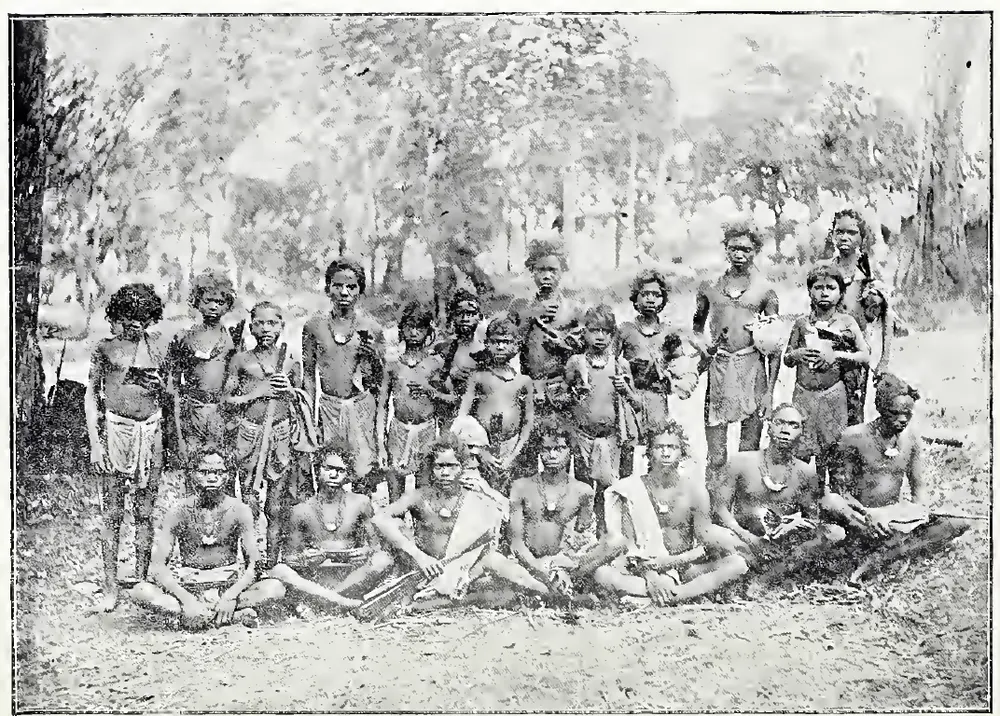
General remarks. The language of the Pulayas is Malayalam. Of all the classes engaged in field labour the Pulayas are the most backward as among them only 2 in every 1000 are literate.
The Pulayas occupy a very low rank in the social scale. They are a polluting caste; even other polluting castes above them are polluted by them. Formerly they were all slaves of the masters they worked under. Though slavery was abolished in 1855, the Pulayas are still attached to their lands, but cannot now be sold or treated as chattel. They are generally a hard-working race, but are reckless and improvident and filthy in their dress and habits. They are steeped in ignorance and superstition and generally very poor, but are distinguished for honesty and truthfulness. Their dwellings are miserable huts formed of sticks cut out of the woods, with walls of reed or mud and thatched with grass or cocoanut leaves, and are generally situated by the sides of rice fields or on mounds in their midst.
Hill Tribes. "There is a population of from 8000 to 10,000 wild hill men. They are quite distinct from the coolies living in 'lines' on the different tea estates, for they only go up to the hills for a time, while the tribesmen consider themselves the lords of the soil, and look on the forest as their home. They naturally prefer those places where they can obtain the most game and therefore retire before the approach of civilisation. They are divided into twelve or fourteen tribes, and never intermarry. They seem to have a perfect mutual understanding as to boundaries, for we never hear of disputes and feuds among them. They are dark in complexion, and many of them have short noses and thick lips. It is probable that they were the original inhabitants of Travancore, and that when the colony brought down from the north by Parasuramen disputed the land with them, they retired to the hills and escaped the slavery which fell to the lot of the Pulleyans. Some of them speak a corrupt Malayalam, others a language derived from the Tamil." *
Kanikkars. Origin. The Kanikkars are evidently the aborigines of the land who retreated to the hills in the face of the Dravidians first and then of the more powerful Aryan colonists brought by Parasurama. The present hill tribes are a class of nomads who subsisting mainly on agriculture, fruits and roots, make periodic migrations in groups from place to place. They carry with them their habitations wherever they move. They are found largely in Neyyattinkara and Nedumangad Taluqs and in a few hilly tracts of South Travancore and Quilon. They [408]assert that their progenitors were the two hill kings, Srirangan and Virappan, who emigrated from Pandy beyond the Agastyakudam Hills. Their social status is not so low as that of the Pulayas. The comparatively high caste artisans accept food from them. "The hill men have no objection to take food cooked by Sudras but seem to object to eat with Shanars, Izhavas, and still lower caste." Their present habitation and their crystallised customs and habits clearly show that they have remained where they are for a very long time uninfluenced by environments which have affected the habits and customs of their neighbours.
* The Land of the Conch Shell—Miss. Augusta M. Blandford, page 8.
They are a strong and well-built race fitted for the wilds they inhabit and are of active habits. They have developed a remarkable power of scenting the different kinds of wild animals at a great distance and can elude them successfully in the thickest forest.
Dress. They are as nature made them nude with only a semblance of dress, which, in the male, is a long but narrow strip of tattered cloth just sufficient to cover the front portion below the waist; but it is some relief to find women wearing ample garments so as to reach the knees from the waist all round. They wear the same simple attire in summer and in winter. Both the sexes have their hair long which is tied into a knot at the top of the head; many now adopt the front tuft. The men carry a little bit of a bag of cloth which contains the pan supari, the 'fragrant weed', which is an inevitable ingredient in Travancore life, and a cane-bag, which serves as a granary for daily crop of grain, roots, &c. Their weapons offensive and defensive comprise a bill-hook, a knife, a bow and arrows, and not unoften a hard cudgel to belabour wild animals in case of need. Rarely we find an old muzzle-loader and this is only intended to scare away birds and animals which molest them and their plantations.
Ornaments. The Kanikkar women adorn their bodies with a cluster of variegated beads and shells, which serve another but more useful purpose of furnishing a cover over the chest and abdomen. In addition, they bore the ear, and the heavy pendants of brass, lead or iron rings in the enlarged lobes almost graze the shoulders. They wear bracelets of the same massive materials. They wear finger rings also. Men delight in wearing ornments of shells and beads on their persons. Ear-rings also are worn. The civilised among them generally shave the face with a crude razor.
Habitation. Their habitations are neither elaborate in structure nor accommodating, but cosy and comfortable enough and afford sufficient [409]shelter from storm, rain and frost. Each settlement consists of a number of small huts, a good many of them being on the floor, and not a few higher up on the branches of trees compactly built of reeds and leaves. These afford shelter from the ravages of huge elephants; hence they are called Anamadams (Elephant huts). The ceilings are made of reeds, bamboos, leaves and the stems of the elephant reed (Malocana Rheedie); certainly they do not aim at any architectural grandeur or fineness.
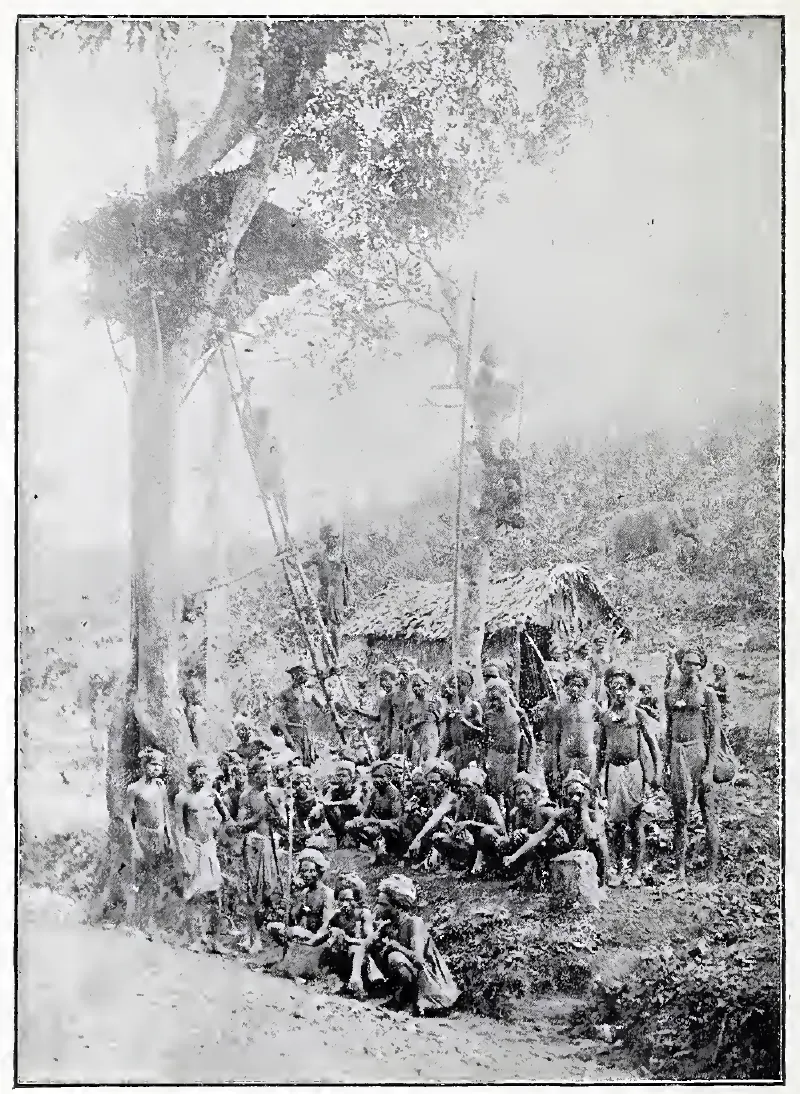
Language. They speak a mixed dialect of Tamil and Malayalam, but neither the compound nor the component tongues sit comfortable on their lips, but none the less they make themselves sufficiently intelligible in communicating their crude ideas to their civilised brethren of the plains.
Food and Drink. The menu in their wild banquet consists of birds, beasts and fish—a good variety of them. Even reptiles are a luxury to them. Some of them have a great liking for the flesh of the black monkey. Besides these, they eat roots, wild vegetables, tapioca, chakravalli or sweet potato and the like. Among the desserts come the bamboo plantains. Millet, ragi, tenai, (a cereal) and pulses complement these. The cow is held sacred and inviolable and is therefore not eaten. They seem to have an instinctive horror for the flesh of the tiger.
Many of them are addicted to opium. Tobacco is largely used. The virus of drink also has entered into the vitals of this community, but women with the strange conservatism characteristic of their sex, abhor intoxicants and abstain from liquor.
Government. Each tract or Kani is under the protection and control of the patriarchal chieftain styled Mootta Kani or chief Kanikkar whose office is often hereditary in the same family. He is the lodestar that guides them in weal and woe. He is the supreme arbiter of Kani disputes and director of their fortunes in matters religious, social and agricultural. He is in fact an untitled petty sovereign over them all. A panchayat of elders is the final court of appeal over whose deliberations he presides.
Occupation. Agriculture is the chief occupation of the Kanikkars. The land is duly tilled, the seed is sown and in due time the harvest is gathered in; but the agriculture is migratory and these untrained people unable to apply advanced methods of rejuvenating the lands, mercilessly extract every iota of vitality out of it; thus the land sapped gradually of its richness by ignorance and avarice, refuses to yield after a certain time. The margin of cultivation being thus reduced to the lowest point, the cultivator has no other option but to quit the land upon which he has squatted.
[410]
"The varieties of cereals grown by them are, Hill paddy such as Kanathava, Pinappukkadu, Chennallu, Vellavalam, and Muthucheri and Millet, Ragi, Thenai and pulses. Of roots and tubers, they grow Tapioca, Valli or sweet potatoes and the like. Of plantains, they grow several varieties including the bamboo plantain. They grow also ganja and tobacco for their own consumption." *
In addition to agricultural produce they collect and obtain natural products of the hills.
"The Kanikkars go to the neighbouring forests and gathering such natural products as Neduvan Nooran, Nooli, and Kavala roots, boil and eat them. In the months of Medam and Edavom, they gather honey from clefts of rocks or from branches of trees and bring the same for sale in Thenkombu or bamboo joints adapted for holding it. Three varieties of honey, Chiruthen, Perunthen and Thoduthen, are thus collected by them. They also collect and supply to the Sirkar or its contractors for a small Kudivaram or remuneration such minor forest produce, as wild cardamoms, dammer or Kunthrikam, wax and wild ginger, besides honey. They entrap the wild boar and tiger in Dalis or traps constructed of timber resting on a spring contact with which lets fall a crushing weight on the beast. They are good at bamboo, rattan and reed wicker-work or basket work of different kinds". †
Marriage. The system of marriage obtaining among them is not unlike that of the Marumakkathayis, which is mainly of the nature of a social contract. This system differs not materially from that prevailing among the Dasi community of Southern India. The union is more or less of a quasi-religious character. The relationship can be sundered at the will of either party. The presentation of a cloth seems to be the chief item in the marriage bond. The months of Meenom and Karkadakam seem to be the season for matrimony. "Boys marry at and after 16, girls beyond 12. The bridegroom offers the present of a cloth to the mother of the bride, besides one to the bride and a present of five-and-a-half fanams in the case of a bride who has attained age and seven-and-a-half fanams in the case of a bride who has not, to the uncle or father-in-law four chuckrams of which go to the father of the bride. A two chuckram silver Thali is tied by the bridegroom direct in the case of a girl of the latter kind and through his sister to one of the former. On the marriage day the feast is held in the bride's father's house and on the next in the bridegroom's". ‡ There seems to be no enforced widowhood, and marriage too does not seem to be obligatory on either sex. Lifelong celibacy is not uncommon. The widow can repeat her choice of partners as often as she likes but only with the consent of the clan. The cloth-giving [411]ceremony has, however, to be repeated on every such occasion. Polygamy is not prohibited, but they consider infant marriage undesirable. The choice of bride and bridegroom seems to be circumscribed by certain limits, as for instance, children of sisters are not considered fit for connubial alliance, but the daughter of a brother can enter into alliance with the son of his sister; objection, however, is taken to the son of a brother marrying the daughter of his sister though in exceptional cases it is allowed. Exogamous alliances are rare.
* Mr. Ratnaswami Aiyar's Kanikkars (Indian Review, August 1904).
† Ibid.
‡ Ibid.
Funeral rites. Of rites and ceremonies they have only a few. When one of their kinsmen or kinswomen dies the body is consigned to a pit dug for the purpose sufficient to cover it; they observe pollution for seven days; cremation is not practised.
Inheritance. The movable property descends to the nephew, and there is little scope for immovable property as their habits are migratory; but the Kanikkar gives all that he likes to his children during his life time. Generally one half of the property goes to the Seshakaran (nephew) and the other half to the sons.
Religion. "The Kanikkars feel also the existence of a higher power or a God, whom they do not worship in the form of a specially made image, but to whom they offer sacrifice of plantain fruits and rice flour on an even raised ground, in the months of Kanni and Meenum and generally on occasions of sowing, harvest or domestic events. They worship also sylvan deities set up by other classes in shrines, or God in the manifested form of huge rocks and Kavus or forests. The Kanikkar is thus still, if not in the fetish, in the primitive stage of worship—probably the first stage in the religious evolution of all races. Ethically he is much an undefiled being so far—however unclean he may be from a physical point of view." *
One tribe is known to worship every year on a certain day the tools of its ancestors. They also believe in some mantrams which are used in driving away tigers or preventing sickness.
Habits and Customs. Some of the customs of the Kanikkars are peculiar.
"Whenever Kanikkars from the different Kanis or settlements in the different hills have to be gathered together for a common meeting or for going together elsewhere on a common purpose, a messenger amongst them carries from one Kani to another the message with a knot of fibres of creepers, which serves as a symbol of a call for such meeting. The knot of fibre is passed on from one Kani to another till the required assembly is secured. It is thus they communicate with each other to go in a group to His Highness the Maharajah which they do occasionally once in a year or two. The Maharajahs always receive them kindly, accepting the nuzzur they offer in the shape of (1) the bamboo plantain wlth large though few fruits, (2) a parcel of Muthucheri Hill-paddy seed, (3) bamboo joints holding honey of different varieties and [412](4) Virukachattam or a parcel of civet. The customary modes of Court address and the prescribed etiquette are alike unknown to and unused by these unsophisticated Hill tribes, and the Maharajahs, pleased with their simplicity and unaffected homage, reward them with presents of cloth, money, salt and tobacco, with which they return satisfied to their jungle homes. ... ... The Kanikkars do not drug themselves and have no faith in medicine. The medicine-man and the priest are one and the same individual who by his Chattu and Pattu, or mantrams and songs, works himself up into a state of inspiration and excitement, and by his passes and touches as well as incantations and oracular pronouncements is supposed to cure the patient. Faith-cure is, according to their account, doing wonders amongst them." *
* Mr. Ratnaswami Aiyar's Kanikkars (Indian Review, August 1902.)
Another peculiar custom is that the women do not utter their husbands' names. It is held too sacred for mention: they are not alone in this field, as among the higher castes, this custom is strictly adhered to. Still more striking is the habit for the woman to deny herself the pleasure of sitting with her husband in presence of others and much more, in eating with him, though in the case of Brahmins the wife takes meal after the husband from the same leaf. In these days of civilised methods of producing fire, these hill tribes, in plenitude of ignorance, still stick to the ancient method of getting fire by rubbing together two pieces of wood. The wood is called Mirutha Maram (Isora corylifolia.) In case of clearing of a forest the auspicious day chosen is Friday in the month of Vrischigam, Dhanoo and Makaram (November, December and January). The seed is sown in the months of Meenum, Medam and Edavom (April, May and June) on a Friday.
General remarks. These hill tribes inhabiting the inaccessible wilds keep to their pristine purity in thought, word and deed. They in some respects surpass the civilised townsmen in the practice of cardinal virtues that regulate human life—truth, honesty, simplicity, credulity, modesty, law-abiding quality and above all hospitality.
Population. The last Census gives 4,139 as their total population. Miss Blandford observes:—"They are decreasing in number, small-pox carries off a great many, vaccination being unknown among them. When this disease appears they generally leave the sick to take care of themselves and the whole tribe decamps. As they have no medicines cholera and fevers carry off large numbers." †
Uralis. Origin. The name indicates the ruler of a country or village (Ur a country or village and ali a ruler). The records of recent history have nothing to show as to their origin or the locality they occupied. This term is not specially confined to the class of people inhabiting parts of [413]Travancore, but also refers to the people of the same denomination found chiefly in the districts of Madura and Trichinopoly. Mr. Edgar Thurston speaks of another class of people of the same name who inhabit the jungles of Dinbhum, (Coimbatore District) at an altitude of 1,800 ft. This latter class referred to, call themselves Uralis or Irulas. They speak a patois of mixed Tamil and Canarese and have a number of exogamous septs; but the class of Uralis whom we meet with in the hills of Travancore speak a kind of corrupt Malayalam. The true origin of these hill-men seems to be lost in obscurity. But judging from ethnological data and comparing our Uralis with those of Coimbatore, Madura, Tinnevelly and Trichinopoly, we may be justified in stating that the Travancore Uralis are not generically different from the Uralis that inhabit the hilly recesses of those districts. Traditional accounts state that "they were the dependents of the kings of Madura and that their duty was to hold umbrellas in times of state processions. In ancient times many of the parts now included in the Todupuzha Taluq belonged to the kingdom of Madura. Once when the king came to Neriyamangalam, the ancestors of these Uralis are said to have accompanied him and were probably left there to rule that locality". * They are, at present, found in the Cardamom Hills, in Aladi, Ponpara, Moongathara, Kochezhapperappu, Valia Ezhapperappu, Todupuzha, Velampam, Kurakkanat, Kunnanat, Mannukat, Kalanat and Periyar.
* Mr. Ratnaswami Aiyar's Kanikkars (Indian Review August 1902).
† The land of Conch Shell—Miss. Augusta M. Blandford. Page 10.
Personal Appearance. The following description of the Mala Adiyars of the lower Periyar valley by Mr. A. M. Sawyer is equally applicable to the Uralis:—"In stature and physique, colour, facial appearance, dress, habits, language, customs, and manners, the Mala Adiyars or Mountain Slaves of the Lower Periyar valley resemble the Uralis of Neriyamangalam more than any other of the eight principal hill tribes inhabiting the hill-forests of Travancore. Of middle height, they are fairly thick set, of dark-brown colour, with brownish-to-black eyes, curly hair, flat noses and of protruding upper lips, receding foreheads and chins, prominent cheek bones, and generally smooth faces. Both men and women wear the hair long, either loose or knotted on the top of the head." † Men generally allow their hair to grow, the face alone being occasionally shaven. They are tolerably cleanly and observe regularity in bathing.
Dress and Ornaments. Men wrap themselves with two pieces of cloth, one for the upper and another and a longer piece for the lower part of [414]the body, reaching from the hip to the knees. Women too adopt bifurcation in dress. They are tolerably trim in their appearance.
* Travancore Census Report for 1901. Page. 350.
† The Malabar Quarterly Review for September 1904.
Males wear rings of brass, sometimes of silver, on fingers and toes. Wreaths of beads from fifteen to thirty in number, are worn on the neck as an ornament. Women wear what is known as Katumani composed of rings of brass or lead.
Food and Drink. Rice and meat form the chief articles of food. The paddy they raise by cultivation barely sustains them for six months in the year, a large portion of it having to be exchanged for clothing, salt and other commodities from the low-country. For the remaining half of the year, the Uralis are forced to live upon what they can get from the forest, whether in the form of flesh or in the form of roots and fruits. The buffalo and the elephant are held in great respect, even the very approach of the former being most religiously avoided. They sometimes, but very rarely, keep cows for their milk. They rear fowls which also serve them a good deal in the absence of corn. The morning drink or kadi is essential, but tea supplemented by roots and fruits seems to have displaced it.
Marriage. The choice of the bride and bridegroom is left to the parents. No Tali is used as the marriage tie. The elders of the bridegroom's family, with cloth and necklace, repair to the bride's house, signify their intention, give the bride a cloth and ornaments and take her home with them. The bride thenceforward becomes a wife. For every girl given away in marriage one has to be taken in return. According to this customary usage families suffering from a plethora of girls have to take back as many daughters-in-law as they have girls to dispose of, with the result, that an Urali has sometimes to take in six or seven wives, in which case, he is expected to live away from his parental home and work for himself and his numerous wives. Another evil resulting from this custom is the undesirable increase of lifelong bachelors. The Uralis contract alliance with the Ullatans and in rare instances with the Mutuvans. Widow remarriage is not prohibited.
Religion and worship. The sylvan deities are worshipped and propitiated by offerings and sacrifices. Special prayers are also offered to the manes of departed ancestors.
Customs and ceremonies. The new-crop or the Puttari day is religiously observed by puja and feast. During the opening harvest they conduct puja, a hollow dry reed with pebbles in it serving as a bell. This puja is accompanied by a sumptuous feast amidst great rejoicing and revelry. The Urali is most punctilious in the performance of [415]these ceremonies and would rather starve for some days than relinquish his cherished ceremonies. When one falls ill no doctor or medicine is resorted to, except charms and incantations. Men are sometimes supposed to be under the influence of ghosts in certain diseases (mental and nervous), and the supposed devil is exorcised by these mantrams and charms. The sorcerers are supposed to derive the divine afflatus by a period of apprenticeship under their forefathers who are believed to assume the anthropomorphic form of a maiden and teach the secret doctrine as a panacea for all ills.
The natal rites are rather tedious. During confinement the woman is segregated to a secluded corner, in a hut built for the purpose. Here she is lodged for a period of twelve days. Then for another shorter term of five days she is brought nearer home and located in a similar hut. She is considered impure for twenty days after childbirth, so much so, that she is not allowed to touch even the roof of the house. The tank in which she bathes is considered irremediably polluted. A special pool of water is designed for this purpose called Pattu-vellam. The Uralis when they camp out, scrupulously avoid way-side tanks or pools, being afraid of its possible pollution in the past. They also consider the proximity of a Pulaya polluting.
The husband observes pollution for three days on the birth of the first child. The wife's relatives, however, have to observe five days' pollution. On the eighteenth day after birth, the eldest member of the family is accorded the privilege of naming the child and boring its ear. The child, when able to walk safely on the ground, has the crown of its head converted into a kudumi (a tuft of hair).
Funeral rites. The Uralis bury their dead at a distance from their dwelling places. This is one of the chief distinctions between them and their namesakes of Madura and Trichinopoly, who burn their dead. Every relative is expected, as a last tribute to the dead, to throw a new cloth on the corpse. A shed is erected as a mark of respect to the deceased, within which are placed an offering of boiled rice, betel, nuts, and his chopping knife. After the lapse of seven years an offering of food and drink is served to the soul of the departed ancestor. The death pollution lasts for sixteen days.
Inheritance and occupation. The Uralis are Marumakkathayis. Agriculture and hunting chiefly occupy their attention. Agriculture is of a migratory nature and their huts, which they take from place to place in quest of fresh fields for cultivation, are called Pantals. The [416]intervals of agricultural labour are spent in catching birds for their food. They are adepts in catching elephants in which Government generally employ them. They are clever huntsmen and are deeply attached to their dogs. They are, like the Kanikkars, exempt from taxation, but in return they render some assistance to Government in keeping watch over the Government plantations, cardamom gardens, &c. They make excellent mats of reed.
Language and Education. They speak a kind of corrupt Malayalam, but those who have had the chance of moving in higher circles or of receiving education, speak a purer form of it. The name most common among women is Kinnuki, and those among men are Kolampan, Maniakken, &c. The initiative to educate these hill tribes seems to have originally fallen to the lot of missionaries. The late Rev. Henry Baker, one of the earliest of the C. M. S. Missionaries of Kottayam (1818-1843), devoted his labours in these untrodden hilly tracts of North Travancore not without some reward. His attempts to open a school were attended with some success, and after his retirement in 1843, the mantle fell upon his son (Rev. Henry Baker Junior) who maintained, not unsuccessfully, the school established by his father, for a period of five years. But the unfortunate death of this missionary brought the school to an untimely close. However, subsequent Christian philanthropists have taken up the work again and, as the result of it, there are now two schools at Mekkanam under their supervision and attended by a good number of boys. Many of the Uralis can now read and write.
Character. The Uralis are characterised by honesty, simplicity and straightforwardness in their dealings. They serve as good forest guides to strangers. They respect parental authority.
Population. The latest return of the Census gives their number as 220.
Ullatans. Origin and designation. It is said that they are the descendants from a Nambudiri woman who on being proclaimed an outcaste, said, 'Ullatana' meaning 'that (the offence for which she was ostracised) is true'.
Abode and Occupation. "The Ullatans and the Nayatis are found in the low country as well as on the hills. At a remote period, certain Ullata families from the plains settled themselves at Talpurakotta near Sabarimala, and even to-day pilgrims to Sabarimala consider this place as sacred. In the low country the offerings to the same deities as the Ullatans worship, are offered by the Valans. Hence the Ullatans were called by them Kochchuvalans. The place near Sabarimala where they once dwelt is known as Kochchuvalakkuti or the [417]cottage of the Kochchuvalan. Most of these Ullatans have left this place for fear of wild beasts and are now straying in the woods with no fixed abode."*
Ragi is the chief grain grown. These classes are excellent huntsmen who collect bees' wax and other forest produce. They are keen sportsmen and use guns in hunting.
Food and Habitation. They subsist on grain, wild yam, fruits and other products which the forest yields in plenty. Their dwellings which are made of reeds and bamboos are cosy and comfortable.
General Remarks. "A curious marriage custom prevalent among them is thus related by Dr. Day. "A large round building is made of leaves and inside this the bride is ensconced. All the eligible young men of the village then assemble and form a ring around this hut. At a short distance sits the girl's father or the nearest male relative, with a tom-tom in his hands, and a few more musical instruments complete the scene. Presently the music begins. The young men each armed with a bamboo, commence dancing round the hut into which each of them thrusts his stick. This continues about an hour, when the owner of whichever bamboo she seizes, becomes the fortunate husband of the concealed bride. A feast then follows. The ceremony is now complete, whilst there is no divorce" When a girl is sent to the house of the husband, a sum of 25 Rasis, two brass vessels and a casket or chellam are given away as dowry."† The death pollution is observed for seven days. Property descends by the Marumakkathayam law to the nephew.
Population. Their total number comes to 161 according to the last Census, Minachil returning 88.
Hill Pandarams. These hill men are still in a very primitive condition. The barks of trees are their clothing and rocks, caves and hollows of trees their houses. They talk a corrupt form of Tamil. They number 51 according to the last Census.
Mannans. This class of hill tribes too were formerly dependants of the kings of Madura who followed them to Neriyamangalam like the Uralis and the Mutuvans. "One of the ancient chiefs of Poonyat nominated three of these Mannans as his agents at three different centres in his dominions, one to live at Tollairamalai with a silver sword as badge and with the title of Varayil Kizh Mannan, a second to live at Mannankantam with a bracelet and with the title of Gopura Mannan and a third at Utumpanchola with a silver cane and with the title of Talamala Mannan. [418]For these headmen the other Mannans are expected to do a lot of miscellaneous services."* The Mannans alone among the tribes of hill men are seen to occupy well-built huts.
* Travancore Census Report for 1901.
† Ibid—Page 353.
Dress and Ornaments. Men and women among these dress like the Maravans. Men use silver and brass rings; women wear wreaths of white and red-coloured beads round the neck and bracelets of brass round the wrist.
Food and Drink. The Mannans eat monkey's flesh, but not that of the fox, snake, crocodile, buffalo and cow; the last named animal is avoided on account of the traditional respect which it has enjoyed for centuries. Drinking is a common vice with this tribe.
Ceremonies. Marriage should primarily obtain the sanction of the headman who exercises supervision over all their dealings. Tali-tying is the chief ceremony. The nephew marrying his maternal uncle's daughter is a common practice. The Tali is removed after the demise of the first husband; but widows can remarry. The Mannan does not name his child until it is a year old, when he gives it a name and ties a wreath of beads round its neck. The Mannans bury their dead. The dead body is encased in a coffin made of bamboo and reeds and carried to the grave with music and beating of drums. The ornaments worn by the deceased are buried with the body, and some rice is put into the mouth. At the end of a year, an offering of food and water is made to the dead.
General Remarks. Their language is Tamil. They worship Sasta of Sabarimala and Periyar. They know of no higher deities. Agriculture is their chief occupation. They possess some good knowledge of medicinal herbs, but believe also in the efficacy of the incantation called chattu. They follow the Marumakkathayam law of inheritance, but sons also get a portion of the father's property.
Population. The last Census gives a total of 1,172 Mannans, 615 being males and 557 females. The whole of this number is returned from the Cardamom Hills.
Mutuvans. Another class of Hill-tribes called the Mutuvans, mentioned along with the Uralis and the Mannans is said tohave emigrated (according to tradition), from Madura. "The general belief is that they were driven to the hills in the latter part of the 18th century by the Mahomedan invaders. When they left Madura they carried with them (on their back or Mutuku) the Goddess Minakshi and brought the image [419]to Neriyamangalam. Hence they say they were called Mutuvans, i. e., those who carried something on their back. ... ... The Mutuvans are now found in Mannankantam, Anakulam, Trikkarmalai and other hilly tracts of the Todupuzha Taluk."* They live in huts built like those of the Uralis.
* Travancore Census Report for 1901.
Dress and ornaments. Their dress is like that of the Mannans, the peculiarity being a turban in the case of men; and even this luxury is not to be enjoyed without the permission of the headman among them, called Vakka. The dress of the women is a white or coloured cloth ten or twelve cubits long. As with the other hill men and women the ornaments for the nose and ear are of brass. "Wreaths of coloured beads not less than three in number for the neck, 10 or 12 brass iron bracelets for the wrist and one called Mutakku for the upper arms, are also worn."†
Ceremonies. "A peculiar practice with the Mutuvans is that after the marriage is settled the bridegroom forcibly takes away the maiden from her mother's house when she goes out for water or firewood and lives with her separately for a few days or weeks in some secluded part of the forest. They then return, unless, in the meanwhile, they are searched for and brought back by their relations. No Tali is tied around the bride's neck. But new cloths are brought by the bridegroom and presented to the bride."‡
General Remarks. The gods worshipped by these are Chantiattu Bhagavati and Neriyamangalam Sasta. Mutuvans talk a corrupt Tamil. Their occupation is migratory agriculture. Marumakkattayam is the law. The son also gets a portion. The migratory habits of Mutuvans cannot give them any landed property.
Population. The latest return of Census gives a total of 808, of which 413 are found in the Cardamom Hills, 212 in Muvattupuzha and 183 in Todupuzha.
Malayarayan. The people of this class are short in stature and seem more civilised than the Mannans and other hill tribes and possess regular habitations on the hilly slopes. The site they occupy presents fine appearance being studded with palms. The fixity of occupation and abode have made some of them rich enough to own large plots of land for cultivation. They seldom work for hire or carry loads.
* Travancore Census Report for 1901.
† Ibid.
‡ Ibid.
[420]General Remarks. They are good hunters and have a special liking for monkey's flesh. In common with the other hill tribes they share the evil of drinking. Unlike the Mannans and Mutuvans, the Malayarayans talk a corrupt Malayalam. The marriage custom is very peculiar. "The bridegroom and the bride sit and eat on the same plantain leaf after which the tali is tied. The bride then seizes any ornament or cooking vessel in the house, saying that it is her father's. The bridegroom snatches it from her and the marriage rite is concluded."* Pollution in childbirth is strictly observed. The father curiously enough observes it for one month whereas the mother observes it only for a week. The dead body is buried. The last Census gives a population of 2,048 of these hill men.
* Travancore Census Report for 1901.
[421]
Chapter XMalayalam Language and Literature.
"Mine is the world of thought, the world of dream,
Mine all the past, and all the future mine.
* * * * * *
"In the dark hour of shame, I deigned to stand
Before the frowning peers at Bacon's side;
On a far shore I smoothed with tender hand,
Through months of pain, the sleepless bed of Hyde.
"I brought the wise and brave of ancient days
To cheer the cell where Raleigh pined alone,
I lighted Milton's darkness with the blaze
Of the bright ranks that guard the eternal throne."
Macaulay.
Malayalam Language. The Malayalam language belongs to the Dravidian family of tongues, its other co-ordinates being Tamil, Telugu, Canarese and Tulu. Of these Malayalam has the closest affinity to Tamil, so much so that scholars have not yet agreed as to their exact relationship. Dr. Caldwell calls Malayalam a "very ancient and much altered offshoot of Tamil", while Dr. Gundert says "the two languages of old differed rather as dialects of the same member of the Dravidian family than as separate languages." Canarese has affected its pronunciation, while Telugu contains many roots common with it. The dropping of the personal endings in verbs is the one distinguishing feature of modern Malayalam though they are still occasionally met with in poetry.
We have few means of tracing the development of the language into its modern form. Records of the earliest writings, if there were any, have not been preserved, and even the oldest songs extant show signs of modernisation. The earliest phase of the language must have been scarcely distinguishable from that dialect of Tamil which is called Koduntamil by scholars, from which it sprang. Separated from the parent stock by the natural barriers of the ghauts, the offshoot must have undergone gradual changes according to circumstances and the nature of the soil.
Note. The information under this heading is based on a paper furnished by Mr. A. R. Rajaraja Varma, Koil Tampuran, M. A., M. R. A. S., Superintendent of Vernacular Studies in His Highness the Maharajah's College, Trivandrum. He is the nephew of M. R. Ry. Kerala Varma Avergal, C. S. I., M. R. A. S., F. R. H. S., Valiya Koil Tampuran, who has kindly read the proofs of this Chapter.
V. N.
[422]Phonetic decay, differentiation and other agencies of dialect-making, which are ever at work and especially so in the infancy of a language, must have had their full play, and Malayalam must have established itself as an independent dialect when a new and formidable agent of disintegration was brought into the field by the Aryan invaders headed by Parasurama. This was the Sanskrit language which has led the line of thought of the Indian mind and asserted its influence over every cultivated language of this vast continent. The Aryan immigrants, though they conquered the whole country and established themselves in the land, were too few in number to force their language upon the people. Naturally, therefore, the speech of the majority of the dwellers asserted itself as the common medium of expression for the country. Now Sanskrit does not recognise a distinction of gender in verb while in the Malayalam verb the mark of personality (in the third person) was denoted by different terminations for the three genders. Such a nicety in the language of their adoption, the new settlers looked upon with disdain as an unnecessary encumbrance, simply because it was not recognised by their own nobler mother-tongue. But the Malayalam verb in the third person, should it express person and number at all, could not, by nature of its grammar, do so without reference to the gender. To take an example, the function of the suffix -ân in Chonnan (ചൊന്നാൻ) is three-fold; it denotes the masculine gender, the third person and singular number. The dropping of gender in Malayalam, therefore, meant the dropping of all the three distinctions of gender, number and person at one stroke. Great must have been the confusion that followed as is evidenced by the few examples we still find in ancient extant works. Rama Charitam and Kerala Varma Ramayanam abound in such incorrect sentences as നീ ചൊന്നാൻ (nee chonnan) and നിങ്ങൾ ചൊന്നാർ (ningal chonnar), where an attempt is made to express number alone without reference to gender and person. In modern Malayalam the verb is divested of all marks of distinction except that of tense.
If the contact of Sanskrit thus far affected the grammar of the language, the changes it wrought in the vocabulary were far reaching and revolutionary. Not only did poets and authors indent upon Sanskrit for the expression of their lofty abstract ideas, but even the common folk began to indulge in the free use of Sanskrit terms. In fashionable circles young men must have displaced the homely idioms of the Vernacular with the fascinating expressions of the newly introduced classic. How else can we account for the appearance of Sanskrit words to express such common ideas of every day life as സുഖം, sukham, comfort; ദുഃഖം, duhkham, grief; [423]ദയ, daya, mercy; ആപത്തു, apattu, misfortune and the like? One may really wonder how the subjoined Sanskrit words gained currency in Malayalam, the corresponding indigenous words falling into disuse:—
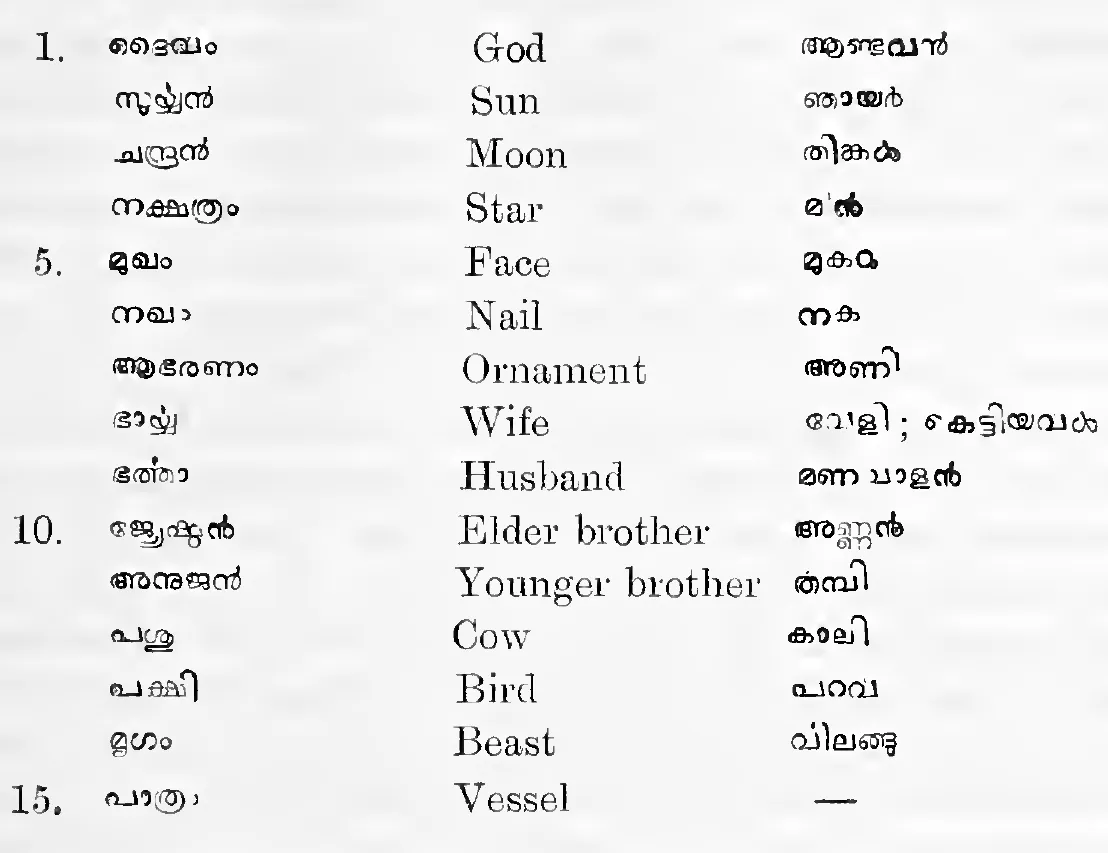
This unnecessary admixture of Sanskrit has led even a native grammarian to regard Malayalam as a dialect of Sanskrit instead of Tamil.
In spite of all these changes the literary language still continued, for a long time, to follow the old Tamil prototypes; for, the Brahmins, who had the monopoly of learning, wrote only in Sanskrit and cared little for the improvement of the vernacular. The poems of Ayyipilla Asan and Kannassa Panikkar have preserved for us specimens of the Malayalam poetry of this period. It was only an immediate successor in the field of poetry, or even a contemporary, as some suppose, of the latter (Kannassa Panikkar) that was destined to turn the old course of Malayalam poetry into a new and refined channel. This personage was the far renowned Ramanujan Ezhuttachchan of Tunchat, the brightest star that has appeared in the literary firmament of Malabar. Born of a low caste Sudra family and disliked on that score by the proud Brahmins for his rare intelligence and high attainments, he resolved to take a noble vengeance by bringing, by means of translations, the jealously-guarded treasures of Sanskrit literature, within the reach of his fellow caste-men. This was no easy task even for a genius of his stamp as long as the Malayalam language, which was to be the vehicle of those refined thoughts, remained a grammarless jargon. He set himself, therefore, to work and develop the latent resources of his mother-tongue. Fully realising the tendency of the [424]language and taste of those who spoke it, he rejected the defective alphabet of the current Vattezhuttu which could not correctly transliterate the borrowed Sanskrit words, and adopted instead the Aryan Ezhuttu, better known as Grantha characters, for writing out his translations. He next invented a new literary style of his own, blending Sanskrit and Malayalam idioms, and called it Manipravalam, which, like an alloy, proved to be of more practical value than either of the pure ingredients. For a metre also he had to exercise his creative genius, and the result was the Kilippattu metre which has a peculiar melody and flow of its own. In these lines was laid the foundation stone of the new Malayalam poetry.
Modern Malayalam has changed little from that of Ezhuttachchan's works. The admixture of Sanskrit words is going on unimpeded, and words of foreign origin, whether in their original garb or slightly altered, are finding their way into the language. The grammar is being deeply and scientifically studied and a new scientific grammar has been produced of late by a scholar of rare attainments. A change of opinion has been coming about the agreement between qualitative words and substantives. Scholars have thought it unnecessary to follow Sanskrit grammar in the use of these words. Expressions such as "മധുരമായ വാക്കുകൾ" which formerly would not be brooked are now considered correct and justifiable. An attempt of a bolder nature to inflect the qualitatives (വിശേഷണങ്ങൾ) regularly in case, gender and number to agree with substantives they qualify, in imitation of Sanskrit, had been made by Ezhuttachchan himself. This practice found favour with the Champu writers whose style marks the culminating point of Sanskrit influence in Malayalam poetry, and gained currency for a while. But no poet at the present day, however great a Sanskrit scholar he be, would tolerate a construction similar to what we find in the subjoined verse of Uttara Ramayana Champu:—
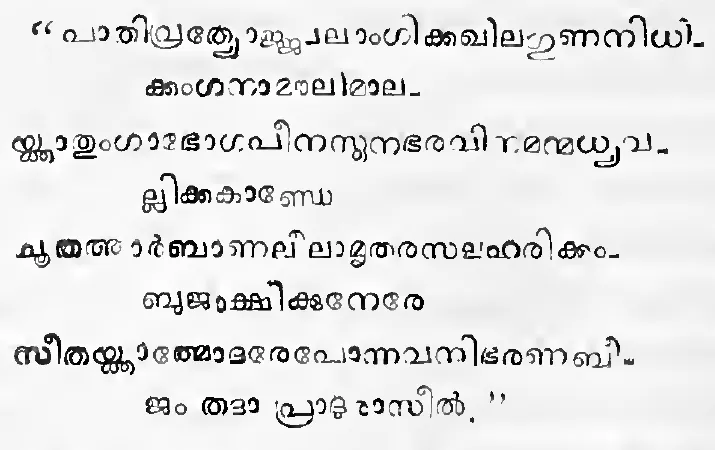
The study of English has influenced and is still influencing the Malayalam language. Malayalam prose which was written in an inelegant and unsettled style by old authors has received a new impetus. To M. R. Ry. Kerala Varma Avergal, C. S. I., M. R. A. S., F. R. H. S., Valiya [425]Koil Tampuran, scholar that he is in Malayalam as in Sanskrit, belongs the credit of having in recent years given a shape and form to Malayalam prose-writing, which has found considerable favour with his countrymen.
History of Literature. As in the case of other languages the thoughts and feelings of the Malayalam speaking people found expression first in verse. Prose composition is of a later origin and has scarcely any division to be made. The earliest forms of Malayalam verse are Pattus (പാട്ടുകൾ). Pattu literally means song. It has several varieties, viz, Brahmanippattu, Bhadrakalippattu, Sastrakalippattu, Sastappattu, Krishippattu, Nantunippattu, Onappattu, Vanchippattu, Kaikottippattu, Tiruvatirappattu, Kilippattu, Tullalpattu, Anchadis, Kathakalippattu, and a host of others with variations more or less peculiar to each. These Pattus are termed according to the subject of the poem, or after the instruments to which they are sung in accompaniment, or to the occasion on which they are sung, or to the person, who is described as singing or intended to sing them, or the dance to accompany which they are sung. Each has its peculiar characteristics, and it is no easy task to describe them at length. The most important of these Pattus are (1) Kilippattu, (2) Tullalpattu, (3) Kathakalippattu and (4) Tiruvatirappattu. Kilipattu literally means parrot-song, the poet putting the song into the parrot's mouth. This is a metrical invention peculiar to Malayalam, and different varieties of metre are employed. The metre moves slowly and dignifiedly and by the uniformity of cadence is considered best suited to sublime subjects.
Tullalpattu means "dance-song" and is sung to the accompaniment of music, pantomime and dancing. It has its counterpart in the ballad of English poetry and is well suited for the didactic narratives. Of Tullalpattu there are three classes:—Ottantullal, Parayantullal, and Sitankantullal. Ottans are vigorous, Parayans pathetic and Sitankans narrative in style.
Kathakalippattu is Malayalam dramatic song. The Kathakali is purely and most intensely national and is unlike Sanskrit or Greek dramas. These pattus are written in mixed sloka and padam, the former resembling the Sanskrit sloka, while the latter is a variety of song. These slokas connect the incidents of the story of the poem, while the padams represent the dialogue of the characters of the play.
Tiruvatirappattu, like Onappattu, which is sung in honour of Onam during Onam festivities, is intended to be sung during Tiruvatira day by the women of the land while they are engaged in the Tiruvatirakkali, a dance purely national and calculated as a means of bodily exercise to the fair sex.
[426]Bhadrakalippattu, Nantunippattu and Tottanpattu are sung in praise of Bhadrakali, the second being sung in accompaniment to the Nantuni, a stringed instrument of music. Vanchippattu or Vallappattu is intended to be sung by boat-men.
Besides the above pattus there are other varieties of Malayalam verse closely resembling or borrowed from Sanskrit. Pattus are regulated by matras and not by syllables in each foot or padam; while slokas are for the most part regulated by syllables, there being a few only of matra verses.
Of the Sanskrit types Malayalam has Nataka, Champu, Sandesa, minor Kavyams, &c., a few original, others mostly translations or adaptations from Sanskrit works. The Rupakas or dramas of Sanskrit have ten varieties, many of which have been adopted into Malayalam. We have the Nataka proper, the Natika and the Bhana, the first more numerous than the others. The Nataka is a Drisyakavyam, one intended for the stage; while Champu and Sandesa with the minor poems are Sravyakavyams, those intended for reading and not for representing on the stage. Natakas are poems in mixed verse and prose, Sandesams in verse, Champus in verse and metrical prose, while the minor kavyams are almost or wholly in verse. Of these the Sandesa (message) has for its theme a message from a husband to his wife who has been inevitably separated and is at a considerable distance from the other. The messenger is some animate or inanimate object. It is requested to undertake a journey to the abode of the lover. The poem consists of two parts, the first of which contains a vivid description of the chief sights on the way explained to the messenger by the lover, while the second contains a lengthy description of the city in which his wife lives and the actual message to her. Neither of these parts contains more than a hundred verses.
We shall now give a list of the most important authors and their principal works. Of these little mention need be made of the Sanskrit writers who flourished in Kerala during the Old Malayalam Period and after. Those mighty minds of old claim a better place in Sanskrit literature, though it cannot be gainsaid that their work had an influence on later Malayalam writers. The Malayalam Period saw many a Malayalam song coming to light, such as the Bhadrakalippattu, Brahmanippattu, Yattrakalippattu, Vallappattu, Andikuttuppattu, &c. Nothing is known of their real authors, nor is there at present any trace left to find them out. During the first part of the Middle Malayalam Period, too, many pattus have come into existence. The oldest poem now extant is Ramacharitam, the work of a Maharajah of Travancore [427]who lived in the 13th Century A. D., composed long before Sanskrit learning found favour in the land; it exhibits the earliest phase of the Malayalam language and savours more of Tamil than of Malayalam.
Another poet, about the same time, Ayyippilla Asan by name, a native of Neyyattinkara composed songs on Ramayanam, Patala Ramayanam and Sata-mukha-Ramayanam, all in Tamil metres and in a language in which Tamil words preponderate. He was at first a rude unlettered peasant. One day while he was working in the field the idea occurred to him that he should go and worship in the temple of Sri Padmanabha at Trivandrum. He entrusted his work to his younger brother and set off straightway for Trivandrum, where after worshipping in the temple, he begged alms of a certain old man who gave him a plantain fruit. After eating of the fruit the peasant became inspired and began to sing verses. The younger brother ate the rind and also became inspired.
The same story is repeated in the case of another poet named Vasu Bhattatiri who was at first a servant in the house of a priest. He flourished about the beginning of the Kollam era. He used to be particularly interested in listening to the texts of Puranams and Shastras repeated by the pupils of his master. As he could not for want of education pronounce words distinctly, his associates used to taunt him by calling him Vathu, a lisping form of Vasu his correct name.
One day, as usual, while he was coming back from a temple at Tiruvilakkavu, where he had gone to worship, it rained heavily and the ferry-boat, on which he was to cross an intervening stream which was in high floods, was on the other shore. Bhattatiri retraced his steps to the temple, where he spent the whole night. It was raining heavily and he had only one wet cloth on his waist. In despair he appealed to his favourite deity who gave him some fuel and fire to warm himself and a bunch of plantain fruits to appease his hunger with. After eating of the fruits he became by inspiration a poet of a high order. The sweeper woman who came early in the morning to the temple, learnt from him where he threw away the rind of the fruits and ate it herself. She also became a poetess. His chief works were two Kavyams, viz., Yudhishthira Vijayam and Tripura Dahanam.
Manavedan Raja of Calicut (c. 300 M. E. or 1125 A. D.), the author of Krishnattam, was contemporaneous with one of the three Vilvamangalam Swamiyars of great piety, and there is a legend that Sri Krishna appeared to him in the form of a small child and that he got from the God a [428]peacock feather as a souvenir. After this memorable incident a crown with peacock feathers was used by the actors during the performance of his play, the Krishnattam. He was a most learned prince of his time.
About the same time, in the 6th century of the Malabar era, there flourished another warbler, Kannassa Panikkar by name. His birthplace is near Trikkapolesvaram Temple at Niranam in the Tiruvalla Taluq. A couplet composed by him identifies the locality of his house. Early in life he was confronted with that fell adversary, poverty, and consequently had received little instruction. Tradition ascribes to him that, while after his twentieth year he was returning one day from the Siva temple, an old Brahmin gave him a plantain fruit and on his eating of that the Goddess of Learning blessed him with poetical skill and knowledge. He also possessed a house and property at Malayinkil near Trivandrum.
There are a few stories of interest regarding the relations between Panikkar and Ezhuttachchan another fellow poet, not the one who wrote the Adhyatma Ramayanam later on. These two brother poets met accidently on a Sivaratri night in the Alwaye temple whither they had gone to worship. Panikkar unknowingly tripped over Ezhuttachchan's foot and by way of excuse wittily requested him to regard him as a guru. To this, Ezhuttachchan replied by saying that whatever injuries he might be forced to inflict by provocation, should be regarded as dakshina or remuneration for the guru. Thus were they introduced to each other. Ever after this incident they continued as very intimate friends. On one occasion when in the house of Mampalli Pandarattil Panikkar was requested to read Ramayanam and Ezhuttachchan to explain the portions read, Panikkar was in a fix, for he could not read Sanskrit characters. Ezhuttachchan helped him out of his difficulty by asking him to read the title alone. Panikkar read 'Harih Sri Ganapataye Namah' the usual inaugural prayers in all religious treatises. Ezhuttachchan took up the first word Harih and expatiated upon it the whole night and thus saved his brother from humiliation. There are stories of several interesting dialogues between these two poets, in which puns and figures of speech are profusely used. He has written in what is called Muttamil, a blending of Sanskrit, Malayalam and Tamil, the following poems:—(1) Ramayanam, (2) Bhagavatam, (3) Brahmanda Puranam, (4) Bhagavat Gita, (5) Guru Gita and (6) Padmapuranam. His language shows the transition stage of Malayalam, a stage in which Malayalam tries to throw off Tamil inflections and Tamil grammatical formations. Panikkar has been fitly called "The Chaucer of Malayalam." With him closes the Middle Malayalam Period.
[429]Talakkulattu Bhattatiri c. 350 M. E. (1175 A. D.) was an astrologer of great repute. He became inspired after performing Bhajanam in the Trichur temple. By a special boon from his deity he was able to divine accurately the future of himself and of others. Once the Vilvamangalam Swamiyar was suffering from a chronic stomach-ache. On one occasion, when God Sri Krishna appeared before the Swamiyar, he prayed for a cure of his ailments, but the deity disappeared without seeming to pay any heed to his request at all. The Swamiyar then consulted a Yogi who gave him a medicine which completely cured him of his ailments. When next Sri Krishna appeared before him the Swamiyar informed him as to how he got relief from his sufferings. The god as soon as he heard of this from his favourite devotee was much disconcerted at the folly of escaping from sufferings which should be undergone during his present life which was to be the last for him. The god said that the relief thus foolishly secured necessitated three more births for him in this world. The Swamiyar felt very sorry for his thoughtlessness and went to consult the Bhattatiri as to what all births he was destined to undergo. The Bhattatiri saw into the future and prophesied that the Swamiyar was to be a rat-snake, then a bull and finally a tulasi plant before attaining Mukti or salvation. The Bhattatiri also knew that he was to undergo three such births along with the Swamiyar. The mantle of inspiration is said to have next fallen on one Kaniyan family at Pazhur in the Vaikam Taluq, where Bhattatiri begot a son on a young woman one night when he had been forced to halt there owing to rain and storm during a short journey. This family still maintains its reputation for astrological prognostications. His chief Malayalam works are treatises on Astronomy and Astrology.
Cherusseri Namburi "the morning star of Modern Malayalam Literature" next claims our attention. He flourished during the 7th Century M. E. He was born in Cherusseri Illam, at Badagara, in Kurumpranad Taluq, Malabar. His work Krishnagatha or Krishnapattu was composed, it is said, at the special request of Udaya Varma Raja of Kolatnad. Krishnagatha exhibits the phase of the Malayalam language during the latter part of the Middle Malayalam Period. During the latter part of the 7th century M. E. and the earlier part of the 8th century, there flourished another great poet who was the first to introduce into Malayalam that species of composition known as Kathakalippattu. This poet was a Raja of Kottarakkara and has produced eight Kathakalippatus based on the Ramayanam. They follow exactly the incidents narrated in the Valmiki Ramayanam as at that period Adhyatma Ramayanam [430]had not been known in Kerala. These eight Pattus are (1) Putrakameshti, (2) Sitasvayamvaram, (3) Vichchinnabhishekam, (4) Kharavadham, (5) Balivadham, (6) Toranayuddham, (7) Setubandhanam, and (8) Yuddham, the whole set making up a complete Ramayanam.
In the first part of the Modern Malayalam Period there flourished in Keralam several Sanskrit authors, Karunagapalli Lakshmidas Namburi, Eralpad Raja of Calicut, Manavikraman Raja (the Strong), Uddanda Sastrial, Chennassa Namburi, and others whose accounts may be omitted here.
Uddanda Sastri, a Brahmin scholar of great renown, visited Malabar and won laurels among the scholars there. He used to carry off all the prizes set apart for the best scholars of the land. The Nambudiris were very much ashamed of their inability to compete with this scholar from the East Coast. They worshipped the God at Guruvayur and prayed that a brilliant man of letters be born among them. Just at this time a woman of the Kakkasseri Illam was carrying. So the Nambudiris uttered mantrams over a bolus of butter and gave it to her every day that she might beget a gifted son. In due time a son was born to her, who, when he grew up, showed great talent for letters. It is said of him that as a child he was able to distinguish between crows. He beat Uddanda Sastri in discussions and carried off all the prizes of the year. There are several interesting anecdotes which depict the resourcefulness of this gifted Nambudiri who is known in the history of Malayalam Literature as the Kakkasseri Bhattatiri. One of his chief works was a Malayalam play, Vasumati Vikramam, a work which he is said to have written to match Mallikamaruta Prakaranam by Uddanda Sastri.
We next come to Tunchattu Ramanujan Ezhuttachchan, the father of Malayalam Literature, as he is rightly called. He was a brilliant scholar of great merit and occupies the foremost place among Malayalam authors.
Born in the Chekkala Nayar caste held low in the social scale among Nayars, he was the son of a Nambudiri Brahmin. The following is the story of his birth:—A Nambudiri Brahmin well versed in Sanskrit and astrology was once going home from Trivandrum. At Vettatnad on his way, being overtaken by night, he was forced to halt at a Sudra house the inmates of which were only a young woman and her old mother. The Nambudiri was duly welcomed and given a lodging in the portico with a bedding such as the house could afford. At dead of night the young woman saw the Nambudiri pacing to and fro restlessly, [431]looking at the stars. She gently approached him and enquired what his uneasiness was about, to which the learned Brahmin replied that he was aggrieved to find that a precious Muhurtam for begetting a gifted child as the position of the stars then indicated, was being lost as he could not reach his Illam. The young woman begged of him to make her the recipient of the blessing. The Nambudiri agreed. The offspring was the famous Ramanujan Ezhuttachchan. The poet's birthplace is near Trikkandiyur temple close to Vettattuputtinangadi village, in Vettatnad, Ponnani Taluq, South Malabar. His father, the Nambudiri, first taught him Sanskrit. While young, Ezhuttachchan is said to have found fault with the Nambudiris around him in their recitation of the Vedas. This roused their jealousy very much, so much so that they administered to him some drug which weakened his brain. Ezhuttachchan's father coming to know of this foul act of jealousy counteracted the effects of the drug by advising the boy to take to toddy-drinking which neutralized the charms and drugs of the Brahmins. About his sixteenth year he established a school for children and was teaching them elementary lessons in language and religion. Since there were no books for the purpose he himself wrote them. One of these was Ganashtakam, a small book containing prayers to Ganesa, which he taught to his boys. The Nambudiris who happened to see this hated him for this unauthorized attempt of his at religious teaching, and, out of contempt and jealousy, used to taunt him by questioning him how much oil his mill could yield a day, thus casting a reflection on his low Chekkala (oil-monger caste) birth. Ezhuttachchan replied with modesty that his mill turned out four and six at a time meaning that he was quite conversant with the four Vedas and the six Sastras and that he was the equal of any Brahmin in learning though by birth he happened to be a Sudra. There are several other stories about this poet which go to deify him. Once while an Adhyan Namburipad, with the object of testing the ability of the poet, feigned to have lost some portion of a manuscript copy of Devimahatmyam, and requested him to write it anew for which he gave the poet a cadjan leaf, an iron style and some toddy, the latter entered into an apartment and closed the door behind him and got drunk. The Nambudiri who was peeping through a crevice in the ceiling found that with the poet was seated a damsel who was writing the whole thing for him while he himself was lying senseless. The Numburipad recognised the Goddess Saraswati in the damsel who vanished as soon as the missing portion of the Devimahatmyam was written. This incident led to the poet being called Ezhuttachchan.
There is another story about his being the avatar of a Gandharva who was an eye-witness of the Mahabharata war.
[432]The whole of the Karna parva, one of the chapters of his Mahabharata, was written by him in answer to a thrust from the Nambudiris who in derision asked him one day to give the remaining portion of a prayer that they knew he casually gave out while worshipping in the Trikkantiyur temple.
He travelled abroad and picked up a knowledge of Tamil literature, which helped him very much in his translations. His chief works are (1) Ganapatistavam, (2) Harinamakirtanam, (3) Sivapuranam Kilippattu, (4) Devimahatmyam, (5) Kerala Natakam, (6) Ramayanam Irupattunalu Vrittam, (7) Adhyatma Ramayanam Kilippattu, (8) Patala Ramayanam Kilippattu (9) Bharatam Kilippattu, (10) Bhagavatam Kilippattu, (11) Chintaratnam and (12) Satamukha Ramayanam. Of these the Adhyatma Ramayanam, Bharatam and Bhagavatam stand in the front rank of Malayalam literature and more or less form its life-blood. Though most of these works are adaptations they show an originality unique and admirable. There is no gainsaying the fact that Ezhutachchan will ever be loved and revered by all Malayalam speaking people. The language employed in his work is one that is received with love and admiration in all times. At a time when learning had not reached the lower orders of Hindu society it is gratifying to note that Ezhuttachchan, a Chekkala Nayar, brought within the reach of the Malayalam speaking population those great truths which made his countrymen a more godly, a more learned, and a more enlightened people.
Puntanam Namburi, the author of Krishnakarnamritam, a work exhibiting godliness, was a native of Angadipuram and lived near the Guruvayur temple. He was a contemporary of that eminent poet Melpputtur Narayana Bhattatiri of whom mention will be made later on. Puntanam Namburi had composed, besides Karnamritam, two other pieces, Santanagopalam Pana and Jnanapana. He is said to have seen God Krishna, whom he is known to have propitiated by his excellence at poesy.
Achyuta Pisharadi of Trikkantiyur, born about 720 M. E., (1545 A. D.) has written a Sanskrit Grammar, Pravesakam, to teach Narayana Bhattatiri of Melpputtur. He was a great astronomical writer and has composed in Malayalam as well as in Sanskrit, Bhugoladipika, a work on Astronomy.
Narayana Bhattatiri of Melpputtur in Canannore, the author of Narayaniyam, was a poet of unparalleled renown. Stories are extant that in his youth he led a wild and wanton life, but having married a girl in Pisharadi's house his talents attracted the notice of Pisharadi who advised him to devote himself to some useful purpose. Thenceforward the [433]Bhattatiri put himself under his tuition and in subsequent years became so famous that he was considered as an avatar of Adisesha. He accompanied his guru to Pandy where they both studied the Vedas from a Brahmin. Pisharadi was struck down by rheumatism for having studied the Vedas against the ordinances of caste rules; but his disciple got the disease transferred to himself by means of incantations and relieved his teacher. Bhattatiri returned to his native place with the disease on and began to worship Sri Krishna in the Guruvayur temple, by propitiating whom he hoped to get rid of the ailment. During the long course of his bhajanam he wrote his greatest work Narayaniyam which was completed in 760 M. E. (1585 A. D.), on a day of the Kali era represented by the chronogram आयुरारोग्यसौख्यम् 'Ayurarogya Sankhyam'. On this day Bhattatiri was cured of all his ailments. He was a staunch devotee of Sri Krishna and the deity is said to have favoured him with frequent visits during sleep.
His works are chiefly in Sanskrit, Malayalam holding an inferior position. Narayaniyam, comprising in itself the incidents of Bhagavatam, is a stupendous monument of his poetical skill and erudition. He has written two works on Sanskrit grammar, Prakriyasarvasvam and Dhatukavyam and also several Prabandhams, Rajasuyam, &c. His Malayalam works are Advaitasatakam, Chandrika Mahotsavam and Kuttappatakam. Bhattatiri lived, it is surmised, between 730 and 800 M. E. (1555 A. D.-1625 A. D.).
Karunakaran Ezhuttachchan and Suryanarayanan Ezhuttachchan were the first and last disciples of Ramanujan Ezhuthachchan. The former was the author of Brahmandapuranam Kilippattu and Vetalacharitam, while the latter was the author of Skandapuranam Kilippattu. Gopalan Ezhuttachchan a disciple of the two poets was the author of Parvatisvayamvaram Kilippattu.
Leaving aside Kottur Unnittan, the author of Nachiketupuranam, we come to Kerala Varma Raja, c. 800 M. E. (1625 A. D.) a poet of rare attainments. He has left us Vairagyachandrodayam and Kerala Varma Ramayanam, the latter being founded on Valmiki Ramayanam.
He was himself a soldier, who, as had been already observed, was of immense help to the Travancore sovereign during the troublous times of the Mogul invasion of the State (1680-1683 A. D.). He was a special devotee of Sri Porkali Bhagavati, and his achievements are attributed to the favour of this Goddess. He may be called the "Philip Sidney of Malabar," the warrior-poet. Kerala Varma was unhappily killed by his enemies and consequently his Ramayanam work was left incomplete.
[434]Kottayattu Tampuran of Attakkatha fame flourished between 840 M. E. (1665 A. D.) and 920 M. E. (1743 A. D.). Brother to Kerala Varma mentioned above, he has written four Kathakalippattus; (1) Krimmiravadham, (2) Nivata-Kavacha-Vadham, (3) Baka-vadham and (4) Kalyanasaugandhikam, as also a Kilippattu, Mokshadayaprakaranam.
He was also a devotee of Sri Porkali Bhagavati, and his greatness is also attributed to this Goddess. His greatness as an actor apart from his literary achievements was known when he voluntarily and without the knowledge of others played the part of Oorvasi in his fiftieth year in a Kathakali performed in the Zamorin's palace, whither he had gone as a royal guest. The Zamorin, who used to regard the personation of Oorvasi with contempt because it had invariably been a failure, was very much pleased on this occasion with the new actor and was about to give him presents when he recognised, to his surprise, the person of the Kottayam Raja in the actor.
Mazhamangalam Namburi was an inspired poet; so was also Chelapparampu Namburi whose ability consisted in making extempore verses with great rapidity. Even as a boy Chelapparampu excelled his tutor so much that the latter is said to have left him one day to himself when he found his pupil too shrewd for him. His erotic verses and descriptions of nature were so life-like that men and nature are said to have been successfully moved by him. Once while he was travelling, his boat was about to be upset in a storm when, it is believed, his timely address to the lake and to the elements, in a sloka, pacified them and saved him from a perilous situation.
Mazhamangalam Namburi, Chelapparampu Namburi, and Punam Namburi were contemporaries who have between themselves composed several champus founded on Bharatam. The happy combination of ideas and the beauty of structure together with the easy flow of language, give them a place in the front rank of contributors to the Malayalam literature.
Born in 899 M. E. (1724 A. D.), Kartika Tirunal Maharajah of Travancore was a poet of renown. Before he was out of his teens he had acquired wide knowledge in Malayalam, Sanskrit, Hindustani, Persian and a few other languages, and gained experience in the arts of war. He greatly helped in protecting many Nambudiris, Chiefs and Rajas of Malabar who had taken refuge in Travancore, from the molestation of the Mahomedan invaders thereby safeguarding Malayalam to a great extent. To his court at Trivandrum there came, from time to time, many eminent poets, who all received kind patronage at his hands. Kartika Tirunal was the [435]author of several Kathakalippattus and Malayalam Slokas. The best amongst his works are the following Kathakalippattus:—(1) Rajasuyam, (2) Subhadraharanam, (3) Bakavadham, (4) Gandharvavijayam, (5) Panchali Svayamvaram and (6) Kalyanasaugandhikam. He passed away in 973 M. E. (1798 A. D.) He was the great Rama Rajah of Travancore
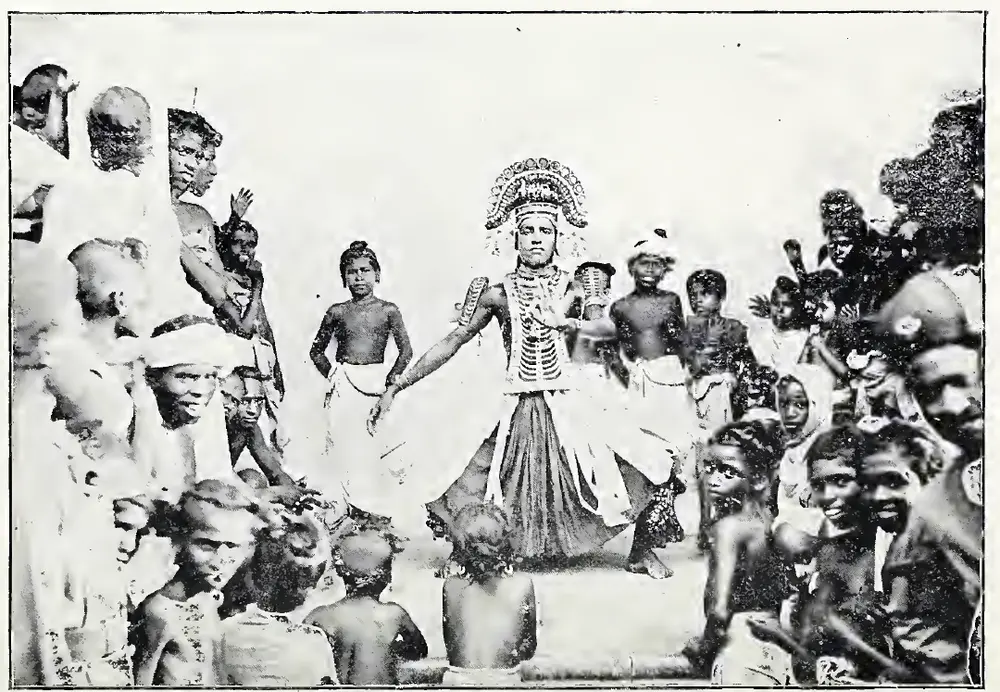
His nephew, known as Asvati Tirunal Tampuran was born in 931 M. E. (1756 A. D.). Early in life he showed signs of great poetical genius and was much admired by Kartika Tirunal, who, seeing Asvati fill up a verse which he had left incomplete, entrusted him with the completion of his work of Narakasuravadham Katha. Prince Asvati died when he was thirty-two years old. He has composed four Attakkathas:—(1) Ambarishacharitam, (2) Putana Moksham, (3) Rukminisvayamvaram and (4) Paundrakavadham, which are highly appreciated by scholars even to this day.
Kalakkattu Kunjan Nambiyar, a poet of uncommon genius, is the founder of that species of composition known as Tullalpattu. The date of his birth and death are not exactly known though it is surmised that he was a contemporary of Kartika Tirunal, at whose court he lived for a short period. He was the most successful poet of the time. He has written poems even in boyhood and got into the Raja of Chempakachery's favour in whose dominions he lived during the latter part of his life. His first Tullal is said to have originated in this way. While at Ampalapuzha in his younger days, he followed his original profession of beating the drum to the accompaniment of the Chakkiyar's Kuthu or narration. One day he was reproved by the Chakkiyar in the course of the Kuthu for omitting to beat the drum through carelessness. Nambiyar was very much offended at this insult and made a fresh departure in the literary field by writing a Tullakkatha an action-song that very night. The next day he was able to draw away the whole audience to witness his performance and thus caused the poor Chakkiyar to be left alone. He was very poor and sold several of his works for very slight remunerations.
When Ampalapuzha was conquered Nambiyar got himself introduced to the then King Kartika Tirunal of Travancore who was very kind to him throughout his stay at Trivandrum. Nambiyar was very witty in his conversations, and a vein of humour can be seen running through all his works. He once puzzled the Nambi Potti head-priest of Padmanabhaswamy's temple at Trivandrum by an enigmatic reply which, though meant to be a direct reply to the priest's query, was misunderstood by the latter for an impudent query in return. The Nambi got enraged and [436]represented the matter to the king. Nambiyar being asked, explained the whole affair by a sloka which very much pleased the king by the richness of humour it contained. On the eve of his returning home he was given large presents and his family was given a daily allowance of rice and milk-porridge at Ampalapuzha. A gifted poet, whose observation ranged from the humblest peasant to the highest king and from the tiny ant to the biggest elephant, Nambiyar had none to rival him. He censured any wrong-doer without the slightest fear and was held in great respect by all. He cared neither for the one nor for the other and did what the Press of to-day does to cry down every fault of the powers-that-be. Nambiyar's works are varied, mostly Tullalpattus. Patinaluvrittam, Silavati, Rukminisvayamvaram Pattuvrittam, Bhagavatam Irupattinalu vrittam, Srikrishnacharitam Manipravalam, Nalacharitam Kilippattu, Panchatantram Kilipattu, Uttara Ramayanam Kilipattu, Chanakyasutram Kilipattu and eight Attakkathas are his works besides Tullalpattus. Of Ottantullals he has composed twenty-six pieces; Sitankan six; Parayan six. No poet has done so much to enrich the Malayalam Language as Nambiyar. His Attakkathas are not appreciated as they have a close resemblance to Tullals. His works will continue to exercise their influence on the minds of men as long as the Malayalam language exists.
Mantavappallil Ittirarissa Menon, 920-980 M. E. (1745-1805 A. D.), Irattakkulangara Variyar 900-940 M. E. (1725-1765 A. D.), Kallur Namburipad 916-970 M. E. (1741-1795 A. D.) and Ravi Varma Koil Tampuran 900-947 M. E. (1725-1772 A. D.) were also poets of no mean order. They have produced several Attakkathas.
Another great Malayalam poet and contemporary of Nambiyar was Unnayivarar of the Attakkatha fame. His famous work the Nalacharitam Attakkatha is a very brilliant production of its kind and is admired for the excellence of its language and beauty of composition. He was known to the Maharajah of Travancore, and he lived with Nambiyar at Trivandrum for some years enlivening the court with his witty and learned conversations and jokes. His Nalacharitam is a masterpiece teeming with descriptions of scenes, of cities and forests, of gods and of love, and the passages have been set to music by the author with an accuracy and taste unsurpassed by any other writer. He has besides composed Parvati Svayamvaram, and Girijakalyanam Kilippattu. The date of his birth was about 915 M. E. (1740 A. D.) When he died is not accurately known.
Kallakkulangara Raghava Pisharadi, a native of Palghat Taluq, was a favourite of Ittikompi Raja of Palghat. He has, at the instance of the [437]Raja, composed Vetala charitam, Panchatantram and Setu Mahatmyam, these three being Kilippattus, and two Kathakalippattus, Ravanodbhavam and Nalacharitam.
Katiyankulam Suppu Menon 940-1000 M. E. (1765-1825 A. D.) was the author of four Killippattus. Ramapurattu Variyar 900 M. E.? i. e. (1725 A. D.?), the founder of that kind of composition known as Vanchippattu, was another poet who flourished about the same time. Kalakkattu Raghavan Nambiyar was the author of Sakuntalam Kathakalippattu in six parts. Kalakkattu Damodaran Nambiyar was the author of Vilvapuranam and Ekadasi Mahatmyam Kilippattus. Balakavi Rama Sastrial, Vidvan Karanatta Kurup, Pandarattasan and a few others who also flourished at this period, have composed several minor works.
Born in 988 M. E., (1813 A. D.), Svati Tirunal Maharajah of Travancore was the prince of poets of his period. He has composed numerous poetical works on religion, metaphysics, &c., Prabandhams, and various songs and hymns. His compositions in music are still masterpieces of the kind. He kept many learned men around him, the chief of whom were Ravi Varman Tampi, Kunju Krishna Potuval, and Rama Variyar, famous Malayalam poets of the time. He was well conversant with Telugu, Hindustani, Maratti and Sanskrit.
Vidvan Koil Tampuran, born in 987 M. E. (1812 A. D.) was literally a vidvan and a great poet. He was for a long time supported by the then Maharajah of Travancore at whose court he lived. His principal works are Ravana Vijayam Attakkatha and Santanagopalam Tullal. He died at the early age of thirty-three.
Ravi Varman Tampi, born in 958 M. E. ? (1783 A. D.), was a grandson of one of the Maharajahs of Travancore. He was a poet of great originality and learning. He began to write verses from his fourteenth year. A sloka composed by him in his fourteenth year was sent to Kartika Tirunal, who was himself a poet, and is said to have been highly appreciated by him; but Tampi was advised to read more before attempting at writing verses. He was, as it were, the Poet-laureate of Travancore at the time and has written several poems about the chief festivals and ceremonies of the State. He once defeated two Brahmin Pandits in the matter of versification and learning in the presence of the Maharajah, for which he was given handsome presents.
Once Tampi went to the palace to see a new-born royal babe which he took up in his hands and broke forth into a poetic effusion in the [438]form of a sweet lullaby which, even to-day, remains unsurpassed for its excellence in Malayalam literature. The comparisons used in the lullaby, which was quite extemporaneous, show what an amount of learning and knowledge the poet possessed. He wrote three Attakkathas based on the stories from the Mahabharata. He has, besides, composed Murajapappana and several other Manipravalam works. He was a most charming versifier.
Ezhupattu Nanukkutti Menon, who has earned a name in Kilippattu composition, was born in 1010 M. E. (1835 A. D.) at Chittur, in Cochin. He has composed Srimat Bhaghavatam in twelve parts, the eleventh part of the work being more widely read than the eleventh part of Tunchat Ezhuttachchan's Bhagavatam. Menon passed away in 1048 M. E. (1873 A. D.). It is said he knew previously when he would die and was prepared for it.
Ilattur Ramaswami Sastrial, born about 1000 M. E. (1825 A. D.) in the Shencottah Taluq, was a great poet and scholar. He has written many useful and instructive books of which the principal ones are Vrittaratnavali and Sri Ramastutiratnam in Sanskrit and Jalandhrasuravadham Kathakali, etc. in Malayalam.
Kovunni Nedungadi, the author of Kerala Kaumudi, a work on Malayalam Grammar, was a native of Valluvanad Taluq. He died in 1064 M. E. (1889 A. D.) at the age of sixty-four.
To M. R. Ry. Kerala Varma Avergal, C. S. I., the Consort of H. H. the late Senior Rani Lakshmi Bayi, C. I., belongs the credit, among modern scholars, of having given the greatest impetus to the Malayalam literature of the present day. As President of the Travancore Book Committee he has been instrumental in reforming and rejuvenating Malayalam literature. His earlier works, which are still unpublished, are Narasimhâvatâram, Skândasatakam and others, Matsyavallabha Charitam Kathakali, Hanumadudbhavam Kathakali, Pralambavadham Kathakali, Dhruva Charitam Kathakali, Parasurama Vijayam Kathakali, Visakharaja Vijayam (Sanskrit Mahakavya), Sringara Manjari (Bhana), Kamsa Vadham (Champu), &c., are his other works. His translation of the Sanskrit Sakuntalam into Malayalam was an epoch-making work, for it led the way to the appearance of hundreds of Malayalam plays, almost a sudden explosion of indigenous talent in Malayalam dramatic literature—so great was the change wrought in dramatic composition of our time. Anyâpadesa Satakam and Amaruka Satakam are also two of his best metrical translations. His Mayura Sandesam (Peacock Messenger), an original work of rare [439]merit, also induced many imitations. His prose works are mostly educational. Among them the most important are Akbur and Lives of Eminent men. His educational works, which were mostly done while he held the Presidentship of the Book Committee, are in use in all schools of the State. His Sanskrit works amount to more than fifteen in number. He is now sixty-one years old and his intellectual activities have not yet abated. He belongs to a family distinguished for learning and culture and is himself a gentleman and a scholar. He has often been called "Kerala-Kalidasa".
Raja Raja Varma, Mutha Koil Tampuran of Haripad, born 1013 M. E. (1838 A. D.) is a living poet and is the author of Sarvajna Vijayam Attakkatha and a few Tiruvatirappattus.
Kadathanattu Udaya Varma Raja, born 1042 M. E., (1867 A. D.), another living author, has composed many poems and treatises such as Rasikabhushanam, Sarasa Nâtakam, Priyadarsika Natika, Sadvrittamalika, Kavitabharanam, etc.
Venmani Namburipads, both father and son, were natives of Trippunittura and were remarkable poets.
Ravi Varma Koil Tampuran of Lakshmipuram Palace, Changanachery, born 1038 M. E. (1863 A. D.) and died 1075 M. E. (1900 A. D.) was a poet of very rare genius. His Ushakalyanam Champu, Kavisabha Ranjanam Natakam, Parvatisvayamvaram Champu, &c., are all highly appreciated.
A. R. Rajaraja Varma Koil Tampuran, M. A., M. R. A. S,. the Superintendent of Vernacular Studies in H. H. The Maharajah's College, Trivandrum, is a young man of learning and ability and gives promise of a bright future. He is the author of two translations from Sanskrit and two books in Malayalam, viz., Kerala Paniniyam and Bhasha Bhushanam. His Sanskrit composition Angala Samrajyam is highly commended.
N. Rama Kuruppu, B. A., was a remarkably racy writer of Malayalam prose and poetry. His Chakki Chankaram, a very popular drama sparkling with humour, proved a check to indiscriminate writing of Malayalam plays which was rampant at the time.
Champattil Chattukutti Mannadiyar is another living author. He has translated from Sanskrit Janakiparinayam Natakam, Uttararama Charitam Natakam and Halasya Mahatmyam. All are greatly appreciated.
Kodungalur Kochunni Tampuran is the author of Kalyani Natakam, a Bhanam in Sanskrit. and other interesting works.
[440]Kodungalur Kunjikuttan Tampuran is the author of several works, such as Dhakshayaga Satakam, Lakshana Sangam Natakam, Chandrika Natika, Vikramorvasiyam, Kokila Sandesam and Sukasandesam (translation), Sankaracharya Charitam, &c.
K. C. Kesava Pillai of Paravur is a living author. His chief works are Narayaniyam (Bhasha), Asanna Marana Chinta Satakam, Hiranyasena Vadham Kathakali, Sri Krishna Vijayam Kathakali, Subhashita Ratnakaram, Angala Samrajyam (translation), &c.
Kottarattil Sankunni is the author of Raja Kesava Das Charitram, Subhadraharana Satakam, Devi Vilasam Natakam, Malati Madhavam (translation), &c.
M. Udaya Varma Raja, B. A., of Mavelikara has written a short novel Atirupacharitam (a translation from the Indian Antiquary and has translated Tennyson's Locksley Hall.
Rama Varma Koil Tampuran of Gramam Palace, Mavelikara, is the author of Anyapadesa Mala, Rasasvarupa Nirupanam, &c.
O. Chandu Menon was the author of Duryodhana Vadham, Indulekha (a novel) and Sarada (a novel).
Vayakkara Moos was the author of Duryodhana Vadham Attakkatha, &c.
A. Govinda Pillai, B. A. and B. L., at present a Puisne Judge of the Travancore High Court, has translated into Malayalam the Bhagavat Gita, (sanskrit), Tirukkural, (Tamil), King Lear, Othello and the Merchant of Venice.
Ayilliam Tirunal Maharajah and Visakham Tirunal Maharajah were good prose writers and wrote certain prose works; the latter was also a poet in Sanskrit.
Manavikrama Ettan Tampuran of Calicut is another living author who has composed several works.
Punnasseri Nilakanta Sarma, Pettayil Raman Pilla Asan, Attukal Sankara Pillai, (deceased) Damodaran Karta, Kaikulangara Rama Variyar (deceased), C. Achyuta Menon, B. A., T. K. Krishna Menon, B. A., and a host of others have also composed several works which are widely read by the public. Among novel-writers, C. V. Raman Pillai, B. A., the author of Martanda Varma, a historical romance, and Appu Nedungadi, B. A., B. L. the author of Kundalata, stand side by side with O. Chandu Menon. M. Rajaraja Varma Raja, M. A., B. L., is the author of several prose translations and has adapted into Malayalam several English poems such as Goldsmith's Hermit, Tennyson's In Memoriam, &c.
[441]Of authoresses Kuttikunju Tankachi, daughter of Ravi Varman Tampi, the poet, and Tottakkat Ikkavu Amma, deserve special mention. The latter has written Subhadra Haranam Natakam, while the former has composed several Attakathas and Pattus.
Raman Nambiyar of Kaviyur has translated from Sanskrit into Malayalam Subhadra-Dhananjayam Natakam, Srikrishna Vilasam Kavyam, and Mahisha Mangalam Bhanam. Natuvattu Atchan Namburi of Cochin, a living author has written a play, Bhagavat Dutu. Katattanat Krishna Variyar has translated the Bhoja Champu into Malayalam. Varghese Mappilla has translated Shakespeare's Taming of the Shrew and Varavur Samu Menon of Chittur, the Atbhuta Ramayanam and Jnana Vasishtham. A list of Malayalam authors will not be complete without mentioning the name of Dr. Gundert who by his Malayalam Grammar and particularly by his Malayalam-English Dictionary has rendered eminent services to the cause of Malayalam literature. Many other young men whose names are not mentioned here are diligently working their way to earn a place in the history of Malayalam literature.
In concluding this notice a few slokas may here be given as specimens of local talent in Sanskrit composition from the Narayaniyam, a work held in great veneration by the orthodox Hindus of Keralam, as the classic Ramayanam and Bhagavatam are in all India. The author, Melpputtur Narayana Bhattatiri, after whom the work is called and of whom mention has already been made, was a wild youth, who, in after years, mellowed down into a real devotee and was able by his inspired slokas to move the God at Guruvayur. His book is read more for the devotional spirit it breeds than its literary merit or excellence.
Specimens from Narayaniyam.
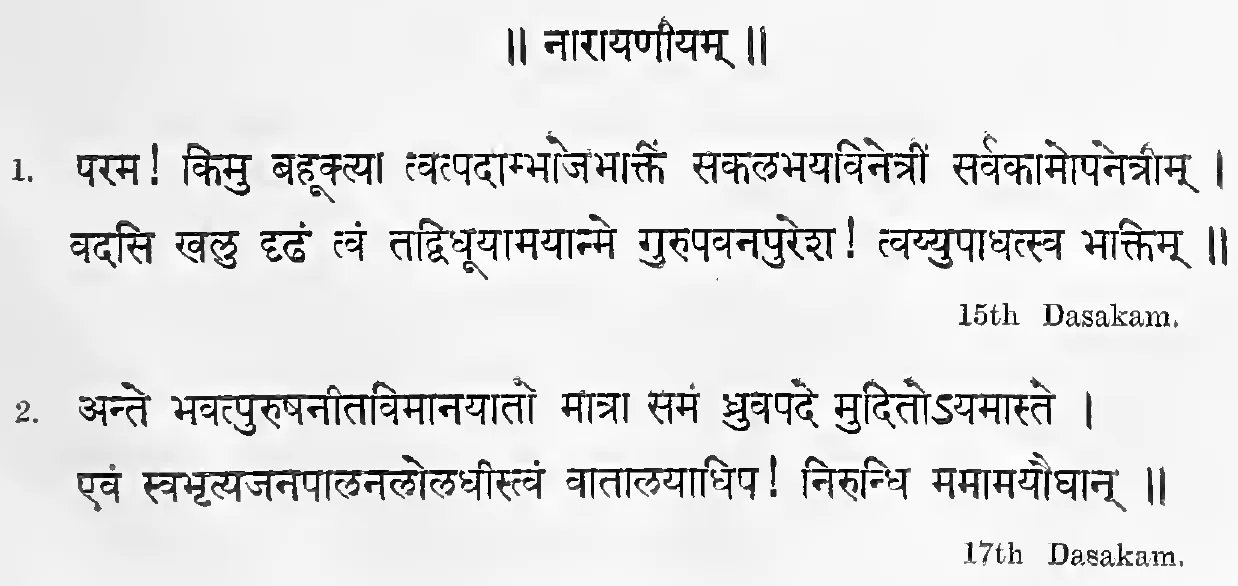
[442]
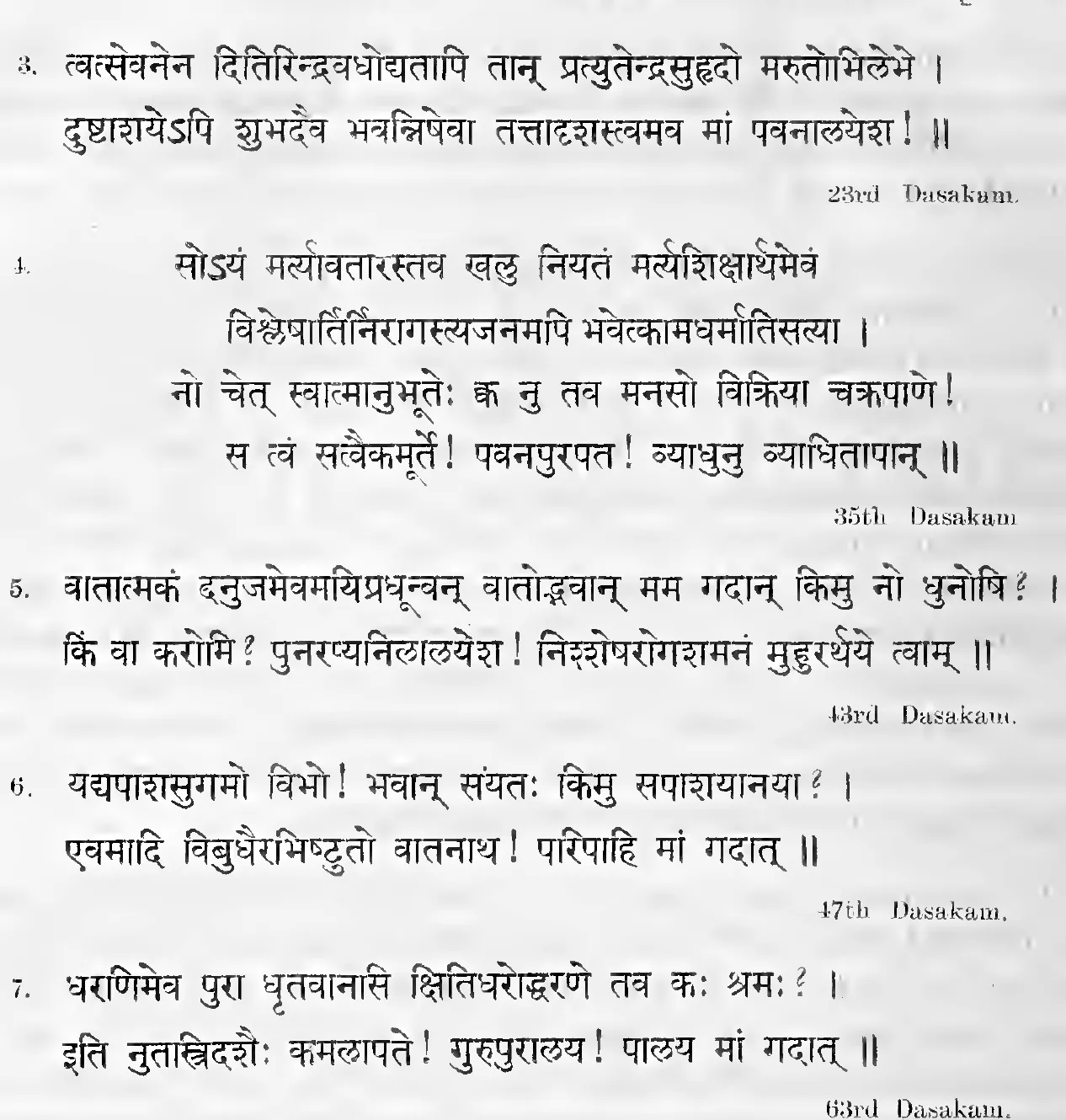
[443]
Chapter XIEducation.
"None of us yet know, for none of us have been taught in early youth, what fairy palaces we may build of beautiful thought, proof against all adversity—bright fancies, satisfied memories, noble histories, faithful sayings, treasure-houses of precious and restful thoughts which care cannot disturb, nor pain make gloomy; nor poverty take away from us—houses built without hands, for souls to live in".
Ruskin.
"Sound education stands before me symbolized by a tree, planted near fertilizing water. A little seed which contains the design of the tree, its form and proportion, is placed in the soil. See how it germinates and expands into trunk, branches, leaves, flowers, and fruits! The whole tree is an uninterrupted chain of organic parts the plan of which existed in its seed and root. Man is similar to the tree. In the new-born child are hidden those faculties which are to unfold during life".
Pestalozzi.
History. Education in the modern sense of the term in Travancore may be said to date from the year 1834 A. D., when the first English school worthy of the name was established. This school was taken over by His Highness and was ultimately established on 13th December 1836 as the Rajah's Free School at Trivandrum. It may be of interest to note here that this was the first English school in Southern India. "It was opened four years before the oldest school in Madras 'The General Assembly's Institution'—the father of the Christian College—and seven years before the 'High School of the Madras University', from which the Presidency College emerged, came into being. We may well be proud that, though wisdom is generally reputed to come from the north, the first step towards the introduction and diffusion of western learning was taken in this southernmost corner of the Indian Peninsula."* From that time on the progress of education has been rapid and sound, so much so that Travancore now occupies a foremost place in India, whether as compared with the other Native States or the British Provinces. In the history of this progress a few dates stand out prominent as landmarks of important reforms in the system of education pursued. These are:—
1. The year 1042 M. E. (1866-67 A. D.) when Vernacular instruction was placed on a firm footing. It is somewhat curious to observe that while the Sirkar was very early in the field to promote the cause of English education, little or nothing was done by it to further Vernacular [444]education through which alone the masses could be reached. It was only in 1042 M. E. (1867 A. D.) that the necessity for establishing Vernacular schools on a sound basis forced itself on the attention of the Sirkar.
* Speech by P. Thanoo Pillai, M. A., late Chief Secretary to the Government of Travancore.
2. The year 1069 M. E. (1894 A. D.) marks another important stage. Until then the administration of education was based upon a distinction which existed between instruction in English and that in Vernacular. There was thus divided authority which left no room for continued and concerted action or for unity of aim and method throughout its organisation. In 1894 this dual control was abolished and the whole system of education was brought under one authority.
3. The year 1079 M. E. (1904 A. D.). The acceptance by Government towards the close of this year of the duty of imparting primary education free, marks a further step in the history of education in Travancore though the policy does not seem to meet with the approval of all; for Mr. J. Andrew, I. C. S., the British Resident, observes:—
"The Darbar have 'accepted the responsibility of imparting free primary education' to all children irrespective of caste and creed, and as a preliminary step they have taken in hand the backward classes. The Darbar will do well to count the cost of imparting free primary education to all children in the State, and to consider whether it is advisable or necessary either from a financial or any other point of view to impart such education free in a State like Travancore which, I believe, is far ahead of Madras and other Presidencies as well as of other Native States in the matter of education, both male and female. Judging from its past history, Travancoreans are willing to pay for the education of their children; at least of their sons, and I do not see why primary education should now be given free."†
Any opinion on the policy may therefore be deferred until the results are more apparent.
It would be well before dealing with the progress of education in detail to give an idea of the state of education in Travancore prior to 1834. It has been long accepted by Hindu kings that it is a part of their duty to provide for the educational needs of the people over whom they hold sway, and this principle has been followed in practice by liberal grants to educational institutions in the State and by rewards to learned men. The Rajahs of Travancore have not been behindhand in their patronage of learning, and their munificent recognition of Sanskrit scholarship has from very early times attracted hither a large number of learned Brahmins from the East Coast. To impart instruction was a duty enjoined by the Dharma Sastras, and wherever the Brahmins had congregated in large [445]numbers, schools of learning sprang up in which Pandits gave instruction in the Vedas, Vyakarana (Grammar), Tarka (Logic), Mimamsa (Philosophy), Law and Religion. This system of education, bound up as it was with religion and law, did not reach the lower castes of the Hindus who had no access to it. The ancient method of instruction aimed at the taxing of the memory and the undue development of the critical faculty by exercising the pupil in metaphysical refinements and in fine-spun commentaries on the meaning of texts which they had to learn by heart. For the lower classes of the population there were village schools scattered over the country, in which rudimentary education was given. These were of a later date, and, though they were primarily intended for the lower classes, the children of traders, land-holders and well-to-do cultivators took advantage of the instruction offered in them. The curriculum of studies was simple and easily mastered, being only a few short lessons on Ethics, Astrology, praises of the principal Hindu divinities and tables of the first four rules in Arithmetic composed by the village school master for each pupil and learnt by him by rote. The system was popular and quite suited to the time, till it was displaced by the English method of instruction introduced by the Christian Missionaries in the early years of the nineteenth century. Both systems were supported by State grants in cash or lands or by private liberality.
† Resident's Review of the Report on the Administration of Travancore for 1079 M. E. (1903-1904 A. D.)
Missionary Enterprise. As elsewhere in India the Christian missionaries were the pioneers of English education in Travancore. Their advent in this State was at a very early date of the Christian era, and the Syrian Christian Church, the oldest in India, owes its origin to the early missionaries. The Portuguese and the Dutch who preceded the English and who were the first to visit this coast, left little impression of their influence in Travancore, and the early missionaries, who were Catholics, do not seem to have much interested themselves in the cause of education. Even after the appearance of the Protestant English Missionaries and their introduction of English education, the Catholics remained indifferent to the educational wants of their flock. It was owing perhaps to most of the clergy being men of other nationalities than the English, that they found it extremely difficult to take any part in English education. Of late, however, they have undertaken educational work in right earnest. They have now three High Schools at Changanachery, Quilon and Trivandrum, thirty-five English and Vernacular schools and two-hundred and eighty-five Pariah schools. They are greatly interesting themselves in the spread of female education, and their well equipped convents are doing excellent work, of which the one at Trivandrum, the [446]Convent of Holy Angels, gives instruction for girls up to the F. A. standard. Besides these, they have institutions and orphanages for the poor, who are cared for and educated in such arts and handicrafts as would fit them for life.
The Protestant Missionaries, though later arrivals in the field, were the first to introduce English education in the State. The originator of an English school in Travancore was Revd. William Tobias Ringeltaube, a native of Prussia and a man of great force of character. From 1806, when he came to Travancore, till 1816 he devoted his whole energy to evangelistic work, and wherever he went he carried with him the mission of English education. He was incessantly preaching and teaching, and he established many schools for poor children, Christian as well as non-Christian. The progress of education through his instrumentality may be gathered from his reply to a query from Col. Munro, the Dewan—Resident of Travancore in 1813. He wrote that there were six schools for the laity; "the instructions that are given consist in lessons of reading, writing, arithmetic," and to Christian children the "catechism and reading the New Testament or religious books. ... ... ... The natives are not disposed to send their children to school. ... ... Books are supplied by presents from the Revd. Missionaries at Tranqebar but not in sufficient number." Ringeltaube's noble efforts in the spread of English education was aided, through the recommendation of the Resident Col. Munro, by a grant of land at a nominal rental made by Rani Lakshmi Bayi. But the most important name connected with educational work in Travancore, was undoubtedly that of Rev. Mead. He was a most enthusiastic worker, and from the date of his arrival in Travancore in 1817 as a missionary of the L. M. S. till his death in 1873, he threw his heart and soul into the work of education. The year after his arrival, i. e., in 1818, he founded the Nagercoil Seminary which was the first institution to give regular English education in Travancore. The great object the founder had in view, was "the communication of religious and useful knowledge", and the language taught were English, Tamil, Malayalam and Sanskrit. After a long and bright career the Seminary has risen to the status of a Second Grade College. It has supplied two Dewans* to the State, and the first Headmaster and organiser of the Rajah's Free School, Mr. Roberts, was drawn from it. Mr. Mead, who had settled at Nagercoil, established several schools besides the Nagercoil Seminary. His long and intimate connection with English education induced the Government to appoint him as Superintendent of Schools in 1855, and in this capacity he did much to further the cause of [447]education in Travancore. He was also the pioneer of female education in the State. He established industrial schools and did much to bring about the abolition of slavery. As a Judge, a Missionary and Superintendent of Education and of the Government Press, he put forth his best efforts for the amelioration of the condition of His Highness' subjects. After him the L. M. S. did not relax their efforts, and their remarkable activity in this direction may be gathered from the fact that, according to the statistics of 1904, they had under their charge 384 schools with 15,641 pupils.
* Messrs N. Nanoo Pillai and T. Rama Rao, C. I. E.
Another body of Protestants, viz., the C. M. S., have also laboured much in the cause of education. It was at the urgent solicitation of Col. Munro that their first batch of missionaries arrived in Travancore in 1816. The object of the mission was to improve the spiritual condition of the Syrian Christian population. They worked in harmony with the Syrians till 1837, when all connection with them ceased, and the mission set to work independently. As early as 1815, the Syrians had a College at Kottayam for training their priests and ministers. It was, however, soon thrown open for secular education, and non-Christians were also admitted to the benefits of education in the College. In 1815, Rani Lakshmi Bayi made a donation of Rs. 20,000 to the funds of the College and a monthly grant of Rs. 70 for the hospital attached to it. The College did not make much progress under the Syrians, and when they severed their connection with the C. M. S., the College was handed over to the latter. It has now grown into a Second Grade College. Besides this College, the society has considerably extended their sphere of educational activity, and, according to the statistics of 1904, they had under their charge 290 schools with 13,148 pupils under instruction.
Government efforts. English Education. The establishment of the Rajah's Free School at Trivandrum marks the first attempt of Government to impart English education to its youths. When H. H. the Rajah visited the Nagercoil English Seminary in 1834, he was so much impressed with the importance of English education as a civilising agency that he asked for the services of a competent teacher to start an English school at Trivandrum. Mr. J. Roberts, the Headmaster of the Seminary, went to Trivandrum at His Highness' invitation and opened the first English school at the Capital soon after. It was at first only a private school, and the Government contributed the fees of eighty pupils. The education there given and the example of missionary enterprise seem to have roused a liberal native opinion in favour of the new learning of the West, and we read of a meeting held on the 12th February 1835 for the purpose of concerting [448]"measures for the intellectual improvement of the rising generation in Travancore". The result of this was that Mr. Robert's school was taken over by the Sirkar and was ultimately established on 13th December 1836 as the Rajah's Free School in the buildings now occupied by the Trivandrum Zillah Court. As its name indicates, the levying of fees was not insisted on and the strength was limited to 100. Mr. Roberts was appointed the Headmaster. He was "possessed of great natural abilities, enthusiasm and force of character", and, under his care and guidance, the school "made distinguished progress and turned out pupils of mark." The curriculum of studies embraced Logic and Mental Philosophy, Natural Philosophy and the higher branches of Mathematics. Mr. Roberts retired in 1855 after a meritorious service of nearly twenty years, during which period, he had also the general direction of English schools in the mofussil. The school continued to flourish and swell under his successors Messrs. Lafrenais and Bensley, until the number on the rolls rose to above 500 in 1864, when the first batch of seven candidates appeared for the Matriculation Examination, of whom three came out successful. An important change was made in the year by the abolition of the system of free education and by the compulsory levying of fees. It was apprehended at the time that the measure would tend to a considerable reduction in the strength of the Institution, but such was the demand for English education that only two students left the school. In 1866, it became necessary to divide the Institution into the Junior and Senior Departments. Mr. John Ross, M. A., of the Edinburgh University, was appointed to the charge of the Senior Department, and under him the School developed into one of the largest and most flourishing colleges in Southern India. For as Sir Madava Row observed in 1870:—
"The experience already gained has unequivocally demonstrated that the intellectual capacity of the Natives of Travancore for development need not shrink from comparison with that of any other race or nationality. After lying dormant for ages under the chilling influence of political and religious causes, and probably of geographical isolation, it is now being thoroughly aroused under special government encouragement. With this encouragement steadily continued in the character of one of the most imperative duties of the Ruler, this native principality may venture to aspire to a distinguished pre-eminence of cultivated intellect in Southern India."*
The standard of education was gradually raised and the first graduate from the College, Mr. V. Nagam Aiya, the compiler of this State Manual, passed in 1870. Since then, the history of the College has been one of uninterrupted progress and prosperity. The accommodation having been found insufficient, a new College was constructed. The [449]foundation for the building was laid by His Highness the Maharajah in person who observed:—
* Report on the Administration of Travancore for 1045 M. E. (1869-70 A. D.)
"I consider this a great occasion. In laying the foundation for a College, we are in fact, imparting strength and durability to a system of public education of a high order, which cannot fail to exercise a most important influence on the rising generation and on generations yet unborn.
"It is gratifying to me to reflect that English education struck early root in Travancore; that under favourable auspices it has attained satisfactory growth; and that, already pressing on the material limits provided for it by my venerated predecessors, it now calls for enlarged accommodation.
"Such a call, it is superfluous for me to say, will at all times be responded to by the State with the utmost alacrity. ... ... ... ..
"I may therefore hope that before long, I shall have the happiness of inviting friends and well-wishers to assemble again for the purpose of opening a spacious, solid and durable building to which the Government and people can point with pleasure and pride—a building that will be more commensurate with the standard to which Mr. John Ross, with the able assistance he enjoys, has raised the education of our youth. I will hope to see this standard raised still higher, till it claims to be on a level with even that attained by the most advanced educational institutions of India. ... ... ... There is every encouragement to be derived from the steady zeal of those who are charged with the weighty interests of education, from the great eagerness shown by parents for the intellectual advancement of their children, and from the remarkable receptive power manifested by the youths themselves."
The building was completed and occupied in 1873. Since then many additions have been and are still being made.
When the B. A. Classes were opened there was provision to teach only one Optional Branch, viz., Philosophy. Another Branch, viz., Mathematics and Natural Philosophy was added in 1879. A Chair of Advanced Chemistry was established in 1884, and a History Chair was added in 1900. The opening of an Advanced Physics Branch has already been sanctioned and will, it is expected, be given effect to next year. By such facilities offered to the public and due in no small degree to the zeal, earnestness and enthusiasm displayed by successive Principals and Professors of the College, it now stands as one of the foremost educational institutions in India. The educational results of the College and the High School attached to it, have been of the most gratifying kind, and many graduates and other students, after having passed out of the College, have occupied or are occupying honourable positions in the service of the State and elsewhere, thus confirming what H. H. the late Maharajah said so early as April 1882. He observed:—
"That the native portion of the Government service and of the Bar has immensely improved during these past forty years is a fact which the most caviling critic will not deny. If this result full of public importance is not to be [450]traced to the higher education given by Government, to what else is it due? The result is a happy one equally to the governing and governed classes. The good is far from being confined to British territories... ...Every educated native in or out of Government service is a radiant point of enlightenment possessing manly self-respect and grateful loyalty to Government."‡
It may not be inappropriate to add that this system of higher education which has done so much to the natives of India has not been altogether an unmixed good. Sober men here and there have taken exception to it.
The University's Commission appointed by the Government of India observed in their Report dated 9th June 1902, thus:—
"At the same time we must admit that the acquirements of Indian graduates are in many cases inadequate and superficial. We make every allowance for the difficulties of a student who has to receive instruction in a foreign language. We do not forget that when western students received all their instruction in a classical tongue, the Latin of the Schools was more fluent than correct. But after all allowance is made, it is most unsatisfactory to be told that the Indian B. A. not infrequently lacks the general training which he requires to fit him for the business of life, or for a further course of study."
Mr. Sidney Low, the special correspondent of the Standard during the Prince of Wales' recent tour, writes severely on the subject thus in his 'A Vision of India':—
"The Colleges and Universities in India are manufacturing a multitude of educated men who fail to find suitable employment, that the so-called higher education has been on the wrong lines from the outset, that the majority of native graduates have been nurtured in English literature, European history or an odd hotch-potch of superficial ethics, and controversial politics.
* * * * *
"He maintains that India needs modern education in the true sense, that is to say, Modern Science, Mathematics, Physics, Biology, Chemistry, Geology and Applied Mechanics, instead of the literature and history of alien countries and unfamiliar civilizations. He urges that the aim should be to send from the colleges and schools more Doctors, Chemists, Engineers, Architects, Industrial experts, but fewer lawyers, journalists, office seekers and place hunters. The 'educated' native, for good or for ill, we have created. His education has been faulty from the beginning and his development one-sided. "What wonder" Mr. Low remarks, "if youngsters fed on Burke and Mill and Milton and encouraged to 'get up' our faction struggles of the eighteenth century and to dabble in a literature 'saturated with party politics'—what wonder if they emerge with a predisposition to regard the autocratic rule under which they live as an abomination? We are surprised the educated native so often takes to agitation and subversive politics. What else can we expect? Our system has unsettled most of his ideas and given him in exchange a system of ethics which can mean nothing to him and an admiration for eminent men, who were mostly "agin the Government" and who were in general enthusiastic [451]champions of the political liberty which no Asiatic community has ever yet experienced."
* * * * *
"He (Mr. Low) tells us no doubt that the manufacture of 'educated' natives with a pronounced penchant for going 'agin the Government' might cease, and that our colleges might be made to turn out mathematicians, doctors, chemists, engineers, technologists, and trained industrial experts. That is obviously work for the future. Meanwhile, Mr. Low anticipates that we cannot go on Europeanising, industrialising the native, without finding him doing many things for himself which we are now doing for him. Moreover, while acknowledging the splendid work of the I. C. S., Mr Low observes that India is not so attractive to the capable young Englishman as it used to be, and that considerable difficulty is found in getting men with a good professional training to accept posts in the technical branches of the administration."
‡ "Observations on Higher Education and the Education of the Masses in India"—A letter addressed to Sir M. E. Grant Duff by His Highness the late Maharajah.
In this diatribe only very few can join, surely not many among those who are deeply indebted to University education in India during the last half a century and whose work in every department of public life that they have entered has reflected honour not only on the University which has ushered them into the world with its hall-mark, but on their own national genius and character as well; there is no doubt, however, that there is a modicum of truth still in all such accusations, that there are some at least among the older set of educated Indians who are not quite satisfied with the products of modern education, nor with the models that they follow. I should say that a better blending of scientific knowledge with literary studies which now seem almost to engross the attention of Indian students may be of greater profit to the rising generation in the interests of the nation's material progress and prosperity. Mr. A Govinda Pillai, B. A., B. L., a Judge of the Travancore High Court and Chairman of the first Trivandrum College Day meeting observed (October 1898):—
"If we pause for a moment to examine the result actually obtained by that education, except in the public service, which, however, is only one department of mental activity, our achievements have not been of a substantial character. It has not increased the productive power in the country, without which that material prosperity which alone can raise us in the scale of nations would be impossible. On the contrary, our school education seems to breed a dislike of manual labour which is essential to the increase of productive power. It must be admitted, however, that class prejudices against professional occupations have died out; but even in free, social intercourse, we are as far behind the enlightened centres of British India, as the latter are behind more civilized countries."
On a similar occasion I myself observed (October 1900):—
"In this great amphitheatre of modern Indian life, I find two engrossing cares have taken possession of the public mind, (1) a morbid thirst for the acquisition of knowledge, not necessarily knowledge of the best kind, and (2) a morbid craving for new things, new fashions and new modes of life. As a necessary consequence, we recede more and more from the original—the old ideals of Indian life, the old forms of thought, action and behaviour, and thus we set at [452]naught the hoarded authority of ages. A current of denationalisation is the result. This hankering after other forms of life and behaviour than your own, I assure you, does not add to your happiness. 'All real and wholesome enjoyments possible to man,' says the philosophic Ruskin 'have been just as possible to him since first he was made of the earth, as they are now, and they are possible to him chiefly in peace. To watch the corn grow and the blossoms set; to draw hard breath over ploughshare or spade; to read, to think, to love, to hope, to pray—these are the things which make men happy; they have always had the power of doing these, they never will have power to do more. The world's prosperity or adversity depends upon our knowing and teaching these few things. This element of disturbance is seen in the household, in the school-room, in the village, in society and in the state. My sincere advice to all young men is—drink deep of the fountains of knowledge, wherever you can find it—from the ancient springs of Sanskrit, Chaldean, Greek, Roman, Arabic, or Chinese philosophies or from the modern stores of English, French, German and American literatures, win as many prizes as you honestly can by the aid of this wonderful modern material civilisation of our age, revive your ancient arts and manufactures, learn new trades and industries, improve your Agriculture making two blades of grass grow where only one grew before, in fact, do everything which you individually or as a community, may need for your material and social advancement; but don't give up your ancient ways of living, your cherished heritages from a remote past, which give you a distinctive character and nationality."
District Schools. About the same time the Free School was established at Trivandrum, several District English Schools were opened at Kayangulam, Kottar, Chirayinkil, &c., and placed under the supervision of Mr. Roberts. Owing to the financial crisis in which the State was plunged after their establishment, some of them died out, but were revived by Rev. Mead who was appointed Superintendent of Education in 1855. He "constantly travelled in the country and planted many schools" and several Vernacular schools were amalgamated by him in 1860 with the English schools at those stations with a view to extend the benefits of English education. Mr. J. E. Lafrenais succeeded Rev. C. Mead in 1862. Under his able and zealous management the schools considerably improved. With a view to create a stimulus for study among the students of the District Schools, which served as feeders to the central institution at the capital, and to encourage the deserving students to pursue their studies in the Trivandrum school, six scholarships were founded in 1864, open to the exclusive competition of the District School students. It was further arranged in the following year that the more advanced pupils should visit Trivandrum once a year, the Sirkar defraying the expenses of their journey to and fro. This had an excellent effect as the pupils regarded the privilege in the light of reward and vied with one another to merit the same. These aids and encouragements to education were due to the untiring efforts of Mr. Lafrenais. Sir Madava Row wrote of him in one of his Administration Reports, "He was one of those public servants who act indefatigably under an ever present sense of duty." When he entered on his work [453]there were only eight District Schools, but, owing to his unwearied exertions and conscientious labours during a period of twelve years, their number rose to eighteen, and all had attained a high standard of progress. After Mr. Lafrenais' death in 1874, four more schools were added bringing up the total to twenty-two, and this number remained stationary, for instead of meeting the steadily increasing demand for English education in the Districts by the establishment of Government Schools, the Sirkar resolved in 1887 to extend the system of grants-in-aid which had produced such admirable results in the Vernacular Education Branch.
Vernacular Education. The question of improving the Vernacular education engaged the attention of Government only in the year 1041 M. E. (1865-66 A. D.). There were indeed many private Vernacular schools in the State before that time. These indigenous schools afforded abundant facilities to the people to acquire the rudiments of knowledge. Any person who desired that his children should learn the three R's had no need to go beyond his village. The Asan or village schoolmaster held his position as such by virtue of heredity, the profession having been followed by his ancestors for several generations. The people, most of whom had their education under the Asan, held him in great reverence and considered his teaching the best they could secure for their children. I wrote thus of the village Asan in my Census Report of 1891:—
"Every village had a pyall school. The master was called the Ashan and the village boys and girls were taught there a few simple lessons in Malayalam. The Ashan is either an Ambalavasi or a Sudra, or sometimes even an Iluva. At the time of writing this Report there were 1,300 such schools in Travancore with 50,000 pupils in them. These institutions are all the result of private enterprise, mostly self-supporting, and have been so from very remote times. The teachers depend almost entirely upon the pupils for their maintenance, and the support is given most cheerfully by the parents or guardians of the pupils. The people look upon it as a religious duty never to be neglected. The payment is seldom in cash. It is mostly in kind. When the boy's education commences, the village schoolmaster is brought to the boy's house and is given a fanam,* betel and nut, some paddy, cocoanuts and plantains. This is the first remuneration for the Vidyarambhom or the boy's initiation in letters. The Ashan then takes the boy to his school with music and beat of drum. A new manuscript-book made of palmyra leaves written with an iron style either by the master himself or his assistant, the first boy in his school, and daubed over with saffron is given to the pupil. This is the primer or the first book with which he begins his school life. The book begins with an invocation to God Ganesa, which almost every boy in the kingdom knows, having first learnt it in the pyall school. The pupil carries this book in his wooden satchel which his parents supply him with. When he has attended school for some months, the satchel becomes more and more weighted, as it now contains the second and the third books, some lessons in Arithmetic, Astronomy, some of the chief precepts for daily conduct, known as 'Neethi sastrom,' the thousand names of Vishnu, a portion of the Sanscrit Dictionary, [454]easy lessons in casting horoscopes and the calender, a few verses on medicine, and general poetry all written as before on the palmyra leaf. These form the curriculum of school studies. Every new manuscript book brings its due remuneration in kind and money to the Ashan from the pupil's parent. On Wednesdays and Saturdays the pupil's mother remembers to tell her son to take some bathing oil to the teacher. Some rice, dholl, cocoanuts and plantains are due on the Dwadesi days, i. e., the twelfth day of the fortnight. Something else due to the schoolmaster on the 13th day of the fortnight, and so on. The Vishu and the Onam are other days of payment to the Ashan. The school itself is held either in the pyall of the schoolmaster himself or one nearest to him. The boys attend from early morning, sometimes even before 6 A. M. which would be a great merit in the boy, and would receive special recognition from the master in the evening when the attendance is noticed and due punishments to the late comers are meted out. The special recognition that the first boy receives is a gentle touch on the palm of his hand with the rod of the master. The second boy receives two such gentle strokes on the palm of his hand; the third boy three, and when the last boy's turn comes the master puts on an air of great disapprobation and apparently in great anger asks his assistant, 'Is this boy the latest comer in my school'? So saying he gives him a good thrashing with the cane. Thus there is a regular competition among boys to avoid being the last. Another feature of the pyall school is that all the boys go on reading out loud at the same time, and the voices of the pupils are loudest when the schoolmaster enters. His assistant is in charge of the school for the day; the master himself comes only to inspect the school once or twice in the day, or to mete out punishments in the evening. During the other hours he is engaged in watering his vegetable garden, or doing his wife's bidding at home, or goes to the market to buy the household provisions for her, but he is none the less respected by his boys and the villagers. The assistant draws a pay of ten fanams, which means a rupee and a half from his chief; but he too is in a manner respected. Both the chief and the assistant take it all easy. The work is neither heavy nor uncongenial. The discipline is perfect. The boys must come early and go late in the evening and a home exercise is given in addition, which is to read at night the lesson taught at school in the day. The boy should secure from his father a certificate of having done the night lesson properly, aud the certificate should be in the father's own hand. The parents are contented, if their boys are well up in the set formulas, which pass for school education in their village and if, in addition, they behave well to themselves, their relatives and neighbours, that is all that they want from the Ashan. The Ashan's services are ever afterwards gratefully remembered by them. The boys are also quite happy and contented, for excepting the early attendance and the evening punishments everything is mirth and play at school including the pell-mell reading out loud, in which they themselves take much delight. In the absence of the Ashan and his assistant, the boys can come and go as they please, and there is a perpetual round of holidays in the year. The beginning and the end of the fortnight are holidays. The 8th day of the fortnight is also a holiday. So also are the Saturdays and the fourteenth days. The afternoon of the 13th day is a half-holiday. Sometimes the 11th day is a great holiday, as when it falls in the month of Dhanu (December). The birthday of Vishnu is a holiday. So also are the great Oolsavoms in the local temples, the Vishu, the Onam, the Deepavali, the Dusserah festivities, the King's birthday and a great many others too numerous to mention which make the school boy's life one continual round of pleasure and enjoyment. The Director of Vernacular Education also tells me that these schools are closed during the cultivation and harvesting seasons, when the children go to help the work of their parents in the paddy fields. So the education of the village Ashan [455]is not a task. The system does not of course come up to modern methods of teaching and training, points which are now engaging the attention of officers of the Vernacular Education department. But there is no doubt that these pyall schools are of immense value to the State. The boy's education begins at 5, and is said to be finished by 10. The subjects comprised by the 5 years' course are easily learnt and easily remembered through life. The system has much to say in its favour, though recently it has not received that attention from the public which is its due, on account of the keen and universal desire for higher English education which has got hold of the people of this country."
* A fanam is equivalent to 2 as. 3 p.
But the education imparted in them was based on a system which did not attempt the development of the mental faculties to any great extent, and was found insufficient to meet the requirements of the age. The Government therefore deemed it necessary to sanction in 1866 an expenditure of a sum of Rs. 20,000 per annum for this purpose.
Central and Taluq Schools. In 1866 a Central School was opened at the Capital, where Sanskrit was taught in addition to Malayalam, and also a school each for the Taluqs of Travancore. The education in these schools was modelled on the system in English schools and was imparted through books translated from that language or compiled chiefly from English writings on History, Geography, Arithmetic, &c., and through the agency of teachers trained to the method of teaching in English schools. But there was difficulty in finding suitable books and trained teachers. To remedy these defects a Book Committee with a President and three members was formed, composed of persons who had received a good English education, and to this Committee was entrusted the duty of translating and compiling such books as were in common use in English schools. A Vernacular Normal School was also organised and placed under the charge of a competent teacher trained in a British Indian Normal School. All the Vernacular Educational Institutions were placed under a Director of Vernacular Education. This officer was assisted by two Inspectors one for North and the other for South Travancore, whose duty it was to inspect the schools and report upon their working. The scheme was given effect to in 1042 M. E. (1866-67 A. D.), and Mr. Shungrasoobyer was appointed the first Director of Vernacular Education. Before the close of the year there came into existence eleven schools with 855 pupils. Schools and pupils rose to 20 and 1383 respectively at the end of 1043 M. E. (1867-68 A. D.), and to 29 and 2152 at the end of 1044 M. E. (1868-69 A. D.).
Grant-in-aid for Vernacular Schools. In 1869, an important step was taken. As Vernacular education became more popular, the Sirkar hit upon a plan for assimilating the course of instruction in private Vernacular schools with that pursued in the Sirkar schools. This was effected by [456]making grants-in-aid to the private schools on the following conditions:—
1. that the course of instruction pursued was the same as that obtaining in the schools of the Sirkar;
2. that the books used in the Sirkar schools were also taught in the private schools; and
3. that only properly qualified teachers were employed.
A special Inspector was appointed to superintend the private schools and to report on their fulfillment of the conditions of the grant-in-aid. By these measures the private schools were brought under periodical inspection by the Sirkar Inspectors and considerably improved in their tone and efficiency. Twenty private schools were brought under the grant-in-aid system by the close of the year 1869. The results achieved by the establishment of Government schools and by the operation of the grant-in-aid system were encouraging. Demand for education increased and it was found necessary to extend the system of Vernacular education on a scale commensurate with the growing needs of the country.
The Proverty Schools. Another important step was taken in 1871 by the inauguration of the Proverty or village schools. It was proposed to have one school in each Proverty in Travancore. The instruction was to be of the same kind as that obtaining in the Taluq schools though of a lower standard. The villagers were to provide the school building, while Government undertook for the payment of a small grant of one fanam for each pupil to provide the requisite teaching machinery. More than one school could be held in a Proverty if there was need. The Sirkar appointed Deputy Inspectors, one for every fourteen schools, to supervise their proper working. In pursuance of this scheme 141 schools were opened in the next year. These reforms and improvements in Vernacular education were due to the Director Mr. Shungrasoobyer whose services to the cause of Vernacular education were acknowledged by Sir Madava Row in these terms. "It is only due to Shungrasooba Iyer, the Director of Vernacular Education to state here that the great and rapid success already achieved and abundantly promised by the Vernacular schools is largely attributable to his characteristic zeal, ability and intelligent direction. He had no ordinary difficulties to contend with, but they have been very satisfactorily overcome."
The course of instruction in the different grades of Vernacular schools varied. That in the village schools consisted of reading, writing both on paper and cadjan, arithmetic, geography (General and Travancore). To this curriculum was added in the Taluq schools, Indian History and also [457]elementary Sanskrit in a few cases. At the Central Vernacular School at Trivandrum the standard was higher and embraced the First Book of Euclid, Algebra up to Simple Equations, and the Histories of India and Travancore. The Sanskrit standard was also higher. The number of Vernacular schools gradually increased and with it also the expenditure of Government on Vernacular education, which amounted in 1881 to above Rs. 60,000. The Government were unable to make any larger outlay for this branch of education so as to be at all commensurate with the need for popularising elementary education. It was, therefore, thought desirable that all future expenditure should be directed rather to encouraging local efforts by aiding schools established by private agency than the opening of new Government schools. In this way the available funds could be made to go much farther than if they were spent in founding more Sirkar schools, and some of that spirit of self-help which was so much wanting in the country would be evoked. This measure was greatly appreciated by the people, and the proffered Government aid was largely availed of, with the result that a wholesome stimulus for the diffusion of Vernacular education throughout the State was imparted by the improvement of the indigenous schools. The rapidity with which education spread under the new scheme may be gathered from the fact that at the end of 1893, i. e. in a period of twelve years, the number of aided schools rose from 437 with 21,574 pupils to 1,375 with 57,314 pupils, or an increase of 215 per cent. in the number of schools and 166 per cent. in the number of pupils.
Early Administration. In tracing the historical progress of education, we have only incidentally referred to the administrative machinery. For many years prior to 1894, the administration was based as was already referred to, on the distinction between English Education and Vernacular Education. The control of each was entrusted to a distinct body, each separate from and independent of the other. The staff in the case of English education consisted of the Director of English Education and the Superintendent of English schools; and the Director of Vernacular education was in charge of all Government Vernacular schools and had also the supervision of aided private schools.
This system was considered defective. In matters pertaining to English education there was divided authority. The office of Director was held ex officio by the Principal of H. H. the Maha Rajah's College, Trivandrum and was purely a nominal one. The officer was to advise Government on matters concerning English education. He had also the liberty to advise the District Superintendent. But he was seldom [458]consulted by Government, while it was not incumbent on the Superintendent to follow his advice. In regard to Vernacular education there were other evils also.
This principle of separation gave rise to the existence, side by side, of two sets of rules regulating the State aid to educational institutions, one relating to English and the other to Vernacular schools. The two sets of rules so far agreed that both were of the most general character and prescribed no standard as to accommodation, equipment or qualification of teachers, conformity to which was necessary for a claim to the assistance afforded by the State.
Reforms of 1894. Administrative and Inspectional control. In 1894 Government took into special consideration the condition of education in the State and after full and careful enquiry resolved on the carrying out of a thorough reform in the systems of administration, inspection and State aid. It was deemed necessary to devise a comprehensive system capable of directing both English and Vernacular education so as to secure unity of aim and method throughout the whole organisation, and officered by men possessed of high educational qualifications. Accordingly, all English and Vernacular schools were for purposes of administrative and inspectional control, placed under three Inspectors, each having a separate Range. Each Range was further subdivided into four Districts comprising two or more Taluqs each, and placed in charge of an Assistant Inspector of Schools. These were made responsible to the Inspectors who were in direct correspondence with and responsible to Government. The duties, responsibilities and powers of the Inspectors were duly defined.
Grant-in-aid. The next point was the improvement of the grant-in-aid system. A new code of rules known as the "Travancore Educational Rules" was drawn up and issued in December 1894. These rules prescribe the conditions which must be fulfilled before the grants are made and relate to curricula of studies; qualification of teachers; buildings, accommodation and sanitation; furniture and educational appliances; admission of pupils, inter-school rules and other miscellaneous matters.
The introduction of these reforms was beneficial. There has been an increase in general inspection. Aided schools have been subjected to a more rigorous supervision and this has contributed to their increased efficiency.
In addition to the improvement in the educational institutions already existing, the attention of Government has been since directed to supply the needs of particular localities where owing to paucity of private [459]efforts schools were wanting though needed. This step was rendered necessary in order to provide educational facilities, as far as possible, equally for all parts of the State. The result was that at present every Proverty is supplied with at least one Government school of the Primary grade, and there is no village of any consequence in the whole State whose educational requirements have not been or are not being supplied directly by Government. Inclusive of institutions under private agencies there is in Travancore one school for every 1·9 square miles and for 792 inhabitants.
Subseqent changes. In 1902, a revised curriculum of studies was introduced, and the schools were classified as High, Middle, Upper Primary and Lower Primary. In the last two sets of schools Vernacular was introduced as the chief medium of instruction while English was taught as the second language only, commencing with class III. High and Middle Schools were further classified as 'English' and 'Vernacular' Schools. In the former which comprises Forms I to VI (both inclusive) English is the chief medium of instruction, while in the latter which consists of classes V to VIII Vernacular is the chief medium. In the former Vernacular is taught as the second language while English takes its place in Vernacular schools. By this arrangement a pupil who chooses to complete his education in a Vernacular school will, when he leaves the school, acquire as much knowledge in general subjects as a Matriculate and as much knowledge of English as one who has completed his course in the Fourth Form of an English school. The subjects prescribed for each Class or Form have been chosen with great care and are varied in character. Drawing, Hygiene, Domestic Economy, Agriculture and Practical Geometry have been added, and the quantity to be gone through in each Class has been reduced with a view to secure greater efficiency and thoroughness in teaching.
Free Education. The Government in their Proceedings Current No. E 115 m/10,768 dated 15th August 1904, have accepted the responsibility of imparting primary education free, irrespective of caste, creed or race. But as this consummation cannot be easily reached a beginning has been made for the education of the backward classes in the State.
Educational Institutions. General. The following statement shows the total number of Educational Institutions of all kinds in the State [460]and the number of pupils under instruction for the last ten years:—
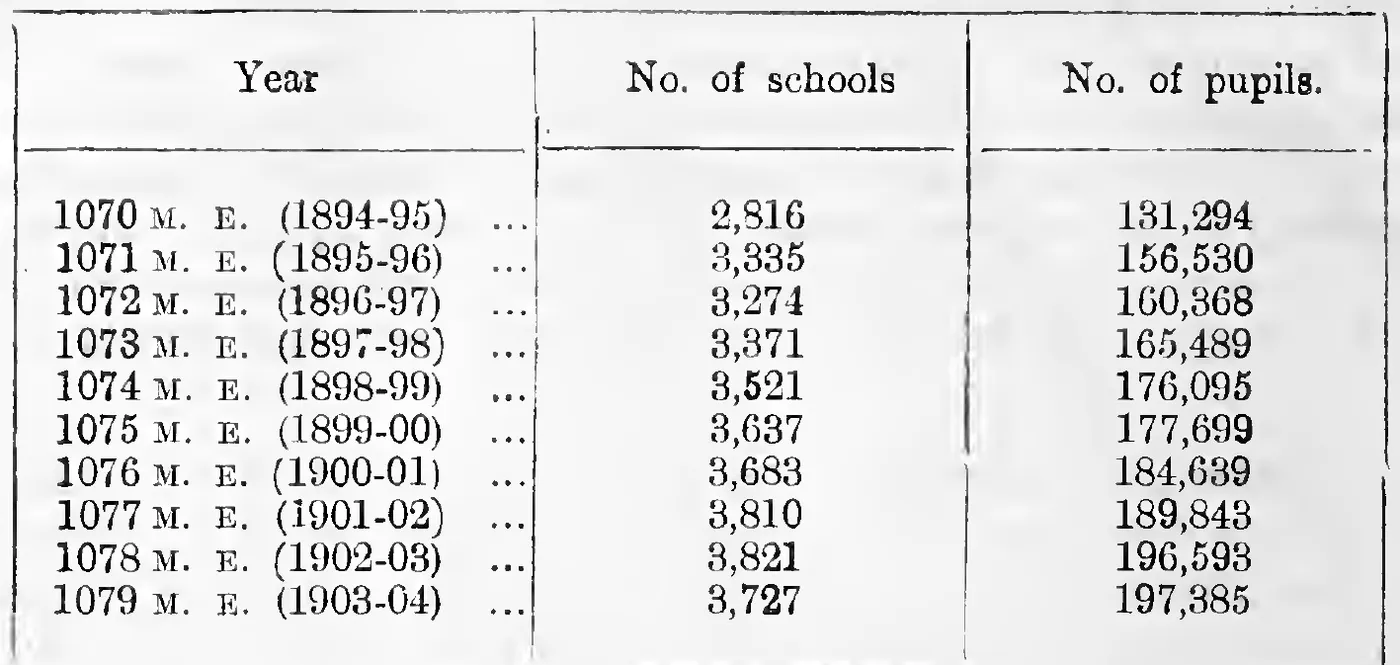
It will be seen from this statement that there has been a steady increase in the number of schools except for the year 1079 M. E. (1903-04 A. D.,) as well as pupils during the last decade, the percentage of increase being over 32 per cent in the number of schools and over 50 per cent in pupils. The decrease in the number of schools noticed in the last year of the decade is stated to be due to a fall in the number under private unaided agency. "The steady decrease in recent years in the number of private unaided schools which do not generally follow the Government curriculum and are neither recognised nor aided probably indicates that the pial schools conducted by the old Asans are gradually losing ground and the people are realising the value of the regular instruction imparted in Government and aided schools."
Grades. Classifying the schools and pupils according to the several grades there were at the end of 1079 M. E. (1903-04 A. D.):—
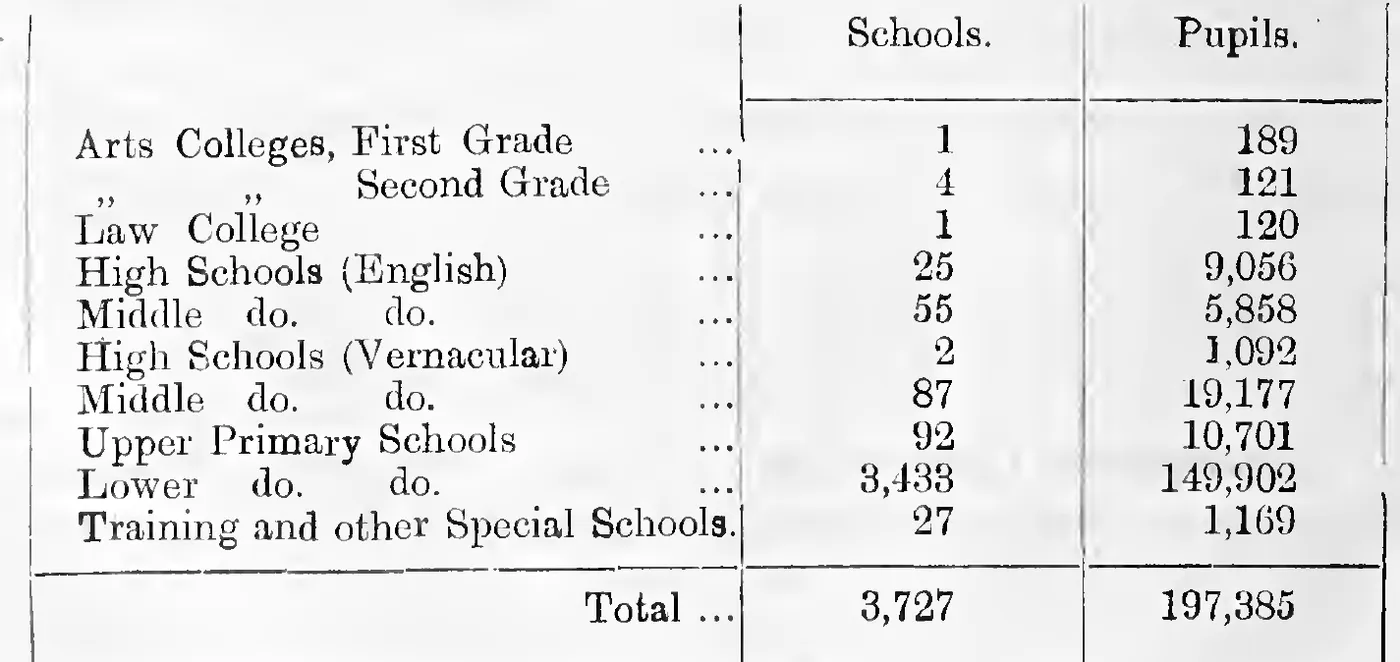
[461]H. H. the Maharajah's College is the only First Grade College in the State. The other four Colleges are Second Grade Colleges. Two are exclusively intended for girls, viz., H. H. the Maharajah's College for Girls, the Convent of Holy Angels' College; and both are situated at the Capital.
Agencies. When distributed according to the managing agencies, they stand thus:—
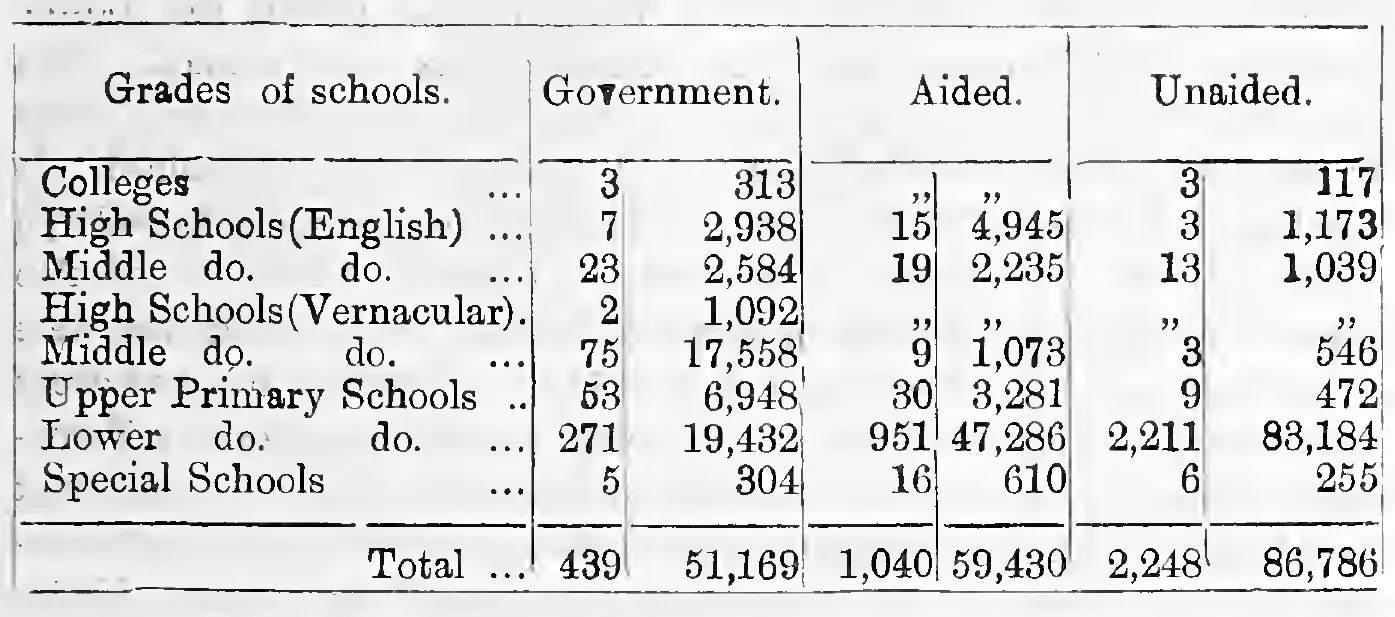
So far as the Upper Primary and higher grades of education are concerned the Government and aided institutions attract the largest number of pupils, and the number in the unaided schools except in the College Department and in Special Schools form only a very small percentage of the whole number under instruction. But in the matter of Lower Primary Education the unaided schools still hold the field. They form nearly 60 per cent. of the total number and have about the same percentage of the total number of pupils under instruction in that grade. The reason for their not being brought under the grant-in-aid system is apparently due to many of them falling far below the standard fixed by Government.
Of the five institutions of the collegiate grade, two, viz, H. H. the Maharajah's College and H. H. the Maharajah's College for Girls are Government Institutions, and the other three, viz., the Convent of Holy Angels' College Trivandrum, the Scott Christian College, Nagercoil, and the C. M. S. College, Kottayam, are under missionary management.
Special. The Special Institutions which numbered 28 at the end of 1079 M. E. (1903-04 A. D.) were:—
- Normal Schools ... ... 8
- Technical Schools ... ... 14
- Sanskrit College and Schools ... 4
- Law College ... ... 1
- Reformatory ... ... 1
[462]Normal Schools. When Government first established English Schools it obtained trained teachers from outside. It also made grants to the Training School at Canannore on condition of its allowing a few teachers of the State to be trained there, and this system was continued till 1070 M. E. (1894 A. D.) when a Normal School Institution was established at Trivandrum under the name of the English Normal School. It consisted of three classes in which those who had passed the Lower Secondary, Matriculation and F. A. Examinations were trained. This was only a Second Grade Training School, and it was thought desirable that arrangements should also be made to get graduate teachers trained. It was therefore resolved to institute scholarships for graduates to undergo training for the L. T. Degree in the Saidapet Teachers' College in order to improve the general efficiency of English Schools. Four graduates were accordingly sent up in the beginning of 1071 M. E. (1895 A. D.), and every year a few are being sent since. The necessity to train teachers for Vernacular Schools seems to have been felt much earlier, and the Government accordingly sanctioned during the year 1059 M. E. (1883-84) the establishment of two Normal Schools, one at the Capital and the other at Kottar for training teachers for Vernacular Schools. The services of a duly qualified and trained teacher from Madras were secured to start the Normal School at Trivandrum. The School at Kottar was abolished in 1894, and the one at the Capital was amalgamated in 1900 with the English Normal School established in 1894, and the united institution henceforward bore the name of "The Normal School for Male Teachers".
The attention of Government was drawn in 1886 to the want of a Normal School to supply duly qualified teachers to the increasing number of Girls' Schools in the State. A Female Normal School under the designation of Government Normal School for Female Teachers was opened in the following year to meet this want. It trained only Vernacular teachers till the end of 1078 M. E. (1903 A. D.). To extend the scope of its usefulness, an English Training Branch has been added in 1079 M. E. (1904 A. D.) and the school placed under the direct supervision of the Lady Principal of H. H. the Maha Rajah's College and High School for Girls, to which the Normal School is now attached.
There are thus two training institutions maintained at the cost of Government, viz., Government Normal School for Male Teachers, and Government Normal School for Female Teachers.
Besides these, there were at the end of 1079 M. E. (1903-04) five [463]aided Training Schools and one unaided Training School. These were:—
- Grant-in-aid. 1. Holy Angels' Convent Training School at Trivandrum.
- 2. Nagercoil Training School.
- 3. Kannanmula do. do for Backward Classes.
- 4. Buchanan Institution, Pallam.
- 5. Cambridge Nicholson Institution Normal School, Kottayam.
- Unaided. 6. St. Joseph's European Training School, Alleppey.
The first two are exclusively devoted to the training of female teachers while the last is intended for Europeans. Nos. (2) & (3) train teachers for backward classes.
There are two grades of training in English and three in Vernacular Normal Schools, viz.:—
- English: High School Certificate.
- Middle School do.
- Vernacular: High School Certificate.
- Middle School do.
- Primary School do.
The two English Certificates correspond with the Madras Second Grade Collegiate and Upper Secondary Grade Certificates.
The following table gives the Government expenditure on Training Schools for the last five years:—
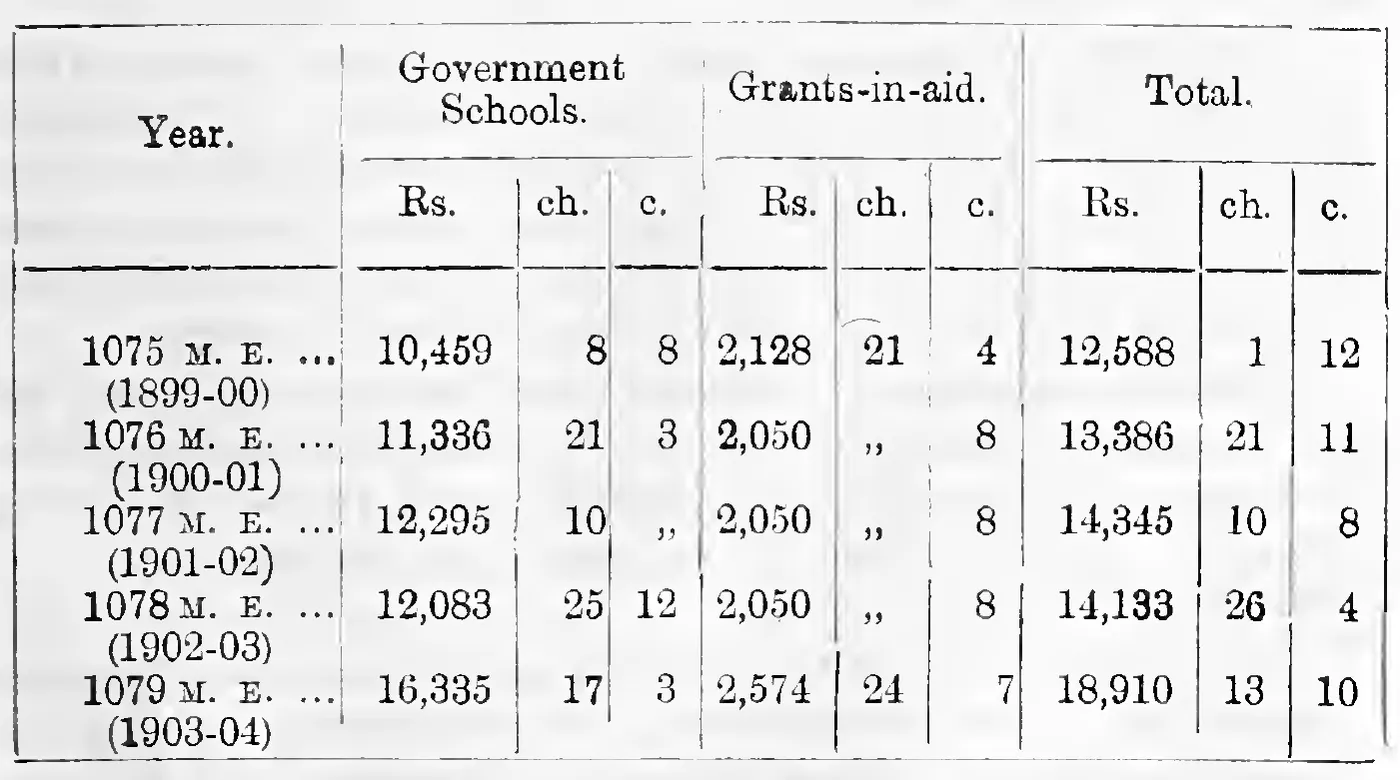
Sanskrit College and Schools. The Sanskrit College at Trivandrum is a special institution started by Government in 1889 for imparting education in the Vedas and Sanskrit literature. It is at present [464]manned by a staff of learned Pandits with M. R. Ry. T. Ganapati Sastrial as Principal. The different branches of Sanskrit study pursued in it are:—Grammar, Logic, Rhetoric, Mimamsa, Vedas and Literature.
The number of pupils was at first limited to 150, but this restriction was subsequently removed. The strength of the College was 180 in 1079 M. E. (1903-04 A. D.). Brahmins form the majority, but Malayali high caste Sudras are allowed admission to all classes except the Mahopadhyaya Class, and there were 33 of them in 1079 M. E. (1903-04 A. D.). There are three grades of examinations Mahopadhyaya, Upadhyaya and Sastri. The whole course extends to nine years and the examinations are held at the end of the 9th, 7th and 5th year of the course respectively.
In order to induce students to take to the study of Sanskrit, there is a graduated system of scholarships from Re. 1 to Rs. 6 according to the classes, for 15 pupils in each class except the first class for which no scholarships are sanctioned. One other circumstance which tends to attract pupils is the order of Government to appoint Sanskrit Pandits in Government Schools from the students trained in the Sanskrit College. Besides the teaching of Sanskrit, the students have to go through a course of instruction in the Sciences, Mathematics and History. The medium of instruction in these subjects is Vernacular—Tamil or Malayalam at the option of the student. This adds considerably to the value of their education as it broadens their mind and makes them less bigoted than the old school Pandits.
The annual and other examinations of this College are conducted by a Committee with M. R. Ry. Kerala Varma Avergal, C. S. I., Valiya Koil Tampuran as President. The Sanskrit College is capable of further development, and under careful management ought to become a centre of Sanskrit learning and research throughout India. The circumstances for reaching this consummation are so favourable in Trivandrum.
Sanskrit education is immensley useful, but is at a discount in this age of practical bread-winning studies. It is therefore gratifying to find that during the year 1079 M. E. (1903-04) three private schools were opened in Travancore, one in Kartikapalli and the other two in the Mavelikara Taluq.
The Law College. On the representation of a number of graduates desiring for a Law Class affording instruction for the B. L. Degree Examination of the Madras University, a Law Class was formed in 1050 M. E. (1874 A. D.), and Dr. Ormsby, a Puisne Judge of the Travancore High Court, was appointed as Professor on a salary of Rs. 200 per mensem. [465]The school started with 46 students and was attached to H. H. the Maharajah's College. It was in the same year affiliated to the University of Madras for the purpose of qualifying candidates for the B. L. Degree Examination.
The attendance encouraging at first, gradually decreased. In 1061 M. E. (1885-86 A. D.), however, the High Court ruled that students "who attended the class for two years and passed the class examinations were eligible for a Munsiff's Court Pleadership". This contributed to its popularity, and the number on the rolls began to swell necessitating the appointment of an additional lecturer in 1066 M. E. (1890-91) to assist Dr. Ormsby.
The Madras University made certain changes in the bye-laws relating to the B. L. Degree Examination in 1070 M. E. (1894 A. D.), and it was deemed necessary to separate the Law Class from H. H. the Maharajah's College. This led to the establishment of the Law College as a separate institution in that year and its organisation on a new basis. It had a Principal, a Senior Professor, and two junior Professors. A College Council was also formed and the Principal acted under their advice in the management of the Institution.
A chair of Medical Jurisprudence was established in 1897 for the instruction of the Pleadership Class students, and Mr. E. Poonen B. A. M. D., M. Ch., was appointed lecturer in that subject.
In consequence of the reduction in 1902 of the B. L. course from three to two years, certain material alterations were made in the Law College. The staff was reorganised to include a Principal and two permanent Professors and two elective Lecturers who were temporary and a Lecturer on Medical Jurisprudence who was also temporary. The addition of two permanent Professors on high salaries increased the cost of maintenance of the Institution and, to make it self-supporting as far as possible, the Law College was once again reorganised. The two permanent Professors were replaced by two elective Lecturers and the fees were doubled. This scheme took effect from 1st January 1905.
The College now trains candidates for the B. L. Degree Examination of the Madras University and the Pleadership Examinations, First and Second Grade, of the Travancore State. The number on the rolls at the end of 1079 M. E. (1903 A. D.) was 120; 39 in the B. L., 44 in the F. L., and 37 in the Pleadership Classes. When the College was started the students paid a fee of Rs. 10 per quarter for the B. L., which was reduced in the same year to Rs. 6 per quarter. The fees have gone on increasing since and are [466]now Rs. 10½ for the B. L., Rs. 9 for the F. L., and Rs. 7½ for the Pleadership Classes. Mr. F. J. R. V. Hunt, Bar-at-Law, a Puisne Judge of the High Court, is the present Principal.
Reference should also be made here to an old Law Class established in 1040 M. E. (1864-65 A. D.) under Mr. C. Patchappa Naickar, a trained law student of Madras, who subsequently became a Dewan Peishcar and District Magistrate in Travancore. It worked for a few years and then ceased to exist.
The Reformatory School. The Reformatory Regulation IV of 1067 M. E. (1891-92 A. D.) sanctioned the establishment of Reformatories or schools of correction for juvenile offenders in Travancore. In accordance with the provisions of this Regulation a Reformatory School was opened at Pujappura close to the Central Jail in Trivandrum at the close of that year. Mr. W. Watts, an officer of Government, was deputed by the Sirkar to the Chingleput Reformatory to study its management and on his return was placed in charge of the Reformatory. All youthful offenders under the age of sixteen are sent thither and the maximum period of detention is seven years.
The boys are given instruction in Vernacular of the Primary Grade, and by way of manual labour they are exercised in gardening and in making quinine packets and office covers. During the year 1898 the system of giving marks and work-money was introduced to encourage good conduct and industry among the boys. The maximum amount a boy could earn per day for good conduct being one anna and for industry one-twentieth part of the value of articles manufactured. Half the money earned may be spent by each boy on sweetmeats and other unobjectionable articles, while the other half will be deposited in the Post Office Savings Bank to be returned to him on his release either in cash or by purchasing for him implements of any trade he may have learnt.
In 1899 a teacher in agriculture was appointed, and the boys are now given elementary instruction in agriculture, both theoretical and practical in addition to instruction in the general subjects of the Primary Grade. In 1900 a higher class was opened and Geography was added to the curriculum of studies. The garden was extended and several country and some English vegetables were successfully grown.
There is a Committee of Visitors to the School, organised by Government. They make periodical inspections of the Institution and report on the progress of the juvenile offenders. A boy over fourteen is allowed, on a license issued by the Superintendent with the previous sanction of [467]Government, to live under the charge of any trustworthy and respectable person on condition that such person keeps him employed at some trade or calling.
Public Lecture Committee. In 1062 M. E. (1886-87 A. D.) His Highness the Maharajah sanctioned funds for inaugurating a course of lectures in the College open to the public, the lecturers to receive an honorarium out of the sanctioned fund. A Committee of European and Native gentlemen was appointed to give effect to the scheme. In the first year of its existence the Committee met nine times and arranged for twelve lectures. The amount expended during the year was Rs. 641 8 chs. 11 cash. Government offered also to undertake a portion of the cost of printing and publishing such of the lectures as were approved of by the Committee.
In 1069 M. E. (1893-94 A. D.) Government observed that "the time had arrived when the system of single lectures on different subjects should be replaced by another according to which courses of lectures each on one subject could be given".
In 1079 M. E. (1903-04 A. D.) lectures were delivered, nine in English, two in Tamil and two in Malayalam. The honorarium disbursed amounted to Rs. 1000.
The Agricultural Demonstration Farm:—The necessity for developing the agricultural resources of the State has long been engaging the attention of Government, and they have had under consideration measures for the introduction of an elementary education and demonstration in agriculture with a view to acquaint the ryot with improved methods of cultivation. These measures took a final shape in 1893 by the opening of an Agricultural Farm on the eastern side of the Karamana river, near Trivandrum. The Farm was intended to serve as an exhibition of cultivation on the most approved methods with improved implements employed in agriculture. It was also resolved to introduce crops and products new to the country. A ground measuring 20 acres, well suited for the purpose, was secured and Mr. B. S. Narayanaswamy Aiyar, B. A., a diplomaed agriculturist of the Saidapet College was placed in charge of the Farm. The Institution was at first temporary for two years, but the Government being of opinion that there were reasonable prospects of its ultimate success, sanctioned its permanency in 1071 M. E. (1895-96 A. D). Towards the end of the year, twelve stipendiary students were attached to the Farm in order to undergo training in the principles and practice of agriculture with a view to their being afterwards appointed as teachers in Primary Vernacular Schools in which agriculture would be the [468]chief subject of instruction. It was proposed to establish a number of such schools to each of which was to be attached a Farm in which children of landowners or cultivators were to be taught the best methods to be adopted in growing various crops, in addition to instruction in the elementary principles of Agricultural Science. One school was opened in 1072 M. E. (1896-97 A. D.) and the number gradually rose to eighteen in two years, but there it stopped. The scheme of training students at Government Agricultural Farms was given up in 1076 M. E. (1901-02 A. D.) "with a view to start it on better and broader lines". Since then nothing has been done by Government in regard to it.
Improved ploughs were purchased and lent free to the ryots in the neighbourhood of Trivandrum. A number of new crops were introduced and successfully grown, of which the ground-nut, castor oil plant, maize, cotton and indigo may be mentioned. The ground-nut crop produced in the Farm was reported to be equal to the best product of the Madras Presidency. Its cultivation has been a complete success, and there is a great demand for seeds from Alleppey, Kottayam, Nedumangad, Neyattinkara and other places. Plantains, yams and vegetables of various sorts are also grown. The Farm was, in the beginning, visited by a considerable number of cultivators and ryots, and many applications were received for seeds, seedlings and cuttings and for the improved implements used in the Farm. Rearing of silkworm was tried as an experiment in 1071 M. E. (1895-96 A. D.) and the attempt was completely successful. If further experiments would demonstrate the possibility of its adaptation to the climate, it would open immense possibilities for the silk industry in Travancore. It is believed that the ancient port of Quilon was the seat of a prosperous silk industry at one time. Sugarcane cultivated in the Farm gave very good results in 1072 M. E. (1896-97 A. D.), the yield being at the rate of Rs. 250 an acre. A three-roller sugar mill was obtained and its working demonstrated to the ryots. A large quantity of molasses was manufactured from the sugarcane grown in the Farm in 1077 M. E. (1901-02 A. D.) and found a ready sale in the market. In view of the increased attention devoted to fibre, the Rhea fibre plant was introduced in the following year and it grew well. Special arrangements have been made to grow the manilla plantain, which yields the best fibre fit for weaving purposes. Potato was also tried, but the experiment was not successful. The Superintendent, Mr. B. S. Narayanaswamy Aiyar, has been paying particular attention to the study of the commercial value of these exotics. In this wise the Farm is doing a good deal of useful work and awakening the ryots of the surrounding country to the value of improved methods of cultivation. [469]As its operations are now confined to the Capital, its influence has not been as great as it might have been. Instead of being limited in its operation to a single locality, several centres should be started throughout the State from which agricultural education should radiate. This is a very important step towards the improvement of our agricultural classes, which, as shown in another chapter, requires careful tending in more ways than one.
Progress of education. It will appear, from the following statement that Travancore occupies a very high place in regard to the progress of education among its subjects as compared with other States and Provinces in India, thus meriting the compliment paid by Mr. J. D. Rees, M. P., C. I. E., who observed:—
"The most Hindu part is the most educated part, of India; and the Native States of Cochin and Travancore, the individuality and exclusively Hindu character of which have never by foreign conquest been, and only of late have otherwise been, impaired, occupy a higher place than any British province."*
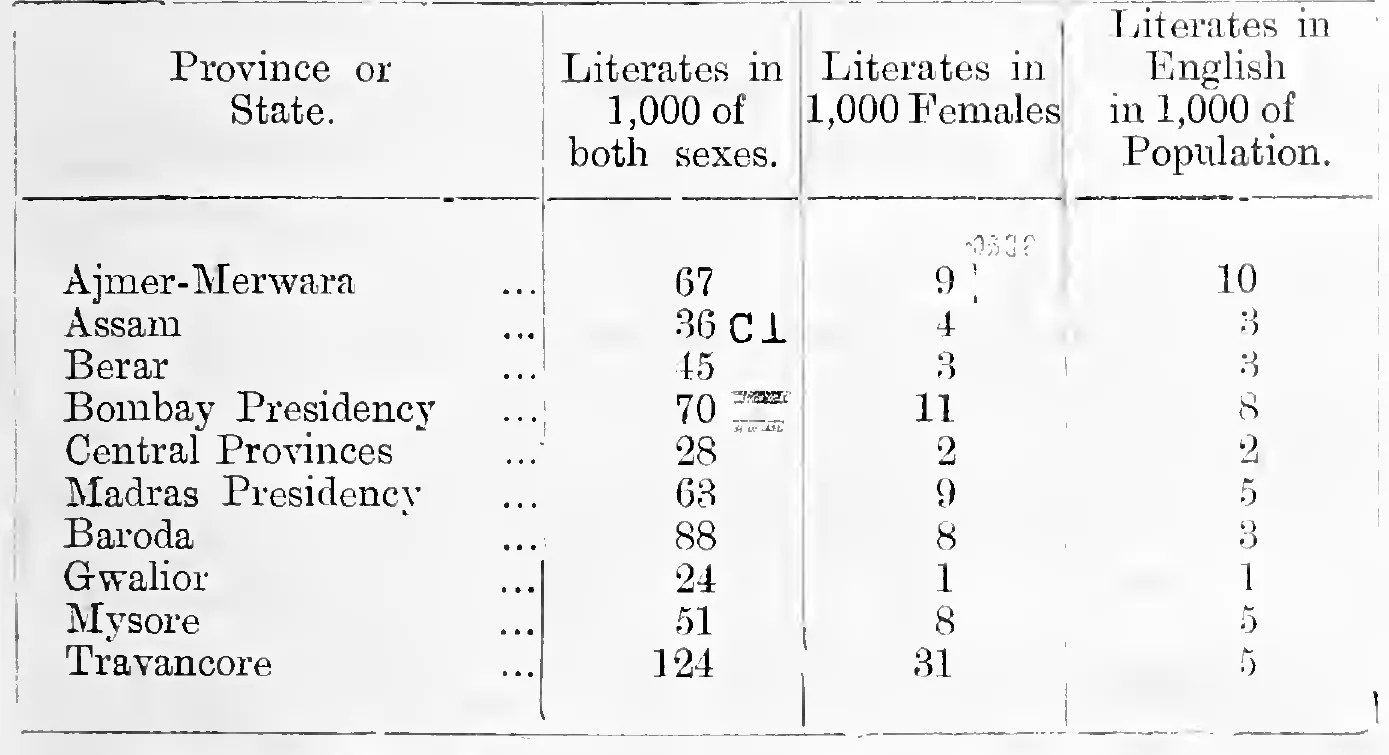
Travancore has 124 literates out of every 1,000 of its population; the enlightened State of Baroda comes next with 88 out of 1,000, i. e., 71 per cent. of Travancore; the highly refined Presidency of Bombay comes to 56 per cent. of Travancore. This result is the legitimate outcome of the close attention which the Government have been devoting to the spread of education in Travancore. They maintain a large number of institutions in all the taluqs and villages and liberally help private enterprise by grants-in-aid, and the result has been that there is a regular net-work of educational institutions spread throughout the country.
* Mr. J. D. Rees' article on the Census of India, in the Nineteenth Century and after for December 1904.
[470]The following statement gives the total number of the different grades of Institutions along with their strength at the close of the year 1079 M. E. (1903-04 A. D.):—
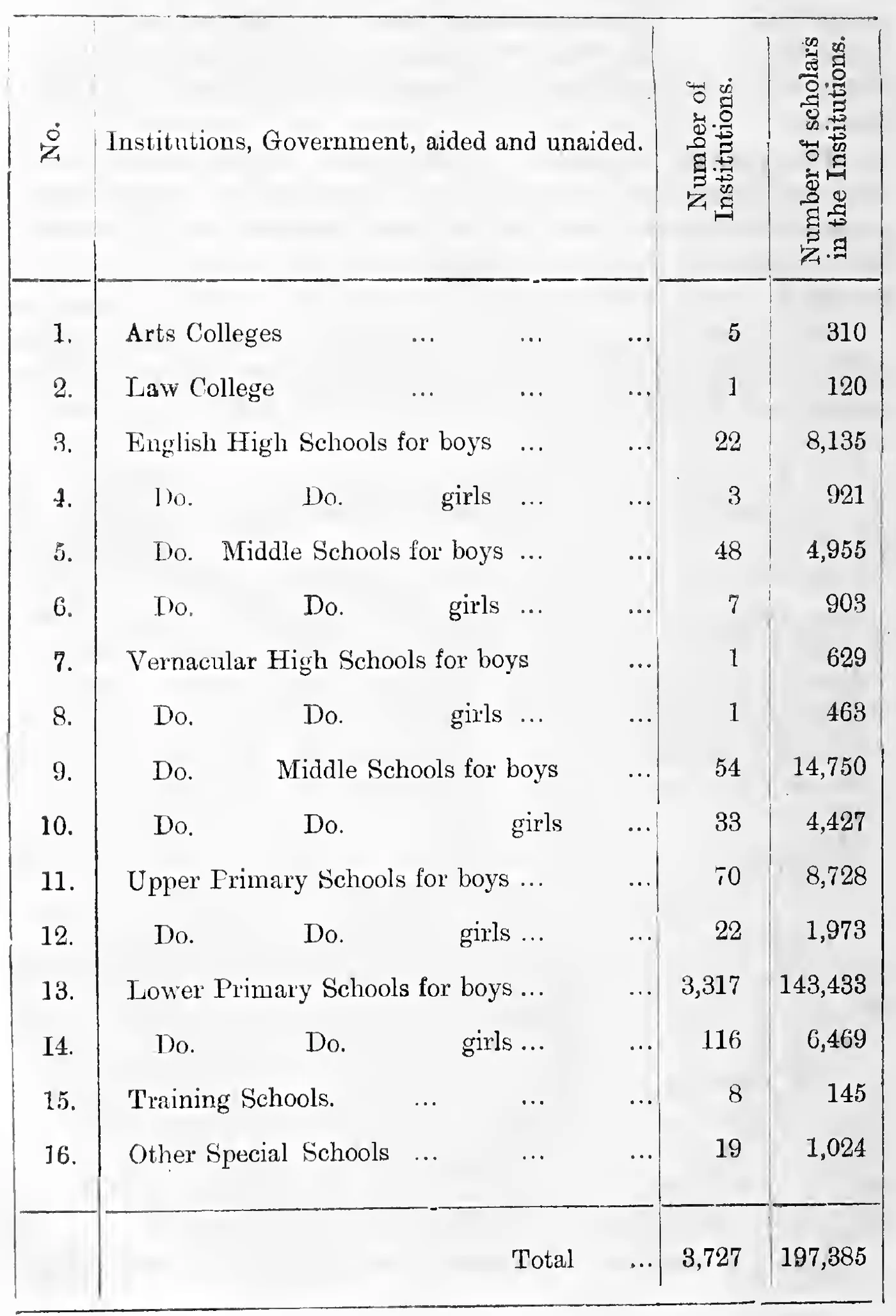
[471]The rapid spread of education has of course necessitated a gradual increase of expenditure as is evident from the following table:—
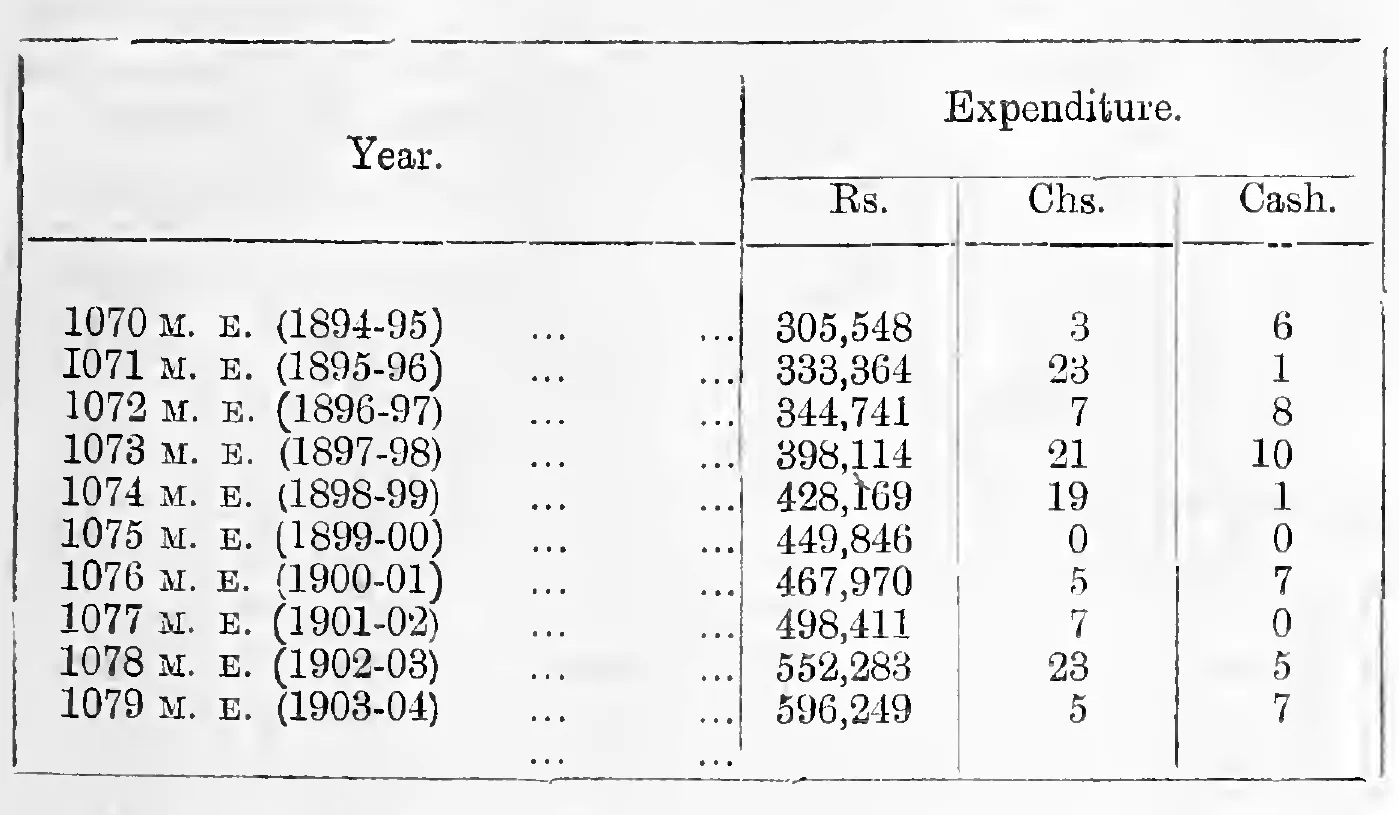
The expenditure on education which amounted to a little over 3 per cent. of the revenue in 1894-95 has risen in 1903-04, the last year of the decade under review, to nearly 6 per cent. of the total revenue.
The educational progress attained by the State has been summarised by Dr. Mitchell, the Principal of H. H. the Maha Rajah's College in the following terms:—"The Educational Department under H. H's Government is now equipped with a First Grade College, a First Grade Law College, a Second Grade Arts College for women, a complete and thoroughly well organised system of English and Vernacular Schools under Government management; 2 Normal Schools; an Industrial School of Arts; a system of Agricultural Education; a Reformatory for juvenile criminals; and finally, a complete body of educational rules and a complete system for the regulation of State aid to Education." To this may be added the scheme of Primary Education, which the Government has recently undertaken to impart, free of cost, to all castes and classes of the population.
Education by classes. A study of the statistics showing the diffusion of education among the several classes of the community has a special interest. The following is a comparative statement showing the increase [472]in number of pupils belonging to the chief classes under instruction for the last ten years:—
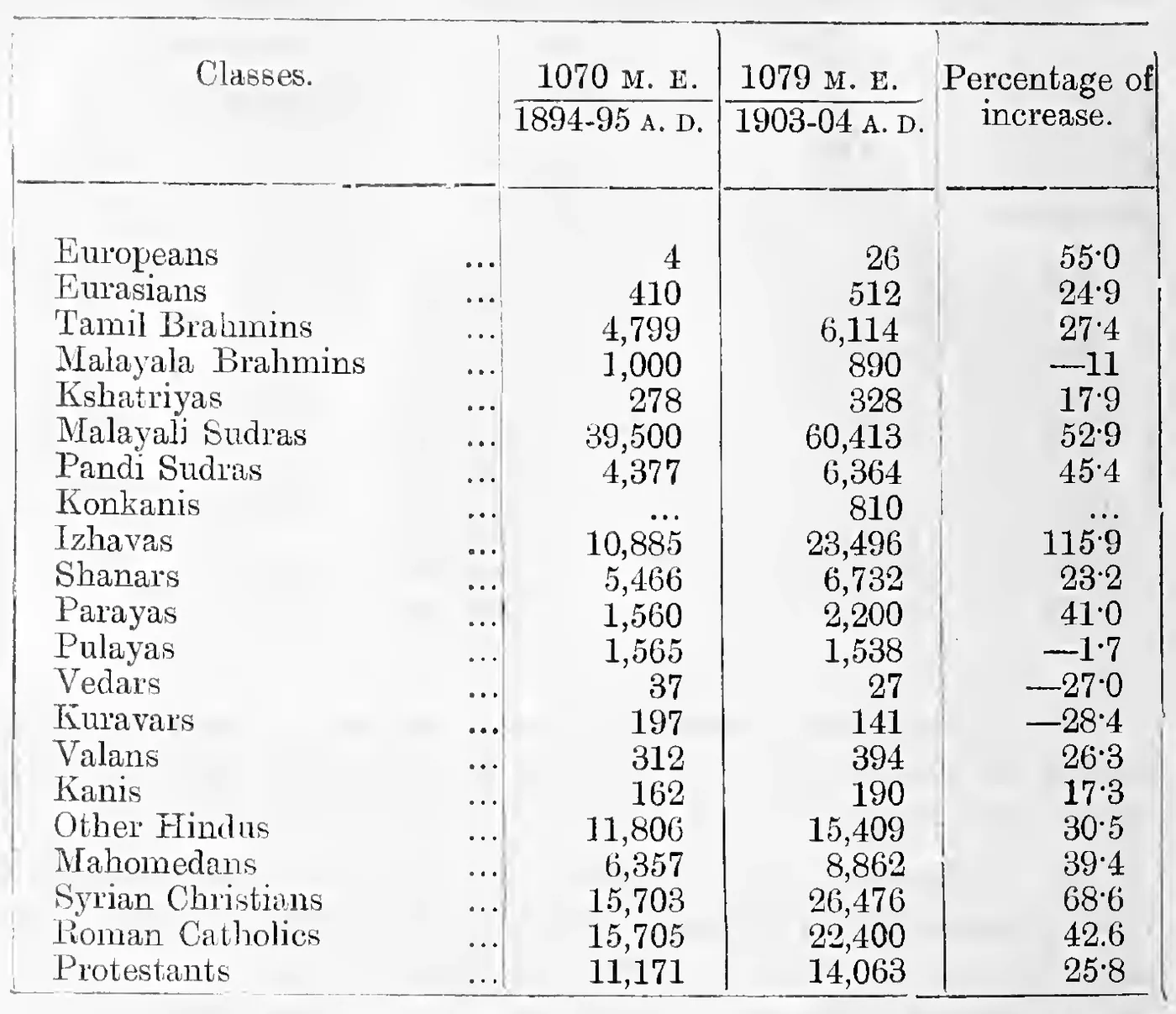
The increase of population in a decade, i. e., from 1891 to 1901 was 15·4 per cent. The percentage of increase in the number of persons under fifteen years of age, during the same period, showed an increase per cent.
Female Education. The education of women is not new to this country. In olden times the position of women was one of great importance. In the Vedic age the wife was considered part and parcel of her husband. She was indispensable for the performance of his daily sacrifices. She was able to read and write, even to compose songs and hymns. She was skilled in needlework. She was taught to sing and play on the Veena. Sanskrit literature abounds with references to many educated and learned women. Even the deity presiding over learning is a goddess. Side by side with this, there was another active kind of education going on steadily in every Hindu household. The young girl is taught the ideal of duty from her very infancy. She is taught to look upon her domestic duties as an all important occupation of her life. To [473]revere her elders, male and female; to respect her husband and to treat it as the sole occupation of her life to please him; to revere him as her god; and to minister to the wants and requirements of all in the household; this was her duty and still continues to be so. Her early training is directed towards realising this ideal. When in the fullness of time she marries and goes to live with her husband, her mother, father, brothers and sisters, one and all, instill into her young mind the principles of domestic duty and lessons on female modesty and chastity and, in fact, give daily instruction on all points, attention to which would make her a virtuous woman, dutiful, obedient and really helpful to her husband. "To serve her husband was her religion and her delight. One with him in the household certainly, but moving in a plane far below him, for all other purposes religious, mental and social; gentle and adoring, but incapable of participating in the larger interests of his life ...... gentle, submissive, a perfect house-mistress moving softly about the woman's domain, the inside. Up with the dawn she bathes and worships...... then draws water for the household needs, scorning no domestic duty." This is the type of a perfect Hindu wife, and a girl's early education is directed towards developing in her those qualities which will enable her to reach this ideal more and more. This ideal was reached by the women of India from of old, as I have observed in another part of this book, on a basis of education altogether different from our present school-course. That education secured for Hindu women, refinement and culture of a high order—a fact which though not so well understood by the educated Hindus of the present day, has been again and again recognised by thoughtful and cultured writers of the west—as I was happy to notice even recently in a well-written article in the Madras Mail by an accomplished English lady, styling herself An English woman. She writes:—
"Culture usually implies a knowledge of the three R's but may exist quite independently of it, and this the Brahmin woman assuredly proves in my opinion. If 'manners are not idle, but the fruit of loyal nature and of noble mind', if perfect correspondence with one's environment is the end of education then the Brahmin woman is cultured. It may be a culture very different from our western product, yet it is a culture perfect of its kind for the purposes of life as it has to be lived by the Brahmin woman.
"For many years I went in and out amongst Brahmin families with the object of teaching their women and girls the three R's and improving them generally. Improve them? Improve those gentle amiable manners, that perfect poetry of motion in gait, that artistic yet seasonable and reasonable style of dress; that perfect contentment with the station of life in which they are placed; that sweet domesticity of life that surrounds them, that Spartan conservatism to exacting customs that for them at any rate makes 'room to deny themselves—a road to bring them nearer God'? nay, far from my improving them, they [474]improved me, and often have I on these grounds combated the impression in England that the Brahmin women are crude and uncultured. I certainly succeeded in teaching them the 'three R's' (and with what avidity they learn) but it was a 'Something stuck on'—an addition, a very desirable and valuable addition, but in no way going to make them cultured. They were already that in my opinion.
"I often think that in our high western civilisation we 'miss that whereto we tend'; and I have much sympathy with Prince Menelick's verdict on his visit to England a few years back. On the eve of his departure to Abyssinia, he expressed himself as highly pleased with his visit. England was a great and a grand country, but he was so glad he was going back to civilisation! We smile, but there is a world of philosophy in his words. Life in the west is becoming more and more a matter of rapid locomotion. People are for ever motoring, biking, tuppenny-tubing, express-training, bussing, tramming, cabbing, or where these fail, perambulating the pavements—always trying to reach a point other than where they are in the quickest possible way, and every point of arrival is only another point of departure. Our richly furnished homes become more and more cubicles, and even the old-fashioned hospitality of a dinner must now have a 'hotel' setting.
"But we shall awake one of these days to learn what dupes of our much vaunted civilisation we have become, and we may yet turn to Prince Menelick and the Brahmin woman for wrinkles on how to live."*
Such confirmation of Indian orthodox views by the best specimens of cultured European ladies brought up under altogether different environments and trained to admire other ideals than our own, is indeed refreshing, showing that the best culture of the East is identical in aim and spirit with the best culture of the West. It also shows the general reader what amount of rubbish is often uttered by our so-called educated brethren in the name of education, when such education unhappily is not informed by sympathy or real knowledge.
Owing to immunity from external foes and from the consequent upsetting of social institutions, though only for a short time, female education in Malabar has been more popular than in other parts of South India. The Nayars especially are very earnest in the education of their sisters and nieces. No girl is permitted to grow up to womanhood without a fair knowledge of reading and writing. A knowledge of Sanskrit and of music, vocal and instrumental, are also added in all well-to-do households. The few accomplishments, now considered essential in modern Girls' Schools, were looked upon in old times as mere superficial luxuries and, therefore, education, such as it is now, is of a later introduction. As might be expected the Missionaries were the first to establish Girls' Schools. The earliest effort was that of Mrs. Mead, who in 1819 organised a boarding school for girls at Nagercoil primarily for the [475]children of Christian converts. They were in the beginning unwilling to send their girls to schools, as it was contrary to custom. But when the advantage of board and clothing were provided the difficulty was soon overcome. The object of the school was "to give a plain instruction united with a Christian and moral education". The girls were also initiated into several industries such as knitting, spinning, needlework, &c. When Mrs. Mault took charge of the school, she taught crochet and embroidery work and introduced in 1821 the now famous "pillow lace". This new industry in lace-work gradually expanded and has since become widely known in India and abroad, and has won prizes and medals in London, Paris and other European, American and Indian Exhibitions. Similar schools were opened at Alleppey in 1820 by Mrs. Norton and at Kottayam in 1822 by Mrs. Bailey. In all these schools, in addition to scriptural and industrial instruction, the general subjects taught comprised History, Geography, Arithmetic and elements of Natural Philosophy in Vernacular and a few lessons in English in the highest classes. By the success these schools attained, the popular prejudice against female education gradually subsided and the schools became popular. The employment of female teachers added another element of popularity. But the missionaries were not merely content to establish schools. They tried to influence public opinion in the matter. They published pamphlets on the advantages of female education, and in one issued from the London Mission Press at Nagercoil in 1831 they exhorted the people to send their girls to schools "as Hindus of Bengal, Bombay and Madras have already sent their girls to schools being convinced of the innumerable advantages of female education". From the several centres of missionary activity female education spread all round and there are, at present, a large number of Mission girls' schools distributed throughout the entire extent of the State.
* 'The Brahmin woman'—an article by an English woman in the Madras Mail dated 9th June 1906.
Though the missionaries were thus very active, the Government itself was rather indifferent. Sir Madava Row complains in his Administration Report of 1038 M. E. (1862-63 A. D.) that "very little, if any thing, has been done, for female education. This subject calls for prompt attention, as such education must be, among other advantages, the foundation of important social reforms". The first decided attempt by Government was made in 1041 M. E. (1865-66 A. D.). There had existed for a few years previously a school established at the Cantonment in Trivandrum, but it was apparently languishing for want of encouragement. The Government therefore took the school under their management in that year and placed it on an efficient footing. Originally intended for the [476]instruction of Christian girls, it was now thrown open to all classes. The services of an English Schoolmistress, Miss Abel, was secured, and she took charge of the Institution in 1867 and continued as the Headmistress till the end of 1868, when she was succeeded by Miss Mainwaring. The course of study comprised a sound instruction in English, plain and fancy needlework and lessons in drawing, French and music, both vocal and instrumental. Miss Donnely was the next Headmistress and under her the Institution was raised to a High School in 1888. She was succeeded by Miss. S. B. Williams, M. A., in 1896 and in the next year the school was raised to the standard of a Second Grade College and affiliated to the Madras University under the name of H. H. the Maha Rajah's College and High School for Girls. Hitherto a small fee had been levied, but all fees for girls were abolished in 1896. This contributed much to the popularity of the school and the attendance gradually increased.
In 1867 Miss. A. M. Blandford of the C. E. Z. Mission opened a school within the Fort for the education of the caste girls exclusively. The Government have been assisting the school with grants. Through this school Miss Blandford has been instrumental in diffusing English education among high caste women, and her influence has extended even to the ladies of the Royal house. Miss Blandford has been connected with the school from its inception and has been working with wonderful zeal and earnestness, and though she has laboured for 38 years, she is still able to exercise a sort of general control over the Institution. In addition to these two institutions there are two others at Trivandrum intended for the higher education of women. These are the Government Vernacular High School for Girls and the St. Joseph's Convent Girls' College teaching up to the F. A. Standard.
The latter is a Mission Institution under the supervision of the Carmelite monks and is attached to the Convent of Holy Angels at Trivandrum.
There are besides several schools of the lower standard scattered throughout the country. The number of Colleges and Schools for Girls at the end of 1079 M. E. (1903-04 A. D.) stood as follows:—
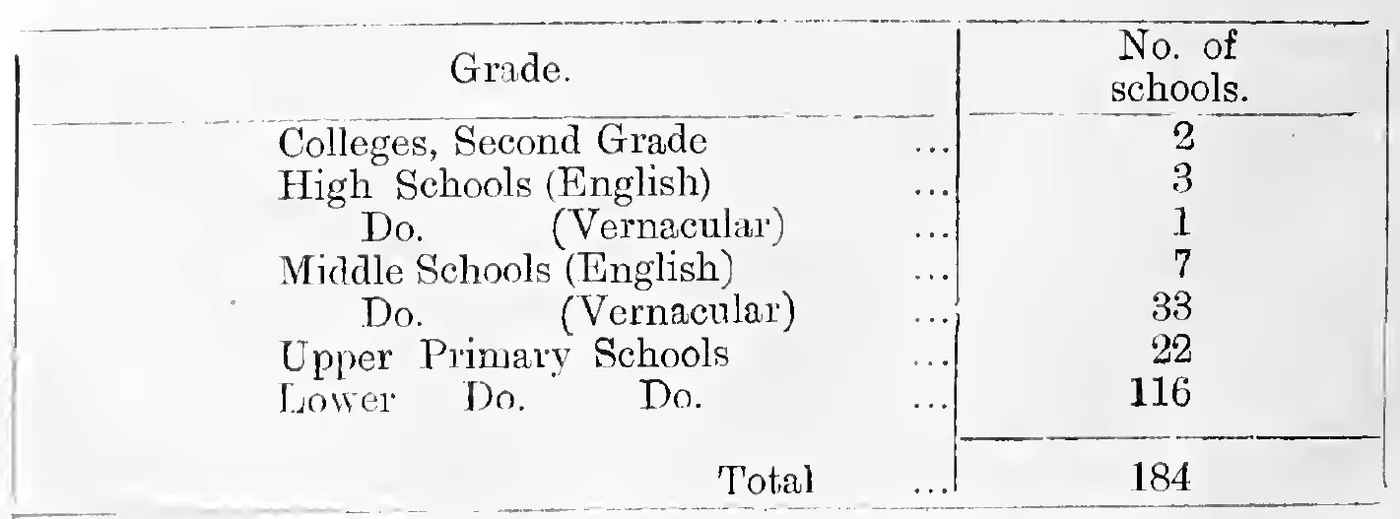
[477]The progress of female education during the last decade may be gathered from the following statement:—
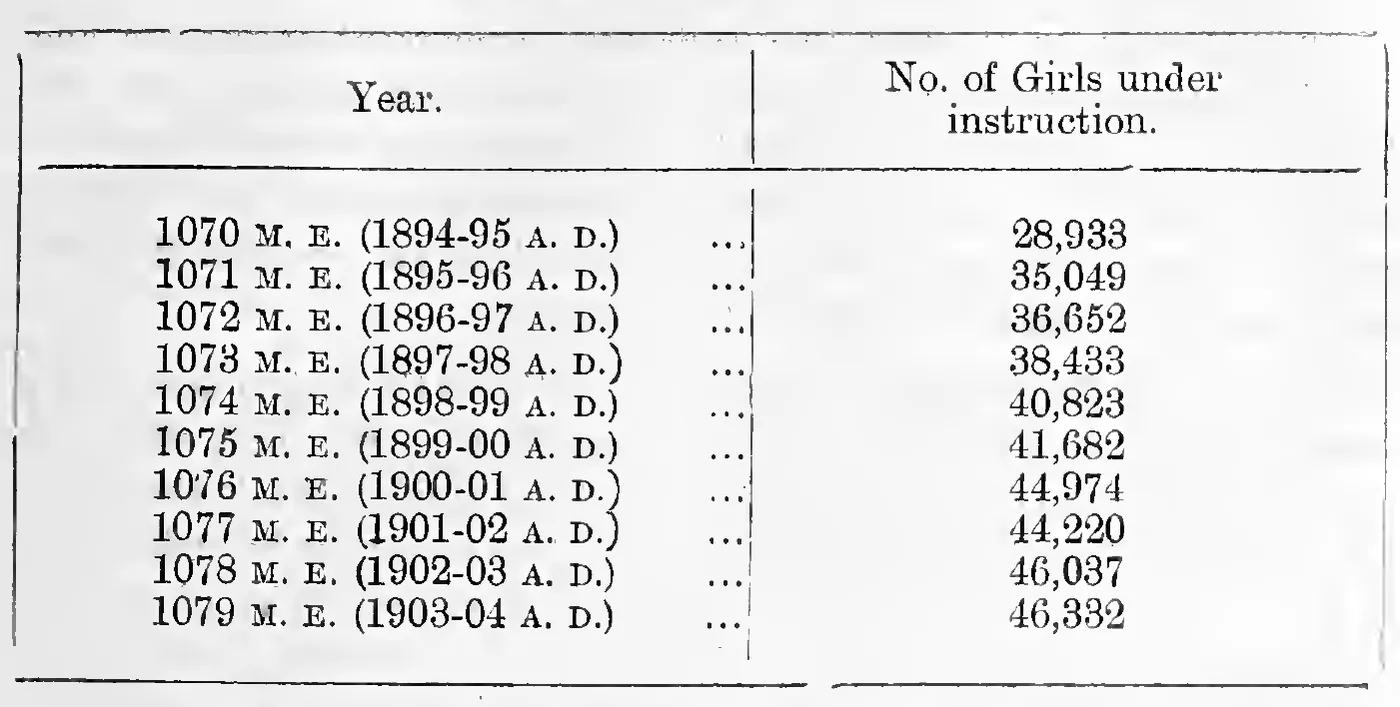
There has thus been an increase of over 60 per cent. in the number under instruction during the last ten years. The Census statistics of 1901 show that in point of female education Travancore continues to maintain the first position in India. Female literacy is nearly three times that of the most advanced provinces of India. 31 out of every 1,000 females are literate in Travancore while elsewhere the figures range from 1 in every 1,000 in Gwalior to 11 in 1,000 in Bombay which stands highest.
"It is by the position of women in it that we judge to a great extent of the relative progress made by a community towards the complete life that we call civilisation." Judged by this standard Travancore is in the forefront of civilisation. The Malayali women enjoy a larger share of freedom than is allowed to their sisters beyond the Ghauts, and the system of inheritance through females prevalent in the country, invests them with an importance unknown in other parts of India. Their influence is very marked in society. Many have distinguished themselves in education and a few are poets and journalists. The recently started Sarada is a monthly magazine edited by two Nayar ladies of whom one is an F. A. of the Maharajah's College. The ladies of the Royal household and those of the Koil Tampurans and Rajahs are invariably well educated, and not a few of them are learned in Sanskrit. They are also votaries of music, both vocal and instrumental. Her Highness Lakshmi Bayi, C. I., the late Senior Rani of Travancore, was a great proficient in music. I heard Her Highness sing years ago for about two hours to the accompaniment of Veena, and it appeared to me a remarkable performance. She has also composed musical pieces some of which are [478]in my possession. The young Ranis now adopted are being given a high class education as is the practice in the Royal house.
The example of the high-born ladies, the enjoyment of freedom and the importance attached to their position in their families and the large number of schools established by Government, where free education is given for girls, the liberal aid to private enterprise and the facilities provided for the training of female teachers, have all contributed to the rapid spread of female education in Travancore.
Primary Education. Primary education is the instruction of the masses through the Vernaculars in such subjects as will best stimulate their intelligence and fit them for their positions in life. While the benefits of higher education and of English education are not to be underrated, it must be confessed that it will be long before they are availed of by any considerable section of the people. In the present circumstances of the country and of the poorer classes in particular, higher education must be confined to a limited though gradually increasing number, and it can never be expected to reach the lower orders of society. If the latter are thus denied the benefits of higher or even of secondary education, it is very desirable that at least the elements of education should be made familiar to them, as any system of technical or industrial education, so necessary to the improvement of their condition at present, has to rest on a basis of a preliminary general education of a simple and practical kind, if it should be of any practical benefit at all. The Education Commission recommended to the Government of India in 1883 that "the elementary education of the masses, its provision, extension and improvement should be that part of the educational system to which the strenuous efforts of the State should be directed in a still larger measure than before". The duty of the Sirkar in the matter was realised in Travancore long before the Education Commission's report. As early as the year 1046 M. E. (1870-71 A. D.) the Sirkar inaugurated the system of Proverty schools which contemplated the opening of at least one school in every village in the State, and the scheme was gradually brought into force; so that in the course of a few years "every proverty has been supplied with at least one Government school of the Primary grade and there is practically no village of any consequence in the whole State whose educational requirements have not been supplied directly by Government". Side by side with the increase in the number of Primary Schools the Government have also been rendering instruction, more comprehensive and useful. The masses could never have been reached except through the Vernacular, and the antiquated methods of instruction in the Vernacular, afforded in the village schools [479]under the Asans, were hardly in keeping with the times. The Government, therefore, very judiciously revised the curriculum of studies in Vernacular schools so as to include such subjects as Hygiene, Agriculture and an elementary knowledge of the Sciences, History, Geography and Mathematics. By their instruction in these subjects, the pupils when they leave schools, are equipped with a fair amount of general knowledge which cannot but be of the utmost use to them in after life. The establishment of Government schools vastly improved the educational facilities of the people. But there were still hundreds of indigenous schools under private agency. They were beyond the pale of Government control, and the instruction in them did not come up to the standard of the Government schools. It was desirable that their condition should also be improved. Dewan Ramiengar wrote in October 1883:—
"In them the parents pay and the teachers receive some remuneration, however uncertain and trifling, though the instruction imparted is useless, if not mischievous, as being calculated to perpetuate the prevailing darkness. The rudiments of a school exist, and a desire to pay for the instruction, such as it is, is evinced; and if advantage is taken of this; if the teachers are gradually brought under training; if the course of instruction is prescribed; if proper reading-books are made available, and a grant-in-aid given, the means of elementary education will be considerably extended."
This led to the introduction of the grant-in-aid system which brought many of the indigenous schools under the control of the State, and the standard of instruction in them was thereby assimilated to that in force in the Government proverty schools. Thus, by the double system of establishing Primary Schools in all important villages and the introduction of the grant-in-aid, elementary or primary education was considerably strengthened. The progress since attained may be gauged from the following statement:—
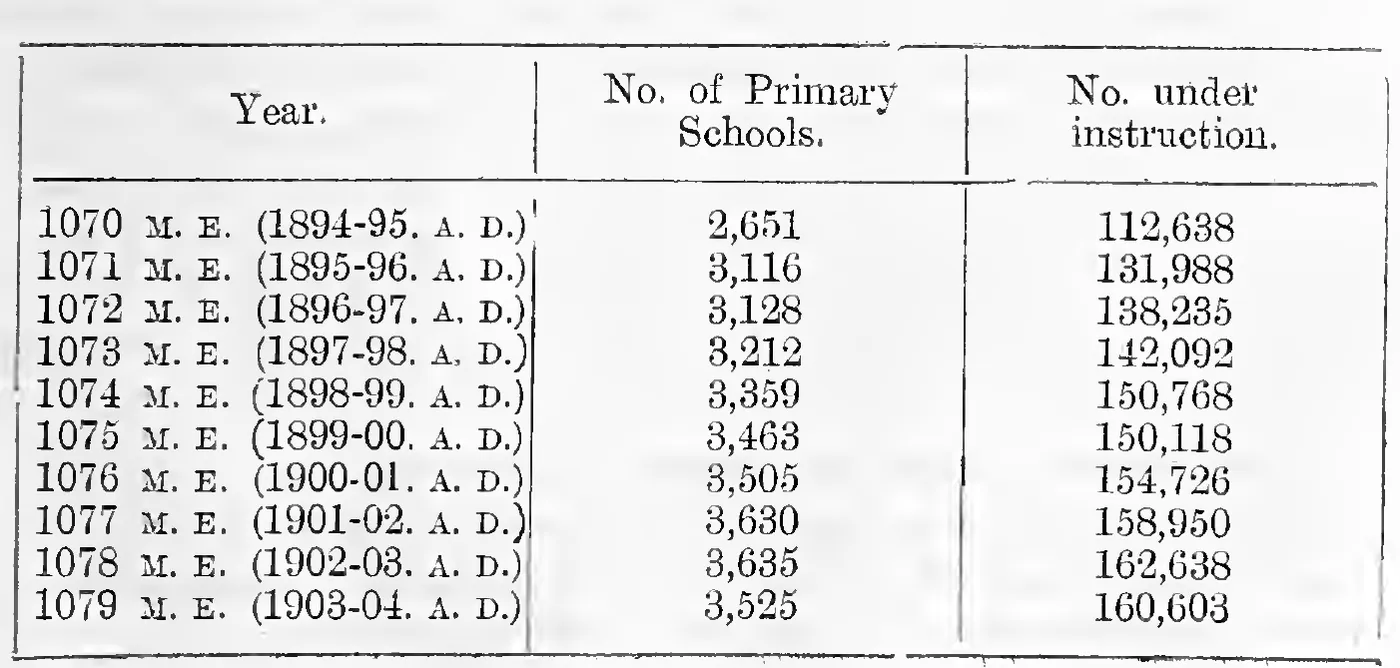
[480]The progress has been steady and satisfactory. But according to the Census of 1901 only 5 per cent. of the children under fifteen years are literate. It only shows what an enormous work there lies before Government in extending primary education. A century ago it had almost seemed as if the mass of the people delegated all intellectual interest to a single class and were content to unreservedly accept from them guidance in matters of law, religion and morality. But now things have changed. Society has begun to feel the urgent necessity of some intellectual and moral influence being brought to bear on the poor through the extension of education among them. It is now recognised as the duty of all civilised Governments to carry the mission of at least primary or elementary education to every one under school going age. It is stated by some that education should be made compulsory in every State as the lower classes of society are always slow to appreciate the benefits of education, and this ideal has been accepted and acted upon by some of the European countries. Compulsory education has been introduced as an experimental measure in Baroda among the Indian States. The municipal corporation of Bombay has under consideration a scheme of compulsory education to be introduced within its limits. Regarding the success of the scheme in Baroda Mr. R. C. Dutt in his Administration Reports of the State for 1902-03 and 1903-04 remarks of the Taluqs, under compulsory instruction, "we may fairly claim that we have succeeded in placing the whole of the juvenile population within those limits under instruction", and the question of extension of the system is stated to be under consideration.
In Travancore His Highness' Government in their Proceedings current No. 115 M./10,768 dated 15th August 1904 have accepted "the responsibility of imparting free primary education to all children in the State irrespective of caste, creed or race". To make primary education both in rural and urban tracts more interesting and practical it is their desire to see that greater attention is paid to instruction imparted orally "in the way of object lessons and by the aid of maps, globes and the magic-lantern, the object aimed at being to stimulate the powers of observation of the children and awaken their curiosity". On account of financial considerations these measures are not capable of immediate realisation though a beginning has been made.
Education of the backward classes. Till the middle of the last century predial slavery existed in Travancore recognised by law. The lower classes formed the agrestic slaves attached to the land and were transferred and sold with it. They were hardly any better than [481]chattels though, it must be admitted, their masters treated them on the whole tolerably well. The first step at ameliorating their condition was due to the spread of Christianity among them by the labours of the missionaries. Once the members of the lower castes renounced their religion, the disabilities attached to their former status vanished. The missionaries were always by their side to espouse their cause, and it was chiefly through their instrumentality that they secured many concessions, which were denied to their Hindu brethren of the same caste, and were freed from some imposts to which the latter were still subject. Education also spread among them, and beyond everything else this paved the way for their betterment. Not satisfied with elevating the condition of the low class converts, the missionaries, accustomed as they were to the spirit prevailing in England and other European countries, agitated for the abolition of slavery. In 1849 they submitted to Government a memorial on the subject and proposed various measures of reform on the lines followed by the British Government. His Highness the then Maharajah moved by humane considerations always characteristic of the Royalty of the land, issued a Proclamation dated 30th Kanni 1029 M. E. (1853 A. D.) emancipating the slaves attached to the Sirkar lands. This was followed by another dated 12th Mithunam 1030 M. E. (1855 A. D.), which abolished all kinds of slavery in the State. Thenceforward the slaves became freemen and their condition began to improve steadily. But it was long before any appreciable difference was noticed in their material condition. They were most of them workers on fields; they lived away from the dwellings of higher classes and were poor. So far as educational facilities were concerned they were decidedly at a great disadvantage. This was the case only with the Hindu portion of these classes, for the missionary schools afforded ample facilities for the education of the converts. On account of the prejudices and exclusiveness of caste the Government and private schools were shut against them, while religious scruples prevented their joining the Mission schools. Thus for long years they remained without receiving the rudiments of education.
Anxious as Government was that its educational institutions should be thrown open to all classes without distinction of caste or creed, it had to feel its way cautiously lest the good intended to be imparted should be altogether neutralised by any precipitate action; for, in all parts of the country, caste feeling ran high. But the improvement of the condition of the lower classes could not be indefinitely postponed. The desire of Government to afford educational facilities to them took practical shape in the Grant-in-aid Code of 1070 M. E. (1894-95), when for the first time funds [482]were provided for grants being made to schools for backward classes under certain conditions. It was proposed to give special grants of Rs. 4 per mensem for an average attendance of 20 pupils and of Rs. 8 for that of 40 pupils, and the rates were subsequently raised to a uniform grant of three-fourths of the salary of the teachers employed in such schools. Para 5, Section III, of the Code declared the following classes to be backward:—
Pulaya, Pariah, Veda, Izhava, Shanar, Kurava, Vettaran, Marakkan, Paravan, Mahomedan, Mukkuva, Velan, Pallan, Malayarayan, Talavan, Tandan, Mutuvan, Velutedan, Maran, Kshaurakan.
In 1071 M. E. (1895-96 A. D.) Government established 15 schools for backward classes as follows:—
4 for Mahomedans, 7 for Izhavas, 2 for Pulayas, 1 for Marakkans and 1 for Kanis.
In the next year 15 more schools were opened in different parts of the country thus bringing up the total to 30 schools. The Missionary agencies also took advantage of these liberal grants-in-aid and opened numerous schools specially intended for their education, so much so that the number of schools receiving grants rose to 150 within a couple of years. There was difficulty to find duly qualified teachers for such schools, and this induced Government to institute 185 scholarships for pupils belonging to the backward classes, to be availed of by those who were prepared to undergo a course of two years' study in order to prepare for the Vernacular elementary examination, a pass in which enabled them to earn grants as teachers. As a further inducement, the fees for admission to this examination were remitted in the case of pupils of backward classes.
When the benefits of the grant-in-aid were extended to technical schools in 1076 M. E. (1900-01 A. D.) with a view to inducing the schools to combine literary with technical instruction, the grant of three-fourths of the salary was made applicable only to those schools which provided for technical and general training, while those in which a purely literary instruction was given had their grant reduced to two-thirds. This led to a slight decrease in the number of schools for backward classes. In spite of this reduction, however, the schools have considerably increased in number since 1895. In 1903-04 there were 480 schools for backward classes with 43,580 pupils under instruction including those in schools open to all classes. Certain defects in the provisions of the Grant-in-aid Code were lately brought to the notice of Government. It was contended by some that the original list of backward classes named in the Code of 1070 M. E. (1894-95 A. D.) included some that could not [483]strictly come under that description and that converts to Christianity from the backward classes should not be considered to fall under that head so as to entitle the schools attended by them to the Government grant. The Government accordingly modified the list and restricted its applicability to those who remained in their castes. The question of extending the benefits of education to the backward classes again came up for the consideration of Government about the middle of 1904, and a conference composed of the chief educational officers of the State and a few leading missionary gentlemen in charge of schools for the backward classes, was held with the Dewan as President to discuss the necessary measures. The outcome of the conference was that the Government took upon themselves the entire cost of the primary education of the backward classes. The term backward classes was restricted to the following castes:—
Pulaya, Pariah, Pallan, Kuravan, Paravan, Tandan, Marakkan, Mukkuvan and Kanikkars (Hill tribes).
It was specially ordered that "caste should remain unaffected by change of religion." The conditions of Government grant to the schools specially intended for backward classes were fixed as follows:—
1. That at least 75 per cent. of the total number of pupils on the register should belong to one or other of the several castes referred to.
2. That the curriculum should be that prescribed for the Lower Primary Schools in the State.
3. That conditions as to accommodation and furniture were satisfied according to rules.
4. That no fees were levied from the pupils.
5. That the average monthly attendance for a single teacher in public schools was to be as follows:—Towns 20, Villages 15, Scattered and Hilly tracts 10.
It was also ordered that the teachers of schools for backward classes would be paid according to a scale of salaries fixed by Government on satisfying the above conditions.
In order to meet the demand for teachers Government resolved to open and maintain at their own cost and under their direct management, training institutions in four important centres of the State, viz., Nagercoil, Trivandrum, Quilon and Kottayam.
The training will be confined to the primary grade and the course will be for one year. Candidates for training are selected after a special [484]examination by the inspectors and are paid a stipend of Rs. 4 per mensem, preference being given to those belonging to the poor and backward classes as now defined. The measures adopted are intended to go a great way to improve the educational status of the backward classes.
Technical Education. Technical Education was everywhere of a later origin, though its necessity is now generally recognised. Hitherto, the arts and industries were the monopoly of the village artisans who held their position as such by heredity. In the simple economy of the village community the artisan was by no means an unimportant member. He had the usual allowances from the villagers, and he worked day and night, if need be, to meet their requirements. The wages he earned bore no proportion to the work he did, but varied with the requirements of his family. Eligibility to follow a profession depended not so much on the capacity and fitness of a person as on the caste to which he belonged and the occupation his family followed. The children served as apprentices to the father in his life and stepped into his place as a matter of course. In the majority of cases the sons picked up during their long course of apprenticeship a fair knowledge of and skill in, their father’s profession. This system worked well before the days of keen competition. But a vast change has come over the community since cheap foreign machine-made goods began to make their appearance, and the local industries unable to withstand the keen competition are being gradually ousted, as the belated Indian artisan still works on the lines marked out for him by his forefathers for a return which barely keeps body and soul together. The people and the Government have at last awakened to realise the magnitude of the danger, and steps are being slowly taken to improve and strengthen local arts and industries. The first requisite to attain the object in view is the training of our artisan classes to a knowledge of the methods adopted by the more advanced nations. Everywhere industrial and technical institutes are being established, new and up-to-date machinery is being set up and capable young men are sent abroad to study the methods of working in Europe, America and Japan. The industrial regeneration of the country, if not actually in sight, is at least not far off. To this general activity, Travancore has not been slow in contributing its own quota of help. On the other hand, Travancore seems to have entered the field a few years earlier than the other Provinces and States of India.
The missionaries were of course the first to introduce art and industrial education in Travancore. In 1820, Rev. C. Mead founded the School of Industry at Nagercoil for the purpose of promoting useful arts and instructing “children of industrious parents”. The boys were first taught [485]lessons in printing and book-binding. Sometime later, similar schools were established at Neyyur and other places and among the industries taught and spread at their instance we need only record a passing reference “to the manufacture of paper, the art of weaving, the rearing of silkworms, the manufacture of sugar and that of indigo”. But this kind of benevolent enterprise inaugurated by Rev. C. Mead was neglected by the Mission to which he belonged, and in consequence their influence and development have not been as marked as might have been expected. It must, however, be said to the credit of the missionaries that they awakened the interest of Government and the people to the importance of industrial education.
Reference is made by Sir Madava Row in his Administration Report for 1038 M. E. (1862-63 A. D.) to the existence at the Capital of a School of Arts “recently established” by Government; but apparently it soon ceased to exist as no reference is made to it in later Reports. Not long after, the Government established in 1048 M. E. (1872-73 A. D.) a small establishment of carving in ivory under the direction of a Brahmin who designed the patterns and saw them executed, with a view to cultivate the art of carving in which the Travancore workmen had already attained great eminence. The School had been attached to the Huzur till 1889. The carving work, originally confined to ivory, was extended to wood and cocoanut shells. With a view to improve the school by the addition of other branches of industry, Mr. K. Narayana Iyer, B. A., was sent to the School of Arts, Madras, to study the working in that School. He returned in the following year and was appointed Superintendent of the Industrial School, which was now established as a separate Institution. The services of three trained men, i. e., a designer and two potters were secured from the Madras School of Arts, and a separate building was provided for the new school. The Institution as reconstituted this year comprised an Arts Branch and an Industrial Branch. The former afforded instruction in Free-hand-drawing, Model drawing, Practical Geometry, Modelling, Designing, &c. In the Industrial Branch the Institution undertook to develop Lacquer work, Kuftgari work, Carving on wood, ivory, horn, cocoanut shell, &c., Pottery and Porcelain manufacture.
Painting and photography were added subsequently to the Arts Branch and a smithy to the Industrial Branch. Side by side with the establishment of the Institution, the Government, with a view to improve and develop the established industries in the country, authorised the Dewan Peishcars to spend a sum of Rs. 1,000 per annum, in inducing the best workmen within their jurisdiction to turn out really artistic work and to [486]purchase and send some of their work to the School of Arts for exhibition and sale. For the School itself 30 apprentices were selected from among those possessed of some education and taste in the arts. They were taught the principles and trained to make designs in pure Indian style. In 1066 M. E. (1890-91 A. D.) a tile press for the manufacture of “encaustic” tiles was purchased, and the tile manufacture undertaken met with success. Carpet weaving was introduced in 1895 and four looms were erected. With a view to introduce work in stained glass the necessary appliances were procured from London, and the results have been encouraging.
In 1071 M. E. (1895-96 A. D.) the school was reorganised “to render it more efficient in training and instruction in the industries and arts of the country.” The conditions for admission of apprentices were laid down, viz.:—
1. That they should be at least ten years of age.
2. That they should have passed the Primary School Test.
3. That they should be sons of artisans engaged in the industry to which they apprenticed.
The term of apprenticeship was extended to five years and a progressive stipend was allowed to them. At the close of apprenticeship a certain amount of deferred pay was to be given with which the apprentices may be enabled to make a start in life for themselves as workmen in the branches of industries they learned at school.
A weaving class was added in 1077 M. E. (1901-02 A. D.) and placed under the charge of a young man who holds a diploma of the Bombay Technical Institute for high proficiency in textile manufacture. In the same year experiments in weaving plantain fibre were conducted with success. A new machine for the extraction of the fibre was constructed. It has been found to be so useful that orders for models are being received even from outside Travancore. Turbans and cloths for garments have been successfully woven. They have found a ready sale and have secured prizes and medals at exhibitions. With a view to spread the plantain fibre industry “it has been decided to invite persons from different villages, in batches of six at a time, to receive instruction for periods of three months in the practical details of the industry as carried on in the School of Arts, and to pay them Rs. 5 each per mensem for their expenses during the period of their instruction in the school”. The plantain fibre industry of Travancore has gained so much repute that H. H. the Maharajah Gaekwar of Baroda recently deputed three apprentices to study the industry in the local School of Arts, where they were trained in the details of the industry.
[487]Thus from small beginnings the Industrial School of Arts has grown into a very useful institution affording theoretical and practical instruction in a number of subjects. Several young men are being trained in the school, and it may be expected that they will popularise the arts and industries they learn at school in the different localities of the State, where they may settle down, and will thus be instrumental in improving those industries by awakening the attention of the village artisans to the methods and requirements of the age.
A single school maintained at the cost of Government can hardly be expected to confer any considerable benefit. This aspect of the question presented itself for solution at the hands of the Sirkar early in 1900. With a view to encourage the opening of technical schools in the country, special rules for grant-in-aid to such schools were passed in that year.
Even earlier than the time of the establishment of the Government School of Arts there was in existence a private Industrial School at Alleppey started by Messrs. Karuppaswamy Pillai and Brothers in which the following were taught, viz., Carpentry, Painting, Tanning, Photography, Electroplating, Carving, Type-cutting, Drawing and Watch-repairing.
The Government were assisting the Institution with a grant of Rs. 50 a month. The school passed under the Catholic Bishop of Cochin in 1064 M. E. (1889 A. D.) and appears to have ceased to exist in a short time.
Another private institution, the C. M. S. Industrial School, came into existence subsequently and received a Government grant of Rs. 156 per annum from 1072 M. E. (1896-97 A. D.). It continues to do some useful work.
Since the passing of the Technical Grant-in-aid Code, other schools have come into existence and are receiving aid from the State. At the end of 1079 M. E. (1903-04 A. D.) there were eleven such Technical and Industrial Schools in Travancore. They are:—
1. Sri Mula Rama Varma Technical Institute, Nagercoil.
2. Mulagumud Carpentry School.
3. Infant Jesus Technical School for Girls for lace-making, Mulagumud.
4. Native Technical Institute, Trivandrum.
5. Embroidery School for Girls, Attungal.
6. The Weaving Institute, Attungal.
7. Carpentry School, Attungal.
[488]8. Technical School for Textile Fabrics, Maniankolam.
9. St. Joseph’s European Technical School for Girls, Alleppey.
10. C. M. S. Industrial School, Kottayam.
11. Rama Varma Technical Institute, Changanachery.
There were also two unaided Technical Schools under private management, viz.:—
1. Holy Angels’ Convent Technical School for Girls.
2. Puttanchantai Workshop.
The most important of these thirteen institutions are the Sri Mula Rama Varma Technical Institute at Nagercoil, the Native Technical Institute at Trivandrum, the Weaving Institute at Attungal and Rama Varma Technical Institute at Changanachery. The first of these sent several exhibits to the Madras Industrial Exhibition in 1903 and received medals and certificates.
The subjects taught in these schools comprise the following:—
Commercial Subjects.
- Banking.
- Commercial Geography.
- Book-Keeping.
- Commercial Correspondence.
- Type-writing.
Technical Subjects.
- Building material and Construction.
- Building, Drawing and Estimating.
- Earth work and Road making.
- Surveying and Levelling.
- Free-hand and Model Drawing.
- Mensuration.
- Practical, Plane and Solid Geometry.
- Carpentry.
- Blacksmith’s work.
- Weaving.
- Lace-making, &c.
Scholarships and prizes. The founding of scholarships for study in some of the advanced countries of Europe, America and Japan is now universally recognised as a necessary factor in the educational equipment of every country. The Travancore Government sanctioned three scholarships for the study of technical subjects in Europe in [489]1076 M. E. (1900-01 A. D.). One was awarded to a Hindu student for the study of medicine in Edinburgh and the other two to Christian students, one for Geology and the other for Mining in the Royal College of Science, London. The candidates selected were all graduates of the Madras University.
In the following year another Hindu student was sent to England with a Government scholarship for the study of Medicine in Edinburgh.
In 1078 M. E. (1902-03 A. D.) one more Hindu student, who took his B. A. Degree in Chemistry, in the First Class, was sent to England by Government to study Advanced Chemistry, &c., to qualify himself for the B. Sc. in Agriculture in the Edinburgh University.
In 1079 M. E. (1903—04 A. D.), a Hindu student was given a scholarship for 18 months to undergo training and complete his studies in Textile manufacture in the Victoria Technical Institute, Bombay. “The most colossal improvement which recent years have seen in secondary education lies in the introduction of the manual training schools” and great importance is attached to manual training as a part of the general education in America. The attention of the Travancore Government was recently drawn to this method of instruction and as to the necessity for improvement in the existing educational methods particularly in their application to practical ends. The Government have accordingly resolved to introduce into a certain number of schools those methods of manual training which have met with signal success in America, Europe and Japan, and to establish schools, in the curricula of which these methods with suitable adaptation to local conditions will form an important feature along with other branches of instruction to meet the deficiency above indicated.
It is under contemplation to secure the services of a competent professor from America to give effect to the measures proposed by Government.
To encourage originality of thought and research in our educated men H. H. the Maharajah has instituted a prize of the annual value of Rs. 500 called “the Maha Rajah of Travancore’s Curzon Prize,” to be awarded annually, by the Syndicate of the Madras University, to a graduate of that University for the best essay on a given scientific subject.
The increasing attention paid by Government in regard to industrial and technical instruction by the establishment of schools, by liberal grants-in-aid to private enterprise and by scholarships and prizes, cannot but result in materially improving the condition of the people and the resources of the State.
[490]Government Control. Constitution of the Educational Department at the Huzur. At the head of the administration of the Educational Department at the Huzur Cutcherry is the Educational Secretary to Government, who carries on the entire correspondence and who is the officer to whom all letters on educational matters are addressed. He takes the necessary orders from the Dewan.
Inspecting Agency. For purposes of inspection the State is divided into three Ranges—Southern, Central and Northern. Each is in charge of an Inspector, and under the Inspectors are 12 Assistant Inspectors in charge of “Districts” or Subdivisions of Ranges, each District comprising two or more Taluqs.
All Government Institutions other than the following are under the supervision of the Inspectors of Schools. The excepted schools are H. H. The Maha Rajah’s College and High School; H. H. the Maha Rajah’s Law College; H. H. the Maha Rajah’s College and High School for Girls; the English Normal School; the Sanskrit College and the Industrial School of Arts.
The heads of these Institutions are directly under the orders of Government. Inspectors and their Assistants regularly inspect the Government Schools as well as those in receipt of grants-in-aid every year, and report on their working and fulfillment of the conditions of the grant-in-aid. They submit quarterly diaries detailing their work and report on matters coming within their cognizance, and these are reviewed by Government. All officers including heads of institutions in direct correspondence with the Government, submit a report on the working of the schools under their charge annually, and these are incorporated in the Administration Reports.
Grant-in-aid. Reference has been made already regarding the existence of two systems of grants-in-aid, one for Vernacular schools and the other for English schools. These continued to be in force till 1894. The rules regulating the grants under both systems were of the most general kind. The standard as to accommodation, equipment or qualification of teachers was not prescribed. All that was required was the general approval of the Inspecting Officer, and there were no rules under which their approval might be given or withheld. Grants were calculated at one-quarter of the fee collection. The public funds allotted were distributed with no regard to the educational requirements of localities or districts, nor in any way proportional to the efficiency of teaching or to numbers under instruction. The want of a system prescribing definitely the conditions upon which aid is to be given, the basis upon which the amount should be [491]fixed, the curriculum of studies to be followed and the general regulations for the management of aided schools, was very much felt.
In order to remedy these defects Government deemed it necessary in 1894 “that a new Grant-in-aid Code should be issued not only dealing with grants-in-aid but also laying down rules for the classification of schools and fixing the standards of instruction and the qualifications of teachers in aided schools.” The draft of a new measure was accordingly published towards the end of the year, criticisms and suggestions being invited from those engaged or interested in educational work. It had to be considerably modified in order to meet, as far as possible, the views elicited. The Code as finally adopted was published in December 1894 under the name of “the Grant-in-aid Code of 1070,” and this is still in force except for the slight modification since made, in regard to grants to schools for backward classes. The Code provides for the following grants:—
(i) General maintenance grants.
(ii) Special grants for buildings.
(iii) Special grants for furniture.
(iv) Special grants for rent.
(v) Special grants for public libraries.
(i) The General maintenance grants varied according to the following scale:—
(1) A third of the total amount paid as salaries to the teachers in all English schools for boys, the grant being increased to a half in the case of those teachers possessing trained teacher’s certificate.
(2) Half the amount paid to teachers in all Vernacular schools for boys with an increase to two-thirds in the case of trained teachers.
(3) The grant to girls’ schools was 25 per cent. in excess of the amounts paid to the boys’ schools, calculated according to rules (1) and (2).
(ii) Grants for the erection or extension of the School building are not to exceed one-third of the cost of erection or extension.
(iii) Special grants for furniture and appliances will ordinarily amount to, but will not exceed, half the cost of such furniture and appliances. The grant was awardable for purchase of apparatus, maps, diagrams, models and reference books required for the schools, provided the purchase of articles or books are approved of by Government.
(iv) Special grants for rent of school building shall ordinarily amount to, but shall not exceed, a third of the rent paid by the occupier or tenant.
[492](v) Grants to public libraries will only be given to those institutions or associations or societies which are registered under Regulation I of 1063 (1887-88 A. D.), provided the constitution and their articles of association are such as are satisfactory to Government. The amount of grants so made will ordinarily amount to, but not exceed, a sum equal to a half of the cost of books and non-Indian periodicals, provided such books and periodicals are considered by Government to be of permanent literary, scientific or artistic value and subject to a maximum of £. 250 to a library for one year.
When the question of extending and improving technical instruction was seriously taken up by Government they passed in July 1901 rules for regulating the organisation of Technical schools and grants-in-aid to the same. The rules allow grants to schools which taught one or more of the following subjects:—(1) Civil Engineering; (2) Mechanical Engineering; (3) Agriculture; (4) Drawing; (5) Printing, Book-binding and Type-founding; (6) Wood work and Metal work; (7) Leather work; (8) Textile Fabrics; (9) Glass and Pottery works; (10) Geology and Mineralogy; the syllabus of studies prescribed in each branch being the same as that laid down for the Madras Government Technical Examinations, Elementary, Intermediate and Advanced Grades.
The rules for this prescribed certain conditions as to qualifications of teachers and pupils and strength of class and hours of attendance and the supply of instruments, etc., required for imparting practical instruction. The presence in the staff of at least one expert Foreman Mechanic was essential. The grant made to schools satisfying the necessary conditions, falls under two heads, viz., (1) Maintenance and (2) Furniture and appliances, being in each case three-fourths of the amount paid either as salaries to teachers or spent on the purchase of appliances which have to be approved beforehand by Government. Building grants are to be allowed only after the school has been in existence for at least three years, and its stability and usefulness have been proved to the satisfaction of Government.
General remarks. In an ideal scheme of Indian education, particularly for Native States essentially Hindu in character, population, religion and sentiment, it may be desirable to enquire whether the system of education now universally adopted is sufficient, or whether it may not be made the better to serve its purpose, if it included in its curriculum, subjects the knowledge of which was at one time considered indispensable though now altogether eschewed, such as lessons on the ancient wisdom of the Hindus, their Vedic and philosophic discourses, their Smritis and Puranas, the elementary principles of their fine arts, the basal theories of [493]Astronomy and Astrology, their ceremonial formula, in fact something of everything of the old constitution of the archaic Hindu learning and society which still continues to exercise influence on the millions that form the main aggregate of the population of Hindustan. In this wise, the character of modern education may be made less one-sided and more cosmopolitan than it is at present. The Native States are in one sense better fitted to start such educational innovations than the British Government in India. It appears to me that there is sufficient ground to justify the existence of one or two such institutions in Travancore itself—for in a true Temple of Learning every shade of knowledge up to the ends of the earth should find a fane. In the words of Dr. Johnson, “All knowledge is of itself of some value. There is nothing so minute or inconsiderable that I would not rather know it than not.” And to this testimony may be added that of Professor Max Müller who said:—
“Whatever sphere of the human mind you may select for your special study, whether it be language, or religion, or mythology, or philosophy, whether it be laws or customs, primitive art or primitive science, everywhere, you have to go to India, whether you like it or not, because some of the most valuable and most instructive materials in the history of man are treasured up in India, and in India only. And while thus trying to explain to those whose lot will soon be cast in India the true position which that wonderful country holds or ought to hold in universal history, I may perhaps be able at the same time to appeal to the sympathies of other members of this University, by showing them how imperfect our knowledge of universal history, our insight into the development of the human intellect, must always remain, if we narrow our horizon to the history of Greeks and Romans, Saxons and Celts, with a dim background of Palestine, Egypt, and Babylon, and leave out of sight our nearest intellectual relatives, the Aryas of India, the framers of the most wonderful language, the Sanskrit, the fellow-workers in the construction of our fundamental concepts, the fathers of the most natural of natural religions, the makers of the most transparent of mythologies, the inventors of the most subtle philosophy, and the givers of the most elaborate laws. There are many things which we think essential in a liberal education, whole chapters of history which we teach in our schools and universities, that cannot for one moment compare with the chapter relating to India, if only properly understood and freely interpreted.” *
Both Western and Eastern savants will assuredly agree in the value of such a cosmopolitan curriculum of studies for our Indian universities.
The Printing Presses. The first press established in Travancore was the Nagercoil Mission Press brought into existence by Rev. C. Mead in 1820 to be utilised as a valuable appendage to missionary work. About three years later the Kottayam Press was set up by Rev. Bailey, and he is said to have “cut the first type himself from a description given in the Encyclopaedia Britannica”. Later still, [494]two more presses came into existence in connection with the Mission work, at Neyyur and Quilon. All these presses were chiefly devoted to the printing of literature. About the time Mr. Roberts’ English school came into existence at Trivandrum, Government organised a Press under Samathanam Maistry who was one of the first batch of workmen trained in the Nagercoil Press. The first Superintendent of the Press was the Rev. Sperschneider. The scope of the working of the Government Press was at first very limited being confined to the publication of the Travancore Almanac and the requirements of the English School and one or two more departments. Rev. C. Mead was appointed Superintendent of Government Press in 1863, and through his efforts the stock of printing machine and types received considerable additions. In 1045 M. E. (1870 A. D.) a Lithographic Press was added. Now the Press undertakes most of the Government work and private work also to a limited extent, whenever it is possible to do so without detriment to the Government work.
* India what can it teach us?—page 15.
No law had existed till very recently to regulate the establishment and working of private presses. In 1898 one Mr. Raman Unnithan, who had been working a press in the British settlement of Tangasseri, applied to the Dewan for permission to establish a press in Quilon. The Government, whose permission was not hitherto sought, though a few presses had been established previously, ruled for the first time that certain conditions prescribed by the British Indian Act XXV of 1867 (regulating printing presses) should be satisfied, and issued an order to all District Magistrates (Dewan Peishcars) to insist upon these conditions being fulfilled when applications for establishing printing presses were received by them. There were several others who set up private presses under the new rules, but as many presses had been established before the orders were passed, it became necessary to enact a legislative measure prescribing a uniform procedure for the regulation of printing presses. This was done in Regulation II of 1079 M. E. (1903-04 A. D.) which prescribes in Part II that no person shall keep in his possession any press for the printing of books or newspapers, who shall not have made and subscribed a declaration, before the Magistrate of the District within whose jurisdiction such press may be kept, giving a true and accurate description of the locality of the press, undertaking to print and issue no book or newspaper unless the name of printer and of the press has been printed legibly on it, along with that of the place of printing, &c. These rules generally follow similar provisions obtaining in British India. There were, at the beginning of [495]1905, 28 private presses in Travancore and their names and stations were as follow:—
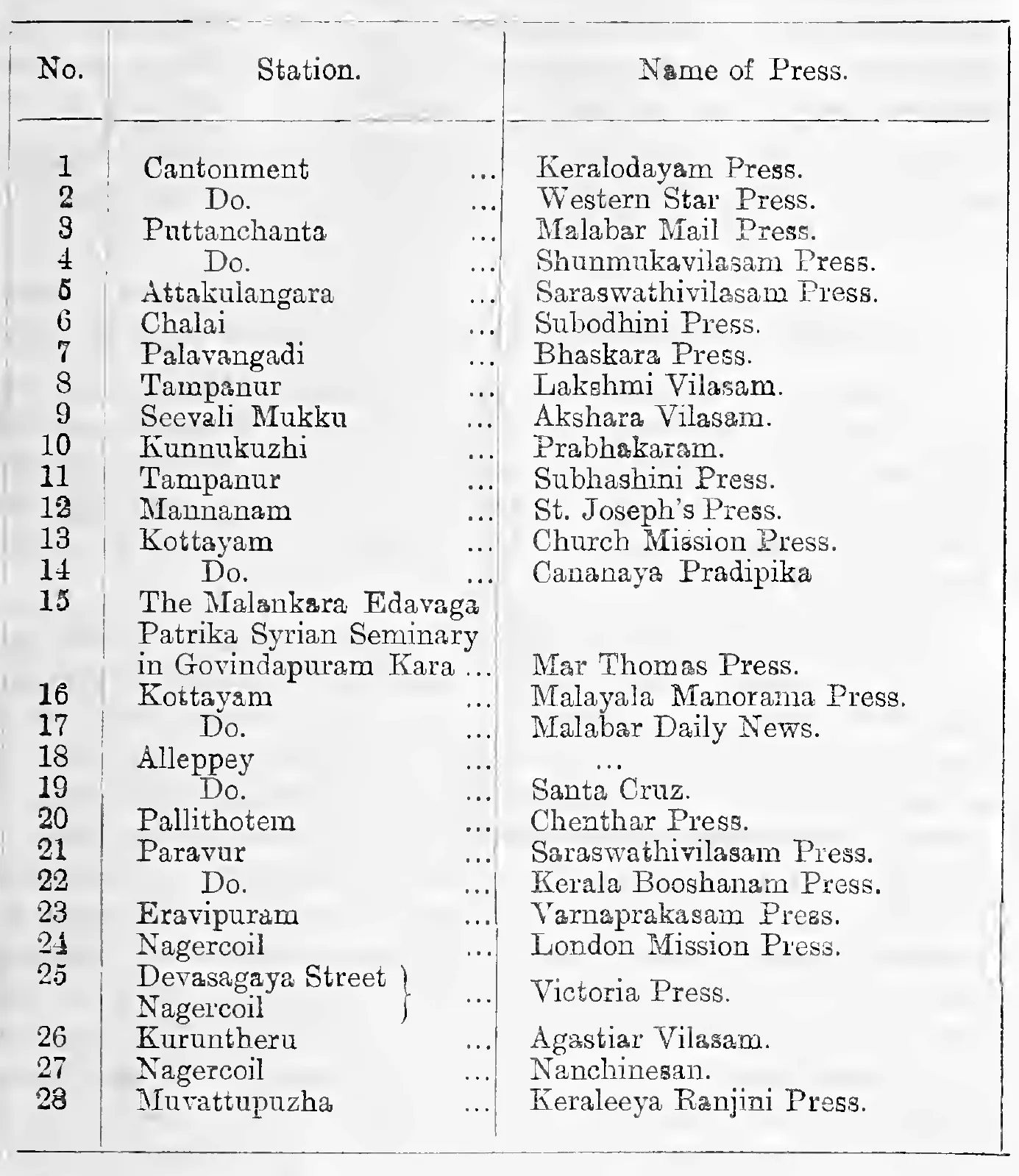
Publications. GOVERNMENT PUBLICATIONS. The most important Government publication is the Travancore Government Gazette, issued weekly from the Government Press on Tuesdays. It contains all important orders of Government, particulars as to appointment and change of officers, the regulations and rules passed by the Government from time to time, the proceedings of the Legislative Council, reports of the important orders of the High Court, departmental rules, orders and, in fact, all matters which it is necessary or desirable that the public should be aware of. It is priced cheap so as to be within the reach of all.
[496]The Almanac is an annual publication issued from the Government Press, which furnishes a lot of useful information, and is a splendid vade mecum to be referred to on all points connected with the administration of Travancore. It contains besides trade list, list of factories, plantations, roads and canals, postal and telegraphic rules, &c.
The Annual Administration Report, issued every year, contains a summary of the year’s progress in the work of each department of the State.
The Travancore Law Reports, though not issued at regular intervals, are authoritative publications of important decisions of the High Court.
The above are the most important publications of general interest. Besides these, there are many other Government publications such as the Unrepealed Regulations, the school text books, departmental rules and regulations, &c. Copies of these are made available for sale to the public at the Government Book Depôt, attached to His Highness the Maharajah’s College.
PRIVATE PUBLICATIONS. Books. Wherever printing presses and printed publications exist, it seems to be the rule for the Government concerned to exercise a kind of supervision over them with a view both to protect public interests and to safeguard the rights of the people who, by an exercise of their intellect and intelligence, contribute to the literary and scientific advancement of their countrymen. Regulation II of 1039 M. E. (1863-64 A. D.) was passed with a view to encourage the publication of useful books in Travancore by securing to the authors copyright and proprietary interest in their works for 42 years from the date of their first publication. The Regulation requires that an author applying for copyright of his book should get the name of the book and the author registered in a Book of registry of copyright and of its transfers, kept in the Dewan’s Office. Any one infringing the right is made liable for damages to the author. By an agreement with the British Government all English publications possessing a copyright in British India, are treated as copyright under the local law and vice versa. Since the passing of the above regulation literary activity has considerably increased and a large number of books, pamphlets, magazines and newspapers are being issued from the Travancore Press.
[497]Newspapers. In the case of new papers also there was no control exercised by the Government till the passings of Regulation II of 1079 M. E. which regulates the conduct of newspapers as well as of printing presses. The same rules apply to the printing and sale of books and newspapers. Section 9 of this Regulation prohibits the sending by Anchal any books or newspapers wherever printed and published which contains or which has on its cover, any words, marks, or designs of an indecent, obscene, seditious, scurrilous, threatening or grossly offensive character.
[498]
Chapter XIIPublic Health.
“There is this difference between those two temporal blessings - health and money: money is the most envied, but the least enjoyed; health is the most enjoyed, but the least envied; and this superiority of the latter is still more obvious, when we reflect that the poorest man would not part with health for money, but that the richest would gladly part with all their money for health.”
Colton.
Having dealt with the climate, seasons and rainfall in a previous chapter, we may here deal with Public Health i. e., those factors that enable us to get an accurate idea of the actual state of the public health of the country as well as the endeavours made from time to time by Government to promote the same. The subject may conveniently be treated under the following heads:—
(a) Vital Statistics, (b) Vaccination, (c) Conservancy and General Sanitation and (d) Medical Relief.
(a) Vital Statistics. The value of Vital Statistics was unknown in ancient days though considerable importance was attached to the rules of hygiene and medical treatment upon which depended the health and longevity of the race. Travancore was no exception to this rule, though I myself brought to the notice of Government the importance of this matter, many years ago. In my report on the Census of 1891, I observed:—
“With regard to Life Statistics I wrote in my first Census Report of 1875 as follows:—
‘In continuation of the results obtained by the census, I would suggest a small establishment being kept up till another census to secure Life statistics. The object can be attained by having one clerk on 7 rupees salary in each of the Proverties. He will be required to submit a monthly account of births and deaths with particulars of sex, religion and caste, his work being ckecked and controlled by one of the Taluq officers. This information will be highly useful in several ways, and will throw considerable light on the results of the next census when one is taken. Also the registers of houses prepared in December 1874 may be continued year after year, with the necessary additions and alterations.’ Again I wrote in my second Census Report of 1881:—‘I beg to repeat here the suggestion I made in my last report with regard to Life statistics. This is of the utmost importance to our State, and I think His Highness’ Government will be well advised in sanctioning a small establishment for the purpose. Every Proverty should send in monthly accounts of the number of births and deaths in it. A small staff will suffice, and if Government are in a mood to sanction it, information may be collected also of the houses, shops and other [499]buildings that come into existence or are abandoned in the month. The results given by this permanent agency may be compared with those arrived at by periodic enumeration, such as the one now in vogue, and the progress of society in a variety of ways most accurately noted down.’ This important suggestion I find has not yet received the consideration due to it from Government.”
Till 1069 M. E. (1893-94 A. D.) there was no regular agency for the registration of vital statistics in Travancore though the village officers were expected to keep a register of births and deaths known as Jananamaranakkanakku which was neither accurate nor exhaustive. With the passing of the Towns Improvement and Conservancy Regulation II of 1069 M. E., the registration of births and deaths was regularly started in the towns of Trivandrum, Nagercoil, Quilon, Alleppey and Kottayam, under the control of the Town Improvement Committees appointed by Government in pursuance of the above Regulation. Towards the close of 1070 M. E. (1894-95 A. D.) a scheme for the registration of births and deaths throughout the State was sanctioned with effect from the beginning of 1071 M. E. (Aug. 1895), and a special Department was organised embracing Vaccination, Vital Statistics and Sanitation and placed under the charge of an officer styled the Sanitary Commissioner. The main lines of the scheme were thus laid down by Government:—
“The Department, as the name indicates, is charged with (1) registration of births and deaths, (2) sanitation of all parts of the country, except the towns brought under the operation of the Towns Improvement Regulation and (3) Vaccination throughout the country.
“The department will be under the control of a professional officer styled Sanitary Commissioner, who will be in direct communication with the Government. For purposes of this Department, the whole country is divided into four districts, as shown below * and an Inspector will be appointed to each district whose duty will be (1) to superintend and check the vital statistics throughout the district; (2) to attend to the sanitation of all parts of the district where the Towns Improvement Regulation is not in force; (3) to study and report on the state of public health within his district; (4) to superintend the vaccination work and (5) to be a sort of travelling dispensary, actually conveying medical aid to the door of the villager. The Inspectors will be under the immediate orders of the Sanitary Commissioner.
“The registration of vital statistics will be conducted in the Proverti Cutchery by a Proverti accountant (ordinarily the Nalvali Accountant) specially charged with the work. The necessary information will be furnished to him [500]daily by a Viruthikaran specially deputed for the purpose for each Pakuthy. In the taluqs of Tovala and Agastisvaram, the village watchman will collect and furnish the information and in Shencottah the registering accountants themselves will obtain the same direct. Special arrangements have also been made for the collection and recordation of the statistics in the several Idavagais and also in the hilly tracts, jails and lockups. The vaccinators, whose number will be slightly increased and who will be distributed according to requirements, will periodically inspect the registers in the Proverti Cutcheries within their respective ranges and check and verify the entries.
* Trivandrum District:—Tovala, Agastisvaram, Eraniel, Kalkulam, Vilavankod, Neyyattinkara, Trivandrum, Nedumangad, Chirayinkil. Quilon District:—Quilon, Kottarakara, Pattanapuram, Shencottah, Chengannur, Kunnattur, Karunagapalli. Kottayam District:—Kartikapalli, Mavelikara, Tiruvalla, Ampalapuzha, Kottayam, Changanachery, Minachil. Vaikam District:—Shertallay, Vaikam, Parur, Ettumanur, Todupuzha, Muvattupuzha, Kunnatnad, Alangad.
Thus, the Sanitary Department commenced its work from August 1895. With regard to the Town Improvement Committees, the statistics are to be collected by the establishments under them and transmitted to the Sanitary Commissioner. In respect to the hill tracts, arrangements were made with the Conservator of Forests, the Superintendent and Magistrate of the Cardamom Hills and the various Planters’ Associations to have the statistics collected and sent to the Sanitary Commissioner, and information from the jails and hospitals were furnished by the officers in charge of those institutions. Regulation II of 1069 M. E. (1893-94 A. D.) has been repealed by Regulation III of 1076 M. E. (1900-01 A. D.); but the provisions relating to the registration of vital statistics were left untouched. There has been no change since then with regard to the system of collecting the statistics, except that the remuneration of the Viruthikars by assignments of land, was recently abolished and a stipendiary system substituted therefor. Though the Department has been working these ten years, the registration is still very defective and the accuracy of the statistics cannot be guaranteed. But for purposes of comparison of one year with another, they are of course useful and some interesting information may be gathered from them.
Travancore labours under considerable physical disadvantages in the collection of vital statistics. The Sanitary Commissioner in his first annual report to Government writes thus:—
“We have neither the village system of house-distribution for rural areas, nor compulsory notification (of births and deaths) for urban areas. Here, as in the rest of Malabar, each house stands in a more or less extensive compound of its own and except in the Taluqs of Tovala and Agastiswaram which border on British Territory and resemble it in its physical features and general aspect, we have an almost unbroken chain of houses extending from one end of the country to another. This makes the work of the collector of Vital statistics exceedingly trying. Here unlike the East Coast, there is no uninhabited area that the collector of Vital statistics may leave out of his programme of itineration. The whole extent of land has to be traversed. He has to walk several miles before he can possibly visit as many houses as are compactly included within an ordinary East Coast village.”
[501]There is another circumstance that has to be taken into consideration and that is, the registration of births and deaths in the rural parts is not made under the provisions of any law or regulation but under the executive orders of Government issued to its own servants, the legislative sanction being confined to the Towns only. Even with regard to the municipal towns, the assistance which the inhabitants are under the law required to give is but passive, no person being bound on his own or other responsibility to take information about births and deaths to the authority constituted for the purpose, but only to “give or cause to be given when required, information according to the best of his or her knowledge or belief.” The provisions of the law are thus very loose and the work is wholly thrown on the Government machinery which, however efficiently worked, cannot be expected to secure that degree of accuracy in the registration of vital statistics which it is possible to obtain with the support and co-operation of the people and under the stimulus of direct legislative authority.
Even in the Presidency of Madras where the Department has been working for 42 years and where “with the exception of Malabar there is the closely packed village system of house distribution rendering itineration for purposes of vital statistics extremely easy,” the success hitherto attained has not been considered satisfactory.
Birth-rate. In 1071 M. E. (1895-96 A. D.) when the system was started for the first time throughout the State, the ratio per mille of the population was 22·31 while the corresponding ratio for the Madras Presidency in 1896 was 29·9. In 1072 M. E. (1896-97 A. D.) the birth-rate fell to 18·4 and in 1073 M. E. (1897-98 A. D.) to 15·36, thus clearly showing a considerable retrogression in the registration of births. Again the total of births registered in 1073 M. E. (1897-98 A. D.) fell short of the number of deaths by nearly a thousand, which is another index of the untrustworthiness of the figures returned, especially as there have been no causes at work which might explain this sudden drop. In the Madras Presidency, however, the birth-rate had increased from 29·9 per mille in 1896 to 31·3 [?] in 1899, the highest on record till then. In 1075 M. E. (1899-1900 A. D.) the ratio approached very near to that of 1071 M. E. (1895-96 A. D.) being 22·06 but from 1076 M. E. (1900-01 A. D.) there has again been a fall. The low ratios observed in 1077-1079 M. E. (1901-04 A. D.) are said to be due to the calculation according to the Census of 1901, though strictly speaking the rate instead of being affected like that should be of help in an examination of the accuracy of the Census figures. In the [502]towns, however, more correct figures seem to have been returned (vide statement IV appended herewith). But separate details cannot be given with any kind of accuracy in regard to the urban areas as the areas now constituted for municipal and vital statistics purposes are not conterminous with those for which population figures were returned at the Census of 1891. The mean birth-rate for the last nine years comes to 19·06.
Taking the average birth-rate in each Taluq for the last three years (vide statement III) the highest ratio is observed in Chirayinkil 31·5 and the lowest in Mavelikara 9·6. No other Taluq has returned a ratio of 30 and above. The Taluqs of Nedumangad, Ampalapuzha, Tiruvalla and Kunnatnad show a birth-rate between 20 and 30, and those of Pattanapuram, Karunagapalli, Mavelikara, Ettumanur and Todupuzha show a rate below 15, while all the others between 15 and 20. This considerable disparity in the birth-rates in the different Taluqs can only be due to defective registration. How else are we to explain the lowest ratio observed in Mavelikara which is one of the healthiest and richest Taluqs of the State and has a large Syrian Christian population who are very prolific? From the statement giving the births in each month of the year (Statement IV) it is found that the average percentage is highest in the months of Vycausy, Ani and Adi (May-August) lowest in Margali, Thye, Masi and Panguni (December-April). A similar state of affairs is observed in most of the Madras districts. Taking the sex in births, there are, on an average, 105·42 boys born to every 100 girls, the corresponding proportion of male to female births in the Madras Presidency being 104 to 100.
Death-rate. The year 1071 M. E. (1895-96 A. D.) has returned the highest figure in the death-rates also, being 19·52 per mille. In 1072 M. E. (1896-97 A. D.) and the following year the ratio fell to 15·01 and 15·72 respectively and 13·63 in 1074 M. E. (1898-99 A. D.) In the Madras Presidency the death-rates for 1896-1899 have nearly been uniform except for the year 1897, when the highest rate of mortality is pointed out to be due to the prevalence of famine and smallpox. The figures were 20·6, 25·4, 21·0 and 20·1 respectively.
After 1074 M. E. (1898-99 A. D.) the figures begin to improve, the mortality being very heavy in 1076 and 1077 M. E. (1900-01 and 1901-02) on account of the unusually severe prevalence of cholera and smallpox respectively. In 1076 M. E. (1900-01 A. D.), the number of deaths from cholera and smallpox alone amounted to 12,323 out of the total of 46,548 from all causes and in 1077 M. E. (1901-02 A. D.) the number was 15,176 out of a total of 49,948. The decrease in the ratios in 1077-1079 M. E. (1901-02 to [503]1903-04 A. D.) is only apparent, being due to calculation according to the Census of 1901.
Taking the percentage of deaths in each month we find that it is lowest in Chitrai (April-May) and highest in Kartigai (November-December). As regards infantile mortality, the average percentage taken for the last nine years comes to only 6·9 per cent. of the total deaths. As a matter of fact it ought to be considerably higher.
The proportion of infantile deaths per mille of registered births for the last eight years is as follows:—
- 1072 M. E. (1896-97 A. D.) ... 39·75
- 1073 M. E. (1897-98 A. D.) ... 31·60
- 1074 M. E. (1898-99 A. D.) ... 71·90
- 1075 M. E. (1899-00 A. D.) ... 47·33
- 1076 M. E. (1900-01 A. D.) ... 34·32
- 1077 M. E. (1901-02 A. D.) ... 37·08
- 1078 M. E. (1902-03 A. D.) ... 54·17
- 1079 M. E. (1903-04 A. D.) ... 83·16
On a comparison with the Madras figures, the Travancore ones are remarkably low. Even under the best of conditions the registration of infantile deaths cannot but be defective. “One cause of deficient death-rate,” writes Dr. King, the Sanitary Commissioner, Madras, in his Annual Report for 1899, “is certainly a tendency to ignore the deaths of infants below one year of age. ... ... It was obvious that the death of an infant who had not managed to struggle through a year of life was often held unworthy of official recognition by the village officer, with the result of marring the total statistics supplied.” The securing of accurate death statistics becomes all the more difficult in Travancore where in addition to the peculiar disadvantages already referred to, is prevalent the custom of burying infants in one’s own compound.
Causes of death—PREVALENT DISEASES. Statement VI gives the number of deaths from different causes during 1071-1079 M. E. (1895-1904 A. D.). It will be seen that 42 per cent. of the deaths are shown under the indefinite head of “All other diseases,” thus showing, extreme carelessness in differentiating death causation which greatly impairs the value of the statistics. Of the specified causes fevers are the most fatal, the average percentage of mortality under that head being 26·15. Next come Dysentery and Diarrhœa. Cholera is the cause of nearly nine per cent. of the deaths and smallpox 4·11. Anæmia is another common disease in Travancore and is the cause of nearly 5 per cent. of the deaths. [504]The average number of deaths from suicide is 65 per annum, i. e., at the rate of 22 per million living.
The prevalent diseases in Travancore are fever, cholera, and smallpox among the epidemics; and ulcers, anæmia, dropsy, diarrhœa, leprosy, elephantiasis, scabies, yaws or farang worms and dysentery among the sporadic kind. A few notes may be given under some of the important diseases.
Fever. The fever season generally begins in June and lasts till the middle of October, though it always exists more or less in the Taluqs of Kalkulam, Vilavankod, Neyyattinkara, Kottarakara, Todupuzha, Minachil and other hilly tracts. It prevails with special virulence in Todupuzha, Peermade, and Kalkulam where the disease, though not always fatal, causes in many instances such an amount of devitalisation that the individuals affected become prone to various intercurrent diseases unfitting them for the active pursuits of life, if they do not lead to premature decay and early death.
Cholera. The earliest record of the ravages of cholera in Travancore was in 1045 M. E. (1869-70 A. D.). To quote Dewan Sir Madava Row:—
“It is not as often as in other parts of India that cholera attacks Travancore. After a considerable period of almost perfect immunity, the disease made its appearance in the year under review, having been introduced from the contiguous British Province of Tinnevelly. It lingered longer than usual and made much havoc in the Southern Taluqs where the scarcity was most felt, the water supply was worst and least attention paid by the people to sanitary requirements. That is also the best roaded part of these territories affording facilities for the propagation of the epidemic. The exertions of the Medical Department rose adequate to the occasion. Doubtless much saving of life was actually effected, though the natives, as a rule have less confidence in the effectiveness of the European system of remedies for cholera than in the case of other diseases.” *
The epidemic spread from the south along the main and diverging lines of communication to upwards of fifty miles north of Trivandrum causing a very heavy mortality especially among the aged and infirm, and continued to prevail in the southern districts till the beginning of 1046 M. E., (1870-71 A. D.) after which it died out.
The next outbreak of the epidemic was in 1052 M. E. (1876-77 A. D.) in all the divisions of the State and at the capital; and in 1057 M. E. (1881-82 A. D.) it broke out in an unusually severe form at the end of December at Nagercoil and Suchindram having been of course imported from the Tinnevelly District by visitors to the annual Car festival at Suchindram. In spite of the remedial measures adopted by Government it prevailed [505]in a more or less epidemic form in many parts of both North and South Travancore. The disease continued in the three succeeding years in a more or less severe form and was entirely absent for two years, viz., 1061 M. E. (1885-86 A. D.) and 1062 M. E. (1886-87 A. D.) but again broke out in 1063 M. E. (1887-88 A. D.). In 1064 M. E. (1888-89 A. D.) there was a terrible epidemic, 6,587 cases having been recorded in the Taluqs of Tovala, Agastisvaram and Eraniel with 2,101 authenticated deaths. Having at the beginning of the year prevailed in a sporadic form almost throughout the country, it latterly reached the fishing villages on the seacoast and assuming the character of an epidemic of a severe type affected the whole of the Southern Division causing great loss of life. The next severe outbreak was recorded in 1068 M. E. (1892-93 A. D.) when nearly 1,200 cases of cholera were returned as having come under medical treatment resulting in a mortality of 445. Curiously enough the wave swept down from the northern Taluqs especially Vaikam and the adjoining Districts where it did the greatest havoc. It was thence imported into the Capital by returning pilgrims from the Ashtami festival at Vaikam but was successfully prevented by the Medical Department from becoming an epidemic. It was remarkable that both Nagercoil and Shencottah, the usual centres of the epidemic, remained free during that year. The fatal scourge till very lately continued to be an unwelcome annual visitor, and in every instance it has been distinctly traced to importation. In the nine years in which the system of registration of Vital Statistics has been working, the heaviest record was noted in 1076 M. E. (1900-01 A. D.) when the disease prevailed in all the Taluqs except Todupuzha. The areas of maximum intensity were, as might be expected, in the Southern Division especially in the Taluqs of Eraniel, Vilavankod and Kalkulam. The total registered mortality was 10,508 or 22·57 per cent. of the total from all causes. After 1076 M. E. (1900-01 A. D.) there has been a marked decline in death from this epidemic, the number of deaths registered in 1079 M. E. (1903-04 A. D.) being only 229, the lowest on record.
* Report of the Administration of Travancore for 1045 M. E. (1869-70 A. D.).
While on this subject, the following general observations on Cholera by Mr. N. Subrahmanya Aiyar, M. A., M. B., & C. M., in his first annual Report to Government as Sanitary Commissioner, may be quoted:—
Cholera is essentially a filth disease and pronounced insanitation is the sine qua non of epidemic cholera. This accounts for the generally accepted fact that cholera infection imported in equal quantities and in a state of equal virulence into both North and South Travancore, gives but a few sporadic cases to the one, while it makes a clean sweep of the other. South Travancore has a regular and universally recognised cholera season. It is a matter of common notoriety that cholera appears, as if by a kind of selective affinity, to have chosen [506]the sea-board localities of South Travancore for its origin and spread. Various causes contribute to produce this result. The densely packed village system of house distribution, the scarcity of water-supply, the fishing industry with its unregulated evils, the traditional uncleanliness of the lower classes of the people and their general apathy and ignorance, added to certain peculiar climatic and meteorological conditions have resulted in the phenomenal regularity with which cholera appears and does its frightful havoc. Accepting the generally recognised bacillary theory of cholera, we find that the infection of cholera represented by some specific morbid material is often brought into Travancore from the adjoining British Territory with the influx of pilgrims in connection with St. Xavier's Festival at Kottar and the Car festival at Suchindram. At both these festive gatherings the conditions of insanitation are usually so pronounced as to render every facility for the growth, development and dissemination of the disease to all parts. There is yet another mode that helps cholera to appear on the scene. This is independent of all importation from outside. Though, of course, the disease cannot originate de novo, yet there may be latent cholera germs belonging to a previous epidemic existing here and there, which under certain conditions, may acquire fresh life and start the disease on an epidemic course. Thus there are three factors needed to produce cholera. First, an active morbific agent in the form of a specific cholera germ. Second, a nutrient pabulum or food represented by filth and general insanitation on which the cholera germ can live, multiply and thrive, producing the disease with an intensity proportionate to the activity of its organic life. Third, a certain combination of meteorolgical conditions about whose precise nature, opinion is still divided. The last is a factor admitting of no remedial treatment. But the first and second may be approached, the second with greater ease and better chance of success. To the extent of thoroughness with which the germs of cholera arising in one epidemic season are then and there destroyed either as the result of natural causes or by artificial agencies such as disinfection, the first factor viz., the presence of cholera germs, may be considered as having been attended to in its possible relation to the succeeding season. ... ... ... The seacoast villages of South Travancore form the home and nursery of cholera and the conditions of fishing industry in that quarter are peculiarly favourable to the indefinite growth of filth of all kinds. The want of fish-curing yards, the absence of easily accessible and sufficient sources of good water supply, the filthy habits of the fishermen, the absence of standing conservancy establishments on the coast and the non-existence of any definite laws regulating the sanitation of rural areas are factors that have to be considered in this connection."
Doubtless Government are doing everything possible to remedy some of the defects above mentioned, but it will be long ere all the requirements of South Travancore in the matter of improving its sanitation will be satisfactorily met.
Smallpox. This is another disease that occurs in an epidemic form and causes terrible havoc among the people. Referring to the Government Administration Reports for the last forty years and more, we find the earliest reference to it about the close of 1046 M. E. (1871 A. D.), when the epidemic began in a rather severe form and lasted for nearly a year causing a heavy mortality. The benefits of vaccination had not yet begun to be understood by the people at large and considering the very strong prejudice prevalent among the people against placing smallpox patients [507]under regular medical treatment, and the stolid indifference in the matter of tending them during the course of the disease, the actual loss of life must have indeed been very considerable in past ages. As the Durbar Physician rightly observed in his Departmental Administration Report for that year:—
"The Hindus who constitute the great mass of the population generally look upon this disease as a special manifestation of the power of their deities and look upon any attempt to control the course of it as little less than impious. It is with the greatest difficulty, and that too in comparatively few cases, that they can be got to submit even to disinfection. Comparatively very few of the population, especially among the adults, are protected by vaccination and therefore considering also the insanitary conditions, public as well as private, in which the people live, it cannot be expected that the epidemic shall soon diminish in intensity."
The next outbreak was reported in 1050 M. E. (1874-75 A. D.) which continued till 1052 M. E. (1876-77 A. D.) when it raged severely at the Capital among the famine stricken immigrants from Tinnevelly. In 1057 M. E. (1881-82 A. D.) it broke out in an epidemic form in South Travancore and for the following five years it prevailed more or less throughout the country. The next severe outbreak was in 1067 M. E. (1891-92 A. D.) when it prevailed in an epidemic form throughout the State including the Capital which suffered very severely. It continued its ravages for the following two years, the Quilon Division and the Taluqs of Parur, Kunnatnad and Changanachery in the Kottayam Division suffering most from the scourge. The total attacks registered in the two years were 1,868 and 1,827 with a mortality of 583 and 487 respectively. These figures only represent the number brought under medical treatment, a comparatively small proportion of the total attacks and deaths. In 1076 M. E. (1900-01 A. D.) a high mortality was recorded but it was in 1077 M. E. (1901-02 A. D.) that the mortality was the highest on record, viz., 12,855 which is more than seven times the number registered in 1076 M. E. It is interesting to note that in the year when cholera raged most severe, the ravages of smallpox were comparatively slight and in the following year while cholera had abated to a very appreciable extent, there was an abnormal rise in smallpox which prevailed in an epidemic form throughout the country. In 1078 M. E. (1902-03 A. D.) the epidemics were decidedly on the decline and in 1079 M. E. (1903-04 A. D.) the number of deaths from it was very small being only 483 against 5,070 in the preceding year.
"Anæmia, Diarrhœa, &c. Ulcers, anæmia, dropsy and diarrhoea are very common among the lower classes of the people, and are mainly attributable to the ingestion of insufficient and unwholesome food, scanty clothing and exposure to cold and wet. Worms seem to enjoy a special prevalence among the children of Travancore, and is perhaps explained on the ground that the facilities [508]for the multiplication of the parasite in the human intestine by means of impure water and tainted articles of food are enhanced by the low vital resistance of tissues that unhappily characterises the average native and predisposes him to such affections. This, however, is an important malady as early diagnosis and prompt attention will remove a fruitful source of anæmia, convulsions and other forms of disease dangerous to life."*
Elephantiasis. This is mostly confined to the Taluqs of Shertallay and Ampalapuzha:—
"Ideal mosquito districts where the yearly rainfall averages 100 inches; the land is low-lying, water-logged, swampy and full of creeks; and where there are hardly any wells, the people obtaining their water from shallow pools and tanks."
The prevalence of elephantoid swellings is believed to be in direct ratio to the degree of mosquito prevalence.
"The Taluk of Shertallay is one extensive cocoanut garden, and with the level of subsoil water hardly a few feet from the ground, the exigencies of the coir-yarn industry where the first and the most important stage is the prolonged soaking of husks are largely served. With the back-water and with the easily made garden tanks, of which there are many, holding quantities of decaying vegetable matter, the entire vicinity is converted into a most favourably situated mosquito-manufactory. The sandy soil permitting free percolation and the exposed water-supply which ever lies ready for infection, provide the other conditions necessary for the filarial parasite to live, grow and multiply in media dangerous to man."†
At the last Census in which for the first time arrangements were made for collecting information on elephantoid swellings, the total number returned was 5,924--3,522 males and 2,402 females, i. e., for every 1,000 males suffering from the disease there were 682 females. While one in every 27 persons is afflicted with the disease in the Taluq of Shertallay, 194 persons have to be examined on an average to detect one case of elephantiasis in the Taluq of Ampalapuzha, i. e. in the two Taluqs of greatest prevalence, the ratio is as 8:1.
Statistics. The statements regarding Vital Statistics are here presented in a connected form. Nos. I and II give the number of births and deaths registered during 1071-1079 M. E. (1895-1904 A. D.) for the whole State and for the municipal towns respectively, while No. III gives the births and deaths in each Taluq for the last three years. Statements IV and V give for each month the number of births and deaths, while VI and VII give the number of deaths from different causes and at each age respectively.
* Travancore Census Report for 1891, p. 192
† Travancore Census Report for 1901, p. 245.
[510]
I.
Statement showing the number of births and
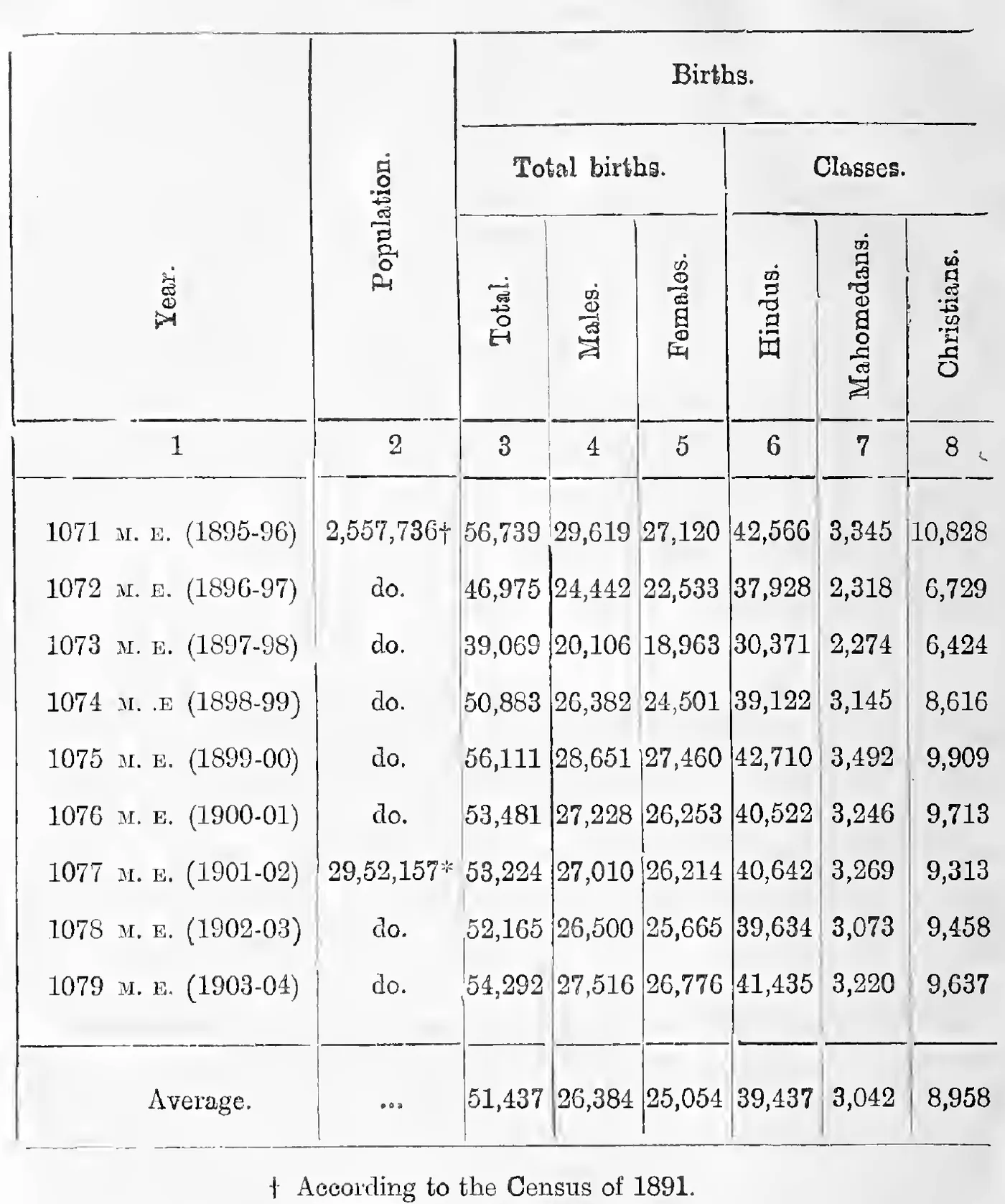
[511]
I.
deaths registered in Travancore.
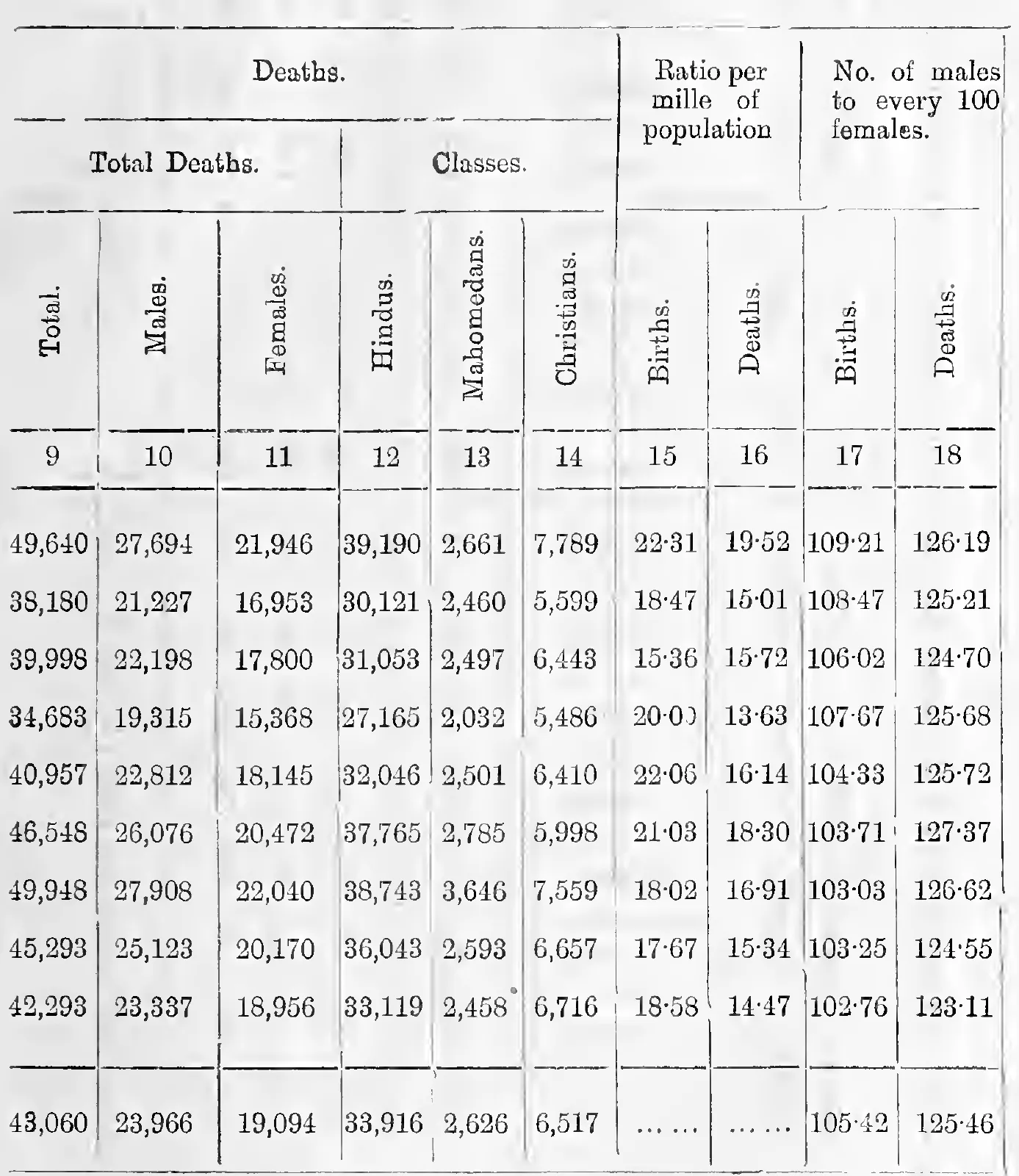
[512]
II.
Statement showing the births and deaths in each Municipal town during 1071-1079 M. E. (1895-1903 A. D.).
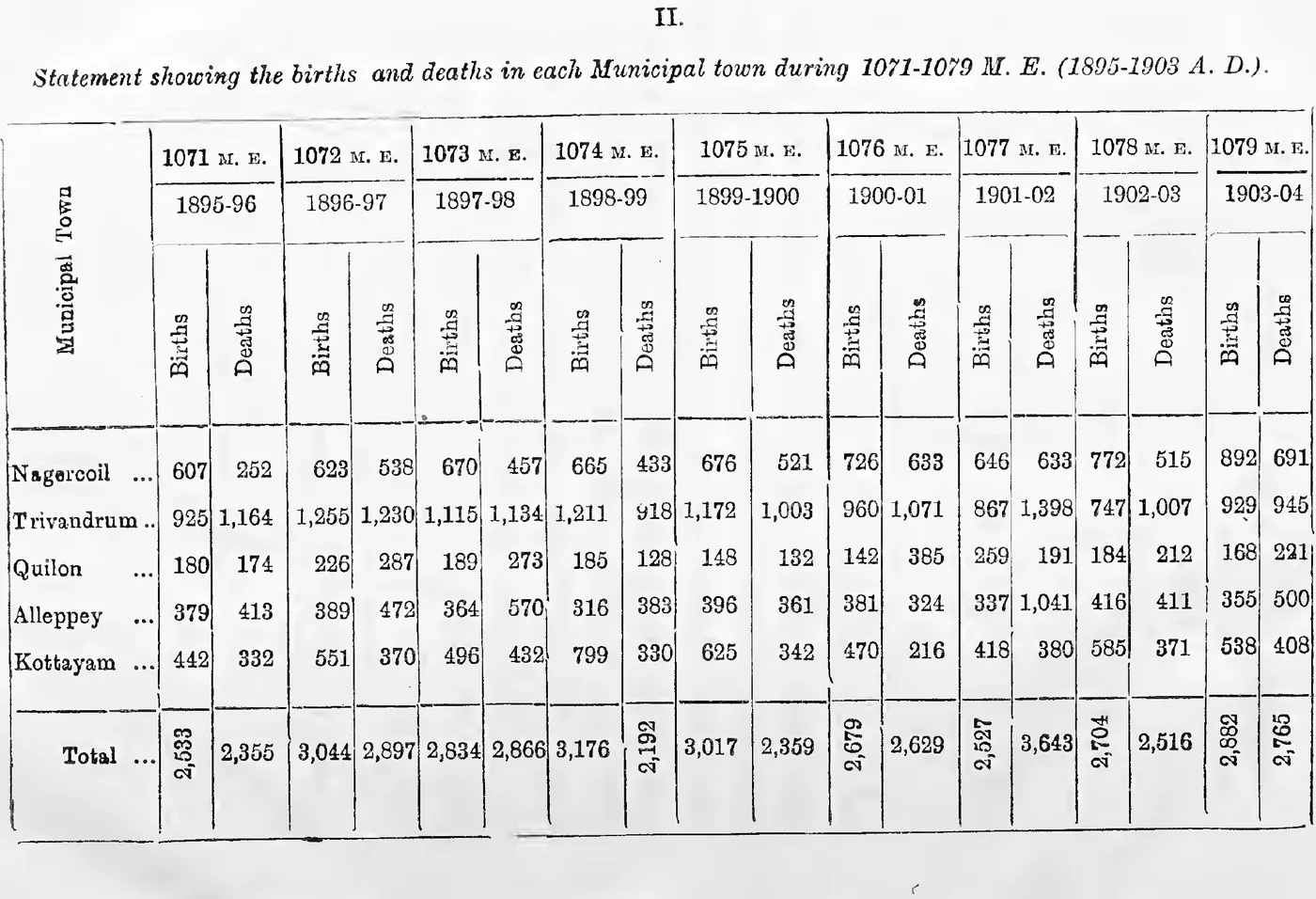
[514]
III.
Statement showing the births and
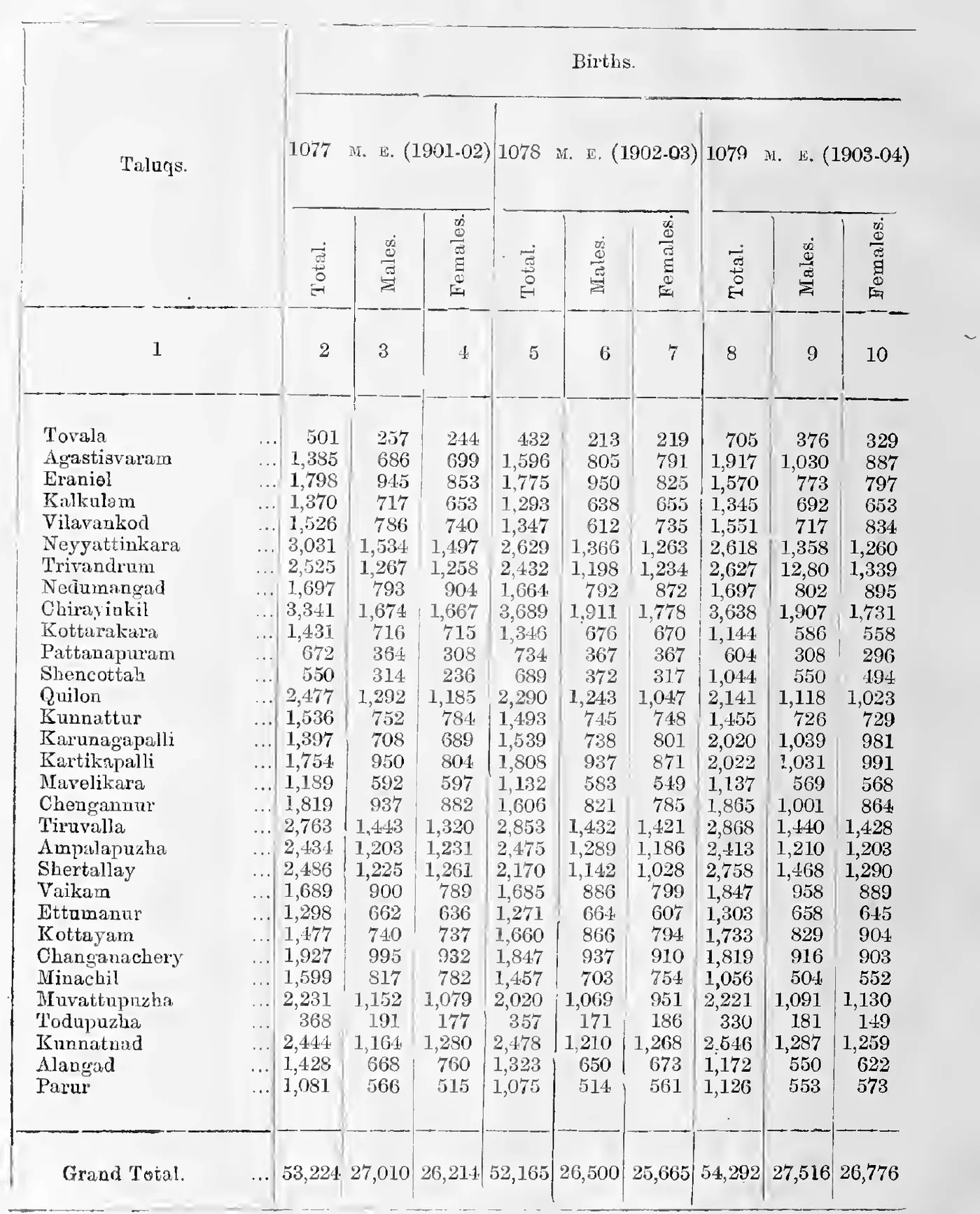
[515]
III.
deaths in each Taluq of the State for the last three years.
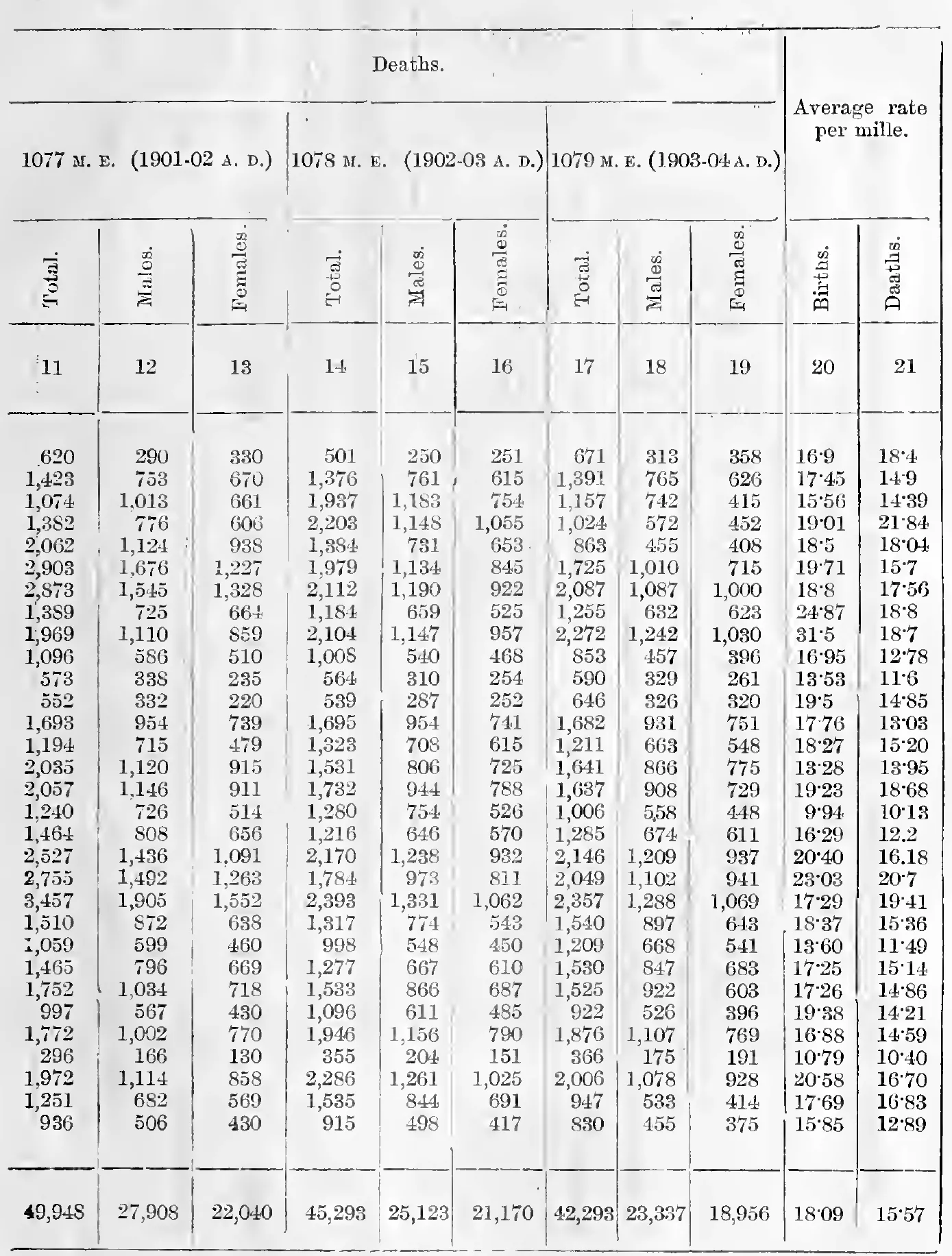
[516]
IV
Statement showing the number of births registered in Travancore in each month during 1075-1079 M. E. (1899-1904 A. D.).
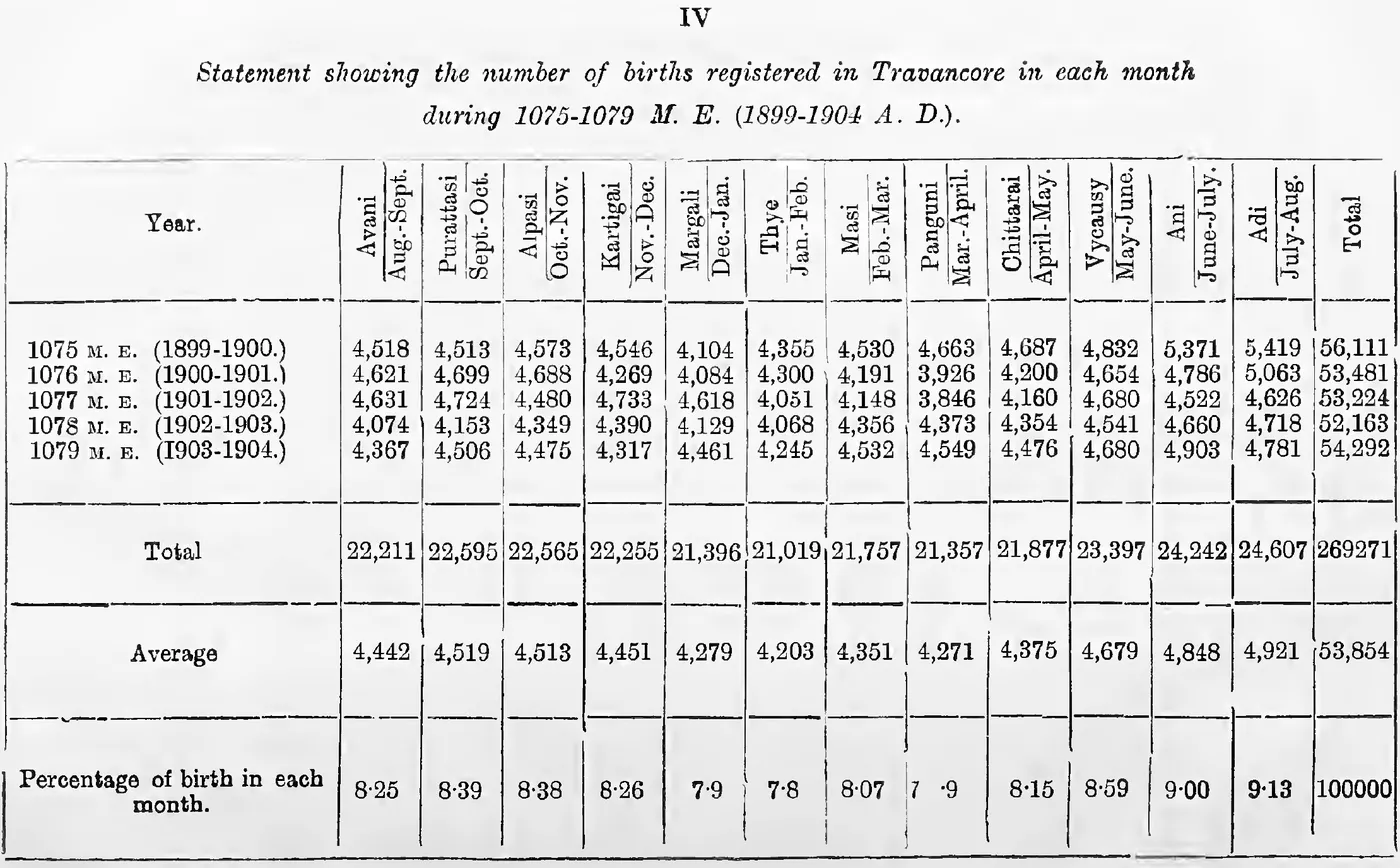
[517]
V.
Statement showing the number of deaths registered in Travancore in each month during 1075-1079 M. E. (1899-1904 A. D.).
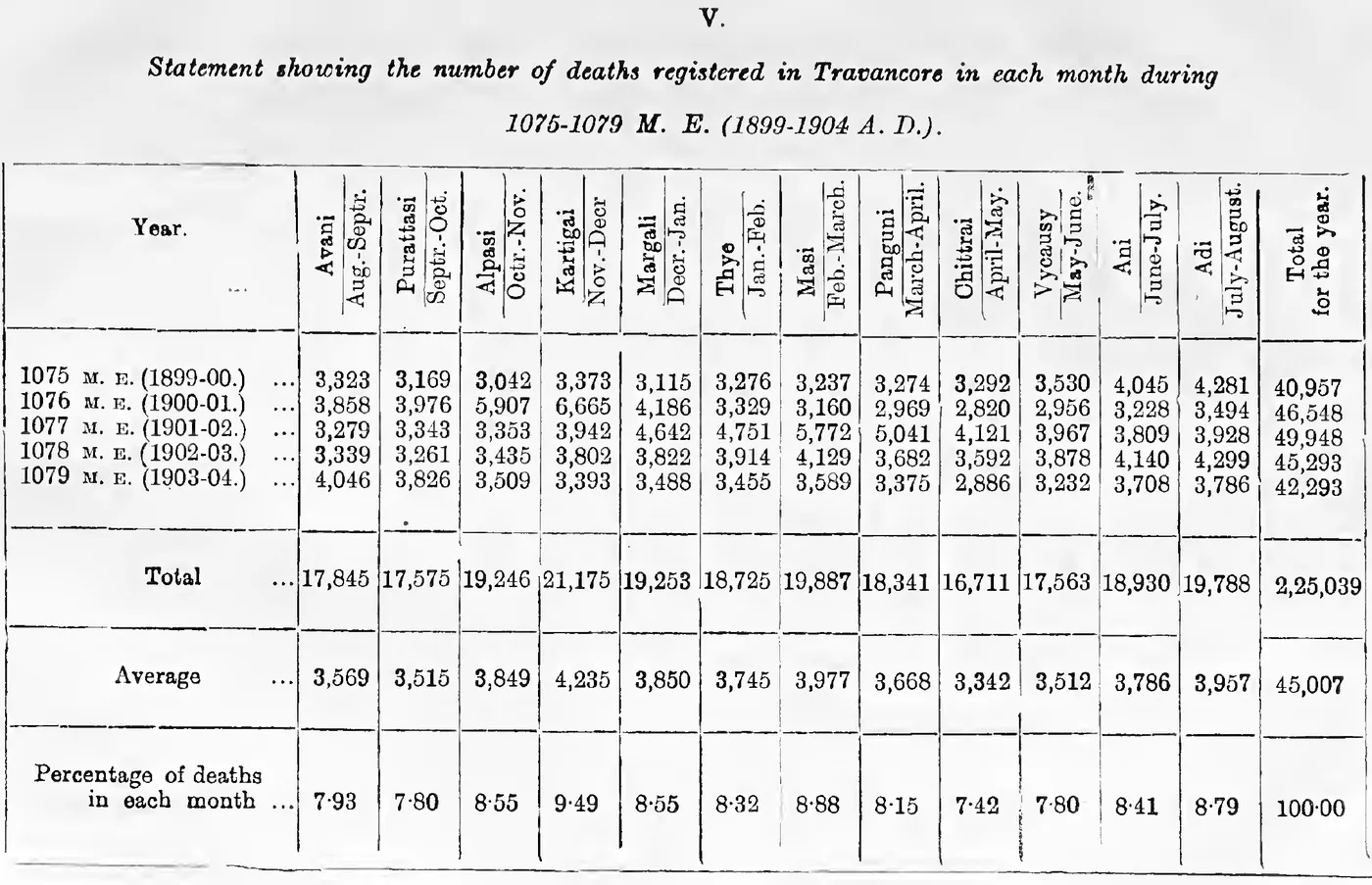
[518]
VI.
Statement showing the number of deaths from different causes during 1071-1079 M. E. (1895-1904 A. D.).
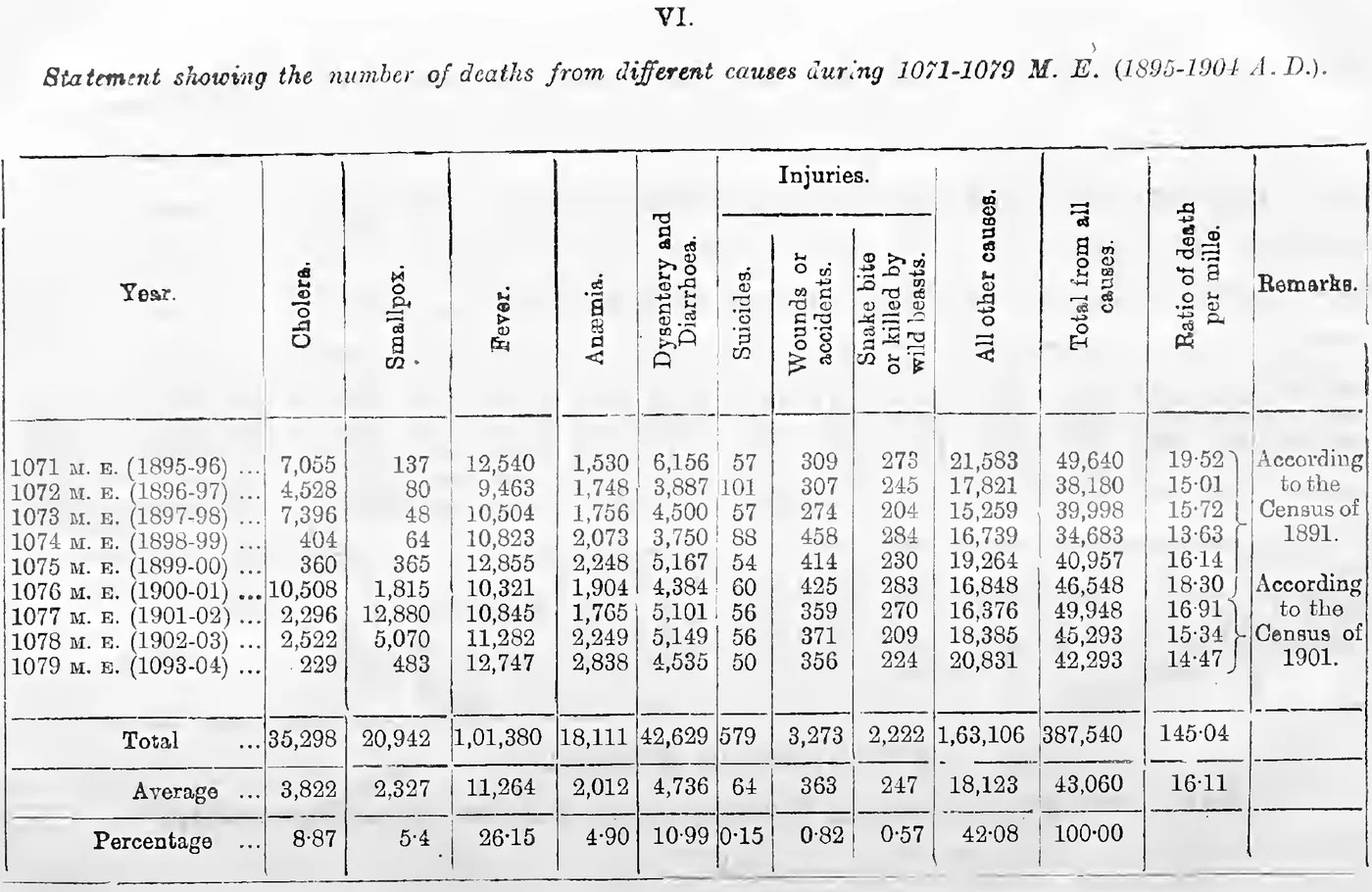
[520]
VII.
Statement showing the number of deaths at each age
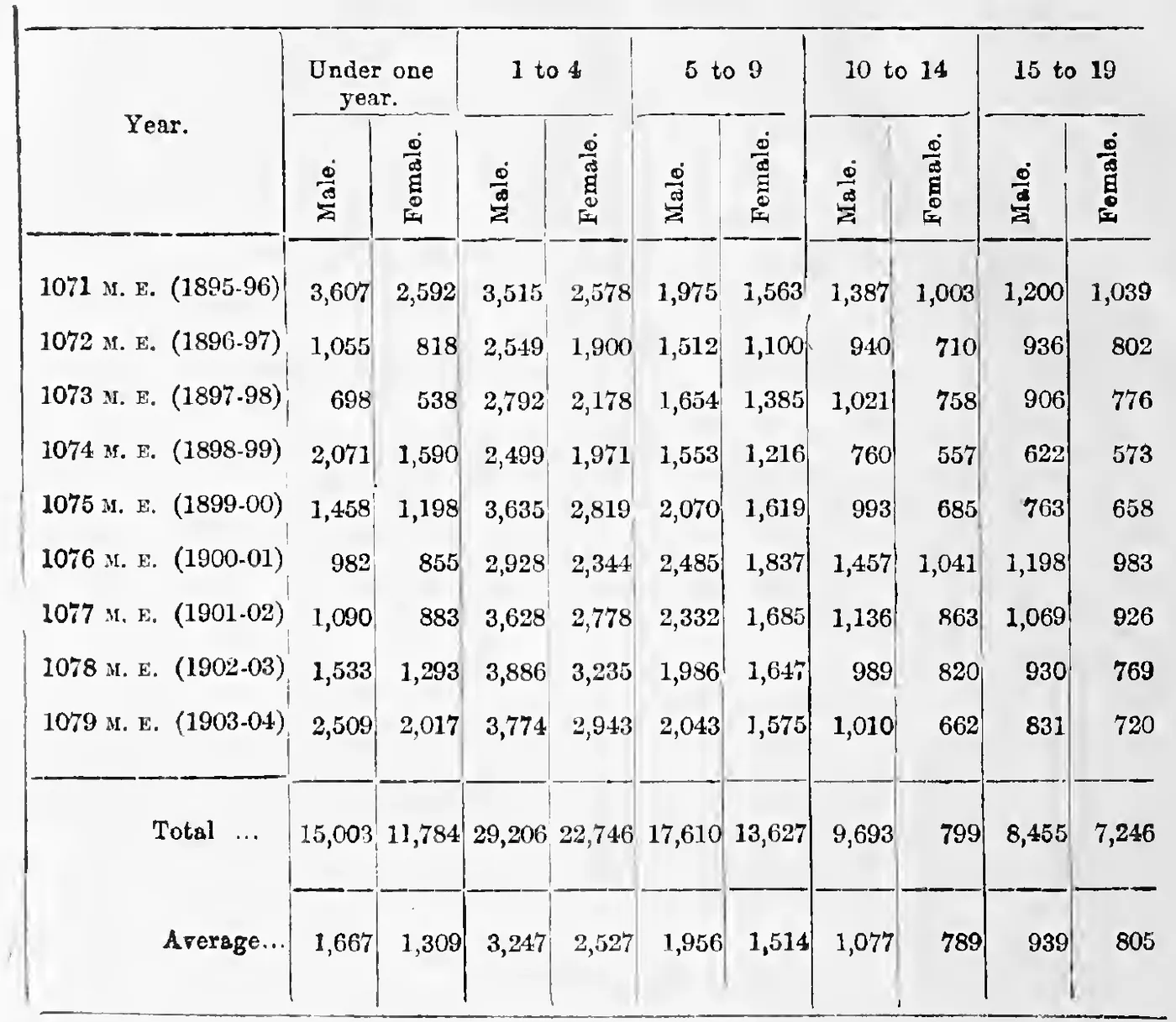
[521]
VII.
registered in Travancore during 1071-1079 M. E. (1895-1904 A. D.)
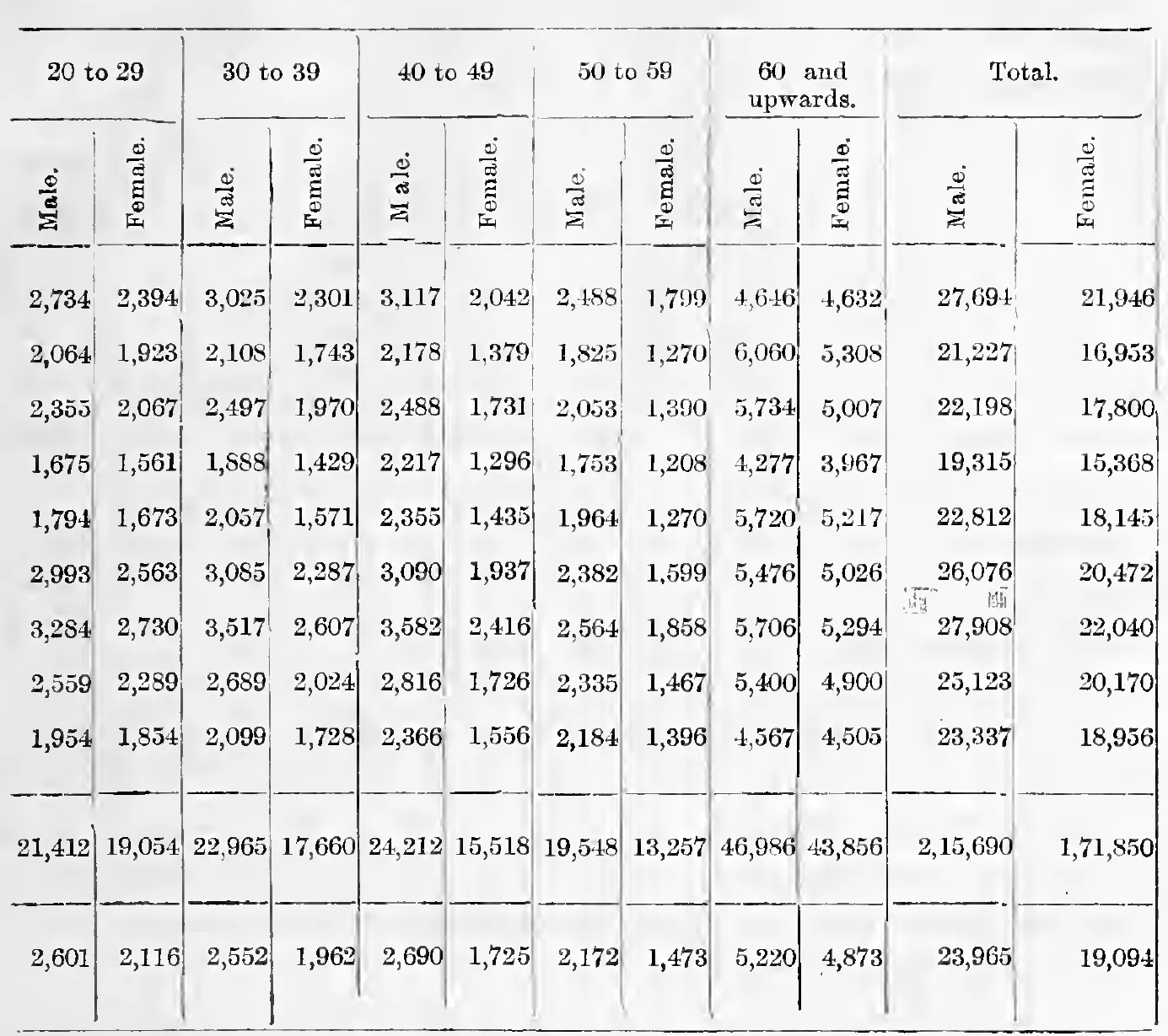
[522]Infirmities. During the last Census and those of 1891 and 1875, statistics were collected as to the number of persons afflicted with insanity, deaf-mutism, blindness and leprosy and the following comparative statement of the number of infirm persons per 10,000 of the population of 1901 may be of interest:—
VIII.
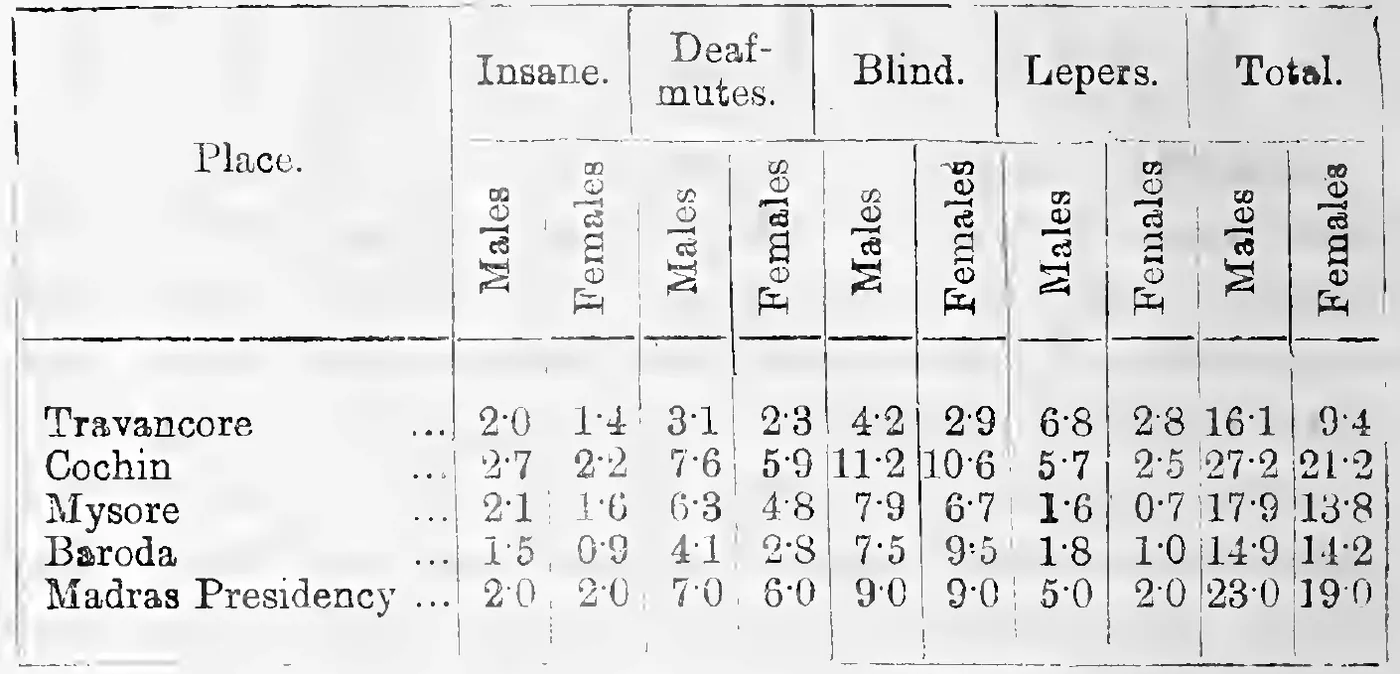
From the above statement it is clear that there are relatively fewer number of infirm persons in Travancore than other parts of India. In respect of males Baroda alone shows a less average while in regard to the other sex Travancore stands last. Taking each infirmity separately, we find that Travancore is very favourably situated except for leprosy in which it shows a very high average.
The following statement gives the comparative statistics of the number of infirm persons in 1891 and 1901:—
IX.
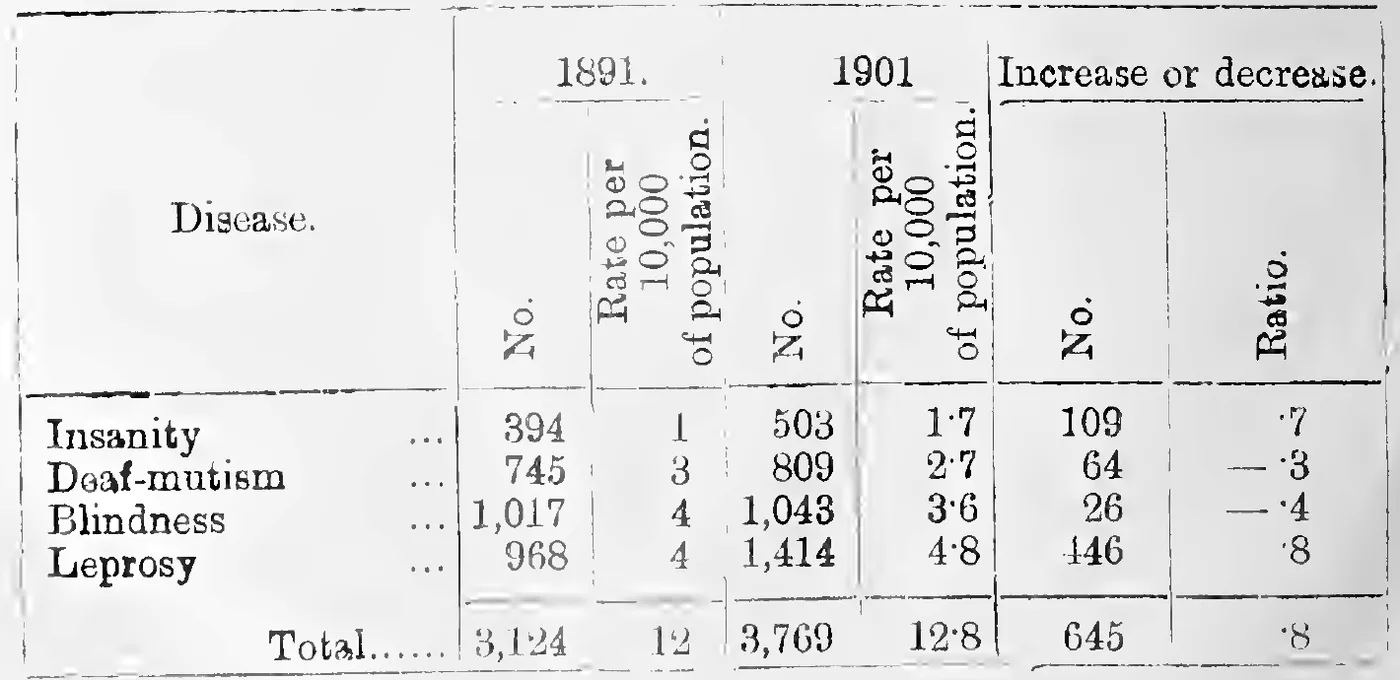
[523]The proportion has remained almost the same as in 1891. With the vast increase in population since the 1891 Census, this must be considered a very satisfactory state of affairs. Taking the total afflicted we find that out of a population of nearly three millions, the number of persons returned infirm amounts to nearly 12 per 10,000. They are greater in the sea-board Taluqs than the inland tracts, being 14 and 11 per 10,000 of their respective populations. Of the total afflicted, 38 per cent. are lepers, 28 per cent. blind, 21 per cent. deaf-mutes and 18 per cent. insane. As regards sex. the females are only half as much afflicted as the males. This though no doubt showing the greater immunity enjoyed by the female population, may also be due to their general unwillingness to return their defects correctly, and the better opportunities they have than the males for concealing them from the Census enumerator.
The following table gives the average number of afflicted per 10,000 of each sex by natural divisions. It will be observed that all classes of infirmities except the blind are more numerous in the western or littoral and deltaic division comprising the 15 Taluqs of Agastisvaram, Eraniel, Vilavankod, Neyyattinkara, Trivandrum, Chirayinkil, Quilon, Karunagapalli, Kartikapalli, Ampalapuzha, Shertallay, Parur, Vaikam, Tiruvalla and Mavelikara:—
X.
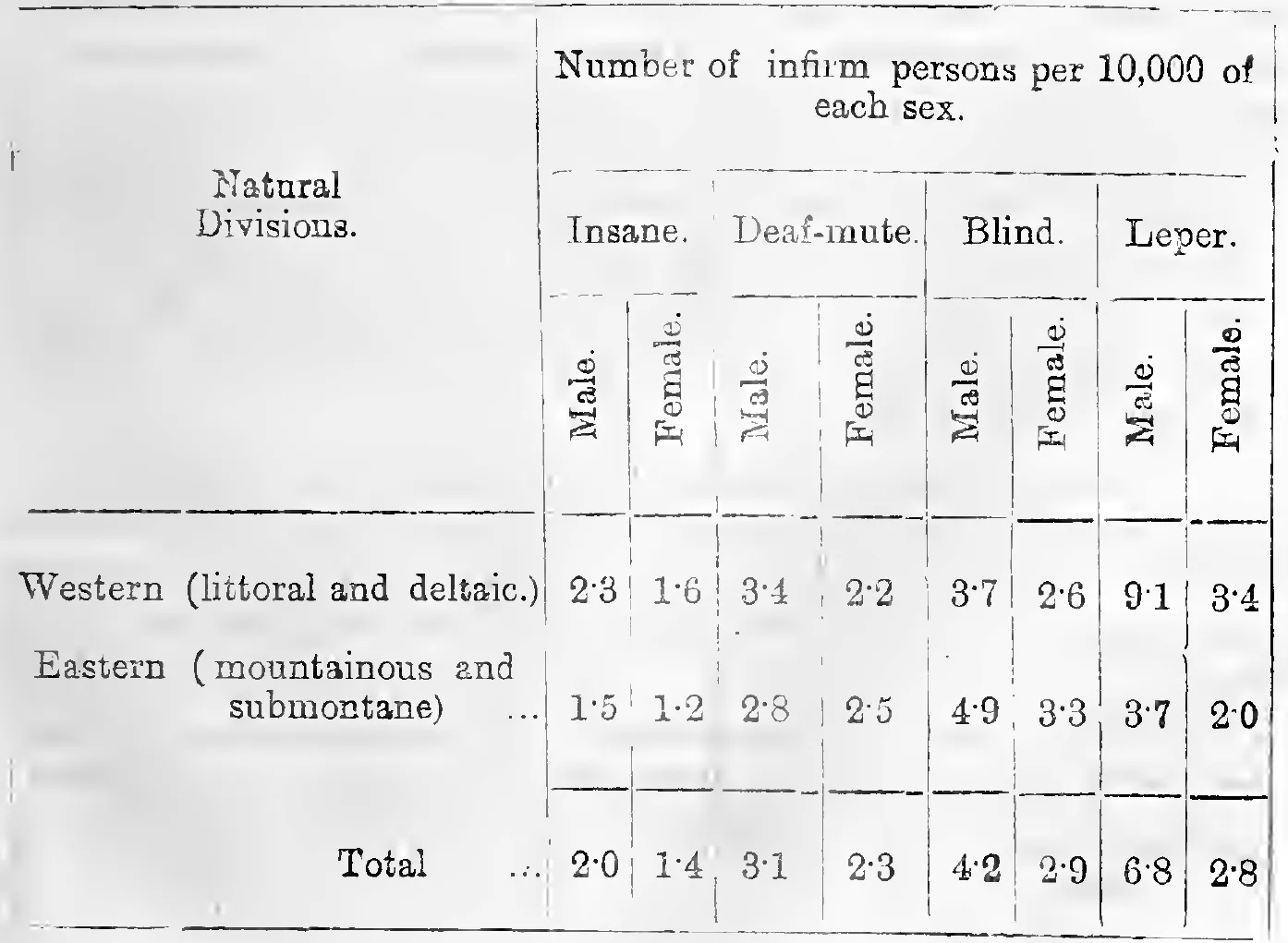
[524]As regards distribution by Taluqs, we find the greatest prevalence of insanity in Trivandrum, (10·9 males and 5·4 females in every 10,000 of each sex returned there) due of course to the Lunatic Asylum maintained there by His Highness' Government and conducted on the most approved modern lines. The largest incidence of deaf-mutism was observed in the Taluq of Ampalapuzha for males and Karunagapalli for females being 5·6 and 4·7 per 10,000 respectively. The blind are naturally more equally distributed than the other infirmities, the highest proportion being observed in Tovala for males (14 per 10,000) and in Nedumangad and Kottarakara (10·1 and 10·3 respectively). Leprosy in males is most prevalent in Shertallay (25·3) and Trivandrum (19·3) and in females in Parur (9·6) and Shertallay (8·3). The existence of a Leper Asylum at the Capital accounts for the high proportion in the Trivandrum Taluq and as for Parur, Shertallay, Ampalapuzha, &c., it is in accordance with the commonly accepted theory that leprosy is more prevalent in moist than dry localities.
(b) Vaccination. Prior to 1865 A. D. there does not appear to have existed a regular Department of Vaccination, the work having been conducted by a Head Vaccinator and a few vaccinators under the direct orders of the Durbar Physician. In 1041 M. E. (1865-66 A. D.) a separate Vaccination Department was formed and Dr. Pulney Andy, M. D., a native of Madras who had taken a Diploma in Europe was appointed the Superintendent of Vaccination, subject to the orders of the Durbar Physician. Subordinate to him there were a Head Vaccinator and 27 other vaccinators. The Superintendent, besides directing the vaccinators and inspecting their work, had also to inspect the out-station hospitals, to treat such as might come on his way and suggest measures for improving the sanitary condition of the places he might visit. To quote the memorable words of His Highness the penultimate Maharajah on the occasion of the opening ceremony of the Trivandrum Civil Hospital:—
"It will be the duty of Dr. Pulney Andy to travel into the interior to supervise the several medical subordinates who are employed there, and to spread the benefits of medical aid in general, and of vaccination in particular. ... ... ... ... I hope I am not too sanguine in expecting to see before many years elapse, if not the total disappearance, the considerable diminution of the scourge of Small-pox in this country. It has been repeatedly proved that this is a thoroughly preventible disease. I take this opportunity earnestly to impress this fact on the minds of all my native subjects, and to urge them to seek for themselves, for their children, for their friends, and for their servants, the great protection of vaccination. They will see the strength of my conviction in the fact that there is no member of my own family that has not had this protection conferred at an early age."
[525]These words have borne excellent fruit in subsequent years.
In 1044 M. E. (1868-69 A. D.) the Vaccination establishment was strengthened by the entertainment of eight additional vaccinators thus making the total 35, which number remained practically unchanged for more than 20 years afterwards. In 1067 M. E. (1891-92 A. D.) and the three succeeding years some substantial additions were made so that at the close of 1070 M. E., (1895 A. D.) the strength of the Establishment stood at 64 including six female vaccinators. When the Department was transferred to the control of the Sanitary Commissioner in 1071 M. E., (1895-96 A. D.) 17 additional vaccinators were sanctioned, thus bringing up the strength of the establishment to 81 as shown below (including 8 female vaccinators.)
- Head Vaccinator 1
- 1st class Vaccinators 4
- 2nd class do. 9
- 3rd class do. 12
- 4th class do. 27
- do. do. (Temporary) 15
- 5th do. do. 7
- Paid volunteer 1
- Supernumerary Vaccinators 5
- 81
The staff has since undergone no alteration in its strength, except for the occasional temporary additions made to it on emergent occasions. With respect to the Inspecting Agency, the Superintendent of Vaccination was the sole Inspecting Officer up to the end of 1065, M. E. (1890 A. D.) when two Inspectors were entertained. Under the new arrangement effected in 1071, M. E. (1895-96 A. D.) the Superintendent of Vaccination was transferred to the Medical Department and the office of the Vaccination Inspectors ceased to exist, the four District Sanitary Officers and the Taluq Sanitary Officer taking their place. Besides the regular Vaccination Establishment, vaccinations are performed by the Medical Officers in charge of the various institutions of the State and the Conservancy overseers too have been trained for it.
It was only in 1064 M. E. (1888-89 A. D.) that calf lymph was first introduced in Travancore, and sanction accorded for the maintenance of a Vaccine Depôt at the capital. Hitherto the quality of the lymph was improved by the occassional introduction of animal lymph obtained from Madras. As observed in the Administration Report for that year:—
[526]" Apart from the success attending the scheme, it is calculated to exercise a wholesome influence in the minds of the public, first in removing the impression that the vaccine virus inoculated from hand to hand had the effect of producing diseases from which the subject may be suffering, and secondly as the means of counteracting the prejudices of the higher classes in subjecting themselves to be vaccinated with the virus obtained from the lower class of people. Such impression operated prejudicially to the progress of vaccination". A Vaccine Depôt was permanently constructed in 1066 M. E. (1890-91 A. D.) and the number of calves sanctioned for inoculation was raised from 10 to 15 per mensem in 1069 M. E. (1893-94 A. D.). As arm to arm vaccination was found to be unsuited from a sentimental as well as scientific point of view, steps were taken to abolish it in 1071 M. E. (1895-96 A. D.) and increase the manufacture and extend the use of glycerine paste. But it was not until three or four years after that it was completely abolished throughout the country. Sanction was also accorded for an increased number of calves for inoculation and a trained Superintendent was appointed to direct the propagation of animal lymyh in the Vaccine Depôt. There was also a temporary sub-depôt established at Suchindram, but this was closed in 1073 M. E. (1897-98 A. D.) and arrangements were made for the manufacture of the requisite quantity of glycerine paste at the Central Depot at Trivandrum. Lanoline vaccine is also prepared here and is reported to be a very successful medium.
Progress of Vaccination. The following statement gives the average vaccination done during the 8 quinquennial periods beginning with 1040 M. E. (1864-65 A. D.).
XI.
- Period. — Average Vaccination per annum.
- 1. 1040-44 M. E. ... 37,708
- 2. 1045-49 „ ... 78,520
- 3. 1050-54 „ ... 78,716
- 4. 1055-59 „ ... 81,186
- 5. 1060-64 „ ... 86,929
- 6. 1065-69 „ ... 99,996
- 7. 1070-74 „ ... 1,31,373
- 8. 1075-79 „ ... 1,63,206
It will be seen from the above that there has been a steady progress since 1040 M. E. (1864-65 A. D.). The average number vaccinated during the 1st period ending with 1044 M. E. (1868-69 A. D.) was only 37,708, [527]which had more than doubled itself in the next period. This is due to the increased staff sanctioned in that year. From 1044 to 1065 M. E. (1868-1890 A. D.) the strength of the establishment remained unchanged and the slow but steady increase observed in the interval must be noted as satisfactory. During 1070-1074 M. E. (1894-99 A. D.) the number has increased by nearly 50 per cent from that of the preceding period due of course to the transfer of the Department to a separate agency and the strengthening of the staff effected in 1071 M. E. (1895-96 A. D.) During the last period the average number has increased by nearly 25 per cent from the preceding one. On a comparison with the figures for the first and last periods, we see that the number has increased about 43 per cent.
The subjoined statement gives particulars of vaccination during 1071-1079 M. E., (1895-1904 A. D.) i. e., the 9 years during which the Sanitary Department has been working. The figures relate only to the work of the regular Vaccination Establishment, exclusive of that of the Conservancy and Medical Officers, for which full information is available only for the last five years (See Table XIII).
[528]
XII. Statement showing particulars of vaccination in Travancore during 1071-1079 M. E. (1895-1904 A. D.)
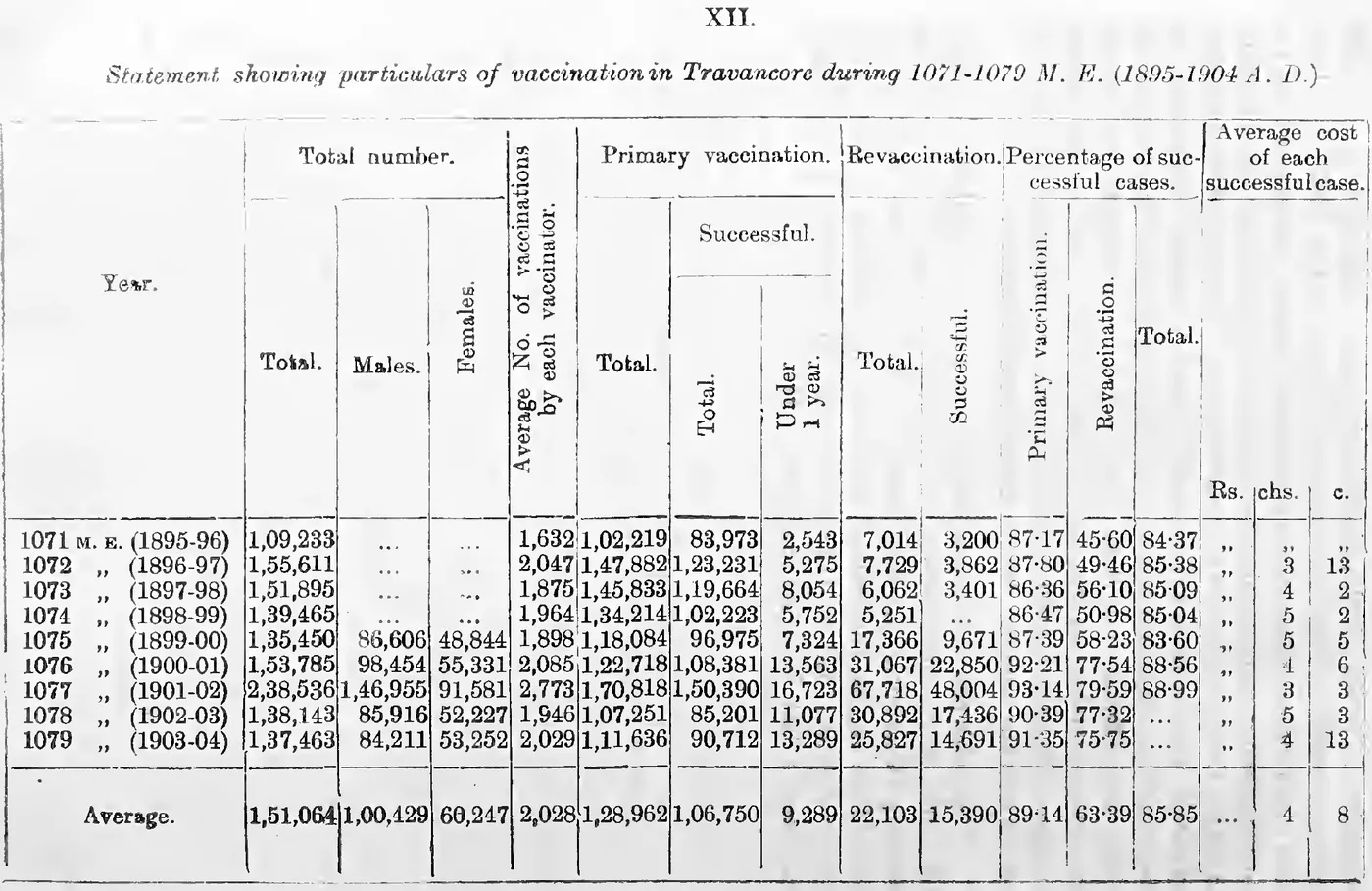
[529]The largest number of operations were performed in 1077 M. E. (1901-02 A. D.) when on account of the prevalence of smallpox, vaccination had to be pushed on with great vigour. The average number of vaccinations by each vaccinator was 2,029 in 1079 M. E. (1903-04 A. D.) i. e., the same as the general average for the 9 years. In the Madras Presidency the average for 1903-1904 was only 1,529. As regards the success of primary and revaccinations, the average percentages come to 89·14 and 63·39 respectively, the year 1077 M. E. (1901-02 A. D.) showing the highest percentage under both viz., 93·14 and 79·59. In 1079 M. E. (1903-1904 A. D.), the percentages were 91·35 and 75·75, the corresponding figures for the Madras Presidency being 91·5 and 77·3. But considering that in spite of the very large number of successful vaccinations reported to have been performed during the course of the last 40 years and more, the epidemic (smallpox) occasionally breaks out with more than ordinary severity and causes terrible havoc among the people, one is apt to suspect the accuracy of these success statistics.
The number of cases of revaccination was very small till 1075 M. E. (1899-1900 A. D.) in which year a satisfactory increase is recorded, being more than three times the number performed in the year previous. The highest figure was reached in 1077 M. E. (1901-02 A. D.) viz., 67,718 or nearly three times the average for the 9 years. Infantile vaccinations too were very poor till 1076 M. E. (1900-01 A. D.) when the number of successful cases was nearly twice that of the preceding year. The highest figure was of course returned in 1077 M. E. (1901-02 A. D.) viz., 16,723, the percentage to registered births being 31·56 against 25·36 in the previous year. (1900-01 A. D.)
The average cost of each successful case varies from 1 anna 10 pies to 3 as. while in Madras it was 3 as. 9 pies for 1903-1904.
[530]
XIII
Vaccinations performed by the Medical and Conservancy Officers.
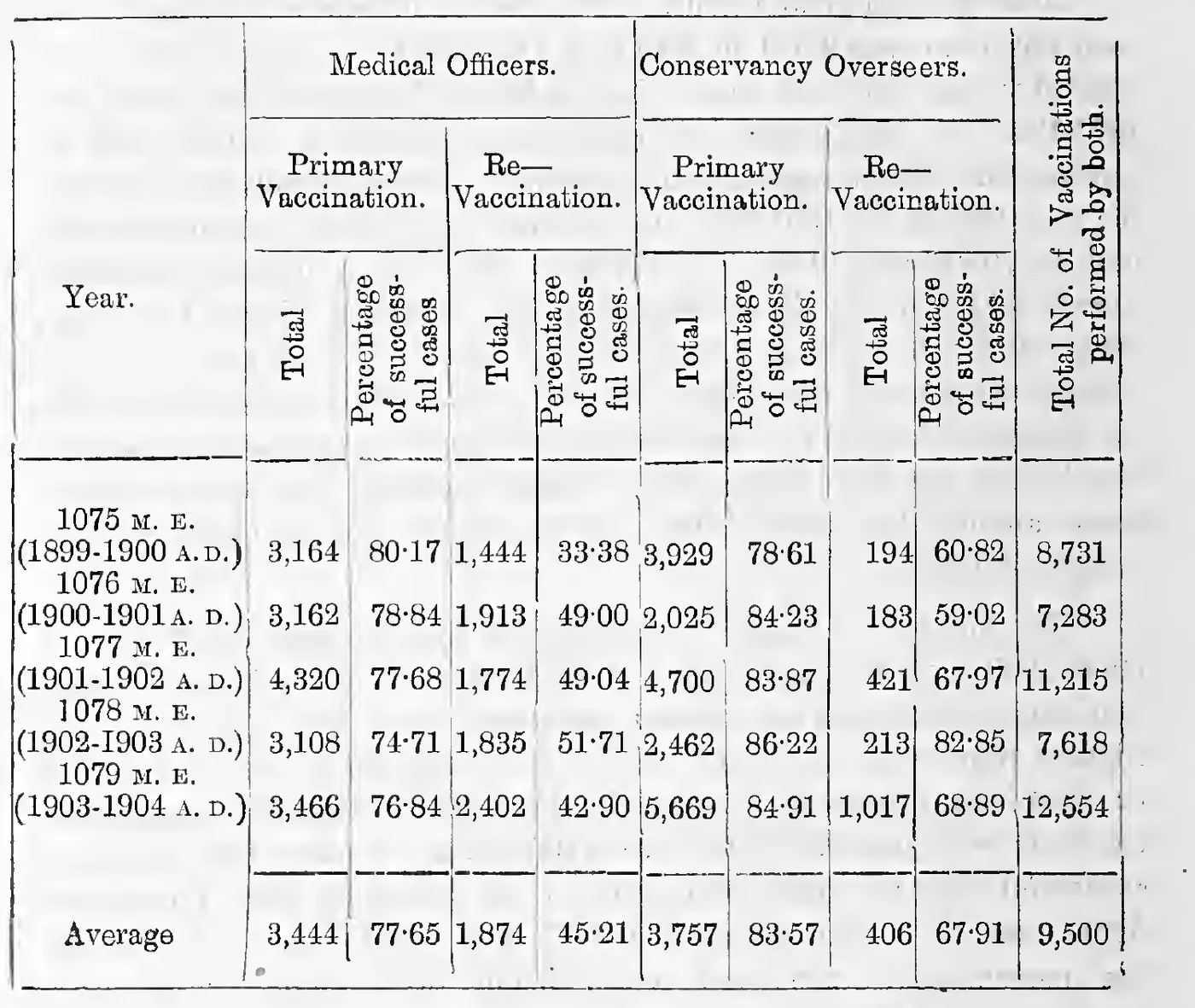
The above statement shows the number of vaccinations performed by the Medical Officers in charge of the various dispensaries and also the Conservancy Overseers. The total number forms only a very small proportion of the total of operations performed by the Vaccination Establishment and the percentage of successful cases is decidedly less under both primary and revaccination.
Before concluding this portion it may be well to state that vaccination is compulsory only with regard to Public Servants, students in all public schools, Government or aided, Hospital patients and Jail convicts, and Vakils practising under sunnads in courts. This was effected by a Royal Proclamation issued on the 14th August 1878, which while pointing out the advantages of vaccination as a protection against smallpox, called also upon the general population to submit to the operation setting before them the example of the Royal family. The Proclamation itself may be quoted here in extenso:—
[531]
"1. Whereas We are informed that many do not avail themselves of the protection against virulent attacks of smallpox which successful vaccination affords, and being anxious to mitigate the ravages of that disease as far as possible, We are pleased to direct that every public servant of whatever grade, shall, as a necessary condition of the service have himself vaccinated within three months from the date of this Proclamation if not vaccinated within the last 5 years, and that no person shall hereafter be entertained in the public service unless he produces a certificate of having been vaccinated within that period.
2. All students in the public schools of this State whether the Institutions are directly under Government management or receiving grants-in-aid, are also required to be vaccinated as a condition of remaining in the Institution, and no new pupil shall be admitted unless the master is satisfied that he or she has been thus protected. Managers of grant-in-aid schools are required to certify at foot of their applications for payment of grants that all the pupils in the school have fulfilled this condition.
3. The rule applicable to public servants shall hold good also in respect of Vakeels practising under Sunnads in the Courts.
4. All patients admitted to the public hospitals or seeking relief therefrom, and all convicts lodged in the public Jails shall be submitted to vaccination so also the indigent receiving relief from public charities.
5. It shall be obligatory on all the above classes of persons to have the operation repeated once every five years so long as they continue in the State in which vaccination is made compulsory by this Proclamation.
6. The Managers of the Institutions or the Heads of Departments to whose influence the above classes of persons are amenable, are directed to give effect to the provisions of this Proclamation.
7. We hereby desire all public servants and especially those of the superior grades to further Our wishes by persuading those within the sphere of their influence to submit to the operation.
8. Should any public servant be found to set people against vaccination or otherwise conduct himself in a spirit opposed to the tenor of Our wishes as herein expressed, he will be liable to summary dismissal.
9. And finally We desire all Our subjects distinctly to understand that firmly believing in the efficacy of the prophylactic, we have protected the members of Our own House-hold by recourse to vaccination and that it is a duty they owe to themselves and to those with whom they come in contact in the daily relations of life to stamp out of the country that fell disease, the smallpox; a result which We can only hope to obtain when every individual whether male or female old or young has been brought under the protecting influence.
10. In many countries, vaccination has been made compulsory on the public at large under penalties enforcible by the law, as a means of ensuring public safety; and if We do not have recourse to such penal measures in Our territories, it is from a reluctance to use the machinery of the law when, as We feel assured, there will be a voluntary submission to the operation, on Our wishes for the good of our people being made known to them in this manner."
The Durbar Physician in 1056 M. E. (1881 A. D.) urged upon the Government the necessity to make vaccination compulsory in Travancore. [532]But the Government wisely refused to take that step saying that it had done everything towards extending vaccination which, under the existing circumstances of the country it was wise or practicable to do and the time had not come for enforcing vaccination by a punitive enactment. In 1072, M. E. (1896-97 A. D.) the Sanitary Commissioner again brought to the notice of Government the necessity for making vaccination compulsory at least in the Towns under the Town Improvement Committees. But the Government was firm and rightly declared that the introduction of compulsory vaccination in any portion of the State was quite uncalled for and unnecessary. Dewan Mr. Shungrasoobyer observed:—
"It does not appear that except among the Namboodri Brahmins and some other classes who form but a microscopic minority of urban population, there is any serious sentimental objection or noticeable opposition to vaccination on the part of the people and with sufficient energy and tact the subordinates of the department would find no difficulty in persuading the indifferent many and the apparently hostile few, to submit to the operation. The necessity for a compulsory provision of the law is not therefore quite apparent and Government cannot be too chary in the matter of coercive measures of the kind."*
(c) Conservancy and General Sanitation. Prior to 1052 M. E. (1876-77 A. D.) there was very little attention paid to the conservancy or sanitation of even the Capital beyond employing a few sweepers under the orders of the Tahsildar to occasionally sweep the streets in the fort. In that year and the year following, Government sanctioned a small sum to supplement the existing staff of sweepers and a set of rules was passed for the conservancy of the town but the entire cost of the establishment including a Conservancy Officer, inspector, writer, peons and sweepers came to only less than Rs. 300 a month, in addition to the hire of a few carts. In 1055 M. E. (1879-80 A. D.) a further allotment of Rs. 100 was sanctioned but the whole staff was "too small, too ill-paid and too insufficient" to be able to effectually cope with the pronounced unsatisfactory condition of Trivandrum from a sanitary point of view. A Committee was accordingly appointed in 1056 M. E. (1880-81 A. D.) to report on the sanitation of the capital and to suggest measures for placing it in an efficient condition. The recommendations of the committee included the construction of public latrines, the removal of night-soil and sweepings to a distance from the town, the construction of a number of dust boxes and carts specially adapted for conservancy purposes, the guarding of the principal tanks and feeding channels from pollution, the removal of certain fish bazaars from crowded localities, the opening of new vegetable bazaars, the laying down of rules for regulating the erection of new buildings [533]to prevent encroachments, the widening of certain lanes, the better regulation of burial and cremation grounds and the entertainment of an adequate establishment under proper supervision. All these recommendations were generally approved and an establishment was organised at a cost of Rs. 1,823 per mensem and placed under the supervision of a Sanitary Inspector who was directly responsible to the Division Peishcar. Except for occasional small temporary establishments employed for the towns of Alleppey and Kottar whenever epidemics broke out, there were no regular establishments for the mofussil towns. In 1062 M. E. (1886-87 A. D.) the conservancy system was extended to the towns of Kottayam, Alleppey, Quilon and Kottar (including Nagercoil). Small monthly grants were sanctioned for each of these and the administration of the funds together with whatever might be collected by local contributions was entrusted to local committees presided over by the District Magistrates for the first three towns and for Kottar by the local Sub-Magistrate there, and assisted by two members selected from the community of the towns. This is the germ of the modern Town Improvement Committees. In 1064 M. E. (1888-89 A. D.) small conservancy establishments were started in some of the other important towns and villages, viz., Parur, Changanachery Vaikam, Shencottah, Varkala and Padmanabhapuram, and the already existing ones at Alleppey, Kottayam, Kottar and Quilon were strengthened and improved. In 1065 M. E. (1889-90 A. D.) funds were sanctioned for opening small establishments at certain other places also and strengthening the ones started in the preceding year.
* Report on the Administration of Travancore for 1072 M. E. (1896-97 A. D.). Including the Vaccination Establishment.
In 1067 M. E. (1891-92 A. D.) on account of the unusually severe prevalence of cholera and smallpox at the capital the question of sanitation again came up before Government and a standing committee was appointed to consider the subject and to suggest from time to time such measures as might be necessary to protect the health of the town. A set of rules regulating the control of the committee over the conservancy staff was passed and the Honorary Secretary became the executive officer responsible to the committee for the proper management of the department. The town was, for purposes of conservancy, divided into five divisions, each under the charge of an overseer who had under him a number of Vicharippukars with a sufficient number of sweepers distributed according to the requirements of each locality. With the passing of Regulation II of 1069 M. E. (1893-94 A. D.) the Conservancy Department was handed over to a committee duly constituted under the Regulation. The Regulation was extended in the same year to Nagercoil, Quilon, Alleppey and Kottayam, and [534]the Presidents of the Committees were made the chief executive officers answerable to the committees as well as to Government. The conservancy establishments at the out-stations, which now numbered 32 continued to be maintained under the supervision of the Taluq authorities.
The organisation of the Sanitary Department in 1071 M. E. (1895-96 A. D.) initiated with a view to provide for the registration of Vital Statistics, offered itself as a fitting opportunity for placing the conservancy establishments on an improved footing. The revenue officers were relieved of their conservancy duties and all the conservancy establishments were transferred to the direct charge of the Sanitary Commissioner. The Conservancy staff was strengthened at all the stations, fresh establishments were provided at all places where none existed before, new overseers were appointed at stations where the duties were looked after by the revenue peons or pound-keepers, and the scale of salaries generally raised. The towns, however, continued to be under the charge of their respective Improvement Committees. The main lines of the new scheme have already been referred to.
In 1072 M. E. (1896-97 A. D.) the four Sanitary Districts of the State were reconstituted into five and placed under the charge of separate Sanitary Officers; an additional Sanitary Officer was sanctioned for the outlying Taluq of Shencottah. In 1073 M. E. (1897-98 A. D.) the Department was slightly reorganised, the number of District Officers was reduced from four to three and that of Assistant officers raised from three to four, and a readjustment of the jurisdiction of the officers with due regard to local requirements, was also sanctioned with effect from the year following. The salaries of the Sanitary Commissioner and those of the District Officers were raised and batta and mileage sanctioned for the latter. A reorganisation of the conservancy establishment in the mofussil was also sanctioned and given effect to in 1073 M. E. the number of the sweepers and peons was increased and the pay of the staff generally raised.
The permanent conservancy establishments at Quilon and Nagercoil were also strengthened during the year. A revised scale of salary was sanctioned for the Sanitary Inspector and Health Officer at Trivandrum and the number of tank watchers slightly increased.
In 1075 M. E. (1899-00 A. D.), the street lights in some of the towns in the mofussil were transferred to the Sanitary Department and arrangements made for their lighting. In the following year a Regulation was passed to amend the Towns Conservancy and Improvement Regulation II of 1069 in [535]view to meet the growing demands of sanitary administration. This enactment was framed on the lines of the Municipality Acts of British India. Power is taken to introduce the elective principle in the constitution of the committees and authorise the levy of municipal taxes to supplement the annual allotments made by Government, both these provisions being of a permissive nature to be brought into force whenever the circumstances and needs of particular towns may warrant such a step. Though the Regulation has been in force these four years, the system of local taxation has only very recently been introduced in some of the towns and that too on a very limited scale.
The present conservancy establishment under the Sanitary Department consists, besides the officers, 40 overseers each in charge of a station, 8 tank watchers, 21 peons and 357 sweepers. The strength of the establishment under the Committees remains the same as it stood in 1073 M. E. except for 6 additional sweepers sanctioned for the town of Alleppey in 1074 M. E. Besides these, special seasonal establishments are provided for the conservancy of Poracad during the shipping season, Alwaye, during the bathing season and the beach villages in South Travancore, during the cholera season. Special sanitary arrangements are also made for the important fairs and festivals in the state, as for instance, the Ashtami festival at Vaikam, the Car festival at Suchindram, St. Xavier's festival at Kottar, the Mandakad festival and the Sivaratri festival at Alwaye, &c. The Murajapam ceremony, which comes off once in six years and attracts a large concourse of people from different parts of Travancore, Cochin and the neighbouring British Districts, is also an occasion for special sanitary arrangements.
The following statement gives the aggregate cost of the Sanitary Department during the last five years as compared with the annual expenditure on account of the several Town Improvement Committees:—
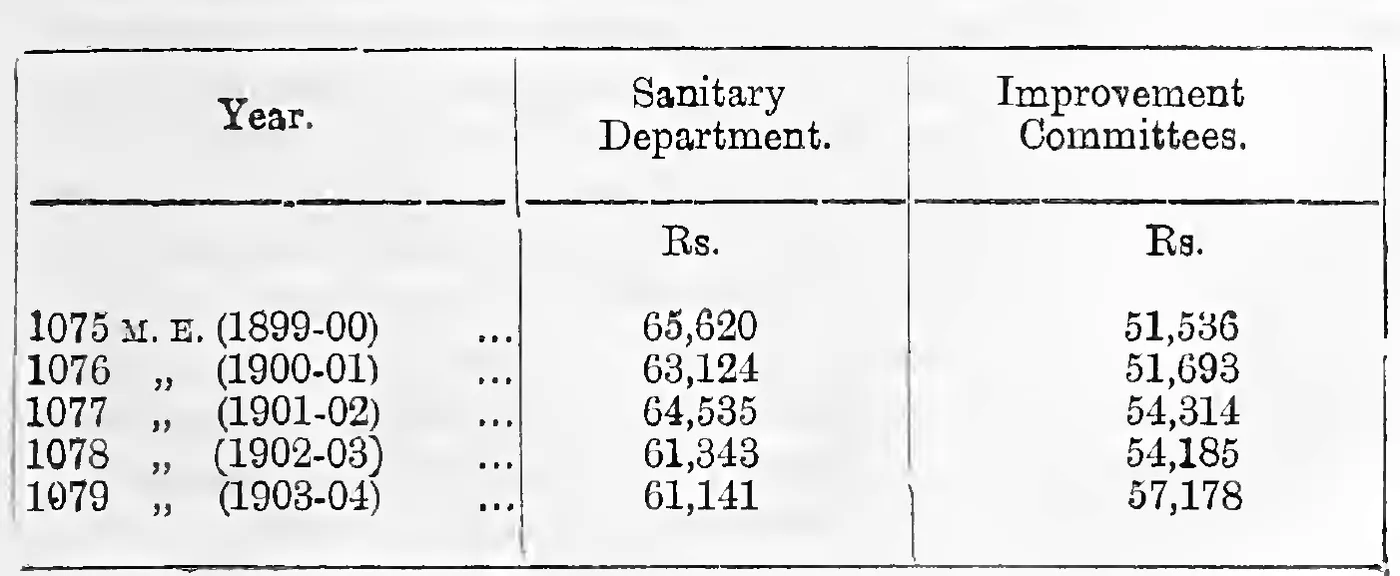
[536]It has to be observed that of the total spent by the Town Improvement Committees, about 55 per cent. is spent for Trivandrum alone, the remainder being distributed over the other four towns. Of the four important functions that pertain to the Sanitary Department, viz., conservancy, drainage, water-supply and the provision of public latrines, the Department now engages itself mostly with conservancy and, to a very slight extent, with drainage. The removal of night-soil, which is the most important function of the Department, is practically unattended to, though a beginning has just been made inside the Fort at Trivandrum. It is hoped that the several Town Improvement Committees of the State will direct their attention to this and other important matters. The Town Improvement Committees however are enabled within their limited sphere of action to pay greater attention to the improvement of drainage, water-supply and other sanitary requisites of the towns under their charge. Besides the conservancy and sanitation of towns, they do much useful work towards their general improvement e. g. sinking and repairing of public wells and tanks, the construction and repair of roads, lanes, drains and latrines, the improvement of town sites and water-supply generally and also lighting. But they are still far from the mark. Public latrines, the establishment of which forms the most elementary principle of a well organised sanitary administration, are a desideratum in several places; in the Capital they are practically non-existent. Another serious inconvenience felt by the town of Trivandrum i. e., some parts of it, is the want of pure water in some seasons. If this evil be also remedied then Trivandrum is likely to become a very healthy town in the Madras Presidency.
(d) Medical Relief.—Hospitals and Dispensaries. The Medical Department has now under its charge 22 hospitals, 20 dispensaries, 4 bi-weekly dispensaries and 6 weekly dispensaries, besides the two special institutions, the Leper Asylum and the Lunatic Asylum at the Capital. Thus exclusive of the weekly and bi-weekly dispensaries, the number of Government medical institutions is 44; and this, added to the 12 aided ones, makes the total number of medical institutions in the State 56, i. e., one for every 125 square miles and 52,715 of the population. In the Madras Presidency the total number of medical institutions towards the close of 1904 was 652, or, one for every 224 square miles and every 60,510 inhabitants.
A brief sketch of the Medical Department may not be out of place here. About sixty years ago there was only one medical institution for the public in the whole State. It was known as the Charity Hospital and was located close to the Residency at Trivandrum and placed in charge of [537]the Residency Surgeon who received a special allowance from the Government. The Durbar Physician was, as he is at present, the principal Medical Officer attending on His Highness the Maharajah and the members of the Royal household. In addition to his duties in connection with the Palace and the Dispensary attached to it, he had the charge of the Nayar Brigade Hospital. It was only subsequently that the Charity Hospital was transferred to the charge of the Durbar Physician and the Brigade Hospital to a local Medical Officer newly appointed. The Alleppey Hospital then came into existence and was the only out-station hospital for a long time. Those at Quilon and Nagercoil were established subsequently. The present General Hospital then known as the Civil Hospital, was opened on 9th November 1865 A. D. by His Highness the Maharajah in person. The following is an extract from His Highness' speech on the occasion:—
"For time out of mind, charity has been regarded by Travancore as one of the cardinal duties of the state. Its reputation as Dhurma Raj is familiar to all India. What can be more real, more substantial charity, than the provision of means for the relief or mitigation of sickness and disease! I hope that this institution will be freely resorted to by those for whom it is designed, and that it will be always distinguished for its sanitary arrangements, for the attention and tender care of the sick and suffering, and for the successful accomplishment of its main end—the cure of disease. One of the main objects of my ambition is to see that good medical aid is placed within the reach of all classes of my subjects. It is a blessing which it is not at present in the power of individuals generally to secure how much soever they may desire it. It is hence the obvious duty of the State to render its assistance in this direction."
The following narrative will clearly show that His Highness' generous ambition has been successfully carried out by the liberal policy enunciated by His Highness himself and his illustrious successors, so that it is our proud boast to be able to say that now no other part of India is so well provided with medical institutions as Travancore. In 1041 M. E. (1865-66 A. D.) there were four hospitals at the Capital, viz., the newly opened Civil Hospital to which was attached a Lying-in-Hospital, the Charity Hospital for paupers, the Jail Hospital and the Brigade Hospital; there were also hospitals at Quilon and Alleppey and Dressers were located at other principal towns in the State and at places where large bodies of men were employed, as in Shertallay, Nagercoil, Shencottah, the Peermade Ghaut Works, and the Southern Canal works. In view to extend the operations of the Department (whose staff then consisted of only two Apothecaries, two Assistant Apothecaries, four Dressers of the first Class, four of the second Class, fourteen Medical Pupils, and a matron for the Lying-in-Hospital besides a first class Dresser attached to each of two battalions), His Highness' Government sanctioned an additional annual expenditure of Rs. 20,000 with which to establish twelve more hospitals in different parts of the country and [538]place the existing ones on a better footing. Three of these were to be of a superior grade and under the charge of Apothecaries on about Rs. 150 a month and the remaining nine under Dressers. Application was also made to the Madras Government to permit the Medical Officer attached to the subsidiary force at Quilon to take charge of the Sirkar hospital there in addition to his duties in the regiment, on an allowance of Rs. 100 and permission was accordingly granted. The want of a separate accommodation for the treatment of insane patients having been pressingly felt, a pretty spacious bangalow near the Civil Hospital was purchased in 1869 to serve as a temporary Lunatic Asylum. It was only very recently removed to a very handsome and commodious building at Oolampara with an increased establishment of warders and other menial servants. In the same year the Durbar Physician laid before Government a scheme for the better education of the subordinates to fit them for the better discharge of their duties, especially for the more responsible duties attaching to the charge of out-station hospitals then recently sanctioned. It provided for the education of the subordinates already in the service and those who might subsequently enter it, by starting a series of regular lectures in the various branches of medical art and science. The course of studies was to extend to a period of four years, each year consisting of a long session of six months and a short one of three months. The scheme was sanctioned and the Medical School was opened in the beginning of 1045 M. E. (1869-70 A. D.). Sanction was also accorded that year to review the scale of salaries and improve the status of the Medical subordinates. This not only improved the tone of the Department but also set up a sense of greater responsibility among the subordinates. A further revised scale of salaries regulated by service and certain periodical tests and the rules for promotion, came into operation in 1049 M. E. (1873-74 A. D.) with retrospective effect. Up to 1053 M. E. (1877-78 A. D.) the Inspector General of the Madras Presidency used annually to inspect the Travancore hospitals. In that year this arrangement was done away with and the duty devolved on the Durbar Physician.
In 1062 M. E. (1887 A. D.) the Medical Department was strengthened by the appointment of three additional subordinates, two of whom were Licentiates of the Madras University, and the other an apothecary who had passed out of the Medical College. To meet the want of trained midwives and sick nurses, His Highness the Maharajah availed himself of the late Queen Empress' Golden Jubilee of 1887, to sanction the establishment of a school at Quilon to train up midwives and nurses. The school designated "The Victoria Medical School and Hospital for women" was opened in Kartigai 1063 M. E. (November 1887 A. D.) [539]and the Assistant Surgeon then in charge of the Quilon District Hospital, Mr. E. Poonen, M. D., M. Ch., (of the Aberdeen University) was placed over it. It is now doing good work.
It may here be stated that there is still very considerable scope for developing the staff of trained nurses and midwives in Travancore. Excepting old women and the illiterate barber women there is no sort of professional help to delivery cases in the rural parts of Travancore. It is therefore of extreme importance that a larger staff of high caste women, particularly widows among the Brahmins, should receive education in nursing and midwifery under a lady Doctor and their services utilised throughout the State at a small cost for which they will be available. The boon to the public will be immense not to speak of the real blessing such an institution will confer on the thousands of helpless Brahmin and other high caste widows who, in the majority of cases, have no means of decent livelihood.
The demand for medical aid having risen considerably during the long interval that elapsed since the Department was last reconstituted, it was found necessary to again reorganise it.
With a view both to enlarge the sphere of its usefulness and improve the emoluments of the subordinates as well as to provide for the admission of men trained in the Medical College at Madras into the local service without prejudice either to their interests or the interests of those already in the Department, but who were trained only in the local school, His Highness the Maharajah was pleased to sanction in 1065 M. E. (1889-90 A. D.) an additional grant of Rs. 28,000 a year, thus raising the total allotment of both the medical and vaccine Departments, to a maximum of Rs. 1,48,000 a year for the succeeding 8 or 10 years.
The Medical Department was accordingly reorganised; the Medical School was abolished and arrangements made for forming a Class of compounders instead, and recruiting the Department with students passed out of the Medical College, Madras; the salaries of all the subordinates were raised; provision was also made for opening a few more hospitals and dispensaries in different parts of the State. The office establishment of the Durbar Physician was strengthened and given better salaries as also the menial establishment of some of the hospitals. The Vaccination Department which as we have already seen continued as part of the Medical Department until 1071 M. E. (1895-96 A. D.) also received due attention in the reorganisation scheme. Two inspectors of vaccination under the superintendent were appointed, the salaries of the lower grade of vaccinators were [540]improved and their number slightly raised. Since (1892) the number of hospitals and dispensaries has been annually increasing and the requisite staff of officers is being recruited from passed candidates out of the Madras Medical College. The Department was again reorganised in 1071 M. E. (1895-96 A. D.) and the number of Apothecaries and Hospital Assistants was increased. The General Hospital was placed under the immediate charge of an Assistant Surgeon and its staff strengthened and improved. A system of medical grants to hospitals, dispensaries and Vaidyasalas was also sanctioned in that year, bringing such institutions under responsible inspection and control. In 1072 M. E. (1896-97 A. D.) a Women and Children's Hospital was opened and placed under the charge of a Lady Doctor specially got down from England. Three Lady Apothecaries were also entertained as Assistant Apothecaries, one of whom was a student specially trained at Madras at State expense and the other two were Travancore Dufferin Scholars. The question of special accommodation for leper patients who were hitherto treated in the Charity Hospital at Taikad, was for some time under the consideration of Government and the construction of a Leper Hospital on a spacious and airy site at some distance from the Capital was sanctioned in 1893. The building was completed in 1897. The lepers were the same year transferred to the new Asylum. It is a magnificent building and the institution is conducted on the most approved modern lines.
The Medical Department was again reorganised in 1073 M. E. (1897-98)—the main features of the reorganisation being an increase to the staff, a proper grading of subordinates and an improvement in the salaries of the several grades. In the following year a Medical School was opened at the Capital for the training of Hospital Assistants and was expected "not only to supply the men required for the medical service of the State, but also bring into existence a number of private practitioners who would carry the blessings of European Medical Service into parts of the country which are not within easy reach of the State institutions." The Officer in charge of the General Hospital was appointed Superintendent of the institution and the staff consisted besides, of an Assistant Surgeon and two Apothecaries. But it was abolished towards the close of 1077 M. E. (1902 A. D.) on the ground that "the term of four years for which it had been established having expired, its continuance was considered unnecessary as those who passed out of it would not be eligible for service outside Travancore, and the local demand was not adequate to find remunerative employment for them. In lieu thereof ten scholarships of Rs. 20 each were sanctioned for training candidates in the Madras Medical College or the Tanjore Medical School." A class for the training of female compounders and sick nurses was also established [541]in the Women and Children's Hospital under the supervision of the Lady Doctor, and six scholarships of Rs. 5 each per mensem were sanctioned for the same. This staff of female compounders and sick nurses should be considerably increased so as to meet the demand in the remote parts of Travancore. It may also be interesting to state here that two Hindu students are undergoing a course of medical training in Edinburgh with the aid of State scholarships.
Staff of the Department. Excluding the Durbar Physician who is generally an officer of the Indian Medical Service, the Medical Department is at present manned by eighty-one officers as noted below:—
- (a) Superior Grade.
- Three Surgeons (all possessing European qualifications, one of them a Lady Doctor) on Rs. 400-600.
- Six Assistant Surgeons (of whom three are Licentiates in Medicine of the Madras University) on Rs. 150-300.
- Three First Grade Apothecaries, Ten Second ... ... ..., Eight Third ... ... ... — All possessing medical Diplomas, not below that of L. M. & S. on Rs. 70-125.
- (b) Intermediate Grade.
- Five sub-Assistant Surgeons on Rs. 150-200.
- Thirteen Apothecaries Rs. 100.
- Eight First class Assistant Apothecaries Rs. 70-105.
- Eleven Second class ... Rs. 35-75.
- (c) Inferior Grade.
- Six Second class Hospital Assistants Rs. 35.
- Eight Third ... ... ... Rs. 25.
There are besides fifty compounders, two matrons, thirty-two licensed midwives and six sick nurses. Recruitments in the Medical Staff are now confined to Licentiates and Graduates in the Superior Grade and Hospital Assistants in the inferior grade. A reference to the above statement will convince any reader that the manning of the Department leaves nothing to be desired; in fact in this respect Travancore is in advance of every other State or Province in India. In Baroda, the number of permanent hospitals and dispensaries in 1901 was 54 (10 hospitals, 41 dispensaries, one Lunatic Asylum and two Veterinary dispensaries) and the permanent strength of the Department consisted of only 19 Officers, 62 Hospital Assistants, 28 Medical Pupils, 4 midwives and nurses, 2 Vaidyans, two Hakims and two veterinary surgeons.
[542]
Statement showing the particulars of the working of the Medical Department during the 5 years 1075-1079 M. E. (1899-1904 A. D.).
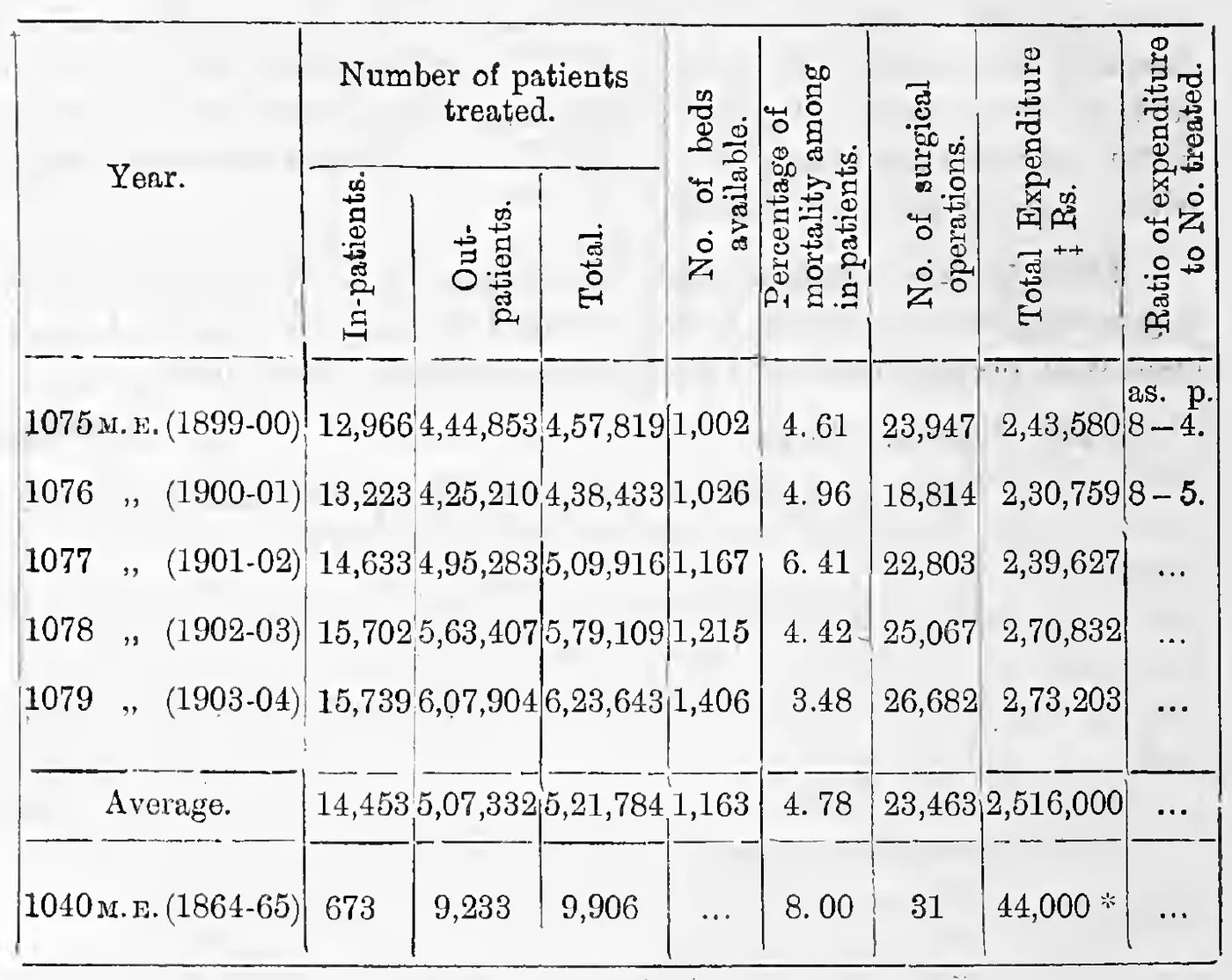
A rough glance at the above statement will show at what rapid rate the Medical Department has progressd in its usefulness to the public. Though by far the larger portion of the population, especially those of the rural parts still cling to the Native Vaidyans and their methods of treatment, yet there is no gainsaying the fact that the European system of the treatment of diseases is being more and more appreciated by the public. The average annual number of patients treated in the five years, 1075 to 1079 M. E. (1899-1904) was 5,21,784 against 9,904 forty years ago, i. e., the operations of the last year have embraced a population more than 50 times that of 1040 M. E. (1864-65 A. D.). These figures do not include the cases treated by the members of the Sanitary Department [543]which were as follow:—
‡ Exclusive of the cost of buildings and furniture.
- No. of patients treated.
- 1075 M. E. (1900) ... ... 20,679
- 1076 " (1901) ... ... 21,239
- 1077 " (1902) ... ... 18,440
- 1078 " (1903) ... ... 19,091
- 1079 " (1904) ... ... 13,339
- Average ... 18,558
Thus the total average number of patients treated at Sirkar cost comes to 540,342 per annum or 18·5 per cent. of the population.
The total number of patients treated in the several institutions of the State in 1079 M. E. (1903-04 A. D.) was 6,23,643—15,739 in-patients and 6,07,904 out-patients, and the total number of beds available was 1406. Taking the number of in-patients, the General Hospital at Trivandrum heads the list, having treated during the year 3,116 indoor patients. Next comes the Women and Children's Hospital with 1,082 in-patients and then come in order the District Hospital at Neyyattinkara with 855, the Leper Asylum with 854, the District Hospitals of Quilon and Alleppey with 808 and 596 in-patients. As regards out-patients, the Alleppey District Hospital has contributed the greatest number, i. e., 35,314; next comes the Quilon Hospital 28,621, the Nagercoil Hospital 28,554, the General Hospital 27,874, the Taikad Hospital 23,174, etc.
Of the total number of patients treated in 1079 M. E. (1903-04 A. D.), viz., 6,23,643, the largest number of cases treated were for malarial fevers 79,947, diseases of the skin 55,144, ulcers 40,808 and worms 35,522. Diarrhœa, dyspepsia, dysentery and rheumatic affections also contributed a large proportion, the number of cases treated being 25,935, 24,805, 22,120 and 18,065 respectively.
Special institutions. The Lunatic Asylum. This institution is now located in a very commodious building at Oolampara a few miles from the Capital where all possible attention is paid to the accommodation, clothing, bathing, food, exercise and general hygiene of the patients. It is under the medical charge of an Assistant Surgeon and the treatment of the inmates consists mainly of attention to general hygienic principles with some kind of amusements or congenial occupations which usually consist of weaving, rope and coir-mat making, gardening, &c. The number of beds available in 1903-04 was 114 for males and 57 for females. There were 112 patients in the beginning of the year and 46 were admitted and 6 readmitted, so that the strength of the institution was 164 consisting of 115 males and 49 females, of whom 22 were discharged and 9 died.
[544]The Leper Asylum. This institution was opened in 1072 M. E. (1896-97 A. D). and the lepers who were hitherto accommodated in the Charity Hospital, Taikad, were transferred there. This also is managed on the most up-to-date model, every attention being given to the food, clothing, exercise and general personal hygiene of the inmates. They are encouraged to do some sort of work, the men in gardening and keeping the premises clean and the women in weaving grass mats and sweeping. Amusements are also provided for them in the shape of reading, singing, football and card play. Mr. T. A Bailey, Honorary Secretary to the 'Mission to Lepers in India and the East', who visited the institution in 1077 M. E. (1901-1902 A. D.) bore the following testimony to its excellent management:— "I have seen at least thirty Asylums, Government, Municipal and Mission, and the Trivandrum one ranks well in the forefront, if it is not actually the best I have seen." The number of beds available last year was 116 for men and 36 for women. There were 127 patients at the beginning of the year and 70 were admitted and 46 readmitted in the year, making a total strength of 243, 207 males and 36 females. Of these 84 were discharged and 15 died.
Veterinary Hospital. This institution was opened at the beginning of 1064 M. E. (1888 A. D.) and placed under the immediate charge of one who had been specially trained at Madras in the Veterinary art, and the Karbhari of the Royal Stables was appointed to supervise it. A Government Veterinarian (salary Rs. 100+15) is now in charge of the hospital. A scale of charges is prescribed by Government for the treatment of animals brought to the hospital by the public. Provision is also made for the treatment free of charges of cattle for agricultural purposes belonging to poor ryots and others unable to pay the prescribed charges, the exemption referring only to animals treated as out-patients. This institution is now becoming popular among the people. The total number of cases treated in 1903-04 was 224, of which 200 were discharged cured, 6 relieved, 1 pronounced incurable, 7 died, one destroyed, and 9 remained at the end of the year, besides several cases belonging to the Palace dairy farm, sick elephants from the P. W. D. and Panivagai Marahmut Department and a few sick animals from the Zoological Gardens.
Aided institutions. As in the matter of education so in the dispensation of medical aid, the London Mission Society, Nagercoil, had very early taken the lead and their philanthropic efforts in both these directions deserve every commendation. The hospital at Neyyoor, in South Travancore is the oldest private institution in the State having been started about 1852 by Dr. Leitch, the successor of the Revd. Mr. Mead, the [545]pioneer of English education in Travancore. Dr. Leitch was a very zealous worker but he was not spared long to continue the noble work he had begun towards medical relief especially of the poor, for he was accidentally drowned in the sea while bathing at Muttam on the 25th August 1854. Revd. Baylis supervised the institution for a time and was succeeded by the Revd. John Lowe, M. R. C. E., in November 1861. Dr. Lowe established a medical class, opened new stations and after doing much good work for about ten years retired in 1871. He was succeeded by Dr. Thomson who again was succeeded by Dr. Fry another equally zealous worker. Dr. Fry built a new hospital, formed a new medical class, established a Leper Asylum and opened further stations subordinate to the medical mission. The present very popular Dr. Fells succeeded him in 1892 and together with Dr. Bentall is doing very substantial work in the cause of popularising European medicine among the masses. The Neyyoor Hospital as well as its sister institution, the Nagercoil Dispensary are now receiving grants from Government.
The Church Missionary Society started a Leper Asylum in 1871 at Alleppey and the Roman Catholic Archbishop of Verapoly has a hospital and dispensary at Manjummel both receiving grants from Government. Among other institutions, mention may be made of the Zenana Mission Dispensary at Trivandrum, the Planters' Dispensaries at Devicolam and Ashamboo and the Local Fund Dispensary at Bodinaickanur which though in British territory was till lately receiving grants from this Government on account of its affording medical aid to a considerable number of coolies and others working in the Travancore plantations near our boundary.
A regular system of medical grants to hospitals and dispensaries and Vaidyasalas was sanctioned in 1071 M. E. (1895-96 A. D.) with a view to supplement the aid afforded by the State Medical institutions and to encourage the practice of medicine by private agency under organised control; and the Durbar Physician was entrusted with the supervision and control of the institutions worked on European methods. The Vaidyasalas were placed under a committee of two leading native physicians appointed by Government, to whom all applications for grants were to be referred and whose duty was to advise Government on all professional and other matters connected with the Vaidyasalas. They are each allowed an honorarium of Rs. 35 per mensem. In the following year the system of grants-in-aid to the Vaidyasalas was improved and extended and rules were passed prescribing the conditions of the grants and the duties and responsibilities of the applicants for the same.
[546]There are now eight grant-in-aid institutions, viz.:—
- 1. Grant-in-aid hospital Neyyoor. Rs. 1,200
- 2. Do. Dispensary Ponmudi " 1,200
- 3. Do. do. Bonami " 1,200
- 4. Do. do. Arnakal " 1,200
- 5. Do. do. Kalthurutty " 1,200
- 6. Do. do. Sothapara " 1,200
- 7. Do. do. Munnar " 1,200
- 8. Rama Row Dispensary Nedungolum. " 300,
all subject to Government control and inspection, besides the C. M. S. Leper Asylum at Alleppey, the Zenana Mission Dispensary at Trivandrum, the Ashamboo Hospital and the British Dispensary at Bodinaickanur which continue to receive their usual grants under the old system.
The number of Vaidyasalas receiving grants-in-aid has now risen from 28 in 1072 M. E. (1896-97 A. D.) to 68, with a corresponding increase in the number of patients treated by them. The native system of treatment known as Ashtangahridayam is slowly reviving under the encouragement now extended by His Highness' Government. The number of patients treated in the Vaidyasalas was 1,20,626 in 1079 M. E. (1903-04 A. D.) or nearly 20 per cent. of the total treated by the State medical institutions. But as a matter of fact the proportion of the sick that resort to the Sirkar medical institutions is only very small, the majority of the people still resorting only to the native Vaidyans of the rural villages. Apart from the recognised Vaidyans in maintaining Vaidyasalas there are hundreds of native Vaidyans practising throughout the country, but as they do not care to preserve a record of their practice, the actual statistics of the sick treated under the native system are not available. I wrote in my Report on the Travancore Census of 1891:—
"In the Administration Report for 1066 M. E. the Dewan observed that 137,880 sick people were treated in 33 medical institutions of Travancore. Though the Travancorean is more considerately treated in this respect by the Native government than at any previous period of our history, it should be still remembered that only a fraction of the sick population get the benefit of the Sircar medical institutions. To the large numbers of the working classes they are beyond reach, not on account of the indifference or unwillingness of the medical authorities to treat them, but owing more to their ignorance and their general apathy. In the case of the well-to-do classes, by far the largest proportion of them believe in the efficacy of their native medicines and the native system of doctoring known as Ashtangahridayam. The bulk of the Namburi Brahmins as well as the Sudras, and a good many of the middle classes follow the prescription of these Ashtangahridayam Vydians. Many of these are mere quacks, but the popular faith in them remains yet unshaken. The most common forms of this native treatment known to Ashtangahridayam are decoctions, lahyams [547](electuaries), oils for external application and strict diet. Of course it must be remembered that severe diet bordering upon starvation is one of the chief concomitants of native treatment. The oils are of the most universal use among the native population. Even healthy persons are recommended to rub certain oils in their daily baths to remove impurities of blood, to promote digestion, and to prevent such common diseases as cold, fever, catarrh, &c. Rheumatic complaints are most common on this coast. And the native Vydian's medicated oils are most commonly used and are universally believed in as curing even the most obstinate cases of rheumatism. There are Namburi doctors who trace their medical profession to the time of Parasurama, their ancestors having received, according to the Keralolpathy, the secrets of the science from Parasurama himself. Of course there are numerous Sudra doctors too well versed in Ashtangahridayam all over the country, and some Iluva, Syrian Christian and also Mahomedan vydians are known to claim proficiency in the native methods of treatment. There is no Kara without its vydian, and in thickly-peopled villages, old women act the part of vydians in every-day ailments and the part of midwives in obstetric cases."
Fourteen years have elapsed since then and the number of sick people treated in the several medical institutions of the State has now risen to nearly 650,000. But popular faith still continues in the native system of medicine though on account of the Government dispensing medical aid gratis, the expansion of medical relief has made it possible for a larger proportion of the population to resort to it than formerly.
The total amount spent by Government in 1903-04 on both the Medical and Sanitary Departments amounted to Rs. 4,10,000 or more than 4 per cent. of the total income of the year. Considering that the whole amount had to be met from the general revenues of the State, there being no municipal or local funds available for the same, it must be considered very liberal. The Travancore Government pursues the same liberal and enlightened policy in regard to the promotion of the public health of the country, as in that of its intellectual health, and in both these respects it will compare favourably with any other State or Province in India.
Native medicine. Before concluding this chapter it may be interesting to give here a short account of the native system of medicine which has so strong a place in the affections of the mass of the population.
The science of medicine, like all other sciences in India, dates from a remote antiquity and after reaching a high stage of development, it has remained stationary for centuries past. Of all the civilised nations the Hindus were the earliest to observe and study the nature of diseases that afflict men and discover means for their alleviation. The science of medicine was called Ayurveda or the Veda of life, forming part of the Holy Scriptures and as such believed to be a direct revelation from the Creator. It is based on the Rig-veda in so far as it relates to the knowledge of medicine, while for [548]surgery it is based on the Atharva-veda. It is the oldest medical treatise of the Hindus and deals with the subject of life, the conditions tending to prolong or shorten it, the nature of diseases, their causes and the methods of treatment. It is said to have originally consisted of 100 chapters each with 100 Slokas, but fragments only now exist. The science is treated under eight subdivisions or departments:—
(1) Salya or surgery including the methods of removing foreign bodies, of using surgical instruments, of applying bandages and treating various surgical diseases. (2) Salakya or the treatment of diseases of parts situated above the clavicle, such as diseases of the eye, nose, mouth, ear, &c. (3) Kayachikitsa or the science of medicine in general. (4) Bhutavidya or restoration of the faculties from a disorganised state induced by demoniacal possession. (5) Kaumarabritya or management of children, comprising the treatment of infants and the diseases they are subject to. (6) Agada, or administration of antidotes for poisons—mineral, vegetable and animal. (7) Rasayana, which treats of the universal medicine, the Elixir that will render health permanent and life perpetual. (8) Vajikarana, which describes the means of promoting the increase of the human race, by increasing the virile power and giving tone to the weakened organs of generation.
Ayur Veda. The traditionary origin of the healing art is thus stated. Once upon a time, distinguished sages like Bharadvaja, Kasyapa, Vasishta and others happened to meet on the Himalaya mountains, and the subject of their conversation incidentally turned upon the ills that flesh was heir to. 'The human body which is the means of attaining the four aims of life, namely, virtue, worldly pursuits, pleasure and liberation, is subject to diseases which emaciate and weaken it, deprive the senses of their functions and cause extreme pain. These diseases are great impediments to worldly affairs and bring on premature death.' Hence they thought it was quite necessary to find a remedy for such diseases. They at once recollected that Brahma the Creator had taught the science of Ayurveda to Dakshaprajapati who in turn had expounded it to the Asvinikumars, from whom, again, the knowledge was transmitted to Indra. The assembled Rishis selected Bharadvaja as the one best fitted among them and requested him to acquire from Indra the knowledge of the science of Ayurveda and thus free them from the scourge of diseases. The great sage, accordingly, went to Indra who was much pleased with the object of his mission and gladly imparted to him the knowledge of the science in all its manifold details. Bharadvaja then transmitted the knowledge thus acquired to the other sages. One of them, Atreya, wrote several works, among which mention must be made of Atreya-Samhita, consisting of 46,500 verses in five [549]parts—one of the oldest authorities on Hindu medicine. He is said to have taught the science to his pupils of whom there were six, namely Agnivesa, Bhela, Jatukarna, Parasara, Harita, and Kshirapani. Every one of these disciples attained proficiency in one branch or other of the science and came to write authoritative treatises on these. Thus was the science of Ayurveda developed and it became the means of saving millions of human lives.
Ashtangahridayam. Charaka and Susruta were the next great writers on medicine—two very high authorities, the former on medicine and the latter on surgery. Charakasamhita and Susruta their respective works, are both compendiums of the Ayurveda and they form the groundwork of the medical system of the Hindus from which all recent writers have drawn their inspiration. Of the two, Charaka is superior to Susruta in accuracy of description, classification of diseases and the general plan of treatment, while Susruta excels in anatomical descriptions and the treatment of surgical diseases. Next comes Vagbhatacharya, the author of Ashtangahridayam. He is said to have been a native of Sindhu* in Western India, who lived about the second century before Christ; and was a very comprehensive and clear writer who did substantial service to the medical world by throwing considerable light on several obscure passages in the writings of his predecessors. Finding that the existing treatises on medicine, though elaborately treating of the various subjects relating to the science, were not intelligible to the ordinary reader and feeling the want of a work containing the essence of the Ayurveda, Vagbhata first composed a medical work called Ashtangahridayam consisting of 12,000 Granthams. This again did not satisfy him and with a view to make the subject very intelligible and popular, he wrote another work called Ashtangasangraham, in which he turned to good account the writings of his predecesssors, especially of Charaka and Susruta, by presenting the matter contained in their works in a clear and condensed form. The plan and treatment of the subject are almost identical with those of Charaka and Susruta and it is written in a clear and simple style. Atreya, Susruta and Vagbhata are described in a popular couplet as the three great medical authorities for the three yugas, Krita, Dvapara, and Kali; and they are known among the students of Hindu Medicine by the name of Vriddha Trayi or "the old triad." The book is divided into six sections containing 120 chapters on the whole. It treats of Hygiene, outlines of Anatomy, Physiology, practice of Medicine, Surgery, [550]Ophthalmic Medicine and Surgery, of Obstetrics and the manufacture and use of various obstetric and surgical instruments.
* Some credit Kashmir as his native country and assign to him a considerably later age.
The first section is called Sutra Sthana; in other words, the essence of the science is brought in under a set of Sutras or institutes. The second section deals with the different parts of the body which is subject to all sorts of diseases and is the means of attaining the four aims of life already referred to, viz., virtue, worldly pursuits, pleasures and salvation. In the next section called Nidana, the author like all other early writers on Hindu medicine, devotes his attention to the investigation of the causes and symptoms of diseases. Chikitsa or the therapeutic branch of the science, is described in the fourth section which contains 22 chapters and treats of the following diseases :—Fevers, blood and bile affections, cough, diseases in connection with difficulty of breathing, pulmonary consumption, vomiting; heart-burn; and diseases caused by excessive thirst; diseases caused by excessive drinking, hæmorrhoids or piles, diarrhœa, dysentery, urinary obstruction and urinary affections in general, including diabetes and gonorrhœa; phlegmonoid inflammation or internal abscess; glandular enlargement of the spleen, enlargement of the abdomen from dropsy or flatulency; jaundice; intumescence, Erysipelatous inflammation; leprosy; vertigo, whiteness of the skin, rheumatism, gout, &c.
The subject of poisons and their antidotes comes under the head of Kalpa which is treated in the fifth section. The antidotes are chiefly of the nature of emetics, purgatives and injections. The next and the last section is called Uttara sthana and treats of those subjects not included in the previous sections, especially, of diseases affecting the most important members of the body. It includes (1) the nursing of children and treatment of all kinds of infantile ailments, (2) demoniacal diseases including deranged faculties of the mind, (3) Epilepsy, (4) all kinds of eye diseases and their treatment by medicine and by surgical operations, (5) Ear diseases, (6) Nose affections, (7) diseases of the mouth, (8) diseases of the head, (9) Ulcers and wounds, (10) Contusions and bruises, (11) fractures and dislocations, (12) Fistula-in-ano, (13) rheumatic affections of the joints and indolent swellings, (14) Scrofula or inflammation of the glands of the neck, (15) minor diseases like pimples on the face, warts, &c., (16) diseases of the generative organs, (17) toxicology—the treatment of snake poison, rat poison, hydrophobia and insect poisons, (18) Rasayana or medicines for preserving vigour, restoring youth, improving memory and curing and preventing diseases in general, and (19) Vajikarana which describes the means of increasing the virile power by giving tone to the weakened organs of generation.
[551]That the distinguished Acharya's work is the result of much thought and research may be easily seen by the following precepts inculcated in it. In the first place, in order to enjoy fully the period of lifetime that has been ordained to us by the Creator we should he says possess a deep regard and admiration for the rules of the Ayurveda. Secondly, we should remember that we contract diseases only as a result of the sins committed by us in this, as well as in a former, birth and that these can be averted only by not committing by word thought or deed, the ten sins beginning with the slaughter of animals. Thirdly, we must be fully alive to the principle that prevention is better than cure. The necessary precepts in that direction are clearly laid down in the work. Fourthly, the work deals in 12 chapters with the most valued of man's organs, the eye and the various diseases it is subject to, and the methods of treatment thereof. Fifthly, it treats elaborately of the various symptoms that are the sure forerunners of death and explains the possibility of predicting a man's death from twelve hours to about a year before its occurrence. Sixthly, the book treats at full length of the different varieties of various diseases, e. g., eighty varieties are described of rheumatic affections (Vataroga), forty of urinary affections (Prameha), &c. Seventhly, it also brings to light the various medicines and devices for temporarily averting old age and death. Several means are described of effectively protracting life and youth and improving the procreative power. Eighthly, the work also deals with the subject of Law, Ethics Astrology, Prognostication, Sorcery, Phrenology, Toxicology and others and shows the relation each of these bears to the science of medicine. Ninthly and lastly, all the various branches of the medical science are brought together and the whole is recapitulated in an elegant and intelligible manner. Thus, it must be asserted that in comprehensiveness of details and in the efficacy of the ingredients prescribed in the recipes, this ancient medical system stands unrivalled.
Different schools of medicine. There are three schools of medicine prevalent in Travancore, viz., Ashtangahridayam, Chintamani and Yunani. The first is the most favoured and popular one and obtains throughout North Travancore, Cochin and Malabar, while the second is confined to Trivandrum and South Travancore besides the Tamil districts of the Madras Presidency; and the third, the Yunani or Grecian school, is very rare in Travancore. Mercury, Arsenic and Sulphur form the indispensable ingredients in most of the prescriptions of the Chintamani and Yunani systems which sometimes in the hands of unskilled Vaidyans seriously endanger the health and even the life of the patients; even otherwise, [552]these medicines are known to have caused ulceration of the mouth, inflammation of the whole alimentary system, burning sensation all over the body and sometimes even death. But as regards the Ashtangahridayam system of treatment there can be no danger at all. Its pharmacopœia consists of drugs which are none other than leaves, roots and corms that are easily assimilable into our system by virtue of their akinness in property to the roots, vegetables and grains upon which we subsist. Very obstinate cases of rheumatism, gonorrhœa and other allied chronic complaints are being easily cured by means of medicated oils, ointments, decoctions, liniments, and ghees of the Ashtangahridayam pharmacopœia; and these can be used by the healthy as well as by those suffering from diseases. The medicines prescribed by the Ashtangahridayam system are specially fitted for the people of this country who take only light food and gentle exercise.
The circumstance that India is a vast and fertile country blessed with the advantages of regular and periodical seasons, has made it "the Encyclopædia of the vegetable world." Our ancient authorities on medicine have taken considerable pains to study the properties of the herbs that came under their observation and have classified them into Ganas or groups based on their properties and each successive writer has added to the list of the useful plants and herbs of India. Charaka gives 50 groups of ten herbs each which, according to him, "are enough for the purposes of an ordinary physician," though he holds at the same time that "the number of groups can be increased to any extent." Susruta gives a list of 760 herbs in 37 sets or groups arranged according to their common properties, and Vagbhata, the author of Ashtangahridayam follows the method of Susruta in the 15th chapter of his work, "but the concise way of his description has a charm of its own." Even the particular seasons are prescribed for gathering the medicinal herbs, the period of their growth, when they possess their distinctive properties, the particular localities from which alone they should be collected and the manner of treating them, extracting their active principles and preserving them—all these are described with such minute detail and care that they are a marvel to the modern enquirer. The treatises recommend that the physicians themselves should go to the jungles and with the help of those acquainted with the forests, gather the herbs when they are in flower, taking care to avoid those injured by insects or growing on bad soils, and the physician should himself be able to identify the various herbs that he has to deal with—a state of things impossible to conceive of in this age of division of labour in highly civilised communities like those of Europe and [553]America, though many Native Vaidyans come up to this standard to a great extent in their extremely limited spheres of usefulness. For the Native Vaidyan knows the plants and herbs himself, knows where they are to be had, collects them, makes the medicine himself either in his own house or in that of his patient. He attends upon the patient or the patient's father or uncle in the patient's house for days and weeks together, discussing with him the nature of the disease and the virtues of his pharmacopœia, the progress from day to day and the further medicines or treatment that may be required, and ceases his visits only after the patient has bathed, which is the test of recovery, after which the patient himself visits the Vaidyan in his house, complaining to him of the balance of ills that still trouble him and taking the necessary prescription for further treatment. All this time, the Vaidyan has not, it must be remembered, been paid anything for his trouble and attendance. The patient has only had to pay for the herbs and the drugs and the labour of bringing them and preparing them. When the time comes to pay, which may be several weeks or months after the patient's complete recovery, the remuneration will be paid in the form most convenient to the patient and entirely according to his means. It may be a pair of cloths or a bunch of plantains or a bundle of tobacco leaves, or some quantity of rice and condiments. This is offered with many words of thankfulness and gratitude to the Vaidyan who accepts them with good grace, saying "I am very much pleased. Don't say anything of my treatment. I am glad you have recovered under God's help. I was very anxious about your case and so on." And, it must be added, that all through life the patient continues grateful to the village Vaidyan repeating such small presents as those enumerated above on all occasions of weal or woe in the Vaidyan's house, as tokens of his regard and gratitude. But the Ashtangahridayam system of treatment is not as widely known among Western scholars, as for instance the Chintamani and other works, perhaps because the language viz. Sanskrit in which it is written, does not afford so much facility for translation as the Dravidian languages. Though the Western scholars have adopted many of the medicines and prescriptions of the Chintamani into their own system, they have yet to study the numberless herbs, referred to in the Ashtangahridayam science, which abound in the Indian jungles. Ashtangahridayam is already losing favour even with the inhabitants of Southern India partly on account of the general indifference to our ancient sciences and partly also on account of the want of sufficient inducement and encouragement to the native practitioners at the hands of the influential and enlightened public who have begun to largely patronise European [554]medicine. But the belief of the majority of the people, especially in the rural parts, in the efficacy of the mode of treatment under the Ashtangahridayam system, still remains unshaken. The bulk of the Nambudiri Brahmins as well as Sudras and a good many of the middle classes of Travancore still take kindly to the Ashtangahridayam treatment only.
Some of the Nambudiri doctors trace their knowledge of medicine to Parasurama's instruction, their ancestors having received the secrets of the science directly from him. Such are the Ashta-Vaidyans of Malabar belonging to the eight families of the Nambudiris who were deputed by Parasurama to devote themselves to the study of medicine and the curing of diseases. One such family is that of the Vayakkara Musu at Kottayam, a family of eminent native physicians on this Coast. A brief account of the late head of the family, a distinguished ornament to the school of Ashtangahridayam medicine in Malabar, may be of interest to the general reader.
Vayakkara Musu. His name was Aryanarayanan Musu but he was better known throughout Travancore and Malabar by the name of his Illam as Vayakkara Musu. He was born in the year 1842 and died four years ago, at the age of sixty. He was a great master of the healing art of the Ashtangahridayam school. But the public confidence in him far surpassed his achievements and was nothing less than apocryphal. The people called him 'Dhanvantari' or the incarnation of Vishnu in medicine. The man himself was a marvel to look at. He was calm, unassuming, cool and collected; and visitors from all parts of Malabar thronged to his house in the morning hours of all the days of the year. He was visible for about 4 hours daily (6 A. M. to 10 A. M.) and he listened to what every patient had to say, quietly and attentively. No word was lost on him, for he was all attention. He was a most thoughtful man and had a wonderful memory. One visitor after another narrated his story to his heart's content and the only interruption which was offered to the web of narrative from each visitor, was the questionings by the Musu. When he had finished listening to the whole lot of the visitors of the day, he looked at his pupils or disciples who attended on him by turns and pointing out to each patient, he quoted the text which was to be prescribed in the particular case. He gave only the initial words of the text. The pupils immediately wrote out the full text of the prescription with details of medicines, manner of preparation, period of treatment and doses, for they are all experts in the art, well trained for years under the eminent Musu. The written cadjan chits of prescription were placed before the Musu and he would hand them over himself one [555]by one to the patients concerned, for, it should be remembered that no patient would take the chit except from the Musu's hands. He had they said a special personal power for curing diseases. So it was widely believed, and the patient would ask "Please sir, deliver the ola chit yourself into my hands." To others, whose complaints were of a trifling nature, he would prescribe by word of mouth what should be done for the patient. His treatment was often of a most simple nature. One of my informants, a graduate of ability and knowledge, gave me an interesting account of his visit to the Musu. My informant was a man of consequence and the Musu received him with courtesy which consisted in beckoning him to a seat on the floor near him. It may be stated that the Musu and his visitors would all sit on the floor of an open front verandah of the Illam, while those who would not sit with him would stand in the yard or if they were of an inferior caste, outside the enclosure, but all were before him and in view and he would talk to all who had come. I have myself seen the Musu's house twice, once when he was alive some thirty years ago and then after he had died. It is necessary also to add that the Musu's conversation was nothing more than one or two words of question about the ailments of his visitors. Otherwise there was no talk for he would be chewing all the while and all the visitors were hospitably treated to the chew in his house with the utmost liberality and generosity. This is a large item of expenditure to the Musu for the chew every day means bundles of tobacco. My informant went to consult him on a small ailment to himself and the members of his family. After giving his case in a few words he waited so long that he got disgusted and wished to have left the Musu, but unwilling to be considered rude he bore up the ennui of waiting without the Musu speaking one word or taking any notice of him which however was not any studied indifference or discourtesy to my informant for all the other visitors were treated in like manner. The Musu was all the while thinking of the various ailments reported to him that morning and how to prescribe for them. So when my informant made a sign to start, he said "yes your case, please buy four cash (about 2 pies) worth of such a bark and boil it with your bathing water and pour it over you when you wash daily. You will be all right in a week." My informant who was already disgusted with his being kept waiting so long and with such apparent indifference was positively put out when this prescription was given him. He thought the Musu was not in earnest in prescribing in this fashion. However, without a word of murmur but extremely provoked, he left the Musu regretting that he ever went to him at all, but to his wonder he told me that he found the Musu's prescription a most marvellous remedy, [556]for he and all his people were cured in three or four days after he began washing himself with the water boiled with the bark prescribed by the Musu. I have heard numerous other stories of the Musu's mannerisms and his marvellous feats of cures of all sorts of diseases. I met him first thirty-four years ago, when he celebrated the milk-warming ceremony of his Illam in Kottayam and then again a few months before he died. He was always the same quiet and thoughtful man that he had been, deeply versed in his art and a centre of attraction and usefulness to the whole of Malabar who now mourn his loss. He has left a son of about 15 years of age said to be a brilliant and gifted lad worthy to take his place. The old Musu regretted that he could not give the boy some practical training under him. All castes and classes of people alike adored him as the medical sage and savant.
A musician attached to His Highness the Maharajah's palace at Trivandrum was suffering from an attack of malignant cancer on his cheek. For a long time he was under European medical treatment in Trivandrum, then under the special directions of his doctors he went to Madras to undergo an operation in the General Hospital there. All that medical or surgical aid could do was done but he got only temporary relief, and a short time after, the malady appeared again with unabated vehemence. At last with little hope of recovery the poor sufferer resorted to Vayakkara Musu who cured him completely within a space of thirty days by means of a medicated oil for external application to the cheek. Several extreme cases of Malaria, dropsy, paralysis and gravel have been cured by him within a miraculously short period with very simple drugs. He had won honours at the hands of the Sovereigns of Travancore and Cochin and of the princes and nobles of Malabar by his successful treatment of several complicated diseases. Several of his disciples practise medicine in all parts of Travancore but none of them have yet come up to his standard of excellence. He worked to the last day of his life. In the forenoon of that day, as he was giving medical advice to one of his patients, the Musu told him, 'It looks as if I myself want a doctor; I will go in'. So saying he dismissed his patient, went in, where he had arranged for a Durba grass-bed on the floor and for a lighted lamp, said his last prayer, laid himself on the grass-bed and quietly quitted this life—which evidently he had anticipated and arranged for. This dramatic end has made a deep impression on the whole population of Malabar.
Some of the other Ashtavaidyan families now living are :—Cheerutu Musu at Kottayam, Planthode in Northern Kottayam, Taikad Musu at Trichur, Kuttancheri of Malabar and Alattur Nambi in Palghat.
[557]Chintamani. This system of medical treatment better known in the districts of the East Coast, may be said to prevail to a limited extent in and about South Travancore. Chintamani forms part of the Ayurvedic science and is said to have been the work of the sage Agastya with the assistance of seventeen other equally eminent sages. The whole composition is in Tamil and is marked by clearness of thought and diction and a learned style taking a high place in the field of Tamil literature. Besides treating in a small compass of the eight departments of the science of Ayurveda already referred to it also notices some new diseases and their modes of treatment and prescription. That the work is very old is seen from the circumstance that Vagbhata, the author of Ashtangahridayam, refers to Agastya in the following terms :—
अगस्त्यावेदितम् धन्यमिदम् श्रेष्ठम् रसायनम् ॥
This means "This great and good Elixir is sage Agastya's make." The Chintamani grantha elaborately deals with the Hindu pharmacopœia and describes the means of ascertaining diseases by the examination of the pulse. There are 1,341 stanzas devoted to the subject of pulsation alone. It has to be stated that the diagnosis of a disease by the examination of the pulse is considered the most important of all the guides, as it furnishes the best criterion of the condition and progress of diseases and as it is the one most depended upon by native Vaidyans. The pharmacopœia of the Chintamani system is treated under seven heads—(1) salts, of which 35 kinds are mentioned; (2) poisons, 32 kinds; (3) Rasas and Upa-Rasas, 112; (4) metals, 11; (5) waters, 16; (6) dried drugs like ginger, &c., 16; (7) herbs and roots, 412. Thus there are on the whole 634 different medicines, and these are clearly described along with their varieties, effects, antidotes, and methods of purifying, their correctives and the varieties of prescription followed. There are 16 different forms in which medicines are administered to the patients. They are (1) Bhasmam or calx. (2) Sindhuram or powders (3) Matra or pills (4) Gulika or pills (5) Vataka, cakes or lozenges (6) Rasayana, elixir (7) Churna, powders (8) Lehya or electuary (9) Asavam or tinctures (10) Kuzhampu or ointment (11) Lapa or plaster (12) Taila or oil (13) Ghrita or ghee (14) Rasa or essence (15) Dravaka or acid and (16) Kashaya or decoction. The uses, specialities and modes of the administering of each kind of drug are all very minutely and clearly dealt with in the treatise. Mineral drugs are considered more effective than vegetable drugs and hence the superiority of the Chintamani system over others. Diseases are believed to be cured more easily and effectively under this system. But unless great [558]care is taken in the preparing as well as in the administering of the mineral drugs to the patients more harm than good will follow. Hence the practitioners in mineral drugs are a very limited number.
Hindu diet. The most characteristic feature of Native medicine, in fact of Hindu life in general is its diet. The Native Vaidyan never prescribes a course of treatment without prescribing a diet at first, let it be never so simple; for in his view half the cure consists in bringing down the strength of the patient to the minimum stage of vitality. He is afraid he cannot grapple with a disease unless the patient's superfluous energy is arrested by a weak diet. An English doctor cannot imagine how a patient can subsist on such low diet. What is a low diet in the estimate of an English doctor will frighten a Native Vaidyan on account of its unnecessary strength. He will have nothing to do with a patient who does not implicitly carry out his orders in regard to diet and various devices are adopted to weaken the normal Hindu diet which is weakness itself as compared with the diet of European nations. A word here about the Hindu diet in general, which regulates the lives of millions of the Indian population, may be justifiable.
There is no Englishman who has not heard of or sometimes used the expression himself "I have a Brahmin's hatred to take away animal life". This is become a proverb; and without attempting to discover the reasons for the present-day Brahmin's strictly vegetable diet as founded either on hygienic conditions or climatic necessities or the difficulty of finding animal food when the Aryans had settled down into a highly civilised community in a land abounding with natural blessings or literally flowing with milk and honey, it is enough to observe that the present regimen of the high caste Hindu is the right one and has served all his purposes whether religious, intellectual or physical. An abstainer from animal food will even go the length of believing that the continuity of the race in health and intellectual activity in spite of unfavourable conditions of climate and political life, is mainly due to the altered diet adopted by the original Aryans, when they first saw the need for it owing to a change in their original environments. And it must be admitted that subsequent experience has confirmed the wisdom of that change. It is within the experience of us all, whether Europeans or Indians, that abstaining from animal food is a great help to intellectual labours, that those whose diet is chiefly animal are less capable of withstanding hunger, fatigue and privation than vegetable eaters, that what is gained in an appearance of force and impulse in action is lost in the want of sustained energy. The [559]Japanese have shown in their recent war that the so-called inferiority of the Asiatic races is more of a myth than a reality. All the stories extant of ancient Hindu sages having lived to fabulously old ages are associated with their having lived very abstemious lives, contenting themselves with a single meal of fruit and milk or water once in 24 hours, as the only sustenance really required for their philosophic and contemplative lives. The experience of the West seems to tally wonderfully well in this respect with that of the East. Some years ago I said in a lecture delivered by me to a society of young men in Trivandrum :—
"The food itself was to be of a most simple and harmless nature. According to all accounts the ancient Hindu had only one meal a day, and that too, was after 12 in the noon, by which time only, he could get through the routine of his daily rites and observances. Animal food was not forbidden though 'a Brahmin must never eat (the flesh of) animals unhallowed by Mantras; but obedient to the primeval law, he may eat it, consecrated with Vedic texts.' A subsequent text extols abstinence from flesh in the following words: by subsisting on pure fruit and roots, and by eating food fit for ascetics (in the forest) one does not gain (so great) a reward as by entirely avoiding (the use of) flesh.' We moderns have considerably improved on these texts, as our present diet may be said to be innocuousness itself as compared with that of other nationalities. The Hindu naturally hates taking away life. Here is what Sir Monier Williams wrote in his first visit to India. 'It is, however, a melancholy reflection that infliction of death is essential to the maintenance of an Englishman's life. For life is everywhere exuberant around me and every living thing seems to enjoy itself, as if it were certain of being unmolested. Natives never willingly destroy life. They cannot enter into an Englishman's desire for venting his high spirits on a fine day by killing game of some kind. 'Live and let live' is their rule of conduct towards the inferior creation.' Milk, cereals and vegetables, with many exceptions and reservations in them, are the recognised food for this age. All others are forbidden. There are lots of vegetables unknown to the ancients which the orthodox of our times carefully eschew as unfit for use. Food and clothing are determined by the climate of a country and all of them react on the human temperament. The term 'mild Hindu' is perhaps, due to these three forces acting on us. It will be admitted that the nature of the food considerably affects the temperament of an animal. There are recorded instances of carnivorous animals becoming docile under milk and bread, but returning to their natural ferocity when fed on meat. The Hindus have always believed in this, and adopted the present diet as the most fitted for their climate and their contemplative habits of mind. Whether the utmost animal strength is reached under such a diet is doubtful, but that it suffices for health and longevity is generally recognised. The old among us live in fair mental and physical vigour with this 'Sathweeka' diet (literally innocent food) and very little of it—a fact which is confirmed by the experience of the West. Here is an instance recorded by the London correspondent of the Madras Mail the other day of one Sir Isaac Holden, who died at the advanced age of 90. 'At 72, he re-entered Parliament as member for the Northwest Riding of Yorkshire, and he retained that seat for ten years, when he took leave of Parliament after having done excellent service there. Owing to his extremely simple, abstemious, and regular habits he retained his health and remarkable power for work until a very advanced age. He often ate nothing but fruit and vegetables for a month together. He had a great partiality for oranges; he constantly substituted bananas for bread; he never took any [560]liquids with his meals; and he made it a rule to walk two or three miles every day, regardless of the weather. He invariably acted up to the principle that he is a wise man who not only drinks, but eats little; and it was a favourite theory of his that with proper care a healthy man might attain the age of six score years.' All our traditions point to the Indian Rishis of old having reached to fabulously long ages, living on bare fruit and water. The inference then is that simple and sparing diet promotes health and longevity—a point in which the experience of the East seems to tally with the experience of the West."*
Edison the great scientist, who in spite of advancing years is still actively engaged in making further researches in his own department of science, has often told his interviewers that the secret of his health and brain activity lay in the very simple diet on which he lived and the knowledge of which he said he had derived from his own father. Herbert Spencer the great philosopher too has again and again called attention to the noxiousness of people eating and drinking a great deal more than necessary merely from a mere morbid habit, artificially cultivated without nature calling for it and this he writes especially after a certain adult age results in absolute physical ruin, for under-feeding in his opinion is never so injurious to adults as over-feeding. He writes :—"Very often people eat as a matter of course not in conformity with their sensations but notwithstanding the protests of their sensations." Thus we see in the civilised West a decided leaning towards the ideals of ancient India.
This is indeed a satisfactory progress of the times if even civilised England can slowly gravitate towards what has long been considered a special merit of the East, viz., the Brahminical abstemiousness. Mr. Eustace Miles has by his writings popularised a diet which 50 years ago would have been scoffed at by his countrymen as unmitigated nonsense. He is steadily making converts to his new school of thought even amongst Anglo-Indians who by their peculiar position in Indian life are perhaps the more conservative in such matters than their brethren at home. The partiality for the simple vegetable diet of the Hindu seems thus to be steadily gaining ground. One is pleased to see now and then in the daily Newspapers, a strong advocacy set up in favour of one's own national diet simple and sufficing and hallowed by ancient usage in quarters where one should have least expected such advocacy. A correspondent† of the Madras Mail recently wrote, to use his own words, "with the practical experience of one who has adopted a comparatively scientific [561]diet and who underwent a six months' course of scientific feeding under the guidance of Mr. Eustace Miles" :—
* 'The Hindu Home', a lecture delivered in His Highness the Maharajah's College Hall, on behalf of the Fort Literary Union, Trivandrum on 12th October 1897.
† Believed to be an officer of the I. A., attached to the Travancore Nayar Brigade.
"The results in my case have been so marked that they read like the advertisement of a patent medicine. I am now absolutely free from head-aches, indigestion, heaviness and depression all of which I used often to suffer from. My memory and temper have improved. I sleep better and need less sleep than before. I work both quicker and better; am keener all round, more active and have much greater staying power. The saving in money and time has also been considerable. My food costs from one-third to one-half, what it used to and I have no need of doctors or drugs, while my meals are fewer and shorter."
This is a marvellous record for so short a period as a six months' apprenticeship. It is in the nature of a faith-cure. The writer is most enthusiastic in his belief for he tells us, "We English particularly as a class, know very little of scientific cookery, and often throw away much of the best part of our food. For instance, the water in which rice is boiled, and which is often thrown away, actually contains more nourishment than the grain which remains and is served up. In the same way many precious salts are constantly lost by throwing away the water in which cabbage and other vegetables are cooked." By this time I have no doubt he has become a doctor as well, for he has very clear notions on the importance of mastication in assimilating food and on the values of the different kinds of food-stuffs used. It is a well known fact however among us Hindus that orthodox Brahmins never speak during meals as the whole of their energy is evidently required for a thorough masticating of the food they consume. The silence is of course enjoined as a religious observance, but its medical value is patent. The writer continues :—
"As an example of the food required by a vegetarian doing a moderate day's work, Haig suggests 8 oz. bread, 4 oz. oatmeal, 2 pints milk, 1½ oz. cheese, 1 oz. peas, and ½ oz. lentils. This gives very much the same amount of proteid as the example of a day's food for an ordinary man given in your leading article, namely—¾ lb. roast beef, 1 lb. boiled potatoes, ½ lb. white bread, ¼ lb. butter that is, between 3 and 4 oz. This would tend to show that the 4½ oz. calculated by Dr. Davis was in excess of requirements; but since a trifle too little proteid is a much more serious mistake than a trifle too much, it is as well to start with 4½ oz., and to reduce the quantity gradually if one finds that one is better with less. Individual experiment is necessary to find out the most suitable number of meals in the day; many people thrive best on two, others find they cannot manage on less than three. The experiment to be fair, must last over several days—a week, if possible, for the immediate effects of any change in daily habits is likely to be unpleasant, and it is by the final effect we must judge. The times of feeding must, as a rule, be arranged to fit in with the work, but so far as possible an interval of six hours should be left between meals to allow the old one to be thoroughly digested before the new one is begun. The craving for food, which one may feel at first, when not feeding at the accustomed time is often fermentation going on in the stomach and not real hunger. As a last warning to those who may intend to try a reformed diet, I would point out that any sudden change is likely to cause a certain amount of depression. This will [562]probably only last for a few days, but can be avoided by starting gradually and experimenting at only one of the meals every day to begin with."
An interesting discussion followed on the subject in the columns of the Madras Mail, but this did not shake his faith in his dogma but only confirmed him, for he writes later on :—
"Your first article gave an account of certain experiments which have been carried out in America, under the superintendence of the Department of Agriculture, and which conclusively proved that many people of various ages and occupations could thrive on a much reduced, but scientifically proportioned diet and that their vitality was improved by it. To a large majority of people the account of these experiments and their results came probably as a surprise. Most of us have been brought up to consider all we eat as food, regardless of its composition, and with regard to the actual properties of its various constituents we neither knew nor cared. Not one in a thousand (the Medical Profession, and a few others whose work requires it, excepted) have the slightest knowledge of food values. It is obvious, however, that certain qualities are necessary in food to sustain life, and that there must be a best possible proportion, not necessarily the same for all, but at any rate for each individual in the circumstances in which he is placed, to obtain the best results. It is unlikely that with the promiscuous feeding most of us have been accustomed to, we have landed on the best possible quantities and proportions for ourselves; more especially as many people consume a quantity greatly in excess of the average amounts necessary, as calculated by science, after experiment on various individuals under different circumstances. Our insides may crave at first for the accustomed quantity, but they soon get used to a change in the amount, and it would seem sound for each one to try and discover what is best for himself; this can only be done by comparing results after reasonable experiment."
In reply to his critics he next wrote :—
"Of the two letters in your issue of the 27th November 'P' considers that we do not eat too much, and quotes Carlyle. Carlyle did not, I believe, show any special knowledge of the subject which would entitle him to be considered an authority. With regard to the 'Ruling Nations of the World', which he states are the English, Germans, French and Americans, England is not what this generation has made her, but is mainly the work of our ancestors, who lived much more simply than is the fashion now-a-days. The Germans, and certainly the French and German middle-class and peasantry, live on a comparatively frugal diet; while nowhere more than in America is the necessity of studying the question of scientific diet more fully realised, and nowhere has a Government paid more attention to the subject.
"'P' points out that the natives of India 'stuff themselves out with rice and vegetables,' with poor results. I presume that it is the quality of their food rather than the quantity to which he particularly refers. One of the reasons why the physique of the natives of South India is comparatively poor may be that the rice which forms their staple food possesses the faults I have mentioned above. The rice which the Japanese use is of a much more nourishing and less starchy consistency. If 'P' has seen the north-country enlisted Brahmin, the best class of Rajput, Sikh, Jat, Pathan and Gurkha, who do not eat rice to such an extent, he must admit that their physique is good, often magnificent. They are not a ruling race, I admit, but there may be other reasons. Look up the history of the Ancient Greeks, the Romans before they became a prey to luxury, [563]and the present-day Japanese—all of these furnish us with examples of a frugal people who have done well.
"A large majority of us go through life daily suffering petty troubles and inconveniences, which we are so used to that we have no idea of the freedom and energy which we might enjoy by a little sensible attention to diet. This does not necessarily mean any extraordinary deprivation or isolation, and it will repay the trouble a thousand fold."*
After these refreshing arguments clearly set forth by a young English officer of ability and research one need not, I think, take the trouble of pointing out to one's Hindu brethren the evils arising from a disregard of their ancient models or the hopelessness of an attempt to benefit by taking what their ancestors, after long years of experience, gave up as prohibited food and drink. It will be a sad satire on our Indian civilisation if the sons of Hindus require lessons on the evils of beef and alcohol.
Hindu surgery. We shall next briefly refer to Hindu Surgery, its past history and present condition. Surgery or Salya forms, as already stated, one of the eight departments of the science of Ayurveda. It is a mistake to suppose that the Hindu medical science did not comprise anatomy and surgery. Medicine and surgery are treated as distinct branches, though both form parts of the same science. Surgery had reached a high state of perfection in the time of Susruta in whose work it occupies the first place. Dhanvantari, Aupadhenava, Aurabhra and Paushkalavata are other eminent writers on surgery and they have all written elaborate works on the art of healing by mechanical and instrumental means; while Charaka, Atreya, Harita, Agnivesa and others are accepted authorities more in medicine than in surgery. According to Dhanvantari, Salya is "the first and best of the medical sciences; less liable, than any other to the fallacies of conjectural and influential practice; pure in itself; perpetual in its applicability; the worthy produce of heaven and certain source of fame." The surgical instruments and appliances used by the ancient medical savants were of course very limited and some of them even primitive as compared with those of the present day, but they were quite sufficient for their requirements and besides, most of those diseases that the modern surgeon is now curing with his instruments, were then treated with medicines and it was only when medicine proved ineffective that they had recourse to surgery. So great was the knowledge and acquaintance of the ancients with the properties and virtues of drugs. There are no less than 125 surgical instruments mentioned in our ancient works for ophthalmic, obstetric and other operations. In obstetrics and in craniotomy, [564]embryotomy and similar surgical operations the native medical science is not a whit behind the modern European surgery. In ancient days crimes were often punished with cutting off the ears and the nose and the Hindus were great experts in restoring the severed organs and in curing lesions. The operation of Rhinoplasty (nose surgery) practised by the modern surgeon is said to have been borrowed from the Hindus. Dr. Hirschberg of Berlin says:—"The whole plastic surgery, in Europe had taken its new flight when these cunning devices of Indian workmen became known to us. The transplanting of sensible skin flaps is also an entirely Indian method." The same authority also gives credit to the Hindus for discovering the art of cataract-couching which is performed by the Indian practitioners with great success even to this day. The Hindus were also well skilled in performing amputations and abdominal sections, in setting fractures and dislocations in men and beasts, reducing hernia, curing piles and fistula-in-ano and extracting foreign bodies. Again the ancient Hindus knew the art of vaccination. Long before the time of Edward Jenner certain classes in India, especially the cowherds, shepherds, Charanas, &c., conceived the process of inoculation. They extracted from the dried scabs of the pocks the active principle of the smallpox germs and injected it in their own blood by making a puncture in their arms with a needle. This inoculation served as a more or less effective prophylactic against the malignant disease and enabled them to enjoy a certain amount of immunity from the ravages of smallpox. The ancient Hindus also taught their disciples the structure of the human body by means of demonstrations and dissections in much the same way as the modern scientists do. Dr. Wise, to whom we are indebted for a comprehensive Review of the History of Medicine, observes :—"The Hindu philosophers undoubtedly deserve the credit of having, though opposed by strong prejudice, entertained sound and philosophical views respecting uses of the dead to the living, and were the first scientific and successful cultivators of the most important and essential of all the departments of medical knowledge, practical anatomy."
* The Madras Mail of the 25th May 1906.
The native surgical operations are according to the best authorities classified into the following eight kinds :—
(1) Chedana—incision (2) Bhedana—excision (3) Lekhana—scarifying (4) Vyadhana—puncturing (5) Eshya—probing (6) Aharya—extraction of solid body (7) Visravana—extraction of fluids including venesection and (8) Sevana—sewing. Surgical implements of which there are a good many mentioned are grouped under two distinct heads, Yantras or appliances which included pincers, tongs, tubular instruments, &c., and Sastras or [565]instruments of which twenty-six different varieties are described by Vagbhata. These latter were all of metal and should be always bright, handsome, polished and so sharp as to divide a hair longitudinally, Generally they were not above six inches in length of which the blade formed half that length or even less. The use of caustics and actual cauterising are other important modes of treating surgical cases. The various points connected with surgery are treated of in full detail in the ancient medical works. The qualifications for a surgeon, the auspicious days on which alone surgical operations could be performed, the instruments to be used for each kind of operation and their dimensions, the methods of teaching the art to others, even the posture of the patients, are all treated of so masterfully that one wonders how in the face of these there is so little vestige of that science to be seen at the present day. Professor H. H. Wilson in his essay on the "Medical and Surgical science of the Hindus" contributed to the Oriental Magazine (February 1823) says :—
"The details thus concisely noted prepare us to expect an active practice amongst those to whom they were familar; and accordingly we find that in the practical treatment of diseases, many of the great operations of the chiropoietic art are enjoyed, such as extraction of the stone in the bladder and even the removal of the foetus from the uterus. The operations are rude and very imperfectly described. They were evidently bold, and must have been hazardous: their being attempted at all is however most extraordinary, unless their obliteration from the knowledge not to say the practice of later times be considered a still more remarkable circumstance. It would be an enquiry of some interest, to trace the period and causes of the disappearance of surgery from amongst the Hindus; it is evidently of comparatively modern occurrence, as operative and instrumental practice form so principal a part of those writings, which are undeniably most ancient; and which being regarded as the composition of inspired writers, are held of the highest authority. It is an enquiry connected with the progress of manners for the persons, whoever they were, who wrote in the character of Munis or deified sages would not have comprised that character by imparting precepts utterly contrary to the ritual or the law or at variance with the principles and prejudices of their countrymen. In what has been already quoted from Susruta and Vagbhata, however, there is much that is utterly irreconcilable with present notions, and in other parts of their treatises that disregard is equally evinced. We must therefore infer that the existing sentiments of the Hindus are of modern date, growing out of an altered state of society; and unsupported by their oldest and most authentic civil or criminal, as well as medical institutes."
The decline of the art of surgery in India is due to various causes, the most important of which is the aversion, of the Brahmin who had the monopoly of all the sciences, to shed blood, to his notions of purity and pollution, his abhorrence to touch dead bodies, and to the sacrificial offerings which were very common in the pre-Buddhistic age. Even the mere touch of the bones, blood and flesh of animals began to be regarded as loathsome, and gradually the Brahmins gave up the art and practice of surgery for [566]ever. It naturally passed into the hands of the lower classes whose practice could only be empirical considering the enormous difficulties and obstacles against their access to the original treatises in the Sanskrit language and even they had to neglect the practice for want of encouragement. Thus has the science of surgery in India been brought to its present low condition, and as Mr. Elphinstone rightly observes, 'bleeding is left to the barber, bone-setting to the herdsman and the application of blisters to almost every man.'
Prescriptions. It may be of interest to give here four kinds of Ashtangahridaya medicinal preparations prescribed by Native Vaidyans.
I. Balaswagandhadi Oil (to be rubbed on the body) for cold, catarrh, phthisis, asthma, rheumatism, &c.
Re/
(1) 8 palams of the roots of Sida retusa finely chopped and crushed. 4 palams of Physalis omnifera finely cut and crushed. Make a decoction with these in 12 Idangalis of water. Heat the decoction gradually for 3 days and reduce it to 3 Idangalis within that time. Next remove the dregs by filtering.
(2) Make an infusion of 4 palams of stick-lac in 4 Idangalis of water and reduce it by heating to 1 Idangali.
(3) 4 Idangalis of diluted curdled milk.
Pour these three in a cauldron and mix in it the following drugs powdered and well kneaded with the help of the above decoction. Next add to it one Idangali of gingelly oil and boil the whole in a slow fire kindled by the spathe of the flowers of the cocoanut palm, and on the third day filter the sendiment when it reaches the viscous stage. The vessel, in which this medicinal oil should be poured when filtering, must contain a piece of antimony, benzoin and crude camphor.
Drugs to be mixed in the decoction :—
- 1. Alpina galanga.
- 2. Sandal.
- 3. Powdered Bengal Madder (Rubia Manjith).
- 4. The root of Aletris hyacinthus.
- 5. Liquorice.
- 6. Kœmpheria galanga.
- 7. Country Sarsaparilla.
- 8. Andropogon Muricatum.
- 9. Cyperus rotundus. [567]10. Costus speciosus.
- 11. Aquilaria agallochum.
- 12. Deodar pine.
- 13. Bark of the tree-turmeric.
- 14. Root of the water-lily.
- 15. Bishop's-weed.
- 16. Lotus.
Each weighing about 3 kalanjus.
An unbleached towel must be used for filtering the medicated oil.
II. Ksheerabala Yogam. (to be taken in).
Re/
16 palams of fresh green roots of the Sida retusa, well washed and made into a pulp by crushing, to be mixed with 16 Idangalis of water which should be reduced gradually to 4 Idangalis on the third day over a slow fire. This must be filtered and poured into a cauldron, and then 2 palams of the roots of the Sida retusa should be very finely ground and mixed in it. Add to this one Idangali of gingelly oil and reduce it on the the second day to a semi-fluid condition by heating it over a slow fire kindled by the spathe of the cocoanut tree. Add also 1 Idangali of pure cow's milk and heat it. On the third day when the sediment of the oil upon the fire becomes viscous, i. e., wax-like in appearance take it down and filter it with an unbleached towel. With this filtered oil, mix anew the Sida root decoction and fresh milk and heat it again and filter. Repeat this operation as often as a hundred times or a thousand times. This is an unfailing remedy for rheumatic complaints and other allied diseases. It will impart vigour and strength to the body and is besides a nervine tonic. It can be applied externally over wounds and lesions.
III. A decoction for biliousness (to be taken in).
Re/
- Sugarcane (red variety).
- Root of the spreading hogweed.
- Dried ginger.
- Black pepper.
- Long pepper (piper longum).
- Rind of gall-nuts.
- Rind of the gooseberry fruits.
- The root of the wood-apple or bilva tree.
- Stalks of tamarind leaves
- Indian Jalap.
[568]Take one Kalanju of each and crush it after finely chopping. Take also five or six iron nails. Put these in six Nalis of butter-milk and make a decoction with it and reduce it to 3 Nalis, by heating over a slow fire. Keep it constantly warm by placing it over fire kindled by paddy husk.
Everyday take in a thodam (¼ of a Nali) both in the morning and evening. Pour 2 thodams of fresh butter-milk and heat it away so as to reduce the decoction to its original measure. Thus this decoction can be taken for six days twice everyday.
IV. Bilvadi Lehyam, an electuary for appetite (to be taken in).
Re/
32 palams of bilva root half-crushed after removing the outer skin to be decocted in 32 Idangalis of water which should be reduced by heating to 8 Idangalis and filtered. Next dissolve in it 16 palams of old molasses and pour the solution in a cauldron and heat it gently over a slow fire. Take it off from the oven when it is still in a liquid condition. After it has got well cooled, mix with it the powders of the following and preserve it in a clean jar. Take in before each meal one tea-spoonful twice everyday.
Powder.
- 1. Cyperus rotundus.
- 2. Coriander seeds.
- 3. Cumin seeds.
- 4. Cardamom seeds.
- 5. Cassia lignea.
- 6. Dried ginger.
- 7. Black pepper.
- 8. Long pepper.
- 9. Chirunagappu.
Diet. The manner of the diet to be prescribed depends upon the nature of the disease the patient suffers from and also upon the strength of physique that should be maintained for the medicine to be administered. Diseases such as leprosy, rheumatism, chronic ulcers, &c., require a hard diet almost bordering upon starvation. Again such medicines as mercury, sulphur, arsenic, bdellium and others when taken in also require severe dieting. There is no hard and fast rule prescribing as to what diet a particular patient should observe when taking a particular medicine, for it mostly depends upon the digestive power of the patient. If his digestion is sound and unimpaired, a hard diet may be conveniently adopted; [569]otherwise, a milder one according as the nature of the disorder will permit, should be observed. But it must always be remembered that the severity of the diet and the strictness of its observance help the efficacy of the medicine administered. Further the prescription of a diet is a matter solely to be left to the Vaidyan's discretion and not to the patient's choice. There are 5 well-marked conventional kinds of diet as laid down in the Ashtangahridaya. They are :—
1. Hard diet. 2. Mean diet. 3. Ordinary diet. 4. Everyday diet. 5. Aftersupper diet.
Hard Diet. (a) The patient after taking in the medicinal oil or ghee shall starve till it is completely digested or assimilated into the system. The usual time for this is 24 hours. In some cases it is 12, while in others it is even 6. After the expiry of the prescribed period of time the patient shall eat only boiled rice. He should not drink water. For washing and other purposes he may use hot water very sparingly. He must not expose himself to the sun or breeze nor should he sleep during day nor keep awake during night nor be negligent in readily answering nature's calls. He must not excite himself by anger, grief or any other emotion and must refrain from all actions involving any sort of physical exertion such as travelling, loud talking, physical exercise, bath and sexual intercourse. He must abide by all these rules for as many days more again as for the number of days for which he takes the medicinal ghee.
(b) When the patient takes in mercury, sulphur, bdellium, marking-nut or china-root he is enjoined to take only milk and boiled rice for food. Sugar should be used in place of salt. This diet should continue for all those days on which he takes medicine and for as many succeeding days thereafter. The usual abstinences are also to be strictly observed.
(c) When the patient takes in such poisons as arsenic, chouviram and others in medicinal doses, he is required to take only milk for food. This diet is also to be observed for as many days again as for those on which he takes medicine, but during the subsequent days he may take rice also. The usual abstinences are also to be observed.
Mean diet. The patient after taking in the medicinal lambative or decoction should wait for an hour and a half on empty stomach. Thereafter he may eat boiled rice with Mulakashyam, Mezhukkupuratti (plain vegetable curries seasoned with pepper, rock-salt and cocoanut oil), pickled mangoes and goose-berries. Hot water can be used only very moderately for drinking purposes. As in hard diet he must avoid [570]physical exertion, exposure and sexual errors, &c. He must undergo these privations for half as many days more as for the days on which he takes medicine.
Ordinary diet or optional diet. The patient must avoid eating substances that are indigestible, sour or cooling in effect. He may take ghee and milk in larger quantities than usual. Only hot water should be used for purposes of drink and bath.
Everyday diet. The patient should wash himself early in the morning and then have a light meal of boiled rice and a curry made out of the leaves of the Moringa pterigospermum and rock-salt. After that the usual dinner and supper may be gone through at 12 o'clock and in the evening. Hot water should be used for drinking purposes. Bath may be either in cold or tepid water according as he is habituated to have.
Aftersupper diet. There is another diet known as the aftersupper diet under which the patient may eat and drink as usual, but just before retiring to bed he should take in the medicine and then lie down to sleep. He should neither eat nor drink before next morning.