Victoria Institutions
The British Empire
George W. Southgate, B.A.
Illustrated with thirty-one maps
VICTORIA INSTITUTIONS
Aaradhana, Deverkovil 673508
India
www.victoria.org.in · admn@victoria.org.in
victoriainstitutions.com · admn@victoriainstitutions.com
The British Empire. By George W. Southgate, B.A. Illustrated with 32 maps. London: J. M. Dent and Sons Ltd., Bedford St., W.C.2. First published 1936; last reprinted 1939.
Printed versions of all books are available here. All books in webpage versions are available here.
Contents
- Preface
- Introduction: Exploration at the Beginning of Modern Times
- I. English Maritime Activity in the Sixteenth Century
- II. English Settlements in North America
- III. The Old Colonial System
- IV. The Dispute with the American Colonies
- V. The War of American Independence
- VI. Canada before Confederation
- VII. The Dominion of Canada
- VIII. The Australian Colonies
- IX. The Commonwealth of Australia
- X. New Zealand
- XI. British South Africa before the Union
- XII. The Union of South Africa
- XIII. European Settlements and Struggles in India
- XIV. India under Company Rule
- XV. India after the Mutiny
- XVI. India—The Advance towards Responsible Government
- XVII. Ceylon, Malaya, Borneo, and the Western Pacific
- XVIII. The British West Indies
- XIX. British West Africa
- XX. British Influence in Egypt
- XXI. British East Africa
- XXII. Other British Possessions
- XXIII. The British Empire
- Summaries
- Index
List of Maps
- The World as Known in the Middle Ages
- Medieval Trade Routes
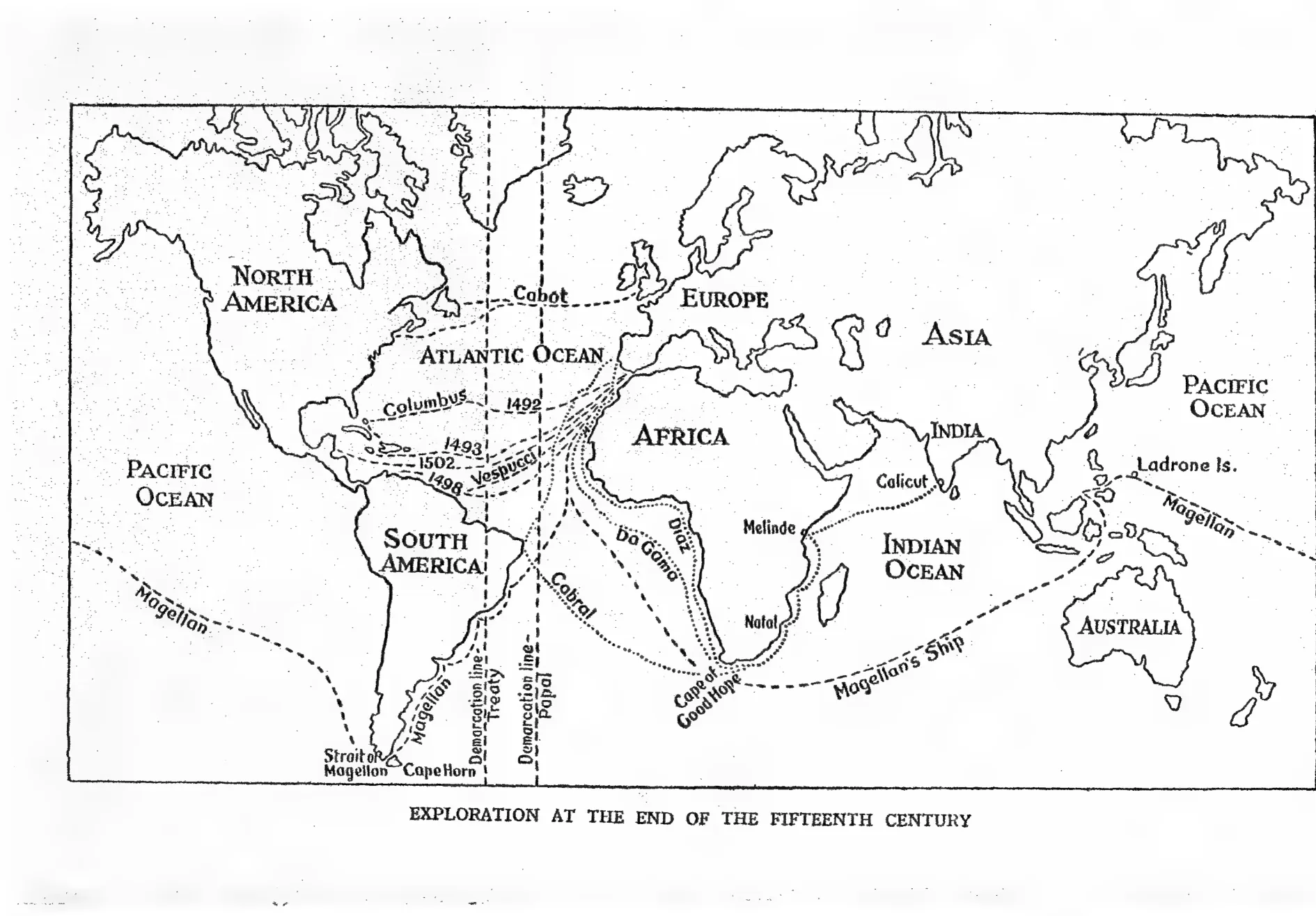
- Exploration at the End of the Fifteenth Century
- The Spanish Colonial Empire
- English Maritime Activity in the Sixteenth Century
- Early English Settlements in North America
- Later English Settlements in North America
- The Franco-British Struggle in North America
- The Fighting at Boston
- The Fighting near New York
- The War of American Independence
- Early Canadian Settlements
- The Dominion of Canada
- Early Australian Settlements
- The Commonwealth of Australia
- New Zealand
- Early South African Settlements
- British South Africa
- India in the Eighteenth Century
- India in 1857
- India — Political Divisions in 1935
- Ceylon
- Malaya and Borneo
- The Western Pacific
- The West Indies
- British West Africa
- Egypt and the Sudan
- British East Africa
- South Atlantic Possessions
- Newfoundland and Labrador
- Palestine, Transjordania, and Mesopotamia
The thirty-second map of the printed list, “The Persian Gulf”, could not be located in the scanned copy; the other thirty-one are reproduced here in place.
Preface
The history of the British Empire, political, constitutional, and economic, does not receive in the schools of Great Britain the attention it deserves. This does not mean that the importance of the subject is overlooked, but that, in view of the limited amount of time available for the study of history, something has to be neglected. It is hoped that this work, which aims at providing an adequate general account of Imperial development, will be of use in those schools in which the subject already receives attention and that it will encourage its study in many others.
The author has endeavoured to place emphasis on the more oi miodern aspects of Imperial development, so that the reader may be made acquainted with the actual problems which confront the statesmen and people of the British Empire at the present day and may take an intelligent interest in the future course of events. For the convenience of students who wish to m&ke use of the book for examination purposes summaries of the chapters are appended. Sketch-maps are given where required for the illustration of the text.
A word of explanation of the arrangement of the chapters may be given. It was felt that a general chronological narra tive, ranging over the whole field, would not leave a clear impression on the mind of the reader, Nor, for various reasons, was a purely geographical division of the subject satisfactory. An attempt has been made to secure the advantages of both methods of presentation.
The first few chapters are devoted to the early settlements and the Old Colonial System as far as the loss of the American colonies. ‘The Dominions are then dealt with in turn, A consideration of Indian history follows, and, after some account of the tropical possessions, the work concludes with some remarks on the Empire as a whole. It should be pointed out, however, that the chapters are sufficiently complete in themselves to make it possible for them to be read in almost any order.
For example the study of the history of the Indian Empire need not be postponed until after that of the Dominions has been completed, nor need the Dominions be taken in the order given. Wherever necessary, references to other parts of the book are given in footnotes.
The thanks of the author are due to his friend and former pupil, Mr. L. A. Pye, B.A., for his kindness in permitting the use of a mass of notes and other material bearing upon the subject.
Introduction: Exploration at the Beginning of Modern Times
Exploration of the surface of the earth hardly began before the fifteenth century. The only parts of the world that were well known in the Middle Ages were Europe, south-west Asia, and northern Africa; even of the extreme north and east of Europe there was little knowledge. South-west Asia was well
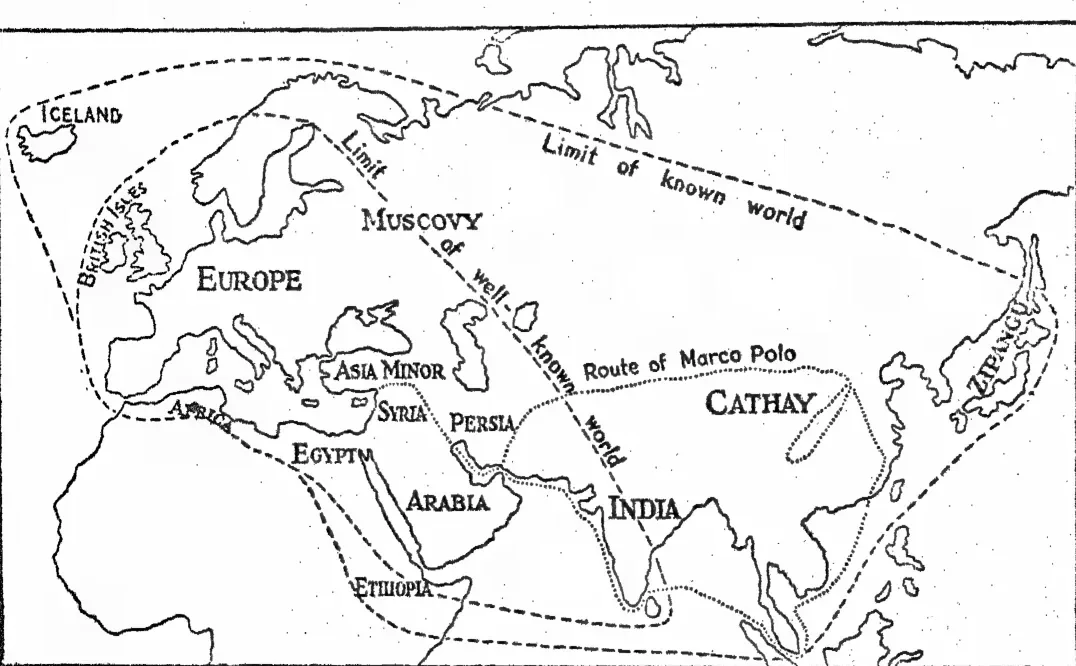
known, and merchants travelled to India, but the remainder of the continent was known only through the tales of a few daring travellers, such as Marco Polo, who had penetrated to Cathay (China) and Zipangu (Japan). Northern Africa was known only as far inland as the desert border. The greater part of Africa and the whole of Australia and America were unknown. Although Scandinavian adventurers: had reached Iceland, Greenland, and the coast of North America, which they called Vinland, hundreds of years. before Columbus crossed the Atlantic, they had not realised that their remote settlement was on the mainland of a vast continent, and its very memory was almost lost.
In the Middle Ages the greater part of the world’s trade was carried on in the Mediterranean. The ports which were on ot near the Mediterranean, such as Marseilles, Genoa, Venice, Constantinople, and Alexandria, were important and prosperous cities, while the countries farther north were regarded as being on the border of the civilised world. In
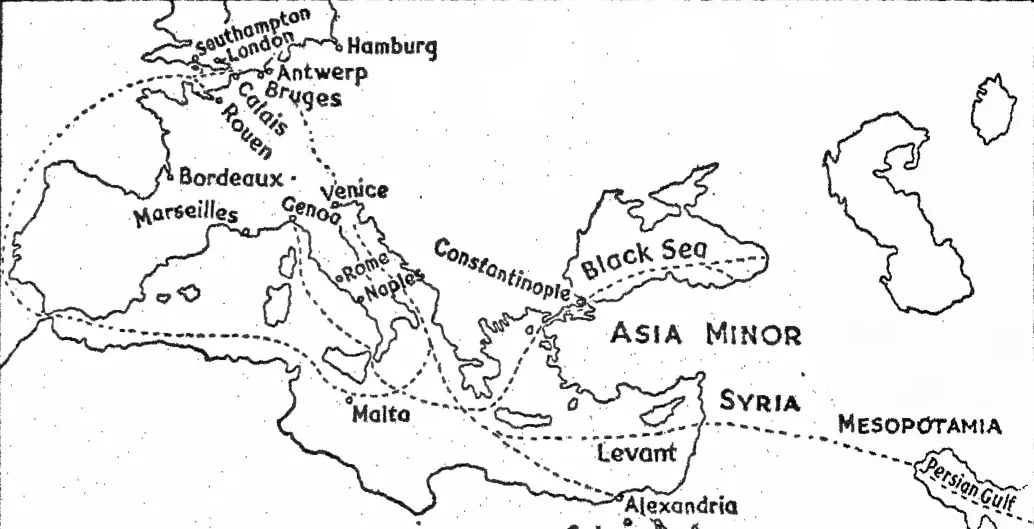
the later Middle Ages the two chief Italian ports, Venice and Genoa, gained much wealth from Asiatic trade. The Genoese traded with Constantinople, where a special part of the city “was assigned to their merchants. Caravans from Russia and Central Asia arrived at the shores of the Black Sea, and goods from these regions reached Constantinople and were purchased by Genoese traders, The, Venetians specialised in trade with India, and. two routes were open to them. They proceeded to the Levant, across the Syrian desert to the Persian Gulf, and thence to Calicut, in India, Alternatively, they made use of the route through Egypt and by way of the Red Sea to India.
‘They possessed a monopoly of the privilege of passing through Egypt, this route not being available to the merchants of other nations. The Venetians, therefore, monopolised Indian trade, so that the produce of the East could be obtained only through them. They could and did charge very high prices for their wares, and they became rich on the profits of the trade.. Venice was a city of merchant princes.
The merchandise from India for which there was so much demand included silks and fine cloths, dyes, ivory, diamonds, and various other articles of luxury, and, above all, spices, which were commonly used to make meat palatable! These oriental products were disposed of by the Venetians to the merchants of other lands at depots in various parts of Europe, and notably at Bruges, where they were well established.
Dissatisfaction was frequently felt, and occasionally expressed, at the high prices exacted by the Venetians. Nothing could be done, however, while the only practicable routes to the
East were engrossed by the Venetians. Only by the discovery of an alternative route to India could the Venetian monopoly be broken down.
The primary motive, therefore, of the exploring activity * of the fifteenth and sixteenth centuries was a desire to discover new routes to the East. The problem attracted much attention towards the close of the Middle Ages, and two possible lines of exploration were considered. There were philosophers who realised the possibility of the world being a globe and not a plane surface, and, if this should prove to be the case, the
2 The exploration which characterised the close of the Middle Ages would hardly have been possible in the absence of certain developments in shipbuilding and in the application of scientific discoveries to navigation. In the later Middle Ages Italian shipbuilders designed for trading purposes a type of vessel of great cargo-carrying capacity, broad of beam, and propelled by sails instead of oars. Vessels of this type were sufficiently seaworthy to sail far out into the Atlantic.
It would, however, have been difficult and dangerous for them to venture far out of sight of land before the invention of the mariner’s compass and the astrolabe. A further factor which contributed to the advance of navigation was the improvement in the art of making maps and charts.
2? Until the close of the Middle Ages the common belief was that the earth was flat, and that its land surface was surrounded by an endless river, called the Ocean. But it was conjectured by some of the philosophers of ancient and medieval times that the earth might be a sphere. ‘This view was put forth by Roger Bacon, an English friar of the thirteenth century, by D’Ailly,.a learned Frenchman, and by Toscanelli, an Italian feasibility of reaching India and Cathay by sailing towards the west.
But the more practicable line of approach to the question appeared to be the exploration of the west coast of Africa, with a view to determining whether it was possible to sail round the continent and so to reach India.
1 It was a common practice in the Middle Ages to kill oxen and sheep in the autumn and to salt the meat for consumption in the course of the winter. Salt was scarce and dear, and if an insufficient amount was used the meat was likely to become tainted and unpalatable. Hence the demand for spices to be used with it. The spices in common use included pepper, ginger, cinnamon, nutmegs, and cloves.
The Portuguese were well situated for making the attempt, and during the fifteenth century Portuguese mariners displayed a good deal of enterprise. Prince Henry the Navigator encouraged the sailors of Portugal to proceed ever farther south, exploring the African coast. He was not trying to find a new route to the East, but wanted his men to open up trade with the natives of West Africa.
He was. pleased when his captains returned with ivory and gold-dust, and especially so when they brought a few negroes to be sold as slaves. Prince Henry died in 1460, but the exploration of the African coast continued, and in 1486 Bartholomew Diaz reached and rounded the cape which he called the.Cape of Storms, but which upon his return the King of Portugal renamed the Cape of Good Hope. In 1497 Vasco da Gama followed Diaz, but went farther. At Christmas, 1497, he touched a region which has since been called Natal. In 1498 he reached Calicut, on the west coast of India, and the problem was solved.
He found the natives by no means willing to trade, but a show of force enabled him to secure cargoes fof his ships. After his return to Portugal a fleet of thirteen ships was fitted out, which in 1501 sailed for India under Cabral. Driven out of its course by storm, it touched land which was afterwards known as Brazil. India was reached after long delays, and after much threatening and some fighting Cabral was allowed. to trade.
With his vessels laden he returned home, and year after year other men followed and developed this new and distant commerce. During the sixteenth century the Portuguese established a number of small settlements on the coasts of Africa, Persia, India, and south-east Asia, Yet, although the Cape route appeared to be open to all, it was used only by the Portuguese for nearly a hundred years after its
» discovery,
The alternative line of exploration—sailing to the west—was attempted by Christopher Columbus, a Genoese, who sailed under the patronage of Isabella, Queen of Castile. The story of his early efforts to secure recognition and support is well *« known and need not be repeated in detail. Toone Government after another he propounded his ideas—that the earth was a globe, that an ocean of only moderate width separated the east of Asia from the west of Europe, that, possibly, islands existed in this ocean, and that, consequently, a direct route to the Indies might be discovered and used by the mariners of any nation which was bold enough and sagacious enough to make the attempt.
Columbus met with neither support nor encouragement until he applied to the court of Castile. He was commissioned by Isabella to discover new lands on behalf of Spain, and he was promised various privileges and a substantial share in the profits which might accrue from the voyage.
Columbus left Palos in August, 1492, and, after refitting at the Canaries, he sailed westwards for five weeks, At length he reached an island+ in the Bahamas, and continued his voyage to the islands now known as Cuba and Haiti. During the outward voyage, which was much longer than he had anticipated, only his rigid determination and iron nerve kept him from returning, especially in face of the mutinous attitude of his men.
He took on board some of the products and a few of the natives of the islands at which he touched, and with these he returned to Spain, confident that he had reached the islands which lie to the south-east of Asia and which were known under the general name of the “Indies.”’?
His second voyage, in 1493, resulted in the discovery of Jamaica, but again he failed to touch the mainland of Asia! Five years later, in 1498, he made a third attempt, bearing farther south this time, in order to avoid the island group and reach the mainland. This resulted in his touching the mainland, not, indeed, of Asia, but of South America, at what is now Venezuela. On his fourth voyage, in 1502, he reached Honduras. At the time of his death in 1506 he was ignorant of the fact that the newly discovered lands, which he had naturally referred to as the “Indies,” were not parts of Asia at all, but of a hitherto unknown continent.
Other adventurers followed Columbus. Amerigo Vespucci explored a large part of the coast-line of Central America and
1 Known to the natives as Guanahani.. Probably, but not certainly, Watling Island,
2 Even if Columbus hat not made the attempt, or if he had failed, the discovery of the New World could not have been postponed much longer. iene would have been demonstrated by the voyages of Cabot
the northern part of South America! Ponce de Leon discovered Florida, and Balboa crossed. the Isthmus of Panama and reached the Pacific, which he thought must be a large lake in the interior of Asia.
The work of these explorers made possible the construction of maps and charts of these regions which did not correspond with what was known of the Asiatic coast. It is difficult to state with exactitude at what point in the exploration of the New World the Spanish became convinced that their discoveries were not part of Asia. The problem of the geographical relation of the new lands to those parts of the world which were already known was solved by Magellan, a Portuguese in the service of Spain.
Setting out in 1519, he bore southwards and, after a long voyage, reached the southern point of the American continent. He passed through the strait which is called after him, and after a weary voyage across the Pacific he reached the East Indies. He was killed in some fighting with natives in the Ladrone Islands, but his ships continued their voyage. They rounded the Cape of Good Hope and returned to Spain after an absence of three years. The voyage was of immense importance.
It proved the world to be a globe and to be far larger than any one had hitherto thought possible. And a new route to India had been discovered! But it was of such great length as to be useless for the purpose of trade.
If Spanish exploration had failed to find a practicable route to India it had discovered something of much greater value. A new continent whose very existence had hitherto been unsuspected lay to the west of Europe, and Spain claimed it as hers by right of discovery. It could hardly be expected that other nations would, without challenge, allow Spain to retain the whole of the New World for ever. Yet, by a series of bulls 2
(r) 1492. Confirming to the Spanish crown the lands discovered by Columbus on his first voyage. (2) 1492. Limiting the Spanish field of exploration to the region west of a meridian one hundred leagues west of Cape Verde Islands and the Azores.
(3) 1493. Superseding the earlier bulls, and leaving the whole field of exploration open to both Spain and Portugal, with the proviso that Spain issued in 1492-3, Pope Alexander VI confirmed the Spanish in the possession of all lands discovered west of a line drawn notth and south one hundred leagues west of Cape Verde Islands, and assigned to the Portuguese all lands east of this line.
By the Treaty of Tordesillas, 1494, Spain and Portugal agreed to move the line of division farther west—to three hundred and seventy leagues west of Cape Verde Islands,1 This change afterwards gave the Portuguese a claim on Brazil,? which was not known at the time of the treaty, it being discovered by Cabral in 1501, as related above.
was to approach it by the west and was to respect the Portuguese right to
the African coast.
1 The work of Amerigo Vespucci became better known than that of Columbus, and his name was ultimately associated with the newly discovered continent. The name ‘America’ was first applied to it ina German work on geography which was published in 1507.
2 The papal bulls on the subject were as follows:
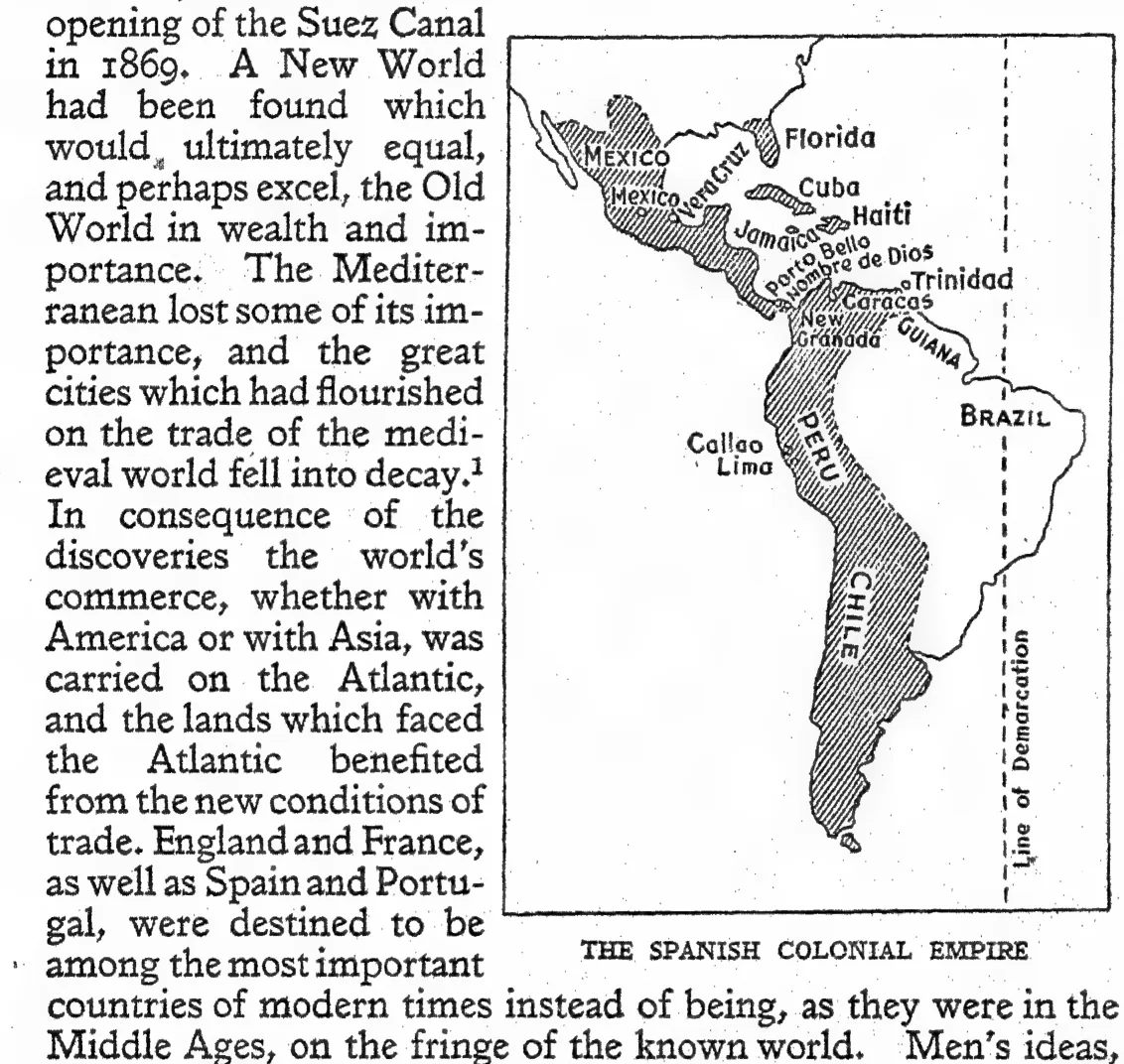
These arrangements left most of America in Spanish hands, and when it was found that gold and silver and precious stones | existed in certain parts the Spanish were eager to make settlements. Several colonies were established in Central and South America. Mexico was conquered by Cortez, Peru by Pizarro, and in the course of the sixteenth century the Andean provinces—Ecuador, Chile, and Colombia—were added to the Spanish Empire. Native races were subjugated and enslaved.
The settlers in the Spanish colonial provinces were for the most part wealthy planters who produced sugar, spices, and other tropical products by means of slave labour. But the Spanish colonial empire was especially valued on account of the abundance within it of the precious metals. The produce of the mines of Peru was sent to Lima and was transported thence by sea to the Isthmus of Darien. It was conveyed across the Isthmus to Porto Bello in readiness for shipment to
Europe. Every year a fleet, strongly convoyed by warships, sailed from Spain to Central America... The ships called at various West Indian islands for purposes of trade; some of - them, known as “‘the fleet,” then made for Vera Cruz and embarked the produce of the Mexican mines, while the other section, “the galleons,’”’ received the treasure from South America at Porto Bello, where a great fair was held. The reunited fleet then returned to Europe by routes which were varied from year to year.
This annual visit of Spanish ships to America was thus made for the purpose of carrying on trade as well as of conveying treasure. The whole of Spanish 3 The line agreed upon in the Treaty of Tordesillas was supposed to be midway between the Azores and the newly discovered islands in the West Indies. It has been calculated that the line was the meridian 45 37’ west. of Greenwich.
In early Portuguese maps Brazil was placed several degrees east of its correct position.
colonial trade was in the hands of a single privileged organisation at Seville; trade with foreign countries was forbidden, and foreign ships were not permitted to visit Spanish colonial ports.
The importance of the exploring activity of this period cannot be exaggerated. A new way to India had been discovered, which was to be the chief route to the East until the opening of the Suez Canal
and perhaps excel, the Old ranean lost some of its imcities which had flourished on the trade of the medieval world fell into decay.?
and the lands which faced from the new conditions of | trade. Englandand France, % as well as Spain and Portu' among the most important countries of modern times instead of being, as they were in the Middle Ages, on the fringe of the known world. Men’s ideas, too, were widened... They found that much of what had passed for geographical knowledge was false.
They were encouraged by the success of the exploration of this time to continue it in other directions, There has never been a time since the beginning of the sixteenth century when men have not been exploring some part or other of the earth’s surface, and if the work is now slowing down it is only because it is approaching completion.
1“ The whole city [Venice] was distressed and astounded [at the news of the Portuguese discoveries]. The wisest heads in Venice took it to be the worst piece of information that could have been given them.”
Chapter IEnglish Maritime Activity in the Sixteenth Century
During the Middle Ages the English were not a seafaring race. Ships visited English ports, and a certain amount of overseas trade grew up, but most of the ships were manned by aliens, and the bulk of the trade was carried on by continental merchants. Towards the close of the Middle Ages English merchants began to compete with those from overseas, and the earliest of the great trading companies came into existence. During the fifteenth century merchant ships were built in England in considerable numbers. Nevertheless, it remains true that at the beginning of the Tudor period English maritime activity was in its infancy.
The French made no sustained effort to join in the exploration which was being undertaken by the Spanish and Portuguese in the first half of the sixteenth century. In 1534 Jacques - Cartier sailed from St. Malo and reached the mouth of the St. Lawrence, He repeated this exploit in 1540, and on this second voyage he sailed some distance up the river. But Cartier’s explorations, like those of Cabot, were not followed. at the time by any attempt at settlement.
1 Cabot was a Genoese, who had lived in Venice for some years and had become a Venetian citizen before coming to England,;
English maritime activity really began in the reign of Henry VIII, who realised the political importance of the separation of England from the continent of Europe by the narrow seas. He understood that England must be defended on the sea, and during his reign he built nearly fifty ships for the royal navy. These ships differed from the slavemanned galleys which had hitherto taken part in naval warfare.
While galleys were used, the object of naval tactics was either to ram the enemy or to grapple and board him. By mounting guns + on his ships Henry brought about a revolution in naval tactics. The building of merchant ships also went on during the reign. In addition, Henry established Trinity House, and entrusted to that body the work of providing lighthouses and lightships, buoys and beacons, and the various other marks which make the English coast safe for navigation.
Nevertheless, the reign of Henry VIII stands out as a time of preparation rather than of achievement. Few distant voyages were attempted. William Hawkins, of Plymouth, the father of Sir John Hawkins, sailed to Brazil, and, evading the Portuguese, traded with the natives. Hore, a citizen of London, crossed the Atlantic in 1536, and reached either Newfoundland or Cape Breton. But the attention of Englishmen at this time was directed less to contesting the monopoly of Spain and Portugal than to the discovery of another new route to the
East, and in 1527 Robert Thorne, a merchant, suggested that, as the Spanish had passed round the south of America and reached the Indies, the English might attempt the voyage round the north of the continent. The only recorded effort to test the practicability of this idea was that of John Rut, in
1527, Rut found his way blocked with ice, and after losing one of his ships he abandoned the attempt.
In the middle of the sixteenth century attention was directed towards the possibility of reaching the East by way of the north of Europe and Asia, Under the guidance of Sebastian Cabot a company was formed to finance a venture which was undertaken by Sir Hugh Willoughby and Richard. Chancellor.
Willoughby died of cold at Arzina, in Lapland, but Chancellor
Woolwich.
1 Arsenals for the manufacture of guns were set up at Deptford and
reached Archangel, on the White Sea, and travelled overland to Moscow. He was received by the Tsar Ivan the Terrible, and upon his return to England the Muscovy Company was chartered to trade with Russia.;
In the troubled times which followed the death of Henry VIII a new form of maritime activity arose. Men of the south-west built ships for piratical purposes. While Mary was burning Protestants in England and Philip was burning them in Spain and the Netherlands, men of Devon and Cornwall ventured out into the Channel in small, well-built, well-rigged, speedy vessels in which they attacked galleons trading between Spain and Flanders, and secured many a prize.
Though this was piracy it was piracy with a religious and a national colouring, It was Protestant and English, and the object of attack was Catholic Spain. These Channel rovers had to be very good seamen, for the penalty of capture was death. They continued their efforts throughout the reign of Elizabeth. Philip complained, and Elizabeth, in the earlier years of her reign, promised to take action. But she was neither willing nor able to suppress Channel piracy.
Proclamations were issued and were disregarded; the rovers had little fear that the queen would make any serious attempt to stop exploits which were weakening Spain and providing England with a body of good seamen at no cost to herself.
The reign of Elizabeth witnessed a great development of English seamanship. The nation realised that a conflict with Spain was inevitable. For the waging of war, ships and men and money were needed. Spain had the advantage of a ge continuous supply of treasure from the mines of the New World, and the aim of English seamen was to secure for their country a share of the wealth of the recently discovered lands’ overseas. By four different methods Englishmen tried, with more or less success, to realise this aim.
One way of obtaining wealth was by trading. The secret of successful trading was to find that. a necessary article was nie scarce and dear in one place and plentiful and cheap in another, and to transport it in sufficient quantities from the one place to the other, In the Spanish colonies labour was scarce. ‘The Spaniards themselves would not, and in a tropical climate could not, condescend to undertake manual labour.
They had attempted to enslave the native Indians, who, accustomed to hunting, had rapidly died off under conditions involving regular toil. It occurred to John Hawkins, an English merchant, that the Spanish labour problem might be solved by the importation of African negroes.t Although Spanish rules forbade the carrying on of trade with Spanish colonies by any but the ships of the official Colonial Company of Seville, Hawkins cared little for this prohibition.
In 1562, with three ships, he visited West Africa, obtained cargoes of negroes, and crossed the Atlantic with them. Visiting various ports, he was forbidden by governors and customs officials to do any trade. But he found that the colonists were eager to buy his negroes and that the officials had no force with which to back up their prohibition. He sold his slaves, bought colonial produce, and returned to England, having made substantial profits on the round voyage.
The whole adventure took more than a year, and in 1564 he repeated it—this time with four ships. He had more difficulty in obtaining his slaves and more difficulty in disposing of them. Yet by threatening to use force he was successful, and again made a profit. His third venture, in 1567, was with five ships, and after he had disposed of his cargo of slaves he put into the harbour of San Juan de Ulloa, near Vera Cruz, to refit for the homeward voyage.
A Spanish fleet of war appeared outside the harbour, and Hawkins was trapped! Philip II, much incensed at the illegal proceedings of the Englishman, had sent out a fleet to uphold his prohibition of colonial trade with foreigners. The Spanish admiral promised to allow Hawkins to depart, but broke his word, for when the English ships left the harbour they were attacked, and three were sunk, Only the ships commanded by Hawkins himself and by his young cousin Francis Drake, who was making his first voyage to the Spanish Main, escaped.
This was the end of open trading, although from time to time bold captains continued, with varying degrees of success, to attempt a little smuggling, with which, as opportunity offered, they mixed a little piracy.
Drake was a Devon man whose knowledge of the sea had been gained as a Channel rover.. It seemed to him that a better way of securing the desired end of obtaining New World wealth was to apply Channel rover methods to the Spanish
1 Hawkins was not the founder ofthe negro slave-trade.. The importation of negroes into the West Indies by Spaniards and into Brazil by the Portuguese had been going on since the early years of the sixteenth century.
Main. After his first crossing of the Atlantic in the company of Hawkins he made many voyages and distinguished himself by vigorous and successful attacks upon Spanish ships and settlements. England and Spain were not at war, and Drake did not hold the queen’s commission, so that he certainly would have suffered as a pirate had he been captured. On one occasion he crossed the Isthmus of Darien and saw the Pacific Ocean.
He resolved to sail upon it, and in 1577 he started on the most famous of all his voyages. It is probable that he had no intention of sailing round the world when he set out. There is some reason to believe that on this occasion he held the queen’s commission. With five ships he skirted the South American coast.
Difficulties arose, but mutineers were hanged and storms were weathered, and Drake at last reached the Pacific, though with only one ship, the Pelican, which he renamed the Golden Hind, Sailing northwards, he learned: that it was possible for him to overtake the treasure-ship which bore the year’s produce of the Peruvian mines from Lima to the isthmus. The vessel was slow and without means of defence, since the Spaniards had never considered the possibility of piratical attack in the Pacific.
It fell an easy | prey to Drake, and he continued his voyage northwards. He probably intended to return to England by rounding the north of North America, then unmapped and uncharted. He landed at New Albion (California), and took formal possession of it on behalf of Queen Elizabeth. Again sailing northwards, he found that the coast trended to the north-west, and he abandoned his plan and decided to cross the Pacific.
This was done, and the return to England was accomplished by way of the Cape of Good Hope. He arrived home in 1580, after three years’ absence, during which many people must have given him up as lost, The queen showed her appreciation of his exploit by knighting him on his own quarter-deck, and by disregarding the Spanish demand for his surrender as a pirate, He made several subsequent voyages to the Spanish Main, both before and after the Armada, but his voyage round the world will always rank as his greatest achievement..
In 1586 Thomas Cavendish began a voyage which formed a fitting parallel to Drake’s achievement. Sailing with three ships to South America he passed through the Straits of
Magellan, attacked and plundered Spanish ships in the Pacific,
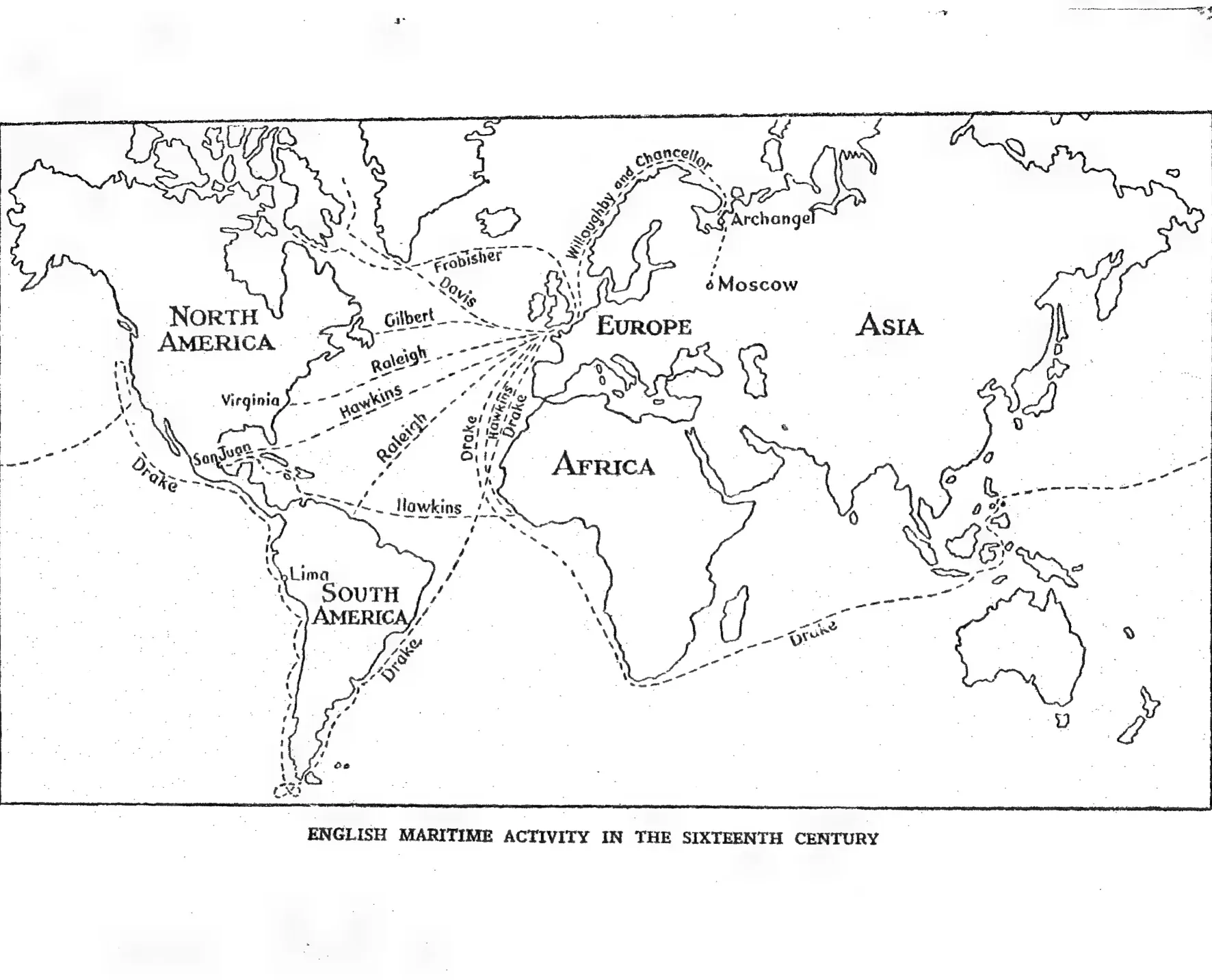
rounded the Cape of Good Hope, and, after touching at St. Helena, reached Plymouth a few days after the Armada had been routed. His exploit is no less important than that of Drake in view of the addition thereby made to English knowledge of distant seas.
A third way of trying to secure New World wealth was by establishing settlements distinct from those of Spain. North America was barely touched by the Spanish, and settlements were attempted in Virginia by Sir Walter Raleigh and in Newfoundland by Sir Humphrey Gilbert.. These efforts are described in the next chapter. They were, for various reasons, unsuccessful, and by the death of Elizabeth no transatlantic settlement had been established by Englishmen.
The remaining type of maritime enterprise in Elizabethan times was represented by efforts to discover a new route to India. It has been pointed out that, a century earlier, Spanish and Portuguese navigators had been inspired by a desire to solve this problem, and it was now possible to reach the East by rounding either the Cape of Good Hope or Cape Horn. The latter route was impracticable by reason of its great length and the former was felt to be wearisomely long.
Both were under Spanish control, for Portugal passed under the rule of the King of Spain in 1580, and from that time till the middle of the seventeenth century Portuguese possessions in the East and on the way to the East belonged to the Empire of Spain. English seamen in Tudor times tried to -reach the East by exploring the north-east and north-west passages,
The voyage undertaken by Sir Hugh Willoughby and Richard Chancellor to reach the East by way of the north of Europe and Asia has already been mentioned. A glance at the map shows the impracticability of the idea, but it must be remembered that it was through the efforts of such men as Willoughby and aes that the construction of the map has been possible.
The north-west passage—the rounding of the north coast of North America—was tried by Martin Frobisher, in three voyages, and, after him, by John Davis, also in three voyages. They did not succeed, and many subsequent attempts in later years equally failed.;
It could no longer be said, as Elizabeth’s reign progressed, that the English were a race of farmers, unaccustomed to the sea. A body of seamen sprang up who gained for themselves a reputation for daring and enterprise which has never since: been lost. They challenged Spanish power in many parts of the world, and they met, and overcame, the formidable fleet— the Armada—which was sent by King Philip to conquer this country. With this event the maritime power of Spain passed its zenith, and began to decline.
Chapter IIEnglish Settlements in North America
Except for some plantations in Ireland, the earliest attempts by Englishmen to settle overseas were made in the reign of Queen Elizabeth. They were not successful, and when the last of the Tudors died no English colony was in existence.
The first English attempt to establish a settlement in the New World was that of Sir Humphrey Gilbert, who in 1583 took formal possession of the island of Newfoundland in the mame of Queen Elizabeth. The settlers were few and were not well equipped. A store ship was wrecked, and Gilbert sailed for England with the intention of returning the next year with a larger company. But his ship, the Squirrel, foundered in a storm, and the settlement was for the time being abandoned.
Sir Walter Raleigh, Gilbert’s half-brother, in 1584 obtained the queen’s permission to establish a plantation in North America. He decided to make for a point farther south than the bleak and barren shores of Newfoundland, and a pre-liminary expedition under Barlow resulted in the formal: annexation of Roanoke.! Satisfactory reports on the climate wand fertility of the region were brought home, and in 1585 a colony called Virginia was established on the mainland under the direction of Sir Richard Grenville.
But the settlers were more intent upon adventure than upon hard work; they prospected for gold, and they came into conflict with. the Indians. A year later Drake visited the plantation, whose inhabitants were glad to ayail themselves of the opportunity to return to England. =.
Raleigh sent a second band of colonists to Roanoke in 1587. The colony again met with difficulties. Little could be done to reinforce it in 1588, the year of the Armada, and by 1589 it was too late. The relief ships which arrived in that year found the settlement deserted, its inhabitants probably having been massacred by Indians.
3 Roanoke is now part of the state of North Carolina,
Raleigh did not give up hope of establishing an English colony in the New World, and he turned his attention to Guiana, the region between the Orinoco and the Amazon, in South America. With the queen’s permission he led an expedition to the Orinoco in 1595. He explored the region for three hundred miles, and he returned with glowing reports of the suitability of the region, in respect of climate and soil, for settlement, and, in particular, of the abundance of gold and silver in a native city called Manoa. But the exploration was not followed by any attempt at settlement.
The reign of Elizabeth thus closed before a single settlement had been permanently established in the New World. Yet the efforts which had been made were not without value. The sixteenth century had witnessed the development of the maritime strength of England to a point at which she could challenge the position of Spain, the foremost power of the times. A race of skilful and intrepid seamen had come into existence; they had penetrated to. most quarters of the globe. If their early attempts at colonisation had failed of permanence Englishmen had at least learned something of the causes of failure and of the conditions under which success might be achieved.
The successful colonisation of Virginia in the reign of James I was the result of more thorough preparation, backed by more substantial resources. The king granted a charter to a company instead of to a single proprietor. The Virginia Company + was formed in 1606, and in the following year a settlement was established at Jamestown. The government of the colony was entrusted to a local Council chosen from the settlers, but its decisions were subject to the approval of the Royal Council of Virginia in London.
This system was not satisfactory; there was nobody in the colony with authority to act firmly in an emergency, while many weeks might elapse before instructions could be received from London. Although some of the members of the Royal Council were men who had sailed overseas, the Council asa whole was hardly likely to realise the difficulties which confronted the pioneers.
Moreover, the Virginia Company, which had provided the capital for the venture and which could not for some years look for a return upon its investment, was excluded from any material share in the government. Not only was the constitution of the colony defective; the early settlers were not of a type likely to make a success of the enterprise. They were more eager to prospect for gold than to till the soil, and when they failed to find it some of them deserted.
1 The Virginia Company was granted territory between the thirty-fourth and the forty-fifth parallels of north latitude.
In 1608 Captain John Smith became president of the Resident Council. He realised the importance of agricultural work, and under his direction the affairs of the colony began to improve. The constitution of Virginia was revised in 1609, when a new charter was granted to the Virginia Company; it was given control of the administration of the colony and was empowered to appoint its Governor.
Lord Delaware was sent out as Governor in 1609, and Sir Thomas Dale became his deputy in 1611. Dale was a martinet who established order by taking stern measures against malcontents, The colonists settled down to work, and the cultivation of tobacco proved to be profitable. In course of time large estates were formed, and the English settlers became an aristocracy of planters, labour being provided by paupers and criminals from England,’ and, after 1619, by negro slaves.
In 1619 a representative Assembly was set up in the colony, for which it was empowered to frame laws. Every free settler was entitled to vote at the election of representatives. The colonial government thus developed on democratic lines, and the precedent then set up was followed from time to time in the constitutions of other settlements on the North American continent. It is worthy of note that the colonies were more advanced politically than the home country,? in which the franchise was exercised by only a small part of the population until the nineteenth century was well advanced.
The charter of the Virginia Company was revoked in 1623, and henceforth the Governor of the colony was appointed by the Crown. The importance of the Assembly increased, and in course of time it secured control over the internal taxation
> Indentured servants were bound to serve their masters for a number of years, at the end of which they became free and might become landowners, or, more frequently, overseers for the wealthier planters.
This, however, is less true of Virginia than of the New England colonies. ~ ‘In Virginia the free settlers, who alone possessed the vote, were really the aristocracy of the colony. The indentured servants and the slaves had no “political rights. The student of ancient history will have no difficulty in tracing, in this respect, a parallel between Virginia and Athens of the colony. The Governor’s salary was subject to its vote, and friction occasionally occurred between the Governor, as the nominee of the Crown, and the Assembly, as representative of the colonists.+
Virginia stands conspicuous among the colonies for its devotion to the Stuart cause. It was ill repaid for its loyalty by Charles II when, in 1672, he conferred upon Lord Arlington and Lord Culpeper the entire freehold of the colony, in complete disregard of the rights of the colonists. Instead of being the owners of their lands the Virginians were suddenly reduced to the rank of tenants of the new proprietors.
Stuch a wholesale confiscation could not be enforced, and the two lords commuted their “rights” in return for the proceeds of certain customs duties. Culpeper was Governor of the colony for a time, during which he distinguished himself by the oppressive character of his rule. After the Revolution of 1689 Virginia recovered the rights which had been endangered or ignored in the later Stuart period.
The colony of Maryland,* to the north of Virginia, was established in the reign of Charles I, who granted a charter to Sir George Calvert, making him proprietor of the settlement. Maryland thus differed from Virginia in that the rights which in the latter case were held by a company were here conceded toasingle person.
Calvert, who became Lord Baltimore, was a Roman Catholic, and he welcomed in the colony, which was established in 1632, his co-religionists who were suffering in England from the penal laws passed in the reigns of Elizabeth and James I, The religion of Maryland was nominally that of the Church of England, but it was exceptional among the. North American plantations in that all forms of Christianity were tolerated within it. In 1647 a representative Assembly was set up on the Virginian model. The economic development of Maryland was similar to that of Virginia.
After the Hampton Court Conference a number of Puritans left England for the United Provinces, For some years they lived at Leyden, but they ultimately decided to settle in North America. A company, afterwards known as the Plymouth colonies. The Virginians were churchmen and Tories, and they were
disinclined to assume an attitude of antagonism towards the Government.
Pe eo was so named in honour of Henrietta Maria, the queen of
1 Such friction was less pronounced, however, than in some of the other
Company, was formed in England to finance the venture, and it obtained from the Virginia Company permission to make a settlement within the latter Company’s territory. In 1620 the Pilgrim Fathers crossed the Atlantic in the Mayflower, and ceached a bay to the west of Cape Cod, where they established a plantation which they called Plymouth, This, however, was outside the territorial limit of the Virginia Company, and the Plymouth Company obtained a charter from the Council of
‘New England! legalising its position.
The colony was faced with exceptional difficulties, but the ‘settlers were exceptional men. The climate was severe, and ‘much preliminary clearing work was necessary before cultivation could be undertaken upon a scale large enough to make the colony self-supporting. Sickness appeared, and many of the original colonists succumbed. The Indians were not friendly, and for many years the settlers had to be constantly on guard against attack. But reinforcements arrived from time to time, and the colony slowly developed. Climatic conditions were such that white men were able to undertake manual labour, and negro slavery was not introduced.
The Plymouth Company lasted only seven years, and upon its abolition the control of affairs within the colony was trans-ferred to the settlers themselves. The Governor was elected by an Assembly which included the whole of the freemen, and the practical work of government was entrusted to a “Court” consisting of the Governor and seven Assistants, As the population increased the Assembly of freemen became inconveniently large, and a representative Assembly was set up in 1638.
The franchise was restricted to church members, and the plantation thus retained that distinctively Puritan character which it had had from its foundation. It exhibited the less pleasing characteristics of Puritanism as well as its virtues, and the “freedom to worship God,” for establishing which the Puritans have been extolled, was freedom for Puritans alone.
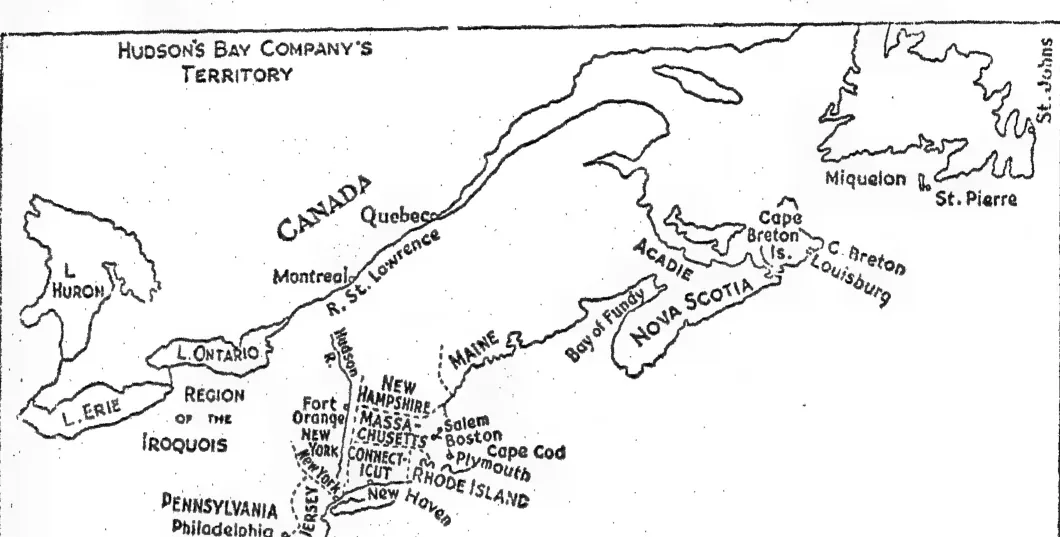
The important colony of Massachusetts was established by the Massachusetts Bay Company, which in 1629 secured privileges from the Council of New England and a charter from the Crown. The Company did not last very long, since. most. of its shareholders became settlers, and the control of the plantation was transferred to its inhabitants, The original settlers were Puritans who had not separated from the Church of England, but in their new homes they severed their Anglican connection and set up churches on the Independent model.
1 A body established in 1619 with authori over lands extending fro: the Hudson River to Nova Scotia. ¥ ae
They were extremely intolerant, and a rigid standard of morality was enforced by law. The earliest settlement was in 1628, at Salem, before the charter had actually been secured, but withim a year or two Boston became the leading township in the plantation. For some time the population was augmented year by year by new arrivals from England; after 1640 English Puritans were engaged in a struggle at home which hindered migration.
Massachusetts was ruled by a Governor who, with a body of Assistants, was at first appointed by the Company at home. With the growth of the colony it secured the right of appointing the Governor and his Assistants, and in 1634 a representative Assembly was established. As in the Plymouth settlement, the franchise was limited to church members, and the distinctively Puritan character of the plantation was maintained. _ Dutch settlers from the Hudson River established a settlement on the Connecticut River, where also Puritans from Massachusetts established an outpost in 1633.
The English maintained possession, and in 1639 Connecticut was recognised as a separate colony in which Governor and Assembly were: elected by the freemen. In the case of this colony no religious: test was imposed, and toleration prevailed. Another settlement was made at New Haven in 1638; this was merged into Connecticut in 1662.
Rhode Island, a colony on the shores of Narragansett Bay, was set up by Roger Williams, a Puritan minister who was dissatisfied with affairs in Massachusetts. Holding that the Government ought not to interfere in matters of religion, he with his followers seceded from the parent colony, and in Rhode Island founded a settlement in which the fullest religious toleration was permitted.
North of the territory of Massachusetts settlements were formed which later became known as New Hampshire, and farther north still were some scattered posts which formed the colony of Maine, of which Sir Ferdinando Gorges was proprietor. Both Maine and New Hampshire were in course of time absorbed by Massachusetts.
The New England colonies, founded during the first half of the seventeenth century, and extending from Maine to
Connecticut, possessed certain features in common, some of which have already been indicated, Climatic conditions were such as to encourage white settlers to toil, and slavery was rare. The land was covered with timber, which had to be cleared before agricultural operations could be undertaken. Lumbering became an important industry, and the abundance of timber encouraged ship-building. Fisheries also were important. The
domes)
Puritan New Englanders were often men of education, and usually of intelligence and enterprise, and were of a type fitted to build up democratic institutions in a new world. To the hardships necessarily attendant upon early settlement in an undeveloped land was added danger from the enmity of natives. The attitude of the Indians to the new-comers was one of suspicion, which soon developed into hostility. Border warfare was constant; the pioneer was always in peril, But in the long cun the white man proved to be superior to the red, and the latter was driven farther and farther into the interior,
The New England colonies thus differed in several respects from those farther south. Differences in the type of colonist and in the system of labour recruitment have already been mentioned. It should be noticed that the New England colonies were in climate and productions similar to England,
They produced nothing which was not already produced in England, and so added little or nothing to the strength of the home country. They were regarded, economically, as of no great importance, and they were valued chiefly as places of refuge or exile to which men who could not accept the English political or religious system might retire. Virginia and Maryland, on the other hand, with their warmer climate and more generous soil, produced tobacco and other crops which were required in England.
They assisted to make the home country independent of foreign lands in respect of certain necessary commodities, and were valued accordingly. Trade between England and these colonies developed to a greater extent than. between England and New England, and this perhaps explains why in later years the Virginians were more loyal than the New Englanders to the mother country.
In 1641 a loose confederation of four of the New England colonies was established. Massachusetts was the leading spirit of the movement, and with her were associated Plymouth, Connecticut, and New Haven. Rhode Island and Maine were expressly excluded fromit. The confederation had no concern with the internal administration of its constituent units; it was a league for mutual assistance in offence and defence. Massachusetts was more powerful than the other members, and her contributions in men and money were greater than theirs; consequently, she dominated the confederation.
It was directed, ostensibly, against French and Indian attack; it might be of value in resisting undue interference by the home Government. It was viewed with dislike in England, scarcely less by Cromwell and the Republicans than by Charles II and the Cavaliers. Soon after the Restoration Connecticut and New Haven withdrew from the league, and Massachusetts was left in practical isolation.
The passing of the Navigation Acts! was more. bitterly resented in Massachusetts than in other colonies. The Acts were openly violated. In spite of official efforts at prevention illicit trade with Spanish colonies in the West Indies and Central America was carried on. The charter of Massachusetts was cancelled in 1683, but the privileges of the colony were restored after the Revolution. It was, however, now a Crown Colony, with a Governor appointed by the.
Crown, and the religious disabilities which had hitherto weighed. heavily on all those of its inhabitants who were not Independents were ended. During the eighteenth century the history of Massachusetts differed little from that of its neighbours, and consisted of a record of friction between Governor and Assembly, fighting with Indians on the frontier, and gaining wealth by illegal trade.
A French settlement was formed on the Bay of Fundy in 1604, but it was destroyed in 1613 by a party of Virginians. In 1621 James I issued a charter to a company of Scotsmen, formed by Sir William Alexander, authorising it to colonise within a region between the St. Lawrence and the St. Croix. This territory had already been claimed by the French as their province of Acadie; nevertheless, a number of Scotsmen founded a colony and named it Nova Scotia.
During the war with France in 1627-9 the Nova Scotians came into conflict with the French, and in 1628 they captured Quebec. But in 1632 Quebec was restored to the French, and, in spite of the protests of the Nova Scotians, the French claim to Acadie was recognised. Henceforth Nova Scotia was lost to the British until the Peace of Utrecht.
A Dutch West India Company was formed in 1621 for the purpose of colonisation in West Africa and in America. A settlement was formed on the Hudson River as early as 1623, when Fort Orange (Albany) was built. In 1626 Manhattan Island was purchased from natives, and New Amsterdam was founded. Other posts were established, and the Dutch settlements developed into the colony of the New Netherlands.
Farther south a Swedish settlement, Delaware, sprang up in and after 1638, but it fell into the hands of the Dutch in 1655. Hostility between Dutch and English in North America was inevitable, since the New Netherlands interposed a barrier between the New England colonies and those of the south. Moreover, communication was possible between New Amsterdam and Canada by way of the Hudson valley, and if the Dutch colony should ever fall into the hands of the French the English position would be precarious. During the Anglo-Dutch War in the reign of Charles II the New Netherlands fell before the
English colonial attack, and by the Treaty of Breda, 1667, it remained in English possession, forming henceforth the colonies of New York, New Jersey, and Delaware. The danger to the English position in North America was thus averted.
The conquered territories were assigned by the king to his brother, the Duke of York, and New Amsterdam was renamed
New York. A Governor was appointed to rule it. There was little interference with the occupations or habits of the people. In course of time the Dutch, Swedes, and Germans of the newly acquired colonies were reinforced by the immigration of Puritans from New England, and a demand arose for the establishment of a legislature of the type already existent in other English colonies.
In 1683 a Charter of Liberties was granted to the colony by which an elective Assembly was called into existence, with rights of legislation and taxation. The charter was revoked soon after the Duke of York became king as James II, but after the Revolution New York became a Crown Colony and its former privileges were restored.
Pennsylvania was founded in 1681 by William Penn, the son of the Penn who had captured Jamaica.t Charles II was in debt to the father, and liquidated his obligations by the grant to the son of a charter by which he was authorised to found a colony in the territory north of Maryland and west of the lands recently acquired from the Dutch. Penn was a Quaker, and desired to found a home for his co-religionists on religious and democratic principles.
The colony was to be ruled by the proprietor or a Governor nominated by him, and both Executive and Legislative Councils were to be elected. The settlers were not to make war upon the Indians; it was expected that if Indians were treated fairly no occasion of conflict would arise, Toleration was to be accorded to all forms of Christianity.
The colony prospered, and within a few years had a large population, since, in addition to its Quaker founders, it received Dutch, Swedish, German, and French Protestants from Europe and from other parts of North America. Agriculture, mining, and manufactures developed, and a flourishing export trade sprang up. The colony was not quite free from slavery, but the few bondmen were well treated, and the industrial system depended less upon them than upon free labour.
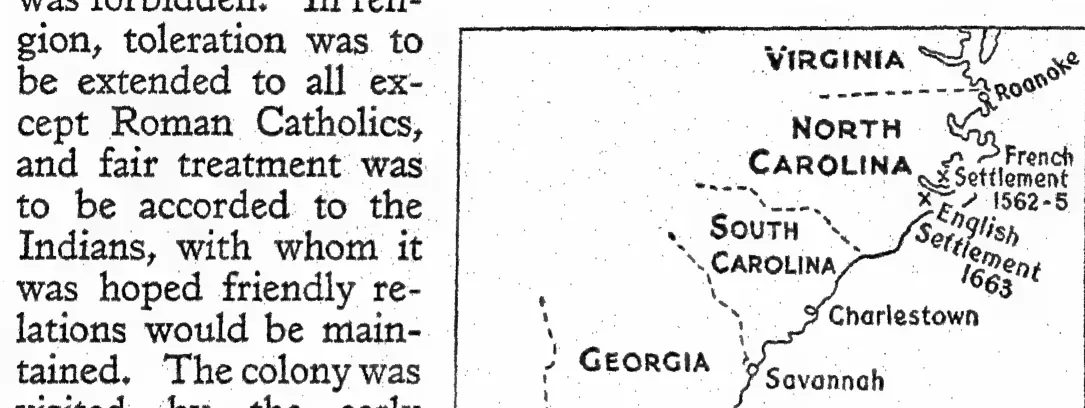
Although the Carolinas were colonised by Englishmen in the reign of Charles II they were not named after him. A century earlier a French Huguenot settlement was begun there, in the reign of Charles IX of France, from whom the colony took its name. The Huguenot plantation was overwhelmed by Spanish attack,? and though an English settlement was contemplated in the reign of Charles I nothing was done until the reign of his son. In 1663 Charles II granted the region south of Virginia to a body of proprietors who formed the Carolina Company.
2 The first settlement was in 1562, and the colonists soon returned to
France. A second attempt was made in 1564, and the colony appeared to
Two plantations were made. The northern settlement, which in course of time became. North Carolina, made slow progress. It failed to attract immigrants in sufficient numbers, and those who came were not of the best quality. There was little capital available for development, and the proprietors took little interest in it. The colony was remote from its neighbours on either side. North Carolina was ruled by a deputy of the Governor of South Carolina, and in due course ‘the usual Assembly came into being and, as in other colonies, wasted its time in bickerings with the proprietors.
South Carolina was developed on much more satisfactory lines. The proprietors encouraged immigrants of the best ‘type, and in course of time the population of the colony included Huguenots from France + and men from some other English colonies. Charlestown, the capital, became a flourishing city. The Governor was assisted by an Executive Council, half the members of which were elected, and there was the usual representative Assembly.
Early in the eighteenth century South Carolina experienced trouble with the Indians and the Spanish, and in 1706 Charlestown was besieged. The attack was beaten off, however, and the colony continued to' prosper. With the increase of population and wealth the control of the proprietors became more and more irksome. At length, in 1719, the Assembly resolved to disregard the Governor and the proprietors and to conduct the administration without reference to them. It sent a petition to the Crown praying that Carolina be declared a Crown Colony.. There was little opposition to the request, even from the proprietors, and in 1729 the rights of the Company over Carolina, now formally divided into North Carolina.and: South -Carolina, were terminated.
Georgia was settled much later than the other British colonies of the North Atlantic seaboard. Its foundation was undertaken be firmly established. In the following year a Spanish expedition under De Avila, Governor of Florida, attacked Charlestown and massacred the garrison, leaving behind a placard: “‘Not.as Frenchmen but as heretics.” In 1568 this outrage was avenged. by.a Gascon adventurer, De Gourges, in 1732 by General Oglethorpe, whose aim was philanthropic.
The purpose of the colony was to provide a new home and a new prospect in life for insolvent debtors, of whom there were many in prison in England. The colony in its infancy may in some respects be compared with Pennsylvania. There was to be no negro slavery in the new settlement, and the sale of rum
who surprised a Spanish fort in Florida and hanged his prisoners, “Not
as Spaniards but as murderers.” -
1 After the Revocation of the Edict of Nantes by Louis XIV in 1685.
gion, toleration was. to 5 be extended to all ex- 2 6 See ee 900" cept Roman Catholics, NORTH Yr, and fair treatment was._. CAROLINA oSietttemant to be accorded to the irr B byje, 1982-8 tained, The colony was i Savannah
Methodist leaders, John j|~ ‘-----and Charles Wesley and: George Whitefield, and for a time Charles Wesley acted as Oglethorpe’s secretary. Georgia re-ceived an accession of population by the immigration of a number ay of Moravians, a German Protestant sect, and it LATER ENGLISH SETTLEMENTS IN NORTH contained also a Scottish AMERICA
Presbyterian. element. In course of time its original aim was obscured, and it developed on similar lines to the Carolinas, agriculture being carried on by slave labour. An Assembly was established in 1752. Georgia was not without strategic value, since it was a frontier colony offering a barrier against Spanish attack from Florida.
were established farther up the St. Lawrence; nevertheless, the French in North America were not numerous before the reign of Louis XIV.
In 1664 the Company of the West, founded under the guidance of Colbert, received a grant from Louis XIV of the whole of North America from Hudson Bay to Florida, in utter disregard of the existence of English and Dutch colonies on the Atlantic seaboard. Aneraof expansion followed. The second half of the seventeenth century was the age of Jesuit missions and Jesuit exploration in North America. The Great Lakes were explored by La Salle, and Marquette traversed the greater part of the course of the Mississippi.
His work on this river was completed by La Salle, who reached the Gulf of Mexico ‘in 1682, thus showing that the Mississippi flowed into the Atlantic and not the Pacific, as was for some time conjectured. Louisiana was occupied by the French in 1697.
Soldiers and pioneer colonists followed the explorers, and the Great Lakes and waterways of the eastern part of North America became dotted with French forts which served to establish a claim to territory stretching without a break from the St. Lawrence to the Gulf of Mexico. It will be noticed by an inspection of the map that the lower St. Lawrence, the Alleghany River, the Ohio, and the lower Mississippi all lie in a north-east.and south-west direction, and that these waterways are, in fact, almost in a straight line parallel to the coast. It was on or near this line that the French settlements were placed, at irregular intervals. Louisburg, on Cape Breton Island, was established in 1716, and the chain included Quebec,
Montreal, Crown Point, Fort Frontenac, Fort Niagara, Fort Chartres, and, after 1752, Fort Duquesne.
By maintaining their line intact the French would prevent the expansion of the British towards the interior, and by forcing their way through British territory and reaching the Atlantic they would cut the British settlements into two groups; they would enggpach upon them and ultimately conquer them. The British, e other hand, hoped to capture important French forts and sever the enemy’s line. There was no definite boundary between the two lines of ‘settlement, each side endeavouring to encroach upon the territory of the other. Border fighting, in which Indian tribes took part, was carried on almost continuously, and. was by no means limited to the _ periods during which Great Britain and France were at war.
In some respects the French had the advantage in this struggle. Their strategic position was superior, as, if they could hold on, British expansion would be impossible, while
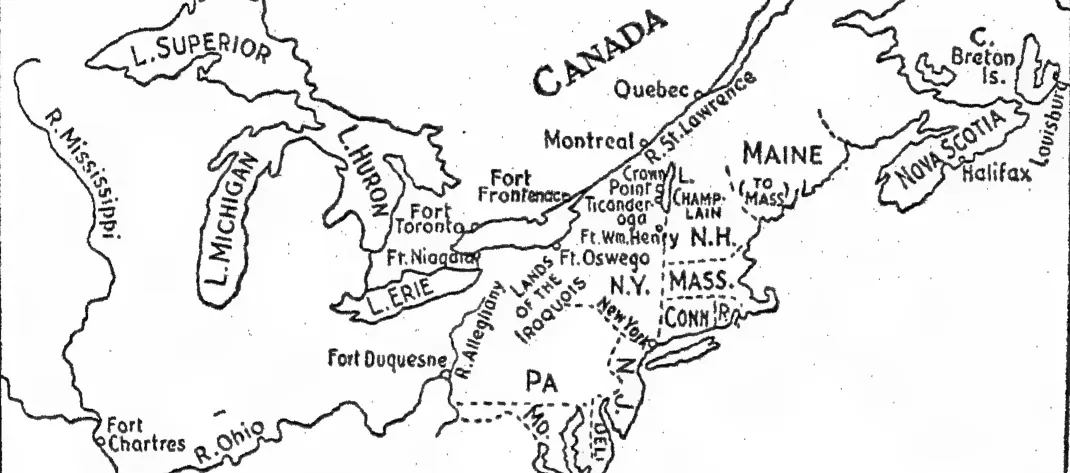
there was nothing to prevent their spreading westwards to the Rockies and the Pacific The Indians, a factor of some importance in North American warfare, were on the side of the French, except the Iroquois, who were allied with the
the first half of the eighteenth century.
1 French explorers travelled far to the west and the north-west during
British, The French forts were garrisoned by regular troops, while the defence of the British colonies was in the hands of ill-trained colonial levies. But the British were superior in numbers, and, at the crisis of the struggle, received more effective support from the home Government than did their rivals. The decisive factor was the command of the sea, which permitted supplies and reinforcements to be sent to the British and prevented them from reaching the French.
It would be tedious to narrate the details of the border fighting in the first half of the eighteenth century. By the Treaty of Utrecht, 1713, the French were compelled to recognise the rights of the Hudson’s Bay Company? to its forts and territories, and Acadie (Nova Scotia) was ceded to Great Britain. Newfoundland also was recognised as a British possession, subject, however, to the reservation of certain fishing rights to the French.?
The struggle between British and French for supremacy in North America reached its climax in the middle of the eighteenth century. Great Britain and France were at war between 1743 and 1748 (the War of the Austrian Succession) and between 1756 and 1763 (the Seven Years War), but in North America hostilities continued with little intermission during the whole ‘period of twenty years. A French attack on Nova Scotia in 1744 failed, and in 1746 Louisburg fell into British hands, but by the Treaty of Aachen it was restored to the French.
For the next few years the aim of both sides was to secure possession of the junction of the Ohio and the Alleghany Rivers. To the British it would be a gateway into the interior; the French might use it as a base for an attack upon Virginia and a break through to the sea, A British company, the Ohio Company, was formed for the development of the region, but the colonials were slow to move, and the French, under General Duquesne, took possession of the spot and founded Fort
Duquesne. A Virginian attack, led by George Washington, was repulsed,® and in 1755 two British regiments reached Virginia under the command of General Braddock. During the summer Braddock’s attack on Fort Duquesne was defeated, and he was slain. Braddock was a brave man. ‘Trained, however, in the principles and methods of European warfare, he was unable to adapt himself to the conditions of colonial fighting.
Washington and his forces surrendered to superior numbers, but were
permitted to return to Virginia, te;
The Marquis of Montcalm assumed command of the French in 1756. In that year he captured Fort Oswego and in the following year he took Fort William Henry.. But in 1757 William Pitt became Secretary of State in Great Britain and assumed. responsibility for the direction of the Seven Years War. He made the naval and financial strength of this country the basis of his policy. British fleets were strengthened, and within a year or two were victorious everywhere.
Sub-sidies were sent to Frederick of Prussia, the ally of Great Britain, in order that his efforts might not be crippled by lack of money. British and Hanoverian troops fought side by side with the Prussian armies, so that the French were kept fully occupied on the Rhine. And while the French were engaged in Europe the struggle against them was carried on energetically and successfully in North America and elsewhere.
Pitt sent troops and equipment and supplies to North America, and in 1758 a series of British victories was registered. Fort Oswego and Fort William Henry were recovered, Fort Frontenac and Louisburg were captured, and Fort Duquesne fell into British hands without fighting. Canada was thus cut off from Louisiana, and French power in the north was limited to Quebec and Montreal.
The destruction of French fleets at Lagos and Quiberon Bay by Boscawen and Hawke in 1759 left Montcalm without means of communication with France. He gathered all available forces for the defence of Quebec, upon which Pitt planned a threefold attack. Wolfe, Amherst, and Prideaux were to concentrate from different directions on the city.
Wolfe, however, reached Quebec before the others, and after waiting for some time he decided to attack alone. -His forces climbed a cliff thought to be unscalable and reached the Plains of Abraham above, where a battle was fought which the British won, but in which both Wolfe and Montcalm were slain. Quebec surrendered, and, with the capture of Montreal by Amherst in the following year, the overthrow of French power in North America was complete.
By the Treaty of Paris, 1763, which marked the conclusion of the struggle, a number of territorial arrangements were. made. The terms of the treaty with regard to India, the West Indies, and elsewhere in the world, are referred to in other parts. of this book. In North America all French possessions east of the Mississippi, with the exception of New Orleans, were ceded to Great Britain. This included all the Canadian settlements and the line of forts behind the British colonies.
But the right of French fishermen to continue the exercise of their industry in the Gulf of St. Lawrence was recognised; France was permitted to retain two small islands, St. Pierre and Miquelon, as depots for the fishermen, who were also to be allowed to land on the coast of Newfoundland to dry their nets. From Spain, which had entered the war in 1761, Great Britain received the peninsula of Florida, so that the eastern half of the mainland of North America became entirely British.
These arrangements did not pass without criticism. The continuance of the French cod-fisheries in the St. Lawrence and on the Newfoundland banks led to dissensions which were settled only by the conclusion of the Anglo-French Convention of 1904. The few isolated posts on the St. Lawrence which passed into British possession appeared to be far less important than the West Indian islands which were given back to France, The expulsion of the French from North America removed a menace to the English colonists and made possible their revolt a few years later. The return of Canada to the French and the retention of the sugar islands by Great Britain would have met with more general approval.
Despite its blemishes, the Peace of Paris was.a great triumph for Great Britain. Her conquests, not only in North America but in India, Africa, and the West Indies, had been so considerable that she stood henceforth as the foremost colonising power in the world. Her navy was supreme, while that of her rival was almost non-existent... Her commerce with India, North America, and the West Indies expanded without fear of French competition. Yet, as pointed out above, the peace contained the seeds of future trouble. France had to wait only fifteen years for her war of revenge,
Chapter IIIThe Old Colonial System
In the Middle Ages there was little national feeling among the peoples of western and central Europe. Feudalism bound the mass of men, as serfs, to the soil. Communication was difficult, and people rarely travelled; they knew little even of their own country and their own race. They were more conscious of their common Christianity, of their membership of the Church, and of the spiritual obedience which they owed to Rome, than of their nationality.
They were not altogether oblivious of nationality, but the thought of it was not uppermost in their minds. The divisions of society were “horizontal rather than vertical.” Men thought of themselves as knights or merchants, priests, artisans, or serfs, rather than as Frenchmen, Englishmen, or Germans,
One of the indications that the Middle Ages were giving place to modern times was the growth of national consciousness. This developed slowly, and in different nations at different times. The realisation by Englishmen that they formed a nation, with definite characteristics and common interests, was assisted by the Hundred Years War.
In the thirteenth century it was still true that an English knight had more in common with a French or Spanish knight than with one of his _ own serfs; by the middle of the fifteenth century, when the Hundred Years War came to an end, knight and man-at-arms realised their common nationality as a result of long fighting ‘against a common enemy.
The exploits of Joan of Arc inspired men of different provinces of France to a recognition of the fact that they, too, possessed common nationality—that though they were Normans or Gascons or Burgundians they were also Frenchmen.. Wars against the Moors encouraged the men of Spain to remember that they were not only Castilians or Aragonese, but also that they were Spaniards.
The fifteenth century witnessed the Renaissance, the. fall of the feudal nobility in England, and the beginning of the age of geographical exploration; the Reformation soon followed in the sphere of religion. The spirit of nationality developed in most parts of Christendom, and the modern age is marked off from medievalism by the appearance of nations conscious of themselves as separate political, religious, and economic entities,
When a nation became fully developed in this way it became equally conscious of the existence of other nations, which it viewed as actual or potential enemies. The aim of the nation was to preserve its independence. For this purpose the activity of its people in every direction was regulated and controlled. The freedom of action which in later times was regarded as the right of the individual was subordinated to the necessities of the State. Private interests could not be permitted to take precedence of considerations affecting the well-being of the nation as a whole.
The system which was thus evolved was in England termed Mercantilism. Mercantilism involved the control of every phase of English activity, political as well as economic, in order, that England might be powerful... The Mercantilist aim, the development of national power, called for State action in many directions—the encouragement of agriculture in order that a healthy rural population might be maintained and the national food supply safeguarded, the regulation of industry, the amassing of treasure, the development of shipping in order that the kingdom might be free from invasion, the regulation of overseas trade by the establishment of privileged monopolistic companies, and the avoidance of dependence in any respect upon any rival state.
It does not come within the scope of this book to consider all the aspects of Mercantilist activity, but it is essential to notice the Mercantilist ideal as one of the primary motives in connection with English colonisation,
In the first place, since Spain and Portugal had made overseas settlements which added to the strength of these countries, it was considered desirable that Englishmen should discover and. occupy new lands in order that a counterpoise to Spanish and Portuguese colonial power might be established. Further, in the wars of religion in the sixteenth and seventeenth centuries, Spain figured as the champion of the Roman Catholic Church; England came to be regarded as a leading: Protestant power.
From her colonies in Central and South America Spain drew an immense supply of gold and silver for use in her wars, and it is not to be denied that the first English colonists were inspired with the hope of discovering mines of the precious metals. In this respect they were disappointed, but in course of time colonial settlements were valued for other reasons.. Their very existence, and the necessity of maintaining communication with them, tended to strengthen English maritime power, itself an important consideration to the Mercantilists.
Moreover, plantations in tropical or sub-tropical countries were capable of producing commodities which, for climatic reasons, could not be grown in England;.such articles were reserved for export to England only, and the home country was thus rendered independent of foreign sources of supply. Further, it was thought that overseas settlements might offer some solution to the problem of surplus population in England. There was, indeed, no real surplus of population; nevertheless, for one reason or another, some people did not fit satisfactorily into the existing structure of society.
Many people were unable to accept the established religious system of the country, and were prepared to settle overseas for the sake of their faith. And men who were of a restless and roving disposition, besides paupers, vagabonds, and even criminals, were encouraged or compelled to migrate to the plantations. Finally, it was anticipated that colonies, when they were well developed and substantially peopled, would afford markets for the manufactured products of the home country.
From the foundation of the earliest overseas plantations, early in the seventeenth century, the English Government attempted to control their trade. It was ordered that colonial goods should be carried only in English ships, and that certain products, including tobacco, should be exported from: the colonies only to England.
The policy of control was continued under the Commonwealth, and in the Navigation Act of 16511 it was ordered that commodities from any part of Asia, Africa, or America imported into England or Ireland or the plantations should be carried in English or colonial ships, which were defined as ships of which the owner, the. master, and the most part of the mariners were men of England or the colonies...
Goods of European countries might be imported into England, Ireland, or the colonies either by English or colonial ships or by vessels of the country from which the goods came. It is to be observed that the main object of this Act was to attack Dutch carrying trade; it was not intended in any way to put the plantations at a disadvantage by comparison with England. The protection and privilege afforded to English shipping was extended to that of the colonies...
1 The references in this chapter to the Navigation Acts of 1651 and 1660 are concerned chiefly with those parts of the Acts which related to the colonies, and not with the clauses which applied to English trade with foreign countries,
By the Navigation Act of 16601 a clearer definition of an
English or plantation ship was formulated; the owner, master, and three-fourths of the crew were to be men of England or the plantations, and in certain cases it was required that ships should have been built in England or the plantations.? Colonial exports, as well as imports, were to be carried in English or q plantation ships; hence, no legitimate reason could arise for | i:
the presence in a colonial port of any foreign ship, unless it j was driven thither by stress of weather. Alien merchants and their agents were forbidden to reside in English plantations. i
Certain colonial products were enumerated, and these were to be exported from the colonies only to England, Ireland, or another plantation. The original list of enumerated commodities comprised sugar, tobacco, “cotton-wool,” indigo, ginger, and fustic,? or other dyeing wood. Non-enumerated commodities might be sent to other countries, but only in
English or plantation ships.. By a later enactment this concession was limited to the export of goods to countries south of Cape Finisterre.
Modifications were made from time to time in the system established in 1660. In 1664, colonies, which by the Act of
1660 had been permitted to import goods from Europe provided that English or colonial ships were employed, were forbidden to receive European goods except from England, and in 1673 they were allowed to send enumerated products to other plantations only on payment of a duty. In the eighteenth century many additions were made to the original list of enumerated colonial commiodities, the most important of these additions being rice, molasses, and naval stores. But in the time of Walpole rice was partially freed from control, permission being accorded for its direct export to Mediterranean countries, and in 1739 sugar ceased to be enumerated,
1A re-enactment and expansion of the Act of 1651. Its passage was
necessary because, after the restoration of the Stuart line in 1660, all that
had been done during the interregnum was treated as null and void.
This requirement was general after 1662. If ships were foreign built
their cargoes paid aliens’ duty.;
8 Fustic is a kind of wood which yields a light yellow dye.
From a consideration of the provisions of the Navigation Act of 1660 and of the Acts of Trade which amended and ex-tended it, it will be seen that British control of colonial trade was exercised in two main directions—colonial exports and colonial shipping. Colonies in the seventeenth century were regarded by the people of England not as places in which new nations were developing but as outposts of the mother country, and, as already indicated, they were valued because they produced various important articles which England, for climatic and other reasons, could not produce for herself, and because, as they developed, they provided markets for the home country’s manufactures.
It was thought to be right that their trade should be under English regulation in view of the fact: that Englishmen had been put to the expense of founding the colonies and that England was still responsible for colonial defence. English merchants profited by the purchase of colonial produce and its re-sale to foreign countries which required it but were not allowed to buy w direct.
Nor was the system without its advantages to the colonists. The control exercised by England was by no means so complete as that maintained by Spain and Portugal over their colonies. Many important commodities, such as grain and. timber, and, after 1739, even sugar, were non-enumerated, Colonial produce when sent to England enjoyed the advantage of preferential tariffs as compared with goods from foreign countries.1 In some directions, notably in the growth of tobacco, the colonies were even protected from English competition.?
Above all, though the colonial merchant was subject to control in the trade in enumerated commodities, he was at least sure of his market and of receiving a fair price for his goods—factors which were regarded as of primary importance in the trade of the seventeenth and eighteenth centuries.*
As regards shipping, the system did not put plantation ships at any disadvantage as compared with those of England. The regulation of colonial shipping was a part of the great navigation
> For example, the duty payable in England on foreign indigo was 3s. 4d. per lb.; on colonial indigo it was 1s. per Ib, Foreign sugar paid 4s. per cwt., while the duty on colonial sugar was 1s. 6d. per cwt. =
Late in the seventeenth century troops were sent into the western counties to destroy crops of tobacco.
3 i.e. while Mercantilist principles prevailed.
system by which it was hoped to make the English mercantile marine the foreniost in the world.1 The system was suited to the interests of colonial shipowners, and it stimulated the shipbuilding and lumbering industries in the New England colonies and elsewhere.? But merchants who carried on trade between the colonies and the home country contended that
Spar a the limitation of shipping caused freights to rise. It is clear therefore that it is impossible to treat the system as equally advantageous or disadvantageous to all classes alike in the colonies. What was to the interest of one class might be detrimental to. that of another.
While the plantations were small this Old Colonial System worked well, and if the settlers felt no great love for their mother country there was, on the other hand, no great dissatisfaction. During the period of Whig rule in the first half of the eighteenth century smuggling in and out of the colonies occurred, and the law was not energetically enforced. As will be shown later, the re-enforcemient of the system of the regulation of colonial trade in the reign of George III was one of the outstanding factors leading to the revolt of the American colonies.
The success of the American revolt proved the futility of the Old Colonial System. By this time the very foundations of Mercantilist philosophy were being questioned,® and there was a growing disbelief in the efficacy of the whole fabric of regulation. The policy of the Navigation Acts was not relaxed at once, but within the next few years certain modifications were sanctioned. Ships of the. United States were permitted to trade with the West Indies in 1796, and with Canada in 1808.
In‘'1820 a petition from the City of London in favour of the abolition of restrictions on trade was considered by a Committee ’ of the House of Commons, and as a result substantial changes
Old Colonial System, was left substantially untouched. The enumeration of colonial goods was entirely discontinued. All colonial products could henceforth be sent to any foreign * Whether British maritime supremacy in the eighteenth and nineteenth centuries was a result of, or in spite of, the Navigation Acts is a question open to argument.; Be * Shipbuilders on the Thames complained, in the time of Walpole, of the competition of New England shipbuilding.::
5 By the Classical Economists.. See p. 324,
country, but it was still essential that they should be carried in British or colonial ships, or, 1n the case of the United States, in American ships, as sanctioned in 1796. Within the next few years the navigation system itself became moribund, since the Acts ceased to be applied to the shipping of countries which were prepared to offer privileges to British ships.
An attempt was made to revive the Navigation Acts in 1845 under the pretext of codification. This was followed by vigorous protest from the colonies, The United States were building up a large mercantile marine, and it was contended by Canadians that the system worked to their detriment in competition with the republic. From the West Indies, too, came the complaint that freights were higher than would be charged if competition in shipping were unrestricted. These protests did not pass unheeded. Free trade principles were in the ascendant, and in 1849 the Navigation Acts were repealed.
a ON
Chapter IVThe Dispute with the American Colonies
Before the circumstances which led to American independence are considered it will be well to review the position of the American colonies. The British colonies on the eastern seaboard of North America, thirteen in number, had been founded or acquired at various times from the reign of James I to that of George II. They consisted of three groups.
The New England colonies in the north, Massachusetts, New Hampshire, Connecticut, and Rhode Island, had been founded by Puritan settlers at various times in the Stuart period, and in the eighteenth century they were still Puritan, with (except in the case of Rhode Island) all the intolerance associated with that form of religious belief. The climate of New England was temperate, not unlike that of Great Britain.
Little or no slavery existed there, and the prosperity of the region depended on the labour of white men, who were engaged in such industries as lumbering, agriculture, and shipbuilding. New England Puritans were democratic in temperament and, naturally, sympathised with English Puritanism in the constitutional struggle in England in the Stuart period.
The middle group of settlements. included New York, New Jersey, Pennsylvania, and Delaware, all of which, except Pennsylvania, had been conquered from the Dutch in the seventeenth century. The climatic characteristics of these colonies were similar to those of the New England group, but the population was not so distinctively of English Puritan stock, and included settlers of Dutch, Swedish, German, and Finnish descent.
The southern colonies consisted of Maryland, Virginia, North Carolina, South Carolina, and Georgia. These, known as the Plantation Colonies, enjoyed a sub-tropical climate, which had led to the establishment of a totally different economic system, in which the white ‘‘planters” were the owners of - substantial estates on which tobacco and other crops were cultivated by the labour of slaves—negro or-convict. The planters in the southern colonies formed a landed aristocracy comparable to the squirearchy in England. They were inclined to Toryism, and during the English constitutional struggle their sympathies were with the monarchy. White men of lower status often acted as overseers of the slave population.
Politically, the colonies were in some respects more advanced than Great Britain. Each of them had its Assembly, a body which was elected by the votes of the white population of the colony. Settlers from the British Isles who had not been qualified to vote at home usually found themselves, at no long time after their arrival in North America, in possession of the franchise. The Assembly made the laws of the colony and imposed upon it such taxation as was required. But the Assembly was unable to secure the dismissal of the advisers of the Governor; it follows, therefore, that responsible governtment, as established in many British colonies in the nineteenth century, did not exist.
The amount of control exercised by the British Government was small. The Governor of each colony was appointed from Great Britain, but his authority was not very considerable, since it was limited by the rights of the colonial Assembly. Friction between Governor and Assembly was not uncommon, and attempts by a Governor to assert his authority were invariably resented. The mother country was responsible for the defence of the colonies from French and Indian attack, but, before the triumph over the French in the Seven Years:
‘te War, the settlers had always to be on their guard against sudden onslaught, and only in the event of serious and prolonged fighting were reinforcements of British troops likely to be sent to America. As already described,! colonial trade was under British control.. In the eighteenth century colonies were regarded less as new nations in their infancy than as outposts of the mother country, established to supply to Great Britain those things which, for climatic and other reasons, she was unable to produce for herself, and to offer markets for British products.
From this point of view it was to be expected that the colonies would always be subordinate to Great Britain in commercial matters. By the Navigation Acts of the Stuart period all enumerated colonial products had to be sent to
Great Britain, and the enumeration naturally included all the more important colonial exports; non-enumerated products might be sent elsewhere, though all imports to and exports from the colonies, enumerated and non-enumerated alike, might be carried only in British or colonial ships and under no circumstances in foreign ships. Duties were imposed at American ports on colonial imports, and restrictions were placed on the manufacture of goods which might compete with well-established British industries, These industrial and commercial regulations were less onerous than those imposed by the Governments of other countries on their colonies, French and Spanish colonies were exploited for the benefit of France and Spain; the activities of British colonies were restricted only if they came into direct conflict with the interests of Great Britain.
The thirteen colonies were entirely distinct and separate from one another. No sort of federation existed, and the one or two attempts which had been made in time past to bring about a federation had failed. The colonies happened to be situated in close proximity to one another, but there was no closer political connection than would have existed if they had been scattered about the five continents.
Each was supposed to be connected with Great Britain alone, and if it should be necessary for one colony to communicate with another it was supposed to do so through Great Britain. Nor was there any real desire for feceration. A good deal of jealousy and friction existed among the colonies, and they were driven to some sort of unity only under the pressure of the quarrel with Great Britain with which this chapter deals.
Under the rule of the Whigs, and especially of Walpole, the trading restrictions had. been, unofficially, relaxed to a considerable extent, and a certain amount of trade which was technically illegal grew up. Walpole was aware of this, and he took no steps to check it. He probably had little belief in the value of the regulations. To attempt openly to abolish them would evoke opposition from those in Great Britain who still believed in the principles of Mercantilism; to disregard their evasion would not provoke trouble.
He and his successors, the Pelhams, followed the latter course, and it is probable that colonial merchants found no serious difficulty in evading the regulations whenever it was to their interest to do so.:
1 It may be observed that to-day, a century anda half after the separation from Great Britain, traces of this feeling remain in the United States, The separate states are determined to retain that degree of independence which remains to them under the United States Constitution; they resent _ attempts of the Federal Government to increase its power at their expense, and they are not always in harmony with their neighbours.
Although the colonies thus had grievances against Great Britain, no deep feeling was aroused against the mother country before the reign of George III. Governors might attempt to play the autocrat—but Assemblies had at their command many devices for opposing an officious Governor, Colonial trade was subject to British control—but this was exercised so incompletely that it could hardly be called vexatious. The colonies were so little conscious of their common interests and. SO little inclined to act together that anything like concerted action against Great Britain was nearly impossible. And while the hinterland of North America was in French hands they looked to Great Britain to defend them against an enemy who otherwise might have overwhelmed them.
Within a space of two or three years the situation was completely changed. The Treaty of Paris was signed in 1763, and French power disappeared from the mainland of North America. The nightmare of French aggression vanished. The British colonists no longer needed the support of Great Britain. They were free to take vigorous action against Great Britain if their grievances should become acute.
The friction between Great Britain and her American colonies, which led to the War of Independence, falls into three distinct periods. The first was from 1764 to 1766, the period of Grenville’s attempt to impose direct taxation by means of the Stamp Act. The second was from 1767 to 1774, associated with Townshend’s plan to raise revenue by indirect taxation, ‘and especially by a duty on tea, The third period, 1774 to 1776, began when the pressure of events inspired the separate colonies to agree to send representatives to a Congress.
In 1764 George Grenville, the Prime Minister of Great Britain, gave orders for the more effective enforcement of the Navigation Acts. The Americans were annoyed, but could find no good ground for protest. No new system was being set up; a system which had existed for a century was to be changed from a farce to a reality. The opportunity of expressing American discontent came a year later, when taxation of the colonies by the British Parliament was proposed, but it has been contended that “taxation was only the occasion, not the cause, of the American revolt.”.
The Seven Years War had ended with the National Debt standing at a higher figure than ever before, and the annual charge for interest involved a very heavy burden on the British exchequer. Under the circumstances, Grenville contended that some part of the cost of the defence of the American colonies ought, in future, to be borne by the settlers themselves, instead of, as hitherto, the whole of it falling upon Great
Britain. This seemed reasonable, but it was contended on behalf of the Americans that Great Britain made very large profits through her monopoly of American trade, and that the submission of the colonists to Great Britain in the matter of commercial regulation was a full equivalent of the cost of their defence. Grenville, however, proposed to raise by taxes in
America the sum of £100,000 per annum, to be devoted towards the cost of maintaining troops in the colonies.
Grenville’s ideas were not contrary to the strict letter of the taw. The colonies had been founded under charters granted to proprietors, individual or company, by the Crown, and the
Crown had not relinquished the right to impose taxation.
Indirect taxation had been imposed in the past; the right to levy direct taxes had never been exercised, but it had never been disavowed by the Crown nor denied by the colonists.
To American representatives in London, among whom was Benjamin Franklin,) Grenville put forward, in 1764, a sugges-Smee Te tion that the money should be obtained by a stamp duty on paper and deeds of various kinds. He told them that he did not insist tpon this ‘method, and, if they preferred another, he was prepared to consider any alternative proposal for raising the required amount.
In the following months they made no attempt to bring forward an alternative (other than a suggestion that the colonies should be invited to make voluntary contributions), and they spent the time in raising an alarm in the colonies, so that by the time Grenville’s scheme came into operation colonial opinion was already organised against it.
The British contention, as stated above, was that, in view of the substantial benefit conferred upon the colonies by the expulsion of the French from North America during the Seven Years. War and of the serious financial position of Great
7 Agent in London for the colony of Pennsylvania.
Britain, some contribution ought to be made by them towards the cost of their defence in future.1 It was impossible to leave it to the colonial Assemblies to make voluntary contributions. The smaller colonies would not agree to pay as much as the more important; the latter would be unwilling to pay more than others; the colonies in the south, which had had less reason to fear the French menace, would contend that, as the benefits gained from the Seven Years War had accrued chiefly to the New England colonies, these should pay more than the plantation colonies; no basis of assessment would be found acceptable to all; each would await the decision of others, and nothing would be done. Taxation must be imposed by a common authority, and in view of the absence of colonial unity the only common authority was the British Parliament.
The Americans contended that the British Parliament had no right to tax them, since they were not represented in it, and ‘no taxation without representation” became the colonial slogan during the struggle. They held that the British Parliament had no more authority over the colonies than the English Parliament had over Scotland before the Union of 1707.
They claimed, in fact, to be in a position of equality with Great Britain, and asserted that the colonial Assemblies stood in the same relation to the king as the British Parliament did, This was inconsistent with their acceptance of the Navigation Acts, and it was clear that if the Americans could catry their point they would not be slow to claim that the Navigation Acts were inapplicable to them.
And, if the British Government had no right to enforce the Navigation Acts, how could other laws be enforced? In spite of American professions of loyalty, the logical conclusion of the American line of argument was independence.
The Stamp Act was passed by the British Parliament in 1765. It directed that, in the colonies, legal documents of various kinds, and also newspapers, should be written or printed on stamped paper, which was to be obtained from the Government for the value of the stamp. The Act was followed by an extension of the Mutiny Act * to America; it placed on the colonies the obligation to provide quarters for troops.
It was stated in Parliament that a force of 10,000 men was to be maintained in America to guard against the possibility of a renewal of French aggression, and also to protect colonial frontiers against Indian attack. The annual cost of this army would be £350,000, and of this amount only £100,000 would be raised in America.;
1 It was at no time suggested that the Americans should be taxed for
the purpose of sharing the burden of the National Debt.
2 The Mutiny Act was passed annually by the ‘British Parliament in
order to legalise the maintenance of the army in Great Britain. The
effect of the extension was to legalise the stationing of troops in America..
News of the passing of the Stamp Act was received in America with an outburst of indignation. At Boston, in Massachusetts, which had been hit hard by the suppression of contraband trade, a meeting of townsmen protested against the Stamp Act and declared that Parliament had no right to tax the colonies without their consent. The Assembly of Massachusetts followed the lead given by Boston by passing a similar resolution, and other colonies echoed the protest.
Repre-sentatives of nine of the colonies met at a congress in New York; they drew up a statement expressive of their loyalty, and at the same time formulated their grievance in addresses which were sent, separately, to the king, the House of Lords, and the House of Commons,
In Boston, Rhode Island, New York, and elsewhere, riots occurred, Stocks of stamps were seized and destroyed, stamp distributors were maltreated, and stamp offices were burned, General Gage, commander-in-chief of the garrison. of New York, showed great wisdom in refusing to make use of his forces to quell the disturbances there, fearing that a collision between his troops and the mob might precipitate a civil war.
But the passing of resolutions and the outbreak of rioting in places three thousand miles away were not likely to turn the British Government from its purpose. The most effective form of protest was found to lie in the formation of non-importation agreements. Merchants cancelled their orders for British products and refrained from paying for goods already received. Americans refused to buy clothing made of British cloth; to appear in public in old clothes became a mark of colonial patriotism. The manufacture of cloth in America was begun. ihe ZF.
The effect of these measures was soon felt in Great Britain. Merchants in the industrial towns petitioned Parliament to repeal the Stamp Act, declaring that they were suffering loss, that large numbers of workpeople were unemployed, and that Gebts from America to the total of £4,000,000 were unsettled.
There had been a change of Government in Great Britain in
1765, the Marquis of Rockingham replacing Grenville as Prime Minister. When Parliament met in January, 1766, Pitt and Burke spoke strongly against the enforcement of the Stamp Act, and the Government decided to repeal it, This was done, though an attempt was made to save the dignity of Parliament by the passing of a Declaratory Act in which it was asserted that Parliament possessed the right to legislate for the colonies on all matters, including taxation.
News of the repeal of the Stamp Act. was received with rejoicing on both sides of the Atlantic, The Americans had won a victory over Parliament, but the position after the repeal of the Act was not and could not be the same as before its introduction. Had it been frankly admitted that the passing of the Stamp Act was a mistake which, as soon as its nature was realised, had been rectified, it is possible that the breach might have been healed. But the Declaratory Act kept American suspicion alive. The colonists saw in it a threat that the attack on their constitutional liberties would be renewed when circumstances were favourable.
Rockingham’s administration was short-lived, and was succeeded by the Pitt-Grafton ministry, in which the nominal Premier, the Duke of Grafton, was overshadowed by Pitt, now Earl of Chatham. Charles Townshend, Chancellor of the Exchequer, in 1767 revived Grenville’s policy, with some changes in detail. The Americans had always admitted the British right to regulate their trade, and this had involved the imposition of import duties at the ports.
Grenville’s proposal had set up direct taxation in the interior of the colonies; Townshend thought that the American objection would not apply to indirect taxation levied only at the ports..
Accordingly, he established customs duties on the import of tea, glass, red and white lead, painters’ colours, and paper. _The amount to be raised by these duties was estimated at £40,000 per annum, and the money was to be used in payment of the salaries of various colonial officials, The colonists, however, distinguished between indirect taxation which was levied, as in Great Britain, for the purpose of trade regulation, and that which was imposed in order that revenue might be raised, and they contended that the new duties came within the latter category, The objections that had been raised against the
Stamp Act applied equally to Townshend’s imposts. The
Americans disliked, too, the purpose to which the money was to be applied; they had always resisted attempts to make colonial officials directly dependent on the home Government.
Non-importation agreements were renewed in Boston and New York, though they were not so entirely successful as in 1765. The volume of trade between Great Britain and New England fell off in 1768 and 1769, but by 1770 it recovered and even exceeded its normal level. The Massachusetts Assembly circularised the other colonial Assemblies, inviting their co-operation in resistance to the import duties. The Governor of Massachusetts invited the Assembly to withdraw its circular, and upon its refusal he ordered its dissolution.
At Boston rioting occurred which was kept in check only by the arrival of a considerable force of British troops. The rioters could not be punished, since no jury that could be empanelled in Boston would be likely to find them guilty. The British Government considered, but did not proceed with, the idea of bringing them to England for trial; the effect of the suggestion was that Virginia and North Carolina followed the example of the northern colonies in promoting non-importation agreements.
The British Government followed no consistent policy. Two courses were open to it. It might have acted firmly, and by sending an adequate force have crushed disorder and enforced the law. It might have withdrawn fully and frankly from the unsatisfactory position which it had’ created. It did neither; a show of firmness was followed by a gesture of conciliation, _.and this by some action which revived American irritation, By its hesitancy it won the contempt of many of its supporters, while it failed to conciliate its opponents.
At this point mention may be made of the fact that opinion ‘was not unanimous on either side of the Atlantic: There was a minority of Americans who held that the action of the British _ Government was not unreasonable, and there was a considerable body of opinion in this country which was opposed to the taxation of America, Chatham and Burke in their speeches voiced the Whig denunciations of the Government’s policy.
Though Chatham was a member of the ministry which included Townshend he was seriously ill during most of his term of _ office, and when he was able to get down to the House of Lords he criticised the policy of his colleagues, Burke made several eloquent speeches in which, arguing from first principles, he condemned the taxation of the colonists as unconstitutional and inadvisable.
From a revenue-raising point of view the new duties proved to be a failure.. Townshend died in 1767, and was succeeded as Chancellor of the Exchequer by Lord North, who retained this office when he became Prime Minister in 1770. In that year North removed all the obnoxious duties except that on tea, and this was retained at the king’s personal wish, more for the sake of asserting the right to tax America than on account of any expectation of substantial revenue to be obtained from it.
If North expected that American irritation would disappear he was mistaken, The tea duty was being retained as a matter of principle; it was as a matter of principle that the Americans continued to resist it.
In 1770 a riot at Boston was suppressed with some bloodshed, and the incident became known among the Americans as the Boston Massacre. Captain Preston, the officer in command of the troops, and some of his men were charged with murder and puton trial. They were tried fairly. Preston was acquitted, though two of the men were found guilty of manslaughter.
British ministers expected that with the passage of time American discontent would die away, and the general failure of the non-importation agreements seemed to give colour to this view. But the boycott of tea continued, and, in spite of the efforts of the preventive service, a good deal of smuggling went on. In this connection an incident occurred in 1772 which indicated how far the trouble between Great Britain and the Americans was from dying away. A royal schooner, the Gaspee, while pursuing smugglers, ran aground.
During the night it was boarded by a large number of men; the officers and crew of the vessel were put on shore, and the ship was burnt. Efforts were made to bring the men concerned in this act of rebellion to England for trial, and a Commission was sent to America for this purpose, but.the Chief Justice of Rhode Island refused to issue warrants for the arrest and deportation of the offenders, and the incident remained unpunished.
Feeling was embittered on both sides of the Atlantic by the publication, in America, of some letters written several years earlier by Hutchinson, Governor of Massachusetts, to Whately, the private secretary of George Grenville. The letters were entirely private, and, as is natural between friends, opinions were expressed in them with greater freedom than would have been exercised if they had been intended for publication.
After Whately’s death these letters were stolen, and they came into the hands of Benjamin Franklin, who sent them to America, where they were made public. The colonists were indignant at the opinions expressed by Hutchinson, although these were not in any way at variance with the views which he was known to hold; the British were equally indignant at the underhand way in which possession of the letters had been obtained and at the use which was being made of them.
1 Lord North was the son of the Earl of Guilford, and was a member
of the House of Commons.
In 1773 measures were taken in Great Britain to relieve the East India Company, whose financial difficulties at this time were very great. Lord North permitted the Company to take tea to America direct instead of bringing it to England first. The effect of this concession was that, although a duty of threepence per pound was payable at the American port, the duty of one shilling per pound which had been paid hitherto at the English port was evaded. The Americans might henceforth obtain their tea at a price less by ninepence per pound than they were paying before Townshend imposed his duty in 1767..
it might be argued that if the grievance still remained it was by this time'a very little one. The Americans did not think so, and were not to be bribed into acceptance of taxation by this reduction in the price of their tea. The East India Company sent ships laden with tea to Philadelphia, New York, Charlestown, and Boston, At Philadelphia and New | York the consignees refused ‘to accept the tea, and the vessels left without discharging their cargo..
At Charlestown the tea was landed, but was left to rot in the warehouses. But at Boston the Company's ships were boarded by some hundreds of young Bostonians disguised as Red Indians, who overpowered the crew and threw three hundred and forty chests of tea, valued at £18,000, into the sea.
There was a feeling in Great Britain that the time had arrived for strong measures to be taken against the colonists, The sympathy which many people had felt for them in the earlier stages of the dispute had disappeared; such events as the burning of the Gaspee, the publication of Hutchinson’s letters, and the destruction of the property of the East India
Company, had alienated opinion in Great Britain. General Gage, at New York, expressed the view that resolute action would be effective in putting an end to the trouble. In 1774 four acts were passed by the British Parliament. By the Boston Port Act Boston was to be punished by the closing of its port until compensation was paid to the East India Company; ships were forbidden to visit it and were diverted to Salem, a few miles'away.
By the Massachusetts Government Act the Assembly of Massachusetts was suspended, and the colony reverted to the position of a Crown Colony, under the direct rule of the Governor and a nominated Council. The third act provided for trials on serious charges to take place in Great Britain, and the fourth act sanctioned the quartering of troops in the colony.
It was evident that if the matter was permitted to be narrowed down to a contest between Great Britain and Massachusetts the mother country would win.. The only possibility of any other result lay in the colonies disregarding their old jealousies and taking united action in support of one another. The Assembly of Virginia, the oldest of the colonies, invited each of the others to send representatives to a Congress to meet at Philadelphia. Twelve of them did so, and before long Georgia, the thirteenth, fell into line.
This Congress was, from the British point of view, an unauthorised body, with no official position whatever, and the British Government refused to recognise it or to treat with it, but its existence was essential to American prospects of success. Congress determined to support Massachusetts and demanded the repeal of the four acts and of the Quebec Act.! While affirming its loyalty to the king it resolved to invite the Canadians to send delegates to its next meeting. Meanwhile, the Massachusetts Assembly continued to meet and to transact business, in spite of the prohibition of Gage, who had recently been appointed Governor of the colony.
The efforts of the Americans to embroil the Canadians failed, and throughout the war which followed the Québecquois remained loyal to Great Britain. In 1775 some last-minute efforts at conciliation were made. North put forward a proposal to the effect that any colony which made a reasonable and adequate contribution towards the cost of defence should be exempt from taxation by the British Parliament except for the purpose of regulating trade.
The suggestion was no doubt miade in good faith, but it was too late, and was denounced on both sides of the Atlantic as a base attempt to sow dissension in American ranks. Congress, for its part, sent the Olive Branch Petition to the king, expressing devotion to his person and family and praying for a peaceful settlement of the dispute, while at the same time it was preparing for an invasion of Canada. George III refused to consider any communication from a rebel Assembly. For this it has been customary for historians to criticise him; it is difficult to see what other course, consistent with his dignity and the maintenance of his authority, was open to him,
1 See p. 68 for a statement of the grounds of American objection to the Quebec Act. P.
2 French Canadians dreaded nothing so much as the triumph of New England Puritanism.
The final breach occurred in 1776. There had for some time been a party in the American Congress which was aiming at separation from Great Britain, and the inconsistency between professions of loyalty and acts of rebellion indicates that the influence of this group was considerable. In the spring of 1776 American trade was thrown open to the whole world, the authority of the Navigation Acts and the Acts of Trade being thereby renounced. This was followed, on the 4th July, 1776, by the Declaration of Independence.
Chapter VThe War of American Independence
PREPARATIONS for armed resistance to Great Britain were begum in some of the colonies as early as the autumn of 1774. The Massachusetts Assembly, which met in spite of official prohibition, organised a militia known as the “ minute-men,”’ because its members engaged to be ready for active service at a minute’s. notice, and similar bodies were formed in other colonies. Arsenals were set up, and an intelligence service was organised. In May, 1775, after the Battle of Lexington, Congress met at Philadelphia for its second session. It definitely recognised the colonial militia as the American army, and provided for its pay and equipment. George Washington, a Virginian.
gentleman, was appointed commander-in-chief.
The British Government made some preparations for crushing the colonists, but its measures were inadequate. If a sufficient force had been sent to America at the beginning of the struggle, before the colonial army was fully enlisted, equipped, and trained, and before Washington had gained military experience, the outcome of the struggle could hardly have been in doubt. The rebellion would have been suppressed, and no opportunity would have been afforded in the coming years to foreign countries to make war upon Great Britain.
Whether, indeed, such a victory would have been worth winning is another question. Obedience could have been obtained from the defeated colonies only by either the continued presence of a large force or a review of the relations. between Great Britain and the colonies. It is clear that the latter course was not contemplated; if it had been undertaken the war would have been unnecessary. And it is difficult to see what advantage Great Britain could hope to reap from the retention of discontented colonies held in subjection merely by the sword,
In its early stages the number of men required for’ the suppression of the outbreak was constantly underestimated.
Gage, after the Boston Tea Party, asked for only four regiments, In 1776 Howe wanted 20,000 men, and in 1777 35,000 men, It was difficult to raise armies to these numbers, small as they were. ‘Troops were withdrawn from Ireland + in considerable numbers. Hanoverians were used for garrison work in Gibraltar and Minorca, thus releasing a number of men for service in America.
From some of the petty states of Germany —Brunswick, Waldeck, and Hesse-Cassel—the king hired troops; this employment of German mercenaries was a feature of the contest which did much to embitter the Americans. The Government received an appreciable amount of assistance from American Loyalists,? it being estimated that from first to last about 20,000 fought for the British,
The navy, too, was inadequate. The magnificent fleets which had won victory in the Seven Years War had been allowed to fall into decay. The number of fighting ships was insufficient, and many of them were unseaworthy. The number of seamen was too small, and corruption was prevalent in connection with such matters as the pay of the men, repairs, victualling, and the provision of naval stores. A strict blockade of the American coast would have hastened victory, but the fleet was in no condition to undertake such a task.
As early as February, 1775, Gage sent a detachment of troops to Salem to take possession of some guns. These had been removed by the colonials before the arrival of the British, and, although the attitude of the Americans was hostile, no blood “was shed. Fighting occurred in April, 1775. Gage determined to secure or destroy a depot of arms and ammunition at Concord, a few miles from Boston, and sent troops thither for that purpose.
As the British passed through Lexington on their way to Concord some shots were exchanged with colonial militia. The little force reached Concord; some of the stores had been removed, and the soldiers destroyed the remainder, not without resistance from the militia. On their return the British were fired at by colonial militia at Lexington, and the fight continued for some distance. The colonials remained
The strength of Loyalist feeling is variously estimated. From onethird to one-half of the people may have been Loyalist. There were few in New England, but the middle and southern colonies either had majorities or strong minorities of Loyalists,;:
1 There was a Statutory obligation to maintain in Ireland an army of 12,000 men, Troops in excess of this number were withdrawn, and, after negotiations with the Irish Parliament, a further 4,000 were taken.
under cover, and suffered less than their opponents. The Battle of Lexington was no more than a sharp running skirmish, and the colonists did not succeed in preventing the British party from reaching Boston. Nevertheless, the incident was full of encouragement for the. rebels.
Volunteers from neighbouring colonies now poured in, and the army of Massachusetts attempted a siege of Boston. Gage, who had between 4,000 and 5,000 men, received reinforcements which brought his forces up to about 10,000, and with the new-comers atrived Generals Howe, Burgoyne, and Clinton. The insurgents took up a position on Bunker Hill, outside Boston. If they had been allowed to retain it they could
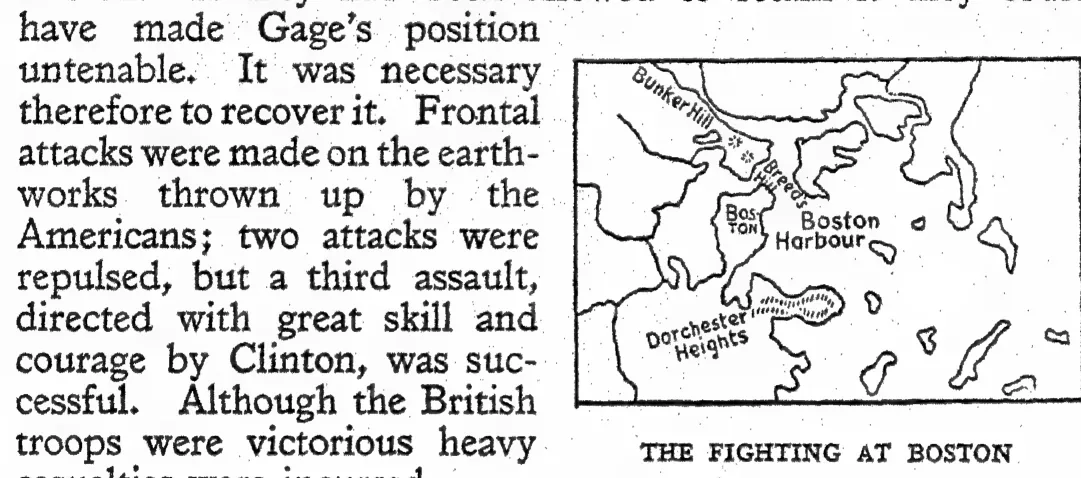
have made Gage’s position untenable, It was necessary therefore to recover it. Frontal attacks were made on the earthworks. thrown up by - the Americans; two attacks were repulsed, but a third assault, directed with great skill and courage by Clinton, was successful. Although the British troops were victorious heavy THE FIGHTING AT BOSTON casualties were incurred.
In May, 1775, Ticonderoga and Crown Point were captured by Benedict Arnold and Ethan Allen, and a few days later St. John’s was captured. This, however, was soon recovered by the British, and a garrison was stationed there.
In the autumn of 1775 an attack was launched by the colonials upon Canada, Allen marched against Montreal, but was taken prisoner. Montgomery started from Ticonderoga and laid siege to St. John’s; Carleton, the Governor of Canada, was unable to relieve it, and its capture was followed by the fall of Montreal. Montgomery then marched on to join Arnold, who was advancing upon Quebec.
Carleton’s forces were small, and the defences of the city were not in good condition, Nevertheless, he offered a stout resistance, and when an attack was launched on 31st Decemiber, 1775, it was repulsed, Montgomery being killed and Arnold wounded. The siege. continued for some time, but reinforcements reached Carleton in May, and soon afterwards the besiegers withdrew..
In October, 1775, Gage was replaced by Howe as commander-in-chief. Howe was convinced that the attempt to hold Boston was, strategically, a mistake, but for political reasons he was forbidden to evacuate it. Nevertheless, this would have been the better course, for in the following March
Washington planted batteries on the Dorchester heights, which commanded the town, and made Howe’s position untenable.
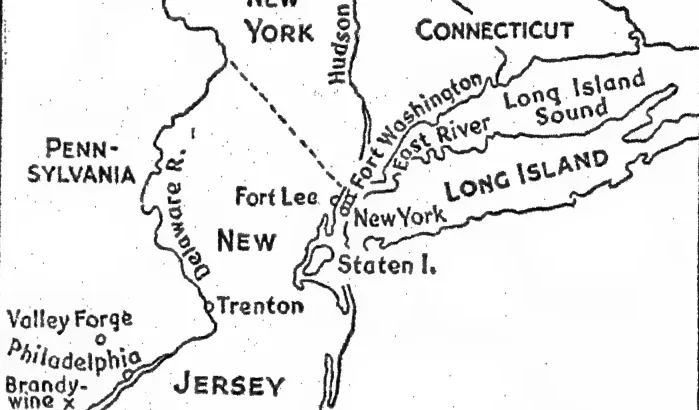
Boston was thereupon abandoned, Howe and his army retiring to Halifax, in Nova Scotia.
Admiral Lord Howe with a fleet reached Halifax and took his brother and.the army to Staten Island, near New York. Washington had established himself on Long Island, and the purpose of the British operations during the summer of 1776 was to take possession of the city of New York. Some unsuccessful efforts were made by. the Howes to treat with Washington, and on their failure an attack was made.
The Americans were driven from Long Island into New York, which soon afterwards they were compelled to evacuate with the loss of sixty-six guns. The importance to the British of the. capture of New York was great. Apart from its strategic value (it was situated equally well for the direction of campaigns towards north and south), the effect.of the incident upon the morale of the American army was bound to be serious.
Howe wasted time at New York which he might. have employed in further operations against Washington, but later in the year he captured Fort Washington, on Manhattan Island, while Lord Cornwallis took Fort Lee, on the New Jersey shore. The two forts were so placed as to command the passage of the Hudson River. They did not do so completely; nevertheless their capture was an important gain to the British. Cornwallis overran New Jersey, and Washington retreated across the Delaware River into Pennsylvania.
The recovery of New Jersey encouraged the Loyalists; the American troops were becoming thoroughly demoralised, and were deserting in large numbers, taking advantage of an amnesty offered by Howe. The Delaware River would be frozen in the course of the. winter, and when this happened Howe would be in a position to march on Philadelphia. Victory seemed to be within the grasp of the British.
Meanwhile, it was arranged that Carleton should advance from Canada and effect a junction with Howe. This movement, if successful, would cut the New England colonies off from the south. Carleton captured Crown Point, but was unable to advance by way of Lake Champlain without a fleet. With remarkable energy he had vessels built, and by October, 1776, he had a fleet on the lake. It was too late to attack Ticonderoga until the spring, and, leaving his army in winter quarters, Carleton returned to Quebec. His great services to the British cause were underrated in Great Britain, and in. 1777 he was directed to hand over his command to Burgoyne.!
Carleton thereupon resigned his governorship,
Howe remained inactive during the winter, and Washington took the offensive, capturing Trenton and recovering a large part of New Jersey.
In 1777 the scheme of advance from the north in order to sever cotmunication between the New England colonies and those of the south was revived, with Burgoyne in command of the northern army. The success of the movement depended upon the co-operation of Howe, but that general was anxious to capture Philadelphia..Both plans were sound, provided that neither interfered with the execution of the other. Howe left Clinton at New York with 8,ooo0 men to meet Burgoyne, and with 14,000 men he departed by sea to Chesapeake Bay.
1 Lord George Germaine, Secretary of State, was an enemy of Carleton, and probably misrepresented his services to the king.
He landed and defeated Washington at Brandywine, and sent
Cornwallis to occupy Philadelphia. He repulsed an attack by Washington, and in order to strengthen his forces sent for 4,000 men from Clinton’s small army. The season was now well advanced, and the British went into winter quarters at Philadelphia, while Washington was forced to encamp at Valley Forge. Again the fortunes of the Americans seemed to be at a low ebb; Washington’s army was ill disciplined and mutinous and was shrinking from desertions, and Howe was deserving of censure for his failure to overwhelm it by direct attack.
The capture of Philadelphia was a Pyrrhic victory. The operations had prevented Howe from giving that support to Burgoyne which was so essential to the success of his plan. Burgoyne advanced through hostile country, and Clinton, with depleted forces, struggled forward to meet him. But a colonial army under General Gates was too strong, and Burgoyne with nearly 6,000 men was forced to surrender at Saratoga.
This ended the first phase of the war. It had been a duel in which. Great Britain and her rebel colonists alone had been concerned. That the British had not won a decisive victory - over the amateurish, ill trained, and undisciplined forces at the disposal of Washington was due to the supineness of the British Government in not sending an adequate number of troops to America, to the weakness of the fleet under the command of Admiral Howe, to the inertia of General Howe in failing to follow up his victories, and to his failure to support Burgoyne. The first phase resulted in the definite loss of the New England colonies, and it brought. France into the field against Great Britain.
The character of the struggle was changed by the conclusion, early in'1778, of an alliance between France and the Americans, and by the entry of Spain into the struggle in 1779. Henceforth the: contest with the colonies was of secondary interest. A war between Great Britain and the Bourbon powers was a war to be fought out at sea, in the West Indies, in India, and in various other parts of the world. The outbreak of such a war’ brought all parties in Great Britain into agreement. Englishmen had been hopelessly at variance in the earlier stages
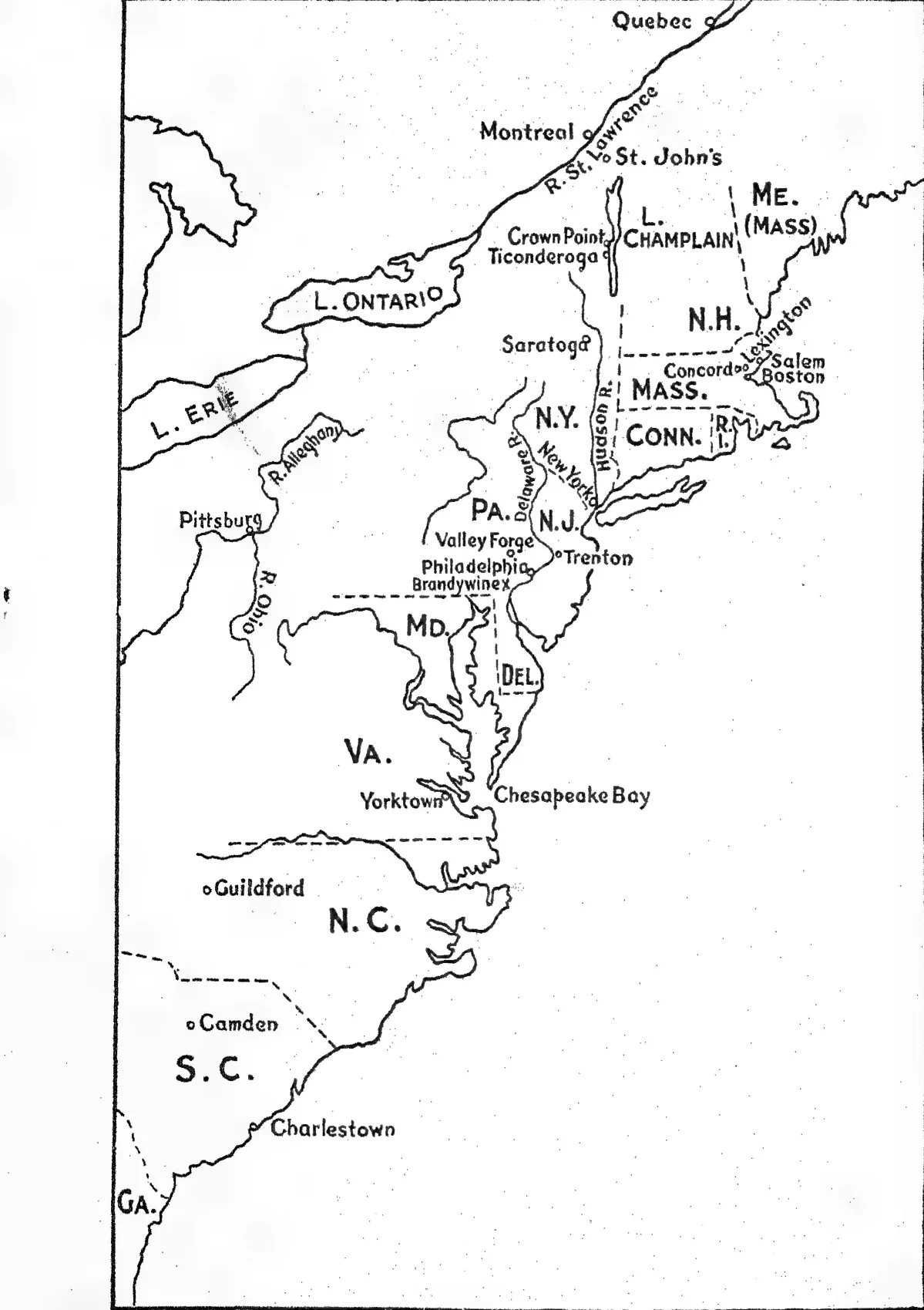
of the American quarrel; nothing else could have united them so effectively as a declaration of war by France.
The course of events in America after 1778 may be briefly narrated. Howe was relieved of his command and was succeeded by Clinton, who maintained his hold on New York, though he was unable to operate effectively against Washington in New Jersey. In 1780 he, with Cornwallis, went to the southern colonies and captured Charlestown, in South Carolina, taking a large nurriber of prisoners. Clinton returned to New York, but Cornwallis won a victory over Gates at Camden and remained miaster of South Carolina.
Advancing into North Carolina, in March, 1781, he inflicted a severe defeat on Greene at Guildford. He continued his northward march, and was reinforced by the arrival of a detachment under the command of Benedict Arnold, who had changed sides and was now fighting for the British. He expected to be able to effect a junction with Clinton, who, however, deceived by mistaken reports, was holding his troops in readiness to repel an attack by Washington upon New York.
Cornwallis reached Yorktown Peninsula; the French force at sea was overwhelmingly “strong, so that no help could be expected from that direction; he was invested on the landward side by Washington, assisted by a large French army under Lafayette. His surrender was inevitable. Clinton, having received reinforcements, sailed to relieve Cornwallis, but he was too late, and he returned to New York. The surrender of Cornwallis at Yorktown was the final event of the war in America.
Meanwhile, hostilities were being carried on against France and Spain, and, after 1780, against Holland. The French and Spanish fleets had been brought to a state of great strength and high efficiency since the Seven Years War, and the British fleet was in an inferior condition, A French squadron under D’Estaing captured St. Vincent and Grenada in the West Indies in 1779, and in the same year large French and Spanish fleets were engaged in the siege of Gibraltar.
The necessity. of providing against invasion prevented the immediate dispatch of adequate forces against D’Estaing. Both French and British received reinforcements in the West Indies during 1780, but no decisive action was fought. The entry of the Dutch into the war in 1780 had little effect, since their fleet was crippled by Sir Hyde Parker in an action off the Dogger Bank.
De Grasse assumed the command of the French West Indian fleet in 1781, and in the following year Rodney encountered him and defeated him at the Battle of the Saints. British naval supremacy was restored, and some months later Gibraltar was relieved by Lord Howe. But Rodney’s victory was too late. America was lost.
Preliminaries of peace between Great Britain and the United
States were agreed upon on 30th November, 1782, though they awaited inclusion in the formal treaty by which peace was to be made with France and Spain. Preliminaries of peace with these countries were settled in February, 1783, and the Treaty of Versailles, embodying all the terms agreed upon, was concluded in September, 1783. Great. Britain recognised the independence of the revolted colonies; their. boundary to the west was to be the Mississippi, and to the north a line running through the Great Lakes.
France recovered her three trading stations in India,1 Senegal and Goree in Africa, St. Lucia and Tobago in the West Indies, and St. Pierre and Miquelon in the St. Lawrence. Great Britain recovered certain other islands in the West Indies, and Gambia and Fort James in West Africa. Spain retained Minorca and recovered Florida.
She demanded Gibraltar also, but Great Britain refused to give it up, and, when Spain realised that if she insisted upon her demand she might be left to continue the war alone she withdrew it.
That the British were defeated in the struggle is not surprising. As already mentioned, victory might have been achieved if overwhelming military forces and adequate naval strength had been employed, under the direction of competent commanders, at the beginning of the war, while the American armies consisted merely of raw levies. As things were, the eontest was carried on in a country some thousands of miles from the British Isles, in a land familiar to its defenders but not to the British troops...
The forces employed were. inadequate for the task of crushing the rebellion, and the officers, who had..been trained in the principles of warfare as practised in Europe, were not altogether competent for the task of directing the fighting in a colony. Carleton, Burgoyne, and Cornwallis were capable and energetic, and so, in the main, was Clinton, who, however, should not have allowed himself to be deceived by Washington in 1781. Upon Howe must fall much of the blame for the failure of the war..
His inertia, his disinclination to follow up his successes, and his failure to act in concert with Burgoyne, are responsible for much of what occurred. Nor was sufficient account taken of the Loyalists. Many of them fought for the British, but in some parts of the country, and especially in New Jersey, devastation fell on the property of friend and foe alike, thus alienating many who might have remained attached to the British cause..The large part played in the fighting by Hessian troops contributed to the embitterment of feeling, and it is impossible to believe that the work of these men, participating in a quarrel not their own, was as effective as that of British troops would have been.
When to all these circumstances is added the fact that Great Britain was at the same time at war with several other European powers it is remarkable that disaster was not more complete. Yet, in spite of all, Great Britain might have pulled through and held her own had not the command of the sea been lost at a critical time. British naval weakness was the final reason for British defeat.
1 These places had been captured by the British donee the war. See
The results of the conflict were serious and important. It is not remarkable, however, that they were not properly realised at the time. So humiliating a peace, coming so soon after the Treaty of Paris, caused men to think that “the sun of England’s greatness had set.” But the sun had not set; it was merely obscured for a time by a passing cloud.
England’s greatness had not passed away, but the Old Colonial System, the system of commercial regulation based on the Navigation Acts, the system of keeping the colonies in permanent subordination to the mother country, was doomed. No further attempts have been made by British Parliaments to tax British colonies, ‘and, though the system of trade control was not formally _ abolished for another half-century, it was henceforth of little importance.
The position of the American Loyalists was very difficult. Their neighbours treated them with hostility, and many of them were glad to leave the new republic, the United States of
America, and settle under the British flag in Canada. They did not join with the French and Catholic peoples on the St. Lawrence, but some of them formed a new Canada in the region of the Great Lakes, a Canada which was British and Protestant; it was called Upper Canada to distinguish it from the other, which was henceforth known as Lower Canada.
Many others settled in Nova Scotia, in a part which was formed into a new province, New Brunswick.
The revolt was not without effects on this side of the Atlantic. Britain’s embarrassments afforded an opportunity to the Irish, who in 1782 were able to secure the grant of an independent Irish Parliament. France, too, felt the effect of American independence. She had assisted the rebels; French volunteers had fought side by side with Americans in order that the latter might resist British tyranny.
But when the French troops returned to their own country and related their adventures to their friends they could find no better description of this British tyranny than that it consisted of a threepenny tax on tea. The French peasantry suffered at the hands of the French aristocracy more serious oppression than this..
This is not the place to describe their grievances; it is evident, however, that if Americans could fight so strenuously and so long for what seemed so slight a cause the French might be stirred to move against the oppression that they had borne so long. This was not the least of the causes of the French Revolution.
Before the separation of the colonies from Great Britain it had been customary to transport convicts to the Carolinas and to Virginia, This was now impossible, and another destination had to be provided for these unfortunate wretches. In 1787 a body of convicts, under the command of Captain Phillip, was sent to Botany Bay, and in 1788 the first Australian settlement ‘was made? The future importance of the new colony: was not then realised.
It was regarded as suitable for the reception of convicts chiefly because of its remoteness. According to ‘the ideas then held, the man who committed serious crime was _ deserving of death, and, if mercy was shown him to the extent ‘of sparing his life, he ought to pass the remainder of it as far away as possible.
But the settlement then made, together with ‘others which followed from time to time, led to the establishment of a group of colonies scarcely, if at all, inferior in importance to those which had been lost. A new British Empire was built up, and a New Colonial System was evolved, a system tnder which colonies were regarded as infant nations, ‘destined in course of time to grow up and reach maturity and ‘to attain full equality of status with the mother country,
See ps 69. 2 See p. 96.
Chapter VICanada before Confederation
After the death of Wolfe at Quebec in 1759 the conquest of the French settlements on the St. Lawrence was completed by Lord Amherst, and by the Treaty of Paris, in February, 1763, Canada was left in British possession, The conquerors, almost immediately, had to face a formidable Indian attack led by Pontiac, a famous chief. Fighting continued for nearly a year before the Indians were overcome,
For some years no attempt was made to organise the government of the newly acquired possession. A royal proclamation of October, 1763, placed Canada under the authority of a military Governor. Lord Amherst, who had ruled the land since its conquest, and who had exercised his authority in such a way that the Canadians had speedily become reconciled to British rule, was succeeded as Governor by General James
Murray.
The population of the conquered territory numbered about sixty thousand, nearly all of whom were French and Roman Catholic. The only British in the colony, apart from Government officials, were a few hundreds of immigrants from the New England colonies who had settled in Quebec and Montreal for reasons of trade.
These men, of Puritan extraction, hoped for the establishment of a constitution in Canada on the model of those of the American colonies—a constitution in which the Roman Catholics would be excluded from all political power, The absurdity of an arrangement by which an Assembly elected by three or four hundred people would control over sixty thousand needs no demonstration.
Murray opposed the idea, and friction developed between him and the British settlers, The Governor felt bound to uphold the interests of the French habitants of the colony, whom, for many reasons, he admired. At length the British in Canada petitioned the Crown for Murray’s. recall, and in.1768 he was removed from his post.
From 1768 to 1777 the Governor of the colony was General
Sit Guy Carleton? (afterwards Lord Dorchester). He continued Murray’s policy of protection and conciliation towards the French habitants; he took pains to discover their grievances and to understand the problems which faced the colony. During a visit to Great Britain he placed his views before Lord North, then in office as Prime Minister, and as a result. the Quebec Act was passed in 1774.
The problems which called for solution at this time may be briefly stated here. Not least was the question of religion. Over ninety-nine per cent of the people of the new colony were Papists, and this at a time when the Romian Catholic faith was abhorred by the great mass of Englishmen and its adherents were subject to political and social disabilities.
To tolerate this faith would be repugnant alike to king and people of Great Britain; on the other hand, to impose restrictions would be to subject practically the whole population of Canada to persecution, Another matter which urgently needed settlement was the system of law which was henceforth to prevail; since the conquest great uncertainty had existed as to whether the established system of land tenure was to continue or whether it was to be replaced by a code more in accordance with English ideas.
By the Quebec Act of 1774 Canada was recognised as a Crown Colony. It was to be ruled by a Governor, who was to be advised and assisted by a Council of from seventeen to twenty-three members. The boundaries of the colony were defined; it was to extend as far west as the Mississippi and as far south as the Ohio and was to include the whole of the Great Lakes of the St. Lawrence basin, while to the east it was to take in Labrador.
The Roman Catholic religion was recognised, and freedom of worship was guaranteed;? the clergy were even given a legal right to tithe. French seigneurial tenure was recognised, and the French system of civil law which had long existed in Canada was continued, but a code of criminal law based on English principles was to be introduced.®
1 For an account of the circumstances under which Carleton resigned his Governorship see p. 59.
2 This provision was an indication of the existence in Great Britain of a belief that Canada would always be peopled by French Roman Catholics.
3 Although, judged by views which are prevalent at the present day, the English penal code of the eighteenth century was barbaric, it. was less severe than that of France, which included the use of torture, and the infliction of capital punishment by such methods as breaking on the wheel. The change, therefore, was in the direction of humanitarianism.
It will be observed that in the Quebec Act no attempt was made to introduce representative government into the colony. In the first place, any representative Assembly would certainly contain a Roman Catholic majority, and although the British Parliament had conceded liberty of worship to the Papists in Canada it was certainly not prepared to grant them such a measure of political power. Moreover, the French hitherto had had no experience, either in France or in North America, of representative government,’ and they neither ex-pected nor understood it.
The Council which was set up included a number of prominent French Canadians as well as English officials, and in this way it was possible for ‘the Governor to keep in touch with French opinion in the colony.
Independence.;
During and after the war many American Loyalists abandoned their homes in the United States and migrated into British tertitory.. They did not, however, intermingle with the French Canadians, but formed new settlements. As early as 1778 a -TIt will be understood, of course, that the Quebec Act was passed fifteen years before the French Revolution.
large body of Loyalists settled in Nova Scotia.t A considerable number established new homes farther up the St. Lawrence, in the region of the Great Lakes, and known as the Western Settlements of Quebec. A section of the Loyalists settled on lands to the south of the lower reaches of the St. Lawrence. This region was known as the Eastern Townships. Grants of land in the various regions were made to these immigrants, who were known as the United Empire Loyalists.”
Their arrival in the colony raised fresh problems of government and complicated existing problems. The autocratic system set up in 1774, suitable as it might be to the French Canadians, could not be regarded as satisfactory for the new-comers. Of their loyalty there could be no question; it was proved by their presence in Canada. They were men of
British stock; the representative principle had long been firmly established alike in Great Britain and in the American colonies from which they had migrated. Nor could objection to the establishment of a representative Assembly be raised on the score of religion, as they, for the most part, were adherents of the Church of England.
The constitutional problem was settled without marked difficulty in the case of the Nova Scotia Loyalists. A Repre-sentative Assembly had existed in Nova Scotia since 1758, It was not considered advisable to admit representatives of the immigrants to this body, but the part of the colony in which they had settled was formed into a new province, known as New Brunswick, and a Representative Assembly was established there in 1784.
The question was more difficult in Canada proper, where the differences in race and religion stood out in sharp contrast. With the steady increase in the numbers of the English, the French were already learning to assume that defensive attitude which has been their outstanding characteristic throughout the course of Canadian history. The simplest solution. of the problem would be the division of the colony into two parts, with French law, customs, and religion predominant in the one part, and English in the other. Carleton, now Lord
1 The migration into Nova Scotia was so considerable that the colony was unable to provide for the new-comers adequately.: Food supplies ran short, and some immigrants died from exposure.
2 An extensive tract of land was assigned to an Indian tribe, the Mohawks, which had supported Great Britain during the American War.
Dorchester, returned to the colony in 1786 for a second term as its Governor. He, perhaps to a greater extent than any other man, was competent to understand the problem. He could not fail to be sympathetic with the aspirations of the Loyalists; nevertheless, for some time he was opposed to the division of the colony and the establishment of Assemblies.
By the Canada Act, or the Constitutional Act, which was passed by the British Parliament in 1791, Canada was divided
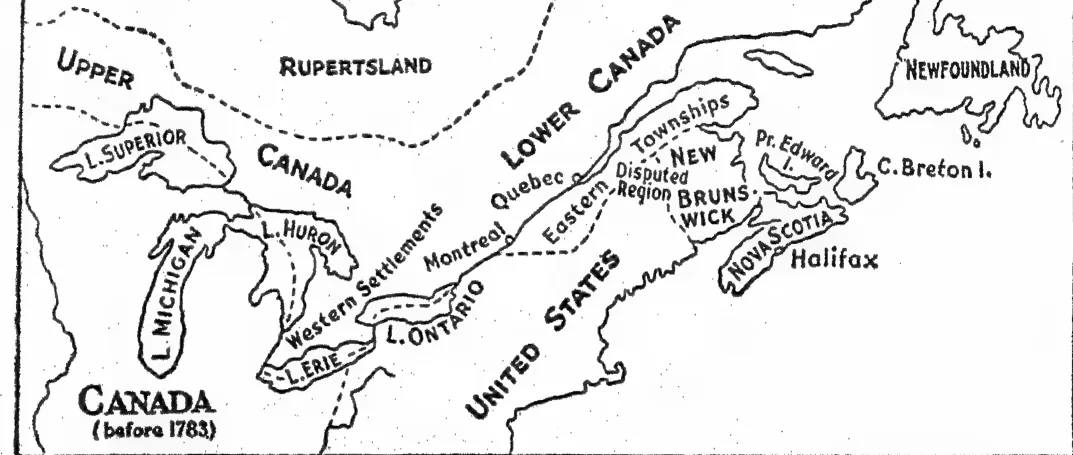
into two provinces. The French settlements were henceforth to be called Lower Canada (known to-day as Quebec), and the English settlements became Upper Canada (now known as Ontario), The Act failed to specify the boundary between the two provinces, and it was determined subsequently by royal proclamation. Separate Governments were established in the two provinces.
Each was to be ruled by a Lieutenant-Governor, who was to be subject to a Governor of Canada Each province was to have a Legislative Assembly, elected by the people, and a Legislative Council nominated by the Governor as the representative of the Crown. This legislature was given the power of making laws for the province.
The constitution thus set up bore a general resemblance to that of Great Britain, the Governor (or Lieutenant-Governor), Legislative Council, and Legislative Assembly in Canada corresponding roughly to King, Lords, and Commons at home. But the resemblance was not complete, for in Great Britain it was a well-established principle that the ministry must possess the confidence of the House of Commons.
If ministers suffered defeat in the Commons they must either resign or dissolve Parliament, and, if they chose the latter course and failed to secure a majority in the election, they must resign forthwith. In the Canadas, however, ministers were not responsible to the Legislative Assembly but only to the Governor who ruled the colony, and criticism in the Assembly was powerless to bring about a change of Government. This is a stage in the evolution of colonial government in which the colony is said to possess representative institutions but not responsible governmient.
1 In practice, the Governor of Canada was unable to exercise control over the Liewtenant-Governor of Upper Canada, on account of difficulties of communication..The Governor resided at Quebec, and ruled Lower Canada. The position of Lieutenant-Governor of Lower Canada became practically a sinecure; its occupant frequently resided in England. The arrangements in the Act for supreme authority over both provinces to be eae Py a Governor thus became ineffective, and they became entirely
A further provision of the Act of 1791 was the establishment and endowment of the Church in Canada.. Lands, equal in value to one-seventh of the lands granted for other purposes, were to be set apart for the support of a Protestant clergy,+ and provision was made for the erection of churches and parsonages as new towns and villages came into existence.
The administrative system established by the Canada Act lasted for half a century, a period of great progress. Population increased steadily, immigrants arriving from the United States, and, after 18125, from Great Britain. Soldiers discharged from the army, paupers from the workhouses, crofters from the Scottish Highlands, and peasants from the south of Ireland, were among the new settlers during this period. Life for the pioneers was hard, but in course of time commiunications, by road, river, and canal, improved, and prosperity developed.
Between 1812 and 1814 Great Britain was at war with the United States. The Americans resented the British Orders in Council,? by which a blockade of the continent of Europe was enforced, to the detriment of American trade, and they were angered by the British claim of the right to search American ships for deserters from the British navy. Canadians thus became involved in a war arising out of matters in which they had. no real interest.
The Americans endeavoured, with little success, to stir up disaffection among the colonists. A good deal of fighting occurred on both sides of the border before peace was restored. The war had at least the effect of checking the growth of republican sentiment in Canada, and ill-feeling between the United States and Canada remained for many years.
1It was afterwards decided that the phrase referred to the clergy of the
Church of England and the (Presbyterian) Church of Scotland, but not
to the ministers of any other religious organisation.
2 The Orders in Council were withdrawn by Great Britain a few days
after the declaration of war.
In course of time a good deal of discontent developed in Canada. It was felt that the government of the colonies under the Constitutional Act of 1791 was not altogether satisfactory. The Governor (or Lieutenant-Governor), with his Executive and Legislative Councils, was not on good terms with the elected Legislative Assembly. In each province the Government was practically controlled by a small group of Loyalists, and the representatives of the people were unable to make their views prevail.
In Lower Canada the Assembly naturally contained an overwhelming majority of Frenchmen, while the Councils, Executive and Legislative, members of which were appointed by the Governor, were composed of men of English descent, The policy of appointing Englishmen to the Councils was considered to be necessary in order that British interests might not suffer at the hands of the French.
In 1831 the Legislative Assembly of each province was granted the right to control the finance of the colony provided that prior provision was made for the salaries of the Governor nd other leading officials, In Lower Canada the Assembly refused to comply with this condition, and a constitutional deadlock followed. But the Governor was able to command certain sources of revenue—from land and from customs duties—independently of the Assembly, and by this means the administration was carried on.
Racial antipathy continued to exist. In Lower Canada the French became more and more on the defensive, and, rightly. or wrongly, were antagonistic towards the ruling clique. In Upper Canada racial feeling followed a different course. The bulk of the inhabitants were loyal, but a minority, consisting of recent immigrants from the United States, favoured union with the republic.
The Loyalist elements were favoured by the Lieutenant-Governor, and membership of the Councils was almost confined to a limited group which, in course of time, came to be known as the “Family Compact.” A Reform party was formed to combat the control of the colony by the Family Compact, which endeavoured to beat off the attacks of its opponents by making against them insinuations of disloyalty to the British connection.
The question of the Clergy Reserves provoked dissatisfaction, Lands allotted to the clergy, in accordance with the Act of 1791, were to be found in every township in the colony. They were frequently left untilled, and their existence added to the difficulty of orderly development. Moreover, much resentment was felt by Baptists and Methodists at the practical limitation of these grants to the Anglican and Presbyterian Churches.
Finally, the relative position of the two provinces caused difficulties in connection with trade... The commierce of Upper Canada had to pass, by way of the St. Lawrence, through the territory of Lower Canada, which, therefore, was able to affect the finance and trade of the sister province by the amount of the duties which could be imposed. By the Canada Trade Act of 1822 it was enacted that one-fifth of the total amount received from customs should be paid to Upper Canada, the Assembly of which should have some voice in the fixing of the schedule of duties.
In 1837 discontent found expression in the form of revolt in both colonies. In Upper Canada William Lyon Mackenzie, a journalist, led a rising which aimed at establishing an independent republic. At the same time, Louis Joseph Papineau led a rebellion in Lower Canada. In neither province was the fighting unduly prolonged. Neither movement received widespread support, and both were crushed. Both ringleaders took refuge in the United States, The importance of the risings lay not in their extent but in the fact that attention was drawn to the discontent which had brought them about.
In 1838 the British Government sent Lord Durham to Canada as Governor and High Commissioner to investigate the conditions which prevailed there and. to examine the causes of colonial discontent.. During his tenure of office Durham offended many people by his haughtiness, and he was “1The Maritime Provinces, in which there were grounds of discontent similar to those in Upper Canada—the monopolising of the Government by a ruling clique—were unaffected by the revolt.
certainly guilty of high-handed action and even of exceeding his powers. He ordered the deportation, without trial, of a number of captured rebels to Bermuda. This was illegal, and the British Government disavowed his action. Durham thereupon resigned and returned home.
The factors indicated by Lord Durham as contributing to Canadian discontent were those referred to above. He strongly recommended the reunion of Upper and Lower Canada in order to promote the fusion of the two nationalities, and, since deficiency of communication hindered freedom of intercourse, he advocated the construction of an intercolonial railway, beginning with a line from Halifax to Quebec. The constitutional question could, in his opinion, be settled only by the establishment of responsible government.
The ministry, as in Great Britain, should be responsible to the elected chamber in Parliament; it should hold office while it commanded a majority, and it should be expected to resign in the event of defeat. In order to check parliamentary extravagance he proposed the adoption in the Canadian Parliament of a rule already prevalent in that of Great Britain—that grants of money should never be proposed by a private member but should be initiated by ministers. Finally, Lord Durham made suggestions for the improvement of local government throughout the colony.
The constitutional system thus outlined in the Durham report fell short of full independence in several respects. It was understood that the sovereignty of the British Parliament would remain unimpaired. It would retain the right of legislating for Canada, although this right would be exercised only on exceptional occasions and for special reasons. The control of colonial trade and of public lands was to be reserved to the British Government. The direction of foreign affairs would continue to be exercised by the British Secretary of State for Foreign Affairs. And the Canadian Parliament would not possess authority to alter its own constitution.
By the Reunion Act, which was passed by the British Parliament in 1840, Upper Canada and Lower Canada were united into one colony, which was to have a Parliament of two Houses. The Legislative Council was to consist of a minimum of twenty members, appointed for life,| while the Legislative Assembly was to comprise eighty-four members, half from each province.”
The population of Lower Canada substantially exceeded that of Upper Canada, so that the representation of the two provinces was not proportionate to population; it was held, however, to be desirable to avoid any possibility of the French obtaining a majority in the Assembly.2 The official language of the colony was to be English.
No definite mention was made of responsible government, but it was understood that, as in Great Britain, ministers would be of the party which commanded a majority in the lower chamber, and that a defeat of the Government would involve either its resignation or the dissolution of Parliament.>
The Retnion Act was opposed in both provinces. But the French in Lower Canada could do little to express their dislike of the change, since their Legislative Assembly had been suspended since the rebellion. In Upper Canada the loyalty of the ruling clique was ultimately strong enough to overcome their misgivings.
The system of responsible government could be worked satisfactorily only if two conditions were fulfilled. It was necessary that there should normally be two, and only two, important political parties in the state, the one in office and the other in opposition;® the party which happened to be in
The growth of population in Upper Canada was more rapid than in Lower Canada, and in course of time the English began to press for representation in proportion to population. This was now opposed by the French, who denounced the suggestion as a violation of the arrangement entered upon in 1840.:
The importance of this point in the successful working of constitutions framed on the British model is not always recognised.. In some countries, as in France, politics follow the “group” system rather than the party opposition should be of sufficient importance to assume office in the event of the Government being defeated.
And it was necessary that the head of the state—the Crown in Great Britain, the Governor in Canada—should be detached from political life, that he should be above party, that his personal views should not be obtruded, and that he should be willing to act in accordance with the advice of his ministers.
The head of the state might render it most valuable service by the informal advice which he might, out of the plenitude of his experience of public affairs, give to his ministers, But decisions should be made by ministers, and, when tendered by them to the head of the state in the shape of formal advice, should be accepted by him.
system. There may be several such groups, no one of which has any chance
of obtaining a majority over all the others combined.. A Government
1 In 1856 the principle of election for membership of the Legislative Council was introduced.
2 Subsequently increased to sixty-five for each province.
4 Within a few years the English and French languages were put on an equal footing.
5 It was hardly possible to enforce responsible government by statute. It would have been absurd to make it.an offence punishable at law for ministers who had been defeated to refuse to resign!
Neither of these conditions existed in Canada in 1840. Lord Sydenham, who was appointed Governor in 18309, realised that in the absence of a clear-cut party system it was essential that he should take an active part in the government of the colony. He did something towards establishing a homogeneous group of ministers, and, before his death in September, 1841, there were indications of the formation of an opposition party. Lord Metcalfe, Governor from 1843 to 1846, took a different view of the position.
He was unwilling to subordinate his opinions to those of his ministers, and a serious constitutional crisis occurred, as a consequence of which there was for some months no ministry at all, Not until Lord Elgin, the son-in-law of Lord Durham, became Governor in 1847 was the system of responsible government -established in full working order.
Elgin recognised the entire propriety of yielding to the views of the ministry, even when they were in conflict with his own opinions, and the example set by him was followed by his successors,
Until the middle of the nineteenth century the settlements can be formed only by the alliance of two or three groups, and for various reasons such alliances do not last long. Hence ministries do not last long, Frequent changes of Government can hardly be good for the state, and they tend to bring parliamentary institutions into contempt.
The existence of three political parties in Great Britain since the beginning of the twentieth century seems to run counter to the above assertions, But one of these parties appears to be doomed to extinction, its members being absorbed in one or other of its more. powerful rivals. The fundamental reason for the inability of a middle party to survive lies in the fact that, when any practical question comes to the front, in the last resort only two attitudes are possible—support and opposition. There is no room for a half-way auswer between “ Yes” and “No,”:
in British North America were, with a few slight exceptions indicated below, limited to Canada and the Maritime Provinces. The vast regions of the west and north-west were given over to hunters and trappers. British rights over the territory round Hudson Bay had, by the Treaty of Utrecht, 1713, been recognised by the French, and the trade in furs from this region, known as Rupert’s Land, was monopolised by the Hudson’s Bay Company, which had been founded in 1670,
In 1783 another fur-trading company, the North - West Company, was formed at Montreal to develop the fur trade in the vast expanses of the west and north-west which were outside the territorial limits of the Hudson’s Bay Company’s monopoly. Much valuable exploring work was carried out by the agents of the North-West Company, and one of them, Alexander Mackenzie, in 1789 sailed down the river which has since been named after him to the Arctic Ocean, In 1792 Mackenzie set out from the shore of Lake Athabasca, and, travelling westwards for several months, crossed the Rocky Mountains and reached the Pacific in the summer of 1793.
Mackenzie afterwards formed a new company, known as the X.Y. Company. This, however, was united to the North-West Company in 1805, and for many years the North-West Company and the Hudson’s Bay Company were engaged in bitter and unscrupulous rivalry. In 1821, under pressure from the British Government, they consented to amalgamate, taking the name of the older company. This enlarged Hudson's Bay Company was granted a monopoly of the fur trade over the whole region from Hudson Bay to the Pacific.
It became renowned for its absolute fairness in dealing with the Indians; the record of the rule of the Hudson’s Bay Company during the next half-century stands as an example to white men exercising jurisdiction over coloured races in any part of the world.
The Hudson’s Bay Company discouraged settlement in the territory under its control. As early as 1812 a settlement had been established by Lord Selkirk at the junction of the Red and Assiniboine Rivers, It was attacked by the half-breed employees of the North-West Company, and Selkirk’s efforts to obtain redress in the courts of Upper Canada failed. Nevertheless, the settlement was not entirely overwhelmed, and in course of time it developed into what is now known as Manitoba.
A few trading settlements had existed in the region west of the Rockies since the early years of the century. Although, as stated above, the trade of this territory passed within the monopoly of the Hudson’s Bay Company in 1821, for administrative purposes it was under the authority of the Lieutenant-Governor of Upper Canada. This was an utterly absurd arrangement; the Government of Upper Canada was incapable of ruling a territory so remote, and the administration of the region was in practice undertaken by the Company. The discovery of gold in 1857 caused a big inrush of people, and, though some of them left after a time, many remained. In
1858 the monopoly of the Hudson’s Bay Company with regard to lands west of the Rocky Mountains was discontinued, and British Columbia was constituted a Crown Colony, which in
1864 was granted a Representative Assembly. Vancouver Island, which in 1849 had been assigned to the Hudson’s Bay Company, was in 1866 united to British Columbia.
For many years the question of the boundary between Canada and the United States caused trouble between Great Britain and the republic. A boundary line was prescribed in the Treaty of Versailles, in 1783, but difficulties arose over its interpretation. It was agreed in 1818 that from the Lake of the Woods to the Rocky Mountains the boundary should run along the forty-ninth parallel of north latitude.
The line in the region of the Great Lakes and the St. Lawrence was not seriously in dispute, but that between the state of Maine and the colony of New Brunswick was the cause of grave difficulty, While the region was unoccupied the question was not acute, but with the advance of lumbermen into the disputed territory the matter called for settlement. It seemed possible at one time that fighting might break out, but wiser counsels prevailed, ane gue boundary line was settled by the Ashburton Treaty of 1842.
Further disputes arose over the boundary in the Pacific region. The line had never been marked in the zone of the Rockies, and the Americans claimed at first that the fortyninth parallel should be extended to the coast. The British Government wished for the Columbia River to be regarded as the boundary, and the Americans replied by putting forward a claim that the parallel of latitude at fifty-four degrees forty minutes north of the Equator should divide the two countries, The Democratic party in the United States adopted as its slogan in the presidential election of 1844, as a result of which James Polk was chosen President, the cry, “ Fifty-four forty, or fight.”
The claim, in its more extreme form, was for the recognition of this line as the boundary not only in the Pacific and Rocky regions but in the prairie lands also, and, if admitted, would have included all the best prairie lands within the United States, leaving to Canada little more than the bleak and frozen wastes of the north.
Polk was eager for war, but the American Senate refused to support him,! and by the Oregon Treaty it was agreed that the boundary should run along the forty-ninth parallel as far west as the coast and that the whole of Vancouver Island should be recognised as British territory.
During the twenty-seven years between the Reunion Act and the establishment of the Dominion, Canada witnessed a steady advance in population and in material prosperity. Until the middle of the nineteenth century the population of Lower Canada exceeded that of Upper Canada, but the continuance of immigration ultimately enabled the English - speaking province to outstrip its rival. The repeal of the Corn Laws in Great Britain affected Canadian agriculture adversely for a time (for while the Corn Laws existed a substantial preference had been granted on corn from the colonies), but the repeal of the Navigation Laws in 1849 more than counterbalanced this, since Canadian trade was thrown open without restriction to the whole world.
That responsible government was becoming a reality in this period is indicated by the fact that in 1859 a protective tariff was established on certain classes of imported goods, including those from Great Britain. The British Government protested, but did not venture to override the colony on the matter. A further indication of the extent to which Canada was advancing towards the status of a fully developed nation was the fact that she no longer needed British troops for purposes of defence. During the sixties British forces were gradually withdrawn, a process which was complete by 1870, except for a small garrison at Halifax.
The question of the Clergy Reserves still caused a good deal of irritation, By an act of the British Parliament in 1841 these lands were apportioned among the Anglicans, Presby-terians, and other Protestant bodies. Friction continued, however, and in 1854 the Reserves were surrendered, due provision being made for the life interests of clergy who were being supported from them.
1Under the American Constitution the control of foreign relations is
to a large extent in the hands of the Senate.
Canadian political life did not run smoothly during this period. There were still too many parties, and ministries could be formed only by the alliance of two or three groups. Such alliances rarely lasted long, and changes of ministry were frequent, a circumstance which tended to bring the whole system into disrepute. Matters came to a head in Canadian politics in 1864, when, after rapid changes of ministry, no party seemed to be able to maintain a majority in the Legislative Assembly..
The attitude of the United States at this time caused uneasiness; the Civil War came to an end in 1865, and it was feared that the Americans, who had resented the action of the British Government in recognising the Southern States as belligerents, might attempt to force Canada to enter the republic.
For some time the wiser men in Canada had been attracted by the advantages to be obtained by a federation of Canada with the Maritime Provinces of Nova Scotia and New Brunswick. A British North American Federation would be far more capable than a group of separate provinces of maintaining its independence of its powerful neighbour.
A coalition ministry representative of several groups was formed in Canada, with a view to bringing about a federation. A conference of delegates of the Maritime Provinces was meeting at Charlottetown to consider a confederation among themselves, Canadian ministers invited them to adjourn to Quebec in order to discuss, with Canadian delegates, the larger question of a federation of British North America.
That difficulties should be encountered was inevitable; the people of the Maritime Provinces viewed the proposals with a good deal of suspicion, and the French of Lower Canada feared that they would be swamped in the larger political unit which would be brought into existence. Prince Edward Island withdrew, but Nova Scotia, New Brunswick, and Canada sent delegates to a final conference in London, at which the terms. of the federation - were settled. They were embodied in the British North America.Act, which was passed by the British Parliament in
Chapter VIIThe Dominion of Canada
original Dominion consisted, therefore, of four provinces, Quebec, Ontario, Nova Scotia, and New Brunswick. Provision was made in the Act for the admission of other provinces to the confederation.
The general lines of the constitution of the Dominion! of Canada were modelled on that of Great Britain. At its head there was to be a Governor-General, representing the Crown, He was expected to rule in accordance with the advice of ministers and, generally, to adopt that detached, non-partisan attitude which in modern times has characterised the monarchy in Great Britain.
There was to be a Parliament for the Dominion, consisting, as in Great Britain, of two Houses. Members of the Senate were to be chosen for life, and those of the House of Commons were to be directly elected. The principle of equality of provincial representation, set up in the Act of 1840, was abandoned, and representation was to be proportionate to population.
A problem which had called for resettlement from time to time in Great Britain was solved in Canada by a provision for a redistribution of seats after each decennial census. Quebec was always to have sixty-five members; 1 ithe number to be assigned to each other province was to bear the same ratio to sixty-five as the population of the province
1 Jt was at first intended to apply to the new confederation the term “Kingdom.” This was dropped, and: the expression “Dominion” substituted for it, in order that no offence might be given to the United States. 4 5
‘bore to that of the province of Quebec. The ministry was to ot eee
‘be fully responsible to the House of Commons. There was,
‘indeed, no explicit reference in the Act to responsible governament, other than that implied in the words, “‘a constitution similar in principle to that of Great Britain.” But, if a
Governor-General should attempt to retain a ministry which had not the confidence of the House of Commons, a deadlock could be brought about by a refusal to vote supplies.
In each province there was to be a Lieutenant-Governor.
Parliaments were to be established in each province, and ministers were to be responsible to them.
Canada was so close to the United States that it was hardly ee ee
. possible for the architects of its constitution not to be influenced by what they had observed of the working of that of the republic. They considered that the most serious defect of the constitution of the United States lay in the large degree of independence retained by the States, and the consequent weakness of the central Government. During the American
Civil War it had seemed possible that the union would split into two, if not three, distinct parts. This did not happen; the
Federal Government defeated the secessionists. Nevertheless, the Fathers of the Canadian constitution thought that the path of wisdom lay in the direction of strengthening the central Government and reducing the provinces to a subordinate position, and they took definite steps to this end.
The Lieutenant-Governors of the provinces were to be appointed, and might be removed, by the Governor-General, and, as he was expected to act on the advice of his ministers, it followed that the Lieutenant-Governors would be men in general sympathy with the policy of the Dominion Government. They might, in fact, be regarded as agents of the Dominion in the provinces, The Senate was to be nominated by the Governor-General, on ministerial advice, and thus was unlikely to consist, as in the United States, of champions of provincial tights.1_ Further, the Dominion Parliament was empowered to disallow provincial statutes.
4 The representation of Quebec might be increased, but if this were
done the representation of the other provinces’ was to be increased pro-
portionately. This has never been done,
But the most important indication of a determination to assert Dominion supremacy was to be found in the allocation of powers as between central and provincial Governments. Certain spheres of government activity were assigned to the provinces,? and the residue was left to the central authority. There was, indeed, for the sake of definiteness, an enumeration of the powers of the latter,? but it was not meant to be exhaustive.
Since the formation of the Dominion there has been a strong tendency, in Canada as elsewhere, for Governments to interest themselves in many matters which were formerly considered to be outside their range. For the most part these new spheres of activity, not being included within the limited enumeration of provincial powers, have come under the direction of the Dominion Government, the importance of which has been steadity enhanced.
Yet it must be admitted that constitutional development since 1867 has not been altogether in the direction that was expected. The provincial Parliaments have not been reduced to the level of English county councils, The federal power of disallowing the statutes of provincial Parliaments was used with some frequency at first, but its exercise has become rarer, and is now, in fact, quite exceptional.. So much resentment is evoked in any province whose legislation is thus annulled that the Dominion Government now refrains from exercising its powers unless very strong grounds exist for doing so. Then, too, the enumeration of provincial powers,
? The functions of provincial Governments included the right to amend the provincial constitution, the imposition of direct taxation, the control of prisons, reformatories, and hospitals, the control of railways which were wholly within the province, the law relating to marriage, education, property, and civil rights, municipal institutions, the incorporation of companies with provincial objects, and the administration of justice within the province.
1 In the United States the Senate consists of two members from each State, irrespective of the size or population of the State. The representa~ tives of the less important States are naturally prepared to oppose any encroachment on the rights of such States by a Federal administration which may receive the bulk of its support from a few wealthy and populous ’ States, such as New York and Pennsylvania.
3 Among the spheres of administration assigned to the central Government were included defence and the militia, the control of trade, of inter-provincial railways and companies, of the post office, and of foreign affairs, the protection of Indians, and the levying of customs duties.
which was intended to emphasise the limitation of provincial authority, has proved to be a bulwark of provincial rights. In legal cases in which there has been question of the scope of the power of a provincial Parliament, the courts have been ready -to uphold the rights of the provinces and to resist any tendency towards reducing them by a narrow interpretation of the constitution.
To a certain extent it may be regarded as desirable that the provinces should retain some degree of independence of central control. It can hardly be maintained that rigid uniformity of administration should be enforced throughout a region nearly as large as Europe, characterised by great diversity of conditions, physical, economic, and social. Nevertheless, it is possible for local autonomy to be carried too far—so far, in fact, as to become a disruptive force. The men who, in 1867, aimed at strengthening the central Government worked on sound lines. Canada could not become a great nation if her central Government were weak.
One of the first difficulties which had to be faced by the Dominion Government, of which Sir John Macdonald was the first Prime Minister, was the attitude of Nova Scotia. The federation was unpopular in this province, and a movement for secession was headed by Joseph Howe. Some readjustment of the financial terms between the Dominion and Nova Scotia was agreed upon, and an intercolonial railway which would ultimately link up Quebec with Halifax was begun. The agitation died down, and Nova Scotia remained in the Dominion. A formidable danger had been encountered and overcome,
Soon after its formation the Government of the Dominion resolved to take over from the Hudson’s Bay Company the west and north-west. Negotiations between the Government and the Company resulted, in 1869, in an agreement that the latter should surrender its monopoly in return for a payment of £300,000, and the right to claim certain lands in regions of settlement.
The lawless half-breeds of the Red River Settlement, many of whom had been in the employment of the Hudson’s Bay Company, resented the change, fearing that the establishment of Dominion rule would result in some curtailment of their liberty, In 1870 they revolted under the leadership of Louis Riel, a French half-breed and a man of some education and capacity. A “Provisional Government” was set up with Riel as President.
Some fighting occurred, but, on the approach of a force under Colonel Wolseley, Riel retreated into the United States. Grants of land were made to the half-breeds in the hope that they would settle down and become peaceful citizens, but most of them sold their lands and retired into Saskatchewan. In 1870 the province of Manitoba was established and was admitted into the Dominion, Fort Garry, an old Hudson’s Bay post, was renamed Winnipeg, and became the provincial capital.
The case of British Columbia was difficult. It was Separated from the Dominion by many hundreds of miles of prairie and mountain. For some years after the establishment of the Dominion communication between British Columbia and, eastern Canada could be maintained only through the United States; even postal communication was carried on in this way. The inclusion of the western province within the Dominion was clearly impossible unless a more satisfactory means of communication could be devised, and in 1871 British Columbia joined the Dominion conditionally upon a trans-continental railway being constructed within ten years.
The vast prairie region between Manitoba and the Rockies was still given over to Indians and fur-traders, It was under the nominal control of the Lieutenant-Governor of Manitoba, assisted by a Council of the North-West appointed by the Dominion Government. In 1874 the Canadian North-West Mounted Police Force was instituted, and this body of men gradually established law and order over a vast territory. The trade in whisky, which was working havoc among the Indians, was suppressed. In 1876 a separate Lieutenant-Governor was appointed for the North-West Territories. Settlement developed, and in 1882 four territories—Assiniboia, Saskatchewan, Alberta, and Athabasca—were marked out. Each was under a Lieutenant-Governor, and within a few years Legislative Assemblies were set up,
Many of the inhabitants of Saskatchewan were half-breeds who had been concerned in the Red River Rebellion of 1870. Fresh causes of discontent appeared, especially in the method. of allocating land adopted by the Dominion Government. Louis Riel, who was living in the United States, crossed the border to lead another revolt, The half-breeds were not numerous; nevertheless, severe fighting occurred ‘before the rebellion was crushed. Riel was captured and hanged.
. The advance of the prairie territories in population and material prosperity was substantial enough to justify the establishment in 1905 of two provinces. The territories of Assiniboia and Saskatchewan were formed into the province of Saskatchewan, while Athabasca and Alberta were amalgamated to form the province of Alberta.
Gold was discovered in the Yukon region in 1896, and by 1898 there was a big rush to the diggings. Order was maintained by the North-West Mounted Police, whose work was so efficient that life and property were as safe in Dawson City as in Montreal, Yukon was constituted a separate territory in 1898. The boundary between Yukon and Alaska was settled iby arbitration in 1903; neither the United States nor Canada was able to secure all that it had claimed.
When the provinces of Saskatchewan and Alberta were formed in 1905 it was decided that the sixtieth parallel of north latitude should be their northern boundary, At the same time Manitoba was extended northwards to the same line, Canada north of the sixtieth parallel, therefore, comprises the Yukon Territory and the North-West Territories. This latter term formerly applied to a vast area under the supervision of the Hudson’s Bay Company; it now refers to the residuum left after the establishment of the other political units referred to above. The North-West Territories are divided into the three ‘Provisional Districts of Mackenzie, Keewatin, and Franklin. ‘They are administered by a Commissioner who acts under the general direction of the Dominion Government at Ottawa.
The construction of a transcontinental railway line, which was contemplated when British Columbia joined the Dominion, was begun by the Dominion Government. In 1873, however, a company, known as the Canadian Pacific Railway Company, ‘was formed to carry on the work. It was asserted that Sir Hugh Allan, the president of the Company, had made large presents to the election funds of the Prime Minister, Sir John Macdonald, and in the course of the investigation which was ordered ample proof of the truth of these charges was produced. Macdonald was defeated at the general election at the end of 7873, and Alexander Mackenzie, a Liberal,} became Prime inister.
1 The groups which had been a feature of Canadian politics earlier
in the century had by this time coalesced into two definite parties—
Conservative and Liberal.
Allan’s Canadian Pacific Railway Company was dissolved, and, as Mackenzie had little belief in either the possibility or the necessity of a transcontinental railway, progress was slow for some years. But in 1878 Macdonald returned to office and set to work with vigour to carry the scheme through. There had already been too much delay. British Columbia was becoming restive; in 1878 its Legislature passed a resolution in favour of secession from the Dominion.
In 1880 a new Canadian Pacific Railway Company was formed to carry the work through to completion, and, as the Dominion Government was really desirous of avoiding friction with its western province, very generous terms were granted to the new company. It was presented with the line as far as it had already been constructed (about six hundred and seventy miles), it was paid the sum of twenty-five million dollars, and it was granted all the land necessary for the completion of the line.
It was given, further, a belt of land on either side of the line, which, in course of time, it could sell to settlers, and it was authorised to cut all the timber needed in constructional work. Needless to say, criticism was aroused by the generosity of these terms, but it is probable that in no other way could the railway have been completed. The directors of the Company drew upon all the reserves of capital at their command, and again and again they had to apply to the Government for assistance.
The line north of Lake Superior, between Ottawa and! Winnipeg, ran through a region of rock and swamp and forest,. much of which was unexplored. Across the prairies construction was carried on at great speed, but in the region of the Rocky Mountains the engineering difficulties were very great, Vast areas hitherto untrodden had to be explored, routes had to be selected, and many tunnels and bridges had to be built. The line crossed the ridge of the Rockies by the Kicking Horse Pass.
Its completion, in November, 1885, was. of great political and economic importance. It satisfied the British Columbian demand for direct communication with eastern Canada, and it made possible the settlement of the prairies and the development of their natural resources,
The success of the Canadian Pacific Railway and the consequent growth of settlement on the prairies led to a demand for the building of further transcontinental railways. The Grand Trunk Pacific Railway (now part of the Canadiay National Railways) was begun in 1903 and completed in 1914.
From Halifax, Nova Scotia, it ran to Moncton, in New Brunswick, and thence through the northern part of the provinces of Quebec and Ontario to Winnipeg. From Winnipeg it followed a route well to the north of the Canadian Pacific, crossing the Rockies by the Yellow Head Pass and terminating at Prince Rupert, on the coast of the Pacific. The Grand
Trunk thus opened up a belt of territory which was untouched by the Canadian Pacific.
A good deal of controversy has been evoked by the financial condition of these two lines. The Canadian Pacific has prospered and has paid comfortable dividends on its capital;
the Canadian Nationals were for many years run by the State ri save at a loss. This loss has, necessarily, been made good out of
Dominion funds, and it has been argued that the Canadian
Pacific Company, as a taxpayer, has been called upon to finance its rival. It has been pointed out, on the other hand, that the prosperity of the Canadian Pacific is to some extent due to the advantageous terms it was able to extort from the Government when it was formed. Moreover, its geographical position is superior to that of its rival. The fortunes of these two groups are often referred to in controversies on the merits and demerits of the state ownership of railways, by advocates and opponents alike. So many factors, however, bear upon the question of the causes of the greater prosperity of the
Canadian Pacific that no very certain conclusions can be drawn about the advantages of the private ownership of railways in general.;
The Canadian Northern Railway, a third transcontinental line, was completed in 1915 by the linking up of several smaller lines, It crosses the Rockies by the Yellow Head
Pass and reaches its terminus at Vancouver.
'.’ One of the outstanding political questions which has from time to time agitated the Dominion has been that of trade ‘policy. A low tariff existed from the beginning of the confederation! Sir John Macdonald was a believer in Free ‘Trade, but in the course of the period of trade depression which began in the seventies he saw that a policy of high protection would be popular, and he put forward what was known as a National Policy. The Liberal Government under _- Mackenzie resolved, on the other hand, to adhere to the existing tariff, At the General Election of 1878 the Liberals
1In Canada it existed from 1859.
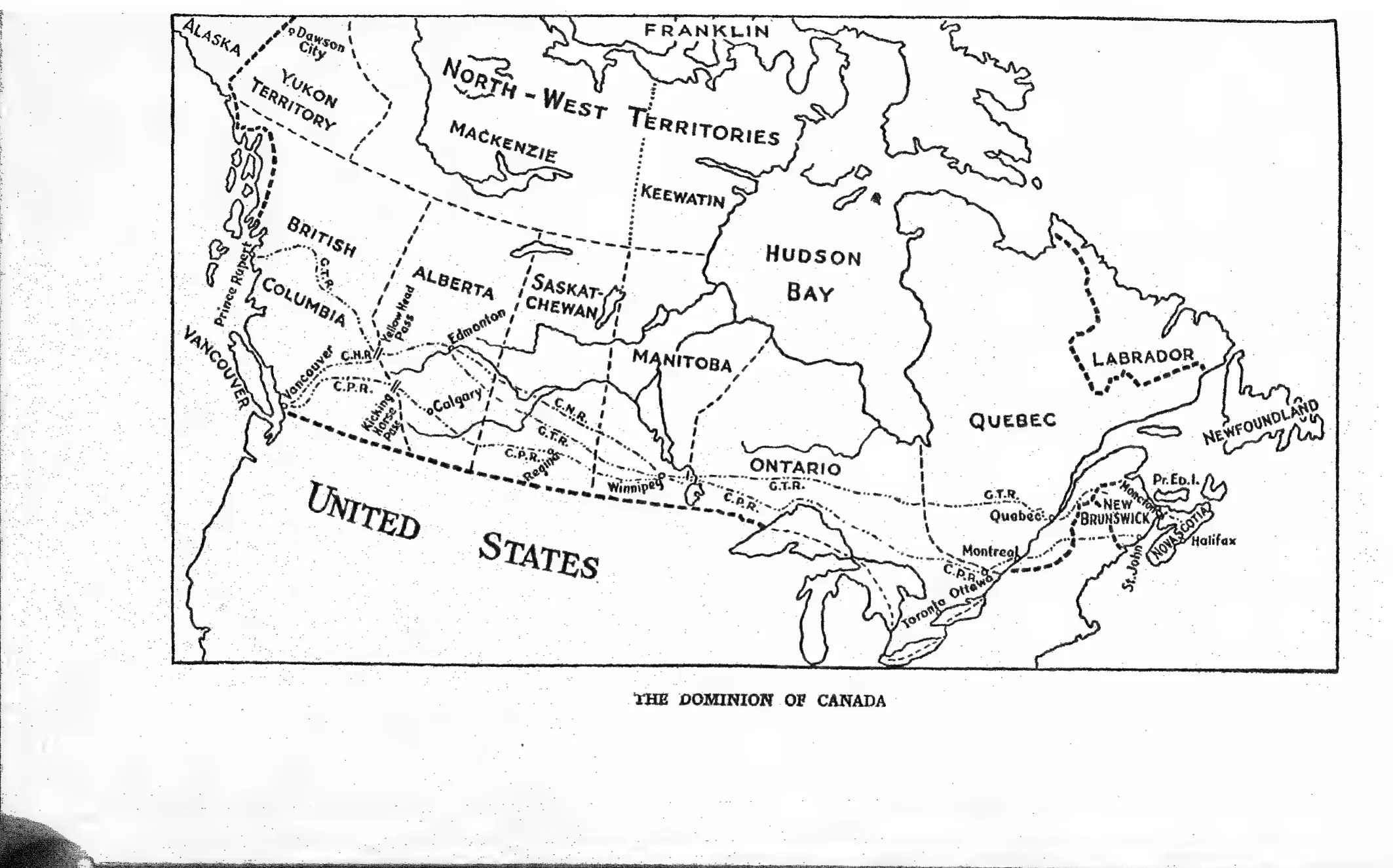
were overwhelmed, and the Conservatives, under Macdonald, were returned to power pledged to the establishment of a protective tariff. This was introduced in 1879. Macdonald remained Prime Minister until his death in 1891, and his party continued in office under other leaders for a further five years.
Mackenzie, who believed in Free Trade, was succeeded as leader of the Liberal party by Edward Blake, who regarded a continuance of protection as inevitable. Blake retired from political life in 1887, and the Liberals found a new leader in Mr. (afterwards Sir) Wilfrid Laurier.1 In 1896 the Liberals under Laurier returned to office after eighteen years of exclusion. While they had been in opposition they had, in the main, supported the principles of Free Trade. When they were established in office they found it impossible to drop the National Policy which had for so long been advocated by their predecessors.
No corresponding preference was granted by Great Britain on imports from Canada..While Great Britain adhered to the system of Free Trade no direct commercial preference was. possible. But the passirig of the Colonial Stocks Act in 1900, by which colonial Government stocks were included in the list of trustee stocks, conferred a great benefit on colonial Governments; they enjoyed a financial preference of great value.
>In 1934-5 Canadian imports from the United Kingdom were valued
at 111,000,000 dollars, and from the United States 303,000,000 dollars.
Canada sent to the United Kingdom goods worth 274,000,000 dollars, and
to the United States 225,000,000 dollars.
1 He was knighted in 1897.
In 1910 the United States proposed the conclusion of a commercial treaty involving the free interchange of products. This became an election issue in zrg11, and, although the proposal was supported by the farmers of the prairie provinces, it was rejected by the country as a whole. The Liberals, who had been in office since 1896, were defeated, and a Conservative Government was formed under Sir Robert Borden. —
The history of Canada since 1896 has been a record of material progress. Immigration, which had not been very rapid hitherto, was accelerated, and during the fifteen years (z896-1911) of Liberal rule under Laurier’s premiership the population of the Dominion increased by almost fifty per cent—from 5,000,000 to 7,250,000... This influx of population was, to the extent of three-eighths, from Great Britain, and almost an equal number crossed the border from the United States.
The remaining fourth came from various parts of Europe — mainly from the east and north. In more recent years, with the appearance of the problem of unemployment, Canadian views on the subject of immigration have to some extent changed. It is welcomed by large employers of labour, who see in the existence of a body of floating labour a means of keeping wages at a low level. For this reason trade unions in Canada are opposed to unrestricted admission to the country.
The steamship companies and the railway companies approve, since the movement brings business to them, but the farmers already settled in Ontario, Manitoba, and Saskatchewan resent the extension of settlement by new-comers, fearing that an excessive amount of grain will be produced and that prices will drop. On the other hand, the expansion of population in the west and north-west offers markets for the products of the industries which are being developed in the large towns of the eastern provinces. It has been estimated that Canada is capable of supporting a population of 150,000,000;1 according to the census of 1931 the number of the people is slightly less. than 10,500,000.
It has sometimes been suggested that in course of time Canada might wish to sever the tie that exists between her and Great Britain. In view, however, of her past record of loyalty and of the fact that her independence in all that matters is not now in question it seems unlikely that she will become an independent republic or that she will consent to absorption by the United States. But there may yet be difficulties in the path of the Dominion.
To some extent it is felt in the prairie provinces that the Government at Ottawa is not sufficiently in touch with the needs of the farmers nor sufficiently alive to their interests, and a movement for the establishment of a separate Dominion of Western Canada made its appearance a few years ago.
In the Maritime Provinces also there appears to be some discontent with the central Government, It is felt that the railway companies niake great efforts to induce new-comers to settle in the prairie provinces rather than in the Maritime Provinces, and that in this they are supported by the Dominion Government: The companies do this because, with fuller settlement in the west, there will be a greater volume of freight for them to carry. There has been a movement for secession in the Maritime Provinces also.
In neither case has the movement become very serious; the intention is, perhaps, to bring pressure to bear upon Ottawa to deal with provincial grievances rather than actually to secede. It is not remarkable that, in a country so vast and varied as Canada, it should be difficult to act fairly towards diverse interests. But it is the duty of Canadian statesmen to deal sympathetically with all causes of discontent, as far as possible, and so to maintain Canadian unity.
4s that the population of Canada will never exceed 40,000,000.
1 This, however, is a mere guess,. Another estimate recently put forward
Canadians in the twentieth century have endeavoured to develop a sentiment of “nationality.” The basis of Canadian nationality is to be found in the fact that the bulk of the Canadian people are of Anglo-Saxon stock. There is, however, a large minority of people of French + or other European origin, and, so long as these elements strive to retain their ~ distinctive characteristics and prejudices, they militate against the development of Canadian nationality.
In the past the French have been hostile to all influences which tend to the fusion of the two races. Differences of religion and language have kept French and English apart, and even in such a city as Montreal there are distinct French and English quarters,
But in recent years there have been some indications that this attitude of aloofness is breaking down. Although the bulk of the people of the province of Quebec still till the soil, adhere to the Roman Catholic religion, and reverence tradition as their ancestors did, there is a development of industry on modern lines within the province which is influencing many French Canadians to see eye to eye with the men of other provinces on matters economic.
The old prejudices are breaking down; there is in many directions less hostility. That within any measurable period of time the races will be fused into one is unthinkable. Nevertheless, with the decay of the old antagonism they will jointly contribute to the formation of a Canadian nation.
1 Nowadays the French Canadians are by no means limited to the province of Quebec; they are spreading in appreciable numbers to other “province pecially to the Maritime Provinces, and to some extent to the prairies.:
That the influence of the United States upon Canada will always be considerable is evident. The people of Canada are massed along its southern boundary,! which, for a great part of the way, is purely artificial, so that cross-communication is easy. American magazines and newspapers circulate as readily in Canada as in the United States; American films are exhibited in Canada; American broadcasting reaches Canadian homes; American associations, such as Rotary, have their ramifications in both countries; the monetary system of Canada is identical with that of the United States.
Yet it need not be assumed that Canadian nationality will be in all respects similar to that of the United States. Among Canadians of British extraction there is a strong feeling of attachment to the home country and of pride in the British Empire, while the Catholicism of the French Canadians is anti-democratic in tendency, and American institutions make no appeal to them.
Canadian loyalty to Great Britain was demonstrated by her participation in the South African War of 1899-1902 and in the European War of 1914-18. In the course of the South African War a Canadian contingent, which totalled 8,000 men, served in South Africa at the expense of Great Britain. Some opposition to this was raised by the Québecquois, but the English-speaking peoples in other parts of the Dominion were enthusiastic in support of the British cause.
At the outbreak of the war with Germany in 1914 the Dominion Government offered to raise and equip, at its own expense, an army of 100,000 tien to assist Great Britain, and as the magnitude of the effort required to defeat the enemy powers was realised this number was exceeded many times over.
1Jt is said that four-fifths of the people of the Dominion live within
two hundred miles of the American border.
Although Canada has for many years been independent of British control in her internal affairs, her foreign relations were, until a few years ago, under the direction of the British Foreign Office, and the Dominion was represented abroad by British ambassadors. Upon the formation of the League of Nations the right of Canada (and other Dominions) to membership, independently of Great Britain, was recognised. The further tight of sending Canadian representatives to foreign capitals is also admitted. Canada appoints her own diplomatic repre-sentatives to the United States, France, and Japan.
the Empire.*
Supplementary Notes
1. By agreement between the Dominion and British Columbia in 1937, the Yukon Territory has been taken over by the latter.. 2, The Dominion Government is making efforts to open up the North-West Territories. Meteorological and geological survey work is being undertaken, to a large extent from the air.
Government, 2See p. 32x.
The Canadian Supreme Court was set up at Ottawa in 1875.
‘In 1935 the Judicial Committee declared that it was within the power
“of the Canadian Parliament to abolish the right to appeal.
1 This exception was made in order to safeguard the provinces against possible encroachments upon their sphere of activity by the Dominion
Chapter VIIIThe Australian Colonies
ALTHOUGH during the sixteenth ceritury there were rumours of the existence of a great southern continent, the earliest definite records of the discovery of Australia date from the early years of the seventeenth century. Luis de Torres, a Spaniard, discovered the strait which bears his name and sighted Cape York in 1606. In 1616 the west coast of Australia was reached by the Dutch, and before the middle of the century Abel Tasman reached the south-east coast.
The new discoveries were called New Holland, but neither the Dutch nor any other race made any attempt at settlement. The English connection with Australia began with the two visits to that land of William Dampier, pirate and king’s officer, in 1688 and 1699. On his second visit Dampier, now in command of the Roebuck, followed the west coast of the continent for about a thousand miles, and upon his return reported that it was desolate and worthless, Systematic exploration was
The transportation of convicts to the Carolinas ceased when the American colonies revolted against Great Britain and obtained their independence. At that time it was not thought desirable that prisoners who were serving long sentences should be retained in England, and their disposal became a problem to which the Government was compelled to give serious attention. For a time convicts were confined on “hulks,” in various rivers and harbours, and were employed in the construction of docks, breakwaters, and other public works.
A Committee of the House of Comimons considered the problem in 1779, and Sir Joseph Banks, a scientist who had accompanied Captain Cook in 1770, recommended that a convict settlement should be formed at Botany Bay. His suggestion was not adopted at the time, and an attempt was made to form a settlement on the African coast.
This proved unsuitable, and in May, 1787, a fleet was sent to Botany Bay, conveying over seven hundred convicts with about two hundred marines as guards, The venture was under the command of Captain Phillip, who was to be the Governor of the new settlement. The fleet reached Botany Bay, its destination, in
January, 1788, but Phillip, after inspecting the place, considered it to be unsuitable for his purpose, and decided to establish his settlement at Port Jackson, a few miles away.
Less than a week after the arrival of Phillip’s little fleet at Botany Bay, two French ships, under the command of La Pérouse, arrived. This expedition, after leaving France in 1785 and reaching the Pacific by way of Cape Horn, had explored various islands of the southern Pacific before reaching Botany Bay. La Pérouse stayed there for six weeks before sailing away—to be lost at sea.
The colony at Port Jackson met with little success for some years. The convicts were lazy and insubordinate and were ignorant of agriculture, and for some time the settlement was on the verge of famine. No attempt had been made by the authorities to improve the. prospects of the colony by the selection of convicts with some skill in agriculture or by the appointment of competent supervisors. A second settlement was established, by order of Captain Phillip, on Norfolk Island, a thousand miles to the north-east.
Agriculture was confined to. Norfolk Island and to a small region in the neighbourhood of the Port Jackson settlement, and until the colony was able to produce enough food for its needs supplies were occasionally sent to it from the East Indies.
Englishmen in general had no high opinion of the Australian settlement, viewing it merely as a convict prison established in substitution for that which was lost.’ Captain Phillip thought otherwise. He considered that the new colony might in time become “the most valuable acquisition Great Britain "ever made.” -, Attempts were made to promote free settlement, and, as an inducement to people of means in Great Britain to migrate to New South Wales, free settlers were, upon application, granted the services of a certain number of convicts as assigned servants.
1 The settlement developed into the city of Sydney,
Land was granted also to emancipists, or time-expired convicts, who were not encouraged to return to Great Britain; they were not forbidden to do so, but the Government did not give them a passage home. The Governor was also empowered to make a maximum grant of a hundred and fifty acres to any private or non-commissioned officer of the Royal Marines who, upon his discharge from that corps, would agree to settle in Australia. Grants to officers were at first forbidden, since no officers intended to make homes in the country.
Phillip left New South Wales in December, 1792, and Major Grose acted as Governor until the arrival of Hunter, Phillip’s sticcessor, in 1795. Grose permitted, or at least connived at, the supply of rum to the convicts and others. This trade was under the control of the officers in the colony, many of whom made large sums of money by their participation in a traffic which was calculated to undermine industry, morals, and discipline.
Hunter, upon his arrival, was unable to deal effectively with the evils which had grown up, but King, who became Governor in 1799, and Bligh, his successor in 1806, made vigorous efforts to put down the traffic in spirits and to preserve order. Bligh acted violently, and even illegally, and the military commander at Sydney took the extreme step of deposing and imprisoning the Governor.
Grose, while he was acting as Governor, received permission to make grants of land to officers on the understanding that they should be used for settlement. He acted upon the permission without enforcing the condition, and as the colony developed many ex-officers made fortunes by speculation in land. In 18zz lands within the limits of the town of Sydney were leased for periods of fourteen and twenty-one years. In 1829 leasing was abolished, and the holders of land were granted freeholds, subject to the payment of a quitrent. Before the middle of the century quitrents were abolished, and absolute ownership was conferred upon occupiers. With the growth of the city values appreciated enormously, and great fortunes were made.*
John MacArthur was one of the first to realise the possibility of developing a pastoral industry in New South Wales. He obtained from the British Government a licence to select five thousand acres to be used for pasture and to employ thirty convicts as shepherds. He imported merino sheep from the Cape of Good Hope and from England, and within a few years he possessed many thousands of animals.. Other men followed his example, and in course of time the lands between the mountains and the coast were dotted with sheep-runs.
1 It has often been pointed out that if the recipient of a grant of land in Sydney in 1812 had been sent to prison for thirty years he might have emerged in 1841 a millionaire!
Lachlan Macquarie became Governor of New South Wales in 1810 and held office until 1821. He believed in Australia as a country for convicts and emancipists rather than for free settlers, a place in which evil-doers might atone for their misdeeds and might, by stern discipline and hard work, be converted into useful citizens. During his term of office roads were constructed, exploration was encouraged, and public buildings were erected. Not without reason has Macquarie been styled Australia’s greatest Governor.
In 1813 Gregory Blaxland led an exploring party across the Blue Mountains and opened up the interior of New South Wales. The work of exploration was carried on by others, and by 1830 the river-system of the south-eastern part of Australia had been traced out by Captain Charles Sturt. Many thousands of square miles of excellent pasture-land were discovered, and a great pastoral industry developed in the interior.
This extension was not viewed with favour by the authorities, on account of the difficulty of keeping order over so vast an area. In 1829 a line, known as the “Limit of Settlement,’ was drawn, beyond which settlement was forbidden. The line was, roughly, a semicircle with a radius of a hundred and fifty miles and with Sydney at its centre. The nineteen counties within this limit came to be known as the “‘ Old Settled Districts,” and in this region licences were granted to pastoralists.
As settlement developed and more land was required for tillage the pastoralists became alarmed lest they should lose their runs, and they demanded and obtained the right to purchase their holdings. The price was five shillings per acre, but after 1831 land was sold by auction with a reserve of five shillings per acre, which in 1839 was raised to twelve shillings, and in 1842 to one pound per acre. —
Since the waste lands of a colony were technically Crown lands, the British Government resented any appropriation of land without. its leave, and maintained the prohibition of settlement beyond the line. The principles of “systematic colonisation” (referrcd to below) propounded by Wakefield were widely accepted at this time, and the free acquisition of land was contrary to Wakefield’s ideas.
Nevertheless, as new-comers increased in number, the Limit of Settlement was crossed, The Government of New South Wales was quite unable to prevent this movement; it could not be turned back without an army of soldiers and police, and if it had been checked the prosperity of the colony, which depended more and more upon wool, would have declined. Although the “squatters” beyond the Limit of Settlement were unable to purchase their runs they were given the right to graze sheep upon payment of a licence fee.
With this expansion of the pastoral industry in New South Wales wool was exported to Great Britain in large quantities. By 1830 the amount sent every year was very considerable. At the time of the Industrial Revolution in Great Britain the manufacture of woollen cloth, which had been established for centuries, declined in importance by comparison with that of cotton, because there was an abundant supply of raw cotton, while the amount of wool available for the industry could not be substantially increased. With the development of supplies of wool from New South Wales the woollen cloth industry recovered its importance.
For many years the squatters in New South Wales were engaged in a conflict with the colonial Government for the maintenance of their position. The Government wished to encourage settlement for purposes of tillage rather than squatting for the extension of pasturage. The Act of 1842, by which the minimum price of land was fixed at one pound per acre, was obnoxious to the squatters; nevertheless, Gipps, the Governor of the colony, tried to apply it to them by issuing an ordinance that every pastoral licensee must purchase 320 acres of his holding at this figure, in return for which he was given a guarantee of undisturbed possession of the whole holding for eight years.
Each subsequent purchase of 320 acres would entitle the squatter to an eight years’ renewal of his lease. The Pastoral Association, formed by the squatters, agitated for the maintenance of squatting rights upon payment of a nominal licence fee, and it was so far successful that upon the departure of Gipps from the colony in 1846 an Act of Parliament (Earl Grey’s Waste Lands Act) + was secured by which pastoral leases for fourteen years were to be granted under conditions to be subsequently formulated.
By the regulations formed in New South Wales under the Act public lands were classified as Settled, Intermediate, and Unsettled, and squatters were empowered to obtain leases of lengths and at rentals which varied with the class of land desired. During the currency of a lease nobody but the lessee could purchase the land, and at its expiration he had a prior right of purchase of the whole or a part.
1 This act applied to all the Australian colonies. —
In 1861, after the establishment of responsible government in the colony, the Parliament of New South Wales passed a Crown Lands Occupation Act, the object of which was to facilitate the extension of farming at the expense of squatting.
The security enjoyed by the squatters since 1846 disappeared, Their lands were made subject to “ selection” by prospective purchasers at any time, and whole leases might be obliterated.*
For many years there was a bitter contest between squatters and selectors. Many of the latter were not bona fide settlers; they made selections from the run of a squatter in the expectation that he would buy them out. In effect, squatters were subject to blackmail, On the other hand, squatters could themselves “select” the water-courses on their runs, a process known as “picking out the eyes of a run,” by which the intervening land was rendered valueless to any one else.
The officials concerned in the registration of these transactions were sometimes corrupt, and the tone of public life in the colony was lowered. In this war of classes, in which deeds of actual violence were sometimes committed, the squatters held their own in the long run. Their victory was inevitable, Big sheep-runs, controlled by capitalist squatters, pay better than small arable farms, and natural conditions in New South Wales are ideal for the pastoral industry.
An act of 1884 gave the squatter a secure lease over half his run, but left the other half open to selection; it was stigmatised as a “‘patch over half the hole,”’ but it was at least a partial victory for the pastoralists.
The occupation of Tasmania (Van Diemen’s Land) began in 1803, when a convict settlement, the future Hobart, was established by Collins, an official of the Government of New South Wales, on the River Derwent, in the south-east of the island. A free settlement was started at Port Dalrymple, on the north coast of Tasmania, in 1804. Immigrants were attracted to both places, and, in a few years, Hobart rivalled Sydney as a centre for the whaling and sealing industries, for which it was conveniently situated.
Cultivation developed on the eastern half of the island, which had a better rainfall than the Australian mainland, and a pastoral industry developed also. Tasmania was at first subject to the Governor of New South Wales, but a separate Government was established in 1812. The prosperity of the colony in the first half of the nineteenth century, apart from whaling and sealing, was based on convict labour. Transportation continued until 1853.
“1 The office at which selectors made their claims was open once a week,
and the Squatters bitterly asserted that they held their leases on a “weekly
Trouble was experienced with aborigines and bushrangers. The latter were desperadoes, many of them being escaped convicts, who lived as outlaws and attacked the settlers wherever possible. Governor Arthur acted vigorously against the gangs of bushrangers, who were ultimately suppressed. The aboriginals, who had suffered maltreatment by bushrangers and other white men, carried on continuous warfare against the settlers, and in 1830 Arthur organised a round-up of the blacks.
A cordon was formed across the island with the view of cooping up the aboriginals in the south-east corner of the island. The effort failed, many of the black men slipping through the cordon. These were at last persuaded to surrender, and in 1835 they were transferred to Flinders Island, in Bass Strait. Under their new conditions of life their numbers diminished, and the last of the pure-blooded Tasmanian aboriginals died in 1876. A few half-castes survive.
The first experiment in settlement in Australia not associated with convict labour was that which was known as the Swan River Colony, and later as Western Australia, A naval officer, Captain Stirling, visited the west coast of Australia in 1827. He reported to the British Government in very favourable terms upon its suitability for settlement, and suggested that it should be occupied in order that the French might be fore-stalled. The Government was unwilling to take the initiative, but a number of emigrants went to the Swan River in 1829, and Captain Stirling was appointed to govern the settlement.
The colonists experienced much difficulty and great hardships for the first few years. Some of the leading adventurers, including the Governor, received very large grants of land, which were marked off in the immediate vicinity of the site of the central settlement. It followed that lands assigned to new-comiers necessarily lay at some distance, and the population of the colony was widely scattered. Food was scarce, and at first there was no means of starting agricultural work.
There were no roads and no markets; much of the land was indifferent in. quality; labour was scarce, and wages were high, Many of the wealthier settlers had brought labourers out from England, but these men earned so much money that they were tempted to take up grants of land, which could be obtained very cheaply, and so become landowners; the shortage of hired labour thus remained tnrelieved.
The difficulties of the Swan River Colony arose to some extent from the lack of careful preparation in the founding of the settlement, but in the main from the unsatisfactory methods of disposing of land. The early settlers were attracted by the offer of forty acres of land for every three pounds subscribed to the venture; in other words, they were able to purchase land at one shilling and sixpence per acre. In 1832 the price was raised to five shillings per acre. This checked immigration; nevertheless, the price was advanced in 1839 to twelve shillings, and in 1842 to one pound per acre, and land sales came to a full stop.
In spite of its difficulties, the colony made some progress. Agriculture was begun and sheep were pastured; coal, copper, and lead were mined; the cultivation of the vine was begun. Within a few years of its foundation Western Australia was able to export lead, sandalwood, wool, and other commodities.
In 1849 two important measures were taken which affected the progress of the colony. Earl Grey’s Waste Lands Act, which was passed in 1846 and which is referred to elsewhere in this chapter, empowered the colonial Government to make regulations by which the waste lands of the colony were divided into two classes; A and B, The A lands were intended for cultivation, and were leased in blocks of 320 acres or less at one shilling per acre per annum for eight years.
The B lands were available for pasture; pastoral leases were granted at the rate of five pounds for the first thousand acres and ten shillings for each additional thousand acres. Under certain conditions, and with the growth of population, land held on pastoral lease became available for selection for cultivation. This system of dealing with the waste lands of the colony remained in operation until the end of the nineteenth century.
The other measure of the year 1849 was the beginning of transportation to Western Australia. On several previous occasions the colonists had petitioned the British Government to send convicts'to Western Australia, but without avail. The establishment of a convict station in 1849 benefited the colony in two ways. Government expenditure on its maintenance was considerable, and the Government became a purchaser of colonial produce on a substantial scale. More-over, convicts were assigned as labourers to the settlers, so that the labour problem was eased. Transportation to Western Australia did not cease until 1868.
The views of Edward Gibbon Wakefield attracted much attention at this time. In 1829 he published A Letter from Sydney, a work in which he set forth his ideas on the conditions essential to systematic colonisation. This, he considered, depended upon the adoption of a wise policy in dealing with the waste lands (the unoccupied lands) of the colony. If land were distributed lavishly, in large blocks, free or at a very low price, there would be a very great shortage of labour.
Wages would be high, and labourers who arrived in the colony would in a very short time be able to save enough money to take up grants of land for themselves; + the shortage of labour would thus remain.
The right policy, in Wakefield’s opinion, was to dispose of the waste lands of a colony at a “‘ sufficient price,” which should be everywhere uniform. There should be no variation to correspond with differences of quality and position. The money received from land sales might appropriately be used for the encouragement and assistance of the migration of labourers from Great Britain to the colony.2. The immigrant with capital should be free to select his land anywhere, and there should be no legal restriction on the amount which could be taken up by any one man.® If the price of land was sufficient
This was not, in Wakefield’s view, vital to his theory. He thought that land ought to be sold at a sufficient price, no matter to what end the money was applied. The use of the revenue from the sale of land for the stimulation of emigration was good, but it should not be thought that land was to be sold at a substantial price merely in order to provide an emigration fund. - 3Tf this condition were not observed there would be restriction upon selection additional to that imposed by the price of land.
1 The supporters of Wakefield’s views were able to quote the state of affairs in the Swan River Colony as evidence of the soundness of their views.
nobody would be likely to buy a larger amount than he could use to advantage. Moreover, the labourer without capital would be unable to purchase a farm for himself out of his savings until he had worked for several years in the colony.
If the price of land was too high there would be little sale of land, labourers would be condemned to remain wageearners for a great part of their lives, and the progress of the colony would be slow. If, on the other hand, the price of land was not high enough, there would be a temptation to men of means to take up very large holdings, while labour would be scarce; in this case also the progress of the colony would be slow.
The secret of success appeared to lie in the maintenance of a proper balance between the supply of land and the supply of labour, and this depended upon the discovery and enforcement of the sufficient price for land. Wakefield, however, was unable to suggest any means, other than experience, by which the proper level of price might be discovered.
If the revenue which accrued from the sale of land were used to assist immigration attention ought to be paid to the selection of suitable immigrants. Wakefield was opposed to the policy of “shovelling out paupers.” Prospective immigrants should be persons of good character and with some previous training in agriculture, and a proper proportion should be maintained between the sexes. Young unmarried men and women might be accepted, but the best immigrants would be young married couples of good character.
The Wakefield theory had a political side. Wakefield considered that as soon as a colony was properly established it should be freed from the tutelage of the Colonial Office in London, since local conditions could not be understood by officials thousands of miles away. Responsible government should be instituted as soon as possible. It was not right to penalise emigrants by depriving them of the political rights they had enjoyed in their old homes; the maintenance of those rights in the colony would make emigration more attractive to the most desirable type of settler.
For some years efforts were made, at first by the National Colonisation Society, and then by the South Australian Association, to secure the assent of the British Government to the foundation of a colony of South Australia on the principles enunciated by Wakefield. In 1834 an act was passed authorising the establishment of the colony and the appointment of Commissioners to carry out the arrangements.
Land to the value of £35,000 was to be sold at a minimum price of twelve shillings per acre, and a guarantee fund of £20,000 was to be raised, before the work of settlement might be undertaken. In order to carry on the government of the colony in its early stages the Commissioners were empowered to raise a loan of £200,000 on the security of the future revenues of the colony. No convicts were to be sent to South Australia, which might be granted a constitution when its population reached 50,000.
Some months elapsed before the Commissioners were appointed, and not until November, 1835, did the proceeds of the sale of land reach the amount (£35,000) required by the Act. This result was achieved only by selling land at the minimum price of twelve shillings per acre, instead of at one pound, as was at first intended by the Commissioners. The last £9,000 worth of land was purchased on behalf of a newly formed South Australian Company.
The settlement was founded in 1836, and was given the name of Adelaide, in honour of the queen of William IV. The settlers were slow to take up agricultural work, some of them preferring to speculate in land, but within a year or two lands were surveyed and allotted and a number of public works were begun. Emigrants arrived, and the colony seemed to be embarking on a period of great prosperity.
This appearance was illusory, however, since the expenses of the colonial Government were not being met out of revenue, which was small, but out of loans raised, in accordance with the terms of the Act of 1834, by the Commissioners in London. By 1840 the Commissioners were unable to honour further demands from the colony, and the British Government had to come to the rescue,
To some extent the financial difficulties of the colony were due to extravagance in surveys and in public works. A considerable part of the labouring population of the colony was being employed on unproductive public works instead of in agriculture. Captain (afterwards Sir George) Grey became Governor in 1841, and drastically reduced expenditure in all directions. Labour on public works was discontinued, so that those engaged on them were forced to turn to agriculture. Within a couple of years Grey was able to report that there was no unemployment in the colony, which appeared to have passed its crisis, The discovery of copper at the Kapunda and Burra Burra mines, in 1842 and 1844, accelerated its recovery.
The sale of land at a uniform price was thus discontinued, and this meant the virtual abandonment of the Wakefield theory, of which uniformity of price and freedom of selection were vital features. But, i in so far as Wakefield’s ideas of the sale of land at a fair price and the use of the proceeds to assist emigration had been adopted, it must be admitted that they had resulted in the establishment of a prosperous and successful colony.
The early difficulties were not the outcome of any inherent unsoundness in Wakefield’s scheme, but were the natural result of the extravagant expenditure of borrowed money. Moreover, the control of the colony by Commissioners thousands of miles away was unlikely to add to its prospects of success.
Earl Grey’s Waste Lands Act, which has already been upon being dispossessed.
The earliest settlements in the part of Australia which afterwards became the state of Victoria were made in 1834. A family named Henty settled at Portland Bay without the knowledge of the authorities of New South Wales, and devoted themselves to the raising of sheep and cattle and to whaling. A Tasmanian adventurer named John Batman in 1827 applied for, and was refused, perntission te form a settlement at Westernport. Without official sanction he left Tasmania in 1834 and established himself at Port Phillip.
He made a “purchase” of land from the aboriginals, which the Government of New South Wales declined to recognise. Within a few years other pioneer settlers followed, some by sea from Tasmania and some overland or by sea from New South Wales. They spread over the pasture-land to the north and west of Port Phillip, where the city of Melbourne * had its beginnings in 1837.
In 1826 a penal settlement was established on Moreton Bay, near the site of Brisbane, for prisoners who had been twice convicted. Free settlement in this region was prohibited, but squatters from New South Wales moved northwards into the Darling Downs area, and when the convict settlement was abandoned in 1839 they crossed the mountains and found access to the sea at Moreton Bay.
Gold was discovered at Bathurst, in New South Wales, in 1851, and there was an immediate rush of people to the diggings. Discoveries followed at Ballarat and Bendigo, in Victoria, and that state received an inmimense accession of population—from other parts of Australia and from Europe and America. Some very rough elements were included among the new-comers, but on the whole the diggings were peaceful and orderly, and the great majority of the diggers, though vigorous, were honest and law-abiding.
The only serious trouble was at Ballarat, where the diggers objected to paymient of the licence fee (one pound per month) charged by the Government. There was some fighting at the Eureka Stockade, and a number of diggers and police were killed before order was restored. In course of time many of the diggers in Victoria left the colony, being
2So named after Lord Melbourne, Prime Minister. The region was
at first called Australia Felix.:;
1 The colony of New South Wales at this time extended over the whole of Australia east of the meridian 135 east of Greenwich. It thus included the present-day states of New South Wales, Victoria, and Queensland, and part of South Australia.
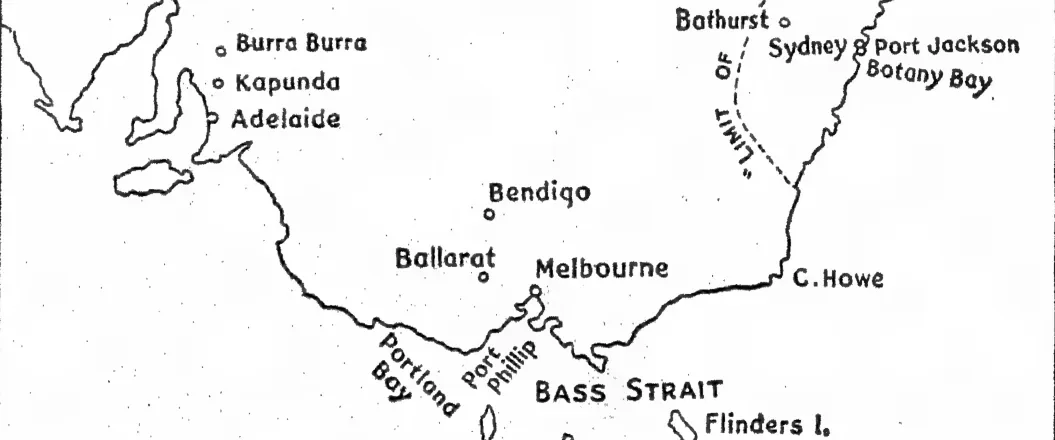
colonies would have been much slower if gold had not been discovered.
only of officials—seven in number—appointed by the Secretary of State in London, but non-official members were added from time to time, so that the Governor was able to consult colonial opinion on public questions. Representative institutions were established in 1842,1 when the Council was enlarged to thirty-six members, of whom twenty-four were to be elected, while not more than six of the remainder were to be officials. The control of the revenue from customs and from the sale of lands was retained by the Governor of the colony.
The settlements on the south coast, at Port Phillip and elsewhere, were granted six representatives on the Legislative Council of New South Wales. This arrangement was not to their liking, as their interests were distinct from those of the main part of the colony, with which their only means of communication was by sea. They pressed for recognition as a distinct colony of Victoria. This was conceded in 1851, and a representative Legislative Council was set up at Melbourne. Representative Legislative Councils were set up in 1851 in South Australia and Tasmania as well as in Victoria, and in all four colonies the Legislature was given control of the customs revenue.
In 1854 the four colonies were authorised to submit to the British Government draft constitutions embodying the principle of responsible government. These were approved, and the actual working of responsible government began in 1855 in New South Wales and Victoria, and in the following year in South Australia and Tasmania. Queensland was separated from New South Wales in 1859, and responsible government es was established at once.2. These grants were not wrung from a reluctant home Government; they were conceded voluntarily as soon as the growth of the young states was sufficiently advanced to enable them to shoulder the burden.
Western Australia, with its vast expanses and scanty population, developed more slowly. From 1829 to 1840 it was ruled by a Governor alone. In 1840 it became a Crown Colony with a Governor and a nominated Council, and this form of administrative organisation continued until 1870 (transportation continued until 1868). A Representative Council was set up in 1870, and responsible government was granted in 1890. Gold was discovered at Coolgardie in 1892 and at Kalgoorlie in 1893, and the mines proved to be extraordinarily productive. The usual gold rush followed, resulting in a substantial increase in the population of the colony.
1 The transportation of convicts to New South Wales ceased in 1840, though it was not formally abolished until 1853.
2 The reasonableness of this course becomes apparent if it be remembered that in 1859 the colony of New South Wales was divided into two parts, one of which was called Queensland and the other New South Wales. As responsible government existed in the undivided colony it was appropriate to set it up in each of the divisions, and not merely in that part which retained the original name.
The Australian colonies made rapid progress during the second half of the nineteenth century. Railways were constructed, and other public works were taken in hand. Population increased, and land sales continued. Unfortunately, much of this apparent prosperity rested on the insecure basis of borrowed money, so that in the early nineties the experience of South Australia half a century earlier was repeated in New South Wales, Victoria, and Queensland.
Banks had been compelled by law to make loans to purchasers of land on the security of their new property, and in order to provide themselves with funds they had accepted short-term deposits from English and Australian investors. When these deposits were called in the banks were unable to meet their liabilities, and a considerable number of them suspended payment.t A serious financial crisis followed, Loans were restricted, the development of public works was suspended, wages fell, and labour unrest resulted in a series of strikes. Some years elapsed before normal prosperity was restored.
A considerable number of semi-socialistic experiments were tried in the last few years of the nineteenth century. “ Workmen’s Blocks,” of twenty acres, were established with some degree of success in South Australia and Victoria, and, with less success, in Western Australia and New South Wales. The blocks were leased to workmen, who might subsequently purchase them. In New South Wales ‘Labour Settlements,” of a communistic character, were set on foot, but they met with no success.
The “Labour Colonies” of Victoria were ‘similar in principle and were equally unsuccessful, as were the Victorian “Homestead Associations.” These were large blocks of land subdivided into small holdings and leased to associations of six or more people who, presumably, were to co-operate in the cultivation of their holdings and the marketing >+ Seven banks in Victoria, two in New South: Wales, and three in Queensland suspended payment in 1893.
of their produce. The “Co-operative Associations” in South
Australia and the “Co-operative Communities” in Queensland were organised on somewhat different principles and met with a fair measure of success.
The course of events which led to the federation of the
Australian colonies is described in the next chapter.
Chapter IXThe Commonwealth of Australia
population, such as Sydney, Melbourne, Adelaide, and Perth, were separated by hundreds of miles, and communication was difficult. And the remoteness of Australia from other countries merely removed the possible stimulus to federation which might arise from the threat of external attack.
The colonies therefore remained aloof from one another for many years. Intercolonial relations might be described as antagonistic, and almost as hostile. Each colony set up its own tariff and customs duties,1 and at the frontiers every effort was made.to prevent smuggling. The railways of each colony were planned to carry the trade of the colony to its own ports; they would even stop short before reaching the frontier, so that trade might not be diverted to a neighbouring state, There was no uniformity of gauge,” a circumstance which has been most harmful to the subsequent progress of the Common1 New South Wales adhered to Free Trade.
‘Queensland 3 ft. 6 in.
New South Wales 4 ft. 84 in,
South Australia 5 ft. 3 in. and 3 ft. 6.in.
Western Australia 3 ft. 6 in. and 4 ft. 84 in.
2 The gauges of Australian railways are as follows:
wealth, since the cost of establishing uniformity of gauge at the present time would be so great as to be prohibitive.
As early as 1847 a proposal for the federation of the Australian colonies was made by Earl Grey, Secretary of State for the
Colonies. It was referred for consideration to a Committee of the Privy Council. The Committee recommended the appointment of a Governor-General and the institution of a
General Legislative Assembly to deal with such matters of commimion importance as customs duties, the Post Office, shipping, an Australian Supreme Court, and any other matters which might be referred to it by the common consent of the colonies. Bills were introduced in the House of Commons in 1849 and 1850 to give effect to the proposal, but it was subjected to severe criticism, and as opinion in Australia was adverse to it the matter was dropped.
The title of Governor-General was conferred on the Governor of New South Wales, but this accentuated the rivalry of the colonies, and could not but have retarded any inclination which might have existed towards ne unity. In 1861 the title was dropped. An act was passed by the British Parliament in 1871 to facilitate the establishment of a uniform customs system in Australia, but no advantage was taken of it.
empowered to legislate, but it had no overriding authority. Each colony was at liberty to legislate for itself on these topics, and its laws would override the ordinances of the Federal Council, whose decisions could not be enforced in any colony which chose to disregard them. No executive organisation was associated with the Council. It had no power of imposing taxation, and, consequently, no revenue.
The colonies were not compelled to recognise it, and, as a matter of fact, New South Wales and New Zealand declined to be represented on it. The Federal Council, so far from being a step towards federation, might be regarded as a hindrance to it, since it displayed the disadvantages rather than the benefits of closer union,
With the development of communications people of different colonies intermingled miore freely than they had done a generation earlier, and migration from one colony to another was not uncommon. The exclusiveness of the colonies thus diminished, and, with the establishment of an alien power in New Guinea, within striking distance of Australia, the advantages of closer union began to be considered. The real pioneers of federation _ were Sir Henry Parkes and Mr. (afterwards Sir) Edmund Barton.
In 1889 Sir Henry Parkes, in a speech at Tenterfield, New South Wales, definitely proposed the establishment of a Dominion of Australia, with a Dominion Parliament. The idea received the approbation of Earl Carrington, Governor of New South Wales, but not of the other colonial Governors.
It was so far favourably received among the Australian people that in 1890 a Convention met at Melbourne to discuss it, That the matter was too big to be settled on party lines was recognised in the composition of the delegations; the repre-sentatives of each colony included members of the opposition as well as of the ministerial party. The Convention was called to discuss the proposal rather than to draw up a scheme; this was to be the task of a second Convention,! which met at
Sydney in 1891. There was sharp divergence of opinion as to the type of federation which should be adopted. Parkes favoured the Canadian model, in which the central Government was predominant; as might be expected from the past history of Australia, most of the delegates preferred the principle on which the constitution of the United States was framed—the limitation of the powers of the central Governmient and the strict maintenance of the rights.of the States.
The Sydney Convention failed to complete its work, and no further meeting occurred for some years. Between 1891 and 1897 the work of propaganda in favour of federation was carried on by Parkes and Barton. Sir Henry Parkes died before the resumption of negotiations, in 1897, at Adelaide.
The Convention, after an adjournment at the time of the
Diamond Jubilee of Queen Victoria, resumed at Sydney, and met again in 1898 at Melbourne. By this time a draft bill was completed, and it was agreed to submit it to a referendum in each colony. New South Wales stipulated, however, that it should not be regarded as accepted in that colony unless the affirmative vote reached 80,000,
A majority was recorded in favour of the bill in every colony (except Western Australia, where the vote was postponed until 1899). In Victoria and Tasmania the proportion of votes in its favour was four to one. But in New South Wales the figures were 71,000 to 66,000, and as the affirmative vote did not reach 80,000 the bill was regarded as rejected. Some alterations were made in the draft, and another referendum was held in New South Wales in 1899, in which a large majority was secured and the bill was accepted.
Many reasons may be advanced for the triumph of the movement for federation. Without doubt the presence of European powers other than Great Britain in the Pacific—the French in the New Hebrides and the Germians in New Guinea and the Bismarck Archipelago—and the consequent necessity of concerting commion measures for defence were the compelling circumistances.
Further, the strong feeling among the colonists on the desirability of maintaining Australia as a country reserved exclusively for white people pointed to the necessity for uniformity of regulation in connection with the immigration of coloured peoples. The commercial classes hoped to benefit from intercolonial free trade and from the simplification of railway rates, while the working classes hoped that a Commonwealth Government would promote. social legislation. Finally, pride in Australian nationality was at length strong enough to outweigh provincial jealousies, and must be reckoned as not the least of the factors which contributed to the success of the movement.
In 1900 the Australian Commonwealth Act was passed by the British Parliament (it was the last act of any importance which received the royal assent from Queen Victoria). Late in the year the first Australian ministry was formed, with Sir Edmund Barton as Prime Minister, and on the 1st January, tgor, the day on which the Commonwealth was legally established, ministers took the oath. Three weeks later Queen Victoria died, and the new king, Edward VII, was represented by his son, the Duke of York (afterwards King George V), at the opening of the first Australian Parliament at Sydney in 1901.
By the Australian Commonwealth Act the six Australian colonies (but not including New Zealand) were to be associated together in a Commonwealth, the government of which was to be in the hands of a Governor-General, advised by a Federal ministry which, it was understood, would be responsible to the Lower House of a Federal Parliament.
The Parliament was to consist of a Senate containing six members from each of the States of the Commonwealth, elected by popular vote for a period of six years, and a House of Representatives whose membership was to be proportionate to the population of the States; it was provided, however, that the representation of a State should not fall below five.
By this arrangement the more populous States, New South Wales and Victoria, would control the House of Representatives but not the Senate, which was expected to be the champion of the rights of the less important States; it would prevent their suffering from the arbitrary action of a Commonwealth Government which might be dominated by the two populous States.
The Commionwealth Government was invested with certain powers, such as the control of customs, from the date of its establishment, and -with others, such as postal facilities and defence, from specified dates, and it might acquire other powers from the States by agreement. Some matters were left under the joint control of the Commonwealth and the States, The residuum of power lay with the States, and not, as in the Canadian constitution, with the central Government. The States thus retained a good deal of importance..
They could continue to legislate on matters. which were not under exclusive Commonwealth control, but in the event of inconsistency arising between State and Commonwealth law the latter was to prevail to the extent of the inconsistency..The continuing importance of the States was indicated by the fact that their official rulers were styled Governors, and not Lieutenant-Governors. The
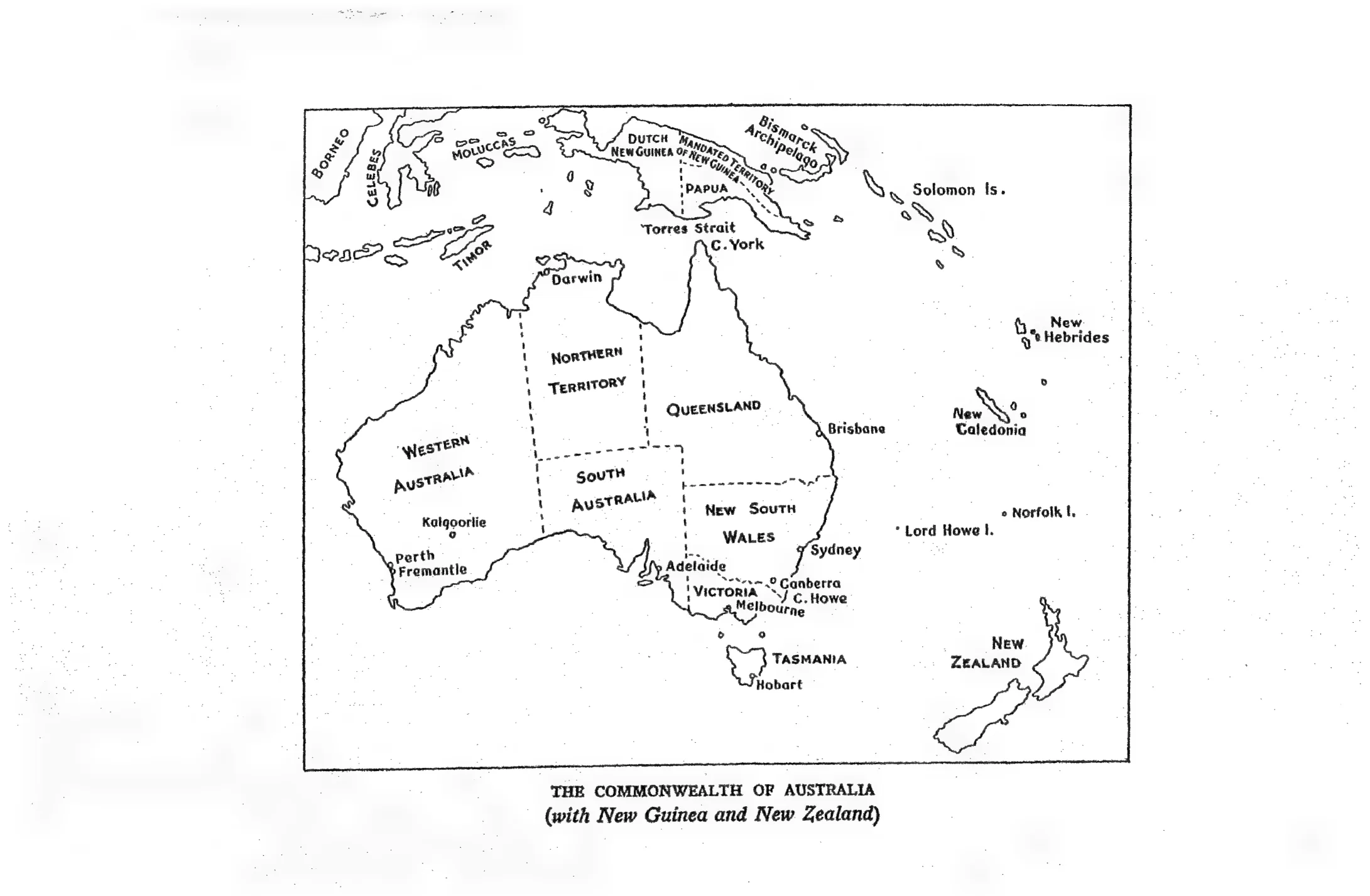
extent to which State rights and importance have been maintained. since the establishment of the Commonwealth is discussed below...
Provision was made in the Act for the establishment of a Commonwealth capital. Neither Sydney nor Melbourne was willing to recognise the other as the capital city of Australia, and, while the seat of Government was fixed temporarily at Sydney, it was enacted that a site for the capital should be chosen within the State of New South Wales and not less than one hundred miles from Sydney. After somie years Canberra was selected, and it is now a town of about 10,000 people, About one thousand square miles of territory round it was ceded by New South Wales to the Commonwealth Government, by which it is directly ruled.
The Australian Constitution was so framed that it was clearly the intention of its authors to keep the powers of the central Government within limits and to maintain the powers of the States. The Commonwealth has existed for thirty-five years, and the history of the period has shown that constitutional development has not proceeded altogether on the lines intended. The power of the Commonwealth Government has steadily increased, and the States have been compelled to accept a position of subordination, The main reason for this has been financial.
The constitution granted to the Commonwealth the exclusive control of customs and excise, while in other spheres of taxation the Commonwealth and the States _ were to have concurrent rights. For the first ten years threequarters of the receipts from customs and excise were to be given over to the State Governments, but at the expiration of this period the Commonwealth was free to give to the States as much or as little as it chose.
It thus had in its hands a powerful weapon for the assertion of its superiority. Its concurrent rights of taxation in other directions have been interpreted in the light of the provision that where Commonwealth law and State law are inconsistent that of the Commonwealth prevails to the extent of the inconsistency. It follows that concurrent rights in taxation are not equal rights, and that the States get what the Commonwealth chooses to leave them.
In course of time the States found themselves in financial difficulties, while the Commonwealth was prosperous, and in 1929 the Commonwealth took over the debts of the States on terns to which the latter were forced to agree.
The Commonwealth has succeeded in entering upon a number of spheres of administration which were originally reserved for the States. Since a written constitution exists, the central Government cannot ride roughshod over the instrument from which its powers are derived, but in important cases before the Australian courts decisions have been given which have tended to enlarge the scope of the central administration.
The history of Protection in the Commonwealth is connected with that of Labour legislation. At the time of the inauguration of the Commonwealth New South Wales believed in a policy of Free Trade, while Victoria, the other populous
State, was Protectionist. A moderate tariff was agreed to in
1902, but the contest between the rival policies was not determined until the Labour party, which was strong enough to turn the scale between the other two parties in the Australian
Parliament, was converted to Protection. The price of the Protectionist victory was the recognition of the principle that the workers should share in the benefits of Protection, and that wages should be “fair and reasonable.” A Commonwealth Court of Conciliation and Arbitration was empowered to fix wages on this basis, and to the possible plea of employers that an industry could not bear the burden of such wages the reply was made that it must do so or must cease to exist,4
In 1908, when Mr. Deakin was Prime Minister, a Protectionist tariff was set up for the benefit of the manufacturing industries of New South Wales and Victoria, and in 1921 this tariff was increased by Mr. Hughes. In this latter year a Tariff Board was established, with extensive powers to increase or decrease duties and to vary their application in many ways. Technically it was set up to advise the Minister of Trade and Customs; in practice he is bound to accept its advice. It was found that industries which enjoyed a measure of Protection frequently demanded more,? and under Australian
+It is interesting to observe that a similar principle was accepted in 1908 in Free Trade England, In that year a Committee of the House of Commons investigated the question of sweated labour, and reported in favour of wage regulation in certain industries. To the contention that some of these industries could not afford the payment of higher wages the Committee replied: “ If a trade will not yield an income sufficient to enable. those who earn it to secure at any rate the necessaries of life, it is a parasitic trade, and it is contrary to the general well-being that it should continue.” 2 This phenomenon has been observed in other Protectionist countries and notably in the United States, conditions it was inevitable that each request to the Tariff Board for an increase in duties should be accompanied by a Labour demand, addressed to the Court of Conciliation and Arbitration, for a revised scale of wages, The position appeared to be growing so serious that in 1927 a Committee was appointed to consider whether a limit of Protection should not be fixed, beyond which the Government would decline to go.
The prosperity of Australia depended upon the export of wool, wheat, and minerals, including gold. These industries benefited in no way from Protection; their costs of production were being increased by the protection afforded to the manufacturing industries of the south-eastern States. But exports must be sold at prices prevalent in the markets of the world; if buyers can get things elsewhere more cheaply than from Australia they will do so.
If, therefore, Protection were carried to such a point in Australia that the cost of producing the staple commodities prevented them from competing in world markets, it would involve Australia in ruin, The Committee reaffirmed its belief in the benefits which had accrued from a Protectionist policy, but considered that these benefits diminished with every increase in the tariff.
There was a point at which further increases would be prejudicial to Australian prosperity, and in the opinion of the Committee that point had been reached, even if it had not already been passed, A good deal of controversy was evoked by the report, and, in spite of its warnings, the Australian tariff has been increased since its issue.
The working of the policy of Protection has had serious effects upon inter-State relations.. Protection has been advantageous to the three eastern States. The manufactures of New South Wales and Victoria and the sugar industry of Queensland have benefited by it, but it has been detrimental to agriculture, to the pastoral industry, and to mining, in the other three Statés. The burden of taxation in these States has become intolerable, and they have received no countervailing advantage. A movement for secession from the Commonwealth has developed in Western.
Australia, and a petition on this matter was sent from the State to Great Britain in 1934.. Some people in Tasmania are also considering secession; South Australia has not given any indication of her intentions, but she is watching the position.
The legal position with regard to the petition from Western.
Australia was obscure. Since the passing of the Statute of Westminster in 1931 it would seem that Great Britain has no right of intervention in Australian affairs, and a Joint Committee of the House of Lords and the House of Commons was appointed to consider whether it was proper for the Imperial Parliament to receive the petition. In 1935 the Committee reported that the petition could not be received.
After the first feeling of disappointment was past, the Government of Western Australia decided to discontinue the agitation for separation from the Commonwealth, a decision which was reached the more easily after the Commonwealth Government had. promised to consider the difficulties of the less populous States and to take measures to meet them. It is possible, indeed, that the real object of the movement was less to secure separation than to obtain the ready and sympathetic attention of the Australian Government to Western Australian problems.
Trade unionism existed in New South Wales as early as 1840, but it was not until the last quarter of the nineteenth century that a political Labour party developed. For some years opinion in trade union circles appeared to hesitate between the advantages of “direct action” (strikes) and those of political activity; in fact, both were tried, and gains were registered from both.
In the early days of the Commonwealth the Labour party was strong enough to hold the balance between the other two parties, and, as already stated, it was as the result of its conversion to Protection that that policy was put into force. By rg10 a Labour Government was in power, and it retained its position until 1916. In that year it split and fell on the issue of conscription, and from 1917 to 1923 the country was ruled by a National Government under Mr. Hughes. In post-war years Labour gradually recovered its strength, and at the end of 1929 it was again in office.
The wave of economic depression which spread over many countries in 1930-2 did not pass Australia by, In 1931 a conference of Premiers of the Commonwealth and State Governments decided on certain measures to restore prosperity and financial stability. Additional taxation was imposed, the salaries of public officials were reduced, and a substantial saving was effected on the interest on the public debt by means of a conversion scheme. The Labour Government in the Commonwealth was replaced by a Coalition Ministry.
The Northern Territory was originally under the jurisdiction of New South Wales, and, later, it was taken over by South Australia. This colony disliked the responsibility of supervising it, and it was handed over to the Commonwealth Government in 1911. In 1927 it was divided into two territories, called, respectively, North Australia and Central Australia, but this division was abolished in 1931, and the term Northern Territory was restored. Its small population is subject to the authority of an Administrator appointed by the Commonwealth Government.
The control of all islands in the vicinity of Australia has for many years been a cardinal feature of Australian policy. As far back as 1867 the attention of Australian statesmen was directed towards New Guinea, and in 1872 the Prime Minister of New South Wales requested Great Britain to annex a number of Pacific islands.
Nothing was done at the time, and in 1883 Sir Thomas MclIlwraith, Prime Minister of Queensland, attempted to forestall Germany by annexing New Guinea, His action was disavowed by the British Government, and an attempt by him to secure the backing of the other colonies failed for the moment. In 1884 Germany annexed the northern part of New Guinea and Great Britain accepted the southern part, which was called Papua.
It has been already pointed out that it was this question of a potential enemy at the gate of Australia which did more than anything else to bring the separate colonies into a frame of mind in which they were willing to consider the advantages of federation.
In 1906 responsibility for the administration of Papua was accepted by the Commonwealth Government, and when in t919 New Guinea was lost to Germany it passed under mandate to Australia, At the Peace Conference the Australian delegates succeeded in preventing the acquisition by Japan of mandates for any islands south of the Equator.
While the colonies were small the responsibility for their defence naturally devolved upon the mother country, With their advance in wealth and population they have been ready to shoulder the burden. Australians have felt that it would be inconsistent with the dignity of the nationhood to which they aspire that the Commonwealth should be dependent for defence upon outside aid.
From 1911 to 1929 the military training of young men was compulsory in Australia, though the armies raised in the Commonwealth and sent overseas to the Dardanelles and elsewhere were recruited on a voluntary basis. Compulsory military training was discontinued by the Labour Government which came into power in 1929, and since that time enlistment in the militia has been voluntary.
In the early years of the Commonwealth Great Britain was reluctant to consent to the establishment of a separate Australian navy, and would have preferred the maintenance of a single organisation, to which Australia might have made some financial contribution, under the control of the British Admiralty. But the Commonwealth preferred to establish its own fleet. In 1914, however, the Australian Navy was placed at the disposal of the British authorities.
Distance between Australia and Great Britain, as measured by time, has steadily diminished. Captain Phillip’s fleet reached its destination in eight months, and until the middle of the last century the voyage occupied between four and five months. By 1850 some of the clippers engaged in the China tea trade undertook a triangular voyage. They sailed from London to Sydney before proceeding to China, whence they returned home laden with tea.
The voyage to Sydney was covered by them in about ninety days, though the record was held by the Thermopylae, which completed the distance in less than sixty-four days. The earliest steamships were unable to beat the time of the clippers, but a new route, open to steam but not to sail, was available after the completion of the Suez Canal.
With the building of faster ships the time taken on the voyage was reduced to about six weeks, Within the last few years aerial communication has been established; in 1934 the distance between Great Britain and Darwin, in the Northern Territory, was covered in less than three days.
In the latter part of the nineteenth century the cotton and sugar industries in Queensland were developed on.large estates owned by white planters who employed imported black labourers, men recruited from the islands of the Pacific. Australians as a whole have viewed the immigration of men of colour with alarm, and the policy of a ‘“‘White Australia” is strongly supported by all political parties in the Commonwealth.
A series of laws designed to prevent the entry of Japanese,
Chinese, and men of other coloured races has been passed.
It is contended that the presence of a large number of people of inferior, or, at least, of different, civilisation would make impossible the maintenance of satisfactory labour conditions for white men, that it is impossible to devise a system by
Rese 2 which men of different colours may work side by side in harmony, and that if black or yellow men. were admitted into Australia a half-caste race would arise which would present serious problems in the future.;
At least one-fifth of the total area of Australia is, it is estimated, uninhabitable, but, when full allowance is made for this, it is recognised that there are vast habitable spaces to be filled. India, China, and Japan teem with surplus population. More than half the population of the world lives in Asia, while Australia contains about 7,000,000. The only way to keep the yellow men out of Australia is to fill the empty regions with white men, White Australia must be an Australia not merely reserved for, but peopled by, white men.
Supplementary Note
In March, 1938, the Commonwealth Prime Minister, Mr. Lyons, announced a new policy of assisted immigration. It is hoped that British military officers and civil servants who are retiring from India may be attracted as settlers. In Great Britain it is expected that religious and philanthropic organisations, such as the Church Army, the Salvation Army, and the Young Men’s Christian Association, will assist in the selection of suitable migrants.
Chapter XNew Zealand
He was accompanied by Sir Joseph Banks, a famous scientist, after whom Banks Peninsula in South Island was named. The work of Cook and Banks was very thorough. Accurate maps were constructed, names were assigned to prominent coastal to throughout this chapter.
1 It was named after Zealand, one of the seven United Provinces.
8 Cook’s work in this respect included one remarkable instance of unsatisfactory nomenclature. A part of the coast. at which he found some difficulty in obtaining supplies was called by him Poverty Bay; another place, for the opposite reason, was styled the Bay of Plenty. Actually the land round Poverty Bay is much more fertile than that in the neighbourhood of the Bay of Plenty.
fifty years,
Before the end of the eighteenth century New Zealand was visited by vessels from Sydney engaged in sealing and whalefishing. Sealing parties landed at Dusky Bay, in South Island, but no settlement was formed at that time. The earliest permanent settlers established themselves at several points on the coast, but chiefly at the Bay of Islands, in North Island. Most of them came from Sydney; they consisted of runaway convicts and other undesirable characters. They intermingled and intermarried with the Maori, with whom trade relations were developed. The natives were supplied with rum and fire-arms in exchange for native mats and weapons and even heads, for all of which, as curios, there was in Europe a ready sale.
New Zealand lay within the limits of New South Wales, as defined in the proclamation by which that colony was established, and its settlers were subject to the jurisdiction of the Governor of New South Wales. His authority over them was naturally very slight, but Governor Macquarie succeeded in putting an end to the discreditable trade in heads. The whaling industry developed, whalebone and whale-oil being in great demand in Europe. The trade was controlled from
Sydney.
The plural of this word may be either Maori-or Maoris,
pioneers of civilisation among the Maori, In addition to their primary work of attempting to spread Christianity they endeavoured to settle tribal quarrels and to teach the natives to live peaceably, to discourage barbaric practices such as cannibalism, and to introduce industries among them.
to promote colonisation, but official hostility again prevented anything being done.
1 Tt was removed to Wellington in 1865.
It has sometimes been asserted that the Treaty of Waitangi was unfair to the natives in that it took from them their rights over their lands upon terms which they could not possibly understand. There seems to be no good ground for this criticism. It has frequently been argued that, in other parts of the world, natives have been “exploited”? by white settlers.
This is a charge easier to bring than to rebut; in any case, the motive of British officials in arranging the Treaty of Waitangi was, without doubt, to protect the. natives from exploitation. It should not be forgotten that the Maori were a highly intelligent race; the terms of the treaty were simple and were fully explained to them by missionaries and others. Nor, in view of Maori experience with pioneer explorers, was the promise of protection an empty formality. Neither, in view of the progress of the Maori towards civilisation in later years, can it be contended that the Maori have suffered as a result of the establishment of British rule.
The Treaty of Waitangi was drawn up on a misunderstanding of native conditions of land tenure. Land did not belong to the chief, but to the tribe, and this involved great difficulty when any question of purchase arose. Further, some parts of North Island, and very large parts of South Island, were not inhabited by Maori at all, and they had no moral claim to these regions; yet the treaty recognised their ownership of the whole area. The treaty thus worked to the disadvantage of the British; nevertheless, it has been honourably observed by the Government of the colony.
The land question gave trouble to a succession of Governors of New Zealand for some years after the conclusion of the Treaty of Waitangi. Many settlers had already made purchases of land, either directly from the Maori or indirectly through the New Zealand Company, and in some cases a stretch of land had been sold on different occasions by two or three tribes. Conflicting claims therefore arose, and it was often a matter of extreme difficulty to determine to which Maori tribe the lands had originally belonged. A Commissioner was sent from England to settle land disputes, but some years elapsed before final decisions were made.
Hobson died in 1842, and for about a year Lieutenant
‘Shortland was Acting-Governor of the colony. It was a time of anxiety. The colonial revenue was insufficient for the purposes of administration, and trouble developed with the natives. A dispute arose over the occupation of some land at Wairau (South Island). The Maori believed that the terms of the Treaty of Waitangi were being violated, and they murdered twenty-two white men, including Captain Wakefield.
Unfortunately Captain Robert Fitzroy, who succeeded Shortland as Governor in 1843, took no effective steps to avenge the massacre and restore British prestige, and he supported the Maori view in connection with the land dispute out of which the incident had developed. The natives interpreted his attitude as an indication of the weakness of the white men, and were encouraged to make further attacks.
At Kororareka (North Island) a flagstaff on which the British flag was flying was cut down by Maori; it was restored and cut down a second and a third time, and the settlement was burnt. The situation became serious; the attack on British authority was flagrant, and troops were sent from Sydney to subjugate the rebels and restore British prestige. But they were outnumbered and defeated, and Fitzroy was weakly preparing to treat with the Maori for peace when he was superseded by
Captain Grey.
He now pursued a policy of conciliation, and attempted to win the confidence of the Maori by fair and straightforward dealing, In this he was successful. He became popular with the Maori, whose language he mastered, and he carried out measures for. the improvement of their condition and the promotion of their prosperity.
Act for the Government of New Zealand was passed by the. British Parliament. The colony was divided into two provinces, New Ulster consisted of the greater part of North Island and included the bulk of the population, white and Maori. The remainder of North Island, together with the whole of South Island, formed the province of New Munster, In each province there was to be a Lieutenant-Governor (subject to the authority of the Governor of New Zealand), an Executive Council, and a Legislative Council. It was also arranged that a Representative Assembly should be established, but Captain Grey considered this to be premature, and declined to put it into force.
proposal of Sir. George Grey, the British Government agreed to its transference to the New Zealand Government.) The provinces of New Ulster and New Munster were abolished, and six new provinces. were marked out. In each of these there was to be a Provincial Council, with authority over local — stich as roads and public lands (but not native lands).
New Zealand was a colony with many scattered settlements, The population was not concentrated in a few important centres. For this reason the provincial system worked. very well for a time, local affairs being well.administered.
But it was not well suited for the development of a national spirit, and, while the resources of the colony were being drained by the long-drawn-out Second Maori War (described below), the provinces of South Island, which was not affected by the conflict, agitated for the separation of the two islands into distinct colonies. This was not done, and with the growth of population and the development of communications it became clear that the provincial system had outlived its usefulness. It was abolished in 1876, and a system of County Councils, more definitely subordinate to the central Government, was set up for purposes of purely local administration,
The House of Representatives has since 1867 contained four Maori representatives—three from North Island and one from South Island, As in Canada, there is a periodical redistribution of seats so that representation may correspond with distribution of population. Women have been entitled to vote since 1893 and have been eligible for memibership of the House since 1919.”
For some years after its establishment the constitution of 1852 did not work smoothly. The first elected House of Representatives did not meet until nearly the end of 1855, when Sir Thomas Browne was Governor. The Provincial Councils, however, had been in existence for two or three years. ‘They managed the waste lands! of the colony in their own areas, and they derived much of their revenue from the sale of lands to new-comers. As immigrants were not attracted equally to all provinces, and as some provinces had much more land to sell than others, they were soon very unequal in prosperity.
adouies in order to terminate.a similar constitutional crisis in Great
2 No woman was elected.to the House of Representatives until 1933.
1 This procedure was obviously in imitation of that which might be
Relations with the Maori was a “reserved’’ subject, on which the Governor acted independently of the House of Representatives, and this gave rise to friction. Efforts were made to improve the condition of the Maori. Industries were set up, technical instruction was given, and agriculture was encouraged. White settlers felt that their interests were being unduly subordinated to those of the natives, who, for their part, were far from being submissive. They felt that they were not secure in the possession of their lands, and it was, in fact, a land dispute which was the immediate cause of the outbreak of the Second Maori War.
The Second Maori War consisted of a series of outbreaks between 1860 and 1871. An attempt of the Maori tribes in North Island to federate under a king was followed by a rising in the Taranaki district. The prohibition of the sale of fire-arms to the Maori, issued by Sir George Grey at the time of the first war, had been disregarded, and the rebels were able to offer a vigorous resistance to the white troops. Sir George Grey was reappointed Governor,? in succession to Browne, in 1861, and he determined that the war should be prosecuted vigorously. A large force of British troops served against the Maori, and further outbreaks occurred in the Waikato and
1 The waste lands of a colony were lands not yet appropriated to individual
settlers. They were, technically, the property of the Crown. In the case
of New Zealand all land acquired by the Government from the Maori
became waste land until such time as it was sold or granted to settlers.
Lands retained by the Maori were not waste land.
2 He had been Governor of the Cape of Good Hope in the interval
between his two periods of office as Governor of New Zealand.
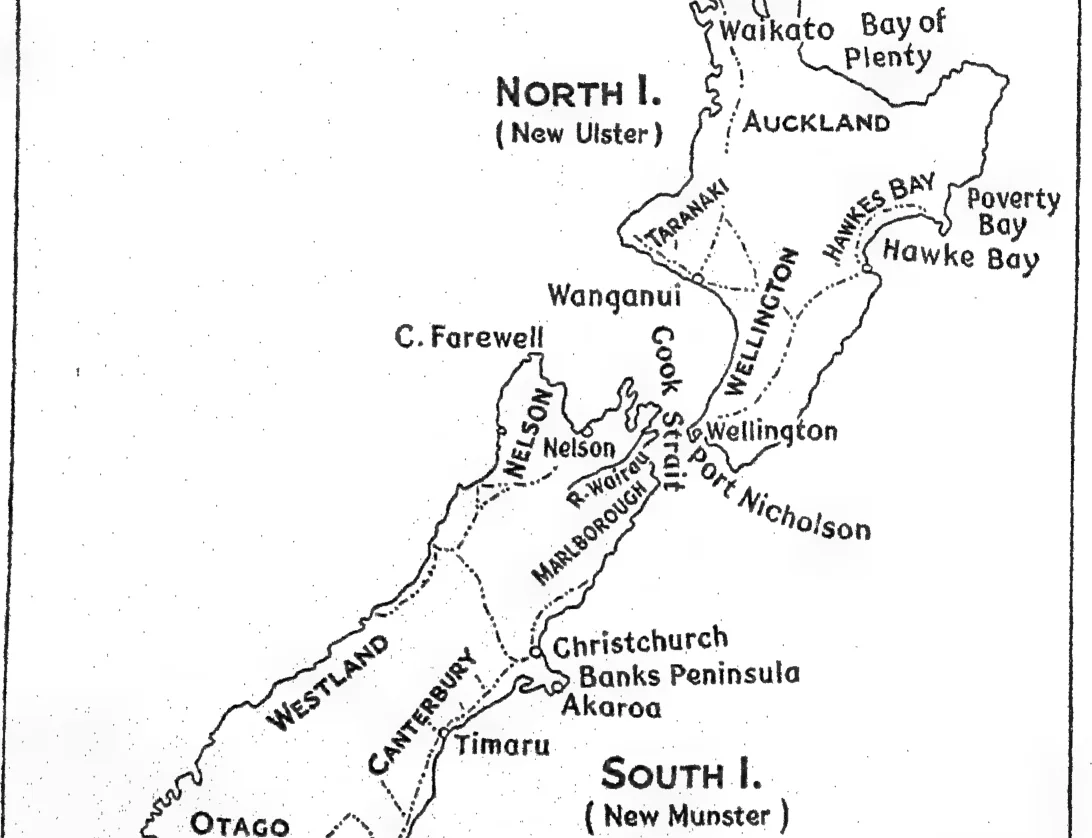
throughout the disturbances and contributed materially to their suppression. There has been no recurrence of serious trouble with the Maori, who are secure in the possession of their lands and are conscious of the advantages which have accrued to them as the result of white rule.
South Island prospered greatly during the period of the Second Maori War, by which it was not directly affected. Gold was discovered in 1857, and within a few years the population of the island had substantially increased.
The history of New Zealand since the termination of the Second Maori War has been uneventful, Political life has been active, differences of opinion having arisen as to the extent to which public works, financed by the State with borrowed money, should be undertaken! It was contended, on the one hand, that schemes of road and railway construction, telegraphs, and afforestation, would lead to an increase of population and the rapid development of natural resources, and, on the other hand, that the piling up of a burden of debt would embarrass the colony and retard its progress.
The public works policy was championed by Sir Julius Vogel, who, after having been Colonial Treasurer, was Premier from 1873 to 1876, His forward policy was opposed in certain respects by the Provincial Councils, and this was one of the factors which contributed to their abolition in 1876.
A policy of retrenchment, accompanied by a reduction of official salaries, an increase of taxation, and the slowing down of public works, was put forward by Sir John Hall, Premier from 1879 to 1882, and was continued in the ministries of
Sir Harry Atkinson (1883-4 and 1887-91).
1 These differences of opinion did not’ correspond exactly with the
distinctions between political parties.:
Mr. M. J. Savage.
built by private companies. These companies have since been bought out, and practically all lines are now owned by the State. Most of the lines, especially in South Island,
New Zealand is, as stated at the beginning of this chapter, the most remote of the Dominions from Great Britain; This has not made the people the less loyal; they show no inclination to secede from the British Commonwealth of Nations. The Dominion has no appreciable foreign element in its population, so that the problems connected with its development have not been complicated, as in Canada and South Africa, by racial friction.
The Maori, a numerous, warlike, and intelligent race, have caused anxiety, but now that they have settled down to peaceful pursuits they form a valuable factor in the development of the country. New Zealand, never having been used as a transportation colony, did not experience difficulties such as those which arose in the early history of Australia from the presence of convicts,
2 See p. 114.
Chapter XIBritish South Africa before the Union
Sours Arrica stands in marked contrast to the other self-governing Dominions in the British Empire. In latitude it may be described as sub-tropical; yet on account of the very considerable altitude of the interior its climatic conditions are such as to make it eminently suitable for settlement by white men. Its rainfall is slight, and the dryness and warmth of its atmosphere offer conditions ideal for the treatment of certain diseases.
South Africa is the only one of the Dominions in which the coloured population substantially exceeds the white. It is emphatically a black man’s country, in which, for political and social rather than for economic or climatic reasons, it is impossible for white men to undertake unskilled and inferior labour, Europeans in South Africa occupy positions requiring skill or involving responsibility. The coloured people are of various races. The Bushmen, of whom few survive, stand low in the scale of civilisation.
Hottentots are more capable of civilisation; their organisation is tribal, and they cultivate the soil and keep cattle. The Bantus are a virile race which includes such warlike nations as Kaffirs, Zulus, Basutos, and Matabele.. No small part of South African history is concerned with the conflicts. which have taken place between these tribes and the settlers of European descent. The natives, whose numbers are increasing, form about four-fifths of the population of South Africa, They are not uniformly distributed among the provinces.
Only in the Orange Free State does the white race approach equality of - numbers with the natives. The latter form three-quarters of the population of the Cape Province and of the Transvaal, while in Natal and Rhodesia the proportion of white men to ‘coloured is very small.
It follows that, to a greater extent than in any other of the
Dominions, the native population has been a definite factor in the political, economic, and social development of South Africa. Furthermore, the difficulties which have arisen in connection with the presence of a large native population have been increased by the fact that the dominant race, the British, has been outnumbered by another, the Dutch, which has generally been hostile to it. '
In spite of the high proportion of natives in the population of South Africa it has been necessary on many occasions to import labourers from other countries. South African natives prefer a nomadic existence to conditions involving regular toil, and, if a native settles on a small holding of his own.and owns a few head of cattle, he expects hard work to be undertaken by the female members of his family.
If he can be induced to live in a town and to engage in labour he will, as a rule, do so for a limited period only. Some natives, of course, become accustomed to life and work in towns, and do not return to their tribes, but they form only a small proportion of the whole.
In the eighteenth century Malays and negroes were imported and enslaved by the Boers, and at different times since. the establishment of British rule labourers have been imported from Portuguese territory in East and West. Africa, from India, from China, and from various other lands. Some of these immigrants return to their native lands in course of time, but many remain, and add to the complexity of the problems which face the administration in dealing with the native races.
The Cape of Good Hope was discovered by the Portuguese adventurer Bartholomew Diaz in 1486. During the sixteenth century Portuguese vessels on their way to the East must have called at the Cape from time to time, but no attemipt was made to form a settlement there.1 At the beginning of the seventeenth century the Dutch and English East India Companies came into existence and competed with each other for the Eastern trade. The voyage to the East was long, and a calling place was needed..
In 1619 negotiations took place between the rival companies for the joint establishment of a port of call at the Cape, The proposal fell to the ground, and the first permanent settlement at the Cape was made by the Dutch in 1652, under the direction of Van Riebeck.
authority of the Governor of Mozambique.:
1 Portuguese settlements were established on the east coast of Africa, between Cape Guardafui and Delagoa Bay. They were subject to the
It was not the intention of the Dutch Company to found a colony. The United Provinces had no surplus population ready to settle overseas. The sole purpose of the settlement was the provision of a depot at which Dutch ships could break their long voyage, take in fresh food and water, and land the sick. For a time the population consisted only of the servants of the Company, and though at length settlement was permitted few took advantage of the permission.
After the revocation of the Edict of Nantes! by Louis XIV in 1685 some Huguenot refugees were permitted to settle at the Cape. These men, for the most part, had fled from France into the United Provinces, and during their residence there they had picked up some knowledge of the Dutch language. Their religion, like that of the Dutch, was Calvinistic.
When they were received at the Cape they were not allowed to form a distinct community by themselves, but their farms were scattered and intermingled among those of the Dutch, with whom they intermarried and by whom they were gradually absorbed. For that reason there is not, as in Canada, a distinctively French element in the population of South Africa to-day. The principal result of the Huguenot immigration was the introduction of the cultivation of the vine.
In course of time the Dutch penetrated for some distance into the interior, Solitary farms were established, and slave labour was employed. Hottentots were enslaved wherever possible, while negroes were imported from West Africa and Malays from the. Malay Peninsula.
The last quarter of the eighteenth century was a time of trouble for the Dutch East India Company. Its trade declined, and during the Anglo-Dutch War of 1780-3 it lost many of its ships. Disturbances occurred at the Cape, where the Dutch, inspired perhaps by the example of the Americans and the French, were inclined to revolt against the Company’s rule. It became bankrupt in 1794, and a few years later it was abolished.
In 1795 the French conquered the United Provinces. The ‘Stadtholder took refuge in England, and with his sanction a
the Edict in 1685 was accompanied by a renewal of persecution.
1 By the Edict of Nantes, issued by Henry IV, King of France, in 1598, freedom of worship was granted to the Huguenots. The revocation of
British fleet visited the Cape and annexed it, in order to fore-stall any such action on the part of the French. The colonial Government offered some resistance, but was compelled toa submit, and the rule of the Cape by officials of the Dutch East India Company came to an end,
At the Peace of Amiens, 1802, the British withdrew, and the colony was ceded to the Batavian Republic. But the war was soon renewed, and in 1806 the Cape was reoccupied by the British, At the fall of Napoleon, the newly-formed Kingdom of the Netherlands recognised British possession of the Cape. Great Britain paid to the Dutch the sum of six millions sterling as compensation for the loss of this colony and of British Guiana and Ceylon.
The population of the Cape was increased by the immigration of many British settlers during the period of distress which followed the Napoleonic Wars. A body of some thousands of men and women landed in 1820 in Algoa Bay and founded the towns of Port Elizabeth and Grahamstown, and other groups settled elsewhere in the colony.. There was thus a British as well as a Dutch element in the population. But the existence of cheap native labour, slave and free, militated against the immigration of British settlers, who could not be expected to undertake manual labour side by side with, and on the sare terms as, men of colour.
The antagonism between British and Dutch, which during the century became such a prominent factor in South African history, did not appear at first. Their interests, especially on the frontiers, were not in any way opposed. The natives were numerous, and the white races naturally acted together against the black. The Dutch were, on the whole, not dissatisfied with British rule. It was despotic, but not harsh, and order was maintained.
Vigorous action was taken against the Kosas (tribes of Kaffirs) on the frontier, a matter on which the Dutch East India Company had been hesitant. Dutch law was administered, and the Dutch language continued to be used. Slavery remained the basis of the economic life of the colony..
This state of affairs did not last long, and several circumstances contributed to the estrangement of the two white races in South Africa. The Cape was a colony Dutch in origin but now under British rule, and with the advent of a British element it was inevitable that a process of anglicisation should begin. In 1822 it was ordered that by degrees the English language should be used in place of Dutch? for official pur-Poses, and by 1828 the change was complete.
A new system of local government was set up, and English magistrates were appointed to the courts of the colony. Dutch coinage was Withdrawn, and an English coinage similar to that current in Great Britain was put into circulation. The inherent merits of some of these measures may be recognised, but they took no account of the attachment of the Dutch to their own ways, and they contributed to the growth of Dutch discontent.
he main cause of Anglo-Dutch friction, however, arose from the difference of attitude of the two races towards the lack men of the colony. The Dutch farmers, who were called Boers, were deeply religious. Their theology, like that of the Dutch in Europe, was Calvinistic, and was based on the Old Testament rather than on the New.
It is, perhaps, Unnecessary to remind the reader that the conception of the Deity prevalent in the Old Testament is that of the God of a chosen people, the Hebrews, to whom He gives victory in war over their enemies, while in the New Testament He is depicted as a God of love, the Father of all men, who consequently are equal in His sight.
The Boers regarded themselves as, like the Hebrews, the chosen people of God, called to live among the black peoples of South Africa, who were not, to the same degree, the recipients of Divine favour. They held, there-fore, that they were entitled to enslave the black races and, even when this was not done, to keep them in permanent subjection.
Missions from continental countries to the black population of South Africa had been begun in the eighteenth century, and early in the nineteenth century this work was undertaken by the London Missionary Society. The teaching of the missionaries was based on the conception of the brotherhood
The language referred to in statutes and other official documents as
Dutch differs materially from the Dutch language in use in the Netherlands. South African Dutch is commonly known as the Taal, or as Afrikaans. Various theories have been put forward to. account for its existence.
It is conjectured that the original settlers may have spoken a dialect, and not pure Dutch; that the language may have been introduced into South Africa by the Huguenots, whose knowledge of Dutch was Probably imperfect, and that it spread from them throughout the colony; and that it is a patois which has arisen through the intercourse of the Dutch with the coloured races.
It is quite possible that there is some element of truth in all these theories,, of all men and their equality before God, ideas which, however admirable in the spiritual sphere, took no account of the practical difficulties of the situation in the colony, in which a few white settlers were scattered among a much larger black population of an inferior degree of civilisation.
The Boers felt that it was both right and necessary that natives should be kept in rigid subjection; the missionaries were ready, perhaps over-ready, to give a hearing to tales of oppression and cruelty towards the blacks by the settlers. These tales were embodied in their reports, and British public opinion turned against the Boers, They, for their part, felt that no opportunity had been given them to present their side of the case, and resentment developed.
It is not easy to pronounce judgment on the questions at issue between the Boers and the missionaries, It is asserted by writers of Dutch extraction that the treatment of the black men, bond and free, by the Boers was kindly and humane, and that the abuses which characterised negro slavery in America were absent from South Africa.
The Boers lived with their families in lonely farm-houses, in the midst of an inferior and sullenly hostile black populace, and they doubtless felt strongly the necessity of keeping the natives in subjection. This was perhaps not sufficiently realised by the missionaries, who may have been too ready to believe what they were told of oppression and injustice. But such tales would not have been put forward if there had been no foundation for them at all. The missionaries may have been narrow-minded, and unable to see points of view other than their own, but they stood for humanity and for the fair treatment of a subject race.
In the eastern part of the colony there was little slavery, and the Boers relied upon the wage-labour of the Coloured
Folk! They, however, were unreliable, and, by their disorderly habits, were a constant source of annoyance and even danger to the solitary farmer. The Boers desired the imposition of restrictions upon the freedom of the Coloured Folk and the institution of compulsory labour. But in 1828 an ordinance was issued by which all existing restrictions upon free men of colour were removed, and they were given full civil rights. Their legal equality of status with white men was recognised, in substance if not in form, a decision which accentuated the growing hostility of the Boers to British rule.
blood of Hottentots, negroes, Malays, and even white men. There
were few pure-blooded Hottentots at the Cape...
1 The Cape Coloured Folk were people in whose veins flowed the
The Act for the abolition of slavery in British colonies was passed by the British Parliament in 1833. Few Acts of Parliament can be so completely justified as this. No advantage was anticipated from it, and a large sum of money which the nation could ill afford was set aside as compensation to slave-owners, The reform was carried on moral and humanitarian grounds alone.
Yet it was bitterly resented by the Boers, who saw in it a further step in the British policy of equalising the status of black and white. Moreover, the Boers had a genuine grievance in the matter of compensation. The settlers estimated the value of their slaves at £3,000,000; the amount awarded as compensation to the colony was £1,250,000.
The amount of the Boer claim was possibly _exaggerated, but, even if the award was reasonable, which seems doubtful, the manner of payment resulted in much loss to the farmers. Claims had to be lodged in London; this could be done only through agents whose expenses and commission were deducted from the compensation paid to the slave-owners,
In 1834 the Kaffirs crossed the Fish River and invaded the colony, slaughtering many people and burning their homesteads. The Governor, Sir Benjamin D’Urban, acted with great vigour; the invaders were driven out, and it was decided to annex the territory between the Keiskama and the Kei and to form a new province of Queen Adelaide. All hostile natives a Aa were to be expelled from the newly acquired territory, in which lands were to be granted as compensation to settlers who had incurred losses in the recent war. The proposed annex-ation would have the advantage of providing the colony with a frontier which would be easily defended against further attack.
The British Government, ever reluctant to add to its responsibilities, refused to sanction the annexation, The missionaries were not directly responsible for this decision, but they had moulded public opinion in England; and the Government was influenced by public opinion in shaping its policy. The settlers in South Africa were aggrieved by the British refusal to afford them reasonable protection against the danger of native attack, and they strongly resented the assertion that the conduct of the white folk, official. and: non-official, had provoked the Kaffir onslaught.
The attitude of the British Government after the Kaffir War was the final factor which induced thousands of Boers, especially those of the frontier, to throw off the British yoke. In 1836 began the Great Trek. Many thousands of Boers, refusing to live any longer under British rule, abandoned their homesteads at great loss to themselves and moved away into the interior, carrying their portable possessions in oxwagons. The movement was carefully prepared and well
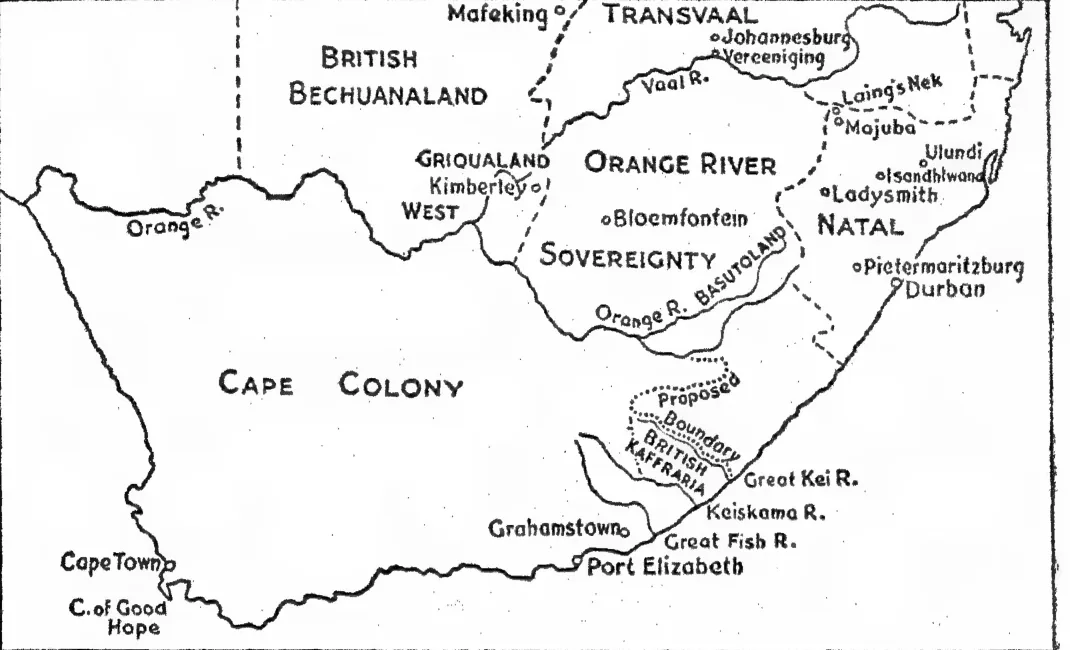
organised. Some parties moved northwards in 1835, but the main body crossed the Orange River in 1836, and on the farther side of it was founded what became known afterwards as the Orange Free State. Some of the Boers continued the trek and crossed the Vaal River, and in the remote interior, hundreds of miles from the coast, founded the Transvaal,
A third party trekked towards the north-east, to Natal, in 1838, though it was unable to settle until after severe fighting with the Zulus of the district, who were defeated at Blood River. A small British settlement, Durban, had already been established in Natal, but the British Government had declined to extend its responsibilities by annexing the region, and the Natal Boers, under their leader Pretorius, thought they would be within their rights in proclaiming a republic. This stirred the British to action, and a military force was sent to Durban.
The republic submitted. Natal was annexed to Cape Colony in 1843, and in 1845 it was organised as a separate province under a Lieutenant-Governor who was subject to the authority of the Governor of the Cape. Many of the Boers of Natal retired inland and joined their compatriots in the Orange
Settlement and the Transvaal.
For some time Great Britain pursued no decided policy towards the Boer settlements, No attempt had been made to restrain the movements of the Boers; in the British view their status as British subjects remained unchanged. On the one hand, extreme reluctance to undertake further responsibility, on the other hand, a feeling that Boers and natives needed protection against one another — the natives against Boer oppression and the Boers against attack by the warlike tribes of the interior—hindered the development of a resolute policy.
The territory between the Orange and the Vaal Rivers, known for the next few years as the Orange River Sovereignty, was annexed in 1848 by Sir Harry Smith, Governor of Cape
Colony, in spite of some resistance led by Pretorius. But no immediate attempt was made to extend British authority over the Boers beyond the Vaal.
For some years after 1850 trouble was experienced with the
Basutos, a native race which occupied territory on both sides of the Orange River. At the same time the British Government found it increasingly difficult to maintain its hold over the Boers. In 1852 authority over the Boers north of the
Vaal was definitely disclaimed in the Sand River Convention, and in 1854, by the Convention of Bloemfontein, the independence of the Orange River Sovereignty was recognised, it being known henceforth as the Orange Free State, The Boers of this region were dismayed rather than gratified by the withdrawal of the British, since they were left to face alone the hostility of the Basutos within their borders. It was understood, however, that Great Britain remained the paramount power in South Africa, and that as such she retained the right of intervention in the republics and in native territories if this should be necessary in the interests of South Africa as a whole.
The course of constitutional development in Cape Colony + Some justification for British’ reluctance to face an extension of responsibilities at this time may be found in the imminence of the Crimean ‘War,.
followed the Canadian model. Between 1806 and 1833 the colony was ruled by a military Governor, who was not even assisted by a Council until 1825. In that year a Council of six members—three of them officials, and all of them nominated—was appointed to advise the Governor. In 1833 the government of the colony was placed on a miore satisfactory footing. It was declared to be a Crown Colony under the rule of a Governor who was to be assisted by two Councils.
The Executive Council was to consist of officials, men who in a later stage of constitutional development would be called ministers, The Legislative Council comprised, in addition to officials, a number of prominent colonists appointed by the Governor. There was to be no election of members of the Legislative Council and, consequently, no direct repre-sentation of the people, but colonial opinion was not entirely ignored,
In 1853 in the Cape, and in 1856 in Natal, representative institutions were established. In each colony a Parliament + of two elected chambers was set up. The franchise was settled on a wide basis, even the Coloured Folk being permitted to vote in Cape Colony,? though not in Natal, where natives outnumbered the white population many times. But the ministry was not responsible to the legislature. Criticism of ministerial action by members of the colonial Parliament was powerless to bring about a change of Government. Responsible government was granted to Cape Colony in 1872 and to Natal in 1893.
For about a quarter of a century the Boers were not subject to British rule. At first it seemed likely that those who had passed the Vaal would forma number of small independent republics. Four or five distinct political units existed at one time, and if the Boers had not overcome this tendency to political subdivision their extermination by native races would have been inevitable. It was not until 1857 that the constitution of the South African Republic was settled; within two or three years the other “republics” north of the. Vaal adhered
1 The term “Parliament” was used of the bodies established in Cape Colony and Natal at.this time. In general, an elected body in a colony which does not possess responsible government is called a Legislative Assembly.
2 The right of the Coloured Folk to’ the franchise. was not. specifically stated. The constitution of the.Cape made no mention of colour, and the right of men of colour to vote was recognised by implication,
Sea eee to it. After 1860 there were only two Boer republics, the
Transvaal (South African Republic) and the Orange Free
State, respectively north and south of the Vaal, and a union between them was contemplated. Pretorius, son of the leader of the Natal Boers in 1838, was for a time President of both.
Among both British and Boers were men who recognised that the policy which had found expression in the Conventions of the Sand River and Bloemfontein—the policy of disavowing responsibility—was not the best for South Africa. The possiblity of bringing about some form of federation of the various political units in South Africa was sometimes considered, and in 1858 Sir George Grey, Governor of the Cape from 1854 to 1861, drew up a statement of the arguments in favour of federation. He recommended that some form of organisation should be devised which should include Cape Colony, Natal,
British Kaffraria,| and the Orange Free State. He believed that the Boers of the Orange Free State would be willing to consider the proposal and that, if it were adopted, the northern
Boers would of their own volition join it in time. It was a statesmanlike suggestion, but it failed to win the support of the British Government.
For many years after the conclusion of the Convention of
Bloemfontein the Orange Free State had trouble with the
Basutos. By 1866 it had so far conquered them that the
Basuto chief gave up a large extent of territory to the Boers.
This was not a final settlement of the problem. The war was soon renewed, and in 1868 the Governor of Cape Colony, Sir
Philip Wodehouse, annexed Basutoland and permitted the tribesmen to remain. His action received the approval of the British Government, but it was keenly resented by the Boers.
The discovery of diamonds, in 1870, in a small region on the western border of the Orange Free State, led to an inrush of settlers and to the growth of the mining town of Kimberley. For many years it was believed that the supply of diamonds was strictly limited and that, when it was exhausted, Kimberley would be deserted. The town, therefore, presented the appearance of a mushroom mining camp’ rather than of a permanent and well-built city. Improvements in mining methods and further discoveries of “‘ blue earth” 1 have shown that the supply of diamonds is practically unlimited, and the danger is no longer of exhaustion, but of superabundance, which might lead to cheapening.
1 British Kaffraria was the region which D’Urban had proposed to annex in 1834 as the Province of Queen Adelaide. It was taken over in 1847 and ruled. as a separate province until 1866, when it was incorporated in Cape Colony.
While, at first, claims were staked out by individual miners, these soon gave way to companies. Cecil Rhodes, who went to South Africa in 1873, formed the De Beers Mining Company to work the De Beers Mine. Barnett Barnato, who also reached South Africa in 1873, formed the Barnato Diamond Mining Company, which controlled the Kimberley Mine. These two men, both in the early twenties, became bitter rivals, and a financial duel ensued between them which lasted for some years.
Rhodes was supported by Mr. Alfred Beit and Lord Rothschild, and was able to force his opponent to come to terms. The result was an amalgamation of the rival concerns under the style of De Beers Consolidated Mines, Limited, which by 1891 controlled not only the Kimberley and De Beers Mines, but also mines at Dutoitspan, Bultfontein, and Wesselton,
The De Beers Company employs well-paid native labour in the extraction of the stones. In time past it has suffered loss from the pilfering of diamonds by natives, who sold them to unscrupulous dealers. This has been checked, and illicit diamond-buying is now regarded as a very serious offence; even the unauthorised possession of uncut stones is punishable with very heavy sentences under the laws of the colony. The Company controls the world market for diamonds and
The blue earth upon being raised to the surface is spread out in the open air and is left for several months to disintegrate. It is then washed, and a mass of pebbles is left. Most of this mass consists of rubbish, but the diamonds are mixed up with it, and it becomes necessary to separate what is valuable from what is. worthless. The larger diamonds are picked out by hand; the remainder of the mass is spread over trays smeared with lard. It has been found that diamonds will adhere to lard while the is careful not to put too many stones on sale at any one time lest their value should fall.
valueless stones will not.;
1 Diamonds and other precious stones are embedded in “blue earth.” This blue earth, of volcanic origin, exists in funnels or shafts which go down for an unknown distance into the earth. The shafts are elliptical in section, and tunnels of blue earth radiate from them. It is to be assumed. that the shafts and passages were formed by volcanic action and that they were ultimately choked up with the blue earth, A diamond mine is thus not unlike a coal mine, except that in the latter the coal lies in strata, shafts being sunk and galleries cut in order to provide access to the seams, while in the former the shafts and galleries come into existence through the retnoval of the precious blue earth.
The Kimberley diamond-field was, as stated above, on the border of Cape Colony and the Orange Free State and was partly in Boer territory. The region, known as Griqualand
West, was annexed to Cape Colony in 1871. It was at first given a separate administration, but it was incorporated in
Cape Colony in 1880. Though the annexation has been criticised as an unprincipled seizure of a valuable region, it may be pointed out that the Boer Government, the seat of which was far from the diamond-field, was unable to control the rough elements which assembled there, and the annexation was necessary for the maintenance of order. The ultimate importance of the acquisition of Griqualand West, however, lay less in the potentialities of the diamond-field than in the position of the province, through which runs the direct route into the interior of the continent.
By 1874 sixteen years had elapsed since Grey’s proposal for a South African federation had been rejected by the
British Government. The idea was revived by Lord Carnarvon, Colonial Secretary in Disraeli’s second ministry. But the position was no longer so favourable. The Boers of the
Orange Free State resented the annexation of Basutoland and
Griqualand West, while Cape Colony had enjoyed responsible government since 1872. Carnarvon acted tactlessly in the negotiations, the Government of the Cape was antagonised, and, although a South Africa Act, by which confederation was permitted, was passed through the British Parliament in 1877, the suggestion came to nothing.
Serious difficulties presented themselves in the Transvaal at this time; the finances of the republic were in disorder, and danger threatened from the Zulus. In the interests of peace and order, and for the protection of the Boers themselves, the Transvaal was annexed in 1877 by Sir Theophilus Shepstone, acting under instructions from the British Government. This action was disliked by the Boers, but before long many of them recognised its necessity.
Sir Bartle Frere was appointed Governor of the Cape and High Commissioner for South Africa in 1877. He recognised the gravity of the Zulu menace. The Zulus were a formidable warlike race, with an excellent military organisation. Their attitude was provocative, and Frere made a number of demands of the Zulu king, Cetewayo.
He required compensation for recent Zulu raids into Natal, compensation for Boers dispossessed by the Zulus, the discontinuance of certain barbaric practices, some modification of the Zulu military organisation, and the acceptance of a British Resident. Frere warned the British Government of the gravity of the situation, and asked for military reinforcements. Some additional troops were sent out, but Great Britain at this time was on the verge of war with Russia over the Balkan question, and little attention was paid to affairs in South Africa.
Cetewayo ignored the demands of the High Commissioner, and in 1879 the Zulu War took place. At Isandhlwana a great disaster befell the British forces, and 800 men were slain. Natal was threatened with invasion, but the gallant defence of Rorke’s Drift by a handful of British against 3,000 Zulus saved the colony. Zulu power was overthrown at Ulundi, and Cetewayo submitted. Zululand was left under native rule at first. It was divided into thirteen districts, each under its own chief, and with a British Resident in each.
The system did not work well, and Cetewayo was restored, but soon afterwards died, Dinizulu, his son, was less capable, and in 1887 direct British rule was established. Ten years later Zululand was annexed to Natal.
With the disappearance of the Zulu danger the Transvaal Boers were anxious to regain their independence, and in December, 1880, they revolted and invaded Natal, where in 1881 they defeated small British forces at Laing’s Nek and Majuba Hill. Reinforcements were sent out from England, but before their arrival the Gladstone Government decided to concede the demands of the Boers and to recognise their independence.
This was done by the Convention of Pretoria, 1881, which, however, reserved the suzerainty of Great Britain and stipulated for the presence of a British Resident in the Transvaal. Gladstone followed this course after full consideration of the position, He came to the conclusion that the Boers were justified in claiming their independence and that Great Britain would be wrong in refusing it. Butit must be admitted that the concession was made at the worst possible moment.
Coming, as it did, immediately after defeat, it bore the appearance of having been extorted from the British by their triumphant opponents, and it was so interpreted by the Boers. British prestige henceforth among the Boers was low.
Three years later the conditions laid down in the Pretoria Convention were revised, and in the Convention of London, 1884, the British claim to suzerainty was not specifically put forward, although Great Britain retained control of foreign affairs. The British Resident was withdrawn from Pretoria, where Great Britain was henceforth represented by an Agent.
In 1884 the Transvaal attempted to extend its authority over Bechuanaland. In order to prevent this an expedition was sent into Bechuanaland under Sir Charles Warren, and the region was annexed as a Protectorate in 1885.
Discoveries of gold in small quantities were made in various parts of South Africa during the nineteenth century. It was found as early as 1854 in the Transvaal, where, however, prospecting was forbidden. This policy was reversed in 1872, and in the eighties extensive deposits of ore were found in the Witwatersrand. The Rand was proclaimed to be a public pold-field in 1886, and a gold rush occurred. The city of Johannesburg came into existence, and from the first it assumed a more permanent aspect than Kimberley.
The ore in the Rand was of low-grade quality, and profitable extraction was possible only by the use of machinery and the application of the cyanide process.1 The work was carried on by companies which possessed large reserves of capital, Natives were
1 It was estimated that the ore on the Witwatersrand contained only half an ounce troy of gold to the ton. The gold was distributed in minute particles throughout the ore (called conglomerate), and its extraction at a cost less than the value of the product presented a problem which was solved by the application of the cyanide process. For a full account of the process the reader is referred to suitable works on mining and metallurgy, but a brief description may be of interest.
The ore is crushed, and then ground to a powder which is treated with a -3 per cent solution of potassium cyanide in the presence of air. A complex chemical reaction causes the gold to be dissolved, forming potassium gold cyanide. The clear liquid containing the gold compound is separated from the insoluble materials present by filter press, and zinc is added to it.
The chemical reaction which takes place is a replacement of the gold by zinc, forming potassium zinc cyanide, leaving the gold to be precipitated. (Another way of recovering gold from cyanide of gold is by electrolysis.) In this way over ninety per cent of the gold in the ore is recovered. The successful working of the process involves the use of powerful crushing and milling machinery, and only by the employment of cheap native labour can a profit be made.
The recovery of half an ounce troy of gold from a ton of ore used to cost (including overhead charges) about thirty shillings; the gold was worth about two guineas. In recent years technical improvements and economies have made possible the profitable working of ore which contains only three-eighths of an ounce troy of gold.
employed for the less skilled work, but white men occupied the more responsible posts. There was, therefore, in the last few years of the nineteenth century a large influx of
Englishmen into the Transvaal, men engaged either directly in the mining industry or in the subsidiary occupations that grew up around it. To the Boers these new-comers were Uitlanders (Outlanders), or foreigners. In some parts of the republic they outnumbered the Boers, but they possessed no political rights, and the relations between Dutch and British in the Transvaal became strained. The Boers, under the presidency of Paul Kruger, levied heavy taxation on the mining communities, and used the revenues so obtained in
Se the purchase of arms, especially of artillery, and ammunition. It was practically impossible for a Uitlander to become a naturalised citizen of the Transvaal; the Uitlanders, however, were More intent upon amassing wealth than upon securing political rights, until the pressure of Boer rule became intolerable. The Transvaal, during this period of its history, presented the spectacle of an industrial community of one race dominated by a military oligarchy of another race.
For some years after he became Prime Minister of Cape Colony Rhodes pursued a policy designed to promote reconciliation and friendship between the white races in South Africa, and in this he was supported by the Afrikander party, under Jan Hofmeyr, in the Cape Parliament. This policy commended itself to the Orange Free State, but not to Kruger, who alone of leading South African statesmen was determined to maintain Boer aloofness and to assert Boer supremacy. Even in the Transvaal there were not wanting men who doubted the wisdom of the President’s policy and who were sympathetic with Rhodes’s ideal of a United South African nation.
for the trifling sum of £12,000, but the parsimonious Gladstone Govern-
ment would not provide the money.;:;
1 Only to the east, through Portuguese East Africa, was it possible for the Boers to reach the sea without passing through British territory. Even Portuguese East Africa might have been secured by Great Britain in 1872
Jameson and his associates were, at the request of the British Government, handed over to be dealt with by British law, and they were sentenced to terms of imprisonment for attempting to make war upon a State with which Great Britain was not at war. The sentences were lenient—Jameson himself was sent to prison for only fifteen months in the second division, and his subordinates received even shorter terms, An inquiry into the affair was held by the British Government, but it was widely believed that evidence was being suppressed and that important people were being shielded. The inquiry failed to convince the world that the full truth had been told; its effect was to throw doubt on the good faith of the British Government.
rown. i forth the President had every justification for the course he was pursuing in arming the Boers and refusing to enfranchise the Uitlanders.,
Rhodes had certainly been aware of the preparations which had been miade, and he had taken no steps to check the proposed violation of law. The support of the Cape Dutch (the Afrikander party) in the Cape Parliament was withdrawn, and Rhodes was forced to resign the Premiership. The relations between Dutch and British throughout South Africa were embittered, the Afrikanders henceforth making common cause with the Boers. From a military point of view the collapse of the raid confirmed the impression made upon Boer minds by the Battle of Majuba Hill—that the British were a decadent race, incapable of overcoming the sturdy farmers of the veldt in open fighting.
In 1897 Sir Alfred Milner, a man of great capacity, who had won a great reputation as an administrator in Egypt, became Governor of the Cape and High Commissioner for South Africa, In June, 1899, he had a personal interview with Kruger at Bloemfontein, and negotiations took place for the enfranchisement of the Uitlanders, Milner asked that the Uitlanders should be given full political rights after residence in the Transvaal for five years.
The President was willing to recommend to the Volksraad (the Legislative Assembly of the Transvaal) that the Uitlanders should be granted the franchise after residence for seven years. But he could offer no guarantee that the Volksraad would accept his suggestion, while he demanded of the High Commissioner a guarantee that under no circumstances would the British Government intervene in the internal affairs of the Transvaal.
Kruger and Milner both realised that if the Uitlanders were enfranchised they would in time dominate the Transvaal and overthrow the Boer oligarchy. The aims of the two men were thus utterly opposed, and no compromise was possible. The view that negotiations broke down on a mere point of detail—the difference between five years and seven years—fails to take into account this. vital antagonism of aim.
Matters had reached a point at which war appeared to be inevitable. Yet in Great Britain it was generally held that the President was bluffing, and that a show of force would induce him to modify his position. The Boers, on the other hand, remembering Majuba and the Jameson raid, held the British in slight esteem. This view was shared by the President, who expected the support of the Cape Dutch as well as of the
Orange Free State and was confident that in a war of any length Great Britain would be faced with European intervention.
Kruger’s hope of European support was doomed to disappointment (he had not reckoned on the strength of the British fleet), and the Cape Dutch remained loyal. The British Government, for its part, underestimated the difficulties of a camipaign in
South Africa, ignoring the warnings of Sir William Butler, the commander-in-chief on the spot; and when the war began it found Great Britain unprepared.
In October, 1899, the second South African War, in which both republics were involved, broke out, and Boer forces invaded Cape Colony and Natal. From a military point of view the Boers had all the advantages. From the nature of their home life men from the veldt were skilled riders and marksmen. They were operating close to their base; they could select their points of attack and could vary them from time to time as seemed desirable. The British were fighting thousands of miles from their real base, which was Great
Britain. British troops in South Africa were too few to control the situation, and serious defeats were experienced.
The Boers besieged Ladysmith, in Natal, Kimberley, in Cape
Colony, and Mafeking, also in Cape Colony. Meanwhile, large armies were dispatched from Great Britain to South Africa, while in Canada, Australia, and New Zealand contingents of troops were raised for the assistance of the mother country, Lord Roberts was appointed to the command, with Lord Kitchener as his chief-of-staff, and, after their arrival at Cape. Town, the aspect of the war speedily changed. Roberts invaded the Orange Free State and continued his march into the Transvaal, occupying Johannesburg and Pre-toria.
Pressure on the beleaguered towns was necessarily relaxed, since the Boers had to withdraw some of their troops to defend their own land, and at length the sieges were raised. ~The war continued for two years after the capture of the chief towns in the Boer republics. Roberts returned home and Kitchener assumed the command of the British forces. The Boers rode about the country in small bands, commanded by Botha, Smuts, Hertzog, De.
Wet, and-others, with a view to carrying on a war of attrition against the British. In the later stages of the conflict they could have had no hope of expelling the invaders, but by their obstinacy and their refusal to admit defeat they won the respect and admiration of the world, including their opponents. If they had a definite aim at all, it was to weary the British and secure a peace on negotiated terms. But the British, too, were determined.
Reinforcements continued to pour into South Africa and Boer commandos were rounded up. The war could have only one end, and this was reached at Vereeniging at the end of May, 1902. President Kruger had fled to Europe some time before, and the terms of the Peace of Vereeniging were settled between ' Lord Kitchener and the Boer military leaders. The Boers laid down their arms and recognised the sovereignty of the king. The republics were annexed and were henceforth to be ruled as Crown Colonies.
That the war should leave a heritage of bitterness behind it was inevitable. The work of British and South African statesmen in the twentieth century was to diminish the antagonism of British and Dutch and to restore the prosperity of the land. Not only in the Transvaal and the Orange River
Colony (the former Orange Free State), but also in Cape Colony, which had suffered severely from Boer raiding parties, much had to be done. Railways and bridges and buildings had to be restored, and agriculture had to be re-established. The Government granted money for the restocking of farms and the provision of seed. The diamond mines were soon working again, as the industry was able to attract a sufficiency of native labour by the offer of good pay.
It was a more difficult task to restore the gold mines on the Rand. The conditions of the industry were such that it could be conducted profitably only if an abundant supply of cheap labour were available. The natives formerly employed on the Rand had been dispersed during the war, and the demand for their services for the work of reconstruction in all parts of South Africa was such that labour on the Rand did not attract them.
In order to facilitate the restoration of the gold-mining industry the British Government sanctioned the importation of Chinese coolies as “indentured labourers,” i.e. men working under an agreement for a term of years. The normal period was three years; the coolies were brought from their native land, and at the end of their term they were repatriated at the expense of their employers. They were even permitted to break their agreements and return at any time, but those who did so had to pay for their return passage. From first to last under this system some 50,000 coolies were brought to South
Africa. Their employment did not pass without criticism; in particular it was viewed with disfavour in Australia. In Great
Britain the system was represented, or misrepresented, as being indistinguishable from slavery, and the cry of “Chinese slavery” was one of the factors which led to a crushing defeat of the Conservative party at the general election of 1906.1
Sir Alfred Milner (Lord Milner after 1902) continued in office as High Commissioner until 1905. He did useful work in endeavouring to reduce racial animosity, and much success attended his efforts to repair the material damage done by the war. His policy was to establish British ascendancy perarse manently in South Africa, and he promoted a scheme for the introduction of British settlers in the Transvaal to balance
Dutch influence in that province. But it was hardly possible to treat the Dutch for all time as a conquered race, and a policy of conciliation, leading to the close association of British and Dutch and the ultimate realisation of the ideal of a South
African nation, commended itself to many men of both races, though not to the High Commissioner.
The Balfour Government, with the concurrence of Lord
Milner, contemplated the grant to the Transvaal of a Repre:
sentative Assembly with considerable, though limited, powers,?
leaving the Orange River Colony as a Crown Colony for the time being, but it fell from office before anything was done.
Sir Henry Campbell-Bannerman succeeded Mr. Balfour as
Prime. Minister of Great Britain. The Liberals had won the general election of 1906 largely on the question of Chinese labour, and they were expected to bring about its abolition, But they preferred to leave the responsibility for its continuance or cessation to the Transvaal, to which, in 1906, they granted responsible government without insisting upon the usual intermediate stage of representative institutions.
The Orange River Colony was granted responsible government in 1907. General Louis Botha, who was commander-in-chief of the forces of the Transvaal during the South African War, became its Prime Minister. General Smuts, his comrade in the war, became his colleague in political life. (In the Orange River Colony the first Prime Minister was Abraham Fischer, whose political lieutenant was the former General Hertzog.)
The labour question in the Transvaal was settled by permitting the existing Chinese labourers to work out their contracts, but discontinuing further importations, and by the end of 1910 the last Chinese were repatriated. By this time South Africa had largely recovered from the economic disturbance due to the war.. The recruitment of native labour mes on a large scale was again possible, and the Chinese were no longer needed.
Secretary from 1903 to 1905:
1 The Balfour Government, anticipating defeat, resigned shortly before the election.? This constitution, which was never established, was known as the * Lyttelton Constitution, from its author, Mr. Alfred Lyttelton, Colonial
When it is remembered that the grant of responsible government to a British colony involves the virtual abandonment of British control and the substitution for it of complete self-government, it will be realised that this concession to the Boers, made only four years after the republics had been conquered, was an action to be described as bold and statesmanlike, or rash and ill advised, according to the point of view. Much would depend on the use which the Boers would make of their recovered independence.
In British colonies in other parts of the world, whose loyalty was not in question, the grant of responsible government could be made without difficulty as soon as the colony was sufficiently well established. But the dominant consideration here was not the political capacity of the Boers, but their loyalty, and many people doubted whether Boer antagonism to. British rule had died down sufficiently to justify the experiment. On the whole it has worked well.
Although many Boers, with the stubbornness characteristic of their race, have refused to modify their attitude, the more enlightened and more responsible of them have accepted the inevitable, and have realised the advantage which must accrue to South Africa through the two races pulling together instead of remaining in perpetual antagonism,
Chapter XIIThe Union of South Africa
or through Portuguese East Africa. Cape Colony and Natal, if they chose to do so, could inflict great harm on trade from the interior by the establishment of excessive customs duties. A Customs Convention was drawn up in 1903, by which the scale of duties and the apportionment of the money received were settled by agreement, but it was felt that this was no more than a temporary expedient. It was renewed in 1906 for two years, but after the establishment of responsible government the Transvaal gave notice of its intention to withdraw from the Convention, and the notice was suspended only when negotiations for union were begun.
As early as 1907 Lord Selborne, who had succeeded Lord Milner in 1905, issued a memorandum which pointed out the advantages to be gained by a closer union of the self-governing colonies in South Africa. A National Convention met at Durban in 1908, and, after an adjournment, resumed its discussions at Cape Town. On many questions there was a large measure of agreement among the representatives of different provinces; the discussions therefore mainly centred on the four or five problems on which opinions were at variance.
The most important of these questions was the nature of the central Government which was to be set up. The framers of the constitution of South Africa were in a position to consider the effects of federation in Canada and in Australia, and they might have proposed a federation on either model. It was decided not to adopt a federal constitution at all, but to establish a Union of the four colonies, concessions being made, however, in certain respects to the federal principle. Each of the colonies was to surrender its independence; in each case the colonial Parliament would be abolished, and each colony would become a province of the Union.
1 Cape Colony, Natal, Orange River Colony, Transvaal. * Rhodesia.
3 Bechuanaland Protectorate, Basutoland, Swaziland.
It was agreed that the Union Parliament should consist of a Senate and a House of Assembly, but questions of franchise and representation gave rise to a considerable amount of discussion before agreement was reached. The franchise laws in the four colonies had not been uniform: in Cape Colony the Coloured Folk had enjoyed the right to vote, but in the other colonies it had been restricted to Europeans.
Uniformity in this matter could not be attained, and it was at length agreed that the franchise laws in each province should be those prevalent in the colony before the Union, unless and until the Union Parliament decided otherwise. This compromise settled one difficulty, but raised another.
It was clearly impossible to assign seats in the Union Parliament in proportion to the number of voters in the provinces; had this been done the Cape, with its voting lists swollen by the inclusion of men of colour, would have obtained excessive representation. The question was ultimately settled on the basis of representation of the province proportionate to the number of white male adults in the province. Within each province the constituencies were to contain, as nearly as possible, equal numbers of electors.
In federations which existed in other parts of the world, and notably in the United States and in Australia, the equal repre-sentation in the Senate of the component states was designed to safeguard the rights of the smaller states from the domination of the larger. The adoption of this device in the Union Constitution was one of the concessions to the federal principle mentioned above.
The provision of a capital for the Union also presented difficulties. Cape Town, on account of its position at the southern extremity of the Union, was not really suitable, while
Pretoria was smaller and less important. Compromise again prevailed. It was decided that the administrative centre should be at Pretoria and that the Union Parliament should meet at Cape Town. The Union Court of Appeal was to sit at
Bloemfontein. The inconvenience of an arrangement by which
Government offices were situated hundreds of miles from the seat of the legislature needs no proof.. When it is contrasted with the arrangements at Westminster, where Government offices are within a stone’s throw of the House of Commons, it will be agreed that the compromise was unsatisfactory. It can be defended only on the ground that at the time no other solution was possible, but it is difficult to believe that the
Union Government will treat the question as settled for all time.?
It had been expected that the question of South African railways would cause difficulty, and some pessimists predicted that the negotiations would split upon the rock of this problem and come to an untimely end. As a matter of fact, a solution was reached with surprising ease. It was agreed that the railways, ports, and harbours should be transferred to the
Union Government and that they should be controlled by a
Board of Commissioners and be administered for the benefit of the Union as a whole. If profits exceeded what was necessary to meet the interest on the capital invested the excess was to be used in reducing rates, in improving the conditions of labour on the system, and in the construction of new lines.?
The National Convention was able to frame a Draft Constitution which embodied the decisions reached in the course of the discussions. It was referred to the four Parliaments for consideration. The Transvaal and the Orange River
Colony accepted it; Natal did so, subject to a referendum;
Cape Colony proposed some amendments. The Conventien reassembled and made certain modifications in the draft which. satisfied the Cape. The amended constitution was thereupon accepted by all four colonies and was sent to Great Britain.
1. Students of constitutional theory who are familiar with the old doctrine of the Separation of Powers will recognise that, if the application of this doctrine were really practicable, the arrangement with regard to the capital cities would be ideal,
2.The South African railway system had been remarkably successful. The railways had been constructed on a uniform gauge of 3 ft. 6 in. Engineering difficulties ‘had not been exceptional, and the total capital expenditure to the time of the formation of the Union had been no more than £75,000,000...The annual interest on. this sum amounted to £2,250,000, and after the cost of working had been met the annual profit on the system exceeded £3,000,000. There was thus an ample margin which might be used in the reduction of rates, the improvement of labour conditions, and the construction of additional lines.
An amendment proposed in the British Parliament, placing the protection of natives and Asiatics under the central and not the provincial authorities, was accepted by the South Africans, and became part of the South Africa Act, which was passed by the British Parliament. The Union was to come into being on 31st May, 1910, the anniversary of the Peace of Vereeniging. The first Parliament of the Union was opened some months later by the Duke of Connaught, acting on behalf of the king.
The executive power of the Union was vested in the Crown, which was to be represented by a Governor-General, There was to be an Executive Council to advise the Governor-General. It was understood that this Council, which would be the cabinet of the Union, would consist of ministers responsible to Parliament. The seat of the administration was to be at Pretoria.
The legislative power of the Union was to be exercised by a Parliament of two Chambers, a Senate and a House of Assembly. Parliament was to meet annually at Cape Town, and its members were to be of European descent. The Senate was to consist of sixty-four members, sixteen from each province.
Half were to be elected and half nominated by the Governor-General,? and half of the nominated members were to be chosen on the ground of their knowledge of the reasonable wants and aspirations of the coloured races. The first Senate was to hold office for ten years, and during that period the Union Parliament might provide for the future constitution of the Senate...
The first batch of elected senators was to be chosen by the colonial Parliaments before their extinction, and, if no change was made in the constitution of the Senate, its future members were to be elected by the Provincial Councils. The original number of members in the House of Assembly was 121, but provision was made for a census of the population of the Union of European descent every five years, and each census was to be followed by a redistribution of seats.
The total number of seats was never to exceed 150. ‘The franchise was made subject to the Union Parliament, but strong measures were taken to protect the coloured voters in the Cape province. They were not to be disfranchised except by a bill which should be passed by both Houses sitting together, and with not less than two-thirds of the combined membership voting in its favour. Even if such a law should be passed it was stipulated that no existing coloured voter should be removed from the register merely by reason of his race or colour.
act on ministerial advice.:
1 The membership of the Senate has since been reduced to forty—eight from each province, with eight nominees, of whom four should have special knowledge of the coloured races.
2 That is, by the ministry, since the Governor-General was expected to
In the event of serious disagreement between the Senate and the House of Assembly the matter in dispute was to be considered at a joint session of the two Chambers. When this has been held it has usually resulted in a victory for the view supported in the House of Assembly, which is nearly four times as large as the Senate. In order that they might become law bills had to receive the Royal Assent. This was usually signified by the Governor-General, although in certain cases he was empowered to reserve bills for the consideration of the Crown.?
In each province a Provincial Council was set up, to consist of members elected for three years,’ and with limited powers of legislation. In each province, too, there was to be an Administrator appointed by the Government of the Union for. five years, and an Executive Committee of four persons chosen by the Provincial Council, But the Provincial Councils were not Provincial Parliaments, with definite rights, safeguarded by the constitution, within their own sphere; they were definitely subordinate to the Parliament of the Union, Neither the Administrator nor the Executive Committee was
Any councillor who was elected to Parliament ceased to be a member of the Provincial Council,;
1 Women were admitted. to the franchise in 1930.
2 This meant, in practice, that the Colonial Secretary (or the Dominions Secretary after 1925), in London, would determine whether the bill would be sanctioned or vetoed. ‘It may be assumed that the exercise of the veto over Dominion legislation is now obsolete.
responsible to the Provincial Council, which was powerless to bring about their removal.
English and Dutch alike were to be treated as official languages of the Union! Appeals were to lie from the Appellate Court of the Union to the Judicial Committee of the Privy Council, if the leave of the Privy Council were obtained, but it was conceded that the Union Parliament might make laws to limit this right.
Finally, provision was made for the future admission to the Union of other colonies and territories, such as Basutoland, Swaziland, and Rhodesia. So far, no action has been taken in this direction.
Two main parties emerged in the political life of the Union piacere teas ane of South Africa. The South African party was supported by a large number of Dutch-speaking people in all four provinces and by many of English extraction as well. In so far as it aimed at the closer association of the two races and the elimination of bitterness and controversy between them it could justify its claim_to its title as a truly national party.
Its leader, General Botha, became the first Prime Minister of the Union, and he numbered Hertzog and Smuts among his supporters. The other party, the Unionists, under Dr. Jameson, who had been Prime Minister of Cape Colony from 1904 to 1908, stood for British ascendancy.
But the racial antagonism of nearly a century could not die away completely in a few years, and when Hertzog resigned in 1912 he was able to form a Nationalist party which appealed to Dutch sentiment, and many of the members of which cherished republican aspirations,
Botha, in spite of the fact that he had been commanderin-chief of the Boer forces in the South African War, was loyal to the British connection and had no sympathy with a republican movement, His loyalty was put to the test when the European War broke out in 1914. He guaranteed that the Union Government should undertake the defence of South Africa, he personally led the forces of the Union against a rebellion of Boer extremists under De Wet, he sent an expedition against German South-West Africa, and, in the later stages of the European War, he sent a substantial South African contingent to the battle-fields of Europe.:
1 Tt was laid down by law in 1920 that the Taal, or Afrikaans, known officially as South African Dutch, might be used as a medium of instruction instead of Netherlands Dutch.
Hertzog took no part in the rebellion, but he did not condemn it. Throughout the period of the war he was critical of Botha’s whole-hearted support of the British cause. Republicanism was openly advocated by the extremer. members of the Nationalist party, and it was evident that the breach between the two former comrades-in-arms was deep and wide.
During this period the Unionist party was driven by the attitude of the Nationalists to the support of Botha, who died in 1918. His successor as leader of the South African party and Prime Minister of the Union was General Smuts. Failing in his efforts to reach an understanding with the Nationalist party, Smuts concluded an agreement with the Unionists, and won his last victory in the general election of 1921. In his reconstructed cabinet three Unionists took office.
The next few years witnessed a considerable growth in the strength of the Labour party in South Africa. The Labour men were specially antagonistic to the Unionist element, which included the representatives of the mining companies, inthe Smuts Government. Labour allied with the Nationalists, and at the general election of 1924 Smuts was defeated. The Nationalists were the largest party in the new Parliament, and, with the support of Labour, General Hertzog was returned to power and has been Prime Minister of the Union ever since.
‘In this connection General Hertzog’s participation in the Imperial. Conference of 1926 was of great importance. He came to London to secure a recognition of the essential independence of South Africa, The Conference made a declaration, referred to elsewhere in this book,! of the equality of status of the self-governing Dominions with each other and with Great Britain. With this Hertzog declared himself to be satisfied, so that for the full development of South African nationhood republican institutions were unnecessary.
1 The Labour party represented the English-speaking working classes. The Unionists were supported by the capitalist and bourgeois class of English extraction,:;
The Prime Minister returned from the Conference to South Africa with an enhanced reputation. Some rocks had yet to be avoided. His followers were eager to obtain his views on the exact implication of the declaration, and, in particular, whether it included the right of secession from the British Empire. Hertzog contended that it did, but at the same time advised his party that it was unnecessary to press the old demand for an independence that had been virtually attained,
Much controversy had been aroused in the Union between 1925 and 1927 on the subject of a national flag for South Africa. A bill was put forward by the Government in 1925 for the establishment of a flag which was to be based on the old Transvaal flag, and in which the Union Jack was to form no part.
The bill was undoubtedly inspired by hostility to the British connection, and it was calculated to revive racial animosities which, in the interests of South Africa, it should have been the aim of statesmen to diminish. Subsequently, the Union Government accepted a modification of the design of the proposed flag by which the Union Jack would be included, though not prominently; it was further agreed that the flag should not be adopted until after its acceptance by a referendum of the people.
Strong feeling remained, however, and after the Prime Minister’s return from London the question was settled by a compromise to which legal effect was given by an act of the Union Parliament in 1927, South Africa was to have two flags—the Union Jack, which would symbolise its connection with the British Commonwealth of Nations, and the national flag, in the design of which the flags of the Transvaal and the Orange Free State were to be associated with the Union Jack. The two flags were to be flown together.
At the general election of 1929 Hertzog’s power remained unshaken; it was, in fact, strengthened. The Labour party lost some seats, but the numbers of the Nationalists were more than maintained. After r929 there was the less need for the
1 See p. 328.
Prime Minister to trim his sails to retain the support of his allies. Another general election, in 1933, left his position unshaken.
The Statute of Westminster, 1931, gave legal effect to the
Declaration of 1926. By it the status of South Africa as a
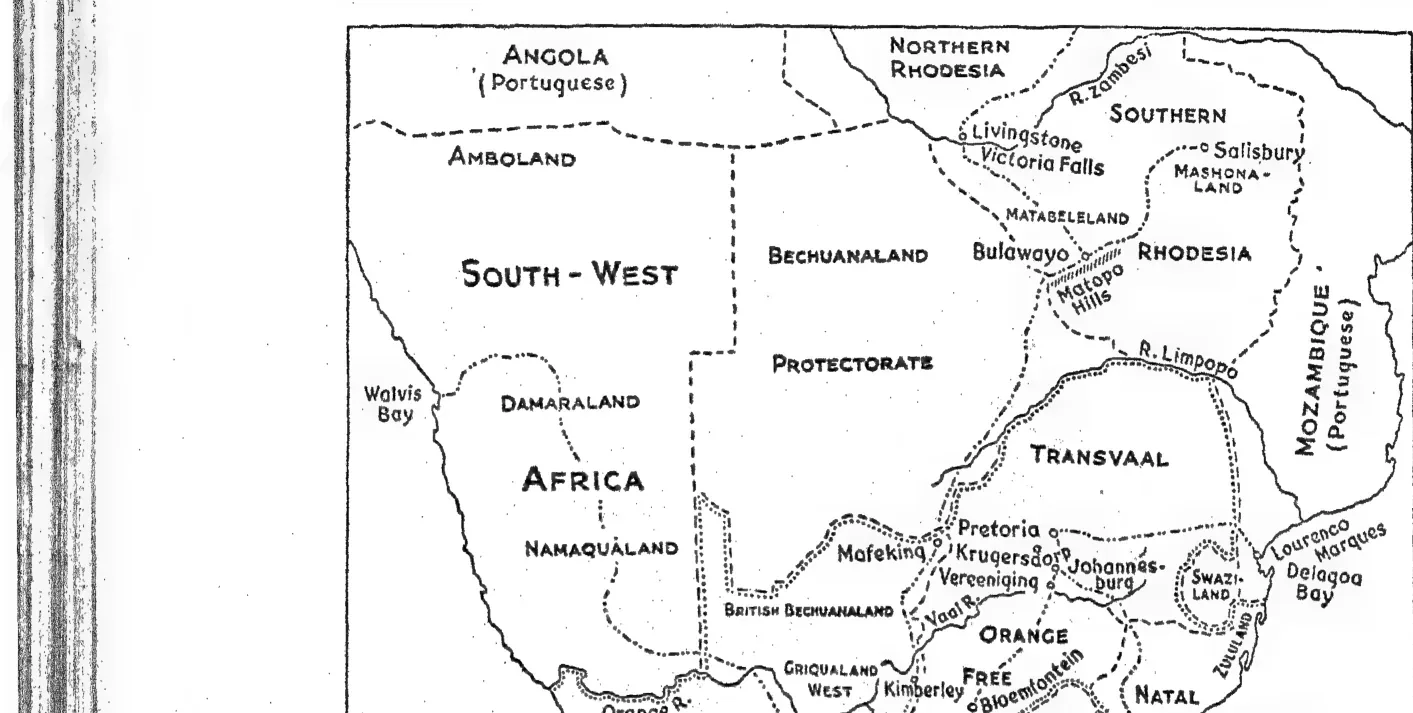
'(Portuquese) L RHODESIA eo say oo ee eee. “yes “Livin SOUTHERN 4 por - PROTECTORATE } a a = = Walvis 5" ‘ t fs <2:
caper Grahamstown eee saaanr Boundary of self-governing Dominion was recognised as being that of full equality with Great Britain,
In 1884 a German Protectorate was established over Damaraland and Namaqualand, in South-West. Africa. The forces of the Union effected a rapid and complete conquest of German
South-West Africa in 1914, and by the Treaty of Versailles in 1919 South Africa retained the territory under mandate.
Germany definitely renounced all claim to it in 1923 when she concluded with the Union an agreement by which she recognised that the future of South-West Africa was bound up with that of the Union and that its German inhabitants should become British subjects; the Union at the same time promised to recognise the German language for official purposes and to sanction instruction in it in schools.
In 1925 a Legislative Council with a majority of elected members was instituted, and there is no reason to doubt that further constitutional progress will be made. Railway communication with Bechuanaland, in the Cape province of the Union, has been established, and it seems probable that in due course South-West Africa will become a province of the Union.
by the colony.
Native questions have been prominent in South African history both prior to and since the establishment of the Union. Reference has already been made to the Coloured Folk, of mixed ancestry. In Cape Colony, since 1828, they have possessed substantially equal political rights with white men, and these rights were safeguarded in the Act which established the Union of South Africa.
The Kaffirs and the Zulus were warlike races in the interior, and their relations with white settlers presented, in the early history of the colony, problems towards which no decided and continuous policy was followed. It is impossible in this book to trace out the series of Kaffir and Zulu Wars, but it may be noticed that relations with the natives were regulated at different times by attempts to establish a defensible frontier, to set up a neutral zone between them and white settlers, to conclude agreements with native chiefs, to annex Kaffir and Zulu territory, and, after the extension of colonial boundaries, to mark off certain regions as native reserves. os
After the destruction of the military power of the Zulus their territory was left for a time under native rule. It was divided into thirteen petty districts, each under its own chief, and with a British Resident in each.. The system did not work well, and in 1887 direct British rule was established. Ten years later Zululand was annexed to Natal.
Basutoland was annexed to Cape Colony in 1871, and after the colony received responsible government in 1872 it applied itself with vigour to the task of administering its dependency. But a revolt occurred which the Cape Government proved unable to crush effectively, and in 1884 it applied to the British Government to take over the administration of Basutoland. It has since been ruled by a Resident Commissioner who is responsible to the High Commissioner.
The administration of Swaziland was undertaken by the Government of the Transvaal in 1895. After the conquest of the Boers it was for a time ruled by the Governor of the Transvaal, but in 1906 it passed under the rule of the High
Commissioner, represented by a Resident Commissioner,
The three provinces, Basutoland, Swaziland, and the Bechuanaland Protectorate, thus remain under British rule and do not form part of the Union. Until 1931 the supreme representative of British authority over these territories was the High Commissioner for South Africa, who combined this office with that of Governor-General of the Union. In 1931, however, the offices were separated, and the High Commissioner became known as High Commissioner for Basutoland, the Bechuanaland Protectorate, and Swaziland.
No account of the history of South Africa would be complete without some reference to the Indian question. It has given tise to strong feeling in Natal and the Transvaal; from an early date the immigration of Asiatics was prohibited by the Orange Free State, where, therefore, the problem does not exist, while the number of Indian immigrants in Cape Colony was so small that no action was taken until 1902.
1 Bechuanaland, which should be distinguished from the Bechuanaland Protectorate, was annexed to. Cape Colony in 1895.
The presence of Asiatics in South Africa was no new thing; Malays were to be found in considerable numbers in the eighteenth century. The entry of Indians began in 1860. The Natal Government encouraged them to come; they were employed as labourers on the sugar plantations of the colony. They were indentured for three years (afterwards five years), and upon the expiration of this term they were permitted to remain in the colony as free workers for another five years.
Upon the completion of this period they became entitled to a return passage to India, or, if they preferred to remain in South Africa, to a free grant of land. For a time (1866-74) the movement ceased, but in 1874 it was revived, and from 1874 to 1894 the Natal Government contributed the sum of £10,000 per annum to an Indian Immigration Trust Board, which existed for the purpose of assisting migration.
During the eighties opinion in Natal gradually changed on this subject; the planters still favoured a system which gave them a supply of cheap labour, while townsmen viewed with some alarm the possibility that Indian labour would oust that of white men. In 1894 the annual grant was discontinued, and a tax of £3 per head was imposed on each Indian resident in the colony.
Immigration continued, however, and in 1908 a law was passed limiting the issue to Indians of licences to trade, since many of those who had completed their indenture period turned to trade instead of agriculture. In 1911 Indian immigration was definitely forbidden by Natal.
Many Indians entered the Transvaal from Natal, and in 1885 some restriction was placed on Indian trading activity. It was not rigidly enforced, however, and in 1907 a new code of restrictions was imposed at the instance of General Smuts, then Colonial Secretary, Mr. Gandhi was in South Africa at this time and he defied the new law by leading a body of his followers from Natal across the border into the Transvaal.
The question remained acute after the establishment of the Union, and in 1913 Mr. Gandhi again led a body of Indians into the Transvaal, a proceeding which led to his arrest. Nevertheless, an Indian Relief Act. was passed in Natal by which the £3 tax was discontinued and some minor points were conceded.:
An agitation for the repatriation of Indians developed in the Union. This was not a very practicable policy—at least, it could have been enforced only at the expense of inflicting great hardship on the Indians, three-quarters of whom had been born in South Africa. Smuts in 1924 and Hertzog in 1926 proposed the segregation of the Indians; they would be allowed to live only in certain regions and in specified quarters of the towns.
For this course some justification might be pleaded on sanitary grounds; in any case, it would have severely limited their opportunities for trading. The Indian Government protested with some vigour at this treatment of its people. In 1927, however, it agreed to assist in their repatriation. The points at issue cannot be regarded as finally settled.
Supplementary Notes
1. Asa consequence of economic depression in South Africa, the parties led by Hertzog and Smuts were in 1934 amalgamated to form the United South African National Party. A few of the Nationalists, under the leadership of Dr. Malan, dissented from the amalgamation; they now form the Opposition in the South African Parliament.
2. The South African Government has pressed for the transfer to it of the Bechuanaland Protectorate, Swaziland, and Basutoland. ‘The British Government holds that the transfer is impracticable at present.
Chapter XIIIEuropean Settlements and Struggles in India
Ir has already been stated that the prosperity of Venice in the later Middle Ages was based on the profits of the trade in spices and other commodities obtained from the East. The only practicable routes to the Orient were under Venetian control, and the motive which inspired the maritime adventurers at the end of the fifteenth century was the desire to discover an alternative route to India.
Success attended the efforts of the Portuguese, and during the sixteenth century they not only carried on trade with the East but built up an extensive dominion. The centre of their power was at Goa, on the Malabar coast, where was the residence of the Portuguese Viceroy. In 1580 Portugal passed under the rule of Philip II, King of Spain; it ceased to be a distinct political entity; Portuguese possessions became Spanish possessions.
In the course of the next few years the hostility of English and Spanish developed into open war; after 1572 the Dutch were in open revolt against Spain. Towards the close of the sixteenth century Englishmen and Dutchmen alike were disposed to attack Spanish power in the East as well as in the West.
This was no easy task. The long voyage to the East could not readily be undertaken by the small vessels of the sixteenth century unless calling places were available at which fresh water and food could be taken on board (but the places most suitable for this purpose were already in Portuguese possession) and unless much more complete knowledge of the route —the currents, the rocks, the prevailing winds, and the like— could be acquired (but the necessary navigating knowledge had hitherto been monopolised by Portuguese mariners).
Some information as to the route had been gained by Drake and Cavendish and their companions in the latter part of their voyages round the world, and in 1591 James Lancaster, an Englishman who had been in the service of Portugal and who had since returned to England and had distinguished himself in the fight against the Armada, set out for the East with three vessels. One turned back at the Cape, one was lost, but Lancaster reached Indian waters with his remaining vessel. He visited Ceylon and penetrated to the Malay Peninsula, and he returned home with a ship-load of goods obtained by plunder or trade.
The success of Lancaster’s voyage was only one of the factors which contributed to the formation of the East India Company, The trade of the Levant Company was at this time being carried on under great difficulties) a circumstance which induced English merchants to: consider the possibility of trading with the East by way of the Cape. The Dutch, too, were already obtaining a footing in the East; they extorted the highest possible prices for oriental products in the markets of Western Europe.
In September, 1599, a meeting of merchants of the City of London was held “in my Lord Mayor’s parlour, to consider the unchristian price of pepper.”’? The merchants resolved to form a company for the Eastern trade, and, though some delays occurred, the East India Company received its first charter on 31st December, 1600.
By the terms of its charter the Company was granted a monopoly of trade between England and all places lying between the Cape of Good Hope and Cape Horn, although the existing rights of the Levant Company and the Muscovy Company were safeguarded,® and the East India Company was directed to refrain from seizing ports already in the occupation of Spain or Portugal. ane
Meanwhile, in 1595, a Dutch squadron of four ships sailed to the East, under the guidance of Cornelius van Houtman,
Dutch merchants had forced the price of pepper up from three shillings to eight shillings per pound.
The attempt to define the limits within which each of the three Companies might operate. was not altogether successful, and competition who, like Lancaster, had in time past been in the service of Portugal. Complete success attended the venture, and in 1598 a second voyage was undertaken by Dutch mariners. The establishment of an East India Company by English merchants was followed, in 1602, by the formation of a similar cottipany by the Dutch.
among them continued,; i
1 In 1581 Elizabeth granted a charter for a period of seven years to a company of merchants. engaged in Levantine trade. It was known as the Turkey Company, ‘and in 1592 it was merged in a new organisation, the Levant Company. In course of time regular sailings were established, but piracy. was'so common in the Mediterranean that it was thought to be inadvisable for ships to make solitary voyages, and it became usual for a fleet to sail annually for Smyrna and other ports in the Sultan’s dominions. It suffered from the.competition of the Muscovy Company, and, later, of the East India Company, in the importation of Persian silk.
The greater part of India at this time was under the rule of a line of emperors known as the Great Moguls. Of these, the most powerful were Akbar (1556-1605), Jehangir (1605-27),
Shah Jehan (1627-58), and Aurangzeb (1658-1707). The
Moguls, being Mohammedan, were regarded by the Hindus as alien conquerors. They held their court at Agra, and they lorded it over a host of petty provincial rulers. In such a vast land, in which roads hardly existed, the degree of central control varied inversely with the distance from the seat of government. A man as strong as Akbar found it extremely difficult to exercise authority in all parts of his dominions; under his weaker successors the governors of the remoter provinces were practically independent princes.
In the early years of the seventeenth century neither English nor Dutch attempted to open up trading connection with continental India. ‘The earliest voyages of both companies were directed towards the islands of Sumatra and Java. The first venture of the English Company, under Lancaster in 1601-3, and the second, under Sir Henry Middleton in 1604-6, were a successful.
But the Dutch, who were at this time securing a firm footing in the islands of the archipelago, were resolved to tolerate no European rival in this quarter, and within a few years they were treating the English traders as enemies. In course of time the English attempted to build up trade between continental India and the Spice Islands; silks, calicoes, and indigo were taken from the mainland to. the islands.. The Dutch resented this commercial activity of the English merchants, and in 1623 an.
English outpost at Amboyna was tg overwhelmed and its occupants were put to death. The political situation in Europe at the time was stich that no retaliatory measures were taken by either James I or Charles I, and it was left to Cromwell to exact retribution for the atrocity. Meanwhile, the English connection with the archipelago was severed, and English commercial activity was: diverted towards the mainland.:
As. early as 1608 Captain William Hawkins voyaged to
Surat and proceeded overland to Agra, as the ambassador of James I to the Emperor Jehangir. His efforts to obtain trading privileges were frustrated by the Portuguese, who were influential at the Mogul court, and, indeed, the English were not at this time held in high esteem in the East. But in 1612 a fleet of four of the Company’s ships, under Captain Thomas Best, after visiting Surat, encountered and defeated a much larger Portuguese squadron in the Battle of Swally Roads.
The English gained in prestige, and quickly secured from the Great Mogul permission to establish a factory at Surat. Sir Thomas Roe visited Jehangir in 1615 and obtained further privileges. Agencies for the purchase of Indian commodities were established in the interior of the country, and within a few years Surat had become an important trading centre. Portuguese influence in this region was seriously weakened by the capture, in 1622, of Ormuz, in the Persian Gulf, by the
English.
Other English posts were established i in the course of the seventeenth century. A factory was set up at Masulipatam, on the Golconda Coast, in 1622, and trade was begun in precious stones, silks, and cottons. A more important settlement was established at Madras in 1639. It was leased from a native prince, and consisted of an island (Fort St. George) and a narrow strip of coast-line.
The island was a fortified post of the Company, and the mainland territory, inhabited by natives, was ruled by an English official. An unfortified trading post was set up on the Hoogly in 1640, and trade in the products of Bengal was developed, but the Hoogly factory was for many years subordinate to Fort St. George.!
Charles. II married Catherine of Braganza in 1662, and received Bombay, as part of her dowry, from the King of Portugal. In. 1668 Bombay was handed over to the East India Company, which thus held it from the Crown, and not, as in the case of Madras, from a native prince. Bombay, being an island, was easily defended from native attack. Its importance increased rapidly, and in course of time it superseded Surat as the principal English factory on the west coast of India.
1 English. “factories” in India were well organised. The buildings - were arranged round the four sides of a quadrangle. On the ground floor were offices and storehouses, above: which were living-rooms for the Company’s officials, These were of several grades. The most important were the merchants—responsible men. who. transacted the Company’s business. Below. the merchants were the writers, or clerks, and inferior to them ‘were the junior members of the staff, known as apprentices, A ’.council of the more important merchants, under the guidance of a president, was in supreme control of the factory.
During the first eighty years of its existence the Company followed a policy of non-intervention in Indian politics. In
1684, however, the English in India took up arms against the
Emperor Aurangzeb. Defeat followed; Hoogly and Masulipatam were lost, and for a time the English position in the peninsula was imperilled. Peace was restored after some years, and a new settlement, known as Fort William, was established on the Hoogly. From this factory Calcutta developed, and its importance increased rapidly. Fort St.
David, to the south of Madras, was set up in 1690.
For the first few years of its existence the affairs of the East
India Company were conducted on the principle of raising a separate joint-stock for each voyage, the capital being returned to the subscribers when the venture was completed. As the expense and risk attendant upon voyages of such great length were considerable, it was necessary for merchants to combine to finance them. The accounts of each voyage were made up separately, and a long time elapsed before final settlement could be reached. In 1612 a joint-stock was established for a number of voyages, and in 1657 a permanent joint-stock, non-returnable, was raised. A new charter granted by
Charles II in 1661 authorised the Company forcibly to suppress interlopers,! at whose hands the trade was suffering.
A rival Company was set up in 1698, but it was amalgamated otal with the original organisation ten years later. The new united East India Company received a parliamentary charter, under
1 An interloper was an individual trader who attempted to carry on trade within the region assigned in its charter to one of the great companies. For several reasons it was thought that company trading was to be preferred to individual effort.
It was felt that a company would trade on more honourable lines and would be more careful to maintain a reputation for fair dealing than could be-expected of the interloper, who might hope to make a fortune in a single voyage and would not hesitate to stoop to violence and fraud, and even piracy: The interloper could not be permitted to imperil by his misdeeds the good name of his countrymen.
Nevertheless, the interloper represented the daring, adventurous spirit of the nation, and, when a company misused its monopoly by acting in its own interests alone and’ without thought of those of the general public, it was felt that there was some justification for the activities of interlopers.
which its activities were conducted until the passing of Lord North’s Regulating Act of 1773.
Some voyages to the East had been undertaken by Frenchmen in the first half of the seventeenth century, and in 1664 a French East India Company was formed. A factory was established at Pondicherri, to the south of Madras, in 1675, and this place was regarded as the headquarters of French power in India, In course of time settlements were made at Mahé, on the west coast of the peninsula, and at Chandernagar, on the delta of the Ganges.
The French and English Companies were not actively hostile to each other, and though England and France were at war between 1689 and 1713, with only one short intermission, it was understood that enmity in Europe should not be extended to Indian waters—that no hostilities should be maintained east of the Cape of Good Hope.
The death of Aurangzeb in 1707 was followed by a rapid decline in the power of the Mogul Empire. Aurangzeb had conquered the Deccan and had established the Nizam there as his Viceroy. After his death the Nizam became an independent prince, and the rulers of the remoter provinces of the south—the Carnatic, Mysore, and Tanjore—ceased to respect Mogul authority. Even in Bengal the central authority weakened. In Central India a marauding race, the Marathas, became firmly established over a wide area.
There was no longer any power capable of dominating India as a whole; henceforth the Emperors were mere puppets in the hands of powerful favourites. The peninsula became the battle-ground of adventurers who, in many a provincial state, strove to obtain power by intrigue, by assassination, or by open fighting. The condition of affairs in India in the first. half of the eighteenth century was such as to invite the intervention of foreign powers who might wish to turn it to their own political advantage,
The possibilities inherent in the situation in India at this time were grasped by Joseph Dupleix, who became Governor-General of Pondicherri in 1741. He recognised that the disordered condition of the peninsula, the rivalries of native princes, and the weakness of the Mogul, might be turned to _the political advantage of France. He determined to inter-vene in native politics with a view to the extension of French influence, and, in order to be able to do this the more effectively, he raised an army of sepoy troops.
That he was not ultimately successful was due to circumstances not altogether within his control. The Government of France was little interested in the position in India; its attention was fully occupied with the political situation in Europe, and Dupleix failed to receive that degree of support from home that was necessary to ensure the success of his policy.
Further, it could hardly be expected that French dominion could be established in the East unless communication by sea between France and India could be maintained without interruption, and Dupleix’s inability to realise the importance of sea power contributed to the collapse of his schemes.
If, however, Dupleix was the first he was not the only European to realise the possibilities which were inherent in the condition of India at this time. Robert Clive, younger than Dupleix, and not of high rank in the service of the English East India Company, also saw in the state of Indian affairs opportunities for the extension of British influence and of combating that of France.
His ability matched his courage, his advancement was as rapid as his achievements were brilliant, and at the crisis of the struggle he possessed the advantages which the French lacked —an appreciation by the statesmen at home of the importance of the conflict in the East, and uninterrupted communication by sea with the home country.
The struggle between French and British in India was carried on mainly in two regions—in the Carnatic and in Bengal. Attention must be given also in the narrative to the course of events in the central Indian state of Hyderabad.
In 1745 the appearance of a British fleet off Pondicherri caused some alarm to the French. Dupleix appealed to the Nabob of the Carnatic for assistance, and the British withdrew without fighting. In the following year a French fleet under La Bourdonnais attacked and captured Madras and made prisoners of its inhabitants, except a few who escaped to Fort St. David, where, after the arrival. of reinforcements, they were enabled to hold out.
The French admiral was willing to treat with the English Company’s representatives for the ransom of Madras, but Dupleix, apparently jealous of La Bourdoanais’s success, withheld his consent, and Madras remained for the moment in French hands. The Nabob of the Carnatic demanded of Dupleix the restoration of the place to him. Dupleix refused to give up Madras, and the nabob’s troops attacked it, but were driven off. In 1748, by the atin ie ei REINS
Treaty of Aachen, Madras was returned to the English without ransom.
The Nizam of Hyderabad died in 1748, and a dispute arose with regard to the throne of this important state. One of the claimants was supported by the English and the other by the French. Dupleix acted with energy and established his nominee as Nizam. A French sepoy garrison, under the command of the Marquis de Bussy, remained in the city of
Hyderabad for the protection of the new Nizam and the say Sa maintenance of French influence, which for some years prevailed throughout the Deccan,
In 1749 a similar situation developed in the Carnatic. The nabob died, and the vacant throne was claimed by his son,
Mohammed Ali, and by Chunda Saliib.. Dupleix supported the latter, and by 1751 Mohammed Ali was driven into
Trichinopoli, in the extreme south of the state. Here he was besieged by his rival and the French, and for a time his cause appeared to be hopeless.
Robert Clive had reached India in 1744 as a writer in the
Company’s service. With little taste for a commercial career, he had exchanged into the military service of the Company, which maintained a small force, British and sepoy, for the purpose of guarding its factories. While Mohammed Ali was cooped up in Trichinopoli, Clive, with the sanction of Major
Lawrence, the commander of the Company’s forces at Madras, advanced at the head of a small detachment of British and sepoys and attacked Arcot, the capital of the Carnatic. The capture of the city occurred in the course of a severe thunderstorm, Chunda Sahib and his French auxiliaries hastened north to recover their capital. Clive withstood a siege of seven weeks’ duration, and upon the approach of a Maratha relieving force the besiegers withdrew, so that Arcot remained in his hands.
Chunda Sahib died in 1753 and Mohammed Ali became Nabob of the: Carnatic, British prestige rose as rapidly as that of the French fell. -Dupleix returned, discredited, to France in 1754. In the previous year Clive had returned to England as a conqueror and a hero.
French influence was still considerable in Bengal, the young nabob of which, Siraj-ud-Daula, was a typical oriental tyrant, From the time of his accession he was antagonistic to the British, who, he contended, had abused their trading privileges:in Bengal. In 1756 one of his relatives, whom he desired to put to death, took refuge with the British at Calcutta. He demanded the surrender of the fugitive, and upon this being refused he took possession of the settlement.
Many of the British, including the Governor, escaped down the Hoogli, but some remained behind and were captured by the nabob’s forces. A number of the prisoners were confined, throughout the night following their capture, in a small guard-room, where, owing to excessive overcrowding and inadequate ventilation, 123 out of 146 died.
This incident of the Black Hole of Calcutta caused very great indignation among the British in India, and Clive, who had just returned from. his visit to England, was ordered to proceed to Bengal, in conjunction with Admiral Watson. Calcutta was recovered, and the incident was settled for the time being upon the nabob expressing regret, paying a sum of money as compensation, and confirming
British trading privileges.
News of the outbreak of the Seven Years War between Great
Britain and France having been received in Bengal, Clive
TREE attacked and captured Chandernagar.. Not long after, a plot was formed for the deposition of the nabob and the establishment of one of his nobles, Mir Jaffir, in his place. Clive prepared to support the usurper, but a native, Omichund, who became aware of the plot, threatened to reveal it to Siraj-ud-Daula unless he were guaranteed payment of a large sum of money. There appeared to be no alternative to submission to this attempt at blackmail, and Clive signed the necessary promise. Omichund demanded, as additional security, the signature of Admiral Watson, who, however, refused to sign;
to avert the threatened disclosure of the plot, Clive forged the admiral’s signature. Omichund never received the money, for when Siraj-ud-Daula was. overthrown the bargain was repudiated, and the blackmailer committed suicide. At that time men were prepared to countenance many actions in the
East that to-day would be considered blameworthy, but not even that reflection can excuse Clive’s action in forging his EIPORROIONI I ge ne Nebr, ree: mag brother-officer’s signature, or cause it to be regarded as other than dishonourable.
The rebellion broke out, and Clive, with a mere handful of British and sepoy troops, encountered the nabob’s army, which, with French auxiliaries, numbered 50,000, at Plassey.
Siraj-ud-Daula was completely defeated; he fled, but was captured a few days later and was put to death. Mir Jaffir
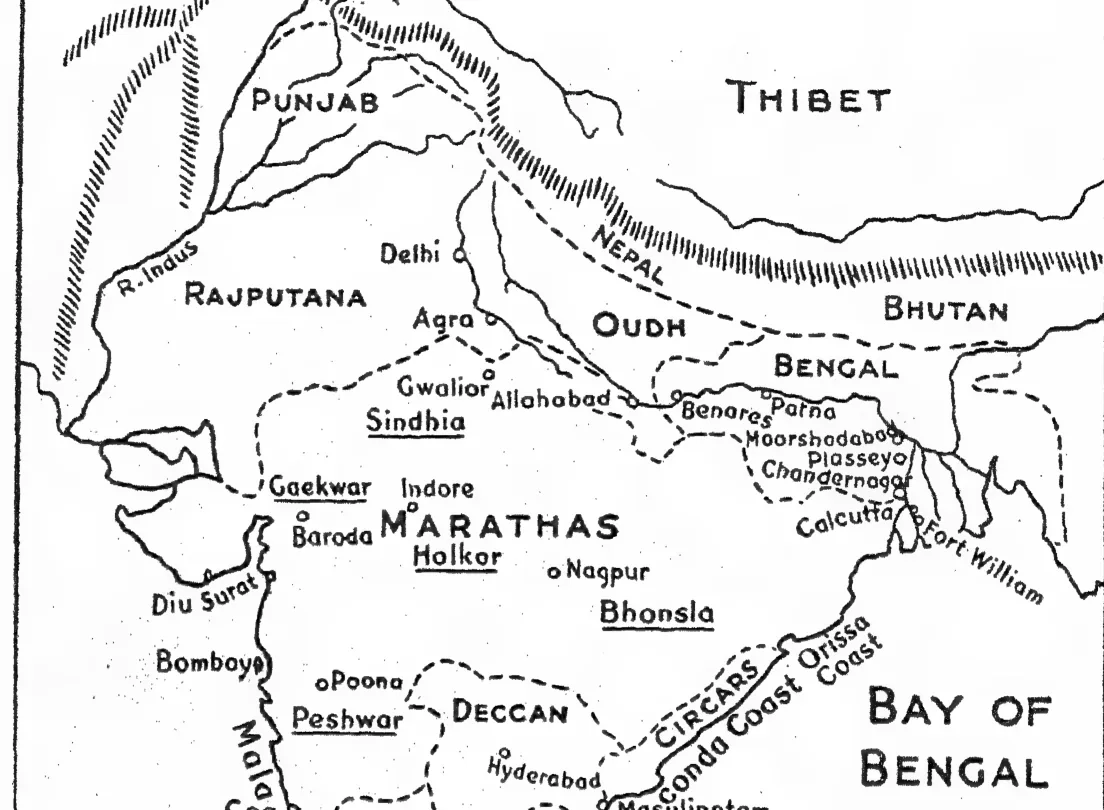
became Nabob of Bengal, and an attempt by the Mogul
Emperor to reassert his authority over the province was easily rebuffed, Henceforth British influence was paramount in
Bengal, and British prestige rose in the Ganges valley as rapidly as in the south of India a few years earlier.
While British power was being consolidated in Bengal the
French made a determined but unsuccessful attempt to recover their lost authority in the Carnatic. In 1758 Count Lally de
Tollendal, a French noble of Irish descent, became Governor-General of Pondicherri. Lally was not without ability, but he was tactless, and he failed to work in harmony with other
French officers in India. He withdrew De Bussy and his garrison from Hyderabad, and the Circars, a province which had been assigned to the French by the Nizam, was captured in 1758 by a force sent by Clive from Bengal. The Nizam, recognising the decline of French and the advance of British prestige, soon afterwards made a treaty of friendship with the rising power, and the work of Dupleix in the establishment of ™ X
French influence in central India was overthrown.
In the Carnatic itself Lally met at first with some success.
He surprised and captured Fort St. David, and followed up this victory by besieging Madras, But the arrival of a relieving fleet compelled him to withdraw. In 1760 he besieged Wandewash, which was held by the British under Colonel Coote.
Coote sallied forth and defeated the French. Lally retreated to Pondicherri, which was besieged by the British and fell into their hands in 176:.
In the Treaty of Paris, 1763, which marked the termination of the Seven Years War, it was agreed that Pondicherri, Mahé, and Chandernagar should be restored to the French. But they were not to be fortified or garrisoned, and they were to be used as trading depots only. The treaty was criticised on the ground that the restoration of these places to the French was inconsistent with the principles of Mercantilism, as then generally held.
Had these places been retained and given to the East India Company this body would have entirely monopolised trade between Europe and the East, and the whole supply of Indian products to the nations of Europe would have been through this channel. 70 ok
Nevertheless, by the end of the Seven Years War, and mainly by the genius of Clive, French political power in India had been destroyed, and British authority had been established in its place. British supremacy was, of course, far from being completely recognised in all parts of the country, but when the state of affairs in 1760, at the time of Clive’s second return to England, is contrasted with that in 1741, when Dupleix arrived in Pondicherri, it will be seen that British influence had been firmly established in at least three regions—in the Carnatic, in the Deccan, and in Bengal—and that British prestige stood high throughout the country. British power in India was no longer challenged by any European rival, and the way was open for its extension to every part of the land.
Chapter XIVIndia under Company Rule
After the destruction of French influence in Bengal and the Carnatic, recorded in the previous chapter, Clive returned to England in 1760, and he did not visit India again until 1765. Soon after his departure from India Mir Jaffir, the new Nabob of Bengal, was superseded by his son-in-law, Mir Cossim. This prince proved to be an unsatisfactory ruler, and it was decided in 1763 to restore Mir Jaffir. Thereupon Mir Cossim took up arms against the British.
He massacred two hundred British at Patna, and retired into Oudh, confident of the support ie. of the Nabob of Oudh and of the Mogul. In the Battle of Buxar, 1764, Major Munro defeated Mir Cossim and the Nabob of Oudh and took the Mogul, Shah Alam, prisoner, and the victory was followed by a British occupation of the province of Oudh. The importance of the Battle of Buxar was very considerable. It confirmed the prestige of the British throughout India, and it resulted in solid gains.
The final settlement between the Company, the nabobs, and the Emperor was directed by Clive (who returned to India at this time), and was embodied in the Treaty of Allahabad. The nabobs were restored, some territorial adjustments were made, and the Company received from the Emperor a confirmation of all territories in its possession, It was authorised to collect the revenues of Bengal, Bihar, Orissa, and the northern Circars,! and out of its receipts from this source it agreed to make grants to the Mogul and the Nabob of Bengal.
Both these potentates, for the time being, lived under the Company’s protection and became its pensioners. While, however, the Company assumed control of the finances of Bengal, the nabob continued to be responsible for the administration of justice.
Clive took up his duties as Governor of Bengal in 1765. The Dual System, by which the Company controlled the finances and the nabob the justice of the province, could hardly be regarded as a satisfactory and permanent arrangement. Clive found great disorder in Bengal. Taxes were wrung from the peasantry by native collectors under British supervisors, and both natives and British grew rich.
In the East, in the eighteenth century, the dishonesty of tax-collectors was so commion as to pass without remark, and the more influential of them supplemented their embezzlements by accepting large “‘presents’’ from wealthy natives. The Company’s officials, whose salaries were inadequate, eked out their slender official remuneration by private trading, which was rendered easier by the fact that the captains of East Indiamen were by custom entitled to a certain amount of space in the holds of their ships for private cargo.
Arrangements were entered into between officials and captains. Both classes made fortunes while the Company approached bankruptcy. Many of these officials, after a period of service in India, returned home with great wealth. They were commonly known in England as “ nabobs,”
1 This right was known as the Diwani.
In the short period (1765-7) of Clive’s governorship he was unable to establish a satisfactory system of tax-collection. But he prohibited the acceptance of presents by officials, and he forbade private trading. In order to make it possible for Europeans to live in India without adding to their incomes in underhand ways, he made large increases in official salaries.
He was bitterly attacked by the men who were affected by his regulations. He returned to England, and charges of corruption were brought against him. It is true that he had amassed a fortune in India, and it is probable that he had not been too scrupulous in his methods. But his enemies were men who wanted the corruption of Indian government to continue and who objected to the reforms that he introduced, Clive was never put on trial.
The House of Commions appointed a committee to investigate the charges against him,! and in due course the House expressed its opinion on the matter by passing a resolution that ‘Robert, Lord Clive, hath rendered great and meritorious services to his country.” But the attack left its mark upon his mind, and in 1774 he committed suicide,
1 Clive was questioned before the committee on the subject of his fortune. The purpose ‘of his opponents was to suggest that, while attempting to put down corruption, he himself had acted corruptly.. His reply to the innuendo was: “By Heaven, Mr. Chairman, when I think of my opportunities, I am surprised at my moderation.”
A serious famine in Bengal in 1770 led to a further falling off in revenue, and in 1772 the Company sent out Warren Hastings as Governor of Bengal to reorganise British rule in the province. There was, however, a growing feeling in
England that the government of a province containing 25,000,000 people, involving the collection of a revenue of £4,000,000 per annum and the maintenance of an army of 30,000 men, ought not to be left in the hands of a company of merchants, The right to rule ought to be derived from the Crown, and government ought to be carried on in the name of the Crown. The Company, indeed, contended that it was merely occupying territory which was under the sovereignty of the Mogul Emperor, but in practice it was assuming the functions of a sovereign power.
Lord North’s Regulating Act was passed by the British Parliament in 1773. It did not make any formal declaration of the sovereignty of the British Crown over any part of India, but, by “regulating” the position and the activities of the Company in certain respects, it tacitly assumed that the Company would exercise its political functions under the control of the British Government.
It directed that the Governor of Bengal should henceforth be styled Governor-General of Bengal, and that he should exercise authority over the Governors of Bombay and Madras. A Council of four members was to be appointed to assist the Governor-General, who was to preside at its meetings and be bound by its decisions. The Governor-General might vote at meetings of the Council, and in the event of a tie he might exercise a further, or casting, vote.
A Supreme Court of Justice was to be established at Calcutta, in which English judges were to administer the law. In this court no single code of law was recognised. The principles of English law were applied in cases affecting Englishmen, while Hindus and Mohammedans were judged in accordance with the rules of law to which they, respectively, were accustomed, This practice was confirmed by a Declaratory Act of 1780.
2.No exact date can be assigned for the cessation of Mogul and the establishment of British sovereignty. See note on p. 190 on the India Act of 1784.
1 This is the accepted view, and is probably correct; recent investigation, however, of such evidence as is available of the circumstances of Clive’s death has led to some doubt as to whether it was intentional or accidental.
Warren Hastings was appointed Governor-General under the Act, and Sir Elijah Impey was appointed Chief Justice of the new Supreme Court. For the first two or three years of his rule Hastings was consistently opposed by his Council. Of the four members only Barwell supported the Governor-General, while Francis, Monson, and Clavering disagreed with him, and Hastings was powerless to direct the course of policy. Monson died, however, in 1776, and, as the Council was henceforth evenly divided, Hastings could, by the exercise of his casting vote, carry his views. Clavering died in 1777, and two new members, Wheler and Coote, were appointed, and gave general support to Hastings’s policy.
If Clive laid the foundation of British sovereignty in India, to Hastings is due the credit for the setting up of the administrative system. Much of his work in India was concerned with the abolition of corruption and the establishment of a satisfactory financial system. Things had become as bad as ever since the departure of Clive, and the new Governor-General rigidly enforced upon British officials the rules against private trading and the acceptance of presents.
Native taxcollectors were removed from their posts, which henceforth were filled by British, and the exchequer was removed from Moorshedabad to Calcutta, the defences of which were strengthened. The amount of the allowance paid, under the Treaty of Allahabad, to the Nabob of Bengal was reduced, For some years the question of finance was paramount, and Hastings found it difficult to raise enough money to carry on the government and to enable the Company to pay dividends at the same timte.
In the early days of his rule, while he was yet opposed by a majority of his Council, charges of corruption and injustice were brought against Hastings by Nuncomiar, a native of bad character. In course of time Nuncomar himself was accused of forgery and was sentenced to death by Sir Elijah Impey, The sentence, which was undoubtedly deserved, was carried out, but the enemies of the Governor-General represented the incident as a gross’abuse of power by Sir Elijah Impey.
It was. stiggested that the Chief Justice obligingly removed a much-wronged native who brought inconvenient accusations against the Governor-General. This was, of course, not the case, and the charges against Nuncomar were quite independent of those which he brought against Hastings, and were fully proved.
Hastings experienced a good deal of trouble with native rulers in the Ganges valley. The revenues of Benares, a district of Oudh, had been assigned to the Company, and were to be used for the maintenance of a military force for the defence of Oudh. The subordinate Rajah of Benares, Cheyte Singh, was of doubtful loyalty. He paid to the Company the sum of £50,000 in 1778, but in the following year the payment was made only after some delay, and in 1780 it was refused altogether.
Hastings demanded payment of this and some other sums that were due, and, failing to receive satisfaction, deposed the rajah. Another incident in which the action of the Governor-General was strongly criticised occurred when the Nabob of Oudh asserted that he was unable to meet certain obligations to the Company, on the ground that the treasures of the state were under the control of the Begums (princesses) of Oudh. Hastings seized the treasure in order to satisfy the Company’s claim.
It should be observed that the energy displayed by Hastings in thus enforcing payment of money due to the Company was not inspired by a mere desire to increase the profits of that organisation. Only by taking exceptionally vigorous measures was he able to collect resources sufficient to enable him to meet the dangers which threatened the British position in India at this time.
The Marathas were a powerful confederacy of tribes in central India, with chiefs under the nominal headship of the Peshwar of Poona. Other chieftains, Sindhia, Holkar, and Bhonsla, intrigued against the Peshwar, and the Governor of Bombay, acting without the assent of the Governor-General, intervened on behalf of the Peshwar. The Bombay forces achieved no success until General Goddard, with a smiall. body of men, marched across India from Bengal to Bombay. Gujarat was occupied, and Colonel Popham stormed Gwalior, a stronghold of Sindhia..
The return march of Goddard’s troops was achieved without misadventure, in spite of the efforts of the Marathas to prevent it. By these operations the Marathas were given proof of the strength of British military power; at the same time Hastings realised that they were too formidable to be suppressed with the limited forces at his disposal. Peace was made in 1782 by the Treaty of Salbai.
The French were at war with Great Britain between 1778 and 1783, and, though the strength of French forces in India was not great, the activity of French agents in stirring up the
Maratha chiefs and other native princes added to Hastings’s difficulties. He acted with great promptitude. Chandernagar and Pondicherri were captured in 1778, and Mahé in 1779.1
The Rajah of Mysore, a large state in southern India, was Hyder Ali, an able ruler who entered into close relations with the French. They encouraged him to invade the Carnatic, and for a time the safety of Madras was in doubt. Had any substantial success been gained by the invaders there is little doubt that other native rulers would have attacked the British. A French force from Europe landed in the Carnatic in order to support Hyder Ali, and the position becanie critical.
But Sir Eyre Coote, the veteran victor of Wandewash, and now a member of the Governor-General’s Council, defeated Hyder Ali at Porto Novo and saved Madras. Hyder. Ali died in 1782, leaving his throne to his son Tipu, who was far inferior in capacity to his father; in 1784 he made peace.
Pitt’s India Act was passed in 1784, and a new era was begun in Indian history. The opportunity for retirement had come, and in 1785 Hastings laid down his office and returned to England.
The malice of his enemies followed him in his retirement, and the Whigs in the House of Commons demanded his impeachment. The proceedings were managed by Burke and Sheridan, and the trial dragged on from 1788 to 1795. The chief charges related to Cheyte Singh, to Nuncomar, to the Begums of Oudh, and to the extermination of the Rohillas, a tribe of mountain marauders. On every charge Hastings was acquitted.
He was ruined by the expense of the trial, but a pension from the Company enabled him to live in comfort until his death in 1818. The verdict was right. Hastings had been just, high-minded, and honourable, and the charges against him were inspired by malice. He had been arraigned for a system of government which he had done much to amend.
Nevertheless, the trial served the useful purpose of reminding other rulers of India that they were not irresponsible despots, and that if their proceedings were not above reproach they might be called to account,
Pitt’s India Act,? which became law in 1784, settled the system of government in India for three-quarters of a century. The experience gained in the working of the Regulating Act was used in the framing of the India Act. The functions of the East India Company as trader and as ruler were to be kept separate, and a Board of Control was established in London to supervise the work of the Company in the latter capacity. The President of the Board of Control was usually a cabinet minister.
Dispatches were received at India House in London from the Company’s officials in the East. Such dispatches as dealt with commercial matters were answered by the directors; those which referred to political matters were passed on to the Board of Control, and instructions with regard to them were given by the Board to the Company.! Appointments to posts in the Indian service were still made by the Company, but the approval of the Board of Control was required in the case of nominations to the highest posts.
It became usual to appoint men of noble rank in England to Indian governorships. The Governor-General’s Council was. continued, but in 1786 he was given power in emergency to override its decisions and to act upon his own responsibility. The Council, there-fore, tended to assume a more advisory and less controlling character.
1 These places were restored to the French in 1783. See p. 63.
2 The India Act of 1784 referred to “the territorial possessions of this kingdom in the East Indies,” thus by inference ceasing to recognise Mogul sovereignty.
Lord Cornwallis, a man of high character and great capacity, was Governor-General from 1786 to 1793, and during his term of office the second Mysore War (1790-2) took place. The attempts of Tipu to establish his supremacy over neighbouring states compelled Cornwallis to take action against him. An alliance was formed by the British with the Nizam and the Marathas, but little help was received from either power, and the burden of the actual fighting fell upon the British. Tipu’s capital, Seringapatam, was taken, and by the terms of peace he lost Malabar and Dindigul.
But the most important feature of the rule of Cornwallis in India was the permanent settlement of Bengal. From time immemorial Indian rulers had obtained their revenue by some form of land taxation—usually by demanding a percentage of the crops. The evil of the system lay in the fact that the proportion demanded by the ruler varied according to his needs; it might be, and usually was, very high—perhaps a half, or even more.
The more industrious and successful the cultivator might be, the greater the aniount he would be compelled to contribute to the Government. The inevitable result of such a system was that Indian ryots had no incentive to improve their methods, and their standard of life was one of extreme poverty. Cornwallis recognised that revenue must be derived from land, but he resolved to establish a system of collection which should not stifle enterprise.
The land of Bengal, Bihar, and Orissa was surveyed and assessed, and an undertaking was given that the assessment would not be increased at any future time. Instead of the tax-collectors demanding a percentage of the crops, the amount to be paid by each man was finally fixed, and henceforth he reaped the full advantage of any increase in the yield of his land, due to his own industry ot to improved methods.
The Zemindars, who under the Mogul régime had been merely collectors of land revenue, were recognised as the owners of the land which was leased to the ryots, but they were made responsible for the punctual payment of the amounts due; delay in payment was penalised by forfeiture of their rights of ownership.1 The good faith of the English in India is bound up with the maintenance of the system, but it offers to the Government no possibility of sharing in the increased prosperity of the province. In course of time land settlements were made in other provinces, but they were subject to periodical revision, usually once in every thirty years. a
1 The directors of the Company were required by the Act to appoint a
secret ee to deal with confidential matters referred to it by the Board
of Control,;
After an uneventful period of rule by Sit John Shore (1793-8),
Lord: Mornington, afterwards Marquis Wellesley, became Governor-General from 1798 to 1805.. He proved to be a great and successful ruler, and he realised the necessity of extending British influence and enlarging British territory. The power of Tipu, who continued to intrigue with the French (he consented to be known as Citizen Tipu), was broken in the third Mysore War (1798-9). His capital, Seringapatam, was.stormed by British forces under the command of Sir Arthur Wellesley, the brother of the Governor-General, and ‘Tipu was slain.
Hitherto the. conquest of a native state by the British had been followed by its annexation, but this policy was not followed in the case of Mysore. Its extent was reduced to the limits which had existed in 1761, when Hyder Ali began to rule, and the descendant (a boy of five) of Hyder Ali’s predecessor was enthroned in place of Tipu. The territories which were taken from Mysore were divided among the Marathas, the Nizam, and the British.
cultivators, were recognised, and between the. Government and the
peasantry there was no intermediate class of landlords to rackrent their
tenants.::;;
1 In the land settlement of Madras the rights of the ryots, or peasant
The directors of the Company had no desire to extend their territories at the expense of the “country states,”’ as the native states were called at this time. They desired to establish friendly relations with native princes, but no attempt was made to assert British sovereignty over them. The alliances made in the early years of the nineteenth century were negotiated as between equals. The working of this principle was found to be unsatisfactory, and before the middle of the century it was found to be desirable to assert the position of the British as the paramount power in India,
Wellesley invited some of the native princes to disband or reduce their armies and to accept and pay for the protection of the Company. Such ‘Subsidiary Alliances” were made with Hyderabad and with Oudh. At different times during his governorship Wellesley annexed the Doab (between the
Ganges and the Jumna), Rohilkund, Tanjore, and the Carnatic; the territories of the Carnatic were added to those of Madras, and this action was followed by the land settlement of Madras. The Marathas, however, resisted British power, and an inter-tribal quarrel, in which Sindhia, Holkar, and Bhonsla schemed to secure control of the Peshwar and in course of which they attacked the Peshwar, afforded an opportunity for British intervention.
The Peshwar fled to the British for protection, and Sir Arthur Wellesley defeated Sindhia at Assaye and again at Argaum. General Lake captured Delhi, the capital of the Mogul, and Agra, and won a further victory at Laswari. The Mogul Emperor was thus released from dependence on the Marathas. He failed, however, to recover any part of the power wielded by his predecessors. Sindhia and Bhonsla submitted, but Holkar continued the war until 1806. As the result of the war the Company secured some territorial gains at the. expense of the Marathas.
The directors of the Company were much alarmed at the policy of expansion pursued by Wellesley. They wanted trade rather than dominion, and there is, perhaps, some excuse for British reluctance to embark upon a forward policy while the whole energies of the nation were engaged in the task of defeating Napoleon.
Wellesley was recalled in 1805, and Lord Cornwallis was sent out for a second term of office. But he died soon after reaching India, and for the next two years India was ruled by Sir George Barlow.
Lord Minto, the next Governor-General, assumed office in 1807. He did not find it practicable to carry out to its logical limits the policy of non-intervention favoured by the directors and the Government at home, and, though it was left to his successor to complete the overthrow of Maratha power, Minto entered into diplomatic relations with the Sikhs of the Punjab, with Afghanistan, and with Persia. During his period of office many of the islands in the Archipelago were conquered, and British influence was established in the Malay Peninsula.
In 1813 the Company lost its monopoly of trade with India, though it retained exclusive control of the traffic with China. It still traded with India, but merchants who were not connected with it were empowered to apply to it for licences to trade with India; it was no longer permitted to refuse such requests if they were made by men of substance,
The Marquis of Hastings, Governor-General from 1813 to 1823, intended to continue the policy of non-intervention in native affairs, but he was forced by circumstances into taking vigorous action. Wars were undertaken against the Gurkhas of Nepal, and the Pindaris, bands of marauders who periodically raided the Ganges valley. The latter were suppressed, but the Gurkhas made promises of obedience and loyalty to which they have been faithful ever since.
In 1817-18 a third Maratha War took place, in which the formidable power of these freebooters was crushed, and their confederacy was abolished. The territories of the Peshwar were annexed to the Bombay presidency, and he was removed to Cawnpore, where he lived for many years as a dependant of the Company. ‘The states of Sindhia, Holkar, and Bhonsla were reduced; that of Bhonsla was annexed in 1853. The power of the Marathas was thus destroyed, and a large area of central and western India, barren from continual ravaging, became cultivated, peaceful, and prosperous.:
By. the end of Hastings’s period of office British territory in India was taking its modern shape.. Nagpur (Bhonsla’s territory) and Oudh were not annexed until the time of Lord
Dalhousie, and British power had not been extended to Sind and the Punjab, in the north-west, nor to Assam and Burma, to the east. In other respects the map of political India was not unlike that of to-day. Oo. 7
Lord Hastings was one of the greatest of Indian administrators in the nineteenth century. He declined to regard British territory in India merely as the property of a chartered company whose chief aim was to secure dividends, and he attempted to do his duty towards the millions of people placed in his charge. He demanded of his subordinates in the Government of India a high standard of integrity and responsibility, and in the period of his rule are to be found the first indications of a desire to encourage education among the natives.
Lord Amherst, nephew of the Amherst famous as the first British Governor of Canada, ruled from 1823 till 1828. He had to meet trouble from another direction. The Burmese had conquered Assam in 1822, and they followed up their success by encroaching on Bengal. The King of Burma declared war in 1824; it was pursued with vigour by the British, and in 1826, when peace was restored, Assam and a considerable stretch of Burmese coast were annexed, though Burma retained the delta of the Irawadi.
Lord William Bentinck (1828-35) carried on the work begun by Wellesley and Lord Hastings. The only annexation during his rule was of the little state of Coorg, in the south of India, and this was undertaken only at the request of its inhabitants. But the Rajah of Mysore was deposed for misgovernment, and his state was placed under the control of British officers, a state of affairs which continued for fifty years. In 1881 a descendant of the deposed rajah was restored to the throne.
Bentinck introduced many valuable reforms. The Thugs, bands of murderers who infested Indian roads and who associated their proceedings with the worship of the goddess Kali, or Bhowanee, were exterminated, In 1829 the practice of Suttee, the burning of widows on the funeral-pyres of their husbands, was forbidden, Native education was developed, and the use of the English language for this purpose was ordered, This was necessary, on account of the multiplicity of native tongues.. Newspapers were allowed to appear without censorship. The land settlement of the North-West Provinces was undertaken at this time.. Unlike that of Bengal, it was nota permanent settlement; it was made subject to periodical revision.
In 1833 the East India Company ceased to trade. It continued to exist, and its dividends were guaranteed by the British Government, but for the remaining twenty-five years of its existence it was little more than a Government department which acted as intermediary between the Government in India and the Board of Control. At the same time the Governor-General of Bengal became Governor-General of India.
The problem of the north-west frontier arose in the time of Lord Auckland (1836-41). It was the cause of the first ' Afghan War. The Russians were extending their territories in central Asia; they had acquired appreciable influence in Persia, and it was feared that they had designs upon India. By the treaty of 1815 with the Gurkhas of Nepal, the boundary of British India had been extended to the Sutlej, a tributary of the Indus. Between Russians and British lay the Punjab
(which was occupied by the Sikhs), Sind (which covered the lower part of the valley of the Indus), and Afghanistan (a hilly country to the north-west of the Punjab). It was resolved to establish British influence in Afghanistan in order that it might become a barrier state against Russian advance, and the opportunity was found, as on other occasions in Indian politics, in the rivalries of two candidates for the throne.
Shah Shuja, the Ameer of Afghanistan, had been deposed by Dost Mohammed, and he looked to the British for protection. An expedition into Afghanistan was arranged, and, as an attempt to cross the Punjab might have involved the army in hostilities with the Sikhs, it was decided to follow the more southerly route through Sind. In 1839 Afghanistan was reached by way of the Bolan Pass, Kandahar and Ghazni were captured, Kabul was occupied, Dost Mohammed surrendered, and Shah Shuja was restored. A British Resident, with a smiall garrison, remained at Kabul, and the problem appeared to have been solved.
But Shah Shuja was unpopular with his subjects, and two years later a rising under Akbar Khan, the son of Dost Mohammed, resulted in a second expulsion of Shah Shuja and the murder of the Resident. The remnant of the British garrison retreated under promise of safety, but it was overtaken and massacred in the Khyber Pass, and only one survivor reached Jellalabad. Ghazni was taken by the Afghans, but the garrisons of Jellalabad and Kandahar held out. A punitive expedition relieved these two places and recovered Kabul, but Shah Shuja was by this time dead, and Dost Mohammed was allowed to return to his throne.
The whole affair had been mismanaged. The policy on which it was based was unwise and unnecessary, since Sind and the Punjab lay between British India and the sphere of Russian influence. Difficulties had been underestimated, and failure resulted. Nothing had been gained; Afghanistan remained under the rule of a hostile Ameer, and British prestige had received a setback.
Lord Ellenborough was Governor-General from 1842 to
1844. He authorised the punitive expedition against Afghanistan, described above. In 1843 Sind was conquered by Sir Charles Napier, and its territories were attached to the
Bombay Presidency.
The Sikh Wars occurred during the periods of office of Lords Hardinge (1844-8) and Dalhousie (1848-56). The Punjab had been a powerful state, friendly to the British, under Ranjit Singh, but upon his death in 1839 it fell into disorder. The disasters in Afghanistan had the effect of lowering British prestige, and in 1845 a Sikh army crossed the Sutlej, thus invading British territory. The Sikhs were defeated by Sir Hugh Gough and Sir Harry Smith in four great battles—at Mudki, Firozshahr, Aliwal, and Sobraon.
The British then crossed the Sutlej and occupied the Sikh capital, Lahore. The treaty of peace which was concluded in 1846 provided for the cession to the British of the territory between the Beas and the Sutlej, for the reduction of the Sikh army, for the payment of an indemnity, and for the reception of a British Resident at Lahore.
The Sikhs were not yet suppressed... The powers of the Resident, Major Henry Lawrence, were insufficient to establish orderly government; the Sikhs, moreover, resented the existence of even a slight amount of foreign control. In 1849 they murdered two British officers at Multan and again made war upon the British. At Chillianwallah the British suffered severe losses, but six weeks later Gough won a decisive victory at Gujrat, and the Punjab was formally annexed.
The organisation of the Government of the Punjab by Henry and John Lawrence, under the supervision and direction of Lord Dalhousie, was strikingly successful. A land settlement was undertaken, with the result that, although money had to be raised for the many reforms that were brought about, taxation was substantially reduced, and much land, hitherto sterile, was brought into cultivation. Extensive irrigation works were established; communications were improved by the construction of roads and bridges; public order was established and maintained.
A second Burmese War, in 1852, arose out of the refusal of the King of Burma to redress certain grievances of British merchants at Rangoon. The lower part of the valley of the Irawadi, including the port of Rangoon, was conquered and annexed, and the state of Burma ceased to possess a seaboard.
Important constitutional questions came to the front during the period of Dalhousie’s rule. In the first place, he put forward the doctrine of lapse, by which, upon the extinction of a native ruling family, the native state lapsed to British rule. This doctrine bore some resemblance to the principle of escheat, a feudal practice in the Middle Ages. It presupposed that the British were the overlords of the whole country and that Indian rulers held their states as vassals of the British Crown.
‘Dalhousie refused to recognise the right-of native princes to adopt heirs, a custom prevalent in the East. Upon the deaths of the Rajah of Sattara in 1849 and of the Rajah of Nagpur (the last of the Bhonslas) in 1853 these states were annexed; in the former case the claim of an adopted son was disregarded. The application of the doctrine of lapse caused much resentment, and it was one of the factors which brought about the Mutiny of 1857.1 >.
A further claim asserted by Dalhousie was the right of the British as the paramount power in India to depose an Indian prince for gross misrule. In general, it has been no part of British policy to interfere with the internal government of states which are subject to native rulers; but a British Resident is stationed at the native court.
He has no power of direct interference, but, if he be a man of tact and capacity, he may exert a good deal of influence over the native government. In any case, he is in a position to observe what is going on and to report to the Governor-General. For serious misrule native princes have occasionally been deposed.
It is obvious that such action involves a recognition of the right of the - common people to protection from the grosser. forms of tyranny; yet it may be misrepresented as being due to territorial greed. The chief example of the enforcement of this principle by Lord Dalhousie was in the case of Oudh.! The Nabob of Oudh was lax and inefficient, rather than actually oppressive, but his neglect of public affairs resulted in great disorder in his state, and in 1856 Dalhousie deposed him.
1 The doctrine of lapse was renounced in 1859.
A third point of some constitutional importance arose during the period of Dalhousie’s rule. For a long time the defence of many of the native states had been in British hands—in some cases in return for a cession of territory, in others for annual cash payments. Such payments were apt to fall into arrears, and in the case of Hyderabad Dalhousie. suggested to the Nizam that a stretch of territory, Berar, should be “assigned” to the British as payment for the defence of the state. This was done in 1853; the Hyderabad contingent was incorporated in the Indian army, and Berar became, in fact though not in name, British territory.
The Public Works Department, definitely organised in the time of Dalhousie, was of great value in the development of communications; it was instrumental in the construction of roads, canals, and bridges in many parts of India. The electric telegraph also was introduced. The first railway in India, which ran inland from Bombay, was built between 1850 and 1853 by a private company, and a scheme of Indian trunk lines was planned. A cheap postage system was introduced, and schemes of irrigation were developed in the Punjab and the Ganges valley.
Dalhousie returned to England, broken in health, in 1856. That some of his measures contributed to the outbreak of the Mutiny in 1857 is admitted; that in some respects his. successors found it necessary to reverse his policy cannot be denied; that in his zeal for westernising India he paid scant reverence to oriental conservatism miust be conceded. He was too great a man not to make occasional mistakes. In a long line of distinguished statesmen who have ruled in India he stands out as one of the greatest.
Lord Canning succeeded Dalhousie in 1856, and held the office of Governor-General until 1862. The outstanding events of his period of rule were the Indian Mutiny and the abolition of the East India Company.
1 In some other cases (Mysore, Baroda) such annexation has not been
permanent; after a period of British rule the state has been restored to a
descendant of the deposed prince. But the annexation of Oudh was
permanent.;.
Many circumstances contributed to bring about a rising of the sepoys in 1857.. The British forces in India were too small in numbers. They included, beside the Company’s army, certain regiments of the British army. Petty jealousy and rivalry existed between these two forces, and there was no single command. British military strength in India had been reduced by the withdrawal of regiments for service in the Crimean War and the Persia War, and these had not yet been replaced.
The British, moreover, had suffered some loss of prestige as a result of the disasters in the first Afghan War, and this had not been entirely redeemed by the successful campaigns in Sind and the Punjab. It is probable that superstitious natives thought that the expulsion of the British might be accomplished exactly a century after the Battle of
Plassey.
The religious prejudices of the sepoys were aroused. When the Enfield rifle was introduced into the Indian army the men were expected to bite off the ends of cartridges which, it was believed, were greased with pig’s fat or cow’s fat. To the Mohammedan the former was unclean; to the Hindu the latter was sacred. The offending cartridges were withdrawn, and others of another type were issued, but it was believed that the paper case of the new cartridge was impregnated with the same material.
The persistence of a succession of such rumours indicated that there were definite and powerful influences, inimical to the British, at work among the natives, and it is reasonable to assume that the source of this animosity might be traced back to the courts of certain of the princes, and, in particular, to that of the Mogul, at Delhi.
A further factor which contributed to the unrest was the too rapid introduction of western “reforms,” by Governors from Bentinck to Dalhousie. Eastern ways of thought had not been considered sufficiently. It had been assumed that the natives would welcome western ideas.. It was not realised that western notions of progress made no appeal.to the native mind, which regarded dignity and leisure, respect and contemplation, as preferable to the acquisition of wealth and. the increase of material. comfort.. Finally, the annexation of Oudh was exceedingly unpopular in that province, while the application of the doctrine of lapse embittered such men as Nana Sahib, the adopted son of the last of the Peshwars, whose rights of succession were disregarded.
The Mutiny was not a general uprising against British rule. It was little more than a revolt of the sepoys of the Bengal
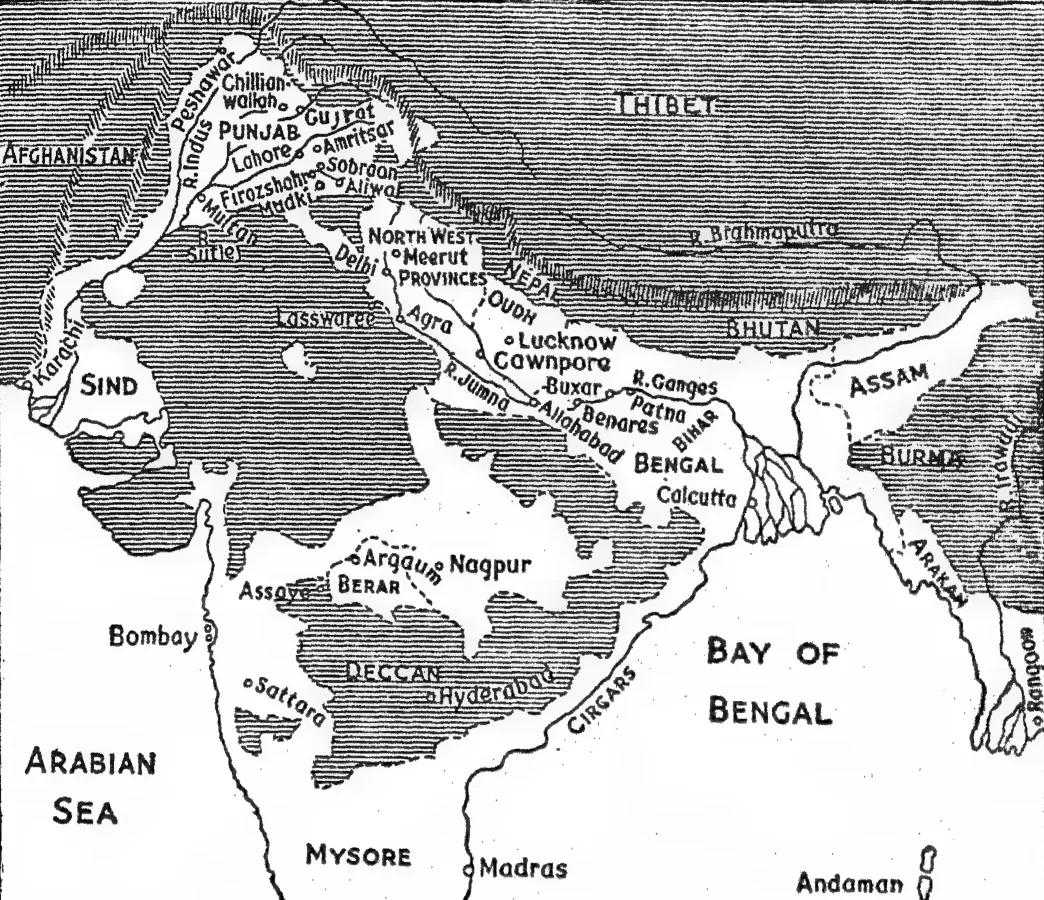
direct British rule,
INDIA IN 1857 army, and, except in Oudh and Rohilkund, and at Delhi, the civil population took no part in it. It was confined for the most part to the Ganges valley. It began with the murder of their officers by the garrison at Meerut. Other garrisons in the Mutiny.;
1 Sepoy troops in India formed three distinct armies—those of Bengal, Bombay, and Madras. Only the army of Bengal was seriously involved
followed suit, and the mutineers concentrated wpon Delhi, with the idea of reviving the power of the Mogul Emperor. In Oudh there was a general uprising, and British garrisons were besieged at Lucknow and Cawnpore.
The miutineers received no assistance from other parts of India. The sepoys of Bombay and Madras held aloof, and the Sikhs, though but recently conquered by Gough, remained conspicuously loyal, as did the Gurkhas of Nepal. The Nizam remained faithful to the British alliance, as did the Maratha chieftains Holkar and Sindhia. It cannot be asserted that this refusal to join the rebels was in all cases inspired by devotion to British authority; it would be truer to assert that the jealousies and animosities of Indian races towards one another were more potent than their dislike of British rule.
Cawnpore was captured by Nana Sahib and was the scene of amassacre. During the siege of Lucknow Sir Henry Lawrence was killed, but the garrison held out and, after several weeks, was relieved by Outram and Havelock. The rebels continued the siege, however, until final relief was effected in November,
1857, by Sir Colin Campbell. Delhi had been captured by British troops in September. With these British successes the backbone of the Mutiny was broken, though Oudh was not fully recovered until the spring of 1858, and fighting occurred in isolated districts for some time after this.1
The lessons of the Mutiny were of some value. It caused the ruling race to reconsider the principles on which Indian government was conducted. Viceroys of India were more considerate of native prejudices, and efforts were made to oe introduce reforms in such a way as to arouse the minimum of antagonism..The Indians, for their part, found that they had underestimated British strength, and they realised that British rule would not easily be overthrown. —
In 1858 the East India Company was abolished by Act of Parliament. The land passed under the direct sovereignty of the British Crown, and a new era in Indian history began.
1 The moderate policy of Lord Canning towards the rebels was criticised at the time, and he was nicknamed “Clemency Canning,”
Chapter XVIndia after the Mutiny
By the India Act of 1858 the East India Company and the Board of Control were abolished, and the Government of India was henceforth to be carried on in the name of the queen. The general direction of affairs and the control of policy were to be in the hands of a Secretary of State for India, but the actual administration was to be in charge of a Viceroy whose atithority would extend to every part of the land. The Company’s army was amalgamated with that of the Crown, and its navy was abolished,
It was not proposed that the Secretary of State for India should exercise unrestricted authority in dealing with Indian affairs. A Council of India was set up to advise him and, in some respects, to control hin. Its members were paid, and they enjoyed a good deal of independence, as they could not easily be dismissed.
A part of the Council of India was to be nominated in the first instance by the Court of Directors of the East India Company, and subsequent vacancies in this group of members were to be filled by co-option, The Council, the members of which were to be men of experience in Indian administration, was expected to advise the Secretary of State in all Indian affairs, and its assent was necessary to appointments to the Executive Council of the Viceroy and to decisions on financial. matters.?
It is not unreasonable to suggest that these arrangements indicated an attempt to continue, under new forms, the old duality of control in regard to Indian government... If the
of the matters mentioned in the text.:
1 They held office on the same terms as judges of the High Court— quamdiu se bene gesserint.. j
2 The reader will observe that the Council of India sat in London to advise the Secretary of State, and that the Executive Council existed in India to advise the Viceroy. In both cases the function of the Council _ was advisory. Neither Secretary of State nor Viceroy was compelled to ‘follow the advice tendered to him, except, in the former case, in respect
Secretary of State for India was the political successor of the President of the Board of Control,? the Council of India might be regarded as continuing the influence and policy of the Court of Directors. Just as the directors had not infrequently succeeded in bringing about the modification of a line of policy of which the President approved, so it was expected that the Council of India would exercise real influence and even control over the policy of the Secretary of State.
As a matter of fact, the intentions of the framers of the India Act in this respect were not fulfilled. From the first the Secretary of State enjoyed a higher status than the President of the Board of Control, and he was subject to little external interference in the exercise of his functions.?
In 1869 some changes in the composition and powers of the Council of India were made, The members of the Council henceforth were appointed for a definite period, and its function, except in some financial matters, was limited to the giving of advice. If at any time the Council has attempted to impose its will upon the Secretary of State, he has been able to ignore it.
The post of Viceroy has been filled by a long succession of men of high rank and, for the most part, of great capacity. It has been usual to appoint to the office men of wide knowledge of the world and of great political experience rather than officials specially acquainted with Indian affairs.2 Such men must necessarily rely upon their Councillors and officials for advice and information, but they have, as a rule, brought a sounder judgment to bear on the problems which have arisen than could have been expected from men of purely official training, Mistakes have sometimes been made, but the men
Commons,;
The one conspicuous exception was Sir John Lawrence (Lord Lawrence), who had spent his life in the Indian service. It cannot be asserted that his viceroyalty was more successful than that of others; the reverse has sometimes been alleged.
1 Except for the first few years after its establishment, the Board of Control had no real existence. It was constituted, but it did not meet. Its functions were exercised by the President alone.
2 Although, upon occasion, exceptional occurrences in India have attracted the attention of Parliament, no sustained interest in the course of Indian affairs has been shown by that body. Nor has there been any opportunity to discuss the policy of the Secretary of State upon a vote for his salary, since, until recently, this was charged upon Indian revenues, The salaries of members of the Council of India are, like those of the judges, charged upon the. Consolidated: Fund; thus, little opportunity is ordinarily afforded for the discussion of Indian affairs in the House of
who have been responsible for the Government of India have devoted themselves to their task in no half-hearted manner— in some cases at the expense of health and strength.
The relations of the Viceroy and the Secretary of State to one another have changed materially since 1870. In that year a submarine cable was laid in the Red Sea, and direct telegraphic communication was established between Great Britain and India. It thus became possible for the Secretary of State to send frequent and detailed instructions to the Viceroy.
It can hardly be doubted that the framers of the India Act of 1858 intended that India should be governed by a Viceroy, and that the Secretary of State should merely exercise general supervision. The improvement in communication has tended to increase the authority of the Secretary of State and to make the Viceroy his subordinate.
While cotmunication was difficult and decisions had to be made promptly, the home Government was often presented with a fait accompli; it might approve or it might censure, but it cotild not change what had been done. When it became possible for the Secretary of State to cable directions two or three times a day, the Viceroy lost much of his power of taking independent action, and the greatness of his position was necessarily affected. It is some indication of the strong personality and great capacity of most of the Viceroys that the importance of their office has declined so little.
Wars have occurred from time to time, but, as stated already, the elimination of native princes has not been a feature of British policy. When the sovereignty of the queen was proclaimed in 1858 it was announced that no further territorial acquisitions were desired by the British Government. While no aggression on British territory would be permitted, no encroachment on the Indian states would be sanctioned. ‘The rights, dignity, and honour of the Indian princes” would be respected.
Great importance was attached to these declarations by the princes of India. The Prince of Wales (afterwards Edward VII) visited India in 1876, and in 1877 Queen Victoria was proclaimed Empress of India. The importance of these events in strengthening the loyalty of the princes and the peoples of India was great. _—
So long as an Indian ruler is loyal and governs his state with a reasonable degree of efficiency no attempt is made to interfere with his freedom of action. A British Resident is attached to each important native ‘court, and it is his duty to advise the ruler as occasion offers, but he cannot compel the ptince to accept his advice, and the Government of India will not intervene to back him up unless the state suffers from gross misrule.
The policy of non-annexation has been carried out so rigidly that on the rare occasions on which it has been necessary to depose an Indian prince it has been the practice to enthrone another in his place, either at once or after an interval, instead of confiscating his territory and putting it under direct British rule.
In 1875 the Gaekwar of Baroda was deposed on account of misrule, but a young prince was enthroned in his place, and during the next few years the state was governed by British officials on behalf of the youthful Gaekwar. In 1891 the ruler of the little state of Manipur was removed, but his son’s right of succession was recognised, The only important annexation since 1858 has been Burma, referred to below.
In order to dispel certain fears and misunderstandings which had arisen, Lord Minto, when Viceroy, re-stated British policy towards the Indian princes. While he reasserted the suzerainty of the British Crown he announced that its policy towards the princes was one of non-interference in internal affairs, with the reservation that it might intervene in cases of gross misrule. These views were reiterated in most emphatic terms by Lord Reading in 1926 in a communication to the Nizam of Hyderabad.
The state of affairs in Hyderabad, one of the largest of the Indian states, was unsatisfactory; the Nizam was not deposed, but, at the suggestion of the Viceroy, he accepted “advisers” to assist in raising the standard of his administration.
The problem of the north-west frontier gave recurrent cause for anxiety. The Ameer of Afghanistan, Dost Mohammed, died in 1863, and affairs in that country were disturbed for some years. By 1868 Sheer Ali, the third son of the late Ameer, had so far triumphed over his brothers as to secure substantial possession of the throne. During the struggle, successive Viceroys—Lords Elgin and Lawrence—adopted a policy of aloofness in regard to Afghan affairs, but, when it became clear that Sheer.
Ali was the victor, Lord Lawrence, and after him Lord Mayo, endeavoured to secure his friendship. Meanwhile, however, the Russians had been steadily advancing through Turkestan, and in 1872 they occupied Khiva. Their proximity alarmed Sheer Ali, so that he was disposed to look to the British in India for assistance in repelling possible Russian attack. This, however, was more than Lord North-brook, now Viceroy, was prepared to promise; nor would he recognise Sheer Ali’s son as heir to the throne. The Russians, on the other hand, accorded the desired recognition; in various ways they indicated their desire to be on friendly terms with the Ameer, and Russian agents made their appearance at the
Afghan court.
The British Government at length took alarm at the progress of the Russians, and it was resolved that Sheer Ali should be invited to receive a British Resident at Herat, in order that Russian influence in Afghanistan might be checked. Promises of assistance against Russian attack and of recognition of his son as heir—promises which might have been instrumental in winning the Ameer’s friendship if they had been made earlier —were made, with little effect.
The political situation in Europe at this time was critical; war between Great Britain and Russia was at least possible. But their differences were composed at the Congress of Berlin, 1878... Sheer Ali, in the expectation of receiving Russian help, had postponed making a definite reply to the Viceroy’s (Lord Lytton’s) proposals; in view of the changed situation in Europe the Russians were disinclined to move, and the Ameer was left alone to face a British attack.
The second Afghan War opened in November, 1878. Sir Frederick Roberts invaded the country by the Khurram Pass, and Sir Donald Stewart captured Kandahar. Sheer Ali fled into Turkestan, where he died, and, by the Treaty of Gandamak, in May, 1879, his son, Yakub Khan, conceded the British demands. The frontier was moved to the farther side of the passes, which thus remained in British possession; Afghan foreign policy henceforth was to be under British control; and a British Resident was to be received at Kabul.
This easy surrender by Yakub was not to the liking of the Afghans. The Resident, Sir Louis Cavagnari, was received with suspicion, and was perhaps not altogether tactful. Within six weeks of his arrival he was murdered. To what extent the Ameer was concerned in the incident it was impossible to determine.
The punitive expedition was commanded by Sir Frederick Roberts, who reached Kabul and deposed Yakub. Ayub Khan, the brother of the deposed Ameer, defeated General
Burrows at Maiwand, and threatened Kandahar. Roberts marched from Kabul to the relief of Kandahar, and fully restored British military predominance. Meanwhile Abdurrahman, a member of the Afghan royal family who had lived for many years in exile, returned to Afghanistan and claimed the throne. Disorder prevailed for some time, but Abdurrahman at length succeeded in establishing himself as Ameer, Lord Ripon, Lytton’s successor as Viceroy, came to terms with him; the demand for a British Resident was dropped, but the control of Afghan foreign policy was secured. Abdurrahman, although he had lived among the Russians during his years of exile, was not unwilling to maintain friendly relations with the British.
The problem of the north-west frontier could not yet be regarded as settled. In the years that followed attempts were made to fix a definite boundary line between Afghanistan and British India. This was achieved by Sir Mortimer Durand in 1893, and at the same time the Ameer agreed to give no support to the hill tribes within Indian territory. To check and control the activities of the tribesmen strategic railways were constructed, and garrisons were stationed at suitable places in the hills.
In 1895 the tribesmen revolted, and besieged Chitral; it was relieved, and order was restored. A more formidable rising, that of the Afridis, occurred in 1897, but this, too, was crushed after extensive military operations. In igor a new North-West Frontier Province was formed.
During the viceroyalty of Lord Curzon (1899-1905) suspicion was aroused of Russian designs upon Thibet. This mysterious country was, perhaps, more completely cut off from external influences than any other in the world. Nominally a province of the Chinese Empire, it had for centuries been the “ Forbidden Land” to. Europeans, but early in the twentieth century negotiations were opened up between the Thibetans and Russia. To counteract the effect of Russian intrigues Lord Curzon in 1904 sent a military expedition, under Colonel Younghusband, into Thibet.
Some fighting occurred, and the British force made its way to Lhasa. An agreement was reached by which the Thibetans were to pay an indemnity, to receive a commercial agent at Lhasa, and to cede a strip of territory.
the United Provinces of Agra and Oudh.
1 This necessitated ‘the renaming of the former North-West Province as
In 1907 the Anglo-Russian Convention was concluded.
Great Britain and Russia agreed to abstain from the acquisition of political influence in Thibet; Afghanistan was recognised as lying within the British sphere of influence; the Russians were given a free hand in northern Persia, and the British in the south of that country. For some years the problem of the north-west frontier ceased to alarm Indian statesmen.
A third Burmese War was fought towards the end of 1886.
The King of Burma had, since the second war, possessed no coastal territory; from his capital, Mandalay, he ruled the interior of the country. Many points of friction between
British and Burtiese had arisen in course of time, and some annoyance was felt by the British at the attempts of the French, working from Indo-China, to secure influence in Upper Burma.
At length an expedition was sent up the Irawadi. The campaign lasted barely three weeks. King Theebaw was deposed, and Upper Burma was conquered. Burma became a province of the Empire of India. Ay”
Since the suppression of the Mutiny very great benefits have been conferred upon India through the activities of British administrators. Peace has been maintained throughout the land, and there has been an entire immunity from foreign invasion, a state of affairs which stands in marked contrast with that which prevailed before and during the existence of the Mogul Empire. Life and property have been made safe to a degree hitherto unparalleled in India.
Law has been codified, and its principles have been upheld in a system of tribunals ranging from the village courts to the High Courts of the provinces * and to the Judicial Committee of the Privy Council in England. The work of suppressing the inhuman practices associated with the religion of the Hindus, begun in the time of the East India Company, has been maintained.
Continued vigilance has been necessary to prevent the revival of Suttee; infanticide has been forbidden; efforts: have been made to discourage the practice of child-marriage. The work 1In 1904 outstanding points of difference between Great Britain and France were settled by the signing of the Anglo-French Convention and the formation of the Dual Entente.
France was already in alliance with Russia, but serious differences existed between Great Britain and Russia until they were settled in the Anglo-Russian Convention, by which the Dual Entente was converted into the Triple Entente.
2 There was no High Court for India as a whole until the passing of the
Government of India Act, 1935.
of the British Government in India in connection with public works and with the organisation of famine relief is described below, as is the progress made in connection with education and public health.
While the Company ruled India, internal communication was in a primitive condition. Roads were almost non-existent, important cities being connected by mere rough tracks. Not until the time of Lord Dalhousie was any attempt made to improve them. Dalhousie planned the construction of railways as well as roads, but difficulties were great, and progress was slow. Every rail and sleeper, every coach and locomotive, had to be imported from Great Britain at a time when the voyage was made by way of the Cape.
‘The natives were not well fitted for railway work, and navvies and artisans, as well as engineers, had to come from Great Britain. Moreover, it was doubtful whether the natives would use the railways, on account of their caste prejudices.
At first it was thought desirable that railway construction and working should be entrusted, as in Great Britain, to private companies. But no private company was willing to accept the financial risk involved unless it received a Government guarantee of indemnification against loss. A dividend of five per cent was guaranteed by the Indian Government; on the other hand, it was arranged that, if the’ profits of a line were more than sufficient to pay this dividend, the surplus should be divided between the company and the Government.1 The Government was empowered to purchase the lines after a period of thirty years.2. A good deal of construction was undertaken on these terms between 1853 and 1869. The gauge of these lines was 5 ft. 6 in., and they were built very solidly and.at great expense.
Progress was still slow, and the desire of the Indian Government.to speed up the construction of railways led, in 1869, to we Fe - — 3 a change of policy. Company building under guarantee continued, but henceforth the state also undertook the construction of railways, and, in the interests of economy, the metre gauge was decided upon for these lines. In later years other systems of construction and management were tried, There are now some twenty thousand miles of line of each gauge, both systems extending into all parts of the country.
1 These financial terms. worked to the detriment of the Government. Accounts were made up half-yearly, and traffic on the Indian railways was very unequal in the two halves of the year. The profit in excess of the amount needed to pay the standard dividend in the one half of the year was divided between the company and the Government; the whole of the deficit in the other half of the year was made good by the Government. Until the end of the nineteenth century the railways involved the Government in an annual loss; since that time, however, a ‘railway revenue” has been obtained, ic Tee
2 The option has been exercised in some cases. cs
India is mainly agricultural, and three-quarters of the people dwell in villages and obtain a living by the cultivation of the soil, For the success of their efforts they depend upon the periodic rains, or monsoons. The south-west monsoon brings rain from June to August in western and northern India, and the north-east monsoon waters the eastern part of the land from October to December. But these periodic rains are sometimes deficient, and when this happens the crops are poor. In earlier times this was viewed by the people with characteristic oriental fatalism, but under British rule extensive irrigation works have been established in many of the provinces.
Irrigation canals, which are fed from great rivers, have been constructed, and they enable agriculture to be carried on independently of the monsoons. Regions formerly barren are now under regular cultivation as a result of these works. It is estimated that cultivation over an area of more than fifty million acres is dependent upon irrigation.?
In the past India has suffered severely from time to time from famine. Famiines were due to the failure of the crops in consequence of the insufficiency of monsoon rainfall. But, India being so large, famine never occurred in all parts of the country at the same time, and while food was scarce in some provinces it was plentiful in others.?
Because of the absence of means of communication before the middle of the nineteenth century, it was impossible to send food from one part of the country to another, so that the solution of the problem of eS ruined, though the excess which ruins one crop may benefit the second crop of the same year. But if water be not drained from the surface mosquitoes will breed in the pools, and malaria will develop.
a supply of water at small cost.
3 The regions most liable to famine were the Deccan, Rajputana, and
the western and southern parts of the United Provinces,
2 An excess of rainfall may be as serious as a deficiency. Crops may be
2 Trrigation is not carried on solely by means of canals. ‘! Tanks,” or small reservoirs, are used for the collection of surface water, especially in southern India. Wells are sunk in the Ganges valley, and they yield
famine relief has been connected with the construction of railways. This accounts for the vigour with which the Government of India, by one means or another, promoted railway construction in the second half of the nineteenth century.
Between 1860 and 1870 three serious famines occurred. That of 1860-1 was in the North-West Provinces (now the United Provinces) and Rajputana; Orissa suffered in 1866-7; western India in 1868-9. Energetic measures were taken, but these were not altogether effective, on account of the difficulties of communication, and the mortality was heavy. A failure of crops in Bihar in 1873-4 led to a fear of famine, but the Government acted so vigorously in organising an import of rice that there was more than sufficient for the needs of the province, and some was re-exported. The great Deccan famine of 1876-8 affected a vast area, and it was not possible to deal so effectively with the situation.
In 1878 the Viceroy (Lord Lytton) appointed a Famine Commission, under the chairmanship of Sir Richard Strachey, and as a result of its recommendations the Famine Code of 1883—a statement of the principles on which famine relief should be regulated — was framed. It was decided that, whereas in time past relief schemes had been improvised when famines occurred, they should be thought out beforehand and kept in readiness to be put into operation as occasion arose.
Able-bodied persons should be employed on relief works at. wages adequate for subsistence, the grant of gratuitous relief being limited to those who for any reason were unable to work. Most important of all, the cost of the relief of famine should not be met as and when necessary, but should be a regular charge upon the Indian Exchequer. A sum of money should be allocated annually to ‘Famine Insurance.’
The. working of these principles was tested in the famines of 1896 and 1899-1900, both in the Deccan... A Commission which, under Sir James Lyall, investigated the problem in 1898, and another, under Sir Anthony Macdonell, in 1900, reaffirmed the principles upon which the Famine Code was based, and made additional recommendations as the result of the further experience gained.
The system under which famine relief is now organised may be briefly indicated. The Government of India maintains a meteorological service which watches and measures the amount of rainfall in various parts of the country. Deficiency is reported, and, when necessary, provinces are declared to be in a state of famine, This does not now mean that people are starving, but that relief works are open, in accordance with prearranged plans.
Also in accordance with arrangements already made, food is brought from the more fortunate regions into the famine provinces and is distributed under official supervision. The system has been worked out so completely and thoroughly that it is possible to state that deaths no longer occur in India by actual starvation in time of famine.
It is inevitable that there should be some rise in statistics of mortality at such times; there is some increase in the amount of disease, especially of cholera and fever, and some degree of diminished vitality. Conditions of life in relief camps are necessarily less healthy — but there is food for all. The organisation is directed not merely to the problem of immediate relief, but also to that of recovery. When the relief works are closed facilities. are provided for the recomimencement of agriculture, and provision is made for the support of the peasants until the harvest is gathered in.
With the extension of irrigation works and the lessening dependence of agriculture upon the periodic rains, even the proclamation of provinces as famine areas becomes less frequent as time goes on. British rule in India has conferred many benefits on the land and its people, but none greater than this. A scourge which from time immemorial has visited the country and decimated the people again and again has been overcome by sound organisation and patient work.
In some other directions progress has been slower. Efforts have been made to introduce western ideas of sanitation and cleanliness and so to reduce the high death-rate from preventable diseases such as plague, cholera, and smallpox. As early as 1864 Sanitary Boards were established in each of the three Presidencies, and in 1888 such Boards were set up in every province.
They were originally concerned mainly with the health of British troops in India, but their functions have been extended, and they now deal with such matters as the disposal of sewage and the purity of the water supply for the benefit of the general population. A School of Tropical Medicine has been established at Calcutta, and valuable work has been done in investigating the causes and treatment of cholera and leprosy. Efforts have been made to exterminate the mosquito and so to overcome the scourge of malaria.
Rapid improvement in public health cannot be expected, for the Indian peasant is fatalistic in this as in other directions, and is disinclined to co-operate with his rulers in bringing about a change for the better. The advance of education will probably lead in time to greater appreciation of the advantages to be obtained from following western ideas of hygiene, but education is in a backward condition. The peasants as a whole are illiterate, and while some of the boys receive instruction in mission and other schools very few girls receive any education at all.
1 Sir Valentine Chirol, writing in 1925, said: “... few if any deaths from actual starvation in the towns and large cities, where, owing to modern facilities of communication, a state of actual famine has ceased to be conceivable, and with the development of roads and railways few country districts are beyond the reach of some supplies from other parts.” -
More than two-thirds of the people of India are Hindu, and almost a quarter are Mohammedan, other religions, including Christianity, accounting for the remainder. In race the people are much more diversified, and many languages are spoken in different parts of the country. Some of the peoples of India regard other Indian races as more alien to themselves than the British. For these reasons it has been impossible in the past to regard India asa nation.
Nationality, as understood in Europe, can be achieved only as the result of generations of intercourse and intercommunication, and until the latter part of the nineteenth century each village was a self-contained unit. People _rarely travelled from their homes, and there was very little intermixture of races. Nevertheless, in spite of the absence of any true spirit of nationality, it has been the policy of the British Government in India to associate Indians with white men in the work of ruling the country.
As early as 1833 Indians were declared to be eligible for appointment to positions in the service of the East India Company. Natives have been selected for posts of responsibility in the civil service, they are eligible for commissions in the Indian army, and they may become barristers and judges, i Hindus 239 millions
4 The population of India, according to the census of 1933, included:
Before the reorganisation of the Government of India in 1833 laws for British India were made by the Governor-General and his Executive Council, which had remained unchanged in form and powers since the time of Lord Cornwallis. In that year, however, a separate Legislative Council was established, to consist of the members of the Executive Council with the addition of one other member, known as the Legal Member. Limited powers of legislation for local purposes were also vested in provincial Governors, with their Councils. In 1853 the Indian Legislative Council was enlarged by the addition of members representing the chief provincial Governments; it thus became markedly distinct from the Executive Council,
The Indian Mutiny showed that the Government was not sufficiently in touch with Indian opinion, and by the India Councils Act of 1861 another plan was tried. The Indian Legislative Council was to consist of the four members of the Executive Council, together with not less than six and not more than twelve other members, to be appointed by the Viceroy for a period of two years. Some of the additional members might be officials of the Indian Civil Service, but at least half were to be non-official. ‘Non-official members were added to the provincial Legislative Councils also. For the first time Indians became eligible for appointment.
The central Legislative Council set. up under the Act of 1861 was very much under the control of the. Viceroy. Including the members of the Executive Council it contained a majority of official members, who, presumably, would not be prepared to oppose the Viceroy, while if any non-official member pursued a markedly independent. line it was unlikely that his appointment would be extended upon the expiration of the period of two years. Nevertheless, from time to time the Council showed that it was not inclined to act without protest as the mere mouthpiece of Viceroys and Secretaries of. State.
By the India Councils Act of 1892 the number of additional members of the Legislative Council of India was increased by four, and some provision was made for consulting Indian opinion in the selection of non-official members, They were to be nominated and not elected, but the Calcutta Chamber of Commierce and the non-official sections of provincial. Legislatures were invited to recommend persons for nomination.
The powers of the Council were extended; it was permitted to discuss the budget, though not to vote upon it nor to pass resolutions concerning it. The provincial Legislative Councils were enlarged at the same time. Persons might be recommended for nomination to the Councils by municipalities, universities, and chambers of commerce. This might be regarded as a step in the direction of introducing the repre-sefitative principle, although election was not yet sanctioned.
A great advance was made by the India Councils Act of
1909, passed while Mr. John Morley (afterwards Lord Morley) was Secretary of State and Lord Minto was Viceroy. The number of members of the central Legislative Council was increased, and its powers were extended. But the most significant change was in the constitution and powers of the provincial Legislative Councils. The principle of election was introduced, and electorates of Mohammedans, landowners, and trading communities were formed. Special interests, and not territorial constituencies, were thus represented.
The Councils were entrusted with substantial powers of criticism, interrogation of the provincial Governments, and the initiation of business. The Act also provided for the appointment of an Indian member of the Executive Council of the Viceroy, which hitherto had been composed solely of Europeans. At the same time Lord Morley appointed two Indians as members of the Council of India in London. The significance of the Morley-Minto reforms, and the extent to which the policy indicated in them was capable of being developed, are matters which will be discussed in another chapter..
The Indian National Congress came into existence in 1885. It was established by educated Indians, who hoped that it might develop into a kind of unofficial Parliament for the expression of Indian views on public affairs. In the utterances of its founders there was no suggestion of opposition to British rule, and sentiments of loyalty were expressed.
Lord Dufferin and Lord Lansdowne, Viceroys during the early years of the movement, were well disposed towards it, and thought it might provide the Government with a valuable means of consulting Indian opinion. But most of the British officials in India were disposed to view it with some degree of contempt, and, in course of time, of suspicion, as being likely to lead to sedition. Some few. Englishmen were concerned in the foundation of the Congress, and occasionally an Englishman was chosen as its president.
The Congress was at first viewed with dislike by the Mohammedan communities in India, which in 1905 founded the All-India Moslem League for the protection of members of that faith from Hindu terrorists. After some years the Mohammedans abandoned their attitude of aloofness, and participated in the discussions of the Congress. Its meetings were annual, and they were held in the great cities of India by turns. The “expression of Indian educated opinion,” for which the Congress was intended to be an organ, became year by year the recital of a list of grievances, and at length the whole system of British rule in India became the object of direct attack.
The more extreme men tended in time to dominate the Congress. A Maratha delegate named Tilak, a man of great ability, exercised much influence and gained a considerable following. He appealed to the religious feelings of his auditors in order to promote feelings of sedition. History was falsified, and every British measure was misrepresented in the worst possible way.
When a serious outbreak of bubonic plague occurred at Poona, and British sanitary officials entered, for purposes of disinfection, houses in which cases of the plague had occurred, Tilak denounced these proceedings as an insult to Indian worren and an outrage on Hindu religion. From the words of Tilak his followers proceeded to deeds, and a series of murders of officials took place. Tilak was at length imprisoned, and the outbreak of terrorism died away.
During the viceroyalty of Lord Curzon the province of
Bengal, which contained 80,000,000 people, fully one-quarter of the population of India, was divided into two. It was no doubt felt by the Viceroy that division was desirable in the interests of efficiency of administration, but it was deeply resented, and provided further material for inflammatory speeches in the Congress.
The passing of the India Councils Act of 1909 and the consequent enhancement of the importance of the Legislative Councils provided organs for the expression of Indian opinion of a more responsible character than the Indian National Congress. The Government of India was in no way responsible to the Legislative Councils, but it could not be altogether indifferent to the views put forward by their members. The result was that, for a. time, the Congress was overshadowed, and attracted less attention.
Chapter XVIIndia—The Advance towards Responsible Government
TuE accession of King George V in 1910 was followed by a state visit of the king and queen to India in 1912. This was the first occasion on which India had been visited by a British sovereign, and a magnificent Coronation Durbar, attended by a large number of Indian princes, was held at Delhi. The transference of the capital from Calcutta to Delhi was followed by a rearrangement of the provinces of the north-east, in which the division of Bengal was abandoned, These events were popular, and, for a time at least, there was little indication of unrest. An attempt in 1913 to assassinate the Viceroy, Lord Hardinge, who was seriously wounded, was very generally deplored.
The outbreak of the European War in 1914 was followed by a great outburst of loyalty by Indian princes and people. If the German Government really reckoned on the British being seriously embarrassed by disaffection in the Indian Empire, there is no doubt that it misjudged the position. India was almost denuded of British troops, and the Indians, so far from seizing the opportunity to revolt, enlisted in large numbers and sent a steady stream of men to the western front.
Expeditions composed for the most part of Indian troops were sent to German East Africa and to Mesopotamia. Substantial financial assistance was voted by the Indian Legislative Council, which, in addition, conferred on the Government of India special powers comparable with those which were vested in the Government of Great Britain by the Defence of the Realm Act, Even in Congress the voice of criticism was stilled for a time.
This state of affairs did not continue unchanged until the end of the war. British prestige suffered to some extent from defeats in Mesopotamia and the Dardanelles, and the prolongation of the war led to doubts being felt as to whether ultimate victory would be secured by the British. The importance of the Indian National Congress revived, and =e in that body put forward claims for Indian Home ule.
The Morley-Minto reforms of 1907~9 had as their object the extension of the practice of associating Indians with British in the Government of India. But the Government of India remained an absolutism, and the persons, British or Indian, who carried it on were in no way responsible to any Indian Assembly, but to the British Parliament alone. To Lord Morley this appeared to be inevitable.
He regarded parliamentary institutions as unsuitable for India, and appeared to be unable to look forward to any time when India would be fit to be ruled in this way. He stated, in 1909, that if he thought the reforms which he, in conjunction with Lord Minto, was putting forward would lead to parliamentary government he would have nothing to do with them. Lord Minto, the Viceroy, gave expression to a similar point of view when he asserted publicly, in 1910, that responsible government was inapplicable to the Indian Empire.
There was a good deal to be said for these views. How could a Parliament ever be established in a country in which hostile races were prevented from attacking one another only by the restraining hand of a superior power? How could political questions be discussed in an Assembly the members of which might be prevented by the rigid rules of caste from associating together? In what language could their proceedings be conducted?. Could elections be anything but a farce when all but a small fraction of the people were illiterate?
In the opinion of their authors the Morley-Minto reforms led—nowhere. This opinion. was based on the assumption that Indians did not form a nation, and that they never could form a nation—that divisions of race, religion, caste, and language were too deep to be overcome. That these divisions are too deep to be obliterated for many generations, if at all, is obvious; nevertheless, it may be asserted that Lords Morley and Minto underestimated the extent to which the work of unification was going on.
The mere fact that the whole of India had long been subject to one paramount power tended towards the unification of its people. A uniform system of law was being enforced throughout British India, and a certain minimum of sound administration was expected in the Indian States. Order was being maintained, and the country was free from the menace of foreign attack. The establishment of a system of education was bringing together educated Indians from various parts of the land.
Facilities for travel and communication were breaking down the old isolation of the villages. And, though no Indian tongue was current throughout the land, the English language was everywhere in use for purposes of government, trade, and education.
The Montagu declaration must be regarded as a landmark in Indian history. Nevertheless, some criticism may be offered as to both the time and the method of its issue. Had it been put forward in the form of a proclamation from the Crown, as was done with the proclamation of the queen to the Indian princes in 1858, it would have. attracted more general attention and carried greater weight.
And not long after the pronouncement of Mr. Montagu an appeal was made for further military and financial help in the war. Ill-disposed persons were able to represent both appeal and. concession as indications of British weakness. The extremists: in. Congress would be satisfied with nothing short of an immediate grant of responsible government.
. The first of the steps foreshadowed in the Montagu declaration ‘was taken without delay. Since the abolition of the East
India Company there had been no formal inquiry into the condition of India and the working of Indian government, and such an inquiry was now undertaken. Mr. Montagu visited India, and, in conjunction with the Viceroy, Lord Chelmsford, drew up a report on the condition of India which was laid before Parliament in April, ror8. A scheme of Indian Constitutional Reform was propounded, and this formed the basis of the Government of India Act of 1919.1
This important Act reorganised the structure and functions of the central Government, but its most important provisions related to the Governments of the provinces. In each province the Legislative Council, which had been called into existence in the latter part of the nineteenth century and had been enlarged by the India Councils Act of 1909, possessed the power of making laws for the province and of criticising the actions of the Executive Council, but the latter was not responsible to it; the Executive Council was, in fact, immediately responsible to the Governor of the province and ultimately to the Governor-General of India and the Parliament of Great Britain?
The Act of 1919 introduced into the major provinces *® the principle of Dyarchy. Certain Departments of the administration, chiefly those relative to the preservation of law and order, were “reserved” to the Executive Council,4 responsible as hitherto to the Governor, and, above him, to the Governor-General and the British Parliament. Other Departments were “‘ transferred ”’ to ministers chosen from the elected members of the Legislature and responsible to it. The transferred Departments included education, sanitation and public health, local government, industrial development, and public works. The Legislative Councils were reconstituted and henceforth were to contain a large majority of elected members;* they were given control of supphes; they were empowered to formulate their own
+ The Executive Council included Indians as well as British.
1 Many of the details set out in this summary of the Act were not actually embodied in it but were promulgated by the Secretary of State for India under powers conferred upon him by the Act.
2 The position in the provinces prior to 1919 was that of representative institutions without responsible government, comparable to that in Canada between 1791 and 1840.
3 The major, or “ Governors’,” provinces were Madras, Bengal, Bombay, United Provinces, Bihar and Orissa, Central Provinces, Punjab, Assam, Burma (in 1923), and the North-West Frontier Provinces (in 1932).
5 The nominated element was to consist of about one-fourth of the Council; only about one-half of the nominated members were to be officials.
rules of procedure; and they could initiate legislation! The Governor was empowered, in the last resort, to override the decisions of the Legislative Councils in certain respects. If supplies were withheld he might order the restoration of grants for reserved Departments, he might authorise expenditure which he deemed to be necessary, and he might even “‘certify”’ laws which had been rejected by the Legislature but which he considered necessary for the preservation of order.
The Act thus established in the provinces Governments which were responsible in certain Departments, while a kind of benevolent. despotism remained in regard to the reserved Departments. But it was provided that reserved Departments might at any time be transferred, so that it was not impossible for the provinces to attain full responsible government without further action by the British Parliament.
The changes brought about in the central Government by the Act of 1919 were less profound. The Legislative Council was reconstituted, and was henceforth to consist of two Chambers, a Council of State and a Legislative Assembly. The latter was to contain 145 members, of whom 104 were tc be elected and 41 nominated; of the latter 26 were to be officials and 15 non-officials.
The Council of State was to be composed of 33 elected and 27 nominated members, not more than 20 of the latter being officials. A system of direct election? was instituted in connection with both Chambers. The qualification for voting for representatives to sit in the Legislative Assembly was to be. the payment of a certain amount in land revenue or in income tax.
In elections to the Council of State only those who possessed a substantial amount of property or who had at some time been a member of the Legislature or of local Legislative Councils were to be eligible to vote.
The powers entrusted to the reorganised Indian Legislative Council were considerable. In addition to the making of laws and the granting (or refusing) of supplies, it was to be em-_ powered to criticise, and even to censure, the action of the Executive. But Dyarchy was not established in the central Government. The Executive Council remained responsible
? Members of the Indian Legislative Council hitherto had been chosen by the provincial Legislative Councils, to the Governor-General, and ultimately to the British Parliament, and not to the Indian Legislative Council.
1 The student of the Gonsivnuticcal history of England will recognise ‘that these had been important features: in English constitutional development,
The ultimate authority of the Governor-General therefore remained substantially unimpaired. He was authorised to certify necessary laws which had been rejected by the Legislature and to restore grants which it had refused.
The central administration was divided into nine Departments, each under the political control of a member of the Executive Council.2 The Governor-General himself directed the work of the Foreign and Political Department, which was concerned with relations with foreign countries and with the Indian princes, The Departments of Railways and Commerce were supervised by a single member. The Executive Council therefore consisted of seven members.
The Act of 1919 attempted a classification of administrative functions as between central and provincial Governments, and this classification was put into operation in regard to the Government of India and the major provinces. With regard to the minor provinces, however, the Government of India retained control over certain matters which, in the case of a major province, would have been classed as provincial.
It was necessary to make some division of Indian revenue between the central Government and the provinces. Broadly speaking, the Government of India retained the revenue from income tax and from customs, while the land revenue and the receipts from excise, stamps, and irrigation works were assigned to the provinces. It was recognised that this arrangement would, temporarily at least, leave the Government of India with inadequate resources, and it was resolved that the provinces should be called upon to make contributions to the exchequer of the central Government, With the expansion of the revenue of the Indian Government these contributions were to be diminished, and it might be expected that they would ultimately be discontinued.;
The position and functions of the Secretary of State for India, as the minister responsible to the British Parliament for the Government of India, remained unchanged by the
1In the provinces these powers of the Governor related, in the main,
to reserved Departments; in the Government of India all Departments
were “reserved,” so that the special powers of the Governor-General
necessarily ranged over the whole field of administration,
2 As in the provinces, some of these were Indians.
Act of 1919. Nevertheless, it was inevitable that the inter-ference of the Secretary of State in the administration should become less, and that when the Viceroy and the representatives of Indian opinion were in agreement he should override their ' views only for the weightiest of reasons.
The outlook in India was far from promising at the time of the passing of the Actof 1919. In 1918 a Special Commission under Mr. Justice Rowlatt had been sent out from England to investigate the causes and extent of lawlessness and terrorism in India, and to suggest remedies. As a result, two acts, commonly known as the Rowlatt Acts, were passed, conferring upon the Indian Government additional powers to deal with disorder. These acts were profoundly disliked by Indians, and a Non-Co-operation movement developed.
It was started by Mr. Gandhi, who during the war had been loyal to the Government and had been active in encouraging recruiting in India. He now advised his followers to oppose the enforcement of the Rowlatt Acts by every possible peaceful means, but without resorting to violence. Indians, he considered, should take no part in elections, and any who held official posts or titles or honours should resign them. Children should be withdrawn from schools and students from the colleges. Lawyers should cease to practise in the Indian courts, and articles of British manufacture should not be used.
Mr, Gandhi’s influence in India was very great, especially among the common people. But it was easier for him to. arouse strong feeling than to. control it, and, though he depre-cated violence, his followers indulged in acts of violence. Disturbances occurred in Bombay and in the Punjab, and in 1919, at Amritsar in the latter province, a large body of Indians assembled in a public square was dispersed by a body of soldiers.
It was found afterwards that 379 persons had been killed and a much larger number wounded. In course of time, as the facts became known, the British Government expressed its emphatic disapproval of the action of the officer in command of the troops, but the affair naturally had the worst possible effect on Anglo-Indian relations,
Tt was in an atmosphere embittered by the Amritsar massacre and the enforcement of the Rowlatt Acts that the first Legislative Council established by the Act of r919 was opened on behalf of the King-Emperor by the Duke of Connaught in 1gai. In addition to the Council of State and the Legislative
Assembly, which were set up by virtue of the Act, a Chamber of Princes, which was not contemplated by the Act, was established by the Government. The Indian princes were invited, but could not be compelled, to attend, and some of them at first declined to do so.
In the first Indian Legislative Assembly under the Act of IQ1Q Criticism was directed against the Government of India on many points, and a number of demands were put forward. As a concession to Indian opinion the Rowlatt Acts were repealed soon after the arrival of Lord Reading as Viceroy.
The second Legislative Assembly was elected in 1924. By this tinte the Non-Co-operation movement was losing some of
LCN RAE ALN Pe 2 its force, and was being replaced by the Swaraj movement. Swaraj was the demand for the immediate grant of self-government. Its adherents looked to Mr. C. R. Das as their leader rather than to Mr. Gandhi, whose influence was on the wane. There was some recrudescence of violence, and some political murders occurred. These were deprecated by Das and other prominent men of the party.
But they contended that blame for disorder should be assigned to the Government, and not to the humble individuals who had been driven to crime by intolerable oppression. Since the repeal of the Rowlatt Acts the Government had lacked adequate powers to deal with disorder, but in 1924 the Viceroy issued an Ordinance investing the Government with the necessary authority, and the wave of terrorism died down.
The Swarajist party was represented in the second Legislative Assembly, and henceforth the Government had to reckon with the determination of this group to make the constitution unworkable. Efforts were made to meet Swarajist views. A policy of protection of Indian industries, even against those of Great Britain, was conceded, and an effort was made to speed up the substitution of Indians for British in the public services. But the Swarajists did not want merely an increase in the number of Indians in the civil service; they wanted the British to withdraw altogether.
Within a year or two the Swarajist party began to lose ground, Their. partial success, in the central. Legislature and in the provinces, alarmed many Indians, who began to realise the probable results which would attend the complete victory of the Swarajists, A revival of Hindu-Moslem antagonism was to be feared, and it seemed inevitable that the withdrawal of the British would lead to a vast amount of disorder in all parts of the land. Nor could the possibility be disregarded that, if the British should yield to the Swaraj demand and withdraw from India, they might be replaced by some other
European power.
The system of Dyarchy in the provinces established in conformity with the Act of 1919 was not completely successful. The period during which it was in operation was one of exceptional difficulty. The financial depression which affected other countries did not pass India by. Deficits accumulated, and retrenchment of expenditure and increased taxation becante necessary. Such measures, inevitably unpopular, prejudiced the people of India against the system. Another factor inimical to its success was the Non-Co-operation movement already referred to. Efforts were made to render government impossible by preventing the holding of elections.. Such attempts failed, however, and proved indirectly advantageous to the system, since those who were elected were desirous of working it successfully.
Something was achieved. Members of Legislative Councils became familiar with the difficulties involved in the actual problems of administration, and many of them devoted themselves to their duties with seriousness and with a desire to secure the maximum of advantage from the system. What was perhaps even more important was that the barriers of caste tended to break down in the Legislative Councils.
But in many ways the working of the system of Dyarchy proved disappointing. It has been pointed out elsewhere in this book* that responsible government can be operated smoothly only under a two-party system. The party in power must be faced by an opposition capable, upon receiving sufficient support, of forming an alternative Government. No such evolution of parties had taken place in India so far. Many groups existed, but they appeared to be incapable of sinking petty differences to the extent of combining into powerful parties.
Ministries retained office largely by means of the backing afforded by the personal friends of ministers, and of the support of the official members of the Legislature, who, being desirous of contributing to the smooth working of the system, were generally prepared to support any respectable group of ministers.
It was contended by the critics of Dyarchy that the standard of administration had been definitely lowered since its establishment, Officials, it was asserted, were less concerned with administrative efficiency than with the avoidance of criticism. A course of action, desirable in itself, was likely to be dropped if there were any prospect of controversy being aroused in the
Legislative Council.
To some extent members of the Legislative Councils were not content to confine their attention to that part of the administration which was responsible to them. - They extended their criticism to the reserved Departments, with the obvious intention of trying to bring these also under their control. This attitude, where it existed, could be persisted in the more readily in view of the fact that it was not easy to maintain the division of the administration into water-tight sections.
The various Departments of government are, in fact, interdependent, and form a coherent whole, a fact which is fully recognised in every responsible government in the British Empire, and which is the main justification for the principle of joint ministerial responsibility.
The wide powers of the provincial Governors to override the decisions of Legislative Councils by enforcing laws and restoring grants rejected by them tended to lessen the sense of responsibility among Council members. Not infrequently they took ‘wrecking”’ action with the full knowledge that they would be saved from its consequences by the Governor, It was felt that they would consider more seriously the probable results of their proceedings if no benevolent despot existed to save them from themselves.
In the Parliament of Great Britain an attempt by the Opposition to censure the Governtment presupposes the willingness of the Opposition to form an alternative Government. It cannot be supposed to be desirous of pulling down and at the same time to be unwilling to build up. If the members of an Indian Legislative Council realised that the censure of an administration would involve the formation of an alternative ministry from its critics they ‘would at least act with a greater sense of responsibility.
In two provinces, Bengal and the Central. Provinces, the Swarajists obtained a majority in 1924 and used their victory to paralyse the Government by refusing supplies even for the Departments responsible to the Assemblies. The Governors were able to restore grants for the reserved Departments, but not for the others. In each province the ministry resigned, and the Governor invited the Swarajists to form a ministry. In each case they refused, and the Governor carried on the administration as best he could. The real sufferers were the people, whose social services were cut down or discontinued.
Nor was the position of the Governors and Executives altogether satisfactory under the system of Dyarchy. In the event of a Legislative Council acting in a manner of which the Governor disapproved, he might decide to let it have its own way, or he might override it. In the former case he appeared to concur in a policy or a course of action which he disliked, and, if unsatisfactory results developed, he might be subject to severe criticism.
If, on the other hand, the Governor used the powers which he held in reserve, and overrode the decision of the Council, the matter was likely to be represented as the tyrannical exercise of arbitrary power in defiance of the views of the representatives of the people.
On the whole, Dyarchy failed to receive the approbation of the extremists on either side. It was naturally unsatisfactory to those who demanded complete responsible government for the whole of India, while the difficulties which were met with in its working convinced many of the English in India that the time was not yet ripe for constitutional advance and that the only satisfactory form of government for India was a benevolent atutocracy.
The Government of India Act of 1919 contained the unusual provision that the whole position should be reviewed at the end of ten yeats. This was an indication that the system then set up was not to be regarded as final, and men who regarded the reforms contained therein as inadequate were encouraged to accept them as an instalment, and so to work them loyally.
At the end of 1927.4 Commission was appointed, under the presidency of Sir John Simon, to investigate the working of the existing system of Indian government, and to consider to what extent and in what ways an extension of the system of responsible government was. desirable. The Commission, all the members of which were British, visited India in 1928, and was received with hostility not only by the extremists, whose antagonism might be expected, but by many Indians of undoubted loyalty, men who had: accepted the 1919 scheme as a first instalment of responsible government. They resented the non-appointment of Indians to the Commission, holding that
Indians should have a voice in the framing of the future constitution of India. It was felt that by their exclusion from the Commission Indians were placed in a position of inferiority. Efforts were made to dispel this feeling, and at length most of the provincial Legislatures agreed to appoint committees to assist the Commission. The central Council of State also appointed a committee, but the Legislative Assembly declined to do so.
The report of the Simon Commission was not published until June, 1930. It advised a complete reconstruction of the constitution of India on a federal basis, looking forward to the time when India should be a federation comprising not only the provinces of British India, but the Indian States also.! The Commission recommended, in the provinces, the enlargement? of the Legislative Councils, the discontinuance of Dyarchy, and the establishment of full responsible government.
Administration should be carried on by ministers responsible to Indian representative bodies, and the principle of joint responsibility should be expressly laid down; only as a result of the establishment of responsibility could the Councils be expected to realise the meaning of responsibility. The party which censured a ministry must be prepared to replace it, while in all its proceedings a Council must learn not to expect the Governor to step in and save it from itself.
The Governor should still have special powers in reserve; but these should be brought into use only for such vital purposes as the protection of minorities and for the maintenance of the Government in the event of a breakdown being threatened.
With regard to the central Legislative Assembly, the Simon Commission recommended that it should be known henceforth as the Federal Assembly, and proposed a reversion to the system of indirect election in vogue prior to 1919. The Federal Assembly should represent the Provincial Legislative Councils, and provision should be made for the inclusion of representatives of the Indian States, since only by their inclusion could the ideal of an All-India Federation be realised. The rights of certain minority groups—Moslems, Sikhs, and perhaps
Europeans—might be safeguarded by the provision of separate
1 The complete separation of Butma, which had no natural association
with India, was recommended.; is
2 This was in order that constituencies might be of moderate size.
The Commission considered that the Federal Executive should be responsible to the Federal Assembly, but that certain Departments, including Indian Defence, should remain under the direction of the Viceroy, as representing the British Government. The reservation of Defence would be inevitable so long as the association of British with Indian troops remained necessary for the protection of India. It was inconceivable that the British Parliament would consent to hand over the control of a part of the British army to an Indian Legislature.
The Commission did not think it to be desirable that further steps in constitutional development should be preceded by special inquiries held at the behest of the British Government. It preferred that the constitution to be established should be capable of amendment and development from within.
The report of the Simion Commission was received with hostility in India—at least by the extremists who controlled the Indian National Congress. The Non-Co-operation movement was revived, and a good deal of disorder developed, which was firmly suppressed, Mr. Gandhi and some others of the leaders of the movement being imprisoned.
The British Government decided to convene a Round-Table Conference to meet in London in November,. 1930, in order to discuss the report of the Simon Commission and to consider the principles to be maintained in the future constitution of India. It was to contain representatives of the political parties of Great Britain and, as far as possible, of all shades of Indian opinion. The Indian National Congress declined, however, to be represented in it..
The Conference sat from November, 1930, until the end of January, 1931, and made many important recommendations to the Government. It endorsed the view of the Simon Commission that the ultimate aim should be an All-India Federation, with, at the centre, a Federal Legislature composed of representatives of the provinces of British India and of the Indian States, and a Federal Executive responsible to it.
It considered, however, that this could not be attained at one step, holding that the ministers in charge of the Departments of Defence and Foreign Affairs must be responsible to the Governor-General and not to the. Federal Legislature. The Governor-General should have special powers relative to the maintenance of peace and order, finance, the protection of public officials, and the safeguarding of minorities.
On these matters he should be empowered to act on his own initiative, to appropriate revenue if necessary, and to legislate independently of the Federal Assembly. The Conference emphasised the principle of equality of right in matters of religion, as regards Hindus and Moslems and others, and of trade, as between Indians and British, It insisted, moreover, on the maintenance of the special rights of Europeans in India with regard to criminal trials. Certain difficult problems—the question of the franchise, and the devising of means of dealing with Hindu-Moslem animosity—were left unsettled, and a second Round-Table Conference became necessary.
The Indian National Congress was again invited to be represented, and on this occasion the invitation was accepted.
The Viceroy immediately released the political prisoners, and Mr. Gandhi led the Congress delegation to the Conference, which sat from October to December, 1931. The real business of the Conference was the settlement of the Hindu-Moslem problem, which the Prime Minister, Mr. Ramsay MacDonald, contended ought to be undertaken by the delegates representative of the two communities. The two bodies of delegates were well disposed towards each other, but they failed to
SR ARE AR AREA SRS Ra a Sa a gmat ~ _— reach agreement. This was not due so much to obduracy on their part as to a feeling that it was useless to agree upon terms
=n met weston tnt cin ern SACRO RN ERI RSI I IR RS RAY which were unlikely to meet with acceptance by their co-religionists in India. Finally the Prime Minister announced that, in view of the failure of the two parties to reach agreement on this matter, it would be necessary for the British Government to devise a system of safeguards. The second Round-Table Conference therefore had to be regarded as a failure.
A third Round-Table Conference assembled in November, 1932, to settle various outstanding constitutional points.
The recommendations of the three Round-Table Conferences were accepted by the British Government, and embodied in a document commonly known as the ‘White
Paper.” They may be summarised: briefly. The provinces were to become self-governing units; full responsible government was to be established in them; there were to be no reserved Departments, even the maintenance of law and order and the control of the Indian police being included in ent eR the sphere of responsible administration.
In the Federal Legislature the provitices and the Indian states. were to be represented; it was to consist of two Houses; the Executive was to be responsible to the Legislative Assembly in respect of all matters within its sphere; from its authority were to be excluded all matters within the sphere of provincial administration, and certain Departments (Defence, Foreign Affairs, Ecclesiastical Affairs) were to be reserved to the Governor-General.
A Joint Select Committee of both Houses of Parliament was appointed in April, 1933, to consider and report upon the proposals contained in the White Paper. It sat for eighteen months and examined many witnesses, and its report was issued in November, 1934. Some changes in detail were suggested, but in the main the Joint Select Committee gave its emphatic approval to the White Paper.
It could hardly be contended that the problem of Indian government had received insufficient consideration. The Simon Commission, three Round-Table Conferences, and a Joint Select Committee had dealt with it, and their deliberations had extended over a period of seven years. The time had arrived for action, and in 1935 the Government of India Bill was introduced into the House of Commons.
In spite of the large measure of agreement in the conclusions of the various bodies which had dealt with the problem, the bill, which was- based on these conclusions, did not receive unanimous support. An important group of Conservative members of Parliament feared that the advance proposed was too great, and desired that certain subjects, especially the maintenance of law and order and the control of the Indian police, should be reserved in the provinces.
The Labour party in the House of Commons opposed the second reading of the bill on the ground that it did not go far enough, and repeated the adverse vote on the third reading. But the bill received a very large measure of support, and became law in August, 1935.)
The. Government of | India Act, 1935, carries out, in the main, the recommendations upon which there has been general agreement in the reports of the commissions and conferences which have considered the problem since 1927. Full responsible government, without reservations, is to be set up in the major provinces of British India, and two new provinces, ee Kashmir / t ere
1 J¢ is a remarkable circumstance that the Government of India Bill of 1935 was piloted through each House of Parliament by a Secretary of State for India... While it was being considered by the House of Commons it was in the charge of Sir Samuel Hoare, Secretary of State for India in the MacDonald Government. Mr. MacDonald resigned the Premiership in June, 1935, and the ministry was reconstructed with Mr. Stanley Baldwin as Prime Minister. The Marquis of Zetland became Secretary of State for India, and took charge of the bill-in its passage through the House of Lords.;
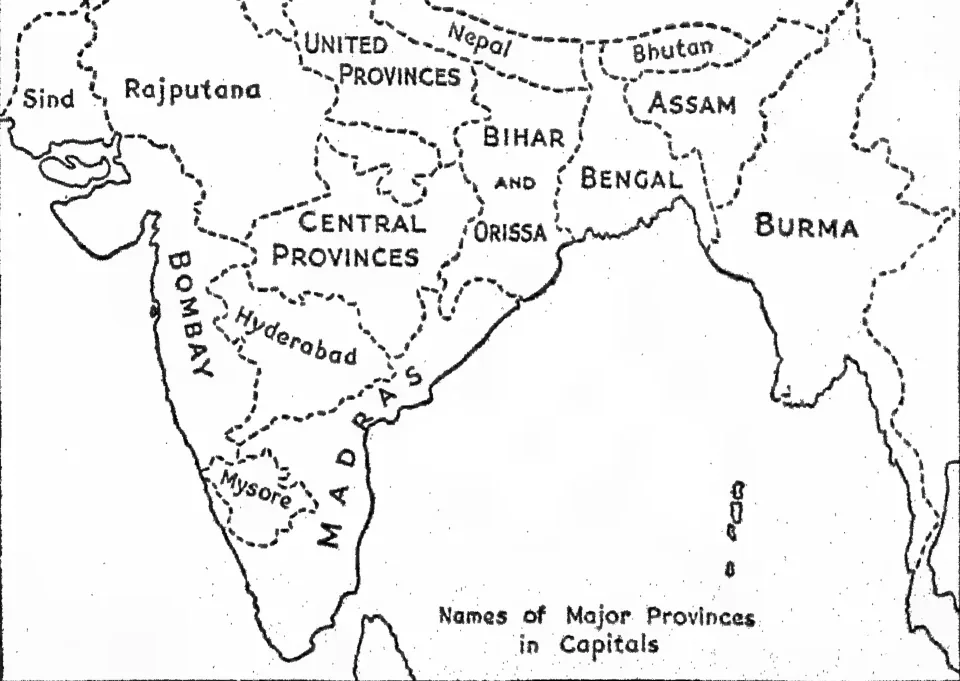
Sind and Orissa, are to be marked out, Burma, on the other hand, is to be entirely separated from the Empire of India. _ The federation, which it is hoped will include the Indian States as well as the provinces of British India, will be formally established by Royal Proclamation as soon as possible after a certain proportion of the Indian princes have announced their adhesion to the scheme. The central Government will be responsible to the Federal Assembly in regard to some
Departments, but others, including Defence and Foreign Affairs, will be reserved to the Viceroy. The division of Indian revenues between the Federal and provincial
Governments is to be settled by a special commission. A Federal High Court is to be established, to which appeals may be taken from the existing provincial High Courts, although in certain circumstances the right of direct appeal from the provincial courts to the Judicial Committee of the Privy Council is retained,
The results of the passing of this Act cannot be estimated at present, and detailed comment upon it would, at the time of writing, be premature. But it is not out of place to remark that the Act is probably the greatest legislative achievement of the British Parliament since the beginning of the twentieth century, and that its provisions are consistent with the British tradition of progress through the growth of a sense of responsibility, which itself is engendered by the development of free institutions.
The stability of the British Empire is evidence of the success of this method in other parts of the world, There is no reason to be apprehensive of the outcome of its application in India.
Supplementary Notes
1, Burma has been separated from the Empire of India. A Secretaryship of State for Burma was established in 1937.
2. The Federal High Court for India was inaugurated in December, 1937.
3. At a conference of Indian Princes at New Delhi, in February, 1937, a resolution in favour of Indian States joining the All-India Federation was carried.
Governors-General and Viceroys of India
Governors-General of Bengal
Warren Hastings. 5?. 5 1774-85
Lord Cornwallis. 5... 1786-93
: Sir John Shore.. 1793-8
‘ Lord Mornington (Marquis Wellesley) + 1798-1805
Lord Cornwallis ‘ o c:. 1803
Sir George Barlow... 5; 1805-7
Lord Minto. «.... 1807-13
Marquis of Hastings.., - + 1813-23
Earl Amherst.: + ‘ *. 1823-8
Lord William Bentinck... b 1828-35
Governors-General of India
Lord Auckland b.... 1836-41
Lord Ellenborough.. c.. 1842-4
Lord Hardinge.. q Fy 1844-8
Lord Dalhousie. ‘ ‘: + 1848-1856
Viceroys and Governors-General of India
Lord Canning... * é 1856-62
(Viceroy from 7858)
Earl of Elgin. 7 E: 1862-3
+ Sir John (Lord) Lawrence..:. 1864-9 | Earlof Mayo... « 9. « 1869-72 | Lord Northbrook. c 5 5 s 1872-6 | Lord Lytton...... 1876-80
Marquis of Ripon.. Ga 5 1880-4,
Marquis of Dufferin. 5.. 1884-8
EarlofElgine, 5 6.0. es 1894-9 } Marquis Curzon. oe. + 1899-1904.; Lord Ampthill.. *.. > 1904,
Marquis Curzon..: * 1904-5: Earl of Minto.. ’ Fy.. 1905-10 H Viscount Hardinge. *. ‘ o Ig1o—16
Lord Chelmsford. G ° 3 ‘ 1916-21
Marquis of Reading..... 1921-6
Lord Irwin.. c 9; C 1926-31
Earl of Willingdon. f; 4 1931-6
The Marquis of Linlithgow..: 1936-
Chapter XVIICeylon, Malaya, Borneo, and the Western Pacific
Ceylon
The history of Ceylon, except for a few years following its acquisition, has been entirely distinct from that of India. Before the appearance of the Portuguese in the Indian Ocean the coasts and ports of the island were in the hands of Arabs, who carried on trade with Venetian merchants. The interior was inhabited by Tamils and Sinhalese.
The Portuguese established themselves at Colombo in 1517, and their position in Ceylon was not challenged during the sixteenth century. During the first half of the seventeenth century they were in conflict with the Dutch, who completely mastered them and expelled them by 1658. The Dutch were undisturbed in their settlements until the Anglo-Dutch War of 1780-3.
Trincomalee was taken by a British fleet in 1782 but was retaken by Suffren, a French admiral, shortly afterwards, and in the Treaty of Versailles, 1783, it was restored to the Dutch. When the United Provinces were overrun by the French in 1795 and transformed into the Batavian Republic, Ceylon, like other overseas possessions of the Dutch, was open to British attack. An expedition from India captured:
rincomalee in 1795 and Colombo in 1796, and, by the Treaty of Amiens, 1802, Ceylon remained in the hands of Great Britain..The interior was not fully reduced until 1815, in which year the King of Kandy was deposed. Some further risings occurred from time to time until 1848, when the last was suppressed. The history of the island since the middle of the nineteenth century has been uneventful, * The prosperity of Ceylon depended on the production of coffee until the appearance of a disease which affected the crops.. This led to the development of the cultivation of tea, rubber, and rice, so that the threatened ruin‘of the island has been averted, Ae oat ae ea
The administration of Ceylon has developed on the lines usual in a British Crown Colony. For a short time after its conquest it was ruled from India, being attached to the Presidency of Madras, In 1802 it became a separate colony, under the jurisdiction of a Governor with an Executive Council, but in course of time a Legislative Council was established. In the later stages of its existence this Council consisted of thirtyfour elected and fifteen nominated
Pondicherri members, at least five of the latter being officials. Twenty-three of the elected members represented territorial constituencies, and
Palk Strait eleven were chosen by special interests and communities, such as the Indians, the Europeans, and the Moslems. The constitution Come, oF did not work well, and in 1927 a Manoar commission was appointed under Colombo > the Earl of Donoughmore to in- ‘ vestigate the problem and suggest | | reforms. Its report was approved by the Secretary of State for the CEYLON Colonies and by the existing Legislative Council and formed the basis of a constitution which has recently been set up.
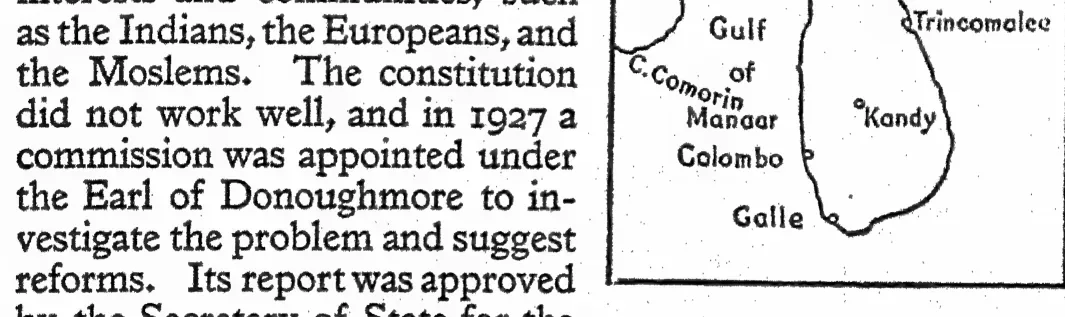
The new State Council consists of fifty members elected on universal franchise (men and women), with three official members and eight others nominated by the Governor. The State Council appoints seven Executive Committees to deal with the Departments of State; each Executive Committee has an elected chairman who becomes the minister in charge of the Department and is responsible to the State Council.
The three official members of the Council are the Legal Secretary, who is in charge of Legal Affairs, the Financial Secretary, in charge of Finance, and the Chief Secretary, who controls Foreign Affairs and Defence. These Departments are re-served, and the three ministers in charge of them are not responsible to the State Council. Popular control. is thus fully established over. internal affairs such as Education,
Local Government, Communications, Agriculture, Health, and Labour; but external affairs, including Defence, remain reserved.
The Donoughmore constitution has not worked smoothly, and a delegation from the Ceylon National Congress visited London in 1938 to press for its abandonment. The delegation contended that the period during which the constitution ‘‘ ought to be given a fair trial’’ should be regarded as over, and that full responsible government should be established.
Malaya
The whole of the Malay Peninsula, from the southern boundary of the Kingdom of Siam, lies within the sphere of British influence. It consists of the colony of the Straits Settlements, the Federated Malay States, and the Protected States. The Straits Settlements, however, include some islands as well as mainland territories, and comprise Singapore, with the Cocos or Keeling Islands and Christmas Island,
Penang, including Province Wellesley and the Dindings, Malacca, and the island of Labuan. The Federated Malay States are four in number—Perak, Selangor, Negri Sembilan, and Pahang—and the five Protected States are Johore, Kedah, Perlis, Kelantan, and Trengganu.
The earliest European settlement on the Malay Peninsula was formed by the Portuguese in 1511, when they established at Malacca the capital of their possessions in what is now termed the East Indian Archipelago. Portuguese dominion in that part of the world was unchallenged till the closing years of the sixteenth century, when both Dutch and English appeared on the scene. A Dutch trading post was set up at Bantam in 1596, and six years later the English East India Company started a rival factory also at Bantam.
The English Company was driven from the islands by the Dutch, although the Bantam post was retained until 1682. Portuguese power declined rapidly at the same time, and the Dutch retained control of both sides (Sumatra and Malacca) of the Malacca Straits until nearly the end of the eighteenth century.
In «1786 the English East India Company, desirous of obtaining a port of call for ships engaged in the China trade, secured the island of Penang from the Rajah of Kedah, A strip of mainland territory was added in 1800, this being named Province Wellesley, after the Governor - General of India. Penang, besides being of commercial importance, was used as a penal settlement. Both Province Wellesley and Penang were subject to the Government of India.
When the United Provinces were conquered by the French in 1795 Dutch overseas possessions in the Malay Peninsula, as elsewhere, were attacked by the British. An expedition from India captured Malacca in 1795; it was restored to the Dutch by the Treaty of Amiens, 1802, but was recaptured in 1807; it was again returned to the Dutch at the peace in 1814, and it was finally ceded to Great Britain in 1825.
Java also was in British possession towards the close of the Napoleonic War, and when it was restored to the Dutch its British Governor, Sir Stamford Raffles, negotiated for the acquisition of Singapore, an island which lies close to the extreme southern point of the Malay Peninsula. It was occupied in 1819, and was definitely ceded to Great Britain by the Sultan of Johore in 1824. In the course of the nineteenth century it attracted from Penang the vast volume of calling trade with the Far East. The importance of Penang, however, has not diminished; it is the port through which the products of Malaya pass to the outside world.
In 1824 Singapore was united with Penang and Malacca to form one administrative unit, of which after 1836 it provided the seat of government. The Straits Settlements remained subject to the Government of India until 1867, when they were recognised as a separate Crown Colony. The Dindings, a strip of coast territory and two small islands, were obtained from the Sultan of Perak in 1874 and added to the colony. The Cocos or Keeling Islands were annexed in 1857 and were at first administered from Ceylon, but in 1886 they became a dependency of the Straits Settlements and in 1903 they were incorporated in them. Christmas Island was acquired in 1889 and incorporated in the colony in 1900.
Labuan was annexed in 1846, and was used as a naval base in connection with the suppression of piracy.. It was ruled as a separate Crown Colony, but in 1890 it was placed under the authority of the British North Borneo Company... After 1905 it was administered by the Governor of the Straits Settlements, and in 1907 it was annexed to that colony. Since 1912, however, though still part of the colony and subject to its Governor, it has been recognised as a separate settlement.
The government of the Straits Settlements is of the Crown Colony type. With the Governor are associated an Executive Council of eleven members and a Legislative Council of twenty-six, half of these being official and half non-official; two of the non-official members represent, respectively, the Chambers of Commerce of Penang and Singapore. A Commission was appointed in 1920 to consider how far, if at all, it was advisable to introduce the elective principle.
It recommended that the existing administrative system should be retained, holding that representative institutions were unsuitable and unnecessary for a populace that was for the most part illiterate, that showed neither desire for nor understanding of the principle of representation, and whose interests were safeguarded in other ways.
The necessity of maintaining a fleet in Far Eastern waters for the protection of British interests has induced the British Government to undertake the provision of a naval base at Singapore. A scheme for the construction of a dock capable of receiving the largest battleships afloat was sanctioned in 1923, and work was begun. Conflicting views on the desirability of proceeding with the scheme were held by the two main political parties in Great Britain, and when a Labour Government took office in 1924 work on the dock was suspended. When the Conservatives returned to power progress was resumed, but financial difficulties retarded construction. The dock was opened in February, 1938.
An influx of Chinese into certain of the states of the Malay Peninsula during the nineteenth century led to friction between them and the Malays, with consequent disorder which the native sultans were unable to suppress. In 1874 the Governor of the Straits Settlements invited the Sultans of Perak, Negri Sembilan, and Selangor to accept British Residents to advise and strengthen their administration, and a similar course was followed in 1888 in the case of Pahang.
In 1895 these four states entered into a federation, The Governor of the Straits Settlements. was to act as High Commissioner for the Federated Malay States, and he was repre-sented in the Federation by a Resident-General. This official, to whom the Residents in the four states are subordinate, has since been known as the Chief Secretary..
Conferences of the rulers were held in 1897 and 1903, and these developed in 1909 into a Federal Council, composed of the High Commissioner, the Chief Secretary, the sultans, the Residents, and some non-official members. The Council possesses executive, legislative, and financial powers. It has made a contribution towards the cost of the Singapore naval base, and it has presented Great Britain with a battle-cruiser, the Malaya. It
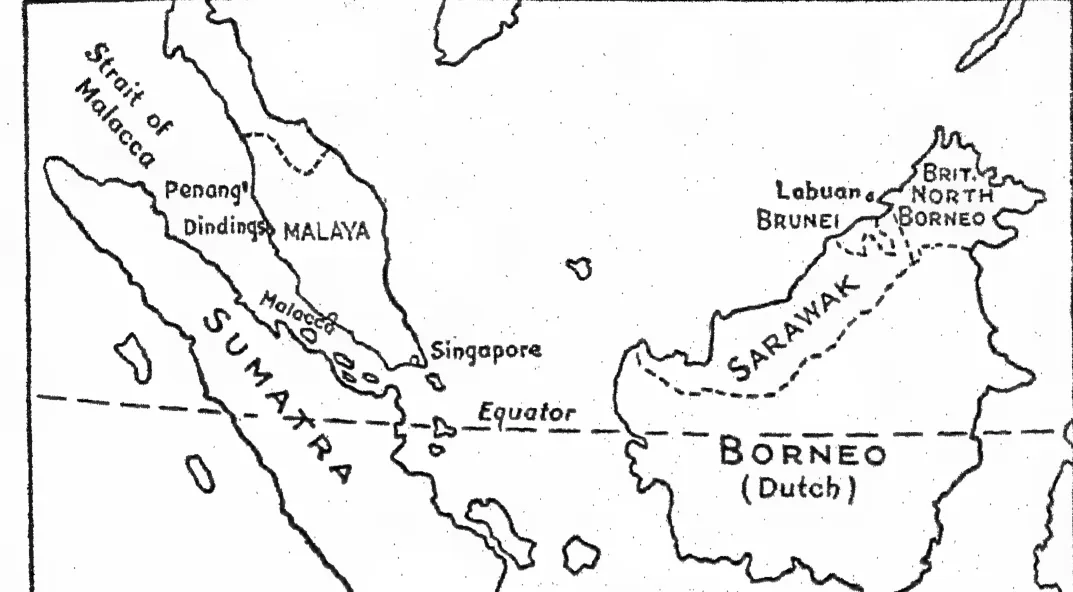
controls the railways throughout the Malay Peninsula, in
The British representatives in the Protected States are termed Advisers. The most important of these states is
Johore, situated at the southern end of the peninsula, British protection over Johore was established in 1885, but it was not until 1914 that an Adviser to the sultan was appointed. Until She
1909 the states of Kedah, Perlis, Kelantan, and Trengganu were under the influence of Siam, but in that year Siam by treaty renounced any authority it possessed over them. British protection was established, and British officials were appointed in each state, some with the title of Adviser and others with that of Agent. All, however, are now known as Advisers.
seers
Borneo
Borneo is a large island+ lying to the east of the Malay Peninsula, from which it is separated by over three hundred miles of sea. It was formerly known as Brunei,? and was ruled by a native sultan. No European settlement was made on the island before the nineteenth century. In the course of the nineteenth century the Dutch obtained extensive concessions from the sultan, and they now control two-thirds of the island.
The remaining one-third of Borneo is under British control, and comprises the north and north-west of the island. British Borneo includes three distinct administrations,’ Brunei, Sarawak, and British North Borneo.
Brunei, though now the smallest political unit on the island, represents what is left of the original sultanate. British protection was established in 1888, and in 1906 the sultan accepted a Resident to advise and assist in the work of administration. The Resident is responsible to the High Commissioner, who is the Governor of the Straits Settlements.
The province of Sarawak is unique in that it is an oriental state ruled by an Englishman as its prince. A revolt against the Sultan of Brunei was suppressed through the activity of Sir James Brooke, to whom, in 1841, the sultan ceded the governorship of the province for life. Two years later the governorship became hereditary, and Brooke assumed the title of Rajah of Sarawak. He was appointed Governor of Labuan upon its acquisition in 1846.
In Sarawak he experienced a good deal of difficulty for the first few years, and in 1857 a revolt of Chinese in the province nearly cost him his throne. With the suppression of this outbreak, however, his position became more secure, and on five separate occasions between 1861 and 1905 the territories of Sarawak have been extended.
Sir James Brooke died in 1868 and left his dominion to his nephew, Sir Charles Johnson Brooke, who ruled Sarawak for nearly fifty years. He was succeeded by his son, the present rajah, Sir Charles Vyner Brooke, in 1917.
Great Britain recognised the independence of Sarawak in
The name Borneo is a corruption of Brunei.
The small island of Labuan, which is geographically connected with Borneo, is included in the colony of the Straits Settlements, as stated earlier.
1 It is divided by the Equator into two nearly equal parts.
1864, but in 1888 the rajah accepted British protection. The authority of the rajah in internal administration remained unimpaired, but Great Britain assumed responsibility for the conduct of foreign affairs. Great Britain as the paramount power is entitled to settle any dispute as to succession, and her sanction is necessary to any cession of territory.
In the administration of his territory the Rajah of Sarawak is an absolute sovereign, but he is assisted by two Councils, a Supreme Council and a General Council, each of which includes both Europeans and Malays. The Civil Service is staffed by Europeans appointed by ‘the rajah.
In 1877 the Sultan of Brunei ceded to a syndicate controlled by Mr. (afterwards Sir) Alfred Dent the greater part of the territory now known as British North Borneo. In 1882 the
British North Borneo Company received a charter from the
Crown and took over the rights of the syndicate. It obtained further concessions from the sultan, and in 1891 the boundary between British and Dutch Borneo was settled by agreement.
In 1888 British protection was established over this territory at the same time as over Sarawak and Brunei. The Company, which does not trade, retains general control over the administration. It nominates the Governor, but the appointment is subject to the sanction of the Secretary of State for the Colonies.
As in Sarawak and Brunei, the control of foreign affairs is in the hands of the British Government. There is a Legislative
Council, consisting of official and non-official members, all nominated. For administrative purposes the state is divided into four parts, each under the control of a Resident.
The Western Pacific
The preoccupation of the colonising nations with their acquisitions in other parts of the world led to the neglect of the islands of the Pacific until the nineteenth century was well advanced, Contact with Europeans, when it occurred, was brought about in two ways, through missionaries and through traders. The lack of a sufficient supply of labour in Queensland, and, after their settlement, in the Fiji Islands, brought into existence a class of traders who sought profit by obtaining workers from the Solomon Islands and the New Hebrides and selling them where they were needed. These “‘blackbirders”
colony to punish any British subject found guilty of decoying natives.
In. 1874 Fiji was annexed by Great Britain, and between 1874 and 1886 European powers competed for the possession of islands in the Pacific. In 1883 Sir Thomas Mcllwraith, Prime Minister of Queensland, proclaimed the annexation of the eastern half of the island of New Guinea,? in order to forestall the Germans, but his action was disavowed by Great
Britain, which in 1884 agreed with Germany upon a partition of the island. The two powers in 1886 agreed upon a delimitation of their respective spheres of influence in the Pacific. To Germany were assigned the North Solomon Islands, the Caroline Islands, and the Marshall Islands, while the right of Great Britain to islands farther east and south, with the exception of Samoa, Tonga, and Niue, was recognised.
In 1899 a further agreement was made by which the North Solomons, Tonga, and Niue were recognised as being within the British sphere, while the Samoa group was divided between Germany and the United States. Meanwhile the United States had annexed the Sandwich Islands (Hawaii), and France occupied the Society Islands and the Low Islands in the Eastern Pacific.
1 As early as 1817 an act was passed by the British Parliament by which offences committed by British subjects in the islands of the South Pacific were to be punishable as if they. took place on the high seas, and a few years later the courts of New South Wales and Tasmania were given jurisdiction to deal with stich offences. But such measures were of little value until definite administration could be organised in the islands,
7 The western part of the island (west.of the meridian 141 east of Greenwich) belonged, and still belongs, to the Netherlands.
Towards the end of the nineteenth century a number of th Palmyra l.
oe Washington t.,
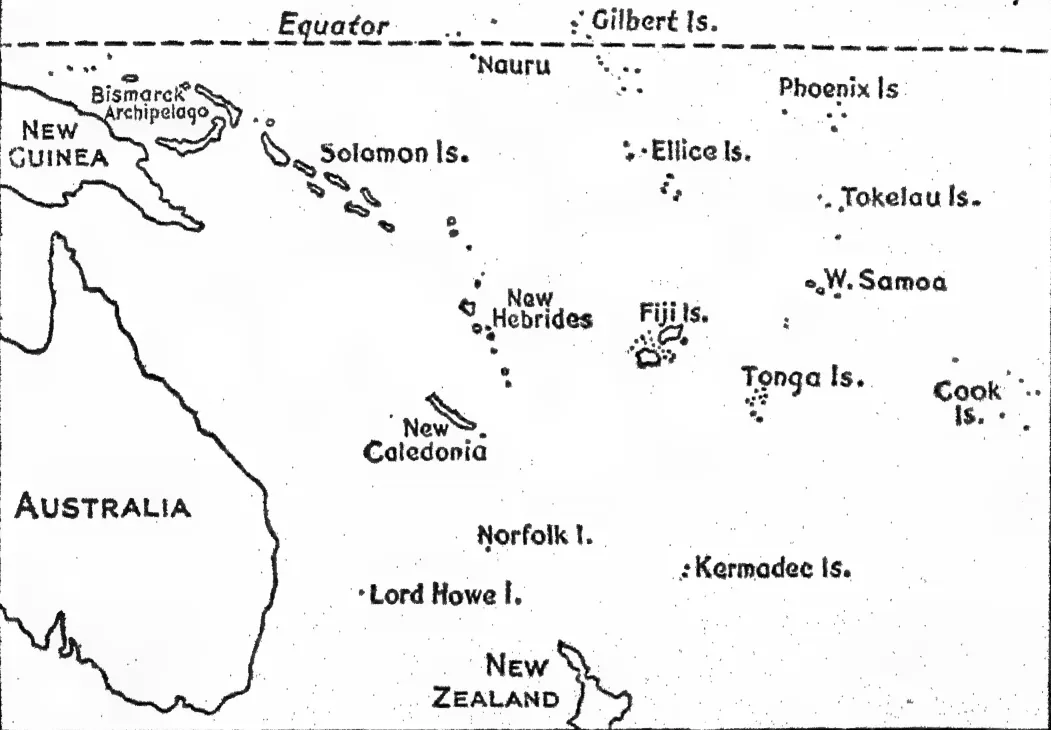
isolated islands, including Fanning Island, Palmerston Island, Pitcairn Island, Nassau Island, and Lord Howe Island, were occupied in connection with the laying down of a submarine cable between Canada and Australia,,
ebb iem'h ae
The Fiji Islands were visited by missionaries from Tonga as early as 1835. They claimed as one of their converts a chief, Thakombau, who called himself King of Fiji, Thakombau offered the sovereignty of the islands to Great Britain in 1859, but in 1862 the offer was declined. During the sixties there was a considerable influx of European settlers intent upon the growing of cotton, then much in demand on account of the cessation of supplies from the United States.
The Europeans in Fiji set up a constitution in 1871, with an elected Parliament and Thakombau as king. The constitution soon collapsed, and, through the agency of an Englishman named John Thurston, who was acting as secretary to King -Thakombau, negotiations with Great Britain were reopened, Commissioners were sent out to consider the position, and the sovereignty of the islands was again offered to Great Britain, but on terms which the British Government ' 2 Mandates for the former German possessions in the north Pacific were assigned. to Japan.:
regarded as unsatisfactory. Further discussions between Thurston and Sir Hercules Robinson, Governor of New South Wales, resulted in agreement being reached, and Fiji was annexed in 1874. Thurston became the first Colonial Secretary in the new colony. In 1880 he became Acting Governor of Fiji and in 1886 Lieutenant-Governor. In 1887 he, as Sir John Thurston, became High Commissioner for the Western Pacific.
The representative element was introduced into the Legislative Council of Fiji in 1904, though the official majority was. maintained, A further development occurred in 1929, when the number of elected members was increased to twelve—six representing the European population, three the Indians, and three the Fijians. The Council contains also thirteen members nominated by the Governor. The Executive Council consists of seven members, two of whom are non-official. The tribal organisation of the native Fijians continues to exist, and the authority of the chiefs over them is. al subject to the supervision of a Native Regulation a
Board.
The chief products of the Fiji group at the present day are sugar, copra, and bananas. The native Fijians, the largest element of the population, are disinclined to regular work, and, after the activities of the blackbirders in the nineteenth.
century had been checked, indentured labourers were imported from India. Many Indians preferred to remain in Fiji, as settlers or traders, after the expiration of their term of service, and the population of the islands to-day includes a substantial
Indian element.
The Tonga, or Friendly,1 Islands were discovered by Tasman in 1643 but were rarely visited by Europeans until the establishment of a Wesleyan mission in 1826. King George Tubou
(1845-93) became a convert, and a missionary, the Rev. S.
Baker, was for some years his leading adviser. Baker established a Wesleyan Free Church in opposition to the official
Wesleyan body, and. persecuted the adherents of the latter organisation to stich an extent that the High Commissioner intervened and deported the zealot. The schism was healed by the union of the two churches in 1924, except that a “‘ Wee
Free” group remains outside.
1 So called by Captain Cook in recognition of the nature of his reception.
by the natives,:;
The form of government in the Tonga Islands is now a constitutional monarchy. There are a Parliament and a ministry associated with the monarch (Queen Salote since 1918), but real authority is exercised by a British Agent appointed by the High Commissioner. The islands passed under British protection in 1900,
Labour troubles in the Gilbert and Ellice Islands led to British intervention in 1892, when a protectorate was established. In r9r5 formal annexation took place, and the islands became a Crown Colony administered by a Resident Commissioner. Some other islands, some near, some remote,
In the middle of the nineteenth century the Solomon Islands were the scene of the activities of both missionaries and labourrecruiting agents. Disorders arising from the misdeeds of the latter resulted in the proclamation of a British protectorate over some of the southern islands in 1893 and its extension in 1900 to the remainder, with the exception of Bougainville and Buka, which were French. The exploitation of the. natives ceased when emigration was prohibited and dealings in land were regulated. Administration is carried on by a Resident
Commissioner responsible to the High Commissioner.
Similar conditions in the New Hebrides in the nineteenth century led to the intervention of both British and French, The French had opened up trade with the New Hebrides, and the Australians pressed Great Britain to annex the islands. The French in 1877 asked for a statement of British intentions, and. suggested that both Great Britain and France should refrain from annexing. Both Governments agreed to respect the independence of the New Hebrides, and disorder continued.
French troops were sent to the islands to keep order, but Australian apprehensions were aroused. A joint Anglo-French protectorate was proclaimed in 1887, and order was maintained by naval officers.. A Resident of each nationality was appointed in 1902. Further provision for the ‘joint administration of the group was made in Anglo-French agreements of 1906 and 1914; in the latter year it was arranged that the nationals of each power should have equal rights, that each should exercise jurisdiction over its own people, and that neither should exert exclusive control. In 1922 British and French Resident oes were put in charge of the administration, each of them being responsible to hi i Commissioner. P his own Seep
Pitcairn Island, over three thousa: i iji, i; > nd miles east of Fiji inhabited by descendants of the mutineers of H.M.S. Bounty.
Chapter XVIIIThe British West Indies
The West Indies consist of a large number of islands lying, for the most part, in two parallel chains. The main, or inner, line, known as the Antilles, encloses the Caribbean Sea. The Greater Antilles include Cuba, Jamaica, Haiti, and Porto Rico; of these only Jamaica is British, The Lesser Antilles, extending from the Virgin Islands to Trinidad, are sub-divided into the Windward and the Leeward Islands.1 The Leeward Islands? extend from the Virgin Islands to Martinique and the Windward Islands? from St. Lucia to Trinidad.
The outer line of islands, the Bahamas, is of coral formation, There is a further chain of small islands parallel to the coast of Venezuela, and an isolated group, the Bermudas, also of coral formation, far out in the North Atlantic.
The Leeward Islands in the possession of Great Britain include Tortola and others of the Virgin Islands, Anguilla, St. Christopher (St. Kitts), Nevis, Barbuda, Antigua, Montserrat, and Dominica. The French Leeward Islands include Martinique, Guadeloupe, and St. Martin. Three of the Virgin Islands—St. Croix, St. Thomas, and St. John—are in the possession of the United States.
West Indies
Antilles Bahamas Vecieesiokie Bermudas mal coast islands Greater Antilles. Lesser Aili:.
Leeward Islands... Windward Islands
1 The application of this terminology is altogether faulty. In relation to the north-east. trade wind the whole of the Lesser Antilles should be recognised as to windward, and the islands near the coast of Venezuela as toleeward. The Spanish in the sixteenth century designated the Greater ae the Leeward Islands, and the Lesser Antilles the Windward Islands.
3 Geographically, though not politically, the Windward Islands include St. Lucia, St. Vincent, Grenada, Tobago, Trinidad, and Barbados. Only the first three are included in the administrative unit known to the Colonial Office as the Windward Islands.
4 The reader may be assisted by the following tabular arrangement:
The expression “West Indies” is geographical rather than political. Some of the islands are French or Dutch or American, and others are British, while a few are independent republics. The British West Indies are often understood to include certain mainland colonies, in addition to the islands.
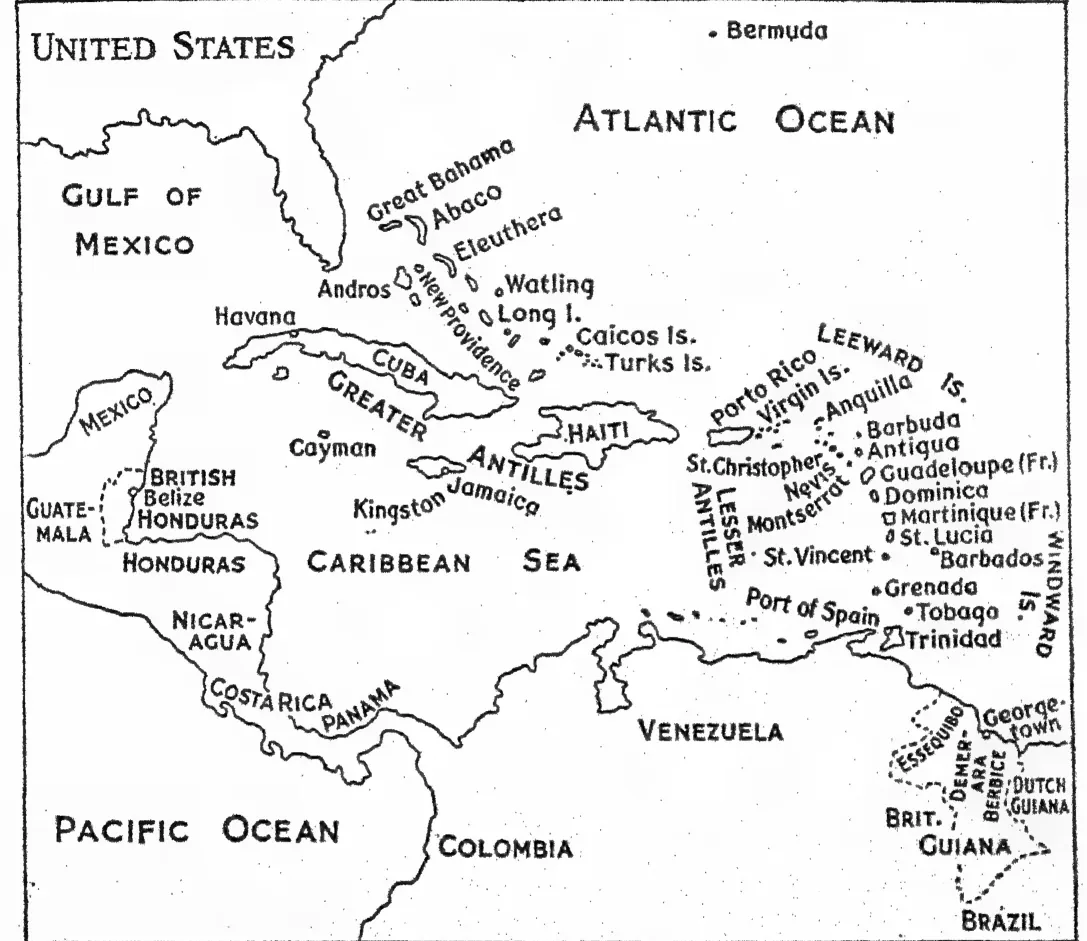
ings Az wont og Martinique (Fr)
Honduras ) CARIBBEAN SEA © St.Vincent « “Barbados =
Nine different administrative units (colonies or groups of colonies)? can be. distinguished — Barbados, the Leeward Islands, the Windward Islands, Jamaica (with its dependencies the Turks and Caicos Islands and the Caymans), the Bahamas, the Bermudas, Trinidad with Tobago, British Guiana, and British Honduras. As will be shown in the course of this chapter, attempts have in the past been made to form a single West Indian Government of a federal character. These efforts have not been successful, though within the last few years a West Indian Conference has come into existence.
1 The West Indian Department of the Colonial Office is concerned with
the Falkland Islands, in addition to the nine administrations mentioned.
From the time of their discovery the West Indies formed a convenient line of approach to the New World, since voyagers to them from Europe could take advantage of the north-east trade wind and could evade the dangers to be apprehended in the North Atlantic. Most of the West Indies were discovered by Spaniards, who, however, in the sixteenth century were more intent upon securing the mineral wealth of the American mainland than upon colonising the islands.
They took possession of the Greater Antilles and of Trinidad, but they neglected the smaller islands, and early in the seventeenth century adventurers from Great Britain and other European countries appeared in the Lesser Antilles. English explorers took possession of the island of Barbados 1in 1625, and effective settlement was begun soon after. From this time, however, Barbados became important. The colonists were substantial men who cultivated large sugar estates by slave labour—white and black.
The white slaves were English, Scots, or Irish,? who had been kidnapped, or who had been convicted of serious crime and sent overseas, or who had been captured in war. Such men occasionally secured their liberty after a period of service, and might become landowners. Negro slaves were imported in large numbers, and in course of time they became the main element in the population. Sugar was the chief product of the island, but tobacco, indigo, and cotton were introduced and cultivated.
A representative Assembly was established in Barbados in 1639. The planters were loyal to the Stuarts, and after the execution of Charles I they proclaimed his son as king. They were compelled to submit to the Commonwealth in 1652, but they retained their Assembly and were subjected to very little interference from the English Government. Soon after the submission of Barbados Prince Rupert appeared off the island with a small fleet. He was joined by his brother Maurice, and a few ships were destroyed by them at Nevis and St. Kitts. Maurice was drowned in a storns,. and Rupert returned to
Europe.
? Many Irish Royalists were Geporfed: to Barbados after Cromwell’s campaign in 1649.
1 Barbados is the only West Indian island which has never been in the possession of a European country other than Great Britain.
The white population of Barbados was very considerable by the middle of the seventeenth century, For a time under Charles II it was the headquarters of the Government of the Windward Islands, but its prosperity was adversely affected by the competition of other islands in the production of sugar. Barbados was attacked by the French during the eighteenthcentury wars, but it never actually changed hands.
The island of St. Christopher, or St. Kitts, was settled by Englishmen in 1623, and in 1627 a charter was granted by Charles I to James Hay, Earl of Carlisle, by which he was_ given authority over Barbados, St. Kitts, and the Caribbees (the present Windward and Leeward Islands) generally. In 1625 a French settlement was made on the other side of St. Kitts, and it was agreed that the island should be divided, the English settlers taking the middle and the French holding either end.
Trouble with the Caribs, a warlike native race, followed, and English and French co-operated against them, but in 1629 the Spanish attacked the island and destroyed the settlements. These were restored, but some years later the French attacked their neighbours and took possession of the whole of the island. By the Treaty of Breda, 1667, the right of the English to a part of the island was recognised.. They were expelled in 1689, but they captured the whole island in 1690, and the French part was not handed back until the
Settlement in other islands was undertaken from St, Kitts. Nevis was occupied in 1628, In the eighteenth century it became the “slave-market” of the Leeward. Islands and attained great prosperity. Antigua was first settled in 1632. The colonists experienced trouble from time to time with the Caribs, The island was captured by the French in 1666, but it was restored to the English by the Treaty of Breda,
1667. Montserrat, occupied in 1632, shared the experiences of St. Kitts and Antigua. It was lost to the French in 1664 and restored in 1667; lost again in 1782 and finally recovered in 1783.
1 The earliest British settlement in the West Indies (apart from the
Bermudas),:;
The French from St. Kitts attempted to colonise Dominica in the seventeenth century, but the Caribs held their own for a long time, and in the Treaty of Aachen, 1748, Dominica was declared to be neutral. In spite of this, a French settlement was formed, and was captured by the British in 1759. The island was retained by Great Britain by the Treaty of Paris, 1763. It was lost to the French in 1778 and recovered in 1783. French efforts to reduce it in the course of the Revolutionary Wars met with no success.
The Virgin Islands were used by the buccaneers, who established some sort of settlement upon them in 1666. They were at length annexed to the Leeward Islands.
From its first settlement in 1638 St. Lucia changed hands between French and British frequently until 1748, when by the Treaty of Aachen it was declared to be neutral. Falling into British hands in 1762, it was restored to the French by the Treaty of Paris, 1763. It was again captured by the British in 1778 and again restored, by the Treaty of Versailles, in 1783. Taken in 1797, it was restored for the third time in 1802; it was taken yet again in 1803, and this time it was retained,
Attempts to settle on St. Vincent in the seventeenth century failed on account of the hostility of the Caribs. The island was one of those declared in the Treaty of Aachen to be neutral. It was captured by the British in 1762 and was retained by the Treaty of Paris in the following year. Difficulties with the Caribs were overcome by the reservation of a part of the island for their use. Taken by the French in 1779, it -was restored to Great Britain in 1783. The Caribs revolted in 1795 and were suppressed in the following year.
An unsuccessful English attempt was made to establish a colony in Grenada as early as 1609, and the real settlement of the island was undertaken by the French from Martinique in 1650. It was captured by the British in 1762 and was one of the islands retained by Great Britain by the Treaty of Paris, 1763. It was retaken by the French in 1779, but Great Britain recovered it by the treaty of 1783. The population was mainly French, and during the Revolutionary War a serious revolt occurred.
This was suppressed, and the rebels were punished. -An important addition was made to the list of British possessions in the West Indies in 1655, when Jamaica was captured. It had been occupied by Spaniards in the sixteenth century, but had not received the attention accorded to larger islands such as Cuba and Haiti, An expedition under Penn and Venables had been sent by Cromwell to attack Haiti (Hispaniola), the seat of Spanish power in the West Indies. {t failed in its main purpose, and turned to Jamaica, which was not strongly held and was easily taken.
The Cayman Islands were captured by the English soon after the conquest of Jamaica, and they were ruled from that island. The English possession of Jamaica was recognised by Spain in the Treaty of Madrid, 1670, In the late seventeenth century Jamaica became the resort of the buccaneers, one of whom, Sir Henry Morgan, was its Governor from 1674 to 1682.
The home Government took no serious steps to suppress these pirates, whose activities were directed mainly against the Spanish, and they flourished until well into the eighteenth century. In course of time Jamaica was peopled by settlers of various types —from all parts of the British Isles and from the New England colonies.
The prosperity of the colony, like that of many of the other West Indian islands, depended on the production of sugar by slave labour, An elected Assembly was set up by Charles II as early as 1662, which, in spite of friction with the home Government, succeeded in retaining its privileges.
1An English settlement, under a Deputy-~Governor, was attempted in
1668, but there was constant friction between English and French.
In the eighteenth century the Government of Jamaica experienced a good deal of difficulty with the Maroons, descendants of runaway slaves, who inhabited the hilly interior of the island... The Maroons were numerous and they occasionally broke out in revolt. They were granted certain lands as reserves, and in 1842 they received full civil rights. As late as 1865 they revolted again. Governor Eyre suppressed the revolt with severity — according to his critics, with unnecessary severity.
Turks Islands and Caicos Islands were occasionally visited by saltrakers from the Bahamas at the beginning of the eighteenth century. In 1799 they were attached to the Bahamas, to which, geographically, they belong, but in 1848 they were transferred to the jurisdiction of the Governor of Jamaica.
No English settlement appears to have been made on the
Bahamas until nearly the middle of the seventeenth century.! In 1670 they were included within the sphere of the Carolina Company. For many years little progress was made, though an elected Assembly was set up. One of the islands, New
The Bermudas were settled early in the seventeenth century. In 1609 Sir George Somers was wrecked on one of the islands of the Bermudas while voyaging to Virginia. Attention was drawn to the group, and in 1612 the Bermudas passed under the control of the Virginia Company. Soon afterwards a separate company was formed, and settlers were sent to the islands. The Virginian system of estates worked by slave labour was set up; tobacco was the chief product. A Repre-sentative Assembly was instituted in 1620.
Like Barbados and other colonies of this type, the Bermudas were Royalist in sentiment, and would not recognise the Commonwealth until compelled to do so. The prosperity of the Bermudas ‘continued after the Restoration, and in 1684 the settlers secured freedom from the authority of the Company, which was dissolved. — ne
' Trinidad, which was discovered by Columbus on his third transatlantic. voyage, in 1498, was definitely occupied by Spaniards after 1532, and the towns of San José and Port of
‘charter was granted to an Eleutheran Company by a Commonwealth Act
of Parliament in 1649. ae
2 Sisal is a fibre used for cordage.
There is a reference in the Tempest, written about 1612, to the “still-
vex’t Bermoothes.” The islands were known for a time as Somers Islands.
1 The island of Eleuthera was occupied by Bermudans in 1646, A
Spain were founded. San José was captured and sacked by Sir Walter Raleigh in 1595. For more than two centuries Trinidad had few inhabitants of European extraction, but after 1780 there was an influx of Frenchmen, encouraged by the Spanish authorities. In 1796 a British ship of war, the Alarm, visited Port of Spain in connection with operations which were being undertaken against French privateers. (At this time Great Britain was at war with France but not yet with Spain.)
Fighting broke out in the streets of the port between British seamen from the Alarm and some of the privateersmen. The incident was treated as a violation of neutrality by Spain, and was one of the matters which led shortly afterwards to a declaration of war against Great Britain by Spain. Sir Ralph Abercromby set out from Martinique to capture Trinidad. The Spanish surrendered it without offering any resistance, By the Treaty of Amiens, 1802, it was retained by Great Britain.
The first attempt to form a settlement in Tobago was made in 1639. Its history for more than a century is a record of kaleidoscopic changes, in which French, Dutch, Courlanders, Jamaicans, Caribs, and London merchants all had parts, By the Treaty of Aachen, 1748, the island was declared to be neutral.
It was captured by the British in 1762 and it remained in British possession by the treaty of 1763, It was taken by the French in 1781 and retained by them under the treaty of 1783; by the British in 1793, and returned to the French by the Treaty of Amiens, 1802; again by the British in 1803, and retained by them under the Treaty of Paris, 1814.
Dutch settlements were formed at various points on the coast of Guiana before the close of the sixteenth century, and by. the Treaty of Minster, 1648, the rights of the Dutch in this region were recognised. During the eighteenth century the Dutch were outnumbered by settlers from other countries. Englishmen from Barbados introduced the cultivation of sugar, coffee, and cotton, and in 1781 the Dutch settlements were captured by the British, who, however, in the following year lost them to the French.
The Treaty of Versailles, 1783, restored them to the Dutch. They were seized again by a British expedition from Barbados in 1796, and again restored to the Dutch in 1802... The Guiana settlements were captured by the. British for the third time in 1803, and when peace was made in 1814 the counties of Essequibo, Demerara, and
Berbice were retained. In 1831 they were united to form the colony of British Guiana.
Settlements in Honduras and on the islands off its coast were attempted by Spain and England before the middle of the seventeenth century, the earliest English settlers being ex-buccaneers led by a man named Willis. They were attracted by the possibility of obtaining logwood and mahogany. The Indians were not unfriendly, and in 1739 a native chief resigned his territory to the British. (The Spanish at this time contested the right of the English to cut logwood in the Bay of Campeachy. This was one of the petty points which brought about the Anglo-Spanish War known as the War of
Jenkins’s Ear.) By the Treaty of Paris, 1763, Great Britain agreed to dismantle certain fortifications, but the British settlers remained, and resisted the attacks of the Spanish. The most serious attempt by the Spanish to dislodge the British occurred in 1798. At the Battle of St. George’s Cay the Spanish were driven off with heavy losses. They made no further effort to molest the ‘‘Baymen,” as the British settlers were called,
It has already been stated that the prosperity of the West Indies was based on the production of sugar, and it may be pointed out that the frequent attacks upon West Indian islands during the eighteenth-century wars were inspired by the desire of each of the powers of western Europe to make sure of its own supply of this commodity and to deprive its enemies of theirs.
It was for this reason that the West Indies were in the eighteenth century regarded as the most valuable of the, British possessions overseas. The retention, by the Treaty of Paris, 1763, of the Canadian settlements on the St. Lawrence and the return of some of the sugar islands to France were features of the treaty which were severely criticised.
The cultivation of the sugar-cane was carried on by means of the labour of negro slaves, and the supply of negroes to the West Indies and South America was itself an important branch of British trade. The Portuguese developed the negro slave traffic in the sixteenth century, and from the beginning of the seventeenth century they had to face Dutch competition. The right to import slaves into Spanish colonies was a monopoly known as the Asiento, and it was at different times granted ship. Negroes who died on board ship represented a loss; those who were cast away to preserve the safety. of the vessel were paid for by the insurance company
1. The term “ Belize” is said to represent the native attempt to pronounce
the name “ Willis.” efit
From a purely economic standpoint the introduction into the West Indies of negro slave labour was attended by both advantages and disadvantages. It was contended, and with justice, that apart from it the industrial. development of the West Indies would have been impossible. No other supply of labour was available; the Caribs were warlike and untamable, and other American native races were not sufficiently hardy to undertake regular labour enforced by severe discipline.
But slave labour was unintelligent, and the negro was as yet unfit to undertake skilled work. There was little opportunity or inducement for white men to migrate to the islands, and the white population remained small—an aristocracy lording it over a mass of coloured inferiors, from whom there was the constant peril of revolt.
In 1776.a motion for the abolition of the slave trade was brought forward in the House of Commons. It was not carried, and in 1787 a Society for the Abolition of the Slave
Trade was formed by William Wilberforce, Thomas Clarkson, and Zachary Macaulay. Much opposition was offered to the propaganda work of the society by those whose interests would be affected. It was asserted that Liverpool and Bristol would sink to the level of third-rate ports if the slave trade should cease, and that the prosperity of the West Indian colonies would be ended. The planters of the West Indies subscribed large sums of money in order that opposition to the work of the society might be maintained.
But humanitarian views at length prevailed, and in 1807 Great Britain passed an Act for the Abolition of the Slave Trade. At the Congress of Vienna, 1815, the British example was followed by France,
Spain, Portugal, and Holland. -After 1807 the planters were unable to obtain fresh supplies of slaves from overseas, and they had to rely upon the natural increase of the negro population of the islands. It is probable that in view of their augmented value the slaves received better treatment than in the eighteenth century.
Slavery in British colonies was ended by an act passed in 1833. Compensation was paid to slave-owners for the loss of their property, but, as stated elsewhere in this book,?. both the amount and the method of payment of the money were open to criticism. The prosperity of the islands was seriously affected, because sugar continued to be produced by slave labour in the Spanish colonies of Cuba and Porto Rico, and in Brazil.
Many planters were faced with ruin, and the market value of sugar estates fell to a mere fraction of its former level. The folly of relying upon a single product for the prosperity of.the colonies was evident, and in some islands ruin was averted by the introduction of other and. more profitable crops. Grenada throve upon the production of cacao and St. Vincent by the cultivation of sea-island cotton, while, towards the end of the nineteenth century, the cultivation of cacao and spices » was developed in Dominica. Jamaica also developed the production of bananas.. But in many of the islands the depression continued till the early years of the twentieth century.
Efforts were made in course of time to obtain a supply of cheap labour from Asia. Chinese coolies were brought to the West Indies in large numbers after 1853. This movement ceased after EO, but in British: Guiana the Chinese still form
é 1See O 144.
an important and industrious element in the population. As early as 1837 Indians were brought to British Guiana as indentured labourers. This was too soon after the abolition of slavery, and an outcry arose, it being contended that slavery was being reintroduced in disguise, The contracts were cancelled, but in 1844 the importation of Indian indentured labourers into Jamaica, Trinidad, and British Guiana was sanctioned. From time to time the system has been subject to criticism, but an investigation by the British Government in r9z0 disclosed no serious grounds of complaint.
The labour problem was not the only difficulty which the sugar industry of the West Indies had to face in the nineteenth century. At first, indeed, after the abolition of slavery the planters received a partial protection by the differential scale of duties on sugar imported into the United Kingdom. The duty levied on British colonial sugar was fourteen shillings per hundredweight, while that on sugar from foreign sources was exceedingly high.
Lord John Russell in 1846 lowered the duty on foreign sugar to twenty-one shillings per hundredweight, and, after five years, to fourteen shillings. This discontinuance of the preference to the colonies was in accordance with Free Trade principles, but it intensified the depression in the West Indies.
The greatest hindrance to the recovery by the West Indies of their predominance in the production of sugar lay in the prevalence of the bounty system on the continent of Europe. The production of sugar from beetroot had been begun in the time of Napoleon, when West Indian sugar could not find its way to continental ports on account of the British blockade. In subsequent years the French Government stimulated the production of beet-sugar by offering a bounty on its export, and other countries followed suit.
This bounty-fed sugar found its way in vast quantities to the United Kingdom, where it was sold at much below the real cost of production. Efforts were made as early as 1877 to secure the discontinuance of the bounty. system, but, in the absence of complete agreement among those Governments which offered bounties, no action was possible, unless, indeed, Great Britain would undertake to prohibit or penalise the importation of bounty-fed sugar.
While Free Trade principles prevailed in their completeness
}This cheap sugar was the basis on which the confectionery, jam, and in Great Britain no such course was possible, and it was not until the Brussels Convention of 1902 that this country agreed to prohibit the import of sugar which had received bounty assistance either in production or in export. The bounty system thus received a fatal blow, and in several countries it was discontinued in 1903. Russia was not represented at the Brussels Convention, and for a time her policy seemed uncertain, but in 1907 she brought the bounty system to an end.
biscuit industries were built up in Great Britain.
Great Britain thus agreed to forgo the advantage of cheap sugar in order to assist her distressed West Indian dependencies. The West Indies received great benefit from this change of policy. The production of sugar revived, and within a few years there was a greater degree of prosperity in the islands than had been felt at any time in the second half of the nineteenth century.
the diversity of conditions, anything like a general combination of planters not only did not, but could not, exist. A regular steamer setvice. between the West Indies and Canada has assisted in the promotion of trade, and a commercial agreement which was entered into in 1912 was extended in 1920 and again in 1925...
A Royal Commission was sent to the West Indies by the British Government in 1897 in order to investigate and report on economic conditions. As a result of its recommendations an Imperial Department of Agriculture was established at Barbados, and some years later this developed into the West Indian Agricultural College in Trinidad. This, in its turn, was enlarged and its functions extended in 1923, and it was renamed the Imperial College of Tropical Agriculture.
It has been mentioned above that, by the peace of 1814, the three counties of Essequibo, Demerara, and Berbice were retained by Great Britain and that, subsequently, they were united to form the colony of British Guiana. The boundaries between the colony and its neighbours Venezuela and Brazil remained uncertain, and in 1840 the British Government sent Sir Robert Schomburgk to mark them out.
A line, subsequently known as the “Schomburgk line,’ was fixed, which included within British Guiana the whole of the basin of the Demerara River, it being contended that this was the boundary of the former Dutch colony. But this was in conflict with the Venezuelan claim to extend as far as the Essequibo River. No action was taken at the time by either state, and in 1886 Great Britain announced her intention of exercising jurisdiction as far as the Schomburgk line, slightly modified.
The Venezuelans did not agree with this, and in 1895 the situation became acute when Venezuelan police arrested two British officials within the disputed territory. The British Government protested, but the President of the United States, Grover Cleveland, intervened, and revived the Monroe doctrine of 1823, which declared that European powers might not look upon any part of the American continent as a field for colonial expansion, He demanded that Great Britain should submit her claim against Venezuela to the arbitration of the Government of the United States.
For a time there was danger of war between Great Britain and the United States, but Lord Salisbury, Prime Minister and Foreign Secretary of the United Kingdom, acted in the crisis with great wisdom and firmness. He contended that Great Britain was an American as well as a European power and that British territory in the New World covered a greater area than that of the United States.
He offered to submit the British case to the American Government in order to demonstrate its justice, but declined to. be bound by any American decision. A mixed arbitration tribunal was agreed upon, and its decision in 1899 was almost entirely in favour of the British claim. The Schomburgk line, slightly modified near the coast, was declared to be the boundary b Venezuela and British Guiana. a
In the boundary dispute between British Guiana and Brazil the King of Italy was invited to act as arbitrator, and in 1904 he gave a decision in favour of the British claim,
Constitutional development in the West Indian colonies followed, up to a point, the normal course to be observed elsewhere, and representative institutions existed in many of the islands and groups. The decline in West Indian prosperity which characterised the second half of the nineteenth century was accompanied by constitutional retrogression instead of progress. In some of the colonies representative institutions were surrendered, and Crown Colony rule was re-established.
Barbados, alone among the West Indian colonies, has retained representative institutions without a break. Its
Legislature consists of a Legislative Council, nominated by the Governor, and a House of Assembly of twenty-four members, elected annually. The Colonial Secretary sits in the Legislative Council, and some other officials may be elected to the House of Assembly. There is an Executive Council, the members of which, with one exception, are appointed by the Governor; the exception is the Treasurer, who is elected by the House of Assembly. When considering financial matters the Executive Council is reinforced by the addition of one member from the Legislative Council and four from the House of Assembly, and is then styled the Executive Committee.
The Leeward Islands were separated from Barbados and the Windward Islands in 1671. They were placed under the authority of a Captain-General, who at first resided at Nevis and later at Antigua. There was a Lieutenant-Governor for each island, During the eighteenth century a federal Legislature existed, but owing to difficulties of communication it met rarely, and not at all after 1798. In 1816 the Leeward
Islands were divided into two groups, which, however, were reunited in 1832. The federal organisation was revived in
1871, and the Leeward Islands now present the only example of a federation in the West Indies. There are five “ presidencies’”’ in the group—Antigua (which contains the headquarters of the Federal Government) with Barbuda, St. Kitts with Nevis and Anguilla, Dominica, Montserrat, and the Virgin
Islands, Formerly they had. nominated Legislative Councils Ate and. elected Assemblies, but representative institutions have been abandoned, and each of them, except the Virgin Islands, now has a nominated Legislative Council only,! some of the members of which are official and others non-official. Since 1871 there has been a Federal Legislative Council which now comprises twenty members; ten are nominated by the Governor and ten are chosen by the non-official members of the Legislative Councils of the island presidencies. There is also a Federal Executive Council.
The Windward Islands form a group under a single Governor, but there is no federation. The administration of each island is distinct from that of the others, and there is no common treasury nor tariff system. The constitutional history of the islands indicates several changes from time to time in their administrative organisation. After their acquisition was recognised by the Treaty of Paris, 1763, a single Government was appointed in 1764 to rule Grenada, Dominica, St. Vincent, and Tobago, and, after its acquisition, St. Lucia.
In 1833 these islands were placed within the jurisdiction of the Governor of Barbados, an arrangement which was reversed in 1885, when they were removed from his authority. Dominica had before this been associated with the Leeward group, and in 1889 Tobago was detached from the group and associated with Trinidad.
As early as 1766 a Legislature, consisting of a nominated Legislative Council and an elected House of Assembly, was set up in Grenada, but in 1875 the House of Assembly was abolished at its own request, and the Legislative Council was reconstituted with official and non-official membets. In St. Vincent also there was formerly an elected Assembly; this was replaced by a nominated Council in 1876. Since 1924 the principle of election has been reintroduced in each of the three islands (Grenada, St. Vincent, and St. Lucia), In "each case the Legislative Council includes a minority of elected members,
After its conquest in 1655 Jamaica was ruled by a military Governor, but in 1664 an elected Legislative Assembly was set up. For many years uncertainty as to the extent of its powers gave rise to friction with the home Government, in which, on the whole, the Assembly held its own. It exercised: powers within Jamaica comparable to those of the House of Commons in Great Britain, even impeaching Governors.
The passing in 1838 of an Imperial Act for the Better Government of Prisons in the West Indies was much resented by the Jamaican House of Assembly, and for a time the constitution was suspended. After a further deadlock in 1853 an attempt was made to diminish friction between the Executive Government and the Legislature by the establishment of an Executive Committee which should consist of a number of members of the Assembly to consult with the Executive Council.
In 1866, after the rebellion, the constitution was surrendered, the Legislative Assembly petitioning Great Britain to set up such form of government as might be suited to the colony, and a Legislative Council of official and non-official members was appointed. A Royal Commission reviewed the position in Jamaica in 1881, and in 1884 the Council was enlarged by the inclusion of some elected members. The system has not worked smoothly, and more than one “crisis” has had to be faced.
At the present time it is understood that, although the elected members do not form an actual majority of the Council, when they are unanimous their views may not be overridden, unless the Governor declares the matter in question to be one of paramount importance. Further, any financial resolution can be carried by the votes of nine of the elected members. The Turks Islands and Caicos Islands have formed part of the colony of Jamaica since 1873.
+ 1 Part of the Legislative Council of Dominica is elected.
The Legislature of the Bahamas is of a representative character. The Legislative Council is nominated, but there is an elected House of Assembly of twenty-nine members. No official has an ex-officio right to a seat in either Chamber, and unless an official can obtain election to the House of Assembly the Government has to rely upon the goodwill of private members to get its measures introduced. There is also an Executive Council to assist the Governor.
The Bermudas are ruled by a Governor and an Executive Council..There is a. Legislative Council of nine members (three official and six non-official) appointed by the Crown, and an elected House of Assembly of thirty-six members. The strategic importance ofthese islands is considerable, in view of their position in the North Atlantic, and the Governor is always a military officer of high rank, nominated by the War
Office, though formally appointed by the king on the advice of the Secretary of State for the Colonies.
With Trinidad is associated the island of Tobago. After 1889, when Tobago ceased to be connected with the Windward
Islands, it was ruled by a Commissioner appointed by the Governor of Trinidad, and in 1899 the two islands formed a single colony, with a Legislative Council entirely nominated and consisting of official and non-official members. Since 1924 there has been a small number of elected members in the Council.
The constitution of British Guiana was, until recently, framed on lines. which were a development of the institutions which existed when the colony belonged to the Dutch. During most of the nineteenth century the Governor was assisted by a Court of Policy, which acted both as an Executive Council and as a Legislative Council. When financial matters, including taxation, were under consideration, six additional members were added to the Court of Policy, which was then known as the Combined Court.
In 1891 a separate Executive Council was set up, but the Court of Policy, half the members of which were elected, continued to function as a Legislative Council, and the Combined Court continued to control colonial finance. In 1928, however, this system came to an end, and a Legislative Council of ten official and nineteen non-official members was established, fourteen of the latter being elected.
British Honduras did not receive formal recognition as a British colony until 1862. During most of the eighteenth century the Baymen elected their own magistrates, but in 1786 the settlement was placed under the authority of a “Superintendent.” A code of laws known as Burnaby’s Laws prevailed; this was so named after Admiral Burnaby, who visited the settlement in 1765 and confirmed certain rules which he found being observed. From 1790 to 1797 there was no
Superintendent, and the magistrates elected by the Baymen again ruled the settlement. After 1797 the line of Superintendents was unbroken until the reorganisation of the administration in 1862. In 1839 an Executive Council was appointed to assist the Superintendent, and in 1853 an elected Legislative Assembly was set up. With its formal recognition in 1862 the colony was placed under the authority of a Lieutenant-Governor who was subject to the Governor of
Jamaica, In 1870 the Legislative Assembly was abolished, at its own request, and was replaced by a nominated Legislative Council. The connection with Jamaica was discontinued in 1884, and the colony henceforth was under its own Governor. Representative institutions have not been revived, but the non-official members. form a majority of the Legislative Council.
The difficulties in the way of federation are considerable, and the arguments brought forward on its behalf are open to question. It has been contended that administrative economies might be effected, and that there would be advantages in the establishment of a single Civil Service for the whole of the - West Indies.
But this implies the transfer of officials at times from one place to another, in accordance with the needs of the service, and conditions vary to such an extent in different parts of the West Indies that it is doubtful: whether such transfers would be practicable. Their expense, too, would be considerable. The Royal Commission of 1897 doubted whether a Governor-General of the West Indies would be able to supervise effectively the administration of his scattered territories. A great deal of his time would be occupied in travelling, and the expense of going from island to island in a style appropriate to the dignity of his position would. be substantial.
‘There are other reasons why the practicability, or, at least, the desirability, of federation may be doubted. On a map the islands seem to be in close proximity to one another; actually they are widely scattered. The distance between Jamaica and Barbados exceeds one thousand miles. Further, products, circumstances, and conditions are by no means similar throughout the islands. The interests of different islands are not identical, and may be in conflict. Finally, the variety of constitutional practice in different colonies is sufficiently marked to make federation difficult.
In Canada and Australia this factor did not arise. The constituent provinces or states were fully developed. They already enjoyed responsible government and entered upon a confederation with equality of status. In the West Indies a complete federation must include colonies with representative institutions, colonies which have never enjoyed representative institutions, and others which formerly possessed them but felt obliged to surrender them. There is no strong public opinion in the West Indies in favour of confederation, and the difficulty of welding together units of such diverse character has so far proved to be insuperable.
Nevertheless, though federation has not yet come within the range of practical politics, a West Indian Conference met in 1926. It drew up a constitution for a standing conference which was to meet annually for the discussion of topics of common interest, and the first such Conference met in Barbados in 1929. The Conference is not in any sense a Federal Council to which individual colonies have surrendered any of their rights; it cannot be, for it has no executive powers and no power of taxation.
It is a meeting of the representatives of a number of communities for the purpose of negotiating with one another and of arranging common action on such matters as customs, shipping, and the like, when this seems to be desirable. It is. hoped that collective action by the West Indian colonies through the medium of the Conference will enhance their status and extend their influence within the Empire to a degree which they could not hope to achieve as isolated units,
Chapter XIXBritish West Africa
BRITISH possessions in West Africa comprise four distinct administrations—Gambia, Sierra Leone, the Gold Coast and Ashanti, and Nigeria—extending in this order along the coast of the Gulf of Guinea. The part of Togoland which has been assigned under mandate to Great Britain is attached to the Gold Coast, and the small portion of the Cameroons which is under British mandate is connected with Nigeria. The four colonies are separated from one another by foreign (mostly French) territory, but it is noticeable that Great Britain has succeeded in acquiring the most valuable parts of the West African coast.
English traders visited the Gambia River during the sixteenth century, and early in the Stuart period a settlement was formed there. In 1663 fortified post, Fort James, was established, and in course of time it shared with Cape Coast Castle the dubious honour of being an important depot for the slave trade carried on by the Royal African Company.
Fort James is situated on the Gambia River at some distance _ from its mouth, In 1816 St. Mary’s Island, at the mouth of the river, was acquired from a native chief, and a new settlement, Bathurst, was started..The Royal African Company was dissolved in 1821, and its forts henceforth formed a single administrative unit known as the West African Settlements. Gambia experienced several political changes during the nineteenth century. Between 1843 and 1866 it was a separate colony; it was re-joined to the other settlements in 1866; and it was finally cut off from them in 1888. An Anglo-French agreement of
1889 recognised Gambia as consisting of a strip of territory on either side of the river for a distance of two hundred and forty miles from its mouth,
The authority of the Governor of Gambia extends over a colony anda protectorate. The colony proper consists of only a few settlements. The protectorate is divided into five provinces, each of which is supervised by a Commissioner. The authority of native chiefs over their people has not been destroyed, and the Commissioners interfere with native law and custom only to the extent of checking barbaric practices. A hut tax is levied, and there is an export duty on ground nuts, the staple product of the protectorate. These sources of revenue suffice to meet the expenses of the administration.
In the colony itself the Governor is assisted by Executive and Legislative Councils. The Legislative Council consists of nominated members, official and non-official,
Sierra Leone also consists of a colony and a protectorate. During the eighteenth century it was not unusual for West Indian and American planters who visited Great Britain to be accompanied by their slave attendants, By the decision of Lord Mansfield, Lord Chief Justice, in Summersett’s Case, such negroes became free, and it became necessary to provide for them. A settlement in West Africa, which developed into the port of Freetown, was founded for them in 1788 by a group of philanthropists.
The settlement did not prosper at first, and in 1791 it was taken over by the Sierra Leone Company, formed for the purpose of carrying on trade with West Africa. Freetown was attacked and sacked by the French in 1794, but it recovered from this disaster, and in 1807 the Crown assumed responsibility for its administration.
In 1820 the neighbouring republic of Liberia was founded
by some American philanthropists who, inspired by the success of the British experiment, desired to establish an independent state as a place of refuge for freed slaves. Liberia has had a chequered history. The corruption and incompetence of its
Government has necessitated the intervention of the United
States on more than one occasion. This negro republic in its standard of administration and in material prosperity contrasts unfavourably with Sierra Leone.
During the nineteenth century Sierra Leone became the “a headquarters of British power in West Africa. The population of the colony was increased by the reception of negroes found on board slave-ships which were captured by British warships. Its territory was enlarged by agreements with native chiefs whose tribes were brought under British protection, The protectorate was proclaimed in 1896, and extends inland for about one hundred and eighty miles.
1In 1771 the Lord Chief Justice pronounced that a slave upon entering
England immediately became free.. The test case which gave rise to this
decision related to a negro named Summersett.
Throughout the protectorate the native chiefs exercise jurisdiction over their own people, and native law and custom prevail in so far as they are not abhorrent to British ideas of humanity. The chiefs act under the supervision of Com-LEONE; WORY aS anris; —~_é
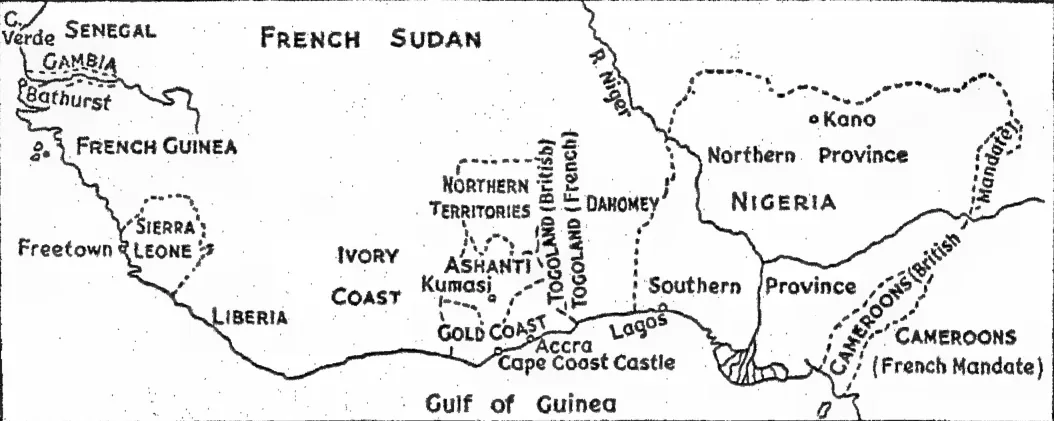
missioners, of whom there are three, one for each of the three provinces of the protectorate. _ In the government of. the colony and protectorate the Governor is assisted by an Executive Council and a Legislative Council. The latter contains a majority of official members, but it includes three of the paramount chiefs of the protectorate and three representatives elected by the European community.
The British connection with the Gold Coast dates from the seventeenth century. The Gold Coast was the centre of the lucrative slave trade, in which Dutch and English, and to a smaller extent the merchants of some other European nations, were engaged, No attempt was made to colonise the region; the activities of the slavers had the opposite effect, of depopulating it. Fortified posts, however, were set up to serve as depots at which negroes from the interior could be detained pending their deportation to the New World.
The Royal African Company, which was engaged in this branch of trade, possessed Cape Coast Castle and Accra as its centres. These were busy places during the eighteenth century, but with the abolition of the trade in 1807 the Com-. pany had perforce to turn to other spheres. of activity. In these it was not successful, and upon its abolition in 1822 its forts were taken over by the Crown, forming, with the Gambia and Sierra Leone settlements, the West African Settlements. In 1850 certain Danish posts, and in 1872 those of the Dutch, were purchased by the British Government.
Captain Maclean was appointed Governor in 1830 and under his rule British influence spread inland as far as the borders of the Ashanti kingdom. No attempt was made to conquer the hinterland of the Gold Coast, but the reputation of the British administration for fair dealing spread among the natives to such an extent that they readily brought their causes to British officials for adjudication. Treaties with native chiefs followed, and their tribes passed under British protection.
The safety of these tribes was menaced by the proximity of the native kingdom of Ashanti. Occasional raids occurred, and a serious attack by the Ashantis in 1874 led to the undertaking of military operations on a considerable scale. The victory of Sir Garnet Wolseley established British prestige, but another Ashanti War was necessitated in 1896. Kumasi ape eet ee es was captured, and the king, Prempeh, was deposed and exiled. Native rule was not overthrown, but a British Resident was installed.
Further unrest, however, led to the annexation of Ashanti as a colony in rg01. The Governor of the Gold Coast became Governor of Ashanti, but only some of the laws and ordinances of the Gold Coast apply to Ashanti.
After the capture of Kumasi and the establishment of a Residency in 1896 British influence spread farther into the interior, and in 1901 a region known as the Northern Territories Protectorate was annexed, It is administered by a Chief Commissioner who is responsible to the Governor of the Gold Coast and Ashanti.
The administration of the colonies of the Gold Coast and Ashanti and of the Northern Territories Protectorate is, as elsewhere in West Africa, based on the maintenance of native law and custom in so far as these are not repugnant to European ‘ideas of humanity. Native chiefs exercise authority over their people, and in Ashanti a Council of Chiefs was called into existence in 1905.
During the European War the German colony of Togoland was conquered by Anglo-French action, and at the peace it was divided between the two allies, each part being ruled under mandate. Western. Togoland, the portion assigned to
Great Britain, has been attached to the Gold Coast colony, of which it is administered as an integral part.
The Gold Coast has hitherto suffered from lack of communications, but an artificial harbour has been constructed at Takoradi for the development of external trade, and a good deal of work has been done in the opening up of the interior by the building of roads and railways. Much progress has been made in the development of tropical agriculture, and the cultivation of cacao now takes place on a considerable scale,
Some trading connections were opened up with the Niger River in the first half of the nineteenth century, but development was hindered by the hostility of the natives and the unhealthiness of the climate. The National African Company, an amalgamation of a number of British concerns trading with this region, was formed in 1879, and during the next few years the Company made agreements with native chiefs which extended its footholds. In 1884 the Oil Rivers 1 Protectorate was established by the British Government along the coastline of the Niger and Oil Rivers, but diplomatic negotiations extending over a number of years had to be undertaken for the demarcation of its frontiers.
The National African Company was reorganised in 1886 as the Royal Niger Company, a chartered company which was authorised to acquire and administer. territory in the interior. The Company acted energetically and made a large number of treaties with native chiefs. Large areas were opened up for trade, and the inclination of some of the chiefs to indulge in slave-raiding was checked. Before its dissolution in 1899 the Company performed much valuable work, in the best traditions of British pioneering, in opening up the interior.
In 1899 the territories hitherto subject to the Royal Niger Company were taken over by the Crown and organised as the Protectorates of Northern and Southern Nigeria, over which Colonel Frederick Lugard was appointed High Commissioner. Before complete. pacification could be effected Colonel Lugard was forced to take military action agcinst certain of the tribes, and in 1903 the rulers of the Hausa states of Kano and Sokoto were deposed.
As was the case elsewhere in West Africa, the general work of administration was left to native rulers acting under British supervision. Some degree of control was exercised without ostentation by British Residents, who were subject to the authority of the High Commissioner. This system proved to be eminently satisfactory in Northern Nigeria, where the Mohammedan emirs were capable of exercising authority. In Southern Nigeria there were no strong chiefs, and councils were established by District Commissioners.
1 A general term for the branches of the delta of the River Niger.
Many of the states of the interior were Mohammedan in religion and were organised on a basis of slavery. The extinction of this system, which was bound up with Islam, was a task which required time and tact. Trading in slaves was definitely prohibited after the establishment of the protectorates, but it was not found possible to abolish slave status completely until 1907.
Colonel Lugard in 1907 was succeeded as High Commissioner of Nigeria by Sir Percy Girouard. In 1906 Lagos, which had been in British possession since 1861, was added to Southern Nigeria, and a period of road and railway construction began, with markedly beneficial effects upon Nigerian prosperity. Such agricultural products as rubber, cotton, and ae palm-oil have been exported in quantities which increase year by year, a result possible only by reason of improvements in transport.
This brief account of the British possessions in West Africa may be concluded with some general remarks. It will be observed that, in general, British connection with this part of the world arose through British interest in the slave trade, and that when their policy on this matter was reversed early in the nineteenth century the British had to remain in order to repair the harm that had been done.
Commercial development on more legitimate lines followed, and in some directions companies shouldered responsibilities which the British Government was unwilling to undertake, There was a period during the nineteenth century when colonies were held in small esteem, and total withdrawal from West Africa—a region from which nothing was to be gained and in which white men quickly died—was contemplated. But in practice it was not easy for the British Government to abandon the settlements, and at length a rosier view of their prospects. prevailed.
Effective measures were taken against the slave states and the slave traders of the interior, and order was at length firmly established where formerly bloodshed was frequent and panic and terror prevailed. Through the application of discoveries in the field of tropical medicine the ravages of tropical diseases were checked, and West Africa ceased to be the white man’s grave, Scientific agricultural research stimulated agriculture; new crops were introduced and old crops were improved. The development of communications by rail, road, and river has been instrumental in bringing about an expansion of West African commerce.
In each of the four regions there is a colony and a protectorate. Asarule the colony is small and contains an appreciable number of white people. The protectorate is peopled by Natives, the only white people being officials of the Government and representatives of commercial concerns. The method of government stands in sharp contrast with that of France in her African colonies.
Some of the French possessions are looked upon as integral parts of France and are represented in the French Chamber of Deputies, and all of them are ruled by French officials.. Every effort is made to introduce among the natives French customs, language, and institutions, so that in course of time they may become essentially Frenchmen. The natives in British protectorates are ruled by their own chiefs, subject to the supervision of a Resident or Commissioner who keeps as far as possible in the background.
Native law, customs, and religion are respected by the Government, whose -object it is to support the authority of the chiefs so long as that authority is exercised in a reasonably humane and efficient manner. Occasionally it has been necessary to depose a chief, but the elevation of another in his place has usually been preferred to the establishment of direct British rule. Such primitive practices as human sacrifice, infanticide, and slavery have been definitely suppressed. Through the work of missionaries and the advance of education definite progress has been made towards transforming the native tribes into civilised communities.
Chapter XXBritish Influence in Egypt
Ecypt was a British protectorate for little more than seven years,! but British connection with Egyptian affairs extended over a much longer period, and, in fact, has not yet ceased. It is not inappropriate, therefore, in a work dealing with the overseas achievements of the British people, to include some account of British work in Egypt.
For some centuries Egypt was a province of the Turkish Empire, which encircled the Levant from the Balkans to Tripoli. Mehemet Ali, the Turkish Viceroy in Egypt in the first half of the nineteenth century, strengthened his position at the expense of the sultan, his overlord. In the War of Greek Independence he assisted the Turks against the rebel Greeks, but a few years later he made war upon the sultan and overran Syria and Asia Minor.
The powers of Europe intervened, and by the Treaty of London, 1841, Mehemet Ali was deprived of his gains, but, in return, his position as hereditary pasha of Egypt was recognised and he was guaranteed freedom from Turkish influence. The payment of an annual tribute by Egypt to the sultan was a recognition of the continued existence of a nominal Turkish suzerainty.
The rule of Mehemet Ali was in many ways beneficial to Egypt. The army was reorganised and strengthened, and it was used not only for campaigns against the sultan, but for the conquest. of the Sudan, which remained an Egyptian province for nearly fifty years. A not very successful attempt was made to establish a system of education in Egypt. Irrigation was taken in hand; production was increased and trade developed under a scheme of state monopolies; and the real wealth of the country was augmented.
Ibrahim, the son of Mehemet Ali, died before his father, and the old pasha was succeeded by Abbas, Ibrahim’s son.
1 14th December, 1914, to 22nd February, 1922.
He lived long enough to destroy much of his grandfather's beneficial work, though, on the other hand, he granted to a British company a concession for a railway from Alexandria to Cairo.
His successor, Said, granted to Ferdinand de Lesseps, a French engineer, permission to construct a canal through the Isthmus of Suez. For this purpose a company was formed in France, and a large block of its shares was assigned to Said in return for the concession. The canal was begun in 1859 and completed in 1869, after Said’s death. Its naval and commercial importance was immense. It opened up a new and more direct route to the East, and the Mediterranean, which had borne the world’s commerce in the Middle Ages, recovered much of its former importance.
Said abolished the monopolies established by Mehemet Ali. He embarked upon a career of extravagance which was overshadowed by that of his successor, Ismail, who assumed the i title of Khedive. In his passion for luxury and his disregard of sound financial principles Ismail was a typical oriental potentate.
During his reign he raised several loans for his own purposes, and his unfortunate country was saddled with them as a “National Debt.”+ By 1875 Ismail was in such a serious financial position that he decided to sell his shares in the Suez Canal Company. Disraeli, then Prime Minister, without awaiting parliamentary sanction for his action, purchased them on behalf of the British Government for the sum of £4,000,000.
Viewed merely as a financial transaction, this was an excellent piece of business, since the dividends paid by the Canal Company have been uniformly satisfactory, and the value of the shares has steadily appreciated. The purchase was more than a financial transaction, however, as Great Britain became the principal shareholder in the Company. The canal was part of the direct route to India, and it was politically important that it should be under British control.
In some other respects Ismail differed from the normal Eastern despot. Schools were established, and a system of education much more efficient than that of Mehemet Ali came into being.. Railways were commenced; agriculture, industry, and commerce were encouraged.. Ismail even made, under encouragement from Great Britain, a real effort to suppress the slave trade in the Sudan.
1 It has been shown that Egyptian loans had been heavily “watered,” to use a colloquialism prevalent in financial circles, To put the matter more formally, loans to the Egyptian Government had been issued at a discount; Egypt had received altogether about £50,000,000 for liabilities which totalled £77,000,000. To state it in yet another way, Egypt had been swindled by money-lenders.;
The money received by Ismail for his shares proved to be insufficient to avert bankruptcy, and in April, 1876, he announced his inability to continue the payment of interest on his loans. A Commission of the Debt (Caisse de la Dette) was appointed in May, 1876, and French, Austrian, and Italian representatives were appointed to it.
Great Britain at first refused to act in the matter, and the British bondholders sent out Mr. Goschen to investigate the position, Later in the year a British representative, Major Baring (afterwards Lord Cromer), was appointed to the Debt Commission.
During the next two or three years the Debt Commission acted as a Commission of Inquiry into the extent of Egyptian resources, and its members tried, and failed, to reach agreement as to the best means to be devised for the rehabilitation of the country and the satisfaction of the claims of the bondholders.
Ismail, meanwhile, was involved in tricky intrigues in which he attempted to play off one group of foreigners against another and both against the native Egyptians, a course of conduct which ended in his deposition in June, 1879.
Tewfik, the son of Ismail, became Khedive, and during the next year or two a British and a French Controller went to Egypt to assist in reorganising the public finances. This was the period of the famous “Dual Control” + by Great Britain and France. The Controllers had no direct power; their position was advisory only. Much was done to re-establish a condition of solvency, but the presence of foreigners in the land caused among the Egyptians irritation which developed into an armed outbreak in 1882.
The leader of the disturbance was Arabi, an officer of the Egyptian army who was one of Tewfik’s ministers. For a time the lives of Europeans in Egypt were in great danger, and it was possible that serious damage might be done to the canal. The French Government refused to co-operate with the British in the suppression of the outbreak, and the latter was compelled to act alone in restoring
..2 The Dual. Control was distinct from the Debt Commission.. The order. Admiral Seymour bombarded Alexandria, and Wolseley landed at Ismailia, a place on the canal, He defeated the
function of the Control was to assist Egypt to pay its debt; that of the
Commission was to receive the money. ‘The one represented the debtors,
the other the creditors, * read
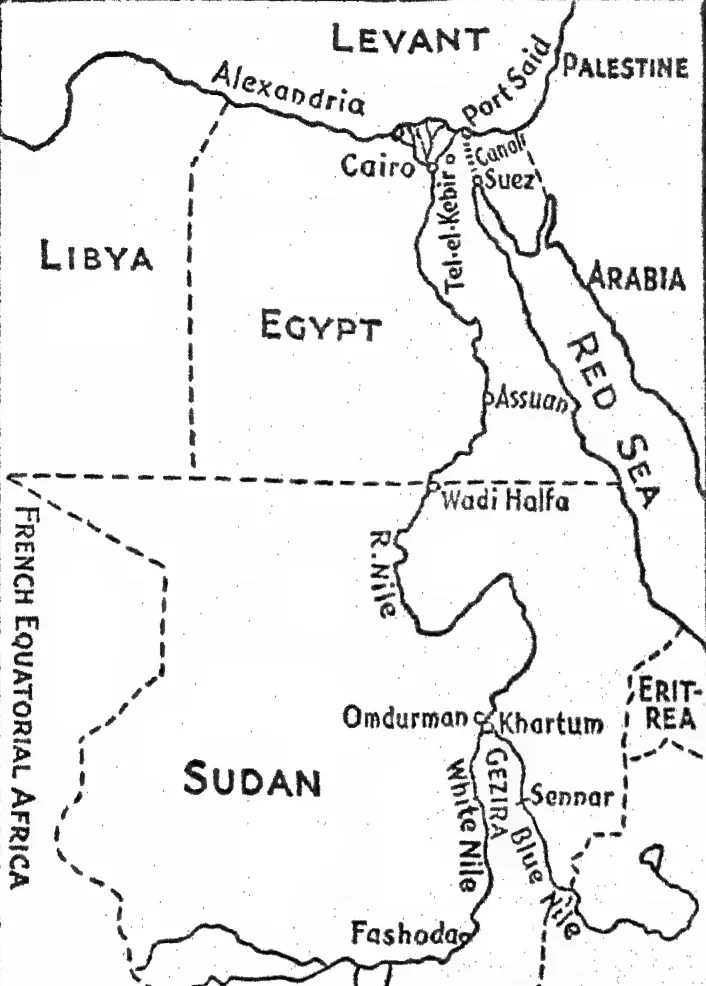
Egyptians at the Battle of Tel-el-Kebir and occupied Cairo. Arabi was captured and sent to live in exile in Ceylon.. This movement, and the British attitude towards it, has been the subject of acute controversy. “Though no action was taken against the Khedive there can be little doubt that Tewfk was implicated in at least the earlier stages of the rising, That he should save his own skin by disavowing Arabi as soon as this course seemed to be politic was perhaps to be expected.
That the disturbance was no mere military rising, engineered by ambitious officers eager to secure political power for themselves, but that it was a genuine manifestation of Egyptian national feeling, seems probable, and it is at least possible that more might have been achieved, and the subsequent history of Egypt changed, if the British had been prepared to co-operate with Arabi instead of fighting him.
The suppression of the outbreak of 1882 left Egypt in a ferment which made impossible the immediate withdrawal of British troops. The position of the British in Egypt was certainly difficult. The land was still nominally under the joint European guarantee established in 1841, and theoretically it was still a province of the Turkish Empire. But, in fact, the British alone had restored order.
There was certainly no intention at that time of maintaining permanent control over the country, but the task of reorganising the Government and strengthening the finances proved to be greater than had been anticipated, and withdrawal from Egypt was post-poned indefinitely. Great Britain made it clear from the beginning that her occupation was temporary, but the abolition of the Dual Control was resented by the Government of France,
Throughout the next thirty years full responsibility for the maintenance of order and the restoration of financial stability in Egypt devolved upon Great Britain. Yet British officials possessed no legal authority. They were present merely to advise the Khedive, and the chief of them, Sir Evelyn Baring (afterwards Lord Cromer), held no higher title than that of British Agent and Consul-General, a post which he filled with marked capacity from 1884 till 1907. The resentment of France at the continuance of the British occupation did not cease until the conclusion of the Anglo-French Convention of 1904,' and even then Europeans of other nationalities enjoyed privileges and immunities which the British were unable to touch.
The reorganisation of Egyptian administration in the last twenty years of the nineteenth century was thorough and far-reaching. Railways and canals were built, and irrigation
+ By this Convention France agreed: to recognise the British position in works were established. The prosperity of Egyptian agriculture depended upon the annual flooding of low-lying lands by the surplus waters of the Nile. The extent of these floods varied year by year, excess and deficiency alike being disastrous to the cultivators. By the building of dams, such as the great dam at Assuan, which was completed in 1898, and the construction of reservoirs in which excess water could be stored and from which deficiency could be made good, the floods were regulated, to the lasting advantage of the peasantry.
Egypt in return for British recognition of certain French claims in Morocco.
By the cutting of irrigation canals, which were supplied with water from these reservoirs, large tracts which had hitherto been sterile were brought into cultivation. By the end of the nineteenth century a substantially larger area had been brought into tillage than ever before. This increase in Egyptian prosperity was reflected in the improvement in public finance, for it was found possible to obtain an adequate revenue from a lower scale of taxation.
Some improvement was effected in public health, but real progress towards a satisfactory state of affairs in this direction was slow among a peasantry ignorant of the most elementary rules of hygiene. People who lived under squalid conditions in Egyptian villages were subject to infectious diseases which it was difficult to control. Some progress was made, however, in combating the prevalence of ophthalmia. The system of public education was extended, and some reform was effected in Egyptian courts. An efficient police force was established, and efforts were made to reduce bribery.
The Sudan was a province to the south of Egypt, higher up the River Nile. Some garrisons were stationed at isolated spots in order to keep order. In 1883 an outbreak of religious fanaticism occurred. The Mahdi, a “prophet” whose followers were called Dervishes, took up arms, and in a fight against him a British general, Hicks Pasha, who was in command of a body of Egyptian troops, was slain.
The forces in the Sudan were evidently too small to withstand the Mahdi, and it was decided to withdraw them. General Gordon was sent to the Sudan for the purpose of supervising the evacuation. Many people were sent down the Nile, but Gordon's position in Khartum became critical. The Gladstone Government organised a relief expedition under Wolseley, but delays occurred, and when the expedition was able to advance it moved slowly, Khartum was at last reached—one day after
Gordon had been slain by Dervishes. The Sudan was abandoned to the followers of the Mahdi for many years.
The construction of a railway towards the south enabled the reconquest of the Sudan to be undertaken. The expedition which was organised for this purpose was put under the command of Sir Herbert Kitchener (afterwards Lord Kitchener). In the later stages of its march it moved forward with the railway. The Mahdi was by this time dead. The Dervishes were overthrown at the Battle of Omdurman, and Khartumwasreoccupied. Since the beginning of the twentieth century the Sudan, from being a wild and lawless region, occupied only by religious fanatics, has become a peaceful and prosperous province, in which large areas are devoted to the growth of cotton and other crops.
After the conquest of the Sudan in 1898 a French expedition under Major Marchand occupied Fashoda on the upper Nile in 1899. War between Great Britain and France appeared to be imminent, but Marchand was withdrawn and war was averted.
On the outbreak of war between Great Britain and Turkey in November, 1914, the nominal connection of Egypt with the Turkish Empire was declared to be at an end, and a British protectorate was proclaimed over Egypt. The Khedive, who was suspected of disloyalty, was deposed, and a Sultan of Egypt was appointed. Efforts were made by the Turks to attack the canal zone, but adequate. forces defended it, drove the Turks back, and conquered Palestine from them.
against foreign attack (the right to keep a British garrison in
Egypt), the protection of foreign interests in Egypt (the High Commissioner’ and his advisers and subordinates), and the Sudan (really a question of Nile water). These points were to be reserved for “‘free discussion and friendly accommodation.” Pending agreement on these matters the status quo was to be retained. Upon the termination of the protectorate the Sultan Ahmed Fuad assumed the title of King Fuad I.+
Negotiations on the reserved points were protracted, but an Anglo-Egyptian treaty was concluded in August, 1936. It provided for alliance and mutual aid in war-time; it sanctioned the retention of British troops in the vicinity of the canal for a period of twenty years; and it restored the Anglo-Egyptian condominium in the Sudan, which had existed for some years before 1924.
In May, 1937, the system of capitulations, by which foreigners in Egypt enjoyed extra-territorial privileges, including trial before consular courts, was abolished. For the next twelve years they would be subject to Mixed Tribunals, composed of Egyptian and foreign judges.
Title Name Dates
Vali.. - Mehemet Ali. 1805-49.
Abbas. 1849-54
Said.. 1854-63
Khedive. « Ismail. 5 1863-79
Tewfik.: 1879-92
Abbas Hilmi. 1892-1914
Sultan o Hussein: IQI4-17
King (since 1922) Ahmed Fuad
Farouk,
1 It may be of use to the reader to append a list of Egyptian rulers:
Chapter XXIBritish East Africa
British territories in the eastern half of the continent of Africa include a number of colonies and dependencies which, with one exception, extend in unbroken sequence from the southern frontier of Egypt to the northern boundary of the Union of South Africa. The exception is British Somaliland, on the Gulf of Aden; with Aden on the opposite shore it commands the entrance to the Red Sea.
British possessions in this part of the world may be conveniently considered in three groups, northern, central, and southern. In the north is the Anglo-Egyptian Sudan, extending from the Egyptian frontier (the twenty-second parallel of north latitude) to the higher reaches of the Nile. The central or equatorial group consists of the Zanzibar Protectorate (Zanzibar and Pemba, and a few other small islands), the Uganda Protectorate (extending from the Sudanese border to
Lake: Victoria), Kenya Colony and Protectorate (between Uganda and the sea), and the Mandated Territory of
Tanganyika (between Lake Tanganyika and the sea). The southern group, cut off, in the main though not entirely, from the equatorial dependencies by Lakes Tanganyika and Nyasa, consists of the Nyasaland Protectorate and Northern and Southern Rhodesia.
The detached dependency referred to above is the Somaliland Protectorate. Somaliland occupies the ‘Eastern Horn” of the African continent. In 1884 it was partitioned among Great Britain, France, Italy, and Abyssinia, the last-named occupying the interior, while the three European powers divided the coast among themselves. A protectorate was proclaimed over British ‘Somaliland, and for some years it was administered by the Resident at Aden, on the opposite shore. In 1898 the Foreign Office assumed control, and a Commissioner was appointed to rule it.
Since 1905 it has been in charge of the Colonial Office. For many years British and Italian Somaliland were subject to the raids of a Dervish leader known as the Mad Mullah, and in spite of punitive expeditions these incursions ceased only with his death in r921. The Somalis are of Arab race and in religion are Mohammedan. The country is not rich in natural resources, and its chief importance to Great Britain is strategic.
The Sudan, conquered by the Egyptians in the time of Mehemet Ali, was, as related elsewhere,! lost
ABYSSINIA 7 Sir Herbert Kitchener. |Equatorian “._
Ucanpa’ NL-Rudolf / My
6 had been. due to joint Mee? Kenva 19 British and Egyptian 7 ee INDIAN ffort it was arranged ELGIAN 4) F e L, eTobora 6 Pemba OCEAN that both countries Tanganyika TANGAN- $Zanzibar should share respon- Conco sibility for its administration. The Governor-General pointment from the &
Egyptian Khedive, ae but he was to be nominated by. the. BRITISH BAST ‘AFRICA
British Government, and Egyptian as well as British garrisons were to be maintained in the Sudan. This arrangement continued until 1924, when, in consequence of the murder of Sir Lee Stack in Cairo,
Lord Allenby, the British High Commissioner, presented an ultimatum to the Egyptian Government which included the complete withdrawal of Egyptian troops and officials from the Sudan.
Since 1924, therefore, the condominium * has been no more than nominal, and for all practical purposes the Sudan is a British colony. It has an area of over 1,000,000 square miles and a population of nearly 6,000,000. It is divided into

fourteen provinces, each ruled by a Governor.1 The provinces are subdivided into districts, in the charge of District Commissioners, under whom Sudanese administrative officials are employed,
One of the most important questions facing the Sudanese Government is connected with the waters of the Nile. An adequate supply of Nile water is vital to Egyptian prosperity, and proposals to use this water for irrigation purposes in the Sudan have aroused suspicion and irritation in Egypt. A scheme for the irrigation of the Gezira, the region between the Blue Nile and the White Nile above their junction at Khartum, has been in process of development for some years.
The necessary water is being obtained from the Blue Nile as the result of the construction of a dam at Sennar, about 170 miles above Khartum. It is estimated that 1,000,000 acres will be brought under cultivation when the scheme is complete; already two-thirds of this area is being watered. In spite of Egyptian protests it may be asserted confidently that the Nile is capable of supplying sufficient water to satisfy Egypt’s legitimate requirements as well as those of the Gezira scheme.
At least one-third of the Gezira will be devoted to the production of cotton, which is one of the principal products of the colony. The Sudan, however, is by no means a one-crop country; in addition to cotton its exports include millet, gum arabic, salt, ground nuts, dates, hides, and senna.
The authority of the Sultan of Zanzibar formerly extended over a large stretch of the mainland as well as over the islands of Zanzibar and Pemba.- In the eighteenth century and the first half of the nineteenth Zanzibar was a centre of the slave trade, and it was the British desire to restrict this traffic which led to relations being established between Zanzibar and the British.
A treaty for the restriction of the trade was signed in 1845, and though it was not very effective British influence at the sultan’s court increased with the passage of time. In 1873 another anti-slave-trade treaty was signed, and, as a regular steamship service between Great Britain and Zanzibar had been inaugurated after the opening of the Suez Canal, the state became of some: importance. Sir William Mackinnon, chairman of the British India Steam Navigation Company, secured in 1878.a concession of the Sultan’s mainland territories gl the title Governor-General for the ruler of the colony as a
Uganda was visited by John Hanning Speke in 1862 and by Henry Morton Stanley in 1875. Missionaries, Protestant, Roman Catholic, and Mohammedan, followed the explorers,
The East Africa Company was unable to retain its hold on Uganda by reason of insufficient resources, and in 1892 it contemplated withdrawal. But Lugard, supported by missionary organisations, appealed to the British Government to proclaim a protectorate. This was done in 1894. The newly established administration had in 1897: to deal with a revolt by Mwanga which was only suppressed after the arrival of Indian troops in 1898 and the capture and deportation of the ex-king in 1899.. The administration of the protectorate is. carried on by a
1 Afterwards famous for his work in Nigeria. See pp. 274-5.
Governor with the assistance of an Executive Council of six members and a Legislative Council which consists of the Executive Council with some non-official members added to it. There are four provinces, one of which, Buganda, is recognised as a native kingdom. In all the provinces native chiefs, native councils, and native courts exercise authority over their own people under the general supervision of British officials,
The population of Kenya includes an appreciable European element, which is settled in the highlands of the interior. Here, too, are lands reserved for the natives, and the adequacy of these reserves has been questioned by critics of the administration of the colony. It is alleged that too great a proportion of the best land has been made available for white settlement. The question is complicated by a labour problem.
Natives prefer their own holdings and are loath to work for white settlers, who suffer from a scarcity of labour. The Government has upon occasion resorted to compulsory labour in connection with public works, but this device is, of course, not open to the settlers.. The system of compulsory labour has evoked sharp criticism of the Kenya administration, and attention has been drawn to it in the House of Commons..
There is an Indian question also in Kenya. Indian coolies were imported at the end of the nineteenth century to assist in the construction of the Uganda Railway, and their numbers have since been augmented by further immigration, The Indians are disinclined to undertake agricultural work, and engage in trade in the towns. As a sanitary measure the Government attempted. to segregate them in certain quarters in the towns, but this policy was regarded as irritating and unnecessary, and by direction of the British Government it
was abandoned, _ fo a
In 1920 the Legislative Council, which hitherto had consisted of official and non-official members entirely nominated, was enlarged by the inclusion of eleven elected Europeans. The Indians demanded equal representation, and, after lengthy discussions, deputations of the European and Indian communities visited London and laid their views before the Secretary of State for the Colonies. As a result, the constitution of the Legislative Council underwent further modification.
In addition to the eleven elected Europeans it was to include five Indians and one Arab, chosen by their respective communities, but a nominated official majority was to be maintained.1 The question of native representation was postponed until such time as the native population should be sufficiently advanced to warrant its participation in the work of the Legislative Council; meanwhile, its interests were safeguarded as against the other racial elements by the maintenance of the official majority. This scheme failed to satisfy the Indians, who at first declined to elect representatives.
Authority over the natives is exercised by chiefs and native councils, The security of native reserves has been guaranteed in perpetuity by the Native Lands Trust Act of 1928, a measure which has given great satisfaction. In 1925 Jubaland, a strip of territory to the east of the colony, was ceded to Italy in pursuance of an understanding entered into during the
European War.
A recent Imperial grant of £10,000,000 for East African development has led to the improvement of harbours, the construction of railways and the increase of their rolling-stock, and the extension of motor roads. For the purpose of levying customs duties Kenya and Uganda form a single administrative unit.
The territory now known as Tanganyika was formerly German East Africa, and for many years after its acquisition the Germans had difficulty in establishing their authority over the natives. During the European War the German forces in the territory offered vigorous resistance to allied attacks, and only at the conclusion of peace did the territory pass into British possession under mandate.
Tanganyika contains.a native population of over 5,000,000, and there are only a few white settlers. Slavery in the territory was abolished by the Germans in 1905, but'a form of serfdom was permitted to exist until its formal extinction by the British administration in 1922. There are over seventy native tribes in Tanganyika, and the work of administration is entrusted, in the main, to paramount chiefs, chiefs, and native councils. A school is maintained at Tabora at which the sons of chiefs receive training, on English public-school lines, for the work which will devolve upon them in course of time.
1 An Indian was appointed to the Executive Council.
Much has been done for the welfare of the native population in the fifteen years of British rule. Security of land tenure has been attained, and the results of scientific research have been applied to the improvement of crops. Progress has been made in the endless war with tropical diseases, and native education is receiving attention. Though the territory possesses great natural resources, and an abundance of crops of various kinds is produced, it is clear that there is a vast field for future development.
The territory is ruled by a Governor and an Executive Council. In 1926 a Legislative Council, containing thirteen official and ten non-official members, all nominated, was set up.
The possibility of a federation of the central East African dependencies has been mooted. Political, racial, and economic problems would have to be dealt with before such a project could be realised, and, while the possibility of some form of closer union among these colonies and protéctorates at some future time may be borne in mind, at present the suggestion seems to be premature.
The region round Lake Nyasa was opened up in the second half of the nineteenth century by missionary enterprise. As early as 1861 a mission station was established at Magomero by the Universities Mission to Central Africa; this was afterwards abandoned, In 1866 Livingstone reached Lake Nyasa, and continued his travels to Lake Tanganyika. A Presbyterian mission was started by the Church of Scotland on the western shore of Lake Nyasa in 1875, and another, by the Scottish Free Church, at Blantyre in 1876, while in 1885 the Universities Mission to Central Africa established a station on one of the islands of the lake. iSaaok
In 1878 the African Lakes Company.was formed for the development of trade in the region of the great lakes of Central Africa. Difficulties were encountered with Arab slave traders _ and with the Portuguese, who were penetrating inland from
The new protectorate consisted of a narrow strip of land parallel to the western shore of Lake Nyasa and extending southwards almost as far as the Zambesi. For some years difficulties were encountered with slave raiders, but these were overcome, and the protectorate has since enjoyed a peaceful and uneventful existence. In 1904 it was transferred from the Foreign Office to the Colonial Office and was renamed the
Nyasaland Protectorate.
Company.
Settlement under the control of the Cone began in
1890, and the town of Salisbury was founded. Effective occupation became possible, however, only after two wars with the Matabele, in 1893 and 1896. In 1894 the Company was authorised to govern Matabeleland, and Dr, Leander Starr Jameson was appointed Administrator. His raid into the Transvaal + at the end of 1895 compelled the British Government to intervene in the affairs of the Company.
The administration of Matabeleland was conducted henceforth under the authority of a Resident Commissioner appointed by the Crown, and the military forces of the territory were placed under the command of an officer of the British army. The authority of the Resident Commissioner was limited to the region between the Zambesi and the Limpopo, since known. as
Southern Rhodesia,! while the territory north of the Zambesi was divided into two provinces, North-West Rhodesia and North-East Rhodesia, subject to Administrators appointed by the Company. The Resident Commissioner of Southern Rhodesia was assisted by Executive and Legislative Councils, the latter consisting of nominated and elected members; the elected members formed a majority of the Council after 1913.
Meanwhile, railway construction had been proceeding. A line from Mafeking to Bulawayo, in Southern Rhodesia, was opened in 1897, and in 1905 it was carried into Northern Rhodesia by a bridge over the Zambesi at the Victoria Falls, Salisbury was also connected with Beira, in Portuguese East Africa, The improvement in communication with the outside world attracted settlers, especially to Southern Rhodesia, and as these increased in number some constitutional change seemed to be called for. The Company’s charter was renewed in 1914, but it was provided that the Crown might grant responsible government at any future time when requested by the Legislative Council.
The question of the ownership of unoccupied land? in the colony gave rise to a protracted dispute between the Company and the settlers. The latter contended that these lands belonged to the people in general, while the Company claimed them as its property, which it was entitled to grant or sell to new-comers. The Crown intervened in the controversy in r914.and asserted its right to them, and its contention was upheld by the Judicial Committee of the Privy Council in 1918.
The Legislature consists of a Legislative Assembly containing century.;
1 The name “Rhodesia” was officially applied to Mashonaland and Matabeleland as early as 1895.;
2 The “waste lands,” to use the terminology in vogue in the nineteenth
North-West and North-East Rhodesia were united to form Northern Rhodesia in 1910, and in 1923 this was withdrawn from the Company’s administration as part of the general settlement of that year. A new constitution was put into operation in 1924. The Governor was to be assisted by an
Executive Council of five members and a Legislative Council of sixteen, a minority of these being elected.
The future of the Rhodesias is uncertain. There are several possibilities. They would doubtless be welcomed in an enlarged Union of South Africa, which, with the addition of
South-West Africa and the protectorates which remain at hag Raters re om present under the South African High Commissioner, would extend from Cape Town to the border of the Belgian Congo.
They might be associated with some future federation of
British East Africa, Or Northern Rhodesia might adhere to the East African Federation and Southern Rhodesia to the
Union of South Africa. A further possibility is a union of
Northern and Southern Rhodesia in a dominion distinct from the others.
But Northern Rhodesia regards East Africa as merely a native preserve in which the efforts of Governments are directed towards the welfare of the natives rather than to advancing the interests of white settlers. And Southern
Rhodesia is not convinced. that its interests would be adequately secured were it to be merged in the Union. Nor, for a similar reason, is Northern Rhodesia altogether prepared to contemplate union with Southern Rhodesia. The problem remains for settlement in the future.
Chapter XXIIOther British Possessions
Aden
ADEN, at the southern entrance to the Red Sea, was recognised in ancient as well as modern times as being of strategic importance, in that it was on the route between the Mediterranean and India. It was less valuable after the discovery of the Cape route to the East, but its importance revived after the opening of the Suez Canal. It was occupied by a force from Bombay under Commander Haines in 1839.
In 1868 the settlement was extended by the acquisition of Little Aden; the intervening coastal strip was secured in 1882-8. A protectorate, the boundarizs of which were settled in 1904, was proclaimed over the surrounding country. After 1914 the Turks overran the protected area, and disorder prevailed for some time.
Until 1927 the administration of the settlement and the protectorate was subject to the Indian Government. In that year the protectorate was transferred to the Colonial Office, but the settlement remained part of the Bombay Presidency until 1932, when it was constituted a province of British India, under a Chief Commissioner and Resident. The separation of Aden from India and its transfer to the Colonial Office is under consideration.
Perim is a small island under the same administration, It was first occupied in 1799 but was. abandoned. It was reoccupied in 1857. _ Kamaran, an island in the Red Sea, is administered by a Civil Commissioner responsible to the Chief Commissioner of Aden. It was taken from the Turks in 1915. A quarantine station for pilgrims to Mecca is maintained on the island under the joint control of the Government of India and the Government of the Dutch East Indies, ceanetentch an Sta ar een
Sokotra was s occupied by the East India Company i in 1834.
A British protectorate was proclaimed in 1886. The island is ruled by a sheikh, who may not cede it to any foreign power. It is under the authority of the Chief Commissioner of Aden.
Ascension
Ascension, a small island in the South Atlantic, was discovered by the Portuguese on Ascension Day, 1501. It was occupied by the British in 1815 in order that it might not be used as a base for attempts to rescue Napoleon. It was administered by the Admiralty until 1922, when it was trans-ferred to the Colonial Office and placed under the authority of the Governor of St. Helena.
Cyprus
Cyprus, in the Levant, was captured from Venice by the Turks in 1569, and was held by them until 1878, when it was ceded to Great Britain by the Treaty of Berlin. It remained under the nominal suzerainty of the sultan, to whom an annual tribute of £92,000 was paid, until the outbreak of war between Great Britain and Turkey in 1914, when the island was definitely annexed by the British. Great Britain’s right to Cyprus was recognised in the Treaty of Lausanne, 1923.
British administration has been responsible for the introduction of many improvements in the condition of the island, Railways and roads have been constructed, irrigation works have been devised, schemes of afforestation have been embarked upon, and measures have been taken to check the ravages of locusts,
The administration was at first entrusted to a High Commissioner, who, after 1882, was assisted by an Executive Council and by a Legislative Council containing a majority of official members. In 1925 the High Commissioner was replaced by a Governor, and the Legislative Council was reconstituted with a majority of elected members. The. constitution has not worked well. A movement has sprung up among young Cypriots in favour of union with Greece. It does not appear to be a genuine nationalist movement.
It is said to be supported chiefly by clergy whose influence has diminished under British rule and by local financiers whose money-lending activities have been checked by the vigilance of British officials. There is no doubt that both classes hope to reap advantage from the change. A deputation waited on Lord Passfield, Secretary of State for the Colonies, in 1929. It was informed that the idea of the proposed transfer could not be entertained. Rioting followed in Cyprus, and in 1931 the constitution was suspended. Pending a settlement of the questions at issue, full powers, executive and legislative, are vested in the Governor.
Falkland Islands
The Falkland Islands were discovered by John Davis in 1592 and were visited by Sir John Hawkins in 1594. A French settlement in East Falkland. was begun in 1764 but was soon z C.of Good Hope
Tristan do Cunha
SOUTH ATLANTIC OCEAN op Falkland Is.
C.Horn SS-Georgia "Bouvet
S. Shetlands, % °°S,Orkneys
Poabie Land
SOUTH ATLANTIC POSSESSIONS given up. Captain Byron annexed West Falkland on behalf of Great Britain in 1767, but the few settlers were expelled by Spain in 1770.. Under threat of war Spain gave way, and the settlement was restored in 1771, but it was evacuated in 1774, and the islands remained unoccupied for nearly fifty years. A settlement from Buenos Aires was begun in 1820 but ceased in 1831. British occupation was renewed in 1832 for the protection of whaling and sealing vessels. The islands were ruled by naval officers until 1843, when Crown Colony government was introduced. A Governor was appointed, with
Executive and Legislative Councils, the members of which were nominated. At present the Executive Council consists of three official members and one non-official; the Legislative Council, of four official and two non-official members. In 1914 Sir Doveton Sturdee destroyed a German squadron under von Spee at the Battle of the Falkland Islands, thus avenging a British defeat at the Battle of Coronel,
Several groups of islands in the Antarctic and the South Atlantic are subject to the jurisdiction of the Governor of the Falkland Islands. South Georgia, eight hundred miles east of the Falklands, was discovered by Captain Cook. It has a small population engaged in whaling. The South Shetlands are inhabited only during the whaling season. The South Orkneys contain a meteorological station of the Argentine Republic, by arrangement with Great Britain.
The Argentine in 1928 laid claim to these islands, but the claim was not admitted by Great Britain. The South Sandwich Islands and -Graham’s Land are, like the South Shetlands, used during the whaling season, but are not permanently inhabited. A Norwegian claim in 1928 to Thomson Island and Bouvet Island was contested by Great Britain. Bouvet Island, however, was ceded to Norway as an act of grace.
Gibraltar
Gibraltar was captured from the Spanish in 1704 by an English fleet under Sir George Rooke and Sir Cloudesley Shovell, and by the peace of 1713 was retained by Great Britain. It was attacked on several occasions during the eighteenth century, the most notable being the great siege of
1779-83, during which it was effectively defended by Sir
George Eliott (afterwards Lord Heathfield). Since the failure _of the French and Spanish on that occasion Gibraltar has been free from attack. Its value is strategic, as commanding the entrance to the Mediterranean. The Governor is also commander-in-chief of the garrison, and is always an officer of high rank. ‘Until 1922 Gibraltar was ruled by the Governor -alone, but in that year an Executive Council of four official and three non-official members was established. There is no
Legislative Council, and the Governor is empowered to issue ordinances on his own authority.
eet Sa
Hong Kong
Hong Kong, an island close to the coast of China, was ceded to Great Britain in 1841 at the conclusion of the first China War. The Kowloon Peninsula was added to the colony in 1860 at the termination of the second China War. A larger area, known as the New Territories, was acquired in 1898 on a lease of ninety-nine years. The New Territories are administered by two District Officers responsible to the Governor of Hong Kong.
Little more than a century ago the island of Hong Kong was desolate and almost worthless. It has become important and prosperous. It is the distributing centre for much of the trade of China with the outside world, while the emigration of Chinese coolies, bound to various parts of the world as indentured labourers, takes place through Hong Kong. The anarchic condition of China has turned out to the advantage of Hong Kong. Many Chinese merchants have found there the security so needful to their business which was lacking in China itself.
In the administration the Governor is assisted by an Executive Council of nine members. The Legislative Council consists, beside the Governor, of seventeen members; rine of these are official and eight are non-official. Of the latter six are appointed by the Crown on the Governor’s recommendation, one is chosen by the Justices of the Peace of the colony, and one by the Chambers of Commerce,
Maldive Islands
These islands, in the Indian Ocean, are ruled by a sultan who is a dependant of the Government of Ceylon, to which an annual tribute is paid. A constitution was established in 1932 by which the powers of the sultan were limited.
Malta
Malta was given by the Emperor Charles V to the Knights of St. John in 1520, after their expulsion from Rhodes, and for nearly three centuries it stood as the sentinel guarding the western Mediterranean from Turkish attack. The Turks made a great attack upon it in 1565, but this was vigorously and successfully resisted by the Knights under their Grand Master La Valette, after whom the capital of the island, Valetta, is named.
The French under Bonaparte took possession of the island in 1798, but after the destruction of Bonaparte’s fleet in the same year by Nelson at the Battle of the Nile the inhabitants blockaded the French garrison, and the appearance of a British fleet was the signal for its surrender. The British took possession of the island, but by the Treaty of Amiens, 1802, they were required to restore it to the Knights; The British failure to observe this clause of the treaty was one of the points which led to a renewal of the French War in 1803. At the fall of Napoleon the British possession of Malta was confirmed.
Malta is situated in the narrowest part of the Mediterranean, and its strategic importance to Great Britain to-day is as great as it was in former days to the Knights of St. John. During and since the nineteenth century it has been the base of the British Fleet in the Mediterranean. Except in the period 1847-9 the Governor has always been commander-in-chief of the garrison. He is a military officer of high rank, selected by the War Office and appointed by the Crown on the advice of the Secretary of State for the Colonies, His authority extends over Gozo and Comino and some other small islands.
In the sense that it has not been subject to attack the history of Malta since its acquisition by Great Britain has been uneventful. Constitutional difficulties have arisen, however, and they are not yet finally settled. A Legislative Council of nine official and eight elected members was set up in 1849. In 1887 the elected members were given control; the Council henceforth contained six officials, four members elected on a limited franchise, and ten on an extended franchise. The system worked badly.
Supplies were sometimes refused, and the British Government had to save the situation by the issue of Orders in Council. The elective element was reduced in 1903, and the Maltese showed their resentment by abstaining from nominating candidates. For some yeats the Government was carried on upon a Crown Colony basis.
Responsible government was granted to the Maltese in 19a. The Legislature was to consist of two Chambers. The Senate was cotnposed of seventeen members, seven of whom were chosen by a special electorate with high qualifications, while the remaining ten represented pace interests—the clergy, the nobility, university graduates, chambers of commerce, and the trade union council. The Legislative Assembly contained thirty-two members; there were eight electoral districts, each returning four members by the system of proportional repre-sentation.
Disagreement between the two Chambers was to be overcome by the holding of a joint session, or, alternatively, by a dissolution of the Legislature. Ministers were to be responsible to the Legislative Assembly except for certain reserved subjects, which included the safety and defence of the Empire and the general interests of British subjects outside Malta; in other words, the maintenance of Malta as a military and naval base was a matter under the control of the British and not of the Maltese Government.
The Crown might legislate by Order in Council on reserved subjects, or this might be done by the Governor with the approval of the Crown. The Executive Council of the Governor consisted, of course, of the ministers, but there was also a nominated Council of officials, and the two Councils might be called to meet together as the Privy Council for Malta.
The elections of 1927-resulted in the defeat of the Nationalist party and the return to power of the Constitutionalists, under the leadership of Sir Gerald Strickland, who in 1928 became Lord Strickland. This result displeased the ecclesiastics in Malta, and on the approach of the time for elections in 1930 the Church declared that to vote for candidates of the Constitutionalist party was mortal sin; the Maltese were also forbidden by the clergy to read certain newspapers. Such interference with the working of the electoral system could not
Bs be tolerated, and the Governor suspended the constitution.
A Royal Commission was appointed to consider the position and recommended, inter alia, that the Italian language should be deprived of its privileged position in Malta. Henceforth the three languages, English, Maltese, and Italian, were to be on an equal footing in the Maltese courts. Italian was no longer to be taught in elementary schools, though it might be retained in higher schools... - The British Government concurred in these recommendations, which were put into force.
The differences between the Constitutionalist party and the Church were at length composed, and the ecclesiastical ban was removed. The constitution was accordingly restored. Unfortunately fresh points of dispute arose, and the constitution was again suspended in November, 1933.
Mauritius
Mauritius was discovered by the Portuguese early in the sixteenth century. It remained unnamed and unclaimed until the Dutch visited it in 1598 and gave it its present name, after Maurice of Nassau, Stadtholder of the Netherlands. A Dutch settlement was established in 1644, but was abandoned in 1710. The French annexed it in 1715 and renamed it the Ile de France. It was used by the French East India Company as a base of operations. against India; La Bourdonnais, the Governor of Mauritius, captured Madras in 1746.
After 1763 the island was taken over from the Company by the French Crown. During the Revolutionary and Napoleonic Wars -it was a centre for privateering in the Indian Ocean, and in 1810 a British force from Bombay and the Cape captured it. It was retained at the peace and the old name was restored.
Only the officials and the garrison of the island are English. The European inhabitants are mainly of French descent, and French law is administered. There is a large Indian population in the colony. A system of indentured labour was begun in 1842 and continued until 1910, when it was stopped by the Indian Government, though it was resumed in 1923.
In 1832 a Legislative Council, of official and non-official members in equal numbers, was set up. In 1909 a Royal Commission was appointed to consider to what extent the constitution of the colony needed revision, and as a result the Legislative Council was reconstituted to contain seventeen “7 nominated and ten elected members; only eight of the nominated members are officials,
Rodriguez is an island three hundred and fifty miles north-east of Mauritius, administered by a Resident Magistrate subject to the Governor of Mauritius... The Chagos Islands, in the Indian Ocean, are administered by visiting magistrates.
Newfoundland
The island of Newfoundland was discovered by the Cabots before the end of the fifteenth century, and this fact is the basis of the claim, sometimes put forward, that Newfoundland is the “oldest British colony.” Certainly some sort of claim to the island was maintained by the English, but no attempt was made to settle upon it at that time, though in the sixteenth century English vessels visited the Newfoundland banks for the purpose of fishing. The fisheries were regarded as a training-ground for seamen, and the dried Newfoundland “ stock-fish” was brought to England and re-exported to Roman Catholic countries in which fish was in demand on days of fasting.
The failure of Sir Humphrey Gilbert’s attempt to colonise Newfoundland has already been described. A settlement was attempted without success by some British in 1610, and in 1621
Sir George Calvert (afterwards Lord Baltimore) acquired from James I the right to found a colony on the island. Many of the settlers were, like Calvert, Roman Catholic, and their presence was viewed with dislike by Virginians and New Englanders. During the French War of 1627-9 they were subject to attack, and in 1629 the colony was abandoned.
During the seventeenth century settlements were formed by the fisher folk who continued to visit the island, and, by the Treaty of Utrecht, 1713, British possession of the island was formally recognised by France. French fishermen, however, were conceded the right to land on the western and northern shores to dry their nets, and, by the Treaty of Paris, 1763, they were given certain rights on the eastern shore as well. By the Treaty of Versailles, 1783, the French rights on the eastern shore were withdrawn, and, in return, the French were permitted to fish from the western shore. The whole question of fishing rights caused friction which continued until its final
Fe settlement in the Anglo-French Convention of 1904.
fishing rights made them little inclined to associate politically with French Canadians. In some ways the sympathies and interests. of Newfoundland lay with the United States rather ce 1See p. 18,
0 Bae than with Canada; the United States offered a market for fish from the island, while Canada produced her own. Such considerations as these led to the decisive defeat of a New-foundland ministry which proposed to enter into negotiations for admission into the Dominion.
A good deal of American capital had been invested in the
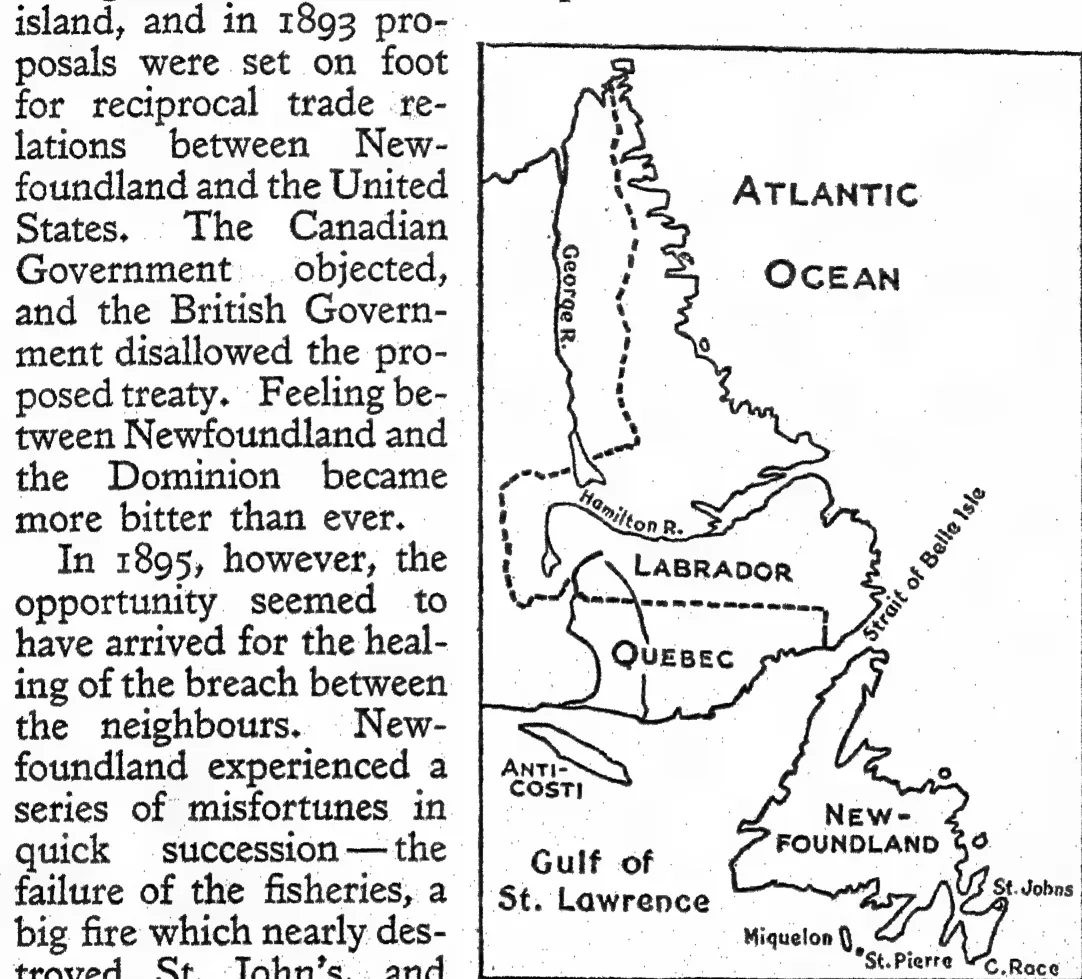
posed treaty. Feeling behave arrived for the healing of the breach between failure of the fisheries, a Pane big fire which nearly des- Miquelon), </ troyed St. John’s, and b St-Pierre “C.Roce_| the suspension of pay- NEWFOUNDLAND AND LABRADOR banks, The Government expressed its willingness to enter the Dominion on terms which included the assumption by Canada of responsibility for the whole of Newfoundland’s debt. The Canadian Government tried to drive too hard a bargain, and the matter was dropped.
The tide turned. New capital from Great Britain was invested in opening up the mineral wealth of the island, and a few years later a paper-making industry was established in connection with an important London newspaper, the Daily Mail. Lumbering thus became important, and agriculture also
‘developed. The colony thus ceased to be dependent ona ‘single industry, and in the twentieth century it appeared to be embarking tpon an era of greater prosperity than at any ‘previous time in its history.
For some time Newfoundland and the Dominion were unable to agree on a question of Labrador territory, the island colony ‘claiming and the Dominion admitting that a strip of the coast of Labrador belonged to Newfoundland, The point in dispute “was the extent to which this strip should extend into the interior. The matter was in 1927 referred to the Judicial Committee of the Privy Council, and judgment was given in favour of New-foundland. It has since been suggested that the Dominion might purchase from its neighbour the region which was in ‘dispute, but this has not been done.
The constitution provides for an Executive Council (which is a responsible ministry) of not more than twelve persons, to advise the Governor, and a Legislature of two Chambers. The
Legislative Council consists of twenty-four members, appointed for life, while the House of Assembly contains twenty-seven ‘members elected on universal franchise, which, since 1925, has included women. The Statute of Westminster in 1931 tecognised Newfoundland as one of the self-governing units which possess full Dominion Status. In view of its smallness in comparison with other Dominions it has made no application for admission to the League of Nations.
The economic depression which affected most countries in ‘93x and the following years did not pass Newfoundland by. In. 1933, on account of the inability of Newfoundland to meet the interest on its loans, the British Government appointed a Royal Commission to examine into the future prospects of the colony and to report on its financial situation, It was suggested that the colonial administration was not free from corruption, and the Commission reported in favour of a suspension of the constitution, which, at the request of the New-foundland Legislature, was effected by an act of the British Parliament.
The Governor has, since February, 1934, been invested with full legislative and executive powers, and he is assisted by a Special Commission of six members, three from Great Britain and three from Newfoundland. In the exercise of his functions the Governor is responsible to the Secretary of State for Dominion Affairs. Great Britain has assumed. responsibility for the finances of the island, and it is expected
NEWFOUNDLAND 307 that these arrangements will continue in force until there is a reasonable prospect of the colony again being self-supporting.
Earl Winterton, who has visited Newfoundland, has stated: “Roads and bridges are being both constructed and improved, and other public works undertaken... an admirable land settlement scheme for unemployed men and their families is being carried out... the finances of the country have been improved, unemployment slowly but steadily decreased... smuggling and evasion of customs dues, disgracefully extant under the old régime, have been virtually abolished, the civil service has been reorganised and regraded, and the police force improved in discipline and morale.” The Department of Overseas Trade, in a report issued in September, 1935, declared that “‘there has been encouraging evidence of business improvement.”
Palestine
Palestine was conquered by British forces in 1917-18, and remained under British military administration until 1920. British policy with regard to Palestine was announced in the
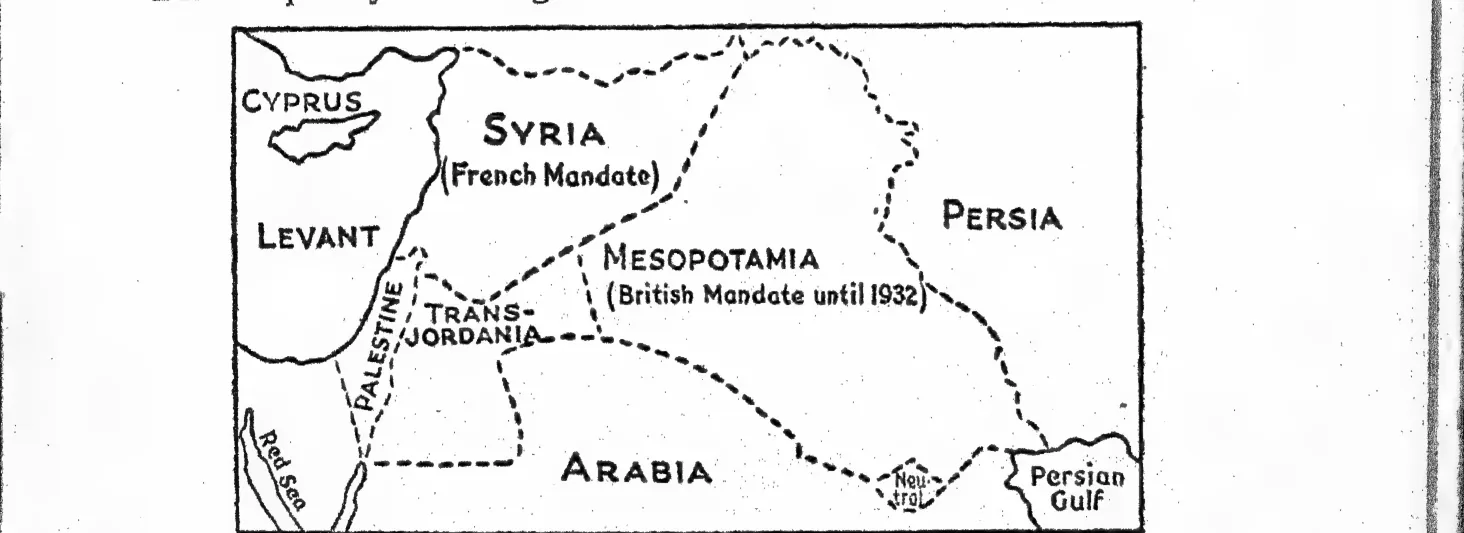
z | teavss. \ (British Mandate until 1932) se a weeene ARABIA “sscfets-” 2 Persian
PALESTINE, TRANSJORDANIA, AND MESOPOTAMIA Balfour Declaration of 1917, in which it was stated that the British Government favoured the establishment in Palestine of a national home for the Jewish people. A mandate for Palestine was assigned to Great Britain by the League of Nations in 1922, and this embodied the. principle laid down in the Balfour Declaration. A constitution was formulated by which Palestine was to be ruled by a High Commissioner (who was also to be commander-in-chief), assisted by an Executive Council and an Advisory Council.
The latter might in due course be replaced by a Legislative Council, but in view of the attitude of the Arabs in abstaining from elections this has not yet been done. The population includes Moslems, Jews, and Christians, and racial and religious animosities are pronounced.
Transjordania, a region east of the Jordan, is covered by the Palestine mandate, except that the clauses relative to the Zionist movement are inapplicable to it. It is ruled by an Emir, and in 1928 a constitution was established by which Executive and Legislative Councils, the latter with an elected majority, were set up. There is a British Resident in Trans-jordania responsible to the High Commissioner, who holds also the office of High Commissioner for Palestine.
Persian Gulf
Certain small states in the Persian Gulf come within the British sphere of influence, and relations with them are main-Islands are ruled by a sheikh who has been in treaty relations with the Indian Government since 1820. In 1880 he undertook not to make treaties with anyother state..The Government of India is represented by a Political Agent.
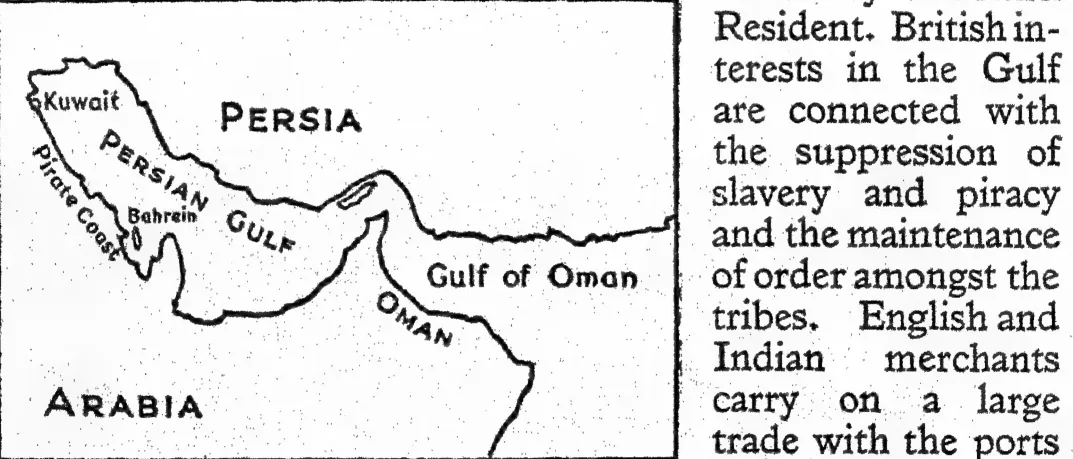
Oman is ruled by a sultan who also is in treaty relations with the Indian Government, which is represented by a. Political Agent at his court.:
Kuwait is under the rule of a sheikh. He also is in treaty relations with the Indian Government. A Political Agent resides at Kuwait also,;
Certain independent tribes on the Pirate Coast have entered into treaties with the Indian Government for the suppression of piracy and slavery. They may not enter into relations with, nor cede territory to, any power other than Great Britain. The Resident in the Persian Gulf exercises a certain amount of authority over these tribes.
The Kuria Muria Islands, in the Arabian Sea, were acquired in 1854 and are of value in connection with the Red Sea Cable. They were formerly subject to the Chief Commissioner for Aden, but were transferred to the control of the British Resident in the Persian Gulf in 1931.
Seychelles Islands
The Seychelles, a group of numerous small islands in the Indian Ocean, were early in the eighteenth century the resort of pirates. In 1742 they were occupied by the French. They were captured by the British in 1794 but were not garrisoned until 1810, when Mauritius was captured. The Seychelles were attached to Mauritius for administrative purposes, and for a time the last French Governor was continued in office as British Agent. The separation of the Seychelles from Mauritius was gradual.
In 1872 its finances were separated from those of Mauritius; in 1888 an Administrator. was appointed and separate Executive and Legislative Councils were set up; in 1897 the Administrator was given powers as Governor; and in 1903 the Seychelles became a separate Crown Colony, the Administrator being raised to the rank of Governor. The two Councils consist entirely of nominated members, official and non-official.
Amirante Island and the Aldabra Group are dependencies of the Seychelles,
St. Helena
St. Helena, in the South Atlantic, was discovered by the Portuguese on St. Helena’s Day, 1502. No settlement was made by them. The island was visited by Cavendish in 1588, in the course of his voyage round the world. It was occupied by the Dutch in 1645, but was captured by the English in the Anglo-Dutch War of 1652-4. It was retaken by the Dutch in 1672 but was recovered by the English in 1673 and retained.
For many years it was occupied by the East India Company and was used as a calling station for the Company’s ships on their voyages to and from the East. It was held by the Crown and strongly garrisoned between 1815 and 1821, when it was used as a place of exile for Napoleon. It was finally taken over by the Crown in 1834, after the East India Company had ceased to trade.
Its importance diminished after the opening of the Suez Canal, but, during the South African War, 18991902, it was used as a prison camp in which captured Boers were interned. St. Helena is ruled by a Governor with the assistance of an Executive Council of two official and three non-official members. There is no Legislative Council; legislation is by ordinance of the Governor.
Tristan da Cunha
Tristan da Cunha is the most important of a lonely group of islands in the South Atlantic. It is so named after a Portuguese admiral, Tristao da Cunha, who discovered it in 1506. It is on a line between the Cape of Good Hope and Cape Horn, about one-third of the distance from the Cape of Good Hope, and so is well away from all the ordinary sea routes.
In the eighteenth century it was occasionally visited by British and American sealing vessels, and on one occasion by a British naval officer who gave his name to. Nightingale Island. It was annexed and garrisoned in 1816 in order that it might not be used to facilitate the escape of Napoleon from St. Helena. For such attempts, however, it was too remote, and the garrison was soon withdrawn.
A corporal, with his wife and two children, was allowed to remain, and in course of time they were joined by castaways and deserters from whaling and other vessels. The present population numbers about one hundred and twenty.. The people are of mixed blood, but the British strain is predominant. Property is held in common, and the settlement is governed patriarchally by the oldest inhabitant. An attempt has recently been made to establish a local council. Communication with the outside world is infrequent.
Wei-hai-wei
Wei-nai-wei was leased from China in 1898 to counterbalance the Russian acquisition of Port Arthur. It consisted. of an island and a small coastal strip. Great Britain assumed responsibility for the defence of a large area in the vicinity, the general administration of which remained in Chinese hands.
Wei-hai-wei was at first administered by the Admiralty, then. by the War Office, and, after 1901, by the Colonial Office. The official in charge was styled a Civil Commissioner.
In 1922, as a result of the Washington Conference, Great: Britain undertook on certain conditions to return Wei-hai-wei to China, Disturbances in China led to the retrocession being: postponed for some years, but it took place in 1930.
Supplementary Notes
Malta
In July, 1938, Mr. Malcolm MacDonald, Colonial Secre-tary, announced in the House of Commons the promulgation of a new constitution for Malta. A Legislative Council,. half the members of which were to be elected, was to be set up, but in certain respects. the Governor was to retain overriding, powers, and in no case was the Council to deal with questions of language. Mr. MacDonald expressed the opinion that there. was no prospect of responsible government being restored. within any measurable period of time.
Palestine
Arab opinion in Palestine is strongly opposed to the: establishment of a predominantly Jewish state, and it is. generally admitted in Great Britain that the policy envisaged when the mandate was accepted is now unworkable. In July, 1937, a Royal Commission reported in favour of the setting up: of separate Jewish and Arab states, leaving Jerusalem and a. corridor to the coast under permanent British mandate. The: continuance of terrorist outrages. has necessarily involved the: postponement of a settlement until such time as order is. restored,
Chapter XXIIIThe British Empire
The British Empire covers one-quarter of the land area of the globe and includes one-quarter of its people. It is unique, not only in its size, but in its organisation and its stability. The political centre of the Empire is Great Britain, and it is through the activity of the people of this country that during the last three centuries settlements have been made and territories acquired in all parts.of the world. It is due, too, to the political capacity of the British people that the peculiar organisation of the British Empire has been evolved.
The Empire includes a number of self-governing Dominions which enjoy responsible government. Each of them possesses a Parliament to which the Government of the Dominion is responsible. Asin Great Britain, the ministry must receive the support of a majority of the members in the elected Chamber, and in the event of defeat the ministry must either resign or dissolve Parliament, and, in the latter alternative, if it fails to secure a majority in the succeeding Parliament it must resign forthwith. Dominion Parliaments have full right of legislation over their own peoples, and they frame their own tariff policy.
FP AS ai PEE FT LE EEE SE
They are able to negotiate directly with foreign countries and to conclude commercial and other treaties without the inter-vention of Great Britain. Some of the Dominions appoint their own representatives to foreign countries, and their essential independence is recognised by their separate membership of the League of Nations. The self-governing
Dominions of the British Empire are the Dominion of Canada, the Commonwealth of Australia, the Union of South Africa, the Dominion of New Zealand, Newfoundland, and the
Trish. Free State.”
request, and at the time of writing its Governor is assisted by Commissioners appointed by Great Britain... Newfoundland. is not a member of the
League of Nations. See p. 306. #2 only to young nations which have developed as the result of colonisation.
1 In 1933 the constitution of Newfoundland was suspended at its own
2 The Irish Free State rej the term “Dominion” as being applicable
The Dominions mentioned above enjoy ‘Dominion Status.” By this expression is understood, in addition to allegiance to the Crown, equality of status with each other and with Great Britain! This equality of status was recognised in effect as long ago as 1917, when representatives of the Dominions were admitted to the British war cabinet. It was formally affirmed by the Imperial Conference of 1926, and it received legal recognition in the Statute of Westminster, 1931.
In each of the Dominions the Crown is represented by a
Governor-General, who is usually an English nobleman, and occasionally a member of the royal family. The conduct of the Governor-General in public affairs is modelled on that of the Crown in Great Britain. Until recently, the Governor-General of a Dominion filled the dual role of agent of the British Government in the Dominion (in which capacity he acted upon “instructions” received from the Colonial Office *), and of constitutional head of the state.
He was therefore able to exercise personal discretion in certain matters, especially in regard to the granting or withholding assent to legislation, and to the pardon or reprieve of criminals condemned to death. But since the Imperial Conference of 1926. the Governor-General has ceased to be the agent of the British Government in the Dominion,® and in 1930 it was agreed that
8 The incident which brought this issue to a head arose in Canada in the summer of 1925. Mr. Mackenzie King, the Prime Minister, meeting with an increasing amount of criticism in the Canadian House of Commons, and being confident that he enjoyed the general support of the country, advised the Governor-General, Lord Byng, to dissolve Parliament.
Lord Byng held that it would not be right to grant a dissolution in order to enable a ministry to evade a possible vote of censure, and declined to act upon the Premier’s advice. Mr. Mackenzie King resigned, and the. Governor-General invited Mr. Andrew Meighen, the Conservative leader, to form a Government... Mr. Meighen, having no majority behind him in his appointment the Crown should be advised by the ministers of the Dominion concerned, and not by those of Great Britain.
The Governor-General of a Dominion is now expected to act in all things on the advice, formally tendered, of his ministers. Dominion ministers may offer the Governor-General advice on all matters relating to the affairs of the Dominion, and it would be unconstitutional for British ministers to offer to the Crown contrary advice on such matters, It follows that the Crown may no longer disallow Dominion acts of Parliament on the advice of British ministers, nor may a Governor-General reserve Dominion bills on instructions received from Great Britain.
in the House of Commons, was forced to ask for a dissolution of Parliament,
which the Governor-General granted. The elections resulted in the
return of a majority of Mr. Mackenzie King’s supporters, a result which
could be interpreted only as a censure of Lord Byng’s action. Mr,
1 As a matter of fact, the Dominions enjoy responsible government. But this is hardly an essential feature of Dominion Status. If a Dominion should abolish its Parliament and establish some other form of internal government it would not lose its status, provided that it continued its allegiance to the Crown and did not become subordinate in any way to any other member of the British Commonwealth of Nations.
2 The separate Secretaryship of State for the Dominions was established as recently as July, 1925.
. In view of this changed conception of the position of a Governor-General it has become necessary for the British Government to be represented in each of the Dominions by a High Commissioner.t In 1928 Sir William Clark was appointed British High Commissioner, in Canada; in 1931 Sir Herbert Stanley received a similar appointment in South Africa, and in 1935 Sir Geoffrey Whiskard was nominated to a like post in Australia.?
Responsible government is enjoyed in some other states of the British Empire. In Northern Ireland and Southern Rhodesia responsible ministries exist, and, under somewhat different conditions, in Ceylon also. In each case, however, certain matters are reserved, and remain under the control of the British Government, exercised either directly or through the Governor of the colony... These colonies, therefore, do not enjoy Dominion Status.
Most of the remaining parts of the British Empire, until a few years ago, came under the designation “Crown Colony.” The use of this term has been discontinued, however, and these states to-day are called “colonies.” Exactitude of classification can hardly be attained. Colonies are usually grouped according as they do or do not enjoy representative institutions. But there are many degrees of representation,
Mackenzie King resumed. office, and when; as Canadian Prime Minister, he attended the Imperial Conference of 1926, the question of the position and powers of Governors-General came up for consideration.
when Sir Harry Batterbee was selected for the post.
? The Australian appointment was contemplated in 1931 but was deferred
for financial reasons.
and it is sometimes difficult to determine to which group a colony should be assigned.t
The more important colonies possess representative Legislatures, of one or two Chambers. Such Legislatures may be established by the Crown without seeking the sanction of Parliament. But when a representative Legislature has been granted to a colony the Crown loses its right? to make laws for the colony by Order in Council, unless such right is expressly reserved. In each of these colonies a Legislative Assembly or a Legislative Council, wholly or partly elected, makes laws, levies taxes, and controls expenditure.
But these colonies do not possess responsible government, and their Legislatures are not entitled to be called Parliaments. The Government is under the direction of a Governor,® assisted by a number of officials, or ministers, but the latter are not directly responsible to the Assembly, which may criticise their action but is powerless to bring about their removal.
It may be noticed, however, that, in any question on which local feeling runs strongly, the Legislative Assembly is able to express its views vigorously, and it is improbable that the Governor and his advisers will persist in proposals to which the Assembly takes strong exception unless very good reasons exist for doing so. In some cases representative institutions may be regarded as a stage on the
(a) Colonies with an elected House of Assembly and a nominated
Legislative Council,
(b) Colonies with a Legislative Council containing a majority of elected and a minority of nominated members.
(c) Colonies with a Legislative Council containing a minority of elected members and a majority of nominated members.
(d) Colonies with a nominated Legislative Council.
(e) Colonies without a Legislative Council.: The classification is affected by the fact that a proportion (sometimes a majority) of the nominated members, as a rule, are officials. It may be observed that many writers limit the application of the term “representative institutions’? to colonies in classes (a) and (6) above, denying it to those coming under (c).
1 The following attempt at classification may be of use, though it is doubtful whether it will meet all cases.
2 But the British Parliament may abolish a colonial (not Dominion) Legislature, and re-establish the legislative power of the Crown.
3 Members of the Executive Council of the Governor are often appointed not by him but by the Colonial Office. In emergency he may override the views of his Council, but he may not overstep the bounds of law. The judges of the colony are independent of the Governor. The Governor is ' the commander-in-chief of the colonial forces, unless a British garrison is maintained, when a separate officer may be appointed to the command.
way to full responsible government; in many others, owing to sparseness of population or to the disproportion existing between white and native peoples in the colony, it is improbable that responsible government will ever be attained. The colonies with representative institutions in greater or less degree include the Bahamas, Barbados, Bermuda, British Guiana, Jamaica,
Mauritius, Fiji, Cyprus, Sierra. Leone, and Kenya Colony. Ceylon is often classed as a colony with representative institutions, but, as stated above,! it is now permissible to regard its Government as responsible. ‘.
In another group of colonies there is a Legislative Council which consists entirely of persons nominated by the Crown. Some of them, often the majority, are officials, but a number of non-official members, selected from among the more important residents in the colony, may be appointed. Real control remains in the hands of the Governor, who, through the official members, usually commands a majority in the Council. The Governor himself is subject to the control of the Secretary of State for the Colonies, from whom he receives instructions.
The powers of the Legislative Council in this type of colony are limited, while the Crown retains the right of legislating for the colony by Order in Council.2 Colonies of this type include British Honduras, the Falkland Islands, and the Straits Settlements.
A few small places are ruled by a Governor with a small Executive Council but with no Legislative Council. These include Gibraltar and St. Helena.
The British Empire includes a number of territories known as protectorates. These usually contain a considerable native population, which is, as a rule, though not invariably, left under the authority of native rulers. British control in such cases is exercised by a Resident (or Commissioner, or Adviser, or Agent), who offers advice to the ruler. So long as the native prince is not. too oppressive the advice of the British Resident. is not pressed very closely, The influence. of the
methods of securing the desired end had been tried without success,
1 See p. 298.:
2 This, of course, means that the Colonial Secretary in London can legislate for the colony..He may thus secure the passage of a law which the Legislative Council is unwilling to pass, while, by the exercise of the power to withhold the royal assent, he may prevent the passage of a law which he regards as undesirable. Such a course would be followed only if important imperial interests were concerned, and only after other
Resident is veiled as far as possible, and the most successful Residents keep in the background. In bad. cases of misgovernment it may be necessary for a military expedition to invade the protectorate and depose the ruler, and either install another native potentate or establish the Resident as Governor.
In that way it occasionally happens that a protectorate becomes a colony ruled by a British Governor, and, if conditions are favourable, there is no reason why it should not, in time, run through the whole scale of development, ultimately attaining responsible government and Dominion Status. Some protectorates are under the direct rule of a Governor or Commissioner appointed by the Crown, There is no uniformity of system.
In a few cases the protectorate is indistinguishable, except in name, from a colony, but there is great variety of practice. The foreign relations of a protectorate are controlled by the British Government. The protectorates of the British Empire include those of Gambia, Sierra Leone, and Nigeria, on the west coast of Africa, Somaliland, Kenya Protectorate, Uganda, and Zanzibar in East Africa, the Bechuanaland and Swaziland Protectorates in South Africa, the Federated Malay States, and many of the islands and groups in the Western Pacific,
Certain territories are known as Spheres of Influence. These are regions which are not necessarily in actual British occupation, and British control over them may be of the slenderest character. They are areas within which other powers have undertaken not to acquire territory or influence, by treaty or by annexation. Spheres of Influence exist in the Persian Gulf and in Arabia,
Mandatory spheres are under British rule, but it is doubtful whether it is appropriate to regard them as integral parts of the British Empire at all. Responsibility for good government within them, for the maintenance of order, for the improvement of the condition of the native inhabitants by education and otherwise, and for the development of natural resources, has been assigned to the mandatory power under the terms of the Treaty of Versailles or, subsequently, by the League of Nations.
Mandates were granted to certain of the great powers to exercise supervision and control over backward and undeveloped races until such time as they should become fit to direct their own affairs.. The mandatory principle involves the protection of native races and positive efforts to improve their. condition, and the discountenancing of the exploitation of the natives for the benefit of their rulers; the subjects of states other than the ruling state are free to share in its development, and the mandatory power refrains from monopolising its natural resources.
These, however, are the principles on which Great Britain has ruled her Crown Colonies since the abandonment of the Old Colonial System, so that she may claim to have followed the mandatory principle long before it was formulated in the Versailles Treaty. It has been possible for Great Britain to attach some of her mandated territories to neighbouring colonies, as parts of which they have been ruled with no material change of administrative system.
Great Britain holds mandates over part of the Cameroons and part of Togoland, the Tanganyika Territory, Palestine, and Transjordania.! The Commonwealth of Australia has been entrusted with the mandate for the administration of that part of New Guinea which was formerly German, and New Zealand holds the mandate for Western Samoa. The island of Nauru is administered under mandate held jointly by Great Britain, Australia, and New Zealand.
The Union of South Africa holds the mandate for the former German South-West Africa, The mandatory power is expected to submit to the League of Nations an annual report on the progress of the territories committed to its charge.
The Indian Empire stands in a category of its own. It is in no sense a colony; Englishmen do not go to India in order to settle there and make new homes. They may accept posts in Indian political and commercial life and live there for many years, but they invariably return to Great Britain upon retire-ment. “It is difficult to fit India into the classification of Imperial administrations already set out.
In so far, however, as it could be compared with any of them, British India until 1935 was similar to a colony with representative institutions; with the passing of the Government of India Act, 1935, it received a considerable measure of responsible government, and the course of constitutional development is proceeding by stages in an orderly manner towards full responsible government and full Dominion Status. The Indian States may be compared in some respects. with the protectorates which exist in other parts of the world.
The connection between the various component parts of the
this state was freed from mandatory control in 1932.
1 Great Britain formerly held a mandate for Mesopotamia (Iraq), but
British Empire and Great Britain is of several: kinds. At the head of the British Empire stands the king, to whom allegiance is due from the inhabitants of every single state, large or small. The king is no mere figurehead. He is a real and necessary connecting link between different parts of the British Empire.
If, as is most unlikely, a movement should ever be set on foot for the abolition of the monarchy in Great Britain, it would have to reckon on the break-up of the British Empire as an inevitable consequence. The loyalty which is felt by the Dominions towards the king would not be extended to the president of a British republic. It does not seem possible that the connection of the autonomous parts of the British Empire with Great Britain would be maintained. They would become independent republics under their own presidents.
The Dominions and many of the colonies are bound to Great Britain by the ties of blood and of language. This is true, of course, in varying degrees in different parts of the Empire. There are French as well as English in Canada, Dutch as well as English in South Africa. Nevertheless, except in the Irish Free State, the white population in the self-governing Dominions is mainly British.
An important consequence of this is that English common law is at the basis of the legal system of all the Dominions. However much it may be modified by the statutory enactments of the Dominions, this common law provides a definitely common element in the lives of men in various parts of the Empire, and helps to keep them together, not be repugnant to British law.
This rather vague principle was discarded, and a more definite rule substituted, by the Colonial Laws Validity Act, 1865, which stated that a colonial law would be invalid only if it was inconsistent with a British statute applicable to the colony. This enactment was intended not to restrict but to extend the sphere within which colonial Parliaments were entitled to legislate.
By the same law of the British Parliament colonial Legislatures were empowered to set up, abolish, or modify Courts of Justice within their own territories, and also to modify their own constitutions, subject only to the observance of specific conditions which might be laid down in the constitutions themselves.
The assent of the Crown is necessary to the passing of colonial laws, and this is usually signified by the Governor. In certain cases the Governor is empowered to reserve laws for the consideration of the Crown,? and in some instances the Crown may annul a law to which the Governor has given assent. The right of veto has occasionally been exercised when it has been considered that a proposed colonial law is detrimental to the rights or interests of other parts of the Empire, but with the growth in importance of the Dominions its use had become very rare, even before the passing of the Statute of Westminster.
The Statute of Westminster, to which reference has several times been made, was passed by the British Parliament in 1931. Its purpose was the establishment on a legal basis of the- equality of the six Dominions with each other and with Great Britain. The provisions of the Colonial Laws Validity Act were to cease to apply to the Dominions, which, henceforth, were entitled to pass laws which might override British statutes hitherto applicable to the Dominion.
No future British act was to apply to a Dominion except at its request and with its assent, There were certain reservations in the Statute, however. In order to safeguard Canadian provincial rights it was provided that the Statute should not apply to any proposed amendment of the Canadian constitution, and. the rights of the Australian states against the Commonwealth were similarly
Throughout the Statute of Westminster reference is made to the “British Commonwealth of Nations,”’ and not to the “British Empire.”
2 It was thus competent for a-colonial Parliament to modify the application of the common Jaw in the colony. Before 1865 it was doubtful whether this could be done.
3 That is, of the British Government, whe
protected. Moreover, certain parts of the Statute were not to apply to the Commonwealth of Australia, to the Dominion of New Zealand, or to Newfoundland, unless these parts were expressly adopted by the Parliaments of these Dominions. In the preamble to the Statute it was declared that any alteration in the law touching the succession to the throne or the Royal Style and Titles ought to receive the assent of all the Dominion Parliaments as well as that of the British Parliament. But this was not definitely enacted.
It appears that it would be possible for a Dominion Parliament to change the order of succession, so far as that Dominion was concerned, or for a Dominion Parliament to refuse to accept any alteration in the succession which might hereafter be proposed by the British Parliament.
Each Dominion and each colony has its own courts to interpret and enforce the law, but from the highest court in each colony it is possible to appeal to the Judicial Committee of the Privy Council, in London. This is a court which consists of judges of high attainments and long experience; its members are appointed from the Dominions and from India as well as from Great Britain. In some of the Dominions there has been some resentment at the continuance of this right of appeal. In the constitutions of Australia and South Africa it has been restricted; but there has been no general demand for its abolition.?
The foreign policy of the British Empire is under the general direction of the British Government, and the interests of the colonies and Dominions in foreign countries are, as a rule, under the care of British ambassadors. As stated above, some of the Dominions have appointed their own representatives in foreign capitals, and have negotiated treaties independently of the British Government, but such action is exceptional; it may become less so in course of time.
2 In June, 1935, the Judicial Committee of the Privy Council decided that it was within the competence of Dominion Parliaments to abolish the right of appeal.
Canada and Australia possess navies of appreciable strength, these were placed, during the European War, under the general direction of the British Admiralty.
A careful consideration of what has been written will indicate that the bonds which hold the British Empire together are of a most indefinite character. Territories scattered all over the world, separated from each other and from Great Britain by thousands of miles of sea, are held by no armies of occupation. No tribute of any kind is paid by any part of the British Empire ' to any other part.
It is a matter of surprise to foreign observers that the Empire holds together at all, and it must be admitted that the real reason for the continuance of the connection does not lie in the existence of formal bonds. The component parts of the British Empire remain in connection with one another becatse they wish to do so; they do not break away because there is no. desire for separation.
The bond, therefore, is sentimental, and it has proved to be stronger than more formal links might have been. Perhaps it would be unwise to attempt to establish a stronger and more rigid chain of connection, lest its existence should tempt one or other of the Dominions to test its strength.
Communication between various parts of the British Empire and Great Britain is maintained through four departments of state in the mother country, each of them being under the direction of a Secretary of State. Indian affairs are directed through the India Office, Burmese through the Burma Office, colonial through the Colonial Office, and contact is maintained with the Dominions through the Dominions Office.
It is not to be supposed that the affairs of the most important political units within the Empire demand the greatest amount of attention at the Colonial Office; it would not be far from the truth to assert that the degree of consideration of the affairs of a colony by the Colonial Office varies inversely with its importance.
1 The island of Ascension, in the South Atlantic, was administered by the Admiralty -until.1922, when-it was transferred to the Colonial Office. Wei-hai-wei, in British possession between 1898 and 1930, was administered at first by the Admiralty, then by the War Office, and finally by the Colonial:
Every advance in the status of a colony enhances the extent to which it manages its own affairs and diminishes the degree of its dependence upon the home Government, so that by the time it attains Dominion Status its connection with the
Dominions Office becomes an association of equals.
The control of the plantations in the early Stuart period was in the main left to the proprietors, individual or chartered company, to whom had been granted the right to found them. 4
In so far as direct control was found to be necessary or desirable eaten.
it was exercised by the Privy Council, which in the seventeenth century was responsible for the general administration of the country. In 1660 a Council of Foreign Plantations was appointed to maintain communication with colonial Governors, ~ to supervise colonial legislation, to inquire into methods of colonial administration practised by other countries and, if thought advisable, to apply them to English colonies, and to see to the maintenance of religion and morals in the plantations.
This Council was in 1672 amalgamated with another, the Council for Trade, to form the Council for Trade and Foreign Plantations, which, however, was abolished in 1675. It was revived in 1695 as the Board of Trade and Foreign Plantations, and in this form it existed until 1782, when it was abolished.
A Secretary of State for the Colonies was appointed for the first time in 1768 on account of the volume of business in connection with the American colonies. The office existed concurrently with the Board of Trade and Foreign Plantations, but with the loss of the colonies both Secretariat and Board were abolished. The volume of colonial business, sadly diminished, reverted to the Home Office, in which an Office of
Office. The Foreign Office administered many of the African protectorates for some yeats, but these have now passed under the supervision of the Colonial Office. The Channel Islands are: under the control of the Home Office.
Plantations was set up. In 1786 the work of this office was transferred to a Committee of Trade and Plantations, which remained under the general authority of the Home Secretary until 1801. In that year it was removed to the War Office, and between 1801 and 1854 a single Secretary of State was responsible for the War Office and the Colonial Office.
freely admitted that the Colonial Office was doing its work well, but it was contended that its capacity for expansion was not infinite; it had never been possible for the Colonial Office to undertake the control of the Government of India, and the time had arrived for a separation of functions.
The British Government met the suggestion at this time by a reorganisation of the Colonial Office; a Dominions Division and a Colonies and Protectorates Division were set up.; ’ No further development occurred for some time, and during the period of the European War and for some few years afterwards it was evidently impossible to give the necessary attention to a matter so important as the further reorganisation of the Colonial Office.
But in 1925 Mr. Stanley Baldwin, Prime Minister, announced that the Government had decided to create a Dominions Office in place of the Dominions Division of the Colonial Office, and to place the new office in charge of a Secretary of State for the Dominions, For the time being it was proposed to appoint to the new secretaryship the person who held the office of Secretary of State for the Colonies, but in 1929 separate appointments were made, Mr. J. H. Thomas becoming Dominions Secretary and Lord Passfield Colonial
Secretary.
included Imperial defence and communications, bankruptcy, merchandise marks, sugar bounties, the exercise by colonial Governors of the prerogative of mercy, and the right of self-governing colonies to negotiate commercial treaties with foreign powers. The Conference was important for what it accomplished by way of agreement between Great Britain and her colonies, and mote important by reason of its ultimate effects. It indicated a complete abandonment of that British conception of the colonies which was widely prevalent earlier in the century. The representatives of the colonies went home from the Conference of 1887 deeply gratified with the reception accorded to them and fully assured of the profound interest taken by Great Britain in her overseas possessions.
The Diamond Jubilee of Queen Victoria in 1897 drew the premiers of the self-governing colonies to London, and the opportunity was seized to hold another Colonial Conference. Mr, Joseph Chamberlain, Colonial Secretary, presided. The Conference dealt with subjects which had already come under discussion—the Pacific cable, naval and military defence of the Empire, and Imperial trade policy.
It was felt that the time was not quite ripe for the discussion and revision of the constitutional relations existing between Great Britain and the self-governing colonies, but that the question of the participation of these states in the direction of Imperial policy would have to be considered at no distant date. Such participation would logically involve a proportionate contribution from the colonies towards Imperial expenditure on defence, and for this they were not yet ready.
The Colonial Conference of 1902 was held on the occasion of the coronation of King Edward VII. Mr. Joseph Chamberlain again presided, and suggested that the time was ripe for the discussion of Imperial Federation. Nothing was agreed upon in this connection, but it was felt that Colonial Conferences ought not to be limited to the occasions on which great State functions were to take place. It was decided that the Conference should meet, if possible, at intervals of four years.
The view was expressed that in the negotiation of treaties with foreign powers colonial opinion should be consulted..Some further consideration was given to the problem of Imperial defence, and the colonies offered increased contributions towards the cost of the British navy. The Conference was unable to agree to the establishment of a system of Free Trade within the Empire, but it recommended an extension of the system of preferential tariffs; it urged those colonies which had not already adopted that policy to do so, and it requested Great Britain to‘consider it,
The next Conference should have been held in 1906, but as a general election had just taken place in Great Britain it was postponed until 1907. The grant of responsible government to the Transvaal enabled the Premier of that colony, General Botha, to attend the Conference. (The previous Conference had been held only a few weeks after General Botha had ceased to bear arms against Great Britain.)
The general election of 1906 had reaffirmed in no uncertain way the determination of the people of Great Britain to adhere to the system of Free Trade. The question of preferential tariffs, therefore, was hardly within the sphere of practical politics; nevertheless, the Conference reaffirmed its belief in the expediency of preference. (The British Government, of course, was unable to assent to this resolution.)
It was resolved that the Conference should henceforth be styled the Imperial Conference and that the term “ Dominions” should be applied to the self-governing colonies! to distinguish them clearly from the Crown Colonies. Some discussion took place with regard to the Colonial Office, and, as stated above, the Conference asked the British Government to establish a department distinct from the Colonial Office for the conduct of corre-spondence with the Dominions. The action of the British Government has already been described. Certain other matters, including defence, cables, and mail services, were discussed, and it was suggested that, when necessary, sub-sidiary conferences might be called within the four-year period to deal with specific topics.
A subsidiary Conference met in 1909 and discussed the problem of Imperial defence from both the military and naval standpoint. Another, in 1910, was called in order to secure throughout the Empire uniformity in the law of copyright.
The outbreak of war in 1914 made it impracticable to summon a meeting of the Imperial Conference in 1915, the year in which it was due to take place. In 1917 Mr. Lloyd George invited the Dominions and India to send representatives to Great styled High Commissioners.
1 The representatives of the Dominions in London were henceforth
Britain to consider the best methods to be followed for the securing of speedy and complete victory. An Imperial War Cabinet was set up, consisting of members of the British War Cabinet and representatives of the Dominions, and at the same time an Imperial War Conference was held.
This resolved that while it was impossible to readjust. the constitutional relations of the Dominions to one another and to Great Britain during the war, this ought to be the subject of a special Conference to be summoned as soon as possible after the conclusion of peace. It asserted the right of the Dominions and of India to be consulted in important matters of foreign policy, it recognised India as a member of future conferences, and it reaffirmed its belief in the value of Imperial preference.
The Imperial War Conference met again in 1918 and discussed again a matter which had been raised in 1911—the desire of the Dominion Governments to communicate directly with the Prime Minister of Great Britain instead of through the Colonial Office. But the impossibility of the British Prime Minister undertaking such a mass of additional work was admitted, and though the right of direct communication was recognised it was agreed that it should be used only for matters of major importance and that normal correspondence should be conducted, as hitherto, through the Colonial Office.
The Conference of 1921 again discussed constitutional relations, and a suggestion was put forward that annual conferences should be held; this has not proved to be feasible.
The chief work of the Conference of 1923 was the formulation of procedure to be followed in the future in the making of treaties with foreign powers, in order that the views of the Dominions and of India might be effectively ascertained. Between this Conference and the next a solution was found to a problem which had been discussed on several occasions; a Dominions Office, distinct from the. Colonial Office, was established in 1925.
The Imperial Conference of 1926 was perhaps the most important of the series. It dealt with the problem of constitutional relations by making a declaration of the equality of status. of the self-governing Dominions with each other and with Great Britain, and it defined the future position of
Governors-General, 7
The Conference of 1930 reaffirmed the declaration of equality of status, and laid down the principle that in. the appointment of a Governor-General the Crown should act upon the advice of ministers in the Dominion concerned.
Legal effect was given to the decisions reached on the sub-ject of constitutional relations by the passing of the Statute of Westminster in 1931, referred to above.
Trade depression and a financial crisis led to the return in Great Britain, at a general election held in 1931, of a House of Commons in which a majority of members favoured protection. The Free Trade system of the country was abandoned, and the question of Imperial preference passed into the sphere of practical politics. In 1932 an Imperial Economic Conference was held at Ottawa, at which a system of Imperial preferential duties was agreed upon as the result of negotiations among the representatives of Great Britain and the Dominions,
In 1937, the year of the coronation of King George VI, an Imperial Conference was held in London. The topics which came up for discussion included foreign affairs and defence, constitutional relations, and trade and communications.
A review of the work of the Colonial and Imperial Coni i ferences must impress the reader with the magnitude of their i achievements. The Dominions, if they have not yet assumed
Summaries
SUMMARIES
INTRODUCTION: EXPLORATION AT THE BEGINNING
OF MODERN TIMES
KNOWLEDGE OF THE WORLD BEFORE THE FIFTEENTH CENTURY:
(2) Europe, south-west Asia, India, and northern Africa well
own.
(2) Eastern Asia known slightly. Marco Polo.
(3) America, Australia, and most of Africa unknown. (Vinland
settlement forgotten.)
TRADE IN THE MIDDLE AGES:
Carried on by the cities on the shores of the Mediterranean:
Marseilles, Genoa, Venice, Constantinople, Alexandria,
Eastern trade. Silks, fine cloths, luxury articles, spices,
Monopolised by Genoa and Venice.
(x) Genoa and Constantinople. Caravan trade from Central
Asia to the Black Sea.
(2) Venice and India, by
(a) Levant, Syrian Desert, Persian Gulf,
(b) Egypt, Red Sea.
Western trade. Venice and the Netherlands (Bruges).
Venetian monopoly. High prices. New route to India needed,
POSSIBLE NEW ROUTES TO INDIA:
(x) Round Africa. Attempted by Portuguese.
(2) Westwards. Attempted by Spanish.
PORTUGUESE?
1304- Prince Henry the Navigator. Encouraged exploration of the west
1460. coast of Africa. Trade in ivory, gold-dust, and slaves.
1486. Bartholomew Diaz. Reached the Cape of Good Hope.
1497-8. Vasco da Gama. Reached India.
ior, Cabral. Large fleet. Trade with India on a considerable scale.
Discovered Brazil.
Settlements on coasts of Africa and Asia. Trade by Cape route
during sixteenth century. Used by no other nation.
SPANISH?
1492- Columbus. Four voyages.
1502. (1) Bahamas, Cuba, Haiti.
(2) Jamaica.
(3) Venezuela.
(4) Honduras.
1499. Amerigo Vespucci. Central America and north coast of South
America.
1512. Ponce de Leon. Discovered Florida.
1513. Balboa. Isthmus of Panama.
1519-21. Magellan. Voyage round the world. Crossed Pacific and reached
East Indies. Route useless for trade, though voyage proved
world to be round.
SPANISH COLONIAL EMPIRE:
1492~3. Papal bulls assigning new discoveries to Spain and Portugal.
1494. ‘Treaty of Tordesillas.
Spanish colonies in Central and South America. Estates cultivated by slave labour. Gold mines. Annual treasure fleet.
eee monopolised by Company at Seville.
RESULTS OF THE EXPLORATIONS:
(1) New route to India.
(2) New continent.
(3) Diminished importance of Mediterranean. Decay of Mediterranean cities.
(4) Modern trade on Atlantic..
(5) Increased importance of Spain, France, England, and Portugal.
(6) Further exploration.
CENTURY
BEFORE TUDOR PERIOD:
. Little English maritime activity. Overseas trade i in Wein ships.
«Merchant eral built in 1 fifteenth century.
Italian in English service.
1497... Voyage to Newfoundland,
1498. Voyage to North America.
.. «French, From.St. Malo..
1534-40. Voyages to St. Lawrence.
HENRY VII:
(1) Understood importance of maritime development.
(2) Ships for navy, with guns.
(3) Merchant ships.
(4) Trinity House.
(5) Deep-sea fishing.
(6) Voyages:
(a) William Hawkins. Brazil.
1536. (6) Hore. Newfoundland or Cape Breton.
1527; (c) John Rut. North-west passage attempted.
CHANNEL ROVERS:
Second half of sixteenth century. Pirates in English Channel.
Attacked Spanish merchant ships. School of seamanship.
Weakened Spanish power at sea.
ELIZABETH’S REIGN:
Conflict between England and Spain inevitable. Supply of
treasure needed. Spain possessed treasure from New World.
Methods of obtaining treasure:
(2) Piratical attack,
(3) Settlement.
(4) Exploration.
TRADING:
1562-4. Hawkins. Three slave voyages. First two successful. On third
1567. attempt, Hawkins attacked by Spanish fleet and lost three ships.
PIRATICAL ATTACK:
Drake. Channel rover. Accompanied Hawkins on third voyage.
Many subsequent voyages to Spanish Main.
Attacked and captured Spanish ships and settlements.
1577-80. Vovaee pe the world, Later voyages. Fought against the
Armada.
1586-8. Cavendish. Voyage round the world.
SETTLEMENT?
1585-7. Raleigh. Virginia, Failure. 1583. Gilbert. Newfoundland. Failure.
EXPLORATION?;
1553. _ Willoughby and Chancellor. North-east passage,
1570-7-8. Frobisher, North-west passage. Three attempts.
1585-6-7. Davis.. North-west passage. Three attempts.
RESULT OF MARITIME ACTIVITY:
Development of a body of English seamen, capable of overcoming
the power of Spain.
ATTEMPTS IN ELIZABETHAN TIMES:
Newfoundland: 8;
1583. Gilbert. Failure. Loss of the amet with Gilbert on board.
Virginia (Roanoke):
1585-6. Raleigh. First settlement under Grenville. Indian attacks
Settlers relieved by Drake.?
1587-9. Second settlement. - Overwhelmed by Indians.
"Guiana:
1595- Exploration by Raleigh with a.view to settlement. No
settlement made.:
EARLY PLANTATION COLONIES: -;.
Virginia:
1606. Company formed..
1607. Settlement at Jamestown. Early constitution defective.
Settlers of unsuitable type.
1609. Revised constitution.
r611. Dale Deputy-Governor, Tobacco cultivated. Large estates.
; Slave labour.;
1619. Representative Assembly.
1623. Company’s charter revoked. Governor appointed by Crown,
Friction between Governor and Assembly,
; Loyal to Stuarts during constitutional struggle in England.
1672. Freehold of Virginia conferred on Arlington and Culpeper.
:; “Rights” commuted.
1689. Colonial rights restored.
i Maryland:.
1632. Settlement. Lord Baltimore, a Roman Catholic, proprietor.
: Toleration in religion.
1647. Representative Assembly.
NEW ENGLAND: COLONIES:
Plymouth:
1620, Pilgrim Fathers, The Mayflower. Plymouth Company.
Severe climate. Hard work. Labour of white men. Indian
hostility.
Assembly of freemen elected Governor and Assistants,
1638. Representative Assembly,:
No toleration in religion.
Massachusetts: 7 * wert
1629.... Massachusetts. Bay Coinpaay, i
1628. Settlement at Salem. Boston beccitie more important.
“Intolerarice in religion. Franchise limited to erat members,
1634, Representative Assembly. &
Connecticut:
1633. Settlement from Massachusetts. Conflict with Dutch.
1639. Separate colony. Governor and Assembly elected by freemen.
Toleration in religion.
New Haven:
1638. Settlement.
1662. Merged into Connecticut.
Rhode Island:
Settlement by Roger Williams, from Massachusetts,
Toleration in religion.
New Hampshire +
Settlements. Afterwards absorbed in Massachusetts.
Maine:
Settlements. Sir Ferdinando Gorges Proprietor, Absorbed
in Massachusetts.
Characteristics of New England colonies:
(x) Climatic conditions encouraged white labour. Slavery rare.
(2) Lumbering, agriculture, shipbuilding, fisheries.
(3) Colonists were men of education, enterprise, and intelligence.
(4) Democratic constitutions.
(5) Indian hostility. Border warfare.
6), Regarded as of little value, on account of similarity of
English and colonial conditions and products.
Confederation:
1641. Massachusetts, Plymouth, Connecticut, New Haven. League
for offence and defence. Dislikedin England. Massachusetts dominated league.
c. 1660.” Withdrawal of Connecticut and New Haven. Collapse of league.
NOVA SCOTIA:
1604. French settlenient—Acadie.
1613. Destroyed by Virginians.
1621... Scottish settlement—Nova Scotia,
1628.. Nova Scotians captured Quebec.
1632. Quebec restored to French, Nova Scotia abandoned.
DUTCH SETTLEMENTS:
1623. Fort Orange, on the Hudson River.
1626. New Amsterdam founded.
1655. Delaware taken from Swedes.
1664-5. New Netherlands captured by English.
1667, New Netherlands retained by English. Colonies of New York,
New Jersey, and Delaware. Assigned to Duke of York.
1683. Charter of Liberties. Representative ier ca;
PENNSYLVANIA?.;
1681. Founded by William Penn. Quaker, Democratic. Friendly
with Indians. Toleration in religion.
Prosperous colony.. Large, mixed population, Agriculture,
mining, manufacture, Export trade.
LATER PLANTATION COLONIES:
Carolinas:
16th c. French settlements. Failure.
1663. Carolina Company.
Northern settlements. Small population. Little prosperity.
Southern’ settlements. Larger population. Charlestown.
Representative Assembly. Colony attacked by Spanish
and Indians.
1719. Assembly threw off control of Company.
1729. Rights of Company ended.
Georgia:
1732+ General Oglethorpe. Ahome forinsolvent debtors. Religious
; toleration. Indian friendship. Influence of the Wesleys,
Moravians, and Presbyterians. Strategic value of colony.
1752. Representative Assembly,
. FRENCH SETTLEMENTS:
1608. Quebec founded, Other St. Lawrence settlements.
1664. Company of the West.
Exploration of the lakes and rivers. Jesuits. La Salle and
Marquette,
1697... Louisiana founded.
Chain of French forts on the waterways.
1744-63. FRANCO-BRITISH STRUGGLE:
French advantages: Ps
(x) Strategic position,
(2) Indian friendship kexcegt the Iroquois).
(3) Regular troops,
a British advantages:
(1). Numbers,
(2) Effective support from home Government.
(3), Command of the sea.
Events of the struggle:
1713. Treaty of Utrecht. Newfoundland, Nova Scotia, Hudson Bay
Territory.
1744. French attack on Nova Scotia. Failed.
1740. Louisburg captured by British,
1748. Louisburg restored to French.
I752 Fort Duquesne founded...
1754. iene on Fort. Duquesne. defeated. Washington
captured,
1755-. British attack on Fort Duquesne defeated. Braddock slain.
1756. Montcalm captured Fort Oswego. E;
I757- Montcalm captured Fort William Henry.
1758. _ (After Pitt sent troops and supplies) Fort Oswego and Fort
William Henry recovered. Fort Frontenac and Louisburg
sapere Fort Duquesne captured wee fighting.
' 1759+ Quebec captured, Wolfe and Montcalm slain.
i 1760, Montreal captured by Amherst.
: 1763. TREATY OF PARIS:
(x) All French possessions in North America east of the Mississippi (except New Orleans) ceded to Great Britain.
(2) French retained St. Pierre and Miquelon, and fishing rights
in the St. Lawrence and off Newfoundland.
(3) Florida ceded by Spain to Great Britain.
i N.B. The retention of Canada removed from the American
{ colonies the danger of French conquest, and made the War of
American Independence possible. The return of Canada to
the French and the retention of the sugar islands of the West
Indies by Great Britain might have been better.
MERCANTILISM?
“ A policy which developed with the growth of national consciouswet ness at the beginning of modern times. The control of
national activity in every direction, in order to increase national
power. Private interests subordinated to well-being of nation.
Control exercised in many ways, including colonisation.
MOTIVES FOR COLONISATION *
i (r) As a counterpoise to Spanish and Portuguese colonial power.
i (2) Prospecting for gold and silver..
(3) To strengthen English mercantile marine.
To produce commodities which could not be grown in
i gland,;
of (5) To provide new homes for those who could not fit into the
i; structure of English society.
(6) To provide markets for English manufacture.
EARLY STUART CONTROL OF COLONIES:
(x) Colonial exports only in English ships.
(2) Tobacco and some other exports to be sent only to England.
1651. NAVIGATION ACT?:
Pay
(x) Goods from Asia, Africa, or America to be imported into
England, Ireland, or the colonies only in English or plantation
ships.:
(2) Goods from Europe.... in English or plantation ships or
those of the country of origin.:
N.B. The object of the Act was to attack Dutch carrying trade.
It did not put the plantations at any disadvantage by comparison
with England.;
1660. NAVIGATION ACT:
(1) Clear definition of English or plantation ship.
(2) proloniat exports and imports only in English or plantation
(3) Alien merchants and agents excluded from plantations.
ships.
(4) Enumerated products only to England, Ireland, or another
plantation.
(5) Non-enumerated products elsewhere, but in English or
plantation ships.
LATER MODIFICATIONS:
1664. Colonies to receive European goods via England.
1673. | Duty imposed on enumerated pfoducts sent from one colony to
another.
r8th’cent. Additions to list of enumerated products.
1730, — Rice non-enumerated.
1739. Sugar non-enumerated.
THE OLD COLONIAL SYSTEM?
Justification:
(x) Expense of founding colonies.
(2) Responsibility for colonial defence.
Advantages to England::
(1) Production in colonies of commodities which could not be
grown in England.;
(2) Profit on their resale to other countries.
(3) Markets for English manufactures.
Advantages to colonies:
(1) Many important commodities non-enumerated.
(2) Preferential tariffs in England.
) In some directions, protection from English competition.
ey Sure market and steady price. “
; Colonial shipping and English shipping on an equal footing,
(Advantageous to colonial ship-owners. and shipbuilders;
less so; to merchants.)
“DECLINE OF THE OLD COLONIAL SYSTEM:
Little dissatisfaction during period of Whig rule.
American revolt proved futility of the system.
.. Growing disbelief in value of Mercantilism.
1796. United States ships permitted to trade with West Indies.
1808. With Canada, }
1820. City of London petition for abolition of trade restrictions.
1822. Enumeration of colonial goods discontinued. Limitation of,
i colonial trade to British or ‘colonial goods continued.
Navigation ‘system. gradually discontinued, by treaties with
:. foreign countries,;
1849,... Repeal of Navigation Acts,
THE COLONIES:
Northern group. Puritan and intolerant. Temperate clirnate.
Free labour. Lumbering, agriculture, shipbuilding. Democratic constitutions,
Middle group, Former Dutch settlements. _ Cosmopolitan
population,
Southern group. Sub-tropical climate. Large estates. Slave
labour (negroes and convicts). Tobacco.
THEIR POLITICAL CONDITION:
Advanced. Each colony had an Assembly dead on a wide
franchise. No responsible government. No federation.
BRITISH CONTROL:
(x) Appointment of Governors, Limited authority.
(2) Defence. Colonists defended themselves, and received
British assistance only in serious crises.
(3) Trade, Controlled under Navigation Acts.
N.B. No serious grievance before reign of George III. Trade
restrictions not rigidly enforced by the Whigs.
CAUSES OF THE QUARREL?
(1) Re-enforcement of the trading restrictions.
(2) Taxation proposed by Grenville and Townshend.
ARGUMENTS?
For Great Britain:
(t) In view of the heavy burden of the National Debt in Great
Britain, partly through the conquest of Canada and the
removal of the French danger from the colonies, part of the
cost of colonial defence ought to be borne i in future by the
colonies.
2 Colonies had been founded under charters granted by the
Crown, which had never relinquished right of taxation.
Indirect taxation had been levied in the past.
(3) No common authority over the colonies other ean British
Parliament.
For the colonies:
(1) British control of colonial trade was equivalent to obligation
for colonial defence.
(2) Colonies in a position of equality with Great Britain under
the Crown,
N. B. (a) Some Americans supported British view. Loyalists.
(6) Some British supported American view. Whigs, led
by Chatham and Burke.:
COURSE OF THE DISPUTE:
1764-6. First period:
£764. Grenville ordered enforcement of the Navigation Acts.
Grenville proposed taxation. American opposition.
1765, Stamp Act.
Extension of Mutiny Act to America,
American opposition:
(a) Meetings. Resolutions of protest.
(6) Congress at New York, Addresses to King, Lords, and
Commons.
(c) Riots.
(d) Non-importation agreements. Affected trade,
1766. Stamp Act repealed by Rockingham,
Declaratory Act,
1767-74. Second period:
1767. Townshend imposed duties on several articles.
American opposition:
(a) Non-importation agreements. Less effective than before.
“(b) Massachusetts Assembly circular.
(c) Riots at Boston.
1770. North removed all duties except that on tea.
“Boston Massacre.”
1772+ Capture and burning of the Gaspee.
Publication of Hutchinson’s letters.
1773+ East India Company permitted to take tea direct to America,
English duty being evaded.
; Boston “tea party.’
1774-6. Third period:
1774. Four Acts:
(a) Boston Port Act.
(6) Massachusetts Government Act,
(c) Trials removed to Great Britain.
(d) Quartering of troops.
Congress at Philadelphia. Demanded repeal of the Four Acts
and the Quebec Act.
L775» Congress failed to secure Canadian support.
North’s proposal for voluntary colonial contributions,
~ Olive Branch Petition.
1776. Trade restrictions renounced (A; pril).
tee of Independence (July).
. PREPARATIONS:
Colonial: iM
(a) The minute-men. Became the American Army..
ee Kana Commender-in-chief,
British:
(a) Troops from Ireland, Gibraltar, Minorca,
(0) Troops hired from Hesse and elsewhere.
(c) Assistance from Loyalists.
(dq) Naval force inadequate.
EVENTS IN NORTHERN COLONIES:
General Gage commander-in-chief at Boston. —
1775. British at Salem. _ No fighting. P
Expedition from Boston to Concord. Wattle of Lexington.
Colonial threat to Boston. Battle of ker Hill.
Colonials captured Ticonderoga, Crown Point, and St. John’s.
Recovery of St. John’s. Again lost.
Colonials captured Montreal. Besieged Quebec. Failed.
Howe replaced Gage.
1776. Howe evacuated Boston. Retired to Halifax.
Admiral Howe conveyed General Howe and army to Staten
Island. Washington on Long Island. Driven back to New
York. British captured New York (headquarters during
the war).:
Howe captured Fort Washington.
Cornwallis captured Fort Lee and overran New Jersey. Washington retired into Pennsylvania.;
Carleton advanced from Canada. Captured Crown Point. Built
fleet on Lake Champlain. Superseded by Burgoyne.
' (a) Howe to capture Philadelphia.
(0) Burgoyne to advance south and join with Howe.
Howe left Clinton at New York to meet Burgoyne. Battle of
Brandywine; Howe defeated Washington and captured Philadelphia, Washington retired to Valley Forge. ~
Clinton unable to join Burgoyne, who surrendered to Gates at
Saratoga.
Causes of British failure in the north:
(1) Inadequate number of troops.
(2). Weakness of Admiral Howe’s fleet.
(3) Inertia of General Howe.;
(4) Howe's failure to co-operate with Burgoyne.
Results of Burgoyne’s surrender:
(1) Loss of New England colonies.
(2) Entry-of France into the war.
EVENTS IN SOUTHERN COLONIES:
1778.. Clinton succeeded Howe. 50
1780. Clinton and Cornwallis captured Charlestown.
Battle of Camden.. Cornwallis défeated Gates.
1781. Battle of Guildford.. Cornwallis defeated Greene.
Cornwallis advanced northwards to join Clinton, who was tunable
to leave New York. Cornwallis surrendered at Yorktown.
EVENTS IN WAR AGAINST FRANCE, SPAIN, AND HOLLAND?
1778. France declared war.
1779. Spain declared war.
1780. Holland declared war.
1779.. D’Estaing captured St. Vincent and Grenada, British fleet
inferior to French.
1780. _ Battle of Dogger Bank. Parker destroyed Dutch fleet.
rt 1779-82. Siege of Gibraltar by French and Spanish. _ Failed.
: a 1782. Battle of the Saints. Rodney defeated De Grasse.
1779-80. British capture of Pondicherri, Mahé, and Chandernagar (in India).
“TREATY OF VERSAILLES:
(2) France recovered trading stations in India.
a (3) Senegal, St. Lucia and Tobago, St. Pierre and Miquelon,
q restored to France. i
(4) Great Britain recovered other West Indian islands, and
Gambia and Fort James in West Africa.
4 (5) Spain recovered Minorca and Florida.
iH (6) Great Britain retained Gibraltar.
CAUSES OF BRITISH FAILURE: ~y
al (1) Distance of America from Great Britain.
iy (2) Inadequate number of troops.
ed (3) British unfamiliar with the land.
(4) Unsuitability of training of British officers.
(5). Howe's inaction.
(6) Treatment of Loyalists.
(7) Hessian troops.
(8) Participation of other European powers.
(9) Loss of command of the sea.
RESULTS OF THE LOSS OF THE AMERICAN COLONIES:
(2) Loyalist migration to New Brunswick and Upper Canada.
: (3) Stimulated Irish demand for independent Parliament.
‘ (4) Contributory cause to French Revolution.
(5). Colonisation of Australia.
1760~74. MILITARY RULE!
Conquest completed: by Lord Amherst. Indian rising (Pontiac)
suppressed. Population of 60,000 in conquered territories.
French and Roman Catholic. French language and law.
1760-3... Amherst. Military Governor. French Canadians reconciled to
: British rule, -
1763-8. Murray, Military Governor. Immigration of Puritans from
New England. Wanted to monopolise political power.
Murray supported French against New Englanders. Recalled.
1768-77. Carleton. Military Governor. Supported French. Problem of
religion and system of law.
1774. QUEBEC ACT?
(x) Canada a Crown Colony,
(2) Governor.
(3) Nominated Council, seventeen to twenty-three members.
(4) Boundaries defined.
(5) a Catholic religion recognised; toleration; tithe for the
clergy.
(6) French seigneurial system of land tenure.
(7) French civil law.
(8) English criminal law.
N.B. (a) No Representative Assembly.
(6) French as well as British appointed to Council.
(c) Act disliked by New England colonists, because:
(i) Toleration to Roman Catholics.
(ti) Governor an autocrat.
(iii) Boundaries of Canada would prevent New England
expansion,
(iv) Removed Canadian grievances,
UNITED EMPIRE LOYALISTS:
(1) Nova Scotia (New Brunswick).
(2) Great Lakes (Western Settlements).
(3) Lower St. Lawrence (Eastern Townships).
N.B. Problem of government.
1791. CANADA ACT (OR CONSTITUTIONAL ACT);
(1) Two provinces—Upper and Lower Canada,
(2) Governor of Canada, with Lieutenant-Governor in each
province.
(3) In each province:
(a). Legislative Council, nominated.
(b) Legislative Assembly, elected.
(4) Church established and endowed.
N.B. (a) In practice, Governor ruled Lower Canada and
Lieutenant-Governor Upper Canada.
(0) No responsible government.
1791-1840. CANADA UNDER REPRESENTATIVE INSTITUTIONS:
Immigration:
(a) From United States. -;
(b) Soldiers, crofters, paupers, from Great Britain.
(c) Peasants from south Ireland. 7
1812. War. Between Great Britain and United States. Checked any
; republican tendency in Canada,
1830-40. Grievances:
(a) {Government in each province controlled by a Loyalist
clique.
(6) In Lower Canada few Frenchmen on Legislative and
Executive Councils.
(c) Friction over colonial finance in Lower Canada.
(d) Antipathy of the “Family Compact” and the Reform party
in Upper Canada.
(e) Clergy reserves.
(f) Trade questions.
1837. Rebellion. Papineau and Mackenzie. Easily suppressed. Lord
Durham sent to. investigate. High-handed conduct,
Resignation.
1839. DURHAM REPORT:
(1) Stated causes of rebellion (as indicated above),
(2) Recommendations:
(a) Union of Upper and Lower Canada.
(b) Intercolonial railway.
(c) Responsible government,
(d) Local government.
N.B. Sovereignty of British Parliament should be retained in:
(a) Right of legislating for Canada,
(b) Control of colonial trade.
(c) Control of public lands,
(d) Control of foreign affairs.
(e) Alteration of Canadian constitution,
1840, REUNION ACT:
(1) Upper and Lower Canada united,
(2) Parliament of two Houses:
(a) Legislative Council, appointed for life.
(5). Legislative Assembly, elected, Equal representation of
provinces. '
(3) English language official,;
N.B. No definite mention of responsible government, which was
understood,
RESPONSIBLE. GOVERNMENT:
Conditions necessary:
(a) Two-party system.
.. (0) Governor as neutral head.
1847... Neither condition fulfilled till Lord Elgin became Governor,
THE NORTH-WEST?
1670, Hudson’s Bay Company founded.
1713... Territorial rights recognised by France,
1783. North-West Company founded. Mackenzie's exploration. X.Y.
Company formed.
1805. North-West Company absorbed X.Y. Company. Rivalry with
Hudson’s Bay Company.
1812. | Selkirk’s settlement. Opposed by Company.
Settlements west of Rockies within Hudson’s Bay limits, but sub-ject to Canadian Government.
1858. | Hudson’s Bay monopoly limited to east of Rockies.
1858. British Columbia a Crown Colony.
1864. Representative Assembly in British Columbia.
1866. Vancouver added to British Columbia.
BOUNDARY QUESTIONS:
1818. Lake of the Woods to Rocky Mountains—forty-ninth parallel.
1842. Ashburton Treaty—Mlaine and New Brunswick.
1846. Oregon Treaty—forty-ninth parallel. Vancouver entirely British.
1840-67. CANADIAN PROGRESS:
(z) Population advanced.
(2) Repeal of Navigation Laws encouraged Canadian trade.
(3) Protective tariff, even against Great Britain,
(4) British garrisons withdrawn.
1854. (5) Surrender of the clergy reserves.
MOVEMENT FOR FEDERATION:
Too many parties. Difficulty in. forming stable ministry.
Attitude of United States.
Negotiations of Maritime Provinces at Charlottetown, Adjourned
to Quebec to include Canada. Successful issue,
1867. BRITISH NORTH AMERICA ACT?
(x) Dominion of Canada. Provinces of Quebec, Ontario, Nova
Scotia, New Brunswick. New provinces might be admitted.
(2) Governor - General at head of Dominion. Lieutenant-Governors in provinces, appointed and removable by Governor-General, who acted on ministerial advice.
(3) Dominion Parliament: ’
(a) Senate. Members appointed for life.;
(0) House of Commons. Representation of provinces proportionate to population. Periodical redistribution,
(c) Responsible goverriment.
(4) Provincial Parliaments, with responsible government.
(5) Spheres of action marked out. - Residuum of authority left
to Dominion.
Measures to strengthen Dominion Government:
(a) Appointment of provincial Lieutenant-Governors,
(b) Appointment of senators.
(c) Dominion power of disallowing provincial statutes.
(d) Allocation of powers. The residuum.
Maintenance of provincial independence:
(a) Dominion power of disallowing rarely exercised.
(6) Enumeration of provincial powers has proved a bulwark of
provincial rights.
THE PROVINCES AND TERRITORIES:
Nova Scotia. Secessionist movement. Readjustment of financial
terms. Railway. Agitation died away.
1869. Manitoba. Dominion took over Hudson’s Bay Company’s rights.
1870. Red River Rebellion. Suppressed.
Manitoba admitted to Dominion,
1871. British Columbia. Admitted to Dominion. Stipulated for construction of transcontinental railway.
North-West Territories. Between Manitoba and Rockies.
Canadian North-West Mounted Police,
1882. Four territories marked out. Revolt in Saskatchewan.
Suppressed.
Saskatchewan
Provinces admitted to Dominion.
1905- Alberta
1898.. Yukon Territory. Separated from North-West Territories
1903. Boundary between Yukon and Alaska settled.
. North-West Territories of to-day. The residuum. Three
Provisional Districts,
RAILWAYS:
Canadian Pacific:
1871. Begun by Dominion Government.
1873. Allan’s Company. Dissolved.
1873-8. Mackenzie Prime Minister, Little progress. British Columbia
threatened to secede.
1880. New Company. Generous terms.
1885. Line completed.
1903-14. Grand Trunk
Farther north. Less prosperous.
1915. Canadian Northern. completed.
TRADE POLICY:
1867-73. Low tariff at first.
1873.. Macdonald proposed. high tariff (National Policy). Opposed by
1873-8. Liberals under Mackenzie.
1878-96. Conservatives in office. 1879. Tariff established.;
1896... Liberals in office under Laurier, Continued tariff.
1897. Preference to Great Britain proposed.
1898. a5 per cent.
19Q00. 334 per cent.
1910, United States proposed commercial treaty.
zg11. Rejected at general election, Conservatives in office.
IMMIGRATION?
From Great Britain, United States, and Europe.
Encouraged by manufacturers, railways, and shipping companies,
Opposed by farmers and trade unions.
DIFFICULTIES?
(z)_Secessionist movements in Western Canada and the Maritime
Provinces.
(2) French aloofness still considerable, though diminishing.
UNITED STATES INFLUENCE:
(1) Canadians live near border.
(2) Magazines, newspapers, films, broadcasting.
(3) Associations.
(4) Monetary system.
(5) Volume of trade.
(6) Ease of communication,
STATUS OF CANADA::
(1) Dominion status, by Statute of Westminster.
(2) Membership of League of Nations.
(3) Representatives in foreign capitals.
(4) Trade treaties.
N.B. (a) Appeals to Judicial Committee.
(0) Dominion cannot change its constitution.
EARLY EXPLORATION:
1606... Luis de Torres discovered Torres Strait.
1616. Dutch reached west coast of Australia.
Mid-17th cent. Tasman reached south-east coast. Named New Holland.
1688.. Dampier’s first voyage.
1699. Dampier’s second voyage. The Roebuck. Followed west coast
1770. Cook's first voyage, followed coast from Cape Howe to Cape
York. Named New South Wales,
TRANSPORTATION OF CONVICTS:
17th-18th To Virginia and the Carolinas. Ceased with American Indecent. pendence,..
For some time convicts retained on hulks.
Committee considered the question. Banks suggested Australia.
African settlement attempted. Unsuitable.
1787. Australian settlement approved.
NEW SOUTH WALES?
1788. First convict settlement, Port Jackson (Sydney). Captain Phillip.
Convicts lazy, insubordinate, and unskilled. Danger of famine.
Second settlement, on Norfolk Island.
French expedition reached Botany Bay.
Free settlement encouraged. Grants of land. Convict servants.
(a) Immigrants with capital,
(b) Emancipists.
(c) Marines and soldiers.
Progress of the colony:
1788-92. Phillip, Governor. Good ruler.
1792-5. Grose, Governor. Trade in rum: Grants of land to officers.
1795-9. - Hunter, Governor. Unable to overcome evils.
1799-1806. King, Governor. Energetic.
1806-10. Bligh, Governor. Violent. Acted illegally. Arrested.
18r0-21.. Macquarie, Governor. Roads and buildings constructed.
Discipline.
Pastoral industry:
1805. MacArthur granted 5,000 acres and 30 convict shepherds.
Sheep from England and the Cape. Large flocks in a
few years.
1813... Blaxland crossed Blue Mountains. Interior exploration. Vast
pasture lands.
1829. “Limit of Settlement” fixed. Licences granted to pastoralists
within “‘ Old Settled Districts.” Right of purchase conceded.
Limit of Settlement crossed—illegally. Movement could not
be prevented. Squatters could not purchase runs, Granted
licences.:;
. Wool exported in large quantities to Great Britain, ay
1842-61, Squatters v. Colonial Government:
Government encouraged tillage rather than pasture.
1842. Squatters to purchase 320 acres at £1 per acre and to receive
eight years’ lease of whole run.
Squatters wanted nominal licence fee.
1846. Earl Grey’s Waste Lands Act.
Lands classified as Settled, Intermediate, and Unsettled.
Squatters empowered. to lease lands, with prior right of
purchase.
1861, Crown Lands Occupation Act. Squatters’ lands made subject
to selection by purchasers,
After 1861. Squatters v. Selectors:
Bitter. contest.”
Blackmail of squatters. Corrupt officials. Violence.
. 1884. Squatters given security over half the run.
' TASMANIA:
1803. Convict settlement at Hobart, under Collins,
1804. Free settlement at Port Dalrymple.
Whaling and sealing. Agriculture and pasture: Convict labour.
ae by escaped convicts. Suppressed by Governor
thur.
War with aboriginals. Attempted extermination, Black men
transferred to Flinders Island. Died out.
WESTERN AUSTRALIA:
1827. Exploration by Captain Stirling.
1829, Swan River Settlement. Large grants of land. Population too
scattered. Food scarce. No roads. No markets, Labour
scarce.
Land sold very cheaply at first; Price raised. Immigration
checked.;
Agriculture. Pasture. Mining. Vine.
1849. Classification of lands:
A. For cultivation. Blocks of 320 acres. Leased for eight
years.
B. For pasture. Large runs. Very cheap leases. Land
available for selection when required.
1849-68. Transportation of convicts to Western Australiz
SYSTEMATIC COLONISATION:
Principles put forward by Wakefield.
Land to be sold at. a “sufficient” price. No variation in price.
Price should be high enough to compel labourers to work for
some years before they could afford to buy land. If price too
high there would be little sale of land.
Money received from sale of land might be used to assist immigration. (This was not essential to the Wakefield theory.)
The persons selected for assistance should be suitable.
Responsible government should be instituted as soon as colony
was firmly established.;:
SOUTH AUSTRALIA:
Founded on Wakefield’s principles.
1834. Act authorising establishment of colony:
(a) Colony might be started after sale of land worth £35,000,
and raising of £20,000 guarantee.:
(6) Commissioners to carry out arrangements. —
(c) Commissioners might raise loan of £200,000.
(d) No convicts. ome:
(e) Constitution to be granted when population reached 50,000,
1836. Settlement founded. Adelaide.
Prosperity. Public works begun. But colony was supported out
of loans raised by Commissioners. ane
1840. Financial collapse. Grey, Governor. Expenditure reduced.
Public works stopped. Agriculture. Copper.
1842. Sale of land by auction. Wakefield’s principles abandoned,
1846. Classification of lands under Earl Grey’s Waste Lands Act.
Settled and unsettled districts, Pastoral leases in unsettled
districts. Subject to selection.
VICTORIA:
Part of New South Wales.
1834. Henty at Portland Bay. Pasture. Whaling.
1834, Batman at Port Phillip. Followed by other settlers.
1837. Melbourne founded..
QUEENSLAND!
1826-39. Penal settlement. Free. settlement forbidden. Squatters in
Darling Downs area. After convict settlement was abandoned
squatters reached coast at Moreton Bay.
GOLD DISCOVERIES:
1851. At Bathurst in New South Wales. Also at Bendigo and Ballarat,
in Victoria. Gold rush. Rough, but orderly. Fighting at
Eureka Stockade. Permanent increase in population,
CONSTITUTIONAL DEVELOPMENT:
Recent ener eae
New South Wales:
1788-1823, Military rule.
1823. Crown Colony. Governor and Council of officials. WNon-official members appointed. from time to time.
1842. Representative institutions. Council of thirty-six. Twentyfour elected. Revenue from customs and sale of lands
controlled by Governor.
South Australia, Victoria, Tasmania:
1851. Representative institutions. Victoria separate from New South
; Responsible government:
1854. Colonies invited to submit constitutions.
1855. Re ppuile government established in New South Wales and
1856. In South Australia and Tasmania.
1859. In Queensland—separated from New South Wales.
Western Australia:
1829-40. Governor only.
1840-70. Governor and nominated council.
1870-90. Representative institutions.
1890... Responsible government,
FINANCIAL CRISIS:
Railways, public works, land sales, on borrowed money.
1893. Bank failures. Public works restricted, Fallin wages. Strikes.
SEMI-SOCIALISTIC EXPERIMENTS +
In several colonies. Mostly aimed at establishing small holdings
on more or less co-operative principles. Varying degrees of
success.
DIFFICULTIES OF FEDERATION:
(x) Distance. Centres of population remote from one another.
(2) Communication difficult.
(3) For many years, no fear of external attack. Therefore no
stimulus to federation.
(4) Intercolonial antagonism.
(5) Customs barriers.
(6) Different railway gauges.
EARLY EFFORTS AT FEDERATION OR CONCERTED ACTION:
1847. (1) Suggested by Earl Grey. Investigated and recommended by
Committee of Privy Council. Bills in House of Commons,
Australian opposition. Bills dropped.
1871. (2) Uniform customs system authorised. Not adopted.
1880. (3) Conference of Premiers to discuss defence.
1884. (4) (After Germany had annexed New Guinea.) Another conference to discuss defence.
1885. (5) Lord Derby’s plan for naval defence. Not adopted.
1885 -97. (6) Federal Council. Members appointed by colonial Governments. Some colonies refused to join. Limited legislative
powers. Its laws could be overridden in any colony. No
executive power. No finance.
MOTIVES FOR FEDERATION:
(1) Activity of foreign powers in Western Pacific—Germans in
New Guinea and French in New Hebrides.
(2) Increasing facility of communication.
(3) Growing pride of nationality. 5
(4) “White Australia.”
(5) Commercial advantages from intercolonial free trade.
THE FEDERATION MOVEMENT:
Sir Henry Parkes and Mr. (Sir) Edmund Barton.
1889.’ Parkes proposed it, at Tenterfield.
1890... Convention at Melbourne.
1891. Conventionat Sydney. Favoured American rather than Canadian
model. No decision. Interval of some years.
1897. Convention at Adelaide.. Adjourned. Resumed at Sydney.
1898. Continued at Melbourne. Draft bill,;
First Referendum. Bill accepted in all colonies except New
South Wales. Amendments made.
Second Referendum. Bill accepted.
Australian Commonwealth Act passed in Great Britain.
AUSTRALIAN COMMONWEALTH ACT?
(1) Commonwealth under Governor-General,
(2) Federal Parliament.
(a) Senate—six members from each state.
(6) House of Representatives—membership proportionate to
population, with minimum of five from each state.
(3) Federal ministry responsible to Federal Parliament.
(4). State Parliaments to continue.
(5). Powers:
(a) Some under Commonwealth.
(5) Some might be acquired by Commonwealth by agreement
with states.
(c) Some under joint control of Commonwealth and states.
(d) Residuum with states.
{e) Commonwealth law to override state law where inconsistency exists.
(6) Capital in New South Wales, not less than a hundred miles
from Sydney.
CONSTITUTIONAL DEVELOPMENT?
Founders aimed at restricting power of central Government.
Increase of power of Commonwealth.
(a) Financial strength,
(6) Legal decisions.
LABOUR AND PROTECTION?
Labour party became Protectionist, on condition that workers
shared in benefits of Protection. Commonwealth Court of
Conciliation and Arbitration to assess wages.
Moderate tariff.
Higher tariff.
Tariff Board to recommend changes. Every increase involves
an increase of wag2s,
Increases beneficial to manufactures of Sydney and Melbourne
and to sugar industry of Queensland, but detrimental to wheat,
wool, and mining.
Protection may have reached point at which disadvantage outweighs benefit.
SECESSION MOVEMENTS:
Western Australia. Petition to Great Britain. Not received,
Commonwealth has promised consideration of Western
Australian. difficulties.
South Australia and Tasmania. No action, but some consideration of secession..
POLITICAL HISTORY:
peer party held the balance in the early days of the Commonwealth.
1g10-16. Labour Government. Split on the conscription issue.
1917-23. Nationalist Government (Hughes).
Revival of Labour.
1929-31. Labour Government.
1931. Conference of Premiers, to deal with economic position.
Additional taxation.
Reduction of salaries,
Conversion of debt.
1932. Coalition Government.
PACIFIC ISLANDS?
1872. New South Wales requested Great Britain to annex certain
islands. No action.
1883. MclIlwraith, Premier of Queensland, annexed New Guinea.
Disavowed by Great Britain.
1884. | Germany annexed northern New Guinea; Great Britain annexed
southern part (Papua).
1906. | Commonwealth administered Papua.
1919. Commonwealth received mandate for German New Guinea.
Army:
rgti-29. Compulsory training for defence,
War armies voluntary.
1929. Conscription for defence discontinued,
Navy:
Separate Australian navy.
Under British Admiralty control during war.
DISTANCE FROM GREAT BRITAIN:
Captain Phillip’s fleet—eight months.
Sailing ships, nineteenth century—four or five months.
Tea clippers—ninety days.
(Thermopylae—sixty-four days.)
Steamships (via Suez)—six weeks.:
934. Fastest aeroplanes—under three days.
WHITE AUSTRALIA:
Opposition to labour of men of colour, Immigration of Asiatics
restricted.
Need of large white population.
DISCOVERY AND EXPLORATION:
1642. Tasman sailed along west coasts.
1769-70. Cook circumnavigated both islands. Mapped them.
1770-9. Cook made four other visits.
1770-1810. Other British captains.
1769.. De Surville (French) visited North Island,
1772. Du Fresne (French) visited North Island. Slain by Maori.
EARLY SETTLEMENTS?
a by whalers and sealers for some years before settlement
Early settlement by runaway convicts and others. Mingled with
Maori. Trade. Within. jurisdiction of Governor of New
South Wales.
Missionaries—Anglican, Roman Catholic, Methodist,
Samuel Marsden. Bay of Islands.
1842-69. Selwyn. First Anglican bishop.
(a) Christianity.
(6) Settled tribal quarrels,
(c) Discouraged barbaric practices.
(d) Industries.
Government refused sanction..;
1832-8. British Resident.
OFFICIAL SETTLEMENT:
at Wellington.
1840. Captain Hobson, Lieutenant-Governor.
i New Zealand separated from New South Wales. Hobson,
e, Governor. Capital, Auckland.
; French expedition to Akaroa forestalled.
1840. TREATY OF WAITANGI:
a Between Hobson and Maori.
fal (a) British sovereignty and protection.
ie (b) Maori became British subjects,
(c) Lands taken by British to be paid for.
(d) Private sale and purchase of land forbidden. Land to be
purchased only by Government and sold only by tribe as
a whole.
N.B. (i) Treaty was intended for protection of Maori.
(ui) Its provisions fully understood by them.
(ui) Difficulty of application, on account of misunderstanding of Maori land tenure.
(iv) Applicable to the whole of New Zealand, though
some parts not inhabited by Maori.
NEW ZEALAND COMPANY::
Continued to acquire land from Maori, in violation of the treaty.
Several settlements begun. A
1851. | Company abolished,
FIRST MAORI WAR:
1842... Massacre of white men.
1843. Weakness of Captain Fitzroy, Governor. British prestige low.
Maori attacks on British flag at Kororareka. Fitzroy treated
with Maori. Superseded by Grey.
Grey:
(a) Broke off negotiations with Maori.
(b) Forbade sale of arms to Maori.
(c) Vigorous military action.
Maori submitted. Grey knighted. Measures for improving
state of Maori.
CONSTITUTIONAL PROGRESS:
1840-6. Crown Colony. Governor and nominated Council,
1846. Earl Grey's Act:
(a) Two provinces—New Ulster and New Munster.
(b) Governor of New Zealand and Lieutenant-Governors of
provinces.
(c) Executive and Legislative Councils in each province.
(d) Elected Assembly in each province. (Premature. Not
put in force.)
1852. Responsible government:
(x) General Legislative Assembly, consisting of:
(a) Legislative Council, nominated.
(6) House of Representatives, elected.
Gaeciive Council of Ministers, responsible to elected
‘ouse,
(3) Matters affecting Maori reserved to Governor.
(4) Provinces of New Ulster and New Munster abolished.
Six provinces, with Provincial Councils.
Later changes:
1876, Provincial Councils abolished. County Councils established.
Constitution of Legislative Council varied from time to time.
1867. Maori representatives admitted to House of Representatives,
1893. ~ Women enfranchised.
IQI9. Women eligible for election.
1860-71. SECOND MAORI WAR:
Land disputes. Maori. “king’? led. revolt, Maori possessed
fire-arms, -;
Grey reappointed Governor.’ Friction between Grey and General
Cameron.;
Withdrawal of British troops. Maori suppressed by colonial
POLITICAL HISTORY?
Two policies:
(a) Public works, financed by loan, to be repaid out of future
revenue of an increasingly prosperous colony.
(b) Retrenchment.
These policies cut across the party lines.
1873-91. Conservative ministries,
1891-1912. Liberal ministries. Legislative activity, Seddon (1893-1906).
1912-28, Reform party, except during war period,
1928. Liberal-Labour ministry.
1931. Coalition.
1935. Labour ministry.
RAILWAYS?
Built by Government and private companies. Private lines have
been purchased.
Railways follow coast, with branches into interior,
STATUS:
1907, Dominion.
1917. Governor-General.
Membership of League of Nations.
193. Dominion status recognised by Statute of Westminster.
GENERAL CONDITIONS IN SOUTH AFRICA:
. Sub-tropical latitude. High altitude. Low rainfall. Healthy
Large coloured population. Bushmen, Hottentots, Bantus,
Natives form a very high proportion of population of Natal
and Rhodesia. About three-quarters in Cape Province and
Transvaal. About half in Orange Free State.
White population English and Dutch. Racial animosity in the
past,. F:.
Natives unwilling to work. Labour imported at various times.
DISCOVERY:
1486. Diaz.
Portuguese called at Cape during sixteenth century. No settle1619, Proposal for joint Anglo-Dutch settlement. No action.
DUTCH SETTLEMENT:
1652. Van Riebeck. Calling place on way to India.
After 1685. Huguenot settlers. Absorbed by Dutch, Cultivation of vine.
era Penetration, Lonely farms. Slavery (Hottentots, negroes,
Decline of Dutch East India Company towards end of eighteenth
century.
BRITISH CONQUEST?
1795. Annexation by Great Britain, with consent of Stadtholder.
1802. Restored to Batavian Republic.
1806. Reoccupied.
1814. Retained. Compensation to Dutch Government,
BRITISH. SETTLEMENT ¢
Many settlers from Great Britain.
1820. Port Elizabeth and Grahamstown.
British and Dutch not at first antagonistic,
(a) United front against natives.
(b) Vigorous action against Kaffirs,
(c) Dutch law and language,
(d) Slavery.
ANTAGONISM OF BRITISH AND DUTCH (BOERS)$
(x) Anglicisation of the colony.
1822-8. (a) English language in place of Dutch,
1828, (b) New system of local government.
1828, (c) English magistrates,
1828. (d) English coinage.
(2) Attitude towards natives.
(a) Boers believed in subjection of black races. Missionary
reports of Boer cruelty.
() Boers wished for compulsory labour of Hottentots.
1828. (c) Cape Coloured Folk given rights of citizenship.
1833. (d) Abolition of slavery. Alleged inadequacy of compensation.
(3) Attitude to the Kaffir menace:
1834. Kaffir War. D’Urban annexed territory in order to provide
colony with defensible frontier. Annexation not sanctioned
by British Government. Led to the Great Trek.
GREAT TREK?
1836.. Across Orange River (Orange Free State).
1836. Across Vaal River (Transvaal).
1838.. To the north-east (Natal).
1843. British annexation of Natal, which became part of Cape Colony.
Renewal of the trek. Natal. Boers joined those of Orange
Settlement and Transvaal.
GREAT BRITAIN AND THE BOERS AFTER THE TREK;
No attempt to hinder the trek. Boers remained British subjects.
Reluctance to assume further responsibility. Necessity of
protecting Boers from native attack, and natives from Boer
oppression..
1848.. Annexation of Orange River Sovereignty by Sir Harry Smith,
1852. Sand River Convention. Transvaalindependent.
1854.. Convention of Bloemfontein. Orange River Sovereignty independent (Orange Free State). Basutos gave trouble.
Great Britain remained paramount power, with right of intervention if necessary.
CONSTITUTIONAL DEVELOPMENT $
Cape Colony:
1806-33. Military rule. Governor only. Nominated Council after
1833-53. Crown Colony. Governor and two Councils, both nominated.
Executive Council of officials, Legislative Council of official
and non-official members..
1853-72. Representative institutions. Legislature of two elected
Chambers. Wide franchise, including Coloured Folk.
No responsible government.
1872. Responsible government.
Natal:
1845. Crown Colony separate from the Cape,
1856. Representative institutions. No native franchise.
1893. Responsible government,
1852-77. BOER COMMUNITIES INDEPENDENT?
Tendency to split into several distinct republics. Ultimately
only. two—Transvaal and Orange Free State. Suggestion of
union. Pretorius, president of both.
Sir George Grey suggested federation of Cape Colony, Natal,
British Kaffraria, and Orange Free State. Thought that
Transvaal might join afterwards, No action.
1868. Basutoland annexed by Cape Colony.
DIAMONDS:
In Griqualand West, on border of Orange Free State.
1870. Discovery of diamonds. Kimberley founded. Supply of diamonds
thought to be limited.. Now regarded as inexhaustible.
1871... Griqualand West annexed. Boer resentment.
1873, De Beers Mining Company formed. Struggle between Rhodes
and Barnato. a
1891.. De Beers Consolidated Mines, Limited. Controlled the whole
diamond-field.
gilts native labour. Stringent laws against illicit diamond
CARNARVON FEDERATION PROPOSAL?
Lord Carnarvon proposed South African federation, Acted
1877. tactlessly. South Africa Act passed. No action.
BOERS AND ZULUS?
1877. Boer attack threatened. Transvaal annexed for its own protection.
Sir Bartle Frere made certain demands of Cetewayo. Refused.
1879. Zulu War. Inadequate. British forces. British disaster at
Isandhiwana. Defence of Rorke’s Drift. Victory at Ulundi.
Zululand under rule of native chiefs—unsatisfactory.
Cetewayo restored—died,
Dinizulu succeeded—incapable.
1887. Direct British rule.
1897. Annexed to Natal,
1880-1. FIRST BOER WAR: ©
Boers demanded independence. Invaded Natal. Defeated
1881. British at Laing’s Nek and Majuba Hill.
1881. Convention of Pretoria. Boer independence recognised.
Suzerainty of Great ‘Britain. British Resident in Transvaal.
1884. Convention of London. Resident withdrawn. Great Britain
retained control of foreign affairs of Transvaal.
BECHUANALAND?
1885. Annexed as a protectorate in order to forestall Transvaal action.
GOLD:
On the Witwatersrand, in the Transvaal. Low-grade ore. Use
. of machinery for crushing and grinding. Cyanide process.
1886. Public gold-field proclaimed. Johannesburg founded. Industry
carried on by companies with capital.:
UITLANDERS IN THE TRANSVAAL?
Many British entered Transvaal in connection with mining
industry. No political rights. Subject to heavy taxation by
Boers (under Kruger).
over Matabeleland and Mashonaland.
Rhodes, Prime Minister of Cape Colony, aimed at conciliation
between British and Boers. Supported by Afrikanders and by
Orange Free State, but opposed by Kruger. Kruger’s influence
in Transvaal declined.
1895. Jameson raid into the Transvaal. Defeated. Restored Kruger’s
influence. Decline of Rhodes’s influence.
1897... Milner, High Commissioner.;
1899. Interview between Milner and Kruger on the Uitlander question.
; If Uitlanders were given political rights they would dominate
the Transvaal. No agreement possible.
1899-1902. SECOND BOER WAR:
Causes:
(1) The Uitlander question.
(2) Collapse of British prestige in South Africa in consequence
of Majuba Hill and the Jameson Raid.
Events:
Inadequate British preparation. Boersprepared. Good riders
and marksmen.
1899. Boers invaded Cape Colony and Natal. Sieges of Ladysmith,
Kimberley, and Mafeking.
Large armies sent from Great Britain. Contingents from
Canada, Australia, and New Zealand.
1900. Lord Roberts invaded the Boer republics. Captured chief
towns. Sieges raised.
Guerrilla war for two years.
1902... Peace of Vereeniging:
Boers submitted. The republics annexed as Crown Colonies
Transvaal and Orange River Colony.
BRITISH POLICY AFTER THE WAR:.
(1) Repair of material damage. Agriculture restored.
(2) Diamond mines restarted.
(3) Labour difficulty in restarting gold mines. Chinese coolies
imported as indentured labourers. Outcry in Great Britain
against “Chinese slavery.” Conservative defeat at general
election.
(4) Milner aimed at reducing racial animosity, but at retaining
British ascendancy.
RESPONSIBLE GOVERNMENT:
t905. Balfour Government prepared to grant Representative Assembly
to Transvaal. The Lyttelton Constitution. Never established,
as the Balfour Government fell from office.
1906.. Campbell-Bannerman Government granted responsible govern‘ment to Transvaal.. Botha, Prime Minister. System of Chinese
indentured labour brought to an end.
1907.. Responsible government granted to Orange River Colony.
Fischer, Prime Minister.
SOUTH AFRICA BEFORE UNION?
(x) Four colonies with responsible government.
(3). Three protectorates,
(4) Boer colonies landlocked. Customs Convention.
NATIONAL CONVENTION:
Met, after issue of Selborne’s Memorandum, to discuss terms of
union,
Decisions:
(1) A Union and not a federation.
(2) No uniformity of franchise throughout Union. Coloured
Folk to retain franchise in Cape Province.
(3) Equal representation of provinces in the Senate.
(4) Capital city. Compromise.
(5) Railways, ports, and harbours to be administered for
benefit of Union as a whole.
DRAFT CONSTITUTION:
Framed by National Convention, Accepted by the four colonies,
but subject to amendments in the case of the Cape.
Amended. Accepted by all.
1g09. South Africa Act passed. by British Parliament. In force on
gist May, 1910.
SOUTH AFRICA ACT:
(x) Four colonies to form Union of South Africa, of which they
were to be provinces. Separate Parliaments abolished.
(2) Governor-General and Executive Council of ministers, who
were to be responsible to Parliament.
(3) Administration at Pretoria,
(4) Parliament of two Chambers, at Cape Town:
(a) Senate of 64 members (since reduced to 4o).
(b) House of Assembly of 121 members. Census and re-distribution of seats every five years. Membership of
House never to exceed 150. Franchise under control of
Union Parliament, but Coloured Folk in Cape Province
protected.
(5) Dispute between Houses to be resolved by joint session,
(6) Provincial councils. and administrators in provinces.
(7) English and Dutch official languages.
(8) Appeal to Judicial Committee of Privy Council.
(9) Provision for admission of other provinces.
SOUTH AFRICAN POLITICS SINCE THE UNION:
Parties:
(1) South African. Dutch and English support. Aimed at
close association of the two races in order to form a South
African nation. Led by Botha, Hertzog, and Smuts.
(2) Unionist. Aimed at British ascendancy. Led by Jameson.
At first opposed South African party, but supported it after
formation of Nationalist party.
(3) Nationalist. Led by Hertzog after his withdrawal from
South African party. Aimed at Dutch predominance.
Many Nationalists desired republic.;
(4) Labour. Opposed to Unionist party, Alliance with
Nationalists,
1910-18. Botha, Prime Minister.
Loyal to British connection.
Vigorous support of Great Britain during war.
Crushed rebellion of De Wet.
Conquered German South-West Africa.
Contingents sent to Europe.
1918-24, Smuts, Prime Minister after death of Botha.
Secured support of Unionists. Cabinet included Unionists
after 1921.
1924- Hertzog, Prime Minister.:
Discouraged republican element in Nationalist party.
1925-7.. Controversy over national flag.
1926. Imperial Conference. Declaration of equality of status,
IQ3I. Statute of Westminster.
PROVINCES ADJACENT TO THE UNION:
German South-West Africa:
IQI5. Conquered by Botha,
IQIQ. Mandate.
1923. German claim definitely renounced.
1925. Legislative Council with elected majority,
Will probably enter Union in future.
Rhodesia:
1922. Smuts invited Rhodesia to enter Union. Referendum,
Invitation declined,
Basutoland:
1871. Annexed to Cape Colony.
1884. Taken over by British Government. Ruled by Resident
Commissioner responsible to High Commissioner.
Swaziland:
1906. As Basutoland.
. Bechuanaland Protectorate;
1890. As Basutoland. ‘
N.B. Since 1931 the office of High Commissioner has been
distinct from that of Governor-General.
INDIAN QUESTION:
Natal: -,
1860-66. Indentured labour in Natal. Indians encouraged to remain,
1866-74. ' Movement suspended.
1874-04. Renewed. Natal Government provided £10,000 per annum.
1894, age cerontinnes, Tax-of £3 per head on Indians livingjin
fatal.;
1908, Restrictions on freedom of Indians to trade.
IQii. Immigration forbidden.
Transvaal::
1885. Restrictions on Indian trading activity.
1907. Further restrictions. Gandhi defied law.
1913. Gandhi again led body of Indians into Transvaal. Arrest.
Some relief measures conceded in Natal.
Union:
Policy of repatriation suggested. Impracticable.
.924-6. Segregation proposed. Indian Government protests.
1927+ Repatriation movement assisted by Indian Government.
EUROPEAN TRADE WITH INDIA:
16th c, Shared by Venetians (Egyptian route) and Portuguese (Cape
route). Portuguese capital at Goa.
1580, Portugal passed under Philip II. Portuguese possessions became
Spanish. English and Dutch attacked. Spanish power in the
East as well as in the West. Difficulties of the voyage.
1591. Lancaster’s voyage.
ENGLISH EAST INDIA COMPANY:
1600. Company formed. Monopoly between Cape of Good Hope
and Cape Horn.
DUTCH EAST INDIA COMPANY:
1602. Formed after successful voyages by Houtman,
ANGLO-DUTCH RIVALRY:
Dutch and English settlements on islands. English trade
between islands and continental India, Dutch determined to
expel English.
1623, Massacre of Amboyna, No immediate reprisals.
English activity directed towards mainland. Defeated Portu1612. guese at Swally Roads. Privileges obtained from Jehangir.
FACTORIES?
r612. Surat.
1622. Masulipatam.
1639. Madras. Island (Fort St. George.) Mainland strip.
1640.. Hoogli.. Unfortified. Subordinate to Madras,
1668. Bombay. Held from the Crown, and not from an Indian prince.
Superseded Surat.
1690.. Fort St. David..
1696. © Calcutta (Fort William).
Factories well organized. Under President and Council, _Merchants, writers, apprentices.:;
ORGANISATION OF THE COMPANY;
At first, separate joint-stock for each voyage,
1612. Joint-stock fora number of voyages.
1657. Permanent joint-stock,
1661. © New charter. Power to suppress interlopers.
1698. Rival Company..;
1708. Amalgamation, under parliamentary charter.
1664. FRENCH EAST INDIA COMPANY:
Factories at Pondicherri, Mahé, Chandernagar.
No active hostility towards English before 1740. Europear
wars did not extend east of the Cape of Good Hope.
MOGUL EMPIRE:
1707. Rapid decline after death of Aurangzeb. Nizam independent.
Rulers of Carnatic, Tanjore, Mysore, also independent. Mogul
authority weakened in Bengal. Marathas in central India,
Intrigue, warfare, murder, disorder,
1741-54. DUPLEIX?
Governor of Pondicherri. Proposed to intervene it;. Indian
politics in order to extend French influence. °
(a) Intervention in native disputes.
(b) Use of sepoy troops.
Ultimate failure due to:
(a) Lack of support from France.
(b) Lack of sea power,
CLIVE:
In the English Company’s service. Aimed at extension of
British influence,
Success due to:
(a) Ability and courage.
(6) Support from home.
(c) Sea power.
CARNATIC;
1745.. British fleet threatened Pondicherri, Withdrew.
1746. French fleet under La Bourdonnais captured Madras.
Negotiations for ransom. Dupleix refused consent.
Quarrel between Dupleix and Nabob of Carnatic about the
possession of Madras. ©
1748. Madras restored to British by Treaty of Aachen.
1749. French protégé re-established as Nizam. Garrison under De
«Bussy.
1749-53. Struggle in the Carnatic between Chunda Sahib, supported by
French, and Mohammed Ali, supported by English.
1751... Mohammed Ali besieged in Trichinopoli.
1751... Clive, with a small force of British and sepoys, captured Arcot.
Chunda Sahib and the French retired from Trichinopoli and
besieged Arcot. Failed to take it.
1753+ ma of Chunda Sahib. Mohammed Ali became Nabob of the
Decline of French and increase of British prestige. Dupleix
returned to France. Clive to England,
BENGAL?
Siraj-ud-Daula, nabob, under French influence.
1756. Captured Calcutta. Black Hole. Clive in Bengal. Recovered
Calcutta. Nabob paid compensation.
Clive captured Chandernagar.
1757. Plot to dethrone nabob and enthrone Mir Jaffir. Clive supported
plot,;
Battle of Plassey. Clive defeated Siraj-ud-Daula, who fled.
Captured and put to death. Mir Jaffir, Nabob of Bengal.
Advance of British prestige.
CARNATIC
1758. Lally, Governor of Pondicherri.
1759. Lally withdrew De Bussy from Hyderabad, Nizam allied with
British, British captured the Circars,
Lally captured Fort St. David. Besieged Madras. Withdrew.
1760. Battle of Wandewash. Coote defeated Lally and captured
Pondicherri.
POSITION IN INDIA BY 1760:
(1) French influence destroyed.
(2) British influence firmly established in Bengal, the Carnatic,
and Hyderabad.
(3) British prestige stood high,
1763. TREATY OF PARIS:
Pondicherri, Mahé, and Chandernagar restored to the French as
trading posts only, Not to be fortified.
1760-5. PERIOD OF CLIVE’S ABSENCE?
Mir i Became Nabob of Bengal in place of Mir Jaffir,
Misrule.
1763. War. Massacre of British at Patna by Mir Cossim.
Mir Cossim —
Nabob of Oudh } v. British.
Mogul.;:
1764. Battle of Buxar. Major Munro defeated the nabobs and
captured the Mogul.
1765-7. CLIVE, GOVERNOR OF BENGAL?
1765... Treaty of Allahabad:
(x) Nabobs restored..
(2) Mogul confirmed Company’s privileges..
(3) Company to collect revenues of Bengal, Bihar, Orissa,
and northern Circars. To make grants to Mogul and Nabob
of Bengal.
(4) Nabob to administer justice.
State of affairs:.
(t) Dishonesty of tax-collectors, native and British.
(2) Company’s servants received presents from natives.
(3) Private trading by Company’s servants, who grew rich,
(4) Company nearly bankrupt.
Clive’s reforms::
(1) Officials forbidden to receive presents from natives.
(2) Private trading forbidden.
(3) Increase in official salaries.
Charges against Clive:
After his return to Great Britain. Charge of corruption.
Investigated by Committee of House of Commons. No
trial. Clive vindicated. Suicide.
1767-72. PERIOD BETWEEN CLIVE AND HASTINGS:
Corruption continued.
1770. Famine. Loss of revenue.
1773. LORD NORTH'S REGULATING ACT:
Passed because of the feeling that British rule in India ought to
be carried on in the name of the Crown. ~~ * i
(r) The Governor of Bengal to be styled Governor-General of
Bengal, and to exercise authority over the Governors of Bombay ‘
and Madras.
(2) The Governor-General to be advised by a Council of four off”
members and to be bound by its decisions. *
(3) Supreme Court of Justice at Calcutta. No single code of law.
1772-85, WARREN HASTINGS:
1772: pe ea ef ae der the Regula in
1774. vernor-General under the Regulating Act,
; Sir Elijah Impey, Chief Justice.
Hastings’s difficulties: PY
(x) The Council.
(2) Enforcement of reforms,
(3) Finance. Payee
(4) Relations with natives.
(5). French intrigue.
The Council:
Francis Hastings
Monson v
Clavering
Hastings was thus under the control of the opposition party
on the Council.
1776. Monson died. Hastings carried his views on the Council by
the exercise of his casting vote.
1777+ Clavering died.
Wheler and Coote appointed to the Council, Supported
Hastings.
Reforms:
(1) Enforcement of rules against private trading and the
acceptance of presents.
(2) British tax-collectors.
(3) Exchequer removed from Moorshedabad to Calcutta.
Finance:
(1) Reduction of allowance paid to Nabob of Bengal.
(2) Corruption checked.
Nuncomar
Brought unfounded charges against Hastings. Nuncomar
himself charged with forgery, and hanged. The incident
was misrepresented by Hastings’s enemies.
; Relations with natives:
1780. Benares. Deposition of the rajah for his refusal to pay sums of
money due to the Company.
Oudh. Hastings seized the treasure of Oudh from the Begums
in order to satisfy the Company’s claim against the nabob.
Marathas:
Sindhia:
Holkar ls Peshwar.
Bhonsla
1779-82. First Maratha War. Governor and Council of Bombay
supported Peshwar, without consulting Hastings.
Goddard crossed India from Bengal. Capture of Gujarat
1782. and Gwalior. Peace made by Treaty of Salbai.
1781-4, First Mysore War. Hyder Ali (under French influence) invaded
Carnatic. Threatened Madras. Battle of Porto Novo. Coote
defeated Hyder Ali and saved Madras.
1782. Hyder Ali died.
1784. Tipu made peace. —
The French: 5
Active in stirring up Marathas and Mysore against the British.
1778. Chandernagar and. Pondicherri captured by British.
1779+ Mahé captured by British.:
1783. The three French factories restored.
178. Impeachment of Hastings: j
Bee faeces by Francis. Carried on by the Whigs. Managed
by Burke and Sheridan.
Chief charges:
(x). Deposition of the Rajah of Benares.
(2) Nuncomar. op he
(3) Seizure of the Begums’ treasure.
(4) Extermination of the Rohillas.
Acquittal. Right verdict.
1784. PITT’S INDIA ACT:
(x) The commercial and political functions of the Company
separated,
(2) Board of Control established in London to supervise the
Company’s political work.
(3) Commercial affairs to be dealt with by the Company.
(4) Political affairs to be referred by the Company to the Board
of Control..
(5) Appointments to be made by the Company; in the case of the
highest posts, subject to the approval of the Board of Control.
1786. | Governor-General empowered to override Council in emergencies,
1786-93. LORD CORNWALLIS:
1790-2. Second Mysore War:
Tipu defeated. Lost some of his territory.
Permanent Settlement of Bengal:
Assessment of land for purpose of revenue, Not subject to
revision. Advantage to cultivation,
1793-8, SIR JOHN SHORE:
Uneventful.
1798-1805. MARQUIS WELLESLEY:
1798 Third Mysore War:
Intrigues of Tipu with the French. Seringapatam taken.
Tipu slain. Descendant of former rajahs enthroned,
Territories reduced.
Subsidiary alliances:
Hyderabad and Oudh. Native princes invited to reduce or
disband armies and accept protection of Company.
Annexations:
Rohilkund,
Tanjore. 2
Carnatic—added to Madras, Land settlernent.
1803-6, Second Maratha War:
British supported Peshwar against other chiefs.
Sir Arthur Wellesley defeated Sindhia at Assaye and Argaum.
Lake captured Delhi and Agra and defeated Marathas at
Laswari. Sindhia and Bhonsla submitted. Holkar held
out till 1806.
BRITISH POLICY:
Directors of the Company alarmed at growth of forward policy.
Non-intervention for some years. Reasonable policy, in view
of the Napoleonic struggle in Europe.
1805. LORD CORNWALLIS;
Died soon after arrival.
1805-7. SIR GEORGE BARLOW:
Uneventful.
1807-13. LORD MINTO:
Diplomatic relations with Sikhs, Afghanistan, and Persia.
Conquest of some islands,
British influence in Malay Peninsula.
1813. | Company lost monopoly of Indian trade. Retained monopoly of
China trade,
1813-23. MARQUIS OF HASTINGS:
Nepal War:
Gurkhas submitted. Loyal.
Pindari War:
Pindaris suppressed,
1817-18, Third Maratha War:
Maratha power destroyed. Peshwar’s territories annexed to
Bombay.
1823-8, LORD AMHERST:
1824-6. First Burmese War:
Assam and a stretch of Burmese coast conquered,
1828-35. LORD WILLIAM BENTINCK:
Native states:
Coorg annexed.;
Rajah of Mysore deposed for misgovernment,
Reforms:
(1) Thuggee suppressed,
(2) Suttee forbidden.
(3) Native education. Use of English language,
(4) Newspapers freed from censorship.
(5) Land settlement of North-West Provinces,
1833. Company ceased to trade.
Governor-General of Bengal became Governor-General of India.
1836-41. LORD AUCKLAND?
North-west frontier:
Problem of defence against Russian aggression. Policy of
establishing British influence in Afghanistan,
First Afghan War:
Invasion of Afghanistan on behalf of Shah Shuja, rival of Dost
Mohammed.
Shah Shuja established as Ameer. British Resident.
Murder of Resident. Massacre of garrison. Punitive expedition recovered Kabul. Dost Mohammed allowed to retain
throne.
Damage to British prestige.
1842-4. LORD ELLENBOROUGH?
Authorised the punitive expedition against Afghanistan.
1843. Conquest of Sind.
1844-8. LORD. HARDINGE?
1845-6. First Sikh War:
1845. Sikhs crossed Sutlej, invading British territory. Defeated.
British crossed Sutlej and captured Lahore.
1846. Terms of peace:
(x) Cession of territory between Beas and Sutlej.
(2) Reduction of Sikh army.
(3) Indemnity.
(4) British Resident at Lahore.
1848-56. LORD DALHOUSIE:
1849. Second Sikh War: F
Inadequate powers of the Resident. Sikhs murdered two
British officers at Multan. War.
Battle of Chillianwallah.. British defeat.
Battle of Gujrat. British victory. Punjab annexed,
Rule of the Lawrences in the Punjab:
(1) Land settlement.
(2) Taxation reduced,
. (3) Irrigation works,
(4) Roads and bridges,
(5) Public order.
1852. Second Burmese War:
Lower part of Irawadi valley annexed. Kingdom of Burma
entirely inland.
Constitution&l questions:
(1). Doctrine of lapse.
(2) Right of deposition of Indian princes for. misrule.
1856. Nabob of Oudh deposed.
(3) Assignment of territory in payment for defence of a state,
Public works:;
(1) Roads, canals, bridges,
(2) Electric telegraph.;
(3) Railway construction begun.
(4) ‘Cheap postage. — a
(5) Irrigation in Punjab and Ganges valley.
1856-62. LORD CANNING:
Governor-General during the mutiny.
1857, INDIAN MUTINY:
Causes:
(1) British forces in India. Company’s army and royal
regiments. Rivalry and jealousy. Wo single command.
(2) Numbers normally too small. Withdrawal of troops for
Crimean War and Persia War.
(3) Loss of prestige after Afghan War.
(4) One hundred years after Plassey.
(5) The greased cartridges.
(6) Unfriendly influence at certain native courts.
(7) Too rapid introduction of western reforms,
8} Deposition of Nabob of Oudh.
9) Doctrine of lapse.
Nature of the mutiny:
Rising of sepoys of Bengalarmy. Madras and Bombay armies
loyal. Sikhs loyal. Civil population took no part, except
in Oudh and at Delhi. Nizam and the Marathas remained
faithful to British.
Events:
Murder of officers at Meerut. Delhi headquarters of mutineers.
Cawnpore and Lucknow besieged by rebels.
Cawnpore captured. Massacre..
Lucknow relieved by Outram and Havelock, Final relief by
Campbell.
British captured Delhi.
Oudh recovered. Mutiny at an end.
Results?:
(x) Greater consideration of native prejudices in the government of India after the Mutiny.
(2) Restoration of British prestige.
1859. (3) Discontinuance of doctrine of lapse.;
1858. (4) Abolition of East India Company. Sovereignty of the
queen.
1858, INDIA ACT:
(t) Sovereignty of the queen.
(2) Abolition of East India Company and Board of Control.
(3) Company’s army transferred to Crown; its navy abolished,
(4) Secretary of State for India in London,
(5) Council of India in London, to advise Secretary of State. Its
assent necessary to:
(a) Appointments to Viceroy’s Council.
(6) Certain financial matters.
(6) Viceroy in India.
N.B. These arrangements indicate an attempt to retain the old
duality of control. In the main, however, Secretary of State
has not been restrained by his Council.
THE VICEROYS:
Men of high rank and great capacity. As a rule, not men of
Indian official training.
1870. Increase of control by Secretary of State after establishment of
telegraphic communication.
INDIAN PRINCES:
1858. Proclamation by the queen:
(a) No further annexations,
(b) No aggression by princes permitted.
(c) Rights and dignity of princes respected.
Princes advised by British Residents. No formal intervention
except in cases of gross misrule. Ifan Indian prince is deposed,
another is set up in his place.
1906. Lord Minto re-stated British policy towards the princes.
1926. Principles again stated by Lord Reading.
NORTH-WEST FRONTIER:
1878-80. Second Afghan War:
1863. Death of Dost Mohammed. Period of disorder.
1868. Sheer Ali, Ameer,
Russian advance. Establishment of Russian influence at
Afghan court.
1878. Lord Lytton invited Sheer Ali to receive British Resident.
Ameer evaded request, expecting Russian help, which was
not sent..
Invasion of Afghanistan by Roberts and Stewart. Kandahar
captured. Sheer Ali fled. Died. Yakub Khan, Ameer.
1879. Treaty of Gandamak.
(a) Passes in British possession.
(d) British control of Afghan foreign policy.
(c) British Resident at Kabul.
Murder of the Resident, Sir Louis Cavagna
Roberts invaded Afghanistan, “Captured Kabul. Deposed
Yakub Khan.
Ayub Khan threatened Kandahar. Relieved by Roberts.
Abdurrahman established as Ameer. Peace with British.
British control of Afghan foreign policy. No Resident.
1893. Durand Line:
Frontier between Afghanistan and British India fixed.
1895-7. Tribal risings:
Chitral.
Afridis,
North-West Frontier Province.
Suspicion of Russian designs.
Expedition under Younghusband, Reached Lhasa. Terms of
peace:
(a) Indemnity.
(0) Strip of territory.
(c) Commercial agent.
ANGLO-RUSSIAN CONVENTION:
(z) Both countries to abstain from action in Thibet.
(2) Afghanistan within British sphere of influence.
THIRD BURMESE WAR:
Friction between British and Burmese. Fear of French influence.
Expedition up Irawadi. King Theebaw deposed. Upper
Burma annexed.
Burma a province of Indian Empire.
BENEFITS TO INDIA FROM BRITISH RULE:
(1) Peace. No invasion,
(2) Security of life and property.
(3) Establishment of law.
(4) Suppression of inhuman practices,
(5) Public works.
(6) Famine relief,
(7) Education.
(8) Public health.
COMMUNICATIONS:
Under the Company:
Primitive,
Dalhousie:
Improvement of roads,
Beginning of railways.
Railways:
Difficulties:
(a) Import of materials.
(6) Natives unsuited for railway work.
(c) Caste.
(d) Finance.
(a) ies companies. Guaranteed dividends. Gauge of
5 ft. 6 in.
(6) State. Metre gauge.
Result:
About 20,000 miles of each gauge. Of great importance
in famine. relief.
IRRIGATION?;;
India mainly agricultural. Success of. cultivation dependent
on the monsoons. Excess and deficiency of rainfall alike
disastrous.
Irrigation works:
(a) Wells in the Ganges valley.
(6) Tanks in southern India..
(c) Irrigation canals in many provinces,;
Many new regions have been brought into cultivation, and
others have become more prosperous, through irrigation.
FAMINE RELIEF:;
Famine due to failure of crops in consequence of insufficiency of
monsoon rainfall. Never happens everywhere at the same time,
In time past famines were due to impossibility of transporting
food from provinces where it was plentiful to those where it
was scarce. This difficulty has been overcome by the construction of railways.
Famines:
1860-1. North-West Provinces and Rajputana
1866-7. Orissa } Heavy mortality.
1868-9. Western India
1873-4.. Bihar. Vigorous action by Government. Sufficient food.
1876-8. Deccan. Vast area. Mortality. g
1878-83. Famine Commission (Sir Richard Strachey):
(a) Relief schemes to be thought out beforehand.
(b). Able-bodied persons to be employed on relief works.
(c) Gratuitous relief to those unable to work.
(d) Cost of relief to be a regular charge on Indian Exchequer.
1896 and Famines:
1899-1900, In the Deccan.
Famine Commissions (Lyall and Macdonell).
Reaffirmed principles laid down by Strachey Commission and
made further recommendations.
Present-day system:
Deficiency of rainfall reported.
Proclamation of provinces as being in a state of famine.
Relief works open.
Food brotight in from other provinces and distributed.
Results:;
Deaths no longer occur from starvation. Mortality from
cholera, fever, etc,
With the extension of irrigation works the proclamation of
famine areas becomes less frequent.
PUBLIC HEALTH:
High death-rate from infectious and preventable diseases.
Western ideas of sanitation and cleanliness introduced. Indian
peasants unwilling to co-operate. Need for education.
Sanitary Boards to deal with sewage and water supply.
School of Tropical Medicine at Calcutta. Cholera and leprosy.
Mosquito. Malaria.
INDIAN NATIONALITY:
Diversity of races, religions, and languages. Little travelling
and intermingling before the introduction of railways. No
Indian nation.;
Baiteh policy has been to associate Indians with British in ruling ndia.
Indians eligible for:
(a) Civil Service.
(6) Commissions in Indian army,
(c) The Bar and the Bench.
CONSTITUTIONAL DEVELOPMENT?
Before 1833. Laws made by Governor-General.
Indian Legislative Council established. The Executive Council
with one additional member, the Legal Member.
Provincial legislation by Governors with their Councils.
Indian Legislative Council enlarged. Addition of members
representing provincial Governments.
India Councils Act:
(a) Indian Legislative Council to consist of:
(i) The four members of the Executive Council.
(ii) Six-twelve additional members, at least half non-official.
(6) Provincial Legislative Councils to include non-official
members.
(c) Indians eligible.
India Councils Act:
(a) Indian Legislative Council enlarged by addition of four
members.
(6) Persons might be recommended for nomination by Calcutta
Chamber of Commerce, and by non-official sections of provincial Legislative Councils.:
(c) Powers extended. Discussion of budget.
(d) Provincial Legislative Councils enlarged. Persons might
be recommended for nomination by nfunicipalities, universities, and chambers of commerce.
India Councils Act (Morley-Minto Reforms):
(a) Indian Legislative Council enlarged, and its. powers
extended.;
(6) Provincial Legislative Councils to include elected members,
representing special interests. Extended powers.
(c) Indian member of the Executive Council.
N.B. Two Indian members were appointed to the Council of
India, in London, 7
1885. INDIAN NATIONAL CONGRESS:
An unofficial Patliament. No suggestion of disloyalty at first.
Some Viceroys well disposed towards it. British officials
disliked it. Included English members.
Moslems at first opposed Congress, All-India Moslem League,
Moslems afterwards participated in work of Congress.
Annual meetings. Tendency for discussions to degenerate into
list of grievances.
Congress at length dominated by extremists. Tilak. Distortion
and misrepresentation of British measures. Terrorism.
Diminished importance of Congress for a time after 1909.
16. INDIA—THE ADVANCE TOWARDS RESPONSIBLE
GOVERNMENT
EVENTS FOLLOWING THE MORLEY-MINTO REFORMS?
ror. State visit of king and queen to India. Coronation Durbar.
Capital transferred from Calcutta to Delhi.
Division of Bengal (arranged by Lord Curzon) abandoned.
1913. Attempted assassination of Viceroy (Lord Hardinge). Generally
deplored.
Little unrest.
1914-18. EUROPEAN WAR?
lagen British troops withdrawn in large numbers. No
revolt,
Indian contingents in France, Mesopotamia, German East Africa.
Financial assistance voted by Indian Legislative Council.
Government of India invested with special powers.
Little criticism in Indian National Congress,
THE MORLEY-MINTO REFORMS:
In the opinion of Lords Morley and Minto, not a step towards
Parliamentary government, because:
(a). India was not a nation.
(b) Caste.
(c) Language.
(d) Religion.
Tendencies towards unification:
(x) Subjection to one paramount power.
(2) Uniformity of law and order throughout British India.
(3). Minimum of sound administration,
(4) English language in general use.
1917. MONTAGU DECLARATION:
~ Aim of British Government was Progress, by stages, towards full
responsible government.
Mr. Montagu visited India and, in conjunction with Lord Chelmsford, drew up a teport on the condition ‘of India.
IQr9. GOVERNMENT OF INDIA ACT:
(x) Provincial Legislative Councils:
(a) Dyarchy. Responsible government in certain Departments.
Other Departments reserved. Reserved Departments might
be transferred.
(6) Large majority of elected members.
(c) Control of supplies.
(d) Control of procedure.
(e) Emergency powers of Governors.
(2) Indian Legislative Council:
(a) Two Chambers—Council of State and Legislative Assembly.
(0) Majority of elected members in both Chambers.
(c) Direct election.
(d) Property or other qualification for franchise.
(e) Extensive powers. No responsible government.
(f) Reserve powers of Governor-General.
(3) Central administration divided into nine Departments, each
under a member of Executive Council,
(4) Classification of functions between Indian and provincial
Governments,
(5) Apportionment of revenue between Indian and provincial
Governments, For a time provinces to contribute to Indian
Exchequer.
(6) Secretary of State for India, Position and powers legally
unaffected. (In practice his control was certain to diminish.)
STATE OF AFFAIRS IN INDIA:
1918. Rowlatt Acts passed to enable Government to cope with terrorism.
Non-Co-operation movement. Led by Mr. Gandhi.
1919. The Amritsar Massacre.
Embitterment of Anglo-Indian relations.
1921. FIRST LEGISLATIVE ASSEMBLY;
Some criticism of Government.
Repeal of Rowlatt Acts.
1924. SECOND LEGISLATIVE ASSEMBLY:
Rise of Swarajist party. Attempted to* make constitution
unworkable.
Protection of Indian industries, even against British.
Increase in employment of Indians in civil service.
Decline of Swaraj influence in a year or two.
THE WORKING OF DYARCHY IN THE PROVINCES:
(x) Difficult period. Economic depression. Reduction of ex-penditure. Increased taxation.:
(2) Non-Co-operation movement. (Indirectly advantageous to
the system.)
(3) Members of Legislative Councils became familiar with the
actual difficulties of administration..
(4) No satisfactory evolution of parties.
(5) Officials concerned with avoidance of controversy rather than
administrative efficiency..
(6) Attempts by members of Legislative Councils to extend
criticism to reserved Departments..
(7) Insufficient sense of responsibility among Council members.
Wrecking action.
1924. (8) Swaraj majority in two provinces, Bengal and Central
Provinces. Paralysis of Government.
(9) Unsatisfactory position of Governors.
1927. THE SIMON COMMISSION:
To investigate the working of the Government of India Act.
Indian resentment at the non-appointment of Indians to the
Commission.
Most of the Legislatures. appointed committees to co-operate
with the Commission,
Recommendations:
(x) Federal constitution for India, to include the provinces and
the Indian states,
(2). Provinces:
(a) Enlargement of Legislative Councils.
(6) Discontinuance of Dyarchy.
(c) Full responsible government.
(d) Joint ministerial responsibility.
(e) Some powers to be held by Governor in reserve.
(3) Federal Assembly:
(a) Indirect election. Representatives of provincial legislatures, Indian States, and certain minority groups.
(b) Executive responsible to Assembly.
(c) Defence reserved to Viceroy.
(4) Provision should be made for further constitutional
development without special inquiry being made.
ROUND-TABLE CONFERENCES:
1930.. First. Represented British political parties and many shades of
Indian Spition: Indian National Congress refused to send
representatives.
(a) Endorsed recommendations of Simon Commission.
(b) Reservation of Defence and Foreign Affairs.
(c). Special powers of Governor-General.
(d) Equality of right in matters of religion and trade.
(e) et rights of Europeans in India with regard to criminal
oo nttialge, 0
1931. Second, Indian National Congress represented. Mr. Gandhi.
Failure of Hindus and Moslems to agree upon means by which
ee: religious animosity might be overcome.
1932.. Third. Settled details of franchise and other constitutional points.
THE WHITE PAPER:
Embodied the recommendation of the three Round-Table Conferences..
Considered and approved by a Joint Committee of both Houses
of Parliament.
1935. GOVERNMENT OF INDIA ACT:
Opposed in the House of Commons by:
(a) A Conservative group, which considered that the maintenance of law and order and the control of the Indian
police should continue to be reserved.
(6) The Labour party, which considered that full responsible
government, without reservations, should be granted to the
Federal Assembly.
Terms:
(1) Federal constitution, to include the provinces and the
Indian states, to be established after a certain proportion
of the Indian princes have adhered to the scheme.
(2) Central Government responsible to Federal Assembly
except in regard to Defence and Foreign Affairs,
(3) Responsible government, without reservations, in the
provinces.
(4) Two new provinces—Sind and Orissa.
(5) Burma separated from India.
(6) Division of Indian revenues between central and provincial
Governments to be settled by a special commission.
(7) Federal High Court.
17. CEYLON, MALAYA, BORNEO, AND THE WESTERN PACIFIC
CEYLON:
Mid. Ages. Early history:
Arabs on the Coast; Tamils and Sinhalese in interior.
L517. Portuguese at Colombo.
1685. Dutch expelled Portuguese.
1782. British captured Trincomalee from Dutch,
French captured Trincomalee from British.
1783. Trincomalee restored to. Dutch.
1795+ British captured Trincomalee.
1796. British captured Colombo.
1802. British retained Ceylon.;
1815. King of Kandy deposed. Interior of island reduced.
Economic development:
Coffee, until appearance of disease.
Tea, rubber, and rice introduced.
Constitutional development:
1802. Crown Colony. Governor and Executive Council.
Legislative Council established. Elected members added,
representing territorial constituencies and special interests.
1931.. Donoughmore Constitution::
(a) State Council of fifty elected members and eleven others.
(b) Universal franchise.:
(c) Seven Departments controlled by Executive Committees.
Chairmen of Executive Committees are responsible ministers,
(dq) Three Departments reserved.
MALAYA?
Early settlements:
I5II. Portuguese at Malacca.
1596. Dutch at Bantam.
1602, English at Bantam.
Dutch retained control of Malacca Straits till nearly end of
eighteenth century.
Straits Settlements:
1786. Penang acquired by East India Company, for China trade,
1800. Province Wellesley acquired.
1825. Malacca finally acquired.
1819, Singapore acquired by Raffles.
1874. Dindings acquired from Sultan of Perak.
1857. Cocos or Keeling Islands annexed.
1889. Christmas Island acquired.
1846. Labuan annexed. At first separate colony.
1890. Under British North Borneo Company.
1907. Annexed to Straits Settlements.
Crown Colony administration. Governor, Executive Council,
and Legislative Council. Elective principle not introduced.
Naval base at Singapore.
Federated Malay States:
1874. Perak, Negri Sembilan, and Selangor accepted British protection, and received Residents.
1888. Pahang also.
1895. Federation of the four states. Governor of Straits Settlements
was High Commissioner. Residents responsible to Chief
Secrefary.
1909. Federal Council. Executive, legislative, and. financial powers.
Control of railways.. The Malaya.
Protected States:
1885. British protection over Johore.
1909. ' Over Kedah, Perlis, Kelantan, and Trengganu.
. Advisers in-each state,
BORNEO:
» One-third of island (north and north-west). under British control,
Brunei:
The remnant of the original sultanate.
1888. British protection.
1906, Ree responsible to High Commissioner (Governor of
Straits Settlements).
Sarawak:
English Rajah, Sir Charles Vyner Brooke.
1864. Independence recognised.
7888. British protection.
Rajah an absolute sovereign. Two Councils. European
Civil Service.
British North Borneo:
1877. Cae et by Sultan of Brunei to Sir Alfred Dent and a
syndicate.
1882. British North Borneo Company. Charter from Crown.
1888. British protection,
Company does not trade. Controls administration. Appoints
Governor. Legislative Council. Four divisions of the
state, each under a Resident.
Foreign policy:
The foreign policy of all the Borneo states is under the control
of the British Government.
WESTERN PACIFIC?
Neglect of Pacific Islands by European powers until latter part
of nineteenth century.
Contact established through:
(a) Labour-recruiting agents. Unscrupulous.
(b) Missionaries.
European annexations:
1874. Fiji, by Great Britain.
1884. New Guinea, by Great Britain and Germany.
1886. Anglo-German Agreement:
Horth Solomon Islands
Caroline Islands to Germany.
Marshall Islands
Islands farther east and south (except reo Tonga, and
Niue) to Great Britain,
1899. Anglo-German Agreement:
North Solomon Islands
Tonga to Great Britain.
Niue
Samoa group divided between Germany and United States.
Reo “eae by United States.
ociety Islan;
Low Islands } by France.
Some isolated islands (Fanning, Palmerston, Pitcairn, Nassau,
ory Howe), by Great Britain,.in connection with. Pacific
able.
British Islands in Western Pacific:
Under Australia:
Norfolk Island
British New Guinea
German New Guinea under mandate.
Bismarck Archipelago
Two of the Solomon Islands
Under New Zealand:
Cook Islands.
Tokelau Islands.
Ross Dependency.
Samoa, under mandate.
Under New South Wales:
Lord Howe Island,
Under Great Britain, Australia, and New Zealand:
Nauru, under mandate.
Under Great Britain:
All other British Islands in the Western Pacific, Under the
supreme authority of High Commissioner for Western
Pacific.
Fiji Islands:
1835. Mission began. Conversion of chief, Thakombau.
1850. Offer of sovereignty to Great Britain. Declined.
Influx of European settlers. Cotton-growing.
1871. Constitution established under Thakombau as king.
Negotiations between Great Britain (represented by Sir Hercules
Robinson) and Fiji (represented by John Thurston).
1874. Fiji annexed. Thurston, Colonial Secretary.
1880. Thurston, Acting-Governor of Fiji.
1886, Lieutenant-Governor of Fiji,
1887. High Commissioner.
1904. Elective element on Legislative: Council. Official majority.
Twelve elected members, thirteen nominated. Tribal
organisation maintained.
Large Indian element in Fiji.
Tonga or Friendly Islands:
ee Wesleyan Sagan
chief davies. Wesleyan Free Church established. Perse~
1845-93. King rge Tubou a convert.. Baker, a missionary, his
cution of official Wesleyans. High Commissioner deported
1924. Union of the two Churches.
1900. British protection.
Parliament and. Ministry.. Real authority exercised by
British Agent.
Gilbert and Ellice Islands:
1892... British protection..
Igt5. Annexation. Resident Commissioner, with authority over
Ocean Island, Fanning Island, and. Christmas Island.
Solomon Islands:
British protection over southern islands, owing to activity
of labour-recruiting agents.
Protectorate extended to remaining islands.
Resident Commissioner.
New Hebrides:
Joint Anglo-French protectorate. Order maintained by naval
officers.
Resident of each nationality..
Equal rights for British and French. Neither to exert exclusive
control.
British and French Resident Commissioners.
Pitcairn Island:
Inhabited by descendants of mutineers of the Bounty.
ADMINISTRATIVE UNITS:
(1) Barbados,
(2) Leeward Islands.
(3) Windward Islands.
(4) Jamaica, with Turks and Caicos Islands and the Caymans
(5) Bahamas,
(6) Bermudas.
(7) Trinidad, with Tobago.
(8) British Guiana.
(9) British Honduras,
SPANISH ADVENTURERS?
Discovered West Indies. More intent: on mineral wealth of
mainland than on the islands.. Took possession of Greater
Antilles and Trinidad. Neglected smalle? islands.
EARLIER HISTORY OF THE ISLANDS:
Settlement. Large estates. Slave labour. Sugar, tobacco,
indigo, cotton.
Representative Assembly.
Submission to Commonwealth.
Importance in seventeenth and eighteenth centuries. Attacked
by French but never captured..
St. Christopher:;
1623. Settlement,
1627. Charter to Earl of Carlisle.
1625. French settlement on the island. Agreement to divide island,
French and English co-operated against Caribs.
1629. Spanish attack on the island.
Later, French took the whole island.
1667. English right to part of island recognised.
1689. English expelled.
1690. English captured whole island.
1697. French part handed back.
1702. English recovered whole island.
1713. Great Britain retained whole island,
1782-3. Captured by French and restored.
1805-6. | Unsuccessful French attacks.
Nevis:
1628, Settlement.
Became slave-market of Leeward Islands,
Antigua:
1632. Settlement. Trouble with Caribs.
1666-7.. Captured by French and restored.
Montserrat:
1637. Settlement.
1664~7. - Captured by French and restored.
1782-3. | Captured by French and restored.
Dominica:
17th cent.. French settlement. Trouble with Caribs.
1748. Neutral. French settlement afterwards formed,
1759. Captured by British.
1778-83. Captured by French and restored.
Virgin Islands:
:. Resort of buccaneers,
1666. Settlement. Afterwards attached to Leeward Islands,
St. Lucia:
1638, Settlement, Frequently changed hands.
1748, Neutral.
1762-3. Captured by British and restored to French,
1778-83, Again captured and restored.
1797-1802. Again captured and restored.
1803. Captured by British and retained.
St. Vincent:
r7th cent. Some attempts at settlement. Trouble with Caribs,
1748. Neutral.;
1762, Captured by British,
1779-83. Captured by French and restored,
‘1795. Carib revolt. Suppressed.
Grenada: a
1609. English attempt at settlement. Unsuccessful.
1650. French settlement..
1762. Captured by British.
1779-83. Captured by French and restored,
Jamaica:
1655. Captured by English from Spanish. Cayman Islands captured
soon after.
1670, English possession of Jamaica recognised,
Sir Henry Morgan, Governor.
1662. Representative Assembly.
18th cent. Trouble with the Maroons. Granted certain lands as reserves.
1842. Maroons granted civil rights. i
1865. Revolt. Suppressed by Governor Eyre with severity.
Turks and Caicos Islands:
18th cent. Visited by saltrakers from Bahamas.
1799+ Attached to Bahamas.
1848, Transferred to Jamaica.
Bahamas:
17th cent. Somesettlements. Little progress. Representative Assembly.
1684. New Providence plundered by Spaniards.
Some islands sheltered pirates (Teach).
1718, Attempt to suppress piracy.
Late 18th cent. Immigration of American Loyalists.
1781-3. New Providence captured by Spaniards, Restored.
Cotton cultivation developed. More recently, sisal.
Bermudas:
1609. Sir George Somers wrecked, Settlement soon followed.
1612. Uae Virginia Company. Bermuda Company formed soon
after.
Large estates. Slave labour. Tobacco.
1620. Representative Assembly.
1684. Company dissolved.
Trinidad:
1498. Discovered by Columbus.
1532, Spanish settlement. San José and Port of Spain founded.
1595- San José plundered by Raleigh.
1796. The Alarm incident.
1797+ Capture of Trinidad by Abercromby.
Tobago:
1639. First settlement. Numerous changes of =.
1748. Neutral.
1762. Captured by British.
1781. Captured. by French.
1793-1802. Captured by British and restored.
1803. Captured by British.:
Guiana:
End Dutch settlements. Dutch in course of time outnumbered by
16th cent... other Europeans.
Englishmen introduced cultivation of sugar, coffee, and cotton.
1781. Settlements captured by British,
1782. Captured by French.
1783. Restored to Dutch.
1796-1802. Captured by British and restored.
1803. Captured by British.
1814. Essequibo, Demerara, and Berbice retained.
1831. United to form colony of British Guiana.
2oth cent. Increase of settlement.
Honduras:
right to settle. Great Britain agreed not to fortify, but
settlers remained.
1798. Spanish attack. Battle of St. George’s Cay. Victory of the
Baymen.
NEGRO SLAVERY?
16th cent. Trade developed by Portuguese.
17th cent. Dutch participated in the trade.
Import of slaves into Spanish colonies by the Asiento, held at
different times by merchants of different nationalities.
17th cent. Import of slaves into British West Indies by Royal African
Company.
1689. Trade thrown open. Liverpool, Bristol, and London. Triangular
voyage. The middle passage.
Arguments for slave labour:
(r) Apart from it, industrial development of West Indies would
have been impossible.
(2) No other supply than of negroes was available.
Arguments against:
(z) Slave labour unskilled.
(2) Negroes not intelligent.
(3) Limited opportunities for white men.
Aboliton of slave trade:
1776. Motion in House of Commons. Not carried.
1787. Society for Abolition, Propaganda on both sides,
1807. Great Britain abolished slave trade.
1815. France, Spain, Portugal, Holland abolished slave trade.
Abolition of slavery:
1833. By Greas Britain. Compensation,
Results of the abolition:
(1) Decline: of prosperity of West Indies. Competition of
slave-grown sugar from Cuba, Porto Rico, and Brazil,
(2) Some islands developed cultivation of other crops.
(a) Sndentuced labour in Jamaica, Trinidad, and British
diana.
THE SUGAR INDUSTRY?:
The basis. of West Indian prosperity. The reason for the
frequency of attacks in the eighteenth-century wars.
roth Reasons for decline:
cent. (1) Abolition of slavery. Competition of slave-grown sugar.
(a) Establishment of Free Trade in Great Britain, and discontinuance of preferential duty.
(3) The bounty system in Europe.
2oth cent. Revival:
1902-3. End of the bounty system.
1897. Canadian preference offered to West Indian sugar.
Regular steamship service between Canada and West Indies.
Imperial College of Tropical Agriculture, in Trinidad,
BOUNDARIES OF BRITISH GUIANA:
With Venezuela:
1840. Schomburgk line fixed. Conflicted with Venezuelan claims.
1886, oe Britain exercised jurisdiction as far as the Schomburgk
1895. British officials arrested by Venezuelans.
United States intervention. Attitude of Lord Salisbury.
Arbitration.
1899. Decision in favour of British claim.
With Brazil::
King of Italy acted as arbitrator.
1904. Decision in favour of British claim.
CONSTITUTIONAL DEVELOPMENT:
Normal constitutional progress foratime. During the nineteenth
century some retrogression. In some cases representative
institutions were surrendered.
Barbados:
1639. (x) Representative Assembly established. Retained without a
break. Now contains twenty-four members, elected annually.
(2) Legislative Council, nominated.
(3) No official sits in either Chamber.
(4) Executive Council appointed by Governor. Includes
Treasurer, elected by House of Assembly.
(5) Executive Committee consists of Executive Council, with
members added from the two Chambers. Deals with
finance. ’
Leeward Islands: *
1671. Separated from Windward Islands and Barbados. Under a
Captain-General at Antigua... Lieutenant-Governor for each
island.
18th cent. Federal Legislature. Rarely met. Wot after 1798.
1871. Federation revived... Five presidencies.. Each has a nominated
Legislative Council. Federal Legislative and Executive
Windward Islands:
Under one Governor. No federation. Distinct administrations, treasuries, tariff systems.
1764. Single ppovecmatenis Elected Assemblies established in each
1876. Elected Assemblies abolished. Legislative Council nominated,
1924. Minority of elected members on each Council.
Jamaica:
1664. Elected Assembly. Extensive powers. Friction with British
Government,
1838 and 1853. Constitution suspended.
1866. Constitution surrendered. Legislative Council of official and
non-official members.
1884. Some elected members added to Council. System has not
worked well.
At present views of elected members prevail if they are
unanimous. Any nine of them. can carry a financial
resolution.
Bahamas:
(1) Legislative Council nominated.
(2) House of Assembly elected.
(3) No official in either Chamber, unless elected.
(4) Executive Council.
Bermudas:
(t) Governor a military officer of high rank.
(2) Executive Council.
a see e8 2 Te
(3) Legislative Council nominated.
(4) House of Assembly elected.
Trinidad (with Tobago):
Legislative Council nominated.
1924, Some elected members,
See
British Guiana:
1gth cent. (1) Court of Policy, both Executive and Legislative.
(2) Combined Court, consisting of the Court of Policy with six
additional members, to deal with finance.
1891. Separate Executive Council established. Court of Policy and
Combined Court were continued.
1928. Court of Policy and Combined Court were abolished, Legislative Council with minority of elected members.
British Honduras:
18th cent.. Burnaby’s Laws recognised.
1786. Superintendents appointed.
1839. Executive Council.
1853. Elected Legislative Assembly.
1862. Lieutenant-Governor in place of Superintendent. Subject to
; Governor of Jamaica,
1870. Elected Assembly abolished. Nominated Legislative Council,
1884. Connection with Jamaica discontinued,
. THE FEDERATION QUESTION:
1871. Federation of Leeward Islands.
1876, Federation of Windward Islands proposed by Pope-Hennessy.
Opposition. Proposal dropped.
1897. Royal Commission suggested:
(a) Federation of Windward Islands with Barbados.
(6) Dominica might be added.;;
(c) Ultimate amalgamation with Federation of Leeward Islands.
No action.
1932. Royal Commission appointed.
Arguments for federation:
(a) Administrative economies.
(b) A single civil service.
Arguments against federation:;;
(a) The transfer of officials would be difficult, expensive, and
without advantage.
(b) Governor-General could not supervise his territories
effectively. ‘Time spent in travelling. Expense.
(c) Islands not in close proximity to one another.
(d) Difference in economic interest.
(e) Variety of constitutional practice.
(f) No strong public opinion in its favour.
West Indian Conference:
1926. First meeting.
1929. Regular annual meetings began.
Not a Federal Council. No executive power. No power of
taxation. Collective action on matters of common interest.
GAMBIA:
History:
16th cent. Visited by English traders.
Early 17th cent. English settlement.
1663. Fort James established. Slave trade.
1816, St. Mary’s Island acquired. Bathurst founded.
1821. The Gambia Settlements formed part of West African Settlements. a
1843. Separate colony.
1866. - Re-joined to other settlements.
1888, Separate colony.;;
1889. Anglo-French agreement defining extent of colony.
Government:;;
A colony and a protectorate.
Protectorate divided into five provinces, each under a Commissioner. Authority of native chiefs retained. Barbaric
practices checked. Hut tax. Export duty on ground nuts.
Coe Executive Council, and nominated Legislative
SIERRA LEONE:
History:
1788. Freetown founded, by philanthropic action, for free negroes,
1791. Sierra Leone Company.
1794. Freetown sacked by French.
1807. Crown took over the settlement. Population increased during
nineteenth century by negroes from captured slave-ships,
1896. Protectorate proclaimed.
Government:
Protectorate ruled as in Gambia. Three provinces under
Commissioners.
Governor, Executive Council, Legislative Council. Three
paramount chiefs and three elected Europeans on Legislative
Council,
GOLD COAST:
History:
r7th-18th Centre of slave trade. English, Dutch, etc. No colonisation.
cent, Fortified posts—Accra, Cape Coast Castle. Royal Afr can
Company.
1807. Company undertook other trade. Unsuccessful.
1821. Company abolished. Forts taken over by Crown as part of
West African Settlements.
1850. Danish posts purchased.
1872. Dutch posts purchased.
Extension of British influence over natives under governorship
of Captain Maclean.
Ashanti:
1874. First War.
1896, Second War. Prempeh deposed. Native rule continued.
British Resident.
Igor. Annexation as a colony, under Governor of Gold Coast.
Northern Territories Protectorate:
IgOl. Annexed.
. Under Chief Commissioner, subject to Governor of Gold Coast.
Western Togoland:
Ruled under mandate. Attached to Gold Coast colony.
Economic progress:
Improvement of communications. Harbour, roads, railways,
Cultivation of cacao.,
Government:
Two colonies and a protectorate. Government of natives as in
Gambia and Sierra Leone.. Council of chiefs in Ashanti.
NIGERIA?
History:
1879. National African Company, Trade with Niger River. Agreements with chiefs. ec.
1884. Oil Rivers Protectorate.
1886. Royal Niger Company. Vigorous. Trading connections with
interior,
1899. Territories taken over by Crown. Protectorate of Northern
and Southern Nigeria. Lugard, High Commissioner. Some
fighting. Rulers of Kano and Sokoto deposed.
Abolition of slave trading and of slavery in the interior.
1906, Lagos added to Nigeria.
1907. Sir Percy Girouard, High Commissioner. Roads and railways,
Cultivation of rubber, cotton, and palm-oil.
1914. Union of Northern and Southern Nigeria. Lugard, Governor.
I9QI9. Cameroons added (mandate).
Government:
Protectorate. Native rule mainly as in other West African
protectorates. Chiefs in Northern provinces. Councils in
Southern provinces. Residents and District Commissioners.
Colony. Governor, Executive Council, Legislative Council.
THE WEST AFRICAN POSSESSIONS;
(x) Though they are not continuous, the best parts of West
Africa are in British possession.
(2) British connection originated with slave trade.. Continued
in nineteenth century in order that the harm which had been
done might be repaired. Withdrawal contemplated but not
carried out.
(3) Some pioneer work by companies.
(4) Measures against slavery and slave trading in the interior.
(5) Tropical medicine.
(6) Agricultural research.
(7) Communications developed.
(8) In each region a colony and a protectorate.
(9) Continuance of native rule, under British supervision.
EGYPT UNDER TURKISH RULE? F
For some centuries a province of Turkish Empire.
1805-49. Mehemet Ali, Viceroy of sultan.
1841. Secured practical independence of Egypt from Turkey.
Recognised by Treaty of London.
Conquered Sudan.;
Beneficial rule.» Education. Irrigation. Production. Trade.
1841-79. EGYPT UNDER EUROPEAN PROTECTION:
1849-54. Abbas. Destroyed some of Mehemet Ali’s work.
1854-63. Said. Extravagant.
Granted concession to de Lesseps to construct Suez Canal.
1863-79. Ismail. Assumed title of Khedive.
Progress during the reign. Railways, agriculture, industry,
commerce, Efforts to suppress slave trade in Sudan.
Extravagant. Debt.
1875. Sold his shares in the Canal Company to Disraeli, acting on
; behalf of British Government.
1876. Bankrupt. Failed to pay interest on loans.
Debt Commission to inquire into Egyptian resources,
Intrigues against the Commission by Ismail.
1879. Ismail deposed.
1879-82. EGYPT UNDER THE DUAL CONTROL?
1879-92. Tewfik:
British and French Controllers to assist in reorganising Egyptian
. finances. Position advisory only. Presence resented.
1882, Arabi’s rebellion. Nationalist movement against foreigners.
Suppressed by British action. French refused to co-operate.
Seymour bombarded Alexandria. Wolseley defeated Arabi
at Tel-el-Kebir. Arabi captured and exiled.
1882- EGYPT UNDER BRITISH CONTROL:
1914. Position of British in Egypt:
Early withdrawal impossible. No intention of maintaining
permanent control. British officials had no legal authority.
Advisory only. French resentment at British occupation.
Administration:
Railways and canals, Irrigation works—dams and reservoirs.
Increase in cultivable area.
Improvement in public finance. Reduced taxation,
Improvement in public health,
Education.
Administration of justice. Police.
Sudan:;:
Some garrisons to keep order. Rise of the Mahdi, a religious
1883, fanatic, and the Dervishes. Hicks Pasha slain.
; Gordon sent to withdraw garrisons. Position critical.
1884. Relief expedition under Wolseley. Too late.
1885. Death of Gordon, Withdrawal from Sudan.
Railway ‘onstruction southwards from Egypt. Expedition
1898. ue Kitchener. Battle of Omdurman. Dervishes overrown.:
1899. Marchand at Fashoda, Danger of war between Great Britain
and France. Marchand withdrawn.
1914-22. EGYPT A BRITISH PROTECTORATE:
The nominal connection of Egypt with. Turkey discontinued at
1914. outbreak of war. Protectorate proclaimed.
Khedive deposed. Sultan appointed.
Turkish attack on the canal repulsed.
SUMMARIES
1922. EGYPT INDEPENDENT:
Protectorate renounced. Independence recognised.
came king.
Reservations:
(1) Canal.
(2) British garrisons in Egypt. cre:
(3) Retention of High Commissioner. = | 2
(4) Nile water. ye
1936. Anglo-Egyptian treaty.
ADMINISTRATIVE UNITS?
Detached: British Somaliland Protectorate.
Connected: Northern, Sudan.
Central. © Zanzibar Protectorate.
Uganda Protectorate,
Kenya Colony and Protectorate.
Tanganyika—Mandated Territory.
Southern. Nyasaland Protectorate.
Northern Rhodesia.
Southern Rhodesia.
BRITISH SOMALILAND:
The “Eastern Horn” of Africa.
1884. Protectorate. Administered from Aden.
1898. Foreign Office control.
rg05. Colonial Office control.
Natural resources limited. Strategic value.
SUDAN:
1898. Conquest by Anglo-Egyptian forces. Condominitum established.
1924. Withdrawal of Egyptian troops and officials after murder of
Sir Lee Stack, in Cairo.
“Ruled by Governor-General. Fourteere provinces under
Governors. Districts under District Commissioners,
Friction with Egypt on the question of Nile water. Irrigation
of the Gezira. Dam at Sennar.
Varied and extensive products... Cotton, etc.
ZANZIBAR:;
18th-r9th Extensive territory, island, and mainland. Slave trade.
cent,;:
1845-73. Two anti-slave-trade treaties with Great Britain.
Steamship service between Great Britain and Zanzibar.
ike)
1878. Sir William Mackinnon secured concession of mainland territories. Disavowed by British Government. Germany secured
part, and Great Britain retained the remainder.
1886.. Anglo-German agreement defined boundaries, and left ten-mile
coast-strip to sultan.
18go. Formal proclamation of protectorate over Zanzibar. Resident.
1897. Slavery abolished.:
1913. Control of protectorate transferred from Foreign Office to
Colonial Office.
1926. Executive and Legislative Councils.
UGANDA?
1862,.. Visited by Speke.
1875... Visited by Stanley.
Missions—Protestant, Roman Catholic, Mohammedan.
1885. Persecution of Christians by Mwanga.
1886, Uganda within British sphere.
1890. Lugard sent to Uganda to restore order,
1894. Protectorate.
1897.. Revolt by Mwanga. Suppressed.
Ruled by Governor, with Executive and Legislative Councils.
Four provinces. Native rule under supervision.
KENYA COLONY AND PROTECTORATE?
1890. Zanzibar coast-strip assigned to Company, which paid tribute
to sultan for it,
1902. Extended to Lake Victoria.
1g05. Transferred from Foreign to Colonial Office. Executive and
Legislative Councils established.
1920.. Protectorate became Kenya Colony.
Coast-strip became Kenya Protectorate.
Europeans and. natives:
. European settlements )::
Native reserves }in the highlands.
Question of adequacy of native reserves,
Scarcity *of labour. Reluctance of. natives to work for
Europeans. They prefer their own holdings.
Compulsory labour on public works.
Indians in Kenya:
Immigration since closing years of nineteenth century. Trade
in towns, Proposed segregation. Abandoned.
1920,.. Enlargement of Legislative ‘Council by. inclusion of eleven
Be elected: Europeans. Indians demanded equal. representation. Deputations, European and Indian, to London.
Legislative Council further enlarged to include five Indians and
one Arab. Dissatisfaction remained.
Native administration:
By native chiefs, under supervision.
Jubaland:
1925. Ceded to Italy.
Development:
Imperial grant of £10,000,000. Harbours, railways, roads.
Customs:
Kenya and Uganda form a single administrative unit.
TANGANYIKA:
Formerly German East Africa,
: Few white settlers. Large native population.
{ 1905. Slavery abolished by Germans. Serfdom remained.
1922. Serfdom abolished.
Native administration, by paramount chiefs, chiefs, and native
councils. Over seventy tribes. School at Tabora for sons
of chiefs.:
4 Economic progress. Security of land tenure. Improvement of
crops. Tropical medicine. | Education.
{ Governor, Executive Council, Legislative Council.
EAST AFRICAN FEDERATION?
Consideration of possibility. Difficulties — political, social,
economic, Suggestion premature.
NYASALAND?
Opened up by missionary enterprise,
1861. © Magomero. Universities Mission.
1866. Livingstone reached Lake Nyasa.
1875. Western shore of Lake Nyasa. Scottish Presbyterian,
1876. Blantyre. Scottish Presbyterian.
1885. Island on lake. Universities Mission.
1878. African Lakes Company. Difficulties with Arab slave traders
and Portuguese.
1891. Anglo-Portuguese agreement defining boundaries.
1891. British Central African Protectorate proclaimed,
1904. Transferred from Foreign Office to Colonial Office. Renamed.
Nyasaland Protectorate.
RHODESIA +
Treaty with Lobengula.
1890. Settlement at Salisbury.
1893-6. Two Matabele Wars.;
1895. Jameson raid. Followed by Crown supervision of administration.
Southern Rhodesia:
Placed under Resident Commissioner, with Executive and
Legislative Councils.;
Railway construction. Settlement increased rapidly.
1913. Elected majority on Legislative Council.
1914. Company’s charter renewed. Responsible government might
be granted, when requested by Legislative Council.
Question of ownership of unoccupied land. Dispute between
‘Company and settlers. Crown’s claim recognised.
1920. Request for responsible government. Draft constitution
prepared.
Smuts proposed entry into Union of South Africa.
Referendum. Acceptance of constitution and rejection of
Smuts’s invitation. ~
1923. Responsible government. Native affairs reserved.
Compensation paid to Company. Its property rights
guaranteed.
Northern Rhodesia:
Formerly two provinces, North-West and North-East, under
administrators appointed by Company.
I9Io. Provinces united to form Northern Rhodesia,
1923. Company’s authority extinguished.
1924. New constitution. Governor, Executive Council, Legislative
Council,
Future of the Rhodesias:
Several possibilities:
(a) In Union of South Africa,
(6): Southern Rhodesia in the Union; Northern Rhodesia in
an East African Federation.
(c) Dominion of Northern and Southern Rhodesia,
(d) As at present, separate.
ADEN? °
Strategic importance.
1839... Occupied by a force from Bombay.
1868. Little Aden acquired,
1882-8, Intervening coastal strip acquired.
1904. Protectorate over surrounding area.
1914.. Protectorate invaded by Turks.
Settlement and protectorate subject to Indian Government.
1927. -Protectorate transferred to Colonial Office; settlement remained
subject to Indian Government,
Settlement became a province of British India,
Perim:
1799. Occupied. Abandoned.
1857. Reoccupied.
Kamaran:
1915. Taken from Turks.
Quarantine station for Mecca pilgrims,
Sokotra:
1834. Occupied by East India Company.
1886, Protectorate,
ASCENSION:
1501. Discovery by Portuguese.
1815. British occupation. Administered by Admiralty.
1922. Transferred to Colonial Office. Under Governor of St. Helena.
CYPRUS:
' History:
1569. Captured by Turks from Venice.
1878, Ceded to Great Britain. Annual tribute to Turkey.
1914. Annexed.
Improvements. Railways. Roads. Irrigation. Afforestation.
Locusts,
Administration:
1878. Subject to High Commissioner.
1882. Executive and Legislative Councils.
1925. Governor in place of High Commissioner. Majority of
Legislative Council elected.
Movement for union with Greece. Great Britain refused.
tg3t. Constitution suspended.
FALKLAND ISLANDS:
History:
1592. Discovered by Davis.
1504. Visited by Hawkins.
1764. French settlement on East Falkland. Abandoned.
1767. British settlement on West Falkland.
1770. Attacked by Spain. Settlers expelled. ©
1771. Restored.
17740 Evacuated..
1820-31. Argentine settlement.
1832. ‘British settlement renewed.
IQI4. Battle of Falkland Islands..
Administration:
At first ruled by naval officers.
1843. Crown Colony. Governor and two Councils.
South Georgia:
Discovered by Captain Cook. ‘Whaling industry.
South Shetlands:
Occupied during whaling season,
South Orkneys:
Argentine meteorological station. Argentine claim. Not
admitted.
Grahams Land, Islands }Occupied during whaling season.
GIBRALTAR?
History:
1704. Captured by Rooke and Shovell.
Many attacks during eighteenth century.
1779-83. Great siege. Defended by Eliott.
Administration:
Governor and Commander-in-Chief,
1922. Executive Council.
Legislation by ordinance of Governor.
HONG KONG:
History:
1841. Ceded to Great Britain.
1860. Kowloon Peninsula acquired.
1898, New Territories acquired,
Importance:
Centre for Chinese trade. Security,
Centre for migration of indentured labourers.
Administration:
Governor and two Councils.
MALDIVE ISLANDS?
; Dependency of Ceylon, Ruled by sultan,
1932. New constitution limiting powers of sultan.
MALTA?
History:
1520. Knights of St, John.
1565. Turkish attack... Unsuccessful.
1798. Captured by French,
1800. Captured by British,
Importance:
Strategic, Base for British Mediterranean fleet.
Administration:
Governor and Commander-in-Chief,
1849. Legislative Council with minority of elected members.
1887, | Elected members in majority... System worked badly.
Elected element reduced. Maltese resentment.
Responsible government. Two Chambers. Some reserved
subjects.
Constitutionalists (Strickland) returned to power.
Ecclesiastical action against Constitutionalists. Constitution
suspended. Royal Commission.
Quarrel composed and constitution restored.
Constitution again suspended.
1933-New representative constitution,
MAURITIUS:
History:
16th cent, Discovered by Portuguese,
Named by Dutch after Maurice of Nassau.
Dutch settlement.
Abandoned.
Annexed by French. Ile de France. Used. as base of opera1715+
tions against India.
Privateering centre during Revolutionary and Napoleonic Wars.
Captured by British.
Condition:
Large native population. Europeans mostly French, Indian
element.
1842-1910. Indian indentured labour. Stopped,
1923. System resumed.
Administration:
Governor and two Councils.
1832. Legislative Council established.
1909. Some elected members.
Rodriguez:
Administered by Resident Magistrate.
Chagos Islands:
Administered by visiting magistrates.
NEWFOUNDLAND:
History:
1497+ Discovered by Cabots.
16th cent. Fisheries..
1583.. Gilbert’s attempt at settlement. °
1621-9. Calvert’s settlement.
17th cent. Settlements by fishermen.
1713. British rights recognised, French fishing rights,
Administration:
1728, +Governor appointed.
18th cent. Legislative Assembly.
1855. Responsible government.
Relations with Canada and United States:
1867. Refusal to join Dominion.
(a) Disinclination to associate with French Canadians.
(4) Interests with United States rather than Canada,
Canada objected to reciprocal trade agreement between
Newfoundland and United States.
Negotiations for admission of Newfoundland to Dominion.
Not successful.
. Labrador boundary dispute. Claims of Newfoundland upheld.
Economic progress:
New capital invested. Mining. Paper-making. Lumbering.
cent.
Agriculture.;
Constitution:
Governor,
Executive Council, responsible to House of Assembly,
Legislature of two Chambers:
Legislative Council. Members nominated for life.
House of Assembly. Elected. Universal franchise, including women.;
Dominion status. Not a member of League of Nations..
Depression:
Unable to meet interest on loans.
Constitution suspended. Administration by Governor,
assisted by Special Commission. Great Britain responsible
. for finances of Newfoundland.
Recovery +
Public works undertaken. Land settlement. Sound finance.
Diminution of unemployment. Smuggling extinguished.
Civil service reorganised. Improvement in police force.
Trade expansion.
PALESTINE?
1917-18. Conquest from Turks.
1917. Zionist Declaration (Balfour).
1922. Mandate. Embodied the Zionist policy.
High Commissioner and Commander -in- Chief. Executive
Council and Advisory Council. Legislative Council not yet
set up.
Racial and religious animosity.
Transjordania;
Covered by Palestine mandate. ‘No Zionist policy.
Ruled by Emir, with Executive and Legislative Councils.
Elected* majority. British Resident.
PERSIAN, GULF?
British Resident:
To maintain relations with certain small states.
Interested in suppression. of slavery and piracy, and the
maintenance of order. Trade,
The states:.
Bahrein Islands,
Oman.
Kuwait.
Tribes on the Pirate Coast.
N.B. (xz) Native rulers. British Political Agents, responsible
to the Resident.
(2) Treaty relations with Indian Government.
(3) No treaty with any other power.;
(4) No territory to be ceded to any other power,
(5). Suppression of piracy and slavery.
Kuria Muria Islands:
1854. Acquired. Red Sea Cable.
Formerly subject to Chief Commissioner for Aden,
1931- Transferred to British Resident in Persian Gulf,
SEYCHELLES:
18th cent. Piracy.
1742. Occupied by French,
1794. Captured by British.
1810. Garrisoned.
Administered with Mauritius.
Gradual separation from Mauritius,
1903. Separate colony. Governor and two Councils,
Amirante Islands
‘Aldabra Islands } Dependencies of Seychelles,
ST. HELENA:
1502. Discovery by Portuguese,
1588. Visited by Cavendish.
1645. Occupied by Dutch.
1652... Captured by English.
1672-3. Captured by Dutch. Recovered.
Calling station for East Indiamen.
1815-21. Garrison. Napoleon.
1839. Taken over by Crown.
Importance diminished after opening of Suez Canal.
1899-1902. Prison camp for captured Boers.
Goren and Executive Council. Legislation by ordinance of
TRISTAN DA. CUNHA? *
1506. © Discovery by Portuguese.;
18th cent. Visited by sealing vessels.
1816. | Garrison established. Withdrawn,
A few settlers. Castaways and deserters,
Patriarchal government. Communication with outside world
infrequent, j;
WEI-HAI-WEI?
1898. Island and coast-strip. Leased from China. Defence of a
larger area, which was administered. by Chinese officials.
Administered by Admiralty, War Office, and then Colonial Office,
Civil Commissioner.
1922. Restoration to China promised.
1930.. Retrocession.
COMPONENT PARTS:
Great Britain::
Political centre of the Empire.
Dominions:
Canada, Australia, New Zealand, South Africa, Newfoundland,
Irish Free State.
Each. enjoys responsible government without reservations.
Laws. Tariffs. Direct negotiations with foreign countries,
Representatives in foreign countries. League of Nations.
Each enjoys Dominion Status. Equality of status with Great
Britain and with each other.
Governor-General in each Dominion. Conduct modelled on
that of Crown in Great Britain. Advice of ministers in all
matters, No personal discretion.
High Commissioner in each Dominion to represent British
, Government.
Colonies possessing responsible government with reservations:
Northern Ireland, Southern Rhodesia, Ceylon.
Colonies with representative institutions:
Classification difficult. Several degrees of representation.
Representative Legislatures may be established by Crown,
without sanction of Parliament. Crown loses its right of
legislating for colony by Order in Council unless this right
is reserved.
~. Legislature makes laws, levies taxes, controls expenditure.
Government not responsible to Legislature.
Representative institutions may be a stage on the way to
. tesponstble government.
:, Clenies without representative institutions:
» (a) Nominated Legislative Council.
(6) No. Legislative Council. Legislation by ordinance of
Governor.
Governor acts under instructions from Secretary of State,
Crown retains right ved legislation by Order in Council.
Protectorates:
Several types.
Native population under native rulers, controlled by Resident
or Commissioner. Native ruler may be deposed for misrule.
Some protectorates under direct rule of a Governor.
Foreign relations controlled by British Government.
Spheres of influence:
Areas within which other powers have undertaken not to
acquire political influence.
British control may be very slight.
Mandatory spheres:
Territories entrusted to the mandatory power under the Treaty
of Versailles, or by the League of Nations, for the mainae of order, improvement of native conditions, development of natural resources, and establishment of good
government.
This involves:
(a) Protection of native races.
(b) Positive efforts at improvement.
(c) Absence of exploitation.
(d) Freedom of foreigners to share in development.
(e). Absence of monopoly of natural resources.
Great Britain has applied these principles in her colonies, so
that the mandatory spheres are ruled on lines already
established.
Annual report to the League.
Indian Empire:
Not a colony. Possesses representative institutions at the
centre and responsible government in the provinces,
Indian States may be compared with protectorates.
CONNECTION WITH GREAT BRITAIN:
(x1) Common allegiance to the Crown.
(2) Ties of blood, language, and common law.
(3) Authority of the British Parliament.
(a) Over the whole Empire, except the Dominions.
(b) Creation of colonial Parliaments.
(c) Abolition of colonial Parliaments,
(d) Prevalence of British over colonial statute law where they
are in conflict.
(4) Assent of Crown to. colonial laws.
(5) Equality of status of the Dominions and Great; Britain.
1931. Statute of Westminster.
(6) Appeal from. colonial and Dominion courts to the Judicial
Committee of the Privy Council.;
(7) Foreign policy of Empire under general British control, with
concurrence of Dominions.;
(8) Responsibility of Great Britain for Imperial defence. Increasingly shared. by Dominions...
(9) Volume of trade. Preferential duties.
BRITISH CONTROL AND CONNECTION?
Departments: Fae
(x) India Office.;
(2) Dominions Office.
(3) Colonial Office.
Each under a Secretary of State,
Development of Colonial Office:
Early 17th cent. Plantations controlled by Privy Council.
1660. Council of Foreign Plantations.
1672. Council of Trade and Foreign Plantations.
1675. Abolished.
1695, Board of Trade and Foreign Plantations.
1768. Secretary of State for Colonies..
1782, Secretary and Board abolished. Colonial business transferred
to Home Office, in which an Office of Plantations was set up.
1786, Committee of Trade and Plantations, subject to Home Secretary.
1801. Transferred to War Office.
1854. Separate Colonial Office.
1895. Enhanced importance of Colonial Office towards end of nineteenth century, especially after Chamberlain became Colonial
Secretary.
Development of Dominions Office:
Colonial Office reorganised, Separate Dominions Division,
1925. Separate Dominions Office. Same Secretary of State.
1929. Separate Secretary of State.
COLONIAL AND IMPERIAL CONFERENCES:
1887. Jubilee of Queen Victoria. Representatives of self-governing
: colonies and Crown Colonies.
Discussion of defence, communications, bankruptcy, merchandise
marks, sugar bounties, prerogative of mercy, commercial
treaties.
Indicated a revival of British interest in colonies.
1894. At Ottawa,;
Discussion of Pacific cable, preferential tariffs,
1897.. Diamond Jubilee of Queen Victoria.
Discussion of Pacific cable, defence, trade policy.
1g02. Coronation of Edward VII.
Discussion of Imperial federation, treaty-making, defence,
preferential tariffs. ~
Decided to meet at intervals of four years,
1907.. Discussion of preferential tariffs, organisation of Colonial
Office, defence, cables, mails. ©.
Decided to call the Conference “ Imperial Conference,”’ to apply
the term “Dominions” to the self-governing colonies, and to
summon subsidiary conferences for special purposes within the
four-year period.
(Subsidiary conference.)
Discussion of Imperial defence.
(Subsidiary conference.)
Discussion of law of copyright.
Discussion of organisation of Colonial Office.
(Imperial War Conference.)
India represented, as well as the Dominions.
Decided to adjust constitutional relations after the war and to
admit India to future Conferences.
Asserted right of Dominions and India to be consulted on foreign
policy value of Imperial preference.
(Imperial War Conference.)
Asserted right of Dominions to communicate directly with Prime
Minister of Great Britain. This right was recognised, but
was to be used only for matters of major importance.
Discussion of constitutional relations. Annual conferences
suggested.
Formulation of treaty-making procedure.
Declared the equality of status of the Dominions with each other
and with Great Britain.
Defined the position of Governors-General,
Reaffirmed declaration of equality of status.
Declared that a Governor-General should be appointed by Crown
on advice of ministers of Dominion concerned.
(Imperial Economic Conference.) At Ottawa.
Establishment of a system of Imperial preferential duties.
Dealt with foreign affairs, defence, constitutional matters,
trade, and communications.
Summary:
(1) Dominion contributions to Imperial defence.
(2) Development of communications.
(3) Preferential tariffs.
(4) Definition and recognition of Dominion Status,
Index
References are to the pages of the text; no references to the summaries
Aachen, Treaty of, 32, 180, 254, 257
Hilmi, 285
Abdurrahman, 208
Abercromby, Sir Ralph, 257
Accra, 272
Acts of Parliament:
Appin of Slave Trade, 1807;
Australian Commonwealth, 1900;
Boston Port, 17743; 53
British North America, 1867; 80,
Trade Act, 1822; 73
Colonial Laws Validity, 1865; 320
Stocks, 1900; go 7.
Corn, 1815; 79
Crown. Lands = Occupation
(N.S.W.), 1861; 100
Declaratory, 1766; 49
1780; 187
Defence of the Realm, 1914; 218
Government of India, 1919; 221-3
Councils, 1861; 215
1892; 215
Indian Relief (Natal), 1913; 171
Massachusetts Government, 1774;
Mutiny, 47
Native Lands Trust (Kenya),
1928; 291
Navigation, 1660; 25, 37-41, 43-4,
INDEX
are included,
Pacific Islanders Protection, 1872;
Regulating, 1773; 178, 187, 191
South Africa, 1877; 150
West Indian Prisons, 1838; 265-6
Westminster, Statute of, 19313 94,
121, 168, 306, 313, 319-21, 329
Afghan Wars, 196-7, 200, 207-8
Africa, British Central, 293
, Portuguese East, 139 7., 153 7.,
294-5, 312, 314, 318, 319, 321
, West, 4, 13, 26, 63, 140, 259,
African Company, National, 274
African Lakes Company, 292
Afridis, 208
Agriculture, tropical, 263, 274, 276,
Ahmed Fuad, Sultan of Egypt, 248-5
Akaroa, 128
Akbar, Mogul Emperor, 175
Khan, 196
Aldabra Is., 309
Alexander, Sir William, 26
Aliwal, battle of, 197
Allahabad, Treaty of, 185, 188
Allen, Ethan, 57
Allenby, Lord, Field-Marshal, 287
All-India Moslem League, 217
Amboyna, massacfe at, 175
Independence, Declaration of,
Amherst, Earl, Governor-General of
Lord, Ficld Rlarshal, 33,66, 195
Amiens, Treaty of, 141, 236, 239,254,
Amirante Island, 309
Ampthill, Lord, 235
Amritsar, massacre at, 224
Arcot, siege of, 180
Argaum, battle of, 193
Arlington, Henry Bennet, Lord, 21
Arthur, Sir George, ror
Ashburton Treaty, 78
Assam, I95, 221 n.
Assaye, battle of, 193
Assuan Dam, 283
Auckland (N.Z.), 127
Aurangzeb, Mogul Emperor, 175,
Australia, Central, 122
"aay, Koons, 313,344, 318, 320-2
, Felix, 107 n.
, Western, 101-3, 109-10, I127.,
Austesbaa Commonwealth Act, 115-Ir
Avila, Juan de, 28 n.
Ayub Khan, 207
Bahamas, 5, 250-1, 255-6, 266, 316
Bahrein Is., 308
Baker, Rev. S., 247
Balboa, Vasco Nufiez de, 7
Balfour, Arthur James, 158
Declaration, 307
Ballarat, 107
Baltimore, Sir George Calvert, Lord,
Bantam, 238
Bantus, 138
Barbados, 250 n., 252-3, 257, 263-5
Baring, Sir Evelyn, Lord Cromer,
Barlow, Arthur, Captain, 18
Batnato, Barnett, 149
Barton, Sir Edmund, we
Barwell, Richard, 188
Basutoland, 148, 160 n., 165, 170
Bathurst [Ganbia), 270
(N.S.W,), 107
Batman, John, 107
Battles:
Aliwal, 197
Argaum, 193
Assaye, 193
Brandywine, 60 -Bunker Hill, 57
Buxar, 185
Camden, 62
' Chillianwallah, 197
Coronel, 299
Dogger Bank, 62
Falkland Is., 299
Firozshahr, 197
Guildford, 62
Gujrat, 197
Lagos, 33
Laing’s Nek, 15x
Laswari, 193
Maiwand, 208
Mudki, 197
Nile, 301
Omdurman, 284
Plassey, 181
Porto Novo, 190
Quiberon Bay, 33
Rorke’s Drift, 151
St. George’s Cay, 258
Saints, 63
Sobraon, 197
Swally Roads, 176
Tel-el-Kebir, 281
Ulundi, 151
Protectorate, 152, 1607., 170,
Beira, 294
Beit, Alfred, 149
Belize, 258 n.
Benares, 189
Bendigo, 107
Bengal, 176, 178-9, 181, 183-7, 180,
IQI-2, 195-0, 201, 217, 221 N., 227
, permanent settlement of, 191-2
Bentinck, Lord William, 195,200,235
Berar, 199
Bermudas, 74, 250-1, 253 n., 256,
266, 316.
Best, Thomas, Captain, 176
Bismarck Archipelago, 115, 246.
Blackbeard (Edward Teach), pirate,
Black Hole of Calcutta’ 181
Blake, Edward, 90
Blantyre, 292
Blaxland, Gregory, 98
Bligh, William, Captain, 97
, Convention of, 146
Bolan Pass, 196 *
Bombay (city), 176, 187, 189, 199
(presidency), 194, 197, 201 7,
Borden, Sir Robert, gr
Boscawen, Edward, Admiral, 33
massacre, 51
Port Act, 53;
Botha, Louis, General, 156, 158,
Bougainville, 248
Boundary disputes:
British Guiana-Brazil, 264
India—Afghanistan, 208
Bouvet Island, 299
Braddock, Edward, General, 32
Brandywine, battle of, 60
Brazil, 4, 8, 11, 13 n., 260, 263-4
Brisbane, 107
British Central African Protectorate,
Commonwealth” of Nations,
Guiana, 141,251, 257-8, 260-1,
Honduras, 251, 258, 267-8, 316
India Steam Navigation Company, 288
Kaffraria, 148 n.;
Brooke, the Rajahs, 242
Brussels Convention, 262.
Buganda, 290
Buka, 248
Bulawayo, 294.
Bultfontein, 149
Bunker Hill, battle of, 57
Burma, 195, 198, 206, 209, 221 7.,
Burmese War, 1st, 195
, and, 198
, 3rd, 209
Burnaby’s Laws, 267
Burra Burra, 106
Burrows, General, 208
Bushmen, 138
Bushrangers, 101
Butler, Sir William, General, 156
Buxar, battle of, 185
Byng, Lord, Field-Marshal, 313 n.
Caisse de la Dette, 280
Calvert, Sir George, Lord Baltimore, 21, 304
Camden, battle of, 62
Cameron, Sir Duncan, General, 133
Campbell, Sir Colin, Lord Clyde, 202
Garapbell-Hannerman, Sir Henry,
rea 137, 140, 156, 160, 245, 258,
304-6, 312, 313 M., 314, 319-20,
Trade Act, 73
, Western, proposed Dominion,
ar pentie West Mounted Police,
Supreme Court, 94
trade, go-3
Canberra, 118
Cape Breton Island, 30
Colony. See Cape of Good
Hope (province)
Yeo Coloured Folk, 143 7., 147, 161,
oof Good Hope, 47, 14, 16, 98,
Caribbees, 253
Carleton, Sir Guy, Lord Dorchester, 57, 59, 63, 67-70
Carlisle, James Hay, Earl of, 253
Carnarvon, Lord, 150
Carnatic, 178-80, 183-5, 190, 193
Casitas the, 27-9, 42, 50, 6a, 65,
Cartridges, greased (India), 200
Cavagnari, Sir Louis, 207
Cavendish, Sir Thomas, 14-16, 173,
Cawnpore, 194.
, massacre at, 202
Central Australia, 122
Provinces (India), 221 7., 227.
Cetewayo, I51;
Chagos Is., 303
Chamber of Princes (India), 225
Champlain, Samuel de, 29
Chancellor, Richard, 11-12, 16
Chandernagar, 178, 181, 183, 190
Channel Is., 323
IX, King of France, 27
V, Emperor, 300
Charlottetown, 80
Chartres, Fort, 30
Child-marriage (India), 209
Chillianwallah, battle of, 197
China, 1, 123-4, 139, 194, 238, 300,
Wars, 300
Chinese, in British Guiana, 260-1
in Malaya, 240
in Sarawak, 242
in West Indies, 260
Chirol, Sir Valentine, 213 n.
Chitral, 208
Christianity in India, 214
Chunda Sahib, 180
Circars, 183
Clark, Sir William, 314
Clarkson, Thomas, 260
Classical Economists, 40 7., 324
Clavering, Sir John, General, 188
Clergy reserves, 71, 73, 79-80
Cleveland, Grover, President U.S.A,
Clinton, Sir Henry, General, 57,
Clippers, tea, 123
Cocos Is., 23
Colbert, Jean-Baptiste, 30
Colombo, 237
Soe defence, 39, 43, 46, 48, 321-2,
Laws Validity Act, 320
Stocks Act, 90 n.
trade, 25, 37-41, 43-54, 64, 79,
Colonisation, systematic, 98, 103-6,
Coloured Folk, Cape, 1437, 147,
Columbus, Christopher, 1, 4-7, 256
Comino, 301
Commission, Debt (Egypt), 280
Commonwealth of Australia. See
Australia
Communications, Imperial, 325-9
Companies:
African Lakes, 292
Bermudan, 256
India Steam Navigation, 288
Canadian Pacific Railway, 86-8
East India, 52, 139, 174-80, 185204, 209-10, 214-15, 220-1,
Eleutheran, 256 n..
‘Hudson's Bay, 32, 77-8, 84, 86
Levant, 174.
Massachusetts Bay, 23
National African, 274
North-West, 77
Ohio, 32
Niger, 274
Sierra Leone, 271
South Australian, 105
Sea, 259
West, the (French), 30
Indies (Dutch), 26
Concord, 56
ea in New Hebrides,
, in Sudan, 287
Conferences:
Imperial, 166-7, 313, 314 7., 327-9
Congress, American, 53
, Indian National, 216—20, 230-1
Connaught, Arthur, Duke of, 163,
Conservative party in Canada, 86-91,
in Great Britain, 158, 232, 240
Constitutions:
Commonwealth — of,
Australia,
Bahamas, 266
Barbados, 264
Bermudas, 266
British Guiana, 267
Hong Kong, 300
Kenya, 291
Massachusetts, 23
Mauritius, 303
Newfoundland, 306
Nigeria, 275
Northern Rhodesia, 295
Straits Settlements, 240
Sudan, 288
Tanganyika, 292
Transjordania, 308
Uganda, 290
Virginia, 20
Windward Is., 265
Zanzibar, 289
Control, Board of, ror, 196, 204
Cook, James, Captain, 95, 125-6,
Coolgardie, 110
Coorg, 195
Coote, Sir Eyre, General, 183, 188,
Copper mining, 106
Copra, 247
Corn Laws, 79
Cornwallis, Charles, Lord, 59-63,
Coronel, battle of, 299
Cortez, 8
Cotton;. 38, 176, 352, 3507 260,
Country states, 193
Cromer,’ Sir Evelyn Baring, Lord,
Cromwell, Oliver, 25, 175, 252, 255
Lands. Occupation Act
(NLS.W.), 100
, the, 319
Culpeper, Thomas, Lord, 21
Customs Convention (Rhodesia),
(Transvaal), 160
Cyanide process, 152 n.
D’Ailly, Peter, Cardinal, 3 n.
Dale, Sir Thomas, 20
Dalhousie, Lord, 195, 197-200, 210,
Dam, Assuan, 283
, Sennar, 288
Damaraland, 168
Dampier, William, 95
Darwin, 123
Das, C. R., 225
Dawson City, 86
Deakin, Rupert, 119.
De Beers Consolidated Mines, 149
Debt Commission (Egypt), 280
Deccan, 178, 180, 183-4, 211 n., 212.
See also Hyderabad.
See mer
Declaration of Independence, American, 54.
Declaratory Act (America), 49
(India), 187
Defence, colonial, 39, 43, 46, 48,
., Lord, 20
Dent, Sir Alfred, 243
Derby, Lord, 113
De Wet, Boer general, 156, 165
Dindigul, ror
Dinizulu, 151;;
Dock scheme, Singapore, 240
Dogger Bank, battle of, 62 ©
Dominion of Canada. See Canada
Status, 220, 306, 312-13, 317—
Donoughmore, Earl of, 237
Dorchester, Sir Guy Carleton, Lord,
Drake, Sir Francis, 13-16, 18, 173
Dual Control (Egypt), 280, 282
~—— Entente, 209 n.
Dufferin, Marquis of, 216, 235
Dupleix, Joseph, 178-80, 183-4,
, Marquis, French general, 32
Durand, Sir Mortimer, 208
D’Urban, Sir Benjamin, 144, 148 n.
Durbar, Coronation, 218
Report, 74
carrying trade, 38
exploration of Australia, 95
in Borneo, 242
in Ceylon, 236
in Mauritius, 303
in St. Helena, 310
in West Indies, 251;
language. in’ South Africa,
Dutoitspan, 149
East India Company, 52, 139, 174180, 185-204, 209-10, 214-15,
Eastern Townships (Quebec), 69
Economic Conference, Imperial, 329
Eliott, Sir George, Lord Heathfield,
Elizabeth, Queen, 12, 14, 16, 18-19,
21, 174 n.
Ellice Is., 248
Emancipists, 97
Emigration to the colonies, 20-2, 25,
Emperor (Empress) of India, 205
Entente, Dual (and Triple), 209 n.
Enumeration of colonial commodities, 38-40, 43-4
Estaing, Comte d’, French admiral,
Eureka Stockade, 107
Eyre, Edward John, 255
Factories, English, in India, 176 n.
, battle of, 299
Family Compact "tipper Canada),
Famine Code, 212
Fashoda, 284
Federal Council, Australian, 113114
Federated Malay States, 238, 240-1,
Federations:
British North rica, 80
East Africa (proposed), 292, 295
Imperial (proposed), 326
New England, 25
South Africa, 148, 150, 160-72
Firozshahr, battle of, 197
Fischer, Abraham, 159
Fitzroy, Robert, Captain, 1Z0 -Flag question in South Africa, 167
Flinders L., rox -Florida, 7, 28 n., 29, 30, 34, 63
Forbes, G. W., 136
Foreign Office, 286, 289, 293, 323 7.
Fort Chartres, 30
Garry, 85
Lee, 59
Niagara, 30
Orange, 26
Oswego, 33
St. George, 176
Washington, 59
William, 177
William Henry, 33
Francis, Sir Philip, 188
Franklin (district), 86
Free Trade, 41, 88, 90, 119, 261,
Freetown, 271
Freach i in Australia, 96
in Ceylon, 236
in Mauritius, 303
in Newfoundland, 304
in North ‘America, 10, 26, 2934» 43-5, 47-8, 60-3
in Quebec, 67-70, 72, 75, 92-3
in Seychelles, 309
in South Africa, 140
Jin West Indies, 250 n., 251,"
Revolution, 65
Frere, Sir Bartle, 150
Fresne, Marion du, 126
Friendly Is., 247
Frobisher, Sir Martin, 16
Fuad I, King of Egypt, 285
Fur trade, 71
Fustic, 38.
Gaekwar, 206
Gage, Thomas, General, 48, 53, | Go:
Gama, Vasco da, 4
Gandamak, Treaty of, 207
ee Horatio, American general,
George I, 256
Il, 42
Germaine, Lord George, 59 n.
German East Africa, 218, 289, 291
South-West Africa, 165, 168-9,
Ghazni, 196
Gilbert Is., 248
Gipps, Sir George, 99
Girouard, Sir Percy, 275
Gladstone, William Ewart, 151,
Goa, 173
Goddard, Thomas, General, 189
discoveries, Australia, 107-8,
, British Columbia, 78
Good oe Cane of. See Cape of
Goo
Gordon, Charles, General, 284
Goree, 63
Gorges, Sir Ferdinando, 23
Goschen, George, Lord, 280
Gourges, de, 28 n.
Government of India Act,. 1919;
Governors’ Provinces (India), 221 n.
20, 301;
Graham's Land, 299
Grahamstown, 141
oe Comte de, French admiral,
Greene, Nathaniel, American
general, 62
Grenville, George, 45-6, 49, 52
Grey, Earl, 99, 102, 106, 113, 130
, Sir George, 105, 130-1, 133,
Griqualand West, 150
Grose, Major, 97
Group system in politics, 75 n.
Guadeloupe, 250 n.
Guanahani, 5 n.
, British, XA, 251, 257-8, 260-1,
Guildford, battle of, 62
Gujarat, 189
Gujrat, battle of, 197
Gwalior, 189
Haines, Commander, 296
75°, 74s 79s 94,
Hall, Sir John, 135
Hastings, Marquis of, 194-5, 235
ied sit Henry, General, 202
Hawaii, 2.
Hawes, “Edward, Lord, Admiral,
Harkins, Sir John, 11, 13-14, 298
, William, 11
, Captain, 175
ieee Sir. George Eliott, Lord,
Heng) VI, Bie)
the Navigator, Prince, 4
Hertzog, James B. M., General,
Hicks, William, General, 283
High Commissioners:
Australia, 314 ©
Borneo, 242
Cyprus, 297
Palestine and Transjordania, 308
Hindus, 175, 187, 200, 209, 214,
Hoare, Sir Samuel, 232 n.
Hobson, William, Captain, 127-9
Hofmeyr, Jan, 153
Hokianga, 127
Hong Kong, 300
Hore, 11
Houtman, Cornelius van, 174
Howe, Joseph, 84.
, Richard, Lord, Admiral, 58,
Hughes, William Morris, 121
,in South Africa, 140
Hunter, John, 97
Hussein, Sultan of Egypt, 284, 285
Hyderabad, 179-80, 183-4, 193, 199,
206. See also Deccan
Ibrahim Pasha, 278
Ile de France, 303.
Impeachment of Warren Hastings,
Imperial College. of Tropical. Agriculture, 263
federation, 326
War Cabinet, 328
Impey, Sir Elijah, 188
Indentured labour, 207., 157-9,
Independence, American, Declaration of, 54
India, 1-9, 33-4, 60, 63, 124, 139,
171-237, 239, 279, 296, 303, 318,
, Chamber of Princes, 225
Councils Act, 1861; 215
18923 215
, Federal High Court, 234
, Government of, Act, 1919;
House, ror
, Secretary of State for, 203-5,
Indian Civil Service, 214, 225
Executive Council, 187-8, r91,
Immigration Trust Board
(Natal), 171
Councils, 215-18, 221-3, 226-9
Relief Act (Natal), r7z
States, 193, 198-9, 205-6, 219,
Indians, in British Guiana, 261
, in Ceylon, 237
,in Fiji, 247
, in Mauritius, 303
Indo-China, 209
Iraq, 318 n.
Ireland, Nerthern, 314
Iroquois, 31
Irrigation. in Cyprus, 297
, in Punjab, 198
, in Sudan, 288
Irwin, Lord, 235
Ismailia, 281
Jamaica, 5, 250-1, 255, 260-1, 265268, 316
James I, 19, 21, 26, 42, 175-6
Jameson, Leander Starr, Dr., 154,
Jamestown, 19
Jehangir, Mogul Emperor, 175-6
Jellalabad, 196
Jenkins’s Ear, War of, 258
Jesuit Missions, 30
Jubaland, 291 ee
Jubilees of Queen Victoria, 115,
325-6;.
Judicial Committee of the Privy
Council, 94, 165, 209, 234, 204,
Kaffraria, British, 148 n.
Kalgoorlie, 110
Kamatran, 296
Kandy, 236
Kano, 274,
Kapunda, 106
Keeling Br oi8-9
eeling Is., 23
Keewatin, 86
Khedive, title of, 279
Khiva, 206
Khurram Pass, 207
Khyber Pass, 196
Kicking Horse Pass, 87
, siege of, 156
King, Governor (N.S.W.), 97
Dick, 136
, William Mackenzie, 313n.
Kitchener, Sir Herbert ~ (Lord),
Field-Marshal, 156-7, 284, 287
Kororareka, 130
Kosas, 141
Kowloon, 300
Krugersdorp, 154
Kumasi, 273
Kuria Muria Is., 309
Kuwait, 309
La Bourdonnais, Bertrand, French
Labour Colonies, rro
, forced, in Kenya, 290
, indentured, 20 n., 157-9, 247,
Settleménts, 110
, slave.. See Slavery
Labrador boundary, 306
Ladrone Is., 7
Ladysmith, siege of, 156
Lafayette, Marquis de, 62
Lagos, battle of, 33
(West Africa), 275
Lahore, 197
Laing’s Nek, battle of, 151
Land settlement, in Bengal, 191-2
,in Madras, 192 n.
, in North-West Provinces, 195
Lansdowne, Marquis of, 216, 235
La Pérouse, 96
La Salle, Robert, 30
Laswari, battle of, 193
Lausanne, Treaty of, 297
La Valette, 301
, Sir John (Lord), 197, 204 7.,
206, 235:
, Stringer, Major, 180
League of Nations, 94, 307, 312,
Leon, Ponce de,.7
Lesseps, Ferdinand de, 279
Levant Company, 174 -Lexington, battle of, 55-57
Lhasa, 208
Liberal party, in Canada, 86-91
, in Great Britain, 158
Liberia, 271
Line of Demarcation, 8
Linlithgow, Marquis of, 235
Livingstone, David, 292
Lobengula,
Long I., 58
Lord Howe I., 245
Low Is., 245
Lower Canada, 64, 70, 72-5, 79
Loyalists, United Empire, 56, 64-5,
Lucknow, siege of, 202
wy Sir Frederick, Lord, 274-5,
Lumbering, 24, 42; 305 - Lyall, Sir James, 212
MacArthur, John, Captain, 97
Macaulay, Zachary, 260
MacDonald, James Ramsay, 231
Macdonald, Sir John, 84, 86-8, 90
Macdonell, Sir Anthony, 212.
Mackenzie (district), 86
, Sir Alexander, 77
, William Lyon, 73
Maclean, Captain, 273
Madras (city), 176-80, 183, 187, 190,
193, 303,
(presidency), 192 n.,
Madrid, Treaty of, 255
, siege of, 156
Magellan, Ferdinand, 7
Magomero, 292
Maiwand, battle of, 208
Majuba Hill, battle of, 151, 155
Malays, 139, 140, 143.7, 171, 243
Maldive Is., 300
Malthus, Rev. Thomas, 324 n.
Mandalay, 209
Mandated territories, 122, 168, 246,
270, 273) 275, 286, 291—2, 307-8,
Manipur, 206
Manoa, 19
Mansfield, Lord, L.C.J., 272
Marathas, 178, 189-91, 193~4, 202
Marchand, French major, 284
Maroons, 255
Marquette, Jacques, 30
Marsden, Samuel, 126
Marshall Is., 244
Mashonaland, 153, 293, 294. n.
Massachusetts, 22~3, 25-6, 42, 48,
Bay Company, 22
Government Act, 53
Massacre at Amboyna, 175
Amritsar, 224
Boston, 51
Cawnpore, 202
Patna, 185
Matabeleland, 153, 293, 294 n.
Maurice of Nassau, 303
, Prince, 252
Mayflower, 22
Mcllwraith, Sir Thomas, 122, 244
Meerut, 201
Meighen, Andrew, 313 n.
Melanesia, 244
Mercantilism, 36-40, 44, 183, 324 n.
Metcalfe, Sir Charles (Lord), 76
Middle passage, 259
Middleton, Sir Henry, 175
Milner, Sir Alfred, Lord, 155, 158,
, copper, 106
Minute-men, 55
ir Cossim, 185
Missionaries, 126-7, 129,’ 142-4,
Mohammed Ali, 180. °
Mohammedans, 175, 187, 200, 214,
216-17, 225, 229, 231, 237, 275,
Eceeaneonennar ane
Mohawks, 69 n.:
Moncton (N.B.), 88
Monson, 188
en enneenerne seen cemrermenes
Montagu ~- Chelmsford reforms,
Declaration, 220
Montcalm, Marquis de, 33
Montgomery, Richard, 57
Montreal, 30, 33, 57, 66, 77, 86
Moorshedabad, 188
Morgan, Sir Henry, 255
Morley, John, Lord, 216, 219-20
Mornington, Richard, Lord, Marquis Wellesley, 192-5, 235
Moslem League, All-India, 217
Moslems. See Mohammedans
Mudki, battle of, 197
Mullah, Mad, 287
Multan, 197
Munro, Sir Hector, General, 185
Miinster, Treaty of, 257
Mwanga, 289
Nabobs, 186:
Namaqualand, 168.
Nana Sahib, Jor—2
Napier, Sir Charles, 197
Nassau L., 245
Natal, 4, 138, 145-8, 151,156, 160,
er al party (South Africa),
Nationality, Australian, 115, 122
Native Lands Trust Act (Kenya),
Regulation Board (Fiji), 247
Navigation Acts, 25, 37-41, 43-5,
Canadian, 322
subsidies for, from colonies,
Negroes, 13, 20, 43, 139-40, 143 7.,
Nelson (N.Z.), 129
New Albion, 14
Amsterdam, 26
Brunswick, 65, 69, 78, 80-1, 88
England, 23-7, 29, 40, 42, 50,
Holland, 95
Munster, 131
Netherlands, 26
Orleans, 34.
Providence, 256.
Territories (Hong Kong), 300
Ulster, 131
Association, 127
Government Act, 131
Newfoundland, 10, 11, 16% 18, 32,
Niagara, Fort, 30
Niger Company, Royal, 274
Nightingale I., 310
Niue, 244
Non - Co - operation
movement
Non-importation agreements, 48, 50
North Australia, 122
Carolina, 27-9, 42, 50, 62, 65,
Northern Ireland, 314
Territories Protectorate, 273
North-west Company, 77
frontier problem (India), 196-7,
Frontier Province, 208, 221 n.
Nova Scotia, 26, 29, 32, 58, 65, 69,
Nukapu, 244
Ocean I., 248
Oglethorpe, James, General, 29
Ohio Company, 32
Oil Rivers Protectorate, 274
Old Colonial System, 35-41, 64, 318
Olive Branch Petition, 54.
Oman, 308
Omdurman, battle of, 284
Omichund, 181
Orange, Fort, 26
150, 153-4, 156-9, 163, 167,170
ae River Colony, 157-9, 160 7.,
Sovereignty, 146
Oregon Treaty, 79
Orissa, 185, 192, 212, 221 7., 233
Orkneys, South, 299
Ormuz, 176
Oswego, Fort, 33
Oudh, 185, 189-90, 193-4, 199-202
Outram, General, 202
Pacific Cable, 326
, Eastern, 245
Islanders Protection Act, 244
Palmerston I., 245
Papineau, Louis Joseph, 73
Papua, 122
Parihaka, 135
Paris, Treaty of, 1763; 33-4, 45,
Parker, Sir Hyde, Admiral, 62
Party system in politics, 75-6, 226
Passfield, Sidney Webb, Lord, 268,
Pastoral industry, 97-100, 102, 106,
Patna, massacre at, 185
Patteson, John Coleridge, Bishop,
Penn, Sir William, Admiral, 27, 255
, William, Quaker,27 ~~
Pennsylvania, 27, 42, 46 n., 59, 83 n.
Perim, 296
Persian Gulf, 2, 176, 308-9, 317
Perth (W.A.), 112
Petone, 127
Philip Il, King of Spain, 12-13, 17,
Phillip, Arthur, Captain, 65, 96-7;
Pilgrim Fathers, 22
Pindari War, 194
Pirate Coast, 309
Pitcairn L, 245
Pizarro, 8
Plantation colonies, 42
Plassey, battle of, 181
Plymouth (North America), 22-3, 25
Polk, James, President, U.S.A., 78-9
Pondicherri, 178-9, 183-4, 190
Pontiac, 66 ‘
Pope-Hennessy, Sir John, 268
Popham, Colonel, 189 ~
Port Arthur, 311
Dalrymple, ror
Elizabeth, 141
Jackson, 96
Nicholson, 127
Porto Novo, battle of, 190
Portuguese, and slave
trade, 13 n.,
258, 260 qu?
East Africa, 139 n., 153 n., 160,
exploration, 4,7-9, 303, 309-10
in Ceylon, 236....~
in Malaya, 238
in West Africa, 139
Preference, colonial, 39, 90, 261-2,
Prempeh, King of Ashanti, 273
Preston, Captain, 51
Pretorius, Andries, 145 — Marthinus, 148
Prideaux, John, General, 33
Rupert (B.C.), 88
Protected States (Malaya), 238, 241
Protection in Australia, 119-20
Canada,;
Protectotates, 270-8, 284, 286-95,
Public Works in India, 199
, city of, 26, 29-30, 33, 57) 59,
» province of, 70, 81, 82, 88,
, Siege of, 57
Queen Adelaide (province), 144,
148 n. -Queensland, 108-13, 122, 243-4, 246
Quiberon Bay, battle of, 33
Raffles, Sir Stamford, 239
Railways:
Cape to Cairo, 293
Malaya, 241
Quebec—Halifax, 84
Rhodesian, 294
; Uganda, 290
Raleigh, Sir Walter, 16, 18-19, 257
Rangoon, 198
Ranjit Singh, 197
Reading, Marquis of, 206, 225, 235
Rebellions:
Boer, 19143 165
Regulating Act (India), 178, 187, 191
Representative Institutions, 71, 240,
Reserved Departments, 74, 131, 133,
221-2, 223 N., 230-3; 237-8, 302,
Responsible Government, 312-14,
in Australia, 104, tog-10, 116
Rhodes, 300
Rhodesia, 138, 153, 160 n., 165, 169,
Ricardo, David, 324 n.
Riebeck, Antoni van, 140
Roanoke, 18
Roberts, Sir Frederick, Lord, Field-Marshal, 156, 207
Robinson, Sir Hercules, Lord
Rosmead, 247
Rockingham, Marquis of, 49
Rodney, Lord, Admiral, 63
Rodriguez, 303
Roe, Sir Thomas, 176
Rohillas, 190
Rooke, Sir George, Admiral, 299
Rorke’s Drift, battle of, 151
Ross Dependency, 246
Rothschild, Baron, 149 ©
Round-Table Conferences, 230-2
Rupert, Prince, 252
Rupert’s Land, 77
Russia, 2, 12, 151, 196-7, 206-9, 262
Rut, John, 12
Ryots, 192 n.
Ryswick, Treaty of, 253
St. Christopher, 250 n., 252-4, 264
St. David, Fort, 177, 179, 183
St. George’s Cay, battle of, 258
St. Helena; 16, 297, 309-10, 316
St. John’s, Newfoundland, 305
St. Martin, 250 n.
St. Mary’s L., 270
St. Thomas, 250 n.
St, Vincent, 62, 250n., 254, 260,
Saints, battle of the, 63
Salbai, Treaty of, 189
Salisbury (S. Rhodesia), 294
Salote, Queen (Tonga), 248
Juan de Ulloa, 13
Sand River Convention, 146
Sandwich Is., 245
South, 299
; Sage surrender of Burgoyne at,
Sattara, 198
Savage, M. J., 136
Schomburgk line, 263
Sealing industry, ror, 126, 298-9,
Secessionist movement in Australia,
Nova Scotia, 84
Western ‘Canada, 92
Secretary of State:
Colonies, 164 n.,.237, 266, 291,
Foreign, 74
India, 203-5, 221 N,, 223-4, 232 n.
Seddon, Richard, 136°
Selborne, Earl of, 160
Selkirk, Earl of, 77
Sela George Augustus,
, Australian, 116
Sennar Dam, 288
Separation of Powers, 162 n,
Settlement, Limit of, g8-9
Settlements, Western (Quebec), 69
Seychelles Is., 309
Seymour, Admiral, 281
Shah Alam, Mogul Emperor, 185
Jehan, Mogul Emperor, 175
Shepstone, Sir Theophilus, 130
Shetlands, South, 299
Shipbuilding, colonial, 24, 40, 42
Shore, Sir John, 235
Shortland, Willoughby, Lieutenant,
Shovell, Sir Cloudesley, Admiral,
Sieges:
Arcot, 180
Cawnpore, 202
Chitral, 208
Kimberley, 156
Ladysmith, 156
Lucknow, 202
Madras, 183
Mafeking, 156
Pondicherri, 183
Quebec, 57
Trichinopoli, 180
Wandewash, 183
Sikh Wars, 197
Sikhs, 194, 196-7, 202, 214 n., 229
Sinhalese, 236
Sisal, 256.
Slave trade, 12-13, 258-9, 270-2,
Bishop,
, abolition of, 260
Slavery, abolition of, 144, 260
Nigeria,275.0
Persian Gulf, 308
Sudan, 280
Tanganyika, 291
Zanzibar, 289
, John, Captain, 20
Smuts, Jan, General, 156, 159, 165—
Smyrna, 174.n.
Sobraon, battle of, 197
Society Is., 245
Sokoto, 274
Sokotra, 296
Somaliland, British, 286-7, 317
Somers, Sir George, 256
Act, 1877; 150
, Union of, 160-72, 286, 294-5,
South African Republic. See Trans-vaal.
War, Ist, 151
South Australia, 104-6, 109-11,
South Australian Association, 104
South Carolina, 27-9, 42, 62, 65, 95
Georgia, 299
Orkneys, 299
Sandwich Is., 299
Sea Company, 259
Shetlands, 299
South-West Africa, 165, 168-9, 318
Spanish in East Indies, 173
Falkland Is., 298
treasure fleet, 8
Speke, John Hanning, 289
Spheres of Influence, 317
Spice Islands, 175
trade, 3
Stack, Sir Lee, 287
Stanley, Captain, 128
, Sir Henry Morton, 289
, Sir Herbert, 314
Staten L, 58:
Statute of Westminster, 94, 121,
,, Sir Donald, Field~Marshal, 207
Stirling, Sir James, Captain, oz
Strachey, Sir Richard, General, 212
Straits Settlements, 238-40, 242 7.,
Strickland, Sir Gerald (Lord), 302
Sturdee, Sir Doveton, Admiral, 299
Sturt, Charles, Captain, 98
Suez Canal, 9, 123, 279-80, 285,
Suffren, Pierre, French Admiral, 236
Sugar, 34, 38-9, 120, 247, 252, 255,
Summersett’s Case, 2712
Surville, de, 126
Swally Roads, battle of, 176
Swaziland, 160 7., 165, 170, 317
Swedish ‘settlements in North
Syssabane Charles Thomson, Lord,
Sydney, 967. 97-8, 112, 114-16,
Systematic colonisation, 98, 103-6,
Tabora, 292:
Takoradi, 274
Tamils, age
Tariffs, preferential, 39, 90, 322,
Tasmania, 100-I, 107, 109, I15,
Tea clippers, 123
Teach, Edward (Blackbeard), pirate,
Telel-Kebir, battle of, 282
Terrorism in India, 217-18, 224-5
Thakombau, King (Fiji), 246
Theebaw, King (Burma), 209
Thomas, James H., 325
Thomson I., 299
Thorne, Robert, rz
Thugs, 195
Tilak, 217
Tobacco, 25, 37-97 42, 252, 256
Tobago, 63, 250 7., 257, 265-7
Tordesillas, Treaty of, 8
Torres, Luis de, 95
Toscanelli, Paul, 3 n.
, colonial, 25, 37-41, 43-54, 64,
unionism in Australia, 121
Transportation, 65, 95-7, 100-1,
103, 107, LIO
Transvaal, 138, 145-6, 148, 150-9,
160 n., 162-3, 167, 170-1, 327
Treasure fleet, Spanish, 8
Treaties:
Aachen, 1748; 32, 180, 254; 257
Amiens, 1802; 141, 236, 239, 254,
Ashburton, 1842; 78
Berlin, 1878; 297
Gandamak, 1879; 207
Lausanne, 1923; 297
London, 1841; 278
Madrid, 1670; 255
Miinster, 1648; 257
Oregon, 1846; 79
Paris, 1763; 33-4, 45, 183, 254,
Ryswick, 16973 253
Salbai, 17823 189
Tordesillas, 1494; 8
Utrecht, 1713; 26, 32, 77, 253, 304
Versailles, 1783; 63, 78, 236,
Trek, Great, 145
Trichinopoli, siege of, 180
Trincomalee, 236
Tenia, 250-2, 256-7, 261, 263,
265-Tristan da Cunha, 310 [292
Tropical agriculture, 263, 274, 276,
Tubou, George, King (Tonga), 247
Turkish Empire, 278, 282, 284.
Ulundi, battle of, 151
of South Africa. See Africa,
South
Leper party in South Africa,
United Empire Loyalists, 56, 64-5,
(Agra and Oudh), 208 z.,
Upper Canada, 64, 70, 72-5, 77-9
Utrecht, Treaty of, 26, 32, 77% 253):
Valley Forge, 60
Vancouver (B.C.), 88
Van Diemen’s Land, 100
Venables, 255
Vera Cruz, 13
Vereeniging, Treaty of, 157, 163
Versailles, Treaty of, 1783; 63, 78,
Victoria (state), 107-10, 112-13, 115,
Virginia, 16, 18-21, 25, 28, 32, 42,
Waikato, 133
Wairau, 130
Wakefield, Arthur, Captain, 127, 130
Walpole, Sir Robert, 38, 40 7., 44
Wandewash, battle of, 183, 190
Ward, Sir Joseph, 136
Warren, Sir Charles, General, 152
Washington, Fort, 59
Waste Lands, 98-106, 133, 204.7.
Watson, Charles, Admiral, 18z
Wellesley, Marquis, 182-5, 235
Province, 23
, ged hokea Duke of Wellington, I
Wellington mt (NZ. ), 127
Wesley, John and Charles, 29
Wesselton, 149
West Africa, 4, 13, 26, 63, 140, 259,
Western Australia, 101~3, 109-10,
Settlements (Quebec), 69
Westernport, 107
Westminster, Statute of, 94, 121,
Wheler, 188
Whiskard, Sir Geoffrey, 314
Whitefield, George, 29
Wilberforce, William, 260
William IV, 105
,, Fort, 177
Henry, Fort, 33
Williams, Roger, 23
Willingdon, Earl of, 235
Willis, 258
Willoughby, Sir Hugh, rz, 16
Windward Is., 250-1, 253, 264-7
Winterton, Earl, 307
Wodehouse, Sir Philip, 148
Wolseley, Sir Garnet (Lord), ‘Field-Marshal, 85, 273, 281, 284
X. Y. Company, 77
Yakub Khan, 207
Yellow Head Pass, 88
voetowny surrender of Cornwallis
Younghusband, Sir Francis, Colonel,
Yukon Territory, 86
Zemindars, 192
Zetland, Marquis of, 232 n.
Zipangu, 1
Zulu War, I51, 169