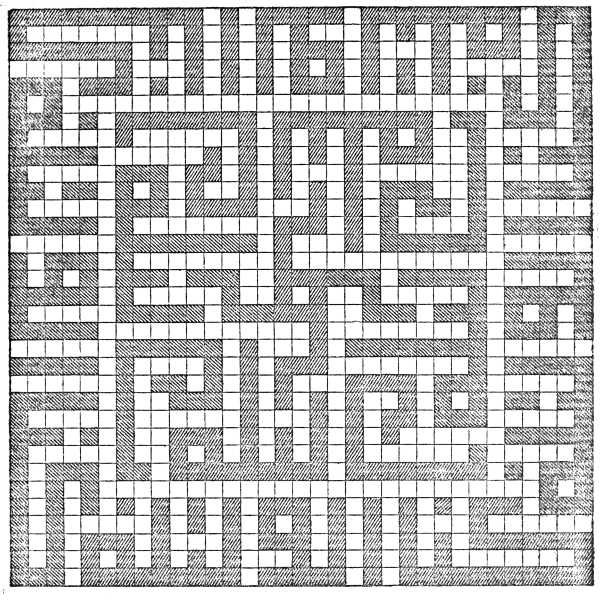
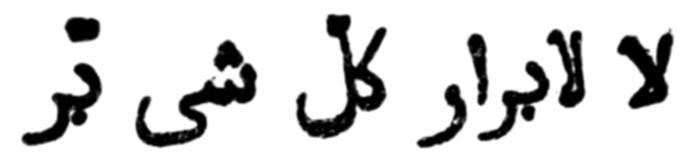
"TO THE PURE ALL THINGS ARE PURE."
(Puris omnia pura)
—Arab Proverb.
"Niuna corrotta mente intese mai sanamente parole."
—"Decameron"—conclusion.
"Erubuit, posuitque meum Lucretia librum
Sed coram Bruto. Brute! recede, leget."
—Martial.
"Mieulx est de ris que de larmes escripre,
Pour ce que rire est le propre des hommes."
—Rabelais.
"The pleasure we derive from perusing the Thousand-and-One Stories makes us regret that we possess only a comparatively small part of these truly enchanting fictions."
—Crichton's "History of Arabia."
 PLAIN AND LITERAL TRANSLATION OF THE ARABIAN NIGHTS ENTERTAINMENTS. NOW ENTITULED
THE BOOK OF THE
Thousand Nights and a Night
WITH INTRODUCTION EXPLANATORY NOTES ON THE MANNERS AND CUSTOMS OF MOSLEM MEN AND A TERMINAL ESSAY UPON THE HISTORY OF THE NIGHTS
VOLUME II.
BY
RICHARD F. BURTON

PRINTED BY THE BURTON CLUB FOR PRIVATE SUBSCRIBERS ONLY
Shammar Edition
Limited to one thousand numbered sets, of which this is
Number 547
Printed in U. S. A.

VICTORIA INSTITUTIONS
Aaradhana, Deverkovil 673508
India
admn@victoria.org.in
admn@victoriainstitutions.com
Telegram: https://t.me/VICTORIA_INSTITUTIONS
Printed versions of all books are available here.
All books in webpage versions are available here.
Contents
To JOHN PAYNE, Esq.
ETC. ETC. ETC.
My dear Sir,
Allow me, thus publicly to express my admiration of your magnum opus, "The Book of the Thousand Nights and One Night;" and to offer you my cordial thanks for honouring me with the dedication of that scholar-like and admirable version.
Ever yours sincerely,
RICHARD F. BURTON.
Queen's College, Oxford
August 1, 1885.
CONTENTS OF THE SECOND VOLUME.
|
|
|
|
|
PAGE |
|
|
||||
|
7. NUR AL-DIN ALI AND THE DAMSEL ANIS AL-JALIS. |
||||
|
(Lane, Chapt. VI. Story of Noor ed-Deen and Enees el-Jelees: vol. I. p. 436.) |
|
|||
|
|
||||
|
|
||||
|
8. TALE OF GHANIM BIN AYYUB, THE DISTRAUGHT, THE THRALL O' LOVE |
||||
|
(Lane, Chapt. VII. Story of Ghanim the Son of Eiyoob, the Distracted Slave of Love: p. 487.) |
|
|||
|
|
||||
|
|
a. |
Tale of the First Eunuch, Bukhayt |
||
|
|
||||
|
|
b. |
Tale of the Second Eunuch, Kafur |
||
|
(Story of the Slave Kafoor: p. 491.) |
|
|||
|
|
||||
|
|
||||
|
9. TALE OF KING OMAR BIN AL-NU'UMAN AND HIS SONS SHARRKAN AND ZAU AL-MAKAN |
||||
|
|
||||
|
|
a. |
Tale of Taj al-Muluk and the Princess Dunya |
||
|
(Lane, Chapt. VIII. Story of Taj el-Mulook and the Lady Dunya: p. 523.) |
|
|||
|
|
||||
|
|
|
aa. |
Tale of Aziz and Azizah |
|
|
|
||||
|
(Lane, Chapt. VIII. Story of Azeez and Azeezah: p. 535.) |
|
|||
NUR AL-DIN ALI AND THE DAMSEL ANIS AL-JALIS
Quoth Shahrazad:—It hath reached me, O auspicious King of intelligence penetrating, that there was, amongst the Kings of Bassorah, a King who loved the poor and needy and cherished his lieges, and gave of his wealth to all who believed in Mohammed (whom Allah bless and assain!), and he was even as one of the poets described him:—
A King who when hosts of the foe invade, ✿ Receives them with lance-lunge and sabre-sway;
Writes his name on bosoms in thin red lines, ✿ And scatters the horsemen in wild dismay.
2His name was King Mohammed bin Sulayman al-Zayni, and he had two Wazirs, one called Al-Mu'in, son of Sawi and the other Al-Fazl son of Khákán. Now Al-Fazl was the most generous of the people of his age, upright of life, so that all hearts united in loving him and the wise flocked to him for counsel; whilst the subjects used to pray for his long life, because he was a compendium of the best qualities, encouraging the good and lief, and preventing evil and mischief. But the Wazir Mu'in bin Sawi on the contrary hated folk and loved not the good and was a mere compound of ill; even as was said of him:—
Hold to nobles, sons of nobles! 'tis ever Nature's test ✿ That nobles born of nobles shall excel in noble deed:
And shun the mean of soul, meanly bred, for 'tis the law, ✿ Mean deeds come of men who are mean of blood and breed.
And as much as the people loved and fondly loved Al-Fazl bin Khakan, so they hated and thoroughly hated the mean and miserly Mu'in bin Sawi. It befel one day by the decree of the Decreer, that King Mohammed bin Sulayman al-Zayni, being seated on his throne with his officers of state about him, summoned his Wazir Al-Fazl and said to him, "I wish to have a slave-girl of passing beauty, perfect in loveliness, exquisite in symmetry and endowed with all praiseworthy gifts." Said the courtiers, "Such a girl is not to be bought for less than ten thousand gold pieces:" whereupon the Sultan called out to his treasurer and said, "Carry ten thousand dinars to the house of Al-Fazl bin Khakan." The treasurer did the King's bidding; and the Minister went away, after receiving the royal charge to repair to the slave-bazar every day, and entrust to brokers the matter aforesaid. Moreover the King issued orders that girls worth above a thousand gold pieces should not be bought or sold without being first displayed to the Wazir. Accordingly no broker purchased a slave-girl ere she had been paraded before the minister; but none pleased him, till one day a 3dealer came to the house and found him taking horse and intending for the palace. So he caught hold of his stirrup saying:—
O thou, who givest to royal state sweet savour, ✿ Thou'rt a Wazir shalt never fail of favour!
Dead Bounty thou hast raised to life for men; ✿ Ne'er fail of Allah's grace such high endeavour!
Then quoth he, "O my lord, that surpassing object for whom the gracious mandate was issued is at last found;" and quoth the Wazir, "Here with her to me!" So he went away and returned after a little, bringing a damsel in richest raiment robed, a maid spear-straight of stature and five feet tall; budding of bosom with eyes large and black as by Kohl traced, and dewy lips sweeter than syrup or the sherbet one sips, a virginette smooth cheeked and shapely faced, whose slender waist with massive hips was engraced; a form more pleasing than branchlet waving upon the topmost trees, and a voice softer and gentler than the morning breeze, even as saith one of those who have described her:—
Strange is the charm which dights her brows like Luna's disk that shine; ✿ O sweeter taste than sweetest Robb or raisins of the vine.
A throne th' Empyrean keeps for her in high and glorious state, ✿ For wit and wisdom, wandlike form and graceful bending line:
She in the Heaven of her face the seven-fold stars displays, ✿ That guard her cheeks as satellites against the spy's design:
If man should cast a furtive glance or steal far look at her, ✿ His heart is burnt by devil-bolts shot by those piercing eyne.
When the Wazir saw her she made him marvel with excess of admiration, so he turned, perfectly pleased, to the broker and asked, "What is the price of this girl?"; whereto he answered, "Her market-value stands at ten thousand dinars, but her owner swears that this sum will not cover the cost of the chickens she hath eaten, the wine she hath drunken and the dresses of honour bestowed upon her instructor: for she hath learned calligraphy and syntax and etymology; the commentaries of the Koran; the principles of law and religion; the canons of medicine, and the calendar and the art of playing on musical instruments." Said the Wazir, "Bring me her master." So the broker brought him at once and, 4behold, he was a Persian of whom there was left only what the days had left; for he was as a vulture bald and scald and a wall trembling to its fall. Time had buffetted him with sore smart, yet was he not willing this world to depart; even as said the poet:—
Time hath shattered all my frame, ✿ Oh! how time hath shattered me.
Time with lordly might can tame ✿ Manly strength and vigour free.
Time was in my youth, that none ✿ Sped their way more fleet and fast:
Time is and my strength is gone, ✿ Youth is sped, and speed is past.
The Wazir asked him, "Art thou content to sell this slave-girl to the Sultan for ten thousand dinars?"; and the Persian answered, "By Allah, if I offered her to the King for naught, it were but my devoir," So the Minister bade bring the monies and saw them weighed out to the Persian, who stood up before him and said, "By the leave of our lord the Wazir, I have somewhat to say;" and the Wazir replied, "Out with all thou hast!" "It is my opinion," continued the slave-dealer, "that thou shouldst not carry the maid to the King this day; for she is newly off a journey; the change of air hath affected her and the toils of trouble have fretted her. But keep her quiet in thy palace some ten days, that she may recover her looks and become again as she was. Then send her to the Hammam and clothe her in the richest of clothes and go up with her to the Sultan: this will be more to thy profit." The Wazir pondered the Persian's words and approved of their wisdom; so he carried her to his palace, where he appointed her private rooms, and allowed her every day whatever she wanted of meat and drink and so forth. And on this wise she abode a while. Now the Wazir Al-Fazl had a son like the full moon when sheeniest dight, with face radiant in light, cheeks ruddy bright, and a mole like a dot of ambergris on a downy site; as said of him the poet and said full right:—
5A moon which blights you if you dare behold; ✿ A branch which folds you in its waving fold:
Locks of the Zanj and golden glint of hair; ✿ Sweet gait and form a spear to have and hold:
Ah! hard of heart with softest slenderest waist, ✿ That evil to this weal why not remould?
Were thy form's softness placed in thy heart, ✿ Ne'er would thy lover find thee harsh and cold:
Oh thou accuser! be my love's excuser, ✿ Nor chide if love-pangs deal me woes untold!
I bear no blame; 'tis all my heart and eyne; ✿ So leave thy blaming, let me yearn and pine.
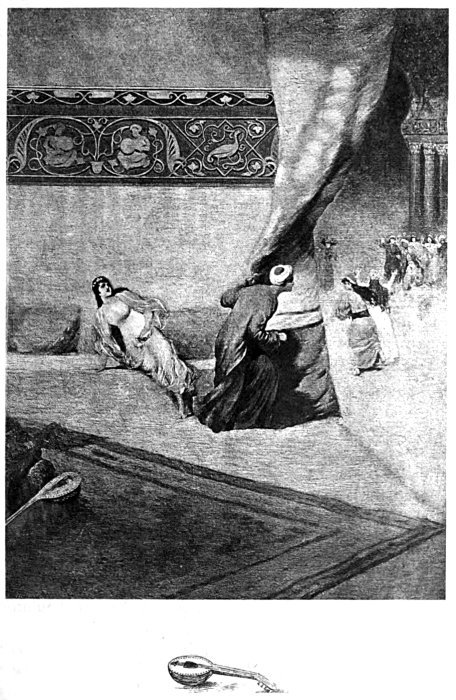
Now the handsome youth knew not the affair of the damsel; and his father had enjoined her closely, saying, "Know, O my daughter, that I have bought thee as a bedfellow for our King, Mohammed bin Sulayman al-Zayni; and I have a son who is a Satan for girls and leaves no maid in the neighbourhood without taking her maidenhead; so be on thy guard against him and beware of letting him see thy face or hear thy voice." "Hearkening and obedience," said the girl; and he left her and fared forth. Some days after this it happened by decree of Destiny, that the damsel repaired to the baths in the house, where some of the slave women bathed her; after which she arrayed herself in sumptuous raiment; and her beauty and loveliness were thereby redoubled. Then she went in to the Wazir's wife and kissed her hand; and the dame said to her, "Naiman! May it benefit thee, O Anis al-Jalis! Are not our baths handsome?" "O my mistress," she replied, "I lacked naught there save thy gracious presence." Thereupon the lady said to her slave-women, "Come with us to the Hammam, 6for it is some days since we went there:" they answered, "To hear is to obey!" and rose and all accompanied her. Now she had set two little slave-girls to keep the door of the private chamber wherein was Anis al-Jalis and had said to them, "Suffer none go in to the damsel." Presently, as the beautiful maiden sat resting in her rooms, suddenly came in the Wazir's son whose name was Nur al-Din Ali, and asked after his mother and her women, to which the two little slave-girls replied, "They are in the Hammam." But the damsel, Anis al-Jalis, had heard from within Nur al-Din Ali's voice and had said to herself, "O would Heaven I saw what like is this youth against whom the Wazir warned me, saying that he hath not left a virgin in the neighbourhood without taking her virginity: by Allah, I do long to have sight of him!" So she sprang to her feet with the freshness of the bath on her and, stepping to the door, looked at Nur al-Din Ali and saw a youth like the moon in its full and the sight bequeathed her a thousand sighs. The young man also glanced at her and the look made him heir to a thousand thoughts of care; and each fell into Love's ready snare.
Now when it was the Thirty-fifth Night,
She continued, It hath reached me, O auspicious King, that the Wazir said to his wife, "Wottest thou not that yonder standeth our enemy Al-Mu'in bin Sawi who, as soon as he hears of this matter will go up to the Sultan and say to him:—Thy Wazir 8who, thou wilt have it loveth thee, took from thee ten thousand ducats and bought therewith a slave-girl whose like none ever beheld; but when he saw her, she pleased him and he said to his son:—Take her: thou art worthier of her than the Sultan. So he took her and did away with her virginity and she is now in his house. The King will say:—Thou liest! to which he will reply:—With thy leave I will fall upon him unawares and bring her to thee. The King will give him warranty for this and he will come down upon the house and will take the girl and present her to the Sultan, who will question her and she will not be able to deny the past. Then mine enemy will say:—O my lord, thou wottest that I give thee the best of counsel; but I have not found favour in thine eyes. Thereupon the Sultan will make an example of me, and I shall be a gazing-stock to all the people and my life will be lost." Quoth his wife, "Let none know of this thing which hath happened privily, and commit thy case to Allah and trust in Him to save thee from such strait; for He who knoweth the future shall provide for the future." With this she brought the Wazir a cup of wine and his heart was quieted, and he ceased to feel wrath and fear.
9Forgive me! thee-ward sinned I, but the wise ✿ Ne'er to the sinner shall deny his grace:
Thyfoe may pardon sue when lieth he ✿ In lowest, and thou holdest highest place!"
Thereupon the Wazir rose from off his son's breast saying, "I forgive thee!"; for his heart yearned to him; and the youth kissed the hand of his sire who said, "O my son, were I sure that thou wouldest deal justly by Anis al-Jalis, I would give her to thee." "O my father, what justice am I to do to her?" "I enjoin thee, O my son, not to take another wife or concubine to share with her, nor sell her." "O my father! I swear to thee that verily I will not do her injustice in either way." Having sworn to that effect Nur al-Din went in to the damsel and abode with her a whole year, whilst Allah Almighty caused the King to forget the matter of the maiden; and Al-Mu'in, though the affair came to his ears, dared not divulge it by reason of the high favour in which his rival stood with the Sultan. At the end of the year Al-Fazl went one day to the public baths; and, as he came out whilst he was still sweating, the air struck him and he caught a cold which turned to a fever; then he took to his bed. His malady gained ground and restlessness was longsome upon him and weakness bound him like a chain; so he called out, "Hither with my son;" and when Nur al-Din Ali came he said to him, "O my son, know that man's lot and means are distributed and decreed; and the end of days by all must be dree'd; and that every soul drain the cup of death is nature's need." Then he repeated these lines:—
I die my death, but He alone is great who dieth not! ✿ And well I wot, soon shall I die, for death was made my lot:
A King there's not that dies and holds his kingdom in his hand, ✿ For Sovranty the Kingdom is of Him who dieth not.
Then he continued, "O my son, I have no charge to leave thee save that thou fear Allah and look to the issues of thine acts and bear in mind my injunctions anent Anis al-Jalis." "O my father!" said Nur al-Din, "who is like unto thee? Indeed thou art famed for well doing and preachers offer prayers for thee in their pulpits!" Quoth Al-Fazl, "O my son, I hope that Allah Almighty may grant 10me acceptance!" Then he pronounced the Two Testimonies, or Professions of the Faith, and was recorded among the blessed. The palace was filled with crying and lamentation and the news of his death reached the King, and the city-people wept, even those at their prayers and women at household cares and the schoolchildren shed tears for Bin-Khakan. Then his son Nur al-Din Ali arose and made ready his funeral, and the Emirs and Wazirs and high Officers of State and city-notables were present, amongst them the Wazir al-Mu'in bin Sawi. And as the bier went forth from the house some one in the crowd of mourners began to chant these lines:—
On the fifth day I quitted all my friends for evermore, ✿ And they laid me out and washed me on a slab without my door:
They stripped me of the clothes I was ever wont to wear, ✿ And they clothed me in the clothes which till then I never wore.
On four men's necks they bore me and carried me from home ✿ To chapel; and some prayed for him on neck they bore:
They prayed for me a prayer that no prostration knows; ✿ They prayed for me who praised me and were my friends of yore;
And they laid me in a house with a ceiling vaulted o'er, ✿ And Time shall be no more ere it ope to me its door.
When they had shovelled in the dust over him and the crowd had dispersed, Nur al-Din returned home and he lamented with sobs and tears; and the tongue of the case repeated these couplets:—
On the fifth day at even-tide they went away from me: ✿ I farewelled them as faring they made farewell my lot:
But my spirit as they went, with them went and so I cried, ✿ "Ah return ye!" but replied she, "Alas! return is not
To a framework lere and lorn that lacketh blood and life, ✿ A frame whereof remaineth naught but bones that rattle and rot:
Mine eyes are blind and cannot see quencht by the flowing tear! ✿ Mine ears are dull and lost to sense: they have no power to hear!"
He abode a long time sorrowing for his father till, one day, as he was sitting at home, there came a knocking at the door; so he rose in haste and opening let in a man, one of his father's intimates and who had been the Wazir's boon-companion. The visitor kissed 11Nur al-Din's hand and said to him, "O my lord, he who hath left the like of thee is not dead; and this way went also the Chief of the Ancients and the Moderns. O my lord Ali, be comforted and leave sorrowing." Thereupon Nur al-Din rose and going to the guest-saloon transported thither all he needed. Then he assembled his companions and took his handmaid again; and, collecting round him ten of the sons of the merchants, began to eat meat and drink wine, giving entertainment after entertainment and lavishing his presents and his favours. One day his Steward came to him and said, "O my lord Nur al-Din, hast thou not heard the saying, Whoso spendeth and reckoneth not, to poverty wendeth and recketh not?" And he repeated what the poet wrote:—
I look to my money and keep it with care, ✿ For right well I wot 'tis my buckler and brand:
Did I lavish my dirhams on hostilest foes, ✿ I should truck my good luck by mine ill luck trepanned:
So I'll eat it and drink it and joy in my wealth; ✿ And no spending my pennies on others I'll stand:
I will keep my purse close 'gainst whoever he be; ✿ And a niggard in grain a true friend ne'er I fand:
Far better deny him than come to say:—Lend, ✿ And five-fold the loan shall return to thy hand!
And he turns face aside and he sidles away, ✿ While I stand like a dog disappointed, unmanned.
Oh, the sorry lot his who hath yellow-boys none, ✿ Though his genius and virtues shine bright as the sun!
"O my master," continued the Steward, "this lavish outlay and these magnificent gifts waste away wealth." When Nur al-Din Ali heard these words he looked at his servant and cried, "Of all thou hast spoken I will not heed one single word, for I have heard the saying of the poet who saith;—
An my palm be full of wealth and my wealth I ne'er bestow, ✿ A palsy take my hand and my foot ne'er rise again!
Show me niggard who by niggardise e'er rose to high degree, ✿ Or the generous in gifts generosity hath slain."
12And he pursued, "Know, O Steward, it is my desire that so long as thou hast money enough for my breakfast, thou trouble me not with taking thought about my supper." Thereupon the Steward asked, "Must it be so?"; and he answered, "It must." So the honest man went his way and Nur al-Din Ali devoted himself to extravagance; and, if any of his cup-companions chanced to say, "This is a pretty thing;" he would reply, "'Tis a gift to thee!"; or if another said, "O my lord, such a house is handsome;" he would answer, "Take it: it is thine!" After this reckless fashion he continued to live for a whole year, giving his friends a banquet in the morning and a banquet in the evening and a banquet at midnight, till one day, as the company was sitting together, the damsel Anis al-Jalis repeated these lines:
Thou deemedst well of Time when days went well, ✿ And fearedst not what ills might deal thee Fate:
Thy nights so fair and restful cozened thee, ✿ For peaceful nights bring woes of heavy weight.
When she had ended her verse behold, somebody knocked at the door. So Nur al-Din rose to open it and one of his boon-companions followed him without being perceived. At the door he found his Steward and asked him, "What is the matter?"; and he answered, "O my lord, what I dreaded for thee hath come to pass!" "How so?" "Know that there remains not a dirham's worth, less or more in my hands. Here are my Daftars and account books showing both income and outlay and the registers of thine original property." When Nur al-Din heard these words he bowed his head and said, "There is no Majesty and there is no Might save in Allah!" When the man who had followed him privily to spy on him heard the Steward's words, he returned to his friends and warned them saying, "Look ye well to what ye do: Nur al-Din is penniless;" and, as the young host came back to his guests, vexation showed itself in his face. Thereupon one of the intimates rose; and, looking at the entertainer, said to him, "O my lord, may be thou wilt give me leave to retire?" "And why so early retirement this day?"; asked he and the other answered him, "My wife is in child-birth and I may not be absent from her: indeed I must return and see how she does." So he gave him leave, whereupon another rose and said, "O my lord Nur al-Din, I wish now to 13go to my brother's for he circumciseth his son to day." In short each and every asked permission to retire on some pretence or other, till all the ten were gone leaving Nur al-Din alone. Then he called his slave-girl and said to her, "O Anis al-Jalis, hast thou seen what case is mine?" And he related to her what the Steward had told him. Then quoth she, "O my lord, for many nights I had it in my mind to speak with thee of this matter, but I heard thee repeating:—
When the World heaps favours on thee, pass on ✿ Thy favours to friends ere her hand she stay:
Largesse never let her when fain she comes, ✿ Nor niggardise kept her from turning away!"
"When I heard these verses I held my peace and cared not to exchange a word with thee." "O Anis al-Jalis," said Nur al-Din, "thou knowest that I have not wasted my wealth save on my friends, especially these ten who have now left me a pauper, and I think they will not abandon and desert me without relief." "By Allah," replied she, "they will not profit thee with aught of aid." Said he, "I will rise at once and go to them and knock at their doors; it may be I shall get from them somewhat wherewith I may trade and leave pastime and pleasuring." So he rose without stay or delay, and repaired to a street wherein all his ten friends lived. He went up to the nearest door and knocked; whereupon a handmaid came out and asked him, "Who art thou?"; and he answered, "Tell thy master that Nur al-Din Ali standeth at the door and saith to him:—Thy slave kisseth thy hand and awaiteth thy bounty." The girl went in and told her master, who cried at her, "Go back and say:—My master is not at home." So she returned to Nur al-Din, and said to him, "O my lord, my master is out." Thereupon he turned away and said to himself, "If this one be a whoreson knave and deny himself, another may not prove himself 14such knave and whoreson." Then he went up to the next door and sent in a like message to the house-master, who denied himself as the first had done, whereupon he began repeating:—
He is gone who when to his gate thou go'st, ✿ Fed thy famisht maw with his boiled and roast.
When he had ended his verse he said, "By Allah, there is no help but that I make trial of them all: perchance there be one amongst them who will stand me in the stead of all the rest." So he went the round of the ten, but not one of them would open his door to him or show himself or even break a bit of bread before him; whereupon he recited:—
Like a tree is he who in wealth doth wone, ✿ And while fruits he the folk to his fruit shall run:
But when bared the tree of what fruit it bare, ✿ They leave it to suffer from dust and sun.
Perdition to all of this age! I find ✿ Ten rogues for every righteous one.
Then he returned to his slave-girl and his grief had grown more grievous and she said to him, "O my lord, did I not tell thee, none would profit thee with aught of aid?" And he replied, "By Allah, not one of them would show me his face or know me!" "O my lord," quoth she, "sell some of the moveables and household stuff, such as pots and pans, little by little; and expend the proceeds until Allah Almighty shall provide." So he sold all of that was in the house till nothing remained when he turned to Anis al-Jalis and asked her "What shall we do now?"; and she answered, "O my lord, it is my advice that thou rise forthwith and take me down to the bazar and sell me. Thou knowest that thy father bought me for ten thousand dinars: haply Allah may open thee a way to get the same price, and if it be His will to bring us once more together, we shall meet again." "O Anis al-Jalis," cried he, "by Allah it is no light matter for me to be parted from thee for a single hour!" "By Allah, O my lord," she replied, nor is it easy to me either, but Need hath its own law, as the poet said:—
Need drives a man into devious roads, ✿ And pathways doubtful of trend and scope:
No man to a rope will entrust his weight, ✿ Save for cause that calleth for case of rope.
15Thereupon he rose to his feet and took her, whilst the tears rolled down his cheek like rain; and he recited with the tongue of the case these lines:—
Stay! grant one parting look before we part, ✿ Nerving my heart this severance to sustain:
But, an this parting deal thee pain and bane, ✿ Leave me to die of love and spare thee pain!
Then he went down with her to the bazar and delivered her to the broker and said to him, "O Hájj Hasan, I pray thee note the value of her thou hast to cry for sale." "O my lord Nur al-Din," quoth the broker, "the fundamentals are remembered;" adding, "Is not this the Anis al-Jalis whom thy father bought of me for ten thousand dinars?" "Yes," said Nur al-Din. Thereupon the broker went round to the merchants, but found that all had not yet assembled. So he waited till the rest had arrived and the market was crowded with slave-girls of all nations, Turks, Franks and Circassians; Abyssinians, Nubians and Takrúrís; Tartars, Georgians and others; when he came forward and standing cried aloud, "O merchants! O men of money! every round thing is not a walnut and every long thing a banana is not; all reds are not meat nor all whites fat, nor is every brown thing a date! O merchants, I have here this union-pearl that hath no price: at what sum shall I cry her?" "Cry her at four thousand five hundred dinars," quoth one of the traders. The broker opened the door of sale at the sum named and, as he was yet calling, lo!
Shall the World oppress me when thou art in't? ✿ In the lion's presence shall wolves devour?
Shall the dry all drink of thy tanks and I ✿ Under rain-cloud thirst for the cooling shower?
"O my lord," cried he, "the like will befal every one who loveth and serveth thee well." "Be quick with thee," quoth the Sultan, "and tell me how this came to pass and who did this deed by one whose honour is part of my honour." Quoth the Wazir, "Know, O my lord, that I went out this day to the slave-market to buy me a cookmaid, when I saw there a damsel, never in my life long saw I a fairer; and I designed to buy her for our lord the Sultan; so I asked the broker of her and of her owner, and he answered, "She belongeth to Ali son of Al-Fazl bin Khakan. Some time ago our lord the Sultan gave his father ten thousand dinars wherewith to buy him a handsome slave-girl, and he bought this maiden who pleased him; so he grudged her to our lord the Sultan and gave her to his own son. When the father died, the son sold all he had of houses and gardens and household gear, and squandered the price till he was penniless. Then he brought the girl to the market that he might sell her, and he handed her over to the broker to cry and the merchants bid higher and higher on her, until her price 19reached four thousand dinars; whereupon quoth I to myself:—I will buy this damsel for our lord the Sultan, whose money was paid for her. So I said to Nur al-Din:—O my son, sell her to me for four thousand dinars. When he heard my words he looked at me and cried:—O ill-omened oldster, I will sell her to a Jew or to a Nazarene, but I will not sell her to thee! I do not buy her for myself, said I, I buy her for our lord and benefactor the Sultan.
Fly, fly with thy life if by ill overtaken!
Let thy house speak thy death by its builder forsaken!
For a land else than this land thou may'st reach, my brother,
But thy life tho'lt ne'er find in this world another.
20"O Alam al-Din what cheer?" asked Nur al-Din, and he answered, "Rise quickly and fly for thy life, thou and the damsel; for Al-Mu'in hath set a snare for you both; and, if you fall into his hands, he will slay you. The Sultan hath despatched forty sworders against you and I counsel you to flee ere harm can hurt you." Then Sanjar put his hand to his purse and finding there forty gold pieces took them and gave them to Nur al-Din, saying, "O my lord receive these and journey with them. Had I more I would give them to thee, but this is not the time to take exception." Thereupon Nur al-Din went in to the damsel and told her what had happened, at which she wrung her hands. Then they fared forth at once from the city, and Allah spread over them His veil of protection, so that they reached the river-bank where they found a vessel ready for sea. Her skipper was standing amidships and crying, "Whoso hath aught to do, whether in the way of provisioning or taking leave of his people; or whoso hath forgotten any needful thing, let him do it at once and return, for we are about to sail"; and all of them saying, "There is naught left to be done by us, O captain!", he cried to his crew, "Hallo there! cast off the cable and pull up the mooring-pole!" Quoth Nur al-Din, "Whither bound, O captain?" and quoth he, "To the House of Peace, Baghdad,"——And Shahrazad perceived the dawn of day and ceased to say her permitted say.
Now when it was the Thirty-sixth Night,
She said, It hath reached me, O auspicious King, that when the skipper answered, "To the House of Peace, Baghdad," Nur al-Din Ali and the damsel went on board, and they launched the craft and shook out the sails, and the ship sped forth as though she were a bird on wing; even as said one of them and said right well:—
Watch some tall ship, she'll joy the sight of thee, ✿ The breeze outstripping in her haste to flee;
As when a bird, with widely-spreading wings, ✿ Leaveth the sky to settle on the sea.
21So the vessel sailed on her fastest and the wind to her was fairest. Thus far concerning them; but as regards the Mamelukes, they went to Nur al-Din's mansion and, breaking open the doors, entered and searched the whole place, but could find no trace of him and the damsel; so they demolished the house and, returning to the Sultan, reported their proceedings; whereupon quoth he, "Make search for them both, wherever they may be;" and they answered, "Hearing is obeying." The Wazir Al-Mu'in had also gone home after the Sultan had bestowed upon him a robe of honour, and had set his heart at rest by saying, "None shall take blood-wreak for thee save I;" and he had blessed the King and prayed for his long life and prosperity. Then the Sultan bade proclaim about the city, "Oyez, O ye lieges one and all! It is the will of our lord the Sultan that whoso happeneth on Nur al-Din Ali son of Al-Fazl bin Khakan, and bringeth him to the Sultan, shall receive a robe of honour and one thousand gold pieces; and he who hideth him or knoweth his abiding place and informeth not, deserveth whatsoever pains and penalties shall befal him." So all began to search for Nur al-Din Ali, but they could find neither trace nor tidings of him. Meanwhile he and his handmaid sailed on with the wind right aft, till they arrived in safety at Baghdad, and the captain said to them, "This is Baghdad and 'tis the city where security is to be had: Winter with his frosts hath turned away and Prime hath come his roses to display; and the flowers are a-glowing and the trees are blowing and the streams are flowing." So Nur al-Din landed, he and his handmaid and, giving the captain five dinars, walked on a little way till the decrees of Destiny brought them among the gardens, and they came to a place swept and sprinkled, with benches along the walls and hanging jars filled with water. Overhead was a trellis of reed-work and canes shading the whole length of the avenue, and at the upper end was a garden gate, but this was locked. "By Allah," quoth Nur al-Din to the damsel, "right pleasant is this place!"; and she replied, "O my lord sit with me a while on this bench and let us take our ease." So they mounted and sat them down on the bench, after which they washed their faces and hands; and the breeze blew cool on them and they fell asleep and glory be to Him who never sleepeth!
Now when it was the Thirty-seventh Night,
She said, It hath reached me, O auspicious King, that Nur al-Din sat upright and said, "Ho, Shaykh Ibrahim, what is this? Did I not adjure thee a while ago and thou refusedst, saying:—What, I! 'tis thirteen years ago since I have done such a thing!" "By Allah," quoth the Shaykh (and indeed he was abashed), "no sin of mine this, she forced me to do it." Nur al-Din laughed and they sat down again to wine and wassail, but the damsel turned to her master and said in a whisper, "O my lord, drink and do not press him, that I may show thee some sport with him." Then she began to fill her master's cup and he hers and so they did time after time, till at last Shaykh Ibrahim looked at them and said, "What fashion of good fellowship is this? Allah curse the glutton who keepeth the cup to himself! Why dost thou not give me to drink, O my brother? What manners 27are these, O blessed one?" At this the two laughed until they fell on their backs; then they drank and gave him to drink and ceased not their carousal till a third part of the night was past. Then said the damsel, "O Shaykh Ibrahim, with thy leave I will get up and light one of these candles." "Do so," he replied, "but light no more than one." So she sprang to her feet and, beginning with one candle, lighted all the eighty and sat down again.
Round with big and little, the bowl and cup, ✿ Take either that moon in his sheen hath crowned:
Nor drink without music, for oft I've seen, ✿ The horse drink best to the whistle's sound!
When the Caliph saw this, the vein of wrath started up between his eyes and he came down and said to the Wazir, "O Ja'afar, never beheld I yet men of piety in such case; so do thou mount this tree and look upon them, lest the blessings of the blest be lost to thee." Ja'afar, hearing the words of the Commander of the Faithful and being confounded by them, climbed to the tree-top and looking in, saw Nur al-Din and the damsel, and Shaykh Ibrahim holding in his hand a brimming bowl. At this sight he made sure of death and, descending, stood before the Commander of the Faithful, who said to him, "O Ja'afar, praise be to Allah who hath made us of those that observe external ordinances of Holy Law and hath averted from us the sin of disguising ourselves after the manner of hypocrites!" But Ja'afar could not speak a word for excess of confusion; so the Caliph looked at him and said, "I wonder how they came hither, and who admitted them into my pavilion! But aught like the beauty of this youth and this damsel my eyes never yet saw!" "Thou sayest sooth, O our Lord the Sultan!" replied Ja'afar (and he hoped to propitiate the Caliph Harun al-Rashid). Then quoth the Caliph, "O Ja'afar, let us both mount the branch opposite the window, that we may 30amuse ourselves with looking at them." So the two climbed the tree and, peering in, heard Shaykh Ibrahim say, "O my lady, I have cast away all gravity mine by the drinking of wine, but 'tis not sweet save with the soft sounds of the lute-strings it combine." "By Allah," replied Anis al-Jalis, "O Shaykh Ibrahim, an we had but some instrument of music our joyance were complete." Hearing this he rose to his feet and the Caliph said to Ja'afar, "I wonder what he is about to do!" and Ja'afar answered, "I know not." The Shaykh disappeared and presently reappeared bringing a lute; and the Caliph took note of it and knew it for that of Abu Ishak the Cup-companion. "By Allah," said the Caliph, "if this damsel sing ill I will crucify all of you; but if she sing well I will forgive them and only gibbet thee." "O Allah cause her to sing vilely!" quoth Ja'afar. Asked the Caliph, "Why so?"; and he answered, "If thou crucify us all together, we shall keep one another company." The Caliph laughed at his speech. Presently the damsel took the lute and, after looking at it and tuning it, she played a measure which made all hearts yearn to her; then she sang these lines:—
O ye that can aid me, a wretched lover, ✿ Whom longing burns nor can rest restore me!
Though all you have done I have well deserved, ✿ I take refuge with you, so exult not o'er me:
True, I am weak and low and vile, ✿ But I'll bear your will and whatso you bore me:
My death at your hands what brings it of glory? ✿ I fear but your sin which of life forlore me!
Quoth the Caliph, "By Allah, good! O Ja'afar, never in my life have I heard a voice so enchanting as this." "Then haply the Caliph's wrath hath passed away," said Ja'afar, and he replied, "Yes, 'tis gone." Thereupon they descended from the tree, and the Caliph said to Ja'afar, "I wish to go in and sit with them and hear the damsel sing before me." "O Commander of the Faithful," replied Ja'afar, "if thou go in to them they will be terribly troubled, and Shaykh Ibrahim will assuredly die of fright." But the Caliph answered, "O Ja'afar, thou must teach me some device wherewith to delude them and whereby I can foregather with them 31without their knowing me." So they walked towards the Tigris pondering the matter, and presently came upon a fisherman who stood fishing under the pavilion windows. Now some time before this, the Caliph (being in the pavilion) had called to Shaykh Ibrahim and asked him, "What noise is this I hear under the windows?" and he had answered, "It is voices of fisher folk catching fish:" so quoth the Caliph, "Go down and forbid them this place;" and he forbade them accordingly. However that night a fisherman named Karim, happening to pass by and seeing the garden gate open, said to himself, "This is a time of negligence; and I will take advantage of it to do a bit of fishing." So he took his net and cast it, but he had hardly done so when behold, the Caliph came up single-handed and, standing hard by, knew him and called aloud to him, "Ho, Karim!" The fisherman, hearing himself named, turned round, and seeing the Caliph, trembled and his side-muscles quivered, as he cried, "By Allah, O Commander of the Faithful, I did it not in mockery of the mandate; but poverty and a large family drove me to what thou seest!" Quoth the Caliph, "Make a cast in my name." At this the fisherman was glad and going to the bank threw his net, then waiting till it had spread out at full stretch and settled down, hauled it up and found in it various kinds of fish. The Caliph was pleased and said, "O Karim, doff thy habit." So he put off a gaberdine of coarse woollen stuff patched in an hundred places whereon the lice were rampant, and a turband which had never been untwisted for three years but to which he had sewn every rag he came upon. The Caliph also pulled off his person two vests of Alexandrian and Ba'lbak silk, a loose inner robe and a long-sleeved outer coat, and said to the fisherman, "Take them and put them on," while he assumed the foul gaberdine and filthy turband and drew a corner of the head-cloth as a mouth-veil before his face. Then said he to the fisherman, "Get thee about thy business!"; and the man kissed the Caliph's feet and thanked him and improvised the following couplets:—
32Thou hast granted more favours than ever I craved; ✿ Thou hast satisfied needs which my heart enslaved:
I will thank thee and thank whileas life shall last, ✿ And my bones will praise thee in grave engraved!
Hardly had the fisherman ended his verse, when the lice began to crawl over the Caliph's skin, and he fell to catching them on his neck with his right and left and throwing them from him, while he cried, "O fisherman, woe to thee! what be this abundance of lice on thy gaberdine." "O my lord," replied he, "they may annoy thee just at first, but before a week is past thou wilt not feel them nor think of them." The Caliph laughed and said to him, "Out on thee! Shall I leave this gaberdine of thine so long on my body?" Quoth the fisherman, "I would say a word to thee but I am ashamed in presence of the Caliph!"; and quoth he, "Say what thou hast to say." "It passed through my thought, O Commander of the Faithful," said the fisherman, "that, since thou wishest to learn fishing so thou mayest have in hand an honest trade whereby to gain thy livelihood, this my gaberdine besitteth thee right well." The Commander of the Faithful laughed at this speech, and the fisherman went his way. Then the Caliph took up the basket of fish and, strewing a little green grass over it, carried it to Ja'afar and stood before him. Ja'afar thinking him to be Karim the fisherman feared for him and said, "O Karim, what brought thee hither? Flee for thy life, for the Caliph is in the garden to-night and, if he see thee, thy neck is gone." At this the Caliph laughed and Ja'afar recognized him and asked, "Can it be thou, our lord the Sultan?"; and he answered, "Yes, O Ja'afar, and thou art my Wazir and I and thou came hither together; yet thou knowest me not; so how should Shaykh Ibrahim know me, and he drunk? Stay here, till I come back to thee." "To hear is to obey," said Ja'afar.
The fawn of a maid hent her lute in hand ✿ And her music made us right mettlesome:
For her song gave hearing to ears stone-deaf, ✿ While Brava! Brava! exclaimed the dumb.
Then she played again and played so ravishingly, that she charmed their wits and burst out improvising and singing these couplets:—
You have honoured us visiting this our land, ✿ And your splendour illumined the glooms that blent:
So 'tis due that for you I perfume my place ✿ With rose-water, musk and the camphor-scent!
Hereupon the Caliph was agitated, and emotion so overpowered him that he could not command himself for excess of pleasure, and he exclaimed, "By Allah, good! by Allah, good! by Allah, good!" Asked Nur al-Din, "O fisherman, doth this damsel please thee?" and the Caliph answered, "Ay, by Allah!" Whereupon said Nur al-Din, "She is a gift to thee, a gift of the generous who repenteth him not of his givings and who will never revoke his gift!" Then he sprang to his feet and, taking a loose robe, threw it over the fisherman and bade him receive the damsel and be gone. But she looked at him and said, "O my lord, art thou faring forth without farewell? If it must be so, at least stay till I bid thee good-bye and make known my case." And she began versifying in these verses:—
35When love and longing and regret are mine, ✿ Must not this body show of ills a sign?
My love! say not, "Thou soon shalt be consoled"; ✿ When state speaks state none shall allay my pine.
If living man could swim upon his tears, ✿ I first should float on waters of these eyne:
O thou, who in my heart infusedst thy love, ✿ As water mingles in the cup with wine,
This was the fear I feared, this parting blow. ✿ O thou whose love my heart-core ne'er shall tyne!
O Bin Khákán! my sought, my hope, my will, ✿ O thou whose love this breast made wholly thine!
Against thy lord the King thou sinn'dst for me, ✿ And winnedst exile in lands peregrine:
Allah ne'er make my lord repent my loss ✿ To cream o' men thou gavest me, one right digne.
When she had ended her verses, Nur al-Din answered her with these lines:—
She bade me farewell on our parting day, ✿ And she wept in the fire of our bane and pains:
"What wilt thou do when fro' thee I'm gone?" ✿ Quoth I, "say this to whom life remains!"
When the Caliph heard her saying in her verse:—
To Karim, the cream of men thou gavest me;
his inclination for her redoubled and it seemed a hard matter and a grievous to part them; so quoth he to the youth, "O my lord, truly the damsel said in her verses that thou didst transgress against her master and him who owned her; so tell me, against whom didst thou transgress and who is it hath a claim on thee?" "By Allah, O fisherman," replied Nur al-Din, "there befel me and this damsel a wondrous tale and a marvellous matter: an 'twere graven with needle-gravers on the eye-corners it would be a warner to whoso would be warned." Cried the Caliph, "Wilt thou not tell me thy story and acquaint me with thy case? Haply it may bring thee relief, for Allah's aid is ever nearhand." "O fisherman," said Nur al-Din, "wilt thou hear our history in verse or in prose?" "Prose is a wordy thing, but verses," rejoined the Caliph, "are pearls on string." Then Nur al-Din bowed his head, and made these couplets:—
36O my friend! reft of rest no repose I command, ✿ And my grief is redoubled in this far land:
Erst I had a father, a kinder ne'er was; ✿ But he died and to Death paid the deodand:
When he went from me, every matter went wrong ✿ Till my heart was nighbroken, my nature unmanned:
He bought me a handmaid, a sweeting who shamed ✿ A wand of the willow by Zephyr befanned:
I lavisht upon her mine heritage, ✿ And spent like a nobleman puissant and grand:
Then to sell her compelled, my sorrow increased; ✿ The parting was sore but I mote not gainstand:
Now as soon as the crier had called her, there bid ✿ A wicked old fellow, a fiery brand:
So I raged with a rage that I could not restrain, ✿ And snatched her from out of his hireling's hand;
When the angry curmudgeon made ready for blows, ✿ And the fire of a fight kindled he and his band,
I smote him in fury with right and with left, ✿ And his hide, till well satisfied, curried and tanned:
Then in fear I fled forth and lay hid in my house, ✿ To escape from the snares which my foeman had spanned:
So the King of the country proclaimed my arrest; ✿ When access to me a good Chamberlain fand:
And warned me to flee from the city afar, ✿ Disappear, disappoint what my enemies planned:
Then we fled from our home 'neath the wing of the night, ✿ And sought us a refuge by Baghdad strand:
Of my riches I've nothing on thee to bestow, ✿ O Fisher, except the fair gift thou hast scanned:
The loved of my soul, and when I from her part, ✿ Know for sure that I give thee the blood of my heart.
When he had ended his verse, the Caliph said to him, "O my lord Nur al-Din, explain to me thy case more fully." So he told him the whole story from beginning to end, and the Caliph said to him, "Whither dost thou now intend?" "Allah's world is wide," replied he. Quoth the Caliph, "I will write thee a letter to carry to the Sultan Mohammed bin Sulayman al-Zayni, which when he readeth, he will not hurt nor harm thee in aught."—And Shahrazad perceived the dawn of day and ceased saying her permitted say.
Now when it was the Thirty-eighth Night,
She continued, It hath reached me, O auspicious King, that when the Caliph said to Nur al-Din Ali, "I will write thee a letter to carry to the Sultan Mohammed bin Sulayman al-Zayni, which when he readeth, he will not hurt nor harm thee in aught," Nur al-Din asked "What! is there in the world a fisherman who writeth to Kings? Such a thing can never be!"; and the Caliph answered, "Thou sayest sooth, but I will tell thee the reason. Know that I and he learnt in the same school under one schoolmaster, and that I was his monitor. Since that time Fortune befriended him and he is become a Sultan, while Allah hath abased me and made me a fisherman; yet I never send to him to ask aught but he doeth my desire; nay, though I should ask of him a thousand favours every day, he would comply." When Nur al-Din heard this he said, "Good! write that I may see." So the Caliph took ink-case and reed-pen and wrote as follows,—"In the name of Allah, the Compassionating, the Compassionate! But after.
Pardon the sinful ways I did pursue; ✿ Ruth from his lord to every slave is due:
Confession pays the fine that sin demands; ✿ Where, then, is that which grace and mercy sue?
The Caliph forgave him and bade carry the damsel to the city-palace, where he set apart for her an apartment and appointed slaves to serve her, saying to her, "Know that we have sent thy lord to be Sultan in Bassorah and, Almighty Allah willing, we will dispatch him the dress of investiture and thee with it." Meanwhile, Nur al-Din Ali ceased not travelling till he reached Bassorah, where he repaired to the Sultan's palace and he shouted a loud shout. The Sultan heard him and sent for him; and when he came into his presence, he kissed the ground between his hands and, producing the letter, presented it to him. Seeing the superscription in the writing of the Commander of the Faithful, the Sultan rose to his feet and kissed it three times; and after reading 39it said, "I hear and I obey Allah Almighty and the Commander of the Faithful!" Then he summoned the four Kazis and the Emirs and was about to divest himself of the rule royal, when behold, in came Al-Mu'in bin Sawi. The Sultan gave him the Caliph's letter and he read it, then tore it to pieces and putting it into his mouth, chewed it and spat it out. "Woe to thee," quoth the Sultan (and indeed he was sore angered); "what induced thee to do this deed?" "Now by thy life! O our lord the Sultan," replied Mu'in, "this man hath never foregathered with the Caliph nor with his Wazir; but he is a gallows-bird, a limb of Satan, a knave who, having come upon a written paper in the Caliph's hand, some idle scroll, hath made it serve his own end. The Caliph would surely not send him to take the Sultanate from thee without the imperial autograph and the diploma of investiture, and he certainly would have despatched with him a Chamberlain or a Minister.
Who shall support me in calamities, ✿ When fail all cures and greater cares arise?
Exile hath worn my heart, my vitals torn; ✿ The World to foes hath turned my firm allies.
O folk, will not one friend amidst you all ✿ Wail o'er my woes, and cry to hear my cries?
Death and its agonies seem light to me, ✿ Since life has lost all joys and jollities:
O Lord of Mustafá, that Science-sea ✿ Sole Intercessor, Guide all-ware, all-wise!
I pray thee free me and my fault forego, ✿ And from me drive mine evil and my woe.
41The jailor stripped off his clean clothes and, dressing him in two filthy vests, carried him to the Wazir. Nur al-Din looked at him and saw it was his foe that sought to compass his death; so he wept and said, "Art thou, then, so secure against the World? Hast thou not heard the saying of the poet:—
Kisras and Cæsars in a bygone day ✿ Stored wealth; where is it, and ah! where are they?"
"O Wazir," he continued, "know that Allah (be He extolled and exalted!) will do whatso He will!" "O Ali," replied he, "thinkest thou to frighten me with such talk? I mean this very day to smite thy neck despite the noses of the Bassorah folk and I care not; let the days do as they please; nor will I turn me to thy counsel but rather to what the poet saith:—
Leave thou the days to breed their ban and bate, ✿ And make thee strong t' upbear the weight of Fate.
And also how excellently saith another:—
Whoso shall see the death-day of his foe, ✿ One day surviving, wins his bestest wish."
Then he ordered his attendants to mount Nur al-Din upon the bare back of a mule; and they said to the youth (for truly it was irksome to them), "Let us stone him and cut him down though our lives go for it." But Nur al-Din said to them, "Do not so: have ye not heard the saying of the poet?—
Needs must I bear the term by Fate decreed, ✿ And when that day be dead needs must I die:
If lions dragged me to their forest-lair, ✿ Safe should I live till draw my death-day nigh."
Then they proceeded to proclaim before Nur al-Din, "This is the least of the retribution for him who imposeth upon Kings with forgeries." And they ceased not parading him round about Bassorah, till they made him stand beneath the palace-windows and set him upon the leather of blood, and the sworder came up to 42him and said, "O my lord, I am but a slave commanded in this matter: an thou have any desire, tell it me that I may fulfil it, for now there remaineth of thy life only so much as may be till the Sultan shall put his face out of the lattice." Thereupon Nur al-Din looked to the right and to the left, and before him and behind him and began improvising:—
The sword, the sworder and the blood-skin waiting me I sight, ✿ And cry, Alack, mine evil fate! ah, my calamity!
How is't I see no loving friend with eye of sense or soul? ✿ What! no one here? I cry to all: will none reply to me?
The time is past that formed my life, my death term draweth nigh, ✿ Will no man win the grace of God showing me clemency;
And look with pity on my state, and clear my dark despair, ✿ E'en with a draught of water dealt to cool death's agony?
The people fell to weeping over him; and the headsman rose and brought him a draught of water; but the Wazir sprang up from his place and smote the gugglet with his hand and broke it: then he cried out at the executioner and bade him strike off Nur al-Din's head. So he bound the eyes of the doomed man and folk clamoured at the Wazir and loud wailings were heard and much questioning of man and man. At this moment behold, rose a dense dust-cloud filling sky and wold; and when the Sultan, who was sitting in the palace, descried this, he said to his suite, "Go and see what yon cloud bringeth:" Replied Al-Mu'in, "Not till we have smitten this fellow's neck;" but the Sultan said, "Wait ye till we see what this meaneth." Now the dust-cloud was the dust of Ja'afar the Barmecide, Wazir to the Caliph, and his host; and the cause of his coming was as follows. The Caliph passed thirty days without calling to mind the matter of Nur al-Din Ali, and none reminded him of it, till one night, as he passed by the chamber of Anis al-Jalis, he heard her weeping and singing with a soft sweet voice these lines of the poet:—
In thought I see thy form when farthest far or nearest near; ✿ And on my tongue there dwells a name which man shall ne'er unhear.
Then her weeping redoubled; when lo! the Caliph opened the door and, entering the chamber, found Anis al-Jalis in tears. When she saw him she fell to the ground and kissing his feet three times repeated these lines:—
43O fertile root and noble growth of trunk; ✿ Ripe-fruitful branch of never sullied race;
I mind thee of what pact thy bounty made; ✿ Far be't from thee thou should'st forget my case!
Quoth the Caliph, "Who art thou?" and she replied, "I am she whom Ali bin Khakan gave thee in gift, and I wish the fulfilment of thy promise to send me to him with the robe of honour; for I have now been thirty days without tasting the food of sleep." Thereupon the Caliph sent for Ja'afar and said to him, "O Ja'afar, 'tis thirty days since we have had news of Nur al-Din bin Khakan, and I cannot but suppose that the Sultan hath slain him; but, by the life of my head and by the sepulchres of my forefathers, if aught of foul play hath befallen him, I will surely make an end of him who was the cause of it, though he be the dearest of all men to myself! So I desire that thou set out for Bassorah within this hour and bring me tidings of my cousin, King Mohammed bin Sulayman al-Zayni, and how he hath dealt with Nur al-Din Ali bin Khakan;" adding, "If thou tarry longer on the road than shall suffice for the journey, I will strike off thy head. Furthermore, do thou tell the son of my uncle the whole story of Nur al-Din, and how I sent him with my written orders; and if thou find, O my cousin, that the King hath done otherwise than as I commanded, bring him and the Wazir Al-Mu'in bin Sawi to us in whatsoever guise thou shalt find them." "Hearing and obedience," replied Ja'afar and, making ready on the instant, he set out for Bassorah where the news of his coming had foregone him and had reached to the ears of King Mohammed. When Ja'afar arrived and saw the crushing and crowding of the lieges, he asked, "What means all this gathering?" so they told him what was doing in the matter of Nur al-Din; whereupon he hastened to go to the Sultan and saluting him, acquainted him with the cause why he came and the Caliph's resolve, in case of any foul play having befallen the youth, to put to death whoso should have brought it about. Then he took into custody the King and the Wazir and laid them in ward and, giving order for the release of Nur al-Din Ali, enthroned him as Sultan in the stead of Mohammed bin Sulayman. After this Ja'afar abode three days in Bassorah, the usual 44guest-time, and on the morning of the fourth day, Nur al-Din Ali turned to him and said, "I long for the sight of the Commander of the Faithful." Then said Ja'afar to Mohammed bin Sulayman, "Make ready to travel, for we will say the dawn-prayer and mount Baghdad-wards;" and he replied, "To hear is to obey." Then they prayed and they took horse and set out, all of them, carrying with them the Wazir, Al-Mu'in bin Sawi, who began to repent him of what he had done. Nur al-Din rode by Ja'afar's side and they stinted not faring on till they arrived at Baghdad, the House of Peace, and going in to the Caliph told him how they had found Nur al-Din nigh upon death. Thereupon the Caliph said to the youth, "Take this sword and smite with it the neck of thine enemy." So he took the sword from his hand and stepped up to Al-Mu'in who looked at him and said, "I did according to my mother's milk, do thou according to thine." Upon this Nur al-Din cast the sword from his hand and said to the Caliph, "O Commander of the Faithful, he hath beguiled me with his words;" and he repeated this couplet:—
By craft and sleight I snared him when he came; ✿ A few fair words aye trap the noble-game!
"Leave him then," cried the Caliph and, turning to Masrur said, "Rise thou and smite his neck." So Masrur drew his sword and struck off his head. Then quoth the Caliph to Nur al-Din Ali, "Ask a boon of me." "O my lord," answered he, "I have no need of the Kingship of Bassorah; my sole desire is to be honoured by serving thee and by seeing thy countenance." "With love and gladness," said the Caliph. Then he sent for the damsel, Anis al-Jalis, and bestowed plentiful favours upon them both and gave them one of his palaces in Baghdad, and assigned stipends and allowances, and made Nur al-Din Ali bin Fazl bin Khakan, one of his cup-companions; and he abode with the Commander of the Faithful enjoying the pleasantest of lives till death overtook him. "Yet (continued Shahrazad) is not his story in any wise more wondrous than the history of the merchant and his children." The King asked "And what was that?" and Shahrazad began to relate the
Supplementary to note 2, p. 2, and note 2, p. 14, vol. i., I may add that "Shahrazad," in the Shams al-Loghat, is the P.N. of a King. L. Langlès (Les Voyages de Sindibâd Le Marin et La Ruse des Femmes, first appended to Savary's Grammar and reprinted 12mo.
Arab. "Malik," here used as in our story-books: "Pompey was a wise and powerful King" says the Gesta Romanorum. This King is, as will appear, a Regent or Governor under Harun al-Rashid. In the next tale he is Viceroy of Damascus, where he is also called "Sultan."
The Bul. Edit. gives the lines as follows:—
The lance was his pen, and the hearts of his foes ✿ His paper, and dipped he in blood for ink;
Hence our sires entitled the spear Khattíyah, ✿ Meaning that withal man shall write, I think.
The pun is in "Khattíyah" which may mean a writer (feminine) and also a spear, from Khatt-Hajar, a tract in the province Al-Bahrayn (Persian Gulf), and Oman, where the best Indian bamboos were landed and fashioned into lances. Imr al-Kays (Mu'allakah v. 4.) sings of "our dark spears firmly wrought of Khattiyan cane;" Al-Busírí of "the brown lances of Khatt;" also see Lebid v. 50 and Hamásah pp. 26, 231: Antar notes the "Spears of Khatt" and "Rudaynian lances." Rudaynah is said to have been the wife of one Samhár, the Ferrara of lances; others make her the wife of Al-Ka'azab and hold Samhár to be a town in Abyssinia where the best weapons were manufactured. The pen is the Calamus or Kalam (reed cut for pen) of which the finest and hardest are brought from Java: they require the least nibbing. The rhetorical figure in the text is called Husn al-Ta'alíl, our ætiology; and is as admirable to the Arabs as it appears silly to us.
"He loves folk" is high praise, meaning something more than benevolence and beneficence. Like charity it covers a host of sins.
The sentence is euphuistic.
Arab. "Rubb"=syrup a word Europeanised by the "Rob Laffecteur."
The Septentriones or four oxen and their wain.
The list fatally reminds us of "astronomy and the use of the globes" ... "Shakespeare and the musical glasses."
The octave occurs in Night xv. I quote Torrens (p. 360) by way of variety.
A courteous formula of closing with the offer.
To express our "change of climate" Easterns say, "change of water and air," water coming first.
"The sun shall not smite thee by day, nor the moon by night" (Psalm cxxi. 6). Easterns still believe in the blighting effect of the moon's rays, which the Northerners of Europe, who view it under different conditions, are pleased to deny. I have seen a hale and hearty Arab, after sitting an hour in the moonlight, look like a man fresh from a sick bed; and I knew an Englishman in India whose face was temporarily paralysed by sleeping with it exposed to the moon.
The negroids and negroes of Zanzibar.
i.e. Why not make thy heart as soft as thy sides! The converse of this was reported at Paris during the Empire, when a man had by mistake pinched a very high personage: "Ah, Madame! if your heart be as hard as (what he had pinched) I am a lost man."
"Na'íman" is said to one after bathing or head-shaving: the proper reply, for in the East every sign of ceremony has its countersign, is "Allah benefit thee!" (Pilgrimage i. II, iii. 285; Lane M. E. chapt. viii.; Caussin de Perceval's Arabic Grammar, etc., etc.). I have given a specimen (Pilgrimage i., 122) not only of sign and countersign, but also of the rhyming repartee which rakes love.
In the old version she is called "The Fair Persian," probably from the owner: her name means "The Cheerer of the Companion."
Pronounce "Nooraddeen." I give the name as written in Arabic.
Amongst Moslems, I have said, it is held highly disgraceful when the sound of women's cries can be heard by outsiders.
In a case like this, the father would be justified by Rasm (or usage) not by Koranic law, in playing Brutus with his son. The same would be the case in a detected intrigue with a paternal concubine and, in very strict houses, with a slave-girl.
Orientals fear the "Zug" or draught as much as Germans; and with even a better reason. Draughts are most dangerous in hot climates.
The Unity of the Godhead and the Apostleship of Mohammed.
This would be done only in the case of the very poor.
Prayers over the dead are not universal in Al-Islam; but when they are recited they lack the "sijdah" or prostration.
Or, "Of the first and the last," i.e. Mohammed, who claimed (and claimed justly) to be the "Seal" or head and end of all Prophets and Prophecy. For note that whether the Arab be held inspired or a mere impostor, no man making the same pretension has moved the world since him. Mr. J. Smith the Mormon (to mention one in a myriad) made a bold attempt and failed.
i.e. flatterers.
In one matter Moslems contrast strongly with Christians, by most scrupulously following the example of their law-giver: hence they are the model Conservatives. But (European) Christendom is here, as in other things, curiously contradictory: for instance, it still keeps a "Feast of the Circumcision," and practically holds circumcision in horror. Eastern Christians, however, have not wholly abolished it, and the Abyssinians, who find it a useful hygienic precaution, still practise it. For ulcers, syphilis and other venereals which are readily cured in Egypt become dangerous in the Highlands of Ethiopia.
Arab. "Sabab," the orig. and material sense of the word; hence "a cause," etc.
Thus he broke his promise to his father, and it is insinuated that retribution came upon him.
"O Pilgrim" (Ya Hájj) is a polite address even to those who have not pilgrimaged. The feminine "Hájjah" (in Egypt pronounced "Hággeh") is similarly used.
Arab. usúl=roots, i.e. I have not forgotten my business.
Moslems from Central and Western North Africa. (Pilgrimage i. 261; iii. 7, etc.); the "Jabarti" is the Moslem Abyssinian.
This is a favourite bit of chaff and is to be lengthened out almost indefinitely e.g. every brown thing is not civet nor every shining thing a diamond; every black thing is not charcoal nor every white chalk; every red thing is not a ruby nor every yellow a topaz; every long-necked thing is not a camel, etc., etc., etc.
He gives him the name of his grandfather; a familiar usage.
Arab. "Ma'janah," a place for making unbaked bricks (Tob=Span. Adobe) with chaff and bruised or charred straw. The use of this article in rainless lands dates from ages immemorial, and formed the outer walls of the Egyptian temple.
Arab. "Barsh," a bit of round matting used by the poor as a seat. The Wazir thus showed that he had been degraded to the condition of a mat-maker.
The growth (a Poa of two species) which named Wady Halfá (vulg. "Halfah"), of which the home public has of late heard perhaps a trifle too much. Burckhardt (Prov. 226) renders it "dry reeds"—incorrectly enough.
This "Háshimi" vein, as they call it, was an abnormal development between the eyes of the house of Abbas, inherited from the great grandfather of the Prophet; and the latter had it remarkably large, swelling in anger and battle-rage. The text, however, may read "The sweat of wrath," etc.
Torrens and Payne prefer "Ilm"=knowledge. Lane has more correctly "Alam"=a sign, a flag.
The lines were in Night xi: I have quoted Torrens (p. 379) for a change.
Still customary in Tigris-Euphrates land, where sea-craft has not changed since the days of Xisisthrus-Noah, and long before.
To cool the contents.
Hence the Khedivial Palace near Cairo "Kasr al-Nuzhah;" literally "of Delights;" one of those flimsy new-Cairo buildings which contrast so marvellously with the architecture of ancient and even of mediæval Egypt, and which are covering the land with modern ruins. Compare Mohammed Ali's mosque in the citadel with the older Sultan Hasan. A popular tale is told that, when the conquering Turk, Yáwúz Sultan Selim, first visited Cairo, they led him to Mosque Al-Ghúri. "This is a splendid Ká'ah (saloon)!" quoth he. When he entered Sultan Hasan, he exclaimed, "This is a citadel!"; but after inspecting the Mosque Al-Mu'ayyad he cried, "'Tis a veritable place of prayer, a fit stead for the Faithful to adore the Eternal!"
Arab. gardeners are very touchy on this point. A friend of mine was on a similar occasion addressed, in true Egyptian lingo, by an old Adam-son, "Ya ibn al-Kalb! beta'mil ay?" (O dog-son, what art thou up to?).
"The green palm-stick is of the trees of Paradise;" say the Arabs in Solomonic style but not Solomonic words: so our "Spare the rod," etc.
Wayfarers, travellers who have a claim on the kindness of those at home: hence Abd al-Rahman al-Burai sings in his famous Ode:—
He hath claim on the dwellers in the places of their birth,
Whoso wandereth the world, for he lacketh him a home.
It is given in my "First Footsteps in East Africa" (pp. 53-55).
The good old man treated the youth like a tired child.
In Moslem writings the dove and turtle-dove are mostly feminine, whereas the female bird is always mute and only the male sings to summon or to amuse his mate.
An unsavoury comparison of the classical Narcissus with the yellow white of a nigger's eyes.
A tree whose coals burn with fierce heat: Al-Hariri (Vth Séance). This Artemisia is like the tamarisk but a smaller growth and is held to be a characteristic of the Arabian Desert. A Badawi always hails with pleasure the first sight of the Ghazá, after he has sojourned for time away from his wilds. Mr. Palgrave (i. 38) describes the "Ghadá" as an Euphorbia with a woody stem often 5-6 feet high and slender flexible green twigs (?), "forming a feathery tuft, not ungraceful to the eye, while it affords some shelter to the traveller, and food to his camels."
Arab. Sal'am=S(alla) A(llah) a(layhi) wa S(allam); A(llah) b(less) h(im) a(nd) k(eep)=Allah keep him and assain!
The ass is held to be ill-omened. I have noticed the braying elsewhere. According to Mandeville the Devil did not enter the Ark with the Ass, but he left it when Noah said "Benedicite." In his day (A.D. 1322) and in that of Benjamin of Tudela, people had seen and touched the ship on Ararat, the Judi (Gordiæi) mountains; and this dates from Berosus (S.C. 250) who, of course, refers to the Ark of Xisisthrus. See Josephus Ant. i.
As would happen at a "Zikr," rogation or litany. Those who wish to see how much can be made of the subject will read "Pearls of the Faith, or Islam's Rosary, being the ninety-nine beautiful names of Allah" (Asmá-el-Husna) etc. by Edwin Arnold: London. Trübner, 1883.
i.e. the Sáki, cup-boy or cup-bearer. "Moon-faced," as I have shown elsewhere, is no compliment in English, but it is in Persian and Arabic.
He means we are "Záhirí," plain honest Moslems, not "Bátiní" gnostics (ergò reprobates) and so forth, who disregard all appearances and external ordinances. This suggests his opinion of Shaykh Ibrahim and possibly refers to Ja'afar's suspected heresy.
This worthy will be noticed in a subsequent page.
Arab. "Lisám," the end of the "Kúfiyah," or head-kerchief passed over the face under the eyes and made fast on the other side. This mouth-veil serves as a mask (eyes not being recognisable) and defends from heat, cold and thirst. I also believe that hooding the eyes with this article, Badawi-fashion, produces a sensation of coolness, at any rate a marked difference of apparent temperature; somewhat like a pair of dark spectacles or looking at the sea from a sandy shore. Pilgrimage i., 210 and 346. The woman's "Lisám" (chin-veil) or Yashmak is noticed in i., 337.
Most characteristic is this familiarity between the greatest man then in the world and his pauper subject. The fisherman alludes to a practise of Al-Islam, instituted by Caliph Omar, that all rulers should work at some handicraft in order to spare the public treasure. Hence Sultan Mu'ayyad of Cairo was a calligrapher who sold his handwriting, and his example was followed by the Turkish Sultans Mahmúd, Abd al-Majíd and Abd al-Aziz. German royalties prefer carpentering and Louis XVI. watch-making.
There would be nothing singular in this request. The democracy of despotism levels all men outside the pale of politics and religion.
"Wa'lláhi tayyib!" an exclamation characteristic of the Egyptian Moslem.
The pretended fisherman's name Karím=the Generous.
Such an act of generosity would appear to Europeans well-nigh insanity, but it is quite in Arab manners. Witness the oft-quoted tale of Hátim and his horse. As a rule the Arab is the reverse of generous, contrasting badly, in this point, with his cousin the Jew: hence his ideal of generosity is of the very highest. "The generous (i.e. liberal) is Allah's friend, aye, though he be a sinner; and the miser is Allah's foe, aye, though he be a saint!" Indian Moslems call a skin-flint Makhi-chús=fly-sucker (Pilgrimage i. 242).
Arab. Ammá ba'ad (or Wa ba'ad), an initiatory formula attributed to Koss ibn Sa'idat al-Iyadi, bishop of Najrán (the town in Al-Yaman which D'Herbelot calls Negiran and a famous preacher in Mohammed's day) hence "more eloquent than Koss" (Maydáni, Arab. Prov., 189). He was the first who addressed letters with the incept, "from A. to B."; and the first who preached from a pulpit and who leant on a sword or a staff when discoursing. Many Moslems date Ammá ba'ad from the Prophet David, relying upon a passage of the Koran (xxxviii. 19).
Arab. "Nusf"=half (a dirham): vulgarly pronounced "nuss," and synonymous with the Egypt. "Faddah" (=silver), the Greek Asper, and the Turkish "paráh." It is the smallest Egyptian coin, made of very base metal and, there being forty to the piastre, it is worth nearly a quarter of a farthing.
The too literal Torrens and Lane make the Caliph give the gardener-lad the clothes in which he was then clad, forgetting, like the author or copier, that he wore the fishermen's lousy suit.
In sign of confusion, disappointment and so forth: not "biting his nails," which is European and utterly un-Asiatic.
See lines like these in Night xiii. (i. 136); the sentiment is trite.
The Arab will still stand under his ruler's palace and shout aloud to attract his attention. Sayyid Sa'id known as the "Imán of Muskat" used to encourage the patriarchal practice. Mohammed repeatedly protested against such unceremonious conduct (Koran xciv. 11, etc.). The "three times of privacy" (Koran cv. 57) are before the dawn prayer, during the Siesta (noon) and after the even-prayer.
The Judges of the four orthodox schools.
That none might see it or find it ever after.
Arab. "Khatt Sharif"=a royal autographical letter: the term is still preserved in Turkey, but Europeans will write "Hatt."
Meaning "Little tom-cat"; a dim. of "Kitt" vulg. Kutt or Gutt.
Arab. "Matmúrah"—the Algerine "Matamor"—a "silo," made familiar to England by the invention of "Ensilage."
The older "Mustapha"=Mohammed. This Intercession-doctrine is fiercely disputed. Pilgrimage ii. 77. The Apostle of Al-Islam seems to have been unable to make up his mind upon the subject: and modern opinion amongst Moslems is apparently borrowed from the Christians.
Lane (i. 486) curiously says, "The place of the stagnation of blood:" yet he had translated the word aright in the Introduction (i. 41). I have noticed that the Nat'a is made like the "Sufrah," of well-tanned leather, with rings in the periphery, so that a thong passed through turns it into a bag. The Sufrah used for provisions is usually yellow, with a black border and small pouches for knives or spoons (Pilgrimage i. 111).
This improbable detail shows the Caliph's greatness.
"Cousin" is here a term of familiarity, our "coz."
i.e. without allowing them a moment's delay to change clothes.
i.e. according to my nature, birth, blood, de race.
TALE OF GHANIM BIN AYYUB, THE DISTRAUGHT,
THE THRALL O' LOVE.
It hath reached me, O auspicious King, that in times of yore and in years and ages long gone before, there lived in Damascus a merchant among the merchants, a wealthy man who had a son like the moon on the night of his fullness and withal sweet of speech, who was named Ghanim bin 'Ayyúb surnamed the Distraught, the Thrall o' Love. He had also a daughter, own sister to Ghanim, who was called Fitnah, a damsel unique in beauty and loveliness. Their father died and left them abundant wealth,—And Shahrazad perceived the dawn of day and ceased to say her permitted say.
Now when it was the Thirty-ninth Night,
She said, it hath reached me, O auspicious King, that the merchant left his two children abundant wealth and amongst other things an hundred loads of silks and brocades, musk-pods and mother o' pearl; and there was written on every bale, "This is of the packages intended for Baghdad," it having been his purpose to make the journey thither, when Almighty Allah took him to Himself, which was in the time of the Caliph Harun al-Rashid. 46After a while his son took the loads and, bidding farewell to his mother and kindred and townsfolk, went forth with a company of merchants, putting his trust in Allah Almighty, who decreed him safety, so that he arrived without let or stay at Baghdad. There he hired for himself a fair dwelling house which he furnished with carpets and cushions, curtains and hangings; and therein stored his bales and stabled his mules and camels, after which he abode a while resting. Presently the merchants and notables of Baghdad came and saluted him, after which he took a bundle containing ten pieces of costly stuffs, with the prices written on them, and carried it to the merchants' bazar, where they welcomed and saluted him and showed him all honour; and, making him dismount from his beast, seated him in the shop of the Syndic of the market, to whom he delivered the package. He opened it and drawing out the pieces of stuff, sold them for him at a profit of two dinars on every dinar of prime cost. At this Ghanim rejoiced and kept selling his silks and stuffs one after another, and ceased not to do on this wise for a full year. On the first day of the following year he went, as was his wont, to the Exchange which was in the bazar, but found the gate shut; and enquiring the reason was told, "One of the merchants is dead and all the others have gone to follow his bier, and why shouldst thou not win the meed of good deeds by walking with them?" He replied "Yes," and asked for the quarter where the funeral was taking place, and one directed him thereto.
TALE OF THE FIRST EUNUCH BUKHAYT.
Know, O my brothers, that when I was a little one, some five years old, I was taken home from my native country by a slave-driver who sold me to a certain Apparitor. My purchaser had a daughter three years old, with whom I was brought up, and they used to make mock of me, letting me play with her and dance for her and sing to her, till I reached the age of twelve and she that of ten; and even then they did not forbid me seeing her. One day I went in to her and found her sitting in an inner room, and she looked as if she had just come out of the bath which was in the house; for she was scented with essences and reek of aromatic woods, and her face shone like the circle of the moon on the fourteenth night. She began to sport with me, and I with her. Now I had just reached the age of puberty; so my prickle stood at point, as it were a huge key. Then she threw me on my back and, mounting astraddle on my breast, fell a-wriggling and a-bucking upon me till she had uncovered my yard. When she saw it standing with head erect, she hent it in hand and began rubbing it upon the lips of her little slit outside her petticoat-trousers.
TALE OF THE SECOND EUNUCH, KAFUR.
Know, O my brothers that, when beginning service as a boy of eight, I used to tell the slave-dealers regularly and exactly one lie every year, so that they fell out with one another, till at last my master lost patience with me and, carrying me down to the market, ordered the brokers to cry, "Who will buy this slave, knowing his blemish and making allowance for it?" He did so and they asked him, "Pray, what may be his blemish?" and he answered, "He telleth me one single lie every year." Now a man that was a merchant came up and said to the broker, "How much do they allow for him with his blemish?" "They allow six hundred dirhams," he replied; and said the other, "Thou shalt have twenty dirhams for thyself." So he arranged between him and the slave-dealer who took the coin from him and the broker carried me to the merchant's house and departed, after receiving his brokerage. The trader clothed me with suitable dress, and I stayed in his service the rest of my twelvemonth, until the new year began happily. It was a blessed season, plenteous in the produce of the earth, and the merchants used to feast every day at the house of some one among them, till it was my master's turn to entertain them in a flower-garden without the city. So he and the other merchants went to the garden, taking with them all that they required of provaunt and else beside, and sat eating and carousing and drinking till mid-day, when my master, having need of some matter from his home, said to me, "O slave, mount the she-mule and hie thee to the house and bring from thy mistress such and such a thing and return quickly." I obeyed his bidding and started for the house but, as I drew near it, I began to cry out and shed tears, whereupon all the people of the quarter collected, great and small; and my master's wife and daughters, hearing the noise I was making, opened the door and asked me what was the matter. Said I, "My master was sitting with his friends beneath an old wall, and it fell on one and all of them; and when I saw what had happened to them, I mounted the mule and came hither in haste to tell you." When my master's daughters and wife heard this, they screamed and rent their raiment and beat their faces, whilst the neighbours came around them. Then the wife overturned the furniture of the house, one thing upon another, and tore 52down the shelves and broke the windows and the lattices and smeared the walls with mud and indigo, saying to me, "Woe to thee, O Kafur! come help me to tear down these cupboards and break up these vessels and this chinaware, and the rest of it." So I went to her and aided her to smash all the shelves in the house with whatever stood upon them, after which I went round about the terrace-roofs and every part of the place, spoiling all I could and leaving no china in the house unbroken till I had laid waste the whole, crying out the while "Well-away!
Now when it was the Fortieth Night,
She said, It hath reached me, O auspicious King, that when they told the Governor, he rose and mounted and, taking with him 53labourers, with spades and baskets, went on my track, with many people behind him; and I ran on before them, howling and casting dust on my head and beating my face, followed by my mistress and her children keening for the dead. But I got ahead of them and entered the garden before them, and when my master saw me in this state, I smiting my face and saying, "Well-away! my mistress Alas! Alas! Alas! who is left to take pity on me, now that my mistress is gone? Would I had been a sacrifice for her!", he stood aghast and his colour waxed yellow and he said to me, "What aileth thee O Kafur!
Now when it was the Forty-first Night,
She said, It hath reached me, O auspicious King, that when Ghanim son of Ayyub arrived with the chest at his house, he opened it and took out the young lady, who looked about her and, seeing that the place was handsome, spread with carpets and dight with cheerful colours and other deckings; and noting the stuffs up-piled and packed bales and other else than that, knew that he was a substantial merchant and a man of much money. Thereupon she uncovered her face and looked at him, and lo! he was a 59fair youth; so when she saw him she loved him and said, "O my lord, bring us something to eat." "On my head and mine eyes!" replied he; and, going down to the bazar, bought a roasted lamb and a dish of sweetmeats and with these dry fruits and wax-candles, besides wine and whatsoever was required of drinking materials, not forgetting perfumes. With all this gear he returned to the house; and when the damsel saw him she laughed and kissed him and clasped his neck. Then she began caressing him, which made his love wax hotter till it got the mastery of his heart. They ate and drank and each had conceived the fondest affection; for indeed the two were one in age and one in loveliness; and when night came on Ghanim bin Ayyub, the Distraught, the Thrall of Love, rose and lit the wax candles and lamps till the place blazed with light; after which he produced the wine-service and spread the table. Then both sat down again, he and she, and he kept filling and giving her to drink, and she kept filling and giving him to drink, and they played and toyed and laughed and recited verses; whilst their joy increased and they clove in closer love each to each (glory be to the Uniter of Hearts!).
I asked the author of mine ills ✿ To heal the wound with one sweet kiss:
No! No! she cried, for ever no! ✿ But I, soft whispering, urged yes:
Quoth she, Then take it by my leave, ✿ When smiles shall pardon thine amiss:
By force, cried I? Nay, she replied ✿ With love and gladness eke I wis.
Now ask me not what next occurred ✿ Seek grace of God and whist of this!
Deem what thou wilt of us, for love ✿ By calumnies the sweeter is:
Nor after this care I one jot ✿ Whether my foe be known or not.
Then his affection increased and love-fires rose hotter in his heart, while she refused herself to him saying, "Thou canst not possess me." They ceased not to make love and enjoy their wine and wassail, whilst Ghanim was drowned in the sea of love and longing; but she redoubled in coyness and cruelty till the night brought on the darkness and let fall on them the skirts of sleep. Thereupon Ghanim rose and lit the lamps and wax-candles, and refreshed the room and removed the table; then he took her feet and kissed them and, finding them like fresh cream, pressed his face on them and said to her, "O my lady, take pity on one thy love hath ta'en and thine eyes hath slain; for indeed I were heart-whole but for thy bane!" And he wept somewhat. "O my lord, and light of my eyes," quoth she, "by Allah, I love thee in very sooth and I trust to thy truth, but I know that I may not be thine." "And what is the obstacle?" asked he; when she answered, "To-night I will tell thee my tale, that thou mayst accept my excuse." Then she threw herself upon him and winding her arms like a necklace about his neck, kissed him and caressed him and promised him her favours; and they ceased not playing and laughing till love gat the firmest hold upon both their hearts. And so it continued a whole month, both passing the night on a single carpet-bed, but whenever he would enjoy her, she put him off; whilst mutual love 61increased upon them and each could hardly abstain from other. One night, as he lay by her side, and both were warm with wine, Ghanim passed his hand over her breasts and stroked them; then he slipped it down to her waist as far as her navel. She awoke and, sitting up, put her hand to her trousers and finding them fast tied, once more fell asleep. Presently, he again felt her and sliding his hand down to her trouser-string, began pulling at it, whereupon she awoke and sat upright.
The lover's heart for his beloved must meet ✿ Sad pain, and from her charms bear sore defeat:
What is Loves taste? They asked and answered I, ✿ Sweet is the taste but ah! 'tis bitter-sweet.
Thereupon Kut al-Kulub arose and took him to her bosom and kissed him; for the love of him was firm fixed in her heart, so that she disclosed to him her secret and all the affection she felt; and, throwing her arms round Ghanim's neck like a collar of pearls, kissed him again and yet again. But he held off from her in awe of the Caliph. Then they talked together a long while (and indeed both were drowned in the sea of their mutual love); and, as the day broke, Ghanim rose and donned his clothes and going to the bazar, as was his wont, took what the occasion required and returned home. He found her weeping; but when she saw him she checked herself and, smiling through her tears, said, "Thou hast desolated me, O beloved of my heart. By Allah, this hour of absence hath been to me like a year! I have explained to thee my condition in the excess of my eager love for thee; so come now near me, and forget the past and have thy will of me." But he interrupted her crying, "I seek refuge with Allah! This thing may never be.
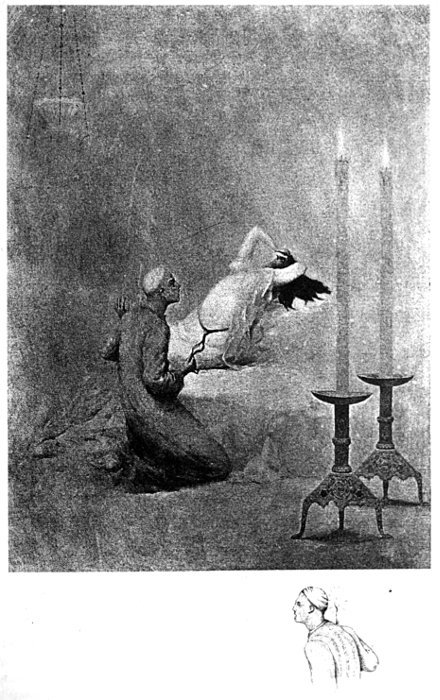
63The lover's heart is like to break in twain: ✿ Till when these coy denials ah! till when?
O thou who fliest me sans fault of mine, ✿ Gazelles are wont at times prove tame to men:
Absence, aversion, distance and disdain, ✿ How shall young lover all these ills sustain?
Thereupon Ghanim wept and she wept at his weeping, and they ceased not drinking till nightfall, when he rose and spread two beds, each in its place. "For whom is this second bed?" asked she, and he answered her, "One is for me and the other is for thee: from this night forth we must not sleep save thus, for that which is the lord's is unlawful to the thrall." "O my master!" cried she, "let us have done with this, for all things come to pass by Fate and Fortune." But he refused, and the fire was lighted in her heart and, as her longing waxed fiercer, she clung to him and cried, "By Allah, we will not sleep save side by side!" "Allah forefend!" he replied and prevailed against her and lay apart till the morning, when love and longing redoubled on her and distraction and eager thirst of passion. They abode after this fashion three full-told months, which were long and longsome indeed, and every time she made advances to him, he would refuse himself and say, "Whatever belongeth to the master is unlawful to the man." Now when time waxed tiresome and tedious to her and anguish and distress grew on her, she burst out from her oppressed heart with these verses:—
64How long, rare beauty! wilt do wrong to me? ✿ Who was it bade thee not belong to me?
With outer charms thou weddest inner grace ✿ Comprising every point of piquancy:
Passion thou hast infused in every heart, ✿ From eyelids driven sleep by deputy:
Erst was (I wot) the spray made thin of leaf ✿ O Cassia-spray! Unlief thy sin I see:
The hart erst hunted I: how is't I spy ✿ The hunter hunted (fair my hart!) by thee?
Wondrouser still I tell thee aye that I ✿ Am trapped while never up to trap thou be!
Ne'er grant my prayer! For if I grudge thyself ✿ To thee, I grudge my me more jealously;
And cry so long as life belong to me, ✿ Rare beauty how, how long this wrong to me?
They abode in this state a long time, and fear kept Ghanim aloof from her. So far concerning these two; but as regards the Lady Zubaydah, when, in the Caliph's absence she had done this deed by Kut al-Kulub she became perplexed, saying to herself, "What shall I tell my cousin when he comes back and asks for her? What possible answer can I make to him?" Then she called an old woman, who was about her and discovered her secret to her saying, "How shall I act seeing that Kut al-Kulub died by such untimely death?" "O my lady," quoth the old crone, "the time of the Caliph's return is near; so do thou send for a carpenter and bid him make thee a figure of wood in the form of a corpse. We will dig a grave for it midmost the palace and there bury it: then do thou build an oratory over it and set therein lighted candles and lamps, and order each and every in the palace to be clad in black. Furthermore command thy handmaids and eunuchs as soon as they know of the Caliph's returning from his journey, to spread straw over the vestibule-floors and, when the Commander of the Faithful enters and asks what is the matter, let them say:—Kut al-Kulub is dead, and may Allah abundantly compensate thee for the loss of her!; and, for the high esteem in which she was held of our mistress, she hath buried her in her own palace. When he hears this he will weep and it shall be grievous to him; then will he cause perlections of the Koran to be made for her and he 65will watch by night at her tomb. Should he say to himself:—Verily Zubaydah, the daughter of my uncle, hath compassed in her jealousy the death of Kut al-Kulub; or, if love-longing overcome him and he bid her be taken out of her tomb, fear thou not; for when they dig down and come to the image in human shape he will see it shrouded in costly grave-clothes; and, if he wish to take off the winding-sheet that he may look upon her, do thou forbid him or let some other forbid him, saying:—The sight of her nakedness is unlawful.
Now when it was the Forty-second Night,
She said, It hath reached me, O auspicious King, that the Caliph ceased not to frequent the tomb for the period of a whole month, at the end of which time it so happened one day that he entered the Serraglio, after dismissing the Emirs and Wazirs, and lay down and slept awhile; and there sat at his head a slave-girl fanning him, and at his feet a second rubbing and shampooing them. Presently he awoke and, opening his eyes, shut them again and heard the handmaid at his head saying to her who was at his feet, "A nice business this, O Khayzarán!" and the other answered her "Well, O Kazíb al-Bán?" "Verily" said the first, "our lord knoweth naught of what hath happened and sitteth waking and watching by a tomb wherein is only a log of wood carved by the carpenter's art." "And Kut al-Kulub," quoth the other, "what hath befallen her?" She replied, "Know that the Lady Zubaydah sent a pellet of Bhang by one of the slave-women who was bribed to drug her; and when sleep overpowered her she let put her in a chest, and ordered Sawab and Kafur and Bukhayt to throw her amongst the tombs." "What dost thou say, O Kazíb al-Bán;" asked Khayzarán, "is not the lady Kut al-Kulub dead?" "Nay, by Allah!" she answered "and long may her youth be saved from death! but I have heard the Lady Zubaydah say that she is in the house of a young merchant named Ghanim bin Ayyub of Damascus, hight the Distraught, the Thrall o' Love; and she hath been with him these four months, whilst our lord is weeping and watching by night at a tomb wherein is no corpse." They kept on talking this sort of talk, and the Caliph gave ear to their words; and, by the time they had ceased speaking, he knew right well that the tomb was a feint and a fraud, and that Kut al-Kulub had 67been in Ghanim's house for four months. Whereupon he was angered with exceeding anger and rising up, he summoned the Emirs of his state; and his Wazir Ja'afar the Barmaki came also and kissed the ground between his hands. The Caliph said to him in fury; "Go down, O Ja'afar, with a party of armed men and ask for the house of Ghanim son of Ayyub: fall upon it and spoil it and bring him to me with my slave-girl, Kut al-Kulub, for there is no help but that I punish him!" "To hear is to obey," said Ja'afar; and setting out with the Governor and the guards and a world of people, repaired to Ghanim's house. Now about that time the youth happened to have brought back a pot of dressed meat and was about to put forth his hand to eat of it, he and Kut al-Kulub, when the lady, happening to look out saw calamity surrounding the house on every side; for the Wazir and the Governor, the night-guard and the Mamelukes with swords drawn had girt it as the white of the eye girdeth the black. At this she knew that tidings of her had reached the Caliph, her lord; and she made sure of ruin, and her colour paled and her fair features changed and her favour faded.
Now when it was the Forty-third Night,
She said, It hath reached me, O auspicious King, that when the Caliph was angered against Kut al-Kulub, he ordered her to a dark chamber where she abode eighty days, at the end of which the Caliph, happening to pass on a certain day the place where she 71was, heard her repeating poetry, and after she ceased reciting her verse, saying, "O my darling, O my Ghanim! how great is thy goodness and how chaste is thy nature! thou didst well by one who did ill by thee and thou guardedst his honour who garred thine become dishonour, and his Harim thou didst protect who to enslave thee and thine did elect! But thou shalt surely stand, thou and the Commander of the Faithful, before the Just Judge, and thou shalt be justified of him on the Day when the Lord (to whom be honour and glory!) shall be Kazi and the Angels of Heaven shall be witnesses!" When the Caliph heard her complaint, he knew that she had been wronged and, returning to the palace, sent Masrur the Eunuch for her. She came before him with bowed head and eyes tearful and heart sorrowful; and he said to her, "O Kut al-Kulub, I find thou accusest me of tyranny and oppression, and thou avouchest that I have done ill by one who did well by me. Who is this who hath guarded my honour while I garred his become dishonour? Who protected my Harim and whose Harim I wrecked?" "He is Ghanim son of Ayyub," replied she, "for he never approached me in wantonness or with lewd intent, I swear by thy munificence, O Commander of the Faithful!" Then said the Caliph, "There is no Majesty and there is no Might save in Allah!
Now when it was the Forty-fourth Night,
She said, It hath reached me, O auspicious King, that when Kut al-Kulub had consoled them she bade the Syndic lead them to his house and let his wife carry them to the Hamman and dress them in handsome clothes and take care of them and honour them with all honour; and she gave him a sufficient sum of money. Next day, she mounted and, riding to his house, went in to his wife who rose up and kissed her hands and thanked her for her kindness. There she saw Ghanim's mother and sister whom the Syndic's wife had taken to the Hammam and clothed afresh, so that the traces of their former condition became manifest upon them. She sat talking with them awhile, after which she asked the wife about the sick youth who was in her house and she replied, "He is in the 74same state." Then said Kut al-Kulub, "Come, let us go and visit him." So she arose, she and the Chief's wife and Ghanim's mother and sister, and went in to the room where he lay and sat down near him. Presently Ghanim bin Ayyub, the Distraught, the Thrall o' Love, heard them mention the name of Kut al-Kulub; whereupon life returned to him, emaciated and withered as he was, and he raised his head from the pillow and cried aloud, "O Kut al-Kulub!" She looked at him and made certain it was he and shrieked rather than said, "Yes, O my beloved!" "Draw near to me;" said he, and she replied, "Surely thou art Ghanim bin Ayyub?"; and he rejoined "I am indeed!" Hereupon a swoon came upon her; and, as soon as Ghanim's mother and his sister Fitnah heard these words, both cried out "O our joy!" and fainted clean away. When they all recovered, Kut al-Kulub exclaimed, "Praise be to Allah who hath brought us together again and who hath reunited thee with thy mother and thy sister!" And she related to him all that had befallen her with the Caliph and said, "I have made known the truth to the Commander of the Faithful, who believed my words and was pleased with thee; and now he desireth to see thee," adding, "He hath given me to thee." Thereat he rejoiced with extreme joy, when she said, "Quit not this place till I come back" and, rising forthwith, betook herself to her palace. There she opened the chest which she had brought from Ghanim's house and, taking out some of the dinars, gave them to the Syndic saying, "Buy with this money for each of them four complete suits of the finest stuffs and twenty kerchiefs, and else beside of whatsoever they require;" after which she carried all three to the baths and had them washed and bathed and made ready for them consommés, and galangale-water and cider against their coming out.
May that Monarch's life span a mighty span, ✿ Whose lavish of largesse all lieges scan:
None other but he shall be Kaysar hight, ✿ Lord of lordly hall and of haught Divan:
Kings lay their gems on his threshold-dust ✿ As they bow and salam to the mighty man;
And his glances foil them and all recoil, ✿ Bowing beards aground and with faces wan:
Yet they gain the profit of royal grace, ✿ The rank and station of high soldan.
Earth's plain is scant for thy world of men, ✿ Camp there in Kaywán's Empyrean!
May the King of Kings ever hold thee dear; ✿ Be counsel thine and right steadfast plan,
Till thy justice spread o'er the wide-spread earth ✿ And the near and the far be of equal worth.
When he ended his improvisation the Caliph was pleased by it and marvelled at the eloquence of his tongue and the sweetness of his speech,——And Shahrazad perceived the dawn of day and ceased to say her permitted say.
Now when it was the Forty-fifth Night,
She said, It hath reached me, O auspicious King, that the Caliph, after marvelling at his eloquence of tongue and sweetness of speech, said to him, "Draw near to me." So he drew near and quoth the King, "Tell me thy tale and declare to me thy case." So Ghanim sat down and related to him what had befallen him in Baghdad, of his sleeping in the tomb and of his opening the chest after the three slaves had departed, and informed him, in short, of everything that had happened to him from commencement to conclusion—none of which we will repeat for interest fails in twice told tales. The Caliph was convinced that he was a true man; so he invested him with a dress of honour, and placed him near himself in token of favour, and said to him, "Acquit me of the responsibility I have incurred." And Ghanim so did, saying, "O our lord the Sultan, of a truth thy slave and all things his two hands own are his master's." The Caliph was pleased at this and gave orders to set apart a palace for him and assigned to him pay and allowances, rations and donations, which amounted to something immense. So he removed thither with sister and mother; after which the Caliph, hearing that his sister Fitnah was in beauty a very "fitnah," a mere seduction, demanded her in marriage of Ghanim who replied, "She is thy handmaid as I am thy slave." The Caliph thanked him and gave him an hundred thousand dinars, then summoned the witnesses and the Kazi, and on one and the same day they wrote out the two contracts of marriage between the Caliph and Fitnah and between Ghanim bin Ayyub and Kut al-Kulub; and the two marriages were consummated on one and the same night. When it was morning, the Caliph gave orders to record the history of what had befallen Ghanim from first to last and to deposit it in the royal muniment-rooms, that those who came after him might read it and marvel at the dealings of Destiny and put their trust in Him who created the night and the day. Yet, O auspicious King, this story to which thou hast deigned give ear is on no wise more wondrous than the
Our "Job." The English translators of the Bible, who borrowed Luther's system of transliteration (of A.D. 1522), transferred into English the German "j" which has the sound of "i" or "y"; intending us to pronounce Yacob (or Yakob), Yericho, Yimnites, Yob (or Hiob) and Yudah. Tyndall who copied Luther (A.D. 1525-26), preserved the true sound by writing Iacob, Ben Iamin and Iudas. But his successors unfortunately returned to the German; the initial I having from the xiii. century been ornamentally lengthened and bent leftwards became a consonant; the public adopted the vernacular sound of "j" (dg) and hence our language and our literature are disgraced by such barbarisms as "Jehovah" and "Jesus"—Dgehovah and Dgeesus for Yehovah and Yesus. Future generations of school-teachers may remedy the evil; meanwhile we are doomed for the rest of our days to hear
Gee-rusalem! Gee-rusalem! etc.
Nor is there one word to be said in favour of the corruption except that, like the Protestant mispronunciation of Latin and the Erasmian ill-articulation of Greek, it has become "English," and has lent its little aid in dividing the Britons from the rest of the civilised world.
The moon, I repeat, is masculine in the so-called "Semitic" tongues.
i.e. camel-loads about lbs. 300; and for long journeys lbs. 250.
Arab. "Janázah," so called only when carrying a corpse; else Na'ash, Sarír or Tábút: Irán being the large hearse on which chiefs are borne. It is made of plank or stick-work; but there are several varieties (Lane, M. E. chapt. xxviii).
It is meritorious to accompany the funeral cortège of a Moslem even for a few paces.
Otherwise he could not have joined in the prayers.
Arab. "Halwá" made of sugar, cream, almonds, etc. That of Maskat is famous throughout the East.
i.e. "Camphor" to a negro as we say "Snowball," by the figure antiphrase.
"Little Good Luck," a dim. form of "bakht"=luck, a Persian word naturalized in Egypt.
There are, as I have shown, not a few cannibal tribes in Central Africa and these at times find their way into the slave market.
i.e. After we bar the door.
Arab. "Jáwísh" from Turk. Cháwúsh, Chiaoosh, a sergeant, poursuivant, royal messenger. I would suggest that this is the word "Shálish" or "Jálish" in Al-Siyúti's History of the Caliphs (p. 501) translated by Carlyle "milites," by Schultens "Sagittarius" and by Jarett "picked troops."
This familiarity with blackamoor slave-boys is common in Egypt and often ends as in the story: Egyptian blood is sufficiently mixed with negro to breed inclination for miscegenation. But here the girl was wickedly neglected by her mother at such an age as ten.
Arab. "Farj"; hence a facetious designation of the other sex is "Zawi'l-furuj" (grammatically Zawátu'l-furúj)=habentes rimam, slit ones.
This ancient and venerable practice of inspecting the marriage-sheet is still religiously preserved in most parts of the East; and in old-fashioned Moslem families it is publicly exposed in the Harem to prove that the "domestic calamity" (the daughter) went to her husband a clean maid. Also the general idea is that no blood will impose upon the experts, or jury of matrons, except that of a pigeon-poult which exactly resembles hymeneal blood—when not subjected to the microscope. This belief is universal in Southern Europe and I have heard of it in England. Further details will be given in Night ccxi.
"Agha" Turk.=sir, gentleman, is, I have said, politely addressed to a eunuch.
As Bukhayt tells us he lost only his testes, consequently his erectio et distensio penis was as that of a boy before puberty and it would last as long as his heart and circulation kept sound. Hence the eunuch who preserves his penis is much prized in the Zenanah where some women prefer him to the entire man, on account of his long performance of the deed of kind. Of this more in a future page.
It is or rather was the custom in Egypt and Syria to range long rows of fine China bowls along the shelves running round the rooms at the height of six or seven feet, and they formed a magnificent cornice. I bought many of them at Damascus till the people, learning their value, asked prohibitive prices.
The tale is interesting as well as amusing, excellently describing the extravagances still practised in middle-class Moslem families on the death of the pater familias. I must again note that Arab women are much more unwilling to expose the back of the head covered by the "Tarhah" (head-veil) than the face, which is hidden by the "Burka" or nose-bag.
The usual hysterical laughter of this nervous race.
Here the slave refuses to be set free and starve. For a master so to do without ample reason is held disgraceful. I well remember the weeping and wailing throughout Sind when an order from Sir Charles Napier set free the negroes whom British philanthropy thus doomed to endure if not to die of hunger.
Manumission, which is founded upon Roman law, is an extensive subject discussed in the Hidáyah and other canonical works. The slave here lays down the law incorrectly, but his claim shows his truly "nigger" impudence.
This is quite true to nature. The most remarkable thing in the wild central African is his enormous development of "destructiveness." At Zanzibar I never saw a slave break a glass or plate without a grin or a chuckle of satisfaction.
Arab. "Khassá-ni"; Khusyatáni (vulg.) being the testicles, also called "bayzatán" (the two eggs) a double entendre which has given rise to many tales. For instance in the witty Persian book "Dozd o Kazi" (The Thief and the Judge) a footpad strips the man of learning and offers to return his clothes if he can ask him a puzzle in law or religion. The Kazi (in folk-lore mostly a fool) fails, and his wife bids him ask the man to supper for a trial of wits on the same condition. She begins with compliments and ends by producing five eggs which she would have him distribute equally amongst the three; and, when he is perplexed, she gives one to each of the men taking three for herself. Whereupon the "Dozd" wends his way, having lost his booty as his extreme stupidity deserved. In the text the eunuch, Kafur, is made a "Sandali" or smooth-shaven, so that he was of no use to women.
Arab. "Khara," the lowest possible word: Yá Khara! is the commonest of insults, used also by modest women. I have heard one say it to her son.
Arab. "Kámah," a measure of length, a fathom, also called "Bá'a." Both are omitted in that sadly superficial book, Lane's Modern Egyptians, App. B.
Names of her slave-girls which mean (in order), Garden-bloom, Dawn (or Beautiful), Tree o' Pearl (P. N. of Saladin's wife), Light of (right) Direction, Star o' the Morn, Lewdness (=Shahwah, I suppose this is a chaff), Delight, Sweetmeat and Miss Pretty.
This mode of disposing of a rival was very common in Harems. But it had its difficulties and on the whole the river was (and is) preferred.
An Eastern dislikes nothing more than drinking in a dim dingy place: the brightest lights seem to add to his "drinkitite."
He did not sleep with her because he suspected some palace-mystery which suggested prudence, she also had her reasons.
This is called in Egypt "Aslah" (Lane M. E. chapt. i.).
It would be a broad ribbon-like band upon which the letters could be worked.
In the Arab. "he cried." These "Yes, Yes! and No! No!" trifles are very common amongst the Arabs.
Arab. "Maragha" lit. rubbed his face on them like a fawning dog. Ghanim is another "softy" lover, a favourite character in Arab tales; and by way of contrast, the girl is masterful enough.
Because the Abbaside Caliphs descend from Al-Abbas paternal uncle of Mohammed. The text means more explicitly, "O descendant of the Prophet's uncle!"
The most terrible part of a belle passion in the East is that the beloved will not allow her lover leave of absence for an hour.
It is hard to preserve these wretched puns. In the original we have "O spray" (or branch) of capparis-shrub (aráki) which has been thinned of leaf and fruit (tujna, i.e., whose fruit, the hymen, has been plucked before and not by me) I see thee (aráka) against me sinning (tajní).
Apparently the writer forgets that the Abbaside banners and dress were black, originally a badge of mourning for the Imám Ibrahim bin Mohammed put to death by the Ommiade Caliph Al-Marwán. The modern Egyptian mourning, like the old Persian, is indigo-blue of the darkest; but, as before noted, the custom is by no means universal.
Koran, chapt. iv. In the East as elsewhere the Devil quotes Scripture.
A servant returning from a journey shows his master due honour by appearing before him in travelling suit and uncleaned.
The first name means "Rattan"; the second "Willow-wand," from the "Bán" or "Khiláf" the Egyptian willow (Salix Ægyptiaca Linn.) vulgarly called "Safsáf." Forskal holds the "Bán" to be a different variety.
Arab. "Ta'ám," which has many meanings: in mod. parlance it would signify millet, holcus-seed.
i.e. "I well know how to deal with him."
The Pen (title of the Koranic chapt. lxviii.) and the Preserved Tablet (before explained).
These plunderings were sanctioned by custom. But a few years ago, when the Turkish soldiers mutinied about arrears of pay (often delayed for years) the governing Páshá would set fire to the town and allow the men to loot what they pleased during a stated time. Rochet (soi-disant D'Héricourt) amusingly describes this manœuvre of the Turkish Governor of Al-Hodaydah in the last generation (Pilgrimage iii. 381).
Another cenotaph whose use was to enable women to indulge in their pet pastime of weeping and wailing in company.
The lodging of pauper travellers, as the chapel in Iceland is of the wealthy. I have often taken benefit of the mosque, but as a rule it is unpleasant, the matting being not only torn but over-populous. Juvenal seems to allude to the Jewish Synagogue similarly used:—"in quâ te quæro proseuchâ"? (iii. 296) and in Acts iii. we find the lame, blind and impotent in the Temple-porch.
This foul sort of vermin is supposed to be bred by perspiration. It is an epoch in the civilised traveller's life when he catches his first louse.
The Moslem peasant is a kind-hearted man and will make many sacrifices for a sick stranger even of another creed. It is a manner of "pundonor" with the village.
Such treatment of innocent women was only too common under the Caliphate and in contemporary Europe.
This may also mean, "And Heaven will reward thee;" but camel-men do not usually accept any drafts upon futurity.
He felt that he was being treated like a corpse.
This hatred of the Hospital extends throughout Southern Europe, even in places where it is not justified.
The importance of the pillow (wisádah or makhaddah) to the sick man is often recognised in The Nights. "He took to his pillow" is=took to his bed.
i.e. in order that the reverend men, who do not render such suit and service gratis, might pray for him.
The reader will notice in The Nights the frequent mention of these physical prognostications, with which mesmerists are familiar.
The Pers. name of the planet Saturn in the Seventh Heaven. Arab. "Zuhal"; the Kiun or Chiun of Amos vi. 26.
i.e. "Pardon me if I injured thee"—a popular phrase.
A "seduction," a charmer. The double-entendre has before been noticed.
TALE OF KING OMAR BIN AL-NU'UMAN AND HIS SONS
SHARRKAN AND ZAU AL-MAKAN,
AND WHAT BEFEL THEM OF THINGS SELD-SEEN AND PEREGRINE.
The King asked her, "And what was their story?" and she answered:—It hath reached me, O auspicious King, that there was in the City of Safety, Baghdad, before the Caliphate of Abd al-Malik bin Marwán, a King, Omar bin al-Nu'uman hight, who was of the mighty giants and had subjected the Chosroes of Persia and the Kaysars of Eastern Rome; for none could warm himself at his fire; nor could any avail to meet him in the field of foray and fray; and, when he was an-angered, there came forth from his nostrils sparks of flame. He had made himself King over all quarters, and Allah had subjected to him all His creatures; his word went forth to all great cities and his hosts had harried the farthest lands. East and West had come under his command with whatsoever regions lay interspersed between them, Hind and Sind and Sin, the Holy Land, Al-Hijaz, the rich mountains of Al-Yaman and the archipelagos of India and China. Moreover, he 78reigned supreme over the north country and Diyár Bakr, or Mesopotamia, and over Sudán, the Eastern Negro-land and the Islands of the Ocean, and all the far famed rivers of the earth, Sayhún and Jayhún, Nile and Euphrates. He sent envoys and ambassadors to capitals the most remote, to provide him with true report; and they would bring back tidings of justice and peace, with assurance of loyalty and obedience and of prayers in the pulpits for King Omar bin al-Nu'uman; for he was, O Ruler of the Age, a right noble King; and there came to him presents of rarities and toll and tribute from all lands of his governing. This mighty monarch had a son yclept Sharrkan, who was likest of all men to his father and who proved himself one of the prodigies of his time for subduing the brave and bringing his contemporaries to bane and ban. For this his father loved him with love so great none could be greater, and made him heir to the kingdom after himself.
Now when it was the Forty-sixth Night,
She said, It hath reached me, O auspicious King, that, after the Ambassadors and retinue from the Constantinopolitan King had kissed the ground before Omar and had delivered their embassage, they brought out the presents, which were fifty damsels of the choicest from Græcia-land, and fifth Mamelukes in tunics of brocade, belted with girdles of gold and silver, each wearing in his ears hoops of gold with pendants of fine pearls costing a thousand ducats every one. The girls were adorned in like fashion and were clad in stuffs worth a treasury of money. When the King saw them, he rejoiced in them and accepted them; then he bade the Ambassadors be honourably entreated and, summoning his Wazirs, took counsel with them of what he should do. Herewith rose up among them a Wazir, an ancient man, Dandán hight, who kissed the ground before Omar and said, "O King, there is nothing better to do in this matter than equip an army valiant and victorious, and set over it thy son Sharrkan with us as his lieutenants; and this rede commendeth itself to me on two counts: first, because the King of Roum hath invoked thine assistance and hath sent thee gifts which thou hast accepted; and, secondly, because while no enemy dareth attack our country, thine 84army may go forth safely and, should it succour the King of Græcia-land and defeat his foe, the glory will be thine. Moreover, the news of it will be noised abroad in all cities and countries; and especially, when the tidings shall reach the Islands of the Ocean and the Kings of Mauritania shall hear it, they will send thee offerings of rarities and pay thee tribute of money." The King, pleased by the Wazir's words and approving his rede, gave him a dress of honour and said to him, "Of the like of thee should Kings ask counsel, and it seemeth fit that thou shouldst conduct the van of our army and our son Sharrkan command the main battle." Then he sent for his son who came and kissed ground before him and sat down; and he expounded to him the matter, telling him what the Ambassadors and the Wazir Dandan had said, and he charged him to take arms and equip himself for the campaign, enjoining him not to gainsay Dandan in aught he should do. Moreover, he ordered him to pick out of his army ten thousand horsemen, armed cap-à-pie and inured to onset and stress of war. Accordingly, Sharrkan arose on the instant, and chose out a myriad of horsemen, after which he entered his palace and mustered his host and distributed largesse to them, saying, "Ye have delay of three days." They kissed the earth before him in obedience to his commands and began at once to lay in munitions, and provide provisions for the occasion; whilst Sharrkan repaired to the armouries and took therefrom whatsoever he required of arms and armour, and thence to the stable where he chose horses of choice blood and others.
Most beautiful is earth in budding bloom, ✿ When lucid waters course through plain and wood:
No work but His th' All-great, th' All-glorious, ✿ Giver of all gifts, Giver of all good!
And as Sharrkan considered the place, he saw in it a Christian Monastery within whose enceinte a castle towered high in air catching the light of the moon. Through the midst of the convent passed a stream, the water flowing amongst its gardens; and upon the bank sat the woman whose voice he had heard, while before her stood ten handmaids like moons and wearing various sorts of raiment and ornaments that dazed and dazzled the beholder, high-bosomed virgins, as saith of them the poet in these couplets:—
The mead is bright with what is on't ✿ Of merry maidens debonnair:
Double its beauty and its grace ✿ Those trooping damsels slender-fair:
Virgins of graceful swimming gait ✿ Ready with eye and lip to ensnare;
And like the tendril'd vine they loose ✿ The rich profusion of their hair:
Shooting their shafts and arrows from ✿ Beautiful eyes beyond compare;
Overpowering and transpiercing ✿ Every froward adversaire.
87Sharrkan gazed upon the ten girls and saw in their midst a lady like the moon at fullest, with ringleted hair and forehead sheeny-white, and eyes wondrous wide and black and bright, and temple-locks like the scorpion's tail; and she was perfect in essence and attributes, as the poet said of her in these couplets:—
She beamed on my sight with a wondrous glance, ✿ And her straight slender stature enshamed the lance:
She burst on my sight with cheeks rosy-red, ✿ Where all manner of beauties have habitance:
And the locks on her forehead were lowering as night ✿ Whence issues a dawn-tide of happiest chance.
Then Sharrkan heard her say to the handmaids, "Come ye on, that I may wrestle with you and gravel you, ere the moon set and the dawn break!" So each came up to her in turn and she grounded them forthright, and pinioned them with their girdles, and ceased not wrestling and pitching them until she had overthrown one and all. Then there turned to her an old woman who was before her, and the beldam said as in wrath, "O strumpet, dost thou glory in grounding these girls? Behold I am an old woman, yet have I thrown them forty times! So what hast thou to boast of? But if thou have the strength to wrestle with me, stand up that I may grip thee and set thy head between thy heels!" The young lady smiled at her words, but she was filled with inward wrath, and she jumped up and asked, "O my lady Zát al-Dawáhí, by the truth of the Messiah, wilt thou wrestle with me in very deed, or dost thou jest with me?"; and she answered, "Yea,"——And Shahrazad perceived the dawn of day and ceased saying her permitted say.
Now when it was the Forty-seventh Night,
She said, It hath reached me, O auspicious King, that when the young lady asked Zat al-Dawahi, "By the truth of the Messiah, wilt wrestle with me or dost jest?", and she answered, "Yea, I will wrestle with thee in very deed" (Sharrkan looking on the while), the damsel cried, "Rise up for the fall an thou have spunk so to do." When the old woman heard this, she raged with exceeding 88rage, and her body-hair stood on end like the bristles of a fretful hedgehog. Then she sprang to her feet, whilst the damsel stood up to her, and said, "Now by the truth of the Messiah, I will not wrestle with thee unless I be naked, Mistress whore!" So she loosed her petticoat-trousers and, putting her hand under her clothes, tore them off her body; then twisted up a silken kerchief into cord-shape, girt it round her middle and became as she were a scald-head Ifritah or a spotted snake. With this she inclined towards the damsel and said, "Do thou as I have done." All this time, Sharrkan was gazing at the twain, and laughing at the beldam's loathly semblance. So the damsel leisurely rose and, taking a sash of Yamani stuff, passed it twice round her waist, then she tucked up her trousers and displayed two calves of alabaster carrying a mound of crystal, smooth and rounded, and a stomach which exhaled musk from its dimples, as it were a bed of Nu'uman's anemones; and breasts like double pomegranates. Then the old woman leant towards her, and the two laid hold either of each, while Sharrkan raised his head Heavenwards and prayed Allah that the belle might beat the beldam. Presently the young woman gat beneath the old woman; and, gripping her waist-cloth with the left and circling her neck with the right hand, hoisted her off the ground with both; whereupon the old woman strove to free herself and, in so doing fell on her back arsiversy, with her legs high in air and her hairy bush between them showed manifest in the moonshine; furthermore she let fly two great farts one of which blew up the dust from the earth's face and the other steamed up to the gate of Heaven. Sharrkan laughed till he fell back upon the ground.
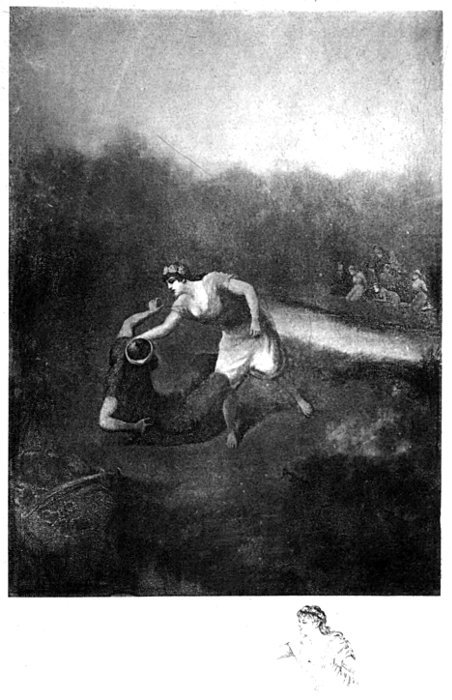
Now when it was the Forty-eighth Night,
She said, It hath reached me, O auspicious King, that when the Nazarene damsel said to Sharrkan (and he listening impatiently enow), "Verily if Sharrkan fell into my hands, I would go forth to him in the habit of a man and drag him from his saddle-seat and make him my captive and lay him in bilboes," pride and passion and knightly jealousy took possession of him and he desired to discover and declare himself and to lay on load; but her loveliness restrained him and he began repeating:—
An faulty of one fault the Beauty prove, ✿ Her charms a thousand advocates shall move.
So she went up and Sharrkan after her; and, when he saw the maiden's back and hinder cheeks that clashed against each other, like rollers in the rolling sea, he extemporised these couplets:—
97For her sins is a pleader that brow, ✿ And all hearts its fair pleading must trow:
When I saw it I cried, "To-night ✿ The moon at its fullest doth show;
Tho' Balkís' own Ifrit try a bout, ✿ Spite his force she would deal him a throw.
The two fared on till they reached a gate over which rose a marble archway. This she opened and ushered Sharrkan into a long vestibule, vaulted with ten connected arches, from each of which hung a crystal lamp glistening like a spark of fire. The handmaids met her at the further end bearing wax candles of goodly perfume, and wearing on their heads golden fillets crusted with all manner bezel-gems, and went on before her (Sharrkan still following), till they reached the inner convent. There the Moslem saw couches and sofas ranged all around, one opposite the other and all overhung with curtains flowered in gold. The monastery floor was paved with every kind of vari-coloured marbles and mosaic-work, and in the midst stood a basin that held four-and-twenty jetting fountains of gold, whence the water ran like molten silver; whilst at the upper end stood a throne spread with silks fit only for Kings. Then said the damsel, "Ascend, O my lord, this throne." So he went up to it and sat down and she withdrew to remain absent for some time. Sharrkan asked of her from one of the servants who answered him, "She hath gone to her dormitory; but we will serve thee even as she ordered." So they set before him viands of rare varieties, and he ate his sufficiency, when they brought him a basin of gold and an ewer of silver, and he washed his hands. Then his thoughts reverted to his army, knowing not what had befallen it in his absence and calling to mind also how 98he had forgotton his father's injunctions: so he was troubled about his case, repenting of what he had done till the dawn broke and the day appeared; when he lamented and sighed and became drowned in the sea of sadness and repeated:—
I am not lost to prudence, but indeed ✿ Here I'm bewildered, what shall be my rede?
Would any aid me in mine ails of love, ✿ By my own might and sleight would I be free'd:
But ah! my heart is lost and passion-shent: ✿ To none save Allah can I trust my need!
When he ended his verse behold, there came up to him a rare show and a fair, more than twenty maidens like crescents encompassing the young lady, who shone in their midst as the full moon among the constellations guarding and girding her. She was clad in brocades befitting Kings; her breasts were like twin pomegranates, a woven zone set with all kinds of jewels tightly clasped her waist which expanded below into jutting hips; and her hinder cheeks stood out as a mound of crystal supporting a silvern shaft. When Sharrkan looked at her his wits went nigh to fly away from him with delight; and he forgot army and Wazir as he gazed on her fair head decked and dight with a net-work of pearls set off by divers sorts of gems. Handmaids on her right and handmaids on her left bore her train, as she paced with dainty graceful gait in all the pride of seemlihead. He sprang to his feet seeing such beauty and loveliness, and cried aloud, "Beware and beware of that zone rarely fair!" and broke out into these couplets:—
With heavy back-parts, high breasts delicate, ✿ And lissome form that sways with swimming gait,
She deftly hides love-longing in her breast; ✿ But I may never hide its ban and bate:
While hosts of followers her steps precede, ✿ Like pearls now necklaced and now separate.
She gazed upon him for a long time and considered him till she was assured of him, when she came up to him and said, "In very 99sooth the place is honoured and illumined by thee, O Sharrkan! How sped thy night, O hero, after we went away and left thee?"; adding, "Verily lying is a vile thing and a shameful, especially in great Kings! and thou art Crown-Prince Sharrkan, son and heir of King Omar bin al-Nu'uman; so henceforth make no secret of thy rank and condition, nor let me hear aught from thee but the truth; for leasing bequeatheth hate and despite. And as thou art pierced by the shaft of Fate, be resignation thine and abide content to wait." When he heard her words he saw that artifice availed him naught and he acknowledged the truth, saying, "I am Sharrkan, bin Omar bin al-Nu'uman, whom fortune hath afflicted, and cast into this place; so whatso thou willest, do it in my case!" She hung her head groundwards a long while, then turned to him and said, "Be of good cheer and let thine eyes be cool and clear; for thou art the guest of my hospitality, and bread-and-salt hath made a tie between me and thee; wherefore thou art in my ward and under my safeguard. Have no fear for, by the truth of the Messiah, if all on earth sought to do thee hurt they should not come at thee, till life had left my body for thy sake: indeed thou art now under the charge of the Messiah and of me." Hereat she sat her down by his side and fell to playing with him, till his alarm subsided and he knew that had she desired to slay him, she would have done so during the past night. Presently she bespoke in the Grecian tongue one of her slave-girls, who went away and soon came back bringing a beaker and a tray of food; but Sharrkan abstained from eating and said to himself, "Haply she hath put somewhat in this meat." She knew what was in his thought; so she turned to him and said, "By the truth of the Messiah, the case is not on such wise, nor is there aught in this meat of what thou suspectest! Had my mind been set on slaying thee, I had slain thee ere now." Then she walked up to the tray and ate of every dish a mouthful; whereupon Sharrkan came forward and ate too.
Now when it was the Forty-ninth Night,
She said, It hath reached me, O auspicious King, that the damsel ceased not to drink and ply Sharrkan with drink till he took leave of his wits, for the wine and the intoxication of love he bore her. Presently she said to the slave-girl, "O Marjánah! bring us some instruments of music!" "To hear is to obey," said the handmaid and going out, returned in the twinkling of an eye with a Damascus lute, a Persian harp, a Tartar pipe, and an Egyptian dulcimer. The young lady took the lute and, after tuning each several string, began in gentle undersong to sing, softer, than zephyr's wing and sweeter than Tasmin-spring, with heart safe and secure from everything the couplets following:—
Allah assain those eyne! What streams of blood they shed! ✿ How many an arrowy glance those lids of thine have sped.
I love all lovers who to lovers show them dure; ✿ Twere wrong to rue the love in wrong-head born and bred:
Haply fall hapless eye for thee no sleeping kens! ✿ Heaven help the hapless heart by force of thee misled!
Thou doomest me to death who art my king, and I ✿ Ransom with life the deemster who would doom me dead.
Thereupon each and every of the maidens rose up and taking an instrument, played and recited couplets in the Roumi tongue; then their mistress sang also and seeing Sharrkan in ecstasies 101asked him, "O Moslem, dost thou understand what I say?"; and he answered, "Nay, my ecstasy cometh from the beauty of thy finger-tips." She laughed and continued, "If I sing to thee in Arabic what wouldst thou do?" "I should no longer," quoth he, "be master of my senses." Then she took an instrument and, changing the measure, began singing these verses:—
The smack of parting's myrrh to me, ✿ How, then, bear patience' aloë?
I'm girt by ills in trinity ✿ Severance, distance, cruelty!
My freedom stole that fairest she, ✿ And parting irks me bitterly.
When she ended her verse, she looked at Sharrkan and found him lost to existence, and he lay for a while stretched at full length and prone among the maidens. Then he revived and, remembering the songs, again inclined to mirth and merriment; and the twain returned to their wine and wassail, and continued their playing and toying, their pastime and pleasure till day ceased illuminating and night drooped her wing. Then the damsel went off to her dormitory and when Sharrkan asked after her they answered, "She is gone to her sleeping-chamber," whereto he rejoined, "Under Allah's ward and His good guard!" As soon as it was morning, a handmaid came to him and said to him, "My mistress biddeth thee to her." So he rose and followed her and, as he drew near her lodging, the damsels welcomed him with smitten tabrets and songs of greeting, and led him through a great door of ivory studded with pearls and jewels. Thence they passed with him into a tall and spacious hall, at the upper end of which was a wide daïs carpeted with all kinds of silks, and round it open lattices commanding a view of trees and streams. About the saloon were figures carved in human form, and fashioned on such wise that the air passed through them and set in motion musical instruments within, so that the beholder would fancy they spoke. Here sat the young lady, looking at the figures; but when she saw Sharrkan, she sprang to her feet and, taking him by the hand, made him sit down by her side, and asked him how he had passed the night. He blessed her and the two sat talking awhile till she asked him, "Knowest thou aught touching lovers and 102slaves of love?"; and he answered "Yes! I wot somewhat in verse on that matter." "Let me hear it," quoth she, so he began quoting:—
Pleasure and health, good cheer, good appetite ✿ To Azzah, freest with our name and fame!
By Allah! would I near her off she flies ✿ At tangent, granting less the more I claim:
I dote on Azzah, but when clear I off ✿ My rivals, clears me too that dearest dame;
Like wandering wight that chose for shade a cloud ✿ Which, ere siesta done, thin air became.
When she heard this she said, "Verily Al-Kuthayyir was conspicuous for sweet speech and chaste, and he was superlative in his praise of Azzah when he sang (and she began to recite):—
"Did Azzah deal behest to Sun o' noon, ✿ The judge had 'judged her beauty's bestest boon;
And girls who come to me and carp at her, ✿ God make their rosy cheeks her sandal-shoon!"
"And indeed," quoth she, "'twas said that Azzah boasted exceeding beauty and loveliness." Then she asked Sharrkan saying, "O Prince, dost thou know aught of Jamíl's verses to Buthaynah? if so repeat to us somewhat of them;" and he answered, "Yes, I know them better than any;" whereupon he began repeating these couplets:—
"Jamíl, in Holy war go fight!" to me they say: ✿ What war save fight for fair ones would I e'er essay?
To me their every word and work are mere delight, ✿ And martyrs clepe I all they slay in fight and fray:
An ask I, "O Buthaynah! what's this love, I pray, ✿ Which eats my heart? quoth she "'Twill stay for ever and aye!"
And when I cry, "Of wits return some small display ✿ For daily use," quoth she, "Far, far 'tis fled away!"
Thou seekst my death; naught else thy will can satisfy ✿ While I no goal espy save thee and thee alway.
103"Thou hast spoken right well," said she, "O King's son, and Jamíl also spoke excellently well. But what would Buthaynah have done with him that he saith in his hemistich:—
Thou seekst my death; naught else thy will can satisfy?"
"O my lady," quoth Sharrkan, "she willed to do him what thou willest to do with me, and even that will not satisfy thee." She laughed at his opportune reply and they ceased not carousing till Day put out her light and Night came in darkness dight. Then she rose and went to her dormitory and slept, while Sharrkan slept in his place till morning dawned. As soon as he awoke, the handmaids came to him with tabrets and other instruments of mirth and merriment, as wont; and, kissing the ground between his hands, said to him, "Bismillah!—in Allah's name—be so kind as to come: our mistress biddeth thee to her presence!" So he rose and accompanied the slave-girls who surrounded him, playing on tabrets and other instruments of music, till they passed from that saloon into another and a yet more spacious hall, decorated with pictured likenesses and figures of birds and beasts, passing all description. Sharrkan marvelled at the art and artifice of the place and began reciting:—
He pluckt fruits of her necklace in rivalry, ✿ And her breast-pearls that bedded in gold-mine lie.
Pure water on silvern bars is her brow, ✿ And her cheeks show roses with rubies vie:
Meseems in her eyne that the violet's hue ✿ Lies purpling set in the Ithmid's dye.
104When the lady saw Sharrkan, she stood up to him in honour and, taking his hand, seated him by her side and asked, "O son of King Omar bin al-Nu'uman, hast thou any cunning in the game of chess?" "Yes," he answered, "but do not thou with me as said the poet:—
I speak and longing love upties me and unties me; ✿ Till with her honey-dew of inner lip she plies me:
I brought the chess-board and my liefest lover plays me ✿ With white and black, but black-cum-white ne'er satisfies me:
'Twas as if King for Castle I were fain to place me ✿ Till wilful loss of game atwixt two queens surprise me:
And if I seek to read intent in eyes that eye me ✿ Oh man! that glance askance with hint of wish defies me."
Then she brought the chess-board and played with him; but Sharrkan, instead of looking at her moves, kept gazing at her fair mouth, and putting knight in place of elephant and elephant in stead of knight. She laughed and said to him, "If thy play be after this fashion, thou knowest naught of the game." "This is only our first," replied he, "judge not by this bout." When she beat him he replaced the pieces in position and played again with her; but she beat him a second time, a third, a fourth and a fifth. So she turned to him and said, "Thou art beaten in everything;" and he replied, "O my lady, how should one playing with the like of thee avoid being beaten?" Then she bade bring food, and they ate and washed their hands; after which the wine was set before them and they drank. Presently, she took the dulcimer, for her 105hand was cunning in smiting it, and she began repeating to an accompaniment these couplets:—
Twixt the close-tied and open-wide no medium Fortune knoweth; ✿ Now ebb and flow then flow and ebb this wise her likeness showeth:
Then drink her wine the syne she's thine and smiling thou dost find her; ✿ Anon she'll fall and fare away when all thy good forth goeth.
They ceased not to carouse till nightfall and this day was pleasanter even than the first. When darkness set in, the lady betook her to her dormitory, leaving him alone with the handmaids; so he threw himself on the ground and slept till dawn, when the damsels came to him with tambourines and other instruments according to custom. Seeing them he roused him hastily and sat up; and they carried him to their mistress, who came to meet him and, taking him by the hand, seated him by her side. Then she asked him how he had passed his night, whereat he prayed that her life be prolonged; and she took the lute and sang to it these verses which she improvised:—
Ne'er incline thee to part ✿ Which embitters the heart;
E'en the sun when he sets ✿ Shall in pallor depart.
While they were solacing themselves after this fashion, behold, there arose a great and sudden clamour, and a confused crowd of knights and men rushed in, holding drawn swords that glittered and gleamed in their hands, and cried aloud in the Grecian tongue, "Thou hast fallen into our hands, O Sharrkan, so make thee sure of death!" When he heard this, he said to himself, "By Allah, she hath entrapped me and held me in play, till her men should come. These are the Knights with whom she threatened me; but 'tis I who have thrown myself into this strait." Then he turned towards the young lady to reproach her, but saw that she had changed colour and her face was pale; and she sprang to her feet and asked the crowd, "Who are ye?" "O most gracious Princess and peerless union-pearl," answered the leading Knight, "dost thou weet who is yon man by thy side?" "Not I," she replied, "who may he be?" Quoth the Patrician, "This is of towns the highwayman! This is he who rideth in the horseman's van! This is Sharrkan, son of King Omar bin al-Nu'uman! This is he that forceth fortalice and penetrateth every impregnable place! The news of him reached King Hardub, thy father, by report of the ancient dame Zat al-Dawahi; and thy sire, our sovereign, hath 106made sure that thou hast rendered good service to the army of the Greeks by taking captive this ominous lion." When she heard this, she looked at the Knight and asked him, "What be thy name?" and he answered, "I am Masurah, son of thy slave Mausúrah bin Káshardah, Knight of Knights." "And how?" quoth she, "durst thou enter my presence without leave?" Quoth he, "O my lady, when I came to the gate, none forbade me, neither chamberlain nor porter, but all the doorkeepers rose and forewent us as of wont; although, when others come, they leave them standing at the gate while they ask permission to admit them. But this is not a time for long talking, when the King is expecting our return with this Prince, the scorpion-sting of the Islamitic host, that he may kill him and drive back his men whither they came, without the bane of battling with them." "These words be ill words," rejoined the Princess, "and Dame Zat al-Dawahi lied, avouching an idle thing and a vain, whereof she weeteth not the truth; for by the virtue of the Messiah, this man who is with me is not Sharrkan, nor is he a captive, but a stranger who came to us seeking our hospitality, and I made him my guest.
Now when it was the Fiftieth Night,
She said, It hath reached me, O auspicious King, that Princess Abrizah said to the Knight, "This man is but one, and ye are an hundred: so if ye would attack him, come out against him, one after one, that it may appear to the King which is the valiant." Quoth Masurah, the Knight, "By the truth of the Messiah, thou sayest sooth, and none but I shall sally out against him first." Quoth she, "Wait till I go to him and acquaint him with the case and hear what answer he will make. If he consent, 'tis well; but if he refuse, ye shall on no wise come to him, for I and my handmaids and whosoever is in the convent will be his ransom." So she went to Sharrkan and told him the news, whereat he smiled and knew that she had not informed any of the Emirs; but that tidings of him had been bruited and blazed abroad, till the report reached the King, against her wish and intent. So he again began reproaching himself and said, "How came I to adventure and play with my life by coming to the country of the Greeks?" But hearing the young lady's proposal he said to her, "Indeed their onset, one after one, would be overburdensome to them. Will they not come out against me, ten by ten?" "That would be villeiny," said she; "Let one have at one." When he heard this, he sprang to his feet and made for them with his sword and battle-gear; and Masurah, the Knight, also sprang up and bore down upon him. Sharrkan met him like a lion and delivered a shoulder cut which clove him to the middle, and the blade came 108out gleaming and glittering from his back and bowels. When the lady beheld that swashing blow, Sharrkan's might was magnified in her sight and she knew that when she overthrew him in the wrestle it was not by her strength but by her beauty and loveliness. So she turned to the Knights and said, "Take wreak for your chief!" Thereupon out came the slain man's brother, a fierce and furious Knight, and rushed upon Sharrkan, who delayed not, but smote him also with the shoulder-cut and the sword came out glittering from his vitals.
How oft in the mellay I've cleft the array, ✿ And given their bravest to lions a prey:
Ask of me and of them when I proved me prow ✿ O'er creation, on days of the foray and fray:
When I left in the onslaught their lions to lie ✿ On the sands of the lowlands in fieriest day.
When he ended his verse, the Princess came up to him with smiles and kissed his hand; then she doffed her hauberk and he said to her, "O lady mine, wherefore didst thou don that coat of mail and bare thy brand?" "To guard thee against these caitiffs," she replied. Then she summoned the gate-keepers and asked them, "How came ye to admit the King's Knights into my dwelling without leave of me?"; and they answered, "O Princess, it is not our custom to ask leave of thee for the King's messengers, and especially for the chief of his Knights." Quoth she, "I think ye were minded only to disgrace me and murder my guest;" and bade Sharrkan smite their necks. He did so and she cried to the rest of her servants, "Of a truth, they deserved even more than that!" Then turning to Sharrkan, she said to him, "Now that there hath become manifest to thee what was concealed, thou shalt be made acquainted with my history. Know, then, that I am the daughter of King Hardub of Roum; my name is Abrizah and the ancient dame, yclept Zat al-Dawahi, is my grandmother by the sword side. She it certainly is who told my father of thee, and as surely she will compass a sleight to slay me, more by token as thou hast slain my father's chivalry and it is noised abroad that I have separated myself from the Nazarenes and have become no better than I should be with the Moslems. Wherefore it were wiser that I leave this dwelling while Zat al-Dawahi is on my track; but I require of thee the like kindness and courtesy I have shown thee, for enmity will presently befal 110between me and my father on thine account. So do not thou neglect to do aught that I shall say to thee, remembering all this betided me not save by reason of thee." Hearing her words, Sharrkan joyed greatly; his breast broadened and his wits flew from him for delight, and he said, "By Allah, none shall come at thee, while life is in my bosom!
I bade adieu, my right hand wiped my tears away, ✿ The while my left hand held her in a close embrace:
"Fearest thou naught," quoth she, "of shame?" I answered "Nay, ✿ The lover's parting day is lover's worst disgrace."
Then Sharrkan left her and walked down from the convent. They brought his steed, so he mounted and rode down-stream to the drawbridge which he crossed and presently threaded the woodland paths and passed into the open meadow. As soon as he was clear of the trees he was aware of horsemen which made him stand on the alert, and he bared his brand and rode cautiously; but as they drew near and exchanged curious looks he recognized them and behold, it was the Wazir Dandan and two of his Emirs. When they saw him and knew him, they dismounted and saluting him, asked the reason of his absence; whereupon he told them all that had passed between him and Princess Abrizah from first to 114last. The Wazir returned thanks to Almighty Allah for his safety and said, "Let us at once leave these lands; for the envoys who came with us are gone to inform the King of our approach, and haply he will hasten to fall on us and take us prisoners." So Sharrkan cried to his men to saddle and mount, which they did and, setting out at once, they stinted not faring till they reached the sole of the valley wherein the host lay. The Ambassadors meanwhile had reported Sharrkan's approach to their King, who forthright equipped a host to lay hold of him and those with him. But Sharrkan, escorted by the Wazir Dandan and the two Emirs, had no sooner sighted the army, than he raised the cry "March!
Now when it was the Fifty-first Night,
She said, It hath reached me, O auspicious King, that Sharrkan bade Princess Abrizah and her damsels doff the garb that was on them and don the garments of daughters of Greece; and thus did they. Then he despatched a company of his companions to Baghdad 119to acquaint his father Omar bin al-Nu'uman, with his arrival and report that he was accompanied by Princess Abrizah, daughter of King Hardub, Lord of Græcia-land. They halted forthright in the place they had reached, and Sharrkan also halted and all nighted there; and when Almighty Allah made morning dawn, Sharrkan and his company and Abrizah and her company took horse and fared on towards the city; when lo! on the way they met the Wazir Dandan, who had come out amongst a thousand horse, to honour Abrizah and Sharrkan, by especial commandment of King Omar Son of Al-Nu'uman. When the two drew near, they turned towards them and kissed ground before them; then they mounted again and escorted them into the city and went up with them to the palace. Sharrkan walked in to his father, who rose and embraced him and questioned him of his case. So he told him all that Abrizah had told him, and what had passed between them and said, "She hath parted from her sire and departed from her reign and hath chosen to take part with us and to make her abode with us; and indeed (he said to his father) the King of Constantinople hath plotted to do us a mischief, because of his daughter Sophia, for that the King of Greece had made known to him her story and the cause of her being given to thee; and he (the Grecian King) not knowing her to be daughter of King Afridun, Lord of Constantinople; and, had he known that, he would not have bestowed her upon thee, but he would have restored her to her parent.
Say, what shall solace one who hath nor home nor stable stead ✿ Nor cup-companion, nor a cup, nor place to house his head?"
Marjanah answered her, "It is thine to command; I will obey;" and Abrizah said, "I desire at once to leave this place secretly, so that none shall know of me but thou; and return to my father and my mother, for when flesh stinketh, there is naught for it but its own folk and Allah shall do with me e'en as He will." "O Princess," Marjanah replied, "what thou wouldest do is well." Then she made matters ready and kept her secret and waited for some days till the King went out to chase and hunt, and his son Sharrkan betook himself to certain of the fortresses to sojourn there awhile. Then said she to Marjanah, "I wish to set out this night, but how shall I do against my destiny? For already I feel the pangs of labour and child-birth, and if I abide other four or five days, I shall be brought to bed here, and I shall be unable to travel to my country. But this is what was written on my forehead." Then she considered awhile, and said to Marjanah, "Look us out a man who will go with us and serve us by the way, for I have no strength to bear arms." "By Allah, O my lady," replied Marjanah, "I know none but a black slave called 125Al-Ghazban, who is one of the slaves of King Omar bin al-Nu'uman; he is a valiant wight, and he keepeth guard at our palace gate. The King appointed him to attend us, and indeed we have overwhelmed him with our favours; so, look ye, I will go out and speak with him of this matter, and promise him some monies and tell him that, if he have a mind to tarry with us, I will marry him to whom he will. He told me before to-day that he had been a highwayman; so if he consent to us we shall win our wish and reach to our own land." She rejoined, "Call him, that I may talk with him;" whereupon Marjanah fared forth and said to the slave, "O Ghazban, Allah prosper thee, so thou fall in with what my lady saith to thee!" Then she took him by the hand and brought him to the Princess, whose hands he kissed, but as she beheld him, her heart took fright at him. "However," she said to herself, "of a truth, Need giveth the law;" and she approached to speak with him, yet her heart started away from him.
Now when it was the Fifty-second Night,
She said, It hath reached me, O auspicious King, that Princess Abrizah said to the black slave Al-Ghazban, "It remaineth for me only that I yield me to negro slaves, after having refused Kings and Braves!" And she was wroth with him and cried, "Woe to thee! what words are these thou sayest? Out on thee, and talk not thus in my presence and know that I will never consent to what thou sayest, though I drink the cup of death. Wait till I have cast my burden and am delivered of the after-birth, and then, if thou be able thereto, do with me as thou wilt; but, an thou leave not lewd talk at this time, assuredly I will slay myself with my own hand and quit the world and be at peace from all this." And she began reciting extempore:—
O spare me, thou Ghazban, indeed enow for me ✿ Are heavy strokes of time, mischance and misery!
Whoredom my Lord forfends to all humanity; ✿ Quoth He, "Who breaks my bidding Hell for home shall see!"
And if thou leave not suing me to whoredom's way ✿ Against th' Almighty's choicest gift, my chastity,
Upon my tribesmen I with might and main will call ✿ And gather all, however far or near they be;
And with Yamáni blade were I in pieces hewn, ✿ Ne'er shall he sight my face who makes for villeiny,
The face of free-born come of noble folk and brave; ✿ What then can be to me the seed of whoreson slave?
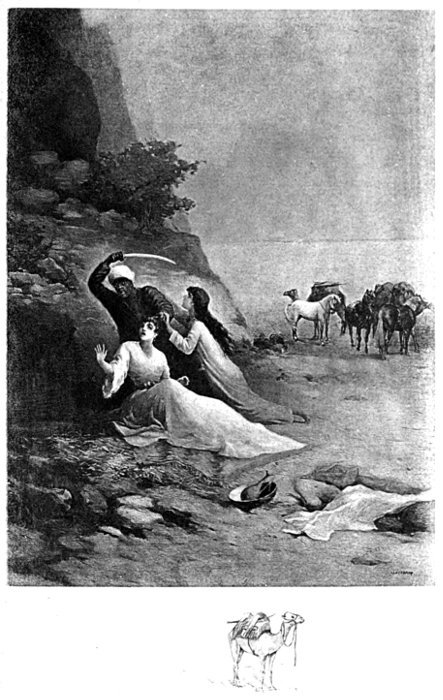
127When Ghazban heard these lines he was wroth exceedingly; his eyes reddened with blood and his face became a dusty-grey; his nostrils swelled, his lips protruded and the repulsiveness of his aspect redoubled. And he repeated these couplets:—
Ho thou, Abrizah, mercy! leave me not for I ✿ Of thy love and Yamáni glance the victim lie
My heart is cut to pieces by thy cruelty, ✿ My body wasted and my patience done to die:
From glances ravishing all hearts with witchery ✿ Reason far flies, the while desire to thee draws nigh;
Though at thy call should armies fill the face of earth ✿ E'en now I'd win my wish and worlds in arms defy!
When Abrizah heard these words, she wept with sore weeping and said to him, "Woe to thee, O Ghazban! How dareth the like of thee to address me such demand, O base-born and obscene-bred? Dost thou deem all folk are alike?" When the vile slave heard this from her, he waxt more enraged and his eyes grew redder: and he came up to her and smiting her with the sword on her neck wounded her to the death. Then he drove her horse before him with the treasure and made off with himself to the mountains. Such was the case with Al-Ghazban; but as regards Abrizah, she gave birth to a son, like the moon, and Marjanah took the babe and did him the necessary offices and laid him by his mother's 128side; and lo and behold! the child fastened to its mother's breast and she dying. When Marjanah saw this, she cried out with a grievous cry and rent her raiment and cast dust on her head and buffeted her cheeks till blood flowed, saying, "Alas, my mistress!
Now when it was the Fifty-third Night,
She said, It hath reached me, O auspicious King, that when the sages and the doctors stood in presence of King Hardub, he honoured them with notable honours and committed the handmaidens to their hands, enjoining that these be instructed in all manner of knowledge, philosophy and polite accomplishments; and they set themselves to do his bidding. Such was the case with King Hardub; but as for King Omar bin al-Nu'uman, when he returned from coursing and hunting and entered his palace, he sought Princess Abrizah but found her not, nor any one knew of her nor could any give him news of her. This was grievous to him and he said, "How could the lady leave the palace unknown of any? Had my kingdom been at stake in this case, it were in perilous condition there being none to govern it! I will never again go to sport and hunt till I have stationed at the gates those who shall keep good guard over them!" And he was sore vexed and his breast was straitened for the loss of Princess Abrizah. Hereupon behold, his son Sharrkan returned from his journey; and the father told him what had happened, and informed him how the lady had fled, whilst he was chasing and hunting, whereat he grieved with exceeding grief. Then King Omar took to visiting his children every day and making much of them and brought them learned men and doctors to teach them, appointing for them stipends.
Now when it was the Fifty-fourth Night,
She said, It hath reached me, O auspicious King, that the Fireman exclaimed, "O Allah, I beseech Thee of Thy knowledge of hidden things, that thou make this young man's life the work of my hands!" And he ceased not to nurse him for three days, giving him to drink of sherbet of sugar and willow-flower water and rose-water; and doing him all manner of service and kindness, till health began to return to his body and Zau al-Makan opened his eyes. Presently came in the Fireman and, seeing him sitting up and showing signs of amendment, said to him, "What is now thy state, O my son?" "Praise be to Allah," replied Zau al-Makan, "I am well and like to recover, if such be the will of Allah Almighty at this time." The Stoker praised the Lord of All for this and, wending fast to the market, bought ten chickens, which he carried to his wife and said, "Kill two of these for him every day, one at dawn of day and the other at fall of day." So she rose up and killed a fowl and brought it to him boiled, and fed him with the flesh and made him drink its broth. When he had done eating, she fetched hot water and he washed his hands and lay back upon the pillow, whereupon she covered him up with the coverlet, and 136he slept till the time of the mid-afternoon prayer. Then she arose and killed another fowl and boiled it; after which she cut it up and, bringing it to Zau al-Makan, said, "Eat, O my son!" While he was eating; behold, her husband entered and seeing her feeding him, sat down at his head and said to him, "How is it with thee now, O my son?" "Thanks be to Allah for recovery!" he replied: "may the Almighty requite thee thy kindness to me." At this the Fireman rejoiced and going out, bought sherbet of violets and rose-water and made him drink it. Now the Stoker used to work at the Hammam all day for a wage of five dirhams, whereof he spent every day, for Zau al-Makan, one dirham upon sugar and sherbet of rose-water and willow-flower water, and another dirham for fowls; and he ceased not to entreat him thus kindly during a whole month, till the traces of illness ceased from him and he was once more sound and whole. Thereupon the Fireman and his wife rejoiced and asked him, "O my son, wilt thou go with me to the bath?"; whereto he answered, "Yes!" So the Stoker went to the bazar and fetched a donkey-boy, and he mounted Zau al-Makan on the ass and supported him in the saddle till they came to the bath. Then he made him sit down and seated the donkey-boy in the furnace-room and went forth to the market and bought lote-leaves and lupin-flour, with which he returned to the bath and said to Zau al-Makan, "O my master, in Allah's name, walk in and I will wash thy body." So they entered the inner room of the bath, and the Fireman took to rubbing Zau al-Makan's legs and began to wash his body with the leaves and meal, when there came to them a bathman, whom the bath-keeper had sent to Zau al-Makan; and he, seeing the Stoker washing and rubbing him, said, "This is doing injury to the keeper's rights." Replied the Fireman, "The master overwhelmeth us with his favours!" Then the bathman proceeded to shave Zau al-Makan's head, after which he and the Stoker washed themselves and returned to the house, where he clad Zau al-Makan in a shirt of fine stuff and a robe of his own; and gave him a handsome turband and girdle and a light kerchief which he wound about his neck.
In love they bore me further than my force would go, ✿ And for them made me suffer resurrection-throe:
Oh, have compassion, cruel! on this soul of mine ✿ Which, since ye fared, is pitied by each envious foe;
Nor grudge the tender mercy of one passing glance ✿ My case to lighten, easing this excess of woe:
Quoth I "Heart, bear this loss in patience!" Patience cried ✿ "Take heed! no patience in such plight I'm wont to show."
Then he redoubled his weeping, and the Fireman said to him, "Weep not, but rather praise Allah for safety and recovery." Asked Zau al-Makan, "How far is it hence to Damascus?" Answered the other, "Six days' journey." Then quoth Zau al-Makan, "Wilt thou send me thither?" "O my lord," quoth the Stoker, "how can I allow thee to go alone, and thou a youth and a stranger to boot? If thou would journey to Damascus, I am one who will go with thee; and if my wife will listen to and obey me and accompany me, I will take up my abode there; for it is no light matter to part with thee." Then said he to his wife, "Wilt 138thou travel with me to Damascus of Syria or wilt thou abide here, whilst I lead this my lord thither and return to thee? For he is bent upon going to Damascus of Syria and, by Allah, it is hard to me to part with him, and I fear for him from highway-men." Replied she, "I will go with you both;" and he rejoined, "Praised be Allah for accord, and we have said the last word!" Then he rose and selling all his own goods and his wife's gear——And Shahrazad perceived the dawn of day and ceased saying her permitted say.
Now when it was the Five-and-Fiftieth Night,
She said, It hath reached me, O auspicious King, that the Fireman and his wife agreed with Zau al-Makan to travel with him Damascus-wards. Then the Stoker sold his goods and his wife's gear and bought a camel and hired an ass for Zau al-Makan; and they set out, and ceased not wayfaring for six days till they reached Damascus. And they arrived there towards eventide; when the Fireman went forth and, as was his wont, bought some meat and drink. They had dwelt but five days in Damascus, when his wife sickened and, after a short illness, was translated to the mercy of Almighty Allah. Her death was a heavy matter to Zau al-Makan, for he was grown used to her as she had tended him assiduously; and the Fireman grieved for her with excessive grief. Presently the Prince turned to the Stoker and finding him mourning, said to him, "Grieve not, for at this gate we must all go in." Replied he, "Allah make weal thy lot, O my son! Surely He will compensate us with His favours and cause our mourning to cease.
Oh ye gone from the gaze of these lidded eyne, ✿ Ye whose sight in my spirit shall ever dwell!
Your charms are gone, but this heart of me ✿ Hath no sweet, and no pleasures its sour dispel;
If Allah's grace make us meet again, ✿ In long-drawn love-tale my love I'll tell.
And when he had ended his verse, he wept and the Fireman said to him, "O my son, we hardly believed that thy health had returned; so take heart and do not weep, for I fear a relapse for thee." And he ceased not comforting and cheering him, whilst Zau al-Makan sighed and moaned over his strangerhood and separation from his sister and his family; and tears streamed from his eyes and he recited these couplets:—
Get thee provaunt in this world ere thou wend upon thy way; ✿ And know how surely Death descends thy life-lot to waylay:
All thy worldly goods are pride and the painfullest repine; ✿ All thy worldly life is vexing of thy soul in vain display:
Say is not worldly wone like a wanderer's place of rest, ✿ Where at night he "nakhs" his camels and moves off at dawn of day?
And he continued to weep and wail over his separation; whilst the Fireman also bewept the loss of his wife, yet ceased not to comfort Zau al-Makan till morning dawned. When the sun rose, he said to him, "Meseemeth thou yearnest for thy native land?" "Yes," replied Zau al-Makan, "and I can no longer tarry here; so I will commend thee to Allah's care and set out with these folk and journey with them, little by little, till I come to my motherland." Said the Stoker, "And I with thee; for of a truth I cannot bear to part with thee. I have done thee kindly service and I mean to complete it by tending thee on thy travel." At this, Zau al-Makan rejoiced and said, "Allah abundantly requite thee for me!" and was pleased with the idea of their travelling together. The Fireman at once went forth and bought another 140ass, selling the camel; and laid in his provaunt and said to Zau al-Makan, "This is for thee to ride by the way; and, when thou art weary of riding, thou canst dismount and walk." Said Zau al-Makan, "May Allah bless thee and aid me to requite thee! for verily thou hast dealt with me more lovingly than one with his brother." Then he waited till it was dark night, when he laid the provisions and baggage on that ass and set forth upon their journey. This much befel Zau al-Makan and the Fireman; but as regards what happened to his sister Nuzhat al-Zaman, when she left her brother in the Khan where they abode and, wrapped in the old camlet, went out to seek service with some one, that she might earn wherewithal to buy him the roast meat he longed for, she fared on, weeping and knowing not whither to go, whilst her mind was occupied with thoughts of her brother and of her family and her native land. So she implored Allah Almighty to do away with these calamities from them and began versifying:—
Dark falls the night and Passion comes sore pains to gar me dree, ✿ And pine upstirs those ceaseless pangs which work my tormentry,
And cease not separation-flames my vitals to consume, ✿ And drives me on destruction-way this sorrow's ecstacy;
And longing breeds me restlessness; desire for ever fires, ✿ And tears to all proclaim what I would keep in secrecy:
No cunning shift is known to me a meeting to secure, ✿ That I may quit this sickly state, may cure my malady:
The love which blazeth in my heart is fed with fancy-fuel, ✿ The lover from its hell of fire must bear Hell's agony!
O thou who blamest me for all befel me, 'tis enough, ✿ Patient I bear whatever wrote the Reed of Doom for me:
By Love I swear I'll never be consoled, no, never more; ✿ I swear the oath of Love's own slaves who know no perjury:
O Night, to chroniclers of Love the news of me declare; ✿ That sleep hath fed mine eyelids of thy knowledge witness bear!
Then she walked on, weeping and turning right and left as she went, when behold, there espied her an old Badawi who had come 141into the town from the desert with wild Arabs other five. The old man took note of her and saw that she was lovely, but she had nothing on her head save a piece of camlet, and, marvelling at her beauty, he said to himself, "This charmer dazzleth men's wits but she is in squalid condition, and whether she be of the people of this city or she be a stranger, I needs must have her." So he followed her, little by little, till he met her face to face and stopped the way before her in a narrow lane, and called out to her, asking her case, and said, "Tell me, O my little daughter! art thou a free-woman or a slave?" When she heard this, she said to him, "By thy life, do not add to my sorrows!" Quoth he, "Allah hath blessed me with six daughters, of whom five died and only one is left me, the youngest of all; and I came to ask thee if thou be of the folk of this city or a stranger; that I might take thee and carry thee to her, to bear her company so as to divert her from pining for her sisters. If thou have no kith and kin, I will make thee as one of them and thou and she shall be as my two children." Nuzhat al-Zaman bowed her head in bashfulness when she heard what he said and communed with herself, "Haply I may trust myself to this old man." Then she said to him, "O nuncle, I am a maiden of the Arabs and a stranger and I have a sick brother; but I will go with thee to thy daughter on one condition, which is, that I may spend only the day with her and at night may return to my brother. If thou strike this bargain I will fare with thee, for I am a stranger and I was high in honour among my tribe, and I awoke one morning to find myself vile and abject. I came with my brother from the land of Al-Hijaz and I fear lest he know not where I am." When the Badawi heard this, he said to himself, "By Allah, I have got my desire!" Then he turned to her and replied, "There shall none be dearer to me than thou; I wish thee only to bear my daughter company by day and thou shalt go to thy brother at earliest nightfall. Or, if thou wilt, bring him over to dwell with us." And the Badawi ceased not to console her heart and coax her, till she trusted in him and agreed to serve him.
Time hath for his wont to upraise and debase, ✿ Nor is lasting condition for human race:
In this world each thing hath appointed turn; ✿ Nor may man transgress his determined place:
How long these perils and woes? Ah woe ✿ For a life, all woeful in parlous case!
Allah bless not the days which have laid me low ✿ I' the world, with disgrace after so much grace!
My wish is baffled, my hopes cast down, ✿ And distance forbids me to greet his face:
O thou who passeth that dear one's door, ✿ Say for me, these tears shall flow evermore!
When she had finished her verses, the Badawi came up to her and, taking compassion on her, bespoke her kindly and wiped away her tears. Then he gave her a barley-scone and said, "I love not one who answereth at times when I am in wrath: so henceforth give me no more of these impertinent words and I will sell thee to a good man like myself, who will do well with thee, even as I have done." "Yes; whatso thou doest is right," answered she; and when the night was longsome upon her and hunger burnt her, she ate very little of that barley bread. In the middle of the night the Badawi gave orders for departure——And Shahrazad perceived the dawn of day and ceased saying her permitted say.
Now when it was the Six-and-Fiftieth Night.
She said, It hath reached me, O auspicious King, that when the Badawi gave the barley scone to Nuzhat al-Zaman and promised he would sell her to a good man like himself, she replied, "Whatso thou doest is right!" and, about midnight, when hunger burned her, she ate a very little of that barley-bread and the Badawi ordered his party to set out; so they loaded their loads and he mounted a camel setting Nuzhat al-Zaman behind him. Then they journeyed and ceased not journeying for three days, till they entered the city of Damascus and alighted at the Sultan's Khan, hard by the Viceroy's Gate. Now she had lost her colour by grief and the fatigue of such travelling, and she ceased not to weep over her misfortunes. So the Badawi came up to her and said, "O thou city-filth, by the right of my bonnet, if thou leave not this weeping, I will sell thee to none but a Jew!" Then he arose and took her by the hand and carried her to a chamber, and walked off to the bazar, and he went round to the merchants who dealt in slave-girls, and began to parley with them, saying, "I have brought a slave-girl whose brother fell ill, and I sent him to my people about Jerusalem, that they might tend him till he is cured. As for her I want to sell her, but after the dog her brother fell sick, the separation from him was grievous to her, and since then she doth nothing but weep, and now I wish that whoso is minded to buy her of me speak softly to her and say:—Thy brother is with me in Jerusalem ill; and I will be easy with him about her price." Then one of the merchants came up to him and asked, "How old is she?" He answered "She is a virgin, just come to marriageable age, and she is endowed with sense and breeding and wit and beauty and loveliness. But from the day I sent her brother to Jerusalem, her heart hath been yearning for him, so that her beauty is fallen away and her value lessened." Now when the merchant heard this, he set forth with the Badawi and said, "O Shaykh of the Arabs, I will go with thee and buy of thee this girl whom thou praisest so highly for wit and manners and beauty and loveliness; and I will pay thee her price 145but it must be upon conditions which if thou accept, I will give thee ready money, and if thou accept not I will return her to thee." Quoth the Badawi, "An thou wilt, take her up to the Sultan Sharrkan, son of Omar bin al-Nu'uman lord of Baghdad and of the land of Khorasan, and condition me any conditions thou likest, for when thou hast brought her before King Sharrkan, haply she will please him, and he will pay thee her price and a good profit for thyself to boot." Rejoined the merchant, "It happens that I have just now something to ask from him, and it is this that he write me an order upon the office, exempting me from custom-dues and also that he write me a letter of recommendation to his father, King Omar bin al-Nu'uman. So if he take the girl, I will weigh thee out her price at once." "I agree with thee to this condition," answered the Badawi.
Now when it was the Fifty-seventh Night,
She said, It hath reached me, O auspicious King, that the merchant went up to Nuzhat al-Zaman and was put to shame by her beauty and loveliness, so he sat by her side and asked her, "O my mistress, what is thy name?" She answered, "Dost thou ask what is my name this day or what it was before this day?" Thereupon the merchant enquired, "Hast thou then two names: to day's and yesterday's?" "Yes," replied she, "my name in the past was Nuzhat al-Zaman, the Delight of the Age; but my name at this present is Ghussat al-Zaman, the Despight of the Age." When the merchant heard this his eyes brimmed over with tears and quoth he to her, "Hast thou not a sick brother?" "Ay by Allah, O my lord, I have," quoth she, "but fortune hath parted me and him and he lieth sick in Jerusalem." The merchants head was confounded at the sweetness 148of her speech and he said to himself, "Verily, the Badawi spake the truth of her." Then she called to mind her brother and his sickness and his strangerhood and her separation from him in his hour of weakness and her not knowing what had befallen him; and she thought of all that had happened to her with the Badawi and of her severance from her mother and father and native land; and the tears coursed down her cheeks and fast as they started they dropped; and she began reciting:—
Allah, where'er thou be, His aid impart ✿ To thee, who distant dwellest in my heart!
Allah be near thee how so far thou fare; ✿ Ward off all shifts of Time, all dangers thwart!
Mine eyes are desolate for thy vanisht sight, ✿ And start my tears—ah me, how fast they start!
Would Heaven I kenned what quarter or what land ✿ Homes thee, and in what house and tribe thou art;
An fount of life thou drain in greenth of rose, ✿ While drink I tear-drops for my sole desart?
An thou 'joy slumber in those hours, when I ✿ Feel 'twixt my side and couch coals' burning smart?
All things were easy save to part from thee, ✿ For my sad heart this grief is hard to dree.
When the merchant heard her verses, he wept and put out his hand to wipe away the tears from her cheeks; but she let down her veil over her face, saying, "Heaven forbid, O my lord!" Then the Badawi, who was sitting at a little distance watching them, saw her cover her face from the merchant while about to wipe the tears from her cheeks; and he concluded that she would have hindered him from handling her: so he rose and running to her, dealt her, with a camel's halter he had in his hand, such a blow on the shoulders that she fell to the ground on her face. Her eyebrow struck a stone which cut it open, and the blood streamed down her cheeks; whereupon she screamed a loud scream and felt faint and wept bitterly. The merchant was moved to tears for her and said in himself, "There is no help for it but that I buy this damsel, though at her weight in gold, and free her from this tyrant." And he began to revile the Badawi whilst Nuzhat al-Zaman lay insensible. When she came to herself, she wiped away the tears and blood from her face; and she bound up her head: then, raising 149her glance to heaven, she besought her Lord with a sorrowful heart and began repeating:—
And pity one who erst in honour throve, ✿ And now is fallen into sore disgrace.
She weeps and bathes her cheeks with railing tears, ✿ And asks "What cure can meet this fatal case?"
When she had ended her verse, she turned to the merchant and said in an undertone, "By the Almighty, do not leave me with a tyrant who knoweth not Allah the Most High! If I pass this night in his place, I shall kill myself with my own hand: save me from him, so Allah save thee from Gehenna-fire." Then quoth the merchant to the Badawi, "O Shaykh of the Arabs, this slave is none of thine affair; so do thou sell her to me for what thou wilt." "Take her," quoth the Badawi, "and pay me down her price, or I will carry her back to the camp and there set her to feed the camels and gather their dung." Said the merchant, "I will give thee fifty thousand dinars for her." "Allah will open!" replied the Badawi. "Seventy thousand," said the merchant. "Allah will open!" repeated the Badawi: "this is not the capital spent upon her, for she hath eaten with me barley-bread to the value of ninety thousand gold pieces." The merchant rejoined, "Thou and thine and all thy tribe in the length of your lives have not eaten a thousand ducats' worth of barley; but I will say thee one word, wherewith if thou be not satisfied, I will set the Viceroy of Damascus on thee and he will take her from thee by force." The Badawi continued, "Say on!" "An hundred thousand," quoth the merchant. "I have sold her to thee at that price," answered the Badawi; "I shall be able to buy salt with her." The merchant laughed and, going to his lodgings, brought the money and put it into the hand of the Badawi, who took it and made off, saying to himself, "Needs must I go to Jerusalem where, haply, I shall happen on her brother, and I will bring him here and sell him also." So he mounted and journeyed till he arrived at Jerusalem, where he went to the Khan and asked for Zau al-Makan, but could not find him. Such was the case with him; but for what regards the merchant and Nuzhat al-Zaman, when he took 150her he threw some of his clothes over her and carried her to his lodgings——And Shahrazad perceived the dawn of day and ceased saying her permitted say.
Now when it was the Eight-and-Fiftieth Night,
She said, It hath reached me, O auspicious King, that when the trader saved Nuzhat al-Zaman from the Badawi and bore her to his lodgings and robed her in the richest raiment, he went down with her to the bazar, where he bought her what ornaments she chose and put them in a satin bag, which he set before her, saying, "All is for thee and I ask nothing of thee in return but that, when I lead thee to the Sultan, Viceroy of Damascus, thou acquaint him with the price I paid for thee, albeit it was little compared with thy value: and, if seeing thee he buy thee of me, thou tell him how I have dealt with thee and ask of him for me a royal patent, and a written recommendation wherewith I can repair to his father, King Omar bin al-Nu'uman, Lord of Baghdad, to the intent that he may forbid the tax on my stuffs or any other goods in which I traffic." When she heard his words, she wept and sobbed, and the merchant said to her, "O my lady, I observe that, every time I mention Baghdad, thine eyes are tearful: is there any one there whom thou lovest? If it be a trader or the like, tell me; for I know all the merchants and so forth there and, if thou wouldst send him a message, I will bear it for thee." Replied she, "By Allah, I have no acquaintance among merchant-folk and the like! I know none there but King Omar bin Nu'uman, Lord of Baghdad." When the merchant heard her words, he laughed and rejoiced with exceeding joy and said in himself, "By Allah, I have won my wish!" Then he said to her, "Hast thou been shown to him in time past?" She answered, "No, but I was brought up with his daughter and he holdeth me dear and I have high honour with him; so if thou wouldst have the King grant thee thy desire, give me ink-case and paper and I will write thee a letter; and when thou reachest the city of Baghdad, do thou deliver it into the hand of King Omar bin al-Nu'uman and say to him:—Thy handmaid, Nuzhat al-Zaman, would have thee to know that the chances and changes of the nights and days have struck her as with a hammer, and have smitten her so that she hath been sold from place to place; and she sendeth thee her 151salams. And, if he ask further of her, say that I am now with the Viceroy at Damascus." The merchant wondered at her eloquence, and his affection for her increased and he said to her, "I cannot but think that men have played upon thine understanding and sold thee for money. Tell me, dost thou know the Koran by heart?" "Yes," answered she; "and I am also acquainted with philosophy and medicine and the prolegomena of science and the commentaries of Galen, the physician, on the canons of Hippocrates; and I have commented him and I have read the Tazkirah and have commented the Burhán; and I have studied the Simples of Ibn Baytár, and I have something to say of the canon of Meccah, by Avicenna. I can ree riddles and can solve ambiguities, and discourse upon geometry and am skilled in anatomy. I have read the books of the Sháfi'í school and the Traditions of the Prophet and syntax; and I can argue with the Olema and discourse of all manner learning.
152I see all power of sleep from eyes of me hath flown; ✿ Say, did thy parting teach these eyne on wake to wone?
What makes thy memory light such burnings in my heart? ✿ Hath every lover strength such memories to own?
How sweet the big-dropped cloud which rained on summer-day; ✿ 'Tis gone: and ere I taste its sweets afar 'tis flown:
I pray the wind with windy breath to bring some news ✿ From thee, to lover-wight wi' love so woe-begone:
Complains to thee a lover of all hope forlorn, ✿ For parting-pangs can break not only heart but stone.
And when she had ended writing the verses she continued, "These words are from her who saith that melancholy destroyeth her and that watching wasteth her; in the murk of whose night is found no light and darkness and day are the same in her sight. She tosseth on the couch of separation and her eyes are blackened with the pencils of sleeplessness; she watcheth the stars arise and into the gloom she strains her eyes: verily, sadness and leanness have consumed her strength and the setting forth of her case would run to length. No helper hath she but tears and she reciteth these verses:—
No ring-dove moans from home on branch in morning light, ✿ But shakes my very frame with sorrow's killing might:
No lover sigheth for his love or gladdeth heart ✿ To meet his mate, but breeds in me redoubled blight
I bear my plaint to one who has no ruth for me; ✿ Ah me, how Love can part man's mortal frame and sprite!"
Then her eyes welled over with tears, and she wrote also these two couplets:—
"Love smote my frame so sore on parting day, ✿ That severance severed sleep and eyes for aye
I waxt so lean that I am still a man, ✿ But for my speaking, thou wouldst never say."
Then she shed tears and wrote at the foot of the sheet, "This cometh from her who is far from her folk and her native land, the sorrowful-hearted woman Nuzhat al-Zaman." In fine, she folded the sheet and gave it to the merchant, who took it and kissed it and understood its contents and exclaimed, "Glory to Him who fashioned thee!"——And Shahrazad perceived the dawn of day and ceased saying her permitted say.
Now when it was the Nine-and-Fiftieth Night,
She said, It reached me, O auspicious King, that Nuzhat al-Zaman wrote the letter and gave it to the merchant; and he took it and read it and understood the contents and exclaimed, "Glory to 153Him who fashioned thee!" Then he redoubled his kindness and made himself pleasant to her all that day; and when night came, he sallied out to the bazar and bought some food, wherewith he fed her; after which he carried her to the Hammam and said to the bath-woman, "As soon as thou hast made an end of washing her head, dress her and send and let me know of it." And she replied "Hearing is obeying." Meanwhile he fetched food and fruit and wax-candles and set them on the bench in the outer room of the bath; and when the tire-woman had done washing her, she dressed her and led her out of the bath and seated her on the bench. Then she sent to tell the merchant, and Nuzhat al-Zaman went forth to the outer room, where she found the tray spread with food and fruit. So she ate and the tire-woman with her, and gave the rest to the people and keeper of the bath. Then she slept till the morning, and the merchant lay the night in a place apart from her. When he aroused himself from sleep he came to her and waking her, presented her with a shift of fine stuff and a head-kerchief worth a thousand dinars, a suit of Turkish embroidery and walking boots purfled with red gold and set with pearls and gems. Moreover, he hung in each of her ears a circlet of gold with a fine pearl therein, worth a thousand dinars, and threw round her neck a collar of gold with bosses of garnet and a chain of amber beads that hung down between her breasts over her navel. Now to this chain were attached ten balls and nine crescents, and each crescent had in its midst a bezel of ruby, and each ball a bezel of balass: the value of the chain was three thousand dinars and each of the balls was priced at twenty thousand dirhams, so that the dress she wore was worth in all a great sum of money.
Now when it was the full Sixtieth Night,
She said, It hath reached me, O auspicious King, that King Sharrkan bade them write for the merchant a mandate, after paying him his monies; and they wrote a perpetual patent, 155exempting him from the tithe upon his merchandise and forbidding any in his government to molest him; and lastly bestowed upon him a splendid dress of honour. Then all about him retired, and none remained save the Kazis and the merchant, whereupon said he to the judges, "I wish you to hear such discourse from this damsel as may prove her knowledge and accomplishments in all claimed for her by this trader, that we ascertain the truth of his assertions." They answered, "There is no evil in that!"; and he commanded the curtain to be let down between him and those with him and the maiden and those with her; and the women about the damsel behind the curtains began to wish her joy and kiss her hands and feet, when they learned that she was become the King's wife. Then they came round her and took off her dresses easing her of the weight of her clothes and began to look upon her beauty and loveliness. Presently the wives of the Emirs and Wazirs heard that King Sharrkan had bought a handmaiden unmatched for her beauty and learning and philosophy and account-keeping, and versed in all branches of knowledge, that he had paid for her three hundred and twenty thousand dinars, and that he had set her free and had written a marriage-contract with her and had summoned the four Kazis to make trial of her, how she would answer all their questions and hold disputation with them. So they asked leave of their husbands and repaired to the palace wherein was Nuzhat al-Zaman. When they came in to her, they found the eunuchs standing before her; and, as soon as she saw the wives of the Emirs and Wazirs and Grandees of the realm coming to call upon her, she arose to them on her feet and met them with courtesy, her handmaidens standing behind her, and she received them saying, "Ye be welcome!" The while she smiled in their faces so as to win their hearts; and she promised them all manner of good and seated them in their proper stations, as if she had been brought up with them; so all wondered at her beauty and loveliness and said to one another, "This damsel is none other than a Queen, the daughter of a King." Then they sat down, magnifying her worth and said to her, "O our lady, this our city is illumined by thee, and our country and abode and birthplace and reign are honoured by thy presence. The kingdom indeed is thy kingdom and the palace is thy palace, and we all are thy handmaids; so, by Allah, do not shut us out from thy favours and from the sight of thy beauty." And she thanked them for this.
Now when it was the Sixty-first Night,
She said, It hath reached me, O auspicious King, that Chosroes wrote his son:—Be not thou too open-handed with thy troops, or they will be too rich to need thee; nor be thou niggardly with them, or they will murmur against thee. Give thy giving deliberately and confer thy favours advisedly; open thy hand to them in time of success and stint them not in time of distress. There is a legend that a desert Arab came once to the Caliph Al-Mansúr and said, Starve thy dog and he shall follow thee. When the Caliph heard his words, he was enraged with the Arab, but Abu 'l-Abbás of Tús said to him, I fear that if some other than thou should show him a scone, the dog would follow him and leave thee alone. Thereupon the Caliph Al-Mansúr's wrath subsided and he knew that the wild Arab had intended no offence and ordered him a present. And know, O King, that Abd al-Malik bin Marwán wrote to his brother Abd al-Aziz, when he despatched him to Egypt, as follows:—Pay heed to thy Secretaries and thy Chamberlains, for the Secretaries will acquaint thee with established matters and the Chamberlains with matters of official ceremony, whilst thine expenditure will make thy troops known to thee. Omar bin Al-Khattab (whom Allah accept!) when engaging a servant was in the habit of conditioning him with four conditions; the first that he should not ride the baggage-beasts, the second that he should not wear fine clothes, the third that he should not eat of the spoil and the 159fourth that he should not put off praying till after the proper period.
By open hand and ruth the youth rose to his tribe's command; ✿ Go and do likewise for the same were easy task to thee.
In ruth and mildness surety lies and mercy wins respect; ✿ And Truth is best asylum for the man of soothfast soul:
Whoso for wealth of gold would win and wear the world's good word, ✿ On glory's course must ever be the first to gain the goal.
And Nuzhat al-Zaman discoursed upon the policy of Kings till the bystanders said, "Never have we seen one reason of rule and government like this damsel! Haply she will let us hear some discourse upon subject other than this." When she heard their words and understood them she said, "As for the chapter of good breeding, it is wide of comprehension, being a compend of things perfect. Now it so happened that one day there came to the Caliph Mu'áwiyah one of his companions, who mentioned the people of Irak and the goodness of their wit; and the Caliph's wife Maysun, mother of Yezid, heard his words. So, when he was gone, she said to the Caliph:—O Prince of the Faithful, I would thou let some of the people of Irak come in and talk to thee, that I may hear their discourse. Therewith Mu'awiyah said to his attendants, See who is at the door? And they answered, The Banu Tamím. Let them come in, said he.
Now when it was the Sixty-second Night,
She said, It hath reached me, O auspicious King, that Ahnaf bin Kays replied to Al-Mu'awiyah's question, "And ever use the toothstick, because therein be two-and-seventy virtues and make the complete Friday ablution as an expiation for all between the two Fridays." Quoth Mu'awiyah, "What is thy counsel to thyself?" "To set my feet firmly on the ground, to move them deliberately and watch over them with mine eyes!" "How dost thou order thyself when thou goest in to one not of the nobles of thy tribe?" "I lower mine eyes modestly and I salute first; I avoid what concerneth me not and I spare my words!" "And how when thou goest in to thine equals?" "I give ear to them when they speak and I do not assail them when they err!" "When thou goest in to thy chiefs?" "I salute without making any sign and await the reply: if they bid me draw near, I draw near; and if they draw off from me I withdraw!" "How dost thou with thy wife?" Quoth Ahnaf, "Excuse me from answering this, O Commander of the Faithful!"; but Mu'awiyah cried, "I conjure thee inform me." He said, "I entreat her kindly and show her familiarity and am large in expenditure, for woman was created of a crooked rib." "And how dost thou when thou hast a mind to lie with her?" "I bid her perfume herself and kiss her till she is moved to desire; then, should it be as thou knowest, I throw her on her back. If the seed abide in her womb I say:—O Allah make it blessed and let it not be a wastrel, but fashion it into the best of fashions! Then I rise from her to ablution 162and first I pour water over my hands and then over my body and lastly, I praise Allah for the joy He hath given me." Said Mu'awiyah, "Thou hast answered right well and now tell me what be thy requirements?" Said Ahnaf, "I would have thee rule thy subjects in the fear of Allah and do even-handed justice between them." Thereupon Ahnaf rose to his feet and left the Caliph's presence, and when he had gone Maysun said, "Were there but this man in Irak, he would suffice to it." Then continued Nuzhat al-Zaman, "And all this is a section of the chapter of good-breeding, and know O King, that Mu'aykib was intendant of the public treasury during the Caliphate of Omar bin al-Khattáb,"——And Shahrazad perceived the dawn of day and ceased to say her permitted say.
Now when it was the Sixty-third Night,
She said, It hath reached me, O auspicious King, that Nuzhat al-Zaman continued, "Know, O King, that Mu'aykib was intendant of the public treasury during the Caliphate of Omar bin Al-Khattab; and it so befel him that he saw Omar's son and gave him a dirham out of the treasury. Thereupon, quoth Mu'aykib, I returned to my own house, and while I was sitting there behold, a messenger came to me from Omar and I was afraid and went to him, and when I came into his presence, in his hand was the dirham I had given his son. He said to me, Woe to thee, Mu'aykib! I have found somewhat concerning thy soul. I asked, And what is that?; and he answered, It is that thou hast shown thyself a foe to the followers of Mohammed (on whom be peace and salvation!) in the matter of this dirham, and thou wilt have to account for it on Resurrection Day. And Omar also wrote a letter to Abú Músá al-Ashári as follows:—When these presents reach thee, give the people what is theirs and remit to me the rest. And he did so.
Now when it was the Sixty-fourth Night,
She said, It hath reached me, O auspicious King, that Nuzhat al-Zaman continued, "It is related that Omar passed by a flock of sheep, kept by a Mameluke, and asked him to sell him a sheep. He answered, They are not mine. Thou art the man I sought, said Omar, and bought him and freed him; whereupon the slave exclaimed, O Allah, as thou hast bestowed on me the lesser emancipation; 165so vouchsafe me the greater! It is also said that Omar bin Al-Khattab was wont to give his servants sweet milk and himself eat coarse fare, and to clothe them softly and himself wear rough garments. He rendered unto all men their due, and exceeded in his giving to them. He once gave a man four thousand dirhams and added thereto a thousand, wherefore it was said to him, Why dost thou not increase to thy son as thou increasest to this man? He answered, This man's father stood firm at the battle-day of Ohod.
I see not happiness lies in gathering gold; ✿ The man most pious is man happiest:
In truth the fear of God is best of stores, ✿ And God shall make the pious choicely blest."
Then quoth Nuzhat al-Zaman, "Let the King also give ear to these notes from the second section of the first chapter." He asked her what be they?; and she answered, "When Omar bin Abd al-Aziz succeeded to the Caliphate, he went to his household and laying hands on all that was in their hold, put it into the public treasury. So the Banu Umayyah flew for aid to his father's sister, Fátimah, daughter of Marwán, and she sent to him saying, I must needs speak to thee. So she came to him by night and, when he had made her alight from her beast and sit down, he said to her, O aunt, it is for thee to speak first, since thou hast something to ask: tell me then what thou wouldst with me. Replied she, O Commander of the Faithful, it is thine to speak first, for thy judgment perceiveth that which is hidden from the intelligence of others. Then said Omar, Of a verity Allah Almighty sent Mohammed as a blessing to some and a bane to others; and He elected for him those with him, and commissioned him as His Apostle and took him to Himself,"——And Shahrazad perceived the dawn of day and ceased saying her permitted say.
Now when it was the Sixty-fifth Night,
She said, It hath reached me, O auspicious King, that Nuzhat al-Zaman continued thus, "Said Omar, Verily Allah commissioned as His Apostle Mohammed (upon whom be the benediction of Allah and His salvation!), for a blessing to some and a bane to others; and He elected for him those with him and took him to 167Himself, leaving the people a stream whereof they might drink. After him Abu Bakr the Truth-teller became Caliph and he left the river as it was, doing what was pleasing to Allah. Then arose Omar and worked a work and strove in holy war and strife whereof none might do the like. But when Othman arose to power he diverted a streamlet from the stream, and Mu'awiyah in his turn diverted from it several streamlets; and without ceasing in like manner, Yezid and the Banu Marwán such as Abd al-Malik and Walíd and Sulaymán drew away water from the stream, and the main course dried up, till rule devolved upon me, and now I am minded to restore the stream to its normal condition. When Fatimah heard this, she said, I came wishing only to speak and confer with thee, but if this be thy word, I have nothing to say to thee. Then she returned to the Ommiades and said to them, Now take ye the consequences of your act when ye allied yourselves by marriage with Omar bin Al-Khattab." And it is also said that when Omar was about to die, he gathered his children round him, and Maslamah bin Abd al-Malik said to him, O Prince of the Faithful, how wilt thou leave thy children paupers and thou their protector? None can hinder thee in thy lifetime from giving them what will suffice them out of the treasury; and this indeed were better than leaving the good work to him who shall rule after thee.
Now when it was the Sixty-sixth Night,
She said, It hath reached me, O auspicious King, that Nuzhat al-Zaman said to her brother Sharrkan and the four Kazis, "Here endeth the second section of the first chapter. And it so happened that Omar bin Abd al-Aziz wrote to the people of the festival at Meccah as follows:—I call Allah to witness, in the Holy Month, in the Holy City and on the day of the Greater Pilgrimage, that I am innocent of your oppression and of his wrongs that doth wrong you, in that I have neither commanded this nor purposed it, neither hath any report of aught thereof hitherto reached me, nor have I compassed any knowledge thereof; and I trust that a cause for pardon will be found in that none hath authority from me to oppress any man, for I shall assuredly be questioned concerning every one opprest. And if any of my officers swerve from the right and act otherwise than the Holy Book and the Traditions of the Apostle do authorise, obey him not so that he may return to the way of righteousness. He said also (Allah accept of him!), I do not wish to be relieved from death, because it is the supreme thing for which the True Believer is rewarded. Quoth one of 170authority, I went to the Prince of the Faithful, Omar bin Abd al-Aziz, who was then Caliph, and saw before him twelve dirhams, which he ordered for deposit in the public treasury. So I said to him, O Commander of the Faithful, thou impoverishest thy children and reducest them to beggary having nothing whereon to live. An thou wouldst appoint somewhat by will to them and to those who are poor of the people of thy house, it were well.
Now when it was the Sixty-seventh Night,
She said, It hath reached me, O auspicious King, that Nuzhat al-Zaman continued, speaking to Sharrkan, "Know, O King, that 172in this chapter be so many instances of admonition that of a truth I cannot report all appertaining to this head in a single sitting but, with length of days, O King of the age, all will be well." Then said the Kazis, "O King, of a truth this damsel is the wonder of the world, and of our age the unique pearl! Never heard we her like in the length of time or in the length of our lives." And they called down blessings on the King and went away. Then Sharrkan turned to his attendants and said, "Begin ye to prepare the marriage festival and make ready food of all kinds." So they forthright did his bidding as regards the viands, and he commanded the wives of the Emirs and Wazirs and Grandees depart not until the time of the wedding-banquet and of the unveiling of the bride. Hardly came the period of afternoon-prayer when the tables were spread with whatso heart can desire or eye can delight in of roast meats and geese and fowls; and the subjects ate till they were satisfied. Moreover, Sharrkan had sent for all the singing-women of Damascus and they were present, together with every slave-girl of the King and of the notables who knew how to sing. And they went up to the palace in one body. When the evening came and darkness starkened they lighted candles, right and left, from the gate of the citadel to that of the palace; and the Emirs and Wazirs and Grandees marched past before King Sharrkan, whilst the singers and the tire-women took the damsel to dress and adorn her, but found she needed no adornment.
Now when it was the Sixty-eighth Night,
She said, It hath reached me, O auspicious King, that King Omar bin al-Nu'uman wrote in his letter, "My absence while sporting and hunting endured for a whole month, and when I returned I found that thy brother and sister had taken somewhat of money and had set out with the pilgrim-caravan for pilgrimage by stealth. When I knew this, the wide world narrowed on me, O my son! but I awaited the return of the caravan, hoping that haply they would come back with it. Accordingly, when the palmers appeared I asked concerning the twain, but they could give me no news of them; so I donned mourning for them, being heavy at heart, and in sleep I have no part and I am drowned in the tears of my eyes." Then he wrote in verse:—
That pair in image quits me not one single hour, ✿ Whom in my heart's most honourable place I keep:
Sans hope of their return I would not live one hour, ✿ Without my dreams of them I ne'er would stretch me in sleep.
The letter went on, "And after the usual salutations to thee and 174thine, I command thee neglect no manner of seeking news of them, for indeed this is a shame to us." When Sharrkan read the letter, he felt grief for his father and joy for the loss of his brother and sister. Then he took the missive and went in with it to Nuzhat al-Zaman who knew not that he was her brother, nor he that she was his sister, albeit he often visited her both by night and by day, till the months were accomplished and she sat down on the stool of delivery. Allah made the child-birth easy to her and she bare a daughter, whereupon she sent for Sharrkan and seeing him she said to him, "This is thy daughter: name her as thou wilt." Quoth he, "It is usual to name children on the seventh day after birth." Then he bent over the child to kiss it and he saw, hung about its neck, a jewel, which he knew at once for one of those which Princess Abrizah had brought from the land of the Greeks. Now when he saw the jewel hanging from his babe's neck he recognised it right well, his senses fled and wrath seized on him; his eyes rolled in rage and he looked at Nuzhat al-Zaman and said to her, "Whence hadst thou this jewel, O slave girl?" When she heard this from Sharrkan she replied, "I am thy lady, and the lady of all in thy palace! Art thou not ashamed to say to me, Slave-girl? I am a Queen, daughter of King Omar bin al-Nu'uman." Hearing this, he was seized with trembling and hung his head earthwards,——And Shahrazad perceived the dawn of day and ceased to say her permitted say.
Now when it was the Sixty-ninth Night,
She said, It hath reached me, O auspicious king, that when Sharrkan heard these words, his heart fluttered and his colour waxed yellow and he was seized with trembling and he hung his head earthwards, for he knew that she was his sister by the same father. Then he lost his senses; and, when he revived, he abode in amazement, but did not discover his identity to her and asked, "O my lady, say, art thou in sooth the daughter of King Omar bin al-Nu'uman?" "Yes," answered she; and he continued, 175"Tell me the cause of thy leaving thy sire and of thy being sold for a slave." So she related to him all that had befallen her from beginning to end, how she had left her brother sick in the Sanctified City, Jerusalem, and how the Badawi had kidnapped her and had sold her to the trader. When Sharrkan heard this, he was certified of her being his sister on the sword-side and said to himself, "How can I have my sister to wife? By Allah, needs must I marry her to one of my chamberlains; and, if the thing get wind, I will declare that I divorced her before consummation and married her to my Chief Chamberlain." Then he raised his head and sighing said, "O Nuzhat al-Zaman, thou art my very sister and I cry:—I take refuge with Allah from this sin whereinto we have fallen, for I am Sharrkan, son of Omar bin al-Nu'uman." She looked at him and knew he spoke the truth; and, becoming as one demented, she wept and buffetted her face, exclaiming, "There is no Majesty and there is no Might save in Allah! Verily have we fallen into mortal sin! What shall I do and what shall I say to my father and my mother when they ask me, Whence hadst thou thy daughter?" Quoth Sharrkan, "It were meetest that I marry thee to my Chamberlain and let thee bring up my daughter in his house, that none may know thou be my sister. This hath befallen us from Almighty Allah for a purpose of his own, and nothing shall cover us but thy marriage with this Chamberlain, ere any know." Then he fell to comforting her and kissing her head and she asked him, "What wilt thou call the girl?" "Call her Kuzia-Fakan," answered he.
Now when it was the full Seventieth Night,
She said, it hath reached me, O auspicious King, that King Omar son of Al-Nu'uman said in his letter, "And send to us the damsel to the end that she may dispute with them before the doctors; and, if she prevail over them, I will return her to thee accompanied with the tribute of Baghdad." As soon as Sharrkan knew the contents, he went in to his brother-in-law and said to him, "Bring the damsel to whom I married thee;" and when she came he showed her the letter and said, "O my sister! what answer wouldst thou advise me make to this letter?" Replied she, "Seek advice from thyself!" and presently added (for she yearned after her people and her native land), "Send me together with my husband the Chamberlain, to Baghdad, that I may tell my father my tale and let him know whatso befel me with the Badawi who sold me to the merchant, and that I also inform him how thou boughtest me 177of the trader and gavest me in marriage to the Chamberlain, after setting me free." "Be it so," replied Sharrkan. Then Sharrkan took his daughter, Kuzia Fakan, and committed her to the charge of the wet-nurses and the eunuchs, and he made ready the tribute in haste, bidding the Chamberlain travel with the Princess and the treasure to Baghdad. He also furnished him two travelling litters; one for himself and the other for his wife. And the Chamberlain replied, "To hear is to obey." Moreover Sharrkan collected camels and mules and wrote a letter to his father and committed it to the Chamberlain; then he bade farewell to his sister, after he had taken the jewel from her and hung it round his daughter's neck by a chain of pure gold; and she and her husband set out for Baghdad the same night. Now it so happened that Zau al-Makan and his friend the Fireman had come forth from the hut in which they were, to see the spectacle, and they beheld camels and Bukhti dromedaries and bât-mules and torches and lanterns alight; and Zau al-Makan enquired about the loads and their owner and was told that it was the tribute of Damascus going to King Omar bin al-Nu'uman, Lord of the City of Baghdad. He then asked, "Who be the leader of the caravan?" and they answered, "The Head Chamberlain who hath married the damsel so famous for learning and science." Thereupon Zau al-Makan wept with bitter weeping and was minded of his mother and his father and his sister and his native land, and he said to the Stoker, "I will join this caravan and, little by little, will journey homewards." Quoth the Fireman, "I would not suffer thee to travel single-handed from the Holy City to Damascus, then how shall I be sure of thy safety when thou farest for Baghdad?
Now when it was the Seventy-first Night,
She said, It hath reached me, O auspicious King, that they halted in the city of Hamah three days; they then fared forwards and ceased not travelling till they reached another city. Here also they halted three days and thence they travelled till they entered the province Diyár Bakr. Here blew on them the breezes of Baghdad, and Zau al-Makan bethought him of his father and mother and native land, and how he was returning to his sire without his sister: so he wept and sighed and complained, and his regrets grew on him, and he began improvising these couplets:—
Sweetheart! How long must I await by so long-suffering tried? ✿ Nor cometh messenger to tell me where thou dost abide:
Ah me! in very sooth our meeting-time was short enow: ✿ Would Heaven shorter prove to me the present parting-tide!
Now hend my hand and ope my robe and thou within shall sight ✿ How wasted are the limbs of me and yet the waste I hide:
When say they "Comfort take for loss of love" I but reply ✿ "By Allah, till the Day of Doom no comfort shall betide!"
179Thereupon said to him the Fireman, "Leave this weeping and wailing, for we are near the Chamberlain's tent." Quoth Zau al-Makan, "Needs must I recite somewhat of verse; haply it may quench the fire of my heart." "Allah upon thee," cried the other, "cease this lamentation till thou come to thine own country; then do what thou wilt, and I will be with thee wherever thou art." Replied Zau al-Makan, "By Allah! I cannot forbear from this!" Then he turned his face towards Baghdad and the moon was shining brightly and shedding her light on the place, and Nuzhat al-Zaman could not sleep that night, but was restless and called to mind her brother and wept. And while she was in tears, she heard Zau al-Makan weeping and improvising the following distichs:—
"Al-Yaman's leven-gleam I see, ✿ And sore despair despaireth me
For friend who erst abode wi' me ✿ Crowning my cup with gladdest gree;
It minds me o' one who jilted me ✿ To mourn my bitter liberty.
Say sooth, thou fair sheet-lightning! shall ✿ We meet once more in joy and glee?
O blamer! spare to me thy blame ✿ My Lord hath sent this dule to dree,
Of friend who left me, fain to flee; ✿ Of Time that breeds calamity:
All bliss hath fled the heart of me ✿ Since Fortune proved mine enemy.
He brimmed a bowl of merest pine, ✿ And made me drain the dregs, did he:
I see me, sweetheart, dead and gone ✿ Ere I again shall gaze on thee.
Time! prithee bring our childhood back, ✿ Restore our happy infancy,
When joy and safety 'joyed we ✿ From shafts that now they shoot at me!
Who aids the hapless stranger-wight, ✿ That nights in fright and misery,
That wastes his days in lonely grief, ✿ For "Time's Delight" no more must be?
Doomed us despite our will to bear ✿ The hands of base-borns cark and care.
When he ended his verse he cried out and fell down in a fainting-fit. 180This is how it fared with him; but as regards Nuzhat al-Zaman, when she heard that voice in the night, her heart was at rest and she rose and in her joy she called the Chief Eunuch, who said to her, "What is thy will?" Quoth she, "Arise and bring me him who recited verses but now." Replied he, "Of a truth I did not hear him"——And Shahrazad perceived the dawn of day and ceased to say her permitted say.
Now when it was the Seventy-second Night,
She said, It hath reached me, O auspicious King, that when Nuzhat al-Zaman heard her brother reciting, she called the Chief Eunuch and said to him, "Go, fetch me the man who is repeating this poetry!" Replied he, "Of a truth I heard him not and I wot him not and folks are all sleeping." But she said, "Whomsoever thou seest awake, he is the reciter." So he went, yet found none on wake save the Stoker; for Zau al-Makan was still insensible, and when his companion saw the Eunuch standing by his head he was afraid of him. Then said the Eunuch, "Art thou he who repeated poetry but now and my lady heard him?" The Stoker fancied that the dame was wroth with the reciter; and, being afraid, he replied, "By Allah, 'twas not I!" Rejoined the Eunuch, "Who then was the reciter?: point him out to me. Thou must know who it was, seeing that thou art awake." The Fireman feared for Zau al-Makan and said in himself, "Haply the Eunuch will do him some hurt"; so he answered, "By Allah, I know not who it was." Said the Eunuch, "By Allah, thou liest, for there is none on wake here but thou! So needs must thou know him." "By Allah," replied the Fireman, "I tell thee the truth!: some passer-by, some wayfarer must have recited the verses and disturbed me and kept me awake; Allah requite him!" Quoth the Eunuch, "If thou happen upon him, point him out to me and I will lay hands on him and bring him to the door of our lady's litter; or do thou take him with thine own hand." Said the Fireman, "Go thou back and I will bring him to thee." So the Eunuch left him and went his ways; and, going in to his mistress, told her all this and said to her, "None knoweth who it was; it must have been some passer-by, some wayfarer." And she was silent. Meanwhile, Zau 181al-Makan came to himself and saw that the moon had reached the middle Heavens; the breath of the dawn-breeze breathed upon him and his heart was moved to longing and sadness; so he cleared his throat and was about to recite verses, when the Fireman asked him, "What wilt thou do?" Answered Zau al-Makan, "I have a mind to repeat somewhat of poetry, that I may quench therewith the fire of my heart." Quoth the other, "Thou knowest not what befel me whilst thou wast a-faint, and how I escaped death only by beguiling the Eunuch." "Tell me what happened," quoth Zau al-Makan. Replied the Stoker, "Whilst thou wast aswoon there came up to me but now an Eunuch, with a long staff of almond-tree wood in his hand, who took to looking in all the people's faces, as they lay asleep, and asked me who it was recited the verses, finding none awake but myself. I told him in reply it was some passer-by, some wayfarer; so he went away and Allah delivered me from him; else had he killed me.
182Stand thou by the homes and hail the lords of the ruined stead; ✿ Cry thou for an answer, belike reply to thee shall be sped:
If the night and absence irk thy spirit kindle a torch ✿ Wi' repine; and illuminate the gloom with a gleaming gleed:
If the snake of the sand-dunes hiss, I shall marvel not at all! ✿ Let him bite so I bite those beauteous lips of the luscious red:
O Eden, my soul hath fled in despite of the maid I love: ✿ Had I lost hope of Heaven my heart in despair were dead.
And he also improvised the two following distichs:
We were and were the days enthralled to all our wills, ✿ Dwelling in union sweet and homed in fairest site:
Who shall restore the home of the beloved, where showed ✿ Light of the Place for aye conjoined with Time's Delight?
And as he ceased his verses, he shrieked three shrieks and fell senseless to the ground and the Fireman rose and covered him. When Nuzhat al-Zaman heard the first improvisation, she called to mind her father and her mother and her brother and their whilom home; then she wept and cried at the Eunuch and said to him, "Woe to thee! He who recited the first time hath recited a second time and I heard him hard by. By Allah, an thou fetch him not to me, I will assuredly rouse the Chamberlain on thee, and he shall beat thee and cast thee out. But take these hundred dinars and give them to the singer and bring him to me gently, and do him no hurt. If he refuse, hand to him this purse of a thousand dinars, then leave him and return to me and tell me, after thou hast informed thyself of his place and his calling and what countryman he is. Return quickly and linger not."——And Shahrazad perceived the dawn of day and ceased saying her permitted say.
Now when it was the Seventy-third Night,
She said, It hath reached me, O auspicious King, that Nuzhat al-Zaman sent the Eunuch to make enquiries concerning the singer and said, "Beware how thou come back to me and report, I could not find him." So the Eunuch went out and laid about the people and trod in their tents, but found none awake, all being asleep for weariness, till he came to the Stoker and saw him sitting up, with his head uncovered. So he drew near and seizing him by the hand, said to him, "It was thou didst recite the verses!" The Fireman was afeard for his life and replied, "No, by Allah, O chief of the people, it was not I!" But the Eunuch said, "I will not leave thee till thou show me who it was that recited the verses, for 183I dread returning to my lady without him." Now when the Fireman heard these words he feared for Zau al-Makan and wept with exceeding weeping and said to the Eunuch, "By Allah, it was not I, and I know him not. I only heard some passer-by, some wayfarer, recite verses: so do not thou commit sin on me, for I am a stranger and come from the Holy City of Jerusalem; and Abraham, the friend of Allah, be with you all." "Rise up and fare with me," rejoined the Eunuch, "and tell my lady this with thine own mouth, for I have seen none awake save thyself." Quoth the Stoker, "Hast thou not come and seen me sitting in the place where I now am, and dost thou not know my station? Thou wottest none can stir from his place, except the watchmen seize him. So go thou to thy station and if thou again meet any one after this hour reciting aught of poetry, whether he be near or far, it will be I or some one I know, and thou shalt not learn of him but by me." Then he kissed the Eunuch's head and spake him fair till he went away; but the Castrato fetched a round and, returning secretly, came and stood behind the Fireman, fearing to go back to his mistress without tidings. As soon as he was gone, the Stoker arose and aroused Zau al-Makan and said to him, "Come, sit up, that I may tell thee what hath happened." So Zau al-Makan sat up, and his companion told him what had passed, and he answered, "Let me alone; I will take no heed of this and I care for none, for I am near mine own country." Quoth the Stoker, "Why wilt thou obey thy flesh and the devil? If thou fear no one, I fear for thee and for my life, so Allah upon thee!
184I fly the carper's injury, ✿ Whose carping sorely vexeth me:
He chides and taunts me, wotting not ✿ He burns me but more grievously.
The blamer cries "He is consoled!" ✿ I say, "My own dear land to see:"
They ask, "Why be that land so dear?" ✿ I say "It taught me in love to be:"
They ask, "What raised its dignity?" ✿ I say, "What made my ignomy:"
Whate'er the bitter cup I drain, ✿ Far be fro' me that land to flee:
Nor will I bow to those who blame, ✿ And for such love would deal me shame.
Hardly had he made an end of his verses and come to a conclusion, when the Eunuch (who had heard him from his hiding-place at his head) came up to him; whereupon the Fireman fled and stood afar off to see what passed between them. Then said the Eunuch to Zau al-Makan, "Peace be with thee, O my lord!" "And on thee be peace," replied Zau al-Makan, "and the mercy of Allah and His blessings!" "O my lord," continued the Eunuch——And Shahrazad perceived the dawn of day and ceased to say her permitted say.
Now when it was the Seventy-fourth Night,
She said, It hath reached me, O auspicious King, that the Eunuch said to Zau al-Makan, "O my lord, I have sought thee these several times this night, for my mistress biddeth thee to her." Quoth Zau al-Makan, "And who be this bitch that seeketh for me? Allah curse her and curse her husband with her!" And he began to revile the Eunuch, who could make him no answer, because his mistress had charged him to do Zau al-Makan no hurt, nor bring him save of his own especial free will; and, if he would not accompany him, to give him the thousand dinars. So the Castrato began to speak him fair and say to him, "O my lord, take this purse and go with me. We will do thee no unright, O my son, nor wrong thee in aught; but our object is that thou bend thy gracious steps with me to my mistress, to receive her answer and return in weal and safety: and thou shalt have a handsome present as one who bringeth good news." When Zau al-Makan heard this, he arose and went with the Eunuch and walked among the sleeping folk, stepping over them; whilst the Fireman followed after them from afar, and kept his eye upon him and said to himself, "Alas the pity of his youth! To-morrow they will hang him." And he ceased not following them till he approached their station, without any 185observing him. Then he stood still and said, "How base it will be of him, if he say it was I who bade him recite the verses!" This was the case of the Stoker; but as regards what befel Zau al-Makan, he ceased not walking with the Eunuch till he reached his station and the Castrato went in to Nuzhat al-Zaman and said, "O my lady, I have brought thee him whom thou soughtest, and he is a youth, fair of face and bearing the marks of wealth and gentle breeding." When she heard this, her heart fluttered and she cried, "Let him recite some verses, that I may hear him nearhand, and after ask him his name and his condition and his native land." Then the Eunuch went out to Zau al-Makan and said to him, "Recite what verses thou knowest, for my lady is here hard by, listening to thee, and after I will ask thee of thy name and thy native country and thy condition." Replied he, "With love and gladness but, an thou ask my name, it is erased and my trace is unplaced and my body awaste. I have a story, the beginning of which is not known nor can the end of it be shown, and behold, I am even as one who hath exceeded in wine-drinking and who hath not spared himself; one who is afflicted with distempers and who wandereth from his right mind, being perplexed about his case and drowned in the sea of thought." When Nuzhat al-Zaman heard this, she broke out into excessive weeping and sobbing, and said to the Eunuch, "Ask him if he have parted from one he loveth even as his mother or father." The Castrato asked as she bade him, and Zau al-Makan replied, "Yes, I have parted from every one I loved: but the dearest of all to me was my sister, from whom Fate hath separated me." When Nuzhat al-Zaman heard this, she exclaimed, "Allah Almighty reunite him with what he loveth!"——And Shahrazad perceived the dawn of day and ceased saying her permitted say.
Now when it was the Seventy-fifth Night,
She said, It hath reached me, O auspicious King, that when Nuzhat al-Zaman heard his words she said, "Allah reunite him with what he loveth!" Then quoth she to the Eunuch, "Tell him to let me hear somewhat anent his separation from his countrymen and his country." The Eunuch did so, and Zau al-Makan sighed heavily and began repeating these couplets:—
186Is not her love a pledge by all mankind confest? ✿ The house that hometh Hinda be for ever blest!
Her love all levels; man can reck of naught beside; ✿ Naught or before or after can for man have zest.
'Tis though the vale is paved with musk and ambergris ✿ That day when Hinda's footstep on its face is prest:
Hail to the beauty of our camp, the pride of folk, ✿ The dearling who enslaves all hearts by her behest:
Allah on "Time's Delight" send large-dropped clouds that teem ✿ With genial rain but bear no thunder in their breast.
And also these:—
I vow to Allah if at home I sight ✿ My sister Nuzhat al-Zamáni hight,
I'll pass the days in joyance and delight ✿ Mid bashful minions, maidens soft and white:
To sound of harps in various modes they smite ✿ Draining the bowl, while eyes rain lively light
'Neath half-closed lids, a-sipping lips red-bright ✿ By stream-bank flowing through my garden-site.
When he had finished his verse, Nuzhat al-Zaman lifted up a skirt of the litter-curtain and looked at him. As soon as her eyes fell on his face, she knew him for certain and cried out, "O my brother! O Zau al-Makan!" He also looked at her and knew her and cried out, "O my sister! O Nuzhat al-Zaman!" Then she threw herself upon him and he gathered her to his bosom and the twain fell down in a fainting fit. When the Eunuch saw this case, he wondered at them and throwing over them somewhat to cover them, waited till they should recover. After a while they came to themselves, and Nuzhat al-Zaman rejoiced with exceeding joy: oppression and depression left her and gladness took the mastery of her, and she repeated these verses:—
Time sware my life should fare in woeful waste; ✿ Forsworn art Time, expiate thy sin in haste!
Comes weal and comes a welcome friend to aid; ✿ To him who brings good news, rise, gird thy waist:
I spurnèd old-world tales of Eden-bliss; ✿ Till came I Kausar on those lips to taste.
187When Zau al-Makan heard this, he pressed his sister to his breast; tears streamed from his eyes for excess of joy and he repeated these couplets:—
Long I lamented that we fell apart, ✿ While tears repentant railèd from these eyne;
And sware, if Time unite us twain once more, ✿ "Severance" shall never sound from tongue of mine:
Joy hath so overwhelmed me that excess ✿ Of pleasure from mine eyes draws gouts of brine:
Tears, O mine eyes, have now become your wont ✿ Ye weep for pleasure and you weep for pine!
They sat awhile at the litter-door till she said to him, "Come with me into the litter and tell me all that hath befallen thee, and I will tell thee what happened to me." So they entered and Zau al-Makan said, "Do thou begin thy tale." Accordingly she told him all that had come to her since their separation at the Khan and what had happened to her with the Badawi; how the merchant had bought her of him and had taken her to her brother Sharrkan and had sold her to him; how he had freed her at the time of buying; how he had made a marriage-contract with her and had gone in to her and how the King, their sire, had sent and asked for her from Sharrkan. Then quoth she, "Praised be Allah who hath vouchsafed thee to me and ordained that, even as we left our father together, so together shall we return to him!" And she added, "Of a truth my brother Sharrkan gave me in marriage to this Chamberlain that he might carry me to my father. And this is what befel me from first to last; so now tell me how it hath fared with thee since I left thee." Thereupon he told her all that had happened to him from beginning to end; and how Allah vouchsafed to send the Fireman to him, and how he had journeyed with him and spent his money on him and had served him night and day. She praised the Stoker for this and Zau al-Makan added, "Of a truth, O my sister, this Fireman hath dealt with me in such benevolent wise as would not lover with lass nor sire with son, for that he fasted and gave me to eat, and he walked whilst he made me ride; and I owe my life to him." Said she, "Allah willing, we will requite him for all this, according to our power." Then she called 188the Eunuch, who came and kissed Zau al-Makan's hand, and she said, "Take thy reward for glad tidings, O face of good omen! It was thy hand reunited me with my brother; so the purse I gave thee and all in it are thine. But now go to thy master and bring him quickly to me." The Castrato rejoiced and, going in to the Chamberlain, summoned him to his mistress. Accordingly, he came in to his wife and finding Zau al-Makan with her, asked who he was.
Now when it was the Seventy-sixth Night,
She said, It hath reached me, O auspicious King, that when the Stoker girthed his ass for flight and bespake himself, saying, "Oh would I knew what is become of him!"; ere he had done speaking the Castrato was standing by his head and his side-muscles quivered for fear and he lifted up his voice and cried, "Verily he knoweth not the value of the good offices I have done him! I believe he hath denounced me to the Eunuch (hence these pages get about me) and he hath made me an accomplice in his crime." Then the effeminated one cried at him, saying, "Who was it recited the verses? O liar! why didst thou say:—I never repeated these couplets, nor do I know who repeated them; when it was thy companion? But now I will not leave thee between this place and Baghdad, and what betideth thy comrade shall betide thee." Quoth the Fireman, "What I feared hath befallen me." And he repeated this couplet:—
'Twas as I feared the coming ills discerning: ✿ But unto Allah we are all returning.
Then the Eunuch cried upon the pages, saying, "Take him off the ass." So they carried him along with the caravan, surrounded by the pages, as the white contains the black of the eye; and the Castrato said to them, "If a hair of him be lost, you will be lost with it." And he bade them privily treat him with honour and not humiliate him. But when the Stoker saw himself beset by the pages, he despaired of his life and turning to the Eunuch, said to him, "O Chief, I am neither this youth's brother nor am I akin to him, nor is he sib to me; but I was a Fireman in a Hammam and found him cast out, in his sickness, on the dung-heap." Then the caravan fared on and the Stoker wept and imagined in himself a thousand things, whilst the Eunuch walked by his side and told him nothing, but said to him, "Thou disturbedst our mistress by reciting verses, thou and this youth: but fear nothing for thyself;" and kept laughing at him the while to himself. Whenever the caravan halted, they served him with food, and he and the Castrato 190ate from one dish. Then the Eunuch bade his lads bring a gugglet of sugared sherbet and, after drinking himself, gave it to the Fireman, who drank; but all the while his tears never dried, out of fear for his life and grief for his separation from Zau al-Makan and for what had befallen them in their strangerhood. So they both travelled on with the caravan, whilst the Chamberlain now rode by the door of his wife's litter, in attendance on Zau al-Makan and his sister, and now gave an eye to the Fireman; and Nuzhat al-Zaman and her brother occupied themselves with converse and mutual condolence; and they ceased not after this fashion till they came within three days' journey from Baghdad. Here they alighted at eventide and rested till the morning morrowed; and as they awoke and they were about to load the beasts, behold, there appeared afar off a great cloud of dust that darkened the firmament till it became black as gloomiest night. Thereupon the Chamberlain cried out to them, "Stay, and your loading delay!"; then, mounting with his Mamelukes, rode forward in the direction of the dust-cloud.
Now when it was the Seventy-seventh Night,
She said, It hath reached me, O auspicious King, that when Sharrkan's Chamberlain heard of the death of King Omar bin al-Nu'uman he mourned, but he rejoiced because of his wife and her brother Zau al-Makan who would become Sultan of Baghdad in his father's stead. So he turned to the Wazir Dandan and said to him, "Verily your tale is a wonder of wonders! Know, O Chief Wazir, that here, where you have encountered me, Allah hath given you rest from fatigue and bringeth you your desire after the easiest of fashions, for that His Almighty Will restoreth to you Zau al-Makan and his sister Nuzhat al-Zaman; whereby we will settle the matter as we easily can." When the Minister heard these 192words he rejoiced with great joy and said, "O Chamberlain, tell me the tale of the twain and what befel them and the cause of their long absence." So he repeated to him the whole story and told him that Nuzhat al-Zaman was his wife and related to him the adventures of Zau al-Makan from first to last. As soon as he had ended his tale, the Wazir sent for the Emirs and Wazirs and Chief Officers and acquainted them with the matter; whereat they rejoiced with great joy and wondered at the happy chance. Then they gathered in a body and went in to the Chamberlain and did their service to him, kissing the ground between his hands; and the Wazir Dandan also rose and went out to meet him and stood before him in honour. After this, the Chamberlain held on that day a Divan-council; and he and the Wazir sat upon a throne, whilst all the Emirs and Grandees and Officers of State took their places before them, according to their several ranks. Then they melted sugar in rose-water and drank, after which the Emirs sat down to hold council and permitted the rest of the host to mount and ride forward leisurely, till they should make an end of their debate and overtake them.
Now when it was the Seventy-eighth Night,
She said, It hath reached me, O auspicious King, that when the Chamberlain bade the tent-pitchers set up a pavilion spacious enough to receive the subjects flocking to their Sultan, they planted a splendid Sháhmiyánah befitting Kings. And as they ended their labours behold, a dust cloud spired aloft and the breeze made it lift and beneath it showed a conquering host; and presently it appeared that this was the army of Baghdad and Khorasan preceded by the Wazir Dandan. And in it all rejoiced at the accession of the "Light of the Place." Now Zau al-Makan had donned robes of royal estate and girt himself with the sword of state: so the Chamberlain brought him a steed and he mounted, surrounded by the Mamelukes and all the company from the tents on foot, to do him service, and he rode on until he came to the great pavilion, where he sat down and he laid the royal dagger across his thighs, whilst the Chamberlain stood in attendance on him and his armed slaves stationed themselves under the entrance-awning of the Sháhmiyánah, with drawn swords in their hands. Presently, up came the troops and the host and craved admission; so the Chamberlain went in to Zau al-Makan and asked his leave, whereupon he bade admit them, ten by ten. The Chamberlain acquainted them with the King's commands, to which they replied, "We hear and we obey;" and all drew up before the pavilion-entrance. Then he took ten of them and carried them through the vestibule into the presence of Sultan Zau al-Makan, whom when they saw, they were awed; but he received them with most gracious kindness and promised them all good. So they gave him joy of his safe return and invoked Allah's blessings upon him, after which they took the oath of fealty never to gainsay him in aught and they kissed ground before him and withdrew.
Now when it was the Seventy-ninth Night,
She said, It hath reached me, O auspicious King, that the Wazir Dandan said unto King Zau al-Makan:—Thy father, who hath found mercy, glanced at the damsels and their favour pleased him and he said to them, "Let each and every of you make me hear something of what she knoweth anent the history of the folk of yore and of peoples long gone before!" Thereupon one of them came forward and, kissing the ground before him, spake as follows. "Know, O King, that it behoveth one of good-breeding to eschew impertinence and adorn himself with excellencies, and observe the Divine injunctions and avoid mortal sins; and to this he should apply himself with the assiduity of one who, if he stray therefrom, falleth into perdition; for the foundation of good breeding is virtuous behaviour. And know that the chief cause and reason of man's existence is the endeavour after life everlasting, and the right way thereto is the service of Allah. Wherefore it behoveth thee to deal beneficently with the people: and swerve not from this canon, 197for the mightier men are in dignity, the more their need of prudence and foresight; and indeed Monarchs need this more than the many, for the general cast themselves into affairs, without taking thought to the issue thereof. Be thou prodigal of thy life and thy good in the way of Allah, and know that, if an enemy dispute with thee, thou mayst dispute with him and refute him with proofs and be proof against him; but as for thy friend, there is none can judge between thee and him save righteousness and fair-dealing. Choose, therefore, thy friend for thyself, after thou hast proved him. If he be of the brotherhood of futurity, let him be zealous in observing the externals of the Holy Law and versed in its inner meaning, as far as may be; and if he be of the brotherhood of the world, let him be free-born, sincere, neither a fool nor a perverse, for the fool man is such that even his parents might well flee from him, and a liar cannot be a true friend.
Ware how thou hurtest man with hurt of heart; ✿ 'Tis hard to win thee back the heart offended:
For hearts indeed, whence love is alien made, ✿ Like broken-glass may nevermore be mended."
The maiden continued and concluded with pointing out to us what sages say, "The best of brethren is he who is the most constant in good counsel; the best of action is that which is fairest in its consequence, and the best of praise is not that which is in the mouths of men. It is also said:—It behoveth not the servant to neglect thanking Allah especially for two favours, health and reason. Again it is said:—Whoso honoureth himself, his lust is a light matter to him, and he who maketh much of his small troubles, 198Allah affiicteth him with the greater; he who obeyeth his own inclination neglecteth his duties and he who listeneth to the slanderer loseth the true friend. He who thinketh well of thee, do thou fulfill his thought of thee. He who exceedeth in contention sinneth, and he who against unright standeth not on ward, is not safe from the sword. Now will I tell thee somewhat of the duties of Kazis and judges. Know, O King, that no judgement serveth the cause of justice save it be given after proof positive, and it behoveth the judge to treat all people on the same level, to the intent that the great may not hunger for oppression nor the small despair of justice.
Now when it was the full Eightieth Night,
She continued, It hath reached me, O auspicious King, that the Wazir Dandan said to Zau al-Makan:—Thereupon the first damsel backed out from the presence and a second damsel came forward and, kissing the ground seven times before the King thy father, spake as follows, "The sage Lukmán said to his son, There be three who are known only in three several cases; the merciful man is unknown save in time of wrath, the brave only in battle, and thy friend in time of need. It is said that the oppressor shall be deprest though by people praised, and that the opprest is at rest though by people blamed. Quoth Allah Almighty, Assuredly deem not that those who rejoice in what they have done, and who love to be praised for what they have not done, shall escape reckoning of punishment: indeed there is reserved for them a grievous penalty. And he said (on whom be salvation and salutation!):—Works are according to intention and to each man is attributed that which he intendeth. He said also:—In the body is a part which being sound the rest is sound, and which being unsound the whole is unsound. And this is the heart. Now this heart is the most marvellous of what is in man, since it is that 200which ordereth his whole affair: If covetise stir in it, desire destroyeth him; and if affliction master it, anguish slayeth him; if anger rage in it, danger is hard upon him; if it be blest with contentment, he is safe from discontent; if fear surprise it, he is full of mourning; and if calamity overtake it, affliction betideth him.
Freest am I of all mankind fro' meddling wight ✿ Who, seeing others err, self-error ne'er can sight:
Riches and talents are but loans to creature lent; ✿ Each wears the cloak of that he bears in breast and sprite:
If by mistaken door attempt on aught thou make, ✿ Thou shalt go wrong; and if the door be right, go right!"
Continued the maiden, "As for anecdotes of devotees, quoth Hishám bin Bashar:—I asked Omar bin Ubayd, What is true piety?; and he answered, The Apostle of Allah (to whom be salutation and salvation!) hath explained it when he sayeth, The pious is he who forgetteth not the grave nor calamity and who preferreth that which endureth to that which passeth away; who counteth not the morrow as of his days but reckoneth himself among the dead. And it is related that Abu Zarr used to say, Want is dearer to me than wealth, and unheal is dearer to me than health. Quoth one of the listeners, May Allah have mercy on Abu Zarr! For my part, I say, Whoso putteth his trust in the goodness of the election of Almighty Allah should be content with that condition which Allah hath chosen for him. Quoth one of the Companions of the Prophet, Ibn Abi Aufa once prayed with us the dawn-prayer. When he had done, he recited, O Thou 201Enwrapped! till he came to where Allah saith, When there shall be a trumping on the trumpet, and fell down dead.
Now when it was the Eighty-first Night,
She continued, It hath reached me, O auspicious King, that the Wazir Dandan said to Zau al-Makan:—Thus spake the second handmaid to the King who hath found mercy, Omar bin al-Nu'uman. "Quoth a man to Mohammed bin Abdillah, Exhort thou me! I exhort thee, replied he, to be a self-ruler, an abstainer in this world, and in the next a greedy slave. How so? asked the other and Mohammed answered, The abstinent man in this world conquereth both the world that is and the world to come. And quoth Ghaus bin Abdillah, There were two brothers among the sons of Israel, one of whom said to the other, What be the most perilous thing thou hast done? Replied the brother, I once came upon a nest of young birds; so I took out one and threw it back into the nest; but among the chickens were some which drew apart from it.
Be as thou wilt, for Allah still is bounteous Lord, ✿ And care-dispeller; dread not therefore bane and ban
To two things only never draw thee nigh, nor give ✿ Partner to Allah, trouble to thy brother-man."
And how well saith the poet:—
An thou of pious works a store neglect ✿ And after death meet one who did collect,
Thou shalt repent thou diddest not as he, ✿ Nor madest ready as he did elect."
Then the third damsel came forward, after the second had withdrawn, and said, "Of a truth, the chapter of piety is exceeding wide; but I will mention what occurreth to me thereof, concerning the pious of old. Quoth a certain holy man, I congratulate myself in death, though I am not assured of rest therein, save that I know death interveneth between a man and his works; so I hope for the doubling of good works and the docking off of ill works. And Itá'a al-Salamí, when he had made an end of an exhortation, was wont to tremble and grieve and weep sore; and as they asked him why he did this he answered, I desire to enter upon a grave matter, and it is the standing up before Almighty Allah to do in accordance with my exhortation. In similar guise Zayn al-Abidín, son of Al-Husayn, was wont to tremble when he rose to pray. Being asked the cause of this, he replied, Know ye not before whom I stand and whom I address? It is said that there lived near Sufyán al-Thauri a blind man who, when the month of Ramazán came, went out with the folk to pray, but remained silent and hung 203back. Said Sufyan, On the Day of Resurrection he shall come with the people of the Koran and they will be distinguished by increase of honour from their fellows.
Now when it was the Eighty-second Night,
She said, It hath reached me, O auspicious King, that the Wazir Dandan continued to bespeak Zau al-Makan on this wise:—And quoth the maiden to thy father, "Bishr Barefoot's sister once went to Ahmad bin Hanbal and said to him, O Imam of the Faith, we are a family that spin thread by night and work for our living by day; and oftentimes the cressets of the watch of Baghdad pass by and we on the roof spinning by their light. Is this forbidden to us? Asked Ahmad:—Who art thou? I am the sister of Bishr Barefoot, answered she. Rejoined the Imam, O household of Bishr, I shall never cease to drink full draughts of piety from your hearts. Quoth one of the sages, When Allah willeth well to His servant He openeth upon him the gate of action. Malik bin Dinár, when he passed through the bazar and saw aught he desired, was wont to say:—O soul, take patience, for I will not accord to thee what thou desirest.
Now when it was the Eighty-third Night,
She said, It hath reached me, O auspicious King, that the Wazir Dandan continued to Zau al-Makan:—Now, quoth the fifth damsel to thy sire, "When Moses (on whom be peace!) entered the home of Shu'ayb where supper was ready, Shu'ayb said to him, O Moses, I desire to pay thee thy wage for having drawn water for these two. But Moses answered, I am of a household which selleth nothing of the fashion of the next world for what is on earth of gold and silver." Then quoth Shu'ayb, O youth! nevertheless thou art my guest, and it is my wont and that of my forbears to honour the guest by setting food before him. So Moses sat down and ate. Then Shu'ayb hired Moses for eight pilgrimages, that is to say, eight years, and made his wage marriage with one of his two daughters, and Moses' service to him was to stand for her dowry. As saith the Holy Writ of him:—Verily I will give thee one of these my two daughters in marriage, on condition that thou serve me for hire eight pilgrimages: and if thou fulfil ten years, it is in 207thine own breast; for I seek not to impose a hardship on thee. A certain man once said to one of his friends whom he had not met for many days:—Thou hast made me desolate, for that I have not seen thee this long while.
Who seeketh for pearl in the Deep dives deep; ✿ Who on high would hie robs his night of sleep.
Al-Rabí a relates that Al-Shafi'i used to recite the whole Koran seventy times during the month of Ramazán, and that in his daily prayers. Quoth Al-Shafi'i (Allah accept him!), During ten years I never ate my fill of barley-bread, for fullness hardeneth the heart and deadeneth the wit and induceth sleep and enfeebleth one from standing up to pray. It is reported of Abdullah bin Mohammed al-Sakrá that he said, I was once talking with Omar and he observed to me, Never saw I a more God-fearing or eloquent man than Mohammed bin Idris al-Sháfi'í. It so happened I went out one day with Al-Háris bin Labíb al-Saffár, who was a disciple of Al-Muzani and had a fine voice and he read the saying of the Almighty:—This shall be a day whereon they shall not speak to any purpose, nor shall they be permitted to excuse themselves. I saw Al-Shafi'i's colour change; his skin shuddered with horripilation, he was violently moved and he fell down in a fainting fit. When he revived he said, I take refuge with Allah from the stead of the liars and the lot of the negligent! O Allah, before whom the hearts of the wise abase themselves, O Allah, of Thy beneficence accord to me the remission of my sins, adorn me with the curtain of Thy protection and pardon me my shortcomings, by the magnanimity of Thy Being!
Now when it was the Eighty-fourth Night,
She said, It hath reached me, O auspicious King, that the Wazir Dandan continued to Zau al-Makan:—The old woman bespake thy sire, saying, "The Imam Al-Shafi'i was wont to remark, I love to see folk profit by this learning of mine on condition that nothing of it be attributed to me. He also said:—I never disputed with any one, but I would that Almighty Allah should give him the knowledge of the Truth and aid him to dispread it: nor did I ever dispute with anyone at all but for the showing forth of the Truth, and I reck not whether Allah manifest it by my tongue or by His. He said also (whom Allah accept!), if thou fear to grow conceited of thy lore, then bethink thee Whose grace thou seekest and for what good thou yearnest and what punishment thou dreadest. It was told to Abu Hanífah that the Commander of the Faithful, Abú Ja'afar al-Mansúr, had appointed him Kazi and ordered him a salary of ten thousand dirhams; but he would not accept of this; and, when the day came on which the money was to be paid him, he prayed the dawn-prayer, then covered his head with his robe and spoke not. When the Caliph's messenger came with the money, he went in to the Imam and accosted him, but he would not speak to him. So the messenger said, Verily this money is lawfully thine. I know that it is lawfully mine, replied he: but I 210abhor that the love of tyrants get a hold upon my heart.
Oh soul of me, an thou accept my rede, ✿ Thou shalt be wealthy and of grace entire:
Cast off ambitious hopes and vain desires; ✿ How many a death was done by vain desire!"
Among the sayings of Sufyán al-Thaurí, with which he admonished Ali bin al-Hasan al-Salamí was, Be thou a man of truth and 'ware lies and treachery and hypocrisy and pride. Be not indebted save to Him who is merciful to His debtors; and let thine associate be one who shall dissociate thee from the world. Be ever mindful of death and be constant in craving pardon of Allah and in beseeching of Allah peace for what remaineth of thy life. Counsel every True Believer, when he asketh thee concerning the things of his faith; and beware of betraying a Believer, for whoso betrayeth a Believer, betrayeth Allah and His Apostle. Avoid dissensions and litigation; and leave that which causeth doubt in thee for things which breed no doubt: so shalt thou be at peace. Enjoin beneficence and forbid malevolence: so shalt thou be loved of Allah. Adorn thine inner man and Allah shall adorn thine outer man.
Now when it was the Eighty-fifth Night,
She said, It hath reached me, O auspicious King, that the Wazir Dandan thus continued to Zau al-Makan:—Now when came the day for the Sultan's fast, the old woman went her ways. And after he had accomplished the ten days thereof, on the eleventh he opened the gugglet and drank what was therein and found it cordial to his stomach. Within the second ten days of the month the old woman returned, bringing sweetmeats wrapped in a green leaf, like no leaf of known tree. She went in to thy sire and saluted him; and, when he saw her, he rose to her saying, "Welcome, O pious lady!" "O King," quoth she, "the Invisible Controuls salute thee, for I told them of thee, and they rejoiced in thee and have sent thee their Halwá, which is of the sweetmeats of the other world. Do thou break thy fast on it at the end of the day." The King rejoiced at this with great joy, and exclaimed, "Praised be Allah, who hath given me brethren of the Invisible World!" Thereupon he thanked the ancient dame and kissed her hands; and he honoured her and the damsels with exceeding honour. She went forth for the twenty days of thy father's fast, at the end of which time she came to him and said, "Know, O King, that I told the Invisible Controuls of the love which is between me and thee, and informed them how I had left the maidens with thee, and they were glad that the damsels should belong to a King like thee; for they were wont, when they saw them, to be strenuous in offering on their behalf prayers and petitions ever granted. So I would fain carry them to the Invisible Controuls that they may benefit by the breath of their favour, and peradventure, they shall not return to thee without some treasure of the treasures of the earth, that thou, after completing thy fast, mayst occupy thyself with their raiment and help thyself by the money they shall bring thee, to the extent of thy 213desires." When thy sire heard her words, he thanked her for them and said, "Except that I fear to cross thee, I would not accept the treasure or aught else; but when wilt thou set out with them?" Replied she, "On the seven-and-twentieth night; and I will bring them back to thee at the head of the month, by which time thou wilt have accomplished thy fast and they will have had their courses and be free from impurity; and they shall become thine and be at thy disposal.
Now when it was the Eighty-sixth Night,
She said, It hath reached me, O auspicious King, that the Wazir Dandan continued to Zau al-Makan:—Quoth thy sire to the ancient woman when she demanded the handmaids of him, "I have a Greek slave called Sophia, by whom I have been blest with two children, a girl and a boy, but they were lost years ago; so take her with thee, haply she may get the benediction and, belike, the Invisible Controuls will sue Allah for her that her two children may be restored to her." "Thou hast said well," replied she; "for that indeed was her grievousest want." Thy sire gave not over finishing his fast till the old woman said to him, "O my son, I am going to the Invisible Controuls; so bring me Sophia." Accordingly, he summoned her and she came forthright, and he delivered her to the old woman who mixed her up with the other damsels. Then she went in to her chamber and bringing out a sealed cup, presented it to the Sultan saying, "On the thirtieth day, do thou repair to the Hammam and when thou comest out, enter one of the closets in thy palace and drink what is in this cup. Then sleep, and thou shalt attain what thou seekest, and peace be with thee!" Thereat the King was glad and thanked her and kissed her hands. Quoth she, "I commend thee to Allah's care;" whereat quoth he, 214"And when shall I see thee again, O pious lady? In very sooth I love not to part with thee." Then she called down blessings on him and departed with the five damsels and the Queen; whilst the King fasted after her departure other three days, till the month ended, when he arose and went to the Hammam and coming out, shut himself up in a closet of his palace, commanding that none should go in to him. There, after making fast the door, he drank what was in the cup and lay down to sleep; and we sat awaiting him till the end of the day, but he did not come out and we said, "Perchance he is tired with the bath and with watching by night and fasting by day; wherefore he sleepeth." So we waited till next day; but still he did not come forth. Then we stood at the closet-door and cried aloud so haply he might awake and ask what was the matter.
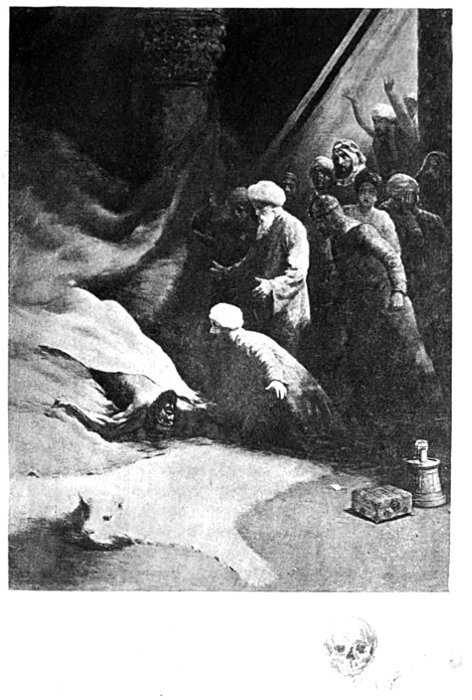
Now when it was the Eighty-seventh Night,
She said, It hath reached me, O auspicious King, that Zau al-Makan ordered the Chamberlain to bring out before him what he had brought of the tribute of Damascus; and, when he was shown the chests of money and rarities and jewels, he took them and parted them all amongst the troops, till nothing was left. And the Emirs kissed the ground before him and wished him long life, saying, "Never saw we a King, who gave the like of these gifts." Then all went away to their tents and when it was morning he gave orders for marching. So they marched for three days, till, on the fourth day, they drew near to Baghdad. When they entered the city, they found it decorated, and Zau al-Makan, the Sultan, went up to his father's palace and sat down on the throne, whilst the Emirs of the army and the Wazir Dandan and the Chamberlain of Damascus stood between his hands. Then he bade his private secretary write a writ to his brother Sharrkan, acquainting him with all that had passed, from first to last, and he concluded, "As soon as thou hast read this letter, make ready thine affair and join us with thine army, that we may turn to Holy War upon the Infidels and take man-bote for our father and wipe out the stain upon our honour." Then he folded the letter and sealed it with his seal-ring and said to the Minister Dandan, "None shall carry this letter but thou; and it behoveth thee speak my brother fair and say to him:—If thou have a mind to thy father's kingdom, it is thine, and thy brother shall be Viceroy for thee in Damascus; for to this effect am I instructed by him." So the Wazir went down from before him and made ready for his march. Then Zau al-Makan bade set apart a magnificent house for the Fireman and furnished it with the best of furniture and long is the tale of that Fireman. Presently Zau al-Makan went out chasing and hunting 217and, as he was returning to Baghdad, one of the Emirs presented him with blood-horses and with beauteous handmaids whose description the tongue evades.
Now when it was the Eighty-eighth Night,
She said, It hath reached me, O auspicious King, that Sharrkan asked his brother Zau al-Makan, "Hast thou requited the Fireman for his kindness?"; and he answered, "O my brother, I have not rewarded him as yet, but Inshallah! I will recompense him whenas I return from this raid and find time so to do." Therewith Sharrkan was certified that his sister, Nuzhat al-Zaman, had told him the whole truth; but he concealed what had passed between them and offered his salutation to her by her husband the Chamberlain. She sent him back her greeting, calling down blessings on him and enquiring after her daughter Kuzia-Fakan, to which he replied that the maiden was well and in the best of health and safety. Whereupon she praised Almighty Allah and gave him thanks. Then Sharrkan went to his brother to take counsel with him for departure; and Zau al-Makan said, "O my brother, as soon as the army is complete and the Arabs have come in from all parts, we will march forth." So he bade make ready the commissariat and prepare munitions of war and went in to his wife, who was now five months gone with child; and he put under her astrologers and mathematicians, to whom he appointed stipends and allowances. Then he set out three months after the arrival of the army of Syria, and as soon as the Arabs were come in and the troops were assembled from all directions; and, as he fared forth, he was followed by the warriors and the united host. Now the name of the General of the Daylam army was Rustam and that of the General of the army of the Turks Bahram.
Now when it was the Eighty-ninth Night,
She said, It hath reached me, O auspicious King, all this was a stratagem of the ancient woman, for that the King before his departure had gone to her and asked, "How shall I do and what plan shall I pursue? it is thou hast caused this great distress to us!" And she had answered, "O great King and mighty Cohen, I will teach thee a trick would baffle the Devil himself though he summon to his assistance all his grisly hosts. It is that thou send fifty thousand men going down in ships, and sailing over the sea to the Mountain of Smoke; and there let them land and stir not till the standards of Al-Islam come upon thee, when do thou up and at them. Then bid the troops from the seaward sally out upon the Moslems and take them in rear, whilst we confront them from the landward. So not one of them shall escape, and our sorrows shall cease and peace abide with us." Now the counsel of this ancient woman commended itself to King Afridun, and he replied, "Right is the recking thou reckest, O Princess of wits and recourse of Kings and Cohens warring for their blood-wit!" So when the army of Al-Islam came upon them in that valley, before they knew of it the flames began to burn up the tents and the swords in men's bodies to make rents. Then hurried up the army of Baghdad and Khorasan who numbered one hundred and twenty thousand horse, with Zau al-Makan in the front of war. When the host of the Infidels that lay by the sea saw them, they sallied out against them and followed in their tracks; and when Zau al-Makan espied this he cried out to his men, "Turn back to the Infidels, O People of the Chosen Apostle, and slay those who deny and hate the authority of the Compassionating, the Compassionate!" So they turned and 222fought with the Christians.
Now when it was the Full Ninetieth Night,
She said, It hath reached me, O auspicious King, as soon as dawn was seen and the morning shone with its shine and sheen, the horsemen ran to their spears full keen and King Afridun summoned his chief Knights and Nobles and invested them with dresses of honour; and, drawing the sign of the cross on their brows, incensed them with the incense which as aforesaid was the skite of the Chief Patriarch, the Cohen, the Heresiarch. This incensing done, he called for Luka bin Shamlut, surnamed the Sword of the Messiah; and, after fumigating him and rubbing his palate with the Holy Merde, caused him to snuff it and smeared his cheeks and anointed his moustaches with the rest. Now there was no stouter champion in the land of Roum than this accursed Luka, nor any better at bending of bow or sway of sword or lunge with lance on the day of devoir; but he was foul of favour, for his face was as the face of an ass, his shape that of an ape and his look 224as the look of a malignant snake: his presence was grievouser than parting from the beloved make; and blacker than night was his blackness and more fetid than the lion was his breath for foulness; more crooked than a bow was his crookedness and grimmer than the leopard was his ugliness, and he was branded with the mark of the Infidels on face. After this he came up to King Afridun and kissed his feet and stood before him; and the King said to him, "I desire thou go out against Sharrkan, King of Damascus, son of Omar bin al-Nu'uman, and deliver us from this affliction." Quoth Luka, "Hearkening and obedience;" and the King made the sign of the cross on his forehead and felt assured of help from Heaven being near hand. Then Luka went out from the presence and the accursed one mounted a sorrel horse; he was clad in a red robe and a hauberk of gold set with jewels, and he bore a trident spear, as he were Iblis the damned on the day of drewing out his hosts war to darraign. Then he rode forward, he and his horde of Infidels, even as though they were driving to the Fire, preceded by a herald, crying aloud in the Arabic tongue and saying, "Ho, sect of Mohammed (upon whom be salutation and salvation!), let none of you come out but your champion Sharrkan, the Sword of Al-Islam, Lord of Damascus in Shám!" Nor had he made an end of speaking, when arose a tumult in the plain; all the people heard the strain and the whole moving bodies of the armies twain called to mind the Day of Complain. Then the cowards trembled and all necks turned towards the sound, and lo!
I have a sorrel steed, whose pride is fain to bear the rein, ✿ Shall give thee what thou likest not and make thee feel his main:
I have a handy limber spear full bright and keen of point, ✿ Upon whose shaft the dam of Death her throny seat hath ta'en:
I have a trenchant glaive of Hind; and, when I bare its face ✿ Of scabbard-veil, from out its brow the rays of leven rain.
Luka understood not the sense of his speech nor did he apprehend the vehemence of the verse: but he smote his forehead with his hand, in honour of the Cross drawn thereon and kissed it; then he couched his throw-spear and ran at Sharrkan. But first he tossed the javelin with one hand in air to such height that it was lost to the spectators' sight; and, catching it with the other hand as do the jugglers, hurled it at Sharrkan. It flew from his grasp like a shooting star and folk clamoured and feared for Sharrkan; but, as the spear flew near him, he put out his hand and caught it in full flight to the amazement of all who saw the sight. Then he shook it with the hand that took it till it was well-nigh broken, and hurled it so high into the welkin that it disappeared from view. As it descended, he caught it again with the other hand, in less than the twinkling of an eye, and cried out from his heart-core, saying, "By the truth of Him who created the seven-fold skies, I will assuredly make this cursed wight a byword for mankind to despise!" Then threw he the throw-spear at Luka, who thought to do as Sharrkan had done and put forth his hand to bend it in mid-flight; but Sharrkan prevented him, and sped at him a second throw-spear which smote him and the point fell on his forehead, in the very centre of the sign of the Cross, and Allah hurried his soul to the Fire and Dwelling-place dire. But when the Infidels saw 226Luka bin Shamlut fall slain, they buffeted their faces and they cried, "Alas!" and "Woe worth the day!" and called for aid upon the Abbots of the monasteries——And Shahrazad perceived the dawn of day and ceased to say her permitted say.
Now when it was the Ninety-first Night,
She said, It hath reached me, O auspicious King, that when the Infidels saw Luka bin Shamlut fall slain, they buffeted their faces and cried, "Alas!" and "Woe worth the day!" and called upon the Abbots of the monasteries and cried, "Where be the crosses?" So the Religious offered up prayers and the Christians all drew together against Sharrkan; and, brandishing their scymitars and lances, rushed forward to the attack. Then army met army and breasts fell under hoof, whilst spear and sword ruled the day and fore-arms and wrists grew weak and the coursers seemed created without legs; nor did the herald of war cease calling to fight, till arms were aweary and day took flight and night came on with darkness dight. So the two hosts drew apart, whilst every brave staggered like a drunken knave, for that with so much cut and thrust they strave; and the place was choked with the slain; fell were the wounds and the hurt knew not by whom they fell. Then Sharrkan joined his brother, Zau al-Makan, and the Chamberlain and the Wazir Dandan, and said to them, "Verily Allah hath opened a door for the Infidels to fall, praised be the Lord of the Worlds one and all!" Replied Zau al-Makan, "Let us never cease to praise Allah, for that He hath dispelled trouble from the Arab and the Ajam. Indeed the folk, generation after generation, shall tell of thy derring-do against the accursed Luka, the falsifier of the Evangel; of thy catching the throw spear 227in mid-flight, and how the enemy of Allah among men thou didst smite; and thy fame shall endure until the end of time." Then said Sharrkan, "Harkye, O grand Chamberlain and doughty Capitayne!" and he answered, "Adsum!" Quoth Sharrkan, "Take with thee the Wazir Dandan and twenty thousand horse, and lead them seven parasangs towards the sea, and force the march till ye shall have come near the shore, and there remain only two parasangs between thee and the foe. Then ambush ye in the hollows of the ground till ye hear the tumult of the Infidels disembarking from their ships; and the war-cry from every side strike your ear and ye know that the sabres have begun labour between us and them; and, whenso ye see our troops falling back, as if defeated, and all the Infidels following them, as well those in front as those from the seaward and the tents, do ye still lie in wait for them: but as soon as ye see the standard with the words, There is no god but the God, and Mohammed is God's Apostle (on whom be salutation and salvation!), then up with the green banner, and do your endeavour and fall on their rear and shout, Allaho Akbar! Allah is most Great!
Now when it was the Ninety-second Night,
She said, It hath reached me, O auspicious King, that the Infidels called to one another, saying, "Take we vengeance-wreak for Luka!" while Hardub King of Greece cried aloud, "Ho, to our revenge for Abrizah!" Thereupon King Zau al-Makan shouted "Ho, servants of the Requiting King!: smite the children of denial and disobedience with the blanch of sword and the brown of spear!" So the Moslems returned to the Infidels and plied them with the keen-edged scymitar, whilst their herald cried aloud, "Up, and at the foes of the Faith, all ye who love the Prophet Elect, with hope of salvation on the Day of Fear, to win favour of the Bountiful, the Forgiving One; for verily the Garden of Paradise is under the shadow of swords!" And behold, Sharrkan and his men charged down upon the Infidels and cut off their retreat and wheeled and tourneyed among the ranks; when lo! a knight of goodly presence opened a passage through the army of Unbelievers and circled hither and thither amongst the Deniers, cutting and thrusting and covering the ground with heads and trunks, so that the Faithless feared him and their necks bent under his lunge and hew. He was girt with two swords, his glances and his brand, and he was armed with two lances, one of bamboo-cane and the other his straight wandlike shape; and his flowing hair stood him in stead of many warriors, even as saith the poet:—
230Laud not long hair, except it be dispread ✿ In two-fold locks, on day of fight and fray,
O'er youth who bears his lance 'twixt flank and thigh, ✿ From many a whiskered knight to win the day.
And as singeth another:—
I say to him, what while he slings his sword, ✿ "For sword shall serve those looks that sword-like show!"
Says he, "My sabre-looks for those I love, ✿ My sword for those who sweets of love unknow!"
When Sharrkan saw him, he said to him, "I conjure thee by the Koran and the attributes of the Compassionate One, O Champion of the Champions! tell me who thou art: for verily by thy deeds this day thou hast pleased the Requiting King, whom one thing distracteth not from other thing; in that thou hast been discomfiting the children of impiety and in rebellion revelling." Then cried the Cavalier to him saying, "Thou art he who madest brother-covenant with me but yesterday: how quickly thou hast forgotten me!" Thereupon he withdrew his mouth-veil, so that what was hidden of his beauty was disclosed, and lo! it was none other than Zau al-Makan. Then Sharrkan rejoiced in his brother, save that he feared for him the rush of fighting and the crush of braves a-smiting; and this for two reasons, the first, his tender age and exposure to the evil eye, and the second, that his safety was to the kingdom the greater of the two overshadowing wings. So he said to him, "O King! thou riskest thy life, so join thy steed to mine; in very sooth I fear for thee from the foe; and better thou stint hazarding thyself forth of these squadrons, that we may shoot at the enemy thine unerring shaft." Quoth Zau al-Makan, "I desire to even thee in fray and I will not be niggard 231of myself before thee in the mellay." Then the host of Al-Islam, heaping itself upon the Infidels, girt them on all sides, warred on them a right Holy War, and brake the power of the children of impiety and pride and stowre. But King Afridun sighed when he saw the evil wreak that had fallen on the Greek, and they turned their backs from fight and addressed themselves to flight, making for the ships, when lo!
Now when it was the Ninety-third Night,
She said, It hath reached me, O auspicious King, that when King Afridun heard these words, he fell into a fainting-fit with his nose under his feet; and, as soon as he revived, fear fluttered the scrotum below his belly and he complained to the ancient dame, Zat al-Dawahi. Now this accursed old woman was a witch of the witches, past mistress in sorcery and deception; wanton and wily, deboshed and deceptious; with foul breath, red eyelids, yellow cheeks, dull-brown face, eyes bleared, mangy body, hair grizzled, back humped, skin withered and wan and nostrils which ever ran. 234But she had studied the scriptures of Al-Islam and had made the Pilgrimage to the Holy House of Meccah and all this that she might come to the knowledge of the Mohammedan ordinances and the miraculous versets of the Koran; and she had professed Judaism in the Holy City of Jerusalem for two years' space, that she might master the magic of men and demons; so that she was a plague of plagues and a pest of pests, wrong-headed as to belief and to no religion lief. Now the chief reason of her sojourn with her son, King Hardub of Greece, was on account of the slave virgins at his court: for she was given to tribadism and could not exist without sapphism or she went mad: so if any damsel pleased her, she was wont to teach her the art of rubbing clitoris against clitoris and would anoint her with saffron till she fainted away for excess of volupty. Whoso obeyed her she was wont to favour and make her son incline towards her; but whoso repelled her she would contrive to destroy; and so she abode for a length of time. This was known to Marjanah and Rayhánah and Utrijah, the handmaids of Abrizah, and their Princess loathed the old woman and abhorred to lie with her, because of the rank smell from her armpits, the stench of her fizzles more fetid than carrion, and the roughness of her hide coarser than palm fibre. She was wont to bribe those who rubbed parts with her by means of jewels and instructions; but Abrizah held aloof from her and sought refuge with the Omnipotent, the Omniscient; for, by Allah, right well quoth the poet:—
235Ho thou who grovellest low before the great ✿ Nor over-lording lesser men dost blench,
Who gildest dross by dirham-gathering, ✿ No ottar-scent disguises carrion-stench!
And now to return to the story of her stratagem and the woes of her working. Presently she departed, taking the chief Nazarenes with their hosts, and turned towards the army of the Moslems. Whereupon King Hardub went in to King Afridun and said to him, "O King, we have no need of the Chief Patriarch nor of his prayers, but will consult my mother's counsel and observe what she will do with her craft unending against the Moslem hosts; for these are marching with all their power, they will soon be upon us and they will encircle us on all sides." When King Afridun heard this, terror took hold upon his heart and he wrote letters, without stay or delay, to all the nations of the Nazarenes, saying, "It behoveth none of the Messiahites or Cross-knights to hold back, especially the folk of the strongholds and forts: but let them all come to us, foot and horse, women and children, for the Moslem hosts already tread our soil. So haste! haste ye! ere what we fear to us here appear." Thus much concerning them; but regarding the work of the old woman, Zat al-Dawahi; when she went forth from the city with her suite, she clad them in the clothing of Moslem merchants, having provided herself with an hundred mules carrying stuffs of Antioch, such as goldwoven satins and royal brocades and so forth. And she had taken a letter from King Afridun to the following effect:—"These be merchantmen from the land of Sham who have been with us: so it befitteth none to do them harm or hindrance, nor take tax and tithe of them, till they reach their homes and safe places, for by merchants a country flourisheth, and these are no men of war nor of ill-faith." Then quoth the accursed Zat al-Dawahi to those with her, "Verily I wish to work out a plot for the destruction of the Moslem." Replied they, "O Queen, command us whatso thou wilt; we are at thy disposal and may the Messiah never disappoint thy dealings!" Then she donned a gown of fine white wool and rubbed 236her forehead, till she made a great mark as of a scar and anointed it with an ointment of her own fashion, so that it shone with prodigious sheen.
Now when it was the Ninety-fourth Night,
She said, It hath reached me, O auspicious King, that when the old woman, Zat al-Dawahi, and those with her had agreed upon such words, she said, "Now as soon as that which I impart shall reach the ears of King Sharrkan say him further:—Hearing these words from that image we knew that the holy man was indeed of the chiefest devotees and Allah's servants of purest qualities; so we made three days' march till we came in sight of that hermitage, and then we went up to it and passed the day in buying and selling, as is the wont of merchants. As soon as day had departed our sight and night was come to darken light, we repaired to the cell wherein 238was the dungeon, and we heard the holy man, after chanting some verses of the Koran, repeat the following couplets:—
My heart disheartened is, my breast is strait, ✿ And sinks my soul in sea of bale and bate:
Unless escape be near I soon shall die; ✿ And Death were better than this doleful strait:
O Lightning an thou light my home and folk, ✿ An their still brighter charms thy shine abate,
Say, what my path to meet them, being barred ✿ By wars; and barricado'd succour's gate?"
"When once ye have brought me into the Moslem camp, and I mix with them you shall see," the old woman continued, "how I will make shift to beguile them and slay them all, even to the last man." The Nazarenes hearing what she said, kissed her hands and set her in the chest, after they had beaten her with a grievous beating in obedience to her commands, for they saw it was incumbent on them to do her bidding in this; then they all made for the Moslem host as hath erst been said. Such was the case with the damned hag, Zat al-Dawahi and her companions; but as regards the Mohammedan army, they indeed, after Allah had given them victory over their enemies and they had plundered everything in the ships of money and hoards, all sat down to converse with one another and Zau al-Makan said to his brother Sharrkan, "Verily, Allah hath granted us to prevail because of our just dealing and discipline and concord amongst ourselves; wherefore continue, O Sharrkan, to obey my commandment, in submission to Allah (be He exalted and extolled!), for I mean to slay ten Kings in blood-revenge for my sire, to cut the throat of fifty thousand Greeks and to enter Constantinople." Replied Sharrkan, "My life be thy ransom against death! Needs must I follow out the Holy War, though I wone many a year in their country. But I have, O my brother, in Damascus a daughter, named Kuzia Fakan, whom I love heartily, for she is one of the marvels of the time and she will soon be of age." Said Zau al-Makan, "And I also have left my wife with child and near her time, nor do I know what Allah will vouchsafe me by her. But promise me, O my brother, that if Allah bless me with a son, thou wilt grant me thy daughter for wife to him, and make covenant with me and pledge me thy faith thereon." "With love and good will," replied Sharrkan; and, stretching out his hand to his brother, he said, "If she bring thee a son, I will give him my daughter Kuzia Fakan, to wife." At this Zau al-Makan rejoiced, and they fell to 239congratulating each other on the victory over the enemy. And the Wazir Dandan also congratulated the two brothers and said to them, "Know, O ye Kings, that Allah hath given us the victory, for that we have devoted our lives to Him (be He exalted and extolled!); and we have left our homes and households; and it is my counsel that we follow up the foe and press upon him and harass him; so haply Allah shall enable us to win our wishes, and we shall destroy our enemies, branch and root. If it please you, do ye go down in these ships and sail over the sea, whilst we fare forward by land and bear the brunt of battle and the thrust of fight." And the Minister Dandan ceased not to urge them to combat and repeated his words who said:—
To slay my foes is chiefest bliss I wist, ✿ And on the courser's back be borne a-list;
Comes promising tryst a messenger from friend ✿ Full oft, when comes the friend withouten tryst.
And these words of another:—
War for my mother (an I live) I'll take; ✿ Spear for my brother; scymitar for sire,
With every shag-haired brave who meets his death ✿ Smiling, till won from Doom his dear desire!
And when the Wazir ended his verses, he said, "Praise be to Him who aided us dear victory to uphold and who hath given us spoil of silver and fine gold!" Then Zau al-Makan commanded the army to depart; and they fared on forcing their marches for Constantinople, till they came to a wide and spacious champaign, full of all things fair and fain, with wild cattle frisking and gazelles pacing to and fro across the plain. Now they had traversed great deserts and drink had been six days cut off from them, when they drew near this meadow and saw therein waters founting and ripe fruits flaunting and that land as it were Paradise; for it had donned its adornments and decked itself. Gently waved the branches of its trees drunken with the new wine of the dew, and combined with the nectar of Tasnim the soft breathings of the morning breeze. Mind and gazer were confounded by its beauty, even as saith the poet:—
240Behold this lovely garden! 'tis as though ✿ Spring o'er its frame her greeny cloak had spread.
Looking with fleshly eyne, thou shalt but sight ✿ A lake whose waters balance in their bed;
But look with spirit-eyes and lo! shalt see ✿ Glory in every leaf o'erwaves thy head.
And as another saith:—
The stream's a cheek by sunlight rosy dyed, ✿ Whose down is creeping shade of tamarisk-stems;
Round legs of tree-trunks wavelets roll in rings ✿ Silvern, and blossoms are the diadems.
When Zau al-Makan saw this champaign, with its trees bowing and its flowers blooming and its birds warbling, he called to his brother Sharrkan and said, "O my brother, verily in Damascus is naught the like of this place. We will not march from it save after three days, that we may take rest ourselves and that the army of Al-Islam may regain strength and their souls be fortified to encounter the blamed Infidels." So they halted therein and while camping behold, they heard a noise of voices from afar, and Zau al-Makan asked the cause thereof, and was answered that a caravan of merchants from the Land of Syria had halted there to rest and that the Moslem troops had come on them and had haply seized something of the goods which they had brought from the country of the Infidels. After a while up came the merchants, crying out and appealing to the King for aidance. When Zau al-Makan saw this, he bade them be brought before him and, when in presence, they said to him, "O King, we have been in the country of the Infidels and they plundered us of nothing: why then do our brothers the Moslems despoil our goods, and we in their own land? Of a truth when we saw your troops, we went up to them, and they robbed us of what we had with us and we have now reported to thee all that hath befallen us." Thereupon they brought out to him the letter of the King of Constantinople, and Sharrkan read it and said, "We will presently restore to you what hath been taken from you; but yet it behoveth you not to carry merchandise to the country of the Infidels." Replied they, "O our Lord, in very sooth Allah despatched us thither that we might win what Gházi never won the like of, not even thou in all thy 241razzias." Asked Sharrkan, "What was it ye won?" "O King," answered they, "we will not tell thee save in private; for if this matter be noised among the folk, haply it may come to the ears of some, and this will be the cause of our ruin and of the ruin of all Moslems who resort to the land of the Greeks." Now they had hidden the chest wherein was the damned Zat al-Dawahi. So Zau al-Makan and his brother brought them to a private place, where they laid bare to both of them the story of the devotee, and wept till they made the two Kings weep——And Shahrazad perceived the dawn of day and ceased saying her permitted say.
Now when it was the Ninety-fifth Night,
She said, It hath reached me, O auspicious King, that the Nazarenes who wore merchants' weed, when brought to a private place by Zau al-Makan and his brother Sharrkan, laid bare to both of them the story of the devotee and wept till they made the two Kings weep and repeated to them all which had been taught by the old witch Zat al-Dawahi. Thereupon Sharrkan's heart yearned to the devotee and he was moved to ruth for him and was fired with zeal for the service of Almighty Allah. So quoth he to them, "Did ye rescue this holy man or is he still in the hermitage?" Quoth they, "We delivered him and slew the hermit, fearing for our lives; after which we made haste to fly for dread of death; but a trusty man told us that in this hermitage are quintals of gold and silver and stones of price." Then they fetched the chest and brought out the accursed old woman, as she were a cassia-pod for excess of blackness and leanness, and she was laden with the same fetters and shackles. When Zau al-Makan and the bystanders saw her, they took her for a man of the best of Allah's devotees and surpassing in pious qualities, more especially because of the shining of her forehead for the ointment wherewith she had anointed her face. So Zau al-Makan and Sharrkan wept sore; then they rose up in honour and kissed her hands and feet, sobbing aloud: but she signed to them and said, "Cease this weeping and hear my words." Hereat they dried their tears in obedience to her bidding, and she said, "Know ye both that I was content to accept what my Lord 242did unto me, for I kenned that the affliction which befel me was a trial from Him (be He exalted and extolled!); and whoso hath not patience under calamity and tribulation, for him there is no coming to the delights of Paradise. I had indeed supplicated Him that I might return to my native land, not as a compensation for the sufferings decreed to me, but that I might die under the horse-hoofs of warriors fighting for the Faith who, being slain in fray, live again without suffering death." Then she repeated the following couplets:—
Our Fort is Tor, and flames the fire of fight: ✿ Moses art thou and this is time for aid:
Cast down thy rod, 'twill swallow all they wrought, ✿ Nor dread for men their ropes be vipers made:
For Chapters read on fight-day lines of foes, ✿ And on their necks 'grave versets wi' thy blade!
243When the old woman had ended her verse, her eyes overflowed with tears and her forehead under the unguent shone like gleaming light, and Sharrkan rose and kissed her hand and caused food be brought before her: but she refused it, saying, "I have not broken my fast by day for fifteen years; and how should I break it at such a time when my Lord hath been bountiful to me in delivering me from the captivity of the Infidels and removing from me that which was more grievous to me than torment of fire? I will wait till sundown." So when it was nightfall, Sharrkan and Zau al-Makan came and served her with food and said, "Eat O ascetic!" But she said, "This is no time for eating; it is the time for worshipping the Requiting King." Then she stood up in the prayer-niche and remained praying till the night was spent; and she ceased not to do after this fashion for three days and nights, sitting not but at the time of the Salám or salutation ending the several prayers. When Zau al-Makan saw her on this wise, firm belief in her gat hold of his heart and he said to Sharrkan, "Cause a tent of perfumed leather to be pitched for this Religious, and appoint a body servant to wait upon him." On the fourth day she called for food; so they brought her all kinds of meats that could seduce the sense or delight the sight; but of all this she would eat only a scone with salt. Then she again turned to her fast and, as the night came, she rose anew to pray; when Sharrkan said to Zau al-Makan, "Verily, this man carrieth renunciation of the world to the extreme of renouncing, and, were it not for this Holy War, I would join myself to him and worship Allah in his service, till I came before His presence. And now I desire to enter his tent and talk with him for an hour." Quoth Zau al-Makan, "And I also: to-morrow we sally forth to fight against Constantinople, and we shall find no time like the present." Said the Wazir Dandan, "And I no less desire to see this ascetic; haply he will pray for me that I find death in this Holy War and come to the presence of my Lord, for I am aweary of the world." So as soon as night had darkened, they repaired to the tent of that witch, Zat al-Dawahi; and, seeing her standing to pray, they drew near her and fell a-weeping for pity of her; but she paid no heed to them till midnight was past, when she ended her orisons by pronouncing 244the salutation. Then she turned to them and after wishing them long life, asked them "Wherefore come ye?"; whereto they answered, "O thou holy man! diddest thou not hear us weep around thee?" She rejoined, "To him who standeth in the presence of Allah, remaineth no existence in time, either for hearing any or for seeing aught about him." Quoth they, "We would have thee recount to us the cause of thy captivity and pray for us this night, for that will profit us more than the possession of Constantinople." Now when she heard their words she said, "By Allah, were ye not the Emirs of the Moslems, I would not relate to you aught of this at any time; for I complain not but to Allah alone.
Now when it was the Ninety-sixth Night,
She said, It hath reached me, O auspicious King, that Sharrkan and his brother, Zau al-Makan and the Wazir Dandan set off with an hundred horse for the hermitage described to them by that 247accursed Zat al-Dawahi; and they took with them mules and chests for transporting the treasure. Now as soon as dawned the morn, the Chamberlain signalled to the host an order for departure, and they set out thinking that the two Kings and the Wazir were with them; knowing not that the three had made for the monastery. Such was the case with the host; but as regards the two Kings and the Minister, they tarried in their place till the end of that day. Now the Infidels who were with Zat al-Dawahi took their departure privily, after they had gone in to her and kissed her hands and feet and obtained her leave to march. So she not only gave them permission but also taught them all she minded of wile and guile. And when it was dark night, she arose and went in to Zau al-Makan and his companions and said to them, "Come, let us set out for the mountain, and take with you a few men-at-arms." They obeyed her and left five horsemen at the foot of the mountain, whilst the rest rode on before Zat al-Dawahi, who gained new strength for excess of joy, so that Zau al-Makan said, "Glory be to Him who sustaineth this holy man, whose like we never saw!" Now the witch had written a letter to the King of Constantinople and despatched it on the wings of a bird, acquainting him with what had passed and ending, "I wish thee to send me ten thousand horsemen of the bravest of the Greeks and let them steal along the foot of the mountains with caution, lest the host of Al-Islam get sight of them; and, when they reach the hermitage, let them ambush themselves there, till I come to them with the Moslem King and his brother, for I shall inveigle them and will bring them thither, together with the Wazir and an hundred horse and no more, that I may presently deliver to them the crosses which be in the hermitage. I am resolved to slay the Monk Matruhina, since my scheme cannot be carried out but by taking his life.
Now when it was the Ninety-seventh Night,
She said, it hath reached me, O auspicious King, that when the damned witch, Zat al-Dawahi, took the head of the Knight, the leader of the twenty thousand Infidels, she brought it and threw 251it down before Zau al-Makan and his brother Sharrkan and the Wazir Dandan, saying, "When I saw your condition, I waxed jealous for your honour; so I rushed on the Chief Knight and smote him with the sword till I severed head from trunk. And none could near me, so I brought his head to you, that you may be strengthened in Holy War and work out with your swords the will of the Lord of the Faithful. And now I purpose leaving you to strive against the Infidels, whilst I go to your army, though they be at the gates of Constantinople, and return with twenty thousand horse to destroy these Unfaithfuls." Quoth Sharrkan, "How wilt thou pass to them, O thou holy man, seeing that the valley is blocked up on all sides by the Miscreants?" Quoth the accursed hag, "Allah will veil me from their eyes and they shall not sight me; nor, if any saw me, would he dare to attack me at that time, for I shall be as one non-existing, absorbed in Allah, and He will fend off from me His foes." "Thou sayest sooth, O holy man," rejoined Sharrkan, "for indeed I have been witness of that; so, if thou can pass out at the first of the night, 'twill be best for us." Replied she, "I will set out at this very hour and, if thou desire, thou shalt go with me and none shall see thee. Furthermore if thy brother also have a mind to go with us we will take him, but none else; for the shadow of a saint can cover only twain." Sharrkan said, "As for me I will not leave my comrades; but, if my brother will, there is no harm in his going with thee and setting us free of this strait; for he is the stronghold of the Moslems and the sword of the Lord of the three Worlds; and if it be his pleasure, let him take with him the Wazir Dandan, or whom else he may elect and send us ten thousand horse to succour us against these caitiffs." So after debate they agreed on this and the old woman said, "Give me leisure to go before you and consider the condition of the Infidels, if they be asleep or awake." Quoth they, "We will not go forth save with thee and trust our affair to Allah." "If I do your bidding," replied she, "blame me not but blame yourselves; for it is my rede that you await me till I bring you tidings of the case." Then said Sharrkan, "Go to them and delay not from us, for we shall be awaiting thee." Thereupon she fared forth and Sharrkan turned to his brother addressing him and said, "Were not this holy man a miracle-worker, he had never slain yonder furious knight. This is proof sufficient of the ascetic's 252power; and of a truth the pride of the Infidels is laid low by the slaying of this cavalier, for he was violent, evil devil and a stubborn." Now whilst they were thus devising of the mighty works of the devotee, behold, the accursed Zat al-Dawahi came upon them and promised them victory over the Unbelievers; wherefor they thanked her (not knowing that all this was wile and guile) and the damned hag asked, "Where be the King of the Age, Zau al-Makan, and the Minister Dandan?" Answered he, "Here am I!" "Take with thee thy Wazir," said she, "and follow after me, that we may fare forth to Constantinople." Now she had acquainted the Infidels with the cheat she had put upon the Moslems, and they rejoiced with exceeding great joy, and said, "Our hearts will not be contented till we shall have slain their King in return for the Knight's death; because we had no stouter rider than he;" and they added (bespeaking the ill-omened hag as she told them her plan of faring to the land of the Moslems), "When thou bringest him to us, we will bear him to King Afridun." Then she went out and went out with her Zau al-Makan and the Minister Dandan, and she walked on before the two saying, "Fare forth with the blessing of Almighty Allah!" So they did her bidding, for the shaft of Fate and Fortune of man's lot had shot them, and she ceased not leading them both through the midst of the Grecian camp, till they came to the defile, the narrow pass aforesaid, whilst the Infidel enemy watched them, but did them no hindrance; for the infernal old woman had enjoined this. Now when Zau al-Makan and the Wazir Dandan saw that the Infidel host offered them no let and stay and yet had them in sight, the Wazir exclaimed, "By Allah, this is one of the holy man's saintly miracles! and doubtless he be of the elect." Rejoined Zau al-Makan, "By Allah, I think the Infidels be naught but blind, for we see them and they see us not." And while they were thus praising the holy man and recounting his mighty works and his piety and his prayers, behold, the Infidels charged down on them from all sides and surrounded them and seized them, saying, "Is there anyone else with you twain, that we may seize upon him too?" And the Wazir Dandan replied, "See you not yon other man that is before us?" Replied the Unbelievers, "By the truth of the Messiah and the Monks, and the Primate and the Metropolitan, we see none save you two!" Then Zau al-Makan said, "By Allah, this is a chastisement decreed to us by Almighty Allah!"—And Shahrazad perceived the dawn of day and ceased saying her permitted say.
Now when it was the Ninety-eighth Night,
She said, it hath reached me, O auspicious King, that when the Unfaithful had seized upon King Zau al-Makan and the Wazir Dandan, they said to the two, "Is there anyone else with you twain, that we may seize upon him also?" And the Wazir Dandan replied, "See you not yon other man who be with us?" They rejoined, "By the truth of the Messiah and the Monks and the Primate and the Metropolitan, we see none save you two!" Then the Infidels laid shackles on their feet and set men to guard them during the night, whilst Zat al-Dawahi fared on and disappeared from their sight. So they fell to lamenting and saying to each other, "Verily, the opposing of pious men leadeth to greater distress than this, and we are punished by the strait which hath befallen us." So far concerning Zau al-Makan and the Wazir Dandan; but as regards King Sharrkan, he passed that night in the cavern with his comrades, and when dawned the day and he had prayed the morn-prayer, he and his men made ready to do battle with the Infidel and he heartened them and promised them all good. Then they sallied out till they were hard upon the Unbelievers and, when these saw them from afar, they cried out to them, saying, "O Moslems, we have taken captives your Sultan and your Wazir who hath the ordering of your affairs; and except ye leave off fighting us, we will slay you to the last man; but an you yield yourselves we will take you to our King, who will make peace with you on condition that you quit our country and return home and harm us in naught, and we will do you no harm in aught. If ye accept, it will be well for you; but if ye refuse there remaineth nothing for you but death. So we have told you sooth, and this is our last word to you." Now when Sharrkan heard this and was certified of the captivity of his brother and the Wazir Dandan, he was weighed down with woe and wept; his force failed him and, making sure of death, he said to himself, "Would I knew the cause of their capture! Did they fail of respect to the holy man or disobey him, or what was the matter?" Then they sprang up to battle with the Unbelievers and slew great numbers of them. The brave was known that day from craven men, and sword and spear were dyed with bloody stain; for the Infidels flocked upon them, as flies flock to drink, from hill and from plain; but Sharrkan and his men ceased not to wage the fight of 254those who fear not to die, nor let death hinder them from the pursuit of victory, till the valley ran gore and earth was full of the slain she bore.
Now when it was the Ninety-ninth Night,
She said, It hath reached me, O auspicious King, that the army of the Moslems held the cavern-mouth and stood by its walls and they fended off the foe, and every one of the Infidels attempted to charge them, him they slew; and they patiently supported all such assaults till day was done and night came on dusky and dun; by which time King Sharrkan had only five-and-twenty men and no more left. Then quoth the Infidels to one another, "When shall these battle days have an end? We are weary of warring the 255Moslems." And quoth one of them, "Up and at them, for there remain of them but five-and-twenty men! If we cannot prevail on them to fight, let us light a fire upon them; and if they submit themselves and yield to us, we will take them prisoners; but if they refuse we will leave them for fuel to the fire, so shall they become to men of foreseeing mind a warning dire. May the Messiah on their fathers have no grace, and may the sojourn of the Nazarenes be for them no abiding-place!" So they carried fuel to the jaws of the cavern and set fire to it. Thereupon Sharrkan and his companions made sure of perdition and yielded themselves prisoners. And while they were in this condition, lo!
Now when it was the Hundredth Night,
She said, It hath reached me O auspicious King, that Sharrkan spake thus, "I long that ye fall in with this my plan, for naught save good can come of it." So they agreed thereon and clomb the mountain head and shouted, "Allaho Akbar!"; and hills and trees and rocks re-worded their Allaho Akbar for fear of the Almighty. The Infidels heard it and cried out one to other and donned their armour and said, "The foe is upon us, by the truth of the Messiah!" Then they fell on one another and slew of their own men more than any knoweth save Almighty Allah. As soon as it was dawn, they sought for the captives, but found no trace of them, and their captains said, "They who did this were the prisoners in our possession; up, then, and after them in all haste till ye overtake them, when we will make them quaff the cup of requital; and let not fright nor the panic of sudden awaking possess you." So they took horse and rode after the fugitives and it wanted but an eye-twinkling before they overtook them and surrounded them. Now when Zau al-Makan saw this, he was seized with increase of terror and said to his brother, "What I feared would come, is come upon us, and now it remaineth only for us to fight for the Faith." But Sharrkan preferred to hold his peace. Then Zau al-Makan and his companions rushed down from the hill-crest, shouting, "Allaho Akbar!" and his men repeated the war cry and addressed themselves to fight and to sell their lives in the service of the Lord of Faithful Men; and while they were in this case, behold, they heard many voices voicing, "There is no god but the God! God is most great! Salutation and salvation upon the Apostle, the Bringer of glad Tidings, the Bearer of bad Tidings!" So they turned towards the direction of the sound and saw a company of Moslems who believed in one God, pushing towards them, whereat their hearts were heartened and Sharrkan charged upon the Infidels crying out, "There is no god but the God!
Be praises mine to all-praiseworthy Thee, ✿ O Lord, who stinted not mine aid to be!
Though was I lost abroad, Thou wast to me ✿ Strongest support which vouchsafed victory:
Thou gav'st me wealth and reign and goodly gifts, ✿ And slungest conquering sword of valiancy:
Thou mad'st me blest beneath Thy kingly shade, ✿ Engraced with generous boons dealt fain and free:
Thou savedst from every fear I feared, by aid ✿ Of my Wazir, the Age's noblest he!
Garred us Thy grace in fight to throw the Greek, ✿ Who yet came back dight in War's cramoisie:
Then made I feint to fly from out the fight; ✿ But like grim lion turning made them flee,
And left on valley-sole my foemen, drunk ✿ Not with old wine but Death-cup's revelry:
Then came the Saintly Hermit, and he showed ✿ His marvels wrought for town and wold to see;
When slew they hero-wights who woke to dwell ✿ In Eden bowers wherein sweet rill-lets well.
But, when Zau al-Makan had made an end of versifying, his brother Sharrkan congratulated him on his safety and thanked him for the deeds he had done; after which both set out forcing their marches to rejoin their army.——And Shahrazad perceived the dawn of day and ceased saying her permitted say.
Now when it as the Hundred-and-first Night,
She said, It hath reached me, O auspicious King, that Sharrkan congratulated his brother, Zau al-Makan, on his safety and thanked him for the deeds he had done; after which both set 262out forcing their marches to rejoin their army. Such was their case; but as regards the old woman, Zat al-Dawahi, after she had foregathered with the hosts of Rustam and Bahram, she returned to the coppice, where she took her steed and mounted and sped on at speed, till she drew near the Moslem army that beleaguered Constantinople, when she lighted down from her destrier and led it to the pavilion-tent of the Chief Chamberlain. And when he saw her, he stood up to her in honour and signed to her with his right hand and said, "Welcome O pious recluse!" Then he questioned her of what had befallen, and she repeated to him her disquieting lies and deluding calumnies, saying, "In sooth I fear for the Emir Rustam, and the Emir Bahram, for that I met them and theirs on the way and sent them and their following to relieve the King and his companions. Now there are but twenty thousand horse and the Unbelievers outnumber them; so I would have thee at this moment send off the rest of thy troops at full speed to their succour, lest they be slain to the last man." And she cried to them, "Haste! Haste!" When the Chamberlain and the Moslems heard these words, their spirits fell and they wept; but Zat al-Dawahi said to them, "Ask aidance of Allah and bear patiently this tribulation; for ye have the example of those who have been before you of the people of Mohammed; and Paradise with its palaces is laid out by Allah for those who die martyrs; and needs must all die, but most praiseworthy is dying while fighting for the Faith." The Chamberlain, hearing this speech of the accursed old woman, called for the Emir Bahram's brother, a knight by name Tarkash; and, choosing out for him ten thousand horse, riders famed for force, bade him set out at once. So he fared forth and marched all that day and the whole of the next night, till he neared the Moslems. When daylight dawned, Sharrkan saw the dust cloud about them and feared for the men of Al-Islam and said, "If these troops which are coming upon us be Moslem men our victory is assured by them; but, if these be Nazarenes, there is no gainsaying Destiny's decrees." Then he turned to his brother, Zau al-Makan, and said, "Never fear, for with my life I will ransom thee from death.
He prayeth and he fasteth for an end he doth espy; ✿ When once his end is safely won then fast and prayer good-bye.
So the devotee ceased not to walk among the horsemen and the footmen, like a wily fox meditating guile, and began to uplift her voice, chanting the Koran and praising the Compassionate One. And they continued pressing forward till they approached the camp of Al-Islam, where Sharrkan found the Moslem in conquered plight and the Chamberlain upon the brink of falling back in flight, whilst the sword of Greece havoc dight among the Faithful, the righteous and those who work unright,——And Shahrazad perceived the dawn of day and ceased saying her permitted say.
Now when it was the Hundred-and-second Night,
She said, It hath reached me, O auspicious King, that when Sharrkan saw the Moslems in conquered plight and the Chamberlain upon the brink of retreat and flight and the sword havoc dight among the righteous and the workers of unright, the cause of this weakness among the Moslems was that the accursed old woman, Zat al-Dawahi, the foe of the Faith, after seeing that Bahram and Rustam had set forward with their troops to join Sharrkan and his brother Zau al-Makan, repaired to the camp of the Mahometans before Constantinople and caused the mission of the Emir Tarkash, as hath been before said. In this her purpose was to divide the Moslem forces the better to weaken them. Then she left them and entered Constantinople, and called with a loud voice on the knights of the Greeks, saying, "Let me down a cord that I may tie thereto this letter, and do ye bear it to your King Afridun, that he may read it and to my son King Hardub that they both do what is written therein of bidding and forbidding." So they let down for her a string and she tied thereto a letter whose purport was the following: "From the terriblest of tribulations and the chiefest of all calamities, Zat al-Dawahi, to King Afridun greeting. But afterwards. Of a truth I have contrived a device for destroying the Moslems; so bide ye quiet and content. I have cozened and captured their Sultan and the Wazir Dandan; and then I returned to their camp and acquainted them therewith, whereby their pride had a fall and their withers were wrung. And I have so wrought upon the host 'leaguering Constantinople that they have sent ten thousand men under the Emir Tarkash to succour the captives, of whom there be now left but few; it is therefore my object that ye sally forth against them with all your power while this day endureth; and that ye fall on them in their tents and that ye leave them not till ye shall have slain them to the last man; for, verily the Messiah looketh down upon you and the Blessed Virgin favoureth you; and I hope of the Messiah that he forget not what deed I have done." When her letter came to King Afridun, he rejoiced with great joyance; and, sending at once for King Hardub of Greece, son of Zat al-Dawahi, read the letter to him as soon as he came, whereat he was exceeding 266glad and said, "See my mother's craft; verily it dispenseth with swords, and her aspect standeth in stead of the terrors of the Day of Dread." Rejoined Afridun, "May the Messiah not bereave us of thy venerable parent nor deprive her of her wile and guile!" Then he bade the Knights give orders for sallying outside the city, and the news was noised abroad in Constantinople.
Now when it was the Hundred-and-third Night,
She said, It hath reached me, O auspicious King, that when King Zau al-Makan saw that the accursed Infidel had struck with javelin his brother Sharrkan, he deemed him dead, and despatched cavaliers towards him; and the first to reach him were the Wazir Dandan and the Emir of the Turks, Bahram, and the Emir of the Daylamites, Rustam. They found him falling from his horse; so they stayed him in his saddle and returned with him to his brother, Zau al-Makan; then they gave him in charge to his pages, and went again to do the work of cut and thrust. So the strife redoubled and the weapons together clashed and ceased not bate and debate and naught was to be seen but blood flowing and necks bowing; nor did the swords cease on the napes of men to make play nor the strife to rage with more and more affray, till the most part of the night was past away and the two hosts were aweary of the mellay. So they called a truce and each army returned to its tents, whilst all the Infidels repaired to King Afridun and kissed the ground before him, and the priests and monks wished him joy of his victory over Sharrkan. Then the King fared for Constantinople and sat upon the throne of his realm, when King Hardub came to him and said, "May the Messiah strengthen thy fore-arm and never cease to be thy helper and hearken to what prayers my pious mother, Zat al-Dawahi, shall pray for thee! Know that the Moslems can make no stay without Sharrkan." Replied Afridun, "To-morrow shall end the affair when to fight I fare: I will seek Zau al-Makan and slay him, and their army shall turn tail and of flight shall avail." Such was the case with the Kafirs; but as regards the host of Al-Islam, when Zau al-Makan returned to his tent, he thought of naught but his brother and, going into the pavilion, found him in evil case and sore condition; whereupon he summoned for counsel the Wazir Dandan and Rustam and Bahram. When they entered, they opined to assemble the physicians that they might medicine Sharrkan, and they wept and said, "The world will not readily afford his like!" and they watched by him all that night, and about the later hours came to them the Recluse in tears.
On the glancing racer outracing glance ✿ He speeds, as though he would collar Doom:
His steed's black coat is of darkest jet, ✿ And likest Night in her nightliest gloom:
Whose neigh sounds glad to the hearer's ears ✿ Like thunders rolling in thund'rous boom:
If he race the wind he will lead the way, ✿ And the lightning-flash will behind him loom.
Then each rushed upon the opponent, parrying blows and proving the marvellous qualities were stored in him; and they fell to drawing on and withdrawing till the breasts of the bystanders were straitened and they were weary of waiting for the event. At last Zau al-Makan cried out his war-cry and rushed upon Hardub, King of Cæsarea, and struck him a stroke that shore head from trunk and slew him on the spot. When the Infidels saw this, they charged in a body, compact and united, upon Zau al-Makan, who met them amidfield, and they engaged in hewing and foining, till blood ran in rills. Then the Moslems cried out, "Allaho Akbar!"—God is most great—and "There is no god but the God!"; and invoked salvation for the Prophet, the Bringer of Glad Tidings, the Bearer of Bad Tidings. And there befel a great fight, but Allah assigned victory to the Faithful and defeat to the Faithless. The Wazir Dandan shouted, "Take your blood-revenge for King Omar bin al-Nu'uman and his son Sharrkan!"; and bared his head and cried out to the Turks. Now there were by his side more than twenty thousand horse, and all charged with him as one man, when the Faithless found naught to save their lives but flight.
Now when it was the Hundred-and-fourth Night,
She said, It hath reached me, O auspicious King, that when Zau al-Makan went in to his brother Sharrkan, he found him sitting with the Holy Man by his side; so he rejoiced and drew near him and gave him joy of his recovery. Answered he, "Verily we are all under the benediction of this Recluse nor would you have been victorious but for his prayers, indeed he felt no fear this day and he ceased not supplication for the Moslems. I found strength return to me, when I heard your 'Allaho Akbar,' for then I knew you to be victorious over your enemies. But now recount to me, O my brother, what befel thee." So he told him all that had passed between him and the accursed Hardub and related how he had slain him and sent him to the malediction of Allah; and Sharrkan praised him and thanked him for his prowess. When Zat al-Dawahi heard tell of her son's death (and she still drest as a devotee), her face waxed yellow and her eyes ran over with railing tears: she kept her counsel, however, and feigned to the Moslems that she was glad and wept for excess of joy. But she said to herself, "By the truth of the Messiah, there remaineth no profit of my life, if I burn not his heart for his brother, Sharrkan, even as he hath burnt my heart for King Hardub, the mainstay of Christendom and the hosts of Crossdom!" Still she kept her secret. And the Wazir Dandan and King Zau al-Makan and the Chamberlain remained sitting with Sharrkan till they had dressed and salved his wound; after which they gave him medicines and he began to recover strength; whereat they joyed with exceeding joy and told the troops who congratulated themselves, saying, "To-morrow he 275will ride with us and do manly devoir in the siege." Then said Sharrkan to them, "Ye have fought through all this day and are aweary of fight; so it behoveth that you return to your places and sleep and not sit up." They accepted his counsel and then each went away to his own pavilion, and none remained with Sharrkan but a few servants and the old woman Zat al-Dawahi.
Now when it was the Hundred-and-fifth Night,
She said, It hath reached me, O auspicious King, that they laid Sharrkan out and buried him in the mountain aforesaid and mourned over his far-famed virtues. Then they looked for the opening of the city-gate; but it opened not and no sign of men appeared to them on the walls; whereat they wondered with 277exceeding wonder. But King Zau al-Makan said, "By Allah, I will not turn back from them, though I sit here for years and years, till I take blood-revenge for my brother Sharrkan and waste Constantinople and kill the King of the Nazarenes, even if death overcome me and I be at rest from this woeful world!" Then he bade be brought out the treasure taken from the Monastery of Matruhina; and mustered the troops and divided the monies among them, and he left not one of them but he gave him gifts which contented him. Moreover, he assembled in the presence three hundred horse of every division and said to them, "Do ye send supplies to your households, for I am resolved to abide by this city, year after year, till I have taken man-bote for my brother Sharrkan, even if I die in this stead." And when the army heard these words and had received his gifts of money they replied, "To hear is to obey!" Thereupon he summoned couriers and gave them letters and charged them to deliver the same, together with the monies, to the soldiers' families and inform them that all were safe and satisfied, and acquaint them saying, "We are encamped before Constantinople and we will either destroy it or die; and, albeit we be obliged to abide here months and years, we will not depart hence till we take it." Moreover, he bade the Wazir Dandan write to his sister, Nuzhat al-Zaman, and said to him, "Acquaint her with what hath befallen us, and what be our situation and commend my child to her care since that, when I went out to war, my wife was near her delivery and by this time she must needs have been brought to bed; and if she hath given birth to a boy, as I have heard say, hasten your return and bring me the acceptable news." Then he gave them somewhat of money, which they pouched and set out at once; and all the people flocked forth to take leave of them and entrust them with the monies and the messages. After they had departed, Zau al-Makan turned to the Wazir Dandan and commanded him to advance with the army against the city-walls. So the troops pushed forward, but found none on the ramparts, whereat they marvelled, while Zau al-Makan was troubled at the case, for he deeply mourned the severance from his brother Sharrkan and he was sore perturbed about that traitor the Ascetic. In this condition they abode three days without seeing anyone.
Whatso is not to be no sleight shall bring to pass; ✿ What is to be without a failure shall become;
Soon the becoming fortune shall be found to be, ✿ And Folly's brother shall abide forlorn and glum."
280"Wherefore do thou leave this weeping and wailing and hearten thy heart to bear arms." He replied, "O Wazir, my heart is heavy for the death of my father and my brother and for our absence from hearth and home; and my mind is concerned for my subjects." Thereupon the Wazir and the bystanders wept; but they ceased not from pushing forward the siege of Constantinople for a length of days. And they being thus, behold, news arrived from Baghdad, by one of the Emirs to the effect that the King's wife had been blessed with a boy, and that his sister, Nuzhat al-Zaman, had named him Kanmakan. Moreover, that the boy bid fair to be famous, already showing wondrous signs and marvellous tokens; and that she had commanded the Olema and the preachers to pray for mother and child from the pulpits and bless them in all wise; furthermore that the twain were well, that the land had enjoyed abundant rains, and that his comrade the Fireman was established in all prosperity, with eunuchs and slaves to wait upon him; but that he was still ignorant of what had befallen him. And she ended with the greeting of peace. Then quoth Zau al-Makan to the Wazir Dandan, "Now is my back strengthened for that I have been blest with a son whose name is Kanmakan."——And Shahrazad perceived the dawn of day and ceased saying her permitted say.
Now when it was the Hundred-and-sixth Night,
She said, It hath reached me, O auspicious King, that when they brought him the news of his wife having borne him a boy child, Zau al-Makan rejoiced with great joy and cried, "Now is my back strengthened, for that I have been blessed with a son whose name is Kanmakan." And he spake to the Wazir Dandan, saying, "I am minded to leave this mourning and order perlections of the Koran for my brother and command almsdeeds on his account." Quoth the Wazir, "Thy design is good." Thereupon he caused tents to be pitched over his brother's tomb; so they raised them and gathered together such of the men-at-arms as could repeat the Koran; and some began reciting the Holy volume; whilst others chanted litanies containing the names of Allah, and thus they 281did till the morning. Then Zau al-Makan went up to the grave of his brother Sharrkan and poured forth copious tears, and improvised these couplets:—
They bore him bier'd, and all who followed wept ✿ With Moses' shrieks what day o'erhead shook Tor;
Till reached the grave which Fate had made his home, ✿ Dug in men's souls who one sole God adore:
Ne'er had I thought before to see my joy ✿ Borne on the bier which heads of bearers bore:
Ah no! nor ere they homed thee in the dust ✿ That stars of heaven earth ever covered o'er.
Is the tomb-dweller hostage of a stead, ✿ Where light and splendour o'er thy face shall pour?
Praise to restore his life her word hath pledged: ✿ Cribbed and confined he shall dispread the more!
When Zau al-Makan had made an end of his versifying he wept and wept with him all the troops; then he came to the grave and threw himself upon it wild with woe, and the Wazir repeated the words of the poet:—
Fain leaving life that fleets thou hast th' eternal won; ✿ Thou didst as whilom many a doer like thee hath done;
Leftest this worldly house without reproach or blame; ✿ Ah, may th' exchange secure thee every benison!
Thou wast from hostile onset shield and firm defence, ✿ For us to baffle shafts and whistling spears to shun.
I see this world is only cheat and vanity, ✿ Where man naught else must seek but please the Truthful One:
Th' Empyrean's Lord allow thee bower of heavenly bliss, ✿ And wi' thy faithful friends The Guide show goodly wone:
I bid thee last good e'en with sigh of bitter grief, ✿ Seeing the West in woe for lack of Easting Sun.
When the Wazir Dandan had finished his reciting, he wept with sore weeping and the tears rained from his eyes like cushioned 282pearls. Then came forward one who had been of Sharrkan's boon-companions in his cups and he wept till ran in rills the drops, and he enumerated the dead man's generous qualities, reciting the following pentastichs:—
Where gone is Bounty since thy hand is turned to clay? ✿ And I in misery lie since thou wast ta'en away.
See'st not, O litter-guide (Heaven keep thee glad and gay!), ✿ How tears adorn my cheeks, these furrowed wrinkles fray?
A sight to joy thine eyes and fill thee with dismay.
By Allah ne'er this heart within I spoke of thee; ✿ Ah no! nor dared my sight to see thy brilliancy:
Save that my tear-drops sorest wound have garred me dree ✿ Yea! and if e'er on other rest these eyne of me,
May yearning draw their reins nor suffer sleep to see.
And when the man stinted reciting, Zau al-Makan and the Minister Dandan wept and the whole army was moved to tears; after which all retired to their tents, and the King turning to the Wazir took counsel with him concerning the conduct of the campaign. On this wise the two passed days and nights, while Zau al-Makan was weighed down with grief and mourning till at last he said, "I long to hear stories and adventures of Kings and tales of lover-folk enslaved by love; haply Allah may make this to solace that which is on my heart of heavy anxiety, and stint and stay my weeping and wailing." Quoth the Wazir, "If naught can dispel thy trouble but hearing curious tales of Kings and people long gone before and stories of folk enslaved by love of yore, and so forth, this thing were easy, for I had no other business, in the lifetime of thy father (who hath found mercy) than to relate stories and to repeat verses to him. This very night I will tell thee a tale of a lover and his beloved, so shall thy breast be broadened." When Zau al-Makan heard these words from the Minister, his heart was set upon that which had been promised to him and he did nothing but watch for the coming of the night, that he might hear what the Wazir Dandan had to tell of the Kings of yore and distracted lovers long gone before. And hardly would he believe that night had fallen ere he bade light the wax-candles and the lamps and bring all that was needful of meat and drink and perfume-gear, and what not; 283and when all was in presence, he summoned the Wazir Dandan, and the Emirs Rustam and Bahram and Tarkash and the Grand Chamberlain; then waited till the whole party was seated before him; whereupon he turned to the Minister and said, "Know, O Wazir, that night is come and hath let down over us its veil of gloom, and we desire that thou tell us those tales which thou promisedst us." Replied the Wazir, "With joy and good will."——And Shahrazad perceived the dawn of day and ceased to say her permitted say.
Now when it was the Hundred-and-seventh Night,
She said, It hath reached me, O auspicious King, that when King Zau al-Makan summoned the Wazir and the Chamberlain and Rustam and Bahram, he turned towards the Minister Dandan and said, "Know, O Wazir, that night is come and hath let down over us its veil of gloom, and we desire that thou tell us those tales which thou promisedst us." Replied the Wazir:—With love and gladness! Know, O auspicious King, that there reached my ears a relation of a lover and a loved one and of the discourse between them and what befel them of things rare and fair, a story such as repelleth care from the heart and dispelleth sorrow like unto that of the patriarch Jacob; and it is as follows:—
TALE OF TAJ AL-MULUK AND THE PRINCESS DUNYA:
THE LOVER AND THE LOVED.
There stood in times long gone by behind the Mountains of Ispahan, a city hight the Green City, wherein dwelt a King named Sulaymán Sháh. Now he was a man of liberality and beneficence, of justice and integrity, of generosity and sincerity, to whom travellers repaired from every country, and his name was noised abroad in all regions and cities and he reigned many a year in high worship and prosperity, save that he owned neither wives nor 284children. He had a Minister who rivalled him in goodness and generosity and it so happened that one day, he sent for him and when he came into the presence said to him, "O my Wazir, my heart is heavy and my patience is past and my force faileth me, for that I have neither wife nor child. This is not the way of Kings who rule over all men, princes and paupers; for they rejoice in leaving behind them children and successors whereby are doubled their number and their strength. Quoth the Prophet (whom Allah bless and keep!):—Marry ye, increase ye, and multiply ye, that I may boast me of your superiority over the nations on the Day of Resurrection. So what is thy rede, O Wazir? Advise me of what course and contrivance be advisable!" When the Minister heard these words, the tears sprang from his eyes in streams, and he replied, "Far be it from me, O King of the Age, that I debate on that which appertaineth to the Compassionate One!
A thin-waist maid who shames the willow-wand; ✿ Nor sun nor moon can like her rising shine:
'Tis as her honey-dew of lips were blent ✿ With wine, and pearls of teeth were bathed in wine;
Her form, like heavenly Houri's, graceful slim; ✿ Fair face; and ruin dealt by glancing eyne:
How many a dead-done man her eyes have slain ✿ Upon her way of love in ruin li'en:
An live I she's my death! I'll say no more ✿ But dying without her vain were life of mine."
Now when the Wazir had made an end of describing that maiden, he said to King Zahr Shah, "It is my counsel, O King, that thou despatch to her father an ambassador, sagacious, experienced and trained in the ways of the world, who shall courteously demand her in marriage for thee of her sire; for in good sooth she hath not her equal in the far parts of the world nor in the near." So shalt thou enjoy her lovely face in the way of grace, and the Lord of Glory be content with thy case; for it is reported of the Prophet (whom Allah bless and preserve!) that he said, "There be no monkery in Al-Islam." At this the King was transported to perfect joy; his breast was broadened and lightened; care and cark ceased from him and he turned to the Wazir and said, "Know thou, O Minister, that none shall fare about this affair save thou, by reason of thy consummate intelligence and good breeding; wherefore hie thee home and do all thou hast to do and get thee ready by the morrow and depart and demand me in marriage this maiden, with whom thou hast occupied my heart and thought; and return not to me but with her." Replied the Wazir, "I hear and I obey." Then he hied to his own house and bade make ready presents befitting Kings, of precious stones and things of price and other matters light of load but weighty of worth, besides Rabite steeds and coats of mail, such 286as David made and chests of treasure for which speech hath no measure. And the Wazir loaded the whole on camels and mules, and set out attended by an hundred slave-girls with flags and banners flaunting over his head. The King charged him to return to him after a few days; and, when he was gone, Sulayman Shah lay on coals of fire, engrossed night and day with desire; while the envoy fared on without ceasing through gloom and light, spanning fertile field and desert site, till but a day's march remained between him and the city whereto he was bound. Here he sat him down on the banks of a river and, summoning one of his confidants, bade him wend his way to King Zahr Shah and announce his approach without delay. Quoth the messenger, "I hear and I obey!" And he rode on in haste to that city and, as he was about to enter therein, it so chanced that the King, who was sitting in one of his pleasaunces before the city-gate, espied him as he was passing the doors, and knowing him for a stranger, bade bring him before the presence. So the messenger coming forward informed him of the approach of the Wazir of the mighty King Sulayman Shah, Lord of the Green Land and of the Mountains of Ispahan: whereat King Zahr Shah rejoiced and welcomed him. Then he carried him to his palace and asked him, "Where leavedst thou the Wazir?"; and he answered, "I left him in early day on the banks of such a river and to-morrow he will reach thee, Allah continue his favours to thee and have mercy upon thy parents!" Thereupon King Zahr Shah commanded one of his Wazirs to take the better part of his Grandees and Chamberlains and Lieutenants and Lords of the land, and go out to meet the ambassador in honour of King Sulayman Shah; for that his dominion extended over the country.
Now when it was the Hundred-and-eighth Night,
She said, It hath reached me, O auspicious King, that when the Wazir of King Sulayman Shah entered the presence of King Zahr Shah he composed his mind and, unbinding his tongue, displayed the oratory of Wazirs and saluted the King in the language of eloquence and improvised these couplets:—
288He cometh robed and bending gracefully: ✿ O'er crop and cropper dews of grace sheds he:
He charms; nor characts, spells nor gramarye ✿ May fend the glances of those eyne from thee:
Say to the blamer, "Blame me not, for I ✿ From love of him will never turn to flee":
My heart hath played me false while true to him, ✿ And Sleep, in love with him, abhorreth me:
O heart! th'art not the sole who loveth him, ✿ So bide with him while I desertion dree:
There's nought to joy mine ears with joyous sound ✿ Save praise of King Zahr Shah in jubilee:
A King albeit thou leave thy life to win ✿ One look, that look were all-sufficiency:
And if a pious prayer thou breathe for him, ✿ Shall join all Faithfuls in such pious gree:
Folk of his realm! If any shirk his right ✿ For other hoping, gross Unfaith I see.
When the Wazir had ended his poetry, King Zahr Shah bade him draw near and honoured him with the highmost honours; then, seating him by his own side, smiled in his face and favoured him with a gracious reply. They ceased not on this wise till the time of the under-meal when the attendants brought forward the tables of food in that saloon and all ate till they were sated; after which the tables were removed and those who were in the assembly withdrew, leaving only the chief officers. Now when the Minister saw this, he rose to his feet and, after complimenting the King a second time and kissing the ground before him, spake as follows, "O mighty King and dread Lord! I have travelled hither and have visited thee upon a matter which shall bring thee peace, profit and prosperity: and it is this, that I come as ambassador to thee, seeking in marriage thy daughter, the noble and illustrious maid, from Sulayman Shah, a Prince famed for justice and integrity, sincerity and generosity, Lord of the Green Land and of the Mountains of Ispahan, who sendeth thee of presents a store, and gifts of price galore, ardently desiring to become thy son-in-law. But art thou inclined to him as he to thee?" He then kept silence, awaiting a reply. When King Zahr Shah heard these words, he sprang to his feet and kissed the ground respectfully before the Wazir, while the bystanders were confounded at his condescension to the ambassador and their minds were amazed. Then he praised Him who is the Lord of Honour and Glory and replied (and he still standing), "O mighty Wazir and illustrious Chief; hear thou what I say!
Now when it was the Hundred-and-ninth Night,
She said, It hath reached me, O auspicious King, that the Wazir fared on with the King's daughter and ceased not forcing his stages over desert ways and hastened his best through nights and days, till there remained between him and his city but three marches. Thereupon he sent forward to King Sulayman Shah one who should announce the coming of the bride. The King rejoiced thereat and bestowed on the messenger a dress of honour; and bade his troops march forth in grand procession to meet the Princess 290and her company for due worship and honour, and don their richest apparel with banners flying over their heads. And his orders were obeyed. He also commanded to cry throughout the city that neither curtained damsel nor honoured lady nor time-ruptured crone should fail to fare forth and meet the bride. So they all went out to greet her and the grandest of them vied in doing her service and they agreed to bring her to the King's palace by night. Moreover, the chief officers decided to decorate the road and to stand in espalier of double line, whilst the bride should pass by preceded by her eunuchs and serving-women and clad in the gear her father had given her.
291In the towering forts Allah throned him King, ✿ A lion, a star in the skies of reign:
At his rising the spear and the throne rejoiced, ✿ The gazelle, the ostrich, the men of main:
Mount him not on the paps, for right soon he'll show ✿ That to throne on the war-steed's loins he's fain:
And wean him from sucking of milk, for soon ✿ A sweeter drink, the foe's blood, he'll drain.
Then the midwives took the newborn child and cut the navel-cord and darkened his eyelids with Kohl-powder and named him Táj al-Mulúk Khárán. He was suckled at the breast of fond indulgence and was reared in the lap of happy fortune; and thus his days ceased not running and the years passing by till he reached the age of seven. Thereupon Sulayman Shah summoned the doctors and learned men and bade them teach his son writing and science and belle-lettres. This they continued to do for some years, till he had learnt what was needful; and, when the King saw that he was well grounded in whatso he desired, he took him out of the teachers' and professors' hands and engaged for him a skilful master, who taught him cavalarice and knightly exercises till the boy attained the age of fourteen; and when he fared abroad on any occasion, all who saw him were ravished by his beauty and made him the subject of verse; and even pious men were seduced by his brilliant loveliness.——And Shahrazad perceived the dawn of day and ceased to say her permitted say.
Now when it was the Hundred-and-tenth Night,
She said, It hath reached me, O auspicious King, That when Taj al-Muluk Kharan, son of Sulayman Shah, became perfect in riding-craft and excelled all those of his time, his excessive beauty, when he fared abroad on any occasion, caused all who saw him to be ravished and to make him the subject of verse; and even pious men were seduced by his brilliant loveliness. Quoth the poet of him:—
292I clipt his form and wax'd drunk with his scent, ✿ Fair branch to whom Zephyr gave nutriment:
Nor drunken as one who drinks wine, but drunk ✿ With night-draught his lips of the honey-dew lent:
All beauty is shown in the all of him, ✿ Hence all human hearts he in hand hath hent:
My mind, by Allah! shall ne'er unmind ✿ His love, while I wear life's chains till spent:
If I live, in his love I'll live; if I die ✿ For pine and longing, "O blest!" I'll cry.
When he reached the eighteenth year of his age, tender down sprouted, on his side-face fresh with youth, from a mole upon one rosy cheek and a second beauty-spot, like a grain of ambergris, adorned the other; and he won the wits and eyes of every wight who looked on him, even as saith the poet:—
He is Caliph of Beauty in Yúsufs lieu, ✿ And all lovers fear when they sight his grace:
Pause and gaze with me; on his cheek thou'lt sight ✿ The Caliphate's banner of sable hue.
And as saith another:—
Thy sight hath never seen a fairer sight, ✿ Of all things men can in the world espy,
Than yon brown mole, that studs his bonny cheek ✿ Of rosy red beneath that jet black eye.
And as saith another:—
I marvel seeing yon mole that serves his cheeks' bright flame ✿ Yet burneth not in fire albeit Infidel;
I wonder eke to see that apostolic glance, ✿ Miracle-working, though it work by magic spell:
How fresh and bright the down that decks his cheek, and yet ✿ Bursten gall-bladders feed which e'en as waters well.
I marvel hearing people questioning of ✿ The Fount of Life and in what land 'tis found:
I see it sprung from lips of dainty fawn, ✿ Sweet rosy mouth with green mustachio down'd:
And wondrous wonder 'tis when Moses viewed ✿ That Fount, he rested not from weary round.
Now having developed such beauty, when he came to man's estate his loveliness increased, and it won for him many comrades and intimates; while every one who drew near to him wished that Taj al-Muluk Kharan might become Sultan after his father's death, and that he himself might be one of his Emirs. Then took he passionately to chasing and hunting which he would hardly leave for a single hour. His father, King Sulayman Shah, would have forbidden him the pursuit fearing for him the perils of the waste and the wild beasts; but he paid no heed to his warning voice. And it so chanced that once upon a time he said to his attendants "Take ye ten days food and forage;" and, when they obeyed his bidding, he set out with his suite for sport and disport. They rode on into the desert and ceased not riding four days, till they came to a place where the ground was green, and they saw in it wild beasts grazing and trees with ripe fruit growing and springs flowing. Quoth Taj al-Muluk to his followers, "Set up the nets here and peg them in a wide ring and let our trysting place be at the mouth of the fence, in such a spot." So they obeyed his words and staked out a wide circle with toils; and there gathered together a mighty matter of all kinds of wild beasts and gazelles, which cried out for fear of the men and threw themselves for fright in the face of the horses. Then they loosed on to them the hounds and lynxes and hawks; and they shot the quarry down with shafts which pierced their vitals; and, by the 294time they came to the further end of the net-ring, they had taken a great number of the wild beasts, and the rest fled.
Now when it was the Hundred-and-eleventh Night,
She said, It hath reached me, O auspicious King, that Taj al-Muluk, when he looked about him at the caravan, saw a handsome youth in neat attire and of shapely make, with flower-like forehead and moon-like face, save that his beauty was wasted and yellow hues had overspread his cheeks by reason of parting from those he loved; and great was his groaning and moaning, and the tears streamed from his eyelids as he repeated these couplets:—
Longsome is Absence; Care and Fear are sore, ✿ And ceaseless tears, O friend, mine eyes outpour:
Yea, I farewelled my heart on parting-day ✿ And heartless, hopeless, now I bide forlore:
Pause, O my friend, with me farewelling one ✿ Whose words my cure can work, my health restore!
Now when the youth ended his poetry he wept awhile and fell down in a fainting-fit, whilst Taj al-Muluk looked at him and wondered at his case. Then, coming to himself, he stared with distracted air, and versified in these couplets:—
Beware her glance I rede thee, 'tis like wizard-wight, ✿ None can escape unscathed those eye-shafts' glancing flight:
In very sooth black eyes, with languorous sleepy look, ✿ Pierce deeper than white swords however these may bite.
Be not thy senses by her sweets of speech beguiled, ✿ Whose brooding fever shall ferment in thought and sprite:
Soft-sided Fair, did silk but press upon her skin, ✿ 'Twould draw red blood from it, as thou thyself canst sight.
Chary is she of charms twixt neck and anklets dwell; ✿ And ah! what other scent shall cause me such delight?
Then he sobbed a loud sob and swooned away. But when Taj al-Muluk saw him in this case, he was perplexed about his state and went up to him; and, as the youth came to his senses and saw the King's son standing at his head, he sprang to his feet and kissed the ground between his hands. Taj al-Muluk asked him, 296"Why didst thou not show us thy merchandise?" and he answered, "O my lord, there is naught among my stock worthy of thine august highness." Quoth the Prince, "Needs must thou show me what thou hast and acquaint me with thy circumstance; for I see thee weeping-eyed and heavy-hearted. If thou have been oppressed, we will end thine oppression, and if thou be in debt, we will pay thy debt; for of a truth my heart burneth to see thee, since I first set eyes on thee." Then Taj al-Muluk bade the seats be set, and they brought him a chair of ivory and ebony with a net-work of gold and silk, and spread him a silken rug for his feet. So he sat down on the chair and bidding the youth seat himself on the rug said to him, "Show me thy stock in trade!" The young merchant replied, "O my Lord, do not name this to me, for my goods be unworthy of thee." Rejoined Taj al-Muluk, "It needs must be thus!"; and bade some of the pages fetch the goods. So they brought them in despite of him; and, when he saw them, the tears streamed from his eyes and he wept and sighed and lamented; sobs rose in his throat and he repeated these couplets:—
By what thine eyelids show of Kohl and coquetry! ✿ By what thy shape displays of lissome symmetry!
By what thy liplets store of honey-dew and wine! ✿ By what thy mind adorns of gracious kindly gree!
To me thy sight dream-visioned, O my hope! exceeds ✿ The happiest escape from horriblest injury.
Then the youth opened his bales and displayed his merchandise to Taj al-Muluk in detail, piece by piece, and amongst them he brought out a gown of satin brocaded with gold, worth two thousand dinars. When he opened the gown there fell a piece of linen from its folds. As soon as the young merchant saw this, he caught up the piece of linen in haste and hid it under his thigh; and his reason wandered, and he began versifying:—
297When shall be healed of thee this heart that ever bides in woe? ✿ Than thee the Pleiad-stars more chance of happy meeting show.
Parting and banishment and longing pain and lowe of love, ✿ Procrastinating and delay—these ills my life lay low:
Nor union bids me live in joy, nor parting kills by grief, ✿ Nor travel draws me nearer thee nor nearer comest thou:
Of thee no justice may be had, in thee dwells naught of ruth; ✿ Nor gain of grace by side of thee, nor flight from thee I know:
For love of thee all goings forth and comings back are strait ✿ On me; and I am puzzled sore to know where I shall go.
Taj al-Muluk wondered with great wonder at his verse, and could not comprehend the cause. But when the youth snatched up the bit of linen and placed it under thigh, he asked him, "What is that piece of linen?" "O my Lord," answered the merchant, "thou hast no concern with this piece." Quoth the King's son, "Show it me;" and quoth the merchant, "O my Lord, I refused to show thee my goods on account of this piece of linen; for I cannot let thee look upon it."——And Shahrazad perceived the dawn of day and ceased saying her permitted say.
Now when it was the Hundred-and-twelfth Night,
She said, It hath reached me, O auspicious King, that the young merchant said to Taj al-Muluk, "I did not refuse to show thee my goods save on this account, for I cannot let thee look upon it." Whereupon Taj al-Muluk retorted, "Perforce I must and will see it;" and insisted and became angry. So the youth drew it out from under his thigh, and wept and moaned and redoubled his sighs and groans, and repeated these verses:—
298Now blame him not; for blame brings only irk and pain! ✿ Indeed, I spake him sooth but ne'er his ear could gain:
May Allah guard my moon which riseth in the vale ✿ Beside our camp, from loosed robe like skyey plain:
I left him but had Love vouchsafed to leave for me ✿ Some peace in life such leave of him I ne'er had ta'en:
How long he pleaded for my sake on parting morn, ✿ While down his cheeks and mine tears ran in railing rain:
Allah belie me not: the garb of mine excuse ✿ This parting rent, but I will mend that garb again!
No couch is easy to my side, nor on such wise ✿ Aught easeth him, when all alone without me lain:
Time with ill-omened hand hath wrought between us two, ✿ And made my waxing joys to wane and his to wane,
And poured mere grief and woe, what time Time fain had crowned ✿ The bowl he made me drink and gave for him to drain.
When he ended his recitation, quoth Taj al-Muluk, "I see thy conduct without consequence; tell me then why weepest thou at the sight of this rag!" When the young merchant heard speak of the piece of linen, he sighed and answered, "O my lord, my story is a strange and my case out of range, with regard to this piece of linen and to her from whom I brought it and to her who wrought on it these figures and emblems." Hereupon, he spread out the piece of linen, and behold, thereon was the figure of a gazelle wrought in silk and worked with red gold, and facing it was another gazelle traced in silver with a neck-ring of red gold and three bugles of chrysolite upon the ring. When Taj al-Muluk saw the beauty of these figures, he exclaimed, "Glory be to Allah who teacheth man that which he knoweth not!" And his heart yearned to hear the youth's story; so he said to him, "Tell me thy story with her who owned these gazelles." Replied the young man:—Hear, O my Lord, the
TALE OF AZIZ AND AZIZAH.
My father was a wealthy merchant and Allah had vouchsafed him no other child than myself; but I had a cousin, Azízah hight, daughter of my paternal uncle and we twain were brought up in one house; for her father was dead and before his death, he had 299agreed with my father that I should marry her. So when I reached man's estate and she reached womanhood, they did not separate her from me or me from her, till at last my father spoke to my mother and said, "This very year we will draw up the contract of marriage between Aziz and Azizah." So having agreed upon this he betook himself to preparing provision for the wedding-feast. Still we ceased not to sleep on the same carpet knowing naught of the case, albeit she was more thoughtful, more intelligent and quicker-witted than I. Now when my father had made an end of his preparations, and naught remained for him but to write out the contract and for me but to consummate the marriage with my cousin, he appointed the wedding for a certain Friday, after public prayers; and, going round to his intimates among the merchants and others, he acquainted them with that, whilst my mother went forth and invited her women friends and summoned her kith and kin. When the Friday came, they cleaned the saloon and prepared for the guests and washed the marble floor; then they spread tapestry about our house and set out thereon what was needful, after they had hung its walls with cloth of gold. Now the folk had agreed to come to us after the Friday prayers; so my father went out and bade them make sweetmeats and sugared dishes, and there remained nothing to do but to draw up the contract. Then my mother sent me to the bath and sent after me a suit of new clothes of the richest; and, when I came out of the Hammam, I donned those habits which were so perfumed that as I went along, there exhaled from them a delicious fragrance scenting the wayside.
Now when it was the Hundred-and-thirteenth Night,
She said, It hath reached me, O auspicious King, that the youth continued to Taj al-Muluk:—So I raised my head to see whence this kerchief had fallen, when my eyes met those of the lady who owned these gazelles. And lo! she was looking out of a wicket in a lattice of brass and never saw my eyes a fairer than she; and in fine my tongue faileth to describe her beauty. When she caught sight of me looking at her, she put her forefinger into her mouth, then joined her middle finger and her witness-finger and laid them on her bosom, between her breasts; after which she drew in her head and closed the wicket-shutter and went her ways. Thereupon fire broke out in and was heaped upon my heart, and greater grew my smart; the one sight cost me a thousand sighs and I abode perplexed, for that I heard no word by her spoken, nor understood the meaning of her token. I looked at the window a second time, but found it shut and waited patiently till sundown, but sensed no sound and saw no one in view. So when I despaired of seeing her again, I rose from my place and taking up the handkerchief, opened it, when there breathed from it a scent of musk which caused me so great delight I became as one in Paradise. Then I spread it before me and out dropped from it a delicate little scroll; whereupon I opened the paper which was perfumed with a delicious perfume, and therein were writ these couplets:—
I sent to him a scroll that bore my plaint of love, ✿ Writ in fine delicate hand; for writing proves man's skill:
Then quoth to me my friend, "Why is thy writing thus; ✿ So fine, so thin-drawn 'tis to read unsuitable?"
Quoth I, "For that I'm fine-drawn, wasted, waxed thin; ✿ Thus lovers' writ should be, for so Love wills his will."
301And after casting my eyes on the beauty of the kerchief, I saw upon one of its two borders the following couplets worked in with the needle:—
His cheek-down writeth (O fair fall the goodly scribe!) ✿ Two lines on table of his face in Rayhán-hand:
O the wild marvel of the Moon when comes he forth! ✿ And when he bends, O shame to every Willow-wand!
And on the opposite border these two couplets were traced:—
His cheek-down writeth on his cheek with ambergris on pearl ✿ Two lines, like jet on apple li'en, the goodliest design:
Slaughter is in those languid eyne whene'er a glance they deal, ✿ And drunkenness in either cheek and not in any wine.
When I read the poetry on the handkerchief the flames of love darted into my heart, and yearning and pining redoubled their smart. So I took the kerchief and the scroll and went home, knowing no means to win my wish, for that I was incapable of conducting love-affairs and inexperienced in interpreting hints and tokens. Nor did I reach my home ere the night was far spent and I found the daughter of my uncle sitting in tears. But as soon as she saw me she wiped away the drops and came up to me, and took off my walking dress and asked me the reason of my absence, saying, "All the folk, Emirs and notables and merchants and others, assembled in our house; and the Kazi and the witnesses were also present at the appointed time. They ate and tarried awhile sitting to await thine appearance for the writing of the contract; and, when they despaired of thy presence, they dispersed and went their ways. And indeed," she added, "thy father raged with exceeding wrath by reason of this, and swore that he would not celebrate our marriage save during the coming year, for that he hath spent on these festivities great store of money." And she ended by asking, "What hath befallen thee this day to make thee delay till now?; and why hast thou allowed that to happen which happened because of thine absence?" Answered I, "O daughter of mine uncle, question me not concerning what hath befallen me." Then I told her all that 302had passed from beginning to end, and showed her the handkerchief. She took the scroll and read what was written therein; and tears ran down her cheeks and she repeated these cinquains:—
Who saith that Love at first of free will came, ✿ Say him:—Thou liest! Love be grief and grame:
Yet shall such grame and grief entail no shame; ✿ All annals teach us one thing and the same—
Good current coin clipt coin we may not clepe!
An please thou, say there's pleasure in thy pain, ✿ Find Fortune's playful gambols glad and fain:
Or happy blessings in th' unhappy's bane, ✿ That joy or grieve with equal might and main:—
'Twixt phrase and antiphrase I'm all a-heap!
But he, withal, whose days are summer-bright, ✿ Whom maids e'er greet with smiling lips' delight;
Whom spicey breezes fan in every site ✿ And wins whate'er he wills, that happy wight
White-blooded coward heart should never keep!
Then she asked me, "What said she, and what signs made she to thee?" I answered, "She uttered not a word, but put her forefinger in her mouth, then joining it to her middle finger, laid both fingers on her bosom and pointed to the ground. Thereupon she withdrew her head and shut the wicket; and after that I saw her no more. However, she took my heart with her, so I sat till sundown, expecting her again to look out of the window; but she did it not; and, when I despaired of her, I rose from my seat and came home. This is my history and I beg thee to help me in this my sore calamity." Upon this she raised her face to me and said, "O son of mine uncle, if thou soughtest my eye, I would tear it for thee from its eyelids, and perforce I cannot but aid thee to thy desire and aid her also to her desire; for she is whelmed in passion for thee even as thou for her." Asked I, "And what is the interpretation of her signs?"; and Azizah answered, "As for the putting her finger in her mouth, it showed that thou art to her as her soul to her body and that she would bite into union with thee with her wisdom teeth. As for the kerchief, it betokeneth that her breath 303of life is bound up in thee. As for the placing her two fingers on her bosom between her breasts, its explanation is that she saith:—The sight of thee may dispel my grief. For know, O my cousin, that she loveth thee and she trusteth in thee.
Now when it was the Hundred-and-fourteenth Night,
She said, It hath reached me, O auspicious King, that the youth pursued to Taj al-Muluk:—And when the two days were past she said to me, "Be of good cheer and clear thine eyes of tears and take courage to dress thyself and go to her, according to thy tryst." Then she rose and changed my clothes and perfumed me with incense-smoke. So I braced myself up and heartened my heart and went out and walked on till I came to the by-street, where I sat down on the bench awhile. And behold, the wicket suddenly opened and I looked up and seeing her, fell down in a swoon. When I revived, I called up resolution and took courage and gazed again at her and again became insensible to the world around me. Then I came to myself and looking at her, saw that she held in hand a mirror and a red kerchief. Now when she caught my glance, she bared her fore-arms and opened her five fingers and smote her breast with palm and digits; and after this she raised her hands and, holding the mirror outside the wicket, she took the red kerchief and retired into the room with it, but presently returned and putting out her hand with the kerchief, let it down towards the lane three several times, dipping it and raising it as often. Then she wrung it out and folded it in her hands, bending down her head the while; after which she drew it in from the lattice and, shutting the wicket-shutter, went away without a single word; nay, she left me confounded and 304knowing not what signified her signs. I tarried sitting there till supper-time and did not return home till near midnight; and there I found the daughter of my uncle with her cheek propt in her hand and her eyelids pouring forth tears; and she was repeating these couplets:—
Woe's me! why should the blamer gar thee blaming trow? ✿ How be consoled for thee that art so tender bough?
Bright being! on my vitals dost thou prey, and drive ✿ My heart before platonic passion's force to bow.
Thy Turk-like glances havoc deal in core of me, ✿ As furbished sword thin-ground at curve could never show:
Thou weigh'st me down with weight of care, while I have not ✿ Strength e'en to bear my shift, so weakness lays me low:
Indeed I weep blood-tears to hear the blamer say:—✿ "The lashes of thy lover's eyne shall pierce thee through!"
Thou hast, my prince of loveliness! an Overseer, ✿ Who wrongs me, and a Groom who beats me down with brow.
He foully lies who says all loveliness belonged ✿ To Joseph, in thy loveliness is many a Joe:
I force myself to turn from thee, in deadly fright ✿ Of spies; and what the force that turns away my sight!
When I heard her verse, cark increased and care redoubled on me and I fell down in a corner of our house; whereupon she arose in haste and, coming to me, lifted me up and took off my outer clothes 305and wiped my face with her sleeve. Then she asked me what had befallen me, and I described all that had happened from her. Quoth she, "O my cousin, as for her sign to thee with her palm and five fingers its interpretation is, Return after five days; and the putting forth of her head out of the window, and her gestures with the mirror and the letting down and raising up and wringing out of the red kerchief, signify, Sit in the dyer's shop till my messenger come to thee." When I heard her words fire flamed up in my heart and I exclaimed, "O daughter of my uncle, thou sayest sooth in this thine interpretation; for I saw in the street the shop of a Jew dyer." Then I wept, and she said, "Be of good cheer and strong heart: of a truth others are occupied with love for years and endure with constancy the ardour of passion, whilst thou hast but a week to wait; why then this impatience?" Thereupon she went on cheering me with comfortable talk and brought me food: so I took a mouthful and tried to eat but could not; and I abstained from meat and drink and estranged myself from the solace of sleep, till my colour waxed yellow and I lost my good looks; for I had never been in love before nor had I ever savoured the ardour of passion save this time. So I fell sick and my cousin also sickened on my account; but she would relate to me, by way of consolation, stories of love and lovers every night till I fell asleep; and whenever I awoke, I found her wakeful for my sake with tears running down her cheeks. This ceased not till the five days were past, when my cousin rose and warmed some water and bathed me with it. Then she dressed me in my best and said to me, "Repair to her and Allah fulfil thy wish and bring thee to thy desire of thy beloved!" So I went out and ceased not walking on till I came to the upper end of the by-street. As it was the Sabbath I found 306the dyer's shop locked and sat before it, till I heard the call to mid afternoon prayer.
The longing of an Arab lass forlorn of kith and kin ✿ (Who to Hijázian willow-wand and myrtle doth incline,
And who, when meeting caravan, shall with love-lowe set light ✿ To bivouac-fire, and bring for drink her tears of pain and pine)
Exceeds not mine for him nor more devotion shows, but he ✿ Seeing my heart is wholly his spurns love as sin indign.
Now when she had finished her verse she turned to me and, seeing me, wiped away her tears and my tears with her sleeve. Then she smiled in my face and said, "O my cousin, Allah grant thee enjoyment of that which He hath given thee! Why didst thou not pass the night by the side of thy beloved and why hast thou not fulfilled thy desire of her?" When I heard her words, I gave her a kick in the breast and she fell down in the saloon and her brow struck upon the edge of the raised pavement and hit against a wooden peg therein. I looked at her and saw that her forehead 307was cut open and the blood running——And Shahrazad perceived the dawn of day and ceased saying her permitted say.
Now when it was the Hundred-and-fifteenth Night,
She said, It hath reached me, O auspicious King, that the young merchant continued to Taj al-Muluk:—Now when I kicked the daughter of my uncle in the breast she fell on the edge of the raised pavement in the saloon and her brow struck upon a wooden peg. Thereby her forehead was cut open and the blood ran down, but she was silent and did not utter a single sound. Presently she rose up, and made some tinder of rags, then staunching with it the bleeding wound, bound her forehead with a bandage; after which she wiped up the blood that had fallen on the carpet, and it was as if nothing had been. Presently she came up to me and smiling in my face, said with gentle voice, "By Allah, O son of my uncle, I spake not these words to mock at thee or at her! But I was troubled with an ache in my head and was minded to be blooded, but now thou hast eased my head and lightened my brow; so tell me what hath befallen thee to-day." Thereupon I told her all that had passed between me and her that day; and she wept as she heard my words and said, "O son of my uncle, rejoice at the good tidings of thy desire being fulfilled and thine aim being attained. Of a truth this is a sign of acceptance; for that she stayed away only because she wisheth to try thee and know if thou be patient or not, and sincere in thy love for her or otherwise. To-morrow, repair to her at the old place and see what sign she maketh to thee; for indeed thy gladness is near and the end of thy sadness is at hand." And she went on to comfort me; but my cark and care ceased not to increase on me.
I number rights; indeed I count night after night; ✿ Yet lived I long ere learnt so sore accompt to see, ah!
Dear friend, I compass not what Allah pleased to doom ✿ For Laylá, nor what Allah destinèd for me, ah!
To other giving her and unto me her love, ✿ What loss but Layla's loss would He I ever dree, ah!
And when she had finished her reciting, she looked towards me and seeing me through her tears, wiped them away and came up to me hastily, but could not speak for excess of love. So she remained silent for some while and then said, "O my cousin, tell me what befel thee with her this time." I told her all that had passed and she said, "Be patient, for the time of thy union is come and thou hast attained the object of thy hopes. As for her signal to thee with the mirror which she put in the bag, it said to thee, When the sun is set; and the letting down of her hair over her face signified, When night is near and letteth fall the blackness of 309the dark and hath starkened the daylight, come hither. As for her gesture with the pot of green plants it meant, When thou comest, enter the flower-garden which is behind the street; and as for her sign with the lamp it denoted, When thou enterest the flower-garden walk down it and make for the place where thou seest the lamp shining; and seat thyself beneath it and await me; for the love of thee is killing me." When I heard these words from my cousin, I cried out from excess of passion and said, "How long wilt thou promise me and I go to her, but get not my will nor find any true sense in thine interpreting." Upon this she laughed and replied, "It remaineth for thee but to have patience during the rest of this day till the light darken and the night starken and thou shalt enjoy union and accomplish thy hopes; and indeed all my words be without leasing. Then she repeated these two couplets:—
Let days their folds and plies deploy, ✿ And shun the house that deals annoy!
Full oft when joy seems farthest far ✿ Thou nighmost art to hour of joy."
Then she drew near to me and began to comfort me with soothing speech, but dared not bring me aught of food, fearing lest I be angry with her and hoping I might incline to her; so when coming to me she only took off my upper garment and said to me, "Sit O my cousin, that I may divert thee with talk till the end of the day and, Almighty Allah willing, as soon as it is night thou shalt be with thy beloved." But I paid no heed to her and ceased not looking for the approach of darkness, saying, "O Lord, hasten the coming of the night!" And when night set in, the daughter of my uncle wept with sore weeping and gave me a crumb of pure musk, and said to me, "O my cousin, put this crumb in thy mouth, and when thou hast won union with thy beloved and hast taken thy will of her and she hath granted thee thy desire, repeat to her this couplet:—
Ho, lovers all! by Allah say me sooth ✿ What shall he do when love sore vexeth youth?"
And she kissed me and swore me not to repeat this couplet till I should be about to leave my lover and I said, "Hearing is obeying!" 310And when it was supper-tide I went out and ceased not walking on till I came to the flower-garden whose door I found open. So I entered and, seeing a light in the distance, made towards it and reaching it, came to a great pavilion vaulted over with a dome of ivory and ebony, and the lamp hung from the midst of the dome. The floor was spread with silken carpets embroidered in gold and silver, and under the lamp stood a great candle, burning in a candelabrum of gold. In mid-pavilion was a fountain adorned with all manner of figures; and by its side stood a table covered with a silken napkin, and on its edge a great porcelain bottle full of wine, with a cup of crystal inlaid with gold. Near all these was a large tray of silver covered over, and when I uncovered it I found therein fruits of every kind, figs and pomegranates, grapes and oranges, citrons and shaddocks disposed amongst an infinite variety of sweet-scented flowers, such as rose, jasmine, myrtle, eglantine, narcissus and all sorts of sweet-smelling herbs. I was charmed with the place and I joyed with exceeding joy, albeit I found not there a living soul and my grief and anxiety ceased from me.——And Shahrazad perceived the dawn of day, and ceased to say her permitted say.
Now when it was the Hundred-and-sixteenth Night,
She said, It hath reached me, O auspicious King, that the young merchant continued to Taj al-Muluk:—I was charmed with the place and joyed with great joy albeit there I found not a living soul of Almighty Allah's creatures, and saw nor slave nor handmaid to oversee these things or to watch and ward these properties. So I sat down in the pavilion to await the coming of the beloved of my heart; but the first hour of the night passed by, and the second hour, and the third hour, and still she came not. Then hunger grew sore upon me, for that it was long since I had tasted food by reason of the violence of my love: but when I found the 311place even as my cousin had told me, and saw the truth of her interpretation of my beloved's signs, my mind was set at rest and I felt the pangs of hunger; moreover, the odour of the viands on the table excited me to eat. So making sure of attaining my desire, and being famished for food I went up to the table and raised the cover and found in the middle a china dish containing four chickens reddened with roasting and seasoned with spices, round the which were four saucers, one containing sweetmeats, another conserve of pomegranate-seeds, a third almond-pastry and a fourth honey fritters; and the contents of these saucers were part sweet and part sour. So I ate of the fritters and a piece of meat, then went on to the almond-cakes and ate what I could; after which I fell upon the sweetmeats, whereof I swallowed a spoonful or two or three or four, ending with part of a chicken and a mouthful of something beside. Upon this my stomach became full and my joints loose and I waxed too drowsy to keep awake; so I laid my head on a cushion, after having washed my hands, and sleep overcame me; I knew not what happened to me after this, and I awoke not till the sun's heat scorched me, for that I had never once tasted sleep for days past. When I awoke I found on my stomach a piece of salt and a bit of charcoal; so I stood up and shook my clothes and turned to look right and left, but could see no one; and discovered that I had been sleeping on the marble pavement without bedding beneath me.
Blows from my lover's land a Zephyr cooly sweet, ✿ And with its every breath makes olden love new glow:
O Zephyr of the morning hour, come show to us ✿ Each lover hath his lot, his share of joy and woe:
Could I but win one dearest wish, we had embraced ✿ With what embrace and clip of breast fond lovers know.
Allah forbids, while bides unseen my cousin's face, ✿ All joys the World can give or hand of Time bestow.
Would Heaven I knew his heart were like this heart of me, ✿ Melted by passion-flame and charged with longing lowe.
312When she saw me, she rose in haste and wiped away her tears and addressed me with her soft speech, saying, "O son of my uncle, verily Allah hath been gracious to thee in thy love, for that she whom thou lovest loveth thee, whilst I pass my time in weeping and bewailing my severance from thee who blamest me and chidest me; but may Allah not punish thee for my sake!" Thereupon she smiled in my face a smile of reproach and caressed me; then taking off my walking clothes, she spread them out and said, "By Allah, this is not the scent of one who hath enjoyed his lover! So tell me what hath befallen thee, O my cousin." I told her all that had passed, and she smiled again a smile of reproach and said, "Verily, my heart is full of pain; but may he not live who would hurt thy heart! Indeed, this woman maketh herself inordinately dear and difficult to thee, and by Allah, O son of my uncle, I fear for thee from her. Know, O my cousin, that the meaning of the salt is thou wast drowned in sleep like insipid food, disgustful to the taste; and it is as though she said to thee:—It behoveth thou be salted lest the stomach eject thee; for thou professest to be of the lovers noble and true; but sleep is unlawful and to a lover undue; therefore is thy love but a lie. However, it is her love for thee that lieth; for she saw thee asleep yet aroused thee not and were her love for thee true, she had indeed awoken thee. As for the charcoal, it means Allah blacken thy face for thou makest a lying pretence of love, whereas thou art naught but a child and hast no object in life other than eating and drinking and sleeping! such is the interpretation of her signs, and may Allah Almighty deliver thee from her!" When I heard my cousin's words, I beat my hand upon my breast and cried out, "By Allah, this is the very truth, for I slept and lovers sleep not!
Now when it was the Hundred-and-seventeenth Night,
She said, It hath reached me, O auspicious King, that the young merchant continued his tale to Taj al-Muluk:—Thereupon quoth I to the daughter of my uncle, "Tell me what to do and have pity on me, so may Allah have pity on thee!" As the daughter of my uncle loved me with great love, she replied, "On my head and eyes! But, O my cousin, I repeat what I have told thee oftentimes, if I could go in and out at will, I would at once bring you two together and cover you both with my skirt: nor would I do this but hoping to win thy favour. Inshallah, I will do my utmost endeavour to unite you; but hear my words and do my bidding. Go thou to the very same place and sit down where thou sattest before and at supper-tide look thou eat not, for eating induceth sleep; and have a care thou slumber not, for she will not come to thee till a fourth part of the night be passed. And the Almighty avert her mischief from thee!" Now when I heard these words I rejoiced and besought Allah to hasten the night; and, as soon as it was dark, I was minded to go, and my cousin said to me, "When thou shalt have met her, repeat to her the couplet I taught thee before, at the time of thy leave-taking." Replied I, "On my head and eyes!" and went out and repaired to the garden, where I found all made ready in the same state as on the previous night, with every requisite of meat and drink, dried fruits, sweet-scented flowers and so forth. I went up into the pavilion and smelt the odour of the viands and my spirit lusted after them; but I possessed my soul in patience for a while, till at last I could no longer withstand temptation. So I arose from my seat and went up to the table and, raising its cover, found a dish of fowls, surrounded by four saucers containing four several meats.
A wasted body, heart enpierced to core, ✿ And tears that down my poor cheeks pour and pour:
And lover dure of access; but, but still ✿ Naught save what's fair can come from fairest flow'r;
O cousin mine thou fill'st my soul with pain, ✿ And from these tears mine eyelids ache full sore!
I chid the daughter of my uncle and abused her, whereat she wept; then, wiping away her tears, she came up to me and kissed me and began pressing me to her bosom, whilst I held back from her blaming myself. Then said she to me, "O my cousin, it seemeth thou sleptest again this night?" Replied I, "Yes; and when I awoke, I found on my stomach a cube of bone, a single tip-cat stick, a stone of a green date and a carob-pod, and I know not why she did this." Then I wept and went up to her and said, "Expound to me her meaning in so doing and tell me how shall I act and aid me in my sore strait." She answered, "On my head and eyes! By the single tip-cat stick and the cube of bone which she placed upon thy stomach she saith to thee, Thy body is present but thy heart is absent; and she meaneth, Love is not thus: so do not reckon thyself among lovers. As for the date-stone, it is as if she said to thee, An thou wert in love thy heart would be burning with passion and thou wouldst not taste 315the delight of sleep; for the sweet of love is like a green date which kindleth a coal of fire in the vitals. As for the carob-pod it signifieth to thee, The lover's heart is wearied; and thereby she saith, Be patient under our separation with the patience of Job." When I heard this interpretation, fires darted into my vitals like a dart and grief redoubled upon my heart and I cried out, saying, "Allah decreed sleep to me for my ill-fortune." Then I said to her, "O my cousin, by my life, devise me some device whereby I may win my will of her!" She wept and answered, "O Aziz, O son of my uncle, verily my heart is full of sad thought which I cannot speak: but go thou again to-night to the same place and beware thou sleep not, and thou shalt surely attain thy desire. This is my counsel and peace be with thee!" Quoth I, "If Allah please I will not sleep, but will do as thou biddest me." Then my cousin rose, and brought me food, saying, "Eat now what may suffice thee, that nothing may divert thy heart." So I ate my fill and, when night came, my cousin rose and bringing me a sumptuous suit of clothes clad me therein. Then she made me swear I would repeat to my lover the verse aforesaid and bade me beware of sleeping.
Now when it was the Hundred-and-eighteenth Night,
She said, It hath reached me, O auspicious King, that the young merchant continued to Taj al-Muluk:—So I repaired to the garden and went up into that same pavilion and occupied myself in gazing upon the flower-beds and in holding my eyelids open with my fingers and nodding my head as the night darkened on me. And presently I grew hungry with watching and the smell of the meats 316being wafted towards me, my appetite increased: so I went up to the table and took off the cover and ate a mouthful of every dish and a bit of meat; after which I turned to the flagon of wine, saying to myself, I will drink one cup. I drank it, and then I drank a second and a third, till I had drunk full ten, when the cool air smote me and I fell to the earth like a felled man. I ceased not to lie thus till day arose, when I awoke and found myself outside the garden, and on my stomach were a butcher's knife and a dram-weight of iron. Thereat I trembled and, taking them with me, went home, where I found my cousin saying, "Verily, I am in this house wretched and sorrowful, having no helper but weeping." Now when I entered, I fell down at full length and throwing the knife and the dram-weight from my hand, I fainted clean away. As soon as I came to myself, I told her what had befallen me and said, "Indeed, I shall never enjoy my desire." But when she saw my tears and my passion, they redoubled her distress on my account, and she cried, "Verily, I am helpless! I warned thee against sleeping; but thou wouldst not hearken to my warning, nor did my words profit thee aught." I rejoined, "By Allah, I conjure thee to explain to me the meaning of the knife and the iron dram-weight." "By the dram-weight," replied my cousin, "she alludeth to her right eye, and she sweareth by it and saith:—By the Lord of all creatures and by my right eye!
She lords it o'er our hearts in grass-green gown, ✿ With buttons loose and locks long flowing down.
Quoth I, "What is thy name?" Quoth she, "I'm she, ✿ Who burns the loverheart live coals upon:"
I made my plaint to her of loving lowe; ✿ Laughed she, "To stone thou moanest useless moan!"
Quoth I, "An be of hardest stone thy heart, ✿ Allah drew sweetest spring from hardest stone."
When she saw me she laughed and said, "How is it that thou art awake and that sleep overcame thee not? Forasmuch as thou hast watched through the night, I know that thou art a lover; for night-watching is the mark of lovers displaying brave endurance of their desires." Then she turned to her women and signed to them and they went away from her, whereupon she came up to me and strained me to her breast and kissed me, whilst I kissed her, and she sucked my upper lip whilst I sucked her lower lip. I put my hand to her waist and pressed it and we came not to the ground save at the same moment. Then she undid her petticoat-trousers which slipped down to her anklets, and we fell to clasping and embracing and toying and speaking softly and biting and intertwining of legs and going round about the Holy House and the corners thereof, till her joints became relaxed for love-delight and she swooned away. I entered the sanctuary, and indeed that night was a joy to the sprite and a solace to the sight even as saith the poet:—
Sweetest of nights the world can show to me, that night ✿ When cups went round and round as fed by ceaseless spring:
There utter severance made I 'twixt mine eyes and sleep, ✿ And joined, rejoined mine ear-drop with the anklet-ring.
319We lay together in close embrace till the morning when I would have gone away, but she stopped me and said, "Stay till I tell thee something"——And Shahrazad perceived the dawn of day and ceased saying her permitted say.
Now when it was the Hundred-and-nineteenth Night,
She said, It hath reached me, O auspicious King, that the young merchant continued his recital to Taj al-Muluk:—When I would have gone away, she stopped me and said, "Stay, till I tell thee something and charge thee with a charge." So I stayed whilst she unfolded a kerchief and drew out this piece of linen and spread it open before me. I found worked on it these two figures of gazelles and admired it with great admiration. Then I took the piece of linen and went away, joyful, after we had agreed that I should visit her every night in the garden; but in my joy I forgot to repeat to her the verse my cousin had taught me. For when giving me the piece of linen with the gazelles she had said to me, "Keep this carefully, as it is my sister's handiwork." I asked her, "What is thy sister's name?"; and she answered, "Her name is Núr al-Hudà." When I went to my cousin, I found her lying down; but as soon as she saw me, she rose, with the tears running from her eyes, and came up to me, and kissed me on the breast and said, "Didst thou do as I enjoined thee? and repeat the verse to her?" "I forgot it," replied I; "and nothing drove it out of my mind but these two figured gazelles." And I threw the piece of linen on the floor before her. She rose and sat down again, but was unable to contain herself for impatience, and her eyes ran over with tears, whilst she repeated these two couplets:—
O thou who seekest parting, softly fare! ✿ Let not the Fair delude with cunning art:
Fare softly, Fortune's nature is to 'guile, ✿ And end of every meeting is to part.
And when she ended her recitation she said, "O my cousin, give me this piece of linen." So I gave it to her and she took it and unfolding it, saw what was therein. When the tryst-time came for my going to my lover, the daughter of my uncle said to me, "Go, and peace attend thee; and when thou art about to leave her, recite to her the verse I taught thee long ago and which thou didst forget." 320Quoth I, "Tell it me again"; and she repeated it. Then I went to the garden and entered the pavilion, where I found the young lady awaiting me. When she saw me, she rose and kissed me and made me sit in her lap; and we ate and drank and did our desire as before. In the morning, I repeated to her my cousin's verse which was this:—
Ho, lovers all! by Allah say me sooth ✿ What shall he do when Love sore vexeth youth?
When she heard this, her eyes filled with tears and she answered and said:—
Strive he to cure his case, to hide the truth; ✿ Patiently humble self and sue for ruth!
I committed it to memory and returned home rejoicing at having done my cousin's bidding. When I entered the house I found her lying down and my mother at her head weeping over her case; but as soon as I went in to her my mother said to me, "A foul plague on such a cousin! How couldst thou leave the daughter of thy uncle ailing and not ask what ailed her?" But when my cousin saw me she raised her head and sat up and asked me, "O Aziz, didst thou repeat to her the couplet I taught thee?" I answered, "Yes, and when she heard it she wept and recited in answer another couplet which I committed to memory." Quoth my cousin, "Tell it me." I did so; and when she heard it she wept with much weeping and repeated the following verses:—
How shall youth cure the care his life undo'th, ✿ And every day his heart in pieces hew'th?
In sooth he would be patient, but he findeth ✿ Naught save a heart which love with pains imbu'th.
Then added my cousin, "When thou goest to her as of wont, repeat to her also these two couplets which thou hast heard." I replied, "Hearkening and obedience!" and I went at the wonted time, to the garden, where there passed between my mistress and myself what tongue faileth to describe. When I was about to leave her, I repeated to her those two couplets of my cousin's; whereupon the tears streamed from her eyes and she replied:—
If he of patience fail the truth to hide ✿ For him no cure save Death my vision view'th!
321I committed them to memory and returned home, and when I went in to my cousin I found her fallen into a fit and my mother sitting at her head. When she heard my voice, she opened her eyes and asked, "O Aziz! didst thou repeat the two couplets to her?" whereto I answered, "Yes; but she wept on hearing them and she replied with this couplet beginning, If he of patience fail, to the end." And I repeated it; whereupon my cousin swooned again, and when she came to herself, she recited these two couplets:—
Hearkening, obeying, with my dying mouth ✿ I greet who joy of union ne'er allow'th:
Fair fall all happy loves, and fair befal ✿ The hapless lover dying in his drowth!
Again when it was night, I repaired to the garden as usual where I found the young lady awaiting me. We sat down and ate and drank, after which we did all we wanted and slept till the morning; and, as I was going away, I repeated to her the saying of my cousin. When she heard the couplet she cried out with a loud cry and was greatly moved and exclaimed, "Awáh! Awáh! By Allah, she who spake these lines is dead!" Then she wept and said to me, "Woe to thee! How is she who spoke thus related to thee?" Replied I, "She is the daughter of my father's brother." "Thou liest," rejoined she; "by Allah, were she thy cousin, thou hadst borne her the same love as she bore thee! It is thou who hast slain her and may the Almighty kill thee as thou killedst her!
Now when it was the Hundred-and-twentieth Night,
She said, It hath reached me, O auspicious King, that the young merchant continued to Taj al-Muluk:—So I entered the house and when my mother saw me she said, "Her death lieth heavy on thy neck and may Allah not acquit thee of her blood! A plague on such a cousin!" Then came my father, and we laid her out and gat ready her bier and buried her; and we had recitations of the whole Koran over her tomb and we abode by her grave three days, after which we returned to our home, and I grieving for her grievously. Then my mother came to me and said, "I would fain know what thou didst to her, to break her heart for, O my son, I questioned her at all times of the cause of her complaint, but she would tell me nothing nor let me know aught of it. So Allah upon thee, tell me what thou hast been doing to her that she died." Quoth I, "I did nothing." Quoth my mother, "Allah avenge her on thee! Verily she told me naught, but kept her secret till she died of her love-longings for thee; but when she died I was with her and she opened her eyes and said to me:—O wife of my uncle, may Allah hold thy son guiltless of my blood and punish him not for what he hath done by me! And now Allah transporteth me from the house of the world which is perishable to the house of the other world which is eternal. Said I, O my daughter, Allah preserve thee and preserve thy youth!
Now when it was the Hundred and Twenty-first Night,
She said, It hath reached me, O auspicious King, that the young merchant continued to Taj al-Muluk:—Then the young lady said to me, "I fear for thee lest thou fall into some disgrace and find none to deliver thee from it. Alas for thy cousin and ah, the pity of her! Would I had known her before her death, that I might have requited by waiting upon her the fair service she did me. The mercy of Allah Almighty be upon her, for she kept her secret and revealed not what she suffered, and but for her thou hadst never foregathered with me; no, never! But there is one thing I desire of thee." I asked, "What is it?"; and she answered, "It is that thou bring me to her grave, that I may visit her in the tomb wherein she is and write some couplets thereon." I rejoined, "To-morrow, if Allah please!" I slept with her that night, and she ceased not saying after every hour, "Would thou hadst told me of thy cousin before her death!" And I asked her, "What is the meaning of the two saws she taught me? Faith is fair! Unfaith is foul?" But she made no answer.
325I past by a broken tomb amid a garth right sheen, ✿ Whereon seven blooms of Nu'uman glowed with cramoisie;
Quoth I, "Who sleepeth in this tomb?" Quoth answering Earth ✿ "Before a lover Hades-tombed bend reverently!"
Quoth I, "May Allah help thee, O thou slain of Love, ✿ And grant thee home in Heaven and Paradise-height to see!"
Hapless are lovers all e'en tombèd in their tombs, ✿ Where amid living folk the dust weighs heavily!
Fain would I plant a garden blooming round thy grave, ✿ And water every flower with tear-drops flowing free!
Then she turned away in tears and I with her and returned to the garden where she said to me, "By Allah! I conjure thee never leave me!" "To hear is to obey," replied I. Then I gave myself wholly up to her and paid her frequent visits: she was good and generous to me; and as often as I passed the night with her, she would make much of me and would ask me of the two saws my cousin Azizah told my mother and I would repeat them to her. And matters ceased not to be on this wise and I continued for a whole year eating and drinking and enjoying dalliance and wearing change of rich raiment until I waxed gross and fat, so that I lost all thought of sorrowing and mourning, and I clean forgot my cousin Azizah. And on New Year's day I went to the bath, where I refreshed myself and put on a suit of sumptuous clothes; then coming out I drank a cup of wine and smelt the scent of my new gear which was perfumed with various essences; and my breast was broadened thereby, for I knew not the tricks of Fate nor the changing ways of Time. When the hour of night-prayer came, I was minded to repair to my lover; but, being the worse for wine, I knew not when going to her whither I went, so my drunkenness turned me into a by-street called Syndic Street; and the while I walked up that street behold, I caught sight of an old woman faring with a lighted taper in one hand, and in the other 326a folded letter.——And Shahrazad perceived the dawn of day and ceased saying her permitted say
Now when it was the Hundred and Twenty-second Night,
She said, It hath reached me, O auspicious King, that the young merchant, whose name was Aziz, continued to Taj al-Muluk:—And when I entered the street called Syndic Street behold, I caught sight of an old woman walking with a lighted taper in one hand and in the other a folded letter and I drew near her and lo! she was weeping and repeating these couplets:—
O glad-news bearer well come! Welcome! Hail! ✿ How sweet thy speech to me, what treat thy tale:
O messenger from him whose weal I love, ✿ God bless thee long as breathes soft morning-gale!
Now when she saw me she asked, "O my son! canst thou read?"; and I answered, of my officiousness, "Yes, old naunty!" Rejoined she, "Then take this letter and read it to me." And when she handed it to me, I took it and unfolding it read it to her and behold it was from an absent man to his friends and lovers whom he greeted; and, when she heard its purport, she rejoiced at the good tidings and blessed me, saying, "Allah dispel thine anxiety, even as thou hast dispelled mine!" Then she took the letter and walked on. Meanwhile, I was urged by a call of nature and sat down on my heels to make water. When I had ended I stood up and wiped the orifice with a pebble and then, letting down my clothes, I was about to wend my way, when suddenly the old woman came up to me again and, bending down over my hand, kissed it and said, "O my master! the Lord give thee joy of thy youth! I entreat thee to walk with me a few steps as far as yonder door, for I told them 327what thou didst read to me of the letter, and they believe me not; so come with me two steps and read them the letter from behind the door and accept the prayers of a righteous woman." I enquired, "What is the history of this letter?", and she replied, "O my son, this letter is from my son, who hath been absent for a term of ten years. He set out with a stock of merchandise and tarried long in foreign parts, till we lost hope of him and supposed him to be dead.
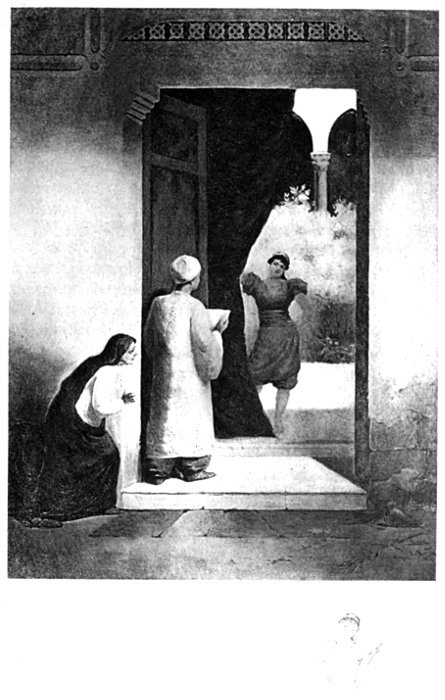
O thou who barest leg-calf, better to suggest ✿ For passion-madded amourist better things above!
Towards its lover doth the bowl go round and run; ✿ Cup and cup-bearer only drive us daft with love.
328Now these legs were like two pillars of alabaster adorned with anklets of gold, wherein were set stones of price. And the damsel had tucked up the end of her gown under her arm-pit and had rolled up her sleeves to the elbow, so that I could see her white wrists whereon were two pairs of bracelets with clasps of great pearls; and round her neck was a collar of costly gems. Her ears were adorned with pendants of pearls and on her head she wore a kerchief of brocade, brand-new and broidered with jewels of price. And she had thrust the skirt of her shift into her trousers-string being busy with some household business. So when I saw her in this undress, I was confounded at her beauty, for she was like a shining sun. Then she said, with soft, choice speech, never heard I sweeter, "O my mother! is this he who cometh to read the letter?" "It is," replied the old woman; and she put out her hand to me with the letter.
Now when it was the Hundred and Twenty-third Night,
She said, It hath reached me, O auspicious King, that the youth Aziz pursued to Taj al-Muluk:—When the old woman pushed me forwards I found myself, ere I could think, inside the vestibule; and the old woman entered faster than a flash of blinding leven and had naught to do but to shut the door. When the girl saw me in the vestibule, she came up to me and strained me to her bosom, and threw me to the floor; then she sat astraddle upon my breast and kneaded my belly with her fingers, till I well-nigh lost 329my senses. Thereupon she took me by the hand and led me, unable to resist for the violence of her pressure, through seven vestibules, whilst the old woman forewent us with the lighted candle, till we came to a great saloon with four estrades whereon a horseman might play Polo. Here she released me, saying, "Open thine eyes." So I opened them still giddy for the excess of her embracing and pressing, and saw that the whole saloon was built of the finest marbles and alabasters, and all its furniture was of silk and brocade even to the cushions and mattrasses. Therein also were two benches of yellow brass and a couch of red gold, set with pearls and precious stones, befitting none save Kings like thyself. And off the saloon were smaller sitting rooms; and the whole place was redolent of wealth. Then she asked, "O Aziz, which is liefer to thee life or death?" "Life," answered I; and she said, "If life be liefer to thee, marry me." Quoth I, "Indeed I should hate to marry the like of thee." Quoth she, "If thou marry me thou wilt at least be safe from the daughter of Dalílah the Wily One." I asked, "And who be that daughter of the Wily One?" Whereupon she laughed and replied, "'Tis she who hath companied with thee this day for a year and four months (may the Almighty destroy and afflict her with one worse than herself!).
Now when it was the Hundred and Twenty-fourth Night,
She said, It hath reached me, O auspicious King, that the young merchant continued to Taj al-Muluk:—When they wrote out the marriage-contract, she testified to having received the whole sum settled upon her, the half in advance and the half in arrears and that she was indebted to me in the sum of ten thousand dirhams. She paid the witnesses their wage and they withdrew whence they came. Thereupon she arose and cast off her clothes and stood in a chemise of fine silk edged with gold-lace, after which she took off her trousers and seized my hand and led me up to the couch, saying, "There is no sin in a lawful put-in." She lay down on the couch outspread upon her back; and, drawing me on to her breast, heaved a sigh and followed it up with a wriggle by way of being coy. Then she pulled up the shift above her breasts, and when I saw her in this pose, I could not withhold myself from thrusting it into her, after I had sucked her lips, whilst she whimpered and shammed shame and wept when no tears came, and then said she, "O my beloved, do it, and do thy best!" Indeed the case reminded me of his saying, who said:—
When I drew up her shift from the roof of her coynte, ✿ I found it as strait as my mind and my money:
So I drove it half-way, and she sighed a loud sigh: ✿ Quoth I, "Why this sigh?": "For the rest of it, honey!"
332And she repeated, "O my beloved, let the finish be made for I am thine handmaid. My life on thee, up with it! give it me, all of it! that I may take it in my hand and thrust it into my very vitals!" And she ceased not to excite me with sobs and sighs and amorous cries in the intervals of kissing and clasping until amid our murmurs of pleasure we attained the supreme delight and the term we had in sight. We slept together till the morning, when I would have gone out; but lo! she came up to me, laughing, and said, "So! So!
This knightly tale, the longest in the Nights (xliv-cxlv.), about one-eighth of the whole, does not appear in the Bres. Edit. Lane, who finds it "objectionable," reduces it to two of its episodes, Aziz-cum-Azízah and Táj al-Mulúk. On the other hand it has been converted into a volume (8vo, pp. 240) "Scharkan, Conte Arabe;" etc. Traduit par M. Asselan Riche, etc.
The fifth Ommiade Caliph reign. A.H. 65-86=685-704.
This does not merely mean that no one was safe from his wrath: or, could approach him in the heat of fight: it is a reminiscence of the masterful "King Kulayb," who established game-laws in his dominions and would allow no man to approach his camp-fire. Moreover the Jinn lights a fire to decoy travellers; but if his victim be bold enough to brave him, he invites him to take advantage of the heat.
China.
The Jaxartes and the Bactrus (names very loosely applied).
In full "Sharrun kána" i.e. an evil (Sharr) has come to being (kána), that is, "bane to the foe"—a pagan and knightly name. The hero of the Romance "Al-Dalhamah" is described as a bitter gourd (colocynth), a viper, a calamity.
This is a Moslem law (Koran chapt. iv. bodily borrowed from the Talmud) which does not allow a man to marry one wife unless he can carnally satisfy her. Moreover he must distribute his honours equally and each wife has a right to her night unless she herself give it up. This was the case even with the spouses of the Prophet; and his biography notices several occasions when his wives waived their rights in favour of one another. M. Riche kindly provides the King with la piquante française (p.
So the celebrated mosque in Stambul, famed for being the largest church in the world, is known to the Greeks as "Agia (pron. Aya) Sophia" and to Moslems as "Aya Sofíyeh" (Holy Wisdom) i.e. the Logos or Second Person of the Trinity (not a Saintess). The sending a Christian girl as a present to a Moslem would, in these days be considered highly scandalous. But it was done by the Mukaukis or Coptic Governor of Egypt (under Heraclius) who of course hated the Greeks. This worthy gave two damsels to Mohammed, one called Sírín and the other Máriyah (Maria) whom the Prophet reserved for his especial use and whose abode is still shown at Al-Medinah. The Rev.
This prayer before "doing the deed of kind" is, I have said, Moslem as well as Christian.
Exodus i. 16, quoted by Lane (M. E., chapt. xxvii.). Torrens in his Notes cites Drayton's "Moon-calf":—
Bring forth the birth-stool—no, let it alone;
She is so far beyond all compass grown,
Some other new device us needs must stead,
Or else she never can be brought to bed.
It is the "groaning-chair" of Poor Robin's Almanac (1676) and we find it alluded to in Boccaccio, the classical sedile which according to scoffers has formed the papal chair (a curule seat) ever since the days of Pope Joan, when it has been held advisable for one of the Cardinals to ascertain that His Holiness possesses all the instruments of virility. This "Kursí al-wiládah" is of peculiar form on which the patient is seated. A most interesting essay might be written upon the various positions preferred during delivery, e.g. the wild Irish still stand on all fours, like the so-called "lower animals." Amongst the Moslems of Waday, etc., a cord is hung from the top of the hut, and the woman in labour holds on to it standing with her legs apart, till the midwife receives the child.
Some Orientalists call "lullilooing" the trilling cry, which is made by raising the voice to its highest pitch and breaking it by a rapid succession of touches on the palate with the tongue-tip, others "Ziraleet" and Zagaleet, and one traveller tells us that it began at the marriage-festival of Isaac and Rebecca(!). Arabs term it classically Tahlíl and vulgarly Zaghrutah (Plur. Zaghárit) and Persians "Kil." Finally in Don Quixote we have "Lelilies," the battle-cry of the Moors (Duffield iii. 289). Dr. Buchanan likens it to a serpent uttering human sounds, but the good missionary heard it at the festival of Jagannath (Pilgrimage iii. 197).
i.e. "Light of the Place" (or kingdom) and "Delight of the Age."
It is utterly absurd to give the old heroic Persian name Afridun or Furaydun, the destroyer of Zohák or Zahhák, to a Greek, but such anachronisms are characteristic of The Nights and are evidently introduced on purpose. See Boccaccio, ix. 9.
Arab. "Yunán" lit. Ionia, which applies to all Greece, insular and continental, especially to ancient Greece.
In 1870 I saw at Sidon a find of some hundreds of gold "Philippi" and "Alexanders."
M. Riche has (p. 21):—Ces talismans travaillés par le ciseau du célèbre Calfaziri, adding in a note:—Je pense que c'est un sculpteur Arabe.
This periphrase, containing what seems to us a useless negative, adds emphasis in Arabic.
This bit of geographical information is not in the Bul. Edit.
In Pers.=a tooth, the popular word.
This preliminary move, called in Persian Nakl-i-Safar, is generally mentioned. So the Franciscan monks in California, when setting out for a long journey through the desert, marched three times round the convent and pitched tents for the night under its walls.
In Arab. "Khazinah" or "Khaznah" lit. a treasure, representing 1,000 "Kis" or purses (each=£5). The sum in the text is 7,000 purses × 5=£35,000.
Travellers often prefer such sites because they are sheltered from the wind, and the ground is soft for pitching tents; but many have come to grief from sudden torrents following rain.
Arab. "Ghábah" not a forest in our sense of the word, but a place where water sinks and the trees (mostly Mimosas), which elsewhere are widely scattered, form a comparatively dense growth and collect in thickets. These are favourite places for wild beasts during noon-heats.
At various times in the East Jews and Christians were ordered to wear characteristic garments, especially the Zunnár or girdle.
The description is borrowed from the Coptic Convent, which invariably has an inner donjon or keep. The oldest monastery in the world is Mar Antonios (St. Anthony the Hermit) not far from Suez (Gold Mines of Midian, p. 85).
"Dawáhi," plur. of Dáhiyah=a mishap. The title means "Mistress of Misfortunes" or Queen of Calamities (to the enemy); and the venerable lady, as will be seen, amply deserved her name, which is pronounced Zát ad-Dawáhí.
Arab. "Kunfuz"=hedgehog or porcupine.
These flowers of speech are mere familiarities, not insults. In societies where the sexes are separated speech becomes exceedingly free. Étourdie que vous êtes, says M. Riche, toning down the text.
Arab. "Zirt," a low word. The superlative "Zarrát" (fartermost) or, "Abu Zirt" (Father of farts) is a facetious term among the bean-eating Fellahs and a deadly insult amongst the Badawin (Night ccccx.). The latter prefer the word Taggáa (Pilgrimage iii. 84). We did not disdain the word in farthingale=pet en air.
Arab. "kicked" him, i.e. with the sharp corner of the shovel-stirrup. I avoid such expressions as "spurring" and "pricking over the plain," because apt to give a wrong idea.
Arab. "Allaho Akbar!" the classical Moslem slogan.
Arab horses are never taught to leap, so she was quite safe on the other side of a brook nine feet broad.
"Batrík" (vulg. Bitrík)=patricius, a title given to Christian knights who commanded ten thousand men; the Tarkhan (or Nobb) heading four thousand, and the Kaumas (Arab. Káid) two hundred. It must not be confounded with Batrak (or Batrik)=patriarcha (Lane's Lex.).
Arab. "Kázi al-Kuzát," a kind of Chief Justice or Chancellor. The office was established under the rule of Harun al-Rashid, who so entitled Abú Yúsuf Ya'akub al-Ansári: therefore the allusion is anachronistic. The same Caliph also caused the Olema to dress as they do still.
The allusion is Koranic: "O men, if ye be in doubt concerning the resurrection, consider that he first created you of the dust of the ground (Adam); afterwards of seed" (chapt. xxii.). But the physiological ideas of the Koran are curious. It supposes that the Mani or male semen is in the loins and that of women in the breast bone (chapt. lxxxvi.); that the mingled seed of the two (chapt. lxxvi.) fructifies the ovary and that the child is fed through the navel with menstruous blood, hence the cessation of the catamenia. Barzoi (Kalilah and Dímnah) says:—"Man's seed, falling into the woman's womb, is mixed with her seed and her blood: when it thickens and curdles the Spirit moves it and it turns about like liquid cheese; then it solidifies, its arteries are formed, its limbs constructed and its joints distinguished.
The usual preliminary of a wrestling bout.
In Eastern wrestling this counts as a fair fall. So Ajax fell on his back with Ulysses on his breast (Iliad xxxii., 700, etc.).
So biting was allowed amongst the Greeks in the ἀνακλινοπάλη, the final struggle on the ground.
Supposed to be names of noted wrestlers. "Kayim" (not El-Kim as Torrens has it) is a term now applied to a juggler or "professor" of legerdemain who amuses people in the streets with easy tricks (Lane, M. E., chapt. xx.).
Lit. "laughed in his face" which has not the unpleasant meaning it bears in English.
Arab. "Abu riyáh"=a kind of child's toy. It is the "Ρόμβος" of the Greeks, our "bull-roarer" well known in Australia and parts of Africa.
The people of the region south of the Caspian which is called "Sea of Daylam." It has a long history; for which see D'Herbelot, s. v. "Dilem."
Coptic convents in Egypt still affect these drawbridges over the keep-moat.
Koran iv., xxii. etc., meaning it is lawful to marry women taken in war after the necessary purification although their husbands be still living. This is not permitted with a free woman who is a True Believer. I have noted that the only concubine slave-girls mentioned in the Koran are these "captives possessed by the right hand."
The Amazonian dame is a favourite in folk-lore and is an ornament to poetry from the Iliad to our modern day. Such heroines, apparently unknown to the Pagan Arabs, were common in the early ages of Al-Islam as Ockley and Gibbon prove, and that the race is not extinct may be seen in my Pilgrimage (iii. 55) where the sister of Ibn Rumi resolved to take blood revenge for her brother.
And Solomon said, "O nobles, which of you will bring me her throne?" A terrible genius (i.e. an Ifrit of the Jinn named Dhakwan or the notorious Sakhr) said, "I will bring it unto thee before thou arise from thy seat (of justice); for I am able to perform it, and may be trusted" (Koran, xxvii. 38-39). Balkís or Bilkís (says the Durrat al-Ghawwás) daughter of Hozád bin Sharhabíl, twenty-second in the list of the rulers of Al-Yaman, according to some murdered her husband, and became, by Moslem ignorance, the Biblical "Queen of Sheba." The Abyssinians transfer her from Arabian Saba to Ethiopia and make her the mother by Solomon of Menelek, their proto-monarch; thus claiming for their royalties an antiquity compared with which all reigning houses in the world are of yesterday. The dates of the Tabábi'ah or Tobbas prove that the Bilkís of history ruled Al-Yaman in the early Christian era.
Arab. "Fass," fiss or fuss; the gem set in a ring; also applied to a hillock rounded en cabochon. In The Nights it is used to signify "a fine gem."
This prominence of the glutæi muscles is always insisted upon, because it is supposed to promise well in a bedfellow. In Somali-land, where the people are sub-steatopygous, a rich young man, who can afford such luxury, will have the girls drawn up in line and choose her to wife who projects furthest behind.
The "bull" is only half mine.
A favourite Arab phrase, the "hot eye" is one full of tears.
i.e. "Coral," coral branch; a favourite name for a slave-girl, especially a negress. It is the older "Morgiana." I do not see why Preston in Al-Hariri's "Makamah (Séance) of Singar" renders it pearls, because Golius gives "small pearls," when it is evidently "coral." Richardson (Dissert. xlviii.) seems to me justified in finding the Pari (fairy) Marjan of heroic Persian history reflected in the Fairy Morgain who carried off King Arthur after the battle of Camelon.
Arab. "'Ud Jalaki"=Jalak or Jalik being a poetical and almost obsolete name of Damascus.
The fountain in Paradise whose water shall be drunk with "pure" wine mixed and sealed with musk (for clay). It is so called because it comes from the "Sanam" (Sanima, to be high) boss or highest ridge of the Moslem Heaven (Koran lv. 78 and lxxxiii. 27). Mr. Rodwell says "it is conveyed to the highest apartments in the Pavilions of Paradise." (?)
This "hysterical" temperament is not rare even amongst the bravest Arabs.
An idea evidently derived from the Æolipyla (olla animatoria) the invention of Hero Alexandrinus, which showed that the ancient Egyptians could apply the motive force of steam.
Kuthayyir ibn Abi Jumah, a poet and far-famed Ráwí or Tale-reciter, mentioned by Ibn Kballikan: he lived at Al-Medinah and sang the attractions of one Azzah, hence his soubriquet Sáhib (lover of) Azzah. As he died in A.H. 105 (=726), his presence here is a gross anachronism: the imaginary Sharrkan flourished before the Caliphate of Abd al-Malik bin Marwán A.H. 65-86.
Jamíl bin Ma'amar, a poet and lover contemporary with Al-Kuthayyir.
Arab. "Tafazzal," a word of frequent use in conversations="favour me," etc.
The word has a long history. From the Gr. στίμμι or στίβι is the Lat. stibium; while the Low-Latin "antimonium" and the Span. Althimod are by metathesis for Al-Ithmid. The dictionaries define the substance as a stone from which antimony is prepared; but the Arabs understand a semi-mythical mineral of yellow colour which enters into the veins of the eyes and gives them lynx-like vision. The famous Anz nicknamed Zarká (the blue-eyed) of Yamámah (Province) used it; and, according to some, invented Kohl.
I swear by Allah that trees creep onward, or that Himyar beareth somewhat which he draweth along!
She then saw a man mending his sandal. But Jadis disbelieved; Cassandra was slain and, when her eyes were cut out, the vessels were found full of Ithmid. Hence Al-Mutanabbi sang:
"Sharper-sighted than Zarká of Jau" (Yamámah).
See C. de Perceval i. 101; Arab. Prov. i. 192; and Chenery (p. 381.
The general colour of chessmen in the east, where the game is played on a cloth more often than a board.
Arab. "Al-fil," the elephant=the French fol or fou and our bishop. I have derived "elephant" from Píl (old Persian, Sansk. Pilu) and Arab. Fil, with the article Al-Fil, whence the Greek ἐλέφας the suffix—as being devoted to barbarous words as Obod-as (Al-Ubayd), Aretas (Al-Háris), etc. Mr. Isaac Taylor (The Alphabet i.
Arab. "Shaukat" which may also mean the "pride" or "mainstay" (of the army).
Lit. "smote him on the tendons of his neck." This is the famous shoulder-cut (Tawashshuh) which, with the leg-cut (Kalam), formed, and still forms, the staple of Eastern attack with the sword.
Arab. "Dirás." Easterns do not thresh with flails. The material is strewed over a round and smoothed floor of dried mud in the open air and threshed by different contrivances. In Egypt the favourite is a chair-like machine called "Norag," running on iron plates and drawn by bulls or cows over the corn. Generally, however, Moslems prefer the old classical Τρίβολον, the Tribulum of Virgil and Varro, a slipper-shaped sled of wood garnished on the sole with large-headed iron nails, or sharp fragments of flint or basalt. Thus is made the "Tibn" or straw, the universal hay of the East, which our machines cannot imitate.
These numbers appear to be grossly exaggerated, but they were possible in the days of sword and armour: at the battle of Saffayn the Caliph Ali is said to have cut down five hundred and twenty-three men in a single night.
Arab. "Biká'a": hence the "Buka'ah" or Cœlesyria.
Richardson in his excellent dictionary (note 103) which modern priggism finds "unscientific," wonderfully derives this word from Arab. "Khattáf," a snatcher (i.e. of women), a ravisher. It is an evident corruption of "captivus" through Italian and French.
These periodical and fair-like visitations to convents are still customary; especially amongst the Christians of Damascus.
Camphor being then unknown.
The "wrecker" is known all over the world; and not only barbarians hold that ships driven ashore become the property of the shore.
Arab. "Jokh": it is not a dictionary word, but the only term in popular use for European broadcloth.
The second person plural is used because the writer would involve the subjects of his correspondent in the matter.
This part of the phrase, which may seem unnecessary to the European, is perfectly intelligible to all Orientalists. You may read many an Eastern letter and not understand it. Compare Boccaccio iv. 1.
i.e., he was greatly agitated.
In text "Li-ajal al-Taudí'a," for the purpose of farewelling, a low Egyptianism; emphatically a "Kalám wáti." (Pilgrimage iii. 330.)
In the Mac. Edit. Sharrkan speaks, a clerical error.
The Farsakh (Germ. Stunde) a measure of time rather than distance, is an hour's travel or its equivalent, a league, a meile=three English stat. miles. The word is still used in Persia its true home, but not elsewhere. It is very old, having been determined as a lineal measure of distance by Herodotus (ii. 5 and 6; v. 53), who computes it at 30 furlongs (=furrow-lengths, 8 to the stat.
Arab. "Ashhab." Names of colours are few amongst semi-civilised peoples, but in Arabia there is a distinct word for every shade of horseflesh.
She had already said to him "Thou art beaten in everything!"
Showing that she was still a Christian.
This is not Badawi sentiment: the honoratioren amongst wild people would scorn such foul play; but amongst the settled Arabs honour between men and women is unknown; and such "hocussing" would be held quite fair.
The table of wine, in our day, is mostly a japanned tray with glasses and bottles, saucers of pickles and fruits and, perhaps, a bunch of flowers and aromatic herbs. During the Caliphate the "wine-service" was on a larger scale.
Here the "Bhang" (almost a generic term applied to hellebore, etc.) may be hyoscyamus or henbane. Yet there are varieties of Cannabis, such as the Dakha of South Africa, capable of most violent effect. I found the use of the drug well known to the negroes of the Southern United States and of the Brazil, although few of their owners had ever heard of it.
Amongst Moslems this is a reference to Adam who first "sinned against himself," and who therefore is called "Safíyu'llah," the Pure of Allah (Pilgrimage iii. 333).
Meaning, an angry, violent man.
Arab. "Inshád," which may mean reciting the verse of another or improvising one's own. In Modern Egypt "Munshid" is the singer or reciter of poetry at Zikrs (Lane M. E. chapt. xxiv.). Here the verses are quite bad enough to be improvised by the hapless Princess.
The negro skin assumes this dust-colour in cold, fear, concupiscence and other mental emotions.
He compares her glance with the blade of a Yamani sword, a lieu commun of Eastern poetry. The weapons are famous in The Nights; but the best sword-cutlery came from Persia as the porcelain from China to Sana'á. Here, however, is especial allusion as to the sword "Samsam" or "Samsamah." It belonged to the Himyarite Tobba, Amru bin Ma'ad Kurb, and came into the hands of Harun al-Rashid. When the Emperor of the Greeks sent a present of superior sword-blades to him by way of a brave, the Caliph, in the presence of the Envoys, took "Samsam" in hand and cut the others in twain as if they were cabbages without the least prejudice to the edge of "Samsam."
This touch of pathos is truly Arab. So in the "Romance of Dalhamah" (Lane, M. E. xxiii.) the infant Gundubah sucks the breast of its dead mother and the King exclaims, "If she had committed this crime she would not be affording the child her milk after she was dead."
Arab. Sadda'l-Aktár, a term picturesque enough to be preserved in English. "Sadd," I have said, is a wall or dyke, the term applied to the great dam of water-plants which obstructs the navigation of the Upper Nile, the lilies and other growths floating with the current from the (Victoria) Nyanza Lake. I may note that we need no longer derive from India the lotus-lily so extensively used by the Ancient Egyptians and so neglected by the moderns that it has well nigh disappeared. All the Central African basins abound in the Nymphæa and thence it found its way down the Nile-Valley.
Arab. "Al-Marhúmah": equivalent to our "late lamented."
Vulgarly pronounced "Mahmal," and by Egyptians and Turks "Mehmel." Lane (M. E. xxiv.) has figured this queenly litter and I have sketched and described it in my Pilgrimage (iii. 12).
For such fits of religious enthusiasm see my Pilgrimage (iii. 254).
"Irák" (Mesopotamia) means "a level country beside the banks of a river."
"Al-Kuds," or "Bayt al-Mukaddas," is still the popular name of Jerusalem, from the Heb. Yerushalaim ha-Kadushah (legend on shekel of Simon Maccabeus).
"Follow the religion of Abraham" says the Koran (chapt. iii. 89). Abraham, titled "Khalílu'llah," ranks next in dignity to Mohammed, preceding Isa; I need hardly say that his tomb is not in Jerusalem nor is the tomb itself at Hebron ever visited. Here Moslems (soi disant) are allowed by the jealousies of Europe to close and conceal a place which belongs to the world, especially to Jews and Christians. The tombs, if they exist, lie in a vault or cave under the Mosque.
Abá, or Abá'ah, vulg. Abáyah, is a cloak of hair, goat's or camel's; too well known to require description.
Arab. "Al-Wakkád;" the man who lights and keeps up the bath-fires.
Arab. "Má al-Khaláf"(or "Khiláf") a sickly perfume but much prized, made from the flowers of the Salix Ægyptiaca.
Used by way of soap; like glasswort and other plants.
i.e., "Thou art only just recovered."
To "Nakh" is to gurgle "Ikh! Ikh!" till the camel kneels. Hence the space called "Barr al-Manákhah" in Al-Medinah (Pilgrimage i. 222, ii. 91). There is a regular camel-vocabulary amongst the Arabs, made up like our "Gee" (go ye!), etc. of significant words worn down.
Arab. "Laza," the Second Hell provided for Jews.
The word has been explained (vol. i. 112). It is trivial, not occurring in the Koran which uses "Arabs of the Desert;" "Arabs who dwell in tents," etc. (chapt. ix. and xxxiii.).
"When thine enemy extends his hand to thee, cut it off if thou can, or kiss it," wisely said Caliph al-Mansúr.
The Tartur was a peculiar turban worn by the Northern Arabs and shown in old prints. In modern Egypt the term is applied to the tall sugar-loaf caps of felt affected mostly by regular Dervishes. Burckhardt (Proverbs 194 and 398) makes it the high cap of felt or fur proper to the irregular cavalry called Dely or Delaty. In Dar For (Darfour) "Tartur" is a conical cap adorned with beads and cowries worn by the Manghwah or buffoon who corresponds with the Egyptian "Khalbús" or "Maskharah" and the Turkish "Sutari." For an illustration see Plate iv. fig. 10 of Voyage au Darfour par Mohammed El-Tounsy (The Tunisian), Paris, Duprat, 1845.
The term is picturesque and true; we say "gnaw" which is not so good.
Here, meaning an Elder, a Chief, etc.; the word has been almost naturalised in English. I have noted that Abraham was the first "Shaykh."
This mention of weighing suggests the dust of Dean Swift and the money of the Gold Coast. It was done, I have said, because the gold coin, besides being "sweated" was soft and was soon worn down.
Fem. of Nájí (a deliverer, a saviour)=Salvadora.
This, I have noted, is according to Koranic command (chapt. iv. 88). "When you are saluted with a salutation, salute the person with a better salutation." The longer answer to "Peace be with (or upon) thee!" is still universally the custom. The "Salám" is so differently pronounced by every Eastern nation that the observant traveller will easily make of it a Shibboleth.
The Badawi, who was fool as well as rogue, begins to fear that he has kidnapped a girl of family.
These examinations being very indecent are usually done in strictest privacy. The great point is to make sure of virginity.
This is according to strict Moslem law: the purchaser may not look at the girl's nakedness till she is his, and he ought to manage matters through an old woman.
Lit. wrath; affliction which chokes; in Hindustani it means simply anger.
i.e., Heaven forbid I be touched by a strange man.
Used for fuel and other purposes, such as making "Joss stick."
Arab. "Yaftah' Allah" the offer being insufficient. The rascal is greedy as a Badawi and moreover he is a liar, which the Badawi is not.
The third of the four great Moslem schools of Theology, taking its name from the Imam al-Sháfi'í (Mohammed ibn Idris) who died in Egypt A.H. 204, and lies buried near Cairo (Sale's Prel. Disc. sect. viii.).
The Moslem form of Cabbala, or transcendental philosophy of the Hebrews.
Arab. "Bakh" the word used by the Apostle to Ali his son-in-law. It is the Latin "Euge."
Readers, who read for amusement, will do well to "skip" the fadaises of this highly educated young woman.
There are three Persian Kings of this name (Artaxerxes) which means "Flour and milk," or "high lion." The text alludes to Ardeshir Babegan, so called because he married the daughter of Babak the shepherd, founder of the Sassanides in A.D. 202. See D'Herbelot, and the Dabistan.
Alluding to the proverb, "Folk follow their King's faith," "Cujus regio ejus religio," etc.
Second Abbaside, A.H. 136-158 (=754-775).
The celebrated companion of Mohammed who succeeded Abu Bakr in the Caliphate (A. H. 13-23=634-644). The Sunnis know him as Al-Adil, the Just; and the Shiahs detest him for his usurpation, his austerity and harshness. It is said that he laughed once, and wept once. The laugh was caused by recollecting how he ate his dough-gods (the idols of the Hanifah tribe) in The Ignorance. The tears were drawn by remembering how he buried alive his baby daughter who, while the grave was being dug, patted away the dust from his hair and beard.
The austere Caliph Omar whose scourge was more feared than the sword was the author of the celebrated saying "Consult them (feminines) and do clear contrary-wise." The dictum is illustrated by a dozen Joe Millers known throughout the East.
Our "honour amongst thieves."
The sixth successor of Mohammed and founder of the Banu Umayyah or Ommiades, called the "sons of the little mother" from their eponymus (A.H. 41-60=661-680). For his Badawi wife Maysun, and her abuse of her husband, see Pilgrimage iii. 262.
Shaykh of the noble tribe, or rather nation, Banu Tamím and a notable of the day, surnamed, no one knows why, "Sire of the Sea."
This is essential for cleanliness in hot lands: however much the bath may be used, the body-pile and lower hair, if submitted to a microscope, will show more or less sordes adherent. The axilla-hair is plucked because if shaved the growing pile causes itching and the depilatories are held deleterious. At first vellication is painful but the skin becomes used to it. The pecten is shaved either without or after using depilatories, of which more presently. The body-pile is removed by "Takhfíf"; the Libán Shámi (Syrian incense), a fir-gum imported from Scio, is melted and allowed to cool in the form of a pledget. This is passed over the face and all the down adhering to it is pulled up by the roots (Burckhardt No. 420).
This Caliph was a tall, fair, handsome man of awe-inspiring aspect. Omar used to look at him and say, "This is the Cæsar of the Arabs," while his wife called him a "fatted ass."
The saying is attributed to Abraham when "exercised" by the unkindly temper of Sarah; "woman is made hard and crooked like a rib;" and the modern addition is, "whoso would straighten her, breaketh her."
i.e., "When ready and in erection."
"And do first (before going in to your wives) some act which may be profitable unto your souls"—or, for your soul's good. (Koran, chapt. ii. 223.). Hence Ahnaf makes this prayer.
It was popularly said that "Truth-speaking left Omar without a friend." Entitled "The Just" he was murdered by Abu Lúlúah, alias Fírúz, a (Magian?) slave of Al-Maghírah for denying him justice.
Governor of Bassorah under the first four Caliphs. See D'Herbelot s. v. "Aschári."
Ziyad bin Abi Sufyan, illegitimate brother of the Caliph Mu'awiyah afterwards governor of Bassorah, Cufa and Al-Hijaz.
The seditions in Kufah were mainly caused by the wilful nepotism of Caliph Othman bin Asákir which at last brought about his death. His main quality seems to have been personal beauty: "never was seen man or woman of fairer face than he and he was the most comely of men:" he was especially famed for beautiful teeth which in old age he bound about with gold wire. He is described as of middling stature, large-limbed, broad shouldered, fleshy of thigh and long in the fore-arm which was hairy. His face inclined to yellow and was pock-marked; his beard was full and his curly hair, which he dyed yellow, fell below his ears. He is called "writer of the Koran" from his edition of the MS., and "Lord of the two Lights" because he married two of the Prophet's daughters, Rukayyah and Umm Kulthum; and, according to the Shi'ahs who call him Othman-i-Lang or "limping Othman," he vilely maltreated them. They justify his death as the act of an Ijmá' al-Muslimin, the general consensus of Moslems which ratifies "Lynch law." Altogether Othman is a mean figure in history.
"Nár" (fire) is a word to be used delicately from its connection with Gehenna. You say, e.g. "bring me a light, a coal (bassah)" etc.; but if you say "bring me fire!" the enemy will probably remark "He wanteth fire even before his time!" The slang expression would be "bring the sweet:" (Pilgrimage i. 121.)
Omar is described as a man of fair complexion, and very ruddy, but he waxed tawny with age, when he also became bald and grey. He had little hair on the cheeks but a long mustachio with reddish ends. In stature he overtopped the people and was stout as he was tall. A popular saying of Mohammed's is, "All (very) long men are fools save Omar, and all (very) short men are knaves save Ali." The Persians, who abhor Omar, compare every lengthy, ungainly, longsome thing with him; they will say, "This road never ends, like the entrails of Omar." We know little about Ali's appearance except that he was very short and stout, broad and full-bellied with a tawny complexion and exceedingly hairy, his long beard, white as cotton filling all the space between his shoulders. He was a "pocket-Hercules," and incredible tales, like that about the gates of Khaybar, are told of his strength. Lastly, he was the only Caliph who bequeathed anything to literature: his "Cantiloquium" is famous and he has left more than one mystical and prophetic work. See Ockley for his "Sentences" and D'Herbelot s.
The emancipation from the consequences of his sins; or it may mean a holy death.
Battle fought near Al-Medinah A.D. 625. The word is derived from "Ahad" (one). I have described the site in my Pilgrimage, vol. ii. 227.
"Haphsa" in older writers; Omar's daughter and one of Mohammed's wives, famous for her connection with the manuscripts of the Koran. From her were (or claimed to be) descended the Hafsites who reigned in Tunis and extended their power far and wide over the Maghrib (Mauritania), till dispossessed by the Turks.
i.e. humbly without the usual strut or swim: it corresponds with the biblical walking or going softly (1 Kings xxi. 27; Isaiah xxxviii. 15, etc.).
A theologian of the seventh and eighth centuries.
i.e. to prepare himself by good works, especially alms-giving, for the next world.
A theologian of the eighth century.
Abd al-Aziz was eighth Ommiade (regn. A.H. 99=717) and the fifth of the orthodox, famed for a piety little known to his house. His most celebrated saying was, "Be constant in meditation on death: if thou be in straitened case 'twill enlarge it, and if in affluence 'twill straiten it upon thee." He died, poisoned, it is said, in A.H. 101.
Abu Bakr originally called Abd al-Ka'ahah (slave of the Ka'abah) took the name of Abdullah and was surnamed Abu Bakr (father of the virgin) when Mohammed, who before had married only widows, took to wife his daughter, the famous or infamous Ayishah. "Bikr" is the usual form, but "Bakr," primarily meaning a young camel, is metaphorically applied to human youth (Lane's Lex. s. v.). The first Caliph was a cloth-merchant, like many of the Meccan chiefs. He is described as very fair with bulging brow, deep-set eyes and thin-cheeked, of slender build and lean-loined, stooping and with the backs of his hands fleshless. He used tinctures of Henna and Katam for his beard.
The second, fifth, sixth and seventh Ommiades.
The mother of Omar bin Abd al-Aziz was a granddaughter of Omar bin Al-Khattab.
Brother of this Omar's successor, Yezid II.
So the Turkish proverb "The fish begins to stink at the head."
Calling to the slaves.
When the "Day of Arafat" (9th of Zú'l-Hijjah) falls upon a Friday. For this Hajj al-Akbar see my Pilgrimage iii. 226. It is often confounded by writers (even by the learned M. Caussin de Perceval) with the common Pilgrimage as opposed to the Umrah, or "Lesser Pilgrimage" (ibid. iii. 342, etc.).
A fair specimen of the unworthy egoism which all religious systems virtually inculcate. Here a pious father leaves his children miserable to save his own dirty soul.
Chief of the Banú Tamím, one of noblest of tribes derived from Tamím, the uncle of Kuraysh (Koreish); hence the poets sang:—
There cannot be a son nobler than Kuraysh,
Nor an uncle nobler than Tamím.
The high-minded Tamím is contrasted with the mean-spirited Kays, who also gave rise to a tribe; and hence the saying concerning one absolutely inconsistent, "Art thou now Tamím and then Kays?"
Surnamed Al-Sakafí, Governor of Al-Yaman and Irak.
Tenth Ommiade (regn. A.H. 105-125=724-743).
Or "clothe thee in worn-out clothes" i.e. "Become a Fakir" or religious mendicant.
This gratuitous incest in ignorance injures the tale and is as repugnant to Moslem as to Christian taste.
The child is named either on the day of its birth or on that day week. The father whispers it in the right ear, often adding the Azán or prayer-call, and repeating in the left ear the "Ikámah" or Friday sentence. There are many rules for choosing names according to the week-day, the ascendant planet, the "Sortes Coranicæ," etc.
Amongst Moslems as amongst Christians there are seven deadly sins: idolatry, murder, falsely charging modest women with unchastity, robbing orphans, usury, desertion in Holy War and disobedience to parents. The difference between the two creeds is noteworthy. And the sage knows only three, intemperance, ignorance and egoism.
Meaning, "It was decreed by Destiny; so it came to pass," appropriate if not neat.
The short, stout, dark, long-haired and two bunched camel from "Bukhtar" (Bactria), the "Eastern" (Bakhtar) region on the Amu or Jayhún (Oxus) River; afterwards called Khorasan. The two-humped camel is never seen in Arabia except with northern caravans, and to speak of it would be a sore test of Badawi credulity.
"Kaylúlah" is the "forty-winks" about noon: it is a Sunnat or Practice of the Prophet who said, "Make the mid-day siesta, for verily at this hour the devils sleep not." "Aylúlah" is slumbering after morning prayers (our "beauty-sleep"), causing heaviness and idleness: "Ghaylúlah" is dozing about 9 a.m. engendering poverty and wretchedness: "Kaylúlah" (with the guttural Kaf) is sleeping before evening prayers and "Faylúlah" is slumbering after sunset—both held to be highly detrimental. (Pilgrimage ii. 49.)
The Biblical "Hamath" (Hightown) too well known to require description. It is still famous for the water-wheels mentioned by al-Hariri (assembly of the Banu Harám).
When they say, The leven flashes bright on the hills of Al-Yaman, the allusion is to the south quarter, where summer-lightning is seen. Al-Yaman (always with the article) means, I have said, the right-hand region to one facing the rising sun and Al-Sham (Syria) the left-hand region.
Again "he" for "she," in delicacy and jealousy of making public the beauty or conditions of the "veiled sex." Even public singers would hesitate to use a feminine pronoun. As will be seen, however, the rule is not invariably kept and hardly ever in Badawi poetry.
The normal pun on "Nuzhat al-Zaman"=Delight of the Age or Time.
The reader will find in my Pilgrimage (i. 305) a sketch of the Takht-rawan or travelling-litter, in which pilgrimesses are wont to sleep.
In poetry it holds the place of our Zephyr; and the "Bád-i-Sabá"=Breeze o' the morn, is much addressed by Persian poets.
Here appears the nervous, excitable, hysterical Arab temperament which is almost phrensied by the neighbourhood of a home from which he had run away.
Zau al-Makan and Nuzhat al-Zaman.
The idea is essentially Eastern, "A lion at home and a lamb abroad" is the popular saying.
Arab. "Hubb al-Watan" (=love of birthplace, patriotism) of which the Tradition says "Min al-Imán" (=is part of man's religion).
He is supposed to speak en prince; and he yields to a prayer when he spurns a command.
In such caravans each party must keep its own place under pain of getting into trouble with the watchmen and guards.
Mr. Payne (ii. 109) borrows this and the next quotation from the Bul. Edit. i. 386.
For the expiation of inconsiderate oaths see Koran (chapt. v.) I cannot but think that Al-Islam treats perjury too lightly: all we can say is that it improves upon Hinduism, which practically seems to leave the punishment to the gods.
"Kausar," as has been said, represents the classical nectar, the Amrita of the Hindus.
From Bul. Edit. i. 186. The couplet in the Mac. Edit. i.
The "insula" of Sancho Panza.
This should have assured him that he stood in no danger.
Here ends the wearisome tale of the brother and sister and the romance of chivalry begins once more with the usual Arab digressions.
I have derived this word from the Persian "rang"=colour, hue, kind.
Otherwise all would be superseded, like U. S. officials under a new President.
Arab. "Nímshah" from the Pers. Nímchah, a "half-sword," a long dagger worn in the belt. Richardson derives it from Namsh, being freckled (damasked).
The Indian term for a tent large enough to cover a troop of cavalry.
Arab. "Marhúm" a formula before noticed. It is borrowed from the Jewish, "of blessed memory" (after the name of the honoured dead, Prov. x. 17.); with the addition of "upon whom be peace," as opposed to the imprecation, "May the name of the wicked rot!"
The speeches of the five damsels should be read only by students.
i.e. Those who look for "another and a better."
The title of Caliph Abu Bakr because he bore truthful witness to the Apostle's mission or, others say, he confirmed the "Mi'ráj" or nocturnal journey to Heaven.
All this is Koranic (chapt. ii., etc.)
This may have applied more than once to "hanging judges" in the Far West.
A traditionist and jurisconsult of Al-Medinah in the seventh and eighth centuries.
The Alexander of the Koran and Eastern legends not to be confounded with the Alexander of Macedon. He will be noticed in a future Night.
Æsop, according to the Arabs: of him or rather of the two Lukmans, more presently.
Koran ii. 185.
Mohammed.
One of the Asháb or Companions of Mohammed.
A noted traditionist at Cufa in the seventh century.
Koran, chapt. lxxiv. 1 (and verse 8 follows). The Archangel Gabriel is supposed to address Mohammed and not a few divines believe this Surah (chapter) to have been first revealed. Mr. Rodwell makes it No. ii.
i.e. dangerous to soul-health.
In the Mac. Edit. "Abd" for "Sa'id." The latter was a black and a native of Cufa during the first century (A.H.) and is still famous as a traditionist.
Arab. "Shirk," giving a partner to Allah, attending chiefly to Christians and idolaters; and in a minor degree to Jews and Guebres. We usually English it by "polytheism," which is clumsy and conveys a wrong idea.
Grandson of the Caliph Ali. He is one of the Imams (High-priests) of the Shi'ah school.
An eminent traditionist of the eighth century (A.D.)
The prayers of the Fast-month and Pilgrimage-month are often said in especial places outside the towns and cities; these are the Indian Id(Eed-)gáh. They have a screen of wall about a hundred yards long with a central prayer-niche and the normal three steps for the preacher; and each extremity is garnished with an imitation minaret. They are also called Namáz-gah and one is sketched by Herklots (Plate iii. fig. 2). The object of the trips thither in Zu'l-Ka'adah and Zú'l-Hijjah is to remind Moslems of the "Ta'aríf," or going forth from Meccah to Mount Arafat.
Arab. "Al-Háfi," which in Egyptian means sore-footed as well. He was an ascetic of the eighth and ninth centuries (A.D.). He relates a tradition of the famous soldier-saint Khálid bin Walíd who lies buried like the poet Ka'ab al-Ahbár near Hums (Emessa) once the Bœotia, Phrygia, Abdera, Suabia of Syria now Halbun (pronounced Halbáun) near Damascus. I cannot explain how this Kuraysh noble (a glorious figure in Moslem history) is claimed by the Afghans as one of their countrymen and made to speak Pukhtu or Pushtu, their rough old dialect of Persian. The curious reader will consult my Pilgrimage iii. 322 for the dialogue between Mohammed and Khalid.
When he must again wash before continuing prayer.
Bin Adham; another noted ascetic of the eighth century. Those curious about these unimportant names will consult the great Biographical Dictionary of Ibn Khallikan, translated by Baron MacGuckin de Slane (1842-45).
Thus making Bishr the "Imám" (antistes) lit. one who stands in front. In Koran xvii. 74 it means "leader": in ii. 118 Allah makes Abraham an "Imam to mankind."
A favourite sentiment in the East: we find it at the very beginning of Sa'di's Gulistan: better a weal-bringing lie than a harm-dealing truth.
A penny, one sixth of the drachma.
Founder of the Hanbali, fourth (in date) of the four orthodox Moslem schools. The Caliph al-Mu'atasim bi'llah, son of Harun al-Rashid, who believed the Koran to have been created and not a Logos (whatever that may be), co-eternal with Allah, scourged this Imam severely for "differing in opinion" (A.H. 220=833). In fact few of the notable reverends of that day escaped without a caress of the scourge or the sword.
A learned man of the eighth century at Bassorah (A.D.).
A traditionist of Khorasan in the ninth century (A.D.).
"Azal," opp. to "Abad," eternity without end, infinity.
Koran lxvi. 6.
A traditionist of Al-Medinah, eighth century (A.D.).
Arab. "Músá": the Egyptian word was "Mesu," the "child" or the "boy" (brought up in the palace?), and the Hebrews made it "Mosheh" or "one drawn out of the water;" "Mu" in Egypt being water, the Arab "Ma"; whence probably the moderns have derived the dim. "Moyeh;" vulg. Egyptian for water.
Koran, chapt. xxviii.: Shu'ayb is our Jethro: Koran, chapt. vii. and xi. Mr Rodwell suggests (p. 101) that the name has been altered from Hobab (Numb. x 29).
Arab. "Taub" (Saub), the long shirt popularly written in English Tobe and pronounced so by Egyptians. It is worn by both sexes (Lane, M. E. chapt. i. "Tob") in Egypt, and extends into the heart of Moslem Africa: I can compare it with nothing but a long nightgown dyed a dirty yellow by safflower and about as picturesque as a carter's smock-frock.
There is nothing of this in the Koran; and it is a most unhappy addition, as Moses utterly and pretentiously ignored a "next world."
Koran xxviii. 22-27. Mohammed evidently confounded the contract between Laban and Jacob (Gen. xxix. 15-39).
So says Al Hariri (Ass. of Sasan), "The neighbour before the house and the traveller before the journey." In certain cities the neighbourhood is the real detective police, noting every action and abating scandals (such as orgies, etc.) with a strong hand and with the full consent of public opinion and of the authorities. This loving the neighbour shows evident signs of being borrowed from Christianity.
Al-Asamm, a theologian of Balkh, ninth century (A.D.).
The founder of the Senior School, for which see Sale Prel. Disc. sect. viii.
Thus serving the Lord by sinning against his own body.
An Egyptian doctor of the law (ninth century).
Koran lxxvii. 35, 36. This is one of the earliest and most poetical chapters of the book.
Abu Hanifah was scourged for refusing to take office and was put to death in prison, it is said by poison (A.H. 150=A.D. 767), for a judicial sentence authorising rebellion against the second Abbaside, Al-Mansúr, surnamed Abu'l-Dawánik (Father of Pence) for his exceeding avarice.
"Lá rayba fí-hi" says the Koran (ii. 1) of itself; and the saying is popularly applied to all things of the Faith.
Arab. "Rijál al-Ghayb," somewhat like the "Himalayan Brothers" of modern superstition. See Herklots (Qanoon-e-Islam) for a long and careful description of these "Mardán-i-Ghayb" (Pers.), a "class of people mounted on clouds," invisible, but moving in a circular orbit round the world; and suggesting the Hindu "Lokapálas." They should not be in front of the traveller nor on his right, but either behind or on his left hand. Hence tables, memorial couplets and hemistichs are required to ascertain the station, without which precaution journeys are apt to end badly.
A sweetmeat before noticed.
Door-hinges in the east are two projections for the top and bottom of the leaf playing in hollows of the lintel and threshold. It appears to be the primitive form, for we find it in the very heart of Africa. In the basaltic cities of the Hauran, where the doors are of thick stone, they move easily on these pins. I found them also in the official (not the temple) City of Palmyra, but all broken.
The effect of the poison and of the incantation which accompanied it.
King Omar who had raped her. My sympathies are all with the old woman who rightly punished the royal lecher.
Arab. "Zunnár," the Gr. ζώνη. Christians and Jews were compelled by the fanatical sumptuary laws of the Caliph Al-Mutawakkil (A.D. 856) to wear a broad leather belt in public; hence it became a badge of the Faith. Probably it was confounded with the "Janeo" (Brahmanical thread) and the Parsi sacred girdle called Kashti. (Dabistan i, 297, etc.).
"Siláh-dár" (Arab. and Pers.)=a military officer of high rank; literally an "armour-bearer," chosen for valour and trustworthiness. So Jonathan had a "young man" (brave) who bare his armour (1 Sam. xiv. 1, 6 and 7); and Goliath had a man that bare the shield before him (ibid. xvii. 7, 41).
It will be told afterwards.
The elder brother thus showed himself a vassal and proved himself a good Moslem by not having recourse to civil war.
Arab. "Ghazwah," the corrupt Gallicism, now Europeanised=raid, foray.
Turk in modern parlance means a Turkoman, a nomade: the settled people call themselves Osmanli or Othmanli. Turkoman=Turk-like.
Arab. "Nimsá;" southern Germans, Austrians; from the Slav. "Nemica" (any Germans), literally meaning "The dumb" (nemac), because they cannot speak Slav.
Arab. "Dubárá" from the Slav. "Dubrovnik," from "Dub" (an oak) and "Dubrava" (an oak forest). Ragusa, once a rival of Venice, gave rise to the word "Argosy." D'Herbelot calls it "Dobravenedik" or "Good Venice," the Turkish name, because it paid tribute when Venice would not (?).
Arab. "Jawarnah," or, "Júrnah" evidently Zara, a place of many names, Jadera (Hirtius de Bell. Alex. cap. 13), Jadra, Zadra (whence the modern term), Diadora, Diadosca and Jadrossa. This important Liburnian city sent forth many cruisers in crusading days; hence the Arabs came to know its name.
Arab. "Banu 'l-Asfar;" which may mean "Pale faces," in the sense of "yaller girls" (New Orleans) and that intended by North American Indians, or, possibly, the peoples with yellow (or rather tow-coloured) hair we now call Russians. The races of Hindostan term the English not "white men," but "red men;" and the reason will at once be seen by comparing a Britisher with a high-caste Nágar Brahman whose face is of parchment-colour as if he had drunk exsangue cuminum. The Yellow-faces of the text correspond with the Sansk. "Svetadvipa"—Whiteman's Land.
Arab. "Al-Musakhkham." No Moslem believes that Isa was crucified and a favourite fancy is that Judas, changed to the likeness of Jesus, thus paid for his treason. (Evangel. Barnabæ). Hence the resurrection is called not "Kiyámah" but "Kumámah"=rubbish. This heresy about the Cross they share with the Docetes, "certain beasts in the shape of men" (says Ignatius), who held that a phantom was crucified. So far the Moslems are logical, for "Isa," being angelically, miraculously and immaculately conceived, could not die; but they contradict themselves when they hold a vacant place near Mohammed's tomb for the body of Isa after his second coming as a forerunner to Mohammed and Doomday (Pilgrimage ii.
A Diviner, a priest, esp. Jewish, and not belonging to the tribe of Levi.
Again the coarsest word "Khara." The allusion is to the vulgar saying, "Thou eatest skite!" (i.e. thou talkest nonsense). Decent English writers modify this to, "Thou eatest dirt:" and Lord Beaconsfield made it ridiculous by turning it into "eating sand."
These silly scandals, which cause us only to smile, excite Easterns to fury. I have seen a Moslem wild with rage on hearing a Christian parody the opening words of the Koran, "Bismillahi 'l-Rahmáni 'l-Rahím, Mismish wa Kamar al-din," roughly translated, "In the name of Allah, the Compassionating, the Compassionate! Apricots and marmalade." The idea of the Holy Merde might have been suggested by the Hindus: see Mandeville, of the archiprotopapaton (prelate) carrying ox-dung and urine to the King, who therewith anoints his brow and breast, &c. And, incredible to relate, this is still practised after a fashion by the Parsis, one of the most progressive and the sharpest witted of Asiatic races.
Meaning that he had marked his brow with a cross (of ashes?) as certain do on Ash-Wednesday.
Syria, the "left-hand land" as has before been explained. The popular saying about its people is "Shámi shúmi!"—the Syrian is small potatoes (to render the sense Americanicè). Nor did Syrus, the slave in Roman days, bear the best of names. In Al-Hijaz the Syrian is addressed "Abú Shám" (Father of Syria) and insulted as "Abuser of the Salt" a (traitor). Yet many sayings of Mohammed are recorded in honour of Syria, and he sometimes used Syriac words. Such were "Bakh, bakh" (=euge, before noticed), and "Kakh," a congener of the Latin Cacus and Caca which our day has docked to "cack." (Pilgrimage iii. 115).
Koran xiv. 34. "They (Unbelievers) shall be thrown therein (i.e., the House of Perdition=Hell); and an unhappy dwelling shall it be."
The leg-cut is a prime favourite with the Eastern Sworder, and a heavy two-handed blade easily severs a horse's leg.
Mohammed repeatedly declared (Koran lxi.) that the Christians had falsified the passage ("I go to my Father and the Paraclete shall come," John xvi. 7) promising the advent of the Comforter, παράκλητος, (ibid. xiv. 20; xv. 26) by substituting the latter word for περικλυτός glorious, renowned, i.e., Ahmed or Mohammed=the praised one. This may have been found in the Arabic translation of the Gospels made by Warakah, cousin to Mohammed's first wife; and hence in Koran lxi. we find Jesus prophesying of an Apostle "whose name shall be Ahmad." The word has consequently been inserted into the Arabic Gospel of Saint Barnabas (Dabistan iii.
Arab. "Labbayka;" the Pilgrimage-cry (Night xxii.) which in Arabic is,
Labbayk' Allahumma, Labbayk'!
Lá Sharíka laka, Labbayk'!
Inna 'l-hamda w'al ni'amata laka wa'l mulk!
Labbayk' Allahumma, Labbayk'!
Some add "Here am I, and I honour Thee, the son of Thy two slaves; beneficence and good are all between Thy hands." With the "Talbiyah" the pilgrim should bless the Prophet, pray Allah to grant Heaven and exclaim, "By Thy mercy spare us from the pains of Hell-fire!" (Pilgrimage iii. 232.) Labbayka occurs in the verses attributed to Caliph Ali; so labba=he faced and yalubbu=it faces (as one house faces another); lastly, he professed submission to Allah; in which sense, together with the verbal noun "Talbiyah," it is used by Al-Hariri (Pref. and Ass. of Su'adah).
Arab. Kissís (plur. Kusús) from Ἐκκλησιαστὴς.
Koran ii. The "red cow" is evidently the "red heifer" of Barnabas, chapt. vii.
Arab. "Al-Jásalík"=Καθολικὸς.
This is from the first "Gospel of Infancy," wherein Jesus said to his mother, "Verily I am Jesus, the Son of God, the Word which thou hast brought forth, as the Angel Gabriel did declare unto thee; and my Father hath sent me to save the world" (chapt. i. 2). The passage is virtually quoted in the Koran (chapt. iii. 141), of course omitting "the Son of God."
Mohammed allowed his locks to grow down to his ear-lobes but never lower.
Arab. "Lisám" I have explained as a covering for the lower face, made by drawing over it the corner of the head-kerchief (Pilgrimage i. 346). The Lisám of the African Tawárik hoods the eyes so that a man must turn up his face to see, and swathes all the lower half, leaving only the nose exposed. And this is worn by many men by night as well as by day, doubtless to avoid the evil eye. The native Sultans of Darfur, like those of Bornu and others further west, used white muslin as a face-wrap: hence, too, the ceremonies when spitting, etc., etc. The Kúfiyah or head-kerchief of the Arabs soon reached Europe and became in Low Latin Cuphia; in Spanish Escofia; in Ital.
"Cutting," throughout the book, alludes to the scymitar with which Arabs never give point; and "thrusting" to the footman's spear and the horseman's lance.
A popular phrase, I repeat, for extreme terror and consternation.
The name usually applies to a well-known district and city of Al-Yaman, where "Koss the eloquent" was bishop in Mohammed's day: the Negiran of D'Herbelot. Here, however, it is the Syrian Najrán (Nejrân of Missionary Porter's miserable Handbook); now a wretched village near the volcanic Lajjá, about one hundred and twenty miles direct south of Damascus and held by Druzes and Christians.
The Kantár (quintal) of 100 ratls (lbs.)=98-99 lbs. avoir.
Arab. "Juráb" (bag) mi'adat-ih (of his belly), the "curdling of the testicles" in fear is often mentioned.
Clearly alluding to the magic so deeply studied by mediæval Jews.
Arab. "Sahákah," lit. rubbing. The Moslem Harem is a great school for this "Lesbian (which I would call Atossan) love"; but the motive of the practice lies deeper. As amongst men the mixture of the feminine with the masculine temperament leads to sodomy, so the reverse makes women prefer their own sex. These tribades are mostly known by peculiarities of form and features, hairy cheeks and upper lips, gruff voices, hircine odour and the large projecting clitoris with erectile powers known to the Arabs as "bazar" (بظر), hence Tabzír=circumcision or amputation of such clitoris. Burckhardt (Prov.
This is considered a powerful aphrodisiac in the East. Hence male devotees are advised to avoid the "two reds," i.e. meat and wine; while the "two reds," which corrupt women, are gold and saffron, that is perfumery. Hence also the saying of Mohammed:—"Perfumes for men should have scent and not colour; for women should have colour and not scent." (Mishkát al-Masábíh ii. 361.)
These are the "Hibás" or thin cords of wool which the Badawi binds round his legs, I believe to keep off cramp. (Pilgrimage iii. 78).
Crying out "La iláha illa 'llah." (There is no god but the God.); technically called "Tahlíl."
i.e. Men, angels and devils, the "Triloka" (triple people) of the Hindus. Alamín (plur.), never Alamayn (dual), is the Triregno denoted by the papal Tiara, the three Christian kingdoms being Heaven, Hell and Purgatory.
Matrahinna or Mit-Rahinah is a well-known village near Memphis; the name being derived from the old Egyptian Minat-ro-hinnu, the port at the mouth of the canal. Let me remark that two of these three words, "Minat" and "Ru," are still common in "Aryan" Persian.
Kirámat, a sign, a prodigy, opposed to Mu'ujizah, a miracle wrought by a prophet. The Súfis explain this thaumaturgy by Allah changing something of Nature's ordinary course in favour of an especial worshipper; and, after a fashion, this is Catholic doctrine (See Dabistan, iii. 173).
Koran, x. 25, "until the earth receive its vesture and be adorned with various plants."
i.e. the young hair sprouting on the boy's cheek.
A fighter for the faith and now a title which follows the name, e.g. Osmán Páshá Gházi, whom the English press dubbed "Gházi Osmán."
That is the King of Constantinople.
Cassia fistularis, a kind of carob: "Shambar" is the Arab. form of the Persian "Chambar."
Koran, ii. 149. Hence the vulgar idea that Martyrs are still alive in the flesh. See my Pilgrimage (ii. 110 and elsewhere) for the romantic and picturesque consequences of that belief. The Commentators (Jalál al-Dín, etc.) play tricks with the Koranic words, "they (martyrs) are not dead but living" (iii. 179) by placing the happy souls in the crops of green birds which eat of the fruits and drink of the waters of Paradise; whereas the reprobates and the (very) wicked are deposited in black birds which drain the sanies and the boiling waters of Hell.
Tor is "Mount Sinai" in the Koran (xcv. I). I have only to repeat my opinion concerning the present site so called: "It is evident that Jebel Serbal dates only from the early days of Coptic Christianity; that Jebel Musa, its Greek rival, rose after the visions of Helena in the fourth century; whilst the building of the Convent by Justinian belongs to A.D. 527. Ras Safsáfah, its rival to the north, is an affair of yesterday, and may be called the invention of Robinson; and Jebel Katerina, to the South is the property of Rüppell" (Midian Revisited i., 237.). I would therefore call the "Sinaitic" Peninsula, Peninsula of Paran in old days and Peninsula of Tor (from its chief port) in our time. It is still my conviction that the true Mount Sinai will be found in Jabal Aráif, or some such unimportant height to the north of the modern Hajj-road from Suez to Akabah.
Alluding to the miracle of Aaron's rod (the gift of Jethro) as related in the Koran (chapts. vii. I., xx., etc.), where the Egyptian sorcerers threw down thick ropes which by their magic twisted and coiled like serpents.
Arab. "Ayát" lit. "signs," here "miracles of the truth," l.c. Koranic versets as opposed to chapters. The ranks of the enemy represent the latter, sword-cuts the former—a very persuasive mode of preaching.
Lane (M. E. chapt. iii.) shows by a sketch the position of the worshipper during this "Salám" which is addressed, some say, to the guardian angels, others suppose to all brother-believers and angels.
i.e., where the Syrians found him.
i.e., Dedianus Arabised; a name knightly and plebeian.
In such tales the Wazir is usually the sharp-witted man, contrasting with the "dummy," his master.
Carrier-pigeons were extensively used at this time. The Caliph Al-Násir li-Díni 'llah (regn. A. H. 575=1180) was, according to Ibn Khaldún, very fond of them. The moderns of Damascus still affect them. My successor, Mr.
Mohammed who declared "There is no monkery in Al-Islam," and who virtually abolished the priest, had an especial aversion to the shaveling (Ruhbán). But the "Gens æterna in quâ nemo nascitur" (Pliny v. 17) managed to appear even in Al-Islam, as Fakirs, Dervishes, Súfis, etc. Of this more hereafter.
i.e. her holiness would act like a fascinating talisman.
The "smoking out" practice is common amongst the Arabs: hence Marshal Pelissier's so-called "barbarity." The Public is apt to forget that on a campaign the general's first duty is to save his own men by any practice which the laws of fair warfare do not absolutely forbid.
i.e., Mohammed, who promised Heaven and threatened Hell.
Arab. "Ahr" or "ihr," fornication or adultery, i.e., irreligion, infidelity as amongst the Hebrews. (Isaiah xxiii. 17).
A sign of defeat.
In English "last night": I have already noted that the Moslem day, like the Jewish and the Scandinavian, begins at sundown; and "layl," a night, is often used to denote the twenty-four hours between sunset and sunset, whilst "yaum," a day, would by us be translated in many cases "battle-day."
Iterum the "Himalayan Brothers."
Again, Mohammed who promised Good to the Good, and vice versâ.
They are sad doggrel like most of the pièces d'occasion inserted in The Nights.
Here "Kahwah" (coffee) is used in its original sense of strong old wine. The derivation is "Akhá"=fastidire fecit, causing disinclination for food, the Matambre (kill-hunger) of the Iberians. In old days the scrupulous called coffee "Kihwah" in order to distinguish it from "Kahwah," wine.
i.e. Mohammed, a common title.
That is, fatal to the scoffer and the impious.
Equivalent to our "The Devil was sick," etc.
i.e. to the enemy: the North American Indians (so called) use similar forms of "inverted speech"; and the Australian aborigines are in no way behind them.
See Vol. i., p. 154 (Night xvi.).
Arab. "Sauf," a particle denoting a near future whereas "Sa-" points to one which may be very remote.
From the root "Shauh"=having a fascinating eye, terrifying. The Irish call the fascinater "eybitter" and the victim (who is also rhymed to death) "eybitten."
i.e., not like the noble-born, strong in enduring the stress of fight.
i.e., of Abraham. For the Well Zemzem and the Place of Abraham, see my Pilgrimage (iii. 171-175, etc.), where I described the water as of salt-bitter taste, like that of Epsom (iii. 203). Sir William Muir (in his excellent life of Mahomet, I. cclviii.) remarks that "the flavour of stale water bottled up for months would not be a criterion of the same water freshly drawn;" but soldered tins-full of water drawn a fortnight before are to be had in Calcutta and elsewhere after Pilgrimage time; and analysis would at once detect the salt.
Racing was and is a favourite pastime with those hippomanists, the Arabs; but it contrasts strongly with our civilised form being a trial of endurance rather than of speed. The Prophet is said to have limited betting in these words, "There shall be no wagering save on the Khuff (camel's foot), the Hafir (hoof of horse, ass, etc.) or the Nasal (arrow-pile or lance head)."
In the Mac. Edit. "Arman"=Armenia, which has before occurred. The author or scribe here understands by "Cæsarea" not the old Turris Stratonis, Herod's city called after Augustus, but Cæsareia the capital of Cappadocia (Pliny, vi. 3), the royal residence before called Mazaca (Strabo).
An idiom meaning "a very fool."
i.e. Kána (was) má (that which) was (kána).
A son being "the lamp of a dark house."
When the Israelites refused to receive the Law (the souls of all the Prophets even those unborn being present at the Covenant), Allah tore up the mountain (Sinai which is not mentioned) by the roots and shook it over their heads to terrify them, saying, "Receive the Law which we have given you with a resolution to keep it" (Koran chapt. xlx. 170). Much of this story is from the Talmud (Abodah Sar. 2, 2, Tract Sabbath, etc.) whence Al-Islam borrowed so much of its Judaism, as it took Christianity from the Apocryphal New Testament. This tradition is still held by the Israelites, says Mr. Rodwell (p.
Arab. "Azghán"=the camel-litters in which women travel.
i.e. to joy foes and dismay friends.
Whose eyes became white (i.e. went blind) with mourning for his son Joseph (Koran, chapt. xii. 84). He recovered his sight when his face was covered with the shirt which Gabriel had given to the youth after his brethren had thrown him into the well.
"Poison King" (Persian); or "Flower-King" (Arabic).
A delicate allusion to the size of her hips and back parts, in which volume is, I have said, greatly admired for the best of reasons.
All Prophets had some manual trade and that of David was making coats of mail, which he invented, for before his day men used plate-armour. So "Allah softened the iron for him" and in his hands it became like wax (Koran xxi., xxxiv., etc.). Hence a good coat of mail is called "Davidean." I have noticed (First Footsteps, p. 33 and elsewhere) the homage paid to the blacksmith on the principle which made Mulciber (Malik Kabir) a god. The myth of David inventing mail possibly arose from his peculiarly fighting career. Moslems venerate Dáúd on account of his extraordinary devotion; nor has this view of his character ceased: a modern divine preferred him to "all characters in history."
"Travel by Night," said the Prophet, "when the plagues of earth (scorpions, serpents, etc.) afflict ye not." Yet the night-march in Arabia is detestable (Pilgrimage iii.)
This form of ceremony is called "Istikbál" (coming forth to greet) and is regulated by the severest laws of etiquette. As a rule the greater the distance (which may be a minimum of one step) the higher the honour. Easterns infinitely despise strangers who ignore these vitals of politeness.
i.e. he will be a desert Nimrod and the game will delight to be killed by him.
This serves to keep the babe's eyes free from inflammation.
i.e. Crown of the Kings of amorous Blandishment.
Lane (i. 531) translates "the grey down." The Arabs use "Akhzar" (prop. "green") in many senses, fresh, grey-hued, etc.
Allusion to the well-known black banners of the house of Abbas. The Persians describe the growth of hair on a fair young face by, "His cheeks went into mourning for the loss of their charms."
Arab. "Káfir" a Koranic word meaning Infidel, the active participle of Kufr=Infidelity i.e. rejecting the mission of Mohammed. It is insulting and in Turkish has been degraded to "Giaour." Here it means black, as Hafiz of Shiraz terms a cheek-mole "Hindu" i.e. dark-skinned and idolatrous.
Alluding to the travel of Moses (Koran chapt. xviii.) with Al-Khizr (the "evergreen Prophet") who had drunk of the Fountain of Life and enjoyed flourishing and continual youth. Moses is represented as the external and superficial religionist; the man of outsight; Al-Khizr as the spiritual and illuminated man of insight.
The lynx was used like the lion in Ancient Egypt and the Chita-leopard in India: I have never seen or heard of it in these days.
Arab. "Sukúr," whence our "Saker" the falcon, not to be confounded with the old Falco Sacer, the Gr. ἱέραξ. Falconry which, like all arts, began in Egypt, is an extensive subject throughout Moslem lands. I must refer my readers to "Falconry in the Valley of the Indus" (Van Voorst, 1852) and a long note in Pilgrimage iii. 71.
It was not respectful to pitch their camp within dog-bark.
Easterns attach great importance to softness and smoothness of skin and they are right: a harsh rough epidermis spoils sport with the handsomest woman.
Canticles vii. 8: Hosea xiv. 6.
The mesmeric attraction of like to like.
Arab. "Taswif"=saying "Sauf," I will do it soon. It is a beautiful word—etymologically.
A very far-fetched allusion. The face of the beloved springing from an unbuttoned robe is the moon rising over the camp in the hollow (bat' há).
Arab. "Kasabát"="canes," long beads, bugles.
Koran, xcvi. 5.
Both words (masc. and fem.) mean "dear, excellent, highly-prized." The tale is the Arab form of the European "Patient Griselda" and shows a higher conception of womanly devotion, because Azizah, despite her wearisome weeping, is a girl of high intelligence and Aziz is a vicious zany, weak as water and wilful as wind. The phenomenon (not rare in life) is explained by the couplet:—
I love my love with an S—
Because he is stupid and not intellectual.
This fond affection of clever women for fools can be explained only by the law of unlikeness which mostly governs sexual unions in physical matters; and its appearance in the story gives novelty and point. Aziz can plead only the violence of his passion which distinguished him as a lover among the mob of men who cannot love anything beyond themselves. And none can pity him for losing a member which he so much abused.
Arab. "Sháhid," the index, the pointer raised in testimony: the comparison of the Eastern and the Western names is curious.
Musk is one of the perfumes of the Moslem Heaven; and "musky" is much used in verse to signify scented and dark-brown.
Arab. "Mandíl": these kerchiefs are mostly oblong, the short sides being worked with gold and coloured silk, and often fringed, while the two others are plain.
Arab. "Rayhání," of the Ocymum Basilicum or sweet basil: a delicate handwriting, so called from the pen resembling a leaf (?) See vol. i. p. 128.
An idiom meaning "something unusual happened."
An action common in grief and regret: here the lady would show that she sighs for union with her beloved.
Lane (i. 608) has a valuable note on the language of signs, from M. du Vigneau's "Secretaire Turc," etc. (Paris, 1688), Baron von Hammer-Purgstall ("Mines de l'Orient," No. 1, Vienna, 1809) and Marcel's "Contes du Cheykh El-Mohdy" (Paris, 1833). It is practised in Africa as well as in Asia. At Abeokuta in Yoruba a man will send a symbolical letter in the shape of cowries, palm-nuts and other kernels strung on rice-straw; and sharp wits readily interpret the meaning.
Mr. Payne (ii. 227) translates "Hawá al-'Uzrí" by "the love of the Beni Udhra, an Arabian tribe famous for the passion and devotion with which love was practised among them." See Night dclxxxiii. I understand it as "excusable love" which, for want of a better term, is here translated "platonic." It is, however, more like the old "bundling" of Wales and Northern England; and allows all the pleasures but one, the toyings which the French call les plaisirs de la petite oie; a term my dear old friend Fred. Hankey derived from la petite voie. The Afghans know it as "Námzad-bází" or betrothed-play (Pilgrimage, ii. 56); the Abyssinians as eye-love; and the Kafirs as Slambuka a Shlabonka, for which see the traveller Delegorgue.
"Turk" in Arabic and Persian poetry means a plunderer, a robber. Thus Hafiz: "Agar án Turk-i-Shirázi ba-dast árad dil-i-márá," If that Shirazi (ah, the Turk!) would deign to take my heart in hand, etc.
Arab. "Názir," a steward or an eye (a "looker"). The idea is borrowed from Al-Hariri (Assemblies, xiii.), and
Arab. "Hájib," a groom of the chambers, a chamberlain; also an eyebrow. See Al-Hariri, ibid. xiii. and xxii.
This gesture speaks for itself: it is that of a dyer staining a cloth. The "Sabbágh's" shop is the usual small recess, open to the street and showing pans of various dyes sunk like "dog-laps" in the floor.
The Arab. Sabt (from sabata, he kept Sabt) and the Heb. "Sabbath" both mean Saturn's day, Saturday, transferred by some unknown process throughout Christendom to Sunday. The change is one of the most curious in the history of religions. If there be a single command stronger than all others it is "Keep the Saturday holy." It was so kept by the Founder of Christianity; the order was never abrogated and yet most Christians are not aware that Sabbath, or "Sawbath," means Saturn's day, the "Shiyár" of the older Arabs. And to complete its degradation "Sabbat" in French and German means a criaillerie, a "row," a disorder, an abominable festival of Hexen (witches). This monstrous absurdity can be explained only by aberrations of sectarian zeal, of party spirit in religion.
The men who cry to prayer. The first was Bilál, the Abyssinian slave bought and manumitted by Abu Bakr. His simple cry was "I testify there is no Iláh (god) but Allah (God)! Come ye to prayers!" Caliph Omar, with the Prophet's permission, added, "I testify that Mohammed is the Apostle of Allah." The prayer-cry which is beautiful and human, contrasting pleasantly with the brazen clang of the bell, now is
Allah is Almighty (bis).
I declare no god is there but Allah (bis).
Hie ye to Rogation (Hayya=halumma).
Hie ye to Salvation (Faláh=prosperity, Paradise).
("Hie ye to Edification," a Shi'ah adjunct).
Prayer is better than sleep (in the morning, also bis).
No god is there but Allah.
This prayer-call is similarly worded and differently pronounced and intoned throughout Al-Islam.
i.e. a graceful youth of Al-Hijaz, the Moslem Holy Land, whose "sons" claim especial privileges.
Arab. "harf"=a letter, as we should say a syllable.
She uses the masculine "fatá," in order to make the question more mysterious.
The fountain-bowl is often ornamented by a rude mosaic of black and white marble with enlivenments of red stone or tile in complicated patterns.
Arab. "Kubád"=shaddock (citrus decumana): the huge orange which Captain Shaddock brought from the West Indies; it is the Anglo-Indian pompelmoose, vulg. pummelo. An excellent bitter is made out of the rind steeped in spirits. Citronworts came from India whence they spread throughout the tropics: they were first introduced into Europe by the heroic Joam de Castro and planted in his garden at Cintra where their descendants are still seen.
Arab. Bakláwah, Turk. Baklává, a kind of pastry with blanched almonds bruised small between layers of dough, baked in the oven and cut into lozenges. It is still common.
Her just fear was that the young woman might prove "too clever by half" for her simpleton cousin.
The curse is pregnant with meaning. On Judgement-day the righteous shall arise with their faces shining gloriously: hence the blessing, "Bayyaz' Allaho wajh-ak" (=Allah whiten thy countenance!). But the wicked shall appear with faces scorched black and deformed by horror (Koran xxiv.): hence "God blacken thy brow!" I may observe that Easterns curse, the curse being everywhere the language of excited destructiveness; but only Westerns, and these chiefly English, swear, a practice utterly meaningless. "Damn it" without specifying what the "it" is, sounds like the speech of a naughty child anxious only to use a "wicked word." "Damn you!" is intelligible all the world over. It has given rise to "les goddams" in France; "Godámes" in the Brazil and "Gotáma" amongst the Somal of Eastern Africa, who learn it in Aden.
Arab. "Zardah," usually rice dressed with saffron and honey, from Pers. "Zard," saffron, yellow. See Night dccxii.
Vulgarly called "knuckle-bone," concerning which I shall have something to say.
A bit of wood used in the children's game called "Táb" which resembles our tip-cat (Lane M. E. chapt. xvii.)
Arab. "Balah," the unripened date, which is considered a laxative and eaten in hot weather.
Lane (i. 611), quoting Al-Kazwíní, notes that the date-stone is called "Nawá" (dim. "Nawáyah") which also means distance, absence, severance. Thus the lady threatens to cast off her greedy and sleepy lover.
The pod of the carob-bean which changes little after being plucked is an emblem of constancy.
This dirham=48 grains avoir.
The weight would be round: also "Hadíd" (=iron) means sharp or piercing (Koran chapt. vii. 21). The double "swear" is intended to be very serious. Moreover iron conjures away fiends: when a water-spout or a sand-devil (called Shaytán also in Arabia) approaches, you point the index at the Jinn and say, "Iron, O thou ill-omened one!" Amongst the Ancient Egyptians the metal was ill-omened being the bones of Typhon, so here, possibly, we have an instance of early homœopathy—similia similibus.
Probably fermented to a kind of wine. The insipid fruit (Unnáb) which looks like an apple in miniature, is much used in stews, etc. It is the fruit (Nabak classically Nabik) of Rhamnus Nabeca (or Sidrat) also termed Zizyphus Jujuba, seu Spina Christi because fabled to have formed the crown of thorns: in the English market this plum is called Chinese Japonica. I have described it in Pilgrimage ii. 205, and have noticed the infusion of the leaves for washing the dead (ibid. ii. 105): this is especially the use of the "Ber" in India, where the leaves are superstitiously held peculiarly pure.
Arab. "Azrár": the open collar of the Saub ("Tobe") or long loose dress is symptomatic. The Eastern button is on the same principle as ours (both having taken the place of the classical fibula); but the Moslem affects a loop (like those to which we attach our "frogs") and utterly ignores a button-hole.
Alluding to the ceremonious circumambulation of the Holy House at Meccah, a notable irreverence worthy of Kneph-town (Canopus).
The ear-drop is the penis and the anklet its crown of glory.
Equivalent to our "Alas! Alas!" which, by the by, no one ever says. "Awáh," like "Yauh," is now a woman's word although used by Al-Hariri (Assembly of Basrah) and so Al-awwáh=one who cries from grief "Awáh." A favourite conversational form is "Yehh" with the aspirate exasperated; but it is an expression of astonishment rather than sorrow. It enters into Europe travel-books.
In the text "burst her gall-bladder."
The death of Azizah is told with true Arab pathos and simplicity: it still draws tears from the eyes of the Badawi, and I never read it without a "lump in the throat."
Arab. "Inshallah bukra!" a universal saying which is the horror of travellers.
I have explained "Nu'uman's flower" as the anemone which in Grecised Arabic is "Anúmiyá." Here they are strewed over the tomb; often the flowers are planted in a small bed of mould sunk in the upper surface.
Arab. "Barzakh" lit. a bar, a partition: in the Koran (chapts. xxiii. and xxxv.) the space or the place between death and resurrection where souls are stowed away. It corresponds after a fashion with the classical Hades and the Limbus (Limbo) of Christendom, e.g. Limbus patrum, infantum, fatuorum.
Arab. "Zukák al-Nakíb," the latter word has been explained as a chief, leader, head man.
Moslems never stand up at such times, for a spray of urine would make their clothes ceremonially impure: hence the scrupulous will break up with stick or knife the hard ground in front of them. A certain pilgrim was reported to have made this blunder which is hardly possible in Moslem dress. A high personage once asked me if it was true that he killed a man who caught him in a standing position; and I found to my surprise that the absurd scandal was already twenty years old. After urining the Moslem wipes the os penis with one to three bits of stone, clay or handfuls of earth, and he must perform Wuzu before he can pray. Tournefort (Voyage au Levant iii. 335) tells a pleasant story of certain Christians at Constantinople who powdered with "Poivre-d'Inde" the stones in a wall where the Moslems were in the habit of rubbing the os penis by way of wiping. The same author (ii.
Arab. "Nuhás ahmar," lit. red brass.
The cup is that between the lady's legs.
A play upon "Sák"=calf, or leg, and "Sákí," a cup-bearer. The going round (Tawáf) and the running (Sa'í) allude to the circumambulation of the Ka'abah, and the running between Mount Safá and Marwah (Pilgrimage ii. 58, and iii. 343). A religious Moslem would hold the allusion highly irreverent.
Lane (i. 614) never saw a woman wearing such kerchief which is deshabille. It is either spread over the head or twisted turband-wise.
The "Kasabah" was about two fathoms of long measure, and sometimes 12½ feet; but the length has been reduced.
"Bat and ball," or hockey on horseback (Polo) is one of the earliest Persian games as shown by every illustrated copy of Firdausi's "Shahnámeh." This game was played with a Kurrah or small hand-ball and a long thin bat crooked at the end called in Persian Chaugán and in Arabic Saulaján. Another sense of the word is given in the Burhán-i-Káti, translated by Vullers (Lex. Persico-Latinum), a large bandy with bent head to which is hung an iron ball, also called Kaukabah (our "morning-star") and like the umbrella it denotes the grandees of the court. The same Kaukabah particularly distinguished one of the Marquesses of Waterford. This Polo corresponds with the folliculus, the pallone, the baloun-game (moyen âge) of Europe, where the horse is not such a companion of man; and whereof the classics sang:—
Folle decet pueros ludere, folle senes.
In these days we should spell otherwise the "folle" of seniors playing at the ball or lawn-tennis.
"Dalíl" means a guide; "Dalílah," a woman who misguides, a bawd. See the Tale of Dalílah the Crafty, Night dcxcviii.
i.e. she was a martyr.
Arab. "Ghashím" a popular and insulting term, our "Johnny Raw." Its use is shown in Pilgrimage i. 110.
Bathers pay on leaving the Hammam; all enter without paying.
i.e. she swore him upon his sword and upon the Koran: a loaf of bread is sometimes added. See Lane (i. 615).